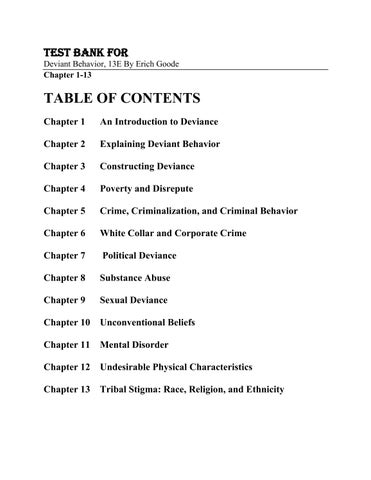
Test Bank For Deviant Behavior, 13th Edition By Erich Goode
Test Bank For Deviant
Behavior, 13E
By Erich Goode
Chapter 1-13
TABLE OF CONTENTS
Chapter 1 An Introduction to Deviance
Chapter 2 Explaining Deviant Behavior
Chapter 3 Constructing Deviance
Chapter 4 Poverty and Disrepute
Chapter 5 Crime, Criminalization, and Criminal Behavior
Chapter 6 White Collar and Corporate Crime
Chapter 7 Political Deviance
Chapter 8 Substance Abuse
Chapter 9 Sexual Deviance
Chapter 10 Unconventional Beliefs
Chapter 11 Mental Disorder
Chapter 12 Undesirable Physical Characteristics
Chapter 13 Tribal Stigma: Race, Religion, and Ethnicity
CHAPTER ONE: AN INTRODUCTION TO DEVIANCE
True-False Questions
1) Most sociologists adopt a constructionist approach to deviance. (T)
2) Sociologically speaking, deviance refers only to behavior never to beliefs or physical characteristics. (F)
3) All instances of deviance are crimes. (F)
4) “High consensus” is behavior, beliefs, or conditions that are widely considered wrongful in a given society. (T)
5) One for of expressing disapproval of a given form of deviance is the withdrawal of sociability from interacting parties. (T)
6) Sociologists universally agree that any given deviant act should be punished. (F)
7) In order for an act to be considered deviant, all or nearly all members of a given society must disapprove of it. (F)
8) What’s considered sociologically deviant can include the possession of an undesirable physical characteristics. (T)
9) What’s considered deviant is a continuum or spectrum that stretches from mild to strong disapproval. (T)
10) Sociologically speaking, people who regard a given act as deviant always react negatively to it and against the offender. (F)
11) Over a period of time, deviance is always defined “down,” never “up.” (F)
12) The percent of the population who feel that certain activities are “morally unacceptable” is similar in countries around the world. (F)
13) In public opinion polls, the percentage of the U.S. population who favor same sex marriage has stayed the same over a period of more than two decades. (F)
14) In public opinion polls, the percentage of the U.S. population who say that they would ban public smoking has increased over time. (T)
15) Holding and expressing unpopular, unacceptable beliefs is a form of deviance. (T)
16) Atheism is a form of deviance because it harms the society. (F)
17) An empirically true belief cannot be considered deviant. (F)
18) As a general rule, the poorer the country, the greater the likelihood that its residents believe that it is necessary to believe in God to be a moral person. (T)
19) What makes racism deviant is that the belief harms the society in which it is held. (F)
20) Since drinking is legal in the U.S. as well as a nearly universal practice, it is not considered deviant. (F)
Multiple Choice Questions
1) The sociological definition of deviance is based on:
(a) statistical rarity
(b) psychopathology
(c) harm
(d) social disorganization
*(e) none of the above
2) The contemporary or “modern” conception of deviance is based on:
(a) the society-wide or universal agreement that a given act, belief, or trait is wrongful.
*(b) the judgment of wrongfulness by designated audiences.
(c) scientific consensus that the act in question undermines social organization.
(d) excluding beliefs and physical characteristics from the definition of what’s deviant.
(e) none of the above
3) Several sociological theories attempt to explain deviant behavior. Which of the following theories is not one of them?
(a) anomie or strain theory
(b) social disorganization theory
(c) differential association or learning theory
(d) social control and self-control theories
*(e) none of the above; all are theories that attempt to explain deviant behavior
4) According to Erving Goffman, in Stigma, which of the following should be considered an example or type of “blemish of individual character.”
(a) abominations of the body
(b) tribal stigma of race, national, and religion
*(c) alcoholism
(d) physical deformities
(e) none of the above
5) The form of deviance that Goffman does not include in his typology is the stigma of:
(a) race, religion, and nation
(b) abominations of the body
(c) blemishes of individual character
*(d) absolute evil
(e) none of the above; all are included in Goffman’s typology
6) To the constructionist, deviance exists because:
(a) Certain behavior is immoral everywhere and for all time.
(b) Some behavior violates God’s law.
(c) It is factually and empirically wrongful.
(d) It is caused by certain forces that can be explained.
*(e) none of the above
7) The perspective that asks and answers the question, “Why do some people engage in deviance?” with scientifically-derived evidence is:
(a) social constructionism
(b) defining deviancy up
(c) defining deviancy down
*(d) positivism
(e) the study of cultural representations
8) Excluded from Goffman’s concept of “blemishes of individual character” is:
(a) unemployment
(b) alcoholism
(c) treacherous and rigid beliefs
(d) mental disorder
*(e) the violation of the norm of having a pleasing, esthetic appearance
9) According to Adler and Adler’s “ABCs” of deviance:
*(a) Both behavior and physical traits can be the basis for judgments of deviance.
(b) Behavior can be the basis for judgments of deviance, but physical traits cannot.
(c) Physical traits can be the basis for judgments of deviance, but behavior cannot.
(d) Neither behavior not physical traits can be the basis for judgments of deviance.
(e) none of the above
10) The principle of relativity one of the foundation-stones of the concept of deviance applies:
(a) across societies, but not through time
(b) through time, but not across societies
(c) neither across societies nor through time
*(d) both across societies and through time
(e) none of the above
11) Over time, deviance has been defined:
(a) down, but not up
(b) up, but not down
*(c) both up and down
(d) neither up nor down
(e) none of the above
12) Sociologically, deviance takes place or exists:
*(a) everywhere and anywhere people engage in behavior, hold and express beliefs, and possess traits that others regard as unacceptable or reprehensible
(b) only among the marginal, disreputable segments of the society
(c) only in the boardroom of large corporations and the headquarters of the military, that is, only among the most powerful segments of the society
(d) only in the private, secret corners of the society
(e) none of the above
13) According to the author:
(a) Only societal deviance is sociologically relevant; situational deviance is irrelevant.
(b) Only situational deviance is sociologically relevant; societal deviance is irrelevant.
*(c) Both societal and situational deviance are sociologically relevant.
(d) Neither societal nor situational deviance are sociologically relevant.
(e) none of the above
14) Deviance has both a societal and a situational side. Appearing naked in a hotel lobby versus being naked, alone, in one’s hotel room is an example of:
(a) societal but not situational deviance.
*(b) situational but not societal deviance.
(c) both situational and societal deviance.
(d) neither societal nor situational deviance.
(e) none of the above
15) Which of the following is the clearest example of tribal stigma:
a) homophobia
b) poverty and disrepute
c) hostility toward deviant physical characteristics
d) prejudice against the mentally disabled
*e) anti-Semitism
16) Erving Goffman identified tribal stigma as pertaining to:
*a) race, nation, and religion
b) mental illness, mental disorder, and mental disability
c) sex, gender, and sexuality
d) economics, class, and stratification
e) none of the above
17) Which of the following statements is true?
(a) Constructionism implies essentialism.
(b) Essentialism implies constructionism.
*(c) Positivism implies essentialism.
(d) Positivism implies constructionism.
(e) none of the above
18) Which of the following statements is true:
*(a) Members of Eastern European nations are more likely to oppose legal abortion than members of Western European nations.
(b) Members of Western European nations are more likely to oppose legal abortion than members of Eastern European nations.
(c) Members of Western European and Eastern European nations are equally likely to oppose legal abortion.
(d) Attitudes toward legal abortion have never been asked about in either Western or Eastern Europe by polling organizations.
(e) none of the above
19) According to Adler and Adler’s “ABCs” of deviance:
(a) Behavior can be the basis for judgments of deviance, but physical traits cannot.
(b) Physical traits can be the basis for judgments of deviance, but behavior cannot.
*(c) Both behavior and physical traits can be the basis for judgments of deviance.
(d) Neither behavior not physical traits can be the basis for judgments of deviance.
(e) none of the above
20) The principle of relativity one of the foundation-stones of the concept of deviance applies:
(a) across societies, but not through time
(b) through time, but not across societies
*(c) both across societies and through time
(d) neither across societies nor through time
(e) none of the above
Essay Questions
1) What are the “ABCs” of deviance? Why are all three regarded as types of deviance? How can sociologists refer to traits or characteristics that are “not the person’s fault” as instances of deviance? Is this fair? Is it sociologically meaningful? What about belonging to a particular racial, national, or ethnic category--can this be regarded as a form of deviance? Why or why not?
2) Does the principle of relativity mean that the sociologists cannot make moral judgments at all? Why or why not? Discuss fully and in detail.
3) Cite some instances of the relativity of deviance according to variations from one society to another, through time, and in one situational context versus another? Do you believe that certain actions are “really and truly” deviant in spite of the fact that have been accepted, tolerated, even in encouraged in come places, times, and contexts? Is the sociology of deviance immoral in its acceptance of moral and ethical relativity?
4) What’s the difference between “societal” and “situational” deviance? Why is this distinction important? Discuss some cases that exemplify “societal” but not “situational” deviance and vice versa?
5) Spell out a sociology of deviance that is based on essentialism. Do the same for constructionism. Definitions are neither right nor wrong, only more or less useful in helping us understand the world. Which of these two perspectives do you believe tells us more about how the world works? Which is a more powerful vision of social reality?
CHAPTER TWO: EXPLAINING DEVIANT BEHAVIOR
True-False Questions
1) Positivism in the social sciences is the application of the scientific method to the study of human behavior. (T)
2) Empiricism is a fundamental assumption of positivism. (T)
3) The guiding principle of positivism is, “intuition is the best guide to what is scientifically true.” (F)
4) Positivism is centrally concerned with scientifically determining what’s moral and immoral. (F)
5) A central assumption of positivist criminologists is determinism that criminal behavior has a cause, and criminologists can determine what its causes are. (T)
6) Biological theories of deviance and crime are not types of positivistic explanations of deviance. (F)
7) Routine activity theory assumes, but does not attempt to explain, what is different about the motivated offender that makes him or her violate the norms. (T)
8) The social disorganization school argues that the cause of criminal, deviant, and delinquent behavior is that entire neighborhoods fail to monitor and sanction wrongdoing among their residents. (T)
9) Most sociologists believe that most deviance is caused by biological factors. (F)
10) Social disorganization theory has been entirely discredited and falsified. (F)
11) The causal or positivistic theories examined in this chapter focus mainly on the question, “Why are certain forms of behavior regarded as deviant?” (F)
12) Anomie theory is based on the idea that the social structure itself exerts pressure on persons in the society to engage in non-conforming, unconventional, or deviant behavior. (T)
13) Anomie or strain theory argues that deviant behavior is most common among members of the middle class. (F)
14) By the 1990s, anomie theory had become completely discredited in American sociology. (F)
15) The differential association theory of crime is primarily an explanation based on learning. (T)
16) Differential association argues that the mass media represent the most powerful mechanisms of learning to engage in deviant, criminal, and delinquent behavior. (F).
17) Most forms of deviance are not disorders and hence, require no treatment. (T)
18) The architects of self-control theory, Michael Gottfredson and Travis Hirschi, argue that their explanation of crime complements or is compatible with all of the other sociological theories of criminal behavior. (F)
19) Social disorganization theory argues that deviance varies systematically by urban ecological location. (T)
120) According to Gottfredson and Hirschi, who are principal proponents of the selfcontrol theory of deviance, delinquency, and crime, their explanation does not apply to white collar crime. (F)
Multiple Choice Questions
1) Positivistic theories of deviance are centrally concerned with an answer to the question:
(a) Why are some rule violators punished while conformists remain unpunished?
(b) Why are rules that condemn certain behaviors or beliefs enforced?
(c) Why do rules against certain behaviors or beliefs exist in the first place?
(d) How do people who are stigmatized and punished experience that stigmatization and punishment?
*(e) Why do some people engage in deviance?
2) Positivism’s central mission is:
(a) developing empathy toward human actors.
*(b) devising scientific explanations for why things happen in the material world.
(c) bringing about the socialist revolution.
(d) understanding how people experience things.
(e) none of the above
3) Demonic possession being possessed by the devil or other evil spirits--is:
(a) is an example of the free will or rational calculus school of criminology.
*(b) the most ancient explanation for wrongdoing.
(c) an acceptable sociological theory of deviance and crime.
(d) an example of a positivistic or scientific explanation for deviance.
(e) none of the above
4) “Crime takes place as a consequence of the conjunction of a motivated offender, a suitable target, and the absence of a capable guardian.” This statement best exemplifies which of the following theories or perspectives?
*(a) routine activities theory
(b) social control theory
(c) social disorganization theory
(d) anomie/strain theory
(e) differential association theory
5) A sociologist expressing which of the following theories would have been most likely to have written this quote: “Poor, dense, mixed-use neighborhoods have high transience rates.
. . . Transience weakens . . . both formal and informal social control, which increases the likelihood of deviant behavior.”
(a) anomie/strain theory
*(b) social disorganization theory
(c) differential association theory
(d) routine activities theory
(e) social control theory
6) Robert K. Merton adapted Emile Durkheim’s theory of anomie to devise his own anomie explanation of deviance. There are major differences between the two theories. Which of the following is one of them? In:
*(a) Merton’s theory, deviance is caused by norms that are too strong; in Durkheim’s theory, deviance is caused by norms that are too weak.
(c) Durkheim’s theory, deviance is caused by norms that are too strong; in Merton’s theory, deviance is caused by norms that are too weak.
(c) both Durkheim’s and Merton’s theories, deviance is caused by norms that are too strong; the difference lies elsewhere.
(d) both Durkheim’s and Merton’s theories, deviance is caused by norms that are too weak; the difference lies elsewhere.
(e) none of the above
7) What is the central explanatory factor of anomie theory?
(a) inadequate parenting
(b) absence of bonds to conventional society
(c) deviant socialization
*(d) a disjunction between the culture, which stresses success motivation, and society’s social and economic structure
(e) none of the above
8) A sociologist expressing which of the following theories would have been most likely to have written this quote: “It is only when a system of cultural values extols [praises, encourages] . . . certain common success goals for the population at large while the social structure rigorously restricts or completely closes access to approved modes of reaching these goals for a considerable part of that same population, that deviant behavior ensues on a large scale.”
(a) differential association theory
(b) social control theory
*(c) anomie/strain theory
(d) routine activities theory
(e) social disorganization theory
9) Which of Merton’s “adaptations” is exemplified by becoming a drug addict?
(a) ritualism
(b) innovation
(c) rebellion
*(d) retreatism
(e) conformity
10) The “father” of psychoanalytic theory is:
(a) Karl Marx
*(b) Sigmund Freud
(c) Robert K. Merton
(d) David Engelman
(e) none of the above
11) What is the central explanatory factor of community disorganization?
(a) inadequate parenting
(b) deviant socialization
(c) a disjunction between the culture, which stresses success motivation, and society’s social and economic structure
(d) absence of bonds to conventional society
*(e) zones of transition
12) A sociologist expressing which of the following theories would have written this quote: “Criminal behavior is learned in interaction with other persons in a process of communication.”
*(a) differential association theory
(b) social disorganization theory
(c) social control theory
(d) routine activities theory
(e) anomie/strain theory
13) What is the central explanatory factor of social control theory?
(a) deviant socialization
*(b) absence of bonds to conventional society
(c) a disjunction between the culture, which stresses success motivation, and society’s social and economic structure
(d) inadequate parenting
(e) none of the above
14) A sociologist advocating which of the following theories would have written this quote: “Delinquent acts result when an individual’s bonds to society are weak or broken.”
(a) differential association theory
(b) social disorganization theory
(c) routine activities theory
(d) anomie/strain theory
*(e) social control theory
15) What is the central explanatory factor of self-control theory?
*(a) inadequate parenting
(b) deviant socialization
(c) absence of bonds to conventional society
(d) a disjunction between the culture, which stresses success motivation, and society’s social and economic structure
(e) none of the above
16) Michael Gottfredson and Travis Hirschi, who devised “self-control” theory, argue that the theory does not apply to:
(a) drug use
(b) delinquency
(c) street crime
(d) white collar or corporate crime
*(e) they state that their theory applies to all of the above
17) Which of the following forms of deviance does the social disorganization theory address or attempt to explain:
(a) gay sex
*(b) drug abuse and addiction
(c) the belief that one has been kidnapped by aliens
(d) the possession of physically undesirable characteristics
(e) white collar or corporate crime
18) Which of the following theories argues that persons do not have to be stressed into committing deviance, nor does anyone have to learn to engage in deviant behavior?
(a) anomie theory
(b) differential association theory
(c) social disorganization theory
*(d) social control theory
(e) none of the above
19) Gottfredson and Hirschi state that their theory demolishes all other explanations of deviance and crime, except for two. One is routine activities theory; the other is:
*(a) social disorganization theory.
(b) differential association theory.
(c) anomie theory.
(d) subculture theory.
(e) none of the above; all of the above, say Gottfredson and Hirschi, are falsified by their theory
Essay Questions
1) In many ways, the “self-control” theory of Michael Gottfredson and Travis Hirschi (“a general theory of crime”) contradicts the social control theory advocated by the selfsame Travis Hirschi two decades earlier. In what ways are the two theories contradictory? In what ways are they similar or based on the same principles?
2) How is Robert K. Merton’s anomie theory of deviance different from Emile Durkheim’s, on which it is based?
3) Why was social disorganization theory abandoned in the 1940s? Why did it make a comeback after the late 1980s?
4) In what ways are the positivistic theories of deviance, crime, and delinquency inadequate or incomplete, according to the constructionist approaches? In what ways, do its advocates
argue, is the constructionist approach more adequate or complete? In what ways are the positivist approaches stronger than the constructionist approaches?
5) Michael Gottfredson and Travis Hirschi, authors of “self-control” theory, argue that all other perspectives are wrong, or inconsistent with the facts of crime except for two. Why do they believe that their theory annihilates the others? And what are the two that, they admit, are consistent with theirs, and how can these two theories be reconciled with their own approach?
CHAPTER THREE: CONSTRUCTING DEVIANCE
True-False Questions
1) Rules that define wrongdoing are random with respect to harm. (F)
2) Constructionism is primarily concerned with why some people engage in wrongdoing. (F)
3) The central concept in the constructionist perspective is social control. (T)
4) The positivist approach would examine why and how the witch-craze arose. (F)
5) To labeling theorists, there is only one relevant audience the general society. (F)
6) Labeling involves attaching a stigmatizing definition to an activity, belief, condition, or person. (T)
7) Labeling or interactionist theorists have tended to emphasize the “stickiness” of negative labels. (T)
8) The constructionist approach does not address false accusations. (F)
9) Conflict theory is a variety of consensus theory. (F)
10) Marxism is a variety of conflict theory. (T)
11) The central concept in conflict theory is disparities in power between and among social categories in the population. (T)
12) The feminist theory of deviance and crime argues that altogether too much attention has been paid in the past to the deviance and crime of women. (F)
13) Feminists deny that they experience subordination as a result of their sex. (F)
14) Feminists charge sociologists of deviance with viewing women’s participation in deviance in stereotypical ways, devoting their attention to a narrow range of deviant activities and ignoring the full range of female deviance. (T)
15) “Controlology” or the “new sociology of social control” emphasizes that social control is inevitable, benign, and serves to maximize freedom in modern society. (F)
16) In addition to studying the passage and enforcement of criminal laws, conflict theorists have also examined the causes of criminal behavior. (T)
17) The labeling perspective grew out of the general approach known as symbolic interactionism. (T)
18) The two intellectual enterprises the study of causes of deviance and the social construction of deviance are contradictory rather than complementary. (F).
19) Most of the time that social control is exercised, it is formal social control. (F).
20) Most norms are designed to condemn, punish, or protect a society or its members against injurious or predatory actions. (F)
Multiple Choice Questions
1) According to Thomas Hobbes, what happens to a society in which no one enforces any norms?
(a) It would become a paradise on Earth.
(b) A fascist regime would take over.
(c) The monarchy would assume control.
*(d) It would become a war of all against all.
(e) There’s no telling what would happen.
2) The spiritual father of the school of thought known as controlology or the “new” sociology of social control is:
(a) Frank Tannenbaum
(b) Edwin Lemert
(c) Karl Marx
*(d) Michel Foucault
(e) none of the above
3) Feminist theorists of deviance have charged that the field, as a general rule and until very recently, has regarded:
(a) the deviance of women as deviance in general, while the deviance of men has been seen as specialized deviance.
*(b) the deviance of men as deviance in general, while the deviance of women has been seen as specialized deviance.
(c) both the deviance of women and the deviance of men have been seen as deviance in general.
(d) both the deviance of men and the deviance of women have been seen as specialized deviance.
(e) none of the above
4) Conflict theorists believe that the law:
(a) represents the will of the people.
(b) is a reflection of the social consciousness of a society.
(c) was enacted as a result of the democratic process.
(d) benefits all categories and groups of the society equally.
*(e) favors some categories over others in the exercise of the law.
5) Conflict theory is most likely to focus on what factor as the main cause of high rates of crime:
*(a) sharp inequalities in power and income
(b) social disorganization
(c) anomie
(d) culture transmission
(e) inadequate parental socialization
6) The causal or explanatory component of feminism argues that a major cause of crime against women is:
(a) anomie
*(b) patriarchy
(c) social disorganization
(d) inadequate parenting
(e) none of the above
7) For which theory is reflexivity most foundational or essential?
(a) biological theories
(b) Marxism
(c) Freudian psychoanalysis
(d) symbolic interactionism/labeling theory
*(e) conflict theory
8) One of the arguments feminists make about pre-feminist theories of deviance is that these theories ignored the deviance of women and, when they occasionally discussed it, they also tended to focus on a very narrow range of types of deviance. Two of these stereotypical female types of deviance were prostitution and shoplifting. A third was:
*(a) mental illness
(b) illegal drug use
(c) political radicalism
(d) murder
(e) none of the above
9) Which approach launched a critique against patriarchy, sexism, and androcentrism?
*(a) feminism
(b) Marxism
(c) symbolic interactionism
(d) functionalism
(e) conflict theory
10) All left-wing, radical, conflict-oriented sociologists and criminologists base their analysis on the theories of:
(a) Robert K. Merton
(b) Howard S. Becker
*(c) Karl Marx and Friedrich Engels
(d) Frank Tannenbaum
(e) Kingsley Davis and Wilbert Moore
11) Which of the following questions would a labeling or interactionist theorist be most likely to ask?
(a) Why are rates of deviance higher in some societies than in others?
(b) Why do some people engage in deviant behavior while others don’t?
(c) Why don’t some people engage in deviant behavior?
(d) What is the social class distribution of deviant behavior?
*(e) What happens when after someone is condemned or stigmatized as a deviant?
12) The “father” of controlology is:
(a) Karl Marx
(b) Friedrich Engels
(c) Robert K. Merton
*(d) Michel Foucault
(e) Howard S. Becker
13) Which of the following statements would a conflict theorist be most likely to agree?
(a) Societies possess a kind of collective conscience or shared sense of morality.
(b) Societies tend to have a shared community of interests.
(c) Societies display a kind of unconscious wisdom in prohibiting harmful behavior.
*(d) Most social institutions and practices benefit the members of more powerful groups and categories at the expense of less powerful ones.
(e) none of the above
14) Conflict theorists argue that the criminal law:
(a) is enforced against members of all categories and classes fairly and equally.
(b) is enacted mainly to protect the society from harm.
(c) is supported, endorsed, and regarded as fair and legitimate by the majority of all classes and categories of the society in more or less equal proportion.
*(d) tends to represent the beliefs, lifestyle, and/or economic interests of the most powerful segments of the society.
(e) none of the above
15) Feminists argue that, prior to the emergence of feminism as a major perspective, sociologists of deviance typically:
(a) over-emphasized women’s deviant behavior.
(b) saw women’s deviance as deviance in general.
(c) over-emphasized the role and importance of women as victims of crime.
*(d) had a skewed view of women’s deviance when they did study it, looking almost exclusively at particular, female-stereotyped types of behavior.
(e) none of the above
16) Controlology, or the “new sociology of social control,” was influenced most by the French philosopher Michel Foucault, who argues that in the modern era, social control is:
(a) necessary and positive in its impact.
(b) equitable, fostering equality in modern society.
(c) less powerful, less coercive than in past centuries.
(d) comprised almost entirely of informal and interpersonal social control.
*(e) none of the above
17) The central, guiding, foundational concept in all constructionist perspectives toward deviance is:
(a) causality
*(b) social control
(c) pathology
(d) objectivism
(e) etiology
18) According to controlologists, social control:
(a) emerges from the “invisible hand: of society
(b) is equalitarian and equitable
(c) is humane and just
(d) is enlightened
*(e) coercive and repressive
19) Which of the following approaches contrasts most sharply with conflict theory?
(a) labeling theory
(b) Marxism
(c) feminism
(d) controlology, or the “new” sociology of social control
*(e) functionalism
20) The central question/s among social constructionists is:
(a) Why do they do it?
(b) What is the cause of deviant behavior?
(c) Why don’t people engage in deviant behavior?
(d) In what ways does deviance harm the society in which it takes place?
*(e) Why are rules created and enforced, and with what consequences?
Essay Questions
1) Why did feminists criticize all other prior perspectives toward deviance and crime? According to feminism, what were the deficiencies and flaws of these perspectives? In their estimation, what would an adequate and valid theory of deviance and crime look like?
2) Why have the labeling or interactionist theorists focused mainly on “soft” forms of deviance? What would a labeling perspective of “hard” or serious crime and deviance look like?
3) Marxists and other radicals have criticized the field of the sociology of deviance for concentrating overly much on the examination of “nuts, sluts, and deviated preverts” that is, the seamy, sensationalistic forms of deviance committed by marginal, powerless street people. Instead, they argue, very different forms of behavior should be regarded and studied as deviance. What are these other forms of behavior and why, from a Marxist or radical perspective, should they be regarded as deviant? Why has the field of deviance ignored the Marxist or radical “nuts and sluts” criticisms?
4) How does conflict theory as a form of constructionsm that is, that examines inequality in the construction of the criminal laws dovetail with conflict theory as an explanation of deviant and criminal behavior?
5) The labeling or interactionist theory of deviance has been criticized for ignoring the role of power in the social construction of norms and laws. Is this a justified criticism? Why or why not?
CHAPTER FOUR POVERTY AND DISREPUTE
True-False Questions
1) Most Americans are ambivalent toward the poor, feeling both compassion and scorn. (T)
2) Melvin Lerner argued that the affluent and privileged deserve their affluence and privilege. (F)
3) Today, the poorest strata in the United States are the poorest people in the world. (F)
4) In 1980, the United States was the richest country at every decile level, that is, each 10% income level; today, that is no longer true. (T)
5) Today, the median income in the United States is higher than it was a generation ago. (T)
6) Most of the poorest states in the United States are in the South. (T)
7) All of the states in New England have a higher than average per capita income. (T)
8) Statistically speaking, poverty is strongly related to a lack of education. (T)
9) Melvin Lerner argued that the poor deserve to be poor. (F)
10) Thomas Robert Malthus (1766-1834) argued that the more affluent have an obligation to help the poor out with generous welfare benefits. (F)
11) Max Weber argued that revolution is the only way to eliminate poverty. (F)
12) Max Weber argued that the wealthy and privileged deserve their wealth. (F)
13) Over time, compared with the other affluent countries, America’s poor are declining in relative income. (T)
14) According to Max Weber, the wealthy and privileged develop a theodicity of good fortune an ideological that says that the rich deserve to be rich. (T)
15) David Matza argued that American sociologists have largely ignored the issue of the disreputable poor because they don’t want to be accused of stigmatizing the poor. (T)
16) Poverty is unrelated to deviance. (F)
17) As a general rule, relative to its recorded or official economy, the less economically developed a nation is, the larger is its underground, “shadow,” or informal economy. (T)
18) Statistically speaking, the higher the education, the longer someone is likely to live. (T)
19) In the United States, whites and African Americans are equally likely to be unemployed. (F)
20) Most Americans feel that poverty is inferiorizing in some way. (T)
Multiple Choice Questions
1) The Indian economist Amartya Sen argued that:
*(a) Shame is at the core of the experience of poverty.
(b) The wealthy and the privileged deserve their wealth and privileges.
(c) Only revolution will bring about an equalitarian society.
(d) It would be best for the society if the poor and unmotivated starved to death.
(e) The wealthy and privileged develop ideologies that reassure them that their wealth and privileged is deserved.
2) Max Weber argued that the major factor that influences friendship networks, marriages, voting patterns, style of life, neighborhood residence, and attitudes and values is:
*(a) status, or esteem
(b) wealth
(c) income
(d) religion
(e) race
3) The author of the textbook, Deviant Behavior, argues that sociologically, poverty is:
(a) one cause of deviance, but not a form of deviance.
(b) a form of deviance but not a cause of deviance.
*(c) both a cause and a form of deviance.
(d) neither a cause nor a form of deviance.
(e) none of the above
4) Robert K. Merton’s anomie theory argues that “the greatest pressure toward deviation” is exerted on the members of the:
(a) higher strata
(b) upper-middle strata
(c) lower-middle strata
*(d) lower strata
(e) none of the above
5) According to Merton’s anomie theory, the “double failures” of the society are most likely to have retreated or sunk into the morass of:
(a) organized crime
(b) street crime such as robbery
(c) political activism such as revolution
(d) drug dealing
*(e) permanent poverty
6) According to Wilem Bonger and other Marxists, under capitalism, the lower strata of the society, who have become immobilized by hopelessness and a sense of political futility, are referred to as the:
*(a) lumpenproletariat
(b) anomie class
(c) acquisitive class
(d) criminal class
(e) bourgeoisie
7) According to the World Health Organization, over the span of the past quarter-century, worldwide:
(a) more people live in poverty than ever before.
*(b) fewer people live in poverty than ever before.
(c) the level and rate of poverty remain unchanged.
(d) the level and rate of poverty remain unknowable.
(e) none of the above
8) In the past quarter of a century or so, the income inequality in the United States:
(a) declined
*(b) increased
(c) has remained the same
(d) remains unknown and unknowable
(e) none of the above
9) In which areas of the world is the Gini coefficient the highest that is, where income is distributed the most unequally?
(a) China
(b) Western Europe
*(c) Latin America and Africa
(d) the United States and the United Kingdom
(e) Russia and the former Soviet countries and its former satellites
10) The relationship between a state’s percent of poor people and the percent of its welleducated people is:
(a) positive the higher the percent of poor people, the higher the percent of welleducated people.
*(b) negative the higher the percent of poor people, the lower the percent of welleducated people.
(c) random there is no statistical relationship between poverty and education.
(d) unknown and unknowable
(e) none of the above
11) Among the 17 more affluent countries of the world, the health of Americans is:
*(a) the worst
(b) the best
(c) at about the average among the most affluent countries
(d) unknown and unknowable
(e) none of the above
12) According to health expert Michael Marmot, statistically speaking,
*(a) the higher the education the better health is likely to be.
(b) the higher the education, the worse health is likely to be.
(c) there is a random statistical relationship between education and health.
(d) the relationship between education and health is unknown and unknowable.
(e) none of the above
13) Over the past generation or so in the United States, the life expectancy of:
(a) both the most affluent and the poorest men has improved.
(b) both the most affluent and the poorest men has deteriorated.
*(c) the most affluent men has improved, but among the poorest men, it has not changed at all.
(d) both the most affluent and the poorest men has not changed at all.
(e) both the most affluent and the poorest men remains unknown and unknowable.
14) Over the past generation or so in the United States, the life expectancy of:
*(a) both the most affluent and the poorest women has improved.
(b) both the most affluent and the poorest women has deteriorated.
(c) the most affluent women have improved but among the poorest women, it has not changed at all.
(d) both the most affluent and the poorest women has not changed at all.
(e) both the most affluent and the poorest women remains unknown and unknowable.
15) In the United States:
*(a) The rich are getting richer, and the income of the poor is stagnating.
(b) Both the rich and the poor are getting richer.
(c) Both the rich and the poor are getting poorer.
(d) The rich are getting poorer, and the poor are getting richer.
(e) None of the above
16) The poorest large cities in the United States the cities in which the highest percentage of the population is living in poverty are:
(a) New York and Boston
*(b) the “rust belt” cities of the Midwest, such as Cleveland and Detroit
(c) Los Angeles and San Francisco
(d) Houston and Dallas
(e) Miami and Ft. Lauderdale
17) Which of the following statements is true?
(a) Poverty and deviance are unrelated.
*(b) The relationship between poverty and deviance is positive; the greater the poverty, the greater the likelihood that someone will be labeled as deviant.
(c) The relationship between poverty and deviance is negative the greater the poverty, the lower the likelihood that someone will be labeled as deviant.
(d) The relationship between poverty and deviance is unknown and unknowable.
(e) None of the above is true.
18) When sociologists point out the disrepute of the poverty-stricken, they:
(a) blame the victim
(b) praise the victim
*(c) attempt to understand the source of poverty and disrepute
(d) deny that there is a relationship between poverty and disrepute
(e) emphasize the random relationship between poverty and disrepute
19) Robert K. Merton’s anomie theory argues that:
*(a) poverty breeds deviancies.
(b) poverty is in and of itself a form of deviance.
(c) poverty is unrelated to deviance.
(d) the relationship between poverty and deviance is unknown and unknowable.
(e) none of the above
20) More than half of the poorest rural communities in the United States are located in just two states. These states are:
(a) New Hampshire and Vermont
(b) New York and New Jersey
(c) Oregon and Washington State
*(d) South Dakota and Texas
(e) Maryland and Pennsylvania
Essay Questions
1) In your opinion is poverty worse than, or not as bad, as it was a generation ago? Why?
2) Do you think it is fair to stigmatize the poor for being poor? Do the poor deserve being labeled as disreputable? Social class involves distributing society’s respect and disrespect on the basis of achievement. Is disrespecting the poor an inevitable consequence of social stratification? Is disrespect given to the poor a mirror opposite of granting respect to persons of higher achievement?
3) In most societies, including the United States, social class, income, and achievement are strongly related to educational achievement. Consequently, if a lack of education results in a lack of achievement, is being poor nobody’s fault but the poor? Or is there more to the story than that?
4) Is social mobility difficult to achieve in American society? Is it harder than in other societies? In a society with a great deal of mobility, the achievement or wealth of one’s parents do not influence one’s own achievement or attainment of wealth? Is this true of the United States? What do you think causes social mobility? Why is it higher in some societies than others?
5) What’s your response to someone who is homeless? Someone who asks you for money on the street? Are you repelled? Do you feel sorry for that person? Pity? Do you give that person money? Is it your responsibility to help him or her? Whose responsibility is it? Do you disrespect him or her? Why? Do you feel that poverty is a “bottomless pit” that can never by filled a social problem that can never be solved?
1) In American curricula, for the most part, the subject matter of courses designated with “deviance” and “deviant” in the title overlap but is not identical with courses the department refers to with the titles “crime” and “criminology.” (T)
2) There are many acts that are deviant but not criminal. (T)
3) The legal system of the United States began with, and is based on, the English common law. (T)
4) Violations of the drug laws are examples of violations of the common law. (F)
5) Gambling is a violation of statutory law. (T)
6) White collar and corporate crime are primal crimes. (F)
7) In the United States, criminologists only study the FBI’s Index Crimes (F).
8) When criminologists make generalizations about crime in general, they tend to focus on “street” or Index Crimes. (T).
9) The most serious forms of crime represent examples of “high consensus” deviance. (T)
10) This book focuses entirely on behaviors that activate formal and not those that activate informal sanctions. (F)
11) Property crime is much more common than violent crime. (T)
12) Street crimes are the “meat and potatoes” of positivist criminologists, that is, they are the most exemplary or paradigmatic forms of crime. (T)
13) Since the 1970s, the influence of the Marxist or radical school of criminology has declined. (T)
14) The drug laws represent an example of a primal crime. (F)
15) This book takes the approach that a textbook on deviance should not discuss criminal behavior. (F)
16) According to the author, by definition, deviant acts are not criminal and criminal acts are not deviant. (F)
17) Crime is sufficient for deviance to exist, but it is not necessary. (T)
18) Murder is the least common Index Crime. (T)
19) The positivist’s mission with respect to murder is to determine under what circumstances the taking of human life is tolerated, that is, not considered deviant. (F)
20) In the Western world since the Middle Ages, lethal violence has declined enormously. (T)
21) Men are more likely to commit murder than women (T)
22) The United States has the highest rate of criminal homicide in the world. (F)
23) The taking of human life is universally deviant and criminal everywhere and during all periods of history. (F)
24) Rape is an exception to the rule that behavior is socially constructed; rape is not socially constructed. (F)
25) By definition, murder is an unauthorized, illegitimate killing. (T)
26) The rate of criminal homicide peaks in the 18-to-24-year-old age category. (T)
27) Most victims of criminal homicide are women. (F)
28) Most of the time that women kill, they kill a woman. (F)
29) Women are more likely to be the victim of a murder than men. (F)
30) Worldwide, the countries with the highest rates of criminal homicide tend to be affluent, industrialized countries in the Western world. (F)
31) Murder is completely unrelated to social class; the likelihood that someone will kill or be killed is equal at all strata of the socioeconomic spectrum. (F)
32) Most murders are skillfully and carefully planned. (F)
33) Rape is an act of violence and only an act of violence; sex does not play any part in it at all. (F)
34) By definition, rape is an act of violence. (T)
35) Of all age categories in the population, the elderly stand the highest likelihood of being victimized by a robbery. (F)
36) Lower-income persons are much more likely to be robbed than is true of higher-income persons. (T)
37) By definition, robbery entails confrontation between the perpetrator and the victim. (T)
38) Young, urban, African-American males have a disproportionately high likelihood of committing robbery, relative to their numbers in the population. (T)
39) African-Americans are more likely to be the victims of robbery than is true of whites. (T)
40) Members of the poorest households are more likely to be the victims of a robbery than is true of members of the most affluent households. (T)
Multiple Choice Questions
1) Criminal behavior:
(a) is not a form of deviance at all.
(b) is technically not a form of behavior.
(c) is usually not studied in a course on deviance.
(d) cannot be studied by sociologists of deviance.
*(e) none of the above
2) Courses in deviance and those on crime:
(a) study completely separate and distinct phenomena.
*(b) study different but overlapping phenomena.
(c) are identical or coterminous with one another.
(d) study unknown and unknowable phenomena.
(e) none of the above
3) In comparison with criminologists, the crimes sociologists of deviance are more likely to study are:
*(a) “moral” or “public order” crimes.
(b) crimes of violence
(c) property crime
(d) Index Crimes
(e) white collar crime
4) According to criminological research:
(a) Most of steal a lot and very frequently “we are all thieves.”
*(b) Most of us steal, though very little and infrequently relatively few of us “make a habit of stealing”
(c) Very few of us steal, ever.
(d) Criminological research has never studied the stealing proclivities of the population at large.
(e) none of the above
5) Criminologists refer to legislature-created law as:
(a) primal crime
(b) common law
(c) deviance
(d) street crime
*(e) statutory law
6) Which of the following is not included as an Index Crime?
(a) burglary
(b) rape
(c) murder
(d) robbery
*(e) prostitution
7) In the past 20 or 30 years, property crime in the United States:
(a) has increased
*(b) has decreased
(c) has fluctuated wildly and erratically from year to year (d) has remained completely unknown and unknowable
(e) none of the above
8) Which of the following is exclusively a “statutory” crime?
(a) rape
(b) assault
(c) murder
*(d) possession of illicit drugs
(e) robbery
9) An example of a “primal” crime is:
(a) drug use
(b) prostitution
(c) corporate crime
(d) gambling
*(e) murder
10) Index crimes are most likely to be committed:
*(a) by persons at the bottom of the class structure
(b) by persons at the top of the class structure
(c) equally by persons up and down and across the class structure
(d) in the middle of the class structure
(e) none of the above
11) Common law includes the laws against:
(a) drug possession and sale
(b) white collar offenses
*(c) murder
(d) abortion
(e) gambling
12) An example of an FBI Index Crime is:
*(a) rape
(b) the sale of alcohol to a minor
(c) fraud
(d) organized crime
(e) treason
13) The least common of the following crimes is:
(a) robbery
(b) burglary
(c) forcible rape
(d) aggravated assault
*(e) murder
14) Of the following, the greatest dollar value is lost to which kind of theft?
(a) burglary
*(b) shoplifting plus employee theft
(c) robbery
(d) motor vehicle theft
(e) pickpocketing
15) The FBI defines which of the following as an example of a larceny-theft:
(a) robbery
(b) motor vehicle theft
(c) burglary
*(d) shoplifting
(e) none of the above
16) More _______________ are reported to the police than any other property crime:
(a) motor vehicle thefts
(b) burglaries
(c) robberies
(d) white collar crimes
*(e) larceny-thefts
17) Legally, as tabulated by the FBI, larceny theft includes:
(a) motor-vehicle theft
(b) embezzlement
(c) check forgery
(d) passing worthless checks
*(e) none of the above
18) The central concern or issue in the natural science or positivist model adopted by mainstream criminology is:
*(a) etiology, or the cause or causes of criminal behavior
(b) the consequences of criminal behavior
(c) the social construction of crime
(d) the public perception of crime
(e) the overlap between deviance and crime
19) Technically, statutory law is law constituted by:
(a) case law or “judge-made” law
(b) primal law
*(c) laws enacted by legislatures
(d) unwritten law
(e) none of the above
20) Legally, larceny-theft does not include:
(a) pick-pocketing
(b) thefts from a motor vehicle
(c) bicycle theft
(d) purse-snatching
*(e) motor vehicle thefts
21) Which of the following statements about murder is true?
(a) The public has an extremely accurate perception of the rate and nature of murder.
(b) On a person-for-person or statistical basis, we are much more likely to be murdered by strangers than by intimates.
(c) Sociologically, murderers and murder victims are very different from one another.
(d) Murders tend to be inter-racial.
*(e) Men are more likely to be murder victims than women.
22) Which of the following categories of crime is most often reported to the police in comparison with any other type of crime:
(a) rape
*(b) larceny theft
(c) motor vehicle theft
(d) murder
(e) assault
23) Which of the following areas of the United States has the highest rate of criminal homicide? The:
(a) Northeast
(b) California and the Pacific Northwest
(c) Midwest
*(d) South
(e) Southwest
24) Over time, the murder rate of the South:
(a) is increasing
*(b) is declining
(c) has remained the same
(d) has fluctuated wildly and randomly from year to year (e) remains unknown and unknowable
25) Which of the following is an example of robbery:
(a) burglary
(b) pickpocketing
(c) larceny-theft
(d) corporate crime
*(e) none of the above
26) Murder tends to be:
(a) premeditated (b) inter-racial
(c) unrelated to or random with respect to social class or socioeconomic status
(d) committed by people who are strangers to their victims
*(e) none of the above
27) Among the largest cities in the United States, New York City has the (a) highest rate of criminal homicide
*(b) lowest rate of criminal homicide
(c) the median rate of criminal homicide
(d) an unknown and unknowable rate of criminal homicide
(e) none of the above
28) Which of the following categories or segments of the society is likeliest to hold the most inclusive definition of rape?
(a) rapists
*(b) lesbian separatists
(c) sex role and sexual conservatives
(d) sex role and sexual liberals
(e) All hold an equally inclusive definition of rape.
29) Which of the following categories or segments of the society is likeliest to hold the most exclusive definition of rape?
*(a) rapists
(b) lesbian separatists
(c) sex role and sexual conservatives
(d) sex role and sexual liberals
(e) All hold an equally exclusive definition of rape.
30) In comparison with whites, African-Americans are:
(a) more likely to be victims of murder but less likely to be perpetrators of murder.
(b) more likely to be perpetrators of murder, but less likely to be victims of murder.
*(c) more likely both to be victims and perpetrators of murder.
(d) less likely both to be victims and perpetrators of murder.
(e) none of the above
31) Members of which of the following categories of the population are more likely than the average to be victimized by robbery?
(a) the elderly
(b) females
(c) the affluent and the wealthy
*(d) African Americans
(e) none of the above
32) The rate of which of the following crimes rises fastest as the size of the community rises:
(a) rape
(b) murder
(c) aggravated assault
*(d) robbery
(e) All of the above crimes rise at the same rate as the size of the community rises.
33) With respect to criminal homicide, when:
(a) men kill, they tend to kill a man; when women kill, they tend to kill a woman.
(b) men kill, they tend to kill a woman; when women kill, they tend to kill a man.
*(c) men kill, they tend to kill a man; when women kill, they tend to kill a man.
(d) men kill, they tend to kill a woman; when women kill, they tend to kill a woman.
(e) none of the above
34) With respect to criminal homicide, when:
(a) men are killed, they tend to have been killed by a man; when women are killed, they tend to have been killed by a woman.
(b) men are killed, they tend to have been killed by a woman; when women are killed, they tend to have been killed by a man.
*(c) men are killed, they tend to have been killed by a man; when women are killed, they tend to have been killed by a man.
(d) men are killed, they tend to have been killed by a woman; when women are killed, they tend to have been killed by a woman.
(e) none of the above
35) With respect to criminal homicide, when:
*(a) African Americans kill, they tend to kill an African American; when whites kill, they tend to kill a white person.
(b) African Americans kill, they tend to kill a white person; when whites kill, they tend to kill a white person.
(c) African Americans kill, they tend to kill an African American; when whites kill, they tend to kill an African American.
(d) African Americans kill, they tend to kill a white person; when whites kill, kill, they tend to kill an African American.
(e) none of the above
36) With respect to criminal homicide, when:
*(a) African Americans are killed, they tend to have been killed by an African American; when whites are killed, they tend to have been killed by a white person.
(b) African Americans are killed, they tend to have been killed by a white person; when whites are killed, they tend to have been killed by a white person.
(c) African Americans are killed, they tend to have been killed by an African American; when whites are killed, they tend to have been killed by an African American.
(d) African Americans are killed, they tend to have been killed by a white person; when whites are killed, they tend to have been killed by an African American.
(e) none of the above
37) Rape is:
(a) only “about” sex; it isn’t “about” violence at all.
(b) only “about” violence”; it isn’t “about” sex at all.
*(c) always “about” violence it is by definition a violent act but it may be “about” sex as well.
(d) “about” neither sex nor violence, but something else altogether.
(e) none of the above
38) In the United States in the past 5 to 10 years, the number of people cercerally confined (that is, in prisons and jails) has:
(a) has doubled
*(b) has remained about the same
(c) has declined by half
(d) remains unknown and unknowable
(e) none of the above
39) CompStat is:
*(a) a methodology that tabulates crime as well as a strategy to combat crime
(b) an explanation of the cause of criminal behavior
(c) not used in New York City
(d) employed only in the nation’s rural police jurisdictions
(e) none of the above
40) In the United States, relative to their numbers in the population, African Americans are:
(a) one-tenth as likely to be arrested as whites
(b) about as likely to be arrested as whites
*(c) two to three times as likely to be arrested as whites
(d) ten times as likely to be arrested as whites
(e) arrested at a rate than is unknown and unknowable
Essay Questions
1) What are some differences and similarities between deviance and crime? What is the “rough division of labor” between what sociologists of deviance study and what positivistic criminologists study?
2) What is the positivist criminologist’s “mission”? What is the social constructionist’s “mission”? How do they overlap?
3) Even primal crimes such as rape, robbery, and murder are “relative”? If they are universally condemned, in what way are they “relative”? Does this generalization mean that there is no “common core” to what’s considered crime?
4) Under what circumstances is the taking of human life socially tolerated, accepted, or non-deviant? Why? When is a killing conceptualized and dealt with as a murder or a deviant killing? What the social circumstances that transform the first into the second?
5) What makes robbery so interesting to criminologists? What qualities or characteristics does it possess that are to some degree unique and distinctive to itself?
6) The taboo against murder is said to be a cultural universal, the one act that is universally deviant everywhere and throughout history. Does this mean that it is not “relative”? Be detailed and specific.
7) In the 1970s, many feminists argued that “rape isn’t about sex, it’s about violence.” But by the 1990s, many feminists began to argue that rape is often about sex as well as about violence. Why this change in orientation?
8) While murder tends to be intraracial whites tend to kill one another and African Americans tend to kill one another--the same is not quite true of sex or gender. Explain
why this is the case. What factors influence racial patterns in criminal homicide? What factors influence sexual or gender patterns in criminal homicide?
CHAPTER SIX: WHITE COLLAR CRIME
True-False Questions
1) What most people mean by corporate crime is typically white collar crime. (T)
2) Corporate crime tends not to be a classic, clear-cut case of deviance; in some respects, it is a form of deviance, in some respects, it is not. (T)
3) In most corporate crime, victimization tends to be diffuse, or spread out among the population. (T)
4) Most corporate crime is intermingled with legitimate, law-abiding behavior. (T)
5) The most basic reason that people engage in white collar crime is that they are in a position to do so. (T)
6) All white collar criminals are rich and powerful. (F)
7) All white collar crime is corporate crime and vice versa. (F)
8) In embezzlement, the victim is the corporation. (T)
9) Embezzlement tends to be committed against the corporation on behalf of an employee. (T)
10) Corporate crime tends to be made up of complex, sophisticated, and relatively technical acts. (T)
11) Corporate crime, unlike the typical street crime, tends to be intermingled with legitimate behavior. (T)
12) When convicted corporate offenders who commit acts that harm many people are sentenced, juries tend to hand down penalties that are commensurate with the crimes. (F)
13) By definition, white-collar crime is the type of crime that most outrages the public conscience. (F)
14) The intention to do harm to certain parties is a common, even typical, feature of corporate crime. (F)
15) Corporate crime is less likely to stigmatize the perpetrator than street crime. (T)
16) All corporate crime is deviant. (F)
17) Public opinion polls indicate that, typically, the public makes no distinction between white collar crime and street crime. (F)
18) The perpetrators of most forms of ecocide tend to be, in comparison with street crime, insulated from both condemnation and prosecution by an aura of legitimacy. (T)
19) Federal prosecutors consider ecocide a high-priority crime. (F)
20) Relatively few sociologists of deviance conduct research on environmental crime. (T)
Multiple Choice Questions
1) According to criminologists and sociologists, corporate crime:
(a) steals money from the public but causes no physical harm.
*(b) steals money from the public and causes physical harm as well.
(c) does not steal money from the public but causes physical harm.
(d) neither steals money from the public nor does it cause physical harm.
(e) none of the above
2) The victim of corporate collar crime is solely and exclusively the:
(a) corporation itself
(b) general public
(c) consumer
(d) employee
*(e) none of the above; there is no sole or exclusive party that corporate crime harms
3) Sociologically, is corporate crime a form of deviance?
(a) In all cases, yes.
(b) In all cases, no.
(c) Only if the act is against the law.
*(d) To the extent that the public condemns the actors for their deeds.
(e) none of the above
4) The sociologist who coined the term and launched the concept “white collar crime” was:
(a) Erving Goffman
(b) Jennifer Hunt
(c) James Fyfe
(d) Patrick Lynch
*(e) Edwin Sutherland
5) Which of the following types of deviance is not part of Erving Goffman’s three classic types of stigma?
(a) abominations of the body
(b) blemishes of individual character
(c) tribal stigma of race, nation, and religion
*(d) organizational deviance
(e) none of the above; all are part of Goffman’s types of stigma
6) According to criminologists, which of the following statements is true?
(a) Corporate crime is an Index Crime.
(b) Embezzlement is a type of Index Crime.
(c) Corporate crime is by definition a type of embezzlement.
(d) Embezzlement is by definition a type of robbery.
*(e) none of the above
7) Which of the following categories is not a victim of corporate crime?
(a) the general public
(b) the corporate competition
(c) employees
(d) the federal government
*(e) none of the above; all can be victims of corporate crime
8) Corporate crime includes:
(a) an executive murdering his wife (or her husband)
(b) selling cigarettes, which kill people
(c) having three-martini lunches
(d) theft and pilferage on the job
*(e) none of the above
9) Most white collar offenders convicted for their crimes (tax evasion, bank embezzlement, securities fraud, credit card fraud, etc.):
(a) are rich and powerful.
(b) occupied high status positions.
*(c) are more likely than the average to have had a criminal record.
(d) are actually manual laborers
(e) none of the above
10) According to the author:
(a) all white collar crime is corporate crime and vice versa.
(b) no white collar crime is corporate crime and vice versa.
(c) all white collar crime is corporate crime but not all corporate crime is white collar crime.
*(d) all corporate crime is white collar crime but not all white collar crime is corporate crime.
(e) none of the above
11) Which of the following statements is false? Corporate crime tends to:
(a) be intermingled with legitimate behavior.
(b) generate harm that is diffuse.
(c) more difficult to detect than street crime.
(d) involve much larger sums of money than is true of street crime.
*(e) none of the above is false
12) When corporate criminals are arrested and go to trial (which is rare), juries:
(a) are eager to impose even harsher sentences on them than they would for convicted street criminals.
*(b) are reluctant to impose harsh penalties on them.
(c) make decisions about their penalties that are exactly the same ones they would make for street criminals.
(d) The sentences juries impose on corporate criminals is unknown because their trials are almost always secret.
(e) none of the above
13) Which of the following statements is true?
*(a) All corporate crime is white collar crime.
(b) All white collar crime is corporate crime.
(c) No corporate crime is white collar crime.
(d) No white collar crime is corporate crime.
(e) none of the above is true
14) Corporate crime is a subset of a larger category that sociologists and criminologists refer to as:
(a) embezzlement
(b) street crime
*(c) organizational deviance
(d) civil crime
(e) torts
15) For which of the following types of deviance is it impossible to place every single person in the society along a single axis or dimension, from deviant to more conventional?
(a) honest or dishonest
(b) atheists, agnostics, or believers
(c) alcoholics, moderate drinkers, or abstainers
(d) fat, less fat, or not at all fat
*(e) none of the above; for all of these dimensions, people can be placed along this dimension
16) In the world of white collar crime, there are:
*(a) a lot more “small fry” than “big fish”
(b) a lot more “big fish” than “small fry”
(c) about the same number of “small fry” as “big fish”
(d) an unknowable number of “small fry” and “big fish”
(e) none of the above
17) Which of the following financial figures are well-informed experts most likely to place on their “Top Ten” list of white collar criminals?
(a) Jerome Mayne, author of Diary of a White Collar Criminal?
(b) The Pentagon
(c) Volkswagen
(d) Judge Denny Chin
*(e) Bernard Madoff
18) Which of the following academic specialty is most likely to study ecocide?
*(a) green criminology
(b) political science
(c) the sociology of deviance
(d) psychology
(e) psychiatry
19) Which of the following normative violator is least likely to be discredited, condemned, and stigmatized? The:
(a) drug dealer
(b) street criminal
(c) mentally ill person
(d) beggar
*(e) degrader of the environment
20) Which of the following offenders engaged in what criminologists refer to as a “Ponzi scheme”?
(a) FIFA
(b) VW
(c) the EPA
(d) the CIA
*(e) none of the above
Essay Questions
1) Why does certain behavior that is enacted within an organization setting merit belonging to a separate and distinct type of deviance? Does this distinction make sense or is it an effort to over-complicate the picture? Why or why not?
2) In what ways do the four cases of corporate crime the collapse of WorldCom, the pillaging of Tyco, the bankruptcy of Global Crossing, and the cooked books of Enron illustrate the generalizations that apply to corporate crime discussed in this chapter?
3) Discuss in what specific ways white collar and corporate crime are forms of deviance and in what ways they are not forms of deviance and in what specific ways corporate crime is, and is not, a form of white-collar crime. Who, specifically, are the relevant audiences?
4) In what ways does the notion of risk assessment come into the corporate and white-collar crime picture?
5) “Robert,” a lawyer whose account appears in this chapter, was convicted of “structuring,” a white-collar crime. Point out the ways his behavior illustrates some of the principles discussed in this chapter and the ways in which it does not.
CHAPTER SEVEN: POLITICAL DEVIANCE
True-False Questions
1) Republicans and conservatives are more likely than Democrats and liberals to support LGBTQ rights. (F)
2) Republicans and conservatives are more likely than Democrats and liberals to support consumer protections. (F)
3) Republicans and conservatives are more likely to support a private rather than a government-sponsored medical plan. (T)
4) Democrats and liberals are more likely than Republicans and conservatives to support government funding for the arts. (T)
5) Democrats and liberals are more likely than Republicans and conservatives to support a less restrictive immigration policy. (T)
6) After Lyndon Johnson left office in 1968, no Democrat in a presidential election has received a majority of the white vote. (T)
7) After the presidential election of Richard Nixon in 1960, every Republican candidate has received less than 20 percent of the African American or Black vote. (T)
8) The greatest number of votes cast in any presidential election in American history took place in the election of 2020. (T)
9) All deviance is politically determined in that achieving dominance or hegemony on a given issue is a political process. (T)
10) All political positions are deemed deviant by certain audiences. (T)
11) In the United States, most courses on deviance at the college level do not devote a section to political deviance. (T)
12) What constitutes political deviance depends on which side of a political divide one sits. (T)
13) Politics enables or potentiates the deviantization process. (T)
14) The criminal code is an elitist plot to stigmatize and criminalize the poor and the powerless. (F)
15) In the presidential election of 1960, Richard M. Nixon received 32 percent of the African American or Black vote. After he left office, no Republican candidate has received as much as 20 percent of the Black vote. (T)
16) Politics is one social realm in which deviance does not apply. (F)
17) In absolute numbers, in 2020, in his losing bid, presidential candidate Donald Trump received more total votes than he had in his victorious 2016 run for the presidency. (T)
18) The January 6, 2021, storming and seizing of the U.S. capitol building in Washington was a plot contrived by the Democrats to discredit Donald Trump. (F)
19) Morality and politics exist in two separate realms; they do not mix. (F)
20) Political positions are arrayed along a left-right spectrum, with ultra-conservatives at the extreme left of the spectrum and ultra-radicals at the extreme right. (F)
Multiple Choice Questions
1) Which of the following political figures was not considered as deviant by any faction, group, or party?
(a) George Washington
(b) King George III
(c)Thomas Jefferson
(d) Abraham Lincoln
*(e) none of the above; all were considered deviant by certain factions
2) Which U.S. president was removed during his term of office for committing acts of political deviance?
*(a) Richard Nixon
(b) Bill Clinton
(c) Jimmy Carter
(d) Barak Obama
(e) Ronald Reagan
3) Virtually all the most murderous, malefic wrongdoers in history were:
(a) sexual deviants
(b) drug abusers and addicts
(c) mentally disordered
(d) possessors of undesirable physical characteristics
*(e) political deviants
4) Among the following states, which one is the most solidly politically “blue”:
(a) Wyoming
(b) Utah
(c) Nebraska
(d) Florida
*(e) Maryland
5) Which of the following is among the “reddest” or most politically conservative states in the United States?
(a) Michigan
(b) Illinois
(c) Florida
*(d) Wyoming
(e) Hawaii
6) In all the presidential elections from 1964 to 2020 all the:
*(a) Democratic candidates received more than 80% of the Black votes.
(b) Republican candidates received more than 20% of the Black votes.
(c) Republican candidates received more than 50% of the white votes.
(d) Democratic candidates received less than 40% of the white votes.
(e) none of the above statements is true
7) For roughly a century following the Civil War, an alliance prevailed between the “solid” (and segregationist) South and the politically progressive Democratic North. That alliance was fractured beginning with what political figure:
(a) Jimmy Carter
*(b) Lyndon Baines Johnson
(c) John F. Kennedy
(d) Franklin Delano Roosevelt
(e) Barak Obama
8) Which of the following is most likely to be opposed by Republicans/conservatives:
(a) protectionist tariffs on imported goods
(b) drilling for oil in the Alaska wilderness
*(c) gun control
(d) unfettered free market capitalism
(e) the death penalty
9) The “Alt-right” is a movement whose followers declare that they endorse:
(a) The KKK
(b) white supremacy
*(c) the preservation of Western civilization and an end to minority privilege
(d) hatred against minorities
(e) “The Squad”
10) Which of the following statements about the presidential election of 2020 and its aftermath is false?
(a) There is no evidence that the election was “rigged” or “stolen” from Donald Trump.
*(b) Mike Pence, then Vice President of the U.S., could have decertified the election, but
refused to do so.
(c) President Donald Trump asked Georgia secretary of state to “find” roughly 10,000 votes in his favor so that he could win the election.
(d) A guard was killed in the January 6, 2021, riot at the U.S. Capitol.
(e) The rioters were encouraged and spurred on, in person, by President Trump himself.
11) Which of the following is not an instance of political deviance?
(a) terrorism
(b) stealing and publicizing classified political documents
(c) engaging “dirty tricks” in a political campaign against one’s opponent
(d) accepting bribes for political favors for one’s bribers
*(e) none of the above; all are instances of political deviance
12) Sociologically speaking, what defines a politically relevant act as deviant?
(a) how immoral it is
(b) whether it harms people
*(c) how it is judged by relevant audiences
(d) whether the party in power endorses it
(e) whether the party out of power endorses it
13) The term, “The Squad,” refers to four young (or youngish) radical or left-leaning Democrats who took office in January 2019. Which of the following statements about them is true? They:
(a) were strongly supported by then-President Trump.
*(b) are members of ethno-racial minorities.
(c) all come from California.
(d) take mainstream, middle-of-the-road political positions.
(e) none of the above is true.
14) The Alt-Right movement shares a political position with former President Andrew Johnson (in office, 1865-1869). That position strongly endorses:
(a) high taxes for the rich, low taxes for the poor.
(b) an unrestricted immigration policy.
(c) a strong civil rights platform.
*(d) white supremacy
(e) feminism
15) Which of the following policies, programs, court decisions, proposals, or laws are Democrats and liberals most likely to endorse?
(a) the death penalty
(b) suspending all gun control laws
(c) introducing religion into the classroom
(d) fracking
*(e) Roe v. Wade
16) Which of the following statement is false?
(a) Politics is defined as the application of power and governmentality to social issues.
(b) The political arena is a major institutional realm in which notions of good versus bad, conventional versus deviance, are articulated, played out, fought over, and set in motion.
(c) Certain political candidates, their characteristics and positions, appeal substantially more to voters in certain demographic categories versus others.
*(d) Race has nothing to do with politics; the two exist in separate and distinct realms.
(e) none of the above is true
17) In the presidential elections of Barak Obama (2008, 2012):
*(a) whites voted mainly for the white candidate, and Blacks voted mainly for the Black candidate.
(b) whites voted mainly for the white candidate, but Blacks voted mainly for the white candidate.
(c) whites voted mainly for the Black candidate, and Blacks voted mainly for the Black candidate.
(d) whites voted mainly for the Black candidate, and Blacks voted mainly for the white candidate.
(e) none of the above is true
18) Political deviance:
(a) is never exemplified by a wrongful action taken by a regime in power, only by one taken against a regime in power.
(b) is never exemplified by a wrongful action taken against a regime in power, only by one taken by a regime in power.
*(c) can be exemplified by an action taken both by and against a regime in power.
(d) can be exemplified by neither an action taken by nor against a regime in power.
(e) none of the above is true
19) Roe v. Wade:
(a) is not a political issue, it is a moral issue.
(b) is not a political issue, it is a religious issue.
(c) is not a political issue, it is a scientific issue.
*(d) is an issue with moral, religious, and scientific relevance, but it is also a political issue because it is fought over in the political arena.
(e) none of the above is true
20) Which of the following political practices or actions is not considered deviant or wrongful by any audience or political faction?
(a) pacifism during wartime
(b) espionage or spying
(c) assassination
(d) torture in military prisons
*(e) none of the above; all are considered deviant by some audiences.
Essay Questions
1) During World War II, more than 110,000 Japanese and Japanese Americans living on the West Coast were removed from their homes and confined to camps for the duration of the War. At the same time, persons of German and Italian ancestry living anywhere in the United States were not so confined. Discuss this discrepancy from a deviance perspective, using real-world evidence to bolster your argument.
2) Most instructors of deviance do not include a unit on political deviance. Do you feel it belongs in this course? Why or why not? Why do you think so many instructors do not include in in their deviance courses?
3) Do you feel that the scope of a discussion of political deviance should be expanded to incorporate a global perspective? Or are politics so specific and concrete that it should be confined to a particular national entity. Are the particulars of political wrongdoing so unique and distinctive to one country that we can’t learn anything about the generic concept from each nation we might discuss?
4) The same applies to historical eras. How much can we learn about political (and religious) repression during the Inquisition? Or from the Puritan era of colonial New England? What about political wrongdoing during the Roman era? Or any ear during which a monarchy prevails? Or can these very different eras and regimes tell us something important about today’s political supposed wrongdoings?
5) Compare and contrast political deviance with one other form of deviance for instance, illicit drug use, sexual wrongdoing, or mental disorder. In what ways are they different and in what ways are they similar enough to incorporate them under the same conceptual umbrella?
CHAPTER EIGHT: SUBSTANCE ABUSE
True-False Questions
1) Half the American adult population drinks alcohol regularly; therefore, we cannot consider alcohol consumption a form of deviance. (F)
2) The fact that excessive levels of alcohol consumption can make drinkers incapable of performing their expected institutional roles means that drinking can be regarded as a form of deviance. (T)
3) Most sociologists define deviance by the harm it causes. (F)
4) Heavy drinkers tend to be part of the sectors of the population which are least likely to engage in deviant behavior. (F)
5) Drinking alcoholic beverages on repeated occasions facilitates other deviant activities. (T)
6) As a general rule, the higher the social class or SES (socioeconomic status), the greater the likelihood of drinking. (T)
7) As a general rule, the higher the SES, the greater the likelihood of binge drinking. (F)
10) Among adults, men are more likely to drink alcohol than women. (T)
11) All the deviant behaviors, beliefs, and physical characteristics discussed in this book can be looked at from both the essentialistic and the constructionist perspective; one major exception to this rule is alcohol consumption. (F)
12) Most research on the subject has found that alcohol abuse and engaging in risky, deviant behavior are likely to co-occur. (T)
13) Research indicates that the greater the amount that one drinks, the greater the likelihood that one will engage in risky, deviant behavior. (T)
14) Research indicates that the greater the amount that one drinks, the greater the likelihood that one will become a victim of violent behavior. (T)
15) From a positivistic perspective, a consideration of drug use has as its mission answering the question: Why do some people use illegal drugs? (T)
16) With respect to the constructionist perspective, a consideration of drug use has as its mission answering the question: Why is the use of certain substances regarded as deviant? (T)
17) A burst of public concern, fear, and media hysteria a moral panic erupted in the 1930s over the use of marijuana. (T)
1) On a dose-by-dose basis, the drug or drug type that is most likely to be associated with a drug-related emergency that results in a visit to the emergency department of a hospital is the opiates/opioids. (T)
19) The illegal use of psychoactive substances can be studied solely and exclusively from a constructionist perspective; it makes no sense whatsoever to adopt an essentialistic or positivistic approach to the study of drug use. (F)
20) The drug that arrestees are most likely to be tested for is marijuana. (T)
21) The drug that has the highest correspondence between drug tests and what arrestees report that they have recently taken is marijuana. (T)
22) The “more illegal” a drug a drug is, the greater the likelihood that the user will “stick” with it, that is continue using it. (F)
23) Very few sociologists define deviance by harm. (T)
24) The more intoxicated one is, the greater is one’s tendency to engage in risky, deviant behavior. (T)
25) Statistically speaking, the sale of alcohol is correlated with the likelihood that local residents will be serious injured by a heavy drinker. (T)
26) A woman who is intoxicated is significantly more likely to be sexually abused and victimized than is true of a woman who is sober. (T)
27) According to available studies, a woman who is intoxicated on alcohol is no more likely to be sexually abused or victimized than a woman who is sober. (F)
28) The main effect of narcotics is that they diminish the brain’s perception of pain. (T)
29) All narcotics produce a physical dependency. (T)
30) Psychopharmacologists refer to MDMA or Ecstasy as a hallucinogen. (F)
31) As a general rule, users stick with or are more loyal to, and are more likely to continue using legal than illegal drugs. (T)
32) Among all illicit or illegal drugs, marijuana is the one that users are most loyal to, stick with and continue using the most. (T)
33) The ancient Greeks were the first society to discover alcohol’s psychoactive properties. (F)
34) Alcohol is the most widely-used psychoactive substance in the world. (T)
35) More than half of all Americans drink regularly therefore no level of alcohol consumption is deviant. (F)
36) The failure to perform one’s normative tasks as a result of excessive alcohol consumption is regarded as a form of deviance. (T)
37) In certain social circles, the mere consumption of alcohol any amount is regarded as a deviant activity. (T)
38) Since 2002, the use of heroin, as measured by the National Survey on Drug Use and Health (NSDUH), has decreased. (F)
Multiple Choice Questions
1) The psychoactive substance in alcoholic beverages is technically known as:
(a) methyl alcohol
(b) absolute methyl alcohol
(c) pure methyl alcohol
*(d) ethyl alcohol
(e) none of the above
2) The “rule of equivalency” states that:
(a) level of intoxication automatically translates into a specific form of behavior.
(b) mixing different kinds of alcoholic beverages produces more extreme intoxication than sticking with one kind of alcoholic beverage.
(c) two different people with the same measureable level of intoxication exhibit different forms of behavior under the influence.
*(d) alcohol is alcohol is alcohol: what counts in producing alcohol intoxication is the quantity of alcohol consumed (given mitigating factors); drinking different the kinds of drinks is not a factor in this process.
(e) none of the above
3) As a type of drug, alcohol is a:
(a) stimulant
(b) hallucinogen
(c) psychedelic
(d) psychotomimetic
*(e) depressant
4) As a type of drug, alcohol is most closely related to:
*(a) the barbiturates
(b) amphetamine
(c) LSD
(d) marijuana
(e) Ecstasy
5) Which of the following drugs or drug types do pharmacologists classify as a sedativehypnotic or a general depressant?
(a) marijuana
*(b) alcohol
(c) PCP
(d) Ecstasy
(e) none of the above
6) Which of the following drugs or drug types do pharmacologists most definitively classify as a hallucinogen?
(a) marijuana
(b) PCP
(c) ketamine
(d) Ecstasy
*(e) LSD
7) DAWN, or the Drug Abuse Warning Network, gathers data on:
(a) the drugs a cross-section of the population says they have taken
*(b) drug-related emergencies or overdoses, including trips to a hospital’s emergency department
(c) the drugs that arrestees test positive for
(d) the motor performance of people who are under the influence of drugs in a laboratory setting
(e) the relationship of alcohol consumption and the risky, deviant behaviors in which someone under the influence engages
8) In which of the following countries is alcohol most likely to be consumed by single men drinking distilled spirits in a public place with other single men for the purpose of becoming intoxicated?
(a) Spain
(b) Portugal
(c) Italy
(d) France
*(e) Russia
9) Nearly all the countries with the highest rates of criminal homicide in the world are in:
*(a) Africa, Latin America, and the Caribbean
(b) the Middle East
(c) Central Asia
(d) East Asia
(e) Western Europe
10) The only country that is both among the top-20 per capita alcohol consumers and among the top-20 with respect to its homicide rate is:
(a) the United States
(b) Sudan
(c) Ireland
(d) South Africa
*(e) Russia
11) Being under the influence of alcohol___________ the likelihood of being victimized by criminal violence.
*(a) increases (b) decreases (c) is unrelated to (d) is related in an unknown fashion with (e) none of the above
12) Which of the following statements is true?
*(a) Men under the influence of alcohol are more likely to commit violence against women; women under the influence of alcohol are more likely to be a victim of male violence.
(b) Men under the influence of alcohol are less likely to commit violence against women; women under the influence of alcohol are less likely to be a victim of male violence.
(c) Men under the influence of alcohol are more likely to commit violence against women; women under the influence of alcohol are less likely to be a victim of male violence.
(d) Men under the influence of alcohol are less likely to commit violence against women; women under the influence of alcohol are more likely to be a victim of male violence.
(e) none of the above
13) Alcohol consumption and illicit drug use are:
*(a) positively correlated with one another
(b) inversely or negatively correlated with one another
(c) randomly related to one another
(d) related to one another in an unknown fashion
(e) none of the above
14) Worldwide, according to a study conducted by the United Nations, most illicit drug use is with:
*(a) marijuana
(b) methamphetamine
(c) heroin
(d) Ecstasy
(e) cocaine
15) Statistically speaking, smoking cigarettes is:
*(a) positively correlated with the use of illicit drugs
(b) negatively correlated with the use of illicit drugs
(c) randomly related to the use of illicit drugs
(d) related in an unknown fashion with illicit drugs
(e) none of the above
16) According to the classification provided in this chapter, marijuana is categorized as a:
(a) psychedelic
(b) hallucinogen
(c) sedative
(d) stimulant
*(e) none of the above
17) A majority of the American population:
*(a) favors allowing legal marijuana for medical purposes.
(b) opposes allowing legal marijuana for medical purposes.
(c) has no opinion on allowing legal marijuana for medical purposes.
(d) has not expressed its opinion about legal medical marijuana, since polls have not asked this question.
(e) none of the above
18) Of the following drugs, which one is the highest proportion of at-least-one-time users most likely to “stick with” or continue using?
(a) heroin
(b) cocaine
(c) marijuana
(d) LSD
*(e) alcohol
19) In the United States:
(a) no states have decriminalized small-quantity marijuana possession.
(b) all states have decriminalized small-quantity marijuana possession.
*(c) some states, a minority, have decriminalized small-quantity marijuana possession.
(d) some states, a majority, have decriminalized small-quantity marijuana possession.
(e) none of the above
20) In the United States today, the most commonly used illicit drug is:
(a) crack cocaine
(b) powdered cocaine
(c) Ecstasy, or MDMD
(d) LSD
*(e) marijuana
21) The drug that is most likely to lead to a lethal overdose on a dose-by-dose, user-by-user basis is:
(a) crack cocaine
(b) power cocaine
(c) marijuana
(d) alcohol
*(e) heroin
22) Which of the following drugs is used most irregularly, sporadically, occasionally, or on a once-in-a-while basis?
*(a) LSD
(b) alcohol
(c) marijuana
(d) cocaine
(e) the nicotine in tobacco cigarettes
23) Which of the following drugs is mismatched with respect to the era in which a “panic” took place:
(a) LSD/1960s
(b) marijuana/1930s
(c) crack cocaine/late 1980s
(d) cocaine/early 1900s
*(e) none is mismatched; all of the above drugs are appropriately matched with the appropriate era
24) Pharmacologists call substances that speed up signals passing through the central nervous system:
(a) psychedelics
(b) hallucinogens
(c) narcotics
*(d) stimulants
(e) none of the above
25) Hallucinogens are also referred to as:
(a) narcotics
(b) sedatives
*(c) psychedelics
(d) stimulants
(e) none of the above
26) ___________ is society’s most popular recreational drug.
(a) marijuana
(b) cocaine
(c) methamphetamine
(d) Ecstasy
*(e) alcohol
27) Which of the following does the author of this book not consider a hallucinogenic drug?
(a) LSD
(b) mescaline
(c) the psilocybin mushroom
*(d) Ecstasy
(e) none of the above; all are hallucinogenic drugs
28) The only factor that influences blood-alcohol concentration (BAC) at a given weight is: (a) which alcoholic drinks one has mixed (b) drinking locale where one has consumed the alcohol one has drunk (c) which alcoholic drinks one has mixed with one another
*(d) the total quantity of “pure” or “absolute” alcohol one has consumed (e) sticking with beer versus consuming distilled spirits
29) According to the survey conducted by NSDUH (the National Survey on Drug Use and Health), between 2002 and 2019, the use of tobacco cigarettes:
(a) increased
*(b) decreased
(c) remained the same
(d) fluctuated wildly and randomly from year to year
(e) remains unknown
30) Between 2002 and 2019, the incidence of driving and drinking: (a) has increased
*(b) has decreased (c) has remained the same (d) fluctuates wildly and randomly from year to year (e) remains unknown and unknowable
31) According to surveys, among which of the following racial or ethnic groups is the likelihood of drinking alcohol the greatest?
*(a) whites
(b) Latinos
(c) African Americans
(d) Asian-Americans
(e) none of the above; drinking alcohol is the same for all racial and ethnic groups
32) Between 2002 and 2019, the percent of youths age 12-to-17, the percent who perceived “great risk” in marijuana use: (a) increased
*(b) declined
(c) remained the same
(d) fluctuated wildly, erratically, and randomly from year to year
(e) remains unknown and unknowable
33) Which of the following activities is unrelated to the confluence of deviancies engaging in related substance-related activities?
(a) smoking cigarettes
(b) drinking alcohol
(c) using illicit or illegal drugs
(d) marijuana use
*(e) none of the above is unrelated to this confluence; all are correlated with one another
34) The most recent surveys indicate that over the past decade or so underage problematic drinking binge drinking and heavy drinking has:
(a) increased
*(b) decreased
(c) remained the same
(d) remained unknown and unknowable
(e) none of the above
Essay Questions
1) Discuss the role of alcohol in the commission of criminal behavior both worldwide and in the United States. Are these patterns a function of the disinhibiting effects of alcohol, or cultural norms governing appropriate patterns of behavior under the influence?
2) Why do researchers find such strong correlations between legal drug use (principally the consumption of alcohol and tobacco) and illicit drug use?
3) Is alcohol consumption a form of deviant behavior? Why or why not? Be detailed and specific.
4) All forms of behavior, all beliefs, and physical characteristics discussed in this book can be approached from both an essentialistic and a social constructionist perspective. How would alcohol be framed with respect to these two approaches? Again, with alcohol, which of these two approaches seems most fruitful?
5) With respect to the relationship between alcohol and risky, deviant behavior, there is both good news and bad news. Assess the harm of alcohol consumption over time, indicating both the good news and the bad news.
6) Do you think there is something about the type of drug that “Brad” uses has anything to do with how “deviant” or unconventional he is? Speculate as to how the theories of deviance we considered in Chapters 2, 3, and 4 might address each case. If he used a different drug, say, heroin or methamphetamine, would this be different? How does Brad’s drug fit in with his lifestyle? How would a different drug fit in?
7) What makes illegal drug use a form of deviance? Since alcohol consumption and smoking tobacco cigarettes are legal and conventional for adults, how is it possible to refer to drinking and smoking as examples of deviance? Why consider them in a course on deviance?
8) What is a “moral panic”? What are its basic features? How do we know one when we see one? Which drugs have touched off moral panics and when did they occur? What was it about each drug that generated the panic?
9) How do sociologists and criminologists know what they know about the extent of drug use in the population? What measures do they reply on? Can these measures be trusted? How do researchers know that their data are roughly accurate and valid?
10) How would a constructionist investigate drug use? How would an essentialist and positivist look at the same phenomenon? What sorts of questions would each ask, discussions would each pursue, conclusions that each would reach?
CHAPTER NINE: SEXUAL DEVIANCE
True-False Questions
1) The Bible contains virtually no injunctions against variant sexual behavior. (F)
2) The distinction between constructionism and essentialism does not apply to sexual behavior or sexual deviance. (F)
3) The designation of sexual disorders and dysfunctions is exactly the same as what sociologists mean by sexual deviance. (F)
4) In the last 20 years or so, the percentage of the American population who believes that homosexual relations should be against the law has decreased. (T)
5) In the past 20 years or so, the percentage of the American population who believes that homosexuality should be regarded as an “accepted lifestyle” has increased. (T)
6) In Western society, homosexuality is decreasingly regarded as a form of deviance; it is in fact, “departing from deviance” (T)
7) Most Americans disapprove of extramarital sex; to them, it is a form of deviance. (T)
8) The majority of married persons are sexually faithful to their spouses for the entire length of their marriages. (T)
9) To the constructionist, the most important issue about human sexuality is the meaning we infuse into sex. (T)
10) Evolutionary psychologists argue that jealousy has been “hard-wired” into humans as a means of maximizing the likelihood that a given sexual partner’s genes will be passed down to later generations. (T)
11) In a majority of societies around the world, most married persons have been sexually unfaithful to their spouses; most have engaged in sexual intercourse at least one time during their marriages. (F)
12) According to the constructionist, sexuality is in the service of the social world. (T)
13) Critics of the sociology of deviance have argued that the field’s researchers have devoted far too much attention to sexual deviance. (T)
14) The sociologist’s definition of sexual deviance carries no implication whatsoever of pathology or psychological disorder. (T)
15) Feminists regard sex work as degrading, oppressive an expression of patriarchal privilege. (T)
16) Alexamder Liazos, a Marxist, argued that sociologists should pay more attention to sex work. (F)
17) Many feminists have a difficult time accepting the viability of the concept of “sex work.” (T)
18) The “Sex in America” survey, eventually conducted in the 1990s, was defunded by the federal government because Jesse Helms, a conservative southern senator, believed its agenda was to legitimate and normalize gay sex. (T)
19) The “Sex in America” survey discovered that American sexual practices were a great deal more unconventional than most people expected. (F)
20) The most consistent finding of the “Sex in America” survey was that people usually have sex with partners who are (gender aside) much like themselves in most ways. (T)
Multiple Choice Questions
1) Which of the following forms of sexuality does evidence suggest is “departing from deviance”?
(a) adultery, or extramarital sex
(b) engaging in sex work, including prostitution
*(c) homosexuality
(d) sadomasochistic bondage and discipline
(e) none of the above
2) Which of the following questions would a constructionist be most likely to ask?
(a) Is premarital sex more common today than it was 30 years ago?
(b) What sorts of societies engage in high levels of adultery?
*(c) Is a vaginal exam regarded by the physician or the patient as a sexual act?
(d) Which sex has the stronger sex drive?
(e) Why do some people use pornography as a masturbatory aid?
3) Sociologically, sexual deviance is defined by:
(a) mental disorder
(b) psychological dysfunction
(c) self-destructiveness
(d) sexual narcissism
*(e) a violation of social norms that is likely to generate condemnation
4) The results of the study “Sex in American” the Chicago sex survey indicate that with respect to adultery, most married Americans:
(a) both approve of it and engage in it.
(b) do not approve of it but engage in it anyway.
(c) approve of it but do not engage in it.
*(d) neither approve of it nor engage in it.
(e) none of the above
5) Which of the following is not a dimension that defines a sex act as deviant? The:
(a) degree of consent
(b) nature of the sex object
(c) nature of the sex act
(d) setting in which the act occurs
*(e) none of the above; all are dimensions that can make a sex act deviant
6) Sociologically, “deviant”:
*(a) means that which is “non-normative” and “likely to be condemned”
(b) refers to that which is “freakish,” fetishistic, and abnormal
(c) psychologically and psychiatrically disordered behavior
(d) dysfunctional behavior
(e) none of the above
7) The constructionist perspective on sex asks which of the following questions:
(a) What is humanity’s true sexual expression?
(b) Is heterosexuality hardwired into our neurophysiology?
*(c) What rules do societies devise for appropriate and inappropriate sexual behavior?
(d) What sexual strategies do human organisms devise to maximize passing their genes on to later generations?
(e) Is sex the most powerful instinct we possess?
8) Which of the following statements would a constructionist be most likely to agree with?
(a) Human sexuality is biologically determined.
(b) The human sex drive is constant, invariant, and universal.
(c) The sex drive has primacy over every other human drive.
(d) Human sexuality exists prior to an independent of consciousness.
*(e) Engaging in sex acts is closely hard-wired to acts of violence; neurologically, the two emanate from the same area of the brain.
9) Which of the following would a constructionist agree with:
(a) Sex is a powerful instinct and societies have to control or channel it for their own survival.
(b) Certain perversions are condemned or judged to be deviant more or less everywhere in the same way; they cannot be regarded as mere conventions.
(c) Sex is a natural expression of the human animal and it takes a standard, universal form pretty much everywhere the world over.
*(d) What takes places sexually, what excites us sexually, how frequently we engage in sex, the sexual activities we engage in, are all largely learned behavior, and they vary considerably from one society to another.
(e) none of the above
10) Which of the following theoretical positions on prostitution argues that sex for sale offers many hidden benefits to the society that no other institution or custom can supply?
(a) Marxism
(b) feminism
(c) conventional moralism
*(d) functionalism
(e) none of the above
11) Psychological and psychiatric deviance, on the one hand, and sociological deviance, on the other:
(a) are the same thing.
*(b) overlap but are not identical.
(c) do not overlap at all.
(d) bear an unknown and unknowable relation to one another.
(e) none of the above
12) The proportion of the American public that condemns homosexuality is:
(a) zero.
(b) 100 percent.
*(c) a substantial proportion, but dwindling.
d) a small proportion, and growing.
(e) none of the above
13) The relationship between education and condemnation of homosexuality is:
(a) positive the greater the education, the greater the likelihood that someone condemns homosexuality.
*(b) negative the greater the education, the lower the likelihood that someone condemns homosexuality.
(c) random there is no relationship between education and the likelihood that someone condemns homosexuality.
(d) unknown and unknowable.
(e) none of the above
14) In the 1990s, the “Sex in America” survey, the sex survey conducted in France, and the one conducted in the United Kingdom, turned up:
*(a) nearly identical findings
(b) very different findings; sexual behavior in France and the UK was much more permissive, adventurous, and unconventional than it was in the U.S.
(c) very different findings; sexual behavior in France and the UK was much more traditional, conservative, and conventional than it was in the U.S.
(d) findings that indicated that sexual behavior in France was much more swinging, adventurous, and unconventional than was true in the U.S. and the UK
(e) findings that indicated that sexual behavior in the U.S. and the UK was much more swinging, adventurous, liberal, and unconventional than was true in France
15) Men and women who report to an interviewer in a sex survey that they have many sexual partners describe themselves as:
*(a) sexually adventurous
(b) sexually conservative and traditional
(c) about average in sexual terms
(d) different from everyone else
(e) unknowable in sexual terms
16) In comparison with persons who do not attend religious services at all, persons who attend religious services weekly or more are:
(a) more likely to say that gay sex is acceptable.
*(b) less likely to say that gay sex is acceptable.
(c) at about the average with respect to saying that gay sex is acceptable
(d) refuse to answer questions about how they feel regarding gay sex
(e) none of the above
17) According to the General Social Survey, education is related to sexual permissiveness and tolerance for sexual diversity:
*(a) positively
(b) negatively
(c) in a random fashion
(d) are related in an unknown and unknowable fashion
(e) none of the above
18) In surveys around the world, a majority of the population says that gay sexuality “should be accepted” in which of the following countries:
(a) Russia
(b) Indonesia
(c) China
*(d) the United States
(e) South Africa
Essay Questions
1) In what specific ways is homosexuality “departing from deviance” over time. Describe and discuss the ways we see this taking place. Do you believe these ways indicate a diminution in homosexuality’s deviant status? What sorts of changes do you predict for the next decade or so?
2) How would an essentialist view human sexuality and sexual deviance? How would a constructionist approach these same phenomena? How do these two approaches differ?
3) How is human sexuality “gendered.” Supply and discuss three examples.
4) Considering how common and typical it is, should teenage sex be regarded as a form of deviance? Why or why not? What factors should be considered in answering this question? Does it depend on certain crucial factors or circumstances? Is the refusal of a teenager to have sex a form of deviance?
5) How would a constructionist’s analysis of sex work differ from that of a radical feminist? What about the differences between a constructionist’s and a radical feminist’s analysis of sex work?
CHAPTER TEN: UNCONVENTIONAL BELIEFS
True-False Questions
1) In the United States, atheism is a form of cognitive deviance. (T)
2) Holding unconventional beliefs is an important form of deviance. (T)
3) No belief, however bizarre it might seem to us, is inherently or objectivistically deviant. (T)
4) To the sociologist, beliefs are deviant insofar as they are empirically, scientifically, and objectively wrong. (F)
5) The foundation of sociological writings on beliefs is that human consciousness is determined by social existence. (T)
6) Religion can never be a form of deviance because it is a belief system into which one is born; it’s unfair to stigmatize someone for believing something they grew up with. (F)
7) Throughout much of the history of humanity, religious unorthodoxy was not only deviant it was criminal. (T)
8) Holding deviant beliefs is by definition a manifestation of mental and psychic disorder. (F)
9) Deviant beliefs never translate into deviant behavior. (F)
10) Marxists tend to emphasize the economic origins of beliefs, ideology, and ideas. (T)
11) The majority of most mainstream Protestant denominations attend church less frequently than members of the strong evangelical faiths. (T)
12) Social rules and normative expectations apply not only to how one acts, but also how and what one believes. (T)
13) While sects tend to be regarded as moderately deviant, cults are usually regarded as very deviant. (T)
14) In the history of humanity, no one has ever been arrested for holding or verbally expressing a belief, in the absence of an overt act. (F)
15) No one could ever be arrested for acting on a religious belief, since that is a matter of one’s conscience dictating what’s right. (F)
16) Unlike Karl Marx, Max Weber saw a two-way street between the world of beliefs and ideas and the material conditions of people’s lives. (T).
17) Sects are deviant in that they advocate a too-religious belief system; cults are deviant in that they advocate a belief system that departs sharply from the mainstream. (T)
18) Max Weber argued that religious ideas could generate, influence, or lay the groundwork for economic or material activity. (T).
19) Some beliefs are more dominant than others; hence, their advocates have more power and greater numbers in the population to define their detractors as wrong or deviant. (T)
20) Paranormal beliefs cannot be considered deviant because a majority of the American population holds one or more of them. (F)
Multiple Choice Questions
1) Sociologically, belief in creationism can be regarded as deviant to the extent that:
(a) its adherents constitute a minority of the population.
(b) its adherents are psychologically disordered.
*(c) it tends to be disparaged and rejected by conventional or mainstream scientists
(d) it is a pseudoscience
(e) none of the above
2) Paranormal beliefs can be regarded as deviant because:
(a) they are scientifically and empirically wrong.
(b) they are based on fatally flawed evidence and faulty reasoning.
(c) they are related to undesirable social characteristics, such as lower socioeconomic status and a lack of education
*(d) their believers tend hold little or no legitimacy in the mainstream media and the public educational system.
(e) none of the above
3) By definition, “paranormal” means:
(a) wrong
(b) deviant
*(c) that which contradicts what scientists believe to be the laws of nature
(d) non-normative
(e) unconventional
4) According to sociologists of religion:
*(a) a sect is a religious body that breaks off from an established denomination; a cult is a religious body that is radically different from an established denomination.
(b) a sect is a religious body that is radically different from an established denomination; a cult is a religious body that breaks off from an established denomination.
(c) both a cult and a sect are religious bodies that break off from an established denomination.
(d) both a cult and a sect are religious bodies that are radically different from an established body.
(e) none of the above
5) Today, over nine out of ten natural scientists believe:
(a) in intelligent design
(b) in creationism
*(c) in a materialist or naturalist interpretation of evolution
(d) that God created the universe, but more than 6,000 years ago
(e) none of the above
6) According to polls, believers in evolution tend to:
*(a) be more well-educated than believers in creationism.
(b) live in “red” states.
(c) live in “retro” states.
(d) be more politically conservative than believers in creationism.
(e) none of the above
7) Sociologically, beliefs are deviant to the extent that:
(a) they are objectively wrong.
*(b) their believers are treated as socially unacceptable by relevant audiences.
(c) they have stood the empirical test of time.
(d) they violate God-given interpretations.
(e) none of the above
8) According to the distinctions spelled out in this chapter:
*(a) While most schizophrenics hold deviant beliefs, most people who hold deviant beliefs are not schizophrenic.
(b) While most people who hold deviant beliefs are schizophrenic, most schizophrenics do not hold deviant beliefs.
(c) Most schizophrenics hold deviant beliefs and most people who hold deviant beliefs are schizophrenic.
(d) Most schizophrenics do not hold deviant beliefs, and most people who hold deviant beliefs are not schizophrenic.
(e) none of the above
9) In the contemporary United States, the reactions that define whether a given religious system is deviant are determined for the most part by:
(a) formal agents of social control rather than informal agents of social control.
*(b) informal agents of social control rather than formal agents of social control.
(c) both formal and informal agents of social control.
(d) neither formal nor informal agents of social control.
(e) none of the above
10) Is the belief in biblical creationism deviant?
(a) no, because it is a true belief.
(b) yes, because it is a scientifically false belief.
(c) no, because it is held by nearly half of the population.
*(d) yes to the extent that it is rejected as false and is ridiculed by the scientific establishment, the mainstream media, and the educational hierarchy.
(e) none of the above
11) According to the argument spelled out in this chapter, atheism:
(a) cannot possibly be deviant in any conceivable social context or collectivity.
(b) could be “societally” deviant in certain societies, but not “situationally” deviant.
(c) could be “situationally” deviant in certain contexts, but not “societally” deviant.
*(d) could be deviant both societally and situationally, depending on the society or the context.
(e) none of the above
12) According to sociologists of deviance:
(a) What you believe is “nobody’s business but your own.”
(b) Holding unconventional beliefs is not a form of deviance.
*(c) In the sense that expressing unconventional beliefs can result in condemnation and stigma, it is no different from behavioral deviance.
(d) By its very nature, holding unconventional beliefs is linked with schizophrenia.
(e) What’s deviant is solely a matter of the word of one member of a certain group against that of another’s.
13) Which of the following types of Goffman’s stigma does holding unconventional fall under?
(a) stigma of race, tribe, and nation
*(b) blemishes of individual character
(c) behavioral deviance
(d) mental illness
(e) organizational deviance
14) Which of the following beliefs was deviant to scientists and the relevant powers that be when it was first expressed, and remains scientifically deviant to this day:
(a) Alfred Wegener’s theory of continental drift
(b) Galileo’s astronomical observations
(c) Darwin’s theory that natural selection drives evolution
(d) Semmelweis’ theory about procedures physicians should follow when delivering babies
*(e) none of the above
15) The beliefs of astrologists exemplify which of the following types of paranormal beliefs? Those that:
(a) fall within a religious tradition that existed before scientists existed
(b) are kept alive by a core of researchers who practice the form but not the content of science
(c) originate from the mind of a social isolate, a “crank,” whose connection to the scientific establishment is tenuous or nonexistent
*(d) are part of a belief system, validated by professionals, who possess special expertise that is sought by a layperson or client who is in need of personal guidance
(e) none of the above
16) Which of the following groups of paranormalist believers is most likely to be made up of adherents who are trained as scientists, who conduct experiments, and publish in professional journals?
(a) creationtists
(b) astrologers
(c) “cranks”
(d) adherents of the “grassroots” belief that UFOs are extraterrestrial aircraft
*(e) parapsychologists
17) Which of the following categories of paranormal believers lacks a community or social circle of like-minded believers?
(a) creationists
(b) astrologists
*(c) “cranks”
(d) adherents of the “grassroots” believe that UFOs are extraterrestrial aircraft
(e) parapsychologists
18) Which of the following scientists is an example of a scientific crank?
(a) Albert Einstein
(b) Alfred Wegener
(c) Isaac Newton
(d) Ignaz Semmelweis
*(e) none of the above
19) Cranks want to:
*(a) destroy established scientific theories, but they want to be accepted by the scientific fraternity as well.
(b) build on established scientific theories and be accepted by the scientific fraternity as well.
(c) destroy established scientific theories and be rejected by the scientific community.
(d) build on established scientific theories and be accepted by the scientific
community.
(e) none of the above
20) According to the definition spelled out in this book:
*(a) to creationists, evolutionary theory is a deviant belief system; to evolutionists, creationism is a deviant belief system.
(b) to creationists, evolutionary theory is not a deviant belief system; to evolutionists, creationism is not a deviant belief system.
(c) to creationists, evolutionary theory is a deviant belief system; to evolutionists, creationism is not a deviant belief system.
(d) to creationists, evolutionary theory is not a deviant belief system; tp evolutionists, creationism is a deviant belief system.
(e) none of the above
Essay Questions
1) Explain how deviant beliefs differ from deviant behavior. Be specific and detailed.
2) What do we know from concrete, documentary evidence about what happened near Roswell, NM in 1947? Detail the “folklore” of the belief that UFOs are real. Does the folkloric quality of this belief demonstrate that it is false?
3) Given the fact that professional parapsychologists hold PhDs and conduct rigorous research whose findings are published in refereed journals, how is it that their field is regarded as deviant among conventional, mainstream scientists? What would change that?
4) Why is empirical falsehood not a defining element of deviant beliefs? Can beliefs be both false and conventional? True and deviant? What element or quality defines a belief as deviant?
5) Detail some religious conflicts. In each case, which side was deviant? Which side was conventional? Or were both sides deviant and conventional? Explain.
CHAPTER ELEVEN: MENTAL DISORDER
True-False Questions
1) The lower the socioeconomic status the higher the likelihood of mental illness. (T)
2) From the 1950s until today, the number of patients in residence in public mental hospitals in the United States has increased dramatically. (F)
3) Mental illness is not a form of deviance since it is not freely chosen. (F)
4) The labeling approach to mental illness is a classic example of constructionism. (F)
5) Over time in the psychiatric profession, the Freudian or psychoanalytic approach to treating mental disorder has declined in importance and influence. (T)
6) Consistently, all data sources show that men have higher rates of mental disorder than women. (F)
7) During the past century, the ratio of males to females in hospital admissions has increased. (T)
8) The essentialistic approach to mental illness calls for medical treatment, such as administering drugs, electroshock therapy, or psychosurgery. (T)
9) The “hardest” or more extreme version of the essentialistic approach to mental illness is referred to as the medical approach. (T)
10) Married men are more likely to be diagnosed as mentally ill than is true of single men. (F)
11) Between 1955 and today, the average length of stay of patients admitted to public mental hospitals has increased. (F)
12) The findings of David Rosenhan’s article, “On Being Sane in Insane Places,” have been accepted as valid and definitive by nearly all practicing psychologists and psychiatrists. (F)
13) Between 1955 and today, the proportion of patients admitted to public mental hospitals in the United States who are administered psychotropic drugs has increased. (T)
14) Insofar as being mentally ill entails a reduced capacity to perform valued social roles and tasks, it will always be widely regarded as a form of deviance. (T)
15) Other things being equal, psychiatrists and clinical psychologists are more likely to diagnose men as mentally ill than is true of women. (T)
16) Between 1955 and today, the number of patients admitted to public mental hospitals in the United States has increased. (T)
17) Unlike the subject of most of the chapters in this book, mental disorder is not a specific form of behavior as such; it is a psychic condition that manifests itself in a wide range of behaviors, thought patterns, and verbal utterances. (T)
18) Family members tend to accept mental illness labels of one of their members quickly, readily, on the basis of relatively little evidence. (F)
19) Mental “disorder” and mental “illness” are identical; they are two terms for one and the same thing. (F)
20) In the fifth edition of its Diagnostic and Statistical Manual (DSM-V), The American Psychiatric Association defines mental illness specifically and concretely. (F)
Multiple Choice Questions
1) The American Psychiatric Association’s definition of mental disorder, as spelled out in its Diagnostic and Statistical Manual, is:
(a) predominantly constructionist
*(b) predominantly essentialist
(c) as much constructionist as essentialist
(d) neither constructionist nor essentialist
(e) none of the above
2) Over the past 50 years, the number of patients in residence in mental hospitals on any given day has:
(a) increased
*(b) decreased
(c) remained the same
(d) fluctuated randomly and erratically from year to year
(e) remained unknown
2) Which of the following is a mental disorder but is not an example of mental illness:
(a) schizophrenia
*(b) autism
(c) clinical depression
(d) bipolar disorder
(e) none of the above; all are mental illnesses
3) As it is currently administered, the practice of the deinstitutionalization of the mentally disordered:
(a) has committed hundreds of thousands of people to mental hospitals who do not belong there.
(b) is based on close monitoring of the mentally disordered so that every one takes his/her medication, ensuring their safety and mental health, and the safety of the general public.
(c) involves housing all formerly incarcerated mental patients in halfway houses administered by mental heal professions, for a period of time after their release, to ensure a smooth transition into the community.
*(d) began as a progressive, humane measure to help the mentally disordered,
but became a means of reducing government budgets, thereby “dumping” the mentally ill onto the street.
(e) none of the above
4) The reason for the development asked about in the previous question is:
(a) the administration of electroshock therapy to mental patients.
(b) transferring hundreds of thousands of mental patients to prisons.
(c) changing criteria determining who is mentally ill.
*(d) the administration of psychotropic drugs to mental patients.
(e) the ruthless impulse to hospitalize and incarcerate as many people as possible.
5) In their publications, David Rosenhan, “On Being Sane in Insane Places” and Robert Spitzer, “On Pseudoscience in Science,” differ about the basic nature of mental illness and disorder. How would you characterize their approaches?
(a) Rosenhan is an essentialist; Spitzer is a constructionist.
*(b) Rosenhan is a constructionist; Spitzer is an essentialist.
(c) Both Rosenhan and Spitzer are essentialists; their differences lie elsewhere.
(d) Both Rosenhan and Spitzer are constructionists; their differences lie elsewhere.
(e) none of the above
6) Which author regards mental disorder as a materially real condition, much like a medical illness?
(a) Rosenhan does; Spitzer does not
*(b) Rosenhan does not; Spitzer does
(c) both do
(d) neither does
(e) none of the above
7) In putting together his article, which author conducted a quasi-experiment and which did a summary of the existing published literature on mental disorder?
*(a) Rosenhan conducted a quasi-experiment; Spitzer summarized the literature.
(b) Rosenhan summarized the literature; Spitzer conducted a quasi-experiment.
(c) Both Rosenhan and Spitzer conducted quasi-experiments.
(d) Both Rosenhan and Spitzer surveyed the literature.
(e) none of the above
8) Today, the most common form of treatment for serious mental illness, such as schizophrenia, is:
(a) surgery
(b) electroshock therapy
(c) hydrotherapy
*(d) chemical treatment
(e) long-range confinement in a mental hospital
9) Epidemiological studies on mental illness show that:
(a) Married men are more likely to be diagnosed as mentally ill than unmarried men are.
*(b) Unmarried men are more likely to be diagnosed as mentally ill than married men are.
(c) Married and unmarried men are equally as likely to be diagnosed as mentally ill.
(d) Rates of diagnosis of both married and unmarried men remain completely unknown.
(e) none of the above
10) In the field of mental disorder:
(a) etiology refers to the distribution of disorder in the population; epidemiology refers to the causes of disorders.
*(b) epidemiology refers to the distribution of disorder in the population; etiology refers to the causes of disorder.
(c) both etiology and epidemiology refer to the distribution of disorders in the population; their distinction lies elsewhere.
(d) both etiology and epidemiology refer to the causes of disorders in the population; their distinct lies elsewhere.
(e) none of the above
11) In the study of mental disorder, essentialists are interested in:
(a) epidemiology, but not etiology.
(b) etiology, but not epidemiology.
*(c) both epidemiology and etiology.
(d) neither epidemiology or etiology.
(e) none of the above
12) To the essentialist, for the most part:
*(a) epidemiology is in the service of etiology.
(b) etiology is in the service of epidemiology.
(c) epidemiology and etiology are in the service of one another.
(d) neither epidemiology nor etiology are in the service of the other.
(e) none of the above
14) Thomas Scheff’s labeling theory of mental illness argues that:
(a) mental illness is a myth.
*(b) being labeled as eccentric or bizarre results in becoming mentally ill.
(c) mental illness is entirely a social construction.
(d) mental illness is distributed randomly in the population
(e) none of the above
15) The “modified” labeling approach argues that
(a) the social labeling of mental illness is random, arbitrary, capricious
*(b) hospitalization, or the treatment of mental illness, most often results in the
melioration of the patient’s condition.
(c) the general public is eager to label someone as mentally ill
(d) the mentally ill are more creative, more intelligent, and more capable than the so-called “normal” members of the society
(e) none of the above
16) With respect to mental hospital admissions:
*(a) men are more likely to be admitted to mental hospitals than women.
(b) women are more likely to be admitted to mental hospitals than men.
(c) the rate of mental hospital admissions is random with respect to gender.
(d) the rate of mental hospital admissions is unknown and unknowable with respect to gender.
(e) none of the above
17) As a general rule, the relationship between socioeconomic status (SES) and mental illness is:
(a) positive the higher the SES, the greater the likelihood of mental illness
*(b) negative--the higher the SES, the lower the likelihood of mental illness
(c) nonexistent or random
(d) unknown
(e) none of the above
18) Psychiatrists and clinical psychologists have:
*(a) a higher standard of mental health for men than for women.
(b) a higher standard of mental health for women than for men.
(c) the same standard of mental health for men as for women.
(d) a random standard with respect to mental health and gender.
(e) none of the above
19) The fourth edition of the Diagnostic and Statistical Manual (DSM-IV) defines mental disorder as:
(a) a form of deviance.
(b) a response to a temporary distressing event
(c) political, religious, or sexual activities or beliefs that run counter to society’s Norms
*(d) a syndrome that is associated with long-term distress, impairment, and/or a Significant increase in suffering, death, pain, or disability
(e) none of the above
20) Of the following, the constructionist is most likely to focus on the:
(a) accuracy of psychiatric diagnosis.
(b) epidemiology of mental illness its distribution in the population.
(c) etiology of mental illness--its causes.
(d) most effective cure or treatment for mental illness.
*(e) mental illness enterprise or “discourse”
Essay Questions
1) What is deinstitutionalization? What brought it about? What consequences has it had? What do you think can be done about it? Why will a solution to the problem, in all likelihood, not be reached any time soon?
2) Over the past half-century or so, treatment for mental disorders has undergone a revolution. What is the nature of this revolution? What consequences has it had? What are some causes of this change?
3) Contrast the positions of David Rosenhan (“On Being Sane in Insane Places”) and Robert Spitzer (“On Pseudoscience in Science”) with respect to the reality of mental illness as well as its diagnosability? With respect to the distinction between essentialism and constructionism spelled out early in this chapter, which of these two figures favors which position? Cite evidence in their statements to back up your assertion.
4) What are the differences between mental “illness” and mental “disorder.” Be specific and detailed; give examples. Is all mental illness mental disorder? Is all mental disorder mental illness?
5) Contrast the essentialist and the constructionist approaches or models of mental illness, including the subtypes and varieties of each. What would each have to say about the causes of mental illness. About mental illness diagnosis? Treatment?
1) According to Erving Goffman, author of Stigma, it is unfair of sociologists to refer to the possession of involuntarily-acquired, undesirable physical characteristics as deviant. (F)
2) No sociologists examine the possession of involuntarily-acquired, undesirable physical characteristics as deviant. (F)
3) Evolutionary psychologists argue that standards of beauty are so variable and relative the world over that nearly every physical characteristic that is considered in one society is judged unattractive in another. (F)
4) Even babies respond more favorably to an attractive face than to an unattractive one. (T)
5) Studies show that people are more likely to impute a deviant character to unattractive norm violator than to an attractive norm violator. (T)
6) Being tattooed cannot be regarded as a form of physical deviance, since it is the result of voluntary behavior. (F)
7) Obesity is not a form of physical deviance because it is a consequence of overeating, a type of self-indulgent, immoral behavior. Hence, it is exclusively a “blemish of individual character” rather than an “abomination of the body.” (F)
8) Most overweight people, especially women, tend to internalize the stigma society directs at them. (T)
9) According to Erving Goffman, author of Stigma, people who fail to meet an acceptable standard of physical attractiveness possess a spoiled identity and are disqualified from full social acceptance. (T)
10) Some societies consider physical attractiveness a trivial characteristic; others consider it important. (F)
11) All societies value beauty, even if their definitions vary somewhat from one society to another. (T)
12) All societies consider tattooing a form of deviance. (F)
13) In the United States, tattooing is considered deviant in that it links the people who wear a tattoo to disreputable segments of the population. (T)
14) Physical disability should not be regarded by sociologists as a form of deviance since that is unfair. (F)
15) Physical deviance is by definition and by its very nature involuntary. (F)
16) Many undesirable physical characteristics are unearned. (T)
17) To be stigmatized is to possess a contaminated or discredited identity. (T)
18) Women are subject to more exacting and judgmental standards of weight than men are. (T)
19) In his analysis of stigma, Goffman specifically excludes homosexuality from the category of humans who possess “blemishes of individual character.” (F)
20) Ned Polsky excludes physical characteristics from his definition of deviance. (T)
Multiple Choice Questions
1) Ned Polsky argues that people who possess characteristics that are “not the person’s fault” should not be regarded as deviance. Prof. Goode’s reaction to this argument is that:
(a) Polsky is completely right.
(b) Polsky is half right; possessing involuntary physical characteristics should not be regarded as deviant, but possessing involuntary mental characteristics (like depression and schizophrenia) should be.
*(c) fault has nothing to do with deviance; if a person is ridiculed or condemned by audiences, that person possesses a deviant characteristic.
(d) What is or is not deviant can never be known; it is shrouded in mystery and everything that’s said by sociologists about the subject is just one person’s opinion.
(e) none of the above
2) In the Middle Ages, the dominant explanation for the appearance of unexplained and undesirable physical characteristics was:
*(a) either God or the devil
(b) chromosomal abnormality
(c) free will
(d) the social construction of deviance
(e) none of the above
3) For which of the following physical characteristics is the moral dimension most important?
*(a) obesity
(b) physical disability
(c) the violation of esthetic standards
(d) being a freak
(e) being handicapped
4) John Kitsuse introduced the concept of “tertiary” deviance; in his discussion, he draws a parallel between the disabled and:
*(a) oppressed minority groups
(b) freaks
(c) the obsese
(d) the extremely ugly
(e) the heavily tattooed
5) Erving Goffman, author of Stigma, refers to the stigma that results from possessing physical characteristics as:
*(a) abominations of the body
(b) deviant behavior
(c) blemishes of individual character
(d) conventionality
(e) stigma of tribe, race, nation, and religion
6) With respect to physical traits:
(a) All violations of aesthetic standards are voluntary, all physical disabilities are involuntary.
(b) All physical disabilities are voluntary, all violations of aesthetic standards are voluntary.
*(c) Some violations of aesthetic standards are voluntary, some are involuntary; some physical disabilities are voluntary, some are involuntary.
(d) Violations of aesthetic standards are neither voluntary nor involuntary; physical disabilities are neither voluntary nor involuntary.
(e) none of the above
7) From the perspective of the sociology of deviance, obesity represents the best example of:
(a) blemishes of individual character.
*(b) an abomination of the body that also violates an aesthetic standard.
(c) a physical disability.
(d) conventionality.
(e) a trait or characteristic that is not condemned because it is caused by genetic or inborn factors and hence, is completely involuntary.
8) Which of the following trait is widely considered both an “abomination of the body” and a “blemish of individual character”? Being:
(a) a homosexual
*(b) heavily tattooed
(c) an ex-convict
(d) an alcoholic
(e) a drug addict
9) When subjects from all over the world are shown photographs of faces from different racial categories and asked to pass judgment on the attractiveness of the faces in the pictures, researchers find that:
*(a) a high degree of agreement exists among the raters
(b) raters regard faces from their own society and racial group as attractive and faces from other societies and racial groups as unattractive
(c) raters regard faces from other societies and racial groups as more attractive than those from their own society and race--after all, “opposites attract”
(d) the judgments of raters are all over the map, random, without pattern
(e) none of the above
10) Evolutionary psychologists argue that a high level of agreement exists around the world concerning judgments of attractive because of:
(a) cultural similarities
(b) random variation
(c) religion
(d) the domination of all societies by like-minded ruling elites
*(e) selfish genes
11) Studies on judgments of deviance made by observers about the misbehavior of children have found that:
(a) Attractive children are judged more negatively and harshly for their misbehavior than unattractive children are.
*(b) Unattractive children are judged more negatively and harshly for their misbehavior than attractive children are.
(c) There was no pattern by looks; attractive and unattractive children were judged equally negatively and as harshly for their misbehavior.
(d) There is an unknown and unknowable relationship between degree of attractiveness and how negatively and harshly children are judged for their misbehavior.
(e) none of the above
12) Tattooing:
(a) is regarded everywhere and during all historical time periods as a form of deviance.
(b) is never or anywhere considered a form of deviance.
*(c) is regarded as a form of deviance under certain circumstances, in some societies, and during some time periods.
(d) It cannot be known whether or not tattooing is or is not a form of deviance.
(e) none of the above
13) Of the types of stigma discussed by Erving Goffman, which of the following is least likely to be discussed by sociologists as a form of deviance:
(a) abominations of the body
(b) blemishes of individual character
*(c) tribal stigma of race and nation
(d) treacherous and rigid beliefs
(e) physical characteristics
14) Strict, exacting standards of weight apply:
(a) significantly more to men than to women.
*(b) significantly more to women than to men.
(c) to men and women equally.
(d) in an unknown fashion to men versus women.
(e) none of the above
15) Erving Goffman, author of Stigma, referred to the general population, the people who do not possess stigmatizing characteristics or attributes, as:
(a) conventionals
(b) deviants
*(c) normals
(d) freaks
(e) variations from the statistical norm
16) Which of the following is specifically not a form of physical deviance in this society?
(a) obesity
(b) being tattooed over one’s entire body
(c) extreme ugliness
(d) intersexuality
*(e) As the term is defined, all of the above are forms of deviance.
17) “Tertiary” deviance represents a step beyond “secondary” deviance. To the sociologist of deviance, tertiary deviance is:
(a) internalizing the stigma of deviance, that is, accepting that one is inferior.
(b) avoiding all contact with non-deviants.
(c) wishing to shed or get rid of the behavior, beliefs, or characteristics that led to being designated as deviant and becoming “normal.”
*(d) banding together with other stigmatized persons and fighting against the prejudice directed at one’s category or group.
(e) none of the above
18) Which of the following did Goffman explicitly and specifically exclude from the category of “blemishes of individual character”?
(a) mental disorder
(b) alcoholism
(c) homosexuality
(d) imprisonment
*(e) none of the above; he included all of them
19) _________ sociologists agree that physical characteristics are a form of deviance.
(a) All
(b) No
*(c) Some but not all
(d) An unknown proportion of
(e) none of the above
20) The most typical attitude that abled persons have toward the handicapped is:
(a) savage and unrelenting hostility and condemnation.
(b) complete acceptance of the handicapped on equal terms.
*(c) ambivalence--a mixture of pity, scorn, empathy, compassion, and stigma.
(d) no particular or discernible attitude at all.
(e) none of the above
Essay Questions
1) Which forms of physical deviance are also behavioral in nature, that is, are regarded by the conventional members of the society as a sign of a weakness, immorality, or degeneracy? Be detailed and specific.
2) Are all physical characteristics involuntarily acquired? If so, explain. If not, which ones are not and what ways are they voluntary? Does it make a difference with respect to the reactions their possessors generate from “normals”?
3) Explain the similarities and differences between behavioral deviance and the possession of involuntarily acquired, undesirable physical characteristics. Do these generalizations apply to all societies at all times?
4) In a collection of his essays, Hustlers, Beats, and Others, the late Ned Polsky (1928-2000) argued that the domain of deviance should exclude whatever is “not the person’s fault” and be confined exclusively to freely-chosen behavior. Thus, by his lights, most physical characteristics such as being facially scarred, extremely short, and being ugly are not forms of deviance. Discuss the implications of such an approach for the study of deviance.
5) In most social circles, extreme body modification are considered undesirable, offensive, and hence, deviant. Is the reaction evoked by confronting someone who possesses a body that is congenitally different from the norm, or one that has been physically transformed by an accident substantially different? Discuss.
CHAPTER THIRTEEN:
TRIBAL STIGMA, RACE, RELIGION, AND ETHNICITY
True-False Questions
1) Racism is ancient; negative definitions of some races have existed for thousands of years. (F)
2) No connection exists whatsoever between DNA (or genetics) and what society regards as races. (F)
3) Races are distinct genetic categories with sharp boundaries between them. (F)
4) What culture and society regards as race is largely a social construct. (T)
5) For the anti-Semite, all Jews are deviants. (T)
6) Ethnicity should not and cannot be regarded as a form of deviance. (F)
7) Tribal stigma are transmitted through ancestry of lineage. (T)
8) The most extreme form of tribal deviantization is genocide. (T)
9) Tribal stigma transforms the ethnic “other” into deviants. (T)
10) Referring to race and ethnicity as deviance is a form of blaming the victim. (F)
11) Racial stigmatizing has disappeared in the United States. (F)
12) African Americans are more likely to be the victims of crime than is true of whites. (T)
13) Most Americans believe that civil rights for African Americans have substantially increased during their lifetimes. (T)
14) Critical race theory argues that the basic institutions of American society maintain white supremacy. (T)
15) Ethnicity has rarely been discussed by sociologists as a form of deviance. (T)
16) The residential segregation of the races as increased during the past generation or so. (F)
17) Americans are more likely to live in racially mixed neighborhoods than was true in the past. (T)
18) Today, African Americans are more likely to live in predominantly black neighborhoods than was true four decades ago. (F)
19) According to research, all-white neighborhoods have largely disappeared. (T)
20) All racial and ethnic groups are inter-marrying with one another more than they did in the past. (T)
Multiple Choice
1) Which of the following is the clearest example of tribal stigma:
a) homophobia b) poverty and disrepute
c) hostility toward deviant physical characteristics
d) prejudice against the mentally disabled
*e) anti-Semitism
2) Erving Goffman identified tribal stigma of:
*a) race, nation, and religion
b) mental illness, mental disorder, and mental disability
c) sex, gender, and sexuality
d) economics, class, and stratification
e) none of the above
3) The area in which the greatest change has taken place in racial matters has been in:
a) health and medicine
b) education
c) racial segregation/desegregation
*d) interracial marriage
e) race and the economic gap
4) The relationship between education and anti-Semitism is:
a) positive the higher the education, the greater the anti-Semitism
*b) negative the higher the education, the lower the anti-Semitism
c) random there is no relationship between anti-Semitism and education
d) unknown and unknowable
e) none of the above
5) In which of the following countries is the level of anti-Semitism, or the most negative view of the Jew, the lowest:
*a) Nigeria
b) Malaysia
c) Indonesia
d) France
e) Russia
6) The Protocols of the Elders of Zion:
a) explains the 9/11 conspiracy.
*b) is an anti-Semitic forgery concocted by the pre-Revolutionary Russian secret police.
c) are the minutes of a meeting held by Jewish elders who discuss their plans for global domination.
d) was a publication written by a member of the Ku Klux Klan
e) is a publication of unknown origin.
7) Is racism itself a form of deviance?
a) No; definitely not.
b) Yes, it is definitely a form of deviance.
*c) As to whether racism is a form of deviance depends on the relevant audience.
d) It cannot be known whether or to what extent racism is a form of deviance.
e) none of the above
8) Which of the following manifestations of racism and inter-ethnic hostility has increased in the past 15 years or so?
*a) Islamophobia
b) anti-Semitism
c) white racism against African Americans
d) hostility toward Native Americans or American Indians
e) none of the above has increased; all have decreased
9) Hostility toward Muslims increases with:
a) education
*b) age
c) income
d) socioeconomic status
e) cosmopolitanism
10) Hostility toward Jews increases with:
a) education
*b) age
c) income
d) socioeconomic status
e) cosmopolitanism
11) Which of the following characteristics would not be discussed among Erving Goffman’s examples of attributes that attract tribal stigma? Being:
a) Jewish
b) an African American
*c) obese
d) a Latino or Hispanic
e) none of the above; all would be an example of tribal stigma
12) The term that means “hatred of foreigners” is:
a) anti-Semitism
b) racism
c) ethnic hostility
d) Islamophobia
*e) Xenophobia
13) The relationship between anti-Semitism and Islamophobia is:
*a) positive: persons who are hostile to Jews also tend to be hostile to Muslims.
b) negative: persons who are hostile to Jews tend to be unprejudiced toward Muslims.
c) random: there is no relationship between being hostile toward Jews and being hostile toward Muslims.
d) unknown and unknowable.
e) none of the above
14) The percent of the white electorate who voted for the candidacy of Barak Obama in 2008 and 2012 was a:
a) landslide majority over 75 percent.
b) bare majority over 50 percent but under 75 percent.
*c) minority under 50 percent.
d) unknown and unknowable, since voting is secret,
e) none of the above
15) Which of the following is not an example of “ethnic cleansing” or genocide? The: a) Holocaust
b) extermination of a million Armenians by the Ottoman Empire in the late nineteenth century.
c) killing of between one and two million Chinese and Koreans by Imperial Japan in the 1930s and 1940.
d) killing of American Indians by the U.S. Cavalry.
*e) none of the above; all are examples of genocide.
16) Which of the following ethnic, national, racial, or religious group has never been the recipient of tribal stigma in the U.S.?
a) the Irish
b) Italians
c) African Americans
d) Jews
*e) none of the above; all have been the recipient of tribal stigma.
17) Between the 1960s and the twenty-first century, the percentage of whites who believe that blacks have as good a chance to get a job for which they are qualified as whites do has:
*a) increased
b) decreased
c) remained the same
d) remains unknown and unknowable
e) none of the above
18) In 2011, the dedication of the memorial to Martin Luther King at the National Mall in Washington, D.C., prompted pollsters to ask whether Dr. King’s dream of racial equality had been realized. The percent of whites who said that it had been realized was:
*a) about 50 percent for both whites and blacks.
b) a clear majority for whites but a small minority (under 25%) for African Americans.
c) a clear majority for blacks but a small minority (under 25%) for whites.
d) a small minority (under 25%) for both whites and blacks.
e) none of the above
19) Has racial segregation disappeared in the United States? Available research says that the residential separation of the races is:
a) as great as it was four decades ago.
b) much greater than it was four decades ago.
*c) substantially less than it was four decades ago.
d) unknown and unknowable.
e) none of the above
20) Which of the following unhealthful medical conditions are African Americans not more likely to suffer from than whites? A higher rate of:
a) infant mortality
b) HIV/AIDS among men
c) obesity among women
d) hypertension, diabetes, and stroke
*e) none of the above; African Americans are more likely to suffer a higher rate of all of them than whites are.
Essay Questions
1) Discuss some parallels and draw the major differences between anti-Semitism and racism against African Americans. Do the same between anti-Semitism and Islamophobia. Why do you think that some Gentiles hate Jews, some non-Muslims are prejudiced against Muslims, some whites are racist? Do you feel that hostility toward African Americans is the same or similar to black hostility toward whites? Why or why not?
2) Are you convinced that we can think about tribal stigma as a form of deviance? Why or why not? What are some arguments in favor of this position and some that make it a weak analogy? Is there some reason why, for the most part, sociologists of deviance have not followed the reasoning on ethnicity this book has adopted? Do you accept the author’s rationale? What did Erving Goffman have to say about this issue in his influential book, Stigma?
3) The “blaming the victim” objection to the sociology of deviance, which we encountered earlier in Deviant Behavior, raises its ugly head with a special vengeance in this chapter on race and ethnicity. Does it apply here? Does it apply to any behavior, belief, or trait the sociologist studies as deviance? Why is it of special significance with respect to race? Why does the author regard this objection as flawed by logic, misinformation, and a lack of intelligence?
4) As with social class, race and ethnicity can be looked at from two different perspectives as a cause (or presumed cause) of deviant behavior, and as a form of putative deviance. Many sociologists have examined race and ethnicity as a cause of deviance especially, specifically, delinquency and crime but few have done so as, itself, a type or form of deviance. Why do you think this is and does the reasoning in this chapter adequately and sufficiently verify this line of reasoning?