Solution Manual For Lori Long

Joseph J. Martocchio
Instructor’s Manual to Accompany
Strategic Compensation: A Human Resource Management Approach, 10e
Preface
This Instructor‘s Manual provides instructors with course outlines as well as suggested responses for the end-of-chapter Discussion Questions and other activities. In addition, answers to case questions and instructor‘s notes for the End of Chapter case and additional case found in MyLab Management are included. A sample syllabus is also provided. Finally, resources are provided for the Building Strategic Compensation Systems case, which is a comprehensive experiential learning opportunity for students.
I. Overview
II. Defining Strategic Compensation
III. Compensation as a Strategic Business Partner
IV. Strategic Compensation Decisions
V. Building Blocks and Structure of Strategic Compensation Systems
VI. Fitting the Compensation Function in an Organization‘s Structure
VII. Stakeholders of the Compensation System
VIII. Developing Skills for your Career
IX. Key Terms
X Discussion Questions and Suggested Answers
XI. Preparing for My Career: Compensation in Action
XII End of Chapter Cases; Instructor Notes, and Questions and Suggested Student Responses
XIII. Crunch the Numbers!: Questions and Suggested Student Responses
XIV. Working Together: Team Exercise with Suggested Student Responses
XV. Assisted-Graded Questions
XVI. Additional Case from the MyLab Management website; Instructor Notes and Questions and Suggested Student Responses
I. Overview
II. Interindustry Wage Differentials
III. Pay Differentials Based on Occupational Characteristics
IV. Geographic Pay Differentials
V. Labor Unions
VI. Employment Laws That Influence Compensation Tactics
VII. Key Terms
VIII. Discussion Questions and Suggested Answers
IX. Preparing for My Career: Compensation in Action
X. End of Chapter Cases; Instructor Notes, and Questions and Suggested Student Responses
XI. Crunch the Numbers! Questions and Suggested Student Responses
XII. Working Together: Team Exercise
XIII. Assisted-Graded Questions
XIV. Additional Case from the MyLab Management Website; Instructor Notes and Questions and Suggested Student Responses
I. Seniority and Longevity Pay
II. Merit Pay
III. Performance Appraisal
IV. Strengthening the Pay-for-Performance Link
V. Possible Limitations of Merit Pay Programs
VI. Key Terms
VII. Discussion Questions and Suggested Answers
VIII. Preparing for My Career: Compensation in Action
IX. End of Chapter Cases; Instructor Notes, and Questions and Suggested Student Responses
X. Crunch the Numbers!: Questions and Suggested Student Responses
XI. Working Together: Team Exercise with Suggested Student Responses
XII. Assisted-Graded Questions
XIII. Additional Case from the MyLab Management Website; Instructor Notes, and Questions and Suggested Student Responses
Incentive Pay
I. Exploring Incentive Pay
II. Contrasting Incentive Pay with Traditional Pay
III. Individual Incentives
IV. Group Incentives
V. Company-Wide Incentives
VI. Designing Incentive Pay Programs
VII. Key Terms
VIII. Discussion Questions and Suggested Answers
IX. Preparing for My Career: Compensation in Action
X. End of Chapter Cases; Instructor Notes, and Questions and Suggested Student Responses
XI. Crunch the Numbers! Questions and Suggested Student Responses
XII. Working Together: Team Exercise with Suggested Student Responses
XIII. Assisted-Graded Questions
XIV. Additional Cases from the MyLab Management Website; Instructor Notes, and Questions and Suggested Student Responses
Person-Focused Pay.........................................................................................................68
I. Defining Person-Focused Pay: Competency-Based, Pay-for-Knowledge, and Skill-Based
II. Usage of Person-Focused Pay Programs
III. Reasons to Adopt Person-Focused Pay Programs
IV. Varieties of Person-Focused Pay Programs
V. Contrasting Person-Focused Pay with Job-Based Pay
VI. Advantages and Disadvantages of Person-Focused Pay Programs
VII. Key Terms
VIII. Discussion Questions and Suggested Answers
IX. Preparing for My Career: Compensation in Action
X. End of Chapter Cases; Instructor Notes, and Questions and Suggested Student Responses
XI. Working Together: Team Exercise
XII. Crunch the Numbers! Questions and Suggested Student Responses
XIII. Assisted-graded Questions
XIV. Additional Cases from the MyLab Management Website; Instructor Notes, and Questions and Suggested Student Responses
I. Internal Consistency
II. Job Analysis
III. Job Evaluation
IV. Job Evaluation Techniques
V. Internally Consistent Compensation Systems and Competitive Strategy
VI. Key Terms
VII. Discussion Questions and Suggested Answers
VIII. Preparing for My Career: Compensation in Action
IX. End of Chapter Cases; Instructor Notes, and Questions and Suggested Student Responses
X. Crunch the Numbers! Questions and Suggested Student Responses
XI. Working Together: Team Exercise with Suggested Student Responses
XII. Assisted-Graded Questions
XIII. Additional Case from the MyLab Management Website; Instructor Notes, and Questions and Suggested Student Responses
I. Market-Competitive Pay Systems: The Basic Building Blocks
II. Compensation Surveys
III Integrating Internal Job Structures with External Market Pay Rates
IV. Compensation Policies and Strategic Mandates
V. Key Terms
VI. Discussion Questions and Suggested Answers
VII. Preparing for My Career: Compensation in Action
VIII. End of Chapter Cases; Instructor Notes, and Questions and Suggested Student Responses
IX. Crunch the Numbers! Questions and Suggested Student Responses
X. Working Together: Team Exercise with Suggested Student Responses
XI. Assisted-Graded Questions
XII. Additional Cases from the MyLab Management Website; Instructor Notes, and Questions and Suggested Student Responses
I. Constructing a Pay Structure
II. Designing Merit Pay Systems
III. Designing Sales Incentive Compensation Plans
IV. Designing Person-focused Programs
V. Pay Structure Variations
VI. Key Terms
VII. Discussion Questions and Suggested Answers
VIII. Preparing for My Career: Compensation in Action
IX. End of Chapter Cases; Instructor Notes, and Questions and Suggested Student Responses
X. Crunch the Numbers! Questions and Suggested Student Responses
XI. Working Together: Team Exercise with Suggested Student Responses
XII. Assisted-Graded Questions
XIII. Additional Cases from the MyLab Management Website; Instructor Notes, and Questions and Suggested Student Responses
I. Origins of Discretionary Benefits
II. Categories of Discretionary Benefits
III. Legislation Pertinent to Discretionary Benefits
IV. Designing and Planning the Benefits Program
V. The Benefits and Costs of Discretionary Benefits
VI. Key Terms
VII. Discussion Questions and Suggested Answers
VIII. Preparing for My Career: Compensation in Action
IX. End of Chapter Cases; Instructor Notes, and Questions and Suggested Student Responses
X. Crunch the Numbers! Questions and Suggested Student Responses
XI. Working Together: Team Exercise with Suggested Student Responses
XII. Assisted-Graded Questions
XIII. Additional Cases from the MyLab Management Website; Instructor Notes, Questions and Suggested Student Responses
I. Origins of Legally Required Benefits
II. Categories of Legally Required Benefits
III. Health Insurance Program Design Alternatives
IV. Additional Health Care Legislation
V. The Benefits and Costs of Legally Required Benefits
VI. Key Terms
VII. Preparing for My Career: Compensation in Action
VIII. Discussion Questions and Suggested Answers
IX. End of Chapter Case; Instructor Notes, and Questions and Suggested Student Responses
X. Crunch the Numbers! Questions and Suggested Student Responses
XI. Working Together: Team Exercise with Suggested Student Responses
XII. Assisted-Graded Questions
XIII. Additional Cases from the MyLab Management Website; Instructor Notes, and Suggested Student Responses
Compensating Executives
I. Contrasting Executive Pay with Pay for Nonexecutive Employees
II. Defining Executive Status
III. Executive Compensation Packages
IV. Principles and Processes for Setting Executive Compensation
V. Executive Compensation Disclosure Rules
VI. Executive Compensation: Are U.S. Executives Paid Too Much?
VII. Key Terms
VIII. Discussion Questions and Suggested Answers
IX. Preparing for My Career: Compensation in Action
X. End of Chapter Cases; Instructor Notes, and Questions and Suggested Student Responses
XI. Crunch the Numbers! Questions and Suggested Student Responses
XII. Working Together: Team Exercise with Suggested Student Responses
XIII. Assisted-Graded Questions
XIV. Additional Cases from the MyLab Management Website; Instructor Notes, and Questions and Suggested Student Responses
Compensating the Flexible Work Force: Contingent Employees and Flexible Work Schedules................................................193
I. The Contingent Workforce
II. Pay and Employee Benefits for Contingent Workers
III. Flexible Work Schedules: Flextime, Compressed Work Weeks, and Telecommuting
IV. Pay and Employee Benefits for Flexible Employees
V. Unions‘ Reactions to Contingent and Flexible Workers
VI. Strategic Issues and Choices in Using Contingent and Flexible Workers
VII. Key Terms
VIII. Discussion Questions and Suggested Answers
IX. Preparing for My Career: Compensation in Action
X. End of Chapter Cases; Instructor Notes, and Questions and Suggested Student Responses
XI. Crunch the Numbers! Questions and Suggested Student Responses
XII. Working Together: Team Exercise with Suggested Student Responses
XIII. Assisted-Graded Questions
XIV. Additional Cases from the MyLab Management Website; Instructor Notes, and Questions and Suggested Student Responses
Compensating Expatriates............................................................................................212
I. Competitive Advantage and How International Activities Fit In
II. Preliminary Considerations
III. Components of International Compensation Programs
IV. Incentive Compensation for U.S. Expatriates
V. Establishing Employee Benefits for U.S. Expatriates
VI. Balance Sheet Approach for U.S. Expatriates‘ Compensation Packages
VII. Repatriation Pay Issues
VIII. Key Terms
IX. Discussion Questions and Suggested Answers
X. Preparing for My Career: Compensation in Action
XI. End of Chapter Cases; Instructor Notes, and Questions and Suggested Student Responses
XII. Crunch the Numbers! Questions and Suggested Student Responses
XIII. Working Together: Team Exercise with Suggested Student Responses
XIV. Assisted-Graded Questions
XV. Additional Cases from the MyLab Management Website; Instructor Notes, and Questions and Suggested Student Responses
Pay and Benefits Outside the United States ................................................................230
I. Introduction
II. Pertinent Concepts for Quantifying Economic Elements in the Discussion of Pay and Benefits Outside the United States
III. North America
IV. South America
V. Europe
VI. Asia
VII. Key Terms
VIII. Discussion Questions and Suggested Answers
IX. Preparing for My Career: Compensation in Action
X. End of Chapter Cases: Instructor Notes, and Questions and Suggested Student
XI. Crunch the Numbers! Questions and Suggested Student Responses
XII. Working Together: Team Exercise with Suggested Student Responses
XIII. Assisted-Graded Questions
XIV. Additional Cases from the MyLab Management Website; Instructor Notes, and Questions and Suggested Student Responses
EPILOGUE
Challenges Facing Compensation Professionals.........................................................247
I. Overview
II. Possible Increase to the Federal Minimum Wage Rate
III. Trends in Performance Appraisal
IV. The Compensation-Productivity Gap
V. Gender Pay Gap
VI. Pay Transparency
VII. Key Terms
VIII. Discussion Questions and Suggested Answers
IX. Assisted-Graded Questions
1-1. Define strategic compensation.
1-2. Summarize the role of compensation as a strategic business partner.
1-3. Explain strategic compensation decisions.
1-4. Identify and discuss the building blocks and structural elements of strategic compensation systems.
1-5. Describe the fit of the compensation function in organizations.
1-6. Identify the stakeholders of the compensation function and summarize their stakes in the work compensation professionals perform.
1-7. Explore essential skills for developing your career in compensation or any other career path.
Outline
I. Overview
II. Defining Strategic Compensation
III. Compensation as a Strategic Business Partner
IV. Strategic Compensation Decisions
V. Building Blocks and Structure of Strategic Compensation Systems
VI. Fitting the Compensation Function in an Organization‘s Structure
VII. Stakeholders of the Compensation System
VIII. Developing Skills for your Career
IX. Key Terms
X. Discussion Questions and Suggested Answers
XI. Preparing for My Career: Compensation in Action
XII End of Chapter Cases; Instructor Notes, and Questions and Suggested Student Responses
XIII. Crunch the Numbers! Questions and Suggested Student Responses
XIV. Working Together: Team Exercise with Suggested Student Responses
XV. Assisted-Graded Questions
XVI Additional Case from the MyLab Management website; Instructor Notes and Questions and Suggested Student Responses
I. Overview
A. Manpower planning
1. Predecessor to contemporary human resource management, focus was on effective deployment of employees
2. Goal was to achieve maximum productivity per employee
B. Personnel management
1. Evolved due to government regulations concerning:
a. Payroll taxes
b. Minimum wage laws
c. Antidiscrimination laws
2. Competitive advantage
a. Since 1980‘s recognition that employees can contribute to competitive advantage
b. Competitive advantage describes a company‘s success when the company acquires or develops capabilities that facilitate outperforming the competition
c. HR becomes a strategic function
A. What Is Compensation?
1. Intrinsic and extrinsic rewards employees receive for performing their jobs
a. Intrinsic compensation: Reflects employees‘ psychological mindsets that result from performing their jobs
b. Extrinsic compensation: Includes both monetary and nonmonetary rewards for:
i. Obtaining certain job performance levels
ii. Acquiring new skills and knowledge
2. Monetary compensation represents core compensation
3. Nonmonetary rewards (also known as employee benefits) include:
a. Protection programs (e.g., medical insurance)
b. Paid time off (e.g., vacations)
c. Services (e.g., daycare assistance)
4. Both monetary and nonmonetary compensation represents costs to companies
B. What is Strategic Compensation?
1. Competitive business strategy refers to the planned use of company resources
2. Human resource strategies specify the use of multiple HR practices to reinforce competitive business strategy.
3. Strategic compensation refers to the design and implementation of compensation systems to reinforce the objectives of both HR strategies and competitive business strategies
A. HR and compensation professionals today need to think like the chief executive officer (CEO) to become a strategic partner in achieving organizational plans and results
B. Compensation professionals can give the CEO and CFO an understanding of the roles employees play in the organizations to expand or shrink shareholder value
C. How HR functions serve as strategic business partner
1. Capital refers to factors that enable companies to generate income, raise stock prices, bring economic value, strong brand identity, and reputation
2. Human capital, refers to sets of collective skills, knowledge, and abilities that employees can apply to create value for their employers
D. Compensation professionals can leverage the value of human capital in a variety of ways such as a well-designed merit pay program to reinforce performance
A. Environmental scanning
1. Used for strategy formulation
2. Main focus is discerning threats and opportunities
B. Competitive business strategy choices
1. Lowest-cost strategy or cost leadership focuses on gaining completive advantage by being the lowest-cost producer of a product or service within the marketplace
2. Differentiation strategies develop products or services that are unique from those of their competitors
C. Compensation decisions that support the firm‘s strategy
1. Compensation professionals use two broad elements to support strategic initiatives
a. Basic building blocks
b. Structural design elements
2. Employee roles associated with competitive strategies
a. Compensation professionals must design and implement compensation practices that elicit strategy-consistent employee roles
A. Building blocks: Core compensation and Employee Benefits
1. Core compensation
a. Base pay includes hourly pay or wage or salary
b. Is governed by Fair Labor Standards Act of 1938
c Is set according to compensable factors such as level of skill, effort, and responsibility required to perform the job and the severity of the working conditions
i. Compensable factors are used to determine if jobs are equal under the Equal Pay Act of 1963
d. Is adjusted periodically for cost-of-living increases, differences in an employee‘s job performance, and increases in an employee‘s skill level or job knowledge
i. Cost-of-living adjustments (COLA‘s) represent periodic base pay increases that are founded on changes in prices as recorded by the Consumer Price Index (CPI)
e. Seniority pay systems reward employees with periodic additions to base pay according to employees‘ length of service in performing their jobs
i. Designed according to the human capital theory: Employees will become more productive as they refine existing skills and acquire new skills and knowledge through length of service
f. Merit pay is permanent base pay increases granted because of job performance
g. Incentive pay or variable pay rewards employees for partially or completely attaining a predetermined work objective
h. Person-focused pay or competency-based pay rewards employee for specifically learning new curricula
i. Pay-for-knowledge plans reward managerial, service, or professional workers for successfully learning specific curricula
ii. Skill-based pay is used mostly for employees who perform physical work and increases as workers master new skills
2. Employee Benefits
a. Represent nonmonetary rewards
b. Discretionary benefits include three broad categories
i. Protection programs that provide family benefits, promote health, and guard against income loss caused by factors such as unemployment, disability, or serious illness
ii. Paid time off such as vacation
iii. Services provide such enhancements as tuition reimbursement and day care assistance
c. Legally-required benefits are protection programs that attempt to promote worker safety and health and maintain family income streams
i. Social Security Act of 1935
ii. Family and Medical Leave Act of 1993
iii. Patient Protection and Affordable Care Act of 2010
B. Fundamental Compensation System Design Elements
1. Internal consistency
a. Internally consistent compensation systems clearly define the relative value of each job among all the jobs within a company
b. Is based on the principle that employees working at jobs that require greater qualifications, more responsibilities, and/or more complex job duties should be paid more
c. Is achieved using job analysis and job evaluation
i. Job analysis is a systematic process for gathering, documenting, and analyzing information in order to describe jobs
ii. Job evaluation is used to systematically recognize differences in the relative worth among a set of jobs
2. Market competitiveness
a. Market-competitive pay systems are based on results of compensation surveys
b. Compensation surveys collect and then analyze competitors‘ compensation data
3. Recognizing Individual Contributions
a. Pay structures recognize differences in employee contributions, such as credentials, job knowledge, and job performance
b. Pay grades group jobs for pay policy application
c. Pay ranges include minimum, maximum, and midpoint pay rates
C. Alternative Pay Structure Configurations
1. Merit pay plans
2. Sales compensation plans
3. Broadband structures
4. Two-tier wage structures
5. Executive compensation
6. Contingent worker compensation
7. Expatriate compensation
8. Compensation structures in countries other than the United States
VI. Fitting the Compensation Function in an Organization’s Structure
A. How HR Professionals Fit into the Corporate Hierarchy
1. Line employees are workers who are directly involved in producing a company‘s goods or services
2. Staff employees are workers whose job it is to support the line functions human resource professionals are staff employees
3. HR practices include:
a. Recruitment
b. Selection
c. Performance appraisal
d. Training
e. Career development
f. Labor-management relations
g. Employment termination
h. Managing HR within the context of legislation
B. The Compensation Profession
1. An executive is a top-level manager who reports directly to the corporation‘s CEO or to the head of a major division
2. A generalist, who may be an executive, performs tasks in a variety of HR-related areas
3. A specialist may be an HR executive, manager, or non-manager who is typically concerned with only one of the areas of compensation practice
4. Opportunities for employment for compensation and benefits managers are projected to grow
C. How the Compensation Function Fits into HR Departments
1. Compensation, recruitment, and selection
a. Companies can spark interest by communicating the positive features of the core compensation and employee benefits programs
b. Companies may offer inducements such as signing bonuses
2. Compensation and performance appraisal
a. Is key to effective merit pay programs
b. Employees must perceive a strong relationship between attaining performance standards and receiving pay increases
3. Compensation and training
a. Successful pay-for-knowledge plans depend upon a company‘s ability to develop and implement systematic training programs
b. Companies implementing pay-for-knowledge plans typically increase the amount of classroom and on-the-job training
4. Compensation and career development
a. Employees make lateral moves across a company‘s hierarchy or vertical moves up the hierarchy
b. Employees compensation changes reflect career development
5. Compensation and labor-management relations
a. Companies grant COLAs
b. Companies establish base pay on seniority pay
6. Compensation and employment termination
a. Employment terminations are either involuntary or voluntary
b. Some companies offer severance pay for involuntary terminations
c. Companies sponsor pension programs in the case of retirement
d. Companies sometimes use early retirement programs to reduce workforce size
7. Compensation and legislation
a. Laws were enacted to establish acceptable employment practices and protect employees‘ rights
b. Are grouped on four main themes
i. Income continuity, safety, and work hours
ii. Pay discrimination
iii. Accommodation of disabilities and family needs
iv. Prevailing wage laws
c. Relevant laws include:
i. Fair Labor Standards Act of 1938
ii. Equal Pay Act of 1963
iii. Civil Rights Act of 1964
iv. Patient Protection and Affordable Care Act of 2010
v. Pregnancy Discrimination Act of 1978
vi Americans with Disabilities Act of 1990 (amended in 2008)
vii.Family and Medical Leave Act of 1993
viii. Davis–Bacon Act of 1931
A. The success of HR departments depends on how they will serve various stakeholders including:
1. Employees
2. Line managers
3. Executives
4. Unions
5. U.S. Government
B Employees
1. Must educate employees on training options and connections between training and their pay
2. Must determine which objectives of discretionary benefits are most important to their particular workforce
C. Line managers
1. Use their knowledge of relevant laws to help them make sound compensation judgments
2. Advise them on establishing pay rates
E. Executives
1. Develop and manage sound compensation systems
F. Unions
1. Abide by their collective bargaining agreements
G. U.S. Government
1. Keep updated and comply with all employment legislation
2. Demonstrate that alleged discriminatory pay practices are not discriminatory
A. This course and this text will give you the opportunity to develop and practice seven important skills:
1. Communication
a. The effective use of oral, written, and nonverbal skills for multiple purposes
2. Critical Thinking
a. Purposeful and goal-directed thinking used to define sand solve problems
3. Collaboration
a. Individuals actively work together on a task, constructing meaning and knowledge as a group
4. Knowledge Application and Analysis
a. The ability to learn a concept and then appropriately apply that knowledge in another setting
5. Business Ethics and Social Responsibility
a. Business ethics are sets of guiding principles that influence the way individuals and organizations behave
b. Social responsibility is the implied, enforced, or felt obligation of managers to protect the interests of others
c. Corporate sustainability focuses on the possible future impact of an organization on society
6. Information Technology Application and Computing Skills
a. The ability to select and use appropriate technology to accomplish a given task
7. Data Literacy
a. Ability to access, assess, interpret, manipulate, summarize, and communicate data
IX. Key Terms
Competitive advantage: Describes a company‘s success when the company acquires or develops capabilities that facilitate outperforming the competition
Compensation: Represents both the intrinsic and extrinsic rewards employees receive for performing their jobs and for their membership as employees
Intrinsic compensation: Reflects employees‘ psychological mind-sets that result from performing their jobs
Extrinsic compensation: Includes both monetary and nonmonetary rewards
Core compensation: Monetary compensation
Employee benefits: Non-monetary compensation
Competitive business strategy: The planned use of company resources financial capital, equipment capital, and human capital to promote and sustain competitive advantage
Human resources strategies: Specify the use of multiple HR practices to reinforce competitive business strategy
Strategic compensation: Refers to the design and implementation of compensation systems to reinforce the objectives of both HR strategies and competitive business strategies
Capital: Refers to the factors that enable companies to generate income, higher company stock prices, economic value, strong positive brand identity, and reputation
Human capital: Refers to sets of collective skills, knowledge, and abilities that employees can apply to create value for their employers
Cost leadership (lowest-cost strategy): Focuses on gaining competitive advantage by being the lowest-cost producer of a product or service within the marketplace, while selling the product or service at a price advantage relative to the industry average
Differentiation strategies: Companies adopt this strategy when they develop products or services that are unique from those of their competitors
Base pay: Recurring money employees receive for doing their jobs
Hourly pay or wage: Base pay received for each hour worked
Annual salary: Base pay received for performing a job, regardless of the actual number of hours worked
Compensable factors: Skill, effort, responsibility, and working condition factors
Cost-of-living adjustments: Represent periodic base pay increases that are founded on changes in prices as recorded by the Consumer Price Index (CPI)
Seniority pay: A system to reward employees with periodic additions to base pay according to employees‘ length of service in performing their jobs
Human capital theory: Employees‘ knowledge and skills (human capital) add value
Merit pay: Program that assumes that employees‘ compensation over time should be determined, at least in part, by differences in job performance as judged by supervisors or managers
Incentive pay: Compensation (other than base wages or salaries) that fluctuates according to employees‘ attainment of some standard based on a preestablished formula, individual or group goals, or company earnings
Variable pay: Compensation (other than base wages or salaries) that fluctuates according to employees‘ attainment of some standard based on a preestablished formula, individual or group goals, or company earnings
Person-focused pay: Programs that reward employees for specifically learning new curricula
Competency-based pay: Programs that reward employees for specifically learning new curricula
Pay-for-knowledge: Programs that reward managerial, service, or professional workers for successfully learning specific curricula
Skill-based pay: Programs that increase workers‘ pay as they master new skills
Discretionary benefits: Any variety of programs that provide paid time off, employee services, and protection programs that are offered on a discretionary basis
Legally required benefits: Particular sets of benefits the U.S. government requires employers to offer to employees
Protection programs: Legally required benefits that attempt to promote worker safety and health, maintain the influx of family income, and assist families in crisis
Paid time off: Provides employees with pay for time when they are not working (e.g., vacation)
Services: Provide such enhancements as tuition reimbursement and day care assistance to employees and their families
Internally consistent compensation systems: Clearly define the relative value of each job among all jobs within a company
Job analysis: A systematic process for gathering, documenting, and analyzing information in order to describe jobs
Job evaluation: A process to recognize differences in the relative worth among a set of jobs and to establish pay differentials accordingly
Market-competitive pay systems: Compensation professionals build marketcompetitive compensation systems based on the results of compensation surveys
Compensation surveys: Collect and then analyze competitors‘ compensation data
Pay structures: Represent pay rate differences for jobs of unequal worth and the framework for recognizing differences in employee contributions
Pay grades: Group jobs for pay policy application
Pay ranges: Include minimum, maximum, and midpoint pay rates
Line employees: Employees that are directly involved in producing companies‘ goods or delivering their services
Staff employees: Employees that support the line functions
Executive: A top-level manager who reports directly to the corporation‘s CEO or to the head of a major division
Generalist: A human resource professional that may be an executive that performs tasks in a variety of HR-related areas
Specialist: An HR executive, manager, or non-manager who is typically concerned with only one of the areas of compensation practice
Severance pay: Companies may choose to award and amount, usually the equivalent of several months‘ pay following involuntary termination
Pension programs: Provide income to individuals throughout their retirement
Early retirement programs: Contain incentives designed to encourage highly paid employees with substantial seniority to retire earlier than they had planned
1-1. What are the main building blocks of compensation systems? Briefly describe each one.
The main building blocks of a strategic compensation system are core compensation, which includes base pay and adjustments to base pay over time; and employee benefits which includes discretionary benefits and legally required benefits.
Learning Objective: 1-4. Identify and discuss the building blocks and structural elements of strategic compensation systems.
AACSB: Application of knowledge
1-2. How can compensation professionals serve as strategic business partners?
To serve as strategic business partners, compensation professionals need to think like the chief executive officer (CEO). They can give the CEO and CFO an understanding of the role that employees play in the organization and the way it combines with business processes to expand or shrink shareholder value.
Learning Objective: 1-2. Summarize the role of compensation as a strategic business partner.
AACSB: Analytical thinking
1-3. Are the three main elements of compensation systems internal consistency, market competitiveness, and recognizing employee contributions equally important, or do you believe that they differ in importance? Explain.
Student answers will vary. Importance of each element may vary based on the company, the industry, and other factors in the internal and external environments.
Learning Objective: 1-4. Identify and discuss the building blocks and structural elements of strategic compensation systems.
AACSB: Analytical thinking
1-4. The compensation profession is expected grow at a healthy pace through the year 2026. Based on your understanding of how the chapter material blends together, what might be some reasons for this anticipated growth? Explain.
Student responses may vary. Some reasons may include future government regulations, more competitive environments, and changing employee demographics or societal motivators. All of these factors may influence the need for compensation professionals as they work to meet the needs of the multiple stakeholders in organizations.
Learning Objective: 1-6. Identify the stakeholders of the compensation function and summarize their stakes in the work compensation functions perform.
AACSB: Analytical thinking
1-5. Stakeholder expectations pose challenges for compensation professionals. At times, there may be conflict among the expectations of different stakeholders. For two stakeholders, how do compensation professionals meet their expectations?
Employees: Educate about compensation programs and benefits. Line Managers: Provide advice about pay for different jobs.
Executives: Developing and managing sounds compensation systems. Unions: Administering the pay and benefits policies specified in collective bargaining agreements.
U.S. Government: Comply with employment legislation.
Learning Objective: 1-6. Identify the stakeholders of the compensation function and summarize their stakes in the work compensation functions perform.
AACSB: Application of knowledge
1-6. How are the seven employability skills relevant regardless of your career aspirations?
The skills you will develop and practice in this text are those that employers have identified as critical to success in the workplace. Therefore, you will benefit even if you do not pursue a career as a compensation professional.
Learning Objective: 1-7. Explore essential skills for developing your career in compensation or any other career path.
AACSB: Analytical thinking
XI. Preparing for My Career: Compensation in Action
Instructor Notes:
This section outlines the role human resources professionals and line managers take in aligning compensation with strategy. This section can help students understand the importance of understanding compensation practices whether they pursue a career as a human resources professional or a line manager.
XII. End of Chapter Cases; Instructor Notes, and Questions and Suggested Student Responses
Instructor Notes:
The human resource planning process follows the company‘s strategic planning process. In this case, the company is shifting from a low-cost strategy to a differentiation strategy. Under the low-cost strategy, human resource practices focused on controlling costs and working to hire and retain workers focused on efficiency and productivity. The differentiation strategy will require some employees with a different skill set. Certain functions will need high levels of creativity and innovation. Human resource practices must shift to support these needs by attracting the right talent, and motivating the right behaviors to produce shoes for the new niche markets.
Questions and Suggested Student Responses:
1-7. Following Sportsman’s shift in competitive strategy, what are some considerations for the company’s human resource management practices?
Sportsman‘s shift in competitive strategy will require the company to examine all of its‘ human resources practices including recruiting, selection, performance appraisal, compensation, and training.
Learning Objective: 1-3. Explain strategic compensation decisions.
AACSB: Analytical thinking
1-8. What kind of challenges will Sportsman face specifically in the area of compensation?
The new hires the company will need to make will create some compensation challenges. The company will need to make compensation competitive in the market place to make sure that they are able to attract the new talent needed. However, they must also keep compensation internally consistent at the same time. The company will need to examine its entire compensation strategy (including benefits and incentive pay) to make sure it is aligned with the company‘s new goals.
Learning Objective: 1-3. Explain strategic compensation decisions.
AACSB: Analytical thinking
Instructor Notes:
Wells Fargo‘s incentive pay plan that paid sales commissions based on opening new accounts led to more than 5,000 employees opening 2 million bank accounts for customers who did not request them. Many current and past employees claimed that the unethical behavior was the result of unrealistic sales goals made by the company.
Questions and Suggested Student Responses:
1-9. As a compensation professional, what would you do?
Students may have a variety of responses based on when the compensational professional learned about the concern. When designing the program, the compensation professional should take steps to assure the sales goals were reasonable. After some of the fraudulent activities were identified, it is important for the compensation professional to investigate the problem to assure the design of the incentive system did not encourage unethical behavior.
Learning Objective: 1-6. Identify the stakeholders of the compensation function and summarize their stakes in the work compensation professionals perform.
AACSB: Ethical understanding and reasoning
1-10. What factor(s) in this ethical dilemma might influence a person to make a less-than-ethical decision?
There are several factors that may have influenced the employees‘ unethical behaviors. The high-pressure environment that was created and the threat of losing one‘s job or sales commission likely influenced the employees the most.
Learning Objective: 1-6. Identify the stakeholders of the compensation function and summarize their stakes in the work compensation professionals perform.
AACSB: Ethical understanding and reasoning
Calculating the Costs of Increasing the Total Compensation Budget at Butcher Enterprises
1-11. On an average hourly basis, how much does Butcher Enterprises spend on wages and benefits, respectively, in dollars?
Butcher Enterprises spends an average of $19 per hour on wages and benefits. 70% of this amount or $13.30 is allocated for wages and 30% or $5.70 for benefits.
Learning Objective: 1-4. Identify and discuss the building blocks and structural elements of strategic compensation systems.
AACSB: Analytical thinking
1-12. How much does the company spend on wages and benefits over the course of one year for 100 office workers? Assume that each worker provides 2,080 hours of service each year.
The number of hours for 100 workers = 100 x 2080 = 208,000. The average hourly wage of $19 x 208,000 hours = $3,952,000 is how much the company spends on wages and benefits over the course of one year.
Learning Objective: 1-4. Identify and discuss the building blocks and structural elements of strategic compensation systems.
AACSB: Analytical thinking
1-13. How much additional money does the company need to match the market rates for this group of 100 employees?
You must first calculate the total for wages and benefits for market rate which is $23 x 208,000 hours = $4,784,000. The difference between $4,784,000 and $3,952,000 = $832,000. Therefore, Butcher Enterprises would need to spend an additional $832,000 per year to match the market rate for this group of employees.
Learning Objective: 1-4. Identify and discuss the building blocks and structural elements of strategic compensation systems.
AACSB: Analytical thinking
XIV. Working Together: Team Exercise with Suggested Student Responses
Instructor Notes:
Students should select two retailers who sell the same product or services. They should select one retailer that pursues a lowest cost strategy and another that pursues a differentiation strategy. The students should also conduct research to identify one threat or one opportunity for each company.
Questions and Suggested Student Responses:
1-14. What is the rationale for the companies you chose? Explain. (Hint: Compare your choices with alternative retailers to help formulate your rationale).
Responses will vary based on what retailers the students chose. However, students should be able to articulate the strategy each retailer has selected and why it is a lowest cost or a differentiation strategy.
Learning Objective: 1-3. Explain strategic compensation decisions.
AACSB: Analytical thinking
1-15. In what way is the opportunity or threat that you identified for each company likely to affect competitive advantage? Explain.
Responses will vary based on the companies identified by the students.
Learning Objective: 1-3. Explain strategic compensation decisions.
AACSB: Analytical thinking
XV. Assisted-Graded Questions
1-16. Explain the similarities and differences between merit pay, incentive pay, and person-focused pay. Explain the role of performance appraisals in merit pay programs.
Answer to this question can be found in the MyLab Management
1-17. Discuss how compensation professionals contribute to a firm’s competitive advantage.
Answer to this question can be found in the MyLab Management
1-18. MyLab Management Only – comprehensive writing assignment for this chapter.
XVI. Additional Case from the MyLab Management Website; Instructor Notes and Questions and Suggested Student Responses
Case Name: Is It Time to Hire a Compensation Expert?
Instructor Notes:
Organizations are challenged to ensure the right number of staff positions relative to line positions. As a company grows, their need for additional human resources staff will likely grow as well. Depending on the company‘s goals, different types of human resources expertise may help the organization operate more effectively in order to obtain those goals. Most organizations will hire a recruiter to help acquire new talent for the organization. But, with growth, the compensation-related issues the company faces also grows. Compensation expertise can benefit a growing company by creating a pay structure and competitive benefits that allows the company to attract and retain employees to support future company growth.
Questions and Suggested Student Responses:
1-19. Do you think EasySpa would benefit from hiring a compensation professional? How?
As the organization plans continued growth, there are many benefits that a compensation professional can provide. Having compensation expertise can help support other practices such as recruitment. By designing a compensation structure that is attractive to candidates, EasySpa may be able to better recruit talent. Further, the pay structure can help hiring managers more effectively set pay rates for new hires. A compensation professional can also help design a benefits package that is both attractive and cost efficient.
Learning Objective: 1-5 Describe the fit of the compensation function in organizations.
AACSB: Analytical thinking
1-20. How can Jay convince the CEO to hire a compensation professional?
A compensation professional can better structure the company‘s compensation by ensuring pay levels are appropriate through ensuring internal consistency in pay while keeping pay levels competitive in the marketplace. Further, a compensation professional may be able to design incentive pay programs to motivate certain groups of employees. By doing so, the company can ensure that funds spent on labor are used effectively. Further, the company may be able to realize savings in benefit costs by using an expert to design the benefits package. Finally, as a key stakeholder in the success of the company, the CEO benefits from the expertise of a compensation professional because they can ensure the company is complying with relevant employment laws.
Learning Objective: 1-5. Describe the fit of the compensation function in organizations.
AACSB: Analytical thinking
2-1. Discuss the reasons for interindustry wage differentials.
2-2. Explain the factors that contribute to pay differentials based on occupational characteristics.
2-3. Summarize the reasons for the occurrence of geographic pay differentials.
2-4. Discuss the role of labor unions in setting compensation.
2-5. Identify and discuss key employment laws pertinent to compensation practice.
III. Pay Differentials Based on Occupational Characteristics
VII. Key Terms
VIII. Discussion Questions and Suggested Answers
IX. Preparing for My Career: Compensation in Action
X. End of Chapter Cases; Instructor Notes, and Questions and Suggested Student Responses
XI Crunch the Numbers! Questions and Suggested Student Responses
XII. Working Together: Team Exercise with Suggested Student Responses
XIII. Assisted-Graded Questions
XIV. Additional Case from the MyLab Management Website; Instructor Notes and Questions and Suggested Student Responses
A. Contextual influences on pay
1. Compensation professionals must understand patterns of pay differentials to make informed decisions about pay
2. Must also make decisions within scope of employment and labor laws
3. Global context also influences compensation
1. Attributed to:
a. The industry’s product market
b. The degree of capital intensity
c. The profitability of the industry
d. Unionization
1. Generally pay higher wages
2. Exhibit substantial profits
3. Exhibit limited new competition because of:
a. Higher barriers to entry
b. Insignificant influence of foreign competition
4. Government regulations and extremely expensive equipment represent entry barriers
1. Defined as the extent to which companies’ operations are based on the use of large-scale equipment
2. The amount of average pay varies with the degree of capital intensity
a. Generally manufacturing jobs are capital intensive, service jobs are not
D. Profitability
1. Companies in more profitable industries tend to pay higher compensation
1. Unionized industries tend to pay higher
2. Power of collectively negotiating leads to higher wages than individually negotiating
III. Pay Differentials Based on Occupational Characteristics
A. Occupation
1. Group of jobs, found at one or more company, in which a common set of tasks are performed or are related in terms of similar objectives methodologies, materials, products, worker actions, or worker characteristics
2. Pay variations can occur within occupations, based on the complexity of the jobs
B. Knowledge, skills and abilities
1. Role of job analysis
2. Jobs that require formal education or early experience are paid more
C. Supply and demand
1. Companies demand for individuals relative to supply influences compensation
A. Relative pay differentials
1. Occur between geographic areas
B. Pay rate differentials
1. Expressed in dollars as hourly or annual pay
2. For occupations based on particular geographic regions
3. Cost of living differences
1. Designed to remove barriers to free commerce and to restore equality of bargaining power between employees and employers
2. Collective bargaining agreement is a written document that describes the terms of employment approved by management and employees during negotiations
1. Union and management negotiations usually center on pay raises and employee benefits
a. Automatic pay increases based on changes in prices, as indexed by the consumer price index (CPI)
b. Enables workers to maintain their standards of living by adjusting wages for inflation
3. Many nonunion companies offer higher compensation than they would if unions did not exist, this phenomenon is known as a spillover effect
4. Union influence has declined because:
a. Legislation outlawed unions’ use of intimidation
b. Anti-discrimination laws provided protections for women and minorities
c. Globalization increasing competition
d. Right-to-work laws that prohibit management and unions from entering into agreements requiring union membership as a condition of employment
e. Higher rates of unionization in the public or government sector
A. Legislative Actions
1. Four Amendments to the U.S. Constitution
a. Article 1, Section 8 (―The Congress shall have the power…to regulate Commerce with foreign nations, and among the several States, and with the Indian Tribes…‖)
b. First Amendment (―Congress shall make no laws respecting an establishment of religion, or prohibiting the free exercise thereof; or abridging the freedom of speech, or of the press; or the right of the people peaceably to assemble, and to petition the Government for a redress of grievances.‖)
c. Fifth Amendment (―No person shall...be deprived of life, liberty, or property without due process of law…‖)
d. Fourteenth Amendment, Section 1 (―No state shall make or enforce any law which shall abridge the privileges or immunities of citizens of the United States, nor shall any State deprive any person of life, liberty, or property without due process of law; nor deny any person within its jurisdiction the equal protection of the law.‖)
a. Federal government oversees the entire U.S. and territories
b. State governments enact laws that pertain exclusively to respective regions
c. Local governments enact laws that are pertinent to smaller geographic regions
1. Three main factors
a. Great Depression
i. Passage of the Social Security Act of 1935 (Title IX)
ii. Passage of workers’ compensation programs
b. Family businesses to large factories
c. Division of labor
1. Addresses three main issues of minimum wage, overtime pay, and child labor provisions
a. Enforced by the U.S. Department of Labor
2. Minimum wage
a. Designed to ensure wages for a minimally acceptable standard of living
b. Originally set at $0.25 per hour
c. Federal law supersedes state minimum wage law where the federal minimum wage is greater than the state
3. Overtime pay provisions
a. Defined in FLSA
b. Most employers must pay time and one-half for over 40 hours work in a period of 7 consecutive days
c. Exempt jobs satisfy three tests used to determine whether an employer must pay overtime, most other jobs are nonexempt
d. Fair Pay Rules in 2004 added additional complexity in determining what employees are exempt
e. Portal-to-Portal Act of 1947 defines the term hours worked to include these compensable work activities:
i. Waiting time
ii. On-Call time
iii. Rest and meal periods
iv. Sleeping time and certain other activities
v. Lectures, meetings, and training programs
vi. Travel time
f. Equal Pay Act of 1963, which prohibits sex discrimination in pay for employees performing equal work
4. Child labor provisions
a. Intended to protect children from being overworked, working in potentially hazardous settings, and having their education jeopardized due to excessive work hours
b. Children younger than age 14 usually cannot be employed
c. Children ages 14 and 15 may work in safe occupations outside school hours with some limitations
d. Children ages 16 and 17 do not have hourly restrictions but cannot work in hazardous jobs (e.g., running heavy industrial equipment, working around harmful substances)
1. Came out of the Civil Rights Movement of the 1960s
2. Equal Pay Act of 1963
a. Enforced by the Equal Employment Opportunity Commission (EEOC)
b. Applies to jobs of equal worth according to the Department of Labor’s definition of compensable factors, such as:
i. Levels of skill
ii. Effort
iii. Responsibility
iv. Working conditions
c. Jobs must have ―similar‖, not necessarily the ―same‖ working conditions
d. Pay differentials for equal work are not always illegal; are legal where such payments are made pursuant to:
i. A seniority system
ii. A merit system
iii. A system which measures earnings by the quantity or quality of production
iv. A differential based on any factor other than gender
D. Civil Rights Act of 1964
1. Legislators designed Title VII of this Act to promote equal employment opportunities for underrepresented minorities
2. Disparate treatment discrimination
a. Represents intentional discrimination, occurring whenever employers intentionally treat some workers less favorably than others because of: race, color, religion, sex, or national origin
3. Disparate impact discrimination
a. Represents unintentional discrimination that occurs whenever an employer applies employment practices to all employees
b. The practice leads to unequal treatment of protected employee groups
4. Title VII applies to:
a. Companies with 15 or more employees
b. Employment agencies
c. Labor unions
d. Labor management committees controlling apprenticeship and training
5. Lilly Ledbetter Fair Pay Act overturned the Ledbetter v. Goodyear Tire & Rubber Co. case removing allowing women to file a pay discrimination
charge within 180 days of a discriminatory paycheck
6. The Paycheck Fairness Act strengthens the remedies available to put sexbased pay discrimination on par with race-based pay discrimination
a. Allows female employees to charge employers with Title VII violations regarding pay only when the employer has violated the Equal Pay Act of 1963
8. Age Discrimination in Employment Act of 1967 (ADEA)
a. Designed to protect workers age 40 and older (―baby boomers‖) from age discrimination
b. Older Workers Benefit Protection Act (OWBPA) places additional restrictions on employers’ benefits practices
i. Employer may require older employees to pay more for health insurance or life insurance coverage if the cost is significantly greater than the cost for younger workers because these costs generally rise with age
ii. Equal benefit or equal cost principle which specifies that employers do not have to provide equal benefits to older workers if it costs them more to do so
9. Civil Rights Act of 1991
a. Designed to overturn several Supreme Court rulings
i. Atonio v. Ward Cove Packing Company shifted the burden of proof from the employee to the employer
ii. Lorance v. AT&T Technologies allows employees to file a discrimination claim when the system is implemented or whenever the system negatively affects them
iii. Boureslan v. Aramco allows expatriates to file discrimination lawsuits
1. Pregnancy Discrimination Act of 1978 (PDA)
a. An amendment to Title VII of the Civil Rights Act of 1964 that prohibits disparate impact discrimination against pregnant women for all employment practices
b. Employers must not treat pregnancy less favorably than other medical conditions covered under employee benefits plans
2. Americans with Disabilities Act of 1990 (ADA)
a. Prohibits discrimination against individuals with mental or physical disabilities within and outside employment settings
b. Applies to employers with 15 or more employees
c. Title I requires reasonable accommodations may include such efforts as making existing facilities readily accessible, restructuring jobs, and modifying work schedules
3. Family and Medical Leave Act of 1993 (FMLA)
a. FMLA was designed to provide employees with job protection in cases of family or medical emergency
b. Guarantees unpaid leave and the right to return to either the same position or a similar position with the same pay, conditions, and benefits
a. Established employment standards for construction contractors holding federal government contracts valued at more than $2,000, including: highway building, dredging, demolition, and cleaning, as well as painting and decorating public buildings
a. Applies to contractors and manufacturers who sell supplies, material, and equipment to the federal government with contracts worth at least $10,000
b. Requires contractors to meet guidelines relating to wages and hours, child labor, convict labor, and hazardous working conditions
c. Prohibits contractors from exposing workers to conditions that violate the Occupational Safety and Health Act of 1970
Interindustry wage differentials: Represent the pattern of pay and benefits associated with characteristics of industries
Occupation: A group of jobs, found at more than one company, in which a common set of tasks are performed or are related in terms of similar objectives, methodologies, materials, products, worker actions, or worker characteristics
National Labor Relations Act of 1935 (NLRA): The purpose of this act was to remove barriers to free commerce and to restore equality of bargaining power between employees and employers
Collective bargaining agreement: A written document that describes the terms of employment approved by management and employees during negotiations
Spillover effect: Occurs when management of nonunion firms generally offered somewhat higher wages and benefits to reduce the chance that employees would seek union representation
Right-to-work-laws: Prohibit management and unions from entering into agreements requiring union membership as a condition of employment
Federal constitution: Forms the basis for employment laws
Federal government: Oversees the entire United States and its territories
State governments: Enact and enforce laws that pertain exclusively to their respective regions
Local governments: Enact and enforce laws that are most pertinent to smaller geographic regions
Great Depression: Triggered legislation designed to stabilize the income of an individual who became unemployed because of poor business conditions or workplace injuries
Social Security Act of 1935 (Title IX): Provided temporary income to workers who became unemployed through no fault of their own
Workers’ compensation: Granted income to workers who were unable to work because of injuries sustained on the job
Fair Labor Standards Act of 1938 (FLSA): Establishes minimum wage, overtime pay, recordkeeping, and youth employment standards affecting employees in the private sector and in Federal, State, and local governments
Exempt: Employees not covered by the FLSA including generally executive, administrative, learned professional, creative professional, computer workers, and outside sales employees
Nonexempt: Jobs that are subject to the FLSA overtime pay provision
FairPay Rules: Revised FLSA guidelines by the Department of Labor
Portal-to-Portal Act of 1947: Defines the term hours worked that appears in the FLSA Equal Pay Act of 1963: Prohibits sex discrimination in pay for employees performing equal work
Civil Rights Act of 1964: Key legislation designed to protect designated classes of employees and to uphold their rights individually against discriminatory employment decisions
Compensable factors: Skill, effort, responsibility, and working conditions
Title VII: Of the Civil Rights Act was designed to promote equal employment opportunities for underrepresented minorities.
Disparate treatment: Represents intentional discrimination, occurring whenever employers intentionally treat some workers less favorably than others because of their race, color, sex, national origin, or religion
Disparate impact: Represents unintentional discrimination
Ledbetter v. Goodyear Tire & Rubber Co.: U.S. Supreme Court case that rendered a very strict interpretation as to when the statute of limitations period begins for women to sue their employers for discrimination in pay
Lilly Ledbetter Fair Pay Act: Restores prior law providing that a pay discrimination charge must simply be filed within 180 days of a discriminatory paycheck
Paycheck Fairness Act: Strengthens the Equal Pay Act of 1963 by strengthening the remedies available to put sex-based pay discrimination on par with race-based pay
discrimination
Bennett Amendment: Allows female employees to charge employers with Title VII violations regarding pay only when the employer has violated the Equal Pay Act of 1963
Age Discrimination in Employment Act of 1967 (ADEA): Protects workers age 40 and older from illegal discrimination
Baby boom generation: Generation born roughly between 1946 and 1964 and represented a swell in the American population
Older Workers Benefit Protection Act (OWBPA): The 1990 amendment to the ADEA placed additional restrictions on employer benefits practices
Civil Rights Act of 1991: Overturned several Supreme Court rulings
Pregnancy Discrimination Act of 1978 (PDA): Prohibits disparate impact discrimination against pregnant women for all employment practices
Americans with Disabilities Act of 1990 (ADA): Prohibits disparate impact discrimination against pregnant women for all employment practices.
Title I: Of the ADA requires that employers provide reasonable accommodation
Family and Medical Leave Act of 1993 (FMLA): Provides guaranteed leave and the right of the employee to return to either the position he or she left when the leave began or to an equivalent position with the same benefits, pay, and other terms and conditions of employment
Davis–Bacon Act of 1931: Establishes employment standards for construction contractors holding federal government contracts valued at more than $2,000
Walsh–Healey Public Contracts Act of 1936: Mandates that contractors with federal contracts meet guidelines regarding wages and hours, child labor, convict labor, and hazardous working conditions
Occupational Safety and Health Act of 1970: Ensures safe and healthful working conditions for working men and women by authorizing enforcement of the standards under the act
2-1. Which contextual influence do you believe will pose the greatest challenge to companies’ competitiveness? Explain your rationale.
Student answers may vary but they may reference the contextual influences of patterns of pay differentials, pertinent employment and labor relations laws and the global context.
Learning Objective: 2-1. Discuss the reasons for interindustry wage differentials
AACSB: Analytical thinking
2-2. Should the government raise the minimum wage? Explain your answer.
Answers can be pro or con. ‗Yes‘ answers should discuss living or competitive wages among other things. ‗No‘ answers should include impact on business and employment levels.
Learning Objective: 2-5. Identify and discuss key employment laws pertinent to compensation practice.
AACSB: Analytical thinking
2-3. Do unions make it difficult for companies to attain competitive advantage? Explain your answer.
Student answers may vary. One might argue that the negotiation of pay and benefits in collectively bargaining agreements may make it difficult for an organization to attain a competitive advantage. However, spillover effects may negate this challenge as many nonunion companies offer higher compensation.
Learning Objective: 2-4. Discuss the role of labor unions in setting compensation
AACSB: Analytical thinking
2-4. What are some of the pros and cons of adjusting pay based on cost-of-living differences from a company’s perspective and an employee’s perspective?
Student responses may vary. From the company‘s perspective a cost-of-living adjustment may be a con if the company is not performing well and cannot afford the increase. However, cost-of-living adjustments may only represent modest pay increases. From the employee‘s perspective, a cost-of-living adjustment may be a pro as it offers automatic pay increases. However, as these pay increases may be modest, employees may feel this is a con as another type of pay increase may be more for the employee.
Learning Objective: 2-4. Discuss the role of labor unions in setting compensation
AACSB: Analytical thinking
2-5. Some people argue that there is too much government intervention, whereas others say there is not enough. Based on the presentation of laws in this chapter, do you think there is too little or too much government intervention? Explain your answer.
One could argue that the government doesn‘t do enough to intervene based on the fact that although many laws, acts, and decrees protect employees and employers alike, it is difficult to focus attention on some matters. Increases in wages, for example, may be something that the government ought to look into more closely and with more severity. Wages are a great source of struggle and anguish for many people. If the government increases wages in line living costs, then all would be well, but this is not always the case. However, one could also argue that the government gets involved in such issues too readily, and that sometimes it‘s best for the employees and employers to work out their differences on their own.
Learning Objective: 2-5. Identify and discuss key employment laws pertinent to compensation practice.
AACSB: Analytical thinking
IX. Preparing for My Career: Compensation in Action
Instructor Notes:
This section outlines the role human resources professionals and line managers take in complying with employment legislation While HR is ultimately responsible for the administration of compensation and benefits, line managers must have enough awareness to make informed decisions. This section can help students understand the importance of understanding compensation practices whether they pursue a career as a human resources professional or a line manager.
X. End of Chapter Cases; Instructor Notes, and Questions and Suggested Student Responses
Case 1: Take it or Leave it
Companies with offices in different geographic locations may face challenges as employees transfer between offices. In this case, Martin LeBlanc has been offered a transfer from the company‘s Atlanta office to the San Jose office. The new position is considered a lateral move and Martin‘s boss Beth informed him that his salary would stay the same.
Questions and Suggested Student Responses:
2-6. Why did Martin become disappointed?
While not stated in the case, through some online research students can determine that the cost-of-living is higher in San Jose than it is in Atlanta. Therefore, Martin likely expected a geographic pay differential based on the increased cost-of-living in San Jose.
Learning Objective: 2-3. Summarize the reasons for the occurrence of geographic pay differentials
AACSB: Analytical thinking
2-7. Do you think that Beth’s decision was reasonable? Why or why not?
If you consider that Beth was following company policy regarding pay raises, her decision could be considered reasonable. However, she should compare Martin‘s salary to the salary of other employees in the same role in the San Jose office to determine if she should offer him a pay increase.
Learning Objective: 2-3. Summarize the reasons for the occurrence of geographic pay differentials
AACSB: Analytical thinking
2-8. What are some of the factors that Beth should consider when transferring employees from Atlanta to San Jose? From San Jose to Atlanta?
From a compensation perspective, Beth should consider the increase in the cost-of-living from Atlanta to San Jose. This could include the cost for groceries, housing, utilities, transportation, and healthcare. For employees moving from San Jose to Atlanta, the issue becomes more complex as companies do not typically lower an employee‘s pay when they transfer. However, she should again keep in mind the geographic differences.
Learning Objective: 2-3. Summarize the reasons for the occurrence of geographic pay differentials
AACSB: Analytical thinking
Case 2: Ethics Dilemma: Perpetuating the Gender Pay Gap at Safe Security Alarm Systems
Two candidates are offered two different jobs, but both jobs have the same required skills, knowledge, abilities, education, and relevant work experience. Sally, the hiring manager, believes she is being fair by offering each candidate a 10% increase over their last pay rate. However, this decision results in a significantly lower salary for the female candidate.
Questions and Suggested Student Responses:
2-9. As a compensation professional, what would you do?
As a compensation professional it is important to make the right decision ethically, but also from a legal perspective. It is important to treat employees equitably and in this case; the two jobs have all of the same compensable factors including the required skills, knowledge, abilities, education, and relevant work experience. While Sally‘s approach may seem fair as both candidates are being treated the same, the outcome is significantly different for both candidates. Given that the roles are equal based on the compensable factors, offering Jill the lower salary could be considered pay discrimination.
Learning Objective: 2-5. Identify and discuss key employment laws pertinent to compensation practice
AACSB: Ethical understanding and reasoning
2-10. What factor(s) in this ethical dilemma might influence a person to make a less-than-ethical decision?
One‘s belief about fairness might influence Sally to make a less-than-ethical decision in this case. Sally wants to offer both candidates a 10% salary increase so she believes the offers are fair. Further, Jill is excited about the offer as she wants to leave her current job. Her joy at receiving the job offer could also influence Sally‘s decision.
Learning Objective: 2-5. Identify and discuss key employment laws pertinent to compensation practice
AACSB: Ethical understanding and reasoning
XI. Crunch the Numbers! Questions and Suggested Student Responses
Comparison of Compensation and Benefits Cost in Union and Nonunion Settings
2-11. As a percent of total compensation costs for union settings, how much do these companies spend to provide (a) wages and salaries, and (b) total benefits? As a percent of total compensation costs in nonunion settings, how much do these companies spend to provide (c) wages and salaries and (d) total benefits?
a) Union settings, wages and salaries as a percent of total compensation = 28.94/50.21 = 57.6%
b) Union settings, total benefits as a percent of total compensation = 21.27/50.21 = 42.4%
c) Non-union settings, wages and salaries as a percent of total compensation = 26.09/38.04 = 68.6%
d) Non-union settings, total benefits as a percent of total compensation = 11.95/38.04 = 31.4%
Learning Objective: 2-4. Discuss the role of labor unions in setting compensation
AACSB: Application of knowledge
2-12. By what percent are compensation costs in union settings higher than in nonunion settings for (a) wages and salaries and for (b) total benefits? If nonunion companies want to reduce the gap by 10 percent, how much will they pay to provide (c) paid leave, (d) supplemental pay, (e) insurance, and (f) retirement and savings benefits?
a) Compensation costs in union settings are higher than in non-union settings for wages and salaries = 50.21 – 38.04 = 12.17 higher, or 24.2% (12.17/50.21)
b) Compensation costs in union settings are higher than in non-union settings for benefits = 21.27 – 11.95 = 9.32 higher, or 43.8% (9.32/21.27)
Nonunion companies may want to reduce the gap between benefit costs of union companies due to the spillover effect. To do so, they would need to increase their spending on benefits by 10%.
c) Paid leave = 2.58 x 1.10 = 2.84
d) Supplemental pay = 1.42 x 1.10 = 1.56
e) Insurance = 3.08 x 1.10 = 3.39
f) Retirement and savings = 1.88
Learning Objective: 2-4. Discuss the role of labor unions in setting compensation
AACSB: Application of knowledge
2-13. If costs were to increase by 5 percent in union settings, what would the new costs be for (a) wages and salaries and (b) total benefits? To maintain the 10 percent reduction (questions 2-12), how much would nonunion companies spend on (a) wages and salaries and for (b) total benefits?
a) 5% increase in wages in union settings = 28.94 x 1.05 = 30.39
b) 5% increase in total benefits in union settings = 21.27 x 1.05 = 22.33
c) 10% reduction in gap wages in nonunion settings (increase by 10%) = 26.09 x 1.10 = 28.70
d) 10% reduction in gap total benefits in nonunion settings (increase by 10%) = 11.95 x 1.10 = 13.15
Learning Objective: 2-4. Discuss the role of labor unions in setting compensation
AACSB: Application of knowledge
Instructor Notes:
Students are asked to conduct research online related to the topics discussed in this chapter.
Questions
2-14. What information in your research did you find most surprising? Explain.
Student responses will vary depending upon the topics the students choose to research.
Learning Objective: Could apply to any learning objectives depending upon the topics the students choose to research.
AACSB: Reflective thinking
2-15. What information in your research did you find least surprising? Explain.
Student responses will vary depending upon the topics the students choose to research.
Learning Objective: Could apply to any learning objectives depending upon the topics the students choose to research.
AACSB: Reflective thinking
2-16. How would the compensation system change if the minimum wage provision of the Fair Labor Standards Act of 1938 were repealed?
Answer to this question can be found in MyLab Management
2-17. Suggest ways that companies in low-paying industries can increase their ability to attract and retain highly qualified individuals.
Answer to this question can be found in MyLab Management
2-18. MyLab Management Only – comprehensive writing assignment for this chapter.
XIV. Additional Case from the MyLab Management Website; Instructor Notes, and Questions and Suggested Student Responses
In determining a company‘s compensation strategy, a company must analyze both external and internal factors that may impact the strategy. Such an analysis can help support a company‘s compensation tactics and ensure effective practices are in place to attract and retain the right talent. This is especially important for companies that are in the growth stage as they can ensure that compensation decisions are made deliberately and the company is positioned well for future growth.
Questions and Suggested Student Responses:
2-19. What are some competitive forces that human resource management consultant will consider in conducting a strategic analysis to determine compensation practices?
The consultant should examine the external market environment. In searching for some experienced staff, such as marketing professionals, it is important to understand how to position the company to compete for talent. The consultant should also make an assessment of the labor market. As many of the positions require little skill, understanding the available labor pool and typical earnings ranges will help determine the compensation strategy. Internally, the consultant should examine the necessary capabilities for the different functional areas. For example, because the customization of the product is what differentiates the product from competitors, the customer service function is crucial to business success. Further, the financial condition of the company will help set the parameters of the compensation strategy.
AACSB: Analytical thinking
2-20. How will being in the growth stage impact the company’s compensation practices?
Even though the company appears to be financial stable, as a company in the growth stage they must still be aware of cash flow concerns as they determine compensation tactics. Further, they will likely limit discretionary benefits as they have a high cost. The company may choose to emphasize incentive pay, which ties pay to the company‘s profitability as they grow.
AACSB: Analytical thinking
3-1. Describe seniority and longevity pay practices.
3-2. Explain the merit pay approach to compensation.
3-3. Explore a variety of performance appraisal methods.
3-4. Discuss how compensation professionals can strengthen the pay-for-performance link.
3-5. Summarize the possible limitations of merit pay programs.
Outline
VI. Key Terms
VII. Discussion Questions and Suggested Answers
VIII. Preparing for My Career: Compensation in Action
IX. End of Chapter Cases; Instructor Notes, and Questions and Suggested Student Responses
X Crunch the Numbers! Questions and Suggested Student Responses
XI. Working Together: Team Exercise with Suggested Student Responses
XII. Assisted-Graded Questions
XIII Additional Case from the MyLab Management Website; Instructor Notes, and Questions and Suggested Student Responses
1. Reward employees with periodic additions to base pay according to length of service
2. Rationale based on the human capital theory
3. Human capital theory based on belief that employees’ knowledge and skills generate productive capital and that they can be developed through formal education and training
1. National Labor Relations Act of 1935 (NLRA)
a. President Franklin D. Roosevelt’s response to:
i. Economic disaster caused by the Great Depression of 1929
ii. Desire for balance of power between labor and management
b. Established the collective bargaining system
2. Collective Bargaining
a. Led to job control unionism in which collective bargaining units negotiate formal contracts with employees and provide quasi-judicial grievance procedures
3. Seniority pay systems
a. Essentially provide automatic pay increases
b. Performance assessments tend to be subjective
c. The automatic pay adjustments were used to protect public sector employees from political quirks
1. Most unionized private and public sector organizations
a. Union rank-and-file and clerical workers
2. In public sector, most administrative, professional, and even managerial employees receive automatic pay raises.
1. Virtually no systematic research demonstrating seniority pay system plans’ effectiveness or prevalence in the private sector
2. Will probably disappear from for-profit companies in the future due to:
a. Increased global competition
b. Rapid technological advances
c. Skill deficits of new and current workers
3. Federal government has considered moving beyond seniority-based pay
1. Seniority pay
a. Object is to reward job tenure through permanent increases to base salary
b. Employees start at set base pay then receive timedesignated pay increases
c. Employees can reach a maximum pay level for a position, but are expected to be promoted and qualify for a new, higher pay structure
2. Longevity pay
a. Rewards employees who have reached pay grade maximums and who are not likely to move into higher grades
b. Federal employees are subject to longevity pay via the General Schedule (GS) system
i. Classifies federal government jobs into 15 steps (GS 1 through GS 15)
ii. Is based on such factors as skill, education, and experience levels
iii. Jobs that require high levels of specialized education, have significant influence on public policy, or require executive decision making are classified separately (e.g., Senior Level, Scientific and Professional, Senior Executive Service)
iv. Employees are eligible for 10 within-grade step pay increases
v. Waiting periods within each step are: Steps 1–3 = 1 year per step;
Steps 4–6 = 2 years per step; Steps 7–9 = 3 years per step
1. Employees may perceive that they are treated fairly because they earn pay increases by an objective standard instead of supervisory judgment
2. Set pay increases facilitate the administration of pay programs for employers
3. Avoids the perception, by employees, of favoritism
1. Seniority pay does not fit well with the imperatives of competitive strategies because employees can count on receiving the same pay raises regardless of performance or if companies meet their competitive objectives
1.
Pay programs that assume that employees’ compensation over time should be determined, at least in part, by differences in job performance
2. Permanent increases are based on performance
B. Who Participates?
1. Merit pay is one of the most common compensation methods in the U.S.
2. Occur most often in the private for-profit sector of economy
1. Based on objective and subjective indicators of an employee’s job performance
2. Employees must perceive a strong relationship between attaining performance standards and pay increases
3. Adequate funds should be available to fulfill promises to compensate employees
4. Adjustments to base pay should be made according to changes in the cost of living or inflation before awarding merit pay raises
5. Just-meaningful pay increase refers to the minimum pay increase that employees will see as making a meaningful change in compensation
6. Must set explicit performance standards that specify the procedures or outcomes against which employees‘ job performance can be clearly evaluated
1. Trait systems
2. Comparison systems
3. Behavioral systems
4. Goal-oriented systems
B. Trait Systems
1. Are based on having raters evaluate each employee’s traits or characteristics
2. Appraisals are typically scored using descriptors ranging from unsatisfactory to outstanding
3. They are easy to construct, use, and apply to a wide range of jobs
4. They are easy to quantify
5. They are common in companies that rely on customer service
a. Can be highly subjective
b. These systems rate individuals on subjective personality factors rather than objective job performance data
1. Evaluate a given employee’s performance against that of other employees
2. Forced distribution is an alternate approach that assigns employees to groups that represent an entire range of performance (such as best, moderate, and poor performers)
a. Not popular with managers because it fosters cutthroat competition
b. Can distort ratings because employee performance may not fall into predetermined distributions
3. Paired comparisons
a. Each employee is compared to all others
b. Each employee is ranked according to the number of times they are identified as being the better performer
c. This method is best suited for small groups of employees who perform the same or similar jobs
1. Rate employees on the extent to which they display successful job performance behaviors
2. These objective job behavioral methods, when developed and applied correctly, provide results that are relatively free of rater errors and biases
3. Critical incident technique (CIT)
a. Requires job incumbents and their supervisors to identify performance incidents that distinguish successful performance from unsuccessful ones
b. Supervisors then observe employees and record their performance on these critical job aspects
4. Behaviorally anchored rating scale (BARS)
a. Similar to CIT, except the incidents are written as expectations instead of achieved behaviors
b. Advantages
i. Most highly defensible in court because it is based on actual observable job behaviors
ii. Encourages all raters to make evaluations in similar ways
c Disadvantages
i. Difficult to maintain the volume of data
ii. Each job must have distinct appraisal documents
iii. As jobs change, so must documentation
1. Management by objectives (MBO) perhaps is the most effective performance appraisal technique because:
a. Supervisors and employees determine objectives for employees to meet
b. Employees rate themselves on how well they think they met the objectives
2. Evaluates employees’ progress toward strategic planning objectives
3. Drawbacks
a. Companies generally do not fully describe the scope of managerial positions
b. Time consuming
c. Requires a constant flow of information between supervisor and employee
d. Focuses on specific goals at the exclusion of other vital outcomes, which is referred to as a ―results at any cost‖ mentality
a. Represents a company’s way of telling employees the company’s expectations of them
b. Informs employees how well they are meeting those goals
2. Merit pay increases based on factors other than job performance can lead to charges of illegal
pay discrimination (violation of the Equal Pay Act of 1963)
3. In Brito v. Zia Company, the court found that the Zia Company violated Title VII when a disproportionate number of protected class individuals were laid off on the basis of low performance appraisal scores
a.Conduct job analyses to ascertain characteristics necessary for a content valid performance appraisal system
b. Incorporate these characteristics into a rating instrument
c. Train supervisors to use the rating instrument properly
d.Set up formal appeal mechanisms and have upper-level personnel review the ratings to insure accuracy and effectiveness
5. Sources of performance appraisal information
a. Five main sources are the employee’s:
i. Self
ii. Supervisor
iii. Coworkers
iv. Subordinates (if applicable)
v. Customers or clients (if applicable)
b.360-degree performance appraisals are performance appraisal systems that rely on many appropriate sources of performance related information
6. Errors in the performance appraisal process
a.Rating errors reflect differences between human judgment processes versus objective, accurate assessments uncolored by bias, prejudice, or other subjective, extraneous influences
b Bias errors
i. Happen when rater evaluates employees based on a negative or positive opinion of the employee rather than on the employee’s actual performance
ii. First-impression effect—a manager would have a tendency to make an initial judgment about an employee, and allows that to affect their appraisal
iii. Halo effects—rater generalizes behavior on one aspect of the job to all aspects of the job
iv. Similar-to-me effect tendency on the part of raters to favorably judge employees whom they perceive as similar to themselves
v. Illegal discriminatory bias occurs when supervisors allow an employee’s race, gender, nationality, or religion influence their performance ratings
e. Contrast errors take place when the rater compares the employee to other employees rather than to specific performance standards
f. Errors of central tendency occur when a supervisor rates all employees as average or close to average
g.Errors of leniency or strictness
i. Reflect the tendency to rate every employee at the high end or low end of the scale, regardless of actual performance
ii. With a leniency error, managers rate employees’ performances more highly than they would rate them using objective criteria
iii. The opposite occurs with errors of strictness
G. Are Traditional Performance Appraisal Methods Becoming Irrelevant?
1. Many companies have scrutinized the traditional performance appraisal
process
2. Some companies have set aside more formal processes in favor of frequent informal check-ins
3. Informal performance appraisals have advantages and limitations
1. Employee performance should be linked to the company‘s competitive strategy
1. Job analysis is important for establishing internally consistent compensation systems
2. Supervisors should match the employees‘ performance to the job description
1. Employees must clearly understand the link between performance and what their increase may be
1. Should be tied to employee’s future performance goals and career plans
2. Deficiencies in performance should include methods to remedy
3. Performance standards should be used for establishing performance targets
1. Encourage employee self-appraisals between formal sessions
1. Merit increases should consist of meaningful increments
2. Merit increases should clearly reflect differences in actual job performance
A. Failure to Differentiate among Performers
1. Poor performers may receive merit increases even though they’re not warranted
B. Poor Performance Measures
1. May be too subjective
2. Developing performance measures for every job is difficult and expensive
C. Supervisors’ Biased Ratings of Employee Job Performance
1. Supervisors are subject to a number of errors when they make subjective assessments
D. Lack of Open Communication between Management and Employees
1. Lack of good communication can lead employees to mistrust the performance appraisal process
E. Undesirable Social Structures
1. Pay grades can reflect status differentials
2. Permanent merit increases may rigidify the relative pay status of employees over time
1. Merit pay presents an escalating cost burden to companies
1. Supervisors may subconsciously use age or seniority instead of merit
2. Supervisors may let personal feeling determine pay increases
3. Company politics that puts focus on supervisors’ agendas or goals instead of work goals
1. Between individual employees for limited funds
2. Between individuals in team settings, which may hinder teamwork
1. When employers and employees disagree on what is a ―large enough‖ increase
2. When the yearly increase seems negligible on each paycheck
Seniority pay: System that rewards employees with periodic additions to base pay according to employees‘ length of service in performing their jobs
Longevity pay: Systems that rewards employees with periodic additions to base pay according to employees‘ length of service in performing their jobs
Human capital theory: States that employees‘ knowledge and skills generate productive capital known as human capital
Job control unionism: Collective bargaining units negotiate formal contracts with employees and provide quasi-judicial grievance procedures to adjudicate disputes between union members and employers
General Schedule (GS): Classifies federal government jobs into 15 classifications (GS1 through GS-15) based on such factors as skill, education, and experience levels
Merit pay programs: Assume that employees‘ compensation over time should be determined, at least in part, by differences in job performance
Just-meaningful pay increase: Minimum pay increase that employees will see as making a meaningful change in compensation
Trait systems: Ask raters to evaluate each employee‘s traits or characteristics
Comparison systems: Evaluate a given employee‘s performance against that of other employees
Forced distribution: Assigns employees to groups that represent the entire range of performance
Paired comparisons: Supervisors compare each employee to every other employee, identifying the better performer in each pair
Behavioral systems: Rate employees on the extent to which they display successful job performance behaviors
Critical incident technique (CIT): Requires job incumbents and their supervisors to identify performance incidents (e.g., on-the-job behaviors and behavioral outcomes) that distinguish successful performance from unsuccessful ones
Behaviorally anchored rating scales (BARS): Performance assessment tool where incidents are written as expectations to emphasize the fact that the employee does not have to demonstrate the exact behavior that is used as an anchor in order to be rated at that level
Management by objectives (MBO): Supervisors and employees determine objectives for employees to meet during the rating period and employees appraise how well they have achieved their objectives
Brito v. Zia Company: The court found that the Zia Company violated Title VII when a disproportionate number of protected class individuals were laid off on the basis of low performance appraisal scores
360-degree performance appraisal methods: Performance appraisal systems that rely on many appropriate sources of information
Rating errors: Reflect differences between human judgment processes versus objective, accurate assessments uncolored by bias, prejudice, or other subjective, extraneous influences
Bias errors: When the rater evaluates the employee based on a personal negative or positive opinion of the employee rather than on the employee‘s actual performance
First-impression effect: When a rater makes an initial favorable or unfavorable judgment about an employee and then ignores or distorts the employee‘s actual performance based on this impression
Positive halo effect: When a rater generalizes an employee‘s good behavior on one aspect of the job to all aspects of the job
Negative halo effect: When a rater generalizes an employee‘s bad behavior on one aspect of the job to all aspects of the job
Similar-to-me effect: Refers to the tendency on the part of raters to judge favorably employees whom they perceive as similar to themselves
Illegal discriminatory bias: When a supervisor rates members of his or her race, sex, nationality, or religion more favorably than members of other classes
Contrast errors: When the rater compares an employee with other employees rather than to specific, explicit performance standards
Errors of central tendency: When supervisors rate all employees as average or close to average
Leniency error: When a rater appraises employees‘ performance more highly than they really rate compared with objective criteria
Strictness errors: When a supervisor rates an employee‘s performance lower than it would be if compared against objective criteria
Internally consistent compensation systems: Job analysis is vital in establishing these systems in order to clarify the standards against which employees‘ performance is judged
3-1. Human capital theory has been advanced as a rationale underlying seniority pay. Identify two individuals you know who have performed the same job for at least 2 years. Ask them to describe the changes in knowledge and skills they experienced from the time they assumed their jobs to the present. What did you find most interesting in your discussion? Explain.
Student responses will vary. Students should note that the individuals they spoke to developed knowledge and skills over time to build their understanding of human capital theory.
Learning Objective: 3-1. Describe seniority and longevity pay practices
AACSB: Analytical thinking
3-2. Subjective performance evaluations are subject to several rater errors, which makes objective measures seem a better alternative. Are there instances where subjective performance evaluations might be better (or more feasible) than objective ratings? Explain.
Subjective performance evaluations might be better or more feasible if an employee works in a job where it is challenging to measure performance. This might be the case for management positions where successful performance depends on subjective measures such as employee perceptions of the manager.
Learning Objective: 3-3. Explore a variety of performance appraisal methods. AACSB: Analytical thinking
3-3. Consider a job that you have held. Write a brief job description. Then, develop a behaviorally anchored rating scale (BARS). What are some of the strengths and weaknesses associated with BARS?
Student responses will vary based on the job description they provide. Some strengths associated with BARS include that it is the most defensible in court because it is based on actual observable job behaviors and it encourages raters to make evaluations in the same way. A weakness of BARS is that it is difficult to develop and maintain the volume of data necessary to make it effective.
Learning Objective: 3-3. Explore a variety of performance appraisal methods. AACSB: Application of knowledge
3-4. Merit pay plans appear to be the most common form of compensation in the United States. Although widely used, these systems are not suitable for all kinds of jobs. Based on your knowledge of merit pay systems, identify one job for which merit pay may be appropriate and another for which it may be inappropriate. What is the rationale for your choices?
Student responses will vary. Merit pay may be appropriate for a wide range of jobs where there are long term opportunities to measure performance. Some examples include a project manager or an accountant. One example of a job for which merit pay may be inappropriate is the job of a temporary worker. Temporary workers do jobs that are not well suited for merit pay because there is no long-term opportunity to measure performance. Certain sales jobs may not be suitable for merit pay if employees are paid based mostly on commissions.
Learning Objective: 3-2. Explain the merit pay approach to compensation. AACSB: Application of knowledge
3-5. Should companies abandon traditional performance appraisal methods in favor of frequent conversations about employee performance? Explain.
Some companies are abandoning traditional performance appraisals as they may be concerned that they reduce annual employee performance to a numeric rating. Talking about performance more often can be valuable to employees. However, using the information from check-ins to make fair and consistent pay raise decisions may be problematic.
Learning Objective: 3-3. Explore a variety of performance appraisal methods.
AACSB: Analytical thinking
VIII. Preparing for My Career: Compensation in Action
Instructor Notes:
This section outlines the role human resources professionals and line managers take in in rewarding employees on measurable accomplishments. HR must take the lead in designing performance appraisal plans and training managers. Line managers must support the performance management process through determining performance criteria and using appraisals to accurately compensate employees. This section can help students understand the importance of understanding compensation practices whether they pursue a career as a human resources professional or a line manager.
IX. End of Chapter Cases; Instructor Notes, and Questions and Suggested Student Responses
Rajiv Chaudhry just finished completing performance appraisal forms for his 12 road maintenance employees. He had to complete the appraisals at a time when the crew had a heavy workload. Rajiv made several errors in the rating process by rating all of the
employees highly, and allowing recent events to influence his review of two employees. Rajiv does not have a positive view of performance appraisals and it seems that is because he has not received proper training in doing the appraisals.
Questions and Suggested Student Responses:
3-6. What weaknesses do you see in Rajiv’s performance appraisals?
Rajiv made some rating errors in the performance appraisals. He focused only on recent job performance and rated most employees high, which is an error of leniency. This was especially impactful for Roger as he did not perform as well as others. Further, Rajiv‘s review was biased against Joe Blum. Finally, he did not provide any written comments to support his review of the employees.
Learning Objective: 3-3. Explore a variety of performance appraisal methods.
AACSB: Analytical thinking
3-7. Should HR have the ability to insist that the forms be ―completed right away‖? Discuss.
It is important for HR to help ensure performance appraisals are completed in a timely manner in order provide employees feedback that is recent. On-time reviews are particularly important if merit pay calculations must be made. However, it is more important to conduct effective and complete performance appraisals. Therefore, HR should understand business needs and potential barriers to timely completion when setting deadlines.
Learning Objective: 3-3. Explore a variety of performance appraisal methods.
AACSB: Analytical thinking
3-8. Many managers would agree with Rajiv’s beliefs that performance appraisals are a nuisance and unnecessary. What are the disadvantages in doing away with performance appraisals?
Performance appraisals represent a company‘s way of telling employees what is expected of them and how well they are meeting expectations. Without the performance appraisals, supervisors may not communicate effectively with employees. Further, doing away with performance appraisals could make it difficult to make fair and consistent pay decisions.
Learning Objective: 3-3. Explore a variety of performance appraisal methods.
AACSB: Analytical thinking
Case 2: Ethics Dilemma: Pay for Performance Disconnect
Instructor Notes:
As a new vice president of HR in a high-pressure environment where there is a mandate to deliver results, you have a 52 year old employee who is not meeting performance expectations. However, no one has ever informed this employee that he was not performing well and he has been receiving good evaluations and pay raises annually. You feel you should fire him in order to demonstrate that you are willing to make tough decisions.
Questions and Suggested Student Responses:
3-9. What would you do?
While an HR manager must make tough decisions and be willing to do so in difficult financial times for an organization, it is important to also make fair and consistent decisions. In this case, the employee may not be performing well, however, he has not been given an opportunity to improve his performance. To be fair to both the company and the employee, it is time to have an honest discussion with him and provide him with feedback on his performance. If he does not show improvement after some time, then firing could be appropriate.
Learning Objective: 3-3. Explore a variety of performance appraisal methods.
AACSB: Ethical understanding and reasoning
3-10. What factor(s) in this ethical dilemma might influence a person to make a less-than-ethical decision?
In this case, the company‘s overall performance created a high-pressure environment where ethical behaviors become more challenging. Further, when you are in a new role, you might also feel some pressure to make difficult, and potentially unethical decisions.
Learning Objective: 3-3. Explore a variety of performance appraisal methods.
AACSB: Ethical understanding and reasoning
X. Crunch the Numbers! Questions and Suggested Student Responses
Determining Pay Increases in Job Classification Plans
3-11. Using the General Schedule, calculate the number of years it would take an employee to advance from the starting position in Grade 11 (Step 1) to Step 10 if she is demonstrating acceptable performance.
The employee must wait 1 year in each step for steps 1, 2, and 3 = 3 years total The employee must wait 2 years in each step for steps 4, 5, and 6 = 6 years
The employee must wait three years in each step for steps 7, 8, and 9 = 9 years
Therefore it would take the employee 3 + 6 + 9 = 18 years to move from Step 1 to Step 10.
Learning Objective: 3-1. Describe seniority and longevity pay practices.
AACSB: Application of knowledge
3-12. Another employee asked what his salary would likely be after completing two additional yeas of service. This employee just entered his first year in Grade 4 (Step 5). If he was to demonstrate acceptable performance, calculate the expected salary after completing two years of service.
At step 5, the employee can move ahead one step after two years of service. Therefore, the employee could advance to step 6 in Grade 4 where the salary is $30,181.
Learning Objective: 3-1. Describe seniority and longevity pay practices.
AACSB: Application of knowledge
3-13. All pay rates typically increase each year based on changes in the Consumer Price Index. Calculate the Grade 7 WGI amount based on an overall 3 percent increase.
The current WGI amount in Grade 7 is $1,195. A 3% increase = 1,195 x 1.03 = $1,230.85.
Learning Objective: 3-1. Describe seniority and longevity pay practices. AACSB: Application of knowledge
XI. Working Together: Team Exercise with Suggested Student Responses
Instructor Notes:
Students should explore http://www.careeronestop.org and identify and compare two or more jobs.
Questions and Suggested Student Responses:
3-14. What are some of the tools available to users of Careeronestop? Which (one or two) resources(s) do you feel will be most helpful as you think about finding full-time employment after earning your degree? Explain.
Students may find a wide variety of tools on the Careeronestop website. Some examples include career exploration tools, training resources, job search tools, as well as local resources. Responses on the most helpful tools will vary.
Learning Objective: 3-4. Discuss how compensation professionals can strengthen the pay-for-performance link.
AACSB: Reflective thinking
3-15. Job descriptions for jobs with the same titles will vary somewhat because companies customize them to fit the situation. What are some similarities and differences that you found? Based on those differences, how likely are you to recommend different pay rates? Explain.
The similarities and differences will vary based on the jobs. Recommending different pay rates will vary depending on the significance of the differences between jobs.
Learning Objective: 3-4. Discuss how compensation professionals can strengthen the pay-for-performance link.
AACSB: Analytical thinking
3-16. A company of 15 employees has recently decided to overhaul its performance appraisal system. Which plan would be most appropriate for the company to adopt? Why?
Answer to this question can be found in the MyLab Management
3-17. Using the principles of seniority pay and merit pay, explain whether you believe it makes sense to apply both programs simultaneously.
Answer to this question can be found in the MyLab Mangement
3-18. MyLab Management Only – comprehensive writing assignment for this chapter.
XIII. Additional Case from the MyLab Management Website; Instructor Notes, and Questions and Suggested Student Responses
Under the Fair Labor Standards Act (FLSA), employers are required to pay overtime pay to non-exempt workers for hours worked in excess of 40 hours in one workweek. Part of the original intent of the FLSA was to encourage employment by creating an incentive for employers to hire additional workers by requiring overtime pay. Often, it is more cost efficient to hire additional workers instead of consistently paying overtime pay to current workers. However, it is important to consider all of the costs associated with hiring a new employee when evaluating the need for additional staff.
3-19. What are some factors that Heidi should consider as she determines whether or not she should hire an additional worker?
Heidi needs to understand the company‘s long-term workload expectations. Sometimes paying overtime is more cost efficient than hiring additional workers. Students may actually do some calculations in determining the response to this question. They may want to consider the number of employees, the average amount of overtime and the costs of paying overtime. As they consider the cost of overtime, they should consider the cost of producing a product. At $20 per hour, 40 hours of work costs $800, but $800 provides only about 26 hours of overtime work. Therefore, overtime pay adds to the overall cost of producing a product. Students should also consider the other fixed costs of hiring a new employee including benefits.
AACSB: Application of knowledge
3-20. Based on the information provided, do you think Heidi should hire an additional worker?
If each of the twenty-five workers works just 8 hours of overtime each month, the company is paying nearly $6,000 per month in overtime pay. Hiring one additional worker would only cost about $3,200 per month. After considering the added productivity that another worker could add, even with relatively high benefit costs, it would seem logical to hire at least one additional staff member. However, Heidi should first examine demand forecasts to determine if current demand levels will be
maintained over time.
4-1. Explore the incentive pay approach.
4-2. Describe the differences between incentive pay methods and traditional pay methods.
4-3. Explain the practice of individual incentive pay plans.
4-4. Summarize the practice of group incentive plans.
4-5. Describe the practice of company-wide incentive plans.
4-6. Summarize considerations when designing incentive pay programs.
VII. Key Terms
VIII. Discussion Questions and Suggested Answers
IX. Preparing for My Career: Compensation in Action
X. End of Chapter Cases; Instructor Notes, and Questions and Suggested Student Responses
XI Crunch the Numbers! Questions and Suggested Student Responses
XII. Working Together: Team Exercise with Suggested Student Responses
XIII. Assisted-Graded Questions
XIV Additional Cases from the MyLab Management Website; Instructor Notes, and Questions and Suggested Student Responses
A. Compensation, other than base wages or salaries, which fluctuates according to employees’ attainment of some standard such as a preestablished formula, individual or group goals or company earnings
1. Effectiveness based on three assumptions
a. Individual employees and work teams differ in how much they contribute to the company, and in how well they do it
b. The company’s overall performance depends on the performance of its employees
c. How well it attracts, retains, and motivates high performers
2 Adds to base pay as a one-time payment
3. Designed to control payroll costs or to motivate employee productivity
A. Traditional pay plans based on:
1. Fixed hourly wage or annual salary
2. Raises based on length of service or supervisor’s subjective ratings
B. Incentive pay programs are designed to reward employees, teams of employees, or whole companies for performance
1.Classified into three categories
a. Individual incentive plans
b. Group incentive plans
c. Company-wide incentive plans
A. Individual incentives are appropriate when
1. Performance can be measured objectively
2. Employees have sufficient control over work outcomes
3. The incentives do not create a level of unhealthy competition among workers
B. Defining Individual Incentives
1. Individual incentive plans reward employees for meeting such workrelated performance standards as quality, productivity, customer satisfaction, safety, or attendance
2. Managers should choose factors that are within the individual employee‘s control when they create individual performance standards
C. Types of Individual Incentive Plans
a. Two types:
i. Rewards based on individual production against an objective standard
ii. Rewards based on individual performance standards that include both objective and subjective criteria
b. Two advantages to companies using piecework plans in manufacturing settings:
i. Incentive effect refers to a worker‘s willingness to work diligently to produce more quality output
ii. Sorting effect refers to an employee‘s choice to stay versus leave for another job, probably one without an incentive pay contingency
2. Management incentive plans award bonuses to managers when they meet or exceed objectives based on sales, profits, production or other measures
3. Behavioral encouragement plans award employees for specific behavioral accomplishments such as good attendance or safety records
4. Referral plans award employees for referring new customers or recruiting successful job applicants
5. Spot bonuses are relatively small monetary gifts provided to employees for outstanding work or effort during a reasonably short period of time
6. Signing bonuses are monetary awards given to promote recruitment and job offer acceptance
1. Can promote the relationship between pay and performance
2. Can promote an equitable distribution of compensation within companies
3. Can instill an ownership mentality for employees who participate
4. These plans are compatible with the individualistic cultures
1. Have the potential to promote inflexibility
2. Supervisors set performance standards
3. May encourage undesirable workplace behaviors
A. Defining Group Incentives
1. Group incentive programs reward employees for their collective performance
2. Well-designed group incentive plans reinforce teamwork, cultivate loyalty to the company, and increase productivity
1. Team-based or Small Group Incentive Plans
a. Each team member receives a financial reward upon completion of the group goal
b. Work (process) teams are organizational units that perform the work of the organization on an ongoing basis
c. Project teams are of people assigned to complete a one-time project
d Parallel teams or task forces include employees assigned to work on a specific task in addition to normal work duties
e.Rewards allocated three ways
i. Equal incentive payments to all team members
ii. Differential payments to team members based on their contributions to the goal
iii. Differential payments determined by a ratio of each team members’ base pay to the total base pay of the group
2. Gain Sharing Plans
a. Defined as group incentive systems that provide employees an incentive based on improved company performance
b. Three main components
i. Leadership philosophy, which refers to a cooperative organizational climate that promotes high levels of trust, open communication, and participation
ii. Employee involvement systems, drives organizational productivity and includes improvement suggestions and problem-solving ideas
iii. Bonuses, which are awarded when actual productivity exceeds targeted productivity levels
a.Developed by Joseph Scanlon in 1935 and emphasized employee involvement
b. Includes three main components:
i. Emphasis on teamwork to reduce costs, assisted by management-supplied information on production concerns
ii. Suggestion systems that route cost-saving ideas from the workforce through a labor–management committee that evaluates and acts on accepted suggestions.
iii. A monetary reward based on productivity improvements to encourage employee involvement
c. Gainsharing formulas are based on the ratio between labor costs and sales value of production which, is the sum of sales revenue plus the value of goods in inventory
a.Developed by Allan W. Rucker in 1933
b.Emphasizes employee involvement and provides monetary incentives
c.Uses a value-added formula to measure productivity, which is the difference
between the value of the sales price and the value of materials used to make the product
d.Larger Rucker ratio indicates that the value added is greater than the total employment costs
e.Rucker Ratio = Value added/Total employment costs
a.Invented by Mitchell Fein in 1973
b. Defined as ―Improved Productivity through Sharing‖ it measures productivity physically rather than in terms of dollar savings
c.Aims to produce more products with fewer labor hours
d.Based on labor hour ratio formula which is standard based on analyzing the historic relationship between the number of labor hours needed to complete a product is determined
1. Companies can more easily develop performance measures for group plans than individual plans as there are fewer groups and individuals
2. Greater group cohesion
1. May lead to higher employee turnover because of the free-rider effect where some employees make fewer contributions
a. The most productive employees may leave when equal rewards are given for unequal contributions
2. Group members may feel uncomfortable with the fact that other members’ performance influences their compensation level
1. Instituted in the 19th century as a way for companies to ease workers’:
a. Dissatisfaction with low pay
b. Belief that company management paid them substandard wages while earning substantial profits
2. Defined as systems that reward employees when the company exceeds minimally acceptable performance standards
3. Advocates believe that welldesigned programs make workers’ and owners’ goals more compatible as workers strive toward increasing company profits or value
1. Profit sharing plans pay a portion of company profits to employees
a. Current profit sharing plans award cash to employees typically on a quarterly or annual basis as part of their core compensation
b. Deferred profit sharing plans place cash awards in trust accounts for employees for retirement
2. Calculating Profit Sharing Awards
a. Fixed first-dollar-of-profits formula uses a specific percentage of annual profits, contingent upon the successful attainment of a company goal.
b. Graduated first-dollar-of-profits formula is based on percentages of pre- or post-tax profits and motivates employees to strive for extraordinary profit targets by sharing even more of the incremental gain with them
c. Profitability threshold formulas fund profit sharing pools when profits fall within predetermined minimum and maximum levels
d. Companies distribute the profit sharing pool in one of two ways i. Equal payments to all employees reflect a belief that all employees
should share equally in the company‘s gain ii. Proportional payments to employees based on annual base earnings
3. Advantages of Profit Sharing Plans
a. Enables employees to share in companies’ profits
b. Allows companies greater financial flexibility
4. Disadvantages of Profit Sharing Plans
a. Can undermine the economic security of employees, particularly if it represents a sizable portion of direct compensation
b. May fail to motivate employees because they do not see a direct link between their efforts and corporate profits.
a. Represent a long-term company-wide incentive plan that provides employees with stock options
b. Company stock represents total equity of a company
c. Company stock shares represent equity segments of equal value
d. Stock options describe an employee‘s right to purchase company stock
1. Should the plan be based on group or individual employee performance
2. What level of risk will the employees be willing to accept in their overall compensation package
3. Should the incentive pay replace or complement traditional pay
4. What criteria should be used to judge performance
5. Which time horizon for meeting goals would be most effective a. Long-term b. Short-term
c. Some combination
1. Group incentives are most suitable where the nature of work is interdependent and the contributions of individual employees are difficult to measure
2. Individual incentives are most suitable for employees whose work is independent not interdependent, such as meeting production goals or sales quotas
1. Increases as incentive pay represents a greater proportion of total core compensation
2. Should be dependent on the extent to which an employee controls the attainment of the desired goal
1. When complementing base pay, the company awards incentive pay in addition to base pay and fringe benefits
2. Companies may reduce base pay by placing the reduced portion at risk in an incentive plan
3. Companies in cyclical industries such as retail could benefit as compensation expenditure would vary with levels of business activity profitability of the company
1. Measures used to appraise performance should be quantifiable and accessible
2. Measures should relate to the company’s competitive strategy
3. If more than one measure is relevant, each should be weighed to reflect its relative importance to the company’s competitive strategy
1. ―Rule-of-thumb‖ is that short-term is five years or fewer
2. Incentives for professionals and executives are generally long-term
End of the Chapter
VII. Key Terms
Incentive pay: Rewards employees for partially or completely attaining a predetermined work objective
Variable pay: Rewards employees for partially or completely attaining a predetermined work objective
Piecework plans: Rewards employees based on their individual hourly production against an objective output standard and are determined by the pace at which manufacturing equipment operates
Incentive effect: Refers to a worker‘s willingness to work diligently to produce more quality output than simply attending work without putting in the effort
Sorting effect: Addresses an employee‘s choice to stay versus leave his or her employer for another job, presumably one without an incentive pay contingency
Management incentive plans: Award bonuses to managers when they meet or exceed objectives based on sales, profit, production, or other measures for their division, department, or unit
Behavioral encouragement plans: Employees receive payments for specific behavioral accomplishments
Referral plans: Employees receive monetary bonuses under for referring new customers or recruiting successful job applicants
Spot bonuses: Relatively small monetary gifts provided to employees for outstanding work or effort during a reasonably short period of time
Signing bonuses: Monetary awards given to promote recruitment and job offer acceptance
Group incentive programs: Reward employees for their collective performance, rather than for each employee‘s individual performance
Team-based incentives: When each group member receives a financial reward for the attainment of a group goal
Gainsharing: Group incentive systems that provide participating employees with an incentive payment based on improved company performance for increased productivity, increased customer satisfaction, lower costs, or better safety records
Scanlon plan: Include monetary rewards to employees for productivity improvements
Sales value of production (SVOP): The sum of sales revenue plus the value of goods in inventory
Rucker plan: Incentive plan that emphasizes employee involvement and provides monetary incentives to encourage employee participation using a value-added formula to measure productivity
Value-added formula: Value added is the difference between the value of the sales price of a product and the value of materials purchased to make the product
Improshare: Improved Productivity through Sharing measures productivity physically rather than in terms of dollar savings like those used in the Scanlon and Rucker plans
Labor hour ratio formula: A standard is determined by analyzing historical accounting data to find the number of labor hours needed to complete a product
Free-rider effect: When some employees make fewer contributions to the group goals because they possess lower ability, skills, or experience than other group members
Profit sharing plans: Pay a portion of company profits to employees, separate from base pay, cost-of-living adjustments, or permanent merit pay increases
Current profit sharing: Award cash to employees, typically on a quarterly or annual basis
Deferred profit sharing: Place cash awards in trust accounts for employees
Employee stock option plans: Present a long-term company-wide incentive plan that provide employees with stock options
Company stock: Represents total equity of a company
Company stock shares: Represent equity segments of equal value
Stock options: Describe an employee‘s right to purchase company stock
4-1. Do you agree with the following statement? Individual incentive plans are less preferable than group incentives and company-wide incentives. Explain your answer.
From the company‘s perspective, individual incentive plans may be less preferable because they may promote inflexibility among workers who are focused on only the expected performance of the reward criteria, they create challenges for supervisors in developing and maintain performance measures, and they may encourage undesirable workplace behaviors. In particular this is a concern if teamwork is needed. It is easier to develop group incentives and they also encourage teamwork.
Learning Objective: 4-1. Explore the incentive pay approach
AACSB: Analytical thinking
4-2. There is currently a tendency among business professionals to endorse the use of incentive pay plans. Identify an occupation for which individual incentive pay is appropriate and an occupation for which individual incentive pay is inappropriate. What is the rational for your choices?
Occupations in which individual incentive pay is appropriate include those that have to do with production or sales, such as a salesman or an ice cream factory worker. Occupations such as these would benefit most from individual incentive pay because the performance of the individual would be based on how hard they worked and it is easy to determine someone‘s effort by how many sales or products they produce. Examples of occupations in which individual incentive pay would be inappropriate are concert violinist or firefighter. A violinist is a member of a team and individual performance cannot be measured. A firefighter needs to perform at the same high level no matter what and individual performance should not be measured.
Learning Objective: 4-3. Explain the practice of individual incentive pay plans.
AACSB: Analytical thinking
4-3. Critics of profit sharing plans maintain that these plans do not motivate employees to perform at higher levels. Under what conditions are profit sharing plans not likely to motivate employees?
Employees may not be motivated to perform at higher levels when under a profit sharing plan if they are concerned about their economic security. Varying company profits from year to year making it difficult for employees to predict their earnings. Therefore, under conditions where there are significant variability in a company‘s earnings, a profit sharing
plan is not likely to motivate employees.
Learning Objective: 4-5. Describe the practice of company-wide incentive plans.
AACSB: Analytical thinking
4-4. Unlike individual incentive programs, group and company-wide incentive programs reward individuals based on the group (e.g., cost savings in a department) and company-wide (e.g., profits) performance standards, respectively. Under group and company-wide incentive programs, it is possible for poor performers to benefit without making substantial contributions to group or company goals. What can companies do to ensure that poor performers do not benefit?
Companies can do several things to ensure that poor performers do not benefit from group plans. One is to have effective appraisal methods, so as to make sure that if someone is performing well they are recognized, but if someone is not, they are noted and do not receive benefits. Other methods include manager involvement with individual employee performance throughout the working process, with special emphasis on making sure that everyone is performing well.
Learning Objective: 4-6. Summarize considerations when designing incentive pay programs.
AACSB: Application of knowledge
4-5. Opponents of incentive pay programs argue that these programs manipulate employees more than seniority and merit pay programs. Do you agree with this statement? Explain.
Answers will vary greatly based on the student‘s position and point of view. Opponents of incentive pay may discuss the relative size of incentive payments compared to merit or seniority adjustments or the fact that any form of behavior modification or behavior encouragement is manipulation. Supporters of incentive pay may discuss the motivational value of incentive pay and the fact that employees know what they are signing on for with an incentive plan.
Learning Objective: 4-2. Describe the differences between incentive pay methods and traditional pay methods.
AACSB: Analytical thinking
IX. Preparing for My Career: Compensation in Action
Instructor Notes:
This section outlines the role human resources professionals and line managers take in in establishing an incentive pay program HR brings the expertise in designing a program,
whereas line supervisors provide insights on the work that is important in program design. This section can help students understand the importance of understanding compensation practices whether they pursue a career as a human resources professional or a line manager.
X. End of Chapter Cases; Instructor Notes, and Questions and Suggested Student Responses
Companies often consider incentive pay plans to reward employees for their performance. A well-designed incentive pay plan can help a company achieve objectives through improved productivity, quality, and customer service. In order to accomplish this, the
incentive pay plan must be appropriate for the particular objective. At Metropolitan Furniture, there is a need for high individual productivity and also a level of teamwork that allows the company to meet delivery dates for furniture sets that involve the effort
of multiple workers. These differing needs create a challenge for management to determine the right approach in designing an incentive pay plan.
Questions and Suggested Student Responses:
4-6. What are some advantages of offering an individual piecerate pay plan to
An individual piece-rate pay plan would reward employees for meeting individual production goals. Given that most of the workers build furniture pieces independently, a piece-rate pay plan would provide an incentive for employees to work harder to produce more furniture pieces on a daily basis.
Learning Objective: 4-6. Summarize considerations when designing incentive pay programs.
AACSB: Analytical thinking
4-7. What are some advantages of offering a teambased incentive pay plan?
The team-based incentive may eliminate concerns that an individual incentive program could bring such as one worker refusing to help out another worker in order to boost his or her own pay by working on his or her own pieces. Further, as on-time delivery is essential to the
success of the company, a teambased plan rewards an important behavior within the organization. A team-based incentive program would also be easier to administer as rewards would be based on a few teams instead of several
Learning Objective: 4-6. Summarize considerations when designing incentive pay programs.
AACSB: Analytical thinking
Student responses will vary. Those in support of an individual incentive program should emphasize higher individual productivity and improved retention of top performing workers. Those in support of a teambased incentive should emphasize an increased emphasis
on customer satisfaction with on-time delivery and the frequency of employees working together.
Learning Objective: 4-6. Summarize considerations when designing incentive pay programs.
AACSB: Application of knowledge
Often incentive pay plans can encourage undesirable workplace behaviors.
The U.S. Veteran Administration incentive plan for managers to improve efficiency of hospital operations.
To reduce time in the waiting room, they started limiting the daily number of
appointments. This action resulted in increased wait times to get an appointment which led to patients waiting up to 20 weeks for an appointment and resulted in dozens dying from their illnesses while waiting for an appointment. In this case managers
either did not know how to reduce waiting room times, or believed that limiting daily appointments was the easiest strategy.
The incentive plan likely did not have enough specific requirements related to maintaining quality of care.
Questions and Suggested Student Responses:
4-9. As a compensation professional, what would you do?
The
incentive plan
for managers needs to be more thoroughly reviewed.
If the organization wants to continue the plan, they must make sure that appropriate standards are in place to assure the quality of patient care. The managers also need to be given the
appropriate training and support to understand appropriate strategies to improve operations including how to reduce wait times.
Learning Objective: 4-3. Explain the practice of individual incentive pay plans. AACSB: Ethical understanding and reasoning
4-10. What
might influence a person to make a less-than-ethical decision?
The managers in this case may not have had the appropriate training or knowledge in order to improve patient wait times.
Further, the number of veterans seeking medical care likely made it otherwise impossible to reduce wait times.
Learning Objective: 4-3. Explain the practice of individual incentive pay plans.
AACSB: Ethical understanding and reasoning
XI. Crunch the Numbers! Questions and Suggested Student Responses
4-11. Calculate the total profit sharing pool for the following scenarios: (a) first-dollar of profits, (b) graduated firstdollar of profits, and (c)
profitability threshold formula.
a)2% of all profits up to 12 million. The company’s profits were 35 million, so the firstdollar of profits = .02 x 12,000,000 = $240,000
b)As the company profited more than the threshold of 15 million, the
profit sharing reached the second level of 5% of up to 40 million. However, total profits were only 35 million. .05 x 35,000,000 = $1,750,000.
c)3% of profits above 10 million, up to 17 million. The threshold of 10 million was met, and total
profits were above 17 million. .03 x
17,000,000 = $510,000
Learning Objective: 4-3. Summarize five types of individual incentive pay plans.
AACSB: Application of knowledge
4-12. Calculate the average profit-sharing award per employee based on the equal payments formula based on the profit-sharing pools calculated in question 411: (a) first-dollar of profits, (b) graduated first-dollar-of-profits, and (c) profitability threshold formula.
a) $240,000/250 employees = $960 per employee
b) 1,750,000/250 employees = $7,000 per employee
c) $510,000/250 employees = $2,040 per employee
Learning Objective: 4-3. Summarize five types of individual incentive pay plans.
AACSB: Application of knowledge
4-13. For each profit-sharing pool calculated in question 4-11, determine the annual profit-sharing awards based on proportional payments for (a) Jim, whose annual base pay equals $55,000, (b) Margaret, whose annual base pay is $125,000, and (c) Ella, whose annual base pay is $210,000.
Calculating the proportional awards:
Jim‘s pay is .00262 percent of total annual base pay ($55,000/$21,000,000).
Margaret‘s pay is .00595 percent of total annual base pay ($125,000/$21,000,000).
Ella‘s pay is .01 percent of total annual base pay ($210,000/$21,000,000).
a) Jim
i. First-dollar of profits: .00262 x $240,000 = $628.80
ii. Graduated first-dollar-of-profits: .00262 x $1,750,000 = $4,585
iii. Profitability threshold formula: .00262 x $510,000 = $1,336.20
b) Margaret
i. First-dollar of profits: .00595 x $240,000 = $1,428
ii. Graduated first-dollar-of-profits: .00595 x $1,750,000 = $10,412.50
iii. Profitability threshold formula: .00595 x $510,000 = $3,034.50
c) Ella
i. First-dollar of profits: .01 x $240,000 = $2,400
ii. Graduated first-dollar-of-profits: .01 x $1,750,000 = $17,500
iii. Profitability threshold formula: .01 x $510,000 = $5,100
Learning Objective: 4-3. Summarize five types of individual incentive pay plans. AACSB: Application of knowledge
Students should consider group projects they have worked on where the grade was an incentive.
Questions and Suggested Student Responses:
Learning Objective: 4-4. Summarize the practice of group incentive plans.
AACSB: Reflective thinking
4-15. In situations where you experienced free riders, could the
evaluation of student performance have been structured differently? Explain.
Some members of a group may deliberately choose to put forth less effort when each group member receives the same incentive regardless of individual contributions. Therefore, the structure of the evaluation of student performance should include some
evaluation of the individual contribution in order to avoid the free-rider effect.
Learning Objective: 4-4. Summarize the practice of group incentive plans.
AACSB: Analytical thinking
XIII. Assisted-Graded Questions
4-16. How can incentive pay systems, when properly applied, contribute to companies meeting
the goals of lowest cost and differentiation strategies?
Answer to this question can be found in the MyLab Management 4-17. Considering our discussion of employee roles in strategic compensation (Chapter 1), how can companies explain employees’ contributions to company profits?
How would the
A well-designed merit pay program should recognize employee performance and adjust employee pay accordingly. If a company has an effective performance appraisal process in place, they should be able to accomplish this goal. But, if they are unable to give merit pay increases that differentiate between different levels of performance, employees may question their own efforts to achieve superior performance. This case is unique in the fact that historically the company has used their merit pay increases effectively. With an uncertain future and limited funds, the decision on how to handle pay increases is a challenging one.
Questions and Suggested Student Responses:
4-19. Do you think the company should offer merit pay increases? Why or why not?
Students may argue for or against the merit increase. Those arguing for the merit increases may suggest that while the program may not have its desired effect this year, it may be more appropriate to continue with merit pay increases as they will likely return to appropriate levels next year. It may be easier to explain to employees and they will still see some differences in pay raises for superior performers and average performers. In fact, those with superior performance may feel it is better to recognize their performance with an increase slightly more than others as opposed to everyone receiving the same increase, regardless of performance. On the other hand, the differences may be so small that they are indeed insignificant. Therefore, suggesting that no merit pay increases this year may be the better approach.
AACSB: Analytical thinking
4-20. If the company chooses not to offer the merit pay increases, how should they approach explaining the decision to the employees?
It is important for the company to clearly explain why the company is not offering the merit pay increases. The employees should be aware of the company‘s downturn, and the temporary elimination of the merit pay increases should be emphasized as a cost-saving measure that will help the organization continue to operate. Further, the company should emphasize the value of the performance appraisals, even without the subsequent merit pay increases. While the performance appraisals do serve as a basis for merit pay decisions, they are also a tool to provide employees feedback on their performance and guidance in improving their performance. The company may also want to consider alternate awards for those with superior performance such as additional vacation days.
AACSB: Application of knowledge
Person-Focused Pay
5-1. Define person-focused pay.
5-2. Describe the usage of person-focused pay.
5-3. Name and explain the reasons companies adopt person-focused pay programs.
5-4. Summarize the varieties of person-focused pay programs.
5-5. Contrast person-focused pay with job-based pay.
5-6. Explain the advantages and disadvantages of person-focused pay plans.
I. Defining Person-Focused Pay: Competency-Based, Pay-for-Knowledge, and Skill-Based
III. Reasons to Adopt PersonFocused Pay Programs
IV. Varieties of PersonFocused Pay Programs
V.Contrasting Person-Focused Pay with Job-Based Pay
VII. Key Terms
VIII. Discussion Questions and Suggested Answers
IX. Preparing for My Career: Compensation in Action
X. End of Chapter Cases; Instructor Notes, and Questions and Suggested Student Responses
XI. Working Together: Team Exercise with Suggested Student Responses
XII. Crunch the Numbers! Questions and Suggested Student Responses
XIII. Assisted-Graded Questions
XIV Additional Cases from the MyLab Management Website; Instructor Notes, and Questions and Suggested Student Responses
Lecture Outline
I. Defining Person-Focused Pay: Pay-for-Knowledge, Skill-Based Pay, and Competency-Based Pay
A. Person-Focused Pay Plans
1. Rewards employees for acquiring job related, knowledge, skills, or competencies rather than for demonstrating successful job performance
2. Not compensated for demonstrating successful job performance
B. Knowledge-Based Pay and Skill-Based Pay
1. Pay-for-knowledge plans rewards management, service, or professional employees for increasing and applying job related knowledge
C. Skill-Based Pay
1. Mainly for employees who do physical work
2. Pay increase based on mastery and use of new job skills
D. Types of skills
1. Horizontal skills or horizontal knowledge refer to similar skills or knowledge
2. Vertical skills or vertical knowledge are those skills traditionally considered supervisory
3. Depth of skills or depth of knowledge refers to the level of specialization or expertise an employee brings to a particular job
E. Competency-Based Pay and the Competency Model Clearinghouse
1. A competency is an individual‘s capability to orchestrate and apply combinations of knowledge and skills consistently over time to perform work successfully in the required work situations
2. A competency model specifies and defines all the competencies necessary for success in a group of jobs that are set within an industry context
3. Foundational competencies represent the competencies that provide the foundation for success in school and in the world of work
4 Industry-related competencies are specific to an industry or industry sector
5. Occupational competences are developed to define performance in a workplace, to design competency-based curriculum, or to articulate the requirements for an occupational credential
A. Reported use of person-focused pay
1. Evidence suggests that companies with between 150 and 2000 employees use person-focused pay, mostly in manufacturing industry
2. One study found that a skilled-based pay plan in a manufacturing setting increased plant productivity by 58 percent
3. Mostly found in continuous process settings, like manufacturing, in which one employee’s job depends on the work of at least one other worker
1. Remove the view of pay as an entitlement
2. Establish the view of pay as a reward for acquiring and implementing job-relevant knowledge and skills
1.Making some jobs obsolete and requiring new and different worker skills
2. Fosters increased autonomy and team-oriented work places which demand different job-related skills
3. Changes have influenced the way companies hire and train employees to understand and work with artificial intelligence applications
1. U.S. companies must become more productive in response to increased global competition
2. Foreign workers are better skilled in two ways
a. European Common Market and Pacific Rim economies emphasize learning, therefore their employees are better skilled and more productive
b. Cultures emphasize and provide better learning and workplace instruction for non-college-bound students
3. HR managers must tailor compensation programs to the particular skills they wish to foster
1. Each step represents jobs from a particular job family that differ in terms of complexity
2. Each position differs according to the number of skills needed to perform the job
3. Each ―step-up‖ requires more skills than the position ―below‖ it
4. Training can be conducted either:
a. In-house by the company’s own training department
b. Outsourced to such organizations as: community colleges, vocational schools, four-year universities, training consulting firms, or suppliers’ client training programs
1. Applies to jobs within one job family per model
2. Employees progress to increasingly complex jobs
3. Skills do not necessarily build on each other
4. Emphasizes the development of both horizontal and vertical knowledge and/or skill depth
1. Encourages employees to develop skills and learn to perform jobs from different job families
a. The number of jobs they can be trained to do is limited by the company
b. Companies want to avoid ―jack of all trades‖ employees
2. The more points an employee accrues, the higher that employee’s compensation level will be
1. Promote staffing flexibility by training employees in one department with some of the critical skills they would need to perform effectively in other departments
2. Can help production companies meet seasonal fluctuations in demands for products or services
3 Similar to the job-point accrual model, except for their intent
a. Job-point accrual models encourage employees to learn skills and acquire knowledge that bears directly on the competitive advantages of companies
b. Cross-departmental models promote staffing flexibility by training employees in one department with critical skills they would need to perform effectively in other departments
1. Compensates employees for jobs they currently perform
2. Includes seniority pay, merit pay, and incentive pay
a. Seniority pay increases employees pay automatically over time
b. Merit pay awards a permanent addition to base pay, based on performance
c. Incentive pay provides pay raise amounts based on the attainment of predefined work goals
1. Compensates employees for developing the flexibility and skills to perform a number of jobs effectively
2. Rewards employees on their potential to make positive contributions to the workplace, based on the successful acquisition of work-related skills or knowledge
3. Person-focused pay plans apply in limited contexts, because not all jobs can be assessed based on skill or knowledge
1. Provide job enrichment and job security
a. Job enrichment refers to a job design approach that creates more intrinsically motivating and interesting work environments
b. Leads to increased employee commitment, enhanced work motivation, and improved employee satisfaction
c. Job security is enhanced because workers are more flexible
2. Employers like because programs can lead to enhanced job performance
a. Better quality and quantity of work
b. Can rely on leaner staffing because multiskilled employees are better able to cover for unexpected absenteeism, family or medical leave, and training sessions that take employees away from work
c. Provide companies with greater flexibility in meeting staffing demands at any particular time
B. Disadvantages
1. Hourly labor costs, training costs, and overhead costs can all increase
2. May not mesh well with existing incentive pay programs
a.Employees may not want to learn new skills if increase for new skills is less than incentive award earned for existing skills
3. Depend in large part on well-designed training programs which may be costly
4. Companies struggle with determining the monetary value of skill and knowledge sets
End of the Chapter
VII. Key Terms
Person-focused pay plans: Reward employees for acquiring job-related, knowledge, skills, or competencies rather than for demonstrating successful job performance
Pay-for-knowledge: Plans that reward managerial, service, or professional workers for success fully learning specific curricula
Skill-based pay: Increases the workers‘ pay as they master new skills
Horizontal skills: Similar skills or knowledge
Horizontal knowledge: Similar skills or knowledge
Vertical skills: Skills that are traditionally considered supervisory (e.g., scheduling, coordinating, training, and leading others)
Vertical knowledge: Skills that are traditionally considered supervisory (e.g., scheduling, coordinating, training, and leading others)
Depth of skills: Skills that are traditionally considered supervisory (e.g., scheduling, coordinating, training, and leading others)
Depth of knowledge: Skills that are traditionally considered supervisory (e.g.,
scheduling, coordinating, training, and leading others)
Competency: An individual‘s capability to orchestrate and apply combinations of knowledge and skills consistently over time to perform work successfully in the required work situations
Stairstep model: Pay structure that resembles a flight of stairs where the steps represent jobs from a particular job family that differ in terms of complexity
Skill blocks model: Pay structure that resembles the stair-step model, however, the skills do not necessarily build on each other, instead emphasizing both horizontal and vertical skills
Job-point accrual model: Pay structure that encourages employees to develop skills and learn to perform jobs from different job families
Cross-departmental models: Pay structure that promotes staffing flexibility by training employees in one department with critical skills they would need to perform effectively in other departments
Job-based pay: Compensates employees for jobs they currently perform, which include seniority pay, merit pay, and incentive pay
5-1. Person-focused pay plans are least preferable compared with individual incentive pay programs. Do you agree or disagree with this statement? Detail your arguments to support your position.
Individual incentive pay programs may be more preferable than pay-for-knowledge in the fact that they pay employees based upon performance and completion or obtainment of certain goals. Individual incentive plans promote an equitable distribution of compensation within companies, promote the relationship between pay and performance, and are compatible with the individualistic culture in the United States. However, payfor-knowledge plans may be better used when a company is in a skill-based industry. Learning Objective: 5-6. Explain the advantages and disadvantages of person-focused pay plans.
AACSB: Analytical thinking
5-2. Person-focused pay is becoming more prevalent in companies; however, person-focused pay programs are not always an appropriate basis for compensation. Do you agree with this statement? Explain.
Person-focused pay programs have many advantages, however, they also have four possible limitations. First, hourly labor costs, training costs, and overhead costs can all increase. Second, they may not mesh well with existing incentive pay systems. Third, effective person-focused pay programs depend on well-designed training programs. And fourth, companies struggle with determining the monetary value of skill and knowledge sets. Due to these potential disadvantages, person-focused pay may not be appropriate in all companies.
Learning Objective: 5-6. Explain the advantages and disadvantages of person-focused pay plans.
AACSB: Analytical thinking
5-3. The use of drones has been proposed by retailers like Amazon.com as a method for package delivery. If drones eventually become a widely adopted technology for this purpose, some workers who are employed by delivery services or warehouses might become displaced. If the displaced workers were to become drone operators, explain some of the key knowledge and skill sets they could ascertain in a person-focused pay program.
A person-focused pay program requires employers to define specific knowledge and skills of workers. Some examples of knowledge and skills drone operators would need that could provide the basis for a person-focused pay program include:
Knowledge about laws related to drone operations, company policies and practices about using drones for delivery, and safety rules related to drone operation.
Skills needed would primarily include technical skills related to drone operation.
Learning Objective: 5-4. Summarize the varieties of person-focused pay programs.
AACSB: Application of knowledge
5-4. Do you agree with the following statement? Companies should not provide training to employees because it is the responsibility of individuals to possess the necessary knowledge and skills prior to becoming employed. Explain.
One of the challenges of person-focused pay is the need for well-designed training programs. These programs can be costly including the cost of pay and benefits while employees attend training during regular work hours. Given this cost, some may argue that individuals should possess the necessary knowledge and skills prior to becoming employed. However, others may argue that in some cases, employers need company specific knowledge and skills and therefore it should be the company‘s obligation to provide the training.
Learning Objective: 5-6. Explain the advantages and disadvantages of person-focused pay plans.
AACSB: Analytical thinking
5-5. Person-focused pay programs are not suitable for all kinds of jobs. Based on your understanding, identify at least one job for which person-focused pay is inappropriate. Explain.
Person-focused pay programs are not suitable for jobs such as store cashier, dock worker, mover, and so on, because they are occupations that are better suited for incentive pay programs of working harder, not necessarily knowing more.
Learning Objective: 5-2. Describe the usage of person-focused pay.
AACSB: Analytical thinking
IX. Preparing for My Career: Compensation in Action
Instructor Notes:
This section outlines the role human resources professionals and line managers take in in establishing or maintaining a person-focused pay program HR takes the lead in ensuring the program is measurable, communicating about the program, and exploring partnerships to deliver training. Line supervisors must educate HR on competencies and cross-training opportunities. This section can help students understand the importance of understanding compensation practices whether they pursue a career as a human resources professional or a line manager.
X. End of Chapter Cases; Instructor Notes, and Questions and Suggested Student Responses
A well-designed person-focused pay system has the potential to increase employee commitment, enhance motivation and improve employee satisfaction because they promote skill variety and autonomy. In this case, there is no incentive for the technicians to further their skill development, which creates problems when a limited number of technicians are able to complete the more complex steps in the computer building process. A person-focused pay system would create an incentive for the technicians to attend training to develop their skills. However, the system is in conflict with their current team incentives and this issue would need to be addressed.
Questions and Suggested Student Responses:
5-6. What are some advantages of a person-focused pay system at Mitron?
Such a system could create an incentive to broaden the technician‘s skills and as a result, they will have more variety in their work, which could lead to higher levels of motivation
and job satisfaction. Employees will also have more job security because of the flexibility of skills. Mitron also benefits from the flexibility that a better-trained staff provides. This will most likely solve the problem of delayed shipments.
Learning Objective: 5-6. Explain the advantages and disadvantages of person-focused pay plans.
AACSB: Analytical thinking
5-7. What are some disadvantages?
The system could cause an increase in labor costs for Mitron. As more technicians raise their pay rates, their labor costs will rise. The company‘s training costs will also increase as more Technicians attend the training. The company must ensure that the increased efficiency and quality they gain from the system would outweigh this increased cost. The system is also in conflict with the team-based incentive pay plan. The technicians miss out on some team-based incentive pay when they leave work to attend the training. Holly would need to resolve the conflict before implementing the new system.
Learning Objective: 5-6. Explain the advantages and disadvantages of person-focused pay plans.
AACSB: Analytical thinking
5-8. What approach would you recommend for Holly to take in designing a person-focused pay system?
Holly would first need to determine the most appropriate person-focused pay model to implement. It would seem that based on the need to develop skills that do not build on each other, the skill blocks model would be the most appropriate. Once Holly developed the program, she would need to also make sure the organization had the appropriate training in place to support the development of the needed skills.
Learning Objective: 5-6. Summarize the varieties of person-focused pay programs.
AACSB: Application of knowledge
Instructor Notes:
If a company moves to a skill-based pay system, the company must be ready to invest in training. In this case, the company the training costs were significantly higher than expected and they decided to limit participation in the training. In order to get the most return, the company decided to allow those with less than 15 years of service participate, resulting in the exclusion of those with substantially more years of service.
Questions and Suggested Student Responses:
5-9. What would you do? (Hint Review the material in Chapter 2, Learning Objective 2-5.)
The decision to exclude those workers with more years of service could result in a violation of the Age Discrimination in Employment Act as it is likely workers that are 40 years old or older that are excluded from the training. As such, the company should rethink their decision on who can participate in the training. Alternatively, the company should reconsider the skill-based pay plan if they are not able to invest in the training.
Learning Objective: 5-6. Explain the advantages and disadvantages of person-focused pay plans.
AACSB: Ethical understanding and reasoning
5-10. What factor(s) in this ethical dilemma might influence a person to make a less-than-ethical decision?
The company made the decision to limit participation in the training because they had limited financial resources to offer the training. Given the limited financial resources, the company wanted to identify the workers that would be with the company the longest to invest in.
Learning Objective: 5-6. Explain the advantages and disadvantages of person-focused pay plans.
AACSB: Ethical understanding and reasoning
XI. Crunch the Numbers! Questions and Suggested Student Responses
Hiring a Mix of Entry-Level Workers and Skilled Candidates under a Skill-Based Pay Program
5-11. What is the hourly pay rate for (a) highly skilled workers and (b) workers who are building skills through training?
a) Highly skilled workers are offered an hourly pay rate of $23
b) Workers building skills are 20% (.20 x $23 = $4.60) below with an hourly rate of $18.40
Learning Objective: 5-2. Describe the usage of person-focused pay.
AACSB: Application of knowledge
5-12. Based on 160 monthly work hours, what is the total cost of monthly wages for current (a) highly skilled workers and (b) workers who are building skills through training?
40% of 500 workers are highly skilled = .40 x 500 = 200
60% of 500 are workers building skills = .60 x 500 = 300
a) Highly skilled workers: 160 x $23 = $3,680 for each worker. Total = 200 x $3,680 = $736,000
b) Workers building skills: 160 x $18.40 = $2,944 for each worker. Total = 300 x $2,944 = $883,200
Learning Objective: 5-2. Describe the usage of person-focused pay.
AACSB: Application of knowledge
5-13. Based on 160 monthly work hours, what will the total cost of monthly wages be for the newly hired workers (expected to be hired over the next year) who (a) are highly skilled and (b) will be building skills through training?
The company expects to hire 70 new workers, 20% highly skilled, and 80% workers building skills.
Highly skilled = .20 x 70 = 14
Workers building skills = .80 x 70 = 56
a) 14 x $3,680 = $51,520
b) 56 x $2,944 = $164,864
Learning Objective: 5-2. Describe the usage of person-focused pay.
AACSB: Application of knowledge
XII. Working Together: Team Exercise with Suggested Student Responses
Instructor Notes:
Students should select a competency model from two industries on www.careeronestop.org.
Questions and Suggested Student Responses:
5-14. Summarize the information available on your chosen models. What are some of the similarities?
Student responses will vary based on the models they choose. They should explore competencies in each of the 9 tiers that fall in the general three categories of foundational competencies, industry-related competencies, and occupation-related competencies.
Learning Objective: 5-1. Define person-focused pay.
AACSB: Analytical thinking
5-15. What are some of the differences in occupation-and industry-competencies between your chosen models?
Student responses will vary based on the models they choose.
Learning Objective: 5-1. Define person-focused pay.
AACSB: Analytical thinking
XIII. Assisted-Graded Questions
5-16. As manufacturing companies continue to use even more advanced robotics that have human-like traits, what are some of the skills that employees will have to learn?
Answer to this question can be found in the MyLab Management
5-17. Compare and contrast person-focused pay and job-based pay. Discuss the advantages of person-focused pay to employers.
Answer to this question can be found in the MyLab Management
5-18. MyLab Management Only – comprehensive writing assignment for this chapter
XIV. Additional Cases from the MyLab Management Website; Instructor Notes, and Questions and Suggested Student Responses
Gain sharing plans reward employees with an incentive payment that is passed on factors such as improved performance, productivity, lower costs or better safety. However, gain sharing plans must have a supportive leadership philosophy and an opportunity for employee involvement in order to be successful. If a supportive organizational culture does not exist, an alternative group incentive plan may be more appropriate such as team bonuses.
5-19. What are some factors that will influence the success of a gain sharing plan in improving employee involvement and productivity?
Gain sharing plans work in a cooperative organizational environment characterized by open communication, trust and employee participation. Employees must have the opportunity to provide input into production processes so that they can have an impact on productivity. In environments that require frequent changes in production methods or where production methods are rigid in nature, employees may not have enough opportunity to impact productivity to make a gain sharing plan effective. Further, open communication is needed so that employees feel encouraged to make suggestions.
AACSB: Analytical thinking
5-20. Do you think a gain sharing plan would be successful at CircleWorks?
At this time it seems that the organizational culture at CircleWorks does not align with a gain-sharing plan. The management philosophy does not seem open to employee input and this would make a gain-sharing plan a challenge. Further, the nature of the production process appears to be very structured, relying upon engineers for changes in the production process. As a result, employees do not have the opportunity to provide input to impact productivity. In this case Sheila may want to recommend a team-based bonus that has a more simple structure to start with if CircleWorks is interested in introducing incentive pay.
AACSB: Analytical thinking
6-1. Explain the concept of internal consistency.
6-2. Summarize the practice of job analysis.
6-3. Describe the practice of job evaluation.
6-4. Summarize various job evaluation techniques.
6-5. Explain how internally consistent compensation systems and competitive strategy relate to each other.
I.Internal Consistency
II. Job Analysis
III. Job Evaluation
IV. Job Evaluation Techniques
V.Internally Consistent Compensation Systems and Competitive Strategy
VI. Key Terms
VII. Discussion Questions and Suggested Answers
VIII. Preparing for My Career: Compensation in Action
IX. End of Chapter Cases; Instructor Notes, and Questions and Suggested Student Responses
X. Crunch the Numbers! Questions and Suggested Student Responses
XI. Working Together: Team Exercise with Suggested Student Responses
XII. Assisted-Graded Questions
XIII. Additional Case from the MyLab Management Website; Instructor Notes, and Questions and Suggested Student Responses
A. Internally consistent compensation systems
1. Clearly define the relative value of each job among all jobs within a company to represent the job structure or hierarchy
2. Based on a fundamental principle that states jobs that require greater qualifications, more responsibilities, and more complex job duties should offer more pay than those jobs that require less
3. Job structures formally recognize differences in job characteristics that enable compensation managers to set pay accordingly
4. Job structures set through two processes
a.Job analysis
i. Mostly a descriptive procedure
ii. Identifies job content which describes job duties and tasks as well as factors needed to perform job adequately
b.Job evaluation
i. Is used to establish pay differentials among employees within a company
1. A systematic process for gathering, documenting, and analyzing information in order to describe jobs
2. Identifies and defines job content
a. Actual activities that employees must perform
b. Worker requirements are minimum qualifications and the knowledge, skills and abilities (KSAs) that people must have to perform a job
c. Working conditions are social context or physical environment within which work will be performed
1. Five main activities
a. Determine a job analysis program
b. Select and train analysts
c. Job analyst orientation
d. Conduct the study: Data collection methods and sources of data
e. Summarize the results: Writing job descriptions
2. Determine a job analysis program
a. Decide between using an established system or developing its own
b. Typical methods include questionnaires, interviews, observation, and participation
3. Select and train analysts
a. Job analysts must be able to collect job-related information through various methods, relate to a wide variety of employees, analyze the information and write clearly and succinctly
b. Ideally, a task force of representatives from throughout the company conducts the analysis, while HR staff members coordinate it
c. Training should be provided on the basic assumptions of the model and the procedures
d. Must be familiar with the structure of pertinent job data
a. Before starting job analysis techniques the analyst must analyze the context in which employees perform their work
b. Analysts should obtain and review internal information
5. Conduct the study: Data collection methods and sources of data
a. Analysts should carefully choose the method of data collection and the sources of data
b. The most common methods of data collection are questionnaires and observation
c. Most common sources of data are job incumbents, supervisors, and the job analysts
d. A reliable job analysis method yields consistent results under similar conditions
e. A valid job analysis method accurately assesses each job’s duties
f. To increase the likelihood of reliable and valid job analysis, should collect data from more than one source
6. Summarize the results: Writing job descriptions
a. Should summarize the job’s purpose and list its tasks, duties, responsibilities, as well as the KSA’s necessary to perform the job at a minimum level
c. Should contain:
i. Job title to indicate the name of each job
ii. Job summary with two to four concise, descriptive statements
iii. Job duties to describe the major work activities and supervisory responsibilities
iv. Worker specification to list the education, skills, abilities, knowledge, and other qualifications needed to perform the job
d. The Equal Employment Opportunity Commission guidelines distinguish among the terms skill, ability, and knowledge
i. Skill refers to an observable competence to perform a learned psychomotor act
ii. Ability refers to a present competence to perform an observable behavior or a behavior that results in an observable product
iii. Knowledge refers to a body of information applied directly to the performance of a function
1. Job analyses are not required by the government, but can increase the chance that employment decisions are based on pertinent job requirements
2. The Equal Pay Act requires that companies justify pay differences between men and women who perform equal work
3. Can be used to determine if a job is exempt or nonexempt under the Fair Labor Standards Act
4. Can be used to ensure compliance with the Americans with Disabilities Act
1. Can use established or custom designed techniques
2. Choosing depends on applicability and cost
1. O*NET was developed by the U.S. Department of Labor’s Employment and Training Administration for two reasons
a. To describe jobs in the relatively new service sector of the economy
b. More accurately describes jobs that evolved as the result of technological advances
a. Experience and training
i. Experience and training describes specific preparation required for entry into a job
ii. Licensing describes license, certificate, or registration required
b. Occupational requirements
i. Generalized work activities describes general types of job behaviors on multiple jobs
ii. Organizational context indicates the characteristics of the organization that influence how people do their work
iii. Work context describes physical and social factors that influence the nature of work
c. Occupation-specific information requirements
i. Detail a comprehensive set of elements that apply to a single occupation or narrowly defined job family
d. Workforce characteristics
i. Variables that define and describe the general characteristics of occupations
ii. Include labor market information and occupational outlook
iii. Wages
e. Worker characteristics
i. Abilities the enduring attributes of an individual that influence performance
ii. Interests describe preferences for work environments and outcomes
iii. Work styles personal characteristics that describe important interpersonal and work style requirements in jobs and occupations
f. Worker requirements
i. Basic skills describe developed capacities that facilitate learning or the more rapid acquisition of knowledge
ii. Cross-functional skills indicates developed capacities that facilitate performance of activities that occur across jobs
iii. Knowledge describes organized sets of principles and facts applying in general domains
iv. Education details prior educational experience required to perform the job
A. Definition
1. It is a technique used to systematically recognize differences in the relative worth among a set of jobs, and establish differentials accordingly
1. Defined as salient job characteristics by which companies establish relative pay rates
2. Universal compensable factors are skill, effort, responsibility, and working conditions
3. Two considerations when selecting which factors to use when evaluating a job
a. Factors must be job related
b. Factors should further the company’s strategies
1. Six steps
a. Determining single versus multiple job evaluation techniques
b. Choosing the job evaluation committee
c. Training employees to conduct job evaluation
d. Documenting the job evaluation plan
e. Communicating with employees
f. Setting up the appeals process
2. Determining single versus multiple job evaluation techniques
a. Determine how many techniques are sufficiently broad to assess a diverse set of jobs
b. It is not reasonable to expect that a single job evaluation technique based on a single set of compensable factors can adequately assess diverse sets of jobs
3. Choosing the job evaluation committee
a. Usually chosen by the HR professional
b. Consists of rank and file employees, supervisors, managers, and union representatives, each with their own motivations
d. Helps ensure commitment from employees and provides a check and balance system
4. Training employees to conduct job evaluations, by ensuring that they:
a. Understand the process objectives, know company objectives, and practice using criteria
a. Important for legal and training purposes
b. Allows employees to understand how their jobs were evaluated
6. Communicating with employees
a. Should be done formally and personally throughout the process
b. Employees should have a chance to respond positively and negatively
7. Setting up the appeals process
a. Appeals procedures should allow reviews on a case-bycase basis to provide a check on the process through reexamination and such appeals may reduce charges of illegal discrimination
A.Two general types
1.Market-based evaluation
a. Use market data to determine differences in job worth
b. Allow companies to assign pay rates that are neither too low nor too high relative to the market
c. Compensation professionals use compensation surveys to determine the prevailing pay rates in the relevant job markets
2.Job-content evaluation
a. Emphasize the company’s internal value system to establish a hierarchy of internal job worth based on each job’s role in the company strategy
b. Compensation professionals must judge the adequacy of pay differentials by comparing market rates with in-house rates
3. Must balance external market considerations with internal consistency objectives
B.The Point Method
1. A quantitative method that assigns numerical values to compensable factors which are summed to indicate the overall value of the job
2. The relative worth of the job is established by the magnitude of its overall numeric value
4. Evaluates jobs by comparing compensable factors
a. Each factor is defined and assigned a range of points based on the factor’s relative value to the company
b. Compensable factors are weighted to represent the relative importance of each factor to the job
5. The seven-step process
a. Select benchmark jobs
b. Choose compensable factors based on benchmark jobs
c. Define factor degrees
d. Determine the weight of each factor
e. Determine point values for each compensable factor
f. Verify factor degrees and point values
g. Evaluate all jobs
6.Step 1: Select benchmark jobs
a. Used to develop factors and their definitions to select jobs to represent the entire range of jobs in the company
b. Benchmark jobs found outside the company, provide reference points against which jobs within the company are judged
7.Step 2: Choose compensable factors based on benchmark jobs
a. Managers must define compensable factors that adequately represent the scope of jobs slated for evaluation
b. Each benchmark job should be described by these factors that help distinguish it from the value of all other jobs
8.Step 3: Define factor degrees
a. Evaluators must divide each factor into a sufficient number of degrees to identify the level of a factor present in each job
b. The number of degrees will vary depending on the comprehensiveness of the plan
9.Step 4: Determine the weight of each factor
a. Represents the importance of the factor to the overall value of the job
b. Weighting often done by management or by a job evaluation committee
10. Step 5: Determine point values for each compensable factor
a. Establish the maximum possible point values
b. Determine point value by multiplying point total by percentage
c. Distribute these points across degree statements within each compensable factor for use in a regression analysis
11. Step 6: Verify factor degrees and point values
a. Committee members should review the point totals for each job
b. Determine whether the hierarchy of jobs makes sense in the context of the company’s strategy plan as well as the inherent content of the jobs
12.Step 7: Evaluate all jobs
a. Once the evaluation system has been tested and refined
b. By totaling the points for each job, which are then ranked according to their point values
a.By converting point values into the market value of jobs through regression analysis
i. Regression analyses enable compensation professionals to set base pay rates in line with market rates for benchmark or representative jobs
ii. Companies get market pay rates through compensation surveys
iii. A company’s value structure for jobs based on the point method will probably differ from the market rates
a.This plan orders all jobs from lowest to highest according to a single criterion, such as job complexity
a.Paired comparison
i. Useful when there are many (20 or more) jobs to rate
ii. Every job is paired with every other job
iii. After all pairs are rated, the jobs are ranked by total points
i. Orders jobs by extremes
i. The relative value of each job is judged by a single criterion
iii. Ranking begins by determining which job is the most then least valuable
3. Classification plans
a.Place jobs into categories based on compensable factors
b.Public sector organizations, such as the civil service systems, use this plan
c.The federal government uses the General Schedule (GS) classification plan
1. Market pay rate
2. Pay incentives
3. Individual rates
4. Collective bargaining
A. Internally consistent compensation systems are important
1. Tightly specified job descriptions are appropriate for companies that pursue a lowest cost strategy
2. Some limitations
a. Reduce a company’s flexibility to respond to changes in competitor’s pay practices
b.Establishing job hierarchies tends to create narrowly defined jobs, which leads to increased bureacracy
Internally consistent compensation systems: Clearly define the relative value of each job among all jobs within a company
Job structures: Formally recognize differences in job characteristics that enable compensation managers to set pay accordingly
Job analysis: A descriptive procedure that identifies and defines job content
Job content: Describes job duties and tasks as well as such pertinent factors as the skill and effort (i.e., compensable factors) needed to perform the job adequately
Job evaluation: Is key for casting internally consistent compensation systems as strategic tools
Worker requirements: Represent the minimum qualifications and the knowledge, skills, and abilities (KSAs) that people must have to perform a particular job
Working conditions: The social context or physical environment where work will be performed
Reliable job analysis method: Yields consistent results under similar conditions
Valid job analysis method: Accurately assesses each job‘s duties or content
Job descriptions: Summarize a job‘s purpose and lists its tasks, duties, and responsibilities, as well as the KSAs necessary to perform the job at a minimum level
Job titles: Indicate the name of each job within a company‘s job structure
Job summary: Precisely summarizes the job with two to four descriptive statements
Job duties: Describe the major work activities and, if pertinent, supervisory responsibilities
Worker specifications: Lists the education, KSAs, and other qualifications individuals must possess to perform the job adequately
Education: Refers to formal training
Equal Employment Opportunity Commission (EEOC): Guidelines distinguish among the terms skill, ability, and knowledge
Skill: An observable competence to perform a learned psychomotor ac
Ability: A present competence to perform an observable behavior or a behavior that results in an observable product
Knowledge: A body of information applied directly to the performance of a function
Occupational Information Network (O*NET): Comprehensive database that incorporates information about both jobs and workers
Content Model: Lists six categories of job and worker information
Experience and training: Describes specific preparation required for entry into a job plus past work experience contributing to qualifications for an occupation
Licensing: Information describes licenses, certificates, or registrations that are used to identify levels of skill that are required for entry and advancement in an occupation
Occupational requirements: Include generalized work activities, organizational context, and work context
Generalized work activities: Describes general types of job behaviors occurring on multiple jobs
Organizational context: Information that indicates the characteristics of the
organization that influence how people do their work
Work context: Information that describes physical and social factors that influence the nature of work
Occupation-specific information requirements: A detailed comprehensive set of elements that apply to a single occupation or a narrowly defined job family
Workforce characteristics: Variables that define and describe the general characteristics of occupations that may influence occupational requirements
Worker characteristics: Information that includes abilities, interests, and work styles
Abilities: Enduring attributes of the individual that influence performance
Interests: Describe preferences for work environments and outcomes
Work styles: Personal characteristics that describe important interpersonal and work style requirements in jobs and occupations
Basic skills: Describes developed capacities that facilitate learning or the more rapid acquisition of knowledge
Cross-functional skills: Developed capacities that facilitate performance of activities that occur across jobs
Knowledge: Organized sets of principles and facts applying in general domains
Education: Prior educational experience required to perform in a job
O*NET User’s Guide: How human resource professionals can access O*Net information
O*NET database: How human resource professionals can access O*Net information
Compensable factors: The salient job characteristics by which companies establish relative pay rate
Universal compensable factors: Skill, effort, responsibility, and working conditions
Market-based evaluation: A plan that uses market data to determine differences in job worth
Job-content evaluation: Plans that emphasize the company‘s internal value system by establishing a hierarchy of internal job worth based on each job‘s function in company strategy
Point method: A job-content valuation technique that uses quantitative methodology
Benchmark jobs: Used in the point method job to develop factors and their definitions to select jobs to represent the entire range of jobs in the company
Simple ranking plans: Order all jobs from lowest to highest according to a single criterion (e.g., job complexity or the centrality of the job to the company‘s competitive strategy)
Paired comparison: A variation of the ranking plan technique that is useful if there are many jobs to rate, usually more than 20
Alternation ranking: Orders jobs by extremes
Classification plans: Place jobs into categories based on compensable factors
6-1. What are some differences between job analysis and job evaluation. How do these practices help establish internally consistent job structures?
Job analysis identifies and defines job content which describes job duties and tasks as well as factors such as skill and effort. Job evaluation is used to establish pay differentials among employees within a company. Job analysis is a descriptive procedure, while job evaluation reflects value judgements. Both are needed to help establish internally consistent job structures as they assist compensation professionals in their pay-setting decisions by quantifying the key similarities and differences between jobs.
Learning Objective: 6-1. Explain the concept of internal consistency.
AACSB: Application of knowledge
6-2. Write a draft job description (no longer than one page) for a job that you have had according to the principles described in this chapter. Which tasks and responsibilities were most challenging to express in writing? Explain.
The student response to this question will depend on the job selected. The job description should summarize the job’s purpose and list its tasks, duties, responsibilities, as well as the KSA’s necessary to perform the job at a minimum level. The description should include:
Job title to indicate the job designation
Job duties to describe the major work activities and supervisory responsibilities
Job summary with two to four concise, descriptive statements
Worker specification to list the education, skills, abilities, knowledge, and other qualifications needed to perform the job
Learning Objective: 6-2. Summarize the practice of job analysis.
AACSB: Application of knowledge
6-3. This chapter provides rationale for conducting job analysis, and it indicates some of the limitations. Do you support the use of job analysis? Provide convincing arguments for your position.
The general purpose of job analysis is to record the requirements of a job and the work performed. Job analysis is performed as a preliminary to subsequent actions, including organizational analysis, development of a job description, creation of performance
appraisals, the selection and promotion of an employee, training needs assessment, and last but certainly not least, compensation. Job analysis does have its many limitations, but all in all it is a useful and highly productive way to accurately outline the expectations and requirements of a given job.
Learning Objective: 6-2. Summarize the practice of job analysis.
AACSB: Analytical thinking
6-4. Many business leaders maintain that creating and maintaining an internally consistent job structure is burdensome to companies. Do you agree or disagree? Explain.
Some may argue that it is time consuming and burdensome to maintain an internally consistent job structure. These systems may limit a company‘s flexibility to respond to changes in competitor‘s pay practices and also may result in bureaucracy. However, an internally consistent job structure can help an organization effectively structure their compensation practices.
Learning Objective: 6-5. Explain how internally consistent compensation systems and competitive strategy relate to each other.
AACSB: Analytical thinking
6-5. Do you consider job evaluation to be an art or a science? Please explain.
Job evaluation is more of a science than an art, for the evaluation process consists of basic formulas and guidelines that are in essence quite rigid. In order to accurately evaluate a job, it is necessary to evaluate by the rules of job evaluation. For example, various job evaluation techniques require certain formulas and numbers. In order to determine point values for each compensable factor, for instance, one must use certain number parameters in order to get an accurate evaluation: ―The maximum possible total points for skills equal 600 points (60% x 1,000 points).‖
Learning Objective: 6-3. Describe the practice of job evaluation.
AACSB: Analytical thinking
VIII. Preparing for My Career: Compensation in Action
Instructor Notes:
This section outlines the role human resources professionals and line managers take in building an equitable and competitive compensation system. HR takes the lead in the job analysis process and determining compensable factors. Line supervisors work with job incumbents to understand their job content and participate in the process. This section can help students understand the importance of understanding compensation practices whether they pursue a career as a human resources professional or a line manager.
IX. End of Chapter Cases; Instructor Notes, and Questions and Suggested Student Responses
After a shift in his business model to move to a more automated workplace, Robert Smith hired a human resource professional to craft job descriptions and conduct job evaluation to help set pay rates. After an analysis of options, newly hired Marco suggested using the point method to conduct the job evaluation. Robert suggested a less time consuming approach of the simple ranking method conducted by Marco alone instead of involving others.
Questions and Suggested Student Responses:
6-6. What are some of the advantages and disadvantages of the simple ranking, alternate ranking, and point method job evaluation techniques?
Simple ranking advantages: A more simple approach using a qualitative approach.
Disadvantages: Relies on subjective data, more difficult to defend legally because they do not use job analysis or job descriptions, and does not incorporate objective scales to determine how different in value one job is from another.
Alternate ranking advantages: A more simple approach that orders jobs by extremes. Disadvantages: The same as the simple ranking method.
Point method advantages: Uses a quantitative approach that allows comparison to the external market.
Disadvantages: Can be time consuming to complete and requires involvement of many employees in the organization.
Learning Objective: 6-4. Summarize various job evaluation techniques.
AACSB: Analytical thinking
6-7. What problems may occur by following Robert’s approach?
Using Robert‘s approach may create problems as Marco will not have quantitative data on jobs to use to compare to the external market. Further, it may be difficult to compare and rank the jobs internally, especially if Marco is doing it on his own as he is new to the company.
Learning Objective: 6-4. Summarize various job evaluation techniques AACSB: Analytical thinking
6-8. What do you recommend Marco do first? Why?
Marco should present his analysis of the pros and cons of each approach so that Robert can see some of the shortcomings of his recommendations. Then, Marco should explain to Robert why the investment of time into using the point method will benefit the organization in the long run as they try to stay competitive in the market.
Learning Objective: 6-4. Summarize various job evaluation techniques
AACSB: Application of knowledge
Case 2: Ethics Dilemma: Stop Complaining or Else
Instructor Notes:
Sweet Indulgence Confectionary grew to 1,000 employees without a formal compensation structure. Most salaries were negotiated upon hire and as a result, many workers that have been with the company a long time are paid less than newer workers. The company owners note that the company has been recognized as a great place to work and have told those that are complaining that they should stop complaining or risk being fired.
Questions and Suggested Student Responses:
6-9. As a compensation professional, what would you do?
As a compensation professional, it is important to make sure the owners of this business understand the implications of a compensation structure that lacks internal consistency. Not only is the morale of workers impacted, but there also may be legal implications under the Age Discrimination in Employment Act.
Learning Objective: 6-1. Explain the concept of internal consistency.
AACSB: Ethical understanding and reasoning
In this case, the external recognition of the company being a great place to work has given the owners a false sense of workplace morale. Further, as they have been able to successfully staff the organization, the owners are not aware of the problems their decisions about compensation have caused.
Learning Objective: 6-1. Explain the concept of internal consistency.
AACSB: Ethical understanding and reasoning
X. Crunch the Numbers! Questions and Suggested Student Responses
Modifying a Job Evaluation Worksheet
6-11. What should the typical pay rate be for the following jobs: (a) management trainee, (b) assistant manager, (c) manager, and (d) senior manager? (Hint: Calculate the dollar value per job evaluation point to start based on the associate manager job and salary.)
Dollar value per job evaluation point: Associate manager is 450 points and the market pay rate is $50,000. $50,000/450 = $111.11 per point
a) Management trainee = 200 points x $111.11 = $22,222
b) Assistant manager = 310 x points x $111.11 = $34,444.10
c) Manager = 525 x points x $111.11 = $58,332.75
d) Senior manager = 700 x points x $111.11 = $77,777
6-12. What would the pay rates be for the remaining jobs if the associate manager job pay rate was increased by $10,000? (a) management trainee, (b) assistant manager, (c) manager, and (d) senior manager.
Dollar value per job evaluation point: Associate manager is 450 points and the market pay rate is $60,000. $60,000/450 = $133.33 per point
a) Management trainee = 200 points x $133.33 = $26,666
b) Assistant manager = 310 x points x $$133.33 = $41,332.30
c) Manager = 525 x points x $133.33 = $69,998.25
d) Senior manager = 700 x points x $133.33 = $93,331
6-13. Assume that the associate manager job is valued at $50,000 (with a point total of 450 points), and we add 50 points to the total of the remaining jobs. What should the pay rates be for the (a) management trainee, (b) assistant manager, (c) manager, and (d) senior manager?
a) Management trainee = 250 points x $111.11 = $27,777.50
b) Assistant manager = 360 x points x $111.11 = $39,999.60
c) Manager = 575 x points x $111.11 = $3,888.25
d) Senior manager = 750 x points x $111.11 = $83,332.50
XI. Working Together: Team Exercise with Suggested Student Responses
Instructor Notes:
Teams should use O*NET to select a job to study at www.onetonline.org/find/.
Questions and Suggested Student Responses:
6-14. What are three categories (e.g. one category is the job summary) contained in the detailed report? Explain.
Student responses will vary depending on the category they select. Categories include:
Tasks, Technology Skills, Tools Used, Knowledge, Skills, Abilities, Work Activities, Work Context, Job Zone, Education, Credentials, Interests, Work Styles, Related Occupations, Wages and Employment Trends, Job Openings on the Web, and Sources of Additional Information.
Learning Objective: 6-2. Summarize the practice of job analysis
AACSB: Application of knowledge
6-15. What are some of the knowledge, skill, and ability factors listed in the report that you believe are most crucial for distinguishing this job from a job in another job family? Explain.
Student responses will vary depending on the job selected.
Learning Objective: 6-2. Summarize the practice of job analysis
AACSB: Application of knowledge
XII. Assisted-Graded Questions
6-12. Why must a job analysis be reliable and valid? What can compensation professional do to ensure that a job analysis is reliable and valid?
Answer to this question can be found in the MyLab Management
6-13. After completing the job analysis, your boss has asked you to conduct a job evaluation of the various positions in the company. Detail the steps you would take in accomplishing this task.
Answer to this question can be found in the MyLab Management
6-14. MyLab Management Only – comprehensive writing assignment for this
chapter
XIII. Additional Case from the MyLab Management Website; Instructor Notes, and Questions and Suggested Student Responses
Companies should design pay systems to direct employees to behave in a way that benefits the company. In this case, the technicians‘ inability to perform multiple types of repairs affects the company‘s overall productivity. While the current bonus system encourages hard work, if some technicians are idle while work is waiting, the company is not reaching optimum productivity levels. In order for a pay-for-knowledge program to be effective, it must be carefully designed and the company must be willing and able to put the right resources in place to provide the necessary training and support.
Questions and Suggested Student Responses:
6-15. What are advantages of shifting to a pay-for-knowledge program at TechEx Repair?
Employees may find their jobs more satisfying as they will expand the type of work they do. Performing different types of repairs will lead to task variety for the technicians. The company benefits by having a better-trained workforce that is more flexible in work assignments. As a result, the employees will also benefit as well as they will have more security in their jobs and in their pay.
AACSB: Analytical thinking
6-16. What are advantages of keeping the company’s current bonus plan?
A pay-for-knowledge program can increase overall training and labor costs, without the immediate tie to productivity that the current bonus plan likely provides. Employees will most likely favor the current bonus plan because they see the immediate benefits of the plan. Finally, the current bonus plan allows employees to
be successful without the additional cost and effort of training. If the right resources are not in place to support training when a pay-for-knowledge program is initiated, employees may become frustrated.
AACSB: Analytical thinking
6-17. What do you think TechEx should do?
Student answers may vary here, but they should provide support for their opinion. Some students may recommend implementing the pay-for-knowledge program to set more appropriate base pay, but also leave some form of a productivity incentive bonus plan in place. However, doing so would be a challenge. It would be important to take steps to ensure employees understood the long-term rewards of taking time to learn new repairs.
AACSB: Application of knowledge
7-1. Explain the concept of market-competitive compensation systems and summarize the four activities compensation professionals engage in to create these systems.
7-2. Discuss compensation survey practices.
7-3. Describe how compensation professionals integrate internal job structures with external market pay rates.
7-4. Explain the basic concepts of compensation policies and strategic mandates: pay level and pay mix.
I.Market-Competitive Pay Systems: The Basic Building Blocks
II. Compensation Surveys
III. Integrating Internal Job Structures with External Market Pay Rates
IV. Compensation Policies and Strategic Mandates
V. Key Terms
VI. Discussion Questions and Suggested Answers
VII. Preparing for My Career: Compensation in Action
VIII. End of Chapter Cases: Instructor Notes, and Questions and Suggested Student Responses
IX. Crunch the Numbers! Questions and Suggested Student Responses
X.Working Together: Team Exercise with Suggested Student Responses
XI. Assisted-Graded Questions
XII. Additional Cases from the MyLab Management Website; Instructor Notes, and Questions and Suggested Student Responses
1. Market-competitive pay systems represent companies’ compensation policies that fit the imperatives of their competitive advantage
2. These systems play a significant role in attracting and retaining the most qualified employees
3. Based on four activities
a.Conducting strategic analyses which entails an examination of a company’s external market factors
b. Assessments of competitors’ pay practices with compensation surveys
c. Integrating the internal job structure with external market pay rates
d. Determining compensation policies
1. Main considerations
a. What companies hope to gain from compensation surveys
b. Which type of survey to use
2. What companies hope to gain from compensation surveys
a. Competitors’ compensation practices
b. Employee‘s preferences for alternative forms of compensation due to economic changes
3. Custom development versus use of an existing compensation survey
a.Custom surveys preferable because the questions can be tailored specifically for each company
b.Most companies choose not to develop own survey for three reasons:
i. Not always practical because of the specialized knowledge and skills needed to develop effective ones
ii. Not always effective because businesses are reluctant to give information directly to competitors
iii. The staffing and design costs can be prohibitive
1. Two important considerations
a. Survey focus: Core compensation or employee benefits
b. Sources of published compensation surveys
2. Survey focus: Core Compensation or Employee Benefits
a. Must decide on obtaining information about base pay, employee benefits, or both
b. Because benefit costs are now high, employers more likely to obtain information about both
3. Sources of published surveys
a. Professional associations that survey members
b. Industry associations
c. Consulting firms who provide data from recently completed surveys or
create surveys from scratch for clients
d. Federal government through the Bureau of Labor Statistics
i. Employment cost trends: Program publishes quarterly statistics that measure change in labor costs
ii. National compensation data: National Compensations Survey (NCS) provides comprehensive measures of occupational earnings; compensation cost trends, benefit incidence, and detailed plan provisions
iii. Wages by area and occupation: Available for the nation, regions, states, and many metropolitan areas
iv. Earnings by demographics: Available for characteristics such as age, sex, race, and Hispanic or Latino ethnicity
v. Earnings by industry: Current Employment Statistics survey is monthly and provides estimates of average weekly hours and average hourly earnings for the private sector for all employees and for production and nonsupervisory employees
vi. County wages (quarterly census of employment and wages): Annual and quarterly wage data are available
vii. Employee benefits national compensation survey: Provides information on the share of workers who participate in specified benefits
1. Two essential strategic considerations
a.Defining the relevant labor market
b.Choosing benchmark jobs
2. Defining the relevant labor market
a.Relevant labor markets represent the fields of potentially qualified candidates for particular jobs
b.Defined on the basis of occupational classification, geography, and product or service market competitors
c.Occupational classification refers to a group of two or more jobs that are based on similar work characteristics and responsibilities
d. Companies search a wider geographic area for candidates for jobs that require specialized skills or skills that are low in supply
e.Companies use product or service market competitors to define the relevant labor market when industry specific knowledge is key and competition for market share is keen
a.Used as reference points for setting pay levels
b.Four characteristics
i. The contents are well-known, relatively stable over time, and agreed upon by the employees involved
ii. The jobs are common across a number of different employers
iii. The jobs represent the entire range of jobs that are being evaluated within a company
iv. The jobs are generally accepted in the labor market for the purposes of setting pay levels
c.Necessary because matches between a company’s position to a position in a survey is not always possible since:
i. Large companies may have hundreds of unique jobs
ii. Companies adapt job duties and scope to fit their specific needs
d. Companies use job leveling to make corrections for differences between their jobs and external benchmark jobs
i. Point factor leveling is a job leveling approach where participants rate a job based on a standard set of compensable factors that have point values associated with each level of the factor
a.Contains immense amounts of information
i. May be a wide variety of pay rates across companies, making it hard to build market-competitive pay systems
ii. Statistics needed to describe large sets of data
b.The data is generally outdated because of the lag time between data collection and use
c.Statistical analysis should be used to integrate internal job structures (based on job evaluation points) with the external market (based on the survey data)
1.Begins with basic tabulation of survey data which helps organize data, promotes decision makers’ familiarization with the data and reveals outliers
3. Using the appropriate statistics to summarize survey data
a.Central tendency represents the fact that a set of data cluster (or center) around a central point
i. Arithmetic mean which is calculated by adding all the salaries together and dividing by the sum of number of salaries added
ii. Median is the middle value in an ordered sequence of numerical data
c. Variation represents the amount of spread or dispersion in a set of data
d.Standard deviation refers to the mean distance of each salary from the mean
i. Used as a reference point to judge whether employees’ compensation is below or above the market
ii. Indicates the range for the majority of salaries, so it can be used to judge how a company’s salary range compares to the market
i. Describe dispersion by indicating the percentage of figures that fall below certain points
ii. Allows compensation professionals to describe the distribution of data based on four points
Quartile 1 at 25%
Quartile 2 at 50%
Quartile 3 at 75%
Quartile 4 at 100%
d.Percentiles
ii. Describe dispersion by indicating the percentage of figures that fall below certain points
ii. Based on 100 points
a.Necessary because of the lag-time between data collection and data use
b. Failure to adjust could lead to real compensation (purchasing power of dollar) falling below nominal compensation (face value of dollar)
c. Consumer Price Index (CPI) which is the most commonly used method to track cost changes can be used to update salary survey data
A. Overview
1. Differences in the internal value of jobs should correspond to pay differences based on compensation survey data
a.Uses market pay rates as reference points for determining internal pay structures
b.Enables compensation professionals to predict the values of one variable from another
c.Finds the best fitting line (market pay line) between two variables
i. Job evaluation points of benchmark jobs
ii. Salary survey data for the benchmark jobs
i. Y = a + bX
ii. Y = predicted salary
iii. X = job evaluation points
iv. a = the Y intercept: The Y value at which X = 0
v. b = the slope
Represents the change in Y for every change in the job evaluation points
Represents the dollar value of each job evaluation point
e. R2
i.Tells how well the variation of jobs based on job evaluation points explains the variation in market pay rates from the survey
ii. Ranges from 0 to 1
iii. Represents the percentage variation in Y values that can be explained by the X values
Y = market pay rates
X = job evaluation points
iv. Values
R2 = 0 means that none of the variation in market pay rates can be explained by the company’s job structure
R2 = 1 means that all the variation in market pay rates can be explained by the company’s job structure
R2 between 0 and .30 represents a small amount of variation
R2 between .31 and .70 represents a medium amount of variation
R2 above .71 represents a large amount of variation
1. Companies can choose from three pay level policies
a.Market lead
b.Market lag
c.Market match
2. Market lead policy distinguishes companies from the competition by compensating employees more highly than most competitors
3. Market lag policy distinguishes from competition by compensating less than most competitors
4. Market match policy most closely follows the typical market pay rates because companies pay according to the market pay line
1. Pay mix policies refer to the combination of core compensation and employee benefits components that make up an employee’s total compensation package
2. Pay mix may policies may be expressed in dollars (or other currency as relevant) or as a percentage of total dollars allocated for an employee’s total compensation
3. What is an appropriate pay mix?
a.For policy purposes, it makes sense to consider guidelines for jobs within a particular structure (for example, managerial, administrative, or sales) because of the common job content and worker requirements of jobs within a particular structure
Market-competitive pay systems: Represent companies‘ compensation policies that fit the imperatives of competitive advantage
Strategic analysis: Entails an examination of a company‘s external market context and internal factors
Compensation surveys: Involve the collection and subsequent analysis of competitors‘ compensation data
Compensation plans: Represent the selection and implementation of pay level and pay mix policies over a specified time period, usually on year
Relevant labor markets: Represent the fields of potentially qualified candidates for particular jobs
Job leveling: Process of making corrections for differences between their jobs and external benchmark jobs
Point factor leveling: Job leveling approach where participants rate a job based on a standard set of compensable factors that have point values associated with each level of the factor
Central tendency: Represents the fact that a set of data clusters or centers around a central point
Mean: Average of salaries used as a reference point to judge whether employees‘ compensation is below or above the market
Median: Is the middle value in an ordered sequence of numerical data. If there is an odd number of data points
Variation: Represents the amount of spread or dispersion in a set of data
Standard deviation: Refers to the mean distance of each salary figure from the mean
Quartiles: Allow compensation professionals to describe the distribution of data based on four groupings
Percentiles: There are one hundred percentiles ranging from the first percentile to the 100th percentile
Real compensation: Measures the purchasing power of a dollar
Nominal compensation: Is the face value of a dollar
Consumer Price Index (CPI): The most commonly used method for tracking cost changes, or consumer inflation, throughout the United States
Regression analysis: A statistical analysis technique that enables compensation professionals to establish pay rates for a set of jobs that are consistent with typical pay
rates for jobs in the external market
Market pay line: Representative of typical market pay rates, expressed as a mean or median, relative to a company‘s job structure
Market lead policy: Distinguishes a company from the competition by compensating employees more highly than most competitors
Market lag policy: Appears to fit well with lowest-cost strategies because companies realize cost savings by paying lower than the market pay line
Market match policy: Represents a safe approach for companies because they generally are spending no more or less on compensation (per employee) than competitors
7-1. You are a compensation analyst for a pharmaceuticals company, which is located in Los Angeles, California. What is the scope of the relevant labor markets for chemists and for data entry clerks? Describe the rationale for your definitions.
Relevant labor markets represent the fields of potentially qualified candidates for particular jobs. Companies collect compensation survey data from the appropriate relevant labor markets. Relevant labor markets are defined on the basis of occupational classification, geography, and product or service market competitors. The relevant labor market for chemists might be the entire state of California and other pharmaceutical companies employing chemists as these jobs are specialized. The relevant labor market for data entry clerks might be just the city of Los Angeles and any company employing data entry clerks.
Learning Objective: 7-3. Describe how compensation professionals integrate internal job structures with external market pay rates.
AACSB: Application of knowledge
7-2. Can companies easily develop compensation systems that are both internally consistent and market competitive? What are some of the challenges to this goal? Explain.
Yes, it is important for companies to develop compensation systems that are both internally consistent and market competitive. The internal valuation differences in jobs within an organization should correspond to pay differences based on compensation survey data. If companies are unable to do this, they may create a competitive disadvantage by paying well above or below the typical market rate for a job. One challenge to this process is that internal jobs may not align with the jobs available in compensation surveys. It can also be challenging to determine if they are going to lead, lag, or match the market.
Learning Objective: 7-3. Describe how compensation professionals integrate internal job structures with external market pay rates.
AACSB: Analytical thinking
7-3. Which do you believe is most important for a company’s competitive advantage: Internal consistency or market competitiveness? Explain.
Market competitiveness is important to meet the growing demands of the market and stay ahead of the competition in order to make the most profit for the company.
Learning Objective: 7-1. Explain the concept of market-competitive compensation systems and summarize the four activities compensation professionals engage in to create these systems.
AACSB: Analytical thinking
7-4. Refer to the regression equation presented earlier in this chapter. When b = 0, the market pay line is parallel to the x-axis (i.e. job evaluation point scale). What does this result indicate?
If b = 0, the market pay line is parallel to the x-axis. This means that the market pays the same annual salary, regardless of the job evaluation points. To illustrate with the example in the chapter, it means that an Accountant I, II, or III has the same market value annual salary.
Learning Objective: 7-3. Describe how compensation professionals integrate internal job structures with external market pay rates.
AACSB: Analytical thinking
7-5. Refer to Table 7-3. Cross out salaries for Company F and Company G. What is the mean and median for the set of Companies A through E?
Mean: 37,840 Median: 36,000
Learning Objective: 7-2. Discuss compensation survey practices.
AACSB: Application of knowledge
VII. Preparing for My Career: Compensation in Action
Instructor Notes:
This section outlines the role human resources professionals and line managers take in staying current with the external market and attracting the right employees through offering competitive pay. HR professionals work with compensation specialists to access external pay and benefit data and analyze that data to make pay decisions. Line managers must identify the resources needed to carry out a company‘s strategy, including those to
offer compensation to attract workers. This section can help students understand the importance of understanding compensation practices whether they pursue a career as a human resources professional or a line manager.
VIII. End of Chapter Cases; Instructor Notes, and Questions and Suggested Student Responses
Nutriment is pursuing a differentiation strategy in order to create product that is not offered by their competitors. In order to successfully attract the right staff to ensure Nutriment has a competitive advantage, the company must ensure that their pay structure is competitive in the local market while also managing costs. Nutriment has different job categories that may require different pay strategies. The administrative positions only require Nutriment to match the compensation of their competitors. However, the scientists will be more difficult to attract. As such, it is likely that they will need to take a pay lead strategy for their scientist. Nutriment may also have some concerns with internal consistency of compensation as the market will likely drive them to offer the scientists pay that is significantly more than that of the administrative staff members.
Questions and Suggested Student Responses:
7-6. What are some strategic considerations in establishing a pay structure at Nutriment?
In considering a pay structure that is competitive in the market place, Nutriment should consider their industry, competitors and other external market factors. They must also consider their financial resources. Nutriment‘s business strategy is a differentiation strategy as they are looking to develop a unique product. As such, recruiting and retaining talented staff members, particularly the scientists, will be essential in order for the business to succeed. They currently have an edge in the market place because of their scientific discoveries; however, it is a competitive market place for talent.
Learning Objective: 7-1. Explain the concept of market-competitive compensation systems and summarize the four activities compensation professionals engage in to create these systems.
AACSB: Analytical thinking
7-7. Should Jack suggest a pay policy to lead, lag or match the market? Explain your recommendation.
Jack should suggest two different strategies for Nutriment. For the administrative staff, a
match strategy is appropriate. Because it is not necessary to pay higher salaries in order to attract the administrative staff, pursuing a match strategy can offer some cost savings. However, the company should most likely take a lead strategy in order to create a compensation package that is attractive to scientists. There are few qualified scientists available and their skills are in demand.
Learning Objective: 7-4. Explain the basic concepts of compensation policies and strategic mandates: pay level and pay mix.
AACSB: Analytical thinking
Instructor Notes:
Mandy, the Director of Labor Relations, has asked Roberta, the lead compensation analyst, for a market wage analysis to take to the bargaining table to negotiate with the union. The analysis includes both the market mean and median wages. Due to some outliers, as well as some employers illegally paying workers lower than minimum wage, the mean wages are lower than the median wages. Mandy decides only to share the lower mean wage data with the union.
Questions and Suggested Student Responses:
7-8. As a compensation professional, what would you do?
It is important for the compensation professional to make sure the Director of Labor Relations has accurate information. In this case, Roberta could recalculate the mean wage rates after removing the outliers. She should communicate to Mandy that she is trying to assure that Mandy approaches the negotiation in the best position possible by having accurate information. She should note that the union could access market data as well and that presenting misleading wage data could hurt the company‘s position in negotiations.
Learning Objective: 7-2 Discuss compensation survey practices.
AACSB: Ethical understanding and reasoning
7-9. What factor(s) in this ethical dilemma might influence a person to make a less-than-ethical decision?
Previous union negotiations might influence Mandy‘s approach. If the company had not been successful in previous negotiations, Mandy might feel pressure to improve the company‘s position in the negotiations.
Learning Objective: 7-2 Discuss compensation survey practices.
AACSB: Ethical understanding and reasoning
7-10. By what percent did the cost of goods and services change between December 2016 and June 2017?
December 2016 = 242.78
June 2017 = 244.03
% Change = (244.03-242.78) / 242.78 = .0515% increase
Learning Objective: 7-2. Discuss compensation survey practices.
AACSB: Application of knowledge
7-11. (a) By what percent might you expect the average cost of goods and services to change over the second 6-month period of 2017? Hint: First, calculate the percentage cost change for the period July through December for each of the previous years: 2012 through 2016. Second, take the average of these five figures. This calculation gives us the average percent cost change. Estimates based on multiple years give us a more stable picture of percent cost changes. (b) What is the estimated average salary for December 31, 2017? Hint: [(initial average salary average percent cost change) initial average salary]
a) July through December change:
2012 = (231.22 – 228.59) / 228.59 = 1.15%
2013 = (234.71 – 232.90) / 232.90 = .78%
2014 = (236.27 – 237.48) / 237.48 = –.51%
2015 = (237.82 – 237.99) / 237.99 = –.071%
2016 = (242.78 – 240.05) / 240.05 = 1.14%
Average % change = .498%
b) ($50,000 x .0498) + $50,000 = $52,490
Learning Objective: 7-2. Discuss compensation survey practices.
AACSB: Application of knowledge
7-12. (a) By what percent might you expect the average cost of goods and services to change between January 1, 2018 and December 31, 2018? Hint: First, calculate the percent cost change for the period January through December for each of the previous years: 2012 through 2016. Second, take the average of these five figures to calculate the average percent cost change. (b) What is the estimated average salary for December 31, 2018? Hint: [(December 2017 average salary average percentage cost change) December 2017 average salary].
a)
2012 = (231.22 – 227.84) / 227.84 = 1.48%
2013 = (234.71– 231.67) / 231.67 = 1.31%
2014 = (236.27– 235.34) / 235.34 = .395%
2015 = (237.82 – 234.83) / 234.83 = 1.27%
2016 = (242.78 – 237.99) / 237.99 = 2.01%
Average % change: 1.293%
b) ($52,490 x 1.293%) + $52,490 = $53,186.70
Learning Objective: 7-2. Discuss compensation survey practices. AACSB: Application of knowledge
X. Working Together: Team Exercise with Suggested Student Responses
Instructor Notes:
Students should explore the FAQ section for the National Compensation survey respondents to learn more about seven survey program areas published by the U.S. Bureau of Labor Statistics.
Questions and Suggested Student Responses:
7-13. What are two questions that you found most interesting and what recommendations do you have for clarifying answers to those questions? Explain. (Note: Answer these questions from the perspective of a possible firsttime survey participant.)
Student responses will vary based on what each team finds most interesting.
Learning Objective: 7-2. Discuss compensation survey practices. AACSB: Reflective thinking
7-14. FAQs usually don’t cover every possible question. As a prospective survey participant, what is an additional question or two you’d like to see included in the FAQ section? Explain.
Student responses will vary, but should indicate that they have read and understand the purpose of the survey.
Learning Objective: 7-2. Discuss compensation survey practices. AACSB: Reflective thinking
XI. Assisted-Graded Questions
7-15. Is it appropriate to utilize the same pay mix arrangement for clerical employees and sales professionals? Explain your answer and how the pay mix arrangements might differ.
Answer to this question can be found in the MyLab Management
7-16. Explain what the market pay line is. How is it used in the context of pay level policies such as market lead, market lag, and market match
Answer to this question can be found in the MyLab Management
7-17. MyLab Management Only – comprehensive writing assignment for this chapter.
Answer to this question can be found in the MyLab Management
XII. Additional Cases from the MyLab Management Website; Instructor Notes, and Questions and Suggested Student Responses
Many smaller companies must manage their staff with limited human resource management expertise. In this case, the company is making an effort to create written job descriptions, which will be useful in developing an internally consistent compensation system that is competitive in the market. However, it is unlikely that the process here will result in a valid and reliable job analysis. Developing job descriptions that are not thorough or entirely accurate will not effectively support the development of a compensation system. Many managers in small companies rely upon the Internet for information. In this case, it might be a good investment for the company to utilize an outside consultant or find an opportunity for formal training for the Office Manager in order to conduct an effective job analysis.
Questions and Suggested Student Responses:
7-14. Do you think Bob’s approach to job analysis will be effective in creating useful job descriptions?
While Bob has established a good starting point, overall the process will not provide him with full information. He is only collecting information from one employee at each location. Further, his questionnaire lacks detail. This process will only provide him with a limited view of the jobs within the company.
AACSB: Analytical thinking
7-15. What can be done to improve this job analysis process?
Bob should expand his data collection in several ways. First, he could create a more detailed questionnaire that could be distributed to more than one employee in each location. Because it is a small company, he could realistically collect information from all employees. Further, he may want to supplement the questionnaires through an additional data collection technique such as observation or follow-up interviews with employees. He should also collect information from another source such as the supervisors or possibly customers.
AACSB: Analytical thinking
8-1. Explain the concept of pay structures and the five steps necessary to construct pay structures.
8-2. Discuss the components of merit pay systems.
8-3. Summarize the features of sales compensation plan design.
8-4. Describe the essentials of person-focused pay program design.
8-5. Summarize pay structure variations.
VI. Key Terms
VII. Discussion Questions and Suggested Answers
VIII. Preparing for My Career: Compensation in Action
IX. End of Chapter Cases; Instructor Notes, and Questions and Suggested Student Responses
X. Crunch the Numbers! Questions and Suggested Student Responses
XI. Working Together: Team Exercise with Suggested Student Responses
XII. Assisted-Graded Questions
XIII. Additional Cases from the MyLab Management Website; Instructor Notes, and Questions and Suggested Student Responses
Outline
A. Overview
1. Based on five steps
a.Deciding on how many pay structures to construct
b.Determining a market pay line
c.Defining pay grades
d.Calculating pay ranges for each pay grade
e.Evaluating the results
1. Usually more than one depending on market rates and company’s job structure
2. Exempt and nonexempt pay structures
a. Categories reflect a distinction in the Fair Labor Standards Act (FLSA)
b. Exempt jobs are not subject to overtime provisions of the act and are expressed as an annual salary
c. Nonexempt jobs are subject to overtime provisions and compensation is expressed as an hourly pay rate
3. Pay structures based on job family
a. Pay structures are defined on the basis of job family which show a distinct pattern in the market
b. Distinct job families include:
i. Executive
ii. Managerial
iii. Professional
iv Technical
v. Clerical
vi. Craft
4. Pay structures based on geography
a. The pay for similar positions that are within the same company, but are located in different parts of the country, can be paid differently
b. Local influences, like cost-of-living, influence pay structures
1. Market pay line is representative of typical market pay rates relative to a company’s job structure
2. Pay levels that correspond with the market pay line are market-competitive pay rates
1. Pay grades group jobs for pay policy application based on similar compensable factors and value
2. Job groupings are influenced by other factors such as management philosophy
4. Wider pay grades minimize hierarchy and social distance between employees
5. Narrower pay grades tend to promote hierarchy and social distance
6. Companies may choose to vary the ―absolute‖ point spread by increasing the point spread as they move of up the pay structure, in recognition of the broader range of skills that higher pay grades represent
1. Pay ranges build upon pay grades
a. Pay ranges represent the vertical dimension (pay rates) and are designated with the following pay rates
i. Minimum the lower bound of pay within a pay grade
ii. Midpoint pay value is the halfway mark between the range minimum and maximum rates
iii. Maximum the upper bound of pay with a pay grade
2. Setting pay range midpoints
a. According to competitive pay policy
b. If the company adopts a market lead policy, that company’s midpoint will be higher than the market average
c. If the company adopts a market match policy, that company’s midpoint will be similar to the market average
e. If the company adopts a market lag policy, that company’s midpoint will be lower than the market average
3. Setting pay range minimums and maximums
a. According to the market averages
b. By developing a range spread
i. The difference between the minimum and maximum pay rates of a given pay grade
ii. Progressively higher range spreads for pay grades that contain more valuable jobs in terms of a company’s criteria
iii. Smaller range spreads characterize pay grades that contain narrowly defined jobs that require simple skills with relatively low responsibility
c. Higher-level jobs afford employees greater promotion opportunities than entry level jobs
d. Adjacent pay ranges usually overlap with other pay ranges so that the highest rate paid to one is greater than the lowest rate of the successive pay grade
a. Occurs whenever a company’s pay spread between new hires or less qualified employees and more qualified job incumbents is small
b. Occurs when
i. Companies fail to raise pay range minimums and maximums ii. Scarcity of qualified candidates for particular jobs
c. Can threaten a companies’ competitive advantage when it results in dysfunctional turnover (high performing employees voluntarily terminate their employment)
5. Green circle pay rates
a. Are below-minimum pay range rates
b. Are usually offered because applicants do not meet every minimum requirement in the job description
6. Red circle pay rates
a. Are above maximum pay range rates
b. For exemplary performers, may offer lump sum bonus not added to regular pay
1. To determine if there was any significant difference between the company’s internal values for jobs and the market’s value for the same jobs
a. If the company’s valuation exceeds the market’s valuation, the company must decide whether its higher-thanmarket pay rates will undermine its attainment of competitive advantage
b. If the company undervalues a position, it must determine if the discrepancy is limiting its ability to recruit quality employees
2. Compa-ratios
a. Index the relative competitiveness of internal pay rates, based on pay range midpoints
b. Are calculated by dividing the employee’s pay rate by the pay range midpoint
c. A ratio of one means that the employee’s pay rate equals the pay range midpoint
d. A ratio of less than one means the employee’s pay rate falls below the competitive pay rate for the job
A. An effective merit pay program that recognizes employee contributions requires avoiding such pitfalls as ineffective performance appraisal methods and poor communication regarding the link between pay and performance
1. Should reflect prior job performance levels and motivate employees to perform their best
a. There are diminishing marginal returns on each additional dollar allocated to merit increases
b. Employees’ perceptions of just-meaningful differences in merit increases depend on their cost of living, their attitudes toward the job, and their expectations of rewards from the job
c. Equity theory suggests that an employee must regard his or her own ratio of merit increase pay to performance as similar to the ratio for other comparably performing people
d. Compensation budgets are blueprints that describe the allocation of monetary resources to fund pay structures
1. Most increases given on an annual basis
2. Two main approaches
a.Common review date/period which is best suited for smaller companies
b. Employee‘s anniversary date, which can be burdensome, as reviews must be conducted regularly throughout the year
1. Recurring increases are permanently added to base pay
2. Nonrecurring increases contain costs and are given as one-time lump sum bonuses
1. Pay structures specify acceptable pay ranges for jobs within each pay grade
2. Should be within federal guidelines of several equal employment opportunity laws
1. Amounts are determined by two main factors
a. Performance ratings
b. The position of employees’ present base pay rates within pay ranges
2. Employee performance ratings
a. Overall performance ratings guide the pay raise decision
b. Based on the principle of recognizing higher performance with greater rewards
3. Employees’ position within the pay range
a. Salaries and hourly wages are indexed by quartile ranking
b. Holding performance ratings constant, merit pay increase percentages are reduced as quartile ranks increase, to control employees’ progression through the pay ranges
1. Budgets limit the merit pay increase percentages in each cell
2. Expressed as a percentage of the sum of employees‘ current base pay
3. Varies according to performance level and position in the pay range
4. Steps to ensuring that merit pay increases do not exceed the limit
a. Supervisors and managers determine how many employees fall within each performance category
b. Determine the percentage of employees whose pay falls into each quartile
c. Combine both sets of information to determine the percentage of employees who fall into each cell
d. Calculate the expected number of employees in each cell to provide an estimate of the employees’ performance distribution
e. Use this formula: (Expected number of each cell) X (Desired pay increase for cell %) X (Current median pay level for quartile)
f. Ensure the total amount is within budget
1. Help businesses meet their objectives by aligning the financial self-interest of sales professionals with the company’s marketing objectives
2. Particular sales objectives include:
a. Improve sales productivity
b. Improve sales coverage of current customers
c. Grow sales overall
1. Choosing the appropriate plan depends on the company’s competitive strategy
2. Five main alternatives
a.Salary-only
b.Salary-plus-bonus
c.Salary-plus-commission
d.Commission-plus-draw
e.Commission-only
a.Sales professionals receive fixed base compensation which does not vary with level of units sold, increase in market share, or any other indicator of sales performance
b.Relatively risk-free compensation for employees
c.Burdensome to employers because they must compensate regardless of their achievement levels
d.Appropriate where
i. Sales are of high-priced products and services, or technical products with long lead times for sales
ii. Sales professionals are primarily responsible for generating demand whereas other employees actually close the sales
iii. It is impossible to follow sales results for each sales professional since sales are accomplished through team efforts
iv. Sales professionals are involved in training or other activities when they are not directly involved in making sales
a.Offer set base pay with an incentive bonus
b.Give one-time bonuses, usually tied to meeting specific, exceptional goals
a.A commission is a form of incentive compensation based upon a percentage of the selling price of the product or service
b.These plans spread the risk of selling between the company and the sales professional
a.Award sales professionals with subsistence pay (draw) to cover basic living expenses and also incentives to excel
b.The draws are just advances on the commissions the sales professional will earn in the future
c. Two types of draws
i. Recoverable draws act as company loans to employees that are carried forward indefinitely until the employee sells enough to repay
ii. Non-recoverable draws act as salary because employees are not obligated to repay the loans if they do not sell enough
a.Sales professionals derive their entire income through commissions and therefore shoulder all the risk
b.Straight commissions award sales professionals with a fixed percentage of the sales revenue
d.Graduated commissions award sales professionals with an increased percentage of the sales price as the volume increases
e.Multiple-tiered commissions
i. Award sales professionals with higher percentages of the sales made in a given period
ii. Earned if the sales level exceeds a predetermined level
f.Commission plans not always best tactic
i. Can cause competitive behaviors between employees
ii. Can undermine employees’ intrinsic motivation to sell
May lose their genuine interest for the challenge and enjoyment that selling brings
May ―go through the motions‖ of selling and disregard quality and customer satisfaction
1. Sales plans with salary components are most appropriate for differentiation strategies because sales professionals can turn attention to addressing client needs
2. Commission-oriented sales compensation plans are best suited for lowest cost strategies because compensation expenditures vary with sales revenue
1. Depends mainly on three factors:
a. Influence of the salesperson on the buying decision
b. Competitive pay standards within the industry
c. Amount of non-sales activities required
2. Influence of the salesperson on the buying decision
a. The more influence sales professionals have on the ―buying decisions‖, the more the compensation mix will feature incentive pay
b. In some industries, it is the sales professional’s technical expertise, more than sales skills that influences the ―buying decision‖
3. Competitive pay standards within the industry
a. The compensation mix must be competitive with market standards to attract and retain quality sales professionals
4. Amount of non-sales activities required
a. The more non-sales duties sales professionals are required to perform the more their compensation packages should include a fixed pay component
1. Person-focused programs refer to both knowledge and skills
2. Reward employees for acquisition of job-related knowledge and/or skills
3. A fundamental issue is whether investments in training provide measurable pay-offs to companies
1. Skill or knowledge ―blocks‖ are sets of skills necessary to perform a specific job, or group of jobs
2. The number of blocks varies according to the variety of jobs within a company generally from two to several
4. Development should be based on three considerations:
a. Job descriptions should be developed
b. Individual jobs should be organized into job families or groups
c. Skills should be grouped into blocks
1. Concerns moving from job-based pay exclusively to including person-focused knowledge plans
2. Skills assessment
a. Centers on who should assess:
i. Whether employees possess skills at levels that justify a pay raise
ii. On what basis assessments should be made
iii. When assessments should be conducted
b. Input should come from peers, self-assessment, and experts (e.g. supervisors)
c. Must identify performance measures
d. Performance should be assessed frequently to during transition phases
4. Aligning pay with the knowledge structure
a. One of most difficult tasks in moving toward a personfocused system
b. If an employee’s actual earnings is more than the person-focused system indicates as being appropriate, managers must develop a reasonable course of action for that employee to acquire the skills or knowledge
c. If employees are underpaid (over qualified), the company must provide pay adjustments quickly
a. Person-focused systems make training necessary rather than optional for employees motivated towards selfimprovement
b. Employees must have equal access to training
i. To meet the intended aim of person-focused programs
ii. To reward employees for enhancing their skills
iii. To address legal imperatives
c. Restricting access to training can lead to violation of i. Title VII, Civil Rights Act of 1964
ii. Age Discrimination in Employment Act of 1967
d. Employees must be formally informed of the options and rewards
1. Successful person-focused programs depend on a company’s ability to develop and implement systematic training programs
2. Companies typically increase the amount of classroom and on-the-job training
3. Should be based on accurate job descriptions
E. In-house or Outsourcing Training
1. Training can be in-house or outsourced depending on:
a. Expertise: The availability of in-house expertise
b Timeliness: Training will be outsourced if there is not enough time to develop and deliver it inhouse
c. Size of the employee population to be trained: Large numbers make in-house more cost effective
d. Sensitivity or proprietary nature of the subject matter: The more sensitive the subject matter, the more likely the training will be in-house
2. Certification and recertification
a. Certification ensures that employees possess minimal levels of skills proficiency
b. Recertification involves retraining or retesting employees to ensure employees have retained minimal skills proficiency
1. The broadbanding concept and its advantages
i. Consolidates existing pay grades and ranges into fewer, wider pay grades and broader pay ranges
ii. Represents the organizational trend toward flatter, less hierarchical corporate structures that emphasize teamwork over individual contributions alone
iii. Can reduce management layers and promote quicker decision-making cycles
iv. Shifts responsibility to supervisors and managers for administering each employee‘s compensation within the confines of the broadbands
a. Changes how compensation dollars are allocated, but not how much
b. Broadbanding can increase compensation expenses, because managers have greater latitude in assigning pay to their employees
c. Necessitates a trade-off between the flexibility to reward employees for their unique contributions and a perception among employees that fewer promotional opportunities are available
d. Makes employees and employers rethink the idea of promotions as a positive step through the job hierarchy
1. The two-tier pay system concept and its advantages
a.Reward newly hired employees less than established employees
b. On temporary basis, employees have opportunity to progress from lower entry-level pay rates to higher rates enjoyed by more senior employees
c.Permanent two-tier systems reinforce the pay-rate distinction by retaining separate pay scales
d Lower-paying scales apply to newly hired employees, whereas current employees enjoy higher-paying scales
e. Maximum rates to which newly hired employees can progress are always lower than more senior employees‘ pay scales
f. Most prevalent in unionized companies
a. The lower pay scale for new hires may restrict a company’s ability to recruit and retain quality employees
b. Lower tier employees may resent pay differential and not extend themselves beyond their job descriptions
c. Can cause lower employee morale
d. Can lead to excessive turnover
End of Chapter
Pay structures: Assign different pay rates for jobs of unequal worth and provide the framework for recognizing differences in individual employee contribution
Pay grades: Group jobs for pay policy application
Pay ranges: Represent the vertical dimension (pay rates) and includes midpoint, minimum, and maximum pay rates
Midpoint pay value: The halfway mark between the range minimum and maximum rates
Range spread: The difference between the maximum and minimum pay rates of a given pay grade
Pay compression: Occurs whenever a company‘s pay spread between newly hired or less qualified employees, and more qualified job incumbents is small
Green circle rates: Below-minimum pay range rates
Red circle rates: When companies pay certain employees greater than maximum rates for their pay ranges
Compa-ratios: Index the relative competitiveness of internal pay rates based on pay range midpoints
Equity theory: Suggests that an employee must regard his or her own ratio of merit increase pay to performance as similar to the ratio for other comparably performing people in the company
Compensation budgets: Blueprints that describe the allocation of monetary resources to fund pay structures
Common review date: All employees‘ performances are evaluated on the same date
Common review period: All employees‘ performances are evaluated on the same date or during the same period
Employee’s anniversary date: The day on which the employee began to work for the company
Nonrecurring merit increases: Lump sum bonuses
Merit pay increase budget: Is expressed as a percentage of the sum of employees‘ current base pay
Salary-only plans: Sales professionals receive fixed base compensation, which does not vary with the level of units sold, increase in market share, or any other indicator of sales
performance
Salary-plus-bonus plans: Offer a set salary coupled with a bonus Commission: A form of incentive compensation based on a percentage of the selling price of a product or service
Salary-plus-commission plans: Spread the risk of selling between the company and the sales professional
Commission-plus-draw plans: Award sales professionals with subsistence pay or draws
Draw: Subsistence pay component awarded as an advance, which is charged against commissions that sales professionals are expected to earn
Recoverable draws: Act as company loans to employees that are carried forward indefinitely until employees sell enough to repay their draws
Nonrecoverable draws: Act as salary because employees are not obligated to repay the loans if they do not sell enough
Commission-only plans: Salespeople derive their entire income from commissions
Straight commission: Is based on a fixed percentage of the sales price of the product or service
Graduated commissions: Increase percentage pay rates for progressively higher sales volume
Multiple-tiered commissions: Similar to graduated commissions except employees earn a higher rate of commission for all sales made in a given period if the sales level exceeds a predetermined level
Skill (knowledge) blocks: Sets of skills (knowledge) necessary to perform a specific job or group of similar jobs
Certification: Ensures that employees possess at least a minimally acceptable level of skill proficiency upon completion of a training unit
Recertification: Employees periodically must demonstrate mastery of all the jobs they have learned or risk losing their pay rates
Broadbanding: Consolidates existing pay grades and ranges into fewer, wider pay grades and broader pay ranges
Two-tier pay structures: Reward newly hired employees less than established employees.
8-1. Respond to the following statement: Pay grades limit a company’s ability to achieve competitive advantage. Do you agree? Explain.
Pay grades group jobs for pay policy application. Human resource (HR) professionals typically group jobs into pay grades based on similar compensable factors and value. Wider pay grades minimize hierarchy and social distance between employees. Narrower pay grades, however, tend to promote hierarchy and social distance. Pay grades can be seen as a limitation to a company‘s competitive advantage for it forces employees into specific categories. However, if a particular employee wants to improve him or her self and get paid more, he or she can strive to learn the skills of those who are of a higher pay grade. Therefore, pay grades improve a company‘s advantage because they promote competition in and around the job setting.
Learning Objective: 8-1. Explain the concept of pay structures and the five steps necessary to construct pay structures.
AACSB: Analytical thinking
8-2. Two employees perform the same job, and each received exemplary performance ratings. Is it fair to give one employee a smaller percentage merit because his pay falls within the third quartile but give a larger percentage merit increase to the other because his pay falls within the first quartile? Explain your answer.
If company policy is to pay a market competitive wage and to trend toward that pay level then it is fair to accelerate base pay for a lower paid employee and slow base pay growth for a higher paid employee even if both have the same performance level.
Learning Objective: 8-2. Discuss the components of merit pay systems.
AACSB: Analytical thinking
8-3. Describe some ethical dilemmas sales professionals may encounter. How can sales compensation programs be modified to minimize ethical dilemmas?
Sales compensation programs link sales professionals‘ compensation to fulfilling customer needs or other marketing objectives. If a sales compensation program is not well-designed, it could influence unethical behavior by sales professionals. If sales professionals lose intrinsic motivation due to the design of a plan, they may just go through the motions to make money without regard to quality and customer satisfaction. Further, if sales goals are unrealistic, sales professionals may be influenced to engage in unprofessional behavior in order to meet those goals.
Learning Objective: 8-3. Summarize the features of sales compensation plan design.
AACSB: Analytical thinking
8-4. What are your reactions to the following statement? Merit pay grids have the potential to undermine employee motivation. Discuss your views.
Merit pay grids do in fact have the potential to undermine employee motivation primarily in the case of employees in top quartiles in the range. Having a low pay increase opportunity can cause lack of motivation. Merit pay grids can also act as a deterrent to achieve more because the pay grid scale is skewed. However, the basic nature of merit pay is to promote working hard and drive employees to perform better. In most cases merit pay grids work well to increase the motivation of employees.
Learning Objective: 8-2. Discuss the components of merit pay systems.
AACSB: Analytical thinking
8-5. Compression represents a serious dysfunction of pay structures. What are some of the major ramifications of compression? Also, how can companies can minimize or avoid these ramifications?
Pay compression occurs when a company’s pay spread between new hires or less qualified employees and more qualified job incumbents is small. High-performing employees may perceive their pay as inequitable because they are receiving lower pay relative to their positive contributions. This may result in dysfunctional turnover, which could affect an organization’s competitive advantage. Pay compression may occur when companies fail to raise pay minimums and maximums. Therefore, it is important for companies to keep their pay structure aligned with the market.
Learning Objective: 8-1. Explain the concept of pay structures and the five steps necessary to construct pay structures.
AACSB: Analytical thinking
VIII. Preparing for My Career: Compensation in Action
Instructor Notes:
This section outlines the role human resources professionals and line managers take in determining which pay structure best suits the employee population of the company. HR assesses the organization and works with compensation specialists to develop the pay structure. Line managers work with HR to make sure the system is working for employees. This section can help students understand the importance of understanding compensation practices whether they pursue a career as a human resources professional or a line manager.
IX. End of Chapter Cases Instructor Notes, and Questions and Suggested Student Responses
Instructor Notes:
This new position is the first outside sales position for UFS and John must carefully design a compensation package to motivate the Sales Representative to focus his or her efforts on the appropriate activities. John wants to expand his business and sees two distinct opportunities to do so. Expanding the business through adding new customers is one approach, and John also sees an opportunity to expand the business through further development of relationships with current customers. Both of these activities will take a great deal of time without promise of immediate sales and the compensation structure should recognize that requirement. However, as a small business, the company must closely monitor their salary budget and therefore, connecting at least part of the salary to actual sales will help ensure that the Sales Representative generates the revenue necessary to support his or her position.
Questions and Suggested Student Responses:
8-6. What are the sales objectives for the new Sales Representative?
The sales objectives for the new Sales Representative include opening new accounts and growing sales with current accounts.
Learning Objective: 8-3. Summarize the features of sales compensation plan design. AACSB: Application of knowledge
8-7. What role will the compensation design play in motivating the new Sales Representative?
It is important that the compensation structure motivates the new Sales Representative to spend her or his time on activities that will help the organization achieve its‘ goals. John wants to expand the business through growing transactions with current customers and securing sales agreements with new customers.
Learning Objective: 8-3. Summarize the features of sales compensation plan design. AACSB: Analytical thinking
8-8. What kind of sales incentive plan do you recommend? Why?
Because this position requires providing customer service to current customers, a compensation structure that includes a base pay is important. Further, to provide incentives to grow the customer base, part of the compensation should include salesbased incentive pay. Students could provide a wide range of creative designs that contain a base pay plus incentive pay structure.
Learning Objective: 8-3. Summarize the features of sales compensation plan design.
AACSB: Application of knowledge
Case 2: Ethics Dilemma: Arbitrary Compa-ratios
Instructor Notes:
The Director of HR has grouped the customer service representatives into two groups: those who have complained about their pay rate, and those who have not complained. After finding no significant difference in pay between the two groups, she has instructed the compensation analyst to calculate different compa-ratios for each group, which will later result in lower market pay adjustments for those who complained.
Questions and Suggested Student Responses:
8-9. As a compensation professional, what would you do?
There seems to be no reason for the different compa-ratio calculation for each group beyond an intent to penalize those who complained. The compensation analyst should ask the HR Director for her business reason to see if there is a valid reason. Otherwise he should deny the request and use the same calculation for everyone. The compensation analyst may want to suggest to the HR Director that they do more research to understand why some employees are complaining when others are not.
Learning Objective: 8-1. Explain the concept of pay structures and the five steps necessary to construct pay structures.
AACSB: Ethical understanding and reasoning
8-10. What factor(s) in this ethical dilemma might influence a person to make a less-than-ethical decision?
It seems that the HR Director is frustrated by the complainers as she feels there is not a basis for their complaints. This frustration could have impacted her decision.
Learning Objective: 8-1. Explain the concept of pay structures and the five steps necessary to construct pay structures.
AACSB: Ethical understanding and reasoning
X. Crunch the Numbers! Questions and Suggested Student Responses
Calculating Pay Range Minimums, Maximums, and Pay Range Overlap
8-11. Pay Range A: For a pay range midpoint equal to $47,500, calculate the minimum and maximum pay values for a 15 percent range spread.
Minimum:
$47,500 / 100% + (15%/2) = $44,186.05
Maximum:
$44,186.05 + (15% x $44,186.05) = $50,813.96
Learning Objective: 8-1. Explain the concept of pay structures and the five steps necessary to construct pay structures.
AACSB: Application of knowledge
8-12. Pay Range B: For a pay range midpoint equal to $53,750, calculate the minimum and maximum pay rates for a 25 percent range spread.
Minimum:
$53,750 / 100% + (25%/2) = $47,777.78
Maximum:
$47,777.78+ (25% x $47,777.78) = $59,722.23
Learning Objective: 8-1. Explain the concept of pay structures and the five steps necessary to construct pay structures.
AACSB: Application of knowledge
8-13. What is the overlap between pay range A and pay range B
Overlap = 100% ($50,813.96 – $47,777.78) / ($50,813.96 – $44,186.05) = 100% ($3,096.18 / $6,627.91) = 46.7%
Learning Objective: 8-1. Explain the concept of pay structures and the five steps necessary to construct pay structures.
AACSB: Application of knowledge
XI. Working Together: Team Exercise with Suggested Student Responses
Instructor Notes:
Students should find articles about pay transparency and consider arguments for and against pay transparency from the company‘s and the employee‘s perspective.
8-14. From each perspective, what are some of the arguments for and against pay transparency practices?
Student responses may vary based on the articles they find. Arguments for pay transparency might include fewer concerns about pay discrimination, more trust in the company, and more job satisfaction. Arguments against may include concerns that some workers would become dissatisfied with their pay and loss of flexibility for companies in setting pay.
Learning Objective: 8-1. Explain the concept of pay structures and the five steps necessary to construct pay structures.
AACSB: Analytical thinking
8-15. What do you believe companies should do? Explain.
Student responses will vary based on their views.
Learning Objective: 8-1. Explain the concept of pay structures and the five steps necessary to construct pay structures.
AACSB: Reflective thinking
XII. Assisted-Graded Questions
8-16. How should companies address red circle rates for high performers and low performers, respectively?
Answer to this question can be found in the MyLab Management
8-17. Briefly discuss designing job-based pay systems (e.g., merit pay, sales incentive pay) and person-focused programs. What considerations arise when making a transition from using a job-based pay system to using a person-focused plan?
Answer to this question can be found in the MyLab Management
8-18. MyLab Management Only – comprehensive writing assignment for this chapter.
XIII. Additional Cases from the MyLab Management Website; Instructor Notes, and Questions and Suggested Student Responses
Market-competitive pay systems play a significant role in attracting and retaining talented staff. When setting a pay policy, companies have the option of lagging behind the competition, matching the competition, or taking the lead and paying employees more than competitors. This decision depends on the competitive strategy of the company, the type of positions the company seeks to fill and the relevant qualified labor market, and the financial resources available. Most companies pursue more than one pay policy for different types of positions within a company.
Questions and Suggested Student Responses:
8-19. Should Docutrend use the same pay policy for all of its open positions?
Docutrend should not necessarily adopt the same pay policy for all of its open positions. It is clear that the labor market is more competitive for the software designers and will likely require a different approach. Carrie must carefully examine the relevant labor market for the different positions the company will be filling. Further, some of the positions will not have as direct of impact on the success of the company. For example, the administrative support staff may not require as competitive of pay as the software designers. Docutrend must set pay at a competitive level, while still focusing on cost containment.
AACSB: Application of knowledge
8-20. What pay policy would you recommend? Why?
Docutrend may want to consider establishing a lead policy for paying the software designers. Because the company‘s competitive strategy is a differentiation strategy, Docutrend needs to recruit talented software designers to ensure that that their software provides the unique solution to their client‘s needs that Docutrend expects. As the company is competing against several other companies for the designers, and Docutrend is not well known, a generous pay structure may be necessary to attract the needed designers. Depending on the talent available in the area, they may also want to pursue a lead strategy for other professional positions such as the sales and marketing professionals. This positions will likely be key in implementing the company‘s business strategy. A match strategy is the best approach for the other positions such as the administrative staff. Pursuing the match strategy will allow them to remain competitive in the market place while containing some labor costs.
AACSB: Application of knowledge
9-1. Discuss the origins of discretionary benefits.
9-2. Explain the three categories of discretionary benefits.
9-3. Summarize legislation that pertains to discretionary benefits.
9-4. Discuss the fundamentals of designing and planning the benefits program.
9-5. Explain the benefits and costs of discretionary benefits.
I. Origins of Discretionary Benefits
II. Categories of Discretionary Benefits
III. Legislation Pertinent to Discretionary Benefits
IV. Designing and Planning the Benefits Program
V. The Benefits and Costs of Discretionary Benefits
VI. Key Terms
VII. Discussion Questions and Suggested Answers
VIII. Preparing for My Career: Compensation in Action
IX. End of Chapter Cases; Instructor Notes, and Questions and Suggested Student Responses
X. Crunch the Numbers! Questions and Suggested Student Responses
XI. Working Together: Team Exercise with Suggested Student Responses
XII. Assisted-Graded Questions
XIII. Additional Cases from the MyLab Management Website; Instructor Notes, Questions and Suggested Student Responses
Lecture Outline
1. Firms have offered a tremendous number of both legally required and discretionary benefits
2. Retirement plans appeared as one of the first signs of discretionary benefits with first plan offered in 1759 to benefit widows and children of Presbyterian ministers
3. Growth in 1940s in response to government-imposed wage freezes
a. Companies began to offer welfare practices, anything for the comfort and improvement, intellectual or social, of employees
4. Unions directly contributed to increase in welfare practices through National Labor Relations Act of 1935 (NLRA)
a. Legitimized bargaining for employee benefits
b. Nonunion employers offered similar benefits in attempt to keep unions out
5. Increasing workplace diversity has led to more flexible benefit offerings
A. Protection Programs
1. Disability insurance
a. Replaces income when employee becomes hurt or ill
b. Short-term disability provides benefits for a limited time, usually less than six months
i. Most short-term disability plans pay between 60 to 70 percent of their pretax salary
ii. Insurance companies may impose preexisting conditions to limit their liabilities
iii. Two waiting periods
Preeligibility period spans from the initial date of hire to the time of eligibility for coverage
Elimination period refers to the minimum amount of time an employee must waist after becoming disabled before disability insurance payments begin
iv. Exclusion provisions list the particular health conditions that are ineligible for coverage
c. Long-term disability provides benefits for extended periods between 6 months and life
i. Payments generally equal a fixed percentage of predisability earnings, most typically 50 to 70 percent
ii. Initially refers to illnesses or actions that prevent employee from performing their ‗own occupation‘
iii. Eventually refers to ‗any occupation‘
iv. Also includes preexisting condition and exclusion clauses
2. Life insurance
a. Pays employees‘ beneficiaries upon employee‘s death
b Pays a multiple of the employee‘s salary
c. Three kinds
i. Term life insurance
ii. Whole life insurance
iii. Universal life insurance
d Term life insurance provides income to employee‘s beneficiaries only during a limited period based on a specified number of years subject to a maximum age
e. Whole life insurance pays an amount to the designated beneficiaries and does not terminate until payment is made to beneficiaries
f Universal life insurance provides more flexible savings or cash accumulation plan than whole life insurance plans
3. Retirement programs
a. Provide income to employees and their beneficiaries during some or all of their retirement
b. Defined benefit plans (pension plans) guarantee retirement benefits specified in the plan document
i. Expressed in terms of monthly sum equal to a percentage of a participant‘s preretirement pay multiplied by the number of years he or she has worked for the employer
c Defined contribution plans allow employees the option to make regular contributions to separate accounts in their names, based on a formula contained in the plan document
i. Employers contribute money in form of company match
ii. Internal Revenue Code (IRC) is the body of tax regulation in the U.S. and sets the annual contribution amounts to these plans on a pretax basis
iii. The annual maximum allowable contribution to a participant‘s account is the annual addition
iv. Private sector Section 401(k) plans are named for the section of the IRC that created them
v. Roth 401(k) plans are similar to 401(k) plans but employee contributions are taxed at the individual‘s income tax rate and upon retirement, employee withdrawals are not taxed
vi. Section 403(b) plans are offered to employees of government and tax-exempt groups
vii.Section 457 plans apply to state government employees
d. Profit sharing plans distribute money to employees
i. Current profit sharing plans award employees with a share of the company‘s profits
ii. Deferred profit sharing plans set aside money in employee accounts for use in retirement
e. Hybrid plans combine features of traditional defined benefit and defined contribution plans
i. Cash-balance plans are the most common hybrid plan
B. Paid Time Off
1. Compensates employees when they are not performing their primary work duties
2 Major types:
a. Holidays
b. Vacation
c. Sick leave
d. Personal leave
e. Jury duty
f. Funeral leave
g. Military leave
h. Clean-up, preparation, or travel time
i. Rest period ―break‖
j. Lunch period
k. Integrated time off policies
l. Sabbatical leave
m. Volunteerism
3. Helps employee balance work and non-work activities
4. Can reduce absenteeism and improve productivity
5. Vacation refers to paid time off for reasons other than illness, holidays, parental leave, or formally designated paid time off
6. Sick leave benefits compensate employees for a specified number of days absent due to personal illness
7. Private-sector employers usually follow the holiday time-off practices for federal employees
8. Integrated time off policies or paid time off banks
a. Combine holiday, vacation, sick leave, and personal leave policies into a single paid time off policy
b. Provide individuals the freedom to schedule time off without justifying the reasons
c. Relieve the administrative burden of managing separate plans and the necessity to process medical certifications in the case of sick leave policies
d. Bereavement or funeral leave are not included because the death of a friend or relative is typically an unanticipated event beyond an employee‘s control
9. Sabbatical leave
a. Paid time off for such professional activities as a research project or curriculum development
b. Common in college and university settings and apply most often to faculty members
10. Volunteerism
a. Refers to giving of one’s time to support a meaningful cause
b.Companies are providing employees with paid time off to contribute to causes of their choice
c.Companies favor providing paid time off for volunteer work for three reasons:
i.First, volunteer opportunities allow employees to balance work and life demands
ii. Second, giving employees the opportunity to contribute to charitable causes on company time represents positive corporate social responsibility, enhancing the company’s overall image in the public eye
iii. Third, paid time off to volunteer is believed to help promote retention
C. Services
1 Employee assistance programs
a. Help employees cope with such personal problems that may impair their job performance such as alcohol or drug abuse, domestic violence, the emotional impact of diseases, clinical depression, and eating disorders
b Annual cost per employee of an EAP is approximately $50 to $60
c Employers‘ gains outweigh their out-of-pocket expenses for EAPs due to reduced costs of turnover, absenteeism, medical costs, unemployment insurance rates, workers‘ compensation rates, accident costs, and disability insurance costs
2. Family assistance programs
a. Help employees provide elder care and child care
b. Elder care provides physical, emotional, or financial assistance for aging parents, spouses, or other relatives who are not fully selfsufficient because they are too frail or disabled
c. Child care programs focus on supervising preschool-age dependent
d. Flexible scheduling and leave allows employees the leeway to take time off during work hours to care for relatives or react to emergencies
e. Day care is a benefit where companies subsidize child or elder day care in community-based centers
3. Educational benefits
a Educational assistance includes advance payment for tuition, fees, and similar expenses, books, supplies, and equipment
b. An employer fully or partially reimburses an employee for expenses incurred for education or training under a tuition reimbursement program
4 Transportation services
a. Help bring employees to the workplace and back home again by using more energy-efficient forms of transportation
b. Sponsor public transportation or vanpools: Employer-sponsored vans or buses that transport employees between their homes and the workplace
c. Provide transit subsidies to employees working in metropolitan and suburban areas served by mass transportation (e.g., buses, subways, and trains)
d. Many employers must offer transportation services to comply with local or state laws
5. Outplacement assistance
a. Provides technical and emotional support to employees who are being laid off or terminated
b. Variety of career and personal programs designed to develop employees‘ job-hunting skills and strategies and to boost employees‘ self-confidence
c. Those best suited to outplacement assistance programs include:
i. Layoffs due to economic hardship
ii. Mergers and acquisitions
iii. Company reorganizations
iv. Changes in management
v. Plant closings or relocation
vi. Elimination of specific positions, often the result of changes in technology
d.Promote a positive image of the company among those being terminated, as well as their families and friends, by helping these employees prepare for employment opportunities
6.Wellness programs
a.Promote and maintain employees’ physical and psychological health
b.Must not make a condition of employment
c. The most common programs include smoking cessation, stress reduction, nutrition and weight loss, exercise and fitness activities, and health-screening programs
d.Smoking cessation plans range from simple campaigns that stress the negative aspects of smoking to intensive programs directed at helping individuals to stop smoking
e.Stress management programs help employees cope with many factors inside and outside work that contribute to stress
f.Weight control and nutrition programs educate employees about proper nutrition and weight loss, both of which are critical to good health
7.Financial education
a.Provides employees with the resource for managing personal budgets and long-term savings
(e.g., for retirement)
b.Relatively low cost benefit that helps employees plan current and future (retirement) budgets
8. Student loan repayment assistance
a. Goal is to promote recruitment and retention of recent college graduates and to reduce stress levels
9. Pet insurance
a. Provides access to comprehensive medical care for pets
A. Internal Revenue Code
1. The Internal Revenue Code (IRC) is a set of regulations pertaining to taxation in the United States
2. The Internal Revenue Service (IRS) is the government agency that develops and implements the IRC and levies penalties against companies and individuals who violate the IRC
3. The government encourages employers to offer retirement plans by offering tax breaks or deductions
4. The IRC also permits employees to make contributions to benefits such as health care and retirement plans on pretax basis
B. Employee Retirement Income Security Act of 1974 (ERISA)
1. Established to regulate the implementation of various employee benefits programs, including medical, life, and disability programs, as well as pension programs
2. Addresses matters of employers‘ reporting and disclosure duties, funding of benefits, the fiduciary responsibilities for these plans, and vesting rights
3. Provisions set minimum standards required to qualify pension plans for favorable tax treatment
a. Qualified plans entitle employers and employees to substantial tax benefits
b. Nonqualified plans refer to pension plans that fail to meet at least one of the minimum standard provisions
4. Participation requirements: Employees must specifically be allowed to participate in pension plans after they have reached age 21 and have completed 1 year of service (based on 1,000 work hours)
5. Coverage requirements limit the freedom of employers to exclude employees
6. Vesting refers to an employee‘s nonforfeitable rights to retirement plan benefits
a. Employees are always vested in their contributions to pension plans
b. Cliff vesting: Must grant employees 100 percent vesting after no more than 3 years of service
c. 6-year graduated schedule: Allows workers to become 20 percent vested after 2 years and to vest at a rate of 20 percent each year thereafter until they are 100 percent vested after 6 years of service
7. Nondiscrimination rules: Prohibit employers from discriminating in favor of highly compensated employees in contributions or benefits, availability of benefits, rights, or plan features
C. Pension Protection Act of 2006
1. Designed to strengthen employee rights and is an amendment to ERISA
2. Defined benefit plans
a. Strengthens the condition of the Pension Benefit Guaranty Corporation which is a self-financed corporation established by ERISA to insure private-sector defined benefit plans
3. Defined contribution plans
a. Makes it easier for employees to participate by allowing companies to enroll employees automatically and providing greater access to professional advice about investing for retirement
IV. Designing and Planning the Benefits Program
A. Benefits can work strategically by offering protection programs, paid time off, and services
1. Companies can involve employees in benefits determination process using surveys, interviews, and focus groups
2. Design issues include:
a. Who receives coverage
b. Financing of benefits
c. Employee choice
d. Cost containment
e. Communication
B. Determining Who Receives Coverage
1. Must decide if company should extend benefits to part-time employees
2. Some companies withhold benefits during the probationary period which is the initial term of employment (usually less than 6 months)
C. Financing
1. Noncontributory financing implies that the company assumes total costs for each discretionary benefit
2. Contributory financing exists when the company and its employees share the costs
3. Employee-financed benefits exists when employers do not contribute to the financing of discretionary benefits
D. Employee Choice
1. Human resources professionals must decide on the degree of choice employees should have in determining the set of benefits they will receive
2. Flexible benefits plans or cafeteria plans allow Employees within a company to choose from among a set of benefits, as opposed to all employees receiving the same set of benefits
3. Core plus option plans extend a preestablished set of such benefits as medical insurance as a program core, which is usually mandatory for all employees
E. Cost Containment
1. Due to rising health care costs, employee benefits account for a substantial percentage of total compensation costs
2. Employers face difficult trade-offs between employee benefits offerings and increases in core compensation
Communication
1. Employees often are unaware of the value of benefits so companies should try to convey to employees the value they are likely to derive from having such benefits
2. A personal benefits summary is a useful approach
3. An effective communication program should have three objectives
a. Create an awareness of and appreciation for the financial security and well-being of employees
b. Provide an understanding about available benefits
c. Encourage wise use of benefits
4. The company intranet is a useful way to communicate benefits to employees
V. The Benefits and Costs of Discretionary Benefits
A. Overview
2 Companies that provide discretionary benefits as entitlements are less likely to promote competitive advantage than companies that design discretionary fringe compensation programs to fit the situation
3 Discretionary benefits offerings can promote particular employee behaviors that have strategic value
4. Discretionary benefits can distinguish a company from its competition
5 Discretionary benefits have tax advantages
a. Can translate into cost savings
b.Companies pursuing differentiation strategies might invest more in research and development
c.Companies pursuing lowest cost strategies might be able to lower prices
End of Chapter
VI. Key Terms
Welfare practices: Anything for the comfort and improvement, intellectual or social, of the employees, over and above wages paid, which is not a necessity of the
industry nor required by law
Short-term disability insurance: Provides benefits for a limited time, usually less than 6 months
Long-term disability insurance: Provides benefits for extended periods between 6 months and life
Short-term disability: An inability to perform the duties of one’s regular job
Preexisting condition: A mental or physical disability for which medical advice, diagnosis, care, or treatment was received during a designated period preceding the beginning of disability insurance coverage
Preeligibility period: Spans from the initial date of hire to the time of eligibility for coverage in a disability insurance program
Elimination period: Refers to the minimum amount of time an employee must wait after becoming disabled before disability insurance payments begin
Exclusion provisions: List the particular health conditions that are ineligible for coverage
Long-term disability: Initially refers to illnesses or accidents that prevent an employee from performing his or her ―own occupation‖ over a designated period
Life insurance: Protects employees’ families by paying a specified amount to an employee’s beneficiaries upon the employee’s death
Term life insurance: Provides protection to employees’ beneficiaries only during a limited period based on a specified number of years (e.g., 5 years) subject to a maximum age (e.g., 65 or 70)
Whole life insurance: Pays an amount to the designated beneficiaries of the deceased employee, but unlike term policies, whole life plans do not terminate until payment is made to beneficiaries
Universal life insurance: Combines features of term life insurance and whole life insurance
Retirement programs: Provide income to employees and their beneficiaries during some or all of their retirement
Pension plan: A defined benefit retirement plan
Defined benefit plans: Guarantee retirement benefits specified in the plan document
Defined contribution plans: Employees have the option to make regular contributions to separate accounts in their names, based on a formula contained in the plan document
Company match: When employers contribute money to defined contribution plans
Internal Revenue Code (IRC): The body of tax regulation in the United
States, sets annual contribution amounts to these plans on a pretax basis
Annual addition: Refers to the annual maximum allowable contribution to a participant’s account in a defined contribution plan
Section 401(k) plans: Retirement plans named after the section of the IRC that created them
Roth 401(k) plans: Similar to 401(k) plans, but employee contributions are taxed at the individual’s income tax rate and upon retirement, employee withdrawals are not taxed
Section 403(b) plans: Retirement plans offered to employees of government and tax-exempt groups, such as schools, hospitals and churches
Section 457 plans: Retirement plans that apply to state government employees
Profit sharing plans: (Current) plans award employees with a share of the company’s profits, usually on an annual basis
Deferred profit sharing plans: Set aside money in employee accounts for use in retirement
Hybrid plans: Combine features of traditional defined benefit and defined contribution plans
Cash-balance plans: Structured as ―defined benefit plans that define benefits for each employee by reference to the amount of the employee’s hypothetical account balance‖
Sick leave: Compensating employees for a specified number of days absent due to personal illness
Vacation: Paid time off for reasons other than illness, holidays, parental leave, or formally designated paid time off
Integrated paid time off policies: Combine holiday, vacation, sick leave, and personal leave policies into a single paid time off policy
Paid time off banks: Combine holiday, vacation, sick leave, and personal leave policies into a single paid time off policy
Sabbatical leaves: Paid time off for such professional activities as a research project or curriculum development
Volunteerism: Refers to giving of one’s time to support a meaningful cause
Employee assistance programs (EAPs): Help employees cope with such personal problems that may impair their job performance as alcohol or drug abuse, domestic violence, the emotional impact of AIDS and other diseases, clinical depression, and eating disorders
Family assistance programs: Help employees provide elder care and child care
Flexible scheduling and leave: Allows employees the leeway
to take time off during work hours to care for relatives or react to emergencies
Day care: Subsidized child or elder day care in communitybased centers
Educational assistance: Includes advance payment for tuition, fees, and similar expenses, books, supplies, and equipment
Tuition reimbursement programs: The employer fully or partially reimburses an employee for expenses incurred for education or training
Transportation services: Programs that help bring employees to the workplace and back home again by using more energyefficient forms of transportation
Outplacement assistance: A variety of career and personal programs designed to develop employees’ job-hunting skills and strategies and to boost employees’ self-confidence that are provided to employees that are laid off
Wellness programs: Promote and maintain employees’ physical and psychological health
Smoking cessation: Range from simple campaigns that stress the negative aspects of smoking to intensive programs directed at helping individuals to stop smoking
Stress management: Help employees cope with many factors inside and outside work that contribute to stress
Weight control and nutrition programs: Designed to educate employees about proper nutrition and weight loss, both of which are critical to good health
Employee Retirement Income Security Act of 1974 (ERISA):
Established to regulate the implementation of various employee benefits programs, including medical, life, and disability programs, as well as pension programs
Qualified plans: Entitle employers and employees to substantial tax benefits
Nonqualified plans: Refer to pension plans that fail to meet at least one of the minimum standard provisions
Participation requirements: Employees must specifically be allowed to participate in pension plans after they have reached age 21 and have completed 1 year of service (based on 1,000 work hours)
Coverage requirements: Limit the freedom of employers to exclude employees
Vesting: Refers to an employee’s nonforfeitable rights to retirement plan benefits
Cliff vesting: Must grant employees 100 percent vesting after no more than 3 years of service
6-year graduated schedule: Allows workers to become 20 percent vested after 2 years and to vest at a rate of 20 percent each year thereafter until they are 100 percent
vested after 6 years of service
Nondiscrimination rules: Prohibit employers from discriminating in favor of highly compensated employees in contributions or benefits, availability of benefits, rights, or plan features
Pension Protection Act (PPA):
Pension Benefit Guaranty Corporation (PBGC): A self-financed corporation established by ERISA to insure private-sector defined benefit plans
Probationary period: Employees’ initial term of employment
Noncontributory financing: Implies that the company assumes total costs for each discretionary benefit
Contributory financing: The company and its employees share the costs
Employee-financed benefits: Employers do not contribute to the financing of discretionary benefits
Flexible benefits plan: Employees within a company can choose from among a set of benefits, as opposed to all employees receiving the same set of benefits
Cafeteria plan: Employees within a company can choose from among a set of benefits, as opposed to all employees receiving the same set of benefits
Core plus option plans: Extend a preestablished set of such benefits as medical insurance as a program core, which is usually mandatory for all employees
9-1. Many compensation professionals are faced with making choices about which discretionary benefits to drop because funds are limited and the costs of these benefits continually increase. What benefits would you most likely eliminate? What would you least likely eliminate? Explain your rationale.
Student responses may vary. However, students should note that benefits should connect to a company’s strategic objectives. Further, they may note that it is important to learn from employees what benefits they believe are important.
Learning Objective: 9-4. Discuss the fundamentals of designing and planning the benefits program.
AACSB: Analytical thinking
9-2. What are your beliefs about whether discretionary employee benefits should be an entitlement or something earned based on job performance? Explain.
Discretionary benefits can promote competitive advantage for a company through tax advantages, recruiting, and promoting employee behaviors that have strategic value. However, companies that provide discretionary benefits as entitlements are less likely to promote competitive advantage than companies that design discretionary benefits programs to fit the situation.
Learning Objective: 9-5. Explain the costs and benefits of discretionary benefits.
AACSB: Analytical thinking
9-3. Assume that you are an HRM professional whose responsibility is to develop a brochure for conveying the value of your company’s benefits program to potential employees. Your company has asked you to showcase the benefits program in a manner that will encourage recruits to join the company. Which features would you showcase to prospective and current employees? Explain.
Student responses will vary based on beliefs of what benefits are important to prospective and current employees.
Learning Objective: 9-4. Discuss the fundamentals of designing and planning the benefits program.
AACSB: Application of knowledge
9-4. Conduct some research in order to identify examples of innovative benefit practices. A useful starting point is an Internet search using phrases such as ―best companies to work for.‖ What are some of the more innovative benefit practices that you found? Explain.
This is a practical exercise. Results will vary widely.
Learning Objective: 9-4. Discuss the fundamentals of designing and planning the benefits program.
AACSB: Application of knowledge
9-5. Are employees more likely to favor defined contribution plans over defined benefit plans? How about employers? Explain your answers.
Employees are likely to favor defined benefit plans as the employer bears the risk in the investment. Employees know what to expect in their retirement based on the formula for the plan. Employers are likely to favor defined contribution plans as the employee bears the risk in the investment. Employers are obligated to assure their company match is provided, but they do not have to guarantee the employee a specific level of funding as they do with defined benefit plans.
Learning Objective: 9-2. Explain the three categories of discretionary benefits.
AACSB: Analytical thinking
VIII. Preparing for My Career: Compensation in Action
Instructor Notes:
This section outlines the role human resources professionals and line managers take in supporting the benefit administration process by interpreting benefit offerings. HR takes the lead in communicating benefits to employees, while line managers provide feedback on what employees need to know. This section can help students understand the importance of understanding compensation practices whether they pursue a career as a human resources professional or a line manager.
IX. End of Chapter Cases; Instructor Notes, and Questions and Suggested Student Responses
Wayne, company recruiter, is preparing to interview a promising candidate for Beco Electric. Robert is a recent
college graduate who offers skills and experiences that set him apart from the other candidates. To prepare for the interview, Wayne reviews the benefits the company offers and considers which benefits he thinks Robert might have an interest in learning about. The benefits include:
Profit sharing plan with 80% deferred to retirement
Long-term care insurance
Medical and dental insurance
70% off lunch
One week of vacation, two weeks after two years
Two weeks of sick leave
12 paid holidays
Tuition reimbursement and time-off to attend classes
9-6. What aspects of Beco’s benefits program are likely to appeal to Robert? Explain.
As an entry-level employee, Robert likely is tight on money and therefore the discounted lunch may be appealing. Further, the vacation and paid holidays would provide him with some time off to pursue any personal interests. Although he just finished school, Robert may be considering graduate school, which would make the tuition reimbursement attractive.
Learning Objective: 9-2. Explain the three categories of discretionary benefits.
AACSB: Analytical thinking
9-7. In today’s work environment, what additional benefits might be more attractive to Robert? Explain.
If he does have personal interests outside of work, Robert might be interested in flexible scheduling as well as paid time off to volunteer. Further, if he is health conscious, he may have an interest in wellness related benefits.
Learning Objective: 9-2. Explain the three categories of discretionary benefits.
AACSB: Analytical thinking
9-8. What aspects of Beco’s benefits program would likely be the least appealing to Robert? Discuss.
Robert probably isn’t worried about becoming ill, so he may not appreciate the medical insurance, sick leave, or longterm care insurance. Further, he may think retirement is far in the future so the profit-sharing plan may not be important to him.
Learning Objective: 9-2. Explain the three categories of discretionary benefits.
AACSB: Analytical thinking
Instructor Notes:
An HR VP must decide on whether or not to include the bid of a subcontractor who did not include benefit costs in their bid, resulting in a bid $30,000 less than other subcontractors. Accepting the bid will improve the company’s chance of winning the contract for a big housing project.
Questions and Suggested Student
9-9. As a compensation professional, what would you do?
Benefits are an important component in a company’s ability to attract and retain talent. If the sub-contractor does not offer benefits, the company could save money, but the quality of work could be negatively impacted. In this case, the HR VP should confirm with the sub-contractor if benefit costs were left out in error.
Learning Objective: 9-5. Explain the costs and benefits of discretionary benefits.
AACSB: Ethical understanding and reasoning
9-10. What factor(s) in this ethical dilemma might influence a person to make a less-than-ethical decision?
There is likely pressure on the VP of HR to contain costs, which could influence the less-than-ethical decision.
Learning Objective: 9-5. Explain the costs and benefits of discretionary benefits.
AACSB: Ethical understanding and reasoning
X. Crunch the Numbers! Questions and Suggested Student Responses
Calculating Employer Matching Contributions
9-11. Full match: What is the employer’s contribution for (a) Amanda, (b) Shiyu, and (c) Onkar?
a) Amanda: No contribution because Amanda does not contribute
b) Shiyu: .07 x $125,000 = $8,750; Employer’s contribution is $8,750
c) Onkar: .02 x $80,000 = $1,600; Employer’s contribution is $1,600
Learning Objective: 9-2. Explain the three categories of discretionary benefits.
AACSB: Application of knowledge
9-12. Fixed dollar match: 75 cents per each $1 employee contribution. What is the employer’s contribution for (a) Amanda, (b) Shiyu, and (c) Onkar? What is the total
contribution (employee’s contribution plus employer’s contribution) to each employee’s 401(k) account: (d) Amanda, (e) Shiyu, and (f) Onkar?
In 9-11. we calculated the total number of dollars each employee contributed. 75 cents for each dollar equals 75% of that contribution.
a) Amanda: No contribution because Amanda does not contribute
b) Shiyu: .75 x $8,750 = $6562.50
c) Onkar: .75 x $1,600 = $1,200
d) Amanda: 0
e) Shiyu: $8,750 + $6562.50 = $15,312.50
f) Onkar: $1,600 + $1,200 = $2,800
Learning Objective: 9-2. Explain the three categories of discretionary benefits.
AACSB: Application of knowledge
9-13. Variable dollar match: $1 per each $1 employee contribution on the first 2 percent of pay and 75 cents per $1 employee contribution for the next 3 percent of pay. What is the employer’s contribution for (a) Amanda, (b) Shiyu, and (c) Onkar? What is the total contribution (employee’s contribution plus employer’s contribution) to each employee’s 401(k) account: (d) Amanda, (e) Shiyu, and (f) Onkar?
a) Amanda: No contribution because Amanda does not contribute
b) Shiyu: $1 for $1 match on first 2% of contribution = .02 x $125,000 = $2,500, plus 75 cents per $1 contribution for next 3% of pay = (.03 x $125,000) x .75 = $2,812.50. Total employer contribution = $2,500 + $2,812.50 = $5,312.50.
c) Onkar: : $1 for $1 match on first 2% of contribution = .02 x $80,000 = $1,600. This is the only employer contribution because Onkar only contributes 2%.
d) Amanda: 0
e) Shiyu: $8,750 + $5,312.50 = $14,062.50
f) Onkar: $1,600 + $1,600 = $3,200
Learning Objective: 9-2. Explain the three categories of discretionary benefits.
AACSB: Application of knowledge
XI. Working Together: Team Exercise with Suggested Student Responses
Instructor’s Notes:
Students should discuss in groups their work and non-work goals for the next five to ten years.
Questions and Suggested Student Responses:
9-14. What are some of the various work and non-work goals after graduation from school for each time frame? Briefly describe them.
Student responses will vary.
Learning Objective: 9-5. Explain the costs and benefits of discretionary benefits.
AACSB: Reflective thinking
9-15. What are two employee benefits that will support the attainment of these goals during each time frame? Explain.
Responses will vary depending on the goals each student describes. However, benefits such as tuition reimbursement or flexible scheduling are examples.
Learning Objective: 9-5. Explain the costs and benefits of discretionary benefits.
AACSB: Analytical thinking
XII. Assisted-Graded Questions
9-16. If a company’s budget were extremely limited and could only afford to offer one benefit, which would you select? Provide your rationale.
Answer to this question can be found in the MyLab Management
9-17. Name at least one discretionary benefit practice that would help companies to have better control over absenteeism.
Answer to this question can be found in the MyLab Management
9-18. MyLab Management Only – comprehensive writing assignment for this chapter.
XIII. Additional Cases from the MyLab Management Website; Instructor Notes, Questions and Suggested Student Responses
Case Name: Boosting Sales or Boosting Commissions?
A commission pay plan is a common compensation approach for sales representatives because it recognizes the individual contributions of each sales representative. Further, if a company is pursuing a low-cost competitive strategy, a commission pay plan supports the strategy by only paying employees for activities that directly contribute to the bottom line success of the company. However, designing a commission pay plan is not as simple as just determining a percentage of sales to pay in commission. There are many factors that impact the effectiveness of a commission pay plan. In this case, while a commission pay plan makes sense, the design of the plan could lead to some unethical behavior on behalf of the sales representatives. While avoiding ethical issues can be addressed through other strategies such as effective hiring practices, it should also be a consideration when designing the commission pay plan structure.
Suggested Student Responses:
9-19. What are some potential problems with Aspect’s compensation structure for sales representatives?
Because the compensation is structured as commission only plan, there is no incentive for the sales representatives to work with a customer after the sale. In fact, doing so likely takes time away from activities that could lead to other sales. Further, the higher commission paid on add-on
products and services may lead to some sales representatives aggressively selling extra services that are not needed. While these practices do support sales productivity, they do not provide incentives for the sales representatives to act in the best interest of the customers.
AACSB: Analytical thinking
9-20. What changes do you recommend?
Aspect may want to consider offering some base salary to help encourage the sales representatives to provide service to recent customers. This could ultimately help the sales representatives because it will encourage them to spend some time working with recent customers who could become referral sources for future sales. Further, Aspect may want to make the commission for selling add-on services the same as the basic plan so there is not an incentive to unnecessarily sell features. As an alternative to provide additional incentives to the sales representatives, Aspect could consider a graduated commission pay plan so that the sales representatives received a higher commission rate for selling more units overall.
AACSB: Application of knowledge
10-1. Discuss the origins of legally required benefits.
10-2. Summarize the four main categories of legally required benefits.
10-3. Describe fee-for-service plans, traditional managed-care plans, and more recent consumer-driven approaches to providing health care coverage.
10-4. Summarize two additional key laws pertaining to legally required benefits.
10-5. Discuss the main benefits and costs of legally required benefits.
Outline
I. Origins of Legally Required Benefits
II. Categories of Legally Required Benefits
III. Health Insurance Program Design Alternatives
IV. Additional Health Care Legislation
VI. Key Terms
VII. Preparing for My Career: Compensation in Action
VIII. Discussion Questions and Suggested Answers
IX End of Chapter Case; Instructor Notes, and Questions and Suggested Student Responses
X. Crunch the Numbers! Questions and Suggested Student Responses
XI Working Together: Team Exercise with Suggested Student Responses
XII. Assisted-Graded Questions
XIII Additional Cases from the MyLab Management Website; Instructor Notes, and Suggested Student Responses
I. Origins of Legally Required Benefits
A. Historic background
1. Historically provided a form of social insurance
2. Designed to minimize the possibility that individual who became unemployed or severely injured while working would become destitute
3. Workers‘ compensation insurance came into existence when industrial accidents were very common
4. Income discontinuity caused by the Great Depression led to the Social Security Act
5. Recently healthcare become a legally required benefit through the Patient Protection and Affordable Care Act (PPACA)
II. Categories of Legally Required Benefits
A. Social Security Programs
1. Social Security Act established the following programs:
a. Unemployment Insurance
b. Old Age, Survivor, and Disability Insurance, OASDI
c. Medicare
2. Unemployment Insurance
a. For those unemployed through no fault of their own
b. States administer within federal parameters
i. States pay into a (federal) central unemployment fund, federal government invests, then disburse funds back to states
ii. Does not cover most agricultural or domestic workers
c. Criteria to qualify for benefits
i. Varies from state to state
ii. In general, workers must have been employed for a minimum period of time before filing a claim (base period)
d. Individuals receive weekly benefits, vary by state
e. Financed by federal and state taxes levied on employers under the Federal Unemployment Tax Act (FUTA)
3. Old age, survivor, and disability insurance provides retirement income, survivors’ insurance, disability and Medicare
a. Determined by how much credit each worker has earned i. Based on ―quarters of coverage‖
ii. Fully insured after earning credit for 40 quarters of coverage, or 10 years of employment
b. To receive benefits, the retired worker must:
i. Be at least 62 years of age to receive reduced benefits
ii. Be at least 65 years of age to receive full benefits
iv. Between 2000–2022 age will increase to 67 (to receive full benefits)
a. Based on insured’s employment status and survivor’s relationship to deceased
i. Spouse (at least age 60)
ii. Dependent, unmarried children
iii. Parent (at least age 62)
b. Deceased must be fully insured for dependents to receive full benefits
a. Must be totally disabled, based on inability to perform work done before becoming disabled and inability to adjust to other work because of the medical condition
c. Worker must be disabled for at least a year, or the injury diagnosed as terminal
d. Quarters of coverage needed to qualify varies based on age
a.Serves citizens at least 65 years of age by providing them with insurance coverage for hospitalization, convalescent care and major doctor bills
i. Medicare Part A hospital insurance
ii. Medicare Part B medical insurance
iii. Medigap voluntary supplemental insurance to pay for services not covered in Parts A and B
iv. Medicare Part C: Medicare Advantage choices in health care providers, such as through HMOs and PPOs
v. Medicare Part D: Medicare Prescription Drug Benefit prescription drug coverage
vi. May receive coverage under the original Medicare Plan or Medicare Advantage plans
8. Medicare Part A Coverage
a. Compulsory hospitalization insurance covers both inpatient and outpatient hospital care and services
b. Financed by both employer and employee contributions of 1.45 percent of all earnings
a. A voluntary supplementary medical insurance covers 80 percent of medical services and supplies after individual pays annual deductible
b. Pays for medical care such as doctors’ services, outpatient care, clinical laboratory services (e.g., blood tests, urinalysis) and some preventive health services (e.g., cardiovascular screenings, bone mass measurement), and ambulatory services when alternate transportation would endanger one’s health
c. Part A coverage automatically qualifies an individual to enroll in Part B coverage for a monthly premium
10. Medigap insurance
a. Supplements Parts A and B
b. Available through private insurance companies
c. Federal and state laws limit plans to ten standardized choices
d. Medicare Select offers lower premiums in exchange for limiting the
choice of providers
11 Medicare Part C Coverage – Medicare Advantage
a. Established as part of the Balanced Budget Act of 1997 renamed Medicare Advantage in 2004
b An alternative to Parts A and B
c. Allows beneficiaries the opportunity to receive healthcare from a variety of options
i. Private fee-for-service plans
ii. Managed care plans
iii. Medical savings accounts
12. Medicare Prescription Drug Benefits
a. Instituted in 2003, with passage of the Medicare Prescription Drug, Improvement and Modernization Act
b. Gap in coverage in Medicare is known as the ―donut hole‖
c. Pays 95 percent after enrollees total $4,750 of out-of-pocket expenditures
13. Financing OASDI and Medicare programs
a. Requires equal employer and employee contributions under the Federal Insurance Contributions Act (FICA)
b. Self-Employment Contributions Act (SECA) requires that selfemployed individuals contribute to the OASDI and Medicare programs, but at a different tax rate
14. OASDI Programs
a The largest share of the FICA tax funds OASDI programs
b. OASDI taxes are subject to a taxable wage base
c Taxable wage bases limit the amount of annual wages or payroll cost per employee subject to taxation and may increase over time to account for increases in the cost of living
15. Medicare Programs
a. Medicare tax, or hospital insurance tax, supports the Medicare Part A program
b. Employers, employees, and self-employed individuals contribute 1.45 percent; self-employed individuals contribute double the amount, or 2.9 percent
1. Run by states individually, covers expenses incurred in employees’ work-related accidents
2. Maritime, federal civilian, agricultural, and small businesses (less than twelve employees) are not covered
a. Maritime workers are covered by the Longshore and Harbor Workers‘ Compensation Act
b. Federal civilian workers are covered by the Federal Employees‘ Compensation Act
3. Workers’ compensation objectives and obligations to the public
a. Provide sure, prompt, and reasonable income and medical benefits to work-accident victims, or income benefits to their dependents, regardless of fault
b. Provide a single remedy and reduce court delays, costs, and workloads arising out of personal injury litigation
c. Relieve public and private charities of financial drains
d. Eliminate payment of fees to lawyers and witnesses as well as timeconsuming trials and appeals
e. Encourage maximum employer interest in safety and rehabilitation through appropriate experience-rating mechanisms
f. Promote frank study of causes of accidents (rather than concealment of fault), reducing preventable accidents and human suffering
4. How workers‘ compensation compares to social security benefits
a. Workers‘ compensation only pays for work-related injuries whereas social security pays benefits to workers with long-term disabilities from any cause, but only when the disabilities preclude work
5. Recent trends in workers’ compensation
a. Number and amount have increased dramatically
b. The dramatic increase in repetitive strain injuries is a major cause of increases
6 Financing workers‘ compensation programs
a. Employers generally subscribe to workers‘ compensation insurance through private carriers, or, in some instances, through state funds
b. A third funding option, self-insurance, requires companies to deposit a surety bond, enabling them to pay their own workers‘ claims directly
1. The Family and Medical Leave Act of 1993 (FMLA) aims to provide employees with job protection in cases of family or medical emergency
2. Guarantees employees the right to return to either their same position or a comparable one, if they are off work because of a family or medical emergency
3. Recognizes increasing prevalence of two-income families
a. Absence is due to the family size increasing due to a birth or a child placement, and is applied for within 12 months of the addition
b. There is a family member suffering from a serious medical condition
c. The employee suffers from a serious medical problem
a.Must be a private employer with fifty or more employees, or
b.A civilian unit of the federal government
c.Must have put in at least 1,250 hours in a 12 month period prior to application
a.Twelve weeks of unpaid leave, but may be required to first use up all paid personal, sick or vacation leave
b.Retention of all:
i. Earned seniority or employment benefits although they do not accrue while on leave
ii. Health insurance coverage
7 Major Revisions to FMLA instituted in January of 2009 include:
a. Relatives of seriously injured members of the military may take up to 26 weeks off to care for their injured military family members
b. Relatives of members of the National Guard or reserves who are called to activity duty may receive up to 12 weeks of leave to attend military programs (official send off of the family member‘s troop), arrange child care, or make financial arrangements
c. Nonmilitary workers who claim to have chronic health conditions (for example, ongoing back pain) must see their doctor at least twice per year for documentation
8. Revisions in 2015
a. Incorporates broader definition of spouse to include employees in legal same sex marriages
D. State and Local Planned Leave Laws
1. Several states and local governments have instituted laws which mandate that employers furnish paid family and sick leave
2. Six states and the District of Columbia have paid family leave laws
2. State laws governing paid sick leave specify the criteria for what constitutes illness
E. Health Insurance
1. Health insurance covers the costs of a variety of services that promote sound physical and mental health including physical examinations, diagnostic testing, surgery, hospitalization, psychotherapy, dental treatments, and corrective prescription lenses for vision deficiencies
2. The Patient Protection and Affordable Care Act of 2010 (PPACA) is a comprehensive law that mandates health insurance coverage and sets minim standards for insurance
a. Companies with at least 50 employees are required to offer affordable health insurance under the law
b. Employers ad individuals are subject to monetary penalties for failure to provide or carry insurance coverage
c. PPACA distinguishes between health plans that existed prior to the March 23, 2010 enactment date and those that came into existence after
i. Grandfathered plans in existence before law
ii. Non-grandfathered plans that were new or substantially altered after law
iii. Grandfathered plans could lose status if a variety of modifications were made
d. PPACA instituted requirements that health plans remove annual dollar amount limits on most health benefits and eliminates preexisting condition clauses all together
e. Starting in 2020, the Cadillac tax will apply to high-cost employersponsored health plans
A. Overview
1. Employers usually enter into a contractual relationship with one or more insurance companies to provide health-related services for their employees and, if specified, employees‘ dependents
2. The insurance policy specifies the amount of money the insurance company will pay for such particular services as physical examinations
3 Employers pay insurance companies a negotiated amount, or premium, to establish and maintain insurance policies; the term insured refers to employees covered by the insurance policy
4. The U.S. Bureau of Labor Statistics provides four questions to distinguish among the variety of health care plan designs:
a. Is it an indemnity or prepaid plan?
i. Indemnity plans reimburse the patient or provider as medical expenses occur or afterward
ii. Prepaid plans pay medical service providers a fixed amount regardless of the services received
b. Does it have a network?
i. A network is a specific group of doctors, hospitals, suppliers, and clinics that provide services at an agreed rate
c. Does the plan allow people to receive nonemergency care outside the network?
d. Does the plan have more than two levels of coverage?
B. Fee-for-Service Plans
1. Overview
a. Provide protection against health care expenses in the form of a cash benefit paid to the insured or directly to the health care provider after the employee has received health care services
b. Three types of eligible health expenses are hospital expenses, surgical
expenses, and physician charges
1. Overview
a. Emphasize cost control by limiting an employee‘s choice of doctors and hospitals
b. Four kinds:
i. Health maintenance organizations (HMOs)
ii. Exclusive provider organizations (EPOs)
iii Preferred provider organizations (PPOs)
iv. Point-of-Service plans (POS)
2. Health Maintenance Organizations
a. Prepaid medical services fixed periodic enrollment fees cover HMO members for all medically necessary services only if the services are delivered or approved by the HMO
b. Generally provide inpatient and outpatient care as well as services from physicians, surgeons, and other health care professionals
c. Most medical services are either fully covered or, in the case of some HMOs, participants are required to make nominal copayments
d. Open-access HMO plans require the use of network providers, except emergency rooms
e. Primary care physicians determine when patients need the care of specialists
f. Copayments refer to the nominal payments an individual makes as condition of receiving services
3. Preferred Provider Organizations
a. Select group of health care providers agrees to furnish health care services to a given population at a higher level of reimbursement than under fee-for-service plans
b. Physicians qualify as preferred providers by meeting quality standards, agreeing to follow cost-containment procedures implemented by the PPO, and accepting the PPOs reimbursement structure
c. PPOs provide lower reimbursements for services outside preferred networks
4. Exclusive Provider Organizations
a. An exclusive provider organization (EPO) is a variation of a PPO but are more restrictive
b. Do not require having a primary care physician
5. Point-of-Service Plans
a. Combines features of fee-for-service systems and health maintenance organizations
b. Employees pay a nominal copayment for each visit to a designated network of physicians
D. Features of Health Care Plans
1. Health care plans share a few features in common
a. Deductible
b. Coinsurance
c. Out-of-pocket maximum
d. Preexisting condition clauses
e. Lifetime and yearly limits
2. Deductibles
a. The deductible is an amount an insured must pay for services before health insurance benefits become active
b. Employees must pay for services and meet the deductible before insurance benefits become active
3 Coinsurance
a. Coinsurance refers to the percentage of covered expenses paid by the insured
4. Out-of-pocket maximum
a. Most plans specify the maximum amount the insured must pay per calendar year or plan year
b. The purpose is to protect individuals from catastrophic medical expenses
5. Preexisting condition clauses
a. A preexisting condition is a condition for which medical advice, diagnosis, care, or treatment was received or recommended during a designated period preceding the beginning of coverage.
b. The PPACA eliminated preexisting condition clauses
6. Lifetime and yearly limits
a. Lifetime limits refer to the maximum amount a plan would include if a person receives coverage
b. Yearly limits refer to the maximum amount a plan would cover each year
E. Specialized Insurance Benefits
1. Overview
a. Carve-out plans are set up to cover dental care, vision care, prescription drugs, mental health and substance abuse, and maternity care
b. Specialty HMOs or PPOs usually manage carve-out plans based on the expectation that single-specialty practices may control costs more effectively than multispecialty medical practices
2. Prescription Drug Plans
a. Cover the costs of drugs
b. Apply exclusively to drugs that state or federal laws require to be dispensed by licensed pharmacists
c. Three kinds of prescription drug programs:
i. Medical reimbursement plans reimburse employees for some or all of the cost of prescription drugs
ii. Prescription card programs offer prepaid benefits with nominal copayments
iii. Mail order prescription drug programs dispense expensive medications used to treat chronic health conditions such as HIV infection or such neurological disorders as Parkinson‘s disease
3 Mental Health and Substance Abuse
a. Twenty percent of Americans experience some form of mental illness (e.g., clinical depression) at least once during their lifetime
b. As a result, insurance plans provide mental health and substance abuse benefits designed to cover treatment of mental illness and chemical dependence on alcohol and legal and illegal drugs
c. Employee Assistance Programs (EAPs) represent a portal to taking advantage of employer-sponsored mental health and substance abuse treatment options
F. Consumer-Driven Health Care
1. Despite cost-control objectives of other plans, health care costs have continued to rise
2. Consumer-Driven Health Plan (CDHP) approach refers to the objective of helping companies maintain control over costs while enabling employees to make wise choices
3. High-Deductible Health Plans (HDHPs) have two factors that distinguish them from other plans
i. Substantially higher deductible
ii. Out-of-pocket maximum
4. The Medicare Prescription Drug, Improvement, and Modernization Act of 2003 added section 223 to the IRC, effective January 1, 2004, to permit eligible individuals to establish Health Savings Accounts (HSAs) to help employees that are enrolled in HDHPs to pay for medical expenses
a. The sum of an employer‘s and employee‘s contribution to an HS cannot exceed the high-deductible‘s health plan‘s annual deductible
b. Employers may require employees to contribute to these limits
c. An unused balance at the end of the year carries over the next year and the employee owns the account and its holding following termination or retirement
5. Employers may offer two other health accounts to help defray the costs of medical care
a. Health Reimbursement Arrangements (HRAs) reimburse employees for health care
b. Flexible spending accounts permit employees to pay for specified health care costs that are not covered by an employer‘s insurance plan i. Prior to each plan year, employees elect the amount of pay they wish to allocate to this kind of plan and employers then use these monies to reimburse employees for expenses incurred during the plan year that qualify for repayment
IV. Additional Health Care Legislation
1. Enacted to provide employees with the opportunity to continue receiving their employer-sponsored medical care insurance temporarily under their employer‘s plan if their coverage otherwise would cease because of termination, layoff, or other change in employment status
2. Individuals may continue coverage for up to 18 months
3. Companies are permitted to charge a premium for continuation coverage of up to 102 percent of the cost of the coverage to the plan
B. Health Insurance Portability and Accountability Act of 1996 (HIPAA)
1. Contains three provisions
a. Guarantee that employees and their dependents that leave their employer‘s group health plan will have ready access to coverage under a subsequent employer‘s health plan, regardless of their health or claims experience
b. Limits on preexisting conditions, however, under the PPACA preexisting condition clauses are eliminated
c. Protects the transfer, disclosure, and use of health care information
A. Benefits tend to emphasize social adequacy benefits are designed to provide subsistence income to all beneficiaries regardless of their performance in the workplace
B. Legally required benefits may be a hindrance to companies in the short term because these offerings require substantial employee expenditures (e.g., contributions mandated by the SSA and various state workers‘ compensation laws)
C. HR managers and other business professionals minimize the cost burden associated with legally required benefits:
1. Reducing the likelihood of workers‘ compensation claims
a. Implementation of workplace safety programs is one strategy for reducing workers‘ compensation claims
b. Health promotion programs that include inspections of the workplace to identify health risks (e.g., high levels of exposure to toxic substances), and then to eliminate of those risks
2. Integrating workers‘ compensation benefits into the rest of the benefits program
3. Employers can contain costs for unemployment insurance systematically monitor the reasons they terminate workers‘ employment and avoiding terminations that lead to unemployment insurance claims
End of Chapter
Base period: The minimum period of time one must be employed to be eligible for unemployment insurance benefits
Federal Unemployment Tax Act (FUTA): Levies federal and state taxes on employers to fund unemployment insurance benefits
Quarters of coverage: Three consecutive months of employment during a calendar year
Fully insured: Workers become fully insured when they earn credit for 40 quarters of coverage, or 10 years of employment, and remain fully insured during their lifetime
Medicare Part A: This compulsory hospitalization insurance covers both inpatient and outpatient hospital care and services
Medicare Part B: This voluntary supplementary medical insurance covers 80 percent of medical services and supplies after the enrolled individual pays an annual deductible for services furnished under this plan
Medigap: Insurance that supplements Part A and Part B coverage and is available to Medicare recipients in most states from private insurance companies for an extra fee
Medicare Select plans: Medigap policies that offer lower premiums in exchange for limiting the choice of health care providers
Medicare Advantage: A third Medicare program, informally referred to as Part C, provides beneficiaries the opportunity to receive health care from a variety of options, including private fee-for-service plans, managed care plans, or medical savings accounts
Federal Insurance Contributions Act (FICA): Requires that employers pay a tax based on their payroll; employees contribute a tax based on earnings, which is withheld from each paycheck
Self-Employment Contributions Act (SECA): Requires that self-employed individuals contribute to the OASDI and Medicare programs, but at a higher tax rate
Taxable wage base: Limits the amount of annual wages or payroll cost per employee subject to taxation
Medicare tax: Portion of FICA that supports the Medicare Part A program
Hospital insurance tax (HI): Portion of FICA that supports the Medicare Part A program
Longshore and Harbor Workers’ Compensation Act: Mandates the maritime workers‘ compensation program
Federal Employees’ Compensation Act: Provides workers‘ compensation protection to federal civilian employees receive
Family and Medical Leave Act of 1993 (FMLA): Aims to provide employees with job protection in cases of family or medical emergency
Health insurance: Covers the costs of a variety of services that promote sound physical and mental health, including physical examinations, diagnostic testing, surgery, hospitalization, psychotherapy, dental treatments, and corrective prescription lenses for vision deficiencies
Patient Protection and Affordable Care Act of 2010 (PPACA): A comprehensive law that mandates health insurance coverage and sets minimum standards for insurance
Grandfathered plans: Individual and group health plans already in existence prior to enactment of the PPACA
Non-grandfathered plans: New health plans or preexisting plans that have been
substantially modified after March 23, 2010
Cadillac tax: Applies to high-cost employer-sponsored health plans
Single coverage: Extends benefits only to the covered employee
Family coverage: Offers benefits to the covered employee and qualified dependents
Insurance policy: Refers to a contractual relationship between the insurance company and the beneficiary
Premium: A negotiated amount the employer pays to the insurance company to establish and maintain insurance policies
Indemnity plans: Reimburse the patient or the provider as medical expenses occur or afterward
Prepaid plans: Pay medial service providers a fixed amount based on the number of people regardless of services received
Network: A specific group, composed of doctors, hospitals, suppliers, and clinics, that has contracted to provide services for an agreed rate
Fee-for-service plans: Provide protection against health care expenses in the form of a cash benefit paid to the insured or directly to the health care provider after the employee has received health care services
Managed care plans: Emphasize cost control by limiting an employee‘s choice of doctors and hospitals
Open-access HMO: Require the use of network providers, except emergency rooms
Primary care physicians: Determine when patients need the care of specialists
Copayments: Represent nominal payments an individual makes as a condition of receiving service
Preferred Provider Organization (PPO): A select group of health care providers agrees to furnish health care services to a given population at a higher level of reimbursement than under fee-for-service plans
Point-of-Service plan (POS): Combines features of fee-for-service systems and HMOs
Exclusive Provider Organization (EPO): Offer reimbursement for services within the established network, but are more restrictive than PPO‘s
Deductible: The amount the employee must pay in a designated period before insurance benefits become active
Coinsurance: Refers to the percentage of covered expenses paid by the insured
Out-of-pocket maximum: The maximum amount the insured must pay per calendar year or plan years
Preexisting condition: A condition for which medical advice, diagnosis, care, or treatment was received or recommended during a designated period preceding the beginning of coverage
Lifetime limits: Refer to the maximum amount a plan would include if a person receives coverage
Yearly limits: Refer to the maximum amount a plan would cover each year
Carve-out plans: When employers use separate insurance plans to provide specific kinds of benefits
Prescription drug plans: Cover the costs of drugs
Medical reimbursement plans: Reimburse employees for some or all of the cost of
prescription drugs
Prescription card program: Offer prepaid benefits with nominal copayments
Mail order prescription drug program: Dispenses expensive medications used to treat chronic health conditions such as human immunodeficiency virus (HIV) or such neurological disorders as Parkinson‘s disease
Consumer-driven health care plan: Refers to the objective of helping companies maintain control over costs while also enabling employees to make smarter choices about health care
High-Deductible Health Insurance Plans (HDHPs): Require substantial deductibles and low out-of-pocket maximum
Medicare Prescription Drug, Improvement and Modernization Act of 2003: Added Section 223 to the IRC, effective January 1, 2004, to permit eligible individuals to establish health savings accounts
Health savings accounts (HSAs): Help employees pay for medical expenses
Health reimbursement arrangements (HRAs): Reimburse employees for health care expenses
Flexible Spending Accounts (FSAs): Permit employees to pay for specified health care costs that are not covered by an employer‘s insurance plan
Consolidated Omnibus Budget Reconciliation Act of 1985 (COBRA): Enacted to provide employees with the opportunity to continue receiving their employersponsored medical care insurance temporarily under their employer‘s plan if their coverage otherwise would cease because of termination, layoff, or other change in employment status
Health Insurance Portability and Accountability Act of 1996 (HIPAA): Provides access to coverage under a subsequent employer‘s health plan, regardless of their health or claims experience and protects the transfer, disclosure, and use of health care information
10-1. Except for the Patient Protection and Affordable Care Act, the remaining legally required benefits were conceived more than a decade ago. What changes in the business environment and society might affect the relevance or perhaps the viability of any of these benefits? Discuss your ideas.
Social Security is going to be experiencing a large shift on an economic standpoint as begins to give out more money than it‘s taking in, which will cause numerous cuts in Social Security benefits for the future. Other changes or rather lack of changes could affect benefits, such as the FUTA not raising or lowering the taxable wage base as the economy shifts. This potential change or lack of change could cause an unfair advantage for certain wage earners and begin to skew the potential income of employees to a new level. Further, changes in the demographics in the workforce could impact societal needs including the continuing rise of two-income families needing more flexibility to raise families.
Learning Objective: 10-1. Discuss the origins of legally required benefits.
AACSB: Analytical thinking
10-2. Describe the principles of fee-for-service plans and managed care plans. What are the similarities and differences?
Fee-for-service plans provide protection against health care expenses in the form of a cash benefit paid directly to the health care provider after the employee has received health care services.
Managed care plans emphasize cost control by limiting an employee‘s choice of doctors and hospitals.
These plans are similar in that they allow employees to seek medical care under the company‘s insurance program. Some managed care plans do operate through reimbursements similar to the fee-for-service plans. However, managed care plans require employees to use specific networks of doctors, whereas employees can go generally go to any doctor under a fee-for-service plan. Further, managed care plans focus on cost savings, while fee-for-service plans offer employees choice in selecting their medical care providers.
Learning Objective: 10-3. Describe fee-for-service plans, traditional managed-care plans, and more recent consumer-driven approaches to providing health care coverage.
AACSB: Analytical thinking
10-3. What are some of the choices an employer may make to help control health care costs? Explain.
Companies can help control costs in a few different ways. Employers can implement safety programs to reduce the likelihood of workers‘ compensation claims, and they can lower unemployment insurance costs through avoiding terminations the lead to unemployment insurance claims whenever possible. Companies can control healthcare insurance costs through selecting lower cost programs such as managed care plans. Further, an insurance plan can adjust features such as deductibles or coinsurance to get a lower premium.
Learning Objective: 10-5. Discuss the main benefits and costs of legally required benefits.
AACSB: Analytical thinking
10-4. In what ways may legally required benefits have contributed to an employee entitlement mentality regarding discretionary benefit offerings? Explain your rationale.
Employees do indeed often see benefits as entitlements for their membership in companies because they often believe that by working for a company they should get the
benefits of employment that they deserve. As legally required benefits outline some requirements for retirement and health care insurance are available, employees believe they are entitled to these. It is the employer‘s job to make sure that the employees are doing what they ought to do according to the companies‘ expectations as well as to provide them with the promised benefits.
Learning Objective: 10-1. Discuss the origins of legally required benefits.
AACSB: Analytical thinking
10-5. How do legally required benefits relate to a company’s competitive advantage? And, which benefit do you feel is most impactful? Explain.
Legally required benefits may contribute indirectly to competitive advantage by enabling individuals to remain participants in the economy. Student responses may vary, however, some might argue that health insurance is the most important to keep employees healthy and working.
Learning Objective: 10-5. Discuss the main benefits and costs of legally required benefits.
AACSB: Analytical thinking
VIII. Preparing for My Career: Compensation in Action
Instructor Notes:
This section outlines the role human resources professionals and line managers take in educating employees about the broad array of benefit options available, and protecting the company from liabilities associated with failing to comply with certain legally mandated benefits. HR takes the lead in benchmarking other companies and talking to employees to make recommendations on programs. Line managers must understand the legally required benefits to communicate to employees. This section can help students understand the importance of understanding compensation practices whether they pursue a career as a human resources professional or a line manager.
IX. End of Chapter Cases; Instructor Notes, and Questions and Suggested Student Responses
The instability of the Social Security system is causing companies to reconsider their retirement benefit offerings. Employees retiring in the near future may delay their retirements in order to receive full Social Security benefits. Long-term, employees will rely more on their company retirement benefits so companies need to consider this as they design their retirement benefits.
10-6. How does the instability for the Social Security system affect retirement benefit planning at Taylor Foods? (Note: You may find it helpful to consider the material on retirement plans in Chapter 9.)
Knowing that Social Security may not be available for future employees at Taylor Foods, the company should consider the retirement plans that they offer their employees. These plans should allow employees to save sufficiently to support themselves in retirement. The company could consider offering a 401(k) plan that allows employees to determine how much they want to invest in their retirement. The company could provide a matching contribution to the plan to encourage employees to participate.
Learning Objective: 10-2. Summarize the four main categories of legally required benefits.
AACSB: Application of knowledge
10-7. Should Gavin consider the possibility of employees delaying retirement in the company’s human resource planning process?
Yes, he should consider this possibility. Given the incentives the Social Security program has in place that may impact an employee‘s choice to delay retirement, Gavin needs to adjust his staffing projections to include lower turnover rates.
Learning Objective: 10-2. Summarize the four main categories of legally required benefits.
AACSB: Application of knowledge
10-8. What do you recommend? Why?
Student responses will vary.
Learning Objective: 10-2. Summarize the four main categories of legally required benefits.
AACSB: Application of knowledge
Case 2: Ethics Dilemma: Go with the High-Deductible Plan Health Plan
Healthcare insurance costs are up 15% at Simpson Automotive due to high employee utilization of the more costly fee-for-service, HMO, and PPO plans. The director of HR‘s solution is to encourage employees to switch to a high-deductible plan in exchange for a $1000 bonus. However, those employees who do not switch will forfeit the bonus as well
as a long awaited cost-of-living pay increase.
Questions and Suggested Student Responses:
10-9. As compensation professional, what would you do?
While the $1000 bonus to elect the high-deductible plan might be a good start to cutting costs, it is not a long-term solution. Employees would likely change back to the more expensive plans the next year. The company needs to examine other cost saving measures in the design of their program such as adjusting deductibles that could lead to a lower premium. Beyond looking at the costs, the company has to consider the possible ramifications of penalizing employees by denying them the cost-of-living pay increase. The pay increase is not connected to health insurance benefits and employees will likely react strongly and negatively to such a penalty.
Learning Objective: 10-3. Describe fee-for-service plans, traditional managed-care plans, and more recent consumer-driven approaches to providing health care coverage.
AACSB: Ethical understanding and reasoning
10-10. What factor(s) in this ethical dilemma might influence a person to make a less-than-ethical decision?
The pressure to cut costs for the company likely influenced the director of HR to suggest the penalty of losing the pay increase. The rising costs of healthcare was also an influence on the situation.
Learning Objective: 10-3. Describe fee-for-service plans, traditional managed-care plans, and more recent consumer-driven approaches to providing health care coverage.
AACSB: Ethical understanding and reasoning
X. Crunch the Numbers! Questions and Suggested Student Responses
10-11. How much does the employer and employee pay in total for OASDI each monthly pay period for (a) Ana, (b) Roberto, (c) Maria, and (d) Jim? How much do the employer and employee pay for Medicare each monthly pay period for (a) Ana, (b) Roberto, (c) Maria, and (d) Jim?
Of the 7.65 percent of FICA tax, 6.20 percent is set aside for OASDI. 1.45 percent is set aside for Medicare. For self-employed, of the 15.30 percent SECA tax, 12.40 is set aside for OASDI, and 2.9 percent for Medicare
a) Ana‘s $250,000 annual salary is above the $128,400 taxable wage base for OASDI, so the monthly calculation is based on $128,400. $128,400 / 12 = $10,700 monthly OASDI wage base. There is no limit for Medicare wage base so the monthly calculation is based on $250,000. $250,000 / 12 = $20,833.33 monthly Medicare wage base.
OASDI = .1240 x $10,700.00 = $1,326.80
Medicare = .029 x $20, 833.33 = $604.17
b) Roberto: Monthly pay = $90,000 / 12 = $7,500
OASDI: The employer and the employee make equal contributions. Roberto has .0620 x $7,500 = $465.00 withheld from his paycheck. His company then matches the same amount of $465.00. For a total monthly amount of OASDI = $930.00
Medicare: The employer and the employee make equal contributions. Roberto has .0145 x $7,500 = $108.75 withheld from his paycheck. His company then matches the same amount of $108.75. For a total monthly amount of Medicare = $217.50.
c) Maria: Monthly pay = $120,000 / 12 = $10,000
OASDI: The employer and the employee make equal contributions. Maria has .0620 x $10,000 = $620.00 withheld from her paycheck. Her company then matches the same amount of $620.00. For a total monthly amount of OASDI = $1,240.00.
Medicare: The employer and the employee make equal contributions. Maria has .0145 x $10,000 = $145.00 withheld from her paycheck. Her company then matches the same amount of $145.00. For a total monthly amount of Medicare = $290.00
d) Jim: Monthly pay = $50,000 / 12 = $4,166.67
OASDI = .1240 x $4,166.67 = $516.67
Medicare = .029 x $4,166.67 = $120.83
Learning Objective: 10-2. Summarize the four main categories of legally required benefits.
AACSB: Application of knowledge
10-12. How much does the employer pay in total for OASDI each monthly pay period for (a) Ana, (b) Roberto, (c) Maria, and (d) Jim? (Remember that for self-employment, the individual and the employer are one and the same.)
a) Ana is self-employed therefore she is considered both the employee and employer. Her total amount of OASDI is $1326.80 (calculation from 10-11).
b) Roberto: OASDI = .0620 x $7,500 (monthly pay) = $465.00
c) Maria: OASDI = .0620 x $10,000 (monthly pay) = $620.00
d) Jim is self-employed, therefore he is considered both the employee and employer. His total amount of OASDI is $4,166.67 (calculation from 10-11)
Learning Objective: 10-2. Summarize the four main categories of legally required benefits.
AACSB: Application of knowledge
10-13. If the taxable wage base were to increase to $135,000, how much do the employer and employee pay in total for OASDI each monthly pay period for (a) Ana, (b) Roberto, (c) Maria, and (d) Jim?
a) Ana‘s $250,000 annual salary is above the $135,000 taxable wage base for OASDI, so the monthly calculation is based on $135,000. $135,000 / 12 = $11,250 monthly OASDI wage base. OASDI = .1240 x $11,250 = $1,395
b) Roberto: Same as 10-11. He is below the taxable wage base = $930.00
c) Maria: Same as 10-11. She is below the taxable wage base = $1,240.00
d) Jim: Same as 10-11. He is below the taxable wage base = $516.67
Learning Objective: 10-2. Summarize the four main categories of legally required benefits.
AACSB: Application of knowledge
XI. Working Together: Team Exercise with Suggested Student Responses
Instructor’s Notes:
Groups should conduct research on one of the legally required benefits in the chapter.
Questions and Suggested Student Responses:
10-14. What are some of the facts and ideas that you learned? Describe them.
Student responses will vary depending on what benefit they selected.
Learning Objective: 10-2. Summarize the four main categories of legally required benefits.
AACSB: Analytical thinking
10-15. Which fact or idea about the benefit did you find the most surprising? Explain.
Student responses will vary depending on what benefit they selected.
Learning Objective: 10-2. Summarize the four main categories of legally required benefits.
AACSB: Reflective thinking
XII. Assisted-Graded Questions
10-16. How does a state determine if an individual is eligible for unemployment insurance benefits?
Answer to this question can be found in the MyLab Management
10-17. Define health insurance concepts such as insurance policy and premium, and explain the different types of health insurance programs. What are the main differences among these programs?
Answer to this question can be found in the MyLab Management
10-18. MyLab Management Only comprehensive writing assignment for this chapter.
XIII. Additional Cases from the MyLab Management Website; Instructor Notes, and Suggested Student Responses
As personnel expenses are one of the most significant costs in any company, management often looks toward employee-related expenses when the budget needs trimmed. At Venta Care Nursing Homes, costs have been contained in every aspect of the business. Staffing is at minimum levels and the HR director has frozen salaries. She is now looking at where the company could cost in their generous benefit program that contributes to high levels of employee retention. Current benefits include:
Healthcare insurance program
Short and long-term disability and life insurance
8 paid holidays, 10 vacation days, and 5 sick days
401(k) plan with a 3% match
Tuition reimbursement for pursuing advanced degrees
Employee wellness programs
Full-service Employee Assistance Program
Questions and Suggested Student Responses:
10-19. Do you think eliminating benefits is a good way to cut costs? Explain.
Generally eliminating benefits that employees have received in the past can create challenges for companies. Some employees see benefits as entitlements, and even if they know the value of the benefit, taking it away could affect employee morale. Instead of
eliminating benefits, the HR director may want to explore how to lower benefit costs without eliminating the benefit. For example, the company could negotiate for lower premiums on healthcare insurance and shift some of the contribution toward the premium to the employee. The company could limit tuition reimbursement to specific degrees instead of any advanced degree. The company could also look at what parts of the wellness programs are utilized to determine if some could be cut.
AACSB: Application of knowledge
10-20. If you had to eliminate benefits at Venta Care, what would you eliminate? Why?
Student responses may vary. Most will respond that the company needs to keep the healthcare insurance and the retirement benefit in order to stay competitive. Further, paid time off should be a last resort to cut as this benefit usually does not create as significant of a direct expense to the company. If the employees are utilizing Employee Assistance Program, it is likely helping to lower overall healthcare costs. However, if it is not being utilized, it could be eliminated. The company may also want to consider eliminating the tuition reimbursement and wellness programs, as these are benefits their competitors may not be providing.
Learning Objective:
AACSB: Application of knowledge
11-1. Explain the difference between executive pay and pay for nonexecutives.
11-2. Define executive status.
11-3. List the components of executive compensation packages.
11-4. Discuss the principles and processes of setting executive compensation.
11-5. Summarize the executive compensation disclosure rules and the reasons why they have been established.
11-6. Briefly explain the executive compensation controversy as it relates to whether U.S. executives are paid too much.
I. Contrasting Executive Pay with Pay for Nonexecutive Employees
II. Defining Executive Status
III. Executive Compensation Packages
IV. Principles and Processes for Setting Executive Compensation
V. Executive Compensation Disclosure Rules
VI. Executive Compensation: Are U.S. Executives Paid Too Much?
VII. Key Terms
VIII. Discussion Questions and Suggested Answers
IX Preparing for My Career: Compensation in Action
X. End of Chapter Cases; Instructor Notes, and Questions and Suggested Student Responses
XI Crunch the Numbers! Questions and Suggested Student Responses
XII. Working Together: Team Exercise with Suggested Student Responses
XIII. Assisted-Graded Questions
XIV. Additional Cases from the MyLab Management Website; Instructor Notes, and Questions and Suggested Student Responses
I. Contrasting Executive Pay with Pay for Nonexecutive Employees
A. Overview
1. CEO is the seller of his/her services and the compensation committee is the buyer
2. Under classic economic theory reasonable price (of goods and services) is obtained through negotiations with an informed buyer and informed seller) that are ―arm‘s length apart‖
3 CEO hires a professional compensation consultant to determine own compensation, however, this can be a conflict of interest
4. Executive pay often contradicts an organizations performance-based pay strategy as executives are often rewarded even after they fail
II. Defining Executive Status
A. Who are executives?
1. The Internal Revenue Service (IRS) recognizes two groups of employees that play a major role in a company‘s policy decisions
a. Highly compensated employees
b. Key employees
2 The IRS uses ―key employees‖ to determine the necessity of top-heavy provisions in employer-sponsored qualified retirement plans that cover most nonexecutive employees
3. The IRS uses ―highly compensated employees‖ for nondiscrimination rules in employer-sponsored health insurance benefits
B. Key employees
1. At any time during the year must be
a. An officer having annual pay of more than $175,000
b. An individual who for 2018 was either:
i. A 5 percent owner of the company
ii. A 1 percent owner whose annual pay is more than $150,000
2. U.S. Treasury defines the term officer in this definition of key employees:
i. An administrative executive who is in regular and continued service
ii. Implies continuity of service
iii. The title of officer is not enough for the purpose of the key employee test
C. Highly compensated employees
1. One of the following during the current or preceding year:
a. 5 percent owner
b. For the preceding year, had compensation from the employer in excess of $120,000 in 2018, and
c. If the employer chooses, was in the top paid group of employees for the preceding year where top-paid employees are the top 20 percent most highly compensated
III. Executive Compensation Packages
A. Overview
1. Current or annual core compensation
2. Deferred core compensation: Equity agreements
3. Deferred core compensation: Separation agreements
4. Clawback provisions
5. Employee benefits enhanced protection programs and perquisites
B. Components of Current Core Compensation
1. Base Pay
a. The fixed element of annual cash compensation
b. Companies that use formal salary structures may use pay grades and ranges for all employees, except for the CEO
c. CEOs are not included in the pay structure because
i. CEO‘s work is highly complex and unpredictable and it is not possible to specify discrete responsibilities and duties
ii. Setting CEO‘s compensation differs dramatically from the rational processes compensation professionals use to build marketcompetitive pay structures
d. Base pay represents only a small part of CEO‘s total compensation because:
i. It takes years before the fruits of the CEO‘s strategic initiatives are realized
ii. The IRS limits the amount of annual salary a company may exclude as a business expense
a. Represent single-pay-for-performance payments used to reward employees for achievement of specific, exceptional goals
b. Compensation professionals design bonuses for merit pay programs, gain sharing plans, referral plans, and sales incentive compensation programs
c. Four common bonuses for executives
i. Discretionary bonus
ii. Performance-contingent bonus
iii. Predetermined allocation bonus
iv. Target plan bonus
d. Discretionary bonuses are awarded on an elective basis with the amount based on four factors:
i. Company profits
ii. The financial condition of company
iii. Business conditions
iv. Future prospects
e Performance-contingent bonuses are based on attainment of specific performance criteria
f. Predetermined allocation bonus has a bonus pool based on a fixedformula
g. Target plan bonus ties bonuses to executive‘s performance
a. Used to recognize executives‘ progress toward fulfilling competitive strategy goals
b. Uses current profit sharing plans and gain sharing plans
c. Designed to reward executives for meeting intermediate performance criteria that are dictated by competitive strategy, like:
i. Change in company‘s earnings per share over a one-year period
ii. Growth in profits
iii. Annual cost savings
d. Usually applies to more than one executive because of the synergy that results from the efforts
D. Components of Deferred Core Compensation
1. An agreement between an employee and a company to render payments to the executive at a future date
2. A hallmark of executive compensation packages designed to create a sense of ownership and align the interests of the executive with those of the owners or shareholders over the long term
3. Generally two types of plans
a. Equity plans provide an executive with ownership stakes in the company through a variety of mechanisms, including various stock option plans and stock purchase plans
b Separation agreements guarantee that an executive will receive a lucrative compensation package upon employment termination
E. Equity Agreements
1. Company stock and stock options provide the foundation for equity agreements
2. Stocks:
a. Company stocks represent the total equity of the firm
b. Company stock shares represent equity segments of equal value
c. Equity interest increases positively with the number of stock shares
3. Stock options
a. Incentive stock options entitle executives to purchase stock in the future at a predetermined price
i. The predetermined price equals the price at the time an executive receives the stock option
ii. Executives are generally purchasing the stock at a discounted price
iii. Executives generally purchase the stock after the price increases dramatically
b. Capital gains is the difference between the stock price at the time of purchase and the lower stock price at the time an executive receives the stock option
c. A capital loss occurs if the stock price at the time of disposition were lower than at the price of the stock option grant
d. Nonstatutory stock options do not qualify for favorable tax treatment
i. Executives pay income taxes on the difference between the discounted price and the stock‘s fair market value at the time of the stock grant
ii. Executives do not pay taxes in the future when they choose to exercise their non-statutory stock options
4. Restricted stock plans, restricted stock units, and performance stock awards
a. Restricted stock plans allow a company to grant executives with stock options at market value or discounted value, or they may provide stock
b. Executives do not have any ownership control over the disposition of the stock for a vesting period
c. Restricted stock units are shares of company stock that are awarded to executives at the end of the restriction period
d. Under a performance plan a company chooses to add to the vesting period a performance criterion for determining whether to award stock options or stock units
5. Stock appreciation rights
a. Provide executives income at the end of a designated period, like restricted stock options
b. Executives never have to exercise their stock rights to receive income
c. The company awards executives based on the difference in stock price between the time the company granted the stock rights at fair market value to the end of the designated period
6. Phantom stock
a. Boards of directors promise to pay a bonus in the form of the equivalent of either the value of company shares or the increase in that value over a period of time
b. Can convert these into real shares, under two conditions:
i. Executives must remain employed for a specific period
ii. Executives must retire from the company
7. Employee stock purchase plans
a. Allows participating employees to purchase stock after a designated period of time.
b. The span of time over which employees are permitted to contribute to their accounts is referred to as the offering period
1. Golden parachutes
a. Provide pay and benefits to executives following their termination resulting from a change in ownership or corporate takeover, that is, the merger or combining of two separate companies
b Boards of directors include these clauses for three reasons:
i. They limit executives‘ risks in the event of these events
ii. They promote recruitment and retention of talented executives
iii. To prevent a CEO from working against a takeover bid in order to save his or her job
c. Companies can treat these as business expenses
2. Platinum parachutes
a. Lucrative awards that compensate departing executives with severance pay, continuation of company benefits and even stock options
b. Given in order to avoid legal battles or critical press reports
c. Given in the event the CEO is terminated after a period of unsatisfactory performance as determined by the shareholders and other company executives
G. Clawback provisions
1. Allow boards of directors to take back performance-based compensation if they were to subsequently learn that performance goals were not actually achieved
2. These provisions are becoming more common:
a. Because of the increasing scrutiny of CEO compensation packages by the public and shareholders
b. Particularly since the recent global financial crisis in the late 2000s
H. Employee Benefits: Enhanced Protection Program Benefits and Perquisites
1. Executives receive discretionary benefits like other employees, however, they differ in two ways:
a. Protection programs include supplemental coverage that provide enhanced benefit levels
b. The services component contains benefits exclusively for executives called perquisites or perks
2. Enhanced protection program benefits
a. Supplemental life insurance
i. Pays additional monetary benefits
ii. Provides executives favorable tax treatment
b. Supplemental retirement plans
i. Are designed to restore benefits restricted under qualified plans
ii. Make up the monetary difference between IRS limits and desired compensation amounts
3. Perquisites
a. Also known as perks, are an integral part of executives‘ compensation
b. Four purposes
i. Recognizes the status the executive has achieved
ii. Use for personal comfort or as a business tool
iii. Use of a corporate aircraft could be considered a security measure
iv. Permit executives to have fewer distractions (services such as financial planning)
c. Many companies have been scaling back offerings
d. Stricter reporting requirements by the Securities and Exchange Commission could lead to companies providing cash in lieu of perquisites
Principles
A. The Key Players in Setting Executive Compensation
Executive
a. Propose several recommendations for alternative pay packages that are based on strategic analysis
b Possible conflict of interest as consultants are hired by CEOs
c. Recommending lucrative packages could bring the consultant or consulting company more business
d. The Securities and Exchange Commission rulings require companies to include the identity of the consulting firm in public disclosure forms
2. Board of Directors
a. Represent shareholders‘ interests by weighing the pros and cons of top executives‘ decisions
b. Most boards contain fifteen members that generally include:
i. CEOs and top executives of other companies
ii. Distinguished community leaders
iii. Well-regarded professionals like physicians or attorneys
iv. Top-level executives of the company
c. Give final approval of the compensation committee‘s recommendations
d. Possible conflict of interest as CEO‘s recommend Board members and the Board members receive compensation for serving
e. SEC rulings and the passage of the Dodd-Frank Act have increased the transparency of how executives are compensated as well as board members‘ accountability for approving sound executive compensation packages supportive of shareholders‘ best interests
3. The compensation committee
a. Is comprised by Board of Directors members
b. Inside company board members
c. Outside board members
i. Help to minimize conflicts of interest
ii. Make up the majority of most committees
d. Perform three duties:
i. Review consultants‘ alternative recommendations
ii. Discuss the assets and liabilities of each recommendation
iii. Recommend the best proposal to the board of directors to consider
B. Theoretical Explanations for Setting Executive Compensation
1. Agency theory
a. Ownership is distributed among thousands of shareholders in large companies
b. Shareholders delegate control to top executives
c. Agency problem exists because executives may pursue activities that may benefit themselves instead of shareholders
2. Tournament theory
a. Casts lucrative executive compensation as the prize in a series of tournaments among middle and top-level managers who aspire to become a CEO
b. Winners at one level enter into the next level
c. Chances of winning decrease dramatically as winners rise through the ranks
3. Social comparison theory
a. Individuals compare themselves to individuals of similar or greater stature
b. Demographics and occupation are common comparative bases
c. CEOs on compensation committees might rely on their own compensation packages and those of other compensation CEOs of equal or greater stature to determine executive compensation
V. Executive Compensation Disclosure Rules
A. Securities and Exchange Act of 1934
1. The Securities and Exchange Commission (SEC) requires companies that sell and exchange securities (i.e., stocks, bonds) to file a wide variety of information including executive compensation practices
2. The Securities Exchange Act of 1934 applies to the disclosure of executive compensation
a. Companies are required to file Form 10-K which contains a detailed picture of a company‘s business, the risks it faces, and the operating and financial results for the fiscal year
b. Companies are required to complete a Definitive Proxy statement that reveals detailed information about the compensation of the CEO and Named Executive Officers (NEO)
i. NEOs are generally the four most highly compensated officer after the CEO
c. Compensation Discussion and Analysis (CD&SA) is the narrative report that presents and unambiguous explanation of all executive compensation information contained in the tables
3. In 2008, the SEC unveiled additional rules for disclosing executive compensation that require companies to reveal how much executives are paid making previously hard-to-find information as such as pension and estimated severance package totals, transparent
4. In 2009, the SEC Chairperson announced that the Commission would consider further changes in the disclosure of executive compensation in a company‘s summary compensation table pertaining to the reported value of stock options and stock rewards
B. Wall Street Reform and Consumer Protection Act of 2010 (Dodd-Frank Act)
1. Enacted to further enhance the transparency of executive compensation practices
2. Commonly referenced to as the Dodd-Frank Act, requires four provisions for companies that trade stock on public exchanges:
a. Requires say on pay that gives company shareholders the right to vote yes or no on executive compensation proposals
b. Details independence requirements for compensation committee members and their advisors (e.g., compensation consultants and legal counsel)
c. Requires that companies disclose the circumstances under which an executive would benefit from a golden parachute agreement
d. Requires companies to report the ratio of CEO compensation to the median compensation of its employees in SEC filings
3. Say on pay is not limited to U.S. companies
A. Comparison between Executive Compensation and Compensation for Other Worker Groups
1. Median annual earnings for all civilian U.S. workers was $49,630 in 2016
a. Least paid nonexecutive food preparers at $20,460
b. Highest paid nonexecutive anesthesiologists at $269,600
2. Wall Street Journal/Hay Group survey reports average annual total compensation amounts for CEO‘s at $11.6 million
B. Strategic Questions: Is Pay for Performance?
1. A simple statement cannot be made about the relationship between CEO pay and company performance because of mixed evidence
2. Shareholder returns most often describe company performance, but there are complex forces beyond the control of CEOs that may influence shareholder returns
C. Ethical Considerations: Is Executive Compensation Fair?
1 Attract and retain top executives
a. The Board of Directors and compensation professionals believe lucrative compensation for top executives is vital
b. Many CEOs are recruited from other organizations
2 Income disparities
a. Typical CEO salaries are nearly 567 times greater than the typical food preparer‘s pay, and approximately 43 times greater than the typical anesthesiologist‘s annual pay
b. Labor unions argue that substantial pay discrepancies are socially unjust and promote economic inequality
3 Layoffs borne by workers but not executives
a. Between late 2008 and mid 2009 alone, more than two million employees lost their jobs while a scant few executives lost theirs
D. International Competitiveness
1. Has forced companies to
a. Become more productive
b. Consider the competitive impact of the vast differences in compensation levels between the CEOs of US and foreign companies
2. International compensation comparisons
a. Difficult to make comparisons because foreign countries do not require same disclosure rules as SEC
b. However, research has shown that U.S. CEO‘s earn the most
c. Pay mix also differed substantially
3. Undermining U.S. companies‘ ability to compete
a. No evidence the high U.S. executive compensation practices have undermined efforts to compete internationally
b. However, massive U.S. worker layoffs might
i. Heightens workers‘ job insecurities
ii. Workers may lose faith in pay-for-performance system
Key employee: Defined by the Internal Revenue Code to determine the necessity of topheavy provisions in employer-sponsored qualified retirement plans that cover most nonexecutive employees
Highly compensated employee: Defined by the Internal Revenue Code for nondiscrimination rules in employer-sponsored health insurance benefits
Discretionary bonuses: Boards award these bonuses to executives on an elective basis
Performance-contingent bonuses: Bonus paid based on the attainment of specific performance criteria
Predetermined allocation bonus: The total bonus pool for the is based on a fixed formula
Target plan bonus: Ties bonuses to executives‘ performance
Deferred compensation: An agreement between an employee and a company to render payments to an executive at a future date
Equity plans: Provides an executive with ownership stakes in the company through a variety of mechanisms, including various stock option plans and stock purchase plans
Separation agreements: Guarantee that an executive will receive a lucrative compensation package upon employment termination
Company stock: Represents total equity of the firm
Company stock shares: Represent equity segments of equal value
Incentive stock options: Entitle executives to purchase their companies‘ stock in the future at a predetermined price
Capital gains: The difference between the stock price at the time of purchase and the lower stock price at the time an executive receives the stock option
Capital loss: If the stock price at the time of disposition were lower than at the price of the stock option grant
Nonstatutory stock options: Do not qualify for favorable tax treatment
Restricted stock plans: Under these plans, the company may grant executives with stock options at market value or discounted value, or they may provide stock
Restricted stock units: Shares of company stock that are awarded to executives at the end of the restriction period
Performance plan: A vesting period that includes performance criterion for determining whether to award stock options or stock units
Stock appreciation rights: Provide executives income at the end of a designated period, much like restricted stock options; however, executives never have to exercise their stock rights to receive income
Phantom stock: A compensation arrangement whereby boards of directors promise to pay a bonus in the form of the equivalent of either the value of company shares or the increase in that value over a period of time
Offering period: The span of time over which employees are permitted to contribute to their accounts
Golden parachutes: Provide pay and benefits to executives after a termination that results from a change in ownership or corporate takeover, that is, the merger or
combining of two separate companies
Platinum parachutes: Lucrative awards that compensate departing executives with severance pay, continuation of company benefits, and even stock option
Clawback provisions: Allow boards of directors to take back performance-based compensation if they were to subsequently learn that performance goals were not actually achieved
Sarbanes-Oxley Act of 2002: Mandates a number of reforms to enhance corporate responsibility, enhance financial disclosures, and combat corporate and accounting fraud
Perquisites: Exclusive executive benefits
Perks: Exclusive executive benefits
Supplemental life insurance: Plans that increase the benefit to designated beneficiaries upon death and provides executives with favorable tax treatments
Supplemental retirement plans: Designed to restore benefits restricted under qualified plans
Executive compensation consultants: Employed by large consulting firms that specialize in executive compensation or advise company management on a wide variety of business issues.
Board of directors: Represents shareholders‘ interests by weighing the pros and cons of top executives‘ decisions
Compensation committee: Made up of board of directors members within and outside the company
Agency theory: Shareholders delegate control to top executives to represent their ownership interests
Agency problem: Actions of executives on behalf of their own self-interest
Tournament theory: Casts lucrative executive compensation as the prize in a series of tournaments or contests among middle and top-level managers who aspire to become CEOs
Social comparison theory: Individuals need to evaluate their accomplishments, and they do so by comparing themselves to similar individuals
Securities and Exchange Commission (SEC): A nonpartisan, quasi-judicial federal government agency with responsibility for administering federal securities laws
Securities Exchange Act of 1934: Applies to the disclosure of important company financial information as well as information about executive compensation practices
Definitive Proxy Statement: Reveals detailed information about the compensation of the CEO and Named Executive Officers (NEOs)
Named Executive Officers (NEO): Generally are the four most highly compensated officers after the CEO
Compensation Discussion and Analysis (CD&A): A required narrative that presents an unambiguous explanation of all executive information in tables in the Definitive Proxy Statement
Wall Street Reform and Consumer Protection Act of 2010: Law to further enhance the transparency of executive compensation practices
Dodd-Frank Act: What the Wall Street Reform and Consumer Protection Act of 2010 is commonly known as
Say on pay: Gives company shareholders the right to vote yes or no on executive compensation proposals that are contained in proxy statements, including current and
deferred components and golden parachute agreements
VIII. Discussion Questions and Suggested Answers
11-1. What can be done to make the function of compensation committees consistent with shareholders’ interest? Explain.
A compensation committee is made up of members within and outside the company, also known as the Board of Directors. The Board of Directors represent shareholders‘ interests by weighing the pros and cons of top executive decisions. The Boards of Directors have members including CEOs and top executives of other successful companies, distinguished community leaders, well-regarded professionals, and possibly a few toplevel executives of the company. The best way for a compensation committee to be consistent with shareholder‘s interest is to listen to shareholder pleas and reactions to certain decisions, as well as to perform the first three duties of being a compensation committee. These three duties are reviewing consultants alternate recommendations, discussing the assets and liabilities of the recommendations, then making recommendations of the best proposal to the Board of Directors for their consideration.
Learning Objective: 11-4. Discuss the principles and processes of setting executive compensation.
AACSB: Analytical thinking
11-2. Which component of compensation is most essential to motivate executives to lead companies toward competitive advantage? Discuss your rationale.
Students may suggest that bonuses represent a pay-for-performance strategy that will motivate executives to work toward specific goals that are aligned with the company‘s strategic goals. Or, they may discuss programs that grant stock shares as these promote an executive‘s sense of ownership of the company, which should influence the executive‘s motivation to lead companies toward competitive advantage.
Learning Objective: 11-3. List the components of executive compensation packages.
AACSB: Analytical thinking
11-3. Do you believe that say on pay should be a binding vote rather than an advisory vote? Explain?
Students could argue that say on pay should be a binding vote as it represents shareholders‘ views on executive pay. Shareholders hold the expectation that the company respects their views. However, others may argue that the company‘s board of directors may have more information and a better understanding of the compensation package that is necessary to attract and retain talented executives.
Learning Objective: 11-5. Summarize the executive compensation disclosure rules and the reasons why they have been established.
AACSB: Analytical thinking
11-4. What are the differences between enhanced benefits and perquisites?
The main difference between enhanced benefits and perquisites is that in order to be eligible for perquisites one must be an executive. Enhanced benefits are a different matter, for although they are generally only accessible through protection programs that include supplementary coverage; they are not limited to executive ranking.
Learning Objective: 11-3. List the components of executive compensation packages.
AACSB: Analytical thinking
11-5. Do you feel that executive pay is fair or unfair? Explain.
Student responses will vary depending on their views.
Learning objective: 11-6. Briefly explain the executive compensation controversy as it relates to whether U.S. executives are paid too much.
AACSB: Reflective thinking
IX. Preparing for My Career: Compensation in Action
Instructor Notes:
This section outlines the role human resources professionals and line managers take in communicating to employees about the principles applied to executive compensation at the company. HR should monitor compensation and raise concerns about executive compensation practices. Line managers should make sure they understand and monitor the executive compensation the company offers. This section can help students understand the importance of understanding compensation practices whether they pursue a career as a human resources professional or a line manager.
X. End of Chapter Case; Instructor Notes, and Questions and Suggested Student Responses
After going public and starting to sell shares of stock in the stock market, Safeguard Insurance is considering the best approach to use the company‘s stock value in the executive compensation plan. The value of the stock has been a key indicator of the overall success of the company and company executives are closely monitoring the company stock value. The company is considering offering the executives either annual incentive stock options or a phantom stock plan.
Questions and Suggested Student Responses:
11-6. How does a stock option plan provide an incentive for executives?
A stock option plan gives executives equity in a company, which creates an ownership stake in the company. This sense of ownership should motivate executives to strive for excellent performance as stock value generally increases with gains in company performance.
Learning Objective: 11-3. List the components of executive compensation packages. AACSB: Analytical thinking
11-7. Which plan would be better for Safeguard Insurance, the incentive stock option plan or the phantom stock plan?
Incentive stock options entitle executives to purchase their companies‘ stock in the future at a predetermined price. The predetermined prices usually equals the stock price at the time an executive is granted the stock option, resulting in the executives essentially purchasing stock at a discounted prices. Executives receive income tax benefits by participating in incentive stock option plans. Under the phantom stock plan, executives
are promised a bonus in the form of the equivalent of either the value of the company shares or the increase in that value over a period. Phantom stock also offers executives tax advantages. The phantom stock plan may be a better approach, as the company would not add to shareholders.
Learning Objective: 11-3. List the components of executive compensation packages. AACSB: Analytical thinking
Instructor Notes:
Shareholders filed a lawsuit against United Airlines for giving former CEO Jeffrey Smisek a generous severance package after learning that his decision to initiate an unprofitable route was in response to a threat by the Port Authority of New York and New Jersey. The board of directors refused a clawback arguing doing so would harm the company‘s ability to recruit and retain talent.
Questions and Suggested Student Responses:
11-8. As a compensation professional, what would you do?
This dilemma is a good example of a reason to utilize a clawback provision for an executive. If the board knows that Smisek made this decision knowing there would be a loss to the company, they have reason to take back the severance. While there is a valid concern that it might make it difficult to recruit a future CEO, there is evidence that Smisek acted unethically, which is different than just making an ethical decision that did not go well. Therefore, utilizing the clawback provision would make it clear for future CEO‘s that ethical behavior is essential.
Learning Objective: 11-3. List the components of executive compensation packages. AACSB: Ethical understanding and reasoning
11-9. What factor(s) in this ethical dilemma might influence a person (or group) to make a less-than-ethical decision?
Smisek‘s decision to act unethically was likely influenced by the concerns for the business based on the threat from the Port Authority. The board‘s decision to not clawback the severance package was influenced by the concern about recruiting future CEO‘s.
Learning Objective: 11-3. List the components of executive compensation packages. AACSB: Ethical understanding and reasoning
XI. Crunch the Numbers! Questions and Suggested Student Responses
11-10. By what percent does annual median pay differ between the oil and gas extraction industry and the retail trade industry for (a) chief executives, (b) human resources managers, (c) accountants and auditors, and (d) file clerks?
a. (187,199-180,360)/187,199 = 3.65%
b. (118,730-95,020)/118,730 = 19.97%
c. (71,780-64,920)/71,790 =9.56%
d. (30,700-23,430)/30,700 = 23.68%
Learning Objective: 11-6. Briefly explain the executive compensation controversy as it relates to whether U.S. executives are paid too much.
AACSB: Application of knowledge
11-11. In the oil and gas extraction industry relative to the retail trade industry, what are the pay ratios between (a) chief executives, (b) human resources managers, (c) accountants and auditors, and (d) file clerks?
Ratio of Oil and Gas Extraction Industry to Retail Trade Industry
a. 187,199/180,360
1.04:1
b. 118,730/95,020
1.25:1
c. 71,780/64,920
1.12:1
d. 30,700/23,430 1.21:1
Learning Objective: 11-6. Briefly explain the executive compensation controversy as it relates to whether U.S. executives are paid too much.
AACSB: Application of knowledge
11-12. In the oil and gas extraction industry, what are the pay ratios for the chief executives job to (a) human resources managers, (b) accountants and auditors, and (c) file clerks? In the retail trade industry, what is the ratio of pay for chief executives to (d) human resources managers, (e) accountants and auditors, and (f) file clerks?
Oil and Gas Extraction Industry
Chief executives to HR managers: 187,199/118,730
Ratio = 1.58:1
Chief executives to Accountants and Auditors:
187,199/71,780 Ratio = 2.61:1
Chief executives to File Clerks: 187,199/30,700 Ratio = 6.1:1
Retail Industry
Chief executives to HR managers: 180,360/95,020
1.89:1
Chief executives to Accountants and Auditors:
180,360/64,920 2.78:1
Chief executives to File Clerks:
180,360/23,430 7.7:1
Learning Objective: 11-6. Briefly explain the executive compensation controversy as it relates to whether U.S. executives are paid too much.
AACSB: Application of knowledge
XII. Working Together: Team Exercise with Suggested Student Responses
Instructor’s Notes:
Students should identify two companies and conduct internet research on them.
Questions and Suggested Student Responses:
11-13. What are some of the issues you identified for each company? Describe them. Student responses will vary depending on the companies selected.
Learning Objective: 11-6. Briefly explain the executive compensation controversy as it relates to whether U.S. executives are paid too much.
AACSB: Analytical thinking
11-14. Based on your knowledge of these companies, do you believe the executive’s
compensation in each company is justified? (Do not be concerned with the amount. Just assume that the compensation is lucrative.) Explain.
Student responses will vary depending on the companies selected and the particular challenges of those companies.
Learning Objective: 11-6. Briefly explain the executive compensation controversy as it relates to whether U.S. executives are paid too much.
AACSB: Reflective thinking
XIII. Assisted-Graded Questions
11-15. Summarize three forms of deferred (stock) compensation.
Answer to this question can be found in the MyLab Management
11-16. What are the objectives of the say-on-pay rule? Do you think that shareholders should be limited to taking an advisory vote or should shareholders be able to determine an executive’s compensation?
Answer to this question can be found in the MyLab Management
11-17. MyLab Management Only comprehensive writing assignment for this chapter.
XIV. Additional Cases from the MyLab Management Website; Instructor Notes, and Questions and Suggested Student Responses
The rising cost of healthcare insurance is prompting many employers to take proactive steps to lower their costs. In addition to seeking better premiums through seeking alternate providers and looking at different coverage options, many employers are examining opportunities to improve the overall health of their workforce. Educating the workforce on wise usage of healthcare benefits can help keep experience ratings in check. Taking proactive steps to keep employees healthy and help them make wise decisions on healthcare can help keep costs under control.
11-18. What can Elite do to lower their healthcare insurance costs?
There are many opportunities for Elite to lower their healthcare insurance costs. First, they may want to consider examining alternate healthcare insurance options such as managed care plans, preferred provider organizations or point-of-service plans. These options will likely be less costly. Elite should also consider changing plan deductibles and coinsurance rates to help control costs. The company could also have employees contribute more toward premiums. Finally, Elite should consider opportunities to educate employees about their health so they make wiser choices on using healthcare. If the employees are contributing more to the cost, they may also make wiser choices as well. Wellness programs to improve the overall health of their employees may also improve healthcare usage rates.
Learning Objective: 10-5. Discuss the main benefits and costs of legally required benefits
AACSB: Application of knowledge
11-19. Will making changes to the company’s healthcare insurance benefit affect the company’s ability to recruit and retain employees?
The company should be cautious about making drastic changes to healthcare insurance all at one time. If the employees believe the company is taking away a significant part of their benefit, they may become frustrated and consider leaving the company. The company may want to consider offering the employees options in their healthcare insurance so that the employees feel as if they have more control. For example, they could keep the fee-for-service indemnity plan as an option, with a higher employee contribution. Then, they could offer an option such as a preferred provider organization and require a much lower employee contribution, encouraging the employee to take the less costly option.
Learning Objective: 10-5. Discuss the main benefits and costs of legally required benefits
AACSB: Application of knowledge
Compensating the Flexible Work Force: Contingent Employees and Flexible Work Schedules
12-1. Describe the four groups of contingent workers.
12-2. Discuss pay and benefits issues for contingent workers.
12-3. Summarize the three categories of flexible work schedules.
12-4. Discuss the pay and employee benefits issues for flexible work schedules, compressed workweeks, and telecommuting arrangements.
12-5. Describe unions’ reactions to contingent work and flexible work schedule arrangements.
12-6. Identify strategic issues and choices companies face regarding the use of contingent workers.
I. The Contingent Workforce
II. Pay and Employee Benefits for Contingent Workers
III. Flexible Work Schedules: Flextime, Compressed Workweeks, and Telecommuting
IV. Pay and Employee Benefits for Flexible Employees
V. Unions‘ Reactions to Contingent and Flexible Workers
VI. Strategic Issues and Choices in Using Contingent and Flexible Workers
VII. Key Terms
VIII. Discussion Questions and Suggested Answers
IX. Preparing for My Career: Compensation in Action
X. End of Chapter Cases; Instructor Notes, and Questions and Suggested Student Responses
XI. Crunch the Numbers!: Questions and Suggested Student Responses
XII. Working Together: Team Exercise with Suggested Student Responses
XIII. Assisted-Graded Questions
XIV Additional Cases from the MyLab Management Website; Instructor Notes, and Questions and Suggested Student Responses
I. The Contingent Workforce
A. Overview
1 Many companies employ core and contingent workforces
a. Core employees work full-time and part-time jobs, and generally plan long-term or indefinite relationships with their employers
b. Contingent workers are those that do not have an implicit or explicit contract for ongoing employment
i. Some refer to contingent employment at ‗on-demand‘ employment
B. Groups of Contingent Workers
1. Four main groups:
a. Part-time employees
b. Temporary and on-call employees
c. Leased employee arrangements
d. Independent contractors, freelancers, and consultants
2. Part-time employees
a. Voluntary part-time employees choose to work fewer than 35 hours per workweek
i. To supplement full-time employment to meet financial obligations
ii. Lifestyle choice for more free time for family, hobbies, or personal interests
b Involuntary part-time employees work fewer than 35 hours per workweek because they are unable to find full-time employment
i. Often are skilled workers
c Advantages
i. Cost savings on discretionary benefits
ii. Considerable savings in the areas of paid leave, insurance, and legally required benefits
iii. Cost savings on overtime expenses
d. Job sharing
i. Two or more part-time employees perform a single full-time job
ii. May meet regularly to coordinate efforts
iii. Represents a compromise between employees‘ needs or desire not to work full-time and employers‘ needs to staff jobs on a full-time basis
3. Temporary and on-call employees
a. Reasons for hiring temporary workers
i. To fill in for core employees on approved leave
ii. To have an extra set of hands during busy business activities
iii. Allows employers to determine need for more core employees
iv. Allows employers to evaluate performance of workers for possible full-time employment, similar to a probationary period
v. Save on discretionary benefits costs
b. Temporary employment agency
i. Most common source of temporary employees
ii. Most agencies placed mainly clerical and administrative workers, now also auditors, computer systems analysts, and lawyers
iii. Use based on reputation and fees
iv. Are the legal employers of the workers
v. Select, train, and provide compensation for employees
c. Direct hire arrangements
i. Companies hire temporary workers directly
ii. Temporary employees usually work less than a year
d. On-call arrangements
i. Work sporadically throughout year as needed
ii. Skilled trade union workers can be on-call when unable to find full-time employment
4. Leased employee arrangements
a. Generally for long-term assignments
b. Leasing company bills hiring company for costs including payroll, benefits, and payroll taxes
c. Their placement fees that are either a percentage of the client‘s payroll or a fixed fee per employee
d Responsible for all HR functions
e. Differ from temporary agencies in that their placements generally remain in effect for the duration of the contract with the host company
5. Independent contractors, freelancers, consultants
a. Establish working relationships directly with host companies
b. Typically possess specialized skills that are in short supply in the labor market
c. Independent contractors hired to complete particular projects that generally last for a year or less
d. Not an employee, three tests to determine a worker‘s status:
i. Common-law test
ii. Economic realities test
iii. Hybrid test that incorporates elements of both tests
C. Reasons for U.S. Employers‘ Increased Reliance on Contingent Workers
1. Main reasons:
a. Economic recessions
b. International competition
c. Shift from a manufacturing to a service economy
2. Economic recessions
a. Reduction in core employees to control costs
b. Contingent workers used to restore staffing until economy stability and need for more core employees is determined
c. Hiring contingent employees represents a form of risk control
d. Contingent workers are easier to terminate
3. International competition
a. Foreign businesses can manufacture goods more cheaply
b. Forces U.S. businesses to streamline operations by lowering labor costs
4. Shift from a manufacturing to a service economy
a. Six broad divisions of service industries:
i. Transportation
ii. Communication
iii. Public utilities
iv. Wholesale trade
v. Retail trade (finance, insurance, real estate)
vi. Government
b. Manufacturing companies‘ employment declined substantially in past several years
A. Legalities
1. All parties involved employing contingent workers possess liability under federal and state laws, including:
a. Overtime and minimum wage guidelines under FLSA
b. State workers‘ compensation insurance premiums
c. Nondiscriminatory compensation and employment practices under
i. Employee Retirement Income Security Act of 1974 (ERISA)
ii. National Labor Relations Act (NLRA)
iii. Civil Rights Act of 1964
iv. Americans with Disabilities Act of 1990 (ADA)
v. Age Discrimination in Employment Act (ADEA)
d. Patient Protection and Affordable Care Act of 2010 (PPACA)
B. Part-Time Employees
1. Challenges for employers
a. Should companies pay part-time workers on an hourly basis or salary basis?
b. Will equity problems arise between core employees and part-time employees?
c. Should companies offer part-time workers benefits?
2. Pay
a. Part-time workers generally earn less
c. Companies often expect salaried part-time employees to do more than their fair share
i. An explicit agreement can avoid this problem, or ii. The company can pay on an hourly basis
3. Employee benefits
a. Companies generally do not provide discretionary benefits to part-time employees but may depending on:
i. The size of the company
ii. Whether the employer is private or public
b. Employers are not required to offer protective insurance, but must offer COBRA if employee receives health insurance
c. Part-time employees may be eligible to participate in a company‘s retirement plan if:
i. They are age 21 or older
ii. The work at least 1000 hours in 12 months (year of service)
4. Seasonal employees‘ special considerations for retirement plan eligibility
a. Generally do not meet annual service pension eligibility criterion
b. Department of Labor defines 125 service days as the ―year of service‖
c. Seasonal employees cannot be excluded from participation if they meet year of service criterion
C. Temporary Employees
1. Temporary employment agencies are the legal employers and are responsible for complying with all federal employment legislation, except worker‘s compensation
2. Possible compensation challenges
a. Do equity problems arise between core employees and temporary employees?
b. How do FLSA overtime provisions affect temporary employees?
c. Do companies offer temporary workers benefits?
d. Who is responsible for providing workers‘ compensation protection: the temporary agency or the client company?
3. Pay
a. Pay rates vary by occupation and worker qualifications
b. Equity problems may arise where core and temporary employees work together
c. Perceptions of inequity may intensify if temporary employees did not choose the temporary employment arrangement
c Differences between temporary and seasonal employees
i. For determining minimum wage and overtime pay eligibility under FLSA
ii. Temporary workers can work any time throughout year, seasonal workers work during regular periods
iii. Seasonal workers, like life guards and summer camp counselors, are exempt unless the employer operates over seven months a year
4. Employee benefits
a. Companies generally do not provide discretionary benefits
b. Temporary employees are eligible to participate in qualified pension benefits if they meet ERISA‘s minimum service requirement of 125 days of work.
c. Dual employer common law doctrine establishes temporary workers‘ rights to receive workers‘ compensation since they are employees of both the temporary agency and the hiring company
D. Leased Workers
1. Who the legal employer is is less clear than it is for temporary or part-time employees
a. Leasing companies are legal employers regarding wage issues and legally required benefit
b. Leasing companies and client companies are the legal employers regarding particular discretionary benefits
2. Pay
a. In May 2017, they earned an average weekly wage of $322 for parttime and $1,077 for full-time
b. Factors such as the changing skills composition of the leased workforce and economic recession may influence pay estimates
3. Employee benefits
a. Leased employees are generally entitled to participation in the client companies‘ qualified retirement programs
b. Leasing companies become responsible for leased employees‘ retirement benefits when the safe harbor rule requirements are met
c. Under COBRA, the IRC requires employers to provide leased workers continued coverage of group medical and life insurance
E. Independent Contractors, Freelancers, and Consultants
1. Bureau of Labor Statistics reported full-time independent contractors earned $851 weekly in 2017
2. Hiring companies not obligated to pay:
a. Federal income tax withholding
b. Overtime and minimum wages required under FLSA, however, employers are obligated to pay financially dependent workers overtime and minimum wages
c. Insurance premiums required under state workers‘ compensation laws, except where states explicitly require that companies maintain workers‘ compensation coverage for all workers regardless of whether they are independent contractors
d. Protection under i. ERISA
ii. FMLA
iii. NLRA
iv. ADA
v. Title VII of the Civil Rights Act of 1964
e. Common-law test
i. Used to determine whether an individual is an employee or an independent contractor
ii. Right to control based on IRC criteria looks at possessing the right to control work activities classifies individuals as employers rather than independent contractors
iii. According to IRS the degree of control and independence falls into three categories of behavioral, financial, and type of relationship
f. Economic realities test
i. Used to determine if employees are financially dependent
ii. Concerns FLSA coverage
iii. Recently many protests and lawsuits by a variety of independent contractors over their status with companies
III. Flexible Work Schedules: Flextime, Compressed Workweeks, and Telecommuting
A Flextime schedules
1 Employee can set work hours within specific limits
2. May be required to be on-site during core business hours
a. When business activity is high
b. When important business activity is conducted
3. Some incorporate banking hours feature that enables employees to vary number of work hours daily as long as they maintain the regular number of work hours on a weekly basis
4 Possible employer benefits
a. Lower tardiness and absenteeism
b. Higher productivity
c. Extended business hours and better service
5 Possible drawbacks
a. Increased overhead costs
b. Coordination problems
B. Compressed Workweek Schedules
1. Same work hours in fewer days per week like:
a. Four 10-hour days
b. Three 12-hour days
2. Can promote recruitment and retention by a Reducing commuting time
b. Providing more family time
C. Telecommuting
1. Employees perform work away from business at home or other location
2. Work time generally split between business and off-site locations
3. Possible employer benefit
a. Increased productivity
b. Lower overhead costs
c. Effective recruiting and retention practices
4. Possible employee benefits
a. More family time
b. Minimize commuting time and expenses
c Separation from ―office politics‖
d. Higher job performance
5. Possible disadvantages
a. Fewer direct employee interactions
b. Difficulty conducting accurate performance appraisals
c. May disrupt personal life
D. Flexible Work Schedules: Balancing the Demands of Work Life and Home Life
1 Flextime gives parents the opportunity to schedule work around special events at their children‘s schools
2. Compressed workweeks enable parents on limited incomes to save on daycare costs by reducing the number of days at the office
3. Compressed workweeks and telecommuting reduce the time spouses have to spend away from each other
A. Pay
a. The FLSA requires companies compensate nonexempt employees at overtime rate of 1 ½ times the normal hourly rate for each hour worked in excess of 40 per week
i. Flexible employees weekly schedules may fluctuate frequently
ii. Possible that companies may make inadequate or excessive overtime payments
b. Walling v. A.H. Belo Corporation
i. Supreme Court ruling concerning employers‘ guarantee of fixed weekly pay for flexible employees when employer typically cannot determine the number of hours employees will work each week
ii. The workweek period fluctuates both above and below 40-hours per week
c. Overtime for compressed workweek schedules may be different in some states
B. Employee benefits
a. Flexible workweek schedules have the greatest impact on paid time-off benefits as many companies determine benefits based on numbers of hours worked each month
b. Paid time-off for holidays another issue
c. Working condition fringe benefits
i. Provide telecommuters the necessary equipment to do work like computers, telex machines, copier, and sundry office supplies
ii. The IRS treats equipment as taxable income when the use falls outside the established telecommuting relationship
iii. The IRS treats the equipment as a working condition fringe benefit if it is within the telecommuting relationship
V. Unions’ Reactions to Contingent and Flexible Workers
A. Most do not support the use of contingent workers and flexible work schedules
1. They believe it might threaten job security and it may lead to unfair, inequitable treatment
2. Common concerns
a. Employers exploit contingent workers by paying them lower wages and benefits
b. Employer‘s efforts to get cheap labor will lead to a poorly trained and less skilled workforce that will hamper competitiveness
c. Part-time employees are difficult to organize because their interests are centered on activities outside the workplace
d. Part-time employment erodes labor standards: often denied fringe benefits, job security, and promotion opportunities
e. Temporary employees generally have little concern for improving the productivity of a company
f. The union‘s bargaining power becomes weak when companies demonstrate their ability to perform effectively with temporaries
g. The long days of compressed workweeks for flextime could endanger workers‘ safety and health, even if the workers choose these long days
h. Other issues include concerns about employee isolation, uncompensated overtime, and company monitoring in the home
3. Some unions are beginning to accept flexible work schedules, believing that doing so will strengthen their bargaining power
VI. Strategic Issues and Choices in Using Contingent and Flexible Workers
A. Cost control objectives
1. Contingent employment allows for lower discretionary benefit costs and provides less generous amounts of such benefits
2. Well-trained contingent workers can reduce training costs
3. Company-specific training
a. Represents a significant cost to companies
b. Training short-term contingent workers undermines strategy because of:
i. The cost of training materials and instructors‘ fees
ii. Downtime while employees participate in training
iii. Inefficiencies that may result until employees master new skills
4. Training may increase long-term employees‘ productivity and flexibility, outweighing the short-term costs
5. Overall, contingent workers demonstrate less absenteeism
B. Product and service innovation objectives
1. Requires employees that are creative, open-minded, and risk-taking
2. Requires companies to take a longer-term focus to attain their preestablished objectives
3. Contingent employment could:
a. Bring in an influx of new employees with new ideas
b. Minimize groupthink, where employees agree on mistaken solutions because they share the same mindset and view issues through the lens of conformity
C. Differentiation strategies
1. Flexible work schedules may:
a. Enable employees to work when they are at their peak physical and mental best
b. Allow employees to work with fewer distractions and worries about personal matters
Core employees: Have full-time jobs or part-time jobs, and they generally plan long-term or indefinite relationships with their employers
Contingent workers: Those who do not have an implicit or explicit contract for ongoing employment
Voluntary part-time employees: Someone who chooses to work fewer than 35 hours per regularly scheduled workweek
Involuntary part-time employees: Work fewer than 35 hours per week because they are unable to find full-time employment
Job sharing: A special kind of part-time employment agreement. Two or more part-time employees perform a single full-time job
Temporary employment agency: Source of temporary workers
Direct hire arrangements: When companies directly hire temporary employees who typically do not work for more than 1 year
On-call arrangements: Employees work sporadically throughout the year when companies require their service
Lease companies: Employ qualified individuals and place them in client companies on a long-term basis
Independent contractors: Establish working relationships with companies on their own rather than through temporary employment agencies or lease companies
Freelancers: Establish working relationships with companies on their own rather than through temporary employment agencies or lease companies
Consultants: Establish working relationships with companies on their own rather than through temporary employment agencies or lease companies
Dual employer common law doctrine: Establishes temporary workers’ rights to receive workers’ compensation
Safe harbor rule: Rules that require companies to provide retirement benefits to leased employees
Common law: Is developed by judges through court proceedings that decide individual cases
Right to control: Test that helps companies determine whether their workers are employees or independent contractors
Economic realities: Test that focuses on the determination of whether employees are financially dependent on the company
Flextime schedules: Allow employees to modify their work schedules within specified limits set by the employer
Core hours: Period when all workers must be present when business activity is regularly high
Banking hours: Feature that enables employees to vary the number of work hours daily as long as they maintain the regular number of work hours on a weekly basis
Compressed workweek schedules: Enable employees to perform their work in fewer days than a regular 5-day workweek
Telecommuting: Represents an alternative work arrangement in which employees work at home or at some other location besides the office
Walling v. A. H. Belo Corp.: A Supreme Court ruling that requires employers to guarantee fixed weekly pay for employees whose work hours vary from week to week
Working condition fringe benefits: When employers provide telecommuters with the necessary equipment to perform their jobs effectively while off-site: computers, modems, printers, photocopy machines, sundry office supplies, and Telex machines
Groupthink: Occurs when all group members agree on mistaken solutions because they share the same mind-set and view issues through the lens of conformity
12-1. What are some of the problems that companies are likely to face when both contingent workers and core employees work in the same location? Does it matter whether contingent workers and core employees are performing the same jobs? Explain your answer.
Possible problems that may arise when companies put contingent workers and core employees in the same location are mentality differences, attitude differences, and work reliance conflicts. Mentality issues generally emerge when one type of employee may feel that the other is inferior or hardly worth their time due to the temporary versus longterm contract. Attitude differences such as one employee treating the other with disregard due to the fact that one may not be there for much longer is also a potential problem. Work reliance conflicts include situations in which a core employee becomes dependent on a contingent worker for substantial work or information and the contingent worker leaves forcing the core employee to put together the pieces.
Learning Objective: 12-1. Describe the four groups of contingent workers.
AACSB: Analytical thinking
12-2. What are some of the possible drawbacks for companies that employ temporary workers? Do you believe that these drawbacks outweigh the cost savings? Explain.
There are a few possible drawbacks of using temporary employees. First, if using a temporary agency, the fees charged by the agency could affect the cost effectiveness of using temporary employees. Further, temporary employees may not have the same commitment to the company as core employees and therefore may not work as diligently, particularly if the employee is not working as a temporary employee by choice. As these workers move from one company to the next, they may not have a desire to work on building skills with a particular company.
Learning Objective: 12-1. Describe the four groups of contingent workers.
AACSB: Analytical thinking
12-3. What arguments can be made in favor of using compressed workweek schedules for companies that pursue lowest-cost strategies? What are the arguments against using compressed workweek schedules in such situations? Explain.
Compressed workweek schedules are profitable for companies that pursue lowest-cost strategies because it reduces the number of times employees must commute between home and work as well as provides more time together for dual-career couples who live apart. However, compressed workweek schedules may cause problems for employers as their employees are not necessarily there when they need them to be.
Learning Objective: 12-6. Identify strategic issues and choices companies face regarding the use of contingent workers
AACSB: Analytical thinking
12-4. What impact will flexible work schedules have on employees’ commitment to their employers? On employee productivity? On company effectiveness? Explain.
Some U.S. companies use flexible work schedules to help employees balance the demands of work and home life. Flextime, compressed workweeks, and telecommuting should provide single parents or dual-career parents the opportunity to schedule work around special events at their children‘s schools. Compressed workweeks enable parents on limited incomes to save on daycare costs by reducing the number of days at the office. Parents can benefit from telecommuting in a similar fashion. Likewise, dual-career couples living apart also benefit from flexible work schedules. Compressed workweeks and telecommuting reduce the time spouses have to spend away from each other. As a result employees are potentially happier and at ease when they come to work, greatly increasing work productivity and overall company effectiveness. An employee‘s
commitment to their employer will also be relatively high as they are appreciative of the companies or employers policies and their regard to the employee‘s life at home.
Learning Objective: 12-6. Identify strategic issues and choices companies face regarding the use of contingent workers
AACSB: Analytical thinking
12-5. Should companies limit telecommuting arrangements to some job groups rather than all job groups? Explain.
A company may need to limit a telecommuting arrangement to some job groups rather than all job groups because of the differing nature of work in job groups. Telecommuting is appropriate for work that does not require regular direct interpersonal interactions with other workers. Further, the nature of the work must be conducive to telecommuting. For example, a company may be able to offer the telecommuting option to employees in the accounting department, but not to employees working on an assembly line.
Learning objective: 12-3. Summarize the three categories of flexible work schedules.
AACSB: Analytical thinking
IX. Preparing for My Career: Compensation in Action
Instructor Notes:
This section outlines the role human resources professionals and line managers take in leveraging flexibility to address the changing needs of companies and employees. HR takes the lead in determining flexible options and ensuring compliant compensation and benefits. Line managers take the lead in determining the need for flexible options and communicating about successes to further promote flexibility. This section can help students understand the importance of understanding compensation practices whether they pursue a career as a human resources professional or a line manager.
X. End of Chapter Cases; Instructor Notes, and Questions and Suggested Student Responses
Instructor Notes:
Telecommuting creates a flexible work arrangement that allows employees to work from home, for at least part of the standard workweek. This option can be considered a valuable benefit to employees, particularly if they are challenged with balancing their work and home life. Telecommuting is most appropriate for positions where employees work independently and do not need frequent interactions with coworkers. The Specialists in this case work in positions that are most likely appropriate for telecommuting as they work independently on their own accounts.
Questions and Suggested Student Responses:
12-6. Would offering telecommuting as an option benefit MedEx? How?
Offering the option for telecommuting could help improve employee satisfaction by giving employees more flexibility. The Specialists could save money on gas and parking and save time commuting. This extra time could help relieve some of the burden in trying to balance their lives. Improved employee satisfaction could lead to lower turnover rates. Offering telecommuting to employees could also offer some advantages in recruiting new employees if potential employees see the option as an attractive benefit. Further, MedEx may be able to lower their overhead expenses and improve overall employee productivity.
Learning Objective: 12-3. Summarize the three categories of flexible work schedules.
AACSB: Analytical thinking
12-7. Are there any disadvantages or challenges in offering telecommuting?
Establishing a telecommuting option could be complex for
MedEx as they determine how they will ensure that the employees have the equipment and supplies that they need. Further, telecommuting creates several management challenges due to the limited face-to-face contact, such as effectively assessing performance for the purpose of performance appraisals. Employees in telecommuting positions may also feel isolated as they do not have the daily interactions with their co-workers.
Learning Objective: 12-3. Summarize the three categories of flexible work schedules.
AACSB: Analytical thinking
12-8. What do you recommend MedEx do? Why?
Students will most likely suggest that MedEx offers the telecommuting option. While it would take some effort to develop a thorough telecommuting policy, the company will most likely benefit from offering telecommuting.
Learning Objective: 12-3. Summarize the three categories of flexible work schedules.
AACSB: Analytical thinking
Case 2: Ethics Dilemma: Cost Savings at the Expense of Employees
Instructor Notes:
A fast-paced work environment, quick hires, and a lack of safety training has resulted in several injured employees, raising costs in healthcare insurance premiums and paid time off. Melinda Carson, the HR Director at Walden’s Home Appliance store, is now under pressure to cut costs. She proposes a solution to limit employee working hours once they return to work after an injury. As a result, those employees will no longer be eligible for health care insurance, offering a cost savings for the company. She contracted with a temporary agency to fill the staffing gap, negotiating to require the agency to provide workers compensation and healthcare insurance.
Questions and Suggested
12-9. As a compensation professional, what would you do?
Walden’s Home Appliance store clearly has a problem in managing the safety of its employees. The challenge to maintain costs is a valid concern for the company and the HR Director needs to take action to address. However, Melinda’s decision took a short term approach to control costs. It could be considered unethical as the employees who were injured will now be penalized by a reduced work schedule and a loss of healthcare insurance. A more longterm approach could resolve the problem. Safety training for new hires would be a first step in reducing injuries. The company should also examine its on-time delivery promise to determine if staffing levels are appropriate to meet those expectations.
Learning objective: 12-6. Identify strategic issues and choices companies face regarding the use of contingent workers.
AACSB: Ethical understanding and reasoning
12-10. What factor(s) in this ethical dilemma might influence a person to make a less-than-ethical decision?
The pressure to meet on-time delivery along with growing sales created a work environment that resulted in many injuries that led to the problem. While the rising costs created the problem that needed addressed, the threat of losing her job likely influenced Melinda to try to find a quick fix to the concern with rising costs.
Learning objective: 12-6. Identify strategic issues and choices companies face regarding the use of contingent workers.
AACSB: Ethical understanding and reasoning
XI. Crunch the Numbers! Questions and Suggested Student Responses
12-11. Based exclusively on employing full-time workers, (a) How many are needed to complete the project? (b) What is the estimated total cost of wages and benefits?
a.
100,000 hours/ 5 workweeks = 20,000 hours per week
20,000 hours/ 40 hours per worker = 500 workers needed
b.
100,000 hours x $12.72 per hour for benefits = $1,272,000
100,000 hours x $20 per hour wage = $2,000,000
Total = $3,272,000
Learning Objective: 12-4. Discuss the pay and employee benefits issues for flexible work schedules, compressed workweeks, and telecommuting arrangements.
AACSB: Application of knowledge
12-12. Based exclusively on employing part-time workers, (a) How many are needed to complete the project? (b) What is the estimated total cost of wages and benefits?
a.
100,000 hours / 5 workweeks = 20,000 hours per workweek
20,000 / 20 hours per worker = 1,000 workers
b.
100,000 hours x $3.72 per hour for benefits = $372,000
100,000 hours x $12 per hour wage = $1,200,000
Total = $1,572,000
Learning Objective: 12-4. Discuss the pay and employee benefits issues for flexible work schedules, compressed workweeks, and telecommuting arrangements.
AACSB: Application of knowledge
12-13. Assume that your company has asked you to calculate the cost of staffing the project with a combination of full- and part-time workers. You’ve already hired 225full-time workers. (a) How many part-time workers should you hire? (b) What is the total cost of wages and benefits based on employing this mix of full- and part-time workers?
a.
225 full-time workers x 40 hours per week x 5 weeks = 45,000 hours
100,000 hours – 45,000 hours = 55,000 hours needed by part-time workers
55,000/ 5 workweeks = 11,000 hours per week
11,000/ 20 hours per worker = 550 part-time workers needed
b.
Full-time wages and benefits:
45,000 hours x $12.72 per hour for benefits = $572,400
45,000 hours x $20 per hour wage = $900,000
Total = $1,473,400
Part-time wages and benefits:
11,000 hours x $3.72 per hour for benefits = $40,920
11,000 hours x $12 per hour wage = $132,000
Total = $172,920
Total for full-time and part-time workers: $1,646,320
Learning Objective: 12-4. Discuss the pay and employee benefits issues for flexible work schedules, compressed workweeks, and telecommuting arrangements.
AACSB: Application of knowledge
XII. Working Together: Team Exercise with Suggested Student Responses
Instructor’s Notes:
Students should explore the websites Freelancer.com, Guru.com, and Monster.com and identify a job posting from each site for similar work.
Questions and Suggested Student Responses:
12-14. What are some of the key features that you found on Freelancer.com, Guru.com, and Monster.com? Explain.
Each website allows companies or individuals to post work available and also allows independent contractors or freelancers to search for work projects. The websites also include articles with advice on freelance work.
Learning Objective: 12-1. Describe the four groups of contingent workers.
AACSB: Application of knowledge
12-15. Which jobs did you choose? Explain. Student responses may vary.
Learning Objective: 12-1. Describe the four groups of contingent workers.
AACSB: Application of knowledge
XIII. Assisted-Graded Questions
12-16. Explain leased employee arrangements. Discuss employee benefits for leased workers.
Answer to this question can be found in the MyLab Management
12-17. Provide your reactions to the following statement: Contingent workers should be compensated on a pay-for-knowledge system.
Answer to this question can be found in the MyLab Management
12-18. MyLab Management Only comprehensive writing assignment for this chapter
XIV. Additional Cases from the MyLab Management Website; Instructor Notes, and Questions and Suggested Student Responses
Instructor Notes:
Many employers mistakenly assume that employees know what benefits the company is required to provide by law, and which benefits they voluntarily provide. Understanding the benefits program is also important in order for employees to make appropriate decisions about their benefit selections. Further, benefit offerings often comprise a significant part of employees’ total compensation. As companies invest significantly in benefits, they do not get full value from that investment if the employees do not understand the benefits.
Questions and Suggested Student Responses:
12-19. Why is it important to provide effective communication about employee benefits?
Companies invest significantly in employee benefits and it is important for employees to understand the value of their benefits. Effective communication should help employees understand the value, but also should help employees understand their benefit options so that they can make wise decisions on their benefit selections.
AACSB: Analytical thinking
12-20. What is your opinion of JSJ’s current communication about their benefit program?
While JSJ provides thorough information to their employees, they have not made the information easily accessible. They may be providing employees with too much detail and as a result, the employees are not easily able to find the information they need. Further, because employees seem to view the benefits as an entitlement, it seems that JSJ has not communicated in a way that helps employees understand the value of their benefits. For example, they are not aware of what benefits are required by law, and what benefits JSJ provides voluntarily.
AACSB: Analytical thinking
12-21. How can JSJ improve their benefits communication?
Students may provide a variety of responses or creative ideas on how to improve benefits communications. A personal statement of benefits would be a useful tool to help summarize the value of each employee’s benefit selections. Further, instead of the bulky information packets that the company currently provides, they should consider some more concise summary communications, supplemented with the availability of more detailed information. For example, the company Intranet could be use to organize and store important documents that the employees can access as needed. Finally, employees should be given an opportunity for faceto-face meetings to learn more about their benefit options. Andrea could hold open meetings where employees can come and learn more about their benefits and also ask specific questions.
AACSB: Analytical thinking
Compensating Expatriates
13-1. Discuss competitive advantage and how international activities fit in.
13-2. Describe and explain preliminary considerations compensation professionals should take under advisement before designing international compensation programs.
13-3. List the main components of international compensation programs.
13-4. Discuss the balance sheet approach for U.S. expatriates‘ compensation packages.
13-5. Describe repatriation issues.
Outline
I. Competitive Advantage and How International Activities Fit In
II. Preliminary Considerations
III. Components of International Compensation Programs
IV. Incentive Compensation for U.S. Expatriates
V. Establishing Employee Benefits for U.S. Expatriates
VI. Balance Sheet Approach for U.S. Expatriates‘ Compensation Packages
VII. Repatriation Pay Issues
VIII. Key Terms
IX. Discussion Questions and Suggested Answers
X Preparing for My Career: Compensation in Action
XI. End of Chapter Cases; Instructor Notes, and Questions and Suggested Student Responses
XII. Crunch the Numbers!: Questions and Suggested Student Responses
XIII. Working Together: Team Exercise with Suggested Student Responses
XIV. Assisted-Graded Questions
XV. Additional Cases from the MyLab Management Website; Instructor Notes, and Questions and Suggested Student Responses
Lecture Outline
I. Competitive Advantage and How International Activities Fit In
A. Overview
1. Several factors have contributed to the expansion of the global market:
a. Free trade agreements (such as NAFTA)
b. Unification of the European markets
c. Gradual weakening of the Communist influence in Easter Europe and Asia
B. Lowest-Cost Producers‘ Relocations to Cheaper Production Areas
1. Many U.S. businesses have established manufacturing and production facilities in Asian countries and in Mexico because labor is significantly less expensive than it is in the United States
2. Two key reasons for the cost difference:
a. Labor laws do not give employees bargaining power in Asian countries or in Mexico, where the governments possess extensive control over workplace affairs
b. Asian and South American governments historically have not valued individual employee rights as much as does the U.S. government
C. Differentiation and the Search for New Global Markets
1. Nestle has succeeded internationally through departing from their U.S. ―business as usual‖ to meet local market needs in new international markets ahead of competitors
D. How Globalization Is Affecting HR Departments
1. Employee selection
a. Culturally sensitive?
b. Are families willing to adjust?
2. Training
a. Cross-cultural values
b. Language proficiency
3. The use of international assignments is an important issue addressed by companies located in countries across the world
E. Complexity of International Compensation Programs
1 Four main challenges:
a. How to further corporate interests abroad and encourage employees to take foreign assignments
b. How to minimize financial risks to employees and make their (and their families) experiences as pleasant as possible
c. How to promote a smooth transition back to life in the United States after completing assignment overseas (repatriation)
d. How to promote their lowest-cost and differentiation strategies in foreign markets
II. Preliminary Considerations
A. Overview
1. Distinguishing between employees
a. Host Country Nationals (HCNs)
b. Third Country Nationals (TCNs)
c. Expatriates
2. Important compensation factors like:
a. Terms of the assignment
b. Staff mobility
c. Pay equity
B. Host Country Nationals, Third Country Nationals, and Expatriates: Definitions and Relevance for Compensation Issues
1. Three designations:
a. Host Country Nationals (HCNs)
b. Third Country Nationals (TCNs)
c. Expatriates
2. HCNs are foreign national citizens who work in U.S. companies‘ branch offices or manufacturing plants in their home country
3. TCNs are foreign citizens who work in a U.S. company‘s branch in a foreign country other than the U.S. or their home country
4. Expatriates are U.S. citizens employed by a U.S. company in a foreign country
5. HR professionals construct international compensation packages based on three main factors:
a. Term of international assignment
b. Staff mobility
c. Equity: pay referent groups
6. Term of international assignments
a. Short term (less than one year) generally do not require major changes in domestic compensation packages
b. Extended (long) term assignments necessitate changes to promote a sense of stability and comfort
c. Compensation package changes may include:
i. Housing allowances
ii. Educational expenses for children
iii. Adjustments to protect expatriates from paying ―double‖ income taxes – to the United States and to the host country
7. Staff mobility
a. Must consider if foreign assignments necessitate employees‘ moving from one foreign location to another
b. May require financial incentives to make moves as comfortable as possible
8. Equity: pay referent groups
a. Expatriates are likely to evaluate compensation, in part, according to equity considerations
b. Referent groups
i. Domestic employees
ii. Host country employees
A. Setting Base Pay for U.S. Expatriates
1. U.S. companies must determine method
2. Purchasing power important consideration influenced by:
i. Stability of local currency
ii. Inflation
B. Methods for Setting Base Pay
1. Three main methods
a. Home country-based
b. Host country-based
c. Headquarters-based
2. Home country-based method
a. Expatriates receive amount they would get in the United States
b. Job evaluation, based on compensable factors, used to compare jobs
c Most appropriate for expatriates
d Equity pay problems not an issue because expatriates are typically in short term assignments
3. Host country-based method
a. Pay based on what employees in the host country receive
b. Factors include market pricing, job evaluation techniques, or jobholder‘s past relevant work experience
c. Most suitable when assignments are extended term
4. Headquarters-based method
a. All pay is set according to scales used at company headquarters
b. Not based on home or host country pay levels
c. Most suitable for expatriates who go from one foreign assignment to another
d. Administratively simpler, since pay not based on assignment location
C. Purchasing Power
1. Affects an employee‘s standard of living
2. Diminished power undermines the strategic value of the compensation package to attract and maintain employees willing to work overseas
3. Currency stabilization
a. Pay usually based on U.S. currency
b. Many host countries do not accept U.S. currency as a legal tender
c. Expatriates must exchange dollars for local currency based on current exchange rate, which is the price at which one country‘s currency can be swapped for another
d. Rate fluctuations affected by:
i. Government policies
ii. Market forces
4. Inflation
a. Defined as the increase in prices for consumer goods and services
b. Increases in inflation diminish purchasing power
A. Overview
1. International compensation plans to encourage expatriates to accept and remain on international assignments
2. Also compensates for willingness to tolerate less desirable living and working conditions
B. Foreign Service Premiums
1. Monetary payments above and beyond regular base pay
2. Designed to encourage employees to accept expatriate assignments
3. Generally apply to assignments over a year in length
4. Calculated:
a. As a percentage of base pay
b. As a percentage generally between 10 percent to 30 percent
c. Percentage increases with assignment length or because of a shortage
5 Possible drawbacks
a. Employees might believe the premium is a regular, permanent increase
b. May not have incentive value if given in several small installments
c. Employees may worry that their standard of living will decrease after repatriation when they lose the premium
C. Hardship Allowances
1. Designed to recognize exceptionally hard living and working conditions at foreign locations
2. Are disbursed in small amounts throughout the duration of assignment
3. The greater the hardship, the larger the allowance
a. Range from 5 percent to 35 percent
4. Over 150 countries considered hardship locations
D. Mobility Premiums
1. Designed to encourage employees to move from one assignment to another
a. From a domestic position
b. Between foreign assignments
2. Generally given in a one lump-sum payment
A. Overview
1. Companies design benefits programs to attract and retain the best expatriates
2. Also promote a sense of security for expatriates and their families and help maintain contact with friends and family in the U.S.
3. International employee benefits plans include such protection programs as medical insurance and retirement programs
4. U.S. citizens working overseas continue to receive medical insurance and participate in their retirement programs
5 International and domestic plans are also similar in that they offer paid time off; however, international packages tend to incorporate more extensive benefits of this kind
6 Employers should take several considerations into account when designing international benefits programs, including:
a. Total remuneration: What is included in the total employee pay structure (e.g., cash wages, benefits, mandated social programs, and other perquisites)? How much can the business afford?
b. Benefit adequacy: To what extent must the employer enhance mandated programs to achieve desired staffing levels? Programs already in place and employees‘ utilization of them should be critically examined before determining what supplementary programs are needed and desirable.
c. Tax effectiveness: What is the tax deductibility of these programs for the employer and employee in each country, and how does U.S. tax law treat expenditures in this area?
d. Recognition of local customs and practices: Companies often provide benefits and services to employees based on those extended by other businesses in the locality, independent of their own attitude toward these same benefits and services.
B. Standard Benefits for U.S. Expatriates
1. Protection programs
a. Two main types:
i. Legally-required benefits
ii. Discretionary benefits
b. Laws that affect legally-required benefits
i. Social Security Act of 1935
ii. Family and Medical Leave Act of 1993
iii. States‘ workers‘ compensation laws generally do not apply
c. Discretionary benefits provide family benefits, promote health, and guard against income loss caused by such catastrophic factors as unemployment, disability, or serious illness
i. As a strategic response to workforce diversity
ii. To retain the best-performing employees
2. Paid time off
a. Benefits include:
i. Annual vacations
ii. Holidays
iii. Emergency leave
b. Expatriates typically receive the same annual vacation benefits as do their domestic counterparts
c. U.S. companies must comply with foreign laws that govern the amount of vacation
d. Expatriates generally receive paid time off for foreign national or local holidays
e. Leave for personal or family emergencies
C. Enhanced Benefits for U.S. Expatriates
1. Four main types:
a. Relocation assistance
b. Education reimbursements for expatriates‘ children
c. Home-leave benefits and travel reimbursements
d. Rest and relaxation leave and allowance
2. Relocation assistance
a. Covers expatriates‘ expenses to relocate to foreign posts
b. Payments based on three main factors:
i. Distance
ii. Length of assignment
iii. Rank in the company
3. Education reimbursements for expatriates‘ children
a. Generally for private, English-speaking schools
b Tuition is generally higher than in U.S. private schools
c. Done for two reasons:
i. Some foreign schools are not comparable to U.S. public schools
ii. Most U.S. children do not speak a foreign language fluently
4 Home leave benefits and travel reimbursements
a. Home leave benefits enable expatriates to take paid time off in the U.S.
b. Companies compensate expatriates while they are away on home leave and reimburse for expenses
5. Rest and relaxation leave and allowance
a. Expatriates who work in designated hardship foreign locations
b. Companies can designate where the time can be spent
c. Allowance to cover travel expenses between the foreign post and retreat locations, based on:
i. Cost of transportation
ii. Food
iii. Lodging
d. U.S. State Department publishes per diem schedules
i. For various cities
ii. Amounts set by location and family size
VI. Balance Sheet Approach for U.S. Expatriates’ Compensation Packages
A. Overview
1. Provides expatriates the standard of living they normally enjoy in the United States
2. Strategic value for two reasons
a. Protects expatriates‘ standards of living
b. Enables companies to control costs because it relies on objective indexes that measure cost differences between the United States and foreign countries
3. Most appropriate when:
a. The home country is an appropriate reference point for economic comparisons
b. Employees are likely to maintain psychological and cultural ties with the home or base country
c. Employees prefer not to assimilate into the foreign culture
d. The assignment is of limited duration
e. The assignment following the international assignment will be in the home country
f. The company promises employees that they will not lose financially while on foreign assignment
4. Major expenditures
a. Housing and utilities
b. Goods and services
c. Discretionary income
d. Taxes
5. Allowances
a. Are given when the costs are more in the foreign assignment
b. Vary according to the customary lifestyle of expatriate
6. Determining costs in foreign countries
a. Through interviews with returning expatriates
b. From private consulting or research companies
c. U.S. State Department Indexes of Living Costs Abroad, Quarters Allowances, and Hardship Differentials
B. Housing and Utilities
1. Employers provide to cover the difference between housing and utilities costs in the U.S. and in foreign posts
a. U.S. Department of state uses the term quarters allowance
2. Quarters allowance table contains three main sections:
a. Survey date is the month when the Office of Allowances received housing expenditure reports
b. Exchange rate section includes effective date, foreign unit, and number per U.S. dollar
c. Annual allowance for family status and salary range includes
i. Family status: Single or Family
ii. Family refers to a two-or-more-person group, larger families receive supplements
C. Goods and Services
1. Expatriates receive when the cost of living is higher in that country than it is in the U.S.
2. Based on indexes of living costs abroad
a. Place-to-place cost comparisons at specific times and currency exchange rates
D. Discretionary Income
1. Covers a variety of financial obligations in the United States for which expatriates remain responsible while away
2. Usually long-term in nature
E. Tax Considerations
1. Expatriates subject to
a. FUTA
b. Social Security
c. Income taxes
i. United States
ii. Foreign country (where applicable)
iii. Paying both is a form of double taxation
2 Employer considerations: Tax protection and tax equalization
a. Under the balance sheet approach, companies choose between two approaches to help address concerns about double taxation:
i. Tax protection
ii. Tax equalization
b. Hypothetical tax method is a key element of both tax protection and equalization
i. Calculated as the U.S. income tax based on the same salary level, excluding all foreign allowances
c. Under tax protection employers reimburse expatriates for the difference between the actual income tax amount and the hypothetical tax when the actual tax amount is greater
d. Under tax equalization employers take the responsibility for paying income taxes to the United States and foreign governments on behalf of the expatriates
i. Deduct income from the expatriates‘ paychecks that totals the hypothetical tax amounts at year‘s end
ii. Reimburse expatriates for the difference between the hypothetical tax and the actual income tax whenever the actual income tax amount is less
A. Overview
1. Returning expatriates might initially view domestic assignments as a punishment because their total compensation decreases when they lose special pay incentives and leave allowances
2. Some returning expatriates perceive their value to the company heightens because of their overseas assignments, more so than the company does
3. Companies can prevent many of these problems by following two measures:
a. Investing in career development programs to signal that the company values returnees
b. Companies should capitalize on expatriates‘ experiences to gain a better understanding of foreign business environments
North American Free Trade Agreement (NAFTA): Free trade agreement between the U.S., Canada, and Mexico
Repatriation: The process of making the transition from an international assignment and living abroad to a domestic assignment and living in the home country
Host Country Nationals (HCN): Foreign national citizens who work in U.S. companies‘ branch offices or manufacturing plants in their home countries
Third Country Nationals (TCN): Foreign national citizens who work in U.S. companies‘ branch offices or manufacturing plants in foreign countries excluding the United States and their own home countries
Expatriates: U.S. citizens employed in U.S. companies with work assignments outside the United States
Home country-based pay method: Compensates expatriates the amount they would receive if they were performing similar work in the United States
Host country-based method: Compensates expatriates based on the host countries‘ pay scales
Headquarters-based method: Compensates all employees according to the pay scales used at the headquarters
Exchange rate: The price at which one country‘s currency can be swapped for another
Inflation: Is the increase in prices for consumer goods and services
Foreign service premiums: Monetary payments above and beyond regular base pay
Hardship allowance: Compensates expatriates for their sacrifices while on assignment
Mobility premiums: Reward employees for moving from one assignment to another
Relocation assistance payments: Cover expatriates‘ expenses to relocate to foreign posts
Home leave benefits: Enable expatriates to take paid time off in the United States
Balance sheet approach: Provides expatriates the standard of living they normally enjoy in the United States
Housing and utilities allowances: Cover the difference between housing and utilities costs in the United States and in the foreign post
Quarters allowances: Term used in the U.S. to refer to housing and utilities allowances
Goods and services allowances: Offered when the cost of living is higher in that country than it is in the United States
Indexes of living costs abroad: Compare the costs (U.S. dollars) of representative goods and services (excluding education) expatriates purchase at the foreign location with the cost of comparable goods and services purchased in the Washington, DC, area
Discretionary income: Covers a variety of financial obligations in the United States for which expatriates remain responsible
Hypothetical tax: Employer calculation of the U.S. income tax based on the same salary level, excluding all foreign allowances
Tax protection: Employers reimburse expatriates for the difference between the actual income tax amount and the hypothetical tax when the actual income tax amount based on tax returns filed with the IRS is greater
Tax equalization: Employers take the responsibility for paying income taxes to the U.S. and foreign governments on behalf of the expatriates
13-1. What are the strengths and weaknesses of the following methods for establishing base pay in international contexts: home country-based pay, headquarters-based pay, and host country-based pay. Explain.
Home country-based pay: Equity problems are not very likely to arise because expatriates‘ assignments are too short to establish local national employees as pay referents, instead will base pay comparisons on their home country standards. A weakness of this approach would be that it may not be appropriate for more long-term assignments because expatriates may then base comparisons on local norms, causing some concerns with perceptions of equity.
Headquarters-based pay: This approach is appropriate for employees who move from one foreign assignment to another and rarely work in their home country. Administration of this approach is simple because it applies the pay standard of one country to all employees. However, this approach could cause concerns with perceptions of equity depending on the length of assignments for the expatriates.
Host country-based method: Expatriates‘ base pay is competitive with other employees‘ base pay in the host countries reducing concerns with perceptions of equity, and companies may be seen as more legitimate employers by following local norms. However, this approach may not be appropriate for short-term assignments where expatriates may be comparing the equity of their pay to their home country.
Learning objective: 13-3. List the main components of international compensation programs.
AACSB: Analytical thinking
13-2. Do you believe pay-for-performance is appropriate for all countries? Explain.
Pay-for-performance may not be appropriate for all countries. For example, if a U.S. company were to decide to locate in Japan, certain cultural norms may need to be used by employees in order to safely establish a strong relationship with the people. For instance, in most food consumption areas it is polite to burp, take off ones shoes before entering, and sit down on the floor when eating. Pay-for-performance compensation plans may be best as the company is first starting out so as to pay their employees based upon how well they cope with the cultural differences and/or their knowledge of the customs. In order to promote this compatibility it may be best to hire an expert in the cultural norms and acceptances of the Japanese people.
Learning Objective: 13-2. Describe and explain preliminary considerations
compensation professionals should take under advisement before designing international compensation programs.
AACSB: Analytical thinking
13-3. Should U.S. companies should increase base pay (beyond the level that would be paid in the United States) to motivate employees to accept foreign assignments? Explain.
Increasing base pay in order to motivate employees to do anything is often a sound idea, however in terms of accepting foreign assignments it is not all together necessary. Many employees would be more than happy to try something new and even to be paid less for such adventurous assignments.
Learning Objective: 13-2. Describe and explain preliminary considerations compensation professionals should take under advisement before designing international compensation programs.
AACSB: Analytical thinking
13-4. Allowances and reimbursements for international assignments are costly. Should companies avoid international business activities? Explain. If you answer no, what can companies to do minimize cost?
Whether or not a company should expand internationally depends on the completive strategy of the company. Successful international assignments can increase an organization‘s global footprint, boost its sales and market presence, and grow its talent pool. The cost of the allowances and reimbursements for international assignments should be taken into consideration when deciding when international expansion makes sense for a company, but the cost alone should not prohibit a company from considering international business activities. In order to minimize costs, companies should make sure they conduct research to understand how to structure the expatriate compensation package to attract employees to international assignments, while minimizing the costs of those assignments.
Learning objective: 12-1. Discuss competitive advantage and how international activities fit in.
AACSB: Analytical thinking
13-5. Of the many reimbursements and allowances that U.S. companies make for employees who take foreign assignments, which one is the most essential? Discuss your reasons.
The most essential reimbursement and allowance that U.S. companies make for employees who take foreign assignments is home-leave benefits and travel reimbursements. Under this allowance, companies offer home-leave benefits to help expatriates manage the adjustments to foreign cultures and to maintain direct personal contact with family and friends. As the name implies, home-leave benefits enable expatriates to take paid time-off in the United States. Most companies reimburse expatriates for expenses associated with travel between the foreign post and the United States. These reimbursements apply to expatriates and to reimburse the cost of round-trip
airfare, ground transportation, and accommodations while traveling to and from the foreign post.
Learning Objective: 13-3. List the main components of international compensation programs.
AACSB: Analytical thinking
X. Preparing for My Career: Compensation in Action
Instructor Notes:
This section outlines the role human resources professionals and line managers take in maximizing the experience of expatriate employees. HR takes the lead preparing the employee for the assignment and working to align the company‘s compensation policies to individual employee needs. Line managers take the lead in identifying employees for international assignments, and working to make sure the international assignments are successful. This section can help students understand the importance of understanding compensation practices whether they pursue a career as a human resources professional or a line manager.
XI. End of Chapter Cases; Instructor Notes, and Questions and Suggested Student Responses
Case 1: Jenkins Goes Abroad
Instructor Notes:
Many Human Resources practitioners face the new challenge of expanding operations globally. Even if a company is sending just a few employees abroad, if the duration is longer than a year, possible adjustments must be made to the individual‘s compensation. Companies must consider not only the need to maintain employee‘s standard of living as they move into a different economy, but also the need to encourage the acceptance of an international assignment.
Questions and Suggested Student Responses:
13-6. How should Dale approach the determination of the consultant’s salaries as expatriates?
Initially, Dale should consider the fact that the assignment is relatively long term. The consultants will be in the U.K. for a period of more than a year, and therefore, an adjustment to their pay is most likely appropriate. As the U.S. dollar is currently weak against the Pound, Dale should also consider the purchasing power of the consultants in the U.K. and the fact that the consultants‘ current U.S. salary will likely lead to a lower standard of living. However, the assignment is not permanent and therefore the employees will need to eventually transition back into the U.S. culture. Therefore, maintaining purchasing power is a priority. Because of this, Jenkins should most likely take a balance sheet approach to determining the pay of the expatriates.
Learning Objective: 13-2. Describe and explain preliminary considerations compensation professionals should take under advisement before designing international compensation programs.
AACSB: Analytical thinking
13-7. Should Jenkins offer any incentive compensation or additional benefits to the expatriates? Why or why not?
Based on Dale‘s initial discussions with the consultants, it seems they may be hesitant to take the assignment because of their concerns with their long-term career growth. Therefore, an incentive such as a foreign service premium may be appropriate. Because the consultants will eventually transition back to the United States, Jenkins may also want to consider offering home leave benefits in order to help the consultants maintain contact with friends and colleagues.
Learning Objective: 13-2. Describe and explain preliminary considerations compensation professionals should take under advisement before designing international compensation programs.
AACSB: Analytical thinking
Case 2: Ethics Dilemma: Request Approved, then Denied
Instructor Notes:
It is important for companies planning international expansion to invest time into conducting research to design the company‘s expatriate compensation policies. As Get It to You planned international expansion, the company did not invest time to plan the compensation plan to attract employees to take on the international assignments. After being told she could get a better overall compensation plan than they originally offered, Jennifer moved to Caracas. However, after being angered by Jennifer‘s request for more money, the CEO refuses to honor the agreement.
Questions and Suggested Student Responses:
13-8. As a compensation professional, what would you do?
While Steven was unable to get a written confirmation, Juanita made an oral promise to provide the requested compensation to Jennifer. Steven communicated this and Jennifer moved to Caracas with the understanding that she would receive the compensation. Steven should ask Juanita to honor her agreement and involve the board of directors if necessary. It would be helpful when making this request for Steven to conduct research to support Jennifer‘s request for compensation. For any future international assignments, Steven should make sure the terms of the arrangement are decided before the employee relocates.
Learning objective: 13-2. Describe and explain preliminary considerations compensation professionals should take under advisement before designing international compensation
programs.
AACSB: Ethical understanding and reasoning
13-9. What factor(s) in this ethical dilemma might influence a person to make a less-than-ethical decision?
The CEO‘s lack of information on the expatriate compensation practices likely influenced her reaction to Jennifer‘s request. Further, the pressure from the board of directors to expand internationally added stress to the situation.
Learning objective: 13-2. Describe and explain preliminary considerations compensation professionals should take under advisement before designing international compensation programs.
AACSB: Ethical understanding and reasoning
13-10. Calculate your colleague’s new base pay rate.
5% increase in base pay = $3,750
New base pay rate = $78,750
Learning Objective: 13-4. Discuss the balance sheet approach for U.S. expatriates‘ compensation packages.
AACSB: Application of knowledge
13-11. Calculate the (a) foreign service premium, (b) hardship allowance, and (c) quarters allowance.
a) 20% foreign service premium = $15,000
b) 15% hardship allowance = $11,250
c) quarters allowance = $58,200
Learning Objective: 13-4. Discuss the balance sheet approach for U.S. expatriates‘ compensation packages.
AACSB: Application of knowledge
13-12. Based on your calculations for the previous questions, how much will your colleague receive for her one-year assignment in Beijing, China?
Total compensation = $78,750 + $15,000 + $11,250 + 58,200 = $163,200
Learning Objective: 13-4. Discuss the balance sheet approach for U.S. expatriates‘ compensation packages.
AACSB: Application of knowledge
XIII. Working Together: Team Exercise with Suggested Student Responses
Instructor’s Notes:
Teams must prepare a team of home-country workers to open a new customer service center in a country the students choose.
Questions and Suggested Student Responses:
13-13. What are two important topics that you will address with the team? Explain the rationale for your choices.
Students might address several topics such as explaining how the team will be compensated, benefits the team can expect, or specific training the team will need such as cross-cultural awareness or language proficiency.
Learning Objective: 13-1. Discuss competitive advantage and how international activities fit in.
AACSB: Application of knowledge
13-14. What did you find most unique about the destination country?
Student responses will vary.
Learning Objective: 13-1. Discuss competitive advantage and how international activities fit in.
AACSB: Reflective thinking
XIV. Assisted-Graded Questions
13-15. Describe the two choices available to companies to protect expatriates from double taxation. Which of the two approaches is most fair to expatriates and why?
Answer to this question can be found in the MyLab Management
13-16. From the company’s standpoint, what are the pros and cons of following the balance sheet approach?
Answer to this question can be found in the MyLab Management
13-17. MyLab Management Only – comprehensive writing assignment for this chapter.
XV. Additional Cases from the MyLab Management Website; Instructor Notes, and Questions and Suggested Student Responses
Instructor Notes:
The CEO is responsible for implementing an organization‘s competitive strategies and in many cases, has the greatest impact on organizational success. As such, an attractive compensation package is essential to attract the right talent to lead a company. However, the perception of the front line employees is an important consideration in determining compensation. Noted disparities in executive and front line compensation are clearly an issue in the retail industry where many employees are paid close to minimum wage. This disparity should be kept in mind while designing a package that still attracts the right talent and provides incentives for performance.
Questions and Suggested Student Responses:
13-18. What role does the compensation package play in attracting the right talent for the CEO position?
The CEO holds a significant responsibility in ensuring the success of an organization. A high level of risk comes with that responsibility. To attract a CEO willing to take on such risk, the compensation package must be attractive and provide the incentives to accomplish the goals of the organization.
AACSB: Analytical thinking
13-19. What are some recommendations the consultant may provide to the Board for the compensation package?
As base pay is typically a smaller part of a CEO‘s compensation package, the recommendations are likely to focus on other aspects of compensation. With the questionable future of the organization, a bonus structure that is contingent on performance is important with a focus on improving revenues. To ensure that the new executive is vested in the future of the company, stock options are an important part of the compensation package. As there is some risk of an acquisition, a golden parachute clause is also likely important. Perquisites should be limited as those are likely to spark the most negative response from employees who are facing budget cuts in the stores.
14-1. Explain the pertinent concepts for quantifying important economic elements in the discussion of pay and benefits outside the United States.
14-2. For North America (Canada and Mexico), summarize key facts about wage and salary, paid time-off benefits, and protection programs.
14-3. For South America (Brazil), summarize key facts about wage and salary, paid time-off benefits, and protection programs.
14-4. For Europe (Germany), summarize key facts about wage and salary, paid time-off benefits, and protection programs.
14-5. For Asia (India and the People’s Republic of China), summarize key facts about wage and salary, paid time-off benefits, and protection programs.
I. Introduction
II. Pertinent Concepts for Quantifying Economic Elements in the Discussion of Pay and Benefits Outside the United States
III. North America
IV. South America
V. Europe
VI. Asia
VII. Key Terms
VIII. Discussion Questions and Suggested Answers
IX. Preparing for My Career: Compensation in Action
X. End of Chapter Cases; Instructor Notes, and Questions and Suggested Student
XI. Crunch the Numbers! Questions and Suggested Student Responses
XII. Working Together: Team Exercise with Suggested Student Responses
XIII. Assisted-Graded Questions
XIV. Additional Cases from the MyLab Management Website; Instructor Notes, and Questions and Suggested Student Responses
I. Introduction
A. Overview
1.Globalization has resulted in a high level of interconnections between the economies of various parts of the world
2.U.S. employers will increasingly conduct business with entities in a variety of other countries as former underdeveloped parts of the world experience tremendous economic, trade, and standard of living growth
3.In addition, the move from traditional manufacturing to knowledge and service-based employment also means that jobs as well as markets are more likely to be dispersed geographically
4. Sometimes other countries impose stricter control over terms of compensation than the U.S.
II. Pertinent Concepts for Quantifying Economic Elements in the Discussion of Pay and Benefits Outside the United States
A.Overview
1.The gross domestic product (GDP) describes the size of a country’s economy, where size is expressed as the market value of all final goods and services produced within the country over a specified period
2.GDP per capita generally indicates the standard of living within a country, the larger the per capita GDP, presumably the better is the standard of living
3. Purchasing power parity exchange rate (PPP) is the worth of all goods and services produced in the country valued at prices prevailing in the United States
4.Per capita expenditure on health care is the sum of public health expenditure and private expenditure on health, helps compensation professionals understand the standard of health care
5. Methodological differences make cross-country comparisons of reported hourly compensation difficult
III. North America
A. Overview
1.Mexico, Canada, and the United States are part of a trade bloc known as NAFTA the North Atlantic
2.NAFTA called for the elimination of duties and the phasing out of tariffs over a period of 14 years
3.Trade restrictions were removed under NAFTA from such industries as motor vehicles and automotive parts, computers, textiles, and agriculture
4.The labor side of NAFTA is the North American Agreement on Labor Cooperation (NAALC)
5.Created to promote cooperation between trade unions and social organizations in order to champion improved labor conditions
B. Canada
1.Constitutional monarchy that is also a parliamentary democracy and a federation consisting of ten provinces and three territories
2.Per capita GDP $48,100 and labor force 19.5 million
3.The market-based Canadian economy is very similar to that of the United States’
4.Canadian law holds that labor and employment law fall within the exclusive jurisdiction of the provinces
5.Federal legislation cannot override provincial laws, even when the industry or employer primarily conducts business overseas (except in the cases where the industries are expressly assigned to federal jurisdiction)
6.Wage and Salary
a.Canada does possess a statutory minimum wage law
b.At the federal level, there is an obligation placed upon provincial governments to establish minimum rates of pay by or under an act of the legislature
7.Paid time off benefits
a.Canadian employment law holds that employees are entitled to between 6 and 10 annual paid holidays as well as two weeks paid vacation time along with a sum of money as vacation pay (increasing to three weeks after six years of employment)
b.The amount of vacation pay is equal to two percent of the employee’s pay for the preceding year per week of vacation
c.Employees are eligible for a total of 17 weeks of benefits during pregnancy and after
8.Protection benefits
a.Pensions and retirement benefits
i.Canada has two state pension plans
ii. One for Quebec residents only and one for the rest of Canada
iii. Both funded by matching contributions from employers and employees and fully portable upon employment changes, much like 401(k) plans in the United States
b.Health and disability benefits
i.Medical and basic hospital care in Canada is paid for by provincial medical insurance plans with compulsory coverage for all residents and funding revenue derived from both general federal taxation and from provincial taxes
ii. Even though public health plans normally do not provide employed persons with prescription drugs except while they are hospitalized, additional benefits are provided by private supplementary insurance by employers, including dental and vision care
C. Mexico
1.Mexican labor law is based on the Constitution of the United States of Mexico, adopted in 1917
2.Per capita GDP $19,500 and labor force 52.9 million
3.Wage and salary
a.The Mexican government requires that two minimum wage rates be applied:
i.The first, general minimum wage, applies to all workers and the amount depends upon the region of the country
ii. The second is the occupational minimum wages that are higher than the general minimum wages
b.Occupations that require greater skill, knowledge, and experience are compensated at higher rates
4.Paid time off benefits
a.Workers are entitled to paid time off during public holidays and workers required to work during a mandatory holiday are entitled to
double pay
b.Female employees are entitled to maternity leave six weeks prior to giving birth and six weeks after birth on full salary
c.Employees are entitled to six vacation days after being employed for one year and to two more days for each subsequent year, up to a maximum of twelve days
5.Protection benefits
a.Social security
i.Social security programs in Mexico are administered by the Mexican Social Security Institute
ii. Protect employees in the matters of occupational accidents and illnesses, maternity, sicknesses, incapacitation, old age, retirement, and survivor pensions, daycare for children of insured workers, and social services
iii. The system is financed by contributions from workers, employers, and the government
iv. Workers with at least 52 weeks worth of payments into the system who withdraw are entitled to continue making voluntary payments
b.Pension and retirement benefits
i.Effective July 1, 1997, all workers must join the mandatory individual account system, which is slowly replacing the former social insurance system
ii. At retirement, employees covered by the social insurance system before 1997 can choose to receive benefits from either the social insurance system or from the mandatory individual account system
c.Health benefits
i.Medical services are normally provided directly to patients (including old-age pensioners covered by the 1997 law) through the health facilities of the Mexican Social Security Institute
ii. Benefits include general and specialist care, surgery, maternity care, hospitalization or care in a convalescent home, medicines, laboratory services, dental care, and appliances, and are payable for 52 weeks, but may in some cases be extended to
104 weeks
d.Other benefits
i.A national system of worker housing exists paid for by employer contributions in the form of payroll tax fixed at five percent and helps workers obtain sufficient credit for the acquisition of housing
A. Overview
1.Brazil, Argentina, Colombia, and Chile are the largest economies in South America
2.The biggest trade bloc in South America used to be Mercosur, or the Southern Common Market, comprised of Argentina, Brazil, Paraguay, Uruguay, and Venezuela as the main members and Bolivia, Chile, Colombia, Ecuador, and Peru as associate states
3.The second-biggest trade bloc was the Andean Community of Nations made up of Bolivia, Colombia, Ecuador, Peru, Venezuela, and Chile
B. Brazil
1.The Consolidation of Labor Laws (Consolidacao das Leis do Trabalho) accords many employee benefits the status of fundamental constitutional rights and in general the employment relationship in Brazil is highly regulated by statute
2.Per capita GDP $15,500 and labor force 111.6 million
3.Wage and salary
a.Minimum wage imposed
b.In accordance with the Federal Constitution, the minimum wage rate is nationally uniform and set by law
4.Protection benefits
a.Social Security
i.The social security system that went into effect in 1991 details various benefits for workers in Brazil
ii. Comprehensive social security benefits are provided by law to all workers regarding retirement for illness, old age, or length of service; death benefit pensions; assistance during imprisonment of worker; savings fund; social services; professional rehabilitation assistance; work accident payments; maternity leave payments; family salary support; accident insurance; and sick leave benefits
b.Pensions
i.Social insurance is provided to employed persons in industry, commerce, and agriculture, domestic servants, some categories of casual workers, elected civil servants, and the self-employed
ii. The monthly benefit is equal to 70 percent of average earnings plus 1 percent of
average earnings for each year of contributions, up to a maximum of 100 percent
iii. Employees contribute 8 to 11 percent of gross earnings, and voluntary contributors and members of cooperatives contribute 20 percent of declared earnings
c.Health benefits
i.Medical services are provided directly to patients in rural and urban areas through the Unified Health System and include such benefits as general, specialist, maternity, and dental care; hospitalization; medicines (some cost sharing is required); and necessary transportation
A. Overview
1.The European Union (EU) is a unique international organization that aims at becoming an economic superpower while still retaining quintessential European practices such as high levels of employment, social welfare protection, and strong trade unions
2.Under the laws of all Member States, employers must provide employees with a written document about the terms of the employment contract
3. The concept of ―employment at will‖ does not exist in the EU as in the United States
4.All member states either have specific legislation or unfair dismissal or general civil code provisions that apply to termination of employment contracts
5.The EU Website reports that community labor law was designed with the aim of ensuring that the creation of the Single Market did not result in a lowering of labor standards or distortions in competition
6.On the basis of article 137 of the treaty, the Community shall support and complement the activities of the Member States in the area of social policy, particularly minimum requirements at the EU level in the fields of working and employment conditions, and with regard to the information and consultation of workers
B. Germany
1.The integration of the former East German economy is a strain on the overall economy of unified Germany, leading to high unemployment rates
2.Per capita GDP $50,200 and labor force 45.9S million
3. Germany’s labor laws provide considerable voice to labor and job security to employees
4.Wage and salary
a.Minimum wage in Germany is not mandated by the government, and is established through the collective bargaining process
b.Two types of collective agreements:
i.Association agreements are made between trade unions and employers’ associations
ii. Company agreements are made between trade unions and individual employers
c.An extension of either type of agreement to other sectors or employers may be granted upon the request of at least one party to the collective agreement
5.Paid time off benefits
a.The statutory minimum vacation has been set at 24 working days (or four weeks since Saturdays are counted)
b.Younger workers have a right to a vacation of 25 to 30 working days; disabled workers have an additional five days of vacation
c. Expectant mothers can take 6 weeks’ leave before the due date and 8 weeks after giving birth
6.Protection benefits
a.Pensions
i.Germany has a statutory pension system analogous to the Social Security system in the United States
ii. Employers offer the company pension plan and a tax-favored investment plan
b.Health insurance
i.German laws stipulate guidelines for the minimal health welfare of workers
ii. For blue collar workers (and some white collar workers) mandatory state health insurance premiums are shared equally by the insured and by the employer
iii. Employees whose income exceeds a certain amount can opt out of the state plan and purchase private health insurance
VI. Asia
A. Overview
1.Asia has several trade blocs including the AsiaPacific Economic Cooperation, the Asia-Europe Economic Meeting, the Association of Southeast Asian Nations, and the South Asian Association for Regional Cooperation
2.Another bloc not examined here but worth mentioning are those in Southeast Asia: Thailand, Vietnam, Singapore, Malaysia, Philippines, Cambodia, and Laos.
B. India
1.Indian economy is growing steadily, but is plagued with income disparity and developmental challenges
2.Per capita GDP $7,200 and labor force 521.7 million
3.The Directive Principle of State Policy has statutes that affect various aspects of the employment relationship such as working conditions and participation in management
4.There are wide variations between the public and private sectors, with the Ministry of Labour and labor laws governing employment relationships in the public sector and more employer discretion allowed in the private sector
5.Wage and salary
a.Minimum wage is fixed by an authority dual system
b.Minimum wage rates are determined by the government for certain sectors, and a collective agreement determines others
c.Minimum wage rates for occupations that are largely nonunionized or have little bargaining power may be set in accordance with the Minimum Wages Act, 1948
6.Paid time off benefits
a.Workers in privately owned factories, mines, and plantations are entitled to one day off for every 20 days worked the previous year
b.Paid leave policies are usually determined by states and governments in government-owned factories or railroads
c. Local governments determine paid holidays, varying between 15 and 20 days
d. Leave is calculated based on number of days worked in previous year and workers can roll over up to 30 days of unused leave each year
e. No statutory paternity leave, but maternity leave is allowed in paid time off and possible
medical bonus
7.Protection benefits
a.Pensions
i.First and current laws regarding pensions were passed in 1952 (employees’ provident funds), with amendments in 1972 (payment of gratuity), 1976 (employees’ deposit-linked insurance), 1995 (employees’ pension scheme), and 1995 (national social assistance program)
ii. In 2004, a voluntary old age, disability, and survivors’ benefits scheme was enacted
iii. Voluntary coverage exists for employees of covered establishments with monthly earnings of more than 6,500 rupees, with the agreement of the employer and for establishments with less than 20 employees if the employer and a majority of the employees agree to contribute
iv. Provident fund contributions include 12 percent of basic wages (10 percent of basic wages in five specified categories of industry) in covered establishments with less than 20 employees and some other specific cases
b. Health Benefits
i.State governments arrange for the provision of medical care on behalf of the Employees’ State Insurance Corporation
ii. Services are provided in different states through social insurance dispensaries and hospitals, state government services, or private doctors under contract
C. People’s Republic of China
1.The PRC monist state characterized by a fastgrowing economy that has shifted from a centrally planned system to a more market-oriented one.
2. Per capita GDP $16,600 and labor force 806.7 million
3.The PRC Labor Law was established in 1995, resulting in a break from the traditional ―iron rice bowl‖ system of employment, with a shift from state-owned enterprises to private ones, a move which has given rise to new employment relationship issues
4.Since the introduction of the PRC Labor Law the employment relationship is now defined by
individual contracts
5.Wage and salary
a. According to China’s Labor Act, 1994, the State possesses the responsibility to implement a system of guaranteed minimum wages
b.There is no national minimum wage rate in China; instead, minimum wage rates are set by region
c.Separate standards are stipulated by provincial, regional, and municipal peoples’ governments for their respective regions and reported to the State Council for consent
d.The provisions concerning minimum wages apply to enterprises, private non-enterprise entities, individual industrial and commercial households with employees (the employing entities), and the laborers who have formed a labor relationship with them
6.Paid time off benefits
a.The length of an employer-approved medical treatment period generally depends on employee age and period of service and can range from 3 to 24 months
b.Employees who have worked for 1 to 10 years are entitled to annual paid leave of 5 days, 10 days for those who have worked 10 to 20 years, and 15 days for those who have worked 20 or more years
c.Employees who have worked for more than one year are entitled to ―home leave‖ if they do not live in the same place as their spouse or parents
d.Women are entitled to no less than 90 days of maternity leave starting 15 days prior to birth
7.Protection benefits
a.Pensions
i.There has been a new law to decouple the employment relationship from the social insurance system, setting up a unified basic pension system with social insurance and mandatory individual accounts
ii. Coverage includes employees in urban enterprises and urban institutions managed as enterprises and the urban self-employed
iii. Employees of government and communist party organizations and of cultural, educational, and scientific institutions
(except for institutions financed off-budget) are covered under a government-funded, employer-administered system
iv. An employee contribution to mandatory individual accounts is 8 percent of gross insured earnings
v.The minimum earnings for employee contribution and benefit purposes are equal to 60 percent of the local average wage for the previous year
vi. The maximum earnings for employee contribution and benefit purposes vary b.Health insurance
i.A unified medical insurance system exists with all employers and workers participating in this system; employers contribute six percent of payroll employees contribute two percent of their salary.
ii. Health insurance is based on Basic Medical Insurance Fund consisting of a Pooled Fund and Personal Accounts
iii. Employees’ contributions go directly to their Personal Accounts and 30 percent of employer contributions are paid into this account
iv. The social insurance fund reimburses the cost of the medical benefit from 10 percent up to 400 percent of the local average annual wage
End of Chapter
VII. Key Terms
Gross domestic product (GDP): The size of a country’s economy expressed as the market value of all final goods and services produced within the country over a specified period
GDP per capita: Generally indicates the standard of living within a country
Purchasing power parity exchange rate (PPP): The worth of all goods and services produced in the country valued at prices prevailing in the United States
Per capita expenditure on health care: The sum of public health expenditure and private expenditure on health
VIII. Discussion Questions and Suggested Answers
14-1. What are the main differences between the minimum pay regulations in the United States (Chapter 2) and one other country’s practices discussed in this chapter? How do these differences affect companies’ ability to compete with other companies worldwide?
The answer may vary depending on the country chosen by students. The U.S. Congress passed an increase in the federal minimum wage from $5.15 in increments to $7.25 in 2009 and the minimum wage has not been increased since. Currently, approximately 29 states have minimum wage laws that specify higher minimum wage rates than federal level specified in the FLSA. Specific FLSA exemptions permit employers to pay some workers less than the minimum wage such as students employed in retail or service businesses, on farms, and etc. (with the consent of the DOL). In some countries governments establish nationally uniform minimum wage rates, while in other countries minimum wage rates are established depending on regions or occupations. For example, in Brazil, the minimum wage rate is nationally uniform. In Canada, the jurisdiction defined by province determines the minimum hourly rate.
Learning Objective: Could apply to objectives 2, 3, 4 or 5 depending on the country selected.
AACSB: Analytical thinking
14-2. What are the main differences between retirement systems in the United States (considering legally required and discretionary programs) and one other country discussed in this chapter? Does it appear that the costs of retirement programs are creating burdens for competitive advantage?
The answer may vary depending on the country chosen by students. In the United States, individuals may receive retirement benefits from three sources: 1) employersponsored retirement plans provide employees with income after they have met a minimum retirement age and have left the company, 2) OASDI program provides government-mandated retirement income to employees who have made sufficient contributions through payroll taxes, 3) individuals may use their initiative to take advantage of tax regulations that have created such retirement programs as individual retirement accounts (IRAs) and Roth IRAs. Countries have differences and similarities in terms of retirement systems. For example, Mexico’s former social insurance system has been transforming into mandatory individual account system. In addition to social insurance, in Brazil, there is also voluntary coverage for housewives, students, the unemployed and other categories. The cost of retirement programs may create burdens for competitive advantage for companies operating in countries where government contributions are lower and mandated employer/employee contributions are higher.
Learning Objective: Could apply to Objectives 2, 3, 4 or 5 depending on the country selected.
AACSB: Analytical thinking
14-3. What are the main differences between paid time-off practices in the United States and one other country discussed in this chapter.
Student responses will vary depending on what country they select. However, one of the main differences between the United States and many of the other countries discussed in this chapter is that United States does not have any federal requirements for paid time off. Some states and local governments require paid family or sick leave. But, there are no requirements for other paid time off such as holidays and vacation.
Learning Objective: Could apply to Objectives 2, 3, 4 or 5 depending on the country selected.
AACSB: Analytical thinking
14-4. What are the main differences between health care systems in the United States (Chapter 10) and one other country discussed in this chapter? Does it appear that the costs of health care programs are creating burdens for competitive advantage?
In the United States the health care system is privately run, however, most employers provide health care insurance as a benefit. Companies with more than 50 employees are required to provide this benefit under the Patient Protection and Affordable Care Act. Compared to other countries, the cost of health care insurance on employers could create a financial burden that affects competitive advantage. In many countries, the burden of health care costs is on the government. For example, in Canada medical and basic hospital care is paid for by provincial medical insurance plans with compulsory coverage for all residents and funding revenue derived from both general federal taxation and from provincial taxes.
Learning Objective: Could apply to Objectives 2, 3, 4 or 5 depending on the country selected.
AACSB: Analytical thinking
14-5. What is the purchasing power exchange rate and indicate how it is helpful to compensation professionals whose work spans multiple countries?
Purchasing power parity exchange rate (PPP) is the worth of all goods and services produced in the country valued at prices prevailing in the United States. This is an important economic measure when comparing compensation practices in different countries. Because it compares to prices prevailing in the United States, it provides compensation professionals a common base when comparing different countries.
Learning Objective: 14-1. Explain the pertinent concepts for quantifying important economic elements in the discussion of pay and benefits outside the United States.
AACSB: Analytical thinking
IX. Preparing for My Career: Compensation in Action
Instructor Notes:
This section outlines the role human resources professionals
and line managers take in creating seamless and sensitive strategies to compensate a global workforce. HR takes the lead understanding local labor laws and preparing a company to expand into different countries through research on local norms and practices. Line managers take the lead in working with geographically dispersed direct reports and partnering with HR to prepare managers working in other countries. This section can help students understand the importance of understanding compensation practices whether they pursue a career as a human resources professional or a line manager.
X. End of Chapter Cases; Instructor Notes, and Questions and Suggested Student Responses
Case 1: Expanding Internationally at Suds Microbrewery
Suds Microbrewery ships beer only to local restaurants and retail outlets. Therefore, to expand the company’s geographic reach, the company must open new brewing locations. The company now plans to expand internationally, starting with Toronto, Canada and London, United Kingdom. The company offers benefits to its’ U.S. employees including healthcare insurance, a 401(k) plan and paid vacations and holidays. HR director Ellie Gomez must now decide what benefits the new locations should offer to attract and retain local nationals.
Questions and Suggested Student Responses:
14-6. What are some challenges Ellie is going to face in creating the new benefits packages for the international locations?
Ellie must learn what the legally required benefits are in each of the locations where Suds plans to open a new microbrewery. For example, in Canada, healthcare is provided by provincial medical insurance plans, but employers may supplement with additional benefits such as dental and vision insurance. Canada also provides a public pension plans that employers supplement. Paid holidays and vacation time are also regulated by the government. Therefore, it is important for Ellie to understand what benefits the company should offer in addition to those provided by or required by the local government in order to
attract local nationals.
Learning Objective: Both learning objective 14.2 and 14.4 apply to this case.
AACSB: Analytical thinking
14-7. What are some general recommendations for Ellie as she plans these benefit offerings?
Ellie should begin by understanding the legal requirements for each local geographic location. She should then learn about what benefits local competing companies offer. Finally, if Suds plans to have U.S. employees work abroad, she should consider how the benefit offerings compare with those benefits offered in the U.S. locations.
Learning Objective: Both learning objective 14.2 and 14.4 apply to this case.
AACSB: Analytical thinking
Instructor Notes:
Serenity Resorts started international expansion through building a resort in a small island nation off the coast of France. Construction exceeded budget and the company was under the threat of not being able to make a profit. In return for a bribe, local officials agreed to look the other way if Serenity paid below minimum wage in order to save on labor costs.
14-8. As a compensation professional, what would you do?
Doing business internationally can create ethical challenges for companies when local norms are in conflict with home country norms. In this case, the company leadership needs to consider the long-term consequences of offering this bribe. While there might be short-term cost savings, this act would set a precedent the company may not want to follow. Further, by paying workers at lower than the local minimum wage, the workers may not provide the level of customer service that the company expects.
Learning Objective: 14-1. Explain the pertinent concepts for quantifying important economic elements in the discussion of pay and benefits outside the United States.
AACSB: Ethical understanding and reasoning
14-9. What factor(s) in this ethical dilemma might influence a person to make a less-than-ethical decision?
As the first international location, company leaders likely feel pressured to assure profitability. The budget overruns created the financial challenges that put more pressure on company leaders to achieve profitability.
Learning Objective: 14-1. Explain the pertinent concepts for quantifying important economic elements in the discussion of pay and benefits outside the United States.
AACSB: Ethical understanding and reasoning
XI. Crunch the Numbers! Questions and Suggested Student Responses
Comparing the Rates of Change in GDP Per Capita for Select Countries
14-10. What is the 5-year change in GDP per capita (2007-2011) for (a) the United States, (b) Australia, (c) Singapore, (d) Denmark, and (e) Italy?
Country
a)
Learning Objective: 14-1. Explain the pertinent concepts for quantifying important economic elements in the discussion of pay and benefits outside the United States.
AACSB: Application of knowledge
14-11. What is the 5-year change in GDP per capita (2012–2016) for (a) the United States, (b) Australia, (c) Singapore, (d) Denmark, and (e) Italy?
Country
a)
Learning Objective: 14-1. Explain the pertinent concepts for quantifying important economic elements in the discussion of pay and benefits outside the United States.
AACSB: Application of knowledge
14-12. State whether the rate of change for the more recent 5-year period (20122016) was lower than or higher than the rate of change for the earlier 5-year period (2007–2011) in each country: (a) the United States, (b) Australia, (c) Singapore, (d) Denmark, and (e) Italy.
Country (2012-2016) (2007-2011) More recent period higher or lower?
a)UnitedStates 6,188 1,729 Higher
b)Australia -17,869 21,254 Lower
c)Singapore -1,469 13,953 Lower
d)Denmark -4,929 3,266 Lower
e)Italy -8,153 646 Lower
Learning Objective: 14-1. Explain the pertinent concepts for quantifying important economic elements in the discussion of pay and benefits outside the United States.
AACSB: Application of knowledge
XII. Working Together: Team Exercise with Suggested Student Responses
Instructor’s Notes:
Students should select a country that is not discussed in the chapter and conduct online research about the country.
Questions and Suggested Student Responses:
14-13. For your chosen country, what have you learned about the structure of the government? How does the governmental structure compare to another country of your choice (any country discussed in this chapter)? Explain.
Student responses will vary depending on the country selected.
Learning Objective: May apply to objective 14-2., 14-3., 14-4., or 14-5. depending on the country selected.
AACSB: Application of knowledge
14-14. For your chosen country, what have you learned about the minimum wage and benefits requirements? How do these practices compare to the country (of the same country within this chapter that you considered in question 1413)? Explain.
Student responses will vary depending on the country selected.
Learning Objective: May apply to objective 14-2., 14-3., 14-4., or 14-5. depending on the country selected.
AACSB: Application of knowledge
XIII. Assisted-Graded Questions
14-15. Why is it important for HR and compensation professionals to learn about compensation practices in other parts of the world? Discuss.
Answer to this question can be found in the MyLab Management
14-16. Which factor do you think is most important when deciding whether to establish business operations in another country? Explain your rationale.
Answer to this question can be found in the MyLab Management
14-13. MyLab Management Only – comprehensive writing assignment for this chapter.
XIV. Additional Cases from the MyLab Management Website; Instructor Notes, and Questions and Suggested Student Responses
Instructor Notes:
Uncertainty and the need for flexibility lead many employers to engage contingent workers as part of their workforce. Independent contractors are often hired for their specialized skills to complete specific projects or perform a job for a designated amount of time. Often a company will prefer to hire someone as an independent contractor in order to have more flexibility and also to contain benefit costs as the company does not provide benefits to an independent contractor. However, as an employer does not have certain obligations to an independent contractor, it is important that they are properly classified under state and federal employment laws.
Questions and Suggested Student Responses:
14-14. Why would EcoSafe prefer to engage Laney as an independent contractor?
EcoSafe would have fewer obligations to Laney as an independent contractor. They would not be obligated to pay Federal income tax withholding, overtime pay, insurance premiums for worker’s compensation, or provide protection under several employment laws. Further, Laney would not be eligible to participate in company sponsored benefit programs such as paid time off and health plan insurance. Finally, should EcoSafe at some point no longer need Laney’s
services, it is easier to end the relationship.
AACSB: Analytical thinking
14-15. Based on the information provided, do you think Laney should be engaged as an independent contractor?
Because of the legal implications of the classification as an independent contractor, it is important to properly classify an employee. Under the IRS’s 20-factor test to determine if a person is an employee or an independent contractor, there are several considerations for Laney’s case. Most indicate that Laney cannot be classified as an independent contractor. For example, EcoSafe intends to have control over when and how she will work. She will be integrated into the firm with an office, equipment and the use of the administrative staff. They have implied an ongoing relationship including discussions about eventually transitioning into a full-time position. Finally, Laney intends to cease her work with other clients, making EcoSafe her only relationship. All of these factors suggest that Laney must be hired as an employee.
AACSB: Application of knowledge
E-1. Explain the issues associated with a possible increase to the federal minimum wage rate.
E-2. Summarize the trends in performance appraisal and the relationship to compensation practices.
E-3. Describe the compensation-productivity gap issues.
E-4. Discuss the gender pay gap.
E-5. Explain the issue of pay transparency.
II. Overview
II. Possible Increase to the Federal Minimum Wage Rate
III. Trends in Performance Appraisal
IV. The Compensation-Productivity Gap
V. Gender Pay Gap
VI. Pay Transparency
VII. Key Terms
VIII. Discussion Questions and Suggested Answers
IX. Assisted-Graded Questions
X. Additional Cases from the MyLab Management Website; Instructor Notes, and Questions and Suggested Student Responses
I. Overview
A. Five key issues among many more have created persistent challenges for compensation and HR professionals:
1.Possible increase to the federal minimum wage rate
2.Performance appraisal trends
3.Compensation-productivity gap
4.Gender pay gap
5. Pay transparency
II. Possible Increase to the Federal Minimum Wage Rate
A. Raising the Minimum Wage
1. Many public campaigns have called for increasing minimum wage
2. Many states plus D.C. enacted minimum wage laws and pushes for increases have taken hold in some states
3. Some argue that increasing minimum wage could lead to lay-offs and have negative ripple effects throughout the U.S. economy
4. Another study suggest that raising the minimum wage will bring nearly 1 million workers above poverty levels
5. Different minimum wage levels is challenging for compensation professionals with employees in different states
6. Many retailers have chosen to raise their minimum starting wage as they are finding it difficult to hire well-qualified workers
7. Creates challenges for companies with employees distributed across state lines, and also could compress pay structures
8. Raising minimum wage may lead to some companies needing to reduce benefits, resulting in no change to total compensation
III. Trends in Performance Appraisal
A. Overview
1.In recent years many have questioned the value of traditional annual performance appraisals
2. Some have transitioned to ongoing reviews that entail more frequent, developmental feedback, making pay and promotion decisions separately
3. Some companies are using technology to facilitate more frequent feedback
4.Despite these shifts, many companies still utilize traditional methods
a. Rely on as a factor in pay raise decisions
b. Concerns with managers’ skills in performance
A. Overview
1.The compensation-productivity gap refers to the difference between real hourly compensation and labor productivity
2.Labor productivity is the real output per hour worked, or how efficiently labor is used in producing goods and services
3.Increases in productivity growth indicate companies’ investments in capital equipment and information technology
4. Since the 1970’s, real hourly compensation has lagged behind labor productivity growth
5.An important determinant in the gap is labor share of income, which refers to the part of economic output that goes to workers as compensation in return for their labor
6.A widening compensation-productivity gap undermines intent of pay-for-performance
A. Overview
1.The gender pay gap refers to the proportion of women’s earnings relative to men’s earnings
2. A gender-based pay gap has endured for over 150 years
3.Although it has decreased in recent decades, it is still substantial
a. In 2016 women earned about 81.9 cents for every $1 earned by men
4. Comparable growth debate
a. An important question in this debate is, why are jobs that are typically held by women paid substantially less than comparable jobs that men tend to occupy?
b. Many comparable worth advocates argue that discrimination against women explains the pay differential, contextual factors that contribute:
i. Increase in employment among women ii. Segregation of women from men in the work place based on jobs and industry
c. Job evaluation that uses different systems to evaluate male-dominated jobs and femaledominated jobs can impact
d. Asking job candidates about salary history has been implicated in perpetuating the gender pay gap
e. Some companies prohibit salary negotiations to attempt to reduce the pay gap
A. Overview
1. Pay transparency refers to the extent to which companies make available information about one or more elements of the compensation system including:
a. All employees pay or the formula for all pay decisions
b. Pay grades and ranges
c. The process and criteria for setting base pay and pay increase amounts
2. Transparent pay policies can promote motivation and higher performance over the long run
3. Partial pay transparency could compromise motivation and performance as it could lead to questions and concerns about unfair treatment
4. A downside is individuals often believe their contributions are higher than they actually are
5. Pay transparency could help address the gender pay gap
VII. Key Terms
End of Chapter
Compensation-productivity gap: The difference between real hourly compensation and labor productivity
Labor productivity: The real output per hour worked, or how efficiently labor is used in producing goods and services
Labor share of income: The part of economic output that goes to workers as compensation in return for their labor
Gender pay gap: The proportion of women’s earnings relative to men’s earnings
Comparable worth: A proposed remedy to address the gender pay gap that involves providing comparable pay for jobs with comparable worth
Pay transparency: The extent to which companies make available information about one or more elements of the compensation system
E-1. Discuss at least one advantage and one disadvantage of increasing the minimum wage. Consider this action’s impact on the company.
While increasing the minimum wage mostly benefits the worker, it could also help reduce employee turnover with companies. However, some economists believe that raising the minimum wage could result in increased prices on goods and services and also potential lay-offs due to the increased financial burden on companies. Companies may also need to reconsider their total compensation offerings, determining what benefits to offer given the increased payroll costs.
Learning Objective: E-1. Explain the issues associated with a possible increase to the federal minimum wage rate.
AACSB: Analytical thinking
E-2. What are some of the considerations associated with changing from the use of employee ratings to continuous discussions in appraising employee performance?
Many companies are transitioning to providing continuous feedback to employees instead of traditional annual performance appraisals. This practice helps address performance concerns in a timely manner and has benefits for employees in receiving ongoing feedback. It also reduces the time managers spend on reviews. However, this approach can create challenges for companies in their compensation practices. Many companies rely upon the qualitative and quantitative approaches of traditional performance appraisals as a basis for pay raises.
Learning Objective: E-2. Summarize the trends in performance appraisal and the relationship to compensation practices.
AACSB: Analytical thinking
E-3. From a total compensation perspective, what can companies do toward minimizing the negative impact of the compensation-productivity gap? (Note: Please think of something other than providing permanent pay increases.)
To address the negative impact of the compensation-
productivity gap, compensation professionals should develop and implement pay-for-performance systems. Merit pay in particular can help companies increase compensation in line with the increased productivity of employees. Compensation professionals should make sure that merit pay increases are also substantial enough to exceed rises in the cost of living to offset the growing gap.
Learning Objective: E-3. Describe the compensationproductivity gap issues.
AACSB: Analytical thinking
E-4. Do you agree or disagree with comparable worth advocates’ perspectives on the gender wage gap? Explain.
Student responses will vary depending on their views. Those that agree may state that there are several reasons for the pay differential between men and women. It could be based upon discrimination against women, as well as job segregation based on gender. Many jobs traditionally held by women have been devalued. Those who advocate for comparable worth believe that job evaluation and compensation surveys have impacted the pay differential. Those who disagree with comparable worth advocates views may not see the differences in pay between men and women. Or, they may believe that focusing on equal pay for equal work should address the gender pay gap.
Learning Objective: E-4. Discuss the gender pay gap.
AACSB: Analytical thinking
E-5. Should companies make their pay systems transparent? Explain.
Pay transparency refers to the extent to which companies make available information about one or more elements of the compensation system. Sharing information about the process or formulas used to determine pay and pay increases can promote motivation and higher performance over the long run. More pay transparency could also help address the gender pay gap, as the gender pay differential will be more closely scrutinized. However, as many individuals believe that their performance or contributions are higher than they are, pay transparency may lead to unrealistic expectations that they be paid more.
Learning Objective: E-5. Explain the issue of pay transparency.
AACSB: Analytical thinking
E-6. This chapter discusses five important issues that will shape compensation professionals’ work for years to come. Which of these issues stands to create the greatest uncertainty for compensation professionals? Explain your answer.
The possible increase of the minimum wage could create uncertainty for compensation professionals because they do not have control over government regulations and therefore they are unable to determine if a raise to the federal minimum wage will occur. While the concerns with performance appraisal trends, the compensation-productivity gap, the gender pay gap, and pay transparency are important issues for compensation professionals, these are all concerns that the compensation professional can have more control over as their impact can be influenced by decisionmaking within the company.
Learning Objective: All of the learning objectives for this chapter apply.
AACSB: Analytical thinking
IX. Assisted-Graded Questions
E-7. Concisely summarize the five challenges discussed in this chapter.
Answer to this question can be found in the MyLab Management
E-8. As minimum wage continues to rise, how might companies adjust staffing to minimize increased costs?
Answer to this question can be found in the MyLab Management
E-9. MyLab Management Only – comprehensive writing assignment for this chapter.
X. Additional Cases from the MyLab Management Website; Instructor Notes, and Questions and Suggested Student Responses
There are many human resource management practices that affect the success of international assignments including the selection and training of expatriates. The design of the compensation package also has a significant effect on the success of international assignments. There must be incentives for employees to take international assignments and also financial risk to the employee should be minimized. In ensuring the success of expatriates, careful attention should be paid to the pay and benefits given to those asked to work in an international assignment. In this case, the Human Resources Director most likely needs to speak with more employees and current expatriates to understand their concerns, but initially examining their compensation program
is a good first step.
E-10. How can compensation practices affect the willingness of executives at Global Appliance to take international assignments?
Easing financial concerns helps make an international assignment more attractive. Often, an employee may respond positively to incentives, but at a minimum does not want an international assignment to affect him or her negatively from a financial aspect. Employers must also consider the effects on the employee’s family while on an international assignment. As Global’s expatriate compensation program has changed over the years, it is reasonable to suspect that those changes may have impacted satisfaction with international assignments.
AACSB: Analytical thinking
E-11. What are some aspects of Global’s compensation practices that Jackson should examine?
Jackson should first examine the base pay of the expatriates and ensure that their process for setting base pay at least allows the expatriates to maintain their same purchasing power. He should also examine incentives in place. If they do not currently offer a foreign service premium, they may want to consider doing so. He should also examine benefits such as rest and relaxation leave allowances and benefits to support the education of children. Further, Jackson should examine some of the unique incentives offered to some individuals over the years to ensure that such incentives are determined for appropriate business reasons and that they are fairly distributed. Finally, since some employees are indicating that it ―isn’t worth it‖ to take on the assignments, Jackson should look at the repatriation practices of the company.
AACSB: Analytical thinking
Sample Syllabus
First team written report (based on Strategic Analysis in Building Strategic Compensation Systems (BSCS): 15% of course grade
Second team written report (based on Internal Consistency part of casebook): 15% of course grade
Third team written report (based on Market Competitiveness part of the BSCS casebook): 15% of course grade
Team oral report (based on Employee Contributions part of casebook): 15% of course grade
Compensation mid-term exam: 15% of course grade
Compensation final exam: 20% of course grade
Individual class participation: 5% of course grade
This experiential project is designed to provide you an opportunity to integrate and apply knowledge that you will learn in this course. Teams of 5 class members will be established to complete this project that consists of four separate reports (one report for team for each part of the project. The four reports and due dates are listed below:
Written Report 1: Strategic Analysis (Week 3)
Written Report 2: Internal Consistency (Week 7)
Written Report 3: Market Competitiveness (Week 12)
Team Oral Report: Employee Contributions (Week 15)
Each team will serve as compensation experts who have been hired by the firm to develop an integrated compensation plan. An instructor‘s grade will be assigned to each report for each team. All team members will receive the same grade based on the instructor‘s evaluation.
Each part of the case builds uniquely on your answers to prior parts of the case. Each report should be written as recommendations to top management. A good approach to developing the report is to identify and discuss decisions that must be made to meet the
objectives. Each decision should be supported with rationale that is logical and based on the content presented within your texts. Identify plausible alternatives to your decisions, and discuss possible problems that may be encountered.
Each written report should be summarized in a one to three-page executive summary at the front. This executive summary should contain the major objectives of the report and the corresponding major findings. Also, the body of the report should follow the outline included at the beginning of each part of the BSCS casebook.
Suggested Course Schedule1 Week
1
2
3 Team Written Report (Strategic Analysis) is due.
4
5
Reading Assignment
Chapter 1: Strategic Compensation A Component of Human Resource Systems (corresponds to the topic of the Strategic Analysis in the BSCS casebook)
Chapter 2: Contextual Influences on Compensation Practice
Chapter 6: Building Internally Consistent Compensation Systems (corresponds to the topic of Section 1 in the BSCS casebook)
Chapter 3: Traditional Bases for Pay: Seniority and Merit &
Chapter 4: Incentive Pay
Chapter 4: Incentive Pay (continued) &
Chapter 5: Person-Focused Pay
6 Chapter 9: Discretionary Benefits
7 Team Written Report (Internal Consistency) is due.
8 Mid-Term Exam (Chapters 16; 9-10)
Chapter 10: Legally Required Benefits
Chapter 7: Building Market-Competitive Compensation Systems 10
Chapter 11: Compensating Executives 11
Chapter 12: Compensating the Flexible Workforce: Contingent Employees and Flexible Work Schedules
12
Team Written Report (Market Competitiveness) is due.
Chapter 8: Building Structures that Recognize Employee Contributions (corresponds to the topic of Employee Contributions in the BSCS casebook)
13 Chapter 13: Compensating Expatriates
14
15
Team Written Report (Employee Contributions)
Chapter 14: Pay and Benefits Outside the United States
Chapter 15: Challenges Facing Compensation Professionals
1 This course schedule is based on the use of the BSCS case. For course schedules that do not include the BSCS case, the material can be presented in the order in which it appears in the book.
is due.
16 Final Exam (Chapters 7-8 and 11-15)
Greetings! Thank you for adopting the Building Strategic Compensation Systems case in your course. Your students will benefit tremendously from your decision to provide them with an experiential learning opportunity.
As you know, students will have the student edition of this case, and software (a Microsoft Excel application) accompanies the case to facilitate analyses of compensation data. Our goal in this instructor‘s manual is to help you provide a positive learning experience for your students. The instructor‘s manual includes all of the material that the student edition contains plus we provide you with useful tips throughout this manual for working with students.
A detailed summary of the case project follows in the next section. In a nutshell, Building Strategic Compensation Systems will allow students to work in small compensation consulting teams charged with the responsibility for developing a compensation plan for a company named E-Sonic. The project is divided into four sections, which correspond to fundamental goals of compensation practitioners as described in chapters in the Strategic Compensation: A Human Resource Management Approach (10th edition) textbook published by Pearson Education, Inc. (ISBN: 9780135192146):
Strategic Analysis: Chapters 1 (and Appendix 1 contained at the end of this manual)
Section 1: Chapter 6
Section 2: Chapter 7
Section 3: Chapters 3 through 5 and 8
The strategic analysis and sections may each be completed in two to three weeks, fitting well with semester-long courses. Instructors whose courses include a variety of additional activities or span only seven to ten weeks may have students complete only three of the four sections in either configuration (Strategic Analysis and Sections 1 and 2, or Sections 1 through 3). The instructor may have student groups prepare written reports or give oral presentations to the class. Report outlines are included in the instructor‘s and student‘s casebook versions.
Of course, we welcome your feedback about this case and will be happy to answer instructor questions directly. Feel free to contact author Professor Joe Martocchio at the University of Illinois (martocch@illinois.edu or 217-244-4098).
Sincerely,
David Barcelona Joe Martocchio
David Barcelona is a 2005 Graduate of the University of Illinois‘ Master‘s Program in Human Resources and Industrial Relations. He previously served as a consultant for a renowned executive compensation consulting firm.
Joseph J. Martocchio is Professor of Human Resources and of Psychology at the University of Illinois at Urbana Champaign. He has taught compensation and benefits for more than 20 years.
Effective compensation systems achieve three key goals. They provide a firm internal consistency, market competitiveness, and a means for recognizing individual achievement. An internally consistent compensation system clearly defines the relative value of each job among all jobs within a company, providing an objective justification for their differences in pay. Market competitive pay systems allow firms to attract and retain the best employees by setting pay levels consistent with a firm‘s competitive strategies. Finally, a compensation system that recognizes individual achievement can boost both employee morale and firm performance by effectively rewarding key contributors. This simulation provides students a framework for developing a compensation system, which achieves these goals through three distinct, sequential sections.
The development of a strategic analysis guides all decisions made regarding students‘ compensation systems throughout the project. The strategic analysis reveals firm-specific challenges, objectives, and initiatives that allow students to effectively align the goals of a compensation system with that of their company strategy.
Section I introduces students to the specification of internally consistent job structures. Through writing job descriptions, the development of job structures, and both the development and implementation of a point evaluation method to objectively quantify job differences, students build the framework for internal equity. Section II shifts students‘ focus outside of their firm to understand its relationship with the external marketplace. Market survey data is utilized to compare pay rates of positions inside the firm with those in the marketplace to establish the foundations of market-competitive pay. The analysis of market data also leads students to the determination of appropriate pay-policy mixes for each of their job structures.
Finally, in Section III, students recognize the contributions of individual employees through the creation of a merit-pay system and put their plan into action by paying employees within their firm. Hypothetical pay discrepancies are introduced to each student group for resolution within the parameters of their designed compensation system. They are tasked with many of the difficult decisions that compensation professionals face on a daily basis.
The following pages provide an outline to guide you and your students through this simulation. From the Strategic Analysis to Section III, each step in the process is outlined and explained. In addition, learning objectives are highlighted along with the rationale behind student exercises.
Introduction
This simulation teaches fundamentals of compensation system design through a semester-long exercise. Acting as a recently hired compensation consulting team, your student group will assist the bourgeoning online music firm, E-Sonic, to develop an internally consistent and market competitive compensation system which recognizes the achievements of individual contributors. The following introduction offers a background and history of your new client in addition to a description of E-Sonic business objectives and a project outline. The authors of this casebook wish you well in your studies and hope that you find the simulation both educational and enjoyable.
Sonic Records is a market leading recording studio and production house. Sonic Records, having experienced tremendous success in the recording and music distribution industry over the past 30 years, realized that the rules of the game were changing. No longer would music be distributed solely through traditional channels. Consumers desired instant delivery of music online and expected a selection of thousands of artists’ work at their fingertips.
A recent study of U.S. music listeners found that 87% of the U.S. population listens to music, spending more than 4 hours each day tuning into their favorite tunes. The demand for access to instant music access is widespread. According to the data, 85% of Americans listen to music online in a typical week, up nearly 15% from last year. Additionally, online listening trends are having a significant impact on our on-demand listening habits. While Americans streamed more than 145 billion on-demand tracks across audio and video platforms in 2014, they streamed 120 billion in the first half of 2015. Music listening is also becoming more mobile as 52% use their smartphones to listen to music in a typical week, a 9% increase over last year. The online music streaming market has seen rapid growth in the United States in subscription services; yet, there are many challenges that must be overcome to be successful. Success relies on many factors such as enforcing the rights of intellectual property. When consumers obtain digital music through online file sharing networks or burning CDs, it ultimately harms companies and the industry. In addition to this threat, a few competitors have already gained a
foothold in this market space. These companies make up 70% of the market share in their industry and possess major strengths including their portfolios of millions of songs from some of the biggest labels in music, the ability to allow consumers to download songs onto their phones, and the affordable prices they offer for their services.
Despite these challenges, opportunities exist for new entrants. The rise in technological advances such as the smartphone has led to a greater demand in online music, indicating potential growth. In addition, aside from the demand for online music in the United States, the UK, Japan, and Germany have the world’s largest recorded music markets. The digital music industry’s expansion into international markets affords customers greater options and gives entrepreneurial companies the opportunity to reach out to a larger consumer market.
In response, Sonic Records formed a subsidiary company named E-Sonic E-Sonic would be responsible for creating an online music store capable of competing with established players in the industry. Key executives from Sonic Records were chosen to lead the new company. E-Sonic‘s mission was to create the world‘s leading music distribution entity; ensuring Sonic Records‘ prominence in the industry‘s future.
E-Sonic is responsible for delivering quality online music. The music distribution strategy has transformed in the last 30 years from the delivery of a tangible product of records to a nontangible product of instant music downloads and streaming. E-Sonic falls within the national industry classification representing integrated record production and distribution.
Backed financially by Sonic Records, a recording industry mogul, E-Sonic possesses the resources and reputation necessary to build a world-class company. The market recognized this. Just last month, E-Sonic conducted a small, but very successful IPO. Although E-Sonic had yet to even launch their online music store, the reputation of its parent company, Sonic Records, bolstered demand for the new issue. E-Sonic founders decided the firm should retain ownership of the majority of the shares, which could later be used as incentives for employees crucial to the organization‘s long-term success.
E-Sonic‘s key business objective, as dictated by its parent company Sonic Records, was to develop the world‘s leading online distribution portal. Initially, E-Sonic‘s success would be measured by its ability to capture market share from competitors. These firms recognized the changing industry trends early and secured over 70% of annual download market share. E-Sonic needed to target these current customers while attracting newcomers to the world of online music.
Although the idea of offering digital music to millions of customers might initially seem complex, the formula for success in the industry has proven relatively simple. Superior marketing, a robust selection of artists, and a user-friendly Web interface helped current firms establish their market leadership.
E-Sonic executives, with decades of experience in the recording industry, held established relationships with all of the major record labels and most of the smaller ones, affording them an advantage in music offerings. However, as recording industry executives, E-Sonic‘s management had little experience in software development. Further, although marketing expertise was important for success in the traditional music industry, company management had no experience with online marketing or marketing initiatives tailored to their new, tech-savvy, customer base. Located in Los Angeles, E-Sonic hoped to recruit the best and brightest of the music and software development industries. Further, they hoped to create a performance-based culture where employees felt rewarded for their contributions.
Realizing the challenging task ahead of them, E-Sonic executives had the foresight to recognize that despite their years of experience in the traditional recording business; outside consultants might offer them salient insights. Their new venture would require hiring employees in all business disciplines, especially those with the marketing and technical skills necessary to help establish E-Sonic as the world‘s preeminent online music source. In addition, E-Sonic management understood well the importance of establishing a sound compensation system right from the firm‘s inception. They knew that an internally equitable and market competitive compensation strategy could help E-Sonic achieve their business objectives, but they had no expertise in this area. In response, the E-Sonic‘s management team has hired you as their compensation consulting staff. Congratulations and good luck with your new client!
As E-Sonic compensation consultants, your project work will be divided into three distinct sections preceded by an optional strategic analysis. Effective compensation systems achieve three key goals. Each section of the simulation addresses one of these objectives. First, effective compensation systems provide a firm internal consistency. An internally consistent compensation system clearly defines the relative value of each job among all jobs in the company, allowing a firm to objectively and legally justify differences in pay. In Section I, your consulting team will lay the foundation for an internally consistent compensation system by creating job descriptions and job structures, building a point evaluation method for comparing jobs, and assigning relative values to a sample of E-Sonic positions. The second goal of a successful compensation system includes establishing market-competitive pay rates for an organization. In Section II, your team will determine appropriate pay-policy mixes, conduct a market pay survey, and create pay grades and ranges; allowing E-Sonic to effectively compete for talent in the labor-market. Finally, in performancebased pay cultures, successful compensation systems recognize the contributions of individuals. In Section III, your compensation team will determine appropriate methods for recognizing the achievements of individual
employees, calculate and distribute merit-pay increases across the employee population, and make pay adjustments to specific employees based upon your designed E-Sonic compensation system.
This casebook will be divided into four sections, allowing easy access to any part of the project:
Strategic Analysis (optional, based upon instructor discretion)
Section I Internal Consistency
Section II Market Competitiveness
Section III Recognition of Individual Achievements
Each section will begin with an introduction and an outline for your team to follow. In addition, detailed instructions for each section, definitions, and references to your Strategic Compensation textbook will be included. Figure 1.1 provides a concise outline of the project and the casebook explains each section below in much greater detail. Figure 1.1
Strategic Analysis
A. Industry Classification
B. External Market Environment Analysis
C. Internal Capabilities Analysis
Section I Internal Consistency
ExecutiveSummaryof Findings
Section II Market Competitiveness
ExecutiveSummaryof Findings
Section III Recognition of Individuals
ExecutiveSummaryof Findings
Strategic
A. Create Job Descriptions
B. Create Job Structures
C. Build Point Evaluation Method
D. Assign Point Values to Each Job
A. Determine Appropriate Pay-Policy Mix
B. Conduct External Market Analysis
C. Create Pay Grades and Ranges
A. Design Contributions Policy
B. Pay Employees
C. Determine and Distribute a Merit-Pay Increase
D. Project Summary
The strategic analysis provides students with an understanding of both the external market challenge their firm faces and their company‘s internal capabilities. It reveals the firm-specific challenges, objectives, and initiatives that allow students to align their compensation system goals with that of their company strategy. The strategic analysis is divided into three sections preceded by an executive summary of their findings. First, students are asked to identify their firm‘s industry using the North American Industrial Classification (NAICS) System. Next, after properly identifying their chosen industry, students will conduct a thorough analysis of their firm‘s external market environment. This analysis will include an industry profile and a description of their firm‘s competitors. In addition, students will assess foreign demand, their chosen industry‘s long-term prospects, and their firm‘s local labor market. Finally, students complete an internal capabilities analysis by identifying the functional and human resource capabilities of their firm along with its current financial condition.
The student version of the text indicates that the strategic analysis is optional and may or may not be required. Given semester time constraints, you may not wish to assign the full strategic analysis to your students. However, the exercise is beneficial to gaining an overall understanding of E-Sonic‘s industry, which influences compensation policies.
The strategic analysis provides students the necessary understanding of their firm and industry to make informed decisions regarding the design of their compensation system moving forward. Decisions made in Sections I, II, and III will all relate back to the insight gained in this exercise. In order to properly align compensation system goals with firm objectives, students must possess a thorough understanding of their company‘s external challenges, internal capabilities, and financial condition. In addition, students learn to use the North American Industrial Classification (NAICS) system and become familiar with the format of the executive summary. Encapsulating findings in the executive summary format will help teach students the importance of concisely highlighting key ideas; preparing them for future professional writing assignments.
Students will have a copy of all outlines in their book with instructions guiding them through each step.
1.Executive Summary
A. Identification of Firm’s Industry Based on the North American Industrial Classification System (NAICS)
B.Analysis of the External Market Environment
1. Industry Profile
2. Competition
3. Foreign Demand
4. Industry’s Long-Term Prospects
5. Labor Market Assessment
C.Analysis of Internal Capabilities
1. Functional Capabilities
2. Human Resource Capabilities
Instructor’s Note
Because it concisely conveys the project objectives and main findings, the executive summary is completed last, but included first in the strategic analysis. Also, Appendix 1 of this manual offers an excellent explanation of each component of the strategic analysis.
A. NAICS
Students complete Part A of the Strategic Analysis the identification of their firm‘s industry based upon the North American Industrial Classification (NAICS) System (already spelled out, can we just use abbreviation?). The U.S. Census Bureau and the U.S. Federal Government‘s Bureau of Labor Statistics (BLS) websites provide a valuable search tool for identifying proper industry codes under the NAICS. It is available at http://www.census.gov/eos/www/naics/.
What is the NAICS and why is it important to the strategic analysis process?
The U.S. government created the NAICS in cooperation with the Mexican and Canadian governments to effectively classify the entire field of economic activities common to all three countries. NAICS uses a sixdigit hierarchical coding system to classify all economic activity and is divided into 20 industry sectors. Five of the sectors are mainly goods producing whereas the remaining fifteen sectors are entirely services producing. A thorough explanation of the classification process is available in Appendix 1 of this manual.
The NAICS is important to the strategic analysis process for a number of reasons. The exercise of classifying their firm in the NAICS system introduces students to the BLS Website, which provides an abundance of economic data helpful in performing the strategic analysis of their chosen industry and firm. The NAICS is the classification system for industries used in all federal government economic statistics. A thorough understanding of the NAICS allows students to successfully navigate U.S government economic studies highlighting their firm‘s competitors, industry trends, and workforce demographics.
Students complete Part B of the Strategic Analysis an analysis of their firm‘s external market environment. Students can find ample research resources available at no cost through a number of sources. These sources include the U.S. Bureau of Labor Statistics (www.bls.gov), the U.S. Census Bureau‘s (www.census.gov) publication titled Statistical Abstract of the United States, and the U.S. Department of Commerce (www.commerce.gov). In addition, many trade organizations and local governments offer external market data at no cost. Private companies also provide excellent information about external markets, but they generally charge a fee. Some of these sources include Business Week (www.businessweek.com), Hoovers (www.hoovers.com), and the Wall Street Journal (www.wsj.com). Many universities already subscribe to these services. Instructors should consult their librarians regarding existing university subscriptions. Students may also be able to access these resources at no extra cost. The external market analysis consists of the following components:
last but presented first)
Students prepare an executive summary concisely explaining key information relating to their firms‘ external market environment and internal capabilities. The executive summary can be divided into three sections:
Major Objectives Key Decisions Conclusions
Note: The student edition of the text describes the strategic analysis in this way:
The executive summary begins the strategic analysis, offering a concise explanation of the key findings your consulting team discovered while researching E-Sonic’s external market environment and internal capabilities. Busy executives don’t typically have the time to read the entire strategic analysis report. They will look to the executive summary for a synopsis of your findings. The executive summary should contain no more than one to two pages.
For each of the following components of the strategic analysis, a short example from the software industry is provided. Students should develop their analysis further than these examples, but they provide a framework for your understanding of each step.
The industry profile highlights basic industry characteristics such as sales volume, the impact of relevant government regulation on competitive strategies, and the impact of recent technological advancements on business activity. Students will use the industry profile to recommend the types of compensation practices their firms should adopt. For example, pay-for-knowledge programs may be appropriate if employees must learn to use new technology. In the case of sales stagnation, companies might choose to use incentive pay plans geared toward rewarding employees for contributing to increased sales activity. The following software and information technology services industry profile from the U.S. Department of Commerce Select USA program provides an excellent example of a concise, informative industry profile. Students should model their assessment after this report:
The United States has the most advanced software and information technology services industry in the world. The industry has increased its revenue
by 4 percent each year for the past 10 years to $551 billion in 2010, and has increased its research and development expenditures by 6.1 percent to $34.8 billion in 2010 from the previous year. The United States accounts for over 70 percent of global software research and development.
There are more than 100,000 software and information technology (IT) services companies in the United States, and over 99 percent are small and medium-sized firms (i.e. under 500 employees). This total includes software publishers, suppliers of custom computer programming services; computer systems design firms and facilities management companies. The industry draws on a highly educated and skilled U.S. workforce of nearly two million people, which has continued to grow over the past decade.
U.S. software firms operate in a mature, harmonized market and have a reputation for producing reliable and effective solutions that accelerate quickly to the marketplace. International companies in the industry have shown a keen interest in the U.S. market because of its strong intellectual property rights laws and enforcement. U.S. companies lead the world’s packaged and custom-software markets and are competitive in nearly all other market segments with a relatively stable overseas market share.
The International Data Corporation (IDC) estimates that U.S. demand for software will increase more than 5 percent to $150.9 billion in 2011, and demand for information technology services will rise 4.2 percent to $226.4 billion from the previous year. IDC surveys show that infrastructure projects are high priorities for U.S. businesses and interest is growing rapidly in collaborative tools, green information technology, cloud computing, and mobile applications.
Cloud Computing Services: The IDC expects that global revenue from public cloud computing services will grow five times as fast as information technology spending generally,
increasing by 27 percent from $16 billion in 2009 to more than $55 billion in 2014. The U.S. market currently represents about half of this demand, and U.S. companies routinely dominate the annual rankings of cloud services providers.
Entertainment Software: Combined revenues in entertainment software from computer and video games expanded by 10 percent from 2005 to 2009 to $10.5 billion. The subsector employs more than 120,000 people directly and indirectly.
Green Information Technology: The global market for carbon management and related information technology services is expected to grow by more than 40 percent annually to more than $4.3 billion in 2017, according to projections from Pike Research. U.S. information technology companies have developed state-of-the-art technologies to provide customers with smart solutions for energy and greenhouse gas management.
Health Information Technology: Also called eHealth or Health 2.0, this subsector consists of an array of products and services that electronically record and track a patient‘s healthcare while providing enhanced treatment and diagnostics. Extensive investment is underway in this area by government and the private sector to keep up with profound demographic changes, such as an aging population. Specific health information technology areas of interest are electronic medical records, infrastructure, storage and exchange systems, and related professional services. i
The analysis of competition highlights competitors of students‘ firms, paying special attention to the specific factors that make their competitors successful. An understanding of competitors‘ business strategies is crucial to setting appropriate pay levels. Companies can distinguish themselves from the competition in different ways. For example, a firm may adopt a strategy of differentiation, choosing to offer exceptional customer service or bleeding-edge technology. Or, a firm may choose a lowest-cost or lowestprice strategy, gaining market share over the competition through competitive pricing. A thorough analysis of competitors will alert students to special considerations (such as where to focus key resources) that will have to be made when designing their compensation system.
Example: Microsoft currently faces strong competition from Internet search engine design companies such as Google. Google gained a majority of market share in the Internet search industry by beating all competitors, including Microsoft, to market. As Microsoft‘s earnings from traditional products levels off, it has become imperative to find new sources of profit growth. Competitors such as Google have made this a difficult task for Microsoft. Google currently recruits the world‘s best design and engineering talent while increasing market share daily. Due to this competitive threat, Microsoft must focus current resources toward the recruitment of Internet search professionals and the development of new technologies.
The foreign demand analysis reports levels of foreign demand students firms‘ may experience for their products or services. Some companies may experience no foreign demand, however unlikely in today‘s global marketplace. Students may factor the impact of foreign demand when making pay-policy recommendations, depending upon its significance. In general, compensation professionals may feel that higher base pay rates or incentive awards are warranted in the presence of higher foreign demand.
Example: Due to the adoption of Microsoft‘s operating system and Office products as a worldwide standard, Microsoft has experienced strong foreign demand for its products nearly from its inception. Foreign demand is expected to remain strong for Microsoft‘s core products, but threats exist on the horizon. Software piracy contributes to enormous losses every year due to lax international regulations. Some firms have decided to move their networking platform to alternatives such as Linux due to a preponderance of computer viruses written especially for Microsoft products. Also, Google has made great progress securing overseas market share in Internet search products. Microsoft has its work cut out in retaining existing foreign-demand for its products.
Enacted in the wake of recent corporate scandals such as Enron and WorldCom, ―SOX‖ sets new standards of accountability and corporate behavior. Some key provisions of the act include that publicly traded companies must:
● Hire a CRO (Chief Risk Officer) to head an internal audit function. If an internal audit department does not already exist, it must be created.
● Require both the CEO and CFO to certify and sign off on all financial statements.
● Hire independent members of the Board of Directors; i.e., members of the BOD must have no vested interest in the firm.
This profile describes projections related to the long-term outlook for students‘ chosen industry and firm. Awareness of long-term trends affecting their industry will assist students in designing a compensation system consistent with their firm‘s future objectives. For example, students should consider issues of file sharing, piracy, and technological innovation as factors that may affect the long-term status of the industry.
The labor market assessment represents perhaps the most crucial element of the strategic analysis. This profile describes key labor market characteristics such as current labor supply and future trends influencing the availability of qualified employees. Students must identify current local market trends, such as limited availability of especially skilled employees, in addition to recognizing the impact of long-term demographic changes to their firm‘s future.
Example: One of the primary groups of employees software firms must hire is computer software engineers. The Occupational Outlook Handbook, published by the BLS, reports the following regarding prospects for this labor pool:
Overall, employment of computer software engineers and computer programmers is projected to increase much faster than the average for all occupations. Job prospects should be best for those with a bachelor's degree and relevant experience.
Employment change. Overall, employment of computer software engineers and computer programmers is projected to increase by 21 percent from 2008 to 2018, much faster than the average for all occupations. This will be the result of rapid growth among computer software engineers, as employment of computer programmers is expected to decline.
Employment of computer software engineers is expected to increase by 32 percent from 2008-2018, which is much faster than the average for all occupations. In addition, this occupation will see a large number of new jobs, with more than 295,000 created between 2008 and 2018. Demand for computer software engineers will increase as computer networking continues to grow. For example, expanding Internet technologies have spurred demand for computer software engineers who can develop Internet, intranet, and World Wide Web applications. Likewise, electronic data-processing systems in business, telecommunications, healthcare, government, and other settings continue to become more sophisticated and complex.
Implementing, safeguarding, and updating computer systems and resolving problems will fuel the demand for growing numbers of systems software engineers.
New growth areas will also continue to arise from rapidly evolving technologies. The increasing uses of the Internet, the proliferation of Web sites, and mobile technology such as the wireless Internet have created a demand for a wide variety of new products. As more software is offered over the Internet, and as businesses demand customized software to meet their specific needs, applications and systems software engineers will be needed in greater numbers. In addition, the growing use of handheld computers will create demand for new mobile applications and software systems. As these devices become a larger part of the business environment, it will be necessary to integrate current computer systems with this new, more mobile technology.
In addition, information security concerns have given rise to new software needs. Concerns over ―cyber security‖ should result in the continued investment in software that protects computer networks and electronic infrastructure. The expansion of this technology over the next 10 years will lead to an increased need for software engineers to design and develop secure applications and systems, and to integrate them into older systems.
As with other information technology jobs, offshore outsourcing may temper employment growth of computer software engineers. Firms may look to cut costs by shifting operations to foreign countries with lower prevailing wages and highly educated workers. Jobs in software engineering are less prone to being off shored than are jobs in computer programming, however, because software engineering requires innovation and intense research and development.
Employment of computer programmers is expected to decline slowly, decreasing by 3 percent from 2008 to 2018. Advances in programming languages and
tools, the growing ability of users to write and implement their own programs, and the offshore outsourcing of programming jobs will contribute to this decline.
Because they can transmit their programs digitally, computer programmers can perform their job function from anywhere in the world, allowing companies to employ workers in countries that have lower prevailing wages. Computer programmers are at a much higher risk of having their jobs off shored than are workers involved in more complex and sophisticated information technology functions, such as software engineering. Much of the work of computer programmers requires little localized or specialized knowledge and can be made routine once knowledge of a particular programming language is mastered.
Nevertheless, employers will continue to need some local programmers, especially those who have strong technical skills and who understand an employer's business and its programming requirements. This means that programmers will have to keep abreast of changing programming languages and techniques. Furthermore, a recent trend of domestic sourcing may help to keep a number of programming jobs onshore. Instead of hiring workers in foreign locations, some organizations have begun to contract with programmers in low-cost areas of the United States. This allows them to reduce payroll expenses, while eliminating some of the logistical issues that arise with offshore outsourcing.
Job prospects. As a result of rapid employment growth over the 2008 to 2018 decade, job prospects for computer software engineers should be excellent. Those with practical experience and at least a bachelor's degree in a computer-related field should have the best opportunities. Employers will continue to seek computer professionals with strong programming, systems analysis, interpersonal, and business skills. In addition to jobs created through employment growth, many job openings will result from the need to replace workers who move into managerial positions, transfer to other occupations, or leave the labor force. Consulting opportunities for computer software engineers also should continue to grow as businesses seek help to manage, upgrade, and customize their increasingly complicated computer systems.
Although employment of computer programmers is projected to decline, numerous job openings will result from the need to replace workers who leave the labor force or transfer to other occupations. Prospects for these openings should be best for applicants with a bachelor's degree and experience with a variety of programming languages and tools. As technology evolves, however, and newer, more sophisticated tools emerge, programmers will need to update their skills in order to remain competitive. Obtaining vendor-specific or language-specific certification also can provide a competitive edge. ii
In addition to long-term trends provided by sources such as the BLS, students should consider the current condition of their local labor market. The BLS provides employment, unemployment, and current wage and salary rates for nearly every metropolitan area in the country. In addition to the BLS, local economic councils, chambers of commerce, and trade organizations offer timely local employment data on their Websites that students will find helpful. For example, in Los Angeles, the Los Angeles Chamber of Commerce produces the Blogs of the L.A. Area Chamber online. This organization also publishes a variety of newsletters and reports that address important issues in the Los Angeles area.iii Other metropolitan areas offer similar reports that students will find helpful when assessing a local labor market.
Instructor’s Note
Encourage students to consider companies that they are familiar with when thinking about functional capabilities.
Students complete Part C of the Strategic Analysis an analysis of their firm‘s internal capabilities. The internal capabilities analysis consists of the following components:
Functional Capabilities Assessment Functional capabilities for a firm include manufacturing, engineering, research and development, operations, management information systems, human resources, and marketing.
In order for students to properly align their firm‘s competitive strategies with their designed compensations system, they must be aware of the functional capabilities most crucial to their firm‘s success. For example, soft drink providers such as Coca-Cola and Pepsi depend heavily upon their marketing departments for sales success. At Google, the software engineering department remains crucial to their success. For a pharmaceutical firm, the strength of the R&D department may mean the difference between success and failure. Students will need to consider the importance of functional capabilities when deciding upon compensation strategies.
Human Resources Capabilities This assessment highlights the current strengths and weaknesses of students‘ firms‘ labor force while focusing upon future recruitment and retention strategies. In order for firms to fully leverage their functional capabilities and remain competitive in the marketplace, they must retain and recruit the most knowledgeable and productive employees. A thorough understanding of their firm‘s human resource capabilities allows students to design compensation strategies consistent with talent acquisition and retention initiatives. For example, Microsoft competes for the world‘s best software engineering talent. Their ability to compete with start-ups such as Google depends upon their ability to successfully recruit engineers who can promote new product innovations. Students completing a human resources capabilities analysis for Microsoft need to understand the current recruiting and retention challenges the firm faces.
Financial Condition This assessment describes the overall financial condition of students‘ firms, giving special attention to labor costs. Since labor costs represent the majority of most firms‘ expenses, students must incorporate the company‘s overall financial condition into compensation strategies. A positive financial position will generate a greater availability of funds for compensation increases whereas a negative financial situation will require students to make tough choices regarding the allocation of limited resources. Students will be provided general financial information for their firm to better assess financial considerations.
In Section I, students focus on building internally consistent job structures, the first goal of any effective compensation system. Internally consistent job structures clearly define the relative value of each job within a company, creating a job hierarchy and an objective rationale for pay differences. To gain a better understanding of the proper design of internally consistent job structures, please consult Chapter 6 of Strategic Compensation.
Section I is divided into four parts, leading students through the process of creating internally consistent job structures. Students use a sample of jobs and corresponding job summaries provided in their casebooks to complete the Section. First, students will utilize O*NET (the U.S Department of Labor‘s Occupational Information Network), job summaries provided in the casebook (see Appendix 2 for sample jobs), and firm-specific information to develop job descriptions. Second, as illustrated in Figure 1.1, students decide upon the appropriate structures to best classify the sample of jobs provided. Third, students build a point method evaluation system for each job structure. Finally, students evaluate jobs in each structure using their developed point rating method and assign each job relative values. These relative point values will ultimately represent each job‘s differences in required knowledge, skill, ability, and responsibility; allowing students to reasonably justify pay differentials.
Figure 1.1
Operations Sales and Marketing Administrative Engineering Benefits
Director of Operations Director of Sales and Marketing Office Manager Engineering Director Manager of Benefits
Operations Manager Sales Manager Executive Assistant Engineering Team Leader Benefits Counselor III
Operations Analyst Marketing Manager Administrative Assistant II Engineer Benefits Counselor II
Operations Assistant Sales and Marketing Analyst Administrative Assistant I Engineering Trainee Benefits Counselor I
Section I provides students the foundation for building an internally consistent, market competitive compensation system which allows for recognition of individual achievements. Moving forward in the simulation, it becomes apparent that without a sound grounding for internal comparisons between jobs, the entire compensation system can fail. Successful completion of Section I provides that foundation. Through the development of detailed job descriptions, students are able to build a point evaluation method that compares jobs objectively. This objective comparison allows compensation professionals to legally justify pay differentials.
Section I Outline
A. Create Job Descriptions use O*NET, provide job summaries and firm specific information to conduct job
analysis and create job descriptions.
B.Create Job Structures decide upon the most appropriate job structures for classifying company positions and place jobs within these structures.
C.Build Point Evaluation System students follow detailed instructions provided in Chapter 6 of Strategic Compensation to construct their job evaluation system.
1. Select Benchmark Jobs
2. Choose Compensable Factors Based upon Benchmark Jobs
3. Define Factor Degree Statements
4. Determine Weights for Each Compensable Factor
D. Calculate Point Values for Each Job
1. Determine Point Values for Each Compensable Factor
2. Use Point Evaluation Worksheet to Calculate Point Values for Each Position
3. Independently Rate Jobs
4. Resolve Any Discrepancies in Point Totals
5. Rank Jobs in Each Structure According to Their Values Determined by the Point Evaluation Method
A. Writing Job Descriptions
Students complete Part A of the Section I outline, using O*NET, job summaries, and firm specific information to create detailed job descriptions. Students are provided summary information for each job within their company along with a few key compensable factors. This foundational information provides students the necessary framework for writing job descriptions. However, in order to proceed with Part A, some instruction in O*NET and an explanation of a well-written job description will be necessary. Chapter 6 of Strategic Compensation contains this background information, including an introduction to O*NET and an example of a well-written job description.
Compensable factors are the most salient job characteristics by which companies establish relative pay rates. Compensable factors should be both job-related and further the company‘s strategy. For example, companies that value product differentiation probably consider innovativeness to be an important compensable factor for research scientist and marketing manager jobs. Companies that distinguish themselves through high-quality customer relations are likely to place great value on such compensable factors as product knowledge and interpersonal skills. Compensable factors are measured by degree statements and assigned value depending upon their value to the firm. This will be explained in detail in the following pages.
O*NET (U.S. Department of Labor’s Occupational Information Network)
www.onetcenter.org
The U.S. Department of Labor‘s Employment and Training Administration spearheaded the development of O*NET during the 1990s to replace its previous methods of analyzing and describing jobs. O*NET is a database, and it was created for two reasons. First, it is designed to describe jobs in the relatively new service and information sectors of the economy (for example, wireless telecommunications and software design). Second, O*NET more accurately describes jobs that evolved as the result of technological advances (for example, software and hardware engineers).
An illustration of the O*NET content model is provided in Chapter 6 of Strategic Compensation. Students will find the content model especially helpful when creating job descriptions. The six categories of the O*NET content model include experience requirements, occupation requirements, occupation specific requirements, occupation characteristics, worker characteristics, and worker requirements. For a more detailed explanation of each of the six categories, please consult www.onetcenter.org, or Chapter 6 of Strategic Compensation
After gaining an understanding of the O*NET content model, students will want to delve deeper into the database for assistance in building their job descriptions. O*NET online, located at http://online.onetcenter.org/, provides an invaluable search tool yielding descriptions of hundreds of different occupations. For example, a search for ―administrative assistant‖ results in a detailed description of the tasks, KSA‘s (knowledge, skills, and abilities), and work activities typical for an administrative assistant. In addition, research related to work content, styles, and values are provided along with links to related occupations. When creating job descriptions, students will want to augment O*NET‘s standardized job duties and worker specifications. Their rationale behind these decisions should include:
Firm specificity Although O*NET does a great job of outlining general characteristics of positions; students’ companies will require firm-specific skills. For example, a project manager for a software design firm requires not only multitasking skills and a high degree of organizational prowess, but also a solid understanding of industry-specific trends. A job description for this position would specify the needs for these skills under the Worker Specifications section.
Alignment with company objectives If company objectives include fostering teamwork and collaboration among departments, students will need to incorporate such an objective within the job description. For example, the project manager of the same software company might need to be skilled in team building and cross-functional collaboration. Additions to the project manager job description highlighting this objective helps to better represent the requisite skills of an ideal project manager.
Career pathing Students may decide that lower level positions within their firm will lead employees displaying superior performance to higher-level positions. In this case, students may choose to augment worker specifications for entry-level positions to ensure candidates possess the potential for future promotion.
Educational experience and requisite experience Students may disagree with the required educational requirements stated in their provided job descriptions. Given each firms’ specific circumstances, students may choose to increase or decrease stated educational and experience requirements.
The example provided to your students explaining the job description design process reads as follows:
Well-written, detailed job descriptions provide the foundation of any internally consistent compensation system. They allow for objective comparisons between company positions. Your consulting team should use the included job summaries, O*NET, and E-Sonic specific information to build job descriptions for all provided positions.
For example, your consulting team will be provided with the following summary of an E-Sonic executive assistant:
Executive Assistant
The executive assistant performs all of the functions of the administrative assistant in addition to assuming greater responsibility. The executive assistant performs clerical duties and analysis for top E-Sonic leadership. This position requires at least five years of experience working in a similar capacity. A college degree is preferred as some E-Sonic executive assistants are required to perform basic market and financial analysis, interact with top-level management, and aid executive-level functions.
In addition to this firm-specific information, your team should use O*NET to gain an understanding of the general duties performed by executive assistants across all industries. A search for an executive assistant yields a summary report for ―executive secretaries and administrative assistants.‖ A sample from that report is provided below:
Summary Report for: 43-6011.00 Executive Secretaries and Administrative Assistants
Provide high-level administrative support by conducting research, preparing statistical reports, handling information requests, and performing clerical functions such as preparing correspondence, receiving visitors, arranging conference calls, and scheduling meetings. May also train and supervise lower-level clerical staff.
Sample of reported job titles: Administrative Assistant, Executive Assistant, Executive Secretary, Administrative Secretary, Office Manager, Administrative Coordinator, Administrative Associate, Executive Administrative Assistant, Administrative Aide, Administrative Services Assistant.
Tasks
Manage and maintain executives‘ schedules
Prepare invoices, reports, memos, letters, financial statements and other documents, using word processing, spreadsheet, database, and/or presentation software
Read and analyze incoming memos, submissions, and reports in order to determine their significance and plan their distribution
Open, sort, and distribute incoming correspondence, including faxes and email
File and retrieve corporate documents, records, and reports
Greet visitors and determine whether they should be given access to specific individuals
Prepare responses to correspondence containing routine inquiries
Perform general office duties such as ordering supplies, maintaining records management systems, and performing basic bookkeeping work
Prepare agendas and make arrangements for committee, board, and other meetings
Make travel arrangements for executives
Knowledge
Clerical Knowledge of administrative and clerical procedures and systems such as word processing, managing files and records, stenography and transcription, designing forms, and other office procedures and terminology.
English Language Knowledge of the structure and content of the English language including the meaning and spelling of words, rules of composition, and grammar.
Customer and Personal Service Knowledge of principles and processes for providing customer and personal services. This includes customer needs assessment, meeting quality standards for services, and evaluation of customer satisfaction.
Computers and Electronics Knowledge of circuit boards, processors, chips, electronic equipment, and computer hardware and software, including applications and programming.
Administration and Management Knowledge of business and management principles involved in strategic planning, resource allocation, human resource modeling, leadership technique, production methods, and coordination of people and resources.
Active Listening Giving full attention to what other people are saying, taking time to understand the points being made, asking questions as appropriate, and not interrupting at inappropriate times.
Reading Comprehension Understanding written sentences and paragraphs in work related documents.
Time Management Managing one’s own time and the time of others.
Speaking Talking to others to convey information effectively.
Writing Communicating effectively in writing as appropriate for the needs of the audience.
Critical Thinking Using logic and reasoning to identify the strengths and weaknesses of alternative solutions, conclusions, or approaches to problems.
Active Learning Understanding the implications of new information for both current and future problem solving and decision-making.
Coordination Adjusting actions in relation to others’ actions.
Monitoring Monitoring/Assessing performance of yourself, other individuals, or organizations to make improvements or take corrective action.
Social Perceptiveness Being aware of other’s reactions and understanding why they react as they do.
Abilities
Oral Comprehension The ability to listen to and understand information and ideas presented through spoken words and sentences.
Written Comprehension The ability to read and understand information and ideas presented in writing.
Written Expression The ability to communicate information
and ideas in writing so others will understand.
Oral Expression The ability to communicate information in speaking so others will understand.
Speech Clarity The ability to speak clearly so others can understand you.
Deductive Reasoning The ability to apply general rules to specific problems to produce answers that make sense.
Combining the two sources of information might yield a job description such as the following (for a more detailed explanation of job descriptions, please consult Chapter 7 of Strategic Compensation):
Job Summary
Provide executive-level administrative support by conducting research, preparing statistical reports and recording industry analysis, handling information requests, and performing clerical functions such as preparing correspondence, receiving visitors, arranging conference calls, and scheduling meetings. May also train and supervise lower-level clerical staff.
Job Duties
An executive assistant typically:
Manages and maintains executives‘ schedules
Prepares invoices, reports, memos, letters, financial statements and other documents, using word processing, spreadsheet, database, and/or presentation software
Reads and analyzes incoming memos, submissions, and reports in order to determine their significance and plan their distribution
Prepares agendas and makes arrangements for committees, boards, and other meetings
Makes travel arrangements for executives
Conducts record industry research using financial analysis
Trains and supervises lower-level clerical staff
Instructor’s Note
Often students will experience confusion when attempting to create job descriptions for positions for which O*NET does not provide an exact match. Appendix 5 provides an example of how to help students handle this situation.
1. Any one or any combination of the following types of preparation:
(a) credit for college training leading to a major or concentration in business administration or other fields closely related to executive support functions.
-or-
(b) two years of work experience as a professional staff member supporting top-level executives in a technology environment.
2. Two years of professional work experience supporting top level executives in addition to the training and experience required in item 1 above.
Your consulting team should complete detailed job descriptions for all sample positions provided following this example and direction from Chapter 7 of Strategic Compensation
Instructor’s Note
It may be helpful for you to think about the three Sections in the following way: In Section I and II, we deal primarily with jobs; job descriptions, job structures, and external market analysis pertaining to job (or job group) pay rates. In Section III, we deal with the people in the jobs; how do we pay them, award them merit increases, or retain them?
In Part B of Section I, students decide upon the number and type of job structures to best classify their sample of company positions. We can return to our previous job structure illustration (Figure 1.1) to better understand this exercise. Each job structure contains positions grouped by related job duties and lists these positions hierarchically by responsibility. As illustrated in Figure 1.1, these hierarchies of responsibility lead to justifiable pay differences, logical career pathing, and internally consistent job structures. The five categories in Figure 1.1 represent only a sample of potential job structure headings. Additional or alternative headings might include Support, Compensation, Strategic Planning, Development, and many others. Students‘ opinions will vary regarding the selection of job structure headings and the placement of positions within these headings. Ultimately, no one correct answer exists. However, instructors should request justification for student decisions relating to job structure selection. Sound rationales for job structure headings and classification of positions include similar job duties, promotional opportunities within a department, and merit-based pay considerations.
Instructor’s Note
This is a great opportunity to look ahead in the simulation to Section III, where students design a merit-based pay system. When designing job structures, students will also want to consider grouping jobs that can be compensated similarly within a merit-based pay framework. In Figure 1.1, Sales and Marketing are grouped together. However, looking ahead to Section III, we see that merit-based pay systems are developed for each job structure. If Sales and Marketing are to receive different merit-pay rewards, students may consider splitting them out into two different
structures. Chapter 3 of Strategic Compensation and Section III‘s explanation in this instructor‘s manual offer a valuable explanation of traditional bases for pay, including an explanation of both merit and seniority-based pay systems.
In Part C of Section I, students move closer to their goal of designing an internally consistent compensation system through the development of a quantifiable method for ranking job values. Compensation professionals categorize job evaluation methods as either market-based evaluation or job-content evaluation techniques. Market-based evaluation plans use market data to determine differences in job worth. Many companies choose market-based evaluation methods because they assign job pay rates that are neither too low nor too high relative to the market. Job-content evaluation plans emphasize the company‘s internal value system by establishing a hierarchy of internal job worth based upon each job‘s role in the company strategy. Given the importance of internal equity to an effective compensation system, students in Section I will use a job-content evaluation plan, rather than a market-based evaluation method, to rank company positions hierarchically. However, neither market-based nor job-content evaluation approaches alone enable compensation professionals to balance both internal and external considerations. So, in Section II, students will utilize market-based survey data to adjust pay levels, reconciling the two approaches.
The point method is a job-content evaluation technique that uses a quantitative methodology. Quantitative methods assign numerical values to compensable factors that describe jobs, and these values are summed as an indicator of the overall value for the job. The relative worth of jobs is established by ranking their overall numerical value. Each step in the development of the point method is outlined below. Also, Chapter 6 of Strategic Compensation offers detailed instructions for developing the point method. Students should follow these specific steps to complete the point method:
1. Select Benchmark Jobs
2. Choose Compensable Factors Based on Benchmark Jobs
3. Define Factor Degree Statements
4. Determine the Weight of Each Compensable Factor.
1. Determine Maximum Point Values for Each Set of Compensable Factors
2. Calculate Point Values for Each Job
3. Individually Rate Jobs
4. Resolve Any Discrepancies in Point Totals
5. Rank Jobs in Each Structure According to Their Values Determined by the Point Method
The steps involved in the point evaluation process are divided between parts C and D of the outline!
Students will again turn to O*NET to select benchmark jobs outside of their companies for the purpose of the point evaluation system. Benchmark jobs, available through O*NETonline, www.onetcenter.org, will help students to understand the general characteristics of a specific job. Some students may not be familiar with some of the positions for which they are expected to write job descriptions. Benchmarking company jobs with external positions at O*NET will allow students to better understand the job duties and responsibilities of each of their company positions. In addition, O*NET profiles can help to provide the general foundation upon which students will create a company-specific job description. Table 7-10 in Strategic Compensation provides the key characteristics of benchmark jobs. The next step provides an illustration of the key attributes O*NET deems necessary for an engineer‘s success. For this example, we‘ll use the benchmark job ―Engineer‖ from O*NET.
In Chapter 6 of Strategic Compensation, students are provided explanations and examples of compensable factors, including universal compensable factors. Compensable factors are the most salient job characteristics by which companies establish relative pay rates It is important to recognize that compensable factors describe job content, not personal characteristics or attributes. In the litigious environment in which most companies operate, objective compensable factors based upon job content allow firms to legally justify pay differences. Universal compensable factors, derived from the Equal Pay Act, represent compensable factors contained by virtually every job. These factors include skill, effort, responsibility, and working conditions. However, as jobs generally have become more cognitive in nature, the definition of universal compensable factors has changed. Now, as you will see in O*NET, universal compensable factors are defined as KSAs, or ―knowledge, skills, and abilities.‖ For the purpose of this simulation, students are asked to choose the four or five most important compensable factors for each job structure they created in Part B. Since universal factors are similar for almost every position, students should try to choose the compensable factors unique to specific jobs and job structures within a firm.
O*NET provides a great resource to get students started thinking about compensable factors important to each position. O*NET lists hundreds of KSAs (knowledge, skills, and abilities) crucial to an engineer’s success. The following KSAs are listed to provide a general understanding of the concept for students. However, since students only choose four to five compensable factors for the purpose of this simulation, we suggest they choose compensable factors in line with firm objectives. For example, below is a list of some of the KSAs listed by O*NET as important to an engineer’s job success:
Instructors should read the corresponding example in the student edition of the text. It provides a more basic explanation of benchmark job and compensable factor selection. Use your discretion when directing students toward the use of universal vs. firm-specific (and more complex) compensable factors.
Engineering and Technology Knowledge Knowledge of the practical application of engineering science and technology. This includes applying principles, techniques, procedures, and equipment to the design and production of various goods and services.
Mathematics Knowledge Knowledge of arithmetic, algebra, geometry, calculus, statistics, and their applications.
Design Knowledge Knowledge of design techniques, tools, and principles involved in productions of precision technical plans, blueprints, drawings, and models.
Skills
Operations Analysis Skills Analyzing needs and product requirements to create a design.
Troubleshooting Skills Determining causes of operating errors and deciding what to do about it.
Technology Design Skills Generating or adapting equipment and technology to serve user needs.
Inductive Reasoning Ability The ability to combine pieces of information to form general rules or conclusions (includes finding a relationship among seemingly unrelated events).
Mathematical Reasoning The ability to choose the right mathematical methods or formulas to solve a problem
Problem Sensitivity Ability The ability to tell when something is wrong or is likely to go wrong. It does not involve solving the problem, only recognizing that there is a problem.
For the purpose of this simulation, students should highlight compensable factors consistent with current company objectives. This assumes a base level of knowledge (such as the above general KSAs) for engineering candidates. For example, the compensable factors for the engineering structure within a technology firm striving for market leadership, innovation, and collaboration among its business units might include (since students should only choose four to five compensable factors for the purpose of this simulation, they may want to highlight more specific factors such as the ones featured on the next page).
Engineering
Leadership Innovation Vision Team-Building Skills Detail-Orientation
From Figure 1.1, these compensable factors would apply to all positions in the engineering function, including:
Positions within Engineering Structure
Engineering Director
Engineering Team Leader
Engineer
Engineering Trainee
Where are these steps headed?
They are headed along the path to internal equity and objective comparisons between positions. In the next few steps, we will assign degrees and values to these compensable factors. Then, after assigning the importance of each compensable factor to each job, we can make relative comparisons between them. That‘s the goal of the point method!
3. Define Degrees of Compensable Factors
Although compensable factors apply to all jobs within a structure, as illustrated in the above engineering example, individual jobs vary in scope, content, expectations, and responsibility. Therefore, students must divide each compensable factor into a number of degrees to identify the level of a factor present in each job. Chapter 6 in Strategic Compensation offers an excellent example of a compensable factor, writing ability, broken out into degrees. For further illustration, let‘s consider our previous engineering example. We stated that three key objectives of our hypothetical firm included market leadership, innovation, and collaboration among its business units. So, we may decide that the Director of Engineering will be responsible for strategic planning for the organization. In the strategic planning role, this individual conducts research regarding future industry and technology trends crucial to the firm‘s future ability to maintain market leadership. In addition, this individual would use this knowledge to help build integration and cooperation among business units while advising top management of their findings. Therefore, a compensable factor crucial to this activity is vision, or the capacity to understand and predict future technology market trends. The factor degree statement for vision, our compensable factor, might look something like this:
Definition: Capacity to understand, explain, and implement industry and company specific trends in order to secure E-Sonic‘s prominence in the software industry
1st Degree: Research and analyze emerging industry trends.
Anchor: Keep all departments abreast of emerging industry trends in order to ensure development of timely and innovative products.
2nd Degree: Explore new opportunities for firm’s expansion through industry research, data analysis, and innovation.
Anchor: Provide firm leadership with the best available knowledge of industry trends to integrate the future direction of technology with company practices.
3rd Degree: Act as a team integrator aligning the interests and vision of all departments to develop superior products.
Anchor: Use vision developed by research to guide the cross-functional activities of firm. Act not only as a visionary but a team galvanizer to ensure the efficient cooperation of all departments.
4th Degree: Guide top leadership and investment partners through the complex world of technology innovation. Act as a key strategic partner to counsel stakeholders on firm and industry direction.
Anchor: Act as a trusted expert confidant to CEO and top leadership team. Guide all stakeholders to a comprehensive understanding of firm’s current and future development direction.
One further illustration may help you and your students to better understand factor degree statements. Imagine each compensable factor, such as writing ability or vision, as shades of a color. Varying factor degrees represent varying shades of the color. The difference in shades when progressing from one degree to the next varies only slightly, whereas the difference between the first degree (light grey), and the fourth degree (dark grey), is much more pronounced. These differences in shades, or degrees of compensable factors, allow compensation professionals to tie relative values to each position based upon the degree to which effectiveness in that job depends upon a particular compensable factor. For example, an engineering trainee may only be required to display the first degree of the compensable factor, vision, researching and analyzing industry trends. The Director of Engineering, however, will be expected to display the highest level of vision, acting as a trusted expert confidant to the CEO and top leadership team; guiding them to a comprehensive understanding of the firm‘s future technological development direction.
4. Determine the Weight of Each Compensable Factor
Now that students have defined their key compensable factors and identified degrees for each of them, their next task is to rank these factors against one another. The weights of compensable factors are usually expressed as percentages and all of the factors are ranked according to their relative importance. In our engineering job structure example, we determined leadership, innovation, vision, team building skills, and detail orientation to be the most important compensable factors. Considering the day to day tasks of an engineer, students may determine that innovation and detail orientation are most important to an engineer‘s success, followed by team building skills, leadership, and vision.
Note: Relative percentages should total 100%.
Students must use their own judgment to determine the relative percentage value for each compensable factor. When determining these percentages, students will want to consider the day-to-day activities of positions within a job structure in addition to company objectives and goals.
You will notice that Part D is broken out into seven steps in the student edition of the book vs. five steps in the instructor‘s manual. This is done to provide a greater level of understanding to aid student‘s leaning. The underlying fundamentals of the point evaluation method are the same.
1. Determine the Maximum Possible Point Value for the Set of Compensable Factors within Each Job Structure
The task of determining point values for each compensable factor is broken into three stages. First, students must establish the maximum possible point values for the complete set of compensable factors within a job structure. This maximum value is chosen arbitrarily, but it represents the maximum possible value that jobs within a structure can possess. As a rule of thumb, the total point value for a set of compensable factors should be determined by a simple formula the number of compensable factors times 250. For example, our engineering job structure contains five compensable factors: innovation, detail orientation, teambuilding skills, leadership, and vision. Students should assign a maximum point value of 1250 to any job within the structure (250*5).
Next, students assign the maximum possible point value to each compensable factor. This step is completed simply by multiplying the total possible points for any one job by the percentage weight of each compensable factor. For example, the assignment of points to each compensable factor for our engineering job structure looks like this:
st Degree (31.25 X 1 = 31.25)
Students‘ last step requires them to distribute these points across degree statements within each compensable factor. Let‘s use the compensable factor, vision, as an example. Previously, we defined degrees of this compensable factor by writing factor degree statements (illustrated in Step 3). Specifically, we decided upon four factor degrees. The first factor represented the lowest demonstration of vision and the fourth degree the highest. We can assign points to each degree by dividing the total possible points assigned to vision, 125, by 4, the amount of factor degrees assigned to this compensable factor. This yields an even distribution of points between factors (125/4 = 31.25 points per factor degree): 4th Degree (31.25 X 4 =125) 3rd Degree (31.25 X 3 = 93.75) 2nd Degree (31.25 X 2 = 62.50)
Students should assemble all of this point data into an easy to use job evaluation worksheet, such as the one pictured below.
Degree 1 = 31.25 points (31.25 points * 1)
Degree 2 = 62.50 points (31.25 points * 2)
Degree 3 = 93.75 points (31.25 points * 3)
Degree 4 = 125 points (31.25 points * 4)
Degree 5 = 156.25 points (31.25 points * 5)
This example only breaks out numerically the ―vision‖ compensable factor. Students follow the same instructions (steps 1, 2, and 3) to quantify values for all other compensable factors.
In the above job evaluation worksheet, all of the compensable factors are broken out into values that we assigned via factor degrees earlier in Part C. You will notice that the compensable factor, ―vision,‖ is broken out into four factor degree statements, leaving a value of zero in the worksheet above for the fifth factor degree statement. Students may choose varying numbers of degrees for each compensable factor, depending upon the level of description and detail they choose to use when defining factor degree statements. Our next step in the point evaluation method explains how students will use the job evaluation worksheet to determine the relative worth of positions within each job structure.
2. Use the Job Evaluation Worksheet to Calculate Point Values for Each Position
When rating a job, students must choose one point value for each compensable factor. Referring back to our earlier example, the point total will represent the differences in overall value for positions within a structure. The Engineering Director may receive the maximum number of points possible for the engineering structure whereas the Engineering Trainee receives the least.
Since students will work in groups, at least three group members should rate each job individually (each person using the above job evaluation worksheet). This ensures objectivity and reliability in rankings.
For a three or four-degree factor, a one-point discrepancy should be resolved by averaging the difference between the corresponding values. If greater than a one-point discrepancy exists, students should discuss the reasons for this difference and come to a consensus. For a five-degree factor, one or two-point difference, the corresponding points should be averaged. For a difference greater than two points, students should again discuss and come to a consensus.
4. Resolve Any Discrepancies in Point Totals
Discrepancies in point totals should be discussed, resulting in a consensus of one total point value for each job. Since point values between jobs will ultimately decide differences in pay rates (as you will see in Section II), it is important for students to strive for the most reliable ratings possible.
5. Rank Jobs in Each Structure According to Their Values Determined by the Point Evaluation Method (See Example Below)
Remember…apples to oranges. Since jobs in different structures are based upon different compensable factors, point value comparisons between jobs in different structures don’t mean anything.
Ranking each job and displaying their point values will ease students‘ transition into Section II of the project. In Section II, students will use the point values assigned to each position to conduct external market analysis. The results of the job point evaluation method in Section I will allow students to successfully conduct regression analysis, reconciling their constructed internal equity with the realities of the marketplace.
Operations Sales and Marketing
Director of Operations (1200)
Operations Manager (820)
Operations Analyst (620)
Operations Assistant (380)
Director of Sales and Marketing (1250) Office Manager (1220) Engineering Director (1250)
Sales Manager (800) Executive Assistant (840)
Marketing Manager (600)
Sales and Marketing Analyst (470)
Engineering Team Leader (825)
Administrative Assistant II (620) Engineer (615)
Administrative Assistant I (450)
Engineering Trainee (425)
Manager of Benefits (1200)
Benefits Counselor III (800)
Benefits Counselor II (590)
Benefits Counselor I (400)
In Section II, students use internally consistent job structures and point values created in Section I to accomplish a number of key compensation strategies. So far, students have focused their efforts inside of the firm working toward the development of internally consistent job structures. In Section II, students learn about the different tools available to compensation professionals to structure employee pay while shifting their focus to the external market. First, students decide upon the most effective distribution of total compensation for each job structure. Students will allocate components of total compensation such as base wages, bonuses, long-term incentives, and benefits to most effectively align employee motivations with firm objectives. Next, using the included software, CompAnalysis (guide provided in Appendix 6), students conduct external market research, comparing their company jobs to actual jobs in the market. Students will conduct regression analysis comparing their job evaluation point system to the pay rates of benchmark jobs in the marketplace (provided in Appendix 3 and CompAnalysis), leading to a better understanding of all factors influencing pay (not just differences in job evaluation points). Finally, students will integrate their internally consistent job structures with real-world data structure.
Section II involves many concepts important to compensation professionals and integral to students‘ understanding of compensation principles. Through designing different pay-policy mixes, students learn that compensation professionals have many tools at their disposal to motivate employees other than adjustments to base pay. The amount and mix of wages and benefits often have dramatic effects upon employee motivation and performance. Next, students should develop an appreciation for the compensation survey. Many HR professionals today depend heavily upon external market data when setting pay rates. Further, students need to become aware of some of the quantitative methods used by compensation professionals such as regression analysis. Section II, along with CompAnalysis, will help to develop their understanding.
A. Determine Appropriate Pay-Policy Mix
B. Pay-Policy Level Decisions
C. Compensation Survey External Market Analysis
1. Choose Competitors Based upon Industry, Size, and Union Status
2. Select Benchmark Jobs for Each Structure Using Benchmark Job Descriptions (provided in Appendix 3 and CompAnalysis)
3. Reconcile Differences Using Benchmark Job Comparison Sheet
4. Update Salary Survey Data for Inflation Using the CPI-U
D. Implementation of Salary Survey Results
1. Report and Interpret Results of Regression Analysis for Each Structure
2. Integrate External and Internal Structures by Creating Pay Grades and Ranges
3. Evaluate and Summarize Decisions Made for Each Job Structure
Instructor’s Note
Chapter 1 of Strategic Compensation provides a more thorough explanation of the different types of compensation. You may find it helpful for providing a theoretical foundation for your students.
Total employee compensation represents both the intrinsic and extrinsic rewards employees receive for performing their jobs. Intrinsic compensation reflects employees‘ psychological mind-sets that result from performing their jobs. Through effective job design, demonstrating respect for employees, and fostering a supportive and engaging work environment, managers and firm owners promote intrinsic compensation. Compensation professionals, although concerned with employee motivation created through intrinsic rewards, specialize in the development of effective extrinsic reward strategies. Figure 2.1 provides a breakdown of both forms of compensation:
2.1
For the purpose of this case simulation, students will not be asked to break down total compensation into the detail described above. Since legally required benefits apply to all firms and therefore result in little variation among companies, students should focus only on the determination of different discretionary benefits. However, the illustration provides a valuable framework for understanding all of the components compensation professionals must consider when designing pay strategies. For definitions of all of the terms used in the above compensation breakdown, please consult Chapter 1 of Strategic Compensation. Also, in a business setting, the choice of the discretionary benefits implemented by firms depends heavily upon budgetary considerations. For example, in recent years, health insurance costs have averaged annual increases in excess of 10 percent! Meanwhile, merit-pay increases have averaged significantly less, in the range of 3 percent to 4 percent annually. Compensation professionals must account for these increases, usually by decreasing the amount of funds available for pay increases. We have removed this level of complexity so that students may focus on the goal of this portion of the simulation recognizing how different pay-policy mixes help to align employee interest with firm objectives.
The goal of Part I of this Section is to help students gain an understanding of how to use different tools to better align compensation strategies with company objectives.
Therefore, we simplify this activity by using the following types of pay to determine pay-policy mix, or the distribution of total compensation:
Type of Compensation Example
Base Wage Salary Incentives (Short Term) Bonuses Incentives (Long Term) Stock Options and/or Profit Sharing
Benefits Both Legally Required and Discretionary
It is important to realize that there is no set formula for setting pay-policy mix. Compensation professionals use different strategies to effectively motivate employees in light of company objectives. An example of a pay-policy mix, which students must create for each job structure, might look like this:
Figure 2.2 Total Compensatio n
Note: Short-term incentives, or bonuses, could be used to promote many different company objectives (without permanently increasing payroll), including:
Teamwork
Individual Achievements
Reduced Absenteeism Accomplishment of a Short-Term Goal or Project Important to a Firm‘s Success
Base Wage: Represents the hourly rate or annual salary paid to employees excluding incentives and benefits. Benefit costs, which we cover in detail below, are often transparent to the employee. However, as we will see, benefits represent, on average, 27 percent of total compensation.
Short-Term Incentives: Short-term incentives constitute bonuses paid to employees above and beyond their base salaries. These one-time pay grants are not permanent and are usually performance driven. Bonuses, usually granted on a quarterly, semi-annual, or annual basis, provide employers great flexibility to reward short-term achievements without permanently committing to long-term pay increases. For example, an automobile engineering team might find themselves under intense time and quality pressures in anticipation of a new model release. Their employer could find it advantageous to offer a bonus to incent the engineering team to accomplish their design goals on time and under budget while maintaining high quality standards. In this situation, both employees and management gain. The employer realizes extraordinary profits from the new car release (without permanently increasing payroll costs) while employees enjoy additional income for their exemplary performance.
Students should base their allocation of bonuses in the overall pay-policy mix upon the differences in duties of different job structures and their companies‘ overall objectives. For example, in a technology firm, a greater portion of bonus compensation might be allocated to engineers than to administrative staff. Engineers possess crucial skills relating to the firm‘s ability to innovate and bonus incentives throughout the year may promote innovation initiatives. On the other hand, the administrative staff, though important to the firm, may not play as important a role in determining the firm‘s profitability or objectives. Therefore, less of their total compensation needs to be devoted to bonus funds. Also, some job structures, such as sales, may receive the majority of their compensation in the form of bonuses. In order to motivate a sales force to continually exceed quarterly targets, quarterly bonuses equal to or exceeding their annual base salaries might be used.
Often firms use long-term incentives to retain key employees. Typically, employees cannot exercise (cash in) stock options or ―vest‖ (become eligible for gains) in profit-sharing plans until they have served a number of years with the firm. A typical vesting period for stock options and profit-sharing is three to five years.
Long-Term Incentives: Companies provide myriad long-term incentives to their executives and employees. Long-term incentives, such as stock option plans or profit sharing, motivate employees to concentrate on the long-term viability of the organization (and often help to retain key employees). Typically, the more important a position is to the firm (such as the CEO or COO), the greater the complexity and value of long-term incentives. Public companies are required to disclose total compensation for their top five executives. This information is available to anyone through a firm‘s proxy statement in their annual report or online through the Securities and Exchange Commission (www.sec.gov). For example, check out the proxy statements available for most large corporations, available on their Websites (see investor relations or investor and shareholders link).
Stock Options: Rights awarded to employees to purchase (exercise) a certain number of shares of company stock. For example, an employee may be granted options for 1000 shares at an exercise price of $10. These options might be vested for three years, meaning that the employee cannot exercise the options until they have worked at the company for that period of time. If after three years, the stock is trading in the market at $20, the employee is allowed to purchase (exercise) those shares at the price of $10 each and sell them in the market for $20, resulting in a profit of $10,000. However, it is important to note that if the market price falls below the exercise price of $10, these options are worthless (for example, why would you buy/exercise the options at $10 per share when you would have to turn around and sell them for less in the market?). Therefore, stock options offer a great incentive to employees and managers to focus on firm financial results.
Agency theory is one of the principal ideas considered in the structure of executive (and often employee) compensation systems. Agency theory states that managers (agents) are self-serving and if not supervised, will not act in the best interests of firm principals or owners, i.e., shareholders. For example, CEOs might be more interested in empire building or enjoyment of executive perks (corporate jets and country-club memberships) than earning better returns for shareholders. Long-term compensation strategies such as stock option plans and profit sharing help to mitigate the agency conflict by aligning managers (agents) interests with principals (shareholders). If a CEO will only make an extraordinary income by increasing shareholder value, the best interests of both parties are aligned
Profit Sharing: A percentage of firm profits distributed to participating employees (only certain employees may be asked to participate firm management decides who is eligible) each year. As the name implies, receipt of any funds is contingent upon the annual profits of the firm. In a poor year, no funds may be available to distribute to participating employees. Typically, the amount of money an employee receives through profit sharing is based upon a percentage of their income. Also, as mentioned earlier, firms use this incentive to both motivate and retain employees. Employees may have long vesting periods, meaning that if they leave the firm before vested in the plan, they receive only a portion of their accumulated funds or none at all.
For the purpose of this simulation, we will focus only on stock option plans and profit-sharing. Although a more detailed explanation of these incentives is provided above, students should be required only to allocate a certain percentage of total compensation to long-term incentives according to their company strategies. The rationale behind this exercise is to provide students an understanding of how varying compensation strategies may be used to most effectively motivate different types of workers. Students who complete this part of the simulation effectively will accurately justify why they chose to allocate a greater or lesser portion of total compensation for long-term incentives to different job structures. However, any student of compensation should be cognizant of these terms and possess a general understanding of stock option and pension plan terminology.
Benefits: Benefits paid to employees include both discretionary (or fringe) benefits and legally required benefits (see Figure 2.1). As mentioned earlier, benefit costs are often transparent to employees due to the fact that most employees don‘t pay for the full cost of benefits through monthly deductions from their paycheck, like they might for their mortgage or car payment. However, benefits represent a significant portion of total compensation costs to employers. Further, although often unaware, employees ultimately pay for benefits through overall reductions in wages. Referring to the pie chart in Figure 2.2, if the total compensation pie remains the same size while the benefits slice increases, the increased costs must be defrayed through other forms of compensation (i.e., a reduction in base wages, bonuses, or long-term incentives). According to the Bureau of Labor Statistics, ―Private industry employers spent an average of $28.13 per hour worked for employee compensation in June 2011, the U.S. Bureau of Labor Statistics reported today. Wages and salaries averaged $19.81 per hour worked and accounted for 70.4 percent of these costs, while benefits averaged $8.32 and accounted for the remaining 29.6 percent. Total compensation costs for state and local government workers averaged $40.40 per hour worked in June 2011. Total compensation costs for civilian workers, which include private industry and state and local government workers, averaged $29.98 per hour worked in June 2011.‖
The goal of this part of the simulation is to provide students with a general understanding of the benefits firms offer as part of total compensation and an awareness of their relative costs. When determining benefits percentages for the pay-policy mix, students should consult the BLS Website for their most current regional benefits information. The BLS reports monthly on benefits information and will provide students timely data. Benefits percentages should be set for each job structure according to this data.
The final pay-policy mixes for different job structures may look something like this. We‘ll use three of the structures from our earlier engineering firm. Students will provide a breakdown for each job structure along with their rationale.
Note: Salary data updated monthly is available on the Web at www.bls.gov for current wage and salary data broken out by geographic area, consult the following Website at: http://www.bls.gov/oes/current/oessrcma.htm
Administrative Employees: Students may make the decision that administrative employees are not the most crucial employees in the organization, but certainly important to its continued success. Therefore, most compensation may be provided in the form of base pay, while reserving 6 percent of total pay for possible long and short-term incentives. As researched through the BLS, the current national average for benefits costs among employees is 27 percent, represented above for all job structures.
Engineering Employees: Engineering employees may command a higher percentage of short and longterm incentives. Engineers, key to the firm‘s success, will receive more short-term bonuses (to motivate them to achieve quarterly design targets) and long-term incentives (used to retain top engineers). As with administrative employees, benefits are set at 27 percent of base salary, in line with BLS‘ latest data.
Sales and Marketing: In order to motivate salespeople and marketing professionals to exceed quarterly sales targets, much of their total compensation is structured in the form of bonuses. For this engineering firm, a key business objective is sales growth over the next few years. Given this, nearly one-third of total compensation is reserved for bonuses.
Students should follow the basic format above (but develop in greater detail) to describe their rationale for pay-policy mixes for each job structure. Whenever possible, pay-policy mix should be determined by the stated goals and objectives of their companies.
Note: No set formula exists for how much (by what percentage) a firm should either lead or lag the market. This decision depends upon a number of factors (which should be highlighted in students‘ strategic analysis) such as:
Overall Company Budget.
Future Business Prospects.
Supply and Demand of Labor
Figure 2.3
For a more detailed description of pay-policy level decisions, please consult Chapter 7 of Strategic Compensation.
In Part B of Section II, students make a general assumption of where pay rates might fall for each job structure. These decisions will not be implemented until students design pay grades and ranges for each of their job structures (at the end of this Section). However, since students at this point of the simulation are giving thought to pay-policy mixes and the relative impact of each job structure to company objectives, they will also want to consider general pay-policy levels. For example, our engineering firm may decide that recruiting the absolute best engineers in the market is crucial to their short and long-term success. In fact, the quality of the firm‘s engineering will contribute more to bottom line profits than even the sales and marketing professionals. Given this information, students should adopt a market leading strategy for overall pay of engineering professionals. For example, engineering positions at their firm should be priced overall (some percentage) above the prevailing market pricing to attract the best talent available (see Figure 2.3). Conversely, is there a job structure within the firm where cost savings could be realized to make up for the additional compensation the firm must provide engineers? Perhaps the firm may be able to lag the market when paying administrative or marketing personnel, given that their contributions to the firm may not be as crucial as that of the engineering professionals. Company descriptions and the strategic analysis will provide students some clues to help them with these decisions. Also, some room should be left for students to make their own decisions based upon their knowledge and opinions regarding pay-policy levels (or market lead/lag strategies).
In Part C of Section II, students will use CompAnalysis to survey similar companies with positions resembling those in their company. This will allow students to gain competitive market data to better understand how to set internally consistent and externally competitive pay levels. In order to conduct this analysis, students must complete the following steps:
1. Choose Competitors Based upon Industry, Employee Number, and Union Status
CompAnalysis allows students to choose firms that fit these criteria similarly to their own companies. General pay levels typically vary by industry, firm size, and the unionization levels. Pharmaceutical firms have historically paid employees relatively higher wages than general market pricing. Larger firms often, but not always, pay greater wages than a relatively smaller firm. Also, unionized firms may be required to pay higher wages to their employees based upon labor-management negotiations. All of these factors will determine which companies students choose to make pay comparisons.
You may be confused because the term ―benchmark job‖ is used twice. In Section I, benchmark jobs are selected from O*NET to build job descriptions. In Section II, the term ―benchmark jobs‖ refers to general jobs in the marketplace used to make comparisons between company
positions in the simulation and jobs in the external market (located in CompAnalysis and Appendix 3).
CompAnalysis provides benchmark job descriptions to be used in the market survey. Students should try to choose at least two, if not three, benchmark jobs for each structure. Typically, they should pick jobs that best match the lowest, highest, and middle positions within their job structure. As discussed in Chapter 7 of Strategic Compensation, benchmark jobs are crucial to conducting effective job evaluations. They also play an important role in compensation surveys. Human resource professionals determine the pay levels for jobs based on typical market pay rates for similar jobs. In other words, compensation professionals rely on benchmark jobs as reference points for setting pay levels. As discussed in Chapter 7 of Strategic Compensation, benchmark jobs have four characteristics:
The contents are well-known, relatively stable over time, and agreed upon by the employees involved.
The jobs are common across a number of different employers.
The jobs represent the entire range of jobs that are being evaluated within a company.
The jobs are generally accepted in the labor market for the purposes of setting pay levels.
This excerpt from the student manual explains the selection of benchmark jobs for use in the compensation survey:
Your consulting team should include at least two, if not three, benchmark jobs for each structure. Typically, your team should select jobs that match the lowest, highest, and middle positions within a job structure (based upon job responsibility and hierarchy, which your team already determined using the point evaluation method). We can use our ―administrative‖ job structure to illustrate. Assuming that we chose to include the administrative assistant and executive assistant in our administrative structure, we would choose a benchmark job closely matching the lowest position in the hierarchy, the administrative assistant, and the highest position, the executive assistant. If there were three or more jobs in the structure, we would try to choose a benchmark job that fit in the middle according to the job hierarchy. Consulting our list of benchmark jobs (located in Appendix 3 and CompAnalysis), we find the positions Administrative 2 and Administrative 4 closely match our ESonic positions.
E-Sonic Positions
Selected Benchmark Positions
Administrative Assistant Administrative 2
Executive Assistant
Administrative 4
Benchmark jobs play a key role in compensation surveys. Compensation professionals use them to determine pay rates for jobs at their firms based upon typical market pay rates for similar jobs at other companies. This allows compensation professionals to integrate internal equity considerations with market specific data, allowing their firms to maintain external competitiveness while attracting and retaining the best talent. Your consulting team will accomplish these goals throughout the remainder of Section II.
Skill (Check the statement that most applies.)
My (employee’s) job requires substantially more skill than the benchmark +4% job.
My (employee’s) job requires somewhat more skill than the benchmark +2% job.
My (employee’s) job and benchmark job require equal skill.
My (employee’s) job requires somewhat less skill than the benchmark
job.
My (employee’s) job requires substantially less skill than the benchmark
job.
Effort (Check the statement that most applies.)
My (employee’s) job requires substantially more effort than the benchmark +4% job.
My (employee’s) job requires somewhat more effort than the benchmark +2% job.
My (employee’s) job and benchmark job require equal effort. 0%
My (employee’s) job requires somewhat less effort than the benchmark -2% job.
My (employee’s) job requires substantially less effort than the benchmark
job.
Responsibility (Check the statement that most applies.)
My (employee’s) job requires substantially more responsibility than the
benchmark job.
My (employee’s) job requires somewhat more responsibility than the +2% benchmark job.
My (employee’s) job and benchmark job require equal responsibility. 0%
My (employee’s) job requires somewhat less responsibility than the -2% benchmark job.
My (employee’s) job requires substantially less responsibility than the -4% benchmark job.
Pay adjustment calculation: Sum the percentages for the three checked items. Possible range is from +10% to -10%.
In a perfect world, each benchmark job chosen by students would match exactly their company position. However, this is rarely the case. Unfortunately, no universal system of job titles exists. Typically, variations in jobs reflect organizational differences. Jobs with identical titles may differ somewhat in the degrees of compensable factors. For example, Company A‘s Secretary I job may require only a high school education or GED equivalent. Company B‘s Secretary I job may require an associate‘s degree in Office Administration. Students can make corrections for differences between their jobs and external benchmark jobs. These corrections are based on subjective judgment rather than on objective criteria. The following form allows for a framework in which students can try to quantify these differences.
Students should rate each position independently and differences in ratings should be resolved through discussion. These comparison forms should be turned in with students‘ final project.
Planning of compensation budgets takes place over time. Typically, compensation professionals planning for next year‘s budget will begin in the fall of the prior year. For example, when planning the compensation budget for 2013, compensation professionals will usually begin planning in October of 2012 (when the firm‘s fiscal year corresponds with the calendar year). In order to properly estimate wage levels for the future year, it is important to factor inflation into overall compensation costs. To successfully plan for increases in inflation, compensation professionals use CPI (Consumer Price Index) information provided by the BLS. This data is readily available at www.bls.gov/cpi.
It’s important to note that a firm’s fiscal year does not always correspond with the calendar. Usually, it’s the case that the two are the same, but not always.
The CPI indexes monthly price changes of goods and services that people buy for day-to-day living. The index is based on a representative sample of goods and services, because obtaining information about all goods and services would not be feasible. The BLS gathers price information from thousands of retail and service establishments; for example, gasoline stations, grocery stores, and department stores. Thousands of landlords provide information about rental costs, and thousands of homeowners give cost information pertaining to home ownership. The CPI represents the average of the price changes for the representative sample of goods and services within each of the following areas:
Urban United States
Four Geographical Regions
Four Class Sizes Based on the Number of Residents
Twenty seven Metropolitan Statistical Areas
The BLS publishes CPI data for two population groups: A CPI for All Urban consumers (CPI-U) and the CPI for Urban Wage Earners and Clerical Workers (CPI-W). The CPI-U represents the spending habits of 80 percent of the population of the United States. The CPI-U covers wage earners; clerical, professional, managerial, and technical workers; short-term and self-employed workers; unemployed persons; retirees; and others not in the labor force. The CPI-W represents the spending habits of 32 percent of the population, and it applies to consumers who earn more than one-half of their income from clerical or wage occupations. The distinction between the CPI-U and the CPI-W is important because the CPI-U is most representative of all consumers, whereas unions and management use the CPI-W during negotiations to establish effective cost-of-living adjustments; most unionized jobs are clerical or wage jobs rather than salaried professional, managerial, or executive jobs.
Students will choose between the CPI-U and the CPI-W depending upon the population of workers for whom they are planning compensation costs. If the majority of the students‘ employees are wage earners in a unionized environment, the CPI-W will provide the appropriate inflation measure. On the other hand, the CPI-U will better apply to salaried professionals in managerial or executive jobs. CPI-U monthly data for Los Angeles can be located on the BLS Website (http://www.bls.gov, see Consumer Price Index link).
Using the CPI for compensation planning:
The following timeline helps to illustrate how students should use the CPI for compensation budget planning.
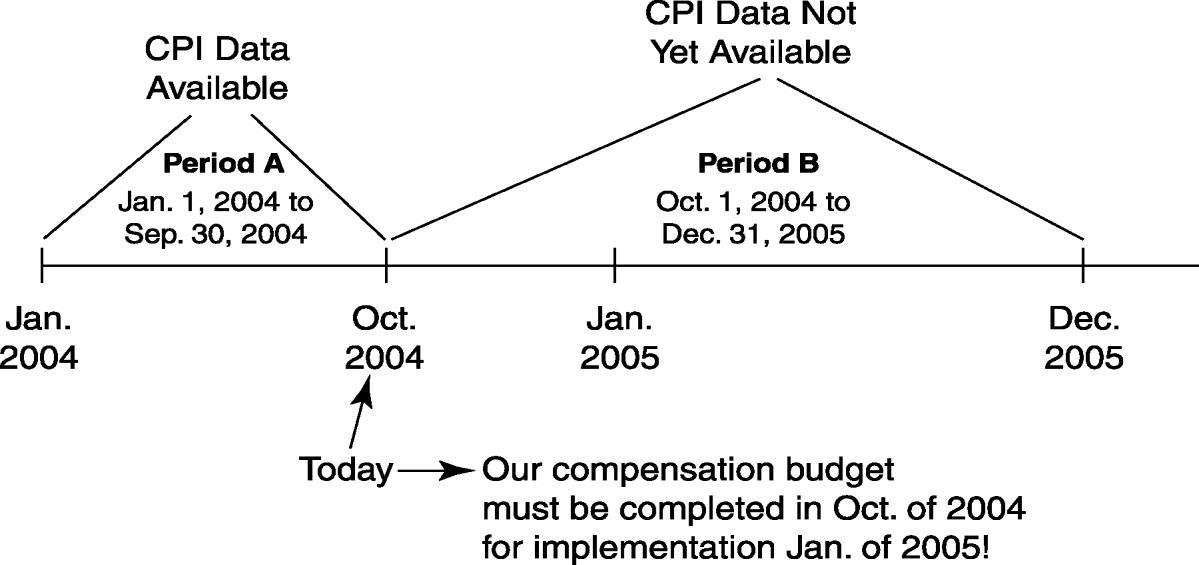
Since we‘re assuming that today is October 1, 2004 and CPI data is published monthly, we can gather historical CPI data for Period A. Then we will estimate, based on past CPI data, what level of inflation we might experience for the 15-month period we are planning for (Period B). Below highlights how we use the CPI to measure inflation for Period A and how we will estimate inflation for the future Period B.
The span between the years 1982 and 1984 is the base period for both the CPI-U and the CPI-W, which equals 100. Students will use the base period to determine the changes in prices over time. For example, how much did consumer prices increase in Los Angeles between the base period and December 31, 2001?
The CPI Detailed Report indicates the 2001 CPI-U for Los Angeles was 178.2. We know that the base period for the CPI is 100. Therefore, consumer prices in Los Angeles increased 78.2 percent between 2001 and the base period. The following formula is used to determine that price change:
(Current CPI – Previous CPI)
Previous CPI
(178.2 – 100)
100% X 100% = 78.2%
100
Since the CPI is updated monthly, we can use the same formula to calculate the difference in prices for a specified time period, such as the elapsed time over Period A, January 1, 2004 to September 30, 2004. All that we have to do is substitute our current values into the formula. According to the BLS, the CPI for Los Angeles in January of 2004 was 188.5. By September 30, 2004, it had risen to 194. We can calculate the percentage price level change over this period substituting our current data into our formula:
Current CPI (194) – Previous CPI (188.5)
100%
Previous CPI (188.5)
(194-188.5)
X 100% = 2.92%
188.5
Therefore, we know that prices increased overall by 2.92 percent over Period A.
Period B
Since Period B is in the future, we will have to estimate possible price increases based upon previous price increases. Period B spans 15 months from October of 2004 to December of 2005. In order to gauge this period against prior periods, we should calculate inflation over the previous four 15-month periods using the same formula as above. We will then average the four values to determine an inflation estimate for Period B. The four previous 15-month periods are:
July 1998 to September 1999: (162.1, 167.2) 3.15%
October 1999 to December 2000: (167.2, 173.5) 3.77%
January 2001 to March 2002: (174.2, 181.1) 3.96%
April 2002 to June 2003: (182.2, 186.3) 2.25%
July 2003 to September 2004: (186.3, 194.5) 4.40%
If we average all of the CPI-U price increases for these prior 15-month periods, we see a mean increase of 3.506 percent. Therefore, we can assume an average price increase of approximately this amount over the next 15-month period. This number, 3.506 percent, will represent our inflation increase for Period B.
Period A (2.92%) + Period B (3.506%) = 6.426% total inflation increase over the 24-month period. This is the amount students will have to adjust total compensation to account for overall price increases to remain competitive with wages in the marketplace.
Period A
Period B
Instructor’s Note
Students are provided a similar example explaining regression analysis in their text. You should consult that portion of the student casebook to better understand their example.
D. Implementation of Survey Results
1. Report and Interpret Results of Regression Analysis for Each Structure
Using CompAnalysis, students complete regression analysis. Regression analysis will enable students to establish pay rates for a set of jobs that are consistent with typical jobs in the external market. Chapter 7 of Strategic Compensation offers an excellent explanation of this step of the simulation. Also, since this part of the simulation often causes students some confusion, an extra example is provided below:
Using our previous engineering firm example, let‘s run through the basics of a regression analysis for the engineering job structure. Remember, the point of the regression analysis is to price each job structure consistently with the external market. As mentioned earlier, students should choose benchmark jobs in outside firms (using CompAnalysis) that best resemble their own companies‘ positions. As you may remember earlier, our engineering job structure contained four jobs, as displayed in the following table:
Operations Sales and Marketing
Director of Operations Director of Sales and Marketing
Operations Manager Sales Manager
Operations Analyst Marketing Manager
Operations Assistant Sales and Marketing Analyst
Administrative
Office Manager
Engineering Benefits
Engineering Director Manager of Benefits
Executive Assistant Engineering Team Leader Benefits Counselor III
Administrative Assistant II
Administrative Assistant I
Engineer Benefits Counselor II
Engineering Trainee Benefits Counselor I
In our earlier example in Section I, we only rated two jobs using our point evaluation method, the engineering director and engineering trainee. As you can see below, the point evaluation method yielded totals of 456.25 points for the engineering trainee and 1250 points (the highest point total possible for the structure) for the engineering director.
Engineering Trainee
Let‘s assume we rated each position in the structure, yielding the point values below:
Engineering Director 1260
Now, since engineering positions are fairly common in the marketplace, assume we found benchmark job descriptions in outside firms to match each of our positions. Researching benchmark jobs in outside firms yielded the following salary survey data:
The regression of these two data sets yields the following graph and line equation (all generated by CompAnalysis). CompAnalysis generates the line you see below which best fits our data set. It corresponds to the following equation:
Ŷ= -10,333 + 93.92X (our market pay rate line)
Basically, the equation above allows us to predict the market salary given a certain amount of job evaluation points (for a single job structure). For example, to calculate the market pay rate for an engineer given our survey data, we need only to enter in 650 (the job evaluation point total for the position) for the X variable and compute. This yields a market pay rate of -10,333 + 93.92(650) = $50,715.
It’s important to remember that the job evaluation points on the graph correspond to benchmark positions students choose in the external marketplace, not positions within their firms! This allows students to assign market values to the job evaluation points they created. If necessary, adjustments will be made to the market “predicted annual salary.”
These adjustments will reflect differences noted on the benchmark job evaluation sheet and pay-policy considerations decided upon by students.
Also important to the understanding of external market data analysis is the R² statistic generated by CompAnalysis. R² is a measure of relative fit used in statistics. A high R² statistic means that the data fits the predicted regression line very well whereas a low R² means it does not. Specifically, R² in this simulation represents the percentage in variation of observed pay rates in the external market that can be reliably explained by students‘ evaluation methods of company jobs (meaning, the point method they built in Section I). So, for the data set we used in this example, the software generated an R² value of .72. This means that 72percent of the variation in observed pay rates can be explained by our job evaluation model, i.e., the point system. Students must realize, then, that 28 percent of the variation in pay rates needs to be explained by some other means. This could include job differences (such as differences represented in the benchmark job comparison sheet), company differences, market forces, or many other reasons. Students should realize that these differences exist when making pay decisions and correct pay rates accordingly.
Chapter 8 of Strategic Compensation offers students an excellent guide for building pay grades and ranges. Students should develop grades and ranges for each job structure according to the steps listed in the chapter. However, a description is provided below of key terminology students must understand to complete this part of the Section.
Pay Grades: Pay grades group jobs for pay policy application. No set formula exists to determine how many grades a job structure should be divided into. Wider pay grades that is, grades that include a relatively large number of jobs minimize hierarchy and social distance between employees. Narrower pay grades tend to promote hierarchy and social distance. Referring back to our earlier engineering example, students may decide to group the four different engineering positions into two different grades, or perhaps structure them as below in four different grades. The decision should be left to student groups as long as they justify their rationale.
Pay Ranges: Pay ranges build upon pay grades. Pay grades represent the horizontal dimension of pay structures (job evaluation points and actual jobs). Pay ranges represent the vertical dimension (pay rates). Pay ranges include midpoint, minimum and maximum pay rates. The minimum and maximum values denote the acceptable lower and upper bounds of pay for the jobs within particular pay grades. In the example below, let‘s extract one pay grade from the above graph to help illustrate some key compensation terminology.
Maximum ($48,000)
Midpoint ($40,000)
Minimum ($32,000)
Range Spread (the vertical distance of the pay range)
($48,000 - $32,000) / $40,000 = $16,000 / $40,000 = 40%
When students use CompAnalysis to conduct external market analysis, it will generate for them a midpoint for the pay grade (remember, this data is based upon benchmark jobs in the external market). Students will then enter a desired range spread into the software. CompAnalysis will use that spread to calculate the maximum and minimum values for that grade (there may be more than one job within a grade). Chapter 8 of Strategic Compensation demonstrates how to make this calculation manually, which may help students to understand how these values are calculated. When setting range spreads, students should consider the responsibilities of positions within the pay range. For example, higher-level jobs afford employees greater promotion opportunities than entry-level jobs. Employees also tend to remain in higher pay grades longer, and the specialized skills associated with higher pay grade jobs are considered valuable. Therefore, it makes sense to apply larger range spreads to these pay grades. The following are typical range spreads for different kinds of positions:
20 to 25 percent: lower-level service, production, and maintenance
30 to 40 percent: clerical, technical, and paraprofessional
40 to 50 percent: high-level professional, administrative, and middle management (similar to engineering trainee above!)
50 percent or more: high-level managerial and executive
Compa-ratios index the relative competitiveness of internal pay rates based on pay range midpoints. Basically, compa-ratios offer an efficient method for measuring how far an employee‘s pay is from the midpoint of the pay range.
Compa-ratios are calculated as follows:
Employee‘s Pay Rate Pay Range Midpoint
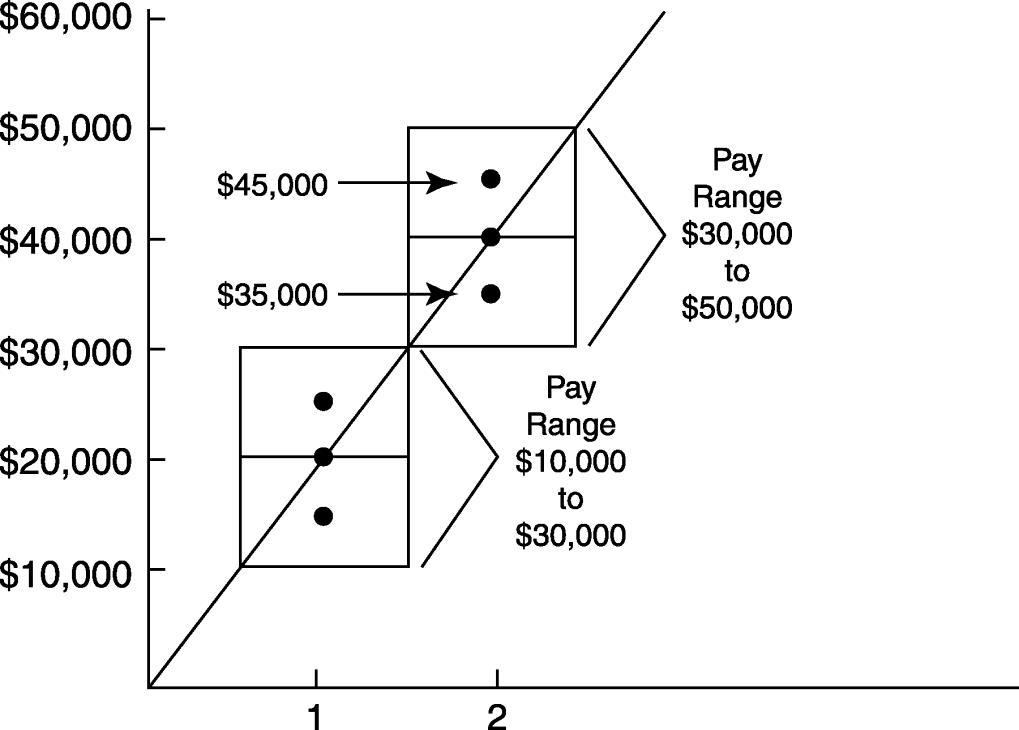
Note: In pay grade 2, the employee whose salary is $45,000 has a compa-ratio of 1.125, or $45,000/$40,000. The employee whose salary is $35,000 has a compa-ratio of .875, or $35,000/$40,000. A compa-ratio of 1 indicates that an employee‘s pay falls directly at the midpoint of jobs in the pay grade and range. An employee with a salary of $40,000 in pay grade 2 would have a compa-ratio of 1. A compa-ratio of above 1 indicates an employee is being paid relatively higher than the midpoint for that pay grade. Conversely, a compa-ratio less than 1 indicates that an employee‘s pay is relatively less than the midpoint for that particular grade
For each job structure, students should carefully summarize all their key decisions by answering the following questions:
Why did you make specific allocation decisions for each structure in the pay-policy mix?
What led you to your pay-policy level (market lead/lag) decisions?
How did you choose companies to use in the market pay survey?
How did you reconcile differences between benchmark jobs and E-Sonic positions?
What types of changes did you make to overall E-Sonic pay due to CPI data?
What factors led you to develop different pay grades and ranges?
In Section III, students complete the simulation, with the help of the CompAnalysis software (guide in Appendix 6), in four distinct parts. First, as stated earlier, any successful merit-based compensation system provides a means for recognizing individuals‘ achievements. In Part A, students decide upon a contributions policy, or method for recognizing individual employee‘s contributions, for each job structure. Next, in Part B, students put their compensation plan into action by paying employees. Instructors provide hypothetical employee pay scenarios which each group must reconcile with their developed pay structure. In Part C, students learn a method for effectively determining and distributing a merit-pay increase based upon performance reviews. Finally, Part D, students summarize their work throughout the simulation. Students are asked to explain their overall objectives for the simulation, to summarize the goals of each Section, and to explain the interrelation between the Strategic Analysis, Section I, Section II, and Section III.
In Sections I and II, students developed internally consistent job structures and ranked positions hierarchically by job evaluation points in order to conduct an effective external salary survey. This survey data yielded market competitive pay ranges for each job structure and allowed students‘ companies to hire competitively in the marketplace. Until now, we‘ve primarily focused upon recruiting new employees. In Section III, we examine the best way to retain existing employees. Students will learn methods for effectively paying existing employees while understanding how most companies go about distributing merit-based bonuses tied to performance evaluations.
A. Decide upon an Appropriate Contributions Policy for Each E-Sonic Job Structure
B. Adjust Employee Pay Based upon Hypothetical Pay Scenarios
C. Design a Merit-Pay System for E-Sonic
D. Summarize Compensation Design Project
In Part I, students design a contributions policy for each job structure. Depending upon the nature of jobs and specific company objectives, students may choose to reward employees using different methods. For the purpose of this simulation, students are asked to choose between the following bases for pay and to provide their rationale for each job structure:
Seniority (Longevity) Based Pay: Seniority-based pay systems reward employees with periodic additions to base pay according to employees‘ length of service in performing their jobs. These pay plans assume that employees become more valuable to companies with time and that valued employees will leave if they do not have a clear idea that their salaries will progress over time. Today, most unionized private sector and public sector organizations continue to base total pay on seniority or length of employee service. However, most private sector businesses are trying to move away from seniority-based pay to more of a pay-forperformance orientated model. Private industry often complains that longevity-based pay breeds complacency among employees. Since employees receive raises each year regardless of increased performance levels, many employees come to expect bonuses (without necessarily increasing productivity levels). Therefore, students working with non-unionized, private sector firms may wish to reward employees in methods other than seniority-based pay. (Note: In addition to this explanation, Chapters 1and Chapters 3 through 5 of Strategic Compensation provide an excellent description of the different bases for pay!)
It’s important to remember that more than one contributions policy can apply to each job structure. For example, employees in the engineering job structure may receive meritbased increases to pay in conjunction with incentive-based pay (bonuses)!
Merit-Based Pay: Merit-pay programs assume that employees‘ compensation over time should be determined, at least in part, by differences in job performance. Employees earn permanent merit increases based on their performance. The increases reward excellent effort or results, motivate future performance, and help employers retain valued employees. Merit pay is one of the most commonly used compensation methods in the United States. Its popularity may result from the fact that merit pay fits well with U.S. cultural ideals that reward individual achievement. Merit-pay programs occur most often in the private ―for-profit‖ sector of the economy rather than in the public sector organizations such as local and state governments.
Within firms, merit-pay increases are primarily determined through performance-appraisal systems. Supervisors periodically review individual employee performance to evaluate how well each worker is accomplishing assigned duties relative to established standards and goals. Therefore, accurate performance appraisals are crucial to effective merit-pay programs. Chapter 3 of Strategic Compensation provides a detailed explanation of performance appraisals. Also, Part C of Section III will explain to students how companies effectively distribute merit-based pay increases based upon performance appraisal results. Gain-sharing bonuses are funds paid to employees for increased productivity. For example, call center employees might be rewarded for utilizing more efficient call techniques resulting in a greater amount of customers served per month.
Incentive-Based Pay: Incentive-based pay programs differ from merit-based pay programs primarily in that they do not result in permanent salary increases to the employer or employee. Some examples of incentive-based pay include short-term bonuses, stock options, profit sharing, and gain-sharing bonuses. Incentives offer employers greater flexibility in using extrinsic rewards to motivate employees. Employers might offer incentives at the individual, group, or organization level depending upon their goals.
Incentive-Based Pay Examples at Different Organizational Levels
Individual Group Organization
Individual Sales Goals Gain-Sharing Bonuses Profit Sharing
Attendance Bonuses Team Quality Bonuses Retirement-Plan Contributions
Individual level: Employees might be compensated for achieving a specific sales goal or for perfect attendance during a particularly busy part of the year for a firm.
Group level: Referring to our previous examples, the call center division within a firm may receive a gainsharing bonus based upon increased productivity. Or, an engineering team may receive a short-term reward for maintaining specific quality levels on a demanding project.
Organizational level: In a profitable year for a firm, all employees in the organization might receive profitsharing or increased contributions to their retirement funds.
Person-Focused Pay (Pay-for-Knowledge, Skill-Based Pay): All of the previous contributions policies we‘ve discussed (seniority, incentive, and merit-based pay) have focused on the job itself. Firms reward employees based upon either how long they‘ve been in a specific job (seniority), or how well they performed at a certain job (merit and incentive-based pay). Person-focused pay differs from these compensation strategies because it rewards employees for the acquisition of job related knowledge or skills.
Just as merit-based pay depended upon an accurate measure of performance, i.e., job appraisal systems, successful pay-for-knowledge programs depend upon a company‘s ability to provide systematic training programs. Companies may develop specific training programs in-house or purchase training or certifications from an outside vender. For example, compensation professionals are often required to obtain the CCP (Certified Compensation Professional) credential from an organization called WorldatWork. Organizations will pay compensation professionals more for this certification because the rigorous training received by the recipient of the credential brings value to the firm in the form of better compensation practices. Another example might include computer programmers. Since programming languages constantly change and many firms value cutting-edge skills, companies may be willing to incent programmers to learn new languages by providing bonuses for classes completed.
Students are not limited to one type of contributions policy for any job structure. As mentioned earlier, an engineering job structure might be compensated for performance through both merit-based pay and incentives. Students should provide a justification in a few paragraphs explaining their rationale for choosing certain contribution policies over others for each job structure.
In the second part of this Section, students will be provided hypothetical employee pay scenarios and asked to adjust employee pay within their designed compensation system. As instructors, you will provide these scenarios to students after reading their Section I and Section II reports. Also, if you choose, you may use the possible scenarios listed in Appendix 4, which have been provided by the authors. Each student report will be unique, however, and you may wish to create your own scenarios based upon their work. You should provide them with salary, performance review, and ethnicity information. Providing students with anomalies, such as red and green circle pay levels, will force them to consider creative ways to handle these situations. Should the consulting team suggest that E-Sonic freeze pay for the specific employee, raise pay, create a new pay grade, or possibly investigate for possible discrimination? Remember that each student group has created their own compensation system and will suggest unique ideas for resolution of pay discrepancies. As long as students have worked through a sound rationale for their suggestions, they will have succeeded in the learning process. When making adjustments to employee pay, students should consider the following criteria:
a. Does the employee’s current pay fall into the acceptable range for the job structure? That is, does the employee’s compensation fall either above the minimum or below the maximum allowable pay for that specific range?
If not, students should identify this pay as either a ―green circle‖ pay rate or a ―red circle‖ pay rate. Green circle pay rates arise when an employee receives below minimum pay for their pay range. Red circle pay rates arise when employees receive above maximum pay for their pay range. In these cases, students need to recognize why this may be happening and take steps to rectify the situation. Students may decide that they must either raise or lower pay, freeze or increase performance bonuses, promote or demote an employee, or create an entirely new pay grade for that individual. For a further and more detailed explanation of green and red circle pay rates, please consult Chapter 8 of Strategic Compensation
Red Circle
Maximum ($48,000)
Midpoint ($40,000)
Minimum ($32,000)
b. If an employee is not receiving a red or green circle pay rate, calculate the comparatio to determine employee’s overall pay level relative to the pay range.
Green Circle
As mentioned in Section II, the compa-ratio is calculated by dividing an employee‘s pay rate by the pay range midpoint. A compa-ratio of one reflects that the employee is being paid right at the midpoint for the range. A compa-ratio of less than one reflects pay at less than the midpoint value for the range whereas a compa-ratio above one represents pay levels above the midpoint. Very high or very low compa-ratios should trigger students to further investigate these great pay discrepancies. Why is this person‘s pay at one spectrum of the pay range?
c. Consider performance reviews relative to other employees.
Investigate the employee‘s pay relative to coworkers‘ pay in the same job in light of performance data. If one employee‘s pay remains unusually low or high as compared to a similar employee, favoritism, or even discrimination could be present.
d. Evaluate legal considerations of the Equal Pay Act and Title VII.
Are individuals in the same job being paid differently in light of gender and minority status (color, religion, national origin, and race)? Chapter 2 of Strategic Compensation explains the details of Title VII and other discrimination legislation in detail.
In Part C of this Section, students use CompAnalysis to calculate a percentage of total E-Sonic payroll to devote to merit-pay increases. Compensation professionals typically calculate merit-pay budgets as a percentage of overall payroll. For example, compensation professionals may suggest an overall meritincrease budget of 4 percent of total payroll. If the total of all base wages paid to employees equals $10 million, the compensation manager for a firm will request $400,000 to be distributed among all employees. The distribution of merit increases is based upon performance review scores and an employees‘ ranking based upon pay. As mentioned earlier, merit-pay awards represent permanent performance-based increases to base salary. Although CompAnalysis generates the suggested merit-pay increase percentage automatically, students are provided a detailed explanation of the steps involved in calculating and distributing a merit-pay increase. As an instructor, you may feel that the exercise of manually calculating merit increases would prove valuable for your students. If so, the instructions provided can easily be adapted to students‘ own spreadsheets for calculation.
Figure 3.1 provides annual base salary information for all E-Sonic employees divided into pay quartiles. Chapter 7 of Strategic Compensation provides a thorough explanation of pay quartile calculations. In addition, median pay values for each quartile are highlighted. Any spreadsheet program can easily calculate a median value from a data set; however, students should consult Chapter 7 of Strategic Compensation to gain a further understanding of the concept.
Note: Median values are signified by a bold shade of text. Where two values are highlighted, the median value represents the average of the two salaries. Align column headers over columns
You may wish to change both the performance appraisal distributions and the base salary quartile distributions. Or, you may wish to provide students two or three different scenarios, based upon these distributions, to calculate on their own.
Next, Figure 3.2 illustrates performance appraisal rankings (provided by E-Sonic management) for the total employee population and the distribution of salaries.
Figure 3.2
In addition, Figure 3.2 lays out the percentage of employees falling into each performance appraisal level. In order to properly calculate annual merit-pay increases, students must first develop an employee distribution grid. Each cell in the employee distribution grid (Figure 3.3) represents the percentage of total employees given a corresponding performance appraisal and salary quartile value. It is completed by simply multiplying the percentage of employees at each performance appraisal level by the percentage of employees falling into each pay quartile. For example, 20 percent of all employees fall into the fourth quartile of pay levels, whereas 10 percent of all employees received ―Excellent‖ performance reviews. Multiplying the two values together yields a product of 2.0 percent. Specifically 2.0 percent of all E-Sonic employees received an excellent performance review and ranked in the fourth quartile of pay. This process is repeated for each performance rating level and each salary quartile. Since E-Sonic has five performance appraisal levels and four pay quartiles, our employee distribution grid contains 20 cells.
Figure 3.3
So, only 1 percent of total firm employees ranked in the fourth quartile of pay and received a poor performance evaluation.
With 100 employees at E-Sonic, we can easily translate percentages into employee numbers (Figure 3.4). Some percentages do not compute to whole numbers, and therefore the employee numbers also will not. However, the process of calculating merit-pay increases provides a recommended bonus per employee. Adjustments can be made when individual bonuses are assigned.
Figure 3.4
Next, students must calculate the annual merit-increase percentage each group of employees (on average) may receive. There is no set formula for this calculation and it may be based upon a number of factors. Compensation professionals may use historical merit-increase amounts to determine this year‘s award. Or, a firm may decide to depart with tradition and award funds based upon a more egalitarian or highperformer based model. Students should tailor their suggested bonus amount for each group of employees based upon company objectives. As always, budget constraints may limit the percentages that employees receive for merit-pay increases.
An egalitarian merit-funds distribution might look like the grid below. Notice that percentages decrease (horizontally) as performance appraisal scores decrease. However, percentages increase (vertically) as base pay levels decrease. This ensures that higher performers are rewarded more handsomely than lower performers while maintaining some level of equity between the higher pay quartiles and the lower pay quartiles (i.e., a higher percentage is awarded to a lower salary resulting in greater equilibrium in terms of total dollar amounts awarded).
Award %’s increase as base pay quartile decreases
Figure 3.5
Award %’s decrease as performance decreases
Q2
Q1
A ―high performer‖ model will differ from the above egalitarian example in a few ways. First, merit-award percentages will not necessarily increase as pay levels decrease. Second, some groups of employees, such as average and below average performers, may receive no merit increase at all. This rationale is based upon the fact that an organization should concentrate its resources on those employees that add the greatest value to the organization. Some organizations assume (not always correctly) that higher paid employees, perhaps executives, contribute a greater impact to the bottom line of an organization than lower paid employees such as clerical staff. Also, some organizations don‘t see the value in awarding bonuses to employees with average or below average performance scores. Firm objectives, culture, and budget constraints typically dictate these decisions. A ―high performer‖ model for merit-award distributions might look something like this:
Figure 3.6
Q2
Q1
Once students have decided upon the desired merit-pay increase levels, they can calculate necessary amounts to fund employee merit increases in each cell of the employee distribution grid. For this example, we will use the pay increases laid out in the egalitarian grid (Figure 3.5). However, you may choose to have your students use a high performer model. To calculate the total funds necessary, each grid multiplies the following numbers:
We use the median pay amount for the quartile because we do not know exactly which employees fall into each cell. Some employees may receive salaries at the high end of the quartile, whereas others the lower end. Again, this process estimates funds necessary for annual merit-pay increases. Once completed, adjustments can be made for individual employees at different spectrums of each pay quartile.
Following the above multiplication through for each cell yields the following grid. The sum of amounts for all cells represents the estimated total budget necessary to fund desired pay increases. In this case, $193,033.48, or 3.421 percent of payroll should be requested from management.
Figure 3.7
Note: Total payroll represents the sum of all E-Sonic salaries in Figure 3.1.
Finally, dividing the dollar amount by the number of employees in each cell yields the estimated bonus amount per employee.
Figure 3.8
Remember that the amount calculated remains an estimate, but will serve as a guide for assigning individual employee bonus amounts. E-Sonic management may decide that 3.241 percent of total payroll is too much to dedicate to merit increases at this stage of the company‘s development. Or, to inspire employees, management may allocate a greater amount of funds to pay increases. Also, management may decide against the egalitarian bonus model, opting to instead reward only the highest performers. In all of these cases, students would have to adjust the amount and allocation of funds each group of employees receives.
You may wish to challenge your students by providing scenarios that limit funds available to E-Sonic employees or distribute funds in a ―nonegalitarian‖ framework.
Congratulations! At this point your students have completed the compensation design for E-Sonic. It is the hope of the authors that you have enjoyed teaching the simulation and that your students have learned the basics of compensation design. The final step of the simulation requires your students to provide a recap of the project to E-Sonic management. You may require your students to present this summary as a mock executive presentation. Or, you may request that students draft a concise report highlighting their findings. Either way, students should consider the following questions when concluding the simulation:
What was their overall objective for preparing this project?
What were their main objectives and findings in Sections I, II, and III?
How do the three sections interrelate?
What earlier decisions might their consulting teams change given their experience?
We will illustrate a strategic analysis for a hypothetical company named Fly-You-There. Fly-YouThere operates in the scheduled passenger air transportation industry. The airline offers no-frills commercial flights along the West Coast, including several cities throughout California, Oregon, Washington, and Alaska. The company, located in San Francisco, is pursuing a lowest cost strategy. Its goal is to be the number one or two commercial airline in its markets by the year 2015. Key to Fly-YouThere‘s success is operating efficiencies as measured through average cost per passenger, passenger safety, and on-time arrivals and departures.
The company was founded in 1995. Its workforce and enplanements grew slowly, but steadily, until the U.S. economic slowdown that began in the year 2000 and intensified after the September 11 terrorist attacks in 2001. The downward trend in enplanements ended in 2004 when enplanements were on a slow upward swing. Again, in 2007, the global economy entered an extremely deep recession, which ended in late 2009. During both recessionary periods, Fly-You-There has maintained a union-free workforce. The airline compensated its pilots, flight attendants, and ground crew about 5 percent lower than its competitors‘ average pay and benefits while maintaining modest losses (that is, the company was not making profits). Although many people have returned to commercial flights, enplanements are still below normal levels prior to the economic slowdowns, particularly as commercial airlines‘ generally have increased the prices of fares to help recoup years of loss. As a result, Fly-You-There cannot afford to maintain its market lead in pay and compensation.
Barbara Viera has just joined Fly-You-There as the compensation director. Before joining Fly-YouThere, Barbara served as a successful compensation manager for one of its main competitors. Based on her experience, Barbara‘s first task is to prepare an overview of the competitiveness of Fly-You-There‘s compensation program. She must then recommend compensation policies to Fly-You-There‘s CEO.
Strategic analyses begin with the identification of a company‘s industry classification because companies compete with one another for customers‘ business. For example, Verizon Wireless and Sprint compete against each other for consumers who want wireless telephone service. The North American Industry Classification System Manual classifies industries based on the North American Industry Classification System (NAICS). NAICS codes represent keys to pertinent information for strategic analyses. As we‘ll see shortly, the U.S. federal government publishes different bulletins that contain information about industry and employment outlooks based on the NAICS. These bulletins permit compensation professionals and top managers to answer such questions as, ―Will consumer demand increase for regional air service on the West Coast over the next five years?‖ ―Are there sufficient numbers of well-trained commercial airline pilots?‖ and ―What do commercial airline pilots typically earn?‖
The NAICS provides an excellent starting point because it enables companies to identify direct product or service market competitors. The NAICS is the classification system for industries used in all federal government economic statistics. Many private-sector companies also rely on the NAICS to conduct strategic analyses. The federal government publishes NAICS codes in the North American Industry Classification System Manual.2 It created the NAICS in cooperation with the Canadian and Mexican governments to cover the entire field of economic activities common to all three countries. NAICS uses a hierarchical structure to classify establishments from the broadest level to the most detailed level using the following format:
2 U.S. Bureau of Census. (2007). North American Industry Classification System . [online]. Available:
Exhibit 1 NAICS Code Elements
Sector 2-digit
Subsector 3-digit
Industry Group 4-digit
Sectors represent the highest level of aggregation. There are 20 sectors in NAICS representing broad levels of aggregation.
Subsectors represent the next, more detailed level of aggregation in NAICS. There are more than 100 subsectors in NAICS.
Industry groups are more detailed than subsectors. There are more than 300 industry groups in NAICS.
NAICS Industry 5-digit
National Industry 6-digit
NAICS industries are the level that, in most cases, represents the lowest level of three country comparability. There are more than 700 5-digit industries in NAICS.
National industries are the most detailed level of NAICS. These industries represent the national level detail necessary for economic statistics in an industry classification. There are nearly 20 industries in NAICS.
Exhibit 2 lists these 20 sectors. Fly-You-There falls in the transportation and warehousing sector.
The NAICS generally uses five-digit classification codes that are common to the United States, Canada, and Mexico. In many instances, you will find six-digit NAICS codes that represent U.S. industries. The sixth digit represents specialized industries that are unique to the United States. Exhibit 2 shows the elements of NAICS codes and a sample 713120. The first two digits represent the sector, which is the broadest classification of economic activities (based on the list presented in Exhibit 1). The numbers 71 denote the arts, entertainment, and recreation sector. The first three digits stand for the subsector, classifying broad sectors into particular subsets of the arts, entertainment, and recreation sector. The numbers 713 represent the amusement, gambling, and recreation subsector. The first four digits represent the industry group. The numbers 7131 stand for amusement and theme parks. The five-digit code stands for the industry. National industries are the most detailed level of NAICS with six digits. These industries represent the national level detail necessary for economic statistics in an industry classification. The numbers 71312 refers to casinos, except hotel casinos. This industry comprises establishments primarily engaged in operating gambling facilities that offer table wagering games along with such other gambling activities as slot machines and sports betting. These establishments often provide food and beverage services. Floating casinos (i.e., gambling cruises, riverboat casinos) are included in this industry.
Exhibit 2 NAICS Sectors
http://www.census.gov/eos/www/naics/, accessed 11 November, 2011.
55
56 Administrative and Support and Waste Management and Remediation Services
92
Source: U.S. Bureau of Census. (2007). North American Industry Classification System. [online]. Available: http://www.census.gov/eos/www/naics/, accessed November 11, 20011.
Fly-You-There‘s NAICS code is 48111. The digits 48 represent the sector transportation and warehousing. Companies in this sector engage in some of the following activities:
• Air Transportation (Passenger and Cargo)
• Rail Transportation
• Water Transportation
• Truck Transportation
The digits 481 stand for air transportation subsector, including two industry groups (four-digit classifications):
• Scheduled Air Transportation (4811), including such Commercial Passenger Airlines as American Airlines, Delta Airlines, and United Airlines
• Nonscheduled Air Transportation (4812), including Commercially Chartered Airplanes and Aerial Sightseeing Tours
Fly-You-There‘s industry group is scheduled air transportation (4811), and this NAICS industry group contains two NAICS industries (five-digit classifications):
• Scheduled Passenger Air Transportation (48111)
• Scheduled Freight Air Transportation (48121)
Fly-You-There‘s NAICS industry code is 48111, which is scheduled passenger air transportation. Companies in this industry primarily engage in providing air transportation of passengers and/or cargo over regular routes and on regular schedules. Companies in this industry operate flights even if they are partially loaded. Scheduled air passenger carriers, including commuter and helicopter carriers (except for scenic and sightseeing), fall in this industry.
Compensation professionals, top management, and consultants examine five elements of the external environment as they conduct strategic analyses.
• Industry Profile
• Competition
• Foreign Demand
• Industry‘s Long-Term Prospects
• Labor Market Assessment
Several sources provide detailed information about external markets. Government sources are available at no cost. These sources include the U.S. Bureau of Labor Statistics (www.bls.gov), the U.S. Census Bureau‘s (www.census.gov) annual publication titled Statistical Abstract of the United States, and the U.S. Department of Commerce (www.commerce.gov). Private companies also provide excellent information about external markets, but they generally charge a fee. Some of these sources include Business Week (www.businessweek.com), Hoovers (www.hoovers.com), and the Wall Street Journal (www.wsj.com)
Industry Profile: Industry profiles describe such basic industry characteristics as sales volume, the impact of relevant government regulation on competitive strategies, and the impact of recent technological advancements on business activity. Compensation professionals use industry profile information to determine the kinds of compensation practices they should recommend to top management. For example, pay-for-knowledge programs may be appropriate if employees must learn to use new technology. In the case of sales stagnation, companies might choose to use incentive pay plans geared toward rewarding employees for contributing to increased sales activity.
The U.S. airline industry has experienced marked changes since the year 2000. Fewer airlines serve markets because of mergers and acquisitions. For example, Delta Airlines has acquired Northwest Airlines, United Airlines has acquired Continental Airlines, and American Airlines has acquired Trans World Airlines. Fewer competitors and consolidation of many air routes have made it easier for airlines to increase airfares somewhat because consumers face limited flight alternatives; however, the widespread economic recession since the year 2000, the uncertainties about passenger safety due to the September 11 attacks, and record-high fuel costs have weakened the airline industry. The general economic recession has led companies to reduce business travel in their quest to limit expenditures. Widespread layoffs and worries about job security cut into leisure travel. Not surprisingly, terrorists‘ downing four commercial airline flights on September 11 raised fears about the safety of air travel, in large part because of gaps in airport security. Airlines reduced capacity by as much as 20 percent. That means, on average, that one of every five flights was eliminated.
Competition: Companies take stock of competitors‘ business activities to help position themselves in the market. Companies can distinguish themselves from the competition in different ways (e.g., top-notch customer service or state-of-the-art products), and they can achieve lowest-cost objectives in various ways (e.g., reducing advertising expenditures versus minimizing staffing levels). Compensation professionals play a role by recommending pay systems, which are discussed in the Strategic Compensation text book (seventh edition, Chapters 3, 4, and 5) and setting pay levels (Chapter 7) appropriate for alternative strategic objectives and business conditions.
Fly-You-There competes mainly with companies in the passenger airline business that serve markets along the West Coast and in Alaska. Jet Blue, Southwest Airlines, and Song Airways are among Fly-You-There‘s competitors. Fly-You-There must carefully establish a competitive strategy that distinguishes itself from these competitors. For example, Fly-You-There may introduce no-frills service in markets where only a few, high-priced competitors operate. In practice, compensation professionals would give careful consideration to the specific factors that make their competitors successful and to how compensation practices can be used to create competitive advantage for their own company.
Foreign Demand: Most companies are interested in foreign demand for their products or services because such demand is an indicator of additional sales revenue potential. Compensation professionals factor in this impact of foreign demand when making their pay-policy recommendations. In general, compensation professionals may feel that higher base pay rates or incentive awards are warranted in the presence of higher foreign demand. In addition, the anticipated level of demand over time is important. Compensation professionals are unlikely to alter pay-policy recommendations for short-term increases (or decreases, for that matter) in foreign demand.
Foreign demand does not apply to Fly-You-There simply because the airline operates exclusively as a regional carrier within the United States. Foreign demand, however, is pertinent to U.S. airlines that serve cities outside the United States. For example, U.S. airlines face stiff competition from such airlines as British Airways and Lufthansa that regularly add air service from large U.S. cities to destinations outside the United States.
Industry’s Long-Term Prospects: Long-term prospects set the backdrop for strategic planning because these prospects are indicators of companies‘ futures. Companies establish strategic plans that fit with their industries‘ long-term prospects. For example, the cost of paper used in book printing has increased dramatically in recent years. Publishing companies will contain costs in other areas to limit substantial price increases because consumers will probably not purchase as many books if book prices increase commensurably with paper costs. In this type of situation, compensation professionals employed by publishing companies are apt to recommend pay policies that contribute to cost-containment objectives. At the same time, many publishers are providing access to publications through secured computer networks on the Internet, which protects them somewhat from increasing paper costs.
Long-term prospects for companies in the U.S. airline industry are unclear. Future success will turn on such factors as general national economic health, greater comfort with air transportation, and fuel costs. Of course, sluggish economic conditions, insecurities about flying safely, and higher fuel costs will curb the industry‘s success.
General Considerations: Labor market assessments represent key activities. Companies should carefully assess the labor market to determine the availability of qualified employees. In the future, many industries such as health care will find staffing more challenging. According to the U.S. Bureau of Labor Statistics, over the 2006–2016 decade, total employment is projected to increase by approximately one million jobs, or 0.8 percent.3
These labor force trends have direct implications for compensation practice. In general, there will be more competition among companies for fewer qualified individuals. Higher demand for labor relative to labor supply should lead to higher wages. Companies will have to increase wages to entice the best individuals to choose employment in their companies rather than their competitors‘ companies. The greater prevalence of older employees also should increase typical wage levels. The prevalence of older workers relative to younger workers should translate into higher compensation costs to companies.4
The civilian labor force is projected to increase by 17.4 million over the 2002–2012 decade, reaching 162.3 million by 2012. This 12 percent increase is greater than the 11.3 percent increase over the previous decade, 1992–2002, when the labor force grew by 14.4 million. Changes in the demographic composition of the labor force are expected because of changes both in the composition of the population and in the rates of labor force participation across demographic groups.
The projected growth of the labor force will be affected by the aging of the baby-boom generation persons born between 1946 and 1964. In 2016, baby boomers will be 52 to 70 years old. The number of workers in this age group is expected to increase significantly over the 2006–2016 decade. The labor force will continue to age, with the number of workers in the 55-and-older group projected to grow substantially. In 2016,
3 Su, B. (2007). The U.S. economy to 2016: slower growth as boomers begin to retire, Monthly Labor Review, November, pp. 13–32.
4 Ibid.
youths those between the ages of 16 and 24 number substantially fewer than in 2006.
The labor force participation rates of women in nearly all age groups are projected to increase slightly. The number of women in the labor force is projected to grow by nearly 9 percent, slightly faster than the 8 percent growth projected for men. Women‘s share of the labor force is expected to increase by less than 1 percent, from 46.3 percent in 2006 to 46.6 percent by 2016. In contrast, men‘s share is projected to decline by less than 1 percent, from 53.7 percent to 53.4 percent over the 2006–2016 decade.
By 2016, the Hispanic labor force is expected to reach nearly 27 million, due to faster population growth resulting from a younger population, higher fertility rates, and increased immigration levels. Despite relatively slow growth, white non-Hispanics will remain the largest group.
Occupation-Specific Considerations: Companies should keep tabs on the occupational mix of their workforces and the relative importance of these occupations to maintaining competitive advantage. Compensation levels generally increase with the strategic importance of jobs to companies‘ strategic values and, as mentioned previously, the relative supply of labor.
For illustrative purposes, let‘s consider the labor market status of commercial airline pilots. Every airline naturally needs pilots to operate aircraft to ensure the safety of passengers. An excellent starting point is the Bureau of Labor Statistics Occupational Outlook Handbook. This handbook contains pertinent information for conducting effective strategic analyses:
• Qualifications and Training
• Job Outlook
• Typical Earnings Range
First, information about qualifications and training helps companies focus recruitment efforts on individuals with the necessary qualifications. Pilots who are paid to transport passengers or cargo must possess a commercial pilot‘s license with an instrument rating. The Federal Aviation Administration (FAA) issues this license and rating to a pilot based on sufficient flight experience in designated conditions, good health and vision, and written and flight tests to demonstrate acceptable knowledge and skills. In addition, candidates for positions with airlines must have an airline transport pilot‘s license. Earning this license entails at least 1,500 hours of flying experience, including night and instrument experience, and successful completion of additional written and flight tests. Furthermore, applicants must possess advanced ratings that certify their competence to fly particular kinds of aircraft based on job requirements. For example, pilots assigned to fly Boeing 747 aircraft must have demonstrated competence to fly this type of plane before they may be compensated to transport passengers in Boeing 747s. Finally, some airlines may require applicants to pass tests of judgment under stress conditions.
Second, the BLS job outlook provides companies an indication of job prospects. Three scenarios describe possible job outlooks: retrenchment, status quo, and growth. Retrenchment means that fewer jobs will be available for a designated period. Status quo suggests that the present level of job opportunities will remain constant for a designated period. Under the growth scenario, job opportunities will be higher than present levels for a designated period. The BLS predicts that airline pilots will face growth at least until 2016, with an expected increase of 13 percent from 2006 employment levels.
Third, the typical earnings range helps companies establish competitive pay levels. Companies would find it difficult to attract well-qualified candidates if they set pay levels and benefits too low. In addition, paying and setting benefits well above the market may present a cost burden to companies. According to the U.S. Department of Labor:
Earnings of aircraft pilots and flight engineers vary greatly depending on whether they work as airline or commercial pilots. Earnings depend on factors such as the type, size, and maximum speed of the plane and the number of hours and miles flown. For example, pilots who fly jet aircraft usually earn higher salaries than pilots who fly turboprops. Airline pilots and flight engineers may earn extra pay for night and international flights.
Airline pilots usually are eligible for life and health insurance plans. They also receive retirement benefits and, if they fail the FAA physical examination at some point in their careers, they get disability payments. In addition, pilots receive an expense allowance, or ―per diem,‖ for every hour they are away from home. Some airlines also provide allowances to pilots for purchasing and cleaning their uniforms. As an additional benefit, pilots and their immediate families usually are entitled to free or reduced-fare transportation on their own and other airlines.
More than half of all aircraft pilots are members of unions. Most of the pilots who fly for the major airlines are members of the Air Line Pilots Association, International, but those employed by one major airline are members of the Allied Pilots Association.5
In 2010, median annual earnings of airline pilots, copilots, and flight engineers were $73,490. The lowest 10 percent earned less than $34,860. More than 25 percent earned over $89,970.
In sum, labor market assessments are key elements of strategic analyses. Based on our analysis of FlyYou-There‘s situation, their compensation professionals should include a labor market assessment of pilots. Pilots, therefore, are obviously essential to airline operations.
5 U.S. Department of Labor (2011). Occupational Outlook Handbook, 2010-11. [online]. Available: http://www.bls.gov/OCO/, accessed 11 November, 2011.
Compensation professionals, top management, and consultants should examine three internal capabilities as part of strategic analyses:
• Functional Capabilities
• Human Resource Capabilities
• Financial Condition
Functional Capabilities: Companies must determine which functional capabilities are most crucial to maintaining competitive advantage. Functional capabilities include manufacturing, engineering, research and development, operations, management information systems, human resources (HR), and marketing. Competition among airlines necessitates that Fly-You-There maintains such strong functional capabilities as marketing and operations to spread the word that the airline offers competitive fares and regular on-time arrivals and departures.
Research and development is not a critical function for all companies. For example, companies such as PepsiCo rely on marketing savvy to remain competitive. Many consumers of diet soft drinks complain that their taste is not as appealing as regular soft drinks that contain sugar. PepsiCo‘s introduction of the Pepsi One diet soft drink represents the corporation‘s attempt to increase sales and market share by identifying with diet soft drink consumers who want a taste that more closely resembles sugared soft drinks.
Human Resources Capabilities: State-of-the-art research equipment, manufacturing systems, and efficient marketing distribution systems do not provide competitive advantage unless staffed with knowledgeable and productive employees. Pay-for-performance and pay-for-knowledge programs promote productive and knowledgeable employees. Merit-pay programs reinforce prior excellent job performance with permanent base pay increases. Incentive-pay programs reward employees for attaining predetermined performance standards. Employees generally know in advance that rewards increase with higher performance attainments, as well as how much they will earn for achieving particular performance goals. Companies design pay-for-knowledge programs to reward self-improvement, and these programs are essential when technology advances rapidly.
Financial Condition: A company‘s financial condition is a key consideration for top management officials and HR professionals. Financial condition has implications for a company‘s ability to compete. Sound financial conditions enable companies to meet operating and capital requirements; poor financial conditions prevent companies from adequately meeting operating and capital requirements.
Operating Requirements: Operating requirements encompass all HR programs. Top management limits funding increases for compensation programs when financial conditions are poor. As a result, employees‘ salaries stagnate, and job offers to potential employees will probably not be competitive. Salary stagnation leads to turnover, particularly among highly qualified employees, because they will have higher-paying job opportunities elsewhere.
Capital Requirements: These include automated manufacturing technology and office and plant facilities. Companies that pursue differentiation strategies require state-of-the-art instruments and work facilities to conduct leading-edge research. Lowest-cost companies need efficient equipment that keeps costs per unit as low as possible.
APPENDIX 2
The administrative assistant maintains responsibility for all of E-Sonic‘s clerical functions. Administrative assistants should possess strong multitasking abilities, exemplary interpersonal skills, and the ability to work in a dynamic environment which thrives on change. E-Sonic requires their administrative assistants to possess at least a high-school diploma, with some college experience preferred. Experience working in the recording or technology industry is highly desired.
The executive assistant performs all of the functions of the administrative assistant in addition to assuming greater responsibility. The executive assistant performs clerical duties and analysis for top E-Sonic leadership. This position requires at least five years of experience working in a similar capacity. A college degree is preferred as some executive assistants are required to perform basic market and financial analysis, interact with top-level management, and aid executive-level functions.
The office manager coordinates all functions necessary to promote the smooth and efficient operations of E-Sonic‘s office environment. The office manager monitors all equipment (copiers, computers, fax machines, etc.) and schedules regular maintenance. In addition, this position holds primary responsibility for office budgeting, promoting cost savings. The office manager position requires a high-school diploma and some experience managing an office environment.
The copy writer drafts advertising copy, both print and Internet, for the promotion of E-Sonic‘s Internet music portal. Many firms choose to outsource this function to an outside advertising agency. However, given the importance of the marketing function to E-Sonic‘s business objectives, company management has decided to develop this function in-house. The copywriter should possess a four-year degree in marketing, advertising, or creative function, coupled with a portfolio of related work.
The creative director manages all copywriters and contributes to the creative process on all projects. The creative director reports to and works in conjunction with the director of marketing. The position requires a four-year degree in marketing, advertising, or a creative discipline. An accomplished portfolio of published print and Internet work is required along with five years of related experience in a technology or music production environment.
The marketing director formulates, directs, and coordinates all E-Sonic marketing activities. The marketing director uses insight from the creative and copy writing staff to design E-Sonic‘s overall marketing strategy. This position reports directly to E-Sonic‘s CEO and top management team, advising firm executives regarding promotion strategies. This position, crucial to E-Sonic‘s long-term success, requires an MBA with at least ten years of related experience.
The software testing specialist conducts trial runs of programs and software applications, ensuring their accuracy and testing for potential bugs. Candidates for this position must possess strong attention to detail and work well in a team environment with other software engineers. A four-year degree is not necessarily required for the position, but a candidate‘s promotional possibilities may be limited without one. Software testing specialists report to the software project manager.
The software engineer develops, designs, and modifies E-Sonic‘s software platform. In addition to possessing strong quantitative skills, technical capabilities, and detail orientation, the software engineer must understand the application development and design process. The software engineer reports to the software project manager and must be comfortable working in a team environment. This position requires at least a four-year computer science degree.
The software project manager coordinates the efforts of software engineers and software testing specialists on all design projects. In addition to the technical capabilities of the software engineer, the project manager must possess the ability to effectively lead and manage technical teams. Software project managers report to the director of software development. At least five years of related experience is required for this position, along with a four-year degree and a strong technical competency.
The director of software development oversees all software design initiatives within E-Sonic. This individual works closely with the director of marketing to establish streamlined software interface design and aesthetics. The director of software development reports to E-Sonic‘s CEO. This position requires executive-level management skills coupled with software design expertise. The ideal candidate would possess an advanced degree in software development and an MBA with ten years of similar experience in start-up environments.
The customer service agent confers with E-Sonic clients via telephone, e-mail, and live Web chats; providing information about E-Sonic‘s products and services, opening and canceling customer accounts, and keeping records of complaints. All customer service representatives report to the director of customer service. This position requires excellent client relations skills, attention to detail, and some experience dealing with customer related concerns in a business environment. E-Sonic requires at least a four-year high school degree for all customer service agents.
The director of customer service supervises and coordinates the activities of all workers engaged in customer service activities. This position requires at least five years of experience managing a business call center‘s operations in the technology field. This supervisory position requires strong management skills coupled with advanced conflict resolution acumen. At least a four-year degree in a business related discipline is required.
The market research analyst collects and analyzes data on customer demographics, preferences, needs, and buying habits to identify potential markets and factors affecting E-Sonic product demand. The market research analyst must possess strong research, analytical, and interpersonal skills. The position reports to the director of market analysis and requires at least a four-year college degree in a business related discipline.
The director of market analysis coordinates and manages the efforts of the market research team. In addition, the director of market analysis acts as a key confidant to the CEO and top E-Sonic management regarding business strategy. Understanding, forecasting, and capitalizing upon key market trends are crucial to E-Sonic‘s business plan. The director of market analysis reports to the CEO. The position requires an MBA with at least ten years of related experience in a business environment.
The artist relationship manager develops, maintains, and creates new relationships with musical artists and music production companies. In addition, this position is responsible for negotiating favorable royalty arrangements. Given the importance of offering the most robust music selection in the industry, E-Sonic‘s success depends heavily upon the ability of the artist relationship managers. The position requires at least a four-year business related degree and five to ten years of business development experience in a technology or music production environment.
Administrative 1
This position is responsible for a variety of clerical related duties such as answering phones, drafting correspondence, making copies, and routine scheduling. This individual will generally work under close supervision while supporting low to mid-level executives.
Administrative 2
This position includes all of the responsibilities of the Administrative 1 position plus some advanced capabilities. Typically, the Administrative 2 position will work with mid to high-level executives. The Administrative 2 position requires administrative assistant experience with a college degree being preferred. The Administrative 2 position demands a strong understanding of word processing and spreadsheet applications with the ability to perform basic financial analysis.
Administrative 3
An individual in the Administrative 3 role is a seasoned professional comfortable with all of the skills required in the Administrative 1 and Administrative 2 role. The Administrative 3 role requires a college degree or at least ten years of similar experience in lieu of a degree. This individual is comfortable performing basic market and financial analysis, interacting with top-level management, and aiding the executive level function.
Administrative 4
The Administrative 4 position demands the efficient management of an office environment. This individual typically monitors office equipment, determines office budgeting needs, and is responsible for administrative cost-saving measures. In some organizations, the Administrative 4 position handles the recruiting function for the administrative staff. The Administrative 4 position requires at least a high-school diploma, with a college degree and related experience preferred.
The Marketing 1 position supports all levels of the marketing function by conducting research and analysis, writing copy, and assisting executives. This position represents an entry-level function within most organizations. The Marketing 1 position requires at least a bachelor‘s degree in the field and typically no prior experience.
The Marketing 2 position focuses primarily on writing copy for a firm‘s print or online media. In addition, the Marketing 2 position may draft copy for a firm‘s advertising or promotional initiatives. This position requires a college degree with some related experience. Typically, the individual working in this role can provide a portfolio of work from academic or professional experiences.
The Marketing 3 position requires all of the requisite skills of the Marketing 1 and 2 positions in addition to strong management capabilities. The individual in the Marketing 3 role successfully manages entry-level marketers such as Marketing 1 or Marketing 2 professionals. The position requires a four-year college degree with a Marketing MBA preferred.
The Marketing 4 professional combines at least ten years of successful work experience with knowledge of all aspects of the marketing function. The individual possesses the ability to manage an entire marketing department successfully and holds an MBA in the field. This individual is comfortable advising top company executives regarding their firm‘s long-term marketing strategy.
The Software Development 1 position primarily includes testing software programs for possible flaws. This represents an entry-level programming position. Many firms require a four-year technical degree for the Software Development 1 position, but some professionals in the position possess a two-year degree from a technical college.
The Software Development 2 position requires the testing skill of the Software Development 1 role in addition to the ability to manage these professionals. The Software Development 2 position requires a fouryear college degree within a technical capacity, testing experience, and the ability to manage employees. Most firms require two to three years of specific technical management experience.
The Software Development 3 professional develops, designs, and modifies company software. This individual understands the software design process in addition to possessing strong programming and technical capabilities. The Software Development 3 professional is comfortable working in a team environment and works well under the direction of a project manager. This position requires a four-year technical degree in computer programming or software engineering and some previous experience.
The Software Development 4 position requires all of the skills of the Software Development 3 professional in addition to strong project management skills. This role oversees the entire software development process while effectively delegating related tasks. This position typically requires at least five years of software development management experience in addition to a four-year degree in a related field.
The Software Development 5 position manages the entire software development function of an organization. This individual is able to effectively manage all members of the technical staff and lead them toward company goals and objectives. The Software Development 5 professional possesses strong interpersonal, management, and technical skills, as well as the ability to interface with other departments within the firm. This individual typically has worked in the industry for over ten years and holds an MBA in addition to a technical undergraduate degree.
The Operations 1 professional supports all Operations professionals within the organization. This individual assists with client relations, business analysis, and overall administrative and organizational support. The Operations 1 position requires a four-year college degree in addition to prior experience.
The Operations 2 professional resolves client service issues via telephone, e-mail, and live Web chats. The Operations 2 professional typically provides information to customers, opens and cancels customer accounts, and records specific customer complaints. This role requires a high-school degree and is entrylevel. Successful candidates in this position relate well to a wide variety of people, possess a strong attention to detail, and enjoy customer contact.
The Operations 3 professional supervises and coordinates all of the activities of the Operations department. This role requires all of the skills of the Operations 1 and 2 positions in addition to strong management skills. The Operations 3 position requires at least a four-year college degree and five years of related experience. The Operations 3 professional must be able to relate well to top organization executives and thoroughly understand operations strategy.
The Analyst 1 position collects pertinent data required for market research. This individual is skilled in data entry and electronic collection techniques. The Analyst 1 position also requires strong telephone skills used when conducting surveys. This is an entry-level position and a high-school diploma is required.
The Analyst 2 researches trends in customer demographics, preferences, and buying habits to identify potential opportunities. The Analyst 2 possesses strong analytical and presentation skills. This role requires extensive use of spreadsheet and presentation software along with financial analysis and statistical skills. The Analyst 2 position requires a four-year college degree in addition to related business experience.
The Analyst 3 directs all the activities of the analyst staff. This individual possesses the ability to forecast market trends and report them to the highest level management within their organization. The Analyst 3 position requires strong analytical, interpersonal, and management skills. The typical Analyst 3 has worked in the field for over 15 years, has counseled top management regarding strategic analysis concerns, and holds an MBA.
The Business Development 1 professional searches for and forges professional relationships for their organization. This individual possesses strong prospecting, selling, and negotiating skills while maintaining the highest level of customer service levels. Typically, individuals involved in the Business Development 1 position possess five years of successful sales or business development experience and hold a four-year college degree.
The Business Development 2 professional is an expert at discovering, forging, and maintaining customer alliances. This individual has experience working with CEO‘s, CFO‘s, and other top Executives. The Business Development 2 professional typically possesses an MBA and over ten years of related experiences with an exemplary track record.
APPENDIX 4
Note: Instructors should feel free to change any of the parameters below. These examples should serve as guidelines. As mentioned in the manual, you may wish to customize these scenarios to your students’ reports.
Marketing Director
Current Base Pay: 18 percent above midpoint
Ethnicity and Gender: African American Male
Performance Reviews:
Current Year: Above Average
1 Year Ago: Above Average
2 Years Ago: Average
3 Years Ago: Above Average
4 Years Ago: Above Average
Copy Writer
Current Base Pay: 16 percent below midpoint
Ethnicity and Gender: Caucasian Female
Performance Reviews:
Current Year: Average
1 Year Ago: Above Average
2 Years Ago: Average
3 Years Ago: Average
4 Years Ago: Above Average
Software Engineer
Current Base Pay: 20 percent below midpoint
Ethnicity and Gender: Caucasian Male
Performance Reviews:
Current Year: Below Average
1 Year Ago: Average
2 Years Ago: Average
3 Years Ago: Average
4 Years Ago: Below Average
Current Base Pay: 30 percent above midpoint
Ethnicity and Gender: Hispanic Female
Performance Reviews:
Current Year: Below Average
1 Year Ago: Average
2 Years Ago: Average
3 Years Ago: Average
4 Years Ago: Below Average
Current Base Pay: 10 percent above midpoint
Ethnicity and Gender: Hispanic Male
Performance Reviews:
Current Year: Above Average
1 Year Ago: Average
2 Years Ago: Average
3 Years Ago: Average
4 Years Ago: Average
A common question that arises when students are completing job descriptions is this:
How can I write a job description for a specific position if O*NET does not provide an exact match?
This is a reasonable question and it presents a common challenge for compensation professionals. O*NET provides thousands of job profiles, but often an exact match for E-Sonic positions will not be found. This illustrates part of the challenge of job analysis and one that students must learn to overcome. For example, when students attempt to create a job description for the director of software development, they will not find an exact match in O*NET. However, O*NET does provide summaries for two jobs, which when combined, come close to defining the role of the director of software development. These jobs are the engineering manager and the computer software engineer. Each job comprises parts of the role of the director of software development. The engineering manager job profile will highlight the leadership aspects of the position whereas the computer software engineer will detail the KSAs necessary for the technical component of the job. Students should combine jobs in O*NET that contain parts of their desired position to create a match for a specific E-Sonic job.
Director of Software Development Job Description
Job Summary
Oversees all software design initiatives within E-Sonic. Provides leadership to software development team, directs all new software initiatives, and reports to CEO on the status of development projects. Confers with other departments to ensure the proper coordination of initiatives. Maintains full responsibility for ESonic‘s software industry leadership objectives.
The director of software development typically:
Confers with management, development, and marketing staff to discuss project specifications and procedures.
Confers with systems analysts, engineers, programmers, and others to design systems and obtains information on project limitations and capabilities, performance requirements and interfaces.
Consults with business relationship managers about software system design.
Coordinates and directs projects, making detailed plans to accomplish goals and directing the integration of technical activities.
Analyzes technology, resource needs, and market demand, to plan and assess the feasibility of projects.
Directs, reviews, and approves product design.
Develops and implements policies, standards, and procedures for the development work performed in the department.
Supervises the work of programmers, technologists, and technicians and other software engineering and technical personnel.
Reports directly to the CEO on a regular basis to provide software development updates and strategic planning assistance.
1. Ten or more years of professional software development experience reporting to top-level executives and managing a technical staff.
2. A four-year college degree in a technical field such as computer science or software engineering coupled with an MBA.
Note: In some cases, O*NET will not offer any direct matches for E-Sonic positions. For example, students will struggle finding any exact matches for the E-Sonic artist relationship manager. Although O*NET offers hundreds of job profiles, it does not describe every position. In the case of the artist relationship manager, students should consult company Websites for jobs that resemble the position. Some great choices would be sales and business development positions in the technology industry.
The purpose of this Appendix is to provide a basic walkthrough of what you will find in the CompAnalysis Software, and a bridge between the pertinent sections of this casebook.
This software named CompAnalysis accompanies the Building Strategic Compensation Systems case manual and it is designed as a tool for students to analyze pertinent data in two sections of the case.
The External Market Survey feature will be used in Section 2 of the case manual titled ―Market Competitiveness.‖ The Merit-Pay Planning feature will be used in Section 3 titled ―Recognition of Individual Achievements.‖
Make your decisions first by following the directions in the casebook (jot down the pertinent information on paper); then, use the software to input your choices and analyze the data.
This part of the software fits with Section 2 of the casebook.
After entering the main screen, you will find an introduction and three buttons that correspond to the sequence of input and analysis steps.
You will use the information for the job structures (i.e., names of the job structures and the E-Sonic jobs associated with each job structure) that you established in Section 1 of the case titled ―Internal Consistency‖.
The first step allows you to create job structures in the software and to modify them if you’d like.
• To create a new job structure, select the Add new structure button; then, type in the name of the structure.
• With the name of the new structure highlighted, check off the titles of the E-Sonic jobs that you placed in the structures.
• Afterwards, you may add the next new structure.
• When you have completed entering the names of the structures and have checked off the jobs for your structures, click on the next button to move to Step 2.
In Step 2, you will find a list of your job structures.
• Highlight the name of the first structure. Then, to the right, you will see a listing of the E-Sonic jobs contained within the structure.
• Click the name of the first E-Sonic job in the highlighted structure.
• While this job is highlighted, move to the job evaluation point box and enter the number of job evaluation points for this E-Sonic job, which you determined in Section 1 of the case.
• Then, use the check boxes to select the benchmark jobs that are most closely related to the highlighted E-Sonic job. As the casebook describes, the benchmark jobs are contained within the compensation survey of external market pay rates.
• Repeat these steps for each job within the first highlighted structure. When finished, do the same for the remaining job structures.
When completed, you are ready to move to the third step, which is to accomplish two objectives: (a) Select characteristics of the companies and their workforces for the analysis, and (b) Define your pay structures.
• At step 3, you will highlight the first job structure.
• Next, enter the cost-of-living adjustment, expressed as a percentage from your review of the Consumer Price Index.
• Then, you will select the following characteristics of the companies that possess the benchmark jobs you’ve selected:
o types of industry
o whether the company workforce is unionized
o company size.
• Finally, you will define your pay structures by specifying the number of pay grades/ranges and defining each pay grade based on the range of job evaluation points (from Section 1) for the jobs that you are including in each pay grade.
After you complete these steps for the first job structure, you may click the next button to conduct the analysis. After a few moments, you will have the following sets of results that you may view and print after selecting the appropriate tab at the bottom of the screen:
• Graph 1 market pay graph and the results of the statistical regression analysis
• Graph 2 pay policy lines
• Graph 3 pay grades and ranges
• Statistics summary pay information for the jobs contained within your structure
Please save your results, using the options below, and print them out as well.
• First, you can use Excel’s Save function to keep all of your choices. When you Save, you will have to name the file differently because the program is write-protected. At any time, you may return to an earlier step or edit saved work after your team has discussed the results.
• The second option is to use the Save Results button on the CompAnalysis Screen. This saves only the results and you cannot return to edit these results. The advantage to this option is the file is much smaller.
When finished, you may conduct the analysis for the next job structure based on the instructions listed in the prior paragraph.
This part of CompAnalysis helps you to conduct merit-pay planning described in Section 3 of the case manual titled ―Recognition of Individual Achievements‖. The casebook and your textbook provide a thorough explanation of the meritpay planning process and the items referenced as (a) through (f) below.
Your instructor (if you are an instructor, provide Appendix 4 of this manual to your students) will provide you with the following types of information that you will use in the merit-pay planning process:
(a) the performance appraisal distribution, (b) the base pay salary quartile distribution, (c) total number of employees, and (d) merit-increase budget amount expressed as a percentage of total annual payroll costs. Enter the information listed in (a), (b), and (c).
Next, you will find a highlighted section titled Desired Merit-Pay Increases.
• Enter the percentage increase amount in each cell.
• At the bottom right hand side of the screen, you will notice two pieces of information change based on the percentage increase amounts that you have entered:
o (e) total merit-pay budget amount expressed in dollars, and
o (f) the percentage of total annual payroll costs (that is, the amount in (e) divided by the current total annual payroll cost expressed in dollars, which is also located at the bottom right hand side of the screen).
Compare the merit-increase budget amount (d) with the percentage of total annual payroll costs (f).
• If (d) is less than or equal to (f), you have worked within the budgeted amount.
• On the other hand, if (d) is greater than (f), you will have to revise the percentage increase amounts in the desired merit-pay increases section because you will have exceeded the available budget for merit-pay increases. You will want (f) to be less than or equal to (d).
i U.S. Department of Commerce, “The Software & Information Technology Services Industry in the United States.” Select USA. Retrieved 20 November 2011. www.selectusa.commerce.gov
ii Bureau of Labor Statistics, U.S. Department of Labor, Occupational Outlook Handbook, 2010-11 Edition, Computer Software Engineers, on the Internet at http://www.bls.gov/ (accessed 11 November, 2011).
iii LA Chamber of Commerce. http://www.lachamber.com. Accessed 11 November, 2011.