Chapter 0 Problems 0.1 1. False;
p
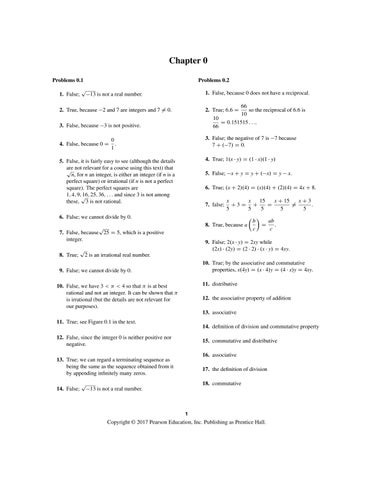
Problems 0.2 1. False, because 0 does not have a reciprocal.
13 is not a real number.
66 so the reciprocal of 6:6 is 2. True; 6:6 D 10 10 D 0:151515 : : :. 66
2. True, because 2 and 7 are integers and 7 ¤ 0. 3. False, because 3 is not positive. 4. False, because 0 D
3. False; the negative of 7 is 7 because 7 C . 7/ D 0.
0 : 1
4. True; 1.x y/ D .1 x/.1 y/
5. False, it is fairly easy to see (although the details are p not relevant for a course using this text) that n, for n an integer, is either an integer (if n is a perfect square) or irrational (if n is not a perfect square). The perfect squares are 1; 4; 9;p 16; 25; 36; : : : and since 3 is not among these, 3 is not rational.
5. False; x C y D y C . x/ D y
6. True; .x C 2/.4/ D .x/.4/ C .2/.4/ D 4x C 8. 7. false;
x x 15 x C 15 xC3 C3D C D ¤ . 5 5 5 5 5
6. False; we cannot divide by 0. 8. True, because a
p 7. False, because 25 D 5, which is a positive integer. 8. True;
x.
b ab D . c c
9. False; 2.x y/ D 2xy while .2x/ .2y/ D .2 2/ .x y/ D 4xy.
p 2 is an irrational real number.
10. True; by the associative and commutative properties, x.4y/ D .x 4/y D .4 x/y D 4xy.
9. False; we cannot divide by 0.
11. distributive
10. False, we have 3 < < 4 so that is at best rational and not an integer. It can be shown that is irrational (but the details are not relevant for our purposes).
12. the associative property of addition 13. associative
11. True; see Figure 0.1 in the text.
14. definition of division and commutative property
12. False, since the integer 0 is neither positive nor negative.
15. commutative and distributive 16. associative
13. True; we can regard a terminating sequence as being the same as the sequence obtained from it by appending infinitely many zeros. 14. False;
p
17. the definition of division 18. commutative
13 is not a real number.
1
Copyright © 2017 Pearson Education, Inc. Publishing as Prentice Hall.