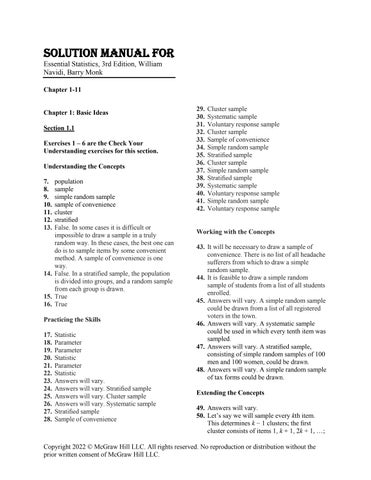
Solution Manual For Essential Statistics, 3rd Edition, William Navidi, Barry Monk Chapter 1-11
Chapter 1: Basic Ideas Section 1.1 Exercises 1 – 6 are the Check Your Understanding exercises for this section. Understanding the Concepts 7. population 8. sample 9. simple random sample 10. sample of convenience 11. cluster 12. stratified 13. False. In some cases it is difficult or impossible to draw a sample in a truly random way. In these cases, the best one can do is to sample items by some convenient method. A sample of convenience is one way. 14. False. In a stratified sample, the population is divided into groups, and a random sample from each group is drawn. 15. True 16. True Practicing the Skills 17. Statistic 18. Parameter 19. Parameter 20. Statistic 21. Parameter 22. Statistic 23. Answers will vary. 24. Answers will vary. Stratified sample 25. Answers will vary. Cluster sample 26. Answers will vary. Systematic sample 27. Stratified sample 28. Sample of convenience
29. Cluster sample 30. Systematic sample 31. Voluntary response sample 32. Cluster sample 33. Sample of convenience 34. Simple random sample 35. Stratified sample 36. Cluster sample 37. Simple random sample 38. Stratified sample 39. Systematic sample 40. Voluntary response sample 41. Simple random sample 42. Voluntary response sample
Working with the Concepts 43. It will be necessary to draw a sample of convenience. There is no list of all headache sufferers from which to draw a simple random sample. 44. It is feasible to draw a simple random sample of students from a list of all students enrolled. 45. Answers will vary. A simple random sample could be drawn from a list of all registered voters in the town. 46. Answers will vary. A systematic sample could be used in which every tenth item was sampled. 47. Answers will vary. A stratified sample, consisting of simple random samples of 100 men and 100 women, could be drawn. 48. Answers will vary. A simple random sample of tax forms could be drawn. Extending the Concepts 49. Answers will vary. 50. Let‘s say we will sample every kth item. This determines k − 1 clusters; the first cluster consists of items 1, k + 1, 2k + 1, …;
Copyright 2022 © McGraw Hill LLC. All rights reserved. No reproduction or distribution without the prior written consent of McGraw Hill LLC.