Geriatric nursing review questions Part I 1.
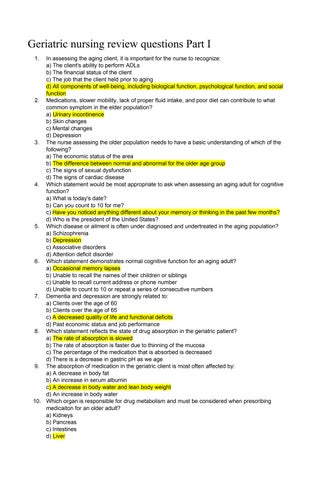
In assessing the aging client, it is important for the nurse to recognize: a) The client's ability to perform ADLs b) The financial status of the client c) The job that the client held prior to aging d) All components of well-being, including biological function, psychological function, and social function 2. Medications, slower mobility, lack of proper fluid intake, and poor diet can contribute to what common symptom in the elder population? a) Urinary incontinence b) Skin changes c) Mental changes d) Depression 3. The nurse assessing the older population needs to have a basic understanding of which of the following? a) The economic status of the area b) The difference between normal and abnormal for the older age group c) The signs of sexual dysfunction d) The signs of cardiac disease 4. Which statement would be most appropriate to ask when assessing an aging adult for cognitive function? a) What is today's date? b) Can you count to 10 for me? c) Have you noticed anything different about your memory or thinking in the past few months? d) Who is the president of the United States? 5. Which disease or ailment is often under diagnosed and undertreated in the aging population? a) Schizophrenia b) Depression c) Associative disorders d) Attention deficit disorder 6. Which statement demonstrates normal cognitive function for an aging adult? a) Occasional memory lapses b) Unable to recall the names of their children or siblings c) Unable to recall current address or phone number d) Unable to count to 10 or repeat a series of consecutive numbers 7. Dementia and depression are strongly related to: a) Clients over the age of 60 b) Clients over the age of 65 c) A decreased quality of life and functional deficits d) Past economic status and job performance 8. Which statement reflects the state of drug absorption in the geriatric patient? a) The rate of absorption is slowed b) The rate of absorption is faster due to thinning of the mucosa c) The percentage of the medication that is absorbed is decreased d) There is a decrease in gastric pH as we age 9. The absorption of medication in the geriatric client is most often affected by: a) A decrease in body fat b) An increase in serum albumin c) A decrease in body water and lean body weight d) An increase in body water 10. Which organ is responsible for drug metabolism and must be considered when prescribing medicaiton for an older adult? a) Kidneys b) Pancreas c) Intestines d) Liver
11. An older adult on digoxin and furosemide is showing signs of toxicity. The gerontology nurse understands that: a) Digoxin and furosemide are excreted by the kidneys, and the doses may need to be decreased due to impaired kidney function b) Digoxin and furosemide are excreted through the intestinal tract, and dose changes would be ineffective c) An increase in fluid intake will fix the symptoms, and no change in dose is needed d) How a drug is excreted is not a consideration when dosing an older adult 12. Which statement is true regarding adverse drug reactions (ADRs) in older adults? a) The rate of ADRs in geriatric clients is seven times that of younger adults and poses serious health problems b) Older adults rarely have adverse reactions to prescribed medications becuase they are monitored c) Adverse reactions are minimal in older adults and require no intervention d) Only about 1% of older adults require hospitalization for ADRs 13. Which substance(s) show changes through aging by becoming less pliable and stiffer? a) Lipofuscin b) Collagen and elastin c) Epithelial tissue d) Cytoplasm 14. Which factor is NOT a normal part of aging and needs to be addressed to promote nutrition in the older adult client? a) Loss of teeth b) Increase in gastric pH c) Xerostoma or dry mouth d) Decline in basal metabolic rate 15. An 80-year-old female asks the nurse about over-the-counter vitamin supplements. The most appropriate advice would include: a) No vitamin supplements are needed with a balanced diet b) Any multivitamin will do c) Take only a calcium supplement d) Take a multivitamin for those over the age of 50, which should include the recommended vitamins for the aging adult 16. Which theories on aging were introduced in the early 1900s? a) Wear-and-tear theory and autointoxication theory b) Evolution theory c) Molecular theory d) Cellular theory 17. Systems theory includes which components about aging? a) Gene regulation ideas b) Nutation accumulation on aging c) Neuroendocrine and immunological ideas d) Free radical ideas 18. What is the most noticeable change in tissue as it ages? a) Decrease in lipids b) Increase in subcutaneous tissue c) Decrease in wrinkles d) Accumulation of pigmented material called lipofuscin 19. What is the most significant change in vital organs in the aging client? a) No change in organ tissue is noted b) The outer appearance of an organ changes, but the functional component does not change c) Organs show signs of decrease in function during the aging process d) The aging process speeds up the functional capacity of major organs 20. What benefit does evidnce-based practice offer clients over the age of 60? a) No actual benefits have been noted when evidence-based practice is the model for geriatric care b) Evidence-based practice offers the client improved health care in all settings c) Evidence-based pracrice is only used as a model in acute care settings
21.
22.
23.
24.
25.
26.
27.
28.
29.
30.
d) Minimal changes in geriatric care have arisen from the use of evidnece-baseed practice models What is the purpose of Rogers' diffusion of innovation model in relation to evidnece-based practice (EBP)? a) There is no relation to EBP b) It offers an explanation of aging c) It is used to open communication around issues of implementing changes in practice when EBP research has shown that change would improve outcomes d) It is the model that contradicts the EBP theory Which of the following statements defines who is appropriate for gerontological nursing care as stated by Orem (1991)? a) Orem (1991) refers to advanced epdistric nursing care b) Any aged client whose self-care demands exceed their ability to meet those demands is appropriate c) Orem (1991) refers to young adult nursing care in preparation for a healthyolder adult life stage d) Any client who needs nursing care for whatever reason at any age is appropriate Describe the order for the nursing process as practiced by the gerontological nurse: a) Diagnose, implement, evaluate b) Assess, identify expected outcomes, implement, evaluate c) Assess, diagnose along with the team, identify outcomes, plan, implement, evaluate d) Assess, evaluate, plan, implement, and look at outcomes Which choice best explains the practice setting for the gerontological nurse? a) In the home of the client b) Only in acute care settings c) Clinics and long-term care facilities d) Home of the client, acute care facilities, long-term care settings, and clinics or anywhere clients over the age of 65 seek health care and health education A 70-year-old presents to the clinic stating that his family things he is losing his mind and they want to put him in a home. What would be the intial role of the gerontological nurse? a) Begin the process of finding a qualified nursing home b) Do a complete history,physical, and assessment c) Speak with the family about their concerns d) Make light of the subject until the nurse can evaluate the situation Which item would not be a focus of a cognitive-perceptual pattern assessment for the older client? a) Cognition--Have you experienced any changes in your memory? b) Communication--Have you had any difficulty speaking or forming ideas? c) FInancial--Have you had any financial hardships over the past several months? d) Orientation--Do you know what day, month, and year it is? Which topic should NOT be omitted when assessign the aging client? a) Sexual history b) Caridac history c) History of abuse d) All of the above For an individual with age-related hearing loss, which sound is most difficult to hear: a) A recording of a march played softly b) A young child talking in a cafeteria line c) Hammering during construction of a house next door d) The voice of a man speaking in an elevator Pain of gastrointestinal origin is best differentiated from pain of cardiac origin by the presence of: 1. chest pain lasting longer than five minutes. 2. chest pain of rapid onset. 3. left flank pain. 4. substernal chest discomfort. The progression of intermittent claudication is measured by the: 1. distance walked before leg pain starts.