All Cases For Microeconomics Case Studies and Applications, 4th Edition Jeff Borland Chapter 1-7
Case 1.1 What did that really cost you? Summary This case study presents a variety of applications of the concept of opportunity cost. The applications are intended to be at a ‘basic’ level, and can be used to supplement presentation of the definition of opportunity cost.
Suggested answers 1
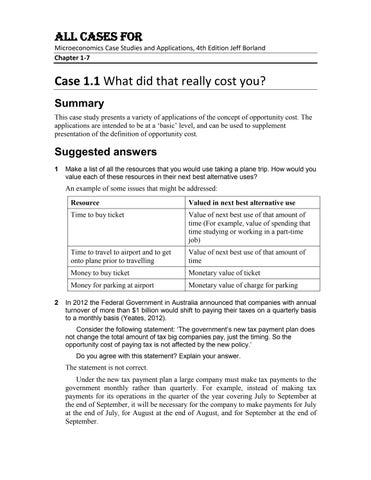
Make a list of all the resources that you would use taking a plane trip. How would you value each of these resources in their next best alternative uses?
An example of some issues that might be addressed:
2
Resource
Valued in next best alternative use
Time to buy ticket
Value of next best use of that amount of time (For example, value of spending that time studying or working in a part-time job)
Time to travel to airport and to get onto plane prior to travelling
Value of next best use of that amount of time
Money to buy ticket
Monetary value of ticket
Money for parking at airport
Monetary value of charge for parking
In 2012 the Federal Government in Australia announced that companies with annual turnover of more than $1 billion would shift to paying their taxes on a quarterly basis to a monthly basis (Yeates, 2012). Consider the following statement: ‘The government’s new tax payment plan does not change the total amount of tax big companies pay, just the timing. So the opportunity cost of paying tax is not affected by the new policy.’ Do you agree with this statement? Explain your answer.
The statement is not correct. Under the new tax payment plan a large company must make tax payments to the government monthly rather than quarterly. For example, instead of making tax payments for its operations in the quarter of the year covering July to September at the end of September, it will be necessary for the company to make payments for July at the end of July, for August at the end of August, and for September at the end of September.