



https://www.hccommunityjournal.com/article_27e59e01-f2aa-4153-b4bd-b4595491f5e1.html
FEATURED TOP STORY

https://www.hccommunityjournal.com/article_27e59e01-f2aa-4153-b4bd-b4595491f5e1.html
FEATURED TOP STORY
Rosa Lavender
Apr 5, 2026
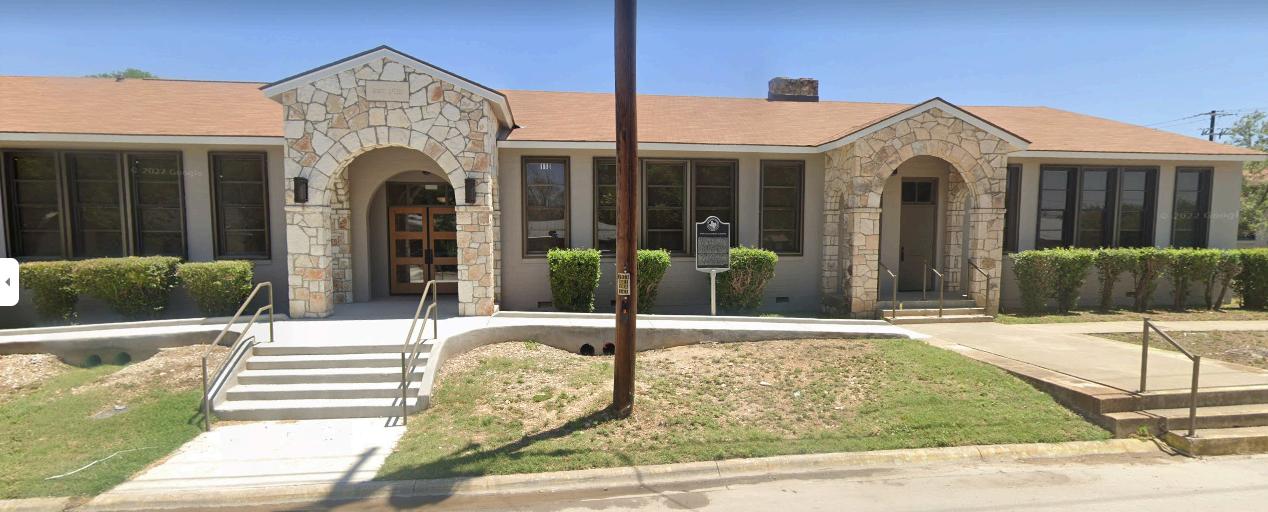
Program offerings at the Doyle Community Center continue to grow, according to the center's executive director, Rae Cardenas. Cardenas presented the center's annual report to the Kerrville City Council during the council's regular monthly meeting last week.
Doyle Community Center is a nonprofit hub for community-wide activities and offers educational, recreational and health services for all ages, with a focus on supporting residents of the historic Doyle neighborhood.
Cardenas noted that the center's popular weekly food pantry program on Wednesdays now includes a hot meal because of the center's new partnership with Mercy Chefs, and the center has added a once-a-month "shopping day" when people can select food items and limited nonfood items such as paper products.
The center's popular after-school program continues to expand to include Fridays. Currently, between 11 and 13 elementary children, four middle school students and one high school student participate in the after-school program.
"I think the older kids come to hang out and have snacks and to be sure their younger siblings walk home safely," Cardenas said in an interview earlier that day with the Community Journal.
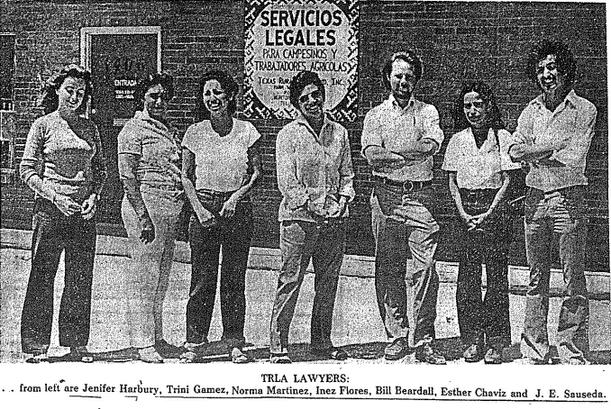
The center also has a "legal kiosk" through Texas Legal Service Center, and the newest addition is a paralegal from Texas RioGrande Legal Aid (TRLA) who is on-site Monday through Friday to assist with an array of legal matters such as family court, wills, estates, guardianships and FEMA matters.
"TRLA recently had 39 people attend a workshop to learn about wills, estate planning, guardianships, power of attorney, medical power of attorney, and other legal issues," Cardenas said.
The center also offers transportation for individuals needing rides to essential locations such as doctor visits, pharmacies, grocery stores or other retail locations that sell food items, including dollar stores, as well as the post office and bank.
"Last year we had 230 rides scheduled and only 28 cancellations, so we provided 202 successful trips," Cardenas said.
The center partners with K'Star for children's programs in the spring and summer months and hosts the Kerrville Police Department's summer children's police academy each year. The center also honors high school seniors during a special event at the end of the school year.
A new addition this year is a partnership with Schreiner University's Center for Talent and Workforce Development that provides graduates who do not want to pursue the traditional college route with the option of several four-to-six-month vocational training programs. The Doyle Center supports community youth who want more information about the Schreiner programs and help enrolling in those options.
"Last year we hosted a dental clinic for qualified residents of the area and eight people received needed dental care. Hopefully we will be able to schedule another free dental clinic this year at the center," Cardenas said.
Additionally, the center offers various adult education programs including English as a Second Language and Citizenship classes.
For more information on programs offered by Doyle Community Center, visit them at www.doylecc.org or call (830) 257-4446. The center is located at 110 W. Barnett St., on the corner of Barnett and Paschal streets, and is open from 9 a.m. to 4 p.m. Monday through Friday. 7/16/26, 2:51
One of the most successful partnerships the Doyle Center has developed in recent years is with the Alamo Area Council of Governments (AACOG) and its Warm Hearts and Warm Homes Program, which has qualified 45 individuals for help obtaining electric heaters for use in cold weather.
A new program through AACOG began recently to provide home improvement support, including building ramps and installing grab bars in homes for people with mobility challenges, as well as income support.
Next week, in honor of Sexual Assault Awareness Month, Texas RioGrande Legal Aid is hosting a screening of “An Army of Women” a 2024 film about rape survivors who brought a federal class action lawsuit against the City of Austin and Travis County. Proceeds from the screening will benefit TRLA, which provides free legal services to low-income Texans, including survivors of sexual
assault and domestic violence. The lawsuit was handled pro bono by Thompson Coburn.
In this edition of P.S., we also bring you a story about one Shackelford, McKinley & Norton lawyer who found a way to honor his grandfathers who died of cancer by drawing on his industry connections to help families preserve time together.
David Mayer was just reaching the age when children grow curious about their familyʼs history when he lost both of his grandfathers to cancer.
“I was pretty young at the time, which is why I feel like I missed out … I didnʼt get to ask what kinds of trouble my mother and father got themselves into,” Mayer said lightheartedly to The Texas Lawbook.
Now a Dallas-based of counsel in the global aviation group at Shackelford, McKinley & Norton, Mayer is drawing on his industry connections to help cancer patients access treatment.
Mayer recently began serving as an ambassador for the Corporate Angel Network, a charity that arranges free flights for cancer patients by connecting them with corporate aircraft owners and individual flyers who have empty seats.
“Itʼs a simple yet crucial act of philanthropy to provide cancer patients with an empty seat on regular corporate or individual flights, enabling them to travel with you at no cost to specialized cancer care facilities,” Mayer said in an email to industry colleagues this month.
Although he had previously handled occasional pro bono family law matters, Mayer said he had been looking for a way to become more deeply involved in charitable work. The opportunity clicked when he met CAN Chairman John Rosanvallon at a 2024 National Business Aviation Association convention.
“The proverbial light came on for me that I could honor my grandfathers and offer my time within the industry in which I have long practiced law,” Mayer said.
He is now encouraging colleagues to speak with their customers and clients about coordinating flights that could accommodate patients.
“For example, if someoneʼs going up to Rochester, Minnesota, for a business meeting, say, at the Mayo Clinic, thatʼs a perfect candidate to take a patient — and probably a caregiver to Mayo for cancer treatment,” Mayer explained.
Ultimately, Mayer said his goal is to help families preserve time together – the kind he wishes heʼd had with his grandfathers, Ralph Gross, who died of lung cancer, and Max Mayer, who died of prostate cancer, more than 50 years ago in Ohio.
“I want people to concentrate on the good that this philanthropy accomplishes, not to let kids miss out or families miss out on time thatʼs available and, probably most importantly, pay attention to the health of friends and families and loved ones, so they get treatment that is available today that my grandfathers could not receive,” Mayer said.
In honor of Sexual Assault Awareness Month, Texas RioGrande Legal Aid is hosting a screening on April 21 of “An Army of Women” a 2024 film about rape survivors who brought a federal class action lawsuit against the City of Austin and Travis County.
Proceeds from the screening will benefit TRLA, which provides free legal services to low-income Texans, including survivors of sexual assault and domestic violence.
The event begins at 5:45 p.m. at Alamo Drafthouse Cinema Village. Visit this link for more information and to purchase tickets.
The 2018 lawsuit alleged police and prosecutors failed to adequately investigate and pursue sexual assault cases. The city and county later reached a settlement that included a formal apology and commitments to significant reforms, including expanded training, staffing, funding for investigations and victim services, and updated policies and protocols.
The plaintiffs were represented by Thompson Coburn partner Elizabeth Myers and Jenny Ecklund, a former firm partner who is now vice president of litigation at HaloMD.
The Texas Lawbook previously profiled the attorneysʼ pro bono work on the case.
Laura Burstein, who spent 12 years at SMU Dedman School of Law building and leading its public interest and pro bono programs, has joined OʼMelveny & Myers as the firmʼs first Texas pro bono counsel. The Lawbook has the details.
The Association of Corporate Counselʼs Houston Chapter and The Lawbook announced more recipients of 2026 Houston Corporate Counsel Awards, including Senior Counsel of the Year for a Nonprofit or Governmental Agency, GC of the Year for a Nonprofit or Governmental Agency, the Harry Reasoner Pro Bono Advocacy Award and the award for Achievement in Diversity and Inclusion. Click here to read more.
Raised in a Miami immigrant neighborhood by Cuban parents who fled in the 1960s, Yvette Ostolaza worked from a young age and defied family skepticism to become the first in her family to attend college. Four decades later, she is the first Latina and first Dallas lawyer to lead a global corporate law firm as chair of Sidley Austin, and she has been named the inaugural recipient of the Texas Lawbook Law Firm Leadership Award.
Krista Torralva is The Lawbookʻs full-time pro bono, public service and diversity reporter. Her position is funded by the Texas Lawbook Foundation, a nonprofit 501(c)(3). Your support is essential in helping us sustain this position, ensuring we can continue to provide in-depth reporting that matters to the Texas legal community. To learn more about the Foundation and how you can contribute to its mission, click here.

'I was shaking': Why Austin residents pay when APD kicks in the wrong door
Bridget Grumet
Updated Thu, May 7, 2026 at 5:30 AM EDT 12 min read Moments after they burst into apartment #821 with a sledgehammer, Austin police realized they had the wrong place. Top Stories: Staying
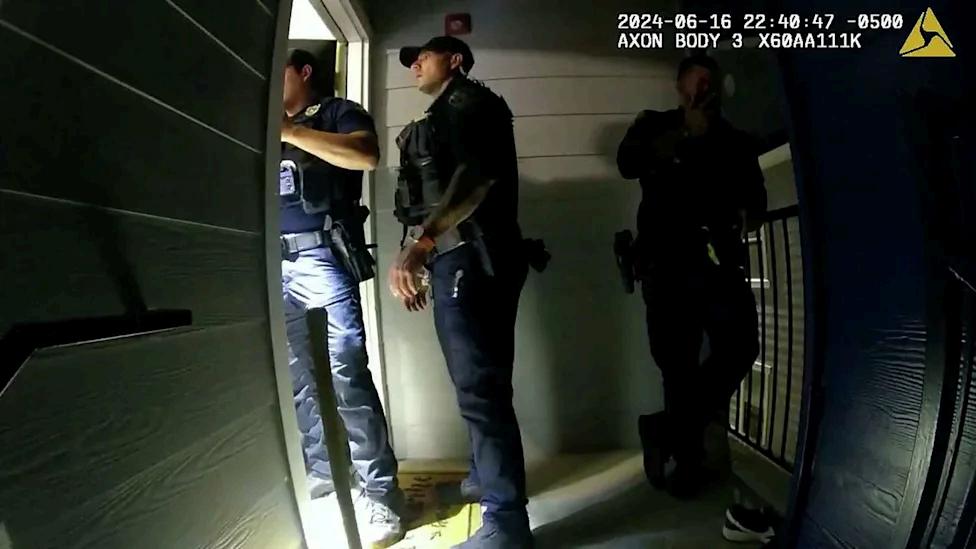
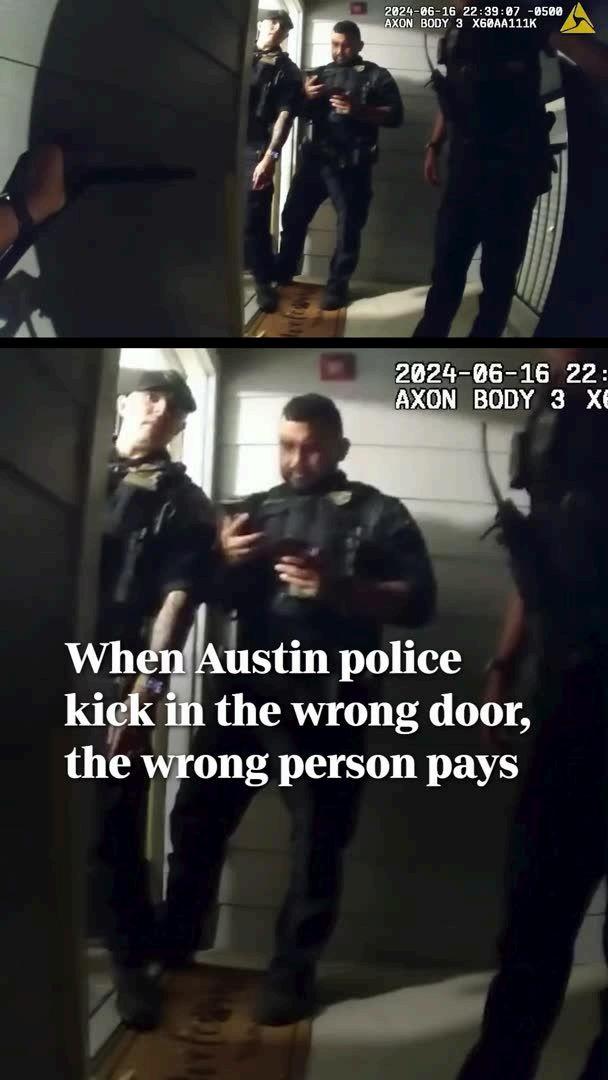
An image from body camera video shows Austin police officers on June 16, 2024 outside the Southeast Austin apartment that Eniekenimi Seifere shared with his elderly mother and two small More
This wasn't the home of a woman who had called 911, afraid of her abusive husband. This was the home of a 79-year-old grandmother with two small kids, ages 3 and 5, who were terrified when officers barged into their Southeast Austin apartment around 11 p.m. one night in June 2024.
It was an honest mistake. The software used to pinpoint the caller's cellphone location led officers to the wrong door. The elderly woman inside the apartment, a Nigerian immigrant who speaks little English, called her son, Eniekenimi Seifere, who raced home from his late shift as a patient care technician at an assisted living facility.
ADVERTISEMENT
"When I got there, my kids were crying, saying, 'Daddy, Daddy,'" Seifere recounted recently "I was shaking at that point, and I broke down, too"
The officers were apologetic. They "explained that the information provided to dispatch was incorrect," the police report said. And because they were leaving the family with a front door knocked off the hinges, officers gave Seifere the phone number for the person at the city of Austin who handles property damage claims.
Not that it did any good.
Seifere's broken door led him to the city's broken system for addressing property damage caused by police. Austin's Law Department categorically refuses to pay for such damage to buildings even when officers kick in the wrong door, break an innocent neighbor's fence or leave a victim without a door that locks.
ADVERTISEMENT
This is not a policing problem. It is a policy failure, and one that leaves some of our neighbors less safe.
About this series
This is the first installment in our "Damaged for Good" series about Austin's broken claims process for people whose property is damaged by police.
The first column showed how even in one of the most deserving cases police busting open the door of the wrong apartment the city refuses to pay for repairs.
The second column will show how the city's claims process is designed to say no, even as some courts have said residents shouldn't be stuck with the tab.
The third column will explore the damage from welfare checks and domestic/family violence calls and the implications of leaving those residents less safe.
Over the past six years, 135 claims have been filed for police-related damage to buildings and all have been denied. Claims for $600 or $2,000 may sound small in a City Hall with a $1.5 billion general fund, but the personal narratives show the damages loom large in the lives of those who can't lock their front door, can't go to work while their home is unsecured or can't afford a sudden repair. Some have no savings Some fear the bill for damages will trigger eviction
This column marks the beginning of a series, "Damaged for Good," which spotlights expenses small enough for City Hall to brush off, but large enough to cause real problems for our neighbors. The reporting draws on hundreds of pages of emails and photos of splintered doorways; interviews with renters, homeowners, landlords and experts; and reviews of police reports, videos and property records all to show how the damage happens and who gets left with it.
The Statesman spent $1,042 on public records roughly the cost of a typical residential claim with the hope this reporting could prompt change at City Hall.
Claims investigators cite governmental immunity under Texas law when refusing to pay for any building damage caused by police. Yet their review process is so
focused on the narrow question of liability is the city requiredto pay? that the city's Law Department ignores the moral question: Is it right to stick residents like Seifere with the bill?

Seifere, who became a U S citizen in 2018, emphasized that he has no problem with Austin police. "I think most of them are doing an awesome job," he said. He's troubled by what happened after he was left without a secure door
He missed a few work shifts because he didn't want to leave his family unprotected at night. He put the door in place, slid the couch in front of it and slept there.
His landlord eventually fixed the door. Seifere said the repair cost was tacked onto his rent in installments, which many leases allow. No one at the complex responded to my questions about it.
"It was a messed up situation," said Seifere, who moved out of that apartment eight months later. "My hands were tied. I can't do anything."
But the city of Austin could.
SIGN UP FOR THE AUSTIN ANGLE and get Statesman commentaries in your inbox
To be clear: If officers believe someone is in danger, they should knock down the door. If they're chasing a dangerous suspect, that person should be caught.
Sometimes police have to break things. Occasionally, officers make good-faith mistakes while doing a very difficult job
The crucial question is what happens next. Fairness dictates that innocent people shouldn't pay for damage that wasn't their fault. And the city's public safety mission goes beyond police response. It should reflect an ethos that Austinites are not left less secure in other ways with doors that won't lock, with unexpected repairs that strain household budgets.
Yet none of that factors into the city's claims review process. ADVERTISEMENT

Add a comment...
"The law is meant to make it possible for the police and other first responders to do their jobs without assuming the risk of liability for damages when they are called to enter or interact with private property," claims investigator Mike Hennessey wrote to Seifere. "The City of Austin therefore respectfully denies your claim for damages."
ADVERTISEMENT
"They were very blunt with no remorse," Seifere told me. "Even a normal person will be like, 'Oh, we're sorry that happened to you.' … Sometimes you just have to fake like you care. But I didn't get that."
Looking at the 135 claims for police-related property damage filed from January 2020 to December 2025, the particulars varied but the response was always the same: respectfully denied.
Among the more recent residential claims that included dollar amounts, the median bill was $1,071. For many people, that's a good chunk of one month's rent or two months' worth of car payments.
Many involved welfare checks, medical or mental health emergencies, or domestic violence calls in which victims were left with the damage. Some involved serious offenders who do not deserve reimbursement when police knock down their door to enforce the law.
ADVERTISEMENT
Wrong-door cases are rare. They should also be the easiest to fix. Yet the city's Law Department refused to cover the damage for Seifere and three other wrong-door cases I identified:
• Austin police detained Glen and Mindy Shield in 2023 while Department of Public Safety SWAT officers blew open their front door during an hourslong standoff with a neighbor across the street. This was an unusually egregious case: Records showed one officer repeatedly warned they were at the "wrong frickin' house" After the city refused to pay for $23,000 in damage, the Shields sued. The city's budget for this legal battle has already ballooned to $609,500, an unforced error in a case that should have been settled upfront
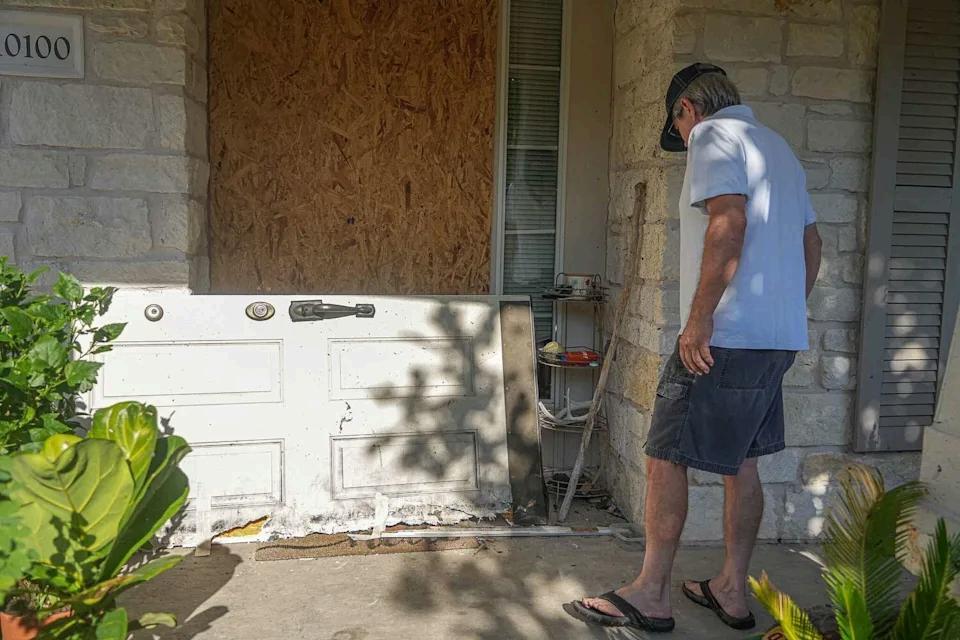
• Police in 2024, responding to a complaint of a disturbance, broke down the wrong door in an apartment complex, startling a woman who was in the shower. "My apartment complex has already contacted me and is saying I have violated my lease due to damages to my front door," she wrote.
• Police in 2025 busted through the front door of a South Austin duplex shortly after 1 a.m., waking up a couple and their young child, only to learn the welfare check was for the neighboring unit. The breach caused large cracks in the door and door frame, the resident wrote, and "left us feeling unsafe in our own home."
"I am sorry for the incident," Hennessey wrote to the man in the duplex.
But not sorry enough for the city to make it right.
Regardless of why police break down a door, renters take the hardest hit.
Renters account for the largest share of claims (42%), followed by homeowners (33%), landlords (18%) and businesses (7%), among the 118 claims with sufficient information. If renters have insurance, it typically covers only personal belongings, not damage to the unit And they're more likely than homeowners to be living paycheck to paycheck.
True, landlords are responsible for fixing a broken door. But the boilerplate language in most leases allows landlords to pass repair costs onto the tenant a burden for the nearly 60% of Americans who can't cover a $1,000 emergency expense. ADVERTISEMENT
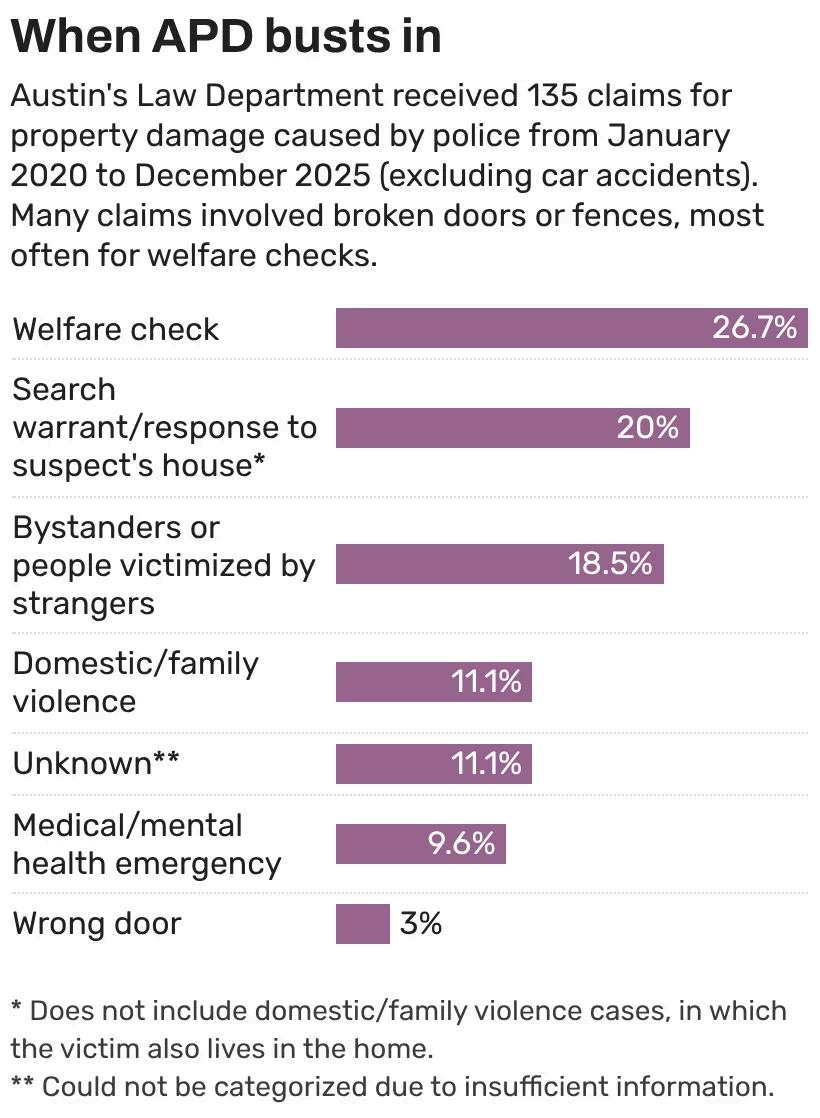
Those who can't afford the added bill can face eviction, a concern echoed by some of the renters filing property damage claims.
A woman whose door was damaged in a 2021 welfare check wrote that her apartment complex "billed me a steep $598 for this," adding, "I do not have anything close to that amount of money right now."
Another woman, who enlisted police help to enter her apartment in 2023 after her brother locked her out, wrote that she had to "come up with the money" for the door repairs "or else eviction is the next step."
Lea Downey Gallatin, special project director of Austin Tenants Council, an initiative by Texas RioGrande Legal Aid, said no one tracks how often tenants face eviction for being unable to pay for repairs after police break down the door.
"But off the top of my head," she told me in January, "I can think of two cases (like this) that came into just the Austin office for case review."
Austin invests in eviction-prevention efforts, providing more than $150,000 in the past 12 months to Texas RioGrande Legal Aid to help renters stay housed. But when police damage a tenant's home, the city won't cover the repairs even when those costs can trigger the very evictions it's trying to prevent.
"In this post-COVID era of rental assistance programs being a thing, we've collectively made a recognition that (providing) a few hundred dollars can completely change the course of someone's life," Downey Gallatin said.
The inverse is just as true: A few hundred dollars in unexpected costs can upend someone's life.
This is a tough time to urge the City Council to fund anything new. Austin is heading into budget season with a projected $26 million deficit that will likely bring cuts to social service and rental assistance programs part of the fallout from voters last year rejecting the Proposition Q property tax hike.
For the Statesman Editorial Board and others who did not support Prop Q, that defeat reflected a confidence gap in City Hall spending and accountability. One small but meaningful way to help restore that trust: Fix what you break.
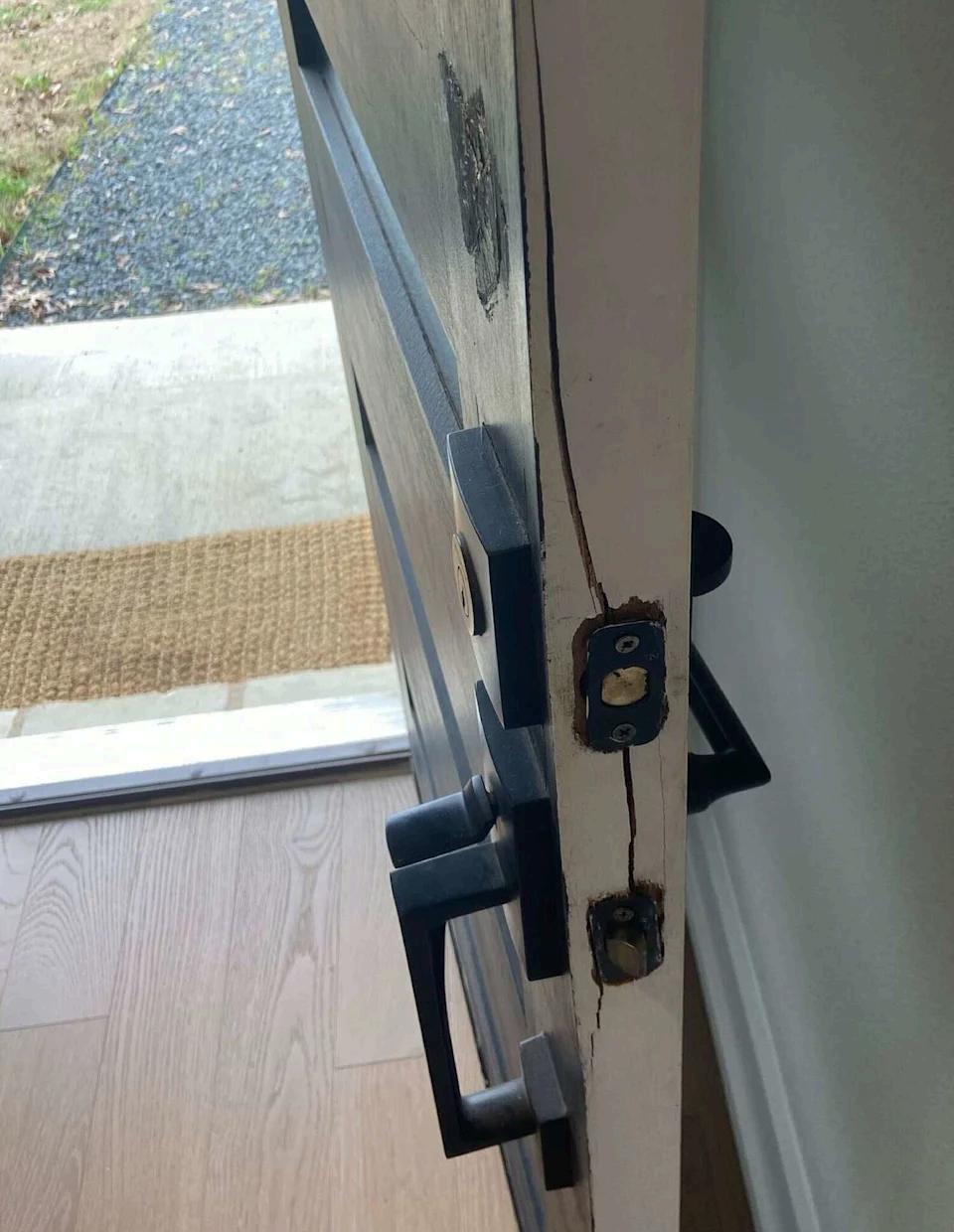
A South Austin resident submitted this photo to the city of Austin showing cracks in his front door after Austin police forced entry in 2025 Officers then realized the call was for the neighboring unit in More
I recently raised the issue with Mayor Kirk Watson, who agreed City Hall needs to better address these property damage claims. He said the city's Law Department is doing its job strictly evaluating liability but a broader lens is needed.
"Clearly, if we're doing damage to people, we ought to look at how we go about making sure those claims, the rightful claims, are paid," Watson said. Careful review is necessary, he added, "because we also have obligations to the rest of the community to not overpay on something"
But the bill for damages is only part of the cost. Failing to acknowledge harm, failing to set things right these things erode trust, too.
A year after police busted into Seifere's apartment by mistake, several officers ordered him out of his car at gunpoint also by mistake.
Austin Police confirmed they pulled over Seifere in June 2025 because he was driving a car that matched the description of a stolen vehicle missing a rear bumper APD spokesperson Anna Sabana said police conducted a "high-risk traffic stop," with guns drawn and Seifere placed in handcuffs.
Seifere was terrified. "I said, 'If you shoot, you're killing the wrong person, because I haven't done anything wrong that I know of,'" he said. After checking the vehicle identification number, police realized they had the wrong car.
Sabana said both incidents "involve officers acting in good faith with the information provided to them," and that each time, officers try to rebuild trust by explaining what happened
Seifere understands mistakes happen. What bothers him most is the lack of care shown afterward
"At least a follow-up call to say, 'Hey, we're sorry for whatever happened that night. It was a mistaken call. I hope you're doing fine.' That alone (would be) massive," Seifere said. "I think they don't do stuff like that, which I think is very, very inconsiderate."
Police called an ambulance for Seifere after the 2025 traffic stop. He had just had surgery on his left knee. Being forced to walk backward without his crutches, then onto the ground, caused his knee to swell up, he said.
The hospital treated Seifere for the pain and swelling. The bill went to him directly.
Reach Editorial Page Editor Bridget Grumet at bgrumet@statesman.com.
Submit
We

by:AaronMontes
Posted:May20,2026/09:20PMMDT
Updated:May21,2026/08:44AMMDT
SHARE
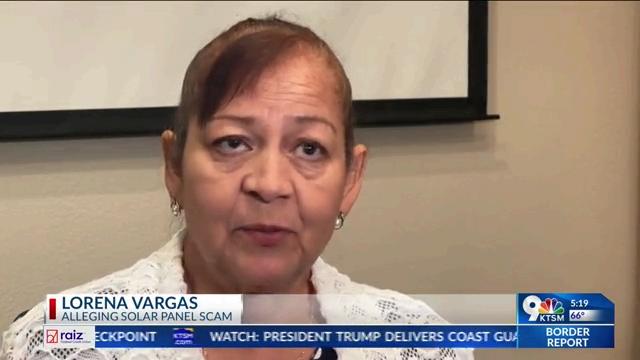
ELPASO,Texas(KTSM) LorenaVargasstillfeelsuneasyathomeafterastrangerknockedonherdoorlateatnightseveraltimesbeforeshe finallylearnedwhatthevisitwasabout.
Vargassaiditwastonotifyherofalawsuitallegingsheowed$100,000inloansforsolarpanelsandbyanout-of-townpartnershipsheʼdnever heardofordonebusinesswith.Thestresshastakenitstollonher.Sheʼsneverreceivedsolarpanelseither. “IcannotsayhowIfeelinside,”shesaid “IthinkIʼmgoingtoendupinthehospital”
VargasandherattorneyswithTexasRioGrandeLegalAidhavefiledacounterclaimagainstaNewJerseybankandbusinessalongwitha financialcompanyfromFlorida.Vargasisdemanding$250,000indamagesinmonetaryreliefaswellasattorneyʼsfees.
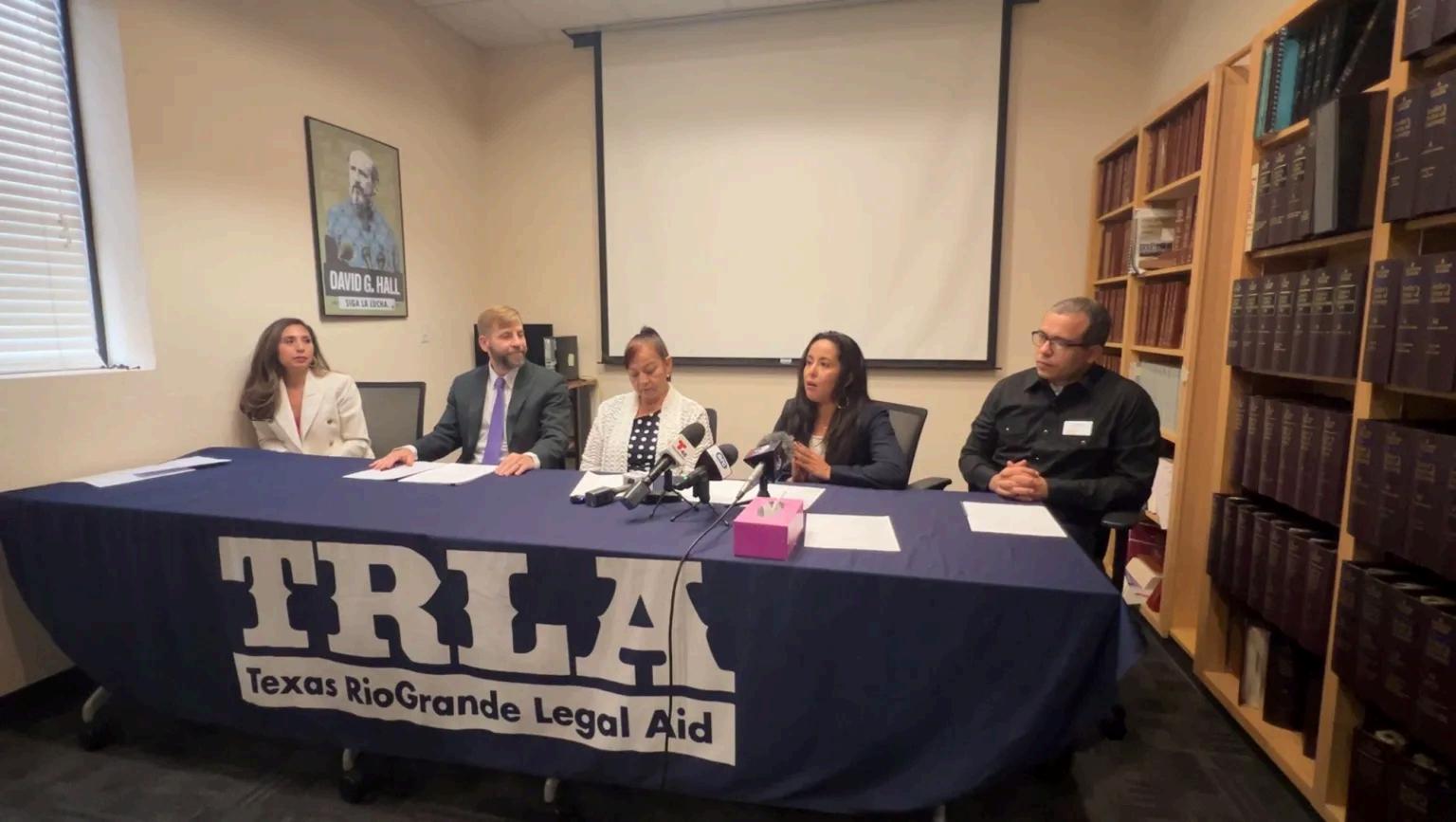
LorenaVargasandherattorneysatTexasRioGrandeLegalAidarefightingalawsuitallegingsheowes$100,000forasolarpanelloan.
Shestillpaysherbillsusingcashandsaidsheneversignedacontractoragreedtopurchaseortakeoutaloanforsolarpanels.Herlawsuit allegesapartnershipbetweenCrossRiverBank,SunlightFinancialLLCandTitanAssetPurchasingLLC,createda“massivecontract”withher nameandinformationwithoutherknowledgeandconsent
“Asithasbeendocumentedtodowithmanyothervictims,CrossRiverBankanditsco-conspiratorscausedVargasʼspreviouslysolidcreditto becheckedandinserteddealerfeesintohercontract,butdidnotbothertocheckwhethershehadeveragreedtoorevenknewabout oftheʻtransactionʼ,”Thecounter-claimstates “Infact,theycheckedhercreditmorethanoncewithoutherconsentorknowledge”

KTSMhasreachedouttothebusinessesforcomment
WayneKrauseYang,manageroftheconsumerprotectionteamatTRLA,allegesCrossRiverBankhasahistoryofhavingclientswhoare unawaretheyowethousandsofdollarsinloansforsolarpanels HerepresentsVargasandsaysheʼsseenalargecontractwithwhatappearsto behersignature
“Itisonlyaforgeddigitalsignature,”hesaid “ShenevertalkedtoanybodyShenevertouchedanybodyʼselectronicdeviceandshesuredidnot haveapeninherhandtosignacontract And,yet,CrossRiverBankanditsco-conspiratorsareputtingthisdocumentforth,inacourtoflaw,as evidencesheagreedtoaloanshehadneverheardofbefore.Itʼssinisteranditʼsturningherlifeupsidedown.”
KrauseYangsaysitisillegaltouseforgedsignaturesoncontractsbutmanyareunawaretheycancontestthosekindofdocuments
ADVERTISEMENT
ElPasoCountyAttorneyChristinaSanchezjoinedVargasandherattorneysattheTRLAheadquartersinSouthElPasoSheadvisedElPasoans tocalllawenforcementorherofficeiftheyfeelpressuredtoenteracontractoruncomfortablewithaggressivetactics
READNEXT>
6driversarrestedonDWIchargesover2-weekperiod
READNEXT>
“Oneofthethingsthatthesepanels,thesecompanies,havetoengageinistheyhavetoregisterwiththeTexasDepartmentofLicensingand Regulations,”Sanchezsaid “Theyhavetobelicensedbythem So,doyourhomework Checkthatout Askotherswhohaveperhapspurchased solarpanels,getrecommendations.Callmyoffice,so,thatwecandoasearchandtellyouwhetherornotthisparticularcompanythat lookingtodobusinesswithisorhasbeenconvictedofacrime Wearehappytosharethatinformation”
READNEXT>
6driversarrestedonDWIchargesover2-weekperiod
READNEXT>
ADDASPREFERREDSOURCEONGOOGLE