WINGS
SEPT OCT 2015 CANADA’S NATIONAL AVIATION MAGAZINE
wingsmagazine.com
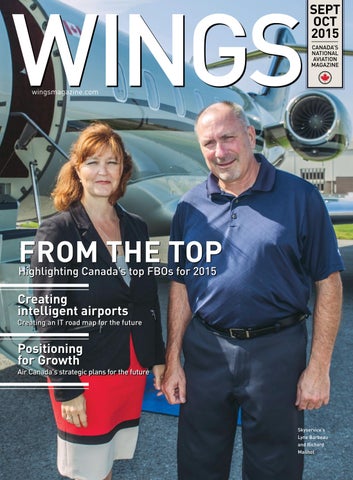
FROM THE TOP
Highlighting Canada’s top FBOs for 2015
Creating intelligent airports
Creating an IT road map for the future
Positioning for Growth
Air Canada's strategic plans for the future
Skyservice’s Lyne Barbeau and Richard Mailhot
What’s Next?
Take the Next Step Through tireless work and sacrifice, you’re ready to take the next step. A step where time and efficiency are even more important to your success. At Levaero Aviation we understand that a corporate aircraft may be that next step in your evolution. Whether you are interested in new or pre-owned aircraft, or have a specific interest in the Pilatus PC-12 NG or the new Pilatus PC-24 Super Versatile Jet, our mission is helping you find the right aircraft for your needs. What’s next? Give us a call.
Stan Kuliavas, Vice President of Sales skuliavas@levaero.com 1 844-538-2376
www.levaero.com
SEPT/OCT 2015
UPFRONT 7
Leading edge The cluster philosophy
10 On the fly
News and opinion
14 Product showcase 16 Alternate Approach
Air cadets on a mission
18 At the Gate
A new player in town
20 Glidepath
Air Canada’s strategic business decisions could bring significant growth. PG 44
Invaluable resources
22 Women in Aviation
Not a glorified bus driver
BACK 55 MRO Directory 70 Marketplace 74 On final
FBOs and fuel spills – not so fine
PHOTOS: BRIAN LOSITO, AIR CANADA (TOP); SHELL AEROCENTRE (TOP LEFT); PAUL DIXON (BOTTOM LEFT)
From top: A new player in town P. 18 A mountain of resources P.20
FEATURES 24 STRAIGHT FROM THE TOP
A winning Canadian FBO takes support from all levels BY MATT NICHOLLS
30 CREATING INTELLIGENT AIRPORTS
Airline communications and IT group paint a compelling portrait of the airport of the future BY DAVID CARR
36 COLOURING OUTSIDE THE LINES
Toronto’s Pearson is working to insert itself into the GTA’s transit plan BY DAVID CARR
38 A JOURNEY THROUGH THE CLOUDS Tracing the lives of four generations of RCAF family members BY PAUL DIXON
44 POSITIONING FOR GROWTH
Strategic business decisions are helping Air Canada reach new heights BY BRIAN DUNN
49 LOCKING UP SIKORSKY
Lockheed Martin buys iconic Sikorsky Aviation, sets a path for the future BY RICK ADAMS
COVER PHOTO: SKYSERVICE
WWW.WINGSMAGAZINE.COM
September/October 2015 | WINGS
3
This is not where you want to discover your gear isn’t waterproof.
With a wide range of new and exclusive work and safety apparel by top brands like Dakota, companies all across the country count on Imagewear. From transport fleets to transit systems, we can outfit your entire workforce from head to toe with high performance work apparel and footwear, uniforms and branded attire designed for Canadian winters. Visit imagewear.ca or call 1-(844) 359-9466 to find out more.
LEADING
EDGE
| By Matt Nicholls
Bringing it all together
Downsview aerospace cluster much closer to fruition with federal support
I
PHOTO: CENTENNIAL COLLEGE
n the March/April 2013 issue of Wings, I wrote a piece that focused on the future establishment of a GTA aerospace cluster for the Downsview Airport site in Toronto, and how such a facility would provide a myriad economic benefits for the city, the province and the nation as a whole. Such a plan was noted by David Emerson in his 2012 assessment of the Canadian aerospace industry report entitled “Beyond the Horizon, Canada’s Interests and Future in Aerospace.” In it, Emerson spoke of a site that would serve as a focal point for industry and academia to promote research and development, elevate training and skills – in short create a centre of excellence where transformative ideas would foster innovative aerospace solutions and promote real growth. There is plenty at stake. Ontario’s aerospace industry supports some 350 companies, 22,000 employees and generates more than $7 billion in economic benefits. Some of the nation’s leading aerospace players have a presence in Ontario, such as Bombardier Aerospace (which is already on the Downsview site), Pratt & Whitney Canada, Honeywell, UTC Aerospace Inc. and hundreds of smaller dynamic tier-two, tier-three and tier-four companies making their marks in manufacturing, IT, engineering, aircraft modification, MRO and more. The cluster model is alive and well in Montreal, where the école nationale D’Aérotechnique and the Centre technologique en Aérospatiale are closely aligned with industries and universities to help grow Montreal aerospace. Major aerospace companies such as Pratt & Whitney Canada, CAE, Bombardier Aerospace and Bell Helicopter, are key stakeholders in the Montreal cluster and it fits very nicely under the guidance of AéroMontreal, which was formed with the financial commitment for all three levels of
5 WWW.WINGSMAGAZINE.COM
be $55.4 million, and is supported by the $18.4 million federal contribution, $25.8 million in Ontario government funding and $11.2 million from Centennial College and the college’s partners and donors. Future stages of the development of the Downsview cluster include the relocation of the University of Toronto Institute for Aerospace Studies (UTIAS) and the creation of an Innovation Centre focused on R&D collaboration between industry and the research community. “As much as it is important about the funding, it is the federal recognition of the project that is critical,” notes Andrew Petrou, Centennial College’s special projects officer and director of strategic initiatives and external relations for the Downsview Aerospace Initiative (DAIR). “It gives us a launching pad to be a gateway for an international link and strengthen our SMEs, our academic institutions, and our industry both locally and across the country . . . We are fifth in the world in aerospace and we’re not just going to slip into the night – let’s get as high as we possibly can.” Aiming high and showing a solid level of commitment and shared enthusiasm for a project that has real merit on so many levels. The Canadian aerospace industry needs precisely this kind of vision, action and support to ensure it remains a strong player on the global stage. W
We are fifth in the world in aerospace and we’re not just going to slip into the night. government to help increase the city’s aerospace footprint both in Canada and abroad. It’s this model that helps drive innovation, creates greater opportunities for collaboration, strengthens and develops a more vertically integrated supply chain, helps share best practices from cluster partners, and creates a pipeline of well-trained graduates who are “industry ready” and able to step into a fastpaced aerospace environment. Such a cluster is closer to fruition in the GTA, thanks to a recent $18.4 million commitment from the federal government to help Centennial College build a new aerospace campus on the site. The facility, which will break ground this year, is slated to be completed in 2017. It will house the college’s existing aviation programs and related aircraft and technology, as well as new aerospace laboratories and research space to foster the next generation of advanced aircraft. The total tab for the project is expected to
TOP DATA BURSTS… in this issue
1. 558,000: The demand for new pilots over the next 20 years according to Boeing (Pg. 10). 2. 1.2 million: The number of men and women that have been Royal Canadian Air Cadets (RCAC) (Pg. 16). 3. 43,200 sq. ft.: The size of the new hangar space at Edmonton Shell Aerocentre’s new facility (Pg. 18). 4. There are 17,000 apps that have the word “travel” in them. (Pg. 30). 5. 38 million: The number of passengers Air Canada carried last year (Pg. 44).
Your feedback is always welcome. Please contact me at mnicholls@annexweb.com. @Wings_Magazine September/October 2015 | WINGS
7
WINGS
SEPT OCT 2015 CANADA’S NATIONAL AVIATION MAGAZINE
wingsmagazine.com
Vol. 56, Issue 5 EDITOR
Matt Nicholls mnicholls@annexweb.com 416-725-5637
FROM THE TOP
Highlighting Canada’s top FBOs for 2015
MEDIA DESIGNER
Creating intelligent airports
Brooke Shaw
Creating a IT road map for the future
Positioning for Growth
ACCOUNT MANAGER
Air Canada's strategic plans for the future
1 Year SubScription
ACCOUNT CO-ORDINATOR
PHOTO CREDIT TK PHOTO CREDIT TK
SubScribe TODAY !
Kory Pearn kpearn@annexweb.com 519-902-8574
Skyservice’s Lyne Barbeau and Richard Mailhot
only
30
$
00
Stephanie DeFields sdefields@annexweb.com 1-888-599-2228 ext. 257
(GST $31.50 • HST $33.90) US $42.00 (USD) • Foreign $65.00 (USD)
NATIONAL ACCOUNT MANAGER
Mena Miu mmiu@annexweb.com 905-713-4351
Name: _______________________________ Company: ____________________________ Title: _________________________________ Address: _____________________________ City: _________________________________ Prov: ________________________________ P.Code: _______________________________ Tel: __________________________________ Fax: _________________________________ email: ________________________________
GROUP PUBLISHER
Martin McAnulty mmcanulty@annexweb.com DIRECTOR OF SOUL/COO
Sue Fredericks
WINGS MAGAZINE
P.O. Box 530, 105 Donly Dr. S., Simcoe, ON N3Y 4N5 Tel: 519-428-3471 Fax: 519-429-3094 Toll Free: 1-888-599-2228
PLeASe cHecK ONe:
❑ Charter/Fractional ❑ Commercial Airlne ❑ Private Aircraft Owner/Operator ❑ Air Transport-Cargo ❑ Tour Operator ❑ Training/Education ❑ Airport ❑ FBO ❑ MRO ❑ OEM ❑ Aviation Distributor ❑ Aviation Fuel Supplier ❑ Aviation Services ❑ Aviation Sales/Marketing ❑ Para-Public/EMS/SAR/Law Enforcement ❑ Government/Military ❑ Resources - Construction, Fire, Forestry, Mining, Oil & Gas, Wildlife, etc ❑ Other (please specify) ______________
Publication Mail Agreement #40065710 Return undeliverable Canadian addresses to Circulation Dept., P.O. Box 530, Simcoe, Ont. N3Y 4N5 email: subscribe@wingsmagazine.com Published six times per year (Jan/Feb, Mar/Apr, May/Jun, Jul/Aug, Sep/Oct, Nov/Dec) by Annex Publishing & Printing Inc. Circulation email: subscribe@wingsmagazine.com Ph: 450-458-0461 Fax: 877-624-1940 Mail: P.O. Box 530, Simcoe, ON N3Y 4N5
PAYMeNT:
Subscription Rates Canada – 1 Year $ 30.00 (includes GST - #867172652RT0001) USA – 1 Year $ 42.00 Foreign – 1 Year $ 65.00 Occasionally, Wings magazine will mail information on
Cheque - Payable to Annex Publishing & Printing Inc. Visa
MC
behalf of industry-related groups whose products and services we believe may be of interest to you. If you prefer not to receive this information, please contact our circulation department in any of the four ways listed above. No part of the editorial content of this publication may be reprinted without the publisher’s written permission. ©2015 Annex Publishing & Printing Inc. All rights reserved. opinions expressed in this magazine are not necessarily those of the editor or the publisher. No liability is assumed for errors or omissions. All advertising is subject to the publisher’s approval. Such approval does not imply any endorsement of the products or services advertised. Publisher reserves the right to refuse advertising that does not meet the standards of the publication. Printed in Canada ISSN 0701-1369
Account #: __________________________ Expiry:_____________________________
TO SubScribe:
Tel: 450-458-0461 Fax: 877-624-1940 Mail: Wings Magazine c/o Annex business Media P.O. box 530 Simcoe, Ontario N3Y 4N5
Air Transport Association of Canada
ON THE
WEB
email: subscribe@wingsmagazine.com
www.wingsmagazine.com
GST#135274215RT001
8
Subscriptions non-refundable
PRO0915
WINGS | September/October 2015
wings subad.indd 1
Canadian Owners & Pilots Association
Canadian Business Aviation Association
Magazines Canada
CAREERS IN AVIATION Looking for a great career in aviation and aerospace? Check out our Careers in Aviation micro site, a great location to help you better understand what a career in aviation is all about. Go to www.careersinaviation.ca for news, updated listings and more!
PHOTO: STANDARDAERO
Signature: _________________________
WWW.WINGSMAGAZINE.COM 2015-08-27 10:58 AM
ON THE FLY For late-breaking news and exclusive web content, please visit us at: www.wingsmagazine.com
10 THE LEAD 12 TRAVEL TRENDS
contraction within the energy sector,” Pete Bunce, GAMA chief executive said.
THE LEAD
BOMBARDIER PUSHES BACK THE GLOBAL 7000
Business jet deliveries improved in the second quarter of this year, but still fell 4.1 per cent worldwide versus the same period last year. This according to the General Aviation Manufacturers Association (GAMA), a Washington-based international trade association, representing more than 80 of the world’s leading manufacturers of general aviation aircraft, engines and components. In total, general aviation shipment numbers slipped 9.1 per cent to 1,015 units for the first half of the year, including a 13 unit drop in business jet deliveries to 305 airplanes. Canada’s Bombardier blames current economic conditions and geopolitical issues in some regions such as China, Latin America and Russia for an industry-wide decline in order intake. Bombardier has already announced a reduction in the production rate for its Global 5000 and Global 6000 aircraft in response. “While the second quarter generally improved over the first, our industry is still being buffeted by volatile global market and
TAKING CARE OF UNFINISHED BUSINESS
Bombardier has pushed back production of the long-range Global 7000 more than two years.
Bombardier continues to struggle to get product out the door, or into production. The airframer has announced a two-year delay in the entry into service of its Global 7000, long-range business jet. First deliveries are not expected until the second half of 2018, pushing the development and production schedule of the even longer-range Global 8000 out even further. The primary reason for the delay is a redesign around the Global 7000s advanced
The global business aviation market had a sluggish start to the year in 2015. 10 WINGS | September/October 2015
Textron Aviation has ambitions to enter the six- to nine-seat, single-engine segment market that has long been dominated by the Pilatus PC-12. At this year’s EAA AirVenture Oshkosh, the company announced it will move forward on a “clean sheet” single-engine turboprop – a piece of leftover business by Beechcraft that Textron, which also owns Cessna, acquired in 2014. “Textron Aviation has been listening to the market and sees an opportunity to fulfill a gap in our product line,” the company told the Wichita Eagle. Hawker Beechcraft had sketched out such an airplane at NBAA 2012 based on the fuselage of the Hawker Premier I light business jet prior to entering bankruptcy protection. The new aircraft will not be based on either the Beechcraft concept, Caravan or any previous Cessna design. “This is an entirely new, clean-sheet design/aircraft, not a derivative or variant of any existing product,” Textron outlined in a statement. “By leveraging the newest technologies, we expect this aircraft to have a range of more than 1,500 nautical miles and speeds in excess of 280 knots, while offering best-in-class operating costs.” Wayne Plucker, a senior aerospace and defense analyst with global research firm Frost & Sullivan told the Wichita Eagle that, “this is a spot that Textron really hasn’t done a lot with. Certainly Beechcraft has the entire King Air series. They’re great airplanes but they’re getting long in the tooth. I think there may be an opportunity for something that’s not a Cessna-type aircraft and not the Beechcraft King Air.” Textron is taking a “watch this space” approach and does not plan to detail the program further until the 2015 edition of Air Venture. The company won’t even say whether the new airplane will carry the WWW.WINGSMAGAZINE.COM
PHOTO: GULFSTREAM (BOTTOM LEFT); BOMBARDIER (TOP)
BIZJET DELIVERIES SLIP IN SECOND QUARTER
wing that will optimize short-field and long-range performance. The first flight test vehicle is in final assembly and Alain Bellemare, chief executive of the embattled company told analysts that he was confident that the new schedule will be met and that the new Global will “define a whole new category of business jet.” Until then, it appears to be advantage Gulfstream and Dassault Falcon.
Beechcraft or Cessna banner. What is certain, however, is that the aircraft will have a larger cabin than the PC-12 and emerging rivals such as the Kestrel 350, which appears to have gained a second wind after struggling Kestrel merged with Eclipse to form ONE Aviation, and China’s Primus 150. The aircraft will likely be powered by a clean sheet GE engine intended to compete against Pratt & Whitney Canada’s popular PT6A family, which powers the bestselling Pilatus.
VIKING COMPLETES TWIN OTTER 50TH ANNIVERSARY TOUR
PHOTO: BRIAN LOSITO, AIR CANADA (TOP); VIKING AIR (BOTTOM)
Viking Air Twin Otters, including a Series 400 demonstrator, left Norman Wells Airport on July 17, capping a whirlwind northern tour celebrating the 50th anniversary of the venerable piece of Canadian aviation history. The de Havilland Twin Otter made its maiden flight in 1965 and has been an essential part of Canada’s north due to its unique ability to perform reliably in the toughest and most challenging environments. “Whether on wheels, floats, skis or tundra tires, the Twin Otter has been a lifeline of transportation, community connection and commerce for isolated regions, not only in Canada’s north but around the world,” said David Curtis, Viking’s chief executive, who took part in the 17-day, 11 community flying tour across Yukon, Nunavut and the Northwest Territories. The tour kicked off on July 1, in Victoria, B.C. as part of Canada Day celebrations. The trip also included stopovers at Canadian Forces Bases in Eureka and Alert, Nunavut. At 11 of the scheduled tour locations, a small celebration ceremony was held
Boeing is predicting the world’s airlines will add some 38,000 airplanes by 2034, increasing the need for pilots and technicians.
at the local airport to recognize both the Twin Otter and the Canadian flag, which also marked its 50th anniversary and was a central part of the tour. In each of the communities, residents lined up to view the Twin Otter Series 400 aircraft (affectionately named “Viki”) and sign a wing rib for the 100th Viking production aircraft, scheduled to be built in 2016. Viking provides OEM support for the global fleet of de Havilland legacy aircraft, from the DHC-1 to the DHC-7. Its Series 400 Twin Otter is the best-selling next generation turboprop in its class and is in operation in 26 countries. “This tour was an opportunity to connect with some of our customers and view their operations first-hand,” Curtis said. “I was excited to personally visit so many of these northern communities in one extensive trip.”
DEMAND FOR AIRLINE PILOTS/TECHNICIANS TO SOAR Boeing has upped its forecasted demand for commercial airline pilots and aircraft
technicians over the next 20 years. The world’s airlines are expected to add 38,000 airplanes to the global fleet by 2034, resulting in continued strong demand for commercial airline pilots and maintenance technicians. Boeing’s 2015 Pilot and Technician Outlook projects that the world will require 558,000 new commercial airline pilots and 609,000 new commercial airline maintenance technicians, including 95,000 pilots and 113,000 technicians in North America. As expected, the fast-growing Asia Pacific eclipses all other markets with a 20-year demand for 226,000 pilots and 238,000 technicians. This represents a more than four per cent increase for pilots and approximately five per cent increase for technicians compared with Boeing’s 2014 Outlook. “The challenge of meeting the global demand for airline professionals will not be solved by one company alone. Aircraft manufacturers, airlines, training equipment manufacturers, training delivery organizations, regulatory agencies and educational institutions are all stepping up to meet the increasing need to train and certify pilots and technicians,” said
The iconic Viking Air Twin Otter is celebrating its 50th anniversary this year. WWW.WINGSMAGAZINE.COM
September/October 2015 | WINGS
11
ON THE
FLY
Sherry Carbary, vice-president of Boeing Flight Services. Boeing trained a record number of pilots and technicians at 17 training campuses around the globe and has invested in a comprehensive Pilot Development Program to train early stage pilots. Overall global demand for these skilled resources will be driven by continued economic expansion, resulting in an average requirement for about 28,000 new pilots and more than 30,000 new technicians every year.
TRAVEL TRENDS
WHICH ONE ARE YOU? By 2030, more than 1.8 billion will travel internationally every year. Amadeus, a Spanish-based provider of advanced technology solutions for the global travel industry has produced a study that reveals how and why we will travel
by 2030. The report was written by the U.K.-based Future Foundation, a global consumer trends consultancy. “Our research shows not just that the type of experience demanded by travellers in 2030 will be different to 2015, but that the way travellers buy and engage with the industry is also set to change,” said Nick Chiarelli, director of The Future Foundation. “We expect a much greater focus on, first of all, experience, and second of all, ethics, both environmental and social to significantly influence people’s travel choices and behaviours.” The Future Foundation has identified six traveller tribes or market segments that will emerge by the end of the next decade: Social Capital Seekers will structure their vacations almost exclusively with online audiences in mind, and will rely heavily on peer reviews and recommendations to validate their decisions.
Cultural Purists will look at holidaymaking as a chance to immerse into an alien culture where enjoyment of the break depends on the authenticity of the experience, even to the point of personal discomfort. Ethical Travellers will make travel plans based on moral grounds such as decreasing their carbon footprint or improving the lives of others. This group will often improvise or add some element of volunteering, community development or eco-sustainable activity to the vacation experience. Simplicity Searchers will prefer bundled offers, seeking to avoid managing too many trip details themselves. Vacations for this tribe represent a rare time in life to be pampered with the assurance of safety and enjoyment. Obligation Meeters will be driven by a specific purpose for travel, whether business or leisure, and thus have constraints on time and budget. They will
SETTING THE STANDARD OF CUSTOMER SERVICE
24/7 READY TO SERVE
AROUND THE WORlD
MAINTENANCE R E pA I R OVERHAUl
Our reputation for superior workmanship and customer service continues to grow at Vector Aerospace.
We’re proud of our past – working hard for your future. WWW.VectOrAerOspAce.cOm
12 WINGS | September/October 2015
WWW.WINGSMAGAZINE.COM
PHOTO: ROBERT WILSON, FOTOLIO
Traveller forecasters envision a whole new brand of tech-savvy globetrotters will emerge by 2030.
seek smart algorithm-based technology that is able to remove the hassle of travel. Reward Hunters are only interested in indulgent travel. Many will have come to crave something that represents an extraordinary reward or “must have” premium experiences. It is seen as a return on their hard earned investment of time and energy in their working lives. What does this mean to the Canadian airline industry? Understanding the emerging “traveller tribes” will be vital to all providers, buyers and sellers of
travel in the coming years, including airlines, in order to ensure the right investment decisions are made now, according to Julia Sattel, senior vicepresident for airline IT at Amadeus. For example, the reward hunters may be a prime target for the so-called “premium economy” seats. “Looking back 15 years, it is hard to underestimate how far the travel industry has come in terms of innovation, cost and choice for travellers,” Sattel said. “And yet now, as we look forward
15 years to 2030, it is clear that change will only accelerate.” According to the report, airlines need to better understand how these six new and emerging segments will impact how air travel is researched, booked and experienced. For example: • Approximately 43 per cent of respondents said their in-flight guilty pleasure was to flip the “off switch.” • 23 per of males prefer to pay more for extra legroom and amenities, compared with just over 16 per cent of females. • When asked about the future of travel, 38 per cent are most excited about mapping technology to facilitate a hassle-free trip. Travel service providers, including airlines, must according to Sattel, “help facilitate and cater to the clear trend and demand in the industry for far greater personalization than ever before across the entire travel chain.”
WHERE EVERYONE’S A VIP. At Landmark Aviation, we treat everyone who comes through our doors with the same white glove service. Our Fixed Based Operations located in Vancouver (YVR), Toronto (YYZ) and Calgary (YYC) offer perks such as pilot lounges, cafés, snooze rooms, executive conference rooms and more. Convenient flight planning, Wi-Fi and secure computers with WSI make preparing for your next flight easy. And if you don’t see what you need – just ask. With a growing network of over 65 FBOs, make Landmark Aviation your destination of choice every time you fly. FBO / MRO / Charter / Aircraft Management
WWW.WINGSMAGAZINE.COM LAND 19917 - WINGS 2015 Ad2.indd 1
Setting the Mark
landmarkaviation.com
September/October 2015 13 4/3/15 3:35 PM | WINGS
PRODUCT
SHOWCASE
NEW AVIATION SOLUTIONS Time saving UAVs, a better seat and more . . .
1
KEEPING THINGS ON TRACK
Rex-Cut Abrasives has come up with a new specialty mounted point that is precisely shaped to match the dimensions inside airline seat tracks
to clean the top, bottom, and sides simultaneously. It’s an important innovation because it cuts a significant amount of
3
cleaning time out of the entire seat cleaning process. Cleaning and polishing aircraft seat tracks is typically a process that takes multiple steps. The original process starts with an oversized resin fibre disc on a special mandrel, which is used to clean the sides of the rail. A ¾-inch disc then cleans the bottom of the rail, and finally the top of the rail. To save on labor, Rex-Cut designed a special Seat Track Cleaner mounted point to make this process more efficient. The savings Seat Track Cleaners provide is just not in labour alone. Airlines were often throwing away and buying new metal tracks rather than cleaning the dirty ones. This “rip and replace” method was often more cost effective than the complex labor-intensive original process. Fortunately, now there’s a better solution. http://rexcut.com/
LUGGAGE WITH PANACHE
The award-winning Peli ProGear Elite Carry-On luggage is not only dependable, it’s down right pretty cool. This luggage virtually indestructible and has a double-wall polymer construction for increased durability and protection. The lightweight construction incorporates a space efficient extended pull handle to maximize packing space and help avoid pesky overage fees. And there’s also good news for those caught in the “black is not really best” for travel mode – this luggage is easy 14 WINGS | September/October 2015
to pick out on the baggage carousel. An exterior design is fresh and modern and comes in charcoal with a variety of trim choices (black, blue, orange, purple and red), so users can choose a configuration to fit personal preferences. The line is also available with an orchid
2
TIME IS ON YOUR SIDE
One of the most pressing issues for operators of UAV and UAS aircraft is their ability to function for any length of time – batteries drain in a flash. The MULTIROTOR service-drone has a solution to this problem. Its new Recon One multirotor Unmanned Aerial System (UAS) has some serious juice. Specifically developed for reliable, autonomous long-duration flights of up to 90 minutes, the Recon One is capable of carrying payloads of 500 grams and up under special configurations. Application-specific sensors (thermal infrared, multispectral or mirror-less RGB) make it an ideal platform for hotspot detection (solar farms, wild fires, industrial buildings), aerial monitoring and surveillance and advanced vegetation analysis. “We are thrilled to soon offer an industrial-grade multirotor based on a mission-proven platform that is capable of long-duration flights,” Bernd Lutz, CEO of bizUAS Corp, the North and South American distributor for service-drone, said. “For example, with our integrated purposebuilt payload, this aircraft exterior and black trim. will provide a turn-key soThe hard shell luggage is lution for fully automated lightweight (9.9 lbs/4.5 kg.) hotspot analysis without watertight and crush-proof. any human intervention All models are available with during flight operations.” an optional enhanced travel www.service-drone.com/ system that includes a lid en/ organizer, toiletry kit, and zippered shoe bag. www.pelicanprogear.ca/ WWW.WINGSMAGAZINE.COM
SPEED, PRECISION, STYLE THE CESSNA TT x BECOMES YOU
CESSNA® TT x ™ It’s what makes your world. And what makes these your wings. With performance, technology and safety all backed by the world’s largest aircraft manufacturer. Contact us for a demo flight today at Cessna.com.
U . S . + 1 . 8 4 4 . 4 4 .T X TAV
|
I N T E R N AT I O N A L + 1 . 3 1 6 . 5 1 7. 8 2 7 0
© 2015 Textron Aviation. Cessna and its logo are registered trademarks and TT x is a trademark of Textron Innovations Inc., used by permission. All rights reserved.
ALTERNATE
APPROACH By David Carr |
Air cadets on a mission
The ACLC is gearing up for the diamond jubilee of Air Cadets in Canada
A
16 WINGS | September/October 2015
achievements of some exceptional cadets, past and present.” “Over the course of the coming year a variety of commemorative events will be taking place across the country to celebrate the past and shape the future of Air Cadets,” Matresky says. The centrepiece will be The Next 75 Years of Air Cadets, a leadership symposium where cadets from across Canada will be help to plot the future. “I’m particularly excited about the leadership symposium,” Matresky adds. “These cadets have demonstrated their excellence, leadership and commitment to the ideals of the Air Cadet Program.” Every Air Cadet in this country will be presented with a commemorative pin to wear on their uniform to wear as part of the celebration. According to Transport Canada and the Canadian Air Line Pilots Association (CALPA), one of every five private pilots in Canada caught the flying bug while at Air Cadets, and there is a two-in-three chance that the flight deck of a commercial airliner in Canada has a former Air Cadet at the controls. Others will excel in other fields. “Watching young Air Cadets develop into these incredible people is one of my greatest satisfactions,” Matresky admits. “Today’s Air Cadets are discovering how to solve problems in scientific, technical, creative and civil ways. They will become tomorrow’s disciplined strategic thinkers and leaders.” | W
The Canadian Forces has set a target to expand cadet programs to a combined level of 70,000 members. of the aviation industry. The league’s list of partners is an industry who’s who, including Aerospace Industries of Canada (AIAC), the Canadian Airports Council (CAC), WestJet, the Canadian Business Aviation Association (CBAA) and CAE, whose chief executive, Marc Parent was a cadet in 51 RCAC Squadron in Ottawa and 783 Squadron in Montreal. “It is as a cadet that I discovered the fascinating world of aviation for which I developed a profound passion that still drives me today,” he says. In the mid-60s, consolidation of Canada’s army, navy and air force, the closure of air bases and a shift to larger, long-range aircraft meant that fewer cadets were given the opportunity to learn to fly. It was here that the ACLC inserted itself into the void by launching a glider program. Today, the league operates a fleet of 100 gliders and tow airplanes that 22,000 cadets train on every year, making it the largest glider program in the world. Astronaut Chris Hadfield, who has a squadron named for him in Milton, Ont., won a glider pilot scholarship as an Air Cadet at age 15. The Diamond Jubilee celebration kicks off in Ottawa November 21, at the ACLC’s Charter Night Celebration gala at the Canadian Aviation and Space Museum, “where they will celebrate the
David Carr is a Wings writer and columnist. WWW.WINGSMAGAZINE.COM
PHOTO: ROYAL CANADIAN AIR CADETS
t a time when service clubs and youth organizations are losing ground to busy schedules and gaming, Canada’s Air Cadets and their colleagues on land and at sea are engaged in an ambitious mission. The Canadian Forces has set a target to expand cadet programs to a combined level of 70,000 members as part of a five-year renewal. The cadet movement began in 1861 with the creation of the Royal Army Cadets. “The time may come when we can do without armies, but it is not thought that the time will ever come when we shall be able to do without the military virtues of courage, loyalty, qualities of leadership, and the spirit of sacrifice and fair play,” says a provisional school lecture for qualifying cadet instructors in 1933. Turns out Canada still needed both. The Air Cadet League of Canada (ACLC) was formed in 1941 by First World War flying ace Billy Bishop and others to train young men for the war effort. The ACLC’s Diamond Jubilee next year intersects with the Department of National Defence’s renewal strategy, presenting a platform to showcase some of Canada’s young inspiring men and women. “Since 1941, more than 1.2 million young men and women have been part of the Royal Canadian Air Cadets (RCAC) and have been challenged to be the brightest and best – to fly the open skies and lead and serve their communities with integrity, loyalty and respect,” Sarah Matresky, executive director of the Ottawa-based ACLC told Wings. “Taking part in the various activities and participating in the summer camps gave me the opportunities to develop skills and personality traits that are required and used every day in my present career,” says Lieutenant Colonel Maryse Carmichael, commanding officer of Canada’s Snowbirds and alumni of 630 RCAC Squadron in Beauport, Que. While the Canadian Forces provides a stable pipeline for new members, almost 80 per cent of the 25,000 youth who participate in Air Cadets every year come from non-military homes. The ACLC itself is made up of parents of cadets, retired teachers, pilots, former cadets or members
TOMORROW’S AIRCRAFT INTERIORS INDUSTRY IN THE MAKING
REGISTER NOW
THE ONLY DEDICATED AIRCRAFT INTERIORS EVENT IN THE AMERICAS REGION
SCAN TO SAVE THE DATE
Aircraft Interiors Expo Americas 2015 Washington State Convention Center, Seattle 4 - 5 November 2015
For more information www.aircraftinteriorsexpo-us.com/register_wings
Organised by:
AT THE
GATE
By Brian Dunn |
A new player in town
Edmonton’s Shell Aerocentre 2 offers guests premium service with a smile
T
18 WINGS | September/October 2015
Each FBO at the airport tends to specialize in different areas, according to Robertson. Shell focuses on corporate and industrial charters, Signature Flight Support tends to focus on corporate charter, while Executive Flight Centre specializes in industrial charters. Total FBO business at EIA from four facilities, including Shell is around 900,000 passengers and represents an important part of overall traffic, according to Heather Hamilton, director of communications. “I’m not sure how many other Canadian airports have such large numbers. A lot of the business is in the oil and gas, agriculture and manufacturing development sectors. The numbers are flat or going down a little bit this year, because the oil and gas sector is down.” With competitive fuel prices, Robertson maintains that some aircraft will stop and refuel at Edmonton FBOs for flights from major U.S. cities to Alaska, for example. Shell Aerocentre is quite involved in its community. Nearby Leduc High School was asked to produce a company promotional video and the FBO donated some money for the school to buy additional video equipment. In addition, it contributes money to Edmonton’s Stollery Children’s Hospital and continues to fund the Under 12 Girls Winter Soccer League.| W
There’s a lot of glass and high ceilings in the passenger lounge which gives it a real wow factor. capacity to meet increased demand,” said Lyle Witkowicz, Shell operations manager of the Americas. Shell Aerocentre offers executive 24/7 service for a wide range of aircraft and has serviced military aircraft, celebrity and VIP corporate jets, band, hockey and oil, gas and mining charter aircraft. A larger facility was needed at EIA for the FBO business as passenger numbers are anticipated to grow from 100,000 to more than 300,000 passengers annually. Currently Shell Aerocentre pumps more than 15 million litres of aviation fuel a year and expects to pump millions more with the new facility. Robertson hopes to grow the business by attracting new clients who are looking for upgraded facilities and through new players entering the market such as Summit Air that operates large aircraft, including a four-engine, 90-pasasenger Avro RJ 85. “Ours is not a typical FBO facility,” Robertson says. “There’s a lot of glass and high ceilings in the passenger lounge which gives it a real wow factor. When the oil industry bottomed out, a lot of companies cut back their charters, but we are seeing some recovery. Most of the aircraft using our facility tend to buy fuel. Shell is an internationally recognized brand and international traffic tends to look for a Shell facility. ”
Brian Dunn is a Wings writer and columnist. WWW.WINGSMAGAZINE.COM
PHOTO: SHELL AEROCENTRE
he Edmonton Shell Aerocentre FBO at Edmonton International Airport (EIA) has almost doubled in size with the completion in June of Shell Aerocentre 2, a premier new facility offering 43,200 square feet of hangar space and 24,000 square feet of passenger lounges, office and shop space. “We are excited to have a new facility to offer to aircraft owners,” said David Robertson, president of YEG Aerocentre Inc., which owns and operates the two Shell facilities. With enhanced passenger lounges designed to meet Edmonton’s rapidly growing economy and expanding charter business in the oil and gas and mining sectors, Aerocentre 2 offers a 20 passenger VIP lounge for clients and pilots with their own aircraft, an up-scale 150-seat area for air charter passengers and a premier 400-seat, secured passenger lounge for larger groups. EIA has extended Taxiway Romeo (R) to tie into Shell Aerocentre 2’s new apron to handle Code C aircraft like Boeing’s 737. Robertson and his wife, Christine, bought the original Aerocentre in 1994 from another group, which built it in 1979 and was EIA’s inaugural fuelling company. It includes two hangers totalling 26,000 sq ft and 30,000 sq ft of office space and passenger lounge. They sold their Alta Flight Charters business about three years ago to Sunwest Aviation of Calgary in order to concentrate on the FBO business. “We are really grateful to YEG Aerocentre Inc. for constructing such a great facility to support the surging private and charter aviation growth at EIA. The increased refueling capacity is also a supporting component of our Port Alberta development,” said Myron Keehn, vice-president of commercial development at EIA. All office and shop space in the new facility is fully leased, with renovated and expanded space still available at Shell Aerocentre 1. Lease tenants include Davis Aircraft Services, an aircraft maintenance organization certified to work on U.S. registered aircraft and Newton Aviation, also providing maintenance service from the new location. “This is an important milestone for Edmonton International Airport and Shell Aerocentre. The launch of operations at a second facility marks continued growth with
BUSINESS AVIATION CONVENTION & EXHIBITION NOVEMBER 17, 18, 19 | LAS VEGAS
Join 26,000 industry professionals for the most important three days of business aviation, with over 1,100 exhibitors, 100 business aircraft on static display, and dozens of education sessions. Visit the NBAA2015 website to learn more and register today.
www.nbaa.org/2015/wings
GLIDE
PATH
By Paul Dixon |
A mountain of invaluable resources B.C. continues to search for ways to grow its aerospace infrastructure
T
20 WINGS | September/October 2015
Hood, who was grounded by the federal election. Greenley picked up on David Schellenberg’s comments about knowing what you are good at and going with it. Greenley spoke of Canada’s preeminence in training aviators during the Second World War. That program created new airports across the country, Abbotsford (YXX) being but one of them, many of them thriving today. CAE is a prime example of a Canadian aerospace company that has taken that training model developed almost three-quarters of a century ago into the 21st century and around the world. The election that grounded Gen. Hood from speaking also kept federal politicians to the absolute minimum, as local MP Ed Fast, Minister of International Trade before the election call, spoke briefly in understated tones about aerospace-related accomplishments of recent years. B.C. saw three cabinet ministers speak over the two days of the conference, each one underscoring the province’s commitment to the aerospace sector and its priority of ensuring educational opportunities exist for future generations of aerospace workers. The main take away from ADSE 2015 is that while government support is necessary, to be truly effective, it must address the long-term issues and not simply be a shortterm fix. It’s not a matter of buying Canadian at any cost, but rather a need to understand what the benefits of buying (and developing) Canadian is – and not just for the aerospace industry but for the entire economy. It’s a matter of growing our aerospace industry, especially on the intellectual side, to ensure Canada can be master of its own domain while competing in the world market in categories where we can truly excel. | W
One of the shortcomings of the Canadian aerospace industry in general is how politicized the sector has become. a comment offered by several speakers offering different perspectives. It’s difficult enough being strung out geographically, without the endless bickering (all too often fueled for political gain) that offers little more than an endless chorus of “mom liked you best” thinking. The future survival of Canadian aerospace demands a global presence. With the BRIC countries developing their capacity for sophisticated industry, Canadian industries have to understand what they can offer in these emerging markets. We can’t compete in the dollar-for-dollar labour market, but Canadian companies can compete and thrive in the markets that depend on innovation and intellectual property. Mike Greenley, vice-president and general manager of CAE Canada did an admirable job pinch-hitting as the closing keynote speaker in place of RCAF Lt. Gen. Mike
Paul Dixon is a freelance writer and photojournalist living in Vancouver. WWW.WINGSMAGAZINE.COM
PHOTO: FIRST AIR
he 2015 Abbotsford International Air Show provided plenty of aviation eye candy for this year’s show, but the real aerospace meat and potatoes was being served up next door at the Aerospace, Defence and Security Expo. ADSE has grown in five short years from an informal gathering to become a premiere networking event attracting leaders from industry, government and education. Today, ADSE is organized by the Aerospace Industries Association of Canada, Pacific Division (AIAC Pacific). In his role as chair of AIAC Pacific, David Schellenberg welcomed 2015 attendees, stressing the need for the industry in B.C. to understand what it can be good at and focus on that. For in-service-support, Cascade Aerospace and Heli-One are shining examples of B.C.-based companies that can compete in a global market. On the aviation training side, Boundary Bay Airport is now the busiest training airport in the country, while Chinook Helicopters offers the largest rotary training program in Canada and BCIT attracts students from across the country and around the world to its unique aerospace campus. There are also opportunities in advanced manufacturing, where industry works more closely with the education and research community, with the University of Victoria’s Centre for Aerospace Research (CfAR) as a great example. And last but not least, space is indeed the final frontier and Richmond’s MDA is a shining example of a Canadian company taking its products and know-how around the world and beyond. For British Columbia, often feeling slighted as the orphan on the wrong side of the mountains, future opportunities may lie just a short distance to the south. Melanie Jordan, COO of Pacific Northwest Aerospace Alliance (PNAA), brought greetings from the aerospace industry in Washington State. The metro Seattle area, home to Boeing, is the single largest aerospace cluster in the world and it’s only a two-hour drive south of the border. There is a significant Canadian presence in the Boeing supply chain and there is room for a lot more in the years ahead. It is “Aerospace without borders,” as Jordan put it. One of the shortcomings of the Canadian aerospace industry in general is how politicized the sector has become over the years,
OUR INSTRUCTORS
MAKE ALL THE DIFFERENCE
BENEFIT FROM OUR INSTRUCTORS’ WIDE RANGE OF EXPERIENCE • Highly Experienced Pilots • Skilled Maintenance
Customers come to FlightSafety for our advanced-technology training systems; our efficient, effective learning environment; our global Learning Center network; and our unrivaled Customer support. They keep coming back, time after time, for our knowledgeable, experienced instructors. They are, simply, the best in the business. Our instructors are dedicated to earning your trust by providing the highest quality professional aviation training available today.
Technicians • Accomplished Cabin
Professionals • Experts in Scheduling
and Dispatch
Aviation professionals from around the world trust us to provide the highest quality training and outstanding service. More than 1,800 highly experienced professional instructors deliver aircraft- and mission-specific courses, using our comprehensive training systems and advanced-technology flight simulators designed to enhance safety. Trust your training to FlightSafety. You’ll see why so many aviation professionals make the same choice. And have since 1951. For information, please contact Steve Gross, Vice President, Sales • 314.785.7815 sales@flightsafety.com • flightsafety.com • A Berkshire Hathaway company
WOMEN IN
AVIATION By Anna Pangrazzi |
Not just a glorified bus driver
Air Canada’s Cathy Fraser loves the challenge of her diverse career path
P
eople say the darndest things. I have actually heard someone say flying for an airline is just like driving a bus! I have also heard it is not a good career choice for women because there is too much travel involved. Cathy Fraser, a captain on the 767 and a director on the board of the Northern Lights Award Foundation, would debate both statements. Fraser has been flying with Air Canada since 1989 and for several years commuted from Houston when her husband worked for NASA. And according to her, there isn’t a better job on the planet. Flying for an airline offers you the challenge of operating big, complex machinery and the pleasure of visiting exotic destinations. And if everything goes well, you also get to make a whole lot of people happy every day. Wings caught up with Fraser to discuss the nuances of her role and the challenges women face in a male-dominated industry.
Canada, I cut out the article and kept it in my scrapbook. I also joined the NinetyNines, an international organization of women pilots, and have met many amazing women pilots. Is it hard working in a predominantly male profession? I would have to say no. I have found the people I work with to be very professional and supportive. I have had many mentors in the airline also. I never really think about the job along gender lines so I am always surprised to get comments from the passengers (mostly positive!) after 26 years.
Do you recommend airline flying to young girls? Absolutely! I talk with young women all the time at Career Day presentations and through my involvement with the Northern Lights Award Foundation and an organization called Women in Aviation. I always give them a long list of reasons why I love my career choice and encourage them to consider aviation. What advise do you give them? I encourage them to visit their local airports and take a familiarization flight. There is also an organization that offers women free flights to promote flying during the week of International Women’s Day in March. It’s called WOAW, Women of Aviation Week. I tell them about the Air Cadets, a great Canadian program that offers leadership programs and flight training for young people. I also encourage them to check out the college programs and the military. 22 WINGS | September/October 2015
Obviously she put in the effort, but I was proud that I might have had a small role to play in her success. What is it about your job that you love so much? I love that every day I go to work is different: the weather, the aircraft, the crew, the destination. I enjoy every take-off and landing. There is an immense sense of satisfaction from completing a flight. Not to mention, the immediate feedback from a landing. Did you have any role models or mentors? When I was learning how to fly, I met Kathy Fox and Lorna de Bliquy, both professional pilots who encouraged me along the way. I remember that when I saw an article in the newspaper about Judy Cameron being the first woman hired by Air
How do you describe your professional style? I try to treat people the way I want to be treated, with respect and courtesy. I hope that is how I come off. I prefer a collaborative approach rather than a directive.
What else can be done to get more women into the field of aviation? Do you feel it is important to be a mentor? I wish I knew the answer to that first question. I have been surprised that the number of women in this field has not been increasing over the years. I do think mentoring is important and I try to be one any chance I get! Recently, I had a pilot come up to me and ask me if I remembered her. She told me she had been a flight attendant and that I had challenged her to pursue a career as a pilot. There she was, a couple of years later in an Air Canada uniform. It made me smile. Obviously she put in the effort but I was proud that I might have had a small role to play in her success! | W Anna Pangrazzi is the president and owner of Toronto's Apex Aviation Sales. WWW.WINGSMAGAZINE.COM
PHOTO: AIR CANADA
Why did you choose a career in aviation? After a visit to a flight deck when I was 10 years old I was hooked! It’s sad that young kids can’t see you working at your job, because I think there is a real lack of visibility of women in the cockpit.
SEMINAR PROGRAM
AIRCRAFT INTERIORS EXPO AMERICAS Washington State Convention Center, Seattle November, 4-5 2015 An interactive forum for cabin development in the Americas market The program will focus on critical issues and innovations for evolving cabin ambience and real estate, with the emphasis on sharing insights and experiences relating to the product developments, methodologies and materials to accomplish the best onboard interior solutions. Seminars include: Insights on Testing
As the designers and manufacturers introduce new concepts into seating, how do we integrate these concepts into the testing process?
Cabin Management
Quieter Cabins
How do you reduce noise levels onboard?
Improving Galleys and Galley Modules
How is wireless connectivity enabling a move towards consumer electronics in the cabin?
How are designers and suppliers innovating to make galley modules more reliable and easier to use?
Cabin Lighting
And more...
How do you create lighting solutions that enhance all the major brand elements of the cabin?
Protecting the Brand
How do you design in the ability to cope with unscheduled cabin maintenance requirements during aircraft turn-around?
Speakers include:
Jacques Debouchaud, Cabin Interior Research & Innovation Manager, Stelia Aerospace
Jamie Lutkus, Senior Engineering Manager, Research and Development, Astronics Armstrong Aerospace
Jason Lazich, Manager – Aircraft Appearance, Virgin Americas
Dr. Arthur Kreitenberg, Inventor, GermFalcon
The program runs across the two days, providing a face to face arena for the exchange of information for aircraft interiors and travel catering industries.
View the speaker list and full program here: www.aircraftinteriorsexpo-us.com/wings_seminars
Organised by:
A varied array of amenities at Skyservice Montreal keeps clients coming back. 24 WINGS | September/October 2015
WWW.WINGSMAGAZINE.COM
STRAIGHT FROM THE TOP A WINNING CANADIAN FBO TAKES SUPPORT FROM ALL LEVELS
C
PHOTO: SKYSERVICE MONTREAL
BY MATT NICHOLLS
reating just the right corporate culture to consistently deliver outstanding customer service not only takes dedication, commitment and an intense appreciation for detail, it’s also a message that needs to be actively shared from the top right on down the line. The leaders of the proverbial band must not only write the sheet music for the CSR, line service and maintenance teams to follow, they must also dance when the band starts playing. At Canada’s top fixed base operations (FBOs), delivering red carpet service and staying in rhythm is precisely what separates the chart toppers from the one hit wonders. It’s the type of commitment that gets clients coming back again and again and again. Such service and commitment to excellence is precisely the recipe for success in Wings Canadian FBO report – our annual survey highlighting the most popular and respected FBOs according to their customers. This year, 37 individual FBO properties were identified by their clients, a strong illustration of service excellence from coast-to-coast. And when the final tallies came in after six weeks of online voting in June and July, a new winner graced the podium: Skyservice YUL (Montreal). A trio of Skyservice properties finished first in their respective categories this year (including Toronto and Calgary), an impressive statement illustrating how a brand-wide commitment to a top service philosophy resonates with clients in a big way. WWW.WINGSMAGAZINE.COM
(For complete survey results see, “And the winners are, pg. 28) “I have been doing the happy dance in my office for several days and my staff were starting to wonder what was going on,” Lyne Barbeau, Skyservice Montreal’s vice-president for the eastern region told Wings “It has been a disappointment for my team in the past (not to win) because I know how much they put into their level of customer service and the feedback that they get back. This is really a nice honour for them.” Skyservice Montreal has
“Obviously, if you come to Montreal or any Canadian city in the winter, a quality hangar is a priority for an operator.” done well in previous surveys, finishing near the top of the survey nationally and in Quebec the past five years. A key reason contends Richard Mailhot, Skyservice Montreal FBO manager, is its strong dedicated team of professionals who take tremendous pride in every thing they do. Another key ingredient? Passion. Without it, Mailhot notes, service excellence would be unattainable. “I think it’s all about consistency,” he said. “It’s being able to deliver a wide range of services with quality and safety in mind.
Clients expect Skyservice to be able to fulfill their requirements that they may have, including the special ones. And when you talk about amenities such as hangar services, we want to make sure we always have a solution to our client’s problems. Obviously, if you come to Montreal or any Canadian city in the winter, a quality hangar is a priority for an operator. We will certainly find the space for you.” The hangar space at Skyservice YUL is just one of the FBO’s most important amenities clients identified in the survey. The Skyservice hangar is the largest in Montreal, with two bays and more than 96,000 sq. ft. of space. The property also boasts a roomy, bright, relaxing passenger lounge, quiet meeting rooms and more. And if you love great coffee, you can certainly find it here. Starbucks is the coffee of choice at Skyservice, which is another key draw with clients. “It’s one of the things people talk about all the time,” Mailhot said. “But we also have an enclosed area for the VIP cars, so we know that when the customer is giving us the keys to their car, it is in a secure area. We have concierge service that is outstanding and a wonderful welcoming committee for passengers. When they are in transition from their aircraft, you want to make sure the concierge can properly support that transition.” Establishing a strong work culture is critical to Skyservice Montreal’s success and Mailhot is well aware of how important it is to lead by example. At YUL, and across all Skyservice properties, this sentiment stands out
IN THEIR
WORDS WHAT MAKES A GREAT FBO? HERE’S WHAT IT TAKES Mentor, mentor, mentor “An employee is an investment. You invest a lot of time and energy in getting the training done, and as a manager, you need to sit back and say what are you not delivering to them so they understand where you are going.” – Darryl Golbeck, general manager, Skyservice Calgary Cut the B.S. – give them real goods always “People’s B.S. meter seems to be more attune these days. It’s our culture. When you walk in here there’s an energy . . . they treat every customer like we were all childhood buddies. It’s all about authenticity. Everyone pulls on the same rope, it doesn’t matter who it is.” – Wes Ramsay, chief operating officer, KREOS Aviation Never, ever play favourites “Even as a small independent FBO, we are being recognized for our red carpet service for each and every flight. You can come in a 172 and can get the same service as someone in their G5.” – Sarah Stewart, FBO manager, Gateway Halifax September/October 2015 | WINGS 25
A STRONG FRONT:
DYNAMICS
The Wings’ annual FBO survey was designed to identify properties that deliver on these important value propositions. For the fifth consecutive year, we asked readers to identify their top Canadian FBOs, fuel brands, and charge or credit cards. The methodology for the survey was straightforward. The survey was conducted online for six weeks in June and July. Respondents were allowed the opportunity to select up to five FBOs and rank them based on everything from service and pricing to the bricks-and-mortar aspects of the venue. Respondents were asked for a rating on each section using a scale of one through 10 for such attributes. With the end scores tallied, we then were able to see how the selected FBOs rated overall for their markets – both in the number of times they were selected and in the total scores by attribute. Of the 37 FBOs receiving votes this year, winners were selected region to region across the country – including a “Top 3” and a “Rising Star” award – and an overall winner was determined based on the total votes cast and related scores. Once again, the survey illustrates that customers do remember their service experience – and when it is good, they feel loyal enough to comment.
26 WINGS | September/October 2015
– a team of professionals, upper management included, are trained to establish the highest standards possible. “It is not necessarily what needs to be displayed to the customer, it is what the employees strive for,” Mailhot said. “So often you see the customer agent and they are the front line. However, it goes further than that. It goes right through to everyone in the organization from the frontline service, to the CSRs to the maintenance people, and all of the support staff. You can sell something . . . everyone that has a job has something to do and it impacts the customer. Whether it is an accountant talking to a customer, or a supplier regarding an invoice or regarding a bill, the way that those people conduct themselves helps support the culture of service. We are all in this together.” So how does red carpet service come to be and how is it maintained and exceeded every year? Training is essential and
establishing comprehensive training processes is imperative, Mailhot contends. Every member of the team gets recurrent training and must follow the highest standards at all times – there are no shortcuts. “There is no gap between management and the rest of the team when it comes to the commitment to service,” Mailhot said. “I have been with the organization a long time and we have always had the support of the organization, the senior management. But we started in Montreal with five employees. And now, it is quite a large organization. There have been growing pains, yes, but now we are a strong organization. We have the support of everyone on board.” Barbeau concurs and shares a small example of an employee who perfectly illustrates the Skyservice way. A client came in and was in a frantic rush because he needed to get flowers and milk for his wife. It was not a huge request by any means,
WWW.WINGSMAGAZINE.COM
2012 2013 2014
though it certainly was a little out of the norm for usual FBO CSR duties. Not a problem. Even though it wasn’t part of the job description, the task was carried out without a thought. “When you do something like this, taking on this responsibility and being attentive to what the customer is going to work for them on a particular day, it illustrates perfectly what we are trying to accomplish,” Barbeau said. “Sometimes it is very little, sometimes it can be astronomical. It’s whatever it is that makes them feel they were in the right place at the right day.” Up highway 401 at Skyservice YYZ (Toronto), the Skyservice team has gone to great lengths to present clients with a similar strong service commitment. Marshall Myles, president of Skyservice Toronto, says the formation of a strong corporate culture is predicated on finding just the right individuals with passion, a strong work ethic and enthusiasm. Skyservice Toronto is celebrating its
28 WINGS | September/October 2015
WWW.WINGSMAGAZINE.COM
30th anniversary next year and many employees are celebrating 10, 15, and even 25-year anniversaries this year. “These are hardworking people that embrace change, growth and development,” Myles said. “The success of a great FBO is a combination of many things but it starts with people, the facilities, the infrastructure and plenty of passion and dedication to exceed client’s expectations.” Offering new products and altering business models in spite of past successes are also key in capturing a client’s business. Skyservice Toronto continues to work at offering plenty of new amenities and services. For example, as in Montreal, so many clients are American, so they wanted Starbucks coffee, Myles notes. Check. Skyservice also became the exclusive dealer for HondaJet, the innovative BizAv jet poised to become a strong player in the light BizJet category. The company has also
WWW.WINGSMAGAZINE.COM Wings_GatewayFBO_Aug2015.indd 1
partnered with Gulfstream to become the only warranty facility outside of its own centres and the exclusive one for Canada. And then there is the upcoming expansion of the facility, which will happen in the very near future. This commitment to change works to entice and show staff that stagnation will not be tolerated. Add in a comprehensive employee incentive program, and no wonder employee retention at Skyservice has never been a problem. “We consistently spend all of our free cash on improving the facility; we are renovating all the time,” Myles said. “We put on and host charity events, we take care of our clients, we do fun events here for people. It’s a great environment to be motivated because there is always something new, we are building and constructing, we are looking for growth and looking ahead to the future, it creates growth and opportunity. So, that is a key motivator
“It is a great environment to be motivated because there is always something new.” and this is what keeps people excited.” One more new element for all Skyservice properties is an agreement signed last year with Signature to join the growing Signature FBO network. All three Skyservice FBO winners – Calgary, Toronto and Montreal – will soon be joining the growing Signature network, giving clients everything the Signature FBO brand offers. This will also mean there will be two Signature FBOs in Montreal, joining former Wings FBO top vote-getter for four years, Starlink/Signature Montreal.
“It’s going to be fun to have two Signature properties there,” Myles said. “We will both have separate clients, everything will work itself out. There are certainly other examples in the U.S. of two FBO properties on the same field at an airport.” And while the growing Signature footprint in Canada will certainly change the landscape in many ways, what won’t change are the key components that entice clients to stay with a particular FBO. To remain a successful FBO, it’s about cultivating the right culture, retaining passionate people who “get it” and never standing pat, offering new amenities, enhancing training, creating a safe operating environment and more. “To stay on top, you don’t have much of an option not to be creative and innovative,” Barbeau said. “You have to be proactive all the time – and never stop nurturing the team to be the best it can be.” | W
September/October 2015 | WINGS 29 2015-09-01 1:56 PM
Providing smart technological solutions for passengers is what SITA is all about.
AN AIRLINE COMMUNICATIONS AND IT GROUP PAINTS A COMPELLING PORTRAIT OF THE AIRPORT OF THE FUTURE BY DAVID CARR
F
ewer frontline staff and greater digital connectivity. That is the vision of airports presented by SITA, a member-based air transport industry communications and IT group. “Not necessarily fewer staff,” corrects Paul Houghton, SITA vicepresident of the Americas in an interview with Wings. “But more staff redeployed to solve different sets of problems.” Tucked inside a lush ancient forest outside of Brussels, delegates and presenters at the annual SITA Air Transport IT Summit hashed out the industry’s place in the “Internet of Things” (IoT), the buzz phrase given when physical objects such as airport equipment, luggage, trolleys . . . and increasingly passengers . . . are linked together by the internet, giving the traveller an unprecedented level of control over 30 WINGS | September/October 2015
the journey and airlines and airports equal insights into passenger flow and behaviour. Like CES, the annual global consumer electronics and new gadgets trade show held every year in Las Vegas, the SITA Summit is a shop window for leading edge passenger processing and management tools, and information gathering technology for the air transport industry. Passengers already use self-service kiosks to check-in, tag and leave their luggage at common bag drops. Today, 49 per cent of passengers still use the traditional check-in desk; that number is expected to shrink to 29 per cent by 2018, while the number of passengers using the smartphone to check-in and as an e-boarding pass will jump from nine per cent today to 24 per cent by 2018, bypassing web checkin as the number two choice. “The revolution has only just begun,” says James C. Cherry, chief executive of Aéroports de Montréal (ADM), Airport Council International’s chair of the board for North America and a SITA presenter. “Now we are moving into a new wave focused on a more personalized travel experience closely linked to the passenger’s needs. This wave is exploiting technologies and innovations that rely on travellers being constantly
connected, combining the power of smart mobile devices with self-service.” ADM is seen as a self-service pioneer; Montréal Trudeau was one of the first airports in the world to introduce a selftagging baggage feature (more than twothirds of passengers at Trudeau check-in using a self-service option), one of the first in Canada to fully deploy automated border control (ABC) and the automated passport control (APC) kiosk, self-service system for clearing customs and immigration, and has recently rolled out a new “response design” web site that delivers information about the airport and flights across a multitude of devices, including tablets and smartphones. “Self-service will be tied ever closer to the individual,” Cherry adds. “It will feature exciting new concepts such as single passenger tokens using biometry, bar codes or other digital bag tags, home-printed bag tags, automatic check-in at time of ticket purchase and wearable technologies such as Google glasses and the Apple Watch.” Indeed, much of Quebec appears to be embracing the technology revolution. At the Summit, Québec’s Jean Lesage International Airport unveiled the world’s first use of the Apple Watch for an airport
WWW.WINGSMAGAZINE.COM
PHOTO: SHUTTERSTOCK
CREATING INTELLI
Montréal Trudeau has taken the lead in a number of areas to help streamline the passenger experience.
PHOTO: AÉROPORTS DE MONTRÉAL
IGENT AIRPORTS workforce. The watches will connect with SITA Airport Management – a system that enables an airport to control all operations from a single central control centre – and provide regular operational alerts to duty managers. “Wearable tech is one area of interest to us,” says Marc-André Bédard, vice-president of information technology for Aéroport de Québec. “Our duty managers may get an alert to say that two planes are arriving simultaneously and have been assigned to the same gate, or that there is a delay at a certain gate. Previously, they would have checked their tablets regularly for updates. With the watch, a vibration alerts them to an update so they receive vital information just by glancing at their wrist. They can then take immediate action.” Approximately 83 per cent of travellers carry a smartphone. Wearable technology such as Google glasses will carry the revolution forward, but will also present challenges at security points, especially technology embedded into clothing. “Most airport security systems are not equipped for passengers who are wearing six pieces of wearable technology,” Rohit Talwar, chief executive of Fast Future Research, a U.K.-based trend analysis consultancy WWW.WINGSMAGAZINE.COM
points out. It also illustrates that with so many moving and added parts, there are still major obstacles in the way of the so-called “joined up” journey, including cooperation between airlines and airports in areas such as ensuring that both are pushing the most accurate information on flights and delays out to the passenger. “The industry has not been all that great in sharing information,” Thomas Windmuller, senior vice-president of airport, passenger, cargo and security for the International Air Transport Association (IATA) says. “It is born out of mistrust and applying every request for information sharing against the big book of ‘no’ .” “As an airline, I find it incessantly difficult to get information from the airport,” says Simon Lamkin, head of operations systems for U.K.-based low-cost carrier easyjet. “Something as simple as gate information for example.” So short of couples’ therapy, how do airports and airlines learn how to play nice? “Stakeholders need to see the value in information sharing,” ADM’s Cherry points out. “Airports are the one single point where all stakeholders converge. We are working to show them the value. The trust
will come as the value is realised.” Cherry points to the Sunday immediately following the annual Formula One race in Montreal – one of the most popular races on the calendar, and one of the busiest days at Trudeau – of all stakeholders working together. “They trickle in over two weeks and all want to leave 20 minutes after the race, and we have never had an issue. The trick is our seemingly unlimited capacity to cooperate.” “We have found that governments are more open minded in the use of technologies,” adds SITA’s Houghton, pointing to the Canadian government’s work on APC kiosks for Canadian and American passport holders going to the United States, reducing processing times at Trudeau by 40 per cent. The Intelligent Airport is all about streamlining the passenger experience. An airport app should notify the traveller of parking delays, flight information and gate allocation (gradually squeezing out the venerable flight information boards) and baggage updates. “Flight displays are on their last legs and airports will never have to replace them,” Windmuller predicts. “Passengers will rely more and more on the smartphone, which will give flight September/October 2015 | WINGS 31
COMPANY ON THEMOVE
Inflite The Jet Centre
A
s a privately owned, family run business, Inflite The Jet Centre at london Stansted is delighted to be the first FBO in the UK and third in Europe to achieve IS-BAH. The pursuit of IS-BAH accreditation proves Inflite’s commitment to improving its standards of operations which can only give the general and business aviation community the assurance that Inflite is totally focused on its commitment to customer service, security and safety.
Being the longest established FBO at London Stansted and has grown largely through word of mouth. Inflite has four heated hangars plus our own ramp space totalling 142,000 square feet. Aircraft, up to and including Boeing 767, are parked directly outside our new and dedicated VIP lounges where passenger transport can drive directly from our secure car park to airside via our own landside/ airside gate. Inflite is the only FBO to personally welcome PETS into London and do not need to rely upon third party services as all our staff are fully trained. We offer a complete range of aircraft handling, engineering and support services such as own fuel, aircraft detailing, toilet and water facilities and on site VIP Catering which is designed to meet the needs of today’s corporate and business aircraft operator 24hrs/365 days per year. We are the only Embraer Service Centre in the UK and also have Bombardier and BBJ maintenance capabilities. London Stansted is the only London airport with a 10,000ft+ runway with plenty of spare capacity for business aviation. Located only 2 minutes from the M11 and 15 minutes from the M25 (Luton is 10 minutes from the M1 and Farnborough is 15 minutes from the M3). The airport is just 52 minutes drive from the City of London, 44 minutes from Canary Wharf and an hour from the West End. By helicopter you can be in the City in just 15 minutes. Inflite The Jet Centre is located on the private north-side of the airport where direct plane to car and plane to helicopter transfers are possible making the airport transfer a hassle-free and expedient experience. Stansted & Luton are open 24 hours (Farnborough is 0700-2200hrs Mon-Fri and 0800-2000hrs at weekends - only for based customers).
Inflite The Jet Centre London Stansted Airport, Essex CM24 1RY www.inflitejetcentre.co.uk ADVERTORIAL
Approved Customs and Immigration facility Our Lounges are unique and private. Different lounges available from 1 passenger up to 202 passengers.
At Inflite The Jet Centre, from arrival to departure, our highly skilled operations and maintenance staff are dedicated to providing levels of service, expertise and personal attention that are unsurpassed.
+44 (0) 1279 831000 | Fax +44 (0) 1279 837900 | Telex 817491 INFLY G Frequency 129.70 |
operations@inflite.co.uk
information without the clutter.” Right now, 10 per cent of airports can provide baggage location status updates; seven per cent offer real time baggage status information for passengers, and a wafer thin two per cent offer missing baggage communication. That is expected to explode by 2018 to 70 per cent, 63 per cent and 64 per cent respectively. At the same time, lining airport entrances, passenger corridors, interterminal transport systems, retail, baggage claim etc. with proximity sensors or beacons – some the size of a USB stick – will put even more information in the travellers’ hands while potentially smoothing out bottlenecks with real time information on passenger volumes at security checks and walking distance to gates, relying on sensors to detect the presence of nearby objects. “Proximity sensing is poised to have a major impact on industry operations,” says Renaud Irminger, head of SITA Lab. “In a phrase, proximity sensing connects the digital world [mobile devices] with the physical world [location].” Working with SITA Lab, Miami International Airport is the first in the world to have a complete and open deployment of beacons throughout its facility. “We now
have a way to let people know how far things are, how long it will take to wait or walk, what services are around that they may be interested in, based on the length of their stay,” Maurice Jenkins, the airport’s director of information systems and telecommunications says. Beacons are not only providing customers with information at a glance, they are also enabling the airport to reduce operating costs. “Miami is blessed with beautiful, sunny weather,” Jenkins says. “But as a result, our energy costs for air conditioning are extremely high. With beacons, it is now possible to micro-manage the airport’s air conditioning system to economize on our energy costs.” Airport retailers at Miami are recognizing the value of beacons and are enabling duty free shops, restaurants and other services to push out coupons and special offers to passengers. It is expected that airport retail strategies and the use of beacons will help airports increase non-aeronautical revenue at a time when airlines are putting greater pressure on airports to reduce fees. While the Summit was on, the chief executives of Europe’s five largest airline groups – Air France/KLM, International Airlines Group (British Airways and Iberia),
Lufthansa Group and Ryanair called for the development of a new European Union (EU) Aviation Strategy that would include cutting airport costs. “Lowering the cost of the EU’s airports by ensuring that monopoly airports are effectively regulated, ensuring that passengers receive the full benefit of the commercial revenues which they create at airports,” the executives said in a joint release. “Airlines are the source of my customers,” Paul Griffiths, chief executive of Dubai Airports notes. Dubai recently pipped
Fly Direct.Fly Efficient.Fly Affordable.
CHARTER AIR TRANSPORTATION SERVICES INC.
1-855-FLY-CATS | flycats.ca
34 WINGS | September/October 2015
WWW.WINGSMAGAZINE.COM
PHOTO: SITA
Airports around the world are working very hard to ensure passengers get a more personalized travel experience linked to their needs.
London Heathrow as the world’s busiest international airport, and a major global transfer point. Dubai Airport is working to solve the problem of airside customers spending too much time in its lavish shops, using existing technology to let a passenger know the time remaining and walking distance to the gate once a boarding pass has been run through the point-of-sale terminals. But how much information is too much? “Passengers are hungry for information. Passengers are not hungry for endless raw
data,” Allison O’Neill, SITA vice-president of passenger solution line points out. And how many apps? Dr. Michael Kerkloh, chief executive of Flughafen München (the only airport with its own brew pub) estimates there are approximately 54 apps covering 164 airports. Road warriors will likely have 10. There are 17,000 apps that have the word “travel” in them. So how do you sort through the maze? “The party that has the best data for the passenger, presented in a user-friendly manner that delivers the most value,” is the one that will gain the most eyeballs, according to IATA’s Windmuller. Connecting to IoT will have impacts beyond individual airports. Miami’s Jenkins believes that beacons will be installed in stadiums, shopping malls and concert halls with airports leading the charge. The bad news for both Canadian airports and airlines that are already witnessing the steady drip of passengers draining into the lower-cost U.S. transport network is that passenger experience technology and a thinning of the border with ABC/APC may streamline the journey. For airports, increased self-service,
beacons to improve passenger flow, apps to reserve terminal parking spaces, digital bag tags and real-time bag tracking will minimise delays and reduce congestion in the terminal building and make more effective use of airport real estate. “There are two institutions famous for queuing, the airport and the post office,” says Griffiths. “My ambition is to leave the monopoly of queuing to the post office.” It will not just be a technological revolution, it will take a revolution in processes and operating cultures, something that Griffiths says is long overdue. “There are all sorts of ways we will be able to optimise all parts of the journey. There will have to be changes. Airlines are going to have to be more giving of information such as transfer passengers.” Cherry insists that the heavy lifting is well underway. “We are building the foundations of the Intelligent Airport. But robust infrastructures, integrated systems and industry standards will be essential for success. Let’s work hand-in-hand with all stakeholders to make this happen.” Fast Future Research’s Talwar underlines the sense of urgency; “our window to see what is happening in the market place and whether we should play is rapidly thinning.” | W
Our Aviation programs can help you take flight. Our leading-edge programs in Aircraft Maintenance and Avionics Maintenance are taught at one of the largest aircraft maintenance training facilities in Canada; offering an intense mix of theoretical learning and hands-on training that will get you career ready. Students meeting the Transport Canada (TC) accreditation requirements receive 18 months credit towards the experience requirements for issue of an Aircraft Maintenance Engineer (AME) licence (M or E), and TC AME licensing technical exam credit. The programs are also accredited by the Canadian Council of Aviation & Aerospace (CCAA) as meeting the national occupational standards for aircraft and/or avionics maintenance training.
For more information contact: Coordinator, Aviation Programs, Jim Passant 416-289-5000, ext. 7510 jpassant@cetennialcollege.ca or visit us at centennialcollege.ca/transportation
WWW.WINGSMAGAZINE.COM Centennial college CIA jan 15.indd 1
September/October 2015 | WINGS 35 2014-12-22 10:10 AM
Adding a dedicated rail link from Pearson International to downtown Toronto was an essential step in enhancing ground transportation around the airport.
TORONTO’S PEARSON IS WORKING TO INSERT ITSELF INTO THE GTA’S TRANSIT PLAN
A
BY DAVID CARR
dding a dedicated rail line between downtown Toronto and Pearson International Airport has resulted in a healthy overnight jump in the number of passengers arriving and departing the airport by public transport. But with between 92 and 95 per cent still accessing the airport by car, Pearson continues to chug well behind airports such as London Heathrow where over 40 per cent of passengers and employees access the airport on the underground, express trains or bus links. After largely starving the region of transportation investment for over a generation, governments across the Greater Toronto Area (GTA), led by the province, are building desperately needed transit lines again. But with more than $130 billion due to be spent over the next 10 years 36 WINGS | September/October 2015
on new and faster transit lines and electrifying existing commuter rail corridors to handle high frequency trains, planners continue to fall short of closing the loop with Canada’s busiest airport, and the GTA’s second largest employer hub after downtown Toronto. Case in point: a dedicated rapid transit bus lane in Mississauga, where Pearson is located, will stop shy of the airport when it is completed in 2017. Likewise, Pearson is also cut off from Crosstown, a multi-billion rapid transit line that will run along Toronto’s east-west spine and was originally planned to extend out to the airport. Operators will add transit connections to the airport. An express bus service that already bridges the gap between the airport and a Toronto subway station is popular with travellers. But as any ground transportation planner will point out, adding steps to break a seamless journey will have a corresponding and largely negative impact on building passenger ridership. Especially when baggage is involved. The Greater Toronto Airports Authority (GTAA) is looking to insert Pearson into the frame and has identified as part of its
long range planning an airport location for a future ground transportation hub, into which transit and even intercity rail would be integrated, adding to the smattering of bus and coach services that connect the airport with surrounding communities. Modern hubs like Pearson and Montreal can no longer be isolated from rail. The Holy Grail for the multi-modal airport is to be plugged into a broader intercity rail network similar to the high-speed systems at Paris Charles de Gaulle and Frankfurt Airports. Unlike the sudden bump in passengers using the UP Express, commuter rail and VIA trains to Ottawa from Pearson won’t happen overnight. Still, the GTAA has the main players talking, including three local mayors who were elected last year on transport platforms. “So many are finally looking at Pearson differently. Right now we are in the middle of the dartboard. Transit [and plans for future transit] rings the airport. We have to think about how we connect with that,” says Hillary Marshall, the GTAA’s vice-president of stakeholder relations and communications.
WWW.WINGSMAGAZINE.COM
PHOTO: GTAA
COLOURING OUTSID
The Greater Toronto Airports Authority (GTAA) is aggressively looking to insert Pearson into the transit discussion.
DE THE LINES Pearson is expected to grow to 65 million passengers a year by 2035, volume the already congested highway network will struggle to handle. This only tells part of the story. Total regional aviation demand will swell to over 90 million 10 years later.
PHOTO: GETTY IMAGES
“So many are finally looking at Pearson differently. Right now we are in the middle of the dartboard. Transit [and plans for future transit] rings the airport.” Setting passenger volumes to one side, approximately 40,000 employees work at Pearson directly, with another 235,000 employed in the surrounding area, is building a strong case for improved transit links to get to work. WWW.WINGSMAGAZINE.COM
“We have participated over the years as stakeholders in various studies, but the conversation is now more imperative,” says Eileen Waechter, the GTAA’s director of airport planning. “Planners remember us, and they are beginning to understand the need to connect with us.” Clearly they need that final push. Against passenger volumes rising almost 80 per cent over the last 25 years, Heathrow has managed to keep road traffic close to 1990 levels. The airport recently unveiled a plan to pull even more passengers and airport staff out of the car. The GTAA is on a similar track and is currently updating its long-range master plan. “We have identified the physical location for a future ground transportation hub at Toronto Pearson, and we are working to establish connections routings and rights of way. But planning is still in the concept development phase,” Waechter points out. In the meantime, the GTAA will continue to work with existing transit service providers to boost frequencies and streamline services. There is a complex labyrinth of stakeholders responsible for public transit into
Pearson, including four local transit operators, Metrolinx (the provincial transport coordinating agency that also runs the GO Transit commuter bus and rail network, the UP Express and is building the Crosstown rail line, making the failure to roll that service up to the terminal door even more of a head scratcher) and the various levels of government. “We are at the start of an interesting dialogue with stakeholders in Ontario and the federal government on how we can support growth, and what greater role ground transport can play at Pearson,” Marshall adds. “The UP Express is just the first chapter.” Tying all services together under a multi-modal roof should be an attractive lure. But even in a pro-transit political environment, bringing all these players onside in what most certainly will have to be a partnered investment means that the GTAA has its work cut out for it. “It’s going to be about the numbers. Transport infrastructure planning doesn’t come without assumptions on forecast ridership,” Waechter insists. That and a huge dollop of political momentum. | W September/October 2015 | WINGS 37
A JOURNEY THROU BY PAUL DIXON
I
t’s an astounding accomplishment – imagine four generations of Canadian military pilots in one family? There’s the grandfather who took to the air in the First World War, was shot down, wounded and taken prisoner. His son served with the Royal Canadian Air Force (RCAF) and Royal Navy Fleet Air Arm in the Second World War. His grandson has 40 years between the RCAF and commercial airlines, and today, almost a century later, two great-grandsons carry on the tradition with the RCAF. Guy Pym was 18 in 1912 when he arrived in Canada with his older brother, Ronald. Their late father, Rt. Rev. Walter Ruthven Pym, may have been the Bishop of Bombay at the time of his death in 1908, but as his sixth and seventh children, their future prospects in England were extremely limited. They, and thousands like them, were drawn by the seemingly unlimited opportunities offered by the Canadian west. So, they took up farming on a quarter-section near Mirror, Alta. as the dark clouds of war were gathering over Europe. When war broke out in 1914, Ronald was amongst the first to volunteer, enlisting in the 31st Battalion in Red Deer. Guy stayed on the farm for two more years and then he, too, made the trip to Red Deer to enlist in the 187th Battalion, Canadian Expeditionary Force. At the outbreak of war in 1914, the Royal Flying Corps comprised seven squadrons made up of a motley assortment of machines. The handful of British and French airmen were opposed by Germans in equally frail machines. The first aerial encounters were little more than exercises in fist-shaking, which led to shooting at each other with service revolvers and hunting rifles. The war wasn’t over by Christmas that first year and as it progressed, tactics and technology improved by leaps and bounds as each side realized the potential that air power would have in determining the outcome. At some point after the 187th Battalion arrived in England in February, 1917, Pym was offered the opportunity to transfer to the RFC. Second Lieutenant F.G. Pym received his wings on Jan. 21, 1918 and was assigned to the 57th Squadron RFC in northern France. This squadron was equipped with the Airco DH4, the RFC’s first purpose built day bomber. It was a popular aircraft with its pilots, who appreciated its handling, high speed and high rate of climb, which made it very difficult for German fighters to intercept. There was a forward-firing .303 Vickers for the pilot and the observer was equipped with a Lewis Gun. Through the summer of 1918, 57 Squadron was busy attacking and bombing German positions and airfields. Most days saw crews fly two missions a day. Pym and his observer had four aircraft shot to pieces around them during this time, but managed to get their damaged aircraft back across the lines each time. Their luck finally ran out on Sept. 26, 1918. They were sent up for a third time that day over Cambrai and their flight of four aircraft was jumped by a much larger group of German aircraft. Two of the British planes were immediately shot down in flames. Pym’s aircraft was raked by gunfire, hitting him in the knee, destroying the engine and throwing the aircraft into a spin. Even in an apparent death spiral, German planes pursued 38 WINGS | September/October 2015
him and it was only when he entered a cloud bank that his pursuers broke off. Emerging from the clouds a few hundred feet above the ground, he managed to get the plane under control enough for a dead stick landing. He landed safely, but far behind the German lines. Quickly taken prisoner, the war was over for Lt. Guy Pym as he was to spend the next four months in a POW camp. Pym was listed as “missing” and his fate as a POW wasn’t confirmed until a week after the armistice was signed. He arrived back in England on Dec. 30.
Another generation is born By the summer of 1919, Ronald and Guy had returned to the farm in Alberta and resumed the life they had left behind. In the early ’20s, Ronald married and left the farm, taking a job with the Canadian National Railway in Toronto. Guy remained on the farm and married Octavia Ruggles-Brise. Their only child, Stephen Guy Pym was born in 1925. Interviewed in 2014, Stephen recalled his father as “frightfully British. He was a Canadian, but he never lost the little trappings of being an Englishman.” Guy maintained his ties to the military through the cadet movement and Stephen recalls attending cadet camps every summer. When war returned in 1939, Guy Pym was back in the army, but this time he stayed on the ground with the artillery. The farm was sold, with Stephen and his mother moving to West Vancouver. Other than a couple of short encounters, Stephen didn’t see his father again until after the war.
“Pressed for more information about ‘that fateful day’ he responded, ‘not much to talk about.’ ”
19-year-old Sgt. pilot Stephen Pym receives his RCAF wings. WWW.WINGSMAGAZINE.COM
PHOTOS: COURTESY PYM FAMILY
TRACING THE LIVES OF FOUR GENERATIONS OF RCAF FAMILY MEMBERS
UGH THE CLOUDS
Seafire models in use by 1945 had the more powerful Griffon engine. Unlike the Merlin, the Griffon spun to the right, which induced a powerful tendency for the aircraft to turn suddenly into the carrier’s island on the takeoff roll, yet another challenge for inexperienced pilots. It wasn’t easy, but he made it through just as the war ended.
New aviators are born
Charlie Pym and son John Pym in front of C-142 Dash 8 “Gonzo” 402 Squadron.
While finishing high school in West Vancouver, Stephen was active in air cadets at the old Stanley Park Armouries in Vancouver. Upon reaching his 18th birthday and graduating from high school, he enlisted in the RCAF and was selected for pilot training. “My first posting was to ITS, Initial Training Service in Edmonton,” he said. “From there, I went back to Abbotsford to Elementary Flying Training School under the Commonwealth Training Program. Then they sent me to Vulcan, Alta. for my service training. That’s where I completed my pilot training and got my wings. After that I went to Three Rivers, Que. to what they called Battle School.” By this time in late 1944, the Commonwealth Training Program was winding down due to a surplus of trained pilots. One branch that was still actively seeking pilots was the Royal Navy’s Fleet Air Arm and thus Sgt. Pilot Pym, RCAF became SubLieutenant S.G. Pym, Royal Navy Volunteer Reserve. Once in England, he was back in a Harvard at the Advanced Flying Unit, then on to Torrent Hill, Shropshire and the Miles Master. The final stop was at Portsmouth, RNAS Lee-on-Solent for training on Seafires. Carrier training was conducted on HMS Pretoria Castle, a converted liner with a flight measuring all of 594 feet. The WWW.WINGSMAGAZINE.COM
Returning to Canada, Stephen reunited with his parents in Grande Prairie, Alta. where Guy Pym had taken a position with the Veterans Land Board. In Grand Prairie, Stephen met and married Florence Bourassa, a union that produced six children and also added another layer of aviator genes. Florence’s older brother was Flight Lieutenant J.M. (Johnny) Bourassa, DFC and Bar, with 55 Pathfinder missions with 635 Squadron RAF to his credit. On his return to Canada after the war, Johnny had headed north and became a bush pilot. In 1947, he had ferried author Farley Mowat through what is now Nunavut for research that was the foundation for the book People Of The Deer. In 1951, Johnny Bourassa disappeared on a flight from Bathurst Inlet to Yellowknife. Four months after his disappearance, his aircraft was discovered on the shore of a lake far from his intended route, but no trace has ever been found of Johnny Bourassa. Florence’s younger brother, Ray, also served as a pilot in the RCAF during the 1950s and ’60s. Stephen became a chartered accountant and after spending a couple of years at Port Radium as the accountant for Eldorado Mining, he was offered an opportunity to join an old friend in the lumber business in Abbotsford, B.C. The company had a mill up in Williams Lake and, at that time in B.C., highways were still years in the future. The partners bought a plane for them to fly back and forth, with Stephen filling in as corporate pilot. There were several planes over the years, but his favourite was the Beechcraft Bonanza, with memories of taking his children up when they were very young. Eventually, Stephen moved back to Toronto and stayed there for the rest of his life. Stephen’s son Charlie remembers that his father would talk a bit about his experiences, but it was difficult to get anything out of him. It was in his later years, when Charlie had established himself as a pilot, that his father was more forthcoming about his RN experiences. “He said as soon as you took off, you were worried about your fuel for landing because there was always a queue to land. There could be a crash on the deck, a plane could land short and crash on the approach to the deck, a plane go off the left September/October 2015 | WINGS 39
PHOTO: COURTESY RAF MUSEUM (LEFT); PYM FAMILY (BELOW)
RAF Casualty Card containing details of Lt. F.G.Pym’s last mission.
side of the deck) into the water, a plane go off the far end into the water and get run over (by the carrier) and or you could crash into the tower.” He was very proud of the Royal Navy and Charlie clearly remembers once making the mistake of referring to the Royal Air Force and being corrected quite forcefully – “it’s the Royal NAVY!!” Charlie had never considered aviation as a career until one day in the spring of Grade 12, his father came home and asked him if he would like to be a pilot. Stephen had a client whose son was at Royal Military College, training to be a pilot. Father and son looked over the brochure together and it seemed like a good deal. Go to college, learn to fly and then you have a job with the air force when you graduate. That September, Charlie arrived at RMC St. Jean in Saint-Jean-sur-Richelieu, Que., which was then a four-year school and his journey began. “When you sign up they ask you what you want to be,” he recalls. “I said pilot, but so did lots of fellows. We went to Toronto in the fall of our second year for air crew selection and a lot of guys didn’t make it. I was fortunate.” The next summer he went to Portage for his phase of flight training. There were 13 hours that summer and then back for 14 hours the following summer. He remembers the feeling on passing 40 WINGS | September/October 2015
the second phase of training. “You walk around a little straighter, you’re prouder as a cadet, but you can’t wait to graduate because you’ve had a taste of what your career is and you’re not just a cadet, you are a pilot candidate.” After graduation he was off to Moose Jaw and earned his wings on the Tutor.
“I’m 35, I’m a 747 captain and I haven’t flown the real plane yet.” Protocol at the time was that if a father had been a military pilot, then he could pin the wings on his son at the ceremony. Charlie pointed out to his course instructor that while his father had been a pilot in the Second World War, his grandfather had flown in the First World War. Could his grandfather perform the deed? The instructor wasn’t sure, but went off and checked the administrative orders and reported that it only applied to fathers, there was no mention of grandfathers. When the day came, the general called Charlie’s name and then called his father’s name. “My dad got up, went up to Lt. F.G. Pym RFC/RAF (left) in front of the Airco DH-4. the general and took the wings from him. WWW.WINGSMAGAZINE.COM
YOUR VOTE MEANS THE WORLD TO US BEST FBO
#2 MONTREAL
BEST FBO
#2 EDMONTON
BEST FBO
#3 VANCOUVER
IN QUEBEC
WESTERN CANADA
WESTERN CANADA
When you visit an FBO, you want warm, friendly, prompt service, fair prices and a smooth transition to the next phase of your journey. We work hard every day to make sure that’s what you get. Thank you for taking the time to give us your vote of confidence in the Wings Canadian FBO Survey 2015. Your support motivates us to be even better in the coming year. SignatureFlight.com
YUL YEG
YVR
Then he went over to my grandfather and the two of them made their way over to where I stood and my grandfather pinned my wings on me. That was cool. It got a big round of applause and the general didn’t seem to mind.”
A brand new adventure The next couple of years saw Charlie back in Portage as an instructor, where he met his wife, Doreen. From Portage he moved on to 435 Squadron to fly the C-130
42 WINGS | September/October 2015
Hercules, from CFB Namao outside Edmonton. Missions varied from Search and Rescue (SAR) to transport missions supporting Canadian and United Nations operations around the world: Europe, Africa, Middle East, and Asia. One of the benefits of being stationed in Edmonton was that Charlie was able to look in on his grandfather, who was still living on his own at the age of 91. In 1984, an airshow was planned at Namao with the title, “New and Old.”
The new was to be the introduction of the CF-18 to local audiences and the old, as envisaged by organizers, was to be Charlie’s grandfather. It took some doing, but the 91-year old Guy Pym was eventually convinced to be interviewed on a popular local Edmonton TV show. Charlie recalls him sitting there in his jacket and tie, thick glasses slightly askew. Initially he wasn’t very talkative, but eventually the interviewer says, “I understand that at one point you were shot down,” to which he looked at the camera, gave a thumbsup and said “yes, that’s right.” Pressed for more information about “that fateful day” he responded, “not much to talk about. We had an encounter, we engaged, my observer fell out, took a bullet in the engine, a bullet in my knee, went down through the clouds, deadsticked it in and was taken prisoner, all very matter of fact. The interviewer was taken aback. “The Observer fell out?” to which he simply responded, “yes”. (note: Sgt. W.C.E. Mason died on Sept. 26, 1918. He
WWW.WINGSMAGAZINE.COM
PHOTO: COURTESY PYM FAMILY
Alex Pym is congratulated on his first solo flight, in the same tub his older brother and father received their initiation dunking.
was buried by the Germans in Awoingt churchyard, just south of Cambrai.) The host tried to regain control by commenting on how much he must be looking forward to the air show, to which he responded very vigorously that he wouldn’t be going because he didn’t care for crowds. That was the end of the interview. By 1987, Charlie was looking outside the air force to expand his horizons and had applied to all the major scheduled and charter carriers in Canada. He got a call from Nationair and almost before he realized it, he had a job. His last day with the air force was April 30 and his first day with the airline was May 1. After flying the DC-8-61 for two years, he moved up to the 747. One surprise for Charlie was the abbreviated training in the civilian world. “When I trained on the Hercules, I did three months, just to be a co-pilot. Then I went back to the squadron for two years, got the commander course and another two months training to be an aircraft commander. When I went on the 747 for Nationair, they gave me the shortest ground school, two to three weeks at most and then simulator. Six simulator sessions and the seventh was an MOT check-ride. I was done from start to finish in about a month. I’ll never forget the feeling, standing in front of the Air Canada simulator building in Toronto after passing my captain’s check ride. I’m 35, I’m a 747 captain and I haven’t flown the real plane yet.” Fly the plane he did. Canadians on vacation, summers to Europe and winters headed south to the sunshine. Nationair took on contract work for Garuda Airlines out of Jakarta, which included scheduled service as well as flying charters to Jeddah, Saudi Arabia for Muslims making their pilgrimage to Mecca, known as the hajj. Nationair went bankrupt in 1993 and Charlie eventually found himself with another charter upstart, Air Club International,
again flying the 747 as well as the Airbus 310. Much of his time with Air Club was spent flying the hajj charters again in Indonesia along with charter work for Air India. Air Club lasted until 1998 and then Charlie moved on to Canada 3000. The events of September 11, 2001 had a well-documented impact on global airline operations and Canada 3000 was one of the first victims, shutting its doors by November 2001. On the move again, Charlie was hired by Westjet, which was less than ideal. After flying wide-bodies around the world as a captain, he was back to flying as a first officer at the starting rate. Opportunity knocked one more time when he got a call from the air force personnel office in Ottawa asking if he would be interested in coming back, as part of an initiative that saw the RCAF looking to re-engage as many as 100 pilots. Back in the RCAF, after a period working on the ground, Charlie was back in the air with 402 Squadron, flying the CT142 Dash 8 “Gonzo” as the platform for Air Combat Systems Officer and Airborne Electronic Sensor Operator training flights. Charlie retired in 2014, but before the third generation was on the ground the fourth generation had already taken flight. Captain John Pym, is flying the CC-150 Polaris with 437 Squadron, and his younger brother Alex Pym is a 2015 graduate of Royal Military College, off to Brandon in the fall for the next phase of his training.
Generations of memories The Pym family’s story spans multiple generations and helps illustrate the sacrifice, courage and bravery all RCAF pilots possess. It’s a remarkable account that connects the passage of time, reminding us of how Canada is united – and has been protected – by the brave pilots who journey through the clouds. | W
A consortium of highly trained and experienced professionals offering consultation and workshops in:
Workshops and symposium
NEW! iAuditor workshops DTI has partnered with SafetyCulture to bring authorized workshops to North America on the ins and outs of iAuditor. This fully mobile app, can not only change the way you perform audits today, but can be a cornerstone to your QA in the future.
• SMS Gap Analysis • QA Program Gap Analysis • SMS, QA & Audit Training • MCM & MPM audit & formatting • SMS & QA Manual auditing • Corrective Action Plan Assistance
2015-16 SMS/QA Symposium “The Future of Auditing.”
January 3, 4 & 5, 2016 Coronado Springs Convention Resort, Disney World, Florida.
Three days of professional workshops and consultation featuring guest speakers Luke Anear, CEO of Australia’s famed Safety Culture Software Company and Joshua Yeamans, U.S. representative of the famous Iauditor software. Register today, space is limited. DTI contains the group to less than 100 invitees.
For more information about iAuditor and other workshops already scheduled please visit our website. www.dtitraining.com | 1-866-870-5490 WWW.WINGSMAGAZINE.COM
September/October 2015 | WINGS 43
DTI Ad_June2015.indd 1
2015-06-30 9:13 AM
POSITIONIN
FOR GROWTH AIR CANADA REVISES ITS PATH
BY BRIAN DUNN 44 WINGS | September/October 2015
WWW.WINGSMAGAZINE.COM
Air Canada has approximately 27,000 employees, including 7,000 in Quebec.
PHOTO: BRIAN LOSITO, AIR CANADA
NG F
ormer General Motors CEO Charles Wilson once remarked that, “What’s good for General Motors is good for the country.” That phrase could easily be adapted to today’s world in that what’s good for Air Canada is good for the country. In a speech earlier this year before a business audience in Montreal, Air Canada WWW.WINGSMAGAZINE.COM
CEO Calin Rovinescu was ruminating about how important his airline was to the country’s economy. Noting there is a direct link between international commerce and the airline industry, Rovinescu cited a study by Airports International Council that concluded that each 10 per cent increase in airline connectivity translates into a half percentage point in gross domestic product per
citizen. He put that statistic in a context related to Montreal and the country as a whole. “With great determination, we have made our company more competitive, more reactive and more capable of exploiting the international movement of passengers and cargo,” he told a meeting of the Montreal Council of Foreign Relations and proceeded to rhyme off a few figures. He September/October 2015 | WINGS 45
The versatile Bombardier Q400 remains a key part of the Air Canada fleet.
noted Air Canada has approximately 27,000 employees, including 7,000 in Quebec counting regional partners and that operating income exceeded $12 billion in 2014. The airline has some 360 aircraft in its fleet and operates more than 1,500 flights a day with its regional partners to 185 destinations on five continents. “Last year, we carried around 38 million passengers (three million more than in 2013), which is more than the entire population of Canada. Put another way, during our busiest days, we can easily carry the entire population of Trois-Rivières.” Rovinescu also pointed out the airline spends billions annually on things such as aircraft, simulators, avionics, communications equipment and fuel and has partners and suppliers around the globe. “In association with IBM, we have worked out a complex analysis program . . . to better manage fuel quantity. We’ve developed new management tools to optimize seat pricing . . . with the help of MIT and the University of Montreal, as well as a tool to analyze the management of customer relations to personalize their flight experience. In short, we are a complex company operating in a complex industry that plays a crucial role in the world economy.” In Canada, the economic spinoffs of the airline industry have been pegged at more than $34 billion, with Air Canada accounting for over half that figure, Rovinescu noted. The airline generates about $1.5 billion a year in revenue in Europe, a figure 46 WINGS | September/October 2015
that will increase with the Canada-EU Free Trade Agreement, he added. Air Canada “has put its money where its mouth is,” by increasing its international capacity this summer by 31 per cent since 2009 with new service to Amsterdam, Dubai and Delhi, among others. A new code share agreement with Air China will result in more flights between the two countries, including a new MontrealBeijing service beginning sometime this summer. Noting that connecting passengers are the “life blood” of major airlines and airports, Rovinescu said the classic example of a successful hub is Schiphol Airport in Amsterdam that welcomes 52 million travellers a year in a country with only 16 million people. “Although Toronto is our major hub, Montreal, Vancouver and Calgary all benefit from our Toronto hub. In that context, it’s interesting to note that our traffic between Montreal and Europe has increased 50 per cent in the last two years. We’ve also increased capacity between Montreal and the U.S. by 25 per cent since 2009.” Air Canada is also purchasing a total of 37 Boeing 787 Dreamliners, including eight already in the fleet. The airline has also placed orders for up to 109 Boeing 737s and additional 777s and Bombardier Q400 aircraft for a total of $9 billion for new equipment. These moves appear to have impressed at least one analyst who has revised Air Canada’s stock performance upwards as fourth quarter results were better than expected and cost reductions are expected to continue. “Despite the Canadian dollar headwinds, management continues to be confident in reaching a 15 per cent cost per available seat mile reduction (from 2012 levels) by the 2017 timeframe,” said National Bank Financial analyst Cameron Doerksen. “The major near-term drivers will be the ongoing growth in “Rouge” (where wide-body CASM is 30 per cent lower) . . . and the rollout of the new 787s on international mainline routes. “Also of note, the recent new capacity purchase agreement with Chorus is expected to boost operating earnings by a cumulative $550 million over the next six years (including $50 million in 2015). Air Canada will also see additional savings as the new narrow-bodies begin arriving later this decade.” The bulk of Air Canada’s growth is coming from more profitable international markets where the company has lowered its cost structure to compete more successfully, Doerksen noted. He said the strategy is paying off with Air Canada registering a 23 per cent increase last year of U.S. and international originating connecting passengers. “Air Canada believes it has a $600 million incremental revenue WWW.WINGSMAGAZINE.COM
PHOTO: BRIAN LOSITO, AIR CANADA
“Air Canada has placed orders for up to 109 Boeing 737s and additional 777s and Bombardier Q400 aircraft.”
Canada’s leading national aerospace event
WELCOMES THE WORLD
November 17-18, 2015 Shaw Centre, Ottawa, Canada
REGISTRATION IS NOW OPEN VISIT AEROSPACESUMMIT.CA FOR ALL INFORMATION
DON’T MISS OUT ON OUR NEW PANELS:
• Canadian CEOs • Small Business • Government Relations • Industry Trends • Global perspective group
opportunity with this traffic by 2017,” he said. Taking a swipe at the federal government, Rovinescu said Air Canada is holding its own against the top carriers in the world despite being hamstrung by public policy. “There exists today in our country, multiple barriers that need to be eliminated in order to ensure Canadian aviation remains globally competitive. In a World Economic Forum report on Travel and Tourism, Canada ranked in the top 10 per cent with regards to air access, but ranked 136th out of 144 countries based on aviation rates and charges.” Following his speech, Rovinescu was asked to comment on whether he’s concerned about the delays facing Bombardier’s CSeries and whether the aircraft is being considered as an eventual replacement for Air Canada’s 25 Embraer 190 aircraft. He said the CSeries will definitely be in service when the time comes for Air Canada to replace its 90-seat Embraer aircraft after 2020. But he gave no date when an order would be placed. “I certainly wouldn’t be concerned if I was in the market for airplanes today and I don’t think it will be a problem [in the future]. When those Embraer come out [of our fleet], for sure the Bombardier CSeries will be an alternative . . . 100 per cent. I have
PICTURE YOURSELF HERE.
THE SKY’S THE LIMIT WITH A JAZZ JOB! Find yours today at flyjazz.ca
48 WINGS | September/October 2015 Jazz wings julyaug15.indd 1
WWW.WINGSMAGAZINE.COM 2015-06-22 7:34 AM
PHOTO: BRIAN LOSITO, AIR CANADA
Air Canada will be purchasing a total of 37 Boeing 787 Dreamliners in the years ahead.
visited the Mirabel facility twice and I have been very favourably impressed by the product and as I have said many times, this is a really good airplane and (Bombardier) is a really good company. “And I think the management changes they’ve made recently are also going to be positive. I think having someone of the quality of Alain Bellemare [from United Technologies Corp.] joining Pierre Beaudoin in leading the company is a really good development and we are certainly going to be there at the right opportunity, but it’s not a tomorrow morning decision.” The Air Canada boss said lots of companies, including his own, have faced similar challenges and have emerged much stronger and he expects the same result at Bombardier. “Some of this is classified information that airlines aren’t privy to, but governments are,” he said. “There’s been a big initiative at IATA and ICAO, and ICAO has established a task force to establish a communication of information. Therefore you have a more consistent approach to what governments know about a particular situation.” Bombardier announced that the CSeries program’s cost has soared to US$5.4 billion from US$4.23 billion a year ago following a four-month delay in flight tests because of an engine failure. Bombardier is also shoring up its finances by suspending its dividends and working to raise an additional US$2.1 billion in capital. If the company does find itself in financial difficulty, the Quebec government is prepared to bail it out as Bombardier burns through cash to bring the CSeries and new Global 7000-8000 corporate jets to market. Bombardier had available liquidity of $3.8-billion as of the end of December, including $2.4-billion in cash. Debt including its pension liability is approaching $10 billion, according to BMO Nesbitt Burns. The company expects to burn through $2 billion in capital expenditure for its aerospace business alone this year. The company has shored up its finances by suspending its dividend and issuing $1.1 billion of new equity. It is also raising U.S. $2.25 billion in debt. For Quebec bashers that claim provincial manufacturers are always looking for a handout, let’s not forget that in 2009, the federal and Ontario governments helped General Motors and Chrysler with roughly $14 billion (U.S.) in aid as the car makers worked through bankruptcy procedures. So what’s good for the goose is good for the gander. Only in this case, the gander hasn’t asked for help. Yet. | W
More than 70 Canadian companies have already secured work on the F-35 project
LOCKING UP SIKORSKY I
WHAT DOES A LOCKHEED-OWNED SIKORSKY HELICOPTERS MEAN FOR CANADA?
PHOTO: LOCKHEED MARTIN
BY RICK ADAMS
n the long term, Lockheed Martin’s announced acquisition of Sikorsky Helicopters will likely have little impact on Canadian aviation, civil or defence. In the short term, however, it could mean further delays for the aptly named Cyclone program’s twisted path just when deliveries of the CH-148 are starting. Sikorsky had already announced a workforce reduction scheme before United Technologies Corporation put the U.S. rotorcraft manufacturer up for auction. And when the US$9 billion (CAD $11.6) sale was announced in July, Lockheed Martin officials indicated they expected about $150 million in “synergies,” or code for job cuts from duplication. So, no surprise that Sikorsky’s 18,000 employees are going to be nervous for awhile about takeover integration on top of restructure, and may not perform at peak production.
WWW.WINGSMAGAZINE.COM
Few of those workers are in Canada. Sikorsky-owned Composite Technology has a small team in Winnipeg, Man., doing repair and modification of rotor blades, and Wisconsin-headquartered Derco Aerospace, performs maintenance services for some Canadian military equipment in Abbotsford, B.C. Lockheed Martin Canada, which claims a business presence in the country since 1937, has more than 800 people supporting military combat systems and government information technology, including the Statistics Canada online census. Marillyn Hewson, Lockheed chairman, CEO and president, explained they’re buying at a time when Sikorsky’s financials have dropped due to lower revenue from commercial oil and gas customers. Chief financial officer Bruce Tanner added, “This is a long-term business. We’re not buying this business for the next three years. We’re buying for the next three decades.” September/October 2015 | WINGS 49
Bethesda, Maryland-headquartered Lockheed (112,000 employees worldwide) hopes to wrap up the Sikorsky deal by the end of 2015 or early 2016 at the latest. First, it must pass muster with U.S. Department of Defense and Department of Justice antitrust regulators, which is not necessarily automatic. As recently as this spring, for example, the DOJ was reportedly prepared to block the merger of cable television giants Comcast and Time Warner (which the two companies subsequently called off ). In 1998, Lockheed Martin abandoned its planned $8.3 billion acquisition of Northrop Grumman when the government opposed it. In effect, the DOD has unofficially ruled out mergers among the top five American defence contractors (Lockheed, Boeing, General Dynamics, Raytheon, Northrop Grumman). “I think this Pentagon is going to take a real and serious look at this,” said Jeff Bialos, a partner in the American law firm of Sutherland Asbill & Brennan who previously served as the U.S. Deputy Under Secretary of Defense for Industrial Affairs. “I don’t ascribe to the view that it’s ‘green-lighted.’ Antitrust is an area where 50 WINGS | September/October 2015
the facts matter. You can’t get the answer to this deal until you delve into the facts at length.” Dr. Loren Thompson, chief operator officer of the non-profit (but defense contractor-funded) Lexington Institute think tank, stated, “The Sikorsky transaction is probably the biggest domestic defense acquisition that Lockheed Martin could have accomplished without running afoul of regulators. Because Lockheed Martin does not currently assemble rotorcraft, adding Sikorsky to its holdings would not materially increase concentration in any particular segment of the domestic defense market.” After Lockheed completes the Sikorsky acquisition, “they’ll be the biggest fighter prime in the world, the biggest helicopter prime in the world, and the U.S.’s biggest military transport maker,” noted Richard Aboulafia, an industry analyst at the Teal Group consulting firm. “But there is still competition in each of these segments.”
Cyclone – not Sikorsky’s flagship Canadian defence officials certainly hope the Lockheed-Sikorsky integration won’t negatively impact the long-suffering
Maritime Helicopter Project. After all, the Royal Canadian Air Force (RCAF) just took delivery of the first six of 28 planned CH-148 aircraft. It only took 11 years to get those – the original contract was awarded to Sikorsky in 2004. But wait. The delivered Cyclones are not fully ready for prime time. They already need an upgrade. Department of National Defence spokesman Dan Le Bouthillier said the General Electric CT7-8A7 engines are a tad underpowered for some missions, such as high-density altitudes in hot conditions. “Sikorsky is designing improvements to the engines to increase their power output for a very few circumstances,” said Le Bouthillier. And while they’re at it, they’ll also install improved self-protection systems, mission systems and communications, plus upgrade tactical displays. The first fully capable CH-148 Cyclone? Try 2018. All 28? By 2021, according to current minister of defence Jason Kenney – 17 years after the S-92 variant was chosen to replace the RCAF’s Sea Kings for submarine warfare, surveillance, and search-and-rescue missions from Royal Canadian Navy warships. The CH-148 WWW.WINGSMAGAZINE.COM
PHOTO: LOCKHEED MARTIN
Lockheed Martin’s C130 is a leading contender for the Canadian FWSAR program
will also provide some tactical transport. Peter MacKay, former defence minister and current minister of justice, tagged the Maritime Helicopter Project as “the worst procurement in the history of Canada.” The program actually traces to 1986 under the name New Shipborne Aircraft Project. The Progressive Conservatives selected the EH-101 and signed a contract with AgustaWestland; when the Liberal party came to power, the contract was cancelled (at an estimated cost of CAD $500 million). After the procurement re-started, the Sikorsky-led team (which also includes General Dynamics Canada and L-3) was awarded the contract in November 2004. The first flight took place in 2008. But in 2010, Sikorsky announced a replacement engine promising 10 per cent more horsepower (the engine that turned out to not be quite sufficient). The U.S. government added some export restrictions. And by 2013, deliveries of “interim” aircraft lacking certain “mission critical” systems were rejected by the Canadian government, and they announced they were re-evaluating the program. An independent third party was engaged to review and assess the project’s viability.
Kings, the oldest aircraft in the inventory, have been in service since 1963. In the wake of the Lockheed acquisition announcement, a federal Department of Works spokesperson assured: “Everything agreed to between the government and Sikorsky remains on track. The government is committed to ensuring that the Canadian Armed Forces get the maritime helicopters they need, at the best possible value to Canadians.”
Stealth fighter in holding pattern Canada’s most significant fixed-wing
procurement, Lockheed Martin’s F-35 Lightning II, aka the Joint Strike Fighter, has its own challenges. For the moment, the intent to purchase 65 of the fifth-generation fighters at a cost of about CAD $16 billion is on hold until after the October federal elections. In the meantime, critics are growing impatient. “The F-35 will find itself outmaneuvered, outgunned, out of range, and visible to enemy sensors,” warned the National Security Network, a progressive Washington think-tank. “Going forward, full investment in the F-35 would be to
“Sikorsky’s 18,000 employees are going to be nervous for awhile about takeover integration.” The following year, the 30-minute rundry main gearbox – defined as mandatory in the original Request for Quote – was deleted from the specification. (Oil loss in the main gearbox, followed by several other factors, caused the 2009 crash of a Cougar Helicopters civil S-92 off the coast of Newfoundland in which 17 persons died.) Sikorsky is also having issues with the design of a gear box rod for U.S. Marine Corps CH-53K helicopters. The original pair of Cyclone contracts totalled CAD $5 billion, $1.8 billion for acquisition of the 28 aircraft and $3.2 billion for 20 years of in-service support, including a training facility. The total value of the CH-148 project is now CAD $7.6 billion – $1.9 billion for development and production and $5.7 billion contractor support. Reportedly Sikorsky has been fined hundreds of millions of dollars for delays. The RCAF’s 27 CH-124 Sikorsky Sea September/October 2015 | WINGS 51
WWW.WINGSMAGAZINE.COM Aerospace Meuseum wings julyaug15.indd 1
2015-06-16 1:22 PM
Igor Sikorsky’s vision for Sikorsky will live on under the Lockheed Martin banner.
engage, shoot, and kill its enemy from long distances, not necessarily in visual ‘dogfighting’ situations.’ ” Nonetheless, the U.S. Marine Corps Gen. Joe Dunford, Jr., who is also the incoming Chairman of the Joint Chiefs, declared the F-35B jump-jet model achieved initial operational capability in July. Alison Orne, the Pentagon’s head of the F-35 program, said there are more than 130 jets in service today “and by the end of the decade, more than 650 jets will be flying worldwide.” Canadian officials would like to see the cost of the F-35 come down. The target is US$85 million but current production models are running in the $120 million range. One concern is that if the committed purchases continue to decline, the per-unit costs will grow rather than shrink. Gen. Dunford himself has cautioned on American procurement plans: “Given the The RCAF’s 27 CH-124 Sikorsky Sea Kings, the oldest aircraft in the inventory, have been in service since evolving defense strategy and the latest 1963. Defense Planning Guidance, we are presently taking the newest strategic foundaplace a bad trillion-dollar bet on the future of airpower based on tion and analyzing whether 2,443 aircraft is the correct number.” flawed assumptions and an underperforming aircraft. To avoid Pulling out of the F-35 program may not be a pleasant option such a catastrophic outcome, Congress and the DOD should be- either. Lockheed has estimated that the Canadian industry could gin the process of considering alternatives to a large-scale com- potentially receive $10-12 billion of contracts over the next three mitment to the F-35.” or four decades if the anticipated 3,000 total planes are built. The report claims the F-35’s internal payload bay is too small More than 70 Canadian companies have already secured work to be effective in modern air-to-air engagements; its relatively on the F-35 project with a value of more than $500 million. short operating range will limit its capability in geographically Canada has been involved in the Joint Strike Fighter Program large areas (like the Asia-Pacific region); and it relies too much since 1997 and is a Level 3 participant, together with Norway, on stealth technology that will grow increasingly obsolete as air Denmark, Turkey and Australia. Five years ago, the Harper government announced it would replace its CF-18 fighter fleet with defences improve over time. In June, an unclassified brief written by an F-35 test pilot F-35s via a sole-sourced contract. Initial deliveries were targeted reported that, in simulated air-to-air “dogfighting” against an for 2016. A contempt of Parliament finding over the sole-source plan F-16D, the 1980s-vintage F-16 consistently outmaneuvered the new fighter. Indeed, the F-35 could not escape from the Falcon. became an issue in the 2011 election, and the F-35 procurement Lockheed’s response: “The F-35’s technology is designed to has been pretty much “studied” ever since. A 2012 KPMG report 52 WINGS | September/October 2015
WWW.WINGSMAGAZINE.COM
PHOTOS: SIKORSKY AIRCRAFT (TOP LEFT); SIKORSKY (TOP RIGHT); RCAF (BOTTOM LEFT)
Igor Sikorsky's creative spirit has been passed down to generations of visionary engineers.
warned that the total bill, including service and support, could be as much as $45.8 billion over 42 years. And in 2014, University of British Columbia academic Michael Byers predicted the full lifetime bill for Lightning II jets would hit at least $56 billion and possibly soar to $126 billion. Meantime, the 54 active CF-18 Hornets (also 1980s vintage, by the way) will continue flying through at least 2025, thanks to a modernization program.
Other irons in the fire Prior to the acquisition announcement, Lockheed Martin and Sikorsky were already partnered on several large military helicopter contracts – the U.S. presidential helicopter known as Marine One, a new search-and-rescue helicopter for the U.S. Air Force, and a $2 billion contract to repair, overhaul, and modify more than 1,700 U.S. Navy Sea Hawk helicopters.
“Antitrust is an area where the facts matter. You can’t get the answer to this deal until you delve into the facts at length.” By acquiring Sikorsky, Lockheed is virtually assured of being on the winning team for the U.S. Army’s 2018 Future Vertical Lift competition to produce aircraft that can take off like a helicopter and cruise at far faster speeds than today’s utility helicopters. Sikorsky is partnered with Boeing, competing against Textron’s Bell Helicopter, whose team is bidding cockpit, avionics, and other systems from Lockheed. Montreal-based Bombardier is joining the Lockheed-Raytheon team to build a replacement for the aging JSTARS (Joint Surveillance Targeting and Attack Radar System) aircraft. There’s also speculation that Lockheed Martin may bid a variant of the C-130 Hercules for Canada’s fixed wing searchand-rescue (FWSAR) project, expected to be awarded next year. Canadian forces, of course, have operated the venerable Lockheed C-130 Hercules for more than half a century: the CC-130E beginning in 1960, the current CC-130H since 1996, and the CC-130J Hercules effective 4 June 2010, six months ahead of the original scheduled delivery date. | W WWW.WINGSMAGAZINE.COM
Peterborough Airport Colour Breakdown (spot colour): BLue = PMS Procerss Blue C Green = PMS 369 C
We create chemistry that makes comfortable interiors love light weighting
Improve airline efficiency and passenger comfort with BASF’s Aerospace Materials. Our portfolio of products and technologies provides unique solutions across a wide range of applications — such as composites for seating structures, interior paneling, overhead bins, service carts, and more. At BASF, we create chemistry. www.aerospace.basf.com
September/October 2015 | WINGS 53
Peterborough Airport Colour Blue: Cyan = 100%, Magenta Green: Cyan = 59%, Magenta
water IMPRESS YOUR VIP GUESTS WITH IWG’S
– UV WATER TREATMENT – TANKLESS WATER HEATERS – COMPACT WATER MODULES – WATER PUMPS
system components
Learn more at www.water.aero
because water issues matter
Aircraft Interior Design by Jean-Pierre Alfano, Airjet Designs
54 WINGS | September/October 2015
WWW.WINGSMAGAZINE.COM
ALPINE AEROTECH LP
1260 Industrial Rd./ 1640 Threshold Dr., Kelowna/Abbotsford, BC, V1Z 1G5 / V2T 6H5 Tel: 250-769-6344 / 604-855-1148 Fax: 250-769-6303 Website: www.alpineaerotech.com Email: info@alpineaerotech.com Personnel: Jeff Denomme, President; Neil Baycroft, General Manager.
n n n n
n n n n
n n n
n n n n
VIH AEROSPACE
1962 Canso Rd., North Saanich, BC, V8L 5V5 Tel: 250-655-6851 Website: www.vihaerospace Email: vihsales@vih.com
WESTERN PROPELLER
124-7080 River Rd., Richmond, BC, V6X 1X5 Tel: 604-273-4561 Fax: 604-273-0215 Website: www.wpl-app.com Email: csloane@wpl-app.com; dtaylor@wpl-app.com; rob@wpl-app.com Personnel: Chad Sloane, President. Dave Taylor, Director of Sales. Rob Heath, DOM
n n
n
n n
Approved Bell Helicopter Fixtures, Import/ Export Services, Manufacturing, Spare Parts sales.
Co mm ent s
Ac ces Av sorie io n s Air ics fra m Co e mp s Ho osite tS R Ins ectio epair pe c tio n Ins tru n Se Int ment rvice e rio s s Pa rs inti n g Re c ip Tur Ove rh bin e O aul Oth ver er hau Se l rvic es
BRITISH COLUMBIA
Alpine Aerotech LP is a one stop MRO with facilities in Kelowna and Abbotsford BC. Both Facilities are Bell CSF’s with Structural repair fixtures for the light and medium Bell fleets. Full paint facilities with state of the art plastic media stripping. Our manufacturing department has many STC’s which you can see on our company web site. Full rewire, instrument and radio repairs and some exchange units available. Both facilities have component repair and overhaul capabilities.
Offering highly qualified MRO technicians with experience on a range of Sikorsky, Bell and Airbus products. Capabilities: component R&O, structures, avionics, paint, STC, upgrades, engineering, manufacturing, etc.
n n n Cessna 208 Latch Kit
STC, NDT, chroming, cad plating, machining, manufacturing
For over 67 years we’ve been Canada’s #1 Component MRO shop specializing in all makes & models of Propellers, Governors, Wheels & Brakes and more. We are Transport Canada & EASA Certified with in house NDT capabilities, new and used propellers, governors, wheels & brakes in stock for outright purchase or exchange. Two full service MRO facilities in Vancouver & Calgary to service the Canadian market as well as our international partners.
ALBERTA CANADIAN HELICOPTERS LIMITED
n n n
n
n n
Import and Export
4500, 1000 Airport Rd., Edmonton International Airport, AB, T9E 0V3 Tel: 780-429-6900 Fax: 780-429-6925 Website: www.canadianhelicopters.com Email: beaton@canadianhelicopters.com Personnel: Bryan Eaton, General Manager, Third Party Maintenance Services
CONDOR AIRCRAFT ACCESSORIES
Repair,overhaul and sales of aircraft components and accessories. These components would be categorized as Fuel, Hydraulic, Pneumatic, Electro-Mechanical,and Electronics. Supporting Dehavilland, Boeing,Bombardier, Metro, Bell, Beech, HS748, and various other aircraft.
n
Hgr. 5, 620A McTavish Rd. NE, Calgary, AB, T2E 7G6 Tel: 403-250-3032 Fax: 403-291-9439 Website: www.condorac.com Email: viki@condorac.com Personnel: Victoria Reeves
PROPWORKS PROPELLER n SYSTEMS
n
n
Propeller overhaul & repair, Part Sales
15357-114 Ave., Edmonton, AB, T5M 3S9 Tel: 780-457-1910 Fax: 780-457-1939 Website: www.propworks.ca Email: carntson@propworks.ca Personnel: Cliff Arntson, Manager
56 WINGS | September/October 2015
Canadian Helicopters provides comprehensive helicopter support services - repair and overhaul for engines, avionics, NVG goggles, components, and structures. We service military aircraft within Canada and internationally. Backed by 65 years of experience, Canadian Helicopters is an industry leader in refining maintenance practices. We offer cost effective, flexible maintenance solutions. Canadian Helicopters is a Bell CSF.
SPECIAL ADVERTISING SECTION
Propeller and governor overhaul and repair. Full service propeller and governor overhaul facility. Transport Canada & EASA approved. Factory trained technicians. Avia, Dowty, Hartzell, Hamilton Standard, Hamilton Sundstrand, McCauley, MT Propeller, Sensenich propellers
WWW.WINGSMAGAZINE.COM
Ad designed by: www.a l t i t u d e graphics.com
SPRINGBROOK AEROSPACE - A Division Of Air Spray (1967) Ltd. SPRINGBROOK aerospace a division of Air Spray (1967) Ltd.
n
n
n n
n
n
Hangar 2, Red Deer Regional Airport, Springbrook , AB, T4S 2E8 Tel: 403-886-4088/ 1-800-806-5808 Fax: 403-886-2650 Website: www.springbrookaerospace.com Email: dennis.nava@ springbrookaerospace.com
Co mm ent s
Ac ces Av sorie io n s Air ics fra m Co e mp s Ho osite tS R Ins ectio epair pe c tio n Ins tru n Se Int ment rvice e rio s s Pa rs inti n g Re c ip Tur Ove rh bin e O aul Oth ver er hau Se l rvic es
ALBERTA
Structural repair, insurance claims and specialty metal fabrication
Springbrook Aerospace, a division of Air Spray (1967) Ltd., offers MRO services for a variety of small and large aircraft types. With a modern 100,000 sq. ft. facility located in central Alberta, over 60 AMEs and the backing of nearly 50 years of aircraft maintenance experience, Springbrook Aerospace provides service quality and customer satisfaction in all that we do.
Structures, Avionics, NDT, Parts sales, Import & Export inspections, Pre-buy inspections
CAM offers extensive maintenance services including Structural repairs, Avionics and NDT capabilities. We specialize in major and minor inspections on Cessna, Beechcraft, various types float planes and Garmin 1000 installs.
SASKATCHEWAN CAM
Hangar 7, 2610 Thayer Ave., Saskatoon, SK, S7L 6S1 Tel: 306-653-4616 Fax: 306-653-4616 Website: www.kreosaviation.com Email: mtc@kreosaviation.com Personnel: Production Manager Bartt Timms, DOM Trevor Lepitzki, Parts Brad Marshall
MANITOBA ADVANCED COMPOSITE STRUCTURES INC.
n
Providing composite repairs to components such as; radomes, propeller spinners, elevators, ailerons, flaps, flight controls, engine nacelles, cargo/passenger floors, cowls, fairings and helicopter rotor blades.
n
43 Muir Rd., Winnipeg, MB, R2X 2X7 Tel: 204-982-6565 Fax: 204-982-6555 Website: www.acs-composites.com Email: acs@acs-composites.com Personnel: James Anning
FLIGHTCRAFT MAINTENANCE SERVICES LTD
n
PROPWORKS PROPELLER SYSTEMS
n
Line maintenance, heavy maintenance, major modifications, structural repairs, importing & exporting, and much more.
Flightcraft Maintenance Services is an independently owned and operated MRO facility based at the Winnipeg International Airport. With over 20 years of service, and 60,000sq.ft of available hanger space, our skilled professionals provide an array of services. Transport Canada and EASA certified, FMS is internationally recognized as a leader in Global MRO services.
n
Parts sales, Non Destructive testing. Exchange governors, Propeller Overhaul and Repair.
Propeller and governor overhaul and repair. Full service propeller and governor overhaul facility. Transport Canada & EASA approved. Factory trained technicians. Avia, Dowty, Hartzell, Hamilton Standard, Hamilton Sundstrand, McCauley, MT Propeller, Sensenich propellers
n
Component Repair & Overhaul
Authorized component repair and overhaul facility for hydraulic, electrical and pneumatic components for Boeing, Airbus, ATR and Bombardier series of aircraft. In addition we have Regional aircraft landing gear capabilities including DHC8, Q400, ATR and Challenger restoration and lease programs. Av-Reps holds Transport Canada, EASA and Bombardier certifications. Full range of spares and programs to support your fleet type
n n n n n
2450 Saskatchewan Ave. , Winnipeg, MB, R3J 3Y9 Tel: 204-783-2754 Website: flightcraftmaintenance.com Email: arees@flightcraftmaintenance.com Personnel: Allison Rees
n
53 Bannister Rd., Winnipeg, MB, R2R 0P2 Tel: 204-837-4961 Fax: 204-779-3085 Website: www.propworks.ca Email: mhudec@propworks.ca Personnel: Mike Hudec, Jim Ross
ONTARIO
AV-REPS, COMPONENT R&O
n n
6245 Danville Rd., Mississauga, ON, L6T 2H7 Tel: 905-790-0244 Fax: 905-790-3957 Website: www.av-reps.com Email: sales@av-reps.com
CHARTRIGHT AIR
2450 Derry Rd. E., Mississauga, ON, L5S 1B2 Tel: 905-671-4674 Fax: 905-671-8901 Website: www.chartright.com
58 WINGS | September/October 2015
n
Chartright Executive Helicopters is an authorized Agustawestland service center for the A109 E/S/SP, A119 and AW139 families of aircraft.
n
SPECIAL ADVERTISING SECTION
WWW.WINGSMAGAZINE.COM
ENTERPRISE AIRLINES INC. n n n 1190 Keith Ross Dr., Oshawa, ON, L1H 7K4 Tel: 905-721-1109/1-800-668-4382 Fax: 905-721-2502 Website: www.enterpriseair.ca Email: mproulx@enterpriseair.ca Personnel: Martin Proulx, Kevin Duncan, Jamie Lee
n n n n n
Co mm ent s
Ac ces Av sorie io n s Air ics fra m Co e mp s Ho osite tS R Ins ectio epair pe c tio n Ins tru n Se Int ment rvice e rio s s Pa rs inti n g Re c ip Tur Ove rh bin e O aul Oth ver er hau Se l rvic es
ONTARIO
Major repairs, sheet metal work, altimeter re-certification, data correlation, battery capacity checks
Enterprise Airlines is a full service, Transport Canada Approved Maintenance Organization located at the Oshawa Municipal Airport (CYOO). Approved to certify work on commercially operated Beech King Air, Falcon 10/100 & 20/200, Pilatus, Piaggio P-180 Avanti, Douglas DC 3, Cessna single turbo propeller and small piston aeroplanes. Capable of performing specialized and non-specialized work. Experienced with Falcon C checks. Extensive parts resources and supplies. Equipped for aircraft salvage and insurance repairs.
FIELD AVIATION
n n n
n n n
Aerospace parts, component, airframe assembly manufacturing.
Field Aviation is a world leader in the design, engineering, integration and certification of aircraft and systems modified for specialized roles. With facilities in Toronto and Calgary, Field Aviation offers extensive capabilities such as aircraft modifications, conversions, engineering, aerospace parts manufacturing, specialized aircraft interiors, avionics sales & service, and aircraft sales.
FLYING COLOURS CORP
n n n n
n
Auxiliary Fuel Systems
Flying Colours Corp is an Aviation Services company with facilities in Canada, USA, & Singapore. Flying Colours brings its over 25 years of experience and international outlook to every facet of its business with primary focus in Green Completions, Interior Refurbishment & Modifications, Heavy Maintenance, Exterior Paint, Special Mission Modifications, and Avionics Installations. Flying Colours is a Bombardier Authorized Service Facility, Beechcraft Authorized Service Center, and Bombardier Preferred Completion Center.
2450 Derry Rd. E., Hangar 2 , Mississauga, ON, L5S 1B2 Tel: 905-676-1540 Fax: 905-676-0977 Website: www.fieldav.com Email: customersupport@fieldav.com Personnel: Brian Love CCO, Ken Trilesky VP Operations, Jito Naraine Director of Production 901 Airport Rd., Peterborough, ON, K9J 0E7 Tel: 705-742-4688 Fax: 705-742-8861 Email: info@flyingcolourscorp.com Personnel: Tony Barrett, Richard Dabkowski, Andrew Laba, Tim Pickett, Gabi Hasko, Dave Stewart
WWW.WINGSMAGAZINE.COM
n n
SPECIAL ADVERTISING SECTION
September/October 2015 | WINGS 59
JD AERO TECHNICAL INC.
n n n
13-475 Airport Rd., Sault Ste. Marie, ON, P6A 5K6 Tel: 705-779-3977 Fax: 705-779-3250 Website: www.jdaeromaintenance.com Email: info@jdaeromaintenance.com Personnel: Don McNabb, Managing Director/COO; Julian Chin, Managing Director/CFO
LEVAERO AVIATION
2039 Derek Burney Dr., Thunder Bay, ON, P7K 0A1 Tel: 807-475-5353/1-844-LEVAERO (538-2376) Fax: 807-475-5405 Website: www.levaero.com Email: info@levaero.com
n n
NEW UNITED GODERICH INC.
n n n
n n n n
Heavy Maintenance/ Structural Repairs, Line Maintenance, Mobile Repairs, Import/Export Capabilities
Provide aircraft owners with superior VIP modifications, quality exterior refinishing, interior refurbishment, maintenance as well as avionics upgrades and installations.
n n
403 Canada Ave., Huron Park, ON, N0M 1Y0 Tel: 519-228-6052 Fax: 519-228-7117 Website: www.newunitedgoderich.com Email: sales@newunitedgoderich.com
PRECISION AERO COMPONENTS INC
n
Component Repair and Overhaul
Component repair and overhaul services, providing electrical, hydraulic, pneumatic, fuel and landing gear component support to airlines, corporate and helicopter operators across Canada and worldwide. Transport Canada and EASA approved AMO. Aircraft types supported include Beechcraft, Bell, Boeing, Bombardier, Cessna, DeHavilland, Eurocopter, Gulfstream, Hawker, Learjet and Pilatus. Exchange pool and 24 hour AOG support available.
NDT, Authorized Warranty Facility for Gulfstream, Authorized Service Facility for Bombardier
Award winning maintenance and FBO facilities in Toronto, Montreal and Calgary. Skyservice focuses on a large range of technical services including but not limited to: aircraft maintenance, aircraft inspection services, avionics upgrades and support services, sheet metal, non-destructive testing, strategic sourcing and parts services. With over 500 employees and over 600,000 sq.ft. of state-of-the-art hangar and maintenance facilities to support aircraft operators, Skyservice is one of the largest aviation companies in Canada that offers maintenance, charter, aircraft management and FBO services.
Hydrostatic testing, ELT programming - DME SRB-406 recertification and recoding
MRO of life vests, life rafts, survival kits, first aid kits, seat belts and cargo nets. Cut & sew services, clean & repair of seat cover, carpet cutting and kitting. Canadian distributor and Authorized repair station for AMSAFE, EAM and Winslow LifeRaft Company. AMO-6792, EASA.145.7249
AMO 59-91, DAO 12-O-01
Voyageur’s experience as an air carrier has enhanced our ability to understand the needs of regional airline customers throughout the world. Voyageur provides a "one stop shop" for your MRO needs. Voyageur's in house Transport Canada Design Approval Organization and aeronautical parts manufacture approval allows us to provide MRO customers with all of the necessary resources to perform not only all level of inspections, but manage major repairs and modifications from requirement to certification.
7171 Torbram Rd., C25, Mississauga, ON, L4T 3W4 Tel: 905-405-1870 Fax: 905-405-1855 Email: sales@ precisionaerocomponents.com Personnel: Tony Di Vincenzo, Paul Gilmour, Cara Tweyman
SKYSERVICE BUSINESS AVIATION
n n
n n
6120 Midfield Rd., Mississauga, ON, L5P 1B1 Tel: 905-678-5844/1-877-759-5656 Fax: 905-678-5841 Website: skyservice.com Email: mark_rinaldi@skyservice.com Personnel: Mark Rinaldi
TULMAR SAFETY SYSTEMS INC.
n
1123 Cameron, Hawkesbury, ON K6A 2B8 Tel: 613-632-1282/ 1-800-570-6670 Fax: 613-632-2030 Website: www.tulmar.com Email: avaition@tulmar.com Personnel: Francine Bigras
VOYAGEUR AIRWAYS LIMITED
n n n n n
n
1500 Airport Rd., North Bay, ON, P1B 8G2 Tel: 705-476-1750 Fax: 705-476-6773 Website: www.voyageurairways.com Email: jeffc@voyageurairways.com Personnel: Jeff Cooke, VP Maintenance and Engineering
60 WINGS | September/October 2015
JD Aero Technical is a Transport Canada Approved Aircraft Maintenance Organization (AMO- 48-07) with FAA and Myanmar approvals offering a full range of aircraft services to the regional commuter market. We specialize in Dash 8 and CRJ series aircraft, providing services to airlines and operators world-wide.
Levaero Aviation offers PC-12 turbo prop, and general aviation owners a One Stop Shop solution for all of your maintenance needs. We are an Authorized Service Centre/Dealer and preferred installer for numerous industry products and services. Qualified, experienced, factory trained maintenance staff and managers ensure your aircraft is always maintained to the highest standards.
n n n n
n
Co mm ent s
Ac ces Av sorie io n s Air ics fra m Co e mp s Ho osite tS R Ins ectio epair pe c tio n Ins tru n Se Int ment rvice e rio s s Pa rs inti n g Re c ip Tur Ove rh bin e O aul Oth ver er hau Se l rvic es
ONTARIO
SPECIAL ADVERTISING SECTION
WWW.WINGSMAGAZINE.COM
AVIANOR INC.
n n n
n
CASP AEROSPACE INC.
n
n
iSERVICE CENTER
n n n n
n
12405 Services A-2, Mirabel, QC, J7N 1E4 Tel: 450-476-9075/ 1-888-631-9696 Website: www.avianor.com Email: info@avianor.com Personnel: Earl Diamond, CEO
98 Columbus Ave., Pointe-Claire, QC, H9R 4K4 Tel: 514-630-7777 Fax: 514-630-9999 Website: www.caspaerospace.com Email: info@caspaerospace.com Personnel: Patricia Mulroney
6500 Chemin de la Savane, St. Hubert, QC, J3Y 8Y9 Tel: 450-550-2024 Website: www.iservicecenter.ca Email: info@iservicecenter.ca Personnel: Jacques Laflamme, Director; Sebastien Gignac, Parts Specialist
n
Co mm ent s
Ac ces Av sorie io n s Air ics fra m Co e mp s Ho osite tS R Ins ectio epair pe c tio n Ins tru n Se Int ment rvice e rio s s Pa rs inti n g Re c ip Tur Ove rh bin e O aul Oth ver er hau Se l rvic es
QUEBEC
Wheel & Brake repairs & overhaul. Engineering & Certification Services. Full check capabilities.
With 20 years of experience, Avianor Inc. is an MRO who offers full check capabilities in our hangar located in Mirabel, QC. We offer complete turnkey solutions and are able to provide TCCA, FAA and EASA certification. Our Engineering Department takes projects from the design stage to final delivery & certification. We maintain seats and cabin interior components, manufacture new products, have 2 wheel & brake shops and a large warehouse of aircraft interiors. We support our customers with an experienced team of technicians, engineers and support personnel.
Repair, overhaul, exchange and sale of aircraft safety and life support equipment.
Repair, overhaul, exchange and sale of aircraft safety and life support equipment, including but not limited to, Fire Protection, Oxygen, Inflation & Pneumatic, Cartridges, Floor Covering, Crew Oxygen Masks, Securaplane Batteries and customized solutions.
n n
The iService Center is a Robinson and Bell Helicopter approved maintenance organization that provides maintenance and overhaul solutions to private owners, commercial operators, industry and government. The iService Center has an unparalleled experience on Airbus Helicopters. Major repairs, 12 years inspection, aircraft painting, composite and hot bonding, canopy repairs, harness replacement and avionics package are an integral part of the iService Center.
Business Aircraft Service & Support ■ ■ ■ ■ ■ ■ ■ ■
Aircraft Acquisition & Consignment Airframe Maintenance Avionics Installation Engine & APU Government & Special Programs Paint & Interior Parts, Avionics, Instruments & Accessories Emergency Assistance (AOG)
Duncan Aviation, Inc. has a strong reputation for providing premier aircraft services—delivered on time—for a wide variety of business aircraft. Learn why Duncan Aviation is an experience, unlike any other: www.DuncanAviation.aero/videos/experience.
+1 402.475.2611 ■ www.DuncanAviation.aero ■ 800.228.4277
WWW.WINGSMAGAZINE.COM WINGS MRO Directory-Duncan Aviation-Due Aug 20-2015.indd 1
SPECIAL ADVERTISING SECTION 8/18/2015 3:38:53 PM
September/October 2015 | WINGS 61
L-3 MAS
10000 Helen Bristol, Mirabel, QC, J7N 1H3 Tel: 450-476-4000 Fax: 450-476-4460 Website: www.L-3com.com/MAS Email: info-marketing@l-3com.com Personnel: Paul Mercier, Vice President, Business Development, Sales and Programs
M1 COMPOSITES TECHNOLOGY INC.
n
n n n
n
n
n n
n
n n
Co mm ent s
Ac ces Av sorie io n s Air ics fra m Co e mp s Ho osite tS R Ins ectio epair pe c tio n Ins tru n Se Int ment rvice e rio s s Pa rs inti n g Re c ip Tur Ove rh bin e O aul Oth ver er hau Se l rvic es
QUEBEC
L-3 MAS is among Canada’s leading provider of aircraft modification, systems integration, life cycle management, fleet management and in-service support to government and commercial customers. In addition, L-3 MAS offers integrated solutions for the design, prototyping, manufacture, repair and overhaul and certification of aerospace components, and is a leader in the technical publications field.
NDT, Thermographic inspection.
M1 Composites is an AME and DAO specializing in advanced composites and sheet metal structures. Our services include engineering, certification (STC’s & PMA parts), manufacturing, repair, and NDT (LPI, Eddy current, ultrasonic, thermography, borescope, ELCH). We repair and overhaul nacelles, flight control surfaces, radomes, doors, interiors, fairings, cargo nets and much more. We are licensed by Airbus and Boeing, ISO9001/AS9100 certified, Controlled Goods Program approved, and are the exclusive Canadian calibration provider for HEATCON Composite Systems.
n Repair Capabilities PT6A,
Vector Aerospace Engine Services - Atlantic is a fully-authorized Pratt & Whitney Canada (P&WC) Distributor and Designated Overhaul Facility (DDOF) for the PT6A and JT15D engines, as well as a Pratt & Whitney Canada Designated Overhaul Facility (DOF) for the PW100, including the PW150A engine series.
Technical & engineering support, avionics & structural modifications, NDT. Also manufacture aircraft structural assemblies, wire harness assemblies & space products.
IMP Aerospace & Defence, along with its six operating units, provides turn-key military and civilian engineering and maintenance and modification services in ISO 9001 certified facilities. An Accredited Maintenance Organization (AMO); Transport Canada delegated design approval organization (DAO); Accredited Technical Organization (ATO); a Sikorsky licenced Sea King/S-61; Bell 412; Cormorant CH149/ AW/EH101; Lockheed Martin authorized C-130, C-130J, CP140/P-3 modification and maintenance support provider.
2460 Michelin, Laval, QC, H7L 5C3 Tel: 450-686-8864 Fax: 866-709-0508 Website: www.m1composites.com Email: info@m1composites.com Personnel: Lorenzo Marandola, lorenzo.marandola@m1composites. com, 514-898-5838 (cell),
PRINCE EDWARD ISLAND VECTOR AEROSPACE
Hangar 8, 800 Aerospace Blvd., Slemon Park, PE, C0B2A0 Tel: 902-436-1333/ 866-436-1333 Fax: 902-436-0070 Website: www.vectoraerospace.com Email: sales.esa@vectoraerospace.com
n n
JT15D, PW100, & PW150A • Repair • Overhaul • Hot section inspection • Foreign Object Damage (FOD) repair • Engine or module performance testing • Service bulletin compliance • Component repair • Engine and airframe model conversions • Metal In Oil (MIO) repair • Boroscope inspection • Failure analysis • Worldwide field service
NOVA SCOTIA IMP AEROSPACE & DEFENCE
n n n n n n n n n
DUNCAN AVIATION
n n n n n n n n n
P.O. Box 970, Enfield, NS B2T 1L5 Tel: 902-873-2250 Fax: 902-873-2290 Website: www.impaerospaceanddefence.com Personnel: David Gossen, President; Carl Kumpic, VP International Marketing
U.S.A. 15745 S. Airport Rd., Battle Creek, Michigan, MI, 49015 Tel: 269-969-8400/1-800-525-2376 Fax: 269.969.8432 Website: www.DuncanAviation.aero Email: webmaster@ DuncanAviation.com
62 WINGS | September/October 2015
n Fuel, Engineering &
Certification, Parts, AOG engine and avionics assistance
SPECIAL ADVERTISING SECTION
Duncan Aviation is an aircraft service provider supporting the aviation needs of government and business operators. Services include major and minor airframe inspections, engine maintenance, major retrofits for cabin and cockpit systems, full paint and interior services and preowned aircraft sales and acquisitions. Duncan Aviation also has international aircraft components solutions experts available 24/7/365 at +1 402.475.4125 who can handle any aircraft system problem with immediate exchanges, rotables, loaners or avionics/ instrument/accessory repairs and overhauls.
WWW.WINGSMAGAZINE.COM
DUNCAN AVIATION
n n n n n n n n n
MINT TURBINES LLC
n n
3701 Aviation Rd., Lincoln, NE, 68524 Tel: 402-475-2611/1-800-228-4277 Website: www.DuncanAviation.aero Email: webmaster@ duncanaviation.com
2915 N State Hwy. 99, Stroud, OK, 74079-4756 Tel: 918-968-9561 Fax: 918-968-1080 Website: www.MintTurbines.com Email: Info@MintTurbines.com Personnel: Danny Hickman (T53), Katrina Clovis (PT-6)
Co mm ent s
Ac ces Av sorie io n s Air ics fra m Co e mp s Ho osite tS R Ins ectio epair pe c tio n Ins tru n Se Int ment rvice e rio s s Pa rs inti n g Re c ip Tur Ove rh bin e O aul Oth ver er hau Se l rvic es
U.S.A.
n Fuel, Engineering and
Duncan Aviation is an aircraft service provider supporting the aviation needs of government and business operators. Services include major and minor airframe inspections, engine maintenance, major retrofits for cabin and cockpit systems, full paint and interior services and preowned aircraft sales and acquisitions. Duncan Aviation also has international aircraft components solutions experts available 24/7/365 at +1 402.475.4125 who can handle any aircraft system problem with immediate exchanges, rotables, loaners or avionics/ instrument/accessory repairs and overhauls.
n
Honeywell Authorized T53 Service Center; Pratt & Whitney PT6A and PT6T Service Center. We have supported our customers with the industry’s most experienced team of technicians, engineers, and support personnel since 1981.
Certification, Aircraft Sales and Acquisitions, Parts Support, AOG engine services, AOG avionics services
LEKTRO
Celebrating 70 Years of Innovation, 1945-2015
Models From
15,000 to 210,000 lbs.
Electric Towbarless Certified Easy to Use Universal Rugged Simple to Maintain www.
LEKTRO .com
1-800-535-8767 1-503-861-2288 sales@lektro.com WWW.WINGSMAGAZINE.COM
SPECIAL ADVERTISING SECTION
September/October 2015 | WINGS 63
#169
The official publication of the Canadian Business Aviation Association
NEWS BRIEF
Promoting Canadian Excellence at NBAA 2015
CEO’S CORNER
T
he CBAA, in partnership with the Department of Foreign Affairs, Trade and Development (DFATD) is showcasing Canadian business aviation entrepreneurs at a Canadian Pavilion at NBAA 2015. The role of DFATD is to facilitate business-to-business (B2B) matchmaking activities between Canadian clients and U.S. aerospace companies in attendance at NBAA 2015. To facilitate these activities, DFATD, in partnership with the Canadian Business Aviation Association (CBAA), will jointly host the Pavilion. “This program is aimed directly at our smaller members who may not have the financial or human resources to sign on for a full booth at NBAA, but have export-ready products and services.” said CBAA president & CEO, Rudy Toering. “Promoting business aviation and offering valuable member services are both part of CBAA’s strategic objectives. The Canadian Pavilion helps further both these ends.” Up to 10 member companies will take advantage of this exclusive offer. For a low-cost fee, participating members get two complimentary registrations to NBAA 2015, a presence at the CBAA Canadian Pavilion (booth #N812), which is located 64 WINGS | September/October 2015
1
CBAA-ACAA News Brief
just steps away from NBAA’s booth, areas to display their materials and information, access to CBAA private meeting space, promotion pre-event and on-site, signage and more. Registration is limited to companies which have never exhibited at NBAA. In 2014, participant services such as business airports, charter services and refuelers, as well as aircraft ground equipment and more. Brent Patterson - President – Kinnear Upholstery Inc. “Leading Canadian Manufacturer of Engine Covers” “I would not hesitate to take you up on this opportunity in the future. I am a big fan of having a place that my sales rep can invite clients back to for a more in-depth look at our products.” The CBAA Canadian Pavilion is also a welcome gathering spot for the many other
Canadian vendors at the event. “With 1,000 exhibitors and 25,000 delegates, NBAA can be overwhelming. In 2014, many Canadian companies used our Pavilion as a convenient rendezvous point.” said Toering. Based on the Pavilion’s popularity and success at NBAA, the CBAA hopes to expand the program to other international business aviation events. Canadian business aviation has clients all over the world. We will be working with potential government partners to see if we can secure similar support for EBACE and other highimpact opportunities.” Toering said. ________________________ For more information on the CBAA Canadian Pavilion, please contact Lindsay Berndt, lberndt@cbaa.ca or Lise Hodgson, lhodgson@cbaa.ca. _____________________________
CBAA is a big tent With about 670 attendees and 21 aircraft in the static display, CBAA 2015 has set a new standard. The quality of the sessions, the high amount of activity and sales in the exhibit hall and at the static, and the enthusiasm and support of the delegates, indicate how far our convention – and association – have come in the last three years. One of my personal highlights was our ability to showcase the AVFUEL H-18 hangar, which was transformed into a professional exhibit area steps away from one of the largest static displays in CBAA history. Thanks to AVFUEL H-18’s extraordinary team, we had the opportunity for the first time ever to focus national attention to a key part of the business aviation community – small airports. These airport members, critical to business aviation, are part of CBAA’s “big tent”. Business aviation has many moving parts. The CBAA represents operators flying fixed-wing and rotary business WWW.WINGSMAGAZINE.COM
CONTENTS 3 4
4 3
4 5 5
4
6
CBAA advocacy: wins and progress on many fronts
955 Green Valley Crescent, Suite 155 Ottawa, ON K2C 3V4 Tel: (613) 236-5611 • Fax: (613) 236-2361 Email: info@cbaa.ca • Website: www.cbaa-acaa.ca
Event Calendar CBAA 2015 wraps up one of the biggest – and best – CBAA conventions in years
STAFF MEMBERS President and CEO Rudy Toering, rtoering@cbaa.ca
CBAA Member SMS
Executive Assistant and Director of Administration Aime O’Connor, ext. 228, aoconnor@cbaa.ca
Welcome New Members
Vice President, Government and Regulatory Affairs Merlin Preuss, 613-656-0505, mpreuss@cbaa.ca Membership Sales & Communication Services Manager Lindsay Berndt, (613) 236-5611 ext. 221, lberndt@cbaa.ca
Membership Matters
Marketing & Industry Relations Debra Ward, 613 274 0619 dward@cbaa.ca Events Coordinator Lise Hodson, lhodgson@cbaa.ca
Finance Otus Group accounting@cbaa.ca
BOARD OF DIRECTORS EXECUTIVE COMMITTEE
4 4
Chair • David Hall Maintenance Manager Irving Air Services Past Chair • Frank Burke Vice Chair • Rod Barnard, Flight Department Manager/Chief Pilot, Kal Aviation Group Secretary • Andrew Wilson Litigation Council Rohmer & Fenn Treasurer • Mike Fedele, Innotech Execaire
BOARD MEMBERS AT LARGE aircraft, but we work consuming to organize, equally hard to represent but they are an absolute our affiliate members, must for us to not only from OEMs to AMEs, promote business aviation schedulers and dispatchers but to come together as to training providers, and operators and suppliers from engine manufacturers to speak with a single to suppliers of after-market voice with government Rudy Toering, components and ground and regulators. President & CEO support. Our support not The CBAA has had only includes advocacy, but several key wins for all of creating special opportunities such as the you, and we are working hard for more. CBAA Canadian Pavilion at NBAA, and I encourage you to invite non-members of course, making sure that the CBAA into our tent – and invite you to contact convention and exhibition provides real me personally with your views and ideas sales opportunities every year. for how the CBAA can continue to serve Our conventions may be time you better.
WWW.WINGSMAGAZINE.COM
www.cbaa-acaa.ca
BC Campbell • Aviation Director, Chief Pilot Scotiabank Louise Dunlop • President, Sterling Aviation Services David Mann • Director of Aviation, TransCanada Pipelines Jean-Christophe Gallagher • Vice President, Strategy and Marketing, Bombardier Business Aircraft; Bill McGoey • President, Aurora Jet Partners Clement Nadeau • A.G. Aviation, Ltee. Anthony Norejko • Director, Travel Services & Aviation/Chief Pilot, Walmart Canada Corporation; Jim Thompson • Chief Pilot Saskatchewan Air Transportation Services Andrew Tuck • Assistant Chief Pilot, Air Services Branch, RCMP Jaime Vins • CEO, Vins Plastics Limited Gary Wood • Corporate Sales and Marketing, Flying Colours Mark Van Berkel • President & CEO, TrueNorth Avionics Inc.
September/October 2015 | WINGS 65
CBAA-ACAA News Brief
2
ADVOCACY AND NEWS
CBAA advocacy: wins and progress on many fronts
C
BAA and Canadian business aviation have broken through the regulatory logjam with a number of significant successes for 604 and 704 operators. To get the most recent information on these and other CBAA activities, please visit the CBAA Matters forum on our website, cbaa-acaa.ca (member login required.)
New proposed Competency Certification (Training to Proficiency) Working closely with the CBAA, Transport Canada has proposed a new program in response to a CBAA proposal that will permit the current training to proficiency program to continue albeit with some additional requirements. This SMS-based, “state of the art”, competency certification will include procedures to assess pilot performance during all phases of training as an alternative to the training program currently required by CAR 604. CBAA is currently reviewing the proposal. While there may be some modifications needed, the new approach should work for member operators, and provide a welcome alternative to the CAR 604 requirements. Ad-hoc charters and corporate operations get reprieve from new Flight Crew Fatigue Management regulations TC has provided a Notice of Intent to publish their proposed flight crew fatigue management regulations and in their current form they will only impact 705 operations. However, this is only Phase One of the regulations, with Phase Two expected to apply to all air operations and introduce a more comprehensive set of new requirements as soon as possible. CBAA will monitor this issue closely, to ensure that what is to follow is acceptable to members. On the plus side, the battle is far from over, and this two-phase approach will give us the opportunity to continue to influence the regulations before they are published. One flight attendant for 50 passengers confirmed for 604 Transport Canada took a major step in differentiating between commercial and business aviation with the new regulation that sets the standard at one flight attendant per 50 PAX. This is markedly different from the new 705 requirements, which now operate under one flight attendant per 50 seats or 40 PAX. CBAA dealing with new international passenger information requirements CBAA is a member of the TC working group that will deal with how business and general aviation will handle new international passenger security measures. While they are two separate processes, both the electronic Travel Authorization (eTA), which uses information provided by the traveller, and the Interactive Advance Passenger Information (IAPI), provided by the operator,
66 WINGS | September/October 2015
3
CBAA-ACAA News Brief
are designed to weed out potentially threatening individuals before they board an aircraft. However, the commercial regulations proposed require processes that are set up to align with commercial scheduled reservation and information systems, which are not used by the vast majority of ad hoc charter and business aviation operations. The CBAA if fully engaged in removing the ad hoc charter operations from the current proposed regulations and reducing any future requirements for business aviation to the minimum possible.
CBAA - making progress on level of service and other 604 regulatory issues. After the first technical level meeting held on 604 regulations this past May, TC is engaging with the CBAA in a meaningful way to address outstanding issues. To deal with immediate concerns, TC is open to a “limited” extension applicable to small operators (likely operators with three aircraft or less), and looking at delegations for specific items. At this point, CBAA has determined that the best interest of members regarding CAR 604 implementation and compliance will be more readily achieved by: •
Extending the exemption where required;
•
Delegating special authorization approvals to an authorized person;
•
Making an administrative amendment to CAR 604;
•
Providing comprehensive guidance material that helps identify minimum compliance requirements; and
•
The CBAA providing a template Operations Manual that documents how to achieve minimum compliance
•
Minimum compliance standards spelled out in CBAA
NEW Operations Manual Template for CBAA members The CBAA template operations manual, completely reviewed by Transport Canada, offers a simple way for members, especially small operators, to ensure their compliance under 604. The template provides a baseline for operators to create their own, tailored operations manual by amending it to reflect the operator’s approach to operating in compliance with the applicable Canadian Regulations. The template manual addresses all the operations manual regulatory requirements and if the manual is appropriately customized and the processes and procedures implemented, used and maintained, then the operator should meet the regulator requirements for an operations manual. The CBAA members’ forum includes the downloadable template and OM Checklist template. Members must subscribe to this forum to receive updates. CBAA extends its sincere thanks to Frank Burke, without whose extensive development and editing work this manual would not exist, and to Ed Ratzlaff who provided the operations manual checklist.
WWW.WINGSMAGAZINE.COM
EVENTS AND MEETINGS
CBAA 2015 wraps up one of the biggest – and best – CBAA conventions in years With almost 670 delegates, and 21 aircraft in the static, CBAA 2015 scored high marks, earning accolades for its educational sessions, social events and amount of business conducted at the exhibit and static. Here are just a few of the highlights. Presentations are available online at cbaa-acaa.ca (member login required).
QUEBEC CHAPTER MEETING September 16th 2015 Sponsored by - Gulfstream
One of CBAA’s Largest Static Displays
ONTARIO CHAPTER MEETING September 2015
EDMONTON CHAPTER MEETING September 22nd 2015
CALGARY CHAPTER MEETING
A successful day on the greens for Hope Air
Our Fantastic Host CYHU – Avfuel H18
Plenary sessions set the stage for a great event
It’s all fun and games
Rudy Toering (left) presents Leo Knaapen with the CBAA Partners in Safety award.
Rudy Toering presents Gilles Ouimet with a Hope Air Adopt-A-Flight certificate
September 23rd 2015 Sponsored by – Cessna/ Innotech-Execaire
VANCOUVER CHAPTER MEETING September 24th 2015 Sponsored by – Cessna/ Innotech-Execaire
ATLANTIC CHAPTER MEETING September 2015
Rudy Toering (R) presents Hope Air with ($26,363.00 plus) donation check WWW.WINGSMAGAZINE.COM
www.cbaa-acaa.ca
September/October 2015 | WINGS 67
CBAA-ACAA News Brief
4
MEMBERSHIP Welcome New Members
CBAA Member SMS
Wyvern Ltd.
T
he CBAA Member Safety Management System (SMS), part of the CBAA Partners in Safety Program, has been created expressly to help private operators comply with the updated 604 regulations respecting Quality Assurance and Safety Management Systems. The CBAA Member SMS provides a unique, check list-based approach to the development, implementation and operation of a private operator SMS. It is the only program of its type to be fully validated by Transport Canada Civil Aviation (TCCA), and to incorporate a national aggregate database to comply with the trending data requirement.
Wyvern guides customers in everyday risk management through our unsurpassed safety intelligence database, experienced auditors, consulting services, and air safety education to help each make the utmost informed decisions for their aviation needs and operations.
Luxia Innovation Ltd.
Luxia Innovation is specialized in carpet and other floor covering solutions. For more than 23 years, we have been working in the aeronautic field, offering a selection of exceptional products including cabin carpets, maintenance runners, cockpit cabin carpets, anti-slip steps, other finishing cabin products and floor coverings. Our highly experienced staff can answer all your demands regarding complex cutting designs and highly specialized finishing and configurations. We offer premium finishing solutions guaranteed to be unique and exclusive.
Canadian Equipment Finance & Leasing Inc.
CBAA Industry Partnership Program CBAA has developed partnerships with Associate Members who will provide discounted or preferred rates on products and services to all CBAA members. As an associate member, by partnering with the CBAA, you are promoting your products and services to business aviation operators and gaining access to the operator community. Expand your reach and focus on the operator community through this targeted program. CBAA Member Forum The CBAA website now offers the “Members-only Forum”, where you can take part in active topics and discussions concerning current news and important government regulation notifications. You can choose to follow the entire Forum or follow only specific topics and discussions. You will receive email notifications anytime a new topic or discussion has been added to the section you are following. To access the forum, you are required to login to www.cbaa-acaa.ca. If you require login details, please contact Lindsay Berndt at lberndt@cbaa.ca.
Founded in 2009, CEFL is an independent company specializing in the finance and lease of corporate aircraft and other transportation, construction, industrial and manufacturing assets throughout Canada. Aircraft financing can be a complex undertaking these days, and CEFL can navigate the issues to provide you with competitive and timely financing. With a variety of options and structures available, CEFL has the capability and knowledge to finance or lease all aircraft types starting at $1MM deal size. Today more than ever, public and private businesses of all sizes are wise to consider financing or leasing their next corporate airplane.
FlightAware
Founded in 2005, FlightAware currently provides private aviation flight tracking in over 50 countries across North America, Europe, and Oceania, as well as global solutions for aircraft with ADS-B or datalink (satellite/VHF) via every major provider. FlightAware’s seamless integration of over 100 real-time, worldwide data sources combined with FlightAware’s powerful, intuitive, responsive, and reliable web-based interface yield the most capable and useful flight tracking application and service.
CanCharter Aviation Inc.
CanCharter Aviation is a licensed aircraft charter brokerage company with aircraft & helicopters of all sizes available in their extensive database. They make it their business to keep track of the ever changing landscape of aircraft available to charter across North America. With their international collaborations, you are covered across the globe. Just one stop - for all your charter requirements. The promise is simple: reliable, turn-key service that meets your specific needs.
Business Air
Since 1991 Business Air has been a trusted resource for bringing buyers and sellers of Business Aircraft together with targeted, cost effective advertising solutions. Today Business Air is taking it to the next level by introducing complete multi-media options for you to choose from. By growing our digital and international subscribers, Business Air helps advertisers grow into new markets. Business Air is published monthly and circulates worldwide to qualifying FBOs, corporate flight departments, including chief pilots, jet and turboprop owners and operators, dealers and brokers. Advertisers benefit from our exclusive circulation targeted to qualified buyers.
68 WINGS | September/October 2015
5
CBAA-ACAA News Brief
To represent and promote the Canadian business aviation community globally, advocating safety, security, and efficiency WWW.WINGSMAGAZINE.COM
WWW.WINGSMAGAZINE.COM
September/October 2015 | WINGS 69
SALES/SERVICE Staying in touch with your customers every day! @wings_magazine www.wingsmagazine.com
online to receive weekly enews
Untitled-4 1
70 WINGS | September/October 2015
2015-08-31 4:29 PM
WWW.WINGSMAGAZINE.COM
10 YEAR WARRANTY
SALES/SERVICE
NEW TANKS -
QUOTES ON: Cherokee Tanks Fuel Cells & Metal Tanks Repair, overhauled & new Technical Information or Free Fuel Grade Decals
MONARCH PREMIUM CAPS Premium Stainless Steel Umbrella Caps for your Cessna 177 through 210 www.hartwig-fuelcell.com
info@hartwig-fuelcell.com
Keeping aircraft in the air since 1952
US: 1-800-843-8033 CDN: 1-800-665-0236
BUILD YOUR POST MAKE AN A JOB ANNOUNCEMENT BRAND
INTL: 1-204-668-3234 FAX: 1-204-339-3351
KORY PEARN 519.902.8574
MARKETPLACE kpearn@annexweb.com
We Design and Build Hangars Individual • Corporate • FBO’s • T-Hangars
Western Canada’s Factory Authorized Propeller Facility
• Architectural & Engineered Drawings • Municipal Applications & Permits • Airport Applications & Approvals • Transport Canada & NavCan Applications • Complete Construction
Questions? Email info@secandco.com Visit our website
www.secandco.com Complete Maintenance Support & Sales: • Metal & Composite Propellers, Blades & Components • Turbine & Reciprocating Governors • NDT & On wing Maintenance • Experienced, factory trained with licensed, certified personnel 1-800-773-6853 24/7 & AOG Technical Support www.canadianpropeller.com September/October 2015 | WINGS 71
WWW.WINGSMAGAZINE.COM
CanPropeller_MKplace_mar SEPT 15.indd 1
2015-09-01 9:27 AM
EMPLOYMENT/SALES Wings_Marketplace_IBAC_Aug2015.indd 1
72 WINGS | September/October 2015
2015-08-28 10:21 AM
WWW.WINGSMAGAZINE.COM
TRAINING
®
Flight School
Flight Training • Flight Reviews • Instrument Proficiency Checks Pilot Supplies Courses • DVDs • Headsets • GPS Radios • Flight Bags • Kneeboards • iPad accessories
sportys.com • phone: 1 (USA) 513.735.9000
Looking for employees? Reach 1,000s of Aviation Professionals Contact Kory Pearn kpearn@annexweb.com
LET YOUR CAREER TAKE FLIGHT! Are you looking for a flight school that will engage you? One that will help launch your career in aviation? A flight school with a solid industry reputation? The Waterloo Wellington Flight Centre (WWFC) is that school. Partnered with both the University of Waterloo and Conestoga College, WWFC provides students with a choice between an aviation degree or diploma. In the competitive world of aviation a post-secondary education gives you the edge you need to stand out in the industry. Our graduates leave ready to work coast-to-coast in entry level flying positions. Find out more! Visit www.wwfc.ca or call us today! 1-877-359-9932
Waterloo Wellington Flight Centre Professional programs are approved as vacational programs under the Private Career Colleges Act, 2005 (PC#105919)
September/October 2015 | WINGS 73
WWW.WINGSMAGAZINE.COM
Quarter Page.indd 1
2015-04-24 9:16 AM
ON
FINAL Amanda Winters | guest columnist
FBOs and fuel spills – not so fine What you need to know about oil spill legislation
O
74 WINGS | September/October 2015
how costly it can be to remediate a spill, Mr. Fine may decide not to report it. Or perhaps he reports it, but does not carry out all the activities imposed by the director. The legal penalties imposed on Mr. Fine or Fine Fuels in B.C. are no small matter. They could be slapped with an administrative penalty, which is a monetary fine (section 115). Failing to report a spill could cost up to $40,000. The same penalty applies if Mr. Fine or Fine Fuels fails to comply with an order from the director. In other words, if Mr. Fine neglects to provide information, or does not remediate the spill, he and his company may pay for it. Mr. Fine and Fine Fuels could also be charged with an offence (section 120). Punishment for failing to report a spill can include a fine of up to $200,000, and six months imprisonment. While our hypothetical Mr. Fine dealt with a B.C. environmental regulation scheme, there are similar schemes across Canada. Understanding your obligations in the event of a spill is the first step in not only minimizing the impact of a spill, but also in preventing spills in the first place. | W
Punishment for failing to report a spill can include a fine of up to $200,000, and six months imprisonment. can still comply with the voluntary reporting provision in CEPA by obeying the mandatory reporting provision in the EMA. Third, who does Mr. Fine report the spill to? In British Columbia, the Spill Reporting Regulation, sets out the steps to follow when reporting a spill, right down to the telephone number to call. Some provinces and territories have similar regulations. Each province’s ministry of environment, or equivalent ministry, can provide information about how to report, and to whom. Fourth, what happens after the spill is reported? A government-appointed director has the discretion, pursuant to the EMA’s provisions, to undertake a range of activities on behalf of the B.C. government in response to a spill, from simply assessing the hazard, to fully restoring a polluted wildlife habitat (section 80). The director can also require Mr. Fine, either as a property owner, or as the party who has control of the property where the spill occurred, to take various steps at his own expense (section 83). This can include providing the director with information, investigating the effects of the pollution, taking steps to stop the pollution, or taking remedial measures to clean-up the pollution. Finally, what are the consequences for Mr. Fine and Fine Fuels if the requirements in the EMA are not followed? Considering
Amanda Winters is an associate lawyer in the Aviation Practice Group at Alexander Holburn Beaudin + Lang LLP. The Aviation Practice Group handles legal matters of special concern to the aviation community across Canada and internationally. For more information, go to www.airlawblog.com. WWW.WINGSMAGAZINE.COM
PHOTO: FOTOLIA
ver the past three decades, the environment has become an issue of major concern worldwide. Canada has a relatively long history of regulating environmental matters, including spills of toxic substances. For FBOs providing fuel service, having a basic working knowledge of environmental regulations applicable to fuel spills can save time and money, and prevent big headaches. For the purpose of our overview, consider the following example. You are Fred Fine, the owner and manager of Fine Fuel Ltd., a fuel provider at the Vancouver International Airport. An employee reports to you that one of your large fuel tanks appears to be leaking. The tank is situated close to the water line of the nearby Fraser River, which empties into the Pacific Ocean. It is unclear how long the tank has been leaking. First, which level of government should Mr. Fine look to when dealing with a spill? Most areas of law in Canada are expressly covered by our Constitution, which designates which level of government has jurisdiction to regulate that area. However, unlike aeronautics (under Federal jurisdiction), or matters such as health care and property rights (under Provincial jurisdiction), either level of government can write laws about the environment. And, in fact, both levels of government do have environmental laws covering matters such as assessments, water pollution, and waste management. Typically, the laws complement each other. However, in the event of a conflict, where it becomes impossible to comply with both the federal and provincial law, the federal environmental law will be paramount. Second, is a fuel spill something that Mr. Fine needs to report? Both the Canadian Environmental Protection Act (CEPA) and B.C.’s Environmental Management Act (EMA) define what types of substances are harmful to the environment. If the substance might have long-term harmful effects on the environment, or if it is a danger to human health, it is likely a hazardous substance under these Acts. While CEPA makes reporting a spill voluntary (section 16), the reporting a spill is mandatory under the EMA (section 79). But wait, is this a conflict? It is not. Mr. Fine
Game Changer.
The new Cessna Citation Latitude 9-passenger business jet offers comfort and efficiency in perfect balance: Cruise at 45,000 feet, with a range of 2,850 nm. Enjoy Latitude’s large, flat floor cabin – measuring 6 ft. high X nearly 6 1/2 ft. wide X more than 21 ft. in length, the most spacious in its class. State-of-the-art Garmin® G5000™ avionics and wireless cabin technology. Best of all, the Latitude is pure Citation, through and through, designed and built by Textron Aviation, the world’s leading manufacturer of business jets, represented in Canada exclusively by Execaire. Together, we’re Citation Team Canada. Call us – we’ll show you how the new Citation Latitude can change your game.
C
i
t
a
t
i
o
n
t
e
Harald Maron (East) Tel: 905.673.0800 harald.maron@innotech-execaire.com Ken Moon (West) Tel: 604.273.8686 ken.moon@innotech-execaire.com
a
m
C
a
n
a
d
a
Mark Gardner Tel: 303.880.6372 mgardner@txtav.com
Cessna’s exClusive authorized sales representative for Citation Jets in Canada. w w w. e x e c a i r e j e t s a l e s . c o m
Aviation enters a new era with a multifunction chronograph delivering unprecedented performance. At the heart of this high-tech feat beats a (COSC) chronometer-certified SuperQuartzTM movement specially developed by Breitling for aviation. Equipped with a sturdy and light titanium case, the Cockpit B50 innovates with its huge range of functions, extreme user friendliness, rechargeable battery and an ultra-legible high-intensity display mode. Reliable, accurate, efficient: the ultimate pilot’s instrument.
BREITLING.COM