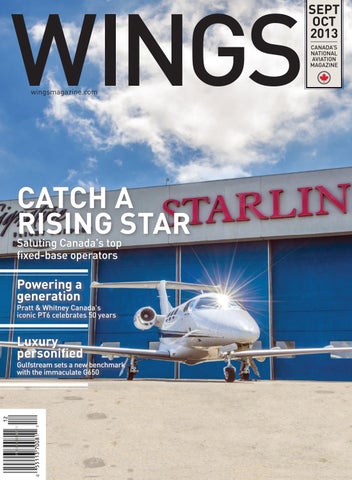
WINGS wingsmagazine.com
CATCH A RISING STAR
Saluting Canada's top fixed-base operators
Powering a generation Pratt & Whitney Canada's iconic PT6 celebrates 50 years
Luxury personified
PHOTO PHOT PHO P HOT HO OT O T O CREDIT CR C RE EDIT ED DIT D T TK TK
Gulfstream sets a new benchmark with the immaculate G650
SEPT OCT 2013 CANADA’S NATIONAL AVIATION MAGAZINE
Fifty Years of Passion Generations of Falcons have one thing in common. Each one advances the state of the art. Becoming more efÄcient. More capable. More comfortable. Always ahead of the curve, with innovations such as Digital Flight Control technology and ultra-efÄcient, ultra-capable wings—at both ends of the speed envelope. We’re celebrating 50 years since the Ärst Åight of the Mystère 20, but we’re hardly resting on our laurels.
;OL ILZ[ PZ `L[ [V JVTL Eastern Canada +201.981.2869 Western Canada +201.245.9399
Find out why. Scan the code or visit falconjet.com/50-years
SEPTEMBER/OCTOBER 2013
UPFRONT 5 Leading edge What keeps you coming back?
8 On the fly News and opinion
12 Waypoint Sharing landmark experiences
14 Alternate approach Airport naming rights
16 At the gate Fifty years and counting
Gulfstream’s sleek G650 is catching the eye of business leaders worldwide. P.34.
18 Glidepath The consequences of fatigue
20 Legal matters Eliminating the guesswork
BACK 55 MRO Directory 69 Marketplace 74 On final Embracing the challenges From top: Sharing landmark experiences P.12. Fifty years and counting P.16.
FEATURES
22 CATCH A RISING STAR
Shining the light on Canada’s top fixed-base operators BY MATT NICHOLLS AND ROB SEAMAN
28 ANSWERING THE BURNING QUESTIONS As Esso and Shell scale back operations, the Canadian aviation fuel sector is set to become more fluid BY DAVID CARR
PHOTOS: GULFSTREAM (TOP); PETER HANDLEY (MIDDLE); BOMBARDIER (BOTTOM)
34 GULFSTREAM’S DYNASTY SOARS ON The sleek 650 more than lives up to its impressive genealogy BY FREDERICK K. LARKIN
40 FIFTY YEARS ON THE FLY
Pratt & Whitney Canada’s PT6 engine celebrates a half-century of success BY CARROLL MCCORMICK
44 THE DASSAULT FALCON LEGACY Marking half a century of advancing business aviation aircraft BY BRIAN DUNN
48 A BOUNTY OF RICHES COVER PHOTO: ROGERIO BARBOSA
WWW.WINGSMAGAZINE.COM
B.C.’s aerospace industry poised to reach the next level BY MATT NICHOLLS September/October 2013 | WINGS
3
I like to stay ahead of my airplane. So if I’m 40 miles out with weather rolling in, I’m listening to what’s happening in front of me. AWOS. Pilot chatter. A quick check with flight service. Sometimes, there’s a lot to decipher. But I need to hear it clearly. Because when I do, I feel confident. Prepared. In the moment. And that allows me to just
focus on what matters,
flying.
MORE NOISE REDUCTION. LESS DISTRACTION. Better sound can make all the difference, especially where you go. Which is why, with 30% greater noise reduction than conventional noise reducing aviation headsets, the A20 headset lets you hear more of what you need to hear. While proprietary cushions and minimal clamping force let you fly comfortably for hours. Meets or exceeds TSO standards. Made in U.S.A.
Bose A20 ®
Aviation Headset
To order 1.800.901.0497 | Learn more at Bose.ca/A20_27
©2013 Bose Corporation. Delivery is subject to product availability.
®
LEADING
EDGE
| By Matt Nicholls
What keeps you coming back?
The “passion principle” – and service excellence – make all the difference
O
PHoTo: Kreos aviaTion
ne of the great things about being the editor of Wings magazine is having the opportunity to meet Canadian aviation leaders who have what I like to call “the passion principle” – an enthusiasm for their craft that drives them to create significant change or even groundbreaking achievements. Our annual Canadian fixed-base operator survey, the focus of this month’s cover story (see, “Catch a rising star,” pg. 22) offers perfect examples of the principle at work. Wings’ third annual report identifies top FBO properties and the professionals that drive them to succeed from coast to coast, as selected by our readers. Voting for the Canadian FBO survey runs online in the spring for six weeks. Wings asks readers to select up to five of their favourite FBOs and rank them based on everything from service and pricing, to more tangible qualities such as on-site amenities and services. We also ask readers to share which fuel brands, charge or credit cards are at the top of their lists and evaluate just what makes a top FBO out of this world. And while the final numbers are always intriguing – congratulations to all the winners and to Montreal’s Starlink/Signature for capturing top spot for the third consecutive year – to me, the most interesting nuggets pertain to the people who stir the drink . . . the professionals who help make each property shine. After all, in a service-driven industry like this, “attention to detail” and “going the extra mile” for customers is not only a given but, in many ways, the only thing that separates top properties from everybody else. “I know I said this last year when you came to discuss the results with me, Matt, but it is absolutely true – we do sweat the
5
It comes down to price, yes, but you have to have that personal touch. And you have to be different. You have to offer something else. small stuff here,” says Zoran Bratuljevic, president/CEO of Starlink/Signature Montreal. “It’s a policy all team members follow, it’s so important to the corporate culture here. It’s precisely what drives the brand.” Bratuljevic is first to credit colleagues David Bruneau (FBO manager) and Yuliya Marunych (executive assistant to the president/CEO) for creating an ideal corporate community. “We’re all equals here, doing what we need to for our clients,” he says. “David and Yuliya make it all happen.” Jill Timmins, Skyservice vice-president for Western Canada, can’t say enough about how her team feels about delivering service excellence and what it means
top data bursts… in this issue
1. more than 2,800 Learjets have been built since it made its first flight in october 1963. (pg. 16) 2. 74 per cent: The number of canadian FBo survey respondents that covet top-notch service. (pg. 22) 3. a $93-million storage facility is being proposed at the southern end of B.c.’s Fraser river. (pg. 28) 4. $64.5 million: The estimated price tag for a gulfstream g650 (pg. 34) 5. 10,000 people are employed in B.c.’s aerospace industry. (pg. 48)
www.wingsmagazine.com
to the Skyservice brand. Timmins notes that in the end, it’s all about the trust factor – without it, there’s nothing. “The client trusts the Skyservice brand to deliver the type of experience that goes across the board,” she says. Simply put, expectations need to be met. And it can be the smallest of things, such as not leaving a dirty coffee cup on a table. You wouldn’t want to start your morning like that.” Customers using top FBO chains such as Signature, Skyservice, Million Air and Landmark have all come to expect a certain level of service excellence, but several independent Canadian FBOs are also going above and beyond. Family-owned Kreos Aviation in Saskatoon, for example – winner of the top FBO in Central Canada (Saskatchewan, Manitoba, Nunavut) – not only provides top-notch customer service, but also offers pilots small details such as Bernard Callebaut airplane chocolates as part of its offerings. Little things, but nice things. “It comes down to price, yes, but you have to have that personal touch,” says Sherry Franks, Kreos Aviation’s FBO manager (see photo above with her colleagues). “And you have to be different. You have to offer something else. When you do, they walk into the building and go, ‘Wow! We never expected this from Saskatoon or a small town.’ That’s what a lot of people who come in say. The ramps have been busy and we’ve had a lot of people come in and say, ‘Wow this place is beautiful. . .why aren’t we here?’ ” Why aren’t they indeed. Kreos’ blend of service excellence and outstanding attention to detail has paid off in spades – as it has for all of this year’s winners. As demands for top value at affordable prices continue to escalate, nothing is more important. Congratulations to all of this year’s winners – following the “passion principle” has obviously worked. | W
Your feedback is always welcome. Please contact me at mnicholls@annexweb.com. @Wings_Magazine September/October 2013 | wings
5
Vol. 54, Issue 5 EDITOR
Matt Nicholls mnicholls@annexweb.com 416-725-5637 MEDIA DESIGNER
Gerry Wiebe FLIGHT DECK
Krista Bulmer, David Carr, Paul Dixon, Brian Dunn, Frederick K. Larkin, Neil A. MacDougall, James Marasa, Carroll McCormick, David Olsen, Rob Seaman
SUBSCRIBE TODAY !
ACCOUNT MANAGER
Nash Barsky nbarsky@annexweb.com 1-905-431-8892
1 YEAR SUBSCRIPTION
$ only
3000
SALES ASSISTANT
Stephanie DeFields sdefields@annexweb.com 1-888-599-2228 ext. 257
'34 s (34 53 53$ s &OREIGN 53$
Name: _______________________________ Company: ____________________________ Title: _________________________________ Address: _____________________________ City: _________________________________ Prov: ________________________________ P.Code: _______________________________ Tel: __________________________________ Fax: _________________________________ e-mail:________________________________
PLEASE CHECK ONE: ❑ Commercial aircraft owner/operator ❑ Business/private aircraft owner/operator ❑ Military ❑ Aircraft maintenance/overhaul firm ❑ Airport ❑ Aerospace, airframe & component manufacturer and distributor
❑ Fixed base operator ❑ Aviation services, consultants and aircraft sales ❑ Government ❑ Aviation associations and organizations ❑ Flying schools, clubs and colleges ❑ Other (please specify) ______________
PAYMENT: Cheque - Payable to Annex Publishing & Printing Inc. Visa
MC
AMEX
Account #: __________________________
GROUP PUBLISHER
Scott Jamieson sjamieson@annexweb.com PRESIDENT
Mike Fredericks mfredericks@annexweb.com WINGS MAGAZINE
P.O. Box 530, 105 Donly Dr. S., Simcoe, ON N3Y 4N5 Tel.: 428-3471 Fax: 429-3094 Toll Free: 1-888-599-2228
Publication Mail Agreement #40065710 Return undeliverable Canadian addresses to Circulation Dept., P.O. Box 530, Simcoe, Ont. N3Y 4N5 e-mail: subscribe@wingsmagazine.com Published six times per year (Jan/Feb, Mar/Apr, May/ Jun, Jul/Aug, Sep/Oct, Nov/Dec) by Annex Publishing & Printing Inc. Circulation e-mail: subscribe@wingsmagazine.com Ph: 866-790-6070 ext. 208 Fax: 877-624-1940 Mail: P.O. Box 530, Simcoe, ON N3Y 4N5 Subscription Rates Canada – 1 Year $ 30.00 (includes GST - #867172652RT0001) USA – 1 Year $ 42.00 Foreign – 1 Year $ 65.00
Occasionally, Wings magazine will mail information on behalf of industry-related groups whose products and services we believe may be of interest to you. If you prefer not to receive this information, please contact our circulation department in any of the four ways listed above. No part of the editorial content of this publication may be reprinted without the publisher’s written permission. ©2013 Annex Publishing & Printing Inc. All rights reserved. opinions expressed in this magazine are not necessarily those of the editor or the publisher. No liability is assumed for errors or omissions. All advertising is subject to the publisher’s approval. Such approval does not imply any endorsement of the products or services advertised. Publisher reserves the right to refuse advertising that does not meet the standards of the publication. Printed in Canada ISSN 0701-1369
Expiry:_____________________________ Signature: _________________________
Tel: 866-790-6070 Fax: 877-624-1940 Mail: Wings Magazine c/o Annex Business Media P.O. Box 530 Simcoe, Ontario N3Y 4N5 e-mail: subscribe@wingsmagazine.com
www.wingsmagazine.com GST#135274215RT001
6
Subscriptions non-refundable
WINGS | September/October 2013
PRO0913
ON THE
WEB
Canadian Owners & Pilots Association
Canadian Business Aviation Association
Magazines Canada
CAREERS IN AVIATION Looking for a great career in aviation and aerospace? Check out our Careers in Aviation micro site, a handy guide to help you better understand what a career in aviation is all about. Check out www.careersinaviation.ca for news, updated listings and more!
PHOTO: RCAF
Air Transport Association of Canada
TO SUBSCRIBE:
WWW.WINGSMAGAZINE.COM
Yes…You Can IMPROVE performance LOWER operating costs EXPAND mission profiles INCREASE aircraft value REDUCE TIME for the same flights REACH highest levels of safety Dozens of Grand Caravan operators have transformed their operations with the Blackhawk XP42A performance upgrade. Now certified for the Cessna Caravan. Talk to a Blackhawk performance expert today.
ON THE FLY For late-breaking news, the Wings blog and exclusive web content, please visit us at: www.wingsmagazine.com the Dreamliner’s bumpy path to service. Japan’s Mitsubishi Aircraft recently announced a review of its MRJ regional jet program, which roughly translated means a further delay in that aircraft’s maiden flight, expected late this year. A less than nine-month delay in the CSeries program is not 787-esque by THE LEAD nature, but Bombardier is not Boeing and the CSeries, unlike the 737 MAX, Airbus A320 NEO and Embraer’s re-engineered British Airways took its first delivery of the 787 E-Jet family, is a clean sheet airplane Dreamliner in June. with new technologies and claims of 15 Bombardier has again pulled the rug from per cent lower operating costs and 20 beneath the CSeries first flight, less than per cent less fuel burn, not previously two weeks before it was set to take place available in a single-aisle airliner. “Many on July 31. It is the third such delay since airlines are adopting a ‘show me’ approach prior to placing orders for the British Airways inaugurated the Boeing the airframer pressed the reset button on CSeries,” wrote Benoit Poirier, an analyst 787 on its Toronto route in September. the program last November and finally at Montreal-based Desjardins Capital, in a The airline took delivery of its first 787 admitted what every industry analyst Dreamliner in June. The airplane is the already suspected: that the airplane would note to clients. Buyer beware is certain to continue centrepiece of a $5-billion fleet renewal not take to the air in late 2012 as originally intended. to dog the program until Bombardier that includes the Airbus A380, which is The reason given for the most recent begins to “submit brand new technology scheduled to start service this fall to Hong delay is that highly technical last steps are to indepth tests,” to quote Arcamone, and Kong and Los Angeles, and the Airbus taking more time than initially anticipated produce inflight data to support the manu- 350. British Airways also became the facturer’s claims. to validate the overall systems and ongolaunch customer for the larger Boeing 787 One airline executive who is anxious for 10 at this year’s Paris Air Show. ing software integration. “While the process has taken more time hard numbers is Akbar Al Baker, the outBritish Airways became the first airline spoken CEO of Qatar Airways. The airline to operate the 787 to Canada with daily than we had expected, we are pleased is reported to have backed away from an with the results and are very comfortable service between London Heathrow and anticipated order at the 2010 Farnbortaking more time to ensure the required Pearson beginning Sept. 1, ramping up ough Air Show over concerns about the integration is finalized and the CSeries to 10 flights weekly by mid-Sept. The airperformance guarantees of the aircraft’s plane, which has a 20 per cent lower fuel aircraft is cleared for its first flight,” said Mike Arcamone, president of Bombardier new technology, including Pratt & Whitney burn than comparable jets, will replace Canada PurePower PW1500G engines. older Boeing 747 and 767 aircraft. Commercial Aircraft. Those concerns are said to have been The Boeing 787 returned to the skies This time the company has said to in late April after being grounded for expect the first flight to occur in “the com- resolved, but Qatar Airways continues to ing weeks” rather than red circle an actual take a wait and see position with regard more than three months because of fire date. This avoids another hit to the proto the airline. Bloomberg News reports breaking out in the aircraft’s lithium-ion gram’s credibility, unless weeks slip into that Al Baker told journalists at this year’s battery packs. The grounding affected 50 months, which appears highly unlikely at Paris Air Show that his airline is still airplanes worldwide and is estimated to this stage. interested in the CSeries and wanted to have already cost Boeing more than $600 The lingering question is what impact see it flying to confirm Bombardier’s “out- million in repairs and customer comstanding performance” promises. “Once pensation. The negative media spotlight, might this delay have on potential new all this is resolved and that the aircraft is including social media, does not appear orders? Pushback of new airliner programs is not uncommon and the industry well in its flight test, we will then look into to have dampened passenger enthusiasm is already hardened by the constant delays it," he said. "We are talking to Bombardier for the aircraft even after post-grounding about it.” of the new technology Boeing 787, and growing pains remain under a public microscope and fire broke out onboard a parked Ethiopian Airlines 787 at Heathrow in July. Japan’s All Nippon Airways, the largest operator of the Dreamliner, reports that bookings have increased nine per cent since the aircraft was returned to service. Air Canada will take delivery of its first 787s in early 2014. The carrier has not announced a service date or destinations. Bombardier’s delayed CSeries has been delayed again; industry analysts not surprised.
8 9 10 11
THE LEAD INDUSTRY HAPPENINGS BY THE NUMBERS PEOPLE ON THE MOVE
WAIT AND ‘C’ FOR AIRLINER’S FIRST FLIGHT
PHOTOS: BRITISH AIRWAYS (TOP); BOMBARDIER (BOTTOM)
BA BRINGS FIRST 787 TO CANADA
8
WINGS | September/October 2013
WWW.WINGSMAGAZINE.COM
The International Civil Aviation Organization (ICAO) has proposed making upset training an essential requirement for several airplane pilots’ licences. Upset prevention and recovery training (UPRT) in actual flight would be recommended for commercial pilot licence applicants. It would also be required for multi-crew pilot licences and type ratings in multi-crew airplanes. Airlines would be required to give crews simulator training. Training would cover stalls, approach to a stall, human performance, surprise, large bank/pitch attitudes, recovery techniques and effects of altitude – all in three to four hours. Loss of control in flight (LOC-I) is the greatest killer in air transport. A Boeing study showed that 22 LOC-I incidents from 1998 to 2007 cost 2,000 lives. This is more than controlled flight into terrain (CFIT), previously the worst killer. ICAO’s initiative may have been sparked by two 2009 crashes, the Colgan Air Dash 8 at Buffalo, N.Y., and the Air France Airbus A330 that disappeared over the South Atlantic. Both crews failed to recognize they were in a stall and made the wrong inputs. Many pilots were stunned that professional pilots would make such a basic error. Kevin Psutka, president of the Canadian Owners and Pilots Association, maintains that many flying schools would not be able to justify the expense of an aerobatic plane and special instructor to meet the demands. The new requirements would force some to cease operations because they need revenue from commercial training. Fewer schools would result in more travel for students, a decrease in student pilots and an overall slowdown of general aviation. The extra cost of the training, estimated at $2,500 to $3,000, would also deter some students from pursuing a career as a pilot. The International Council Aircraft Owners and Pilots Association (IAOPA) also points out that most UPRT-capable aircraft are experimental or aged. As well, many U.S. aviation universities have had trouble maintaining their aerobatic aircraft, which do not handle like airliners. Another concern is the lack of UPRT instructors, who are as uncommon as wing-walkers. Only a few Canadian flying schools offer aerobatic training. Diamond Flight WWW.WINGSMAGAZINE.COM
Centre in London, Ont., has a 180-horsepower Grob G 115, while Ottawa Aviation Services Inc. is so keen on aerobatics that it added three Grobe G.115s to its fleet. Bill Roach, director of flight training operations at Ottawa Aviation Services, said five or six hours of the required 35 dual hours for a commercial licence can be used for upset training. Harv’s Air in Steinbach, Man., has a two-seat Pitts that is used for upset training. “Students want the best training at the lowest cost,” says Harv Penner, president/chief pilot. “Many like the idea of some aerobatics, but it’s a hard sell if the licence costs more.”
The training, however, would not benefit the many commercial pilots who go into operations such as bush flying, agricultural aviation and instructing. Both COPA and IAOPA suggest the training be paid for and done by airlines in simulators that mimic the environment and handling of the aircraft flown. This would produce a cost savings for pilots in the range of $2,500 to $3,000. ICAO expects the proposals to be adopted in Spring 2014, but individual countries will take two or three years to change regulations. Wise students and schools will plan ahead. – Neil A. MacDougall
INDUSTRY HAPPENINGS
PHOTO: MATT NICHOLLS
PROPOSED UPSET TRAINING QUESTIONED
There was big news for Montreal’s Starlink Aviation and Avmax Group Inc. at this year’s Canadian Business Aviation Association conference in Vancouver. The two announced a strategic alliance providing Starlink with future maintenance, sales and support opportunities and giving Avmax an eastern Canadian maintenance facility for its fleet. Starlink president/CEO Zoran Bratuljevic (left) and Greg Taylor, Avmax’s director of sales and marketing, stopped by the Wings booth to share the news. September/October 2013 | WINGS
9
ON THE
FLY
BY THE NUMBERS
What has been purchased? Estimated manufacturer’s backlog value (Q4, 2012) Large aircraft: $35.9 billion Medium aircraft: $9.0 billion Light aircraft: $3.1 billion
TRACKING THE BIZAV MARKET Bombardier Aerospace released its annual 20-year forecast for the business aircraft market numbers during the Paris Air Show. Here are some of the reports key findings:
What will they be buying? 20 year forecast by category Large aircraft: 23 per cent (5,500 units) Medium aircraft: 33 per cent (8,000 units) Light aircraft: 44 per cent (10,500 units)
Quotables “The business jet market will generate 24,000 new aircraft deliveries worth US$650 billion over the next 20 years.” “The business aircraft industry is expected to return to the demand level of 2007 by approximately 2016.” New arrivals for 2014 Learjet 85 Challenger 350 Falcon 2000 LXS Legacy 500 New Citation Sovereign
0
20
10
30
40
50
Where the money is? 20-year forecast by value Light aircraft, $9 million-$20 million: 18 per cent ($119 billion) Medium aircraft, $20 million-$42 million: 37 per cent ($238 billion) Large aircraft, $49 million-$71 million: 45 per cent ($293 billion)
24/7
READY TO SERVE AROUND THE WORLD
Visit us at NBAA Booth C8107 A Fully Authorized Pratt & Whitney Canada Distributor & Designated Overhaul Facility
MAINTENANCE
l
R E PA I R
l
OVERHAUL
Toll Free: 1.888.769.0999 l www.vectoraerospace.com
SETTING THE STANDARD OF CUSTOMER SERVICE
10 WINGS | September/October 2013
WWW.WINGSMAGAZINE.COM
PEOPLE ON THE MOVE
PHOTOS: YVR (TOP LEFT); DISCOVERY AIR (TOP MIDDLE); INTERVISTAS CONSULTING GROUP (MIDDLE COLUMN)
Craig Richmond has been appointed chief executive officer of the Vancouver International Airport. Richmond first joined YVR in 1995 as a vice-president and moved to Vantage Airport Group, an airport management company in 2006. He was recently chief executive for two international airports in Cyprus. Michael Grasty, has joined the board of directors at Discovery Air, a Toronto-based specialty aviation company operating more than 160 aircraft. Grasty is a South American businessman and lawyer and will boost Discovery’s international business profile. Sylvain Bédard is the new chief executive for Sonaca Montreal. The Mirabel-based company is a subsidiary of Belgium’s Sonaca S.A. and manufactures larger aerospace aluminum structures,
including wing skins for Bombardier. Bédard is an industrial engineer who has also worked for Bombardier and L3 MAS Canada. Vancouver’s InterVISTAS Consulting Group has appointed Dr. Sabine Reim, vice-president of Airline Network Strategy. Dr. Reim’s spent 17 years with British Airways and will remain at InterVISTAS London office. Jay Dilley has become president and accountable executive at Hawkair, a Terrace, B.C.-based regional airline with a fleet of Dash 8 aircraft. Prior to joining Hawkair, Dilley was vice president of business services for Summit Air and has worked for Arctic Sunwest Charters. Curtis J. Berchtold has been named chief financial offer for Enerjet, a Calgary-based charter airline specializing in workforce air transport and entity charters. Berchtold has extensive scheduled, charter and cargo airline experience and has held financial leadership positions in
a number of U.S. airlines and was recently chief financial officer for Silver Airways in Fort Lauderdale. Brian O’Flynn has joined SkyTrac Systems as vice president of sales. Skytrac is a Vancouver-based supplier of satellite-based aircraft flight following technology. O’Flynn has 25 years aviation experience. The Comox Valley Airport Commission has appointed Keith Tatton, a local businessman, to its board of directors. Comox Valley Airport is seen as an essential economic driver for northern Vancouver Island. David J. Dacquino has been appointed president and chief executive of Torontobased Skylink Aviation, specializing in a multiple of air support services to the world’s hot spots including air cargo, charter and heavy-lift operations. Dacquino brings more than 30 years international aerospace and defense industry including positions with Raytheon, Lockheed Martin and the VT Group.
Trash the Tape Meet the New CVR Rule
Replace your tape-based Cockpit Voice Recorder (CVR) and hard-to-find tape while preparing for the upcoming changes to the CARs with Universal Avionics CVR-120A/-120R.
t Meets upcoming changes to CVR regulations t Lightweight and compact t Maintenance on Condition t Optional Maintenance-free Recorder Independent Power Supply (RIPS) Visit us at NBAA Booth N6108 or www.uasc.com to learn more.
WWW.WINGSMAGAZINE.COM
www.uasc.com sales@uasc.com (800) 321-5253 (520) 295-2300
September/October 2013 | WINGS
11
WAYPOINT By Rob Seaman |
Sharing landmark experiences COPA chairman Paul Hayes is a man of influence – and many tales
I
12 WINGS | September/October 2013
to have had the opportunity to fly with a great group of German aviators and to add to his Sabre flying experiences. “Both made up a marvellous ride.” Upon his return to Canada, Hayes held various flying and administrative positions until leaving the Regular Force in 1964 to continue his university studies. He then rejoined 411 Air Reserve Squadron, eventually serving as commanding officer from 1976 to 1978. He was appointed chief operations officer and deputy commander of 2 Air Reserve Wing prior to his becoming commander of the Wing in 1979. In 1982, he was transferred to the staff of the Chief of Reserves and Cadets at National Defense Headquarters. He rejoined the Air Reserve Group Headquarters in 1984 and as chief staff officer, training, and was promoted to brigadier-general in 1988, serving as commander of Air Reserve Group until 1990. In 2000, Hayes was appointed honorary colonel of 400 “City of Toronto” Tactical Helicopter Squadron, based at CFB Borden. He also assists as the technical advisor to Vintage Wings of Canada regarding the operation of their Sabre – Hawk One. Outside the military and COPA, Hayes has participated in the NAV CANADA working committee restructuring the WindsorToronto-Montreal airspace. This reorganization of the airspace included several control zones, elements of the class C airspace and the establishment of new VFR flight routes for the GTA. This is merely a snapshot of Hayes’ impressive work in the aviation industry. He is certainly a man of influence, someone get to know – and he’s certainly not slowing down any time soon. | W
“By the time he reached the nearest farm, he was fully suffering the effects of winter.” first with 422 (Fighter) Squadron and then as tactical advisor to 73 Wing of the German air force. In a piece he penned for Vintage Wings of Canada a few years back entitled, “Achtung Saberjetz – Teaching the New Luftwaffe,” Hayes recalled his activities from this time. “When the post-war Luftwaffe was formed, the best available type of aircraft for them was the Canadian-built Canadair Sabre 6. Accordingly, 225 brand new examples were ordered, complemented by 75 Sabre 5s drawn from the Canadian Air Division (the RCAF was upgrading to the Sabre 6). By 1961, Hayes was assigned as a tactical advisor to JG 73 (Jagdgeschwader or Fighter Wing 73). A number of the pilots had Second World War experience, mainly on fighter operations, a benefit in adding to the understanding and achieving proficiency. By mid-1962, the first four aircraft were placed on NATO “alert” at the end of the runway.” Hayes notes how proud he is
Rob Seaman is a Wings writer and columnist. WWW.WINGSMAGAZINE.COM
PHOTO: PETER HANDLEY
’ve said this before but it bears repeating: every so often I have lunch with someone in the aviation industry who hasn’t forgotten important details about things you think you already know. The benefits of said lunches and the information derived are priceless. Paul Hayes is one such individual. Recognized by many as the current chair of COPA (Canadian Owners and Pilots Association), Hayes has a very colourful, intriguing background and is without question an aviation “addict.” A member of COPA for more than 40 years, Hayes was, prior to becoming chair, a director and national secretary on the executive committee. He is also past captain of COPA Flight 44 (Buttonville) and president of the Buttonville Flying Club. What many don’t know is Hayes served his country during the “Golden Age” of the Royal Canadian Air Force (RCAF). He joined the RCAF Auxiliary in 1951 – before he had a driver’s licence. He even talks about finding his way to then somewhat remote Downsview air force base by bus and on foot. Receiving his pilot’s wings in 1953, he flew Vampire and F-86 jet fighters with 411 “County of York” squadron in Toronto. In 1956, he joined the RCAF regular force. Hayes’ stories from that time period are telling. One example is the time he and another pilot launched from Downsview in their Vampires and flew to the Trenton gunnery range. After several passes on the ground targets, his colleague declared a fuel emergency (Vampires were notorious for their fuel hungry ways). “He found a field and managed a gear up landing,” says Hayes. “After the aircraft came to stop in the snow, he then climbed out and had to walk to the nearest farm. Not wearing a full winter military ‘kit’ meant making the trek in regular shoes and flight suit. By the time he reached the nearest farm, he was fully suffering the effects of winter.” Hayes says this taught him to always fly according to the season. To this day, he carries a survival kit and dresses for the weather. After becoming a full-time member of the air force, Hayes served in Europe from 1957 to 1963 as a pilot on the F-86 Sabre,
“WELCOME TO OUR WORLD”
At the heart of the most extreme missions are the exceptional pilots who experience daring feats on a daily basis and are prepared to entrust their security only to the most high-performing instruments. At the heart of the most extreme missions is the Breitling Avenger. A concentrated blend of power, precision and functionality, Avenger models boast an ultra-sturdy construction and water resistance ranging from 300 to 3,000 meters. These authentic instruments for professionals are equipped with selfwinding movements chronometercertified by the COSC – the highest official benchmark in terms of reliability and precision. Welcome to the sphere of extremes. Welcome to the Breitling world.
AVENGER II SEAWOLF
ALTERNATE
APPROACH By David Carr |
Airport naming rights Justin Bieber International? You never know what the future holds
W
14 WINGS | September/October 2013
name of the fictitious airport in the Arthur Hailey novel, Airport Perhaps the most head scratching is the renaming of Montreal’s Dorval Airport after Pierre Elliot Trudeau. This is not to suggest that Canada’s most internationally celebrated prime minister doesn’t deserve a global installation like an airport. But no one person did more to destroy Montreal as an air transport hub than Trudeau with the ill-advised white elephant, Mirabel. Many airport names are for the here and now which is certain to evolve into a rush to name an airport even before the honoree has gone to ground (Houston’s George Bush Intercontinental Airport). The difficulty with this is that while legendary aviators such as Lindbergh, McCurdy and Kingsford-Smith have legitimate roots that plunge deep into an airport, non-aviators grow less relevant with passing generations. There will be exceptions such as Kennedy, Leonardo da Vinci in Rome and Charles de Gaulle in Paris. (Did the Brits ever consider thanking Sir Winston Churchill by renaming Heathrow?) It is more likely that airport names will experience generational change as the glister of legacies fade and new film, sport and political stars pop up. Perhaps airports will follow the lead of theatre and sport stadia operators and begin selling naming rights. HSCB, the selfdescribed “world’s local bank” has come closest. HSBC has reinforced its global footprint by decking out air bridges and terminal buildings at 48 busy international airports in 24 countries with HSBC logos and messaging. Can the Atlanta Coca Cola International Airport or Tim Hortons Terminal at Hamilton be far behind? It is food for thought. This is David Carr writing from the Justin Bieber International Airport in Stratford, Ont. | W
The trend now is to name airports after larger-thanlife politicians or local boys made good. Charles Lindbergh has at least three installations named for him. San Diego International Airport, also known as Lindbergh Field because that is where the Spirit of St. Louis was designed and built; Winslow Lindbergh Regional Airport – a Lindy hop to Arizona – because it was an airport he designed; and, a terminal building at Minneapolis St. Paul International Airport to commemorate that the Detroit-born Lindbergh spent his childhood in Minnesota. St. Louis International Airport is named after Albert Bond Lambert, a local aviator, Olympic medalist and inventor of Listerine, one of the great creations for anybody standing cheek to jowl waiting to board in an overcrowded airport departure lounge. In Canada, four airports are named for prime ministers. In addition to Pearson there is John G. Diefenbaker International Airport in Saskatchewan and MacDonaldCartier International Airport in Ottawa. Odd that neither George Washington nor Abraham Lincoln have major airports named after them, but John Foster Dulles, a secretary of state does. Lincoln is the
David Carr is a Wings writer and columnist. WWW.WINGSMAGAZINE.COM
PHOTO: ISTOCK
hat do silver screen legend John Wayne, hard-living, 1960s soccer star George Best and former Nova Scotia premier and federal opposition leader Robert Stanfield have in common? Each has an airport named for him in Orange County, Belfast and Halifax respectively. Three airports, three men and not an aviator in the bunch. This year marks the 50th anniversary of the assassination of John F. Kennedy and the renaming of New York’s Idlewild Airport on Christmas Eve 1963 after the slain president. At the permanent dawn of the jet age, New York’s international airport captured the glamour of the shortened presidency more than Boston Logan – closer to Kennedy’s roots – or Washington National, since renamed after former president Ronald Reagan, ever could. Airports have traditionally been named for the cities they serve or the land where they sit. Heath Row was a 15th century Middlesex hamlet near London. For its first 45 years, Toronto’s Lester B. Pearson International Airport was commonly known as Malton. It was renamed after the former prime minister and Canada’s only Nobel Peace Prize laureate in 1984. The name helps gloss over the fact Toronto’s airport and Canada’s busiest, sits in another city, a point Mississauga Mayor Hazel McCallion, who is almost as old as powered flight itself, never tires of bringing up. The trend now is to name airports after larger-than-life politicians or local boys made good. And it is almost always boys. Amelia Earhart Memorial Airport in Atchison, Kan., is one notable exception. The jokes about the airport being hard to find almost write themselves. The airport name game often gives aviators short shrift, but not always. Sydney, Australia and Sydney, N.S. have airports named after aviation pioneers and legends: Sir Charles Edward Kingsford Smith and J.A. Douglas McCurdy, respectively. Toronto’s City Centre Airport was renamed Billy Bishop, the First World War flying ace – much to the chagrin of Owen Sounders who had already named the regional airport after the favourite local son.
departure loves arrival Depart from the ordinary and arrive at the extraordinary with superior aerospace products from BASF The Chemical Company. BASF is proud to introduce a broad portfolio of products for the Aerospace industry: 䡲
Cabin Interiors Structural Materials 䡲 Seating Components 䡲 Fuel and Lubricant Solutions 䡲 Coatings and Specialty Pigments 䡲 Flame Retardants and Fire Protection 䡲 Other Innovations 䡲
At BASF, we create chemistry.
Get the free mobile app for your phone http://gettag.mobi
www.aerospace.basf.com
AT THE
GATE
By Brian Dunn |
Fifty years and counting Bombardier’s impressive Learjet is still making its mark
T
16 WINGS | September/October 2013
of 2011 was highly improbable. The new date of 2014, “at the earliest,” is still aggressive as composite development plans can generally be seen as high risk, particularly when Bombardier has very limited experience with these materials. The company plans to work with these materials in an all-new facility in Querétaro, Mexico. “Bombardier is giving its new plane a very high level of attention, but there’s a high risk of a one- to two-year slip,” said Aboulafia. “When it arrives it will quickly replace the last legacy Learjet, the Model 60. The 60 is a very powerful machine, but it never had the cabin customers expect at that price point.” The 85 will likely serve as the basis for a new family of composite mid-sized jets, exactly what’s needed to keep up with Cessna and prevent Embraer from displacing Learjet’s market share. Meanwhile, the 40/45 will continue to move along, sustained by a modest but welcome update as the 70/75. These will help Bombardier keep its share of the small cabin market as that segment revives, hopefully starting next year, suggested Aboulafia. Bombardier’s share of the small business jet market is expected to increase from 30.9 per cent last year to 34 per cent by 2022, according to Teal. Its biggest rival, Gulfstream, will also see its market share jump from 26.2 per cent to 30.9 per cent during the same period. The biggest loser is Hawker, whose 8.1 per cent share will disappear as it ceases production. | W
The current market downturn is disproportionately affecting aircraft in the bottom half of the market. The Model 85 will sell for about $18 million in 2011 dollars, according to Richard Aboulafia, vice-president, analysis of the Teal Group Corporation in Fairfax, Va. “After decades in the wilderness, Learjet’s acquisition by Bombardier provided stability and a strong broader market lifted the Learjet series’ fortunes. But until recently, Bombardier had been sluggish about updating the product line,” he said. The one big initiative was the conversion of the Bombardier Continental to the Challenger 300 in 2002 and production was transferred from Wichita to Montreal. The current market downturn is disproportionately affecting aircraft in the bottom half of the market and in 2009, Learjet saw its backlog cut in half. But the company has generally weathered the storm better than its rivals. And as the market recovers, the new Model 85 should return the Learjet line to a strong market position, Aboulafia predicted. Apart from a welcome commitment to new product development, he said the 85 will offer a larger cabin, while the composite structure will lower manufacturing costs. The original in-service date
Brian Dunn is a Wings writer and columnist. WWW.WINGSMAGAZINE.COM
PHOTO: BOMBARDIER
he Learjet has a proud history dating back to 1960 and was one of the first companies to manufacture a private, luxury aircraft. Learjet began as the Swiss American Aircraft Company, founded by William P. Lear Sr. in 1960. His inspiration was the P-16, a supersonic combat aircraft designed in Switzerland. The company moved to Wichita, Ks., in 1962 and became known as the Lear Jet Corporation. It was taken over by Gates Rubber Company in 1967 and in 1970, became the Gates Learjet Corporation. The Gates name was dropped in 1987, when Integrated Acquisition purchased a 65 per cent share of the company. Bombardier purchased Learjet from Integrated in April 1990 for $75 million and assumed the company’s debt. The first Learjet was the Learjet 23, which made its first flight 50 years ago in October 1963. Later models included the 24, 25, 28 and 29 which are all out of production. Current Learjet products include the Model 60, a transcontinental business jet with PW305 engines, which is currently in production phase; the entry-level Model 40; and the slightly larger Model 45, the first all-new Learjet since the original model, which is basically a replacement for the Model 31. More than 2,800 Learjets have been built. The newest model, the 85, Bombardier’s first composite aircraft design, should enter service in 2014. In May 2012 at the EBACE show in Geneva, Switzerland, Bombardier unveiled its Learjet 70/75, an upgrade and rebranding of the 40/45. The new versions have more engine power and better performance and a Vision cockpit with Garmin avionics. The 75 is scheduled to enter service at the end of this year, with the 70 following a few months later. The last 40/45s will also be delivered this year. Bombardier’s Flexjet unit has converted its 40/45 options to 70/75s. A Model 60 with standard equipment was originally priced at $7.9 million, but has since risen to $14.1 million, equipped for the XR model. The Model 45 sells for more than $13.15 million for the XR version. The Model 40XR sells for $10.6 million. The Model 70 is priced at $11.1 million, while the 75 will sell for $13.5 million.
DON’T MISS THE LARGEST BUSINESS AVIATION EVENT IN THE WORLD
WWW.NBAA.ORG/2013
NBAA also hosts APRIL 15, 16, 17, 2014
GLIDE
PATH
By Paul Dixon |
The consequences of fatigue Sleep-deprived aviation professionals put lives in danger
T
18 WINGS | September/October 2013
that resulted in my working long days in uncomfortable surroundings with three nights in a row of no more than four hours’ sleep. In one sense it was a great experiment, as I made a point of dedicating one of my three active brain cells to simply observing my performance levels knowing that I was in a state of advanced fatigue. It is interesting to realize your short-term memory is shot (but not so funny to the person of whom you have to ask their name three times in less than five minutes) or wondering what the problem is with your cell phone when it’s the other phone that’s ringing (did that twice in an hour). Everything in that TSB report describing the condition of the ATC applied to me and in spades! I knew I was tired and I knew I could expect to make some goofy mistakes, and even at that, I was trying to answer the wrong phone. I survived the week and I will tell you that I was not in a position to have jeopardized anyone’s safety and that’s a good thing, because if I had been working as an ATC, I would not have been able to do the job. Bottom line: sleep-deprived aviation professionals put lives in danger. It’s an issue that must be taken very seriously at all levels going forward. | W
In the world of police, firefighters and paramedics that I inhabited, it was simply a matter of ‘suck it up.’ by approximately five hours of sleep after the first night shift. The incident occurred 30 minutes after the start of the second overnight shift. The TSB report addresses the fatigue issue by saying, “At any time when individuals are required to work during periods that are significantly in opposition to their normal circadian rhythm, fatigue and its management may become a factor. Trying to get adequate sleep when one’s body is normally in a wakened state is a challenge. Air traffic control personnel are given information on recognizing fatigue and given strategies for minimizing its effects. However, it is not always possible for individuals to determine their fatigue level. . . The TSB’s analysis of the airport controller’s sleep pattern indicated that the airport controller did not obtain sufficient sleep before the occurrence shift, which would likely have contributed to degraded performance. In addition, the airport controller’s schedule did not permit enough adaptation time, due to the requirement to sleep during the day in an attempt to be adequately rested for the night shift.” I recently took a short-term contract
Paul Dixon is freelance writer and photojournalist living in Vancouver. WWW.WINGSMAGAZINE.COM
PHOTO: NAV CANADA
he Transportation Safety Board of Canada (TSB) recently released its report on an incident termed as a “risk of collision” that occurred at Vancouver International Airport (YVR) in April of 2011. An air traffic controller (ATC) had two aircraft ready to take off from the same runway while a third aircraft was on final approach to that runway. The report reads, “It is likely that the airport controller was experiencing the effects of fatigue at the time of the occurrence . . . this would have made it more difficult for the airport controller to recognize the developing situation, and to take timely corrective action . . .” From my first job as paper boy at the age of 12 until I “retired” a few years ago, I worked shift work of one form or another. Even when I worked a nominal day shift, I carried a pager as an on-call emergency manager. Sleep was something you looked forward to – not today or tomorrow, but maybe on your days off. We used to joke that sleep could wait until we were dead. In the world of police, firefighters and paramedics that I inhabited, it was simply a matter of “suck it up” and get through the shift. If you had a problem getting through the night, then maybe you were the problem. Then, about 20 years ago, an awareness developed of the health implications for many people working shift work, especially short rotations that didn’t allow the body to adjust. There have been many studies looking at a variety of shifting patterns in an attempt to identify the “best.” The short answer is that there is no “best” when it comes to shift work. The ATC for the YVR incident was in the second day shift of a four-shift block: Two day shifts, followed by two night shifts. The breakdown was as follows: Day 1 (April 12) – 06:30-15:00; Day 2 (April 14) – 05:30-14:00; Night 1 (April 14) – 22:3006:30; Night 2 (April 15) – 22:30-06:30. And that’s not a typo if you were reading closely. The ATC worked until 14:00 on his second dayshift and came back eight and one-half hours later to start his overnight shift at 22:30. When interviewed by the TSB, he stated he had approximately six hours of sleep between getting off at 14:00 and returning to work at 22:30, followed
OUR FAMILY OF CUSTOMERS | A LETTER SERIES
Industry Veteran Finds FlightSafety Second to None
Kim Welch Contract Pilot
To find out about the many benefits of being a FlightSafety Customer, please call Scott Fera, Senior Vice President, Marketing, at 718.565.4774. sales@flightsafety.com s flightsafety.com s A Berkshire Hathaway company
LEGAL
MATTERS By Krista Bulmer |
Eliminating the guesswork Canada ( finally) ratifies the Cape Town Convention
P
20 WINGS | September/October 2013
a uniform set of rules for the lease and sale of “aircraft objects,” which includes fixedwing aircraft that can carry at least eight persons, aircraft engines with at least 1,750 pounds of thrust and helicopters that carry five or more passengers. For a transitional period, Canadians who have leased or financed aircraft may see some overlap in creditor registrations, meaning that creditors will likely register their security interests in both provincial registries as well as the international registry located in Dublin, Ireland. This situation will most likely occur where a pre-existing security agreement permitted the creditor to register its interest under Cape Town once the Convention came into force, creating an additional layer of security for the creditor during the transition period. The implementation of the Cape Town Convention in Canada should help to make cross-border financing arrangements more attractive by significantly reducing the risk to creditors, improving enforceability and reducing the cost to the borrower. This means that we should see expanded financing opportunities for operators in Canada at a reduced cost. If the purchaser is based in a country that has ratified the Cape Town Convention, exposure fees from export credit agencies are reduced by up to 10 per cent. That could mean substantial savings on the purchase of a business jet or commercial aircraft. It is a win-win for creditors and borrowers alike. | W
The Cape Town Convention is intended to eliminate the confusion and uncertainty arising from different rules and laws in multiple jurisdictions. Matters Specific to Aircraft Equipment,” collectively known as the Cape Town Convention. Because it required other legislation and statutes to be amended prior to the Cape Town Convention coming into force, Canada was slow to ratify the Convention but finally did on April 1, 2013. Until the Cape Town Convention came into force, the same set of laws that applied to the purchase of a photocopier or a car also governed a creditor’s rights in Canada with respect to its security interest in an aircraft, aircraft engine or helicopter. So, while a lender may have some form of protections in place in Canada, it often had to make multiple registrations in multiple provinces and there was uncertainty about the enforcement of its interests when the aircraft was in another jurisdiction. The Cape Town Convention is intended to eliminate the confusion and uncertainty arising from different rules and laws in multiple jurisdictions and create
Krista Bulmer is a lawyer practising aviation law, business law and civil litigation with the law firm, Wires Jolley LLP in Toronto WWW.WINGSMAGAZINE.COM
PHOTO: DASSAULT FALCON
eople ordinarily do not give much thought to what would happen if they defaulted on their payments on a lease or loan but they generally understand that if they don’t pay, the property may be repossessed. However, the analysis does not go much beyond that for most of us and the mechanics behind a creditor’s rights remain a mystery. In Canada, a creditor will take what is known as a “security interest” in a piece of equipment when it is sold on credit or when it is leased. This is done through contract, so when you buy a car, for instance, you are required to sign an agreement granting the creditor a security interest in the car. The creditor can then register its security interest in a provincial registry so that if you fail to make your payments, the creditor can follow the applicable rules in order to seize the vehicle and try to sell it to recover its losses. There is a complex set of laws and rules in each province that govern how and when the creditor may enforce its security interest in your car. The same is true of security interests in aviation transactions. What is certain is that the greater the risk there is to a creditor, the higher the cost to the borrower. This risk is often reflected in the interest rate charged or additional fees. If you are a high-risk borrower, you may need to get your credit from a private lender that charges a high interest rate. So in aviation transactions, the cost associated with increased risk can be enormous when you are dealing with highvalue assets such as aircraft. Enforcement measures, such as repossession of aircraft, add an additional layer to the anticipated risk since commercial and business aircraft are almost always on the move and may be in multiple jurisdictions over the course of a single day, let alone a week or a month. These costs are usually reflected in the “exposure fees” charged to airlines and operators by export credit agencies. In 2001, an international treaty resolution was passed proposing the (inelegantly named) “Convention on International Interests in Mobile Equipment” and the “Protocol to the Convention on International Interests in Mobile Equipment on
October 9 -10, 2013 - Vancouver Hyatt Regency Hotel - Vancouver BC Canada Experts from the global aviation industry will be in attendance to share the latest technologies, operational procedures and lessons learned that will keep you operating safely during winter operations. For more information visit:
www.winterops.ca Hosted by:
Air Canada Pilots Association l Association des pilotes d’Air Canada
THANK YOU To All of Our 2013 Conference Sponsors!
PLATINUM SPONSOR
GOLD SPONSOR
SILVER SPONSORS
BRONZE SPONSORS
MEDIA
Get the App!
Immaculate attention to detail and a “can-do” attitude from all employees has helped Starlink/Signature Montreal three-peat as Wings FBO winners. These pros make it all happen (from left): David Bruneau, FBO manager; Yuliya Marunych, executive assistant to president/CEO; Zoran Bratuljevic, president/CEO.
CatCh a rising star SalutiNg CaNada’S top fixed-baSe operatorS
by Matt NiChollS aNd rob SeaMaN
PHoTo: maTT nicHolls
M
ontreal residents, more than any other in Canada, will certainly be able to appreciate just how special a hat trick is in the world of professional hockey. The storied Montreal Canadiens have produced countless National Hockey League stars who have lit the lamp for magical three-goal games. Well, it’s time to add another hat trick to the city’s portfolio, this one in the form of a threepeat for Starlink/Signature in Wings magazine’s third annual survey of top fixed-base operators (FBOs) in Canada. Awarded annually to the FBOs offering top-notch customer service, impeccable on-site amenities, dedicated employees with a “can-do” attitude, value-added pricing options and more, these organizations represent the crème de la crème of FBO choices north of the border. “Obviously, it’s a top honour and a testament to our outstanding team,” says Zoran Bratuljevic, president/CEO of Starlink/Signature Montreal, when presented with the award in Montreal in early August. “Basically, when you win an award like this more than once it reflects on the continuous levels of service that you provide in all areas of the business. It shows that you indeed sweat the small stuff, because sweating the small stuff is so essential. And that’s what we do here . . . every employee is committed to delivering it.” Sweating the small stuff and providing a level of service excellence that exceeds www.wingsmagazine.com
expectations is indeed a corporate philosophy that connects employees at all levels – a commitment to providing a customer experience that will leave an indelible mark and keep them coming back. It goes without saying, Bratuljevic notes, that all employees live and breathe this philosophy at the Starlink/ Signature property. “Let’s just say 10 customers come in at the same time and the line technicians are out there servicing aircraft, everyone is busy, but some of the crew needs transportation to the hotel,” Bratuljevic says. “It’s in our culture that no matter what position a person may hold, they will react to that situation and help out – someone will jump up and service these people. We are all basically equal when it comes to our customers, we are here to serve them and create a great experience. The nice thing is, everyone here enjoys doing it.” Patrick Sniffen, vice-president of marketing for Signature Flight Support in Orlando, maintains delivering a consistent experience at all Signature properties is what makes customers comfortable with the brand – they know what to expect and they keep coming back. It’s the same quality of service that can be found at Signature’s newest Canadian FBO in Edmonton. The key to establishing such service levels, Sniffen notes, is consistent training and selecting just the right employees to carry out corporate objectives. Signature’s training program – Service with a Leading Edge developed in concert with
hotelier Ritz Carlton – helps lay the groundwork in doing just that. It also provides customers with the peace of mind that within the Signature brand, service levels will always remain high. “With a lot of companies, the service training is limited to the employees that are on the CSR desk or on the line, but with this training program, everyone top to bottom no matter who you are in the company has to undergo annual recurring training,” says Sniffen. “And the program establishes the fact that everyone is working off the same sheet of music.” Providing a harmonious experience for customers at
“What we do is very much like a marriage . . . and the last thing you want to do is have it end in divorce.”
relationship; for top Canadian FBO providers, nothing can stand in the way of delivering service levels that keep relationships humming right along. Timmins and her crew are obviously humming right along: Skyservice Calgary captured the top spot in Western Canada for the second straight year. “What we do is very much like a marriage . . . and the last thing you want to do is have it end in divorce,” says Timmins laughing. “That’s why we are fanatical about details.” Timmins says her Skyservice Calgary location provides its customers with everything from impeccable line service from ramp employees, topof-the-line customer service, cost-effective pricing options, maintenance service 24/7 and more – service with a smile that always exceeds expectations. “We know what our customers want and cater specifically to their needs on all levels . . . some would say we are obsessive about details, but I like it because that’s what it takes to consistently deliver the type of service we need to.”
Numbers game Skyservice Calgary is what Jill Timmins and her team are all about. Timmins, the vicepresident, Western Canada for Skyservice Business Aviation, says choosing the right FBO to meet the needs of Canadian aviators is much like a marriage – a client/service provider bond based on the utmost respect, careful nurturing and above all, trust. Ensuring your partner is comfortable and content can make or break the
Service excellence, catering to customers needs, offering sound price points – all are key drivers when it comes to creating an FBO that delivers a highend experience. The Wings annual FBO survey was designed to identify properties that deliver on these important value propositions. For the third consecutive year, we asked readers to identify their top Canadian FBOs, fuel brands, and charge or credit cards. In an industry September/October 2013 | wings 23
Providing a strong commitment to recurrent training and hiring employees with just the right attitudes goes a long way in determining an FBO’s success, says Patrick Sniffen, vice-president of marketing for Signature Flight Support.
24 WINGS | September/October 2013
Canadian service and support providers, but also allow for the inclusion of all airports from across the country on an equal footing. With the end scores totalled, we then were able to see how the selected FBOs rated overall for their markets – both in the number of times they were selected and in the total scores by attribute. A winner was selected region to region across the country and an overall winner was determined based on the total votes cast and related scores. Once again, the survey illustrates that customers do remember their service experience – and when it is good, they feel loyal enough to comment. As any professional from the service and retail sector knows, most customers don’t say much about your service until it is really great – or conversely, incredibly bad. And it is seldom expressed directly to the company, so a survey like this provides a valuable third-party insight
into how the people who put money into your cash register see you. Listed below, are the winners broken down by region:
A new ranking we added for this year’s report includes the top three fixed-base operators in each region of Canada. This list includes:
Best FBO in Canada: Starlink/Signature YUL (Repeat overall winner three years in a row) Best FBO in Western Canada (B.C., Alta., Y.T., N.W.T): Skyservice YYC (Repeat winner from last year) Best FBO in Central Canada (Sask., Man., Nunavut): Kreos Aviation YXE (New winner for this region) Best FBO in Ontario: Skyservice YYZ (Repeat winner in this category) Best FBO in Quebec: Starlink/Signature YUL (Repeat winner in this category) Best FBO in Atlantic Canada: (N.B., N.L., N.S., P.E.I.): Gateway YHZ (New winner for this region)
Top 3 Western Canada Skyservice YYC Esso Avitat YVR Landmark Aviation YVR Top 3 Central Canada Kreos Aviation YXE Kelly Western Jet Center Esso Avitat YWG Top 3 Ontario Skyservice YYZ Million Air YKZ Landmark Aviation YYZ Top 3 Quebec Signature/Starlink YUL Pascan Aviation YHU Skyservice YUL Top 3 Atlantic Canada Gateway YHZ Irving YQX Irving Goose Bay
WWW.WINGSMAGAZINE.COM
PHOTO: ROGERIO BARBOSA
driven by service impressions as well as price, the survey offers a unique overview of the Canadian market and this market alone. The methodology for the survey was straightforward. Respondents were allowed the opportunity to select up to five FBOs and rank them based on everything from service and pricing to the bricks-and-mortar aspects of the site. Respondents were asked for a rating on each section using a scale of one through 10 for such attributes. As in previous years, participants were also asked to indicate how important pricing and customer service is to their FBO choice. What makes the Wings’ FBO survey unique is it is based solely and completely on respondent recall without prompting – readers choose an FBO based on their experience only, without a cheat sheet or prompt list. Our research and experience over several years has shown this to be a proven method to not only focus on
Priming the pump In terms of the fuel market, the survey once again revealed that FBOs continue to accept a variety of fuel cards and charge services to remain competitive and responsive. Here are the top fuel brand choices and preferred fuel card providers: Top 3 fuel brands Petro T/Avjet (New winner for this category) EPIC Shell
Customer service vs. price There’s no doubt top-notch customer service is critical for the success of any FBO property, and once again, results from the survey indicate when weighing its importance compared to price in selecting an FBO, the comparison isn’t even close. Some 74 per cent of respondents indicated impeccable customer service was their top reason for choosing a specific FBO while price was the top-determining factor for some 27 per cent. These results note an even higher trend towards service excellence this year than last (64 per cent in 2012), underscoring the premise that service with a smile is key to customer retention. “We’re always looking to find the right people to provide the level of service that will keep 26 WINGS | September/October 2013
Skyservice Calgary staff are fanatical about details, a practice which puts them in a whole different class.
our clients coming back,” says Paul Weeks, vice-president of maintenance at Skyservice in Toronto. “We’re lucky because our staff has a tremendous amount of experience and know the pilots who come in by name. This is the type of personal touch that makes a difference.” High service standards can often go farther than that: providing clients with a sense of coming home. “Pilots are at ease and comfortable coming here knowing what they can expect from the pilot’s lounge, the line service, everything. I know it makes a difference,” Weeks says.
Independence day While major FBO chains provide service standards aviation professionals can rely on, it doesn’t mean independent FBOs can’t rise to the lofty heights of FBO prominence. Take Saskatoon’s Kreos Aviation for example, winner of this year’s Top FBO in Central Canada. Established in 2009 to fulfil the executive needs of the burgeoning Saskatchewan natural resources-based industries and tourism markets, Kreos now gives the city another option in high-level
executive comfort – Shell Aviation Centre is its main competition. Kreos is rapidly gaining a reputation for its excellent service and quality standards. The same can be said for Pascan, located at the Saint-Hubert Airport in Quebec, another small independent that flexed its muscles in the survey this year. “Being so small, we are a little bit different than a lot of FBOs but certainly we can deliver that level of service quality that the big chains do,” says Sherry Franks the FBO manager at Kreos. “We’re always looking for new ideas, new opportunities. And to us, the experience of our pilots is so important. We ask them about their experiences, we ask them how can we improve this, how can we improve that. We have done the surveys, we follow up with clients in detail. It’s all about taking into account their perspective and building on that. You need to understand what they want.” Even the smallest details are important to the Kreos team, such as providing pilots with Bernard Callebaut airplane chocolates – a little thing, yes, but a nice thing. The FBO itself is also decorated throughout in a strong aviation theme, with
aviation-themed furniture, lamps etc., providing many small nuances a larger FBO might not. It’s all about going above and beyond – catching a rising star so to speak. “I mentioned the chocolates, and it’s a small thing of course, but we are always looking for something new. And no one is going to come here because of the chocolates . . . but they are really good,” Franks says laughing. “In the end, the reason people are going to come here is the people. The FBO is led by great people, we have a great team. We have a passionate, committed team and we have a large quantity of loyal customers that we are building to fuel our success.” A high commitment to detail, a fanatical approach to creating just the right customer experience and a passionate team dedicated to carrying out the right corporate philosophy. These are key ingredients that make up each winning FBO highlighted in this year’s survey. Wings congratulates all of the 2013 winners. | W
For more Wings profiles, visit www.wingsmagazine.com WWW.WINGSMAGAZINE.COM
PHOTO: SKYSERVICE
Top preferred cards for fuel 1. Visa (Repeat winner for this category for third year) 2. Colt (Up one position from last year) 3. Mastercard (Same position the past two years) 4. Multiservice (Down from second last year) 5. AMEX (Down one from last year) 6. AvCard (Same position as last year) 7. UVAIR (Same position as last year) 8. Avfuel (Same position as last year) 9. EPIC (New card/rating this year – two properties tied for ninth place) 9. Airworld (Same position as last year) 10. Ascend (Same position as last year)
October 16 & 17 Ottawa Convention Centre
This year’s theme:
Engage in Change Innovate | Transform | Excel Go to www.aiac.ca/summit for registration information, a full downloadable program, bios of this year’s key speakers and much more! Proudly hosted by
Do Business. Network. Learn. With over 600 attendees and 100 exhibitors, the Canadian Aerospace Summit is Canada’s leading national aerospace event. For more information or to learn about advertising/sponsorship opportunities: cas@aiac.ca
EPIC took over Air BP’s North American general aviation assets in 2012 and supplies fuel services to four Canadian FBOs, including the Million Air franchises in Toronto and Vancouver.
ANSWERING THE BU AS ESSO AND SHELL SCALE BACK OPERATIONS, THE CANADIAN AVIATION FUEL SECTOR IS SET TO BECOME MORE FLUID BY DAVID CARR
A
viation fuel prices in Canada are expected to remain volatile well into 2014, with the overarching trend toward a year-over-year increase in an operator’s annual fuel bill. But decisions by Esso and Shell to scale back Canadian operations and exit out of some airports altogether is opening the door to more independent alternatives for operators and more control over price. “A number of factors drive price fluctuations, including geo-political strife, oil supply disruptions, seasonal demand and acts of God such as weather emergencies,” says Joel Hirst, vice-president of sales for Ann Arbor, Mich.-based Avfuel Corporation, which supplies fuel and related services to more than 600 fixed-base operators (FBOs) in Canada 28 WINGS | September/October 2013
and the United States, and close to 3,000 worldwide. To illustrate his point, Hirst notes political instability in Egypt and the possible closing of the Suez Canal, impacting three million barrels a day, and greater transparency in Iran, as factors that could influence the price of oil either up or down. But while the business of moving and refining oil is global, pumping the stuff into airplanes remains local and there are plenty of domestic factors that will reshape the Canadian aviation fuel sector over the next five years. “I see FBOs and oil refineries severing their relationships over the next five years,” says Tyler Hunt, aviation sales manager for Apron Fuel Services, a Montreal-based fuel reseller with operations at airports across Canada. “Oil companies want to make fuel. They are no longer interested in going far downstream from their refineries. That would be a win at both ends. The refinery sources to a reseller. They still get their margin for the fuel without the investment in trucks and tanks. The reseller uses infrastructure not controlled by the refinery and can source from multiple locations, thereby driving down cost.”
The pullout is already underway. Both Shell and Esso, the dominant players in the Canadian aviation market, have recently closed refineries in Montreal and Dartmouth, Nova Scotia where Jet A was made and distributed throughout Quebec and the Atlantic provinces. The window on cooperation agreements between the two industry giants, where each company draws jet fuel from the other’s tank at specific airports is reportedly closing. It is not just a Canadian trend, notes Steve McCullough, senior vice-president, business development and strategy for EPIC, an Oregon-based fuel supplier to FBOs across Canada and the U.S. “You look at Chevron, Exxon and Mobil. All the majors have been stepping away from downstream branded assets over the last three years,” McCullough says. EPIC ended a branding agreement with Air BP covering Canada and the U.S. in 2012. Locations were branded as part of the EPIC or UVair FBO network. EPIC supplies fuel services to four Canadian FBOs including the Million Air franchises in Toronto and Vancouver. McCullough maintains the transition away from the majors has been good for the industry. “The distributors that WWW.WINGSMAGAZINE.COM
PHOTO: DASSAULT EPIC
URNING QUESTIONS remain in the fuel supply business today understand both the needs of the FBOs and flight operations. They have the experience inside of the industry and can meet their needs more effectively.” Certainly it means greater opportunities for independents, perhaps a rethink by operators of how they purchase fuel and FBOs or how they provide services and a fatter fuel revenue stream for smaller airports. A Canadian company that has moved aggressively to fill the void left by the majors has been Surrey, B.C.-based PetroValue. “Canada is evolving and responding to shifts is part of our business model,” says Peter Coleman, president of PetroValue. “Canada has traditionally had a refinery-to-bulk-agent-to customer business model. Now, the refineries are closing, Esso and Shell are exiting the market and you are putting a lot more pressure on the bulk agent. We evaluate changes from a refinery perspective, a supply perspective and provide an answer for the aviation fuel demand that is still there.” PetroValue has expanded into all major Canadian airports and is now looking at other airport pursuits where supply WWW.WINGSMAGAZINE.COM
challenges exist. Hunt points out that distributors have greater flexibility to move product than oil refineries that are cuffed to their own supply chain. “I can buy from one refinery or another, I can bring it in from out of the country, I can use trucking companies that oil refineries don’t, use tanks that oil refineries can’t, and I can assemble multiple different approaches at an airport to optimize my supply chain, which an oil refinery can’t do. That affects price and secures supply.” For some independents, securing a supply within infrastructure-challenged Canada will continue to be a challenge on its own. Hirst points out, for example, that Canada is already experiencing shortages in aviation fuel in certain regions due to the fact that there is only one aviation fuel refinery in the country. “Canada really is a logistics play, as we don’t have a refinery, pipeline and terminal network like you find in the U.S.,” says Coleman. “So as a consumer, it is imperative that you are working with a supplier that possesses a comprehensive understanding of supply, logistics, safety programs, quality assurance and can get you that supply on a guaranteed and
uninterrupted basis.” Both Shell’s closed refinery in Montreal and the Esso refinery in Dartmouth (the last of Nova Scotia’s three oil refineries) are being converted into terminals, but Coleman is concerned that is not sufficient to satisfy aviation’s thirst. “We believe Avgas being stored at the Shell terminal in Montreal is not a longterm strategy,” he says. “In fact, we may see certain major oil companies exit the aviation fuels sector in certain parts of eastern Canada as these closed refineries, including Esso Dartmouth, are certainly not ideal import terminals.” According to Hunt, what is being produced is just as concerning. A process known as hydrocracking is enabling refineries to shift their product mix almost at the “flip of a switch” potentially squeezing out less profitable formulas such as jet fuel. “Jet fuel competes with other fuel types to utilize infrastructure,” Hunt says. “Refineries want to better allocate their barrel of fuel to what is making money at the end of the refining process. In the past few years, we have seen diesel prices going through the roof. Jet fuel being the less profitable product coming out of the refinery means it is going to take up less September/October 2013 | WINGS 29
ABOVE: AvFuel supplies fuel and related services to more than 600 fixed-base operators (FBOs) in Canada and the U.S.
and less space with pipelines, railways and tanks in comparison with diesel and gasoline, which is going to impact supply and price.” It all adds up to operators, especially large airlines, becoming more creative in 30 WINGS | September/October 2013
securing their fuel supply. In 2002, Air Canada began to build its own global supply chain to import jet fuel from refineries in South America, the Middle East and Asia to Toronto, the airline’s busiest hub.
Fuel is shipped by ocean-going freighter to a terminal in Quebec City where it is moved to a 17-tank fuel farm at Toronto’s Pearson International Airport either by railcar or along the St. Lawrence Seaway to Hamilton. “The investments that Paul Whitty (Air Canada’s director of fuel purchasing and supply) has made over the years have been absolutely brilliant,” Coleman says. “He understood years ago that he was not able to secure adequate domestic supply to satisfy the Air Canada demand.” A more controversial jet fuel terminal on the end of the salmon-rich Fraser River is being proposed to ensure a steady supply of fuel to Vancouver International Airport, Canada’s second busiest. The $93-million storage facility would be owned and operated by the Vancouver Airport Fuel Facilities Corporation, a consortium of airlines that includes Air Canada. Fuel would be pumped into the airport by pipeline. “Air Canada understands that the most WWW.WINGSMAGAZINE.COM
PHOTOS: AVFUEL (ABOVE); AIR CANADA (BELOW)
BELOW In 2002, Air Canada began to build its own global supply chain to import jet fuel from refineries in South America, the Middle East and Asia to Toronto, the airline’s busiest hub.
Ad designed by: w w w.a l t i t u d e graphics.com
logical model to handle the demand and growth at YVR is establishing a bulk strategy facility where you can import product then pipe to the airport,” Coleman says. He predicts that Air Canada will ultimately duplicate the Toronto rail-loading model to move product from B.C. into landlocked Alberta. “There is definite length in Alberta currently and we do see significant diesel length going forward,” Coleman adds. “However, the supply and economics reality with aviation fuels can change quickly and I do think they will want to have that import
alternative available to them.” And perhaps iron out pricing volatility, something many airlines also do through mechanisms such as hedging, a tool that is not available to private operators who the National Business Aviation Association estimates already pay almost 50 per cent more to fill a tank than the airlines. Even without hedging, Hunt says business operators are not without options. “This is not your corner gas station,” Hunt say. “Jet fuel is jet fuel, it doesn’t differ from Shell to Esso. Business operators have to move away from sourcing directly
from the older refinery companies and have mutually owned storage facilities. By pulling product out of a communal storage they are reducing infrastructure costs and driving down price.”
“THIS IS NOT YOUR CORNER GAS STATION. JET FUEL IS JET FUEL, IT DOESN’T DIFFER FROM SHELL TO ESSO.” Still, options are limited according to EPIC’s McCullough. “There is not a lot an operator can do to iron out the volatility,” he says. “But flight departments have become more aware of the components of price and differences in price and that has become more of a factor in selecting FBOs. Price is also driving the industry to a more transparent business model.” Avfuel’s Hirst agrees. “Flight departments have become much more sophisticated when it comes to strategically locating the best-price fuel and services. They’re using two or three contract fuel programs that cover the majority of their desired locations, and tankering where they can get the best price. In general, they are doing the research to ensure that they aren’t paying more for fuel than they need to.” Tankering, known as the old-fashioned
WE TREAT YOUR PROPELLERS LIKE THEY ARE OUR OWN. pr:01 PROPELLERS
wb:02 WHEELS & BRAKES
tst:03 NDT
db:04 DYNAMIC BALANCING
01
You need it done right, signed off, and back in the air. It is as simple as that. Hope Aero is Canada's largest propeller and governor overhaul specialist, optimally located to serve Canadian operators best. Organized into specialized teams using the latest and most innovative equipment, our expert staff ensure your job gets done on time, the first time.
When schedules matter – and they always do – You need a partner who knows what matters most.
1-800-268-9900 32 WINGS | September/October 2013
WWW.WINGSMAGAZINE.COM
“splash and dash,” should continue to be a concern for Canadian FBOs and fuel suppliers where taxes also contribute to the higher cost of a fillup compared with the U.S. But Hirst explains that tankering is a growing trend throughout North America. “What we are seeing with operators flying into Canada – flying anywhere, really – is that the more diligent departments are tankering fuel where they can get their best costs, or taking minimal amounts of fuel is just enough to reach the destination where they will get their best price.” As Canada’s aviation fuel sector becomes more transparent and flight departments base more decisions on price, operators may even see changes to the FBO business model, especially at smaller facilities that do not have multiple profitability streams such as maintenance and hangaring. “I think FBOs have made some very difficult decisions over the past five years and they have trimmed their overhead costs,” Hirst says. “But an FBO’s fuel margins are designed to cover fixed costs such as staff and the services to draw in customers. There is only so much they can reduce.” Which might lead to some FBOs imitating the low-cost airline business model and charging for some of the non-fuelrelated amenities that were once part of the overall package. The industry is already seeing signs of that trend, according
to PetroValue’s Coleman. “We are seeing a de-bundling of some services. Previously, a fuel purchase entitled you to free amenities such as use of the pilot lounge and access to courtesy cars,” he says. “That is no longer happening at some FBOs, which proves to me that fuel margins are not enough to sustain the business. It will be very important to develop these ancillary revenue streams.” One of the winners in the transition away from the traditional refinery supply model could be smaller airports such as Prince George, which has recently
installed its own fuel farm. It is a solid strategy, says Coleman. “At many airports, fuel sales are the number 1 revenue generator. Instead of having a branded program at the airport where they receive a small concession fee off the volume, why not take over their fuel program and maximize the profit of that stream?” | W
For more Wings profiles, visit www.wingsmagazine.com
There is not a lot an individual operator can do to iron out the volatility in the fuel market, notes EPIC’s Steve McCullough. WWW.WINGSMAGAZINE.COM
September/October 2013 | WINGS 33
GULFSTREAM
SOARS ON
THE G650 LIVES UP TO ITS GENEALOGY BY FREDERICK K. LARKIN 34 WINGS | September/October 2013
WWW.WINGSMAGAZINE.COM
The Gulfstream G650 project was announced in 2008 in response to significant customer demand for a larger cabin, a higher cruise speed and an even greater range.
PHOTO: GULFSTREAM
M'S DYNASTY I
n the same way that Rolls-Royce is synonymous with the finest motorcars or Feadship is considered to be the most enduring brand of custom-built yachts, the Gulfstream name has long been associated with the grandest line of corporate aircraft. While other manufacturers have gradually acquired meaningful shares of business aviation’s high-end market niche, the certification of the G650 has reconfirmed WWW.WINGSMAGAZINE.COM
Gulfstream Aerospace’s reputation as the producer of the most prestigious purposebuilt business jet. The genesis of this impressive legacy was the decision by Grumman Aircraft Engineering Corporation in 1956 to develop a modern business aircraft that would replace the piston-pounding heavy iron of the post-Second World War era. Douglas DC-3s and Lockheed 18 Lodestars were the paragons of corporate fleets back
then, but they flew low and slow. Grumman wanted its new design to be pressurized and turbine-powered. The result was the G-159 Gulfstream, powered by a pair of Rolls-Royce Darts. The turboprop first took flight on August 14, 1958 and received its FAA certification on May 21, 1959. Many Gulfstream operators appreciated the G-159’s spacious cabin, but craved the shorter block times offered by September/October 2013 | WINGS 35
smaller aircraft such as the Learjet, Jet Commander, Sabreliner, DH-125, Falcon and JetStar. Grumman responded to its market’s wishes and developed a suitable jet model. Equipped with two Rolls-Royce Spey turbofans, the Gulfstream II first flew on Oct. 2, 1966, and was granted its certificate on Oct. 19, 1967.
THE COMPANIES THAT CURRENTLY OPERATE G650S ARE GLOBAL LEADERS IN THEIR RESPECTIVE LINES OF BUSINESS. The ownership of the Gulfstreams’ manufacturer changed hands numerous times during the subsequent decades. Nonetheless, the company continued to design and build aircraft that could fly at greater speeds over longer distances in a more efficient manner. The original Gulfstream’s cabin cross section was retained, although it was lengthened with every new generation, up to and including the G550. That model, certified on Aug. 14, 2003, boasted a range of 6,750 nautical miles
36 WINGS | September/October 2013
(NM) at a cruise speed of Mach .80. It was impressive performance, especially when compared with the 3,345 NM that the Gulfstream II could traverse while cruising at Mach .75. In response to significant customer demand for a larger cabin, a higher cruise speed and an even greater range, the Gulfstream G650 project was announced on March 13, 2008. Its initial flight on Nov. 25, 2009, was followed by a flight-test program that utilized five aircraft and led to Federal Aviation Administration (FAA) certification on Sept. 7, 2012. The first delivery to a customer took place on Dec. 20, 2012. Seven months later there were more than two dozen G650s in service.
The Gulfstream genealogy The G650 is assembled at Savannah, Ga. in a new 200,000-square-foot facility that is dedicated to the model. The plant has twin production lines, is highly automated and utilizes advanced manufacturing tools, precision assembly methods and new materials such as bonded skins. This has resulted in a dramatic improvement in build quality. The claim that the G650 is a clean sheet design can be confirmed with the knowledge that a G650 is manufactured with approximately 50 per cent fewer parts than a G550. The purchase price of a new G650 includes a fully completed aircraft. The
High-end corporate jet scorecard Manufacturer
Models
Est. units built
Share (%)
Gulfstream
Gulfstream V/G500/ G550
680
47
Bombardier
Global Express/ XRS/5000/6000
570
39
Dassault
Falcon 7X
210
14
1,460
100
Source: Civil Aircraft Registers
WWW.WINGSMAGAZINE.COM
installation of the interiors and avionics and the exterior painting, is done at Gulfstream’s completion centres located in Savannah, Ga., Appleton, Wis. and Long Beach, Calif.
built so far (excluding the G650), their shares of that prestigious niche are approximately 39 per cent, 14 per cent and 47 per cent, respectively. Details are provided in the accompanying table. If the fact that more than 1,500 corporate aircraft priced at upwards of $50 million apiece have been purchased is a challenge to fathom, it is even more intriguing to know that the current offerings of those models all have healthy order backlogs. It’s little surprise then that the $64.5 million G650 is so much in demand.
The competitive landscape At the extreme upper end of the corporate aircraft market, three players compete. Ignoring executive configured commercial airliners, the three manufacturers of the largest purpose-built bizjets are Bombardier, Dassault and Gulfstream. Based on the estimated number of units
A summary of the specifications and performance of the Gulfstream G650 and those of its closest competitors, including a sibling, are outlined in the accompanying table below.
A buyer’s profile The companies that currently operate G650s are global leaders in their respective lines of business. Some of their industries have experienced significant growth during the past decade and together they are a reflection of the world’s economy in the 21st century.
A comparison of prestigious peers Gulfstream
Gulfstream
Bombardier
Dassault
G550
G650
Global 6000
Falcon 7X
Range(NM)
6,000 6,750
7,000 6,000
6,500 6,000 5,450
5,950
Cr. speed (M)
.85
.85
.82
Models
.80
.90
.85
.87
.80
Max. speed (M)
.885
.925
.89
.90
Max. alt. (,000’)
51
51
51
51
Cab. vol. (cu. ft.)
1,849
2,333
2,140
1,692
Thrust (lb.)
15,385 X 2
16,900 X 2
14,750 X 2
6,402 X 3
MTOW (lb.)
91,000
99,600
99,500
69,000
WWW.WINGSMAGAZINE.COM
September/October 2013 | WINGS 37
These corporations have seen their operational footprints expand at great rates as well, thereby requiring personnel to be on hand to oversee production, facility expansion or a strategic acquisition. Industries represented by G650 owners include athletic apparel and equipment, energy, entertainment and media, discount merchandising, global cruises, industrial technology, private equity asset management, resort and casino hotels, and telecom technology.
The Canadian context Not surprisingly, Canada has become a challenging market for Gulfstream over the past 30 years. That wasn’t always the case, considering that the first Gulfstream purchased in Canada was the seventh G-159 built. “CF-LOO” was delivered to its base at Calgary in late 1959. Similarly, two of the first nine Gulfstream IIs built were delivered to Canadian buyers in 1968. Besides being a relatively small market, with somewhat conservative spending habits, Canada is after all Bombardier’s home territory. Its Challenger product line
has kept a lid on the number of Gulfstream IIIs and IVs purchased by Canadians since the early ’80s. Today, there are five fifth-generation Gulfstreams operated by Canadian interests, including two on the U.S. register. There are a baker’s dozen Bombardier Global models owned by Canadian companies, excluding the manufacturer, as well as five Dassault Falcon 7Xs based in Canada.
Over the horizon One characteristic that remains constant in the business of producing topshelf business aircraft is the spirit of competition amongst the participants. The launch of the G650 project back in March 2008 did not go unnoticed. On Oct. 16, 2010, a volley aimed at Savannah was let loose from Montreal – and it was double barreled. Recognizing that cabin comfort, range and speed are key considerations in the selection of any business aircraft, Bombardier announced an expansion of its Global family that would meet the needs of its most demanding customers. The Global 7000 will feature a cabin, including the baggage hold, that is 13 per cent larger than that of the G650. It is being designed to travel 7,300 NM at a cruise speed of Mach .85. On those occasions when time is really important, it will be expected to cover 5,100 NM at Mach .90. If range is the key criterion in selecting an aircraft, the Global 8000 fits the bill. While its cabin will be four per cent smaller than that of the G650, it should be able to move a corporation’s team 7,900 NM at Mach .85 or take them between points that are 5,650 NM apart while clipping along at Mach .90. While these two new models will retain the cabin cross section of the current Global family members, they will have newly designed airfoils and sport next-generation General Electric Passport high-bypass turbofan engines that are due to be certified in 2015. Bombardier forecasts that the Global 7000 and the Global 8000 will enter service in 2016 and 2017, respectively. Based on these preliminary statistics, the Gulfstream G650 with its 6,000 NM range, will still be able to outrun the two new Globals when sprinting at Mach .90, and it’s in service now.
Prospecting the future Has the weakened condition of the world’s economy had an impact on Gulfstream’s ability to sell the G650? Apparently not, as more than 200 units have been sold to date. Approximately 40 per cent of the orders have come from North America 38 WINGS | September/October 2013
WWW.WINGSMAGAZINE.COM
Gulfstream genealogy Generation
Model
Names
1
G-159
Gulfstream I / I-C
G-1159
Gulfstream II / IITT
G-1159B
Gulfstream IIB
G-1159A
Gulfstream III
G-IV
Gulfstream IV / IV-SP / G300 / G400
GIV-X
Gulfstream G350 / G450
G-V
Gulfstream V
GV-SP
Gulfstream G500 / G550
GVI
Gulfstream G650
2 3 4 5 6
This list does not include the G100, G150, G200 and G280 models that have been manufactured for Gulfstream Aerospace by Israel Aerospace Industries Ltd. of Lod, Israel. and about 23 per cent are from the AsiaPacific region. Based on the ownership of the smaller G550, the balance of the G650 orders are most likely from the Middle East, Russia and Europe. The airplane’s significant order backlog takes production out to 2017, which is an enviable position to be in during a period of reduced economic growth.
FOR MORE THAN 50 YEARS, GULFSTREAM HAS BEEN THE STANDARD OF ELEGANCE IN BUSINESS AIRCRAFT DESIGN. If brand loyalty serves as an accurate indicator of any product’s acceptance in a given market, then Gulfstream has some very long-term admirers amongst its clientele. No fewer than 14 customers have operated one or more examples of each of the first five generations of Gulfstreams over the past half-century. Today, three of those 14 organizations are operating a sixth-generation Gulfstream. It would not be surprising to see some of the other 11 follow suit in due course. For more than 50 years, Gulfstream has been the standard of elegance in business aircraft design. With the addition of the G650, the reign of this dynamic dynasty has been extended. | W
For more Wings profiles, visit www.wingsmagazine.com WWW.WINGSMAGAZINE.COM
September/October 2013 | WINGS 39
In 2010, Pilatus delivered its 1,000th PC-12, powered with a 1,200 SHP PT6 engine.
FIFTY YEAR
ON THE FLY
PT6 ENGINE MARKS A HALF-CENTURY
BY CARROLL MCCORMICK 40 WINGS | September/October 2013
WWW.WINGSMAGAZINE.COM
RS PHOTO: P&WC
I
n 1963, the Beech Aircraft Company installed the very first production model of Pratt & Whitney Canada’s (P&WC) new PT6 gas turbine engines in its proof-of-concept Beech 87. Fifty years later, the PT6 engine has found more than 130 different applications in commercial, military, general aviation, business, helicopter, agricultural and utility aircraft. With more than 390 million hours of WWW.WINGSMAGAZINE.COM
flight time logged, it is no wonder P&WC likes to say the PT6 engine opened up the world. To date, P&WC has manufactured 42,000 PT6A engines, the “A” designating turboprop engines for fixed-wing aircraft, and another 10,000 PT6B, PT6C and PT6T engines, the “B,” “C” and “T” designating turboshaft engines for helicopters. Fully half of P&WC’s annual engine assembly production is devoted to the PT6 engine: About 100,000 square feet
of production area in Lethbridge, Alta., Longueuil, Que. and Bridgeport, W.V. are devoted to assembling more than 1,000 PT6 engines a year, with a surge capacity capable of boosting that by several hundred more units a year. When P&WC decided in 1957 to build a turboprop engine for a target market then powered by piston engines, company engineers made a seminal decision: in a departure from other gas turbine engines of September/October 2013 | WINGS 41
the time, P&WC would design the new gas turbine with an opposed shaft, in which the compression and power sections are placed end to end and are uncoupled; that is, the compression and power sections can turn at different speeds. In the conventional, non-opposed shaft design, the shaft for the power end is inside the compression shaft, requiring more complexity to, for instance, meet varying power requirements during flight. From this single design feature flow several key advantages of the PT6 engine:
lighter components, since the engine does not have to turn the propeller or helicopter blades during startup; a higher power-to-weight ratio; a simpler and modular design that, among other things, enables a wide choice of propeller speeds; easier maintenance; and greater reliability. “At the time of the PT6 development, single-engine turboprops were not allowed to operate for commercial instrument flight rule flights because they did not meet the reliability threshold,” says Denis Parisien, vice-president of general aviation at P&WC.
OPERATING & MAINTAINING OVERNIGHT DELIVERY SERVICES - COAST TO COAST
WITH MORE THAN 390 MILLION HOURS OF FLIGHT TIME LOGGED, IT IS NO WONDER P&WC LIKES TO SAY THE PT6 ENGINE OPENED UP THE WORLD.
ÁigKWcUaIW.ca
We Deliver
RELIABILITY MAINTAINING CANADA’S SEARCH AND RESCUE CAPABILITIES
T H I S
I S
O U R
C L A S S R O O M
TRAINING TOMORROW’S CANADIAN AIR FORCE PILOTS
canadawings.ca 42 WINGS | September/October 2013
In-flight shutdowns (IFSD) is one measure of an engine’s reliability. As the decades flew by and flight hours climbed, the PT6 engine established an IFSD rate that has consistently been only one-third of today’s turbine industry standard of 10 events per million hours. Ease of maintenance translates into aircraft technicians in all corners of the world being able to complete all essential line maintenance tasks. “You can do most of the maintenance in the field. This was completely different from the other engines of that time. The opposed shaft allows you to remove the power section onwing. This allows easy access for turbine inspections and maintenance. This is a big advantage,” explains Nick Kanellias, general manager of sales and marketing at P&WC.
Keystone Air Service Ltd., in St. Andrews, Man. operates a shop for its Beech 99 and three Beechcraft King Air planes which are equipped with PT6 turboprops. “They are user-friendly engines. Usually engineers design engines for longevity and structural integrity, but the PT6 designers also kept in mind that maintenance personnel have to work on it. The hot section maintenance is done on the wing. It reduces downtime,” says Dan Bourgouin, director of maintenance at Keystone Aircraft Maintenance Ltd. The time between overhauls (TBO) of the engine is far longer than that of the piston engines the PT6 was designed to compete against – another plus for operators. “The first TBO is 3,600 hours, but some fleets go to well over 8,000 hours to TBO, depending on the trend monitoring, etcetera,” Parisien says. The first PT6 engine had 500 shaft horsepower (SHP), but that was just the warm up. P&WC now offers 90 certified variations ranging from 500 SHP to 2,000 SHP. “Because of the design it is easier to mix and match components, such as different gear boxes and accessories for various aircraft applications,” Parisien explains. Even as the range of SHP and the variations have grown, the engine size has changed very little. “Because of the opposed shaft the engine got longer and WWW.WINGSMAGAZINE.COM
more powerful without making the engine larger in diameter, or changing the aircraft configuration,” Kanellias says. For example, PT6 engines in the “small” class – 500 to 900 SHP - range in size from 21 to 25 inches high, 21.5 inches wide and from 61.5 to 64 inches long. Those in the “large” class – 700 to 1,700 SHP – are 22 inches high, 19.5 inches wide and from 69 to 75.5 inches long. This helps explain how Beechcraft can use several different PT6 engine models – eight in all – in its King Air, and can accommodate requests to install other PT6 engine models as aftermarket modifications. Thanks to advances such as better aerodynamics, a more efficient compressor and higher-temperature alloys, P&WC has increased the engine’s power by 400 per cent and its power-to-weight ratio by 40 per cent. Here are just a few of the improvements: In 1973, the PT6A-41 received a twostage power turbine, increasing the engine’s power and fuel efficiency. In 1984, a new technology on the PT6A-65, called first-stage integral bladed rotor, reduced the number of engine parts and increased efficiency. In 1993, P&WC introduced singlecrystal blade technology to the PT6A67A, allowing the engine to run at higher temperatures and deliver more power for the same-size engine. The mid-1990s to the early 2000s saw many other improvements that contributed to lower fuel consumption and more component durability and power. Many manufacturers have chosen the PT6 engine, including Air Tractor, Cessna, Daher-Socata, Embraer, Piaggio, Pilatus, Piper, Thrush and Viking. It has appeared in more Beechcraft King Air planes than any other type, however. In continuous production since 1963, the King Air had accumulated 45 million hours of flight by the time Hawker Beechcraft delivered its 7,000th PT6Apowered King Air last year. Beech chose that first production unit of the PT6 because it was the most fuel efficient, had a more robust design and offered the best value at the time, according to Shawn Vick, executive vice-president of sales and marketing at Beechcraft. Since then the aircraft manufacturer has installed some 17,350 PT6 engines on its various single and multi-engine aircraft. “It has been a good choice due to its ease of operation and maintainability, performance in severe and harsh conditions, fuel efficiency and tremendous power for its light weight,” Vick explains. The turboshaft versions, including the PT6T Twin-Pac, power helicopters such as the Sikorsky, AgustaWestland, WWW.WINGSMAGAZINE.COM
Eurocopter and Bell. The PT6A engine has fans outside aviation circles too: an industrial version, called the ST6, has been installed in Lotus racing cars, speedboats and even snowplows. CN operated a PT6A-powered passenger train between Montreal and Toronto from 1973 to 1982 that regularly cruised at almost 120 miles per hour. Fifty years on, P&WC continues to build on the engine’s original design. The company’s latest version of the PT6A, the 867SHP PT6A-140, powers Cessna’s 208B Grand Caravan EX, which the Federal
Aviation Administration certified only this year. As P&WC puts it, “The dependability and versatility of the PT6A engine family continues to earn the highest respect from pilots worldwide.” Respect and dependability indeed – the mark of a reliable stalwart that has changed the aviation world. | W
For more Wings profiles, visit www.wingsmagazine.com
Pamper your plane. Build a Canam hangar.
Welcome to the world of Canam. In our 50 years of experience, we have established an accelerated construction process that is reliable and adaptable to all of your airport projects; whether for airplane, helicopter or maintenance hangars. Structures, walls and building envelopes: all of our construction solutions are simple and straightforward. So you don’t get any surprises.
canam-construction.com 1-866-466-8769
September/October 2013 | WINGS 43
The Falcon 2000LX in the new Dassault Aviation Falcon demonstration hall.
MARKING HALF A CENTURY OF ADVANCING BUSINESS AVIATION AIRCRAFT BY BRIAN DUNN
O
n April 1, 1963, the first Mystére 20 (since renamed the Falcon 20) rolled off the assembly line in Bordeaux, France. It was company founder Marcel Dassault’s first true purpose-built business jet. Some 20 different models have followed in the years since that launch 50 years ago, and Dassault Falcon continues to raise the bar in the world of business aviation development. The Mystére 20 was based on technologies designed for the Mystére IV fighter and it looked more like an airliner than an executive aircraft. Today, more than 2,250 Falcons have been delivered to 82 countries around the world and they have accumulated more than 16 million hours of flying time. Dassault’s first business jet design, the Méditerranée, was created on paper in 1954 and featured two jet engines under 44 WINGS | September/October 2013
the wing. Although ahead of its time, the idea was abandoned due to potentially high production costs and high fuel consumption. On May 4, 1963, just before its maiden flight, a Pan American World Airlines delegation headed by Charles Lindbergh inspected a Mystére 20 prototype. Lindbergh had been mandated by CEO Juan Trippe to find the right aircraft to equip Pan Am’s new executive aviation division. After the inspection, Lindbergh wired Trippe declaring, “I’ve found the bird” and Pan Am became the launch customer for the new aircraft. Two years later, test pilot Jacqueline Auriol set a new world speed record, flying the first production Mystére 20 for 1,000 kilometres at a speed of 859 km/h.
Why simple is better In 1966, Pan Am decided to use an American name, judging it more attractive for its clientele. After briefly considering “Baby Jet,” it decided on Fan Jet Falcon, which later became, simply, Falcon 20. The Falcon designation took hold in the U.S. and in most parts of the world. Falcon 10, Falcon 50, Falcon 100, Falcon 200 and Falcon 900 soon followed in a family-like
imitation of the Falcon 20 nomenclature. The French still generally use Mystére 20 for the time-honoured Falcon 20, but called later models Mystére-Falcon 10, Mystére-Falcon 50 and so on. The Falcon 20 was nicknamed “the corporate bullet” by administrative pilots, because the fourto-six passenger aircraft could fly coast to coast across the U.S. with one stop faster than most aircraft at the time that could cross the country nonstop. In 1971, FedEx founder Frederick Smith selected the Falcon 20 as the fleet for his then-fledgling overnight freight service. The following year, Pan Am and Dassault formed joint venture Falcon Jet Corporation to market and support Falcon aircraft sold in the western hemisphere and other overseas markets. Dassault later bought out Pan Am’s share and changed the company’s name to Dassault Falcon Jet. The Falcon 50 was introduced in 1976 and was designed to carry eight to 10 passengers across the U.S. or over the Atlantic non-stop. The tri-jet configuration was selected to provide better redundancy, safety and a larger cabin with a pressurized baggage hold. Its exceptional performance and versatility made the WWW.WINGSMAGAZINE.COM
PHOTO: DASSAULT FALCON
THE DASSAULT FALC
With 50 years in business aviation under its belt, Dassault Falcon is hardly resting on its laurels. A new model, code name “SMS,” was set to be introduced at the 2013 NBAA show.
CON LEGACY Falcon 50 a very popular aircraft at the time. The following year, a Falcon 20 spinoff, equipped with Garrett ATF-3-6 engines, was selected to meet the U.S. Coast Guard’s medium-range surveillance aircraft requirements.
PHOTO: DASSAULT FALCON
Meeting supplier demands The next major milestone in the company’s 50-year history occurred in 1984 when the Falcon 900 rolled out in Bordeaux. Unveiled at the 1983 Paris Air Show, the 4,000-nautical-mile Falcon 900 met growing operator demand for a large-cabin business jet with a true intercontinental range. Nine years later, on March 4, 1993, the Falcon 2000 flew for the first time, with first delivery in February 1995. It was the first executive aircraft designed by computer and was conceived to meet a growing demand for a transcontinental business jet combining superior performance and cabin comfort with low operating costs. In October 2000, Dassault introduced its long-awaited 2000EX featuring Pratt & Whitney Canada’s PW308C turbofan engines. It offers almost the same range as the Falcon 900C (roughly 3,800 nautical WWW.WINGSMAGAZINE.COM
miles (NM)) with an airframe identical to the 2000. The 2000EX made its first flight in October 2001, with first deliveries in the second quarter of 2003. On Feb. 22, 2002, the first flight of an EASy-equipped Falcon 900EX took place. Developed in partnership with Honeywell, EASy (Enhanced Avionics System) was designed to improve safety by simplifying flight management tasks, improving crew coordination and ensuring optimal situational awareness at all times. For the Falcon 7X, the company’s longest range aircraft, first flight occurred on May 5, 2005, in Bordeaux. It was also the first business jet with a digital flight control system. The 5,950 NM aircraft features a new wing, which offers a dramatic increase in lift-to-drag ratio. The aircraft has an MMO of Mach 0.90, allowing quicker climbs and descents, as well as low-level dashes on short legs. It is powered by three PWC 307A engines, rated at 6,400-pound thrust each. In 2009, it became the largest, longest-range business jet certified to fly into and out of London City, one of the world’s most challenging airports. All in-production Falcons are now approved
for London City operations. And in July 2009, the 2000th Falcon jet was handed over to Koç Holding, the largest industrial conglomerate in Turkey. Falcon’s parent, Dassault Aviation, is ranked among the top 50 companies in Europe in terms of sales and is a member of the Fortune Global 200. Introduced in May 2011, the Falcon 2000S offers a sleek, elegant cabin crafted in collaboration with BMW Group Designworks USA. In January 2012, Dassault and BMW received the prestigious 2011 Good Design Award for this specially designed interior. To mark the company’s 50th anniversary, a Falcon 20 s/n 1 was recently restored by IT Mercure, a team of enthusiasts who also rebuilt the last Mercure airliner and featured it at the Paris Air Show in June.
Expanding the footprint Dassault Falcon is the largest division of Dassault Aviation, accounting for 71 per cent of the company’s $5.35-billion revenue last year. Dassault Falcon has 34 service centres globally, including a completion centre in Little Rock, Ark., a maintenance centre in Wilmington, Del., September/October 2013 | WINGS 45
competitors include the Bombardier Challenger 605 and the Gulfstream G450, and where demand has remained reasonably stable since the financial crisis.
TODAY, MORE THAN 2,250 FALCONS HAVE BEEN DELIVERED TO 82 COUNTRIES AROUND THE WORLD AND THEY HAVE ACCUMULATED MORE THAN 16 MILLION HOURS OF FLYING TIME.
Dassault Falcon is the largest division of Dassault Aviation, accounting for 71 per cent of the company’s $5.35 billion revenue in 2012.
and a repair and overhaul centre in Deerfield Beach, Fla. Dassault plans to spend $60 million to expand its Little Rock facility in anticipation of its new business jet (code name SMS) which is being introduced at NBAA in October. It is the first all-new
Falcon since the launch of the 7X. All Falcon models have been upgraded. The latest member of the family to get a makeover is the 2000LXS, replacing the 2000LX. The newer version will be offered alongside the new entry-level 2000s in a large-cabin segment, where
“The 2003-2008 boom market was great for Dassault. The high end grew at the fastest rate and that’s where Dassault plays,” said Richard Aboulafia, vice-president, analysis, of the Teal Group Corporation in Fairfax, Va. In fact, Dassault, the only company that purely plays in the top half, is also the only company to increase its deliveries in 2009 and 2010, he added. “However, the hard times caught up to Dassault in 2011, particularly as the initial 7X order book was built down. Still, Dassault’s significant new product
PHOTO: DASSAULT FALCON
Not just a tug.
It’s a LEKTRO
+1-503-861-2288 / 1-800-535-8767 www.lektro.com / sales@lektro.com 46 WINGS | September/October 2013
WWW.WINGSMAGAZINE.COM
investments will keep it in good shape to grow as the market recovers.” The 7X shows a lot of promise in a nice intermediate niche and will be the first business jet with fly-by-wire control, Aboulafia noted. The 7X also will allow Dassault to compete with the Gulfstream 500 and GEx among others on near-equal terms, excluding range, which remains about 1,000 NM below the competition. “We expect the 5X/SMS/Falcon 50 replacement to proceed eventually,” said Aboulafia.“Our forecast calls for it to arrive in 2018, but it seems to be turning into more of a 900 replacement. It will leverage 7X technology and should be a strong performer.” As the only integrated supersonic fighter/business jet manufacturer, Dassault has the skill and technology to lead a supersonic bizjet (SSBJ) project, suggested Aboulafia, now that the Concorde is gone. It may also consider a new mid-range Falcon, in the same class as the 20/200. While this is all speculation, Aboulafia emphasized that the Falcon family is in good shape, despite the 2011 and 2012 deliveries slump of 67 and 66 aircraft respectively, down from 95 in 2010. Sales are expected to increase to 70 this year and hit 100 per year by 2020.
Test pilot Jacqueline Auriol set a new world speed record for the Mystére 20 in 1965, flying for 1,000 kilometres at a speed of 859 km/h.
“It’s a sign of the times that business jets, once an afterthought to Dassault’s primary business area, saved the company from being marginalized,” he said. With 50 solid years in business aviation under its belt and a new model imminent, the Dassault Falcon continues to soar in
THANK YOU! Voted BEST
PHOTO: DASSAULT FALCON
in Ontario
the business aviation market – far from being marginalized indeed. | W
For more Wings profiles, visit www.wingsmagazine.com
Congratulations to the winners of the WINGS Canadian FBO Survey 2013. We are proud to be amongst this distinguished group of top FBO’s and we are honored to be chosen as Best in Western Canada and Ontario. Thank you to our dedicated and loyal clients who made this award possible for us, we couldn’t have achieved this without you.
www.skyservice.com
WWW.WINGSMAGAZINE.COM
September/October 2013 | WINGS 47
A BOUNTY
OF RICHES
B.C. AEROSPACE INDUSTRY POISED TO SOAR
BY MATT NICHOLLS 48 WINGS | September/October 2013
WWW.WINGSMAGAZINE.COM
PHOTO: MDA
A
fter witnessing the activity at Cascade Aerospace’s immaculate 230,000-square-foot facility at the Abbotsford International Airport in Abbotsford, B.C., during a recent visit in June, it was hard not to get excited about the scope of the work at hand – and ponder the future potential of B.C.’s aerospace sector. Dozens of engineering professionals buzzed around a handful of Lockheed WWW.WINGSMAGAZINE.COM
Martin C-130 Hercules aircraft, providing maintenance and product upgrades. The C-130 program is one of the cornerstones of Cascades’ product offering and has enabled the company to position itself as a world leader in modifications, maintenance and support on C-130 civilian and military aircraft. Engineering crews were also diligently providing maintenance and upgrades to two other iconic aircraft – a pair of CL-215
Ps. The immense amphibious firefighting flying boats used by the Manitoba and Saskatchewan governments in aerial firefighting capacities represent a small sampling of the service capabilities a company like Cascade can provide. Modification and air worthiness certification of Bombardier CRJ100/200 aircraft, Q400 modification and product maintenance, as well as other MRO services, are just some of the ways Cascade is expanding its September/October 2013 | WINGS 49
One of B.C.’s leading MRO companies, Vector Aerospace continues to extend its footprint in both North America and abroad.
footprint in both the Canadian and international marketplace. “We’re building a complete portfolio that’s the next big step in the business for us,” says Dwayne Lucas, Cascade’s vicepresident/general manager of the products and engineering group. Cascade is a subsidiary of the Conair Group, which is also based in Abbotsford. “We’re going to leverage the Canadian experience and move into the international marketplace, so a number of these bids we’re dealing with are with international customers – Tunisia, Morocco, Jordan, Malaysia, Japan, Mexico, Peru. If you hit 10 countries, we’re hoping to get two out of it; it’s what you can handle and manage. That’s the number 1 cornerstone. “The second piece is working on multimission aircraft. We can’t do it publicly yet, because we’re restricted by the agreement we have with one of the OEMs, but we’re taking an airplane and we’re going to build some capability on to it – I can tell you it’s a Q400. We’ve got experience with
British Columbia boasts a myriad aerospace leaders touching on a variety of key fields. Here are some firms that stand out: Anodyne Electronics Manufacturing: Kelowna, B.C.-based Anodyne Electronics Manufacturing Corp (AEM) is a leading designer and manufacturer of avionics, aircraft audio systems, intercoms and more. The company was founded in 2009 when Northern Airborne Technology (NAT) shut down its manufacturing operations in Canada, creating an opportunity for a 100 per cent employee-owned, vertically integrated company built around skill, experience and capability. Avcorp: With more than 50 years in the aerospace industry, Avcorp. specializes in the design and manufacture of tail, wing and other airframe structures. Located near major aerospace markets in Burlington, Ont. and Vancouver, Avcorp works with major aircraft OEMs including Bombardier Aerospace, Boeing and BAE Systems on the outboard wing of the F-35 Joint Strike Fighter. AVM Solutions (Kelowna) Inc.: Formerly Kelowna Flightcraft Modifications Ltd., the company brings more than 40 years’ experience to the table. The firm specializes in avionics modifications to both fixed-wing and rotary-wing aircraft in corporate, civil and military markets. AVM Solutions (Kelowna) Inc. also offers on-site consultancy services, maintenance programs and technical assistance. Kelowna Flightcraft: Founded in 1970 by Barry Lapoint and Jim Rogers, Kelowna Flightcraft offers two full-service MRO facilities in Kelowna and Hamilton, Ont. More than 750 staff service and a modify a variety of commercial, corporate and military aircraft. The company’s air charter division is the exclusive air charter carrier for Puralator Courier and provides cargo support for Canada Post. Maxcraft Avionics: As the largest avionics repair shop in Canada, Maxcraft Avionics focuses on avionics support for a variety of rotary and fixed-wing clients in the commercial, corporate, military, HEMS and other realms. Based at Pitt Meadows Regional Airport, the firm is an authorized representative of more 50 WINGS | September/October 2013
than 30 leading avionics brands. Pelesys Learning Systems: Based in Richmond, B.C., Pelesys Learning Systems has spent 12 years developing a variety of detailed training systems for airlines and airline training organizations. With a customer base that includes major airlines, regional airlines, cargo airlines, helicopter operations and more, Pelesys offers clients custom courseware development, online learning management systems and flight training software. Quaternion Aerospace: Since 2006, this Victoria, B.C.-based R&D firm has been on the cutting edge of design, modelling and optimization needs in aircraft design and the design of manned and unmanned aerial vehicles (UAVs). Quaternion has provided design and consulting services to clients such as Viking Air, Vancouver Island Helicopters, INCO, National Research Council – Hertzberg Institute of Astrophysics, and to Aeronnova S.A. (Spain) and OGMA (Portugal). Veraform Canada Corp.: Veraform Canada is the only standalone aerospace approved stretch-forming facility in Canada. Veraform supports a variety of fixed-wing programs, including Boeing 737, 747-8F, 767, 787 and Airbus, Twin Otter, and Bombardier Global Express jets. The company manufactures aircraft extrusions, skins, leading edges, roll-formed seal retainers, brake-formed shapes and other profiles. Viking Air: For more than 42 years, Viking Air has been one of B.C.’s top aerospace leaders. Located at Victoria International Airport, Viking Air was born in 1970 as an aircraft repair facility, but by the 1980s, Viking was manufacturing replacement parts for DeHavilland Canada aircraft. In 2005, Viking purchased the type certificates from Bombardier of all the DHC aircraft no longer in production: DHC-1 Chipmunk; DHC-2 Beaver; DHC-3 Otter; DHC-4 Caribou; DHC-5 Buffalo; DHC-6 Twin Otter and DHC-7 Dash 7. They now service more than 500 operators worldwide with some 1,300 aircraft in service. Viking has grown into one of the most influential aircraft manufacturers in the world. WWW.WINGSMAGAZINE.COM
PHOTO: MATT NICHOLLS
Bordering on greatness
Victoria’s Viking Air is one of B.C.’s leading aerospace players with international customers utilizing its iconic DHC-6 Twin Otter (including the series 400) and DHC-2T Turbo Beaver.
Bombardier products, principally the Q400, the CRJ and the 215. Those are the three Bombardier products that we work with. The 215, we’re doing the re-engine piece which you saw.” With its diversified business model and myriad product offerings, Cascade sees market potential in Asia, Russia and the former eastern bloc countries. “With the variability in the marketplace, you definitely have to have range when it comes to product diversification,” says Lucas. It’s a business model not lost on other B.C. aerospace firms that are actively tapping domestic and international markets to broaden corporate horizons. And given its geographical location and future market potential, B.C.’s leading aerospace firms could see a significant growth spurt in years to come.
PHOTO: VIKING AIR
Prospect watch B.C.’s aerospace market is in many ways a “hidden” gem when compared to the more visible Montreal cluster and developing clusters in Ontario/GTA. Employing more than 10,000 people, B.C. aerospace generates an estimated $2 billion in annual revenues, but these numbers pale in WWW.WINGSMAGAZINE.COM
comparison with what could be generated in the not-too-distant future. Over the next 20 years, approximately half of the world’s air-traffic growth will be connected to, or within, the Asia Pacific region and B.C. is perfectly positioned geographically to tap into this market. Total air traffic for the region is estimated to grow 6.7 per cent per year over that time span and air cargo will grow 6.3 per cent per year. To modernize fleets and meet the growing demand for air transport, airlines in the Asia Pacific region will need 11,450 new airplanes valued at $1.5 trillion over the next 20 years. Global airplane sales, for both fleet growth and replacement of aging aircraft, will total 30,900 units over that period with a value of more than $3.6 trillion. It means significant opportunity for B.C.’s aerospace sector, which has some of the strongest maintenance, repair and operations in the country, if not the world. Cascade, Vector Aerospace, Heli-One, Kelowna Flightcraft and MTU Maintenance Canada Ltd., for example, are well positioned to take advantage of increased MRO demand. The same holds true for many of the
provinces other leading aerospace firms such Victoria, B.C.-based OEM Viking Air, Abbotsford, B.C.-based aerial firefighting firm Conair, and software, avionics and space industry leaders. Gabe Batstone, CEO of Vancouverbased software firm NGRAIN, is optimistic about the future prospects of B.C.’s aerospace footprint but irons home the point that increased industry cohesion is necessary to maximize growth. Working to develop a B.C. aerospace “cluster” for example – or at the very least a much stronger industry voice – will go a long way to maximizing growth potential, says Batstone. The cluster philosophy not only helps branding and marketing on the world stage, but it mobilizes industry players around common goals such as supply chain development, research and development opportunities and ways to spark innovation. “B.C. is a great place to live, we’ve got a skilled workforce because we’ve got educational institutes, between the University of British Columbia, Simon Fraser University, University of Fraser Valley and the British Columbia Institute of Technology (BCIT),” notes Batstone, September/October 2013 | WINGS 51
whose firm provides 3D software development kits, packaged software and engineering services to commercial and military aerospace clients, including Lockheed Martin on the F-35 Joint Strike Fighter and C-130J programs. “It’s a very interesting area to be in because you have some real aerospace leaders here – MDA, Cascade, Avcorp, Vector, ourselves . . . that’s the good news. The bad news is, we all have become successful in isolation. If you look at where commercial aviation is going, Asia is the spot. And what’s the closest Canadian location
to Asia? Vancouver and Victoria – we are the gateway. Location matters, and I believe clusters drive activity.” Doug Rae, vice-president of business development at MDA in Vancouver, concurs, adding clusters break down internal barriers, stimulate research and development and marry academia, government and industry objectives, something that can be argued is lacking in B.C. With more than 4,800 employees worldwide and additional Canadian locations in Halifax, Ottawa, Montreal and Brampton, Ont., MDA has established a
AVCORP SPECIALIZES IN COMPLEX METALLIC, METAL BOND & COMPOSITE ASSEMBLIES
significant footprint in Canadian aerospace in both the aviation and space realms of satellite development, robotics, aviation, geospatial intelligence work, communication payloads and more. The company’s primary aviation work involves the development of terminal procedural design software, flight briefing systems and aeronautical navigating systems, as well as running Heron unmanned aviation vehicles for the Canadian government in Afghanistan. “I think the establishment of a cluster would be very beneficial here,” Rae says. “It puts the aerospace industry on the map and I also think it’s good because it increases the visibility to both the provincial government and other agencies. It’s strong from that perspective . . . it also serves as a strong marketing tool, in a sense for the industry. But you need to have everyone in the industry working towards that. You need industry buy in.” Establishing stronger industry ties will also help B.C. capitalize on the future market influx brought on by demand in Asia, Rae notes. “We can become a hub to help produce capability that can move into that Asian market space,” he says. “I see aerospace as a real nugget. We have enough of a core between Viking, Avcorp, Asco, MDA and more, and we can wrap that around an aeronautical context.”
Down in the valley
Build-to-Print & Design Build Fully Integrated Assembles & <iƫng 3-4-5-Axis Machining ^heet Metal FabricaƟon EAD AP erƟĮed ^Ɖecial Processes Program Management & IndustrialinjaƟon ^uƉƉly hain Management Product Life Cycle Management Tool Design & MRB Engineering
Tel 604 587 4883 | 604 512 0076 infoΛaǀcorƉ͘com | ǁǁǁ͘aǀcorƉ͘com
52 WINGS | September/October 2013
While a significant portion of B.C.’s aerospace footprint lies in the Vancouver area, there is a strong push to establish an aerospace cluster in the nearby city of Abbotsford. Located some 65 kilometres to the east of Vancouver, major aerospace leaders such as Cascade and its parent company Conair are located at the Abbotsford International Airport and some 100 hectares of land is serviced and ready for development. New aerospace tenants at the airport will be granted property tax exemptions by the city of Abbotsford under a program covering the first 10 years of tenancy. There has also been significant government buy-in for the project. The federal and B.C. governments, as well as Abbotsford International Airport, have contributed some $30 million ($10 million each) to create a new 9,600-foot taxi-runway to parallel the primary runway, major terminal improvement and other upgrades. So, government commitment, a key element in any aerospace endeavour, is high. “I think the cluster mentality exists quite strongly here, it’s something that is being worked on, it’s being led by the Abbotsford side of things,” says Rick Pedersen, senior vice-president of the Conair Group. Conair is an international leader in aerial firefighting aircraft, predominately WWW.WINGSMAGAZINE.COM
operating in Alberta, B.C., the Yukon and Alaska, and in Europe through its operation in France. It also had two 802s in Australia when Wings visited in June. “There are opportunities for synergies between these businesses and that is driven on the MRO side of the operating scale.” The Fraser Valley would be ideal for an aerospace hub for a variety of reasons, Batstone adds, because it would enable aerospace employees to have a great lifestyle, more affordable living costs while not detracting from the existing aerospace opportunities in Vancouver. And as the old adage from the movie Field of Dreams aptly suggests, if you build it, they will come. “People are going to fly primarily into Vancouver anyway, so if you are going to visit Abbotsford to see someone, you’re also going to come back and see someone there,” Batsone notes. “But the opposite isn’t necessarily true. If someone is coming to go to Abbotsford, they will most certainly make certain to stop in Vancouver. But if they’re just going to Vancouver, they may or may not choose to go to the Fraser Valley. From a regional perspective, I think it makes more sense to be out there.” Cascade’s Lucas, who has done yeoman’s work organizing the annual Abbotsford Air Show, which showcases the area’s aerospace footprint to government and industry alike, is a strong proponent of a cluster development in the valley. It just makes sense, given the proximity, the established aerospace leaders already at the airport, and more importantly, future opportunities. “I’m quite bullish on it to be honest,” he says. “I know they haven’t moved as fast on it as the folks at the airport would have liked, but it is definitely something that could have a big impact in the province.”
Reaching the promised land While greater cohesion within the aerospace ranks is needed to enhance R&D and future business opportunities within industry partners, there are other challenges ahead for B.C. aerospace companies. Finding just the right talent to fuel the aerospace engine is a very real issue. Vanessa Griffiths, executive director of the British Columbia Aerospace Council, notes that raising the awareness of industry and developing/solidifying a talent pipeline is critical to maximizing the province’s aerospace potential. “We need to working to raise the awareness of B.C. aerospace at all levels and make sure individual companies set up solid standards of retaining employees and doing what needs to be done to keep their talent pools,” Griffiths says. “The Bombardiers, the Pratt & Whitneys . . . WWW.WINGSMAGAZINE.COM
they do that. We need to follow the same leadership principle here. We also have to ensure that the pipeline from our excellent institutions remains developed and strong.” Batstone agrees and commends institutions such as BCIT for setting academic standards that mirror the needs of industry. “I give credit to BCIT as a leader in developing talent,” he says. “We are also close to Seattle which of course has Microsoft, so we are able to get talent in Vancouver from south of the border. But for the aerospace industry as a
whole, it’s a real problem. The one challenge, and there are a few challenges, is the cost of living in B.C. Importing people is not usually the best option, so the more people you develop from B.C., the better . . . it’s just easier.” Lucas suggests that a broader understanding of what aerospace does for the province – and the value it brings to the national economy – would go a long way in getting government support, and ultimately enhancing the talent pool. It’s a role the BCAC and other aerospace associations can drive home to all levels
SALUTING OUR HISTORY, DELIVERING OUR FUTURE. WORLD LEADER IN AERIAL FOREST FIRE MANAGEMENT SERVICES
conair.ca September/October 2013 | WINGS 53
of government. “We have to get in at the jobs and training level . . . and do a much better job,” Lucas says. “The challenge is, the province is very focused on resources, that’s where they see the billions for the future. But if you want to see something that is going to attract young people, that will move you into the Asia-Pacific realm, you’re going to have to leverage your skills and knowledge on programs. You will have put some money into aerospace.” Asco Aerospace’s vice president/general manager Kevin Russell contends that while close proximity to Boeing in Seattle, Wash. and access to a large Asian market present plenty of opportunity to expand, industry must develop technology and automation to ensure it remains competitive. “I think it is important to develop a manufacturing research centre in B.C which supports B.C. companies to become world-class technology leaders,” he says. “The B.C. government needs to develop a sector strategy which needs to include R&D support as B.C. companies will not compete on cost unless they are at the leading edge of technology. We are not a lower cost region of the world so we have to compensate with innovation and automation, etc.” Marketing the strength – and value
Cascade Aerospace’s Dwayne Lucas remains bullish on the prospects of bringing an aerospace cluster to Abbotsford.
– of the industry and identifying just how powerful it’s become is front and centre as well – and it’s something Griffiths intends to work on. The BCAC is seeking to quantify the aerospace industry and develop more stats to properly illustrate the value of this hidden gem. “We have Canadian numbers and we have the slice – 13 per cent of the
aerospace revenues in Canada are generated in B.C.,” she says. “But we don’t have concrete numbers. I have seen estimates thrown around, but then I see the incomes of some B.C.-based firms and it means we are bringing in way more money to the sector than we even begin to realize.” Fortunately, there is plenty of government buy in when it comes to aerospace, notes Batstone. Now, it’s up to industry leaders to help the sector reach its potential. “From the government perspective, I think we are well positioned here,” he says. “It’s about making sure the leaders of the companies stay involved, including myself. At the end of the day, we are all responsible for our own company and sometimes these more holistic and industry-wide issues don’t make your topic of the day list. That may make sense in the short term, but in the long term, it will hurt us. Now is the time we need to pop our heads up to ensure we make the commitment to a cluster. You just have to make the time for it.” | W
For more on business, visit www.wingsmagazine.com
Taking Customer Service To New Heights
Gander CYQX | Goose Bay CYYR | St. John’s CYYT irvingaviation.com
54 WINGS | September/October 2013
WWW.WINGSMAGAZINE.COM
PHOTO: PAUL DIXON
For the 7th year in a row, Irving Aviation’s Gander (CYQX) FBO is ranked the #1 FBO in Canada by Pro Pilot. Visit us to find out why.
WWW.WINGSMAGAZINE.COM
September/October 2013 | WINGS 55
AERO-SMITH HELI SERVICE
Q
1020 Virginia Rd. , Coombs, BC V0R 1M0 Tel: 250-954-0668, 1-877-954-0668 Fax: 250-954-0667 Website: www.aerosmithheli.com E-mail: hugh@aerosmithheli.com Personnel: Hugh Andrews
Q
Q
ALPINE AEROTECH LTD. 1260 Industrial Rd., Kelowna, BC V1Z 1G5 Tel: 250-769-6344 Fax: 250-769-6303 Website: www.alpineaerotech.com E-mail: jcampbell@alpineaerotech.com Personnel: Jim Campbell
CASCADE AEROSPACE INC. 1337 Townline Rd., Abbotsford, BC V2T 6E1 Tel: 604-850-7372 Website: www.cascadeaerospace.com E-mail: info@cascadeaerospace.com
DBC MARINE SAFETY SYSTEMS LTD. A DIV. OF SURVITEC GROUP VANCOUVER
Q Q Q Q
Q
Q
Q
1-5550 Aerospace Dr., Kelowna, BC V1V 1S1 Tel: 250-765-9718 Fax: 250-765-8322 E-mail: okaero@shaw.ca
PRO AERO ENGINES INC. 2965 Airport Rd., Kamloops, BC R3H 0S9 Tel: 250-376-1223 Fax: 250-376-1995 Website: www.proaeroengines.com E-mail: sales@proaeroengines.com Personnel: Ray Sarton, Chief Inspector; Sue Gregor, Sales Manager; James Charlton, Production Manager.
WESTERN PROPELLER 124-7080 River Rd., Richmond, BC V6X 1X5 Tel: 604-273-4561, 1-877-870-PROP (7767) Fax: 604-273-0215 Website: www.westernpropeller.com E-mail: csloane@westernpropeller.com Personnel: Chad Sloane
Q
Q
Q
Q
Q
nts me Services: hangarage, pilot lounge, courtesy vehicle, GPU. Fuel: Jet A Maintenance: rotary wing, turbine, painting, sheet metal, mods, conversions. Approved Service Center: Bell 206, MD 500. Consulting: pre-purchase, import/export. Component rentals/exchanges. Parts Sales, vibration analysis, salvage.
Import and export of helicopters
Alpine Aerotech is a one stop shop for all your Bell Helicopter needs. Alpine Aerotech is a Platinum Bell CSF for 2012 and 2013.
Program management, fleet management, engineering services and fully integrated logistics support (ILS) for commercial and military transport aircraft.
Q
Q
Repair / Overhaul
Q Q
1689 Cliveden Ave., Delta, BC V3M 6V5 Tel: 604-214-4305 Fax: 604-214-4302 Website: www.dbcmarine.com E-mail: Keith.Burke@survitecgroup.com, Bobby.Kirkley@ survitecgroup.com Personnel: Keith Burke, PRM; Bobby Kirkley, Inspector
OKANAGAN AERO ENGINE (1999) LTD
Com
Acc ess Avi ories on i Airf cs ram C om es po Hot site R ep Sec Insp tion air ec t Inst ion S er v rum Inte ents ices rior s Pai ntin Rec g ip Tur Overh bin aul Oth e Over er S h er v au l ices
BRITISH COLUMBIA
T.C and D.O.T approved Hydrostatic testing facility.
Fire bottle O/H and sales, part sales. O2 regulator and Cylinder O/H and testing. Aviation life rafts/vests sales and service. Sales and Service of Fire Extinguishers and Misc. Fire and Safety Equipment.
NDT
Custom overhaul for all Lycoming and Continental engines. Exchange engines also available for both Lycoming and Continental. We overhaul all engine related accessories. Level 3 magnaflux and liquid penetrant. NDT TCM Crankshaft UT Inspection, MPI and LPI CGSB Level ll, parts sales and machining, and Camshaft reconditioning.
NDT, wheels,
Q Q Q shotpeening, chroming, plating
Western Propeller is proudly celebrating 65 years of service to the global aviation community. Since 1947, our mission has been to provide the highest quality overhaul and repair services of aviation components to ensure flight safety and our vision is to be the propeller and governor maintenance provider of choice in the global aviation market. We sell, support, overhaul and repair Hartzell, McCauley, Hamilton Sundstrand, Hamilton Standard, Dowty Rotol, MT Propeller, Sensenich and Woodward
ALBERTA AVIALTA HELICOPTER MAINTENANCE LTD.
Q
1A 27018 SH 633 Villeneuve Airport, Sturgeon County, AB T8T 0E3 Tel: 780-460-1800 Fax: 888-743-0187 Website: www.avialta.com E-mail: avialta@avialta.com Personnel: Paul Horvatis
CANADIAN HELICOPTERS LIMITED
Q Q Q
4500, 1000 Airport Rd., Edmonton International Airport, Edmonton, AB T9E 0V3 Tel: 780-429-6900 Fax: 780-429-6925 Website: www.canadianhelicopters.com E-mail: beaton@canadianhelicopters.com Personnel: Bryan Eaton, General Manager, Third Party Maintenance Services
CONDOR AIRCRAFT ACCESSORIES Hangar 5, 620A McTavish Rd., N.E., Calgary, AB T3K 3X5 Tel: 403-250-3032, 1-888-285-8989 Fax: 403-291-9439 Website: www.condorac.com E-mail: viki@condorac.com Personnel: Victoria Reeves
56 WINGS | September/October 2013
Q
Q Q
Q
Q Q
Avialta specializes in the buying, selling and leasing of helicopters, component overhauls, new and reconditioned part sales. Bell, Robinson and Turbomeca Service Center.
Canadian Helicopters provides comprehensive helicopter support services - repair and overhaul for engines, avionics, components, and structures. We service civilian and military aircraft within Canada and internationally. Backed by 65 years of experience, Canadian Helicopters is an industry leader in refining maintenance practices. We offer cost effective, flexible and responsive maintenance solutions, and deliver quality workmanship. Transport Canada (#60-90) and EASA.145.7094 repair station serving the industry since 1989.
Q
SPECIAL ADVERTISING SECTION
WWW.WINGSMAGAZINE.COM
FLYRITE ACCESSORY OVERHAULS LTD. 9615 – 56 Ave. N.W., Edmonton, AB T6E 0B2 Tel: 780-439-6020 Fax: 780-439-6106 E-mail: flyrite@incentre.net Personnel: Peter C. Jenkins, President/Director of Maintenance
MADONNA HELICOPTERS LTD. R.R. 2 , Stn. Main, 290143 Twp. 270, Airdrie, AB T4B 2A4 Tel: 403-948-0968 Fax: 403-948-4338 E-mail: rgoble@madheli.com Personnel: Ron Goble, President
PROPWORKS PROPELLER SYSTEMS 15357-114 Ave., Edmonton, AB T5M 3S9 Tel: 780-457-1910, 1-888-457-1910 Fax: 780-457-1939 Website: www.propworks.ca E-mail: propworks@telus.net Personnel: Mike Wagner, Cliff Arntson
Q Q
Q
Q
Q
Q
Q
ROCKY MOUNTAIN AIRCRAFT
me nts
Pre-buy inspections, import & export COFA’s
Located at the Airdrie Airport, Airdrie, AB, Canada
Propeller and governor overhaul and repair
Full service propeller and governor overhaul facility. Transport Canada and EASA approved. Factory trained technicians. Avia, Dowty, Hartzell, Hamilton Standard, Hamilton Sundstrand, McCauley, MT Propellers, Sensenich propellers. Non-destructive testing. Exchange governors. Parts sales.
Avionics repair, installation and recertification
Q Q
129 MacLaurin Dr., Calgary, AB T3Z3S4 Tel: 403-288-3305, 1-800-661-1130 Fax: 403-286-2137 Website: www.rockymountainaircraft.ca E-mail: rocky@pathcom.ca 103, 5655 - 10th St. N.E., Calgary, AB T2E 8W7 Tel: 403-274-3636 Fax: 403-274-3684 Website: www.staufferaero.ca E-mail: tc@staufferaero.ca Personnel: Tim Morrison
Q
Q
P.O. Box 27126, Red Deer, AB T4N 6X8 Tel: 403-886-4306 Fax: 403-886-4244 Website: www.qfavionics.com E-mail: bob@qfavionics.com Personnel: Bob Marryat, President
STAUFFER AERO - A DIV. OF HERITAGE AERO LTD.
Overhaul of electrical components. Factory-trained. AMO 90-97. Specialists in overhauling starter-generators. Safran Power (Goodrich, Lucas), Skurka/APC, Thales (Auxilec), Bendix, and Geneva STC for AStars. Also Dynamic Air fans, Hartman RCCOs and Bendix CPVRs.
Q
QF AVIONICS CENTER LTD.
C om
ALBERTA
Acc ess Avi ories on i Airf cs ram C om es po Hot site R ep Sec Insp tion air ec t Inst ion S er v rum Inte ents ices rior s Pai ntin R ec g ip Tur Overh bin aul Oth e Over er S h erv aul ices
MAINTENANCE, REPAIR & OVERHAUL DIRECTORY
Parts Sales for DHC-6/ PT6A
Q
Specializing in all aspects of the deHavilland Twin Otter market, including sales and leasing, heavy maintenance and modification, avionics installs and parts sales.
AMO for reciprocating engine overhaul and repair. Selected accessory overhaul and repair. Oil cooler flush and pressure test.
Q
MANITOBA ADVANCED COMPOSITE STRUCTURES INC.
Q
45 Muir Rd., Winnipeg, MB R2X 2X7 Tel: 204-982-6565 Fax: 204-982-6555 Website: www.acs-composites.com E-mail: acs@acs-composites.com Personnel: James Anning
AERO RECIP 540 Marjorie St., Winnipeg, MB R3H 0S9 Tel: 204-788-4765, 1-800-561-5544 Website: www.gregorashaviation.com E-mail: info@aerorecip.com Personnel: Alvin Gregorash, President and GM; Dave Wakeman, Sales Manager
AIRPARTS NETWORK 560 Marjorie St., Winnipeg, MB R3H 0S9 Tel: 204-772-0800 1-888-744-9944 Website: www.gregorashaviation.com E-mail: info@airpartsnetwork.com Personnel: Tracey Gregorash, General Manager; Mark Elste, Customer Service
ARGUS INDUSTRIES 20 Murray Park Rd., Winnipeg, MB R3T 3T9 Tel: 204-837-4660 Fax: 204-896-4250 Website: www.argusindustries.ca E-mail: ross@argusindustries.ca
WWW.WINGSMAGAZINE.COM
Providing composite repairs to components such as: radomes, propeller spinners, elevators, ailerons, flaps, flight controls, engine nacelles, cargo/passenger floors, cowls, fairings and helicopter rotor blades.
Q
Q
Q
24 hour AOG Service and Tech Support
Aero Recip is the largest piston engine overhaul shop in Canada. Located in the centre of North America, with 31,800 square feet and the largest core-pool in the country. Quick turnaround is the standard. Overhaul and repair of Continental, Lycoming, Pratt & Whitney radial engines and related accessories, oil coolers and cylinders.
Q
Q
Distributor. 24 hr AOG Service and Tech Support
When it comes to aviation parts, we’ve got what you need or we’ll find it when you need it the most. Our 15,000 sq. ft. warehouse is full of new, overhauled and used/serviceable parts ready to ship. Alternators, carb kits, carburetors, controllers, cylinders, crankcases, crankshafts, exhaust pipes, fuel pump kits, gears, harnesses, hose kits, magnetos, piece parts, prep governors, starters, starter adapters, voltage regulators, waste-gates, oil, filters, batteries, tires, brake pads and discs. Distributor for Lycoming Superior Air Parts, Hartzell Engine Technologies, Tempest, APS, Skytronics, Lamar, Barry & Phillips Oil, Electroair and General Aviation Products. Experimental engines, Arcotherm portable space heaters. Argus has been on the leading edge of providing quality elastomeric products since 1962. We are AS9001(C) certified and are on an exciting continuous improvement journey developing our systems and processes. Our Aerospace/Military Division specializes in Silicone Elastomeric products and our customers confirm that we are experts in Silicone gasketing solutions. Call us now to discuss what a leading edge silicone seal supplier will do to assist you in growing your business today.
Q
SPECIAL ADVERTISING SECTION
September/October 2013 | WINGS 57
CANADIAN PROPELLER LTD. 462 Brooklyn St., Winnipeg, MB R3J 1M7 Tel: 204-832-8679 Fax: 204-888-4696 Website: www.canadianpropeller.com E-mail: dwills@canadianpropeller.com, info@canadianpropeller.com Personnel: Maurice Wills, AME, GM; Jason Matikka, Sr. Governor Technician; Bryon Duncan, QA & Inspection; Robert McGeachy, Sr.Propeller Technician; Chad Howells, Sr. McCauley Propeller Technician
PROPWORKS PROPELLER SYSTEMS 525 Madison St., Winnipeg, MB R3H 0L6 Tel: 204-837-4961, 1-888-679-2965 Fax: 204-779-3085 Website: www.propworks.ca E-mail: propwork@mts.net Personnel: Mike Hudec, Jim Ross
QUALITY AIRCRAFT INTERIORS P.O. Box 1561, Portage la Prairie, MB R1N 3P1 Tel: 204-252-2599, 1-888-996-1999 Fax: 204-252-3103 Website: www.qualityaircraftinteriors.com E-mail: qai@qualityaircraftinteriors.com
nts me Com
Acc ess Avi ories on i Airf cs ram C om es po Hot site R ep Sec Insp tion air ec t Inst ion S er v rum Inte ents ices rior s Pai ntin Rec g ip Tur Overh bin aul Oth e Over er S h er v au l ices
MANITOBA
Q
Q
Q
NDT testing Accessories Governors Consulting
Specialized support, MRO and exchange of propellers, governors and components. Western Canada’s only factory authorized service centre for Hartzell and McCauley propellers. MT Propeller distributor. NDT services. On wing maintenance and 24/7 technical and AOG support. Metal and composite propellers, turbine and reciprocating governors. Servicing across North America.
Q
Q
Q
Propeller and governor overhaul and repair
Full service propeller and governor overhaul facility. Transport Canada & EASA approved. Factory trained technicians. Avia, Dowty, Hartzell, Hamilton Standard, Hamilton Sundstrand, McCauley, MT Propeller, Sensenich propellers. Non- destructive testing. Exchange governors. Parts sales.
QAI fabricates the Oxygen Cylinder Restraint System for personal use oxygen tanks on board aircraft. STC’d and FAA approved on over 20 models of aircraft.
A Transport Canada Approved AMO facility specializing in interior upgrades and refurbishments. With experience on over 60 models of aircraft, we have the knowledge and skill required for your interior. We fabricate wing and engine covers for some models of aircraft as well. QAI also manufacturers the Oxygen Cylinder Restraint system, a newly STC approved method of restraining personal use, carry on oxygen cylinders in aircraft.
Q
ONTARIO BRAMPTON FLIGHT CENTRE 13691 McLaughlin Rd., Caledon, ON L7C 3L7 Tel: 416-798-7928 ext. 224, 1-800-387-2534 Fax: 905-838-3612 Website: www.bramptonflightcentre.com E-mail: amicone@bramfly.com Personnel: Angelo Micone
FIELD AVIATION 2450 Derry Rd. E., Hgr. 2, Mississauga, ON L5S 1B2 Tel: 905-676-1540 Fax: 905-676-0977 Website: www.fieldav.com E-mail: customersupport@fieldav.com Personnel: Ken Trilesky, VP Operations; Jito Naraine , Director of Production
Q Q Q
Q
Q Q Q
Q Q Q
HOPE AERO
JD AERO TECHNICAL INC. 13-475 Airport Rd. , Sault Ste Marie, ON P6A 5K6 Tel: 705-779-3977 Fax: 705-779-3250 Website: www.jdaeromaintenance.com E-mail: info@jdaeromaintenance.com Personnel: Don McNabb Muskoka Airport, 1016 Sabre Ln., R.R. 1, Gravenhurst, ON P1P 1R1 Tel: 705-687-4343 Fax: 705-687-8983 Website: www.lakecentral.com E-mail: lakecent@muskoka.com Personnel: Elton Townsend
PILATUS CENTRE CANADA INC. 2039 Derek Burney Dr., Thunder Bay, ON P7K 0A1 Tel: 807-475-5353, 1-855-PILATUS (745-2887) Fax: 807-475-5405 Website: www.pilatuscanada.com E-mail: info@pilatuscanada.com
58 WINGS | September/October 2013
Manufacturing aircraft parts and airframe assemblies.
Q
For over 60 years Field Aviation has been a world leader in the design, engineering, integration and delivery of aircraft and systems for specialized roles. With facilities in Toronto and Calgary, Field Aviation offers extensive capabilities in aircraft modification, conversion, engineering, aircraft parts and component manufacturing, VIP and corporate shuttle interiors and aircraft sales. Transport Canada and EASA approved. CGSB certified NDT inspectors. Registered with the Canadian Controlled Goods Program. Sales and overhaul of propellers, governors, wheels and brakes. Exchange propellers and governors are available. Hartzell distributor, McCauley, Dowty and MT Propeller service centre. Hamilton Sundstrand, Sensenich, Hoffmann and PZL propellers. Sales, service and calibration of Honeywell Zing (formerly Chadwick) Dynamic Balance equipment. Sales of J.Chadwick Scratch Depth Measurement Digital Optical Micrometers.
Q
2283 Anson Dr., Mississauga, ON L5S 1G6 Tel: 905-677-8747 Fax: 905-677-5935 Website: www.hopeaero.ca E-mail: propellers@hopeaero.ca Personnel: Terry Hope, President; Michael Hope, Vice-President; Jasper Megelink, PRM; Dana Ladd, Sales; Gabe Marcucci, Quality Manager
LAKE CENTRAL AIR SERVICES
Our services include: AMO 346-92, Authorized Cessna Service Centre with full Cessna technical support including factory trained personnel, propeller balancing, Pitot/Static and Altimeter encoder recertification, Tanis Pre-Heat Distributor, ACF 50, annual inspections for all makes & models, engine overhauls, cylinder repairs, engine removal and repairs .
Q
Q Q Q
Q
Q Q
Heavy Maintenance/ Structural Repairs
Specialize in Dash8/CRJ series aircraft. MRO services, Mobile Repair Teams and Lease/Purchase Inspections.
Q
Q
Q
Geophysical survey modifications
Full fixed wing maintenance services, AMO covering C208 series, PC12, King Air 90 & 200, plus Cessna 400 series, as well as many single engine GA aircraft. Design and build geophysical modifications for fixed and rotary wing aircraft. Aircraft parts manufacturing approval. Avionics and auto-flight installation approval.
Q Q
Q Q Q Q
SPECIAL ADVERTISING SECTION
Pilatus Centre Canada offers PC-12, turbo prop, and general aviation owners a One Stop Shop solution for all of your maintenance needs. We are an Authorized Service Centre/Dealer and preferred installer for numerous industry products and services. Qualified, experienced, factory trained maintenance staff and managers ensure your aircraft is always maintained to the highest standards.
WWW.WINGSMAGAZINE.COM
SKYSERVICE FBO INC.
Q Q
6120 Midfield Rd. , Mississauga, ON L5P 1B1 Tel: 905-678-5844, 1-877-759-5656 Fax: 905-673-8343 Website: www.skyservice.com E-mail: mark_rinaldi@skyservice.com Personnel: Mark Rinaldi
TULMAR SAFETY SYSTEMS 1123 Cameron St., Hawkesbury, ON K6A 2B8 Tel: 613-632-1282, 1-800-570-6670 Fax: 613-632-2030 Website: www.tulmar.com E-mail: aviation@tulmar.com Personnel: Francine Bigras
Q Q
Q
me nts C om
ONTARIO
Acc ess Avi ories on i Airf cs ram C om es po Hot site R ep Sec Insp tion air ec t Inst ion S er v rum Inte ents ices rior s Pai ntin R ec g ip Tur Overh bin aul Oth e Over er S h erv aul ices
MAINTENANCE, REPAIR & OVERHAUL DIRECTORY
Full NDT
Award winning FBO and maintenance facilities in Montreal, Toronto and Calgary. Skyservice has taken a large focus on a range of technical services including; aircraft maintenance, aircraft inspections services, avionics upgrades, avionics support services, sheet metal, non-destructive testing service, strategic sourcing and parts services. With over 500 employees and 450,000 sq. ft. of state-of-the-art hangar and maintenance facilities to support aircraft operators, Skyservice Aviation is one of the largest aviation companies in Canada that offers maintenance, charter, aircraft management, and FBO services.
Hydrostatic testing, ELT programming
MRO of life jackets, life rafts, survival kits, first aid kits, seat belts, cargo nets and carpet kits. Canadian distributor and Authorized Repair Station for AMSAFE, EAM and Winslow LifeRaft Company. AMO 67-92, EASA 145.7249
Repair, overhaul, exchange and sale of aircraft safety and life support equipment
Repair, overhaul, exchange and sale of aircraft safety and life support equipment, including but not limited to: fire protection, oxygen, inflation and pneumatic, cartridges, floor covering, crew oxygen masks, Securaplane batteries, camera and security systems.
Non-destructive testing services
Transport Canada AMO # 46/90. Radiographic, ultrasonic, Eddy current, Magnetic Particle and Fluorescent Penetrant inspections. Welded plate certification. Lab and field services.
Air charter operator
Complete maintenance service center, Bell service centre, Robinson overhaul, avionics, structure and composite approved shop. Tail boom fixture approved BH205;212; 412. Transport Canada AMO 32-98. AS350 (BA;BA+;B2 SD2; B2; B3) AS355; BH206, BH407; BH205; BH212; BH412, R44; R22, HU300
QUEBEC CASP AEROSPACE INC. 98 Columbus Ave. , Pointe-Claire, QC H9R 4K4 Tel: 514-630-7777 Fax: 514-630-9999 Website: www.caspaerospace.com E-mail: info@caspaerospace.com Personnel: Patricia Mulroney
Q
Q
HEATHAIR INTERNATIONAL (1991) INC
Q
681 Ave. Lepine, Dorval, QC H9P 1G3 Tel: 514-636-1000 Fax: 514-636-0031 E-mail: daheath@heathair.com Personnel: David Heath
HELI-INTER INC. - I SERVICE CENTER
Q Q Q Q Q Q Q
6500 Chemin De La Savane, St-Hubert, QC J3Y 8Y9 Tel: 450-468-3431 Fax: 450-468-5497 E-mail: info@heli-inter.com Personnel: Roxanne Allard, General Manager; Sylvain Beauregard, Ops Manager; Francois Lachapelle, DOM; Jacques Laflamme, I Service Center Manager
L-3 COMMUNICATIONS MAS 10000 Helen Bristol, Mirabel, QC J7N 1H3 Tel: 450-476-4000 Fax: 450-476-4467 Website: www.L-3com.com/MAS E-mail: info-marketing@l-3com.com Personnel: Paul Mercier, VP Business Development
Q Q Q
Q
Q
Q Q Q
Q
Q
L-3 MAS is among Canada’s leading providers of aircraft life-cycle extension, in-service support services and aerostructures design, prototyping and manufacture of aerospace components to government and commercial customers. L-3 MAS also provides extensive fleet management, complete engineering services, maintenance, components R&O, technical publications and robotic solutions.
NOVA SCOTIA IMP AEROSPACE & DEFENCE P.O. Box 970, Enfield, NS B2T 1L5 Tel: 902-873-2250 Fax: 902-873-2290 Website: www.impaerospaceanddefence.com Personnel: David Gossen, President; Carl Kumpic, VP International Marketing;
Technical and engineering support, avionics and structural modifications, NDT, Avionics R&O
IMP Aerospace & Defence, along with its four operating units, provides turnkey military and civilian engineering and maintenance and modification aircraft services in ISO 9001 certified facilities. IMP Aerospace & Defence is an approved maintenance organization (MRO); Transport Canada delegated design approval organization (DAO); Accredited Technical Organization (ATO); a Sikorsky licenced Sea King/S-61; a Bell 412, Cormorant CH149/AW/EH 101; and a Lockheed Martin authorized C-130, C130J, CP140/P3 Orion modification and maintenance support provider. IMP also manufactures aircraft structural assemblies and wire harness assemblies.
PRINCE EDWARD ISLAND ACTION AERO INC. 34 Belmont St., Charlottetown, PE C1A 5H2 Tel: 902-370-3311 Fax: 902-370-3313 Website: www.actionaero.com E-mail: dave@actionaero.com Personnel: Dave Trainor, President;
VECTOR AEROSPACE ENGINE SERVICES - ATLANTIC 800 Aerospace Blvd., Hangar 8, Selmon Park, PE C0B 2A0 Tel: 902-436-1333 Fax: 902-436-0070 Website: www.vectoraerospace.com E-mail: colin.macdonald@vectoraerospace.com Personnel: Colin MacDonald
WWW.WINGSMAGAZINE.COM
R & O of PT6 and PW100 Engine Accessories.
Q
Q Q
Q
SPECIAL ADVERTISING SECTION
Vector Aerospace Engine Services - Atlantic is a fully authorized Pratt & Whitney Canada (PWC) Distributor & Designated Overhaul Facility (DDOF) for the PT6A & JT15D engine series, as well as a PWC Designated Overhaul Facility (DOF) for the PW100 engine series. More than a decade of specialization in the repair & overhaul of PWC products enables Vector Atlantic to provide quality workmanship, industry leading turn-around times, exceptional customer service and warranty coverage, and competitive pricing. September/October 2013 | WINGS 59
CONFIDENT FLYING A PILOT UPGRADE Written for pilots of all skill levels and interests, this book explores common misconceptions regarding piloting risks and shows what the actual risks are and why. Reflective insight is the basis for this book’s program for risk management, sound decision-making, and judgment. With the bringing together of varied experiences and different perspectives, pilots can examine the risks in each phase of flight: preflight, takeoff, en-route portions of VFR and IFR flight, approach and arrival, and landings. Particular high-risk areas are evaluated as well, including night flight, aerobatics, midair collision risks, special weather considerations, and human factors.
60 WINGS | September/October 2013
WWW.WINGSMAGAZINE.COM
ATAC PRESIDENT’S MESSAGE | JOHN McKENNA WELCOMING SUGGESTIONS TO MINISTER RAITT The Air Transport Association of Canada (ATAC) welcomes the Honourable Lisa Raitt as the new Transport Minister. ATAC is very pleased that the new Harper Cabinet provides the opportunity for the minister to be focused solely on transportation rather than have her attention be diluted in the combined Transport and Infrastructure portfolio. We believe that Minister Raitt has the skills, the experience and the clout to champion the transport issues in Cabinet and make a significant contribution to supporting a safe, prosperous, affordable and sustainable air transport industry in Canada. To help the Minister get underway, we have put together a short list of issues requiring her immediate attention which, in our opinion, would go a long way in helping our industry overcome critical hurdles yet to be resolved. We have limited this list to four items so as to not overwhelm the Minister with an endless laundry list. Of course, the number of issues we are working on with Transport Canada’s cooperation spans out much wider than these four key issues but not all of them require the involvement of the Minister as they are already getting some traction, although not always at the speed we would like to see them resolved. However, some issues require a change in policy or a systemic shift which can’t be done without the Minister getting her feet wet. đŏ
FATIGUE RISK MANAGEMENT: This is an issue of upmost importance to our industry. The report tabled by the Fatigue Risk Management Working Group contains recommendations totally unsuited to CAR 604, 702, 703, 704 and many 705 operators and would distort the competitive landscape in Canada by imposing on other industry segments regulations and costs more suited for some of the large national carriers. The proposals would implicitly force the rest of the industry to incur the costs and other adverse restrictions of the policies that may be contained in one or more of the larger operators’ collective agreements. If implemented these proposals would crush smaller commercial operators and business aviation in Canada to the detriment of the Canadians that depend on them. There are many remote communities where air service would be rendered economically unviable to regional air carriers, air taxi, helicopter operations and business aviation. This is a critical issue in Canada where our citizens depend on resource-related operations and on air service as a life-line in remote work sites and communities.
đŏ
FOREIGN STUDENTS STUDY PERMITS: Foreigners hoping to get flight training in Canada are at risk of not seeing aviation on the list of eligible sectors to be included on the Citizenship and Immigration Canada (CIC) and Department of Foreign Affairs and International Trade (DFAIT) “Imagine Education” list. Canadian flight training enjoys a stellar reputation worldwide which results in 45% of commercial pilot licences issued in Canada going to foreigners. The potential loss of foreign clients due to inadequate cooperation between CIC and DFAIT at the federal level, and various provincial departments of education and professional trade, would threaten the very livelihood of a large number of important flight training institutions in Canada. In addition the latest labour disputes with clerical staff at visa processing centres worldwide has jeopardized the confidence of foreign students and companies considering Canada as their pilot training location. The current walkouts and slowdowns reported are reducing the interests of Canadian companies reaching out to the International aviation community and to their clients who are uncertain of obtaining student visas in a timely fashion. This action not only affects aviation training but the entire foreign vocational training industry in Canada which represents some $8,000,000,000 of business.
đŏ
THE ATSC AND CATSA FUNDING: Canadians pay the highest air transport security fees in the world. Only in air transport are passengers obligated to support the entire cost of security. In many jurisdictions, such as the USA, air transport security is largely funded by the National Security Budget. For years, ATAC has been asking for a clear accounting of how much the Air Transport Security Charge enriches the federal coffers annually and how that money is spent. In addition, CATSA sees its operating budget shrinking slowly while traffic grows by over 3% per year. A review of the best use of CATSA resources is required and we ask that the ATSC become a dedicated tax paid directly to CATSA and set to meet CATSA requirements rather than the government’s appetite for general revenues from air transport.
đŏ
AIR TRANSPORT COMMUNITY REPRESENTATION ON THE NAV CANADA BOARD OF DIRECTORS: While ATAC believes that the NAV CANADA model is a success story which should be emulated by other navigation services providers, it is our opinion, however, that too many types of operators are not adequately represented on its Board of Directors. The NAV CANADA bylaws stipulate that the four representatives of the air transport industry are elected by the Commercial User Association, namely “the National Airlines Council of Canada (NACC) or such other national trade association… whose members account for the greatest percentage of the annual gross revenues of the Corporation”. This means that should two of the larger NACC members form their own association, it would be designated as the Commercial User Association and consequently would be entitled to recommend on its own the four members of the NAV CANADA Board suggested by industry. Such a definition of the Commercial User Association doesn’t take into account the wide array of airlines supported by our air navigation services provider and the hundreds of airports including those in Northern Canada and in other outlying areas, of which very few are served by NACC members. Furthermore, there are dozens of airlines in Canada whose concerns are not voiced at the NAV CANADA Board. ATAC proposes that it should make two of the four nominations to the NAV CANADA Board. Only then would the regional, local, and other major Canadian airlines servicing the largest number of airports and every region of Canada have their voices heard.
To resolve these four issues would ensure that Minister Raitt’s mandate as Transport Minister would help level the playing field in aviation and leave a long lasting and appreciated legacy. Air Transport Association of Canada 700 – 255 Albert Street, Ottawa, Ontario K1P 6A9 $+*!čŏĨćāăĩŏĂăăġĈĈĂĈŏđŏ 4čŏĨćāăĩŏĂăĀġĉćąĉŏđŏ ! /%0!čŏ333ċ 0 ċ
#157
The official publication of the Canadian Business Aviation Association
NEWS BRIEF
CBAA’s New Pr Moves Ahead on His Priorities
W
hile only a few weeks into his mandate, CBAA’s President and CEO, Rudy Toering, is already progressing on the key priorities he set when he joined the association at the end of June. “Job one is to increase and communicate the CBAA’s value proposition” he said. “My aim is to ensure that the business aviation community understands what the CBAA is doing, why it is important, and the bene¿ts and importance of being members.” Referring to the progress made with Transport Canada on the new regulations, wins such as the Federal Court’s rejection of CTA’s Borgata appeal and CBSA allowing an increased number of passengers on business aviation Àights into Canada, Rudy added, “I am building on the good work that CBAA has already accomplished. I want to ensure that all that hard work is made more visible with members’ interaction so they can see the ĕorts and allow for increased comment. One of the ¿rst steps is for me to speak to our members, to potential members and to key decision makers and discuss the CBAA directly.” In the last few weeks,
www.cbaa-acaa.ca
Rudy has had one-on-one discussions with many companies and government organizations, including Flying Colours, the Waterloo Airport Authority, Skyservice, Bombardier, Execaire, FliteLine Services, Kitchener Aero, Transport Canada, Industry Canada and others, including international business aviation associations such as NBAA, EBAA and IBAC. More are planned for the coming months. “I am extremely encouraged by what I have heard so far. There is certainly no shortage of views on where the CBAA should be headed and it is clear to me that the reassurance of value for membership is an important topic. I really encourage everyone to engage in the discussion because the one fact we can all agree on is that the CBAA, in concert with other business aviation associations, united in purpose, does, and
will continue to, positively inÀuence the rules that set our sector apart from the scheduled air services. Another priority is to quantify the economic value and explain the importance of business aviation to the national and regional economies. “Business aviation faces a double-barrelled challenge,” he said. “On one hand, there is a tendency to think of us as a subset of scheduled aviation, which we are not. On the other, there is a public perception that business aviation is a corporate luxury, rather than the corporate workhorse it really is.” The way to counter these misperceptions, he continued, is with hard facts and evidence. “We’ve already started to collect data that tell a much stronger and more compelling story.” “I feel very positive about the association and where it is headed” he concluded. “No doubt, there is a lot of work to be done, and there are challenges we must face. But in the end, virtually everyone agrees that no matter what the challenges are, the best response is a strong and united CBAA – and that is something worth striving for.”
CEO’S CORNER A MESSAGE FROM RUDY TOERING, PRESIDENT & CEO, CBAA When I was introduced as the President of CBAA at its annual convention, Frank Burke, our Chair, used the words “Knowledge, Passion and Commitment” to describe the CBAA family. Since then I have learned from my own experience that these ingredients are here in abundance. The time, expertise and energy that Frank, the Board and Chapter Chairs dedicate to this association is remarkable. I have made it a personal objective to ensure that their time is well spent with maximum assistance from the CBAA staff. I am also committed to ensuring that these efforts result in achieving the maximum returns for CBAA membership. Together, we will ensure that we create the best possible environment in Canada for business aviation and make sure that this value is used to increase our membership across the country. To become relevant and noticed, I intend to demonstrate that the CBAA has ideas that can help government determine an approach or address a CONTINUED ON PAGE 2
CBAA-ACAA CBAA-ACAA News News BriefBrief 1
CONTENTS
3
4
955 Green Valley Crescent, Suite 155 Ottawa, ON K2C 3V4 /i \ÊȣήÊÓÎÈ xÈ££ÊUÊ >Ý\ÊȣήÊÓÎÈ ÓÎÈ£ > \Ê v JVL>>°V>ÊUÊ7iLà Ìi\ÊÜÜÜ°VL>> >V>>°V>
3
New Business iness ness Aviation A Regulations ons to Arrive Soon
3
Borgata Decision’s Impact on 604 Operators
4 4
Calendar of Events
4 5 6
v in CBAA 2014 ved Get Involved
Upbeat and informative CBAA 2013 ‘Best in Years’
CBAA Enhances hances Chapters’ Role Membership Benefits
President and CEO Rudy Toering, R d T i rtoering@cbaa.ca i @b Executive Assistant Aime O’Connor, ext. 228, aoconnor@cbaa.ca Vice President, Government and Regulatory Affairs Merlin Preuss , 613-656-0505, mpreuss@cbaa.ca Membership and Communications Services, Rachel Duchesneau, ext. 221, rduchesneau@cbaa.ca Marketing & Industry Relations Debra Ward, 613 274 0619 dward@cbaa.ca Events Coordinator Lise Hodson, lhodgson@cbaa.ca
Finance Barb VanDoorn, ext. 222, bvandoorn@cbaa.ca
BOARD OF DIRECTORS EXECUTIVE COMMITTEE ChairÊUÊ À> Ê Chairr UÊ À> Ê ÕÀ i Operations Manager/Chief Pilot Tidnish Holdings Limited Past ChairÊUÊ, LÊ >``i Director/Flight OperationsProvince of Alberta, Air Transportation Services Vice ChairÊUÊ >Û `Ê > Maintenance Manager Irving Air Services
RUDY TOERING CONTINUED problem. We want to demonstrate to government our willingness to work with them, and help them meet their own objectives, while we also achieve what we must for business aviation. At the same time, we will demonstrate that we have some clout, and that we represent an important constituency that is not only a key aviation segment, but is a vital contributor to our economy, our communities and to our businesses.
STAFF MEMBERS
Ê ÞÊwÀÃÌÊ>``ÀiÃÃÊÌ Ê i LiÀÃ]Ê ÊÃ> `Ê that one of my most treasured goals was Ì Êw `Ê ÞÃi vÊ Ê>Ê« Ã Ì ÊÜ iÀiÊ ÞÊ vi long aviation experiences can be used i iwÌÊÌ iÊÃÕVViÃÃÊ> `Ê}À ÜÌ Ê vÊ> Ì ÊLi iwÌÊÌ Ê vÊ> Ê organization niization such as the CBAA. My time here has reinforced my view about the potential of the CBAA and what it, and we, can accomplish for business aviation. I am very proud to be part of the CBAA family.
Thanks to CBAA 2013 Golf Sponsors
SecretaryÊUÊ `ÀiÜÊ7 Ã Litigation Council Rohmer & Fenn TreasurerÊUÊ i> Ê i >À` Strategic Sales Director - OEM Accounts Honeywell
BOARD MEMBERS AT LARGE , ` >À >À`ÊUÊ } >À >À` U } ÌÊ Ì i«>ÀÌ i ÌÊ > >}iÀÊÉ i«>ÀÌ i Ì > >}iÀ É ivÊ iv , `Ê Pilot Kal Aviation Group À` Ê iÀÌÕÀi ÊUÊ,i} > Ê >À iÌ }Ê > >}iÀ FlightSafety International Ê > «Li ÊUÊ6 ViÊ*Àià `i Ì]Ê } ÌÊ"«iÀ>Ì Ã Skyservice Business Aviation Inc. Õ ÃiÊ Õ «ÊUÊ*Àià `i Ì]Ê-ÌiÀ }Ê Û >Ì Ê-iÀÛ ViÃÊ V >i Ê `i iÊUÊ ÌiV Ê ÝiV> Ài -V ÌÌÊ >ÀÀ `ÊUÊ Ê96,É Ê > >`>ÊEÊ*>V wVÊ1- ]Ê > ` >À Ê Û >Ì Ê96, Ê V iÞÊUÊ*Àià `i Ì]Ê ÕÀ À>Ê iÌÊ*>ÀÌ iÀÃÊ i i ÌÊ >`i>ÕÊUÊ ° °Ê Û >Ì ]Ê Ìii° Ê/ «Ã ÊUÊ ivÊ* ÌÊ Saskatchewan Air Transportation Services > iÊ6 ÃÊUÊ "]Ê6 ÃÊ* >ÃÌ VÃÊ Ìi` iÊ< }À Ãà ÊUÊ*Àià `i ÌÊ> `Ê "Æ L> Ê iÀ ë>ViÊ1 `iÀÜÀ Ì }Ê > >}iÀà CBAA Advisory Board OPERATIONS BC CampbellÊUÊVice President, Flight Operations, Skyservice Aviation Inc NETWORK OPERATIONS >ÛiÊ `iÀà ÊU Anderson Air AIRPORTS , LÊ-i> > ÊUÊThe Aviation Advantage AIRWORTHINESS Francois Faust UÊAssigned Engineer Skyservice Business Aviation MAINTENANCE >Û `Ê > ÊU Manager of Maintenance Irving Air Service Inc. TRAINING Doug WareÊUÊManager, FlightSafety Canada Ltd PROJECTS Gary BanksÊUÊVice President, Marketing & Sales -Õ«« ÀÌ]Ê Ê « à ÊEÊ Ãà V >ÌiÃÊ Ì` AVIATION MEDICINE AND HUMAN FACTORS Dr. Randy Knipping
2
CBAA-ACAA 2 CBAA-ACAA NewsNews Brief
ADVOCACY AND NEWS
New Business Aviation Regulations to Arrive Soon E\ 0HUOLQ 3UHXVV 93 *RYHUQPHQW DQG 5HJXODWRU\ $̆DLUV
S
ince April 2011 the Canadian business aviation operator has been living in a regulatory world of low service levels and a confusing and poorly de¿ned regulatory regime. The current regime consists of the Interim Order Respecting Private Operators and the CBAA’s Business Aviation Operational Safety Standards for areas not covered by the Interim Order, and, if the operator joined the sector after April 2011, the New Private Operator exemption to the Interim Order. The end to this complex and costly regulatory regime may be in sight with the promised publication this fall in the Canada Gazette Part I of the proposed new CAR 604 regulations. Unfortunately, other than one Transport Canadaheld focus group on the new regulations, business aviation has not been and will not be consulted on the new regulations before publication so there is no way to know if Transport Canada is close to getting the new regs “right.” This highly unusual lack of prior stakeholder consultation
on these amendments will leave business aviation only 30 days to analyze, clarify and comment on the proposed new regulations. Once these comments are received, Transport Canada will have little time to make changes to the regulations if it hopes to bring them into force before the latest Interim Order expires at the end of May 2014. Thanks to the good working relationship the CBAA has nurtured with Transport Canada, the CBAA continues to be
briefed on the proposed regulations as they are developed. While this is not a substitute for full stakeholder consultation, it permits the CBAA to provide feedback on behalf of its members to help Transport understand the impacts of any proposed regulations. How successful this has been will become clear when the regulations are published. In the meantime, the CBAA is fully engaged in discussions with Transport Canada to address problems with the new
regulations that are expected to show up in the Gazetted version as well as to prepare formal responses to the ¿rst published draft version of the regulations. CBAA members will continue to play a crucial role in the ĕort to create regulations that provide for a safe operating environment that permits and supports the ėcient and ĕective use of business aviation to contribute to economic growth and increased national prosperity.
Borgata Decision’s Impact on 604 Operators
T
he Federal Court has quashed a Canadian Transportation Agency (CTA) position, which had been upheld by the Transportation Appeals Tribunal of Canada (TATC), and has sent the issue back to the Tribunal for redetermination. The speci¿c case centred on the Borgata Casino using private business Àights to Ày
www.cbaa-acaa.ca
select Canadian casino guests to the U.S., which the CTA interpreted as being “publicly available.” The CTA’s interpretation of “publicly available” could have severe implications for both foreign and Canadian operators, triggering the possibility that a licence would be required if a Àight included anyone other than company directors, ȯcers
or employees. It is unusual for the Federal Court to overturn a Tribunal ruling, but the Court found that the CTA did not make its case adequately and is now required to go back to the Tribunal if it wishes to pursue this position. We will monitor the CTA’s actions in this area, and continue to advocate on behalf of operators.
CBAA-ACAA CBAA-ACAA News News BriefBrief 3
EVENTS AND MEETINGS EVENTS CALENDAR
September 4, 2013 Quebec Chapter Meeting Montreal, Que. Info: david.maclean@ flightsafety.com September 19, 2013 Ontario Chapter Meeting T Toronto, Ont. Info : www.cbaa-acaa.ca September 23, 2013 Northern Alberta and Territories Chapter Meeting T Edmonton, Alta. Info: www.cbaa-acaa.ca October 22-24, 2013 NBAA 2013 Las Vegas, Nev. Info: www.nbaa.org
Upbeat and Informative CBAA 2013 ‘Best in Years’ Y
W
ith comments like “this is the best CBAA convention in the four years that I’ve been attending” and a 40 per cent increase in attendance, CBAA 2013, held in Vancouver this past June, was a watershed for the association. “CBAA 2013 was a wonderful introduction to the association and membership for me,” said Rudy Toering, who made his ¿rst ȯcial appearance as the association’s new President and CEO at the event. “Everyone I’ve spoken with has commented on the quality of the sessions, the increased activity in the exhibit hall, and the value of the networking and meeting opportunities.” National program and local organizing committees played a key role in the convention’s successes, according to event manager Lise Hodgson. “The committees told us what our industry wanted to see at CBAA 2013, and what would work. We could not have achieved what we did without their input and support.” The convention featured a number of new additions that proved to be very popular with delegates, including streamed educational sessions, increased networking opportunities and more time in the exhibit hall. “I see the convention as a key part of what CBAA does,” Rudy added, “It plays a critical role in bringing all segments of business aviation together, to share information and strengthen the ties between us. It is a building block in CBAA’s larger strategy to promote the importance of business aviation to Canadians as an economic enabler and to advocate for our sector. I intend to strengthen the link between the convention, membership value and our year-round activities as we move forward.
Get Involved in CBAA 2014 * > }Ê ÃÊ> Ài>`ÞÊÕ `iÀÜ>ÞÊv ÀÊ ÊÓä£{]Ê Õ iÊ£Çq£ Ê Ê ` Ì °Ê/ iÊÛi Õi]ÊÜ V ÊÜ Ê ÕÃiÊÌ iÊ Ý L ÌÊ > ]ÊÃÌ>Ì VÊ` ë >ÞÊ> `Ê some sessions, is provided by the CBAA 2014 Diamond Sponsor, Signature Flight Support Corporation, at its new, state-of-the-art FBO at Edmonton International Airport. CBAA President and CEO Rudy Toering plans on enhancing the event and its value to members. “Our annual convention is an imporr tant way that the CBAA increases the prominence and value of our association to our members and sector. Our aim is to leverage the event to create not only a value-packed CBAA 2014 but also many more value propositions for our members. A key element of that is to get an active and engaged planning committee in place, as we did for CBAA 2013, and I encourage our members to get involved.” We invite members to: U Be part of our national program or local organizing committees U Suggest speakers or topics U Submit papers for presentation
We also encourage everyone to check out the valuable sponsorship opportunities early to find one that works for you. Please contact Lise Hodgson at lhodgson@cbaa.ca, 613-854-4686, for more information.
4
CBAA-ACAA 4 CBAA-ACAA NewsNews Brief
MEMBERSHIP
CBAA Enhances Chapters’ Role
C
BAA’s regional chapters will play an expanded role for the association, according to President & CEO Rudy Toering. “Our chapters are a fundamental part of the CBAA’s value proposition” said Rudy. “They are a major pipeline to our grassroots members. CBAA membership spans the country, with some in small or remote communities. It would be di̇cult to reach everyone in a timely fashion without the chapters.” The CBAA relies heavily on the voluntary contributions of its members to identify and communicate issues that can be acted upon by the CBAA for the bene¿t of all. CBAA currently has six
www.cbaa-acaa.ca
chapters: Atlantic, Québec, Ontario, Southern Alberta, Northern Alberta and Paci¿c. Meeting quarterly, the chapters are a key networking and information-sharing opportunity. CBAA supports their efforts in a number of ways, including developing a Tool Kit to simplify chapter chairs’ paperwork and helping with sponsorship and other meeting needs. We are providing each chapter with a custom banner and signage for their speci¿c chapter location. Also, we will be improving communications, with a new chapters section on our website to share meeting minutes and other information. CBAA is also working to
ensure that the grassroots members are represented in every region of the country. “I plan to visit both Winnipeg and Saskatoon to meet and work with our members there to establish the chapters, and to personally get a feel for their concerns and how we can be of assistance collectively,” Rudy explained. “The members in those provinces need and deserve the same level of attention and service as members in other parts of the country. We are working to identify the leaders in their business aviation communities who are able to take on the responsibility as chapter chairs and work with us to bring their issues to the forefront.”
“I plan to attend chapter meetings whenever possible,” Rudy concluded. “There is just no substitute for face-to-face meetings – especially when many of our smaller members do not necessarily have the time or opportunity to contact the head ȯce directly. It is essential that we go to them whenever we can to ¿nd out about issues that require national attention – even if they do not originate in Ottawa.” For more information on CBAA’s chapters, and dates of upcoming meetings, please contact Rachel Duchesneau, Membership and Communications Services, rduchesneau@ cbaa.ca.
CBAA-ACAA CBAA-ACAA News News BriefBrief 5
The CBAA wishes to thank our 2013 convention sponsors:
CBAA-ACAA.CA
Diamond
Gold
Silver
Bronze
Media Sponsor
For more information on how the CBAA works for the business aviation community, and how it can work for you, contact Rachel Duchesneau, rduchesneau@cbaa.ca
MARKETPLACE
CALGARY PILOT SUPPLY www.PilotShop.ca
1-800-563-9633 A Canadian Pilot Owned Company Since 1993. Buy Canadian!
FREE SHIPPING for Bose, Lightspeed & Sennheiser! The NEW ZULU 2 Sennheiser S-1 Bose A20 NEW! ZULU PFX *
®
ADVANCED NOISE REDUCTION SYSTEM
$1095
NEW!
The best service! Call us today!
Ultimate performance! 7 &--(&)1&0 .............$995.00 7 &--(&)1&0 #11)4& ........$387.99 7 .1& 5 +3&2..2( ...... 7 .1& .............................$995.00 7 )'(21/&&% !3+3 ......... 7 )'(21/&&% !3+3 1#+& 3-2)+ " " 7 )'(21/&&% )&00#.................. 7 ............................
™
From
$995 7 +)'(2$., .................... 7 +)'(2$., ...................... 7 +)'(2$., /+#$& -2&0$.,... 7 &+&6 )0,#- .................. 7 &+&6 )0,#- .................. 7 &+&6 6 0. ..................... 7 #4)% +#0* ............................... #++
*Standard shipping charges will be added, some restrictions. Quantities limited. Applicable tax will be added. All prices subject to change without notice.
®
Flight School
&LIGHT 4RAINING s &LIGHT 2EVIEWS s )NSTRUMENT 0ROlCIENCY #HECKS Pilot Supplies #OURSES s $6$S s (EADSETS s '03 2ADIOS s &LIGHT "AGS s +NEEBOARDS s I0AD ACCESSORIES
sportys.com s phone: 1 (USA) 513.735.9000
Follow us on Twitter @wings_magazine
Leaders in Advanced Aviation Training AeroCourse offers both IFR and ATPL groundschool seminars and refresher courses taught by professional pilots specialized in training. The ATPL and IFR groundschools are three-day courses, designed to lead students through the steps and knowledge necessary to obtain their IFR or ATPL ratings. Recently, an online IFR course has been added to enhance our IFR training. Workbooks are also available that significantly contribute to your success in obtaining the IFR and ATPL ratings. Courses are available across Canada and in conjunction with leading flying clubs.
Call 1-800 461-8857 Find upcoming course dates and register online at aerocourse.com
WWW.WINGSMAGAZINE.COM
September/October 2013 | WINGS 69
MARKETPLACE
Keystone AIRCRAFT MAINTENANCE LTD. ".0 8JOOJQFH 4U "OESFXT "JSQPSU .BOJUPCB
Aircraft Maintenance – Structures – Avionics t 0WFS :FBST PG $PNCJOFE .BJOUFOBODF 4IFFU .FUBM 4USVDUVSFT BOE "WJPOJDT &YQFSJFODF t "JSGSBNF 3FCVJME 0WFSIBVM .PEJĕDBUJPO BOE 1BJOU
t (FOFSBM $PNNFSDJBM "WJBUJPO .BJOUFOBODF PO 1JTUPO 15 "JSDSBę t "WJPOJDT *OTUBMMBUJPOT .PEJĕDBUJPOT .BJOUFOBODF BOE 3FQBJS
NEW TANKS -
10 YEAR WARRANTY
QUOTES ON: Cherokee Tanks Fuel Cells & Metal Tanks Repair, overhauled & new Technical Information or Free Fuel Grade Decals
Please contact us at maintsales@keystoneair.mb.ca or call us at 204-837-9941
MONARCH PREMIUM CAPS Premium Stainless Steel Umbrella Caps for your Cessna 177 through 210 www.hartwig-fuelcell.com
info@hartwig-fuelcell.com
Keeping aircraft in the air since 1952
US: 1-800-843-8033 CDN: 1-800-665-0236
70 WINGS | September/October 2013
INTL: 1-204-668-3234 FAX: 1-204-339-3351
WWW.WINGSMAGAZINE.COM
MARKETPLACE
Western Canada’s Factory %YXLSVM^IH 4VSTIPPIV *EGMPMX]
Complete Maintenance Support & Sales: 1IXEP 'SQTSWMXI 4VSTIPPIVW 8YVFMRI 6IGMTVSGEXMRK +SZIVRSVW 2(8 3R [MRK 1EMRXIRERGI )\TIVMIRGIH JEGXSV] XVEMRIH [MXL PMGIRWIH GIVXM½IH TIVWSRRIP 1-800-773-6853 24/7 & AOG Technical Support www.canadianpropeller.com
WWW.WINGSMAGAZINE.COM
September/October 2013 | WINGS 71
MARKETPLACE
72 WINGS | September/October 2013
WWW.WINGSMAGAZINE.COM
MARKETPLACE
FOR ALL YOUR SOLAR OBSTRUCTION LANDING SOLUTIONS
1-866-948-5996 W W W. L A N D S E A P O W E R . C O M
solar lanterns COMPLETE HELIPAD KITS AVAILABLE
WWW.WINGSMAGAZINE.COM
September/October 2013 | WINGS 73
ON
FINAL By Rudy Toering
Embracing the challenges New CBAA leader Toering promises a stronger footprint
W
74 WINGS | September/October 2013
awareness and respect for our sector with a factbased economic impact study that quantifies the significance of business aviation to Canada. This initiative will provide decision-makers with the facts they need to incorporate the unique operational aspects of business aviation into their policy and regulatory decisions. We will approach the government from a position of strength and with the idea that we share mutual goals, and can find mutually acceptable solutions. Over the past two years, the CBAA has built a solid reputation with Transport Canada as a responsible and forthright voice for business aviation. We will not always agree, of course, but we understand that at the end of the day, both the CBAA and the government want outcomes that encompass the needs of both industry and government. My final and most important priority is to communicate – and increase – the value of the CBAA to members and those who might be sitting on the fence. We are reviewing every activity – including how and what we communicate, the quality of our members-only services, the value of the annual convention, and more. Nothing is off the table, and everything is open to improvement. Although I have been in this position a relatively short time, I have already learned a lot – and with members’ input and guidance, I will continue to learn and act on your behalf. As I said my first day on the job, my promise to you is simple. The value of the CBAA to the members will increase; I recommend a “buy” position. | W
There was never a question about whether the cbaa should exist, only discussions about what it needed to do. Working with the board and staff, I have committed to three priorities that not only will address our ongoing challenges, but should give CBAA a greater ability to advocate for and serve our members. The first priority is to create a detailed plan with specific – and measurable – targets. I will be meeting with and speaking to members to be sure I fully understand their needs. The CBAA Chapters, always an important part of the association, will become even more important as we use their meetings as a focal point for grassroots input, to share information and to stay on top of concerns. Not all issues are Ottawa-based. For example, we will be working with our Chapters to develop a national strategy to deal with de-icing – something that affects members’ operations and bottom line at airports across the country. The next priority is to ensure that politicians, regulators and the public understand the true value of business aviation. We intend to showcase our economic contributions, and in doing so, increase
Rudy Toering is the newly elected president/CEO of the Canadian Business Aviation Association. WWW.WINGSMAGAZINE.COM
PHOTO: MATT NICHOLLS
hen I first walked up to the podium to be introduced as the Canadian Business Aviation Association’s (CBAA) new president and CEO, I wasn’t sure what the members’ reception would be. I understood the importance of the association to the business aviation community. I was honoured that the board of directors had chosen me to guide the CBAA through its next phase. I knew the issues were critical, and that the business aviation community was looking to its association for answers and action. But, until I stood before our members and spoke to them during the convention, I didn’t fully appreciate the depth of their support and their willingness to work with us to get it right. I didn’t have to tell them how important the CBAA is to their businesses – they told me. There was never a question about whether the CBAA should exist, only discussions about what it needed to do to provide the service and value they need. If we discussed the past – the repatriation of the Private Operator’s Certificate (POC) program, the association’s reorganization – it was in terms of turning the page and moving forward. Both working alone and in partnership with other organizations, the CBAA had already garnered a number of significant wins for its members since it returned to being a true industry advocacy and service association. Here are a few examples: the Federal Court overturned a ruling that would consider a business aviation flight to be “publicly available” and subject to Canadian Transportation Agency’s economic authority if it flew private guests; the Canada Border Services Agency increased the number of passengers allowed on a business aviation flight to 39; the European Union declared a moratorium on its Emissions Trading Scheme for non-European flights. The CBAA has made a great deal of progress in the past 18 months, but it goes without saying that with the new regulations coming down the pike, and other issues yet to be resolved, we are not resting on our laurels; in fact, we will be increasing our level of effort.
Modern business communication technology is so good, it’s almost like you’re there. But you’re not. No matter how technology improves, nothing can replace real-life facetime. It builds relationships and trust. It inks deals. A Citation business jet puts your best people face-to-face with clients and prospects faster and more often. And gets them back home in time for important family events. At Citation Team Canada, we live and breathe business aviation. Let us demonstrate what it can do for your organization.
C
I
T
A
T
I
Harald Maron (East) Tel: 905.673.0800 harald.maron@innotech-execaire.com
O
N
T
Ken Moon (West) Tel: 604.273.8686 ken.moon@innotech-execaire.com
E
A
M
C
A
N
A
D
A
Mark Gardner Tel: 303.880.6372 mgardner@cessna.textron.com
CESSNA'S EXCLUSIVE AUTHORIZED SALES REPRESENTATIVE FOR CITATION JETS IN CANADA. www.execairejetsales.com
!" # $% & ' (' )* # '( ( ' '' $! + & % & ( (