WINGS www.wingsmagazine.com
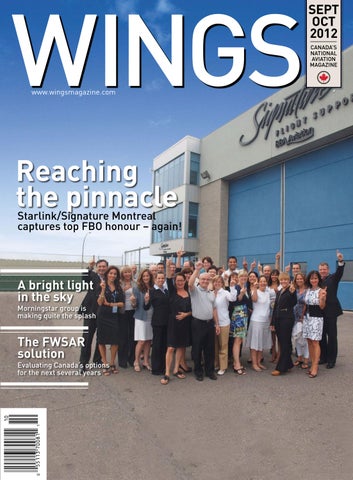
Reaching the pinnacle
Starlink/Signature montreal captures top FBo honour – again!
A bright light in the sky
morningstar group is making quite the splash
The FWSAR solution
evaluating canada’s options for the next several years
SEPT OCT 2012 caNada’S NatIoNal avIatIoN maGazINe
DNA. It Matters. Examine each and every aspect of a Falcon and you’ll find genius at work. But what makes a Falcon a Falcon is in its genes. Lightweight strength and maneuverability, battle-tested in Mirage and Rafale jet fighters. Unrivalled credentials for engineering excellence and technological innovation. And generation after generation of business aircraft that consistently prove best in class for performance and efficiency. And for pure genius.
Find out why. Scan the code. Or visit falconjet.com/dna
SEPT/OCT 2012
uPFROnT 5 leading edge
An infrastructure inadequacy
8 On the fly
News and opinion
12 Waypoint
New TAWS regulations
14 Alternate approach
Running out of runway
16 At the gate
Making its move
18 legal eagle
Contract termination
the alenia aermacchi c-27J Spartan is a turboprop aircraft with a level of commonality with the c-130J Hercules that the RcaF has found appealing. P. 34
20 glidepath
Presenting a united front
bACK 57 mRO directory 71 marketplace 78 On final
A competitive advantage
FEATuRES
22 SERviCE ExCEllEnCE FROm A TO Z
Starlink/Signature Montreal again captures top honour By matt Nicholls and Rob Seaman
26 ESTAbliShing A Winning FORmulA From top: Running out of runway P. 14 a bright light P. 49
Wings’ second annual roundtable highlights key operational issues By matt Nicholls
35 PREPARing FOR A SAFE lAnding
Montreal aerospace leader Héroux-Devtek continues to make strategic manoeuvres By Brian dunn
38 SEARChing FOR An AnSWER
The time is now to find Canada’s next fixed-wing search and rescue solution By chris thatcher
44 ROvinESCu’S EnTREPREnEuRiAl lEgACy
Air Canada’s chief executive is attempting to guide the airline to new heights By david carr
49 A bRighT lighT
A position report on Edmonton’s Morningstar group: succeeding in tough times By Frederick K. larkin
COVER PHOTO: MaTT NiCHOlls
56 ExPlORing mROs AFTER AvEOS
Canadian industry now in recovery mode By david carr
www.wiNgsMagaziNE.COM
September/October 2012 | wiNgs
3
WORL D - C L AS S T RAIN I N G. W O R L DWIDE R E AC H.
Our Full-Service Customers Tell the Story of FlightSafety’s Proficiency Protection Best.
Michael Young Former Senior Captain Eastman Kodak Aviation Services
To find out about the many benefits of being a FlightSafety Customer, please call Scott Fera, Senior Vice President, Marketing, at 718.565.4774. sales@flightsafety.com • flightsafety.com • A Berkshire Hathaway company
LEADING
EDGE
| By Matt Nicholls
An infrastructure inadequacy Help is needed to increase business aviation’s footprint
I
PHOTO: MilliONaiR VaNCOuVER
n mid-August, Prime Minister Stephen Harper announced the establishment and boundaries of Canada’s newest national park in the Northwest Territories. Located near the pristine shores of the South Nahanni River, one of the planet’s great wilderness rivers, the park ensures the provision of lasting economic, cultural, and social benefits on which Aboriginal and northern communities can build even greater growth and prosperity. With the addition of Nááts’ihch’oh National Park Reserve, the Government of Canada now manages 44 national parks, with a total area almost half the size of Alberta. It also operates 167 national historic sites and four national marine conservation areas. Canada’s national parks are intrinsic to the growth of the Canadian economy, generating millions of dollars in tourism revenue each year. National historic sites are equally essential in highlighting the profound accomplishments of great Canadians and contributing a sense of time, place and context in our development as a nation. From an aviation perspective, Canada’s historical footprint is also extensive. The nation’s aviation and aerospace achievements both here and on a global scale are significant, and are hallmarked in the aviation museums that dot the landscape from coast to coast. But do we do enough to highlight aviation achievements in this country? Shouldn’t there be more recognition from the various levels of government about its role in the development of our economy, and our country? Canada has one of the safest regulatory environments in the world but more attention needs to be paid to infrastructure development for future aviation-related initiatives. Such commitment has been of critical
5
and several large corporations
“We have to recognize that have been forced to scramble for alternatives. airports are as essential as Although the CBAA lobbied roads. If you don’t protect them, extensively to keep both airports open – as did local MPs – it was you hurt the industry.” to no avail. “If you take a look at importance south of the border for years, and now an impressive array of municipal and secondary airports are serving American cities, heightening business aviation’s profile – and hence increasing economic potential. Infrastructure challenges and a stronger commitment to aviation-related projects were key issues discussed at the second annual Wings roundtable during this year’s Canadian Business Aviation Association meeting in Toronto. Our seven superb participants were adamant a stronger commitment from various levels of government is needed nationwide. (For more go to “Establishing a winning formula,” pg. 26.) The impending closures of municipal airports such as Toronto Buttonville and Edmonton City Centre in favour of condos and shopping areas are a prime example of how aviation assets are taken for granted. Such myopic decision-making limits the growth of business aviation and curtails economic stimulation. As a result, corporations depending on the airports, flight schools
TOP dATA buRSTS… in this issue
1. There are more than 1,450 lockheed martin C-130s operating in 65 countries around the globe (pg. 8) 2. london’s Heathrow airport handled 69.4 million passengers in 2011 (pg. 14) 3. Héroux-Devtek’s aerospace unit accounted for $345.4 million of sales in fiscal 2012. (pg. 34) 4. air Canada lost $249 million on record revenue of $11.6 billion in 2011. (pg. 44) 5. 2,800: The number of skilled employees who lost jobs in the aveos bankruptcy. (pg. 56)
www.wiNgsMagaziNE.COM
the Buttonville and Edmonton situations we were very proactive to disclose the business aviation footprint and the multiplier effect and the economic impact,” said CBAA president/CEO Sam Barone. “In Edmonton and Buttonville the key drivers were the real estate value forces at play that offset any argument of the economic impact from the aviation side . . . in the end, the onus is on organizations like ourselves to show the economic value. ” A potential solution panelists suggested is to designate secondary airports as protected areas, much as it does with its national parks, and ease restrictions for future growth. “I’m not an advocate of government intervention or protectionism but in the case of airports it’s something that I think needs to be protected just like a park,” Bill McGoey, president of Edmonton’s Morningstar Group of companies told Wings. “At the government level, we have to recognize that airports are as essential as roads. If you don’t protect them, you hurt the industry.” Finding creative solutions to protect important aviation assets will be a constant challenge for the CBAA and other Canadian aviation associations going forward. Banding together to advocate for infrastructure change and borrowing from the model of Canada’s national parks is a great start in paving the way for more economic growth and prosperity. | W Your feedback is always welcome. Please contact me at mnicholls@annexweb.com. September/October 2012 | wiNgs
5
vol. 53, issue 5 EdiTOR
Matt Nicholls mnicholls@annexweb.com 416-725-5637 mEdiA dESignER
gerry wiebe
FlighT dECK
Ray Canon, David Carr, Paul Dixon, Brian Dunn, Frederick K. larkin, Neil MacDonald, Neil MacDougall, James Marasa, Carroll McCormick, David Olsen, Rob seaman, Chris Thatcher
SubScribe TODAY !
ASSOCiATE PubliShER
alison de groot adegroot@annexweb.com 1-888-599-2228 ext. 246
1 Year SubScription only
3000
$
AdvERTiSing SAlES
(GST $31.50 • HST $33.90)
adam szpakowski aszpakowski@annexweb.com 1-888-599-2228 ext. 246
US $42.00 (USD) • Foreign $65.00 (USD)
Name: _______________________________ Company: ____________________________ Title: _________________________________ Address: _____________________________ City: _________________________________ Prov: ________________________________ P.Code: _______________________________ Tel: __________________________________ Fax: _________________________________ e-mail:________________________________
PLeASe cHecK ONe: ❑ Commercial aircraft owner/operator ❑ Business/private aircraft owner/operator ❑ Military ❑ Aircraft maintenance/overhaul firm ❑ Airport ❑ Aerospace, airframe & component manufacturer and distributor
❑ Fixed base operator ❑ Aviation services, consultants and aircraft sales ❑ Government ❑ Aviation associations and organizations ❑ Flying schools, clubs and colleges ❑ Other (please specify) ______________
PAYMeNT: Cheque - Payable to Annex Publishing & Printing Inc. Visa
MC
AMEX
Account #: __________________________
SAlES ASSiSTAnT
stephanie DeFields sdefields@annexweb.com 1-888-599-2228 ext. 257 gROuP PubliShER
scott Jamieson sjamieson@annexweb.com PRESidEnT
Mike Fredericks mfredericks@annexweb.com WingS mAgAZinE
P.O. Box 530, 105 Donly Dr. s., simcoe, ON N3Y 4N5 Tel.: 428-3471 Fax: 429-3094 Toll Free: 1-888-599-2228
Publication Mail agreement #40065710 Return undeliverable Canadian addresses to Circulation Dept., P.O. Box 530, simcoe, Ont. N3Y 4N5 e-mail: subscribe@wingsmagazine.com Published six times per year (Jan/Feb, Mar/apr, May/ Jun, Jul/aug, sep/Oct, Nov/Dec) by annex Publishing & Printing inc. Circulation e-mail: subscribe@wingsmagazine.com Ph: 866-790-6070 ext. 208 Fax: 877-624-1940 Mail: P.O. Box 530, simcoe, ON N3Y 4N5 Subscription Rates Canada – 1 Year $ 30.00 (includes gsT - #867172652RT0001) usa – 1 Year $ 42.00 Foreign – 1 Year $ 65.00
Occasionally, wings magazine will mail information on behalf of industry-related groups whose products and services we believe may be of interest to you. if you prefer not to receive this information, please contact our circulation department in any of the four ways listed above. No part of the editorial content of this publication may be reprinted without the publisher’s written permission. ©2012 annex Publishing & Printing inc. all rights reserved. opinions expressed in this magazine are not necessarily those of the editor or the publisher. No liability is assumed for errors or omissions. all advertising is subject to the publisher’s approval. such approval does not imply any endorsement of the products or services advertised. Publisher reserves the right to refuse advertising that does not meet the standards of the publication. Printed in Canada issN 0701-1369
Expiry:_____________________________
TO SubScribe:
Tel: 866-790-6070 Fax: 877-624-1940 Mail: Wings Magazine c/o Annex business Media P.O. box 530 Simcoe, Ontario N3Y 4N5
Air Transport Association of Canada
ON THE
WEB
e-mail: subscribe@wingsmagazine.com
www.wingsmagazine.com
GST#135274215RT001
6
Subscriptions non-refundable
PRO0912
wiNgs | September/October 2012
wings subad.indd 1
Canadian Owners & Pilots Association
Canadian Business Aviation Association
Magazines Canada
CAREERS in AviATiOn Looking for a great opportunity in aviation? Check out our updated Careers in Aviation section for the latest information on flight schools, news, employment opportunities, career choices and more! www.careersinaviation.ca
PHOTO: MaTT NiCHOlls
Signature: _________________________
www.wiNgsMagaziNE.COM 12-09-04 11:08 AM
40 40 Aviall stocking locations around the world means we have a location close to you. Aviall works hard to provide you with exactly what you need, precisely when you need it. Aviall Delivers.
ON THE FLY For late-breaking news, the Wings blog and exclusive web content, please visit us at: www.wingsmagazine.com
8 induSTRy nEWS 10 FixEd-bASE OPERATiOnS 10 PEOPlE
induSTRy nEWS
PHOTOs: (BOTTOM) COMBaT CaNaDa, ROYal CaNaDiaN aRMED FORCEs; (TOP RigHT) BOMBaRDiER
CASCAdE AuThORiZEd AS C-130 hEAvy mAinTEnAnCE CEnTRE Lockheed Martin showed up at the 50th anniversary Abbotsford International Air Show with a large gift for local contractor Cascade Aerospace. The company will be authorized as a C-130 Heavy Maintenance Centre (HMC). Cascade is currently a Hercules Service Centre (HSC) and conducts in-service support for the Royal Canadian Air Forces’ (RCAF) legacy Hercules CC-130 and new CC-130J fleets. An HMC is one authorized to do work on the new C-130J aircraft, whereas an HSC is authorized to do work on the C-130B-H aircraft. Cascade is one of 13 HSCs and only the second HMC in the world. The step up recognizes the confidence Lockheed has in the British Columbia specialty aerospace and defence contractor. “As we see worldwide interest in C-130 support expand, it is incumbent upon us to ensure that qualified and experienced
companies support the Hercules community. Cascade is dedicated to support Canada’s CC-130 fleet and authorizing its role as an HMC provider is a natural step in our overall partnership,” said George Shultz, vice-president and general manager of the C-130 programs for Lockheed Martin. Lockheed Martin awarded a 20-year contract in 2010 to Cascade for maintenance services to support Canada’s new CC-130J fleet. Cascade also provides fleet management services directly to the RCAF for its legacy model C-130 aircraft. Lockheed delivered Canada’s 17th CC130J to RCAF 8 Wing Trenton earlier this year, completing the order placed in December 2007 and delivering the aircraft on budget and ahead of schedule. “We are honoured to receive this prestigious status from Lockheed Martin,” said David Schellenberg, chief executive officer for Cascade Aerospace. “With more than 1,450 C-130s currently operating in 65 countries around the globe – as well as Lockheed Martin’s C-130J delivery backlog and strong order book – this muchappreciated standing will significantly increase the international opportunities for Cascade Aerospace.”
mORE And lESS AT WESTJET WestJet has started reconfiguring its Boeing 737 fleet to add four rows of premium
WestJet will take delivery of seven Q400 NextGen turboprops in 2013, seven in 2014, four in 2015 and two in 2016. delivery of options is set to begin after 2015.
economy seats to the front of the aircraft. The eight premium seats will offer extra legroom seating with 36 inches of pitch. The airline’s premium economy product will also offer priority boarding and other onboard amenities. To accommodate the higher-fare seats, WestJet will reduce the pitch of the remaining seats to an industry competitive 31 to 32 inches. WestJet operates a mixed fleet of 99 Boeing 737 600s, 700s and 800s. The airline takes delivery of its 18th 737 800 in December, bringing the fleet to 100 aircraft. WestJet has extended its lease on three 737s to minimize disruptions as aircraft are removed from service. The reconfiguration, which is expected to be complete by year’s end, will boost capacity on the 737 800 to 174 seats from the current 166. The Calgary-based airline has also moved closer to launching a regional carrier by converting options for 20 Bombardier Q400 NextGen into firm orders. The airline still has options for a further 25 turboprops. With the order finalized, Gregg Saretsky, WestJet’s chief executive officer said the company is looking forward to fine-tuning its plan to launch the new regional airline in the second half of 2013.
lESS ‘WAiT And C’ FOR bOmbARdiER AT FARnbOROugh
canada’s 17th cc-130J departs marietta, Ga., for trenton. cascade conducts in-service support for RcaF cc-130J and legacy cc-130 fleets. 8
wiNgs | September/October 2012
Bombardier left this year’s Farnborough International Airshow with a thicker order book for its CSeries jetliner. The performance was in sharp contrast to 2010, when the airframer was shut out of orders for the single-aisle twinjet at the www.wiNgsMagaziNE.COM
PHOTO: ROlls-ROYCE
152,455 bricks went into one of the most complex lego structures ever built.
at the end of this year with first customer deliveries in 2013. The CS300 is expected to enter service in 2014.
ROllS-ROyCE unvEilS nEW vERSiOn OF TREnT 1000 – in lEgO Rolls-Royce celebrated the opening of the Farnborough International Airshow by unveiling the world’s first jet engine to be made entirely of Lego. The engine, which is one of the most complex Lego structures ever built, is a half-size replica of the RollsRoyce Trent 1000 which powers the Boeing 787 Dreamliner aircraft. The engine was displayed at Farnborough’s Innovation Zone, an area designed to engage young people in science, technology and engineering. A team of RollsRoyce engineers and apprentices used their knowledge of the engine to work with Bright Bricks, a U.K. company that specializes in brand promotions using Lego, to produce the one-of-a-kind structure. It took four people, eight weeks and 152,455 Lego bricks to assemble the engine.
“This has been such an exciting project to be a part of and something I never imagined I’d get to do,” said Ben Russell, a higher technical apprentice with the British engine manufacturer. “I hope our Lego engine will show others how exciting a career in engineering can be.” The Lego engine weighs 307 kg and is more than two metres long and 1.5 metres wide. More than 160 separate engine components were built and joined together in order to replicate the complex inner workings of a real jet engine. Everything from the large fan blades which suck air into the engine down to the combustion chambers where fuel is burned, had to be analyzed and replicated using the world famous building blocks.
CESSnA SElECTS P&WC TO POWER gRAnd CARAvAn Ex The Cessna Aircraft Company has chosen the Pratt & Whitney Canada (P&WC) PT6A-140 turboprop engine to power the Grand Caravan EX. Announced at EAA
PHOTO: BOMBaRDiER
biannual show. There was also news at the show that low-cost operator AirAsia has held preliminary talks with Bombardier to buy up to 100 of a 160-seat version of the larger CSeries CS300. Latvia-based airBaltic and an undisclosed customer have signed a letter of intent (LOI)and placed a conditional order respectfully for up to 35 aircraft. airBaltic is looking to acquire 10 CS300 aircraft and take purchase rights on an additional 10 CS300. The company already operates a fleet of eight Q400 NextGen turboprops. “As we look to replace the older aircraft in our fleet, matching the requirements of our business plan, we reviewed the narrowbody platforms from the major airframers and determined that the allnew CS300 aircraft was the best fit. The superb economics of the aircraft and the delivery timeframe that is available to us are also key factors in our decision,” said Martin Gauss, airBaltic’s chief executive officer. The order from the unidentified customer is for five CS100 and 10 CS300 aircraft. The order by both customers is valued at $1.59 billion if all aircraft are delivered. The Farnborough orders represent the 12th and 13th customer for the CSeries. The trend continues to be orders for small batches of aircraft, which would make an AirAsia order a game changer. Before that happens, however, Bombardier must squeeze an addition eleven seats into a 149-seat design and meet AirAsia’s delivery schedule. Bombardier continues to insist the CS100’s first flight will take place
latvia-based airBaltic has signed a letter of intent and taken purchase rights for up to 20 cS300s. www.wiNgsMagaziNE.COM
September/October 2012 | wiNgs
9
ON THE
FLY
AirVenture in Oshkosh, Wisc., the Grand Caravan EX will offer increased horsepower and the ability to expand its global operations profile. “The Grand Caravan EX will climb faster and have the power and capacity to take on missions in parts of the world with higher elevations and higher temperatures while still delivering on utility,” said Lannie O’Bannion, Cessna business leader for the Caravan. “Simply put, this aircraft places more of the world within reach.” The PT6A-140 was designed specially to meet Cessna’s needs. “We are proud to launch this new PTGA for our longtime customer,” said David Van der Wee, P&WC’s vice-president, business and general aviation. “The PT6A-140 is the first variant of next-generation products that produces 1,075 SHP thermal for significant improved climb, cruise and takeoff performance in hot and high operation. This is the most powerful PT6A engine in its class and it provides the best
power-to-weight ratio.” The available power in the Grand Caravan EX has increased almost 25 per cent, from 675 HP to 867 HP. This improvement boosts the aircraft’s performance, including a 350-foot reduction in takeoff roll, a 20 per cent improvement in the rate of climb, and a 10-12 knot cruise speed improvement over average. For the first time since the Grand Caravan was introduced in 1994, the Grand Caravan EX can be modified for amphibious operations with floats. “We kept the customer in mind throughout the entire development process on this aircraft,” O’Bannion added. “While providing more range and power, we have also delivered a new product that will have a minimal impact on direct operating costs.” P&WC has completed all development validation of the PT6A-140 engine and received Transport Canada type certification. Entry into service for the Grand Caravan EX is expected to be in the fourth quarter 2012.
West Wind Aviation has an exciting career opportunity
DIRECTOR OF FLIGHT OPERATIONS SHARE in our success...
GROW with us...
Take your career to new heights!
FixEd-bASE OPERATiOnS
SignATuRE OPEnS SECOnd CAnAdiAn FbO in EdmOnTOn Signature Flight Support has opened its second licensed FBO in Canada. Edmonton-based Airside FBO Operations has signed an agreement to provide a fully branded Signature FBO at the Edmonton International Airport. Signature opened its first Canadian FBO at Montreal’s Pierre Trudeau International Airport in 2011 through a licensing agreement with Starlink Aviation. The new FBO is targeting Edmonton’s booming mining, business and higherend tourism sectors. Edmonton International Airport will be the region’s primary airport when the controversial city centre airport closes. “We have had proven success with Signature in Montreal and our other global licensed and Signature Select locations and feel very strongly that we’ll bring the same experience to Edmonton,” said S. Michael Scheeringa, president of Signature Flight Support. Signature Edmonton is a newly built facility consisting of four 20,000 square foot hangers, a 9,000 square foot FBO facility and more than 30,000 square feet of office space. The facility will offer full ground handling and fuelling support and will deliver the full portfolio of Signature Flight Support services including the Signature TailWins pilot rewards program. The FBO will plug into Signature’s worldwide network of more than 100 FBOs in the United States, Europe, South America, Africa and Asia. “We are very proud to be joining the Signature network and we look forward to introducing a new level of customer service and flight support to the Edmonton market,” said Bill McGoey, president of Airside FBO Operations.
PEOPlE Located in the thriving city of Saskatoon, SK, West Wind is recognized as one of Canada’s 50 Best Managed Companies, and Western Canada’s largest full-support aviation operation.
www.westwindaviation.ca 10 wiNgs | September/October 2012
ThundER bAy’S WOOdS CAPTuRES 2012 WEbSTER TROPhy The Webster Memorial Trophy Competition wrapped up Aug. 18 with a lavish awards banquet at the Canada Aviation & Space Museum in Ottawa – and a pair of Andrew’s stole the show. Andrew Woods, representing the www.wiNgsMagaziNE.COM
thunder Bay’s andrew Woods captured this year’s Webster trophy.
Western Ontario region, was the big winner, capturing the 2012 Webster Memorial Trophy. Woods flies out of Confederation College in Thunder Bay, Ont. Andrew Burns representing the region of British Columbia was named runner up. Burns flies with Coastal Pacific Aviation in Abbotsford. B.C.
Some 120 dignitaries and guests from across the entire spectrum of the aviation community attended the event. The Webster has been sponsored by Air Canada since 1980 and three senior executives from the company were present along with senior executive representation from Jazz and Air Transat. The Webster has expanded significantly over the past few years and has had the good fortune to gather close to 30 significant supporters to the program including pronounced interest from the U.S. The program at the national level was altered this year with the introduction of Redbird Flight training devices as part of the flight-testing portion of the event. Flight tests also underwent change with the introduction of new exercises to challenge the skills of the nine finalists. Wings magazine would like to congratulate all the finalists who achieved this high standard in 2012. They represented their flight schools, Air Canada and Webster exceptionally well.
yxu hiRES FiRST buSinESS dEvElOPmEnT mAnAgER The London International Airport has appointed Brad Rice to the newly created position of manager for business development. The southwestern Ontario gateway completed a $6.5 million upgrade last year, including an 18,000 foot expansion to the departures lounge and four jet bridges. Rice has 23 years senior management, business development, operations and customer service experience in both the fuel and transport sectors. He will be responsible for expanding passenger services, developing air cargo and courier markets and exploring other commercial opportunities. YXU is Ontario’s 10th busiest airport. Air Canada, WestJet and United Airlines offer scheduled service to several Canadian and U.S. cities.
PHOTO: wEBsTER MEMORial TROPHY
The Clock is Ticking
Meet the mandate with Universal Avionics TAWS The new Transport Canada Terrain Awareness and Warning System (TAWS) mandate brings urgency to equip with a TAWS system with Enhanced Altitude Accuracy (EAA). Our TAWS meets the requirement while offering the highest level of CFIT Protection along with a unique terrain display and look-ahead conflict advisories. Equip with Universal Avionics TAWS today. Visit uasc.com/TAWS to learn more about the mandate.
UNS-1Ew and TAWS 2MCU
www.uasc.com sales@uasc.com (800) 321-5253 (520) 295-2300
www.wiNgsMagaziNE.COM Wings_UASC_Sept_Oct_2012_01.indd 1
September/October 2012 8/17/12 2:26 11 PM | wiNgs
WAYPOINT By Rob Seaman |
new TAWS regs finally in place Transport Canada needs to broaden its safety focus
I
12 wiNgs | September/October 2012
TAWS NPAs, and propelled the TCAS rules into play in the fall of 2006. TAWS NPAs remained on the shelf, however, as CFIT had not been subject to the same media scrutiny. The transport minister of the day issued a press release similarly worded to the one just issued by Minister Lebel, wherein the Government of Canada postured itself as springing into action to ensure the safety of the Canadian traveling public. Apparently, the TorStar series forced political action by the minister, likely to the dismay of TC’s senior management of the day. The aviation industry is still waiting for TC to spring into action and propel the long-awaited NPAs for UHF ELTs into legislation. In the end, the final amendments to the CARs requiring the installation of TAWS can be seen as a very positive step in ensuring the safety of Canadians nationwide. And while SMS is an important tool, as one TC employee recently said to me, “SMS is but one tool in the box. It should not be the entire box.” Let’s hope that going forward, TC focuses on a complete safety toolbox when it comes to aviation in this country – and important initiatives will not be mired in political processes. The Canadian public deserves it.| W
“SMS is but one tool in the box. It should not be the entire box.” Canadian Aviation Regulation Advisory Council (CARAC) records indicate that all of these dissents were placed in a typical CARAC timeframe and process. The TC agenda since 2002 has focused more on SMS (Safety Management Systems) and the belief seems to be that this theoretical and paper-driven “systems” approach can be the catalyst for further improvements in aviation safety. In shelving NPAs, TC assumed a calculated risk that there would be no CFIT accidents and no mid-air collisions in Canada during the time these regulations were languishing on the shelf. And while no mid-air collisions have occurred, there have been many other incidents. In 2006, the TorStar Newspaper Group did an exposé series of articles on aviation safety. They investigated more than 800 incidents between 2001 and 2005 in which Canadian planes came dangerously close to one another. In the end, the determination was more than 80,000 passengers were put at risk in those incidents, according to the study conducted by the Toronto Star, Hamilton Spectator and The Record of Waterloo Region. When the (political) smoke cleared, TC “unbundled” the TCAS NPAs from the
Rob Seaman is a Wings writer and columnist. www.wiNgsMagaziNE.COM
PHOTO: uNiVERsal aViONiCs
n early July, Transport Canada (TC) issued the long expected and final amendments to the CARs (Canadian Aviation Regulations) requiring the installation of TAWS (Terrain Awareness Warning Systems). In brief, these new regulations apply to virtually all commercial air taxi, commuter and/or airline operations as well as larger turbinepowered private aircraft. The applicable CARs are Subparts 703, 704 and 705 as well as high-end 604. TAWS has long been a requirement in the United States and other parts of the world. These rules were drafted more than a decade ago, and were originally intended to have had a harmonized implementation with FAA TAWS rulemaking in 2005. The TSB (Transportation Safety Board) has been suggesting, recommending, generally demanding and virtually begging that the CARs be changed since March of 1995. In a Government of Canada press release last December, Transport Minister Denis Lebel said, “Transport Canada is committed to the continuous improvement of aviation safety . . . Using TAWS will significantly reduce the risk of airplane crashes with land, water or obstacles.” Apparently, after the most recent spate of Controlled Flight Into Terrain (CFIT) accidents, Transport Canada (TC) wants to be seen to be springing into action! According to information from TC in the regulatory change documents for TAWS, the number of CFIT incidents tracked from 1977 to 2009 was the main driver for this new regulation. During that period of time, 35 airworthy aircraft were flown into the ground while under pilot control. The CFIT accidents resulted in 100 fatalities and 46 serious injuries during that reporting period. Unfortunately, a recent rash of incidents since then has driven those numbers up even higher. So why has it taken so long to make this proven safety technology mandatory in Canada? The answer is bureaucracy and politics – and the problem really is systemic. As always, there were prominent alphabet advocacy groups, and no doubt large organizations, objecting to any mandate that would compel their members or companies to spend money. That said,
loves Depart from the ordinary and arrive at the extraordinary with superior aerospace products from BASF The Chemical Company. BASF is proud to introduce a broad portfolio of products for the Aerospace industry: 䡲
Cabin Interiors Structural Materials 䡲 Seating Components 䡲 Fuel and Lubricant Solutions 䡲 Coatings and Specialty Pigments 䡲 Flame Retardants and Fire Protection 䡲 Other Innovations 䡲
At BASF, we create chemistry.
Get the free mobile app for your phone http://gettag.mobi
www.aerospace.basf.com
ALTERNATE
APPROACH By David Carr |
Running out of runway
London’s Heathrow airport facing a capacity crisis
F
14 wiNgs | September/October 2012
Air Canada is one of Heathrow’s top 10 airlines, while Canada is the airport’s second largest market outside Europe. effectiveness if allowed to stick. “The fact that we don’t have an aviation policy two years into this government – and they’re going to exclude the obvious – tells you everything you need to know,” a frustrated Willie Walsh, chief executive of the International Airlines Group, parent of British Airways, told the Guardian newspaper at the International Air Transport Association meeting in Beijing. British Airways, which has built a powerful global brand out of its Heathrow hub is most vulnerable, although many have a dog in this hunt including Caisse de depot et placement du Quebec, the powerful Quebec pension fund that has a 23 per cent stake in the consortium that owns BAA. Air Canada, too. Despite a tie-up with Lufthansa, Heathrow is the airline’s busiest international station. With 12 flights daily and 2.6 per cent traffic share, Air Canada is one of Heathrow’s top 10 airlines. Canada is the airport’s second largest market outside Europe. Calin Rovinescu, Air Canada’s chief executive, describes Heathrow as an aviation leader that risks falling behind airports like Dubai, already on track to knock the
U.K. hub off its “busiest international” perch by 2016. “When you look at the emerging markets of the world we are often ready to criticize or compliment them, but we are rarely ready to learn from them,”
he told Wings. If there has been a reoccurring theme in the capacity review it is this: no amount of high speed rail, urgently needed extra runway capacity at other southeast airports or blue-sky proposal to replace feathered birds with aluminium ones at an alternative airport in the Thames estuary will stem the bleeding of air transport from the U.K. Is the message finally getting through? Perhaps. The Conservative architect of the government’s green policy has admitted blocking a third runway is a mistake. Speculation is that the capacity review was delayed for a third time because the majority Conservative side of the governing coalition is readying a climb down to at least consider a third runway. Still, the calendar won’t be ignored. With an election expected in two years a third runway will again become a controversial football. All parties would like it kicked into the tall grass. But none can ignore the clock on U.K. aviation is running out. | W David Carr is a Wings writer and columnist. www.wiNgsMagaziNE.COM
PHOTO: sHuTTERsTOCK
or most of the history of international air transport, London’s Heathrow Airport has stood out as a global crossroads. But for how much longer? An increasing number of destinations where the world wants to travel do not cross through Heathrow. Heathrow is the world’s busiest international airport and third busiest overall, handling 69.4 million passengers in 2011. But with its two runways operating at more than 99 per cent capacity, Heathrow is turning away airlines and new routes from emerging economies. Frontier Economics, a U.K.-based consultancy reports there are 21 emerging market destinations with daily flights to major European hubs that are not served from Heathrow, including seven major cities in China alone. “Airlines are ready to vote with their feet and base new flights outside of the U.K. because of a lack of government policy supporting aviation,” said Colin Matthews, chief executive of BAA, the operator of Heathrow and five other British airports. Where there is an airport there will be politicians seeking cover. But Britain’s coalition government appears especially skittish. It postponed for a third time a major review of airport capacity. The 12th such review since the last full-length runway was opened in England’s crowded southeast in 1948, according to Katja Hall, chief policy director for the Confederation of British Industry’s. A third runway for Heathrow was given the go-ahead in 2009. Seeing an opportunity to burnish its green credentials and gain seats in constituencies surrounding the airport, the opposition Conservatives campaigned hard against the runway, a position that aligned with their eventual coalition partners. And one that appears to confound Hugh Dunleavy, commercial director of Malaysia Airlines and a former WestJet executive. “People may not like another runway, but when they bought their house didn’t they notice there was an airport there?” he asked the Telegraph. So strong has been the coalition’s opposition that the serial-delayed airport capacity review could not even consider added runway capacity at Heathrow, a decision that will seriously harm the review’s
"When you hold the breath-hold freediving World record, far ahead of all your competitors, you appreciate the exceptional performances of the breitling superocean."
Airline pilot and extreme recordman Herbert Nitsch earned his place in the history books as the only breath-hold diver to smash the 200-meter mark, a truly incredible feat. Nicknamed "The Flying Fish", this exceptional athlete with nerves of steel is now aiming for the legendary 1,000-foot barrier (–305 m). On his wrist is the Breitling Superocean, a concentrated blend of performance, reliability and style. Water-resistant to the fabulous depth of 2,000 m (6,600 ft), this ultra-sturdy and ultra-functional watch is equipped with an officially chronometer-certified movement – as indeed are all Breitling models. For Herbert Nitsch, the Superocean is the perfect companion for all manners of feats. CAD 3,565 Recommended retail price
AT THE
GATE
By Brian Dunn |
making its move
Toronto-based Sunwing Airlines sets its sights on growing Quebec market
W
16 wiNgs | September/October 2012
Lalonde refused to give up the rights to his version. “I think one of the main reasons we’re so successful is that our clients keep coming back again and again. If they didn’t like our product, they have two or three other choices.” Meanwhile, rival Transat AT said it will spend $48 million to update its aircraft to help preserve its market share in what it called “an over-served market.” Transat is totally reconfiguring its 12 largest Airbus A330 planes by the end of 2013. Three planes were ready for transatlantic service this summer. Six smaller A310s will receive smaller upgrades. In addition to having hi-def entertainment screens at each seat and mood lighting, the large aircraft weigh two tonnes less, for an annual cost saving of $13,000 in fuel. “We believe that product differentiation is going to be one of the keys to the future and so we want to differentiate ourselves from the pack,” said Air Transat president Allen Graham. The company is hoping customers will pay more for a more enjoyable flying experience as it tries to cut its losses. It has already shed 143 positions, and overhauled its executive suite among other changes in an attempt to save $20 million a year beginning in 2013. | W
“We’re not dictating the increased capacity, it’s our customers who want more flights to more destinations.” And because its fleet is relatively young, Char noted Sunwing’s aircraft are extremely fuel efficient, “so when the cost of fuel goes up it hurts us, but not as badly as other carriers.” And with just one single type of aircraft, the company also saves on pilot training, on-board personnel training and on maintenance. The vertically integrated travel company has more than 350 properties at its disposal through its Signature Vacations brand, including the Blue Diamond Resorts, a new wholly-owned subsidiary that will manage and develop its own portfolio of destination resorts and the Riu Hotels chain. “We’re stretching the travelling dollar by offering all-inclusive service with no frills,” said Char. “We also take calculated risks like offering four flights a week from Bagotville and we were the first in Quebec to offer flights south from Sept-îles. We’re also the first in Quebec to offer flexible holidays from a few days [as opposed to the minimum standard of a week] to several weeks.” The company has even adapted an old Neil Sedaka song, “Let’s Go Steady” for its ad campaign in Quebec called “C’est le temps des vacances.” Char ended up singing the song himself after Quebec singer Pierre
Brian Dunn is a Wings writer and columnist. www.wiNgsMagaziNE.COM
PHOTO: suNwiNg aiRliNEs
ith the busy winter vacation period just around the corner, Sunwing Airlines plans to increase its capacity in the Quebec market by 30 per cent. The Toronto-based carrier plans to have 11 of its 28 Boeing 737-800 aircraft servicing the Quebec market from Montreal, Quebec City, Bagotville, Sept-îles, Val-d’Or and Ottawa which is operated by its Quebec division, offering close to 400,000 seats. Seven of the aircraft will be based in Montreal and two each in Quebec City and Ottawa. The sun destination carrier offers 160 flights a week from Canada during the peak winter season. Sam Char, executive director of Sunwing Quebec, which has 600 employees in the province and a personnel operations centre near Trudeau International in Montreal, says the demand is there. “We’re not dictating the increased capacity, it’s our customers who want more flights to more destinations. We have been the preferred carrier by travel agencies in Quebec for the last five consecutive years,” Char said. New destinations include MontrealAruba, Montreal-Huatulco (Mexico), Quebec City-Cayo Santa Maria (Cuba) and Sept-îles-Punta Cana (Dominican Republic). All aircraft have 189 seats with an Elite Plus class, which offers more legroom and priority check-in and priority boarding. The company has been profitable every year since it was created nine years ago, according to Char. The carrier has been 49-per-cent owned by TUI Travel of the U.K. since January 2010 and generated $32 million in profits for the company during the first fiscal quarter of 2012, according to TUI. Sunwing also has a profit margin of around six per cent compared to the industry average of between 1 and 1.5 per cent, noted Char which he partly attributes to the carrier being so new and having tight control of its expenditures, without heavy cost structures and is not being unionized. “We’ve got a total of about 1,800 employees in Canada and not a lot of vice-presidents, so we have a relatively light operating structure. That enables us to make a lot of quick decisions on the spot,” Char said.
LEGAL
EAGLE By Neil J. Macdonald |
dealing with contract termination Understanding your rights when signing on the dotted line
I
18 wiNgs | September/October 2012
(damages) will arise. This can be done after the fact, through negotiation by the parties, or by the courts. Damages may also have been contemplated within the contract, with an amount agreed to beforehand under a “Liquidated Damages” heading. Contract formation and termination rules are applied in the same manner for most private and commercial operations in Canada – both in and out of the aviation industry. The rules have evolved in the courts and many have been codified into the laws of the provinces. Several statutes you will see in most provinces will apply, like the Sale of Goods Act and the Frustrated Contract Act, which outlines your obligations and your rights regarding contract formation and termination. While they are good places to start when analyzing contract status, I would recommend you consult with a lawyer if you, or your party, are contemplating repudiation – or you are the party on the receiving end of a contract termination. | W
When a contract is legally (and fatally) flawed ab initio it may have failed because of a missing essential ingredient of contract formation. induced the other party to enter into the contract. The statement may have been made innocently or deliberately, and matters only if it was in regard to a material component of the contract. The innocent party may then elect to continue, or set aside the contract – to undo it – once again returning parties to their original, pre-contract state. What can you do if the above scenario does apply, yet you do not want to continue with a contract? Again, regardless of whether it is a contract for an aircraft, aircraft parts, or a training bond, breaking a contract is fairly straightforward. You may decide not to perform your obligations under the contract when they are due, or you may decide to inform the other party ahead of time that you do not intend to perform. You have to ask yourself whether it will be more cost-effective to continue with a (bad) contract, or to terminate it and pay damages. This termination – or repudiation – of the contract may or may not be accepted by the innocent party. If the termination is accepted, the contract terminates, and all obligations under the contract end. If the innocent party refuses to accept repudiation, the contract remains in force. The primary obligations will cease, and the secondary obligations
Neil J. MacDonald is a B.C. lawyer. He has flown internationally as an IFR Off-Shore Aircraft Commander, locally as an Air Ambulance captain, and consulted on aviation issues in the Middle East. njm@neiljmacdonald.com This is not a legal opinion. Readers should not act on the basis of this article without first consulting a lawyer for analysis and advice on a specific matter. www.wiNgsMagaziNE.COM
PHOTO: isTOCK
n a previous issue of Wings, I wrote about contract formation, so I thought it might be interesting to discuss ways contracts may be terminated – whether the contract is for an aircraft, aircraft parts, or a training bond. You may think that once a contract is formed, you must ensure you complete your full obligations under the terms of that contract, but this is not always the case. For example, some contracts are legally flawed from the outset, may be voidable – ab initio – and can be treated as though they did not exist. Others, because of certain internal flaws, may fail by operation of law, and may be rescinded or voided, after formation. Finally, it is important to understand that a party to a contract may simply not perform their primary obligations under the contract. This breach usually results in that party paying damages (secondary obligations) to the non-breaching party. When a contract is legally (and fatally) flawed ab initio it may have failed because of a missing essential ingredient of contract formation, like lack of consideration, or improper offer and acceptance. It could also mean that there was not a complete consensus of the parties during the formation stage. This could be through the fault of one or both contracting parties, or simply be due to forces outside the knowledge of the parties. There may have been a common mistake as to the quality of the product the parties were contracting for – perhaps the time on an aircraft part was not as low as both parties originally thought. A voided contract usually returns parties to the starting point. You are free to renegotiate terms, or walk away – usually without penalty on either side. Partial performance may change that result, and will likely cause an accounting for the time or use of the subject of the contract. Contracts that are voidable, or that can be rescinded after formation, fall into another category. You will often see other (possibly negative) forces at play with these voidable contacts. The parties may not be in equal bargaining positions for example. That imbalance may be the root cause of a claim for duress or unconscionability. It may also occur because of a situation of operative misrepresentation. One party may have made a statement that fully or partially
GLIDE
PATH
By Paul Dixon |
Presenting a united front
Abbotsford International Air Show celebrates 50 years of making memories
O
20 wiNgs | September/October 2012
to use the aerospace industry to drive prosperity and raise it to a new level. RCAF CO Lt. Gen. Andre Deschampe praised the strong working relationship between the RCAF and the Canadian aerospace sector, describing the relationship as the key to the success the RCAF has enjoyed on its varied missions at home and abroad. Deschampe was frank in describing the current economic reality as the future for the RCAF. “[We will] innovative, agile and adaptive to ensure the Canadian taxpayers get the best value for their dollar.” This includes an increase in modeling and simulation to save wear on airframes and air crews, new uses for UAVs, and experiments with synthetic jet fuel to name a few. As the dignitaries were whisked away to perform the official opening ceremonies of the 50th Abbotsford Air Show, I couldn’t help but wonder what it will look like in another 50 years. Half a century ago, a group of people with energy, enthusiasm and vision took an underutilized airport and put on an air show with a budget of $700. Today, the event has an annual budget well up into the millions, and along the way it became the catalyst that drove not only the airport, but the entire region into the forefront of the Canadian and ultimately the global aerospace market. | W
“They are in partnership not just with the company, but with a country, a province and a community that is committed to the aerospace sector.” gone into the upgrading of facilities at YXX as well as the foresight in changing zoning on lands adjacent to YXX to enable orderly growth. Provincial Minister of Health Mike de Jong, speaking as the MLA representing Abbotsford West, emphasized the provincial government’s commitment to the aerospace industry by saying “we will stand shoulder to shoulder with the federal government, the city and airport authority and our partners in business to ensure that companies like Lockheed-Martin can extend their hand across the border to companies like Cascade Aerospace. We know that they are in partnership not just with the company, but with a country, a province and a community that is committed to the aerospace sector.” Abbotsford MP and Minister of International Trade, Ed Fast, underscored the importance of the aerospace industry to the Canadian economy by pointing out the large number of industry leaders present in the audience as well as the large number of MPs, MLAs and municipal representatives. The minister also discussed the blue chip panel currently reviewing Canadian aerospace under the leadership of David Emerson and the hope being that the panel members will come back with recommendations
Paul Dixon is freelance writer and photojournalist living in Vancouver. www.wiNgsMagaziNE.COM
PHOTO: Paul DixON
n the first day of the 50th Abbotsford International Air Show, early arrivals were staking out prime viewing spots or checking out the multitude of aircraft on the static lines. As vintage aircraft circled overhead, providing a hint of what was to come before the official start later that morning, few of those on the grounds would have noticed what was happening under a large white tent in front of the Cascade Aerospace facility a few metres from the east end of the viewing area. Billed as the B.C. Aerospace Showcase, every available seat was filled with senior executives from the Canadian aerospace sector and representatives from all three levels of government. The day before, the City of Abbotsford and Abbotsford International Airport (YXX) Authority had hosted a one-day Aerospace & Defence Expo at the Abbotsford Sports and Entertainment Centre. Owned by the city, YXX is embarking on an ambitious campaign to attract new aerospace industry tenants following the recent $30-million dollar airport expansion. More than 200 delegates attended from across Canada. The keynote luncheon speaker, President and CEO of Cascade Aerospace David Schellenberg, spoke as the Chairman of the Aerospace Industries Association of Canada (AIAC), emphasizing that success is not about one company being better than another or pitting the provinces and regions of the country against one another for business, but rather it’s about building the Canadian aerospace industry to compete on the world stage by working together. Friday morning saw a major press conference at Cascade Aerospace to announce Lockheed Martin has selected Cascade Aerospace to become one of only two Lockheed Martin-authorized C-130 Heavy Maintenance Centers (HMCs) in the world. The event drew a number of dignitaries from industry and the three levels of government. It was interesting to hear politicians from the three levels of government speak to the importance of the Canadian aerospace industry from the perspective of their level of responsibility. The mayor of Abbotsford spoke from the city’s perspective as the owner of the airport and the very deliberate process that had
MAKE PLANS FOR YOUR COMPANY TO BE PART OF THE LARGEST BUSINESS AVIATION EVENT IN THE WORLD – Attend or Exhibit at NBAA2012 Orange County Convention Center and Orlando Executive Airport Orlando, FL
• Over 26,000 Attendees • Over 1,000 Exhibitors • More than 100 Aircraft on Static Display • Ranked #4 among all U.S. tradeshows
NBAA also hosts
Learn more at www.nbaa.org M AY 2 1 , 2 2 , 2 3 , 2 0 1 3 G E N E VA , S W I T Z E R L A N D
SERvICE Ex
FROM A TO Z SEAmlESS CuSTOmER RElATiOnS hElP STARlinK/SignATuRE mOnTREAl REACh ThE PinnAClE by mATT niChOllS And ROb SEAmAn
22 wiNgs | September/October 2012
www.wiNgsMagaziNE.COM
PHOTO: MaTT NiCHOlls
xCELLENCE A
sk Starlink/Signature YUL president/CEO Glen Lynch to draw up the recipe for success for his fixed-based operation (FBO) at Montreal’s Pierre Elliott Trudeau International Airport and he’ll head straight to the end of the alphabet. That would of course be Z which in this case stands for chief operating officer Zoran Bratuljevic, the man Lynch contends is the www.wiNgsMagaziNE.COM
heart and soul of the operation. Bratuljevic and his team of top-notch service providers keep customers coming back and are key reasons why the Montreal-based FBO has been selected once again as the top vote getter in Wings’ second annual survey to identify the most impressive FBOs in Canada. Professionalism, impeccable customer service and attention to detail are all key elements that make up a winning FBO and Starlink/ Signature YUL provides it in spades.
“Winning the recognition for two years in a row is special,” Lynch told Wings during an exclusive interview in early August. “The first year of a survey, you look at the results and say, ‘We’re very proud, but it’s a first year. The second year, you see that the customers have spoken again and that’s really a tremendous honour. As a CEO you get the chance to stand up and take the recognition for a whole bunch of work you didn’t do. We have a tremendous September/October 2012 | wiNgs 23
team because this place is running 24 hours day, seven days a week. Our business depends on the commitment of our staff who are out there in good weather and bad, trying to manage when things aren’t going right. The relationships they build with the customers make all the difference.” Nurturing relationships and building just the right team starts with Bratuljevic and the commitment he brings to his role on a daily basis. His team shares the same attitude – they do sweat the small stuff. As Lynch notes, at Starlink/Signature YUL every element of the business is a drive to provide the very best – from the initial greeting of pilots/crew/ passengers arriving to their individual care while waiting for flights. “With us, it’s personal,” Lynch says. “We’ll walk through the lobby and it has become normal for us to – even if we are engaged in a conversation with someone else – to make sure we stop and pay attention to all customers.” Bratuljevic concurs, adding essentially customers are friends. “If you have a customer coming here once a week or twice a week for the past year, we still have a CSR greeting 24 wiNgs | September/October 2012
an airplane,” he says. “Why do we do that? Because we’re the only FBO where someone [of corporate influence] actually comes out to greet you – you have a decision maker right there,” he says. “And even after the 500th time, we’re still there. Not because we have to – they know their way around the premises. But we are relentless on meeting every client no matter how many times he or she comes here.”
method to the madness A relentless commitment to customers’ needs is one of the key drivers that connects all winners in this year’s report – but it’s just one of the elements that determines a winning FBO. Wings annual survey is unique in that it gives readers a chance to select which facilities, fuel brands and charge/ credit cards provide the best service for their aviation needs. Unlike other major North American FBO reports, this survey focuses specifically on the Canadian market. Results are based solely on respondent recall without prompting – readers select their favourite FBO based on personal experiences without the help of a cheat sheet or list. This method allows the survey not only to
by the numbers Wings’ 2012 FBO survey provides credible third-party ratings of how domestic facilities and their support services rank in the minds of clients who actually use them. Some 62 individual FBOs – up from the 40 named last year – were nominated and rated across Canada. The impressive increase illustrates that customers do remember service experiences; they may even feel loyal enough to comment. Winners in their respective categories include: • Best FBO in Canada: Starlink/Signature YUL • Best FBO in Western Canada (B.C., Alta., Y.T., N.W.T.): Skyservice YYC – new winner this year • Best FBO is Central Canada (Sask., Man., Nunavut): Kelly Western Jet Centre YWG – repeat winner • Best FBO in Ontario: Skyservice YYZ – repeat winner • Best FBO in Quebec: Starlink/Signature YUL –
repeat winner • Best FBO in Atlantic Canada (N.B., N.L., N.S., P.E.I.): Shell Aerocentre YYT – repeat winner
Fuelling up In terms of fuel cards, FBOs today need to accept a variety of cards and charge services to remain competitive and responsive. There have been some significant changes in the market this year with some brands pulling back or even out of the business altogether and others changing or modifying their corporate identity. For this part of the survey, the prominent card/charge service providers were once again listed with corrections to the new and/or current branding. Survey participants were asked to indicate which they used – in order of preference. Winners include: • Preferred Fuel Chain/ Brand: UVAir – new winner Preferred Fuel/ • Most Charge Card: Visa – new winner Other companies mentioned in order of preference: • Multiservice – no change from last year • Colt – no change from last year • AMEX – no change from last year • MasterCard – no change from last year • AVCARD – dropped from first last year AirBP/Epic – • UVAIR, mixed/blended rating from new and old cards • AVFUEL – up one rating from last year • Airworld – down one rating from last year • Ascend – no change from last year
The winning formula There were several determining factors that propelled each of our top FBO winners in their specific regions and impeccable customer service was again a determining factor. When asked how important customer service is in selecting an FBO, 65 per cent of our respondents indicated this was a significant deciding factor, a jump from 44 per cent a year ago. www.wiNgsMagaziNE.COM
PHOTO: MaTT NiCHOlls
Selecting just the right people to join the Starlink team is imperative for the company’s long-term success. coo Starlink/Signature zoran Bratuljevic is a key driver of the company’s objectives.
focus on Canadian service and support providers, but fosters the inclusion of more airports and service hubs nationwide. The methodology of the survey is straightforward – respondents are allowed to select up to five FBOs and answer a series of questions for each that provides a ranking on everything from service, pricing, to the bricks-and-mortar aspects of the site. Respondents are asked for a rating on each section using a scale of one through 10 for such attributes. The survey also asks, by prompted question, for a choice of branded chain fuel providers, individual preferred fuel brand and charge card options. We also asked participants to indicate how important pricing and customer service are in their choice of FBO. The survey was conducted online for six weeks from mid-June through July and final scores reveal how selected FBOs rated in their markets. Winners were selected based on region and one overall winner, Starlink/Signature YUL, was determined based on the total number of votes cast and related scores.
PHOTO: MaTT NiCHOlls
the Signature brand is the strongest FBo chain in the world, and has made a commitment to be as competitive as possible. living up to that billing every day is something intrinsic to every employee, says Starlink/Signature YUl president/ceo Glen lynch.
Price is also a key consideration: 31 per cent of respondents indicated this is an important element compared to just 24 per cent a year ago. When combining the two in the decision-making process, 96 per cent of respondents indicate a combination of price and service is the ideal recipe for making the right choice. This marks a marked increase over last year when only 68 per cent of respondents felt the two items helped decide which FBO to use. Lynch says the crux of delivering top-notch service starts with the empowerment of the employer – an ironclad commitment to training and instilling the right perspective in every employee. “Empowerment was a buzzword for years, but what it really is in our case is the customer experience that is not cookie cutter,” he says. “It’s a group of people who have been trained to anticipate and adapt to the changing needs of customers and try and make it interesting. It’s like a friendship. When you have a customer coming back again and again, you try to address their specific wants. If they were coming to your home, you try to serve them meals that they like – it’s the same thing here.” Starlink/Signature has created a thorough training program that helps employees learn to be attentive to a customer’s needs, large or small. It’s a program www.wiNgsMagaziNE.COM
that predates the company’s involvement with Signature, which has its own Leading Edge training program. “When you talk about toplevel service worldwide you have names like the Ritz-Carlton and Walt Disney. So, all of our VPs have been trained at the Ritz-Carlton,” Lynch says. “We developed a training program in-house that was inspired by Ritz-Carlton and tailored to our industry – we solicited outside help to do that. I led the original customer service training program five years ago and trained every member of our staff. Today, that program is run frequently enough to teach new employees – and occasionally there is an employee who is on duty for a couple of months in a job-shadowing environment that has not been trained, but we run courses frequently enough to ensure our staff are trained both initial and recurrent. And it’s always run at a minimum by a vice-president. It stresses the significance of that priority. It’s a top-down thing.” Lynch has had several conversations about service excellence with Bob Hobbi, president/CEO of Service Elements International, whose firm developed a Ritz-Carlton-style program aimed specifically at the aviation industry. Says Lynch: “At the end of the day, who do you work for? You don’t really work for your board. They may put a guy like me in an
office, but if Zoran and I look at our roles, our primary role is to support our own staff to ensure they have the tools necessary to service our customers every day. Our mission in life is to keep these people coming. They have a choice, you hear that all the time, but it’s the truth.” Sherry Butt, marketing and sales manager with Total Aerospace Services International/ Provincial Airlines, the operators of Shell Aerocentre YYT, agrees that the recipe for success starts with the commitment from staff to exceed expectations at all times. “We are efficient and try our very best to anticipate our customers’ needs before they can even ask,” says Butt, who is a little guarded when asked to reveal specific company secrets. “Let’s just say that we offer the little perks that our competitors don’t. Our facilities are designed to make all our clientele feel like VIPs every time they do business with us. We have a lot of hangar space and a full team of aircraft maintenance technicians and specialists.” As president of Winnipeg’s Kelly Western Centre, Gordon Peters maintains his role is to provide a top-quality product at all times – and he’s quick to point out it’s the strength of his staff that makes it all happen. “We value our dedicated staff and are committed to providing a safe, challenging and rewarding work environment that
encourages personal growth and is compensated fairly,” he says. “Staff are provided the same concern, respect and caring attitude within the organization that they are expected to share externally with every Kelly Western customer . . . We believe in and accept our responsibility as corporate citizens. ‘Corporate responsibility’ means a business operating in a manner that meets or exceeds the ethical, legal and commercial expectations that society has of business.” Peters says there’s one statement every staff member can never say to a customer: “No, we don’t provide that service.” Says Peters: “If we can’t do it, we have a whole city that provides a variety of services and surely we can find that service and arrange for our customer needs.” Going out of your way to serve a customer’s needs and never say, “No, we can’t do that.” It’s the calling card for every successful company on Wings top FBO leaderboard and will continue to be the goal all Canadian operations will strive to attain. So, looking ahead to next year’s report, how can companies coast to coast maintain their position or find their way onto the prestigious Top FBO list? Starlink/Signature YUL’s Bratuljevic aptly points out the answer is simple: head back to the alphabet and think of the letter S – as in “Keep sweating the small stuff.” | W September/October 2012 | wiNgs 25
ESTABLISHIN WINNING FOR WINGS’ SECOND ANNUAL ROUNDTABLE HIGHLIGHTS KEY OPERATIONAL ISSUES
BY MATT NICHOLLS
C
anadian business aviation is in a constant state of flux and while it represents just one element of the aviation framework in this country, solidifying its place in the overall scheme of things can be a challenge. Business aviation operators are faced with myriad challenges from dealing with economic realities to ongoing human resources issues – and so much more. Determining realistic strategies for successfully meeting these challenges was the impetus behind Wings’ second annual industry roundtable June 14 during the Canadian Business Aviation Association’s AGM and tradeshow in Toronto. The lively one-and-a-half-hour discussion generated by our super seven panel touched on a variety of key subjects and produced some tangible solutions to these issues. What follows is a snapshot of the discussion. For more insight, please follow our digital series at www.wingsmagazine.com.
Rolling with the punches
26 WINGS | September/October 2012
Participants in Wings’ second annual roundtable from left: Dave Shaver, Director of Business Development, Chartright Air Group; Bill McGoey, President Aurora Jet Partners; Ian Darnley, Director of Business Development, Sunwest Aviation; Sam Barone, President/CEO Canadian Business Aviation Association; Dean Carroll, Director of Flight Operations, Xstrata Nickel; Don Lockard, General Manager, National Socket and Screw; Jamie Vins, President/CEO, Vins Plastic.
had five aircraft, and now sits at some 30 fixed wing aircraft including Citation Ultras, Lear 45s, Gulfstreams and Hawker 800s as well as two rotary wing aircraft – an AgustaWestland 119 Koala and an AgustaWestland 109 Grand. One of the challenges Chartright faces is dealing with a high cost structure due to the flexible nature of the aircraft management
and charter business. “We have management agreements that are different – 30, 35 management agreements, each one that’s unique to an aircraft owner or situation. We also have administration that is relatively thorough, and at the other end, we a have a competitive industry that we are in. It’s starting to become fairly generic – and in Toronto with the entry of a lot of brokers WWW.WINGSMAGAZINE.COM
PHOTO: MATT NICHOLLS
A volatile economy has been a significant issue facing Canadian operators of all sizes over the past couple of years – finding ways to stay profitable and innovative in a challenging environment. We asked panelists how their companies have weathered the storm and what challenges the economic slowdown has created at their firms? Are there any emerging trends or market shifts that are taking place in the Canadian framework? Dave Shaver, director of business development for Toronto-based charter and aircraft management firm Chartright Air Group, said business is once again steady at his firm after marked slowdowns on the charter side in 2008 and 2009. Chartright’s fleet has grown steadily since 2003 when it
G A MULA
from the U.S. as well as Canada, price becomes a very, very strong attribute when customers are considering management or charter.” Shaver has noticed an emerging trend, indicating steady charter sales, month to month, but it’s quite difficult to predict. There’s also a saturated marketplace where new brokers have entered. “They certainly have a place and represent a spot in the industry, but it’s become very price focused – in combination with the competition out there, it’s become a challenging WWW.WINGSMAGAZINE.COM
marketplace to work in.” Another concern, Shaver noted, has been finding and retaining good people – an issue shared by other roundtable participants. Said Shaver: “Some of the institutions who are releasing people into the business aviation space, we feel some of these people could be given some additional tools. It would help them adjust to the challenges and unique scenarios that we face.” Ian Darnley, director of business development at Sunwest Aviation, has noted a similar increase in competition over the
past several months, which he maintains has a tendency to muddy the waters when it comes to quality and price. Operating from bases in Calgary, Edmonton, Winnipeg, and Vancouver, Sunwest is Western Canada’s largest and most diverse business aircraft operator with a fleet of 43 jet and turbo prop aircraft. The company offers a full range of business aviation services, which includes charter, aircraft management, cargo, fractional ownership, aircraft sales and acquisitions and consulting. “When you talk about the economy, it’s interesting because it’s strong and we have had a fantastic year as well, but it brings all sorts of competition out and that’s fine. We like competition,” Darnley said. “But the interesting thing about our business is there’s a wide variance between quality and pricing. You have people who own aircraft that decide they’re going to become a commercial operator, as opposed to the airline world where pricing is completely consistent and it seems like there’s little consistency in pricing. If you have a good, strong, safe operation with good equipment you expect a certain return for what you are selling – and then someone comes in who’s aircraft is $2,000 an hour less than yours for the same product. That’s what makes it difficult at some times even if the economy is strong.” Bill McGoey, president of the Morningstar Group, made up of Edmonton-based cargo-airline Morningstar Air Express and fractional ownership group Aurora Jet Partners, has navigated a significant corporate restructuring in the shadow of the economic downturn. Morningstar merged with the Ledcor Group and its Opus operation and was rebranded as Aurora Jet Partners. The company has also executed a major move. The Morningstar Group had been based in Edmonton at the City Centre Airport since 1971, but has relocated into its new facility at the Edmonton International Airport as the result of the scheduled closure of the Edmonton City Centre Airport. Aurora Jet Partners was a spinoff of the Morningstar Group, which has been flying private jets and cabin class pistons turboprops since 1971 in various sizes. The company has also flown Learjets and September/October 2012 | WINGS 27
Cessnas for years, and has six aircraft for its fractional operation with three on order, the first of those three arriving in August including the first Canadian Embraer Phenom 100. “We started this in 2007, which was not the best time, and of course we hit the cliff in 2009, but it was OK,” McGoey said. “We established with three airplanes, we had an ownership group that was committed to the three, we didn’t lose a customer during that time but we never gained one either [he laughs]. So, the recession was painful. We had growth plans and as you know, the fractional business model absolutely requires scale – you need to get up to that six, eight, 10 aircraft around a nucleus which is currently Alberta and B.C. as quickly as possible in order to minimize expenses such as positioning and so on. “So, we are at six with three on order which is nine this year and hope to be 20 in the next three or four years. We do see it definitely recovering, the phone is ringing again, and if the economy would just stop getting hiccups we would maybe see some kind of steady improvement here. But overall, we are in a great province, Alberta. As Ian can attest, it’s been fairly well protected in the downturn verses the rest of the country, really the rest of the world, we happen
to be the ‘Saudi Arabia’ of Canada. With $100 million invested in the Oil Sands at this time it really helps Calgary and Edmonton. So, this geographic location has helped us.” Alberta’s oil patch and Canada’s vibrant resource-based economy has helped insulate business aviation during the downturn, notes Sam Barone, president/CEO of the Canadian Business Aviation Association. “When you talk about the economy and what happened in Canada and what happened elsewhere, if you want to go up a little bit to about 40,000 feet, we are pretty tightly fiscally managed in terms of where “tHeRe’S GoING to Be moRe our economy is and going along,” he said. INdUStRIal cHaRteR, moRe “Our resource sector, oil and gas, has kept us pretty stable in terms of growth even at WoRKFoRce-tYPe a conservative three per cent. But we’re not isolated because of global conditions. tRaNSPoRtatIoN aS a “What we saw in terms of overall trends PRoPoRtIoN oF tHe when the economy took a dip is a lot of CaoveRall BUSINeSS avIatIoN nadian corporations increased their flying. And why? It’s because of the international actIvItY BecaUSe strategies of a lot of Canadian companies. comPaNIeS aRe comPetING They went looking for merger and acquisito Get PeoPle, to Get tion targets that were under priced and in some other slowing economies.” tHem to WoRK SIteS, to And while many Canadian firms have Get tHem IN aNd oUt.” been very aggressive in international mar– Ian darnley kets seeking out new opportunities, others
Airport Management
Fuel Services
Real Estate Development
Specializing in Aviation Expertise and Services for Western Canada
• Bulk Fuel • Fuel Drums • Remote Fueling • Into-Plane Refueling • Aviation Truck Rentals
Airports • Passenger & Terminal Services • Ground & Passenger Handling • Aircraft De-icing • Full Service FBO’s
Developments • Project Management & Administration • Hangar/Terminal Development • Facility Design • Office Space & Hangar Leasing
Visit www.EFCAviation.ca or call 1-888-299-2825 28 wiNgs | September/October 2012
www.wiNgsMagaziNE.COM
PHOTO: alisON DE gROOT
Fuel Services
have been busy reviving their fleets. “When the market went down, prices went down on used inventories of aircraft,” Barone said. “Pricing was probably the best you were going to get. People who had the good credit ratings and cash actually upgraded their fleets that were 20 years old, less fuelefficient to more fuel-efficient, technically capable aircraft that today have left them better off. So, all was not lost. But I think there’s still a cautiousness that’s become permanent in the economy today and it will continue.”
does bizAv have an inferiority complex? Raising the awareness of business aviation in Canada is an ongoing process, and “the Canadian way” seems to be to downplay its role in the overall corporate framework. Why do many Canadian firms fail to acknowledge aviation as one of their necessary financial drivers? Barone was quick to point out it has nothing to do with a lack of aggressiveness in the corporate arena. “Canada is more conservative, it’s more discreet. It doesn’t mean that we’re not as aggressive globally in terms of doing business, we just have a different perspective in how we do business in this country,” he said. “The situation in the United States
“tHe GRaNd PRaIRIeS, tHe BoNNYvIlleS oF alBeRta aRe BoomtoWNS aNd We’ve Got eXecUtIveS dRIvING tHRee aNd FoUR HoURS to tHeIR meetINGS. tHe Same GoeS FoR NoRtHeRN oNtaRIo. INFRaStRUctURe NeedS to KeeP UP.” – Bill mcGoey
continues to this day in terms of political attacks on the [business aviation] sector . . . starting with the General Motors debacle that started the ball rolling in overall attacks without recognizing the contributions to aerospace, jobs and suppliers – and the aircraft that are used as part of every major economic activity we can imagine.” It can also be argued, Barone noted, that Canadian companies are generally a lot more conservative in how they manage things publically – it’s not that they’re shying away. “I think in the business aviation community, we all know what it means but we don’t have as open a predisposition if you will about saying, ‘We flew the corporate jet to Vancouver instead of flying on WestJet today.’ Yet, there was a whole level of decision-making that went into that choice as to why that aircraft was used in that way.” McGoey concurs adding that its almost inherited behaviour. He suggests there’s a big difference between the American and Canadian outlook on business jets. Americans look at corporate jets as a sign of success; they will generally buy the largest jet that they can afford. Canadians, on the other hand, want to buy the smallest jet that will just do the mission in terms of numbers, size and range.
Workshops to help you meet regulatory compliance using the DTI real world methodology. DTI Training, the company that has spent the last 5 years delivering Quality Assurance and Surveillance Procedures training to Transport Canada, is pleased to announce its Canadian Fall Workshop schedule.
Space is limited! Learn from the team that trained the regulator! Register today at DTIatlanta.com/events.html
WoRkshops offeReD DuRIng each 4-Day sessIon IncLuDe: •
SMS Implementation for the Real World • Basic SMS Quality Assurance • Developing Manuals that Work! • Intro to Auditing • Developing an Acceptable Corrective Action Plan Choose a 4-day workshop package or individual courses.
faLL 2012 scheDuLe
PHOTO: alisON DE gROOT
Montreal – September 25-28
www.dtiatlanta.com
Calgary – October 15-18
1-866-870-5490
29-November 01
Don’t miss the 2nd Annual DTI Training SMS/QA Symposium, January 13-15, 2013 Coronado Springs Convention Resort, Disney World, Florida! This year’s theme: Statistical Process Control for small to medium sized companies. Go to www.DTIatlanta.com/events.html to find out more. www.wiNgsMagaziNE.COM DTI AdJuly2012.indd 1
Winnipeg – October Saskatoon – November 12-15 Vancouver – November 26-29 Edmonton – December 03-06
September/October 2012 | wiNgs 29 8/28/12 10:00 AM
“Americans are a little less conservative in their perceptions of aircraft,” McGoey said. “[President Barrack] Obama hasn’t helped that and he’s suggesting jets are a sign of excess versus success. The bottom line is businesses need private aviation to get to regional offices or where their clients are located. So, clearly [this perception] does need to change.” Don Lockard knows just how critical aviation is to his thread rod manufacturing business. The general manager of Beamsville, Ont.-based National Socket and Screw said his firm’s Cessna Citation
Mustang traverses the country moving parts and servicing clients nationwide. “We build our whole business model of what we do on the capability of me being in multiple places almost at once,” said Lockhard. “As the economy goes down, the demands on what I have to do go up . . . and that means I travel. When the economy goes down my travel just goes off the charts and spikes. I will do whatever I can to keep orders going into our shops and keep people busy.” Lockard flies countless hours per year by himself and notes that he uses a fairly sophisticated spreadsheet to track his
“tHeRe WIll Be coNSolIdatIoN aS PeoPle eNteR tHe BUSINeSS aNd RealIze It’S Not eXactlY WHat tHeY tHoUGHt It WaS – It’S ceRtaINlY Not aS RomaNtIc aS It WoUld Seem FRom tHe oUtSIde.” – dave Shaver
our solution Custom-designed and built 50% faster than conventional hangars 4-season construction » benefit from an earlier roi optimal thermal efficiency » significantly reduce your energy bills maximum value from investment » specify your exact needs industry leader » Quality you can trust
1.866.466.8769 www.canam.ws/hangars
30 wiNgs | September/October 2012
Airport infrastructure – are we doing enough? Aviation plays a critical role in the Canadian business framework, but panelists agreed not enough is being done to ensure airport infrastructure remains up to snuff. A stronger commitment from various levels of government in providing a more cohesive airport infrastructure would enable more firms to capitalize on potential business opportunities. When compared to the airport infrastructure in place south of the border, for example, the Canadian landscape is sorely lacking. Americans, noted McGoey, are very good at building airports and growing their infrastructure, which, in turn, creates significant opportunity for future investment and economic growth. “There’s something like 15,000 airports www.wiNgsMagaziNE.COM
PHOTO: alisON DE gROOT
Your hangar
whereabouts. Using the aircraft allows him to move around the country and service clients efficiently without wasting valuable in line waiting at congested airports or worse. “Last year, it was about 162 hours that I was able to stay in the office, one of my several offices, instead of some waiting area some place – or stuck in traffic or in a shuttle to get my bags or whatever. I was able to be productive for 162 hours. That’s a whole month! And yes, it’s due to me having a plane. Am I bad for doing it? Well, my factory is still going. I’ll do whatever I need to do to keep it going.”
[in Canada]. One of the problems we face is we have to share corporate aircraft and business aircraft at the large-airlinedominated hubs,” he said. “Toronto is an example, Calgary is an example, Edmonton is an example. And with Airport Authorities being siphoned off from the federal government in terms of management and operation development, we know have more of a hodge-podge development on an individual level instead of a national vision or national aviation policy.” Working with other associations to establish an effective blueprint that addresses
objectives for future airport growth is one of the association’s goals, and will help identify where business aviation fits in the mix. “You know, everyone wants to be across the street here [Barone points to Pearson] – but how do we manage that growth? The city is growing around it, so is there a vision, and who’s doing that? This is something I would like to put on a national agenda across various associations,” he said. “And not everyone is going to see eye-to-eye because Air Canada, WestJet, Transat and Canadian North and the airlines [they have their perspective]. I’ll tell you how many
“I WaS aBle to Be PRodUctIve FoR 162 HoURS . . . aNd YeS, It’S dUe to me HavING a PlaNe. am I Bad FoR doING It? Well, mY FactoRY IS StIll GoING. I’ll do WHateveR I Need to do to KeeP It GoING.”
PHOTO: alisON DE gROOT
– don lockard in the U.S., about 5,000 of those are paved,” McGoey said. “In Canada, we have about 500 paved airports. You could say we’re only 10 per cent of the American population, so we have the subsequent number of airports, but our landmass is virtually the same size – we both need to cover more than three million square miles of area, so, in theory, we should have a larger aviation sector. It would help as well to have a little more help from the federal government, even on the provincial level, on airports.” Lengthening runways and ensuring proper safety measures are in place at smaller airports and corporate airstrips are keys to maximizing business opportunities. “The 4,000-foot runways are good for the little pistons and single engines but if you want to sell some jets in Canada and get people moving around at a good pace, we need 5,000-foot runways in any progressive city in Canada,” McGoey said. “The Grand Prairies, the Bonnyvilles of Alberta are boomtowns and we’ve got executives driving three and four hours to their meetings. The same goes for northern Ontario. Infrastructure needs to keep up.” Barone noted that one of the things the U.S. did right away in the 1960s was to institute programs to fund secondary airports. If you look at major metropolitan areas within the United States, you can see how major centres have secondary options where business aviation is flourishing. “I think that’s something that’s lacking www.wiNgsMagaziNE.COM
September/October 2012 | wiNgs 31
slots they would like to allocate to corporate aviation at Pearson. It’s less than one.” The impeding closure of smaller municipal airports such as the Edmonton City Centre Airport and Buttonville Municipal Airport in the GTA is also putting significant strain on business aviation. McGoey, for one, fails to comprehend the logic of eliminating such important aviation hubs from the business aviation framework. “We’re actually shrinking in Edmonton in terms of airports,” he said. “We’re losing our downtown airport. Many cities in North America and around the world would kill for a downtown airport. Look at the resurgence of the Billy Bishop Toronto City Airport. Business aviation wants to go the heart of a city not out to the regional international airport. And in the case of Edmonton, the Airport Authority, they have to maximize their revenue, so these smaller airports actually bleed off revenue for them, and their preference would be to have one big Taj Mahal rather than one airport that serves commercial airlines and business aviation around it. So, I think the whole regime is problematic to helping business aviation.” Barone maintains the CBAA tried to present the business aviation case in preventing the closure of both Buttonville and Edmonton City Centre Airport, however the key drivers were the real estate value forces at play that offset any argument of the economic impact from the aviation side of it. “When you are looking at municipalities that are cash starved and are looking for new sources of revenue [it becomes a challenge], he said. “I think you are right, Matt, the onus is on organizations like ourselves to show the economic value. It’s the same reason why people say, ‘not in my backyard, I don’t like locomotives tooting their own horn’ or they don’t like trucks on the highway. Those trucks on the highway 32 wiNgs | September/October 2012
are bringing all the things that you are going to Best Buy for to see on the shelf.
is Canadian business aviation on the right track? So, is Canadian business aviation headed in the right direction? Will it continue to be relevant in Ottawa competing with its commercially driven cohorts, or will it continually have its needs curtailed and play “second fiddle” to powerful commercial drivers like Air Canada, WestJet and Air Transat? Barone is confident the premise of business aviation continues to be relevant today – and will be in the future – simply due to the dynamics of competition and globalization. “And when you take a look at the rationale and the key drivers for business aviation, it’s to maximize first mover advantage in your business – it’s to get to the appointment first, it’s to get that face-to-face time, it’s to get to exploit resources before the other guy does,” he said. “When you take a look at it within the context of competition, both domestically and internationally – and definitely transborder – then that premise and driver is never going to go away. If we are in market-driven economies, aviation will always be a key input in those market-driven economies. That’s relevant today and will be in the future.” McGoey agrees but cautioned that the industry’s overall success will always be closely tied to the economy, which is fortunately quite stable in this country. “The economy sneezes and our business aviation community could catch a bit of a cold. But the bottom line is Canada’s economy is very stable, we have an excellent banking system and that creates a good, stable environment for business and our businesses are large users of business aviation.” Darnley joked that while he has yet to
find the secret to reading the future, he does maintain market conditions dictate consolidation amongst some commercial operators over the next five to 10 years. “And because Canada’s economy is becoming more of a resource economy, there’s going to be more industrial charter, more workforce-type transportation as a proportion of the overall business aviation activity because companies are competing to get people, to get them to work sites, to get them in and out,” he said. “It’s the service they demand, so you’re going to see that increasing over time as well.” Shaver added that many who think of jumping into aviation for “romantic” reasons or the allure of quick financial reward may be grossly disappointed. “In the seven years I’ve been with Chartright, the business in Canada has changed quite a bit, certainly more aircraft have entered the market either under management or fractional or in different types of operating structures,” he said. “There’s a certain romance and attraction to aviation with its history and I think it stems from operators and new businesses with the idea that it would be great to start a management company or charter organization because it’s a neat thing or an attractive, romantic business. But when you live and breathe it for some time, you realize it’s a challenging business. The margins are relatively small, costs can be high due to high flexibility, and variety and the ability to charge a certain price is challenging because there’s a lot of competition. “As long as the barriers to entry are low, and existing rivalry is high, it will be an interesting business going forward. There will be consolidation as people enter the business and realize it’s not exactly what they thought it was – it’s certainly not as romantic as it would seem from the outside.” | W www.wiNgsMagaziNE.COM
PHOTO: alisON DE gROOT
Raising the bar of canadian business aviation is a key challenge going forward, according to participants in Wings’ second annual industry roundtable.
www.vikingair.com Toll Free: 1-800-663-8444 info@vikingair.com
despite a slow economic recovery, Héroux-devtek recorded record sales of $380.3 million, up 6.4 per cent from the previous year, while net earnings rose 38.4 per cent to $26.5 million.
PREPARING FOR A SAFE LANDING mOnTREAl AEROSPACE lEAdER héROux-dEvTEK COnTinuES TO mAKE STRATEgiC mAnOEuvRES
by bRiAn dunn
PHOTO: HéROux-DEVTEK
l
ast February, after reporting a strong third quarter, Héroux-Devtek predicted the commercial aerospace market will remain strong in calendar 2012, continuing through 2014. The Montreal-based aerospace and industrial products maker, which counts Bombardier and Lockheed-Martin among its biggest clients for civil and military hydraulic and structural parts, also is convinced it will benefit from increased deliveries of Boeing and Airbus aircraft. And the business jet market is showing signs of a recovery, translating into higher shipments, according to company president/ CEO Gilles Labbé. Year-end results for fiscal 2012 released at the end of May proved Labbé correct. Despite a slow economic recovery, Héroux-Devtek recorded record sales of $380.3 million, up 6.4 per cent from the previous year, while net earnings rose 38.4 per cent to $26.5 million. Aerospace accounted for $345.4 million of sales in fiscal 2012, up four per cent from $332 million in fiscal 2011. Sales of landing gear products rose 6.3 per cent to $242.3 million, including a full-year contribution (versus 11 months the previous year) from Landing Gear USA, a division of Héroux that added $4.4 million of revenue. www.wiNgsMagaziNE.COM
Increased activity for business jet and large commercial aircraft programs, mainly the B-777 and the A-320, as well as higher customer requirements for military products more than offset lower customer demand in the regional aircraft and certain commercial helicopter markets as well as unfavourable currency fluctuations. Sales of aerostructure products (airframe components and subassemblies) declined 1.2 per cent to $102.2 million due to the same reasons. These factors were partially offset by higher sales to the business jet market as well as production ramp-up for the Joint Strike Fighter F-35 program and the B-429 helicopter program. The modernization of two business aircraft, the Learjet 40 XR and 45XR, should be very positive for the company, which manufactures the landing gear and some wing components for the two aircraft. That follows a brutal 2008-09 period when six-to-eight seat business aircraft were hammered by the recession. The changes being made to the aircraft are so significant that parent Bombardier Aerospace renamed them the Learjet 70 and Learjet 75. “We think this modernization will result in an increase of orders which is good news for us,” Labbé said following the release of the fiscal 2012 results. “The dynamics of
most of our strategic markets, whether in aerospace sector or industrial products, are more and more favourable.” In terms of aerospace, growth will come mainly from the civil side, particularly the commercial sector where the company makes several components for the Airbus A320 and Boeing 777, both seeing stronger demand. “Airbus and Boeing will deliver more aircraft in 2012 that they did last year and their order books represent around seven years worth of production,” Labbé noted.
“They’ve delivered strong earnings for six consecutive quarters.” And after seeing some lean years, Bombardier’s Q400 turboprop got a boost when WestJet Airlines announced it will place an initial order of up to 45 Q400 NextGen aircraft to launch its regional airline. Héroux makes a number of components for the wings and frame of the Q400. Labbé maintains the business aircraft market is ready to take off and was particularly confident in the new programs his company will be involved in, namely the Learjet 85,
Embraer’s Legacy 450/500 and a new business aircraft from Dassault. He sees a modest increase in this sector next year, followed by a bigger gain in 2014. While the military market will be more problematic over the next few years due to reduced military spending by several countries, Labbé noted that Héroux’s portfolio of products in the sector is well diversified. The firm is particularly strong in the spare parts market which will be less impacted by reduced military budgets. The company is also very involved in the F-35 Joint Strike Fighter program, notably in the manufacturing of structural and locking components. “This year, we should deliver about the same number of assembled units as last year with a slight increase in 2014 and 2015 and stronger growth starting in 2016,” said Labbé. On March 31, Héroux-Devtek’s order backlog stood at $493 million, versus $502 million at the end of the previous fiscal year and remains well diversified. The company’s internal development will focus on leveraging the capabilities of its “world-class network by increasing the proportion of our business stemming from value-added products and services,” said Labbé. “Externally, our healthy financial position allows us to consider strategic acquisitions September/October 2012 | wiNgs 35
Héroux-devtek president/ceo Gilles labbé says his company’s internal development will focus on leveraging the capabilities of its world-class network by increasing the proportion of the business stemming from value-added products and services.
after seeing some lean years, Bombardier’s Q400 turboprop got a boost when WestJet airlines announced it will place an initial order of up to 45 Q400 NextGen aircraft to launch its regional airline.
that would add to our product portfolio and provide new technology. Assuming the Canadian dollar remains at parity versus the U.S. currency and considering forward foreign exchange contracts, we anticipate an internal sales growth of approximately five per cent for the fiscal year ending March 31, 2013, compared to the year ended March 31, 2012.” Analysts liked what they saw in the fiscal year-end results and are bullish on the company going forward. “Our favourable view . . . is driven by the fact that its key commercial aerospace end markets remain very strong. We expect increased production rates at
production rates on the Q400 program and reduced work on the F-16 program. And although the order backlog of $493 million was down from $515 million at the end of the third quarter, it remains at a “healthy level.” “There is strong visibility for (the company’s) key programs and we therefore expect backlog to remain stable or grow in the coming quarters. (HérouxDevtek) also indicates that it expects several contract renewals as well as new contract wins to boost the backlog in the coming quarters.” Doerksen agreed with Labbé’s projection that business aircraft activity should pick up in fiscal 2014, especially since
the complete landing gear programs for the Learjet 85 and Legacy 450/500 will only ramp up in fiscal 2014. Doerksen wouldn’t be surprised if there’s an acquisition in the works, noting that at the end of the fourth quarter, Héroux had $62 million in cash and up to $165 million in available credit, putting the company in a good position to make a “strategic” acquisitionto accelerate growth. “We believe that the company is actively searching for suitable companies to buy, although we caution that management is typically very conservative so a deal may take longer to manifest than expected,” he said.
A strategic sale with the long-term goal of remaining profitable and competitive in a challenging market, Héroux-Devtek in late July sold its aerotructure and industrial Products division to Precision Castparts Corp. based in Portland, Ore. The $300 million deal drove the company’s stock up 33 per cent and enabled the firm to return to its roots of focusing on making landing gear for key civil and military clients, some two thirds of the firm’s core business, said president/CEO gilles labbé. “Our vision is to continue to build Héroux-Devtek into a Quebec-based world-class organization in this core market,” said labbé. “[This transaction] allows us to be a more pure play in the aerospace business and a niche market also. we will develop more and more engineering products in the aerospace sector . . . the business we are keeping represents two-thirds of the revenue.” Héroux-Devtek is one of the key contributor’s working with lockheed Martin on the controversial F-35 lightning ii stealth fighter program and the deal does not affect the firm’s involvement in the program. labbé maintains the transaction allows the firm to concentrate on its key customer base including lockheed Martin, Bombardier and gulfstream. 36 wiNgs | September/October 2012
www.wiNgsMagaziNE.COM
PHOTOs: (TOP lEFT) HéROux-DEVTEK; (TOP RigHT) BOMBaRDiER
Airbus and Boeing, as well as at Bombardier, to drive continued growth for (the company)” analyst Cameron Doerksen at National Bank Financial wrote in a report. While Doerksen was expecting eight per cent revenue growth in fiscal 2013 versus Labbé’s projected five per cent, the analyst said new programs ramping up could push growth past the lower number. He noted Héroux exceeded the same five per cent growth forecast for fiscal 2012 on a 6.4 per cent revenue growth. Fourth quarter landing gear sales were in line with his forecast, but aerostructure sales were below forecast which Doerksen attributed to lower
While the commercial outlook remains favourable, Doerksen was concerned about Héroux’s exposure to the F-35 program which accounts for 10 per cent of its sales. Deliveries of the aircraft are expected to remain flat until ramping up “significantly” in fiscal 2016. But he also noted that the rest of the company’s military exposure is largely related to the less volatile repairs, overhaul and spare parts aftermarket. “The company is doing well on the civil side through its exposure (contracts) to Messier Dowty for the Airbus and Goodrich which is more aligned with Boeing,” said analyst David Newman of Cormack Securities, Toronto. “They’re also developing their own in-house platforms for Embraer.” On the military side, Newman said Héroux is less impacted from cutbacks since it’s mainly involved in maintenance, repair and overhaul and a lot of military aircraft returning from overseas missions
have to be repaired. There is also work from the F-35, he added. “It’s a fantastic company,” said another analyst who requested anonymity. “They’ve delivered strong earnings for six consecutive quarters. And despite the fact they are working with a strong Canadian dollar which puts pressure on their competitive position, they continue to win major orders from a number of companies like Lockheed Martin, Embraer and Dassault. They have enough back orders to keep them busy for at least two more years.” The only downside the analyst could see was if the price of oil climbs back over $110 a barrel which could cool aircraft demand or if Europe goes into a deep recession which would put pressure on some manufacturers such as Airbus, another important client for the company. Headquartered in Montreal, Héroux-Devtek has 1,500 employees at 11 facilities
analysts maintain Héroux-devtek is doing well on the civil side through its exposure (contracts) to messier dowty for the airbus and Goodrich, which is more aligned with Boeing.
throughout North America, including Longueuil, Dorval, Laval and St-Hubert in the Montreal area, Kitchener, Scarborough, Arlington, Tex., Springfield, Cleveland and Cincinnati, Ohio, as well as Querétaro, Mexico which opened last December. The Kitchener operation is a 100,000 square foot facility
for the machining of mediumto large-size landing gear components, while Scarborough is involved in the machining and assembly of complex precision parts, structural components and electrical chassis with integral heat exchangers. Approximately 70 per cent of the company’s sales are in the U.S. | W
For us it all comes down to trust. PHOTO: HéROux-DEVTEK
For 25 years Skyservice has been leading the Canadian aircraft charter landscape with facilities in Montreal, Toronto and Calgary all focused on providing the highest quality of safety and security in the air and on the ground. With Canada’s largest fleet of more than 50 corporate aircraft and a world class experience that goes above and beyond we invite you to experience - Air travel. Evolved. For more information call 1-866-759-4132, e-mail chartersales@skyservice. com or visit www.skyservice.com www.wiNgsMagaziNE.COM Wing Mag halfpage ad.indd 1
September/October 2012 | wiNgs 37 8:21 AM 12-08-28
a cc-115 Buffalo from 442 transport and Rescue Squadron 19 Wing comox, B.c. participates in search and rescue training exercise in Baring Bay, Nunavut, earlier this year. at 45 years of age, however, the agile Buffalos are well past their prime.
ThE TimE iS nOW TO Find CAnAdA’S nExT FixEd-Wing SEARCh And RESCuE SOluTiOn by ChRiS ThATChER
T
o appreciate the scope of search and rescue in Canada, look no further than a month in the life of 442 Transport and Rescue Squadron. Over a 30-day period this summer, among other missions, the CFB Comoxbased search and rescue (SAR) team airlifted a hiker off the West Coast Trail, hoisted two sailors from the waters of Queen Charlotte Sound, provided medical support for an injured hiker from the Nootka Trail, rescued two sailors from an overturned vessel near Texada Island, assisted the U.S. Coast Guard in the rescue of four American fishermen in the Alaskan waters of Dixon Entrance and evacuated a group of hikers from Strathcona Park, including one who had fallen along a cliff face at an altitude of 5,000 feet.
38 wiNgs | September/October 2012
All of these rescue operations involved either the venerable CC-115 Buffalo airplane or the CH-149 Cormorant helicopter, and more often, both aircraft. At 45 years of age, however, the agile Buffalos are well past their prime. Just six aircraft remain of the 15 that first entered service with the Royal Canadian Air Force (RCAF) in 1967, and all are employed by 442 Squadron for West Coast missions. Their low speed and all-weather capability have made them a superb fit for the coastal mountainous terrain. The CC-130 Hercules perform fixed-wing search and rescue operations in the rest of Canada. As the government prepares to host its fourth industry event in recent years this October, there is renewed hope that a request for proposal may finally see the light of day before the end of the year, if only in
draft form. The on-again, off-again nature of the fixed-wing search and rescue aircraft program has challenged the Buffalos and Hercs well beyond what many would have expected. Retired from production in 1986, the Buffalos are thin on spare parts while the older E and H models of the Hercs, the workhorses of the RCAF, have been stretched to their limits. A new aircraft would relieve the stress on all. First proposed by the Paul Martin government, the FWSAR replacement project has been labelled a priority by National Defence ever since, including a commitment in the Conservative government’s 2008 Canada First Defence Strategy to have 15 new aircraft by 2015. Following the 2011 election, both Defence Minister Peter MacKay and Chief of the Air Staff Lt.-Gen André Deschamps reiterated that pledge. Successive industry days since 2009 and a review of the mission requirements by the National Research Council, requested by the government following accusations that the Air Force’s focus was too narrow,
www.wiNgsMagaziNE.COM
PHOTO: CPl. Jax KENNEDY, CaNaDiaN FORCEs COMBaT CaMERa
SEARCHING FOR AN
Search and rescue (SaR) technicians board a cc-115 Buffalo before participating in the jump accuracy event during Search and Rescue exercise (SaReX) 10.
PHOTO: CPl. DaRCY lEFEBVRE, ROYal CaNDiaN aRMED FORCEs
ANSWER have expanded the program’s scope, so much so that there is now discussion of alternative service delivery options. An NRC report challenged some of the mission assumptions, including base locations, crewing and standby posture – a critique of the CF intent to transit to distant SAR areas from southern bases. The report also argued the statement of requirements (SOR) should be capability rather than platform-centric, adding “a capability-based SOR should not preclude options such as having part of the FWSAR capability contracted outside of the military. . .”
Putting it into perspective Canada’s search and rescue mission poses some unique challenges. With almost 10,000 square kilometres of varied terrain and three ocean borders that feature some of the world’s more hostile environments, including an Arctic region that is becoming more and more accessible with each passing year, SAR has repeatedly tested the Forces’ capabilities. www.wiNgsMagaziNE.COM
On average, Canada’s three Joint Rescue Coordination Centres in Halifax, Trenton and Victoria handle 8,000 air and marine SAR cases per year, and dispatch CF SAR aircraft on more than 1,000 missions. SAR crews and aircraft are based in Gander (CH-149 Cormorant helicopters), Greenwood (CH-149 Cormorant helicopters and C-130E/H Hercules aircraft), Trenton (CH-146 Griffon helicopters and CC-130 Hercules aircraft), Winnipeg (CC-130 Hercules aircraft), and Comox C (CH-149 Cormorant helicopters and CC-115 Buffalo aircraft), and supplemented by Griffon helicopters in Goose Bay, Bagotville and Cold Lake, as well as by a small arctic fleet of Twin Otter aircraft based in Yellowknife. And that demand is likely to grow. In May 2011, Canada signed a binding international agreement for Arctic search and rescue with the seven other members of the Arctic Council: Denmark, Finland, Iceland, Norway, Russia, Sweden and the United States. The intent is to coordinate SAR coverage and response. Whether it
will expand Canada’s already massive area of responsibility remains to be seen – under the UN’s Convention on the Law of the Sea, members are still working out their Arctic territorial claims – but it could test military resources even further.
determining the right choice What once seemed at best a two-horse race for just the right aircraft in the FWSAR mix has over time become a full field of contenders. That’s due in part to changes to the mandatory SAR requirements, but also more favourable conditions, most notably flexibility in the basing of SAR assets. Some key contenders include: Alenia Aermacchi C-27J Spartan Long considered the front runner, the Alenia Aermacchi C-27J Spartan is a turboprop aircraft with a level of commonality with the C-130J Hercules that the RCAF has found appealing. A modernized G.222 tactical transport aircraft with a new Rolls-Royce engine, it has been referred to by some as a “Baby Herc,” with a September/October 2012 | wiNgs 39
A CC-130 Hercules approaches Summerside Airport during 413 Transport and Rescue Search and Rescue Exercise on Sept. 28, 2011. The RCAF is seeking to replace the older E and H models of the Hercs.
subsidiary of Finmeccanica – were consciously selected for their Canadian expertise. PAL in particular offers extensive knowledge of East Coast and Arctic SAR. EADS/CASA C-295 The EADS/CASA C-295, also a tactical transport with turboprop engines, offers more pedigree as a maritime aircraft. The U.S. Coast Guard uses a variant while Spain, Portugal and Colombia all use the
Once again your FBO of choice in Central Canada – Thanks!
CYWG Winnipeg, Manitoba
Our productt is SERVICE. Our strength is PEOPLE. Our goall is YOUR SATISFACTION. • 15 Minutes from Downtown • Executive Terminal & Passenger Lounge, Conference Room, President’s Lounge • Catering, Limousine/Car Rental, Hotel Reservation Services • Pilot’s Lounge, Flight Planning Room • 24,000 square foot hangar • Canada Customs Clearance • Full Aircraft Services
www.kellywestern.com 30 Hangar Line Road, Winnipeg, MB R3J 3Y7 P 204-948-9500 | E customerservice@kellywestern.com | Unicom 122.85
40 WINGS | September/October 2012
WWW.WINGSMAGAZINE.COM
PHOTOS: (LEFT) CPL. VINCENT CARBONNEAU, 14 WING IMAGING GREENWOOD; (RIGHT) EADS
cruising speed of 325 knots. The Spartan is not being used as a SAR aircraft by other nations, but Alenia points to its role in humanitarian operations and missions in Scandinavian countries as an indication of its suitability for Canada’s varied geography and weather. Alan Calegari, CEO of Alenia North America, said in a recent interview that its partners – General Dynamics Canada, Provincial Aerospace Ltd. and DRS Canada, a sister
aircraft for maritime surveillance and SAR missions. The aircraft is also operated by the Finnish Air Force north of the Arctic Circle. With a longer cabin than the C-27J, the C-295 can hold more pallets of cargo or medical litters, and its air-to-air refueling capability extends the aircraft’s range. Though some have criticized its slower cruising speed of 260 knots, the company claims that Portugal picked the C-295 precisely because of its low and slow capability. EADS has brought onboard Pratt & Whitney Canada for the engines and Thales Canada for the avionics.
Lockheed Martin C-130J With Canada already employing some of its remaining H-model Hercules transport aircraft for SAR, acquiring a new J-model variant of the C-130 has a ring of logic to it. Lockheed Martin, which recently delivered the last of 17 new C130Js to the RCAF, builds a search and rescue variant of the Hercules for the U.S. Coast Guard. The company signalled its interest in the program during CANSEC in May with an announcement that it had signed an memorandum of understanding
with Abbotsford’s Cascade Aerospace “to jointly pursue mutually beneficial business opportunities,” including FWSAR. In a 2009 interview, Ross Reynolds, then head of Lockheed’s Air Mobility Programs, said, “We believe the C-130J provides you with a lot more versatility than a smaller aircraft.” While the size, speed, range and cruising time are considered pluses, the four-engine aircraft would be more costly to operate. Bell-Boeing V-22 One of the more intriguing contenders is
the tilt-rotor V-22 Osprey. Once written off as too expensive, the Bell-Boeing aircraft is now in its fourth year of multi-year production, with 160 aircraft fielded and flying and production costs in decline. At CANSEC, Bob Carrese, executive director of business development, said the V-22 is a good candidate because “we meet all of the essential elements, just as a fixed-wing airplane, but we also bring the option for a SAR team to actually make the rescue.” That capability might recue the need to deploy both an aircraft and a helicopter, bringing the expensive Osprey more in
24/7 READY TO SERVE AROUND THE WORLD
PHOTOs: (lEFT) lOCKHEED MaRTiN; (RigHT) BOEiNg
Visit us at NBAA booth #1500 A Fully Authorized Pratt & Whitney Canada Distributor and Designated O verhaul Facility
MAINTENANCE
l
R E PA I R
l
OVERHAUL
To l l Fre e : 1 . 8 8 8 . 7 6 9 . 0 9 9 9 l w w w.vec toraerospace.com
SETTING THE STANDARD OF CUSTOMER SERVICE www.wiNgsMagaziNE.COM
September/October 2012 | wiNgs 41
line with other competitors. With changes to the [SOR] that would allow bidders to propose SAR aircraft basing, Carrese said the V-22 would have little difficulty covering areas of responsibility. “This aircraft will go 1,000 nautical miles unrefueled. It has aerial refueling capability, and it can stop anywhere where there is a fuel cash,” he said often in areas inaccessible to fixed-wing aircraft. Viking Air Buffalo If nostalgia is a consideration, then there is always the option of replacing the Buffalo with . . . a Buffalo. British Columbiabased Viking Air holds the certificates for most of DeHavilland’s aircraft, including the DHC-5 Buffalo, and has offered to upgrade the existing CC-115 fleet while it manufacturers a brand-new aircraft. The old twin engines would be replaced by Pratt & Whitney Canada PW150s, and its top speed could increase from 235 to 300 knots. Given the CC-115’s superb history and its almost all-Canadian content, Viking’s proposal is being taken seriously. But there are always development risks, something the government might be inclined to avoid given its current experience with the F-35 Joint Strike Fighter 42 wiNgs | September/October 2012
and the Maritime Helicopter programs. As varied as the contenders are, it’s worth noting that the Buffalo grew into its SAR role, only becoming a dedicated search and rescue platform in 1973. Alternative Service Delivery And then, of course, there’s another alternative completely – outsourcing. The exceptional capability of CF SAR technicians has earned the Air Force many accolades over the years, but there has been a simmering debate about why aerial SAR is even a military mission. In a recent article for Vanguard, retired brigadier-general Greg Matte, formerly in charge of the FWSAR program while serving as Director Air Requirements, split the difference, suggesting now might be the time to discuss outsourcing certain aspects of the program while retaining military authority over performance and safety standards, including provision of some of the trained rescue personnel. Matte noted that the private sector would not face the same basing constraints as the military and could alleviate pilot shortfall as well as maintenance and support costs of “yet another unique fleet.” Last summer, Operation Nanook included a government-wide response
to a major air disaster. Tragically, what was intended to be a simulated exercise turned into the real thing when a chartered First Air Boeing 737 crashed into the ridgeline above the runway at Resolute Bay. Because of the resources in the Canadian Forces camp below – including SAR techs, Coast Guard, Environment Canada and Transportation Safety Board – lives were saved. But the accident reignited the debate about CF SAR capabilities, including the FWSAR project. In an interview in the weeks after, LieutenantGeneral Walter Semianiw, Commander of Canada Command, noted that placing CF search and rescue resources throughout the North would not be practical. “Could you help improve the capabilities of communities to respond?” he asked. Perhaps outsourcing certain aspects of SAR is one such option. Whatever the solution, the government needs to decide soon – the Buffalos and legacy Hercs are not getting any younger. Cabinet is reported to have signed off on the FWSAR project, but a decade since the program was first made a priority, most would call it a work in progress. | W Chris Thatcher is editor of Vanguard magazine. www.wiNgsMagaziNE.COM
PHOTO: CPl. DaRCY lEFEBVRE, ROYal CaNaDiaN aRMED FORCEs
master cpl. Phil Friolet, Sgt. Bryce culver and master cpl. Steve delage from 424 squadron based out of trenton, ont., move a simulated casualty while participating in a land rescue exercise during SaR exercise (SaReX) 10.
Major transformational shifts are occurring in the global aerospace industry. Technologies are fast evolving, markets are emerging and new players are becoming a force to contend with. Learn about emerging trends and challenges and how industry players can work together toward
GLOBAL VISION. ENHANCED COLLABORATION. SMART TRANSFORMATION. • Attend the “Bold Steps” Conference: Hear from renowned Canadian and international speakers on how shifting aerospace trends will impact your business. Discover how you can join the ranks of early adopters of transformational manufacturing and production process technologies and gain a serious edge over global competitors. • Do business and make connections: Use our Business-to-Business (B2B) matchmaking program to meet with leading Canadian and international contractors and suppliers. • Participate in the Trade Show and see the future of aerospace through the capabilities of domestic and international OEMs and suppliers of all sizes. • Network with industry leaders and decision makers from across Canada and around the world.
CALIN ROvINES ENTREPRENEu AiR CAnAdA’S ChiEF ExECuTivE iS ATTEmPTing TO guidE ThE AiRlinE TO nEW hEighTS by dAvid CARR
W
44 wiNgs | September/October 2012
While air canada has its own agenda, some of those steps will be defined by what the competition is doing, including WestJet’s low-cost carrier.
understands fare differentiation and product segmentation and is prepared to pay a base fare and add a certain layer of service whether it is food or anything else you are willing to offer.” In 2009, Air Canada was one of the world’s top 10 performers in ancillary revenue, collecting more than $774 million or $23 per passenger. The airline no longer posts a dollar figure, but in 2011, ancillary revenue from added services such as seat
selection, baggage adjustment fees and onboard amenities grew 18 per cent to about $1.1 billion, or approximately 10 per cent of total revenue. Innovation in both the cabin and back office resulted in further gains. At this year’s Farnborough International Air Show, Air Canada was named Skytrax ‘Best International Airline in North America’ for an unprecedented third year. Tighter fleet utilization has enabled the company www.wiNgsMagaziNE.COM
PHOTO: aiR CaNaDa
hen you hear the words entrepreneurship and innovation in the context of airlines, it typically refers to those who have recently started an airline,” Calin Rovinescu, the chief executive of Air Canada told Wings in a recent interview. “This is the thing most people don’t understand. David Neeleman who founded JetBlue is a very strong entrepreneur. WestJet’s Clive Beddoe is a very strong entrepreneur. However, if you take a legacy structure that has 75 years of history and needs to have a different model to operate as opposed to simply being destroyed – the drivers in that transformation are going to have to be just as entrepreneurial and innovative.” Air Canada turned 75 this September and Rovinescu has been at the centre of two of the airline’s most recent course altering events: privatization in the late 1980s and the airline’s exit from bankruptcy protection in 2004. Now in the executive seat, the Montreal lawyer is looking for the hat trick to pull an airline struggling with high operating costs, a legacy labour culture and challenging pension obligations even with its toughest low-cost competitors. Since emerging from bankruptcy protection, Air Canada has tacked toward the entrepreneurial. Most notably a ‘tango’ with two budget airlines from 2001 to 2004. The Tango brand was morphed into the current fare structure. Sitting in a wood paneled room alongside a wall filled with models of Star Alliance partners at Air Canada’s Montreal headquarters, Rovinescu defends Tango as an experiment that paid off. “We were the first full-service airline to try Tango. It was our form of R&D. It showed us that there is a market that
Cu’ S uRIAL LEGACY
to boost international capacity by 6.6 per cent. Better scheduling and improved relations with airport management at its Toronto hub have resulted in healthy increases in transfer traffic between U.S. and international destinations through Canada. Since 2009, Air Canada has more than doubled so-called sixth freedom traffic through Pearson International Airport. “Our historic approach has been to market to our top tier customers in Canada,” says Rovinescu. “Now we are taking it a step beyond. We are not just marketing www.wiNgsMagaziNE.COM
ourselves as an airline competing for Canadians. We are creating an international gateway, which takes network planning, marketing and constant conversations with airport authorities and regulators. A lot has to come together.” What has not yet come together is a cost structure to enable the airline to make money. A cost transformation program has stripped $530 million in non-labour costs out of the operation through initiatives such as crew pairing protocols, tighter RFP processes and new supplier
contracts. Rovinescu insists these are not “one off ” savings. Even so, Air Canada lost $249 million on record revenue of $11.6 billion in 2011. The picture was no brighter in the second quarter of 2012 with a loss of $96 million, more than twice the yearover-year loss for the same three-month period, despite easing fuel prices. “We have an amazing franchise. We have a great product and a great brand. We also have a very challenging cost structure and pension plan. But we can’t afford to sit still and hope that the rest of the world will accept we have a high cost structure.” Rovinescu insists the airline is on track to sustainable profitability and attributes the Q2 loss to several factors including labour disruptions and the unexpected bankruptcy of Aveos, the company’s largest maintenance supplier. “That was a real curve ball that was thrown at us. It was a very awkward time.” The Aveos collapse sent Air Canada scrambling for available maintenance slots around the world. It also exposed the weak under-belly of airline regulation in Canada. The Air Canada Participation Act was intended to placate opposition to privatization by laying out operational guarantees such as a floor for the percentage of fleet maintenance to be performed in Montreal, Toronto and Winnipeg. “You have 25 years of lapsed time since privatization,” says Rovinescu. “You have 25 years of the low cost evolution . . . of maintenance going off shore . . . of events like 9-11, which changed the industry forever, versus legislation that has long since lived out its usefulness. We do what we need to comply. But in a bigger policy perspective, an industry that collectively earns 0.5 per cent should not be seen as an easy source of social policy and of keeping other industry’s alive.” Recent arbitrated labour agreements will reduce cost pressures on Air Canada. Changes to the pension plan are also expected to ease a $4.4 billion pension shortfall by more than $1 billion. Scoping provisions in a contract with the Air Canada Pilots Association (ACPA) provides freedom to transfer aircraft to Air Canada Express partners such as Jazz and September/October 2012 | wiNgs 45
Air Canada president/CEO Calin Rovinescu is looking to pull an airline struggling with high operating costs, a legacy labour culture and challenging pension obligations even with its toughest low-cost competitors.
for an inevitable shakeup in the relatively calm Canadian air transport landscape, not experienced since short-lived, deep discounter Jetsgo inserted itself onto the scene more than 10 years ago. In 2013, Air Canada will be protecting its brand against a two-pronged strategy by WestJet to launch a yet unnamed regional airline to go head-to-head with Air Canada Express, while making a more aggressive
8& %0/ 5 .",& )*4503:
LIGHTING TOOLS t 4"'&5: "11307&% .0%&-4 t )&"%-".14
WE HELP KEEP IT 0/ $0634& TECHNICAL PAC P KAGING t )"/%)&-%
t 3&.05& "3&" -*()5*/( 1035"#-& "/% 3&$)"3(&"#-&
t 07&3 45"/%"3% $"4& 4*;&4 "7"*-"#-& t . &5"- %&$,4 "/% $3"%-&4 4&$63& )&"7: &26*1.&/5 t &-"450.&3*$ 4)0$, .06/54 *40-"5& 7*#3"5*0/ t $"4&4 "3& 8"5&35*()5 %6451300' $364)1300' "/% 3& 64"#-&
THE NEW PELICAN 2370 LED $PMPS .PEFT 8BZ .BHOFUJD 44FMFDUJPO 3JOH -VNFOT )JHI -VNFOT -PX "OPEJ[FE "MVNJOVN " N #PEZ 0 0O 0ò .PNFOUBSZ 55BJM #VUUPO
www.pelican.ca/wings 1FMJDBO $BOBEB t UI 4USFFU t &ENPOUPO "MCFSUB 5 4 + 5PMM 'SFF t 5FM t 'BY "MM USBEFNBSLT BSF SFHJTUFSFE BOE PS VOSFHJTUFSFE USBEFNBSLT PG 1FMJDBO 1SPEVDUT *OD JUT TVCTJEJBSJFT BOE PS BóMJBUFT
46 WINGS | September/October 2012
play for premium traffic. “The competition that comes from low-cost carriers is very appealing,” says Rovinescu. “That is because every day of the week somebody is doing something new. That forces us as an organization to be more competitive.” To underscore the point, WestJet recently announced plans for a premium package including added leg room in the first four seating rows, priority boarding and other amenities. Air Canada is also setting the stage to launch its own low-cost international airline aimed primarily at the leisure market. Rovinescu is neither concerned nor apologetic over the pending shake up. “The market will always evolve and we don’t plan to sit on our hands and watch the grass grow as it evolves. We need to respond to WestJet’s plans with respect to regional traffic. In terms of leisure markets and those markets that have evolved to the lower cost carrier environment – we also think we have a role to play.” Air Canada Express adjusted its inflight product to include a complimentary light meal and bar service to compete with niche carrier Porter Airlines on its Montreal route out of Toronto City Centre Airport. The airline will remain competitive in the regional market including potential fleet upgrades by transferring its 15 Embraer 175s to Air Canada Express while retiring aging Bombardier CRJ100 and 200s and replacing them with larger 700s and 900s. It is expected that up to 30 Airbus A320 and 20 Boeing 767s will be off-loaded to the low-cost airline. The bulk of the 767s will be transferred as leases expire and Air Canada starts taking delivery of its Boeing 787s in 2014. Air Canada is also re-evaluating its narrow body fleet and is expected to make some announcements next year, including phasing out the Embraer 190s, which are too large to be transferred to Air Canada Express carriers and making a decision on a new generation twinjet. Still, launching the low-cost carrier will be Air Canada’s single largest undertaking in 2013. Rovinescu describes it as a “growth opportunity” that will allow the airline to restore service to vacation markets that were no longer competitive because of a higher cost structure and open new leisure services. “We need to serve some of the sun destinations and pure leisure destinations with a product that is different from the competition – a full service product.” More than 10 years after Air Canada first pioneered the concept with Tango and Zip, low-cost subsidiaries of legacy airlines are about to regain some altitude. Iberia Express has unit costs 30 per cent below its troubled parent and is reported to be flying at a profit three months after WWW.WINGSMAGAZINE.COM
PHOTO: AIR CANADA
a planned low-cost subsidiary. Rovinescu is justifiably proud of Air Canada’s 26,000 employees and understands that labour peace – nudged along by the threat of back to work legislation – has come at a price. He insists it should not have come to this and it is here that passion enters the conversation. “Labour relations are a function of fair negotiation. One thing I have no sympathy for is a situation where you negotiate with a union, sign a tentative agreement representing six or nine months work and some group inside the union decided to be the opposition party and undermines the process. We negotiated in good faith with the CAW, CUPE, ACPA and the machinists, and in each case reached a tentative agreement. Then you have groups of disgruntled union representatives who seek to undermine what their colleagues agreed to and start all over again.” It does speak to the professionalism of Air Canada employees that – a handful of disruptive airport terminal protests notwithstanding – bad blood with management did not spill over into the flight deck or cabin. The new contracts represent a turning point for the future of the airline. They have certainly helped lay the foundation
Innovations such as improved fleet utilization have enabled air canada to boost international capacity by 6.6 per cent.
first of 37 Boeing 787 Dreamliner aircraft arrive. The airplanes have approximately 30 per cent lower fuel and maintenance costs than the 767s and Airbus A330s it will replace, with a seating capacity and range that will enable the airline to connect more cities point-to-point, expand into emerging markets in China, India and Latin America and increase frequency to popular destinations. Chronic delays in 787 deliveries caused
the airline to put some planned routes on hold, but also forced it to become more efficient. “It was not a bad time to sit it out for a couple of years, says Rovinescu. From a perspective of culture and transformational change, the delay was a good thing. When I arrived in 2009, we had a lot of challenges. What we didn’t need was a $4.5 billion financing requirement for new aircraft. Obviously some direct routes had to be placed on the backburner. But it
PHOTO: aiR CaNaDa
it was launched. Lufthansa and Singapore Airlines are considering similar low-cost models. “All legacy carriers have to consider some strategy to deal with low-cost carriers,” says Rovinescu. “Singapore Airlines – one of the best brands in the world – is forming a low cost carrier. Why? Because of the pressure.” Air Canada will make another leap to lower a cost structure in 2014 when the
www.wiNgsMagaziNE.COM
September/October 2012 | wiNgs 47
C
M
Y
CM
MY
CY
The new S1 PASSIVE joins the pioneering S1 DIGITAL
CMY
K
Sennheiser (Canada) Inc. 221 Labrosse Avenue Pointe Claire Quebec H9R 1A3 Contact: Tim Mell Business Director, Aviation tmell@sympatico.ca 514-927-5242
When we started the Quiet Revolution, we set out to make it accessible to everyone, ranging from student pilots to experienced aviators. That’s why you now have the choice between two outstanding S1 headsets with customizable comfort features such as adjustable headband tension and sunglass comfort zones. Put on your favorite S1 model: What you’ll get is a quiet environment and noise protection unsurpassed in a headset that offers a wealth of features and is so comfortable to wear.No matter which one you chose, you’ll get your personal S1, a headset that adjusts to you. You’ve heard the buzz and it’s true: The Quiet Revolution is now for everyone. www.sennheiser-aviation.com
48 wiNgs | September/October 2012
enabled us to become more efficient using our existing assets. We managed to grow capacity in each of the last three years basically off the same fleet.” Seven 787s are scheduled to be handed in over 2014. The remaining 30 aircraft will arrive between 2015 and 2019. Rovinescu won’t discuss where the first airplanes will be deployed or whether the airline is seeking compensation from Boeing for late deliveries. He does admit, however, that he would prefer to have the 787 in 2013 rather than 2014. As Air Canada struggles to lower its cost structure, it’s easy to question whether bankruptcy delivered the fix the airline needed, or just kicked structural problems further down the road. “You can’t snap your fingers and fix everything over night,” says Rovinescu. “We had some structural fixes and we were able to start weaning people off the notion of defined benefits in perpetuity. Some things were too difficult to accept in the social environment we had at the time. We also had fleet rationalization – getting brand new airplanes like the Boeing 777s and Embraer and taking out less fuel-efficient aircraft like the 747. If I look at this continuum of 25 years dating back to privatization, we have had a lot of structural change and a lot of good positive steps. Privatization was the first step. Restructuring was the second step. There will be a third step, a fourth step and a fifth step.” | W www.wiNgsMagaziNE.COM
PHOTO: aiR CaNaDa
Wings_Ad_4,625x5,0.pdf 1 12-08-29 11:32 AM It speaks to the professionalism of air canada employees that bad blood with management did not spill over into the flight deck or cabin.
POSITION
REPORT
aurora Jet Partners provides air charters, offers aircraft management services and operates a fractional ownership program. Its new FBo at edmonton International airport has just joined the Signature Flight Support family of more than 100 FBos around the globe.
A bRighT lighT A position report on Edmonton’s Morningstar group: succeeding in tough times | By Frederick K. Larkin
PHOTO: MORNiNgsTaR gROuP
A
t the launch of any enterprise, a company’s business plan typically defines its purpose, outlines how it will attract customers and generate revenues, offers detailed cash flow forecasts and assumptions and provides estimates of future financing requirements. Despite the best efforts, however, often market conditions shift. Sometimes what made sense in the start-up stage doesn’t any longer – the strategic vision changes in order for the company to survive, or because more attractive opportunities become available. When this occurs, creative thinking is required to keep the corporation headed
www.wiNgsMagaziNE.COM
towards prosperity. Such nimble helmsmanship has enabled one Alberta-based aviation company to deviate around economic storms and climb above financial headwinds for more than 40 years. Morningstar began with a pair of tiny Cessnas, and then became a dealer. It later transitioned into a charter operation using light piston twins, added small turbine aircraft to support courier companies and eventually developed an all-cargo jet airline. In recent years, it has returned to its general aviation roots with the creation of a division that manages and charters business jets as well as an expansive fixed-based operation (FBO) facility.
Given the turbulent state of the global economy, is Morningstar positioned to achieve
my long-term vision for the company is to build morningstar into a diversified aviation portfolio. stable growth or will its enviable longevity be challenged? Before attempting to answer this, it’s useful to review how the company has evolved over the past four decades.
That was then . . .
The company began during the summer of 1970, when BrookerWheaton Aviation Ltd. was founded at Edmonton Industrial Airport by businessmen Dr. Bev Brooker and Donald H. Wheaton. Their first two aircraft, a Cessna 150L (CF-AZN) and a Cessna 172L (CF-CKS), came directly from the factory in Wichita, Kan. Alberta’s vibrant economy provided lift for the small outfit and it grew into an FBO that later became a Cessna dealer at the downtown airport. The fleet expanded to include 300- and 400-series twin-Cessnas, Piper Cheyennes, Beech King Airs and eventually 20- and 30-series Learjets that were used for charters. September/October 2012 | wiNgs 49
edmonton’s newest FBo location was showcased in style this past June with an elaborate open house that gave guests a chance to test-drive several immaculate high-end sports cars.
50 wiNgs | September/October 2012
(a son of Canada’s Aviation Hall of Fame member Maxwell W. Ward) purchased half of the company and it was renamed Morningstar Air Express Inc. “Marjorie Morningstar” was the pet name given to Kim Ward’s mother by his father, Max. Donald A. Wheaton, a son of cofounder D.H. Wheaton, also joined the company’s board of directors. Over the following decade, the Morningstar fleet continued to evolve. The two F-27s were returned to their lessors in late 1993, a fourth 727100C was added in the spring of 1995, the Lear 35 was replaced by an HS-125-700A in mid-1995 and the last King Air was sold by the end of 1996. In 1998, the Metro wet lease contract with FedEx was cancelled and replaced with two leased Cessna 208Bs in Vancouver and Montreal. As cargo traffic continued to grow, so did the need for greater lift. In 2004, the Boeing 727-100Cs were replaced with larger 727-200Fs. By March 2008, the company had five 727-200Fs, an ATR42-300 freighter and the
six Cessna 208Bs operating for FedEx across Canada. Morningstar’s contracts with FedEx have traditionally been five years or less, but in 2009 it won a request for proposal (RFP) on a longerterm contract from FedEx. Not long after, it once again began upgrading its Boeing fleet. Two 757-200 freighters arrived in July 2010, followed by a third that October. The last two 727-200Fs departed the fleet in February 2011 and were replaced by an additional pair of 757-200s. The 757s could carry 80,000 lbs. in 14 pallets, compared with 58,000 lbs. in 11 pallets aboard the 727-200Fs. That represented a 38 per cent increase in capacity. While the cargo operation was continuing to grow, the company had not overlooked its other niche activity – corporate aviation. Morningstar Partners Ltd. was created in mid-2007 to provide a fractional ownership program (FOP) for clients in Western Canada. By the end of that year, its fleet consisted of a pair of Hawker 900XPs and a Bombardier Challenger 604.
An expanding footprint
Today, the Morningstar group includes interests in three companies: Morningstar Air Express Inc., Morningstar Partners Ltd. and Airside Properties Inc. Here’s a breakdown of each aspect of the operation.
Morningstar Air Express
As the provider of domestic lift for Federal Express Canada Ltd., Morningstar operates five Boeing 757-200s, seven Cessna 208B Super Cargomasters and one ATR42-300. All 13 aircraft are leased and wear FedEx’s distinctive white, purple and orange livery. Every weeknight, while most of the country is asleep, the 757s fly back and forth between Vancouver and Halifax, stopping at almost every major city in between. The Cessna 208Bs, based at Vancouver, Winnipeg and Toronto, feed traffic to/from Victoria, Thunder Bay, Timmins, Sault Ste. Marie, North Bay and Sudbury. The sole ATR42 is dedicated to the Montreal (YMX)-Quebec route. While FedEx personnel look after the www.wiNgsMagaziNE.COM
PHOTO: MORNiNgsTaR gROuP
During the early 1980s, Don Wheaton bought out Dr. Brooker and became the company’s sole owner. BrookerWheaton’s fleet became exclusively turbine-powered and it diversified into the aircraft leasing business. Not long after, it began operating for a number of courier companies using Swearingen Metros and Cessna 208 Cargomasters. In early 1990, B-WA won the right to operate domestic flights on behalf of Federal Express Canada Ltd. and initiated service with Cessna 208s in February 1990. In July 1990, its contract with FedEx was expanded to include the operation of a pair of Boeing 727-100Cs. That fall, the firm began flying a Toronto-Winnipeg-CalgaryVancouver routing in both directions. By the end of 1991, B-WA was using a trio of the tri-jets, a pair of Fokker F-27 Mk.600s and half a dozen Cargomasters for FedEx. At the same time, the company had enhanced its corporate charter fleet to include a pair of King Airs, a Learjet 35 and a Canadair Challenger 600S. In January 1992, Kim Ward
ground handling duties at all the stations, Morningstar crews handle all aspects of the flight operations. Morningstar Air Express is owned 50 per cent by each of Don Wheaton Ltd. (represented by Don A. Wheaton) and Interward Capital Corporation (represented by Kim Ward).
Morningstar Partners
Doing business as Aurora Jet Partners, this company provides air charters, aircraft management services and operates a fractional ownership program. In addition to ad hoc charters, charter time is also available in blocks of 25 or 50 hours for frequent travellers who don’t wish to purchase part of an aircraft. For those companies and individuals who require more air time and want to regularly fly aboard the same type of aircraft, the company sells interests in its aircraft ranging from a 1/8 share (100 hours of annual flight time) to a 1/2 share (400 hours). For aircraft owners that do not want to establish their own flight department, Aurora will look after matters related to flight crews, maintenance, hangarage, scheduling, catering, insurance and administration. The company’s fleet currently includes two Embraer Phenom 100s, one Embraer Phenom 300, two Hawker 900XPs and one Bombardier Challenger 605. Morningstar Partners is owned 25 per cent by each of Don Wheaton Ltd., Interward Capital Corporation, Ledcor IP Holdings Ltd. of Vancouver and a private investor from Edmonton.
Airside Properties
With the pending closure of Edmonton City Centre Airport, the city’s business aviation hub will be relocating 18 miles south to Edmonton International Airport. In anticipation of that, Morningstar has participated in the establishment of a multi-use facility on seven acres of leased land at CYEG. The recently completed $25 million first phase of the project features four 20,000 sq. ft. hangar bays plus 25,000 sq. ft. of space for flight department offices and an impressive FBO terminal. Phase two of the development will have approximately 100,000 sq. ft. of additional hangar space in three bays and another 15,000 sq. ft. for training facilities and administrative offices. Airside Properties is owned 33.3 per cent by each of Morningstar Partners Ltd., York Realty Inc. and the Sawridge Group of Companies, all of Edmonton. The crew An integral part of any corporation is its workforce. Morningstar’s team may be compact, but it is productive. Its 159 employees include 80 pilots, 35 mechanics and 44 others who serve roles in www.wiNgsMagaziNE.COM
operations, marketing and administration. The Morningstar Air Express pilots are the only unionized employees within the group. The contract with the Canadian Auto Workers is a long-term deal that has an automatic renewal clause in March 2015 that ensures an agreement is negotiated without the need for economic sanctions against each other. Morningstar also employs an internal committee system, consisting of employees and managers, called Team Resolution and Issue Management (TRIM). TRIM’s purpose is to deal with personnel issues throughout the agreement in order to minimize the need
for grievances and to keep the relationship open and strong. It does so by meeting once per quarter.
S.W.O.T. analysis of mORningSTAR In order to achieve a better understanding of any business model and therefore to appreciate how a company may perform in the future, it is useful to perform a S.W.O.T. analysis (strengths, weaknesses, opportunities and threats). Doing so with Morningstar provides the following insights:
MAINTAINING CANADA’S SEARCH AND RESCUE CAPABILITIES
WE DELIVER FLEET RELIABILITY OPERATING & MAINTAINING OVERNIGHT DELIVERY SERVICES - COAST TO COAST
flightcraft.ca
Maintenance • Modifications • Structures • Avionics • Components Engineering • TC DAO • DND ADO September/October 2012 | wiNgs 51
With an expansive new terminal that resembles the steel and glass palaces operated by Skyservice at toronto and by Starlink at montreal, aurora’s new FBo at edmonton International is positioned to house local flight departments forced to vacate YXd.
//// STREngThS
CAnAdiAn JET FREighTER FlEETS
imPRESSivE RECORd OF FinAnCiAl diSCiPlinE The company has survived more than four decades in an industry not known to be forgiving. Today, its two primary businesses employ a model that reduces exposure to variable expenses that are extremely difficult to forecast. On the fractional side, unpredictable costs related to fuel prices and repositioning flights are ultimately borne by the consumers and do not impact the company’s bottom line. Nonetheless, the need to optimize operating efficiencies never ends. A failure to do so would likely damage the healthy relationships with its customers that have been cultivated over many years in both businesses.
OPERATOR Morningstarair Express Cargojet airways Kelowna Flightcraft Total
52 wiNgs | September/October 2012
757-200 5 1 6
767-200 2 2
dC-10-30 4 4
TOTAl 5 13 17 35
Source: Transport Canada’s CCAR
expectations. At the same time efforts are made to foster an atmosphere of professionalism and respect amongst the workforce. The net result is a low level of employee turnover. The average tenure is more than 10 years and many employees have been with the company for more than 20 years.
//// WEAKnESSES OnE dOminAnT CuSTOmER Federal Express Canada is the sole source of revenue for Morningstar Air Express and it represents a significant portion of the group’s total sales. Morningstar has served FedEx for 23 years and has several years left on its current contract. Any change in
this long-running relationship would likely only come with a significant shift in the level of service provided or prices charged by Morningstar and/ or a material change in FedEx’s own financial condition. ThE TRAdiTiOnAl FRACTiOnAl OWnERShiP PROgRAm mOdEl The linear distribution of Canada’s population works against the traditional FOP model. A typical FOP operator’s profit can be significantly reduced by costs related to repositioning flights. Fortunately, Aurora’s FOP model is a hybrid that uses attributes of a traditional fractional ownership program as well as those of a typical aircraft management model. The result is a pricing
structure that is both transparent to the clients/fractional owners and allows the operator to make money by using a “cost plus” formula. Cost certainty is a key tenet held by Aurora’s management that is much appreciated by its customers.
//// OPPORTuniTiES gRAduAl ExPAnSiOn OF ThE CARgO CARRiER Given the current state of most of the G8 economies, it is somewhat reassuring to see that Canada’s is forecast to grow by at least two per cent this year and next. Slow but steady growth may not please everyone, but it has proven to be good for Morningstar Air www.wiNgsMagaziNE.COM
PHOTO: MORNiNgsTaR gROuP
COnSTRuCTivE CORPORATE CulTuRE From the owners on down through management to the line workers, attention is paid to providing a level of service that surpasses the clients’
CuSTOmER 727-200 FedEx uPs 10 Purolator 13 23
Express. During the past two decades, it has upgauged its jet equipment twice. Some industry observers have suggested that there is excess cargo capacity within Canada. Of the three carriers that provide domestic lift for the three largest courier companies, Morningstar has the smallest fleet (see accompanying table). Perhaps there will eventually be some consolidation within the industry. In the meantime, Morningstar is prepared to provide more capacity for FedEx if and when it may be required and is also open to other market opportunities as they arise. AuRORA JET PARTnERS’ FlEET ExPAnSiOn For each of its three activities (aircraft management, fractional ownership and charters), the company expects to see the number of aircraft in service increase. Today, its six aircraft represent 30 shares
WINGS half-page ad 7”w x 5”h
held by 21 owners. Aurora was the first Canadian operator of both a Phenom 100 and a Phenom 300. It will be receiving its second Phenom 300 early next year. In addition, the company expects to have the first of two Bombardier Challenger 300s in service this fall and is due to take delivery of a new Bombardier Global 5000 in June 2013. In 10 years, the company is planning to operate a fleet of 30 managed and fractionallyowned jets. AiRCRAFT mAinTEnAnCE Having maintained its own fleet of Boeing narrowbody airliners, turboprops and corporate jets during the past 20 years, Morningstar is considering that activity as a new source of stand-alone revenues. It will have room to do so in the new complex at YEG. In addition, it leases 14,000 sq. ft. of hangar space at Vancouver and 35,000
sq. ft. of hangar space at Calgary that is currently used for maintenance on its Boeings, Cessnas and bizjets. EdmOnTOn’S nEWEST FbO With an expansive new terminal that resembles the steeland-glass palaces operated by Skyservice at Toronto and by Starlink at Montreal, Aurora’s new FBO at Edmonton International is positioned to house local flight departments forced to vacate YXD, as well as to welcome itinerant traffic. The company recently announced that its new facility will be the newest member of the Signature Flight Support family of more than 100 FBOs around the globe.
//// ThREATS CAbOTAgE Should U.S. cargo carriers ever be allowed to operate within Canada, there would
likely be an impact on Morningstar Air Express. To what degree is difficult to estimate. Since FedEx already operates all of its trans-border flights, it might choose to continue to have the Canadian domestic flights operated by a contractor such as Morningstar. highER COSTS In both its air express and corporate aviation activities, Morningstar has customers that demand excellent service on a consistent basis at a reasonable price. This requires constant attention to detail and a close eye on service and operating costs. WEAKER ECOnOmy Significantly lower crude oil prices over a prolonged period, fallout from a European crisis or another North American economic downturn could result in dampened demand for both its freight and business aviation services.
It’s that old déjà vu all over again Canada’s best FBO two years running Voters in the WINGS Canadian FBO Survey have again chosen Signature Montreal the best in all the land. We appreciate the recognition. We put all of our energy into just that: being Canada’s best FBO. And we have a lot of energy. Visit Signature Montreal and experience the Signature Service Promise® for exceptional service every time. Year in and year out. Thank you to everyone who supported us with your WINGS vote. Visit us during NBAA at BBA Aviation Booth #3100.
SignatureFlight.com “Signature Flight Support” and the related logos and proprietary processes are owned by SIGNATURE FLIGHT SUPPORT UK REGIONS LTD. and are used under license to CORPORATION STARLINK F.B.O. INTERNATIONAL INC., the owner and operator of the FBO.
www.wiNgsMagaziNE.COM
September/October 2012 | wiNgs 53
The risk reduction model in the freight business and the cost-plus model employed by the fractional business meaningfully reduces concerns related to volatile jet fuel prices and the amount of deadhead flight time. This allows its management team to focus on operating efficiencies and delivering quality services that retain current customers and attract new ones. Sourcing and retaining capable people is a challenge for any company, despite what unemployment rates may imply about labour availability. Morningstar’s low personnel turnover reflects well on the company’s culture. It also serves to moderate training costs. The fact that Morningstar’s latest contract with FedEx is of a long-term nature speaks volumes about that
customer’s past experience, as well as its expectations for the future. If the same level of service persists, all should go well for both parties. The Canadian corporate jet charter and the aircraft management businesses are established models that tend to serve customers that require fewer than 50 hours or more than 400 hours of annual flight time, respectively. A potentially sizable market lies in between that is ideal for the fractional ownership program. Enthusiasm for that can be muted, given the fact that profitability has been elusive for many FOP operators because of the amount of non-revenue flying that is performed, but Aurora seems to have an innovative model that fairly distributes this expense between its clients. For every hour of revenue flight time, Aurora averages close to 20 minutes of repositioning flight time. For example, last year its
Freedom to choose.
as the provider of domestic lift for Federal express canada ltd., morningstar operates five Boeing 757-200s, seven cessna 208B Super cargomasters and one atR42-300.
Challenger 605 logged approximately 750 hours carrying passengers. About another 225 hours were attributed to ferry flights, resulting in full-year utilization of roughly 975 hours. The fees charged by Aurora for passenger flight time include the costs of repositioning aircraft. Aurora also uses a software program that posts all positioning flights for owners to see. The owners are able to take advantage of those flights, on any of the aircraft within the fleet, free of charge without using up any of their allocated hours. While Morningstar’s activities may not experience rapid growth going forward, that is probably not a bad thing. Many outfits have seemingly been blessed with fast growth, only to see their businesses founder for a variety of operational and financial reasons.
Can FOPs work in Canada?
PT6A Repair & Overhaul
www.primeturbines.com ENGINE OVERHAUL
ENGINE TESTING
FUEL NOZZLES
POWER SECTION
HOT SECTION
M.O.R.E. PROGRAM
GAS GENERATOR
BLEED VALVE
Dallas • Hyannis • Pittsburgh www.primeturbines.com 1.800.282.4744 John O’Brien 204.795.8415 54 wiNgs | September/October 2012
The fractional ownership concept was created in the U.S. when Executive Jet Aviation Inc. of Columbus, Ohio introduced its NetJets program in 1986. Since then, the business has grown dramatically with the largest five FOPs currently utilizing almost 800 aircraft. NetJets dominates the industry, with a fleet of approximately 550 aircraft comprised of 12 different types. The second largest FOP, Flexjet, operates about 80 jets including five models. U.S. fractional operators serve a domestic market that is broadly distributed. With Boston, Miami, Los Angeles and Seattle in the “corners” and many populous points in between, the American market is spread out on a grid. This explains why at any time a large FOP’s fleet can be located all over the map
– literally. These facts highlight the two defining differences between the U.S. and the Canadian markets: scale and distribution. Not only is Canada’s population approximately one-tenth the size of its southern neighbour, its distribution pattern is unique. Many of its key business centres (including Vancouver, Calgary, Regina, Winnipeg, Toronto, Montreal and Halifax) are laid out like a string of pearls along the 49th parallel. In addition, about 50 per cent of Canada’s population is located within a 700mile corridor from Windsor to Quebec City. The market’s geographic distribution is extremely important to any FOP operator because of the need to constantly reposition aircraft for their next missions. These non-revenue flights are a necessary evil in the traditional FOP model. Conversely, with a fully owned aircraft, its owner has to either house the crew and park the aircraft while on an extended visit, or send the jet back to its home base empty. Another important issue is the fact that a significant portion of Canadian corporate jet air time is spent flying south/north. Unfortunately, cabotage-related regulations restrict the use of commercially operated Canadian bizjets between any two points within the U.S. The same holds true for U.S. carriers in Canada. However, the Canadian Fractional Private Operator Certificate program allows a Canadian fractional owner to fly point-to-point within the U.S. – just as a fully owned Canadian private aircraft can. Given the smaller size and the linear distribution of Canada’s market, as well as www.wiNgsMagaziNE.COM
PHOTO: MORNiNgsTaR gROuP
Will the sun shine on Morningstar?
the U.S. cabotage restrictions, the traditional FOP business model continues to face some resistance in Canada. That may explain why there isn’t one truly national FOP operator that has clients from Victoria to St. John’s. Instead, there are a number of regional operators that serve the largest cities across the country. Could there ever be a transCanada fractional program with a fleet of 50 jets? Possibly, but probably only with a modified version of the traditional business model. Bill McGoey, Morningstar’s president, envisions the creation of a “pooling membership” whose participants would be corporate jet owners from across the country. The idea would be to make optimal use of aircraft by making them available to members through the administration of an aircraft utilization credit trading system associated with subscription/membership fees. That way long-distance
non-revenue repositioning flights could become less frequent by being shared or offered to members who may be in the vicinity to take advantage of a member’s jet. The largest Canadian business aircraft management companies have stayed clear of FOPs because of the aforementioned issues. Perhaps a co-operative effort by those companies and their clients could be the foundation of a truly national fractional ownership program – not simply a charter network. Many of these firms operate FBOs that have passenger terminals and hangars in Vancouver, Calgary, Edmonton, Toronto and Montreal. Key issues such as the types of aircraft to be used, standards related to the age of the equipment and the experience of flight crews, as well as the responsibility for scheduling, marketing, pricing and administration, not to mention regulatory matters, would have to be dealt with.
Does McGoey believe that there might be an interest amongst Canadian aircraft management companies in creating such a program? “I am convinced it is a visionary idea that if executed effectively would be industrychanging, but execution does have serious challenges to be overcome,” he said. “However, I believe that the industry and participant benefits outweigh these challenges.”
A final thought When asked what Morningstar’s successful track record can be attributed to, McGoey said, “I credit our ownership group, Don Wheaton and Kim Ward, for our longevity.” He notes that they bring key ingredients for success to the table, including “financial strength,” a “passion for aviation spanning generations of family involvement,” a “heartfelt commitment to our employees”
and an appreciation for the need to “nurture customer relationships.” Where does McGoey see the company in 10 years time? “My long-term vision for the company is to build Morningstar into a diversified aviation portfolio that owns and operates industry-leading and specifically-focused aviation services.” A long-distance flight sometimes requires numerous course changes in order to reach its destination without incident. The same can be said about the long-term management of a corporation. For 42 years, Morningstar has modified its businesses to meet the changing needs of its customers and remain viable. In the process, it has become a respected operator in the transport of time-sensitive individuals and packages. Befitting its name, Morningstar appears to be well placed to remain a bright light in the sky over Canada. | W
Not just a tug.
It’s a +1-503-861-2288 / 1-800-535-8767 www.lektro.com / sales@lektro.com www.wiNgsMagaziNE.COM
September/October 2012 | wiNgs 55
ExPLORING MROs AFTER AvEOS CAnAdiAn induSTRy in RECOvERy mOdE AFTER SuddEn SETbACK by dAvid CARR
T
56 wiNgs | September/October 2012
Smaller mRos in canada that operate in the shadow of the larger players when it comes to attracting specialized skills have not created their own pipeline through a national database.
for Sidney, B.C.-based Viking Air. Viking’s MRO division specializes in full service work for de Havilland Beaver, Turbo Beaver, Otter and Twin Otter aircraft. “The kind of work we do has put us at the forefront of the demand for specialized skills.” Aveos was also connected to the pipeline. So why have approximately 60 per cent of its employees not found work? “The surplus will get picked up as we move forward,” insists Donald. “Even now we are getting phone calls from MROs across the country asking how to get in touch with these people. For some it will mean relocating out of Montreal or Vancouver. There are a lot of issues.” Indeed, some of the ex-Aveos employees may be sitting it out waiting to see how the Aveos cleanup unfolds. On that front, there appears to have been some movement. British-based AJ Walter Aviation has signed a letter of intent to purchase Aveos component repair business, which could send 300 employees back to work this fall. AJ Walter Aviation has facilities in London, Dubai, Singapore and Miami and is expected to establish Montreal as the company’s global aircraft components maintenance headquarters. Interestingly, smaller MROs who operate in the shadow of the larger players when it comes to attracting specialized skills have not created their own pipeline through a national database. “No database that would connect employers with the skilled labour they need exists,” said Donald. “It is something that we need to look at.” The Aveos collapse presented a logistical challenge to Air Canada, who had sold Air
Canada Technical Services to a consortium that eventually evolved into Aveos, and was the airline’s main maintenance supplier. “We supported Aveos through many different forms, but primarily through a very generous long-term contract. But they were unable to attract sufficient third party business,” said Calin Rovinescu, Air Canada’s chief executive officer. The swiftness of the bankruptcy sent Air Canada scrambling to find maintenance spots in Canada and around the world, including Premier Aviation Overhaul Centre based at Trois Riviéres Airport in Quebec. Premier, which also has a location in Rome, N.Y, recently opened an MRO in Windsor, Ont. Other Air Canada work is handled by Lufthansa Technic in Germany and companies in the U.S., Israel, Hong Kong, Japan and France. “Basically we had aircraft and engines all over the place,” added Rovinescu. Air Canada is consolidating its MRO business and is working with the chief restructuring officer of Aveos and court appointed representatives to determine where many of the contracts will go. Can Canada remain competitive in global MRO? It depends on what the customer is looking for. Price sensitive basic maintenance will continue to shift to lower wage countries and MROs in emerging markets in Asia, South America and the Middle East will put added pressure on the North American industry. “It is a global industry and you can go anywhere,” Donald said. “The work we are doing now is more sophisticated and is being fuelled by Canada’s strong presence in manufacturing.” | W www.wiNgsMagaziNE.COM
PHOTO: BOMBaRDiER
he recovery in Canadian maintenance repair and overhaul (MRO) reported last year in Wings continues to take hold despite the Aveos set back. The sudden collapse of Montreal-based Aveos Fleet Performance last April sent shock waves across the MRO industry and raised questions over Canada’s competitiveness in global MRO. It has also left Canada without a single, full-service operation as aircraft fleets continue to grow and operators outsource more engine and component work. “Quebec’s aerospace industry feeds off each other,” said Robert Donald, executive director of the Canadian Council for Aviation and Aerospace (CCAA). “Having local suppliers is important, and having a world class, full service MRO was a boon to the entire industry. It is now one less piece in the cluster.” The Aveos bankruptcy tossed 2,800 largely skilled employees out of work including 1,800 in Montreal. It is estimated that approximately 40 per cent have found new employment, although not all in MRO or even aerospace. Many have found jobs at neighbouring Bombardier to work on the CSeries jetliner, Rolls Royce Canada and Innotech Aviation. Others have departed the sector for careers with CN and Hydro Quebec. Rob Brooks, general manager of Innotech Execaire in Dorval told the Montreal Gazette, “these are highly experienced, highly trained and highly focused individuals. We’re talking about seasoned employees.” Innotech has hired approximately 40 ex-Aveos employees and is looking for a few more specialized skills for avionics and design engineering. It is a familiar story in Canadian MRO where Original Equipment Manufacturers (OEM) like Bombardier and Pratt & Whitney Canada, and large MROs such as StandardAero and Viking have a ‘pipeline’ to available skills, while smaller shops cope with a continued skills shortage. “We have been very lucky,” confirms Rob Mauracher, vice president of business development and general manager of MRO
mro directory AviAltA Helicopter MAintenAnce ltd.
n
1A 27018 SH 633 Villeneuve Airport, Sturgeon County, AB T8T 0E3 Tel: 780-460-1800 Fax: 1-888-743-0187 Website: www.avialta.com E-mail: avialta@avialta.com Personnel: Paul Horvatis
cAnAdiAn Aero Accessories ltd.
170 George Craig Blvd. NE, Calgary, AB T2E 7H2 Tel: 403 250-9077 Fax: 403 250-6841 Website: www.canadianaero.com E-mail: sales@cdnaero.com Personnel: Jeff Runciman
condor AircrAft Accessories (1996) inc.
n
flyrite Accessory overHAuls ltd.
n
propWorks propeller systeMs
n
15357-114 Ave., Edmonton, AB T5M 3S9 Tel: 780-457-1910, 1-888-457-1910 Fax: 780-457-1939 Website: www.propworks.ca E-mail: propworks@telus.net Personnel: Mike Wagner, Cliff Arntson
rocky MountAin AircrAft
103, 5655-10th St. NE, Calgary, AB T2E 8W7 Tel: 403-274-3636 Fax: 403-274-3684 Website: www.staufferaero.ca E-mail: tc@staufferaero.ca Personnel: Tim Morrison
n
s me nt Canadian Aero has been servicing components for the aviation industry since 1964. We are unmatched at quality, price and especially turnaround time.
Canadian Helicopters provides comprehensive helicopter support services - repair and overhaul for engines, avionics, components, and structures. We service civilian and military aircraft within Canada and internationally. Backed by 65 years of experience, Canadian Helicopters is an industry leader in refining maintenance practices. We offer cost effective, flexible and responsive maintenance solutions, and deliver quality workmanship.
n n
Repair, overhaul and sales of various aircraft components.
Overhaul and repair of electrical components. Factory trained. Specializing in starter-generator overhauls – Goodrich (Lucas), Skurka (APC), Thales (Auxilec), Bendix and Geneva STA for Arriel engines. Also Dynamic Air fans, RCCO’s, CPVR’s, AMO 90-97
n
n n
129 MacLaurin Dr., Calgary, AB T3Z 3S4 Tel: 403-288-3305, 1-800-661-1130 Fax: 403-286-2137 Website: www.rockymountainaircraft.ca E-mail: rocky@pathcom.ca
stAuffer Aero, A div. of HeritAge Aero ltd.
Escape slides, fire and oxygen bottles, life rafts
n n n
Hgr. 40, 12021-121 St., Edmonton, AB T5L 4H7 Tel: 780-429-6900 Fax: 780-429-6917 Website: www.canadianhelicopters.com E-mail: beaton@canadianhelicopters.com Personnel: Bryan Eaton, General Manager, Third Party Maintenance Services
9615–56 Ave. NW, Edmonton, AB T6E 0B2 Tel: 780-439-6020 Fax: 780-439-6101 E-mail: flyrite@incentre.net Personnel: Peter C. Jenkins, President/Director of Maintenance
Avialta specializies in the buying, selling and leasing of helicopters, component overhauls, new and reconditioned part sales. Bell, Robinson and Turbomeca Service Centers.
n n
n
cAnAdiAn Helicopters liMited
Hgr. 5, 620A McTavish Rd. NE, Calgary, AB T2E 7G6 Tel: 403-250-3032, 1-888-285-8989 Fax: 403-291-9439 Website: www.condorac.com E-mail: viki@condorac.com Personnel: Victoria Reeves
n
Co m
Acc ess Avi ories o ni Airf cs ram Co m e s po Hot site R ep Sec Insp tion air ec t Inst ion S er v rum Inte ents ices rior Pai s ntin Re c g ip Tur Overh bin a ul Oth e Over er S h erv aul ices
ALBERTA
MAintenAnce, repAir & overHAul directory
n
Propeller and governor overhaul and repair
Full service propeller and governor overhaul facility. Transport Canada and EASA approved. Factory trained technicians. Avia, Dowty, Hartzell, Hamilton Standard, Hamilton Sundstrand, McCauley, MT Propellers, Sensenich propellers. Non-destructive testing. Exchange governors. Parts sales.
n
Parts Sales for DHC-6/ PT6A
Specializing in all aspects of the deHavilland Twin Otter market, including sales and leasing, heavy maintenance and modification, avionics installs and parts sales.
n
AMO for reciprocating engine overhaul and repair. Selected accessory overhaul and repair. Oil cooler flush and pressure test.
n
BRITISH COLUMBIA Aero-sMitH Heli service
n
n
n
Repair / Overhaul
1020 Virginia Rd., Coombs, BC V0R 1M0 Tel: 250-954-0668, 877-954-0668 Fax: 250-954-0667 Website: www.aerosmithheli.com E-mail: hugh@aerosmithheli.com Personnel: Hugh Andrews
sPECial aDVERTisiNg sECTiON sPECial aDVERTisiNg sECTiON
Services: hangarage, pilot lounge, courtesy vehicle, GPU. Fuel: Jet Maintenance: rotory wing, turbine, painting, sheet metal, mods, and conversions. Approved Service Center: Bell 206, MD 500. Consulting: pre-purchase, import/export. Component rentals/ exchanges. Parts sales, vibration analysis, salvage.
Alpine AerotecH ltd.
n n n n
n n n n
Heli-one
n n
n n n n n
keloWnA fligHtcrAft ltd.
n n n
n n n n
1260 Industrial Rd., Kelowna, BC V1Z 1G5 Tel: 250-769-6344 Fax: 250-769-6303 Website: www.alpineaerotech.com E-mail: jcampbell@alpineaerotech.com Personnel: Jim Campbell
4300 80th St., Delta, BC V4K 3N3 Tel: 604-952-7874 Website: www.heli-one.ca E-mail: david.mcgrath@heli-one.ca Personnel: Dave McGrath
5655 Airport Way, Kelowna, BC V1V 1S1 Tel: 250-491-5500 Website: www.flightcraft.ca E-mail: MRO@flightcraft.ca Personnel: Mike Udala
okAnAgAn Aero engine(1999) ltd.
1-5550 Aerospace Dr., Kelowna, BC V1V 1S1 Tel: 250-765-9718 Fax: 250-765-8322 E-mail: okaero@shaw.ca
n
viking Air liMited
Western propeller
124-7080 River Rd., Richmond, BC V6X 1X5 Tel: 604-273-4561, 1-877-870-PROP(7767) Fax: 604-273-0215 Website: www.westernpropeller.com E-mail: csloane@westernpropeller.com Personnel: Chad Sloane
n
n
n
n
nt s
Import and export of helicopters
Alpine Aerotech is a one stop shop for all your Bell Helicopter needs. Alpine Aerotech is a Platimum Bell CSF for 2012 and 2013.
Components
Heli-One: providing unmatched helicopter services that enable customers to go further, do more and come home safely. Heli-One will be the helicopter industry’s independent service provider of choice, through our global team of experts and strategic partners, by delivering comprehensive and innovative solutions that maximize safety, optimize mission readiness and reduce total cost of ownership. Visit www.heli-one.ca for more details. Kelowna Flightcraft is a full service MRO serving commercial, military, and VIP sectors across North America. We offer heavy and line maintenance, modifications, mobile fleet repair teams, and significant support shop capabilities (plating, machining, landing gear, components and engines). Flightcraft specializes in avionic and structural modifications. Our DOA engineering group, material specialists, and support shops provide seamless, one stop capabilities for your fleet– from B737NG to DC10.
n
n n
1959 de Havilland Way, Sidney, BC V8L 5V5 Tel: 250-656-7227 Fax: 250-655-9581 Website: www.vikingair.com E-mail: info@vikingair.com Personnel: Robert Mauracher, VP Business Development & General Manager MRO; Carmine Antonacci, Operations Manager MRO
n
C om me
BRITISH COLUMBIA
Acc e ss Avi ories o ni Airf cs r am C om es po Hot site R ep Sec Insp tion air ect i Inst on S er v rum Inte ents ices rior Pai s ntin Re c g ip Tur Overh bin a ul Oth e Over er S h e r v a ul ices
mro directory
n n
n n n
NDT
Custom overhaul for all Lycoming and Continental engines. Exchange engines also available for both Lycoming and Continental. We overhaul all engine related accessories. Level 3 magnaflux and liquid penetrant.
Turbine conversions for Beaver and Otter aircraft.
Viking is the OEM for the legacy de Havilland aircraft, DHC-1 through DHC-7 and specializes in the complete overhaul and maintenance of de Havilland aircraft.
NDT, wheels, shotpeening, chroming, plating
Western Propeller is proudly celebrating 65 years of service to the global aviation community. Since 1947, our mission has been to provide the highest quality overhaul and repair services of aviation components to ensure flight safety and our vision is to be the propeller and governor maintenance provider of choice in the global aviation market. We sell, support, overhaul and repair Hartzell, McCauley, Hamilton Sundstrand, Hamilton Standard, Dowty Rotol, MT Propeller, Sensenich and Woodward.
MANITOBA AdvAnced coMposite structures inc.
n
45 Muir Rd., Winnipeg, MB R2X 2X7 Tel: 204-982-6565 Fax: 204-982-6555 Website: www.acs-composites.com E-mail: acs@acs-composites.com Personnel: James Anning
Providing composite repairs to components such as: radomes, propeller spinners, elevators, ailerons, flaps, flight controls, engine nacelles, cargo/passenger floors, cowls, fairings and helicopter rotor blades.
n
Aero recip
n
n
24 hour AOG Service and Tech Support
Aero Recip is the largest piston engine overhaul shop in Canada. Located in the centre of North America, with 31,800 square feet and the largest core-pool in the country. Quick turnaround is the standard. Overhaul and repair of Continental, Lycoming, Pratt & Whitney radial engines and related accessories, oil coolers and cylinders.
AirpArts netWork
n
n
24 hr AOG Service and Tech Support. Distributor.
When it comes to aviation parts, we’ve got what you need or we’ll find it when you need it the most. Our 15,000 sq ft warehouse is full of new, overhauled and used/serviceable parts ready to ship. Alternators, carb kits, carburetors, controllers, cylinders, crankcases, crankshafts, exhaust pipes, fuel pump kits, gears, harnesses, hose kits, magnetos, piece parts, prep governors, starters, starter adapters, voltage regulators, waste-gates, oil, filters, batteries, tires, brake pads and discs. Distributor for Lycoming Superior Air Parts, Hartzell Engine Technologies, Tempest, APS, Skytronics, Lamar, Barry & Phillips Oil, General Aviation Products. Experimental engines, Arcotherm portable space heaters.
540 Marjorie St., Winnipeg, MB R3H 0S9 Tel: 204-788-4765, 1-800-561-5544 Website: www.gregorashaviation.com E-mail: info@aerorecip.com Personnel: Alvin Gregorash, President and GM; Dave Wakeman, Sales Manager
540 Marjorie St., Winnipeg, MB R3H 0S9 Tel: 204-772-0800, 1-888-744-9944 Website: www.gregorashaviation.com E-mail: info@aerorecip.com Personnel: Tracey Gregorash, General Manager; Colin Chura, Sales Manager
sPECial aDVERTisiNg sECTiON
cAnAdiAn propeller ltd.
n
propWorks propeller systeMs
n
QuAlity AircrAft interiors
n
n
stAndArdAero
n n n n n n
n n
n n n
n
462 Brooklyn St., St. James, MB R3J 1M7 Tel: 204-832-8679 Fax: 204-888-4696 Website: www.canadianpropeller.com E-mail: dwills@canadianpropeller.com Personnel: Maurice Wills
525 Madison St., Winnipeg, MB R3H 0L6 Tel: 204-837-4961, 1-888-679-2965 Fax: 204-779-3085 Website: www.propworks.ca E-mail: propwork@mts.net Personnel: Mike Hudec, Jim Ross
Box 1561, Portage la Prairie, MB R1N 3P1 Tel: 204-252-2599, 1-888-996-1999 Fax: 204-252-3103 Website: www.qualityaircraftinteriors.com E-mail: qai@qualityaircraftinteriors.com
33 Allen Dyne Rd., Winnipeg, MB R3H 1A1 Tel: 1-800-204-4105 Fax: 204-272-1253 Website: www.standardaero.com E-mail: pt6a@standardaero.com Personnel: Carol Gingles
n
n
nt s C om me
MANITOBA
Acc e ss Avi ories o ni Airf cs r am C om es po Hot site R ep Sec Insp tion air ect i Inst on S er v rum Inte ents ices rior Pai s ntin Re c g ip Tur Overh bin a ul Oth e Over er S h e r v a ul ices
MAintenAnce, repAir & overHAul directory
NDT testing
Specialized support, MRO and exchange of propellers, governors and components. Western Canada’s only factory authorized service centre for Hartzell and McCauley propellers. MT Propeller distributor. NDT services. On wing maintenance and 24/7 technical and AOG support. Metal and composite propellers, turbine and reciprocating governors. Servicing across North America.
Propeller and governor overhaul and repair
Full service propeller and governor overhaul facility. Transport Canada & EASA approved. Factory trained technicians. Avia, Dowty, Hartzell, Hamilton Standard, Hamilton Sundstrand, McCauley, MT Propeller, Sensenich propellers. Non-destructive testing. Exchange governors. Parts sales.
Manufacturing
A Transport Canada Approved AMO facility specializing in interior upgrades and refurbishments. With experience on over 60 models of aircraft, we have the knowledge and skill required for your interior. We fabricate wing and engine covers for some models of aircraft as well. QAI also manufacturers the Oxygen Cylinder Restraint system, a newly STC approved method of restraining personal use, carry on oxygen cylinders in aircraft.
StandardAero is one of the world’s largest independent providers of services including engine, APU and airframe maintenance, repair and overhaul, engine component repair, engineering services, interior completions and paint applications. StandardAero serves a diverse array of customers in business and general aviation, airline, military, helicopter, components, energy and VIP completions markets. StandardAero provides a global service network of 13 primary facilities in the U.S., Canada, Europe, Singapore and Australia, plus over 50 sales and field service locations.
n
NOVA SCOTIA iMp AerospAce
P.O. Box 970, Enfield, NS B2T 1L5 Tel: 902-873-2250 Fax: 902-873-2290 Website: www.impaerospace.com Personnel: Carl Kumpic; VP International Marketing; David Gossen; President
n
Technical and engineering support, avionics and structural modifications, NDT, Avionics R&O
IMP Aerospace along with its Avionics and Aerostructures divisions, provides turnkey military and civilian engineering and maintenance and modification aircraft services in ISO 9001 certified facilities. IMP Aerospace is an approved maintenance organization (AMO); Transport Canada delegated design approval organization (DAO); Accredited Technical Organization (ATO); A Sikorsky licensed SeaKing/S-61 modification and maintenance support provider, and a Lockheed Martin Authorized P-3 Service Center. IMP also manufactures aircraft structural assemblies and wire harness assemblies for a number of leading OEMS such as Boeing, Lockheed Martin, Cessna and Bell Helicopter.
ONTARIO 3points AviAtion
n n n
n n n
BrAMpton fligHt centre
n n n
n
1375 Aimco Blvd., Mississauga, ON L4W 1B5 Tel: 905-602-6145 Fax: 905-602-9215 Website: www.3pointsaviation.com E-mail: airlines@3pts.com Personnel: Harold Debonte
13691 McLaughlin Rd., Caledon, ON L7C 3L7 Tel: 416-798-7928 ext. 224, 1-800-387-2534 Fax: 905-838-3612 Website: www.bramptonflightcentre.com E-mail: amicone@bramfly.com Personnel: Angelo Micone
3Points Aviation specializes in manufacturing, repair and overhaul. With our cutting edge technology and a commitment to quality, customers are assured that all parts are manufactured or serviced to meet their strict requirements. Services include: custom machining and manufacturing, PDA (PMA) development, hydraulic component repair and overhaul, pneumatic component repair and overhaul, electromechanical component repair and overhaul, DAR services.
n
sPECial aDVERTisiNg sECTiON
Our services include: AMO 346-92, Authorized Cessna Service Centre with full Cessna technical support including factory trained personnel, propeller balancing, Pitot/Static and Altimeter encoder recertification, Tanis Pre-Heat Distributor, ACF 50, annual inspections for all makes and models, engine overhauls, cylinder repairs, engine removal and repairs.
discovery Air tecHnicAl services
n
170 Attwell Dr., Ste. 630, Toronto, ON M9W 5Z5 Tel: 416-246-2684 ext. 800 Website: www.discoveryair-ts.com E-mail: michael.latino@discoveryair-ts.com Personnel: Michael Latino
n
n
field AviAtion
n n n
n n n
lAke centrAl Air services
n
n
2450 Derry Rd. E., Hgr. 2, Mississauga, ON L5S 1B2 Tel: 905-676-1540 Fax: 905-676-0977 Website: www.fieldav.com E-mail: customersupport@fieldav.com Personnel: Ken Trilesky
Muskoka Airport 1016 Sabre Ln., RR #1, Gravenhurst, ON P1P 1R1 Tel: 705-687-4343 Fax: 705-687-8983 Website: www.lakecentral.com E-mail: lakecent@muskoka.com Personnel: Elton Townsend
n
n
M.r. AirfrAMe ltd.
n n
Mx AerospAce services inc.
n
n
pilAtus centre cAnAdA inc.
n n
n n n n
QuAntuM AviAtion ltd.
n n n n
n n
skyservice fBo inc.
n n
n n
5104 Hwy. 17, Arnprior, ON K7S 3G7 Tel: 613-622-7800 Fax: 613-622-5976 Website: www.mrairframe.ca E-mail: mike@mrairframe.ca Personnel: Mike Rancourt, Director of Maintenance
2450 Derry Rd. E, Hgr. 9, Mississauga, ON L5S 1B2 Tel: 905-405-1446, 1-866-603-6002 Fax: 905-405-9163 Website: www.mxaerospace.com E-mail: bscott@mxaerospace.com Personnel: Bob Scott
2039 Derek Burney Dr., Thunder Bay, ON P7K 0A1 Tel: 807-475-5353, 1-855-PILATUS (745-2887) Fax: 807-475-5405 Website: www.pilatuscanada.com E-mail: info@pilatuscanada.com
2450 Derry Rd. E, Mississauga, ON L5S 1B2 Tel: 905-405-0743 Fax: 905-405-0761 Website: www.quantumaviation.ca E-mail: mark@quantumaviation.ca
6120 Midfield Rd. , Mississauga, ON L5P 1B1 Tel: 905-678-5844, 1 877-759-5656 Fax: 905-673-8343 Website: www.skyservice.com E-mail: mark_rinaldi@skyservice.com Personnel: Mark Rinaldi
nt s Co m me
ONTARIO
Acc e ss Avi ories o ni Airf cs ram Com es po Hot site R ep Sec Insp tion air ec t Inst ion S erv rum Inte ents ices rior Pai s ntin Re c g ip Tur Overh bin a ul Oth e Over er S h e r v a ul ices
mro directory Aircraft modifications, engineering, certification and special mission aircraft upgrades (Toronto facility), MRO and logistics supports (via Quebec city)
Discovery Air Technical Services is a leading Canadian aviation services organization specializing in aircraft modifications, special mission conversions, engineering services, certification, testing, and integrated structural and system kits. The Discovery Air Team possesses an unmatched diversity of capabilities and experience and are an established leader within the domestic and international markets. Discovery Air Technical Services supports the civil and military sectors on both fixed and rotary wing aircraft platforms in the low, medium and high speed categories. Discovery Air Technical Services……dedicated to the needs of our customers and “Making Ideas Fly!”
Manufacturing
For over 60 years Field Aviation has been a world leader in the design, engineering, integration and delivery of aircraft and systems for specialized roles. With facilities in Toronto and Calgary, Field Aviation offers world-class capabilities in aircraft modification, conversion, engineering, component manufacturing, VIP and corporate shuttle interiors and aircraft sales. Field Aviation has enjoyed worldwide recognition in the development of specialized modifications and adapting aircraft platforms for special mission applications.
Geophysical survey modifications
Full fixed wing maintenance services, AMO covering C208 series, PC-12, King Air 90 & 200, plus Cessna 400 series, as well as many single engine GA aircraft. Design and build geophysical modifications for fixed and rotary wing aircraft. Aircraft parts manufacturing approval. Avionics and auto-flight installation approval.
Manufacturing Approval
Toronto based AMO capable of providing full cycle of technical services.
Pilatus Centre Canada offers PC-12, turbo prop, and general aviation owners a One Stop Shop solution for all of your maintenance needs. We are an Authorized Service Centre/Dealer and preferred installer for numerous industry products and services. Qualified, experienced, factory trained maintenance staff and managers ensure your aircraft is always maintained to the highest standards. Structural repair services, mobile repair teams
Quantum Aviation offers complete MRO services for all major Corporate Aircraft types under approval #46-03 including the following services: line maintenance, troubleshooting, airframe and power plant routine inspections, heavy maintenance and repairs, engine changes, airframe installations/modification, service bulletin, airworthiness directive incorporation, avionic installations and repairs, structural repairs, AOG service, mobile repair teams and manpower support (can dispatch mobile repair teams nationwide), a large pool of experienced support personnel, and maintenance consulting.
Full NDT
Award winning FBO and maintenance facilities in Montreal, Toronto and Calgary. Skyservice has taken a large focus on a range of technical services including; aircraft maintenance, aircraft inspections services, avionics upgrades, avionics support services, sheet metal, non-destructive testing service, strategic sourcing and parts services. With over 500 employees and 450,000 sq. ft. of state of the art hangar and maintenance facilities to support aircraft operators, Skyservice Aviation is currently one of the largest aviation companies in Canada that offers maintenance, charter, aircraft management, and FBO services.
sPECial aDVERTisiNg sECTiON
tulMAr sAfety systeMs
1123 Cameron St., Hawkesbury, ON K6A 2B8 Tel: 613-632-1282, 1-800-570-6670 Fax: 613-632-2030 Website: www.tulmar.com E-mail: aviation@tulmar.com Personnel: Francine Bigras
Hydrostatic testing, ELT programming
n
nt s Co m me
ONTARIO
Acc e ss Avi ories o ni Airf cs ram Com es po Hot site R ep Sec Insp tion air ec t Inst ion S erv rum Inte ents ices rior Pai s ntin Re c g ip Tur Overh bin a ul Oth e Over er S h e r v a ul ices
MAintenAnce, repAir & overHAul directory
MRO of life jackets, life rafts, survival kits, first aid kits, seat belts, cargo nets. Canadian distributor and Authorized Repair Station for AMSAFE, EAM and Winslow LifeRaft Company. AMO 67-92, EASA 145.7249
PRINCE EDWARD ISLAND vector AerospAce engine services - AtlAntic
n n
800 Aerospace Blvd., Hgr. 8, Selmon Park, PE C0B 2A0 Tel: 902-436-1333 Fax: 902-436-0070 Website: www.vectoraerospace.com E-mail: colin.macdonald@vectoraerospace.com Personnel: Colin MacDonald
Vector Aerospace Engine Services - Atlantic is a fully authorized Pratt & Whitney Canada (PWC) Distributor & Designated Overhaul Facility (DDOF) for the PT6A & JT15D engine series, as well as a PWC Designated Overhaul Facility (DOF) for the PW100 engine series. More than a decade of specialization in the repair & overhaul of PWC products enables Vector Atlantic to provide quality workmanship, industry leading turn-around times, exceptional customer service and warranty coverage, and competitive pricing.
n
QUEBEC cAsp AerospAce inc.
98 Columbus Ave., Pointe-Claire, QC H9R 4K4 Tel: 514-630-7777 Fax: 514-630-9999 Website: www.caspaerospace.com E-mail: info@caspaerospace.com Personnel: Patricia Mulroney
n
Repair, overhaul, exchange and sale of aircraft safety and life support equipment
n
discovery Air tecHnicAl services
n n n
n
n
execAire
n n
n
n
800, 8e rue de l’Aeroport, Quebec, QC G2G 2S6 Tel: 514-694-5565 ext. 227, 1-866-694-5565 x 227 Fax: 514-429-4290 Website: www.discoveryair-ts.com E-mail: sales@discoveryair-ts.com Personnel: Calvin Tuitt
10225 Ryan Ave., Dorval, QC H9P 1A2 Tel: 514-636-7070 Website: www.execaire.com E-mail: acftmtcesales@execaire.com
HeAtHAir internAtionAl (1991) inc.
l-3 coMMunicAtions MAs
n n n
stArlink AviAtion
n n
10000 Helen Bristol, Mirabel, QC J7N 1H3 Tel: 450-476-4000 Fax: 450-476-4460 Website: www.L-3com.com/MAS E-mail: info-marketing@L-3com.com Personnel: Paul Mercier, VP Business Development
9025 Ryan ave., Dorval, QC H9P 1A2 Tel: 514-631-7500, 1-877-782-8247 Website: www.starlinkaviation.com E-mail: info@starlinkaviation.com Personnel: Jacques Laurin
DATS is a Transport Canada, FAA and EASA approved maintenance organization with a modern facility at the Quebec City International Airport and an engineering division in Toronto. Our heavy maintenance facility is supported by a full range of back-shop capabilities and we provide aircraft heavy maintenance and engineering services for the following aircraft types: ATR42/72, Bombardier Dash 8, Embraer ERJ 135 / 145, Bombardier CRJ 100 / 200, Boeing 737 Series, SAAB 340 A/B, LearJet 35, Challenger 600 series.
Non-destructive testing services
n
681 Ave. Lepine, Dorval, QC H9P 1G3 Tel: 514-636-1000 Fax: 514-636-0031 E-mail: daheath@heathair.com Personnel: David Heath
n
n n
Repair, overhaul, exchange and sale of aircraft safety and life support equipment, including but not limited to: fire protection, oxygen, inflation and pneumatic, cartridges, floor covering, crew oxygen masks, Securaplane batteries and customized solutions.
n
sPECial aDVERTisiNg sECTiON
Transport Canada AMO # 46/90. Radiographic, ultrasonic, Eddy current, magnetic particle and fluorescent penetrant inspections. Welded plate certification. Lab and field services.
L-3 MAS is among Canada’s leading providers of aircraft life-cycle extension, aircraft in-service support services and aerostructures to government and commercial customers. L-3 MAS also provides extensive fleet management, engineering, maintenance, components repair and overhaul, technical publications and robotic shot peening.
Starlink Aviation aircraft maintenance department is an authorized Hawker Beechcraft service centre in addition to being the first Phenon service center in Canada for Phenon 100 and 300. Our experienced technicians constantly receive recurrent and formal factory training. Our technical team is available day and night, every day, to meet your aircraft maintenance needs.
PHOTO CREDIT TK
62 wiNgs | September/October 2012
www.wiNgsMagaziNE.COM
Les Aalders - laalders@atac.ca
Executive Vice President & VP Atlantic Canada and British Columbia upcoming committee meetings and events Annual ATAC Committee Meetings: Make your plans now to attend one or more of the following meetings in Vancouver this Nov. 13-15 (ATAC AGM/Tradeshow): • Technical Operations Committee – November 13 am • Maintenance, Repair & Overhaul Committee – November 13 pm • Safety Advisory Committee – November 13 pm • Joint Flight Operations & Flight Training Workshop: New NAV Canada CAP (Canada Air Pilot) Format and Approach Procedures – November 14 pm • Joint Flight Operations & Regional Operations Committees – November 15 am • Transport Canada Civil Aviation’s Director General, Martin Eley – November 15 am • Flight Operations Committee – November 15 pm • Regional Operations Committee – November 15 pm Some of the key subjects to be dealt with include TC Regs, NPAs and updates, e.g., Electronic Flight Bags and Ageing Aircraft requirements; MRO Int’l Marketing; SMS Implementation and other Safety Initiatives including Emergency Response plans/cooperation; TSB Watchlist; NAV CANADA Updates; and the ever-popular DG’s joint session on many hot-button Issues with TCCA. MRO International Marketing: Following the success of our participation in MRO Europe last September we continue to work with government (DFAIT) to grow the Canadian MRO presence in Europe and are now developing plans for MRO Europe 2012 in Amsterdam, Oct. 9-11. For those who are interested in participating in matchmaking/B2B sessions and/or taking part in a Canadian networking event please contact me as soon as possible.
Michael Skrobica - mikes@atac.ca Senior Vice President and CFO & VP Ontario Facilitation issues There are a number of facilitation issues actively proceeding this summer: 1. Beyond the Borders – The agreement calls for duplicate use of information provided once by airlines along with coordinated border programs. Working Groups have met a number of times this summer. ATAC has participated. 2. PNR “Push” – is a Passenger Name Record (Advance Passenger Information) system that fundamentally changes the approach by which information is transmitted. The system went into effect this summer. ATAC has represented members in this project. 3. Advance Passenger Information Administrative Monetary Penalties (APIAMPS) – refers to the methods that CBSA will use to penalize airlines for not providing required information. A Working Group, including ATAC, was established to work out a fair system.
what’s new at atac ATAC is proud to welcome the following recent New Members:
Operator Members
• Air Labrador happy valley-goose Bay nl • Crosswind Aviation london on • Harbour Air Seaplanes LLP richmond Bc
• Nadeau Air Service trois-rivières Qc
Associate Members
• Millardair MRO etobicoke on • Northern Allied Travel steinbach mB
Wayne Gouveia - wgouveia@atac.ca Vice President Commercial General Aviation & VP Prairie and Northern
are canadian Flight schools attracting international students? You bet they are...according to Transport Canada Commercial Pilot License statistics 45% of commercial licenses issued in 2011 were to foreign pilots. The top 5 countries for foreign students training in Canada are China (49%), India (39%), France (8%), and the UK and USA equally share the last at 4%. ATAC companies represent the majority of commercial pilot training in country. With the help of DFAIT, we have been able to access the Global Opportunities for Associations (GOA) project to support international business development outreach missions to India over the last 3 years, connecting Canadian companies to the India aviation industry. ATAC has also worked with the regulator, Transport Canada, and the Indian DGCA to initiate discussions simplifying the transfer of Canadian pilot licenses to Indian licenses. The current GOA mission is focused on Brazil and ATAC visited Sao Paulo this August as a follow up to the Brazil market research paper released this spring. A key component to the success of International student outreach efforts by Canadian companies is the ability to maintain Canadian Flight School eligibility for Student Study Permits. Last fall ATAC lobbied various Provincial and Federal Ministers responsible to ensure that aviation companies be included on the list of eligible privately funded training institutions to receive student study permits for international students. ATAC has been assured that we will be consulted in discussions representing flight training schools on the Citizenship and Immigration Canada list of eligible companies. We encourage all FTUs to lobby local representatives in each province to communicate the importance of our message. Air Transport Association of Canada 700 – 255 Albert Street, Ottawa, Ontario K1P 6A9 Phone: (613) 233-7727 Fax: (613) 230-8648 Website: www.atac.ca
2
0
1
2
www.securetechcanada.ca Discover Inspiring Solutions at Canada’s Public Safety and Security Event What can you do to get informed in just two days? That’s easy. Explore over 20,000 square feet of exhibit space and features at SecureTech – a unique opportunity to discover solutions and world-class technologies and products for public safety and national security.
Event Sponsors:
Engage in SecureTech’s world-class conference with over 300 attendees and 50 renowned keynote and subject matter experts who will bring their unique perspectives and knowledge to cyber and perimeter security. Register today! Some of the many Keynote Speakers:
The Honourable Vic Toews, Minister, Public Safety Canada
Sir David Omand,
former Security and Intelligence Coordinator, Permanent Secretary, Cabinet Office
Ottawa Convention Centre
Senator Pamela Wallin,
Chair, Senate Committee on National Security, Canada
Sir David Pepper,
former Director, Government Communications Headquarters, UK
10.30.12 - 10.31.12
#150
The official publication of the Canadian Business Aviation Association
NEWS BRIEF
CBAA ready fo session of Parliament
CEO’S CORNER
T
he opening of the fall session of Parliament will be an active and productive one for the CBAA. We will build on the progress we made over the summer meeting with of¿cials at Transport Canada Civil Aviation (TCCA) on the new regulatory framework. We have a good foundation for reasonable accommodation, thanNs to the ¿ndings of the industry/government focus group held in May, which is looking to the IS-BAO model for Canada. The focus group was convened by Transport Canada as a direct outcome of the CBAA’s lobbying efforts and has been a major impetus for positive change. Last month, members were asked to comment on the proposed regulations documented in the Flight Crew Fatigue Management working draft report, as its recommendations were inappropriate for business aviation, which needs to manage risk associated with fatigue differently from commercial operations. Members’ input was critical and used to support the CBAA’s ¿rst comments on the draft report. CBAA comments were submitted jointly with like-minded associations that shared our concerns and wished to pro-
www.cbaa-acaa.ca
Sam Barone
OUR ADVOCACY C IS CHANGING WITH THE TIMES vide a common front to initiate change. At this writing, Transport Canada is expected to publish the ¿nal working group report on August 15, 2012. At that time, a similar joint report will be created that fully documents dissents. More information will be available on our website and in future editions of our News Brief. Facilitation is another key ¿le for members. As previously reported, CBAA scored a major victory on this front, with the Canada Border Services Agency (CBSA) now allowing business aviation aircraft carrying up to 39 persons on board, including crew, to report to the CBSA through the Telephone Reporting Centre. As well, the Beyond the Borders Canada-U.S. agreement has ushered in a new era of border co-operation – with many key initiatives already
underway. Our third annual Cross Border Conference held jointly with NBAA in Ottawa, December 6-7, 2012, will be a perfect time to ¿nd out what this historic accord will mean for business aviation. Our direct work for members continues as well, providing a wide range of services and Àight operations support, including ¿ling IFR and Type Rating renewal on your behalf at no charge, help on your issues and special savings and bene¿ts available only through the CBAA. Please visit our website, www.cbaa-acaa.ca, for more information and updates. And check out our web-based Operators Resource Centre (members-only access), which provides key and current information on a range of issues and operational procedures and notices.
The way the federal government operates has changed dramatically. The CBAA has kept pace, adapting to the “new normal” and finding new and better ways to reach our advocacy goals. In the past, the main job of senior bureaucrats was to create policies, programs and regulations that were aligned with the government’s goals. That critical job still exists, but today these same people must also be highly skilled managers, reporting up the line, sometimes as high up as the Prime Minister’s Office, before any decisions can be implemented. With more time spent managing process and less time and resources to deliver programs, senior CONTINUED ON PAGE 2
CBAA-ACAA CBAA-ACAA News News BriefBrief 1
CONTENTS
3
4
3 3 4
Merlin Preuss to speak at BASS M
4
C CBAA promotes motes Canadian Aerospace at NBAA A
4
C CBAA Chapter meetings revving up for the fall u
5 5 5 6
Business aviation online B
FYI Operators! F
55 Metcalfe St., Ottawa, Ontario K1P 6L5 /i \ÊȣήÊÓÎÈ xÈ££ÊUÊ >Ý\ÊȣήÊÓÎÈ ÓÎÈ£ > \Ê v JVL>>°V>ÊUÊ7iLà Ìi\ÊÜÜÜ°VL>> >V>>°V>
Events cale E en ndar
STAFF MEMBERS
B Bombardier Aerospace revenues, business aviation order intake up in Q2 b F Field Aviatiio on receives FAA STC for Dash 8 Classic Seriies Ai C Air-Operable O bl Door D
www.cbaa-acaa.ca
bureaucrats have to be open to new ideas and innovative ways of getting the job done. Early on, we recognized this as an opportunity for business aviation and the CBAA. We are spending a lot less time debating overarching policies and a lot more time getting into the day-to-day details, working with civil servants to find solutions that meet our sector’s needs as well as theirs. This means two things for our association and members. First, we have more work to do on each file; we can no longer simply state our views on government’s approaches and wait for them to find solutions. We have to work with them on their tactics – and that takes time and expertise. Second, with fewer resources, government becomes more reactive; if no one is sounding an alarm, there will be no action. In other words, unless the CBAA is there to speak up for the unique needs of business aviation, our sector will just
2
CBAA-ACAA 2 CBAA-ACAA NewsNews Brief
Vice President, Government and Regulatory Affairs A
iÀ Ê*ÀiÕÃÃÊ]ÊȣΠÈxÈ äxäx]Ê «ÀiÕÃÃJVL>>°V>
Finance, >ÀLÊ6> À ]ÊiÝÌ°ÊÓÓÓ]ÊLÛ> ` À JVL>>°V>Ê
BOARD OF DIRECTORS EXECUTIVE COMMITTEE
Chairr UÊ À> Ê ÕÀ i "«iÀ>Ì ÃÊ > >}iÀÉ ivÊ* Ì / ` Ã Ê ` }ÃÊ Ìi`
Membership benefits M
SAM BARONE CONTINUED
E Executive A Assistant iÊ"½ À]ÊiÝÌ°ÊÓÓn]Ê> V ÀJVL>>°V>
Membership and Communications Services, ,>V i Ê ÕV ià i>Õ]ÊiÝÌ°ÊÓÓ£]ÊÀ`ÕV ià i>ÕJVL>>°V>
5 5
President and Chief Executive E Officer -> Ê >À i]ÊiÝÌ°ÊÓÎnÊUÊÃL>À iJVL>>°V>
get lumped in with commercial and commuter regulations and policies. Not be ecause cause it is the best way, but because e it is the path of least resistance. We arre see eing i this thi trend t d on a number b off files, fil and d we are pushing hi b backk very h hard. d Our members are a critical component, providing us with their real-life examples as ammunition. One proof of our success is how Transport Canada Civil Aviation is now approaching the business aviation regulations file. Initially, the Interim Orders were conceived as the blueprint for the new regs – as complex and over regulating as they are. Today, TCCA is seriously considering a completely different approach – the IS-BAO model, far simpler, realistic and a method that has already demonstrated its bona fides through IBAC. Necessity truly is the mother of invention – we had to reinvent how we work with the civil service. As it turns out, for business aviation and for government, it is also the best way forward.
Past Chairr UÊ, LÊ >``i ÀiVÌ ÀÉ } ÌÊ"«iÀ>Ì Ã*À Û ViÊ vÊ LiÀÌ>] ÀÊ/À> ë ÀÌ>Ì Ê-iÀÛ Vià Vice Chairr UÊ >Û `Ê > > Ìi > ViÊ > >}iÀ ÀÛ }Ê ÀÊ-iÀÛ Vià SecretaryÊUÊ `ÀiÜÊ7 à y Ì }>Ì Ê Õ V , iÀÊEÊ i TreasurerÊUÊ i> Ê i >À` r -ÌÀ>Ìi} VÊ-> iÃÊ ÀiVÌ ÀÊ Ê" Ê VV Õ Ìà iÞÜi
BOARD MEMBERS AT LARGE , `Ê >À >À`ÊUÊ } } ÌÊ i«>ÀÌ i ÌÊ > >}iÀÊÉ « > Ê Û >Ì Ê À Õ«
ivÊ* ÌÊ
À` Ê iÀÌÕÀi ÊUÊ,i} > Ê >À iÌ }Ê > >}iÀ } } Ì->viÌÞÊ ÌiÀ >Ì > Ê > «Li ÊUÊ6 ViÊ*Àià `i Ì]Ê } « ] } ÌÊ"«iÀ>Ì Ã « - ÞÃiÀÛ ViÊ Õà iÃÃÊ Û >Ì Ê V° V >i Ê `i iÊUÊ ÌiV Ê ÝiV> Ài -V ÌÌÊ >ÀÀ `ÊUÊ Ê96,É Ê > >`>ÊEÊ*>V wVÊ1- ]Ê > ` >À Ê Û >Ì Ê96, i i ÌÊ >`i>ÕÊUÊ ° °Ê Û >Ì ]Ê Ìii° > iÊ6 ÃÊUÊ
"]Ê6 ÃÊ* >ÃÌ VÃÊ Ìi`
iÊ< }À Ãà ÊUÊ*Àià `i ÌÊ> `Ê } "ÆÆ L> Ê iÀ ë>ViÊ1 `iÀÜÀ Ì }Ê > >}iÀà Vice-presidents À« ÀÌÃÊUÊ, LÊ-i> > ]Ê/ iÊ Û >Ì Ê `Û> Ì>}iÊ V° ÀÜ ÀÌ iÃÃÊUÊ À> X ÃÊ >ÕÃÌ]Ê Ãà } i`Ê X ] } } iiÀÆÊ - ÞÃiÀÛ ViÊ Õà iÃÃÊ Û >Ì Ê V° Û >Ì Ê i` V iÊ> `Ê Õ > Ê >VÌ ÀÃÊUÊ À°Ê,> `ÞÊ «« } > Ìi > ViÊUÊ >Û `Ê > ]Ê] ivÊ vÊ > Ìi > ViÆ ÀÛ }Ê" Ê/À> ë ÀÌÊ Ì`° iÌÜ À Ê"«iÀ>Ì ÃÊUÊ >ÛiÊ `iÀà ]Ê `iÀÃ Ê ÀÊ "«iÀ>Ì ÃÊUÊ « Ê > «Li ]Ê6 Vi «Àià `i ÌÊ } « ] « } Ì "«iÀ>Ì ÃÆÊ- ÞÃiÀÛ ViÊ Õà iÃÃÊ Û >Ì Ê V° *À iVÌÃÊUÊ >ÀÞÊ Þ > Ã]Ê6*]Ê >À iÌ }ÊEÊ-> iÃÊ ] ] } -Õ«« ÀÌÆÊ Ê « à ÊEÊ Ãà V°Ê Ì`° /À> }ÊUÊ } Õ}Ê7>Ài]Ê > >}iÀÆÊ } ] } Ì->viÌÞÊ > >`>Ê Ì`°
ADVOCACY AND NEWS
Merlin Preuss to speak at first Business Aviation Safety Seminar held outside the U.S.
www.cbaa-acaa.ca
Seminar to Canada for the ¿rst time in 2013,” stated William R. Voss, President and CEO of the Flight Safety Foundation. “This seminar attracts a wide range of representatives from the business aviation community who are interested in the latest technological and human factor advances in Àight safety. We hope to see a large turn-out from the growing Canadian business aviation community for this important seminar.” The 2013 event will be held, April 10–11, 2013, at the Fairmont 4ueen Eli]abeth Hotel in Montréal, 4uébec. )RU PRUH LQIRUPDWLRQ SOHDVH YLVLW ZZZ ÀLJKWVDIHW\ RUJ BASS
FYI Operators!
W
e are pleased to provide a summary of the latest information, regulations and CBAA advocacy affecting your business. For more detail, visit www.cbaa-acaa.ca or contact Merlin Preuss, Vice President Government and Regulatory Affairs, mpreuss@cbaa.ca
Updated version of Industry Guidance: Airport Security Programs now available
Amended Terrain Awareness Warning Systems (TAWS) regulations now in place
NAV CANADA consulting with stakeholders on new instrument procedure design policy
Private Operators Interim Order re-issued
Proposed fatigue management rules threaten business aviation operations
CBAA and industry focus group give Transport Canada new options for business aviation regulations
&%6$ LQFUHDVHV %$ ÀLJKW OLPLW WR passengers and crew from 15
CBSA/CBAA biannual meeting minutes
CBAA-ACAA CBAA-ACAA News News BriefBrief 3
FYI
M
erlin Preuss, CBAA Vice President of Government Dnd 5eJulDtor\ AffDirs, Zill Dddress tKe ¿rst Business Aviation Safety Seminar (BASS) to be held outside the United States. As a former Director General of Civil Aviation at Transport Canada and an architect of the Canadian aviation S0S, 0erlin is one of Canadian aviation¶s most inÀuential and knowledgeable individuals. Held annually in partnership with the U.S. National Business Aviation Association (NBAA), and this year supported by the CBAA, the 58th annual Business Aviation Safety Seminar provides a forum for examining safety matters of special concern to business aviation industry leaders, operators, regulators and university researchers. “The CBAA welcomes the opportunity to support this prestigious event” said CBAA President and CEO Sam Barone. “It is signi¿cant that the )light Safety )oundation has recogni]ed how the Canadian business aviation sector has matured, and has chosen to hold its 2013 North American seminar in Montréal, a global aviation centre that is home to the head of¿ces of the International Air Transport Association, International Civil Aviation Organi]ation and International Business Aviation Council.” “We are very pleased to bring our Business Aviation Safety
EVENTS AND MEETINGS EVENTS CALENDAR
CBAA to help promote the Canadian aerospace sector at NBAA 2012
CHAPTER MEETINGS
SEPTEMBER 13, 2012 Quebec Chapter Meeting Information: www.cbaa-acaa.ca Contact: David MacLean, david. maclean@flightsafety.com
SEPTEMBER 25, 2012 Northern Alberta Chapter Meeting Information: www.cbaa-acaa.ca
SEPTEMBER 26, 2012 Southern Alberta Chapter Meeting Information: www.cbaa-acaa.ca Contact: cbaa_cyyc@yahoo.ca
SEPTEMBER 27, 2012 Ontario Chapter Meeting Information: www.cbaa-acaa.ca
T
he CBAA, in partnership with the Department of Foreign Affairs and International Trade, will be promoting Canada’s world-class aerospace sector at a special luncheon during NBAA 2012. The luncheon will be held on October 1, and feature 4upbec’s 6cienti¿c Representative to the U.S. and Canadian astronaut Julie Payette as guest speaker. ³0s. Payette e[empli¿es the Tuality and skills in Canada’s aerospace sector” said CBAA President and CEO Sam Barone. “We are pleased to partner with the department of Foreign Affairs and International Trade at this major event, to showcase both Canadian aerospace, as well as a truly outstanding Canadian.”
SEPTEMBER 27, 2012 Pacific Chapter Meeting Information: www.cbaa-acaa.ca Contact: Scott Harrold, sharrold@landmarkaviation.com
Save the Date! CBAA/NBAA Cross Border Issues Conference
INDUSTRY EVENTS
December 6-7, 2012 – Ottawa, ON OCTOBER 30 – NOVEMBER, 1, 2012 NBAA 2012 – Orlando, FL Information: www.nbaa.org
DECEMBER 6 – 7, 2012 3rd Annual CBAA/NBAA Cross Border Issues Conference Ottawa, ON Information: www.cbaa-acaa.ca or www.nbaa.org
APRIL 10 – 11, 2013 Business Aviation Safety Seminar Montréal, Québec Information: www.flightsafety. org/BASS
4
CBAA-ACAA 4 CBAA-ACAA NewsNews Brief
CBAA Chapter meetings revving up for the fall
T
he CBAA chapters are revving up with a series of fall meetings. Chapter meetings are an excellent way to network with the location business aviation community, catch up on important news and identify issues that need to be addressed. Please see the sidebar for dates. For more information, contact the chapter in your area or Rachel Duchesneau at CBAA, rduchesneau@cbaa.ca
mEmbErShip
Canadian Business aviaTion onLine Industry Roundtable series now online WINGS magazine’s 2nd annual Industry Roundtable is now online at wingsmagazine.com. Filmed at CBAA2012, the series, which features CBAA CEO Sam Barone as well as leading business aviation executives, is a topical and lively review of industry issues hosted by WINGS Editor Matt Nicholls.
Hope Air Toronto Pearson Runway Run Hope Air has produced a video celebrating the Toronto Pearson Runway Run: this event has been a great success for Hope AirYou can view the video on the Hope Air YouTube channel at: http://www.youtube.com/watch?v=8p_8Aia9hIg &feature=youtu.be
Bombardier aerospace revs, business aviation order intake up in Q2
B
ombardier Aerospace’s revenues totalled $2.3 billion, compared to $2.1 billion last fiscal year. A total of 62 aircraft were delivered during the second quarter ended June 30, 2012, compared to 56 for the corresponding period last fiscal year. Bombardier Aerospace’s backlog increased by 14.5 per cent reaching $25.2 billion as at June 30, 2012, compared to $22 billion as at December 31, 2011. Bombardier Business Aircraft saw a strong level of order intake with 134 net orders compared to 43 for the corresponding period last fiscal year. This includes the conclusion with NetJets Inc. of the largest business aircraft order in Bombardier’s history, for 100 aircraft of the Challenger family, with options for 175 aircraft. www.cbaa-acaa.ca
Field aviation receives Faa sTC for dash 8 Classic series air-operable door
F
ield Aviation, an Amavco company, has received a Supplemental Type Certificate (STC-ST03120NY) from the Federal Aviation Administration (FAA) for installation of its proprietary Air-Operable Baggage Door (AOD) on the DHC-8-100/200/300 series of aircraft. The FAA STC complements a previously issued Transport Canada STC and paves the way for modification of FAA-registered classic Dash 8 series aircraft operating in special mission roles.
CBAA-ACAA CBAA-ACAA News News BriefBrief 5
MEMBERSHIP
BENEFITS
@CBAA-ACAA.CA
of flight operations. Members enjoy a wide array of exclusive benefits, plus direct influence on the CBAA’s advocacy agenda.
INFLUENCE GOVERNMENT Members drive the CBAA advocacy agenda, determine the issues and propose solutions. Recently, members have provided essential input into our discussions with the Canada Border Services Agency, fatigue management regulations, and the new business aviation regulatory framework. For more information on CBAA member benefits, visit our website, http://www.cbaa-acaa.ca/ or contact Rachel Duchesneau, rduchesneau@cbaa.ca.
OPERATORS RESOURCE CENTRE The Operator Resource Centre is your one-stop destination for all information relating to operations in Canada and internationally. Here you will find information and documents from NAV CANADA, Transport Canada Internal Process Bulletins, the POC Manual (for reference), and more.
INDUSTRY PARTNERS P PROGRAM Take advantage of CBAA’s exclusive agreement with industry suppliers for savings and special deals on insurance, training and a range of other products and services.
NEW JOB BOARD CBAA members can now submit employment opportunities on CBAA’s new Job Board! Reach out to industry professionals to fill your employment needs, and find new career opportunities with other CBAA member companies! Contact Rachel Duchesneau, rduchesneau@cbaa.ca for more information.
IFR AND AIRCRAFT TYPE RENEWAL FORMS CBAA will complete and file these forms for members.
www.cbaa-acaa.ca For more information on how the CBAA PHOTO CREDIT TK
works for the business aviation community, and how it can work for you, contact Rachel Duchesneau, rduchesneau@cbaa.ca 70 WINGS | September/October 2012
WWW.WINGSMAGAZINE.COM
MARKETPLACE
www.wiNgsMagaziNE.COM
September/October 2012 | wiNgs 71
MARKETPLACE
NEW TANKS -
10 YEAR WARRANTY
QUOTES ON: Cherokee Tanks Fuel Cells & Metal Tanks Repair, overhauled & new Technical Information or Free Fuel Grade Decals
,7·6 7,0( 72 62$5
:LWK RQH RI WKH ODUJHVW DQG PRV :LWK RQH RI WKH ODUJHVW DQG PRVWW H[SHULHQFHG H[SHULHQF IOLJKW WUDLQLQJ FHQWUHV LQ &DQDGD
MONARCH PREMIUM CAPS Premium Stainless Steel Umbrella Caps for your Cessna 177 through 210
Degree & diploma programs A fleet of 24 aircraft: Cessna, Diamond & Piper Attend one of our ‘Learn to Fly’ seminars Highly qualified staff Fun flyer activities throughout the year WWFC Client discounts with local businesses
Enroll today! ZZZ ZZÁLJKWFHQWUH FRP RU FDOO 4881 Fountain St., Unit 3, Breslau, Ontario
Email: info@wwflightcentre.com for more information www.hartwig-fuelcell.com
info@hartwig-fuelcell.com
Kee i aircraft ircraft in the air since 1952 Keeping
US: 1-800-843-8033 CDN: 1-800-665-0236
72 WINGS | September/October 2012
INTL: 1-204-668-3234 FAX: 1-204-339-3351
View digital edition at
www.wingsmagazine.com
WWW.WINGSMAGAZINE.COM
MARKETPLACE
We’re rolling out the Red Carpet exclusively to COPA Members: • • •
Enjoy well deserved savings on your aircraft insurance, hangar insurance or pilot life insurance. Take advantage of the broadest, most flexible policy currently available to private aircraft owners and pilots in Canada. Have direct access to dedicated customer oriented staff available by phone or email from 7:30 am to 7:30 pm EST.
email: VIPCOPA@magnesaviation.com fax: 905-889-0205 or call us: 1-855-VIP-COPA (847-2672) www.magnesaviation.com/COPA
Administered by The Magnes Group Inc. Magnes is proud to be Canada’s largest independent professional risk and insurance advisor to the Canadian Aviation Industry. Please contact us for all your aviation insurance needs: 1-888-772-4672 www.magnesgroup.com.
Magnes mayjune12 wings.indd 1
www.wiNgsMagaziNE.COM
12-04-27 8:08 AM
www.wingsmagazine.com
September/October 2012 | wiNgs 73
MARKETPLACE
Train in the U.S. Student Visas Available 2 !&!+ -! -+ %(%(# 2 0*!+%!( ! "&%#$- %(,-+. -)+, 2 "! ') !+( -+ %(%(# %+ + "- 2 **+)/! ")+ +%/ -! (,-+.'!(- ( )''!+ % & ,%(#&! '.&-%
sportysacademy.com " 0 *$)(! &!+')(- ).(-1 *)+-1 , %+*)+- - /%
@wings_magazine
Leaders in Advanced Aviation Training AeroCourse offers both IFR and ATPL groundschool seminars and refresher courses taught by professional pilots specialized in training. The ATPL and IFR groundschools are three-day courses, designed to lead students through the steps and knowledge necessary to obtain their IFR or ATPL ratings. Recently, an online IFR course has been added to enhance our IFR training. Workbooks are also available that significantly contribute to your success in obtaining the IFR and ATPL ratings. Courses are available across Canada and in conjunction with leading flying clubs.
Call 1-800 461-8857 Find upcoming course dates and register online at aerocourse.com
74 WINGS | September/October 2012
WWW.WINGSMAGAZINE.COM
MARKETPLACE
2
www.wiNgsMagaziNE.COM
September/October 2012 | wiNgs 75
MARKETPLACE
Become an Aircraft Structures Technician with UFV Ǧ Ǧ Ǧ Ǧ ȟȝ For more information, visit ufv.ca/aerospace
ȞȝȜțǂȜȢ
www. ww w.tulm lmar.com m
Sales, Maintenance and Rentals of Life Jackets Life Rafts Survival Kits
Staying in touch with your customers every day!
Seat Restraints Training Equipment
Canadian Distributo Distributor
@wings_magazine www.wingsmagazine.com
and Authorized Repair Station for:
online to receive weekly enews 1123 Cameron Street, Hawkesbury, ON, K6A 2B8 Tel: 613-632-1282 · Fax: 613-632-2030
76 WINGS | September/October 2012
Contact Adam Szpakowski (519) 429-5182 aszpakowski@annexweb.com WWW.WINGSMAGAZINE.COM
www.wiNgsMagaziNE.COM
September/October 2012 | wiNgs 77
ON
FINAL By Robert Donald
A competitive advantage Canada’s highly skilled workforce sets it apart
A
78 wiNgs | September/October 2012
today and highlight the need for national industry standards of competency and the necessary collaboration between industry and training organizations (colleges and universities) to ensure training aligns with current industry needs. The CCAA continues to work on both labour shortages and skills shortages in the industry. Ongoing projects include development of two new national curricula – a composites curriculum and a curriculum for training commercial pilots – and two new occupational standards (airside workers, and dangerous goods coordinator). Forecasts indicate there will be substantial growth in the aviation and aerospace industry over the next 10 years. This growth will require a strong supply of skilled workers to support it. Industry training programs will need to keep pace with changing technologies and industry-specific skills sets. The status quo is unlikely to meet the projected demand. The CCAA annual Forum is being held October 3-4 in Ottawa, where industry stakeholders will continue to focus on the necessary partnerships required to maintain our skilled workforce and competitive advantage. | W
Industry training programs will need to keep pace with changing technologies and industry-specific skills sets. Today, the work being sent to some of these countries requires lower skill levels and much of the high value; high-skill work is being done here in Canada. The only way to ensure this work stays here is to constantly upgrade our skill sets to ensure a flexible, efficient and effective workforce. How do we maintain a highly skilled workforce? In 1998, the Canadian aviation maintenance industry was facing a critical shortage of skilled personnel and a lack of standards for most occupations in the sector. Price Waterhouse conducted a comprehensive human-resource study between 1998 and 1991. It was the first ever conducted for the industry. The study recommended action in four areas: • Industry-defined standards of competency and skill (occupational standards) • Establishing training programs and core curricula for post-secondary training organizations, which align with industry requirements, as set out in the occupational standards • Recruiting new workers for the industry (an industry “outreach” program) • Developing mechanisms for industrywide resource planning These recommendations remain valid
Robert Donald is the executive director of the Canadian Council for Aviation & Aerospace. www.wiNgsMagaziNE.COM
PHOTO: VECTOR aEROsPaCE
viation and aerospace are global industries and there is an increasingly global search for talent and intense global competition for aerospace manufacturing facilities. Canada has a highly skilled workforce, which provides a significant competitive advantage over many other jurisdictions that are aggressively pursuing the development of their own industries. How do we ensure Canadian industry has sufficient workers with the right skills to meet current needs and the projected growth? If the Canadian industry does not have the necessary workforce, it is clear that the work will migrate to other jurisdictions Canada was the fourth largest aerospace manufacturing nation 10 years ago; today it is fifth – and the competition is only increasing. Labour shortages and “skills shortages” are becoming increasingly acute. The Canadian Council for Aviation & Aerospace (CCAA) was recently commissioned by Foreign Affairs and International Trade Canada – Invest in Canada Bureau (DFAIT), to determine if there are labour or skills shortages in the Canadian aerospace industry (Skilled Labour in the Canadian Aerospace Manufacturing Sector – March 2012). When asked if there is an adequate supply of skilled labour in Canada, an overwhelming majority (77 per cent) of respondents answered that there is not. While there are labour shortages in some occupations, the overarching concern is the shortage of aerospace-specific skills. The study reported that there is a labour shortage in nine of 10 key occupations, and a skills shortage in all 10. The aerospace program and policy review being conducted by the federal government also has a working group dedicated to “people and skills” which CCAA participated in. Together, industry, government, academia and other stakeholders formulated a series of recommendations with the objective of ensuring Canada maintains its competitive advantage in this area. Numerous countries around the world (Mexico, China and Russia to name but three) are making massive investments to develop their own aerospace industries and attract global players. Likewise the MRO business is increasingly global.
Modern business communication technology is so good, it’s almost like you’re there. But you’re not. No matter how technology improves, nothing can replace real-life facetime. It builds relationships and trust. It inks deals. A Citation business jet puts your best people face-to-face with clients and prospects faster and more often. And gets them back home in time for important family events. At Citation Team Canada, we live and breathe business aviation. Let us demonstrate what it can do for your organization.
C
I
T
A
T
I
O
N
Ray Kuliavas Vice-President, Aircraft Sales Tel: 905.673.0800 ray.kuliavas@innotech-execaire.com
T
E
A
M
C
A
Steve Kent Eastern Canada Tel: 845.988.9654 skent@cessna.textron.com
N
A
D
A
Mark Gardner Western Canada Tel: 303.880.6372 mgardner@cessna.textron.com
CESSNA'S EXCLUSIVE AUTHORIZED SALES REPRESENTATIVE FOR CITATION JETS IN CANADA. www.execairejetsales.com