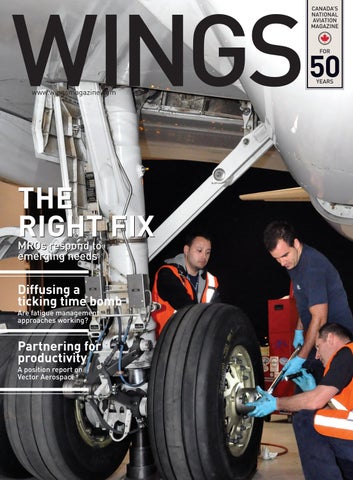
WINGS
canada’s national aviation magazine
50 for
YEARS
www.wingsmagazine.com
THE RIGHT FIX
MROs respond to emerging needs
Diffusing a ticking time bomb Are fatigue management approaches working?
Partnering for productivity A position report on Vector Aerospace
Wings SepOct2010.indd 1
16/09/10 3:59 PM
53549_071_Wings_Aug.indd Pg1 Mundocom UK EADS wings Wings SepOct2010.indd sept10.indd 22-3
30/07/2010 09:24 53549_071 16/09/10 3:59 PM
Bringing together bio-fuel technology and pioneering manufacturing techniques. For the sustainable future of air transport. More at EADS.com
AIRBUS A380
EUROCOPTER EC175
/2010 09:24 53549_071_Wings_Aug.indd Pg2 Mundocom UK Wings SepOct2010.indd 3
A400M
EUROFIGHTER
ASTRIUM E3000
30/07/2010 09:24 16/09/10 3:59 04/08/10 7:12 PM AM
Wings SepOct2010.indd 4
16/09/10 3:59 PM
10-08-20 9:33 AM
Montreal 1 McGill Street, Suite 804, Montreal, QC P: 514-286-1114 I F: 514-286-1118
Edmonton #212-15202-131 Avenue NW, Edmonton, AB P: 780-482-1188 I F: 780-482-1185
SeptOct.indd 1
Toronto 77 Proctor Road, Hamilton,ON L8M 2M5 P: 289-396-7745 I F:289-396-6946
Vancouver #207-17700-#10 Hwy, Surrey, BC P: 604-576-0004 I F: 604-576-0093
10-08-20 9:33 AM
UPFRONT 7
Leading edge Taking flight
10 On the fly
News and opinion
13 Waypoint
Of ministers and associations
14 Alternate approach Betting on the CSeries
15 An insider’s outlook Q&A with CAE’s Jeff Roberts
16 45˚42� North
Partnering for productivity: A position report on Vector Aerospace. P.28
Changing course
18 At the gate
Company’s coming
BACK
42 A look back
The foresight of Edwin Link
43 MRO Directory 63 Marketplace 70 On final
Renewing Canada’s airport model
From top: A Q&A with CAE’s Jeff Roberts. P.15 A ticking time bomb. P.26
FEATURES 19 ESTABLISHING THE RIGHT FIX
MROs respond to emerging needs BY JAMES CARELESS
22 WORKING FOR A UNITED FRONT
FBOs worldwide strive to improve product offerings BY ROB SEAMAN
26 DIFFUSING A TICKING TIME BOMB
Are fatigue management approaches working? BY DAVID OLSEN
28 PARTNERING FOR PRODUCTIVITY
A position report on Vector Aerospace BY FREDERICK K. LARKIN
34 THE EMIRATES QUESTION
One on one with Emirates SVP Andrew Parker BY PETER PIGOTT
38 MAXIMIZING THE A380
Long-range airliner proving critical to Emirates evolution BY FREDERICK K. LARKIN
51 CANADA ON THE WORLD STAGE
Economic engines rev up at Farnborough 2010 BY PETER PIGOTT
COVER PHOTO: BRIAN MCNAIR
SeptOct.indd 1
1 McGill Street, Suite 804, Montreal, QC P: 514-286-1114 I F: 514-286-1118
Edmonton #212-15202-131 Avenue NW, Edmonton, AB P: 780-482-1188 I F: 780-482-1185
SEP/OCT 2010
www.wingsmagazine.com
Wings SepOct2010.indd 5
September/October 2010 | Wings
5
16/09/10 3:59 PM
Whatever it Takes Pilot Larry Erd, Falcon 7X Captain, lands at London Luton, with an inboard slat fault alert. He quickly checks the aircraft system and then confirms he is AOG – and his next flight is on the following day. He calls Dassault’s Technical Center in Paris and gets Insy Houang – Customer Service Engineer and an on duty 7X specialist. Together they access the aircraft on-board Central Maintenance Computer to identify the fault code. Insy coordinates assistance and parts shipment via Eurostar, from Paris-Le Bourget to Luton. Go Team technicians from Dassault’s Luton Satellite install a new flight control PCB the next morning and Larry e-mails back later to Dassault Falcon: “The airplane performs really well and Customer Service is doing an incredible job too.”
GoTeam
Whatever it takes
PHOTO: Matt NIcholls
Falcon GoTeams do whatever-it-takes to turn your AOG into an Airplane On The Go. Learn more at falconjet.com/Go
Wings SepOct2010.indd 6
16/09/10 3:59 PM
LEADING
EDGE
| By Matt Nicholls
Taking flight
Major summer air shows celebrate aviation’s finest
A
PHOTO: Matt NIcholls
h, the dog days of summer. A time for holidays, family outings, baseball. . .and if you’re an aviation buff, some of the best air shows in the world. Canadian air aficionados had a great selection of events to enjoy from coastto-coast this summer, and you can count on more coverage of the nation’s finest air shows in future issues of Wings magazine. And while these events were tremendous in their own right, two events with significant cache set the tone for everything bright and new in the world of aviation. Late July in Wisconsin means only one thing to aviation enthusiasts and pilots alike: the EAA Airventure show in Oshkosh. Billed as the World’s Greatest Aviation Celebration, this year’s show continued to highlight state-of-the-art technologies, new aircraft and the best gadgets for pilots of all disciplines. From the Electric Aircraft Symposium, to the first-ever Night Air Show, to the two dozen DC-3s rumbling in formation over Oshkosh, to the impressive array of pilots performing wild feats in the daily air shows, it was a spectacle to behold. This year’s edition was my first as the editor of Wings magazine and I was overwhelmed with the array of new products, commitment to celebrating the history of aviation, and organization of the event. The numbers were impressive: 2,380 showplanes; 1,106 homebuilt aircraft; 635 vintage airplanes; 374 warbirds; 115 ultralights; 120 seaplanes and 30 rotorcraft on display. Some 777 exhibitors took in the show, up from 750 a year ago. And more than 535,000 people filed through the gates, in spite of heavy rains that played havoc with organizers early in the week. Final
5 www.wingsmagazine.com
Wings SepOct2010.indd 7
attendance numbers were similar to totals from 2006 through 2008 (and just off record numbers in 2009). Exhibitors I visited were generally pleased with the turnout, citing quality visits from attendees eager to check out
Inc. Got a great product? EAA AirVenture is the place to impress the masses. “The Oshkosh AirVenture is the world’s largest fly-in and as such has always been the most important event on our North American GA calendar,” said Chris Throndsen, U.S. sales manager at Sennheiser Aviation, makers of aviation headsets. “In spite of the poor weather conditions for flying, the foot traffic to our booth was constant and our sales were up over previous years.” Tom Poberezny, EAA chairman/president, said this year’s event was one of the most demanding he has ever been a part of. In the end, he was pleased with results. “The preparations for this year’s event were the most challenging in my 35 years as fly-in chairman,” Poberezny said. “We had expected to have a slightly lower attendance figure this year after last year’s blockbuster event. And this year’s weather challenges early in the week also had an effect. . . the second half of the week, however, was outstanding, especially with such activities as those on Saturday that included the night air show. We were not only very pleased with the attendance figures, but also with the positive response and the upbeat spirit from all those who attended.” While the Greatest Aviation Show on Earth lived up to its billing, there were positive signs for Canadian business aviation at the biennial Farnborough International Airshow (FIA) July 19-25. As Peter Pigott explains in his piece “Canada on the world stage,” the nation’s economic engines were on full display at the show. From Calgary’s WAVV Business Development to B.C.’s Viking Air Ltd., to Quebec’s Bombardier Aerospace, and Mississauga’s Field Aviation, it was an impressive compilation of Canadian content. As the summer fades and we head into the fall and the winter months, here’s hoping the industry builds on the momentum of these impressive international air shows, celebrating everything great in the world of aviation. | W
Preparations for this year’s event were the most challenging in (Tom Poberezny’s) 35 years as fly-in chairman. the latest and greatest aviation products, technology and innovation. Personal favourites included the innovative Sikorsky Project Firefly Manned Electric Helicopter Demonstrator; the growing number of software applications for iPad users (look for more on this in a future issue of Wings); the commitment to green technology in the development of all products; and The Transition road able light sport aircraft from Terrafugia
top data bursts… in this issue 1. Vector Aerospace has 2,500 employees in 14 facilities in five countries 2. Human Factors training helps employers understand a reasonable work day. 3. Emirates Airlines’ service in Canada would bring $480 million in economic benefits. 4. The GAMA reports BizAv activity increased 4.9 per cent from June 2009 to June 2010. 5. Bombardier's pre-Farnborough business jet orders topped $1 billion.
Your feedback on our new design or any other issue is always welcome. Please contact me at mnicholls@annexweb.com. September/October 2010 | Wings
7
16/09/10 3:59 PM
WINGS
caNada’S NatIoNal avIatIoN maGazINe
50 for
YearS
www.wingsmagazine.com
Editor
Matt Nicholls mnicholls@annexweb.com 416-725-5637
THE RIGHT FIX
Associate Editor
mros respond to emerging needs
Andrea Kwasnik akwasnik@annexweb.com 519-429-5181 • 888-599-2228 ext. 238
Diffusing a ticking time bomb are fatigue management approaches working?
Partnering for productivity
production artist
a position report on vector aerospace
Kelli Kramer
SEPTEMBER/OCTOBER 2010
SubScribe TODAY !
Flight Deck
1 Year SubScription Wings SepOct2010.indd 1
13/09/10 10:58 AM
only
3000
$
Ken Armstrong, Roger Beebe, Ray Canon, James Careless, David Carr, Paul Dixon, Brian Dunn, Frederick K. Larkin, Neil MacDonald, James Marasa, Carroll McCormick, Mike Minnich, David Olsen, Peter Pigott, Dr. Tarek Sardana, Rob Seaman, Blair Watson Advertising Sales
Ryan Culver rculver@annexweb.com 519-429-5182 • 888-599-2228 ext. 273
(all taxes included)
US $42.00 (USD) • Foreign $65.00 (USD)
Associate Publisher
Name: _______________________________ Company: ____________________________ Title: _________________________________ Address: _____________________________ City: _________________________________ Prov: ________________________________ P.Code: _______________________________ Tel: __________________________________ Fax: _________________________________ e-mail:________________________________
PLeASe cHecK ONe: ❑ Commercial aircraft owner/operator ❑ Business/private aircraft owner/operator ❑ Military ❑ Aircraft maintenance/overhaul firm ❑ Airport ❑ Aerospace, airframe & component manufacturer and distributor
❑ Fixed base operator ❑ Aviation services, consultants and aircraft sales ❑ Government ❑ Aviation associations and organizations ❑ Flying schools, clubs and colleges ❑ Other (please specify) ______________
PAYMeNT: Cheque - Payable to Annex Publishing Visa
MC
AMEX
Account #: __________________________ Expiry:_____________________________
Alison de Groot adegroot@annexweb.com 1-888-599-2228 ext. 246 Group Publisher
Scott Jamieson sjamieson@annexweb.com President
Mike Fredericks mfredericks@annexweb.com WINGS magazine
PO Box 530, 105 Donly Dr. S., Simcoe, ON N3Y 4N5 Tel.: 428-3471 Fax: 429-3094 Toll Free: 1-888-599-2228
Publication Mail Agreement #40065710 Return undeliverable Canadian addresses to Circulation Dept., P.O. Box 530, Simcoe, Ont. n3y 4n5 e-mail: ncuerrier@annexweb.com Published six times per year (Jan/Feb, Mar/Apr, May/Jun, Jul/Aug, Sep/Oct, Nov/Dec) by Annex Publishing & Printing Inc. Circulation e-mail: ncuerrier@annexweb.com Ph: 866-790-6070 ext. 208 Fax: 877-624-1940 Mail: P.O. Box 530, Simcoe, ON N3Y 4N5 Subscription Rates Canada – 1 Year $ 30.00 (includes GST - #867172652RT0001) USA – 1 Year $ 42.00 Foreign – 1 Year $ 65.00
Occasionally, Wings Magazine will mail information on behalf of industry-related groups whose products and services we believe may be of interest to you. If you prefer not to receive this information, please contact our circulation department in any of the four ways listed above. No part of the editorial content of this publication may be reprinted without the publisher’s written permission. ©2010 Annex Publishing & Printing Inc. All rights reserved. opinions expressed in this magazine are not necessarily those of the editor or the publisher. No liability is assumed for errors or omissions. All advertising is subject to the publisher’s approval. Such approval does not imply any endorsement of the products or services advertised. Publisher reserves the right to refuse advertising that does not meet the standards of the publication. Printed in Canada ISSN 0701-1369
Signature: _________________________
TO SubScribe:
Tel: 866-790-6070 Fax: 877-624-1940 Mail: Wings Magazine c/o Annex Publishing & Printing inc. P.O. box 530 Simcoe, Ontario N3Y 4N5 e-mail: ncuerrier@annexweb.com
www.wingsmagazine.com
GST#135274215RT001
8
Subscriptions non-refundable
PRO1010
Air Transport Association of Canada
ON THE
WEB
Canadian Owners & Pilots Association
Canadian Business Aviation Association
Magazines Canada
EVENTS CALENDAR Information on key industry events coming up in 2010 and 2011.
PHOTO: Matt Nicholls
Date: _____________________________
News highlights, web exclusives, blogs, job postings. new products, events and more www.wingsmagazine.com
Wings | September/October 2010
www.wingsmagazine.com
13/09/10 11:11 AM Wings SepOct2010.indd 8
16/09/10 3:59 PM
PHOTO: Matt Nicholls
Wings SepOct2010.indd 9
16/09/10 3:59 PM
ON THE FLY For late-breaking news, the Wings blog and exclusive web content, please visit us at: www.wingsmagazine.com
INDUSTRY NEWS
Avmax acquires BAe 146-200 AIRCRAFT Avmax International Aircraft Leasing Inc. of Calgary has acquired two BAE 146-200 regional jetliners from BAE Systems for operation by its Regional 1 Airlines affiliated company. Avmax provides aircraft maintenance and conversions for turboprop and jet aircraft and has maintenance facilities in Calgary, Great Falls, Mont., and Jacksonville, Fla. The company has a long association with the BAE 146, having provided storage, maintenance and conversion activities on a number of aircraft in recent years. Regional 1 provides charter and ACMI (aircraft, crew, maintenance, insurance) services both within Canada and internationally using its current fleet of turboprop and jet aircraft. Steve Doughty, senior vice president sales and marketing for BAE Systems Asset Management said, “We would like to pay tribute to Avmax for their years of service in supporting and maintaining
the BAE 146 fleet in Canada and wider North America and in helping us to place aircraft with many different customers. We are delighted that they have chosen the aircraft for their own Regional 1 Airline operation.”
CAE military division soars CAE Inc. has reported its military division is growing at a pace that’s in line with its civil aviation business – a first in the company’s history. The company expects orders to soar as defence departments trim their budgets by training pilots with simulators. In an era of government restraint and military budget cuts, flight simulators will become increasingly attractive options because they can train pilots at one-tenth the cost of operating an actual aircraft, Parent said. CAE expects about 10,000 helicopters and airplanes will be delivered to the world’s militaries over the next five years, driving calls for a number of new pilots who need to be trained. CAE anticipates that will create demand for 300 new flight simulators. Meanwhile, CAE estimates that less than half of current military pilot training involves flight simulators. Parent is optimistic after receiving a number of new defence contracts during its first quarter of fiscal 2011. Also, the
Legacy versions of the Twin Otter have been in service with operators in Colombia since 1975. 10 Wings | September/October 2010
Wings SepOct2010.indd 10
CEO Marc Parent reports that CAE has seen a growth of 20 per cent year over year in its defence business.
company’s civil aviation division is poised to benefit from a recovery in the airline industry in the short-term and long-term from a global pilot shortage, in which he estimates will result in as many as 18,000 new pilots needed per year.
VIKING APPOINTS TWIN OTTER SALES REP IN COLoMBIA Viking Air of Victoria, B.C., has appointed Indaer International as its sales representative for the new production Series 400 Twin Otter and legacy Twin Otter aircraft in Colombia. Indaer was selected for its presence in the country with offices in Bogota and Medellin, its strong reputation in the Latin American aviation industry, and its extensive knowledge of the Twin Otter. Legacy versions of the Twin Otter have been in continuous service with airlines and other operators in Colombia since 1975 and interest in Viking’s new Series 400 Twin Otter is high. Indaer International is an aerospace, engineering and technical services company that was created as a successor to ACES, a South American regional airline with a long and successful history of Airbus, Boeing, ATR and Twin Otter operations. The company has hangar facilities in Bogota and Medellin, engineering offices in Colombia and Brazil, and sales offices in Canada and Switzerland. www.wingsmagazine.com
16/09/10 3:59 PM
PHOTO (bottom): Confederation COLLEGE, (top): MARCEL KEAYES
INDUSTRY NEWS OPERATORS PEOPLE COMMERCIAL AIRPORTS
photo (bottom): VIKING AIRCRAFT, (TOP): CAE INC.
10 11 11 12 12
OPERATORS
CONFEDERATION COLLEGE 40 YEAR AME REUNION Confederation College of Applied Arts and Technology, Aviation Centre of Excellence will celebrate 40 years of the Aircraft Maintenance Program next June. The Transport Canada approved Aircraft Maintenance Program allows graduates to receive 18 months credit towards their licence, is currently in the midst of program renewal and has recently received CAMC accreditation. All current and former faculty, staff and graduates are invited to return to Thunder Bay to reminisce, tour the Aviation Centre of Excellence, renew old friendships and acquaintances at the dinner reception, and enjoy the beauty of Thunder Bay. The reunion will be held June 3-5, 2011. For more information, please contact Danny Greer at dgreer@confederationc.on.ca or 807-473-2429.
PEOPLE
JAMES POUGET WINS PRESTIGIOUS WEBSTER TROPHY
PHOTO (bottom): Confederation COLLEGE, (top): MARCEL KEAYES
photo (bottom): VIKING AIRCRAFT, (TOP): CAE INC.
James Pouget is the winner of the 2010 Webster Memorial Trophy Competition. Held this year in Calgary from August 18 to 21, the Webster national finals saw nine regional finalists from across Canada compete for the prestigious title. Hosted by the Calgary Flying Club at the Springbank Airport, the event required each regional contestant to take part in two flight tests during the week with a Transport
Webster Trophy winner James Pouget currently trains at Centennial College and flies out of the Durham Flight Centre in Oshawa, Ont.
Canada authorized Pilot Examiner. James Pouget, the Ontario regional finalist, currently trains at Centennial College and flies out of the Durham Flight Centre in Oshawa, Ont. The runner-up of this year’s event is Cameron MacLean who flies out of Coastal Pacific Aviation Ltd. in Abbotsford, B.C. The Webster Memorial Trophy Competition is an annual event committed to declaring the “Top Amateur Pilot in Canada.” It was established in 1932 by the late Dr. J.C. Webster of Shediac, N.B., who wished to perpetuate the memory of his son John who lost his life in an aircraft accident in St. Hubert, Que., while practising to represent Canada in an aerobatic competition. Amy and Wayne Foy, two of the administrators of the event, have finally stopped to take it all in. After being an integral part of a year-long team effort to see the Webster finals come to fruition, they report this year’s finals were seamless and went beyond expectations. Overcoming a few strategic challenges due to smoke from the B.C. wildfires, “All
of the contestants remained very positive throughout the competition, a testament to the level of professionalism of these young pilots,” said Foy. From its humble beginnings in 1932, the Webster Memorial Trophy Competition has grown to be one of Canada’s most prestigious aviation events. The first place winner is recognized with a bronze medallion depicting the Webster Trophy, and also receives prizes from organizations including Air Canada, Sennheiser (Canada), the Snowbirds, Air Canada Pilot’s Association, Canadian artist Robert Bradford, Air Transport Association of Canada, Hamilton Watches, Wings magazine and more. The Webster Trophy awards ceremony will take place during the Annual General Meeting of the Air Transport Association of Canada in Vancouver in November. No time to rest though – according to Foy, applications for the 2011 competition have already started to come in! For more information on the Webster Memorial Trophy Competition, visit www.wingsmagazine and click on web exclusives, or
Confederation College's Aviation Centre of Excellence opened in September 2003. www.wingsmagazine.com
Wings SepOct2010.indd 11
September/October 2010 | Wings
11
16/09/10 3:59 PM
ON THE
FLY
Aviation industry veteran Joan Williams has been appointed chair of the board of Ottawa Aviation Services (OAS). With almost 30 years of experience in the flight training industry, Williams has served in various roles over the years including manager of flight operations, chief flying instructor and manager of business development for a large Canadian flight school. She is a member of the Air Transport Association of Canada (ATAC) Board of Directors, chair of the ATAC Flight Training Committee, and a member of the International Association of Flight Training Professionals. “I greatly look forward to working with OAS, a company that has created a vision of excellence and professionalism in flight training,” said Williams. “OAS has identified a strategy for translating its vision into reality. It is creating the step-by-step action plan. And it is making the financial and resource commitments necessary to turn vision into reality. Williams added, “I anticipate an exciting and rewarding time working with OAS as they put more building blocks in place to achieve their vision of excellence.”
Kathy fox wins Elsie MacGill Northern Lights Award The First Canadian Chapter of The Ninety-Nines, Inc. has named Kathy Fox as this year’s recipient of the Elsie MacGill Northern Lights Award. Kathy Fox has been extensively involved in aviation for more than 40 years. Professionally, she started her career as an air traffic controller and worked in a number of control towers in Quebec as well as in the Montreal Area Control Center. She was in charge of the air traffic control training program at St-Jean-sur-Richelieu community college (CEGEP). She has also worked at NAV CANADA headquarters in Ottawa, progressing to vicepresident of operations. Kathy is currently a member of the Transportation Safety 12 Wings | September/October 2010
Wings SepOct2010.indd 12
COMMERCIAL
Air Canada pilots support retirement at 60 An overwhelming majority of Air Canada pilots support retirement at age 60, according to a poll conducted for its union. The survey of more than 1,800 pilots showed that 82 per cent supported retirement at age 60 or even younger. The results come from an online survey of 1,860 Air Canada pilots conducted June 7-23 by The Wilson Center for Public Research, Inc. In the survey, which included almost 60 per cent of all Air Canada pilots, pilots were strongly united on the issue, with 78 per cent supporting retirement at age 60 and a further four per cent wanting to retire at a younger age. Even among senior pilots over the age of 50, more than 63 per cent supported retirement at age 60 or earlier, outnumbering those wanting to work past 60 years by more than a twoto-one margin in that sub-group. Only 13 per cent of pilots wanted a retirement age greater than 60 years. Retirement at age 60 is currently set in the pilots’ contract and pension plan, which are negotiated with Air Canada by ACPA and ratified by its member pilots in a democratic vote each time their
Kathy Fox has been actively involved in aviation for more than 40 years.
collective agreement is renewed. The negotiated age of retirement is also the subject of an upcoming Federal Court judicial review of a Canadian Human Rights Tribunal (CHRT) decision. The Federal Court’s decision could potentially have an impact on the wages and benefits of the Air Canada pilots and thousands of other federally-regulated employees working under collective agreements containing a fixed age of retirement.
AIRPORTS
Aecon awarded Peterborough contract Construction company Aecon Group Inc. has been awarded a $15.6 million designbuild contract by the City of Peterborough for the redevelopment of the Peterborough Municipal Airport. Under the contract, Aecon will extend and strengthen existing runways, taxiways and other parts of the airport as well as upgrade the runway lighting and expand other infrastructure. The company said the redevelopment will expand the Peterborough Airport’s capacity to handle more air traffic. At press time, construction was set to begin on the project and is scheduled for completion next March. | W www.wingsmagazine.com
16/09/10 3:59 PM
PHOTO: istock
JOAN WILLIAMS APPOINTED TO OAS BOARD
Board. She has been active in parachuting, flight training and examining, commercial aviation and flight competition. She holds an Airline Transport Pilot’s license and a Master’s Degree in Business Administration as well as a Master’s in Human Factors and System Safety. The purpose of the award is to recognize the achievements of Canadian women in the field of aviation or aerospace. The award is named for Elsie MacGill, the world’s first woman to become an aircraft designer. A Canadian, MacGill designed the Maple Leaf II and was pivotal in the production of the Hawker Hurricane in Canada during World War II. The awards dinner will take place on Oct. 1 at The School Restaurant, 4121- 14th Avenue, Unionville, Ont. For more information on the event, reservations or sponsorship opportunities, please contact Anna Pangrazzi at (905) 477-7900 or by e-mail at northernlightsaward@gmail.com.
photo (left): Joan Williams, (right): joy parker-blackwood.
visit www.webstertrophy.ca Congratulations to Pouget, MacLean and all of the 2010 regional finalists.
wAYPOINT | By Rob Seaman
Of ministers and associations Is the Chuck Strahl appointment more of the same?
PHOTO: istock
photo (left): Joan Williams, (right): joy parker-blackwood.
B
ye-bye birdy, an aviation colleague said to me the other day. Our conversation was in relation to Transport Minister John Baird heading out the door. On August 6, Prime Minister Harper shuffled his cabinet and once again the top seat at Transport Canada has changed – the latest Minister of Transportation, Infrastructure and Communities is Chuck Strahl. That, by my count, is three in two years. Shall we hope for third time lucky? Let’s start by giving our new minister the benefit of the doubt. He is not new to politics and by all accounts appears to possibly have something to offer those of us in the world of transportation. According to Conservative Party web data, the B.C. native was first elected to Parliament in 1993. He was re-elected in 1997, 2000, 2004, 2006 and 2008. In February 2006, he was appointed Minister of Agriculture and Agri-Food and Minister for the Canadian Wheat Board. In August 2007, he was named Minister of Indian Affairs and Northern Development and Federal Interlocutor for Métis and Non-Status Indians. Prior to entering politics, Strahl was a partner in a successful road construction and logging contracting firm, and held the responsibility of managing several operations throughout the Fraser Valley where he has lived his entire life. Hopefully that sets him up for a good understanding of transportation and makes him predisposed to a positive interaction with the aviation community. Ottawa is now a flurry of “getting to know you” meetings. Each “alphabet” organization representing all the various elements of aviation is lining up for a first meeting with the minister to introduce their group and what it stands for. They hope to come away with some notion of how they may or may not be able to work together. The rush of calls and emails started before the ink was even dry on the new appointment. And these are just the groups from aviation! Party politics aside, we really do have a lot of groups working for aviation in Canada. Now, not to be critical, but realistically speaking – how do we expect www.wingsmagazine.com
Wings SepOct2010.indd 13
compromised and the How can aviation hope to get the gets message diluted. In some attention it needs from a new, cases, the various groups fail talk to each other propgetting-up-to-speed minister – or to erly and that adds to the watered-down effect. In the others for that matter? anything to be achieved when our interests are so spread around? Each of the groups has a role – no question. Each has a focus and special interest to address – given. But with so many all trying to garner what is, at best, limited attention and influence change, how can anyone really expect results – especially when the top job would appear to have a tenuous at best chance of being around long enough to realistically get something done? This is not a personal opinion. There are many who share this view. We have divided the collective aviation interest in several ways. There is the regional split (because most provinces have a provincial aviation council or association). Then we have divided interest again by commercial, business and general aviation. Add to that the combinations and permutations for maintenance, avionics, safety, float, home-built, ultralight, powerless and so forth. Remember, too, the navigation and airport categories. And then there are certainly more divisions that have been forgotten. The bottom line is that somewhere in there, the big picture
end, how can aviation hope to get the attention it needs from a new, getting-up-to-speed minister – or others for that matter? There is no suggestion we should merge or disband these groups. However, some folks have suggested that coming together and focussing on common causes from time to time could help to present issues and get results – especially at the higher levels where not only the minister, but even more so, the higher-placed civil service ranks, change with frequency. Perhaps an annual gathering of all the aviation group interests in one place, at one time could afford the opportunity to not only share concerns, but resources, results and timing. This may allow a collective presentation to not only the rule makers and governing authorities, but also the public at large. It is something to think about. In the interim, we say welcome to the new minister. We’re forever optimists in aviation. We hope to get to know you in a positive and productive way from here on. | W Rob Seaman is a Wings writer and columnist. September/October 2010 | Wings 13
16/09/10 3:59 PM
ALTERNATE
APPROACH By David Carr |
Betting on the CSeries
Bombardier’s “game-changer” program not taking off
H
14 Wings | September/October 2010
Wings SepOct2010.indd 14
decisions on whether to re-engine their A320 and E-Jet product line later this year. Embraer is reported to be considering adding a new design to its E-190 and E-175 aircraft to go headto-head with the CSeries. Airbus is said to be in talks with Qatar Airways, which is a launch customer for the A350, over a re-engined A320, although Qatar’s involvement in these discussions might be to keep Bombardier on its toes. Clearly Bombardier has made the world’s two largest airframe manufacturers and its Brazilian rival sit up and take notice, a fact not reflected in the order tally at Farnborough. Still, while Embraer pocketed orders for 35 E-175 and 15 E-190 aircraft, the market the CSeries is set to compete in went largely untouched except for an order for 30 Russian SSJ-100s from Indonesia’s Kartika Airlines. Indeed, with orders for 90 aircraft, Bombardier claims the CSeries has already captured half the net orders for the market segment. Nevertheless the pressure is on Bombardier to give the program some lift between now and mid-2011 when the horse race rolls into Paris and Airbus and Boeing have joined the track. | W
closest competitor, a figure some in the industry question. There is also speculation that with a sticker price of between $55 million and $63 million per aircraft, some airlines believe the CSeries is over-priced, although Bombardier insists that cost has not been a dominant issue in negotiations. Just as likely, the order drought comes down to old fashioned horse trading and an industry wait and see over the full range of players entering the 100- to 149 seat segment. Bombardier pioneered the regional jet market and sees delivery demand for up to 6,700 aircraft, predicting that half will be CSeries. An ambitious claim given that this time around, Bombardier and Brazil’s Empresa Brasileira de Aeronautica (Embraer) will no longer have the field to themselves. Although Bombardier, Japan’s Mitsubishi and Russia’s Sukhoi are the three manufacturers out of the gate with a “clean sheet” design, Airbus, Boeing and Embraer are considering re-engined versions of existing aircraft. Both Airbus and Embraer are expected to make
David Carr is a Wings writer and columnist. www.wingsmagazine.com
16/09/10 3:59 PM
PHOTO: CAE INC.
Clearly Bombardier has made the world’s two largest airframe manufacturers and its Brazilian rival sit up and take notice.
PHOTO: Bombardier
ow to measure a bust? Failed expectations are a good starting point. But who sets expectations? Major air shows like Le Bourget near Paris and Farnborough this year are good barometers to gauge the health of the industry. With $28 billion in orders, Farnborough quadrupled the output of Le Bourget last year, but remained eclipsed by the record $88 billion in deals announced in 2008 – suggesting the rebound in commercial and business aviation is taking hold even while the military side remains flat. Still, the timing of orders remains an illusion, supported by the manufacturers’ PR departments, aided and abetted by customers, and fuelled by the trade media hungry for headlines. Airline executives do not arrive at air shows clutching their cheque books and multi-billion dollar aircraft deals are not negotiated over night. Manufacturers stockpile orders to announce during the opening days of the show in a testosterone-charged horse race, despite assurances by Airbus Industries’ CEO Tom Andres to the contrary. Even so, despite having “bagged” over $1 billion in orders for business jets and Q400 turboprops leading up to and during Farnborough, Bombardier Aerospace had a less than spectacular air show. The news that Doha-based Qatar Airways would buy two Global Express XRS jets made headlines for what the announcement did not include; an order for up to 30 CSeries airplanes, the 110- to 149 seat self-described “game changer” which at times appears to have struggled getting on the board. Qatar Airways is one of three Gulf-based “super-connectors” with ambitions to turn the region into a transfer powerhouse. The airline has 82 aircraft and 180 on order, largely for the long haul, indicating that an order for mid-size “feeder” aircraft is imminent. Qatar Airways has had an on-and-off dalliance with the CSeries for approximately two years. The stumbling block appears to be over cost guarantees by engine supplier Pratt & Whitney, which is claiming that its new technology PW1000G geared turbofan that power the CSeries will reduce maintenance costs by 20 per cent over its
An insider’s
outlook
Q&A Jeff Roberts discusses opportunities for CAE By Frederick K. Larkin
PHOTO: CAE INC.
PHOTO: Bombardier
WINGS recently sat down with Jeff Roberts, group president of Civil Simulation Products, Training and Services at CAE Inc. Topics of discussion included business opportunities with the looming pilot shortage, the Multi-crew pilot licence, and the direction of CAE Inc. Q| Given the looming global shortage of commercial pilots, what opportunities do you foresee for CAE? A| The expected shortage of pilots to fly commercial aircraft will certainly increase customer demand for enhancing safety and efficiency, and those are the essence of what CAE provides. We see continued opportunities for more refined training methods, more innovative simulation equipment and other training tools, and more streamlined training operations management based on our extensive global experience. CAE’s presence in every major region means customers can train closer to home, receiving the same world-class training and customer support services while saving travel time and cost. Q| What is being done by governments and private industry to encourage flying as a career for young people? A| Much of the encouragement is in regions of the world such as Asia where growth is expected to be the highest and the shortage of aviation professionals the most acute. Certainly airlines are developing innovative approaches for developing a steady stream of qualified pilots. Examples of these include AirAsia as sponsoring airline for the CAE MPL (Multi-crew Pilot Licence) beta program and China Southern Airlines in joint ventures with CAE for ab initio training and type rating training. One example of government encouragement of flying as a career is India. The Airports Authority of India is CAE’s joint venture partner www.wingsmagazine.com
Wings SepOct2010.indd 15
for the CAE Global Academy in Gondia. CAE also manages the Indira Gandhi Rashtriya Uran Akademi in Rae Bareli, India on behalf of the Indian Ministry of Civil Aviation. Q| What is the global status of the Multi-crew Pilot Licence (MPL) certification process today and where do you see it being in a decade? A| At latest count, I understand there are nearly two dozen countries with MPL-related regulations. Our expectation is that competency-based training programs will continue to gain favour with airlines and regulatory authorities. MPL is an option for airline customers, designed specifically to prepare cadets to become airlines pilots. MPL programs will provide a streamlined, accelerated alternative for meeting some of the demand for qualified pilots as global airline industry growth accelerates and the forecasted pilot shortage becomes reality. The CAE MPL beta program, that was announced in February, is currently transitioning from the basic and core phases at Moncton Flight College, a member of the CAE Global Academy network in New Brunswick. The cadets will work through the intermediate phase over the next few months in Dallas, Texas, before completing the CAE MPL program advanced phase at our training centre in Toronto. The CAE MPL is the first multi-crew pilot licence program under the auspices of a performance-based regulatory structure
developed by Transport Canada. Upon graduation next spring, the cadets will receive a Canadian Multi-crew Pilot Licence, signifying that the bearer has demonstrated the knowledge, skill and attitudinal competencies to perform the duties of a co-pilot of a multi-engine, turbine-powered, pressurized airplane, that is certified to be operated by two or more pilots, flown under either VFR or IFR conditions. In the case of the CAE MPL beta program, cadets will graduate prepared for Initial Operating Experience (IOE) and line operations as A320qualified First Officers for AirAsia, the sponsoring airline of the beta program. Q| How large is the current CAE Global Academy network and will it be expanded over the next decade? A| The CAE Global Academy is the largest network of ab initio flight schools. We currently have 11 schools at nine locations in North America, Europe, Africa, Asia and Australia with a capacity of 1,800 cadets per year. We expect to continue to grow that capacity by expanding some of the current schools and by adding more schools to the network as the right opportunities arise. The newest member of the network is the China Southern West Australia Flying College in Perth, Western Australia. CAE entered into a joint venture with China Southern Airlines in June. Graduates from the school in Perth will go on to earn their aircraft type ratings at the Zhuhai Flight Training Centre, another joint venture between China Southern and CAE at Zhuhai in China’s Guandong province. | W
WEB EXCLUSIVE Here are some more questions that Jeff Roberts answered: Q| Given that pilot provisioning is a turnkey service that includes recruiting, screening, selection and training, where does CAE see this effort in 10 years? Q| What would CAE’s role be with a typical commercial air carrier? For the full Q&A session, including answers to these questions, please visit www.wingsmagazine.com and click “web exclusives.” September/October 2010 | Wings 15
16/09/10 3:59 PM
45˚42�
north By Peter Pigott |
Changing course
Nav Canada vet Greg Schmidt calls it a career
T
16 Wings | September/October 2010
Wings SepOct2010.indd 16
Rating with the Edmonton Flying Club. He said it keeps you current, you build time and you keep in touch with the industry in a major oil field centre. He was right.” Schmidt did so and within two years, the hours accumulated and eventually got him a job flying Learjets for Brooker Wheaton Aviation Ltd. When the collapse of the Western oil industry put many pilots out of work, contacts rescued him again – this time in Transport Canada, allowing him to apply to the newly centralized Flight Inspection organization in Ottawa. He began on the Dash 8, then the Challenger 601 and in 2008, the RJ200. Flight Inspection (FI) of navaids is a constantly challenging environment; the aircraft is not used as transportation, but as a measuring tool. With 25,000 hours of flying, Schmidt has a multitude of stories. One that leaves a vivid picture in his mind was in a Learjet 24 at 45,000 feet, 50 miles north of Rae Point in mid winter. “We were between two to five miles from a meteorite entry left to right across our windscreen. The relative size of the meteorite in the windscreen was the same relative size as the full moon. It deflected slightly and broke into five pieces. It was so bright we were temporarily blinded. It remains the most spectacular event I’ve ever seen.” When asked what he was going to do in retirement, he talked of his seven grandchildren. “Some have already expressed a keen interest in aircraft – it’s up to me to foster that.” Living under the flight path for runway 07 at Ottawa Airport, Schmidt says the numerous aircraft passing overhead remind him of who he is. | W
Retiring with 25,000 hours of flying, Schmidt emphasized to his audience that flying is very much a people-oriented business. heavy equipment in the high Arctic. “Lady luck was with me there as I delayed my return to the Arctic by one week and the Panarctic Lockheed Electra that I was to be on crashed on October 30, 1974, at Rae Point, Mellville Island. Many people I had worked with all winter were lost on that flight.” His first paying job as a pilot was on a Twin Comanche with Chinook Aviation in Calgary. Chinook was contracted to supply specially modified aircraft for seeding thunderstorms in a project called “Hailstop74.” The end of the hail season meant he was unemployed once more. “It was here I learned the importance of developing solid contacts within the aviation industry,” he says. “One of the Hailstop pilots convinced me to get an Instructor
Peter Pigott is a Wings writer and columnist.
PHOTO: Greg Schmidt
he Scene is the Shell AeroCentre, Ottawa International Airport on a sultry summer afternoon. Outside, a NAV CANADA RJ-200 “beats up” the runway. It is Greg Schmidt’s last flight as a pilot and the control tower has accorded him that privilege. At 64 years of age, he is retiring from NAV CANADA and flying. At the Shell AeroCentre, NAV CANADA employees, Schmidt’s wife, daughters and son, along with Algonquin College students, watch the CRJ taxi in. What, we all wonder, will run through his mind as he goes through the final checks and makes that last entry in his logbook? It is the inevitable, poignant moment every pilot faces. When asked about Schmidt, one of his colleagues described him thus: “Let me put it this way, he does a great Clint Eastwood impression.” Schmidt enters the Centre to applause and is asked to say a few words to the audience, especially the students. He emphasizes that flying is very much a peopleoriented business and they should always cultivate contacts both within and outside the aviation world. “When flying an aircraft,” he says, “get used to someone always casting a critical eye over your shoulder. Remember that extreme disappointments are normally followed by successes.” How did it all begin for him? “One day an aeronautical chart, circa 1956, fell to our driveway, apparently from one of the DC-3s flying the Calgary to Edmonton route overhead,” he recalls. The Harvard trainers that regularly buzzed the family acreage encouraged the interest in aviation. “One flew by so close I could clearly see the pilot wave,” he remembered. “I was hooked.” While working as an Electronics Technician on the Canadian Marconi F-111 radar project in Montreal, Schmidt took his first flying lesson at Cartierville airport on June 30, 1968. But the pay wasn’t enough to continue flying so he left to work for Alberta Government Telephones in Lethbridge, Alta. This allowed him to complete his Private Pilot Licence at the Lethbridge Flying Club with Roy Price, a mentor he has never forgotten. A partnership in a Cessna 150 led to a Single Engine Commercial Licence, and to pay for his Multi-Engine/Instrument rating, Schmidt took to operating
www.wingsmagazine.com
16/09/10 3:59 PM
Aerotek knows the value of flexible staffing services. Because let’s face it, business as usual ... rarely is.
Whether you’re looking for one key person or an entire staff, Aerotek has the experience, expertise and plenty of solutions to meet all your ever-changing needs. We can find, hire and oversee your workforce. And that can save time, money and your sanity. To find out how you can save time and money with Aerotek’s
PHOTO: Greg Schmidt
Staffing Solutions, call 888-AEROTEK or visit aerotekcanada.ca.
An Allegis Group Company. © 2010
Wings SepOct2010.indd 17
16/09/10 3:59 PM
at the
gate
By Brian Dunn |
Company’s coming
Porter Airlines will soon share gates at Billy Bishop
I
18 Wings | September/October 2010
Wings SepOct2010.indd 18
arrival of company at Billy Bishop for some time and is using close to 140 of its 156 available slots, according to airline spokesperson Brad Cicero. With only 16 slots remaining, or eight return flights, he said Porter is looking at other growth opportunities within its existing network. For example, increasing Montreal-Halifax frequencies or maybe even Ottawa-Newark service that doesn’t involve a Toronto stopover. Porter will also make money from Air Canada and Continental who will have to pay rent for the use of gates and counter space to its subsidiary City Centre Terminal Corp. Porter is also beefing up its fleet, confirming a new order for four Bombardier Q400 NextGen aircraft, plus six options. Based on the list price for the Q400 NextGen, Porter’s firm order is valued at approximately US$120 million, which could increase to US$308 million should all six options be converted to firm orders. Porter currently operates a fleet of 20 Q400 aircraft and the new order potentially raises this number to 30. The new aircraft are scheduled for delivery beginning in the second quarter of 2011, through the third quarter of 2012, including option aircraft. | W
Porter will still be in a position of strength with the vast majority of slots, agreed Calgary aviation consultant Rick Erickson, principal, RP Erickson & Associates. “Although they will have competition with Jazz, they offer a high quality product and they’ve carved a nice niche in the Toronto-Montreal-Ottawa triangle. It will be interesting to see how (Air Canada’s) Aeroplan points will cut into their game.” Both Porter and Jazz have impacted WestJet’s triangle business, so Erickson feels WestJet will be the big loser once Jazz begins service out of Billy Bishop Airport. “I suspect those 30 slots will be used almost exclusively to service the triangle, so Jazz won’t have any impact on Porter’s U.S. business. Porter has also had real success flying to Thunder Bay and Moncton.” Erickson also believes Porter, which, as a private company, doesn’t release financial results, is still in a strong financial position to withstand any competition that Jazz might throw at them. “Nobody is taking Porter out and I don’t believe anyone will buy them out either.” Porter has been gearing up for the
Brian Dunn is a Wings writer and columnist. www.wingsmagazine.com
16/09/10 3:59 PM
Photo: Brian McNair
Porter has been gearing up for the arrival of company at Billy Bishop for some time and is using close to 140 of its 156 available slots.
PHOTO: Halifax International Airport Authority
t’s been a smooth ride for Porter Airlines flying solo out of Billy Bishop Toronto City Airport on Toronto Island for the past four years, but those days are numbered. The regional carrier will soon have to share gates and slots with both Air Canada and Continental Airlines. Air Canada Jazz has been granted 30 slots and Continental 16 which will be operated by Continental regional affiliate Colgan Air between Newark, N.J. and Billy Bishop, a market currently served by Porter. Air Canada will use its slots to serve the heavily-travelled Toronto-MontrealOttawa triangle. “We are looking forward to resume the service as soon as possible and have not announced specific timelines and service provider,” said Air Canada spokesperson Isabel Arthur. But it won’t be before the second phase of the airport terminal is complete which is scheduled for the end of December. Colgan Air did not return phone calls to determine when they plan to begin service from Billy Bishop. Jazz Air has placed a firm order with Bombardier for 15 Q400 NextGen turboprop aircraft, the same plane flown by Porter, with options for an additional 15 aircraft. Aircraft deliveries are planned to begin next May and will accommodate 74 passengers in a single cabin. The first 15 Q400s will replace 15 50-seat regional jets and some of the aircraft are expected to be used for Air Canada’s new service out of Billy Bishop Airport. What does this mean for Porter’s competitive advantage? It will still have 156 slots or 77 per cent of the 202 slots available. But does the arrival of competition harm its once unique selling proposition? “No doubt it will hurt them from a financial aspect, because their monopoly was quite a valuable asset,” said Karl Moore of McGill University’s Faculty of Management. “But they saw it coming and have increased flights to other cities to lessen the blow. On the other hand, Porter still has the advantage of being a fun product, a nice atmosphere with comfortable leather seats and a very motivated staff. They also have the majority of slots which I don’t see changing anytime soon.”
AME Rick Wilde doing an inspection on the engine of a Citation X business jet.
Establishing the right fix MROs Respond to Emerging Needs
O
Photo: Brian McNair
PHOTO: Halifax International Airport Authority
By James Careless
ptimistic. This one word best describes how MRO (maintenance, repair and overhaul) operators and industry analysts are feeling about the future of the Canadian MRO market. There are a few key factors behind the sentiment according to Ray Jaworski, senior aerospace analyst with Forecast International. “We are seeing an improvement in commercial airline traffic, which helps the MROs who service these planes. The general aviation sector, which was extremely hard hit following the drop in business jet usage, is coming back. And the military MRO sector is holding steady.”
Factors behind the slowdown It’s a good thing the MRO market is looking up, because last year was not a good one for many MRO operators. Globally, www.wingsmagazine.com
Wings SepOct2010.indd 19
commercial MRO revenues fell on the order of five to 10 per cent in 2009, according to research compiled by AeroStrategy Management Consulting. The biggest factor was the drop in aircraft usage, as commercial and business passenger numbers fell, thus lengthening the times between scheduled aircraft maintenance. However, price-cutting also hurt MRO bottom lines as operators scrambled for the business that was still available. Another factor was the decision by airlines to retire older aircraft due for service in favour of fuel-efficient new aircraft fresh from the factory floor (and thus not needing MRO service). Add the cost-saving strategy of salvaging still viable engines and other parts from parked older aircraft and using them on those still flying – as opposed to servicing engines due September/October 2010 | Wings 19
16/09/10 3:59 PM
for overhaul on schedule – and MROs saw yet another hit to their pocketbooks. The overall result: “It’s been a tough time for MROs, especially in Canada and the U.S. which have lost business to lower-cost MROs in emerging countries,” Jaworski notes. “But things are better this year than they were in 2009, and things appear to be improving.”
We’re still here The 2009-2010 recession pounded Canadian MROs big and small, and in response, jobs were cut. A case in point was in March 2010 at Aveos Fleet Performance (formerly known as Air Canada Technical Services), when Air Canada’s MRO laid off 195 employees for good, and 815 more until things improved. Fortunately, things did improve for Aveos, the company starting to
recall laid off workers in July 2010, with the goal of taking them all back by 2011. As for other Canadian MROs? Based on those who spoke with Wings magazine, the economic storm was tough but survivable. “We certainly felt the pain experienced by commercial transport operators in recent years, particularly in the U.S.,” says David Schellenberg, president and CEO of Abbotsford, B.C.-based Cascade Aerospace. “But with our commercial and military mix and our strategic shift into more complex and long-term major programs, our business is thriving nicely.” Indeed. Cascade Aerospace was awarded a 20-year contract with Lockheed Martin for third line maintenance and in-service support of Canada’s new fleet of C-130J Super Hercules aircraft in March 2010, and is the prime contractor for the fleet management of Canada’s legacy fleet of 32 C-130E & H model Hercules aircraft.
“It’s been a tough time for Canadian MROs…which have lost business to lower-cost MROs in emerging countries.”
AMEs Joe Zammuto and Michael Wegner open the access panels under the wing in preparation for an inspection.
The company also provides aircraft maintenance and modification services to Canadian commercial operators such as WestJet, First Air and Canjet. In Nova Scotia, the pain of the recession has been very real. “We saw our business slow down in general by about 14 per cent,” says Uli Huber, director of maintenance with Atlantic Avionics in Enfield (Halifax International Airport). Sales of equipment suffered “due to a lack of customers reaching into their pockets; plus there’s increased competition for [equipment] sales. If no value is added, the customer can surf the net and shop anywhere for the best price – and they do.” Across the country in Lethbridge, Alta., Jon Galenzoski, FBO manager with Airwest Flight Support says, “Business has been fairly steady in general aviation, which is who we service. Frankly, our biggest problem is the weather, not the economy. If conditions are bad for flying – and it gets very windy here in Lethbridge on a regular basis – then customers fly their aircraft less frequently. That delays them from coming in for regular maintenance, which hurts us.” At Quantum Aviation in Toronto (Pearson International Airport), “the recession has had a minimal impact on our business,” says Mark Francis, the company’s president. “All of our customers have weathered the storm and we have managed to grow, albeit slowly. Our specialized shops – sheet metal structure repair, batteries, avionics – are not as busy as we had hoped. They were put in place to support our in-house needs but are more than capable of supporting more.”
Coping strategies
AME Rhoderick Santiaguel changes out the fan blades on a CFM56-7B engine. 20 Wings | September/October 2010
Wings SepOct2010.indd 20
Surviving a recession is not a foregone conclusion. Doing it takes tough decisions and a willingness to do things differently. For instance, StandardAero has been able to leverage the diversity of its business and the breadth of products within single locations to manage and smooth out the impact that the recession has had, says Ian Smart, StandardAero’s SVP for Airlines & Fleets. “We have been able to cross-train employees on various engine types and move them throughout the company to have them in the places where they are needed most,” he says. Quantum Aviation’s recession strategy translated into doing more in-house while doing everything possible to keep customers happy and coming back. “We have expanded our capabilities to rely less on outside services and continue to focus closely on our customers individual requirements,” says Francis. As a result of www.wingsmagazine.com
16/09/10 3:59 PM
Ongoing challenges
AMEs fixing the weather radar in the nose of a Boeing 737.
Even though MRO revenues are recovering, the industry still has many ongoing challenges to deal with. For example, at Atlantic Avionics, the trend for manufacturers to exchange faulty parts rather than repair them is cutting into the company’s bottom line. “The way that most new equipment are being built makes in-house repairs impossible,” Huber says. “This is why so many items are now being sent back directly to the manufacturer, rather than being repaired in shops such as ours. We need to find ways of making up for the loss of these repairs, such as expanding our level of equipment and training so that we can troubleshoot defective ‘boxes.’ ” StandardAero’s biggest challenge at this time is training people. “We have a growing CF34 facility and have recently signed up to be a Designated Fulfillment Center for CFM56,” Smart says. “Both of these products require growth in the size of the facilities and the number of people required to support them. We expect to hire more than 250 new people in Winnipeg by 2012 in order to support these two products, and properly managing the training of all these new hires remains our greatest hurdle.” In order to handle the influx of new hires, StandardAero has partnered with Red River College to create a Gas Turbine Targeted Engine entry-level program. It will provide new employees with basic fundamental skills and knowledge along with targeted engine training. Attracting more commercial traffic is Airwest Flight Support’s biggest challenge, says Galenzoski. “Being an independentlyowned FBO, we don’t see as much of the commercial carriers as an Esso FBO does,” he observes. “They seem to have an easier time in getting commercial contracts. That’s something we need to do to increase our revenues and diversify our base.” Quantum Aviation’s Francis has many ongoing issues to deal with. Of these, “our biggest challenges are juggling the rising costs for parts, training and manpower while providing cost effective solutions for our customers.” If that’s not enough, “finding available hangar space at Pearson is becoming a problem. We have the work, but we need to be able to expand to do it and attract even more.”
Better times ahead
Atlantic Avionics has improved services and added 24-hour availability to combat the economic downturn.
these efforts, “our busiest area is now corporate aviation maintenance. I believe it’s because we offer our customers highly competitive rates, top quality service and the convenience of staying at home while spending Canadian dollars to complete all their heavy maintenance needs.” Atlantic Avionics has adopted a similar strategy, with similarly positive results. “We have done our best to watch expenses, improve customer service, and expand the capability of our shop repairs,” Huber says. The result: “Flight line maintenance is busier than before due to our improved services and 24 hour availability.” As for Airwest: “Our response to the recession was to do a lot more advertising, to bring more people to our FBO,” says Galenzoski. “It appears to have worked, because we have generated a lot more new business in the past year than we have before.” www.wingsmagazine.com
Wings SepOct2010.indd 21
Despite all these challenges and an uncertain economy, the MROs who spoke with Wings for this article are undeniably positive about the rest of 2010 and 2011. “We are very optimistic about the future,” says Schellenberg. “By continuing to build close relationships with key OEMs such as Lockheed Martin, CAE Inc. and others, and by capitalizing on our major program management experience and expertise to develop our international business, we are very confident that our future is strong and bright.” “Yes, we are optimistic about the future,” echoes Francis. “It appears that corporate aviation is starting to see a gradual increase in demand, and we are ready to support it.” StandardAero is also very bullish about the future. The reason: “We have worked hard to strategically position ourselves both before and throughout the recession to grow our business through diversification, long-term customer relationships, and continual investment to stay in the forefront of aviation,” Smart says. “The CFM56 licence is the first element in our plans and investment in moving the business forward. Entry into the large-fan MRO market signals robust growth and a strong future for StandardAero.” Atlantic Avionics DOM Huber sums it up: “New technology and increased flying will make this an exciting line of business to be in. Things are getting better.” With any luck, this optimism will be rewarded by higher revenues, better sales and more jobs in the months and years ahead for all MROs. After the economic storms of 2009-2010, the Canadian MRO industry certainly seems to be well positioned to respond to the changing needs of the industry. | W September/October 2010 | Wings 21
16/09/10 3:59 PM
working for a united front
T
he world is getting back to business. Bizav flight operations year over year (June 2010 vs 2009) show activity was up by 4.9 per cent overall according to the General Aviation Manufacturers Association (GAMA). Results show two consecutive quarters in which industry billings have
22 Wings | September/October 2010
Wings SepOct2010.indd 22
gone up. And so it would seem travellers are once again going places and making the world their business. But just what is the state of things in the FBO and support world outside of the home market? The country Canadians travel to the most is without question, the United States. It represents our largest trading partner and
offers many of the most convenient vacation spots of choice. Looking at how U.S.-based FBOs have faired during and after the recession and how they see things going forward is an interesting comparison to the domestic story. In terms of travel away from home, big name chains are where most find comfort and
service. Some feel wandering off the trusted path is risky when travelling abroad and passenger needs are top priority. That is where companies like Signature Flight Support Corporation come in. With 102 facilities worldwide, they have a size and volume advantage. Signature has FBOs at more than 50 per cent of the top 30 U.S. large hub airports
PHOTO: SUGAR LAND FBO
FBOs worldwide strive to improve product offerings By rob seaman
www.wingsmagazine.com
16/09/10 4:00 PM
The 20,000-square-foot Sugar Land FBO is styled after a Texas ranch house.
PHOTO: SUGAR LAND FBO
ing for as well as 48 of the top 50 U.S. metropolitan areas. Like many FBOs, it took advantage of the recent downturn to review and revise its core business to attract and retain customers. “Signature is a customercentric organization and continually tries to find new ways to provide world-class service to its customers,” says marketing specialist Lisa Musante. “In January, Signature launched Signature Status, a program targeting flight departments, aircraft operators and aircraft owners and tailored to reward www.wingsmagazine.com
Wings SepOct2010.indd 23
Signature’s most loyal customers with value-added benefits.” There are three membership tiers: silver, gold and platinum, and according to Musante, the benefits escalate as the percentage of visits to Signature facilities increases. The benefits include services such as guaranteed crew cars, preferred ramp parking, priority daytime hangarage, GPU startup discounts, complimentary Hertz #1 Gold membership and Signature QuickTurn services. Since the program is not based on fuel volumes, the size of the
aircraft and subsequent uplift of fuel will not have an impact. The program is limited to turbinepowered aircraft flying on IFR flight rules and benefits are available at all Signature-branded facilities in the U.S. Any aircraft, regardless of its country of registration is eligible to apply. The environment is a key point in aviation today, a point of pride and even an attraction for some to “doing business.” Signature for its part has established a leading position in the innovation and integration of environmentally responsible practices in the design, construction and operations of FBO facilities. It currently operates the only two FBOs in the U.S. that have been awarded LEED certification. (LEED is an internationally recognized green building certification system developed by the U.S. Green Building Council. The council provides third party verification that a building has been designed and built to save energy, reduce CO2 emissions, use water efficiently and improve indoor air quality thereby reducing the building’s impact on the environment). In addition to buildings, the company uses environmentally responsible, alternative fuel vehicles and equipment. It and fellow BBA Aviation companies currently operate more than 40 propane-powered ground support vehicles and more than 50 electric aircraft tugs – and that number is growing. Signature also participates in the U.S. Environmental Protection Agency and the Department of Energy sponsored, Energy Star Portfolio Manager Program. Eleven locations are currently enrolled in the program: Anchorage (ANC), Centennial (APA), Dallas Love Field (DAL), Denver (DEN), White Plains (HPN), Las Vegas (LAS), Morristown (MMU), San Francisco (SFO), Orange County (SNA), Teterboro (TEB) and Van Nuys (VNY). This allows Signature to track and assess energy and water consumption, compare the results against other FBO locations in the portfolio, receive
recommendations for efficiency improvements, estimate its carbon footprint, and gain Energy Star recognition.
A different model Non-chain sites offer their own unique attractions and efforts to be greener – and most build loyalty through outstanding service. They build their businesses one client at a time, unlike chains that refer clients site to site. Non-chain sites also have significantly lower advertising and promotional budgets to work with, so to them, the big thing has to be service, memorable travel and support. Showalter Flying Service at the Orlando Executive Airport certainly reflects this model. Being in the heart of Florida’s vacation zone certainly helps this site – especially with sun seeking Canadians in the winter months. Add to that hosting the NBAA a few times and you have what is unquestionably a popular and established FBO. Showalter has been in the business at the site since 1945 and caters to all aircraft from small tail draggers to large business jets. “No matter what the size of your plane, you are treated like you landed back home as soon as you open your door,” says Kim Showalter, president and chief operating officer. “You’ll see it’s our people and work environment that makes the difference.” In assessing business in 2010, Showalter says “things are looking up with our business seeing a five to 10 per cent increase but, we are still down 40 to 45 per cent from pre-recession. The Orlando aviation market took a double whammy from our government when they chastised business airplane use in general as well as black-listed Orlando conventions and meetings. So I would say businesses are slowly starting to become comfortable again using their business tools.” In terms of enhancing or adding to the business during the downturn, Showalter updated its business software system to the popular Total FBO product. The upgrade was a planned investment and had to be done this year to meet the Payment Card Industry Data Security Standards. A September/October 2010 | Wings 23
16/09/10 4:00 PM
Ad
Universal Aviation U.K. at London Stansted. Universal is unique in offering its own handling staff, facilities and equipment in London, Paris, Madrid, Milan, Rome, Athens, Dublin and Shannon.
One of the great things about independent FBOs is how some take their region to heart in the design of the facility. bonus feature of the software is it communicates with its refueling trucks for instant processing and enhanced customer service. It also aimed to become efficient in other ways. “We sat down with all employees two years ago and asked them for input. Everyone was able to participate and we implemented many of those ideas to save money. For example, line technicians offered to wash their own uniforms. Customer service representatives implemented a saving from credit card user chargers by asking for credit cards with the lowest possible fees. With these and many more initiatives we were able to save over $141,000 a year. This interactive approach allowed us to keep a positive outlook.” Such practices show how smaller and closer managed FBOs offer advantages and flexibility others may not be able to harness. 24 Wings | September/October 2010
Another independent FBO success story can be found in Texas. What makes this site unique is the FBO and airport are both owned and operated by the City of Sugar Land. In fact, the Sugar Land FBO has become a regular stop now for travellers to Houston. The airport is a short drive via US 59, and is convenient to the Galleria, Energy Corridor, and the Texas Medical Center. One of the great things about independent FBOs is how some take their region to heart in the design of the facility. Sugar Land is styled after a Texas ranch house. The 20,000-square-foot facility has a collection of local featured art that is rotated on a regular basis, U.S. Customs, conference facilities, spacious passenger waiting area, expansive crew suite (with a newly added 92inch movie screen and surround sound to view the latest releases), a private executive lounge, onsite cafe with unique food fare
and catering, rental cars, and an upscale Texas gift shop. Anne Gaines is the assistant aviation director at Sugar Land. She reports business is up 30 per cent over last year at this time. “We saw a drop in business at the beginning of the recession (down 25 per cent),” says Gaines. “At this time, we are less than 10 per cent off of pre-recession business, and on the rise.” Gaines attributes the increase to marketing efforts in promoting the location in the greater Houston area and in part because they no longer charge fees for U.S. Customs services (which has attracted more international travellers to the FBO). This illustrates an advantage independent FBOs can have over the chains. Striving to make the operation “greener” has been another key focus at Sugar Land, says Gaines. Some initiatives include: the terminal building was constructed with features from natural
lighting (windows along corridors to allow the passage of natural light to otherwise dark areas); dual switching on fluorescents in offices to reduce electrical use; high efficiency insulated exterior glass; use of computer automated HVAC systems; chilled water and other energy saving features. In addition to bricks and mortar savings, many of the FBO staff are now on alternate work schedules which saves time and fuel on commutes, as well as extending service coverage for the customer. And then there is the T-hangar Complex – which disturbed nine acres of wetlands (the site is accessed by two taxiway bridges over ponds) when it was built. To mitigate this, Sugar Land undertook the restoration of 30 acres of wetlands in nearby Brazos Bend State Park. This project received a statewide
continued on pg. 33 www.wingsmagazine.com
09RAS0 Wings SepOct2010.indd 24
16/09/10 4:00 PM
Adventurer
The Beechcraft 1900. Picture it anywhere. ®
Whether it’s getting passengers where they need to be, hauling critical supplies to a remote destination, or deploying a paramedic crew for a life-saving mission, the versatile Beechcraft 1900 is rugged enough to perform in some of the world’s toughest environments and sophisticated enough to get you there in style. Add turboprop efficiency and Beechcraft heritage, and you have a pre-owned aircraft that works as hard as an entire fleet to impact your bottom line. Visit the Beechcraft 1900 official website for a tour of its versatile configurations at www.raytheon.com, keyword: beechcraft1900. ®
www.raytheon.com Keyword: beechcraft1900
1900
1900
+1.316.676.1007
Raytheon Airline Aviation Services, LLC © 2009 Raytheon Company. All rights reserved.
09RAS003_Adventurer_Wings_Mar09.indd 1 Wings SepOct2010.indd 25
1900
4/22/09 10:26:37 AM 16/09/10 4:00 PM
Diffusing A Ticking
Are Fatigue Management Approaches Working?
T
BY DAVID OLSEN
26 Wings | September/October 2010
Wings SepOct2010.indd 26
But fatigue affects all operational aviation workers. In 1990, the windshield of a British Airways BAC1-11 blew out (almost taking the Captain with it) and was largely blamed on maintenance engineer (AME) fatigue and human factors (HF) issues. Action followed and recent years have seen real progress on AME fatigue (e.g., Flight Safety Foundation, “Working to the Limit,” April 2008). The University of South Australia did groundbreaking work and was contracted by Transport Canada to produce the Fatigue Risk Management System (FRMS) and Toolkit for the Canadian Aviation Industry, published in 2007.
The crux of the issue
In 2001, aided by NASA fatigue expert Dr. Mark Rosekind, NAV CANADA launched its Fatigue Management Program (FMP). www.wingsmagazine.com
16/09/10 4:00 PM
PHOTO: iStock
Fatigue is not just about feeling tired because of a hard days work, nor is merely limiting the length of the workday or flight duty the answer to the problem. Fatigue is about insufficient or poor quality sleep and the consequences arising. It is easy to forget that if you are deprived of sleep for long enough, you will die. The Canadian Aviation Maintenance Council (CAMC) has taken a proactive approach to fatigue management, and program director Glenn Priestley affirms that regulatory aspects of fatigue management “is not an issue – what we care about is the employee.” Mike Doiron, CEO of Doiron Aviation Consulting is developing the CAMC training system, workshop and FRMS tool box. He thinks that Transport Canada (TC) is “backing away from heavy-handed regulation” and moving to a position of “this is what you should do, here are the guidelines and as a good corporate citizen you must analyze your responsibilities, risks, hazards and operational issues, and manage them proactively.” Priestley stresses, “we are not pre-empting CARAC (CARs Advisory Committee), because we already have the tools and a clear mandate to go forward, since CARs already require HF training for AMEs – and one of the human factors is fatigue. We are going ahead with our workshop, with the best people in Canada working on it, and know this is the right thing to do, because a non-fatigued worker is safer.” “We are proud of how we support the aviation and aerospace
PHOTO: NAV canada
his is the first of a two-part series that looks at fatigue in the aviation industry. Part one highlights both air and ground employees. Part two will focus on pilot fatigue. In March 2010, the CBC TV program “Dead Tired” painted a fearful picture of air accidents allegedly caused by pilot fatigue. Scenes of U.S. pilots living in campers on waste grounds at Los Angeles International Airport, earning starvation wages and going to work “dead tired,” caused a public outcry. The CBC focused in part, on the February 2009 Colgan Airlines crash at Buffalo, N.Y., highlighting the fact that the copilot was fatigued due to a pre-flight commute to Newark, where she arrived 33 hours after waking in Seattle. However, the NTSB investigation report placed the blame on the (deceased) captain (who had commuted from Tampa). Board members could not agree on the extent to which pilot fatigue contributed to the crash but “recommended” airlines address the problem of pilots travelling many hours by air before takeoff and needing a place to sleep. “Everyone wants to turn their head away from this commuting issue,” said NTSB chairwoman Deborah Hersman. “The pilots don’t want to talk about it; the airlines don’t want to talk about it.” Cold comfort for many – including pilots, bereaved families and the public, who might have been reassured by direction to the FAA as opposed to just recommendations to airlines. Furthermore, is it true that “pilots don’t want to talk about it”? They talked to the CBC; and to the press when they picketed the board meeting of Pinnacle Airlines Corp. in Minneapolis on May 21, 2009, just after the NTSB released its report on the Colgan crash. Pinnacle (a Delta connector) owns Colgan and was reported by pilots to be paying first officers about the same as dishwashers and construction labourers. So what is happening in Canada? The CBC was critical of Transport Canada (TC), which unlike the U.K. and New Zealand for example, does not yet fully apply the 2009 amendment to ICAO Annex 6 by making CARs Flight Time Limitations, science-based. This includes consideration of the physiological and mental state of crew members whose bio-rhythms and bodily functions may or may not be aligned with local time. It also defines the Window of Circadian Low (WOCL) – the period between 02:00 hours and 05:59 hours, referenced to a crewmember’s acclimatized location. However, TC has established a new CARAC fatigue risk management working group which will address these issues. While critical of some smaller airlines and the low salaries of many first officers, CBC did not highlight the fatigue management programs of the major Canadian airlines. CBC included the quote, “Paying passengers don’t care – they’ll scream bloody murder if fares go up 20 per cent.” This is key to the problem – the downward pressure on aviation employee costs comes from the travelling public as well as shareholders. Low salaries mean poor living conditions and stress which contribute to, and exacerbate fatigue – issues highlighted by Dr. Simon Bennett in the November 2009 Royal Aeronautical Society “Aerospace Professional.” Bennett, who describes pilots as “men and women who labour long and hard at the coalface of commercial aviation,” spoke of the “squalor” of the U.S. regional airline industry and said that the Colgan crash “demonstrates this is an industry in crisis.”
king Time bomb
PHOTO: iStock
PHOTO: NAV canada
An important consideration is the physiological and mental state of crew members whose bio-rhythms and bodily functions may or may not be aligned with local time.
workers,” continues Priestley. “HF training changed the way many AMEs dealt with hours of work and fatigue issues. The work culture has changed and CAMC believes that HF training has helped employers understand the importance of a reasonable work day to ensure employee effectiveness.” Doiron’s concerns about FRMS implementation include tracking and privacy issues, since operators can only be responsible for tracking the time that a person has been scheduled and worked, although an operator might be able to keep track of other employee duties – such as moonlighting for another employer. “The hours of sleep an employee has when off-duty, and the nature of that sleep,” he says, “is not directly any of my business as an operator. In any case, how reliable would the information be that an employee might give as to his/her off-duty time?” “That,” says Priestley, “is why there are two sides to our project. It will put some onus on the employee – the off-duty lifestyle may have to be different from what it was 20 years ago.” In October 2008, TC Advisory Circular SUR-001 expected that CAR 573 would be amended to require FRMS in all AMOs in 2009. This did not happen and the TC and regulatory situation will be reviewed in the next article. www.wingsmagazine.com
Wings SepOct2010.indd 27
A similar perspective Like AMEs, air traffic controllers work irregular hours and in 1999, with the formation of the ATC fatigue working group of Transport Canada, NAV CANADA and CATCA, NAV CANADA was a leader in introducing a fatigue management policy. In 2001, aided by NASA fatigue expert Dr. Mark Rosekind (now a member of the U.S. NTSB), NAV CANADA launched its Fatigue Management Program (FMP). As Larry Lachance, assistant VP Operations and Procedures stresses, “Fatigue Management is one of 16 Corporate Safety Policies that are the core components of the Company’s Safety Management System. The FMP is fully integrated in NAV CANADA’s safety management policy, with fatigue management a joint responsibility between the Company and its employees; based on education, alertness strategies and scheduling practices.” Finally, we must avoid the trap of a narrow focus on fatigue alone. Just as most accidents are the result of several contributing factors, the consequences of fatigue are exacerbated by other human factors. Being fatigued is dangerous; being fatigued and stressed and distracted and under pressure is a recipe for catastrophe. | W September/October 2010 | Wings 27
16/09/10 4:00 PM
POSITION
REPORT
Since it was spun off from CHC a dozen years ago, Vector’s revenues have grown from $151 million to $566 million.
Partnering for Productivity|
F
or commercial operators of fixedwing and rotarywing aircraft, a high dispatch reliability rate is key to remaining financially viable. An aircraft’s dependability can be attributed to its design, but also to the maintenance regime of its airframe and engines. Although their missions differ significantly, military aircraft and corporate airplanes also require sophisticated maintenance support to enable them to serve their roles effectively. While the percentages vary by type of engine and operator, the maintenance, repair and overhaul (MRO) work performed on turboprop, turboshaft and light turbofan
28 Wings | September/October 2010
Wings SepOct2010.indd 28
engines is done by the engine manufacturers (30 per cent), the aircraft operators (20 per cent) and by independent MRO companies (50 per cent). With respect to MRO activity on helicopter airframes and components, the aircraft manufacturers and operators together represent some 35 per cent of the market – leaving about 65 per cent of the work to independents. Independent MRO companies range from small oneshop operations that support a specific engine type or focus on a particular geographic region, to large enterprises that serve customers around the world from facilities located on numerous continents. A Canadian company that began
By Frederick K. Larkin
as the in-house MRO unit of a regional helicopter operator and has since evolved into a leading independent with a growing global footprint is Toronto-based Vector Aerospace Corporation. While it has demonstrated an ability to expand over the past two decades, it is worth asking, “Is Vector positioned to achieve continued profitable growth?” Before we attempt to answer that, it is useful to review how the company got to where it is today.
That was then…
Vector’s history can be traced back to the creation of Okanagan Air Services Limited in April 1947. Over subsequent decades, the tiny outfit grew to
become one of the world’s largest helo operators that oversaw a fleet positioned around the planet from its base at Richmond, B.C. In 1983, Okanagan Helicopters began providing engine overhaul services to outside customers. Four years later Okanagan was combined with Sealand Helicopters of St. John’s, Nfld. and Toronto Helicopters of Markham, Ont. to form Canadian Helicopters. CHC Helicopter Corporation of St. John’s was established as the holding company and it went public via an initial public offering on August 6, 1987. By 1997, CHC’s repair and overhaul (RNO) operations were comprised of ACRO Aerospace in Richmond, B.C. and Atlantic Turbines Inc.
PHOTO: vECTOR AEROSPACE
A position report on Vector Aerospace
www.wingsmagazine.com
16/09/10 4:00 PM
in Summerside, P.E.I. That year, ATI became the largest overhaul centre in the world for Pratt & Whitney Canada’s PW100 turboprop engines. Not bad for a company that started in May 1992. At that time CHC’s RNO operations represented 35 per cent of its total revenues. CHC soon after decided to concentrate on its core business of operating helicopters. In April 1998, CHC transferred its RNO business to a new wholly-owned subsidiary named Vector Aerospace Corporation. It then sold 80 per cent of the shares of Vector to the public by way of an IPO on June 25, 1998. The ticker symbol selected for the shares was “RNO.” CHC divested its remaining 20 per cent interest in Vector through another public offering during September 1999. From 1997, the last full year under CHC’s ownership, until 2007, the company saw its revenues grow at a compound annual rate of approximately 8.5 per cent – taking the top line from $151 million to $339 million. On April 1, 2008, Vector purchased the rotary-wing and components businesses of the Defence Aviation Repair Agency (DARA) from the United Kingdom’s Ministry of Defence. This acquisition was significant, as it broadened the company’s range of capabilities and further diversified its customer base. On December 18, 2009, Vector again extended its reach with the purchase of Pratt & Whitney Canada’s MRO unit in Lanseria, South Africa. In addition to gaining new customers, this operation enabled the repatriation of work from the Summerside facility thereby freeing up capacity for additional business.
PHOTO: vECTOR AEROSPACE
This is now…
Today, Vector has approximately 2,500 employees working within 1.5 million square feet of hangar and shop floor space at 14 facilities in five countries on three continents. Vector’s expertise can be segmented into three categories: engines, www.wingsmagazine.com
Wings SepOct2010.indd 29
airframes and components. Engines – The company provides MRO services on turboprop, turboshaft and light turbofan engines. In North America, it has overhaul facilities at Richmond, B.C. and Summerside, P.E.I., with smaller regional service centres in Kennesaw, Ga., Southlake, Texas, and Latrobe, Pa. Overseas it has overhaul facilities in Europe at Croydon and Gosport, U.K. and in Africa at Lanseria, South Africa, as well as a regional service centre at Nairobi, Kenya. Vector has OEM authority to do MRO work on the following 15 engine families: General Electric (T58/ CT58,T64,T700/CT7); Honeywell (ALF502, LF507); Pratt & Whitney Canada (PT6A/T, PW100, PW307A, PW308A/C, JT15D); RollsRoyce (250, 501D/T56, Dart, Conway); Turbomeca (Arriel 1/2). Work on specific engine models is handled by particular facilities based primarily on the authorizations granted by the OEMs and to a lesser degree on the location of the customer. For example, the PT6s, PW100s and JT15Ds are worked on at Summerside and Lanseria, while the PW307/308s are serviced at the Gosport plant. The engines listed above represent a massive installed base on helicopters and fixed-wing aircraft operated by scheduled airlines, charter outfits, emergency medical organizations, military forces and corporate flight departments. Airframes – Vector performs MRO jobs on the airframes of a wide variety of helicopters. In North America, it operates from facilities in Langley, B.C. and Andalusia, Ala. The company has OEM authority to do various types of work on numerous models built by Bell, Eurocopter and Sikorsky. It also has Transport Canada approvals to work on Enstrom and MD Helicopters airframes. In the United Kingdom, Vector’s facility at Gosport provides MRO support for the
Revenue Contribution by Business Segment (%) (Table 1)
Engines - Military Commercial Sub-total Airframes -Military Commercial Sub-total Components -Military Commercial Sub-total Grand Total
2007
2008
2009
22.8 59.4 82.2 3.9 2.6 6.5 4.8 6.5 11.3 100.0
18.6 45.8 64.4 15.5 3.9 19.4 11.7 4.5 16.2 100.0
13.7 46.5 60.2 20.6 4.6 25.2 11.7 2.9 14.6 100.0
Revenue Contribution by Sector (%) (Table 2)
Commercial Military
2007
2008
2009
68.5 31.5
54.2 45.8
54.0 46.0
Ministry of Defence’s fleets of Boeing Chinook and AgustaWestland Lynx and Sea King machines. Components – The company services components such as gearboxes and main rotor heads for commercial and military operators at facilities in Richmond, B.C., Andalusia, Ala., and Perth, U.K. Table 1 breaks down the contribution made by each of the three segments to Vector’s revenues during the past three years. As reflected in the numbers above, the April 2008 DARA acquisition has impacted Vector’s business mix as follows: the airframes segment has gone from being a mere 1/15th of sales to a one quarter share; the company’s ratio of “engines to airframes and components” work has shifted from 80:20 to 60:40; and perhaps most important is the improved balance of business between the commercial and military sectors as shown in Table 2. In order to better understand any business model and therefore appreciate how a company may fare in the future, it is useful to perform a S.W.O.T. analysis (Strengths, Weaknesses, Opportunities and Threats). Doing so with
Vector Aerospace provides the following insights:
S.W.O.T. ANALYSIS OF VECTOR AEROSPACE //// STRENGTHS Breadth of service offerings Owing to its origins as the inhouse MRO unit of a global helicopter operator, Vector has the capability of working on a wide range of turbine engines and airframes of the most popular models. Furthermore, it has created (through greenfield development and acquisitions) a meaningful presence in the MRO market for fixedwing light turbine engines. In the process it has accumulated MRO authorities from the leading turbine engine and helicopter airframe OEMs. Customer diversity Vector’s more than 3,000 customers include a wide range of commercial, private, government and military operators from almost 90 countries on six continents. While none of its customers represent more September/October 2010 | Wings 29
16/09/10 4:00 PM
POSITION
REPORT
From left: Vector has 2,500 employees working at 14 facilities; Vector’s expertise can be segmented into three categories: engines, airframes and components.
than 10 per cent of total revenues, the three largest together accounted for 24 per cent of last year’s sales. Geographically speaking, those revenues were generated from customers in the U.K. (30 per cent), the U.S. (25 per cent) and Canada (20 per cent). The remaining 25 per cent came from Europe, Africa, Asia, the Middle East and elsewhere. Stable labour force The company has enjoyed a good relationship with its workforce over the years. It has two labour contracts with unions at the U.K. operations, while the rest of Vector’s employees are not unionized. Management makes an effort to imbue the values of integrity, respect and teamwork into the company’s culture. As a result, Vector has a below industry average rate of employee turnover. Financial strength The balance sheet is healthy, with a relatively low total net debt/equity ratio of 17 per cent as at March 31, 2010. Last year’s return on average shareholders’ equity of 17.5 per cent is enviable – particularly during a period of economic instability. Excluding acquisitions, the company has capital expenditure requirements that can be met through internally generated cash flow.
Exposure to resource industry cyclicality Some of Vector’s commercial helicopter customers are involved in activity related to various natural resource industries. Since MRO work levels are dependent upon the amount of flying activity, weak commodity prices can translate into reduced business for the company. As demonstrated during 2009, Vector’s diversified customer base has moderated the effects of a weakened economic environment on its financial performance. Exposure to FX rates Last year, 57 per cent of Vector’s revenues 30 Wings | September/October 2010
Wings SepOct2010.indd 30
PHOTO: VECTOR AEROSPACE
//// WEAKNESSES
www.wingsmagazine.com
16/09/10 4:00 PM
were denominated in U.S. dollars, while 35 per cent of its revenues were denominated in pounds sterling. Offsetting that exposure to a large degree was the fact that 48 per cent of its expenditures were in U.S. dollars and 33 per cent were in GBPs. Despite this natural hedge, the company has a net exposure to foreign exchange rates associated with these two currencies. Such is the cost of doing business in international markets that are expected to present attractive opportunities for growth.
engine MRO competitors, as they both service many of the same turbine models produced by General Electric, Honeywell, Pratt & Whitney Canada and Rolls-Royce. Standard Aero of Tempe, Ariz. (a subsidiary of Dubai Aerospace Enterprise) has 22 facilities that are located in the U.S. (14), Canada (five), the U.K., Singapore and Australia. BBA Aviation of London, U.K. owns Dallas Airmotive of Dallas, Texas, Premier Turbines of Neosho, Mo., International Turbine Service of Grapevine, Texas, Barrett Turbine Engine
of Augusta, Ga., and H+S Aviation of Portsmouth, U.K. The helicopter airframe MRO industry, excluding the OEMs and the large operators, is quite fragmented. Ironically, a key Vector competitor in the helicopter maintenance business is Heli-One of Delta, B.C. It is a division of privately owned CHC Helicopter, Vector’s former parent. Military budget reductions With close to half its revenues coming from defence related activities, Vector has
//// OPPORTUNITIES Additional platforms Of the roughly 90 gas turbine engine families being used in aviation and industry, Vector has OEM authorities on 15. The addition of OEM approvals could come directly from the engine makers or through the purchase of MRO operations.
Luxury From Your Perspective
Additional geographic markets Last year, Vector began serving customers in Brazil, Columbia, Papua New Guinea and Thailand. The acquisition of the South African facility late last year included a Distribution and Designated Overhaul Facility Service Agreement related to the P&WC PT6A engine. This is expected to result in Vector receiving an increased share of the work done on that ubiquitous power plant within Africa. The addition of an MRO facility in a new geographic market would depend on many factors including what platform would be targeted, the level of service currently provided by competitors and the costs associated with such an expansion.
PHOTO: VECTOR AEROSPACE
Increased outsourcing In a continuing effort to rationalize their fixed asset investments and to reduce their operating costs, more commercial operators and military organizations are looking to outsource some of the MRO activities currently performed in-house. Non-aviation military MRO Having been recognized for the quality of its work by defence establishments, Vector might someday have an opportunity to extend its expertise to certain land-based and marine equipment that use gas turbine engines for propulsion. It already does MRO work on turbine engines that are used in the oil and gas industry.
//// THREATS Larger competitors Standard Aero and BBA Aviation are two of Vector’s major independent www.wingsmagazine.com
Wings SepOct2010.indd 31
Why Go Anywhere Else! www.millionair.com
September/October 2010 | Wings 31
16/09/10 4:00 PM
a meaningful exposure to spending decisions made within the governments of the U.K., the U.S. and Canada. Given their invaluable roles, military helicopters and transport and surveillance aircraft tend to be viewed as priorities amongst the many defence programs that come under review for funding. Future personnel With the baby boomer generation retiring, the global aviation industry is facing a shortage of skilled personnel across a broad spectrum of disciplines. It is therefore vitally
important that Vector be able to attract and retain technically competent and highly motivated individuals. In order to develop talent, Vector has developed relationships with community colleges in B.C. and P.E.I. In the U.K., the company runs apprenticeship programs that yield new employees. Additionally, Vector has in-house training sessions that enable team members to upgrade their skills.
What does this all mean?
With its highly-skilled workforce, Vector has expanded its range of MRO services to a growing list of customers engaged
in diverse activities around the globe. In so doing, it has achieved impressive growth in revenues and earnings. Central to this enviable performance is Vector’s philosophy of partnering with its customers and OEM suppliers. The company develops mutually beneficial relationships with its customers by providing timely delivery of quality work at competitive prices. In order to enhance the performance of their products, Vector partners with the major turbine engine and helicopter airframe manufacturers as an integrated solution provider. By thinking and acting as if it were an integral part of a given customer, Vector has been able to assist in developing operating methods that have resulted in improved dispatch reliability and reduced operating costs. In this way, partnering provides productivity. Having supplemented its operating cash flows with a timely visit to the equity market, Vector has a very strong balance sheet. In an environment of tight credit, the company has a high degree of flexibility should any number of growth oriented opportunities present themselves.
What does the future hold?
Your hangar
our solution Custom-designed and built 50% faster than conventional hangars 4-season construction » benefit from an earlier roi optimal thermal efficiency » significantly reduce your energy bills maximum value from investment » specify your exact needs industry leader » Quality you can trust
1.866.466.8769 www.canam.ws/hangars
32 Wings | September/October 2010
Wings SepOct2010.indd 32
By performing more work on more platforms (engines and helo airframes) for more customers (commercial and military), Vector’s top line could hit the $1 billion mark within five or six years. Given the competitive dynamics of the fixed-wing airframe MRO business, it seems unlikely that Vector will make any attempt to penetrate that market. Best to remain focused.
Final thoughts
Since it was spun off from CHC a dozen years ago, Vector’s revenues have grown from $151 million to $566 million – representing a compound annual growth rate of almost 12 per cent. Although acquisitions have materially contributed to that impressive growth, it was nonetheless accomplished during periods of economic turbulence. The fact that today the company is not only financially stable but positioned to take advantage of opportunities to expand through further acquisitions is a testament to Vector’s team leaders. The most recent expansion, announced on Sept. 9, is the official opening of Vector Aerospace Engine Services – Atlantic’s newest service centre located in Calgary. Possessing the potential to broaden its service offerings to include additional engine and helicopter airframe platforms and by continuing to focus on the needs of its customers and OEM partners, it is likely that Vector’s best days lie ahead. | W www.wingsmagazine.com
16/09/10 4:00 PM
Working for a united front continued from pg. 24
environmental award from the Texas Department of Transportation.
The international perspective Outside the U.S., the global aviation market is on the upswing. Travelling outside North America, many Canadian flight operators have discovered the reliability and ease of using handling firms to assist with planning and trip needs. Like the large chain FBOs, such operations afford cost savings from the volume of their business to all clients and reliability through established relationships. Universal Weather and Aviation (UV) is one such example as they can speak to the world as its service centre. In looking at its business today vs. the recession, region-to-region reports illustrate just how things are (and are not) going in terms of a global recovery. Jonathan Howells, regional vice president, Europe, the Middle East and Africa, reports Universal’s handling business has been better than forecasted in Europe with some locations doing exceptionally well – such as Universal Aviation France at Paris Le Bourget and Universal Aviation U.K. at London Stansted. “Business is not quite back to pre-recession levels overall, but we are pleased with our handling numbers,” he says. To attract or retain business, Howells says UV “can offer trip support solutions (flight plans/ permits etc), fuel through the UVair card, and handling services through Universal Aviation as a one-stop shop bundled service. We are finding many more customers are looking to maintain quality of service, but make some savings in the current climate. They also prefer to deal with fewer handling suppliers who can help them at key multiple locations. Universal is unique in offering its own handling staff, facilities and equipment in London, Paris, Madrid, Milan, Rome, Athens, Dublin and Shannon.”
When heading to an evolving market such as Brazil, North American travellers tend to question security – more through lack of familiarity. Camargo is aware of this and advises security is not a big issue in Brazil in terms of threats. There is, however, a need for enhancement in procedures to provide customers with safe flights. UV customers in Brazil are always escorted by agents and luggage is scanned and attended to during the duration of time spent at aviation locations. One caution he does offer relates to customs. Although the civil aviation industry has grown in Brazil, leading to an
increase in the number of flights, the government authorities have not removed (or limited) the Civil Aviation Sector and Customs working hours at most airports. This can and does cause unexpected flight delays. While this is just a small snapshot of a few international FBOs, there are encouraging signs the market is once again trending upward. And given the ongoing commitment of individual FBOs – both domestically and abroad – to providing better services and a more environmentally friendly product, it can only mean positive things for Canadian business travellers. | W
Growth propositions Aviation experts also maintain the South American market could be leading the way for recovery in aviation. For UV in this region, it would certainly seem to support that thinking. Andre Camargo, managing director, Universal Aviation Brazil says, “Business has been great – up by 15 per cent. Due to the recession, many customers have looked for businesses in emerging countries like Brazil. Hence, there has been a steady increase, even in times of recession.” In order to support growth, Camargo says UV has invested in its workforce with customer service training, as well as GSE at its home bases and new facilities. www.wingsmagazine.com
Wings SepOct2010.indd 33
September/October 2010 | Wings 33
16/09/10 4:00 PM
Main: Tim Clark, president of Emirates stands third from left. Beside him stands: Mary Heron; The Honourable Diane Ablonczy, P.C. M.P., (at the time she was Minister of State for Tourism and Small Business, she is now Minister of State (Seniors)); Hazel McCallion, mayor of Mississauga; The Honourable Gerry Phillips, Chair of Cabinet, Government of Ontario; UAE Ambassador to Canada HE Mohamed Abdulla AlGhalfi; Lloyd McCoomb, president, Greater Toronto Airports Authority.
One on One with Emirates SVP Andrew Parker By PETER PIGOTT
O
n March 9, 2010, Calin Rovinescu, Air Canada’s chief executive, accused Emirates of telling “fairy tales” about the economic benefits that greater access would create in Canada. “Simply put, the market between Canada and the UAE has not developed to the point where more capacity is warranted, period, full stop” Rovinescu told the Vancouver Board of Trade. Andrew Parker, Emirates senior vice president fired back saying his airline’s passenger loads between Toronto and Dubai had a load factor of 89 per cent in 2008 and 91 per cent in 2009. Emirates carried 99,288 passengers on the Toronto-Dubai route in 2008 and 122,870 people last year. “It is the Canadian consumers that are the losers as Air Canada benefits from protectionist
34 Wings | September/October 2010
Wings SepOct2010.indd 34
rules that are preventing Emirates from expanding in Canada.” Wings journalist Peter Pigott recently met with Andrew Parker in Dubai to make some sense of this war of words. Here is part of their conversation. WINGS: Calin Rovinescu has said that allowing Emirates greater access to Canada would shrink Canadian airports to “stubs” and that instead of “owning the podium,” (the hub podium) Canada would be surrendering it. Strong words. How did this all begin? PARKER: You look at the history of Canada, very prosperous economy and a G8 nation, so you would therefore think that securing access couldn’t be difficult. You look at the rest of the world – it is liberalizing, opening doors – so you trot off to Ottawa and you
have these meetings. They’re friendly, particularly among the politicians. They agree it’s a no brainer – we want an import/export market to have access to where Air Canada doesn’t fly. No problem they say. But then you meet with the Transport Canada officials and it’s a completely different attitude. And that takes a while to recalibrate your thinking. You think – I must have misheard
“That takes a while to recalibrate your thinking . . . you realize that this is a difficult, complex air transport policy.” them or I caught them on a bad day. But then after your second, third, fourteenth, and twentyfirst meeting, you realize that this is a difficult, complex air transport policy. That is going to take an awful amount of effort to win the day.
WINGS: Rovinescu has also warned that Emirates’ real aim is to dump its excess capacity into the Canadian market, just as it has elsewhere in the world. Is it as dire as all that? What would the impact be on Air Canada? PARKER: Take our proposition for what it is – a daily service into Toronto on the A380, and then a daily service to two points out west. Of course we would not operate an A380 to Calgary or Vancouver; it would be a 777 – all nonstop to Dubai, over the pole, 14 hours. So if you take our proposition, it represents in terms of Canada’s air transport market two per cent – that’s my definition of minimal. How would it impact Air Canada? I think Air Canada has a service to Tel Aviv – but beyond that there’s no service to the Middle East, which is a shame. Here’s a region of 280 million people – one of the most prosperous regions in the world, collectively a huge trading partner to Canada, but there’s no direct air service
PHOTO: EMIRATES AIRLINES
THE EMIRATES QUESTION
www.wingsmagazine.com
16/09/10 4:00 PM
SETTING THE STANDARD OF CUSTOMER SERVICE
M a i n t e n a n c e • R e pa i R • Ov e R h au l Vector Aerospace is a leading, global provider of Maintenance, Repair and Overhaul services for Pratt & Whitney Canada’s PT6A, PW100, JT15D, PW307A and PW308A/C series of engines. Our reputation for superior customer service continues to grow at Vector Aerospace, Engine Services – Atlantic. We’re proud of our past – working hard for your future.
A Fully Authorized Pratt & Whitney Canada Distributor and Designated Overhaul Facility
PHOTO: EMIRATES AIRLINES
Toll Free: 1.888.769.0999
www.vectoraerospace.com
WINGS Produced by
www.wingsmagazine.com
September/October 2010 | Wings 35
www.wingsmagazine.com CIA wings filler oct 10.indd 1
Wings SepOct2010.indd 35
14/09/10 6:56 AM
16/09/10 4:00 PM
(from Air Canada) – other than our three flights from Toronto. Air Canada is no small airline; it’s got a big international network and is member of Star Alliance. Where I think this debate is being misled is that we have never asked for “Open Skies” – we offered “Open Skies” here and we have “Open Skies” with dozens of countries. We know that it is a proposition that would never fly so we try to be pragmatic which is why we have made the proposal that we have. People are being misled. WINGS: So if Air Canada flew to Dubai to take advantage of this untapped market, Emirates would have no problem with this? PARKER: Absolutely none – we would welcome the competition. We have “Open Skies” here – we have 131 carriers flying in to Dubai, the highest of any airport in the world for commercial carriers. WINGS: Canadians see “Open Skies” and think how unfair – you are trading one airport in the UAE for five major airports in Canada. We’re giving up Calgary, Vancouver, Edmonton, Toronto, and Montreal for Dubai. Are we surrendering the podium as Rovinescu says? PARKER: That’s not true – for one thing, the UAE also has Abu Dhabi and Sharjah – but it is what it is. We can’t change our geography, and as to giving up – what are Canadians giving up? Their consumer interests? The import/ export markets that this would open up? This is a debate 36 Wings | September/October 2010
Wings SepOct2010.indd 36
website – its banner ads were “Fly Toronto to Mumbai,” or “Fly Toronto to Dubai.” Its hub is Frankfurt. It tells you something about the nature of its service. It’s not Air Canada. . . . WINGS: Bruce Cran, the president of the Consumers’ Association of Canada said that the voices of consumers are being lost in this war of words between Air Canada and Emirates Airlines. He thinks that Transport Canada should be consulting consumers about Emirates’ attempt to gain new access to Canadian airports. PARKER: We’re often told by Transport Canada that the problem is there isn’t a big enough hurdle for a 6th Freedom market between Dubai and Canada. (The 6th Freedom is the right to fly from a foreign country to another one while stopping in one’s own country for non-technical reasons). We don’t believe that, but even if you accepted that, why is our 6th Freedom traffic somehow different to Lufthansa’s freedom traffic? Frankfurt is a lovely city but I don’t think Canadians are going there for their holidays. Frankfurt’s a connect to Africa, Dubai, India. That’s what this argument boils down to unfortunately – it’s okay for some, but not for others. WINGS: Is it because Emirates isn’t part of the Star Alliance? PARKER: No. You look at Singapore Airlines. They’re part of Star Alliance but even they couldn’t break the Lufthansa grip on Transport Canada. Transport Canada raises Australia as a negative – that when Canberra allowed Emirates into Australia, Qantas suffered. The Australians laugh at this. They said that when they let Emirates in, the Middle East market exploded for them. Did you know that the Emiratis are the highest yielding tourists in Queensland today? Australian produce, wine, sporting goods and car parts are carried in the belly holds of Emirates to Middle Eastern markets. We’ve also opened up the European market for Australian exporters. Qantas has no problem with
it. They only fly to London and Frankfurt; we fly to 23 European destinations. It can be the same for Canada as well. WINGS: What about jobs for Canadians? Emirates says the expanded service would add 275,000 new passengers to the airports, bring $480 million of economic benefits and create 2,800 new jobs in Canada. In a post recession economy, that must account for a lot. PARKER: I think that’s why we got the local mayors, chambers of commerce and three provincial premiers on board – the fact that the premiers of B.C., Alberta and Ontario all wrote to Prime Minister Harper and former Transport Minister John Baird saying please give Emirates access. The business leaders, mayors and premiers see it for what it is; we will come in and hire people at the airport, we will open an office downtown, we will start marketing and advertising, we will hire chauffeurs to drive premium class passengers, we will set up an aero engineering function in southern Ontario. . . If you look at wherever we’ve gone in the world you build a business around those local substantive services. You have to bring in spare parts, you have to have local maintenance contracts, you increase your suppliers, you increase catering. Even without the increased access, we have hundreds of Canadian pilots working for us – they’re highly skilled and thought of. Look, we have had 10 years of polite conversation with Transport Canada and two years ago we decided to more confidently state our case – to do studies, to find friends and supporters. Because after a decade what are your options? You can walk away like Singapore Airlines – and let the protectionists win and the Canadian consumer lose. Or you can keep persevering. We have no intentions of giving up. | W For other views on this contentious issue, please refer to the Op/Ed in the Wings July/ Aug issue by Captain Paul Strachan, president of the Air Canada Pilots Association.
PHOTO: Emirates Airlines
Andrew Parker is Emirates senior vice president.
purely about Air Canada not the Canadian consumer. As you recall, Transport Canada did exactly this with Singapore Airlines – another great airline that abandoned the Canadian market – to the detriment of Canadian consumers. WINGS: Rovinescu told the Vancouver Board of Trade that there are already more airline seats being flown between Dubai and Canada than there are people to fill them. Was he wrong? If that is true, why doesn’t Emirates market their flights in Canada? There has been no advertising. PARKER: Emirates doesn’t advertise because our three A380 flights from Toronto are 90 per cent full. The A380 has 489 seats, so you are looking at minimum 450 seats filled each flight; and in the airline business, that’s as good as it gets. There is very little point to us advertising now because we open the aircraft door and it fills to capacity. WINGS: The Indian subcontinent? Why is this so? PARKER: Because of the number of connecting flights that Emirates has through Dubai to India, Pakistan, Sri Lanka and Bangladesh. That’s our backyard. There is a huge number of Indo-Canadians and we fly to eleven cities in India. To return to your previous question, we don’t need to advertise because the travelling public in Canada are working it out for themselves. In other words, how am I going to get to Chennai? I can go Emirates to Dubai, and we connect twice day to Chennai, or I can go through Frankfurt. Lufthansa also flies to India but we are sensitive to the nationalities we fly – we have everything from Bollywood movies to Indian diets to local dialects spoken by our cabin crew. WINGS: But if Air Canada doesn’t fly to the Middle East, India, Pakistan, Bangladesh or Sri Lanka – and could only profit by bringing traffic on connecting flights into Toronto, why are they fighting Emirates expansion so hard? PARKER: Two magic words: Star Alliance. If you went to Lufthansa’s Canada
www.wingsmagazine.com
16/09/10 4:00 PM
NBAA2010: WHERE BUSINESS AVIATION POWERS BUSINESS
BE PART OF BUSINESS AVIATION’S RECOVERY AT NBAA2010, WHERE ALL MAJOR EXHIBITORS ARE BACK IN FORCE! • NBAA IS THE 4TH LARGEST TRADE SHOW IN THE U.S. • NBAA IS THE LARGEST PURELY CIVIL AVIATION EVENT IN THE WORLD • OVER 1,000 EXHIBITORS • NEARLY 1 MILLION SQUARE FEET OF INDOOR EXHIBIT SPACE AT THE GEORGIA WORLD CONGRESS CENTER
PHOTO: Emirates Airlines
• 100+ AIRCRAFT ON STATIC DISPLAY AT DEKALB PEACHTREE AIRPORT
WWW.NBAA.ORG Wings SepOct2010.indd 37
16/09/10 4:00 PM
Emirates currently has 11 A380s in service, with another 79 on order.
Maximizing the A380
Long-range airliner proving critical to Emirates evolution
R
by Frederick K. Larkin
ecently there has been increased attention paid to the efforts being made by Emirates, the Dubai based airline, to gain greater access to Canada. The heated verbal volleys back and forth between the numerous parties directly involved (airlines, government agencies, consumer advocates, unions, politicians and consultants) have included 38 Wings | September/October 2010
Wings SepOct2010.indd 38
terms such as dumping seat capacity, providing economic benefits, poaching traffic, increased employment, free trade must be fair trade, and protectionism. The current air transport agreement between Canada and the United Arab Emirates allows U.A.E. carriers access to one Canadian city six times per week. Emirates serves Toronto from Dubai every Monday, Wednesday and Friday, while Etihad
Airways flies into Toronto from Abu Dhabi every Tuesday, Thursday and Saturday. No Canadian carrier currently operates its own aircraft to the U.A.E. Emirates has expressed its interest in being able to eventually operate two flights in and out of Toronto daily, as well as to initiate service to Vancouver and Calgary. In order to optimize its limited exposure to Canada’s largest regional market, Emirates is
utilizing the largest aircraft in its fleet – the Airbus A380.
The airplane In order to better appreciate how the aircraft fits into its peer group of large-capacity long-range airliners, some specifications and performance data on the four most popular airplanes are provided in the accompanying table. Emirates currently operates its A380s with two slightly different interior www.wingsmagazine.com
16/09/10 4:00 PM
configurations – one with 489 seats (14F/76J/399Y) and one with 517 seats (14F/76J/427Y). The difference between the two is the substitution of 28 Y-class seats (seven rows of four centre aisles at the rear of the main deck) with a crew rest compartment. The 489-seat variant is therefore used on longer stage lengths where crew duty time limits come into play. With either configuration, the first class and business class cabins are on the upper deck, while the economy class cabin occupies the main deck. As one might expect of a 21st century design, all three-passenger cabins are designed to make a long haul journey feel shorter than it is. The economy class cabin features 10-abreast seating (3-4-3) with a 32" seat pitch. Each seat has access to the aircraft’s in-flight entertainment system that provides more than 1,200 channels of movies, audio, games and television on a 10.6" digital screen.
THE HEAVY SET
MANUFACTURER Model Typical seating (3-classes) Maximum seating (1-class) Maximum range (NM) Max. take-off weight (1,000 lbs.) Length Wingspan Height Engines Thrust/engine (lbs.) Number delivered
A380-800 525 853 8,200 1,235 238’6” 261’8” 79’7” 4 70,000 36
AIRBUS A340-600 380 485 7,900 837 247’1” 208’2” 58’9” 4 60,000 97
747-400 416 569 7,285 875 231’10” 211’5” 63’8” 4 63,300 503
BOEING 777-300ER 365 550 7,930 775 242’4” 212’7” 61’5” 2 115,540 247
(Source: Airbus and Boeing)
EMIRATES A380 OPERATIONS ROUTE
Dubai-Sydney Sydney-Auckland Dubai-London Dubai-Bangkok Dubai-Toronto Dubai-Seoul Dubai-Paris Dubai-Jeddah Dubai-Beijing* Dubai-Manchester** *effective August 1, 2010
**effective September 1, 2010
DISTANCE
BLOCK TIMES
(SM)
(outbound/inbound)
7,841 1,345 3,421 3,050 6,899 4,189 3,259 1,059 3,638 3,518
13:50/14:35 3:00/3:25 7:30/6:50 6:20/6:10 13:50/12:55 8:50/9:30 7:10/6:40 2:45/2:40 7:00/8:25 7:30/7:50 (Source: Emirates)
1 2 5 7 + ( 5 1 217$5,2 $,532576
:LOGHUQHVV KLNHV H[WHQGHG FDQRH WULSSLQJ DQG SLFWXUHVTXH FDPSJURXQGV ZHOFRPH \RX
Set Your Course...
*RUH %D\
.LOODUQH\ 0DQLWRZDQLQJ
0DGH SRVVLEOH E\ D JHQHURXV FRQWULEXWLRQ IURP WWW.WINGSMAGAZINE.COM
September/October 2010 | WINGS 39
WAAS LPV MOVES RESOURCE PLAYERS TO THE JOB SITES BY NORMAN MATHEIS AND ED MCDONALD
Operating a mine, energy or other resource job site in Canada that depends upon safe and reliable air transportation is a challenging proposition. If scheduled crew changes, medevac flights and parts deliveries cannot access the site airfield because weather conditions prevent aircraft from successfully approaching and landing, the costs can escalate rapidly. Key management and engineering personnel must often make unscheduled trips to these locations, and simply must get in and out regardless of weather. Mines are often inaccessible by road. Between personnel costs and aircraft costs, each time a flight cannot be completed the costs add up quickly, often more than $10,000 per event. Advanced Global Positioning System (GPS) technology is now available that virtually eliminates those costly events. When the Wide Area Augmentation System (WAAS) was expanded to cover Canada, every airport and remote company airfield became eligible to enjoy the benefits of an Instrument Landing System (ILS) approach at a fraction of the cost of ground navigation aids. WAAS is the enhancement to GPS that improves the accuracy and integrity to the extent that instrument approach procedures identical to an ILS can be designed to any airport. With Localizer Performance with Vertical Guidance level of service (LPV, or RNAV GNSS LPV), 250 ft approach limits are usually possible. And with approach limits like these, the airport access is over 99% of the time, day and night. And, the beauty of RNAV GNSS LPV is that no airport infrastructure or investment is required to enjoy the benefits. With the navigation signal provided without cost to the user, there are only two elements required – the instrument procedures and the aircraft avionics. Professionally-designed instrument approach procedures create the three-dimensional highway in the sky that takes the aircraft to the runway with the qualities of an ILS. In most cases, WAAS approaches produce lower approach limits than ILS. JetPro (www. jetpro.com) is Canada’s leading commercial WAAS design organization that has produced WAAS approaches to over fifty runways including challenging mountainous airports. Universal Avionics Systems Corporation (www.uasc.com) delivers Flight Management Systems that provide the airborne component necessary to fly WAAS and LPV. In addition to providing the basic cost savings of GPS to navigate the aircraft along the shortest routes, Universal’s WAAS avionics provide the aircraft and the aircrew with the equipment that permits WAAS LPV-based instrument approaches to airports. Universal WAAS FMS built-in features of True North navigation, database gravel runways support and Equal Time Point/Point of No Return (ETP/PNR) calculations also support Canadian remote air operations. The combination of the avionics and the procedures means that crew changes, medevacs and hot-shot parts deliveries can happen regardless of the weather. Cameco Resources and West Wind Aviation have successfully implemented WAAS approaches with LPV-capable UNS-1Lw Flight Management System avionics at four airports serving Northern Saskatchewan mine sites. With these approaches and the avionics to fly them, the success rate of their charter flights is virtually 100% as the approach limits are better than an ILS with no ground infrastructure. The result is a payback period of less than one year for this investment. In addition to the economic benefit to the resource company, other equally important benefits flow from more reliable operations. For work crews it means getting home on time; for the aircrew and passengers it means a safer operation; and for the air carrier it means a more reliable operation that does not incur delays that impact on the flying schedule during the rest of the day. With WAAS and LPV, everyone benefits. Norman Matheis is the Regional Marketing Manager for Universal Avionics Systems Corporation in Canada. Ed McDonald, P.Eng., MBA, is President of JetPro Consultants Inc.
Advertiseme n t
40 Wings | September/October 2010
Wings SepOct2010.indd 40
As well, each seat has power and a USB connection that permits the use of laptops/portable devices and the ability to send and receive telephone calls and e-mail. The business class cabin has fourabreast seating (1-2-1). The seats have a pitch of 48" and can recline to become a 79" flat bed. Each seat features dual port USB, an extra-large table and a 17" digital screen. Should work not become a priority, every seat has a built-in mini bar. If you learn that your Global or Gulfstream isn’t available, you might consider Emirates’ first-class cabin. It features 14 suites that boast an 86" seat pitch, a massage-giving chair that converts into a bed with a mattress from which you may watch the 23" screen. First class passengers also have access to the two shower equipped washrooms in the nose of the aircraft. A sign on the shower door reads “Maximum Two Occupants,” just in case someone is tempted to transfer the party from the cabin’s lounge/bar. Overseeing the progress of each A380 flight is a crew that consists of four pilots and 30 flight attendants.
The mission What strategic role does this mighty machine play for Emirates and where is it currently deployed? Given Emirates ambition of building Dubai into a global hub similar to London’s Heathrow, Tokyo’s Narita and Beijing’s Capital, the A380 plays a crucial part in bringing seat capacity and an attractive range of in-flight services to the airline’s network. The aircraft is ideal for slot-constricted airports or for markets where the carrier’s access is limited by a bilateral agreement. Although Emirates does not currently operate a high density version of the A380, it has given consideration to a 600-seat/two-class configuration for city-pairs that have suitable levels of traffic. With a cost per available seat mile (CASM) that is estimated to be 20 per cent below that of the next largest passenger airliner (the Boeing 747-400), the A380 provides a much desired operating cost discipline. The following table shows where Emirates is using the A380 to capture traffic for its network and to develop market presence. Emirates operated the A380 between Dubai and New York’s JFK airport from August 1, 2008 until late May 2009, when it introduced twice daily service on the route with Boeing 777-300ERs. The A380 was then www.wingsmagazine.com
16/09/10 4:00 PM
transferred onto the DubaiToronto route beginning on June 1, 2009. Emirates had been servicing Toronto with 354-seat 777-300ERs from October 29, 2007. The upgauge in equipment resulted in a 38 per cent increase in seat capacity per flight. Emirates currently has 11 A380s in service, with another 79 on order. Its total order of 90 aircraft represents 39 per cent of the 234 aircraft ordered to date and is more than four times the size of the second largest order – 20 from Qantas Airways. At approximately US$330 million per copy, it is a meaningful wager on future global economic growth.
The green monster Boston’s Fenway Park has one and so does Airbus. The A380 burns only three litres of fuel for every 100 available passenger kilometres. This translates into the production of only 75 grams of carbon
www.wingsmagazine.com
Wings SepOct2010.indd 41
dioxide per passenger for every 100 kilometres flown. In addition to being cleaner than any other jet airliner, it is much quieter. Studies performed at Sydney, Australia and Frankfurt, Germany indicate that the A380 is more than three decibels quieter than a Boeing 747-400. That may not sound like much of a difference, but in fact means that it is 50 per cent quieter on approach and on departure. That makes the A380 compliant with the ICAO Chapter Four noise standards.
The change agent Oil was discovered in Dubai in 1966. Six years earlier, its airport opened with a 5,900-foot-long runway of compressed sand. Much has changed during the past half century. Today real estate, financial services and tourism play bigger roles in the Emirate’s economy than that of the petroleum industry. Dubai International is cur-
The A380 is ideal for slot-constricted airports or for markets where the carrier’s access is limited by a bilateral agreement.
rently the 11th busiest airport in the world, based on passenger traffic statistics published by Airports Council International of Geneva, Switzerland. Four years ago it didn’t rank within the top 30 airports. Like its hometown, Emirates has experienced dramatic
growth during the past decade. The carrier continues to expand its network towards its goal of connecting the world through a hub in what was once considered a remote location. In that effort, the A380 is proving to be an effective catalyst in the company’s evolution. | W
September/October 2010 | Wings 41
16/09/10 4:00 PM
A LOOK
BACK
The foresight of Edwin Link
The Link Trainer filled a dire need | By Raymond Canon
A
earned him an initial order of six Trainers costing $3,500 each. He never looked back. When he made this sale, even Link himself did not how know prescient he was nor how successful he was going to be. While sales were encouraging in the 1930s, it was the Second World War that created a huge demand for the Trainer. Thousands of fledgling pilots in Canada, the United States and elsewhere made use of the machine and it is said that, at the height of its production, one came off the line every 45 minutes. By the time the end came for this demand, no fewer than 10,000 “Blue boxes” had been turned out, more than most military aircraft at the time or since then. Link was not satisfied with the initial
Quick facts… about the Link Trainer Role: Series of flight simulators produced between the early 1930s and early 1950s; used as key pilot training aids in WWII by almost every combatant nation. Manufacturer: Edwin Albert Link Nickname: The Blue box Production: During the war years, Link produced over 10,000 Blue boxes, turning one out every 45 minutes Survivors: Canada, U.S., Australia, U.K., Serbia Wingspan: 10' 2'' Length: 8' 4'' Height: 8' Wing Area: 162 sq. ft. Gross weight (without pilot): 388 lbs. 42 Wings | September/October 2010
Wings SepOct2010.indd 42
product. At an early stage, the initial C-3 gave way to an enhanced model, the Ant-18 (Army Navy Trainer Model 18). One of its most desirable characteristics was to better simulate blind flying. Canada not only produced this version for itself but for the U.K. RAF as well. It is hard to estimate the financial savings brought about by the use of the Link during the Second World War, not to mention the number of lives saved by the knowledge gained from its use. It is said that over half a million aviators in the U.S. alone used it in their training and, if you add in all the other countries that recognized its value and employed it, the total number could be approaching one million – undoubtedly some Wings readers are among that number. Small wonder, too, that there are many Link Trainers to be found in museums throughout the world, with the closest to our editorial offices being a scant 25 miles (40 kilometres) away at the Canadian Harvard Aircraft Association at the Tillsonburg Airport in Tillsonburg, Ont. It needs to be said that the Link Trainer concept did not rise and fall with its success in the Second World War. It is still alive and well and the sequel is to be found in, surprise, Canada. That is another story in its own right that will appear here in due course. | W
Even Link himself did not know how prescient he was nor how successful he was going to be.
PHOTO: WIKIPEDIA
viation enthusiasts are prepared to discuss any number of topics connected to the industry. One rather unusual topic that recently came up was the slowest flying plane ever heard of. My contribution to the discussion was the Zaunkoenig (Wren), two examples of which were built early in 1945 by the students of the Technical University of Brunswick, Germany. The plane itself had been designed in 1939. The Wren had a cruise speed of 53 kilometres-per-hour and it needed only 100 metres for take off. Fortunately, both aircraft survived the Second World War. One was taken to England for testing at RAE Farnborough, after which many pilots, both embryonic and skilled, flew it before it was placed on display in a German museum. It had to be admitted, however, that the Wren couldn’t touch the Link Trainer when it came to slow speed; the latter flew at precisely zero miles-per-hour. There are certainly some of our older readers that actually “flew,” or rather, trained in one during the Second World War when they were used by just about every participating air force. The trainer bears the name of Edwin Link, an American from Binghamton, N.Y. His first creation was produced in 1929 in response to a need for a safe way to teach pilots how to fly on instruments. The need at that time could be said to be a dire one, since no fewer than 12 air mail pilots (seconded from the air force) were killed in a 78 day period due to their lack of knowledge of flying on instruments. The answer to this problem came out of a demonstration by Link himself. He flew on instruments in response to a meeting held to address the issue. The weather was so foggy that the U.S. Army Air Corps considered it to be unflyable. This demonstration
www.wingsmagazine.com
16/09/10 4:00 PM
PHOTO: WIKIPEDIA
Welcome to Wings magazine’s 2010/11 MRO directory, our annual guide dedicated to showcasing the very best in aviation maintenance, repair, and overhaul. While Canadian MROs may not always get the glory, they certainly deserve it, as it’s their efforts that keep the aircraft in the air. MROs keep aircraft properly maintained, safe, efficient, economically sound, attractive, and performing at peak capacity. This year’s directory includes detailed alphabetical listings of Canadian MRO companies specializing in a variety of services. It includes comments from all individual parties to give you a detailed overview of what each company offers. With an increase in commercial airline traffic following a steep economic downturn, there are hints of optimism in the Canadian MRO market. If it’s time for you to get work on your aircraft, look no further than this year’s guide for the very best Canadian MRO professionals. – Matt Nicholls, Editor
Wings SepOct2010.indd 43
16/09/10 4:00 PM
avialta helicopter maintenance ltd
n n n
n
Airborne Energy Solutions Ltd.
n n
n
canadian helicopters limited
n n n
n
cavalier aviation ltd
n n n n n
1A 27018 SH633 Villeneuve Airport, Sturgeon County, AB t8t 0e3 Tel: 780-460-1800 Fax: 780-458-7311 Website: www.avialta.com E-mail: avialta@avialta.com Personnel: Rob Wood, President; Paul Horvatis, Sales Manager; Jared Doell, DOM Broker.
P.O. Box 1229 Hangar #1 Whitecourt Airport Whitecourt, AB T7S 1P1 Tel: 780-778-3080 Fax: 780-778-6652 Website: www.airbornesolutions.com Personnel: Jim Wood, DOM. Darren Sanders, Chief Engineer, Allen Smith, Production Manager. Bill Purdon, Avionics Manager. Parts Inquiries to purchasing@airbornesolutions.com
Hangar 40, 12021-121 Street, Edmonton, AB t5l 4h7 Tel: 780-429-6900 Fax: 780-429-6917 Website: www.canadianhelicopters.com E-mail: beaton@canadianhelicopters.com Personnel: Bryan Eaton, General Manager, Third Party Maintenance Services
408B Otter Bay, Springbank Airport, Calgary, AB t3z 3s6 Tel: 403-288-5160 Fax: 403-286-2478 Website: www.cavalieraviation.com E-mail: cavavn@telus.net Personnel: Peter Verhesen, President; Brad Hvenegaurd, Production Manager
CONDOR AIRCRAFT ACCESSORIES (1996) INC.
HGR 5, 620A McTavish Rd. NE, Calgary, AB T2E 7G6 Tel: 403-250-3032 Fax: 403-291-9439 Website: www.condorac.com E-mail: viki@condorac.com Personnel: Personnel: John O’Regan, President; Victoria Reeves, Ops. Mgr.
n n n
Box 26 site 5 RR2, Airdie, AB T4B 2A4 Tel: 403-948-7306 Fax: 403-948-7346 Website: www.erwinaero.com E-mail: info@erwinaero.com Personnel: Clarke Erwin - President, David Kelly - DOM/PRM Prebuy inspections, import and export COFA’s.
FLYRITE ACCESSORY OVERHAULS LTD.
n
madonna helicopters ltd
n n
RR#2 Airdrie, AB T4B 2A4 Tel: 403-948-0968 Fax: 403-948-4338 E-mail: rgoble@madheli.com Personnel: Rob Goble, President
408C Otter Bay Spring Bank Airport, Calgary, AB t3z 3s6 Tel: 403-286-4277 Fax: 403-286-5989 Website: www.prairieaircraft.com E-mail: prairieaircraft@telus.net Personnel: Kathy Wrobel
PO Box 27126, Red Deer, AB T4N 6X8 Tel: 403-886-4306 Fax: 403-886-4244 Website: www.qfavionics.com E-mail: bob@qfavionics.com Personnel: Bob Marryat, President
44 Wings | September/October 2010
Wings SepOct2010.indd 44
nts me Custom Avionic installs, R 44 servo overhauls, parts sales, troubleshooting, dealer list, David Clark, NAT, RHC, Technisonic communication, Aircraft Spruce Canada.
Contracted Maintenance Support Services on-site and off-site
n n
Garmin Avionics Distributor/Installation Centre
Cavalier Aviation is Calgary’s leader in service and parts sales for owner flown aircraft. We are Canada’s only Cessna Turbo Prop authorized service centre.
n
Located at the Airdie Airport. Airdie, AB, Canada.
n n n
Overhaul and repair of electrical components. Factory trained. Specializing in starter-generator overhauls - Goodrich (Lucas), Skurka (APC), Thales (Auxilec), Bendix and Geneva STA for Arriel engines. Also Dynamic Air fans, RCCOs, CPVRs, AMO 90-97.
PRAIRIE AIRCRAFT SALES LTD.
QF AVIONICS CENTER LTD.
Avialta is a Bell Helicopter CSF specializing in helicopter leasing and aircraft refurbishments including component overhauls/ part sales/ avionics/ sheet metal repairs and interior completions
n n
n
Erwin aero international
9608 - 51 Avenue, Edmonton, AB T6E 5A6 Tel: 780- 439-6020 Fax: 780-439-6106 E-mail: flyrite@incentre.net Personnel: Peter C. Jenkins, President/Director of Maintenance
C om
ALBERTA
Acc ess Avi ories oni Airf cs ram C om es po Hot site R ep Sec Insp tion air ec t Inst ion S er v rum Inte ents ices rior Pai s ntin R ec g ip Tur Overh bin a ul Oth e Over er S h e r v a ul ices
mro directory
n
n
n
n
Pre buy inspections, import & export COFA’s
Located at the Airdrie Airport, Airdrie, AB, Canada
Aircraft sales, new Cessna Aircraft
Broker, Leasing, Appraisals
Avionics repair, installation and recertification
www.wingsmagazine.com
16/09/10 4:00 PM
ROCKY MOUNTAIN AIRCRAFT
n n
129 MacLaurin Drive, Springbank Airport, Calgary, AB T3Z 3S4 Tel: 403-288-3305 Fax: 403-247-6846 Website: www.rockymountainaircraft.ca E-mail: rocky@pathcom.ca Personnel: Mel Cornelius, PRM; George Stevenson, GM; Terry Stauffer, Engine Sales; Andy Cook, Stores Manager; Andrew Hill, DAR
STAUFFER AERO A Division of Heritage Aero Ltd.
n
PROPWORKS PROPELLER SYSTEMS (alberta) INC.
n
103, 5655 - 10th Street NE, Calgary, AB T2E 8Q7 Tel: 403-274-3636 Fax: 403-274-3684 Website: www.staufferaero.ca E-mail: tc@staufferaero.ca Personnel: Tim Morrison, President
15357-114 Avenue, Edmonton, AB t5m 3s9 Tel: 780-457-1910 Fax: 780-457-1939 Website: www.propworks.ca E-mail: propworks@telus.net Personnel: Mike Wagner, Manager; Cliff Arntson, Assistant Manager; Lorne Gray, Sales Manager
n
nt s me C om
ALBERTA
Acc ess Avi ories oni Airf cs ram C om e s po Hot site R ep Sec Insp tion air ec t Inst ion S er v rum Inte ents ices rior Pai s ntin R ec g ip Tur Overh bin a ul Oth e Over er S h e r v a ul ices
maintenance, REPAIR & overhaul directory
Engineering DAR Broker
n n
AMO for: Reciprocating engine overhaul and repair. Select accessory overhaul and repair. Oil cooler flush and pressure test.
n
Propeller overhaul, repair & sales. Governor overhaul, NDT
BRITISH COLUMBIA AERO-SMITH HELI SERVICE
n
1020 Virginia Rd, P.O Box 128, Coombs, BC V0R 1M0 Tel: 250-954-0668 Fax: 250-954-0667 Website: www.aerosmithheli.com E-mail: info@aerosmithheli.com Personnel: Hugh Andrews, President; Wendy McTarggart, Administration; Lani Parr-Pearson, Parts Manager.
CASCADE AEROSPACE INC.
1337 Townline Road, Abbotsford, BC V2T 6E1 Tel: 604-850-7372 Website: www.cascadeaerospace.com E-mail: info@cascadeaerospace.com
n n n n
n
n
n
n n
Component overhaul, exchanges, parts sales, aircraft refinishing, aircraft leasing
Program management, fleet management, engineering services and full integrated logistics support (ILS) for commercial and military transport aircraft
DBC MARINE SAFETY SYSTEMS
101-3760 Jacombs Road, Richmond, BC V6V 1Y6 Tel: 604-278-3221 Fax: 604-278-7812 Website: www.dbcmarine.com E-mail: keith.burke@zmp-zodiac.com Personnel: Keith Burke (PRM), Service Manager; Bobby Kirkley, Inspector
n
KELOWNA FLIGHTCRAFT LTD.
n
n n n n
OKANAGAN AERO ENGINE (1999) LTD.
#1 - 5550 Aerospace Drive, Kelowna, BC V1V 1S1 Tel: 250-765-9718 Fax: 250-765-8322 E-mail: okaero@shaw.ca Personnel: Fred Haasdyk, President; Dan Fedun, Shop Manager
PRO AERO ENGINES INC.
2965 Airport Road, Kamloops, BC V2B 7W8 Tel: 250-376-6226 Fax: 250-376-1995 Website: www.proaeroengines.com E-mail: sales@proaeroengines.com Personnel: Warren Cook, Sales Manager; Ray Sarton, Chief Inspector; Corey Anderson, Production Manager www.wingsmagazine.com
Wings SepOct2010.indd 45
n
Approved hydrostatic test facility
Maintenance and modification
Broker; Customers from around the world come to Kelowna Flightcraft for maintenance and modification work. We pride ourselves on reliable, on time service. We have the experience and the flexibility to meet our customer’s needs, whatever the challenge. Kelowna Flightcraft Ltd provides a wide range of modifications and repair series on 727, 737, 757, 767 and DC-10 aircrafts. Our series include avionics, major structure repair and upgrades, “C” checks, winglet installations, paint and cargo and air tanker conversions. Our main vases in Kelowna, BC and Hamilton, ON have 500,000 sq ft of hangar and shop space ith the capacity to accommodate aircrafts as large as DC-10’s. We are an ISO 90102008 quality assurance certified company with TC approved AM16-82 and EASA approval 145-7040
Level III, MPI, LPI.
Custom overhaul and/or exchange of Continental and Lycoming (including geared and vertical) engines. Overhaul and exchange of engine-related accessories.
n
n n
5655 Airport Way, Kelowna, BC V1V 1S1 Tel: 250-491-5500 Fax: 250-765-1489 Website: www.flightcraft.ca
Fire bottle overhaul, life raft and life vest inspection and sales
n
NDT TCM Crankshaft UT Inspection, MPI and LPI CGSB Level ll, parts sales and machining
September/October 2010 | Wings 45
16/09/10 4:00 PM
VIKING AIR LIMITED
n n
1959 de Havilland Way, Sidney, BC V8L 5V5 Tel: 250-656-7227 Fax: 250-655-9581 Website: www.vikingair.com E-mail: info@vikingair.com Personnel: Robert Mauracher, VP Business Development & General Manager MRO; Carmine Antonacci, Operations Manager MRO
n n
nt s me C om
BRITISH COLUMBIA
Acc ess Avi ories oni Airf cs ram C om e s po Hot site R ep Sec Insp tion air ec t i o Inst n rum Serv Inte ents ices rio Pai rs ntin R ec g ip Tur Overh bin a ul Oth e Over er S h e r v a ul ices
maintenance, REPAIR & overhaul directory
Viking is the OEM for the legacy de Hallivard aircraft, DHC-1 through DHC-7 and specialties in the complete overhaul and maintenance of de Havilland aircraft
n n
MANITOBA Propworks propeller systems inc
n
AERO RECIP (CANADA) LTD.
n
525 Madison Street, Winnipeg, MB r3h 0l6 Tel: 204-837-4961 Fax: 204-779-3085 Website: www.propworks.ca E-mail: propwork@mts.net Personnel: Jim Ross, Manager; Mike Hudec, Assistant Manager
540 Marjorie Street, Winnipeg, MB R3H 0S9 Tel: 204-788-4765 Fax: 204-786-2775 Website: www.gregorashaviation.com E-mail: info@aerorecip.com Personnel: Alvin Gregorash, President and General Manager; Dave Wakeman, Sales Manager
Repair/overhaul of composite components such as radomes, flight controls, cowlings, fairings, elevators, ailerons, panels, doors and flooring
n
aerotech herman nelson international inc
Overhaul and repair of Continental, Lycoming, Pratt & Whitney radial engines and related accessories, oil coolers and cylinders.
Aero Recip is the largest piston engine overhaul shop in Canada. Located in the centre of North America, with 31800 square feet and the largest core-pool in teh country, quick turnaround is the standard.
Portable heaters and parts
The golden standard for portable heat, with over 30 years experience providing heating solutions for remote, commercial, and personal customers
Distributor for Lycoming Superior Air Parts, Kelly Aerospace, Tempest, APS, Skytronics, Lamar, Barry & Phillips Oil as well as General Aviation Products. Experimental ngines and Arcotherm Portable Space Heaters.
When it comes to aviation parts, we’ve got what you need or we’ll find it, when you need it most. Our 15,000 sq.ft. warehouse is full of new, overhauled, and used/serviceable parts ready to ship: Alternators, carb kits, carburetors, controllers, cylinders, crankcases, crankshafts, exhaust pipes, fuel pump kits, gears, hose kits, magnetos, piece parts, prop governors, starters, starter adapters, voltage regulators, wastegates, oil, filters, batteries, tires, break pads and discs
100 Eagle Drive, Winnipeg, MB r2r 1v5 Tel: 1-800-486-4328 Fax: 1-204-694-1612 Website: www.hermannelson.com E-mail: robin@hermannelson.com Personnel: Robin Frend, Account Manager; Peter Marykuca, Sales Manager; Joe Frend, VP, GM
AIRPARTS NETWORK LTD.
n
argus industries
n
CANADIAN PROPELLER LTD.
n
560 Marjorie Street, MB R3H 0S9 Tel: 1-204-772-0800 Fax: 204-772-0600 Website: www.gregorashaviation.com E-mail: info@airpartsnetwork.com Personnel: Tracey Gregorash, General Manager; Colin Chura, Sales Manager.
20 Murray Park Road, Winnipeg MB r3t 3t9 Tel: 204-837-4660 Fax:204-896-4250 Website: www.argusindustries.ca E-mail: ross@argusindustries.ca
462 Brooklyn Street, Winnipeg, MB R3J 1M7 Fax: 204-888-4696 Website: www.canadianpropeller.com E-mail: info@canadianpropeller.com Personnel: Maurice Wills, President & AME
QUALITY AIRCRAFT INTERIORS
Box 1561, Portage la Prairie, MB R1N 3P1 Tel: 204-252-2599 Fax: 204-252-3103 Website: www.qualityaircraftinteriors.com E-mail: qai@qualityaircraftinteriors.com Personnel: Noel Smith, General Manager
46 Wings | September/October 2010
Wings SepOct2010.indd 46
n
Great people, great rubber products, strongest link
Consulting AMO 175-91
n
Western Canada’s factory authrorized propeller facility for Hatzell, McCauley & MT propellers. Maintenance, repair, & overhaul of propellers, governors and accessories.
Approved facility providing quality workmanship using certified leather, fabric, vinyl, carpet and foam. AMO #67-00.
www.wingsmagazine.com
16/09/10 4:00 PM
imp aerospace
n n n
Po Box 970, Enfield, NS B2T 1L5 Tel: 902-873-2250 Fax: 902-873-2249 Website: www.impgroup.com E-mail: carl.kumpic@impaerospace.com Personnel: Carl F. Kumpic, VP International Marketing; David Gossen, President
n
n
Technical and engineering support, avionics and structural modifications, NDT, Avionics R&O
nt s me
MANITOBA
C om
Acc ess Avi ories oni Airf cs ram C om e s po Hot site R ep Sec Insp tion air ec t Inst ion S er v rum Inte ents ices rior Pai s ntin R ec g ip Tur Overh bin a ul Oth e Over er S h e r v a ul ices
maintenance, REPAIR & overhaul directory
IMP Aerospace, along with its avionics, components, and machining divisions, provides military and civilian engineering and maintenance services in ISO 9001 certified facilities. IMP Aerospace is an approved maintenance organization (AMO); Transport Canada delegated design approval organization (DAO); Accredited technical organization (ATO); A Sikorsky licensed Sea King/S-61 modification and maintenance support provider, and a Lockheed Martin Authorized P-3 service centre.
northwest territories BUFFALO airways ltd
108 Berry St, Yellowknife, NT X1A 2R3 Tel: 867-873-6112 Fax: 867-873-8393 Website: www.buffaloairways.com E-mail: buffalo@buffaloairways.com Parts
ONTARIO AEROCOURSE
Training courses for Pilots-INRAT and ATPL courses
BASLER TURBO CONVERSIONS LLC.
Turbine DC3 Conversion to BT-67
PO Box 53033, 5100 Erin Mills Parkway, Mississauga, ON L5M 5A7 Tel: 905-271-8857 Website: Website: www.aerocourse.com E-mail: lindaf@aerocourse.com
3385 Scanlon Drive, Ottawa, ON K0A 2W0 Tel: 519-372-3302 Website: www.aerocanada.com E-mail: sales@aerocanada.com Personnel: Bernie Scobie, General Mgr.
ems aviation
n n
FIELD AVIATION
n
FLYING COLOURS CORP.
n n n n n n n n n n
400 Maple Grove Rd., Ottawa, ON k2v 1b8 Tel: 1-800-600-9759 Website: www.emsaviation.com E-mail: stayconnected@emsaviation.com Personnel: Jean Menard, Director Commercial Sales Areo
2450 Derry Rd. E., Hangar 2, Mississauga, ON l5s 1b2 Tel: 905-676-1540 Fax: 905-676-0977 Website: www.fieldav.com E-mail: busdev@fieldav.com Personnel: Dave Jensen, VP Business Division; Chris Cooper-Supper, VP Marketing; Brian Love, VP Operations; Christophe Chollet, Director of Sales
901 Airport Rd., Peterborough, ON K9J 6X6 Tel: 705-742-4688 Fax: 705-742-8861 Website: www.flyingcolourscorp.com E-mail: info@flyingcolourscorp.com Personnel: Tony Barrett, Vice President of Completions; Sean Gillespie, Director of Sales; Eric Gillespie, Sales Manager; Glenn Williams, DOM
www.wingsmagazine.com
Wings SepOct2010.indd 47
Supplier of connectivity and in-cabin infrastructure
n
EMS Aviation enables worldwide internet connectivity and in-flight entertainment, satellite based messaging and tracking, rugged data management and storage, and data record and replay
Parts manufacturing, aircraft modification and conversion for special mission applications, STC and Kit Sales Broker
Bombardier Green Completions.
September/October 2010 | Wings 47
16/09/10 4:00 PM
aerotek manufacturing ltd
GODERICH AIRCRAFT INC.
n n n
P.O Box 554, 403 Canada Avenue, Hangar # 2, Huron Park, ON N0M 1Y0 Tel: 519-228-6706 Fax: 519-228-6724 Website: www.goderichaircraft.com E-mail: reception@goderichaircraft.com Personnel: Blaine Field, President; Andy Orr, VP of Sales; Cathy Forsyth, Vice President
HOPE AERO PROPELLER & COMPONENTS INC.
n
Transport Canada and EASA approved. CGSB certified NDT inspectors. Registered with the Canadian Controlled Goods Program. Sales and overhaul of propellers, governors, wheels and brakes. Exchange propellers and governors are available. Hartzell distributor, McCauley, Dowty and MT Propeller service centre. Hamilton Sundstrand, Sensenich, Hoffmann and PZL propellers. Sales, service and calibration of Honeywell Zing (formerly Chadwich) Dynamic Balance equipment. Sales of J.Chadwick Scratch Depth Measurement Digital Optical Micrometers.
l-3 cmro
n n
LAKE CENTRAL AIR SERVICES Muskoka Airport
n n n
MX Aerospace Services inc.
n n n n n n n n n n n All A.O.G. services
2450 Derry Road East Hangar 9 Bay C, Mississauga, ON L5S1B2 Tel: 905-405-1446 Fax: 905-405-9919 Website: www.mxaerospace.com E-mail: jruth@mxaerospace.com Personnel: Bob Scott, president Jim Ruth - Director of Maintenance, Lance Sudbury - D.O.G.A., Sabrina Goncalves - Director of corporate systems
QUANTUM AVIATION LTD.
SKY HARBOUR AIRCRAFT
1123 Cameron Street, Hawkesbury, ON K6A 2B8 Tel: 613-632-1282 Fax: 613-632-2030 Website: www.tulmar.com E-mail: ggroulx@tulmar.com Personnel: Guy Groulx, R&O Manager
48 Wings | September/October 2010
Wings SepOct2010.indd 48
n
n n
n
Box 536, Goderich, ON N7A 4G7 Tel: 519-524-2165 Fax: 519-524-8421 Website: www.skyharbour.com E-mail: sandy@skyharbour.com Personnel: Sandy Wellman, President; Melissa Coleman, Sales
n
Component repair & overhaul for rotory & fixed-wing aircraft, Ground support equipment
n
n
2450 Derry Road East, Hangar 9, Mississauga, ON L5S 1B2 Tel: 905-405-0743 Fax: 905-405-0761 Website: www.quantumaviation.ca E-mail: mark@quantumaviation.ca
TULMAR SAFETY SYSTEMS INC.
nt s
n n
n
2283 Anson Drive, Mississauga, ON L5S 1G6 Tel: 905-677-8747 Fax: 905-677-5935 Website: www.hopeaero.ca E-mail: propellers@hopeaero.ca Personnel: Terry Hope, President; Michael Hope, Vice-President; Jasper Megelink, PRM; Dana Ladd, Sales; Gabe Marcucci, Quality Manager
RR #1, Gravenhurst, ON P1P 1R1 Tel: 705-687-4343 Fax: 705-687-8983 Website: www.lakecentral.com E-mail: lakecent@muskoka.com Personnel: Elton Townsend, President & GM.
me Aerospace processing: anodizing electroplating, paint Sole Canadian provider of ion vapour deposition of aluminum, your environmentally friendly solution to cadmium plating.
1449 Hopkins Street, Whitby, ON l1n 2c2 Tel: 905-666-3400 Fax: 905-666-3413 Website: www.aerotekmfg.com E-mail: vlo@aerotekmfg.com Personnel: Vera Lo
7785 Tranmere Drive, Mississauga, ON L5S 1W5 Tel: 905-671-5879 Fax: 905-671-5801 Website: www.L-3com.com/cmro E-mail: Gary.Sternklar@L-3com.com Personnel: Gary Sternklar, Business Development; Dilip Joshi, Manager, Operations & BD; Bob Lawless, Business Development (GSE)
C om
ONTARIO
Acc ess Avi ories oni Airf cs ram C om e s po Hot site R ep Sec Insp tion air ec t i o Inst n rum Serv Inte ents ices rio Pai rs ntin R ec g ip Tur Overh bin a ul Oth e Over er S h e r v a ul ices
maintenance, REPAIR & overhaul directory
n
n
Manufacturing - Design and manufacture survey modification.
LBPIA: Landmark FBO
Sheet metal structures, Nicad and lead acid battery service, calibrations
n n
n
Life Support Equipment, Life Jackets, Life Rafts, Survival Kits, Seat Belts AMO 67-92Canadian Distributor and Authorized Repair station for AMSAFE, EAM and Winslow LifeRaft Company.
www.wingsmagazine.com
16/09/10 4:00 PM
V. KELNER PILATUS CENTER
n n
201 Kelner Place, Thunder Bay, ON P7E 6V3 Tel: 807-475-5353 Fax: 807-475-5405 Website: www.kelner.com E-mail: info@kelner.com
nt s me C om
ONTARIO
Acc ess Avi ories oni Airf cs ram C om e s po Hot site R ep Sec Insp tion air ec t Inst ion S er v rum Inte ents ices rior Pai s ntin R ec g ip Tur Overh bin a ul Oth e Over er S h e r v a ul ices
maintenance, REPAIR & overhaul directory
Broker
n n n n
prince edward island ACTION AERO INC
34 Belmont St, Charlottetown, PEI C1A 5H2 Tel: 902-370-3311 Fax: 902-370-3313 Website: Website: www.actionaero.com E-mail: dave@actionaero.com Personnel: Dave Trainor, President; Chad Crockett, Customer Service.
R & O of PT6 and PW100 Engine Accessories.
n
Vector aerospace
n n
800 Aerospace Blvd, Hangar #8, Slemon Park, PE C0B 2A0 Tel: 902-436-1333 Fax: 902-436-0070 Website: www.vectoraerospace.com E-mail: cdin.macdonald@vectoraerospace.com
n
quebec CASP AEROSPACE INC.
n
ESSENTIAL TURBINES INC.
n
98 Columbus Street, Pointe Claire, QC H9R 4K4 Tel: 514-630-7777 Fax: 514-630-9999 Website: www.caspaerospace.com E-mail: info@CASPAerospace.com Personnel: Patricia Mulroney, Manager/Customer Service
443 Meloche Ave., Dorval, QC H9P 2W2 Tel: 514-633-4458 Fax: 514-633-6308 Website: www.essentialturbines.com E-mail: info@a250.com Personnel: Michael F Guntner Sr., President; Michael Guntner Jr., General Manager; Brenda Dunne, Director of Administration; Benoit Trudeau, Sales Manager; David Burgess, Quality Assurance Manager; Roger Arsenault, Customer Support Rep; Joseph Frizzle, Customer Support Rep
Execaire
10225 Ryan Avenue, Dorval, QC h9p 1a2 Tel: 514-636-7070 Fax: 514-636-8543 Website: www.execaire.com E-mail: acftmtcesales@execaire.com
HEATHAIR INTERNATIONAL (1991) INC.
681 Lepine Avenue, Dorval, QC H9P 1G3 Tel: 514-636-1000 Fax: 514-636-0031 E-mail: daheath@heathair.com Personnel: Derek Heath, President; David Heath, PRM; Gordon Todd, Inspector
www.wingsmagazine.com
Wings SepOct2010.indd 49
n
Aircraft safety systems.
Casp Aerospace Inc. specializes int he repair and overhaul of aircraft safety equipment such as fire extinguishers, oxygen bottles, oxygen masks & regulators, pneumatic & inflation systems, components of valves and regulators. Hydrostatic testing/proof pressure testing for all types of bottles, cylinders, pressure vessels and reservoirs. Complete recharging capabilities for Halon 1211 & 1301, oxygen, carbon dioxide, nitrogen, breating air and helium. Specialized Services: phosphate/ Parkerizing of cylinders, wire winding (shatterproof) of oxygen bottles and inflation cylinders.
We are an approved TC, n EASA and FAA Authorized
We are custom overhaul specialists for the maintenance, repair and overhaul on the RR250 engines, modules and accessories. At ETI, optimizing your operation is our priority. We pride ourselves on offering Top-Of-The-Line services, with fast response and solutions that are tailored to your exact needs, no matter where you are in the world.
Training Organization for the Rolls-Royce 250 Series engine. We also do helicopter and engine pre-buy inspections.
n n
n
n
n
170 Aircraft Management-Aircraft Maintenance-NDT-Charter SalesInternational Flight Planning-Avionics-Part Sales-Live Maintenance
Non-Destructive service company
September/October 2010 | Wings 49
16/09/10 4:00 PM
heli-inter inc
n n
n n n n
L-3 COMMUNICATIONS MAS
n n n
n
mirabel heli support inc.
n n n
n
6500 Chemin De La Savane, Sr-Hubert, QC j3y 8y9 Tel: 450-468-3431 Fax: 450-468-5497 Website: www.heli-inter.com E-mail: info@heli-inter.com
10,000 Helen-Bristol, Mirabel, QC J7N 1H3 Tel: 450-476-4000 Fax: 450-476-4460 Website: www.L-3com.com/mas E-mail: info.marketing@L-3com.com Personnel: Michel Potvin, VP Aircraft Modification and Integration
12655 Service Ave., Mirabel, QC j7n 1g7 Tel: 514-713-3398 Fax: 450-476-1002 E-mail: patrice.chaput@helibellula.ca Personnel: Luc Frenette, Daniel Lajoie, Patrice Chaput
PRAIRIE FLYING SERVICE (1992) Ltd 200-2540 Airport Road, Regina, SK S4W 1A3 Tel: 306-569-3700 Fax: 306-569-3211 Website: www.PrairieFlying.com E-mail: laurie @prairieflying.com
n n
Bell service centre, Schweiser service centre, Avionic approved shop
nt s me C om
quebec
Acc ess Avi ories oni Airf cs ram C om e s po Hot site R ep Sec Insp tion air ec t i o Inst n rum Serv Inte ents ices rio Pai rs ntin R ec g ip Tur Overh bin a ul Oth e Over er S h e r v a ul ices
maintenance, REPAIR & overhaul directory
Transport Canada AMO 32-98
L-3 MAS is among Canada’s leading providers of aircraft life-cycle extension, aircraft in-service support services and aerostructural to government and commercial customers. L-3 MAS is also providing extensive fleet management, engineering, maintenance, components repair & overhaul, technical publications and robotic shot peening.
General helicopter maintenance, kit installation and customizing
n
Approved maintenance organization (AMO 24-09). Maintenance repair and rebuild of EC120, EC130,BS350, B206
n
USA
kelly aerospace
2900 Selma Hwy, Montgomery, AL 36108 Tel: 334-386-5400 Fax: 344-386-5410 Website: www.kellyaerospace.com E-mail: bcahalive@kellyaerospace.com
AAR is a leading provider of products and services to the worldwide commercial aviation and government/defense industries. AAR supports national defense priorities, nation building initiatives and humanitarian relief efforts. AAR specializes in the design and manufacture of products and assemblies for OEM customers around the world. AAR offers a full range of maintenance and engineering services that keep our customers’ aircraft flying safely.”
n n
140 Sparkman Dr, Huntsville, AL 35805-1916 Tel: 256-830-7303 Fax: 256-830-7062 Website: www.aarcorp.com E-mail: steve.peckham@aarcorp.com
n
n
shipit aog llc
4309 Lindbergh Dr., Addison, TX 75001 Tel: 972-267-1940 Fax: 972-267-2612 Website: www.shipitaogllc.com E-mail: ray@shipitaogllc.com Personnel: George Miller, President, Chief Executive Officer, george@ shipitaogllc.com Ray Goyco, Jr., Chief Operating Officer, ray@ shipitaogllc.com Karen Winterrowd, Chief Financial Officer, Karen@ shipitaogllc.com Phil Anders,GSE Advisor / Executive Sales Mgr., phil@shipitaogllc.com Lisa Bell, Marketing & Web Design, lisa@ shipitaogllc.com Mike Harrell, Warehouse Supervisor, mike@shipitaogllc.com Steve Reno, Quality Assurance Mgr./ Special Projects Coordinator, Steve@shipitaogllc.com
StandardAero
1524 West 14th Street #110, Tempe, AZ 85281 Tel: 480-377-3100 Fax: 480-377-3186 Website: www.standardaero.com Email: mike.turner@standardaero.com Personnel: 4000 (Globally)
50 Wings | September/October 2010
Wings SepOct2010.indd 50
n n n
A leading subsystem supplier to general aviation OEM & aftermarket customers
Manufactures new and refurbished starters, alternators, electrical systems, mags, fuel systems, and various other electrical components for GA aircraft.
Distributors for Unitron, Lektro, Custom Comfort Solutions (CCS), Jetcraft Avionics.
Specializing in the timely movement of high turn, high failure, high removal components. 24hrs/day 365 days/year services allow us to reach far and wide, accommodating both a domestic & international client base. Maintains a complete library of technical documentation on site, which is easily deciphered by our resident A&P’s whom are also IA certified. Specific Parts Targeting: Challenger 601, 604, 605 & 300, Global Express, Learjet, Gulfstream, Falcon, Raytheon Hawker 700 & 800. A new 14,000 sq ft warehouse allows for abundance of inventory which assists in curing those costly AOG situations.
PHOTO: Viking Aircraft
aar corp
n n n n n n n
www.wingsmagazine.com
16/09/10 4:00 PM
Canada on the world stage W Economic engines rev up at Farnborough 2010
By Peter Pigott
PHOTO: Viking Aircraft
“
e’re here to sell what Thompson has a lot of – minus 40 degree Celsius weather,” said Roxie Binns, development coordinator at Thompson Unlimited, Thompson’s Economic Development Corporation. “If anything is going to break in your airplane, it will do it at these temperatures.” It was a quintessentially Canadian moment. This Manitoba town was at Farnborough selling its bone-chilling climate as a centre for aerospace testing. Held from July 19-25, the biennial Farnborough International Airshow (FIA) began in 1948 to demonstrate the best of British aviation. The theme for FIA 2010 was “World of Opportunities” and 1,350 companies and organizations from 50 countries gathered at the Hampshire field to seize those opportunities and showcase the best that they had to offer in aviation. Given the airfield was crammed with sleek aircraft and hospitality chalets, it was hard to believe the aviation industry worldwide was suffering through austerity. The two aerospace giants, Boeing and EADS, battled it out overhead with high profile demonstrations of their latest aircraft. When the long awaited Boeing 787 Dreamliner touched down at Farnborough at 9 a.m. on July 18, its pilot said the www.wingsmagazine.com
Wings SepOct2010.indd 51
flight from Seattle was an intrinsic part of its test program; but aviation analysts knew it had more to do with the 21 per cent drop in the company’s second quarter earnings and that Boeing needed many more orders for the 787 – and soon. The Airbus A400M made its Farnborough debut on the 19th, putting on a show of mind-numbing twists and turns – even as European countries were tightening their belts and renegotiating their orders for it. “Cuts,” said one aviation analyst, “are on everyone’s agenda this year.” With the U.S. and European aerospace companies facing a raft of uncertainties, this Farnborough was all about the second tier aviation countries – India, China, Russia, Brazil, Pakistan – and Canada. Of these, it was Canada that excelled. At Farnborough 2010, the country literally strutted its stuff. The Honourable Tony Clement, Minister of Industry, led the federal government’s delegation and toured the Canadian stands centred in Hall 4 on the site. With sizeable provincial participation at Farnborough, Ontario’s Minister of Economic Development & Trade, The Honourable Sandra Pupatello was also present. At the show, Ontario Aerospace Council executive director Rod Jones commented that by all reports received to date, Farnborough this year had been a September/October 2010 | Wings 51
16/09/10 4:00 PM
very successful show for Ontario. “The overall industry outlook is positive and the participating Ontario companies who commented to me about their results were all highly positive,” he said. Jean Teasdale, vice president of Real Estate and Commercial Services, Aéroports de Montréal said, “Taking in both Mirabel and Dorval airports, we are the largest industrial park dedicated to the aerospace industry in Canada – certainly one of the top five in the world. We have the home of Bombardier CSeries, the Pratt & Whitney engine testing centre, corporations like GE, Mecachrome CANADA Inc. and affiliated companies of SNECMA – so most of the big players are in our parks and we come here not only to meet our clients, but to look for prospective others. For Kimberley Van Vliet, the president and CEO of WAVV Business Development of Calgary, it was about taking advanced technology companies through research and development. “Our other line of business is to connect those companies if they are looking to diversify into aerospace. We’re a boutique firm because what we do is so specialized.” Also a board member on Aviation Alberta, Van Vliet had just come from the Alberta Defence Industries symposium in Calgary to kickstart Canadian technology locally and also educate the military as to what is available. Hailing from British Columbia, it was hard to miss Viking Aircraft’s pristine Twin Otter outside the company’s chalet. “We restore old de Havilland aircraft, putting them back on the market,” said Robert Mauracher, vice president business development of Viking Air Ltd. “For us, Farnborough is an opportunity to show
our newest product – the Twin 400 series – we flew it over in the colours of our launch customer.” Viking is a small company with 500 employees in two facilities – head office and parts manufacturing in Victoria, and final assembly in Calgary. Small suits them just fine, said Mauracher. “We don’t want a huge workforce where we don’t know everybody; we want to keep it friendly.”
More Canadian content The flagship of Canadian aerospace at Farnborough was definitely Bombardier, which had on glittering display, the Learjet 60 XR, large cabin Challenger 605 and long-range Global 5000 business jets, as well as the Q400 NextGen turboprop airliner. Senior public relations representative Haley Dunne spoke to Wings about Bombardier’s experience at the show from the luxurious Global 5000. “Two Global 5000s have been bought by Qatar Airways for Qatar Executive, and also AV West, an Australian company, bought four Global Express business jets,” she said. “EBACE is our big show where we meet a lot of our customers. Then in the time between both shows, we have a lot of time to start conversations, get things going so when Farnborough comes along, hopefully they will be starting to commit. Even if we do not sign deals, this is an opportunity to meet with our European customers.” Later that week, Bombardier Aerospace announced Australian flag carrier, Qantas Airways Ltd., had placed a firm order for seven Q400 NextGen turboprop airliners and VistaJet of Switzerland had ordered four Global Express XRS aircraft and two Challenger 605 jets.
The long-awaited Boeing 787 Dreamliner arrives at Farnborough.
A special mission Dash 8, modified by Field Aviation and flown by the Icelandic Coast guard, flies close to the glacier where the volcano erupted in Iceland. 52 Wings | September/October 2010
Wings SepOct2010.indd 52
Representing ADIANL (Aerospace & Defence Industry Association of Newfoundland and Labrador), Sharon Beattie pointed out the success of the St. John’s company IDBLUE. IDBLUE had secured a global partnership with Ramco Systems – Global Aviation Solutions, to provide end-to-end RFID solutions within the aerospace sector for the purpose of MRO, aircraft and component, data identification, tracking, enhanced line maintenance and performance based utilization. “FIA 2010 allowed us to further relationships and continue development in programs we are currently engaged with,” said Jeff Brown, vice-president of Services, IDBLUE. Field Aviation from Mississauga, Ont. was another Canadian company present at the show. Joar Gronlund, chief operating officer, spoke about his company that specializes in aircraft modifications like special mission adaptations. “We have a fairly good dominance in the large turboprop market and meet here with a number of customers showcasing what we do,” he said. With more than 30 maritime surveillance aircraft ordered for six countries, Gronlund was a mine of interesting stories. Topical among them was the oil spill detection in the Gulf of Mexico. “Both the Swedish and Icelandic coast guards specified that the Dash 8s we did for them had to be able to do the mapping of an oil spill and control the maritime traffic at the same time. You use your side-looking radar to do the mapping and your search radar to control the shipping so you can follow the offender all the time. In the Gulf with this you can position the recovery ships and oil booms in the optimum location. What you get is basically an airborne control centre.” For the Swedish and Icelandic Coastguards, Field bought the aircraft from Bombardier and the sensors from L-3 and assembled the whole package at Pearson. “One of the three aircraft the Swedish coast guard bought from us was contracted by the European Union for four months to do surveillance against Somali
photo (bottom): Arni Saeberg, (top): Farnbororough asset management.
The flagship of Canadian aerospace at Farnborough was definitely Bombardier.
www.wingsmagazine.com
16/09/10 4:00 PM
European buyers and Canadian exporters. When asked if there were any contracts for the crown corporation so far, Whittingham spoke of “Soteria,” a consortium that had been down selected earlier in the year to provide SAR services in the U.K. “CCC was working with CHC as part of that deal. If the contract is ultimately awarded, we will be the contractor between Soteria and CHC, which is one of the consortium partners. Part of the reason for that is what the Canadian government brings to the table. We guarantee the Canadian contractor’s performance – and on the other side, Canadian companies feel its much more effective to have the Canadian government as a partner; it mitigates their risk. We sign the contract with the foreign government, or in this case, the Soteria, and then we subcontract it to the Canadian contractor. We sit down with the Canadian contractor and negotiate the terms with the buyer like any partnership. And, we pass the terms and conditions through to the domestic contractor – in this case CHC. When things go smoothly, that’s fine, but when they don’t, we’re able to bring the full Canadian government perspective to the equation. For example, in keeping with aerospace, we’re building the new international airport in Quito, Ecuador with the Canadian engineering and construction team of AECON. When completed, it will be a landmark international venture for Canada and an economic engine for Quito and Ecuador.” By the last day of the Farnborough Airshow, the gloom had lifted – somewhat. Hoping this was a sign of a dying recession, EADs welcomed a stream of new orders and Boeing said it was considering a production hike to meet demand. But at the Canada Pavilion, the mood was as ever ebullient. For as Ontario’s Minister of Economic Development & Trade, The Honourable Sandra Pupatello said: “We came, we saw, we conquered.” | W
photo (bottom): Arni Saeberg, (top): Farnbororough asset management.
pirates. With our equipment they did a significant job of detecting the pirate mother ships. So these Canadian products are seen worldwide.” But Gronlund added, Field Aviation was here ready with the order book for more. Rick Williams of Defence Research and Development Canada (DRDC) weighed in on what his organization gets out of Farnborough. “A presence, an awareness, and the opportunity to network on the international stage with stakeholders. We bring potential customers up to speed with what we’ve done.” DRDC was not selling a product, but by its nature was acting as a network organization, bringing groups together with ideas. Williams already had met with the British Science and Technology Laboratories to sign a project agreement on enhanced collaboration of science and technology demonstration projects between Canada and the United Kingdom. “We have three pilot projects with them and one is for “green” self sufficient Forward Operating Bases (FOB).” When asked how the FOB connected with green technology, Williams commented, “One of the big things about FOBs is you have to get energy in and waste out.” “You have to have a big logistics footprint to supply them so what we’re looking at are systems that can manage the power for living and electronics – through green technology from solar cells to wind turbines. The challenge of an FOB is it is a fighting base so you have to take these green technologies and blend them in to the fighting environment so that it is not vulnerable. We should call it a ‘Mean, Green Fighting Machine.’ We are exposing Canadian industry to these projects and the Brits can take advantage of this. So it’s a win-win on both sides.” Marc Whittingham, president and CEO of Canada’s international contracting and procurement agency wanted the Canadian Commercial Corporation (CCC) to become better known by
www.wingsmagazine.com
Wings SepOct2010.indd 53
September/October 2010 | Wings 53
16/09/10 4:00 PM
Wings SepOct2010.indd 54
16/09/10 4:00 PM
CBAA_1
#134
CBAA News Brief
The official publication of the Canadian Business Aviation Association
CBAA 2010 – That’s a Wrap!
T
golf tournament took place at the Silverwing Golf Course and consisted of 126 participants. All proceeds from the golf tournament were donated to two national charities, Hope Air and the Alberta Children’s Hospital. A grand total of $25,000 was raised and distributed evenly to the charities. Following the golf tournament, the Ice breaker reception was
he Canadian Business Aviation Association’s 49th Annual Convention, CBAA 2010, took place in Calgary, Alta., on July 7-8, 2010 and this year’s event was one of the most successful to date, boasting the CBAA’s largest operator attendance and a rich program geared to the current issues faced by the business aviation community. CBAA 2010 kicked off with the 17th Annual Golf Tournament benefitting Hope Air and the Alberta Children’s Hospital Foundation. The
Continued on page 6
CEO’s | CORNER n Canadian Business aviation: Beyond transport Canada
When it comes to interfacing with the government machinery in official Ottawa and across the country, Transport Canada Civil Aviation comes to mind as the government entity having the most impact on business aviation operations, and this is true. Within Transport Canada many other programs affect CBAA member operations – aviation security, environment, airports, international operations all come to mind. On a daily basis however, CBAA staff liaises with government on behalf of its members in many other areas, such as NAV CANADA, Revenue, Finance, CATSA, Foreign Affairs, and the Canadian Transportation www.cbaa.ca
CBAA_134.indd 1 Wings SepOct2010.indd 55
Agency to mention but a few. The one government agency likely after Transport Canada that definitely has big impact on CBAA members’ operations is the Canadian Border Services Agency (CBSA). The CBSA’s core mission is “To ensure the security and prosperity of Canada by managing the access of people and goods to and from Canada”. With business aviation operations across the CanadaU.S. Border and around the world supporting Canada’s global trade and commerce, it is easy to understand why CBAA members have to deal with CBSA on a frequent basis. Over the last year, many CBAA members have raised several Customs issues related to their operations. Issues include “why do we
have to clear customs at Montreal (Dorval) if our flight is destined for St. Hubert Airport?” “Why is CANPASS Air limited to 15 passengers?” “What happens if we have 15 CANPASS holders and one passenger does not?” “Does this situation constitute Cabotage?” As a result, in July 2010, we started an intensive dialogue and consultation with senior CBSA executives in Ottawa to table issues and operational concerns affecting CBAA members’ operations. Amongst the issues CBAA raised was how CBAA and CBSA can work together to increase the CANPASS number on an aircraft from the current 15 passengers. Other issues that I raised with CBSA included the need for CBSA to recognize
Sam Barone, President and CEO
Business Aviation Operations at FBOs are very different than airline terminal operations and therefore require different procedures and solutions to customs issues. We also broached the subject of how various programs like Automated Border Clearance; NEXUS and Continued on page 7
CBAA | News Brief
1
9/9/10 4:00 3:47PM PM 16/09/10
NAV CANADA News
Calendar of Events
3 3
55 55 Metcalfe Metcalfe St., St., Ottawa, Ottawa, Ontario Ontario K1P K1P 6L5 6L5 Tel: Tel: (613) (613) 236-5611 236-5611 •• Fax: Fax: (613) (613) 236-2361 236-2361 E-mail: E-mail: info@cbaa.ca info@cbaa.ca •• Website: Website: www.cbaa.ca www.cbaa.ca President President and and Chief Chief Executive Executive Officer Officer Sam Sam Barone, Barone, ext. ext. 238 238 •• sbarone@cbaa.ca sbarone@cbaa.ca Executive Executive Assistant Assistant Aime Aime O’Connor, O’Connor, ext. ext. 228, 228, aoconnor@cbaa.ca aoconnor@cbaa.ca Special Special Advisor Advisor to to the the President President and and CEO CEO Art Art Laflamme, Laflamme, ext. ext. 226, 226, alaflamme@cbaa.ca alaflamme@cbaa.ca Vice-president, Vice-president, Marketing Marketing and and Communications Communications Andrew Oestreich, Andrew Oestreich, ext. ext. 236 236 •• aoestreich@cbaa.ca aoestreich@cbaa.ca
CBAA 2010 Sponsors
3
Marketing Marketing and and Communications Communications Analyst, Analyst, Rachel Rachel Duchesneau, Duchesneau, ext. ext. 221, 221, rduchesneau@cbaa.ca rduchesneau@cbaa.ca Director, Director, Membership Membership and and Convention Convention Services Services Janet Janet Maslin, Maslin, ext. ext. 225 225 •• jmaslin@cbaa.ca jmaslin@cbaa.ca Manager, Manager, POC POC Program Program Peter Peter Saunders, Saunders, ext. ext. 232 232 •• psaunders@cbaa.ca psaunders@cbaa.ca
Award of Merit presented to Bill Spencer
4
Certification Certification Specialist, Specialist, POC POC Program Program Shirley Shirley Londry, Londry, ext. ext. 229 229 •• slondry@cbaa.ca slondry@cbaa.ca Finance, Finance, Barb Barb VanDoorn, VanDoorn, ext. ext. 222, 222, bvandoorn@cbaa.ca bvandoorn@cbaa.ca Board Board of of Directors Directors –– Executive Executive Committee Committee Chair Chair •• Rob Rob Madden Madden Director/Flight Director/Flight Operations Operations Province of Alberta, Air Province of Alberta, Air Transportation Transportation Services Services
WOII Lee Fish Air Cadet Scholarship Recipient
4
Vice-Chair Vice-Chair •• Frank Frank Burke Burke Operations Operations Manager/Chief Manager/Chief Pilot Pilot Tidnish Tidnish Holdings Holdings Limited Limited Secretary Secretary •• Dave Dave Anderson Anderson Vice-president, Vice-president, Anderson Anderson Air Air Treasurer Treasurer •• Jean Jean Menard Menard VP VP Commercial Commercial and and Transport Transport Sales Sales EMS EMS Technologies Technologies Past Past Chair Chair •• Doug Doug Ware Ware Manager, Manager, FlightSafety FlightSafety Canada Canada Ltd. Ltd.
Acceptance Reply to the CBAA Honorary Lifetime Membership Award Presentation
Board Board Members-at-Large Members-at-Large
5
Gary Gary Banks Banks •• VP, VP, Marketing Marketing && Sales Sales Support; Support; John John Hopkinson Hopkinson && Assoc. Assoc. Ltd. Ltd. Gordon Gordon Berturelli, Berturelli, Senior Senior Vice-president Vice-president International International Business Business Development Development World World Fuel Fuel Services Services BC BC Campbell Campbell •• Vice Vice President, President, Flight Flight Operations Operations Skyservice Skyservice Business Business Aviation Aviation Inc.” Inc.”
TransCanada’s Gregory Montgomery has been presented with an Honorary Lifetime Membership Award from the Canadian Business Aviation Association (CBAA) TrueNorth’s Simphone OpenCabin System Chosen for Flying Colours’ Challenger 850 Program
2 CBAA | News Brief
Wings SepOct2010.indd 56 CBAA_134.indd 2
Matthew Matthew Cox Cox •• Chief Chief Pilot Pilot of of the the Americas Americas Shell Shell Aircraft Aircraft International International (SAI)” (SAI)” Anne Anne Dinwoodie Dinwoodie •• Director, Director, Flight Flight Services, Services, Execaire Execaire
5
Leonard Leonard Giacomelli, Giacomelli, Director/Chief Director/Chief Pilot Pilot Scotiabank Scotiabank Scott Scott Harrold, Harrold, GM GM YVR/BD YVR/BD Canada Canada && Pacific Pacific USA, USA, Landmark Landmark Aviation Aviation YVR YVR Adam Adam Keller Keller •• President; President; Chartright Chartright Air Air Inc. Inc. Joe Joe Zigrossi Zigrossi •• President President and and CEO; CEO; Global Global Aerospace Aerospace Underwriting Underwriting Managers Managers Vice-presidents Vice-presidents Airports Airports •• Dave Dave Dayment, Dayment, Airport Airport Operations Operations Manager; Manager; Toronto Toronto Airways Airways Ltd. Ltd.
7
Airworthiness Airworthiness •• François François Faust, Faust, Assigned Assigned Engineer; Engineer; Skyservice Skyservice Business Business Aviation Aviation Inc. Inc. Aviation Aviation Medicine Medicine and and Human Human Factors Factors •• Dr. Dr. Randy Randy Knipping Knipping Maintenance Maintenance •• David David Hall, Hall, Chief Chief of of Maintenance; Maintenance; Irving Irving Oil Oil Transport Transport Ltd. Ltd. Operations Operations •• BC BC Campbell, Campbell, Vice-president Vice-president Flight Flight Operations; Operations; Skyservice Skyservice Business Business Aviation Aviation Inc. Inc.
Simphone OpenCabin Chosen for European Head of State Aircraft
7
Memoriam: J-D (John-David) Lyon
8
Projects Projects •• Gary Gary Banks, Banks, VP, VP, Marketing Marketing && Sales Sales Support; Support; John John Hopkinson Hopkinson && Assoc. Assoc. Ltd. Ltd. Training Training •• Doug Doug Ware, Ware, Manager; Manager; FlightSafety FlightSafety Canada Canada Ltd. Ltd.
To represent and promote the Canadian business aviation community globally, advocating safety, security, and efficiency
16/09/10 9/9/10 4:00 3:47 PM PM
CBAA_1
6L5 6L5 361 2361 baa.ca baa.ca
err a.ca a.ca
aa.ca baa.ca
EO CEO aa.ca aa.ca
cbaa.ca @cbaa.ca
yst, yst, @cbaa.ca @cbaa.ca
rvices rvices a.ca a.ca
baa.ca cbaa.ca
m m aa.ca aa.ca
NAV CANADA | NEWS nav Canada partiCipates in green demonstration flight Fiscal year-to-date traffic was n nav Canada reports July 1.2 per cent lower than in fiscal traffiC figures
NAV CANADA announced its traffic figures for the month of July 2010 as measured in weighted charging units for en-route, terminal and oceanic air navigation services, in comparison to the last fiscal year. The traffic in July 2010 increased by an average of 2.4 per cent compared to the same month in 2009.
year 2009. NAV CANADA’s fiscal year runs from September 1 to August 31. Weighted charging units represent a traffic measure that reflects the number of flights, aircraft size and distance flown in Canadian airspace. The information contained in this news release is also available in graph form (see below).
baa.ca baa.ca
CBAA Dates to Note: September 15, Dorval
Quebec Chapter Meeting. Sponsored by Bombardier. 1730. Information: Simon Roussel, Simon_Roussel@ skyservicebas.com September 30, Richmond
Pacific Chapter Meeting. Sponsored by Bombardier. 1730. Information: Scott Harrold, Scott.Harrold@ landmarkaviation.com October 26, Edmonton
Northern Alberta and the Territories Chapter Meeting. Information: Keith Tilley, tilleycbaa@gmail.com or Marty Hope, mhope@millarwestern.com October 27, Calgary
ittee mittee
Southern Alberta Chapter Meeting. Information: cbaa_cyyc@yahoo.ca
rvices rvices
October 28, Richmond
Pacific Chapter Meeting. Sponsored by Cessna/Innotech. 1730. Information: Scott Harrold, Scott.Harrold@ landmarkaviation.com
ss
November 16, St. John’s, NL
Atlantic Provinces Chapter Meeting. Information: Clement Nadeau, clementnadeau@ hotmail.com
pport; pport;
ent ent tt
November 18-19, Montreal
rations rations
CBAA/NBAA Cross Border Issues Seminar. Information: Andrew Oestreich, aoestreich@cbaa.ca
icas ricas
CBAA 2010 Sponsors
ilot ilot
GOLD: Calgary Airport Authority, GE Capital, Landmark Aviation
fic fic USA, USA,
r Inc. Inc.
ers gers
SILVER: Bombardier, Dassault Falcon Jet, Innotech-Execaire Aviation Group, NAV CANADA, NBAA, Pratt & Whitney Canada
s Manager; Manager;
Engineer; Engineer;
ss ••
enance; enance;
ntt Flight Flight n Inc. Inc.
BRONZE: Air BP, Global Aerospace, Gulfstream, John Hopkinson & Associates, True North Avionics
ss Support; Support;
0 3:47 PM
CALENDAR | OF EVENTS
MEDIA: WINGS Magazine
www.cbaa.ca
CBAA_134.indd 3 Wings SepOct2010.indd 57
Other Dates of Interest: October 19-21, Atlanta
NBAA2010. Information: www.nbaa.org November 7-9, Vancouver
ATAC 2010. Information: www.atac.ca
CBAA Online Buyers Guide Visit CBAA’s Online Buyers Guide for a complete listing of CBAA Associate Members to provide valuable services for your operations! Visit www.cbaa-acaa.ca for more information! CBAA | News Brief
3
9/9/10 3:47 16/09/10 4:00 PM PM
Award of Merit presented to Bill Spencer
T
he Canadian Business Aviation Association was pleased to present the Award of Merit to Bill Spencer for his commitment and contributions to the CBAA and the aviation community in Canada at CBAA 2010 in Calgary, Alberta on July 8. The following speech was given to present this award to Bill Spencer for his years of dedication to the Canadian business aviation community: “Most of us know Bill as the “Beechcraft Guy”, Bill has travelled extensively on behalf of the Beechcraft and visited many of us at our operations throughout Canada over the years. While doing so, he became deeply involved in the aviation community, and to many became more than a representative of an aircraft manufacturer, he became an advocate for the Association and a friend. “Bill has some early ties to Canada; in fact he spent the first few years of his life on the family farm at Grand Falls on the St. John’s River, while his father finished his tour overseas at the end of World War II. (Roughriders) “After the family returned to the United states, Bill attended the University of Iowa and was in his second year of pre-med when the conflict in Vietnam began to spool up in 1966. He volunteered and was offered an opportunity to go to Helicopter Flight Schoo; however, after finishing, the Army was in desperate need of Infantry
Leaders. He joined a long range reconnaissance branch, which became the U.S. Army Rangers, and went to Vietnam in 1967 for a two-year period. During the conflict, he was awarded two Purple Hearts for wounds received in combat, two Presidential Citations for Bravery, a Bronze Star, an Army Commendation Medal, a Vietnamese Medal for Valor and a Vietnamese Service Medal. “After finishing his military commitment, he went back to the University of Iowa and completed a bachelor’s degree in science. “Bill married his college sweetheart Karen who is with us today, welcome Karen. They have two children, a daughter Sarah and a son Seth, and a very special granddaughter Sydney. In August Bill and Karen will celebrate
The inscription on the plaque reads :
AWARD OF MERIT 2010 Presented to William “Bill” Spencer In recognition of his significant contribution to the Canadian aviation community through grass roots support of CBAA’s regional chapters and as a Board Member. Presented July 8, 2010 Calgary, AB
their 37th wedding anniversary. Bill’s career in aviation started in 1978 with then a fledgling company called FlightSafety International in
their Sales and Marketing Department; he was responsible for the western U.S and Canada. In 1987 he accepted a position with then Learjet Corporation as Director of New Aircraft Final Assembly and World Wide Product Support. From there in 1993 he accepted a position with Beechcraft for Sales in Western Canada and West Central U.S. In 1997 he was given responsibility for Beechcraft Sales in all of Canada and remained in that position until 2007 and retired in February 2009. “In the early years when the Association was struggling, Bill worked through Hawker Beechcraft to secure sponsorship for local chapter meetings, conventions and projects. His philosophy has always been to work with “Grass Roots” organizations to achieve common goals. Johnny Lyons saw that, and invited Bill to join the Board as Member-At-Large in 1999. Bill served three terms on the Board, one as Vice President of Finance. His tenure encompassed the building of the Association and transition to the POC. “Aviation is above all, individuals, characters that contribute and make the aviation community much more to all of us than just working in a common industry; it is more a fraternity, a family. “Today the Association is recognizing a person who got involved and contributed to the CBAA and Canadian Aviation, and while doing so, also became part of our family.”
WOII Lee Fish Air Cadet Scholarship Recipient
W
OII Lee Fish is 17 and is entering into his final year of high school in Banff, Alberta. He finished the glider pilot scholarship course in the summer of 2009, and the survival instructor scholarship course in the summer of 2008. Those courses and the power pilot scholarship course effectively illustrate his love of aviation and the outdoors. Through the squadron Lee has been active and involved in many aviation and outdoor aspects of Cadets, as well as leading several campouts and volun4 CBAA | News Brief
Wings SepOct2010.indd 58 CBAA_134.indd 4
teering as often as possible at Netook, the local gliding centre. Lee Fish strives for academic success as illustrated by his honors and top marks in his class this year as well as in previous years, as well as achieving the top Alberta applicant for the Power Pilot’s scholarship course. Active in many facets of the school he uses his lunch hours to participate in the senior high concert band, the school jazz band, as well as the school’s environment activism team. As a senior Cadet in 878 Banff/
Canmore squadron, WOII Fish works not only as an instructor of the Cadets but also as a role model to the younger Cadets of the opportunities one has
through the Air Cadet program. Working hard to problem solve, improve standards, or plan activities, WOII Fish is as active in his squadron as he can be. As said before, Lee Fish is still a student, but already has his eyes to the future, with plans to attend postsecondary and enter the field of aviation. Through this scholarship and the Cadet program in general his doors have further been opened. He looks forward to another year of Air Cadets full of all its opportunities, including, of course, flying.
To represent and promote the Canadian business aviation community globally, advocating safety, security, and efficiency
16/09/10 4:00 PM PM 9/9/10 3:47
CBAA_13
0 3:47 PM
Acceptance Reply to the CBAA Honorary Lifetime Membership Award Presentation
O
n July 8, 2010 Ed Jordan was awarded the CBAA Honorary Lifetime Membership Award. Unfortunately, he was unable to attend the award presentation. His acceptance speech was read aloud in his honour by a CBAA Board member . “Greetings to all the delegates, presenters, exhibitors, volunteers, CBAA Board of Directors and staff. “It is with sincere regret that I am unable to attend the 2010 convention and accept this award in person. “Unfortunately, the Risk Assessment to operate my yard tractor was flawed, which resulted in an injury
that has rendered me temporarily immobile. “I feel honoured to be nominated for this award and would like to acknowledge all who have made it possible. “Over the past 40+ years I have had the pleasure of working with so many of the CBAA members and others in this industry. I have benefited from the advice and support which was generously given and thankfully accepted. “I have been involved with the CBAA POC program from the beginning. At first I was skeptical. Over the last seven years I have observed operators apply the principles and process
of SMS to manage and effectively enhance safety at all levels in their flight operations. “The world is looking at the Canadian CBAA POC program as a model to manage safety in their jurisdictions. “As we go forward it is my hope that all the progress we have made in the past seven years will not be lost or destroyed. The Avro Arrow comes to mind. I trust that those with vision, authority and ability will seize the opportunity to leave a legacy of building on the innovative and solid foundation of the POC program. “Enjoy the rest of the convention. “I graciously accept this award. Thank you. Ed Jordan”
The inscription on Ed Jordan’s plaque reads:
HONORARY LIFETIME MEMBERSHIP Presented to Ed Jordan With gratitude for your contribution to the Association as a Member and Director, and your dedication to the Canadian aviation industry. Presented July 8, 2010 Calgary, AB
TransCanada’s Gregory Montgomery has been presented with an Honorary Lifetime Membership Award from the Canadian Business Aviation Association (CBAA)
G
regory Montgomery, Director of Aviation, TransCanada has been presented with an Honorary Lifetime Membership award from the Canadian Business Aviation Association (CBAA). Gregory, a 31-year TransCanada employee, received the coveted award July 8 – during the association’s annual convention – for his involvement and contributions to that organization, and for his dedication to the Canadian aviation industry during a career that has spanned 42 years. The CBAA is an organization that represents and promotes the Canadian business aviation community globally, advocating safety, security, and efficiency. TransCanada has been a member since the association’s inception in 1962. Gregory served on the CBAA’s Board of Directors for seven years, as well as participating in and supporting www.cbaa.ca
Wings SepOct2010.indd 59 CBAA_134.indd 5
The inscription on Gregory Montgomery’s plaque reads as follows:
many of the association’s endeavours through his years of involvement. Responsible for TransCanada’s aviation operations in both Canada and the U.S., Gregory has managed the Aviation Department for the past 25 years. “The award is superb recognition of Gregory’s leadership and outstanding achievement in aviation for Trans-
Canada and the industry,” said Sarah Raiss, executive vice-president, Corporate Services. “We are very proud of Greg and his team’s talents for having delivered many years of effective, efficient, and very safe aviation operations.” Gregory credits the efforts of his team for this very significant award. ”The credit goes to the many
HONORARY LIFETIME MEMBERSHIP Presented to Gregory Montgomery With gratitude for your contribution to the Association as a Member and Director, and your dedication to the Canadian aviation industry. Presented July 8, 2010 Calgary, AB
talented and dedicated people in our department that I have had the privilege to work with over the years as well as TransCanada for being a strong supporter of Business Aviation,” Gregory said. CBAA | News Brief
5
16/09/10 4:00 PM PM 9/9/10 3:47
CBAA 2010 – That’s a Wrap! Continued from page 1
held at the Sheraton Cavalier. This reception provided CBAA 2010 attendees with the opportunity to gather and network with members of the business aviation community in a relaxed setting. Members of Calgary’s White Hatters and Stampede Steering Committee were present to brand each guest as they entered the banquet hall while Harry the Horse, the Calgary Stampede’s mascot, made a surprise guest appearance.
gram following the transition in April of 2011 focusing on service standards, Safety Management Systems (SMS), Emergency Locator Transmissions, and the Transport Canada Aviation Safety Strategic Plan. Richard Aboulafia enlight-
tions in which awards were presented to William “Bill” Spencer (Award of Merit), Ed Jordan (Honorary Life Membership), Gregory Montgomery (Honorary Life Membership), and WOII Lee Fish (Air Cadet Scholarship). The
to visit and enjoy. It also featured special presentations to POC Operators from NAV CANADA, with speakers Trevor Johnson, Assistant Vice President, Service Delivery; Dave Lewis, General Manager, Edmonton; Susan Andrew, Shift Manager; and Jeff Dawson, Manager, ACC Vancouver, as well as a Q & A session with Martin Eley, Director
CBAA Newsletter The plenary sessions held on the morning of July 8 saw presentations from Transport Canada’s, Director General, Civil Aviation, Martin Eley, and Keynote Speaker, Richard Aboulafia, Vice President, Analysis at the Teal Group. Martin Eley provided a brief overview of Transport Canada’s role regarding the repatriation of the Private Operator Certificate (POC) pro-
ened CBAA 2010 attendees with an industry overview and market forecast, highlighting the recent stabilization the business aviation community is beginning to experience. Copies of these presentations are available on CBAA’s website. Closing the morning plenary session were the awards presenta-
morning session ended with the Annual General Meeting. This year’s trade show featured numerous exhibits and aircraft on static display for the many attendees
6 CBAA | News Brief
Wings SepOct2010.indd 60 CBAA_134.indd 6
General, Civil Aviation, Transport Canada, regarding the repatriation of the POC program. Both sessions were very well attended and provided attendees with invaluable information moving forward. The Canadian Business Aviation Association would like to express its sincere gratitude for all of those who participated and helped to make this year’s event a huge success. We look forward to seeing you at CBAA 2011 – CBAA’s 50th Anniversary Event!
To represent and promote the Canadian business aviation community globally, advocating safety, security, and efficiency
16/09/10 4:00 PM PM 9/9/10 3:48
CBAA_13
0 3:48 PM
TrueNorth’s Simphone OpenCabin System Chosen for Flying Colours’ Challenger 850 Program Popular completion program will feature Simphone OpenCabin airborne telecommunications system for voice and data
T
rueNorth Avionics, Inc., working with authorized dealer Mid-Canada Mod Center (MC2), has been selected by Flying Colours to provide and install the revolutionary Simphone¯ OpenCabin airborne telecommunications system for that company’s Challenger 850 completion program. The industry’s first software-centric system, Simphone OpenCabin uses a suite of enterpriselevel applications (‘apps’) to bring advanced voice and data-management capabilities to business aviation, offering unlimited service life, built-in Wi-Fi and data routing, unmatched communications security and superior voice quality. Sales, design and installation work
for the Flying Colours Challenger 850 project is the responsibility of Mississauga, Ontario-based MC2, which has had a long and successful relationship with Flying Colours performing avionics updates, redesign and installation for cabin avionics/business communication systems. In addition, MC2 has been actively promoting True North’s products since 2009, when it completed the first certified installation of its Simphone¯ OpenCabin system in Canada. “TrueNorth technology is not only user-focused but also has proven itself from the standpoint of installation, integration ease and basically working as promised from day one. We have had great success with them and promote their products with
confidence to our clients like Flying Colours,” stated Bill Arsenault, VP of MC2. With facilities in Canada and St. Louis, MO, Flying Colours serves customers in North and South America, Europe, Russia, the Middle East and India, offering green completions, aircraft refurbishment and modification, executive conversions and maintenance, among other services. “Meeting the needs of the discriminating operators who work with Flying Colours, Simphone¯ OpenCabin solves the problems of substandard voice and data management that plague many hardware-centric airborne phone systems,” said Mark van Berkel, TrueNorth’s president.
Simphone OpenCabin Chosen for European Head of State Aircraft
CEO’s | CORNER Continued from page 1
CANPASS could be enhanced to facilitate both better security and streamlined processes for CBAA members. CBSA has agreed that it will establish a working group to consult with CBAA in the fall to consider these issues as part of its Air Services Policy Framework; and consider pilot programs to help CBAA members with better processes. CBSA also agreed to participate at the CBAA-NBAA forum in Montreal in November as part of its continued outreach to the Canadian Business Aviation community. We will keep our members informed and updated on our CBSA initiatives. In the meantime, I would appreciate if members brought to our attention in the CBAA head office any operational Customs and Border facilitation issues that they are encountering.
TrueNorth’s popularity with VIP/HOS operators extends beyond North America to European Union government executive aircraft installed by RUAG
T
rueNorth’s new Simphone¯ OpenCabin has been selected as the cabin communications system for its first European Union head of state (HOS) executive aircraft, being installed aboard a Bombardier Challenger under an EASA certification. The initial order from a new TrueNorth dealer, RUAG Aerospace Services GMBH, the installation is being performed at RUAG’s Oberpfaffenhofen (Munich), Germany, facility. Ideally situated to support aircraft based in Eastern Europe and Eurasia, RUAG is a strong new strategic partner for TrueNorth as it continues to see worldwide growth and acceptance for its advanced Simphone¯ OpenCabin product line. www.cbaa.ca
CBAA_134.indd Wings SepOct2010.indd 7 61
A revolutionary software-centric concept, the new Simphone¯ (pronounced ‘symphony’) OpenCabin system uses a suite of enterprise-level software applications (‘apps’) to bring advanced communications and datahandling capabilities to business aviation. Since current hardware-centric airborne telecom systems are heavy, complex, expensive to install and prone to obsolescence, TrueNorth developed this converged solution that turns a company’s aircraft into an extension of its corporate IT and communications networks. Benefits include robust performance, an unlimited lifespan, significant reduction in cost of ownership, and the ability to add a wide variety of features and functions by
simply uploading software apps. “Designed for open networking, long life span and ease of use, our new Simphone¯ OpenCabin system is finding tremendous acceptance with VIP and HOS operators, in particular,” said Mark van Berkel, TrueNorth’s president. “We recognize that passengers in all types of aircraft are frustrated by old-style communications systems that prevent them from using their own smartphones and laptops, offer poor quality voice and data service, and provide no sustainable growth path, and heads of state are also impressed with the reliability and enterprise-level security that Simphone¯ OpenCabin offers,” he added.
CBAA/NBAA Cross-Border Issues Conference November 18 - 19 Hilton Bonaventure, Montreal, QC
Visit www.cbaa-acaa.ca to register today!
CBAA | News Brief
7
16/09/10 9/16/10 3:04 4:00 PM PM
In Memoriam: J-D (John-David) Lyon
O
ne of the leading and memorable personalities for the CBAA will always, without question, be J-D (John David) Lyon. During his tenure as President and CEO from 1991-2000, he used his talent and infectious personality to really foster and kindle spirit in the association and build its membership. He was a bigger than life personality. You always knew when he was in the room. And when he passed away on July 29th of this year, we lost someone who many would consider to be a cornerstone of the association as it exists today. CBAA President and CEO, Sam Barone met J-D early in his tenure as incoming CEO in 2008. He commented, “As in all organizations, each CEO has his or her ‘era’ that leaves a legacy behind within those organizations. Clearly I have to live up to the accomplishments that J-D achieved during his time at CBAA, which are numerous. J-D did not rest on laurels of the past; he was a well respected forward thinker in Canadian Aviation. For me, J-D gave me the biggest gift that an incoming CEO could receive – positive words, thoughts and encouragement for the next era at CBAA”. J-D Lyon started his career in aviation as an Air Traffic Controller. He later became President of the Canadian Air Traffic Control Association (CATCA) and held the position from 1965-1969. After that, he worked at various assignments in the Air Navigation Services division at Transport Canada headquarters in Ottawa followed by some aviation consultation projects. He then assumed leadership of CBAA. J-D was at the forefront of many events and progressive developments during his tenure at CBAA, including: • working with Transport Canada and other stakeholders on the Canadian Aviation Regulations (CARs) which substantially altered the aviation regulatory structure and process – this was a major change in modernizing the entire regulatory concept and “way of doing business”; • demonstrating leadership and perseverance in working with Government and stakeholders in the design, 8 CBAA | News Brief
Wings SepOct2010.indd 62 CBAA_134.indd 8
development and implementation of NAV CANADA – CBAA has input on three levels (as one of four Members, as one of ten appointed Board Members, and as a member on the Advisory Committee) – which in part relates to J-D’s work ensuring the Business Aviation community was well represented in the governance of NAV CANADA. J-D was the first Chair of the NAV CANADA Advisory Committee; • developing and solidifying a strong relationship with the NBAA management and Board; • working with the NBAA and European Associations to reinvigorate the International Business Aviation Council (IBAC) such that IBAC had resources and appropriate personnel in Montreal to meet the necessary commitments to ICAO – few people outside of the IBAC inner circle at the time are aware of the work done by CBAA and, in particular, NBAA under then-President, Jack Olcott, in essentially restarting IBAC; • creating the necessary culture and relationships to allow both Transport Canada and CBAA to see sufficient common ground to permit the consideration of “self regulation” for business aviation; • coordinating and managing the Feasibility Study to consider Self Regulation for Business Aviation – this ultimately evolved into the POC program and the development of Business Aviation Operational Safety Standards (BAOSS); • promoting the values of Business Aviation through creative ideas at the Convention and Trade Show and invigorating the spirit of business aviation in Canada During J-D’s tenure, we grew CBAA one member at a time. Nobody was better at convincing a flight department, service provider, FBO, fuel firm, manufacturer or anyone else for that matter that they should be part of the CBAA (and in J-D’s mind everyone should be). When he talked, we all listened. He always spoke well – with good information, conviction, passion and true belief. J-D was without
question from that passing generation of great orators in this country and he was never, it seemed, without something to say. As many will remember, getting him started was never the issue. Getting him to stop was however something else! Rob Seaman recalls “I personally threatened to use the hooked cane on more than one occasion. That never deterred him. He just laughed and continued on. I guess working behind a headset in the tower helped get that started in him. As we all know – you should never correct or cross-talk ATC.” As you can see from the list above, J-D was not afraid to tackle things and encouraged the rest of us to push forward and grow together. It was such positive energy that helped us as an association to gain credibility in the eyes of others. Past President and CEO, Rich Gage recalled that “J-D was a passionate and creative leader. He was also a showman, an entrepreneur, determined, forthright and deliberate. He was one of a kind.” J-D was well honoured by the aviation community as a whole on more than one occassion. In 1998 COPA (Canadian Owners and Pilots Association) bestowed its President’s Award upon him “for outstanding support of COPA and general aviation in Canada.” This is the Association’s highest honour given annually to an individual who makes a very notable contribution to general aviation in Canada. Then in 2002, he was presented with CBAA’s
Award of Merit “…in recognition of and appreciation for his outstanding commitment and service to the Canadian aviation industry, the International Business Aviation Council and, in particular, as President and CEO of the Canadian Business Aircraft Association from 1991 to 2000…”. (The CBAA name was changed to the Canadian Business Aviation Association in the mid-2000s). He was also presented with an Honorary Lifetime Membership Award by the CBAA in 2005. Outside aviation, J-D was just as big a personality. As a curler he represented Newfoundland in the 1960 Brier as skip and Manitoba in the 1961 Brier as skip. He was also an avid sailor, golfer and skier – all things that he shared and instilled in his family. He was also involved with the community as a City Councillor for West Kildonan, Chairman of the Seven Oaks School Division (both in Manitoba) and a Trustee for the Carleton Board of Education (in Ottawa). After retirement from the CBAA, J-D and Val (his wife of 54 years) enjoyed life between their cottage (Lyon’s Den) at Matlock, Manitoba and their home in Ottawa. The focus on family and especially grandchildren was a big part of their life. As and when he could, J-D attended the annual convention and trade show. He stayed informed and aware right up to the end about our affairs and was always a welcome presence. Rob Seaman’s last conversation with J-D was in the late spring. “He shared his latest thoughts on the POC and what was happening – and trust me he had some very definite thoughts! Although his voice was a little weaker, the conviction and authority was still there. I paid attention just as I always did. He would not have had it any other way and neither would I.” J-D would have been 78 on his next birthday. Our world and the CBAA has lost a good man. He was a friend, a colleague, a mentor, a leader and someone we could trust. His mark has been a positive one on many people inside his family and out. We have truly lost “one of the good ones”.
To represent and promote the Canadian business aviation community globally, advocating safety, security, and efficiency
16/09/10 4:00 PM PM 9/9/10 3:48
WINGS M
0 3:48 PM
sales
and TRaInInG
Jet B In Drums For Sale Order sizes up to 150 drums Bulk fuel deliveries of Avgas and Jet fuel also available. Call ROTAIVA LTD.
TOLL FREE
1-888-778-8765
e-mail: rotaiva@telusplanet.net Fax: (780) 706-2113
wingsmagazine.com
professional pilot - 2 year diploma Train with Selkirk College’s veteran faculty in challenging conditions. Apply now for September entry.
1.888.953.1133, ex. 205 | selkirk.ca/aviation www.wingsmagazine.com
WINGSSepOct2010.indd Wings MARKET SEPT OCT10.indd 63 56
September/October 2010 | Wings 63
16/09/10 4:00 16/09/10 8:23 PM AM
sales
and TRaInInG
1993 ASTRA SP Kelowna Flightcraft Ltd. is pleased to offer for sale this 1993 Astra SP C-FMHB the aircraft was imported into Canada from the U.S.A. in 2003, and flown by the same Captain, and operator Kelowna Flightcraft, a commercial air carrier in Canada, to the highest level of standards for one customer since 2003. AVIONICS • VSI/TCAS Display 2 Collins TV1920D • TCAS II Collins TCAS-94 • EGPWS, including Windshear & Terrain Display, Allied Signal Mark VII • Weather Radar MFD Collins MFD-85B • Weather Radar R/T Collins RTA-854 • Dual VHF Nave 8.33 Spacing with FM Immunity. Collins VIR-32 • Dual VHF Comm 8.33 Spacing with FM Immunity. • Dual ADF Collins 60A
• Dual FMS including GPS allied Signal FNS-XLS. • Air Data Computer Collins ADC-85 • Radio Altimeter Collins ALT-50A • Dual Transponder, Mode S Collins TDR-94D • ELT Artex 406 MHz • Cockpit Voice Recorder CVR, Fairchild “A100” • Dual AHRS, AH5-85 • AFIS, 400 • EFIS Collins EF1586 • Dual DME – DME-42 • HF – Bendix/King KTR 956 • Autopilot FCC 86G • MFD Collins MPU-86RN1 Digital Electronic Eng Control
SERIAL NUMBER 66 REGISTRATION NUMBER C-FMHB • RVSM/Dual GNS-XLS FMS • Engine on MSP • N.A.T. Globalstar Sat Phone ST400-000 • 7 Passenger Configuration, Aft Lavatory(not belted) • Max Take-off Weight 24,650 • Operated under Canada 705 regulations • Exterior Stripped and Repainted 1997 by Duncan Aviation • Interior –Installed April 2001 by Duncan Aviation • Airshow 400 AIRFRAME & ENGINES • 5934 TT, 3745 Landings • Manufacture: Honeywell-Garrett • Model: TFE731-3C-200G • Engines: 1762 hours since last shop visit Sept. 2004 • A, B & C Check Sept 6, 2009 158 hrs since last “C” Check • Weighing performed on June 5th 2008 • Basic Empty Weight- 13454 lb. Price: $3.25 Million USD Aircraft hangared in Kelowna BC Canada, with all logs, contact: Barry Lapointe – President, Kelowna Flightcraft Group of Companies for more information.
Kelowna Flightcraft Ltd 5655 Airport Way Kelowna, BC, Canada
64 Wings | September/October 2010
Wings SepOct2010.indd 64 WINGS MARKET SEPT OCT10.indd 57
Barry Lapointe P: 250-491-5594 F: 250-491-5504 barryl@flightcraft.ca www.wingsmagazine.com
16/09/10 4:00 PM 16/09/10 8:23 AM
WINGS M
SALES
AND SERVICE
NEW TANKS -
10 YEAR WARRANTY
QUOTES ON: Cherokee Tanks Fuel Cells & Metal Tanks Repair, overhauled & new Technical Information or Free Fuel Grade Decals
MONARCH PREMIUM CAPS Premium Stainless Steel Umbrella Caps for your Cessna 177 through 210 www.hartwig-fuelcell.com
info@hartwig-fuelcell.com
Keeping aircraft in the air since 1952
US: 1-800-843-8033 CDN: 1-800-665-0236
INTL: 1-204-668-3234 FAX: 1-204-339-3351
Your Global Leader in Economic Solutions For Owners & Operators Of Fixed Wing & Rotary Wing Aircraft. 2965 Airport Road, Kamloops, BC V2B 7W8 Tel: (250) 376-1223 Fax: (250) 376-1223 Email: sales@proaeroengines.com WWW.WINGSMAGAZINE.COM
September/October 2010 | WINGS 65
sales
and SERVICE
66 Wings | September/October 2010
Wings SepOct2010.indd 66 WINGS MARKET SEPT OCT10.indd 59
www.wingsmagazine.com
16/09/10 4:00 PM 16/09/10 8:23 AM
WINGS M
0 8:23 AM
sales
wings0210:Layout 1
2/18/10
and SERVICE
2:2
»24/7/365 A.O.G. ServiceS
Rated Outstanding in Customer Service
ABS anti-skid control components ABEX hydraulic components
Train in the U.S. Student Visas Available • Accelerated training • Experienced flight instructors • Safe, modern training aircraft • FAA approved for Private, Instrument and Commercial (single & multi)
AMP interior components Goodrich wheel products Goodrich linear actuators Goodrich/Hella lighting Goodrich/Lucas generators Honeywell APU starter motors Honeywell avionics Honeywell generators Honeywell/Grimes aerospace lighting Hydro-Aire fuel boost pumps Lear-Romec fuel boost pumps Moog asymmetry brakes
sportysacademy.com fax:1(USA) 513.735.9200 phone: 1 (USA) 513.735.9000 Clermont County/Sporty’s Airport Batavia, OH 45103 USA
Sundstrand fuel boost pumps Honeywell AC motors Sundstrand IDGs Whelen Engineering lighting
Buy yourself some
TIME!
Diversity to us means experienced and focused client advocates at your disposal. At Ship it AOG we have mastered the concept of departmentalization. This ensures you communicate with extremely knowledgeable people — meaning less time devoted to comprehension and more timely resolution!
At Ship it AOG you are not only buying desired materials — you are buying TiMe! We know the value of your time. That is why we offer ANY PArT. ANYWHere. ANY TiMe. Our Team handles the details in order to meet your objectives. Our International network means we can get you what you need, where you need it and FAST! Our Multi-million dollar inventory means we can provide you with a wide variety of products TODAY! Our Expertise means that you get the right product with EXCELLENT customer service. cALL SHiP iT AOG TODAY AND WALK AWAY WiTH MOre TiMe TO FOcUS ON WHAT YOU DO BeST!
AuThOrizED DiSTribuTOr
AuThOrizED DiSTribuTOr
EXCLuSivE DiSTribuTOr
4309 Lindbergh dr., Addison, TexAs 75001 |
972.267.1940 |
AuThOrizED DiSTribuTOr
FAx 972.2 6 7 . 2 6 1 2
The Professional Aircraft Movers saving you time and money
CUSTOM RETRACTABLE TARP SYSTEM TO CONCEAL YOUR AIRCRAFT. US BONDED CARRIER WITH SPECIALIZED AIRCRAFT INSURANCE. Doug Scott doug@calgarygooseneck.com Tel: 403-266-2468 • Cell: 403-651-1851 Calgary, Alberta, Canada • www.calgarygooseneck.com
www.wingsmagazine.com
Wings 67 WINGSSepOct2010.indd MARKET SEPT OCT10.indd 60
September/October 2010 | Wings 67
16/09/10 16/09/10 4:00 8:23 PM AM
Advance your aviation career with AeroCourse As the leader in advanced aviation seminars, AeroCourse has been offering IFR and ATPL/IATRA seminars across Canada for 20 years as well as Crew Resource Management and Flight Dispatcher seminars. We pride ourselves on being leaders in advanced aviation materials providing current knowledge and experience-based manuals and seminars. Our publications and seminars provide you a solid foundation for your aviation career.
Canadian ATPL Workbook New 5th edition ATPL Workbook now available. The workbook has been updated to keep current with Transport Canada, including Met Practical updates, new high-level charts, new GPS questions and much more. Together, Peter Shewring and Rick Stevens offer this informative exam question and reference guide, covering Canadian Airline Transport Rating exam questions.
Upcoming courses IFR
Ottawa ...............October 1-3 Toronto ..........October 22-24 Calgary ...........October 29-31 Edmonton ..November 19-21 Toronto...........December 3-5 Calgary............December 3-5
ATPL/IATRA
Calgary ...............October 1-3 Vancouver ..........October 1-3 Toronto ..........October 29-31 Winnipeg....November 12-14 Vancouver ..November 19-21 Calgary .......November 26-28
IFR refresher
Toronto ..........October 16-17
Results guaranteed!
For more information or registration, call toll-free 1 800 461-8857 or visit www.aerocourse.com
Leaders in advanced aviation seminars Box 53033, 5100 Erin Mills Parkway Mississauga, Ontario L5M 5A7 Fax (905) 271-0345
68 Wings | September/October 2010
WINGS MARKET SEPT OCT10.indd 61
Wings SepOct2010.indd 68
www.wingsmagazine.com
16/09/10 8:23 AM
16/09/10 4:00 PM
WINGS M
sales
and SERVICE Wilson Aircraft
the solution to “your air transport needs”
Efficiency, Efficiency, Profitablity, Profitablity, Reliability Reliability AUTHORIZED CARAVAN SALES, CANADA
You have to get drilling equipment and crews to a remote site. Time is money. Every minute of downtime hurts the company’s bottom line. That’s why you fly the Cessna Caravan. Rough strips, heavy loads, big crews and remote lakes only accessible by float planes - your Caravan handles it all. That isn’t a luxury. Just Buy your Caravan - Hire your pilot - and GO about your business!
www.tulmar.com
Sales, Maintenance and Rentals of Life Jackets Life Rafts Survival Kits Seat Restraints Training Equipment
Canadian Distributor
and Authorized Repair Station for:
Call us for more information Tel (905) 713-1059 email: sales@wilsonaircraft.com www.wilsonaircraft.com
1123 Cameron Street, Hawkesbury, ON, K6A 2B8 Tel: 613-632-1282 · Fax: 613-632-2030
A Pilot’s Guide to Safe Flying Item#: 0958061009 I Price: $49.99 This internationally acclaimed book is perfect for GA and sport Pilots to benefit from the accumulated wisdom (from over 80 years of accident investigation) on how to avoid situations that can impair the safety of a light airplane flight. It is a long practical reference that will help pilots avoid the pitfalls that have trapped many pilots over the years. Easy to read and focusing on the facts a pilot really needs, this book is one of the most complete references available on almost any aspect of general aviation safety.
www.wingsmagazine.com
September/October 2010 | Wings 69
8:23 AM
Wings SepOct2010.indd 69 WINGS MARKET SEPT OCT10.indd 62
16/09/10 4:00 PM 16/09/10 8:23 AM
PaperCl
on
final Bill Restall | guest columnist
Renewing Canada’s airport model Is there a better solution?
I
70 Wings | September/October 2010
Wings SepOct2010.indd 70
reason for the competitive difference is clear – Canada has one of the highest levels of aviation taxation in the world. Canadian air travellers shoulder their share of the nearly $300 million in annual rent paid by Canada’s airports sector. In addition, there is the Goods and Services Tax (GST), an Air Travellers Security Charge, fuel excise charges and navigation service charges. As we noted, Canadian airport infrastructure also is in majority financed through a passenger fee model, unlike its foreign competitors that may have a more government-based funding approach. This is an essential part of the current model, but adds even more to the cost of aviation through Airport Improvement Fees. Canada’s airports today are seeking permanent solutions to the cost dilemma, and the business model is coming under focus. While some airports are content with something close to the status quo, others are asking themselves if a major change in business model might better serve their communities. Moving forward, it is time to reopen the debate on Canada’s National Airports Policy. Let the discussions begin. | W
This model for the development and operation of airport infrastructure we have in Canada is fairly unique in the world. operator to assume operating and capital costs. But while under most models, airports were transferred for a nominal fee (like $1), NAS airports actually were transferred with an obligation to pay millions in annual rent to the federal government – some $300 million a year. This model for the development and operation of airport infrastructure we have in Canada is fairly unique in the world. In most countries, airports are operated either as public entities, reliant on taxpayer largesse, or regulated profit-seeking corporations. In Canada, local airport authorities are accountable to the communities they serve and are responsible for both capital and operating costs. Today, airports have world-class airport infrastructure, primarily self-funded at an investment cost totalling $10 billion. They operate in a commercially self-sustaining manner and have more than paid back the initial taxpayer investment into the nation’s airport infrastructure. However, it is no secret that Canada’s aviation sector suffers a competitive disadvantage with other parts of the world. The
Bill Restall is chair of the Canadian Airports Council.
PHOTO: Halifax International Airport Authority
n 1992, operation of Calgary, Vancouver, Edmonton and Montreal airports was transferred from the federal government to new notfor-profit airport authorities. This marked the commencement of a new National Airports Policy that would see Canada’s federal government get out of the airport business. Before devolution even began and the federal government first thought about getting out of the business of running airports, there were several models considered for airport devolution, most notably: • Transfer to independent local operating authority • Transfer to a provincial or territorial government • Transfer to a municipal government • Outright privatization • Retain and operate the airport • Close the airport Several airports were transferred to municipalities. For example, Abbotsford International Airport in B.C. was transferred to the city in 1997 for $10. The city operates the airport at arms length, but many smaller communities elected to operate their airports more directly. In other communities, such as Stephenville, Nfld., airports were devolved to separate airport authorities, commissions or societies, which operate their airport with varying degrees of independence from city government. The Province of Saskatchewan took on one former federal airport at Uranium City, while the federal government devolved all of its territorial airports to their respective territories. The federal government decided to designate National Airports System (NAS) airports – the 27 airports in total deemed to be of particular national significance – and these airports were transferred to notfor-profit local airport authorities under the terms of a 60-year lease. No airports were fully privatized under devolution. While private corporations are involved in the operation of airports in many communities, such as Hamilton and Kamloops, these airports are operated on behalf of, and accountable to, local governments. All of the transfers came with a responsibility on the part of the new airport
www.wingsmagazine.com
16/09/10 4:00 PM
PaperClipAdroughs8
4/19/10
2:26 PM
Page 1
EFFECTIVE BUSINESS TOOLS COME IN ALL SHAPES AND SIZES.
PHOTO: Halifax International Airport Authority
From paper clips to business aircraft, every capital expenditure must satisfy the same burden of proof – does it make your company more profitable? Which is why prudent business leaders demand that every tool used by their organization contributes positively to fiscal performance: • Will it return more than it costs? • Will it improve or enhance our customer service or brand? • Will it help our employees work, communicate and sell better? • Will it make our organization more competitive? • Will it expand our market and foster growth? The past 25 years of business aviation offer tangible proof that most corporate aviators grow faster and make more profits than their earthbound competitors. Of course, not every organization needs an airplane. But the value and utility of business aviation are by no means exclusive to mega-corporations – they also benefit those who have set their sights on becoming one. In fact, the vast majority of companies that currently rely on business aviation are small- to medium-sized operations.
C
I
T
A
T
I
O
N
T
We’re Citation Team Canada, Execaire’s premier aviation sales and service organization and Cessna’s exclusive Authorized Canadian Sales Representative for the world’s best selling family of business aircraft. Call us – we’d love to show you why more successful Canadian companies get down to business in a Citation than any other business jet, and help you determine if you’re ready to take your organization to new heights.
A Citation business jet puts your best people face-to-face with clients and prospects faster and more often. That's a competitive advantage you can take to the bank.
E
A
M
Ray Kuliavas V. P. Aircraft Sales Tel: (905) 673-0800 Ray.Kuliavas@innotech-execaire.com
C
A
N
A
D
A
Rob Malik Regional Sales Manager–Canada Tel: (503) 675-4366 RMalik@cessna.textron.com
www.execairejetsales.com
Wings SepOct2010.indd 71
16/09/10 4:00 PM
BIG SKY MEETS BLACK TIE. Recently, Cessna delivered its 300th Citation Mustang. We think that’s an occasion worth dressing up for, so we’re doing something unprecedented. We’re creating the first-ever special edition Citation: the Mustang High Sierra. What makes it special? Three rather stunning interior upgrades. Garmin® Synthetic Vision Technology as standard equipment. An exclusive paint scheme. Plus, special support and warranty programs that take the ownership experience to a whole new level. Giddyup indeed.
CALL US TODAY. DEMO A CITATION MUSTANG TOMORROW. 1-877-410-8650 | WWW.WINGS.CESSNA.COM
The Citation MUSTANG HIGH SIERRA EDITION. A Breed Apart.
CES10011_MustangHighSierra8x10.875_Wings.indd 1
8/10/10 10:35 AM
Wings SepOct2010.indd 72
16/09/10 4:00 PM