SIX DOLLARS : Volume 50, Issue 5 : September/October 2009
CANADA’S NATIONAL AVIATION MAGAZINE
PUBLICATIONS MAIL AGREEMENT NO. 40065710 REGISTRATION NO. 10666 RETURN UNDELIVERABLE CANADIAN ADDRESSES TO CIRCULATION DEPT., P.O. BOX 530, SIMCOE, ONTARIO N3Y 4N5
www.wingsmagazine.com
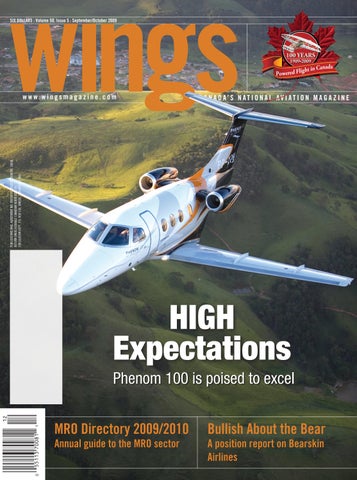
High Expectations Phenom 100 is poised to excel MRO Directory 2009/2010 Annual guide to the MRO sector
Bullish About the Bear A position report on Bearskin Airlines
Dassault Falcon Jet Corp.
dfjc99158_rev1 Proof 3
Delivering our 2000th Falcon is more than just a celebration of success. It’s a confirmation that all the qualities we’ve been building on since 1963 are essential to great flying. The strength of fighter jet technologies. The brainpower of computing leadership. The discipline of passionate engineering. All of which make today’s Falcons high performance business machines leaner and greener than anything else in their class. For the full story please visit our “Interactive Falcon History Tour” at falconjet.com/tour.
E NG I N E E R E D W IT H PASS ION
dfjc99158a.indd 1
8/31/09 12:42 PM
2 PM
September/October
WINGS MAGAZINE : Issue 5 : Volume 50 : Table of Contents
20
Bearskin Position Report
30
Field Aviation
32
Air Accident Investigation
34
DA40 Superman Vision
16 High Expectations Phenom 100 is poised to excel 4
McCarthy
6
On the Fly
Canada’s Top Amateur Pilot.
Industry news that’s important to Canadians.
32
Air Accident Investigation
The TSB’s evolving commitment to worldwide safety, by Chris Krepski.
34
DA40 XLS Gets Superman Vision
9
On the Web
Ken Armstrong flies the DA40 XLS with Garmin Synthetic Vision.
12
Airline Insider
36
DTI Spreads a Quality Message
13
100 Years of Powered Flight in Canada
38
For 80 Years – Ahead of the Curve
Brian Dunn covers the latest developments in the Canadian airline industry.
Raymond Canon looks back at the Fox Moth, the Tiger Moth’s lesser known half-brother.
14
Seaman
Looking at the Big Picture.
20
Bullish About the Bear
Frederick K. Larkin provides an in-depth position report on Bearskin Airlines.
27
Managing the Skies: Part Two
30
Taking Canada’s Best to the World
James Marasa looks at the latest air traffic management solutions.
Field Aviation sets the standard, by Rob Seaman.
DTI’s Taboada brothers help operators learn to love the SMS/QA process, by James Careless.
Celebrating 80 years, James Careless discusses how world-renowned Moncton Flight College stays on the leading edge.
42
MPPs Stand Up For Buttonville
45
MRO Directory 2009/10
62
Carr
Best intentions aside, is it too little, too late? By Rob Seaman.
A comprehensive annual guide to the aviation MRO sector. Included in this section, James Careless writes Weathering the Recession, a report on how 2009 has treated Canadian MRO operators.
Culture Shock.
September/October 2009 | WINGS magazine | 3
McCarthy
DREW MCCARTHY is the editor of Wings.
Once a year, there’s a remarkable Canadian aviation event that really puts things into the right perspective – the John C. Webster Memorial Trophy Competition. Originally created for the purpose of selecting Canada’s top amateur pilot, it certainly does that – but it also does a whole lot more. It gives the Canadian aviation community a chance to take a step back, and have a look at the big picture – while paying tribute to its proud past and saluting its promising future. Established in 1932 by the late Dr. J.C. Webster of Shediac, N.B., the competition is dedicated to the memory of his son, John. John Webster lost his life in an aircraft accident at St. Hubert, Que., while practising to represent Canada in the Trans-Canada Air Pageant. Each year, the regional finalists assemble to participate in “Webster Week.” This year’s event was held at the Brampton Flight Centre from Aug. 19 to 22. During the event, under the watchful eye of the experienced judges, finalists test their aviation skills against one another in a spirit of competition and camaraderie. This year, representing eight different regions were: B.C.’s Kevin Dhaliwal (Coastal Pacific Aviation), Alberta’s Nicholas Dennison Sneider (Cooking Lake Aviation Academy), Manitoba’s John Ferris Painter (Harv’s Air Service), Northern Ontario’s Aaron Lehman (Confederation College), Western Ontario’s Phiroze Contractor (Brampton Flight College), Eastern Ontario’s Cory-Daniel Raby (Algonquin College), Quebec’s Mathieu Beaumier (Cargair – St. Hubert) and the Atlantic provinces’ Thomas Clark (Moncton Flight College). These young men exhibited skill and character not only in the air, but also on the ground. Each and every one of them, throughout the week’s activities, personified the values and spirit of the prestigious award. This year’s winner was Cory-Daniel Raby; the runner-up, who was awarded the Eunice Carter Memorial Award, was Kevin Dhaliwal. The awards banquet was an inspiring event, not only because of these great young pilots, but also because of those who were there to sponsor, support, encourage, and pass on the torch: Air Canada, the Air Canada Pilots Association, the Airline Pilots Association International, the Air Transport Association of Canada, the Canadian Owners and Pilots Association, Transport Canada, Sennheiser, the Snowbirds, the 99s, Aviation World, the Air Cadet League, Aerographics, Brampton Flight Centre, the Canada Aviation Museum, PHD Creative Thinking, Webster photographer Marcel Keays, Wings magazine and last, but most assuredly not least, the inimitable Robert Bradford. The money, donations, services, and volunteer hours provided by these supporters are a testament to the strength, pride and cohesiveness of Canada’s aviation community. In a room full of winners, Webster Memorial Trophy Competition national administrator Amy Foy and husband, retired Transport Canada Civil Aviation Inspector Wayne Foy, deserve some special recognition. The two have spearheaded the competition since 2006, and are tireless in their dedication and commitment to its continued growth. The Webster Memorial Trophy Competition website is at http://webstertrophy.ca/.
Canada’s Top Amateur Pilot A celebration of yesterday, today and tomorrow
4 | WINGS magazine | September/October 2009
WINGS magazine PO Box 530, 105 Donly Dr. S., Simcoe, ON N3Y 4N5 Tel.: 428-3471 Fax: 429-3094 Toll Free: 1-888-599-2228 Editor Drew mcCarthy dmccarthy@annexweb.com 519-429-5192 • 888-599-2228 ext. 265 Associate Editor andrea kwasnik akwasnik@annexweb.com 519-429-5181 • 888-599-2228 ext. 238 Production ArTIST kelli kramer Avionics Editor ROB SEAMAN Flight DecK KEN ARMSTRONG, ROGER BEEBE, RAY CANON, JAMES CARELESS, DAVID CARR, BRIAN DUNN, DARREN LOCKE, Frederick K. Larkin, CARROLL McCORMICK, dr. TAREK SARDANA, BLAIR WATSON Advertising Sales Pauline O’Neill poneill@annexweb.com 519-429-5182 • 888-599-2228 ext. 273 Associate Publisher Alison de Groot 1-888-599-2228 ext. 246 adegroot@annexweb.com group publisher SCOTT JAMIESON sjamieson@annexweb.com President Mike Fredericks mfredericks@annexweb.com PUBLICATION MAIL AGREEMENT #40065710 RETURN UNDELIVERABLE CANADIAN ADDRESSES TO CIRCULATION DEPT., P.O. BOX 530, SIMCOE, ON N3Y 4N5 e-mail: ncuerrier@annexweb.com Published six times per year (Jan/Feb, Mar/Apr, May/ Jun, Jul/Aug, Sep/Oct, Nov/Dec) by Annex Publishing & Printing Inc. Printed in Canada ISSN 0701-1369 Circulation e-mail: ncuerrier@annexweb.com Ph: 866-790-6070 ext. 208 Fax: 877-624-1940 Mail: P.O. Box 530, Simcoe, ON N3Y 4N5 Subscription Rates Canada – 1 Year $ 30.00 (includes GST - #867172652RT0001) USA – 1 Year $ 42.00 Foreign – 1 Year $ 65.00 From time to time, we at Wings Magazine make our subscription list available to reputable companies and organizations whose products and services we believe may be of interest to you. If you do not want your name to be made available, contact our circulation department in any of the four ways listed above. No part of the editorial content of this publication may be reprinted without the publisher’s written permission. ©2009 Annex Publishing & Printing Inc. All rights reserved. opinions expressed in this magazine are not necessarily those of the editor or the publisher. No liability is assumed for errors or omissions. All advertising is subject to the publisher’s approval. Such approval does not imply any endorsement of the products or services advertised. Publisher reserves the right to refuse advertising that does not meet the standards of the publication.
Air Transport Association of Canada
Canadian Business Aviation Association
Canadian Owners & Pilots Association
Member of the Alberta Magazine Publishers’ Association
Member of the Canadian Circulations Audit Board
www.wingsmagazine.com www.wingsmagazine.com
09R
Adventurer
The Beechcraft 1900. Picture it anywhere. ®
Whether it’s getting passengers where they need to be, hauling critical supplies to a remote destination, or deploying a paramedic crew for a life-saving mission, the versatile Beechcraft 1900 is rugged enough to perform in some of the world’s toughest environments and sophisticated enough to get you there in style. Add turboprop efficiency and Beechcraft heritage, and you have a pre-owned aircraft that works as hard as an entire fleet to impact your bottom line. Visit the Beechcraft 1900 official website for a tour of its versatile configurations at www.raytheon.com, keyword: beechcraft1900. ®
www.raytheon.com Keyword: beechcraft1900
1900
1900
+1.316.676.1007
Raytheon Airline Aviation Services, LLC © 2009 Raytheon Company. All rights reserved.
09RAS003_Adventurer_Wings_Mar09.indd 1
1900
4/22/09 10:26:37 AM
onthefly INDUSTRY NEWS : COMMERCIAL AVIATION : GENERAL AVIATION
BUSINESS AVIATION : MILITARY AVIATION
Flying Colours Esterline CMC Electronics welcomes new president secures Esterline Corp. has named from 2001 to 2007. three green Esterline CEO Robert W. Gregory (Greg) Yeldon to the position of president of Cremin said, “Greg’s in-depth Challenger 850 its subsidiary Esterline CMC business acumen and knowlcompletions Electronics Inc. (CMC), effec- edge of CMC Electronics’
tive Aug. 13, 2009. Yeldon has more than 23 years of operational experience in the aerospace sector, including 14 years as CMC’s vice-president and CFO. He has also been serving as interim president of the company since November 2008. His first position with the company was corporate comptroller in 1995. He has served on the board of directors for CMC Electronics Inc. and CMC Electronics Holdings Inc.
products, markets, customers and employees make him particularly well suited to provide continuity and leadership at the helm of Esterline CMC Electronics.” Prior to joining CMC, Yeldon held a variety of positions with the aerospace companies, Leigh Instruments and Micronav International. He received a Commerce degree in 1982 from Carleton University and began his career at Peat Marwick, where
Greg Yeldon takes the helm.
Flying Colours will complete three green Challenger 850s.
he obtained his chartered accountant designation. He became a member of the Canadian Institute of Chartered Accountants in 1985.
Flying Colours Corp., has recently been awarded three green Bombardier Challenger 850 completions from two different clients. The aircraft were recently re-located from Montreal, Que., to Flying Colours’ main location in Peterborough, Ont. The aircraft will undergo installation of custom executive interiors and new exterior paint as directed by the clients. The completions will be finished at Flying Colours Canadian Center and its U.S. base in St. Louis, Mo., JetCorp Technical Services Inc. All three aircraft are scheduled for delivery in 2010. “We have been actively expanding our green aircraft completion capabilities and are looking forward to procuring additional green aircraft in the future,” stated John Gillespie, president, Flying Colours Corp. More information is available at www.flyingcolourscorp.com
Bombardier improves Line Maintenance Intervals for CRJ700/705/900 NextGen and Q400 Bombardier Aerospace has announced that adjustments made to its line maintenance intervals for the CRJ700/705/900 NextGen and Q400 aircraft have received final approval from Transport Canada (TC), the Federal Aviation Administration (FAA) and the European Aviation Safety Agency (EASA) as part of the approval of the Maintenance Requirements Manuals (MRM) for these aircraft. Bombardier employed a methodology that combines a statistical approach with actual maintenance check findings to confidently predict maintenance requirements. Under the former process, changes to aircraft main6 | WINGS magazine | September/October 2009
tenance intervals could only be requested following five years of in-service data. Now, maintenance interval adjustments can be set based on as few as two years of successful results. On May 15, 2009, Bombardier obtained approval for the CRJ700/705/900 NextGen aircraft’s line maintenance check intervals to be adjusted from 400 to 600 flight hours. The information is currently being distributed to operators in Revision 9 of the MRM. In 2008, approval was obtained to increase line maintenance check (A-Check) intervals for the Q400 aircraft from 400 to 600 flight hours, and techni-
cal documentation relating to that increase has been circulated to operators. Previous schedules required CRJ700/705/900 and Q400 aircraft to undergo line maintenance checks every 2.2 months on average (based on an average daily utilization of six hours per day). Under the new revisions, the intervals are extended to 3.3 months. As a result of this extension, Bombardier anticipates that operators will experience reduced Direct Maintenance Costs over the life of the aircraft. For information contact John Arnone at Bombardier Aerospace (416) 375-3030 or visit www.bombardier.com
www.wingsmagazine.com
ON THE FLY
Cavell launches new website
StandardAero names Scott Taylor Business Aviation Sector Leader StandardAero has recently appointed Scott Taylor to the position of senior vicepresident for business aviation based in Tempe, Ariz. With more than 20 years experience leading global sales, marketing and strategy development, Taylor will be responsible for developing and executing sustainable longterm strategy for the business aviation sector and for creating innovative approaches to growing existing products and services. “Scott brings a background to StandardAero’s business aviation sector rich in leadership and understanding of the
products, systems and business models that drive the Business Aviation market,” said StandardAero president and CEO, Rob Mionis. Prior to joining StandardAero, Taylor led sales and marketing for Honeywell’s business and general Aviation division. Over an 18-year career at Honeywell Aerospace, Taylor held various sales, marketing and business leadership positions in the military, regional, business and general aviation sectors. Most recently, Taylor served as general manager, business and regional aviation marketing, for General Electric
Scott Taylor
Aviation. Prior to Honeywell he served as an officer in the U.S. Army for seven years. Taylor holds a master’s degree from the University of Phoenix, a bachelor’s degree from Penn State University and is Six Sigma certified.
Winnipeg-based Cavell Equipment Ltd. has recently launched its new expanded website. Specializing in portable heating needs for aviation, Cavell offers sales, service and aftermarket support of all major manufacturers of portable heaters from Canada, the U.S., and Europe. Cavell offers products and services for everything from small aircraft and base camp operations to large commercial aircraft, temporary on-site heating. You can visit Cavell’s new website at www.cavellequipment.com
AAADA and the Warner Robins Area Chamber of Commerce AIC MOU In late July, the Southeastern U.S.-Canadian Provinces Alliance (SEUS//CP) conference in St. John’s, N.L., was the site of a signing of Memorandum of Understanding (MOU) between the Atlantic Alliance of Aerospace and Defence Associations (AAADA) and the Warner Robins Area Chamber of Commerce Aerospace Industry Committee (AIC). The MOU promotes each association’s membership and is intended to lead to economic development opportunities in each country for companies involved in the aerospace, defence, security and spacerelated sectors. The AAADA is an alliance of aerospace and defence associations in Atlantic Canada composed of members from associations in New Brunswick (NBADA), Nova Scotia (ADIANS), Newfoundland and Labrador (ADIANL) and Prince Edward Island (APEI).
Back row from left to right: Premier Shawn Graham, NB, Governor Sonny Perdue, GA, Brian Oak, Consul General of Canada, Atlanta, GA, Premier Danny Williams, NL, Premier Darrell Dexter, NS, Minister Allan Campbell, PEI. Front row: Gary Cox, chairman AIC and director of operations for NavCom Defense Electronics, GA, Howard Nash, co-chair AAADA and president of Northstar Network, NL, CA.
A regional organization, the AAADA is focused on representing, promoting and growing the aerospace, defence and homeland security sectors, and building national and international partnerships to support its companies to be leaders in innovation and productivity. It represents some 280 com-
panies in the region employing more than 10,000 skilled workers (www.aaada.ca). Warner Robins Area Chamber of Commerce Aerospace Industry Committee (AIC) was formed for the purpose of preserving, advancing and enhancing the community of aerospace and
defence industries in the Warner Robins area and specifically for the advancement of their collective interests. The committee is made up of approximately 200 managers of aerospace and defense contractors in the Warner Robins, Middle Georgia area (http:// www.wrcoc-aic.org/). September/October 2009 | WINGS magazine | 7
ON THE FLY
Vancouver International first to operate new high-tech safety equipment Vancouver International Airport (YVR) has become the first commercial airport in the world to install a day and night camera to its existing Tarsier Foreign Object Debris (FOD) radar detection system. The new camera will upgrade YVR’s 24-hour automated runway debris detection system in all weather conditions by providing visual confirmation of any potentially dangerous objects on the runway. Tarsier’s high-resolution radar and advanced day and night camera work in tandem to provide continuous runway monitoring and safety. The camera’s innovative illuminator helps produce FOD images in all light levels, turning night into day and giving operators greater confidence and certainty. “The camera allows us to determine quickly whether the FOD is a two-inch worm that poses no threat, or a broken zipper from a suitcase that does,” said Brett Patterson, director, airside operations, Vancouver Airport Authority (VAA). FOD as small and seemingly innocuous as a bolt, discarded plastic bag or clamshell
dropped by a bird on the runway can cause serious damage to aircraft and poses a potential safety risk. Each year, loose objects on airport runways, taxiways and aprons cost the global aviation industry an estimated US$12B. Tarsier’s networked high frequency, high-resolution radars sweep the runway around the clock. When FOD is detected, an alarm is triggered in YVR’s Operations Centre where the user display highlights the object’s location. The camera zooms in, sending a live image for visual confirmation and the object’s GPS co-ordinates are provided, enabling accurate location and retrieval of the object in a matter of minutes. Developed by U.K.-based QinetiQ, the system was trialed at YVR for one week in June 2004. In 2005, VAA was the first airport operator in the world to purchase the system,
which went into full operation at YVR in late 2006. The recent addition of the day and night camera to the radar system has increased the efficiency of debris retrieval and further reduced runway closures and operational disruptions. The four Tarsier radar and camera units installed at YVR provide continuous coverage of the north and south parallel runways, each of which is approximately three kilometers in length. The four units are mounted on towers that vary in height from three to seven metres, and are set back 150 metres from the centre of the runway for maximum coverage.
Kenn Borek Air ends crew and maintenance support to Maldivian Air Taxi Kenn Borek Air Ltd. (KBA) has helped Maldivian Air Taxi (MAT) set up its operation over the last 15 years by providing crew and maintenance personnel. Effective Nov. 1, 2009, MAT will start operating on its own as KBA ceases providing the crew and maintenance to its organization. MAT will continue with its own operation and KBA aircraft will be put in other operations worldwide. KBA has started an operation in Vancouver with Harbour Air Ltd. as one of its future endeavours. KBA has also placed an order for its third DC3-T while negotiating a fourth. It is also expanding its operation in the Antarctica for a total of seven or more Twin Otters for the upcoming season.
Garmin Glass for the Diamond DA20 Diamond Aircraft and Garmin International are now offering a new factory-equipped glass cockpit solution for the DA20-C1. The Garmin G500 equipped DA20 offers: Garmin 10” wide PFD/MFD glass cockpit, redesigned panel for more space and comfort, 125 hp TCM IO-240 with Sensenich fixed pitch propeller, 5 gph in typical flight training operations, 450 lb full 8 | WINGS magazine | September/October 2009
fuel useful load, utility category certification to max gross weight, and spin certified for instructor training. The 2010 model year DA20 with Garmin G500 will be available for delivery starting October 2009. Base pricing, including the G500 has been set at US$184,980. For more information about Diamond Aircraft, visit www.diamondaircraft.com
Deliveries start October 2009. www.wingsmagazine.com
ontheweb NEWS HIGHLIGHTS: WEB EXCLUSIVES: BLOG: JOB POSTINGS: NEW PRODUCTS
www.wingsmagazine.com
Canadian Aviation Quiz 41. Almost exactly on the border between which two provinces, right beside the Trans-Canada Highway, will you find an Avro Lancaster? a) Que./N.B. b) Ont./Man. c) N.S./N.B. d) Sask./Alt. 42. The top 150 North American airports processed 10,440,909 fewer passengers in 2008 than in 2007 – 1,536,461,474. Which Canadian city’s airport enjoyed the biggest increase in passenger throughput in 2008? a) Hamilton b) Gander c) Quebec City d) Kitchener 43. On October 4, 1975 which Canadian airport received the Concorde supersonic passenger jet for a special celebration? a) Mirabel b) Pearson c) Quebec City d) Yellowknife 44. Which Canadian company laid claim to having built the world’s first 360-degree air traffic control training simulator? a) Raytheon Canada
b) ATS Aerospace c) Adacel Inc. d) CAE 45. For how many days in August 2009 were the Snowbirds Demonstration Team scheduled to perform in Canada? a) 9 b) 24 c) 14 d) 3 46. The Siskins aerobatic flying team was established in 1929, and lasted until 1932. Its squadron leader became the first RCAF pilot to be awarded the Distinguished Flying Cross in the Second World War. What was his name? a) Ernie McNabb b) Johnnie Kent c) G.R. McGregor d) Dal Russel 47. Alexander Lilly, instructor, test pilot and Second World War veteran, was the first Canadian to achieve what feat in an F-86 Sabre jet? a) break sound barrier b) vertical climb c) eject safely d) in-air refuelling
The snowbirds Demonstration Team (Photo by Daniel Champagne)
48. Between 1950 and 1958, Canadair Ltd. built how many F-86 Sabre jets? a) 1,211 b) 815 c) 1,815 d) 2,111 For more questions and the answers, go to www.wingsmagazine.com and click on the 100 Years logo.
September/October 2009 | WINGS magazine | 9
ON THE FLY
Embraer names new Authorized Service Centre for executive jets in Canada Embraer has selected Starlink Aviation to be its first authorized service centre in Canada for the Phenom 100 and Phenom 300 executive jets. The company is headquartered at Montréal-Pierre Elliott Trudeau International Airport in Quebec, offering Phenom owners aircraft maintenance and top-flight Fixed Base Operator services, as well as aircraft management and charter operations. “Starlink’s 25 years in the general aviation business make them an excellent option for our Phenom operators in the region. They have outstanding facilities and a highly experienced team available 24/7,” said Scott Kalister, Embraer vice-president, customer support, U.S.A., Canada, Mexico and Caribbean - executive jets. Starlink Aviation is a Canadian, diversified, full-service
Starlink Aviation headquarters in Montréal-Pierre Elliott Trudeau International Airport, Que.
aviation company, it also has bases in Hamilton, Ont., the Saguenay Lac-St.Jean region of Quebec, and Yarmouth, N.S. It offers scheduled flight services, corporate FBO services from its private terminal at Montréal-Pierre Elliott
Trudeau Airport, on-demand air charter flights, aircraft management services, and a full range of maintenance activities. Starlink operates a fleet of 18 aircraft, including business jets and turboprops, and has been in business since 1981.
P & WC opens Lethbridge centre Pratt & Whitney Canada (P&WC) has opened a Regional Service Centre in Lethbridge, Alta., offering a wide range of world-class engine maintenance and support services for P&WC engine customers. The P&WC Lethbridge Service Centre is co-located with P&WC’s main production plant for low and high power PT6A engines. It features an updated and modern facility with advanced tooling and component repair capabilities. It performs light and heavy maintenance on PT6, JT15D, PW100 and PW500 engine series, as well as light maintenance for the PW600 engine series.
The centre performs light and heavy maintenance on PT6, JT15D (shown above) PW100 and PW500 engine series and light maintenance on the PW600 engine series.
In addition, it offers 24/7 Mobile Repair Team (http:// www.pwc.ca/en/services u p p o r t / m o b i l e - r e p a i rteams) and AOG support, 1-2 day fuel nozzle servicing, limited PT6 fuel nozzle exchange, borescope inspection, pre-buy inspections, on-wing vibration analysis & balancing, and AD/SB research assistance. 10 | WINGS magazine | September/October 2009
www.wingsmagazine.com
airlineinsider AIR CANADA GEARS UP FOR 2010 OLYMPIC GAMES Air Canada has taken delivery of its last 777-300ER with a specially designed livery in recognition of the carrier’s role as Official Airline of the Vancouver 2010 Olympic and Paralympic Winter Games. The delivery completes the airline’s fleetwide renewal program, giving the carrier one of the youngest fleets in the world with an average age of nine years. Air Canada said it will introduce non-stop service on peak travel days during the games from Vancouver to Frankfurt, Paris, Geneva and Zurich, in addition to its year-round non-stop London service.
A FRENCH CONNECTION FOR AIR CANADA Air Canada has launched the only scheduled non-stop service between Montreal and Fort-de-France, Martinique. The weekly service was initially offered on Saturdays during the summer and will recommence on a year-round basis on Dec. 5. “We look forward to offering the only non-stop service between Montreal and Martinique, a Caribbean island with French flair,” said Marcel Forget, Air Canada’s vicepresident, network planning. “We expect this new service to appeal to Quebecers seeking a wide range of cultural and sporting activities as well as to residents of Martinique interested in Quebec’s cultural and educational offerings.” Air Canada’s MontrealFort-de-France non-stop service will be operated on Saturdays using 120-seat Airbus A319s. The aircraft offers Executive and Economy Class 12 | WINGS magazine | September/October 2009
Air Canada’s 18th Boeing 777 takes to the skies sporting new Vancouver 2010-themed livery. (Photo courtesy of Boeing)
travel and free personal audiovideo entertainment at every seat with a choice of 24 movies and 100 hours of TV programming. This service complements Air Canada’s existing twice-weekly flights between Montreal and Pointe-à-Pitre, Guadeloupe. And Air Canada’s new summer-only Montreal-Rome service is now going to be a year-round service with the winter schedule effective Oct. 27, with three flights per week using Boeing 767s. STRATEGIC MOVE FOR WESTJET WestJet has unveiled its largestever seasonal non-stop flight schedule, with a record eight new international destinations and three additional U.S. destinations for this winter. By late fall, WestJet will operate service to 66 cities in more than 10 countries, compared to 51 cities in eight countries a year ago. Beginning in late fall, WestJet and WestJet Vacations will launch seasonal non-stop service to Varadero, Holguin and Cayo Coco, Cuba; Ixtapa and Cozumel, Mexico; St. Martin; Providenciales, Turks and Caicos; Freeport, Bahamas; Lihue (Kauai), Hawaii; Miami, Florida; and Atlantic City, N.J. The new schedule also includes new, year-round ser-
vice between Edmonton and Yellowknife and between Calgary and San Diego. WestJet launched both routes on a seasonal basis in May. WestJet has also struck an interline itinerary deal with Air France-KLM which lets passengers board the European airlines’ aircraft and travel on one itinerary to a final destination in WestJet’s Canadian network. WestJet said the agreement is an “important strategic move” and could lead to a broader relationship with a reciprocal interline agreement and code-share deal. Initially, connections will be made through WestJet’s Calgary and Vancouver gateways, with the option to continue on to Vancouver, Calgary or Edmonton. WestJet said in February it would study a code-share pact with Air France-KLM. In May, it delayed such a deal with U.S.-based Southwest Airlines. WestJet said that Southwest was committed to the deal but needed to “get its house in order” in the challenging U.S. market. AIR CANADA CONCLUDES MOU WITH JAZZ Air Canada has concluded a Memorandum of Understanding with Jazz Air LP to
By Brian Dunn
modify the terms and conditions of their Capacity Purchase Agreement. As part of the revised agreement, Air Canada is reducing its commitment to Jazz’s minimum fleet from 133 to 125 aircraft, extending its contract by five years with the regional carrier that was set to expire at the end of 2015, and has made a commitment to work together with Jazz on its fleet renewal program. Some industry watchers believe Bombardier’s Q400 aircraft could be a prime candidate for the renewal program. BLUE SKIES BETWEEN CANADA AND NEW ZEALAND Canada and New Zealand have signed an agreement to ease air travel between the two countries. International Trade Minister Stockwell Day signed the Blue Sky pact at the Asia-Pacific Economic Cooperation meeting in Singapore. The agreement allows airlines from either country to operate passenger and cargo flights as often as they wish to and from either territory. Air carriers in both countries will also be able to pick up traffic in each other’s territory and continue to a third country. Day said the agreement will “help facilitate stronger business ties and enhance tourism between Canada and New Zealand.” Blue Sky also provides for enhanced all-cargo rights, allowing stand-alone cargo services between each other’s territory and third countries. This new agreement replaces one that has been in force since 1985. www.wingsmagazine.com
100years
OF POWERED FLIGHT IN CANADA
The Fox Moth: The role of the Tiger Moth’s lesser-known half-brother
Out of the famous stable of de Havilland aircraft, the Tiger Moth was the best known and most widely used in Canada; its half-brother, the Fox Moth, was the least known. That should not be taken as a criticism of the latter; unlike the Tiger Moth, which acted as a basic trainer for untold thousands of embryonic pilots before and during the Second World War, the Fox Moth enjoyed only limited production in both Great Britain and Canada. Since the two aircraft looked so much alike, it is only logical to assume that they shared the same designer. So it was that A.E. Hagg followed his success in Great Britain in 1931 with the Tiger Moth by immediately turning to the Fox Moth in response to a demand for a lightweight transport aircraft. The two aircraft may have been for totally different purposes but that did not stop Hagg from borrowing a number of Tiger parts for the Fox. Both had wood frames, the Tiger’s being made of spruce while the Fox’s, plywood. Only 85 Fox Moths were built in Great Britain before the war, but it was, in its own way, just as successful as its half-brother. The purpose, as indicated above, was to serve as a light passenger and/or freight aircraft and, as such, found instant favour. The pilot sat in a raised seat, behind, not in front, of the passenger cabin. The latter normally contained four seats but could be reduced to three when weight was a problem. This story might have started and ended in Great Britain if it had not been for the fact that, after the aircraft had gained its stellar reputation among its British users, the prototype was shipped to the de Havilland plant in Toronto. Enough interest was shown for the company to
Max Ward in CF- DJC (Photo courtesy of the Canadian Air & Space Museum)
build two more in Toronto. Finally, an additional eight crossed the ocean to meet Canadian demand. After so many years I found it difficult to locate anybody connected with these early Fox Moths. However, a witness was finally found in Capt. Frank Bradley, who early in the war had earned his wings as a pilot in the Beautifully restored VWC Fox Moth piloted by Dave Hadfield. (Photo courtesy of RCAF, and was subsequently Peter Handley, Vintage Wings of Canada) seconded to Canadian Pacific Airlines to train navigators at what is today among other things, as a bush plane and air ambulance. The characteristics that Quebec City Airport. “It was there,” Bradley recalls, “that attracted Canadian flyers had already beone privately-owned three seater Fox come well known to their British counMoth appeared periodically at the airport terparts in the 1930s. The Fox was not as large or rugged as its chief Canadian-defor maintenance.” “The aircraft,” he continued, “flew in signed competitor, the Noorduyn Norseand out of a grass field near Tadoussac at man, but it was certainly very popular in the mouth of the Saguenay River and was the roles it played. Perhaps its best-known owner was employed, among other things, to transport people and cargo across the St. Law- Max Ward, featured in the last issue of Wings, who made it his first purchase for rence River, 30 miles wide at that point.” “In the winter,” he concluded, “its his planned airline. The Canada Aviation wheels were replaced by skis. It was the Museum in Ottawa has on display an auobject of intense curiosity by the airmen thentic version of the aircraft that so atat our base since none of them had seen tracted Ward, if any readers wish to see one. It was Ward himself who bought and anything like it before.” After the war, a further 54 were built then donated it to the museum in 1990. in Toronto and the Fox became popular, – By Raymond Canon September/October 2009 | WINGS magazine | 13
seaman Looking at the Big Picture Let’s put the money where it’s needed
14 | WINGS magazine | September/October 2009
“If you want to make a small fortune in aviation, start with a big one.” Today, this would seem truer than ever. However, some indicators such as UBS, and Forecast International suggest that we have bottomed out and things are starting to get better. Aircraft prices seem to be stabilizing and inventories have settled. FBOs report growth. But there is a long way to go and depending upon whose report you read, we are looking at between three and 10 years before levels to back to being good. The consumer media seem determined to show aviation in a bad light. The guy or gal in the street believes what they see and hear on TV, radio and newspaper print. That in turn leads elected officials – always thinking of voters in order to get re-elected – to come down against us too. In the U.S., airports are part of the economic recovery plan. Not so here. The Obama government earmarked $1.1 billion in stimulus spending for airports. Aviation is getting a share of the pie! But wait – enter the CBS and its story that says about one third of that $1.1 billion has gone to “little used” airports that cater to recreational flyers, corporate jets and remote communities. To them, that is a bad thing. Frankly it hits the mark and has put the money where it is needed to support the transportation infrastructure. Many here in Canada wish our government was so misguided. The other implication made by the CBS is that by spending the money this way, big airports go without things like “critical taxiway warning lights” and that there are “significant safety issues” at the big airports that would have been better recipients of the money. While this holds some truth, the fact is that big airports in the U.S. did get money. At LAX for example, $15 million was given for a new fire hall. As for the “little used” airports, most received small amounts – like the flying club in upstate New York who got $400,000.00 to repave its runways. That really is not a big bag of money, but for the airport in question, it makes a huge difference to its ability to operate safely and efficiently. Not only that, these smaller fields are
ROB SEAMAN is a Wings writer and columnist.
the lifeline for their respective communities and as we know, smaller airports feed into the larger system. It also means that local suppliers did the actual work which is otherwise unavailable stimulus to that regional economy. CBS was not happy, inferring that the funds were to create new jobs – not help current ones. It totally missed the point about work being work – and the more there is, the more jobs come out of it – direct and indirect. Retaining jobs is just as important as creating them. What CBS did do was take yet another shot across the bow of private aviation as elitist and for the privileged. Once again it missed the big picture that includes aviation and incidental jobs for today, training/jobs for tomorrow and transportation in regions where no other efficient means may exist. Sound at all familiar to you folks up north? This is not just a U.S. argument. It can be made here in Canada. Our government has given money to airports but it was not big bucks in the scheme of things. And just FYI, the government continues to collect its rent and taxes on crown lands, airports and aviation operations at the same rates it did prior to the downturn. So even though use and traffic may have diminished, Ottawa still want their full whack without a market correction to the reality of the day. Does that make sense? Just to ice the cake, while communities here struggle to keep their airports alive, the folks in Ottawa have announced tens of millions of dollars in funding to yet again – improve rail service on the Montreal/Toronto corridor. Sorry, but have we not done this numerous times before? This is proof once again that rail, roads, bridges and sidewalks seem to fit their definition of infrastructure – not air transport. Does someone there have an issue with flying? Clearly our government is out of step and out of touch with issues here, and for all appearances, uncaring about it. When the next election comes, please bring to office some folks who understand our industry and its impact on all of Canada. Your comments and feedback are always welcome. Send your e-mail to Rob Seaman c/o dmccarthy@annexweb.com www.wingsmagazine.com
Retrofit glass. For not much cash. Introducing Garmin G500. This new dual-screen digital “glass cockpit” suite is clearly the retrofit option you’ve been waiting for. It fits neatly into the panel space vacated by your old six-pack instruments, pairing a Primary Flight Display (PFD) and Multi-function Display (MFD) directly in your field of view. Instrument data comes from ultra-reliable AHRS attitude/heading reference. And all comm and nav functions are easily integrated with the WAAS-certified GNS 430W or 530W units in your stack. Available upgrade options include a scaled version of Garmin’s SVT™ Synthetic Vision Technology, as well as a remote adapter that lets the AHRS drive your autopilot in place of a costly-to-maintain gyro ADI. So, check it out. Garmin G500: Affordable glass for the owner-flown class. Follow the leader.
NASDAQ GRMN
www.garmin.com
©2009 Garmin Ltd. or its subsidiaries
Contact the following dealers to schedule your installation.
Springbank Airport Calgary, Alberta T3Z 3S4 1-800-661-1130 rockyavionics@pathcom.ca
Hangar 6, Suite 101 Toronto City Centre Airport Toronto, Ontario M5V 1A1 1-877-278-3494 david@eagleaircraftinc.com
High Expectations Phenom 100 is poised to excel By Drew McCarthy
In 2005, Brazilian aircraft manufacturer Embraer set out to design and build what it called a revolutionary entry-level jet. It promised that this new aircraft would feature premium comfort, outstanding performance, docile 16 | WINGS magazine | September/October 2009
flying qualities and low operating costs. At the time the project was launched, the business aviation landscape was littered with announcements and pronouncements heralding the birth of one, then
another, VLJ and for a while it looked like there would be no end to the folly. Now, more than four years later, the term “VLJ” has been all but expunged from the lexicon of business aviation and the number of entry-level
business jet manufacturers has been drastically and mercifully reduced. The Phenom 100 is a clean sheet aircraft that was conceived, developed, and certified in less than four years. The birth of this www.wingsmagazine.com
High Expectations
entry-level jet and its sibling, the Phenom 300, can be traced back to the year 2000, when Embraer launched its Legacy 600 project. At the time of the announcement, the company articulated the goal of becoming one of the
biggest manufacturers in the business jet segment. Since then, Embraer has steadfastly pursued that goal, with the introduction of the Legacy 500, 450 and the Lineage 1000. The company has set a target date of 2015, when
it will have six business jets being manufactured, covering practically all of the segments of executive aviation. Delivering airplanes is nothing new for Embraer, the world’s fourth largest aircraft manufacturer, but the devel-
opment of the Phenom 100 has had a special significance. The aircraft is the first jet to be designed by Embraer exclusively for the executive market. (Both the Legacy 600 and the Lineage 1000 are based on commercial jet platforms.) Throughout its development, the Phenom 100 program remained pretty much on schedule, with aircraft number 99801 becoming airborne for the first time on July 26, 2007. Some minor delays took place in the late summer and fall of 2008, but in December 2008 Embraer received its Type Certificate from Brazil’s National Civil Aviation Authority (Agência Nacional de Aviação Civil - ANAC) at Embraer headquarters in São José dos Campos. The FAA granted U.S. Type Certificate, based upon Brazil’s National Civil Aviation Agency’s Type Certificate, three days later and deliveries began the following week. (Since then, EASA certification was granted in April 2009, and Australian CASA certification in August 2009.) Certification saw the aircraft surpass several performance goals. The Phenom 100’s maximum range, originally projected to be 1,160 nautical miles (2,148 kilometres or 1,335 miles), was extended to 1,178 nautical miles (2,182 kilometres or 1,356 miles) with four occupants and NBAA IFR reserves. An optional enhanced takeoff performance package was included in the aircraft certification, resulting in a 3,125 ft. take-off field length at maximum take-off weight. The standard take-off field length is 3,400 ft. as initially specified. For departures from airports with restrictions due September/October 2009 | WINGS magazine | 17
High Expectations
The Prodigy flight deck features FMS with graphical flight planning capability, integrated EICAS and main-system synoptics.
to high temperatures or high elevations, or both, takeoff climb performance also surpassed the design target, providing up to 300 nautical miles extra range. Another performance improvement was achieved with the landing distance, verified to be only 2,699 feet at maximum landing weight, 301 feet shorter than initially specified. Powered by two Pratt & Whitney Canada PW617F-E engines, the Phenom 100’s fuel consumption was confirmed to be better than originally estimated, saving as much as 3.6 per cent on longer trips. The flight test campaign validated the Phenom 100’s top speed of 390 knots (true air speed), 10 knots faster than initially projected. The aircraft is capable of climbing directly to its maximum cruise altitude of 41,000 feet, even at maxi18 | WINGS magazine | September/October 2009
mum take-off weight. Certified without restrictions, the Phenom can fly IFR, day or night, and into known or forecasted icing conditions. The aircraft also operates well within Stage IV external noise requirements established by ICAO. The aircraft’s man-machine interface, based on what is called “a quiet and dark cockpit philosophy,” offers full situational awareness and automation for a low workload, contributing to its certification for singlepilot operation. The Prodigy flight deck is based on the Garmin G1000 avionics suite. It features FMS with graphical flight planning capability, integrated EICAS and mainsystem synoptics. Alert messages are delivered on a needto-know basis. Three 12-inch LCDs allow for overlaying
The aircraft is capable of climbing directly to its maximum cruise altitude of 41,000 feet, even at maximum take-off weight.
www.wingsmagazine.com
High Expectations
The interior was designed by Embraer in collaboration with BMW Group DesignworksUSA and features among other things, ergonomically designed seats.
The cabin has an Oval Lite cross-section profile, making the interior more spacious.
of information such as traffic and terrain for increased situational awareness. In its normal configuration, the aircraft has a capacity of four passengers, but can carry up to six or seven passengers with a single crew, optional side facing seat and belted toilet. The interior was designed by Embraer in collaboration with BMW Group DesignworksUSA and features, among other things, ergonomically designed seats. The cabin has an Oval Lite cross-section profile, making the interior more spacious. Its maximum height is 4 ft. 11 in., maximum width 5 ft. 1 in., length is 11 ft., and floorline width is 3 ft. 7 in. The baggage capability
totals 71 cu. ft. (2 cu. m.). In the aft fuselage, the 55 cu. ft. (1.55 cu. m.) compartment is large enough to hold skis or golf clubs. Another 5-cu.-ft. (0.14-cu.-m.) compartment is available in the forward fuselage, along with 11 cu. ft. (0.31 cu. m.) of internal pressurized storage area. The Phenom 100 has long maintenance intervals (600 flight hours or 12 months) between inspections and is designed for an economic life of 35,000 cycles. Embraer’s Executive Jets Customer Support and Services organization is well prepared for the Phenom 100. Four new Embraer Executive Jets service centres have been inaugurated in the U.S. and
Europe. The entire network will eventually be comprised of seven wholly owned and 38 authorized service centres, worldwide. In Canada, Starlink Aviation will be Embraer’s first authorized service centre for the Phenom 100 and 300. Starlink is based at Montreal’s Pierre Elliott Trudeau International Airport. The first Phenom 100 customers were trained by the Embraer CAE Training Services joint venture, and service centre professionals have received training to perform technical and mechanical services on the Phenom 100. A newly implemented customer contact centre has been set up and is ready and standing by to provide customers with complete and timely assistance for operational, technical and maintenance needs. Embraer’s new parts distribution centre, operated by UPS Supply Chain Solutions in Louisville, Ky., is certified, operational and stocked with a complete inventory of repairable, expendable and structural parts for the Phenom jets.
As of Jan. 5, 2009, the Phenom 100 was priced at US $3.18 million for FAA certification, and US $3.25 million for ANAC certification, both based on January 2005 economic conditions for a baseline configuration. Brought to January 2009 economic conditions, the price was US$ 3.6 million for FAA certification and US $3.68 million for ANAC and EASA certifications, subject to escalation until delivery. The company plans to deliver 110 Phenom 100s before the end of 2009, even though only about 20 aircraft were delivered in the first half of the year. Embraer has ramped up production to about 3.5 aircraft per week and hopes to deliver between 35 and 40 airplanes in the third quarter and the remaining 50 or so by the end of December. The Phenom 100 made its Canadian debut at the Canadian Business Aviation Association Convention and Trade Show last May in Montreal, where it garnered a lot of interest. First deliveries into Canada are expected in the spring of 2010.
The Engines Model Power Diameter
PW617F-E 1695 lbf 29.60"
Length Certification
52.60" 2008-09-09
Compact and lightweight, the PW600 turbofan engine family is built with half the parts of a conventional turbofan, making it easy and fast to maintain. Three PW600 models are currently available (PW610F, PW615F and PW617F) ranging in thrust from 950 to 1,750 pounds. The core engine developed as a demonstrator earlier this decade has been designed to enable the PW600 family of engines to grow to 3,000 pounds thrust. The PW600 family delivers highly fuel-efficient power with low carbon emissions. It also comes equipped with dualchannel full-authority digital engine control (FADEC), which translates into reduced pilot workload and engine monitoring with longer time on wing. September/October 2009 | WINGS magazine | 19
Bearskin currently serves 17 communities with a fleet of 14 Fairchild Metros.
BULLISH ABOUT THE BEAR A position report on Bearskin Airlines By Frederick K. Larkin Many Have Played, Few Have Stayed Longevity is an admired trait of any company, but particularly so of an airline. Other than Air Canada, that was created as Trans-Canada Air Lines in 1937 and went through a rebirth of sorts in 2004, most of the other highprofile Canadian airlines are relatively young. For example, Air Transat, Jazz Air, Skyservice Airlines and WestJet Airlines are all less than 25 20 | WINGS magazine | September/October 2009
years old. So, when an airline operating under its original name celebrates its 40th anniversary, it is noteworthy. Such is the case with Bearskin Lake Air Service Ltd. of Sioux Lookout, Ont. Given its bounty of natural resources, northern Ontario has seen plenty of aviation activity in support of its commodity-oriented economy. Over the past three decades many local scheduled carriers have disappeared as a result of
mergers, acquisitions or financial failure. Former players included Air Ontario, Austin Airways, Canadian Voyageur Airlines, Frontier Air, Hooker Air Services, norOntair, On Air, Ontario Central Airlines, Ontario Express, Patricia Air Transport and White River Air Services. In light of the current economic environment, is Bearskin positioned to reach its golden anniversary in 2013 and to prosper beyond that?
Before we attempt to answer that, let’s review how the company has come to where it is today. That Was Then… It all began on July 17, 1963, when Otto John Heglund founded the company at Bearskin Lake in northwestern Ontario. Two years later the Class 4C charter outfit was purchased by Henri Boulanger and Albert Cone, who expanded the fleet of float www.wingsmagazine.com
BULLISH ABOUT THE BEAR equipped aircraft from the original pair of Cessna 180s. In 1972, a 24-year-old Bearskin pilot named Harvey J. Friesen purchased 50 per cent of the company. Five years later he acquired the other half and became the company’s chief. That same year, Bearskin became a scheduled carrier with the introduction of the Sioux Lookout-Big Trout Lake route. The following year, the company initiated its second sked service from Sioux Lookout to Thunder Bay. Harvey Friesen’s brother Cliff purchased an interest in the company that year and established a base for the carrier in Thunder Bay. During the late 1970s and early 1980s, the Ontario government funded the devel-
opment of airports to serve numerous First Nations communities that were accessible only by air. The company, which was now marketing itself as Bearskin Airlines, seized the opportunity to establish scheduled services connecting those communities with key transportation nodes such as Thunder Bay and Winnipeg. A meaningful boost to Bearskin’s growth came in the fall of 1988 when it entered into a commercial agreement with Air Ontario – an Air Canada connector carrier; with that arrangement came Bearskin’s participation in Air Canada’s Aeroplan frequent flyer program. Bearskin remains an Aeroplan partner today.
In 1991 the carrier acquired its first two Fairchild Metro aircraft. Bearskin used these aircraft on Sept. 14, 1992, to introduce scheduled flights between northwestern Ontario’s two largest cities – Thunder Bay and Sudbury. Further opportunity came in the spring of 1993 when Ontario Express, a regional affiliate of Canadian Airlines, withdrew from the Thunder Bay-Sault Ste. MarieSudbury-North Bay-Ottawa route. The so-called “Northern Tier” route was an ideal fit for Bearskin, thus it moved quickly to fill the void in seat capacity by initiating service on April 4 that year. Although it now had a significantly larger presence across northern Ontario,
Bearskin still faced competition on many of its key routes from norOntair – an air service funded by the provincial government. That changed on March 29, 1996, when norOntair’s operations ceased as a result of the province withdrawing its financial support. Once again, Bearskin responded by expanding its network to Marathon, Wawa and Timmins, and by increasing frequencies on the “Northern Tier” route. In 1999 the company increased its presence in Manitoba. Having operated a route from Winnipeg west to Brandon (from April 1994 until October 1995), it now looked north. In May 1999 it introduced scheduled service from Winnipeg to Flin Flon and
September/October 2009 | WINGS magazine | 21
BULLISH ABOUT THE BEAR The Pas – routes that remain in place a decade later. In an effort to skim some cream off Canada’s second busiest city-pair, Bearskin initiated scheduled service between Toronto Buttonville Municipal Airport (in suburban Markham, Ont.) and Ottawa on Sept. 10, 2001. Nine-seat Pilatus PC-12s supported the impressive schedule of seven round trips each weekday. Bearskin beefed up its northwestern Ontario schedule on Oct. 15, 2002, when it began service between Winnipeg and Dryden, Ont., using 12-seat Beech King Air 100s. Calm Air International had discontinued that route in late September. Bearskin used Buttonville again when it
began service between northern Ontario and the Greater Toronto Area on April 7, 2003. That day it started flying there from Sudbury using PC-12s to provide three round trips each weekday. Six years ago, the map depicting Bearskin’s northwestern Ontario destinations resembled a barn wall that had been peppered with buckshot. A seemingly random pattern of approximately 30 dots represented a significant portion of the carrier’s network. That changed dramatically in July 2003, when Bearskin sold its scheduled routes north of Red Lake and Sioux Lookout that served 21 First Nations communities for approximately $18
News about sleep, wakefulness, and alertness that can save pilot lives. • Why motivation and discipline fail to overcome the physiological mechanisms of fatigue • The two most dangerous times of the day • How to use power napping - the fifteen minute breakthrough • The science of getting more rest from your sleeping hours • Countermeasures to apply when you burn the candle at both ends • Expert tips for handling jet lag, cumulative fatigue, and just plain tough days.
22 | WINGS magazine | September/October 2009
This summer the company celebrated its 46th birthday.
million to Wasaya Airways LP. The deal included two Pilatus PC-12s, rotables and a hangar. A year later, in Aug. 2004, Bearskin reorganized its eastern Ontario route structure and focused on its traditional
territory. The rationalization included the withdrawal of its services from Toronto Buttonville as a result of competitive pricing from the majors. Any truly entrepreneurial management team is always on the lookout for niche
Back in print with a new design, this guide includes instruction on the basics of takeoffs and landing, the realities of flying into and out of an airport, and the functions of the throttle, stick, rubber, and trim. A pilot’s pilot, Collins provides a complete and coherent account, from takeoff roll to full stop, of a perfect flight and landing; identifying many common errors pilots make along the way. In addition to extracting from his own lengthy career and personal experience, Collins shares tips and secrets he learned by observing airline pilots, reading military manuals, attending manufacturer’s flight training program, and interviewing some of aviation’s most famous thinkers and figures.
www.wingsmagazine.com
BULLISH ABOUT THE BEAR market opportunities that have inherent pricing power. With that in mind, Bearskin initiated service between Ottawa and the Region of Waterloo International Airport in Breslau, Ont., on Oct. 1, 2007. The latter serves the cities of Kitchener, Waterloo, Cambridge and Guelph – a region known for its technology industries and post-secondary educational institutions. The provision of convenient nonstop flights between Ontario’s two leading technology centres proved to be a worthwhile endeavour. As its route structure matured over the years, so did its fleet. The single-engine piston aircraft (including Cessna 180/185s, a Beaver and Otters) were supplemented by such piston-twins as Super Skymasters, Aztecs, Navajos and DC-3s. During the ’80s and ’90s, these aircraft were largely replaced by turbine powered machines including Cheyennes, Twin Otters and a Bandeirante. During the past decade, four aircraft types served as the company’s workhorses – the Pilatus PC12, the Beech King Air 100, the Beech 99 and the Fairchild SA227 Metro. This Is Now … Bearskin currently serves 17 communities (including 13 in Ontario and four in Manitoba) with a fleet of 14 Fairchild Metros. Its head office is at Sioux Lookout and it has another base at Thunder Bay. Bearskin’s “team” numbers approximately 255, with about 70 pilots, 70 maintenance personnel, 90 ground support staff and 25 administration/management people. The company’s employees are represented by three
unions. The flight crews are members of the Air Line Pilots Association, aircraft maintenance engineers are members of the International Association of Machinists and Aerospace Workers, and the United Food and Commercial Workers International Union represents passenger service agents. The company’s primary customers include government and business travellers. The latter group being largely represented by mining, forestry and professional (medical, legal and financial) personnel. The balance of its traffic is made up of people travelling for medical reasons, to visit friends and relatives and for leisure. An extremely important part of the Bearskin story is its route network and the competitive dynamics associated with it. The company’s core product is scheduled passenger transportation. Convenience is provided by a typical weekday frequency of three flights (morning, mid-day and afternoon/evening) in each direction on key routes. In its region of operation, where geography dictates a longer routing for surface transport, air travel is the most logical mode for travellers in a hurry. The table on page 24 outlines the airline competition faced by Bearskin and the shorter distances offered by air travel on 10 of its key city-pairs. As shown in the table, Bearskin has direct airline competition on only three of those 10 routes. The six northern Ontario city-pairs that are served by Air Canada or Jazz Air all require time consuming transfers at
Universal Avionics Page 23
September/October 2009 | WINGS magazine | 23
BULLISH ABOUT THE BEAR Toronto’s Pearson airport. Also of interest is the fact that the average stage length of the 10 routes shown is only 246 miles: suitable for
small turboprops, but not for larger turboprops or regional jets. Would Bearskin ever operate the 680-mile Ottawa-Thunder Bay route?
Probably not, given the distance and the fact that Jazz Air operates a 50-seat CRJ once daily in each direction on that run for Air Canada.
BEARSKIN AIRLINES’ COMPETITIVE DYNAMICS
In order to gain a better understanding of any business model and therefore appreciate how a company may perform in the future, it is useful to perform a S.W.O.T. analysis (Strengths, Weaknesses, Opportunities and Threats). Doing so with Bearskin Airlines yields the following insights:
Stage Length (SM)
Highway Distance (SM)
Ottawa-Waterloo
266
337
None
Ottawa-Sudbury
262
302
AC/Jazz Air via YYZ
Sudbury-North Bay
68
78
AC/Jazz Air via YYZ
Sudbury-S.S. Marie
177
189
AC/Jazz Air via YYZ
STRENGTHS:
Sudbury-Timmins
137
182
AC/Jazz Air via YYZ
Sudbury-Thunder Bay
416
620
AC/Jazz Air via YYZ
S.S. Marie-Thunder Bay
260
433
AC/Jazz Air via YYZ
Thunder Bay-S. Lookout
167
244
Wasaya Airways
Winnipeg-Flin Flon
379
542
Calm Air International
Winnipeg-The Pas
325
455
Calm Air International
Standardized fleet – The eclectic fleet mix is history. One aircraft type provides cost savings related to employee training, maintenance and inventories of parts and rotables. It also provides
City-Pair
Airline Competition
S.W.O.T. ANALYSIS OF BEARSKIN AIRLINES
Responsibility,
m
,
BULLISH ABOUT THE BEAR crew scheduling flexibility and a consistent level of service for the customer. Appropriate aircraft type – Given its size (19 seats), speed and pressurized cabin, the Fairchild Metro has proven to be near perfect for Bearskin’s network. While the smaller (nine seats) single-engine PC-12s had a less than satisfactory dispatch reliability, the Metros have performed well. In light of the typical loads, the SA227 offers a better breakeven passenger load factor than a 30-seat Embraer Brasilia, a 34-seat Saab 340 or a 37-seat DHC-8-100 Dash 8. Even with each aircraft operating five to six block hours per day, Bearskin is profitable with its system-wide PLF of about 45 per cent.
Sensible scheduling – Reasonable frequencies on its key routes, with three to four flights spread out during the day, have proven to be a winning formula for attracting and retaining customers. Low-cost distribution – Since the introduction of its website five years ago, the company has seen the Internet play an increasing role in ticket sales. Today almost a third of its sales are booked on the web. Relatively stable workforce – Employee turnover is an ongoing issue at most airlines. Smaller carriers are often used as a training ground by some employees who move on when an opportunity from a major carrier presents itself. Having said that, Bearskin offers a life-
style option that has proven to be quite acceptable to many. As a result, there are many employees who have 10 to 15 years of service with the company. Despite the recent economic downturn, normal attrition has enabled Bearskin to avoid layoffs. Community involvement – Giving back to its constituency is a hallmark of good corporate character. During the past 11 years, Bearskin has hosted an annual golf tournament (Charity Golf Classic) in six communities. Along with other sponsors, it has raised just over $1 million for local charities. As well, Bearskin has hosted an annual curling bonspiel (Hope Classic) since 1997. That event has raised more than $1.7 million to sup-
Bearskin CEO Harvey Friesen purchased 50 per cent of the company in 1972.
port breast cancer treatment, research and equipment in northwestern Ontario. WEAKNESSES: Natural resource exposure – A portion of its customer base is related to the mining and forestry industries. Bearskin has experienced
made by EADS. Evolving technology from Airbus that helps the A380 burn 17 per cent less fuel per seat than rival aircraft is just one way that EADS is balancing our need to travel with our need to safeguard the environment. Eurocopter is reducing noise pollution ahead of its competitors, and the SESAR programme will streamline Europe’s Air Traffic Control, improving noise levels, safety and fuel consumption. EADS makes the transport solutions the world needs. And helps to protect the things we value most. | www.eads.com/madebyeads
BULLISH ABOUT THE BEAR the cyclical behaviour of these businesses over four decades and continues to adjust seat capacity on specific routes as required. Unionized employees – The presence of unions can sometimes trigger concern in the minds of managers and owners. A review of press releases related to past settlements at Bearskin reveals cooperative sentiments from both sides. Management and labour have worked to obtain agreements that provide stability for the employees as well as for the future of the company. Such an enlightened approach is a sharp contrast to recent worker/ management dustups in the public sector. Interesting to note that Bearskin has never experienced a strike. OPPORTUNITIES: Return to the Twin Cities – For almost three years during the ’90s, Bearskin operated between Thunder Bay and Minneapolis/Saint Paul, Minn. That service ended when competitive pricing made the operation non-economic. Today, Mesaba Airlines operates that route (under the Delta Connection banner) twice a day with 34-seat Saab 340Bs. There is industry speculation that, with the merger of Northwest Airlines into Delta Air Lines, Thunder Bay may be dropped from the Delta network. Should that come to pass, Bearskin would be able to service the route with a more appropriate gauge of equipment. Charters – With the arrival of its 14th Metro, the company has additional capacity to provide charter services. 26 | WINGS magazine | September/October 2009
THREATS: Competitive pressure – Given the size of the communities that it serves and the mix of customers that it carries, it is reasonable to assume that Bearskin’s network has a base level of traffic that expands when economic activity increases. As its routes are not high-growth markets, there is probably enough traffic to enable one airline to earn a profit. Should a second carrier attempt to duplicate Bearskin’s Ontario network, the outcome would probably be a financial misadventure. Further economic deterioration – The livelihood of northwestern Ontario and northern Manitoba is tied largely to the fates of the mining and forestry industries. While a cyclical recovery will eventually transpire, a prolonged slump in key commodity prices might lead to a downsizing of the enterprise in the interim. What Does All This Mean? The business model of Bearskin Airlines can be simply described as a triumph of common sense over ego. Traditional practice demands that a commuter airline work towards achieving regional status by expanding its route network, growing its fleet and increasing the size of its aircraft. Jet aircraft are deemed to be the status symbol associated with maturity. When an airline disregards these temptations and instead focuses on the provision of a logical service that not only pleases its customers but enables consistent profitability, it is a remarkable occurrence indeed. “Bear Country” stretches over a large patch of real es-
“Bear Country”
tate. Lynn Lake is 1,300 miles northwest of Waterloo. Winnipeg is 1,050 miles west of Ottawa. Between these points there are another 13 stations served by the carrier. The company has proven that by operating the right sized aircraft, with the right number of daily flights, scheduled at the right times and flown over the right stage lengths it can make money. That’s certainly alright. What Does The Future Hold? Given the state of the economy today, crystal ball gazing is not a popular pastime for the company’s CEO. Harvey Friesen notes that in such an environment it is best to stick with the knitting. When asked what the company might look like in ten years, he stated that it would probably be similar to what it is today – a scheduled carrier – only larger. More destinations, possibly including some south of the border. As he is currently 61 years of age, and has been building the business for 37 years, time will come for a change in leadership. He is also the major owner amongst the
company’s five shareholders. One gets the sense, however, that any change in the Pilot in Command is still some time off and that the present course will be maintained for now. Conclusion This summer the company celebrated its 46th birthday. This commercial longevity can be attributed to the strict attention that has been paid to some basic business tenets: monitor the customers’ needs and provide services accordingly; keep a close eye on operating costs; exercise discipline in meeting maintenance and safety standards; and temper ambitions by recognizing the risks associated with unnecessary expansion. Continued adherence to this regimen should result in the company being able to thrive well past its 50th birthday. It is probably accurate to say that Bearskin Airlines does not enjoy the public profile of some other successful Canadian carriers. However, once you gain an appreciation of its unique attributes, it’s easy to be bullish about The Bear. www.wingsmagazine.com
Managing the Skies Filling in the gaps
By James Marasa As airlines worldwide restructure to traverse a challenging fiscal landscape, air navigation service (ANS) providers around the world are modernizing their air traffic management (ATM) systems. In the first part of Managing the Skies in the July/August issue of Wings, some massive technological undertakings in both the United States and Europe aimed at reshaping the incumbent landscape of air traffic management were highlighted. As suggested in part one, the Federal Aviation Administration’s (FAA) “NextGen” mandate to systematically replace
ground-based radar with automatic dependent surveillance-broadcast (ADS-B) technology may only lead to marginal gains in efficiency at best in what is presently congested radar airspace. On the other hand, efficiency gains are expected to be significant where ADS-B implementation is able to eliminate current gaps in radar coverage. What are the technological solutions aimed at shoring up system efficiencies in Canada, and what does that mean for users moving forward? Canada’s northern airspace, a region that has traditionally remained far from view of terrestrial ra-
dar sources, offers a canvas on which ADS-B and its core benefits may be uniquely appreciated. Last January, ADS-B was introduced to the Hudson’s Bay region and what was once 850,000 square kilometres of non-radar airspace is now illuminated on the consoles of air traffic controllers in Edmonton and Montreal. Longitudinal separation between ADS-B equipped aircraft operating within 1,000 feet of one another may now be reduced from 30 nautical miles down to five – the same standard as if the aircraft were operating within radar coverage. With roughly 35,000 flights
per year over-flying Hudson’s Bay en route to Europe and Asia, the economic impact to these operators is expected to be meaningful. Nav Canada is forecasting cumulative savings in the ballpark of 18 million litres of fuel and 50,000 tonnes of carbon dioxide emissions annually. Though ADS-B will provide some efficiency gains to aircraft operating in the en route phase of flight, delays incurred while aircraft are still on the ground represent a far greater burden to on-time performance. In light of this, methods to improve runway and taxiway surveillance at September/October 2009 | WINGS magazine | 27
MANAGING THE SKIES Canadian airports are being employed to mitigate the effects of inclement weather. Montreal’s Pierre Elliot Trudeau airport, in partnership with Nav Canada, will soon be implementing a technology known as multi-static dependant surveillance (MDS) which will provide air traffic controllers with an enhanced picture of ground movements during conditions of reduced visibility. Under most circumstances, ground controllers are able to visually observe aircraft and vehicle movements on the apron and taxiways. However, efficiency can be impacted during poor weather as controllers must rely on radar returns in conjunction with radio reports from aircraft and vehicles in order to coordinate surface movements. According to John Crichton, president and CEO of Nav Canada, radar has limitations due to obstacles on the ground as line-of-sight is required between the target and the radar source in order to provide an accurate and reliable return. Using MDS, multiple ground-based sensors set up around the airport will be utilized to triangulate an aircraft’s location using its transponder signal. Crichton says that MDS will augment surface surveillance methods already in place at Trudeau. By allowing controllers a more complete traffic picture, Crichton believes that MDS, once fully implemented, will help to reduce delays and lower fuel costs during periods of low visibility. Similar technology is already employed at major airports around the world including London Heathrow and Paris Charles de Gaulle. A uniquely daunting challenge has been put to Vancou28 | WINGS magazine | September/October 2009
ver this winter as their airspace will face a world-class test of efficiency. From late January to March of 2010, the Vancouver Flight Information Region (FIR) will be implementing a set of procedures tailored to meet the increase in traffic and security responsibilities as the nations of the world set their sights on the 2010 Olympic Winter Games. “We are expecting additional 500 to 600 aircraft movements over the busiest days,” says Jeff Dawson, Shift Manager responsible for Olympic preparations at the Vancouver Area Control Centre (ACC) in Surrey, B.C. With a large percentage of delays worldwide attributable to limited airport arrival rates, preparations are underway to cushion the expected increase in workload. Dawson is anticipating an additional 250 to 300 non-scheduled arrivals on the day of the Opening Ceremonies alone. Some have expressed concern over the Vancouver Airport Authority’s capability to handle winter weather conditions. Fears are that the snowstorms that reduced YVR’s arrival rate to, at times, four aircraft per hour over last Christmas season could wreak logistical havoc during the Olympics. However, over 230 million dollars in capital projects was invested last year in infrastructure upgrades – the majority of which will be completed by the end of 2009, prior to the start of the Olympics. Also, an additional seven pieces of snow removal equipment are being added to the airport’s contingent of 116 snowplows, sweepers and fleet vehicles. Dawson adds that airspace planners have visited the last five Summer and Winter Olympic cities to learn what
Additional controlled airspace and restricted areas will be established around Vancouver and Whistler to facilitate the increased traffic and security demands of the Winter Olympics. (Courtesy of the Vancouver ACC – AIP Supplement (not for navigation))
has worked elsewhere and that Vancouver will be ready. Success in Dawson’s eyes will be if air traffic control can remain clear of the limelight. “It’s a sporting event,” he says, “no one wants to remember their flight.” Not only at YVR will increased traffic be a consideration – with the Sea to Sky highway expected to incur heavy congestion – but athletes and VIP’s will routinely be ferried up and down Howe Sound via helicopters and float planes operating under VFR. Since radar coverage in this area is currently largely obscured due to mountainous terrain, multi-lateration (MLAT) technology will be set
up using ground stations installed between Vancouver and Whistler to allow for surveillance of these aircraft in a fashion similar to radar. With the ability to “see” low-level traffic in area, the Vancouver ACC is dedicating a team of 14 controllers and a traffic management unit (TMU) to provide traffic advisory service to these aircraft during the Olympics. While MLAT will allow for a safer operation of traffic operating in what is currently beyond the scope of radar coverage, Trevor Johnson, Nav Canada general manager of the Vancouver FIR, explains that technology is only part of the solution. He stresses that to create sustainable modifications www.wingsmagazine.com
MANAGING THE SKIES to an entrenched operational methodology requires incorporation with the people who can best make it happen. “My idea might work,” says Johnson, “but put (a problem) in the hands of the controllers and they are empowered.” Johnson explains that as both airlines and controllers want efficiency, collaboration with the users of the ATC system will ultimately yield the most productive end result. In the modern era, technology has the potential to drastically alter the way that air traffic management is conducted. However, as Johnson says, the best solutions are ones that incorporate the person in order to strike a balance with the technology. While fears of human error have led to great technological
On the day of the Opening Ceremonies for the 2010 Winter Olympics, the Vancouver Tower is expecting an additional 200 to 300 non-scheduled arrivals. (Photo courtesy of Nav Canada)
redundancies, it is easy to forget that the human element is what ultimately drives the machine forward and delivers the most creative and flexible solutions to complex challenges. There
are some excellent examples unfolding here in Canada that illustrate how technological advances in conjunction with human innovation are creating a more efficient ATC system for
airlines and operators. These factors will play a crucial role as the Vancouver ACC prepares for its own Olympic event. And this winter, the world will be watching.
Canada’s preferred maintenance facility and OEM-recommended warranty provider. For more information about Skyservice Aircraft Maintenance call 1 877 759 8585 or visit www.skyservicebas.com
September/October 2009 | WINGS magazine | 29 SBA_WINGS_ad_03.indd 1
4/23/2009 5:14:56 PM
Taking Canada’s Best to the World Field Aviation sets the standard By Rob Seaman
When you discuss aircraft modifications and innovation, a Canadian name continually comes up around the world – Field Aviation. The company has set the standard in so many unique and special mission applications that it has become a leader in the field. If you do something long enough you become pretty good at it. Field has been in the aviation business for 60 years; that represents a lot of experience in repairing, modifying, maintaining and refinishing regional, commercial, corporate and special missions aircraft. With its head office operation in Toronto and a second facility in Calgary, it has also developed strategic partnerships around the world – all with the focus of supporting and sustaining the work it does for a global base of clientele. Originality and “imagineering” are words that come to mind when you look at Field’s track record – from management and administration, through to its top-rated aviation engineering, maintenance and repair specialists. That said, the Field we see today is a very different company and organization from the one that existed a little over a year ago. According to Joar Gronlund, chief operating officer of Field Aviation 30 | WINGS magazine | September/October 2009
The handover of the first Dash 8 Q300, specifically developed into a maritime surveillance aircraft (MSA) for the Icelandic Coast Guard took place on June 26, 2009.
Company Inc., its internal focus is now on special mission aircraft modifications “but we also recognize that the unique skills that we possess in order to successfully take on a large aircraft modification program give us capabilities in many related areas that provide their own business opportunities.” This, according to Gronlund, includes engineering services together with flight tests and analyses, aircraft conversions and interior reconfigurations, avionics sales and service, avionics and systems modifications, aircraft parts manufacturing, new aircraft sales for Hawker Beechcraft and pre-owned brokerage as well as aircraft maintenance in support of modifications. “We see
all of this as positive developments,” he concludes. Why the change? According to Gronlund, prior to the reorganization, Field Aviation pursued a range of different aviation related activities without, as he puts it, “necessarily achieving synergy in all of these.” He continues by stating that “remaining competitive and growing, the company became difficult when trying to cover all or most of the bases and drew management attention away from the markets that provided real growth opportunities.” That is the logic and reason behind Field deciding that it would no longer pursue the commercial and military MRO business in Calgary. The com-
pany reorganized to focus on aircraft modifications and those related aviation activities where it can “achieve synergy” and the cross utilization of key resources. Change rarely comes easily but once Field got over the agony of reducing personnel to the appropriate size for the market focus, then the reorganization had a very clear and positive impact on the entire staff. Today, Gronlund states, “the direction of the company is visible to all staff; it makes sense, communication is easier and everybody has shared with enthusiasm and pride the successes they have had.” Part of the evolution involved some significant leadership and organization changes. www.wingsmagazine.com
Taking Canada’s Best to the World The new management team, with the exception of the new president and CEO, is entirely made up of people who were with Field Aviation at the time of the reorganization, and predominantly with similar roles and responsibilities. The company reports that the organizational change has been very successful, but no company can survive unless there is willingness to grow and adjust, so there is still some fine tuning going on. The Calgary operation underwent the most visible and outwardly apparent change. Today, there are two significant capabilities that were retained in Calgary. The first is the group within its engineering organization that primarily focuses on the design of aircraft interior changes – whether those are for standalone projects or are part of a larger project. Second is the parts manufacturing activity, which started off in the late ’80s by producing parts for “out of production” de Havilland aircraft under licence, and has since grown to produce parts for current Bombardier aircraft as well as for other customers. There is also an administration element to support the local operations. Today there are still around 100 employees in Calgary and approximately 300 overall within Field. One of the first projects to roll out from this new and revised Field Aviation was recently unveiled in Toronto. On June 26, approximately 150 invited dignitaries, industry guests and employees turned out to witness the handover of the first Dash 8 Q300, specifically developed into a maritime surveillance aircraft (MSA) for the Icelandic
Coast Guard. Attendees included Her Excellency Iceland’s Ambassador to Canada, Ms. Sigridur Anna Thordardottir and Georg Larusson, Director General of the Icelandic Coast Guard. Field was the prime contractor and integrator on the project – valued at more than 30 million dollars. They partnered with Bombardier Aerospace (who supplied the basic Dash 8 Q300 aircraft) and L-3 Communications (who supplied the selected sensor systems). The basic Dash 8 Q300 was first equipped for longrange fuel and an auxiliary power unit, enabling it to perform missions of more eight hours endurance. Field also outfitted the aircraft with Maritime Search Radar, Side Looking Radar (SLAR) and an Electro–Optical/Infra-Red pod (FLIR). All sensors feed into an integrated data handling system supplied by L-3 Communications. Field also handled the integration of the surveillance systems into the aircraft and designed and built a new interior. As part of its mod, it designed and approved an in-flight operable door that will allow crews to deploy location flares and paradrop personnel, oil sampling buoys, and larger items such as inflatable rafts, all while on active mission patrol. The Icelandic Dash 8 Q300 MSA has multi-mission capabilities, including search and rescue, maritime sovereignty, medevac and other first response activities. The aircraft’s speed and endurance capabilities will provide for shorter transit times and more on station capability in replacing the Icelandic Coast Guard’s current maritime aircraft. This will allow the Coast Guard to
Top: Field Aviation’s modified Dash 8 Q300 MSAs for the Swedish Coast Guard were delivered in 2008. Bottom: The large cabin interior, coupled with the Q300’s proprietary Active Noise and Vibration system will provide a comfortable and state-of-the-art working environment.
increase both environmental and fisheries surveillance as well as perform customs duties and border protection. The large cabin interior, coupled with the Q300’s proprietary Active Noise and Vibration system will provide a comfortable and state-of-the-art working environment for the Coast Guard crews on board. Field has been in the MSA and maritime patrol mod business now since 1996. Previous clients are from Australia, the U.S. Customs and Border Protection, the Japanese Coast Guard and the Swedish Coast Guard. One key note of interest is that the Icelandic Coast Guard MSA has a configuration based on the Field Aviation modified Dash 8 Q300
MSAs for the Swedish Coast Guard delivered in 2008. The similarity of type and equipment will provide international cost-sharing opportunities as well as operational, maintenance, training and support synergies for both countries. From its simple start in 1947 at Oshawa where it began by providing maintenance support to Kenting Aviation, Field has grown and evolved to be a recognized “name.” It is proudly Canadian and looks to continue flying the flag and set new standards for years to come. As for the future – Field is not putting away the book on its surveillance and rescue mods any time soon. More orders are on the books! September/October 2009 | WINGS magazine | 31
AIR ACCIDENT INVESTIGATION
The TSB’s evolving commitment to worldwide safety By Chris Krepski, Transportation Safety Board of Canada
A brief history Civil aviation in Canada has been regulated since 1923. It was first the responsibility of the Department of National Defence until it was transferred to the Department of Transport when the department was formed in 1936. In 1960, the Aircraft Accident Investigation Branch was established as part of the Department of Transport. The responsibility for investigating air accidents remained with the regulator for another 24 years. However, the move towards significant changes in civil aviation regulation began in 1979 with the Commission of Inquiry on Aviation Safety (the Dubin Commission). One of the Dubin Commission’s key recommendations was the establishment of an independent accident investigation board, modelled on the National Transportation Safety Board (NTSB) in the United States. Thus in 1984, the Canadian Aviation Safety Board (CASB) was formed to investigate all aviation accidents, incidents and situations it felt were potentially hazardous. The CASB would be composed of at least three Board members and would report to Parliament through a minister other than the Minister of Transport. It would make its recommendations about increasing aviation safety public as part of its accident investigation reports. While the CASB’s recommendations were not binding, the Department of Transport was to announce its response publicly within 90 days. A voluntary incident reporting system, whereby pilots or air traffic controllers could report incidents without being subject to prosecution, was also established. 32 | WINGS magazine | September/October 2009
Wreckage, Oct. 14, 2004, reduced power at takeoff and collision with terrain of a Boeing 747-244SF, Halifax International Airport, N.S. (Photo courtesy of the Transportation Safety Board of Canada)
With the enactment of the Canadian Transportation Accident Investigation and Safety Board Act in April 1990, the Transportation Safety Board of Canada (TSB) as we know it today was formed. In addition to investigating aviation occurrences, the TSB also took responsibility for investigating railway, marine and pipeline occurrences – activities formerly conducted by the regulators. The TSB is truly independent in that it reports to Parliament through the President of the Queen’s Privy Council for Canada and is separate from other federal departments and agencies. Across all the modes it investigates, the Board’s only goal is to advance transportation safety by investigating occurrences, identifying and making public safety deficiencies, and, where necessary, issuing formal recommendations to address systemic safety issues.
Significant investigations Since its inception, the TSB has conducted over 1,800 investigations into more than 33,000 reported air occurrences (according to the TSB macro-analysis data as of June 19, 2009). Some of its major air investigations: • The Sept. 2, 1998, in-flight fire and collision into water of Swissair Flight 111 near Peggy’s Cove, N.S. • The Oct. 14, 2004, crash at the end of the runway of an MK Airlines Boeing 747 cargo flight in Halifax, N.S. • The March 6, 2005, loss of rudder in flight of Air Transat Flight 961 near Miami, Fla. • The Aug. 2, 2005, runway overrun and fire of Air France Flight 358 at Lester B. Pearson International www.wingsmagazine.com
AIR ACCIDENT INVESTIGATION Airport in Toronto, Ont. Two Cessna Caravan icing-related accidents: the Jan. 2, 2004, crash of Georgian Air Express Flight 126 near Pelee Island, Ont., and the Oct. 6, 2005, accident involving a Morningstar Air Express cargo flight in Winnipeg, Man. • The July 2, 2007, tail rotor drive shaft fracture of Black Tusk Helicopters, a Bell 214B1, in Ramsay Arm, B.C. • Two accidents involving commercial hot-air balloon operations: the Aug. 11, 2007, fire aboard a balloon in Winnipeg, Man., and the fatal Aug. 24, 2007, fire and crash of a balloon in Surrey, B.C. • The March 12, 2009, fatal collision with water of Cougar Flight 491, a Sikorsky S-92A helicopter, off the coast of St. John’s, N.L. The work of Canadian investigators on these investigations and others has helped to establish the TSB as one of the world’s •
most credible and thorough accident investigation agencies. Advancing the art and science of accident investigation TSB investigators have always been and continue to be innovative in developing and using new techniques to gather and analyze information from accident sites. Our investigations are conducted using the Integrated Safety Investigation Methodology (ISIM). It is a set of tools and techniques that allows investigators to collect and organize pertinent accident information, identify the sequence of events leading to the accident and analyze the available information to identify safety deficiencies. Three major elements: the flight crew, the aircraft and the environment they operated in, are analyzed. Through a process of elimination, the investigation focuses on the safety deficiencies that contributed to the occurrence. From there, staff can develop compelling arguments for safety actions and communicate the findings, safety
deficiencies and safety actions taken and required in final reports and other safety communications. To complement ISIM, the TSB developed the Transportation Investigation Information Management System (TIIMS) for gathering and managing all of the information gathered and analyzed during investigations. Because its structure is based on ISIM, using TIIMS for information storage and retrieval is more intuitive and efficient. A time-honoured investigative technique is laboratory wreckage analysis. Parts of interest such as engines, instrumentation and flight control surfaces are routinely disassembled and closely examined by TSB Engineering Laboratory staff. We can find “witness marks” on instrument dials, which offer clues as to the airspeed, engine power and fuel remaining at impact. By examining light bulbs from cockpit annunciator panels, we can tell which were illuminated at the time of impact when we find the bulb
Continued on page 40
September/October 2009 | WINGS magazine | 33
DA40 XLS Gets Superman Vision
Diamond brings innovation and safety down to Earth By Ken Armstrong Who would have thought a few years ago that an early partnership with Garmin and constant airframe refinements would accelerate the Diamond DA40 to the quintessence of private aviation? The earliest installation of the Garmin 1000 system helped catapult the DA40 to the forefront of four-place 34 | WINGS magazine | September/October 2009
aircraft. In fact, Diamond’s 2009 Q1 piston aircraft sales eclipsed Cirrus, and would have even beat out Cessna if it weren’t for that company’s addition of the Cessna 400 (nee Columbia) to its product line in 2007. Enter la pièce de résistance. The DA40 XLS is the first aircraft to boast the new
Garmin Synthetic Vision Technology (SVT), an avionics upgrade that provides Superman-like vision regardless of weather phenomena. Using geographical terrain data stored in the 1000’s Terrain Awareness and Warning System (TAWS), the Primary Flight Display (PFD) screen shows the topography ahead
of the aircraft, helping the pilot to overcome spatial disorientation and avoid flights into terrain. The vertical real estate is coloured to show relative clearance heights, and whereas an infrared detector system provides night vision for $80,000 or more, the synthetic vision system “sees” the terrain all the time www.wingsmagazine.com
DA40 XLS Gets Superman Vision
Main: Powered by the 180 hp Lycoming IO-360-M1A, the DA40 cruises at 150 ktas at 75 per cent while sipping only 10 gallons per hour of fuel. Top: The WAAS certified Garmin G1000 glass cockpit uses two 10-inch screens, with traffic, weather, terrain and chart information including Safetaxi. Bottom: The DA40 XLS comes standard with a stylish leather interior and modern features such as electrically adjustable rudder pedals allowing pilots of differing sizes to fit comfortably in the cockpit.
– regardless of weather – day or night! And it does this for only an extra $10,000 added to the aircraft price. Greatly enhancing situational awareness and thus safety, this equipment displays transponder-equipped traffic behind mountains, antennas poking up into clouds and of course the ability to
see yourself taxiing on an airport diagram with buildings clearly visible thanks to input from the TAWS database. The SVT also provides guidance images called “Pathways” that provide the “highways in the sky” typically found in high-end turbine aircraft. When coupled with the Garmin GFC 700
autopilot, the combination increases awareness and reduces workload, allowing pilots to conduct approaches in a manner only advanced business aircraft or airliners could accomplish in the past. I was given the opportunity to fly the DA40 XLS and used the chance to tour beautiful Southern Ontario. Prior
to arriving at the Diamond Aircraft factory in London, Ont., I reviewed the Garmin 1000 training manual and then utilized the factory training console to get back up to speed on a system that can provide prodigious data at a keystroke – sometimes
Continued on page 43 September/October 2009 | WINGS magazine | 35
DTI spreads a quality message By James Careless
Once upon a time, Transport Canada (TC) helped certificate holders large and small to operate safely. TC did this by sending inspectors to these certificate holders who would check out each carrier’s procedures and processes in order to ensure safe operations. “In those instances where there was a problem, Transport Canada would alert the certificate holder and tell them to fix it,” says Dennis Taboada, CEO and president of DTI Training. “Once the problem was fixed, the certificate holder alerted Transport Canada, and that was that.” “For aircraft operators, this arrangement was a boon,” says Sol Taboada, DTI Training’s executive training coordinator (and Dennis’s older brother). “Essentially, Transport Canada was acting as their Quality Control auditor, at no charge to the operators!” Then, things changed. Strapped by a shrinking workforce, tight budgets, and an ever-growing Canadian aviation industry, Transport Canada decided to make certificate holders responsible for their own audits by establishing the Safety Management Systems (SMS) program. “Under SMS, each aviation operator has to do its own quality control internally, with its procedures being governed by and reviewed against Transport Canada’s rules,” says Dennis. “But quality control isn’t enough: Under SMS, certificate holders have to do Quality Assurance (QA). This goes beyond spotting problems and fixing them. QA means defining and writing down your procedures in all aspects of business – from aircraft maintenance to ticket selling – such that TC inspectors can review them for compliance and completeness.” How this tale ends depends on your point of view. If you are a change-resistant certificate holder already battling hard times, rising prices and government paperwork, 36 | WINGS magazine | September/October 2009
the logical conclusion is a slow descent into workaholic madness. But if you are a calm certificate holder able to see opportunity when it arises, then this story has a happy ending: With the help of training courses being conducted by DTI Training across Canada – coincidentally, Transport Canada has hired DTI to retrain TC inspectors in their new SMS roles – certificate holders can not only comply with the new SMS/QA standards, but use the process to make their businesses more efficient and profitable. DTI Training’s Seminars During this summer, DTI Training has been travelling the country, conducting three-day SMS/QA seminars. The company also conducts seminars by appointment for larger certificate holders, or for groups of smaller holders who band together in a given location. In all instances, the learning process is the same. “We bring people into the classroom, and use plain and clear language to walk them through the SMS/QA process,” says Sol. “We also have them bring in SMS/QA problems and issues that they are already facing, so that we can help them work through them.” By working through examples, flow charts, and grappling with the SMS/QA issues of their students, the Taboada brothers help certificate holders to stop fearing SMS/ QA, and learn to love the process. Wait a Minute... Yes, you read that last sentence right. With the right knowledge and application, it is possible to learn to love the SMS/QA process. The reason? “By requiring certificate holders to take on Quality Assurance themselves, Transport Canada is actually giving them an accurate view into their own operations,” Dennis says. “By getting such a view, companies can not only en-
DTI’s Dennis and Sol Taboada; Transport Canada has hired DTI to retrain TC inspectors in their new SMS roles.
sure that their operations are more efficient and economical, but that they are working towards their ultimate corporate goal – namely making money.” “I like to ask people during our seminars why they went into the aviation business,” says Sol. “After they give me the usual politically correct reasons – ‘I wanted to be a good pilot,’ or ‘I wanted to provide a public service’ – I come back and tell them, ‘No. You went into business to make money. And that’s okay.’” This is where establishing internal QA makes a difference. When a company has to write down and then analyze its procedures from start to finish, its managers can readjust those procedures to make them more efficient and cost-effective. “Don’t laugh; there can be big money involved when you do this,” says Sol. “In one case, we found a 705 carrier that was wasting $150,000 a year, simply because two of its departments were using procedures that conflicted with each other. Once they started doing their own internal QA, this conflict was spotted and eliminated. Boom: $150,000 saved – more than setting up QA ever cost them.” www.wingsmagazine.com
DTI spreads a quality message
The Moral of the Story The main message out there is that SMS/ QA is nothing to be scared of. You don’t need an MBA to follow the rules. You don’t need a whole new lexicon of jargon to understand them. And you don’t need to hire a phalanx of lawyers and accountants
to manage the SMS/QA process internally. “As the people who are training Transport Canada’s SMS/QA inspectors and certificate holders who have to follow these rules, we are uniquely positioned to know what’s going on,” says Sol. “We can help Canadian companies learn to meet these requirements, and to prosper by doing so. That’s a win-win for everyone, and that’s what SMS/QA is all about.”
>>>
>>>
90
80
70
Business aviation maintenance and repair now has A NEW STANDARD.
60
50
>>>
40
>>>
30
>>>
SMS/QA is Doable for Everyone One last myth that the Taboada brothers dispel during their SMS/QA training seminars is that only the “big guys” can manage to meet SMS/QA regulations. “70 per cent of Canadian certificate holders are small companies, and Transport Canada knows this,” says Sol. “As a result, there is no expectation that such companies will produce hundreds of pages of procedures; a notebook’s worth will often do.” As for internal QA auditing? “Under the rule, an auditor cannot belong to the department being audited,” says Dennis. “But that’s really no problem: Have your maintenance guy audit Operations, and your operations guy audit Maintenance. Now you’re compliant!” On a larger scale, the degree of management intelligence provided by SMS/ QA helps certificate holders know what is going on in their companies. “Things go wrong in any business when the people running it don’t understand what’s happening,” says Sol. “With SMS/QA in place, this is far less likely to happen: The process requires you to be informed to
maintain it. By being informed, you can make better business decisions.”
20
>>>
“Having your procedures properly defined and followed also keeps you in Transport Canada’s good books,” adds Dennis. “This makes sense; Transport Canada doesn’t have the manpower to handhold the industry anymore. If your company gets high marks during an SMS/ QA audit – we’re talking 3s to 5s in each rated category – then the government will spend less time focusing on you, and put its resources elsewhere.” On the flip side, Transport Canada will not tolerate companies who either do not get their SMS/QA systems in place, or try to cut corners by pretending that they have done so. “In the first instance, TC has given certificate holders more time to get SMS/QA going, because the aviation industry is struggling with this change,” says Sol. “In the second, the government is going to hit people who fake compliance 10 times harder than they did before. There is too much at stake with the SMS system, in terms of ensuring public and staff safety, to allow fraudsters to stay in business.”
For over 50 years, StandardAero has been a leader in engine maintenance for military and commercial aviation. We’re known for our innovation and the efficiency of our work processes, helping to minimize costs and downtime. Now, we’ve joined forces with Landmark Aviation’s MRO services, allowing us to provide a global level of capabilities and service to business aviation. To find out more about the new StandardAero, and what we can do for you, visit our website at standardaero.com.
Aero90205B.indd 1
September/October 2009 | WINGS magazine | 37 3/3/09 10:53:56 AM
for 80 YEARS – AHEAD OF THE CURVE The international reach of Moncton Flight College By James Careless Few things endure in this world. So the fact that New Brunswick’s Moncton Flight College is celebrating its 80th anniversary this year is an event worth applauding. What makes this birthday a real achievement is that this world-renowned flight school has 480 students enrolled at its two campuses (Moncton and Fredericton), and that the vast majority of them are from outside Canada. “We have about 300 students enrolled from China alone,” says Mike Doiron, the college’s principal and CEO and an accomplished pilot/flight instructor in his own right. “All told, there isn’t a continent for which we haven’t trained pilots – except Antarctica!” History The Moncton Flight College began as the Moncton Flying Club (MFC). It was formed on July 1, 1929, the same day of the city’s first Air Pageant; the pageant was a fundraiser for the new Moncton Airport, which was under construction at the time. Like everything else, the MFC was stalled by the Great Depression which is why it wasn’t incorporated until 1939, at which point the Second World War broke out. 38 | WINGS magazine | September/October 2009
Moncton Flight College is a world-recognized institution.
Not surprisingly, the MFC’s flying expertise was tapped by the Canadian government: It was put in charge of the “Elementary Flying Training School, Royal Canadian Air Force” (#21 E.F.T.S., R.C.A.F.) that had been opened in Chatham, N. B. To train its pilots, the MFC used Canadian-built Fleet Finch Model 16 biplanes. These were fabriccovered two-seaters more suited to the First World War than the Second World War. (A restored Fleet Finch is owned by the Canadian Warplane Heritage Museum in Hamilton, Ont.) Nevertheless, the MFC was so ef-
fective at training with these aircraft that by war’s end the club was running three E.F.T.S. schools in various locations. The 1950s were good times for the Moncton Flying Club. Its fleet included four or five Tiger Moths, two Fairchild Cornells, three Aeroncas, and a Cessna T50. Membership grew, and a canteen and dormitory was built for students. The school started providing night flying training, despite its lack of radar. There was even an airshow mounted on several occasions, using Harvards and Sea Furies. The good times continued
into the 1960s. In 1961, the MFC was recognized as the country’s top flying club, an achievement for which it was given the Yorath Trophy. A year later, the MFC started running Atlantic Central Airlines, which had a twin Apache and an amphibious Cessna 180. This allowed the MFC to offer twin-engine training, and bolstered its single-engine charter service. But bad times occurred as well: on June 12, 1965, the MFC’s hangar was destroyed by fire. Thanks to the determination of the MFC’s members, a replacement hangar and new dormitory were ready within 15 months. www.wingsmagazine.com
for 80 YEARS – AHEAD OF THE CURVE
The Moncton Flight College began as the Moncton Flying Club and was formed on July 1, 1929.
As the years past, the MFC’s reputation for training students grew. By the 1970s, students were coming from Europe and Asia for training. But many came from Canada as well, including Mike Doiron, the current principal and CEO. Yet despite this success, limits were starting to be recognized. To realize the potential for future growth, the MFC would have to upgrade itself from a flying school to a fully accredited flying college. So, in the early 1990s, the MFC’s board decided to take this step. It was a hard leap. New facilities were needed, namely the university-style classrooms, cafeterias and residences that are now in use in Moncton and Fredericton. (In Fredericton, the school’s facilities and training are run by CANLink Aviation, in partnership with the college.) “We also upgraded our level
of instruction, by providing our staff with enhanced training,” says Doiron. “We needed to ensure that everything we were offering was at a world-class level.” The College’s Approach The students who attend the Moncton Flight College by and large come here due to word-of-mouth advertising. “Pilots all over the world tell people to come here,” says Doiron. “We also get a lot of sons and daughters of pilots.” In training all of them, Doiron’s goal is to create professionals who are capable of advancing in the aviation industry. “We want to produce pilots who are self-disciplined, self-motivated and team players, because that’s what the industry needs,” he says. “This is why our students are dressed in pilots’ uniforms during class, and why we schedule
our classes and flight training to reflect the working environment of airlines.” For the 13 months students are at the college, their days are busy: Monday to Friday is full-time training, with Saturday reserved for making up missed assignments and classes. They get a break on Sunday, but that’s it: This is not the laid-back lifestyle enjoyed by mainstream university students. In fact, “the college operates 24/7 seven days a week,” says Doiron. “We are only closed Christmas day and New Year’s morning ‘til noon.” To train the students, the Moncton Flight College has a number of modern multimedia classrooms, King Air 200 and ATC 810 flight simulators and 51 aircraft. (That’s larger than many countries’ air forces!) The two-seater Diamond DA20-C1 Eclipse trainer is the most common aircraft at the school, with 17
in Moncton and 18 in Fredericton. Also in the fleet are Cessna 172s, six Piper Seminoles, two twin-engine King Air C90s and a Decathalon 8KCAB aerobatics trainer. “Our aircraft fly a tremendous amount of hours – typically 3,700 a month – which is why we have a dedicated 30-person maintenance crew,” says Doiron. “They work nonstop to keep our aircraft properly maintained and ready to fly. We couldn’t function without them; they are the unseen but essential element of our operation.” The International Challenge Training students from around the world requires a firm grasp of cultural realities. “Students are taught in different ways around the world,” says Doiron. “Some cultures encourage students to ask questions; others put
Continued on page 44 September/October 2009 | WINGS magazine | 39
AIR ACCIDENT INVESTIGATION Continued from page 33 filaments are expanded, thus providing an indication of what cockpit warnings the crew was receiving. In 1986, Engineering Laboratory staff at CASB began to develop the Recorder Analysis and Playback Software (RAPS). At that time, no such tool was commercially available. As the capabilities of RAPS increased, other accident investigation agencies approached the CASB and later the TSB to use the software. By the year 2000, there were 14 international users. In 2001, the TSB decided to commercialize RAPS. Today, we are proud to know there are many different users of this software, from accident investigators to aircraft manufacturers and operators, who use it to improve product and operational safety. It is also a useful tool for developing flight path animations, which provide investigators, interested parties and the general public a visual depiction of an accident. As more and more digital technology makes its way into aircraft, TSB investigators have been successful on a number of occasions in recovering data from these systems. Valuable information has been recovered from non-volatile memory found in GPS units, full-authority digital engine controls, pilot flight and multi-function displays to name a few. Even photos from digital and film cameras found at accident sites have been recovered for investigative purposes. This data is useful in gaining a better understanding of the sequence of events leading to an accident and can supplement flight recorder data or fill in the blanks when it is unavailable. Towards safer skies When significant safety deficiencies are uncovered during investigations, the TSB advises manufacturers and regulators as soon as possible so remedial action can be taken. Often changes are made before an investigation is completed, but if not, safety communications and Board recommendations are issued. Generally, regulators and industry respond positively to our communications and numerous improvements to aviation safety in Canada and worldwide have resulted. Some early findings as part of the TSB’s ongoing investigation into the March 12, 40 | WINGS magazine | September/October 2009
Right side of the “upper deck” and fuselage structure, March 12, 2009, collision with water of a Sikorsky S-92A, St. John’s, N.L., 30 nautical miles east. (Photo courtesy of the Transportation Safety Board of Canada)
2009, crash of the Cougar Helicopters Sikorsky S-92 in Newfoundland led to prompt safety action by the United States Federal Aviation Administration (FAA) and Sikorsky. The FAA issued an emergency airworthiness directive (AD) to replace the main gearbox oil filter bowl mounting studs when it was discovered that two of the three studs on the accident helicopter failed. Sikorsky also revised the S-92 rotorcraft flight manual to indicate the need to land immediately when there is low main gearbox oil pressure indication. In 2005, Transport Canada revised its standard passenger and carry-on baggage weights to more accurately reflect the increased weight of today’s passengers and baggage. These regulations came as a result of a TSB recommendation issued during the Georgian Air Express investigation, which found that the aircraft took off overweight in icing conditions. As a result, pilots now have more accurate guidelines when doing their weight-and-balance calculations before takeoff. Numerous changes to Cessna Caravan operations in icing were implemented following the Georgian Air Express and Morningstar Air Express accidents. More stringent pre-flight inspections for snow/ ice contaminations are now required. Another airworthiness directive was issued by the FAA to require pilots to exit moderate or greater icing conditions and maintain higher airspeeds when icing is encountered.
The manufacturer has also changed the icing protection systems aboard the aircraft. These changes should go a long way in making Cessna Caravan operations in ice safer. During the Swissair investigation, TSB investigators found that both the CVR and the FDR on Swissair 111 ceased to function some five and a half minutes before impact. Consequently, the lack of quality data severely hampered our efforts to validate some of the primary safety deficiencies. This is why the Board made eight flight recorder-related recommendations, including increasing recording time and providing independent power sources. While progress is still required in some areas, the FAA issued new regulations requiring that by 2012, flight recorders have two-hour recording capacities, independent power supplies capable of providing 10 minutes of power and ensuring that a single electrical failure does not result in the disabling of both flight recorders. Early in our investigation of the inflight rudder separation on an Airbus A310 in March 2005, we discovered that the inspection program for composite rudders at the time was not adequate for providing timely defect detection. As a result, Airbus issued an All-Operators Telex calling for an inspection of all aircraft equipped with similar composite rudders. In all, 408 Airbus widebody aircraft were inspected. Following these inspections, the TSB recommended to Transport Canada, www.wingsmagazine.com
SIX DOLLARS : Volume 50, Issue 5 : September/October 2009
AIR ACCIDENT INVESTIGATION www.wingsmagazine.com
the European Aviation Safety Agency and the industry to come up with improved inspection programs for composite components. Transport Canada, EASA, Airbus and the FAA agreed and have implemented improved inspection programs to prevent similar accidents. In August 1999, a Beech 1900D landed short of the runway while making an instrument approach into Sept-Iles, Que. at night in low visibility conditions. At the time of the occurrence, there had been 24 similar accidents that resulted in 34 fatalities and serious injuries. Regulations at the time only prohibited approaches into airports based on runway visual range (RVR) reports. Therefore, as part of the investigation, the Board recommended more stringent regulations to ban approaches in low-visibility conditions. Transport Canada responded favourably with new approach ban regulations that included minima based on human runway visibility reports in addition to RVR reports in December 2006. Reaching out in Canada and internationally The TSB actively co-operates with manufacturers, operators, regulators and accident investigation authorities worldwide. It is absolutely essential to maintain close contact with these parties to advance safety, given the global nature of the industry. It is also vital to aviation safety to maintain open lines of communication with operators on the safety deficiencies they encounter. Through the occurrence reporting requirements and confidential SECURITAS reports, the TSB gathers information on occurrences, identifies safety risks and tells operators and the regulators what we learned so that these can be corrected. Sharing knowledge of hazards increases safety for everyone in the industry. The TSB maintains close contact with Transport Canada to ensure the regulator is notified as soon as possible of safety deficiencies we identify. Since so many aircraft in Canada are manufactured in the United States, we also maintain a close relationship with the FAA when airworthiness-related deficiencies arise. Each year, Board members speak at various Canadian and international conferences attended by decision-makers in the aviation industry. For example, during the 10th anniversary of the Swissair Flight 111 accident
in 2008, Board members addressed various audiences in Canada, the United States, the United Kingdom and Russia. These presentations aimed to recognize progress made in advancing safety since the investigation and to highlight the work that remains. The TSB is also a member of the International Transportation Safety Association (ITSA), an organization made up of 13 national accident investigation authorities. ITSA members meet annually with the goal of learning from one another’s experiences, discussing safety deficiencies that are being identified and sharing expertise. TSB investigators have participated in the International Society of Air Safety Investigators’ (ISASI) Reachout Program. This important program seeks to provide low-cost training to government and industry officials on air accident investigation and for ISASI members to share knowledge and expertise in aviation safety. The TSB represents Canada at ICAO on matters related to Annex 13 of the Chicago Convention, which deals with aviation occurrence investigations. Annex 13 outlines the rights and responsibilities of states regarding aviation accidents, and the standards and recommended practices for data gathering, analysis, final report production and accident prevention measures. The TSB participates at the Accident Investigation Group meetings to discuss proposed changes and provide input. Additionally, a TSB investigator is part of the team that audits the compliance of other states with Annex 13. Conclusion Air accident investigation in Canada has evolved along with changes in the aviation industry, technology, accident causation theories and investigation goals. Today, the TSB exists as an independent investigation authority with the sole goal of advancing transportation safety. Thanks to the professionalism and dedication of its staff, the TSB has made significant contributions to accident investigation techniques and methodologies over the years. Through its close contact with regulators, manufacturers and other investigative authorities, findings from TSB investigations have led to numerous improvements to operational practices, equipment design and regulations throughout all sectors of the aviation industry.
CANADA’S NATIONAL AVIATION MAGAZINE
HIGH Expectations Phenom 100 is poised to excel
SubScribe TODAY ! MRO Directory 2009/2010 Annual guide to the MRO sector
Bullish About the Bear A position report on Bearskin Airlines
1 Year SubScription only
3000
$
(all taxes included)
US $42.00 (USD) • Foreign $65.00 (USD)
Name: _______________________________ Company: ____________________________ Title: _________________________________ Address: _____________________________ City: _________________________________ Prov: ________________________________ P.Code: _______________________________ Tel: __________________________________ Fax: _________________________________ e-mail:________________________________
PLeASe cHecK ONe: ❑ Commercial aircraft owner/operator ❑ Business/private aircraft owner/operator ❑ Military ❑ Aircraft maintenance/overhaul firm ❑ Airport ❑ Aerospace, airframe & component manufacturer and distributor
❑ Fixed base operator ❑ Aviation services, consultants and aircraft sales
❑ Government ❑ Aviation associations and organizations ❑ Flying schools, clubs and colleges ❑ Other (please specify) ______________ PAYMeNT: Cheque - Payable to Annex Publishing Visa
MC
AMEX
Account #: __________________________ Expiry:_____________________________ Signature: _________________________ Date: _____________________________
TO SubScribe:
Tel: 866-790-6070 Fax: 877-624-1940 Mail: Wings Magazine c/o Annex Publishing & Printing inc. P.O. box 530 Simcoe, Ontario N3Y 4N5 e-mail: ncuerrier@annexweb.com
www.wingsmagazine.com
GST#135274215RT001
Subscriptions non-refundable
PRO0909
September/October 2009 | WINGS magazine | 41
Ontario MPPs (left to right) Frank Klees, Peter Shurman and Julia Munro, and Toronto Airways president, Derek Sifton, provide a media update at Buttonville airport.
MPPs Stand Up for Buttonville Best intentions aside, is it too little, too late? By Rob Seaman On a sunny afternoon in mid-August, amidst the comings and goings at what is the third busiest airport in Ontario, York Region Progressive Conservative MPPs Peter Shurman (Thornhill), Frank Klees (Newmarket-Aurora) and Julia Munro (York Simcoe), held a media event on the ramp of Buttonville Airport. The purpose? To express their support and concern for the future of the airport. The event was in response to a recent letter from the Toronto Buttonville Municipal Airport owners and management, sent to federal, provincial and regional/ municipal politicians. The letter advises that in light of the decision by the federal government not to provide infrastructure or operational funds to replace monies lost by the airport when the GTAA cancelled its capacity agreement with 42 | WINGS magazine | September/October 2009
Buttonville, effective April of this year, that as land owners and businesspeople, they are proceeding with appropriate planning and initial support development to convert their lands into a more viable venture. Speaking to those in attendance, Derek Sifton the president of Toronto Airways Ltd. (management and operators of the airport), advised that, “Continuing with the status quo is not an option for us. We must develop and implement medium- and long-term business strategies that more appropriately suit our new circumstances and provide clarity for the airport’s future and the alternative use of the lands and the realignment of our business units.” Sifton stressed that it will take time – years in fact – to rezone the lands and prepare the site for development. So closure today is
not an issue. That said, it was clear and apparent that as things stand now, development of the property is the focus for the future. Shurman, who is the economic development and trade critic in the Ontario legislature, noted how many years ago he first learned to fly at the airport and has since been an active pilot and aircraft owner. “I am not doing this for personal reasons. This is not about Peter Shurman. It is however about the constituents that I represent, the community as a whole and the businesses and people who need and use this airport.” He went on to say, “without government investment in aviation infrastructure, the Toronto Buttonville Municipal Airport will close.”
Continued on page 44 www.wingsmagazine.com
DA40 XLS Gets Superman Vision Continued from page 35 more than my six-decades-old central processor can evaluate. Still, more is better….Very little re-familiarization of the DA40 was needed as it is as easy to fly as the commonly mentioned Cessna 172 – and the DA40 boasts an unchallenged safety record to prove it. Mind you, for a fair comparison on the DA40’s performance, one should consider the Cessna 182 and Cirrus SR20. The aircraft I flew for the evaluation was a loaded XLS version tipping the scales at 1,798 pounds, leaving 847 pounds for a useful load. Long range tanks of 50 US gallons left 547 pounds for pilot, passengers and baggage. (A nice touch is that the aft seats fold flat to provide a sleeping area or stowage for lots of gear.) Directional control on the ground in the DA40 is via differential braking and a swivelling nose wheel and input from the rudder once underway. In the hot and humid conditions, I taxied with the canopy in the locked and slightly open position for plenty of ventilation. All checks were straightforward and I was airborne in less than 1,000 feet with a direct crosswind on published limits and an initial climb rate of 1,000 feet per minute with an OAT of 30 C. I found seat comfort, vibration attenuation, visibility and sound levels very reasonable and attributed the quieter and smoother cabin to the new three-bladed scimitar propeller and low drag powerflow exhaust modifications. In a rush? The XLS can produce 158 KTAS at 2,000 feet – but, it will cost 17 US gallons per hour. Conversely, I flew one leg of my trip at 21square (manifold pressure and rpm) and yielded 115 KTAS on 6.2 gallons per hour at 6,000 feet. At the same altitude, many pilots might opt for 23 square for a fuel flow of eight gallons per hour and 135 KTAS. At 75 per cent power the fuel flow creeps up to 10 gallons per hour while clipping along at 150 KTAS. Depending on power setting, the range will vary from 720 to 785 nm with a 45 minute reserve. At the other end of the speed spectrum, I learned the power off, full flap stall gently arrives at 49 knots. In between these speed extremes
the control harmony was delightful and the electric trim was just the right speed to eliminate any stick forces. So, what’s next? Just when I thought the DA40 cannot be improved upon, I learned that Diamond has been working on a diesel version with a four-point engine mount and much smoother, powerful and more miserly fuel consumption than previous diesels. Quite
frankly, I wish there was a need for a DA40 in my business or personal life, because the value inherent in the design makes it very attractive. Moreover, the manufactured and serviced in Canada attributes provide purchasing ease and suggest superior support with no overthe-border hassles. Diamond has truly brought innovation and safety back down to earth.
Live with Passion, live to fly
Fly In To WIN
www.millionair.com Fly into a Million Air FBO and enter to win a custom painted Harley-Davidson® Heritage Softail Classic® motorcycle. Drawing for the giveaway will be held on Wednesday, October 21 in booth #4671 at the 2009 NBAA in Orlando, Florida. Harley-Davidson Motor company is not endorsing, sponsoring or otherwise affiliated with this promotion.
September/October 2009 | WINGS magazine | 43
for 80 YEARS – AHEAD OF THE CURVE Continued from page 39 a premium on staying quiet in the classroom, no matter what. As a result, our instructors have been trained to know how to cope with these differences, and to get everyone taking part in class and the cockpit. After all, a solo is the last time to discover that your student had questions that they were too shy to ask during flight training!” The college also tries to make its international students feel as comfortable as it can in residence. “We are helped by the fact, with our large Asian student base, that our cafeterias are run by a local Chinese family,” Doiron says. “They prepare Asian food that helps our students feel at home.” Looking Ahead Eighty years is a milestone for the Moncton Flight College. But Doiron feels no trepidation about the next 80, simply because enrolment is so strong.
The college also tries to make its international students feel as comfortable as it can in residence, says Mike Doiron (above with students).
“So far the recession has not affected us,” he says. “This is because there is such a demand for pilots in Asia bolstered by the long-term training contracts we have with China. As a result, our schools are full; a fact that helps not just us but the local economies of Moncton and Fredericton.”
MPPs Stand Up for Buttonville Continued from page 42 According to the three MPPs, this closure will significantly undermine York Region’s economic potential (most recent impact studies show that Buttonville contributes just shy of $100 million annually to the region). Following GTAA’s termination of its funding agreement earlier this year, both Shurman and Klees asked Ontario’s Transportation Minister Jim Bradley to ensure that the airport, whether through federal or provincial investment, continues to operate. “I was very encouraged by Minister Bradley’s response to my question when I first approached him on this issue,” said Shurman. That, according to records,
44 | WINGS magazine | September/October 2009
As for the future? Mike Doiron is determined to keep the college ahead of the curve, by ensuring that its training methods, equipment and aircraft remain cutting-edge. “The work done by my predecessors to bring the college this far are never far from my thoughts,” he says. “They worked hard to establish the MFC and the col-
was some time ago now and nothing has changed or been put in place to fix the problem it would seem. In his comments, Frank Klees, who also approached the Transportation Minister on this topic, stated, “Whether the funds come from the Ministry of Transportation, Public Infrastructure Renewal or Economic Development, the province has a responsibility to step in and resolve this issue. We are counting on Minister Bradley to follow through on the commitments that he made in the House and work with his Cabinet colleagues to ensure the continued operations of this airport.” And then in a moment that only Hollywood could have scripted better, a large medevac helicopter descended to the adjacent ramp and was met by a
lege, and to bring us where we are today. I have no intention of losing their momentum. Today, the Moncton Flight College is a world-recognized institution, and I intend to keep it that way. Besides, it is satisfying to know that so much of the world’s aircraft are being flown and managed by our graduates!”
waiting ambulance. This occurred just as MPP Julia Munro was expressing her concern for continuation of the number of critical care transfers that occur daily through the airport and overall social and community support it provides. In closing, all three MPPs thanked Derek Sifton and his family for their years of support to aviation and the York Region and acknowledged the longstanding battle this airport has had to get its public and unrestricted accessibility supported or aided by government sources. “For over 45 years, they have supported numerous enterprises, provided essential services and created jobs in the region,” observed Shurman. Klees concluded his contribution by forcefully and pointedly saying, “this airport must stay open.”
www.wingsmagazine.com
We are very pleased to present to you the “2009/10 Wings MRO Directory,” our comprehensive annual guide to the aviation maintenance, repair and overhaul sector. Often described as the people who “keep you flying,” MROs are also the ones responsible for overhauling your aircraft for specific missions, making your aircraft safer, making them more efficient, making them go faster or farther, making them last longer, making them more comfortable, making them more beautiful – in fact, making them do an awful lot of things – with the single goal of improving each and every one of your flights. I would encourage you to take some time to browse through this year’s directory, just to get a feel for the incredible variety of products and services that these companies offer. And, I hope that when it’s time to get some work done on your aircraft, you will return to our directory to find the right company to meet your needs. Safe flying. – Drew McCarthy, editor
Weathering the recession Canadian MROs in 2009 By James Careless
46 | WINGS magazine | September/October 2009
www.wingsmagazine.com
MRO REPORT Canadian MRO companies have been just as battered by the global recession as everyone else. But just how bad is it for these companies? “We are seeing a significant decline in sales in the AMO side of the business, and our manufacturing activity has all but ceased,” says Barry Aylward, owner of Kitchener Aero in Breslau, Ont. (at the Region of Waterloo International Airport). Things are somewhat better for Advanced Composite Structures (ACS) in Winnipeg. “[The recession] hasn’t had a big effect,” says ACS President James E. Anning, “although our customers’ requirements for service are reduced from prior years.” “Although the recession has impacted StandardAero, that impact has been diluted across the breadth of our company,” says Ian Smart, the company’s SVP Airlines and Fleets and Winnipeg Site Leader. “Our drive to diversify across numerous products in multiple market sectors, such as airlines and fleets, business aviation, government and military, and energy, has enabled us to manage our portfolio to minimize this recession’s impact.” Dave McGrath, director of marketing and communications at Vector Aerospace, says his company is holding its own. “Things are going relatively well at Vector,” he explains. “The economy is lean as we all know, but we are still seeing a steady flow of work.” Even the largest of companies have suffered from the economic downturn, such as Pratt & Whitney Canada (P&WC). “Like many of our customers who are being affected by the downturn and who have experienced produc-
tion reductions, order deferrals and layoffs, we were also compelled to adjust our workforce, in line with our current and projected business activity – as announced earlier this year in February,” says Maria Mandato, P&WC’s senior communications advisor. “This reduction affected approximately 1,000 of our global workforce. This was not an easy decision. We are fully aware of the personal impact it has had on those affected employees.” What’s Slow One thing is certain: Segments of the MRO market have slowed down due to the recession. At StandardAero, “The most hard hit market sector has been business aviation, which has seen significantly reduced flying hours and aircraft being parked,” Smart says. “With the decreased revenues that have resulted from reduced flying, StandardAero has had to use the flexibility of our resources to best match market demands.” At Kitchener Aero, “Both sales and our wire-harness manufacturing businesses are tough at this point, says Aylward. “Corporate aviation has really taken it on the chin through this downturn.” Over at P&WC, it is the decline in corporate jets that are hurting sales: “Flying hours are down and new engine orders are being revised following production reductions by several OEMs,” Mandato says. “Overall engine shipments are expected to decline double digit in 2009.” Nevertheless, there is a tradeoff in the marketplace that has helped mitigate some of the impact. “Instead of buying new aircraft, some operators are making investments to extend
At Kitchener Aero, avionics repair is steady and flightline maintenance is also relatively good.
ACS has adjusted its costs by re-assigning staff to areas where they are most needed.
the life of their current fleet,” says McGrath. That means more work for those specializing in repair and overhaul. Impact For Canadian MROs, reduced revenues means losing talented technicians who are now looking for work elsewhere, either because they are now unemployed or because they see “the writing on the wall.” As far as James Anning is concerned, ACS’ biggest challenge is “Retaining our highly trained technicians; keeping them busy during the slow times.” Ironically, StandardAero is having the opposite prob-
lem, according to Ian Smart. “Our biggest challenge at this time is in training people,” he explains. “We have a growing CF34 facility and have recently signed up to be a Designated Fulfillment Center for CFM56. Both of these products require growth in the size of the facilities and the number of people required to support them. We expect to hire more than 250 new people in Winnipeg by 2012 in order to support these two products, and properly managing the training of all these new hires remains our greatest hurdle.” To tackle this problem more effectively, StandardAero has partnered with Red September/October 2009 | WINGS magazine | 47
MRO REPORT River College to establish a Gas Turbine Targeted Engine entry-level program at the college. This course will give new StandardAero employees basic fundamental skills and knowledge along with targeted engine training. Responding to Bad Times The time-proven way for a company to survive a recession is to cut expenses to stay within its reduced revenues. This is precisely what P&WC has done by cutting 1,000 people worldwide, and the company is not alone in doing so. For instance, ACS has “adjusted our costs accordingly by re-assigning the staff to areas needed,” says Anning. “We are actively pursuing cost containment to ‘right-size’ the company to our current sales volumes,” Aylward adds. “StandardAero has been able to leverage the diversity of our business and the breadth of products within single locations to manage and smooth out the impact that the recession has had,” Smart tells Wings. “We have been able to cross-train employees on various engine types and move them throughout the company to have them in the places where they are needed most. StandardAero’s management team has also taken prudent measures to manage expenses such as reducing travel and freezing wages.” “Before reducing our workforce, P&WC already took a number of actions to reduce costs, including curtailing hiring activities, reducing service providers, introducing furlough/unpaid days and a summer shutdown period,” Mandato says. “We have also engaged in significant adjustments to our cost structure, 48 | WINGS magazine | September/October 2009
re-deployed resources and realigned our budgets to focus on our priorities. Yet, given the continuous changes in the economy, we were compelled to do more to remain competitive in the marketplace.” “There have been no layoffs at at Vector,” explains McGrath. The company has retained all of its current staff and up until recently was still hiring and training people at its Alabama facilility. Some Good News Even during a recession, some aspects of the market do well: at least better than others. This is just as true for Canadian MROs as it is for car makers and fast food joints. At Kitchener Aero, “Avionics repair is steady,” says Aylward. “Flightline maintenance is [also] reasonably steady.” “Within StandardAero, specific products – such as the CF34 MRO facility – continue to see considerable growth due to the current phase in maintenance cycles,” says Smart. “These products are most impervious to the recession as they are tied to customers with reduced flexibility to adjust their flying schedules. Additionally, StandardAero is busy continuing to diversify our product base with the addition of such new programs as the CFM56 licence, and the King Air 200/B200-Series PT6A-52 engine STC.” Looking Ahead to Better Times Although staff at many Canadian MROs are feeling down about the current economy, they are by no means feeling defeated. Instead, their collective attitude appears to be to hang tough, cut costs where they can, and plan for the inevitable time when revenues pick up.
P&WC expects to maintain its competitiveness through its diverse product and customer portfolio.
“Our industry is cyclical and we have lived through similar tough periods,” says Maria Mandato. “Each time we have emerged even stronger, with increased volume and market share.” “We are optimistic about the future,” says James Anning “as there will always be a requirement for our composite repair services.” At StandardAero, the company is still planning for growth, recession notwithstanding. “We have recently undergone a number of changes through the expansion of our CF34 business from 55,000 square feet to 135,000 square feet, which was only recently completed,” says Ian Smart. “We plan to again grow that facility an additional 25,000 square feet as we implement the CFM56 program, signed in June. These expansions are part of StandardAero’s longterm strategy. The CFM56 licence is the first element in our plans and investment is moving the business forward. Entry into the large-fan MRO market signals robust growth and a strong future for StandardAero.” McGrath explains that Vector Aerospace plans to be aggressive but strategic in its
future growth. Last year, Vector Atlantic was appointed by Pratt & Whitney Canada as the Designated Overhaul Facility for its 307 and 308 turbofan engines and Vector Aerospace plans to unveil some new product lines in 2010. Meanwhile, P&WC expects “to maintain our competitiveness through a diverse product and customer portfolio that includes business jets, helicopters and turboprops, and by pursuing our efforts to reduce our costs,” Mandato says. “At the same time, we will maintain our long-standing commitment to deliver the highest of quality to our customers.” As for Kitchener Aero and ACS? The first company is planning “Some marketing initiatives, and also continuing to circle the wagons,” says Barry Aylward. “[We are] cautiously optimistic.” For its part, ACS is sitting tight: “[We have] no changes planned for the immediate future,” says James Anning. The bottom line? As exemplified by these companies, Canada’s MROs are toughing out the current economic storm. In doing so, these MROs are buoyed by a determination to get back to growing once things improve … which they always do. www.wingsmagazine.com
AD DESIGNED BY: www.a l t i t u d e graphics.com
BRISTOW INSTRUMENTS (1977) LTD.
n n n
180 Portage Close, Sherwood Park, AB T8H 2R6 Tel: 780-416-5500 Fax: 780-416-5511 Website: www.bristow.ca Personnel: Bill Paliwoda, President/Owner, bill@bristow.ca; Emile Lirette, QA Mgr., emile@bristow.ca; Jim Wortman, Sales Mgr., sales@bristow.ca; Brian Slone, Service & Purchase, purchasing@bristow.ca.
CALGARY GOOSENECK SERVICES LTD. Tel: 403-266-2468 Fax: 403-201-7696 Website: www.calgarygooseneck.com E-mail: doug@calgarygooseneck.com
CONDOR AIRCRAFT ACCESSORIES INC.
n
ERWIN AERO INTERNATIONAL LTD.
n n n n n
620A McTavish Rd. NE, Hgr. 5, Calgary, AB T2E 7G6 Tel: 403-250-3032 Fax: 403-291-9439 Website: www.condorac.com E-mail: viki@condorac.com Personnel: John O’Regan, President, john@condorac.com; Victoria Reeves, Ops. Mgr., viki@condorac.com.
Box 26, Site 5, RR 2, Airdrie Airpark, Airdrie, AB T4B 2A4 Tel: 403-948-7306 Fax: 403-948-7346 Website: www.erwinaero.com Personnel: Clarke Erwin, President/Quality Assurance, cerwin@ erwinaero.com; David Kelly, DOM/DRM, dkelly@erwinaero.com; Sandy Erwin, Office Manager
JOHN HOPKINSON & ASSOCIATES LTD.
In addition to being a full service flight school we are an AMO for light aircraft annual inspections & repairs.
Sales and service of aircraft instruments, accessories and components.
Inventory locator service available, torque wrench and test equipment recertification carried out. Transport Approval #204-92. Please visit our pilot supply store for all of your pilot and engineering supplies.
Specializing in ground transport of Helicopters and fixed wing aircraft.
Hot shot service also available.
Repair, overhaul and sales of aircraft components and accessories. Categorized as fuel, hydraulic, pneumatic, electro-mechanical, instrumentation and electronics. Rewinding of small armatures and field coils. Clean/flow check fuel nozzles.
General corrosion checks, 24 hr. on call. King Air & Twin Otter Specialists.
KENN BOREK AIR LTD.
n n n n n n n n n
MOUNT ROYAL COLLEGE - AVIATION DEPARTMENT
n n n n n n
Extensive experience with a variety of aircraft types and configurations including DC3T, DHC-6 and Beechcraft.
290 McTavish Road NE, Calgray, AB T2E 7G5 Tel: 403-291-3300 Fax: 403-250-6908 Website: www.borekair.com E-mail: maintenance@borekair.com Personnel: Peter Brown, Maintenance Manager
PROPWORKS PROPELLER SYSTEMS (Alberta) INC.
15357 - 114 Avenue, Edmonton, AB T5M 3S9 Tel: 780-457-1910 Fax: 780-457-1939 Toll Free: 1-888-457-1910 Website: www.propworks.ca E-mail: propworks@telus.net Personnel: Mike Wagner, Manager; Cliff Arntson, Assistant Manager. 50 | WINGS magazine | September/October 2009
Mechanical & Structural Repair Service & Avionics Trouble Shooting & Repair.
Aircraft Broker, Appraisals.
PO Box 309, Water Valley, AB T0M 2E0 Tel: 403-637-2250 Fax: 403-637-2153 Website: www.hopkinsonassociates.com Personnel: John Hopkinson, President, sales@hopkinsonassociates.com, 403-637-2250; Gary Banks, VP Sales, banksg@shaw.ca, 403-291-9027; Justin Jones, Research
4825 Mount Royal Gate SW, Calgary, AB T3E 6K6 Tel: 403-440-6382 Fax: 403-440-5909 Website: www.mtroyal.ca/shoolofbusiness/aviation Personnel: Marc Jerry, Program Consultant, mjerry@mtroyal.ca, 403-440-6845; Shirley Rose, Academic Advisor, srose@mtroyal.ca, 403-440-6043; Allison Chaisson, Flight Scheduler, achaisson@mtroyal.ca, 403-440-6382; Valerie Kinnear, Program Chair, vkinnear@mtroyal.ca, 403-440-6315
nts
n
7117 102 Street, Grande Prairie, AB T8W 2R8 Tel: 780-539-6968 Fax: 780-532-9661 Website: www.adventureaviation.ca E-mail: info@adventureaviation.ca Personnel: Michael Mohr, CFI, DFTE/DFTEI/PRM, Instructors (3)
me
ADVENTURE AVIATION INC.
C om
ALBERTA
Acc ess Avi ories oni Airf cs ram C om es po Hot site R ep Sec Insp tion air ec t Inst ion S er v rum Inte ents ices rior Pai s ntin R ec g ip Tur Overh bin a ul Oth e Over er S h e r v a ul ices
mro directory
Propeller overhaul, repair & sales. Governor overhaul, repair & sales. NDT
www.wingsmagazine.com
nt s me
ALBERTA
C om
Acc ess Avi ories o ni Airf cs ram C om e s po Hot site R ep Sec Insp tion air ec t i Inst on S er v rum Inte ents ices rior Pai s ntin R ec g ip Tur Overh bin a ul Oth e Over er S h e r v a ul ices
maintenance,REPAIR & overhaul directory
QF AVIONICS CENTER LTD.
n
ROCKY MOUNTAIN AIRCRAFT
n n n
STAUFFER AERO - A Division of Heritage Aero Ltd.
n n
WESTERN PROPELLER COMPANY LTD.
n n n n
Propeller and Governor overhaul, repair and sales.
Western Propeller repairs, overhauls and sells all makes and models of propellers and governors. This capability includes Dowty, Hartzell, McCauley, Hamilton Standard, Hamilton Sundstrand, Sensenich, MT-propeller, Ontic and Woodward component lines. WWW.WESTERNPROPELLER.COM
WESTERN PROPELLER COMPANY LTD.
n n
Propeller and Governor overhaul, repair and sales.
Western Propeller repairs, overhauls and sells all makes and models of propellers and governors. This capability includes Dowty, Hartzell, McCauley, Hamilton Standard, Hamilton Sundstrand, Sensenich, MT-propeller, Ontic and Woodward component lines. WWW.WESTERNPROPELLER.COM
AERO-SMITH HELI SERVICE
n n n
Dynamic component overhaul. Component rental and exchanges.
AIRCRAFT PRODUCTS
n
Specializing in Aircraft Electro-Mechanical and Inter-Connecting parts.
CAP AIRCRAFT WINDOW REPAIR
n
DBC MARINE SAFETY SYSTEMS
n
PO Box 27126, Red Deer, AB T4N 6X8 Tel: 403-886-4306 Fax: 403-886-4244 Toll Free: 1-877-886-4306 Website: www.qfavionics.com E-mail: bob@qfavionics.com Personnel: Bob Marryat, President.
129 MacLaurin Drive, Calgary, AB T3Z 3S4 Tel: 403-288-3305 Fax: 403-247-6846 Toll Free: 1-800-661-1130 Website: www.rockymountainaircraft.ca E-mail: rocky@pathcom.ca Personnel: George Stevenson, General Manager; Mel Cornelius, Director of Maintenance; Andy Cook, Stores Manager.
103, 5655 - 10th Street NE, Calgary, AB T2E 8W7 Tel: 403-274-3636 Fax: 403-274-3684 Website: www.staufferaero.ca E-mail: tc@staufferaero.ca Personnel: C. Tim Morrison, President.
Bay Q, 1003 - 55 Avenue NE, Calgary, AB T2E 6N9 Tel: 403-275-1116 Fax: 403-275-1163 Website: www.westernpropeller.com Personnel: Gary Sloane, President, gsloane@westernpropeller.com; Rob Heath, Director of Maintenance, rob@westernpropeller.com ; Olie Werthwein, Governor Dept. Manager, governors@westernpropeller.com; Leo Cyr, Production Manager, lcyr@westernpropeller.com; Andy Archer, Q.A., andy@westernpropeller.com
11810 Kingsway Drive, Edmonton, AB T5G 0X5 Tel: 780-477-3501 Fax: 780-477-0131 Toll Free: 1-800-661-9948 Website: www.westernpropeller.com E-mail: ckraft@westernpropeller.com Personnel: C.Kraft, Manager Accounts Receivable
Pratt & Whitney Recognized Maintenance Facility
Transport Canada AMO 46-89. EASA Approval EASA.145.7128
AMO for: Reciprocating engine overhaul and repair. Selected accessory overhaul and repair. Oil cooler flush and pressure test.
BRITISH COLUMBIA 1020 Virginia Rd, Coombs, BC V0R 1M0 Tel: 250-954-0668 Fax: 250-954-0667 Toll Free: 1-877-954-0668 Website: www.aerosmithheli.com E-mail: pacificheli@bcsupernet.com Personnel: Hugh Andrews, President; Wendy McTarggart, Administration; Lani Parr-Pearson, Parts Manager.
54-4400 72nd Street, Boundary Bay Airport, Delta, BC V4K 3N2 Tel: 604-946-8939 Fax: 604-946-9602 Website: www.aircraftproducts.org e-mail: aircraftproducts@telus.net Personnel: Kim Dickson, Sales.
5360 Airport Rd., S., Richmond, BC V7B 1B4 Tel: 604-214-1450 Fax: 604-214-1460 Toll Free: 1-877-227-1877 Personnel: Desmond Fyffe, DOM.
101-3760 Jacombs Road, Richmond, BC V6V 1Y6 Tel: 604-278-3221 Fax: 604-278-7812 Website: www.dbcmarine.com E-mail: keith.burke@zmp-zodiac.com Personnel: Keith Burke; Bobby Kirkley
Connectors, Connector Accessories, Tooling, Relays, Switches, Circuit Breakers, Limiters, Terminal Junction Modules, Wire, Cable, Heat Shrink and Much More!! We are Astro Tool Corp’s Canadian Stocking Distributor. Transport Canada Approved 130-96. No Minimum Billing!!!
Repair acrylic windows and frames. Light lens repair. Fast, mobile service across Canada.
Eastern Aero Marine authorized repair station.
September/October 2009 | WINGS magazine | 51
nt s me
BRITISH COLUMBIA
C om
Acc ess Avi ories o ni Airf cs ram C om e s po Hot site R ep Sec Insp tion air ec t i o Inst n rum Serv Inte ents ices rio Pai rs ntin R ec g ip Tur Overh bin a ul Oth e Over er S h e r v a ul ices
maintenance,REPAIR & overhaul directory
OKANAGAN AERO ENGINE (1999) LTD.
n n
Level III, MPI, LPI.
Custom overhaul and/or exchange of Continental and Lycoming (including geared and vertical) engines. Overhaul and exchange of engine-related accessories.
PACIFIC AVIONICS & INSTRUMENTS LTD.
n n
Canada’s only factoryauthorized service centre for L3 Communications CVRs and FDRs. T.CA AMO 1-74, JAR-145 Acceptance JAA.7118.
Western Canada’s largest avionics and instrument facility located at the Vancouver Int’l Airport since 1968. Accessible by airside, we service all major avionic and instrument lines. 24 hour service available. If you’ve been looking for Service and Quality, please give us a call.
PRO AERO ENGINES INC.
n n
NDT, Precision Airmotive Warranty Depot.
Overhaul, repair or modification of piston engines and accessories. Cylinder repairs, camshaft grinding fuel injection, carb, starter, alternator, magneto & turbine component repairs. Your one stop service solution.
VIKING AIR LIMITED
n n n n n n
Spares Sales, Technical and Engineering Support, Aircraft Sales and Leasing, Aircraft Maintenance, Repair and Overhaul and 24/7 support.
Viking is the Manufacturer of the Twin Otter Series 400 Aircraft, and provides complete support for the de Havilland legacy fleet.
WESTERN PROPELLER (PACIFIC) LTD.
and Governor n n n n Propeller overhaul, repair and sales.
Western Propeller repairs, overhauls and sells all makes and models of propellers and governors. This capability includes Dowty, Hartzell, McCauley, Hamilton Standard, Hamilton Sundstrand, Sensenich, MT-propeller, Ontic and Woodward component lines. WWW.WESTERNPROPELLER.COM
ADVANCED COMPOSITE STRUCTURES INC.
n n
Repair/Overhaul of composite components for fixed-wing aircraft i.e. Panels, doors, cargo floors, flight controls, cowlings, fairings, elevators and ailerons.
AERO RECIP (CANADA) LTD.
n n
Overhaul and repair of Continental, Lycoming, Pratt & Whitney and PZL radial engines and related accessories, oil coolers and cylinders.
AIRPARTS NETWORK LTD.
n n
Distributor for Lycoming Superior Air Parts, Kelly Aerospace, Tempest, Skytronics, Lamar, Barry Mounts & Phillips Oil as well as General Aviation Products. Experimental Engines and Arcotherm Portable Space Heaters.
When it comes to aviation parts, we’ve got what you need or we’ll find it, when you need it most. Our 15,000 sq.ft. warehouse is full of new, overhauled, and used/serviceable parts ready to ship: Alternators, carb kits, carburetors, controllers, cylinders, crankcases, crankshafts, exhaust pipes, fuel pump kits, gears, hose kits, magnetos, piece parts, prop governors, starters, starter adapters, voltage regulators, wastegates, oil, filters, batteries, tires etc., etc.
CANADIAN PROPELLER LTD.
n n n
Complete propeller and governor sales, service and overhaul. Consulting Services.
NDT; LPI and MPI and Eddy current. We are Western Canada’s Factory approved Service Centre for McCauley and Hartzell propellers. Also Hamilton Standard and Sensenich props. Factory-trained, licensed personnel. Governor overhauls and exchanges. Onwing Maintenance and Support also available. Transport Canada AMO#175-91. Now a MT Propeller Authorized Facility.
#1 - 5550 Aerospace Drive, Kelowna, BC V1V 1S1 Tel: 250-765-9718 Fax: 250-765-8322 E-mail: okaero@shaw.ca Personnel: Fred Haasdyk, President; Dan Fedun, Shop Manager.
4200 Cowley Crescent, Richmond, BC V7B 1B8 Tel: 604-278-2105 Fax: 604-278-9729 Toll Free: 1-800-668-7245 Website: www.pacificavionics.com E-mail: pasales@pacificavionics.com Personnel: Gordon Bott, Vice President; Alex Khavin, Dirk Mostert, Techinical Sales & Moises Bentivoglio International Business Development, Avionics Design and Technical Support.
2965 Airport Road, Kamloops, BC V2B 7W8 Tel: 250-376-1223 Fax: 250-376-1995 Website: www.proaeroengines.com E-mail: sales@proaeroengines.com Personnel: Jamie Charlton, Warren Cook.
1959 de Havilland Way, Sidney, BC V8L 5V5 Tel: 250-656-7227 Fax: 250-656-0673 Toll Free: 1-800-663-8444 Website: www.vikingair.com E-mail: info@vikingair.com Personnel: David Curtis, President and CEO; Robert Mauracher, VP Business Development, General Manager MRO; Carmine Antonacci, Operations Manager, MRO.
#230, 7080 River Road, Richmond, BC V6X 1X5 Tel: 604-273-4561 Fax: 604-273-0215 Toll Free: 1-877-870-PROP (7767) Website: www.westernpropeller.com Personnel: Gary Sloane, President, gsloane@westernpropeller.com; Rob Heath, Director of Maintenance, rob@westernpropeller.com ; Chad Sloane, Production Manager, csloane@westernpropeller.com; Andy Archer, Q.A., andy@westernpropeller.com
MANITOBA 43 Muir Road, Winnipeg, MB R2X 2X7 Tel: 204-982-6565 Fax: 204-982-6555 Website: www.acs-composites.com E-mail: acs@acs-composites.com Personnel: James E. Anning, President; Bruce D. Anning, PRM.
540 Marjorie Street, Winnipeg, MB R3H 0S9 Tel: 204-788-4765 Fax: 204-786-2775 Toll Free: 1-800-561-5544 Website: www.gregorashaviation.com E-mail: info@aerorecip.com Personnel: Alvin Gregorash, President and General Manager; Dave Wakeman, Sales Manager.
560 Marjorie Street, MB R3H 0S9 Tel: 1-888-772-0800 Fax: 204-772-0600 Toll Free: 1-888-774-9944 Website: www.gregorashaviation.com E-mail: tgregorash@airpartsnetwork.com Tracey Gregorash, General Manager; Colin Chura, Sales Manager.
462 Brooklyn Street, Winnipeg, MB R3J 1M7 Tel: 204-832-8679 Fax: 204-888-4696 Toll Free: 1-800-773-6853 Website: www.canadianpropeller.com E-mail: info@canadianpropeller.com Personnel: Maurice Wills, President & GM; Robert McGeachy, PM; Bryon Duncan, QA. 52 | WINGS magazine | September/October 2009
www.wingsmagazine.com
PROPWORKS PROPELLER SYSTEMS INC.
QUALITY AIRCRAFT INTERIORS
n
525 Madison Street, Winnipeg, MB R3H 0L6 Tel: 204-837-4961 Fax: 204-779-3085 Toll Free: 1-888-679-2965 Website: www.propworks.ca E-mail: propwork@mts.net Personnel: Jim Ross, Manager; Mike Hudec, Asst. Manager.
Box 1561, Portage la Prairie, MB R1N 3P1 Tel: 204-252-2599 Fax: 204-252-3103 Toll Free: 1-888-996-1999 Website: www.qualityaircraftinteriors.com E-mail: qai@qualityaircraftinteriors.com Personnel: Noel Smith, General Manager
nt s me
MANITOBA
C om
Acc ess Avi ories o ni Airf cs ram C om e s po Hot site R ep Sec Insp tion air ec t i Inst on S er v rum Inte ents ices rior Pai s ntin R ec g ip Tur Overh bin a ul Oth e Over er S h e r v a ul ices
maintenance,REPAIR & overhaul directory
Propeller overhaul, repair & sales. Governor overhaul, repair & sales. NDT
Approved facility providing quality workmanship using certified leather, fabric, vinyl, carpet and foam. AMO #67-00.
NEWFOUNDLAND BRIGGS AERO LTD.
Line maintenance.
Approved maintenance organization. Transport Canada and FAA licenced personnel on staff, 24 hour line maintenance on most heavy aircraft types, 180 min. ETOPS qualified. Maintenance, repair and rebuild of single and light multi-engine aircraft and helicopters. Sheet metal fabrication and repair. Aircraft hangarage. Oxygen and nitrogen service.
Deburring, n n n n Cleaning, Finishing, Grinding,
3M™ offers a wide selection of abrasive products available from our nationwide chain of distribution. Our products are used for grinding, cleaning, deburring, finishing, paint removal, surface prep prior to coating or paint, and decal removal. The 3M™ SR Radial Bristle Discs and 3M™ SR Cutter were developed for quick, effective, and safe removal of Seam Sealants used in the aerospace industry. The Scotch-Brite™ Aircraft Cleaning Pads no dot scratch or alter the gloss level of surfaces, and our 3M Radial Bristle Discs are a perfect simple solution for spot and corrosion repairs. 3M Abrasive Systems Helping you...the only job we never finish.
n n n n n n
PO Box 574, Gander Int’l Airport, Gander, NL A1V 2E1 Tel: 709-256-8147 Fax: 709-256-8271 Website: www.briggsaero.com E-mail: ksmith@briggsaero.com Personnel: Robert W. Briggs, President, Kenneth C. Smith, Ch Eng.
ONTARIO 3M CANADA COMPANY
PO Box 5757 London, ON N6A 4T1 Toll Free: 1-800-265-1840 Website: www.3m.com
Peening, Corrosion and Paint Removal, and Sealant Removal Products.
AEROCOURSE
DOWNING PRODUCTS LTD.
n n
Aerospace paint distributors for Akzo Nobel and Sherwin Williams.
FIELD AVIATION COMPANY INC
n n
Modification & conversion of aircraft for special mission. Interior completions, refurbs. Manufacture of airframe paints. Avionics systems install and repair.
FLYING COLOURS CORP.
refurbishment, n n n n n n n n n n Interior Galley mods & construc-
PO Box 53033, 5100 Erin Mills Parkway, Mississauga, ON L5M 5A7 Tel: 905-271-8857 Fax: 905-271-0345 Website: www.aerocourse.com Personnel: Linda Fuller, Mgr., lindaf@aerocourse.com; Rick Stevens, President, ricks@aerocourse.com
4090 Ridgeway Dr., Unit 11, Mississauga, ON L5L 5X5 Tel: 905-828-2399 Fax: 905-569-0302 Personnel: Ron Dawson, President, rdawson@downingproducts.com; John McComb, Sales Mgr.
2450 Derry Rd. E., Hgr. 2, Mississauga, ON L5S 1B2 Tel: 905-676-1540 Fax: 905-676-0977 Website: www.fieldav.com Email: buzdev@fieldav.com Personnel: Joan Gronlund, C.O.O; DAve Jensen, VP Business Dev.; Brian Love, VP Operations; Chris Cooper-Slipper, VP Marketing; Dave Shapka, VP Manufacturing.
RR #5 Peterborough, ON K9J 6X6 Tel: 705-742-4688 Fax: 705-742-8861 Website: www.flyingcolourscorp.com E-mail: info@flyingcolourscorp.com Personnel: John Gillespie, President; Tony Barrett, Director of Maintenance; Sean Gillespie, Director of Sales; Eric Gillespie, Sales Manager; Tim Pickett, Chief Maintenance Inspector.
tion, Entertainment packages, Green Completions.
Flying Colours, headquarters in Canada is a leading aviation services company with concentrations in Green Completions, Interior Refurbishment, Maintenance, Auxiliary Fuel Systems, Exterior Paint, and Avionics installations & Upgrade. FCC’s U.S. operation, JetCorp Technical Services is an FAA Class III and IV part 145 repair station based in St.Louis, MO.
September/October 2009 | WINGS magazine | 53
GODERICH AIRCRAFT INC.
n n n n n n n
HOPE AERO PROPELLER & COMPONENTS INC.
and overhaul of n n n n n n n Sales propellers, governors,
403 Canada Avenue, Hangar # 2, Huron Park ON N0M 1Y0 Tel: 519-228-6706 Fax: 519-228-6724 Website: www.goderichaircraft.com E-mail: cathy@goderichaircraft.com Personnel: Blaine Field, President; Andy Orr, Aircraft Completion Sales
2283 Anson Drive, Mississauga, ON L5S 1G6 Tel: 905-677-8747 Fax: 905-677-5935 Toll Free: 1-800-268-9900 Website: www.hopeaero.ca E-mail: propellers@hopeaero.ca Personnel: Terry Hope, President; Michael Hope, Vice-President; Jasper Megelink, Quality Mgr; Dana Kay Ladd, Chadwick Equipment.
INNOTECH-EXECAIRE AVIATION GROUP Toronto Base: 2450 Derry Road East, Hangar 7, Mississauga, ON L5S 1B2 Tel: 905-677-2484 Fax: 905-673-8733 Website: www.innotech-execaire.com
KADEX AERO SUPPLY EAST
n
PO Box 1891, Peterborough Airport, Peterborough ON K9J 7X7 Tel: 705-742-9725 Fax: 705-742-0178 Toll Free: 1-888-KADEX-88 Website: www.kadexaero.com E-mail: parts@kadexaero.com
LAKE CENTRAL AIR SERVICES
Consignment Inventory Sales, AMS
nt s me
ONTARIO
C om
Acc ess Avi ories o ni Airf cs ram C om e s po Hot site R ep Sec Insp tion air ec t i Inst on S er v rum Inte ents ices rior Pai s ntin R ec g ip Tur Overh bin a ul Oth e Over er S h e r v a ul ices
maintenance,REPAIR & overhaul directory
Complete “One Stop Shop” Small to Large Jets Paint - Corporate Interior- Custom Cabinet Fabrication Avionics STC’s.
wheels and brakes. NDT. Exchange propellers and governors are available. Chadwick Equipment.
Transport Canada and EASA approved. CGSB certified NDT inspectors. Hartzell distributor. McCauley, Dowty and MT Propeller service centre. Hamilton Standard, Hamilton Sundstrand, Sensenich, Avia, Hoffmann and PZL propellers. Sales, service, repair and calibration of Honeywell Chadwick Dynamic Balance Equipment. Sales of J. Chadwick Digital Optical Micrometers.
Non-destructive testing, Charter Sales
Approved service facility centre for Cessna Citation Series, Honeywell, Collins.
Parts Sales, Repair + Overhaul Management.
Beech, Piper, Rapco, SMR, Concorde, Fuel Cells, Michelin, LP Aero.
n n n n n
Survey modification for geophysical and atomospheric manufacture and certification of aircraft parts. Avionic installation.
SKY HARBOUR AIRCRAFT
n n n n n n n n
AMO #25-88. Approved for painting. Over 45 years experience. Up to G III. STC/STA for ice shields. New state-of-the-art paint booth.
SKYSERVICE AVIATION INC. - ESSO AVITAT
n n n n n n
TULMAR SAFETY SYSTEMS INC.
n
Life Support Equipment, Life Jackets, Life Rafts, Survival Kits, Seat Belts.
VENTURE AVIATION INC.
n n n
24 hour A.O.G. Service
Muskoka Airport, RR #1, Gravenhurst, ON P1P 1R1 Tel: 705-687-4343 Fax: 705-687-8983 Website: www.lakecentral.com E-mail: lakecent@muskoka.com Personnel: Elton Townsend, President & GM; Jim Hodgson, Director of Maintenance; Brad Fletcher, Stores Manager.
Box 536, 33862 Airport Road, Goderich, ON N7A 4G7 Tel: 519-524-2165 Fax: 519-524-8421 Website: www.skyharbour.com E-mail: sandy@skyharbour.com Personnel: D.E. Sandy Wellman, President
6120 Midfield Rd., Mississauga, ON L5P 1B1 Tel: 905-677-3300 Fax: 905-677-2747 Website: www.skyservice.com
1123 Cameron Street, Hawkesbury, ON K6A 2B8 Tel: 613-632-1282 Fax: 613-632-2030 Toll Free: 1-800-570-6670 Website: www.tulmar.com E-mail: ggroulx@tulmar.com Personnel: Guy Groulx, R&O Manager.
6600 Davand Drive, Unit # 1, Mississauga ON L5T 2M3 Tel: 905-670-1101 Fax: 905-670-3670 Toll Free: 1-866-670-1101 Website: www.ventureaviation.ca E-mail: structures@ventureaviation.ca Personnel: Mark Del Vecchio, Person Responsible for Maintenance; Angela Del Vecchio, Director of Business Development 54 | WINGS magazine | September/October 2009
AMO 67-92 Canadian Distributor and Authorized Repair station for AMSAFE, EAM and Winslow LifeRaft Company.
www.wingsmagazine.com
ACTION AERO
34 Belmont St, Charlottetown, PEI C1A 5H2 Tel: 902-370-3311 Fax: 902-370-3313 Website: www.actionaero.com E-mail: dave@actionaero.com Personnel: Dave Trainor, President; Larrs Wilson, Quality Manager.
nt s me
PEI
C om
Acc ess Avi ories o ni Airf cs ram C om e s po Hot site R ep Sec Insp tion air ec t i Inst on S er v rum Inte ents ices rior Pai s ntin R ec g ip Tur Overh bin a ul Oth e Over er S h e r v a ul ices
maintenance,REPAIR & overhaul directory
n
QUEBEC CASP AEROSPACE INC.
Aircraft safety systems.
Repair and overhaul, sales.
Non-destructive testing services.
Transport Canada approved facility for NDT. Also approved by Cessna, Beechcraft, etc. Laboratory and field inspection services. Welder certification services. Considerable experience on all aircraft types.
98 Columbus Street, Pointe Claire, QC H9R 4K4 Tel: 514-630-7777 Fax: 514-630-9999 Website: www.caspaerospace.com E-mail: atempleton@caspaerospace.com Personnel: Alan Templeton, President.
ESSENTIAL TURBINES INC.
n
HEATHAIR INTERNATIONAL (1991) INC.
n
L-3 COMMUNICATIONS MAS
n n n n n
L-3 MAS is among Canada’s leading providers of aircraft life-cycle extension, aircraft in-service support services and aerostructural to government and commercial customers. L-3 MAS is also providing extensive fleet management, engineering, maintenance, components repair & overhaul, technical publications and robotic shot peening.
PRATT & WHITNEY CANADA CORP.
repair and over n n n n Engine haul, rental and exchange
• 24 hrs/day 365 days/yr Customer Help Desk. • Mobile Repair Team (MRT) support. • Tailored pay-by-the-hour engine maintenance programs available. • One-stop-shop for engines, components repair and accessory repair and overhaul.
443 Meloche, Avenue, Dorval, QC H9P 2W2 Tel: 514-633-4458 Fax: 514-633-6308 Website: www.a250.com Email: info@a250.com Personnel: Michael Guntner Sr., President; Michael Guntner Jr.,VicePresident; Stephane Allard, General Manager; Brenda Dunne, Director of Administration; Mario Grondin, Director of Marketing; Benoit Trudeau, Sales Representative.
681 Lepine Avenue, Dorval, QC H9P 1G3 Tel: 514-636-1000 Fax: 514-636-0031 Personnel: Derek Heath, President; David Heath Vice President.
10,000 Helen-Bristol , Mirabel, QC J7N 1H3 Tel: 450-476-4000 Fax: 450-476-4460 Website: www.L-3com.com/mas E-mail: info.marketing@L-3com.com Personnel: Stephane Germain, VP Business Development & Strategic Planning Avionics, Airframes, Composite repair, Inspection services, Painting.
1000 Marie-Victorin (05DK1), Longueuil, QC J4G 1A1 Tel: 450-468-7730 Fax: 450-468-7807 Toll Free: 1-800-647-8000 Website: www.pwc.ca E-mail: jean-luc.couderc@pwc.ca Personnel: Jean-Luc Couderc, Global Sales Manager.
engines, component and accessories repairs and exchange.
SASKATCHEWAN PRAIRIE FLYING SERVICE
Hangar #2, Regina Airport, #200 - 2540 Airport Road, Regina, SK S4W 1A3 Fax: 306-569-3211 Toll Free: 1-800-667-8140 Website: www.PrairieFlying.com E-mail: PFS@prairieflying.com Personnel: Laurie G. Merkel.
n n n n n
Cessna single-engine, multi-engine; Caravan and Piper parts and service.
Full line Cessna dealer, ME, SE, Caravan, Conquest and Ag. Fully integrated inventory locator service, Robertson STOL, Horton STOL, Flint fuel cells, TCB composite spinners, Electronics Int’l instruments, Southwind and Janitorial heater overhauls, mag overhauls and Piper service centre.
USA STANDARDAERO
1524 West 14th Street #110, Tempe AZ 85281-6974 Tel: 480-377-3100 Fax: 480-377-3186 Toll Free: 800-492-9977 Website: www.standardaero.com Email: mike.turner@standardaero.com Personnel:4000 (Globally)
n n n n n n n n n
September/October 2009 | WINGS magazine | 55
TRAINING, SALES AND SERVICE
Basler Turbo The World Has Discovered The Basler Turbo-67
BT-67
Stage III – Noise Certification Certified – Known Ice Load – 5 Tons (43% increase) Power – PT6A-67R Turbo Prop
Space – 1225 Cubic Feet (35% increase) Speed – 210 KTAS (24% increase) Systems – All New Fuel, Hydraulic, Electrical, Avionics Four Tube EFIS Cockpit
Bernie Scobie, Basler Turbo Conversions, Ontario, Canada, 519-372-3302 bscobie@aerocanada.com www.aerocanada.com
Be a part of Canadian aviation history. Visit our 100th Anniversary website
www.wingsmagazine.com 56 | WINGS magazine | September/October 2009
www.wingsmagazine.com
TRAINING, SALES AND SERVICE
AIRCRAFT SALES
2004 Bombardier Global Express. Immaculate, low time, 2004 Global Express with CorpCare engines, APU on MSP and Smart Parts. Elegant cabin with a forward full service galley, double club mid-cabin layout, aft stateroom, forward and aft lavatory. Further features include defibrillator, Securaplane, HUD, EVS and Pulselite system.
1999 Citation X. Low time. On MSG3 and engines on CorpCare. Equipment for global travel with iridium AirCell phone system, Mode-S enhanced transponders, EGPWS with Windshear, TCAS Change 7 with Elementary Surveillance, and SAT/AFIS. Light coloured interior; double club, with Airshow system & monitors at each seat.
1979 Citation II. Equipped to perform med-i-vac work, or quick change to 8 passenger, center club. Cesscom maintained, Rohr TRs, Branson Aft Baggage mod., Rosen visors, anti-skid, engine fan synch., and L.H. forward refreshment center. Please make offer.
1992 Challenger CL601-3A/ER well maintained. On Smart Parts with only 4600 hours, 9 pax layout in blue-gray Volo leather, Mahogany veneer cabinetry, and entertainment system comprising of DVD/VCR/CD and Rosen Monitors. And there’s more! Upgraded APU, Triple VHF Comms, Iridium phone system, Mode S Enhanced Transponder, Gross Weight Increase, and engines upgraded with LEC II mods.
– CONTACT – Ric Cade – Vancouver Tel: 604-273-8686 ric.cade@innotech-execaire.com
Tony Caruso - Montreal Tel: 514-695-4441 tony.caruso@innotech-execaire.com
September/October 2009 | WINGS magazine | 57
TRAINING, SALES AND SERVICE
Jet B In Drums For Sale Order sizes up to 150 drums Bulk fuel deliveries of Avgas and Jet fuel also available. Call ROTAIVA LTD.
TOLL FREE
1-888-778-8765
e-mail: rotaiva@telusplanet.net Fax: (780) 706-2113
Flight Training Courses • DVDs Headsets • GPS • Radios Flight Bags • Kneeboards Flashlights • and Much More
sportys.com
fax:1(USA) 513.735.9200 phone: 1 (USA) 513.735.9000 Clermont County/Sporty’s Airport 2001 Sporty’s Drive Batavia, OH 45103-9747 USA
SALES AND SERVICE
BUY/LEASE YOUR OWN 11 SEAT CESSNA CARAVAN
Having Trouble getting to your destination with the current hassles of travelling? There are only 90 airports in Canada served by commercial air services. Buy / lease your own 11 seat Cessna Caravan. You can fly direct to your destination and land at over 4000 Canadian airports! And likely be home the same day, after your meeting. Call: (905) 713-1059 Web: www.wilsonaircraft.com E-mail: ken@wilsonaircraft.com
WILSON AIRCRAFT
New C a rava n F in a n c in g Ava il a ble - C a ll
Advance your aviation career with AeroCourse As the leader in advanced aviation seminars, AeroCourse has been offering IFR and ATPL/IATRA seminars across Canada for 20 years as well as Crew Resource Management and Flight Dispatcher seminars. We pride ourselves on being leaders in advanced aviation materials providing current knowledge and experience-based manuals and seminars. Our publications and seminars provide you a solid foundation for your aviation career.
Introducing the 6th Edition Canadian Instrument Rating workbook Our 6th edition workbook has been updated to reflect the ongoing GPS approach procedure changes along with new approach plates and associated questions. We have also updated the Met Practical section with a great new format and new exercises and questions.
Upcoming courses IFR
MRO/TRAINING
Toronto ..........October 16-18 Victoria...........October 23-25 Calgary .............October 30-1 Toronto.......November 13-15 Winnipeg....November 13-15 Toronto...........December 4-6 Calgary............December 4-6
ATPL/IATRA
Vancouver ......October 16-18 Toronto ............October 30-1 Edmonton ......November 6-8 Ottawa/Montreal.Nov. 20-22 Vancouver ..November 27-29 Calgary............December 4-6 Toronto...........December 4-6
Results guaranteed!
For more information or registration, call toll-free 1 800 461-8857 or visit www.aerocourse.com
Leaders in advanced aviation seminars Box 53033, 5100 Erin Mills Parkway Mississauga, Ontario L5M 5A7 Fax (905) 271-0345
TRAINING, MRO AND EMPLOYMENT
professional pilot - 2 year diploma Train with our veteran faculty in challenging conditions. APPLY NOW for September entry.
1.888.953.1133, ext 205 | selkirk.ca/aviation/
Action Aero ............................................................... 29 AME .......................................................................... 49 Cessna ................................................................... IBC Dassault.................................................................. IFC DTI ............................................................................ 11 EADS ...................................................................24-25 Eagle Aircraft ............................................................ 15 Hope Aero ................................................................ 33 Innotech-Execaire ................................................ OBC JetPro ....................................................................... 33 Marketplace .........................................................56-61 Million Air .................................................................. 43 Mount Royal College .................................................. 9 MRO Directory.....................................................50-55 Raytheon .................................................................... 5 Rocky Mountain........................................................ 15 Sky Service .............................................................. 29 Standard Aero .......................................................... 37 Universal Avionics .................................................... 23
carr
DAVID CARR is a Wings writer and columnist.
Tom Wolfe, the best-selling author and self-described chronicler of contemporary American society had a delightful short story in the September issue of Vanity Fair about corporate high flyers who nearly bankrupted their company and are now forced to endure commercial air travel after their fleet of business jets were grounded in exchange for bailout money. Wolfe’s account was pure fiction, although one of art imitating life no doubt. The consequence of the economic meltdown is that corporate travel has been ratcheted downward, if permitted at all. First-class travellers are making do with business class, while others are finding themselves pushed to the back of the airplane. Meanwhile, some more accustomed to having the corporate jet on stand-by may now be travelling what we call “economy” and the Americans call “coach.” That fall is both the steepest and most painful. Go immediately to the back of the airplane. Do not stop in business class, do not sip free champagne. In his story, Wolfe chronicles airport indignities such as endless lineups to check in and go through security, where shoes are removed and harmless liquids confiscated. Conditions are not much better on the other side. When I interviewed Emirates CEO Tim Clark for the July/August issue of Wings he based his in-flight service philosophy as moving away from the “dross” he remembers from the ’70s and early ’80s with a return to the golden age glamour of the Stratoliners. Today we’d trade up for the “dross” of 30 years ago, as the so-called legacy carriers pursue an endless race to the bottom with less leg room, tasteless meals served for a price and the practice of warehousing customers on the tarmac for up to six hours, as was the case recently with Continental Airlines affiliate, ExpressJet. (Really, was there nobody at ExpressJet who could have seen the blowback of stranding 47 passengers overnight aboard a cramped Regional Jet, the stale cabin air ripe with the odour of over-used toilets and a buildup of soiled baby diapers?) A couple of issues back in this space I had written that Air Canada’s poor customer im-
CULTURE SHOCK It is surprising we have let it go on for this long.
62 | WINGS magazine | September/October 2009
age was “largely undeserved and greatly exaggerated.” I stand by that, but sense that indifference is sending customers to friendlier WestJet, Porter Airlines and others. Case in point. While making an online reservation for a flight to Deer Lake, Newfoundland, a glitch on the Air Canada side of the web page after the credit card had been entered resulted in my not only having to start again, but at a fare more than $200 greater than the one previously posted. This is illegal in retail where the price on the product is the one rung up at the cash register. It is more difficult to police on airline websites where yield management has fares bouncing up and down faster than the TSX500. But a return telephone call from Air Canada could have prevented me switching to SunWing. More recently, on a four-hour return flight aboard Air Canada, the cabin was clean, the seat was comfortable with a swell entertainment system and the in-flight crew was professional, except I was halfway into the flight before an attendant came by with the drinks trolley. I remember when the first drinks were being served before the aircraft was wheels up, and that is when the booze was free. To brutally paraphrase British playwright Oscar Wilde: to disappoint a customer once may be regarded as misfortune; to do it twice is carelessness. Or indifference. Small wonder that Air Canada is nervous of Emirates’ lower cost, full-service flights, or that the inside joke on how Jazz will modernize its fleet with Q400s acquired from bankrupt Porter is now as dated as complimentary peanuts. So when does the punishment end? For some travellers vanquished from the premium cabin, a return may lag the recovery by many months if not years. Don’t be surprised if general aviation rebounds quicker. There has always been a bit of “smoke and mirrors” attached to companies showing frugality by putting their airplanes on the secondhand market, but at prices intended to discourage potential buyers. And why not? If a private jet is a business tool during a robust economy, is it any less of one during a downturn? As for those of us who have endured the cultural shock waves of service cuts to the point where we are numb? It is surprising that we have allowed it to go on this long. www.wingsmagazine.com
CE
TIMIDITY DIDN’T
GET YOU THIS FAR. WHY PUT IT IN YOUR
BUSINESS PLAN NOW? In today’s corporate world, pity the poor executive who blinks. The good news is, in trying times like these, fortune tends to favor those who make bold, decisive moves. It’s simply about adjusting, not retreating, starting with a good, hard look at your flight department. Are you flying the right aircraft for your missions? Can you adjust capacity to meet demand? One thing is certain: true visionaries will continue to fly. Because, in tempestuous times, leaders recognize it’s not about ego. Or artifice. It’s simply about availing yourself of the full range of tools to do your job. RISE.
May we help you develop your plan? Visit www.wings.cessna.com or call 1.877.410.8650.
CES9003-TimidAd8x10.875WngsAvi.indd 1
8/24/09 2:14:56 PM
Real leaders don’t apologize for working smart. Watching desperate, chagrined CEOs apologize for operating business aircraft shows there are still leaders in the private and public sectors who remain shortsighted and misinformed about the realities of corporate aviation, or who simply don’t understand the logistics and proven economics of business travel. When it comes to acquiring business tools to optimize every aspect of operations, real leaders are driven by objectives, not egos. From paper clips to corporate aircraft, each capital purchase must satisfy the same burden of proof. Does it generate a positive ROI? Does it earn more than it costs? Does it increase the value of our offering? Does it improve our customer service? Does it increase the value of our brand? We understand, because in our industry, we’re leaders too. Through good times and bad, Citation Team Canada offers organizations of all sizes the business aircraft best suited to their missions – and budgets. We know all the numbers inside out. Call us. We’d love to show you the truth. (And yes, we’ll also tell you if you’re not yet ready.)
C
I
T
A
T
I
O
N
T
E
A
M
Ray Kuliavas, V. P. Aircraft Sales Tel: ( 905 ) 673 - 0800
www.execairejetsales.com
C
A
N
A
D
Rob Malik, Regional Sales Manager–Canada, Tel: (503) 675-4366
A