SIX DOLLARS : Volume 49, Issue 5 : September/October 2008
Cessna’s Super Single Flying the 400 www.wingsmagazine.com
CANADA’S NATIONAL AVIATION MAGAZINE
PUBLICATIONS MAIL AGREEMENT NO. 40065710 REGISTRATION NO. 10666 RETURN UNDELIVERABLE CANADIAN ADDRESSES TO CIRCULATION DEPT., P.O. BOX 530, SIMCOE, ONTARIO N3Y 4N5
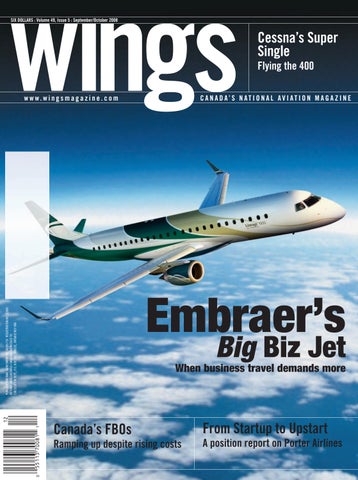
Embraer’s Big Biz Jet
When business travel demands more
Canada’s FBOs
From Startup to Upstart
Ramping up despite rising costs
A position report on Porter Airlines
September/October
WINGS MAGAZINE : Issue 5 : Volume 49 : Table of Contents
34 EMBRAER’S BIG BIZ JET When business travel demands more
6
McCarthy
Canada needs a strong ATAC.
37
From Startup to Upstart
8
On the Fly
13
On the Web
In the first of a series of articles that will look at Canada’s airline industry, Frederick K. Larkin provides an in-depth position report on Porter Airlines.
14
Airline Insider
42
By Brian Dunn
18
Carr
The Sixth Estate.
19
Seaman
Justice in France.
20
Cessna’s Super Single
Ken Armstrong evaluates the Cessna 400, Cessna’s new high performance turbo-charged single.
23
Keeping Up Maintenance Standards
Representing and assisting aviation and aerospace companies, Ottawa-based CAMC tirelessly supports professionalism in Canada. By Blair Watson.
4 | WINGS magazine | September/October 2008
20
Cessna’s Super Single
23
Keeping Up Standards
37
From Startup to Upstart
42
Canada’s FBOs
Canada’s FBOs
Rob Seaman looks at the state of the Canadian FBO market and how it is ramping up despite rising costs.
50
Flying Green
The aerospace industry used the 60th edition of the Farnborough Air Show to showcase green technology and wave a couple of red flags. David Carr reports.
59
A Look Back
Chance Vought Corsair
70
Purser
Oil complicates aviation’s future.
ON THE COVER Embraer’s Lineage 1000
www.wingsmagazine.com
E
VERYBODY WORRIES ABOUT THE COST OF FUEL. FALCON OWNERS WORRY 20-60% LESS.
The most efficient companies in twenty-six countries demand the most efficient large-cabin business jets and fuel is just one reason. Falcons not only match many smaller planes in fuel economy, high-tech design lets them use hundreds of small airports other wide-cabins can’t. City-hopping, ocean-hopping, flying-more-people-to-more-places proves again: Less is more.
Visit us at: Falconjet.com Or call: U.S. 201.541.4600 France +33.1.47.11.82.32
McCarthy
DREW MCCARTHY is the editor of Wings.
Over its 74-year history, the Air Transport Association of Canada (ATAC) has experienced every possible kind of change and challenge imaginable, and has survived them all. In April, the association underwent a major upheaval with the departure of Air Canada, WestJet, Jazz Air LLP and Air Transat from its ranks. The news resonated throughout the industry and left many wondering how the association would cope. Five months after the news broke, ATAC has rallied and regrouped. Mike Skrobica, who became acting president after the departure of former president and CEO Sam Barone, told me in a recent interview that the association did review its mandate after the four members left; but determined that its overall goals would not change. Nevertheless, says Skrobica, there have been some changes in the day-to-day activities at the association. “The workload fell,” he says. “Although we do proactive lobbying and work on regulations, we also respond to a lot of calls from our members. These calls deal with issues that arise and need a quick resolution. Air Canada, WestJet, Jazz Air LLP and Air Transat were heavy users of these services and as a consequence we are now in a position to serve our members just as well with a smaller staff.” As a result, ATAC has been able to reduce its number of officers from seven to four, including a president and CEO. They have redistributed the workload and are currently reviewing applications for the position of president. One point Skrobica stressed to me is that the association continues to do all the things it has always done. “All calls are responded to immediately,” says Skrobica, “and we are attending all of the meetings that we would normally attend Canada-wide. We continue to serve all of the needs of our membership.” In fact, some members believe that they currently have more opportunity for input and are getting faster results now that the larger carriers have left. The loss of the four members does not signal the end of the relationship between them and the 217 remaining members of ATAC. There are a large number of issues such as fuel excise taxes, travellers’ security charges, and many others where there is common ground. ATAC hopes to continue working with the four carriers in a collaborative fashion. And, the loss of revenue was not as severe as was widely reported. Skrobica clarified the situation to me by explaining that the loss of the four carriers represented half of the membership revenue, but certainly not half of the association’s revenue. “We have other sources of revenue besides membership fees,” explains Skrobica. “What we lost was substantially less than half of our revenue.” The association has taken steps to tighten its expenditures and Skrobica says that he has a business plan that “at least breaks even” for the upcoming year. “Sometimes you have to shrink before you grow again,” he says. Canadian aviation definitely needs a strong ATAC and it deserves our support in its efforts now and in the foreseeable future.
Canada needs a strong ATAC Sometimes you have to shrink before you grow again
6 | WINGS magazine | September/October 2008
WINGS MAGAZINE PO Box 530, 105 Donly Dr. S., Simcoe, ON N3Y 4N5 Tel.: 428-3471 Fax: 429-3094 Toll Free: 1-888-599-2228 PUBLISHER TIM MUISE tmuise@annexweb.com EDITOR DREW MCCARTHY dmccarthy@annexweb.com ASSOCIATE EDITOR ANDREA KWASNIK akwasnik@annexweb.com SENIOR ASSOCIATE EDITOR RICHARD PURSER PRODUCTION ARTIST KRISTA MISENER OTTAWA CORRESPONDENT KEN POLE AVIONICS EDITOR ROB SEAMAN FLIGHT DECK RAY CANON, JAMES CARELESS, DAVID CARR, NIKOLAS CHAPMAN, BRIAN DUNN, DARREN LOCKE, CARROLL McCORMICK, BLAIR WATSON ADVERTISING SALES MARK MCWHIRTER mmcwhirter@annexweb.com SALES ASSISTANT PAULINE CECILE pcecile@annexweb.com VP/GROUP PUBLISHER DIANE KLEER dkleer@annexweb.com PRESIDENT MIKE FREDERICKS mfredericks@annexweb.com PUBLICATION MAIL AGREEMENT #40065710 RETURN UNDELIVERABLE CANADIAN ADDRESSES TO CIRCULATION DEPT., P.O. BOX 530, SIMCOE, ON N3Y 4N5 e-mail: awebster@annexweb.com Periodical postage paid at Buffalo, NY. USPS 021-029, ISSN 0701-1369. Published six times per year (Jan/ Feb, Mar/Apr, May/Jun, Jul/Aug, Sep/Oct, Nov/Dec) by Annex Publishing & Printing Inc. US Office of publication c/of DDM Direct.com, 1175 William St., Buffalo, NY 14206-1805. US postmasster send address change to P.O. Box 611, Niagara Falls, NY 14304. Printed in Canada ISSN 0701-1369 CIRCULATION e-mail: awebster@annexweb.com Ph: 866-790-6070 ext. 208 Fax: 877-624-1940 Mail: P.O. Box 530, Simcoe, ON N3Y 4N5 SUBSCRIPTION RATES Canada – 1 Year $ 34.00 (includes GST - #867172652RT0001) USA – 1 Year $ 30.24 Foreign – 1 Year $ 65.00 From time to time, we at Wings Magazine make our subscription list available to reputable companies and organizations whose products and services we believe may be of interest to you. If you do not want your name to be made available, contact our circulation department in any of the four ways listed above. No part of the editorial content of this publication may be reprinted without the publisher’s written permission. ©2008 Annex Publishing & Printing Inc. All rights reserved. opinions expressed in this magazine are not necessarily those of the editor or the publisher. No liability is assumed for errors or omissions. All advertising is subject to the publisher’s approval. Such approval does not imply any endorsement of the products or services advertised. Publisher reserves the right to refuse advertising that does not meet the standards of the publication.
Air Transport Association of Canada
Canadian Business Aviation Association
Canadian Owners & Pilots Association
Member of the Alberta Magazine Publishers’ Association
Member of the Canadian Circulations Audit Board
www.wingsmagazine.com www.wingsmagazine.com
A World Of Service Across Canada, we’ve built our good name on understanding customer needs and total commitment to customer satisfaction. One result is award-winning Fixed Base Operations, featuring first class amenities, ample hangar space and maintenance capabilities that are unexcelled. Another result is ARG/U.S. Platinum rating for operational safety* – a level of confidence few Canadian private aviation services companies can provide.
Efficient, secure and safe, warm, personal and professional. Enjoy all the service in the world, from Canada’s first name in quality aviation services, Skyservice Business Aviation.
C A L G A R Y 575 Palmer Road NE Calgary, Alberta Canada, T2E 7G4 Tel.: (403) 291-4426 Fax: (403) 250-7726
T O R O N T O 6120 Midfield Road Mississauga, Ontario Canada, L5P 1B1 Tel.: (905) 677-3300 Fax: (905) 677-2747
M O N T R É A L 9785 Ryan Avenue Dorval, Québec Canada, H9P 1A2 Tel.: (514) 636-3300 Fax: (514) 636-4855
For more information on the complete range of Skyservice business aviation services please call (866) 759-4132 www.skyservicebas.com *Platinum is the highest and most stringent rating for operational safety awarded by the Aviation Research Group/U.S., Inc (ARG/US), an industry leader in the specialized field of aviation information collection, analysis and distribution.
onthefly INDUSTRY NEWS : COMMERCIAL AVIATION : GENERAL AVIATION
BUSINESS AVIATION : MILITARY AVIATION
London Air Services orders five Learjet 85s London Air Services has placed firm orders for five Learjet 85 aircraft, valued at $86 million US based on the 2008 list price, Bombardier Aerospace said in early August. The Montreal-based aircraft maker said London Air Services was the first Canadian operator to place a firm order for the all-composite jet. London Air Services, a charter service provider based in Vancouver, has a fleet of nine Bombardier business aircraft, including six
The new Learjet 85 aircraft will be the first Learjet aircraft to feature an all-composite structure.
Learjet 45 XRs, a Challenger 605 and a Challenger 604. Launched last year, the new
Learjet 85 aircraft will be the first Learjet aircraft to feature an allcomposite structure.
StandardAero breaks ground on facility expansion Due to growth in turbineengine overhaul contracts, StandardAero, a DAE (Dubai Aerospace Enterprise) Engineering company, is celebrating the official groundbreaking of an 80,000-square-foot expansion to its Winnipeg facilities to accommodate the expected engine throughputs. The expansion is timed with several large contract wins and the large volume of engine maintenance associated with those contracts. After securing agreements with several airlines, the company is now at a stage where additional production space is required. At the groundbreaking ceremony Manitoba Premier Gary Doer announced the province is helping to finance the expansion with a $20-million, fully repayable interest-bearing loan through the Manitoba Industrial Opportunities Program, as well as examining what additional 8 | WINGS magazine | September/October 2008
From left to right, Paul Soubry, CEO and president, StandardAero; Rob Mionis, CEO of DAE Engineering; Manitoba Premier Gary Doer; Winnipeg Mayor Sam Katz; Barry Rempel, president of Winnipeg Airport Authority; and Rob Stone, SVP Airlines and Fleets, StandardAero.
training opportunities are available through Red River College. The expansion will also require the addition of new staff. Current plans call for 60-120 new employees by the end of 2009, with potential for another 150-200 by 2014. The expanded facility is scheduled for completion by June 30, 2009.
StandardAero provides complete maintenance, repair and overhaul on General Electric CF34-series engines, including both scheduled and unscheduled maintenance. These engines are used on Bombardier CRJ-100, CRJ-200, CRJ-700 and CRJ900-series aircraft, as well as the Challenger and Embraer 170s.
Legends of the sky to premiere at IMAX Building upon the success of more than 150 million global views of the critically acclaimed IMAX production “Fighter Pilot: Operation Red Flag,” executive producer and distributor of K2 Communications announced the anticipated release date for the newest and most technically advanced aviation film ever produced for IMAX theatres. K2 Communications CEO Bob Kresser said the premiere of “Legends of the Sky” has been slated for March 2009 at the Smithsonian’s National Air & Space Museum’s Lockheed Martin IMAX Theatre in Washington, D.C. “Legends” will be presented shortly thereafter at Seattle’s Pacific Science Center and in subsequent general distribution to IMAX theatres and other Giant Screen theatres worldwide. Legends of the Sky will give theatre patrons a cockpit perspective as aviation history dramatically unfolds. The film is a collaboration with the Smithsonian National Air & Space Museum, whose curators have helped shape the most experience-driven flight film yet produced for IMAX screens. www.wingsmagazine.com
ON THE FLY
Redevelopment of Million Air Toronto facility During a reception at the recent CBAA Trade Show and Conference in Toronto – sponsored jointly by Million Air, Air BP and Million Air Toronto – Derek Sifton, president of the Toronto Buttonville Municipal Airport, announced that Million Air Toronto will be growing and redeveloping itself. The plans call for a multimillion-dollar, two-level renovation and major rebuild of the Million Air Toronto/Toronto Airways terminal facility. Development will start soon and the entire project should be ready for a formal opening by the first of next year. The new design comes from Toronto interior designer Peter Tillman, creative director of Spinning Wheel Design, who joined Sifton for the introduction of the new Million Air Toronto. They pointed out how the newly de-
SEPTEMBER 2008 2008 International SeaKing Maintenance Symposium Sept. 30 - Oct. 2 Vancouver, BC http://www.seaking symposium2008.com
OCTOBER 2008
In addition to the new renovations, the added advantages of lower landing fees and a short commute to Toronto’s downtown will make Million Air Toronto a great support site for business aviation in the Greater Toronto Area.
signed facility will incorporate a bright, modern and well-lighted corporate passenger lounge, complete with all the now standard Million Air touches and amenities. Comments Sifton: “The rationale for an update at this time is simple. With the growth and evo-
lution of corporate aviation in the GTA, and the increasing demand for less crowded and easier access alternatives to the international airport, we felt it was finally the right time to redo ourselves and create something that exceeds the physical standard of FBOs today.”
GE Honda Aero Engines prepares for certification tests Through rapid engine prototyping, GE Honda Aero Engines has built and tested eight HF120 engine cores and eight full turbofan engine configurations to prepare for formal certification testing later this year. It represents one of the most aggressive test programs for a new jet engine prior to official FAA certification testing. To date, test results are highly encouraging. The HF120 engine has demonstrated more than 2,100 pounds of thrust while exceeding ambitious fuel efficiency and durability targets. Testing and rebuilds of full turbofan engines have been under way at Honda’s Aircraft Engine R&D Center in Japan for about a year, verifying the engine design’s operability, thermal char-
Events Calendar
acteristics and component efficiencies. At the same time, hardware has been released for HF120 engines for the certification program. Testing continues throughout next year with FAA certification targeted for late 2009. Also next year, the engine undergoes flight tests on a flying testbed, as well as on the HondaJet. The GE Honda HF120 engine was launched in 2006 on the HondaJet advanced light jet and Spectrum Aeronautical “Freedom” business jet, with service entry for both aircraft scheduled in 2010. By service entry, the HF120 is expected to have accumulated more than 15,000 hours of ground and
NBAA 61st Annual Meeting & Convention Oct. 6-8 Orlando, FL http://www.nbaa.org SARSCENE 2008 Oct. 15-18 St. John’s, NL http://www.nss.gc.ca ALEA Canadian Regional Safety Seminar Oct. 22-24 Montreal, QC http://www.alea.org/public/ seminars/index.aspx CAMC Forum and AGM Oct. 22-24 Calgary, AB http://www.camc.ca Ontario A.M.E. Workshop & Symposium Oct. 22-24 Mississauga, ON http://www.ame-ont.com
The HF120 engine, rated at 2,095 pounds of thrust, succeeds Honda’s original HF118 prototype engine, which has accumulated more than 4,000 hours of testing on the ground and in flight.
flight testing. HF120 engine production will begin in 2009 at GE’s Lynn, Mass., facility. Production then transitions to Honda Aero Inc.’s new engine production facility in Burlington, N.C., which is slated to open for engine deliveries in 2010.
NOVEMBER 2008 ATAC 2008 Annual General Meeting and Tradeshow Nov. 10 - 12 Calgary, AB http://www.atac.ca/ index.html For a full listing of events, go to www.wingsmagazine.com
September/October 2008 | WINGS magazine | 9
ON THE FLY
Hawker Beechcraft appoints new vice-president Hawker Beechcraft Corporation has appointed Andy Plyler as vice-president, Hawker Beechcraft Services (HBS). He will be responsible for all aspects of HBS operations. HBS provides domestic and international support for Hawker Beechcraft customers, and Plyler will play a critical role in maintaining customer satisfaction by implementing innovative service solutions. Plyler’s operational and business experience in the aviation and aerospace industry spans
more than 20 years. He’s held various leadership roles in aircraft maintenance operations, business development and process improvement at companies including Delta Air Lines, BFGoodrich Aerospace, Honeywell Aerospace and L-3 Communications. Plyler has a bachelor’s degree in business management from Kennesaw State University in Kennesaw, Ga. He also served in the U.S. Army for four years in the 82nd Airborne.
Mike R. Turner is the new Avionics sales manager at StandardAero. Andy Plyler will be responsible for all aspects of HBS operations.
Cargojet wins Shippers Choice Award Cargojet has once again been awarded the Shipper’s Choice Award. Cargojet surpassed shipper expectations in the total Industry Sector Average and particularly in the key areas of On-time Performance, Customer Service, Quality of Equipment & Operations, Competitive Pricing, and Leaders in Problem Solving. Cargojet’s total 2008 aggregate score was 131.61, which was measured against the overall 2007 benchmark of excellence of 119.862. Cargojet is the only Canadian Air Cargo carrier to receive
“This award is a result of the dedication and loyalty of our professional team, consisting of over 700 employees, who are the driving force of Cargojet,” said Ajay Virmani, president and CEO of Cargojet.
this honour for the sixth year. Canadian Transportation and
Mike R. Turner joins StandardAero
Logistics magazine embarked on a groundbreaking project to provide easily accessible, statistically valid and nationally relevant benchmarks for the quality of service provided by transportation suppliers in this country. The survey, conducted in conjunction with the federal government and research firm G. Bramm & Associates, surveyed 4,500 Canadian shippers, providing them with an opportunity to set benchmarks for expected carrier performance in seven key areas and to rate their top carriers against those benchmarks.
StandardAero has appointed Mike R. Turner as an avionics sales manager supporting the domestic and international sales teams based in Tucson, Ariz. He will be responsible for overseeing the continued growth of avionics opportunities for StandardAero and its customers, both in sales and customer relations. Turner comes to StandardAero from Bombardier where he served 28 years. He has held a multitude of roles starting as an avionics technician with increasing responsibility to his most recent position as regional avionics sales manager. Prior to that, he served in the U.S. Air Force as a navigation system specialist obtaining the rank of E-4 (Sergeant).
AeroMechanical services announces new president AeroMechanical Services Ltd. has announced that Richard Hayden, currently director, Business Aviation at AMA, will replace Darryl Jacobs as president of AMA. Jacobs has been offered a senior position focusing his efforts on the product and research for products applicable to AMA’s business. He will remain on the advisory board as well as remain a direc10 | WINGS magazine | September/October 2008
tor of AMA. Hayden will join the board as a director. Hayden has led the development and successful transition into production of new monitoring and diagnostic technologies and products for aviation for 25 years. He was founder and CEO of Technology Integration Inc., which created two innovative products that are now industry standards: IMD-
HUMS (Integrated Mechanical Diagnostics-Health and Usage Management System) for helicopters, acquired and produced by Goodrich Corporation and now standard fit on several Sikorsky Aircraft products and several US military platforms; and ANOMS (Airport Noise and Operations Monitoring System), now a Lochard product installed at
major airports globally. In his new role, he will continue to provide connectivity and coordination between the two organizations to help deliver highly effective monitoring and data delivery solutions to the aviation industry. Hayden brings a wealth of industry contacts and opportunities within many sectors of the aviation industry. www.wingsmagazine.com
ON THE FLY
Certification for carbon brakes for B737 Boeing has announced that it earned certification from the U.S. Federal Aviation Administration for its new carbon brakes designed for the Next-Generation 737. The brakes, supplied by Messier-Bugatti, entered service recently when Boeing delivered a Next-Generation 737-700 to Delta Air Lines – the first of 10 737-700s the airline will receive over the next several years. Carbon brakes weigh 700 pounds less than high-capacity steel brakes for Next-Generation 737-700, -800 and -900ER (Extended Range) airplanes; and 550 pounds less than standardcapacity steel brakes for NextGeneration 737-600s and -700s.
Carbon brakes weigh 700 pounds less than high-capacity steel brakes for Next-Generation 737700, -800 and -900ER (Extended Range) airplanes.
Reduced weight contributes to reductions in associated fuel burn and CO2 emissions, depending on airline operations. Delta Air Lines is coupling lighter-weight carbon brakes
with drag- and emissions-reducing Blended Winglets (wing-tip extensions) to improve operating and fuel efficiency simultaneously on its Next-Generation 737s.
A700 VLJ back on track for FAA certification AAI Acquisition Inc., a U.S. company and the successor to the former Adam Aircraft Industries, has announced significant steps have been made in its plan to resume operations. Key to the comeback is the naming of veteran aviation executive Jack Braly as the new president and CEO of the company. AAIA purchased the assets and intellectual property of the former Adam Aircraft from the bankruptcy court in April 2008. Adam Aircraft declared bankruptcy in February.
AAIA also announced it has completed its business organization process and will focus on FAA certification of its A700 very light jet (VLJ) from its headquarters at Centennial Airport in Englewood, Colo. Certification is projected for early 2010. Braly said AAIA has begun recruiting and hiring. The company already has 150 employees, many of whom previously worked for Adam Aircraft. Braly said the advantage to AAIA is that the retained employees have
intimate knowledge of the design and capabilities of the A700, which will be key to remaining FAA-related activities in the certification process. AAIA’s plans show employment levels growing to around 300 by the end of 2008, and to over 500 by the end of 2009. Braly confirmed that AAIA has no plans at this time to resume production of the A500 piston twin aircraft, of which only a few were delivered by the former Adam Aircraft.
Discovery Air announces new director David Taylor, chairman of Discovery Air Inc., has announced that Gil Bennett has agreed to join the Board of Directors of Discovery Air and will act in the capacity of vice-chairman. Bennett has served as a director, CEO and senior officer of many Canadian public and private companies, including Canadair Ltd., de Havilland Inc., Air Nova Inc. and Nav Canada. He has also acted as board chairman of Canadian Tire Corporation, Fortis Ontario Inc., Encal Energy Ltd. and Ontario Casino Corporation. To provide room for Bennett to join Discovery Air’s Board, Alex Arychuk retired from the Board. “We thank Alex for his service on the Board of Discovery Air and look forward to his continued valuable contributions as the President of Air Tindi Ltd., one of Discovery Air’s significant operating subsidiaries,” said Taylor. Discovery Air is continuing to execute its stated goal of increasing independence on the Board in conjunction with reducing the number of directors who also serve on the Board of Pacific & Western Credit Corp.
Aircelle to supply engine nacelle for Learjet 85 Aircelle has been named the engine nacelle supplier for the new Learjet 85 business jet. Under the terms of its contract with Bombardier Aerospace, Aircelle will design, produce, supply and support the complete nacelle package for the Learjet 85’s two Pratt & Whitney PW307B turbofan engines, which includes Aircelle’s PERT
two-door thrust reverser system, air inlet, fan cowl doors, associated equipment, and the full nacelle integration. The new nacelle system will benefit from Aircelle’s extensive experience. Its PERT thrust reverser configuration is similar to the Aircelle design already used on the Challenger 300 business jet.
Aircelle will design, produce, supply and support the complete nacelle package for the Learjet 85’s two Pratt & Whitney PW307B turbofan engines. September/October 2008 | WINGS magazine | 11
ON THE FLY
Lindbergh Foundation/Orvis partnership Wearing a flying suit and leather helmet, Charles Lindbergh prepared for the most important flight of his life. At 7:51 a.m. on May 20, 1927, “Lindbergh buckled his safety belt, stuffed each ear with a wad of cotton, strapped on his wool-lined helmet, and pulled his goggles down over his eyes,” wrote A. Scott Berg in his biography, “Lindbergh.” Getting ready for a flight is
a little different today, but now pilots can enjoy a little piece of Lindbergh history with a modern twist thanks to a new exclusive line of “Lindbergh” clothing based on the style and type worn by the famous aviator himself. The Lindbergh line of clothing is the result of a newly established partnership between the Lindbergh Foundation and The
Letter to the editor AN ARTICLE WRITTEN BY ROB SEAMAN ON ELTS I wish to write you regarding an article written by Rob Seaman on ELTs, which appeared in the July/ August issue of Wings. My response is prompted by Mr. Seaman’s unquestioning use of “facts‚” as they have been presented by the proponents of the 406 ELT, and by his presumption of aircraft owners’ ability or inability to pay for any legislated equipment, required for particular types of flying, or for other geographical areas where such equipment may be redundant. The proponents of the 406 include ELT manufacturers; regulators who are insisting on the acquisition of this one system (which has been legislated primarily because it has been strongly lobbied); and search and rescue organizations because they are fed up with false alarms generated primarily by maritime users of the ELTs. Whether the new 406 system will eliminate false alerts remains to be proven. Why should aircraft owners carry the false alert cost burden generated largely by another sector, boating? I wish to point out that Artex itself, a major manufacturer of ELTs, admitted in the May 2007 issue of Avionics News, page 31, that the 121.5 ELTs, of which they sold many tens of 12 | WINGS magazine | September/October 2008
thousands, activate properly in only 12 per cent of crashes. Does your writer, Mr. Seaman, know why 88 per cent failed to work? How does Mr. Seaman know if the much more costly 406 versions will have a better activation rate? Mr. Seaman needs to address these issues if he and your magazine are to retain their credibility concerning the mandated use of 406 ELTs. Your readers need to know why he thinks that we aircraft owners, who are having to stake our lives on a questionable technology, are wrong to demand alternatives, or why he thinks we are wrong at least to demand that a plan be put into place to determine if the “new‚” technology yields a far better activation rate before we are again burdened with the cost of a system which may be equally poor. Why did the old technology fail so often? How will we know that the new system will solve the previous problem of non-activation? No one is daring to collect relevant statistics. Until a serious effort is made to address the fundamental deficiencies of the ELTs that are currently available, and they are deficient by any measure considering statistics such as 88 per cent failure rates, no serious efforts will be made to find alternatives with superior capabilities, leaving aircraft owners
Orvis Company, the premier catalog outdoor clothier since 1856. Under the program, The Orvis Company will contribute a percentage of sales from the Lindbergh line to support the operations and programs of the Lindbergh Foundation. “We are extremely thrilled about this new partnership with Orvis,” said foundation president Knox Bridges. “Orvis has
150 years of experience in the outdoor clothing and catalog business. They also have an impeccable reputation and commitment to environmental conservation. We couldn’t ask for a better partner in this endeavour. I’ve seen the product samples and they are fantastic. I’m sure this will be an extremely popular line benefiting both organizations.”
in a situation that can only be defined as unacceptable. On an equally important note: by failing to address the important issue of cost to aircraft owners of mandated equipment, Mr. Seaman implies that all aircraft owners have the ability to pay whatever costs are imposed on them, imposed even if a realistic cost-benefit analysis from the owner’s point of view has been carried out. One’s own financial situation is a personal matter, as is one’s religion, sexual preference, body weight, and the like. No one should feel free to make assumptions concerning such personal matters pertaining to a certain portion of the population. To do so is both arrogant and prejudicial. How does Mr. Seaman feel about having to install a $2,000 piece of equipment, of unproven success rate, in fact, of proven dismal success rate, in his airplane? He did not say. Thousands of aircraft owners would find offensive Mr. Seaman’s dismissal of the financial hardships presented by the imposition of requiring such an unproven and potentially ineffective gadget. Mr. Seaman seems to be under the illusion that most or all aircraft owners have, almost by definition, deep pockets. This happens to be far from the truth. Has Mr. Seaman ever considered that many owners barely manage
to maintain their aircraft financially, and that, for such, another expense of $2,000-$3,000 for a questionable piece of equipment will be neither politically nor financially acceptable, particularly when the benefits of that expense are in serious doubt? The situation is serious enough from both a safety and an economic standpoint that an organization, COPA, representing approximately 14,000 aircraft owners – the very people who are having this cost thrust upon them – has over the past five-year period been presenting to the regulators both strong and cogent arguments for acceptable and superior alternatives to the current ELTs. It seems unacceptable and gratuitous to have anyone, writers included, look into aircraft owners’ wallets and pronounce themselves on owners’ ability to pay for unproven equipment for much the same reason that Canadians have asked our governments not to look into our bedrooms. I would hope that Mr. Seaman did not step into this forbidden domain for the purpose of stimulating magazine sales. Frank Hofmann, Eastern Vice Chair, COPA, Aug. 15, 2008 For more on the 406 Mhz ELT issue or to comment, please visit www.wingsmagazine.com and review, post a blog, or write a letter to the editor. www.wingsmagazine.com
ontheweb www.wingsmagazine.com
NEWS HIGHLIGHTS BOEING COMPLETES FIRST BBJ 3
NAV CANADA APPOINTS BRIAN K. AITKEN AS VP, FINANCE, CFO AND TREASURER EMBRAER SELECTS MTI GLOBAL TO SUPPLY INSULATION MATERIALS
JOB BOARD
Your source for aviation jobs: • Pilots • Maintenance • Executive positions and more!
POLL
MESSAGE FROM NIALL OLVER, CEO GROB AEROSPACE STANDARDAERO RECEIVES FAA STC FOR KING AIR 200 PT6A-42 UPGRADE PROGRAM EPIC AIRCRAFT BUSINESS BOOMING FOURTH F-35 LIGHTNING II ROLLS OUT AS PRODUCTION LINE FILLS UP Read the full stories online at www.wingsmagazine.com
Web Exclusives: BOEING’S 2008 FORECAST PREDICTS CONTINUED STRONG AIR CARGO TRAFFIC GROWTH The Boeing Company projects that the global air cargo market will continue to exhibit strong, long-term growth, according to the company’s Current Market Outlook 2008. During the 20-year forecast period, Boeing projects that the industry will grow at an annualized average of 5.8 per cent with the world freighter fleet increasing from 1,948 to 3,892 airplanes.
For the full story, go to www.wingsmagzine.com and click on web exclusives.
HIDDEN TREASURE: A SPITFIRE TO REGAIN ITS WINGS There was rumoured for years to be “a Spitfire being restored in a barn near Montreal, Que., Canada.” In the little-known town of St-Balise Le Grand is where the best kept secret of the famous Second World War fighter was hidden.
For the full story, go to www.wingsmagazine.com and click on web exclusives.
Take part and view results of our weekly polls… The maintenance engineer shortage is having a negative effect on my operation. Agree 88.9% Disagree 0% Undecided 11.1%
A-LIST The Canadian Aviation Guide (A-List) is the only reference tool to bring the entire Canadian aviation industry together in one directory.
DIGITAL MAGAZINE Visit www.wingsmagazine.com to sign up for a free trial of Wings magazine – digital version
BLOG Have your say on a variety of industry topics… • The implementation of 406 Mhz ELTs is a complicated and controversial issue. Read about this issue or weigh in with comments of your own by visiting our blog section at www.wingsmagazine.com. September/October 2008 | WINGS magazine | 13
airlineinsider Air Canada has signed a multilateral framework agreement with Lufthansa, Continental and United to create a transatlantic joint venture.
AIR CANADA FORMS INNOVATIVE ALLIANCES Air Canada has reached an agreement in principle with Continental Airlines to provide customers an enhanced travel experience through access to a broader network and seamless services provided by the two carriers. “This is an exciting opportunity for Air Canada and Continental Airlines to develop a deeper relationship that will be of great benefit to our customers,” said Ben Smith, executive vice-president and chief commercial officer. “Through co-operation with Continental, including a proposed codesharing arrangement, we will be able to offer customers travelling to the United States a vast array of enhanced travel benefits including more choice of destinations, new routings, expanded frequent flyer benefits and lounge access for eligible customers. At the same time, we will be able to realize greater efficiencies so we can compete
Air Canada has reached an agreement in principle with Continental Airlines to provide customers with an enhanced travel experience. 14 | WINGS magazine | September/October 2008
Ben Smith, executive vice-president and chief commercial officer, Air Canada.
more effectively. It is one of the many innovative ways we are responding to the high cost of fuel, by working with alliance partners for the benefit of our customers.” Through Continental’s hubs in Newark and Cleveland, Air Canada will offer more options to the eastern U.S., and through Continental’s Houston hub, greater access to the southern U.S., Mexico and Central America. Air Canada’s proposed alliance with Continental will give customers an expanded network that complements Air Canada’s existing North American network with its Star Alliance partner, United Airlines. In June, Continental announced that it also plans to join Star Alliance. In addition, Air Canada has signed a multilateral framework
agreement with Continental, United Airlines and Lufthansa to create a transatlantic joint venture through which the carriers intend to provide customers with more choice and streamlined service to Africa, India, Europe and the Middle East. As a first step, nine Star Alliance carriers, including Air Canada, have filed a joint application with the U.S. Department of Transportation to add Continental Airlines to their existing antitrust immunity. WESTJET BUILDS CODESHARE AGREEMENT WITH SOUTHWEST WestJet Airlines has signed a memorandum of understanding to build a distribution and codeshare agreement with Southwest Airlines. This memorandum of understanding is the first step that will see both airlines, by late 2009, have the ability to commence codeshare flights across both networks. In the near future, southwest.com will become a distribution channel for WestJet’s existing Canadian and transborder flights. Other potential opportunities within the agreement include purchasing, ground handling, marketing and selling to corporate accounts and other areas of mutual gain. “This is a defining moment
By Brian Dunn
for WestJet,” said Sean Durfy, president and CEO. “Clearly, we are delivering on our strategic plan with this announcement. It marks an important step forward for our guests and their ability to fly to more destinations in the United States conveniently and cost effectively. When you examine our network in Canada and Southwest’s network in the United States, and the potential to significantly improve both organizations’ market access, this is indeed a great day.” Southwest Airlines chairman and CEO Gary Kelly said, “a company’s dedication to culture and customer service are very high on our priority list when considering a relationship of any kind. We are confident that we’ve found a perfect fit with WestJet, and we are excited to work toward opening our expansive U.S. network to include Canadian destinations.” Certain details of the codeshare and elements of the partnering relationship are subject to approvals by both the U.S. and Canadian governments. Subject to the receipt of these approvals, the airlines plan to announce flight schedules and additional features regarding the partnering relationship in late 2009.
Sean Durfy, president and CEO, WestJet.
www.wingsmagazine.com
Take a regional jet, add the industry leader in executive aircraft conversions, then add your imagination. The result is the CRJ ExecLiner from Flying Colours Corporation. We’ve stripped away the standard high-density interior and regional range and transformed the CRJ into a luxuriously appointed executive jet equipped with a certified auxiliary fuel system that offers maximized performance and range - comparable to aircraft costing literally millions more. Contact Flying Colours to learn the full story on the CRJ ExecLiner,
+1 705 742 4688
www.flyingcolourscorp.com
Peterborough, Ontario, Canada
AIRLINE INSIDER WESTJET ADDS AIRCRAFT, LAS VEGAS ROUTE
Bob Cummings, WestJet executive vicepresident, guest experience and marketing.
WestJet is offering new seasonal nonstop service from Regina to Las Vegas beginning September 8. The flight will operate twice weekly on Mondays and Fridays. “We are very pleased to offer our Regina guests the chance to fly nonstop to Las Vegas,” said Bob Cummings, executive vice-president, guest experience and marketing. “We know it’s going to be extremely popular, not only with guests who enjoy the excitement of the casinos, but with people who go to Vegas for the fabulous entertainment and shopping.” Cummings noted that with the addition of seven more aircraft in 2008, WestJet is in a position to potentially offer even more service to the people of Regina in the future. “At a time when the global airline industry is being seriously challenged by soaring fuel costs and other pressures, we are adding capacity, exploring new business opportunities and fulfilling our strategic plan,” he said. MONT TREMBLANT FLIGHTS A GO Flights to Mont Tremblant International Airport will continue again this winter after a deal was reached for Ottawa to kick in $100,000 to cover the cost of customs agents needed for flights operated by Continental Airlines from Newark, N.J. Serge Larivière, president 16 | WINGS magazine | September/October 2008
of Tremblant airport, said that’s about the amount of unpaid bills the airport incurred which threatened its future because of a federal policy requiring all except the eight largest airports in Canada to defray the costs of some of their customs services. Each year, small airports pay about $1.4 million in customs fees to Ottawa, an amount that makes it difficult for them to attract carriers in times of soaring fuel costs. Porter Airlines, which also offers seasonal service to Tremblant from Toronto City Centre Airport, could also have been impacted if the airport was forced to close. But it now plans to increase frequencies to the ski destination. “We’re planning to add a few more flights a week, but we still haven’t finalized our winter schedule” said Brad Cicero, Porter’s manager of communications and public affairs. “It was a good route for us, because it wasn’t part of our original business plan, but has turned out to be a popular seasonal destination.” And with two more Q400 aircraft being added to the current six it operates by the end of the year, Porter will add one more U.S. destination in 2008, either Boston or Chicago, says Cicero. In addition, the airline has restored its full schedule between TCCA and Newark, N.J. after the Federal Aviation Administration cut back flights during the busy summer season. Porter is back to flying seven round-trip flights each weekday and six round-trip flights on Sundays. Porter also announced it is exercising two existing options, representing aircraft 13 and 14, from its original order of 10 firm and 10 options. Within a year, Porter’s fleet will double to 12 aircraft. www.wingsmagazine.com
LEARJET 85
LEADING
IS EVERYTHING
FOR THE PAST 45 YEARS, LEARJET HAS DEFINED AND REDEFINED WHAT A BUSINESS JET SHOULD BE. TODAY, LEARJET* IS BUILDING ON ITS LEADERSHIP POSITION WITH THE INTRODUCTION OF THE NEW BOMBARDIER* LEARJET 85* AIRCRAFT. FEATURING AN IMPRESSIVE LIST OF BEST-IN-CLASS FEATURES, INCLUDING THE LARGEST CABIN OF ITS KIND AND LEGENDARY LEARJET PERFORMANCE—ALL BUILT UPON THE OPERATING EFFICIENCY ONE EXPECTS FROM A LEARJET. THE LEARJET 85 BUSINESS JET STANDS TESTAMENT TO OUR LEGACY AND WILL REDEFINE WHAT BUSINESS TRAVEL CAN AND SHOULD BE. AFTER ALL, IN TODAY’S FAST PACED BUSINESS WORLD, LEADING REALLY IS EVERYTHING.
THIS IS OUR YEAR WWW.LEARJET85.COM
* Registered trademark(s) or trademark(s) of Bombardier Inc. or its subsidiaries. © 2008 Bombardier Inc. All rights reserved.
carr
DAVID CARR is a Wings writer and columnist.
The National Business Aviation Association (NBAA) will kick off its 2008 convention with a seminar on how environmental issues are impacting business aviation. It should be a hot ticket. So far, NBAA’s public green offensive has been thin gruel, which is not to say that the association hasn’t been busy behind the scenes. Unfortunately, back office activity alone will not cut it. The environment has grown into a motherhood issue, susceptible to well-intentioned but unworkable solutions, and thirsty for transparency. It is not enough for aviation to be green; the sector must also be seen to be green. The statistics are boilerplate: aviation’s contribution to greenhouse gases will increase from two to three per cent by 2050 if engine and airframe manufacturers were to suddenly drop what they have been doing for the last 40 years, and that is building cleaner, quieter and more efficient airplanes. Business aircraft produce less than 1.5 per cent of all aviation CO2 emissions, yet risk becoming the Achilles Heel of corporations anxious to showcase their green street cred. It is dangerous to ignore public opinion, especially when governments around the world want to ride the public to a stream of new green taxes also intended to re-engineer social policy. The European Union seeks to tax aviation out of business on routes less than 500 kilometres, causing low-cost airlines to cry foul. Liberal leader Stephane Dion positions his Green Shift as a tool to cut poverty as well as emissions. Can he do both? As Giovanni Bisignani, director general of the IATA said, taxes do not cut emissions. The difficulty for aviation is it has a positive environmental story to tell with not much outer success telling it. At the Canadian Business Aviation Association convention this summer it was suggested that greater resources must be poured into promoting business aviation’s green credentials in the traditional media. That is important, but large chunks of the audience are also looking elsewhere for their information fix. “If you don’t communicate with people using the tools they choose to use, then you don’t communicate effectively,” said Dave Fleet, a senior consultant with Thornley Fallis, a Canadian public relations and marketing agency that
The Sixth Estate BizAv will need traditional media to help get its green message out. But that might not be enough.
18 | WINGS magazine | September/October 2008
specializes in so-called social media tools such as blogs, podcasts, online networks, etc. If traditional print media is the fourth estate and television (with apologies to the Canadian Broadcasting Corporation) the fifth, then it follows that online or social media has become the sixth. And what a powerful estate it has become, not just with teenagers and basement bloggers. Approximately 60 per cent of YouTube and Facebook users are over 35. A typical social media subscriber has a tin ear for corporate-speak, is more likely to research what others are saying about a product or claim and has quite the reach to broadcast both positive and negative. “If you start to use social media tools with the aim of just getting a message out, you will likely fail,” Fleet pointed out. “Companies are much more likely to succeed if they approach social media tools with the aim of engaging people in addition to their traditional approaches.” Dell Computers relied on these tools to reverse a storm of negative publicity in 2005, gathering suggestions from customers and conducting a proactive outreach campaign on blogs that mentioned Dell. By responding directly and transparently to customers, Dell was able to drive negative mentions of the company from 49 per cent of all mentions to 22 per cent. Business aviation’s larger cousins on the commercial side have also tapped into the medium. Southwest used its Nuts About Southwest site to defuse the infamous mini-skirt affairs, where a passenger was denied boarding because her hemline was too high. JetBlue uses Twitter, an increasingly popular third-party site to post updates, travel tips and replies to customer questions. The trick, according to Fleet, is to establish a presence before it is needed and to avoid turning off the audience by using the tool to exclusively pitch a product or the corporate message. “Companies need to build a presence over time in order to build trust and awareness,” he added. Social media is in its adolescence and easy to dismiss as a consumer rather than an industry communication tool. But as the lines between traditional and online media blur, social media is a stage where an industry that remains low hanging fruit for environmentalists and regulators alike, must be a player. David Carr can be reached at davidjcarr@sympatico.ca. www.wingsmagazine.com
ROB SEAMAN is a Wings writer and columnist.
Could someone please explain France’s judicial system and airline industry to me? I am having a hard time getting my brain wrapped around France’s idea of justice and due process. What has got me off on this tangent? The Air France Concorde accident of 2000. It is eight years since this tragedy occurred and we are just now hearing that there is going to be a court case over it. What is going to be gained by a trial at this date? And more specifically, look at who they are bringing up on the charges – two employees from Continental Airlines, two employees at Aerospatiale and a fellow from the French civil aviation authority. Why these folks in particular? Post-crash investigations concluded that the SST’s tires were punctured by a piece of “metal” on the runway. The source of the metal was attributed to a Continental Airlines DC-10 which had just taken off prior to Air France Concorde Flight 4590. In a terrible chain of events that followed, the tires shredded and a large chunk of the left main impacted the belly of the aircraft and punched a hole in a fuel tank. The fuel ignited, leaving a stream of fire from behind the Concorde as it tried to gain altitude and then set up for landing. The flight crew upon detecting the fire shut down the number two engine, but the aircraft was unable to climb on the three remaining engines. It crashed into a hotel and all the passengers and crew as well some people on the ground – 113 in all – were killed. In 2004 a French accident inquiry reported that the piece of metal which had fallen from the DC-10 was a titanium wear strip from one of the engine nacelles. The investigation concluded the wear strip should have been made from aluminum and that in the result, it being a softer metal, the tire would not have been punctured or the Concorde so critically damaged. Part of the French prosecutor’s claim as well is that the fuel tanks of the Concorde lacked sufficient protection from shock. Further to this they feel the builders of the aircraft had known this since as far back as 1979. Accordingly the individuals named by the French to stand trial are a Continental mechanic, who is alleged to have fitted the metal strip to the DC-10, a Continental maintenance official, the former head of the Concorde division of Aerospatiale (which is now part of EADS), a
seaman former chief engineer for the Concorde program and a now former member of France’s civil aviation oversight board who was tasked with being head of training back then. Why focus on these individuals only? Surely there were more people involved in the various decisions or actions implied than just these five? It seems that the French have decided that someone is going to get it for this, and these gentlemen are as good as any – or perhaps the easiest to hit on? For their part, Continental has long denied any responsibility for the accident and many aviation experts have long debated the reasons for the incident too – so that piece of metal may not be the culprit after all. And is this the only DC-10 to have the wear strip in titanium and the only one to ever fall off on a runway? We certainly have not heard of other shredded tires from such a thing. Or perhaps it is an industry-wide cover-up scam and the French have managed to blow the top off it? Notice too that nobody from Air France seems to have been implicated or charged. Surely if Aerospatiale felt there was a potential hazard with the fuel tanks, then Air France would have known or suspected it too. If that is so, then shouldn’t the airline engineers also be held responsible? The Concorde was a program where the OEM and airlines worked very closely. It would be strange for something of this magnitude to be kept internal to the OEM only. Here is another quirk of the whole story – Air France said it was suing Continental just months after the incident. Pretty quick to jump and point the finger then, weren’t they? But look at the length of time it has taken to get around to having such a trial. Is it even needed? As I see it, nothing is to be learned or changed to prevent a similar incident. It’s just another case of trying to lay blame and shift the guilt onto somebody else. The trial is due to start “sometime” in 2009 and may last many months. Do you really think these poor guys are going to get a fair shake out of all this?
Justice in France Guess I just don’t get the world some days
September/October 2008 | WINGS magazine | 19
The Cessna 400 would be an excellent high-performance step-up for pilots with aspirations toward turbines.
CESSNA’S SUPER SINGLE Flying the 400 By Ken Armstrong Time was when the turbocharged Cessna Centurion and Beech Bonanza ruled the skies as the monarchs of the single-engine realm. Their dynasties have been toppled by more efficient composite kings boasting electronics that multiply a pilot’s safety, control and capabilities. By purchasing the bankrupt Columbia aircraft series Cessna has triumphed over the constant tweaking of its dated designs and leapt ahead with this top-end turbo. The Cessna 400’s closest competition includes the Cirrus 20 | WINGS magazine | September/October 2008
SR 22 turbo and Mooney Acclaim M20TN. With equipped prices ranging from $466,000 to $620,000 US, these aircraft feature high-level comfort and performance to match – they are not entry-level machines for the financially or flyinghours challenged aviator. The Cessna 400 tops the list in complexity, capabilities and challenge and would be an excellent high-performance step-up for pilots with aspirations toward turbines. Wings had the opportunity to evaluate Cessna 400 owner Mike Woeller’s machine with
only 80 flight hours since new. The sleek Cessna stands large on the ramp with its tall, fixed gear and requires some twisting technique to enter the very comfortable front seats. The 50-inch-wide cabin is very roomy with a centre console between seats that sports a micro pad controlling all of the Garmin’s functions. Mike has purchased four aircraft from Cessna dealer Anna Pangrazzi but was searching the field for an aircraft that would suit his needs. When Cessna purchased Columbia’s assets the promise of its excellent
customer support tipped the scales to the 400 acquisition. The Garmin 1000 dominates the panel and the entire plane’s fit and finish is state of the art according to Mike, who has looked at all the competition. I agree. Cessna wisely chose to change little on this aircraft with the exception of scrapping the Avidyne system for the superior Garmin avionics. This Garmin 1000-directed aircraft has a very complete list of standard features thus reflecting the price. Moreover, its equipment list includes many components you will www.wingsmagazine.com
• Stunning Interior Refurbishments • Complete Avionics Installations / Repairs • Transport Canada Approved • Maintenance Facility • Spectacular Exterior Paint and Design P.O. Box 554, Hangar #2, Canada Drive www.goderichaircraft.com Huron Park, ON N0M 1Y0 Phone: 519-228-6706 Fax: 519-228-6724
WE ’ RE THE ENGI NE EXPERTS FROM PRINCE EDWARD I SLAND Which Ma y Exp lai n Why We’re Su c h Good Li st e n e rs
-
At Atlantic Turbines, we’ve built our reputation on listening to customers. We listen when they tell us they need engines overhauled quickly. When they say they want flexible pricing. When they ask us for more options. Maybe we’re good listeners because we’re from Prince Edward Island, Canada, population 140,000,
where the winters are never longer than the stories. Of course, we do more than listen. We respond with fast and reliable OEM-authorized services for both business and commercial aircraft engines. Simply ask the owners of the thousands of engines we’ve serviced. Atlantic Turbines. When it comes to your engine, we hear you.
C O M P L E T E E N G I N E R E PA I R A N D O V E R H A U L F O R J T 15 D, P T 6 A , A N D P W 10 0 S E R I E S E N G I N E S . A fully authorized Pratt & Whitney Canada Distributor and Designated Overhaul Facility. Call 888.769.0999 or visit www.atlanticturbines.com
September/October 2008 | WINGS magazine | 21
CESSNA’S SUPER SINGLE
Owner Mike Woeller indicates the back of the extended baggage compartment.
not normally find standard equipment in this class of aircraft. These include: speed brakes, emergency exterior access jettisonable canopy (like military jets), air
conditioning, pressurized canopy seal, rudder hold, fuel system vapour suppression, dual/redundant electric system and built-in oxygen. It also boasts an
exceptionally detailed POH that is akin to much higher-performance aircraft – partially due to a need to cover the relative complexity of this aircraft. At every turn one gets the impression the Cessna 400’s market niche is as a high-performance IFR platform – like a mini airliner – and we flew it accordingly. The baggage area is moderate in size with a 120-pound limit. There is an extended area into the tailboom for lengthy items with a 20-pound limit to avoid an aft C of G. The left/right/off fuel selector accesses the L/R wing tanks containing 102 gallons. Currently, only the prop is electrically deiced, but Cessna recommends the TKS aftermarket instillation for deice at a cost of $27,000. Mike’s plane does not have the airframe deicing and his conservative nature precludes him from penetrating cloud in below-freezing temperatures. He also limits his flights to 12,000 feet into headwinds to maintain high ground speeds. With tailwinds he will otherwise cruise at 20,000 feet or higher on oxygen. It should be noted that turbocharged aircraft have more efficiency and high cruising speeds at altitude. For instance, on the same fuel flow, at S/L the Cessna 400 will cruise 182 KTAS whereas 235 KTAS can be attained at its certified altitude of 25,000 feet. Higher altitudes also tend to avoid low-level turbulence and avoid most weather. Mind you, the 400 handles turbulence more effectively than its competition with the higher 25.5 pounds per square foot wing loading. For our flight with only Mike and I aboard and 85 gallons of fuel, 30 pounds in the baggage area, we were approximately 150 pounds under the 3,600pound gross. With full fuel (612 pounds), Mike’s machine has a useful load of 411 pounds. Sample C of G calculations for a Cessna 400 with an empty weight of 2,485 pounds show that 120 pounds of baggage in the main compartment, 270 pounds of passengers in the back seats and 380 pounds of pilots puts the balance point a safe half inch ahead of the aft limit. With this cabin load, only 57.5 gallons of fuel could be carried at take off and this would provide a range of better than 400 nm with VFR reserves.
CONTINUED ON PAGE 28 22 | WINGS magazine | September/October 2008
www.wingsmagazine.com
KEEPING UP MAINTENANCE STANDARDS CAMC supports professionalism in Canada By Blair Watson From the single-passenger, wood-and-steel tube flying machine known as the Silver Dart of the Aerial Experiment Association (AEA) to the 88passenger CRJ-900 Regional Jet made by Bombardier Aerospace, building and maintaining aircraft have been a part of Canadian history for the past 100 years. In 1908, the AEA had five members; today, there are more than 146,000 people employed in aircraft construction and maintenance in Canada. Canadian aerospace has annual revenues totalling $24 billion, and only three countries produce more: the U.S., U.K. and France. Representing and assisting aviation and aerospace companies is the Canadian Aviation Maintenance Council (CAMC), a not-for-profit sector organization that, in conjunction with industry members, develops and publishes national occupational standards (with supporting logbooks for professional certification) and curricula for post-secondary training organizations. CAMC also promotes “safety, professionalism and standardization through national communication with
Today, there are more than 146,000 people employed in aircraft construction and maintenance in Canada. (Photo courtesy of Voyageur)
industry; Human Factors and Safety Management Systems training; individual certification in 24 occupations; and accreditation of training organization programs.” Based in Ottawa, CAMC has a staff of 18 and has been led since the beginning of this year by executive director Robert Donald, a lawyer with more than 20 years of experience in international aviation. CAMC has 197 corporate members and approximately 1,300 individual members. CAMC’s Board of Directors
consists of representatives from the Air Transport Association of Canada, Aerospace Industry Association of Canada, Canadian Business Aviation Association, International Association of Machinists and Aerospace Workers (IAM & AW), Department of National Defence (DND), Air Command, National Training Association, Association of Canadian Community Colleges, Canadian Auto Workers Union, and the Canadian Federation of AME Associations. Concerning the accreditation
of training organization programs, the CAMC Accreditation Board is “an independent, arms-length body comprising representatives from the aviation and aerospace sector. It acts in matters concerning National Training Standards for the delivery of Instructor Guides/ Curricula and the assessment of Training Organizations, Company Training Departments or Training Providers who deliver CAMC-accredited Programs.” According to CAMC’s website, “Accreditation ensures that aviation and aerospace September/October 2008 | WINGS magazine | 23
KEEPING UP MAINTENANCE STANDARDS programs delivered by training organizations are of high quality and continue to meet industry needs. The Accreditation Board also acts as an appeals body, responsible for reviewing decisions of the CAMC Accreditation & Quality Assurance Leader with regards to granting and withdrawal of accreditation.” Four post-secondary training institutions – Centennial College, École nationale d’aérotechnique, New Brunswick Com-
munity College, and the British Columbia Institute of Technology – have representation on CAMC’s Accreditation Board. Other represented organizations include Air Canada Technical Services (ACTS), Bombardier Aerospace Training Centre, DND, Eurocopter Canada, First Air, Standard Aero, and IAM & AW. CAMC’s Certification and Registration Board is comprised of “volunteers representing corporate, labour, government,
military, educational organizations, and other key stakeholders in the aviation and aerospace industry.” The Board receives direction from CAMC’s Director of Standards & Development and provides recommendations on issues relating to CAMC’s certification system and policies.
LIVE WITH PASSION
LIVE TO FLY
Globally, there is a shortage of Aircraft Maintenance Engineers, aerospace technicians and other specialists. Over the next 10 years, the requirement in Canada for such professionals is forecast to increase by 37 per cent (54,000 positions).
Fly into a Million Air FBO to enter to win a custom painted Harley-Davidson® Heritage Softail Classic® motorcycle.
FLY IN TO WIN Drawing will be held at the 2008 NBAA, Wednesday, October 8th. Visit us in booth #4671 www.millionair.com Harley-Davidson Motor Company is not endorsing, sponsoring, or otherwise affiliated with this promotion.
24 | WINGS magazine | September/October 2008
CAMC National Standing Trade Advisory Committees (NSTACs) ensure that the technical standards and publications used in accredited training programs reflect industry needs and practices. This is particularly important given the pace at which aerospace technologies are developed. One example is carbon fibre-reinforced plastic, a composite material that will comprise most of the fuselage of the new Boeing 787 Dreamliner and Airbus A350 XWB and the wings and tail of the recently-announced Bombardier CSeries jetliner. Ensuring adequate Composite Fabricator training and providing occupational certification is an example of how CAMC remains relevant to its members. NSTACs “draft and update the text of the National Occupational Standards (OS’s), logbooks and curricula for selected occupations in the aviation and aerospace industry. NSTACs also provide advice on the use and validity of these publications to ensure that they continue to meet the www.wingsmagazine.com
KEEPING UP MAINTENANCE STANDARDS
Certification is documented proof that an individual has met the requirements of a particular occupation and possesses the necessary knowledge, skills and abilities for the job.
requirements of the aviation and aerospace industry.” There are currently 11 NSTACs involving 65 industry professionals and subject matter experts. Government, military, labour and training organizations as well as 34 corporations
26 | WINGS magazine | September/October 2008
are represented on NSTACs. Committee members “must be energetic, knowledgeable individuals who understand the importance of keeping pace with this constantly evolving industry.” Six aircraft operators, seven post-secondary training
institutions, and more than a dozen aviation maintenance and aerospace companies are represented on NSTACs. The expertise of members involving new – and not infrequently, dated – technology and processes is drawn upon by each NSTAC, which in turn advise CAMC on how to amend and update the Occupational Standards. The OS’s are the basis for the accompanying logbooks and curricula and are used as the basis for the certification of technicians and accreditation of training programs. CAMC is the only occupation-certifying body representing the aviation/aerospace industry that is recognized throughout the country. “Certification is documented proof that an individual has met the requirements of a particular occupation and possesses the
necessary knowledge, skills and abilities for the job.” Individuals training in any of the 24 listed occupations keep a CAMC logbook that describes in detail the tasks required for certification. As trainees complete a task, their work is reviewed by a CAMC-approved evaluator, who signs it off once satisfied that the applicants have demonstrated task competence. Globally, there is a shortage of Aircraft Maintenance Engineers, aerospace technicians and other specialists. Over the next 10 years, the requirement in Canada for such professionals is forecast to increase by 37 per cent (54,000 positions). An estimated 40 per cent of the aviation maintenance workforce will be eligible for retirement in the next five years and 70 per
CONTINUED ON PAGE 51
www.wingsmagazine.com
CESSNA’S SUPER SINGLE CONTINUED FROM PAGE 22 A load challenging the forward C of G limit could consist of full fuel, two crew totaling 380 pounds and 123 pounds of additional payload in the rear seats placing the C of G at 108.85 – which is almost on the forward limit. In such a scenario, with heavier pilots, it would be wise to put much of the additional payload in the baggage area to stay within balance limits. With full fuel the Cessna can easily range more than 1,000 nm at economical cruise power. After start-up and safety checks of systems we taxi this king-designate to mile-long runway 27 at St. Thomas, Ont. with an OAT of 25C and a light crosswind. Directional control is by differential braking and the Cessna tracks very well. We inflate the cockpit canopy seal and the quiet air-
craft becomes hush-like. Full power and takeoff flap gets us airborne at 75 knots after 1,600 feet with an initial climb rate of 1,300 fpm in the convectively choppy air at the 110 KIAS climb speed. To maximize the view over the nose with flap retraction we convert to 125 KIAS climbing 1,100 fpm at full power as dictated in the POH (fuel flow 37 gph). Mike’s plane is equipped with leading edge turbulator tapes which improve slow speed handing and stall characteristics. These strips do reduce the rate of climb by approximately 100 fpm, but do not affect cruising speed. We engage the rudder hold immediately after takeoff to effectively eliminate pedal antitorque pedal force and set the Garmin GFC 700 digital autopilot to hold heading and climb speed. The turbochargers maintain the full power rating without adjustment
Seen here, Wings had the opportunity to evaluate Cessna 400 owner Mike Woeller’s machine with only 80 flight hours since new.
to 10,000 feet where we level for more evaluations and set a mid-value cruise power of 30 inches MAP and 2,400 rpm
(55 per cent). Full power is available to 18,000 feet and 85 per cent to 25,000 under ISA conditions. Electric aileron
Security, made by
CESSNA’S SUPER SINGLE
Mike shows the pull tab of emergency canopy release, a feature normally found in aircraft like military jets.
and elevator trim have perfect rates for trim change and as the controls load up with increasing airspeed I muse that pilots who like that heavy, solid, stable feeling of the bigger Cessnas will quickly be accustomed to the 400. Large control inputs require considerable force at 145 knots, but it’s quite possible to fly with
only fingertip control otherwise. This control force gradient is likely prudent to help overcome any “ham-fisted” flying as this aircraft is not suitable/designed for sport/ aerobatic type flying. Sleek aircraft like this Cessna can build up speed very quickly with minor nose-down pitch changes and most pilots will
want to use the autopilot’s altitude hold feature as there is not a large margin between maximum cruise speed and Vne. (Additionally, I recommend pilots occassionally hand-fly their 400s to maintain manual finesse flying this thoroughbred. The problem with becoming dependent on an autopilot is that they can fail – and likely at the “wrong” time…. With an OAT of 8C.(12 degrees above standard ISA) at 10,000 feet our TAS was 173 knots at 55-per cent power. With the mixture set 85 degrees lean of peak the fuel flow was 14.6 gph. For the go-fast crowd, one could set 84-per cent power and cruise 203 KTAS on 18 gph, with a range of 675 nm. For the really economy-minded, the endurance setting of 45 per cent burns only 11 gph while providing a TAS of 143 knots at 1,000 feet asl – comparable
efficiency to many four-place entry-level aircraft. The big six’s engine mounts eliminated any noticeable vibration. During all flight regimes the engine temperatures remained well within limits. The digital Garmin autopilot is heralded as a huge advance in A/Ps. It’s light weight, extremely reliable and has functions usually only found on business jets and aircraft of that ilk. Flying a sleek and slippery aircraft at fast speeds in an IMC terminal environment can create excessive workloads for some pilots and allowing the A/P to handle the aircraft provides more time to plan ahead and think through the approach or departure procedure. Slow-speed handling is precise and stalls from clean with no power to full flap and approach power result in surprisingly small pitch and roll excursions. It should be
EADS. At EADS, we help provide security against the threats no-one wants to think about. Eurofighter Typhoon, the world‘s leading high performance multi-role combat aircraft is guarding borders across Europe and beyond. Early-warning and air defence technologies monitor and manage threats from the sky. Sensor technologies are protecting our airports. Security systems keep us safe in the crowd at large sporting events. At EADS, we‘re here to make the world a rather more secure place to be. www.eads.com/madebyeads
AIRBUS A380
EUROCOPTER EC135
A400M
EUROFIGHTER
METEOR
GALILEO
ARIANE 5
CESSNA’S SUPER SINGLE noted that the aircraft would not be as placid in deeper stalls with an aft C of G and the POH wisely and justly points this out. The clean power-off stall arrived at 71 knots and the full flap stall with 15-inch MAP dipped around 53 knots at our operating weight of 3,400 pounds. As we switched tanks to remain below the 10-gallon maximum differential between tanks we turned on the vapour suppression system to avoid potential vapour/air locks. This system must also be on during cruise above 18,000 feet and whenever the turbocharger Turbine Inlet Temperature (TIT) is above 1,460F to ensure a continuous fuel flow. On this note, the POH cautions not to reduce power in flight too much as the engine may not respond properly to power applications and if too low a power setting is selected, and with an improperly set up fuel system, the fuel pressure may drop below 5.5 psi triggering the fuel pump on and potentially flooding the engine and causing it to quit. After confirming this Cessna’s fine handling it was time to visit the circuit – made busy during COPA’s annual convention. From our close proximity to St. Thomas, lowering the nose to descend into the circuit with power off would not only have supercooled the engine but also caused us to blitz through the circuit in a blur. The POH cautions not to allow the cylinders to cool below 240F in coasting downhill. Furthermore, minimal power settings can defeat turbocharger operation and cause the engine to quit! Enter the speed brakes…. A flip of a switch extends the brakes (with appropriate warn30 | WINGS magazine | September/October 2008
ing lights). There is no pitch change, buffeting airflow or noise. The nose is simply lowered slightly and 25-inch MAP set on the throttle and 165 KIAS on the ASI (or autopilot function) and the 400 plunges downwards at 2,200 fpm – it took considerable time afterwards for my ears to reach ground level…. It’s noteworthy that speed brakes inadvertently left extended do not appreciably affect the stalling speed or aircraft handling – other than increasing the drag slightly at circuit speeds and of course the runway takeoff distance…. I’m guessing the 25-inch MAP setting for a S/B descent is to avoid shock cooling the engine and perhaps reduce the rate of descent to the equivalent of a greased crowbar! Speed brakes not only minimize thermal shock, they can be life saving during an emergency descent technique should one need to vacate the high-level rarefied air promptly! Entering the circuit was straightforward and the takeoff setting of flap extendable at 127 KIAS helps hold the speed back while allowing some power to keep the engine warm. It’s been eight years since I evaluated the Columbia 300 but using the same circuit speeds and power worked well with 95 knots on base leg and slowing to 85 knots and dropping the full 40 degrees of flap on short final. This resulted in an easy flare and with light braking exiting at the first taxi intersection. The taxi time can be used toward the 5-minute turbo cooling requirement (to prevent oil coking) as long as the rpm does not exceed 1,200 rpm. The only time one notices any vibration in this aircraft is when the mixture
The Garmin 1000 dominates the panel and the entire plane’s fit and finish is state of the art.
The 50-inch-wide cabin is very roomy .
is pulled full lean and the big engine’s compression shakes the bird like a dog shedding water. Reposing in a spiritual state in the cool cockpit my mind soars with thoughts of how far engines, airframe and avionics have progressed since the turn of the century and how this aircraft participates so well with these technological advances. Hopefully, this evaluation adequately indicates the beneficial capabilities of the Cessna 400 while at the same hinting of the challenges related to flying a high-performance turbocharged single. Low-time or lackadaisical
pilots should look elsewhere for their prospective aerial steed. Aviators flying conservatively with their brains ahead of their aircraft’s current position and with sound decision-making practices and a need to travel considerable distances at speed and often over the weather would do well to consider this Cessna. Initial acquisition and direct and indirect operating costs are not bargain-basement; however, for the well-heeled pilot this aircraft’s performance, quality of construction, amenities and the enhanced pecking order at the pumps could be a worthwhile investment. www.wingsmagazine.com
“Safety is economical ... safety management is actually a method of controlling costs.” — R.H. Wood
this month’sTip Steer Clear of Winter Runway Mishaps By: Geoff Bing, Vaisala Inc., Director, North America Aviation Sales Winter Runway Safety Issues Historically, wet or icy runways have been the leading cause of landing accidents. And, as airport professionals know, the dangers of winter weather operations can include: water freezing in the fuel supply of planes; black ice on runways; and low visibility. Even to the most experienced flight crew, landing in cold weather conditions can still present many challenges.
Provide your team with the latest equipment for weather and surface measurement, to ensure accurate measurements of surface and ground temperatures and locations of ice, snow and water on the runway.
Know the terrain of your specific airport For airport managers, pilots and airport personnel, it is crucial to be familiar with seasonal weather patterns surrounding an airport. Every region is different and visiting pilots and customers rely on the expertise of airport personnel in responding to winter weather.
Flight crews should remember that frost points can quickly change and are based on: heat radiating from landing planes; air and ground temperature changes.
In preparation for this year’s winter months, airport managers will benefit from taking time to study the weather patterns of the past several years in their area. Some specific statistics include: • • • • •
Average accumulated snowfall Average amount of water contained in freezing precipitation on aircraft Coldest weeks of the season Areas of runway with highest occurrence of ice accumulation Average surface and ground temperatures
Train your team to look for warning signs It is important to have a team of professionals that are prepared for weather challenges that arise every season. This winter, after studying the challenges specific to your airport, alert your team to take every precaution necessary. The following are a few key points to consider:
Always monitor runways and taxiways for foreign objects and debris that can cause major operations complications.
Always be alert to potential black ice and communicate with team members accordingly. Use accurate data to make your own qualitative analyses While it is absolutely crucial to have accurate measurements of temperatures, debris and precipitation accumulation, it is important to remember these measurements should be used as tools to make qualitative analyses. Your airport staff should be trained to read these measurements and to know how to apply them specifically to the terrain, weather patterns and flight patterns of your airport. About The Vaisala Group Vaisala provides services, products and solutions for meteorology, environmental sciences, aviation, traffic and industry that are built on science-based innovation, advanced technology and over 70 years of experience. www.vaisala.com.
Tips are intended to increase overall safety awareness and are not a substitute for compliance with regulatory guidelines.
We welcome your feedback. If you have a comment or a useful safety tip, please contact us at WINGS magazine, PO Box 530, 105 Donly Drive South, Simcoe, ON N3Y 4N5 Phone: 888-599-2228 Ext. 238 • e-mail: info@wingsmagazine.com
Power for the Lineage 1000 comes from two efficient, reliable and easy-to-maintain General Electric CF34-10E7-B engines.
EMBRAER’S BIG BIZ JET . . . When business travel demands more By Rob Seaman One of the things you have to love about corporate aviation is that it’s always changing. There is frequently a new trend or development to take in. However, look back not so many years and the original business or private aircraft was inevitably a revamped “something or other.” As an example, the B25 bomber that graced the CBAA static display this year was once a corporate aircraft for the Bendix Corporation. Many DC-3s, Venturas and even some heavy bombers found similar roles. So that’s how corporate aviation got 34 | WINGS magazine | September/October 2008
started – by borrowing from other aspects of aviation. The industry then began to grow its own. The Lockheed series, early Lear and Falcon jets were the trailblazers. Mixed in were redone commercial aircraft – continuing the borrowing from others, you might say. That aside, the mold was set for small, efficient and fast jet or turboprop aircraft. The rest, as we know, is history. Today, however, we find ourselves in a trend to go bigger and go further and once again borrow a bit from the commercial realm. Around
the world, sales of larger bizjets are solid. Not just Globals, Challengers, Falcons and Gulfstreams. Folks want BBJs, ACJs and even the odd A380 or Dreamliner. And the wait lists associated with these built-in options are growing. For the corporate traveller whose routes are more international than domestic, comfort, function, utilization and size matter the most. And with time-zone shifting a part of such travel, camping out in a chair – even though the seats easily outclass even the best first class on commercial – and
hunkering down with a pillow or blanket for the overnight trip, isn’t the only option. Today, you can get an aircraft that offers distinct living and sleeping areas with full amenities like a proper stand-up shower, top-notch galley, separate crew areas and, given the right budget, all the perks and add-ons your heart desires. Both Airbus and Boeing offer all their aircraft in some corporate option. Such a sale is usually in two parts: there is one price for the aircraft and a second for the completion. As for the completion, www.wingsmagazine.com
EMBRAER’S BIG BIZ JET
The Lineage is based on Embraer’s highly successful E190.
the choice is usually between several established, completion places where the aircraft is taken from the factory as a primer-green, flying shell. The magic that occurs is the fit and finish to incorporate the owner’s choices for the interior and even exterior appearance. Cost for a BBJ, finished and delivered to the owner can run easily in excess of $65-70 million US today. Even a Gulfstream or Global XRS can be up in the $50 million US-plus range. Enter Embraer with a new option called the Lineage 1000. Yes, it is a big airplane. And yes, it’s based upon one of its highly successful commercial aircraft, the E190. Beyond those facts, this aircraft tells a completely different story from the other guys. The Lineage is one corporate big jet where the OEM sells a complete and finished aircraft – from the first piece of framework being laid into a jig, through to the last curtain hung on the windows. Some have called this a lightweight in the cabin finish department. The truth is, however, that the owner still gets to choose certain upgrades and options to make it personal. The big difference is that unlike the others, Embraer sells the aircraft inclusive of a very nice and
well-planned interior and exterior paint finish. When delivered to the owner, the Lineage is a true turnkey aircraft and has a cost of $42.9 million US with a standard configuration. True, it’s a bit smaller than the Airbus and Boeing options, but it easily holds its own as a big corporate jet and offers significantly more cabin than some of its competitors. For its part, the business community seems to like this option – so far Embraer reports 20 firm orders with certification expected by the fourth quarter of this year. The basic, from-the-factory Lineage 1000 cabin configurations should satisfy all traveller needs. There is plenty of room for work, rest and meetings. Among the optional items are the most in-demand bizav components of today such as Wi-Fi technology, internet access and LCD displays up to 42-inch, satellite TV & radio, DVD, CD and MP3 connections. Airshow 4000 moving map will be available along with the latest-generation cabin management system that provides full control for temperature, lighting and window shading, and audio and video. There are also pilot enhancements such as Electronic Flight Bag (EFB).
The Lineage is one corporate big jet where the OEM sells a complete and finished aircraft – from the first piece of framework being laid into a jig, through to the last curtain hung on the windows.
Differentiating itself from current competitors comes through Embraer’s incorporation of ultimate business jet solutions – right down to some details often overseen by others. The entire interior is outfitted with the most refined materials in the category with a fully seamless integration (there are neither airline-type interior doors nor airline-like materials in use). The Lineage may be based on an airliner, but this aircraft is all bizjet! When you travel on an aircraft of this size, it’s nice to know you can carry just about anything you want. The total baggage capacity of the Lineage is 471 cubic feet. There is a large, pressurized aft baggage area, which is conveniently accessible during flight and it’s more than twice the size of baggage compartments on comparable jets. As for the technology, Embraer is well known for thinking things through to make the pilot’s world efficient. In addition to the EFB options, the Lineage offers a highly integrated avionics suite based on Honeywell’s Primus Epic system. The most visual part is the five Liquid Crystal Display (LCD) multifunction control
screens that are front and centre in the cockpit. As you scan further you’ll see a Cursor Control Device (CCD), autothrottle, weather radar with turbulence detection, fly-by wire, and other cutting-edge technologies. Power for the Lineage 1000 comes from two efficient, reliable and easy-to-maintain General Electric CF34-10E7B engines. Providing 18,500 pounds of thrust each, they will propel the Lineage with eight passengers up to 4,200 nautical miles – including NBAA IFR reserves and a 200 nm alternate. The Lineage has a maximum operating speed of Mach 0.82, and is capable of flying at 41,000 feet. What was the driving force behind the Lineage’s creation, especially when there were already other new-from-thefactory options from Boeing and Airbus, plus all sorts of aftermarket remakes? Is there room or demand for another contender in this larger bizjet segment? Embraer says the creation of the Lineage 1000 was based on a solid market assessment which demonstrated that the ultra-large market was a positive one. The research also showed that with September/October 2008 | WINGS magazine | 35
EMBRAER’S BIG BIZ JET
For the corporate traveller whose routes are more international than domestic, comfort, function, utilization and size matter the most.
multiple cabin zones and the price/performance combination of the Lineage, it could result in a very competitive product. With this as its starting point, Embraer found that the Lineage 1000 could be developed from a suitable platform (the E190) with reduced investment, low development risk and a fast development cycle (time-to-market). As the price of fuel continues to climb, the discussion inevitably comes down to scales of economy surrounding the Lineage vs. other wide-cabin bizjets. The direct operating costs (DOC) for the Lineage 1000 is $4,058 US/hr (Conklin & de Decker fall 2007 assumptions). Some say it’s better to buy an old commercial aircraft and simply pay for the cabin and exterior refit and refinish, as opposed to ordering a new aircraft like the Lineage, BBJ or Airbus ACJ. The aircraft conversion market dominated this segment from the sixties to the early nineties. But after the arrival of the dedicated ultra-large models and ultralong range airplanes, refurbing old airliners declined to a small portion of the market. This, according to Embraer, indicates that the market is not willing to cope with high 36 | WINGS magazine | September/October 2008
operating costs, difficulties associated with operating at restrictive airports, and high maintenance costs and low maintenance intervals that are associated with older commercial type conversions. Moreover, because of today’s environmental concerns, there may be negative image associated with operators of such airplanes. Speaking of the environment, Embraer has a wellearned reputation for being responsive and proactive to the global good. The Lineage 1000 is an example of Embraer’s environmental commitment heritage. When developing the E-Jets, Embraer developed a full suite of latest-generation technological tools and processes such as full-digital mockup with Catia, Virtual Reality Centre, latest-generation CFD simulations, Integrated Development Teams and more. This resulted in a new generation of airplanes, incorporating all ultimate technologies and features, such as state-of-art avionics, sensors and control systems, fly-by-wire, latest-generation engines and noise abatement features. As a result, the EJets produce an average of 50 per cent less CO2 than older aircraft and 15-30 per cent less
The Lineage 1000 was designed with comfort and luxury as top priorities. The interior, designed in partnership with Priestman Goode from the U.K., offers five distinct privacy zones and two lavatories.
Among the optional items are the most in-demand bizav components of today such as Wi-Fi technology, Internet access and LCD displays up to 42-inch, satellite TV and radio, DVD, CD and MP3 connections.
than previous-generation jets, while meeting and exceeding the latest, stricter noise limits set by ICAO. Embraer has been ISO 14001 certified since 2002. It is also increasing recycling efforts annually. In 2006, it recycled 80 per cent of eligible materials and are still investing in even “greener” facility operations. Keeping their commitment from the E-Jets heritage, Embraer feels that the Lineage 1000 is the most environmentfriendly ultra-large executive jet. It will exceed the latest ICAO Stage IV noise regulations, effective from January 2006. In addition the Lineage 1000 will comply with the most noise-restrictive airports
around the world, providing an environmentally friendly option for local communities around these airports, such as London City, Washington National and others. For its part, Embraer has taken the Canadian market seriously. So much so that one of the busiest guys in this market today is Mike Payne, Embraer’s resident and native company representative. With the interest he seems to be finding in all the Embraer products – and the continued good health of corporate aviation here at home – it will without question only be a matter of time before we see a Lineage on the Canadian C of A. www.wingsmagazine.com
(Photo by Norm Betts)
FROM STARTUP TO UPSTART A position report on Porter Airlines By Frederick K. Larkin AN INDUSTRY UNDER SIEGE It has become frighteningly obvious that record high fuel prices are challenging the business models of all air carriers. Since the start of April, several airlines have ceased operations. These include Aloha, ATA, Eos, Oasis Hong Kong, Silverjet and Skybus. Most of those companies were relatively young and all had employed a discountedfare strategy to attract travellers. Major North American carriers have announced plans
to downsize network capacity through reduced frequencies or route cancellations. Revenue enhancement schemes using fare increases and service fees have also been introduced to ease the financial pain. If high fuel prices remain, we are likely to see less passenger traffic, smaller fleets and shrinking industry employment. Given the ugly environment, it is only reasonable to ask if any young Canadian airlines might be susceptible to
the same contagion. While we have witnessed the creation of a number of Canadian carriers in recent years, such as Zoom and Sunwing, the one that has attracted the most controversy and media attention is Porter Airlines of Toronto. Despite vocal opposition by some local residents and government decisions to build a new ferry system in lieu of a bridge to link the Toronto City Centre Airport (YTZ) with the mainland (only 400 feet away), company founder
Robert Deluce has prevailed. Today he and his team have brought to fruition a dream that began years ago. Although there is more work to be done to meet the full potential of the company as outlined in its original plans, an impressive startup has been achieved. The fact that Porter has been described as an “upstart” by industry observers supports the thesis that it is a small, but growing, force to be dealt with. The question that remains is: How will it September/October 2008 | WINGS magazine | 37
FROM STARTUP TO UPSTART fare in the current environment?” Before we attempt to answer that, a brief review of its history is in order. THAT WAS THEN … Incorporated as City Centre Airlines in April 2005, it was renamed Porter Airlines in January 2006 when it was still a “paper airline.” Later that month, Porter’s parent company, REGCO Holdings, raised approximately $125 million through a private placement of equity to a handful of investors. Impressively, it was the second-largest equity raise by a new carrier in North American airline history; JetBlue Airways had raised $158 million US in 2002. Soon thereafter, REGCO ordered ten Bombardier Q400s and took up options on another ten aircraft. Jazz Air, Air Canada’s regional affiliate, withdrew from YTZ on March 1, 2006 after it was evicted by its new landlord (Porter FBO). At that time, Jazz only operated the YTZ-Ottawa route, although it had previously provided scheduled services to Montreal, Newark and London, Ont. from “the island.” In late June 2006, Porter announced that Ottawa would be its first destination and scheduled service on that route began on October 23, 2006 using its two Q400s. Almost two months later, on December 11, 2006, service began on the YTZ-Montreal route, as the fleet had doubled. Six months later, on June 29, 2007, Porter initiated service to Halifax from Ottawa and Montreal. Seasonal service to Mont Tremblant from YTZ began three days before Christmas that year. This past March, Porter ordered an additional two 38 | WINGS magazine | September/October 2008
Q400s, bringing its firm order up to a dozen aircraft with eight options yet to be exercised. On the last day of March, Porter began service to Newark, N.J. from YTZ, its first transborder route. Most recently, on June 27, the company initiated the YTZQuebec-Halifax route within its summer schedule that runs until September. …THIS IS NOW Today, Porter operates half a dozen Q400s primarily on nonstop routes within 500 miles of Toronto. The carrier’s strategy has been focused on providing convenience, comfort and speed to differentiate itself from its competition. Convenience is provided by operating its hub out of Toronto City Centre Airport, a ten-minute ride from the downtown core aboard a complimentary Porter shuttle bus. Further convenience is enabled by its website for ticketing, seat selection, flight status information and online check-in. Porter’s terminal at YTZ has self-serve electronic kiosks to issue boarding passes. Porter’s hub terminal provides a stylish lounge that serves refreshments and features wireless internet access and a business centre. Onboard its aircraft, Porter serves complimentary wine, beer and premium snacks to its passengers in leather seats that have a 34-inch pitch As for speed, Porter’s Q400s provide near-jet block times. There is also the quick boarding and deplaning that comes with a 70-seater, compared with larger aircraft. This is a service-oriented business model not previously seen with a single-class short-haul airline. To attain a better
understanding of any business model and therefore appreciate how a company may perform in the future, it is useful to perform a so-called S.W.O.T. analysis (Strengths, Weaknesses, Opportunities and Threats). Doing so with Porter provides the following insights: S.W.O.T. ANALYSIS OF PORTER AIRLINES
STRENGTHS: Hub Airport – Toronto City Centre Airport is very close to the core of Canada’s largest city and its financial capital. User fees (landing fees, terminal costs, hangar rents, etc.) at YTZ compare very favourably to those at Toronto’s main airport (Pearson). This is a significant advantage, since YTZ handles almost half of Porter’s daily movements. Fleet Makeup – focusing on a single aircraft type provides cost savings related to maintenance, training and the inventories of parts and rotables. Aircraft Type – the Bombardier Q400 turboprops have a direct operating cost per seat mile flown that is approximately 30 per cent less than that of a similar sized regional jet. Porter is getting about eight hours of block time per day from each of its aircraft and is looking to increase that to nine hours. As well, Porter is achieving a 99.6 per cent dispatch reliability, the best among all Q400 operators. Employees – a youthful, energetic team of approximately 350 that is keen on the company’s culture and is nonunion. Team spirit is enhanced by all employees’ participation in the company’s profit-
sharing program. Furthermore, managers are participants in Porter’s Employee Equity Incentive Program. Strong Brand – with the assistance of an aggressive multi-media advertising campaign, Porter has created a buzz with its unique Toronto location and its premium service features both in the air and on the ground. Full page multi-colour advertisements in major newspapers are unlike anything the Canadian airline industry has seen in decades. User-Friendly Website – not only is it convenient, it is a very cost-effective distribution tool. Today, approximately 75 per cent of Porter’s tickets are booked via the internet, with the balance being handled by its call centre
WEAKNESSES: No Interlining at Its Hub – Since there are no other scheduled carriers operating into YTZ, there are no interline opportunities for Porter at its hub. U.S. Profile – Like any other Canadian carrier operating transborder, it is far easier to attract Canadians flying south than it is get U.S. passengers heading north. Developing brand awareness in U.S. markets takes time and money. Lack of U.S. Pre-Clearance – U.S. Immigration authorities have not yet established a presence at YTZ, therefore U.S.bound passengers must clear U.S. Customs upon arrival. Depending on the destination and the time of day, there can be some delays. Porter is hopeful that within 18-24 months, as its transborder traffic builds, pre-clearance will be provided at its hub. www.wingsmagazine.com
FROM STARTUP TO UPSTART Higher Fuel Price = Higher B/E LF – According to Bombardier’s published numbers, a 70-seat configured Q400 covers its direct operating costs with a 35-per cent passenger load factor. The assumptions used with that example include a full service carrier’s cost base, a premium yield and a fuel price of $2.50 US per gallon. Assuming that Porter has a much lower cost base, competitive yields and recognizing that the spot price for jet fuel is closer to $3.75 US per gallon, Porter’s operating breakeven is more likely around 40 per cent. That is still quite competitive in today’s environment.
OPPORTUNITIES Customer Loyalty – In June the VIPorter frequent-flyer program was introduced. It is a straightforward program that rewards customers with free travel aboard Porter after achieving various thresholds of air travel, depending on the fare category paid for that travel. The Aeroplan frequent flyer program, created by Air Canada, has approximately four million members. Around 125,000 of those are the highly coveted Prestige, Elite and Super Elite members – the most frequent of flyers. Given its relatively limited route network, it seems unlikely that Porter could tempt these folks to swap their Aeroplan membership for one with VIPorter. However, in light of the special-purpose nature of the VIPorter program, there could well be an opportunity to coax many senior Aeroplan members into adding another card to their wallets. Market Share Growth – Continuing high fuel prices may cause Porter’s competi40 | WINGS magazine | September/October 2008
tors to reduce seat capacity on domestic and transborder
federal government and the Toronto Port Authority ever
WEEKDAY SEAT CAPACITY COMPARISON (%) AC
WS
PD
Total
Toronto-Montreal
69
20
11
100
Toronto-Ottawa
60
21
19
100
Combined
65
21
14
100
routes. In light of its small footprint, Porter would be positioned to pick up market share in that case The following table outlines the competitive seat capacity situation that exists on the two heaviest travelled city-pairs in Canada: While Porter uses 70-seat Q400s between TorontoMontreal and WestJet utilizes 136-seat 737-700s, Air Canada operates the route with seven aircraft types ranging from 73-seat Embraer 175s to 349seat 777-300ERs. Corporate Business – Porter has already opened accounts with a number of leading Canadian companies. If it continues to offer competitive fares (inclusive of fuel surcharges) and reasonable frequencies on key business routes, Porter should be able to increase its patronage from large corporations.
THREATS: Competitors’ Aggression – While Porter currently has a relatively small share of the weekday seat capacity on Canada’s two busiest routes, the two larger players may wish to become more aggressive through fare discounting and/or frequent-flyer incentives. Civic Politics – Toronto’s government would prefer to see YTZ turned into parkland. Although at present it seems highly unlikely, should the
support the city on that idea, Porter would stand to lose its low-cost fortress. It should be noted, however, that Porter’s agreement with the Toronto Port Authority gives it access to YTZ until 2033. Attracting Additional Capital – Airlines are notoriously capital-intensive and even the most successful carriers can have trouble attracting capital when financial markets are in a less than charitable mood. As it is a private company, Porter’s financial performance is a mystery to outsiders. Key metrics (such as traffic, passenger load factor, yield, RASM and CASM) that are normally used to monitor an airline’s progress are not publicly available. Whetting the appetites of potential investors, while maintaining commercial confidentiality by not divulging too much information, is no easy task for a private concern. Nonetheless, it might prove to be useful to stimulate the investment industry’s interest by sharing some basic data such as the system-wide traffic and load factor. Legal Action – Since Jazz Air was evicted from the terminal at YTZ by Porter’s FBO subsidiary, Jazz and Porter have been in a legal tango. Given that such proceedings tend to get dragged out over time and that both companies have more pressing issues to deal with, it seems unlikely that any resolution of this issue will be reached in the near term.
WHAT DOES THIS ALL MEAN? Porter has a unique business model, in that it provides a unique service package and operates from a hub in a unique location. It is also unique in that its fleet did not have to evolve in the traditional manner of a Canadian regional airline – start with Cessna 402s and gradually move up through Beech 1900s and Dash 8s to the Q400. Because it began as a well-funded venture, Porter was able to select the optimum aircraft type for its operations from the get-go. What is not unique about Porter is that it is up against tough competition on most of its routes, and that probably won’t change as it adds destinations to its network. If it continues to provide the standard of service that it has offered since its beginning, maintain a user-friendly level of frequencies on its businessoriented routes, continue to attract customers who have long-established allegiances to other carriers and maintain a customer-focused culture among its employees, Porter should not only survive the current turbulence, but fly into a prosperous future as well. WHAT DOES THE FUTURE HOLD? Very simply, more aircraft and more destinations. The next two aircraft are due this fall, followed by another four early next year. That would result in a fleet of 12 aircraft by March 2009 – double the current fleet. Another eight Q400s are scheduled to be delivered during the subsequent year. If all goes as planned, Porter would be operating 20 aircraft to 17 North American
CONTINUED ON PAGE 58 www.wingsmagazine.com
Anywhere. Anytime. Anything. Wherever you need to go, whatever you need to take with you. That’s the promise of a Beechcraft® 1900D. It can serve as a corporate shuttle, charter workhorse or cargo hauler – all in the same day. Move your executives efficiently between multiple locations and return them home for quality family time. Eliminate non-productive travel time and expense. Transport time-critical or oversized parts to an out-of-the-way facility. Provide superior customer service. All these are missions that the 1900D allows you to do. Add in 24/7 factory support and low turboprop operating costs, and you can see why the Beechcraft 1900D is uniquely suitable for so many requirements.
R AY T H E O N A I R L I N E AV I AT I O N S E R V I C E S
+1.316.676.1007
1900D
September/October 2008 | WINGS magazine | 41
CANADA’S FBOs
Porter Airlines operates an Esso-branded FBO that has seen a complete and total refurbishment in the last year modelled after Porter Airlines’ renowned passenger lounge.
Ramping up despite rising costs By Rob Seaman The price of gas is something that we all are keenly aware of today. Television starts and ends the day with a “price at the pumps” report and a quick view of the world cost of oil per barrel. To the average person, there seems to be no limit to the increases – and for those trying to run a business that depends on this commodity, it is damn near impossible to budget or plan properly. Oil is the differentiator in business today and has a broad-reaching affect on our home and personal lives. And as we have seen so many times before, when things get tough in the world, what happens at the pumps eventually triggers life changes in other 42 | WINGS magazine | September/October 2008
ways – especially in the aviation sector. The airlines and GA operators combined make up the volume that many FBOs rely upon. In case you had not heard, they are not doing so well. Those large uplift, into plane contracts from the airlines and courier/cargo fleets only pay if the volume is there. So when Air Canada announces cutting routes and jobs, and then Jazz does likewise, the smaller regional airports where FBOs play such an important role in service and support to all aircraft traffic at their locale, suffer. Likewise, as we hear of folks driving less, the discre-
tionary funds taken from the average family budget for recreational flying is also beginning to suffer. Hangar doors remain closed at some flying clubs and tie-downs full at other airfields. Pilots cringe and hold out for lower prices at the pumps. The resale numbers of GA-type aircraft currently advertised for sale are growing – especially with regard to the older airframes. According to some brokers at the recent CBAA convention, the market of today is “buyer” rather than “seller” focused. Prices are falling and inventories of higher time, “legacy”-type aircraft, are swelling. A year or so ago, you might have found the aircraft of
your desire here today and gone tomorrow, but buyers now are taking their time. Chances are it will still be around when they come back. If not – well, there will be another. All of this combined affects the world of the FBO operator both for good and bad. The price for fuel used to change monthly at most FBOs. That is a distant memory now. Not quite as bad as the auto retail sector yet, which changes daily or more often, most FBOs in North America are now subject to weekly price corrections. In Europe however, it’s almost daily. And the cost of a barrel or litre is leading to careful, creative “shopping” www.wingsmagazine.com
SUBSCRIBE TODAY ! 1 YEAR SUBSCRIPTION
$
3400
only
(with GST)
(with HST/QST $36.59) US $50.00 (USD) • Foreign $65.00 (USD)
Name: _______________________________ Company: ____________________________ Title: _________________________________ Address: _____________________________ City: _________________________________ Prov: ________________________________ P.Code: _______________________________ Tel: __________________________________ Fax: _________________________________ e-mail:________________________________
PLEASE CHECK ONE: ❑ Commercial aircraft owner/operator ❑ Business/private aircraft owner/operator ❑ Military ❑ Aircraft maintenance/overhaul firm ❑ Airport ❑ Aerospace, airframe & component manufacturer and distributor
❑ Fixed base operator ❑ Aviation services, consultants and aircraft sales
❑ Government ❑ Aviation associations and organizations ❑ Flying schools, clubs and colleges ❑ Other (please specify) ______________ PAYMENT: Cheque - Payable to Annex Publishing Visa
MC
AMEX
Account #: __________________________ Expiry:_____________________________ Signature: _________________________ Date: _____________________________
TO SUBSCRIBE:
Tel: 866-790-6070 Fax: 877-624-1940 Mail: Wings Magazine c/o Annex Publishing & Printing Inc. P.O. Box 530 Simcoe, Ontario N3Y 4N5 e-mail: awebster@annexweb.com
www.wingsmagazine.com GST#135274215RT001
Subscriptions non-refundable
PRO0908
September/October 2008 | WINGS magazine | 43
CANADA’S FBOs for a few cents break here and there. The common watercooler chat – When is this going to stop? And that old favourite that used to be solely the focus of the international corporate traveller – “tankering” fuel – is more prevalent now at all levels than ever before. Have heart – not all the news is grim! Gordon Berturelli is the senior VP, International Business Development with World Fuel Services (WFS) based in Calgary. The WFS group of companies includes Baseops and AvCard. In looking at the Canadian FBO market, he comments that apart from the rising cost of fuel on a daily basis, they feel that nothing has changed too much within the Canadian marketplace. If anything, he reports an overall increase in traffic and volume, even with the current environment that the global market is experiencing. As Berturelli sees it, corporate flight departments are paying more and more attention to fuel prices, in particular with regard to international travel. “The pilots are continuing to consult with us to ascertain if there is a better way to buy their fuel,” he says. “As a fuel management company this is something that I think all corporate flight departments should be looking at. I know that sometimes flight departments either do not have the luxury of time nor the staff resources to help them in this cause, but we can. We have a dedicated sales and support staff to relieve that burden should the customer require some additional help.” Groups like WSF work closely with the FBOs, and that in turn relates to mutually beneficial business development and client retention – something that is even more important during pricing and 44 | WINGS magazine | September/October 2008
Last year Landmark Aviation YVR added another 80,000 sq. ft. of hangar/building and extensive ramp space to its existing 110,000 sq. ft. and also spruced up its main passenger lounge area – giving it a local B.C. flavour.
economic challenges. To that extent, Berturelli reports that some of the initiatives that WSF has undertaken recently include working with the FBOs to direct and build business. As an example, in Canada, continental North America and places enroute that may see a volume in traffic due to the China Olympics, WSF has worked with the key enroute locations to ensure that all is as it should be and that their Canadian clients get a continuity of service and support from their home base outbound and back. Basically, corporate aviation is still running more or less in top gear and showing few signs of slowing down. Aircraft orders are still up, resales continue strong and charter activity, while a little slack for some in the early months of this year, is getting surprisingly robust again, according to many reports. So the larger, corporatefocused FBOs at the international airports remain busy and relatively happy. Ramps seem active and hangars are definitely full to overflowing. That is good news in the overall scheme of things. It is the more numerous and vulnerable regional/catch-all FBOs that are seeing signs of slowing.
Continuing on the good news, some established FBOs are even moving now to continue their growth and expansion plans for the corporate clientele. A key example is Million Air Toronto, located at Toronto Buttonville Municipal Airport (YKZ). During a reception at the recent CBAA convention in Toronto jointly sponsored by Million Air Toronto, Air BP and Million Air, Derek Sifton, president and second generation of his family to be in charge of this airport, announced that Million Air Toronto will be growing and redeveloping itself to become a proper home and support site for business aviation in the Greater Toronto Area. Over the coming months they will be revamping their site with a new multilevel Million Air lounge and corporate centre. As Sifton observed in his introduction, “not all the air routes in Toronto go to YYZ and the rumours of our closing or sale are just that – rumours. We have been here for a long time looking after our clients and plan on sticking around for a few years yet. With the growth and evolution of corporate aviation in the GTA, and the increasing demand for less crowded and easier access
alternatives to the International, we felt it was finally the right time to redo ourselves and create something that exceeds the physical standard of FBOs today. Our level of service, the direct access we provide to the downtown core and our less congested traffic pattern have always been added bonuses to coming here. We also have lower landing fees and with the rising price of fuel, the pressure to save where you can is making folks look for alternatives. With a shiny new face and improved amenities, we offer corporate travelers a genuine and honest alternative.” Based at the Toronto City Centre Airport (YTZ), Porter Airlines continues to be a success story and its focus is by no means limited to commercial operations. It operates an Esso-branded FBO that has seen a complete refurbishment in the last year. The recently completed renovation features a new modern design and a spacious environment that is modeled after Porter Airlines’ renowned passenger lounge. The renovation also expanded the pilot lounge and corporate passenger waiting area and includes an upgraded modern weather centre. Brad Cicero, Porter’s manager of communications and public affairs, says that in the last nine months Porter FBO has seen its fuel sales increase by 29 per cent. Along with that there has been a significant rise in tenancy and itinerant traffic. In addition to the FBO revamp, last year Porter FBO opened a new state-of-the art fuel farm to help meet demand. Once again this shows that location and quality attract business. Porter invested for the future at the right time, it would seem.
CONTINUED ON PAGE 48 www.wingsmagazine.com
September/October 2008 | WINGS magazine | 45
UPDATE
Ontario AME
2008 Symposium & Trade Show Dates: October 22 - 24, 2008
• Over 55 exhibit booths • 20 different training sessions • Specialized Rotary Wing Seminars • Discounts for Ontario AME Association Members • Training sessions may support the training requirements specified in CARS 573.07 & CARS 573.06 • Banquet & Awards
AD DESIGNED BY:
www.altitudegraphics.com
Location: Delta Meadowvale Resort & Conference Centre Toronto, Ontario For more information contact: Cara Tweyman Aviation Solutions Inc. Tel: (905) 405.1546 ext. 102 Email: cara@aviationsolutions.ca
www.ame-ont.com
CANADA’S FBOs CONTINUED FROM PAGE 44 Skyservice continues to improve and evolve its FBO offerings too. Lyn Shinn, VP Business Development, says that overall business activities continue to do well. It has experienced strong growth in Calgary with the fleet of managed aircraft now totalling nine (out of a total of 47 between all three locations). Shinn notes that the rising cost of fuel has resulted in some reduction in overall flying activity but owners still use their aircraft to conduct their business. “The use of a private aircraft is still viewed by our client base as the most productive means of travel. International travel, particularly with our large-cabin aircraft, continues to increase in frequency. Overall our fleet has flown approximately 18,000 hours last year with international travel representing over
thinking without limits
eurocopter.com
Over the coming months, Million Air Toronto located at the Buttonville Municipal Airport will be revamping its site with a new multilevel Million Air lounge and corporate centre.
80 per cent of this total.” Vancouver is still the Pacific Gateway for aircraft transitioning between North America and the ever-growing markets in Asia and Russia. With the summer Olympics in China and the 2010 Winter Olympics in Vancouver not so far off,
optimism runs high in this market for itinerant traffic to grow. Ron Forbes, general manager at Million Air Vancouver, says business was off to a slow start in 2008, but the June numbers improved over last year’s, so they are optimistic about having a strong summer. One
point he makes very clear is that there is no question that fuel pricing is definitely going to have an effect on traffic. That said, they continue to work the business to build and impress their clients with the little unique service items that have made them popular. For
example, gone is the popular Jaguar crew car, replaced with a new BMW 535i. Forbes likes to keep his pilots happy! He also says to stay tuned for some fun at the NBAA this fall. Million Air is giving away a custom painted Harley Davidson motorcycle and from now till then, all pilots have to do is come by and leave a business card for a chance to win it! Looking at 2010, Forbes says that major plans are going forward in preparation for the event. “With Million Air Salt Lake handling the Winter Olympics in the past as well as our other locations handling major events such as Superbowls, Final Fours and PGA Events, Million Air has developed a Major Event Plan that will be put in place.” This includes pooling all the chain’s resources, including staffing, ground equipment and even fuel trucks. “We have some very exciting plans in place and
are really looking forward to showcasing Million Air Vancouver during this event and we feel we are prepared as you can possibly be for an event this size.” Across the ramp at Landmark Aviation YVR, Scott Harrold is full of similar optimism. The entire chain was recently acquired by new owner, GTCR/Encore Aviation. Their network now numbers 41 FBOs globally. Harrold notes that the expansion in business it experienced earlier this year at the YVR location has leveled off for the present – but, that said, 2008 is poised to be their biggest year of growth in a decade with “based aircraft charter and management.” Client growth always spurs the demand for more space and Harrold has been able to address that too. “Last year we acquired the former Executive Aircraft facility, adding another
80,000 sq. ft. of hangar/building and extensive ramp space to our existing (now referred to as the west facility) 110,000 sq. ft. Even with the acquisition and related addition to space, we are enjoying full YVR base customer occupancy.” One advantage that Landmark YVR has always held is its business and conference centre. Harrold finds this is a benefit that customers are welcoming. The YVR Landmark site has also spruced up the main passenger lounge area, giving it a local B.C. flavour. Looking to 2010, Harrold advises that they have organized a CBAA FBO and Services Working Group with all FBOs, CBAA national office participation (Bill Boucher) and service-related participants. This has also spawned a YVRAA 2010 working group. The CBAA, NBAA and IBAC are also all involved with the 2010
games aviation portion, with CBAA leading the charge. As Harrold sees it, clearly business aviation is the unknown factor. Many expect a large contingent of bizjets coming into YVR for the games and all the business aviation operators and service providers are hoping for sustainable and manageable means for the corporate sector aircraft to arrive and depart from YVR during the games. That is why they are working today, to plan and prepare for tomorrow. So there it is, folks – some good, some caution and a whole mix of ideas and thoughts. Typical of Canada, the regions each have their own stories to tell. Keep in mind, with a U.S. election in the works and oil prices working to their own ideas, who knows what we will be talking about in six months? The only thing for sure is that in aviation, if it can change, it will.
More than a great executive helicopter. A pretty effective time machine.
The Eurocopter EC155. Carrying up to nine executives up to 370nm. Offering a comfortable workspace in the largest, quietest cabin around. Using advanced, efficient technology. A proven track record of reliability backed by a wealth of experience in maintenance and training. More than a helicopter, a business tool that rewrites the laws of time and space. When you think efficiency, think without limits.
FLYING GREEN By David Carr
A distinct green tinge hung over this year’s Farnborough Air Show as the aviation community, battered by the volatile price of oil and embattled by activists and government regulators, set out to establish their environmental bona fides. Canada’s Bombardier Aerospace promoted the 100and 140-seat CSeries passenger jets launched at the beginning of the show by littering the grounds with recycling bins that announced, “A new planet, a new plane.” “The CSeries family offers the greatest single-aisle aircraft in its class,” Gary Scott, president of Bombardier Commercial Aircraft and a former Boeing executive, commented. “It will set a new benchmark in the industry, using as little as two litres of fuel per passenger per 100 kilometres in its more dense seating layouts.” The consensus is everybody wants a new generation 50 | WINGS magazine | September/October 2008
The aerospace industry used the 60th edition of the Farnborough Air Show to showcase green technology and wave a couple of red flags. David Carr reports in the third of three parts on Flying Green.
of airplanes that are quieter, cleaner and more fuel efficient, but Walter Di Bartolomeo, vice-president of engineering for Montreal-based Pratt & Whitney Canada (P&WC) denies that aviation has only just caught on. “P&WC has been focused on minimizing any environmental impact for 20 years,” he told Wings. “The PW307, which powers the Dassault Falcon 7X, is one of the greenest engines in its market today, while the PW800 is designed to stay ahead of ICAO standards for 10 to 15 years.” Other sources for improvement will come from new aircraft designs, lighter components and advances in bio-fuel technology, a challenge Scott Carson, chief executive of Boeing Commercial Airplanes, compares to landing a man on the moon, a 180-degree turn for the manufacturer from the 2006 edition of Farnborough.
But for now at least, the engine appears to be the thing, with every manufacturer under pressure to develop new ones. P&WC is Canada’s largest investor in aerospace research and development and is pumping $1.5 billion into engine R&D over five years while establishing partnerships with leading universities and research centres across the country. The biggest splash at Farnborough was P&WC parent Pratt & Whitney’s PurePower PW1000G engine, which flew for the first time on July 11, from the company’s base in East Hartford, Conn. onboard a Boeing 747SP testbed. Versions of the PW1000G (formerly known as a geared turbofan) have been selected as “sole option” engines to power both the Bombardier CSeries and Mitsubishi Regional Jet. While the fan at the front of a conventional turbofan engine forces air into a combustion chamber where it is burned, the PW1000G is designed around a gear box which allows the turbine and fan to run at different, optimized speeds. The turbine can be smaller. The fan can be larger but will spin slower, delivering what Pratt & Whitney claims will be 50 per cent less noise and a 12 to 15 per cent reduction in fuel burn. Pratt & Whitney has invested over US$1 billion in
the PW1000G family. After clocking 40 hours flying on the 747SP testbed, the engine will be shipped to Toulouse for an additional 75 hours testing on an Airbus A340-600. A PW1524G version that will power the CSeries is expected to fly for the first time in 2010 and be certified in 2011 in time for the aircraft’s test program in 2012. The CSeries is expected to enter service in 2013. The engine manufacturer sees potential for the PW1000G family on any future narrowbody Boeing 737/Airbus A320 replacement program and reports that it has been approached by a manufacturer for possible widebody applications, although it is unlikely that an engine for the 60,000 to 100,000 lbs. thrust range would be available before 2017 at the earliest. Pratt & Whitney appears to be pinning the future of the PW1000G engine on Bombardier and Mitsubishi, and analysts suggest if the engine maker can establish geared turbofan credentials early, it might be a race to the purchase window. Airbus, which has already criticized Bombardier for launching the CSeries with nothing firmer than a letter of intent from Germany’s Lufthansa for 60 aircraft, reports that it could have a PW1000Gpowered A320 in service within two-and-a-half years of giving the green light. www.wingsmagazine.com
FLYING GREEN And while Pratt & Whitney has seized the momentum, other engine manufacturers are not sitting idle. General Electric expects its next generation of eCore engines to be 16 per cent more fuel efficient, and as reported in the September/ October 2007 issue of Wings, manufacturers are dusting off the open rotor engine concept that had once been tested in the 1980s on an MD-80 before being scrapped. The main challenge with the open rotor is that a noisier engine offsets advances in performance and fuel efficiency.
“Developing environmentally-friendly technologies that also deliver on performance at the right cost is always a balancing act,” P&WC’s Di Bartolomeo noted. The 60th edition of Farnborough was a showcase for cleaner and greener technologies, but several industry leaders warned that the future could be put on hold if governments punish the industry with too many green taxes that are also disproportionate to the industry’s own carbon footprint (just two per cent of global man-made CO2
emissions) and the advances already made. “The PW307 already surpasses the most stringent ICAO standards for emissions by 33 per cent,” Di Bartolomeo points out, “and our TALON2 combustor technology meets Zurich 5 requirements for no surcharges. The next generation TALON combustion system will reduce emissions by up to 50 per cent for nitrous oxide and 35 per cent for carbon monoxide emissions, and will also achieve low unburned hydrocarbons and smoke emissions.”
Thomas Enders, chief executive of Airbus Industrie, has been critical of the European Union imposing a severe carbon-trading system that will cost airlines an additional $5.4 billion US a year beginning in 2011, while dragging its feet on a more efficient single European navigation system that the International Air Transport Association estimates would reduce fuel burn and carbon emissions by ten per cent. “The innovation is in technology, not in taxes,” Enders told a Farnborough sustainable aviation briefing.
KEEPING UP MAINTENANCE STANDARDS CONTINUED FROM PAGE 26 cent of military aviation maintenance personnel before 2013. A major CAMC goal is “to develop, promote, and administer the human resources strategy for the aviation maintenance and aerospace manufacturing industry.” Proper training has been a critical part of aviation for generations. CAMC offers training in three areas: Human Factors, Human Performance in Aviation Maintenance (HPIAM) and Safety Management Systems. CAMC says its “mission for its Human Factors and Safety Management Program is
to provide the aviation industry with the information, the tools and the training to introduce and implement long-term and ongoing safety programs and procedures in order to develop and maintain effective humancentred safety management skills and programs.” One such program is computer-based, customizable HPIAM training that exceeds Transport Canada’s requirement. Executive director Donald says CAMC’s major challenges include getting its projects to market faster and enhancing the ‘flow down’ of information to its members. With the cost of fuel at record levels, commer-
cial aircraft operators need to be super-efficient in order to make a profit. The shortage of skilled labour experienced by air carriers and aircraft maintenance and aerospace companies is not let-
ting up. As in the past, the Canadian Aviation Maintenance Council will do its utmost to assist its members and help the aviation/aerospace industry thrive in the years ahead.
THE 24 OCCUPATIONS CERTIFIED BY CAMC • Aerospace Materials Specialist • Aircraft Gas Turbine Engine Repair and Overhaul Technician • Aircraft Interior Technician • Aircraft Maintenance Technician • Aircraft Mechanical Assembler • Aircraft Propeller Systems Technician • Aircraft Reciprocating Engine Technician • Aircraft Refueller • Aircraft Simulator Technician • Aircraft Structures Technician • Aviation Electrical/Electronic/Instrument Component Technician • Aviation Ground Services Attendant • Aviation Machinist • Aviation Maintenance Inspector • Aviation Maintenance Manager • Aviation Mechanical Component Technician • Aviation Non-Destructive Inspection Technician • Aviation Painter • Aviation Special Processes Technician • Aviation Welding Technician • Avionics Maintenance Technician • Composite Fabricator • Electrical/Electronic Assembler • Structures Assembler
CAMC sales manager Wayne Harvey speaks to a reporter. September/October 2008 | WINGS magazine | 51
AEROCORP AVIONIC SOLUTIONS INC. 1 - 1060 McTavish Road NE, AB T2E 7G6 Tel: 403-717-9730 Fax: 403-717-9733 Website: www.aerocorpavionics.com E-mail: aerocorp@telusplanet.net Personnel: Tom Betzelt, Director of Maintenance; Tony Chung, Instrument Supervisor; Marlene Howse, Purchasing Manager
■ ■
Box 2, Comp 2, RR#1, AB T9H 5B5 Tel: 780-743-8218 Fax: 780-743-8225 Website: www.airmikisew.com Key Personnel: Randy Koroluk, General Manager; Graham Davis, Operations Manager, gwdavis@airmikisew.com; Kent Klapstein, Chief Pilot; John Robb, Director of Maintenance, maintenance@airmikisew.com
ALTA FLIGHTS (CHARTERS) INC.
■ ■
■
765 McTavish Rd NE, AB T2E 7G8 Tel: 403-250-9488 Fax: 403-250-2531 Website: www.amtech-group.com Key Personnel: Alex Markov, Ph.D, P. Eng., Dir. of Engineering, alex. markov@amtech-group.com, 403-529-2350; Bryan Currie, Mgr. / Aeronautical Products & Certification, bryan.currie@amtech-group. com, 403-250-9488
180 Portage Close, AB T8H 2R6 Tel: 780-416-5500 Fax: 780-416-5511 Website: www.bristow.ca Personnel: Bill Paliwoda, President/Owner, bill@bristow.ca; Emile Lirette, QA Mgr., emile@bristow.ca; Brian Slone, Sales & Service Mgr., sales@bristow.ca
nts me Avionic component and instrument repair and overhaul facility. Specializing in Radar, CVR, GPS, Gyros and instruments. 24 hour AOG service with a wide variety of free loaners available. AMO # 79-00
Transport Canada design approval organization (DAO).
Engineering and certification services.
Sales and service of aircraft instruments, accessories and components.
Inventory locator service available, torque wrench and test equipment recertification carried out. Transport Approval #204-92. Please visit our pilot supply store for all of your pilot and engineering supplies.
■
AMTECH AERONAUTICAL LIMITED
BRISTOW INSTRUMENTS (1977) LTD.
Sales of New and Used Avionics, Instruments and Ground Communication equipment. Calibration of test equipment.
■
AIR MIKISEW
PO Box 9831, Edmonton Int’l. Airport, AB T5J 2T2 Tel: 780-890-1330 Fax: 780-890-1331 Website: www.altaflights.com Personnel: David Robertson, President; Dale Logodin, Director of Maintenance; Doug Bell, Chief pilot; Bob Lamoureux, General Manager/Director of Flight Ops.
■
C om
ALBERTA
Acc ess Avi ories oni Airf cs ram C om es po Hot site R ep Sec Insp tion air ec t i Inst on S er v rum Inte ents ices rior Pai s ntin R ec g ip Tur Overh bin a ul Oth e Over er S h e r v a ul ices
mro directory
■ ■
■
CALGARY GOOSENECK SERVICES LTD.
Aircraft Transportation
95 Chapman Road SE, AB T2X 3R2 Tel: 403-266-2468 Fax: 403-201-7696 Website: www.calgarygooseneck.com E-mail: doug@calgarygooseneck.com Personnel: Doug Scott
ERWIN AERO INTERNATIONAL LTD. Box 26, Site 5, RR 2, Airdrie Airpark, AB T4B 2A4 Tel: 403-948-7306 Fax: 403-948-7346 Website: www.erwinaero.com Personnel: Clarke Erwin, President/Quality Assurance, cerwin@ erwinaero.com; Greg Kalinchuk, Vice President/DOM, gkalinchuk@ erwinaero.com; Sandy Erwin, Office Manager
FIELD AVIATION WEST LTD. 1312 Aviation Park NE, AB T2E 7E2 Tel: 403-516-8200 Fax: 403-516-8317 Website: www.fieldav.com E-mail: salesfawl@fieldav.com Personnel: Steve Goncz, Director of Sales & Marketing; George Cazemier, Director of Maintenance; Mark Bennett, Director of Engineering
FRAME AVIATION DIVISION OF HIGH RIVER AVIATION SERVICES LTD. Box 39, AB T0L 0T0 Tel: 403-625-3782 Fax: 403-625-3706 E-mail: frameaviation@hotmail.com Personnel: Murray Frame, President/Director of Maintenance 52 | WINGS magazine | September/October 2008
■ ■
■
■
■ ■ ■
■
■ ■
■
■ ■ ■
■
General corrosion checks, 24 hr. on call. King Air & Twin Otter Specialists.
Mechanical & Structural Repair Service. Manufacturing.
Comprehensive and experienced regional airline support centre, specializing in heavy maintenance, interior refurbishing, exterior refinishing, avionics upgrades, airframe repairs, modifications and engineering. Transport Canada AMO 5-60. Manufacturing of structural parts, machining & welding.
Sheet metal, refurbishing and insurance-type repairs.
AMO Licence #268-91. General maintenance, repairs, refurbishing of fixed wing piston/turbine, unpressurized/pressurized aircraft/piston helicopters. M1, M2 and S licences. Commercial contracts. Avionics installations through ‘E’ affiliation.
www.wingsmagazine.com
JOHN HOPKINSON & ASSOCIATES LTD.
290 McTavish Road NE, AB T2E 7G5 Tel: 403-291-3300 Fax: 403-250-6908 Website: www.borekair.com E-mail: maintenance@borekair.com Peter Brown, Maintenance Manager; Sean Loutitt, VP Operations.
■ ■ ■ ■ ■ ■ ■ ■ ■
4825 Mount Royal Gate SW, AB T3E 6K6 Tel: 403-440-6382 Fax: 403-440-5909 Website: www.mtroyal.ca/shoolofbusiness/aviation Key Personnel: Marc Jerry, Program Consultant, mjerry@mtroyal.ca, 403-440-6845; Shirley Rose, Academic Advisor, srose@mtroyal.ca, 403-440-6043; Allison Chaisson, Flight Scheduler, achaisson@mtroyal.ca, 403-440-6382; Valerie Kinnear, Program Chair, vkinnear@mtroyal.ca, 403-440-6315
15357 - 114 Avenue, AB T5M 3S9 Toll Free: 1-888-457-1910 Tel: 780-457-1910 Fax: 780-457-1939 Website: www.propworks.ca Personnel: Mike Wagner, Manager; Cliff Arntson, Assistant Manager
■
PO Box 27126, AB T4N 6X8 Toll Free: 1-877-886-4306 Tel: 403-886-4306 Fax: 403-886-4244 Website: www.qfavionics.com E-mail: bob@qfavionics.com Personnel: Bob Marryat, President
■ ■
ROCKY MOUNTAIN AIRCRAFT 129 MacLaurin Drive, AB T3Z 3S4 Toll Free: 1-800-661-1130 Tel: 403-288-3305 Fax: 403-247-6846 Website: www.rockymountainaircraft.ca E-mail: rocky@pathcom.ca Personnel: George Stevenson, General Manager; Greg Coulter, Director of Maintenance; Andy Cook, Stores Manager
103, 5655 - 10th Street NE, AB T2E 8W7 Tel: 403-274-3636 Fax: 403-274-3684 website: www.staufferaero.ca E-mail: tc@staufferaero.ca Personnel: C. Tim Morrison, President
WESTERN AVIONICS 275 Palmer Road NE, Hangar 60, AB T2E 7G4 Toll Free: 1-800-668-9704 Tel: 403-250-2644 Fax: 403-250-2622 Website: www.westernavionics.com E-mail: info@westernavionics.com Personnel: Vince Scott, President; Greg McLeod, Service Manager; Mathew Jaques, Engineering Manager; Don Poirier, Sales Director; Asif Qureshi, Regional Manager (YVR)
■
nt s
Propeller sales, overhaul and repair.
Sales, overhaul and repair of Hartzell, McCauley, Dowty, Hamilton Standard and Sensenich propellers. NDT. Governor sales, overhaul & repair.
Pratt & Whitney Recognized Maintenance Facility
Transport Canada AMO 46-89. EASA Approval EASA.145.7128
■
QF AVIONICS CENTER LTD.
STAUFFER AERO
World’s largest operator of DHC-6 aircraft.
■
MOUNT ROYAL COLLEGE - AVIATION DEPARTMENT
PROPWORKS PROPELLER SYSTEMS (Alberta) INC.
me
Aircraft Broker, Appraisals.
PO Box 309, AB T0M 2E0 Tel: 403-637-2250 Fax: 403-637-2153 Website: www.hopkinsonassociates.com Personnel: John Hopkinson, President, john@johnhopkinsonassociates.com, 403-637-2250; Gary Banks, VP Sales, gary@hopkinsonassociates.com, 403-291-9027; Justin Jones, Director of Research, justin@hopkinsonassoociates.com.
KENN BOREK AIR LTD.
C om
ALBERTA
Acc ess Avi ories oni Airf cs ram C om e s po Hot site R ep Sec Insp tion air ec t Inst ion S er v rum Inte ents ices rior s Pai ntin R ec g ip Tur Overh bin a ul Oth e Over er S h e r v a ul ices
MAINTENANCE & OVERHAUL DIRECTORY
■
■
■
■
■
AMO for: Reciprocating engine overhaul and repair. Selected accessory overhaul and repair. Oil cooler flush and pressure test.
Complete avionics retrofits. Avionics leasing. Sales of new and used avionics.
Canada’s premier multi-service avionics/instrument repair, installation and sales facility for twin turbine and larger aircraft. Operating worldwide. Specializing in radars, autopilots, GPS, CVRs/FDRs. All types of exchanges and loaners. 24 hour AOG support.
Your Electro-Mechanical Inter-Connecting Source!
Connectors, Connector Tooling, Relays, Switches, Circuit Breakers, Fuses, Limiters, Wire, Cable, Heat Shrink and Much More!! Aircraft Products is your best source for any Military and Commercial Connector requirements. We are known for competitive prices and prompt delivery. As an added bonus we have no minimum billing, our prices on all orders include custom clearance and freight on routine regular shipments FOB Delta, BC (except wire products).
BRITISH COLUMBIA AIRCRAFT PRODUCTS 54 4400-72nd Street, Boundary Bay Airport, BC V4K 3N2 Tel: 604-946-8939 Fax: 604-946-9602 Website: www.aircraftproducts.org e-mail: aircraftproducts@telus.net Key Personnel: Kim Dickson, Sales
■
September/October 2008 | WINGS magazine | 53
■
Complete “Lightning Rewire” Harnesses for DHC2, DHC3
DBC MARINE SAFETY SYSTEMS
DYNACHEM PRODUCTS INC.
Makers of “SWIFT” non-corrosive cleaner. Removes exhaust carbon, grease, dirt and insects.
PO Box 3717, BC V9N 7P1 Toll Free: 1-800-372-5360 Fax: 250-338-9763 Website: www.dynachem.net email: info@dynachem.net
■ ■ ■ ■ ■ ■
KELOWNA FLIGHTCRAFT LTD. 5655 Airport Way, BC V1V 1S1 Tel: 250-491-5500 Fax: 250-491-5504 Website: www.flightcraft.ca E-mail: mike_udala@flightcraft.ca Personnel: Mike Udala, Director of Maintenance.
■
MAXCRAFT AVIONICS LTD. 4360 Agar Drive, BC V7B 1A3 Tel: 604-270-3080 Fax: 604-270-3084 Website: www.maxcraft.ca
OKANAGAN AERO ENGINE (1999) LTD. Tel:
■
■
■ ■
PENTA AVIATION SERVICES 5455B Airport Road South, Vancouver International Airport Richmond, BC V7B 1B5 Tel: 604-273-4649 Fax: 604-273-4661 Website: www.penta-aviation.com Personnel: Sonja Knabe, Sales & Marketing; Tom King, Production Manager; Ken Moon, General Manager.
VECTOR AEROSPACE HELICOPTER SERVICES NORTH AMERICA
■
■
4200 Cowley Crescent,BC V7B 1B8 Toll Free: 1-800-668-7245 Tel: 604-278-2105 Fax: 604-278-9729 Website: www.pacificavionics.com E-mail: pasales@pacificavionics.com Personnel: Mike Sattler, Sales and Marketing Manager; Randy Carmichael, Customer Service Representative; Dirk Mostert, Customer Service Representative; Gordon Bott, General Manager.
Campbell River Floatplane Basin and Campbell River Airport, Box 729, BC V9W 6J3 Toll Free: 1-800-331-4244 Tel: 250-287-9464 Fax: 250-287-8659 Website: www.sealandaviation.com E-mail: info@sealandaviation.com Personnel: Bill Alder, President; Greg Koopman, Director of Maintenance
■
■
PACIFIC AVIONICS & INSTRUMENTS LTD.
SEALAND AVIATION LTD.
EFIS & Glass Cockpits our Speciality.
Authorized Eastern Aero Marine Sales & Service of Life Rafts & Life Vests. Fire Bottle overhaul & component sales. Hydrostatic testing. Fire Extinguishers Sales & Service.
3760 Jacombs Rd., #101, BC V6V 1Y6 Tel: 604-214-4321 Fax: 604-278-7812 Website: www.dbcmarine.com Personnel: Bobby Kirkley, Sales; Keith Burke, Chief Inspector (P.R.M.), kburke@zodiac.com
#1 - 5550 Aerospace Drive, BC V1V 1S1 250-765-9718 Fax: 250-765-8322 E-mail: okaero@shaw.ca Personnel: Fred Haasdyk, President; Dan Fedun, Shop Manager Level III, MPI, LPI.
nt s
■ ■
PO Box 735, BC V9W 6J3 Toll Free: 1-866-923-3422 Tel: 250-923-8890 Fax: 250-923-8893 Website: www.asapavionics.com E-mail: sales@asapavionics.com
me
ASAP AVIONICS SERVICES LTD.
C om
BRITISH COLUMBIA
Acc ess Avi ories oni Airf cs ram C om e s po Hot site R ep Sec Insp tion air ec t Inst ion S er v rum Inte ents ices rior s Pai ntin R ec g ip Tur Overh bin a ul Oth e Over er S h e r v a ul ices
MAINTENANCE & OVERHAUL DIRECTORY
■
■
■ ■
■ ■
■
■ ■ ■ ■ ■
■ ■ ■ ■ ■
■ ■
Landing Gear, Paint
Heavy and light aircraft inspection, repair and modification centre; aircraft painting, avionics installations, systems design and upgrade modifications; structural designs, manufacturing and technical publications. JT8D Engine overhaul shop and narrow body landing gear overhaul shop. FAA and Transport Canada certification. ISO 9001 approved. DAO # 05-V-01
Avionics installations.
Complete avionics sales, service and installation facility supporting general aviation, rotorcraft, corporate and commuter aircraft. AOG and field support. In-house system design, CADD and airworthiness approval. Weather radar service specialists. Quick turnaround time.
Level III, MPI, LPI
Custom overhaul and/or exchange of Continental and Lycoming (including geared and vertical) engines. Overhaul and exchange of engine-related accessories.
CVR adn FDR checks and repairs. Full service gyro, navigation, engine and flight instruments maintenance and repair. Full service Com, Nav, Transponder, RADAR maintenance and repair. Avionics system modifications and line maintenance HP single to commuter airlines and cargo operations.
Continued operation for 44 years at the Vancouver International Airport. Accredited to : TC AMO, EASA 145, ISO9001:2000, AS9100B, AS9120.
Hawker Winglet Installation Center
CARs approved, Hawker Beechcraft, Bombardier Challenger Learjet Authorized Service Center. Consultants in aircraft management and maintenance planning. World-class completion centre located at Vancouver Int’l Airport. Honeywell TFE 731 authorized line service centre. Honeywell, Collins, Universal, Avionics Dealers.
Manufacturing, Aircraft Sales, Welding, Design. Hangarage.
Major repair, overhauls and modifications.
■
4551 Agar Drive, BC V7B 1A4 1-888-729-2276 Tel: 1-604-276-7600 Fax: 1-604-276-7667 Website: www.vectoraerospace.com Email: helina.info@vectoraerospace.com
54 | WINGS magazine | September/October 2008
www.wingsmagazine.com
■ ■
VIKING AIR LIMITED 9574 Hampden Road, BC V8L 5V5 Toll Free: 1-800-663-8444 Tel: 250-656-7227 Fax: 250-656-0673 Website: www.vikingair.com E-mail: info@vikingair.com Personnel: David Curtis, President and CEO
■ ■
■
WESTERN AVIONICS (YVR) 230, 4520 Agar Drive, BC V7B 1A3 Toll Free: 1-888-879-0624 Tel: 604-303-1177 Fax: 604-303-1167 Website: www.westernavionics.com E-mail: yvr@westernavionics.com Personnel: Vince Scott, President; Asif Qureshi, Production Manager; Jake Thiessen, Sales.
■ ■
■
nt s me C om
BRITISH COLUMBIA
Acc ess Avi ories oni Airf cs ram C om e s po Hot site R ep Sec Insp tion air ec t Inst ion S er v rum Inte ents ices rior s Pai ntin R ec g ip Tur Overh bin a ul Oth e Over er S h e r v a ul ices
MAINTENANCE & OVERHAUL DIRECTORY
Spares Sales, Technical and Engineering Support, Aircraft Sales and Leasing, Aircraft Maintenance, Repair and Overhaul and 24/7 support.
Viking is the Original Equipment Manufacturer (OEM) dedicated to supporting the de Havilland legacy fleet of aircraft - the Beaver, Otter, Twin Otter and the Dash-7.
Installations. Equipment Sales/Exchange. 24 Hr. A.O.G. Service.
Full service avionics and instruments facility for all types of aircraft and rotorcraft. State-of-the-art instrument clean room for superior gyro and instrument repairs. All types of exchanges and loaners available. 24 hour AOG support.
Cargo and passenger floor panels, interior and ceiling panels.
AMO #39-89, EASA.145.7127. ISO 9001:2000 certified. Specializing in the repair and overhaul of helicopter rotor blades (main and tail) and propeller spinner assemblies, cowlings, fairings and composite components for fixed wing aircraft. Repair design and expanded repair capabilities. Component exchange pool.
MANITOBA ■
ADVANCED COMPOSITE STRUCTURES 43 Muir Road, MB R2X 2X7 Tel: 204-982-6565 Fax: 204-982-6555 Website: www.acs-composites.com E-mail: acs@acs-composites.com Personnel: Bruce Anning, Director of Maintenance
AERO RECIP (CANADA) LTD. 540 Marjorie Street, MB R3H 0S9 Toll Free: 1-800-561-5544 Tel: 204-788-4765 Fax: 204-786-2775 Website: www.aerorecip.com E-mail: info@aerorecip.com Personnel: Alvin Gregorash, President and General Manager; Dave Wakeman, Sales Manager
AIRPARTS NETWORK LTD. 560 Marjorie Street, MB R3H 0S9 Toll Free: 1-888-774-9944 Tel: 1-888-772-0800 Fax: 204-772-0600 Website: www.airpartsnetwork.com E-mail: tgregorash@airpartsnetwork.com Tracey Gregorash, General Manager
CANADIAN PROPELLER LTD. 462 Brooklyn Street, MB R3J 1M7 Toll Free: 1-800-773-6853 Tel: 204-832-8679 Fax: 204-888-4696 Website: www.canadianpropeller.com E-mail: info@canadianpropeller.com Personnel: Maurice Wills, President & GM; Robert McGeachy, PM; Bryon Duncan, QA
PROPWORKS PROPELLER SYSTEMS INC. 525 Madison Street, MB R3H 0L6 Toll Free: 1-888-679-2965 Tel: 204-837-4961 Fax: 204-779-3085 Website: www.propworks.ca E-mail: propwork@mts.net Personnel: Len Ralkie, Manager; Jeff Peckett, Dir. of Maintenance
■
■
Overhaul / Repair of Opposed engines, radial engines and accessories. 24 Hour AOG Service.
Years of knowing what works, innovation along the way, and the genuine relationships with our customers have helped us become of the largest piston engine overhaul facilities in North America. We’ve been overhauling engines since 1988 and many of us at Aerp Recip have been working in aviation much longer than that!
■
■
Distributor for Lycoming, Superior, Kelly Aerospace, Skytronics, Lamar, Barry & Phillips Oil. General Aviation Products, Experimental Engines and Arcotherm Portable Space Heaters. 24 Hour AOG Service.
When it comes to aviation parts, we’ve got what you need or we’ll find it, when you need it most. OUr 15,000 sq.ft. warehouse is full of new, overhauled, and used/serviceable parts ready to ship: Alternators, carb kits, carburetors, controllers, cylinders, crankcases, crankshafts, exhaust pipes, fuel pump kits, gears, hose kits, magnetos, piece parts, prop governors, starters, starter adapters, voltage regulators, wastegates, etc., etc.
■
Complete propeller and governor sales, service and overhaul. Consulting Services.
NDT; LPI and MPI and Eddy current. We are Western Canada’s Factory approved Service Centre for McCauley and Hartzell propellers. Also Hamilton Standard and Sensenich props. Factory-trained, licensed personnel. Governor overhauls and exchanges. Onwing Maintenance and Support also available. Transport Canada AMO#175-91. Now a MT Propeller Authorized Facility.
■
Propeller sales, overhaul and repair.
Sales, overhaul and repair of Hartzell, McCauley, Sensenich and Hamilton standard propellers. NDT. Governor sales, overhaul and repair.
■
■
Box 1561, MB R1N 3P1 Toll Free: 1-888-996-1999 Tel: 204-252-2599 Fax: 204-252-3103 Website: www.qualityaircraftinteriors.com E-mail: smithuph@mts.net Personnel: Noel Smith, General Manager
421 Airport Drive, MB R1A 3R2 Tel: 204-339-4078 Fax: 204-338-2230 Website: www.universalaeroengines.com E-mail: info@universalaeroengines.com Personnel: Richard McGuirk, President; Andrew Henry, Vice President; Steven Figueiredo
■
■
QUALITY AIRCRAFT INTERIORS
UNIVERSAL AERO ENGINES LTD.
■
■
Approved facility providing quality workmanship using certified leather, fabric, vinyl, carpet and foam. AMO #67-00.
■
LPI, MPI, Non-destructive testing.
Custom overhaul and repair of Lycoming and Continental aircraft engines and accessories. Exchanges available on engines and accessories, please inquire. New & used parts.
September/October 2008 | WINGS magazine | 55
AVIALL CANADA LTD.
nt s me C om
NOVA SCOTIA
Acc ess Avi ories oni Airf cs ram C om e s po Hot site R ep Sec Insp tion air ec t Inst ion S er v rum Inte ents ices rior s Pai ntin R ec g ip Tur Overh bin a ul Oth e Over er S h e r v a ul ices
MAINTENANCE & OVERHAUL DIRECTORY
Other Service: Parts Distributer
#190-5200 Hollybridge Way, Richmond BC V7C 4N3 Tel: 604-270-6144 Fax: 604-270-3115 Website: www.aviall.com Email: drendle@aviall.com Key Personnel: Steve Dandridge, District Sales Manager; Dave Rendle, Customer Sales Mgr., drendle@aviall.com; Mike Timperley, Area Sales Mgr.,mtimperley@aviall.com; Eric Richards, Regional Customer Service Mgr., erichard@aviall.com
ONTARIO ■ ■
EAGLE AIRCRAFT INC. Hangar 6, Ste., 101, City Centre Airport, ON M5V 1A1 Toll Free: 1-877-278-3494 Tel: 416-203-3238 Fax: 416-203-2037 Website: www.eagleaircraftinc.com Email: torfly@the-wire.com David W. McDevitt, DOM; David P. McDevitt, Q.A. Manager.
FIELD AVIATION EAST LTD. 2450 Derry Road East, Hangar 2, ON L5S 1B2 Toll Free: 1-877-204-3717 (Avionics Service) Tel: 905-676-1540 Fax: 905-676-0977 Website: www.fieldav.com E-mail: busdev@fieldav.com Personnel: David Knuckey, Avionics Service Manager; David Jensen, Director of Sales
■ ■ ■ ■
RR #5, ON K9J 6X6 Tel: 705-742-4688 Fax: 705-742-9394 Website: www.flyingcolourscorp.com E-mail: flyingcolours@sympatico.ca Personnel: John Gillespie, President; Tony Barrett, Director of Maintenance; Richard Elliot, Production Manager; Sean Gillespie, Sales & Marketing; Debbie Ammann, Administration; Eric Gillespie, Purchasing
403 Canada Avenue, Hangar # 2, ON N0M 1Y0 Tel: 519-228-6706 Fax: 519-228-6724 Website: www.goderichaircraft.com E-mail: cathy@goderichaircraft.com Personnel: Blaine Field, President; Andy Orr, Aircraft Completion Sales
LEAVENS AVIATION INC. 2555 Derry Road East, ON L4T 1A1 Toll Free: 1-800-263-6142 Tel: 905-678-1234 Fax: 905-678-7028 Website: www.leavensaviation.com E-mail: jleavens@leavensaviation.com Personnel: Jeff Leavens, General Manager; Greg Mansell, QA/Service Manager; Will Kalyn, Sales Manager
LEGGAT AVIATION LTD. Toronto Buttonville Airport 2833 16th Avenue, Box 220, ON L3R 0P8 Tel: 905-477-7900 Fax: 905-477-8937 Website: www.leggataviation.com E-mail: sales@leggataviation.com Personnel: John Leggat
NAVHOUSE CORPORATION 10 Loring Drive, ON L7E 1J9 Toll Free: 1-877-628-6667 Tel: 905-857-8102 Fax: 905-857-8104 Website: www.navhouse.com E-mail: info@navhouse.com Mike Butterworth, General Manager; Doug Jenkinson, Business Development Manager. 56 | WINGS magazine | September/October 2008
FIELD AVIATION EAST LTD. specializes in aircraft modifications, avionics upgrades and conversion of aircraft for special missions i.e. geosurvey, flight inspection and maritime patrol. Comprehensive composite repair and machining capability. Fleet standardizations/maintenance. TC AMO 13-74 and JAR/EASA approved. Avionics modification programs for regional airlines.
■
■ ■
■ ■
Toronto Base: 2450 Derry Road East, Hangar 7, ON L5S 1B2 Tel: 905-677-2484 Fax: 905-673-8733 Website: www.innotech-execaire.com
925 Airport Rd. ON K9J 6X6 Toll Free: 1-888-523-3988 Tel: 705-742-9725 Fax: 705-742-0178 Website: www.kadexaero.com E-mail: parts@kadexaero.com Personnel: John Lavery, President; Ken Blow, V.P. Parts and component sales and services.
■ ■ ■
■ ■ ■ ■
INNOTECH-EXECAIRE AVIATION GROUP
KADEX AERO SUPPLY EAST
Transport Canada AMO with ratings for aircraft, avionics and structures. Garmin approved sales and service centre.
■ ■ ■ ■ ■ ■ ■ ■ ■ ■
FLYING COLOURS CORP.
GODERICH AIRCRAFT INC.
■
■ ■
■
■
■
■
■
■
■
■
Interior refurbishment, Galley mods & construction, Entertainment packages
Flying Colours Corp., your specialists in Total Aircraft Care, creates distinctive exteriors to complement custom designed interiors, and provides full ine minor and major aircraft maintenance services.
Consignment Inventory Sales, AMS
Complete “One Stop Shop” Small to Large Jets Paint - Corporate Interior- Custom Cabinet Fabrication Avionics STC’s
Non-destructive testing, Charter Sales
Approved service facility centre for Cessna Citation Series, Honeywell, Collins.
Parts and component sales and services
Component overhaul and repair, landing gear wheel and brake, actuators and fuel pumps. Call for full capabilities.
■
Propeller overhaul; Non-Destructive Testing; Fabrication of Cable and Hose Assemblies; Parts & Supplies.
■
NDT, sheet metal, hydraulics, and parts sales.
Cessna service station for single-engine, multi-engine and Caravan; Cessna new piston aircraft sales.
Repair & Overhaul AMO for inertial navigation systems, gyros and accelerometers.
Specializes in Litton, Delco, Honeywell military & commercial systems and spinning gyro/laser gyro platforms for air, shipborne & land installations.
www.wingsmagazine.com
■ ■
QUANTUM AVIATION LTD. 2450 Derry Road East, Hangar 9, ON L5S 1B2 Tel: 905-405-0743 Fax: 905-405-0761 E-mail: mark@quantumaviation.ca Personnel: Mark Francis, President; Glenn Swan, Production Manager; Kevin Irwin, Quality Manager.
SKY HARBOUR AIRCRAFT Box 536, 33862 Airport Road, ON N7A 4G7 Tel: 519-524-2165 Fax: 519-524-8421 Website: www.skyharbour.com E-mail: sandy@skyharbour.com Personnel: D.E. Sandy Wellman, President
TULMAR SAFETY SYSTEMS INC. 1123 Cameron Street, ON K6A 2B8 Toll Free: 1-800-570-6670 Tel: 613-632-1282 Fax: 613-632-2030 Website: www.tulmar.com E-mail: ggroulx@tulmar.com Personnel: Guy Groulx, R & O Manager
■ ■ ■ ■
■ ■ ■ ■
Prebuy Inspection/ Consulting/Corporate Aircraft Management
■ ■ ■ ■
■
6600 Davand Drive, Unit # 1, ON L5T 2M3 Toll Free: 1-866-670-1101 Tel: 905-670-1101 Fax: 905-670-3670 Website: www.ventureaviation.ca E-mail: structures@ventureaviation.ca Personnel: Mark Del Vecchio, Person Responsible for Maintenance; Angela Del Vecchio, Director of Business Development; Chad Laing, Manager Venture West.
■
nt s me Specializing in Corporate Aircraft Maintenance.
AMO #25-88. Approved for painting. Over 45 years experience. Up to G III. STC/STA for ice shields. New state-of-the-art paint booth.
Life Support Equipment: Life Jackets, Life Rafts, Survival Kits, Seat Belts
■ ■
VENTURE AVIATION INC.
C om
ONTARIO
Acc ess Avi ories oni Airf cs ram C om e s po Hot site R ep Sec Insp tion air ec t Inst ion S er v rum Inte ents ices rior s Pai ntin R ec g ip Tur Overh bin a ul Oth e Over er S h e r v a ul ices
MAINTENANCE & OVERHAUL DIRECTORY
AMO 67-92, Canadian Distributor and Authorized Repair Station for AMSAFE, EAM and Winslow Life Raft Company.
24 hour A.O.G. Service, painting
QUEBEC BJAC SERVICES 8550 Cote de Liesse, QC H4T 1H2 Toll Free: 1-866-303-BJAC (2522) Tel: 514-636-4561 Fax: 514-380-5153 Website: www.bjacservices.com E-mail: mvarin@bjacservices.com Personnel: Bryan Landry, President & CEO; Maurice Varin, V.P Corporate Sales/Account Management.
CASP AEROSPACE INC. 98 Columbus Street, QC H9R 4K4 Tel: 514-630-7777 Fax: 514-630-9999 Website: www.caspaerospace.com E-mail: info@caspaerospace.com René Gagnon, President
■
■
HEATHAIR INTERNATIONAL (1991) INC. 681 Lepine Avenue, QC H9P 1G3 Tel: 514-636-1000 Fax: 514-636-0031 Personnel: Derek Heath, President; David Heath Vice President.
POLE AIR AVIATION INC. 2290 - 46th Avenue, QC H8T 2P3 Tel: 514-636-8154 Fax: 514-636-0763 Website: www.poleair.com E-mail: poleair@poleair.com Personnel: Jean-Guy Perreault, Sales Director; Jean Gibeau, Quality Assurance
PRATT & WHITNEY CANADA CORP. 1000 Marie-Victorin (05DK1) QC J4G 1A1 Toll Free: 1-800-647-8000 Tel: 450-468-7730 Fax: 450-468-7807 Website: www.pwc.ca E-mail: jean-luc.couderc@pwc.ca Personnel: Jean-Luc Couderc, Sales Manager
■ ■
■
■
■ ■
■
Completion Management Services, Distributor/ Dealers for BJAC PilotsEdge Electronic Flight Bag, by Goodrich and Bio-Air Protection, by Air Data.
■
Specialized overhaul.
Repair and overhaul of fire extinguishers and fire protection components, oxygen euipment, pneumatic system components including valves and regulators, pressure vessels, cylinders and reservoirs. Distribution of safety and life support equipment and related components, aircraft interior laminates and floor coverings.
Non-destructive testing services.
Transport Canada approved facility for NDT. Also approved by Cessna, Beechcraft, etc. Laboratory and field inspection services. Welder certification services. Considerable experience on all aircraft types.
Skydrol components, Arinc 429-561-568-571-575RS422. E.A.S.A., T.C. AMO 48-89, AS9110-2003
I.N.S.T.R.U.M.E.N.T.S/A.C.C.E.S.S.O.R.I.E.S, H.S.I., A.D.I., R.M.I., Air data computers, altimeters, airspeeds, starters, generators, toilet pumps, ball valves, fuel-hydraulic pump, lighting equipment (Grimes), valves, actuators, Dash 8, Beech, RJ, Challenger, 727, 737, Airbus specialist.
repair and ■ Engine overhaul, rental and exchange engines, component and accessories repairs and exchange.
• 24 hrs/day 365 days/yr Customer Help Desk. • Mobile Repair Team (MRT) support. • Tailored pay-by-the-hour engine maintenance programs available. • One-stop-shop for engines, components repair and accessory repair and overhaul.
September/October 2008 | WINGS magazine | 57
FROM STARTUP TO UPSTART CONTINUED FROM PAGE 40 destinations in March 2010. Among potential destinations, Boston’s Logan and Chicago’s Midway are high-priority airfields in Porter’s flight plan. This growth profile is reminiscent of an extremely successful Western jet airline and, therefore, begs the question of how it should be managed. When asked what are the most critical issues facing Porter, Bob Deluce responds succinctly: “People and growth.” Regarding the employees, he says that it is a matter of “attracting and retaining good people and maintaining the culture.” As far as the rate of growth is concerned, Deluce wants Porter’s to be “steady and measured. Not going too far, too fast.”
CONCLUSION Porter Airlines has had an impressive run since its first flight less than two years ago. Of course, there remain skeptics who continue to question its traffic levels and crow that the party can’t go on forever. When asked if his employer might one day operate Q400s, a Jazz Dash 8 driver responded, “Yes, when we get Porter’s fleet.” Such is the subtlety of competitive-spirited banter. Like its mascot, the wily and self-sufficient raccoon Mr. Porter, the airline has so far managed to survive in a challenging environment and appears to be positioned to ride out the current crisis that is wreaking havoc on the global airline industry.
From left to right: Robert Deluce, president and CEO and Piyush Gandhi, chief pilot. (Photo by Norm Betts)
Raise The Bar in your
Career www.BARXH.com
Bar XH Air is currently accepting applications for our Calgary and Medicine Hat operations. We offer a comprehensive group benefits program that boasts Retirement Savings Plan (RSP) & Deferred Profit Sharing Plan (DSP); with employer contribution, Extended Health Care, Dental Insurance, Vision Care, Short and Long Term Disability Insurance, Life, AD&D and Dependant Life Insurance. The following positions are available, please send applications to the corresponding email address: Operations Manager bphillips@barxh.com King Air 200 Captains chiefpilot@barxh.com
58 | WINGS magazine | September/October 2008
Jetstream 31/32 Captains chiefpilot@barxh.com TC licensed M1/M2 AME dbowers@barxh.com
Calgary Airport 575 Palmer Road NE Calgary, AB T2E 7G4 Phone: (403) 291-3227 Fax: (403) 291-3295
Medicine Hat Airport PO Box 161 Medicine Hat, AB T1A 7E8 Toll Free: 1-877-399-1234 Fax: (403) 527-4721
www.wingsmagazine.com
a lookback
By Raymond Canon
CHANCE VOUGHT CORSAIR Among the American naval aircraft that found their way into Canada was the Chance Vought Corsair, a gull-winged high powered aircraft that saw most of its service in the Pacific theatre against the Japanese. It may have been designed to fly off of aircraft carriers but its ruggedness and versatility meant that squadrons were formed for land-based operation in that area. The RFP (Request for Proposals) which ultimately led to the construction of the Corsair was issued even before the outbreak of the Second World War. The U.S. Navy preferred fighters with a liquid-cooled engine but both Grumman with its Wildcat and CV with the Corsair opted for aircooled power-plants and the Navy reluctantly acquiesced. They would not be sorry! At least the Navy did not dally. The same year an order was issued to Chance Vought for further development of their submission, and the plane first took to the air on May 1, 1940. The engine, a 1,850-hp. Pratt & Whitney Wasp, required a propeller so big that the gull wing was designed to give enough clearance when taking off and landing. Another problem was visibility from the cockpit. This was especially true of the
Because of his heroism while flying the Corsair, Lt. Robert Gray of Nelson, B.C. earned the Victoria Cross posthumously. (Photo by Mike Henniger, Vintage Wings of Canada)
landings, with the British navy finally coming up with the answer. They simply had Corsair pilots use a weaving approach flaring out only at the last moment. Even at that, because of other problems on the aircraft carriers, the aircraft was assigned initially to the Marines for land-based operations in the Pacific In this mode it soon proved its worth. It had no trouble outflying Japanese fighters and it could also be used effectively as a fighter-bomber. It was also used extensively by the RN and it was in this re-
gard that the following story of interest to Canadians took place: It was while flying a Corsair off the carrier HMS Formidable that Lt. Robert Gray of Nelson, B.C. earned the Victoria Cross shortly before the end of the war. Flying the fighter-bomber version of the aircraft he attacked a Japanese destroyer off the coast of Japan and, in spite of heavy anti-aircraft fire, he pressed home his attack until he was able to score a direct hit on the warship with one of his bombs.
The latter sank almost immediately but, because of the anti-aircraft fire, Lt. Gray’s Corsair was hit a number of times, caught fire and he was unable to return to the carrier. His V.C. was thus awarded posthumously. Almost a decade later and in spite of the arrival of the jet age, the Corsair was still able to see extensive duty as a fighterbomber during the Korean war! Truly a superb warplane. Raymond Canon is an aviation analyst at the University of Western Ontario. September/October 2008 | WINGS magazine | 59
EMPLOYMENT
Interested in advertising in the marketplace section of WINGS? Call 1-888-599-2228 ext. 270 for details
60 | WINGS magazine | September/October 2008
www.wingsmagazine.com
September/October 2008 | WINGS magazine | 61
EMPLOYMENT / SALES & SERVICE
Jet B In Drums For Sale Order sizes up to 150 drums Bulk fuel deliveries of Avgas and Jet fuel also available. Call ROTAIVA LTD. TOLL FREE
1-888-778-8765
e-mail: rotaiva@telusplanet.net Fax: (780) 706-2113
MAXCRAFT
AVIONICS LTD. Presents TC approved, lightest, smallest & least expensive 406 MHz ELT on the market.
• Maxcraft is the only CDN stocking distributor of KANNAD products. • Fleet/AMO discounts available. • Sales, programming, installation & warranty repair facility.
Contact sales@maxcraft.ca or 604-270-3080 for details
To advertise in the marketplace please call 1-888-599-2228 ext 270 62 | WINGS magazine | September/October 2008
www.wingsmagazine.com
SALES & SERVICE
NEW TANKS -
10 YEAR WARRANTY
QUOTES ON: Cherokee Tanks Fuel Cells & Metal Tanks Repair, overhauled & new Technical Information or Free Fuel Grade Decals
MONARCH PREMIUM CAPS Premium Stainless Steel Umbrella Caps for your Cessna 177 through 210 www.hartwig-fuelcell.com
info@hartwig-fuelcell.com
Keeping aircraft in the air since 1952
US: 1-800-843-8033 CDN: 1-800-665-0236
INTL: 1-204-668-3234 FAX: 1-204-339-3351
BUY/LEASE YOUR OWN 11 SEAT CESSNA CARAVAN ION IC S G1000 AV EL N GLASS PA IN STA NDA RD NS AVA NEW CA R G IN STA RT 08 A PR IL 20
Having Trouble getting to your destination with the current hassles of travelling? There are only 90 airports in Canada served by commercial air services. Buy / lease your own 11 seat Cessna Caravan. You can fly direct to your destination and land at over 4000 Canadian airports! And likely be home the same day, after your meeting. Call: (905) 713-1059 Web: www.wilsonaircraft.com E-mail: ken@wilsonaircraft.com
WILSON AIRCRAFT September/October 2008 | WINGS magazine | 63
SALES & SERVICE
AIRCRAFT SALES 2005 Cessna Citation X. One owner. Impeccable condition. Very low time. Cescom; all SBs and Ads up-to-date. Aircell Iridium ST-3100; Dual Mode-S Enhanced XS-82. 406 Mhz ELT. RVSM, FM Immunity 8.33 spacing; Airshow 4000. Dual Disc DVD. Extended Oxygen System.
1988 Challenger CL601-3A. One Fortune 100 owner since new. Professionally flown, and maintained, to the highest standard. Airframe and engines at 5460.5 hours and 2638 landings. 20-year inspection and gear overhauled June-07. 6 and 12 month; 100, 300, 600 & 1200 hour inspections carried out January 2008. Please make offer.
1984 Citation III, S/N 650-0046, TTAF 9677, Landings: 6565, EGPWS: HON KGP-860 Class B, TCAS: HON TCAS II Model 2000 Change 7, 731-3C100S engines on MSP Gold, APU: Sundstrand T62T TTSOH:1027, RVSM, Hi-Gross Mod, CESCOM, FWD Club 4, 2 place divan w/belted lav. New paint, new carpet: August 2008.
1999 Beech King Air 350, S/N FL-234. TTSN: 3695; TCSN: 2895. Maintained by Innotech-Execaire to highest standards. 8 pax-double club. Forward galley. Phase 3 April 2008.
– CONTACT – Ric Cade – Vancouver Tel: 604-273-8686 ric.cade@innotech-execaire.com 64 | WINGS magazine | September/October 2008
Tony Caruso - Montreal Tel: 514-695-4441 tony.caruso@innotech-execaire.com www.wingsmagazine.com
SALES, SERVICE & TRAINING
BT-67
Special Operations by Basler
For more information contact: Bernie Scobie Basler Turbo Conversions Ontario, Canada 519-372-3302 bscobie@aerocanada.com www.aerocanada.com
September/October 2008 | WINGS magazine | 65
TRAINING
Interested in advertising in the marketplace section of WINGS? Contact 1-888-599-2228 ext. 270 for details
Advance your aviation career with AeroCourse As the leader in advanced aviation seminars, AeroCourse has been offering IFR and ATPL/IATRA seminars across Canada for 20 years as well as Crew Resource Management and Flight Dispatcher seminars. We pride ourselves on being leaders in advanced aviation materials providing current knowledge and experience-based manuals and seminars. Our publications and seminars provide you a solid foundation for your aviation career.
Canadian ATPL Workbook, Fourth Edition Our ATPL workbook consists of six sections that includes extensive updates to each section. These updates include the latest material tested on the Transport Canada exams. The most notable changes are: navigation is now included in Section 4, Radio Aids and Flight Planning; the recent changes to GPS; and updated performance charts/tables.
Upcoming courses IFR Ottawa ......September 26-28 Edmonton ..........October 3-5 Calgary ...........October 17-19 Winnipeg .......October 17-19 Toronto ............October 24-2 Vancouver ........October 31-2 Calgary .......November 14-16
ATPL/IATRA Vancouver..September 19-21 Winnipeg ...........October 3-5 Toronto ..........October 17-19 Calgary ...........October 24-26 Montreal ........November 7-9 Edmonton ..November 14-16 Toronto.......November 21-23
Results guaranteed!
For more information or registration, call toll-free 1 800 461-8857 or visit www.aerocourse.com
Leaders in advanced aviation seminars Box 53033, 5100 Erin Mills Parkway Mississauga, Ontario L5M 5A7 Fax (905) 271-0345
66 | WINGS magazine | September/October 2008
www.wingsmagazine.com
AeroCourse is pleased to introduce an
In-depth IFR ground school This ground school is intended to give students the tools to handle the practical world of IFR and prepare them for the INRAT exam. This new expanded 40-hour, two-weekend, comprehensive ground school is designed to lead students in a logical progression through the steps and knowledge necessary to carry out an IFR flight.
Two-weekend course May 23-25 and May 30, 31, June 1 Pacific Flying Club Vancouver, BC May 30, 31, June 1 and June 6-8 Brampton Flying Club Brampton, ON
Results guaranteed!
Register today!
604 946-0011 800 461-8857 800 387-2534 www.pacificflying.com
www.aerocourse.com
www.bramfly.ca
September/October 2008 | WINGS magazine | 67
TRAINING & MRO
Coming in November/December 2008 Our ATAC Issue Book your space today!
To advertise in the marketplace please call 1-888-599-2228 ext 270 68 | WINGS magazine | September/October 2008
www.wingsmagazine.com
TRAINING & MRO
Ad Index Wings AME ........................................................................................... 46 ATAC .......................................................................................... 45 AeroArt ...................................................................................... 43 Aero Consulting.......................................................................... 16 Air BP ....................................................................................... IBC Atlantic Turbines ........................................................................ 21 BJAC .......................................................................................... 26 Bar XH ........................................................................................ 58 Bombardier ................................................................................ 17 BOSE ...........................................................................................3 CAMC ......................................................................................... 47 Cessna ....................................................................................OBC Dassault .......................................................................................5 EADS..................................................................................... 28-29 Embraer ..................................................................................... 33 Eurocopter ............................................................................ 48-49 Field Aviation .............................................................................. 45 Flying Colours ............................................................................ 15 Goderich .................................................................................... 21 Hope Aero .................................................................................. 45 Innotech-Execaire ................................................................ 31, 64 Leggat ........................................................................................ 41 Marketplace .......................................................................... 60-69 Matthew Lang ............................................................................. 63 Million Air ................................................................................... 24 Moncton Flight............................................................................ 22 Pratt & Whitney Canada.............................................................. 25 Precise Flight ............................................................................. 41 Raytheon .................................................................................... 41 Shell ..................................................................................... 27, 32 Sky Service ..................................................................................7 Toronto Airways ......................................................................... 39 Transport Canada ...................................................................... 61 Universal Avionics ...................................................................... 43 Western Avionics...................................................................... IFC
September/October 2008 | WINGS magazine | 69
purser The explosion in the price of oil – it was heading toward $150 US per barrel in early July – has certainly had a dramatic effect on the aviation industry. Fuel has leaped as a percentage of airline operating costs, resulting in hefty surcharges on airfares. The Air Transport Association of America puts the additional cost of fuel to U.S. airlines this year at $20 billion US, which puts them in a terrible bind; the industry’s total profit in its best year, 1999, was only $5.3 billion US. So service is being cut back on routes where passenger demand cannot possibly outweigh the added cost; the U.S. Bureau of Transportation Statistics says 38 airports in that country lost all scheduled air service in the year ended in June. Airlines are vying with each other in laying off staff and grounding planes – except for some lower-cost airlines that hope to gain from the woes of the more expensive-tooperate “legacy” carriers. WestJet, while cutting back on some routes and even suspending or eliminating a few (Toronto-Los Angeles, Calgary-Newark), is basically in an expansionist mode and is increasing fall/winter services to selected sunspots. It is introducing some new domestic routes (Calgary-Grande Prairie, Calgary-Kamloops), and is forming an alliance with its model, U.S. discount carrier Southwest Airlines, in its effort to capitalize on Air Canada’s problems. In Europe, Ireland’s fiercely competitive Ryanair is going after the leavings of costlier carriers. Among these, British Airways is trying to hook up with Iberia, just as Air France has with KLM and Lufthansa with SWISS, and as somebody must surely do with hopelessly money-losing Alitalia. In the U.S., Delta and Northwest’s pilots have approved a merger that by year-end should create the world’s largest carrier, and who knows what other alliances will form, even in the wake of the failure of United Airlines and US Airways to merge. While Boeing and Airbus appear unfazed by all this, the possibility of cutbacks in airliner orders is very real. This raises the question of whether Bombardier was wise to announce the launch of its CSeries at Farnborough in July – on the strength of only a letter of intent for 30 firm
Oil complicates aviation’s future Some, like WestJet, Ryanair and Bombardier react with boldness
70 | WINGS magazine | September/October 2008
RICHARD PURSER is the senior associate editor of Wings.
orders and 30 options from Lufthansa. It definitely took courage (whether inspired or foolhardy) for CEO Pierre Beaudoin to make the decision. One thing certain is that there will be endless squabbles over the Canadian, Quebec and British government subsidies involved in the decision. But that is an old story for Bombardier. Subsidy issues were heavily aired during Bombardier’s previous tussles, such as with Brazil’s Embraer – and the CSeries may bring further competition from that quarter. (Although the CSeries will be assembled and partly built in Quebec, the wings will be made by Bombardier’s Belfast unit, hence the British government’s involvement.) On the bright side, oil fell to around $115 US a barrel by mid-August. As for whether it will continue to fall or to rise again, there are as many views as there are economists. Views of oil’s future include, at one end, the prediction that before long children will be wideeyed with wonder at tales of how people used to zip around the world in metal tubes at several hundred miles per hour, tens of thousands of feet above the ground. At the other end, there is the famous 2005 prediction of Sheikh Ahmed Zaki Yamani, who cut quite a figure on the world stage as Saudi Arabia’s oil minister from 1962 to 1986: “The Stone Age didn’t end for lack of stone, and the oil age will end long before the world runs out of oil.” That presupposes the rise of a new technology. By coincidence, the evening this article was being wrapped up, with the radio on in the background, my ear caught wisps of an interview with one David Sanborn Scott (Ideas, CBC Radio 1), who is on the decidedly apocalyptic side of the energy debate. He believes that with the levels of CO2 already in the atmosphere, we are probably past the tipping point for globalwarming catastrophe (drastic sea level rise, mass desertification of remaining land, famine, wholesale refugee movements, war). But he does hold out one hope. And since Dr. Scott, of Victoria, B.C., is vice-president of the International Association for Hydrogen Energy, we know what that is. The 108-minute, two-part interview – which contains specific references to air transport – can be downloaded from the CBC’s website. This year, Dr. Scott published a book, Smelling Land: The Hydrogen Defense Against Climate Catastrophe, which I hope to read and comment on later. www.wingsmagazine.com
Beyond Petroleum More than just a leading fuel supplier, Air BP is an industry partner in today’s ever changing aviation market.
A Global Business Represented at over 1600 locations in over 90 countries with offices worldwide serving the airline, cargo, general aviation and military sectors
Products
Starlink Aviation, Dorval Airport, QC
Million Air Toronto, Buttonville Airport, ON
Aviation fuels, aviation lubricants and specialty fluids
Sterling Card An innovative card program providing customer service around the clock and across the globe
Environmental Supporter Dedicated to no accidents, no damage, no harm to the environment Over 75 years serving the Aviation community
For more details Call us at 905-671-4568 Fax us at 905-671-1617 For your Turbo Oil needs: 1-866-BP-4-OILS (274-6457) Visit our web site at www.airbp.com
The new Citation Columbus
Introducing the biggest business jet in the history of the biggest business jet company. Behold the Citation Columbus. The biggest news in new world discovery since Christopher Columbus. And far and away the largest business jet in the history of Cessna Aircraft. With a 4,000-nautical-mile range and a cabin well over six feet tall, this Citation puts a whole new world of discovery into the hands of those who fly it. It also delivers Mach .85 speed, plus the lowest maintenance requirements and the best fuel efficiency ever in its class. Now you can explore time zone after time zone of the new world and never leave the comfort zone of Citation. Discover the Citation Columbus. Flagship for a new world. Call Rob Malik, Cessna Aircraft Company, U.S.A. Tel. 503-675-4366. Fax 503-675-4399. E-mail rmalik@cessna.textron.com. Or Ray Kuliavas, Execaire, Canada. Tel. 905-673-0800. Fax 905-673-1657. E-mail ray.kuliavas@innotech-execaire.com. Or visit Columbus.Cessna.com.
Citation Columbus
Sure Thing®