Setting the Standard for Future Aircrew Training
Leonardo is committed to Canada - investing in people, innovation, technology-transfer and domestic intellectual property. As a preferred bidder for the Future Aircrew Training (FAcT) program, Leonardo is proud to leverage its 70 years’ experience of aircrew training in an o er to the Royal Canadian Air Force with the next generation of innovative, turn-key training solutions. Inspired by the vision, curiosity and creativity of the great master inventor Leonardo is designing the technology of tomorrow
canada.leonardocompany.com Helicopters | Aeronautics | Electronics, Defence & Security Systems | Space
NOVEMBER/DECEMBER 2020
UPFRONT 6 Leading edge
Boeing and CAE forecast future demand
8 On the fly
FWSAR fleet named Kingfisher, remembering Max Ward, and Swoop begins YYZ flights
12 Alternate approach
Downsized Bombardier needs a New Age challenger
13 Position report
Conair’s specialized Q400 AT airtanker produces 30 per cent less emissions than aircraft of similar size.
South Korea opens one of the world’s great aviation museums
BACK 28 Marketplace 30 On final
Why airlines that pivot to ultra-long-haul can succeed
From top: North American F-86F Sabre, 54656 ROKAF, in South Korea’s new museum. P.13. Yvan Blondin of Samuel Associates examines CAF base priorities. P.16
FEATURES 14 THE FUTURE OF AIRCRAFT TRACKING
An outline of how to lessen the complexity of investing in Emergency Locator Transmitters, ADS-B and flight recorders for your aircraft BY PHIL LIGHTSTONE
16 THE POSITION OF MILITARY INSTALLATIONS IN CANADA
Examining the priorities and commitments of the Canadian Armed Forces under Strong, Secure, Engaged PHOTOS, TOP TO BOTTOM: JEFF BOUGH, ANDRE LAVIGNE, SAMUEL ASSOCIATES
BY YVAN BLONDIN AND MICHEL MAISONNEUVE, SAMUEL ASSOCIATES
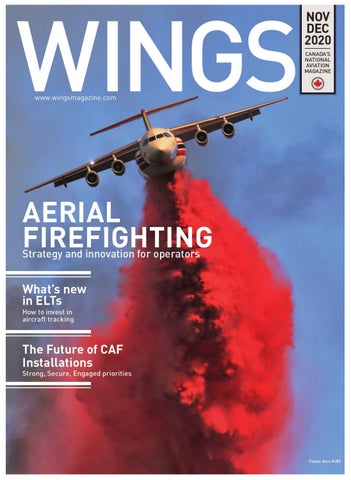
18 AERIAL FIREFIGHTING DEVELOPMENTS
From fixed-wing to rotary-wing innovations, a look at the strategies and technologies for operators to build air support platforms BY JON ROBINSON
COVER PHOTO: CONAIR AVRO RJ85 AIRTANKER IN ACTION IN AUGUST 2020, BY STEVE WHITBY.
WWW.WINGSMAGAZINE.COM
November/December 2020 | WINGS
3
Waterloo Wellington Flight Centre The Skills You Need - The School You Want
Photo by Mike Reyno
Strong education and industry partnerships give our graduates a competitive edge and the skills needed to fly in jobs across Canada. Partnered with: Contact us today! 519-648-2213 | 1-877-FLY-WWFC | wwfc.ca Waterloo Wellington Flight Centre professional programs are approved as vocational programs under the Private Career Colleges Act, 2005 (PC# 105919).
LEADING
EDGE
By Jon Robinson |
Aircraft and pilot forecasts The Boeing Company in mid-October announced plans to consolidate production of 787 jets at its facility in North Charleston, South Carolina, starting in mid-2021. The company explains this decision was made to preserve liquidity and reposition certain lines of business given the current global business environment. Just days earlier, the company released its annual global forecasts for the commercial aviation, defence and aerospace sectors, which accounts for the ongoing impact of the COVID-19 pandemic on near-, medium- and long-term market conditions. The 2020 Boeing Market Outlook (BMO) projects that the commercial aviation and services markets will continue to face significant challenges due to the pandemic, while global defense and government services markets remain more stable. “While this year has been unprecedented in terms of its disruption to our industry, we believe that aerospace and defense will overcome these near-term challenges, return to stability and emerge with strength,” said Marc Allen, chief strategy officer, Boeing. The BMO forecasts a total market value of US$8.5 trillion over the next decade, including demand for aerospace products and services. That forecast is down from US$8.7 trillion a year ago due to the impact of the COVID-19 pandemic. Boeing states airlines globally have begun to recover from a greater than 90 per cent decline in passenger traffic and revenue early this year, but a full recovery will take years. The 2020 BMO includes projected demand for 18,350 commercial airplanes in the next decade – 11 per cent lower than the comparable 2019 forecast – valued at about US$2.9 trillion. In the longer term, the commercial fleet is forecast by Boeing to return to its growth trend, generating demand for more than 43,000 new airplanes
5 6
The Boeing Company expects to consolidate production of 787 jets at its facility in North Charleston, South Carolina, starting in mid-2021.
in the 20-year forecast time period. The BMO also projects a US$2.6 trillion market opportunity for defense and space during the next decade. This spending projection, explains Boeing, reflects the ongoing importance of military aircraft, autonomous systems, satellites, spacecraft and other products to national and international defense. This demand continues to be global in nature, explains Boeing, with 40 per cent of expenditures expected to originate outside of the United States. Beyond the lower demand for near-term commercial services, the BMO forecasts a US$3 trillion market opportunity for commercial and government services through 2029, with digital solutions emerging as what Boeing describes as a critical enabler with customers focused on leaner operations to adjust to future market demand. Boeing notes life-cycle services and support will help customers scale their operations to meet efficiency and cost objectives aligned to market recovery trends. Boeing also released its 2020 Commercial Market Outlook (CMO), an annual 20-year forecast addressing the market for commercial airplanes and services, projecting an increase in the share of deliveries replacing older passenger aircraft that are being retired in an accelerated
TOP DATA BURSTS… in this issue 1. Ethiopian Airlines received 30th Dash 8-400 from De Havilland. (P. 8) 2. Bombardier poured an estimated $6 billion into the C Series (P. 12) 3. CMCC indicates ELTs activate in only 38% of Canadian aircraft accidents (P. 14) 4. Conair designed the Q400AT tank to deliver a 10,000-litre payload. (P. 18) 5. Qantas was the first airline to fly nonstop from New York to Sydney – a record 20-hour flight. (P. 30)
WINGS | November/December 2020
replacement cycle, especially in the first decade. According to its commercial forecast, Boeing notes, that over the next 20 years, passenger traffic growth is projected to increase by an average of four per cent per year; and the global commercial fleet is expected to reach 48,400 by 2039, up from 25,900 airplanes today. During this period, Boeing states Asia will continue to expand its share of the world’s fleet, accounting for nearly 40 per cent of the fleet compared to about 30 per cent today. Boeing states single-aisle airplanes, such as the 737 MAX, will continue to be the largest market segment, with operators projected to need 32,270 new airplanes in the next 20 years. Single-aisle demand will recover sooner, according to Boeing, due to its key role in short-haul routes and domestic markets as well as passenger preference for point-to-point service. In the widebody market, Boeing forecasts demand for 7,480 new passenger airplanes by 2039. The company explains the widebody demand will be affected by a slower recovery in long-haul markets, typical after air-travel shocks, as well as uncertainties from COVID-19’s impact on international travel. Air cargo demand is expected to grow four per cent annually, according to Boeing, and generate further demand for 930 new widebody production freighters and 1,500 converted freighters over the forecast period. A month after Boeing released its forecasts, CAE of Montreal followed suit with its own projections over the period of 2020 to 2029, as part of the CAE Pilot Demand Outlook. The report includes a short-term forecast for 27,000 new professional pilots starting in late 2021, as well as a global demand forecast for more than 260,000 new pilots over the next 10 years. CAE states it analysis shows that the active pilot population is expected to return to 2019 levels in 2022, noting retirement and attrition are expected to continue to be a challenge for the civil aviation industry as air travel recovers. This is expected to drive an acute demand for pilots, resulting in an estimated short-term need for approximately 27,000 new professional pilots starting in late 2021. | W WWW.WINGSMAGAZINE.COM
PHOTO: BOEING
Boeing, CAE outline future expectations amid unprecedented disruption
Reach your Aviation Goals Reach your Aviation Goals
Learn from the Experts.
For over 30 years, AeroCourse has been a leader in advanced aviation training in Canada. We provide aviation ground school seminars and courses for advanced training along with publishing manuals and workbooks. The courses include IFR and ATPL seminars, online courses, and specific advanced aviation courses inconjunction with flight colleges, schools and airlines. Our instructors are professional pilots and flight examiners with thousands of hours experience. We pride ourselves on high quality materials and training.
Our instructors’ experience and dedication set them apart. They have an incredible knowledge base and vast experience. They are dynamic and enthusiastic. Having exceptional instructors ensures a productive learning environment and helps students acheive success.
Groundschool Dates ATPL IFR Dec 4-6 & 12-13 Virtual Class (EST) Jan 8-10 - Toronto Jan 15-17 - Calgary Feb 5-7 & 20-21 Virtual Class (EST)
Nov 20-22 - Toronto Nov 27-29 - Calgary Jan 9-10 & 16-17 Virtual Class (EST) Feb 26-28 - Toronto
*(Face-to-Face Class - Subject to COVID-19 rulings)* Virtual classes will be added as needed
Call 1800-461-8857 Visit AEROCOURSE.COM
WG_Aerocourse_NovDec20_CSA.indd 1
2020-11-02 3:19 PM
Trust lives here As the 2020 Canadian wildfire season draws to a close, we would like to thank all of our frontline teams and industry partners for coming together to protect communities across Canada this season. We look forward to continuing our work with the Province of Manitoba in 2021. We would also like to acknowledge those continuing the fight against wildfires across the globe. Our thoughts are with all who are affected.
98.4%
Aircraft availability
Marine | Land | Aviation | Cavendish Nuclear
WWW.WINGSMAGAZINE.COM HalfPage_AFFAd_Sept2020.indd 1 WG_Babcock_NovDe20_CSA.indd 1
+16 million
Litres of water dropped
599
Missions completed
babcockcanada.com
November/December 2020 9:51:24 | WINGS 30/10/2020 AM 7 2020-10-30 10:46 AM
ON THE
FLY
of this new fleet, featuring a range and payload greater than its existing aircraft.
MILITARY
Boeing on October 27 stated its F/A-18 Block III Super Hornet bid in the Government of Canada’s ongoing Future Fighter Capability Project procurement competition, if successful, would provide $61 billion and nearly 250,000 jobs to the Canadian economy. The $61 billion in economic benefits outlined by Boeing with a Super Hornet selection in the FFCP are largely based on partnerships with five Canadian-operations, including:.CAE, IMP Aerospace, GE Aviation, Raytheon, Peraton, and L3 Harris. Boeing states its direct spending in Canada in 2019 rose to $2.3 billion, a 15 per cent increase in four years. When the indirect and induced effects
The first Brazilian Gripen E, designated as the F-39 Gripen by the country’s air force, lands at Embraer's plant in Gavião Peixoto.
are calculated, this amount more than doubles to $5.3 billion, with 20,700 jobs.
FIRST FLIGHT FOR BRAZILIAN GRIPEN E The first Brazilian Gripen E, designated by Brazilian Air Force as the Saab F-39 Gripen, concluded its first flight in Brazil on September 24. The aircraft flew from the airport in Navegantes to Embraer’s facility in Gavião Peixoto. The Gripen E is one of three fighter-jet platforms – along with the Boeing F/A-18
Block III Super Hornet and Lockheed Martin F-35 Lightning II – competing in Canada’s Future Fighter Capability Project (FFCP), which aims to replace the RCAF’s ageing fleet of CF-188 Hornet’s with 88 new-generation fighters. In June 2020, Saab confirmed the four corporate partners that will be part of its FFCP bid, including IMP Aerospace & Defence, CAE, Peraton Canada and GE Aviation. With this F-39 Gripen milestone achieved, Saab notes the flight test program will now be expanded to include the Gripen Flight Test Center at Embraer in Gavião Peixoto.
FINANCING OPTIONS AVAILABLE
al40/42 SPECIFIC & CONVERTIBLE DIAMOND DA40 / DA42 SIMULATOR Switch from the DA42 to the DA40 con�guration by swapping only the dashboard and the middleconsole.
DA40
DA42
MORE AT
REAL GARMIN
NEW IOS TOOLS
WANT A DEMO?
NEW VISUAL SYSTEM
CONTACT@ALSIM.COM
10 WINGS | November/December 2020 WG_Alsim_NovDec20_CSA.indd 1
TC LEVEL 5
ALSIM.COM
TEL: +1 877 594 7426
EXPERIENCE
400+ CERTIFIED SIMS, 350+ CLIENTS 50+ COUNTRIES, SINCE 1994
WWW.WINGSMAGAZINE.COM 2020-10-29 2:07 PM
PHOTO: SAAB
BOEING OUTLINES $61B IN FIGHTER BENEFITS
PHOTO: DIAMOND AIRCRAFT
PAL AEROSPACE WINS NETHERLANDS CONTRACT PAL Aerospace, in partnership with JetSupport, won a contract to provide and support maritime surveillance aircraft and services for the Netherlands Coastguard. This new contract will see PAL Aerospace and JetSupport modify and deliver two fully missionized DHC8 aircraft, provide crew training on all systems, and support operation of the aircraft for a 10-year period with an option for two additional one-year terms. Headquartered in St. John’s, Newfoundland and Labrador, and part of the Exchange Income Corporation family of companies, PAL Aerospace is an international aerospace and defence company with a focus on intelligence, surveillance, and reconnaissance (ISR) solutions, inservice support, and aircraft engineering and modification. JetSupport is a private company based in the Netherlands at Schiphol Amsterdam providing MRO
The extra-large cabin of the DA50 seats five people
services and special mission aircraft. The two DHC-8 aircraft will be missionized primarily for the purpose of providing air reconnaissance capacity in the North Sea.
BUSINESS AVIATION
DIAMOND DA50 RG RECEIVES EASA CERTIFICATION Diamond Aircraft received certification from the European Union Aviation Safety Agency for its single-engine DA50 RG piston aircraft with retractable gear,
with deliveries expected to begin in the first quarter of 2021. U.S. certification is expected by the end of 2021. The aircraft maker, based in Austria with facilities in London, Ontario, and China, explains the DA50 RG is well suited for single engine pilots looking for more seats and utility, as well as charter operators and corporate flight departments wanting to complement larger aircraft with a lowcost alternative for shorter trips. Introduced in June 2020, Diamond points to the DA50 RG’s standard Garmin G1000 NXi avionics, 5-seat luxury cabin and large rear-baggage compartment, as well as double-slotted flaps for high lift and strong slow-speed behaviour in flight. | W
SUPPORTING YOU IS WHAT WE DO 2020, CONAIR’S 51ST SEASON SUPPORTING WILDFIRE CONTROL AGENCIES
conair.ca
WWW.WINGSMAGAZINE.COM WG_Conair_JulyAug20_CSA.indd 1
November/December 2020 | WINGS 11 2020-06-17 8:17 AM
ALTERNATE
APPROACH By David Carr
Pay to stay
Downsized Bombardier needs a New Age challenger
W
12 WINGS | November/December 2020
The Challenger 350 aircraft has been the best-selling super mid-size business jet for six consecutive years in GAMA’s annual sector report.
going pear-shaped. Bombardier has taken a haircut on the Spirit transaction, agreeing to US$275 million instead of the original agreed US$500 million to save the deal (but is off the hook for US$824 in liabilities). Which, leaves Bombardier with a huge debt pile in a high capital industry with limited growth potential. What’s next? Bombardier has solidified its future in the sector occupied by the Global 7500. Wichita-based Learjet is a non-starter especially if, as expected, Bombardier seeks a new round of government support. The company’s own ‘deep pockets’ of last resort. That leaves re-energizing the Challenger line either through a substantive upgrade of the existing platforms or, as with the 7500, going all in with a new generation Challenger. Developing a clean-sheet airplane will be costly. Is there an appetite for what will be perceived as another bail-out? Quebec is still smarting over the last cash infusion. Given excessive executive compensation, the steady drip, drip of job losses and a dual-share structure that keeps Bombardier a “family business” with little family equity, it will be a hard sell. Business jets are also perceived a fossil-fuel burning toys for the privileged set and do not square with the anti-oil agendas of either the federal or Quebec governments. Martel may want to provide a roadmap by taking his cue from the Ontario
automotive sector, where federal and provincial money is being used to double down on building a clean sheet electronic vehicle industry. Not unlike the early ‘80s when Prime Minister Pierre Trudeau punched Canada’s ticket into the business jet market and paved the way for the regional jet revolution with development of the (then) Canadair Challenger. Pay to play has long been the mantra of the global aerospace industry. Having shed so much of its winning roster, Bombardier is in the final innings. It is now pay to stay. Either for Bombardier to develop an all new made in Canada jet, or to a potential buyer like Textron to maintain a manufacturing presence in Montréal, similar to what will happen when Airbus finally launches the A220-500. A new generation of eco-friendly private jets might be what it takes to make the case. Bombardier poured an estimated $6 billion into the C Series, handed Airbus a platform to solidify its position against Boeing in the bread and butter narrow body market for a generation, and gave it all away for just over $1 billion. The company that made its bones on fire sales has had divest itself much the same way. Without a bold leap, it becomes a question not of if Bombardier gets out of aviation altogether, but when. | W David Carr is a former editor of Wings and Helicopters magazines.. WWW.WINGSMAGAZINE.COM
PHOTO: BOMBARDIER
ill the next Big Thing be enough to save Bombardier, and what could it be? Bombardier pioneered the regional jet revolution, built the game changing Airbus A220 and redefined ultra-long-range executive jet travel with the Global 7500. The sale of the aerostructures division, including proprietary technology behind the ground-breaking A220 wing to Wichita-based Spirit AeroSystems closed on Halloween. A deal to sell the railway business to France’s Alstrom will be finalized in early 2021. A one-time global transportation giant is a step closer to a pure-play business jet manufacturer that must hold its own in a cyclical industry where competitors are part of larger, more diversified aerospace corporations with deeper pockets. In a cruel twist, Airbus is pitching the A220 against the 7500 for customers wanting an ultralarge cabin but not requiring the range of the Global. Bombardier is the only end-to-end OEM with a presence in the entry-level, super mid-size and large-cabin, ultra long-range categories, anchored by the pace-setting 7500 and top-selling Challenger 350. But sales at Learjet, the lower end of the line have slowed even with October’s entry into service of the Learjet 75 Liberty, an updated Learjet 75 better positioned to compete with the Cessna CG3+ and Embraer Phenom 300E. Bombardier is not behaving like a company eyeing the final exit. In addition to the 75 Liberty, it has trimmed costs, announced cabin enhancements to the Challenger 350 and is aggressively pursuing specialized aircraft opportunities across the Lear, Challenger and Global platforms. It is also tough to see newly installed chief executive Eric Martel, a successful businessman and Bombardier alumni with a strong aviation pedigree quitting as CEO of Hydro Quebec to oversee the dismantling of what is left. Still, Martel has limited financial firepower. Bombardier stands to clear US$4 billion from the sale of Bombardier Transportation, including US$585 million in stock. US$500 million is earmarked to pay half of a US$1 billion cushion negotiated as a hedge against the Alstrom deal
POSITION
REPORT
| By Andre Lavigne
A look inside NAMK
South Korea marks a milestone, opens one of the world’s best aviation museums
T
his year marked the 100th Using an interactive and anniversary of the first flight novel approach, NAMK offers the opportunity to act by Korean aviators. To celebrate, The Republic of Korea as an ATC controller and opened the National Aviation pilot in a real-time, real-life Museum of Korea (NAMK) on July 5. Kosimulation. Lasting more reans living in what Westerners call “South than 90 minutes, there is a Korea” do not use these terms, they talk of presentation at first to outline the upcoming events. In their country as being “Korea”. This is part turns, participants will be eiof the approach that there is only one Korea and that, hopefully, in the future the ther a controller or pilot and country will be reunited. The Government will be working together via is the Republic of Korea (ROK), the entity standard communication to entrusted with the creation of the museum operate a commercial flight. is the equivalent of the Canadian Depart- The Republic of Korea opened its national aviation museum in The ATC centre replicates mid-2020. It showcases a range of historic and modern aircraft, ment of Transport; MOLIT. Incheon International airincluding a T-6 Texan purchased from Canada. port (ICN/RKSI) serving What makes this museum standout is that the same approach was used as if it was the by retired cabin crew instructors and using Seoul. A complex visual system using multicreation of a major art or history museum. actual equipment such as fire extinguisher screens represents the actual terminal gates, There are no aircraft hangars anywhere in and life vests, the participants are getting as well as taxiways and runways. There are sight. This is an ultramodern museum us- ready to qualify for the next step, using a many ATC stations equipped with radio, raing the latest audiovisual and virtual reality cabin simulator, in this case a 737 mockup. dar and computer screens, again similar to techniques, as well as innovative presentaAfter taking turns working in the gal- the real deal. The controllers are in contact tion of aircraft. leys and operating the cabin doors the with the pilots in their group… the pilots Korean society has had its exposure to group moves to a different simulator to are using and actual fixed base 747-8 simuaviation influenced mainly by military fly- practice an emergency landing followed lator; as a long time 747-400 pilot I can ing, even commercial aviation has until by an evacuation, including using an ac- assure you that this simulator was the real recently played a minimal part in everyday tual slide, the entire course is very realistic. thing, providing a real aircraft experience. life. To generate more interest in aviation Pushback, taxi and takeoff all done in coordination with the ATC centre next door. as opportunities for careers and involvement, the government created NAMK. On the military side, there is on offer a With three floors open to the public, the simulated flight with the Black Arrows; basement being reserved for archives and the Republic of Korea Air Force (ROKAF) storage, NAMK has more than 200,000 aerobatic team. Using virtual reality goggles and a set of full motion (in all axes) square feet of space. The exhibits are not KAI KC-100 Naraon, prototype #2, seats the participant is part of the team only for the aviation enthusiast but also HL 002X during a practice flight in the T 50B. Anyfor the uninitiated. On the first floor, we KAI T-50B Golden eagle, ROKAF one can participate in the experiences; all find an aviation history hall. Using original Black Eagles example you need to do is make an online reservadocuments, as well as audio visual presenta KARI Firefly, Prototype HL EBD tions, from early Chinese writings through tion at a cost of 2000krw ($2.20 CDN), to Newport XVII (reproduction) painted Leonardo DaVinci and of course the Wright prevent long waiting lines. as J-TIAD Brothers all the way to Concorde, we follow On the third floor there is a space for the North American P-5D Mustang the growth of aviation. younger visitors; where they can enjoy a (2-seater, Merlin) ROKAF K 200 Korean aviation history is highlighted in check-in, security check and boarding using North American F-86F Sabre, 54656 a separate hall, from its beginnings in 1920 mini luggage and aircraft. The cabin and ROKAF (in the U.S.) through the Korean War and tocockpit are all pint-sized including the meal North American T-6 Texan, ROKAF day’s vibrant civil and military aviation. The trays. You can also find a nice reference Northrop KF-5E Jegongho (Tiger II) story begins relatively late as the country was library with comfortable sofas and chairs ROKAF 10594 under Japanese occupation and prohibited in a quiet atmosphere. Presently there are Standard J1 KAC Curtis Engine to have any involvement in aviation. The mostly Korean books and magazines on (outdoor full-scale Bronze model) second floor offers visitors great opportuoffer, but new English language materials Standard J1 KAC Hispano Suiza nities to experience firsthand many facets are being ordered. | W Engine (reproduction) of aviation. The Cabin Crew Experience Stinson 108-3 N4082C Andre Lavigne is a former Air Canada lasts 90-minutes; it begins with a safety Captain who is now based in South Korea. course in a typical airline classroom. Given
PHOTO: ANDRE LAVIGNE
AIRCRAFT ON DISPLAY
WWW.WINGSMAGAZINE.COM
November/December 2020 | WINGS 13
Aireon’s mission is the delivery of satellite-based ADS-B services, which is a perfect fit for countries with large geographies, small populations and aging groundbased air navigation infrastructure.
THE FUTURE OF ELTS
T
he primary purpose of an ELT is to locate aircraft in distress. In Canada, the process to manage a distress call was executed 1,032 times in 2017, saving 49 lives. In 2017, roughly seven per cent of the ELT activations were real and 93 per cent were false activations. Currently, there is no Canadian or American regulatory mandate for 406 MHz ELTs. NAV CANADA, CBAA and COPA believe that ADS-B technologies will be able to augment the 406 MHz ELT environment. NAV CANADA, Transport Canada, COPA and CBAA are collaborating to determine the feasibility of utilizing ADS-B as an alternative alerting source for search and rescue (SAR). Anthony Norejko, CEO of CBAA, explains, “Roughly 10 per cent of the operators are challenged with the economics of equipping older aircraft with ADS-B and are considering replacing non-compliant aircraft with newer models. However, Transport Canada needs to quantify and articulate to Business
14 WINGS | November/December 2020
Aviation and General Aviation the potential savings to facilitate the transition to ADS-B based alerting.” The Air France flight 447 accident was the impetus for ICAO to create its new Global Aeronautical Distress Safety System (GADSS) effective January 1, 2021. GADSS is designed to address three specific issues: late notification of SAR services when aircraft are in distress; missing or inaccurate end of flight aircraft position information; and lengthy and costly retrieval of flight data for accident investigation. The system will provide a 4D position every 15 minutes to help reduce the size of the search area. GlobalBeacon, a new product from Aireon and FlightAware, provides a solution for the compliance to GADSS. Aireon LLC is a joint venture between Iridium (the satellite network provider) and the air navigation service providers of Canada, Ireland, Italy, Denmark and the UK. Aireon’s mission is the delivery of satellite-based ADS-B services, which is a perfect fit for countries with large
geographies, small(er) populations and ageing ground-based air navigation infrastructure. In early 2019, Aireon launched Aireon ALERT, a service operated by the IAA, for the locating and tracking of ADSB equipped aircraft. Aireon ALERT users do not have to be customers of Aireon or IAA. Users simply have to register for the free emergency service. IAA users are limited to commercial operators, SAR and air navigation service providers. Aireon ALERT was launched based upon the principle that Aireon’s systems were recording ADS-B data, which could be used to facilitate the delivery of location information to support SAR activities, as well as the operator’s needs. Since the launch over one year ago, in 2019, Aireon ALERT’s operation centre has received 43 calls. That number is somewhat skewed based on the impact of COVID-19. Aireon ALERT is designed to track the last 15 minutes of a flight, with one plot per minute plus all the plots of the last minute of the flight. Google Earth is used to visualize WWW.WINGSMAGAZINE.COM
PHOTO: AIREON
GRAPPLING WITH THE SAFETY COMPLEXITY BETWEEN EMERGENCY LOCATOR TRANSMITTERS, ADS-B AND FLIGHT RECORDERS BY PHIL LIGHTSTONE
the plotted data. Aireon ALERT is able to search back over the past five days. A registered customer begins the process by going to the Aireon ALERT web page and requesting a track. The webpage will display the telephone number for the Aireon ALERT communication centre. The process continues by the requester calling the toll-free number which is answered 24x7 by an Aireon Alert Tracking specialist and providing the security credentials generated by the website. The flight’s identifier (either the ICAO 24 bit identifier or the flight’s call sign) is provided to the specialist, who then conducts a search for the flight’s last 15 minutes of data. Four-dimensional data is provided to the caller both in terms of the last reported latitude, longitude, altitude and time (critical data to dispatch SAR personnel to site). A Google Earth report is provided to the caller to help the customer determine if an incident or accident has occurred. In early 2020, an ELT activation occurred in South Dakota at a non-towered airport. There were no personnel at the airport for SAR to contact during the persecution of an ELT activation. With no radar coverage in the area and the aircraft not communicating with ATC or flight services, SAR contacted Aireon ALERT. The ADS-B data showed the aircraft descending from 9,000 feet, flying the approach to final on runway 13, landing, taxing and parking. Google Earth showed the aircraft parked on the ramp near the hangers. Sometime later, SAR was able to contact the owner/ crew of the aircraft and determined that the aircraft had bounced on landing hard enough to activate the 406 ELT. A more dramatic example of the benefits of narrowing the search area with pinpoint accuracy is N50DH, a Cessna P210 aircraft which experienced an engine failure in the Bahamas on December 23, 2019. Although not equipped with ADS-B diverse antennas, signal reflection off of the water allowed ADS-B communication with the satellites. The aircraft experienced a rapid descent followed by a successful ditching just north of Spanish Wells. The aircraft sank quickly, but the sole occupant was able to exit the aircraft, without a life jacket or other survival gear. SAR contacted Aireon ALERT, which provided pinpoint positioning within 50 metres. The U.S. Coast Guard was dispatched and rescued the pilot, who spent three hours treading water. Augmenting the current 121.5/406 ELT hardware utilizing ADS-B OUT transmissions, big data and advanced computer analytics to determine if an aviation distress event has occurred has the ability to proactively advise SAR and the aircraft owner of an incident. If an aircraft’s flight characteristics are outside of normal operations, e.g. rapid deceleration, then the system can
tag the flight as an emergency and push out a distress alert. The CMCC and Joint Resource Co-ordination Centre would then investigate the event using current standard operating procedures. This approach does not preclude flight crews from utilizing an existing ELT, personal locating beacons (e.g. Airtex) or personal locating devices (e.g. Spot, Garmin, Spidertracks). Christine Gervais, president of COPA, explains, “The envisioned system is about the pilot or technology not doing something, which triggers an emergency alert.” Transport Canada supports the
establishment of a working group to further investigate the feasibility of the concept. It is comprised of NAV CANADA, Transport Canada, DND and representatives from the GA community, such as COPA. An end to end space-based ADS-B based alerting service has the potential to reduce the number of false positives and improve the efficiency of the SAR service. Additional research is underway to determine the operational alignment of the technology to the current ELT system. With the airline’s mandate to have dual ELTs, 121.5/406 ELTs are here to stay.. | W
WHEN MISSION-FIT IS CRITICAL, CHOOSE THE AIRCRAFT DESIGNED FOR ALL OF THEM www.pilatus-aircraft.com
Stan Kuliavas, Vice President of Sales | sales@levaero.com | 1.844.538.2376
November/December 2020 | WINGS 15
WWW.WINGSMAGAZINE.COM Pilatus_PC-24_Wings-117.48x190.5mm_October.indd 1 WG_Leavero_NovDec20_CSA.indd 1
29.10.2020 12:40:07 2020-10-30 7:58 AM
The CC-295, the newest fixed-wing search and rescue aircraft in the Royal Canadian Air Force, arrives at 3 Wing Bagotville on September 16, 2020.
THE POSITION OF MILITARY INSTALLATIONS IN CANADA
BY YVAN BLONDIN AND MICHEL MAISONNEUVE
T
he arrival of a new Chief of the Defence Staff and the pandemic's budgetary implications coupled with increasing national security and defence concerns may only offer the Canadian government difficult choices when dealing with the future need for military installations. This discussion also needs to be viewed in the broader context of the Department of National Defence's (DND) Strong, Secure, Engaged policy priorities and commitments. One of the most critical CAF priorities during the current pandemic will be to protect its members' health and safety. Due to the pandemic, the pressures and demands on the CAF have been augmented. 16 WINGS | November/December 2020
However, the threat caused by State and Non-State Actors has not diminished. Given the CAF's primary mandate of defending Canada and protecting Canadians, sight must not be lost on China, Russia, North Korea, and Iran's increasing assertiveness and often aggressive behaviour. Such context is an essential factor when considering the positioning and basing of CAF elements domestically. International organizations such as NATO face numerous challenges, including the increasing pressure to reduce their overhead costs from collective funding. Meanwhile, the Trump Administration's continued pressure on NATO memberstates to bring their military spending to two per cent of their respective GDP will remain an
indisputable legacy of the current, and to the same degree of previous, U.S. Administrations. Simultaneously, NATO member-states are finding it hard to agree on values that were initially taken for granted. At the same time, Canada's relationship with the U.S. is one that fundamentally dictates our approach to defence spending and strategic capability procurements, especially as we continue to collaborate in NORAD and manage our Continental defence priorities. There is greater interest from many actors towards the Arctic, which will force Canada to have an increased presence in this new strategic area. Internally, factors that influence CAF basing include cyberthreat force protection, energy production, Indigenous Peoples engagement, and natural resource development pressures, including freshwater. The issue of climate change has increasingly captured Canadians' attention. Climate change will significantly impact the North,
including rendering the Northwest passage sailable yearround. Canada has declared this area internal waters, but some nations do not agree, including the U.S., Russia and others. Reduction in the Polar ice caps, especially in the Arctic region, will need a more significant Canadian presence and an ability to assert our sovereignty. IMPACT ON INSTALLATIONS While military budgets have grown in the last few years, expenses linked to the pandemic will put tremendous pressure on all federal department budgets. Deficit spending is inevitable in the short-term to stimulate the broader Canadian economy, increasing scrutiny on defence spending. Although increased defence spending is identified in Strong, Secure, Engaged, planned CAF growth is difficult to predict, given the pandemic's unknown duration. Heightened security concerns, however, should justify protecting the current operation and WWW.WINGSMAGAZINE.COM
PHOTO: CORPORAL LOUIS GAGNÉ, CANADIAN ARMED FORCES
LEADERS FROM SAMUEL ASSOCIATES EXAMINE CAF PRIORITIES TO SUPPORT FUTURE BASE DEVELOPMENT
infrastructure levels. The effects of climate change on the Arctic confirm the requirement for an increased military presence in the North. Ongoing initiatives in Resolute Bay and Nanisivik will need to grow and be networked to even more locations in the Northwest Territories and Nunavut to support increased activities. The movement North, which started ten years ago, remains a critical security requirement for Canada and will require investments in telecommunications, Low Earth Orbit satellites and other transportation and logistics capabilities to support and supply Canadian military installations. The federal government needs to mobilize its departments and agencies in a new way to work together, synchronize national policies and priorities, and include industry to address increased activity in the North due to strategic competition over resources and access to new sea shipping routes. MILITARY BRANCHES The transition of the RCN to new fleets supports the dualbasing system in the Pacific and Atlantic regions. The RCN's challenge will be to meet the increased demand for its services in the North and Arctic regions. The Nanisivik Naval Facility project, for example, first announced in 2007, will provide a docking and refuelling facility for the RCN and the Canadian Coast Guard. The current scope of the project is to support operations during the four-month summer season. With the projected increases in naval activity along the Northwest passage by Allies and other strategic competitors like Russia and China, Nanisivik will most likely need to meet its original intent: a permanently staffed naval station and home port to a Canadian Arctic fleet. Army bases will remain concentrated to support the four significant formations; the three brigade-groups and Combat Training Centre. Army training areas will need to continue to support largescale manoeuvres but will also require the ability to train for
THE NEED TO CONTINUALLY MODERNIZE BASE INFRASTRUCTURE MUST BE A STANDING PRIORITY. hybrid conflicts. Greater Arctic basing of Army elements will have to be considered. Force protection of bases and depots will mean more significant resource requirements. As a widely dispersed component within the country, the Primary and Secondary Reserve Forces and the Canadian Rangers can provide presence and quick reaction to local, regional and national emergencies, requiring increased and ongoing resource commitments. There will also be a greater need for federal-provincial cooperation in the context of Continental domestic defence. This may lead to a new agreement between the CAF and Canadian provinces to strengthen or create collaborative protocols, as recently demonstrated by Operation Laser in response to COVID-19. The changing military theatre will shape the Army's requirements for permanent installations supporting advanced technologies and forward projecting capabilities. If the current RCAF operations level is maintained, the requirement for most bases in southern Canada should remain stable. Gander, Comox, Greenwood, Trenton, Moose Jaw, Portage, Cold Lake and Bagotville should not expect any significant change in the next decade. However, the need to continually modernize base infrastructure must be a standing priority for the federal government. The last few decades' trends to move away from larger cities for noise abatement and better use of ideally located federal land may affect Winnipeg and Shearwater. Resolute Bay was identified in 2011 by the RCAF as the ideal location to build infrastructure to support increased flying activities in the North. As the Army and RCN increase activities and the requirement grows
to support, patrol, rescue and police the Arctic from the air, robust year-round RCAF facilities will be needed in Resolute Bay. There is no military need or requirement to maintain costly legacy facilities and infrastructure of current RCAF units in Goose Bay or North Bay. Military units in these locations have been kept in place to protect local economies and interests, especially in Goose Bay. The occasional RCAF requirement to use the Goose Bay airfield could easily be met using deployed facilities similar to what currently exists in Nunavut and Iqaluit. CONCLUSION The current pandemic has delivered both challenges and opportunities to the CAF. Without a doubt, the pressure on shortterm military spending should be the top priority for the new Chief of Defence Staff. The case for continued long-term investment in defence needs to be linked to the federal government's intent to bolster the
Canadian economy. Increasing security concerns generated through geopolitical factors and climate change will require significant defence expenditures on infrastructure and defence capabilities. Canada needs to be prepared to assert its sovereignty over its Arctic region and the Northwest Passage. Strengthening military installations in the North and Arctic regions needs a whole-ofgovernment approach to leverage infrastructure investments and interdepartmental priorities, plans and budgets. The Department of National Defence's Strong, Secure, Engaged policy may require enhancements (version 2.0) to reflect evolving threats, innovations in advanced technologies and hybrid military activities of strategic competitors in the North over resources and sea shipping lanes. For these reasons, both DND and CAF need to accelerate their timetable in support of modernizing Canada's military installations. | W
LEKTRO
®
Since 1945
Models for aircraft 6,804 kg to 127,006 kg MTOW
www.
LEKTRO .com
1-800-535-8767 1-503-861-2288 sales@lektro.com November/December 2020 | WINGS 17
WWW.WINGSMAGAZINE.COM WG_LEKTRO_JULYAUG19_CSA.indd 1
2019-06-18 8:14 AM
Engineers at Conair designed the Q400AT tank to deliver a 10,000-litre payload at any Interagency Airtanker Board coverage level.
AERIAL FIREFIGHTING DEVELOPMENTS STRATEGIES AND TECHNOLOGIES FOR OPERATORS TO BUILD BETTER AIR SUPPORT BY JON ROBINSON
I
n mid-October, Wings and Helicopters held the inaugural Aerial Firefighting Virtual Symposium, designed to provide fixed- and rotary-wing operators with critical business information about the sector. The 4-hour online event, produced in partnership with sponsors Conair, Viking, Babcock, Sikorsky, Executive Flight Centre, Cascade Aerospace and Bell, featured five live sessions. Speakers at the Aerial Firefighting Virtual Symposium (AFVS) included: Christian Bergeron, global sales director, 18 WINGS | November/December 2020
Aerial Firefighting Aircraft, Viking Air; Matt Bradley, president and COO of Conair Group, as well as its director of business development, Jeff Berry; Mario Ferrante, director of flight operations, Babcock MCS Italia; Mike Sagely, senior pilot, Los Angeles County Fire Department; and Fred Jones; CEO of the Helicopter Association of Canada (HAC). To access their presentations and all of the AFVS content, visit Wingsmagazine.com under the Events tab. Before the arrival of COVID-19, the AFVS event was scheduled to take place
FIXED-WING, BY LAND AND SEA In a session called Continually Raising the Bar, Bradley and Berry worked with the Conair team to produce a 20-minute exclusive video to walk attendees through their facilities. This included an overview of major investments made to Conair’s unique training centre and also time on the ramp to review highlights of the mighty Avro RJ85 AT airtanker. With more than 70 aircraft, Conair operates the largest privately owned, dedicated fleet of fixed-wing firefighting aircraft in the world. The company has modified more than 175 individual aircraft across 15 aircraft types for conversion to aerial firefighting, including its pioneering efforts on jet aircraft. Conair’s operations extend across North America, Europe and Australia. Just weeks before AFVS began, in late September, Conair’s first Q400AT, engineered specifically for aerial firefighting, touched down at Bundaberg Airport in Australia. The airtanker is on contract with Queensland Fire and Emergency Services to help contain wildfires. In addition to the Q400AT’s fire suppression capabilities, which includes aerial dispersion of retardant, suppressant, or gel products, Conair points to its environmental performance in terms of setting a standard for future next-generation aircraft. The newest generation of the de Havilland Q400 turboprop provides composite propulsion with advanced swept blade propeller design, efficient lift systems, effective aerodynamics, and a light but robust frame, which, explains Conair, contribute to lower emissions, fuel burn and noise. Conair explains its specialized Q400 airtanker produces 30 per cent less emissions than aircraft of similar size, exceeding current environmental standards for carbon dioxide (CO2), hydrocarbon, nitrous oxide and smoke emissions. With results that are below levels mandated by the International Civil Aviation Organization (ICAO), the aircraft also offers the lowest fuel burn per litre hauled. The Q400AT uses only 58 per cent of the fuel, while carrying 88 per cent of the load of a typical Type I airtanker, according to Conair. The Q400AT is outfitted with a custom, WWW.WINGSMAGAZINE.COM
PHOTO: ALEXANDRE DUBATH, CONAIR
over two days at the beginning of April at Abbotsford International Airport, YXX, which in 2019 had reached the one-million passenger milestone after reporting 127,134 aircraft movements over the previous year. In addition to its internationally known airshow, the airport’s connection to the global aviation industry is well established through two of its tenants, Cascade Aerospace and Conair Group, which, along with Babcock and Viking Air, featured prominently in the fixed-wing sessions of the AFVS event.
DIRECTORY
SHOWCASE YOUR SCHOOL/ORGANIZATION IN THE CAREERS IN AVIATION ONLINE DIRECTORY FOR MORE INFORMATION PLEASE CONTACT: MENA MIU • 416-510-6749 mmiu@annexbusinessmedia.com
The essential source for Canadian aviation education and training. Career Guide to the fixed-wing, rotary-wing and RPAS industries. Add a FREE online listing or choose a costeffective package to highlight your programs.
wingsmagazine.com/schools
3-2-1 OFFER 3
MONTHS FREE
2
HUNDRED DOLLAR REBATE
1
YEAR COPA MEMBERSHIP
of SiriusXM Weather & Entertainment on Garmin GDL™ 51/51R and 52/52R on Garmin GDL™ 51/51R and 52/52R
with purchase and activation of Garmin GDL™ 51/51R and 52/52R
Learn more at: siriusxm.ca/aviation
Conditions apply. See offer details.
November/December 2020 | WINGS 19
WWW.WINGSMAGAZINE.COM WG_GlobalAircraft_NovDec20_CSA.indd 1
2020-11-09 1:21 PM WG_Sirius _NovDec19_CSA.indd 1
2019-09-13 2:31 PM
ADVOCACY AND NEWS
REGULATORY UPDATES
You can submit comments on these regulatory matters directly via our online Member forums or by email to membersupport@cbaa.ca
Protecting BA’s interests
I
t is no secret that the entire aviation sector is suffering because of travel restrictions. NAV CANADA and a number of airports, including GTAA, have announced fee increases as they seek to replace the lost revenue and provide the same levels of service. However, while the CBAA understands their precarious position, trying to download the costs onto air service providers is no solution either. The increases can be significant. As of January 1, 2021, the cost for an aircraft 19,000 kg or less will almost double, from $300 to $575. Any aircraft over that weight will be charged the commercial rate with a three percent increase. The CBAA has reached out to both NAV CANADA and the GTAA with what we believe to be reasonable approaches to this challenge, including introducing the increases in a graduated manner and rolling them back either when the government provides financial relief or travel demand returns to 2019 levels.
Government update
S
ince submitting its pre-budget submission to the House of Commons Finance Committee in August, the CBAA has engaged in a round of meetings with federal political and policy leaders, working to raise awareness of the challenges faced by business aviation. In recent weeks, the CBAA has met with senior policy staff in the minister of Transport’s and, the minister of Innovation, Science and Industry’s offices, the Conservative transport and finance critics, the chair of the Transport Table of the Industry Strategy Council, and senior officials from the Public Health Agency of Canada. More information on CBAA’s advocacy is posted on our social media channels as well as on our website, www.cbaa-acaa.ca under “Documents Library”.
CARs Modernization Transport Canada (TC) continues to work on modernizing the CARs. An overview of the project can be found at the government site letstalktransportation.ca. TC is dealing with hundreds of issues and ideas submitted to them under this project and have started to produce some results. The CBAA submission, sent on 25 August 2020, included 24 separate comments on both commercial and private aircraft operations regulations and on other regulations impacting them. Follow-up on this submission with TC is underway. The submission is on the CBAA forum Modernizing the Canadian Aviation Regulations - CBAA Regulatory Review Submission (member login required). A summary of our key asks is available on our website, www. cbaa-acaa.ca. Modernization of Training and Checking Policies and Regulations Last February TC announced its intent to establish the Training and Checking Modernization Project an industry / Transport Canada Civil Aviation (TCCA) working group to enhance the relevance and effectiveness of the regulatory framework that guides training and checking practices in commercial and general aviation. This collaborative effort will look towards solutions that embrace principles contained in practices such as Competency-Based Training (CBT) and Evidence-Based Training (EBT), as advocated by the International Civil Aviation Organization (ICAO). Options will also be evaluated to implement the ICAO recommendation to leverage synthetic training to a greater extent in pilot training and checking activities. Although TC strictly limited working group membership, CBAA’s VP Government and Regulatory
Affairs, Merlin Preuss is a member. While the project was delayed by the pandemic, the first meeting was held in October with more scheduled for the fall and winter. Lightweight Data Recorders Regulations The Transportation Safety Board (TSB) recommended that Transport Canada require the mandatory installation of lightweight flight recording systems by commercial operators and private operators not currently required to carry these systems (Recommendation A18-01). Work commenced in 2018 and continued after some pandemicrelated delays in October. The CBAA is promoting the development of performance-based requirements that are met on a voluntary basis that allow operators to take advantage of emerging and current technologies to keep installation, operating and maintenance costs to a minimum. SMS Policy Review TCCA initiated the SMS policy review to identify opportunities to support innovation and economic growth, consult with aviation subject matter experts (SMEs) and stakeholders to provide recommendations to update and modernize current SMS requirements in the Canadian Aviation Regulations (CARs) and seek ways to better align with international best practices. The review has two phases: analyze the current regulatory regimes to determine what needs to be modernized; and draft regulations modernizing the current regulations and create regulations for the sectors that do not require an SMS at this time. The CBAA will continue to meet with TC this fall. Any comments or suggestions for change may be forwarded to Merlin Preuss at mpreuss@cbaa.ca CBAA-ACAA News Brief
3
CBAA’s environmental microsite separates fact from fiction
Mark your calendar for two more online member update events! Our thanks to StandardAero and Trainingport.net for sponsoring these member updates. Associate members, we are pleased to offer you an opportunity to promote your products and services through sponsorship of these events. All sponsors levels receive additional advertising on Save-thedate notices and social media reminders. Sponsorship Level 1 - $350 Your company logo displayed at the beginning of the event with special thanks by presenter, Anthony Norejko Sponsorship Level 2 - $750 Five-minute company product or services intro video Your company logo displayed at the beginning of the event with special thanks by host, Anthony Norejko
C
BAA launched a new bilingual microsite, “Business aviation’s environmental and economic footprint in Canada” earlier this fall to share the facts about business aviation’s impact on the environment. The site, which uses a dynamic and engaging interface to share information on aircraft efficiencies, advanced manufacturing, avionics and sustainable aviation fuels (SAF) was made possible through the generous support of platinum sponsor Bombardier Aviation and silver sponsor, CAE. CBAA president and CEO, Anthony Norejko believes the microsite empowers business aviation to celebrate and share its accomplishments and the progress it has made, while sharing our commitment for the future. Access Business aviation’s environmental and economic footprint in Canada from the CBAA home page, www.cbaa-acaa.ca.
4
CBAA-ACAA News Brief
Sponsorship Level 3 - $1,000 Ten-minute company product or services Q&A with Anthony Norejko and your company representative. Your company logo displayed at the beginning of the event with special thanks by host, Anthony Norejko Please contact Lindsay Berndt at lberndt@cbaa.ca for additional details.
www.cbaa-acaa.ca
MEMBERSHIP
MEL Delegation Ensure your compliance and avoid red tape by working with MEL delegate Ed Ratzlaff, President of Aerofoil Consulting Ed has the expertise and knowledge to review the highly technical documentation related to MELs quicky and comprehensively. We aim for six-week turnaround time **TC approvals can take up to one year! Type Rating Service CBAA delegate Aime O’Connor processes Type Ratings for members at no charge for both Single Pilot/High Performance Type Rating and Two Crew Type Rating. Partners in Safety Sign up to a simple and effective solution that can help you implement and remain compliant with your safety requirements, using a program that has been designed specifically to support Canadian business aviation operations. CBAA Risk Management System (RMS) An easy to use tool specifically designed to help corporate flight departments meet SMS requirements. Together with the sample CBAA Operations Manual it is designed to meet all applicable SMS, QA and Management Review of SMS requirements. Covid-19 updates - WhatsApp group CBAA members are making operational decisions using real time data and information from CBAA’s WhatsApp mobile and desktop applications. Launched as a way to keep operators up-to-date on flying in the era of Covid-19, the use of the app has
evolved to become an essential tool where pilots and flight directors can ask questions, exchange ideas and download the latest documentations and information from Transport Canada and other regulators. Document Library Find important documents and recent government communications all in one place. 2020/2021 Buyer’s Guide The companies listed within the Buyer’s Guide are some of the leading aviation-related businesses in the world. As CBAA members, they have taken an additional step, demonstrating their commitment to Canadian operators and their support of the CBAA’s critical work on behalf of business aviation. Now more than ever, we thank them most sincerely and urge you to consider them first when sourcing your suppliers.
The Canadian Business Aviation Association is pleased to partner with associate members who provide discounted or preferred rates on products and services to all CBAA members. By partnering with the CBAA, associate members can use this targeted program to expand their reach and focus on the operator community. Participation includes a 2-week spotlight in CBAA’s e-news bulletin, homepage feature and social media acknowledgment. For more information about our programs, services and membership with the CBAA please contact us at membersupport@cbaa.ca.
CBAA works diligently to promote and simplify business aviation and support your operations, especially during these extraordinary times. A 2021 membership renewal package will be sent to your company member representative via email. Don’t forget! You can now process your membership dues payment using AVCARD.
WELCOME NEW MEMBERS AVIASHARE Aviashare Aviation inc. is a Canadian company with activities in North America, Europe, and the Middle East. Our mission is to bridge the gap between commercial and private aviation by using the latest technologies such as machine learning and blockchain. KLONDIKE JETS Klondike Jets is an aircraft sales and acquisitions company with a focus on the business aviation market. The company strives to cultivate long lasting relationships with their clients when it comes to buying and selling an aircraft. With a global network of business aviation connections, placing an aircraft for sale on the radar of a potential buyer is something Klondike Jets does very well. Klondike Jets services include: aircraft sales, marketing, acquisitions, financing and ownership strategies. For more information please visit www.klondikejets.com.
CBAA-ACAA News Brief
5
CANADA’S AIR TRANSPORT INDUSTRY NEEDS MORE THAN THRONE SPEECH PROMISES
Unfortunately, it has become painfully obvious that Transport Canada is not willing to work with and support industry’s many valid requests for alleviations to the new Pilot Fatigue regulations for CAR 705 Operators that are currently scheduled to come into force on December 12, 2020.
The Air Transport Association of Canada (ATAC) and its 175 Members and Industry Partners welcome the Government of Canada’s commitment found in the Speech from the Throne concerning support to regional aviation in Canada.
ATAC has continuously advocated for logical, achievable, and reasonable alleviations to the implementation of the new regulations. A deferral of the implementation deadline for at least one year would be a hugely significant help to the aviation industry. However at this very late stage it has become clear that Minister Garneau is not allowing Civil Aviation to be flexible with regards to the implementation deadlines of these regulations even though our industry and the economy in general is suffering to a degree not seen since World War II.
As tens of thousands of aviation personnel have either lost their jobs outright or have been indefinitely laid off, our industry has been appealing to the Government to support the Canadian aviation industry now operating at levels of at least 85% below where they were a year ago, with passenger numbers down by 94%. High fixed costs and drastically reduced activity are putting a strain on our operators that is no longer sustainable. We look forward to commitments made in the Throne Speech quickly translating into desperately needed support for our industry. The federal and provincial support shown to date to some segments of our industry, particularly in the North, has been greatly appreciated. Regional air services, however, connect Canadians from coast to coast to coast not just in the North. Many regions of Canada depend on regional air services for their socio-economic survival, particularly in smaller and remote communities below the 60th parallel.
More needs to be done ATAC has been asking the Federal Government to show leadership and coordinate with provinces and territories for the removal of onerous COVID-19 related air travel restrictions which greatly diminish our industry’s ability to recover and offer all Canadians the service they need. The remedy, which is based on science, promotes the development of a rapid testing protocol that can be utilized across the aviation sector throughout Canada. These tests provide a multilayered approach and would facilitate the removal of, or at least greatly reduce, the quarantine rules and their onerous time limits for travel to and within Canada.
Relaxation of deadlines for new financially significant regulations Support to the air transport industry goes beyond financial aid. If the government truly wants to help our industry recover from the consequences of COVID-19, they need to temporarily ease the heavy financial and operational burden caused by the regulatory changes scheduled to take effect during the pandemic. ATAC met with Transport Canada senior officials on numerous occasions to discuss the devastating impact of COVID-19 on our industry. A major discussion point has been the subject of deferring regulatory changes at least until COVID-19 has been dealt with and the industry has substantially recovered, with the most significant Civil Aviation regulatory challenge being the new Pilot Fatigue regulations. The current timing of these very complex and costly regulations is hindering our operator members’ ability to recover from the pandemic and the government measures put in place to limit the spread of the virus.
We urge the Prime Minister, the Deputy Prime Minister and Finance Minister, and Minister Garneau to recognize the devastating impacts on the important markets that we serve, and that they revisit this impending deadline as soon as possible. It is imperative to assist commercial aviation in being the socioeconomic enabler that all parts of our vast country rely upon. Government action is needed under challenging times, however it is more critical than ever at this time as Canada tries to extricate itself from the huge financial deficit that COVID-19 has brought upon us. The Government needs to appreciate that: • Operators are doing everything possible to meet the December 12, 2020 deadline for implementation of the new Pilot Fatigue regulations. • This work has been completed despite the fact that Transport Canada had not provided the workable Fatigue Risk Management System (FRMS) option promised by Minister Garneau. • Transport Canada only published the required guidance material for the prescriptive regulations this past July. The pandemic is having a direct impact on our ability to meet the December 12 deadline, namely because of the following: o Strained financial situation of aviation stakeholders across Canada is nearing a crisis. o Lack of access to software providers especially those located outside of Canada. o Lack of new pilots adequately trained on aircraft types necessary to meet the additional numbers of pilots required due to the new Pilot Fatigue regulations. o Difficulties in having current pilots maintain their proficiency on simulators due to accessibility problems and especially those simulators located outside of Canada. Key markets that will suffer due to the inability of air operators to fully function under these new regulations especially while Canada is still under the effects of COVID include: o Northern communities o Remote communities o Small and medium regional communities o Low-cost travel o International leisure travel supporting tourism o Resource Sector There is no financial cost to the Government in alleviating these new Pilot Fatigue regulations, but such a gesture would be of great assistance to our industry at this most difficult time.
Air Transport Association of Canada 1505 - 222 Queen Street, Ottawa, Ontario, K1P 5V9 Phone: (613) 233-7727 • Fax: (613) 230-8648 • Website: www.atac.ca
MARKETPLACE
INTRO TO
AEROBATICS COURSE w i t h P at t y W a g st a f F
MANEUVERS: • Spins • Rolls • Loops
• Cuban Eights • Immelman • Hammerhead
SPORTYS.COM/AEROBATICS
• Split S • Tailslide
E312A $49.99
WINGS_2/20.indd WG_Sportys pilot shop_MarApr20_CSA.indd 2 1
2020-02-18 2/13/20 10:27 5:31 PM AM WG_PrairieAircraft_CBAAbuyersguie19_MLD.indd 1
2019-05-24 10:16 AM
We Design and Build Hangars Individual • Corporate • FBO’s • T-Hangars • Architectural & Engineered Drawings • Municipal Applications & Permits • Airport Applications & Approvals • Transport Canada & NavCan Applications • Complete Construction
Questions? Email info@secandco.com Visit our website
www.secandco.com
28 WINGS | November/December 2020
WWW.WINGSMAGAZINE.COM
WG_Hartwig_Janfeb18_CSA.indd 1
2017-12-13 12:46 PM
TRAIN SAFELY, FLY SAFELY
FLIGHTSAFETY
IS HERE FOR
YOU
Unmatched Resources
Safety Protocols
Online Training
Leverage the unequaled experience
Our highest priority is keeping you
Pilot recurrent and maintenance
of our master instructors. Train on
safe. Enhanced safety protocols
training available through
advanced-technology simulators
include cleaning and disinfecting all
instructor-led LiveLearning or
and precision training devices.
facilities and training equipment.
self-paced Online Ground School.
FlightSafety.com • 201.528.0170 • A Berkshire Hathaway company