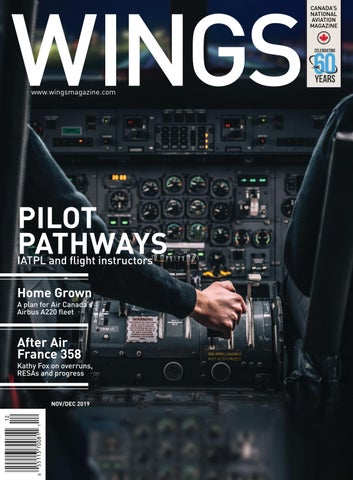
WINGS www.wingsmagazine.com
PILOT PATHWAYS
IATPL and flight instructors
Home Grown
A plan for Air Canada’s Airbus A220 fleet
After Air France 358
Kathy Fox on overruns, RESAs and progress
NOV/DEC 2019
CANADA’S NATIONAL AVIATION MAGAZINE
Two Global Leaders, One Superior Experience
49 17 89
Aircraft Models
The world’s best aviation training just got better. Benefit from the combined capabilities of two global leaders for the most superior training experience for Beechcraft, Cessna and Hawker aircraft. Leverage decades of instruction experience and manufacturing expertise for an unmatched training environment. The numbers are in your favor.
flightsafetytextronaviationtraining.com
Locations
Simulators
NOV/DEC 2019
UPFRONT 6 Leading edge 8 On the fly
Aviation news
12 The Watchlist
Beyond Air France 358
14 Air Traffic
The citizen-scientist astronaut
15 Position Report
Mark Galardo, vp of network planning with Air Canada, shares insight into the business model of the airline's first A220.
Going global
36 Marketplace
FEATURES
38 On Final
16 HOME GROWN
BACK
Massimo Bergamini, A crisis is a terrible thing to waste
From top: Shawna Pandya shares insight into a unique aviation career P.14. Kathy Fox looks at overruns, RESAs and progress. P.12.
Air Canada describes the impact of its first Airbus A220-300 in an effort to offer nonstop service on longer, secondary city pairs BY DAVID CARR
18 LEADING NORTHERN LIGHTS
Northern Lights Aero Foundation recognizes the significant contributions of eight women to Canadian aviation and aerospace COMPILED BY ANNA RUSINOWSKI AND NLAF
22 INSIDE POLAND’S AVIATION VALLEY PHOTO: TRANSPORTATION SAFETY BOARD (BOTTOM)
Poland and its Aviaton Valley continue to emerge as one of the world’s leaders in aviation and aerospace development BY JON ROBINSON
24 EXPLORING PILOT INSTRUCTOR PATHWAYS
Seneca and Toronto Airways collaborate on the growing Jazz Aviation Pathways Program to help the industry develop both instructors and pilots BY JON ROBINSON
COVER PHOTO: JAZZ AVIATION, COCKPIT OF A DASH 8-300
WWW.WINGSMAGAZINE.COM
November/December 2019 | WINGS
3
Stay in Touch with Aviation News
Vol. 60, Issue 6 EDITOR
Jon Robinson jrobinson@annexbusinessmedia.com 416-558-7749
SUBSCRIBE
FLIGHT DECK
Online
David Carr, Kathy Fox, Kendra Kincade, Sam Longo, Carter Mann, Carroll McCormick, Anna Pangrazzi, Bill Zuk NATIONAL ACCOUNT MANAGER
Mena Miu mmiu@annexbusinessmedia.com • 416-510-6749
TODAY
ACCOUNT CO-ORDINATOR
Barb Vowles bvowles@annexbusinessmedia.com • 416-510-5103 MEDIA DESIGNER
Brooke Shaw
CIRCULATION MANAGER
Jay Doshi jdoshi@annexbusinessmedia.com • 416-442-5600 ext. 5124
wingsmagazine.com/subscribe
GROUP PUBLISHER/VP SALES
Martin McAnulty mmcanulty@annexbusinessmedia.com
Magazine
COO
Weekly E-Newsletter
Scott Jamieson
Digital Edition
WINGS www.wingsmaga
WINGS MAGAZINE
P.O. Box 530, 105 Donly Dr. S., Simcoe, ON N3Y 4N5 Tel: 519-428-3471 Fax: 519-429-3094 Toll Free: 1-888-599-2228
CANADA’S NATIONAL AVIATION MAGAZINE
zine.com
PILOT PATHWAYS
IATPL and fligh
t instructors
Home Grown
Air Canada’s first Airbus A220
After Air France 358
Overruns, RESA s and progress
Printed in Canada ISSN 0701-1369 PUBLICATION MAIL AGREEMENT #40065710 CIRCULATION Email: apotal@annexbusinessmedia.com Phone: 416-510-5113 Fax: 416-510-6875 (main) 416-442-2191 Mail: 111 Gordon Baker Rd., Suite 400, Toronto, ON M2H 3R1
NOV/DEC 2019
Published six times per year (Jan/Feb, Mar/Ap, May/Jun, Jul/Aug, Sep/Oct, Nov/Dec) by Annex Business Media SUBSCRIPTION RATES Canada – 1 Year $ 34.50 (plus GST - #867172652RT0001) USA – 1 Year $ 60.50 Foreign – 1 Year $ 69.50 Occasionally, Wings magazine will mail information on behalf of industry-related groups whose products
Air Transport Association of Canada
ON THE
WEB
4
WINGS | November/December 2019
WG_CircAd_NovDec19_MLD.indd 1
and services we believe may be of interest to you. If you prefer not to receive this information, please contact our circulation department in any of the four ways listed above. Annex Privacy Office privacy@annexbusinessmedia.com • Tel: 800.668.2374 No part of the editorial content of this publication may be reprinted without the publisher’s written permission. ©2019 Annex Publishing & Printing Inc. All rights reserved. Opinions expressed in this magazine are not necessarily those of the editor or the publisher. No liability is assumed for errors or omissions. All advertising is subject to the publisher’s approval. Such approval does not imply any endorsement of the products or services advertised. Publisher reserves the right to refuse advertising that does not meet the standards of the publication.
Canadian Business Aviation Association
Magazines Canada
AVIATION THIS WEEK Looking to catch up on the latest hot news from around aviation and aerospace? Check out Aviation This Week, a live digital version of the top news stories affecting a variety of key markets. It's quick, essential information you need to know! WWW.WINGSMAGAZINE.COM
2019-10-22 11:46 AM
Together we fly.
Join the WestJet team westjet.com/greatjobs
LEADING
EDGE
By Jon Robinson |
Cities, airports and aircraft
Boeing and Airbus provide 20-year forecasts for commercial airliners
I
5 6
in North America is expected to reach 193,000 by 2038, up two per cent from last year. Asia Pacific was also forecast to have the highest need for technicians at 266,000. The global helicopter industry demand for technicians was 44,000, according to Boeing. In terms of North America’s civil helicopter personnel demand, Boeing forecasts the region will require 14,000 new technicians and 21,000 pilots by 2038. Asia Pacific is forecast to see a major growth in services at 39 per cent to 2028, representing an annual growth rate of 5.1
TOP DATA BURSTS… in this issue 1. The Embraer Praetor 500 surpassed its certification goals by achieving a range of 3,340 nautical miles. (P. 8) 2. Since 2005, there have been 141 runway overruns in Canada. (P. 12) 3. Air Canada will be the seventh airline to take delivery of the A220. (P. 16) 4. Lyndsey Poynter has train a total of 57 astronauts. (P. 18) 5. Integrated ATPL programs require a minimum of 750 ground school hours. (P. 24)
WINGS | November/December 2019
per cent. Europe came second in this category at 22 per cent overall growth and North America was third at 20 per cent. In the Airbus GMF, the company explored the relationship between the world’s cities, their airports and the types of aircraft, in terms of size and range, which are supporting them. In the past Airbus looked at the importance of Aviation Mega-Cites (AMCs), particularly for larger aircraft. In 2018, there were 66 cities classified as AMCs, they account for 40 per cent of all passengers, up from 29 per cent in 2002, according to Airbus, but well over 70 per cent of long-haul passengers and 35 per cent of the short-haul. Airbus explains many of these cities have developed a need for more than one airport, some with as many as three or four today. More than 600 airlines or nearly 80 per cent of the world’s airlines operate to AMC airports. A growing share of passengers are also travelling with LCCs from or to these airports, according to Airbus, nearly a quarter of AMC passengers today, from just eight per cent in 2002. Over this time average aircraft size has grown from 155 seats in 2002 to 175 today, as passenger numbers and constraints increase. | W
Average aircraft size has grown from 155 seats in 2002 to 147 seats today.
WWW.WINGSMAGAZINE.COM
IMAGE: AIRBUS GLOBAL MARKET FORECAST 2019
n September, Airbus released its Global Market Forecast, which predicts a need for more than 39,000 new aircraft over the next 20 years. The world’s passenger and freighter aircraft fleet is expected to more than double from nearly 23,000 today to almost 48,000 by 2038 – with traffic growing at 4.3 per cent annually. By 2038, this would include just over 39,000 new aircraft. Of these, around 25,000 aircraft are predicted for growth and 14,000 are to replace older models. These aircraft numbers would also result in a need for 550,000 new pilots and 640,000 new technicians. The company used a new segmentation of aircraft in its forecast, based on the evolution of technology in terms of capacity, range and mission type. Small aircraft, such as a short-haul A321 and A220, are predicted to account for just under 30,000 of the new aircraft needed by 2038. This is in addition to around 5,300 medium aircraft, such as the A321LR or A330, and, 4,100 large aircraft, such as the A350 XWB. These numbers somewhat conflict with the Boeing Pilot & Technician Outlook, released in late-July 2019, which projects that 769,000 new maintenance technicians will be needed to fly and maintain the world aircraft fleet by 2038. Boeing’s forecast, however, takes into account a wider swath of aircraft. Inclusive of commercial aviation, business aviation and civil helicopter industries, Boeing’s 20year forecast is based on fleet growth, aircraft utilization, attrition rates and regional differences in crewing specific to aircraft type. The 769,000 new technicians mark in 2019 represents an increase relative to last year’s forecast of 754,000 from Boeing. The projected demand for technicians
Seneca Aviation: A national leader in aviation education for more than 50 years. senecacollege.ca/aviation
ON THE FLY For late-breaking news and exclusive web content, please visit us at www.wingsmagazine.com
8 8 9 10
THE LEAD BUSINESS AVIATION MILITARY PEOPLE
THE LEAD
BOEING AND SAFRAN INVEST IN EPS Boeing and Safran made a joint investment in Electric Power Systems, based in, Logan, Utah, which develops energy storage products, such as batteries, for the lightweight, high-end power needs of aerospace and other markets. Electric Power Systems (EPS) currently supports some of the most-prominent electric and hybrid-electric airplane developments, such as the NASA X-57, Bye eFlyer and Bell Nexus. The X-57, centred around the development of NASA’s first all-electric experimental aircraft, recently tested the motors and propellers together for the project’s Mod II activity, which is the first electric configuration of the vehicle. NASA also recently received delivery of the wing for the project’s following Mod III activity, allowing testing to progress for two of X-57’s three electric configurations. The new investment by Boeing and Safran aims to help EPS develop an automated industrial base, capable of producing aviation-grade energy
systems. The investment will also focus on reducing the costs of batteries for electric airplanes. EPS is the second battery builder to join the Boeing HorizonX Ventures portfolio, following a 2018 investment in Cuberg, which develops lithium metal battery technology. Safran Ventures also recently invested in OXIS Energy, a UK developer of lithium-sulfur cell technology for high energy density battery systems.
BUSINESS AVIATION
EMBRAER PRAETOR 500 TRIPLE CERTIFIED The Embraer Praetor 500 received Type Certifications from the European Union Aviation Safety Agency and Federal Aviation Administration at the end of September, adding to its earlier approval in Brazil. The midsize jet was introduced one year ago in October 2018 at the NBAA-BACE tradeshow. Embraer explains the Praetor 500 surpassed its certification goals by achieving an intercontinental range of 3,340 nautical miles, with required reserves and four passengers. The airplane has the capacity to seat up to nine passengers with the optional two-place divan. The jet also holds a cruise speed of 466 knots, a full-fuel payload of 1,600 pounds, a takeoff distance of 4,222 feet, and an unfactored landing distance of
The Embraer Praetor 500 holds a cruise speed of 466 knots, a full-fuel payload of 1,600 pounds, and a takeoff distance of 4,222 feet.
2,086 feet. The Praetor 500 also includes Ka-band connectivity and full fly-by-wire control. Embraer states the Praetor 500 is now the farthest- and fastest-flying midsize jet on the market, able to make true corner-to-corner nonstop flights in North America, from Miami to Seattle, or Los Angeles to New York, as well from New York to London, London to Dubai and Jakarta to Tokyo – all non-stop. The aircraft can connect the Brazilian city of Porto Alegre to New York or São Paulo to Paris, with only one stop. The Praetor 500 features the Collins Aerospace Pro Line Fusion flight deck and the Embraer DNA Design interior. Some of the options available on the Praetor 500 flight deck are the industryfirst vertical weather display, air-trafficcontrol-like situational awareness with ADSB-IN, predictive wind shear radar capability, as well as the Embraer Enhanced Vision System (E2VS) with a Head-up Display (HUD) and an Enhanced Vision System (EVS), an Inertial Reference System (IRS) and a Synthetic Vision Guidance System (SVGS).
Electric Power Systems currently supports some of the most-prominent electric and hybrid-electric airplane developments, such as the Bye eFlyer, NASA X-57 and Bell Nexus. 8
WINGS | November/December 2019
Bombardier two newest additions to the Global aircraft series, the Global 5500 and 6500 business jets, have been awarded Transport Canada Type Certification. The Montreal company states this achievement paves the way for entry-into-service by the end of this year and that certifications by the Federal Aviation Administration (FAA) and European Aviation Safety Agency (EASA) WWW.WINGSMAGAZINE.COM
PHOTOS: BYE AEROSPACE; EMBRAER
TRANSPORT CANADA APPROVES GLOBAL 6500 AND 5500
The Global 5500 and Global 6500 hold a newly optimized wing, new Rolls-Royce Pearl 15 engines, and Bombardier’s Vision Flight Deck.
were expected to follow shortly. The flight-testing programs for both aircraft were completed at Bombardier’s test centre in Wichita, Kansas. The Pearl 15 engine, the newest addition to Rolls-Royce’s business-aviation-engine portfolio, also recently received Transport Canada certification. Bombardier explains the engine, developed at the Rolls-Royce Centre of Excellence for Business Aviation engines in Dahlewitz, Germany, was custom-designed with enhanced aerodynamics, blade cooling and engine health monitoring systems. Equipped with Bombardier’s Vision Flight Deck, the new 5500 and 6500 aircraft build on Global 5000 and Global 6000 aircraft by offering 500 and 600 nautical miles of additional range, respectively, coupled with an up to 13 per-cent fuel burn advantage. The Global 5500 aircraft can connect Sao Paolo and Paris, and Moscow and Los Angeles. The Global 6500 aircraft can connect Hong Kong or Singapore and London, and Toluca and Madrid.
PHOTOS: BOMBARDIER; TEXTRON AVIATION; TOP ACES)
CESSNA CITATION LONGITUDE TYPE CERTIFICATION Textron Aviation Inc. on September 23 announced it has achieved Type Certification by the Federal Aviation Administration (FAA) for its super-midsize jet, the Cessna Citation Longitude, paving the way for customer deliveries. Designated as the new flagship of the Citation business jet series, the Longitude is produced at Textron’s manufacturing facility in Wichita, Kansas. FAA Type Certification follows what Textron describes as the most robust flight, structural and component qualification testing completed on a Citation to date. The experimental and demo fleet completed close to 6,000 hours of flight time. In addition to 11,000 test points WWW.WINGSMAGAZINE.COM
Textron’s new flagship Citation Longitude business jet is positioned in the super-midsize business jet category.
during the certification process, the Longitude also completed a 31,000 nautical mile world tour. The company explains this testing program demonstrates the aircraft’s long-range performance capability and reliability in a variety of environments. With seating for up to 12 passengers, including an optional crew jump seat, the Longitude features a stand-up, 6-foot tall flat-floor cabin, and a standard double-club configuration for legroom – 11 per cent more room than the nearest competitor, according to Textron. The Citation Longitude, during its development program, exceeded initial performance targets and achieved an improved transcontinental range of 3,500 nautical miles (an increase of 100 nautical miles) and full fuel payload of 1,600 pounds (an increase of 100 pounds). The longestrange Citation delivers a maximum cruise speed of 483 ktas. The clean-sheet design of the Longitude also includes the next evolution of the Garmin G5000 flight deck.
MILITARY
Lendermann, are among Top Aces’ most experienced. Top Aces is a provider of advanced and innovative adversary air services to several of the world’s leading air forces in Canada, Australia, Germany, and soon the United States. Top Aces explains it has a flexible offering ready to meet growing client needs with a current fleet mix of Dornier Alpha Jets, Douglas A-4 Skyhawks, Learjet 35As, Westwinds and a future fleet of F-16s. The company has further expansion plans before the end of this year. Founded in 2000 by a group of highly accomplished former fighter pilots, Top Aces states it has the largest worldwide footprint of privately-held operational fighter aircraft that provide advanced adversary, air-defence and Joint Terminal Attack Controller (JTAC) training services around the globe. The missioncritical training offered by Top Aces enhances the operational readiness of combat forces by providing realistic realworld experience while prolonging its customers’ fleet life.
TOP ACES REACHES 80,000 HOURS Top Aces Inc. in late August reached 80,000 hours of operational air combat training, stating no other adversary air provider in the world has delivered this number of flight hours carrying out live air training missions. The milestone came on July 30, 2019, during 2-ship Red Air Support for German Air Force (GAF) Eurofighters from the Tactical Luftwaffen Wing 71 “Richthofen” in Wittmund, Germany. The pilots, Elmar “Elmo” Besold and Raimund “Lendi”
Top Aces holds a current fleet mix of Dornier Alpha Jets, Douglas A-4 Skyhawks, Learjet 35As, and Westwinds and will soon add F-16s. November/December 2019 | WINGS
9
ON THE
FLY
TYPHOON WITHDRAWN FROM FUTURE FIGHTER PROGRAM
The Typhoon fighter jet has been selected by nine nations and is described by Airbus as the world’s most advanced swing-role combat aircraft with demonstrated effectiveness in all climates across the globe.
CF-188 Hornets with 88 new-generation fighter jets – a contract valued at approximately $20 billion and expected to be awarded in early 2022. Airbus states two factors in particular led to the Typhoon Canada campaign team’s decision to withdraw from the competition: “First, a detailed review has led the parties to conclude that NORAD security requirements continue to place too significant of a cost on platforms whose manufacture and repair chains sit outside the United States-Canada
2-EYES community. Second, both parties concluded that the significant recent revision of industrial technological benefits (ITB) obligations does not sufficiently value the binding commitments the Typhoon Canada package was willing to make, and which were one of its major points of focus.” Dassault also pulled out of the Future Fighter competition in early 2019. As mentioned above, the remaining contenders include Saab of Sweden with its Gripen E; Boeing of the U.S. with its
10 WINGS | November/December 2019
WWW.WINGSMAGAZINE.COM
WG_diamondair_half-June-Bas.indd 1
2019-06-12 8:54 AM
PHOTO: AIRBUS
The United Kingdom’s Ministry of Defence (UK MoD) and Airbus Defence and Space (Airbus) in late August informed the Government of Canada of their decision to withdraw from Canada’s Future Fighter Capability Project. The announcement removes their Typhoon Canada campaign from the process, leaving three groups led by Saab, Boeing and Lockheed Martin in the running to replace Canada’s ageing fighter jet fleet. A statement released by Airbus explains the decision comes after a detailed review of the Request for Proposal (RFP) that was released by the Government of Canada on July 23, 2019, after approximately two years of working with aircraft suppliers on draft proposals. The Future Fighter RFP is part of Canada’s Strong, Secure, Engaged policy and defence investment plan to replace its fleet of
F/A-18 Super Hornet; and Lockheed Martin of the U.S. with its F-35A Lightning II Joint Strike Fighter. These three suppliers have until spring 2020 to submit their initial proposals to Canada, but they are first required to submit a plan by fall 2019 outlining how they will meet Canada’s security and interoperability needs, which includes the NORAD requirements referenced by Airbus.
PEOPLE
PHOTO: AIR CANADA
CAMERON HONOURED WITH SCHOLARSHIP Air Canada on September 28, during the Elsie MacGill Awards Gala hosted by the Northern Lights Aero Foundation in Toronto, announced it will establish the Captain Judy Cameron Scholarship in honour of the airline’s first female pilot. The perpetual scholarship will be provided to young women in pursuit of what the airline describes as non-traditional
aviation careers, such as commercial pilots or aircraft maintenance engineers who may not have the financial means to do so. The Captain Judy Cameron Scholarship, through Air Canada’s commitment, will award recipients with $20,000 per year for three years. Scholarship applications will be accepted as of November 1, 2019. It is open to all female Canadian citizens who have been accepted, are enrolled in, or are considering a postsecondary aviation flight program or aircraft repair and maintenance program. Cameron became the first female pilot hired by Air Canada in April 1978 at the age of 23. She was also the first woman to graduate from Selkirk College’s Aviation Technology Program in 1975. Air Canada explains, that throughout her flying career of 40 years and more than 23,000 flight hours, Cameron has flown the DC-3, Twin Otter, Hawker Siddeley 748, DC-9, Lockheed 1011, Airbus 320, Boeing 767 and Boeing 777. She was a
Air Canada honours trailblazing Captain Judy Cameron by naming a scholarship after her to inspire young women pursuing careers in aviation.
captain by 1997 and, in 2010, she became the first female captain in Canada of a Boeing 777, the largest aircraft in Air Canada’s fleet. When she retired in 2015, Cameron received the Elsie MacGill Northern Lights award in the Flight Operations category. | W
FROM ZERO TO FIRST OFFICER
ALSIM PEACE OF MIND
400+ CERTIFIED SIMS 300+ CUSTOMERS 50+ COUNTRIES SINCE 1994
ALSIM.COM WWW.WINGSMAGAZINE.COM WG_Alsim_NovDec19.indd 1
alX
ALL YOUR AIRCRAFT IN ONE HIGH FIDELITY DEVICE » OUR BESTSELLING DEVICE » PROVEN AND RELIABLE
November/December 2019 | WINGS
11
2019-10-11 1:48 PM
THE
WATCHLIST By Kathy Fox
Beyond Air France 358
The Transportation Safety Board on overruns, RESAs and progress
B
etween 2013 and 2018, an average of nine overrun accidents and incidents took place annually in Canada. Although thousands of aircraft seamlessly touch down across the country every day, in 2005 an Air France flight left a sobering reminder of what can happen when landing conditions are less than ideal. What have we learned from this accident? And what is left to be done?
The Miracle of Runway 24L
Recommendations In concluding its investigation in 2007, the TSB made seven recommendations to regulators – two to France’s Direction générale de l’aviation civile and five to Transport Canada. Three of those five are still active and on the TSB’s Watchlist, a biennial list featuring key safety issues in the transportation industry. Those recommendations call on Transport Canada to: • Require crews to establish the margin of error between landing distance available and landing distance 12 WINGS | November/December 2019
address the underlying safety deficiency that gave rise to the TSB’s recommendation. As a result, the terrain beyond the end of many runways in Canada could contribute to aircraft damage and injuries to passengers and crew in the event of an accident. Since the Air France occurrence in 2005, there have been 141 occurrences in Canada involving runway overruns, 20 of which have been the subject of a comprehensive TSB investigation. Last year’s occurrence in Halifax reminds us once more of the risks and potentially devastating consequences when there is no adequate RESA or suitable arresting material. In the early morning of November 7, 2018, a Sky Lease Cargo Boeing 747 overran Runway 14 at Stanfield International Airport, coming to a stop 210 metres off the end of the runway, and 50 metres from a fence separating the airfield from a public road. The aircraft was substantially damaged and four crew members were taken to hospital for their injuries.
Since 2005, there have been 141 occurrences in Canada involving Runway overruns. required before conducting an approach into deteriorating weather (A07-05); • Establish clear standards limiting approaches and landings in convective weather for all air transport operators at Canadian airports (A07-01); and • Require all Code 4 runways to have a 300 m RESA or a means of stopping aircraft that provides an equivalent level of safety (A07-06). In early 2019, the Board reassessed the actions taken on these recommendations. While there has been progress in establishing a margin of error for landing in deteriorating weather, the efforts to establish clear standards for approaches and landings in convective weather were determined to be unsatisfactory. Moreover, the progress on RESAs remains “Satisfactory in Part.” This is not good enough. Why after 12 years has it taken so long to make so little progress? Along with runway overruns, slow progress on addressing TSB recommendations is an issue on the Watchlist. Regulatory actions to fix high-risk safety problems, like overruns, have been too few and too slow. With respect to RESAs, there is still no requirement in Canada for runways to meet international standards and recommended practices. Although the regulator published a proposal in 2016 to introduce measures that would address the risk of runway overruns at selected airports, these do not
Actions required To mitigate the risk of overruns, operators of airports with runways longer than 1,800 metres must conduct formal runway-specific risk assessments and take appropriate action. In addition, the regulator must adopt at least the ICAO standard for RESAs, or a means of stopping aircraft that provides an equivalent level of safety. Until then, the risk to aircraft, crews, and passengers will remain. | W Kathy Fox is Chair of the Transportation Safety Board of Canada. WWW.WINGSMAGAZINE.COM
PHOTO: TRANSPORTATION SAFETY BOARD
In August 2005, Air France 358, an Airbus A340-313, left Paris for Lester B. Pearson International Airport in Toronto, Ontario, with 297 passengers and 12 crewmembers on board. The pre-flight inspection had been performed, and the crew received the Toronto weather before departure. Thunderstorms were forecast for arrival. On final approach, the crew received a report from an aircraft ahead of them: heavy precipitation was causing the runway to have poor traction. Approximately 320 feet above the ground, the pilots retook manual control of the aircraft for landing. They crossed the threshold of Runway 24L 40 feet above the glide slope. Due to poor visibility, they could not visually gauge where they were over the runway. They landed 3,800 feet down the 9,000-foot runway, well past the 1,000-foot touchdown zone. Unable to stop in time, the aircraft slid off the far end at a speed of 80 knots and skidded into a ravine just beyond the runway. A fire broke out, forcing the passengers to evacuate the aircraft as quickly as possible. Two crewmembers and 10 passengers were seriously injured, and the plane was destroyed, engulfed by the flames.
AIR
TRAFFIC By Kendra Kincade
The citizen-scientist astronaut Shawna Pandya shares insight into a unique aviation career
I
met Dr. Shawna Pandya a few years ago and she was one of those women who just stood out to me. “A citizenscientist astronaut… what does that mean?” Pandya is also a physician, speaker, aquanaut and martial artist. Above everything else, she is an inspiration, as you can tell from our recent conversation.
psychological resilience, and have even written a book chapter on the topic as it pertains to long-duration spaceflight and isolated and confined environments (ICEs). I have learned that resilience is more a learned than an innate trait; and we all have the ability to build our mental resilience, which can be broken down into 5 key components: (1) mental rehearsal; (2) positive selftalk; (3) impulse control; (4) breaking things down; and (5) strong social support networks. When I run into tough times, I think of these components, and try to build on them. I am especially lucky in that I have a strong social support circle.
What is day in the life of your career? As a scientist-astronaut candidate with Project PoSSUM (Polar Suborbital Science of the Upper Mesosphere), physician and speaker, there is no real typical day. On any given day, I may be in a clinic or a rural emergency room, testing a spacesuit in micro-gravity on a parabolic flight, participating in a research campaign, or conducting a literature review for something space medicine related.
What was your biggest career hurdle? Between medicine, space, research, flying, diving, speaking and everything else, I get asked about my hectic schedule and balance. But for me, everything I do is 100 per cent worth it and doesn’t feel like a sacrifice.
Who inspired your career path? It was definitely inspired by Dr. Roberta Bondar, Canada’s first female astronaut. She is also a physician, pilot and neuroscientist, which really influenced my decisions to pursue an undergraduate degree in Honours Neuroscience and later on, medicine.
Was aviation your first choice? I always wanted to be an astronaut growing up and pursued every avenue towards this goal. My love for flying was ignited during an aerospace medical rotation at NASA Johnson Space Center, when I was lucky enough to meet Chris Hadfield, while he was training to be Commander of the ISS. This meeting sparked my love of flying and convinced me to pursue my Private Pilot License.
Why do you love what you do? I get to save lives by day and push the limits of knowledge and exploration by night. There are not many career paths in the world that allow you to wear both scrubs and spacesuits.
My love for flying was ignited during an aerospace medical rotation at NASA-Johnson Space Center, when I was lucky enough to meet Chris Hadfield. best work ethic of anyone you know – and then work really, really, really hard. And act like you belong here – because you do.
What’s your go-to stress relief? I love working out, either at the gym or the do-jang. I genuinely believe in the term physical therapy, and my workout time is my decompression time.
What skills must someone have to be successful in your career path? The key skills needed in both medicine and citizen-scientist astronautics are being a good team-player, having the ability to learn skills across multiple domains, keeping up with a busy schedule, a good work ethic, and having grit or stick-to-itiveness.’
What career advice do you share?
Did you ever feel like giving up on such a unique career?
Be curious. Ask questions. Develop the
I have come to read and study a lot about
14 WINGS | November/December 2019
What is the biggest decision you have made over the past year?
I have started venturing into exploration of that other great unknown, ocean exploration – 95 per cent of our oceans remain unmapped. We have more imaging of the surface of the Moon than we do of the ocean’s floors. I completed a Dive and Hyperbaric Medicine course and obtained my Dive Medical Technician certification earlier this year and was lucky to spend a night at the Aquarius Reef Base, the world’s only remaining underwater research laboratory. In October of this year, I will be embarking on my first underwater research mission over five days at the Jules Undersea Lodge.
What are you the most proud of? I never grew up thinking that I would be a role model for others. I simply had goals and set out to achieve them. That what I do inspires others to pursue careers they otherwise never would have dreamt of makes me incredibly proud and also excited for their future career paths. | W Kendra Kincade is director of Elevate Aviation and an ATC with NAV CANADA. WWW.WINGSMAGAZINE.COM
POSITION
REPORT
By Reneta Johnson
Going global in aviation
Critical steps to consider when branching out beyond North America
T
he business of international trade impacts everybody, every profession, company, city and country. As Jean-Pierre Picchiottino, market analyst director for Airbus Americas, recently shared with me, “We are a much better company because we expended beyond our traditional European markers, not only from a manufacturing point of view, but also because of our global supply chain.” Canada is a proud trading nation, yet shockingly only around five per cent of all Canadian companies currently export and 80 per cent of those exports are towards to the United States. Yes, the U.S. is a great market next door. However, diversification is critical. According to the data about the U.S. itself, less than one per cent of America’s 30 million companies export. Companies worldwide have vast untapped export potential, especially smaller ones. Why ignore the fact that Europe is market approximately two times bigger than U.S.? How about Asia where two thirds of world’s population lives with an emerging middle class and increasingly disposable income? More companies that have been leaders in their home market for decades have started to be challenged by competition outside of their home markets or new competitors have come from outside of the industry. Consider, for example, taxi companies and Uber, hotels and Airbnb, just to name few. As Robert Smilbert, CEO and founder of HISS so correctly, said, “Going Global is a matter of survival.” Your company must develop Go Global Muscle not just to survive but also to thrive. You cannot afford to fall behind and you should move quickly. One year is enough to see first results of your work. Have a purpose, stay focused every day and commit to win your first customer or partner in a new market within 365 days. Any international trade plan should include 12 key ingredients: Customer, Value Proposition, Benefits, Risks, Journeys, Activities, Resources, Partners, Sales, Marketing, Revenue and Cost. Here we will look at a few of these ingredients more closely, beginning with the most critical – the customer. I have four golden rules about customers: 1. Put yourself in your shoes – know what you want and why; 2. Put yourself in your clients shoes – build an open channel WWW.WINGSMAGAZINE.COM
also understand and accept that the term jack of all trades, master of none is even more applicable in international business. You must mitigate risks. You need to do traditional market research and online data collection. However, the most important task is to go and visit the market. See it with your own eyes and start building relationships. Remember you are the new kid on the block, so be compassionate, committed and consistent. Second, assess the benefits based on your industry and work with industry associations. International trade has a synonym and that is culture. Culture is like an iceberg: you see only the top of it, but there is so much more underneath. Climate and environment have an impact on you, your team and your business more than you might imagine. Be mindful of extreme temperatures. Look at the overall economic forces and work with experts in finance, accounting, tax, currency and exchange, money transfers, duties and fees – people who know the market you are targeting. In terms of political and international policy risks, look at the overall political forces. Where do you have signed trade agreements? It is always a great idea to start with countries where government relationships are good and there are trade agreements in place. In terms of legal and legislative risks, having good legal and insurance firms with international offices on your side is always a great idea. And remember competition does not stay in one place. Know your competitors as much as you know your company, if not more. It is difficult, but it is not impossible to gather this intel. And you can learn from the competition – and be inspired. | W
Jean Charest is leading the charge for Canadian aerospace growth domestically and internationally through the AIAC program vision 2025. of communication and look for win-win scenarios; 3. You have to get under the skin of your customer – to truly understand, like and trust them; and 4. You should treat your customer the way you would like to be treated, or they like to be treated – or both. Design a roadmap and walk the journey together. In theory, everyone could potentially be your customer as long as you truly understand their pains, desires for gains and have solutions for them. The practical side of international business, however, is much different. Stop chasing everyone, everywhere, and focus on identifying the best value proposition for your future customers. As Clayton Christensen, the author of Competing Against Luck, wrote: “Customers don’t buy products or services; they pull them into their lives to make progress.” Just as it is not a good idea for everyone everywhere to be your customer, you should
Reneta Johnson is the author of Go Global in 365 Days. She can be reached at reneta@inttradia.com. November/December 2019 | WINGS 15
Air Canada placed its order for 45 A220s in February 2016, when the aircraft was still the CSeries under full Bombardier control.
HOME GROWN
AIR CANADA DESCRIBES THE BUSINESS MODEL FOR ITS FIRST AIRBUS A220-300
BY DAVID CARR
I
n December, Air Canada’s first Airbus A220-300 (nee the Bombardier CSeries) will arrive at Montréal’s Trudeau International Airport on a delivery flight from the former Bombardier assembly plant at nearby Mirabel. One small hop for the world’s most advanced narrow-body airliner, one giant leap for Air Canada’s North American route network. In addition to the 2,500 people employed in Mirabel by Airbus, the airline notes the A220 includes parts from 30 Canadian suppliers. Air Canada will be the seventh customer airline to take delivery of the A220. As of August 31, 2019, Airbus had delivered 83 Canadian-built A220s, to customers including SWISS, Air Baltic (launch operators for the A220-100 and larger 300, respectively) and Delta Air Lines, which introduced the airplane into service in January. The jet is at the heart of a narrow-body revolution alongside the Boeing 737 MAX (when it returns to the skies, likely in early 2020) and Airbus A321LR (long range). Airlines are flying single-aisle jets over longer distances including the transAtlantic (Air Transat recently announced A321LR service between 16 WINGS | November/December 2019
Montréal and Copenhagen for 2020), looking to finally crack the DNA code for operating jets profitably in the tough 100-passenger market (a sector where the earlier Airbus A318 has struggled) and insert a more comfortable mainline cabin into the short-haul sector. The versatile A220 checks off the boxes of all three. “This aircraft is a game changer for Air Canada. There is simply no rival in its category,” says Mark Galardo, vice president of network planning with Air Canada. Galardo, a 16-year veteran with the airline was a central member of the team that made the business case for the A220. Size and range were essential to the pitch. “Canada is characterized by its low population density and significant geographic distances – so aircraft range is critical,” Galardo told Wings. “With the Embraer 190 and 175, and the older Airbus, range is very limited. And the larger size of the 737 MAX doesn’t make economic sense for routes with thinner passenger demand. The A220 is nicely sized and has given us a laundry list of cities to serve across the country.” Air Canada placed its order for 45 A220s (while it was still the WWW.WINGSMAGAZINE.COM
PHOTOS: AIR CANADA
In August 2019, Air Canada released the first images of its two-class Airbus A220-300 cabin interior, which will have a total of 137 seats.
Mark Galardo, vice president of network planning with Air Canada.
CSeries) in February 2016, breaking a sales drought and handing Bombardier a prestige order it so badly needed. The airplane does not does not launch dedicated service from Montréal to Seattle and Toronto to San Jose until next spring. But the A220 isn’t going to be wheels down at Dorval for too long after the delivery flight. Revenue service will ramp up in January on a host of domestic routes as Air Canada gets ready to introduce its first new airliner type since the 737 MAX and first clean sheet jet since the 787, Air Canada’s last all-new game changer. As vice president of network planning, Galardo was heavily involved in bringing the 787 into service and says comparisons between it and the A220 are fair game. “You’ve got technology advances just like the 787. It is an economic game changer like the 787 and it will allow us to open more nonstop routes within North America.” Galardo is tight-lipped over which city pair will be the A220’s first route (Toronto – Halifax was the 787’s inaugural revenue service). The aircraft will replace Embraer 190s, where it is expected to improve per unit operating costs, including a 15 per cent reduction in fuel burn versus the Brazilian regional jet. One thing is certain, the A220 will not be pressed into back-filling ongoing capacity gaps left by the grounding of the 737 MAX. To help ensure a seamless entry-into-service, Air Canada has consulted widely with existing A220 operators (excluding Delta) on what to expect. SWISS, a subsidiary of Lufthansa and Air Canada Star Alliance partner operates a mixed fleet of 29 A220-100 and 300 aircraft and has been a solid information source for Air Canada. “There have not been a lot of surprises,” Galardo says. “The feedback we’ve been getting from Lufthansa Group is they are impressed with the economics of the aircraft.” Indeed, the A220-300 has been instrumental in helping SWISS regroup at its Geneva base against ultra-low-cost challengers such as EasyJet. The availability of 145 seats versus up to 180 with A320, has enabled SWISS to reduce capacity and not target lowfare passengers just to fill the airplane. SWISS reports that A220 per seat costs are similar to the A320, but the overall operating cost is lower. “We are generating some profit out of Geneva, which is good,” Harry Hohmeister, chief commercial officer of network airlines for Lufthansa Group told Forbes Magazine. “It has to do also with the machinery we are flying there.” SWISS also operates the A220-100 to London City Airport. The series 100 is the largest passenger jet certified for short-field capabilities at the so-called ‘banker’s airport.’ A continued ban on passenger jets at Toronto’s Billy Bishop Airport has stalled an order for the A220 by Porter Airlines. For Air Canada, the deployment strategy for the A220 is two-fold; offer nonstop service on longer, secondary city pairs too small to support an A320 or MAX, and open new trans-border corridors to flow more U.S. passengers
into its global route network. Starting with daily trans-continental flights as of May from Montréal to Seattle and Toronto to San Jose, serving America’s Silicon Valley. “These are two of the fastest growing economies in the U.S.,” says Galardo. “The Embraer does not have the range and the 737 MAX is too big. The A220 is the only way we could reach these destinations.” The A220 is a centrepiece of an aggressive strategy for Air Canada to increase its share of U.S. international transit passengers from 1.3 per cent to two per cent, boosting revenues by an estimated $675 million. The Seattle service will seamlessly transfer passengers on flights to Europe and North Africa from its Montréal hub. In developing the CSeries, Bombardier has blurred the line between regional and mainline flying with a wider cabin, larger windows, and an unprecedented level of space and comfort for an aircraft in its category, including economy. Air Canada will operate its A220s with 137 seats in a mixed-class configuration: 12 in a 2×2 configuration in Business Class and 125 in a 3×2 layout for Economy passengers. Every seat on the A220 features a Panasonic eX1 in-flight entertainment system with more than 1,000 hours of content (available in 15 languages), including access to Bell Media’s premium entertainment service, Crave, and Canadian-based multi-platform audio service, Stingray. “When connecting through our hubs across Canada onward to international destinations, customers travelling on an A220 will benefit from a virtually seamless cabin experience offering the same level of service and comforts as on a widebody aircraft,” says Galardo. Air Canada is inserting the A220 into its transcontinental route network earlier and more aggressively than Delta, which will not launch an A220 transcontinental service until June 2020, on its Atlanta – Seattle route. Neither airline is pushing the airplane to the outer limit of its range, and Airbus has announced an increase in the maximum take-off weight by 2,268 kilograms, which will increase the aircraft’s range to 6,300 kilometres for the A220-100 and 6,200 kilometres for the A220-300, enabling flights from Montréal to London or Vancouver to Cuba. The longer-range version will be available in 2020. Air France, which recently placed an order for 60 A220s to replace ageing Airbus A318 and A319 and rebuild its money-losing domestic and European network is said to be interested in a stretch version of the aircraft. Air Canada expects to have 11 A220s in service by next summer. For now, the intended fleet is the size and range the airline needs, with Galardo and his team working on deployment options. The versatility of the aircraft provides tremendous flexibility for Air Canada. (The A220-100 can operate from London City to New York JFK in a 40-seat all premium configuration). “This aircraft has the size and economics to allow us to become a lot more versatile,” adds Galardo. | W
WWW.WINGSMAGAZINE.COM
November/December 2019 | WINGS 17
LEADING NORTHERN LIGHTS
EIGHT WOMEN DRIVING CANADIAN AVIATION
T
COMPILED BY ANNA RUSINOWSKI AND NORTHERN LIGHTS AERO FOUNDATION
he Northern Lights Aero Foundation at the end of September held its 11th annual Elsie MacGill Awards gala in Toronto, attended by more than 400 people, to celebrate the accomplishments of eight women who have made significant contributions to Canadian aviation and aerospace. The awards program is named after Canadian aviation pioneer Elsie Gregory MacGill, the world’s first female aircraft designer, who graduated from the University of Toronto’s electrical engineering program in 1927. During the second World War, MacGill was a key figure in the design and production of the Hawker Hurricane in Canada. Here, we recognize the 2019 18 WINGS | November/December 2019
Elsie Award winners with descriptions provided by NLAF of their incredible accomplishments.
BUSINESS AWARD: Wendy Tayler, President, Alkan Air Wendy Tayler is the not only the majority owner of Whitehorse-based Alkan Air, she established Northern Canada’s first aviation-business diploma program at Yukon College, where she has introduced northern youth to careers in aviation. Alkan Air’s 17 air charter aircraft service the government, mining and exploration industries. With a float plane base at Mayo and a newly added hangar and offices in Nanaimo, BC, Alkan Air operates its charter service and government contracted air
EDUCATION AWARD: Dr. Suzanne Kearns, associate professor of aviation, University of Waterloo Since becoming a pilot at the age of 17, Suzanne Kearns has earned her commercial multi-instrument pilot (fixed- and rotary-wing), a college diploma in helicopter flight training, a Bachelors degree in Aeronautical Science and a Masters in Human Factors and Systems Engineering. As an air cadet, Kearns’ formal flight training started when she was 15 and progressed at a rate that saw her solo by her 16th birthday. One year later she secured both her fixed-wing and rotary-wing private pilot’s certificates. Following high school, she completed a one-year commercial helicopter pilot diploma. As no university course in aviation existed at the time in Canada, she headed to Daytona Beach, Florida to enroll in Embry-Riddle Aeronautical University to begin her degree in aeronautical science. While in Florida, Kearns completed her flight training to the commercial helicopter and fixed-wing multi-engine IFR levels. It was at this time when she recognized her fascination with the study of safety and human factors – the science WWW.WINGSMAGAZINE.COM
PHOTOS: ANDY CLINE
Capt Mary Cameron-Kelly, RCAF, receives the NLAF Pioneer Award from 2018 winner Micky Colton.
ambulance, or medevac service, seven days a week. In 1994, when Tayler joined the then 17-year-old Alkan Air, she was a young mother with accounting training. In the next seven years, she learned every aspect of the company, handling all of the accounting, working in operations, creating a company Website and more. In 2000, she moved on to other industries and had the opportunity to lead telecommunications companies, automotive companies, and to oversee both retail and real estate divisions. During this time she also earned her Certified Management Accounting degree in night classes at Yukon College. In 2007, Tayler seized the opportunity to buy into Alkan Air. This came just before the 2008 economic crash triggered a massive gold-mining boom in the region, a situation which required round the clock aviation air services over the next few years. But in 2012, just as Alkan Air, fully extended, was finishing a $2.5 million new hangar for its fleet, the mining boom ended. Instead of shrinking the operation, Tayler and her business partners capitalized on Alkan Air’s longstanding government medevac contract, comprising almost 50 per cent of its business, to make a forward move and begin adding more aircraft to the fleet. By 2017, the company had built a 7,000-square-foot hangar and office facilities in Nanaimo, BC, to expand Alkan’s reach onto Vancouver Island and the lower mainland.
CAN WE HELP YOU
underlying why pilots make mistakes on the flight deck. Following her graduation with a Bachelor of Science degree in aeronautical science and a brief stint as a pilot intern with a Houston-based airline, Kearns determined that the pilot’s lifestyle was not exactly what she wanted to pursue. Returning to Embry-Riddle, she entered the Masters degree course in Human Factors. On attaining her Masters, she returned to Canada and applied to, and was hired by, the University of Western Ontario – and at the tender age of 24. Her academic life had begun. The PNC AVIATION FINANCE | Privacy. Security. Efficiency. Luxury. Maximizing the academic world of publish-or-perish can benefits of private aircraft ownership requires an experienced aviation lender that be a stressful environment, but Kearns delivers flexibility, capital strength and confidence of execution. As a leading lender excelled. in aviation-specific lending for more than 10 years, our 40+ industry professionals Her research explored training methprovide a concierge-level experience to help you fly higher and be ready for today. odologies and teaching technology, For your next jet, turbo prop or helicopter finance need, connect with us by going publishing several research articles and to pnc.com/aviation. books on the subjects. Her efforts were successful in the tenure process as she PNC is a registered mark of The PNC Financial Services Group, Inc. (“PNC”). became the first aviation academic (male Equipment financing and leasing products are provided by PNC Equipment Finance, LLC, a wholly-owned or female) to receive tenure within a subsidiary of PNC Bank, N.A. Aircraft financing is provided by PNC Aviation Finance, a division of PNC Canadian university. As an assistant proEquipment Finance, LLC. In Canada, PNC Bank Canada Branch, the Canadian branch of PNC Bank, provides bank deposit, treasury management, lending (including asset-based lending) and leasing fessor with tenure at Western, Kearns products and services. Deposits with PNC Bank Canada Branch are not insured by The Canada Deposit taught several courses related to aviation Insurance Corporation or by the United States Federal Deposit Insurance Corporation. safety and aviation human factors while Lending and leasing products and services, as well as certain other banking products and services, continuing her research into teaching require credit approval. technologies and training methodoloCIB EF PDF 0319-0155-1189102 ©2019 The PNC Financial Services Group, Inc. All rights reserved. gies. In 2016, Kearns began a new position as associate professor with tenure at the University of Waterloo teaching an introduction to aviation, sustainable 2019-08-09 7:33 AM aviation, aviation safety, and humanWG_PNC fac- Aviation_SeptOct19_CSA.indd 1 CIB EF Wings Ad_4.625x5_1189102_Final_BU.indd 1 4/2/19 8:18 AM tors in aviation.
FLY
HIGHER?
ENGINEERING AWARD: Lyndsey Poynter, project engineer, MDA In 1992, after spending hours poring over brochures and saving her allowance, much to her parent’s surprise, Lyndsey Poynter enrolled herself in the U.S. Space Academy at the Marshall Space Flight Centre in Alabama. She researched possible career opportunities in the space industry and was pleased to find at least one Canadian company playing a prominent role – Spar Aerospace in Toronto. Following graduation from Appleby College and a gap year spent with the Round Square Conference posted to a school in England, Poynter enrolled at York University. During this period, she did an internship with Spar Aerospace working on research for a robotic satellite servicing initiative. Spar’s Brampton Robotics division had just been purchased by MDA. Following graduation with a Bachelor of Science degree in Space and Communications Sciences, Physics and Astronomy Stream, she was hired by MDA and joined the systems engineering group of the Robotic Workstation Program. Loosely described as a space crane,
DELIVERING AVIATION EXCELLENCE
Calgary’s Premier FBO sunwestaviation.ca 1 888 291 4566
November/December 2019 | WINGS 19
WWW.WINGSMAGAZINE.COM
WG_Suwest_NovDec19_CSA.indd 1
2019-10-17 10:35 AM
Better known as the Elsie's, the Northern LIghts Aero Foundation's awards program has celebrated dozen of Canadian women for 11 years.
Kathy Stewart in 2017 completed conversion training to become a Regular Member of the RCMP and now holds the rank of Special Constable.
Canadarm2, combined with its “hand”, the Special Purpose Dexterous Manipulator or Dextre, are in fact highly sophisticated precision instruments. Poynter has been a key engineering figure in the success of space flight operations of the Canadarm2 and Dextre for over 17 years. In 2003, she also became the project engineer and technical lead for a key element of the International Space Station’s robotic system – the Robotic Workstation System. Her responsibilities included technical oversight, contract negotiations, subcontractor management and overseeing system buy-off. As a project engineer for the RWS and other programs for MDA, as well as an engineering support lead, Poynter has supported 30 Space Shuttle missions, 37 free-flyer cargo missions and 59 (and counting) Space Station expedition crews. For the past 10 years, Poynter has also been a robotics instructor, training a total of 57 astronauts from Canada, the U.S., Japan, Europe and Russia, as well as NASA and CSA ground flight controllers.
GOVERNMENT: Kathy Stewart, Member Special Constable Helicopter pilot, RCMP
20 WINGS | November/December 2019
PIONEER: Captain Mary Cameron-Kelly Captain Mary Cameron-Kelly has accumulated over 7,200 flight hours with the military, making her the highest-time female pilot in the Canadian military; and has served as the crew commander for Operation Apollo, where she fought against terrorism in the Middle East. In 2007, she received the Women of Excellence for the Management and the Professions Award in Halifax. Early in her career, Cameron-Kelly applied to be a subject for the Service Women in Non-Traditional Employment Roles WWW.WINGSMAGAZINE.COM
PHOTOS: ANDY CLINE
FLIGHT OPERATIONS: Major Alexia Hannam, RCAF Alexia Hannam is a Royal Canadian Air Force helicopter pilot and commanding officer of 417 Combat Support Squadron based in Cold Lake, Alberta. She flew the Chinook for 40 combat missions in Afghanistan and was the detachment commander in Operation Lentus during the Fort McMurray and British Columbia wildfires on search and rescue Griffon helicopters. Hannam is a vocal advocate for the Canadian Armed Forces and women in aviation. Hannam was born in Winnipeg, where her mother wrote about her early dreams of flying. In pursuit of this dream, she graduated from Royal Military College in 2006. She became a tactical helicopter pilot with the RCAF’s 408 Tactical Helicopter Squadron, trained to fly the CH-146 (the Griffon) and the huge, heavy-lift CH-147 Chinook. She deployed to Afghanistan in 2011. On her return to Canada, she completed a SAR conversion course and upgraded to aircraft captain. Since August of 2017, Major Hannam has been the commanding officer at 417 Support Squadron, Canadian Forces Base Cold Lake, overseeing 51 pilots, technicians and other support staff. While 417 Squadron is primarily tasked with the rescue of its fighter units, its other role is national search and rescue, with deployment capability at a moment’s notice. In her life as a volunteer, Hannam has been a long-time mentor to women who want to be involved in aviation, as well as a guest speaker and panelist for many related endeavours. She is deeply involved with Elevate Aviation, an organization created to promote women in aviation. Being a former National Level gymnast, a goal from her earliest childhood, Hannam also coaches the Lakeland Gymnastics Club located in Cold Lake.
Kathy Stewart began her career in aviation in 1980 when she obtained her Private Pilot Licence from Maple Air Services in Ontario. In 1982, she attended Canadore College in North Bay where she completed a Commercial Helicopter License. Stewart then moved south to the University of Toronto where she completed her Bachelor of Science degree. Her first full-time helicopter pilot position was with Okanagan Helicopters (soon to become Canadian Helicopters) between the years 1988 and 2002. Stewart was one of two Canadian pilots who assisted with disaster recovery work in Florida in the wake of Hurricane Andrew in 1992. She spent several years in the United States flying seismic operations in, and around, Texas. During her last three years with Canadian Helicopters, Stewart was responsible for supervising up to 80 pilots as operations manager. In 2002, she made a major move out of the commercial field and into government, joining the Royal Canadian Mounted Police Air Services Branch, as a civilian member, at its Edmonton detachment. The Air Services Branch operates 19 Air Sections across Canada with a mixed fleet of 39 fixed-wing and rotarywing aircraft. Within two years, she was promoted to supervisor in charge of the Edmonton helicopter unit providing aerial support to frontline RCMP members throughout the provinces of Alberta, Saskatchewan and the Northwest Territories. In 2017, Stewart completed conversion training mandated by the Government of Canada to become a Regular Member of the RCMP. She now holds the rank of Special Constable. The Edmonton Branch performs multiple roles including search and rescue, mountain radio repeater access, aerial surveillance, Integrated Border Enforcement (IBET) patrols along the U.S. Canadian border, aerial photography for crime scene investigations as well as pursuits and interceptions. Kathy’s helicopter provides tactical support for Emergency Response Teams, Police Dog Services and Explosive Disposal Units in a variety of high-risk situations. With over 13,000 flight hours, Kathy is endorsed on 8 helicopter types including the Bell 47, 206 and 204, the Hughes 500 and Airbus 350 single engine aircraft as well as the Bell 212, Airbus 355 and Sikorsky S61 multi-engine helicopters.
Maj Alexia Hannam of 417 Combat Support Squadron, RCAF, received NLAF’s 2019 Flight Operations Award.
Dr. Joelle Thorgrimson receives her Rising Star Award from Larissa Chiu, who was the 2018 Rising Star recipient.
(SWINTER) female pilot trial. Her application was not accepted. Undiscouraged, she decided to train as an airframe technician serving in 404 Maritime Patrol and Training Squadron in CFB Greenwood, Nova Scotia. While still working as an airframe technician, she completed her Private Pilot License and in 1985 placed second in the Webster Memorial Trophy Competition to determine Canada’s best amateur pilot. In 1988, after her fourth SWINTER application, she was finally accepted for military pilot training. Following graduation, she returned to Canadian Forces Base Greenwood for additional aircraft specific training. In 1991, she became the first female CP-140 Aurora pilot in the Canadian Armed Forces – the same airframe she had worked on as a technician. She knew this aircraft inside out, literally. In 1994, CameronKelly qualified as the first female Aurora Aircraft Commander and by the following year had become the first female Maritime Patrol Crew Commander. In 1995, she became the first female pilot instructor on the CP-140, a post she held for the next five years. In August 2001, she completed the Pilot Training and Standards Course prior to assuming new duties in Standards and Training. The CP-140 is a versatile platform performing a variety of critical roles for the RCAF including anti-submarine warfare, fisheries patrols, drug interdiction flights and intelligence gathering missions – and she has flown them all. One of the most satisfying tasks are search and rescue missions, like the one Cameron-Kelly conducted in the rescue of the crew of the Atlantic Charger, a Newfoundland trawler that foundered in Frobisher Bay in 2015. Her aircraft sighted the life raft and directed a number of vessels to the scene resulting in the pickup of all nine crew members by a Greenland trawler. Cameron-Kelly was also deployed to the Persian Gulf along with her aircraft and crew to perform reconnaissance and surveillance duties in support of Operation Apollo, a multi-national anti-terrorism campaign. With its forward-looking infrared cameras, digital cameras and conventional radar, the Aurora and its crew kept a watchful eye on the myriad of surface vessels operating in the Arabian Gulf and the Arabian Sea.
patients over a broad geographical area. She finished her Family Residency in 2019. Her curriculum-mandated 50 per cent community placement training was spent in her home province of Ontario. Based in Thunder Bay, she continued her residency while working with remote fly-in communities. She was awarded the Overall Award of Excellence from Lakehead University and was also elected Chief Resident of the Family Medicine Program. Her lifelong dream of becoming a pilot was realized in 2017, when she earned her Private Pilot’s Licence, balancing her flight training between medical school studies and her residency. Thorgrimson ’s subsequent cross-country flights included delivering food donations to Rankin Inlet in Nunavut, snorkelling with the beluga whales near Churchill, Manitoba, and landing on the yellow dot at Oshkosh in 2019. She is currently working towards her Commercial Pilot Licence. Beyond her studies, Thorgrimson followed her original career arc, attending the Principles of Aviation and Space Medicine program in Texas, coordinating with the Canadian Armed Forces and the Northern School of Medicine to create an aerospace medical elective in Toronto and completing an Air Transport Intensive Care elective out of Montreal.
RISING STAR: Dr. Joelle Thorgrimson Dr. Joelle Thorgrimson is a pilot, physician, physicist and future flight surgeon. She holds degrees in astrophysics, quantum computing and medicine. Upon completion of her medical residency, Thorgrimson will be posted in Cold Lake, Alberta, where she will complete her flight surgeon training and work as a medical officer with the goal of pursuing aerospace medicine. Thorgrimson grew up with her Metis family in Kenora, Ontario. She spent six years within the curriculum, which teaches a wide range of skill sets designed to treat an extensive range of WWW.WINGSMAGAZINE.COM
RISING STAR: Lauren Egglestone Lauren Egglestone enrolled in the Seneca College Bachelor of Aviation Program in 2009. She spent four years juggling flying, academics (with her grade point average never dipped below 4.0) and playing an elite level of basketball. She became captain of the Seneca College Stingers team, leading them, in her final year, to the Canadian Collegiate Athletic Association’s National Championship. Egglestone earned her Private Pilot Licence in 2010 and her last rating of Multi IFR in June of 2013. She graduated with honours in 2013, winning the Russell Bannock Award, given to the student who excels in academic achievement, leadership and involvement in varsity athletics. Soon after graduation, Lauren was hired as assistant to the chief pilot at Missinippi Airways, a 100 per cent owned First Nations Airways, located in the Pas, Northern Manitoba. Situated 650 kilometers north of Winnipeg, it serves all First Nations communities in Northern Manitoba, Saskatchewan, Ontario and Nunavut. By 2014, Egglestone earned her first flying position on the Navajo Chieftain, flying the scheduled service to Pukatawagan. She worked her way up from first officer to captain. By 2018, Egglestone achieved her lifelong dream of becoming an Air Canada pilot. She was trained on the 737 MAX and completed six flights before the worldwide grounding of the aircraft. Every month, Egglestone arrives at the simulator in Toronto for training to keep current. She will be based out of Vancouver when the aircraft resumes flying. | W November/December 2019 | WINGS 21
AP Tech CEO Marcin Bondyra describes the company’s HeliPort Remote Safeguard System, better known as HRESS, for airfields and heliports.
A LOOK INSIDE POLISH AVIATION POLAND CONTINUES TO EMERGE AS ONE OF THE WORLD’S LEADERS IN AVIATION AND AEROSPACE DEVELOPMENTS BY JON ROBINSON
T
he first flight in Poland took place in 1912, just nine years after Orville and Wilbur Wright were credited with the world’s first controlled flight of a powered aircraft in North Carolina. By the 1920s, Poland was producing its own engines and aircraft like the RWD-1 and in the 1930s the PZL LOS. Its aviation industry came to an abrupt halt in the late-1930s because of World War II, but once again flourished in the 1950s as part of the Soviet Union’s Eastern Block. Poland received state-of-the-art technologies from the Soviets to focus on the production of jets and engines. This included approximately 1,500 MiG 15 and MiG 17 fighter jets through the 1950s and 1960s. The country’s prowess in aerospace and aviation continued to grow through the Cold War with the build of significant infrastructure for both helicopters and fixed-wing aircraft. This infrastructure would prove critical when the Eastern Block collapsed and thousands of aviation workers lost their jobs. Poland needed foreign investment to reinvigorate its aviation industry and initially received it through Pratt & Whitney in the 22 WINGS | November/December 2019
late-1980s, which was soon followed by companies like Goodrich, Aviall, Safran and Augusta Westland/Leonardo. “Now we have many international companies and around them there has been a mushroom growth of business,” says Andrzej Rybka, managing director of Aviation Valley, a cluster located in southeast Poland from where approximately 90 per cent of the country’s aerospace revenue is generated. “After the privatization, we have now reached a stage of world-class manufacturing and state-of-the-art technologies.” Rybka explains the arrival of foreign investment in the region initially led to a spike in work outsourced from international giants to local companies involved in everything from tooling to materials. Established in 2003, Aviation Valley is now focusing on generating more R&D projects and stronger partnerships with technical schools and institutions in the region. He notes the cluster holds 166 members employing around 30,000 people, including approximately 8,000 engineers. The region’s engine-building infrastructure also led to Pratt & WWW.WINGSMAGAZINE.COM
Rebranded in 2015 under an expanded mandate, the Jazz Aviation Pathways Program now encompasses 20 Canadian colleges, universities and flight schools.
DEVELOPING PILOT PATHWAYS HOW A 12-YEAR-OLD RECRUITMENT PROGRAM DEVELOPED BY JAZZ AVIATION IS BEING LEVERAGED BY TORONTO AIRWAYS TO FOSTER FUTURE INSTRUCTORS
BY JON ROBINSON
I
n January 2020, Toronto Airways, through its Canadian Flight Academy subsidiary, is set to begin a new Integrated Airline Transport Pilot Licence curriculum which could prove critical in the need to develop more flight instructors. Based at Oshawa Executive Airport, the private flight school previously ran an Airline Transport Pilot Licence (ATPL) certificate program primarily for China Southern Airlines from 2008 to 2016, graduating approximately 300 students. The rejuvenated Canadian Flight Academy (CFA) program will provide greater opportunities for aspiring pilots through new collaborations with Seneca College’s School of Aviation and Jazz Aviation. In August, Toronto Airways became the 20th Canadian organization, including universities, colleges and private flight schools, to join the Jazz Aviation Pathways Program (APP). Most of these Jazz APP agreements focus on more traditional first officer entry with the regional airline, but Toronto Airways instructors will have the opportunity to transition into first officer positions with Jazz after working as an instructor for approximately 15 months. 24 WINGS | November/December 2019
Similar Jazz APP instructor agreements exist with Seneca, Sault College and Air Richelieu. CFA’s new approach will be supported inhouse by Seneca’s ground-school expertise – an intensive component of any Integrated ATPL (IATPL) program. Seneca attracts its high-achieving students by offering the only fully integrated aviation technology-based degree program in Canada, in addition to an Airline Pilot Flight Operations Graduate Certificate, Aviation Operations Diploma, Aviation Safety Advanced Diploma, and two Flight Services programs. Students who complete Toronto Airways’ IATPL and gain acceptance to the Seneca Certificate program, will receive a Seneca College Certificate in Pilot Fundamentals. Some CFA students will then be motivated to become instructors to leverage Jazz APP. Airlines have been stripping flight schools of instructors over the past few years as the pilot shortage – talked about for decades, but now omnipresent after 10 years of staggering growth in worldwide passenger throughput – holds near-term challenges for even the most-prepared 705 carrier. Jazz is one of North WWW.WINGSMAGAZINE.COM
America’s most-progressive airlines in terms of recruitment, in large part because the roots of Jazz APP began back in 2007 as the Jazz Award Program, before being rebranded as APP in 2015. The current collaboration between Jazz, Seneca and Toronto Airways is an example of how organizations are sharing resources to address the development – and future needs – of Canadian aviation. Toronto Airways was founded in 1963 at Buttonville Municipal Airport in Markham, Ontario, and in 1998 purchased CFA based at Oshawa Executive Airport. When Buttonville announced its pending closure because of a planned, but as of yet unrealized, real estate development, Toronto Airways in 2009 began discussions about moving to Oshawa Executive. In late-2016, this move was executed with a major expansion of the CFA facility, which also created a need to recertify under Chinese regulations. Undeterred, Toronto Airways invested approximately $2 million to install three modern Flight Training Devices (FTD) – one King Air C90, two Cessna 172s – to remain focused on IATPL. Beyond positioning itself as one of approximately 14 IATPL schools across the country, this business model, as opposed to a modular approach, also effectively addresses the concerns of a noise-conscious community in population-dense Oshawa. “We had roughly 350 movements through the entire integrated program compared to the 900 to 1,200 that we found in the modular program, so the noise imprint is drastically different and the impact on the community is greatly reduced,” says John Davis, president of Toronto Airways, describing a recent study initiated by a local politician, who also understands the economic benefits provided by the airport. The extensive use of modern FTDs and a structured IATPL flying schedule allows a school to avoid continuous, unpredictable modular flight training circuits. IATPL programs also fit the growing demand for younger professional pilots to fill the right-seat needs of most every airline. “It takes a lot of resources to properly build and implement an integrated program – and to do it well,” says Lynne McMullen, director of business development of Seneca College’s School of Aviation, which began its IATPL approach in 2003. To better understand the demands of an IATPL, these programs must provide a minimum of 750 hours of ground school, whereas a modular approach accounts for 120 hours – 40 hours for private and 80 for commercial. CFA students must complete Phase 3 of the program, which culminates in obtaining a Private Pilot Licence (PPL),
before they can apply to the Seneca Academic Certificate program. Those accepted will attend two semesters provided by Seneca out of CFA’s facility. Obtaining the PPL is a key piece of the process, because it allows for two students to fly with an instructor throughout the remaining CFA phases (nine in total). An IATPL has to be completed in three years, according to regulations, but CFA plans to deliver its program in two years. Students will graduate with a Transport Canada-approved IATPL – obtaining a commercial pilot licence, multiengine class rating, and Group 1 instrument
rating. Toronto Airways can then welcome graduating students to continue as Class 4 flight instructors, adding depth to its flight line with access to Jazz APP. “As an airline, we felt it was our responsibility to help develop the future generation of aviation professionals and get involved with those schools to help, from an industry perspective, with the foundation and the development of their programs,” says Cal Purves, director of flight operations and chief pilot with Jazz Aviation, describing the origins of Jazz APP. The first five Jazz APP education partners
GO WHERE NO BUSINESS JET HAS GONE BEFORE The world’s first Super Versatile Jet takes off! The PC-24 has been engineered to be “off road” compatible from the beginning. Its outstanding short-field performance – even on grass, gravel and dirt – opens up an incredible level of mobility. You can fly closer to your destination than any other business jet before. Explore more and fly PC-24 – contact us now. www.pilatus-aircraft.com
Stan Kuliavas, Vice President of Sales | sales@levaero.com | 1.844.538.2376
www.levaero.com
November/December 2019 | WINGS 25
WWW.WINGSMAGAZINE.COM WG_Levaero_revised_NOvDec19_MLD.indd 1
2019-10-16 10:19 AM
Reach your Aviation Goals
Leaders in advanced aviation training
ATPL Seminars
IFR Seminars
Ae AeroCourse IFR and ATPL/IATRA seminars feature quality instruction, valuable and practical course materials and foster an atmosphere conducive to learning. Our instructors are all pilots working in the Canadian aviation industry and we pride ourselves on cur keeping current on information and regulation changes. Seminars are held in major cities across Canada for more information visit aerocourse.com.
LEKTRO
WG_Aerocourse_NovDec19_CSA.indd 1
® 2019-10-23 10:41 AM
Since 1945
Models for aircraft 6,804 kg to 127,006 kg MTOW
www.
LEKTRO .com
1-800-535-8767 1-503-861-2288 sales@lektro.com November/December 2019 | WINGS 27
WWW.WINGSMAGAZINE.COM WG_Flightpath_NovDec19_CSA.indd 1
2019-10-03 7:54 AM WG_LEKTRO_JULYAUG19_CSA.indd 1
2019-06-18 8:14 AM
#194
The official publication of the Canadian Business Aviation Association
NEWS BRIEF CEO’S CORNER
2020 calls for 20/20 vision I am proud of what the CBAA team accomplished in 2019 – we made real progress in many areas that will help our members and sector. Perhaps the achievement that will serve us best is our new clarity of purpose and way forward, both in our work for members and in our dealings with the new federal government. I am calling it CBAA’s 20/20 Vision, partially in recognition of the year 2020, but more as a reflection of our commitment to promoting and simplifying business aviation: A clarity and laser focus on ensuring we make measurable gains on behalf of our industry. Leading an association with a diverse membership base poses many challenges. Different members have different – and sometimes conflicting needs – that can push and pull you at the same time. As I have discovered, my job is to identify and act on the common needs and goals that lie beneath.
continued on page 2 1
CBAA-ACAA News Brief
2019 IN REVIEW: Something to Celebrate! CBAA is a better organization than it was 12 months ago. Our new mission statement, “In everything we do, the CBAA will focus on promoting and simplifying business aviation” focused our efforts to implement new programs, improve our current offerings and ensure that we become more relevant and essential to our members and industry. PROMOTING BUSINESS AVIATION One of CBAA’s key roles is to inform and engage different audiences – from politicians to community and corporate leaders – on how business aviation contributes to our economy and quality of life. Stepping up to this role, we sought non-traditional opportunities, including speaking engagements at the aviation industry events, the Global Business Travel Association and others. We also ensured that the business aviation perspective was included in aviation planning and decision-making with seats on a number of influential boards and councils, including NAV CANADA, the Canadian Council for Aviation and Aerospace and Canada’s Aviation Hall of Fame. We laid a foundation for future work with Parliamentarians as a partner in Aviation Day on the Hill. Working with a number of other aviation associations, we held a well-attended reception
for MPs and Senators, giving us the opportunity to build relationships and share our story at the political level. SIMPLIFYING BUSINESS AVIATION Our main focus for 2019 was to enhance member value by creating products and services that gave them new and better operational tools and information. We improved how – and what – we communicate, engaging members via our new Flight Ops Leadership meetings, enhanced social media, and our refreshed website. We created new tools to help business aviation operators make better decisions, with our 2019 Compensation Survey report, a new delegation for MEL approvals, “Need to Know,” our series of one-page operational briefings and others. We asked for – and received – member support on key questions and advocacy with surveys on CBSA and the convention, and on advocacy campaigns that were enhanced by direct member engagement. AND MORE TO COME Our work in 2019 gives the CBAA a solid foundation and a path forward to further improvements. Stay tuned! For the latest on our activities and programs, please visit www.cbaaacaa.ca. www.cbaa-acaa.ca
3
Enhance your HR strategy with the CBAA 2019 Compensation Survey
1 Rideau Street, Suite 700 Ottawa, ON K1N 8S7 Tel: (613) 236-5611 • Fax: (613) 236-2361 Email: lberndt@cbaa.ca • Website: www.cbaa-acaa.ca
3
The CBAA MEL Delegation is Now Operational
3
CBAA working with CYUL and CYYZ on access issues
3
Enhanced Communications
President & CEO Anthony Norejko, 613.236.5611 ext. 238, anorejko@cbaa.ca
4
Calendar of Events
Executive Assistant to the President and CEO & Director of Administration and Board Secretary Aime O’Connor, 613.236.5611 ext. 228, aoconnor@cbaa.ca
4
The 2019 Schedulers & Dispatchers Scholarship
4
Get Noticed! Sponsor a CBAA chapter meeting
4
CBAA’s Canadian Pavilion joined forces with the Ontario Aerospace Council at NBAA-BACE 2019
5
Renew your membership in CBAA today
5
Welcome New Members
5
Follow the CBAA on Social Media
STAFF MEMBERS
Vice President, Government and Regulatory Affairs Merlin Preuss, 613.883.7738, mpreuss@cbaa.ca Membership and Communication Services Manager Lindsay Berndt, 613.236.5611 ext. 221, lberndt@cbaa.ca Industry & Public Relations Debra Ward, 613.274.0619 dward@cbaa.ca Events Coordinator Lise Hodgson, 613.854.4686, lhodgson@cbaa.ca
Finance accounting@cbaa.ca 613.236.5611 ext. 222
BOARD OF DIRECTORS EXECUTIVE COMMITTEE Chair • Peter Bing Director Aviation Operations Chief Pilot Sobeys Inc. Vice Chair • James Elian President & Chief Operating Officer AirSprint
CEO’S CORNER continued from page 1 I am proud of what the CBAA team accomplished in 2019 – we made real progress in many areas that will help our members and sector. Perhaps the achievement that will serve us best is our new clarity of purpose and way forward, both in our work for members and in our dealings with the new federal government. I am calling it CBAA’s 20/20 Vision, partially in recognition of the year 2020, but more as a reflection of our commitment to promoting and simplifying business aviation: A clarity and laser focus on ensuring we make measurable gains on behalf of our industry. Leading an association with a diverse membership base poses many challenges. Different members have different – and sometimes conflicting needs – that can push and pull you at the same time. As I have discovered, my job is to identify and act on the common needs and goals that lie beneath. One indisputable shared need is to foster a better understanding of business
aviation with policy and decision makers. A new government gives us a new opportunity to make our case for rightsized and appropriate regulations and to educate them on the true value of business aviation to Canada. We are already making headway. Over the last year, we have built higher levels of understanding and trust between Transport Canada and the CBAA. This respectful relationship has already had a direct impact on CBAA with the MEL approval delegation in place. We’re looking to build on this with additional delegation and exemption requests. Another common need is to ensure that CBAA has the scale and clout to be heard in the crowded Ottawa lobbying environment. And that means increasing membership. With our new focus and improved services, the CBAA will be out in our community, demonstrating the value and importance of becoming a member. If you haven’t yet joined, I look forward to convincing you why you should. I think our members would agree
Past Chair • Rod Barnard Director Aviation and Travel Services and Chief Pilot Kal Aviation Group Secretary • Aime O’Connor Executive Assistant to the President & CEO and Director of Administration CBAA Treasurer • Scott Harrold Director Business Development Skyaviation International and EVO Jet Services
BOARD MEMBERS AT LARGE Jean-Christophe Gallagher • Vice President and General Manager - Customer Experience Bombardier Business Aircraft Gary Wood • Director – Corporate Sales & Marketing Flying Colours Lisa Clarke • Regional Sales Manager FlightSafety Canada Ltd. Ehsan Monfared • Partner YYZlaw Lyn Shinn • VP, Central Region, HondaJet Sales and Pre-Owned Aircraft Sales Skyservice Business Aviation Inc. Jacqueline Bailey • VP InflightSterling/ICFS Aviation Group Paul Carter • Director of Maintenance Skycharter Limited Ivano Mosca • CPA, CMA Vice-President Finance and Administration Innotech-Execaire Aviation Group Ian Darnley • Director of Business Development Sunwest Aviation Ltd. David Arbon • Aircraft Maintenance Manager/DOM Canadian Utilities Ltd.
CBAA-ACAA News Brief
2
MEMBERSHIP WELCOME NEW MEMBERS AVIATION JET ROUTING INC. We are an International Trip Planning provider of highly customized support services for business aviation. Established in 2005, we have served nearly every single airport in the planet with the bestin-class aviation needs and services. Aviation Jet Routing INC’s experience covers all regions of the world and is particularly extensive in the Middle East, Africa, Far East including India and China. We provide service delivery of cost-effective route planning, permits to challenging regions, reliable ground handling services and economical fuel services with minimal notice. Our close relationship with the Civil Aviation Authorities, Authorized Agencies and Agents around the world is our key to secure the best deal possible.
5
CBAA-ACAA News Brief
Y
our 2020 CBAA membership invoice is on its way. Renew your membership to be sure that your valuable CBAA benefits and services will continue uninterrupted! Member-only benefits have been designed for operators and suppliers and are aimed at helping ensure your operations run smoothly, your business thrives, helping you save hundreds – if not thousands -- of dollars every year. We introduced a number of new
benefits and programs in 2019 with more to come over the next few months. Your membership will assure your exclusive complimentary or lowest-cost access to operational briefings, flight operations leadership meetings, the 2019 compensation survey, delegations and much more. Not yet a member? Contact Lindsay Berndt, lberndt@cbaa.ca or logon to cbaaacaa.ca to find out what the association can do for you!
FOLLOW THE CBAA ON SOCIAL MEDIA GET ALL THE LATEST INFORMATION ON CBAA ACTIVITIES, USING OUR CONVENIENT ALL-IN-ONE HANDLE @CBAACanada.
DON’T FORGET TO FOLLOW US ON LINKEDIN Canadian Business Aviation Association (CBAA).
ILLUSTRATION: Freepik.com
MECANICA SOLUTIONS Mecanica Solutions has been serving our manufacturing customers for over 35 years providing PLM software and related services. We are a Certified Value-Added Reseller of Dassault Systemes as well as a Dassault Systems Certified Education Partner. We work with Aerospace manufacturing companies and suppliers. We offer world class solutions along with our proven expertise for deployment and on-going support. Mecanica Solutions provides the following products and services: • Dassault Systemes PLM Software, including: • 3DEXPERIENCE • CATIA, • ENOVIA, • DELMIA • SIMULIA (Abaqus) • Dassault Systemes Certified Training (classroom, on-site and on-line) • Technical Support (1-800 hotline, web support, on-site) • 3DEXPERIENCE PLM Deployment • Design Engineering Services in CATIA and SolidWorks • CATIA NC Programming Services • Personnel Placement (Short and long term engagements)
RENEW YOUR MEMBERSHIP IN CBAA TODAY
www.cbaa-acaa.ca
NEW TRANSPORT MINISTER IN OTTAWA The fall months at ATAC are very busy and this year is no exception. Contrary to the tradition of coming to a near halt in the period leading up to the election campaign, this government has accelerated the pace. This heightened level of government activity could be appreciated, but unfortunately, the electoral timetable seems to have justified a rush of projects that were not ready and often resulted in more pain than gain. This is the case of the regulation on the protection of air passengers. In its haste to boast of having acted firmly to protect air travelers, the government has precipitated the coming into force of certain elements of the new regulations, causing confusion
for both passengers and carriers. Added to this is the decision to impose stiff fines, only days after the new regulation came into force, for lack of information in a small number of airports, rather than serving as a proper warning. This sadly demonstrates bad faith towards a key partner in the success of the stated objective of improving the passenger experience. The airline industry is very hopeful that the person assigned to transport by the Prime Minister will be a true champion of transportation rather than a politician who is captive of the department’s agenda. It would also be reassuring that the Transport Minister’s Mandate Letter from
the Prime Minister contain at least a reference to Government’s stated objectives in support of a safe, sustainable and worldclass Canadian airline industry. There was no mention whatsoever of air transport in the Mandate Letter received by Marc Garneau on November 12, 2015. The minister’s mandate was to “work closely with your colleagues ... a constructive dialogue with Canadians, civil society and partners, including representatives of the business community ...” Unfortunately, the tendency to confuse the words “collaboration” and “information” undermines a real dialogue that the department desperately needs to ensure a seamless implementation of the Transport Canada priorities.
ATAC HONORING PIERRE JEANNIOT ATAC is pleased to honour a member of our industry for his most distinguished career in aviation. A very successful manager but also an innovator, contributing to the development of the first complete flight data recorder, later known as the Black Box, Pierre Jeanniot also set up the first reading device to read and analyze the output of the analog band. Under his leadership as Executive Vice President and Chief of the airline, Air Canada launched a new product called “Business Class”, which would become a major success and widely emulated by other airlines. Mr. Jeanniot, against the advice of his commercial team, introduced non-smoking flights at Air Canada. This new policy quickly gained government support in Canada and has been gradually copied and implemented by most other countries. As President and Chief Executive Officer of Air Canada, Pierre Jeanniot convinced
the government that the airline should be privatized and allowed access to private capital. This vast undertaking was a “first” in Canada and served as a model for the privatization of other Crown corporations such as CNR and NAV CANADA. Pierre Jeanniot, an ATAC Honorary Life Member since 1988, has received an impressive number of awards and honors including three honorary doctorates and the Airline Commercial Strategy Award for his leadership role in managing the crisis following the terrorist attacks of 9/11. Inducted into the Canadian Aviation Hall of Fame and the Quebec Hall of Fame and Space and appointed Officer of the Order of Canada and the National Order of Quebec, he was also appointed by the French Legion of Honor. Pierre Jeanniot will receive the ATAC Outstanding Achievement Award at the ATAC Annual Canadian Aviation Conference and Trade Show Gala Dinner on Tuesday, November 19th.
Air Transport Association of Canada 1505 - 222 Queen Street, Ottawa, Ontario, K1P 5V9 Phone: (613) 233-7727 • Fax: (613) 230-8648 Website: www.atac.ca
ATAC IS PROUD TO WELCOME THE FOLLOWING NEW MEMBERS
Presented by
Canadian Defence Supplement Photo: Saab
A comprehensive report on the primary aviation and aerospace objectives of Canada’s generational Defence Investment Plan under the Strong, Secure, Engage policy. Providing the industry with critical business information about the technologies and strategies to shape the future of Canadian aviation and defence. Project coverage will include, but is not limited to: • Future Fighter Capability • Future Fighter Lead-in Training (FLIT) • Future Aircrew Training (FAcT) • Strategic Tanker Transport Capability • Utility Transport Aircraft • Remotely Piloted Aircraft System • Cormorant Mid-Life Upgrade Modernization • Maritime Helicopter Replacement • In-service support contracts • Professional services contracts
Showcase how your company is leading the future of Canadian aviation and aerospace.
Photo: Boeing
Sponsored Content Packages available: • A commissioned article written by a WINGS or HELICOPTERS freelancer on a chosen topic • Provide your own Sponsored Content at a lessor advertising rate • Repurpose your Sponsored Content as a digest-size brochure • Sponsored Content packages include a 4-week presence on the homepage of Wingsmagazine.com or Helicoptersmagazine.com, as well as social media, eblast and enewsletter distribution (with full CASL compliance) The Canadian Defence Supplement will be polybagged to reach the full readership of WINGS and HELICOPTERS magazines in time for CANSEC.
For more information contact Mena Miu, National Account Manager, WINGS and HELICOPTERS 416-510-6749 | MMiu@annexbusinessmedia.com
WWW.WINGSMAGAZINE.COM WG_DefenceSupplment_fill_NovDec19_MLD.indd 1
Photo Maj. Eskil Amdal
November/December 2019 | WINGS 35 2019-10-21 1:15 PM
MARKETPLACE
COMING THIS SPRING
ON
FINAL By Massimo Bergamini
An entrepreneurial approach
Why Canadian aviation must leverage crisis for the benefit of change
D
38 WINGS | November/December 2019
on the symptoms and begin tending to the root of the problem. The old tactics of quiet diplomacy and discreet engagement, whether on the golf course or in the boardroom, while sometime effective in dealing with transactional issues affecting one company or another, have not worked in fixing the major structural issues affecting the industry as a whole. The reason these issues have frustrated our industry’s efforts for so long is that they carry significant financial and political implications for the Government of Canada. Addressing them will require the federal government (under a Liberal minority) to consider the political opportunity costs of changes to a system that provides it, largely predictable and growing net revenues. The nature of the issues faced by our industry require tactics that are informed by a clear strategic outlook and the capacity to execute a playbook that includes public engagement, the cultivation of strategic alliances and networks, and the audacity to challenge governments. In a recent interview, Air Canada president and CEO, Calin Rovinescu, said that the ingredients of long-term business success were an entrepreneurial mindset, being nimble and innovative; and the willingness to disrupt the status quo. Our industry should take those words to heart. The crisis is now in front of us – let’s not waste it. | W
Paul Romer coined the phrase, a crisis is a terrible thing to waste, in 2004 before it became a rallying cry of opportunity. Minister of Finance than that of the Minister of Transport. Moreover, and more troubling still, because such decisions are routinely draped with the cloak of budget confidentiality, there is rarely any meaningful opportunity for engagement or consultation before they are sprung on Canadians in a budget speech. After a federal election where airplanes and air travel became newsworthy only after it was learned that the Liberal campaign – unlike the others – used two planes instead of one, it is fair to ask whether that will change. I believe it can. But the industry must stop focusing
Massimo Bergamini is an Ottawa-based policy entrepreneur, advocate and writer. He recently stepped down as president and CEO of the National Airlines Council of Canada. WWW.WINGSMAGAZINE.COM
PHOTO: BENGT NYMAN
uring a November 2004 venture-capitalist meeting in California, noted American economist Paul Romer said, “A crisis is a terrible thing to waste.” The New York Times covered the implications of the phrase in a 2009 article, noting how Romer was referring to the rapidly rising education levels in other countries compared to the United States, but the quote became a rallying concept for economists and consultants looking for constructive opportunities amid the Great Recession. In other words, every once in a while an event shines a light long enough on things previously obscured in a way that creates an opportunity for change that should not be squandered. It appears the Canadian aviation industry is on the precipice of such an opportunity in 2020. Over the last three years, Canada’s commercial aviation industry witnessed a level of policy, regulatory and political activity it has not seen since the transportation reforms of the mid-1980s and 1990s. From the federal government musing about airport privatization, to a passenger bill of rights, to a carbon tax on air travel and, most recently, the offloading of airport security screening; it was an avalanche of politics, policy and regulations that hit the industry. Did the impact of the adoption of any of those various policies represent a crisis for the industry? As wrong-headed and poorly designed as some were, the answer is likely not. The reason is that the real crisis is found not in the policies themselves, but in the manner that they came about, driven political and fiscal considerations that have precious little to do with the kind of policies that have to be fixed if Canada is to have the kind of commercial aviation system it needs to continue to prosper. This is not something new. Transport Canada’s policy influence has been waning since the Chretien government’s “commercialization” of airports and air traffic control and the introduction of 100 per cent-plus cost recovery. Then, as well as today, decisions with significant bottom-line implications for the industry and for air travellers are more likely to be made in the office of the