WINGS www.wingsmagazine.com
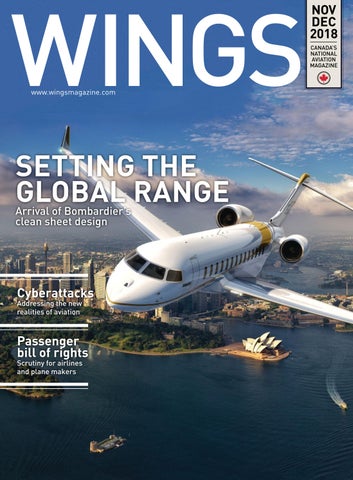
SETTING THE GLOBAL RANGE
Arrival of Bombardier’s clean sheet design
Cyberattacks Addressing the new realities of aviation
Passenger bill of rights Scrutiny for airlines and plane makers
NOV DEC 2018 CANADA’S NATIONAL AVIATION MAGAZINE
Jet performance at turboprop costs.
Aermacchi M-345 The latest technology integrated training system from Leonardo, allows comprehensive Basic and Advanced Flight Training for student pilots. The M-345 benefits from more than 60 years of experience at the leading-edge of jet trainer aircraft design and manufacture, delivering the high performance of a turbofan jet trainer with the life-cycle costs of a heavy turboprop aircraft. Inspired by the vision, curiosity and creativity of the great master inventor – Leonardo is designing the technology of tomorrow.
leonardocompany.com Helicopters | Aeronautics | Electronics, Defence & Security Systems | Space
NOV/DEC 2018
UPFRONT 8 Leading edge
Airport growth in satisfaction
10 On the fly
Simpson wins Webster, Airbus selects Faury, and more industry news
12 Alternate approach
Problematic passenger bill of rights
13 At the gate
Addressing the threat of cyberattacks in aviation
14 Aviation supply
Connecting digital flight logs for maintenance
BACK 34 Marketplace 38 On final
Pilot pity party, pilot revenge
Bombardier's Global 7500 aircraft is shown to be the longest-range business jet ever built after accumulating more than 2,700 flight hours. P.26
FEATURES 18 NEW AEROSPACE VISION
AIAC launches a six-year program to chart a course for growth and investment in Canadian aerospace BY BRIAN DUNN
From top: A look inside the Greenwood Military Aviation Museum. P.22. Jean Charest leads AIAC Vision 2025. P.18.
22 REBUILDING HISTORY
Volunteers in Nova Scotia are transforming a WWII wreck into a museum masterpiece BY CARROLL MCCORMICK
26 SETTING THE GLOBAL RANGE
The economic and market impact of Bombardier's disruptive Global 7500 clean-sheet design
PHOTO: BOMBARDIER
BY JON ROBINSON
COVER PHOTO: BOMBARDIER
WWW.WINGSMAGAZINE.COM
November/December 2018 | WINGS
3
Stay in Touch with Aviation News
Vol. 59, Issue 6 EDITOR
SUBSCRIBE
Jon Robinson jrobinson@annexbusinessmedia.com 647-448-6188
Online
FLIGHT DECK
Erika Armstrong, Tim Anderson, Krista Bulmer, David Carr, Brian Dunn, Kendra Kincade, James Marasa, Carroll McCormick, Anna Pangrazzi, Bill Zuk NATIONAL ACCOUNT MANAGER
TODAY
Mena Miu mmiu@annexbusinessmedia.com • 416-510-6749 ACCOUNT CO-ORDINATOR
Barb Vowles bvowles@annexbusinessmedia.com • 416-510-5103 MEDIA DESIGNER
Emily Sun
wingsmagazine.com/subscribe
CIRCULATION MANAGER
Magazine
Jay Doshi jdoshi@annexbusinessmedia.com • 416-442-5600 ext. 5124
Weekly E-Newsletter
GROUP PUBLISHER
Martin McAnulty mmcanulty@annexbusinessmedia.com
Digital Edition
WINGS www.wingsmaga
zine.com
PRESIDENT & CEO
Mike Fredericks
WINGS MAGAZINE
P.O. Box 530, 105 Donly Dr. S., Simcoe, ON N3Y 4N5 Tel: 519-428-3471 Fax: 519-429-3094 Toll Free: 1-888-599-2228
NOV DEC 2018 CANADA’S NATIONAL AVIATION MAGAZINE
SETTING E GLOBAL RTH ANGE
Printed in Canada ISSN 0701-1369
Arrival of Bom clean sheet bardier's design
PUBLICATION MAIL AGREEMENT #40065710
Rebuilding history
Transforming a Bolingbroke at Greenwood
CIRCULATION Email: apotal@annexbusinessmedia.com Phone: 416-510-5113 Fax: 416-510-6875 (main) 416-442-2191 Mail: 111 Gordon Baker Rd., Suite 400, Toronto, ON M2H 3R1
Passenger bill of rights
PHOTO CREDIT
TK
Scrutiny for airlin and plane make es rs
WG_NovDec18_EJS.
indd 1
2018-10-22
4:27 PM
Published six times per year (Jan/Feb, Mar/Ap, May/Jun, Jul/Aug, Sep/Oct, Nov/Dec) by Annex Business Media SUBSCRIPTION RATES Canada – 1 Year $ 34.00 (plus GST - #867172652RT0001) USA – 1 Year $ 59.50 Foreign – 1 Year $ 68.00 Occasionally, Wings magazine will mail information on behalf of industry-related groups whose products
Air Transport Association of Canada
ON THE
WEB
4
WINGS | November/December 2018
WG_Sub_HouseCircAd_NovDec18_MLD Folder.indd 1 2018-10-23 7:33 AM
and services we believe may be of interest to you. If you prefer not to receive this information, please contact our circulation department in any of the four ways listed above. Annex Privacy Office privacy@annexbusinessmedia.com • Tel: 800.668.2374 No part of the editorial content of this publication may bereprintedwithoutthepublisher’swrittenpermission. ©2018 Annex Publishing & Printing Inc. All rights reserved. Opinions expressed in this magazine are not necessarily those of the editor or the publisher. No liability is assumed for errors or omissions. All advertising is subject to the publisher’s approval. Such approval does not imply any endorsement of the products or services advertised. Publisher reserves the right to refuse advertising that does not meet the standards of the publication.
Canadian Business Aviation Association
Magazines Canada
AVIATION THIS WEEK Looking to catch up on the latest hot news from around aviation and aerospace? Check out Aviation This Week, a live digital version of the top news stories affecting a variety of key markets. It's quick, essential information you need to know! WWW.WINGSMAGAZINE.COM
IN A JOB THAT REQUIRES VERSATILITY AND FLEXIBILITY – WE HAVE YOUR BACK. In over 7 million hours of service, the Pilatus PC-12 NG has earned a solid reputation for outstanding performance, reliability, safety and operational flexibility. With a large 8-passenger cabin, low operating costs and #1 rated customer service, this big single will never be a hangar queen in your flight department. It turns chief pilots into heroes almost overnight. Pilatus Business Aircraft Ltd • Phone +1 303 465 9099 • www.pilatus-aircraft.com
Stan Kuliavas,center Vice President Sales | sales@levaero.com | 1.844.538.2376 Authorized contact of information
www.levaero.com
18-PIL-0003 PC-12 We Have Your Back Ad.indd 1
Logo
5/17/2018 8:58:07 AM
LEADING
EDGE
By Jon Robinson |
Airport growth in satisfaction
Positive change amid surging passenger numbers and capital projects
O
5 6
major infrastructure investments, including multi-billion-dollar construction projects in places like Boston, Los Angeles, Chicago and Vancouver (pictured). Passenger satisfaction across the board reached an all-time high at 761 (on a 1,000-point scale), 12 points higher than last year’s study. This improvement is driven primarily by a 17-point increase in satisfaction with food, beverage and retail; and an 18-point increase in satisfaction with security check. This latter improvement is largely based on airports working better with transportation authorities to align security staffing levels with airport load factors. The highest-scoring component of the airport experience, according to J.D. Power, is the check-in/baggage check,
TOP DATA BURSTS… in this issue 1. Engineless Perlan II sets an altitude record at 76,124 feet (P. 11) 2. U.S. Navy plans to buy 76 MQ-25s with a total cost of $17 billion (P. 11). 3. Canadian businesses spent $14 billion on cyber security last year (Page 13). 4. Canada’s aerospace supply chain exports have increased by almost 50% over the past 15 years (Page 18). 5. Over 16,000 restoration hours went into restoring an Avro Anson Mk II (P. 25)
WINGS | November/December 2018
which has risen consistently since airports began implementing self-service kiosks and bag tagging. Looking at how Canadian airports rank on the study, Toronto Pearson was 12th in the Mega Airports category, scoring highest in airport accessibility and food, beverage and retail. Pearson in 2017 welcomed 47.1 million passengers and handled 465,400 flights, while processing over 45 per cent of Canada’s air cargo. John Wayne Airport, Orange County, came first in the Large Airport category with Vancouver International as the top Canadian airport in sixth place. MontréalPierre Elliott Trudeau was two back in eighth place, and Calgary International in 15th. Buffalo Niagara International Airport placed first in Medium Airports without any Canadian airports of this size in the top 20, even as smaller regional airports in Canada also experience significant growth. A recent report from the Southern Ontario Airport Network (SOAN) shows its group of 11 airports in 2017 facilitated the travel of more than 52 million passengers last year. Most of this volume comes from Pearson, but SOAN’s 10 other regional airports contributed to putting approximately $2.3 billion in tax revenue back into municipal, provincial and federal reserves. SOAN’s networked airports supported some 55,000 workers in 2017. | W
soan airports put $2.3 billion in tax revenue back into municipal, provincial and federal reserves.
WWW.WINGSMAGAZINE.COM
PHOTO: VANCOUVER AIRPORT AUTHORITY
n the way out of Orlando after four days of NBAABACE, the cab driver was most excited to talk about the Intermodal Terminal expansion continuing at Orlando International Airport (MCO). This mixed-mode commuting terminal will connect MCO to downtown Miami – an eight-hour-plus journey – via the Florida East Coast Railway. It will provide 19 new gates for domestic and international flights and increase capacity to more than 50 million passengers annually at Florida’s busiest airport. Located 10 kilometres from downtown Orlando, MCO in 2017 handled 44,611,265 passengers, making it the eleventh-busiest airport in the United States, with Southwest serving as its largest carrier. MCO provided an update of its passenger numbers for the calendar year-to-date, which had already reached 32.2 million through August, an increase of 5.39 per cent over the same time last year. It is another example of the growth cycle for airports across North America. In September, J.D. Power released its 2018 North America Airport Satisfaction Study, which saw MCO ranked first in the Mega Airports category (over 32 million passengers) for the second year in a row, tied with Las Vegas McCarran. MCO has 21,000 badged employees and generates more than $31 billion in revenue for the regional economy. Now in its 13th year, the 2018 J.D. Power study is built from the responses of 40,183 North American passengers who traveled through at least one domestic airport and considers five factors: Check-in; food, beverage and retail; accessibility; terminal facilities; and baggage claim. Upon releasing the report, J.D. Power noted how well the airports are handling surging passenger numbers even as many undergo
Waterloo Wellington Flight Centre The Skills You Need - The School You Want
3KRWR E\ 0LNH 5H\QR
Strong education and industry partnerships give our graduates a competitive edge and the skills QHHGHG WR À\ LQ MREV DFURVV &DQDGD Partnered with: Contact us today! _ )/< ::)& _ wwfc.ca :DWHUORR :HOOLQJWRQ )OLJKW &HQWUH SURIHVVLRQDO SURJUDPV DUH DSSURYHG DV YRFDWLRQDO SURJUDPV XQGHU WKH 3ULYDWH &DUHHU &ROOHJHV $FW 3&
ON THE FLY For news, ideas and business information for Canadian aviation and aerospace, visit www.wingsmagazine.com
THE LEAD MRO PRODUCTION COMMERCIAL PEOPLE INNOVATION AUTONOMOUS
THE LEAD
SIMPSON CANADA’S TOP AMATEUR PILOT After a week of flight and ground tests at the Peterborough Regional Airport, Carter Simpson won the 2018 Webster Trophy competition, designed to recognize Canada’s Top Amateur Pilot. Simpson, from Seneca College, whose students have taken four of the past five Webster events, entered the competition as an Eastern Ontario Finalist competing against nine other regional winners from across the country. Jonathan Littler, Central Ontario Finalist from Brampton Flying Club, received the Eunice Carter Memorial Award as 2018 runner-up. The other provincial finalists included: Daniel Joo Sung Shim, Langley Flying School (BC finalist); Carolyn Spence, McMurray Aviation (Alberta); Sara Voth, Mitchinson Flight Centre (Sask.); Mark Joseph Dizon, Harv’s Air Steinbach (Manitoba); Natalie Smith, WaterlooWellington Flight Centre (Western Ontario); Greg Carlesimo, Cargair YHU
(Quebec); and Mihar Raouf, Moncton Flight College (Atlantic).
MRO
FLYING COLOURS DELIVERS 100TH CHALLENGER RETROFIT Flying Colours of Peterborough, Ont., reached a milestone when its Peterborough facility re-delivered its one hundredth major retrofit of a Bombardier Challenger, which underwent an overhaul of the cabin, avionics, connectivity and fuselage. The same Challenger 604 had undergone a 96-month check at Flying Colours just over a year ago for its previous owner. Earlier in September, Flying Colours completed its third 120-month, heavy maintenance check on a Bombardier airframe in the past 12 months. This most recent 10-year inspection involved a Global Express being stripped back to the airframe for inspection. The interior was also stripped bare, including wall panels, carpets, insulating surfaces, floorboards, monuments, external fairings and panels to perform maintenance assessments.. The project, which was undertaken at Flying Colours’ Peterborough facility, also included a full landing gear overhaul, replacement of the cabin seats, new exterior paint and interior soft-goods
Brampton Flying Club's Jonathan Littler (left), winner of the Eunice Carter Memorial Award, and Seneca's Carter Simpson, who is Canada's Top Amateur Pilot as the 2018 Webster winner. 8
WINGS | November/December 2018
Flying Colours is regularly completing heavy maintenance checks on Bombardier airframes in Peterborough and St. Louis.
refurbishment, as well as cabinetry refinishing. More 8C heavy checks are being completed on Bombardier Challengers, Learjet, and Dassault Falcon types at the Flying Colour’s facilities in Peterborough and St. Louis, MO.
PRODUCTION
HÉROUX-DEVTEK ADDS GLOBAL POWER Héroux-Devtek of Longueuil, Que., completed the acquisition of Compañia Española de Sistemas Aeronáuticos (CESA), a subsidiary of Airbus SE, for approximately $206 million. Headquartered in Madrid, Spain, CESA is a top European provider of fluid mechanical and electromechanical systems for aerospace. Its main product lines include actuation and hydraulic systems, as well as landing gear products. It operates a 366,000-square-foot complex in Madrid, as well as another facility in Seville, employing a total workforce of around 300 employees. Specializing in landing gear, actuation systems and components, including its claim as the third largest landing gear company worldwide, Héroux-Devtek estimates that approximately 90 per cent of its sales will now be outside of Canada, including about 50 per cent in the United States. “Our product mix will also evolve with 42 per cent of revenues being generated from proprietary products,” said Héroux-Devtek president and CEO, Gilles Labbé. WWW.WINGSMAGAZINE.COM
PHOTOS: MIKE DOIRON, DOIRON AVIATION CONSULTING (LEFT); FLYING COLOURS (TOP)
8 8 8 9 10 11 11
As a result of the acquisition, HérouxDevtek updated its sales guidance for fiscal 2019, expecting sales for fiscal 2019 to reach as high as $470 million, representing an increase of approximately 20 per cent over last year. Management also projects sales for fiscal 2022 to be in the range of $620 million to $650 million. In addition to its head office in Longueuil, Héroux-Devtek has facilities in the Greater Montreal area (Longueuil, Laval and St-Hubert); Kitchener, Cambridge and Toronto, Ontario; Springfield and Strongsville, Ohio; Wichita, Kansas; Everett, Washington; Livonia, Michigan; Runcorn, Nottingham and Bolton, United Kingdom; and now Madrid and Seville, Spain.
COMMERCIAL
ROVINESCU LIFETIME ACHIEVEMENT AWARD
PHOTOS: CNW GROUP/AIR CANADA (TOP); WASAYA (RIGHT)
Calin Rovinescu, president and CEO of Air Canada, received the CEO Lifetime Achievement Award from the Airline Passenger Experience Association (APEZ), becoming the first person from the Americas to win the award. APEX cited Air Canada’s significant global expansion and product enhancements under Rovinescu’s leadership, as well as investments by the carrier to make its customer experience world-class. Rovinescu was also noted for serving as chairman of the largest airline association in the world, in addition chairman of the largest airline alliance
Air Canada’s Calin Rovinescu (right) becomes the first CEO from the America's to receive the CEO Lifetime Achievement Award from the Airline Passenger Experience Association.
in the world. In July, Rovinescu won the Executive Leadership Award at the 2018 Airline Strategy Awards. The Globe and Mail’s Report on Business named him as Canada’s Best CEO in 2013. In June of 2018, Rovinescu became a Member of The Order of Canada. Air Canada is Canada’s largest domestic and international airline serving more than 220 airports on six continents. It is among the 20 largest airlines in the world and in 2017 served more than 48 million customers.
COMMERCIAL
MORRIS RETURNS AS CEO OF WASAYA Tom Morris was named CEO of Thunder Bay’s Wasaya Airways, returning to the position – by January 2019 – he held upon retiring in 2015. Morris spent 22 years with Wasaya, including 14 as CEO. In April 2018, Wasaya, at the time owned 100 per cent by 12 First Nations
in Northwestern Ontario, entered into an agreement with the Exchange Income Corporation (EIC) of Winnipeg, whereby EIC recapitalized Wasaya by purchasing a portion of the company. The airline also named Brad Martin as COO. Michael Rodyniuk in October became CEO of the West Wind Aviation Group (WWA), which is First Nations owned with shareholders Athabasca Basin and Prince Albert Development. Earlier this year, Rodyniuk concluded his role as CEO of Wasaya, where, according to WWA, he led a three-year turnaround. In related news, First Air in September completed its merger with Canadian North and named Chris Avery as CEO, succeeding Brock Friesen, who led the airline for five years. Avery joined First Air in 2017 with 25 years of experience, including positions at WestJet, Alaska Airlines, Canadian Airlines and Transat Holidays. WWA is owned by Makivik, which focuses on the development of Inuit-operated businesses in Nunavik.
Wasaya means rising sun in the Oji-cree dialect and the logo of Wasaya Airways, which depicts a sunburst with eight sunrays, representing each of the original owner communities. WWW.WINGSMAGAZINE.COM
November/December 2018 | WINGS
9
ON THE
FLY
Pilots’ Associations, representing some 100,000 pilots worldwide, signed a partnership for Tourisme Montréal to host three IFALPA conferences in 2023, 2028 and 2033. IFALPA moved its headquarters from the UK to Montréal six years ago to be closer to the International Civil Aviation Organization (ICAO), among other key aviation organizations.
COMMERCIAL
MONTRÉAL TO HOST THREE IFALPA CONFERENCES The International Federation of Air Line
PEOPLE
AIRBUS SELECTS FAURY AS FUTURE CEO
ALTITUDEONE AVIATION LAUNCHES IN IRELAND Guillaume Faury is set to become CEO of Investment firm L1 Treasury and Airborne Capital in September launched AltitudeOne Aviation with plans to acquire leased, in-production narrowbody and wide-body commercial aircraft. Together, the two companies committed equity of around US$250 million into AltitudeOne. Airborne Capital, which is to serve as the asset and lease manager for AltitudeOne, was launched in November 2017 with backing from FEXCO,
Airbus SE in April 2019 at the company’s AGM. Faury, 50, is currently president of Airbus Commercial Aircraft. He previously served in management roles at Eurocopter from 1998 to 2008, starting in engineering, then flight test, before becoming VP of commercial programs and then VP of R&D. After spending time with Peugeot S.A., Faury returned to Airbus in 2013 as CEO of Airbus Helicopters. In other appointment news: Captain
WEATHER & DATA SERVICES SiriusXM Aviation Weather & Data Services now available in Canada. Get up-to-date, coast-to-coast graphical weather from taxi to touchdown. Get a $200 Hardware Mail-In Rebate* Learn more at: siriusxm.ca/aviation
*Coondi nd tio ions ns app ns apply. ap lyy. Se lly. S e offe offerr deta etails ils. ils
10 WINGS | November/December 2018
WWW.WINGSMAGAZINE.COM
PHOTO: CNW GROUP/TOURISME MONTRÉAL
From Left to Right: IFALPA managing director, Christoph Schewe; IFALPA president, Cpt. Ron Abel; Yves Lalumiere, president and CEO Tourisme Montréal; and IFALPA board members Cpt. Ben Mansumitchai and Cpt. Rod Lypchuk.
Ireland’s largest privately owned financial services company, and Natixis Investment Managers. AltitudeOne explains its aggressive plans are to have aircraft assets under management of more than US$5 billion within its first five years.
AUTONOMOUS
Jeffrey Martin in September was named COO of WestJet; Ferio Pugliese became senior VP, government relations and regional markets, for Air Canada; Danny Di Perna was named COO of Bombardier Aerospace; and Cedric Savineau became GM for Avcorp’s facility in Delta, BC.
BOEING GETS $805M MQ-25 CONTRACT
INNOVATION
PHOTO: ERIC SHINDELBOWER, BOEING
PERLAN II SOARS ABOVE 76,000 FEET Airbus’ Perlan Mission II, described as the world’s first initiative to pilot an engineless aircraft to the edge of space, made history in September in El Calafate, Argentina. Riding stratospheric mountain waves, rare air currents that develop – in few places on earth – for a short time each year, pilots Jim Payne and Tim Gardner in September took the pressurized Perlan II glider to 76,124 feet. The Perlan II is designed to soar up to 90,000 feet.
The MQ-25 unmanned aerial refueler, known as T1, is currently being tested at Boeing’s St. Louis site.
The 76,124-foot Perlan II flight surpasses the maximum altitude in level flight of the U.S. Air Force’s U-2 Dragon Lady reconnaissance aircraft: 73,737 feet, flown by pilot Jerry Hoyt on April 17, 1989. For comparison, the U-2 is powered by an engine that generates 17,000 pounds of thrust. The engineless Perlan II weighs just 1,500 pounds.
DTI Training
Boeing is to build the U.S. Navy’s first operational carrier-based unmanned aircraft, the MQ-25 Stingray aerial refueler, within an US$805 million contract for a total of four such aircraft. The first airframes are expected to fly in 2021 with operational capability on carrier decks planned for 2024. After this contract is complete, Usni.org reports the Navy plans to buy 72 more vehicles with a total program cost of about US$13 billion. The MQ-25 Stingray will be designed to extend the range of the deployed Boeing F/A-18 Super Hornet, Boeing EA-18G Growler and Lockheed Martin F-35C. Also, the U.S. Air Force awarded Boeing a US$2.9 billion contract for 18 more KC-46A tankers, which ultimately could reach a production total of 179 for this 767-based refueling aircraft. | W
Workshops Scheduled in Canada and the U.S. Content Partner
These workshops will be brought to various locations across Canada and the U.S.
DTI, having spent the last 15 years helping develop and deliver training to Transport Canada, NASA and the U.S. DoD, on Quality Assurance, SMS and Surveillance Procedures, is now ready to help you achieve all you can.The workshops are designed to familiarize the participants with the basics of a QA/SMS system and what Transport Canada, the FAA and other governing bodies will be looking for, as they implement their system. It is being taught by the same group (DTI) that has helped Canadian Regulators develop the QA & Surveillance portions of the SMS, and has spent the last ten years facilitating the implementation of the new process to all its inspectors. Three Ways to Attend the Workshops! 1) Sign up to the workshops at a location most convenient to you below! 2) Host our workshops and receive incentives and discounts. 3) Bring DTI to your Enterprise for Company Specific workshops! Receive Discounts, Incentives and more! (this applies to even a single workshop!) VANCOUVER AREA - HOSTED BY LONDON AIR SERVICES (4580 COWLEY CRESCENT, RICHMOND, B.C. CANADA V7B 1B8 ) Basic Quality Assurance - November 6, 2018 Developing an Acceptable Corrective Action Plan - November 7, 2018 (am session) Basic Auditing Principles - November 7, 2018 (pm Session)
dtitrainingcanada.ca
Dennis & Sol Taboada of DTI Training. To Register for a Workshop goto: dtitrainingcanada.ca/ workshops
CALGARY AREA - HOSTED BY CANADIAN NORTH Basic Quality Assurance - December 4, 2018 Developing an Acceptable Corrective Action Plan - December 5, 2018 (am session) Basic Auditing Principles - December 5, 2018 (pm session)
dtiquality.com
1-866-870-5490
From now till December 31, 2018 DTI is offering FREE ONSITE analysis of your system (QMS, SMS, QA). 2 days at your facility with a special presentation to management on how everything should fit together! No charge! We just ask that DTI’s SME’s travel expenses be covered using the Canadian Travel Regulations as a guide. WWW.WINGSMAGAZINE.COM WG_DTI_training_half_NovDec18_MLD.indd 1
November/December 2018 | WINGS
11
2018-10-12 3:30 PM
ALTERNATE
APPROACH By David Carr |
Problematic bill of rights
Moving Canada in its own direction of passenger and airline cooperation
I
12 WINGS | November/December 2018
business of air transport will only add red tape and drive up industry costs without guaranteeing a single bag isn’t lost, an airport gate will be immediately available upon arrival and that yield management models will not always prevent a passenger from being bumped. All while passengers are demanding even lower fares and will drive to the United States to get them. A phenomenon that Canadian ULCC’s might slow down, but will not eliminate. The congressional attempt to micromanage cabin seating failed to make it past the U.S. Senate before lawmaking in Washington ground to a halt for mid-term elections. Transport Minister Marc Garneau had promised a passenger bill of rights by 2018, but his first attempt got a rough ride in the Canadian Senate. Meanwhile, Lukács recently filed a complaint against Swoop for its a la carte checked baggage policy. He is not arguing against Swoop’s right to charge for checked baggage, but that the passenger has a right to at least one fare option where checked baggage is part of the deal. Will the transport minister act? Hard to say, but Garneau will certainly need to keep a mindful eye on the moves by Canada’s most successful passenger rights advocate. | W
It will add red tape and drive up costs without guaranteeing a single bag isn’t lost. these instances and there seems to be more extreme examples, but Canada already has consumer protections against abusive corporate practices. Perhaps the quibble is not whether Canada needs an air passenger bill of rights, or if government and its agencies are making full use of the regulatory tools at their disposal. The slap on the wrist levelled at Air Transat by the CTA for stranding hundreds of passengers on two flights for hours at the Ottawa airport in summer 2017, suggests not. Maybe the transport minister’s time could be better spent determining if the relationship between the airline industry and CTA has grown too cozy. Enter Gábor Lukács, a Halifax-based mathematics whiz and ‘part-time’ passenger rights’ advocate, who likely sleeps with a copy of the Montréal Convention on his night table. Lukács is picking up the ball dropped by the CTA and suing both Air Transat and the agency for the Ottawa fiasco on behalf of the stranded passengers. Mathematically speaking, Lukács has won 88 per cent of the cases he has filed with the CTA, suggesting the odds are in his favour. Canadians must be compensated when an airline violates transport rules. Still, expanded government interference with the
David Carr is a Wings writer and columnist. WWW.WINGSMAGAZINE.COM
PHOTOS: AIR CANADA’S 787 DREAMLINER CLASSES (L-R): ECONOMY, PREMIUM ECONOMY AND SIGNATURE
s there a depth government won’t sink to interfere with air transport and over-regulate an airline’s right to manage its own capacity? News out of Washington is that Congress passed a bill in September to give the Federal Aviation Administration a year to establish a minimum space between airline seats. Bureaucrats, start your tape measures. Such an intrusive measure strikes at the heart of the ultra-low-cost carrier (ULCC) business model and runs counter to keeping fares low. This has always been a fatal flaw in the crusades of so-called passenger advocates. Congress defends its war on the “ever-shrinking seat” as a safety measure. At least one representative has scraped at the varnish, declaring that “relief could soon be on the way for weary airline passengers facing smaller and smaller seats. At what cost? A cramped cabin is the trade-off passengers are willing to make for cheap fares, and in many cases affordability to fly. Forcing airlines to reconfigure cabins and remove rows of seats will increase the price of flying. Congress did pass on a proposal to cap fees airlines charge for ancillary services such as checking a bag, but the fact it was even considered should sound alarm bells for the future. So what of Canada? This summer, the Canadian Transportation Agency (CTA) wrapped up public consultations on an air passenger bill of rights. Canada’s transport minister has declared that air travellers must have more rights than riders on over-crowded transit systems, motorists on congested highways and government-owned VIA Rail customers, including the ‘right’ for families with children to sit together. How is that to work exactly, now that airlines charge for preflight seat selection and more Canadians are opening their wallets to guarantee an aisle or window seat, or the coveted emergency exit rows? Canadian families already have the right to ensure they fly together at booking, and not leaving it to chance at the airport checkin counter. A passenger bill of rights is a typical window-dressing response to headlines of passengers sitting for hours on a sweltering tarmac or being dragged off an overbooked airplane against their will. To be certain, the airline industry’s hands aren’t clean in
AT THE
GATE
| By Brian Dunn
The threat of cyberattacks
Canada and the aviation world move to adjust to a new reality
PHOTO: NAV CANADA (MONTREAL CONTROL TOWER)
T
he risk of cyberattacks poses the biggest threat to airports and aviation in general, according to a U.S. airport official. In today’s technologically driven airports, there are basically no areas or functions that do not rely on some type of digital network, Tampa International Airport general counsel Michael Stephens told a joint hearing of the House Homeland Security Committee’s Cyber Security and Transportation Security subcommittees in September. The importance of these systems makes airports appealing targets and vulnerable to cyber threats from criminal organizations and state sponsored actors. In his testimony, Stephens said U.S. airports have reached a point where voluntary compliance is no longer sufficient and asked lawmakers to consider mandating “uniform minimum cyber security standards and frameworks.” He added that “human factor remains the most highly exploited vector” for breaching cyber defences and threat awareness and information security training programs for airport, airlines and aviation industry employees are “perhaps one of the most effective and cost-efficient ways of increasing airports’ and airlines’ cyber security readiness.” The committee also heard from Christopher Porter, chief intelligence strategist at FireEye Inc., who testified that statebacked hackers are regularly targeting the U.S. aviation industry through cyber espionage to steal industrial secrets from manufacturers, researchers and operators of military and civilian aircraft. Porter called cyber espionage the “most common cyber threat facing the aviation industry,” and said that hackers sponsored by China, Russia and more recently Iran have all “targeted the U.S. or its close allies for stealing aviation secrets.” All three countries routinely target ticketing and traveller data, shipping schedules and even partner industries like railways or hotels in counterintelligence efforts, Porter added. However, he reminded lawmakers that, because cyber espionage is routine, it should not be viewed as destabilizing. “When cyber espionage operators get a foothold on a system, they can often use that access for stealing information or to WWW.WINGSMAGAZINE.COM
is an offence and serve as an important deterrent against activities that compromise aviation safety by exploiting cyber vulnerabilities. The Convention is a treaty by which states agree to criminalize terrorist actions like cyberattacks against civil aviation. The protocol went into effect on July 1, 2018. In Canada, the Canadian Centre for Cyber Security was established earlier this year to tackle the challenges of cyberattacks. It will be a unified source of expert advice, guidance, services and support on cyber security for government, critical infrastructure owners and operations, the private sector and the Canadian public, according to the centre. The centre will unite approximately 750 employees from existing cyber security operations units at Public Safety Canada, Shared Services Canada and the Communications Security Establishment (CSE) into one unique, innovative and forward-looking organization, as part of CSE. More than one in five Canadian companies were hit by a cyberattack last year, with businesses spending $14 billion on cyber security as they confront greater risks in the digital world, according to a Statistics Canada survey. In August, some 20,000 Air Canada customers or about one per cent of the 1, 7 million people who use the airline’s mobile app learned their personal data may have been compromised following a breach. The app stores basic information like a user’s name, email and telephone number, all of which could have been improperly accessed. Additional data like a customer’s Aeroplan number, passport number, Nexus number, known traveller number, gender, birth date, nationality, passport expiration date and country of residence could have been accessed, if users had them saved in their profile on the app.| W
Airports have reached a point where voluntary compliance is no longer sufficient. launch a disabling or destructive attack using the same technology,” Porter said. “But they rarely choose to do so, and in the U.S., there are significant redundancies in place to ensure safety. A crashed IT system does not mean a crashed plane, and it’s important for the public to keep that in mind.” The International Civil Aviation Organization (ICAO) held a summit on cyber security in Dubai to address the issue and stated it is the responsibility of states to act in such a way as to mitigate the risk posed by cyber threats, to build their capability and capacity to address such threats in civil aviation, and to ensure their legislative framework is appropriately established to take action against actors of cyberattacks. In addition, collaboration and exchange between states and other stakeholders is essential for the development of an effective and coordinated global framework to address the challenges of cyber security in civil aviation and that cyber security matters must be fully considered and coordinated across all relevant disciplines within state aviation authorities, ICAO explained. The ratification and entry into force of the Beijing Convention would ensure that a cyberattack on international civil aviation
Brian Dunn is a Wings writer and columnist. November/December 2018 | WINGS 13
AVIATION
SUPPLY
By Christopher Lawn |
Adding digital flight logs
Six ways to reduce maintenance time and improve AOG situations
B
y automating the transfer of flight log data to an aviation management system (AMS), operations can reap the rewards of having the information they need at their fingertips. But it doesn’t end there. Below are six key takeaways found in integrating flight logs with aviation maintenance software.
2. NO MORE WAITING FOR INFORMATION The practice of having pilots manually provide their flight log hours to the maintenance department is still in place at numerous aviation operations. By using an API, flight log information can be automatically transferred directly from an aircraft itself or from a pilot’s electronic flight logbook over to the software. This is a huge time-saver for the maintenance department and a maintenance planner, in particular, as they no longer have to wait for the information required to begin planning maintenance tasks and checks. 3. COMPLETE OPERATIONAL TRANSPARENCY For an aircraft maintenance department, decreasing the amount of time spent accessing information is crucial for increasing overall department productivity 14 WINGS | November/December 2018
When a pilot’s flight logbook goes missing, it can be a nightmare for any aviation operation. – ultimately, technicians spend less time at workstations and more time on performing maintenance tasks. This goes hand in hand with the fact that when flight log information is automatically transferred to an AMS, the information is fully transparent. Searching for information seems like a minor inconvenience and when that becomes routine, it clearly has a negative impact on a company’s finances. To improve business efficiencies, you need full operational transparency. By automating processes, you can achieve this goal. 4. AN IMPROVEMENT IN THE INTEGRITY OF DATA Trusting the accuracy of data is key to improving the management of and efficiency of your business. If you can’t trust in the accuracy of flight log information, how can you feel comfortable performing maintenance on an aircraft? Simply put, fewer manual inputs equate to fewer human errors and, in turn, this leads to an increased level of confidence in the integrity of your data. Over time, staff trust the accuracy of data within your system and the turnaround time
on maintenance activities improves.
5. INCREASED EFFICIENCY ON MAINTENANCE TASKS Hours entered on a pilot’s electronic flight log book or instantly relayed from an aircraft can indicate to the maintenance department that a particular part is coming due for replacement. The department can then prepare for the maintenance tasks in advance by requesting the required parts from the stores department prior to receiving the aircraft. By automating the transfer of flight log information to an aviation maintenance solution, operations can reduce their ground time and improve their turnaround on maintenance activities. This ultimately improves a company’s capacity to take on new business. 6. INSTANT ACCESS TO INFORMATION When maintenance departments are forced to wait for the information they require, forecasting maintenance duties becomes a challenge. This makes them less efficient. By integrating electronic flight log books with an AMS, aviation operations have the opportunity to improve maintenance planning, reduce inefficiencies, and expedite maintenance activities. | W Christopher Lawn is a marketing specialist with WinAir, info@winair.ca. WWW.WINGSMAGAZINE.COM
PHOTO: BASIL NEWBURN
1. MANUAL PROCESSES ARE MINIMIZED Manual processes can be the bane of any aviation maintenance department’s existence. They can be time consuming, tedious and prone to human error. The most significant difficulties come to the fore when manual errors are not identified in a timely manner. Incorrect flight log data can be damaging and it can be a nightmare when a pilot’s analogue flight logbook goes missing. If an aircraft has been grounded because a part is recalled, no director of maintenance ever wants to learn their department cannot determine the correct hours that have been logged on that aircraft due to inaccurate flight log information. By integrating flight logs with an AMS, a pilot can simply enter flight log data into their electronic flight log book and this information is instantly transferred to the software.
Fire Extinguishers Oxygen Cylinders, Regulators, Crew Masks and PBE’s Inflation and Pneumatic Reservoirs Securaplane Batteries, Cameras, and Security Systems Floor Coverings THERE WHEN YOU NEED US™
98 Columbus Avenue, Pointe-Claire, Qc, Canada H9R 4K4 TEL | 514.630.7777 FAX | 514.630.9999 AOG | 514.981.7362 | info@caspaerospace.com
LEKTRO
WG_Casp_SeptOct18_cCSA.indd 1
2018-07-30 11:06 AM
The Original Towbarless Tug Setting the Standard in Excellence Since 1945
Models ranging
15,000 to 280,000 lbs.
Electric Towbarless Certified Easy to Use Universal Rugged Simple to Maintain www.
LEKTRO .com
1-800-535-8767 1-503-861-2288 sales@lektro.com November/December 2018 | WINGS 15
WWW.WINGSMAGAZINE.COM
WG_Lektro_NovDec17_CSA.indd 1
2017-10-20 12:49 PM
Bruce MacRitchie has been involved in Canada’s aviation industry for six decades and, in addition to his recent gift to Centennial, he provides the school with a reoccurring Aviation Technician Scholarship named after his late brother, Douglas.
SEASONED AVIATOR PROVIDES A MAJOR GIFT TO CENTENNIAL
C
entennial College supporter H. Bruce MacRitchie, whose Aviation Technician Scholarship is named in memory of his late brother Douglas, has furnished a major new gift to the college – the largest by a private individual to date – amounting to more than $1 million worth of small aircraft, engines, equipment and funds. “Aviation has been very good to me. I own half a dozen airplanes myself, and my stepson graduated from Centennial’s Aviation Technician program and went on to have a great career with Air Canada,” says MacRitchie. Still spry at age 84, MacRitchie has long been associated with Canada’s aviation industry. While working for an electric motor manufacturer in 1955, he enrolled with Central Airways in Toronto to earn his private pilot licence. In 1962, he joined forces with a colleague to form Carldon Aviation, which sold Cessna light aircraft. By 1968 MacRitchie had obtained his commercial pilot licence and the AME Transport Canada licence as an aircraft technician. He left the aircraft dealership to join Fleet Industries in Fort Erie, where he was employed in a marketing role to
SPONSORED CONTENT
fly and demonstrate a fibreglass float plane. Fleet was growing as an aerospace component supplier, which meant relocating a company representative to the epicentre of the booming aircraft industry in California. MacRitchie was named Fleet’s rep on the Lockheed L1011 airliner program. “I was also working with Douglas Aircraft in Long Beach because Fleet was producing the DC-9 MD80 flaps and ailerons for Douglas Canada. While I was there I trained at the Hughes School and received my commercial USA Helicopter endorsement.” Returning to Canada in 1970, MacRitchie resumed his marketing role at Fleet, working with all the major aircraft manufacturers including Boeing, Grumman, Sikorsky, Douglas and others. “We had displays at several of the big industry shows at Paris and Farnborough, working with prime aircraft companies in North America, Europe, Japan and Israel,” says MacRitchie, who has flown a de Havilland Twin Otter across the ocean with corporate pilot Tom Appleton. As a change of pace, he started an aviation company out of Welland Airport, which
functioned as a flight school, charter and full maintenance facility. MacRitchie also found time to volunteer as director of the Canadian Warplane Heritage Museum. “Our volunteer group, headed by me, restored and donated several aircraft, including the Fleet Fort and Cornell aircraft, which were produced by Fleet during the Second World War.” He believes the war effort helped to establish Canada as an industrialized nation. “When war became inevitable, Canada agreed to be the home of the Commonwealth’s pilot training programs because of its safe distance from the war theatre in Europe,” says MacRitchie. “More than 100 airports were built across Canada as part of the preparations.” The Canadian headquarters of de Havilland Aircraft of the United Kingdom was established at Downsview airfield just north of Toronto, whose brick buildings and hangars housed an assembly facility for the Moth training plane and the famous plywood Mosquito bomber. Today the long-dormant facility is undergoing restoration and expansion to become Centennial College’s fifth campus, thanks to generous funding from the Ontario and federal governments. The Centre for Aerospace and Aviation will be the new home of Centennial’s aerospace faculty, aircraft and related equipment relocated from Ashtonbee Campus in January 2019.
MacRitchie is energized by the transformation unfolding on Downsview’s hallowed ground. As he points out, aviation is inextricably tied to Canada’s history – airplanes helped open up the far north to economic activity, including mining and forestry. Now he can witness a chapter of Canada’s aviation history restored to its former glory. “I became involved with Centennial after my brother Douglas was killed in an accident when he was flying his own aircraft to work with me on the Cornell restoration project. That led me to establish a student scholarship in his name at Centennial in 2003.” With that selfless gesture, MacRitchie was introduced to the community of learners at Ontario’s first college. “I’ve met many nice, young people in the college’s program, and I’ve often thought, how can I help them further?” he says. This time, Bruce MacRitchie doubled down on his commitment with a record gift to the college. “This gift represents a better return on my investment,” he smiles. Toronto’s Centennial College operates one of the largest transportation technology training centres in Canada at its Ashtonbee Campus, and is a founding member of the Downsview Aerospace Innovation and Research (DAIR) consortium, which is working to maintain Canada’s ranking as a major aerospace supplier to the world. – by Mark Toljagic
OPENING WINTER 2019
The new campus will feature innovative and spacious teaching spaces for Transportation and Engineering Technology programs, including: È Aviation Technician – Aircraft Maintenance È Aviation Technician – Avionics Maintenance È Aviation Technology – Aircraft Maintenance and Management È Aviation Technology – Avionics Maintenance and Management È Aerospace Manufacturing Engineering Technician/Technology
Centennial College’s new state-of-the-art campus at Downsview Park is a sophisticated and functional facility that represents a major turning point for our students and our college, furthering our position as a leader in avionics, aircraft maintenance and aerospace manufacturing education.
Additionally, this leading-edge campus will include: È Applied research opportunities È Structural labs È Composites lab È Two Aircraft Hangars È Engine shops È Avionics shops
ENROL NOW FOR WINTER 2019!
È Airframe Assembly
centennialcollege.ca 1260_OCT18
See where experience takes you.
Advanced robotic manufacturing employed at Pratt & Whitney Canada’s facility in Longueuil, Quebec. The company projects investing more than $1 billion in R&D between 2016 and 2019, as part of its efforts to support approximately 13,400 customers all around the world – with more than 63,000 engines in service.
CHARTING A COURSE FOR GROWTH IN CANADA’S AEROSPACE SECTOR
C
BY BRIAN DUNN
anada is the secondmost attractive country for aerospace manufacturing behind the United States, according to a new index rating produced by PricewaterhouseCoopers, up from fifth place last year. The 2018 index is based on a weighted score of category and subcategory rankings that include labour, infrastructure, industry, economy, cost, tax policy and geopolitical risk. Labour refers to the size and quality of the labour force, infrastructure refers to the quality of roads, railroads, ports and air infrastructure (available airline seat kilometres per week) and industry refers to total aircraft and spacecraft sales. Economy refers to real GDP, cost means operating expenses as a percent of sales, while tax policy refers to tax ranking among all countries. Rounding out the top five countries with the 2017 rankings in parenthesis are: 18 WINGS | November/December 2018
Singapore (11), Switzerland (2) and the UK (3). Canada ranked third in labour (8), industry (8) and geopolitical risk (13) and ninth overall in cost (24) and infrastructure (13). But it ranked 16th (17) in tax policy and 23rd (26) in economy, the last two categories only marginally better than in 2017. Canada has a similar aerospace profile to the U.S., with an educated labour force, stable government, relatively low costs, and good infrastructure, the study noted. In 2017, the industry contributed close to $25 billion to the Canadian economy and employed almost 190,000 people. In 2017 globally, the Aerospace and Defence (A&D) sector reported record profits of US$77 billion, an 18 percent increase over the prior year, surpassing the previous record set in 2014. The top 100 A&D companies, by revenue, reported $728 billion in revenue, an increase of four percent over
2016. Operating margin also set an industry record at 10.6 per cent. This year, the A&D industry is poised to achieve new record results. “Over the last five years, the aerospace industry has become an increasingly important part of the economy, supported by global demand for Canadian exports. Canada is especially strong in the production of civilian flight simulators, business and regional aircraft, and turboprop and helicopter engines,” according to the PWC study. There are several reasons for Canada’s improved performance, starting with the resolved dispute between Boeing and Bombardier over threatened tariffs from the U.S. If the tariffs had remained, it would have had a disastrous impact on local suppliers. The exit terms under Brexit have still not been hammered out, resulting in a lot of uncertainty in Europe, especially how the movement of goods and employees will be impacted. The exchange rate has helped Canadian industry in certain categories. Probably one of the biggest factors affecting the industry is
the acquisition of Bombardier’s CSeries program by Airbus which has since be renamed the Airbus A220. Airbus’ presence at Bombardier’s Mirabel manufacturing facility can only be positive for the local economy. One of the subcategories in the PricewaterhouseCoopers (PWC) study was profit margins in 2017 which improved significantly after two challenging years in 2015 and 2016. Labour relations have also improved compared to a lot of other countries in the study. Canada and other top countries might want to keep an eye on Singapore which sits just behind Canada in third place, climbing from 11th in 2017. It offers a stable government and strong support of its aerospace industry. Singapore is capable of serving the entire AsiaPacific region while attracting talent from neighbouring countries. And in these times of high production and low unemployment, 75 per cent of respondents of a survey by PWC said they are concerned with the availability of key skills. The need for talent will become even more critical in WWW.WINGSMAGAZINE.COM
PHOTO: PRATT & WHITNEY CANADA
NEW AEROSPACE VISION
WG_SugarLand_NovDec18_CSA.indd 1
apexaircraft.com
Style in the Skies
2018-10-23 11:06 AM
FROM TIP TO TAIL Your Source for Quality Aircraft in Canada!
30
Toronto Buttonville Airport
905-477-7900
Interior Conversions and Refurbishment Exterior Paint Complete Maintenance Avionics and Mods CMS and Connectivity Mods
www.newunitedgoderich.com
519.228.6862 November/December 2018 | WINGS 19
WWW.WINGSMAGAZINE.COM
WG_Apex_MarApr18_CSA.indd 1
WG_NewUnitedGoderich_NovDec18_CSA.indd 1 2018-02-15 9:49 AM
2018-10-11 11:57 AM
Canadian manufacturing industry R&D 2017 Aerospace manufacturing 24%
Manufacturing industry R&D intensity 2017 22%
Over 7X higher
3%
the next few years, as the Baby Boom Generation moves beyond traditional retirement age and the unavoidable loss of their expertise and knowledge. Companies will need to ensure a smooth transition of talent by identifying key skills and developing plans to facilitate the transfer of knowledge. Given the increasingly technological nature of today’s business environment, skill sets that were once most in demand in aerospace and defense (A&D) are now highly desired by many other industries, placing A&D squarely in competition with the likes of Apple, Google, Amazon, Uber, tech startups and financial services organizations, according to PWC. And Canada still faces steel and aluminum tariffs from the U.S., despite a new trade deal with the U.S. and Mexico, in addition
20 WINGS | November/December 2018
All manufacturing
Aerospace manufacturing
to Canada’s counter measures which could impact our competitiveness. However, the tariffs are also starting to have a negative impact south of the border which may force congressmen and senators to pressure the White House to drop them. Despite Canada’s rise to the number two position, while other countries have been increasing their investments in aerospace, this country has fallen from 8th place in 1992 to 18th place as a percentage of GDP spent on aerospace and hasn’t had a longterm plan to guide investments for decades. In addition, Canada’s aerospace manufacturing employment has declined five per cent and its GDP contributions have dropped four per cent since 2012, according to the Aerospace Industries Association of Canada (AIAC). Those are some of the reasons why AIAC launched Vision 2025, an initiative to start a new dialogue between industry, government and the public. “It’s time for Canada to do a reset for the whole industry which is not doing badly, but has gone through a number of changes in the last 30 years,” said former Quebec Premier Jean Charest who is heading up Vision 2025. “During the 1990s, the federal government was a major source of support for the industry, but has pulled back somewhat. In Quebec, Investissement Québec has filled in some of the gap.” The industry requires some sort of realignment in training programs, education programs and technical programs, among other areas, Charest pointed out and he plans to address those issues in a cross-country tour of major aerospace centres. While his mandate is not necessarily seeking more financing for the industry, Charest said he will work closely with economic development and finance departments and noted that no country in the world with an aerospace sector doesn’t receive some type of government backing. The growth of the industry in Asia and other developing countries is staggering. “It’s the industry of the future as it is a knowledge-base industry and we’re recognized for it, but we can’t take it for granted and we lack a long-term vision, which is a weakness of the federal government,” Charest said. “There needs to be closer cooperation between both levels of government, the industry, the public and other stakeholders. We might be fifth in the world, but it’s not good enough. We can do better by tying all the pieces together. It’s a call to arms, but mostly it’s a positive situation as its part of our DNA.” While Bay St. is wary about any new initiatives, Charest doesn’t expect any provincial rivalries, since the industry has a strong presence throughout the country, even in PEI, he noted. “There’s a reason why they’re called the Winnipeg Jets,” as a point of reference. Charest doesn’t want a prolonged process and hopes to have a report ready early next year in time for the next federal budget in April. The choice of Charest to lead the initiative was a no-brainer, according to AIAC president and CEO Jim Quick. “He was the Premier of a province that made aerospace one of its priorities WWW.WINGSMAGAZINE.COM
SOURCE: AIAC, ISED ECONOMIC MODEL BASED ON DATA FROM STATISTICS CANADA, CRA AND ENTERPRISES 2018
All other manufacturing 76%
Aerospace exports by product category 2017 Simulators 4% Aeroengines* 57%
Aerospace supply chain components 63%
Final products 37%
Avionics 15% Landing gear* 10%
Airplanes, rotorcraft, and spacecraft 33%
and he was also Deputy Prime Minister in Ottawa, who knew how to get things done.” Even though Canadian aerospace’s share of science, technology, engineering and math workers is three times the national manufacturing average and the industry spends over $1.8 billion on research and development annually, it cannot afford to be complacent, says Quick. And like Charest, he believes all provinces will be on board with any new initiative to help the industry. “If the regions are strong, the country is strong. Aerospace is growing and evolving
Other parts 18%
at an unprecedented rate and we have a huge opportunity to leverage our advantage,” Quick explains. “But new markets and new technologies are disrupting the industry, while emerging countries are being aggressively pursuing other markets while increasing production at home. We have to ensure we don’t slip behind.” At the rate the industry and technology is changing, the AIAC felt there needed to be a consensus and long-term strategy to keep up with the changes and to challenge the government to have the proper
framework in place in addition to letting the public know how important aerospace is to the Canadian economy. “The pitch to outside investors is that Canada’s aerospace industry is sustainable with a long-term outlook and a vision that will propel us forward with a full suite of government programs and incentives to help companies establish their businesses here.” Given the heated competition coming from every corner of the globe, Canada will need every tool it can muster to stay ahead of the game and remain on top. | W
WHAT WILL YOU FLY WITH A SNOWY RUNWAY? INVEST IN AN ALSIM SIMULATOR
ALSIM PEACE OF MIND
350+ CERTIFIED SIMS 250+ CUSTOMERS 50 COUNTRIES SINCE 1994
WWW.WINGSMAGAZINE.COM
MORE AT
ALSIM.COM November/December 2018 | WINGS 21
Early days in the restoration of Greenwood Museum's Bolingbroke bomber.
REBUILDING HISTORY
VOLUNTEERS TRANSFORM A WWII WRECK INTO A MUSEUM MASTERPIECE
BY CARROLL MCCORMICK
22 WINGS | November/December 2018
first produced. The Reynolds Heritage Preservation Foundation of Wetaskiwin, Alberta, donated the “Boly” to GAM. The aircraft had been cannibalized for parts after the crash. BOLINGBROKE RESTORATION A restoration like this takes incredible determination. Among the challenges were the absence of any original blueprints to guide the volunteers. They had to rely on pictures, books, magazines and other existing, restored, Bolingbrokes to get measurements. Then there were the missing and badly damaged parts, plus the need to wheel and deal with other museums for parts. The volunteers obtained some replacement pieces from other Bolingbrokes, fabricated others from scratch, and are still looking for more missing items, like a second nine-cylinder Bristol WWW.WINGSMAGAZINE.COM
PHOTOS COURTESY OF DAN DAIGLE
I
t was left to rot in a field after crashing in 1943 at the Bombing and Gunnery School in Dafoe, Saskatchewan. A lifetime later, rescued, and its fuselage and other bits and pieces trucked cross-country in 2009 to the Greenwood Military Aviation Museum in Nova Scotia (GAM). That fall volunteers began restoring the Bolingbroke Mk IV-T, registered as #9997, bomber/trainer. In the nine years since, a half-dozen or so volunteers have laboured for more than 16,000 hours to resurrect the bomber, the first aircraft type that the 404 Squadron – active from 194145, and reformed in 1951 as the 404 Maritime Reconnaissance Squadron in Greenwood – flew in World War II. The Bolingbroke was the Canadian version, built in Longueuil, Quebec, of the Blenheim aircraft that Bristol Aeroplane Company
Mercury engine. “We have one that came from the Canadian Aviation and Space Museum in Ottawa and are still seeking a second engine to complete the restoration,” says Major Allan Baille, 14 Wing Heritage Officer. Listening to Dan Daigle, a retired military aircraft mechanic and instructor, and now project director and lead restoration expert at the Greenwood museum, discuss the restoration effort, one begins to appreciate the enormity of the challenge in restoring an aircraft in such terrible condition. “We fabricated from scratch the nose, tail and wing skins. We realized that the wing spars were so bad we’d have to completely rebuild the wings. I went back to the Bomber Command Museum [of Canada] in Nanton, Alberta, and picked up two wings that were in better shape and hauled them back to Greenwood on a trailer. I also located the working mechanism for the fuselage turret in Nanton,” Daigle says. The turret, cockpit and nose glass is being replaced by Plexiglas, heated to malleability in a homemade, 64 cubic-foot oven and formed over molds. Demonstrating the blend of mechanical skill and artwork at which good restorers excel, Daigle continues, “I had one wheel hub assembly for the landing gear but I couldn’t find another. We fabricated new axles for the rims, then installed Boly tires for a perfect match.” He expects that they will have to fabricate from scratch yet more of the smaller pieces, such as the fairings, nacelles and engine cowlings. Of this aspect of aircraft restoration, says Daigle, “... It’s truly artwork.” GREENWOOD FOCUS The mandate of the Greenwood Military Aviation Museum is to collect and show aircraft and artifacts used at CFB Greenwood, or at least examples of the types that were used there. The
Visitors can examine this Argus Tactical Crew Procedures Trainer.
Bolingbroke fits this bill as an example of, although not one of, the Bolingbroke trainers that flew out of Greenwood. Approaching the museum, the aircraft – most of the 14 the museum owns – on display outside leave no doubt that visitors have arrived at the right place, just a few metres short of the 14 Wing guardhouse. They include a Lancaster, Neptune, Arcturus, Hercules and a Dakota, all of which look huge tucked into the compact, rather amphitheatre-shaped space. An Argus sub hunter, one of the successors to the Bolingbroke that rattled windows as they climbed above the houses, guards one corner of the grounds. To see its still-active successor, the Aurora, just look up. One will soon roar into the sky. Helicopters are in short supply, but an instantly recognizable yellow Labrador, with the signature double reverse lightning
WHAT WILL YOU FLY WITH A SNOWY RUNWAY? INVEST IN AN ALSIM SIMULATOR
ALSIM PEACE OF MIND
350+ CERTIFIED SIMS 250+ CUSTOMERS 50 COUNTRIES SINCE 1994 MORE AT
ALSIM.COM WWW.WINGSMAGAZINE.COM WG_ALSIM_NovDec18_CSA.indd 2
November/December 2018 | WINGS 23 2018-10-11 2:26 PM
bolt, is on display, and a Piasecki/Vertol H-21/H-44, (better known to many Canadians simply as the “flying banana”) was moved this fall from the restoration workshop to the grounds for display. Inside, the museum offers a surprisingly intimate experience. This is partly because it is absolutely packed with aircraft hardware, paintings, photographs, models, uniforms, descriptive displays and much, much more, and partly because it is so clear that this is as much a museum about people and their squadrons and missions as it is about aircraft.
For example, there are 58 paintings by the Greenwood Art Association, including portraits of airmen who served out of Greenwood. Over 200 tiny model airplanes built by Donald Lee – trained as a RCAF pilot during WWII and re-mustered as a flight engineer – and donated by his wife after his death in 1995, fill display cases just inside the entrance. The displays range from a write up on the Royal Air Force Distinguished Flying Cross to a Rolls-Royce Nene 10 engine from a T-33. Nearby, a restored Sperwer unmanned aerial vehicle dangles from the ceiling; and
“How is your TIME Spent?” Serving your customers or trying to meeet the Regulator’s wa ants??
A
viation in Can nad adaa iss becomingg harder and mor ore complexx with new requiremeent ntss coming from the regulator on n a continuing bases. The mandate of hav a in ingg a Safety Management Systeems, SMSS, forr ....
705 carriers 604 Business and Commercial Aviation and Airports Even if you are a simple Aircraf at Maintenance Organization,, AMO you u are required to have a Qua uallity Assuran ncee System, QA,, wh w ich h is componentt 5 of the SMS. Even the smaller ente terp r rises are requirred to o ha h ve “Operationaal Control,” which is in reality is a quasi SMS. Don’t ta take ke on this burdeen alone. You can have a team of experts with over 20 yea ears r exp xperience dealing with SMS, QA and Reg e ul ulatory requirements. DTI Traini Tr ning ng wass the facilitators to Transport Cana Ca nada’s Saf afet e y inspector cadre for over 5 yeearrs. Teach hing SMS/QA and d facilitating Tran Tr nsport Canada’s own Surveillance Proccedur Pr ures Traain inin i g workshops to over 10 000 0 Transpo port rt Canada employees. “H Han nds-on” wor ork k with the U.S. DoD, NA ASA A’s Safety & Mi M ssion Assurance P ogrram, and Tra Pr rans nspo ort Canada give DTI a uniique combi bina nattion of resources and know owlledge unma matc tched d in the Aviation 24 WINGS | November/December 2018
spon sp onso s red content
business. DTI has workeed wi w th over 100 Aviation enterprrisses e in thee Un U ited States, Canada, Korea an and the Caari ribbean with many references avaiilable.
What we can provide: • Ap Approved manual crrea e tion and simp si mplilfication, • (C (COM OM, SM S S Manual, FOQA Manuals, MC CM, MPM P ...etc.) • Correc ectiive Acttio ion n Pl Plan a Development • De D ve velo l pi p ng an n Ef Effe fective SMS and QA in yourr company ny • Pr Pree As A sessment nt and Pre-PVI Audits • Accident Inv nvestiga gati t on • Compliancee Aud udit itin i g • Procedure and Processs cr crea eati tion on and control • In House customized Training for your employees DTI Also offers Public Workshops, Free Youtube Channel, SMS Blog and consulting. dtiquality.com/workshops YouTube: dti tr trai aini ning ng - dtitraining. blog ogsp spot ot.c .com om
dtiatlanta.com 1-866-870-5490 dtaboada@dtiatlanta.com
below it, visitors can take a close look at its on-board camera and circuitry. SHOWCASING HISTORY In the newest section of the museum is an Avro Anson Mk II. Beside it, a photo display shows some details of how the museum volunteers restored this beautiful plane. They completed it in 2009 after five and a half years and 16,528 hours of work. There is information and memorabilia on the Wing Squadrons, 405 Long Range Patrol Squadron, including its standard, 415 Swordfish Squadron, and an active display of the 404 Buffalo Squadron. An large scale model of a Spitfire occupies a good chunk of prized floor space. The displays, which cover nearly every available surface, are a visual buffet. They include stained glass, war medals, German helmets, and a model of a USS Growler sub. There are many write-ups of events, such as the February 9, 1945 Black Friday aerial attack by 404 Squadron on German ships. Another explains Canada’s role in the Cuban missile crisis. There is a display of WWII Victoria Cross airmen, male and female mannequins in uniform, and cabinets full of radio gear, model ships and various uniform caps. A 36-panel history of the Greenwood base runs the length of a wall beside the actual Argus Tactical Crew Procedures Trainer used to train Argus crews. Visitors can saunter through it and listen to a recording of an actual submarine hunt. Live displays include a cabinet holding a war scene, animated with light and sound, of what the write-up describes as “A typical bomb run with 405 Squadron... what the bomb aimer would see through his circular window in the nose of a Lancaster aircraft.” Another live display is titled 413 Squadron crew finds the Japanese fleet, depicting an April 4, 1942, event in which RCAF pilot Leonard Birchall, who spent time flying out of Nova Scotia, spotted a fleet of Japanese ships steaming toward Ceylon to attack the Royal Navy’s Eastern Fleet. For Grade Six students, the museum runs a Flight Education Program. This includes a Search and Rescue corner featuring a large model of a Labrador, parachutes being used as shelters, and mannequins dressed in their SAR gear. Large action photographs, posters, models and SAR tools of the trade, such as a rescue basket, tell more of their story. Elsewhere, students learn about an ejection seat, flight controls, engines and propellers, and how an air-dropped torpedo works. And lest we forget history as it unfolds under the feet of today’s active soldiers, there is a panel containing 165 photographs of Canadian soldiers who have lost their lives in the conflict in Afghanistan. This is a museum well-worth visiting. | W WWW.WINGSMAGAZINE.COM
AN ELECTION YEAR IN AVIATION In an election year the government normally avoids controversial issues and prefers to focus on popular items that increase its chances of reelection. One year away from the federal election, Transport Minister Marc Garneau is juggling a number of major issues in the aviation sector, including passenger protection, cannabis, and flight and duty time management. The Canadian Transportation Agency has drawn its recommendations from its Canadawide consultation as part of its mandate to propose a draft passenger protection regulation. These recommendations will undoubtedly benefit from expedited processing so that they can move quickly through the formal consultation stages to ensure their implementation next spring, a few months before the general election. ATAC has been involved for nearly a decade in the development of passenger rights regulations that are adapted to the Canadian context. Three things now appear to us inevitable. First, the number of complaints, whether well-founded or not, will increase exponentially. Secondly, the user-friendliness of the complaint management process is not assured and thirdly, that unreasonably high compensations will likely result in higher ticket prices. While Transport Canada is never short of imagination when it comes to innovation in terms of operational restrictions, there are no clear operational regulations concerning the use of cannabis by those working in safety-sensitive positions within the air transport industry. The Canadian Aviation Regulations (CARs) regarding the use of alcohol are very clear. Air carriers require their employees to adhere to these regulations and in many cases their internal
policies impose more stringent restrictions than regulations. So why is the government avoiding regulation on cannabis? It is hard to fathom why the federal government is pleased to have legalized cannabis without doing what is required to facilitate its integration into Canadian society safely and prefers to delegate to other levels of government, be they provincial, territorial or municipal, the responsibility for deciding and implementing regulations on the use of cannabis in society. Surely, freedom of people’s choices of using chemicals that impair their cognitive and physical abilities should not trump the safety of the Canadian travelling public! The issue of flight and duty time management remains unresolved. The government’s mind was already set on this issue from the very beginning. The result is this review was never the subject of proper unbiased consultation and that none of the recommendations submitted by the coalition of Canadian aviation associations were incorporated in the draft regulation. The ministry never bothered to follow up on our recommendations, nor to explain why they were discarded. To claim that Transport Canada officials are in a better position to assess the impact of this proposed regulation than industry leaders is not only insulting, especially considering the musical chairs we are witnessing in that department, but shows contempt towards stakeholders who do not share their opinion. The only reason this proposed regulation has not yet been published in Part 2 of the Canada Gazette is that ATAC and other like-minded organizations have made federal Liberal MPs aware of the major impacts that the new regulations would have on air transport in northern and remote areas
Air Transport Association of Canada 700 – 255 Albert Street, Ottawa, Ontario K1P 6A9 Phone: (613) 233-7727 • Fax: (613) 230-8648 Website: www.atac.ca
of Canada. Proponents of the proposed regulations blame fatigue for any incident. It is true that the regulation is due for an update, but certainly not the one currently proposed by Transport Canada. ATAC continues to insist that carriers operating under 703 and 704 are not subject to regulations designed for large international carriers. The CARs already distinguish between different sectors and subject each segment to regulations adapted to its level of size and operational complexity. Why then refuse to recognize these distinctions in the development of a regulatory change with such a large operational, financial, and social impact? It would not be wise politically to impose regulations challenged by all stakeholders. The pilot unions are not satisfied with the proposed regulations, whereas carriers reject them for being poorly designed and highly detrimental from an operational point of view and the socio-economic impact. In addition, this drastic change will not result in an improvement in aviation safety and may very well cause the reverse, especially in the context of shortage of pilots. Unfortunately, the remote and northern areas of Canada will be the biggest losers. These regions will experience an important decrease in service and a significant increase in prices, not only for passenger transport but also for all aviation-dependent supplies. The October 2019 ballot will therefore be the most effective tool available for those communities to show their dissatisfaction, but unfortunately it would be too late. However, the Minister stands to gain support from most parties and win appreciation by Canadians at large by saying that he has heard the serious concerns of his colleagues in the Caucus and is sensitive to the very well-founded arguments of the industry. Mandating the department to review and amend the proposed regulations while maintaining the shared goal of further enhancing Canadian aviation safety, already recognized as one of the best in the world, would be a real testament to leadership. Hopefully, political wisdom will prevail. John McKenna President and CEO Air Transport Association of Canada
Bombardier describes the Global 7500 as the only business jet that can connect New York to Hong Kong and Singapore to San Francisco, nonstop.
SETTING THE GLOBAL RANGE
ARRIVAL OF THE DISRUPTIVE BOMBARDIER GLOBAL 7500 CLEAN-SHEET DESIGN
T
emperature on the tarmac at Orlando Executive Airport is easily reaching above 100 degrees Fahrenheit even if the official high for October 17 registers 94 – 10 degrees above the norm. A sign of the times, perhaps; dozens of business jets on static display provide a clearer picture of change. Forty years ago, at this very NBAA-BACE program, Bombardier introduced its Challenger 600 series. To put this business aviation workhorse into perspective, Bombardier delivered 20 Challengers in its most recent quarter, stating it outperformed competing medium-category deliveries by a ratio of 5 to 1 or higher. A couple of years ago, Bombardier celebrated the thousandth aircraft delivery in its Challenger 600 series, which reached 1,100 by the end of 2017. Today, a Challenger 650 with gold and silver trim sits beside a 350 in Bombardier’s NBAA static display, with a Global 6000 and Learjet 75 at the entrance. Near the end of its allotted tarmac space, beside a busy, air-conditioned business hut, sits the Bombardier Global 7500 newly type-certified by Transport Canada. The company has been developing this clean-sheet aircraft for 10 years to become its next business aviation milestone series. 26 WINGS | November/December 2018
The large-size category Global 7500, projected to hold a typically equipped list price of $72 million, is now the world’s longest-range business jet, rated for 7,700 nautical miles at its optimum cruise speed of Mach 0.85 – connecting New York to Hong Kong and Singapore to San Francisco, nonstop. It holds Mach 0.925 speed as one of the world’s fastest business jets. Bombardier expects certifications from the Federal Aviation Administration and European Aviation Safety Agency to be awarded shortly after NBAA, markers the company wants in place before putting the Global 7500 into service. Manufacturing of the aircraft is in full swing at Bombardier’s Toronto production facility and the company expects to deliver 20 Global 7500s in 2019, followed by 40 deliveries in 2020, which will be close to the aircraft’s full annual production level. Bombardier has been preparing for the Global 7500’s manufacturing and completion processes since the program began 10 years ago to take advantage of its clean-sheet potential and disrupt the business aviation industry. “You make the most critical decisions at the beginning of the process, because after that you are working at tweaking, not revolutionizing. We designed the 7500 with an integrated manufacturing concept in mind,” says Mark Masluch, director, communications WWW.WINGSMAGAZINE.COM
PHOTO: BOMBARDIER
BY JON ROBINSON
and public affairs, Bombardier Business Aircraft. “Components come pre-adjusted to fit onto laser measuring and GPS positions on the production line; and those methodologies and processes were validated on the flight test vehicles.” Bombardier ultimately produced five Global 7500 test vehicles with FTV1 taking off on November 4, 2016. The company achieved Transport Canada type certification in 2,700 hours, only 18 months after first flight – one of the aviation world’s most efficient development programs in terms of size, complexity and execution. “It was more flight validation than it was flight testing,” Masluch says, pointing to extensive static testing and system integration on the ground to reduce program risk. “We weren’t flying an hour more than we needed to. We got it done and moved on to the next test.” Bombardier did expand the scheduling of the aircraft by two years, from 2016 to 2018, which largely revolved around perfecting its wing design – now tied to the Global 7500’s Smooth Ride Technology. “One of the main facets of our philosophy of wing design is long wing, slender with leading-edge slats,” Masluch explains. “The way we design our wings makes them much more flexible than other aircraft manufacturers.” The attention to wing and airframe design allowed the company in mid-2018 to extend its Global 7500 commitments to the 7,700 nautical mile range and a takeoff performance of 5,800 feet. “If your [customers are] the elite of business, people who are influencing the world economy, leaders of the world, you want a product that has absolutely no compromise,” says Masluch. “The only way to deliver something that has no compromise is to start from a clean sheet.” The clean-sheet program also allowed Bombardier to make the Global 7500 both highly customizable and cost effective. “We have rethought how cabinets are designed and installed on the aircraft to get the highest quality, but also reduce the overall time it takes to build the aircraft,” Masluch says, describing a modular approach for interior completions. The fit and finish of major components are first made perfect on an interior installation test rig – a unique manufacturing process in the industry. After an aircraft is produced in Toronto, it is flown to make measurements of the interior when pressurized, which then allows Bombardier to flex its interior test rig to millimetre deviations and produce an exact interior for a specific fuselage. “When the aircraft arrives in Montreal, all of the major components are ready to go into the exact deflection of the aircraft. That is where you save so much time on the plane and you are able to give customers something that is done right the first time,” Masluch says. “It is committing to the next 20, 30 years of building aircraft the right way.”
There are approximately 2,000 people at Bombardier who work on the Global 7500 from a design, assembly and completion perspective. Because the aircraft is built in Canada, Masluch explains another 1,000 people in Montreal and Greater Toronto support the program as third-party suppliers. Bombardier has been working in parallel on two clean-sheet programs of this complexity and level of performance in the Global 7500 and CSeries. With the CSeries now under the majority control of Airbus, which renamed the aircraft series to A220, Bombardier is focusing on regional and business aviation aircraft. “The Global 7500 for Bombardier Business Aircraft – and for Bombardier in the broader sense – is really the Crown Jewel,” Masluch says, noting strategic growth from the Global series is expected in 2020 under full production conditions. “It is the aircraft that will lead the charge.” Bombardier in mid-October reported its new Global 6500 and 5500, unveiled six months ago at EBACE, are progressing on schedule with 70 per cent of projected test hours complete. These aircraft are scheduled to enter service in 2019 with exclusive Rolls-Royce Pearl engines and a world-first application of Rockwell Collins’ EVS system. Leveraging short- and long-range infrared imaging with traditional HUD systems to
create unprecedented approach visibility, this combined vision system will include a roadmap for integration on the Global 7500, currently using Rockwell Collins’ Pro Line Fusion avionics. The Global 6500 and 5500 will also include the Nuage (Cloud, in English) seat. “A lot of the industrial design effort that went into the [7500] interior now gets translated into the Global 6500 and 5500,” Masluch says. “When we talk about designing the first new seat architecture in aviation in 30 years, it is really the most fundamental shift in how a seat is designed structurally.” The Nuage is another Intellectual Property advantage driven from the Global 7500 clean-sheet design, which is measured well beyond 7,700 nautical miles and Mach 0.925. “We say the 7500 was designed around the passenger,” Masluch says. “Even looking at details like a flat-side ledge where esthetically we put in metal trim to punch up the look and feel, it becomes a utilitarian surface where you can put your glasses down, use it like an extension of a table… all of these types of touches make the aircraft completely different for customers versus just the performance attributes you read about in a brochure. That is how we have sealed our offering to the world as the more humanized travel experience.” | W
the right relationship can help you soar.
I
PNC AVIATION FINANCE When it comes to financing private aircraft, we know you value decades of aviation expertise, track record and financial strength. That’s why aviation clients across the U.S. and Canada choose PNC Aviation Finance to help their business take off. To learn more, visit pnc.com/aviation. PNC is a registered mark of The PNC Financial Services Group, Inc. (“PNC”). Equipment financing and leasing products are provided by PNC Equipment Finance, LLC, a wholly-owned subsidiary of PNC Bank. Aircraft financing is provided by PNC Aviation Finance, a division of PNC Equipment Finance, LLC.In Canada, PNC Bank Canada Branch, the Canadian branch of PNC Bank, provides bank deposit, treasury management, lending (including asset-based lending through its Business Credit division) and leasing products and services (through its Equipment Finance division). Deposits with PNC Bank Canada Branch are not insured by the Canada Deposit Insurance Corporation. Deposits with PNC Bank Canada Branch are not insured by the Federal Deposit Insurance Corporation, nor are they guaranteed by the United States Government or any agency thereof. Lending and leasing products and services, as well as certain other banking products and services, require credit approval. ©2017 The PNC Financial Services Group, Inc. All rights reserved. CIB EF PDF 0715-070-195013
November/December 2018 | WINGS 27
WWW.WINGSMAGAZINE.COM CIBEF Know Ad_Aviation_4.625x5_195013_2017_final.indd 1 WG_PNC_SeptOct18_CSA.indd 1
2/16/17 11:56 AM 2018-08-10 12:32 PM
#188
6JG QHƂEKCN RWDNKECVKQP QH VJG %CPCFKCP $WUKPGUU #XKCVKQP #UUQEKCVKQP
NEWS BRIEF CEO’S CORNER
The Year Ahead: Promoting moting and Simplifying Business Aviation
C
BAA understands that your business is unlike any other form of air travel: Business aviation is a personal time machine that solves problems, provides unparalleled opportunities – and requires its own regulatory and policy approach. In 2019, we will focus on what’s essential to you, creating the best operational tools and policy environment so your business can compete, grow, connect and operate safely and efficiently. Lobbying and Advocacy: CBAA is your advocate and champion, bringing your concerns and solutions directly to governments, agencies and others who influence how and where business aircraft fly. Here are a few examples of what we are working on: CBAA’s recent submission to the Treasury Board of Canada raised a red flag on the dangers of “jurisdiction shopping” and the spectre of an uncontrolled grey market if more operators decide to abandon Canadian registration and our heavy-handed and costly regulatory framework in favour of less onerous foreign flags of convenience. We also represent your interests to non-government organizations, such as Nav
1
1 CBAA | News Brief CBAA-ACAA News Brief
Why CBAA?
Canada and airports. As a member of the Nav Canada Advisory Council, CBAA is aiming for inclusive, innovative solutions that benefit all users. Working with individual airports, we strive to identify common ground, seeking alignment and a new, mutually-beneficial approach to the airport/business aviation operator/FBO paradigm including fair access to resources like de-icing. In the coming year, you will see CBAA take action on many files, including flight and duty times, targeted inspections, new tax rules, flight data recorder requirements and more. Operational Support. CBAA works to simplify, support and strengthen safety in your operations. With Transport Canada targeted inspections underway, we offer tools that
can make a substantial impact on inspection outcomes, with invaluable online resources such as an inspection checklist and access to the Risk Management System (RMS) that helps our operators by simplifying their compliance efforts with industry best practices. Our work on operational safety and targeted inspections doesn’t stop there. CBAA is in continuous contact with Transport Canada, monitoring the inspections and providing input on the process going forward, and we are working directly with operators on specific issues during the inspection process. Operational support extends into regulatory and policy activity, with the CBAA engaged in virtually every government file that affects continued on page 2
It’s my honour to address you as CBAA’s president and CEO. When considering and ultimately accepting the president’s position, I had some ideas on the broad strokes of what we needed to do and where we as an association should be headed. Over the last few weeks I have met with and heard from both members and nonmembers. Listening to what you consider opportunity and risk in your operations and in business aviation, I knew that the CBAA was the best organization to represent and resolve the issues we face, while sharing the story of how powerful an impact business aviation makes to the health of our economy. But, we have to do a better job of explaining our WHY. Some people I spoke with consider membership as an investment in their own business. They see us as an agent of change and as their partner. But others just can’t see what’s in it for them.
continued on page 2
To represent and promote the Canadian business aviation community
www.cbaa-acaa.ca
The Year Ahead from page 1 business aviation operations. Some files require CBAA’s unique expertise to offer practical solutions: e.g., increasing the numbers of delegations or creating a FRAT for business aviation. Others require us to create, and lobby for, viable alternatives to regulations: examples include flight and duty time regulations or new flight data recorder requirements. Also on CBAA’s radar: CBSA levels of service, the application of CORSIA and Canada’s domestic version of cap-and-trade schemes, among others. Making Connections. Operators are dealing with information overload: too much, too complex, coming from too many directions. CBAA is revamping its communications to stay centred on what you need and want to know – and remove the clutter of things you don’t. We are going to innovate with podcasts, webcasts and other visual and aural media so that you can get the info you need in a way that suits you best. And, we will continue to act as a catalyst to bring operators and suppliers together, using our national convention,
chapter meetings and direct-to-member programs like Corporate Connect and Industry Partners. Building our Future. With more low and ultra low ow fare airlines coming online, airline workk is not the lucrative and glamourous profeession sion it once was was. Employees are dealing ng with changes to defined benefit packages and the frustrating slow climb up the seniority ladder, while contending with schedule and compensation challenges. Business aviation is a great option for anyone who wants to be a valued employee in a high paying and prestigious aviation sector. It’s a place where your work is valued and appreciated and where you are more than an employee number, working directly with your customers and owners. And, we plan to get the word out across Canada. CBAA’s BizAv Av Young Talent Initiative, headed up byy some of Canada’s most dynamic youngg business aviation professionals, it is a sppringboard to build awareness and excitement about the almost unlimited potential of working in business aviation. For more on CBAA, visit www.cbaaacaa.ca.
continued from page 1 They believe that their business operates reliable resource: more focussed and as well without CBAA as it easier to access and use. would with. • We will prepare for I am committed to tthe e future, future utu e, with t initiatives t at es changing their minds. In such as the BizAv Young everything we do, the CBAA Talent Initiative (BizAvYTI), will be focused on promoting that lay out the advantages, and simplifying business opportunities – and aviation operations. Here’s excitement – of working in Anthony Norejko business aviation. how. President & CEO • The CBAA is going Some changes will to empower business happen quickly, some will CKTETCHV QYPGT QRGTCVQTU RKNQVU ƃKIJV take a bit longer and there are some managers and maintenance engineers, things at CBAA that are working well sharing best practices, providing now, and don’t require much change easy to use tools and templates and at all. We have a great head start, with improving the regulatory framework. strong and dedicated team in Ottawa • We will encourage industry growth and a committed board of directors. and a competitive and innovative We are all working towards one goal: a business environment by aligning better association that promotes and with like-minded groups in aviation UKORNKƂGU DWUKPGUU CXKCVKQP and in the business community by 6JG ƂPCN KPITGFKGPV KU [QW s YJGVJGT sharing the powerful story of our time you are a member or not, we are fellow machines. travellers with common goals. I look • Our communications will evolve, forward to welcoming you on our becoming a more valuable and journey.
1 Rideau Street, Suite 700 Ottawa, ON K1N 8S7 Tel: (613) 236-5611 • Fax: (613) 236-2361 Email: lberndt@cbaa.ca • Website: www.cbaa-acaa.ca
STAFF MEMBERS President P id t & CEO Anthony Norejko, 613.236.5611 ext. 238, anorejko@cbaa.ca Executive Assistant and Director of Administration Aime O’Connor, 613.236.5611 ext. 228, aoconnor@cbaa.ca Vice President, Government and Regulatory Affairs Merlin Preuss, 613.656.0505, mpreuss@cbaa.ca Membership and Communication Services Manager Lindsay Berndt, 613.236.5611 ext. 221, lberndt@cbaa.ca Marketing & Industry Relations Debra Ward, 613.274.0619 dward@cbaa.ca Events Coordinator Lise Hodgson, 613.854.4686, lhodgson@cbaa.ca
Finance accounting@cbaa.ca 613.236.5611 ext. 222
BOARD OF DIRECTORS EXECUTIVE COMMITTEE Chair • Peter Bing Director Aviation Operations Chief Pilot Sobeys Inc. Vice Chairr • James Elian 2TGUKFGPV %JKGH 1RGTCVKPI 1HƂEGT AirSprint Past Chairr • Rod Barnard Director Aviation and Travel Services and Chief Pilot Kal Aviation Group Secretary • Bill McGoey President Aurora Jet Partners Treasurer • Scott Harrold Regional Sales Manager Signature Flight Support
BOARD MEMBERS AT LARGE JJean-Christophe Ch i t h Gallagher G ll h r • Vi Vice P President id t and dG Generall Manager - Customer Experience Bombardier Business Aircraft Gary Wood • Director – Corporate Sales & Marketing Flying Colours Susan Gunn • Operations P.M. Air Lisa Clarke e • Regional Sales Manager FlightSafety Canada Ltd. Ehsan Monfared • Associate YYZlaw Lyn Shinn • VP, Central Region, HondaJet Sales and Pre-Owned Aircraft Sales Skyservice Business Aviation Inc. Cathy Caldarola • Director of Sales and Marketing Chartright Air Group Jacqueline Bailey • 82 +PƃKIJV5VGTNKPI +%(5 #XKCVKQP )TQWR Paul Carter • Director of Maintenance Skycharter Limited Ivano Mosca • CPA, CMA Vice-President Finance and Administration Innotech-Execaire Aviation Group Ian Darnley • Director of Business Development Sunwest Aviation Ltd.
CBAA-ACAA News Brief
2
ADVOCACY AND NEWS BizAV YTI’s Kate Latis Named Update on Targeted one of NBAA’s Top 40 Under 40 Inspections: How CBAA is Helping BAA congratulates Kate Latis, one of the founding members and driving force behind CBAA’s BizAv Members
C
Young Talent Initiative (BizAv YTI), for her nomination by the NBAA in its inaugural Top 40 Under 40. Recognizing young business aviation professionals for their career accomplishments and dedication to the industry, the award was presented at NBAA-BACE in October. “We are ecstatic for Kate and so proud that she is part of the CBAA family” said CBAA president Anthony Norejko who joined others during NBAA-BACE to celebrate her award. “Kate’s passion for business aviation is unequaled. She a role model, not only for young women, but for any young person looking for new and better opportunities in aviation.” The Business Aviation Top 40 Under 40 list was selected by NBAA’s YoPro Council, which reviewed hundreds of nominations submitted from across the world and selected 40 individuals who represent the best of business aviation, including the broad diversity of disciplines within the industry.
GTAA and Business Aviation: Status Update
W
ith the Airport Collaborative Decision Making (A-CDM) at Toronto Pearson scheduled to launch in February 2019, CBAA is working collaboratively with the GTAA, Nav Canada and on-airport FBOs to maximize opportunities for business aviation. “The situation is very complex, and there is a clear need for more data if we are to find mutually-agreeable solutions” said CBAA president Anthony Norejko, who helped form the GTAA Technical Working Group representing the CBAA and its members and continues to meet
with airport officials on behalf of the association. Many of the capacity issues identified by the airport are related to use of the terminal, he explained, which has no impact on business aviation use of air-side facilities. “And, we are also seeing business aviation growth at the airport, with new or expanded FBOs for Skyservice and others, so it seems reasonable that GTAA expects some kind of long-term relationship with our operators.” CBAA will share new information as it becomes available.
T
ransport Canada targeted inspections are in full swing with about 25% of the 66 planned inspections already completed. The CBAA continues to work closely with members to gather information and provide support in preparing for and following up on any issues uncovered during the inspection. Among other direct membership benefits, CBAA will support you before, during and after your inspection. To access the latest information and the opportunity to comment and ask questions on the inspections, logon to the Member Forum on the CBAA website and search for “targeted”. Members who have been targeted for inspections are encouraged to contact Merlin Preuss, mpreuss@cbaa.ca. Merlin will assist in working through the process to identify and deal with any potential areas of concern in advance. To find out more about these and other member benefits, contact Lindsay Berndt, at lberndt@cbaa.ca
Update on the New Tax Policies
Highlights from CBAA’s Submission to the Treasury Board of Canada
C
BAA has called on the government to modernize its regulatory framework and amend unfair or overly complex regulations that impede economic development, competitiveness and growth in business aviation, with specific recommendations on: • Flight Crew Hours of Work and Rest Periods • CARs 604 Safety Management System Regulations Issues and Compliance Disincentives • Delegation of CARs 604 Operator
3
CBAA-ACAA News Brief
Certification and Approvals to Industry • Minister’s Delegations for Minimum Equipment Lists (MELs) • Flight Data Recorder Regulations • ICAO Carbon Offsetting and Reduction Scheme for International Aviation (CORSIA) Related Regulations • Pan-Canadian Price on Carbon - Federal Backstop Legislation A copy of the submission can be downloaded from CBAA’s website, www. cbaa-acaa.ca.
C
BAA continues to work with members to identify issues and remedies regarding the new administrative policy on the taxation of the personal use of aircraft. Aircraft owner/operators in particular are strongly advised to call on expert financial professionals in tax planning to avoid the potential of being assessed for hundreds of thousands of dollars in personal taxable benefits. Members are invited to contact the CBAA to access additional resources and information.
www.cbaa-acaa.ca
EVENTS AND MEETINGS NBAA-BACE: Thanks to Eve eryone who Helped Make CBAA’s Canadian Pavilion ilion a Success
W
ith NBAA-BACE being business aviation’s largest event in the world, exposure to the 25,000 attendees can be a significant marketing watershed for smaller businesses. CBAA was pleased to host three members who have never exhibited previously at the CBAA Canadian Pavilion October 16-18, in Orlando, Florida. We hope that this will serve as a launch pad for new opportunities beyond our borders.
EVENTS
This calendar is subject to change. For EQPƂTOGF EJCRVGT OGGVKPI FCVGU CPF KPHQTOCVKQP RNGCUG TGHGT VQ VJG %CNGPFCT QH 'XGPVU QP VJG %$## YGDUKVG Ontario Chapter Meeting 6WGUFC[ 0QXGODGT VJ 6GPVCVKXG Quebec Chapter Meeting 9GFPGUFC[ 0QXGODGT UV Winnipeg Chapter Meeting 9GFPGUFC[ 0QXGODGT VJ Edmonton Chapter Meeting 6WGUFC[ &GEGODGT VJ Calgary Chapter Meeting 9GFPGUFC[ &GEGODGT VJ
Chapter Meetings in Montreal, Calgary Draw Record Numbers
Vancouver Chapter Meeting 6JWTUFC[ &GEGODGT VJ 6GPVCVKXG %QPVCEV .KPFUC[ $GTPFV NDGTPFV"EDCC EC HQT CXCKNCDNG URQPUQTUJKR QRRQTVWPKVKGU
Ready, set, STAMPEDE!
N
ew CBAA president Anthony Norejko got a rousing greeting from the BA community, with record-breaking attendance numbers at two of the chapter events he attended in the fall. “I think people were very positive about what the future holds. Throughout my member interactions, I’ve taken the opportunity to learn first-hand what has worked well and what work we still need to do” said CBAA president, Anthony Norejko. There are positive indicators that the sale -and use – of business aircraft are on the rise as well, and that may also be a factor in increased attendance. “I am beginning to see a new sense of optimism – and I think that will be reflected in CBAA’s activities and priorities in the next few months.” He concluded.
What People Said About the Quebec Chapter Meeting “It was an honor to be the lead sponsor of the meeting last week. We look forward to being a large presence in the Quebec chapter of the CBAA going forward.” Jeff Cole, Gulfstream (Sponsor)
“It has been a pleasure for Skyservice to host the Quebec chapteras you know we have always been very committed to the CBAA and we look forward to other joint opportunities in the future.” Kalina Borissova, Skyservice (Host)
“The September 26th Quebec Chapter meeting saw more attendees then I ever recall. Leo Knaapen, Bombardier (Chapter Chair)
“It was well attended and it was fruitful. Thanks for all of the detail you and your chapter took care of. It was great.” Jean Menard, Honeywell (Sponsor)
C
BAA is getting ready to host its annual convention and exhibit in Calgary, July 9 – 11, taking place during the Calgary Stampede, July 5 – 14. Here’s what you need to know: • Our diamond sponsor and exhibit and static host is Sunwest Aviation, a state-of-the-art facility at the Calgary International airport. • The convention hotel is only a few minutes away from Sunwest’s hangar – it’s the beautiful and brand new Calgary Airport Westin, opening this fall. • We will be offering more certified professional development courses aimed at business aviation operations, along with top-calibre speakers, highlevel briefings and critical information sessions and workshops. More information is coming soon. We’ll see you in Calgary!
CBAA-ACAA News Brief
4
MEMBERSHIP
WHY CBAA? • Participate with member-only forum, our online peer-to-peer resource. • Attend CBAA’s cross Canada Regional Chapter Meetings • Post your job advertisement with our Business Aviation Job Board • Subscribe to CBAA’s e-news bulletin for the latest business aviation news • Enjoy a complimentary subscription to Wings Magazine. OPERATORS • Ensure regulatory compliance with our Partners in Safety Program • Access our Risk Management System • Process fast and efficient type ratings • Save hundreds with one complimentary full registration to the annual convention & exhibition • Benefit from special product & service rates offered by our Industry Partners ASSOCIATES • Put your company name in front of the business aviation community by participating in the Industry Partnership Program and a complimentary listing in CBAA’s
Buyer’s Guide (only and print) • Receive discounted exhibitor and attendee member-only rates at our annual convention & exhibition • Publish your press releases and announcements in CBAA’s e-news bulletin
New Member Camber Aviation Management At Camber Aviation Management we pride ourselves in delivering strategic advisory services and unique custom designed, world-class corporate and private aircraft. With clients across the world we bring an international perspective to every project, as well as deep understanding of local influences, expectations and requirements. Leading the industry by revolutionizing latest innovations in design, customization, practical solutions and technical know how, firmly established our team after successfully outfitting and delivering the world’s first Boeing 787BBJ with VVIP Cabin. Our business is founded on traditional values – Knowledge, Innovation, Experience and Trust. For more information visit: www.camberaviation.com
The CBAA makes your business better.
JOIN TODAY!
ADVOCACY | OPERATIONAL SUPPORT CONNECTING THE INDUSTRY | SUPPORTING OUR PEOPLE
CBAA – Helping Business Aviation Take Flight Since 1961. For more information on membership, visit www.cbaa-acaa.ca or contact Lindsay Berndt, lberndt@cbaa.ca
5
CBAA-ACAA News Brief
www.cbaa-acaa.ca
CBAA-ACAA News Brief
6
MARKETPLACE
We Design and Build Hangars -RHMZMHYEP 'SVTSVEXI *&3´W 8 ,ERKEVW %VGLMXIGXYVEP )RKMRIIVIH (VE[MRKW 1YRMGMTEP %TTPMGEXMSRW 4IVQMXW %MVTSVX %TTPMGEXMSRW %TTVSZEPW 8VERWTSVX 'EREHE 2EZ'ER %TTPMGEXMSRW 'SQTPIXI 'SRWXVYGXMSR
Questions? Email info@secandco.com Vs Vi siit ou our r we w bs sit te
www.secandco.com
34 WINGS | November/December 2018
WWW.WINGSMAGAZINE.COM
®
Flight School
&LIGHT 4RAINING s &LIGHT 2EVIEWS s )NSTRUMENT 0ROlCIENCY #HECKS Pilot Supplies #OURSES s $6$S s (EADSETS s '03 2ADIOS s &LIGHT "AGS s +NEEBOARDS s I0AD ACCESSORIES
s phone: 1 (USA) 513.735.9000
WWW.WINGSMAGAZINE.COM
November/December 2018 | WINGS 35
MARKETPLACE A PILOT’S GUIDE TO SAFE FLYING BY SANDER VANDETH
An ideal reference for the GA pilot, summarizing the many ways of avoiding situations that can affect the safety of a flight. This internationally acclaimed book is perfect for GA and sport pilots to learn the accumulated wisdom (from over 80 years of accident investigation) on how to avoid situations that can impair the safety of a light airplane flight. It is a long practical reference that will help pilots avoid the pitfalls that have trapped many pilots over the years. Easy to read and focusing on the facts a pilot really needs, this book is one of the most complete references available on almost any aspect of general aviation safety. Now includes the extra booklet 178 Seconds, a pocket size manual serving as a checklist for all phases of flight.
36 WINGS | November/December 2018
WWW.WINGSMAGAZINE.COM
$&&(6625< 29(5+$8/6
45"35&3 (&/&3"5034 66$) 6$ $)5 5$ $1 32 $1 32: :(5 ((5 *22 22 22' 2' '5,& 5,&+ 5, + 6.8 6. .85. 5. .$ $ $ $3 $3 $ 3& & 7+$ 7+$ $/(6 /((6 $ $8;, 8;, ;,/(& ;, /((& /(
STOCK PARTS SHIP SH WITHIN 24 4 HOURS H CONTACT US TODAY FOR YOUR QUOTE AND ASK ABOUT FREE SHIPPING
1-800-264-6019 WWW.PROGRESSIVEAIR .COM
CERTIFIED LYCOMING & CONTINENTAL PISTON ENGINES & ACCESSORIES
REPAIR OVERHAUL NDT COMPONENT PAINTING AIRCRAFT SERVICE
1-800-667-0522 WWW.PROAEROAV.COM WWW.WINGSMAGAZINE.COM
November/December 2018 | WINGS 37
MARKETPLACE
GLOBAL DISTRIBUTOR OF CERTIFIED PISTON ENGINES & PARTS
ON
FINAL By Erika Armstrong |
Pilot pity party, pilot revenge
An unspoken truth challenging airlines and their pilot shortage problem
H
“
ow about we host a Pilot Pity Party… all we have to do is serve them pitchers of water.” The roar of laughter in response made me jump because I didn’t realize how many people were in the next room. And… I was eavesdropping. In my defense, the conference room door was wide open and I was in the dispatch office for a legitimate reason. After years of happy growth, Northwest Airlines (no longer in business) was stagnant and pilots were leaving in droves. A resentful virus was spreading through the pilot ranks and with just one joke, I suddenly knew the source of infection. In this boardroom sat highly intelligent individuals running an airline. They were appalled that an airline union had come knocking and the pilots were considering opening the door. The tipping point for this virus to spread was found in the water – literally. These pilots had always been given the simple luxury of two bottles of water for each flight leg. Then one day, there was a memo that we were to only drink the potable water coming out of the bathroom faucets. Do you have any idea how nasty the water really is in there? Pilots know. And these airplanes were 20-plus years old. You wake up at o’dark hundred in the hotel that has nasty chlorinated water. You barely want to brush your teeth with it. It’s too early for the restaurant to be open, so you catch the crew bus to the airport. You can’t bring liquid through security, so you search for something to drink by the gate, but all the restaurants and shops are still closed. Three hours later, you land in Cancun. It’s 98F and humid. You have an hour turn and no time to eat or run into the terminal... these pilots just wanted a frickin’ bottle of water in the cockpit. Did they not know what this pilot group could do to the bottom line if you didn’t at least give them their water?! Let’s fly at FL310 instead of FL350 and burn more fuel. Let’s taxi as slow as possible to grab a few more minutes of block time. Let’s read the MEL in such a way that we can’t take this airplane on this flight. Let’s tanker fuel because it’s more expensive here and I’ll just say, “I needed it for weather.” Let’s not answer our phones when crew scheduling 38 WINGS | November/December 2018
what they said. For too many years. Now, those other pilots aren’t there. Pilots have been leaving aviation for years, affecting the next generation. Pilots know there isn’t a pilot shortage, just a shortage of people who will look at this as a career. We, as an industry, have done a terrible job of keeping the pride, the glamour and the respect in aviation. The pilot shortage hit the corporate and regional airline world first. The airlines aren’t much better for work/ life balance, but the pay usually is, and the schedules are more secure, so pilots bare down and take it. For most student pilots with the intention of making piloting their career, the airlines were supposed to be the pinnacle. Over the years, too many have turned bitter from the disappointment, even when they make it to the airlines they can’t shake,the anger ingrained into their psyche on the way up to the top. They’ve seen their aviation leaders make millions on pay and bonuses while new hire pilots were on food stamps while trying to pay off $100k in student loans and flight training fees. Through the years, pilots have discouraged others from joining the herd, because there is a virus. It has been spreading and most pilots have experienced the illness of aviation. But, the tide is turning, because it’s had to. Pilot pay has increased. Regional airline pilots still only earn around $50,000, but that’s better than it was. You can still eat and payoff student loans instead of one or the other. Companies are actually being honest during pilot hiring and letting pilots know what kind of schedule they should anticipate. Most importantly, simply asking pilots what makes them happy is the key. You’d be surprised to learn how simple it is. It can be as simple as a bottle of water in the cockpit. | W
The pilot’s revenge is that they have been leaving aviation for years, taking with them the next generation of pilots. calls. Let’s not wait for those passengers on a late connecting flight... Yes, let’s cost this company money. The company then began publishing a fuel shame list – showing which pilots used more fuel on a given leg. But it’s impossible to assign blame for extra flight time due to weather, traffic, ATC routing, etc. Shortly after this list was first published, pilot’s now fought to get their name on the top of the fuel-burn shame list and the group burned more fuel in one month than they ever had before. Through my 25-plus years of aviation, I’ve seen the same scenario of disconnect between management and pilots, as business leaders wring their hands at the cost of flight training, dumping thousands of dollars into a pilot only to have them leave. They can’t understand that even though their pilots fly “legally”, flying them to the edge of duty time every single day, unscheduled, on-demand, even at 0200 is asking more than what’s humanly possible. I did it and I loved it. I wanted to fly as much as possible. But there were days when I was exhausted. I’d given them everything for days on end, but it wasn’t enough. I was berated for not flying on days off. I was told I’d lose my job if I didn’t come in to fly an extra trip. There were always other pilots waiting to fly at this company…that’s
Erika Armstrong is the author of A Chick in the Cockpit, Achickinthecockpit.com. WWW.WINGSMAGAZINE.COM
—— SCHOOL OF TRANSPORTATION —— BRITISH COLUMBIA INSTITUTE OF TECHNOLOGY
— LET YOUR CAREER TAKE FLIGHT. HANDS-ON TRAINING FOR A COMPLEX WORLD. Aircraft Gas Turbine (Jet) Engine Technicians are responsible for inspecting and repairing engines to meet aviation standards. At the BCIT 300,000 square-foot Aerospace Technology Campus, instructors teach and provide handson experience so that students can qualify for national certification from the Canadian Council for Aviation and Aerospace. Learn more at bcit.ca/aerospace
—— Students at the BCIT Aerospace Technology Campus
416-222-0405 77 Billy Bishop Way Toronto