WINGS wingsmagazine.com
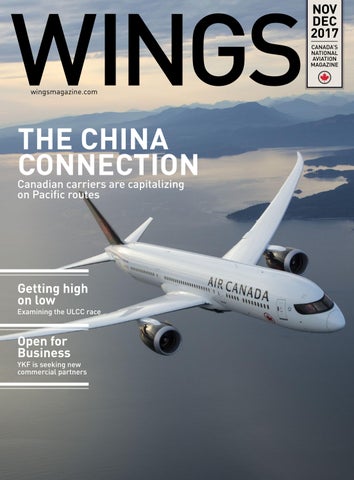
THE CHINA CONNECTION
Canadian carriers are capitalizing on Pacific routes
Getting high on low
Examining the ULCC race
Open for Business
YKF is seeking new commercial partners
NOV DEC 2017 CANADA’S NATIONAL AVIATION MAGAZINE
GAME CHANGER HondaJet.com/Wings
Aviation has never been quite the same since the introduction of HondaJet. Apparently, some rules were meant to be broken if we were to stand by our desire to advance the definition of the ultimate flying experience. Because of our innovative thinking, there is no better place to gain increased productivity., access to more places and time on your own terms. The HondaJet is the fastest, most spacious and efficient way to get it all. Find out more about the world’s most technologically advanced light jet at HondaJet.com . The game has changed. Forever.
M A X C R U I S E S P E E D : 4 2 2 K TA S
I M A X C R U I S E A LT I T U D E : F L 4 3 0 I R A N G E 1 2 2 3 N M
NOV/DEC 2017
UPFRONT 6 Leading edge
Take that, Boeing
8 On the fly
News and opinion
12 Alternate Approach If not now, prime minister, when?
13 At the Gate
Clear skies ahead
14 Glidepath
Honouring past heroes
15 Guest column
Canadian airlines are reaping the benefits of increased flights to mainland China.
CRA/BizAv dispute
BACK 35 Marketplace 38 On final
Fatigue: a bigger problem
FEATURES 16 THE CHINA CONNECTION
Canadian carriers are capitalizing on Pacific routes BY BRIAN DUNN
PHOTO: BRIAN LOSITO, AIR CANADA (TOP); BRIAN LOSITO, AIR CANADA (LEFT ABOVE); MATT NICHOLLS (LEFT, BELOW)
20 GETTING HIGH ON LOW From top: If not now, prime minister, when? P.12 Sorting out the details P.15
Examining the ULCC race BY DAVID CARR
23 OPEN FOR BUSINESS
YKF is seeking new commercial partners BY MATT NICHOLLS
COVER PHOTO: BRIAN LOSITO, AIR CANADA
WWW.WINGSMAGAZINE.COM
November/December 2017 | WINGS
3
Vol. 58, Issue 6 EDITOR
Matt Nicholls mnicholls@annexweb.com 416-725-5637 FLIGHT DECK
Rick Adams, David Carr, Paul Dixon, Brian Dunn, Frederick K. Larkin, Carroll McCormick, Anna Pangrazzi NATIONAL ACCOUNT MANAGER
Mena Miu mmiu@annexweb.com • 416-510-6749 MARKETPLACE ACCOUNT MANAGER
Kory Pearn kpearn@annexweb.com • 519-902-8574 ACCOUNT CO-ORDINATOR
Barb Vowles bvowles@annexbizmedia.com • 416-510-5103 MEDIA DESIGNER
Emily Sun
CIRCULATION MANAGER
Carol Nixon cnixon@annexweb.com • 450-458-0461 GROUP PUBLISHER
Martin McAnulty mmcanulty@annexweb.com COO
Ted Markle tmarkle@annexweb.com PRESIDENT & CEO
Mike Fredericks
WINGS MAGAZINE
P.O. Box 530, 105 Donly Dr. S., Simcoe, ON N3Y 4N5 Tel: 519-428-3471 Fax: 519-429-3094 Toll Free: 1-888-599-2228 Printed in Canada ISSN 0701-1369 PUBLICATION MAIL AGREEMENT #40065710 CIRCULATION Email: apotal@annexbizmedia.com Phone:416-442-5600 ext. 3258 Fax: 416-510-6875 (main) 416-510-5133 Mail: 80 Valleybrook Dr, Toronto, On M3B 2S9 Published six times per year (Jan/Feb, Mar/Ap, May/Jun, Jul/Aug, Sep/Oct, Nov/Dec) by Annex Business Media SUBSCRIPTION RATES Canada – 1 Year $ 32.95 (plus GST - #867172652RT0001) USA – 1 Year $ 57.95 Foreign – 1 Year $ 65.95 Occasionally, Wings magazine will mail information on behalf of industry-related groups whose products
Air Transport Association of Canada
ON THE
WEB
4
WINGS | November/December 2017
Canadian Owners & Pilots Association
and services we believe may be of interest to you. If you prefer not to receive this information, please contact our circulation department in any of the four ways listed above. Annex Privacy Office privacy@annexbizmedia.com • Tel: 800.668.2374 No part of the editorial content of this publication may be reprinted without the publisher’s written permission. ©2017 Annex Publishing & Printing Inc. All rights reserved. Opinions expressed in this magazine are not necessarily those of the editor or the publisher. No liability is assumed for errors or omissions. All advertising is subject to the publisher’s approval. Such approval does not imply any endorsement of the products or services advertised. Publisher reserves the right to refuse advertising that does not meet the standards of the publication.
Canadian Business Aviation Association
Magazines Canada
AVIATION THIS WEEK Looking to catch up on the latest hot news from around aviation and aerospace? Check out Aviation This Week, a live digital version of the top news stories affecting a variety of key markets. It's quick, essential information you need to know! WWW.WINGSMAGAZINE.COM
LEADING
EDGE
By Matt Nicholls |
Take that, Boeing
Airbus, Bombardier join forces to redefine the C Series program
F
5
The new pact also contains a clause that would enable Airbus to buy the program outright from Bombardier in 2025 for what is highlighted as “fair value” – a price to be determined. The C Series program is an important one for Canadian aerospace companies as some 238 suppliers contribute in some way to aircraft development. “On the surface, Bombardier’s new proposed partnership with Airbus would help position the C Series for success by combining excellence in innovation with increased market access and an unrivalled global salesforce,” noted Navdeep Bains, minister of innovation, science and economic development. “The C Series is the benchmark for excellence in the narrowbody aircraft and a cutting-edge Canadian
1. Air Canada earned more than US$1.1 billion in ancillary revenue in 2016 (Pg. 8). 2. Bombardier’s US$73 million Global 7000 enters into service next year. (Pg. 10) 3. 400,000: The number of outbound passengers Porter Airlines carries annually to the U.S. (Pg. 13). 4. In 2016, China made direct investments in Canada totalling $20.6 billion. (Pg. 18). 5. $90 million The amount YKF contributed to Waterloo region’s economy in 2015 (Pg. 23).
6
WINGS | November/December 2017
innovation. It is no surprise the C Series is attracting interest from all corners.” While the C Series/Airbus deal stole headlines from an aerospace perspective, the potential influx of ultra-low-cost-carriers (ULCCs) into the Canadian commercial space will drastically alter the segment going forward. As Wings correspondent David Carr notes in “Getting High on Low,” pg. 20, the race for ULCC service is heating up, as new offerings from WestJet (Swoop), Canada Jetlines, Flair Airlines (which picked up the pieces from NewLeaf Travel earlier this year), as well as Air Canada’s discount offering Rouge, converge on new markets. ULCCs will give Canadians more choices, lower fares and present a more competitive commercial environment. It also means potential revenue streams for regional airports, such as the Region of Waterloo International Airport (YKF). For more, see “Open For Business,” pg. 23. As YKF's Chris Wood notes of the new initiatives his airport is implementing to grow its commercial footprint, “I think we are well on our way to seeing great things.” Great things and new directions indeed. Here’s hoping the Airbus/Bombardier deal and the introduction of more ULCCs pay immediate dividends. | W
It is no surprise the C Series is attracting interest from all corners.
@Wings_Magazine WWW.WINGSMAGAZINE.COM
PHOTO: AIRBUS
all in Canada brings with it significant alterations to the national landscape as the sultry days of summer are replaced by the frigid winds of change, prompting a new direction and preparation for the winter season ahead. The Canadian commercial aviation and aerospace industries are also undergoing changes that promise to reshape the landscape in the months and years ahead. As Wings went to press, Airbus and Bombardier sent shockwaves through the aerospace industry, announcing they were joining forces to manufacture the C Series – the CS100 and CS300 aircraft designed to make hay in the competitive single-aisle, medium-range airline class. It was a stunning move in the development of the program, one that has had trouble gaining traction in a crowded market. The 108- to 133-seat CS100, and the larger CS300 aimed at the 130- to 160-seat segment, have been competing against many competitors, including Airbus’s A320neo family, Boeing (737 MAX), Embraer (E175-E2, E190-E2), Mitsubishi MRJ and the COMAC ARJ21, C919. The new deal gives Airbus a 50.01 per cent stake in the C Series Aircraft Ltd. Partnership, while Bombardier retains 31 per cent and the Quebec Government’s investment agency holds 19 per cent. Currently embroiled in a trade dispute with rival Boeing which saw the U.S. Commerce Department impose harsh duties on the company, the deal could mean Bombardier circumvents the duties being imposed on its C Series aircraft. The deal also enables the C Series headquarters to remain in Montreal, though a second assembly line will be added at Airbus’s facility in Mobile, Ala., allowing for the sale of aircraft in the U.S.
THINK INNOVATION, DURABILITY, QUALITY VISIT ROUSSEAUMETAL.COM TO FIND AVIATION MAINTENANCE EQUIPMENT LIKE NO OTHER
FLEXIBLE STORAGE FOR OPTIMAL USE OF SPACE
5S : Color-coded to organize your inventory Wide range of accessories adapts the storage to your needs Lifetime warranty on the rolling mechanism
rousseaumetal.com
ON THE FLY 8 9 9 10 11
THE LEAD COMMERCIAL BIZJETS RESEARCH PEOPLE
THE LEAD
AIR CANADA TOP 10 IN ANCILLARY REVENUE Air Canada was one of the leading performers among global airlines in ancillary revenue in 2016, according to research by Wisconsin-based IdeaWorks, a consultancy specializing in airline ancillary revenues and Ireland’s CarTrawler, a B2B car rental specialist and publisher of the annual Yearbook of Ancillary Revenue. Ancillary fees will dig deeper into Canadian traveller’s pocket books next year as WestJet and Canada Jetlines launch ultralow cost-carriers (ULCCs), and Kelownabased Flair Airlines, currently Canada’s only operating ULCC, refines its product offering. Air Canada is also working to increase the US$26.29 per passenger it earned last year in ancillary revenue. “The importance and prevalence of ancillary revenue continues to move forward with an ever-larger footprint on airline financial statements and the products offered to consumers,” the report noted. Worldwide airline ancillary revenue hit just over $67 billion in 2016, a 13.8 per
cent year-over-year increase from 2015, and a 198 per cent jump since 2007, when CarTrawler put out the first Yearbook. The top 10 global carriers, led by United Airlines, and including Star Alliance partner Air Canada in 10th spot, accounted for $28 billion, or approximately 41.5 per cent of the total. Air Canada earned just over US$1.1 billion – or 10.4 per cent of total revenue – in ancillary revenue in 2016, with Aeroplan, its frequent flyer program accounting for 45 per cent of revenue, and a la carte services such as baggage check in and travel retail commissions making up the rest. Air Canada has announced it will introduce its own loyalty program in June 2020, severing ties with Aimia, a global loyalty management company that owns and operates the Aeroplan program, originally launched by Air Canada. (Air Canada’s ancillary revenue figures include Rouge, its low-cost leisure airline.) “Similar to all of Air Canada’s North American peers, by managing our own loyalty program, we will be able to take better care of our customers by making decisions in real time that address specific needs,” said Benjamin Smith, Air Canada’s president of passenger airlines. WestJet raised over US$302,000 or US$13.77 per passenger in 2016, contributing to 9.5 per cent of total revenue. While combined ancillary sales from Air Canada/Rouge enabled the mainline
Air Canada earned just over US$1.1 billion – or 10.4 per cent of total revenue – in ancillary revenue in 2016. 8
WINGS | November/December 2017
carrier to crack the top 10, both Air Canada and WestJet are in the middle of the pack when it comes to cash from ancillary sales as a percentage of overall revenue. United Airlines topped the so-called legacy or global carriers at 17 per cent, while U.S.based ULCC Spirit takes in over 46 per cent of its revenue from ancillary sales. This may be more of a concern for Swoop, WestJet’s recently announced ULCC subsidiary, which is expected to begin service next summer (see, “Getting high on low,” pg. 20). It is unlikely that Swoop will be as aggressive in ancillary sales as Spirit, Wizz Air (39.4 per cent) or even Ryan Air, which has come under media fire recently for practices such as assigning flight attendants in-flight sales quotas and encouraging competition among cabin staff. However, JetStar, Qantas’ low-cost carrier earns more than 20 cents of every dollar on ancillary fees. “Canada has not seen a native version of Spirit yet, so consumer adoption will be a significant factor,” IdeaWorks Jay Sorensen, author of the 2017 CarTrawler Yearbook of Ancillary Revenues told Wings. “That could take a year or more for consumers to understand that ULCC methods are designed to save money. Of course, consumers can also swap savings for more convenience by buying a la carte items.” It is interesting to compare sources of ancillary revenue between legacy and ULCC carriers. A CarTrawler comparison between Delta Airlines, where the per passenger spend was US$28.15 (13.1 per cent to the bottom-line) and U.K.-based ULCC easyjet, where per passenger spend was only US$18.54, but ancillary revenue contributed to 21.9 per cent of total revenue. At Delta, frequent flyer and co-branded credit cards accounted for 52 per cent of ancillary revenue, whereas easyjet made no money from a frequent flyer program, and seven per cent of ancillary revenue from its easyjet Plus membership card. The U.K. airline did make 47 per cent of ancillary revenue from baggage check-in, versus 17 per cent. Checked baggage is smaller for global carriers, which continue to include a check bag on their long-haul routes, such as trans-Atlantic flights, the report notes. But where these carriers may have a smaller slice of bag revenue, they generate lots of cash from their frequent flyer programs. WWW.WINGSMAGAZINE.COM
PHOTO: BRIAN LOSITO, AIR CANADA
For late-breaking news and exclusive web content, please visit us at: www.wingsmagazine.com
COMMERCIAL
WESTJET BUILDING 787 HANGAR AT YYC
PHOTO: WESTJET (TOP); EMBRAER EXECUTIVE JETS (BELOW)
WestJet has broken ground on a new $50 million hangar at Calgary International Airport to support expansion and the arrival of its Boeing 787-9 Dreamliners. Once complete, the hangar will occupy 125,000 square feet, stand eight stories tall and accommodate up to four Boeing 737s and one Dreamliner. The first of 10 787s on order is expected to arrive in January 2019, setting the stage for a full transition into an international airline with new services to Europe, Asia and South America. The hangar is scheduled to open later in the spring. The project also solidifies Calgary’s place as a business and leisure hub. “WestJet is the largest carrier at YYC Calgary International Airport and is a major driver of growth in the city,” said Gregg Saretsky, the airline’s chief executive at the ground breaking. “When it comes to building the WestJet hub, Calgary has been a strategic location for our business growth. That partnership commitment is the reason we decided to locate our widebody hangar with our head offices here at YYC.” WestJet operates approximately 110 flights a day or about 56,000 flights per year from Calgary, connecting around 11 million passengers in and out of the city each year. “Our partnership with WestJet
WestJet’s new hangar will accommodate up to four Boeing 737s and one Dreamliner.
continues to be a focus for us as they develop their long-term strategy for growth,” said Bob Sartor, chief executive for the Calgary Airport Authority. “With the decision to place its new wide-body hangar in Calgary, we are pleased to continue to play a role in WestJet’s success story.”
BIZJETS
EMBRAER DELIVERS FIRST U.S. ASSEMBLED LEGACY 500 Brazil’s Embraer has delivered the first Legacy 500 mid-size business jet to roll off the assembly line at its Melbourne, Fla. plant. The expanded facility comprises two assembly lines that now produce four clean-sheet business jets; the entry-level Phenom 100 and Phenom 300, the mid-light Legacy 450 and Legacy 500. “We are very pleased to deliver the first Legacy 500 made in Melbourne, fulfilling our vision of expanding production to
assemble four world-class business jets on Florida’s Space Coast,” said Michael Amalfitano, chief executive of Embraer’s business jet division. The Legacy 500 is the first midsize business jet with digital flight controls, based on Fly-By-Wire technology, featuring side sticks. Its six-foot flat-floor cabin is comparable to some aircraft in the super midsize category. The expansion of the Melbourne assembly facility was inaugurated in June 2016 and the first Legacy 450 aircraft produced was delivered in December of the same year. Since the delivery of the first Phenom 100 made in Melbourne, in Dec. 2011, more than 250 aircraft have been delivered to operators in more than a dozen countries including Canada.
BOMBARDIER PUTS GLOBAL 7000 TO THE TEST Bombardier’s fourth Global 7000 flight test vehicle – the first to feature a fully
The Legacy 500 is the first mid-size business jet with digital flight controls, based on Fly-By-Wire technology, featuring side sticks. WWW.WINGSMAGAZINE.COM
November/December 2017 | WINGS
9
ON THE
FLY
RESEARCH
TAKE YOUR SEAT Flying around the world is predicted to get a lot bumpier in the future as pilots contend with an increase in severe turbulence linked to climate change. The University of Reading in the U.K. has published the first-ever global projections of in-flight bumpiness. The study has calculated that climate change will significantly increase the amount of turbulence worldwide by 20502080, lengthening flight times and adding to fuel burn. While the study’s time line is more than 30 years out, flights are already becoming bumpier more often. “Air turbulence is increasing across the globe, in all seasons, and at multiple cruising altitudes,” said Dr. Paul Williams, professor of atmospheric science at the University of Reading. “This problem is only going to worsen as the climate
Bombardier’s US$73 million Global 7000 is scheduled to enter service in the second half of 2018.
continues to change.” An earlier study led by Professor Williams showed that climate change will make transatlantic flights from Europe to Canada and the U.S. longer in the future. The new research analyzes supercomputer simulations of the future
WE’RE HIRING JOIN OUR GROWING TEAM
10 WINGS | November/December 2017 WG_AirGeorgian_NovDec17_CSA.indd 1
WWW.WINGSMAGAZINE.COM 2017-10-23 7:43 AM
PHOTO: BOMBARDIER BUSINESS AVIATION
equipped cabin interior – took off from Bombardier’s Toronto facility in late September. Christened the “Architect,” FTV4 will be used for interior validation testing and to confirm the comfort level, connectivity and productivity that will be part of the sales pitch for the newest Global. A fifth test vehicle, “Masterpiece” is in final assembly. Architect joins the previous three flight test vehicles at Bombardier’s flight-testing centre in Wichita, Kan. The US$73 million jet is scheduled to enter service in the second half of 2018. The Toronto plant received more good news one day later. Bombardier finalized an agreement with India’s SpiceJet for up to 50 Q400 turboprop airlines. First announced at the Paris Air Show, this is the largest single order for the Q400 program, bringing total firm orders to over 600 aircraft. SpiceJet will be the launch customer for the larger 90-seat Q400.
atmosphere with a focus on clear-air turbulence, which is particularly hazardous because it is invisible to the eye and undetectable by radar. The expected turbulence increases are a consequence of global temperature changes, which are strengthening wind instabilities at high altitudes in the jet streams and making pockets of rough air stronger and more frequent. Severe turbulence is strong enough to toss people and luggage around an aircraft cabin. The study highlights the need to develop improved turbulence forecasts, which could reduce the risk of injuries to passengers and lower the cost of turbulence to airlines. “While turbulence does not usually pose a major danger to flights, it is responsible for hundreds of passenger injuries every year. It is also by far the most common cause of series injuries to flight attendants,” said Luke Storer, a PhD researcher who worked on the study. Turbulence is thought to cost U.S.
airlines up to $200 million annually, although some projections put that number on the low side. Boeing is working with the Japan Aerospace Exploration Agency on a laser system that can spot severe turbulence from a safe distance. “We expect to be able to spot clear-air turbulence more than 60 seconds ahead of the aircraft, giving the crew enough time to secure the cabin and minimize the risk of injuries,” Stefan Bieniawsiki, the program’s lead investigator told Wired Magazine. The system will be tested on a 777 early next year. Flights to popular international destinations are projected to experience the largest increases according to the study, with severe turbulence at a typical cruising altitude of 39,000 feet becoming up to two or three times as common throughout the year over the north Atlantic (+ 180 per cent), Europe (+ 160 per cent), North America (+ 110 per cent) and the north Pacific (+ 90 per cent).
PEOPLE
MSB GROUP WELCOMES FERNANDEZ Montreal’s MSB Group has named Javier Fernandez as its new vice president of North American business. MSB is part of Sogeclair Aerospace. Fernandez will be responsible for overseeing the growth of four companies, which make up the MSB Group in North America. Fernandez moves to Montreal from Madrid, where he was CEO of Sogeclair Aerospace S.A. FLYHT Aerospace Solutions of Calgary has named Derek Payne its new chief financial officer. Payne starts his new role on Nov. 6. Paul Takalo remains chief financial officer until that point. Payne brings more than 19 years in senior financial roles and some nine years experience in the aviation industry to his new role.
Sit back. Sip. Smile. Stop by to enjoy a little comfort during your travels throughout the holidays. Season’s greetings from Irving people everywhere.
WWW.WINGSMAGAZINE.COM DE17-217 Christmas Wings ad FINAL.indd 1 WG_Irving_NovDec17_CSA.indd 1
November/December2017-08-28 2017 | WINGS 11 9:45 AM 2017-08-30 8:57 AM
ALTERNATE
APPROACH By David Carr |
If not now, prime minister, when? Dithering over airport privatization is not an intelligent option
T
12 WINGS | November/December 2017
billion the government needs for transport infrastructure to help eliminate bottlenecks and build more robust trade corridors. The government could kick start the conversation by releasing the Credit Suisse report. That they won’t is inexcusable. Putting a big-ticket item such as airports in the shop window would have been an early signal that the government was serious about attracting private sector investment – including Canadian pension funds already investing in airports abroad. This would help rebuild crumbling infrastructure. It remains paradoxical that Canadian investors can buy into airports abroad, but are sealed off from investing in similar facilities at home. Two factors guarantee to keep the sale of airports alive. Some of the earliest leases are set to expire by 2022, and will soon hamper each airport authority’s ability to borrow money to and modernize facilities. Plus, those private investors that the government needs to build new infrastructure aren’t as interested in partnering with the government on putting shovels into the ground to build rail lines, roads and bridges (unless they can be tolled) as they are in buying performing assets. As a former pension executive and member of the Ontario Pension Advisory Board, Morneau gets that. The dilemma for Trudeau is the time to sell is while the market is hot. As air transport cools airports will lose some of their value, potentially leaving hundreds of millions on the table. So, if not now prime minister, when? | W
“The dilemma for Trudeau is the time to sell is while the market is hot.” with the current bunch, orchestrated that $1.5 billion transaction. None of this was written on the backs of cocktail napkins. Last year, the Canada Development Investment Corporation – the agency responsible for selling off Crown assets – asked Credit Suisse, one of the world’s largest investment banks, to report on airport ownership, including options to privatize. That report remains a closely kept secret. Airport privatization is not necessarily off the table. In an e-mail, Transport Canada told Wings that the government continues to review its policies concerning airports and that any decision would need to be consistent with the Transportation 2030, launched by Transport Minister Marc Garneau last November. Selling airports would raise the $10.1
David Carr is a Wings writer and columnist. WWW.WINGSMAGAZINE.COM
PHOTO BRIAN LOSITO, AIR CANADA
he Trudeau government is all over the map with respect to selling off Canada’s airports and seaports. That shouldn’t come as a surprise. Setting a course for less rather than more state intervention in the economy is not a cog that is at home in this government’s wheelhouse. And let’s face it, the previous gang didn’t do any better. But if there is a single file that could benefit from less political gerrymandering at all levels of government, it is transport. Indeed, dithering over privatization makes that case. Last March, all signs leading up to the federal budget pointed to at least a partial sell-off of parts or all of Canada’s airports. The government did nothing to tamp down such speculation. A high profile meeting last November at Toronto’s swank Shangri la hotel between the prime minister and many of the world’s most powerful institutional investors appeared to clear the path for such privatizations. There are two main drivers for government to sell assets: ideological (to shrink the size of government and make flabby, state-run business more productive and responsive) or to raise cash. The C.D. Howe Institute, a right wing think tank that finance minister Bill Morneau chaired before making the leap into politics, estimates that Ottawa could raise between $7.2 billion and $16.6 billion by selling equity in airports. In April, prime minister Trudeau dismissed privatization as the “easy and quick” solution that people jump to, telling Bloomberg that he is more interested in funding new infrastructure by attracting outside capital rather than selling off airports. Easy? Quick? Hardly. Setting aside the protests of some airports authorities, privatization is not going to be an “easy” sell. Airlines, including Air Canada (a crown corporation until it was privatized in the 1980s) are opposed. So too is the public, many of whom are under the mistaken impression that government still owns and operates airports. As for “jumping” into privatization, the last major national asset sale was more than 20 years ago with the transfer of NAV CANADA. The Chretien Liberals, a government that shared ideological real estate
AT THE
GATE
| By Brian Dunn
Clear skies ahead
Porter Airlines’ Robert Deluce is eyeing new opportunities
PHOTO: MATT NICHOLLS
O
n Sept. 12, Porter Airlines began service to Fredericton from Billy Bishop Airport and Ottawa. Nine days later, a similar service began to Saint John. The two additional routes to New Brunswick mark the 23rd and 24th destinations served by Porter in Canada and the U.S. It’s been quite a ride since Porter’s first flight took off on Oct 21, 2006, from Toronto Island Airport (as it was then called) to Ottawa with just 13 passengers on board. In its first decade (it celebrated it’s 10th anniversary last fall), Porter carried 20 million passengers and is on track to carry three million this year alone. That makes it Canada’s third-largest scheduled service airline, behind Air Canada and WestJet and making Billy Bishop the ninth-largest airport in Canada and sixth-largest in terms of trans-border traffic. But it hasn’t always been easy. For starters, a group of picketers calling for a boycott of the start-up for being too close to their neighbourhood, jeered as passengers boarded the first flight. Then Porter’s push for a bridge linking the mainland to Toronto Island was blocked by then-mayor David Miller. There is a pedestrian tunnel instead. And finally, Porter’s attempt to extend the airport’s runway to accommodate Bombardier C Series jets was shot down by a number of different parties, including federal transport minister Marc Garneau. “That decision kind of shut the door on future material growth at the island airport,” said Robert Kokonis, president and managing director of Toronto aviation consultants AirTrav Inc. “Porter’s in a bit of a bind right now, quite frankly.” But Porter CEO Robert Deluce doesn’t see it that way. “There are still lots of places we can develop our regional service. There are also opportunities for Porter to focus on our key markets (from Billy Bishop) like Ottawa, Montreal and Halifax. There are also opportunities to increase markets in the U.S., especially when we get U.S. customs pre-clearance, which will allow us to offer service to New York and Washington. We already carry over 400,000 outbound passengers to the U.S. from Billy Bishop.” WWW.WINGSMAGAZINE.COM
back, the bridge was supposed to be a lift bridge, which would allow boat traffic to pass through in summer. But it was designed to accommodate about 800,000 passengers a year and we’re now closer to three million passengers.” Porter will continue to largely employ the hub and spoke model from Billy Bishop where it holds 85 per cent of the 202 slots, with Air Canada holding the balance, but is gradually introducing more direct flights that don’t require a stop in Toronto. But the hub and spoke model helps Porter pick up connecting traffic between Halifax and Toronto via Ottawa, noted Deluce. Porter took a gamble when it began offering seasonal service to Mont Tremblant a few years ago, but that move has paid off, according to Deluce with up to five flights a week during the peak winter season. And demand hasn’t decreased after Porter began offering winter service to Burlington, Vt. with more ski hills to choose from. “We’ve built up a tremendous loyal following in Tremblant, especially with those that have homes on the mountain.” Will Porter ever consider going public to raise capital? “We looked at it in 2010, but the market went sideways and decided not to go ahead with it,” said Deluce, who was inducted into the Canadian Aviation Hall of Fame in the fall. “We’ve raised additional funds internally. We effectively have no debt. Perhaps with the purchase of jets, we might consider going public. But right now, it’s not a priority.” What is a priority is to continue offering its customers the best flying experience possible, said Deluce who only sees clear skies ahead. | W
“Without the jets, we still have short- to mid-term growth opportunities.” And if Porter is destined to remain a regional carrier if it can’t operate the C Series out of Billy Bishop, Deluce takes a philosophical point of view. “Even as a regional, we operate as far south as Florida and as far west as Chicago. In my view, it’s not if, but when we will be operating jets. We were caught up in the politics early in a new government’s mandate. Without the jets, we still have short to mid-term growth opportunities.” Porter still hasn’t cancelled its conditional order for up to 30 C Series jets, although Deluce said people shouldn’t read too much into that, other than it is keeping all of its options open. As for the bridge not being built, Deluce said it was a blessing in disguise. “There was nothing before, other than upgraded ferries which continue to operate. Looking
Brian Dunn is a Wings writer and columnist. November/December 2017 | WINGS 13
GLIDE
PATH
By Paul Dixon |
Honouring past heroes
CYBB Battle of Britain commemorative parade a true spectacle
I
14 WINGS | November/December 2017
“Knowing a bit of history allows you to look a bit further into the future.” was that just as many Canadian personnel served in RAF or RN squadrons as RCAF squadrons. This was the reality of the operational tempo of the war and the success of the Commonwealth Air Training Program. Canadians flew and served as aircrew (and groundcrew) in all theatres of the war. When the war was over, those air force officers and enlisted men came back to work and provided a country ripe for growth with the people who had the vision and skills to make that growth possible. Knowing a bit of history allows you to look a bit further into the future as I did at the Battle of Britain commemorative parade held at Boundary Bay Airport (CYBB). The significance of Boundary Bay being that it was both part of the Commonwealth Air Training Program and an operational RCAF base during the Second World War and today is headquarters of the B.C. Provincial Committee of the Air Cadet League of Canada. The parade was made up of more than 600 cadets representing 17 cadet squadrons from around Metro Vancouver. Led by a massed cadet band (they were great!) and colour party, the cadets paraded smartly in front of a crowd of parents and VIPs, undeterred by the driving rain. The
reviewing officer was Lt. Col. (ret) Maryse Carmichael, former CO of 431 Demonstration Squadron and current honourary president of the air cadet league of
Canada. Addressing the parade, Lt. Col. (ret) Carmichael emphasized that it was her involvement in air cadets as a teen that gave her the skills and confidence that have enabled her to achieve what she has in her life. If I had to explain the relationship between the past, the present and the future I would say it’s like driving a car on a highway. The present is where I am right now, hopefully with both hands on the wheel and a full tank of gas. The future is the windshield and the past is the rear-view mirror. The windshield is the size it is because it’s important to know where you’re going and be prepared to deal with the bumps in the road and detours you may encounter along that road. The rear-view mirror is there to give you a view of where you were, without blocking your vision of the future. If you don’t know where you came from, you’ll never be sure of where you’re headed. Standing at Boundary Bay, I was surrounded by the history of our past, but I could see the road ahead in front of me and I liked what I saw. | W Paul Dixon is a freelance writer and a photojournalist living in Vancouver. WWW.WINGSMAGAZINE.COM
PHOTO: PAUL DIXON
always find it important to review moments in history that have shaped this country and the people who call themselves Canadians. In September, ceremonies were held in many communities to mark the 77th anniversary of that epic struggle that drew its name from Winston Churchill’s speech in Parliament on June 18, 1940 – “What General Weygand has called the Battle of France is over . . . the Battle of Britain is about to begin.” For much of the summer of 1940, the airmen that Churchill would later refer to as “the few” stood tall in their Hurricanes and Spitfires. Just over 2,900 pilots were awarded the Battle of Britain clasp. More than 100 Canadians flew in the Battle of Britain; 23 lost their lives. While many Canadians flew with RAF squadrons, No. 1 Royal Canadian Air Force Squadron was a wholly Canadian squadron when it went operational in August 1940. The following year, No. 1 RCAF Squadron was designated as 401 Squadron to differentiate it from No. 1 RAF Squadron and the “400” series of RCAF Squadrons was born. The RCAF squadrons were the result of a bitter and protracted struggle waged by the Canadian government; the idea that Canadians should serve as Canadians, in Canadian units under Canadian leadership. It was a struggle with its roots in First World War. We know of Vimy and the performance of the Canadian Corps under Arthur Currie, but few of us are aware of the Herculean effort expended by prime minister Robert Borden in attempting to assert the role of Canada and other members of the Commonwealth during the Paris Peace Conference of 1919. Mackenzie-King was determined to follow Borden’s path of asserting Canada as a sovereign nation. In 1939, Canada made a declaration of war separate from that of Great Britain, unlike 1914 when Canada was carried along as part of the Commonwealth. Both the government and military leadership were determined to exert as much Canadian influence as possible. The decisions that led to Canadian involvement in the doomed defense of Hong Kong and later on the beach in the failed raid at Dieppe could be seen as the result of demanding more Canadian involvement. In the air, the irony of the Canadian squadrons
GUEST
COLUMN | By Steven Sitcoff
Sorting out the details
CRA targets personal use of corporate aircraft: what you need to know
PHOTO: MATT NICHOLLS
T
he Canada Revenue Agency (CRA) has proposed a significant reworking of its administrative policy as regards the assessment of taxable benefits for the personal use of corporate-owned business aircraft. The CRA’s former position was that the shareholder or employee who benefited from such non-business use would generally be assessed a taxable benefit based on the value of equivalent “first-class airfare.” The latter position was cancelled on Sept. 30, 2012 and since then there has been no clearly articulated policy in this regard. In 2015, the CRA initiated a national audit project targeting this issue. The CRA has recently sought commentary on its proposed policy from the Canadian Business Aviation Association (CBAA), the Canadian Tax Foundation and the Tax Executives Institute. Unfortunately, this is not being handled as a genuine public consultation as the CRA has declined to clearly outline its position in writing and has not widely disseminated it to a broader audience. However, the one thing that is clear is that the CRA has taken an issue that is ostensibly simple and made it needlessly complex. The proposed policy centres around three categories of users, which may be summarized as follows: 1. “Mixed use” trips involving a person who does not control access to the aircraft. A person who does not control access to the aircraft, who is travelling for business purposes and who is accompanied by another person travelling for non-business purposes will be assessed a taxable benefit in respect of the travel companion based on the value of a non-discounted “first class” ticket (presumably, business class) to the same destination. While this should not be controversial, some wrinkles will have to be worked out (for example, for locations not served by commercial airlines). (1) Personal use of the business aircraft by a person who does not control access to the aircraft. Where such a person uses the aircraft, whether alone or with others, for purely personal purposes, a taxable benefit will be assessed equal to the charter rate for the particular type of aircraft and destinations. For example, if the cost of a comparable WWW.WINGSMAGAZINE.COM
total flying hours in the calendar year were for personal use, the original capital cost of the aircraft is $30 million and the prescribed rate of interest is six per cent, the available for use benefit to be added to that person’s taxable income in the year is a hefty $360,000 (i.e. 20% x $30 million x 6%). There are a number of significant problems with the latter category. First, there is no basis to arbitrarily distinguish persons in “control” for such prejudicial treatment, especially where the aircraft is being used principally for legitimate business purposes. Second, the CRA has yet to articulate how “control” is to be determined, and there is concern that CRA auditors will effectively have unfettered discretion to apply this category to a broad scope of situations. Third, the calculation of the “available for use” benefit is far more onerous than that for the analogous “standby charge” applicable for the personal use of a corporate automobile. And finally, the quantification of the taxable benefit is a moving target, which can only be determined in hindsight after year-end. There is obviously much of concern here beyond the harsh tax consequences, as the fallout could have an adverse impact on Canada’s business aviation industry. | W
“the cra has taken an issue that is ostensibly simple and made it needlessly complex.” charter is $100,000, the person would have $100,000 added to their income to be taxed at their marginal tax rate. However, this position presumes rather punitively that if the individual did not have access to a private aircraft they would opt for a charter over a relatively inexpensive commercial flight, while there may also be complications where there is a lack of available comparables for a particular destination or type of aircraft. (2) Personal use of the aircraft by a person who controls access and use of the aircraft. Most worrisome is this category, as it would result in the person being assessed a taxable benefit equal to the sum of the following: (i) an “operating benefit” equal to the person’s proportionate share of the operating costs (variable plus fixed costs but excluding depreciation) for the calendar year, plus (ii) an “available for use” benefit based on the proportion of the person’s nonbusiness use (based on flying hours) as applied to the product of the original capital cost of the aircraft and a prescribed rate of interest. So, for example, if 20 out of 100
Steven Sitcoff is a tax lawyer with Spiegel Sohmer Inc. in Montreal. November/December 2017 | WINGS 15
CONNECTION PACIFIC ROUTES PAY BIG DIVIDENDS
BRIAN DUNN 16 WINGS | November/December 2017
WWW.WINGSMAGAZINE.COM
PHOTO: BRIAN LOSITO, AIR CANADA
THE CHINA
A
Air Canada’s service to China is provided by its flagship aircraft, the Boeing 787 Dreamliner.
W
hile most of our recent coverage of the airline industry has focused on the trans-Atlantic market in summer and southern destinations in winter, the Canada-China/Hong Kong market is also showing signs of heating up with new entrants and added capacity. Comparing the same peak August week in 2016 to 2017, the number of weekly WWW.WINGSMAGAZINE.COM
departures from Montreal, Toronto and Vancouver to all points in China/Hong Kong was 161, up from 128 last year. The number of overall seats is up 23.3 per cent. Air China (plus 43 per cent) and China Southern (plus 48 per cent) show the largest absolute increases in seats. Air Canada, which remains the biggest single carrier from Canada to China with 36 per cent seat share, is increasing its capacity by just over 10 per cent, according to a National Bank
Financial report by Cameron Doerksen. Vancouver is the biggest beneficiary of new connections to China, with 10 different airlines offering 104 weekly flights between Canada and airports in mainland China, Hong Kong and Taiwan. In fact, Vancouver had the second most weekly departures to China (92) of any major airport in North America after LAX with 121. Toronto is no slouch, with 54 weekly departures to China, which is more than Chicago. In November/December 2017 | WINGS 17
addition, Toronto and Vancouver have the highest year-to-year percentage growth in capacity of any of the major North American hubs, Doerksen points out. Visits to Canada from China have been steadily increasing. According to Statistics Canada, the number of visitors to Canada from mainland China was up 22.2 per cent between 2015 and 2016. And while there is no breakdown between business and leisure travel, rising housing prices in Vancouver and Toronto have been driven in part from foreign investment, much of the right relationship which stems from Chinese nationals. can help you soar. Chinese companies have also invested heavily in Canada in recent years. In 2016, China made direct investments in Canada totalling $20.6 billion, up 70 per cent from PNC AVIATION FINANCE I When it comes to financing private aircraft, 2010 levels. China is also Canada’s second we know you value decades of aviation expertise, track record and financial largest merchandise trading partner and strength. That’s why aviation clients across the U.S. and Canada choose the Canadian government is said to be PNC Aviation Finance to help their business take off. pursuing a bilateral trade agreement with To learn more, visit pnc.com/aviation. China. Tighter economic ties between the two countries should help sustain and PNC is a registered mark of The PNC Financial Services Group, Inc. (“PNC”). grow travel, said Doerksen. Equipment financing and leasing products are provided by PNC Equipment Finance, LLC, a wholly-owned subsidiary of “Boosted by a growing propensity for PNC Bank. Aircraft financing is provided by PNC Aviation Finance, a division of PNC Equipment Finance, LLC.In Canada, PNC Bank Canada Branch, the Canadian branch of PNC Bank, provides bank deposit, treasury management, lending Chinese to travel abroad, increased Chi(including asset-based lending through its Business Credit division) and leasing products and services (through its Equipment Finance division). Deposits with PNC Bank Canada Branch are not insured by the Canada Deposit Insurance nese in Canada and greater access to CaCorporation. Deposits with PNC Bank Canada Branch are not insured by the Federal Deposit Insurance Corporation, nadian visa centres in China, we expect nor are they guaranteed by the United States Government or any agency thereof. Lending and leasing products and services, as well as certain other banking products and services, require credit approval. demand for air travel between Canada and ©2017 The PNC Financial Services Group, Inc. All rights reserved. CIB EF PDF 0715-070-195013 China to continue to grow. During the last visit of the Chinese Premier to Canada in Sept. 2016, the two countries announced an official joint goal to double two-way CIBEF Know Ad_Aviation_4.625x5_195013_2017_final.indd 1 2/16/17 11:56 AM travel by 2025. WG_PNC_Aviaiton_MayJune17_CSA.indd 1 2017-04-11 8:25 AM “Clearly, there has been a significant increase in travel between China/Hong Kong and Canada,” Doerksen told Wings. “In fact, it is the second-biggest incoming market (excluding the U.S.) after the U.K.”
We create chemistry to build lightweight space saving interiors.
Achieve a higher level of efficiency with innovative materials from BASF. Labor and cost savings, increased passenger comfort, and design flexibility are just a few of the ways we deliver solutions to the entire value chain. At BASF, we create chemistry. aerospace.basf.com
Moving markets So, what does this all mean for Air Canada? In recent quarters, Air Canada management specifically cited more competitive capacity on trans-Pacific routes and China in particular as a driver for lower yields. While more capacity will pressure yields in the short term, Doerksen believes Air Canada is well positioned to compete and grow over the long term. In the second quarter of 2017, on capacity growth of 13.5 per cent, record system passenger revenues of $3.517 billion increased $374 million or 11.9 per cent from the second quarter of 2016. The increase in system passenger revenues was driven by traffic growth of 13.6 per cent. Yield improvements were recorded in all markets with the exception of the Pacific market. “With its geographically well-positioned hubs in Vancouver and Toronto, strong North American network that facilitates connecting traffic, favourable slot times in key cities in China, and partnerships with Cathay Pacific and eventually Air China, we see Air Canada as well positioned to
18 WINGS | November/December 2017 WG_BASF_third_future.indd 1
WWW.WINGSMAGAZINE.COM
2016-10-24 1:25 PM
successfully compete in this important market,” Doerksen said. “We also note that the number of flights per week between Canada and China is dictated by a bilateral treaty between the two countries. The details of the agreement are confidential, but we understand that Chinese carriers are closer to their cap on weekly flights than Air Canada. As such, further growth in competitive capacity beyond what has already been announced would appear to be limited.” WestJet announced on June 1 that it has applied to Transport Canada (TC) for the designation to fly non-stop between Canada and China using its own aircraft. Under bilateral aviation agreements, TC has the authority to designate carriers to operate services between two countries. An application for designation is the first step in a detailed regulatory process that ultimately involves working closely with regulatory agencies in both nations before service can commence. When appropriate, WestJet said it will announce specific cities and routes. “China is a logical step in our international expansion,” WestJet spokesperson Lauren Stewart said. “It is the world’s largest tourist source market and our federal government is committed to doubling the number of visits to Canada from China within the next four years. With our existing fleet of 767s and our previously announced order for up to 20 new Boeing 787-9 Dreamliners, WestJet is uniquely positioned to take advantage of this rapidly growing market for air service.” If approved, service won’t likely begin before 2019 when the airline starts taking delivery of the Dreamliners, Doerksen said. But since China is close to its cap of seats allowed, there could be an opportunity for WestJet to get in on the action. The unknown is available slots at major airports such as Beijing, Shanghai and Hong Kong, which may force WestJet to look at secondary airports, although Beijing is scheduled to open a new international airport in 2019. On the plus side, WestJet has codeshare partners in China, which could help them get slots. All this to say, the Canada-China market is getting crowded with new capacity from existing and new players. Some examples: • Beijing Capital Airlines announced a new three per week service between Vancouver and Hangzhou with a stop in Qingdao. • Hong Kong Airlines announced daily service between Hong Kong and Vancouver, the first North American destination for the airline. Flights began at the end of June. • Air Canada offers a new Montreal-Shanghai route. • Cathay Pacific is adding three more weekly flights to its Hong Kong-Vancouver route. • Air China has increased its weekly Vancouver-Beijing flights to 11 from seven. • Last December, China Southern launched a new thrice weekly Toronto-Guangzhou flight While on major routes, Toronto-Shanghai is flat in terms of capacity increase, both Toronto-Beijing and Toronto-Hong Kong are seeing more than 10 per cent capacity increases. The capacity increases out of Vancouver are much larger with Hong Kong up 36 per cent (due to the entry of Hong Kong Airlines) and Beijing up 20 per cent, due to Air China up gauging, Doerksen noted. Despite its impressive growth of weekly departures, does Air Canada plan to add additional departures, particularly from cities other than Vancouver, Toronto and Montreal? “We believe China will continue to be one of the most important aviation markets in the years to come,” said Rocky Lo, Air Canada’s director of business development for Asia. “We launched daily Montreal to Shanghai non-stop flights this past February and we currently have no plans for additional departures. However, we are constantly looking for opportunities to grow our China network.” Asked how Air Canada markets the route to differentiate itself from the competition and what is the airline’s advantage, Lo offered this answer. “With service to 57 airports in the United States, WWW.WINGSMAGAZINE.COM
Air Canada has the biggest North American network offering more flights that any other carrier. Together with our Star Alliance partners, Air China and Shenzhen Airlines, and partner Juneyao Airlines, we provide customers with a multitude of conveniences when connecting onwards such as thru-ticketing, thru-check-in, baggage transfers and frequent flyer program reciprocation. “We operate one of the most modern fleets in the world and our aircraft to China feature three cabins of service, all offering comfortable ergonomic seating and enhanced definition intuitive touch personal entertainment screens thus meeting the needs of both business and leisure travellers. “We offer concierge service to our top tier customers frequent travelers as well as all customers who are booked in International Business class. As the only international network carrier in North America to receive a Four-Star ranking according to independent U.K. research firm Skytrax, which also named Air Canada the 2017 Best Airline in North America, Air Canada is the carrier of choice.” Does Air Canada expect to attract business from the U.S. to fly via Canada and if so, how is it promoting it? “We continue to promote our sixth freedom traffic connecting via our three gateways, namely Vancouver, Toronto and Montreal. Customers arriving from the U.S. do not have to go through Canadian customs or claim their luggage. As we offer U.S. preclearance from these three airports, our customers clear U.S. custom in Canada, which makes the return connection seamless, convenient and efficient. “Our flights to China are operated with our flagship aircraft, the Boeing 787 Dreamliner, with our industry-leading international product that offers unique comfort in all classes of service.” Clearly, with so much to offer, the competition should be wary of our flagship carrier. | W
careersinaviation.ca/expo
REACH THE AVIATION & AEROSPACE
PROFESSIONALS OF THE FUTURE! SCHOOL GUIDE Distribution to every high school, Guidance Counselor across Canada BONUS REACH to Aviation market BONUS REACH to Career Expo in Edmonton & Toronto
Booking deadline: DEC 3, 2017 Ad deadline: DEC 7, 2017
Colleges and universities with aviation and aerospace programs, industry hiring managers, and industry associations need to invest and participate in promoting the amazing career opportunities av available in our industry!
CAREERS IN AVIATION EXPOS 2018
TORONTO DATE TBA
EDMONTON
SAT. MAY 12, 2018
The aviation industry is facing a massive shortage of skilled professionals over the next decade. The Careers in Aviation Expos coming to Toronto and Edmonton in 2018 will give members of the current and future work force an opportunity to hear from industry leaders about different career paths including: airplane and helicopter pilots, maintenance engineers, aerospace design, air navigation, n flight operations and more!
GET ON BOARD TO SUPPORT YOUR INDUSTRY! CONTACT US TO BOOK YOUR PLACE: MENA MIU // 416- 510-6749 // mmiu@annexweb.com
| KORY PEARN // 519-902-8574 // kpearn@annexweb.com
November/December 2017 | WINGS 19
Canada Jetlines plans to launch ultra-low fare service from Hamilton and Waterloo this summer.
THE RACE TO PROVIDE ULCC SERVICE IN CANADA IS HEATING UP BY DAVID CARR
C
anada’s lowest airfares are set to drop much lower. After years of being the only advanced economy without an ultra-low-cost carrier (ULCC), the sector is taking off. The trade-off will be added seats, less legroom and a sharp increase in ancillary fares. In September, WestJet unveiled the name and a new purple on white colour scheme for its ULCC subsidiary: Swoop. “The name Swoop denotes exactly what we plan to do,” said Bob Cummings, WestJet’s executive vice-president of strategy, with special responsibilities to launch the ULCC. “It’s a powerful verb that demonstrates we plan to swoop in to the Canadian market with a new business model that will provide lower fares and greater opportunity for more Canadians to travel.” It won’t be alone. After several false starts, Canada Jetlines plan to launch ultra-low fare service from Hamilton and Waterloo this summer, initially with two Boeing 737-800NG aircraft in a 189-seat
20 WINGS | November/December 2017
all coach configuration for the first 90 days, with the fleet increasing to six airplanes by the end of November. Both carriers will join Flair Airlines, which picked up the pieces of sputtering NewLeaf Travel earlier this year, and recently celebrated one year of low-fare service in Canada. The wild card in the deck will be Air Canada, which plans to counter the ULCC universe by offering lower fares on select routes and spreading more Rouge on routes across Canada. “The low-fare option that is now going to be at our disposal definitely is in our back pocket for strategic use,” Ben Smith, Air Canada’s president of passenger airlines told the Globe and Mail. “That is definitely going to be deployed strategically.” Stan Gadek, chief executive of Canada Jetlines, pointed out it is a strategy that has failed in the past. “To be an ultralow-cost carrier and offer those ultra-low fares, you have to have ultra-low costs,” he told Wings. “I know that at certain price points that are very low compared to what is out in the market today, I can make money. If the competition wants to match those prices, we will stimulate significant demand. They’ll fill up, we’ll fill up. The difference is they will lose money on every departure and I will make money.”
Gadek has considerable experience in the U.S. low-cost sector as chief financial officer during the transformation of Air Tran Airways before it was sold to Southwest Airlines, and more recently as chief executive and chief financial officer of Sun Country Airlines, a Minneapolis-St. Paul based low-cost carrier. “The ULCC model has been one of the most successful in terms of profitability,” Gadek added. “But just having a model that works elsewhere does not ensure success. You have to be able to executive on that model with a plan of operations, and a value proposition. If a fare is only $50 below a mainline carrier’s fare, it is not really a compelling value proposition.” Especially when the mainline carriers still attach some perqs to the cost of a ticket, including loyalty points. Of the four models, including Air Canada/Rouge, only Canada Jetlines presents a clean-sheet operation focused exclusively on the ULCC market. Swoop will leverage WestJet assets and Flair plans to continue to offer B2B charter services, which have been the roots of its operation. NewLeaf ’s business model involved re-selling branded seats on aircraft flown by Flair. “Once we got into it and started operating the program, it started producing
WWW.WINGSMAGAZINE.COM
PHOTO: CANADA JETLINES
GETTING HIGH ON LO
WestJet swooped into the ULCC fray in September with its discount option, Swoop.
PHOTO: WESTJET
OW
some good solid business for us. NewLeaf ran into some issues – financing among other things. But it definitely was working and we see a huge opportunity in Canada. The public is screaming for a lower cost option for air travel,” said Chris Lapointe, vice president, commercial operations for Flair Airlines. It has been a bumpy transition. “There is no doubt the transition from charter to becoming a scheduled carrier has lots of moving parts and lots of knees and elbows,” Lapointe pointed out. “Previously, we had several dozen customers every year. Now we have thousands on thousands of customers every month.” Flair has moved off the vestiges of the NewLeaf business plan. Lapointe expects a full transition to be complete by early 2018, in time for the crowded summer period. A new schedule will be launched in December, primarily servicing the Greater Toronto Area, northern Alberta and Greater Vancouver from Abbotsford and Hamilton markets. Winnipeg will be added as a secondary market, and there will be seasonal service to Halifax and points east. “Some capacity will be put into primary markets like Vancouver and Toronto-Pearson, which are too large to ignore,” he said. WWW.WINGSMAGAZINE.COM
Flair plans to add three 737-800s to its existing fleet of four 737-400s by late winter/spring 2018, and grow to 12 airplanes shortly after that, although Lapointe won’t commit to a specific deadline. He does however envision a blended fleet of next generation and legacy 737s for the next three years. “There is lots of life left in these [older] birds,” Lapointe insisted. “They are lower cost, and as long as fuel prices stay at the lower-end of the scale, we can compete.” Both Flair and Canada Jetlines see Swoop as the formidable competitor, at least at the beginning. “I think what is going to evolve is Swoop will be WestJet’s take on Rouge, as opposed to being a pure ULCC,” Gadek said. “Rouge has been successful, but it is more a revenue generator than a low-cost. Rouge is putting more seats on the airplanes, but is not selling tickets at appreciable less money than the mainline carrier. Any way you slice it, Swoop is not going to have ultra-low costs. While they can rely on the parent company or mainline carrier for infrastructure to offset their costs, this is another iteration of the airline within an airline model.” The test, according to Gadek will be the summer peak season, and whether the mainline carriers and their subsidiaries
can resist the temptation to jack up fares. “Demand in Canada in August is very strong,” he said. “It will be very challenging for Swoop or Rouge to maintain ultralow fares when they can up the fare and take advantage of demand. “If you are a ULCC, you have to be disciplined enough to not leverage revenue when demand is strong and always offer the lowest fare on the market because that is your product. The first time a customer comes to your website and they don’t see an ultra-low fare, you’ve lost them. You have to stay true to the model.” Which is why customers should not expect a premium cabin on Canada Jetlines’ flights any time soon. “As we evolve that is a possibility,” Gadek said. “We had an iteration of that at Air Tran. But people who seek out this model do not seek out the bigger seat. We did not get the uptake from it.” Heading in the opposite direction and introducing “seat only” fares recently introduced by American, Delta and United to compete against ULCCs like Frontier and Spirit could be a low-cost option for Air Canada. The strategy has had the unintended consequence of luring customers to spend more. According to the CarTrawler Yearbook November/December 2017 | WINGS 21
of ancillary revenue, “recent comments by Scott Kirby, the president of United, reveal 60 to 70 per cent of passengers buy a higher fare when presented with the basic economy option.” American has experienced comparable results, with 50 per cent of customers opting for the main cabin. What customers can expect onboard the ULCC’s is a more aggressive American-Euro approach to raising ancillary revenues, where “extras” contribute up to 46 per cent of total revenue. WestJet and Air Canada’s (including Rouge) ancillary programs hover around 10 per cent. Are Canadians ready for a heightened sales pitch? Flair’s Lapointe thinks so. “More and more Canadians are getting experience with ancillary fares. On the mainline products of Air Canada and WestJet there has been a significant unbundling of the product over the years. The consumer is getting used to having the option of choosing certain services and not choosing others. They understand that it is going to be taken a bit further and there will be options, I think they can adapt. The public has asked for lower airfares. You have to deliver that some way. Purchase options are the key way of doing that.” Lapointe estimates that ancillary sales account for approximately 27 per cent
Looking to sell or purchase an aircraft? Contact Skyservice Today! Our Aircraft Brokerage team offers the experience, and support you’ve come to expect from Skyservice.
1.877.SKY(759)7598 Jetsales@Skyservice.com www.Skyservice.com
of the airline’s total revenue. He plans to increase that to 30 per cent. A new web site was rolled out in October, which will include a more user-friendly way of pushing out ancillary products. Canada Jetlines will charge for basics such as checked baggage as well as baggage that enters the cabin, seat assignment, beverage and other a la carte services. Gadek will not disclose ancillary revenue targets, but insisted that, “the accumulative total of the typical ancillary services that you would purchase as a customer is going to be substantially lower than what the mainline carriers are selling their unbundled products for.” Gadek is also promising totally digital distribution, with ticket sales exclusively over the Internet. That is a key cost savings relative to mainline carriers that rely on global distribution system providers such as Amadeus and Sabre, who charge for every transaction. “All those systems are expensive from an airline standpoint,” he said. “It’s about $8 to $18 a booking based on the itinerary. In the ULCC world, with the systems that are available to us, you can get your bookings for as low as 35 cents a transaction.” It is clear to both new entrants that you can no longer launch a ULCC with just
two airplanes and stay in the game for the long-term. If all pieces remain in the air for the next 12-months there should be at least 13 airplanes going head-to-head against Swoop and Air Canada. “We believe that we definitely have a lower cost base than the two major air carriers. The $64,000 question is; how long can they dump capacity on the market and keep their shareholders happy,” asked Lapointe. Air Canada and WestJet control 92 per cent of the Canadian domestic market. To try to equal the playing field and give new entrants more staying power, the Trudeau government will introduce legislation next year to lift the ceiling on foreign ownership to 49 per cent from the current 25 per cent. In reality, it is catching up to industry practice. Air Canada channels foreign ownership above 25 per cent through ACE Aviation Holdings, and Sunwing is already 49 per cent by German leisure group Tui. “Lower cost of capital lowers your cost as a business. For those airlines to come into being or expand, they need access to capital,” Bill Morrison, an associated professor at Wilfred Laurier University, told the CBC last year. “Foreign ownership is just international capital.” In the interim, the government has issued temporary exemptions on foreign ownership. Canada Jetlines, which is reported to have raised $27 million in startup capital was granted an exemption. “The barriers to competition are so great,” Gadek said. “Opening up foreign ownership allows us to access that additional capital in order to compete.” It is also something that Flair is “definitely looking at” but has concerns that until the legislation is passed, exempted carriers might be considered foreign airlines, which could disrupt plans to open up routes to U.S. sun destinations this winter. ULCC’s will stimulate new markets and encourage existing travellers to fly more. Even so, WestJet’s Cummings believes there is room for only one ULCC. Lapointe thinks even that might be a bit optimistic. “The Canadian market is not like the U.S. or Europe,” he said. “I think it really has to be a hybrid. We are going to be different from the competition. We are going to maintain a bit of diversification with our service offering with the charter and contract flying for other airlines. Wherever it makes sense.” Not surprising, Gadek, who was involved in the launch of CALite while at Continental Airlines, believes a ULCC operator must pick a lane. “You have the big airline mindset and you have the ultra-low-cost mindset. There is no way you can just flip a switch and turn off one mindset and adopt the other in either direction.” | W
22 WINGS | November/December 2017 WG_Skyservice_third_Novdec17_CSA.indd 1
WWW.WINGSMAGAZINE.COM 2017-10-23 3:27 PM
OPEN FOR BUSINESS
One of the Region of Waterloo International Airport’s main goals is to grow its commercial footprint.
YKF IS ACTIVELY SEEKING NEW COMMERCIAL PARTNERS
E PHOTO: NICOLE CRESSMAN
BY MATT NICHOLLS ndless potential. Strategically planning for the future. On the verge of countless possibilities. Pick your phrase, but when it comes to identifying Canadian airports in transition that have a strong blueprint for future growth, it’s hard not to put the Region of Waterloo International Airport (YKF) near the top of the list. Situated on more than 1,000 acres of prime land in one of the most dynamic – and expanding – economic regions in Canada, YKF is home to more than 250 private and charter aircraft, 25 vibrant and varied aviation and aerospace businesses in a variety of sectors employing more than 300 people. With some 127,824 passengers in 2016 and 110,284 aircraft movements, YKF is one of the 20 busiest airports in the country – and it’s a key economic driver for the region. In 2015, for example, YKF contributed an estimated $90 million to Waterloo Region’s WWW.WINGSMAGAZINE.COM
economy, which is one of southern Ontario’s most diverse. The Region has a strong knowledge- and service-based economy and boasts one of the richest insurance and high-tech sectors in the country. The Waterloo Economic Development Corporation (Waterloo EDC) is a joint economic development initiative that was created by nearby centres to market the region’s technological prowess both in Canada and internationally. Add in the area’s affordable housing and strong commitment to community and it means plenty of potential for YKF in the form of future business and commercial traffic. Enhancing the airport’s commercial footprint is an important part of the Region’s airport development plan. “There are 2.5 million people living within a 35 kilometre circle of the airport that are already travelling – so there is significant room for commercial growth here,” YKF general manager Chris November/December 2017 | WINGS 23
CHANGE AGENTS
A LOOK AT SOME OF THE LEADING AVIATION AND AEROSPACE BUSINESSES AT YKF If you’ve just got into the corporate aviation game, the CHARTRIGHT AIR GROUP can help. Chartright set up shop at the airport in 2015 and opened its new fullservice FBO last year. Its pristine 50,000 sq. ft. hangar, VIP departure lounge, office space, de-icing and full maintenance capabilities – as well as 120,000 litres of bulk fuel storage – make it an excellent choice for BizAv warriors seeking a suitable alternative to the congestion of Pearson International. QUOTABLE: “Many of the clients that come here are coming for convenience. They can climb aboard their aircraft and be roaring down the runway in record time. At Pearson, you could be waiting for all kinds of traffic – especially in winter operations when you have a backlog from anti-icing and de-icing operations” – Constantine Tsokas, VP maintenance, Chartright Group FLITE LINE SERVICES is a multi-service aviation support company offering fixed-based operations (FBO), charter, maintenance (single-engine light aircraft to complex business jets) and more. The YKF location has a strong business aviation focus and specializes in maintenance with three full-time engineers and two contract engineers. Flite Line is a focal point for American corporate traffic with some 80 per cent from south of the border. Most private aircraft operators using the FBO are from Canada seeking an alternative to Pearson International. QUOTABLE: “We are a full-service AMO and fix Challengers, Citations, Pilatus, Warbirds, Pistons . . . it covers a wide range of aircraft.” – Derek Hammond, manager VP, Flite Line Services
AMO 42-17
Wood told Wings on a recent airport tour. “We are positioning ourselves for this growth. Fifteen years ago, a decision was made to build an airport capable of handling scheduled service. Over $100 million dollars has been invested to bring this airport to where we are today. We have great infrastructure and are ready for further development. We are staffed appropriately, we have our own fire service, we have our own winter maintenance and our crews are second to none. We can keep that runway clean with the best of them. All the elements are in place for strong commercial expansion.” Tony LaMantia, president and CEO for the Waterloo Economic Development Corporation, supports Wood’s assessment. Currently, the airport has one scheduled daily flight – WestJet to Calgary – and Sunwing’s once-weekly seasonal service to Punta Cana, Dominican Republic. In 2016, this service – and an American Airlines service to Chicago – generated approximately 126,000 passengers to and from YKF. LaMantia maintains it is fundamentally important that the airport increase its commercial footprint given the Region’s population growth and corporate mix. Add in the reality of over capacity at Toronto’s Pearson International Airport and
S E RV I C E S ELT recertifications EBC ELT distributer Aircraft maintenance and inspections Specialized structural modifications and repairs (STOL, wing extensions BRS systems) Float repairs and changeovers Composite repairs and modifications Avionics (altimeter certification, transponder correlations) Indoor heated storage (valet & packages available)
CONTACT Dave Vieira 705.471.9929
Nate Morrow 705.477.4356
North Bay, Ontario northernheightsaviation@gmail.com F I N d u S O N FA C E B O O k
NorthernHeightsAviation
24 WINGS | November/December 2017 WG_NorthernHeights_NovDec17_CSA.indd 1
WWW.WINGSMAGAZINE.COM 2017-09-29 1:12 PM
CHANGE AGENTS GREAT LAKES HELICOPTER/ ROTOR SERVICES is one of the most established tenants at YKF. The school offers a variety of programs in a dynamic, varied aviation space including private pilot’s licence training, commercial pilot’s licence training, foreign licence conversion, advanced training options for type ratings, night ratings, instructor ratings and more. Great Lakes Helicopter also partners with Conestoga College on its two-year commercial pilot general arts and science diploma. The fleet includes Robinson R22/R44 helicopters and a Bell 206B Jet Ranger. The company also offers aerial spraying services, introductory flights and helicopter rides. Rotor Services is its maintenance arm and eastern Canada’s only R22/R44 main rotor blade service centre. QUOTABLE: “Our graduates find work in a wide variety of industry segments and we give them the honest truth on the programs . . . how hard they have to work, what they have to look forward to. If they’re still interested, we say, sign up.” – Adam Tastula, chief pilot, Great Lakes Helicopter
commercial growth in the future makes sense. “We are tracking to get close to a million people in about 10 years, but given the migration that we are getting from the GTA that is likely to happen in seven to nine years,” he said. “So that, plus the cluster of business investment in the region, indicates to me that this is going to be a key part of our growth story. So, our ability to work together to ensure that the 20-Year Airport Master Plan is implemented and that we have the anchor companies to drive that is going to be critical.” The Master Plan LaMantia is referring to is a comprehensive look at airport expansion and growth prospects over the next two decades. Released in concert with the airport’s Business Plan this year, it is a tool used by the airport to plan for future growth development and infrastructure enhancement. Both documents lay the framework of shaping the airport into a dynamic national and international gateway, the catalyst of which is a stronger commercial presence. It is a $375 million plan, which will build out to accommodate 2.5 million passengers. A third and critical piece in the quest to bring in the commercial element to YKF was put in motion this fall, when regional
council introduced its new exclusive route plan – offering established carriers the chance to “lock in” point-to-point routes for a two-year period. The innovative plan is intended to establish a strong commercial travel hub at the airport. Currently, some 95 per cent of passengers fly through Toronto Pearson, Hamilton, Toronto Billy Bishop, Buffalo, Detroit or London Airports, making YKF the largest directly underserved market in Canada. This represents tremendous commercial opportunities, especially given the growing population base. Under the proposed initiative, airlines will be given an exclusive deal to lock in specific destinations if they choose to fly out of YKF. In order to qualify, new and established airlines must submit proposals from Oct. 2017 to Jan. 2018 and are evaluated through a detailed Request For Proposal (RFP) process. Airlines with established operating procedures in place would be leading contenders for the program – and those that add economic value to the region. “We are the 10th largest population in the country with one flight a day,” Wood said. “We have beaten our heads against the wall for a number of years trying to attract carriers and help carriers understand
KITCHENER AERO has been serving the needs of fixed and rotary clients since 1977. Its core business is the installation and certification of avionics systems for a wide range of clients including recreational flyers, corporate operators and commercial/regional airlines. It also has many special mission clients. Some 150 aircraft per year are serviced at the company’s 10,000 sq. ft. hangar, and its mobile teams travel to all parts on the country to work on aircraft. Mid-Canada Mod Center (MC2) is the company’s Toronto-based division, and it is also a leader in avionics installation and servicing including expertise in avionics sales, design, service, support, repair and installation for corporate and commercial aircraft. QUOTABLE: “Anyone can buy equipment and inventory. We have some of the most talented, hardworking individuals I have had the pleasure of working with over the past 40 plus years. They are the main reason for our success.”– Bill Arsenault, president, Kitchener Aero WWW.WINGSMAGAZINE.COM
November/December 2017 | WINGS 25
CHANGE AGENTS NAV CANADA opened its new air traffic control tower in June. The structure replaces the existing tower built more than 48 years ago. At 19.4 metres high (64 ft.), the new tower is five metres (16 ft.) taller than the present structure. The fourstorey building has more radar screens, better sightlines, efficient workstations and more. In all, it’s just a more efficient, more functional tower for a developing airport. QUOTABLE: “We’re a floor higher so we have better sightlines. If there is airport expansion in the future, we are prepared and here to provide that service.” – Steve Boyd, unit operations specialist, NAV CANADA One of YKF’s most unique tenants is the WATERLOO WARBIRDS – a volunteer run organization based at FLITE LINE SERVICES. The Waterloo Warbirds started up in 2014. The aircraft moved to YKF from a jet aviation museum in London, Ont. with a focus on becoming primarily a flying-based organization – airshows, flyovers, working with the local cadet program and passenger rides. The Warbirds adds a certain historical caché to the airport – Cold War military aircraft that bring a “wow” factor. There are three flying aircraft in the fleet with two in restoration, including a Canadair CT-133 Mk3, Silver Star, an Aero L-29 Delfin and a De Havilland DH-155 Mk 55 Vampire. Later this year, a Mig-15 will join the trio of flying
aircraft. Another T-33 will be added next year. QUOTABLE: “It is not a money making endeavour by any stretch of the imagination for the owners, volunteers or organization. The proceeds we are making are going right back into the operation of the aircraft, insurance, hangarage . . . it does bring a cool factor to the airport.” – David Kreutzkamp, marketing manager, Flite Line Services WATERLOO WELLINGTON FLIGHT CENTRE (WWFC) The WWFC is one of the most experienced flight schools in Canada and has played a significant role in the development of the airport. Founded in 1932 at Lexington field in North Waterloo as a flying club, today the flight school offers aspiring pilots a wide variety of programs, including Pilot Ground School, Commercial Ground School, IPC Ground School, UAV pilot training, Integrated ATP Program and two post-secondary degree programs with Conestoga College and the University of Waterloo. WWFC has several career development partnerships with prominent airlines including Sunwing (Direct Entry Pilot Program), Jazz Aviation (Pathways Program), Air Georgian (Soar) and Porter Airlines (Destination Porter). The flight school boosts a modern fleet of Cessna 172S aircraft and has acquired new SIMs for pilot development. It is offering a new ATPL program in January. QUOTABLE: “We have morphed from a relatively local flying school to one of the five or six major aviation organizations in Canada. Our two post-secondary partnerships are keys to that success.” – Bob Connors, general manager, WWFC
LEKTRO The Original Towbarless Tug Setting the Standard in Excellence Since 1945
Models ranging
15,000 to 280,000 lbs.
Electric Towbarless Certified Easy to Use Universal Rugged Simple to Maintain www.
LEKTRO .com
1-800-535-8767 1-503-861-2288 sales@lektro.com 26 WINGS | November/December 2017 WG_Lektro_NovDec17_CSA.indd 1
WWW.WINGSMAGAZINE.COM 2017-10-20 12:49 PM
“If you can capture lightning in a bottle, I think Canadians will respond with their wallets.” that there is a large population here but most of them are being served by their hub at YYZ. So, this has been the story of our lives here for a number of years.” The new initiative will most certainly be attractive to established Canadian carriers and the new ultra-low-cost-carriers (ULCC) looking to gain a foothold in the Canadian commercial landscape. Earlier this fall, Canada Jetlines announced it has had active negotiations with the Region of Waterloo to set up shop at YKF. The company plans to operate initially with two Boeing 737-800NG aircraft in a 189-seat all coach configurations for the first 90 days, with the fleet increasing to six airplanes by the end of November. (For more on ULCC, see “Getting high on low,” pg. 20. Wood told Wings carriers are trying to target communities like Waterloo Region and compete on price and fly point-to-point scenarios without going through the hub and spoke model that Air Canada, WestJet and even Porter are operating on. COMMERCIAL SPINOFF EFFECTS While enhancing the commercial footprint and bringing in new entrants into YKF is a key part of the airport’s future focus, there are other opportunities here, especially in corporate and general aviation. And with a strong mix of tenants offering a wide variety of aviation and aerospace services, including fixed- and rotary-wing
flight training options, maintenance and aerospace facilities and more, YKF is uniquely positioned for growth in all areas. Next June, for example, YKF will be hosting the Canadian Business Aviation Association (CBAA) conference to showcase its strong footprint to corporate decision makers from coast to coast. YKF is also a solid partner in the new Southern Ontario Airport Network (SOAN), a group of 11 commercially significant airports seeking strategic ways to grow and develop corporate aviation in Southern Ontario and alleviate the pressure on Pearson. Bringing the CBAA conference to the airport will showcase what YKF can do from a corporate aviation point of view, creating corporate buzz. “That’s why we went after the conference so aggressively,” Wood said. YKF is partnering with FBO and maintenance specialist Chartright Air Group on the event. (For more on Chartright and other YKF airport tenants, see “Change Agents.” With its solid relationship with the Waterloo Economic Development Corporation, the surrounding communities and its airport partners – and its sound expansion strategy in place – YKF is open for business and seeking new opportunities. All parties accept and understand it is very much a slow and steady process. “There are opportunities for ULCCs here, there are opportunities for business travellers, there are opportunities for leisure, there are opportunities for a low cost base, there are opportunities for corporate,” Wood said. “We have two great FBOs now and another third fueling option – and there is a lot of hangarage on site.” So does this mean the YKF general manager and longtime airport employee is happy with his airport’s footprint and progress? “I would always like to see more activity here,” Wood said. “But we are doing several new things – the Master Plan, our Business Plan and now the RFP. So, I think we are well on our way to seeing great things.” | W
CYOO is Ontario’s Busiest GA/ Corporate ONLY Airport serving Oshawa, Durham Region and the Greater Toronto Area
Serving Toronto’s Corporate traffic with the lowest landing, ramp and fuel costs Full Service Premier FBO open 24/7/365 GNSS/LPV approaches down to 250 ft AGL Nav Canada control tower and Canada Customs on-site Home to over 250 Aircraft, 5 aircraft maintenance facilities, 2 flight schools and 300,000 sq ft of hangar space
www.oshawa.ca/airport November/December 2017 | WINGS 27
WWW.WINGSMAGAZINE.COM TAAS_M-17-1050_ADVERT_Wings-Quarter_1.0.indd WG_Oshawa Executive Airport_Julyaug17_CSA.indd 21
2017-06-05 Untitled-19:41 9:31 1 AM
2017-08-15 8:50 AM
#182
The official publication of the Canadian Business Aviation Association
NEWS BRIEF
The Year in Review
CEO’S CORNER
Read the CBAA Annual Report at www.cbaa-acaa.ca. 2017 was a year that saw the CBAA expand its services to members and continue its work to resolve issues related to government policies and regulations. Here are a few highlights of our accomplishments. A more responsive association...Anthony Norejko, CBAA Vice Chair, assumed the newlycreated position of Vice President, Membership Relations and Development in July 2017. Anthony’s task is to meet with and engage members and potential members, ensuring that a) CBAA is responsive to the needs of its community and b) our members are aware of and understand the value of CBAA’s services and efforts on their behalf. A stronger safety culture…CBAA’s groundbreaking “Partner-in-Safety” program has been
C A N A D I A N B U S I N E S S AV I AT I O N A S S O C I AT I O N
2017 ANNUAL REPORT
About the CBAA Formed in 1961, the Canadian Business Aviation Association defends the interests of Canada’s $12.1 billion business aviation sector. Its mission is to represent and promote the Canadian business aviation community globally, advocating safety, security and efficiency. With approximately 400 members including operators, management companies and suppliers, CBAA represents the entire business aviation community with one collective and powerful voice.
t is my privilege to report on our progress and success with this 2017 Annual Report, and to provide you with a preview of what lies ahead in the year to come. I am proud to say that every year, the CBAA works harder and more effectively on behalf of its members and sector. Over the last year, we were able to raise the bar again, increasing our advocacy efforts and expanding member services. The CBAA is a dynamic advocate for Business Aviation: we continue to press ahead for solutions on critical files like taxation on the personal use of business aircraft, and flight & duty times for 704 operations. We have also made significant progress on resolving issues outside of government’s sphere of influence, such as our success in finding ways to deal with GTAA slot and landing restrictions. We are active internationally, working with IBAC and Business Aviation associations in every jurisdiction, develop shared advocacy messages, deal with issues such as carbon emissions schemes, and educate policy-makers globally about the value of our sector. The CBAA is committed to assisting your safe operations and to preserving our enviable record as the safest form of flight in the world. We are expanding our SMS/ RMS program, Partners-in-Safety, with
2017 CBAA ANNUAL REPORT
Fighting for your rights….in 2017, CBAA’s most critical advocacy activities focussed on: successfully protecting landing rights at Toronto Pearson International Airport; flight and duty time regulations that met the needs of CARs 704 operations, and working with CRA for a fair and reasonable tax policy on the personal use of business aircraft. These efforts were supported by our ability to make a credible economic argument based on the data in our study, the Economic Impact of Business Aviation in Canada, which was updated in 2017. Supporting our labour force…the CBAA has taken a number of actions to help you attract and retain staff. These included our 2017 Compensation Survey, a new $10K scholarship aimed at schedulers & dispatchers and other aviation professions, and the creation of CBAAendorsed professional development courses created or adapted specifically for Canadian business aviation operations.
Chair’s Message | HOW CBAA IS MAKING A DIFFERENCE
I
enhanced and expanded to more fully support regulatory compliance, especially for small operators. New or improved services include a no-charge, on-line RMS hazard reporting (and confidential) database, with new sample templates and training as well as a new Flight Data Analysis Service, supporting our existing CARs 604 SMS that has been vetted by Transport Canada.
new training, a new Flight Data Monitoring option and new sample templates supporting the RMS. We are proud to continue to offer all of the Partners-in-Safety elements at little or no cost. Finally, we have taken a number of actions to help attract and retain a strong and dedicated Business Aviation labour force, with our new Compensation Survey and Schedulers and Dispatchers scholarship, with the first ones awarded at CBAA 2017. I look forward to continuing to work with the Board, staff and members in the year to come to make even greater advances on behalf of Canada’s $12.1 billion Business Aviation industry.
Increasing sales and marketing opportunities…
Rod Barnard Director, Aviation and Travel Services Chief pilot Kal Aviation Group
1
in conjunctions with existing programs like Industry Partners, our annual convention and regional chapter meetings, CBAA’s newlydesigned Canadian Pavilion is being used to enhance Canada’s presence at key venues like NBAA-BACE.
As I will be retiring December 31st, I find myself reflecting on my years at CBAA as President and CEO. Through challenges, difficulties and triumphs, one thing is clear: without the unflagging support of the staff, board and most especially, our members, my efforts would not have amounted to much. Instead, thanks to our collective efforts, I am proud to say that the CBAA today is a strong and growing organization. I am very satisfied that the infrastructure in place today allows my successor to have a base to build on. I had no rule book coming into the position; I learned on the job. Some of those lessons were hard won. I learned, for example, that when dealing with government, nothing was cut and dried. There are many external factors that, fairly or unfairly, influence government decisionmaking. This problem was never more evident that during our protracted discussions with TC on flight and duty time regulations.
continued on page 2 1 CBAA | News Brief 1 CBAA-ACAA News Brief
To represent and promote the Canadian business aviation community globally, advocating safety, security, and efficiency
www.cbaa-acaa.ca
CONTENTS
3
A look ahead to 2018
3
Enhanced Partners-in-Safety program ideal for small operators
3
Flight and Duty Time Regulations
4
Thanks to CBAA Canadian Pavilion participants
5
Find out how our Corporate Partner program could help your business
5
Thanks to CBAA Chapter Meeting Sponsors
substantive progress for our members. Discussions dragged on The first principle was for over seven years – and to never take “no” for an on my docket for five of answer: that is to say, we them. During that time, our were in communications objections – and those of our with officials constantly, Rudy Toering, keeping our issues on the colleagues in the aviation President & CEO coalition – were consistent. table, suggesting reasonable Unfortunately, progress we remedies, and never letting made under the previous government were up the pressure. They may have gotten wiped out when the new regime came in tired of hearing from us, but they always and TC took it as an opportunity to undo knew what we were fighting for. our gains, as the current minister seems to Second, we had to have our facts lined be indifferent to tackling the real issues. up – if we were making a case, it had Nevertheless, we continued to move to based in reality, and defensible. We forward: CBAA had a job to do and I had couldn’t make things up and then expect to find ways to work, and build success, that government would be sympathetic to in this arbitrary environment. We used our position. other avenues to make our case – it is Third, we had to be professional. While our view that the way flight & duty time trying to move the bar was extremely regulations were created flouted many frustrating at times, and it was difficult to government rules -and we pursued them deal with officials, we had to bear in mind all, meeting with Treasury Board, the that they had work-related challenges too, Regulatory Cooperation Council, MPs and had to follow orders, deal with staff and others to demonstrate how flawed shortage, and so forth. So, despite the the process had become. disagreements we had, we always dealt Indirectly, we may have made progress with the people respectfully and honestly. on this front: CBAA will be participating in Now that I am passing the torch, I hope a Treasury Board consultation to provide I helped create a stronger association feedback on ways to improve the process and sector. If I achieved that, in even the by which regulations are created smallest of ways, I can feel that I have left a I learned that our success was built worthwhile legacy. I wish all of you success on fundamental principles – and by your future endeavours. Keep up the good applying them consistently, we could make fight, and safe skies!
continued from page 1
1 Rideau Street, Suite 700 Ottawa, ON K1N 8S7 Tel: (613) 236-5611 • Fax: (613) 236-2361 Email: lberndt@cbaa.ca • Website: www.cbaa-acaa.ca
STAFF MEMBERS President and CEO Rudy Toering, rtoering@cbaa.ca Executive Assistant and Director of Administration Aime O’Connor, 613.236.5611 ext. 228, aoconnor@cbaa.ca Vice President, Government and Regulatory Affairs Merlin Preuss, 613.656.0505, mpreuss@cbaa.ca Membership and Communication Services Manager Lindsay Berndt, 613.236.5611 ext. 221, lberndt@cbaa.ca Vice President Membership Relations and Development Anthony Norejko, 416.435.1942, anorejko@cbaa.ca Marketing & Industry Relations Debra Ward, 613.274.0619 dward@cbaa.ca Events Coordinator Lise Hodgson, 613.854.4686, lhodgson@cbaa.ca
Finance accounting@cbaa.ca 613.236.5611 ext. 222
BOARD OF DIRECTORS EXECUTIVE COMMITTEE Chair • Rod Barnard Director Aviation and Travel Services and Chief Pilot Kal Aviation Group Vice Chair • Anthony Norejko President Crew Sked Secretary • Bill McGoey President Aurora Jet Partners Treasurer • Michael Fedele Vice President and General manager Execaire , a division of I.M.P. Group Limited
BOARD MEMBERS AT LARGE Peter Bing • Chief Pilot Sobeys Inc.
Jean-Christophe Gallagher, Eng. • Vice President/Business Aircraft Bombardier Clement Nadeau • Operations Manager/Chief Pilot A.G. Aviation Ltee. Mark Van Berkel • President & CEO True North Avionics
David Weger • Sr. Director Administration Services Potash Corporation of Saskatchewan Inc.
Gary Wood • Director – Corporate Sales & Marketing Flying Colours Scott Harrold • Regional Sales Manager Signature Flight Support
James Elian • President & Chief Operating Officer AirSprint Susan Gunn • Operations P.M. Air
Lisa Clarke • Regional Sales Manager FlightSafety Canada Ltd. Ehsan Monfared • Associate Clark & Company
Lyn Shinn • VP, Central Region, HondaJet Sales and Pre-Owned Aircraft Sales Skyservice Business Aviation Inc.
CBAA-ACAA News Brief
2
ADVOCACY AND NEWS
Ensure you are in compliance with our expanded Partners-in-Safety Program
S
afety is everyone’s goal. But, meeting regulations while operating effectively in a busy environment can be challenging. And, we all need a life… The CBAA has a simple and effective solution that can help you implement and remain compliant with your safety requirements, with a program that has been designed specifically to support Canadian business aviation operations. In partnership with experts in this field, including Aerofoil Consulting, OBDS, TrainingPort. net and Plane Sciences, Partners-in-Safety offers: • On-line CBAA Risk Management System (RMS): this easy to use tool is specifically designed to help corporate flight departments meet SMS requirements. Together with the sample CBAA Operations Manual, it is designed to meet all applicable SMS requirements. • CBAA RMS Training: TrainingPort.net is updating its SMS and is providing a CBAA RMS specific module. • CBAA Sample Operations Manual (OM): two versions of this manual are available free of charge to meet the needs of small corporate operators and owner-operators. The manual has been reviewed by Transport Canada. Operators will need to edit and maintain these manuals to their specifications. Basic assistance with the CBAA Sample OM is available free of charge to CBAA members. • Downloadable resources: in addition to the Sample Operations Manual for small operators, we have a variety of other downloadable resources, including a full-scale SMS Manual and Operations Manual for larger, more complex operators, and much more. • Flight Data Analysis Service from Plane Sciences Partners-in-Safety is a Transport Canada-vetted toolkit that helps ensure that every business aviation operation, regardless of size, can operate within the regulations and strengthen its safety culture. For more information on how the program could help your operations, and to sign up, please contact Lindsay Berndt, lberndt@cbaa.ca.
A LOOK AHEAD TO 2018
C
BAA is constantly looking for ways to increase its value to members and to influence decision-makers. Here are just a few of the activities you will see in the coming year….
ENGAGEMENT THROUGH SOCIAL MEDIA.
The CBAA is launching a comprehensive social media program that will allow us to engage our members and community, to educate, inform and connect more effectively than ever before. According to Anthony Norejko, CBAA Vice President of Membership Relations and Development, we will “revamp and improve our social presence, and share the information that matters to broaden members’ perspectives.” The plans include a revamped Twitter presence, greater activity using LinkedIn and other social forums, as well as new information sources like podcast interviews from industry leaders, 3
3 CBAA | News Brief CBAA-ACAA News Brief
a refreshed focus on chapter meetings to promote grassroots feedback and hosted video conference meetings. ADVOCACY AND AWARENESS.
CBAA will continue to press for resolution to its critical issues and priorities protecting our access to airports, fighting for fair regulations and encouraging growth in our sector. Our message is clear: Business aviation is at the centre of economic opportunity anywhere companies and communities need to connect – and the CBAA will be promoting the value of our sector to politicians, civil servants, influential national business associations and others. CORPORATE PARTNERS PROGRAM.
New and exciting inclusive opportunities for members to maximize their reach and influence. For more information, please contact Lindsay Berndt, lberndt@cbaa.ca.
Flight and Duty Time Regulations
T
he CBAA has made two submissions to Transport Canada regarding the draft flight and duty time regulations. The first, on behalf of CBAA 704 members, and the second as part of a larger aviation coalition. The submissions are our formal response to the proposed regulations, Flight Crew Members Hours of Work and Rest Periods, published in Canada Gazette I on July 1, 2017. The proposed regulations, as well as the process that led to their creation, are unsatisfactory to the extreme in a number of critical areas, and the CBAA worked directly with its 704 members as well as within a larger aviation community to identify and address each of the issues. You can access both submissions at www.cbaa-acaa.ca.
CBAA makes its case for business aviation to the Canadian Transportation Agency (CTA)
T
he CBAA has made a brief submission on the CTA’s Regulatory Modernization Initiative. Even though the initiative did not appear to affect members directly, CBAA took this opportunity to provide context and information for any future decision-making and to deal with any potential down-stream effects of regulatory modernization. You can access the submission at www.cbaa-acaa.ca.
To represent and promote the Canadian business aviation community globally, advocating safety, security, and efficiency
www.cbaa-acaa.ca
EVENTS AND MEETINGS
EVENTS
CALENDAR OF EVENTS
November 7-8 2017 CBAA at 2017 Canadian Aerospace Summit December 6th 2017 Quebec Chapter Meeting sponsored by: Starlink Aviation & Signature Flight Support February 6-9 2018 CBAA at Schedulers & Dispatchers 2018
VISIT CBAA AT SCHEDULERS & DISPATCHERS Will you be attending the 2018 Schedulers & Dispatchers Conference February 6-9, 2018 in Long Beach, CA? Stop by booth # 2260. CBAA’s head office staff will be on hand to provide information and answer your questions.
Mark your calendar for CBAA 2018!
J
oin us on June 12 -14 for a unique opportunity to connect with high-value companies and innovative leaders, as our Diamond sponsors, the Region of Waterloo International Airport and the Chartright FBO host CBAA 2018 in Waterloo, ON. The convention will feature educational opportunities, CBAA-endorsed professional development courses, as well as its exhibit, static display and more! Sponsorship opportunities are now available! Contact Lise Hodgson, lhodgon@cbaa.ca for more information.
THANKS TO CBAA CANADIAN PAVILION PARTICIPANTS
The CBAA would like to thank everyone who joined us at the CBAA Canadian Pavilion at NBAA-BACE and helped represent Canadian business aviation and make this event a memorable one!
CBAA-ACAA News Brief
The CBAA makes your business better.
4
JOIN TODAY!
ADVOCACY | OPERATIONAL SUPPORT CONNECTING THE INDUSTRY | SUPPORTING OUR PEOPLE
CBAA – Helping Business Aviation Take Flight Since 1961. For more information on membership, visit www.cbaa-acaa.ca or contact Lindsay Berndt, lberndt@cbaa.ca CBAA-ACAA News Brief
4
MEMBERSHIP
Find out how our Corporate Partner program could help your business
C
BAA is proud to announce a new program that will maximize your reach and influence with Canada’s business aviation operators and managers. As a CBAA Corporate Partner, you will enjoy complimentary year-round priority marketing opportunities at all CBAA’s venues and on electronic platforms, including the annual convention, chapter meetings, website, print
CBAA Chapter Meeting Sponsors – THANK YOU!
A
very special Thank you to all 2017-chapter meeting sponsors! Without your gracious support, these important meetings would not be possible. Keep an eye on CBAA’s calendar of events for upcoming meeting dates.
materials and more. PLUS, Corporate Partners enjoy a complimentary CBAA membership! The Corporate Partner program is your onestop shop to purchase packages that include membership, a convention sponsorship and booth as well as chapter meeting sponsorship and marketing. Further information will be included with your 2018 membership renewal package.
• • • • • • • • • • • •
Bombardier Dassault Falcon Jet Embraer Executive Jets FlightSafety International Gulfstream Innotech-Execaire Signature Flight Support Skyplan Services Limited TrainingPort.net Textron Aviation Universal Weather & Aviation Inc. World Fuel Services
Renew your membership today
Y
our success is CBAA’s #1 priority. Please renew your membership so you won’t miss out on unique and valuepacked member benefits that will make your business better, including our enhanced Partners-in-Safety program, the new Corporate Partners opportunity, and much more. Your renewal will make us stronger and ensure that we have the resources, and most importantly, the critical mass of support we need to continue to fight – and win -- for business aviation.
GET INVOLVED WITH THE CBAA! Join us on LinkedIn at Canadian Business Aviation Association (CBAA); Follow us on Twitter @CBAACanada
5
5 CBAA | News Brief CBAA-ACAA News Brief
Check out the CBAA YouTube channel CBAACanada for videos from CBAA 2017, including NAV CANADA’s presentation and more!
Welcome New Members MID-CANADA MOD CENTER (MC2)
Mid-Canada Mod Center (MC2) is focused on providing industry leading avionics expertise to the corporate and 2nd tier commercial aviation markets. Our business emphasis is on avionics sales, service, repair, design, certification and installation. MC2 boasts some of the most talented workforce with several decades of experience in corporate and commercial avionics. In business since 1996 (AMO #59-97) our recent successes include ADS-B, other NextGen systems and integration, WAAS FMS with LPV, cabin entertainment and communication systems including the latest Satcom and Wi-Fi applications. We have extensive background in cockpit redesign/ modernization and are industry leaders in TCAS, EGPWS, TAWS, RVSM and EFB applications. Located in the North End Business Aviation area of Lester B Pearson International Airport (LBPIA) - CYYZ.
At your service
If you have any questions about membership in the CBAA, both our Vice President of Membership Relations and Development Anthony Norejko anorejko@ cbaa.ca or our Membership & Communication Services Manager Lindsay Berndt, lberndt@cbaa.ca will be happy to help!
To represent and promote the Canadian business aviation community globally, advocating safety, security, and efficiency
www.cbaa-acaa.ca
TRANSPORT CANADA OFF COURSE As the Federal Government engages in the final half of its mandate, the Minister of Transport needs to make course corrections on many key issues. As the Minister is responsible for rail, maritime and aviation, he has a lot on his plate in areas other than aviation, as is evidenced by the total absence of any mention of aviation in his mandate letter from the Prime Minister. ATAC has identified many key issues over the past decade which represent real hurdles to commercial aviation’s continued development. For the most part, level of service issues remain unresolved and the flagrant inefficiencies resulting from them continue to hinder our industry. A list of low hanging fruit was identified by ATAC at the request of past ministers. At best, we have had a failed pilot project on manual approvals. Other issues are safety related and should be put on top of the growing pile. Fitness to Fly has been an area of interest in recent years, especially since the 2015 Germanwings crash. Fitness to Fly aviation regulations require immediate attention with the legalization of marijuana. Laser attacks on aircraft are growing at an alarming rate, yet the government limits its actions to awareness campaigns. Rather than wait for an industry-led solution, the government should regulate the sale of lasers, classifying them as unrestricted or restricted, similarly to what it does for firearms. Air Passenger Rights regulations have to be drafted keeping in mind errors and exaggerations in the US and the EU and the need to consider the economic reality of air travel in Canada. The One-Size-Fits-All Credo of Transport Canada cannot be applied here as you cannot put international travel in the same regulatory mix as flights to and from remote and northern areas of Canada.
The government’s desire to come out as a defender of passenger rights must not result in raising costs for everyone. Let’s not forget the fact that over 140 million people flew on commercial carriers last year in Canada and total complaints likely represented far less than 1% of that number. The Government’s plan to sell major Canadian airports is a short-sighted cash grab that would have a lasting catastrophic impact on our industry’s competitiveness. We are counting on the Minister of Transport to reason with his colleague at Finance to not further jeopardize commercial aviation’s sustainable future in this country. Transport Canada regularly justifies its regulatory decisions on its desire to harmonize with the US FAA. Selling the airports, even possibly to foreign interests, is the total opposite to the US practice of subsidizing US airports. Such a misguided act would cause irreversible damage to our industry and lead to significant increases in costs to carriers and their passengers. The Carbon Tax, scheduled to come into effect in 2018, is another blow to the competitiveness of our industry. Air carriers are already paying $150 M a year in fuel excise tax on jet fuel. Will the fuel excise tax be replaced by the Carbon Tax or will this be an additional hit on our industry? The federal carbon tax program is to be a backstop to provincial programs. What will happen if the provincial program wisely exempts international aviation such as in British Columbia. CATSA budgets have been lagging behind despite the increase in passengers. With one of the highest air travelers’ security charge (ATSC) in the world, the government has shouldered the traveler with 100% of airport security costs. Various business models are being considered for CATSA and all indications
Air Transport Association of Canada 700 – 255 Albert Street, Ottawa, Ontario K1P 6A9 Phone: (613) 233-7727 • Fax: (613) 230-8648 Website: www.atac.ca
point to a NAV CANADA type model. The pitfall of applying a user-pay model for a security agency is that it would have no decision-making power on the level of service and type of equipment required as that would remain the government’s responsibility. As the current ATSC apparently also pays for other unrevealed government aviation security programs, would a new tax be added to compensate for the government’s loss of income to fund these programs? These are just some of the important issues ATAC is working to resolve for its members and the industry at large. Most of these have been on our desks for years, for lack of attention by the government. Unfortunately, Transport Canada has relegated these issues to the backburner in order to concentrate on ill-conceived fatigue management regulations which will create an even larger set of problems such as increased costs for all air travelers, reduced service to those who rely the most on aviation, threaten the very livelihood of carriers, and add to the already dire pilot shortage. Clearly, this cannot be the legacy sought by the Minister of Transport. Moreover, as no Transport Minister in the past decade has held the position for more than two years, a cabinet shuffle could very well burden this important mandate on a newcomer. Luckily, it is still not too late to make the required course corrections.
John McKenna President and CEO ATAC IS PROUD TO WELCOME THE FOLLOWING NEW MEMBERS
AIR INUIT MONTREAL, QC
CHORUS AVIATION DARTMOUTH, NS
SIA ABRASIF JJS LEVIS, QC
SIERRA ASSURANCE SAINT-MATHIEU-DEBELOEIL, QC
KORY PEARN 519.902.8574
MARKETPLACE kpearn@annexweb.com
MARKETPLACE
BUILD YOUR POST MAKE AN A JOB ANNOUNCEMENT BRAND
QUOTES ON: Cherokee Tanks Fuel Cells & Metal Tanks Repair, overhauled & new Technical Information or Free Fuel Grade Decals
MONARCH PREMIUM CAPS Premium Stainless Steel Umbrella Caps for your Cessna 177 through 210 www.hartwigfuelcell.com
info@hartwig-fuelcell.com
Keeping aircraft in the air since 1952
US: 1-800-843-8033 CDN: 1-800-665-0236
INTL: 1-204-668-3234 FAX: 1-204-339-3351
Be a pilot! WG_LATTA_QUARTER_JULY_BAS.indd 1
2017-08-08 3:16 PM
Integrated Airline Transportation Pilot Program If you are a graduate from any university or college program and looking for an exciting career - be a pilot! Program starts Jan. 15, 2018. Apply today! Visit wwfc.ca/integrated-atp for more details WWFC’s program is approved by Transport Canada and approved as vocational programs under the Private Career Colleges Act, 2005 (#105919). November/December 2017 | WINGS 35
WWW.WINGSMAGAZINE.COM
WG_WaterlooWellington_NovDec17_CSA.indd 1
2017-10-17 10:08 AM
MARKETPLACE
photo courtesy of Bombardier
Make your dream of becoming an airline pilot a reality! Exceptional Training, Excellent Facilities, Energized Environment Brampton Flight College (BFC) is recognized as one of the top-flight training schools in Canada. The IATPL program is designed specifically to provide students with the skills required by today’s airlines. It includes over 1000 hours of ground school, flight and simulator instruction, covering basic skills to highly advanced training.
Integrated Airline Transport Pilot Licence (IATPL)18-month program • Focused on advanced airline operational knowledge • Experience in a full motion simulator used by airlines • Includes training by industry experts from AeroCourse
For More Information: Call 905-838-1400 ext 248 admissions@bramfly.com bramptonflightcentre.com
At BFC, we are dedicated to produce qualified pilots, job-ready and familiar with current industry expectations. Ask about our self-paced programs and career path opportunities for Destination: porter and the Soar Program at Air Georgian.
WG_Brampton_revision_NovDec17_MLD.indd 1
2017-10-18 2:03 PM
Reach your Aviation Goals Leaders in advanced aviation training
ATPL Seminars
IFR Seminars
Ae AeroCourse IFR and ATPL/IATRA seminars feature quality instruction, valuable and practical course materials and foster an atmosphere conducive to learning. Our instructors are all pilots working in the Canadian aviation industry and we pride ourselves on keeping current on information and cur regulation changes.
36 WINGS | November/December 2017 WG_Aerocourse_NovDec17_CSA.indd 1
WWW.WINGSMAGAZINE.COM 2017-10-19 1:02 PM
®
ACCESSORY OVERHAULS
Pilot Supplies Courses • DVDs • Headsets • GPS Radios • Flight Bags • Kneeboards • iPad accessories
STARTER-GENERATORS
sportys.com • phone: 1 (USA) 513.735.9000
SAFRAN POWER (GOODRICH) SKURKA/APC THALES (AUXILEC)
MARKETPLACE
Flight School
Flight Training • Flight Reviews • Instrument Proficiency Checks
WG_Heli_JanFeb17_Flyrite_CSA.indd 1 2017-01-05 11:18 AM
TAKEOFFS & LANDINGS THE CRUCIAL MANEUVERS AND EVERYTHING IN BETWEEN Leighton Collins’ Takeoffs and Landings — The Crucial Maneuvers and Everything in Between provides expert, flight-tested techniques pilots need in these critical phases of flight, in every contingency of arrival and departure, VFR and IFR, single and twin, tricycle gear and taildragger. Back in print, this revived aviation classic is about the realities of flying into and out of an airport, and the practical matters of taking off and landing safely and skillfully, every time.
WG_BookAd_NovDec17_MLD.indd 1
2017-10-18 7:46 AM
HANGAR SPACE
FOR LEASE 4000 Sq Ft of hangar space available at the Villeneuve Airport (ZVL) , a general aviation airport located NW of the City of Edmonton. Brand new heated building with security system, washrooms and a 60’ X 16” vertical lift bi-fold door. Available December 1st, 2017 For details contact Lorne Creurer 1-888-457-1910 or lcreurer@propworks.ca November/December 2017 | WINGS 37
WWW.WINGSMAGAZINE.COM
WG_PROPWORKS_MARKETPLACE_NOVDEC2017_ASK.indd 1
2017-10-24 3:34 PM
ON
FINAL By John McKenna |
Fatigue: creating a bigger problem Time to rethink TC’s flawed Canada Gazette 1 fatigue regulations
F
38 WINGS | November/December 2017
The regulations being proposed will not necessarily result in improved safety but they certainly will make air travel of all types significantly more expensive for Canadians. It is also prudent to note: • The Transportation Safety Board has never identified fatigue as a significant contributing factor in any of its aviation accident and incident investigations. • It is not change that our industry opposes – just these changes. • The safety data produced by the Transportation Safety Board of Canada (TSB) does not support the need for radical changes to our Canadian fatigue management regulations. • The changes will make the regulations significantly more complicated, and the large carriers could not possibly implement them in one year. ATAC respectfully asks that the minister not steamroll this regulatory change in its current devastating form but rather take the time to develop, collaboratively with industry and other stakeholders, a solution which would be viable and pragmatic for the Canadian air transport industry, the communities it serves and the travelling public. | W
The resulting actions by the department have led to a very flawed regulatory proposal. over-simplified, contains many factual errors and/or misguided assumptions, and overall does not reflect the facts or reality of our industry. Transport Canada had assured the industry that we would be provided with a viable performance-based alternative to the prescriptive requirements of the new fatigue management proposal. However, even this potential solution now clearly appears to have been restricted to such a degree that it is no longer a viable alternative for almost all operators, large and small alike. The regulations, in their current form, will cause significant hardship to all segments of the commercial aviation community, we believe, without any substantial improvement to safety. The most adversely affected parties include: emergency services; scheduled service in the north; services in remote areas and to aboriginal communities. The proposed regulations will also exacerbate the current shortage of experienced commercial pilots. Our operators have identified that the demand for pilots would increase by at least 10 per cent among the largest operators and by up to 50 per cent for smaller operators.
John McKenna is the president/CEO of ATAC WWW.WINGSMAGAZINE.COM
PHOTO: CANADIAN NORTH
atigue management is of the utmost importance to all ATAC members. This is why ATAC has been fully involved in the regulatory change process over the past seven years. We are keen to see this issue thoroughly evaluated and that the resulting proposals be truly effective and yet at the same time sustainable and pragmatic. ATAC is proud of its relationship with Transport Canada Civil Aviation in developing and fostering rational safety focused regulatory improvements. However, this proposal of regulatory change is disturbing and causing ATAC and its members to question the consultation process. ATAC recognizes that a number of consultations with industry on this subject have taken place. This included the working group that was formed in 2010 as well as meetings subsequent to the initial regulatory proposal that was issued as a Canadian Aviation Regulation Advisory Council (CARAC) Notice of Proposed Amendment (NPA) on Sept. 15, 2014. In fact, ATAC has encouraged these opportunities for both the regulator and the industry to meet to better understand one another with regards to clearly identifying the issues and goals that require regulatory changes to improve aviation safety. During the CARAC consultation process, ATAC and other industry associations identified our concerns to senior management at Transport Canada to the effect that we were not being listened to, nor understood, and that inappropriate influence and interference in the consultation process appeared to be allowed or condoned by Transport Canada Civil Aviation (TCCA) officials. The resulting actions by the department has led to a very flawed regulatory proposal which appears to be based on undue influence by various groups and unfortunately perhaps also by certain Transport Canada staff. In all of the years since the CARAC consultation process has been in place, ATAC has never witnessed such a breach of trust or such a breakdown of communications between the regulator and the regulated. The Regulatory Impact Analysis Statement accompanying the Canada Gazette 1 notice of this regulatory proposal is grossly
Check Out The FlightSafety Advantage
Quality • Value • Service • Technology
Customers recognize our many advantages, including
We never rest in making our already industry-leading
delivering the highest-quality training and outstanding
training even better, offering unmatched advanced
service. The trust we have built over time and continue
master-level courses and training tailored to specific needs.
to earn every day is reflected in our dedication to safety,
Our ongoing investment gives our Customers the widest
experienced instructors, training effectiveness, and
and most complete range of training services, equipment
advanced-technology simulators. Our commitment to train
and locations available. That adds up to the greatest value
to proficiency goes well beyond minimum requirements.
in aviation training.
Ask yourself an important question. How does your training match up with the FlightSafety Advantage? Programs Tailored to Your Specific Needs
Master Aviator™ and Master Technician Recognition Programs
Exceptional Overall Value and Customer Service
Extensive eLearning and LiveLearning Programs
1,800 Highly Qualified Instructors
Training to Proficiency
More Than 3,500 Courses for 135 Aircraft
Flexible, Convenient Online Scheduling
Serving 95% of Fortune 100 Companies That Own Corporate Aircraft
Proficiency Protection Support Program
Courses for Pilots, Maintenance Technicians, Dispatchers, Cabin Attendants
World’s Largest Fleet of Flight Simulators Global Network of Learning Centers
Aviation professionals from around the world trust us to provide the highest quality training and outstanding service. More than 1,800 highly experienced professional instructors deliver aircraft- and mission-specific courses, using our comprehensive training systems and advanced-technology flight simulators designed to enhance safety. Trust your training to FlightSafety. You’ll see why so many aviation professionals make the same choice. And have since 1951. For more information, please contact Steve Gross, Senior Vice President, Commercial 314.785.7815 • sales@flightsafety.com • flightsafety.com • A Berkshire Hathaway company