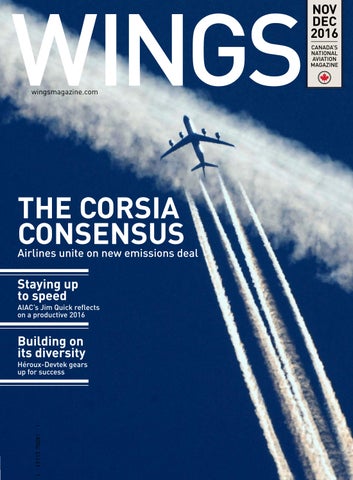
WINGS wingsmagazine.com
THE CORSIA CONSENSUS
Airlines unite on new emissions deal
Staying up to speed
AIAC’s Jim Quick reflects on a productive 2016
Building on its diversity
Héroux-Devtek gears up for success
NOV DEC 2016 CANADA’S NATIONAL AVIATION MAGAZINE
POWERFUL. EFFICIENT. VERSATILE. SOUND LIKE ANYBODY YOU KNOW? You demand continuous improvement in your business, so why not expect it from your business aircraft? Through intelligent design the new PC-12 NG climbs faster, cruises faster, and is even more quiet, comfortable and efficient than its predecessor. If your current aircraft isn’t giving you this kind of value, maybe it’s time for a Pilatus.
Stan Kuliavas, Vice President of Sales | skuliavas@levaero.com | 1.844.538.2376
NOVEMBER/DECEMBER 2016
UPFRONT 4 Porter’s moment 8 On the fly News and opinion
12 Alternate Approach Faith, hope and charity
14 At the Gate
Going out on top
15 Glidepath
Honouring true professionals
28 Op/Ed
Improving the passenger experience
BACK 35 Marketplace 38 On final
Maintaining its excellent record
Business aviation offers considerable growth potential for Canadian aerospace firms. P.20
FEATURES 16 CELEBRATING THE CORSIA CONSENSUS
Global airlines unite to pass landmark emissions deal BY RICK ADAMS
20 STAYING UP TO SPEED From top: Porter’s moment P.4 Going out on top P.14
AIAC president/CEO Jim Quick reflects on a constructive 2016 BY MATT NICHOLLS
24 BUILDING ON ITS DIVERSITY PHOTOS: AÉROPORTS DE MONTRÉAL, MATT NICHOLLS (BOTTOM); BOMBARDIER (TOP)
Héroux-Devtek geared up for growth BY BRIAN DUNN
COVER PHOTO: SHUTTERSTOCK
WWW.WINGSMAGAZINE.COM
November/December 2016 | WINGS
3
LEADING
EDGE
By Matt Nicholls |
Porter’s moment
Aviation’s “little blue engine” celebrates a decade of success
I
5
the vision was always to restore pleasure and convenience to modern flight – a time when passengers looked forward to travelling and reaching their destinations sans excuses and hassles. “Ten years went by very quickly and we are very pleased with where we are today and how we are positioned for the future,” Deluce said. “The next 10 years are going to be equally exciting if not more so. I think everyone at Porter is looking forward to that.” Deluce has never been one to shy away from the “I think I can” philosophy and has looked to capitalize on any and all opportunities. It’s a philosophy that transcends setbacks, including political strife throughout the start-up process and last year’s
TOP DATA BURSTS… in this issue
1. Air Canada has broken ground on a new $90 million hangar at Toronto’s Pearson International Airport. (Pg. 8). 2. Since 1986, Hope Air has arranged more than 109,000 flights. 3. $2.5 billion : The amount spent on upgrading Dorval airport since the 1970s. (Pg. 14). 4. The CORSIA deal could cost airlines $5.3 billion annually in the early years of the deal. (Pg. 17). 5. 2017 fiscal sales for HérouxDevtek are estimated at $420 million. (Pg. 24).
4
WINGS | November/December 2016
announcement by the federal government to put the kibosh on future plans of expansion at Billy Bishop. Porter had a conditional offer of up to 30 Bombardier C Series jets that would have opened up new routes and destinations had the deal gone through. The airline soldiers on with its Q400s and its service is obviously making its mark with passengers: Porter continues to garner a number of top awards for service excellence in several industry publications. So, what does the future hold for Porter and what excites the man who drives the “little blue engine” to ascend the mountain to success? “What excites me is we are 10 years in and we have such a strong team,” Deluce said. “I’m excited about the fact that there are so many options for passengers, more flights, lower fares, definitely more people flying. You only have to look back a few years and remember that there were many one-way walk-up fares at about $1,000 or more in the marketplace. None of that exists today because there are alternatives and people recognize that Porter has been instrumental in bringing this to the marketplace. It makes one proud of what has been accomplished.” “I think I can indeed.” Porter is certain to be making plenty of noise in the months in years ahead. | W
“The next 10 years are going to be equally exciting if not more so.”
@Wings_Magazine WWW.WINGSMAGAZINE.COM
PHOTO: MATT NICHOLLS
n the classic children’s book, “The Little Engine That Could,” a long, stranded train of toys must be pulled over a mountain to reach its destination. After other powerful train engines refuse to make the trek, a spunky little blue engine steps up to the plate and gives it a go. Repeating the motto, “I think I can, I think I can,” the feisty blue engine successfully pulls the train over the mountain, much to the delight of its passengers. It’s a tale that illustrates the importance of hard work, determination and an optimistic perspective. I would argue it also applies to another “little blue engine” in the Canadian aviation industry – the story of Porter Airlines, the reliable, efficient and highly successful commuter airline celebrating its 10th anniversary this year. The brainchild of Porter president and CEO Robert Deluce, a successful airline executive whose family has more than 50 years in the aviation business, Porter kicked off operations on Oct. 23, 2006 with 10 daily return flights from Toronto’s Billy Bishop Toronto City Centre Airport to Ottawa International. Porter has since grown operations to 23 destinations (including seasonal routes) throughout North America. It’s fleet of 26 quiet and reliable Bombardier Q400 aircraft have served more than 18 million passengers and Porter staff has grown from a handful of employees and two aircraft to more than 1,400 employees – an incredible achievement in an industry where airline startups – and subsequent successes – are rare indeed. The Porter model of providing passengers with quick and hassle-free flights with efficient service harkens back to the philosophy instilled in the airline by Deluce at its inception. As the proud Porter leader told Wings at the vibrant 10th anniversary celebration at Billy Bishop in late October,
Thank you for your loyalty and in making us the Airline of the North, we look forward to continuing to serve you!
First Air
firstair.ca
@FirstAir
WINGS
NOV DEC 2016 CANADA’S NATIONAL AVIATION MAGAZINE
wingsmagazine.com
Vol. 57, Issue 6 EDITOR
Matt Nicholls mnicholls@annexweb.com 416-725-5637
THE CORSIA CONSENSUS
FLIGHT DECK
Airlines unite on new emissions deal
Rick Adams, David Carr, Paul Dixon, Brian Dunn, Frederick K. Larkin, James Marasa, Carroll McCormick, Anna Pangrazzi
Staying up to speed
AIAC’s Jim Quick reflects on a productive 2016
Building on its diversity
NATIONAL ACCOUNT MANAGER
Héroux-Devtek gears up for success
Mena Miu mmiu@annexweb.com 905-713-4351
SUBSCRIBE TODAY !
MARKETPLACE ACCOUNT MANAGER
1 YEAR SUBSCRIPTION only
Kory Pearn kpearn@annexweb.com 519-902-8574
3295
$
ACCOUNT CO-ORDINATOR
(GST $34.60 • HST $37.23)
Stephanie DeFields sdefields@annexweb.com 1-888-599-2228 ext. 257
US $57.95 (USD) • Foreign $65.95 (USD)
Name: _______________________________ Company: ____________________________ Title: _________________________________ Address: _____________________________ City: _________________________________ Prov: ________________________________ P.Code: _______________________________ Tel: __________________________________ Fax: _________________________________ email: ________________________________
MEDIA DESIGNER
Emily Sun
CIRCULATION MANAGER
Carol Nixon cnixon@annexweb.com 450-458-0461 GROUP PUBLISHER
Martin McAnulty mmcanulty@annexweb.com WINGS MAGAZINE
P.O. Box 530, 105 Donly Dr. S., Simcoe, ON N3Y 4N5 Tel: 519-428-3471 Fax: 519-429-3094 Toll Free: 1-888-599-2228
PLEASE CHECK ONE:
❑ Charter/Fractional ❑ Commercial Airlne ❑ Private Aircraft Owner/Operator ❑ Air Transport-Cargo ❑ Tour Operator ❑ Training/Education ❑ Airport ❑ FBO ❑ MRO ❑ OEM ❑ Aviation Distributor ❑ Aviation Fuel Supplier ❑ Aviation Services ❑ Aviation Sales/Marketing ❑ Para-Public/EMS/SAR/Law Enforcement ❑ Government/Military ❑ Resources - Construction, Fire, Forestry, Mining, Oil & Gas, Wildlife, etc ❑ Other (please specify) ______________
Printed in Canada ISSN 0701-1369 PUBLICATION MAIL AGREEMENT #40065710 CIRCULATION Email: apotal@annexbizmedia.com Phone:416-442-5600 ext. 3258 Fax: 416-510-6875 Mail: 80 Valleybrook Dr, Toronto, On M3B 2S9 Published six times per year (Jan/Feb, Mar/Ap, May/Jun, Jul/Aug, Sep/Oct, Nov/Dec) by Annex Business Media
PAYMENT: Cheque - Payable to Annex Publishing & Printing Inc. Visa
MC
Account #: __________________________
SUBSCRIPTION RATES Canada – 1 Year $ 32.95 (plus GST - #867172652RT0001) USA – 1 Year $ 57.95 Foreign – 1 Year $ 65.95 Occasionally, Wings magazine will mail information on behalf of industry-related groups whose products
and services we believe may be of interest to you. If you prefer not to receive this information, please contact our circulation department in any of the four ways listed above. Annex Privacy Office privacy@annexbizmedia.com • Tel: 800.668.2374 No part of the editorial content of this publication may be reprinted without the publisher’s written permission. ©2016 Annex Publishing & Printing Inc. All rights reserved. Opinions expressed in this magazine are not necessarily those of the editor or the publisher. No liability is assumed for errors or omissions. All advertising is subject to the publisher’s approval. Such approval does not imply any endorsement of the products or services advertised. Publisher reserves the right to refuse advertising that does not meet the standards of the publication.
Expiry:_____________________________
TO SUBSCRIBE:
Tel: 416-510-5113 Fax: 416-510-5172
Mail: Wings Magazine c/o Annex Business Media Circulation 80 Valleybrook Dr., Toronto, Ontario M3B 2S9
Air Transport Association of Canada
ON THE
WEB
email: subscribe@wingsmagazine.com
www.wingsmagazine.com
GST#135274215RT001
6
Subscriptions non-refundable
PRO1116
WINGS | November/December 2016
WG_subad_NovDec16_MLD.indd 1
Canadian Owners & Pilots Association
Canadian Business Aviation Association
Magazines Canada
AVIATION THIS WEEK
PHOTO: ANNEX BUSINESS MEDIA
Signature: _________________________
Looking to catch up on the latest hot news from around aviation and aerospace? Check out Aviation This Week, a live digital version of the top news stories affecting a variety of key markets. It's quick, essential information you need to know! wingsmagzine.com/video WWW.WINGSMAGAZINE.COM
2016-10-26 1:35 PM
UNINTERRUPTED SUPPLY OF WORKWEAR AND PPE Improve efficiencies and positively influence your bottom line with head-to-toe workwear and PPE supply programs for aviation.
With bulk wholesale ordering and managed supply solutions, you’ll have the right products delivered at the right time to the right place—always. We offer product sourcing, safety compliance awareness and streamlined purchasing to help you outfit your workers in flightready footwear, workwear and safety PPE. Mark’s Commercial is your one-stop, bulk wholesale supplier of industrial workwear and PPE. No matter what supply challenges you have, we can respond to any demand. Supply You Can Trust Your workers’ safety comes first. Mark’s Commercial provides top safety workwear brands through apparel programs to thousands of Canadian businesses. Corporate wholesale supply programs, online ordering, direct delivery and a dedicated Client Services Team make Mark’s Commercial the only wholesale workwear supplier you’ll need when safety matters most.
Get us working for you
markscommercial.ca
ON THE FLY For late-breaking news and exclusive web content, please visit us at: www.wingsmagazine.com
THE LEAD
BOMBARDIER SEEKS ITS NEXT CHALLENGE With the Bombardier C Series CS100 in service with launch customer SWISS and meeting all performance metrics, and the larger CS300 kicking off a European route-proving tour alongside first operator, airBaltic, Bombardier is casting about for a new aerospace program. Chief executive Alain Bellemare is not offering any clues, recently telling reporters that the company is looking at where gaps exist in the commercial and business aircraft sectors. “We are looking. We have started the work and the advance analysis,” Bellemare recently told Reuters from Toronto. Bellemare explained that a new program is necessary to keep talent and maintain the momentum the C Series has created. The maiden flight of the Global 7000 ultralong range business jet is on the horizon. In the meantime, however, Bombardier continues to struggle with delays. The company has scaled back its CS100 delivery forecast from 15 to seven aircraft as a result of engine delivery delays by Pratt & Whitney. Two C Series aircraft have collectively flown more than 400 revenue-generating flights and accumulated almost
The CS300 will soon enter into service with airBaltic. 8
WINGS | November/December 2016
600 flight hours. A third CS100 aircraft was delivered to SWISS in October and the CS300 is expected to enter service with airBaltic in the fourth quarter. “We are very pleased with the performance of the C Series during its entryinto-service,” said Fred Cromer, president of Bombardier Commercial Aircraft. “The aircraft is meeting all expectations and clearly demonstrating it is the best performing and most efficient aircraft in the 100- to 150-seat class. We are confident in our production ramp-up plan, including our ability to meet our production goal of 90 aircraft per year by 2020.” In September, the second CS300 flight test aircraft began a series of European and Middle Eastern route-proving flights alongside first operator airBaltic of Latvia. The flights, which will operate from the airline’s base in Riga and include stops in Vilnius, Lithuania, Tallin, Estonia and Abu Dhabi, will use airBaltic’s air and ground operational practices. “Because of the 99 per cent commonality between the CS100 and CS300 aircraft and the diverse routes that award-winning airline airBaltic operates, we are expecting to see a perfect blend of performance, outstanding reliability and operational ground support, said Rob Dewar, vice president for the C Series. “Our teams are working closely together as we ramp up activities for a real indication of how the CS300 will operate in the network. We are confident that its entry-into-service with airBaltic later this year will be impressive.”
Air Canada's new hangar at Pearson International will cover more than 127,000 square feet.
On the business side, Bombardier is determined to draw a red line under the delays that have already plagued the Global 7000, which was originally intended to enter service in 2016. An inaugural test flight in November is expected to last over two hours, with the aircraft scheduled to enter service in 2018.
COMMERCIAL
AIR CANADA ADDING HANGAR AT TORONTO HUB Air Canada has broken ground on a new $90 million (US$68.35 million) hangar at its global hub at Toronto’s Pearson International Airport. Hangar 5 will cover more than 127,000 square feet, an area equal to seven professional hockey rinks and accommodate three wide body and two narrow body aircraft at one time. The design features a 77-foot high ceiling formed by the largest uninterrupted commercial hangar span in Canada. The project is necessary to support the airline’s ongoing expansion of its Toronto global hub. “We have grown out Toronto operations by more than 50 per cent since 2009,” Benjamin Smith, president of passenger airlines at Air Canada said. The hangar is the second major construction project in the Greater Toronto Area following the opening of a new $60-million operations centre in 2013. “It will support Air Canada’s future growth by giving us state-of-the-art maintenance, storage and training facilities in an WWW.WINGSMAGAZINE.COM
PHOTO: BOMBARDIER (BOTTOM); BRIAN LOSITO, AIR CANADA (TOP)
8 THE LEAD 8 COMMERCIAL 10 PEOPLE
environmentally-friendly structure.” One design feature is an iris on the hangar door that allows part of the aircraft fuselage to protrude outside the hanger with the remainder of the aircraft inside the hanger when the door is closed. The hangar door consists of six leaves, each approximately 75 feet high and wide that will open at the rate of 60 feet per minute. This iris optimizes the use of space by allowing placement of a third-wide-body aircraft in the facility and increases the building’s overall energy efficiency. Air Canada recently added Mumbai and Berlin to its Toronto international route network as part of a six-destination package, which included service to Algiers and Marseille from Montreal and Taipei and Nagoya from Vancouver. The new Pearson hangar is scheduled to be completed by April 2018.
PEOPLE
ELSIE MACGILL NORTHERN LIGHTS AWARDS IMPRESSES
PHOTOS: MATT NICHOLLS
The 8th annual Elsie MacGill Northern Lights Awards Gala dinner took place in early October north of Toronto and once again, it exceeded expectations, as more than 350 attendees paid tribute to this year’s outstanding honourees. The Northern Lights Awards program is designed to honour women in aviation and aerospace who have throughout their careers made a significant impact
Seneca College’s Mark Crha (left) topped the Webster Memorial Trophy competition. He is seen here with ATAC’s Wayne Gouveia.
in their various realms of the business. Their accomplishments are recognized to highlight their personal achievement but also to inspire future generations of young women to strike out and make their marks in a variety of diverse, exciting and rewarding fields. “The Elsie MacGill Northern Lights Awards are a true legacy program meant to recognize those that have blazed the trail for so many young women in the industry today,” notes Anna Pangrazzi, president and director of sales of program and a Wings magazine columnist highlighting women in aviation and aerospace. “This year’s inductees are truly outstanding and we are proud to highlight their accomplishments. The 2016 award winners include: RCAF Brigadier General Lise Bourgon, Flight Ops/Maintenance award; Dr. Sylvie Béland, an internationally recognized scientist and aerospace leader with the National Research Council, Government award; Chorus Aviation EVP and CFO Jolene Mahody, Business award; Dr. Catherine Mavriplis, a highly-respected
aviation and aerospace educator at the University of Ottawa, Education award; Rosella Bjornson, a trailblazing commercial pilot and the first female member of the Canadian Airlines Pilot Association, Pioneer award; Holly Johnson, a mechanical engineer with MDA, Rising Star award; and Navreet Saini, an engineer with Bell Helicopter, Rising Star award.
CRHA CAPTURES 2016 WEBSTER MEMORIAL TROPHY Mark Crha is on top of the world these days and for a very good reason. The Seneca College student and Eastern Ontario Region representative in the 2016 Webster Memorial Trophy Competition recently captured the 2016 Webster title, beating out a strong contingent of amateur pilots from across the country. Michael Bryson, Manitoba region representative who flies with Harv’s Air in Winnipeg, was this year’s runner up
The 8th annual Elsie MacGill Northern Lights Awards Gala was an unqualified success. WWW.WINGSMAGAZINE.COM
November/December 2016 | WINGS
9
ON THE
FLY
Michael’s brother Andrew Bryson was runner up in 2014. Maxine Brignell, the Western Ontario representative, was this year’s winner of the NAV CANADA trophy, handed out to the candidate that tops the NAV CANADA written exam. Brignell, who scored a 93 per cent on the test, recently graduated from Sault College in Sault Ste. Marie. Executed flawlessly this year by the efficient and thorough team at the Brampton Flight Centre in Brampton, Ont., the Webster brings together the top amateur pilots in Canada for a spirited week of learning, flying, camaraderie and fun. It’s a true celebration of what’s great in aviation, and the competition is intense. Contestants must conquer a variety of tasks including a written exam, flying test and much more. Wayne and Amy Foy, stewards and leaders of the program for the past 10 years, have worked tirelessly over the years to piece the program together and bring on board an impressive array of high-end sponsors and supporters,
including Air Canada, Flight Safety International, Sennheiser, Transport Canada, the 99s, Redbird Flight Simulators, NAV CANADA, Jazz Aviation, KF Aerospace and many more. Wings magazine has been a supporter of the program for years, and takes great pride in covering the achievements of the young aviators. The Webster winner and other competitors annually receive numerous awards and prizes from program supporters. The Webster continues to flourish thanks to the involvement of its many supporters and associations, and will move into a new phase next year with the retirement of Wayne and Amy Foy. The hardworking couple are stepping away from the program, but its new national administrator, Brenda Reid and her team, are already planning next year’s event. The 2017 Webster Memorial Trophy Competition is already in the works. The Mitchinson Flight Centre in Saskatoon, Sask. will host the event, dates to be determined.
10 WINGS | November/December 2016 WG_Aversan_novDec16_CSA.indd 1
NAV CANADA'S SHINING STARS Five members of NAV CANADA have been honoured for their top achievements by the Washington, D.C.-based Air Traffic Control Association (ATCA) during the 61st Annual ATCA conference and exposition in National Harbor this past October. “To see our people rewarded for their outstanding efforts and contributions by ATCA is personally gratifying and a source of pride for all of us at NAV CANADA,” noted Neil Wilson, president and CEO of NAV CANADA. “It is appropriate that the four different award categories align closely with our company’s mission to provide safe, efficient and cost effective air navigation services and a professional and fulfilling work environment for our employees. The award winners and their respective awards: • Jeff Cochrane, The William A. Parenteau Memorial Award This is a medallion award
WWW.WINGSMAGAZINE.COM 2016-10-20 2:50 PM
•
•
presented to an individual for an outstanding achievement or contribution during the previous year, which has added to the quality, safety, or efficiency of air traffic control. Jim Daher: The David J. Hurley Memorial Award for Aviation Traffic Management A medallion award presented to an individual working in the field of aviation traffic management (ATM) for outstandiang achievement or contribution in the area of ATC collaborative decision making, balancing air traffic demand and capacity, or maximizing airspace and airport use, which has added to the quality, efficiency and/or safety of the global airspace systems. Bob Miller: The General E.R. Quesada Memorial Award A medallion award presented to an individual for an outstanding achievement or contribution
•
during the previous year as an ATC manager. Jeff Barry and Matthew Nych: The Chairman’s Citation of Merit Award The Chairman of ATCA’s board of directors awards chairman’s citations of merit to recognize exemplary work in air traffic control over the past year and beyond, and for overall enhancement of and contribution to ATC and the aviation community.
CANADIAN PILOT TOPS U.S. NATIONALS A Manitoba pilot has likely become the first Canadian to win the sportsman category at the U.S. National Aerobatics Championships. Unfortunately, competition rules prevent the trophy from making the trip north. Luke Penner, whose family owns Steinbach, Man.-based Harv Air training school, captured first place.
The U.S. National Aerobatics Championships are held each year in Denison, Tex. and are hosted by the International Aerobatic Club, the world’s largest aerobatic club. There are five competition categories for powered aircraft. The Sportsman Category includes a Known Compulsory and Free Program. Sportsman pilots fly the Known compulsory three times, but are permitted to compose a free program of each pilot’s design for the final two flights. Penner was one of 17 competitors, and the only Canadian in the competition. Penner told Steinbach.com, a local media outlet that the competition was intense in his category.
MAKING AMENDS The printed edition of the Sept/Oct issue of Wings contained factual errors in the Alternate Approach column: "Vector Aerospace making waves in P.E.I." Wings regrets the errors.
We create chemistry to build lightweight space saving interiors.
Achieve a higher level of efficiency with innovative materials from BASF. Labor and cost savings, increased passenger comfort, and design flexibility are just a few of the ways we deliver solutions to the entire value chain. At BASF, we create chemistry. aerospace.basf.com
WWW.WINGSMAGAZINE.COM WG_BASF_NovDec16_CSA.indd 1
November/December 2016 | WINGS
11
2016-10-24 7:31 AM
ALTERNATE
APPROACH By David Carr |
Faith, hope and charity
Hope Air celebrates 30 years of helping Canadian patients in need
A
12 WINGS | November/December 2016
poverty line for their communities. The average cost of a one-way ticket is approximately $250. Last year, the greatest demand for flights was out of British Columbia, followed by Ontario, Newfoundland and Labrador, Alberta and New Brunswick. “The need in Newfoundland and Labrador is especially great due to current economic conditions there. Meeting that need is also a challenge because of the high price of flights,” Keller-Hobson pointed out. “We rely on our supporters – airlines, individuals, generous foundations, corporations and community associations – in Newfoundland and Labrador to help ensure sustainable service.” And with good effect. Hope Air provided 1,515 free flights in the province in 2015, a 32 per cent year-over-year increase, with the bulk of clients originating from remote communities in Labrador. Hope Air is fuelled by national and regional airlines across Canada, as well as aviation services providers such as NAV Canada. It is a natural fit. The charity has also had success attracting other support in key areas such as the financial services industry, making Hope Air a lifeline for Harlyn, Ezra and thousands others. | W
“Hope Air has knitted together an impressive network of airlines, corporate sponsors and volunteer pilots.” flights. While rooted in transporting cancer patients, Hope Air has gone further than similar services. “We are unique in that we fly people of all ages receiving care for many kinds of illnesses – including those seeking answers through diagnostic appointments. Our goal is ‘getting Canadians to getting better,’ ” Doug Keller-Hobson, Hope Air’s executive director told Wings. Since 1986, Hope Air has arranged more than 109,000 flights. In 2010, Hope Air introduced its Flight Purchase Program, using donor funds to purchase seats when donated flights are unavailable. The majority of flights are now purchased through donations. Remaining flights are donated by airline partners and volunteer pilots. Hope Air became WestJet’s first charity, when the airline launched in 1996. WestJet and Hope Air have built a significant national partnership over 20 years, which has ensured that thousands of Canadian families have been able to reach the vital medical care they deserve. The average household income of a Hope Air client is near or below the
David Carr is a Wings writer and columnist. WWW.WINGSMAGAZINE.COM
PHOTO: HOPE AIR
s the WestJet Boeing 737 began its final approach to Vancouver International Airport from Prince George, B.C. last February, young Harlyn was closer to Vancouver’s Children’s Hospital and the specialized treatments she would need. Harlyn and her mother, Antasia, were two of the 11,212 passengers Hope Air, a Toronto-based charity that provides free, non-emergency flights to individuals and families who cannot afford the cost of travel to access medical care, assisted last year. Canadians may be surprised to learn that in most cases governments do not cover non-emergency transport for medical treatment. Each year, approximately 20 per cent of Hope Air clients say that they would cancel their appointment if they could not fly due to the distances involved. Others will try to borrow or squeeze already tight household budgets to find the extra money. In the case of baby Ezra, a patient from St. John’s, his parents – both students – had already stretched the budget to purchase a car to take their son for frequent medical appointments. Purchasing multiple flights to Toronto’s SickKids for assessment and surgeries was out of reach. Bridging the gap for those who could not afford the price of a ticket is what inspired Joan Rogers, a Toronto’s Princess Margaret Hospital volunteer and Jinnie Bradshaw, a marketing specialist with Air Canada, to launch Mission Air Transportation Network in 1986. Rogers, who sadly passed away in 2011, had grown weary of seeing cancer patients from the east coast arriving for treatment after spending 15 to 20 hours on a bus. Modelled after the U.S.-based Corporate Angel Network, which uses corporate aircraft to get cancer patients to treatment, Mission Air made its first flight on November 8, 1986. In that year, the organization completed 66 flights, using airplanes supplied by corporate partners. (The company was re-branded Hope Air in 1999.) One year after the start up, Air Canada donated 12 flights, triggering an early shift in the organization’s business model. Today, as it celebrates 30 years, Hope Air has knitted together an impressive network of airlines and volunteer pilots who provide
AT THE
GATE
By Brian Dunn |
Going out on top
James Cherry made his mark on the Montreal airport landscape
A
14 WINGS | November/December 2016
doubled the number of passengers and the number of interesting destinations (including direct flights to Beijing) has increased as well,” said Cherry. The number of international destinations has grown from 30 in 2005 to 75 today. In addition to Beijing, new destinations include Casablanca and Tunis. Trudeau airport hopes to add other destinations in Asia, Europe and South America. Last year’s record of 15.5 million passengers passing through the airport is expected to be surpassed in 2016. A $350-million terminal expansion was inaugurated in May to accommodate growing passenger traffic, including six new gates on the international side, plus 2,000 square feet of restaurants and boutiques. This is key for boosting airport business, since the dwell time for international passengers can be three or four hours, noted Cherry. The growth of the airport is linked to the growth of Montreal, said the outgoing ADM boss, who hope’s the airport’s expansion will help boost the city’s profile and reputation in order to attract more conferences and international organizations. “We’re trying to make the Montreal airport an extension of the city itself.” | W
“We’re trying to make the Montreal airport an extension of the city itself.”
estimated 30 per cent in Toronto and Vancouver. He would like to see Montreal reach 25 per cent. Not only does it generate extra revenue for the airport, but it allows Montreal to serve a number of European destinations that it couldn’t do otherwise, including Zurich, Geneva and Brussels. Another challenge for Trudeau airport is the long wait times at customs, up to two hours in some cases. The situation is so dire that Montreal’s business leaders led by Cherry and Montreal Board of Trade president Michel Leblanc wrote an open letter to Public Security Minister Ralph Goodale in September to complain about the Canada Border Service Agency’s foot-dragging. The resources the government is putting into pre-boarding screening and at customs is not keeping pace with Trudeau’s continued growth, Cherry said during a recent presentation at a business event in Montreal. “They want us to increase tourism, they want us to increase business visitors, and we’re doing our part, but they have to do their part as well,” he said. On the plus side, Brian Dunn is a Wings writer and traffic is growing at a fair clip. “Over the last 15 years or so, we’ve columnist.
WWW.WINGSMAGAZINE.COM
PHOTO: AÉROPORTS DE MONTRÉAL
fter 15 years at the helm, James Cherry is resigning as CEO of Aéroports de Montréal (ADM) at the end of 2016. During his watch, he oversaw several major renovation projects at Pierre Elliott Trudeau airport in Dorval and the transfer of all passenger flights from Mirabel in 2004. Prior to working at the airport, he held executive positions at Bombardier, Oerlikon Aerospace, CAE and Alstom Canada. His replacement has not yet been announced. “Because of his vision and sound management, ADM has experienced continuous growth: its passenger traffic has doubled, its air services, particularly the international sector, have been greatly enhanced and its infrastructures expanded and modernized, and all of this accompanied by solid financial results,” noted Normand Legault, chairman of ADM. Cherry’s departure coincides with the 75th Anniversary of Dorval airport as it was then known. It began operations in 1941 when a series of runways were built over an abandoned racetrack in what was then cottage country on the western end of the Island of Montreal. Its main role back then was the jumping off point for newly-built military aircraft bound for Britain during the Second World War. Over the course of the war, some 10,000 aircraft took off from what was then known as RCAF Station Lachine. After the war, Air France, BOAC (British Airways) and Trans Canada Airlines (Air Canada) were operating regular flights to the continent. Dorval’s importance as Canada’s major airport declined in the 1970s with the arrival of larger aircraft like the Boeing 747 that didn’t require a refuelling stop in Montreal between North American and European flights. Things only got worse when international flights were transferred to Mirabel. In fact, Dorval actually stagnated until all passenger traffic was consolidated at Dorval, according to Cherry. Since then, an estimated $2.5 billion has been spent on upgrading and expanding the airport. One area Cherry would like to see grow is more connecting passengers through Montreal. They currently represent about 18 per cent of all traffic, compared to an
GLIDE
PATH
By Paul Dixon |
Honouring true professionals The RCAF’s George Croil was a great Canadian military leader
PHOTO: PAUL DIXON
A
few years ago, I was walking through the West Vancouver Cemetery, reading headstones as my companions payed their respects to longdeparted family members. For the most part, the cemeteries here are very egalitarian, simply rows of flat markers with little to differentiate them. What caught my eye in this particular section were the number of MM (Military Medal) and MC (Military Cross) designations, veterans of the Great War. In the middle of these countless rows of markers, I came upon one that stopped me in my tracks. It simply read George M. Croil: Air Marshall – CBE, AFC. RCAF. 1893 – 1959. At that point, I had never heard of Croil. I knew about Bishop, Barker and Brown from the Great War, but Croil meant nothing. I was able to find information online, but there’s not a lot. A long story made short, Croil is credited with creating the Royal Canadian Air Force (RCAF) in the years leading up to the Second World War. Born in Milwaukee and raised in Montreal, he was employed as a tea planter in Ceylon when the First World War broke out. Immediately returning to Great Britain, he enlisted in the Gordon Highlanders as an infantry officer, before transferring to the Royal Flying Corps in 1916. He served as a flying instructor in the Middle East until 1919 and, for a brief period, served as the personal pilot of a certain Major T.E. Lawrence, perhaps better known as Lawrence of Arabia. Earlier this year, when I talked with Ricardo Traven and Justin Carlson of Boeing’s Super Hornet team, we talked about the mistake that so many people make. They were referring to fighter aircraft, but this is true of so many things in life – “amateurs talk tactics and professionals talk logistics.” George Croil was a professional, a consummate professional. In 1920, he had returned to Canada and was appointed to the Canadian Air Board. In 1924, when the RCAF came into being, he was one of the 62 officers that comprised the officer corps. By 1935, Croil had risen to the rank of Air Commodore, followed in 1938 by promotion to Air Vice Marshall, reporting directly to the Minister of Defence (over WWW.WINGSMAGAZINE.COM
– the North Atlantic convoys
“consider the people who for example. Think about what it took to organize the made it work and got those cargoes that went into those trainees where they needed to be.” ships that sailed for Britain the protestations of the Army, which up to now had controlled the air force). As war clouds were forming over Europe, Croil was instrumental in laying the groundwork (with the meagre resources available) for an air force that would total 78 squadrons by wars end. In 1940, he displayed what might be termed the ultimate act of a professional when he was asked to step aside as chief of the air staff. The air minister felt he needed someone in the position who would share the minister’s appreciation of the social niceties, whereas Croil was seen as having a puritanical streak, not to mention an oversized work ethic. He did resign, serving out the next four years as inspector-general of the RCAF. Tactics versus logistics. We are dazzled by the bright shiny things that go fast and make a lot of noise. These things are great and are generally at the pointy end of the stick, but all too often, there is no thought given to what it takes to get those things, keep them running, not to mention what’s involved in the care and feeding of the human side of the equation. Look at the role Canada played in the logistical side of the Second World War
or north to Russia. Or by train, from all over Canada and the U.S. to the ports, over the same tracks as the trains carrying tens of thousands of military personnel every day. Someone had to organize this and keep it running smoothly. In the beginning, the RAF said it couldn’t be done. Lord Beaverbrook (a Canadian) took on the job and proved it could be done. Consider the British Commonwealth air training plan and what it took to train more than 130,000 personnel at more than 130 training centres across Canada, with moves to different training centres for different phases of their training. There were no computers and even the telephone network was rudimentary. Consider the people who made it work and got those trainees where they needed to be when they needed to be there and got them headed overseas when the time arrived. When you pause to remember, take an extra moment to remember the people who take care of getting our military where it has to go today and keep it up and running when it gets there. | W Paul Dixon is a freelance writer and photojournalist living in Vancouver. November/December 2016 | WINGS 15
The new international aviation agreement is expected to reduce emitted carbon by about 2.5 billion tonnes.
CELEBRATING THE CORSIA CONSENSUS GLOBAL AIRLINES UNITE TO PASS LANDMARK EMISSIONS DEAL
T
PHOTO: BRIAN LOSITO, AIR CANADA
BY RICK ADAMS
he world’s commercial aviation community, with strong support from the Canadian government and Canada’s international airlines, have taken a cautious but decisive step toward curbing the effects of aircraft emissions in the coming decades. At the 39th Assembly of the International Civil Aviation Organization (ICAO), which has its headquarters in downtown Montreal, 65 member states volunteered to participate in the Carbon Offsetting Reduction Scheme for International Aviation (CORSIA), which targets “carbon-neutral growth” from a baseline year of 2020. CORSIA applies only to international flights – in the case of Canadian carriers, Air Canada, AirTransat, Porter Airlines and WestJet. International flights worldwide account for about 1.3 per cent of global manmade CO2 emissions annually. Domestic airline flights, which add another 0.7 per cent emissions, fall under the Paris COP21 accord reached last December and which goes into effect in November. International aviation’s agreement is expected to reduce emitted carbon by about 2.5 billion tonnes, according to an Environmental Defence Fund calculation. That’s roughly equivalent to taking 35 million cars off the roads every year. “I am delighted that ICAO adopted a global market-based WWW.WINGSMAGAZINE.COM
measure to make civil aviation carbon neutral. This is the first global agreement to reduce greenhouse gas emissions since COP21 in Paris, and I am extremely proud of the leadership role that Canada played in the negotiation of this global deal,” Marc Garneau, Canadian minister of transport, said. “I had the honour of being involved with transport ministers of several key nations in order to get final consensus on this critical issue. As host country, Canada remains deeply committed to providing all the necessary support to ICAO and its diplomatic community.” “Aviation can now claim its ‘Paris moment’, ” declared ICAO council president Dr. Olumuyiwa Benard Aliu. “Air transport is not only the world’s first major industry sector to adopt a global approach to international emissions reduction, but very importantly states representing more than 83 per cent of international flight operations have volunteered to participate from its earliest stages. It has taken a great deal of effort and understanding to reach this stage, and I want to applaud the spirit of consensus and compromise demonstrated by our member states, industry and civil society.” The National Airlines Council of Canada (NACC), the trade association representing Canada’s largest passenger air carriers, applauded the CORSIA compromise. “We would like to thank the Government of Canada for its proactive and
instrumental effort in achieving this global consensus for this historic agreement,” said George Petsikas, acting interim executive director of NACC. “NACC recommends the Government of Canada use the ICAO model to create a similar federal offset mechanism specifically for emissions from airlines operating domestically, which experts have concluded will reduce emissions and keep the Canadian industry competitive, supporting future growth.” The agreement has the strong backing of the airline industry.
“That’s roughly equivalent to taking 35 million cars off the roads every year.” Alexandre de Juniac, new director general and CEO of the International Air Transport Association (IATA), which is also headquartered in Montreal, said, “The CORSIA agreement has turned years of preparation into an effective solution for airlines to manage their carbon footprint. This agreement ensures that the aviation industry’s economic and social contributions are matched with cutting-edge efforts on sustainability. With CORSIA, aviation remains at the forefront of industries in combatting climate change.”
“We thank the government negotiators who have worked so hard to deliver a scheme which will successfully balance the growth in air transport and all of the economic and social connectivity benefits that it brings, with the need to address CO2 emissions from the sector,” added Michael Gill, executive director, Air Transport Action Group (ATAG).
The Cost of Carbon CORSIA is not a tax but rather an offset mechanism in which airlines pay for excessive emissions by purchasing carbon credits in other industries such as forestry. It is expected to cost airlines $5.3 billion annually in the early years and as much as $23.9 billion a year by 2035. Shortly prior to the Assembly in September, in order to foster broader consensus, ICAO eased off on a previously proposed, more aggressive mandatory timetable by making the initial phases voluntary. The final agreement calls for: • A voluntary pilot phase from 2021-23 • Voluntary 1st phase from 2024-26 • Mandatory 2nd phase from 2027-35 Nonetheless, about 65 per cent of emissions growth above 2020 should be covered in the pilot and first phases, and roughly 80 per cent during the second phase of the program. Airlines that keep their emissions down through more fuel efficient planes and aircraft operations will spend less on November/December 2016 | WINGS 17
prepared to take a bit of pain if we can get some global consensus. If it’s not a global solution, we’re going to fall into this patchwork of regulatory approaches, and there will be all kinds of distortions and inequities in the market.” “The agreement is not perfect – few are,” said Nathaniel Keohane, vice president, global climate, environmental defence fund. “But it does provide a vital basis for moving forward. The first key step will be developing strong standards to ensure transparency, environmental integrity, and even broader participation.” Next steps to be worked out include a methodology for monitoring, reporting and verification of individual operators’ emissions, what types of carbon offset credits can be used by aircraft operators to meet their compliance obligation (Emissions Unit Criteria), and the electronic registries to be used for holding and transferring the relevant offset credits. At the ICAO World Aviation Forum preceding the Assembly, Bombardier Commercial Aircraft announced an aerospace industry first with publication of an Environmental Product Declaration (EPD) for its CS100 aircraft. The EPD, based on life-cycle analysis data verified by the International EPD System environmental declaration program based in Sweden, discloses information about the life-cycle environmental impact of products and thus a fair comparison of products and services with regard to their environmental performance.
Canada’s Aero Enviro Action Plan More than 10 years ago, the Canadian aviation industry and Transport Canada signed a voluntary agreement to address greenhouse gas emissions. They met both of their targets: an average of 1.1 per cent per year improvement in litres of fuel per
International flights worldwide account for about 1.3 per cent of global manmade CO2 emissions annually. 18 WINGS | November/December 2016
revenue tonne-kilometre (achieving 1.7 per cent), and a cumulative improvement of 24 per cent in 2012 compared to the 1990 baseline (achieving 30 per cent). In 2012, they created Canada’s Action Plan to Reduce Green House Gas Emissions from Aviation, setting an aspirational goal in fuel efficiency improvement of at least two per cent. Key areas were fleet renewal and upgrades; more efficient air operations; and improved capabilities in air traffic management. Canada’s is one of 101 state action plans now in place. NACC carriers achieved a 1.32 per cent average annual improvement in fuel efficiency and achieved a reduction of 11.22 mega tonnes of CO2-equivalent (CO2e) between 2005 and 2015. But a review of the Action Plan in 2015 determined that the aspirational goal of two per cent per year improvement would be “difficult to achieve.” Coincidentally, at the same time as the ICAO Assembly, Canadian environment ministers were meeting in Montreal to discuss a national carbon reduction plan when prime minister Justin Trudeau announced that the federal government will impose a $7.62 per metric tonne tax on carbon beginning in 2018 and rising to $38.11 by 2022. Some provinces already have their own carbon tax on gasoline, diesel, propane, or aviation fuels, such as British Columbia at $22.87 per metric tonne.
Security Concerns Certainly there were other discussions and decisions at the ICAO Assembly, though none so nearly as dramatic as CORSIA. Two decisions in the security arena included endorsement of an ICAO Global Aviation Security Plan (GASeP) and adoption of the first-ever cybersecurity resolution, stressing the importance of information sharing and coordination across civil aviation safety. The GASeP would replace the ICAO Comprehensive Aviation Security Strategy (ICASS), the organization’s primary aviation security program framework the past six years. The week before the Assembly, the United Nations Security Council adopted Resolution 2309, affirming that all states have the responsibility to protect the security of citizens and nationals of all nations against terrorist attacks on air services operating within their territory. “The high-profile landside airport attacks in Brussels and Istanbul earlier this year were a tragic reminder of the enormous challenges faced in securing public areas, the inseparability of aviation security and national security, and of the economic and social consequences of terrorism,” remarked Dr. Fang Liu, ICAO’s secretary general. “An important aspect of our work involves mobilizing political will for the improvement of national capacities.” | W WWW.WINGSMAGAZINE.COM
PHOTO: BRIAN LOSITO, AIR CANADA
carbon credits. WestJet, for example, which claims “one of the youngest and most fuel-efficient fleets in North America,” has reduced fuel consumption by 45.6 per cent from 2000 to 2014. Air Canada, in a 2014 study by the International Council on Clean Transportation (ICCT), ranked tied for fourth among transatlantic carriers in fuel burned per passenger, at 33 passenger kilometres per litre. There are exemptions in the ICAO CORSIA plan for the least-developed countries, land-locked developing countries, and small island developing countries. However, several otherwise exempt states such as Burkina Faso, Costa Rica, Guatemala, Kenya, Marshall Islands and Papua New Guinea have announced their intent to participate. Operators producing less than 10,000 tonnes of carbon emissions or aircraft under 5,700 kilograms mean take-off weight, such as business aircraft, are technically exempt as small emitters. The small emitters exemption was developed in coordination with the International Business Aviation Council (IBAC), of which the Canadian Business Aviation Association (CBAA) is a member, represented by CBAA vice chair Scott McPherson. “The framework agreed at ICAO will help us meet our collective industry commitments while also taking into account the needs of small operators,” stated Kurt Edwards, director general of IBAC. The 65 countries to volunteer for CORSIA thus far (of 191 ICAO members) include Canada, the U.S, China, and the European Union’s 44-nation aviation conference (which had threatened to continue its Emissions Trading Scheme, adopted in 2008, if CORSIA did not fly). Russia and India are among those who have not signed on to the voluntary phase. Teresa Ehman, Air Canada’s director for environmental affairs said, “We’re
OUR ENGINEERS HAVE DISCOVERED A WAY TO MAKE
SKIES
BREATHE EASIER Regional turboprop airplanes powered by Pratt & Whitney Canada engines have greater propulsive efficiency than similar sized regional jets, consuming 25-40% less fuel. In a single year, this can save around 5,000 tons of CO2 per plane, making both the planet and your bottom line healthier. This is evolutionary engineering.
Business aviation offers real potential for aerospace growth in the future.
AIAC PRESIDENT/CEO JIM QUICK REFLECTS ON A CONSTRUCTIVE 2016 BY MATT NICHOLLS
I
n early October, the honourable Navdeep Bains, minister of innovation, science and economic development, announced an investment boost of up to $54 million in a consortium of Canadian aerospace companies and academic institutions that will develop cuttingedge electric and advanced-aerodynamic systems. The funding, to be delivered under the government’s Technology Demonstration Program, will be used to support collaborative research and early stage, largescale projects that develop next-generation aerospace technology. The consortium is to be led by Bombardier Aerospace with partners Rolls-Royce, Thales, Microturbo (Safran), Liebherr, OPAL-RT, Quaternion Aerospace, FusiA, Axis, the University of Victoria, Ryerson University, the University of Toronto, McGill University, the National Research Council Canada and Polytechnique Montréal. The aerospace infusion is the latest
20 WINGS | November/December 2016
example to illustrate how committed the new Trudeau government is in ensuring Canada maintains – and enhances – its ranking as an aerospace leader on the international stage. The federal government’s commitment to aerospace growth is not lost on Aerospace Industries Association of Canada (AIAC) president and CEO Jim Quick. In a wide-ranging interview with Wings just prior to this year’s 2016 AIAC Aerospace Summit on Nov. 15-16 in Ottawa, Quick shared his perspective on working with the new government in expanding Canada’s aerospace footprint, as well as a number of other key issues.
offset the impact of the other companies that had challenging years. From an association perspective, we are happy with our progress. We had a state-of-the-industry report come out, a great Farnborough Airshow with a very strong presence from both government and industry, and ADSE in Abbotsford, B.C. was our best show ever. We also had a busy year in transitioning to a new government. We did a great job in developing an understanding of how the government wanted to work, how they wanted to work with us, and what is most important to them. I’m really excited about the innovation agenda and how the government will be focusing on this.
2016 was a challenging year for many aerospace companies in Canada, though some flourished. Can you give us your take on the year-to-date and outline what challenges – and solutions – companies are implementing to grow and innovate? It was a challenging year for niché sectors such as business jets and helicopters. This hits hard from the standpoint that we are global leaders in these areas. We also had some companies and sectors do very well though, such as MRO and this helped
What is your impression of the new federal government and its commitment to Canadian aerospace? I am impressed with what I have seen. It didn’t take them long to get up to speed on their agenda; they have engaged us early and often. They are focusing on their socioeconomic agenda and how we fit into that – and we have seen a lot of exciting progress in that realm. The State of the Aerospace Industry 2016 Report released earlier this year WWW.WINGSMAGAZINE.COM
PHOTO: BOMBARDIER
STAYING UP TO SPEE
A welcome addition: the CBAA and AIAC will join forces for next year’s ADSE event in Abbotsford, B.C.
ED
PHOTO: MATT NICHOLLS
did a great job of outlining the economic impact aerospace has both here and abroad. Can you comment on the impact the study has had? It’s an initiative we started with Industry Canada (now Innovation, Science & Economic Development Canada) four years ago. We wanted to have aerospace data and analytics we could talk with – and to – industry and government about. This data helps us communicate to stakeholders and the public at large about how important our industry is – the economic and socioeconomic impact it has in terms of families, communities and jobs. It also highlights the impact aerospace has on the middle class, a significant priority for this government. It gives us key insights into what we need to do from a program and policy perspective. Were there any surprises in the study? It cemented what we’d already been thinking about in a few key areas for our industry, particularly in terms of innovation. It gave use new detail about how we compare to other manufacturing sectors. For example, we have five times the R&D that other sectors have. Our productivity growth has been 2.5 times greater than other sectors, WWW.WINGSMAGAZINE.COM
55 per cent higher in export intensity, and two times more diverse than the average manufacturing exports. We also learned a lot about how the jobs we create impact the overall Canadian innovation agenda. For example, some 30 per cent of our employees are directly involved in producing some type of innovation; in the space sector, this
“I’m really excited about the innovation agenda and how the government will be focusing on this.”
are gravitating to? It has been a diverse distribution geographically, which is a good thing. Province to province, we have an attractive investment environment. Having been to Farnborough, Paris and other major aviation shows where provincial ministers are in attendance supporting their industries . . . let me just say they are very competitive in letting foreign jurisdictions know how good their tax regimes are, their investment environments are etc. So it’s a pretty aggressive environment.
number grows to 60 per cent. Aerospace manufacturing accounts for close to 30 per cent of total manufacturing R&D. The other thing we learned is Canadian operations of foreign-owned firms contributed more than 40 per cent to Canada’s R&D investments. This tells us that foreignowned companies are coming to Canada because they can conduct high-level R&D activities here and we welcome that.
Is there a regional cohesiveness in helping to drive aerospace development in Canada? We have developed a comprehensive national strategy around aerospace and defence. Progress is being made in the space sector as well. Our national objectives will only be successful if we are strong in the respective regions. We are trying to identify key capabilities that each specific region can take in terms of a leadership role; there are specific provinces that understand this, particularly B.C., Ontario and Quebec.
Are there specific locations foreign firms
What aerospace sectors are experiencing November/December 2016 | WINGS 21
happy with the development of the event and what it has accomplished? Our program this year is top notch. We have tried to focus on CEO-level speakers from Lockheed Martin, Bombardier, Bell, Boeing, MDA – all looking at how our world is changing and what we need to do to remain a leader in the industry. We will focus on innovation as well with the innovation agenda being front and centre this year. We will also hand out our annual James C. Floyd award for aerospace achievement and recognize the life and contributions of MacDonald Dettwiler executive vice president Dave Caddey, who passed away last year.
the most growth and what opportunities do you foresee in the future? Are we doing enough in Canada from an R&D perspective? Our global forecast from an aerospace perspective is very positive; such as the growth of the global fleet in the next 20 years. This represents some $5.9 trillion dollars in aerospace development. Our job at AIAC is to make sure we get as big a slice of this pie as possible – and the competition is fierce. I think innovation is one of our greatest competitive advantages. We have a long history of innovation and this is reflected in the growth of segments such as unmanned aerial systems (UASs). We’re also very focused on ensuring that there is strong support for both product innovation – that is making new and innovative products – to process innovation, which looks at ensuring that we’re being innovative in the way we manufacture, our manufacturing process. This is going to be very important as manufacturers move away from design to delivery, and hopefully will give us a competitive advantage. On the space side, it’s about downstream and how Canada takes advantage of downstream. There are also opportunities around advanced manufacturing. In terms of the supply chain, it’s all about how we prepare companies to scale the global supply chain. ADSE in Abbotsbord, B.C. this fall was once again a success. What are your thoughts on the event – is it meeting expectations? When we initially took over ADSE, it was running at a deficit and, now, it is back to where it needs to be from a program point of view. From a financial perspective, our member companies are supporting it well. This summer was very interesting as we had the F-35 and the Super Hornet at the event; it provided some added flair. We also announced we would be partnering with the Canadian Business Aviation 22 WINGS | November/December 2016
Association (CBAA) to help grow next year’s event. Business aviation is a key part of our industry and we are global leaders in that sector, so it’s an exciting addition to the event. CBAA president and CEO Rudy Toering and his team have been working with ours to put together an even bigger and better show next year, and we’re looking forward to seeing ADSE continue to grow in the years to come. Are the various levels of government engaged and empowered enough to understand the important role aerospace plays in Canada? The new federal government has a different way of engaging that we are very supportive of. The engagement is extremely meaningful and constructive; it is very focused on how do we bring the industry to the next level. I like the idea of working around the concept of innovation – how do we use innovation to propel the industry to the next level from a global competitiveness perspective. Their teams are very knowledgeable and experienced. They understand our issues and are engaging with us pretty much on a daily basis about what the industry needs and wants. They want to make decisions and want to move the yardsticks. The government engagement on defence procurement is a good example. Ministers (Judy) Foote (Minister of Public Services and Procurement), Bains and (Harjit) Sajjan (Minister of Defence), have been engaged early and often in this process. It’s different than the types of faceto-face engagement that were used in the past, but it’s still effective. They are using social media and other tools to get their messages out. We’re still working with the government from an overall strategic perspective – and we’re using their chosen vehicles to do it. The AIAC’s Aerospace Summit in November is always a strong event. Are you
Let’s talk about the space part of aerospace. Are you pleased with the efforts being made in this realm? Is Canada where it needs to be? When David Emerson unveiled his report in 2012 on the state of the Canadian aerospace industry, he noted that the Canadian space industry was at a crossroads. I still feel this way. I am pleased with the level of engagement we are getting from government in terms of recognizing there needs to be a long-term solution for Canada – but we need to determine what this path is. In addition to the critical long-term element, we also have an immediate need to make sure our industry remains competitive so we do not lose capacity and capability to other jurisdictions such as the U.K. We have a short-term need to keep capacity and capability here and develop a longterm space vision that is engaged at the highest levels of government. What are the biggest challenges facing the Canadian aerospace industry heading into 2017? Possible solutions? Where do we need to be in the future? From a manufacturing standpoint, the challenge is how do we continue to look at moving people from design to delivery; how do we grow Canadian companies from a supply chain perspective so that they can compete at a higher level in the global supply chain. On defence, we have one of the world’s best in-service support industries. What are we going to with the defence review and defence procurement to ensure we are building capacity and capability here in Canada? From a space perspective, we need to cross a short-term bridge to develop technological capability and keep that technology capability to get to a longer-term space vision. While the aerospace forecast is quite good over the next 10, 15, 20 years, we are still seeing some sectors with some issues – helicopters are an example. The good thing is we can see light at the end of the tunnel. We have a government that wants to support our industry, we just have to get to the point where we WWW.WINGSMAGAZINE.COM
PHOTO: STANDARDAERO
The growing global MRO segment continues to offer potential for Canadian companies.
They are doing this in an intentional manner. We know the competition is fierce and we need to up our game. Fortunately, there is a commitment from provincial and federal governments to grow the industry.
PHOTO: AIRBUS HELICOPTERS
Not all aerospace sectors had a strong 2016; the helicopter industry struggled.
are talking specifically about what we are going to do. We also have a global industry that is growing, roughly five per cent a year, and that’s a great opportunity for us. We have $5.9 trillion of work out there that we have to get a piece of, so we need a sound strategy to do it. You highlighted Canada’s leadership role in international MRO capabilities. Where do you see opportunities in the
MRO space? We have seen growth in the last couple of years in MRO and this is definitely a growing segment in western Canada. The government of B.C. is trying to ensure we remain a leader in this segment; we are seeing growth in Atlantic Canada. But while this is encouraging, the global competition in the MRO space is fierce. Jurisdictions such as Singapore and the UAE – their main focus in aerospace is MRO.
Anything else you would like to highlight and discuss? Is Jim Quick pleased with the progress being made? The AIAC has certainly helped shape the national agenda. We have created a national strategy around how Canada remains a global aerospace leader, but we need to do a better job of establishing synergies with our organization and federal programs. We don’t have the luxury of throwing trillions of dollars worth of funding at programs, so we have to be nimble and smarter than other jurisdictions about how we use our money, how we prioritize the things we do. We need to establish technology demonstration programs and create national research and technology networks. These will create tremendous dividends. I am excited about what may come out of the innovation agenda and the defence review, so I think we are in a good place. We have to make sure industry and government are in sync with where we need to be focused and how we want to get there. | W
LEKTRO The Original Towbarless Tug Setting the Standard in Excellence Since 1945
Models ranging
15,000 to 280,000 lbs.
Electric Towbarless Certified Easy to Use Universal Rugged Simple to Maintain www.
LEKTRO .com
1-800-535-8767 1-503-861-2288 sales@lektro.com WWW.WINGSMAGAZINE.COM
November/December 2016 | WINGS 23
BUILDING O HÉROUX-DEVTEK GEARED FOR GROWTH
BY BRIAN DUNN 24 WINGS | November/December 2016
WWW.WINGSMAGAZINE.COM
PHOTO: BOEING
ITS DIVERSITY
Héroux-Devtek will replace United Technologies as the main landing gear provider for the 777 beginning in 2017.
ON I
n June, Héroux-Devtek (HD) completed the final assembly of the preproduction shipset for the Boeing 777 landing gear, an important milestone in the long-term contract to supply Boeing with complete landing gear systems for the Boeing 777 and 777X aircraft. With the contract, the largest in HD’s history, which required the hiring of about 100 new employees, the company will WWW.WINGSMAGAZINE.COM
replace United Technologies as the main landing gear provider for the 777 beginning in 2017. It also makes HD the thirdlargest landing gear manufacturer in the world. While final assembly was done at the company’s new 21,000 square foot leased facility in Everett, Wa., close to Boeing’s aircraft assembly plant, sub-assembly work was carried out at other HD facilities, including Springfield, Ohio, Cambridge,
Ont. and Laval, Que. The Longueuil facility on Montreal’s South Shore also provided support through its surface treatment expertise. “Finalizing the pre-production shipset for the Boeing 777 landing gear is a major step forward for Héroux-Devtek, as it clearly demonstrates our world-class capabilities in manufacturing large-scale, complete landing gear systems,” said company president and CEO Gilles Labbé, one November/December 2016 | WINGS 25
Applied Informatics & Research Flight Data Monitoring (FDM) Flight recorder readout & playback services Data readout software sales Fuel, economic analysis and carbon emissions tracking
Transport Canada AMO 42-13 Authorized by Honeywell Approved by L-3 & Universal Avionics 400- 205 Catherine Street, Ottawa, ON, Canada, K2P 1C3 Tel: +1.613.749.1015 airinc.ca for more information sales@airinc.ca to contact us
Héroux-Devtek makes the landing gear for the Sikorsky CH-53K.
ft., for components finishing and sub-assembly work, while its Laval and Longueuil facilities which make small to medium-size landing gear parts and perform surface treatment and integration of landing gear respectively, also received funding for building and equipment upgrades. “As a new landing-gear supplier for the 777 and 777X programs, we’re pleased Héroux-Devtek has completed its pre-production landing gear five weeks ahead of schedule. Developing strong new suppliers is an important component of Boeing’s long-term competitiveness,” said Kent Fisher, vice president and general manager of Boeing Commercial Airplanes Supplier Management. Starting in calendar 2018, Boeing will lower the legacy 777 production rate to 5.5 per month from seven a month in 2017 and begin phasing in production of the new 777X. “However, Boeing is currently only 60 per cent sold for 2018, so it will need to win new orders. This is a key risk for HérouxDevtek, but we believe that the company can offset a potential lower 777 rate with new contracts. We also would expect a return to higher rates as the 777X ramps up early next decade,” said analyst Cameron Doerksen at National Bank Financial. Management still expects fiscal 2017 sales to be $420 million, versus $406 million in fiscal 2016 (up 11.5 per cent from 2015), reaching $500 million by fiscal 2019 as 777 production ramps up in 2018. HD did not announce any big news in Farnborough, but Doerksen met with management at the show and he continues to be highly positive about the company’s growth prospects. “Specifically, the company is currently bidding on new build-toprint work that could boost revenue growth in the mid-term,” he said. “Longer term, we believe that HD would be well positioned to bid on the complete landing gear on Boeing’s proposed middle-of-market aircraft should it move forward. It will also likely see some new business stemming from Canada’s new fighter jet competition, regardless of which aircraft wins the competition. Finally, it appears to be more active in seeking out new acquisition opportunities, which would accelerate growth for the company.” On the military side, HD hopes it won’t be punished by Lockheed Martin if Ottawa decides not to purchase the F-35 fighter jets. It produces door uplock systems for the fighter at its facility in Laval and at a joint-venture facility in Turkey. Lockheed stated
26 WINGS | November/December 2016 WG_Airinc_NovDec16_CSA.indd 1
WWW.WINGSMAGAZINE.COM 2016-10-18 7:24 AM
PHOTO: SIKORSKY, A LOCKHEED MARTIN COMPANY
of the original two executives who purchased the company from Bombardier in 1985 in a management buyout. He still owns about 10 per cent of the company. “We are also very pleased to progress as per our planned schedule. The 777 has been a longstanding strategic program for Héroux-Devtek and continued success in executing the largest landing gear contract in our history will further strengthen the business relationship between the two organizations.” HD began discussions with Boeing back in 2012 about becoming a major supplier to the American plane maker, which was looking for another option to break the landing gear duopoly controlled by Messier-Dowty and United Technologies, explained Labbé. “Boeing wanted to create more competition, because the market is really growing and they wanted another supplier which allows them to lower their costs,” he said. “They have a program called Partnership for Success and if you want to do business with them, you have to sharpen your pencil. Eventually, I expect Boeing to become our number one customer.” While the market for commercial aircraft may not be growing exponentially, Boeing has close to 1,900 orders for the 777 and a backlog of more than 500 aircraft as of mid-2016. And the worldwide fleet for all commercial aircraft is expected to double to 43,560 from 21,600 over the next 20 years and HD hopes to go along for the ride. To prepare for the Boeing contract, HD invested a total of $105 million at its various facilities, including a new 110,000 square foot plant in Cambridge to manufacture large-scale, complex landing gear components. The site can be expanded to 200,000 sq. ft. if necessary. Its Cleveland, Ohio plant has doubled capacity to 100,000 sq.
PHOTO: HÉROUX DEVTEK
HD president and CEO Gilles Labbé says he is pleased with his firm’s recent progress.
in June that if the federal government opted for another aircraft, over $825 million worth of industrial contracts would be transferred to other countries, presumably those who have already ordered F-35s, including the U.S., U.K., Italy, Turkey and the Netherlands among others. In July, the Trudeau government announced it was consulting with the industry and certain countries about possible fighters to replace the aging CF-18s. During the election campaign, the Liberals vowed it wouldn’t buy the F-35 at least until the bidding was opened to all manufacturers. HD must step lightly since four of the five potential contenders in line for lucrative government contracts are also their clients, namely Lockheed Martin, Saab, Dassault and Boeing. In May, Lockheed named HD as one of its top 25 suppliers for the F-35 and its current contract agreement with Lockheed Martin has been extended to cover deliveries for the 2017 and 2018 calendar years. While nothing is written in stone, Labbé hopes that being recognized as one of its top suppliers, Lockheed Martin won’t suddenly decide to cut them out of their supply chain. With the acquisition of APPH of the U.K. in 2014, HD now employs some 1,400 workers in 14 facilities in the U.K., Canada and the U.S., including two landing gear design and engineering facilities in St. Hubert, Que. and Runcorn, U.K. And it has plenty of programs in the pipeline, according to Labbé. The company is also trying to produce more of its own products rather than to be
a simple manufacturer of components for other companies. It is currently developing landing gear for the AgustaWestland 609 TiltRotor aircraft, the South Korean KF-X fighter, the Swedish Gripen E fighter and the Sikorsky CH-53K helicopter. The company is almost evenly split between commercial (51 per cent) and military (49 per cent) mandates. In terms of propriety products, which accounts for about 34 per cent of its revenue, it has been mandated by Leonardo-Finmeccanica to design, develop, assemble and test complete landing gear systems for the AW609 TiltRotor aircraft, the only commercial tiltrotor program in development. In addition, it has a Memorandum of Agreement with Hanwha Corp. to jointly design and develop the landing gear system for the KF-X fighter, enabling HD to expand its geographical reach into Asia. In terms of proprietary projects in progress, the Sikorsky CH-53K completed its first flight in October 2015, the Saab Gripen E had its factory roll-out in May, while the Embraer Legacy 450-500 production ramp-up is progressing. HD is also active in the aftermarket, which accounts for roughly 32 per cent of its business. It has increased the scope of its strategic alliance for maintenance
services to operators of the Saab 340 and 2000 aircraft and has renewed an important USAF contract for landing gear repair and overhaul for the C-130, E-3 and KC135R refuelling aircraft. The contract, renewed through September 2021, includes the provision of certain spare parts. In terms of market trends, Labbé says the defence sector remains somewhat uncertain due to budget constraints, particularly in the U.S. While a budget agreement provides additional funding for U.S. defence spending for the next two years, nothing is certain beyond that point. On the plus side, HD has a very diversified defence portfolio with a good balance between new component manufacturing and aftermarket products and services. On the commercial side, both the civilian helicopter and business jet markets are proving to be challenging, according to Labbé. “As we grow, we will either need to build a factory or enter into a joint-venture in a low-cost country,” he added. “That is the nature of the game today.” But for now, HD seems to have its plate full with a diversified portfolio of both clients and projects, although there is always room for more work, said Labbé. “Even with all our projects, we are still not working at 100 per cent capacity.” | W
the right relationship can help you soar.
I
PNC AVIATION FINANCE When it comes to financing private aircraft, we know you value decades of aviation expertise, track record and financial strength. That’s why aviation clients across the U.S. and Canada choose PNC Aviation Finance to help their business take off. To learn more, visit pnc.com/aviation. PNC is a registered mark of The PNC Financial Services Group, Inc. (“PNC”). Equipment financing and leasing products are provided by PNC Equipment Finance, LLC, a wholly-owned subsidiary of PNC Bank. Aircraft financing is provided by PNC Aviation Finance, a division of PNC Equipment Finance, LLC. In Canada, PNC Bank Canada Branch, the Canadian branch of PNC Bank, provides bank deposit, treasury management, lending (including asset-based lending through its Business Credit division) and leasing products and services (through its Equipment Finance division). Deposits with PNC Bank Canada Branch are not insured by the Canada Deposit Insurance Corporation. Deposits with PNC Bank Canada Branch are not insured by the Federal Deposit Insurance Corporation, nor are they guaranteed by the United States Government or any agency thereof. Lending and leasing products and services, as well as certain other banking products and services, require credit approval. ©2015 The PNC Financial Services Group, Inc. All rights reserved. CIB EF PDF 0715-070-195013
November/December 2016 | WINGS 27
WWW.WINGSMAGAZINE.COM
WG_PNCaviation_NovDec16_CSA.indd 1
2016-10-18 2:37 PM
OP/ED By Daniel-Robert Gooch |
Improving the passenger experience Canadian airports have a chance to go above and beyond
A
28 WINGS | November/December 2016
and for the criteria barring National Airports System airports from participating in federal infrastructure programs to be eliminated. This would allow the six smallest NAS airports to participate in programs that other airports its size are able to benefit from. With $323 million in airport rent paid last year –$5 billion since 1992 – Canada’s airports as a system are fully self-sustaining, but some of Canada’s smaller airports need help. In addition to the funding program changes noted above, this is why Canada’s airports also have said that rent should be eliminated for airports with fewer than three million passengers. If rent is to be charged to larger airports, it should be capped at current levels. With the current trajectory of traffic growth in the years to come, this would deliver significant savings over time. As airports operate on a not-forprofit basis, they are a closed loop system. Just as any costs downloaded to airports by government have to be passed on through additional charges to air carriers and passengers, so too do any savings. Despite all of these challenges, airports have done relatively well for Canada since they were transferred from the federal government to local airport authorities in the 1990s. They’ve invested some $22 billion on infrastructure improvements with virtually no funding from taxpayers. In the upcoming budget, we urge the Government of Canada to help support the ongoing work of Canada’s airports to deliver an efficient, predictable and pleasant experience. A healthy and competitive environment with strong and vibrant airports is good not only for the industry, but also for the Canadian economy and society. | W
“The number of passengers using Canadian airports jumped 32 per cent over the last decade.” industry-government collaboration that has paid off. But continued investments in technology, such as the next generation Primary Inspection Kiosk, also need to be made in a timely manner to ensure experience arriving in Canada doesn’t deteriorate as screening has in recent years. Air transport is truly a global industry and Canada’s air sector must be able to provide globally competitive standards of service in order for airports to maximize their contribution to Canada’s economic growth. Financial sustainability is another theme in Canada’s pre-budget submission. For Canada’s smallest airports, this means improved access to capital through programs like the Airports Capital Assistance Program and more equitable access to other government infrastructure programs. In particular, the CAC has called for improved funding and program updates to ACAP
Daniel-Robert Gooch is the president of the Canadian Airports Council. WWW.WINGSMAGAZINE.COM
PHOTO: CATSA
s the Government of Canada conducts its pre-budget consultations, Canada’s airports have been actively highlighting several areas that are negatively impacting our ability to provide a positive experience for Canadian air travellers. We have an opportunity to fix them. There is more urgency now to address these concerns as airports are seeing record levels of passengers choosing to fly; the number of passengers using Canadian airports jumped 32 per cent over the last decade. Even though airports welcome this growth and the regional economic impact gains they represent, passengers are feeling the pressure, particularly at air borders and at security screening checkpoints. Passengers find themselves waiting more than an hour at peak travel times at some of Canada’s primary gateway airports. The Canada Air Transportation Security Agency (CATSA) is funded by user fees generated through the Air Travellers Security Charge (ATSC). However, the money passengers pay for this charge is not being fully allocated back into CATSA. This may be OK if passengers were receiving an acceptable and internationally comparable level of service at screening, but they are not. Investing in a service level standard for Class 1 airports would give passengers a better sense of when to arrive at an airport. Canada’s airports and two biggest air carriers are calling for a standard that would see 90 per cent of originating passengers screened within 10 minutes – much closer to what is in place at large hub airports like London Heathrow and Hong Kong, which have even stricter standards. The deployment of new-to-Canada technologies and procedures like CATSA Plus will vastly improve passenger throughput, if it can be implemented in a timely manner at our highest volume screening points. Meanwhile at our air borders, airports have also seen growing wait times at some major gateways. Industry has a great track record in working together to improve passenger facilitation at Canada’s air borders. CANPASS/Nexus, international to domestic baggage transfer, Transit Without Visa and Automated Border Clearance kiosks were developed through
#176
The official publication of the Canadian Business Aviation Association
NEWS BRIEF
The Year in Review
CEO’S CORNER
CBAA continued to consolidate its strengths in 2016 with a number of critical advocacy wins and enhancements to its members-only programs and activities. Our activities, our Annual Report is available on line at cbaa-acaa.ca. ADVOCACY Rudy Toering, CBAA’s president and CEO believes that CBAA turned a corner in 2016, making a real difference to operators’ businesses, starting with 604 regulations. “2016 was the year we finally won major concessions from TC, including an extension to the 604 exemption to January 2017, and the creation of an exemption for training to proficiency.” Rudy also singled out CBAA’s actions on developing new federal air policy. “This government is updating its air policy for the first time in over 10 years” he explained. “Our position is that business aviation must be recognized as a distinct segment within new policy, and we communicated this to the Canada Transportation Act Review Panel, and to the minister and department in face-to-face meetings and formal submissions.” CBAA also has made significant headway with other government departments, most notably the Canada Revenue Agency, whose recent interpretations of Fair Market Value on the personal use of business aircraft had our industry reeling. “Thanks to the concerted efforts of our members and our legal counsel, at this writing, we have the CRA’s full attention and www.cbaa-acaa.ca
commitment to resolve this issue fairly.” While CBAA’s advocacy with government departments and agencies is important, other organizations have an impact on business aviation as well. In 2016, CBAA expanded its relationship with stakeholder groups across the country, with the aim of improving business aviation’s operating environment. Rudy used CBAA’s recent dealings with airports as an example. “One of business aviation’s ongoing issues has been access to airport facilities and service – particularly de-icing” he said. His formal presentation to the Canadian Airports Council board led to a meeting with TorontoPearson officials, which resulted in guaranteed de-icing slots.
“This was a major breakthrough, and I think it serves as an example of our relationship with airports going forward.” CBAA’s efforts also extended beyond our boarders, when, working with our international counterparts through IBAC, business aviation won a major concession when ICAO included exemptions for smaller aircraft and operations in its carbonemission scheme. Part of CBAA’s success in 2016 is attributed to the outreach program aimed at Members of Parliament. “When we distributed our Economic Impact Survey to Members of Parliament last year, we were able to begin to identify a cohort of elected officials who have become, or have the potential of becoming,
With membership renewals being sent out in November, this is a good time to thank our members for their ongoing support, and remind everyone why a strong CBAA can be the difference between your own business’ success or failure. I’d like to share some concrete examples. At this writing, CBAA is deep into high-level discussions with the Canada Revenue Agency to resolve the onerous new interpretation that increases the tax liability on the personal use of business aircraft by as much as a factor of 10. How big an issue is this? Very. We know of 15 aircraft purchases that have either been put on hold or cancelled because of the uncertainty around this tax interpretation. Because of our Economic Impact Study, we can show government that the loss of those aircraft could translate to a loss of 186 jobs (at an average wage of $80,600), $12.3 million in wages, $21.0 million in GDP and $43.5 million in economic output. I guarantee you, those
continued on page 3
continued on page 2 CBAA-ACAA News Brief
1
CONTENTS 3
New de-icing agreement reached with GTAA
3
Progress on taxation related to the personal use of business aircraft
3
2016 WINS
4
The Canadian Pavilion at NBAA 2016: Members’ highlights
4
Get ready for big changes – and new opportunities – at CBAA 2017!
5 5 5 5 6
Renew your membership in CBAA CBAA Welcomes New Members Associate members: how CBAA helps you reach business aviation operators Save The Date! CBAA - Join Today
955 Green Valley Crescent, Suite 155 Ottawa, ON K2C 3V4 Tel: (613) 236-5611 • Fax: (613) 236-2361 Email: lberndt@cbaa.ca • Website: www.cbaa-acaa.ca
STAFF MEMBERS President and CEO Rudy Toering, rtoering@cbaa.ca Executive Assistant and Director of Administration Aime O’Connor, 613.236.5611 ext. 228, aoconnor@cbaa.ca Vice President, Government and Regulatory Affairs Merlin Preuss, 613.656.0505, mpreuss@cbaa.ca Membership Sales & Communication Services Manager Lindsay Berndt, 613.236.5611 ext. 221, lberndt@cbaa.ca Marketing & Industry Relations Debra Ward, 613.274.0619 dward@cbaa.ca Events Coordinator Lise Hodson, 613.854.4686, lhodgson@cbaa.ca
Finance accounting@cbaa.ca 613.236.5611 ext. 222
BOARD OF DIRECTORS EXECUTIVE COMMITTEE Chair • Rod Barnard Director Aviation and Travel Services and Chief Pilot Kal Aviation Group Past Chair • Dave Hall Maintenance Manager/General manager Irving Air Services Inc.
and no-cost compliance tools we number got the bureaucrats’ make available. In other cases, attention. Nothing says such as our lobbying CRA and “bad day at the office” in Transport Canada for appropriate Ottawa more than having regulations and policy, everyone to tell your political masters will reap the short term benefits, Rudy Toering, member or not. that 186 Canadians could President & CEO be losing high-salary jobs But, in the long run, people who because of policy created sit on the sidelines, and who do not under another government. have a voice at the table, ultimately hurt On another front, CBAA has again their own businesses the most. Without joined forces with other aviation the tools and strength in numbers that associations to block the introduction only CBAA can provide, they have little of 705-type fatigue management rules or no ability to influence decisions that for 704 operators. We are concerned directly affect their business. It’s bad for for our members who operate ad-hoc their bottom line, and it weakens our charters or medevac. The fact is that 705 sector. The reality is that there are a finite regulations would have a devastating number of business aviation operations. effect on our 704 charter operators and Every person, every aircraft, counts. leave some little option but to certify To our members: thank you again for outside Canadian jurisdiction or cease your support. And for those who are still their operations. undecided, please contact me personally These are only two of many examples. – I will be pleased to share more about In the coming year, we will be working the many benefits of CBAA membership. on these -- and many other fronts – to And to everyone in the business protect and enhance your business. In aviation community, please accept my some cases, such as Partners in Safety, best wishes for a happy – and prosperous only members can benefit from the low – new year.
continued from page 1
Vice Chair • Anthony Norejko Director, Travel Services & Aviation/Chief Pilot Walmart Canada Corporation Secretary • Bill McGoey President Aurora Jet Partners Treasurer • Michael Fedele Vice President and General manager Execaire , a division of I.M.P. Group Limited
BOARD MEMBERS AT LARGE Peter Bing • Chief Pilot Sobeys Inc. Louise Dunlop • President Sterling Aviation Services Jean-Christophe Gallagher, Eng. • Vice President/Business Aircraft Bombardier Clement Nadeau • Operations Manager/Chief Pilot A.G. Aviation Ltee. Jim Thompson • Chief Pilot Saskatchewan Air Transportation Services Executive Air Services Mark Van Berkel • President & CEO True North Avionics Jamie Vins • CEO Vins Plastics Limited David Weger • Sr. Director Administration Services Potash Corporation of Saskatchewan Inc. Gary Wood • Director – Corporate Sales & Marketing Flying Colours Scott Harrold • Regional Sales Manager Signature Flight Support James Elian • President & Chief Operating Officer AirSprint
2
CBAA-ACAA News Brief
ADVOCACY AND NEWS
The Year in Review continued from page 1
business aviation champions. This political support has already helped us push forward on the CRA issue, and we will be drawing on these people more as time goes by.” A more extensive awareness campaign, to include Senators, provincial/ territorial governments, and major business associations, is on track for October 2016. PARTNERS IN SAFETY The CBAA continues to enhance its Partners in Safety program. The program was created to simplify member compliance, and support the
creation of a safety culture, especially for smaller owner/ operators and includes the CBAA SMS, the National Aggregate Database (NAD), and a template operations manual. In addition to these item, the CBAA will be providing sample operations manuals targeted at operators without employees and small operators. Furthermore, the CBAA will be rehosting the NAD and offering a more streamlined online system to assist members in compliance with SMS, QA and Management Review of the SMS requirements. Program elements are constantly being revised and updated based on new requirements and by input from users.
ANOTHER RECORD-BREAKING CONVENTION CBAA 2016 in Calgary was the third convention in a row that saw significant growth in delegate and exhibitor attendance, with over 700 people attending all or part of the event. “It’s clear that there is an appetite for the Canadian business aviation community to come together every year” Rudy said. “We are committed to increasing the value of the educational sessions and quality of the exhibit and static every year. “Next year we are setting the bar higher than ever when CBAA 2017 will be held in conjunction with the Abbotsford International Air Show and the Aerospace Defence and Security Expo.
New de-icing agreement reached with GTAA
F
ollowing a meeting between CBAA, its members and GTAA Ops officials, we are pleased to confirm that BA flights will have guaranteed slots in de-icing and departure queues at TorontoPearson during Departure Management Initiative (DTMI) periods. While subject to restrictions, this represents the first time in several years that BA will be included in the formal DTMI schedule. The Central Deice Facility (CDF) slots will be available on a first-come, first-serve basis for BA, and an instruction document will be issued by the GTAA. Our thanks goes to the eleven CBAA members who attended the meeting and helped finalize the agreement, and to GTAA’s CEO, Howard Eng, and members of his senior team, including Michael Belanger, Chris Miles and Wil MacMillan, for leading this initiative.
2016 WINS • Secured an extension of the CAR 604 exemption to January 2017 • 604 operations excluded from new fatigue regulations • 604 and SMS guidance material issued, including guidance material for small operators • Secured exemption to allow training to proficiency for competency certification to continue • Secured de-icing slots at GTAA, working with other airports for similar accommodations • CBSA commits to developing a different set of IAPI rules for business and general aviation • Business aviation wins special exemptions related to ICAO’s new global carbon-offsetting scheme based on annual CO2 emissions tonnage and MTOW
CBAA joins aviation association coalition to fight proposed 704 fatigue and duty regulations
T
hanks to CBAA’s previous interventions, 604 operations are not subject to the proposed new fatigue regulations. However,
the proposed regulations may have a devastating impact on our members who operate 704 ad-hoc charters and medevac services. CBAA is once again joining
forces with a number of other aviation associations, including ATAC, HAC and NATA, to lobby TC to remove these regulations. If enacted, these regulations can
have a perverse consequence, with operators certifying outside of Canadian jurisdiction, and in fact, increasing risk instead of reducing it.
Progress on taxation related to the personal use of business aircraft
F
ollowing a meeting with senior Canada Revenue Agency (CRA) officials, the CBAA is moving forward with a recommended solution, created by a tax lawyer who is very familiar with the issue, with significant contributions by members and other tax professionals. More information will be forthcoming when it is available. www.cbaa-acaa.ca
CBAA-ACAA News Brief
3
EVENTS AND MEETINGS
ABOUT CBAA
• The Canadian Business Aviation Association (CBAA) is a non-profit association formed in 1961 as Canada’s voice for business aviation. Since its inception, CBAA has assumed an increasing leadership role in its advocacy for Canadian business aviation interests.
The Canadian Pavilion at NBAA 2016: Members’ highlights
F
or the third year in a row, CBAA has opened its exhibit space, known as the Canadian Pavilion, to members who want to get a start at NBAA’s convention and exhibit. CBAA welcomes the following companies to the Pavilion!
• With a membership of approximately 400 companies and organizations, including operators, management companies and suppliers, CBAA represents the entire business aviation community with a unified and collective voice.
OUR MISSION
• To represent and promote the Canadian business aviation community globally, advocating safety, security, and efficiency.
OUR VISION
• Promote the value of business aviation and shape its distinctive identity; • Foster safety, security, efficiency, and innovation for Canada’s business aviation community; • Lead in the utilization of performance-based concepts; • Promote a regulatory and policy environment which fosters the growth of business aviation.
4
CBAA-ACAA News Brief
Get ready for big changes – and new opportunities – at CBAA 2017! Get ready for a different CBAA convention!
C
BAA 2017 (August 9 – 11, 2017, Abbotsford, BC) will be held in conjunction with two other major aviation activities – the Abbotsford International Air Show and the Aerospace Defense and Security Expo (ADSE), at the state-of-the art Fraser Valley Trade & Exhibition Centre, also known as Tradex, at Abbotsford International Airport. We are taking advantage of the huge venue to enhance the value of the event – by offering our exhibitors and static display a one and half day exhibition – and with our popular educational program also at the Tradex venue, or close by, we can guarantee a captive and engaged audience! As well as the over 700 CBAA delegates expected to attend (based on last year’s numbers), you will also be joined by the over 400 ADSE delegates who will have full access to the CBAA exhibit and static display; putting our exhibitors’ products and services in front of over a thousand people! Social networking has been ramped up as well, with an opportunity for you to attend the Air Show’s famous Twilight Show with your colleagues and clients at CBAA’s very own chalet area. We are working very closely with our partners: Diamond Sponsor, the Abbotsford International Airport; AIAC Pacific, the host of ADSE, and the Air Show secretariat, to identify shared and one-of-akind activities and events aimed at drawing record-breaking numbers to Abbotsford. Start planning to be part of our enhanced event now – we are currently working out details on pricing and logistics and will share them with you as soon as possible. Please contact Lise Hodgson with any questions at lhodgson@cbaa.ca for more information.
MEMBERSHIP
RENEW your membership in CBAA Membership invoices are sent at the end of November. We urge you to renew your membership so there is no break in our services to you, including: • Partners in Safety is a multipart compliance program, that includes an SMS designed for 604 operations as well as the National Aggregate Database (NAD), a tool available at no charge that is used to upload your confidential data and create hazard registry and trend reports from pooled and de-identified data, Partners in Safety also gives you access to documentation that can be downloaded and customized for your operations, including an Operational Manual template, Ops checklist and more. • Access to the Members Forum, that includes information, briefings and documentation available only to CBAA members • An update of news, information and briefings from CBAA as well as the latest business aviation news from around the world – delivered to your inbox every week Access to CBAA’s delegation for fast and efficient processing of initial type ratings. Access to CBAA industry and regulatory experts to help you deal with operational issues directly ❍ The opportunity to save hundreds of dollars at CBAA’s annual convention, with one complimentary full registration and additional member-only discounts. ❍ Additional savings on products and services you use every day, with low rates on special offers to you by CBAA’s Industry Partners. ❍ The CBAA Job Board, helping you match the right person to the right job ❍ ❍
For more information, please contact Lindsay Berndt, lberndt@cbaa.ca
www.cbaa-acaa.ca
CBAA Welcomes New Members About Eclipse Air Charter Eclipse Air Charter is an on-demand private aircraft charter company and the first Canadian company to combine luxury, aviation and technology. With no long-term commitment, membership fees, acquisition costs or management charges, Eclipse Air Charter works with corporate and individual clients worldwide. Click. Book. Fly.
Associate members: how CBAA helps you reach business aviation operators CBAA’s Industry Partnership program puts a supplier at the front of the line. Open only to CBAA associate members, The Industry Partnership program is a costeffective and efficient way to reach the business operators community, particularly those who don’t have specialized training departments, or huge purchasing departments, yet are still running a commercial enterprise. For more information on how to become an Industry Partner, please contact Lindsay Berndt, lberndt@cbaa.ca
CBAA-ACAA News Brief
5
I
Contact the CBAA or visit our website to find out how membership will: � Enhance your safe operations and simplify regulatory compliance � Save you hundreds - or even thousands - of dollars with members' only discounts � Allow the CBAA to help promote your business � Keep you informed and engaged on the Members Forum � Increase your influence with government and opinion leaders � Keep you on top of the latest news in aviation From its one-of-a-kind Partners-in-Safety program, to major victories on transiting US airspace, extending exemptions on 604 regulations, and beyond, CBAA is committed to actions that ensure your success - and the ongoing success of our $10.7 billion business aviation sector.
Qi:tl4t4ffl
r
SAFETY MATTERS! anners in Saletv �
MARKETPLACE
BUILD YOUR POST MAKE AN A JOB ANNOUNCEMENT BRAND
KORY PEARN 519.902.8574
MARKETPLACE kpearn@annexweb.com
The Skills You Need THE SCHOOL YOU WANT
GLOBAL DISTRIBUTOR OF CERTIFIED PISTON ENGINES & PARTS STOCK PARTS SHIP WITHIN 24 HOURS
AT WWFC, WE OFFER YOU COMMITMENT To you and your success ACHIEVEMENT From methodical, collaborative training
CONTACT US TODAY FOR YOUR QUOTE AND ASK ABOUT FREE SHIPPING
CONNECTIONS To launch your career CALL SARAH THOMSON TODAY!
wwfc.ca // 1-877-359-9932 Waterloo Wellington Flight Centre Professional programs are approved as vocational programs under the Private Career Colleges Act, 2005 (PC#105919)
1-800-264-6019
WWW.PROGRESSIVEAIR .COM 2965 AIRPORT RD., KAMLOOPS, BC V2B 7W8 November/December 2016 | WINGS 35
WWW.WINGSMAGAZINE.COM WG_WWFC_Quarter_Apr16_EJS.indd 1
2016-04-22 2:58 PM WG_ProgressiveAir_MayJune16_CSA.indd 1
2016-04-06 9:22 AM
MARKETPLACE
We Design and Build Hangars Individual • Corporate • FBO’s • T-Hangars • Architectural & Engineered Drawings • Municipal Applications & Permits • Airport Applications & Approvals • Transport Canada & NavCan Applications • Complete Construction
Questions? Email info@secandco.com Visit our website
COCKPIT PROCEDURES
www.secandco.com
EFFECTIVE ROUTINES FOR PILOTS & VIRTUAL AVIATORS A solid understanding of basic flight principles and no-nonsense advice on what to do once inside the cockpit is offered in this sensible toolbook. Containing step-by-step descriptions of a thorough preflight inspection, startup, taxi, takeoff, cruise, approach, landing, and after-landing actions, this authoritative guide places particular emphasis on what a pilot should actually be doing while in the pilot seat. Discussions of basic aviation psychology, recall lists, flow checks, and airmanship fundamentals are also included.
WG_Bookad_cockpit_NovDec16_MLD.indd 1
2016-10-20 1:36 PM
LYCOMING & CONTINENTAL PISTON ENGINE & ACCESSORIES
REPAIR OVERHAUL NDT AIRCRAFT SERVICE
1-800-667-0522
WWW.PROAEROAV .COM
2965 AIRPORT RD., KAMLOOPS, BC V2B 7W8 36 WINGS | November/December 2016
WWW.WINGSMAGAZINE.COM
WG_ProAero_MayJune16_CSA.indd 1
2016-04-06 9:21 AM
MARKETPLACE
NEW TANKS -
10 YEAR WARRANTY
QUOTES ON: Cherokee Tanks Fuel Cells & Metal Tanks Repair, overhauled & new Technical Information or Free Fuel Grade Decals
MONARCH PREMIUM CAPS Premium Stainless Steel Umbrella Caps for your Cessna 177 through 210 info@hartwig-fuelcell.com
www.hartwig-fuelcell.com
Keeping aircraft in the air since 1952
US: 1-800-843-8033 CDN: 1-800-665-0236
INTL: 1-204-668-3234 FAX: 1-204-339-3351
Reach your Aviation Goals Leaders in advanced aviation training Ae AeroCourse IFR and ATPL/IATRA seminars feature quality instruction, valuable and practical course materials and foster an atmosphere conducive to learning. Our instructors are all pilots working in the Canadian aviation industry and we pride ourselves on keeping current on information and regulation changes.
ATPL Seminars
IFR Seminars
®
Flight School
Flight Training • Flight Reviews • Instrument Proficiency Checks Pilot Supplies Courses • DVDs • Headsets • GPS Radios • Flight Bags • Kneeboards • iPad accessories
sportys.com • phone: 1 (USA) 513.735.9000
November/December 2016 | WINGS 37
WWW.WINGSMAGAZINE.COM
WG_Aerocourse_NovDec16_CSA.indd 1
2016-10-27 2:14 PM
ON
FINAL By John McKenna |
Maintaining its excellent record ATAC’s annual conference helps keep Canadian air transport strong
M
38 WINGS | November/December 2016
but cannot be done with a blanket approach. The possible privatization of our major airports will also be discussed. A small number of high profile stakeholders publicly support that idea. ATAC is already on the record for opposing that option, which would give airports a new, but expensive, capital structure. Other than pleasing a few proponents of a new airport capital structure not overly concerned with the competitiveness of our industry, what possible good could a higher debt load on our major airports bring? Large debt necessarily translates into greater costs; any kind of expected return for investors would certainly translate in higher costs for the carriers and their passengers. The Minister has yet to officially comment on the Emerson Report Aviation Recommendations, many of which present unwarranted solutions to issues whose importance seems apparent only to its drafters. However, now a year into his mandate, no doubt the Minister of Transport is eager to put his stamp on our industry. Let’s just hope that his top priority is to do everything possible to support our air transport industry and not simply increase its fees, charges and regulatory burden. | W
“These facts should be considered by the authorities before implementing new prescriptive regulations.” wide reaching, and most detrimental to Canada’s remote regions. The Emerson Report stated that, “Our global infrastructure and related rankings have been declining and Canada continues to compare less favourably to other developed nations on a number of measures – a disturbing trend for a small, open economy in which prosperity depends on success in global trade.” I would venture that one of the reasons for this apparent decline is the successive government’s lack of action to help maintain a strong, reliable and sustainable transportation system. The absence of progressive policies, which recognize the air transport industry as a major economic driver rather than a source of revenue for the government, is the single largest obstacle to our development. It is unconscionable that the government puts up the biggest obstacles to improved services either by restrictive laws and regulations, high fees and charges, or by an unacceptable low level of service to the industry. Harmonization of regulations among neighbouring states and conformity to ICAO standards are certainly important,
John McKenna is the president/CEO of ATAC WWW.WINGSMAGAZINE.COM
PHOTO: BRIAN LOSITO, AIR CANADA
embers of the Air Transport Association of Canada (ATAC) convening in Vancouver from November 15-17 for the annual ATAC National Aviation Conference and Trade Show will address many key issues. Some of these have, unfortunately, remained unresolved for many years, while the Emerson Report on the Review of the Canada Transportation Act cast others in the limelight. By the very nature of its membership, ATAC deals with a wide array of issues ranging from dangerous goods, airport security, regulatory burden, labour laws, climate change issues, laser attacks on aircraft, fees and charges, export of Canadian flight training services, passenger rights, to fatigue risk management and flight crew medical reporting, just to name a few. The numerous workshops and plenary sessions will focus on how innovative solutions can best address these issues. New regulations or legislation in any of these areas will have a serious impact on our industry and most probably on the services offered to the Canadian public. The key is to ensure that the government’s agenda is dedicated to eliminating hurdles in our efforts to maintain a safe, world leading, and sustainable Canadian air transport industry. Fatigue Risk Management is clearly an area of great concern to our members. The Minister has already indicated that he plans to table new regulations on this issue and claims that the proposed changes will be based on recognized science. While industry fully recognizes that fatigue needs to be managed, one must also appreciate the fact that no one, including the insurance companies, has ever flagged fatigue as a major contributing factor in incidents and accidents in Canada. Canada has earned one of the safest aviation safety records in the world. Also to Canada’s credit is the fact that, among all International Civil Aviation Organization (ICAO) signatory countries, Canada is at the avant-garde of Safety Management Systems (SMS), a tool perfectly suited to manage fatigue. These facts should be considered by the authorities before implementing new prescriptive regulations, the negative ramifications of which could be
The superlative-charged chronograph. 50 mm case in Breitlight®. Exclusive Manufacture Breitling Caliber B12 with 24-hour military-style display. Officially chronometer-certified.
BREITLING.COM