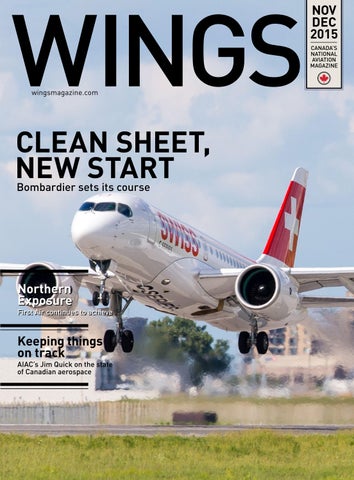
WINGS wingsmagazine.com
CLEAN SHEET, NEW START Bombardier sets its course
Northern Exposure
First Air continues to achieve
Keeping things on track
AIAC’s Jim Quick on the state of Canadian aerospace
NOV DEC 2015 CANADA’S NATIONAL AVIATION MAGAZINE
OUR INSTRUCTORS
MAKE ALL THE DIFFERENCE
BENEFIT FROM OUR INSTRUCTORS’ WIDE RANGE OF EXPERIENCE • Highly Experienced Pilots • Skilled Maintenance
Customers come to FlightSafety for our advanced-technology training systems; our efficient, effective learning environment; our global Learning Center network; and our unrivaled Customer support. They keep coming back, time after time, for our knowledgeable, experienced instructors. They are, simply, the best in the business. Our instructors are dedicated to earning your trust by providing the highest quality professional aviation training available today.
Technicians • Accomplished Cabin
Professionals • Experts in Scheduling
and Dispatch
Aviation professionals from around the world trust us to provide the highest quality training and outstanding service. More than 1,800 highly experienced professional instructors deliver aircraft- and mission-specific courses, using our comprehensive training systems and advanced-technology flight simulators designed to enhance safety. Trust your training to FlightSafety. You’ll see why so many aviation professionals make the same choice. And have since 1951. For information, please contact Steve Gross, Vice President, Sales • 314.785.7815 sales@flightsafety.com • flightsafety.com • A Berkshire Hathaway company
NOV/DEC 2015
UPFRONT 5 Leading edge On a mission
8 On the fly
News and opinion
12 Alternate Approach Made to measure
13 At the Gate
Banking on the right solution
14 Glidepath
Dismissing the bigger picture
15 Legal
Canada’s First Air has graced the northern skies for some 70 years. P.20
Private eyes…they’re watching you
BACK 35 Marketplace 38 On final
A strong tailwind needed
FEATURES 16 CLEAN SHEET, NEW START
Are delays going to squeeze Bombardier’s C Series out of the picture? BY DAVID CARR
20 IN AWE OF A NORTHERN ICON From top: Pascan Aviation P.13 Private eyes…they’re watching you P.15
Canada’s First Air continues to achieve as it approaches its 70th year BY BRIAN DUNN
24 CONTEMPLATING A VIEW TO THE FUTURE
PHOTOS: FIRST AIR (TOP); PASCAN AVIATION (TOP LEFT); DRAGONFLY (BOTTOM LEFT)
The AIAC’s Jim Quick explores how to keep Canadian aerospace strong BY MATT NICHOLLS
COVER PHOTO: BOMBARDIER
WWW.WINGSMAGAZINE.COM
November/December 2015 | WINGS
3
The aviation industry is facing a massive shortage of skilled professionals over the next decade. The Careers in Aviation Expos coming to Toronto and Calgary in 2016 will give members of the current and future work force an opportunity to hear from industry leaders about different career paths including: airplane and helicopter pilots, maintenance engineers, aerospace design, air navigation, flight operations and more!
LEADING
EDGE
| By Matt Nicholls
On a mission
Quebec-based Aero Tigre seeks to help pilots with essential recovery training
I
PHOTO CREDIT AERO TIGRE
t’s not often that I get a blank stare on my face and need someone to carefully repeat what has just been expressed to me. But that’s precisely what Mike Hamel was tasked to do this past fall, after he detailed our mission plan for my introduction to Upset Prevention and Recovery Training (UPRT). Hamel, affectionately known as “Hammer” to friends in the industry, is owner, with his wife Iris, of Aero Tigre based at Quebec’s Airport St. Mathieu de Beloeil, just 30 minutes from Montreal. Aero Tigre is a three-pronged operation that offers members of the general public aerobatic rides up to 45 minutes long, of scenic tours of Montreal and the surrounding countryside, and specialized UPRT training for commercial and business aviation pilots seeking to enhance their skills. Utilizing the nimble Slingsby Firefly T67C aircraft, Hamel can deliver aerobatic and UPRT training programs to beginners and experienced pilots alike. The aircraft’s strong frame, side-by-side seats and two sets of sticks and rudders make it easy for students and instructors to share. “Don’t worry, Matt, it’s a lot of fun,” Hamel told me before coaxing me into the right seat of the Firefly on my training day. “We’ll do a very mild version of the training I do with commercial and business aviation pilots, nothing too challenging. People love this you know – I had one man who was 76-year-old with Parkinson’s disease and this was on his bucket list. He was so pumped at the end of the flight, he couldn’t stop talking about it! We did a loop, a roll – he still wanted more!” An aviation veteran with more 35-years commercial and military flying experience in Canada and internationally, Hamel is on a mission to educate Canadian pilots
5 WWW.WINGSMAGAZINE.COM
life perspective of what happens when an aircraft is out of control. Several case studies including the Coglan Air Flight 3407 crash near Buffalo on Feb. 12, 2009 and the Air France 447 accident in 2009 are included in the training to give pilots necessary context. The course also includes ICAO training videos and more. And unlike UPRT training done in a SIM, the Aero Tigre course gives pilots what Hamel refers to as the “startle” effect – a physical reaction that cannot be duplicated unless you sit in the left seat. It’s a real thing, as I experienced during my flight in the Slingsby. “If you have seen something in real life, if you have never experienced the ‘startle’ effect, you would not know what to do. The glass cockpit is a great tool, but you still have to know how to adapt in a real life situation. It has happened to me . . . and it is not comfortable. It’s always good to have the right training to deal with any situation,” Hamel said. Of course, I too, know about discomfort, having experienced a G1 and G3 state in the Slingsby. But it’s comforting to know there are people like Mike and Iris Hamel actively training commercial pilots critical UPRT training right here in Canada. | W
The glass cockpit is a great tool, but you still have to know how to adapt in a real life situation. about the importance of UPRT training and offer companies an alternate to U.S.based training programs. There are currently few UPRT training alternatives in Canada and having an option here could save operations time and money. “Our training is highly organized with ICAO specifications. All of the training is 100 per cent built around this,” Hamel said. “A lot of people don’t know what is happening with UPRT training and it’s so important. If a pilot on any airline ends up upside down one day, and hopefully they don’t, with this training the pilot can correctly analyze the situation, recover and safely get control of the aircraft.” The training course the Hamels deliver has both a hands on and classroom element and is designed to give pilots a real
TOP DATA BURSTS… in this issue
1. Signature Flight Support is set to buy Landmark Aviation for approximately $2.1 billion. (Pg. 8) 2. 82 per cent of airlines are looking at improving personalization experiences with travellers (Pg. 12). 3. 650: The number of flight hours Pascan Aviation flies each month. (Pg. 13). 4. The cost of the CS100 is pegged at US$63 million. (Pg. 16). 5. First Air’s scheduled service carries approximately 250,000 passengers. (Pg. 20).
Your feedback is always welcome. Please contact me at mnicholls@annexweb.com. @Wings_Magazine November/December 2015 | WINGS
5
WINGS
NOV DEC 2015 CANADA’S NATIONAL AVIATION MAGAZINE
wingsmagazine.com
Vol. 56, Issue 6
CLEAN SHEET, NEW START
EDITOR
Matt Nicholls mnicholls@annexweb.com 416-725-5637
Bombardier sets its course
MEDIA DESIGNER
Emily Sun
Northern Exposure
FLIGHT DECK
First Air continues to achieve
Rick Adams, David Carr, Paul Dixon, Brian Dunn, Frederick K. Larkin, James Marasa, Carroll McCormick, Anna Pangrazzi, Amanda Winters
Keeping things on track
AIAC’s Jim Quick on the state of Canadian aerospace
SubScribe TODAY !
ACCOUNT MANAGER
Kory Pearn kpearn@annexweb.com 519-902-8574
1 Year SubScription only
3000
$
ACCOUNT CO-ORDINATOR
Stephanie DeFields sdefields@annexweb.com 1-888-599-2228 ext. 257
(GST $31.50 • HST $33.90) US $42.00 (USD) • Foreign $65.00 (USD)
Name: _______________________________ Company: ____________________________ Title: _________________________________ Address: _____________________________ City: _________________________________ Prov: ________________________________ P.Code: _______________________________ Tel: __________________________________ Fax: _________________________________ email: ________________________________
NATIONAL ACCOUNT MANAGER
Mena Miu mmiu@annexweb.com 905-713-4351 GROUP PUBLISHER
Martin McAnulty mmcanulty@annexweb.com DIRECTOR OF SOUL/COO
Sue Fredericks
WINGS MAGAZINE
P.O. Box 530, 105 Donly Dr. S., Simcoe, ON N3Y 4N5 Tel: 519-428-3471 Fax: 519-429-3094 Toll Free: 1-888-599-2228
PLeASe cHecK ONe:
❑ Charter/Fractional ❑ Commercial Airlne ❑ Private Aircraft Owner/Operator ❑ Air Transport-Cargo ❑ Tour Operator ❑ Training/Education ❑ Airport ❑ FBO ❑ MRO ❑ OEM ❑ Aviation Distributor ❑ Aviation Fuel Supplier ❑ Aviation Services ❑ Aviation Sales/Marketing ❑ Para-Public/EMS/SAR/Law Enforcement ❑ Government/Military ❑ Resources - Construction, Fire, Forestry, Mining, Oil & Gas, Wildlife, etc ❑ Other (please specify) ______________
Publication Mail Agreement #40065710 Return undeliverable Canadian addresses to Circulation Dept., P.O. Box 530, Simcoe, Ont. N3Y 4N5 email: subscribe@wingsmagazine.com Published six times per year (Jan/Feb, Mar/Apr, May/ Jun, Jul/Aug, Sep/Oct, Nov/Dec) by Annex Publishing & Printing Inc. Circulation email: subscribe@wingsmagazine.com Ph: 450-458-0461 Fax: 877-624-1940 Mail: P.O. Box 530, Simcoe, ON N3Y 4N5
PAYMeNT:
Subscription Rates Canada – 1 Year $ 30.00 (includes GST - #867172652RT0001) USA – 1 Year $ 42.00 Foreign – 1 Year $ 65.00 Occasionally, Wings magazine will mail information
Cheque - Payable to Annex Publishing & Printing Inc. Visa
MC
on behalf of industry-related groups whose products and services we believe may be of interest to you. If you prefer not to receive this information, please contact our circulation department in any of the four ways listed above. No part of the editorial content of this publication may be reprinted without the publisher’s written permission. ©2015 Annex Publishing & Printing Inc. All rights reserved. opinions expressed in this magazine are not necessarily those of the editor or the publisher. No liability is assumed for errors or omissions. All advertising is subject to the publisher’s approval. Such approval does not imply any endorsement of the products or services advertised. Publisher reserves the right to refuse advertising that does not meet the standards of the publication. Printed in Canada ISSN 0701-1369
Account #: __________________________ Expiry:_____________________________ Signature: _________________________
TO SubScribe:
Tel: 450-458-0461 Fax: 877-624-1940 Mail: Wings Magazine c/o Annex business Media P.O. box 530 Simcoe, Ontario N3Y 4N5
Air Transport Association of Canada
ON THE
WEB
email: subscribe@wingsmagazine.com
www.wingsmagazine.com
GST#135274215RT001
6
Subscriptions non-refundable
Canadian Business Aviation Association
Magazines Canada
AVIATION THIS WEEK Looking to catch up on the latest hot news from around aviation and aerospace? Check out Aviation This Week, a live, digital version of the top news stories affecting a variety of key markets. It's quick, essential information you need to know!
PRO1215
WINGS | November/December 2015
wings subad.indd 1
Canadian Owners & Pilots Association
WWW.WINGSMAGAZINE.COM
2015-11-02 10:29 AM
Flight Plans Change
Time For An Update? The time has come for you to take it up to the next level. Efficiency and quality are essential elements of who you are. Levaero can guide you through the process of upgrading or expanding your current aircraft inventory. Whether you are in the market for a new or pre-owned aircraft, or have a specific interest in the Pilatus PC-12 NG or the new Pilatus PC-24 Super Versatile Jet, Levaero’s sole purpose is getting you the right flight solution. Ready to expand your air space? Give us a call.
SALES • SERVICE • SOLUTIONS
Stan Kuliavas, Vice President of Sales skuliavas@levaero.com 1 844-538-2376
www.levaero.com
ON THE FLY For late-breaking news and exclusive web content, please visit us at: www.wingsmagazine.com
THE LEAD AEROSPACE INDUSTRY HAPPENINGS PEOPLE ON THE MOVE
THE LEAD
THE BOMBARDIER FALLOUT: OVERBLOWN? News that Bombardier had entered into failed talks with Airbus over an equity stake in the C Series sparked fresh concerns over the future of the troubled airliner program. The C Series, which is expected to receive certification as Wings goes to press, is years late, likely three times over budget and has been a financial albatross around other programs such as the Global 7000 and 8000 long-range business jets. But with the C Series finally set to enter service next year, a potential tie-up with Airbus (which in the early 1980s had approached the Canadian government and de Havilland Canada to take an equity stake in the A320 with the promise of an assembly plant) suggested that Bombardier either needs the European planemakers’ muscle to help boost the order book, or lacked the resources to filling the orders the Canadian company already has. The collapse of the Airbus talks led to renewed speculation that the program would be cancelled after a few years of
production. It’s not an encouraging message as the sales department ramps up its pitch to several marquee North American brands, including Air Canada, Jet Blue and United Airlines, which is reported to be in discussions with both Bombardier and Brazil’s Embraer for either the smaller CS100 or re-engined E-Jet to fill the gap between United’s smallest Boeing 737 and A320 aircraft, and its commuter fleet. It is more likely that the impact from the breakdown in talks with Airbus and the future of the C Series have been overblown. Bombardier is sitting on approximately $3.1 billion and is expected to launch an IPO to sell a minority stake in its rail unit before the end of the year, although the Reuters News Agency recently reported that this may also be delayed for about six months as the company considers selling a chunk of the rail business to a single entity or consortium. It’s a report that Bombardier denies. Chinese rail operators are interested in buying all of Bombardier’s train division. Proceeds from the sale of all or a portion of rail will provide Bombardier with the added cash to pay down debt and support the C Series (and critical business jet unit) as the aircraft enters service. But a partner has still not been ruled out. At the same time Bombardier was denying the Reuter’s story, it reaffirmed that it was still looking for opportunities “to participate in industry consolidation” in both its train and airplane building businesses. This is expected to include an approach
Bombardier’s struggling C Series may not be in such dire straights after all. 8
WINGS | November/December 2015
Signature Flight Support is set to acquire Landmark Aviation, changing the FBO landscape.
to Embraer, whose next generation E-Jets will not compete directly with the CSeries, and even a possible return to the bargaining table with Airbus.
FBO OVERLAP AT YVR The FBO landscape is about to consolidate. Signature Flight Support, which operates the world’s largest FBO network is set to buy Houston, Texas-based Landmark Aviation for approximately $2.1 billion. If the blockbuster deal is approved, it will be the largest FBO acquisition in history, adding 68 more FBOs to Signature’s 133 wholly owned and affiliate global locations. Signature is owned by U.K.-based BBA Aviation, a global aviation support and aftermarket services provider. Landmark is owned by the Carlyle Group, an asset management firm, and added 19 FBOs in 2014 with the purchase of Ross Aviation. “This is a transformational step in the continued execution of BBA Aviation’s strategy that is both strategically and financially compelling,” said Simon Pryce, chief executive of BBA Aviation. “It represents a unique opportunity to materially expand our global Signature FBO business and deepen our exposure to the attractive business and general aviation market, with its structural growth drivers.” The expanded company will operate under the Signature banner. “This is a strategic fit for the Signature network,” said Maria Sastre, president and chief operating officer for Signature. “It will WWW.WINGSMAGAZINE.COM
PHOTO: BOMBARDIER (BOTTOM); SIGNATURE FLIGHT SUPPORT (TOP)
8 9 9 10
expand our reach within North America as well as globally. Once completed, Signature will be able to offer its world-class customer services and loyalty programs across a much broader network of leading business and general aviation locations. We believe this transaction to be one of the most significant acquisitions in the business and general aviation industry.” Landmark also offers charter, aircraft management and maintenance services. Sixty-four of its FBOs are located in North America, with facilities at Toronto Pearson, Calgary and Vancouver. With 201 FBOs, the new Signature will have overlap in only 12 markets, including Vancouver. It is expected that Signature will have to divest itself of some locations for the deal to be approved likely in early 2016.
AEROSPACE
AIAC SAYS “OK” TO TPP Canadian aerospace companies are rallying behind the Trans Pacific Partnership (TPP), which Canada recently brokered with 11 other countries, including NAFTA partners the United States and Mexico. If ratified by all 12 members, the TPP will bring down trade barriers for 800 million consumers representing 40 per cent of the global economy. “The TPP creates a level playing field for Canadian companies to compete in the Asian market,” said Jim Quick, chief
The TPP will help bring new trade partners for Canadian aerospace firms in the Asia Pacific market.
executive of the Aerospace Industries Association of Canada (AIAC), an Ottawabased trade group. “It ensures that our access to key markets such as Singapore and Japan remains strong, and ensures our ability to compete equally with other aerospace nations such as the United States, Japan and Mexico.” Nearly 65 per cent of all Canadian aerospace exports are to countries within the massive TPP trading bloc, totalling more than $10 billion in 2013. In addition, four out of Canada’s top 10 aerospace export destinations – the United States, Singapore, Japan and Australia – are TTP members. AIAC estimates that the Asia Pacific region represents a significant growth opportunity for Canadian companies over the next 20 years. Approximately 40 per cent of the over 38,000 new aircraft valued at $5.6 trillion will be delivered to Asia Pacific customers. “Just like free trade agreements signed in the past, the TPP allows us to further consolidate our favourable position in the global supply chain and give us easier
access to the very large and growing market,” said Suzanne M. Benoit, president of Aéro Montréal, an organization representing one of the world’s largest aerospace clusters. Montreal-based CAE agreed. “It ensures the creation and protection of jobs in Canada, while promoting economic growth and opening to Canadian companies some of the most dynamic markets in the world. The TPP fits perfectly with our desire to further develop overseas markets that provide our companies, especially our SMEs, highly promising opportunities,” said Hélène V. Gagnon, vice-president of public affairs and global communications at CAE, and chair of Aéro Montréal. In addition to Canada and the United States, the full list of TPP signatories are: Australia, Brunei, Chile, Japan, Malaysia, Mexico, New Zealand, Peru, Singapore and Vietnam. “Lowering trade barriers and creating equal or preferential access to key markets is essential to our industry’s ability to grown, innovate and employ Canadians,” Quick added.
INDUSTRY HAPPENINGS
PHOTO: MAGELLAN (TOP); AIR CANADA (BOTTOM)
BOEING'S ON THE MOVE
Boeing continued to experience record profits in 2015 as it benefited from the faster production of commercial lets. The company delivered 199 commercial aircraft in July, August and September, up from 186 during the same quarter last year. WWW.WINGSMAGAZINE.COM
November/December 2015 | WINGS
9
ON THE
FLY
BREITLING TEAM IMPRESSES The Breitling Jet Team completed its highly successful, first-ever North American tour with crowd pleasing performances at Toronto’s Canadian International Air Show, which included several spectacular fly-pasts over Niagara Falls. “To see Niagara Falls from such a point was truly a special experience for us,” Breitling Jet Team leader Jacques Bothelin said. “Precision and timing are essential to our success, so to see something so powerful and unrestrained in person was remarkable.” No other watch manufacturer has strapped its brand as tightly around aviation’s heritage as Breitling, a Swiss-based manufacturer of high-end chronographs, which began assembling an eclectic air fleet in 1992, with a vintage DC-3, and includes the world’s largest professional civilian flight team, comprised of seven Czech-built L-39 C Albatros jets, that can
reach speeds of up to 565 miles per hour. “The Breitling Jet Team embodies Breitling’s values of precision, performance, fine aesthetics, and innovation,” said Thierry Prissert, president of Breitling USA. “With their unmatched precision and coordination at such high speeds, it is clear they are truly masters of their craft. When you watch them perform you cannot help but grin from ear to ear – it really is a special experience.” The Jet Team, which is based in Dijon, France began its North American tour at the Sun ’n Fun Fly In & International Expo last April in Florida, and performed at 20 cities in Canada and the United States, finishing in Toronto where it bookended the annual air show with Canada’s Snowbirds. Breitling’s association with aviation began developing chronographs for airplane cockpits, including World War II fighters. The company’s Navitimer wrist chronograph, featuring a circular slide rule serving to perform all navigation-related
calculations has been a cult object for pilots and aviation enthusiasts since it was first introduced in 1952. To celebrate the Jet Team’s North American tour, the watch maker has produced a limited edition Chronomat 44 timepiece, which features the Breitling Jet Team colours and tour logo engraved on the case-back.
PEOPLE ON THE MOVE FLYHT Aerospace Solutions Ltd. has announced changes to its executive management team. Tom Schmutz is the new chief executive officer (CEO) as Bill Tempany is retiring from his role as CEO. He will remain on the board of directors and has been appointed the chairman of the board. Matt Bradley also announced he has resigned from his position as president of FLYHT to pursue new career opportunities. Schmutz comes to FLYHT with more than 30 years experience in
LEKTRO
Celebrating 70 Years of Innovation, 1945-2015
Models From
15,000 to 210,000 lbs.
Certified Electric Towbarless Easy to Use Universal Rugged Simple to Maintain www.
LEKTRO .com
1-800-535-8767 1-503-861-2288 sales@lektro.com 10 WINGS | November/December 2015
WWW.WINGSMAGAZINE.COM
senior leadership roles in the aerospace and telecommunications industries. Most recently, Schmutz spent nine years with L-3 Communications Corporation in the Aviation Recorders division. Tempany retires after a career of more than 35 years in senior management, 12 of which were spent leading FLYHT to become a public company and develop the successful AFIRS technology. Bradley has been a part of FLYHT’s management team for more than seven years. He was FLYHT’s VP operations from 2008 to 2010 . . . Bell Helicopter has a new leader. John
Garrison has left the company to take on new opportunites. He has been replaced by Mitch Snyder, who was executive vicepresident of the firm's military business . . . The 2015 winners of the Arnold and Vi Milstead Warren Scholarship winners have been announced. Each receiving $2,000 are Veronica Draghici and Nahee Lee. Draghici earned her Glider Licence in Romania before converting it to a Canadian Glider Licence. She completed her private and commercial licence at the Brampton Flight Centre, and has shown immense dedication in furthering
“Peterborough offers
Peterborough is the Place for MROs to Grow
the best of a larger regional airport with benefits of a smaller community such as low cost of living and operations.
“
PHOTO: BREITLING
The Breitling jet team put on a show at the Toronto Canadian International Air Show
her education – something that helps her stand out with her students. Lee is a graduate of the Seneca College aviation program. She has completed her private and commercial licences as well as multiengine and group 1 instrument ratings. She is very passionate about sharing her knowledge with students . . . Sticking with the awards and women in aviation and aerospace theme, the Northern Lights Awards awarded its 2015 award recipients at during its gala event in Toronto Oct. 3. Taking home awards this year include: Judy Cameron, the first female pilot hired by Air Canada, Flight Ops/ Maintenance Award; Sgt. Andreena Clifford, RCAF, Government Award; Tracy Medve, president of KF Aerospace, Business Award; Jill Oakes, University of Manitoba, Education Award; Dawn Bartsch, dedicated bush and commercial pilot, Pioneer Award; Erin Grant, Jazz Cadet, Rising Star Award; Claire Lemiski, corporate pilot, Bombardier, Rising Star Award.
- John Gillespie Flying Colours Corp.
Redefine your success in
Peterborough & the Kawarthas Find out how at PeterboroughED.ca/wings
WWW.WINGSMAGAZINE.COM
November/December 2015 | WINGS
11
ALTERNATE
APPROACH By David Carr |
Made to measure
Airlines are looking to IT to serve the passenger with a tailored product
I
12 WINGS | November/December 2015
with tablets are also assisting customers at check-in and “bag drop” to thin out airport queues. There are still bumps along the end-to-end (booking to bag claim) highway that the airline industry is working to smooth out. For example 31 per cent of passengers are stressed over baggage claim. By 2018, 70 per cent of airlines plan to keep passengers up-to-date with the location of their baggage, an encouraging indicator of a technology makeover. In the future, interactive technology will allow passengers to taste menus and feel seat fabrics. More immediately, tailoring offers to individual customers will remain a business priority for airlines. Technologies, such as SITA’s Horizon will enable airlines to track customer’s preferences and personalize service offerings both on the ground and inflight. For some airlines, it can be a home goal; studies show that the majority of travellers prefer to purchase ancillary services from their chosen airline than from a third-party. “Passengers expect a tailored and personal buying experience similar to their online experience with major retailers,” said Allison O’Neill, vice-president of passenger services for SITA. “We are helping airlines sell more stuff according to more nuanced retail practices.” | W
82 per cent of airlines are investing in programs to improve personalization over the next three years. Honeywell International, nearly 20 per cent of travellers will switch from a preferred airline if a competitor offers better Wi-Fi service. “Wi-Fi is increasingly becoming the deal breaker at the time of booking,” said one analyst at a recent SITA air transport summit in Brussels. And not just booking. According to Honeywell, 30 per cent of travellers will wait in line for standby on another aircraft with improved Wi-Fi. Another 30 per cent would prefer in-flight Wi-Fi rewards over air miles, opening the door to more customized loyalty programs. On the customer service side, airlines are already putting tablets in the cabin to reduce the paper burden and receive key information on passengers, such as dietary needs or preferred language. This trend will accelerate as more airlines put tablets in the cabin crews’ hands to use data for a “made to measure” travel experience with perks such as inflight upgrades to reward loyalty. Technology is already delivering relief at some of the so-called “pain points” of air travel, such as check-in, where nearly 90 per cent of passengers now report a positive experience as a result of innovations such as online check-in. Roving passenger agents
David Carr is a Wings writer and columnist. WWW.WINGSMAGAZINE.COM
PHOTO: BRIAN LOSITO, AIR CANADA
n the last issue of Wings, I reported on the “Internet of Things” and creating intelligent airports. Walk down the bridge and discover that technological change and the way airlines connect with travellers is going to be as profound. “Passengers have a strong appetite to use their own connected technologies throughout the journey and never more so than on-board the aircraft,” writes Francesco Violante, chief executive of SITA, a member-based air transport industry communications and IT Group, in the association’s 2015 Airline IT Trends Survey. Indeed, while the low-cost evolution caused legacy carriers to tear down their full service offerings. Now, technology is enabling legacy and low-cost airlines to build service levels up, on a personalized basis – and at a price. Airlines are responding by beefing up their technology offerings. According to SITA, 82 per cent of airlines are investing in programs to improve personalization over the next three years. Over three quarters plan a major program in passenger services via smartphone, and more than 63 per cent via tablet. Interestingly, the low-cost carrier appears more likely to join the frontlines of the revolution. According to SITA, the low-cost segment has traditionally spent less on IT than full service carriers. But 85 per cent are expecting to increase their operating IT budgets compared with 35 per cent for full-service carriers. “It is a similar story with capital IT budgets,” the SITA survey reports. “Low cost carriers are more confident with 66 per cent of respondents expecting an increase, in contrast to 35 per cent of full service carriers.” Legacy or low cost, one of the most noticeable changes will be the gradual disappearance of traditional inflight entertainment systems. By the end of 2018, two of three airlines will offer wireless Internet and multi-media services on passenger devices, giving passengers greater ability to choose their own in-flight entertainment, and freeing airlines from the cost burden of retro-fitting cabins with expensive systems that are nearly obsolete by the time the final airplane has been rewired. According to a recent survey by
AT THE
GATE
| By Brian Dunn
Banking on the right solution
Pascan Aviation files for creditor protection but is far from finished
W
hen Quebec regional airline Pascan Aviation filed for creditor protection in late August, it didn’t look good for the carrier, which was founded in 1999 by career pilot Serge Charron with a single leased Pilatus PC-12. The airline said it will honour reservations and tickets as it restructures its business in parts of Quebec and Atlantic Canada. It said the Business Development Bank of Canada and Investissement Québec are providing a total of $1 million in financial support while Pascan operates under the Companies’ Creditors Arrangement Act. Based in St. Hubert at a former air force base on the South Shore of Montreal, Pascan provides service to some 16 small destinations mostly in Quebec, but also to Bathurst, Wabush and Goose Bay. Its all turboprop fleet consists of ATR-42s, Jetstream 32s, Beechcraft B100 King Airs and Pilatus PC-12/45s. But the airline is far from going under, according to Yani Gagnon, vice-president of finance. In April, Pascan reduced service in the hopes of avoiding bankruptcy or at least to undergo a judicial restructuring. The airline is heavily dependent on the mining industry, which has seen better days. “There are two sides to the mining industry,” Gagnon said. “One is the construction side and the other is the production side. Most of our customers are on the construction side which is shorter in time compared to the production side which can last 25 years or more.” Before it filed for creditor protection, Pascan underwent five years of intensive growth of close to 30 per cent a year, adding new routes and aircraft and new employees to keep up with a mining boom. It also bought the assets of Exact Air with operations in Baie-Comeau, Mont-Joli, Sept-îles and Havre-Saint-Pierre, which included three buildings, three aircraft and other equipment. The $5-million transaction also included the passenger and cargo routes between Havre-Saint-Pierre, Septîles and Port-Menier on Anticosti Island. The beginning of the slide occurred in the summer of 2013 when Quebec underwent a construction strike, Gagnon said. “We tried to adjust to the reality of the WWW.WINGSMAGAZINE.COM
employment at the airline has dropped from 350 to 150. “But it’s business as usual,” Gagnon said. “We’ve done our restructuring and it is a sustainable operation. The problem is that we’ve accumulated debt over the past two years.” Some of the airports Pascan deals with depend on the airline to survive, Gagnon pointed out. It is the only scheduled carrier serving St. Hubert and if Pascan ceases operations, that would be the end of St. Hubert save for a few flying clubs. “The bleeding has stopped and we’ve restructured the business based on the current volume. And we’re at the bottom of the cycle, according to the mining industry and the business is sustainable.” An important component of the airline’s business is fixed cargo contracts with clients such as Canada Post and courier service Dicom Express. Gagnon wants to expand this portion of the business by going after more government business and to increase its Medivac operations with its ATR aircraft. There is also a promise of new business. “Some of our customers are bidding on a new hydro project in Muskrat Falls near Churchill Falls,” Gagnon said. “It would be a steady fly in/fly out business where we have developed some expertise.” | W
The mining industry is a cyclical business and so is ours and we’re trying to find a magical formula. situation,” he said. “One day, we’d fly an ATR-42 with 36 passengers to Wabush and the next day we would only have 18 passengers with the same fixed costs. It was a gradual decrease, because we don’t have any customers that represent more than 10 per cent of our business. The mining industry is a cyclical business and so is ours and we’re trying to find a magical formula.” That magical formula may still be Plan Nord, Quebec’s ambitious project first introduced in 2011 under the former Liberal government of Jean Charest to open the province’s huge northern region to mining, renewable energy and forestry projects. The multibillion-dollar public/private sector project was shelved under a new Parti Québecois government, but is being revised under the current Liberal government. But it hasn’t gained any traction with the low commodity prices. The Pascan model is to connect small communities to Montreal and with each other as opposed to other carriers that transport customers to Montreal to fill larger aircraft for transborder or international flights. But even those numbers are down. In 2013, the airline averaged 2,200 flight hours per month. Today, that figure is 650 flight hours per month and
Brian Dunn is a Wings writer and columnist. November/December 2015 | WINGS 13
GLIDE
PATH
By Paul Dixon |
Dismissing the bigger picture
Emergency management strategy, aerospace ignored on many levels
I
t was a long dry summer out west, the warmest summer on record (based on 140 years or so of record keeping). Following a winter that saw record low snowfall in many areas, the result was reservoirs at record low levels and unprecedented water restrictions. Looking south at the fire season in California and even up into Washington State, you can’t help wondering what the future holds for what used to be the “wet coast.” There is no doubt there is a change in the weather, the question now is how big a tilt are we in for and how long is it going to go on for. We may have gone three months without rain, but there were other parts of the country that were on the verge of floating away. There’s increased wildfire activity on one side of the country and unseasonable flooding on the other side. Both are symptoms of the changing world we live in. It’s a small planet, but it’s the only one we have. Size is relative and some of the numbers are too big to really comprehend, until you get down to the important part – that’s where we live. Give or take, the earth is about 40,000 kilometres in circumference, while we inhabit a zone that extends from about three km underground to seven km above the surface and most of us live well short of those boundaries. Put another way, there’s a little band of gas that clings to the surface of the Earth that keeps us alive and it’s 0.00025 per cent of the earth’s circumference. There’s not much wiggle room, or excuse me for saying this, breathing room when we use up what we were given. It’s not just that it’s been hot and dry on one side of the country and cold and rainy on the other. When it’s hot, it’s really hot, and not necessarily the temperature on the thermometer, but the UV index. And when the rains come, it’s not a shower but a deluge. Unfortunately, one of the byproducts of our political system over the past decade has been a weakening of our emergency response capabilities in a wide range of disciplines due to continual budget cutting and the mantra of “no new taxes.” Cuts to coast guard resources on the west coast, lack of federal funding to support Heavy Urban SAR (HUSAR) programs have been matched by provincial governments. One thing you can count on for sure 14 WINGS | November/December 2015
municipal level, through to provincial and up to the federal government. These programs need to be funded in such a way that ensures adequate response capability in terms of personnel and equipment. They should be constant and ongoing programs, part of the basic fabric of our communities. If these programs are managed and supported with an aim to providing the training to meet the challenges when the time comes, the costs will be far less than not having the right people when you need them most. The federal government talks about a national shipbuilding program and a national aerospace program and these are good things, but they are not new. This country had a strong shipbuilding industry and it was allowed to wither. Shipbuilding is coming back and aerospace is really our ace in the hole for the future, but we need to look at a national emergency management strategy in the same context. It seems simple, the opportunity to increase the strength and resiliency of communities while providing training and job skills to some of the people who need them most. There’s a saying in emergency management – “it wasn’t raining when Noah started building the ark.” | W
There’s a saying in emergency management – ‘it wasn’t raining when Noah started building the ark.’ is that with any large-scale disaster, be it wildfire, flood or weather-related, it will attract provincial and federal politicians, just like insects to a dropped ice cream cone. Compounding the intrusion is the fact that no politician is allowed out in public without his or her swarm of handlers. How many times this summer did we see clearly staged media events designed to project the impression that there’s nothing to worry about because our leaders were on the scene? For example, the premier of B.C. talked about the need for a national wildland firefighting strategy. She must have mislaid her briefing notes, because we have a national firefighting strategy in this country. It’s a very good program and it is our interface into a much larger international wildland firefighting strategy, as we saw later in the summer when crews of Canadian firefighters were dispatched across the border into northern Washington State. Canada’s firefighting model is built along the same lines as our national emergency management model, which allows integration and expansion of response from the
Paul Dixon is a freelance writer and photojournalist living in Vancouver. WWW.WINGSMAGAZINE.COM
LEGAL | By Amanda Winters | guest columnist
Private eyes…they’re watching you Para-public UAVs and the Canadian Charter of Rights and Freedoms
PHOTO: DRAGONFLY
T
he rise in popularity and use of unmanned aerial vehicles (UAVs) has attracted much attention recently. We have recently seen a major uptick in drone use by private companies. Drones have been regulated for some time through federal aviation regulations, but the accessibility of drone technology has led Transport Canada (TC) to consider revisiting the regulations to ensure they keep pace with current interest and use. In many industries, both private actors and government bodies are using UAVs in new and innovative ways. Arising from this technological leap forward are a number of new legal issues, particularly in the area of privacy. A special consideration for companies employing or supplying drones for public or para-public use is the possibility of infringing on privacy rights protected by s. 8 of Canada’s Charter of Rights and Freedoms. Canadian citizens have a right to privacy, including rights that prevent the government from collecting information about them in certain circumstances. The use of drones to take photographs or video, or to collect other data, can be open to challenge. For example, in the Supreme Court of Canada case of R. vs. Tessling, 2004 SCC 67, the RCMP used an airplane equipped with forward-looking infra-red (FLIR) cameras to obtain images of heat radiating from a building suspected of housing a marijuana grow-op. The FLIR images did not show the inside of the building. Using these images, the police obtained a search warrant to search the suspect’s property, finding the grow-op they suspected was there. The suspect argued that the FLIR photographs breached his s. 8 right to privacy. The Supreme Court disagreed, noting that the images produced by the current FLIR technology were not truly invasive, because they did not allow the police to “see” inside the suspect’s home. The Court emphasized, however, that improvements in the technology may lead to a different result in future challenges. The principles in Tessling have been applied to other types of searches where authorities have used non-traditional surveillance techniques. WWW.WINGSMAGAZINE.COM
example, in R. v. Wilkinson, 2001 BCCA 589, a landlord took it upon himself to investigate the residence of a tenant and, after finding a marijuana grow-op, advised the police. Because the landlord was not asked or told to investigate by police, the court allowed the evidence found during the search to be used against the accused. However, in R. v. Liang, Yeung, et al, 2007 YKTC 18, police asked a Yukon Electric employee to go onto the accused’s property in search of an electrical bypass. The employee discovered the bypass, and the police used that information to make an arrest. The court concluded that because the police had specifically directed the Yukon Electric employee, the employee was an “agent” of the police and his actions were subject to the Charter. Based on these cases, private contractors hired for the specific purpose of conducting searches should be aware that the results of those searches may be subject to Charter scrutiny. Ultimately, the impact on the non-government actor may be minimal, as the remedy for a Charter breach is to expunge the evidence from the record. However, beyond the Charter issues, there are general privacy concerns that may expose a company to civil liability, or even criminal charges. Private contractors may wish to seek a lawyer’s opinion regarding the legal implications of their UAV activities. | W
Arising from this technological leap forward are a number of new legal issues, particularly in the area of privacy. Because police forces are clearly linked to the government, their use of UAVs is subject to the Charter. But what about private companies that provide services to public bodies? Is the Charter something they should consider when using UAVs? At the moment, Charter implications for using drone technology remains an open legal question. To date, there are no reported court decisions that consider the issue. Some guidance may be taken from a line of cases where the courts consider whether a private citizen or entity is acting as an “agent” for law enforcement. In these cases, courts consider whether the private citizen or entity has been asked or directed to assist with a search. For
Amanda Winters is an associate of the Aviation Practice Group at Alexander Holburn Beaudin + Lang LLP. The Aviation Practice Group handles legal matters of special concern to the aviation community across Canada and internationally. For more information, go to www.airlawblog.com November/December 2015 | WINGS 15
CLEAN SHE
NEW START BOMBARDIER SETS ITS COURSE
BY DAVID CARR 16 WINGS | November/December 2015
WWW.WINGSMAGAZINE.COM
Bombardier’s embattled C Series program is close to final certification.
PHOTO: BOMBARDIER
EET, D
uring a recent goodwill visit to Bombardier’s Toronto assembly plant, a member of the C Series jetliner flight crew apologized for the lengthy wait. He was pointing to the lineup of journalists and guests queueing to visit the flight deck. He could have just as easily been talking about the long delayed arrival of the first clean design, narrowbody jet in more than 15 years, WWW.WINGSMAGAZINE.COM
and the first in its category in 30. None of that appeared to matter. As the airplane sat on the tarmac, sparkling in the bright red and white livery of launch customer, SWISS, concerns over program delays and a thin order book melted away under the sun of an unseasonably warm September morning. Still, it was back to business immediately after the CS100 slipped quietly out of Toronto, with a cheeky fly past over Billy
Bishop Airport, an urban facility where Porter Airlines potential order for up to 30 CS100 for trans-continental service hinges on a vote by City Council to extend the runway and allow for commercial jets into the waterfront airport. “What is pretty definite is that the C Series is the quietist commercial jet in production,” said an enthusiastic Robert Deluce, founder and chief executive of Porter Airlines. “When the official noise data is published November/December 2015 | WINGS 17
we are going to see it is an airplane that is comparable to the Q400 on several parameters and maybe even better on one or more of the parameters, including taxi. It really is a game changer when you compare it with other aircraft.” It was at the 2008 edition of the Farnborough Air Show where Montreal-based Bombardier, pioneer of the regional jet concept, ended years of speculation by green-lighting the C Series family of airliners aimed at filling a gap between the smallest Airbus A320s and Boeing 737s, and the smaller regional jets (the CS300
does invade A320 and 737 territory with a high density layout of 150 seats and maximum capacity of 160 seats). Even so, the number three airframer was taking direct aim at Airbus and Boeings’ bread and butter product line. The two giants responded with re-engined versions of their popular and well-established aircraft and advantages in size, supply chain, deeper pockets and cut throat pricing to offset the added cost of a slightly larger airplane to beat out Bombardier at almost every turn. The Canadian plane-maker didn’t aid its cause with chronic delays, including a
grounding of the test program following an engine failure, and clearly lost potential customers including Qatar Airways, while making the existing customer base jittery. But it was more likely when going nose-tonose against Airbus and Boeing that customers would want to see the goods before placing an order. “It is natural with the introduction of a new airplane for some customers to take a wait and see approach,” explains Fred Cromer, an airline industry veteran and president of Bombardier Commercial Aircraft since April. “They will wait a bit after certification. It enters services next year, and customers will be able to see how it performs.” The C Series made a splash at the Paris Air Show earlier this year with an unprecedented “beating the initial brochure” announcement that both the CS100 and CS300 will exceed original targets for fuel burn, payload range and airfield performance. The market liked what it saw, and the airplane even won rare praise from its rivals as a technologically and economically promising airplane. Bombardier says the C Series will be 20 per cent more fuel efficient than current narrowbodies, and 10 per cent more efficient than the Airbus A320neo and Boeing 737 Max series. The lead that Bombardier once held in entry into service over the newer versions of the A320 and 737 has largely evaporated. Large orders for the established airplanes have been locked in raising the question; is there room in their fleets to integrate not only another airplane, but a new type of aircraft altogether? Not surprisingly, Cromer believes so and has the boardroom battle scars to back up his analysis. In addition to having served as chief financial officer for Continental Express, Cromer has spent a career matching airplanes to routes as vice-president of fleet planning for Continental Airlines (now United) and director of fleet planning for Northwest Airlines (now part of Delta). He sees the advantage in operating a family of aircraft in terms of less investment in spare parts and people to support the aircraft, but to a point. “The family concept only works for so long. What has happened in our industry with high fuel costs, the high cost of operations and pressures on fares coming down is competing manufacturers of larger aircraft putting more and more seats in the aircraft to drive down costs,” he points out. “So the market for 100- to 150-seat aircraft have largely been vacated by manufacturers who have optimized their platforms around larger capacity aircraft.” Bombardier estimates that 80 per cent of departures worldwide carry less than 150 passengers. “So there is a family
18 WINGS | November/December 2015 Island Ad.indd 1
WWW.WINGSMAGAZINE.COM 2015-10-05 9:26 AM
benefit [in fleet planning], but there is not a member of the current family that delivers the economics in the market we are going after,” Cromer said. The airframer forecasts demand for 12,700 aircraft deliveries in the 60- to 150-seat range over the next 20 years, including 7,000 deliveries of aircraft in the 100- to 150-seat range. Over 90 per cent of the CSeries aircraft certification program was complete at the time of writing and the CS100 is expected to be certified in November. “Over the next few weeks, the CS100 takes to operating on a commercial airline-type schedule from key airports in North America,” Rob Dewer, vice-president of the CSeries Aircraft Program maps out. The CS100 aircraft is expected to be in operation with SWISS in the first half of 2016. The final tests will be conducted using typical airline flight routings and operational procedures, stopping at dozens of airports in Canada and the United States, where Bombardier is hungry for a breakthrough order after a 14-month sales drought. Is Cromer’s aviation pedigree enough to open doors? “How we present the airplane and how we talk about its versatility is important, so yes it does matter. When I’m talking to a fleet planning department, I know exactly what they are thinking about. I can sit and talk to the CEO and CFO. I have the background and these are the people I know. It makes it easier to get into the heart of the matter.” Bombardier is reportedly in talks with several North American operators, including Air Canada and Jet Blue, an Embraer customer, which has delayed delivery of 24 E190s to focus on larger airplanes. The carrier is reported to be hesitant to be one of the early operators of a new technology aircraft. Comer disputes this. “The CSeries is a very versatile aircraft, but the technology is not so advanced that it accelerates the risk. From a technology standpoint, this is a low risk airplane with great efficiency.” Perhaps the brightest prospect for now is United Airlines, a Star Alliance partner with Air Canada, and an airline that Comer is likely most familiar with from his time in fleet planning at Continental. According to Bloomberg News, United plans to order a fleet of either C Series or re-engined Embraer E-Jets, pending the successful outcome of bargaining with its pilots. Comer believes that the C Series has it all over its Brazilian rival. “This airplane does a much better job on fuel efficiency than those aircraft,” he said. “It also has, versus the Embraer specifically, much more range capability. This is a transcontinental airplane with tremendous flexibility in how to use the airplane. You don’t have to confine it to a single hub. You can use it across your entire operation.” WWW.WINGSMAGAZINE.COM
Pricing of the C Series has been an obstacle for Bombardier. The cost of the CS100 is pegged at US$63 million, and US$72 million for the larger CS300. The Canadian manufacturer does not have the resources to match the discounting of Airbus and Boeing. Comer prefers to leave price negotiations at the bargaining table, but indicates a shift in thinking on pricing in Montreal. “The business case is different today than when the aircraft was first developed,” he points out. “We need to figure out ways to develop the aircraft more cost efficiently.” Which may have been the thrust of Bombardier’s recent talks with Airbus. “It is not necessarily about discounting,” Cromer continues. “Is there a lower price point for the airplane today than when the business case was developed? Probably. Our job is to figure out how we get everybody onboard and get this airplane produced at a price point that makes sense for the current market.” SWISS, a division of Lufthansa, has orders for 30 C Series, and recently converted 10 of those to the CS300. “With its size and its low operating costs, the CS300 aircraft ideally complements the CS100 and the rest of our European fleet,” Harry Hohmeister, chief executive of SWISS said at the time. “With both versions of the new
C Series family of aircraft in our ranks, we can be highly flexible in tailoring capacity to demand on our European routes.” Production ramp-up at Bombardier is underway with SWISS scheduled to take delivery of the first batch of 10 CS100s in 2016, replacing its existing fleet of Avro Regional Jets, and 10 CS300s in 2017. Bombardier’s order book currently stands at 603 aircraft, but only 243 of these are firm orders. Some of the commitments on the books, such as Porter Airlines and a U.K. upstart that plans to operate the CS300 from London City Centre Airport to New York would showcase the urban and trans-Atlantic capabilities of what is a truly versatile airplane. But does Bombardier have time on its side? The margin for error is thin and the C Series strongest marketing advantage will be if Bombardier can introduce into service an aircraft that has already been pushed significantly up the bell curve. “It is a real challenge to bring an aircraft to market with this kind of technology,” Cromer concludes. “This is the first all new designed aircraft in 30 years. There are others that are coming, but this one is the first. The fact that it is meeting its performance requirements and beating them – that’s a big deal.” | W
the right relationship can help you soar.
I
PNC AVIATION FINANCE When it comes to financing private aircraft, we know you value decades of aviation expertise, track record and financial strength. That’s why aviation clients across the U.S. and Canada choose PNC Aviation Finance to help their business take off. To learn more, visit pnc.com/aviation. PNC is a registered mark of The PNC Financial Services Group, Inc. (“PNC”). Equipment financing and leasing products are provided by PNC Equipment Finance, LLC, a wholly-owned subsidiary of PNC Bank. Aircraft financing is provided by PNC Aviation Finance, a division of PNC Equipment Finance, LLC. In Canada, PNC Bank Canada Branch, the Canadian branch of PNC Bank, provides bank deposit, treasury management, lending (including asset-based lending through its Business Credit division) and leasing products and services (through its Equipment Finance division). Deposits with PNC Bank Canada Branch are not insured by the Canada Deposit Insurance Corporation. Deposits with PNC Bank Canada Branch are not insured by the Federal Deposit Insurance Corporation, nor are they guaranteed by the United States Government or any agency thereof. Lending and leasing products and services, as well as certain other banking products and services, require credit approval. ©2015 The PNC Financial Services Group, Inc. All rights reserved. CIB EF PDF 0715-070-195013
November/December 2015 | WINGS 19
Based out of Ottawa and with hubs in Yellowknife and Iqaluit, First Air operates a fleet of 17 aircraft.
CANADA’S FIRST AIR CONTINUES TO ACHIEVE AS IT APPROACHES ITS 70TH YEAR
Q
BY BRIAN DUNN uestion. What is the oldest airline in Canada still operating under its original name? The surprise answer is First Air/Bradley Air Services, which celebrates its 70th anniversary in 2016. First Air is a subsidiary of the Makivik Corporation, founded in 1975 to administer funds paid to the Inuit of northern Quebec as part of the James Bay Hydro Agreement with the Quebec government. It purchased the airline in 1990 from businessman John Jamieson, who bought the airline after the death of founder Russ Bradley. Headquartered in Kuujjuaq, Que., Makivik also owns Air Inuit, which has served Nunavik in northern Quebec since 1978. Based out of Ottawa with hubs in Yellowknife and Iqaluit, First Air operates a fleet of 17 aircraft that until recently, included the only two civilian-owned 20 WINGS | November/December 2015
and operated Hercules cargo aircraft in Canada. They were sold earlier this year. The fleet now consists of two Boeing 737400 all passenger aircraft, three 737-400 combis, one 737-200 combi, one 737-200 all passenger aircraft and ten ATR 42s. Two ATR 72s were recently sold as well and its only B767-200SF was transferred to partner airline Cargojet in 2014 as part of restructuring efforts. First Air’s scheduled service carries approximately 250,000 passengers and more than 23 million kilograms of freight and mail over its vast and comprehensive route system that includes codeshare destinations, connecting some 30 northern communities with Ottawa, Montreal, Winnipeg and Edmonton. Charter services are also provided worldwide. Interestingly, First Air and Air Inuit serve completely different communities. The only airport they both serve in the north is Kuujjuaq in Nunavik, from where Air Inuit connects smaller Nunavik communities with the First Air 737-400 flights from Montreal and Iqaluit. First Air has close to 1,000 employees with nearly half of them working in the north. The operation contributes more than $50 million annually to Canada’s northern economy
and expects to report sales of close to $260 million for 2015. Major maintenance facilities are located in Ottawa, Iqaluit and Yellowknife. In Ottawa, First Air performs its own ATR C-checks and combi modifications. The airline also offers MRO services to other airlines for ATRs and 737s. First Air has moved on since merger talks broke down last year with Canadian North. They’ve made a number of announcements, including a codeshare agreement with Canadian North and Calm Air and an expanded cooperation agreement with overnight air cargo operator Cargojet which carries more than a million pounds of cargo each business night to locations across North America. First Air expects more cargo from Cargojet’s points of contact on First Air flights from Canada Post, UPS and online retailers. Currently, there isn’t a lot of cargo going south from the north, but the new agreement with Cargojet could change that too, such as fresh Arctic Char from Pangnirtung on Baffin Island being shipped all over the world via Ottawa. “Unfortunately the merger between First Air and Canadian North didn’t work out,” said Brock Friesen, president and CEO of First Air. “The fit would have been
WWW.WINGSMAGAZINE.COM
PHOTO: FIRST AIR
IN AWE OF A NORTHE
First Air’s scheduled service carries approximately 250,000 passengers and more than 23 million kilograms of freight and mail.
ERN ICON good. We’re largely a scheduled carrier and their core business is charters.” First Air instead implemented Plan B: Dispose heavily loss making routes, replace unprofitable services with codeshares, sell unique aircraft types and replace with partnerships where required. While First Air pulled out of some routes such as Repulse Bay due to heavy losses, codeshare agreements allow the airline to continue
day, instead of wing tip to wing tip flying. Despite the codeshare advantages, margins are thin at the best of times for airlines, even more so when harsh weather and poor infrastructure in the north comes into the equation. And this past summer, Iqaluit, a major hub for First Air from Ottawa, Winnipeg and Montreal, was dogged by rain, clouds and fog. Brian Tattuinee, sales manager at Iqaluit,
PHOTO: BRIAN DUNN
“The operation contributes more than $50 million annually to Canada’s northern economy and expects to report sales of close to $260 million for 2015.” serving the routes through partners. The new codeshare agreements with Canadian North and Calm Air were implemented in July this year. This will help reduce costs, allows the airline to benefit from efficiencies, improved flight schedules and better connections for passengers and cargo. In addition, the codeshare agreements will allow more nonstop flights on certain routes such as Pond Inlet. Departures are spread out during the WWW.WINGSMAGAZINE.COM
cited the example of one 737-400 all passenger plane from Ottawa which attempted to land six times before returning to Ottawa due to pea soup thick fog. “Because the runway was being resurfaced, there were no instrument landings plus the runway was temporarily reduced from 8,500 feet by 200 feet to 6,000 feet by 100 feet,” he said. “The reduced runway also forced us to use a Cargojet Boeing 757 aircraft instead of a B767, which cut cargo volume
by 45 per cent. Iqaluit is one of our busiest routes and including code share agreements and First Air operates about 70 per cent of all scheduled flights in and out of the airport.” Despite the challenges posed by weather, First Air’s on-time performance is pretty consistent in winter Tattuinee noted. It’s fog in spring and fall that causes more headaches. “We’ll delay as long as possible, before cancelling a flight outright,” he said. It’s not unusual for First Air to carry less cargo between July-August when there is an alternative service from the shipping industry. But during the winter, it will transport everything from cars and snowmobiles to mattresses and sofas, in addition to urgently needed food supplies and medicine. Because of the growth in traffic in recent years, due to mining projects such as Baffinland Iron Mines, the Iqaluit airport feels it needs a new terminal, which is expected to be completed in the spring of 2017. In addition to a new airport building, the project includes expanded aprons, new lighting systems, an upgraded runway and a new combined services building that will house the fire-fighting vehicles/support equipment and the heavy equipment November/December 2015 | WINGS 21
that maintain the runways and aprons. “We very much welcome investment that improves the safety and reliability of our operations such as lightning and navigational aids,” said Bert van der Stege, vicepresident of commercial at First Air. His role is to restructure the airline and monitor all ground services. “However, I’m not such a big fan of expensive new glass palaces.” That was his response in reference to the new terminal building and extra costs
for airlines. First Air is undergoing its own upgrades with an impressive fleet renewal initiative, a major cost-cutting program, service enhancement project and improved revenue management department with better forecasting of supply and demand. The ATR 42-300s are being replaced by the 500s series and the 737-200s are being replaced by 737-400s. One all passenger 737-400 jet is also currently being converted into a
combi aircraft. Seating in that aircraft will be reduced from 135 to 72 seats to accommodate more cargo. “We sustained heavy losses in the last couple of years,” van der Stege said. “We are grateful for the support from our shareholder during difficult times, but it was time for change. We were just not healthy and sustainable.” In 2013, the company brought in Friesen as its new president and CEO and van der Stege as his vice-president, both with one objective: to turn around the airline. Friesen, 66, is ex-Canadian Airlines and has also worked for Air Canada and the Star Alliance. van der Stege, 37, had already spent 17 years in the airline industry, most of which at Lufthansa where he started as a management trainee. At Lufthansa Consulting, he was part of the start-up team at Etihad Airways and managed restructuring projects with Garuda, Philippine Airlines, Tarom and Air Madagascar. In addition, he developed change management projects for Aegean, EgyptAir and Kuwait Airlines. Prior to joining First Air, van der Stege was commercial director
TAKE THE CHALLENGE Are you ready to join the Air Georgian adventure? We offer a wide variety of career opportunities in a dynamic, challenging environment. We are always looking for talented, enthusiastic and driven individuals to join our growing organization. Learn more at: www.ClearedForTakeoff.ca
22 WINGS | November/December 2015
WWW.WINGSMAGAZINE.COM
PHOTOS: FIRST AIR
First Air is currently undergoing fleet upgrades and service enhancements to improve safety.
at RwandAir where he was instrumental in the development of this fast growing African airline into a hub-and-spoke carrier with new Boeing and Bombardier aircraft. At First Air his focus is different. “We’ve introduced a major restructuring program late 2013,” he said. “We’re questioning everything we do and often realize there is a better way. We hope to be profitable again this year which will allow us to continue to invest and renew our fleet. We’ve already acquired three new ATR-42 500s, to be put into service from January 2016 onwards. By the end of 2016, we plan to have six ATR-42 500s in a mix of combi and all passenger aircraft. The 500s will replace some of the older ATR 42-300s who will be sold or converted into full cargo aircraft. The objective is to acquire more ATR42-500s in 2017.” First Air still operates two old B737200s for gravel runways and is expecting to retire those by the end of 2016. Another B737-400 combi will be added in December 2015, its third in the fleet. In January 2016, it plans to add a further B737-400 all passenger aircraft. And while the fleet restructuring is in full swing, Hercules are no longer in the fleet. One was bought by Lynden Air Cargo of Anchorage, Alaska, which will operate Hercules flights on behalf of
WWW.WINGSMAGAZINE.COM
First Air is working hard to stay current and competitive with fleet and safety enhancements, notes vice-president of commercial Bert van der Stege.
First Air, on an as needed basis. “They were just too expensive to operate and maintain ourselves,” van der Stege said. Although the Government of Nunavut is First Air’s largest customer, how does it expect to fill all of its new aircraft,
particularly when the all-important mining sector is down? “We’re constantly looking for ways to grow, both in cargo and passenger service,” van der Stege said. “We also see growth coming from more travel in the tourism sector. The north is a great destination for people who have seen so much else in the world. . . If you’ve been to Paris and Las Vegas three times, it’s now time to see what your own country has to offer.” Asked to revisit the failed merger with Canadian North, van der Stege said consolidation among northern airlines is inevitable. “Mergers are always complicated, so a codeshare agreement was the best solution.” Several airlines and routes are struggling with high costs, low traffic volumes and a very challenging infrastructure. Dropping of routes, such as First Air did to Repulse Bay in 2014, remains a real possibility unless a merger, codeshare agreement or other form of cooperation can be worked out. And based on the assumption First Air expects to turn a profit in 2015 after several years of losses, the codeshare agreements with Canadian North and Calm Air and an expanded cooperation agreement with cargo operator Cargojet will undoubtedly play a major role in achieving that goal. | W
November/December 2015 | WINGS 23
A more robust and detailed space strategy is absolutely imperative going forward.
CONTEMPLATING A VIEW TO THE FUTURE
THE AIAC’S JIM QUICK EXPLORES HOW TO KEEP CANADIAN AEROSPACE STRONG
A
PHOTO: MAGELLAN
BY MATT NICHOLLS
s president and CEO of the Aerospace Industries Association of Canada, Jim Quick is tasked with significant and varied responsibilities. Quick and his team work closely with OEMs, academia, industry leaders, R&D specialists and government officials to ensure Canada’s aerospace footprint remains strong both here at home and on the global stage. It’s a significant responsibility given the Canadian aerospace industry contributes some $29 billion to the GDP and its 700 companies nationwide are responsible for the employment of more than 180,000. And while a sluggish economy has taken a toll in 2015, the fall-out from the federal election means a new government needs to be familiar with policies, procedures and strategies that will drive this critical industry going forward. That’s where Quick and his team come in. Opportunities on the civil side over the next 25 years will be significant, as major aircraft manufacturers such as Airbus, Boeing, Embraer, Bombardier and more, race to keep up growing global demand for aircraft. And though Canada does not manufacture a fighter jet, MRO and ISS opportunities on the defence side are growing. A stronger role in the space race is also at stake. Wings sat down with Quick in his downtown his Ottawa office to discuss AIAC’s progress, WWW.WINGSMAGAZINE.COM
trends and challenges that lie ahead. As always, his enthusiasm for the task at hand was very apparent. W: The ADSE event in British Columbia this fall was once again a success. What are your thoughts on the event and do you feel the B.C. aerospace community is becoming a more cohesive unit? JQ: Yes, the team in B.C. once again this year produced a world-class event. I am proud of the progress we have made with ADSE and we intend to build upon the success over the next few years. With our increasing partnership with the federal government to do program delivery in the West, we believe ADSE offers a signature event that draws attendees based on strategies that are important to the region. The success of this event is in large part thanks to the commitment and partnerships we have developed through AIAC Pacific with the federal government, provincial government and the city of Abbotsford. We are all working hard to ensure the success of this event, and I’m looking forward to seeing how it continues to grow in coming years. In terms of the program, from a technical standpoint, we think we are focusing on the right things. We have brought in people who were not there in the past – companies like Airbus and Boeing – to give them a better understanding of what capacity and capability there is in the region and
what opportunity exists. AIAC Pacific is helping to ensure B.C. and the West have that strong voice. I am happy with out success so far. W: There has been concern expressed to Wings in the past that there is a layer of disconnect in collective aerospace vision and structure out West on various levels. Any comment? JQ: I believe what we have been able to create in B.C. has been a positive experience for all involved. There is certainly an appetite for a more expanded
“Though Canada does not manufacture a fighter jet, MRO and ISS opportunities on the defence side are growing.” role for the AIAC in western Canada and we are interested in playing whatever role we can to ensure we are speaking with one voice. That is not only good for the industry, it is also what government’s at all levels are looking for – a unified voice is a win for all. W: It seems initiatives like AIAC Pacific are a strong step in establishing a united front to drive aerospace in the region, especially in a region that may be challenged by fragmentation due to location.
JQ: It’s true. This has brought a common focus and objective to what the industry needs to do. I am hopeful it translates into a more cohesive approach in the West – one where we can get other provinces involved and look at the West as a significant contributor to the national aerospace program – there is no reason why we can’t do that. W: Could the AIAC look at a model that introduces another extension to the association – say a Manitoba, Saskatchewan, Alberta chapter? JQ: We are prepared to do whatever we can to ensure we have a unified voice and consistent approach in the west. We have to find a way to bring the West together so it is seen as a well-constructed supply chain option for major OEMs because the global supply chain has very specific requirements in terms of what they want from suppliers. The day of AIAC introducing a small company to Boeing, Airbus or Bombardier are gone. There is a different dynamic in terms of Tier Ones and Tier Twos and their role within the supply chain. OEMs are looking for more from their suppliers in terms of taking on more risk and more investment and larger work practices. What we are trying to do – which includes what we are trying to do in the West – is to make sure we are adapting to the new dynamic and ensure our programs and services allow for companies to grow within it. November/December 2015 | WINGS 25
“I believe we can present Downsview in a way where we can compete with other clusters across the country.” Canada’s aerospace industry contributes some $29 billion to the GDP.
new aircraft in the next 20 years and almost half of these aircraft will be in Asia. Having this relationship will be significant. W: Let’s chat about the recent announcement by the federal government to give $18.6 million to Centennial College for a new aerospace campus at the Downsview Airport in Toronto.
How important is this announcement in establishing a future aerospace cluster at the site – and what would that mean for Canadian aerospace as a whole? JQ: It is excellent news because I think Downsview is a very viable option for our industry. I believe our industry needs Downsview and I think
Ontario needs Downsview, and certainly the city of Toronto. I believe we can present Downsview in a way where we can compete with other clusters across the country and develop its own brand. What concerns me is that we seem to be very slow in making it happen. The federal government has stepped up and the
PHOTO: PRATT & WHITNEY CANADA
W: You also must account for the Asia-Pacific market, where demand for aerospace and aviation products is growing exponentially. There are many opportunities for Canadian companies. JQ: I think the West coast has a strategic advantage when it comes to Asia-Pacific. We are going to have to build 34,000
26 WINGS | November/December 2015
WWW.WINGSMAGAZINE.COM
PHOTO: MAGELLAN
The AIAC will do whatever it takes to unite Canadian aerospace firms to give them a stronger voice: Quick
province has done the same from a provincial standpoint, but it is really time for us as an industry to look at Downsview and see the benefits that it can bring to the national approach. We need to figure out what we want to do, how we want to do it and with whom. W: And the challenge as well is getting that message out. This is a story that should engage the mainstream media – and they really haven’t grabbed it. Frankly, this doesn’t make sense to me. JQ: There needs to be a plan. One of the things we suffer from in this case is we need to engage governments – federal, provincial and municipal – and determine what needs to be done at Downsview. Then there is the industry itself and other related stakeholders. There needs to be a comprehensive strategy as to how we do this and exercise the strategy using all the players we can. We have a role to play but I don’t think we are being maximized in terms of what we can be doing to help. W. Do you have the same kind of disconnect amongst industry players in Ontario? Is it a similar scenario to the B.C. aerospace community? JQ: It is a different scenario in Ontario from the standpoint that there are different players here. There is the academic side, there is the training side at the college level, there are manufacturers, there are aviation stakeholders involved. But for me, it comes down to having WWW.WINGSMAGAZINE.COM
a plan and executing that plan. W. How is the AIAC meeting the objectives outlined in the Jenkins report? Are you happy with the progress? JQ: Coming out of Jenkins was the national defence procurement strategy and we played a rather significant role – along with CADSI – in helping the government roll out that strategy. From a policy standpoint – the use of value propositions, the move from IRBs over to ITBs – these are all very, very solid policy decisions that have been made. From this perspective, from a policy perspective, I think we hit the nail right on the head. The challenge we are going to have as DPS gets rolled out, and what people looking at it will ask is when are we going to start doing procurement? This is the challenge for us. We need to get procurement out the door so we can look at the policy framework, implement it and find out if we need to be adapting anything as we go along. It’s one of the ways of government saying to the industry, “Here are our expectations and what are you prepared to put on the table to help build capacity. If you want us to buy your product, here is what we are expecting from you.” One of the reasons we are so focused on the supply chain is OEMs have heard the government, and they have heard ministers, and they get it. Now, we have to make sure that as OEMs, we are developing value propositions that have a supply
chain that can actually respond to what it is that they want to be doing in Canada. But the test is going to be as we get procurements out the door. W: How about meeting the objectives of the Emerson report? Are you happy with the progress? JQ: On Emerson, I believe that between industry, AIAC and government, we have done a great job getting the recommendations that Emerson wanted implemented. In my estimation, more than 85 per cent of the recommendations either have been implemented or are in the process of being implemented. The big things that are left are more on the space side and we were late getting to that because there had to be some decisions made including appointing a new president and CEO of CSA the space agency. I am very pleased with the government approach to the implementations and I think new programs like technology demonstrations,
research and technology networks, supply chain development – these are all things that we felt we needed to do in order to be more competitive globally. The government has done a good job of working with us in terms of the implementation. And not only the implementation but also the intent of what David Emerson wanted, the philosophy, which had to be followed through as well. W. In spite of a slow year economically, are there positive signs going forward? Is there a sound strategy in place for national aerospace development? JQ: As we go forward in 2016 and beyond, I think what Jenkins and Emerson did for us was it allowed us to catch up on the program and policy front with a lot of our competitors. Now, we need to be looking at what we do now – post Emerson, post Jenkins, to allow us to be more competitive. So, on the space side, we have to deal with funding the appropriate technology
WWW.AVERSAN.COM
H I G H R E L I A B I L I T Y, R U G G E D
EMBEDDED DESIGN
FOR SAFETY-CRITICAL
SYSTEMS
DOWNLOAD THE FREE AVERSAN RESOURCE PACKAGE www.aversan.com/wings
IT’S SAFETY CRITICAL.
PARTNER WISELY, CHOOSE AVERSAN. November/December 2015 | WINGS 27
strategy and we need a long-term space vision for the country. This needs to be supported by government and industry. On the aerospace side, we need to look at a growth agenda for small- and mediumsize companies – and with the global supply chain, understand that there are new realities inside of it. We need to ask ourselves, how are we developing our supply chain to take advantage of the new realities and new opportunities? So, we are talking to the government about a range of programs and ideas that we can use in order to develop a growth strategy for small- and
medium-sized companies. On the defence side, we still have to do the follow through on DPS. But there are other things we need to be looking at going forward like MRO and ISS – what’s the future for Canada here? We don’t build fighter jets in Canada. So, the Canadian interest and strategy here is around inservice support. The companies we have here are some of the best ISS companies in the world. So, how do we maintain that? And it is going to be a tough discussion. One of the things we are proposing going forward is doing a deeper dive in terms
of a policy and program perspective to determine what exactly needs to be done. Canada can maintain and leverage its global-leading capacity in ISS and MRO. W: What can we do to stay at this level? JQ: When you look at the regions of the country, we have some companies here in Canada that are the best in the world. We cannot allow them to lose that global advantage. What I am hoping we are able to convince the government to do is to look at it and say, what strategically do we need to be doing inside these sectors in order to maintain our competitive advantage? This is something we are proposing going forward, but a lot of the details still need to be worked out. W: Is it difficult advancing the needs of the aerospace community in light of changing governments? It seems like a constant re-education process. JQ: We look at it as a challenge and an opportunity. It is part of the electoral process and you know, every four years, there will be an election. You have to get your ducks in a row to prepare for that and
“OPPORTUNITIES ON THE CIVIL SIDE OVER THE NEXT 25 YEARS WILL BE SIGNIFICANT.” you have to have a strategy as to how you are going to work with a new government. This is the challenge, but the opportunity is you can put new vision and ideas around programs and policy on the table for a government to consider. W: From the perspective of the association and its advocacy efforts with government and industry, are you pleased with the progress AIAC has made in the past year? What are the opportunities ahead? JQ: Over the past few years, we have been able to do quite a bit of work with federal and provincial governments around program policy – and what we need to do to be more globally competitive. The federal and provincial governments have listened to what we think needs to be done post Emerson and Jenkins, and we have worked together to ensure that happens. I get up every morning and I am pretty excited. Every day we have a different challenge, a different opportunity and it has been a lot of fun. I think we have been able to achieve a lot of things with good government partners and my sense is, at least from the companies who are members of the AIAC, they have seen good progress. | W
For more on aerospace, visit www.wingsmagazine.com 28 WINGS | November/December 2015 Aerospace Meuseum wings julyaug15.indd 1
WWW.WINGSMAGAZINE.COM 2015-06-16 1:22 PM
#170
The official publication of the Canadian Business Aviation Association
NEWS BRIEF
New enhancements mark the next stage of CBAA’s popular Partners-in-Safety program
C
BAA is building on the popularity of its Partners-in-Safety program with new tools and better access, making it even easier for all member operators, regardless of size, to comply with current safety regulations and instill a comprehensive safety culture in all facets of its operations. The latest addition to the program is the CBAA template operations manual, completely reviewed by Transport Canada, which offers a simple way for members, especially small operators, to ensure their compliance under 604. An OM Checklist template is also included. Using the template, members can create their own, tailored operations manual by amending it to reflect their approach to operating in compliance with the applicable Canadian Regulations. The template manual addresses all the operations manual regulatory requirements. If the manual is appropriately customized and the processes and procedures implemented, used and maintained, then the operator should meet the regulator requirements for an operations manual. CBAA has also waived subscription fees for its National
www.cbaa-acaa.ca
Aggregate Database (NAD), bringing it in line with the all the other Partners-in-Safety features, which, with the exception of the CBAA Member SMS, are available at no charge. The NAD is a customized, user-friendly and reporting system for all types of operations. It includes online training and 24/7 support, and will allow subscribers to meet CAR 604 trend analysis and hazard identification requirements as well as be a source for determining effective corrective or mitigating actions respecting identified hazards. The other elements of Partners-in-Safety are the CBAA Member SMS, which includes templates and guidance materials that are fully compliant with the 604 regulations and have been vetted by Transport Canada and is incorporated by reference in the CBAA Template Operations Manual, and the Flight Data Analysis, to be released in the near future. Canadian business aviation can be justly proud of its safety
record – literally the best in the world” said president and CEO Rudy Toering. “Partners-inSafety takes it to the next level, allowing operators, regardless of size, to not only maintain
that ‘gold standard’, but improve on it. Thanks to the generous support of our sponsors, Bombardier Business Aircraft and NAV CANADA, there is no cost barrier to joining: we are able to offer the entire Partners-in-Safety program, with the exception of the CBAA Member SMS at no charge to members.” Partners-in-Safety, available only to CBAA members, is not limited to 604 operations, but can enhance the safety compliance of many types of aviation ops. For more information, please contact Lindsay Berndt at lberndt@cbaa.ca or 613.236.5611 ext. 221.
CEO’S CORNER
Staying on track with the new government By the time you read this, we’ll be looking at the Canadian election in the rear view mirror, and a new government will have been named. At this writing, however, nothing is certain. Like everyone else, the CBAA has been analysing the “what-ifs” of all the different governments that the election might bring. After a lot of internal discussion about our best approach with the post-Oct 19 government, we realized that while the government itself may change, and the Minister of Transport will be different, our number one job is to ensure that business aviation will still be in a strong position in its ongoing dialogue with government officials and ensure that our work on 604/704 regulations and other issues remains on track. We have made a great deal of progress already, and we fully expect to pick up where we left off, regardless of the election’s outcome. The 2014 Economic Impact Study of Business Aviation in Canada
CBAA-ACAA News Brief
1
CONTENTS 3
CBAA optimistic following meeting with new Transport deputy minister
3
EASA’S Third Country Operators (TCO) Regulations causing issues for CBAA and NBAA members
3
National calls with members focus on key issues
4 4
Events Calendar
4
CBAA 2016 sponsorships ahead of last year
Visit the CBAA 2016 website for the latest information
955 Green Valley Crescent, Suite 155 Ottawa, ON K2C 3V4 Tel: (613) 236-5611 • Fax: (613) 236-2361 Email: lberndt@cbaa.ca • Website: www.cbaa-acaa.ca
STAFF MEMBERS President and CEO Rudy Toering, rtoering@cbaa.ca Executive Assistant and Director of Administration Aime O’Connor, (613)236-5611 ext. 228, aoconnor@cbaa.ca Vice President, Government and Regulatory Affairs Merlin Preuss, 613-656-0505, mpreuss@cbaa.ca Membership Sales & Communication Services Manager Lindsay Berndt, (613) 236-5611 ext. 221, lberndt@cbaa.ca Marketing & Industry Relations Debra Ward, 613 274 0619 dward@cbaa.ca Events Coordinator Lise Hodson, lhodgson@cbaa.ca
4
CBAA thanks the CBAA 2016 sponsors
5
Discounted rates on IS-BAH for CBAA members
5
Understanding the new IFR rules
Chair • David Hall Maintenance Manager Irving Air Services
5
Welcome New Members
Past Chair • Frank Burke
Finance accounting@cbaa.ca
BOARD OF DIRECTORS EXECUTIVE COMMITTEE
Vice Chair • Rod Barnard, Flight Department Manager/Chief Pilot, Kal Aviation Group Secretary • Andrew Wilson Litigation Council Rohmer & Fenn Treasurer • Mike Fedele, Innotech Execaire
allowed us, for the first time, to make continuation of Training to Proficiency, an evidence-based argument for the having a simpler compliance process importance of our sector to the Canadian for small operators, and allowing a economy. Partners-in-Safety, two-year exemption or a comprehensive safety implementation period program geared to private once the Guidance operations of all types as well Material is released. The as 604/704 regulations, has notion of “one size fits all” not only made it easier for approach is a thing of the operators to comply with past: today, TC recognizes regulations and instill a safety the need for sectorculture, but has proven that specific regulations. Rudy Toering, the CBAA and its members’ No matter who President & CEO commitment to safety is far forms this government, more than just words. our message is the The results of these actions were clear. same: business aviation matters. We CBAA and Transport Canada now have will continue to educate, advocate and a greatly improved relationship that is promote the economic value and high having a positive impact on all of our level of safety that defines Canada’s discussions, including our major “asks,” business aviation sector. such as exemptions and delegations, the
2
CBAA-ACAA News Brief
BOARD MEMBERS AT LARGE BC Campbell • Aviation Director, Chief Pilot Scotiabank Louise Dunlop • President, Sterling Aviation Services Peter Bing • Sobeys Jean-Christophe Gallagher • Vice President, Strategy and Marketing, Bombardier Business Aircraft; Bill McGoey • President, Aurora Jet Partners Clement Nadeau • A.G. Aviation, Ltee. Anthony Norejko • Director, Travel Services & Aviation/Chief Pilot, Walmart Canada Corporation; Jim Thompson • Chief Pilot Saskatchewan Air Transportation Services Andrew Tuck • Assistant Chief Pilot, Air Services Branch, RCMP Jaime Vins • CEO, Vins Plastics Limited Gary Wood • Corporate Sales and Marketing, Flying Colours Mark Van Berkel • President & CEO, TrueNorth Avionics Inc.
ADVOCACY AND NEWS
CBAA optimistic following meeting with new Transport deputy minister
C
BAA’s wide-ranging and detailed meeting with Transport’s new deputy minister, JeanFrançois Tremblay, suggests that CBAA’s advocacy is on track, according to president & CEO Rudy Toering and vice-president of government and regulatory affairs, Merlin Preuss, who both participated in an introductory meeting that lasted well over an hour. “Usually, a meeting with
a deputy minister is quite brief, and can be superficial, frankly” said Merlin. “However, we were given an extended time to get into many of the particulars of what we want to see in 604 regulations and discuss other important files. We got the strong feeling that there was no substantive disputes with our positions. While nothing happens quickly in a bureaucracy, I think we
will succeed in getting much of what we have been asking for.” Some of the items under discussion include exemptions and delegations for 604 regulations, including the continuation of Training to Proficiency, a simpler process for small operators, and a two-year exemption or implementation period once the Guidance Material is released.
EASA’S Third Country Operators (TCO) Regulations causing issues for CBAA and NBAA members
R
egulation (EU) 452/2014, the so-called TCO Regulation entered into force on 26 May 2014 and is now causing issues for NBAA and CBAA members. FAR 129 and CAR 701 basically say the same thing as EU 452: i.e. foreign commercial air operators need to meet ICAO regulations to operate into or over the USA, Canada and the EU. The FARs and CARs do not fully replicate ICAO standards, and generally speaking, neither the FAA nor TC enforces these requirements on each other or other nations which have sophisticated regulatory frame works. EASA at this point is not so obliging, and is not willing to recognize our regulatory frameworks as equivalent. The CBAA and NBAA are attempting to gain the support of their respective national authorities to have EASA treat Canadian and US operators differently from operators from countries which do not have sophisticated regulatory frameworks.
National calls with members focus on key issues
C
BAA held its semiannual national call with members this October, updating them on the latest association activities and answering their questions and concerns. This is an important way for the CBAA to have an open dialogue with its members. Thanks to everyone who took the time to participate.
Sign up for the CBAA Member SMS and NAD Program Today! cbaa-acaa.ca
www.cbaa-acaa.ca
CBAA-ACAA News Brief
3
EVENTS AND MEETINGS EVENTS CALENDAR
QUEBEC CHAPTER MEETING December 3rd 2015
EDMONTON CHAPTER MEETING December 7th 2015
CALGARY CHAPTER MEETING December 8th 2015
VANCOUVER CHAPTER MEETING December 10th 2015
NOTEWORTHY
Visit the CBAA 2016 website for the latest information The CBAA 2016 website is ready, with the latest news on the program, exhibitor information and floorplan, sponsorship opportunities, accommodations information and much more. Please visit the CBAA website, www.cbaa-acaa.ca and click on CBAA 2016 under the Events tab to access everything you need to know about Canadian business aviation’s premier event, to be held in Calgary, July 5 – 8th.
CBAA 2016 sponsorships ahead of last year While we are tracking ahead of last year, there are still a number of excellent opportunities to support Canadian business aviation’s biggest and put you in direct contact with hundreds of business aviation owner/operators, flight managers, pilots, management companies and senior corporate executives. For more information, please contact Lise Hodgson at lhodgson@cbaa.ca. AS OF OCT. 16
CBAA THANKS THE FOLLOWING CBAA 2016 SPONSORS DIAMOND SPONSOR
Local chapter meetings an important source of information and networking CBAA’s local chapter meetings are an essential way to stay in touch with the business aviation community and your fellow CBAA members. Most meetings include a reception, presentations on issues that affect BA, from CBAA, and others, such as Nav Canada, as well as a tour of a business aircraft. For more information, please contact your local chapter or Lindsay Berndt at lberndt@cbaa.ca or 613.236.5611 ext. 221. Thanks to our 2015 Chapter meeting sponsors! The CBAA gratefully acknowledges their contributions to the association and business aviation.
4
CBAA-ACAA News Brief
SILVER SPONSOR
BRONZE SPONSOR
MEMBERSHIP
Discounted rates on IS-BAH for CBAA members
T
he International Standard for Business Aircraft Handling (ISBAH™), is designed to promote use of industry best practices blended through a progressive Safety Management System (SMS) for Fixed Based Operations (FBO) and Business Aircraft Handling Agencies (BAHA). Among many other benefits the IS-BAH aims to offer benefits such as safer ground operations, fewer accidents and injuries as well as elimination of redundant audits from operators – one IS-BAH audit in place of many operator audits.
The IS-BAH is offered to CBAA members at a discounted rate, for further information please go to www.ibac.org/is_bah
UNDERSTANDING the new IFR rules
There have been some changes to the IFR rules. Here is what you need to know: •
Under the current IFR validity exemption IFRs no longer expire which means they never have to be renewed. The IFR expiry date will be removed from a pilot’s licence.
•
For CAR 604 pilots, this means nothing changes. As long as a PCC, PPC or training to proficiency program is preformed every two years, the IFR will remain valid. 604 pilots can continue to do training to proficiency in lieu of a PCC.
•
However, there is still a validity requirement - certification of competency shall be entered in the holder’s Aviation Document booklet on the Competencies Record page by the Canadian Pilot Examiner or Approved Check Pilot, or designated person i.e. Chief Pilot.
Welcome New Members Aviation S.B. Inc. At Aviation SB we specialize in first class short charter trips, as well as luxury getaways. We are proud to offer an excellent comprehensive transportation service. We take care of the whole logistics part (including taxi, rental cars, hotels, Etc...), so you can concentrate on your business. We own a brand new Cessna Citation Mustang that allows us to offer fast, luxurious and yet affordable transportation, out of any airport with 3800’ runway or more. We also buy, trade and resale airplanes. Lloydminster Municipal Airport As our region continues to grow and expand, we continue to examine opportunities to enhance our user experience. In 2014 the City of Lloydminster began renovations to the passenger lounge, upgrading seating in the waiting area, providing a more comfortable and usable space for passengers. The upgraded seats provided connectivity for travelers, including individual outlets to connect electronic devices. With a high-level of business travel originating from Lloydminster, passengers have responded extremely well to this new addition. Can-Am Aerospace Can-Am Aerospace is an aeronautical engineering company with Transport Canada Design Approval Delegation specializing in design and certification of aircraft modifications and repairs to Part 23, 25, 27 and 29 category aircraft. Can-Am Aerospace provides Transport Canada RDA’s, PDA’s and STC’s for all types of design changes including avionics, interiors, structures and systems. We also provide U.S. FAA STCs and Repair Approvals on US registered aircraft and EASA STCs and Repair Approvals on European registered aircraft.
The CBAA continues to process initial type ratings through Aime O’Connor at aoconnor@cbaa.ca
www.cbaa-acaa.ca
CBAA-ACAA News Brief
5
10 YEAR WARRANTY
MONARCH PREMIUM CAPS Premium Stainless Steel Umbrella Caps for your Cessna 177 through 210 www.hartwig-fuelcell.com
info@hartwig-fuelcell.com
Keeping aircraft in the air since 1952
US: 1-800-843-8033 CDN: 1-800-665-0236
BUILD YOUR POST MAKE AN A JOB ANNOUNCEMENT BRAND
INTL: 1-204-668-3234 FAX: 1-204-339-3351
KORY PEARN 519.902.8574
MARKETPLACE kpearn@annexweb.com
We Design and Build Hangars Individual • Corporate • FBO’s • T-Hangars • Architectural & Engineered Drawings • Municipal Applications & Permits • Airport Applications & Approvals • Transport Canada & NavCan Applications • Complete Construction
Questions? Email info@secandco.com Visit our website
www.secandco.com
WWW.WINGSMAGAZINE.COM
November/December 2015 | WINGS 35
SALES/SERVICE
NEW TANKS -
QUOTES ON: Cherokee Tanks Fuel Cells & Metal Tanks Repair, overhauled & new Technical Information or Free Fuel Grade Decals
SALES/SERVICE Staying in touch with your customers every day! @wings_magazine www.wingsmagazine.com
online to receive weekly enews
Untitled-4 1
36 WINGS | November/December 2015
2015-08-31 4:29 PM
WWW.WINGSMAGAZINE.COM
TRAINING
®
Flight School
Flight Training • Flight Reviews • Instrument Proficiency Checks Pilot Supplies Courses • DVDs • Headsets • GPS Radios • Flight Bags • Kneeboards • iPad accessories
sportys.com • phone: 1 (USA) 513.735.9000
Looking for employees? Reach 1,000s of Aviation Professionals Contact Kory Pearn kpearn@annexweb.com
View digital edition at
www.wingsmagazine.com/digital
LET YOUR CAREER TAKE FLIGHT! Are you looking for a flight school that will engage you? One that will help launch your career in aviation? A flight school with a solid industry reputation? The Waterloo Wellington Flight Centre (WWFC) is that school. Partnered with both the University of Waterloo and Conestoga College, WWFC provides students with a choice between an aviation degree or diploma. In the competitive world of aviation a post-secondary education gives you the edge you need to stand out in the industry. Our graduates leave ready to work coast-to-coast in entry level flying positions. Find out more! Visit www.wwfc.ca or call us today! 1-877-359-9932
Waterloo Wellington Flight Centre Professional programs are approved as vacational programs under the Private Career Colleges Act, 2005 (PC#105919)
November/December 2015 | WINGS 37
WWW.WINGSMAGAZINE.COM Quarter Page.indd 1
2015-04-24 9:16 AM
ON
FINAL By John McKenna |
A strong tailwind needed
The Liberal government will have a new vision for Canadian aviation
T
38 WINGS | November/December 2015
2006 and 2008 was cited as an excuse but no revision was proposed either during the five years of this last majority government. There is no acceptable reason why these much-needed tools can’t be addressed by this new government. Minister Raitt insisted on getting on the record as being proactive on the very controversial issue of Fatigue Management by issuing a somewhat inconsequential Notice of Intent hours before the election was called. It must be made abundantly clear to the new government that aviation has a lot more pressing issues that need to be addressed with much greater priority than that issue if we are “to make the industry even more competitive, both at home and abroad.” Prime Minister Elect Trudeau will have a lot of aviation issues to delegate to the Transport Minister. Hopefully, he will appoint someone with a solid grasp of aviation issues in Canada. The Prime Minister is certainly not short of MPs to form his cabinet. ATAC is eager to cooperate with whomever the Prime Minister assigns to this important portfolio and we look forward to constructively working together towards a safe, world-leading and sustainable Canadian air transport industry. | W
The outgoing minister, Lisa Raitt, was appreciated for her engagement and hands-on approach. simply an add-on to other more energyconsuming responsibilities. Let’s hope that the next minister is also not burdened by Infrastructure and Communities and can also focus entirely on Transport and truly act as a real champion in the promotion air transportation. Perhaps then our industry can finally be recognized and supported as an economic driver rather than as an industry constantly drained by an evergrowing government appetite for crippling revenue streams. Rail will certainly be another major concern for the new Transport Minister. That mode has rightfully demanded a lot of TC’s attention and resources in the past two years, but the new minister will face other critical aviation issues requiring legislative and regulatory action for years but have yet never been properly addressed. The implementation of Safety Management Systems (SMS) was to be supported by measures to protect commercially sensitive information and by non-punitive reporting, neither of which has ever received the legislative and regulatory attention required. The inability to carry out a legislative agenda during the two minority governments of
John McKenna is the president and CEO of the Air Transport Association of Canada (ATAC). WWW.WINGSMAGAZINE.COM
PHOTO: WESTJET
he October 19 election swept in a new majority government and most likely a new policy approach towards aviation. The July-August issue of Wings featured a letter ATAC sent in June to the three main party leaders seeking their position on seven key aviation issues. These were Transport Canada (TC) funding, aviation security fees, excise taxes on aviation fuel, airport rent, a level playing field which recognizes aviation as a key economic driver, international cooperation, and aviation infrastructure in the northern and remote regions of Canada. The only response received was from the Liberal leader where he “committed to working together with all stakeholders to determine the best ways to make the industry even more competitive, both at home and abroad”. Clearly, the new government will have the required latitude to live up to this commitment. Unfortunately, from an industry perspective, aviation has not been of much interest on Parliament Hill, other than a safe and reliable way for the majority of MPs to travel between their ridings and the National Capital. We hope that we can convey the importance of aviation in our country to the new cohort of MPs so they will accept our suggestion to form an Aviation Caucus, which will ensure that aviation concerns get better traction on the Hill. We will be inviting new and returning MPs and Senators to form an Aviation Caucus whose mandate would be to review government policies concerning our industry to ensure that they are progressive and helpful rather than hindrances to its development for the betterment of all Canadians. ATAC will organize a “Day on the Hill” next spring for the purpose of meeting with as many MPs as possible and sharing with them the importance of our industry and the negative impact that many of the current policies, taxes and fees have on the level of service offered Canadians by carriers of all types and sizes. The outgoing minister, Lisa Raitt, was appreciated for her engagement and hands-on approach, but also because she was a minister for whom transportation was her one and only portfolio and not
Our Aviation programs can help you take flight. Our leading-edge programs in Aircraft Maintenance and Avionics Maintenance are taught at one of the largest aircraft maintenance training facilities in Canada; offering an intense mix of theoretical learning and hands-on training that will get you career ready. Students meeting the Transport Canada (TC) accreditation requirements receive 18 months credit towards the experience requirements for issue of an Aircraft Maintenance Engineer (AME) licence (M or E), and TC AME licensing technical exam credit. The programs are also accredited by the Canadian Council of Aviation & Aerospace (CCAA) as meeting the national occupational standards for aircraft and/or avionics maintenance training. For more information contact: Coordinator, Aviation Programs, Jim Passant 416-289-5000, ext. 7510 jpassant@centennialcollege.ca
Coming in 2017! Centennial College’s Downsview Park Aerospace Campus.
See where experience takes you.
WELCOME TO MY WORLD
In the lead role: John Travolta, movie legend and aviation aficionado. Guest star: the legendary North American X-15 that smashed all speed and altitude records and opened the gateway to space. Production: Breitling, the privileged partner of aviation thanks to its reliable, accurate and innovative instruments – such as the famous Chronomat, the ultimate chronograph. Welcome to a world of legends, feats and performance.
BREITLING.COM
CHRONOMAT 44