WINGS wingsmagazine.com
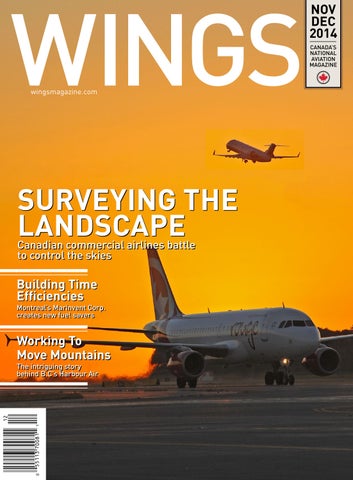
SURVEYING THE LANDSCAPE
canadian commercial airlines battle to control the skies
Building Time Efficiencies
montreal’s marinvent corp. creates new fuel savers
Working To Move Mountains
PHOTO CREDIT TK
the intriguing story behind B.c’s Harbour air
NOV DEC 2014 caNada’S NatIoNal avIatIoN maGazINe
What if your next new airplane is the one already in your hangar? New, more powerful Pratt & Whitney Canada PT6A engine upgrades from Blackhawk. Transform your existing airplane into a like-new one for a fraction of the cost. More power, short takeoffs, quick climbs, faster speeds, less cost, greater resale value. What’s not to like with a Blackhawk engine upgrade on your existing airplane?
BEECHCRAFT KING AIR 200
PIPER CHEYENNE
CESSNA CONQUEST
CESSNA CARAVAN
CESSNA GRAND CARAVAN
BEECHCRAFT KING AIR 90
254 755 6711 | INFO@BLACKHAWK.AERO | WWW.BLACKHAWK.AERO
NOV/DEC 2014
UPFRONT 5 Leading edge
The power of innovation
8 On the fly
News and opinion
12 Alternate Approach Getting ready to roll
14 At the Gate
Can a low-cost option survive?
B.c.’s Harbour air boasts the largest commercial float plane operation in the world. P.32
15 Glidepath
A bird of a different feather
BACK 50 Marketplace 54 On final
Accelerating capacity
From top: Getting ready to roll P. 12 a bird of a different feather P. 15
FEATURES 16 SURVEYING THE LANDSCAPE
What will Canadian air transport look like in five years? By davId carr
23 BUILDING TIME EFFICIENCIES
Montreal’s Marinvent Corp. is creating ways to improve fuel consumption By BrIaN duNN
26 HOW INTERNATIONAL AVIATION LANDED IN CANADA
The International Civil Aviation Organization (ICAO) was raised in Montreal By rIck adamS
30 A SOLUTION TO MAINTAIN CONTROL
Walmart Canada’s time machine makes “sense and cents” By FrederIck k. larkIN
32 WORKING TO MOVE MOUNTAINS
PHOTOs: PAUL DIXON
The rise of Harbour Air illustrates the benefits of determination By Paul dIxoN
37 PONDERING THE PREPOSTEROUS COVER PHOTO: BRIAN LOsITO, AIR CANADA
www.wINgsMAgAzINE.COM
Could the disappearance of MH370 have been a calculated event? By ray tomalty, PHd November/December 2014 | wINgs
3
I like to stay ahead of my aircraft. So if I’m 40 miles out with weather rolling in, I’m listening to what’s happening in front of me. AWOS. Pilot chatter. A quick check with flight service. Sometimes, there’s a lot to decipher. But I need to hear it clearly. Because when I do, I feel confident. Prepared. In the moment. And that allows me to just
focus on what matters,
flying.
MORE NOISE REDUCTION. LESS DISTRACTION.
®
Better sound can make all the difference, especially where you go. Which is why, with 30% greater noise reduction than conventional noise reducing aviation headsets, the A20 headset lets you hear more of what you need to hear. While proprietary cushions and minimal clamping force let you fly comfortably for hours. Meets or exceeds TSO standards.
To order 1.800.901.0497 | Learn more at Bose.ca/a20 | ©2014 Bose Corporation. Delivery is subject to product availability. CC014275
Bose A20
®
Aviation Headset
facebook.com/BoseAviation Made in U.S.A.
LEADING
EDGE
| By Matt Nicholls
The power of innovation
NBAA2014 showcases the finest advancements in BizAv ingenuity
T
PHOTO: MATT NICHOLLs
he annual NBAA business expo south of the border is the largest business aviation show in the world and represents the apex of everything that’s great in the world of aviation and aerospace. With more than 1,100 global exhibitors showcasing the latest advancements in aviation innovation and technology – and more than 26,000 industry stakeholders and attendees – this year’s event at the Orange County Convention Center in Orlando, Fla. Oct 21-23, featured everything from the latest power plants and avionics, state-of-the art cabin management systems, maintenance and fuel management tools, financial fleet management products and so much more. And while the main exhibit hall was certainly impressive, this year’s static display, including state-of-the-art BizAv jets from HondaJet, Embraer, Gulfstream, Bombardier, Cessna, Dassault Falcon and more, helped underscore the point that global OEMs continue to push the envelope by seamlessly marrying technological prowess with copious amounts of elegance and style. After several years of somewhat stagnant global market conditions, there’s also plenty of good news on the horizon for business aviation stakeholders. Market surveys released at the show reveal steady growth in the BizAv industry, more favourable conditions trending back towards the vibrant outlook the industry experienced prior to the 2008 financial crisis. For example, in its 23rd annual Global BizAv Outlook, Honeywell predicts a steady annual overall industry-wide growth over the next decade. The report notes 9,450 new business jet deliveries worth some $280 billion from 2014 to 2024, a seven to eight per cent increase over the 2013 report.
5 www.wINgsMAgAzINE.COM
OEMs and Canadian BizAv
“OEMs continue to push the leaders such as Bombardier, Pratt & Whitney Canada, envelope by seamlessly marrying Colours, StandardAtechnological prowess with copious Flying ero, CAE, Signature Flight Support, Vector Aerospace, amounts of elegance and style.” Larger-cabin aircraft with robust ranges continue to drive market demand, with some 75 per cent of all expenditures targeted at this market segment. The North American market remains a mainstay, with nearly 60 per cent of the projected global demand over the next five years. Europe (18 per cent), Latin America (17 per cent), Asia Pacific (three per cent) and the Middle East and Africa (three per cent) round out the top five. Honeywell’s forecast dovetails nicely with Avinode’s annual look into BizAv’s charter demand. Avinode predicts the recovery in the North American charter market will continue in 2015 with a three per cent increase in flights versus 2014. The survey also shows Europe will experience modest growth, while tensions in some BRIC countries will certainly adversely affect charter traffic. Positive market indicators are sure to have positive spinoffs for prominent Canadian companies working in the BizAv space.
TOP DATA BURSTS… in this issue
1. UP Express will carry up to 180 passengers every 15 minutes. (Pg. 12) 2. Air Canada has something like $1.5 billion in cash and WestJet $1 billion. (Pg. 14) 3. The RCAF’s CT-142 fleet has amassed between 14,000 and 15,000 flying hours. (pg. 15). 4. $97 million: The amount of money the Ontario fuel tax could hurt the gDP. (pg. 16) 5. walmart’s Canadian unit has some 390 stores that generate roughly $23 billion of annual sales (pg. 45)
and Pilatus Centre Canada will most certainly see positive market conditions as BizAv demands continue to increase. Pratt & Whitney Canada was definitely one of the darlings of this year’s show, making a big splash with its PW800 engine, the power plant of choice for the new Gulfstream G500/G600 family. The decision to go with Pratt & Whitney Canada represents a significant strategic shift for Gulfstream, which had previously gone with Rolls Royce for its power plants, a definite coup for the Montreal-based OEM. Strong market forecasts are also good news for emerging Canadian firms such as Montreal’s Traxxall, a new aircraft maintenance tracking service provider and Toronto-based FlyEasy, a corporate aviation firm that helps charter operators deal with inefficiencies in fleet management. Look for future feature stories in Wings on both companies. Yes, digesting the enormity and ingenuity on display at the annual NBAA show can be overwhelming. But if you truly love aviation – and admire innovation and ingenuity in Canadian aerospace and how it plays out on a global scale – it’s a magical place to be. | W
Your feedback is always welcome. Please contact me at mnicholls@annexweb.com. @Wings_Magazine November/December 2014 | wINgs
5
Vol. 55, Issue 6 EDITOR
Matt Nicholls mnicholls@annexweb.com 416-725-5637 MEDIA DESIGNER
gerry wiebe
FLIGHT DECK
Rick Adams, Krista Bulmer, David Carr, Paul Dixon, Brian Dunn, Frederick K. Larkin, James Marasa, Carroll McCormick, Anna Pangrazzi, Ray Tomalty, Bill zuk
SubScribe TODAY !
ACCOUNT MANAGER
Jarah stefek jstefek@annexweb.com (519) 429-5191
1 Year SubScription only
3000
$
ACCOUNT CO-ORDINATOR
stephanie DeFields sdefields@annexweb.com 1-888-599-2228 ext. 257
(GST $31.50 • HST $33.90) US $42.00 (USD) • Foreign $65.00 (USD)
Name: _______________________________ Company: ____________________________ Title: _________________________________ Address: _____________________________ City: _________________________________ Prov: ________________________________ P.Code: _______________________________ Tel: __________________________________ Fax: _________________________________ email: ________________________________
ASSOCIATE PUBLISHER
Mena Miu mmiu@annexweb.com GROUP PUBLISHER
scott Jamieson sjamieson@annexweb.com PRESIDENT
Mike Fredericks mfredericks@annexweb.com WINGS MAGAzINE
P.O. Box 530, 105 Donly Dr. s., simcoe, ON N3Y 4N5 Tel.: 428-3471 Fax: 429-3094 Toll Free: 1-888-599-2228
PLeASe cHecK ONe:
❑ Charter/Fractional ❑ Commercial Airlne ❑ Private Aircraft Owner/Operator ❑ Air Transport-Cargo ❑ Tour Operator ❑ Training/Education ❑ Airport ❑ FBO ❑ MRO ❑ OEM ❑ Aviation Distributor ❑ Aviation Fuel Supplier ❑ Aviation Services ❑ Aviation Sales/Marketing ❑ Para-Public/EMS/SAR/Law Enforcement ❑ Government/Military ❑ Resources - Construction, Fire, Forestry, Mining, Oil & Gas, Wildlife, etc ❑ Other (please specify) ______________
Publication Mail Agreement #40065710 Return undeliverable Canadian addresses to Circulation Dept., P.O. Box 530, simcoe, Ont. N3Y 4N5 email: subscribe@wingsmagazine.com Published six times per year (Jan/Feb, Mar/Apr, May/ Jun, Jul/Aug, sep/Oct, Nov/Dec) by Annex Publishing & Printing Inc. Circulation email: subscribe@wingsmagazine.com Ph: 866-790-6070 ext. 208 Fax: 877-624-1940 Mail: P.O. Box 530, simcoe, ON N3Y 4N5
PAYMeNT: Cheque - Payable to Annex Publishing & Printing Inc. Visa
MC
Account #: __________________________
Subscription Rates Canada – 1 Year $ 30.00 (includes gsT - #867172652RT0001) UsA – 1 Year $ 42.00 Foreign – 1 Year $ 65.00 Occasionally, wings magazine will mail information
on behalf of industry-related groups whose products and services we believe may be of interest to you. If you prefer not to receive this information, please contact our circulation department in any of the four ways listed above. No part of the editorial content of this publication may be reprinted without the publisher’s written permission. ©2014 Annex Publishing & Printing Inc. All rights reserved. opinions expressed in this magazine are not necessarily those of the editor or the publisher. No liability is assumed for errors or omissions. All advertising is subject to the publisher’s approval. such approval does not imply any endorsement of the products or services advertised. Publisher reserves the right to refuse advertising that does not meet the standards of the publication. Printed in Canada IssN 0701-1369
Expiry:_____________________________
TO SubScribe:
Tel: 866-790-6070 Fax: 877-624-1940 Mail: Wings Magazine c/o Annex business Media P.O. box 530 Simcoe, Ontario N3Y 4N5
Air Transport Association of Canada
ON THE
WEB
email: subscribe@wingsmagazine.com
www.wingsmagazine.com
GST#135274215RT001
6
Subscriptions non-refundable
Canadian Business Aviation Association
Magazines Canada
CAREERS IN AVIATION Looking for a great career in aviation and aerospace? Check out our Careers in Aviation micro site, a great location to help you better understand what a career in aviation is all about. Go to www.careersinaviation.ca for news, updated listings and more!
PRO01114
wINgs | July/August 2014
wings subad.indd 1
Canadian Owners & Pilots Association
PHOTO: sTANDARDAERO
Signature: _________________________
www.wINgsMAgAzINE.COM
2014-11-03 3:17 PM
POTENTIAL. WHEREVER YOU LOOK. EDC can help your business achieve its goals. Reduce the risk and seize the opportunities – wherever your markets may be. EDC can help with finance, insurance and bonding services that help you achieve your trade goals. EDC has representatives across Canada and in 16 cities internationally. Find out how we can help. Visit edc.ca/potential for details.
ON THE FLY For late-breaking news and exclusive web content, please visit us at: www.wingsmagazine.com
THE LEAD INDUSTRY HAPPENINGS SPACE RACE PEOPLE ON THE MOVE
THE LEAD
CSERIES BACK IN THE AIR Flight testing of the Bombardier CSeries jetliner has resumed after being grounded on May 29, following an engine-related incident that occurred during ground testing. Flight test vehicle two (FTV2) took flight on September 9 at Bombardier Mirabel facility. “We are pleased to see the CSeries aircraft back in the air,” said Rob Dewar, vice president of the CSeries Aircraft Program. “Aircraft flight test programs are complex and involve extreme testing meant to draw out any potential issues and correct them prior to entry-into-service.” Prior to the grounding, FTV1 and 2 had clocked over 300 hours flight testing. Also in September, Bombardier scored big with an order for 40 of the larger CS300 jetliners from Macquire AirFinance, a Dublin-based aircraft leasing company. “The CS300 will allow us to offer our customers the only type of aircraft optimized for the upper end of the 100- to 150-seat market segment.
Its advanced technologies, attractive economics and environmental attributes were key factors,” said Stephen Cook, chair of Macquarie AirFinance. Despite the delay in flight testing, Bombardier is confident that the CS100’s entry-into-service remains on track for the second half of 2015, although with “who” remains a mystery. Bombardier has 203 firm orders for the CSeries, including 140 for the CS300. Swedish regional carrier Malmö Aviation was thought to be the CS100’s launch airline, but pulled away from the opportunity citing concerns over delays. A Bombardier spokesperson told the Wall Street Journal that Malmö’s roll as launch customer “was never signed or set in stone” and several other airlines are interesting in become first out of the gate. That gap may be a potential new customer that Bombardier is reported to be in advanced discussions with.
PORTER AIRLINES PUTS TERMINAL UP FOR SALE The parent company of Porter Airlines is looking for a buyer for its passenger terminal at Toronto’s Billy Bishop City Centre Airport. Porter Aviation Holdings Inc. has engaged Barclays Capital Canada and RBC Capital Markets to act
Bombardier’s cSeries is back in the air, with the plan to be in service by mid-2015. 8
wINgs | November/December 2014
Billy Bishop toronto city centre airport handled 2.3 million passengers in 2013, most arriving and departing on Porter.
as advisors for a sale-leaseback deal that would raise cash for future expansion. The Q400 operator would like to buy up to 30 Bombardier CSeries CS100 jets to operate on longer haul flights to destinations such as Vancouver, Los Angeles and Florida. A CS100 purchase is not linked to a successful sale of the terminal building, but is conditional on Toronto City Council lifting a ban on passenger jets and extending the main runway. That decision was deferred earlier this year and a vote by a newly elected Mayor and Council is not expected before next spring. The city centre airport handled 2.3 million passengers in 2013, most arriving and departing on Porter, which owns the majority of takeoff and landing slots. “The investment in designing, constructing and operating the terminal at an early stage of the airport’s revitalization was crucial to supporting Porter’s growth,” Robert Deluce, the airline’s chief executive said in a statement. Pension funds such as the Ontario Teachers’ Pension Plan, which already has stakes in Birmingham Airport in the U.K. and Copenhagen Airports, and airport operators such as Vancouver-based Vantage Airport Group, whose global airport holdings include the John C. Munro International Airport in Hamilton, are seen as the likeliest buyers. www.wINgsMAgAzINE.COM
PHOTO: BOMBARDIER
8 9 10 11
WJ, AC RAISES THE ANTE FOR CHECKED BAGS More of the baggage headed for the belly of WestJet and Air Canada aircraft is now subject to a checked baggage fee. The two airlines nearly tripped over one another in September to announce a $25 charge would be applied to the first checked bag for the lowest economy tickets on all domestic flights, as well as service to Mexico and the Caribbean aboard Air Canada. Both airlines were quick to tamp down the number of passengers impacted by the new fee, noting that approximately 80 per cent of the domestic market relies on carry-on. But while the overall number may be low, the dollars involved are substantial; adding an estimated $85 million and $100 million to ancillary fees already collected by WestJet and Air Canada respectively. Air Canada collected US$443.5 million or US$12.39 per passenger versus WestJet’s $151.9 million or $8.22 per passenger in ancillary revenue in 2013 according to a survey conducted by IdeaWorksCompany, a U.S.-based consultancy specializing in airline revenue for CarTrawler, an Irish car rental technology company. The survey of 59 airlines worldwide shows that ancillary revenue per passenger for 2013 was approximately US$16. Ancillary revenue includes activities such as frequent flyer points sold to loyalty partners, fees
WestJet collected $151.9 million or $8.22 per passenger in ancillary revenue in 2013.
for checked bags, inflight catering and commissions paid by hotels and car rental agencies. Almost four per cent of Air Canada revenues are generated by ancillary fees. At WestJet, the percentage is 4.5 per cent – small change when compared with some of the industry’s heavy-hitters such as Star Alliance partner United Airlines (US$5.7 billion or 14.9 per cent of revenues) and ultra low cost carrier Ryannair (US$1 billion or 24.8 per cent of revenues). Air Canada recently prepared customers for the transition to the checked bag fee with a crackdown on oversized carry-on baggage.
MIRABEL TERMINAL FACING THE WRECKER’S BALL It opened in 1975 to great fanfare, but has not clocked a revenue passenger since 2004. The sleek black glass and steel terminal building that was the centrepiece of the failed Montreal Mirabel Airport is set to be demolished despite protests from local communities. Aéroports de Montréal (ADM), the
agency responsible for Mirabel and Trudeau (formerly Dorval) airports since 1992, announced in September that a company owned by a Montreal scrap dealer has been contracted to tear down the building, although a schedule for demolition has not been released. ADM estimates it has spent up to $30 million over the last 10 years to keep the terminal virtually mothballed. The announcement is a blow to the largely rural community of Mirabel, which is expected to lose $800,000 in tax revenue once the terminal is reduced to rubble. Launched by the government of Pierre Trudeau in 1969, Mirabel was built to eventually replace the, then, Dorval Airport. However, the government overestimated Montreal’s position as an O&D (origin and destination) air transport centre and misread the market’s willingness to transfer to a second airport to make domestic connections. Located 50 kilometres outside of Montreal, Mirabel was left stranded after plans for a multi-lane expressway and high-speed rail collapsed soon after it opened. Scheduled international airlines began returning to Dorval in 1997, followed by charter operators.
PHOTO: wEsTJET (TOP) ANDREw H. CLINE (BOTTOM)
INDUSTRY HAPPENINGS
the Northern lights awards Foundation held its annual awards dinner in late September to honour outstanding women in canadian aviation and aerospace. taking honours this year (left to right): Flight operations/maintenance award, Nachelle White, dash 8 pilot currently flying missions throughout africa for the united Nations; Business award, eva martinez, director at utc aerospace Systems, landing Gear Systems; Pioneer award, dr. roberta Bondar, canada’s first woman astronaut and the world’s first neurologist in space; education award , lynne mcmullen, chair of the School of aviation and Flight technology at Seneca college; Government/military award, Sandra mcdonald, 34-year veteran of the royal canadian air Force supporting its cP140 aurora Fleet; currently government contractor at maritime Proving and evaluation unit; rising Star award, danielle metcalfe-chenail, aviation author and historian and first female president of the canadian aviation Historical Society. www.wINgsMAgAzINE.COM
November/December 2014 | wINgs
9
ON THE
FLY
Mirabel’s two runways will remain open for cargo traffic, and the airport is a testing centre for Pratt & Whitney Canada and Bombardier’s CSeries commercial jetliner. ADM has dismissed proposals to redevelop the terminal as a convention and trade centre, and perhaps host an air show on the scale of Paris and Farnborough, an unlikely prospect given the number of high profile air shows that take place already. The cost of demolishing the terminal is expected to be less than $15 million. “The dismantling will cost much less than the $25 to $35 million required for an upgrade, especially in view of the fact that this is an unused and outdated building, which would remain obsolete even after an eventual upgrade,” said James Cherry, chief executive of ADM. “The dismantling will permit the redevelopment of an entire sector of the airport that has excellent access to the apron and runways.” Since consolidating traffic at Trudeau
airport in 2004, ADM has been rebuilding the facility into an international airport. Parts of the old terminal were dismantled to make way for new international and transborder jetties. Trudeau significantly increased its connectingtraffic share in 2013, which rose to 16 per cent and Turkish Airlines and Copa Airlines have launched year-round direct flights to Istanbul and Panama City.
SPACE RACE
ICAO PLANS TO REGULATE COMMERCIAL SPACE TRAVEL The International Civil Aviation Organization (ICAO) will hold its first conference on issues related to commercial space travel early next year. Montreal-based ICAO, a United Nations agency, wants to get a jump on regulatory protection for commercial
vehicles in space. Passenger space flight received a boost in September, when NASA announced it has selected Boeing and Space Exploration Technologies Corp (SpaceX) to build and operate the first generation of space taxis to transport crews to and from the International Space Station (ISS). The companies will own and operate the crew transportation systems and will be able to sell human space transport services to other customers in addition to NASA. Boeing has received US$4.2 billion to build three Crew Space Transportation (CST)-100 spacecraft that will transport up to seven passengers or a mix of crew and cargo to the ISS and other low-Earth orbit destinations. Boeing will build the CST-100s at the company’s Commercial Crew Processing Facility at Kennedy Space Center in Florida. The spacecraft will undergo an unmanned flight in early 2017, leading up to the first crewed flight to the ISS in mid-2017. SpaceX received a US$2.6
• Maintenance • Engineering • Modifications • Repair & Overhaul • Fleet Management • Flight Operations
Expert, quality service since 1970
10 wINgs | November/December 2014
flightcraft.ca www.wINgsMAgAzINE.COM
billion contract to develop a crew-variant of its Dragon spacecraft, which is already transporting cargo to the ISS. Space taxis are a lower cost method of delivering crew and cargo into space, freeing up resources for NASA to focus on building spacecraft and rockets for deep space missions, including flights to Mars. Mixed missions, including tourists, will enable the operators to reduce the costs for all customers. According to the Reuters News Agency, there is already pressure on ICAO to play a role in planning for the retrieval of space debris. Establishing a space platform to establish global standards for an increase in commercial space travel appears to be the next giant leap for the organization. “People have just begun to think about it, but how it is to be instituted is not clear yet,” Prashant Sukul, India’s representative on ICAO’s governing council told Reuters. “If it’s not ICAO, then who is it going to be?”
PEOPLE ON THE MOVE Nola Heale has been appointed chief financial officer at Calgary-based FLYHT Aerospace Solutions, a proprietary technological products and services company for the airline industry. Heale has 30 years financial management and reporting experience on three continents in diverse industries including the manufacturing, services and transport logistics sectors. She is a Canadian and South African Chartered Accountant and associate of the Chartered Institute of Management Accountants in the United Kingdom and a Chartered Global Management Accountant. Heale is a graduate of the Advanced Program of Canadian Board Diversity Council and is past president of the Calgary chapter of Financial Executives International. She takes over from Thomas French, CGA who has helped to steer FLYHT from a small entrepreneurial research and development
shop to a global provider of leading technologies. FLYHT’s premier technology, allowing airlines to monitor and manage aircraft operations anywhere, anytime and in real time captured global interest following the disappearance of Malaysian Airlines flight MH370 last March . . . . Barry Eccleston, president of Airbus Americas and John Belcher, a global authority in aviation and air transport, have joined the Board of Directors of FLYHT Aerospace Solutions. Eccleston currently oversees all efforts of Airbus in North America. He joined Airbus from Honeywell where he served as vice president in different departments and global regions. Prior to that, he held increasingly senior positions with Rolls Royce, including chief executive of Rolls Royce Canada. Belcher is the former chair and chief executive of ARINC and information management services specialist, which is now part of Rockwell Collins. | W
It’s like Einstein and an F-16 had a baby
Integrated Flight Deck
www.wINgsMAgAzINE.COM InSight Wings Ad_02.indd 1
uasc.com
November/December 2014 | wINgs
11
10/6/14 2:05 AM
ALTERNATE
APPROACH By David Carr |
Getting ready to roll
A dedicated rail link to Pearson nears completion
T
12 wINgs | November/December 2014
is an Alternative Financing Project, but cushioning the cost of whisking higher end travellers to the airport in 25 minutes with public money may be the wrong priority, especially when congested roads and transit systems are crumbling around it. That will depend on the premium placed on the environmental dividend an air rail link delivers. Canada lags far behind other developed economies in the percentage of passengers arriving at the airport on public transport. The airport operators of the non-subsidized Heathrow Express report that the train has reduced carbon monoxide (CO2) emissions by 204 million kilograms since 1998, and offers a 54 per cent reduction in emissions over a taxi covering the same distance. Metrolinx expects 1.8 million riders in the first year, taking approximately 1.3 million car/taxi trips off the roads. That is well and good. Still, the question must be asked: if an air rail link is unable to cover its operating costs, should the idea ever have left the station? | W
Building a successful airport rail link is more complex than unrolling tracks to the airport’s front door. luggage space. Amenities include beverage and snack trays, Wi-Fi, flight information screens and onboard payments terminals. Even so, operators can expect a rocky ride, at least from the start. Hostile reaction to news that a one-way ticket would be in the $30 to $40 price range points to a clear disconnect between the UP Express business model and public expectation of an airport rail service operating at unsustainable fare levels pegged between a subway token and commuter rail ticket (The Vancouver International Airport Authority estimates that 16 per cent of employees within the Canada Line catchment area arrive to work by train.). Metrolinx will not finalize a fare structure until December. It has been reported that prices will be set according to a number of factors including how deep the province will dip into its own pocket to subsidize operating costs. Metrolinx has not released a passenger profile, but it is expected that at least 60 per cent of riders will be business travellers. The $463 million UP Express
David Carr is a Wings writer and columnist. www.wINgsMAgAzINE.COM
PHOTO: PAUL DIXON
oronto is on track to become the first city in Canada with a dedicated rail line connecting the airport with its downtown core. Construction on the 25-kilometre corridor is 99 per cent complete and the Union Pearson Express (UP Express) has taken delivery of the first of 18 Japanese-built rail cars, including 12 diesel driving cars. By spring, passengers will have the option of slicing through road traffic congestion when travelling between Pearson International Airport and Union Station, a multi-modal rail centre (commuter, intercity and subway) that is Canada’s busiest transport hub. Rail as a means to connect growing cities with neighbouring airports continues to gather speed, although not all systems are as ambitious as the Pearson project. Roughly 80 per cent of airport trains such as Vancouver’s multi-stop Canada Line – the country’s first such link – are light or commuter rail. UP Express is one of just over 20 dedicated airport rail lines worldwide. Building a successful airport rail link is more complex than unrolling tracks to the airport’s front door. It appears that Metrolinx, a provincial transport agency that built and will operate the Pearson line in addition to GO Transit, the region’s commuter rail and bus network, has done its homework. UP Express will run a mix of two- and three-car train sets, carrying up to 180 passengers every 15 minutes, the minimum frequency necessary for riders to ensure individual trains are tailored to fit seamlessly with aircraft arrivals and departures. Air Canada and WestJet passengers will be able to check-in for flights at Union Station. The agency may also want to consider ticket sales on airline web sites similar to an arrangement that London’s Heathrow Express – a model for the Pearson service – has begun with Irish carrier, Aer Lingus. Metrolinx expects approximately 60 per cent of users to be American or international travellers. For most of the journey, UP Express will run along existing GO track, with stops at two commuter stations, before diverging onto a new three kilometre elevated line into Pearson’s Terminal One. But this is not your typical commuter train. Interiors will feature more spacious seating and extensive
OUR FAMILY OF CUstOMeRs | A LetteR seRIes
FlightSafety Customer for Life
Bill Wagner Denver-Based Corporate Pilot
to find out about the many benefits of being a Flightsafety Customer, please call steve Gross, Vice President, sales, at 314.785.7815. sales@flightsafety.com • flightsafety.com • A Berkshire Hathaway company
AT THE
GATE
By Brian Dunn |
Can a low-cost option survive? Myriad challenges face upstart Canadian discount airlines
S
14 wINgs | November/December 2014
And the turnover is lower than most sectors because it’s perceived as a glamour industry. “You see a lot of entrepreneurs start early like (Porter founder) Robert Deluce who started an airline when he was at McGill. Of course it helps if you have deep pockets. But a lot of people invest in the industry contrary to common sense.” There’s no shortage of entrepreneurs wanting to start an airline and the principles involved in the two latest ventures are aviation professionals, noted Rick Erickson, head of R.P. Erickson and Associates based in Calgary. “On the operational side, there is no difficulty as there are a lot of available aircraft and personnel,” he said. “But on the finance side, investors are rightly spooked. There is an 800 pound gorilla (AC) and a 600 pound gorilla (WestJet) out there with deep pockets. Air Canada has something like $1.5 billion in cash and WestJet $1 billion.” Both startups face immense challenges because they’re targeting niche markets and there aren’t any left, said Erickson. There is still room for a discount carrier in Canada, but it would get crushed by the incumbents if they only start with a few aircraft serving three or four routes where the big boys can match fares. “To have any chance, you have to start with about a dozen aircraft on 25 routes, because I don’t think the incumbents could compete on so many routes for very long.” | W
It’s easy to attract customers with low fares, but harder to make a profit and stay in business by offering deep discounts. domestic competitor will have a larger cost advantage over AC (up to 31 per cent cheaper) that it will over WestJet, estimated Doerksen. Even though both potentially new ULCCs are based in Western Canada, WestJet’s home base, the thinking is WestJet would be more at risk. But WestJet has a lower cost structure than AC and therefore is less vulnerable to lower priced competition. Doerksen estimates a new ULCC will only have a 12 per cent cost advantage over WestJet. In addition, WestJet is growing its network to include a number of smaller cities where competition has been minimal and that a new ULCC will likely compete more against AC than WestJet. It’s easy to attract customers with low fares, but harder to make a profit and stay in business by offering deep discounts, noted Karl Moore, associate professor of McGill University’s Desautels Faculty of Management. “But it can be one of the most profitable sectors of the industry if you can find a niche market like the far north,” he said. “That’s what WestJet’s Encore is doing with the Q400. It’s going to markets not being served by AC where it can charge higher fares. Another example of a niche market is Porter at Toronto Island. If you have a strategic asset like Porter on Toronto Island or a low-cost model like Southwest you can do well.” There are a number of interesting variations of airlines making a profit around the world like Ryanair and JetBlue, Moore added.
Brian Dunn is a Wings writer and columnist. www.wINgsMAgAzINE.COM
PHOTO: AIR CANADA
top me if you’ve heard this one before. Not one but two new low-cost Canadian carriers are attempting to get off the ground. It’s good news for flyers, maybe not for Air Canada and WestJet. The two upstarts are Vancouver-based Canada Jetlines and Jet Naked of Calgary. Both are looking for funding to begin operations next spring. (For more, see “Surveying the landscape,” page 16). While the startups plan to fly domestically and serve U.S. vacation markets such as California and Florida as well as Mexico, Air Canada Rouge has been focusing on Europe and some U.S. sun destinations. But Air Canada (AC) is ready to switch its focus to compete aggressively against any newcomers, said AC CEO Colin Rovinescu. “We have positioned Rouge to be capable of serving the leisure markets,” he said during a conference call. “And so we are confident that we’re going to have a good product if we wanted to deploy it in any market that has the characteristics of a leisure market and obviously many of these so-called ultra-low cost carrier markets are leisure markets.” While there could be room for a new ultralow-cost-carrier (ULCC) in the Canadian market, any new airline will face, “significant challenges that we believe may be insurmountable,” analyst Cameron Doerksen of National Bank Financial said in an industry report. Even if one or both ULCCs make it off the ground, their initial capacity will be too small to have any significant financial impact on either AC or WestJet, he added. But the industry has a graveyard full of other Canadian low-cost carriers who have attempted to take market share away from the legacy carriers with little success. Think Canjet, Greyhound Air, Harmony, Intair, Jetsgo and Rootsair to name a few. Still, AC and Westjet’s bottom lines could be impacted over the longer term if one or both of the new guys get a foothold in the market, with AC being impacted the most. “Although WestJet’s Encore is slowly adding competitive capacity on underserved regional routes, AC still has the leading share domestically and therefore may be the main target of new competition,” said Doerksen. And while AC has made progress in reducing its cost structure and can more effectively compete on leisure routes with Rouge, a new
GLIDE
PATH
| By Paul Dixon
A bird of a different feather The RCAF’s Canadian Blue Gonzo is turning some heads
PHOTO: PAUL DIXON
E
arlier this year, I had the opportunity to spend a morning at 402 Squadron RCAF in Winnipeg, a unique unit in a military that finds increasingly creative and effective ways to get the job done in a world where budgets go to die. 402 Squadron is the home of the Canadian Blue Gonzo, a strikingly unique bird that you won’t find in Hinterland Who’s Who. Few in number and native to southern Manitoba, the blue bird with the big nose will occasionally show up as far away as Canada’s Atlantic and Pacific coasts and has been known to venture as far as the Gulf of Mexico. Gonzo is the affectionate nickname bestowed on the four CT-142 Dash 8s operated by 402 Squadron, a tip of the hat to the super-sized nose cone that houses the enhanced radars and sensor packages used to train the RCAFs next generation of Air Combat System Officers (ACSO) and Airborne Electronic Sensor Operators (AES Op). The CT-142 is a civilian Dash 8-100 aircraft, but without the civilians. Apart from the nose job to accommodate the radars, there’s also the replacement of the passenger seating by operator consoles, workstations and military radios. The Squadron CO, Lt. Colonel Trevor Campbell, describes 402 as a unique entity and a bit isolated from the rest of the air force in that 402 comes under 2 Canadian Air Division, whereas operational squadrons come under 1 Canadian Air Division. Of the 200-plus personnel that make up the squadron, about half are reservists and that includes all positions from clerks and technicians to pilots. Many of the pilot and technician reservists are employed by commercial airlines, a big plus for Lt. Col. Campbell, who likes the expertise they bring in from the commercial world. The squadron has its own embedded engineering officer and its own Operational Training Unit (OUT) to train pilots to fly the CT-142 and technicians to work on them. Pilots come from various wings throughout the RCAF and take their operational training on the Gonzo, from first officer through aircraft captain, training officer up to standards officer. Techs arrive from Borden as QL-3 and get trained up to QL-5. It’s a self-sustaining process. The ACSO and AES OP courses run eight www.wINgsMAgAzINE.COM
the candidates an introduction to an operational squadron and a taste of what their future will be. If time and circumstances allow, they will go flying in an Aurora or Sea King and maybe spend some time on board a ship. It’s not a holiday, as the trainees are responsible for planning and plotting the route in both directions. The second trip introduces the neophytes to American airspace and the differences between how things are handled south of the border. In a reflection of a bygone era, it’s not just Canadians being trained in the Gonzo. There were two Germans on site during my visit, a couple from Singapore were expected to arrive shortly and Australian and New Zealand aircrew had passed through earlier in the year. Every couple of months it starts again, as another group of would be ACSOs or AES Ops arrives, most not far removed from the outside world. At the end of their nine months, they’re presented with their wings and sent on to their operational units for their type training. As the RCAF serves Canada’s interests across the country and around the world, it is remarkable to realize how many of those missions are dependent on a small group of men and women who pass through that one door in Winnipeg. | W
402 Squadron is the home of the Canadian Blue Gonzo, a strikingly unique bird that you won’t find in Hinterland Who’s Who. to nine months in length, with as many as four ACSO courses for officers in a year and a couple of AES Op courses for NCOs. Initial training for both courses is classroom training and then the successful candidates move into the aircraft for the second phase of their courses. The flight training starts low and slow so to speak, and becomes increasingly complex, largely influenced by the mission profile of the Aurora and Sea King aircraft. Simple low-level flights will evolve into more complex tactical missions, identification of targets, changes in routing in response to changes in mission profiles, such as re-deployment on SAR missions, as will often happen in the field. With a new course starting about every two months, the flying requirements are spread out in a way that allows ongoing maintenance to be factored into the rotation. Entering their third decade of service, all of the four aircraft have between 14,000 and 15,000 hours. Day-to-day flight training missions start and finish from Winnipeg, but there are two longer trips built into the ASCO course. The first is generally to Halifax, though occasionally there are forays to the west coast, to give
Paul Dixon is freelance writer and photojournalist living in Vancouver. November/December 2014 | wINgs 15
SURVEYING
LANDSCAPE
WHAT WILL IT LOOK LIKE IN 5 YEARS?
BY DAVID CARR 16 wINgs | November/December 2014
www.wINgsMAgAzINE.COM
G THE W
PHOTO: wEsTJET
hen it comes to understanding the nuances of the Canadian commercial aviation landscape, one word pretty much sums it
up: capacity. Canadian airline growth has been higher than in the United States, where major carriers have adjusted to shrinking capacity and shedding unprofitable routes www.wINgsMAgAzINE.COM
that fail to meet ROIC (return on investment capital) targets. Air Canada’s Rouge and WestJet’s Encore, meanwhile, have been growing at an impressive clip. “WestJet has a green field opportunity,” says Robert Kokanis, president of Air Trav, a Toronto-based consultancy. “They are going to many markets where Air Canada Express has enjoyed a monopoly or dominant position. That will continue as Encore rolls out across the country.” And
while the addition seats put pressure on existing capacity, both airlines appear to be increasing the pie by stimulating traffic with lower air fares. “It is not a situation where we see a problem,” says David Tyerman, a transport analyst with Canaccord Genuity. “Many of the [new services] are on low competition routes with high prices. They seem to be able to fill the airplanes and do it profitably at a reasonable return. If you look at the earnings and November/December 2014 | wINgs 17
as WestJet’s launch of its first trans-Atlantic flights to Ireland from Newfoundland, Rouge’s plan to break into the Asian market and leisure carrier Sunwing’s strategy to capture a sliver of the Canadian market travelling to U.S. airports to avoid taxes and fees could hold clues to what the landscape may look like in 2020. With all of these elements at play, Wings tries to make predictions on some of the issues that may help to shape the future of Canadian aviation.
air canada chief executive, calin rovinescu confirmed he would consider putting rouge up against a ulcc entrant.
invested capital of Air Canada and WestJet, they have been improving.” Volatile fuel prices and investor pressure – especially from American investors – for Canadian operators to match the higher returns of many U.S. airlines may slow the rate of growth. But there will not be a large-scale shakeup in Canadian air 18 wINgs | November/December 2014
transport over the next five years even with the anticipated arrival of at least one Ultra Low Cost Carrier (ULCC), which given past performance may be a shakeup unto itself. Expect instead, tinkering along the margins. Indeed some of the actions taken by Canadian carriers in 2014, such
It has been almost 10 years since discount airline Jetsgo departed the scene. Canada remains one of the only developed economies not to be served by an ultra low cost carrier (ULCC) such as Southwest and Allegiant in the United States, or Ryanair in Europe. It is inevitable that a ULCC would snatch market share from established players, but they also stimulate growth with lower fares based on a no frills business model that packs customers into the airplane and offsets the lower yields through ancillary revenue. Last year, Ryanair took in US$1.6 billion (24.8 per cent of revenue) in ancillary sales, according to IdeaWorksCompany, a U.S.-based consultancy specializing in airline revenue. While Canada lacks the population density of the U.S. and Europe, many industry watchers believe there is room for a ULCC to fly below Air Canada and WestJet’s fares on Canada’s 20 busiest city pairs, and in many secondary markets. At least two western-based groups think they can break the decade-long duopoly: Canada Jetlines in Vancouver and Jet Naked in Calgary. Nobody expects the duopoly to roll over. “Air Canada and WestJet have not been sitting still when it comes to lower cost offerings,” Air Trav’s Robert Kokonis says. “Rouge could be deployed on domestic routes and Encore is flying at a lower cost per seat mile than WestJet’s mainline carrier. All it will take is for Air Canada and WestJet to open up the spigot on the lowest pricing bucket of economy class seats and these airlines are going to have a problem.” Air Canada chief executive, Calin Rovinescu confirmed he would consider putting Rouge up against a ULCC entrant. “There’s nothing preventing us from using Rouge in the domestic market, and we will look at it on a market-by-market basis,” he recently told analysts. Both Canada Jetlines and Jet Naked are planning to launch next spring with Airbus A319 and Boeing 737 services to secondary western destinations respectively. Of the two, Jet Naked appears to have the inside track. Tim Morgan, the company’s www.wINgsMAgAzINE.COM
PHOTO: AIR CANADA
Gorilla Warfare: the gorillas in the room
Proudly hosted by
November 18 & 19 Ottawa Convention Centre
This year’s theme:
One World: Delivering Results in a Global Market Visit www.aerospacesummit.ca for more information!
Do Business. Network. Learn. With over 1000 attendees and 100 Trade Show exhibitors, the Canadian Aerospace Summit is Canada’s leading national aerospace event. For more information on sponsorship and visibility opportunities: cassponsorship@aiac.ca
air canada has big plans for the 787, as it is already financially committed to this aircraft and the 737-max.
20 wINgs | November/December 2014
ULCC is if you ‘big bang it’ – come in with 15 airplanes and start up so quickly and fast that the majors cannot match you on fare for every single flight.” That may be too big to ask for potential investors who are already spooked by the likely response of Air Canada to WestJet to a ULCC threat. “Obviously the financing side of this is a challenge,” Tyerman notes. “They have been looking for money for a while now and I am not seeing any signs that they are about to launch.” Easing the 25 per cent limitation on foreign ownership of a Canadian carrier may spur an outside operator with deeper pockets to support a ULCC. Ottawa has been promising to raise the limit to 49 per cent for years, but nobody is predicting that anytime soon. (For more of ULCC’s in the Canadian market see, “Can a low-cost option survive?” pg. 14) Prediction: At least one Canadian ULCC is going to challenge the marketplace, although spring 2015 is perhaps a bit optimistic. Whether an upstart will have the staying power to 2020 will
depend on the appetite of investors to endure a full court press by the reigning duopoly. A consumer-friendly Ottawa could level the playing field, but actions to open up the mobile phone sector offer little encouragement.
Stemming the bleeding: cross border shopping Taxes and fees continue to chip away at the number of Canadians flying out of home airports. In 2012, the Canadian Airport Council (CAC) estimated that the “cross border shopping” of air travel resulted in 4.8 million Canadians using border airports to take advantage of cheaper tickets. Air Trav’s Robert Kokonis says the number has likely swollen to 5.5 million, and is set to go higher as a result of Ontario’s decision to phase in a tripling of its aviation fuel tax to 6.7 cents per litre, and the potential for runway expansion at New York’s Ogdensburg Airport, a one hour drive from Ottawa. U.S. ultra low cost carrier Allegiant is adding Ogdensburg to its route network, bringing an onslaught www.wINgsMAgAzINE.COM
PHOTO: AIR CANADA
executive chair is a co-founder of WestJet and chief executive of Enerjet, a charter operator with a fleet of three 737-700s. The company has also been stocking the executive suite with talent from Spirit Airlines, a Florida-based ULCC. Over 38 per cent of Spirit revenue came from the sale of ancillary services, including the sale of Free Spirit mileage points to loyalty program partners. “There is the potential for Jet Naked to do better,” says David Tyerman, an analyst with Canaccord Genuity. “The ULCC model is reasonably well known, but if you have never done it directly, I wonder if you will have the experience to pull it off.” Rick Erickson, head of R.P. Erickson and Associates based in Calgary, is cautious about any ULCC thinking they can dust off the original WestJet business model and apply it to today’s marketplace. “Starting with three aircraft, slotting yourself around the majors in western Canada and putting jets into secondary markets is no longer going to work,” he suggests. “Where you could see success with a
PHOTO: wEsTJET
WestJet has great opportunity, with encore, to gain control of the ultra lower cost carrier (ulcc) market.
of cheap seats for bargain hunters in the Ottawa area. The drain to the U.S. is primarily driven by the leisure sector. Whatever the final number, it is not telling the complete story, says Daniel-Robert Gooch, president of the CAC. “The bleed to the United States is really a symptom of a much bigger problem,” he said. “What we can’t see so easily as those [leisure] travellers who go to the U.S. are those who don’t fly, including business travellers. It also doesn’t show people who are now taking less efficient modes of transportation, such as loading up the car and driving across highways when it makes more sense to fly.” All of this is having a “knock on” effect on other businesses such as hotels, restaurants and airport concessions. Dr. Fred Lazar of the Schulich School of Business at Toronto’s York University estimates that increases in the Ontario fuel tax could result in a $97-million hit to the province’s GDP and a loss of more than 2,000 jobs. “It’s no longer about stopping the bleeding,” Kokonis says. “It’s about how to stop www.wINgsMAgAzINE.COM
increasing the bleed.” One Canadian airline has decided to place the bucket on the other side. Toronto-based leisure carrier Sunwing is using the fine print (see, On the Fly, pg. 8) in the Canada/U.S. open skies agreement to operate two weekly services to Cancun, Mexico and Punta Cana in the Dominican Republic. “Sunwing is simply acknowledging we are losing all these folks south of the border,” Kokonis points out. “They are just satisfying demand in the market.” Is this the start of a trend? Canaccord Genuity’s David Tyerman doesn’t see it. “A scheduled carrier like Air Canada and WestJet can’t do it, because we don’t have cabotage in Canada. Canadian airlines are going to have to keep going to the government to get relief on the costs they face in Canada that American carriers don’t face. In the absence of relief, they are going to keep competing as best they can. But they are probably going to keep losing the very price conscious part of the market to border airports.” Still, the Sunwing decision has drawn
fresh attention to the issue. The problem is the number of hands in the cookie jar, which has enabled the collectors of various fees and taxes to minimize the impact of their own charges by casting blame elsewhere. A spokesperson for the Ontario government, for example, noted that Sunwing was planning flights out of Buffalo before the increase in fuel taxes was added to the 2014 Budget. “Each individual charge doesn’t add up to much,” says Gooch. “But the entirety of the fees and taxes on a ticket adds up to something that is very real. It is death by a thousand cuts.” Gooch says that the industry and government must work collectively to lower the overall cost burden. Kokonis agrees. “Individually, none of these extra taxes and fees are enough to make or break a family of four getting in a car and driving across the border. We have to address the cumulative effect that is making the decision for a family to go south.” At the same time that higher costs are causing Canadians to either abandon air November/December 2014 | wINgs 21
air canada’s decision last spring to not replace up to 25 embraer 190s was a blow to Bombardier, which was considered a “shoo-in” for the order with its new cSeries.
traveller plans or seek price relief in the U.S., they also appear to be a barrier to entry for some airlines, which clears a path to higher fares. “We are seeing airlines that are hesitating to come to Canada,” Gooch points out. “Lower charges and new carriers coming in and providing greater competition in the marketplace would actually do something real on the cost of air travel in Canada.” In April 2013, the Senate Transport Committee urged the federal government to stop charging rent to local airport authorities. Transport Canada is once again looking at the issue of costs. Does this spell relief finally on the horizon? Tyerman is not optimistic. “The industry is a major generator of jobs and is at a competitive disadvantage. The government is well aware of this but has still concluded that these fees make sense and are needed for whatever is important to them.” Prediction: There are signs that Transport Canada is concerned over the cost competitiveness of air transport in Canada, but must also butt heads with Treasury, which will be reluctant to give up the $250 million a year in revenue that flows into its coffers from airport rent. Expect some lowering of taxes and fees over the next five years, although for the most part these cuts will be a symbolic nod to public pressure and are not likely to stop the flow of bargain seekers driving to U.S. border airports, or stimulate the market. Over
the next five years, the value of the Canadian dollar and gasoline prices may have a greater influence on where Canadians chose to fly from.
Re-fleeting: will the CSeries find a home in Canada? Canada’s two mainline carriers will take delivery of more than 120 airplanes over the next five years as they seek to expand globally and support their domestic turf. The shopping list includes 14 Boeing 787s for Air Canada, which will accelerate the shift of older Boeing 767-300ERs to its low cost Rouge operation, and 62 Boeing 737s (including 39 of the 737-MAX)
is not clear whether these airplanes were purchased or leased. In 2013, Air Transat announced a fleet restructuring plan that included adding permanent and seasonal 737-700s and reducing the size of the Airbus 310 and A330 fleet by 2015. In July, the airline renewed six of its A330 eases at terms that outweighed the advantages of seasonal subcontracting as originally envisioned. Air Transat will operate 21 wide-bodied aircraft during the 2015 summer season. Despite the higher cost structure of flying a fleet of ageing A330s, analysts do not expect the airline to move away from the type in the foreseeable future. “Some players may have to rethink fleeting,” said David Tyerman of Canaccord Genuity, “but you have to the equation of [lower] capital costs against [higher] operating costs. In a varying fuel price environment, you can come up with different answers as to what the optimal aircraft is.” Aviation consultant Erickson points out that this is the “genius” behind Air Canada’s Rouge product. “Rouge airplanes have got very high airframe cycles on them. If you have got a brand new 787 you have to fly the wings of those airplanes or you run into grief on the capital amortization of the aircraft. Rouge 767s are already written down. You can fly them seven or eight hours a day and still make money.” Erickson believes the same thinking
22 wINgs | November/December 2014
for WestJet and 13 Bombardier Q400s, which the carrier will use on its Encore regional brand. WestJet, which had placed a firm order for 20 Q400s, recently exercised options for an additional five aircraft. Encore is ramping up to expand into easternCanada and the transborder sector, which means that an order for additional Q400s is inevitable. Air Canada will begin taking deliveries on the first of 61 737-MAX aircraft as part of its North American fleet renewal. WestJet will break into the wide-body segment in late 2015, when it acquires four pre-owned 767s from Boeing, although it
Continued on page 49 www.wINgsMAgAzINE.COM
PHOTO:BOMBARDIER
Air Canada and WestJet are each sitting on a pile of cash and can get into any kind of game with any new entrant.
the touch screen of the electronic Flight Bag allows pilots to easily use NaSa’s traffic aware Strategic aircrew requests software.
BUILDING TImE EFFICIENCIES
MONTREAL’S MARINVENT CORP. CREATING WAYS TO IMPROVE FUEL CONSUMPTION
PHOTO: UNIVERsITY OF IOwA OPERATOR PERFORMANCE LABORATORY
BY BRIAN DUNN
T
ime is money as the old adage goes and nowhere is it so important than in the aviation sector where a few minutes or seconds shaved off a flight can translate into thousands of dollars in fuel savings. A concept called Traffic Aware Strategic Aircrew Requests (TASAR) being developed by NASA could help aircraft operators save time and fuel using technology in the cockpit to determine the most efficient flight paths while planes are in the air. The concept is being developed in conjunction with software developers from Engility Corp. of Billerica, Mass. The software is loaded onto an electronic flight bag that many airlines already use. “We want to provide better information www.wINgsMAgAzINE.COM
to pilots about potential flight path savings, but in a way that is more affordable and approvable and that supports how pilots and air traffic controllers work together today,” said NASA researcher David Wing at NASA’s Langley Research Center in Hampton, Va. The flight testing for TASAR is being conducted Advanced Aerospace Solutions, the U.S. joint venture subsidiary of Marinvent Corp., a small research firm in St. Bruno, just outside Montreal. Marinvent has a long-standing relationship with NASA and also happened to pioneer the electronic flight bag. The software application is being flight tested on a Piaggio P. 180 Avanti aircraft owned by Marinvent. The software is designed to connect to
an aircraft’s Automatic Dependent Surveillance-Broadcast (ADS-B) receiver currently being developed that has been mandated for all U.S. aircraft by 2020, according to Wing. TASAR scans broadcast signals of nearby traffic to make sure there are no potential conflicts in any proposed flight path changes, making it easier for air traffic controllers to approve a pilot’s route change request. Marinvent has been testing TASAR for the past three years and expects airlines interested in the technology will be doing their own high-end trials by next summer, according to Marinvent founder and president John Maris. Alaska Airlines and Virgin America are doing their own testing for NASA, said Wing. November/December 2014 | wINgs 23
researcher david Wing by marinvent’s Piaggio aircraft. 24 wINgs | November/December 2014
www.wINgsMAgAzINE.COM
PHOTOs: MARINVENT CORP
Phil cole, marinvent’s vP of Business development (left), with John maris, founder and president.
“TASAR looks at your flight path and calculates how to optimize it for three or four things. Weather is one of them,” Maris said. “Optimum route just in terms of winds and actual path is another and special use air space, places you don’t want to fly into is a third. And over and above all those, it makes sure any solutions it offers don’t conflict with traffic. “That’s why it’s called traffic aware. It’s not a traffic avoider, it’s not designed so that I can weave my way around New York without talking to anyone, but it won’t give me a solution that will conflict with known traffic.” Asked if there are similar systems already on the market, Maris said there are ground based systems that are dispatched based for the airlines and that NASA is trying to come up with an integrated solution. “The issue is data, so if you do it on the ground, at some point you have to send all that data up to a number of aircraft. If you make the aircraft a little more autonomous . . . in terms of processing and routing, you free up all of that bandwidth,” explained Phil Cole, Marinvent’s VP of Business Development. “One of the most important factors of TASAR is that it doesn’t affect an aircraft’s certification. If you take a completely new piece of technology, a company would normally have to go to the expense of building the hardware to flight critical standards that would be safe to put in the aircraft. They drill holes, they put in cables, a lot of money to get to the point where they can put it in front of a pilot for the first time and see how it interacts with the other avionics and with other aircraft and air traffic control. We can do that (with TASAR) without the need to produce any other hardware, without drilling holes or run cable, just with software. It’s much cheaper, much quicker and we can get all that feedback to the customer before they have to commit to spend money.” One of the advantages of TASAR is that it is going to maximize the chance of air traffic control of approving a course change, because it won’t propose something that will conflict with other traffic or route you through a thunderstorm which are the main concerns of ATC, said Maris. “And the workload in the cockpit is enormous when you have bad weather and a lot of traffic and you’re trying to optimize a route on heavy winds. TASAR maps it out and allows you to pick your own path.” A paper prepared for the American Institute of Aeronautics and Astronautics partly written by Wing concluded that on average, aircraft equipped with TASAR, relative to aircraft not equipped with TASAR, saved about one to four minutes of time per operation depending on the length of trip and about 50 to 550 lbs of fuel per operation. Multiply that over a large fleet of aircraft and the savings add up.
“To put it in perspective, current engine manufacturers are looking at savings of a half per cent in fuel economy as being significant enough to justify the design of a new engine. So if you can save three per cent or four per cent, it’s huge,” noted Cole. TASAR itself is meant to be a stimulant to get airlines to move over to ADS-B sooner, explained Maris. But the estimated $100,000 price to install ADS-B in each cockpit is not much of an incentive, especially when airlines don’t understand all its benefits. But the TASAR technology is being well received by the aviation industry, according to Wing. “We’ve talked to airlines and avionics manufacturers and we’ve had extremely positive response from all of them.” Marinvent is also working on a project called an Airfoil Performance Monitor that monitors the airflow over an airfoil surface to optimize the way an aircraft is flown in all kinds of weather conditions and in all phases of flight. “You get much better fuel economy from an aircraft if you’re flying it in its optimal configuration. There are some very large potential fuel savings associated with that,” Cole pointed out. “It will also tell you when you’re getting degradation in lift performance of an airfoil as a result of contamination of the airfoil. It could be bugs, bad paint work, dust, ice or snow.” This is a very important product that Marinvent has already spent $10 million on to develop and it is waiting for the documentation evidence to show the impact this device has on fuel economy. “It has been through extensive flight trials,” Maris said. “It’s been tested by NASA and by B.F. Goodrich. It’s been in wind tunnels and icing tunnels. It’s a very mature piece of research technology now going for its deployment certification. It’s about where TASAR is now. APM tells you your stall speed, it tells you exactly how much margin you have before you stall the airplane with ice. There is no other instrument anywhere that can do that.” It also tells you where the ice is on the aircraft. If you have ice on the wings versus the tail, the stall recovery procedure is completely opposite, Cole pointed out. Many fatal accidents caused by icing could have been prevented with an APM. A third product Marinvent is working on is Synthesis, a software tool to make the company more efficient which it has productized for external use. “Think of a project management tool that’s designed specifically to address the kind of issues that come up in certification,” Cole explained. “We did it for a flight test certification perspective, but it could be used for software certification, it could be for railways or nuclear power plants and so on. Anywhere someone is building something www.wINgsMAgAzINE.COM
that is complex that needs a high level of certification and validation against some externally controlled regulated standard. “What we do is organize that project for them. So we start out with what you need to do, we work out how to do what you need to do and demonstrate that you’ve complied with all the external factors governing success. And at the end of it, we provide the documentation that the regulatory body wants to see to show that we did exactly what we said we would do and here’s why it’s safe.” One customer estimated that Synthesis
saved them a year off the certification time of an aircraft, resulting in savings of about $1 billion, Cole pointed out. “Those last two pieces of IPs (intellectual properties) are the things that will change Marinvent’s fortunes in the future.” Doing good work for NASA will also go a long way in keeping Marinvent’s name front and centre. | W
For more on aerospace, visit www.wingsmagazine.com
November/December 2014 | wINgs 25
Icao generates more than $100 million annually to the local and national economy through more than 1,200 direct and indirect jobs
HOW INTERNATIONAL AVIATION LANDED IN CANADA THE INTERNATIONAL CIVIL AVIATION ORGANIzATION (ICAO) WAS RAISED IN MONTREAL BY RICK ADAMS
PHOTO: ICAO
S
ometimes, momentous events in aviation take place on the ground, far from any airfield or manufacturing facility. Before anyone can fly – safely – they need to understand the rules . . . and someone must out of necessity write those rules. The worldwide air transport industry was born 95 years ago in 1919 in the aftermath of World War I, but it would take a quarter-century for the industry to converge on Montreal as the centre of the fledgling industry. Though there had been efforts to organize commercial aviation co-operation in prior years, the global conflict had interrupted such notions. But in March 1919, a special Aeronautical Commission was established under the auspices of the Paris Peace Conference (Congrès de la Paix) at Versailles. Represented were Belgium, Brazil, the British Empire, Cuba, France, Greece, Italy, Japan, Portugal, Romania, the Kingdom of the Serbs, Croats and Slovenes, and the United States. The Commission agreed to a set of basic principles and air navigation laws, similar to the structure www.wINgsMAgAzINE.COM
which would become the International Civil Aviation Organization (ICAO). The “Convention Relating to the Regulation of Aerial Navigation” – consisting of 43 articles that dealt with technical, operational, and organizational aspects of civil aviation – was signed by 27 nations on October 13, 1919. The convention also anticipated creation of the International Commission for Air Navigation (ICAN), or Commission Internationale de Navigation Aérienne (CINA), under the direction of the new League of Nations, to monitor developments in civil aviation. One of the driving forces behind the Peace Conference aviation initiative and subsequently the first and only Secretary General of ICAN was Albert Jean François Roper, air expert at the French Cabinet of the Undersecretary of State for Aeronautics. Dr. Roper (he had a Doctor of Law degree) enlisted in the infantry at the beginning of WWI but later transferred to the Flying Corps where he eventually commanded a fighter squadron. He was shot down in May 1918 and left for dead, but obviously recovered from
his injuries. Dr. Roper was awarded five citations and the Cross of the Chevalier of the Legion of Honour.
ICAO generates more than $100 million annually to the local and national economy. Over There Canada had been amply and ably represented in WWI air battles, although the country had no planes of its own. More than 23,000 Canadians flew with British air services such as the Royal Flying Corps and the Royal Naval Air Service, 180 of them earning the designation of “ace” for five or more aerial victories, including E. R. Grange (Canada’s first ace) and other notables such as Billy Bishop, William George Barker, and Alan Arnett McLeod, each of whom received the Victoria Cross. The Canadian government at the time reportedly
demonstrated little interest in aviation, making no attempt to fund aircraft, airfields, or flight training. Ironically, a small Curtiss Aeroplane and Motor Company factory set up in Toronto to manufacture JN-4 aircraft (taken over by the government and operated as Victory Aircraft) produced nearly 3,000 of the trainer aircraft – but for export only to the U.S. and Spain primarily. Aircraft construction stopped at the end of the war. The Royal Canadian Air Force (RCAF), finally established in 1918, was disbanded shortly after war’s end, then reconstituted in 1920. The year 1919 was nonetheless significant for the future of Canadian aviation. On June 14, British aviators John Alcock and Arthur Brown became the first to fly nonstop across the Atlantic, taking off from St. John’s, N.L., in their Vickers Vimy, landing about 16 hours later in Clifden, Ireland. Ernest Hoy was the first to fly over the Canadian Rockies, from Vancouver to Calgary, in a Curtiss JN-4 Jenny. The Canadian Pacific Railway petitioned to start air service in 1919 (though they did not immediately get involved in November/December 2014 | wINgs 27
aviation). And the Aeronautics Act of 1919 established Federal control over aviation with legislative authority for air regulations. Also significant in 1919, six European airlines founded the International Air Traffic Association, forerunner of today’s International Air Transport Association (IATA). At the post-WWI international air navigation discussions, Canada was only a minor player, but managed to secure an amendment that would permit Canada and the U.S. to make their own agreements on cross-boundary air regulations.
with the creation of its legal committee. As the trajectory of World War II gradually began to favour the Allies, U.S. president Franklin Roosevelt and British prime minister Winston Churchill discussed an international organization to manage aspects of civil aviation. In August 1943, Canadian prime minister William Lyon Mackenzie King hosted Roosevelt, Churchill, and other leaders at the first Quebec Conference in August 1943 at the Chateau Frotenac, the symbol of Quebec City on the banks of the Saint Lawrence River. Liberal Party leader Mack-
“Last year, Canada solidified its relationship with ICAO, signing an agreement to keep the aviation organization’s headquarters in montreal for another 20 years.” Post-Paris Progress Subsequent to the 1919 Paris conference, Dr. Roper and others, through a series of conférences aéronautiques internationals of national aeronautics administrators, obtained ratification of the aviation agreements from 14 States – the British Empire and its Dominions including Canada counting for fully half of those. ICAN was therefore officially constituted on 11 July 1922. The convention was ultimately ratified and in force for 33 states by 1940. At that time, there were approximately 50 sovereign states in the world. The First International Conference of Private Air Law (Dr. Roper, Secretary General) convened in Paris in 1925 to undertake the painstaking work of coding air law. The conference created a special committee of experts, Comit International Technique d’Experts Juridiques Aériens (C.I.T.E.J.A.), in charge of the continuation of the work, which was eventually taken over by ICAO 28 wINgs | November/December 2014
enzie King was the dominant figure in Canadian politics of the Depression/WWII era, PM for nearly 22 years (1921– 26, 1926–30, 1935–48). Chicago University- and Harvard-educated King in 1935 created Canada’s Department of Transport, merging under C.D. Howe the former Department of Railways and Canals, Department of Marine and Fisheries, and the Civil Aviation Branch of National Defence.
From Chicago to Montreal Discussions got more intense the next year in the wake of the Normandy landing. In September 1944, the U.S. invited more than 50 governments to a conference to be held beginning in November, at a city to be determined, to “make arrangements for the immediate establishment of provisional world air routes and services” and “to set up an interim council to collect, record, and study data concerning international aviation and to make recommendations for its improvement.”
Roosevelt asked Adolf Augustus Berle, Jr., one of his original “brain trust,” to head the U.S. delegation and to find a non-Washington site for the event. In October, the U.S. Department of State announced the selection of Chicago as the host city. Boston-born Berle, who became the youngest graduate (21) at the time in the history of Harvard Law School, had been a member of the American delegation to the Paris Peace Conference. Best known for corporate law and author of The Modern Corporation, Berle argued for government regulation and “business statesmanship,” which advocated that corporations must fulfill responsibilities toward society in addition to their traditional responsibilities toward shareholders. The historic Chicago Convention was attended by nearly 1,000 people: 185 official delegates; 156 advisers, experts and consultants; 45 secretaries; 105 clerks and stenographers; 306 members of the Conference secretariat; 158 press representatives. This was estimated to be the largest international conference held in the U.S. in those years. They gathered at the Stevens Hotel (now the Chicago Hilton), facing Lake Michigan. Louis XVI-styled, elegant in the “Roaring 20s,” when it was built for US$30 million ($400 million in today’s value), the Stevens was regarded by some delegates as only second-rate in 1944. “It would take up to one hour a day waiting for elevators and perhaps half an hour a day waiting to complete telephone calls.” Rooms cost $4-7 per night for singles, $6-9 for double occupancy. (The Hilton’s rates now range up to $724 per night. Berle had anticipated a three-week meeting. The Conference lasted more than a month, 37 days. The most-welcome recreations were sleep, after sessions that sometimes lasted all night, or the bar. The conference opened November 1, 1944, and
concluded on December 7, drawing up a Convention on International Civil Aviation (known today as the Chicago Convention), the charter of a new body – the International Civil Aviation Organization (ICAO) – established to guide and develop international civil aviation. The drafts of 12 technical annexes covered the technical and operational aspects of international civil aviation, such as airworthiness of aircraft, air traffic control, telecommunications, etc., the implementation of which documents would make international flying safer and more reliable. (Today there are 19 annexes with more than 10,000 standards and recommended practices – SARPs – published in six languages.) Berle declared: “As a result of the work of these and many other men, when we leave this conference we can say to our airmen throughout the world that they can go out and fly their craft in peaceful service.” With war still raging in Europe, and eager to get work started on the aviation standards, Canada was the executive committee’s logical choice for the provisional ICAO, referred to as PICAO. The Canadian government selected Montreal for the interim PICAO’s interim headquarters. Montreal was the leading metropolis, the most “cosmopolitan’ city,” and Canada’s main hub for international civil air transport. With the 26th signatory to the Interim Agreement on International Civil Aviation, exactly one year after D-Day, PICAO was officially born on June 6, 1945. C.D. Howe, by then Canada’s minister of reconstruction, noted it was “the first post-war organization of the United Nations to get under way.” The first session of PICAO was held August 15, the day Japan surrendered. Dr. Warner was elected the first president of the council of PICAO. He would continue as president of the ICAO council until his retirement www.wINgsMAgAzINE.COM
in 1957. Born in Pittsburgh but raised in Boston, Edward Pearson Warner studied mathematics at Harvard and graduated from the Massachusetts Institute of Technology (MIT) with a degree in mechanical engineering. He was a founding member of the U.S. Civil Aeronautics Board in 1938, predecessor to today’s Federal Aviation Administration (FAA). In May 1946, PICAO hosted a plenary meeting in Montreal during which 400 international delegates selected Montreal as PICAO’s permanent headquarters. Less than a year later, on April 4, 1947, interim PICAO became the permanent ICAO. In October 1947, president Warner signed the protocol by which ICAO became a Specialized Agency of the United Nations.
Hub of the Civil Aviation World Today, ICAO comprises four main bodies: the assembly,
the council, the secretariat, and the air navigation commission. The assembly, which includes all 191 member states, provides policy guidance every three years and reviews the work of the organization. The 36-member elected council, led by the president (currently Dr. Olumuyiwa Benard Aliu), appoints the secretary general, ICAO’s executive officer (Raymond Benjamin), who oversees daily operations of the specialized Secretariat staff. The 19-person air navigation commission recommends standards and recommended practices (SARPs) and procedures for air navigation services (PANS) for the safety and efficiency of international civil aviation. Dr. David MacKenzie, professor in the department of history at Toronto’s Ryerson University, who wrote a history of ICAO that was published in 2010, told Wings that the organization’s most
significant accomplishment, in his opinion, “has been its ability to limit the interference of politics in its actions and decisions. I know there are always political issues and implications in such organizations, but ICAO has, for the most part, consistently put aviation safety ahead of state/political interests. I would encourage ICAO to continue doing so in the future – we benefit from it every time we fly.” In addition to ICAO, Montreal is also home to major offices of IATA, the Airports Council International (ACI – relocated to the city in 2010), the International Federation of Air Line Pilots’ Associations (IFALPA – relocated in 2013), and the International Business Aviation Council (IBAC). Last year, Canada solidified its relationship with ICAO,
signing an agreement to keep the aviation organization’s headquarters in Montreal for another 20 years. The renewal had been in some doubt when Qatar made overtures to have ICAO HQ moved to Doha, which would have required a vote of 60 per cent of member states. Recognizing that ICAO generates more than $100 million annually to the local and national economy through more than 1,200 direct and indirect jobs, Ottawa lobbied more than 100 countries to maintain the status quo. Prime Minister Stephen Harper called Montreal, “a sophisticated city that is a hub of the aerospace industry around the world. There is absolutely no reasonable case to move the centre out of Montreal.” | W
For more regulatory features, visit www.wingsmagazine.com
www.wINgsMAgAzINE.COM
November/December 2014 | wINgs 29
Atlantic_AME_Oct.indd 1
2014-10-29 3:19 PM
A PERFECT SOLUTI mAINTAIN CONTRO WALMART CANADA’S TIME MACHINE MAKES “SENSE AND CENTS” BY FREDERICK K. LARKIN
H
aving grown a chain of franchised variety stores from 1945, Sam Walton figured that the time was right to introduce a new business model to the merchandising industry. In July 1962, he opened his first discount store and named it Wal-Mart Discount City. His goal was straightforward: help people save money and live better by making available items that they required and/ or desired at attractive prices. More than half a century later, there is unequivocal evidence that his intuition was spot on. Today, the Walmart organization is a global force that employs 2.2 million “associates” at 11,000 stores in 27 countries. With annual revenues of $473 billion, it is by far the world’s largest retailer. The products that it sells include food, beverages, electronics, movies, cameras, music, books, eyeglasses, pharmaceuticals, automotive accessories, hardware, paint, sporting goods, fabrics, clothing, shoes, jewelry and home furnishings. The incumbent corporate leaders in each of these 18 product silos have taken note that whenever Walmart has entered markets, they have historically controlled them. Unlike the major traditional North American retailing companies (such as Bergdorf Goodman, Macy’s, Neiman Marcus, Saks Fifth Avenue and Sears in the U.S, and Eaton’s, Simpsons and Woodward’s in Canada) that were founded in large cities, Walmart’s roots are rural. It’s no surprise then that its global head office remains in Bentonville, Arkansas – a city with a population of almost 40,000. The company’s goal of bringing a diverse range of products to smaller communities has resulted in an ever-expanding commercial footprint. Overseeing such an enormous enterprise requires the constant movement of personnel.
30 wINgs | November/December 2014
Walmart’s lJ45 provides a seat capacity, cruise speed, range and runway performance that matches the mission profiles that it flies.
This isn’t a recent revelation at Walmart, as it has been an integral part of its culture since the beginning. “Mr. Sam,” the founder, believed in visiting all of his stores in order to interview staff and customers. That way he could keep abreast of changing patterns of demand and continually improve his operational techniques. To that end, he purchased his first aircraft in April 1954. The eight-year-old Erco 415-C Ercoupe (N2623H) cost $1,850. The two-seater had a MTOW of 1,260 pounds and a 75HP Continental that enabled a cruise speed of 110 MPH. Walton used it to visit his stores located in small communities that lacked scheduled air service. Surface transportation by train, bus or car was simply too slow and inconvenient. He also used the aircraft to locate properties for future stores.
The tiny twin-tailed time machine was sold in September 1956 and replaced with a four-seat Piper PA-22-160 TriPacer. It would later be supplanted by a six-seat Piper PA-23-250 Aztec. A dedicated flight department was created in 1969 and since then the fleet has grown in lockstep with the company’s travel demands. Today, Walmart Aviation’s main base (KROG) at Rogers, Arkansas, is the home to a dozen jets including a Learjet 31A, five Learjet 40s, four Learjet 45s, a Global Express and a Gulfstream G650. The 10 Learjets are active across the U.S., while the two latter models perform long-haul international missions. Rounding out the Bombardier-dominated fleet is a Learjet 35A in Sao Paulo, Brazil and a Learjet 45 in Toronto. Walmart expanded north of the 49th parallel in 1994, when it acquired the www.wINgsMAgAzINE.COM
PHOTO: FREDERICK K. LARKIN
ION TO OL
122-store chain of Woolco stores across Canada from the F.W. Woolworth Company of New York. During the past 20 years, the Canadian unit has grown to include approximately 390 stores that employ about 90,000 associates who generate roughly $23 billion of annual sales. Walmart Canada has operated aircraft since January 1995, when it acquired a Gulfstream American 695A Commander 1000 (C-GMMO). A Learjet 35A (CGMMY) was added in April 1997, then in early 2000, the turbo-prop was replaced by a second Learjet 35A (C-GMMA). In August 2010, the two Lears were replaced by a Learjet 45 (C-GUSM). Its registration is said to depict the company’s ethos: “You Save Money.” The LJ45 was six years old when purchased and had only one prior owner. In addition to its reasonable acquisition price, the airplane provides a seat capacity, cruise speed, range and runway performance that matches the mission profiles that it flies. www.wINgsMAgAzINE.COM
Like that of its parent, Walmart Canada’s managerial methodology mandates the movement of personal to meet with store managers and customers across the country. As new sites are always under consideration and reviewed prior to approval, real estate and financial specialists have to travel as well. As a result, the annual utilization of the Lear 45 is approximately 700 hours. The dispatch rate this year has been an impressive 99 per cent, a slight improvement over the 98.5 per cent experienced last year. While capable of cruising at Mach 0.78, its pilots ease back on the throttles in order to maintain M.76 en route. By doing so, the jet consumes 23,000 fewer litres of fuel per year. That makes both economic and ecological sense. The interior of the Lear 45 is configured with eight seats in a double-club arrangement, plus a belted toilet that is used when traffic levels on short legs dictate. Thanks to its Aircell system, the aircraft is Wi-Fi capable. That means that even though its occupants are out of the office, they are never away from the office above FL100. The average flight has seven or eight passengers aboard, resulting in a load factor of about 88 per cent. A typical schedule would see the jet operate three to four segments within a day. As the aircraft is used for corporate purposes only, it tends to operate only during the week. This leaves weekends free for maintenance work to be performed. Contrary to how the general public often characterizes the use of corporate aircraft, the Walmart machine is not solely the preserve of the company’s most senior officers. Any team of associates with an appropriate business case can request the use of the jet. Demand has been such that reservations are now being made months in advance. Walmart Canada’s flight department is headed by Anthony Norejko, who joined as a pilot in 2006, became chief pilot in 2008 and was appointed Director Travel Services and Aviation in 2009. His team includes four additional pilots, an operations scheduler and a maintenance manager. While most maintenance is performed in-house, the company works with vendors that provide “most favoured customer” pricing on time sensitive or scheduled checks. Speaking of maintenance, Walmart Canada was honoured twice by the Canadian Business Aviation Association in 2013 when it won the Aircraft Maintenance Safety Award and the Company Safety Award. The costs associated with the operation of its airplane are not taken lightly at Walmart Canada. Depending on variables such as the number of people
travelling at the same time, the distance to a particular destination, the time required on the ground between flights and other factors, scheduled air service can be a viable option to the use of the company jet. While the acquisition price of an aircraft is important, so are operational issues such as fuel consumption and passenger loads in justifying the ownership and use of an aircraft. Productivity is another key metric used to measure the value of the airplane. Walmart Canada performs a cost benefit analysis for every segment that it operates. It calculates the time saved by flying into airfields that are closer to the ultimate destination of those aboard, as well as the time that would be consumed getting to meetings in rental cars and/ or wasted waiting for delayed flights in airport terminals. Walmart Canada estimates that every time its Learjet gets airborne, it saves 3.7 business days of employee time. Factoring in the average remuneration of the passengers aboard a given flight, the company determines the financial benefits realized in addition to the enhanced productivity achieved. When asked to describe the purpose of Walmart Canada’s flight department, Norejko explained, “Put simply, we transport our associates to get closer to our customers and business. We do this through a commitment to safe, reliable and efficient transportation. Sam realized very early on that the use of corporate aircraft provides a competitive advantage to our business by getting our teams closer to our customers and our stores.” As for how the future might look for his operation, he notes that the company is currently analyzing the need for another jet. Norejko adds, “As our business changes, we’re always willing to re-evaluate our fleet composition. If your business case makes both ‘sense and cents,’ our company has been willing to act. We hope to add an additional aircraft to meet the demands of our business.” By bringing a wide array of reasonably priced goods and services to an everexpanding customer base around the globe, Walmart continues to be one of the world’s most dynamic corporations. From its earliest days, the effective use of aircraft has been a key part of the company’s operational strategy. Having completed 20 years of successful operations, Walmart Canada’s flight department can be expected to continue its vital role in future decades. | W
For more on Bizav, visit www.wingsmagazine.com November/December 2014 | wINgs 31
Some 33 years since first taking to the skies, Harbour air has grown to be the largest seaplane airline in the world.
THE RISE OF HARBOUR AIR ILLUSTRATES THE BENEFIT OF DETERMINATION
T
BY PAUL DIxON he formation of British Columbia’s successful float plane operation, Harbour Air, is really quite a simple story. As a young boy, Greg McDougall decided he would have to learn to fly if he wanted to get to all the places in B.C. he wanted to see. His parents had purchased a cabin on a small island northwest of Vancouver and he realized that the only way he could spend the time he wanted there and explore other areas of B.C. backcountry would be to fly. McDougall went straight into flight training after high school and then went to work as a pilot. He will tell you, when looking back, that there was never really a plan. He was flying as a corporate pilot for a forestry company when the bottom fell out of B.C.’s forestry sector and the airplanes were parked because the companies could no longer afford to operate them.
32 wINgs | November/December 2014
McDougall and a partner leased two aircraft and went to work. “We were two guys out of work, we had access to the aircraft and access to a dock in Vancouver harbour,” he says. “In hindsight, it was the worst possible time to start an airline with the state of the economy.” The saving grace may well have been how little he knew about running a business. It was a classic example of not knowing what he needed to know, but by starting in such terrible economic times, the two partners learned how to adapt and make it work. A constant theme with McDougall is the people that make up the company. He is indebted to his team, who are the backbone of the organization. “I have a friend who says, ‘I’d rather be lucky than smart’ and I was lucky, but maybe I was also smart enough to have people around me who could fill in the gaps in terms of the business end,” McDougall says. In the early days of the company, McDougall went to the bank looking for a line of credit. The bank asked for his business plan. Business plan? When they asked what security he could offer, he really didn’t have anything to put up. He went to his mother and asked her if
she would back him for the bank and she said, “sure,” putting everything she owned on the line. “I never thought about what would happen if I couldn’t have paid it back, there was just a belief that nothing would go wrong,” he says. “It’s a measure of how naïve we were in running a company and the things that we did worked.” Harbour Air survived its first few years largely by providing service to what remained of the forestry industry, but a byproduct of the recession of the early 1980s created a shift in the focus of B.C.’s economy. Tourism that focused on the rugged west coast started to expand, especially fishing lodges which were added to Harbour Air’s customer base. Vancouver’s EXPO 86 put the entire province on the worldwide tourist map and created a demand that float planes could service that was outside their traditional business model. As time progressed, opportunities arose that had to be acted on. “We did what we needed to when we needed to,” McDougall says, “and a lot of the moves we did make and will continue to make are because if we don’t do it then someone else will.” Harbour Air has grown its fleet and consolidated its
www.wINgsMAgAzINE.COM
PHOTOs: PAUL DIXON
WORkING TO mOVE m
the commitment of Harbour air’s employees hasn’t gone unnoticed in the corporate world, as the firm has won several corporate awards.
mOUNTAINS routes by acquiring other operators as the opportunities presented themselves. For example, when Trans Provincial Air Lines went bankrupt in 1993, purchasing the assets allowed Harbour Air to move into the North Coast and Queen Charlottes at the same time the fishing lodge business was expanding. Buying West Coast Air in 2010 was another move that had to be made, as was Whistler Air in 2012. The key to buying Whistler Air was the deal included the dock on Green Lake, the only seaplane dock in Whistler and there’s not much chance there will ever be another one.
Managing growth prospects Some 33 years since first taking to the skies, Harbour Air has grown to be the largest seaplane airline in the world, a fleet comprised of 21 DHC-3 Single Otters, two DHC-6 Twin Otters and nine DHC 2 Beavers. It’s an impressive lineup, but it was McDougall’s resolve to change the corporate culture that has taken the company to where it is today. “The one thing we did put some thought into, and it was out of necessity, was changing the safety culture in our business.” To McDougall, this was www.wINgsMAgAzINE.COM
pivotal to the success of the company, transforming an unsophisticated business from the old bush pilot mentality and building the business to where it is now accepted as a regional commuter airline. It had to be done. “There were a lot of accidents in the business. We had a few in the early days and it was just accepted by the culture of the business,” McDougall says. “When I got into this business, the definition of a good pilot was the guy who got there on the days when no one else would.” He says candidly that he was one of those pilots and is amazed that he survived it. “We had to take that and turn it around completely. Now, the good pilots don’t go flying when weather is bad or when the plane is overloaded. That’s what really transformed the business and took it to a place where it could expand. That was a major thing and it continues to be and we keep evolving the safety culture. We never get complacent about it and we never allow that complacent attitude creep in. We have our problems and we don’t get it right every time, but we try.” Another big change in the business is in how pilots look at the float plane
industry. Thirty years ago, for most it was their first job in aviation, a stepping stone to an airline job. It’s not the case anymore as McDougall notes. “The pilots that come to us are generally career float pilots. Pilots get to exercise judgment and they actually fly the plane versus programming a machine.” Compared to many other float companies, it’s a stable environment with pilots knowing they will be home every night. Uniforms were adopted early on as a means of projecting a professional image – as McDougall says, “you are trying to project the image of a professional operation, and you have to look the part.” Today, as a regional commuter airline, Harbour Air provides scheduled service to 11 communities in southwestern B.C., with the principal destinations being Vancouver downtown, Victoria and Nanaimo. Up to 2,000 passengers a day taking advantage of the downtown-todowntown connections. The principal transportation link between metro Vancouver (a.k.a the Mainland) and Vancouver Island is via BC Ferries and their two main routes – Tsawwassen to Swartz Bay (Victoria) and Horseshoe Bay to Nanaimo. Travel time is 95 minutes, dock November/December 2014 | wINgs 33
to dock, on both routes and you have to include the time to load and unload passengers as well. It’s a minimum of four hours from downtown Vancouver to downtown Victoria by ferry, with no delays in traffic.
encouraged to sign up for email alerts for seat sales on specific routes that see fares below the ferry rates. An even bolder step earlier this year was the introduction of Turbo Tickets, a $100 booklet of four standby tickets for off-peak travel
“Surround yourself with enough good people and they will keep all the bad things out.” Time is money as McDougall is well aware. “There are lots of people on the ferry that should be flying because of what their time is worth, they could get there a lot faster, especially if someone else is paying for their time,” he says. McDougall mentions a recent story in a Vancouver newspaper that pointed how much money the provincial government was spending on Harbour Air between Vancouver and Victoria and laughs because he thinks the number is quite low. Flying time from downtown Vancouver to Victoria’s Inner Harbour is 30 minutes and a passenger can walk up 15 minutes before departure and buy a ticket. It’s a huge incentive for someone who has to travel for a meeting and get back on the same day. Saving money on fares is an enticement in its own right. Frequent flyers can buy books of tickets that offer a 10 per cent discount and customers are 34 wINgs | November/December 2014
on any route Harbour Air travels. That’s $25 one-way. The first subscription sold out online in less than a minute, prompting the release of a second block that sold out in even less time. It’s all part of filling otherwise empty seats and exposing people to float planes who might otherwise never try it.
Staying customer focused Harbour Air’s strength is the broad base of customers it serves. With the provincial capital in Victoria while Vancouver is the economic engine of the province, there is a steady stream of governmentrelated business in both directions on a year round basis, though traffic does drop off over the summer. Tourism fills that void, boosted initially by EXPO 86 and then by the 2010 Winter Olympics. The Vancouver Harbour Flight Centre is located on the lower level of the Vancouver Convention Centre, which hosts
hundreds of conferences, conventions and social events a year. Two hundred yards east of the VHFC is the Canada Place cruise ship facility, which this year saw more than 900,000 people embark on cruises to Alaska between May and October. Victoria attracts tourists from around the world by billing itself as the last outpost of the Empire. Whistler is consistently voted as North America’s top-ranked ski resort and the irony of that is that Whistler attracts more visitors in the summer season that it does over the winter season. Serving the tourist market has become a big part of Harbour Air’s business. Buying Whistler Air in 2012 was one of those things that had to be done. It gave Harbour Air the only seaplane dock in Whistler which translates into the only scheduled fixed-wing service into the resort. Initially McDougall saw Whistler, with its short flying season, as a challenge, but it has been a pleasant surprise, a high-value surprise. There is a huge demand for scenic flights which have a higher per-seat rate and the load factors are high. Working with other service providers such as train operator Rocky Mountaineer, is a bonus for both companies by offering a fly one-way and train one-way excursion gives tourists the best of both worlds with breath taking scenery. www.wINgsMAgAzINE.COM
PHOTO: PAUL DIXON
Harbour air survived its first few years largely by providing service to what remained of the forestry industry.
Mike Skrobica Senior Vice President and CFO & VP Ontario | mikes@atac.ca
Canada Transportation Act Review Announced: On June 25, 2014 the Minister of Transport announced a statutory review of the Canada Transportation Act. The announcement came a full year before the review was scheduled. A secretariat has been set up with former Vancouver Airport President, David Emerson, as Chairman. Randall Meades is the Executive Director. A six person group of advisors includes former Air Canada Executive Duncan Dee. The secretariat has issued a discussion paper and will meet with airline representatives at ATAC’s Annual General Meeting in Vancouver scheduled for November 17 – 19, 2014. ATAC will suggest a number of revisions to the Act as well as responding to the discussion paper.
aTac iS proud To WeLcoMe The foLLoWinG neW MeMberS
LeS aaLderS Executive Vice President and VP Atlantic Canada & British Columbia | laalders@atac.ca
AvTec Aero Maintenance Mirabel, QC Flightcraft Maintenance Services Winnipeg, MB
TC Pilot Flight & Duty Time Regulation Proposal is Potentially Disastrous: ATAC has been at the forefront of the deliberations between companies, pilot representatives, unions and the regulator on this subject for several years. ATAC actively participated in the related Transport Canada Working Group that debated the way forward on this subject for about two years. In the Skyservice FBO end, following many attempts to find reasonable solutions, ATAC joined eight other like-minded Mississauga, ON associations across Canada to file a well-documented dissenting position. After a long period of silence, on September 15th Transport Canada indicated that they plan to forge ahead with their concept of what is best for the Canadian industry through issuance of a Notice of Proposed SkyQuest Aviation Amendment (NPA) that for the most part reflected the Working Group Report that ATAC and the Langley, BC other eight associations most strenuously objected to. In fact, little, if anything, of that dissenting position from the vast majority of companies represented, which incidentally represented all regions and types and sizes of air operators in Canada, was seriously taken into account in the recent regulatory proposal. ATAC is working very closely with our members and other associations all across Canada to address this issue as in its present form it would have disastrous effects on our industry and the Canadian travelling public. ATAC and its members consider, and always have, that safety is the absolute first priority. However if regulations such as that recently proposed are implemented not only will safety not improve, air carrier service to communities will be drastically affected with many smaller population centres ending up with decreased levels of service compared to what they now have and in many cases losing it all together. In addition the Canadian economy would be significantly hurt as air service is one of the greatest socio-economic enablers within this vast country of ours with its many remote areas. ATAC will continue to advocate for solutions that improve safety in a sustainable manner! ATAC Facilitates Canadian MRO Successes @ MRO Europe in Madrid: ATAC once again provided the Canadian MRO focal point at MRO Europe. On October 7th, the afternoon before the trade show, ATAC worked closely with our embassy colleagues in Madrid to hold a “Meet the Trade Commissioners” session with Canadian MROs. The Canadian MRO booth in the Trade Show was co-hosted by ATAC, the Government of Canada and Discovery Air Technical Services and received much attention and was key to connecting our very capable MRO service providers with many customers.
Wayne Gouveia Vice President, Commercial General Aviation and VP Prairies & Northern | wgouveia@atac.ca
ATAC Flight Training Committee Gears up for November Meetings: The ATAC 80th Annual General Meeting at the Westin Bayshore Hotel in Vancouver promises to be the premier meeting of the aviation community in Canada. The agenda for the Flight Training Committee consists of three and half days of workshops, presentations and meetings. The committee will engage in discussions on a wide variety of topics from Transport Canada level of service issues to UAVs, NAV CANADA VFR phraseology info, SMS and more. The must-attend session with Transport Canada will provide open dialogue with senior TC management. Highlights will include the opportunity to participate in a workshop, to direct NSERC funded research topics to benefit the future of aviation training (Seneca College) as well as HR presentations on people, skills and training presentations by the Canadian Council of Aviation and Aerospace (CCAA). The CBSA will brief us on the latest reporting required for cross border travel. New TSB Chairperson Kathy Fox will discuss hazards that we should be aware of in assessing risk and building a robust SMS program. Presentations from law firms Emond Harnden LLP and Gowling Lafleur Henderson LLP will deliver cogent discussions on current topics. ATAC Global Opportunities for Associations (GOA) Mission 2014 – Shanghai China: The China Academy of Civil Aviation Science and Technology (CAST) and the Civil Aviation Administration of China (CAAC) summit were held in Shanghai China in October. Cargair, Medicine Hat College, Moncton Flight College, Springbank Air Training College and Super T Aviation were part of the GOA mission to meet CAAC officials, senior Chinese airline operations and training management staff. ATAC met the Shenzhen Aviation Transportation Association to consider an MOU between our associations to introduce member companies interested in forming partnerships in pilot training. Air Transport Association of Canada 700 – 255 Albert Street, Ottawa, Ontario K1P 6A9 Phone: (613) 233-7727 • Fax: (613) 230-8648 • Website: www.atac.ca
Tourist flights out of Vancouver run from a choice of sightseeing flights to day trips for whale watching expeditions or the option of flying one-way and returning by bus on the ferry. There are snorkeling adventures in Nanaimo, cycling in the Gulf Islands and any one of a number of other day trips, all predicated on getting there by float plane. There’s even the Mail Run, which is just that. Hop on a flight to some of the smaller stops that Harbour Air makes and you get to go where the airplane goes on that particular day.
and carries a big load. They’re not cheap to buy, but they are efficient to operate.” McDougall says the PC-12 is an aircraft that’s equally at home flying hunters into a rough strip on the Chilcotin Plateau or flying down to Hollywood for a red carpet event. The response to its first Pilatus has been so positive that they are thinking of acquiring more. Beyond that, they are looking at offering management services for private corporate aircraft. Harbour Air has also been using the Pilatus as a land-based alternative to its float planes at times when adverse
“The one thing we did put some thought into, and it was out of necessity, was changing the safety culture in our business.” Broadening their horizons The next step on the agenda for the Harbour Air Group is an expansion into the fixed-wing world with the introduction of Tantalus Air and the Pilatus PC-12. McDougall is a big fan of the Pilatus and the operation fits with his idea of identifying niche markets. “The PC-12 hasn’t been widely used on the West Coast, though it’s been extensively used in the North and back east,” he says. “It’s incredibly versatile, with the STOL ability to operate from a 1,500-foot runway, yet it has the range and performance to fly from Vancouver to Los Angeles. It’s got a big, comfy cabin 36 wINgs | November/December 2014
weather grounds the VFR fleet. As part of its Safety Management System (SMS), the company does not allow flights if visibility is less than two miles and 300 feet at destination or departure point. The company also doesn’t fly if wind speeds are above 25 knots. For people who absolutely have to get there, Harbour Air has used the Pilatus and a second charter aircraft for airportto-airport service from Vancouver to Victoria and Nanaimo when the floatplanes are tied up. It’s another layer of customer service that McDougall wants to offer. “Customer service is very important,” he says. “The passenger coming to fly with
is going to meet staff who understand the passenger pays their paycheque. Our employees understand that the customer on the other side of the counter is the one that pays their salary, which seems to be completely removed in a lot of big airline operations.” The commitment of Harbour Air’s employees hasn’t gone unnoticed in the corporate world, as Deloitte has awarded the company Platinum status on its list of of Canada’s 50 Best Managed Companies. It’s one of many prestigious honours over the years. “Surround yourself with enough good people,” McDougall says, “and they will keep all the bad things out. You’ve got to know how to get those people and you have to have the ability to assess who the good people are, but once you have enough of them you’re in a good place because the people who aren’t the right people won’t survive in an environment that has a lot of good people. “This company is full of really good people. We have three fellows that have been with us for more than 30 years, many that have been here over 20 years and then many, many that are past 10 years. It’s amazing how they have stayed. We’re proud of what we’ve built here and I’m proud of the people” | W
For more features, visit www.wingsmagazine.com www.wINgsMAgAzINE.COM
PHOTO: PAUL DIXON
to better serve customers, Harbour air has introduced a new frequent flyer pricing system on specific routes.
the search for malaysia airlines’ mH370 is the most expensive in the history of modern aviation.
PONDERING THE PREPOSTEROUS
COULD THE DISAPPEARANCE OF MH370 HAVE BEEN A CALCULATED EVENT? BY RAY TOMALTY, PHD
The disappearance of Malaysia Airlines flight 370 last March is one of the most compelling stories in the history of modern aviation. How could a technologically advanced Boeing 777-200ER simply disappear almost without a trace? Ray Tomalty, a Montreal-based journalist and research consultant, has spent countless hours studying the disappearance and offers this hypothesis of what may have happened that night. It’s a compelling scenario and not the first time pilots have done the unthinkable.
PHOTO: gOOgLE EARTH
J
ust after midnight on March 8, 2014, a Boeing 777-200ER took off from Kuala Lumpur International Airport for a regularly scheduled trip to Beijing. On board were 12 Malaysian crewmembers and 227 passengers from 14 countries. About 40 minutes into what seemed to be an uneventful flight, the copilot said goodnight to air traffic control in Kuala Lumpur as the plane moved out of Malaysian and entered Vietnamese airspace. That would be the last ever heard from the plane. The plane disappeared in good weather, there was no distress call from the pilots, and no one claimed responsibility for hijacking or sabotaging the plane. To make the event even more puzzling, it was soon revealed that all communication equipment on board the plane had been disabled at around the time the aircraft vanished. Malaysian military radar tracked www.wINgsMAgAzINE.COM
the plane as it detoured west across the peninsula, changing altitude and direction several times, until it reached the Andaman Sea. A few faint signals emitted by the plane’s engines suggested it was then flown south to a remote part of the Indian Ocean. It seemed the more that was revealed about the plane’s fate, the greater was the mystery.
“It Seemed tHe more tHat WaS revealed aBout tHe PlaNe’S Fate, tHe Greater WaS tHe myStery.” A massive international hunt for debris on the surface of the ocean in the area where the plane is thought to have gone down found no trace of the plane and so far the search of the ocean bottom has proved fruitless. After months of searching, some observers are despairing of ever
finding the plane. If this happens, Flight MH370 will go down as the greatest unsolved crash in aviation history and one of the most perplexing human tragedies of the technological age.
Understanding the possibilities One of the first theories to emerge to explain the plane’s mysterious disappearance was passenger hijacking. Although successful hijackings have become very rare since the security improvements after 9/11, suspicion fell on two Iranian male passengers travelling on false passports. After a thorough Interpol investigation of their backgrounds, police concluded neither had any links to terrorist groups; they were probably asylum seekers. Having looked for possible political motivations, financial trouble, and psychological problems among the other 225 passengers aboard the plane, police concluded that there was no evidence to link November/December 2014 | wINgs 37
Contemplating the unthinkable If passenger hijacking and mechanical catastrophe are unlikely to explain what happened to Flight MH370, we are left with an unpalatable third possibility, pilot sabotage. Pilot sabotage is compatible with what we know of the plane’s mysterious behaviour after it diverted from its path to Beijing. As the Malaysian authorities noted, only someone with significant aviation experience would have been able to disable the plane’s communications systems, reprogram the flight management system, and make the 38 wINgs | November/December 2014
a controlled ocean landing in the ob trench may be one of the reasons no debris field from mH370 was immediately found.
flight path changes that were picked up on military radar. A week after the plane vanished, Malaysian Prime Minister said: “These movements are consistent with deliberate action by someone on the plane.” Pilot sabotage is sensitive topic that is far more common than many people assume. In the U.S. alone, there have been 24 cases of suspected or proven pilot suicide over the past 20 years, although these were mostly private pilots not licenced to carry passengers. In the world of commercial aviation, there have been at least three confirmed or assumed cases of pilot sabotage involving large jets in the last 17 years. The pilots’ motivations are usually difficult to pin down, but resentment against the employer (the airlines) is strongly suspected in two of the three cases. This was almost certainly the motivation behind the crash of EgyptAir Flight 990, which plummeted into the Atlantic Ocean off the coast of Maryland in 1999. It was revealed later that just hours before the flight, the pilot whose actions had caused the plane to nosedive into the ocean had been demoted for sexual misconduct. As EgyptAir later confirmed, the executive who had reprimanded the pilot earlier that day was on the doomed plane and died in the crash, along with everyone else onboard. Could pilot resentment explain what happened to Flight MH370? In the days after March 8, details of Captain Zaharie
Shah’s life gradually emerged that suggest he had good reason to be bitter towards his employer, Malaysia Airlines, and its primary owner, the Malaysian government. For many years, Zaharie had been a member of Malaysia’s main opposition party and a passionate supporter of its leader, Anwar Ibrahim. Anwar had been a thorn in the side of the corrupt and secretive ruling party that has governed Malaysia since independence from Britain in 1957. He was jailed in 1998 on trumped-up charges of sodomy (which is illegal in Malaysia) but in 2004 managed to get out on appeal. In the general election of 2013, Anwar came very close to becoming Prime Minister of Malaysia, but the ruling party clung to power through gerrymandering and electoral fraud. One factor that contributed to their illicit victory was the decision of Malaysia Airlines – Zaharie’s employer – to airlift tens of thousands of overseas voters and parachute them (figuratively speaking) into key districts in Malaysia where the ruling party was teetering on defeat. In the aftermath of the election, government prosecutors pressed on with another attempt to sideline Captain Zaharie’s hero, reviving the old sodomy charges. On the afternoon before the plane disappeared, March 7, a packed court in Kuala Lumpur heard the judge hand Anwar Ibrahim a five-year prison sentence. Captain Zaharie was in the www.wINgsMAgAzINE.COM
PHOTO: gOOgLE EARTH
any of them to the flight’s disappearance. At any rate, the absence of any hijacker demand or claim of responsibility for the event makes passenger hijacking a very unlikely explanation. Besides the tragic destruction of MH17, a B777 allegedly shot down by Ukrainian rebels in July, only three people have died as a result of a B777 crash in 20 years of operation. Despite this almost untarnished safety record, mechanical failure is another possible explanation for MH370’s disappearance. The most credible theory along these lines was proposed by Canadian pilot, Chris Goodfellow, who suggested MH370 was struck by a catastrophic fire. The pilots veered off course in an attempt to reach an emergency landing strip on an island just off the west coast of Malaysia. After having keyed this destination into the flight management system, the pilots turned to fighting the blaze, too busy to issue a distress call. Before they could land the plane, Goodfellow conjectured, the pilots were overcome with smoke and the plane continued on autopilot until it ran out of fuel and crashed hours later in the Indian Ocean. Billed as a simple explanation that accounted for the known facts, the story spread in newsfeeds around the globe until it was pointed out that it just didn’t make sense. If the pilots were rendered unconscious before reaching the emergency airport, how could the plane subsequently make the changes of altitude and course noted by Malaysian military radar after it passed the airport and flew out over the Andaman Sea? With no one at the controls, how could the plane then bend its route just outside Indonesian radar range and turn itself south? If there were a fire catastrophic enough to overcome the pilots, how did the plane manage to keep flying until it ran out of fuel seven hours later? And if the plane crashed into the ocean, why didn’t the search effort find any evidence of it? Neither Goodfellow’s, nor any other theory based on mechanical failure, could answer these questions.
courtroom to witness his political champion being humiliated by the trial judge, another crony of a corrupt government. A few hours later, Zaharie made his way to the airport and took his seat at the controls of MH370. Over the months following the disappearance of Flight MH370, other incriminating revelations have come to light. In July, the Malaysian police announced that after interviewing relatives, friends and associates of all 239 people on board the plane, it was found that only one had no social or professional commitments after March 8: Captain Zaharie. If human malfeasance was involved in the disappearance of the plane, the police concluded, Captain Zaharie was the primary suspect. The pilot suicide scenario has been dismissed by some observers because it doesn’t jive with patterns established in previous incidents involving airplane sabotage. If Captain Zaharie wanted to destroy the plane, they ask, why didn’t he just nosedive into the Gulf of Thailand? Why did he bother flying across Malaysia and then half way to the Antarctic? And why would he turn off all the communication equipment? If he was hijacking the plane for political reasons, then why didn’t he make some kind of statement? The key to answering these questions may be right in front of us: what has riveted the world’s attention on this event is that the plane disappeared. What if Zaharie was prepared to sacrifice himself and his passengers to revenge himself against a corrupt regime and his collaborating employer but realized the furor over a suicidal pilot would quickly fade from the headlines, as it has in the case of Egypt Air Flight 990? What if he wanted to make a much bigger splash by pulling off something completely unprecedented: making a large commercial aircraft vanish without a trace? That way, he could cause an international sensation that would endure for weeks or months, crippling an already financially troubled airline and shining a light on the secretive and incompetent Malaysian government as it struggled to respond to an unending crisis. Such an outcome might be worth the sacrifice. Once the event is seen in this light – that the pilot had an intricate plan to make the plane disappear – the pieces of the puzzle start to fall into place. It explains why the pilot didn’t just crash the plane in the shallow Gulf of Thailand where it would be easily found (and then forgotten), and instead flew it to the southern Indian Ocean, where some of the deepest waters on earth would ensure the plane would be next to impossible to find. It also explains why the plane disappeared at the hand-off point between Malaysian and Vietnamese air traffic controllers, as this would give Zaharie the time he needed to change course and leave the area before controllers realized what had happened. It also clarifies why the plane turned sharply west instead of heading east over the South China Sea; to the west was a short dash across Malaysia before reaching the open and unmonitored Indian Ocean whereas to the east was the heavily militarized and radar drenched South China Sea. Disabling the plane’s communication devices and manoeuvring it around military radar over the Andaman Sea makes sense if the pilot was trying to fly under a cloak of invisibility.
impossible for an experienced pilot. As the world discovered on January 15, 2009, a passenger aircraft could be successfully landed on a river, the Hudson, even without engine power. At least two touchdowns on ocean surfaces have occurred when pilots landed short of runways, both with minimal damage to the planes involved. Although the southern Indian Ocean is infamous for high seas and violent winds, the calm weather that prevailed on March 8 in the presumed landing area and the morning light would have boosted Captain Zaharie’s chances of success. After examining deleted files on the hard drive of Zaharie’s home-made flight simulator, the Malaysian authorities announced in July that the pilot had practiced flying to the southern Indian Ocean and landing on a very short landing strip, a manoeuvre very similar to landing on a water surface. A controlled ocean landing would explain why not a single piece of debris from MH370 was found on the ocean surface, despite the largest search operation ever conducted in the planet’s history, and why no debris from the plane has been found on any of the beaches that ring the ocean. It would also explain why the plane’s emergency locator beacons, normally triggered in a crash, were not activated, and why the underwater acoustic sensors operated by the Comprehensive Nuclear Test Ban Treaty organization in the southern Indian Ocean failed to pick up the sound of a violent water crash. After putting his plane down on the ocean surface, one last challenge would have remained for Zaharie. A Boeing 777 without major structural damage can stay afloat for approximately 30 minutes. This would be long enough for passengers and cabin crew to disembark via the plane’s emergency slides and rafts. Given that the rafts are equipped with radio beacons that broadcast their location to satellites, the survivors would
Devising the perfect plan But if Zaharie’s plan was to make the plane completely disappear, he faced an imposing challenge. It would be pointless to fly the plane to the remote Indian Ocean and then nosedive into the surface, as other pilot saboteurs had done, as the debris field would be easily spotted from the air and his plan would be ruined. To conceal the final resting place of MH370 and create an everlasting mystery, he would have to land the plane in one piece and let it sink. Previous aviation incidents have shown that a controlled, water landing by a large commercial jet is difficult but not www.wINgsMAgAzINE.COM
November/December 2014 | wINgs 39
inevitably be found and Captain Zaharie’s grand plan would be revealed. This might explain a final (and bizarre) detail about the plane’s behaviour after it turned sharply west over the Gulf of Thailand, noted by the Malaysian military radar operators. Although there is some question about the accuracy of the data, the available evidence suggests that shortly after being diverted from its flight path to Beijing, the aircraft climbed above its normal flight ceiling to about 45,000 feet (13,700 metres) and stayed there for 23 minutes. Gruesome as it is, this may have been Zaharie’s way of ensuring no one else was left alive on landing. From the cockpit of a B777, the plane can be depressurized in a few seconds and the cabin heaters turned off, depriving the passengers of breathable air and plunging the temperature to nearly -60 Celsius. Under these extreme conditions, the flimsy oxygen masks that drop down in emergency conditions would have been useless; passengers and cabin crew would lose consciousness almost immediately and most would die within minutes. Meanwhile, in the cockpit, Zaharie would be breathing pressurized oxygen from a dedicated tank using a mask similar to the kind used by fighter pilots. Separately controlled cockpit space heaters would keep him safely in the survival zone during these tumultuous minutes. Although this scenario leaves a few 40 wINgs | November/December 2014
details to the imagination, like how Captain Zaharie might have dispatched his co-pilot prior to commandeering the plane (in the B777, the “crash axe” is within arm’s reach of the captain’s seat), it knits together the threads of a plausible story. Motivated by his desire to punish his employer and destabilize the Malaysian government, Captain Zaharie may have planned to do something that had never been accomplished before – make a sophisticated passenger plane vanish without a trace, thereby transfixing the global public, hobbling an already struggling airline and undermining the inept Malaysian government as it bungled the investigation. The captain may have meticulously planned to commandeer the plane at the exact moment that would create the most confusion in the minds of air traffic controllers, make the aircraft disappear from civilian radar and avoid military radar as much as possible, and fly out over a vast ocean with little air or maritime traffic. He may have euthanized his passengers and other members of the crew, then landed the plane in one piece and allowed it to sink to the bottom of the ocean, taking with it all the evidence of his actions that night.
Managing certain details Although Captain Zaharie most likely planned the operation meticulously, there was one technical detail he apparently overlooked, a furtive signal from
the plane’s engines that was betraying his plan. Zaharie had taken pains to put his aircraft under a cloak of invisibility by muzzling the transponder, radios, and the ACARS system, which automatically transmits data via satellite about the plane’s operation to ground crews and manufacturers. Unbeknownst to most commercial pilots, their planes are equipped with a secondary ACARS system that cannot be turned off from the cockpit (which may be why most pilots don’t know about the system). If the ground station has not heard from an aircraft’s primary ACARS system for over an hour, it will transmit an “are you there?” message in order to ascertain whether the aircraft is still logged on. When the secondary ACARS system aboard the aircraft receives this message, it returns a short message indicating that it is still connected. This process has been described as a “handshake” and takes place automatically. Through this secondary ACARS system, MH370’s engine’s continued to handshake with the manufacturer (Rolls Royce) in England after disappearing from civilian radar over the Gulf of Thailand. In total, six complete handshakes were recorded, followed by a partial handshake at 8:19 Malaysian time on the morning of March 8, when the flight presumably ended. Although the handshakes don’t convey any information about the position of the aircraft, www.wINgsMAgAzINE.COM
PHOTO: DREAMsTIME
the deepest part of the Indian ocean is the Java trench, just south of the Indonesian archipelago.
PHOTO: DREAMsTIME
From the cockpit of a B777, the plane can be depressurized in a few seconds, depriving the passengers of oxygen.
time delays on the signal record can be used to estimate the distance of the plane from the satellite over the Indian Ocean that was relaying the signal to England. When combined with the fuel range of the aircraft and its last known location over the Andaman Sea, this information could be used by investigators to draw an arc that shows the most likely end points of MH370s journey over the Indian Ocean – the famous “seventh arc.” Allowing for a margin of error on each side of the arc, this analysis has allowed investigators to reduce the search area from the wide expanse of the Indian Ocean the plane could have reached that night to a long but narrow strip of ocean west of Australia. Drawing the seventh arc was a major breakthrough in the investigation, but it still leaves a search area that could take years to investigate thoroughly. If we pursue the hypothesis that the pilot was intentionally trying to make the plane disappear, we might be able to further narrow down the likely resting place of Flight MH370. We could presume the pilot would be looking for the deepest water, preferably beyond 6,000 metres, which is the operating limit of most underwater search technology. He would also want to choose a route that is outside military radar coverage of countries bordering the ocean, and far from the commercial shipping lanes that might pose a risk of being seen from the surface. The deepest part of the Indian Ocean www.wINgsMAgAzINE.COM
is the Java Trench, just south of the Indonesian archipelago. However, the ocean surface above this underwater canyon is well plied by commercial ships and the airspace above that is within radar range of the Indonesian military. It is therefore not a likely destination for our saboteur. The next deepest part of the Indian Ocean is the Ob Trench, an 800 kilometre (500 mile) east-west gorge in the remote ocean west of Perth, Australia. Only about 25 kilometres (15 miles) wide, its slit-like mouth opens into a chasm that may plummet up to nearly 7,000 metres (23,000 feet) below the ocean surface. This is twice as deep as the Titanic’s resting place in the north Atlantic and far below the deepest successful recovery effort in the history of aviation accidents, a black box that was retrieved by a remotely operated vehicle in 4,900 metres (16,100 feet) of water off the coast of South Africa in 1988. Although it has never been mapped in any detail, the Ob Trench is thought to be pitted with unfathomable precipices and rocky outcroppings, ideal for hindering any underwater search operation. The trench happens to intersect with the seventh arc at a point just outside the reach of Australia’s famed long-range military radar system (JORN) and far from any major commercial shipping routes, oil exploration or other surface activities that would put eyes on the sky. In short, the Ob Trench is the most remote,
unmonitored and inaccessible place within flying range of Flight MH370 that night, an ideal place to stage an unprecedented disappearing act.
The search continues But if there is such a tempting hiding place, why hasn’t the plane been found after such an extensive search? The simple reason is that the Australian authorities (who are leading the search) have been proceeding from the assumption that the plane was afflicted by some kind of mechanical problem that incapacitated the pilots then flew on autopilot until it ran out of fuel and crashed violently into the ocean. In short, the entire search effort is based on the mechanical catastrophe theory, a theory for which no one has ever generated a narrative that makes any sense. For the first two months after the plane disappeared, most of the massive resources dedicated to the search went into looking for surface debris – a promising strategy if the plane had nosedived into the ocean but pointless if the plane was set down on the ocean surface by a pilot fully in control of his aircraft. Taking into account ocean currents and the extensive drift one would expect after weeks floating on the ocean surface, the search had to cover an area of over four million square kilometres. Despite numerous false alarms, not a single shred of MH370 was ever found. November/December 2014 | wINgs 41
Meanwhile, under the ocean, the black box beacons were gradually exhausting their batteries advertising the true whereabouts of the plane. As the one-month mark approached and the batteries were reaching their expiration date, the search authorities desperately diverted some resources into listening underwater for the tell-tale pings. Unfortunately, they chose to put their hydrophones in one of the shallowest areas along the seventh arc, above a relatively flat underwater tableland called the Zenith Plateau. Although it presented easy search terrain, this would be the last place to look if one assumed the pilot had intentionally jammed the plane in the most inaccessible depths. Sadly, the pings that were detected in early April led to a time-consuming and immensely expensive search for wreckage on the ocean floor on the Zenith Plateau, a fruitless effort that found nothing. At the time, Australian Prime Minister Tony Abbott boasted he was confident the investigators had determined “the position of the black box flight recorder to within some kilometres,” but the pings were eventually dismissed as a false lead, probably coming from the search ships themselves. The mechanical catastrophe theory had led into one dead-end after another. By the end of October, investigators had completed the largegrain bathymetric mapping of a “high priority” stretch along the seventh arc. This information is being used to guide the finegrained search along the ocean bottom for the remains of Flight 370, an operation expected to take at least another year. The 60,000 sq. km (23,000 sq. miles) search area sweeps 650 km (400 miles) along the seventh arc with the southern terminus at the Ob Trench. It is not known whether the authorities intend to thoroughly search the trench itself, but given its immense depth
and the complexity of its terrain, this seems unlikely. In fact, no technology is currently available that could probe the most profound reaches of this part of the Indian Ocean. If this happens to be where Captain Zaharie laid his plane and its passengers to rest, they may sit undisturbed on the ocean floor until new technology is available that can plumb such depths. Meanwhile, any economic or political consequences Captain Zaharie was hoping to achieve by sacrificing his own life and those of the 238 others entrusted to his care that night will have long ago played out. So far, the disappearance of MH370 has had major repercussions within Malaysia. Teetering on the verge of bankruptcy, Malaysia Airlines has become a ward of the government, is being drastically downsized, and may even have its name changed, effectively making the entire company “disappear.” Hishammuddin Hussein, the Malaysian Transport Minister who was the face of the search effort, has been removed from his position after being widely criticized for his bungling performance in handling the ongoing crisis. Although Malaysian Prime Minister Najib Razak is still in place, his popularity has suffered in the aftermath of the crash and his party’s reputation has been damaged by the ordeal, a fact that could tip the balance in favour of the opposition party in the next federal election. Although no political objective could justify the sacrifice Captain Zaharie made, it may very well not have been in vain. | W
For more commercial airline features, visit www.wingsmagazine.com
Aero Space Museum of Calgary
www.asmac.ab.ca 42 wINgs | November/December 2014
open daily from 10:00-16:00 www.wINgsMAgAzINE.COM
#164
The official publication of the Canadian Business Aviation Association
News Brief
CBAA’s Year in review: Progress on Many fronts
Ceo’s Corner
i
n 2013, CBAA president & CEO Rudy Toering charted a course to increase member value, improve communications, push our advocacy agenda and promote the value and importance of business aviation to Canada’s economy. 2014 saw substantial progress in all of these areas, with key advocacy wins, increased numbers of member benefits, improved communications and the launch of several major initiatives. The impact was seen both with upticks to membership and at the convention, as operator attendance at CBAA 2015 soared by 60% from the previous year. “I am extremely pleased with our progress” said Rudy. “And it’s clearly seen in the business aviation community. Not only is membership up, but I am hearing from operators across Canada – and their input is almost universally positive. The message is clear. They like what we’re doing, they want us to do more, and they are supporting us directly by joining the association in increasing numbers.” “Looking ahead, 2015 will be a year of expanded and even more productive
www.cbaa-acaa.ca
the year ahead: united, strong, effeCtive
activity, based on CBAA’s four fundamental principles: Partners in Safety, Advocacy, Operational Support and Knowledge & Networking.”
advoCaCy resolving issues for all members CBAA is part of every key Canadian and international working group and stakeholder consultation process that impact our members. Not restricted to government advocacy, the CBAA works with a number of partners and organizations to improve: • Cross-border levels of service and facilitation, especially at FBOs and smaller airports; • Fair access and treatment related to air traffic control, navigation, slots, night landings, and related technologies and changes;
Following an extensive nation-wide consultation with all members that identified business aviation operators’ most urgent concerns, CBAA worked closely with both Transport Canada and the Minister’s staff to change the parts of the new regulations that were of the greatest concern. Because of internal government deadlines, we agreed to an approach that would see a two-year transition period, during which time these changes would be allowed
If you’ve been sitting on the fence, wondering what CBAA can do for you, now’s the time to join. Compared with non-members, you’ll be better able to deal with regulations, save time and money on filings and other services, and reverse or stop government actions that could add tens of thousands of dollars to your costs. Our value proposition is driven by our three-year business strategy, with its four actionable principles: Partners in Safety, Advocacy, Operational Support and Knowledge & Networking. Partners in Safety includes the CBAA Member SMS, a scalable and comprehensive SMS for single and multiperson operations. Our ongoing Advocacy works to improve the BA regulations, Flight Duty Times, CBSA
Continued on page 3 >
Continued on page 2
• Canadian and international environmental issues, costs and regulations; • Taxation, fees and charges; • Access and pricing on airport de-icing and related services.
604 regulations
CBAA-ACAA News Brief
1
CONTENTS 4 4 5
955 Green Valley Crescent, Suite 155 Ottawa, ON K2C 3V4 Tel: (613) 236-5611 • Fax: (613) 236-2361 Email: info@cbaa.ca • Website: www.cbaa-acaa.ca
events Calendar
sTAff MeMBers
CBaa Membership profiles sponsorship
president and Ceo Rudy Toering, rtoering@cbaa.ca executive assistant Aime O’Connor, ext. 228, aoconnor@cbaa.ca vice president, government and regulatory affairs Merlin Preuss, 613-656-0505, mpreuss@cbaa.ca Membership sales & Communication services Manager Lindsay Berndt, (613) 236-5611 ext. 221, lberndt@cbaa.ca Marketing & industry relations Debra Ward, 613 274 0619 dward@cbaa.ca events Coordinator Lise Hodson, lhodgson@cbaa.ca
finance Barb VanDoorn, ext. 222, bvandoorn@cbaa.ca
Rudy ToeRing ConTinued levels of service, taxation and more. Operational support saves members time and money through such services as our no-charge IRR & Aircraft Type filings, and direct access to our industry experts to help solve your operational problems. Knowledge and Networking includes our enhanced Annual Convention & Exhibit and initiatives like the Canadian Pavilion at NBAA, the imminent launch of our
new and more user-friendly website, the members’ forum, CBAA Matters! and the money-saving Industry Partnership Program. To accomplish these many activities the CBAA needs your commitment and investment in CBAA Membership. Help us help you protect and grow your business. I look forward to working with you in 2015.
BoArd of direCTors eXeCUTive CoMMiTTee Chair • David Hall Maintenance Manager Irving Air Services past Chair • Frank Burke, Operations Manager/Chief Pilot, Tidnish Holdings Limited vice Chair • Rod Barnard, Flight Department Manager/Chief Pilot, Kal Aviation Group secretary • Andrew Wilson Litigation Council Rohmer & Fenn treasurer • Mike Fedele, Innotech Execaire executive Committee member • Scott Harrold Landmark Aviation
BoArd MeMBers AT LArge
A YeAr iN review Knowledge And Networking With a record-breaking attendance of over 600 delegates, the 2014 CBAA Convention & Exhibit saw a 60% increase in operator attendance, and a corresponding increase in business and sales at the exhibit. Value added included streamed educational sessions, plenaries and both formal and informal networking opportunities – including one of our best Golf Tournaments for Hope Air. Member input through our national and local organizing committees ensured that the topics would be relevant, and that the event worked for all of the participants: operators, exhibitors and sponsors. CBAA continued to enhance its communications to the public, key influencers and directly to our members, including: • Promoting members’ products and services at the Canadian Pavilion at NBAA 2014 • Weekly Spotlight in Wings’ email newsletter; • The latest CBAA actions, government information and industry updates in our weekly email Business Aviation Bulletin; • Informing our members of urgent matters and action via direct emails; • News recapped bi-monthly in our print and on-line News Brief included in Wings magazine; • The ability to share information and ideas in our national forum, CBAA Matters!; • Bi-annual articles in Business in Calgary and Business in Edmonton magazines; • A Special Report in Alberta Oil (to coincide with the convention) and, • Interviews in Media Planet’s Toronto Star business travel supplement and in the NBAA’s Aviation News Daily. 2
CBAA-ACAA News Brief
BC Campbell • Aviation Director, Chief Pilot Scotiabank Louise Dunlop • President, Sterling Aviation Services David Mann • Director of Aviation, TransCanada Pipelines; Bill McGoey • President, Aurora Jet Partners Clement Nadeau • A.G. Aviation, Ltee. Andrew Norejko • Director, Travel Services & Aviation/Chief Pilot, Walmart Canada Corporation; Jim Thompson • Chief Pilot Saskatchewan Air Transportation Services Andrew Tuck • Assistant Chief Pilot, Air Services Branch, RCMP Jaime Vins • CEO, Vins Plastics Limited Joe Zigrossi • President and CEO; Global Aerospace Underwriting Managers CBaa advisory Board operations BC Campbell • Aviation Director, Chief Pilot Scotiabank network operations Dave Anderson • Anderson Air airports Rob Seaman • The Aviation Advantage airworthiness Francois Faust • Assigned Engineer Skyservice Business Aviation MaintenanCe David Hall • Manager of Maintenance Irving Air Service Inc. training Doug Ware • Manager, FlightSafety Canada Ltd projeCts Gary Banks • Vice President, Marketing & Sales Support, John Hopkinson & Associates Ltd aviation MediCine and huMan faCtors Dr. Randy Knipping
AdvOCACy ANd NEwS 2014 year in review highlights, cont’d as “exemptions” to the current regulations with the understanding that they would formally incorporated into the regulations by the end of the two year transition period.
resolving issues for 703/704 operations While working for our 604 operators is a core deliverable, we also strongly advocate for our members operating 703 and 704 flights. On one front, the CBAA received a favourable response from the Canada Revenue Agency (CRA) concerning the application of the GST/HST to supplies of international charter flights to third parties under specific circumstances. The application, if not clarified, had the potential of costing operators who supplied this transportation service into the millions of dollars. Our outstanding working relationship with senior departmental officials is a recognized model for our relationship with government departments. A second issue is the proposed Flight & Duty Times (FDTs) regulations. While our 604 members are unaffected, the draft proposed regulations, based on FDTs for scheduled commercial operations, are a serious, and unnecessary, burden for our 703/704 members. Our first step to combat this was participation in a TC working group and the submission of a joint dissent report, created in cooperation with eight other organizations. Since this dissent was ignored in the proposed draft regulations published 18 months later, we are escalating our efforts
www.cbaa-acaa.ca
as a united front, to have these necessary changes made before the proposed regulations are published in Gazette I.
partners in safety Partners in Safety is one of CBAA’s four foundational principles, to ensure that members maintain the best aviation safety record world-wide and that Canadian business aviation is recognized by Transport Canada and the world as a model sector for safety initiatives and best practices. Launching at the end of 2014, our first Partners in Safety initiative is the CBAA Member SMS, a scalable and comprehensive system that offers: • A checklist approach that is simple to implement and manage, and is compliant with 604 regulations; • Full scalability for single
and multiple operations at all levels of complexity. This bundled with access to a National Aggregate SMS Database that can ensure operator compliance with SMS regulations regarding hazard identification, mitigation determination, and trend analysis. Over the next year, the CBAA will expand its Partners in Safety offerings, providing members with more tools to help maintain and instill a culture of safety at every stage of operations.
operationaL support CBAA has saved operator members significant amounts of time and money in 2014, with more enhancements in the pipe for 2015. • Our delegation for aircraft type rating (initial and renewal as well as IFR) save members thousands of dollars in consulting
fees and hundreds of hours filing paperwork every year. • Members can call our internal experts directly on their operational questions and issues including the application of regulations and other requirements, levels of service and more • We have enhanced our Industry Partnership Program; a unique package of discounts and benefits offered directly to CBAA members on insurance, training and other areas, with more to come in 2015. Associate membership has also been enhanced with greater opportunities to promote their goods and services through the Industry Partnership Program, listings in the enhanced Buyers Guide, promotion through our communications vehicles, and priority services and discounts related to the annual CBAA Convention & Exhibit.
CBAA-ACAA News Brief
3
eveNTs CALeNdAr
edmonton Chapter Meeting Tuesday Nov. 11th 2014 Calgary Chapter Meeting Wednesday Nov. 12th 2014 vancoucer Chapter Meeting Thursday Nov. 13th 2014 edmonton Chapter Meeting Tuesday Dec. 9th 2014 Calgary Chapter Meeting Wednesday Dec. 10th 2014
EvENTS ANd MEMbErShip
welcome New Members Brandon flight Centre (yBr) We offer a full service FBO and with competitive fuel prices an ideal fuel stop en route to the west coast of Canada/USA, and the fastest turnarounds in Western Canada with friendly service. We are fully licensed for training international students for commercial licenses/multi engine/IFR and have been training pilots since 1936. We have Transport Canada approved A.M.O. on site.
aviation data systems We offer a quarterly (DVD or download) subscription service through CARs Deluxe, a comprehensive InfoBase containing hundreds of Transport Canada and other Canadian aviation-related government publications. CARs Deluxe includes a “Summary of Changes” and “What’s New” section, to quickly identify current regulatory changes and stay SMS compliant. Visit our website at www.airregulations.com to view our introductory video or book a free 45 minute online demonstration of CARs Deluxe.
Commercial funding group inc. We provide lease-to-own financing for commercial use aircrafts, helicopters and engines up to $1 million throughout Canada. We offer fully open leases with no penalties, terms ranging from 24 to 60 months. We also offer re-financing, and specialize in bank turndowns and turndowns by other lenders.
edmonton regional airports authority The Edmonton Regional Airports Authority is a community-based, financially independent, non-share corporation responsible for operating and developing three airports in the best interest of the Edmonton region: Edmonton International Airport, Villeneuve Airport and Cooking Lake Airport.
kinnear upholstery inc.
CBaa 2015 Convention Montreal-St-Hubert Diamond Sponsor AVFUEL CYHU H-18 Services June 16th- 18th 2015
We have been manufacturing Aircraft protective covers since 1994. Specializing in business/corporate jet ground support equipment such as Engine Covers, Remove-BeforeFlight Streamers, Pitot Covers, Wheel Cover, Total Air Sensor Prob Covers, Windshield Covers, Cargo Nets, Propeller Restraints, Static Wick Covers and much more.
aerofoil Consulting inc. We provide aviation consulting services to aviation maintenance and flight operations departments, providing assistance to small and medium size commercial aviation companies and the business aviation community. We provide coaching & training for managers, certification and licensing services as well as regulatory, quality and safety consulting/auditing, policy & procedures and SMS development and implementation, manual development & maintenance, as well as change, project and crisis management.
on-Board data systems We are a world leader in the invention of paperless solutions for the business and commercial aviation markets, providing electronic checklist, electronic flight bag products and services to over 500 operators, fleets and OEMs. Our strategy is to develop and foster the use of the tools needed to replace paper with digital information systems both in the cockpit and on the ground, to help our clients save money, increase efficiency and improve safety.
starlink aviation We are Canada’s premier private charter company and the country’s leading FBO. For over thirty years, our commitment to, our clients has driven our growth. We are proud of our safety management expertise and our unblemished record. We have a first-rate facility combined with a team of qualified and experienced employees, offering a full range of services such as Aircraft Management, Aircraft Maintenance, Charter Sales, Corporate Shuttle and is a Signature Flight Support FBO.
4
CBAA-ACAA News Brief
www.cbaa-acaa.ca
CBAA-ACAA News Brief
5
SPONSORSHIP LEVELS 2014 Sponsors have until February 28, 2015 to renew the same opportunity for CBAA 2015. You will receive
Diamond $23,000+
SOLD TO
Platinum $18,000+
Gold $13,000+
Silver $8,000+
Bronze $3,000+
Complimentary 50’ x 50’ static space
4
Complimentary 10’ x 10’ booth in Exhibit Hall
4 4 4 4
4 4 4
4
4
4
1st
2nd
3rd
4th
5th
Logo and link from CBAA web site, logo on materials
1st Tier
2nd Tier
3rd Tier
4th Tier
5th Tier
Sponsorship signage recognition
Logos will be listed in order of sponsorship on entrance archway
Opportunity to address participants Complimentary golf hole (No golfers) sponsorship Inserts in delegates’ bags Priority booth selection (Sponsorship confirmed by March 1)
Acknowledgement at sponsored event, where applicable
4
Conference roster (in electronic format)
4 Pre & Post Excel Format
4
Pre OR Post Excel Format 6
4
4
4
4
50%
25%
10%
18
14
10
Featured Spot in the CBAA Bulletin
Full
Full
Half
Special identification as convention sponsor in CBAA’s Buyer’s Guide
4
4
Complimentary Daily Passes to Exhibit Hall
4
4
Added Value for CBAA Members
Discounted Ad in Show Guide
50% or comp 50% or comp 1/2 page full page
EXHIBIT OPPORTUNITIES Exhibiting at the CBAA 2015 Convention is an excellent opportunity to showcase your products, services and company messages. Please note that we only allow one company per space booked. Exhibit Booth Information
OUTDOOR Static Display Information
Each 10’ x 10’ booth includes:
Each 2,000 ft2 includes:
• 8’ back and 3’ side drapes • Carpet and one 750 watt outlet • 2 daily exhibit hall passes per 10’ x 10’ • Corner - additional $200
• 2 daily exhibit hall passes Outdoor Static Rates (Minimum 2,000 ft2):
Early Bird Rate (Paid by Feb 1, 2015):
• Members: CAD $1.50 per ft2
• 1 VIP Pass
• Members: CAD $1,795 per 10’ x 10’ space • Non-Members: CAD $2,395 per 10’ x 10’ space
• Non-Members: CAD $2.50 per ft2
After Feb 1/15:
Added Value for CBAA Members:
• Members: CAD $1,995 per 10’ x 10’ • Non-Members: CAD $2,595 per 10’ x 10’
• receive a pre or post delegate list • complimentary listing in CBAA’s Buyer’s Guide
To reserve or discuss 2015 CBAA Convention sponsorship and or exhibit opportunities, please contact: Lise Hodgson, 613-854-4686, lhodgson@cbaa.ca
www.cbaa-acaa.ca
Continued from page 22 helped to guide WestJet’s decision to first enter the wide-body sector with older 767s, but expects to see the launch eventually followed with an order for 787s. “WestJet wouldn’t have any trouble getting 787s and would probably get delivery positions advanced a bit by Boeing because they are such a good customer. They chose an aircraft that doesn’t have a high capital costs. But long thin routes are where WestJet will be able to make money in the international area. The 787 is the airplane of choice for that.” This could ultimately put the Airbus A350 in play for an operator such as Air Transat. “Over the long term, all airlines move toward more efficient airplanes,” Tyerman notes. Meanwhile, eyes are on Bombardier and whether the CSeries jetliner will fly commercially under a Canadian registration. In September, Bombardier received a firm order for 40 of the larger CS300s by Macquire AirFinance, a Dublin-based aircraft leasing company. This came on the heels of a relatively successful Farnborough Air Show, where the customer list grew by four to 20. “They had a good Farnborough,” Tyerman observes. “Most of the orders were LOI’s (letters of intent), but Bombardier has a good track record of converting CSeries LOI’s into firm orders.” More difficult to land has been a firm order in the airframer’s backyard. Air Canada’s decision last spring to not replace up to 25 Embraer 190s was a blow to Bombardier, which was considered a “shoo-in” for the order. An order by Porter Airlines for 12 CS100 aircraft is conditional on Toronto City Council, lifting a jet ban and approving an extension of the main runway. Last spring, council voted for to send the proposal for further study, effectively kicking the can to May 2015.
“Air Canada is already financially committed to the 787 and 737-MAX. From a financial standpoint they can look at the CSeries right now. WestJet has already moved as far from its roots as a single type carrier as they are willing to go. It comes down to whether Porter gets the go ahead to the CSeries from Toronto’s island airport. That might ratchet up the pressure at Air Canada, but given the financial pressures, that might be five years from now.” Prediction: The bulk of orders for new airplanes between now and 2020 have already been made. WestJet will place additional orders to bolster its Encore Q400 fleet. Expect Air Canada partners such as Chorus Aviation to continue to modernize its fleet to reduce costs and compete against Encore. It is interesting to note that Bombardier recently delivered its first 86-seat, extra capacity Q400 to Nok Air, a Thailand-based, domestic low cost operator. Depending on the success of its international expansion, WestJet will also place an order for newer wide-body aircraft, likely the 787, although an increase in the 767 fleet as an interim measure cannot be ruled out. Air Canada may still be interested in the CSeries, but for now the odds of that airplane operating domestically appear to rest on Porter Airlines and Toronto City Council. A majority of Torontonians support the city centre airport, although the city is split on expansion. The newly elected Mayor supports jets. The outcome may rely on his powers of persuasion. | W
For more features, visit www.wingsmagazine.com
CELEBRATING ALUMNI EXCELLENCE Stephen Harke
2014 Distinguished Alumnus President, Genesys Certification Services Inc. and Director of Product Development, FLYHT Aerospace
Avionics Technology (AXT) 1989 Aircraft Maintenance Engineers Technology (AMT) 1982 Stephen Harke is helping revolutionize the way airlines track flight data information. He led the team developing the AFIRS 228, the only commercially available system capable of streaming black box data in real time via a satellite data link. SAIT Polytechnic is proud to recognize our graduates for their inspiring achievements.
+1.503.861.2288 +1.503.861.2288 +1.503.861.2288
sales@lektro.com sales@lektro.com sales@lektro.com
1.800.535.8767 1.800.535.8767 1.800.535.8767
CONGRATULATIONS TO STEPHEN and his fellow recipient of SAIT’s 2014 Distinguished Alumni Award, Paul Rogalski (PCK ’86), and to our Outstanding Young Alumni Award recipients, Rosalyn Ediger (PCK ’05), Adam Loria (EMTP ’05) and Catherine Oshanek (JA ‘05). sait.ca
November/December 2014 | wINgs 49
www.wINgsMAgAzINE.COM S2014-10-00399-A&D-Alumni-Wings-Ad.indd 1
14-10-20 4:30 PM
MARKETPLACE
50 wINgs | November/December 2014
www.wINgsMAgAzINE.COM
MARKETPLACE
NEW TANKS -
10 YEAR WARRANTY
QUOTES ON: Cherokee Tanks Fuel Cells & Metal Tanks Repair, overhauled & new Technical Information or Free Fuel Grade Decals
MONARCH PREMIUM CAPS Premium Stainless Steel Umbrella Caps for your Cessna 177 through 210 www.hartwig-fuelcell.com
info@hartwig-fuelcell.com
Keeping aircraft in the air since 1952
US: 1-800-843-8033 CDN: 1-800-665-0236
INTL: 1-204-668-3234 FAX: 1-204-339-3351
Let us help you achieve your IFR and ATPL Ground School training goals Leaders in Advanced Aviation Seminars AeroCourse has been assisting students to reach their aviation goals for over 25 years. Our IFR and ATPL/IATRA weekend seminars feature quality instruction and valuable and practical course materials presented in a fun atmosphere conducive to learning. Our instructors are all highly qualified professional pilots working for Canada’s major airlines. Face-to-face instruction from experienced pilots makes a difference in guaranteeing your success.
Register today at www.aerocourse.com or call 1-800-461-8857 Upcoming Seminars: ATPL
IFR
Nov 21-23 Calgary
Nov 28-30 Toronto
Nov 28-30 Calgary
Dec 5-7 Toronto
Jan 16-18 Toronto
Jan 23-25 Calgary
Jan 9-11 Toronto
Feb 6 - 8 Calgary
www.wINgsMAgAzINE.COM
November/December 2014 | wINgs 51
MARKETPLACE
®
Flight School
Flight Training • Flight Reviews • Instrument Proficiency Checks Pilot Supplies Courses • DVDs • Headsets • GPS Radios • Flight Bags • Kneeboards • iPad accessories
sportys.com • phone: 1 (USA) 513.735.9000
The AviATor’s Guide To NAviGATioN The Aviator’s Guide to Navigation has been revised and updated to equip experienced pilots and aviation students with a complete tutorial on modern navigation systems. From the basics of dead reckoning to the most advanced “glass cockpit” EFIS systems, the Fourth Edition of this comprehensive guide explains the full range of air navigation innovations, covering all the new technologies and tools that have emerged in the past ten years. Readers will find valuable new material on distance measuring equipment (DME), long-range navigation, and The Next Generation Navigation System. Filled with a wealth of detailed illustrations, the Fourth Edition of The Aviator’s Guide to Navigation features: • A highly readable tutorial on navigation fundamentals • Expert information on cutting-edge navigation tools and technologies that are changing how pilots fly • New to this edition: New information on GPS navigation and flight management systems, distance measuring equipment, area navigation, critical fuel scenarios, and international operations
52 wINgs | November/December 2014 Wings nov dec 14 bookad.indd 1
www.wINgsMAgAzINE.COM 2014-10-17 9:00 AM
MARKETPLACE
FOR SALE Multi-purpose industrial property Multi-purpose industrial building featuring a modern 5600 sq. ft. industrial shop and 5600 sq. ft. of very high quality office space. located on 3.46 acre lot at yellowknife airport. priced well below appraised market value with a motivated seller. Contact us at 867-669-2115 or email us at wheneghan@ledcor.com
SummitHeli_forsale.indd 1
Staying in touch ... with your customers every day!
2014-10-21 1:08 PM
@wings-magazine
online to receive weekly enews
www.wingsmagazine.com
www.wINgsMAgAzINE.COM
November/December 2014 | wINgs 53
ON
FINAL Jim Quick | guest columnist
Accelerating capacity
AIAC outlines next steps for the Canadian aerospace industry
O
ver the past few years, the Aerospace Industries Association of Canada (AIAC) and its members have focused their efforts on a series of recommendations drawn from the Emerson and Jenkins reports. They provide the industry and governments with a clear roadmap that, when fully implemented, will lay the foundation for the industry’s long-term competitiveness in Canada and around the world. We have seen important progress on many fronts. This includes new initiatives to support collaborative R&D, the creation of a technology demonstrator program, support for companies doing business overseas thanks to the Global Markets Action Plan, and the introduction of the Defence Procurement Strategy which fundamentally changes the way the federal government conducts military procurements to better leverage and encourage Canadian key industrial capabilities. These steps have demonstrated the government’s commitment and vision in supporting our industry’s efforts to remain competitive globally in the years to come. Even as we work towards the implementation of the final recommendations, we must also turn our attention to our next challenge – that of creating a new vision for our industry that strategically addresses the acceleration of growth and capacity within small and medium-sized (SME) aerospace companies. We are already seeing a shift from measuring our success in terms of revenues generated or people employed towards examining our industry’s contribution to GDP and to the economy. With this perspective in mind, and to continue delivering benefits to the Canadian economy, we need to nurture our SME aerospace companies and find ways to help them move up the value chain more quickly than they have in the past. To capture the vital opportunities that are on the horizon, these companies must possess the requisite capacity to address demand – and they must possess it soon. The challenges facing SMEs are inherently linked to their size, which limits the speed with which they can respond to demand and expand their product and 54 wINgs | November/December 2014
government regarding “To capture the vital opportunities how all of the tools they are providing can that are on the horizon, these best work together. companies must possess the Within the indusrequisite capacity to address demand.” try, this will require service offerings. Increasing the capacity of small- and medium-sized suppliers in these areas is critical, allowing them to be part of a robust and international supply chain. In order to grow, SMEs must be able to count on an effective and supportive environment both in terms of financing and business opportunities. Together with the government, we need to identify and implement solutions that will help smaller Canadian aerospace companies increase the speed at which they can expand their capacity and reach so they can actively participate in the many opportunities that the global marketplace has to offer. The implementation of the Emerson and Jenkins reports has given our industry effective tools and programs. We must now make sure that all of our companies are in a position to best leverage these new initiatives for their own benefits and the overall success of our industry. From an advocacy perspective, this means working with government to ensure that all of the various programs and policies that are in place help aerospace companies integrate and compete well together, and that they are supporting the same goals and objectives rather than acting in isolation. Through the AIAC, the industry needs to provide feedback to
clear communication from the large OEMs and Tier 1s to their supply chains regarding future needs and what will be required to compete. Already this year, we have taken steps to foster increased dialogue and collaboration between small and large businesses through events such as our Small Business Forum. We must continue to support policies and initiatives that provide for better networking and an ongoing dialogue. Our future success hinges on this commitment to such collaboration. Whether it is between suppliers and OEMs, research centres, universities and companies, or government and industry, Canadian aerospace’s sustained growth depends on its ability to find collaborative solutions and deliver world-class products and services – and to do it faster and more efficiently than we ever have before. As our industry enters a period of increased global demand, emerging opportunities and intensifying competition, we must come together with a unified vision and call to action for the benefit of all Canadians. I am confident that we are all up to the challenges and that the best is yet to come. | W Jim Quick is the president and CEO of the Aerospace Industries of Canada (AIAC) www.wINgsMAgAzINE.COM
ALLOWING YOU 3 WAYS TO MARKET YOUR ORGANIZATION TO STUDENTS: THE GUIDE, EXPOS & WEBSITE. CHOOSE ANY OR ALL TO SUIT YOUR MARKETING OBJECTIVES!
2015 Careers in Aviation Expos
For more information on sponsorship and exhibitor opportunities, please contact: Mena Miu I 905-713-4351 I mmiu@annexweb.com Jarah Stefek I 519-429-5191 I jstefek@annexweb.com
CALL TO SPONSOR TODAY!
FEBRUARY 7, 2015
Hamilton, ON
FEBRUARY 21, 2015
Ottawa, ON
APRIL 11, 2015 ATTENDEE
EARLY BIRD
SPECIAL!
$24.99 (+TAX)
REGISTER TODAY!
www.careersinaviation.ca/expo
Calgary, AB
www. careersinaviation.ca Careers In Aviation
Space in a class of its own. This is the future of midsize jets. It's the first in its class with an unbelievable 6ft tall cabin and flat floor. With its advanced fly-by-wire technology, you're guaranteed a smoother flight to enjoy the space that makes this jet experience out of this world. To contact an Embraer Executive Jets sales representative in your area, visit EmbraerExecutiveJets.com/contact-us