WINGS wingsmagazine.com
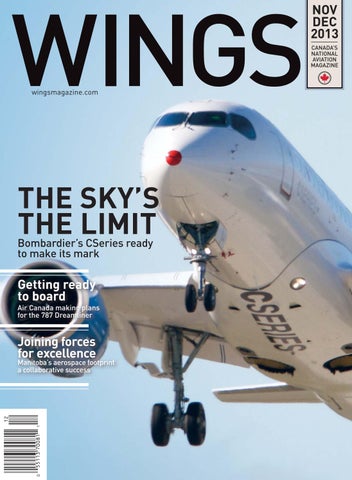
THE SKY’S THE LIMIT
Bombardier’s CSeries ready to make its mark
Getting ready to board Air Canada making plans for the 787 Dreamliner
Joining forces for excellence
Manitoba’s aerospace footprint a collaborative success
NOV DEC 2013 CANADA’S NATIONAL AVIATION MAGAZINE
Per formance Upgrades for the King Air, C aravan , Cheyenne, and Conquest
Power. Performance. Proven.
(254) 755-6711 | info@blackhawk.aero
| www.blackhawk.aero
NOV/DEC 2013
UPFRONT 5 Leading edge
The power of giving back
8 On the fly
News and opinion
12 Waypoint
The tenacity of a bear
14 Alternate approach Doubling down on Canada
16 At the gate
Taking a different approach
All systems are go for Bombardier after its successful first flight of the CSeries. P. 20.
18 Glidepath It’s all about the technology
19 Air surveillance
It’s time to get it right
BACK 48 Marketplace 54 On final
Airlines and airports working together
From top: The tenacity of a bear. P.12. Doubling down on Canada. P.16.
FEATURES 20 THE SKY’S THE LIMIT
Bombardier’s CSeries looks to conquer the 100- to 160-seat class BY BRIAN DUNN
24 GETTING READY TO BOARD
Air Canada busy making plans to bring the 787 Dreamliner into the fold BY DAVID CARR
28 THE F-35 LIGHTNING II
UP CLOSE AND PERSONAL
Evaluating the tools of Lockheed Martin’s impressive stealth fighter BY WALTER HENEGHAN
32 NURTURING A KEY BRAND
Blackcomb Aviation is making noise on the West Coast BY PAUL DIXON
36 JOINING FORCES FOR EXCELLENCE
Manitoba’s aerospace footprint is fuelled by collaboration and composites BY MATT NICHOLLS
COVER PHOTO: BOMBARDIER
WWW.WINGSMAGAZINE.COM
November/December 2013 | WINGS
3
departure loves arrival De epa part r from rt ro om the e ordinary and d arr rriv ivve at tth he ext he xtra raor orrdi dn na aryy with wi ith h sup per erio ior ae io a rosp pac ace e pr p od duc u tss fro fro r m BA BASF SF FT e Ch Th C em e ical Compa any ny.. BASF BA SF iiss pr prou oud d to o iint ntro nt rodu ro duc du ce a bro ce oad d porr tf tfol olio ol io of prod pr oduc ucts uc t for the ts e Aeros erros ospa p ce pa e iind ndus nd usstr tr y: try: 䡲
Ca abiin In Inte teri te rior ri os or S ru St ruct c urall M Mat atter eria ials ls 䡲 Se Seat atin at in ng Co Comp mpon mp o e on en nttss 䡲 Fu uel a and nd n dL Lub bri rica ca ant Sol o ut utio io onss 䡲 Co C at atin in ng gss and nd d Sp pe ec ciial alty ty Pig igme mentts me ment 䡲 Flam Flam Fl ame me Re R ta tard rda an nts ts a and nd Fir ire e Pr P ottec ecti tion o 䡲 Ot O he her IIn nno nova ova vati tion ti o s on 䡲
At BAS ASF F, we cr F, crea eate ea te che hemi m ssttry mi ry..
Get the free mobile app for your phone http://gettag.mobi
www.aerospace.basf.com
LEADING
EDGE
| By Matt Nicholls
The power of giving back Windsor event an example of the strength of the aviation community
T
PHOTO: MATT NICHOLLS
he fall is traditionally one of the busiest times in the Canadian aviation industry. Annual general meetings, conventions and tradeshows fill the calendar, bringing together the industry’s heavy hitters – be they in aerospace, commercial aviation or the rotary world. As the editor of Wings, it’s my honour to take part in educational sessions and networking opportunities at many of these events to get a better grasp of where various industries are headed, and to report back on key trends, news and issues. From a purely selfish point of view, it’s also a wonderful opportunity to rub shoulders with Canadian aviation leaders, such as the enigmatic Chris Hadfield, whose keynote address during the excellent Aerospace Industries Association of Canada convention in Ottawa Oct. 16-17 was, like the presenter himself, out of this world. Hadfield’s star as one of Canada’s top cultural icons continues to rise, and the former commander of the International Space Station, now professor at the University of Waterloo, truly represents all that is great about Canadian aviation and aerospace. His outstanding achievements underscore the potential Canadians have on the global aerospace stage and remind us that we all have the ability to inspire and change lives. In his moving speech, Hadfield spoke of collaboration, teamwork and camaraderie, and of their importance in sparking innovation and helping to transform. He also spoke of passion and a sense of community, one that aviation can provide and help ignite the passions of Canadians of all ages. For anyone who dreams big and seeks ways to make a difference both professionally and in the larger stratosphere of life – by making change for the better in the communities in which we live – it was
5
It aptly underscores just what can be accomplished when you collaborate, work together and strive to transform. impossible not to be inspired by Hadfield’s words. Many of these themes helped drive a different – but equally significant – event this September in Windsor. Organized by event chairman and Windsor Regional Hospital Patient Education Coordinator Paul McCann, the Top Guns! Kids With Cancer Take Flight event culminated Sept. 29 with a special aviation day. More than 300 attendees – families and friends with children battling cancer – had a chance to experience the many splendours of rotary- and fixed-wing flight. Earlier in the week, none other than Canada’s most famous astronaut touched down at the Windsor Regional Hospital
TOP DATA BURSTS… in this issue
1. 50: The number of years resilient Thunder Bay-based operator Bearskin Airlines has taken to the skies. (pg. 12). 2. $5 million: The estimated amount of Quebec-based Pascan Aviation’s recent expansion. (pg. 16). 3. Bombardier has spent more than $120 million in the development of the CSeries (pg. 20). 4. $4.8 billion The amount Air Canada is spending on its 787 Dreamliners (pg. 24). 5. $1.6 billion: Annual revenue generated by the Manitoba aerospace cluster (pg. 36).
WWW.WINGSMAGAZINE.COM
to meet the children of the Paediatric Oncology Satellite Clinic. The events ran in concert with Childhood Cancer Awareness month. (See http://www.youtube.com/ watch?v=L5bvsLt7Jj8) Dozens of military and civilian aircraft were flown in for the static display for the families to enjoy, including a CF-18 Hornet, a Bell CH-146 Griffon, CT-155 Hawk and a CP-140 Aurora. In total, more than $100 million in military aircraft hardware graced the tarmac. Pilots and engineering teams also were on hand to explain their craft, while free aircraft rides gave all children an opportunity to experience the wonders of flight. Earlier in the week, the iconic Canadian Snowbirds kicked off the event. As McCann noted in his opening remarks during the event, childhood cancer has a significant financial impact on a family. Research suggests that a family can expect to lose as much as one-third of its after-tax income to out-of-pocket expenses related to care. It’s a significant economic challenge and can create plenty of household stress. Conversely, the Top Gun aviation day gave kids and their families a chance to explore the incredible world of aviation and a chance to break from their daily routines. The Royal Canadian Armed Forces, the Windsor International Airport, the Windsor Flying Club, and the Canadian Historical Aircraft Association went above and beyond to deliver a truly special gift. Having dealt with the complexities cancer can bring to the family dynamic, I understand the benefits events like these can provide. The escape from routine is invaluable and providing kids an opportunity to dream and experience the wonderful world of aviation is an invaluable gift they won’t soon forget. Wings salutes Hadfield, McCann and all the volunteers who were involved in the creation of this very special gathering. It aptly underscores just what can be accomplished when you collaborate, work together and strive to transform your world – both here and thousands of miles away in space. | W Your feedback is always welcome. Please contact me at mnicholls@annexweb.com. @Wings_Magazine November/December 2013 | WINGS
5
Vol. 54, Issue 6 EDITOR
Matt Nicholls mnicholls@annexweb.com 416-725-5637 MEDIA DESIGNER
Gerry Wiebe FLIGHT DECK
Krista Bulmer, David Carr, Paul Dixon, Brian Dunn, Frederick K. Larkin, Neil A. MacDougall, James Marasa, Carroll McCormick, David Olsen, Rob Seaman
SUBSCRIBE TODAY !
ACCOUNT MANAGER
Nash Barsky nbarsky@annexweb.com 1-905-431-8892
1 YEAR SUBSCRIPTION
$ only
3000
SALES ASSISTANT
Stephanie DeFields sdefields@annexweb.com 1-888-599-2228 ext. 257
'34 s (34 53 53$ s &OREIGN 53$
Name: _______________________________ Company: ____________________________ Title: _________________________________ Address: _____________________________ City: _________________________________ Prov: ________________________________ P.Code: _______________________________ Tel: __________________________________ Fax: _________________________________ e-mail:________________________________
PLEASE CHECK ONE: ❑ Commercial aircraft owner/operator ❑ Business/private aircraft owner/operator ❑ Military ❑ Aircraft maintenance/overhaul firm ❑ Airport ❑ Aerospace, airframe & component manufacturer and distributor
❑ Fixed base operator ❑ Aviation services, consultants and aircraft sales ❑ Government ❑ Aviation associations and organizations ❑ Flying schools, clubs and colleges ❑ Other (please specify) ______________
PAYMENT: Cheque - Payable to Annex Publishing & Printing Inc. Visa
MC
ASSOCIATE PUBLISHER
Weng Ng wng@annexweb.com GROUP PUBLISHER
Scott Jamieson sjamieson@annexweb.com PRESIDENT
Mike Fredericks mfredericks@annexweb.com WINGS MAGAZINE
P.O. Box 530, 105 Donly Dr. S., Simcoe, ON N3Y 4N5 Tel.: 428-3471 Fax: 429-3094 Toll Free: 1-888-599-2228
Publication Mail Agreement #40065710 Return undeliverable Canadian addresses to Circulation Dept., P.O. Box 530, Simcoe, Ont. N3Y 4N5 e-mail: subscribe@wingsmagazine.com Published six times per year (Jan/Feb, Mar/Apr, May/ Jun, Jul/Aug, Sep/Oct, Nov/Dec) by Annex Publishing & Printing Inc. Circulation e-mail: subscribe@wingsmagazine.com Ph: 866-790-6070 ext. 208 Fax: 877-624-1940 Mail: P.O. Box 530, Simcoe, ON N3Y 4N5 Subscription Rates Canada – 1 Year $ 30.00 (includes GST - #867172652RT0001) USA – 1 Year $ 42.00 Foreign – 1 Year $ 65.00
AMEX
Occasionally, Wings magazine will mail information on behalf of industry-related groups whose products and services we believe may be of interest to you. If you prefer not to receive this information, please contact our circulation department in any of the four ways listed above. No part of the editorial content of this publication may be reprinted without the publisher’s written permission. ©2013 Annex Publishing & Printing Inc. All rights reserved. opinions expressed in this magazine are not necessarily those of the editor or the publisher. No liability is assumed for errors or omissions. All advertising is subject to the publisher’s approval. Such approval does not imply any endorsement of the products or services advertised. Publisher reserves the right to refuse advertising that does not meet the standards of the publication. Printed in Canada ISSN 0701-1369
Account #: __________________________ Expiry:_____________________________
TO SUBSCRIBE: Tel: 866-790-6070 Fax: 877-624-1940 Mail: Wings Magazine c/o Annex Business Media P.O. Box 530 Simcoe, Ontario N3Y 4N5 e-mail: subscribe@wingsmagazine.com
www.wingsmagazine.com GST#135274215RT001
6
Subscriptions non-refundable
WINGS | November/December 2013
Air Transport Association of Canada
ON THE
WEB
Canadian Owners & Pilots Association
Canadian Business Aviation Association
Magazines Canada
CAREERS IN AVIATION Looking for a great career in aviation and aerospace? Check out our Careers in Aviation micro site, a handy guide to help you better understand what a career in aviation is all about. Check out www.careersinaviation.ca for news, updated listings and more!
PHOTO: RCAF
Signature: _________________________
PRO1213
WWW.WINGSMAGAZINE.COM
“WELCOME TO OUR WORLD”
At the heart of the most extreme missions are the exceptional pilots who experience daring feats on a daily basis and are prepared to entrust their security only to the most high-performing instruments. At the heart of the most extreme missions is the Breitling Avenger. A concentrated blend of power, precision and functionality, Avenger models boast an ultra-sturdy construction and water resistance ranging from 300 to 3,000 meters. These authentic instruments for professionals are equipped with selfwinding movements chronometercertified by the COSC – the highest official benchmark in terms of reliability and precision. Welcome to the sphere of extremes. Welcome to the Breitling world.
AVENGER II SEAWOLF
ON THE FLY For late-breaking news, the Wings blog and exclusive web content, please visit us at: www.wingsmagazine.com
THE LEAD INDUSTRY HAPPENINGS QUOTABLES PEOPLE ON THE MOVE
THE LEAD
FLYING COLOURS MAKES PRESENCE FELT AT NBAA2013 Flying Colours Corporation put on quite the show at this year’s NBAA2013 Business Aviation Convention and Trade Show in Las Vegas. The aircraft completion and maintenance specialists experienced record increases on year-over-year maintenance activity at its locations in Peterborough and Chesterfield, Mo., where its JetCorp Tech Services subsidiary has been put under the Flying Colours brand. Numbers that stand out are a 35 per cent increase in Bombardier Challenger and Learjet type maintenance and a 25 per cent jump in Bombardier Global aircraft maintenance. Requests range from line maintenance work to intensive 96-month inspections. There are several factors driving the increased workload, including the appointment as an Authorized Service Facility for Bombardier at last year’s NBAA, and growing market demand for specific In Flight Entertainment, Cabin Management Systems and WiFi connectivity.
“Our business has traditionally been built on working with repeat customers,” said Sean Gillespie, Flying Colours’ executive vice president. “With the expertise we now offer at both our locations we are in a position to match our existing customers’ expectations and develop new requests from a wider, international client base.” Flying Colours is meeting demand with a major $3.5-million expansion that will increase its large-cabin completion and maintenance capabilities at its Peterborough Airport base. Some 20,000 square feet is being added to one of the company’s existing three hangars, a renovation that is currently part of a long-term project to convert 16 Bombardier CRJ 200 regional airliners into 16 seat corporate shuttle configurations. Phase 1 is due for completion in the first quarter of 2014. It will be large enough to accommodate wide-body aircraft but will initially be used to increase refurbishment and maintenance for pre-owned large-cabin sized aircraft and some special mission programs. The new structure will be equipped to handle refurbishment projects, avionics installations and upgrades, heavy maintenance projects, and full interior completions. “This is a major step in the application of our future strategy for Flying Colours,” Gillespie added. “We have simply run out of space to accommodate all the requests so have implemented this extensive development project to accommodate current and future workload. When phases 1 to 3
Flying Colours is undergoing a major $3.5-million expansion that will increase its large-cabin completion and maintenance capabilities. 8
WINGS | November/December 2013
Peterborough's Flying Colours is making a name for itself on the international stage based on its completions prowess.
are complete, the additional hangar space will enable us to work on the Airbus ACJ fleet, Boeing Business Jet family and the state-of-the-art CSeries models. We are adding a total of 65,000 square feet to our facility and are very excited about the new possibilities.” Phases 2 and 3 are expected to be complete in 2015. Flying Colours anticipates that increased capacity will create 60 to 70 new jobs at the Peterborough location, a 30 per cent increase in its workforce. Flying Colours’ expansion coincides with a major expansion to Peterborough’s aerospace footprint. At this year’s Aerospace Industry Association of Canada conference in Ottawa Oct. 16 and 17, the City of Peterborough and Peterborough Economic Development announced the launch of the Peterborough Aerospace Centre (PAC). With the City’s support, the team at Peterborough Economic Development is leading the development of PAC and its service delivery to the aviation and aerospace industry. Peterborough Aerospace Centre’s vision is to become a nexus of aerospace excellence, business enablement and thought leadership that will provide continued, sustained and diversified economic growth throughout the Peterborough region. PAC is a combination of the airport, its resident businesses, regional aerospace businesses, and business support services. “The City of Peterborough, along with the provincial and federal governments, has invested well over $30 million to expand our airport infrastructure. We are continuing to upgrade over the next two years and are committed to providing the WWW.WINGSMAGAZINE.COM
PHOTOS: FLYING COLOURS
8 9 10 10
highest level of infrastructure and service to an exciting and growing industry for our region,” said Peterborough mayor Darryl Bennett. Dan Taylor, president and CEO of Peterborough Economic Development, added: “We’ve spent a significant amount of time working with the industry to ensure our offering is of the utmost calibre to meet its demands. The quality of the airport facilities, our skilled labour force, and low cost of doing business, paired with attractive incentives, positions Peterborough as an appealing and competitive location.” Current global businesses in the area include Flying Colours and Safran Electronic Canada. In addition, Seneca College has recently announced that the School of Aviation will be moving to a new Peterborough Campus opening in 2014.
ANCILLARY REVENUE CONTINUES TO SOAR Rouge, Air Canada’s low-cost leisure subsidiary, has introduced a new inflight entertainment system to allow passengers to stream stored movies, television shows and other visual content to their personal devices for a $5 charge. Rouge is the latest airline to squeeze added revenue out of every flight by boosting the level of cash generating ancillary services offered to the passenger. The airline has signed a multi-year agreement with GuestLogix, a Torontobased leading provider of onboard retail and payment technology services to the
Air Canada Rouge is stepping up its game to offer customers more entertainment options.
airline and travel industry. The agreement covers the credit card payment system for the sale of entertainment content onboard Rouge’s expanding fleet of Boeing 767 and A320 aircraft. Passengers who board without an iPad or iPhone device can rent an iPad for $10. Inflight entertainment is only the beginning. Ancillary revenue soared to a record $27.1 billion in 2012 among 53 legacy and leisure airlines according to a report compiled by IdeaWorks, a Wisconsin-based consultancy in the area of airline ancillary revenues, and CarTrawler, a provider of online car rental distribution systems. Ancillary revenue includes duty-free sales, food and beverage à la cart services, commissioned-based services such as hotel or car rental bookings and other revenue generators from co-branded credit cards to loyalty programs. It is not a complete picture of either the expanding number of ancillary services on offer or the revenue collected worldwide. Air Canada, a global powerhouse in generating ancillary revenue, does not disclose
ancillary revenue activity. What is clear is that a revenue stream that began with low-fare airlines has graduated into the economy cabins of legacy carriers. “It is revenue desperately needed by airlines during troubled economic times,” said Jay Sorensen, president of IdeaWorks. The company’s top 10 list of heavy hitters is dominated by major network carriers, with United, Delta and American as top hitters, although low-fare operators top the chart when ancillary revenue is calculated as a percentage of total revenue. Rouge is already looking to “build out additional retailing capabilities,” according to Anton Vidgen, senior director of customer and technology, and the GuestLogix agreement may eventually be extended to include the mainline carrier. Ancillary revenue “opens the door to a wealth of different types of retailing,” Dan Thompson, GuestLogix’s vice-president of marketing told the Toronto Star. “They can shop for many different things. It’s not just about shopping for entertainment.”
PHOTOS: AIR CANADA (TOP); AIAC (BOTTOM)
INDUSTRY HAPPENINGS
The crew from Montreal's Marinvent Corporation captured the James C.Floyd award at the recent AIAC conference in Ottawa for its exceptional contributions to Canadian aerospace. WWW.WINGSMAGAZINE.COM
November/December 2013 | WINGS
9
ON THE
FLY
QUOTABLES: “The blueprint for an airline business has changed dramatically over the past 10 years. Consumer demand for choice and convenience of complementary products has forced the travel industry to reinvent itself with airlines leading the way." – Mike McGearty, chief executive, CarTrawler.
“The most aggressive airlines easily have more than 20 per cent of their revenues produced by à la carte fees. The best performers realize more than $30 per passenger from ancillary revenue.” – Jay Sorensen, president, IdeaWorks Company.
10 WINGS | November/December 2013
PEOPLE ON THE MOVE Payne joins Premier Aircraft Premier Aircraft Sales, one of North America’s leading sellers of pre-owned and new aircraft has signalled it is taking the Canadian market seriously, by adding respected industry veteran Mike Payne to the sales team. An instrument-rated pilot with more than 3,300 hours clocked, Payne brings some 30-years aircraft sales and support experience throughout Canada to the portfolio. He specializes in Cessna and Diamond products, but also has represented Innotech-Execaire and Embraer. He also holds glider and seaplane ratings. It is the level of experience Fort Lauderdale-based Premier Aircraft has been looking for as it expands its presence in the expanding Canadian market. “For Premier, the concept of ‘close to the customer’ refers not just to nurturing our professional relations with our clients, but also having a presence in strategic
WWW.WINGSMAGAZINE.COM
locations,” said Fred Ahles, president of the Fort Lauderdale-based organization. “But, while growing markets like Canada have a lot of potential, you need the right people to lead your introductory efforts.” “Close to the customer” also describes Payne’s own sales philosophy. “Over the years, I’ve visited every region in Canada and have sold everything from gliders and float plans to corporate jets,” he said. “I think the reason for my success is that I don’t concentrate on just selling an airplane. I work to build long-lasting relationships with each aircraft owner.” Hadfield to teach at Waterloo High-profile Canadian astronaut Chris Hadfield, who wowed the world with his in space cover of David Bowie’s Space Oddity, has a new gig. He is headed back to school as a member of the University of Waterloo’s aviation department. Hadfield, who retired from the Canadian Space Agency in May, gained international celebrity status during his time as commander of the International
Canadian astronaut Chris Hadfield has joined a new team: the University of Waterloo.
Space Station. By the end of his mission, Hadfield had more than one million Twitter followers. Professor Hadfield will take on teaching and advising responsibilities in aviation and related programs beginning in fall 2014. CTV News reports that he will be cross-appointed to the university’s faculties of science, environment and applied health sciences. Prior to entering the classroom, he will complete his joint participation in research on heart health in space. The research, known as BP Reg, will help understand dizziness in astronauts and have direct
benefits for the elderly predisposed to falls and resulting injuries. “As you would expect for a man who has just returned to Earth after five months in space, Chris has a very busy schedule,” said Prof. Ian McKenzie, director of aviation at Waterloo. “We are excited that he is willing to share his extensive career knowledge and experience in aviation with our faculty and students when he is able.” Hadfield’s connection with the University of Waterloo goes back over 20 years when he studied as an NSERC postgraduate in the Faculty of Engineering in 1982, looking at aircraft fuel pump design. He was the keynote speaker for the official launch of the Waterloo Aviation program in June 2007, and conducted a downlink to the university from the International Space Station last February.
For expanded industry news and daily updates, visit www.wingsmagazine.com
WAAS Gets Them There PHOTO: CANADIAN SPACE AGENCY
Avionics upgrades for reliable deliveries to the jobsite
Mine and rig operations don’t depend on the weather. Transporting staff and hot-shot parts to the jobsite shouldn’t either. WAAS Flight Management Systems enable precision-like LPV approach procedures with lower minima that get them on-site, on time, every time. To learn more, contact an authorized dealer or visit www.uasc.com.
WAAS/SBAS-FMS Family LP/LPV Monitor, UNS-1Lw, -1Fw and -1Ew
www.uasc.com sales@uasc.com (800) 321-5253 (520) 295-2300
WWW.WINGSMAGAZINE.COM
November/December 2013 | WINGS
11
WAYPOINT By Rob Seaman |
The tenacity of a bear Thunder Bay’s Bearskin Airways has tamed the skies for 50 years
T
12 WINGS | November/December 2013
In 1991, Bearskin bought the first two of what they are best known for today – Fairchild Metroliner aircraft. In the following year, they introduced non-stop service between Thunder Bay and Sudbury. This move heralded Bearskin Airlines’ growth eastward, making tracks throughout northeastern Ontario and eventually into Ottawa. Today, they are one of the largest fleet operators of the aircraft type. According to Cliff, “We chose the Metro because of its speed, comfort and fuel economy. It is one of the most economical pressurized 19-seat aircraft on the market. We moved to a single type in 2003/2004 related to reduced cost when using a single type and the fact it matched demand on most routes served.” Harvey and Cliff are both amazed at how much things have changed. “No one could have predicted the growth that we have had,” says Cliff. “We started as a small two-plane operation and now fly turbine pressurized aircraft throughout North America. I think it is safe to say we are both humbled and proud of what we have achieved.” In addition to their tremendous success, Harvey and Cliff Friesen have shown exemplary community involvement. The Air Transport Association of Canada will be recognizing this by honouring them with the first Jim Glass Humanitarian Award at ATAC’s annual general meeting in Montreal on Nov. 18. | W
“I think it is safe to say we are both humbled and proud of what we have achieved.” between Big Trout Lake and Sioux Lookout. The following year, the “base of operation” was moved to Sioux Lookout where a new hangar, maintenance facilities and offices were built. By 1979, a scheduled route was launched between Sioux Lookout and Thunder Bay. A short year later, a new base was established in Thunder Bay following the purchase of On Air Ltd. Cliff Friesen then moved to Thunder Bay to oversee that base. In 1981, addition routes were added linking Sioux Lookout, Kenora and Winnipeg. Right up until the late 1970s, most of Bearskin’s aircraft were bush planes – float-equipped in summer and skiequipped in winter. By that time, the Ontario government was starting to pay attention to the challenges the smaller communities faced with seasonal freezeup and thaw of the lakes – something that at times would totally halt air service. To overcome the problem of communities being cut off, the government undertook a program of airfield construction for many remote regions. Again showing its foresight, keen business acumen and adaptability to change, Bearskin began offering scheduled air service with wheeled aircraft to those communities. As Cliff Friesen says, “The northern airstrip development was just starting and the demand for wheel-equipped and larger aircraft was just beginning.”
Rob Seaman is a Wings writer and columnist. WWW.WINGSMAGAZINE.COM
PHOTO: BEARSKIN AIRLINES
he story of winning the North by air has been told over and over by many different voices. Each one always finds a different and unique twist or aspect to share. And while we think we know the most common names and characters, the real story of flying the North is a never-ending one with new chapters being created all the time. Bearskin Airlines is one such example. As with many northern operations, the company began by serving communities that were otherwise hard to reach – except by air. This was back in July of 1963. Originally called Bearskin Lake Air Service, the company started from very humble beginnings with just two Cessna 180s – floats in the summer and skis in the winter. At that time, “the Bear” carried both passengers and cargo from a base at Big Trout Lake, which is 45 miles east of Bearskin Lake (270 miles northeast of Sioux Lookout and 400 miles northwest of Thunder Bay). Bush pilot Otto John Hegland started the operation. He did so primarily because he operated a general store on Bearskin Lake and needed to get groceries in for his customers. So began an airline that is now celebrating its 50th anniversary. In 1970, a young and ambitious pilot named Harvey Friesen joined the company. Harvey obtained his private licence in 1967 while still in high school in Saskatchewan. He did his flight training at Ray’s Flying Service in Saskatoon and by 1969 had his commercial rating. Within a short period of time he was earning a living as a professional pilot, flying 180s on skies off the frozen lakes of northern Ontario. Friesen loved the work and saw a great future for himself and Bearskin – so much so that in 1972 he bought a 50 per cent share of the company. Five years later, he became the majority owner and president. The following year, his brother Cliff (who was not a pilot) joined the company as executive vice-president. Bearskin focused on providing charter service to the many remote First Nation communities in northern Ontario. Then in 1977, they launched their first scheduled service and began flying passengers
I like to stay ahead of my airplane. So if I’m 40 miles out with weather rolling in, I’m listening to what’s happening in front of me. AWOS. Pilot chatter. A quick check with flight service. Sometimes, there’s a lot to decipher. But I need to hear it clearly. Because when I do, I feel confident. Prepared. In the moment. And that allows me to just
focus on what matters,
flying.
MORE NOISE REDUCTION. LESS DISTRACTION. Better sound can make all the difference, especially where you go. Which is why, with 30% greater noise reduction than conventional noise reducing aviation headsets, the A20 headset lets you hear more of what you need to hear. While proprietary cushions and minimal clamping force let you fly comfortably for hours. Meets or exceeds TSO standards. Made in U.S.A.
Bose A20 ®
Aviation Headset
To order 1.800.901.0497 | Learn more at Bose.ca/A20_27
©2013 Bose Corporation. Delivery is subject to product availability.
®
ALTERNATE
APPROACH By David Carr |
Doubling down on Canada What is behind Icelandair’s four-year growth spurt?
I
14 WINGS | November/December 2013
will be just as popular,” says Birkir Holm Gudnason, the airline’s chief executive. The airline also seeks to lower its dependence on the peak summer season by becoming a year-round airline and targeting winter tourism in Iceland. In Toronto, it is aggressively marketing the northern lights. Spreading out the peaks is essential as the airline prepares to take delivery of the first of 16 “out-of-the-crate” Boeing 737 MAX aircraft beginning in 2018. Toronto is Icelandair’s first year-round Canadian destination. The strategy appears to be working. Canadian visitors to Iceland increased by 4.6 per cent in 2012 to almost 19,000. In 2010 and 2011, Icelandair saw opportunity in the ashes of Eyjafjallajokull and Grimsvotn, encouraging tourists to visit both volcanoes as eruptions subside. Icelandair is expected to grow available seat kilometres 18 per cent in 2014, the single biggest year-over-year increase in company history. That includes adding three more 757s, bringing the fleet to 21 aircraft by the summer. For now, the low ownership costs of the 757 offset the airplanes higher operating costs. The 737 MAX is planned as a growth tool and the search for a 757 replacement is underway. Even so, Icelandair is expected to stick with the type for the next 10 years, possibly making the airline vulnerable to spikes in fuel prices. “We have been able to adjust to the external environment,” Björgvinsson points out. It is an essential part of defying the odds.. | W
Edmonton should be a natural fit for an airline seeking to operate niche international services in underserved markets. Icelandair, which is the largest subsidiary of the Icelandair Group, a travel and tourism company, has distanced itself from its colourful past, tightening up operations and introducing three cabins, including premium economy and Saga business class. Still, the fundamentals remain the same. Approximately 50 per cent of passengers flying between Canada and Europe never leave the airport. Because Icelandair has traditionally cashed in on the heavy summer travel period between North America and Europe, the bulk of its schedule has been seasonal, with several aircraft grounded for heavy maintenance over the winter months or transferred to Loftleider Icelandic, a sister company specializing in charters and leasing. Edmonton, Icelandair’s 13th North American gateway, should be a natural fit for an airline seeking to operate niche international services in underserved markets. Indeed, Icelandair announced that four times weekly Edmonton service would be “extended” to year-round even after the inaugural flight pushes back from the gate this March. The twice-weekly Vancouver route could be a bit of a question mark since Icelandair already operates to Seattle, potentially resulting in passenger bleed on both routes. “Our Seattle service has been a success for us and we hope our Vancouver service
David Carr is a Wings writer and columnist. WWW.WINGSMAGAZINE.COM
PHOTO: ICELANDAIR
celandair has a history of defying the odds. In 2008, when Iceland’s celebrated economic boom went bust and business travel to the island nation dried up overnight, the airline flew above the carnage to begin an ambitious growth plan that continues today. In 2010, when Eyjafjallajokull erupted, closing European airports and disrupting flights across the north Atlantic, Icelandair quickly shifted its base of operation from Reykjavik to Glasgow, Scotland and maintained approximately 85 per cent of its schedule. In 2014, Icelandair will launch scheduled service to Vancouver and Edmonton and boost frequency on its Toronto route to daily. It’s an ambitious undertaking for an airline that serves a population of 320,000, or approximately three-quarters the population of Halifax, the company’s first Canadian gateway through a commercial agreement between the airline and the Halifax International Airport Authority. In addition to Canada, Icelandair serves nine U.S. cities and 24 European destinations, adding Geneva to the route network at the same time it pushes deeper into Canada. The airline’s success lies in marrying geography and service to bond its North American and European destinations through a 24-hour hub at Keflavik International Airport. “One of the key competitive advantages of Icelandair is the strategic location of Iceland,” Helgi Mar Björgvinsson, senior vice president for marketing and sales tells Wings. Iceland rests just below the great circle routes that bridge Europe and North America, making Reykjavik the only city that is a medium-haul destination for cities on both continents and enabling the carrier to carve out a niche service using single-aisle Boeing 757 equipment exclusively. “We are a hybrid niche carrier and in many cases offer the shortest elapsed time between two different points in North America and Europe,” Mar Björgvinsson says. It has been that way since Icelandair was a low cost fare alternative for backpackers, often playing on Iceland’s liberalized views and hippie culture of the time with ads such as: “The Hippie Airline” or “Lower but Slower,” a reference to their fares.
WAYNE GOUVEIA, VP COMMERCIAL GENERAL AVIATION Ontario Flight Schools Working Group (OFSWG) - The OFSWG was created to bring together flight schools in Ontario as a collective to deal with increased challenges of complying with the Private Career College (PCC) regulation. The working group has met several times in the last year to prepare the framework for the Ministry of Training Colleges and Universities (MTCU) consultation and review of the Private Career Colleges Act, 2005. The act is open for review every 7 years. The OFSWG, with support from ATAC, has been working with National Public Relations to increase communication with the Assistant Deputy Minister Nancy Naylor and her staff. Improved communication between the MTCU and Transport Canada has resulted in a Memorandum of Understanding for the sharing of flight school information, and clear delineation of jurisdictional areas of responsibility and oversight. The working group has spent the last year identifying key issues in preparation for the formal consultation on the PCC Act meeting of October 4th in Toronto. The issues tabled at the meeting focused on the cost and frequency of audits, challenges with the registration system, clarification of the superintendent’s role, designation of schools for the International Student Study Permits, enforcement guidelines and more. Regulation changes are expected sometime in Spring 2014. ATAC Safety Management Systems Toolkit - 2nd Edition - The 2nd Edition of the ATAC SMS Toolkit will be released at the ATAC AGM in November. The new edition will have more detailed daily workflows of each phase of an SMS process. This new format will guide the user through every step of the program allowing them to grasp the objectives to be achieved. The 2nd edition has been written with emphasis on Quality Assurance identified from comments provided by the Transport Canada Regional Directors’ meeting last April. At the Transport Canada SMS briefing, Regional Directors were provided with a copy of the ATAC SMS Toolkit for reference. The revised edition will be provided to the Regional Directors and the Director General at the TC/ATAC Officers meeting in Montreal at the ATAC AGM in November. For more information on the above please contact Wayne Gouveia at wgouveia@atac.ca.
MIKE SKROBICA, SENIOR VICE PRESIDENT AND CFO Transport Canada Develops New Policy on “Wet Leasing” - On August 30, 2013, Transport Canada issued a new policy on limits to “Wet Leasing”. Wet Leasing is the industry term for the rental of both an aircraft and its crew. The policy focuses particularly on offshore wet leases. It specifies a cap of 20% of a Canadian carrier’s fleet being wet leased from a foreign company. The Canadian Transportation Agency (CTA) will administer the new policy. ATAC has met with both Transport Canada and CTA to clarify issues with the policy on behalf of members. For more information on the above please contact Mike Skrobica at mikes@atac.ca.
WHAT’S NEW AT ATAC ATAC is proud to welcome the following recent new members: Sec & Co London, ON Avro Strategies Calgary, AB M1 Composites Technology Laval, QC EDG Consulting Fergus, ON (# .5ŏ (5%*#ŏ (1 ŏ Calgary, AB International Pilot Academy Carp, ON Premier Aviation Overhaul Center Trois-Rivières, QC
LES AALDERS, EXECUTIVE VICE PRESIDENT ATAC Strongly Encourages Removal of “Regulatory Irritants” - Further to the earlier request from Minister Fletcher for industry to identify “irritants” to the regulatory process and regulations, we continue to advocate for implementing our many suggestions, especially those related to approval of manual amendments. These will assist both our industry and the regulator in becoming more efficient without jeopardizing safety. In fact, many of these will enable and encourage continuous improvement of safety related aspects of our operations, a true attribute of a quality system. Flight Attendant Ratio Flexibility - After many years of effort by ATAC and the airline industry, ATAC is very pleased to see that Transport Canada has authorized ATAC members to operate more efficiently under equivalent levels of safety. This allows Canadian airlines to operate under similar requirements as airlines in the US and most international jurisdictions, which have been able to do so for many years with no resulting difference in safety. MRO International Marketing - Following the success of our MRO participation at MRO Americas in Atlanta last April and MRO Europe in London last September, ATAC continues to work with our MRO members and our government colleagues to grow the Canadian MRO presence in the US, Europe and further abroad. We are now developing plans for MRO Americas 2014 in Phoenix, April 8-10, and MRO Europe 2014 in Madrid, October 8-9. For those that are interested in participating in matchmaking/B2B sessions and/or taking part in a Canadian networking event, please contact me. For more information on the above please contact Les Aalders at laalders@atac.ca .
Air Transport Association of Canada 700 – 255 Albert Street, Ottawa, Ontario K1P 6A9 $+*!čŏĨćāăĩŏĂăăġĈĈĂĈŏđŏ 4čŏĨćāăĩŏĂăĀġĉćąĉŏđŏ ! /%0!čŏ333ċ 0 ċ
AT THE
GATE
By Brian Dunn |
Taking a different approach St. Hubert’s Pascan Aviation expands on its successful template
P
16 WINGS | November/December 2013
a few. Pascan doesn’t expect to be added to that list anytime soon, if at all. The executive team maintains it has found a winning formula, despite facing competition on most of its routes. “We have competition on all our routes, except for Alma, Roberval and Bonaventure,” says Pascan general manager Julian Roberts, who joined the company eight years ago. Like his boss, he has been in the aviation business a long time, starting at age 16 on the ramp and moving up to maintenance and reservations and everything else in between for other carriers. What makes Pascan different is its spider web approach to flying versus the huband-spoke model most major carriers use. “We have a niche market,” Roberts says. “For example, we have a direct flight from Mont-Joli to Sept-Îles which is a 35-minute flight across the St. Lawrence River. If you took Air Canada Jazz, you would have to fly from Mont-Joli all the way down to Montreal and then back up to Sept-Îles. “We’re looking outside the box. Some of the places we serve are too small for a CRJ or Embraer aircraft, but we feel we can be successful with a 42-seater or less. We concentrate on smaller markets which are poorly served or not served at all.” Looking outside the box and capitalizing on opportunities continues to give Pascan Aviation a distinct advantage in the competitive Quebec commercial landscape. | W
What makes Pascan different is its spider web approach to flying versus the hub-and-spoke model most major carriers use. Moncton was full, so we saw a good business opportunity.” Business has grown about 20 per cent a year over the past five years and it will continue to grow with the addition of more routes and new aircraft. To help grow the company, Charron took on Denis Charest in 2003 as a 50/50 partner. Charest is the president and chief executive officer of Boucherville, Que.-based Spectra Premium, a worldwide manufacturer of replacement car parts. “We’re selling the King Airs and adding more ATRs,” says Libby, a former vice-president of sales and marketing at Montreal’s Starlink Aviation. “We like the aircraft because it can land on gravel and offers superior cold weather performance. It also offers a wide body, making it easier to load cargo through two cargo doors, which is important considering some of the destinations we serve. It’s also a quiet aircraft for a turboprop and the interior gives passengers a lot of headroom and legroom.” The next step is to extend the St. John’sMoncton route into Quebec, to either St. Hubert or Mirabel, and the purchase of two 72-seat ATR 72s is planned for 2014. The future also includes jet service to international destinations. There have been plenty of regional airlines in Quebec that have come and gone over the years, including Quebecair, Quebecair Express, Nordair and Intair to name
Brian Dunn is a Wings writer and columnist. WWW.WINGSMAGAZINE.COM
PHOTO: PASCAN AVIATION
ascan Aviation, which bills itself as “the largest independent airline in Quebec,” continues to add new destinations and new aircraft. On Oct. 10, the St. Hubert-based carrier added Monday-Friday service between St. John’s and Moncton and a Friday and Sunday flight between Moncton and Quebec City with a connection to Îles-de-la-Madeleine. Founded in 1999 by career pilot Serge Charron with a single leased Pilatus PC-12, Pascan has built itself into a powerful regional airline that connects several remote regions of Quebec. It serves 20 municipalities from as far north as Wabush/Fermont to Gatineau/Ottawa in the west and St. John’s to the east and is the only scheduled airline that flies out of Mirabel. The company’s fleet consists of three ATR 42 turboprops, 13 BAe Jetstream 32s, seven Beechcraft B100 King Airs, four Pilatus PC-12/45s and two Piper PA-31 Navajo cargo aircraft. It employs about 300 people, including 80 pilots. To expand its operations, last year it bought the assets of Exact Air with operations in Baie-Comeau, Mont-Joli, Sept-Îles and Havre-Saint-Pierre, which included three buildings, three aircraft and other equipment. The $5-million transaction also included the passenger and cargo routes between Havre-Saint-Pierre, SeptÎles and Port-Menier on Anticosti Island. The deal integrated the routes into Pascan’s expanding network and gives outdoorsmen easier access to Anticosti. The addition of the three aircraft allows Pascan to offer direct service to some smaller destinations such as MontrealBaie-Comeau and Quebec-Rouyn-Noranda. The 15-odd employees of Exact Air were absorbed by Pascan and a new schedule to Port-Menier was created. “We were approached by Moncton because there was no direct service between Moncton and St. John’s,” says Brenda Libby, senior director business development and marketing at Pascan. “There was a competing airline, but it didn’t offer direct (non-stop) service. “It costs between $250,000 and $4 million to develop a new route, so it had to make economic sense to us. We determined that almost every flight coming into
DRIVEN BY SUCCESS TO OFFER QUALITY, CONSISTENTLY Bahrain International Airport Awarded Middle East’s Best Airport Staff at the 2013 SKYTRAX World Airport Awards and Bronze Winner of the Most Creative Travel/Tourism Website Category, Summit Creative Awards (SCA), 2013. s 7INNER OF THE "EST "USINESS $ESTINATIONS 4RAVEL !WARD FOR THE -IDDLE %AST s RD 0LACE AT THE 7ORLD !IRPORT !WARDS FOR "EST !IRPORTS -IDDLE %AST BY SKYTRAX World Airport Awards s 7INNER OF "EST -IDDLE %AST !IRPORT n SKYTRAX World Airport Awards s 3ECOND "EST !IRPORT IN THE -IDDLE %AST n SKYTRAX 3URVEY
WWW BAHRAINAIRPORT COM
GLIDE
PATH
By Paul Dixon |
It’s all about the technology Aircraft interiors are rapidly changing to meet consumer needs
I
18 WINGS | November/December 2013
environment. And when you read between the lines, the regulators have a much greater expectation of compliance with regulations from the people in the cockpit than they do with the people in the back of the plane. Even the biggest champions of unfettered IFE systems will admit that, yes, there is always going to be the question of the impact of future technology. On the positive side, however, industry demand has brought the seat manufacturers and IFE vendors into a collaborative work environment where they work together with large customers such as Boeing and Airbus, right from the initial design concept – instead of working in their own silos with no communication. The result has seen product and delivery times that used to be measured in years cut to months. Beyond that, the seat people and the IFE people are brainstorming potential configurations so that whether it’s the airlines looking for a mid-life refit on their existing fleet or the OEMs thinking about the next generation of air travel, they are leaning forward with a number of potential solutions to offer. As a not-so-avid techno-geek who isn’t tied to his tablet or iPhone, I don’t know what’s coming next or how long it’s going to be before it comes to an airliner near you. So, in the meantime, I’ll bring a good book. | W
Of course, the big challenge was identifying ‘the public’ and what it is that they want. aviation are faced with the challenge of meeting customer expectations without pricing themselves out of their markets. It seems almost inevitable that one day we will live our lives almost exclusively through our smartphones or tablets. This is certainly true with regards to airlines and air travel. You will book your flight, choose your seat, receive your electronic boarding pass, track your baggage, order your meal and even arrange your inflight – all with your phone. That day is coming – and many of those options are already here with some airlines – but there’s a lot of work that the average airline passenger doesn’t consider or simply isn’t aware of. It’s one thing for an airliner to order a new B787 or A380 with the latest and greatest electronics, but what does it do with its aircraft that haven’t hit the halfway point in their lifespan? Where does this asset fit into the business model? Do you strip out the interior of a 10-year-old wide-body in order to upgrade the IFE or do you go with a new model? There’s also the challenge of dealing with the regulators in a world where technology changes at a rate that outstrips the regulator’s willingness and/or ability to deal with the questions that arise. The electronic flight bag is a prime example, one where regulators are allowing the use of electronic devices in a tightly controlled
Paul Dixon is freelance writer and photojournalist living in Vancouver. WWW.WINGSMAGAZINE.COM
PHOTO: BOEING
had a minor epiphany recently on the subject of In Flight Entertainment (IFE) systems and the decisions aircraft manufacturers, suppliers and airlines will be facing in the coming decade. I was in Seattle at the Seating & IFE Symposium, part of the Aircraft Interiors Expo. More than 300 people with vested interests in what goes on inside an aircraft from an entertainment and seating point of view were partaking in a full day of presentations, panel discussions and bear pits on the challenges of meeting public expectations. Of course, the big challenge was identifying “the public” and determining what it is they want. Apart from the paint job, all aircraft of any particular model look pretty much the same on the outside. One B777 or A330 looks pretty much the same as all the others and they all take about the same amount of time to get you from one place to another. The inside of the aircraft is where the airline has the opportunity to brand itself: that’s where customers spend all their time while waiting to get where they’re going. The lighting, the palette of colours, the seats and a hundred other things you might never think of are what an airline agonizes over in its effort to put some space between itself and the competition; while at the same time, it strives for aircraft that are lighter, quieter and stronger. IFE catches your attention in a way that polymer resins fail to excite. There are studies that suggest that by the end of the current decade, 90 per cent of North Americans will have a tablet or smartphone. So, how do the airlines react to this? Air Canada and WestJet have both taken a “wait and see” approach in this regard. Around the world, airlines are realigning into three basic classes: a handful of super-premium airlines that will continue to offer both first-class and business class along with economy; those that have cut back to business class and economy; and one-class economy-only airlines. The super-premium airlines are going all-in with current technology, while the lowcost carriers are offering essentially nothing; the passenger provides his or her own entertainment. The bulk of the world’s airlines that make up the middle class of
AIR
SURVEILLANCE | By David J. Olsen
It’s time to get it right Canada needs to create a much better regulatory environment
PHOTO: FOTOLIA
T
hree years after Transport Minister John Baird announced that certification and oversight of (aircraft) operators are the core responsibilities of Transport Canada (TC) and should not be conducted by the private sector (i.e., Canadian Business Aviation Association (CBAA)), Wings asked in its May/June 2013 issue if the repatriation of the Private Owners Certificate (POC) process spelled an ominous future for the CBAA. Well, the CBAA, under the new leadership of president/CEO Rudy Toering, is redefining itself and is doing just fine, thank you very much, working to position itself for a strong and vibrant future. Concurrently however, the Transportation Safety Board (TSB) annual report (2012-2013 – tabled June 20), could easily be subtitled, “Dawn or Sunset for Transport Canada?” Transport Canada was hard hit (again) by spending cuts in the federal budget, and this year, the general public was stunned by the horror of the Lac Mégantic rail disaster on July 5. Transport is accountable for both aviation and rail transport in this country, and Maclean’s magazine summed up the tragedy in one word: its headline, “Unforgivable,” with the deck of: “Lax rules, cost-cutting and compromises on safety.” In response, however, the federal government, facing questions on safety, accused questioners of “playing politics with tragedy.” Then came the TSB report on the 2011 Northern Thunderbird crash of a Beechcraft King Air A100 at Vancouver International, which criticized TC for repeatedly ignoring TSB recommendations to prevent post-crash fires. Five male and two female passengers escaped the burning plane, but the two pilots were trapped inside the cockpit and later died from their injuries. Director General of Civil Aviation Martin Eley did a good job of explaining the TC position in the accident, but the U.S. Federal Aviation Administration has shown less reticence about demanding equipment changes, whether aircraft manufacturers like it or not. The TSB annual report pulled no punches, remaining “particularly concerned about aviation, where only 60 per cent of its recommendations have been WWW.WINGSMAGAZINE.COM
airline service. It means making sure it’s done right, without delay so that the operator stays safe and stays in business! In the March/April 2012 issue of Wings, we presented a better model for TC (See, “Building a new model, pg. 18), but we have seen little progress. It should be obvious to anyone not obsessed with power games and politics, that for TC civil aviation at least, a total makeover is needed. We don’t need to copy Australia or Britain, or other specialist aviation regulators not subject to political whims for their funding and operation. But we can appoint an independent third party to come up with a new blueprint – fast. The regulatory problem was highlighted this summer when TC started discussions with the Victoria Harbour Authority about a possible transfer of the water airport to the Authority. Yet the water airport regulations (CAR 306) had still not been brought into force, 10 years after public consultation in 2003. Meanwhile, on April 29, TC published a Forward Regulatory Plan for an amendment to CAR 306, which does not legally exist! (try finding it on the TC website). Regulation is also about economic and market access, airline ownership, consumer protection, taxation, airport and ANS economics – which came under scrutiny at the March 2013 International Civil Aviation Organization Sixth Worldwide Air Transport Conference and at the ACI World Airports Economic Conference in Mexico City in July. The time has come to breath new life into TC and the critical role it plays in keeping passengers safe. | W
Regulation does not mean telling people in detail how they must achieve the required outcome. fully addressed.” TSB chair Wendy Tadros put it succinctly: “For families that have lost a loved one at a rail crossing or in a plane crash, the fact overall numbers are going down isn’t going to matter – they want answers, and to know that Transport Canada (and industry) will fix the problem.” “Fix” is the operative word and (safety) regulation is about fixing – not talking. Canada is now in a regulatory crisis, which put at risk not only lives, but also the economic viability of the aviation industry. There is much talk of downloading regulatory activities to industry (which it has to pay for) and being non-prescriptive. But regulation is prescriptive – that’s its function, with the prescriptive aspect based on what must be done, based on science, to ensure a safe, economically viable outcome for providers and users. Regulation does not mean telling people in detail how they must achieve the required outcome. It’s pointless for transport ministers to say – as in the CBAA case – that certification and oversight is the core responsibility of TC, if the minister (or more likely her boss, the Prime Minister) cuts the ability of TC to do just that, with the consequent potential cuts to aviation safety and economic viability. Regulation doesn’t mean slowing down certification of a new aircraft or introduction of a new type to business or
This is David J. Olsen’s final column for Wings. He is retiring after a brilliant 50year aviation career aviation in the Royal Air Force, DCA New Zealand, Transport Canada, ICAO, IATA, industry and as a consultant and writer. November/December 2013 | WINGS 19
THE SKY’S FOR CSERIES
BOMBARDIER AIMS TO UNSEAT RIVALS BY BRIAN DUNN 20 WINGS | November/December 2013
WWW.WINGSMAGAZINE.COM
The CSeries is the world’s first all-new aircraft the 100- to 160-seat class in almost 50 years.
PHOTO: BOMBARDIER
THE LIMIT ow comes the hard part. With its first flight out of the way, Bombardier needs to beef up the order book for its CSeries, which sat at a meagre 177 firm orders at the time of its first flight on Oct. 16, far short of Bombardier’s goal of 300 by the time the aircraft is scheduled to enter service either next year or in 2015. And it won’t be easy. While Bombardier is banging up against the smaller
N
WWW.WINGSMAGAZINE.COM
aircraft of Airbus and Boeing, Embraer is nipping at its heels as the Brazilian company joins the challenge to the two dominant players in the 100- to 160-seat market. The CS100 will seat 110 in a typical configuration, while the larger CS300 will seat between 135 and 160, depending on configuration. There’s also the Russian-built 100seat Sukhoi Superjet, the Mitsubishi 70- to 90-seat Regional Jet and China’s
90-seat ARJ 21 and larger C919 to consider, although that program is facing delays. However, the Sukhoi has its own problems after one of its aircraft crashed in Indonesia last year during a promotional flight in which 45 people were killed. And in July, one of its planes made a belly landing during a test flight at Iceland’s Keflavik airport in Reykjavik, according to a statement by its Russian manufacturer. November/December 2013 | WINGS 21
Bombardier did get a bit of good news on Sept. 26, when president Rusdi Kirana of Indonesian airline Lion Air said his carrier will launch Bombardier’s CS300 with a major purchase he expects to finalize at the Farnborough air show next July. The CSeries is the world’s first all-new plane in the 100- to 150-seat class in almost 50 years, when the McDonnellDouglas DC-9 (initially know as Douglas DC-9) had its maiden voyage in 1965 with the last one being delivered in 1982. The CSeries100 is also the first all-new single-aisle aircraft since 1987, when Airbus first flew its A320. It’s been a tough slog for Bombardier, which first announced the CSeries in 2004, but after investing US$100 million in development, it failed to sign up customers and shelved the project in 2006. It kept the concept alive with US$20 million in annual funding and a skeleton crew and restarted the project in 2008 after Lufthansa signed a letter of interest for 30 firm orders and 30 options. The CSeries will use two Pratt & Whitney PurePower PW1500G turbofans and have a range of 2,950 nautical miles. It is 5,400 kilograms lighter than other aircraft in the same seat category and is expected to burn 20 per cent less fuel than current models on the market. Embraer says it will offer new versions of larger E-Jets by the end of the decade. Its E175, E190 and E195 jets will offer new, more fuel-efficient engines, the same power plants available on the CSeries and more modern wings that will help reduce fuel consumption, noise, emissions and maintenance costs. The E175-E2 will offer an additional row of seats to carry 88 passengers, while 22 WINGS | November/December 2013
the E195-E2 will add three rows of seats that will enable it to carry 132 travellers. That’s the heart of the single-aisle segment targeted by the CSeries. Embraer already has orders, options and letters of intent for 365 aircraft. That includes 100 firm orders and 100 options from SkyWest that could be worth as much as US$9.3-billion. In addition, Embraer landed 25 firm orders for the
“TEST FLIGHTS ARE IMPORTANT TO GET REAL DATA, BUT THEY’RE NO SUBSTITUTE FOR THE DAILY GRIND OF OPERATING AN AIRCRAFT FOR 10 TO 12 HOURS A DAY.” E195-E2 from International Lease Finance Corp., a leasing company that so far has not ordered any CSeries aircraft. On the plus side, the CSeries is scheduled to enter service next year, five years ahead of the new Embraer plane. That gives Bombardier plenty of time to improve the plane and benefit from efficiencies Pratt & Whitney will make to the engines. Credit rating firm Moody’s said the CSeries’ first flight was a positive step towards getting the aircraft into service. “The success of first flight could give potential clients the necessary confidence to place an order,” said Darren Kirk in an analyst note. He added the success of the CSeries program is a key element to enable Bombardier to improve cash flow and reduce its debt. Still, nothing is written in stone, according to Robert Kokonis, president of Toronto-based aviation consulting firm AirTrav. He alluded to a potential
CSeries order at the Farnborough Air Show two years ago from Qatar Airways that never materialized. “At the end of the day, airlines are watching and waiting. Test flights are important to get real data, but they’re no substitute for the daily grind of operating an aircraft for 10 to 12 hours a day. It’s not just a new airframe but a new powerplant as well.” Another problem is that the E-2 platform got a lot of traction at the Paris Air Show in June while Bombardier didn’t, Kokonis added. He said reaching the 300 order target set by Bombardier will be a challenge. “Potential customers are looking at a totally new aircraft and new engine and nobody wants to be first, because they’re not certain what the aircraft is capable of doing.” A more bullish assessment comes from analyst Rick Erickson of R.P. Erickson & Associates of Calgary who thinks the CSeries in a winner. “I think the economies of the aircraft are better than expected and it caught the media by surprise (during first flight) at how quiet the aircraft is,” he said. “Some missed the takeoff completely because it was so quiet. I’ve been in a mock-up of the CSeries and it’s very spacious and it will introduce a new genre of comfort to the market.” The minor delays of getting it into service shouldn’t be a cause for concern, compared to the much longer delays faced by both the Airbus A380 and the Boeing 787 Dreamliner, the latter which was grounded for months with electrical problems and has made some airlines “gun shy,” said Erickson. But there are other challenges to overcome: namely that Boeing and Airbus will fight hard against the “newcomer” WWW.WINGSMAGAZINE.COM
PHOTO: BOMBARDIER
The CSeries uses two Pratt & Whitney PurePower PW1500G turbofans and has a range of 2,950 nautical miles. The recent successful launch of the aircraft bodes well for its position in the market.
to protect their market share, and the target markets for the CSeries are Europe and North America which are still in a recessionary mode, forcing airlines to be “very cautious in placing orders,” Erickson added. “But the 20 per cent fuel savings will help them. “Customers are sitting on the fence. By the time it goes into service, you’ll see the order book increase. I expect it will attract a lot more attention at Farnborough next year,” Erickson said. But it will be important for the CSeries’ success to garner an order from Air Canada, even if it’s a small one, according to Erickson. Porter Airlines also is a potential customer if they get the go-ahead to extend the runway at Billy Bishop Toronto City Airport. “It was a real coup for Embraer to sell aircraft to Air Canada a few years ago, but there was nothing similar on the market at the time,” Erickson said. “Now that has changed. A lot of airlines around the world watch what Air Canada does as it’s considered a major carrier. So it will be important for Bombardier’s image to secure an order from them.” While Bombardier has been concentrating on the CSeries, Embraer appears to be gaining market share in the regional
jet market at the expense of its Canadian rival. Derek Spronck of RBC Capital Markets wrote in a report that Embraer could increase its regional aircraft market share worldwide from the current 54 per cent to 63 per cent, or nearly two-thirds of the market, in the next three years. Spronck says Bombardier’s deliveries of planes in the 30- to 120-seat segment will fall to 31 per cent over the next three years, from 45 per cent achieved over the past 12 years. “Embraer has developed successful aircraft platforms with the introduction of new technology while focusing on lowered acquisition prices from the reduction in direct operating costs and improved product reliability. Since 2004, Embraer has steadily eroded Bombardier’s market share dominance in the regional jet space,” Spronck noted, reaching a 76 per cent market share in the year 2012 and an aggregate of 54 per cent in the past 12 years. “With an entrenched installed base of over 1,800 units and over 60 customers, coupled with the formal announcement of a revamped regional jet family set to launch in 2018, we see Embraer increasing its market share over the next three years to 63 per cent from . . . 54 per cent.” Spronck noted that regional carriers
are shifting from smaller jets to larger aircraft in the U.S. due to concessions from pilots’ unions whose contracts restricted the number and size of small jets the airline could fly to a maximum of 50 seats. As these carriers start replacing their older fleets, Embraer has a clear edge, said Spronck, both with its existing fleet of jets that are newer than Bombardier’s CRJ lineup, as well as its E2 lineup. Embraer is a significant competitor to Bombardier in the RJ market and has been chipping away its market share, agreed Erickson, who said he wouldn’t be surprised if Bombardier eventually dropped out of that segment of the market, but kept its Q400 program going. “Bombardier’s RJ program is getting long in the tooth and the CSeries offers a lot more potential,” Spronck said. “At what point do they shut assembly down of the RJ and turn it over to the CSeries program?” It promises to be a spirited battle for the skies in the 100- to 160-seat class going forward. | W
For more Wings features, visit www.wingsmagazine.com
0DLQWHQDQFH )OLJKW 2SHUDWLRQV &DUJR &RQYHUVLRQV $LUFUDIW /HDVLQJ
FLEET SERVICES THAT ARE
We deliver RELIABILITY &RPPHUFLDO 9,3 0LOLWDU\ flightcraft.ca
WWW.WINGSMAGAZINE.COM
November/December 2013 | WINGS 23
Air Canada president and CEO Calin Rovinescu checks out the Boeing 787 Dreamliner’s impressive flight deck.
GETTING READY TO BOARD
AIR CANADA MAKING PLANS TO BRING THE 787 DREAMLINER INTO THE FOLD
BY DAVID CARR fter a series of false starts, it’s game on for Air Canada’s game changer. Boeing confirmed the airline will take delivery of its first Boeing 787 Dreamliner in March. Next month, the airframer will pinpoint the handover to the day, with the airliner expected to enter passenger service before May. “It is going to be almost immediate,” confirms Capt. Rick Allen, managing director for flight operations. “You can’t take an asset like that and have it stand around just so everyone can take pictures of it.” Allen is one of a team of approximately 200 throughout the organization, including lawyers, maintenance engineers and cabin service staff, plus 40 business partners and Transport Canada, who are charged with ensuring the seamless implementation of Air Canada’s first clean sheet airplane since the Boeing 777 was added to the fleet in 2007. Air Canada has ordered 37 of the next-generation airliners, including 22 of the 787-9, which the airline expects to start taking delivery of in the third quarter of 2015. It is a $4.8-billion purchase that will make Air Canada one of the largest operators of the 787 in the Americas. The company was scheduled to take delivery of seven aircraft in 2014, but delivery of the seventh aircraft has slipped from December to January 2015. It’s a minor hiccup compared with the delays that dogged the program and pushed back
A
WWW.WINGSMAGAZINE.COM
Air Canada’s delivery schedule by four years. Deliveries will continue into 2019 at a pace of almost seven aircraft per year. Given its extended range and attractive operating costs, which are estimated to be 30 per cent lower than those for a Boeing 767, the 787 is a vital asset in Air Canada’s sustainable profitability strategy. It will enable the airline to unlock new world markets with non-stop service deep into Asia, Latin America and some European destinations that are either out of reach for the 767-300 or not large enough to support a larger asset such as the 777. The original plan was to phase out the Boeing 767 by swapping out one of the older airplanes for every 787 delivered. But plans change and the 767 have been granted an extended life with Air Canada transitioning to the recently launched Rouge low-cost leisure carrier. It’s not clear when Air Canada opted to split the order between the 787-8 and the longer version 9. CEO Calin Rovinescu told Australian Business Traveller that the 787 order, “actually evolved as the aircraft was completed and we saw its capabilities: we needed to shift more to the 787-9 because the stretched Dreamliner had the capabilities we expected in the 787-8.” Air Canada was the first North American airline to order the Boeing 787, but not the first carrier to bring the airplane to Canada. On Sept. 1, Toronto became the inaugural destination
for British Airways’ 787. “Toronto is an important and growing business hub and a recognized and thriving cultural centre,” says John McDonald, British Airways head of marketing for North America. “It was the perfect choice for our inaugural route.”
A new way of doing business There are likely as many moving parts in readying the 787 for boarding as there are parts moving in the airplane itself. Allen’s group has done an impressive job of already nailing many
“You can’t take an asset like that and have it stand around just so everyone can take pictures of it.” of the pieces. “This is a new airplane, but it is also a completely new way of doing business,” he says. “The 787 is 50 per cent composite compared with the Boeing 777, which is only 20 per cent. We only have 12 per cent metals in the 787 compared with over 50 in the triple. That means getting ready for a big influx of inflight and maintenance training.” Selection for the first batch of 25 captains and 30 first officers was completed in October
through an “equipment bid,” a system that every two months allows pilots to bid by seniority on which aircraft they want to fly. A second equipment bid will take place in December. Michael Downey, a company 777 captain, was the first Canadian to operate the 787 and was certified by the U.S. Federal Aviation Administration in September 2011. Endorsement training for Captain Murray Strom, Air Canada’s chief 777/787 pilot, was completed at the Thomson Airways flighttraining centre at London’s Gatwick Airport earlier this year. The first CAE 787 simulator was certified by Transport Canada at the Toronto Flight Operations Centre this November. In addition to the full flight simulator, the airline purchased two CAE virtual maintenance trainers and procedure trainers, the first in Canada to have fully moving flight controls and a Heads Up Display (HUD), which was first introduced by Air Canada on its Bombardier regional jets to support manual landing in extreme low visibility (CAT III Alpha) and has been added to the 787 after much internal debate. HUD technology dates back to the 1960s. It has largely been a military application, with the commercial airliner business only now catching up. “There are added parts requirements and maintenance costs [with the HUD],” explains Allen. “We really pushed for it because it is November/December 2013 | WINGS 25
ABOVE: The Dreamliner’s immaculate footprint sports truly state-of-the-art technology and design elements. RIGHT: Air Canada employees take in the latest and greatest offering from Boeing.
Next generation of comfort For pilots, Allen is expecting a smooth transition into the 787, especially from the 777-300. But the ultimate endorsement for the aircraft must still come from the rows of seats lined behind the flight deck door. After more than a month flying the 787 between Toronto and London, British Airways’ McDonald confirms that the airplane is showing enormous passenger appeal. “We have received great feedback,” he said. “Passengers really seem to be noticing the difference when they land. 26 WINGS | November/December 2013
The lower air cabin pressure and ambient lighting seems to be reducing tiredness on arrival. Overall, customers seem very happy with the new cabins and features on board, which definitely create a competitive advantage since we are the only 787 flying between Toronto and London.” Passenger benefits will include roomier overhead bins, a noticeable quietness in the cabin, mood lighting and higher humidity. “Most jetliners today have an average cabin altitude of 8,500 feet above sea level in cruise,” Allen said. “The 787 will have an average cabin altitude of 6,500
feet. Boeing says the higher humidity level will produce more comfort for the passengers and crew on long haul flights.” What will likely impress the passenger on boarding will be the cabin windows, which are one third larger than windows on the 777. Allen, who has flown 25 aircraft types and is checked out on the 777, draws on his experience at Calgary-based Time Air to illustrate the difference between conventional airliner windows and the 787. “We replaced the Twin Otter with the Shorts [330 and 360 flying boxcars] between Vancouver and Victoria. WWW.WINGSMAGAZINE.COM
PHOTOS: BRITISH AIRWAYS (TOP); AIR CANADA (BOTTOM)
the eyes in the skies for pilots. So, now the crews are looking out the window where they should be rather than looking down at the instruments, and not transitioning up and down.” Allen also points out that HUD technology will enable the 787 to perform the lower take-off and landing limits that the European Union is expected to impose. Other standout features on the flight deck are the four large windows and avionic displays. “The real estate for the avionics is basically twice the amount that is on the 777-300,” Allen says.
As opposed to the Twin Otter, you had these huge windows for people to view from 1,500 feet. It was pretty cool for the passenger.” The 787 has also replaced conventional shades with a passenger controlled dimmer button that will adjust the tint of the window and block out light. Still, these are all set pieces that will be featured on every 787 regardless of the colour of the fin. Air Canada’s defining moment will be with the unveiling of the 787 cabin interiors, which remain locked away in the marketing department’s boardroom. The airline is serving up few clues. British Airways is operating a 214 seat aircraft with three cabins, including its World Traveller Plus premium economy product. Replacing 777s and 747-400s on the Toronto service has meant adjusting the number of seats on the route slightly downward, but McDonald insists that the carrier has the right balance of seats to meet demand. Air Canada began rolling out its own premium economy cabin, with larger seats, greater legroom and more amenities on its 777 aircraft last summer. The 787 will likely be a triple-class aircraft with extensive changes to both the economy and Executive First interiors. “With a new aircraft like this and with its sleek design, you are going to see the same thing reflected with the aircraft interior,” Allen points out. “It will be the next generation of comfort.” The award-winning suite design aboard the airline’s Executive First cabin is approximately 10 years old. Business class travellers on the 787 can expect a new generation of suites that will continue to feature the fully flat bed. “It is a reflection of the competitiveness of the market,” Rovinescu told a group of journalists in Australia. The entire aircraft will be fitted out with a new wireless entertainment system with a broader range of movie and music selections.
basis,” Allen explains, noting that Rouge was approved for 180 minutes after 30 days and 90 legs. “We are anticipating there will be no delay in polar or long haul ETOPS flying. This is what the airplane is designed for.” (The delivery flight from Seattle will count as a leg.) Watch for the 787’s inaugural passenger flight to be London Heathrow (Air Canada’s busiest international hub) or a similar European destination. Air Canada was scheduled to take delivery of its first 787 in 2010. In its absence, the airline tightened its operation, improved fleet utilization and became more efficient using existing assets, although some of the thin, long-haul markets that the 787 was planned for had to be put on hold. “We managed to grow capacity in each of the last three years, basically off the same fleet,” Rovinescu told Wings in an interview last year (see “Calin Rovinescu’s Entrepreneurial Legacy,” September/October 2012). For the most part, all efficiencies have been squeezed out of the long-haul fleet, and Rovinescu said that he would have preferred to take delivery in 2013 rather than 2014. With the first three airplanes on the Boeing assembly line the launch is in sight. “It has been a blank sheet of paper,” Allen says. “How can we provide better for the pilot, the flight attendant, the company, the ramp people and especially the passenger?” Most of these questions have been answered, and Air Canada’s first Boeing 787 will soon be ready to board. | W
For more on commercial aviation, visit www.wingsmagazine.com.
Rapidair 787 As more 787 implementation decisions fall into place, the question that continues to dangle is where the airplane is headed first. British Airways did not unveil Toronto as the inaugural destination until the first aircraft had been delivered. The economics of the airplane means that over the next two years, the 787 will open new doors for international experience from previous unlikely cities such as Halifax, Ottawa and Edmonton. But those expecting destinations such as Shanghai, Delhi or Sydney, Australia, out of the gate are certain to be disappointed. Despite the range don’t expect Air Canada to go deep, at least not for the first few months. Indeed, the first customers to board revenue flights will be on the company’s Rapidair branded service between Toronto, Montreal and Ottawa. “Every time you bring a new aircraft into an airline there is pilot training,” Allen explains. “We will be running it on Rapidair services to start because there are a minimal number of legs that are required by the pilots we are training. A new captain, of course will need more legs.” Such a strategy is a common practice. Before the British Airways 787 ventured out across the north Atlantic, the airline operated the aircraft on numerous short-haul routes including Stockholm and Newcastle. McDonald points out that in addition to training, short-haul services helped the airline to ensure they “could integrate these aircraft without disruption and deliver a product in line with customer expectation.” British Airways placed its Airbus A380 on short-haul European services before launching its first flight to Los Angeles. Transport Canada must also certify the 787 for Extended Range Twin Operations (ETOPS), the standard for twin-engine aircraft to operate on routes where the nearest airport is more than 60 minutes out. The regulator will typically grant a minimum 120 minutes for the first 90 days. Air Canada will require the maximum 180 minutes for operations across the Pacific. The airline is six months into an accelerated application process that will enable it to climb to 180 minutes “out of the box.” “We go through an accelerated application on a case-by-case WWW.WINGSMAGAZINE.COM
November/December 2013 | WINGS 27
THE F-35 LIGHTNIN AND PERSONAL EVALUATING THE TOOLS OF LOCKHEED MARTIN’S IMPRESSIVE STEALTH FIGHTER
BY WALTER HENEGHAN
billion. Since that announcement, the program has been mired in controversy. The parliamentary budget officer has suggested that the cost would be in excess of $29 billion, and more recently, the auditor general has reported this figure to be closer to $45 billion. In response to the controversy in how this purchase has been costed, Lockheed Martin has embarked on an aggressive program of educating the public through a Canada-wide tour of its “mini” simulator together with a presence in military trade shows and enhanced media availability. Earlier this year, Wings magazine was invited to visit the production facility in Fort Worth, Tex., and the training centre in Fort Walton Beach at Eglin Air Force Base (AFB). The reigning queen of the Royal Canadian Air Force (RCAF), the CF-18 Hornet, was introduced into service in 1982, with Canada purchasing 138 aircraft at an initial cost of $4 billion dollars, or $8.9 billion in 2011 dollars. The 20-year life cycle cost for the aircraft, including fleet upgrades and maintenance costs, has been reported to be $16.5 billion. The programmed F-35 acquisition calls for half that number of aircraft (65 fighters), with an initial acquisition cost projected to be $6 billion and life cycle costs between $29 and $45 billion dollars. Lockheed Martin purports the per-unit cost to be closer to $85 million per aircraft, or $5.53 billion. Either way you cut up this pie, it will be a major acquisition that will mark a generational change for the RCAF. But what will we get for this money? Dave Scott, the director of international business development for the F-35, is an enthusiastic supporter of the signature element of this aircraft – stealth. “Stealth is designed into the airframe at multiple levels,” notes Scott. This is echoed by Keith Knotts. “Stealth is designed into the aircraft based on future threats and the requirement for the F-35 to have that level of stealth capability at the end of its life. It is not a Day 1 requirement, it is an end-of-life capability.” The stealth nature of the aircraft is a major theme with both gentlemen stressing the design features that enhance the F-35’s “stealthiness.” Building on the successes of both the F-177 Stealth Bomber and the F-22 Stealth Fighter, Lockheed Martin has retained that signature angular design that minimizes radar reflection. They use also a set-back engine intake design (you cannot see the front of the engine) that more effectively deflects radar energy, referred to by their test pilots as the “duck’s back.” Lockheed Martin is proud of the engineering effort built into the aircraft in regards to the potential for reflecting radar energy, and has attempted to eliminate that risk through design. Furthermore, the leading edge of the wing aligns with the tail, which matches the 28 WINGS | November/December 2013
fuselage so that the radar profile is minimized. The aircraft finish is “exceptionally smooth” with the outer surfaces machine mated complete with integrated flush-mounted antennae. The stealth coating of the composite aircraft skins on the wings and fuselage is maintained through a continuous monitoring program using software designed by Vancouver-based NGRAIN so that the stealth efficiency of the airframe can be maximized. The stealth nature of the Lightning II doesn’t end here. The aircraft can carry 18,000 pounds of fuel and four anti-aircraft missiles at a top speed of Mach 1.6 up to 50,000 feet above sea level with no external ordnance or fuel tanks. Keeping a clean configuration in a high performance mode is key to the aircraft’s stealth profile. Lockheed is quick to boast that this capability far exceeds anything the CF-18 can offer. The F-35 is more than just a stealth platform. This fifth-generation fighter technology has been designed to counter weapons systems that are just now coming on line, surface-to-air and shipborne systems. It comes equipped with three external hard points that will allow a less stealthy profile if there is a need to add the two 600-gallon external fuel pods, or up to 18,000 pounds of additional armament. So, if the mission calls for more firepower and less stealth, 12 AMRM and two AIM 9 missiles can be added to bolster the aircraft’s capabilities. Electronically it is a beast, boasting a fifth-generation sensor system that can be used for border security and arctic surveillance,
The stealth coating of the composite aircraft skins on the wings and fuselage is maintained through a continuous monitoring program using software designed by Vancouver-based NGRAIN. WWW.WINGSMAGAZINE.COM
PHOTO: LOCKHEED OCKHEED MARTIN
C
anada has embarked on a venture to update the fighter jet capability of its air force, most notably marked by a surprise announcement during the summer doldrums in July 2010 that the government had committed to purchase 65 aircraft at a program cost of just over $17
PHOTO: LOCKHEED MARTIN
NG II UP CLOSE From this perspective, to horizon. horiz appears to be groundthe aircraft aircr breaking. Today’s aircraft fly within breaking visual ccontact of one another; a flight of F-35s could potentially be miles ap apart yet still provide reams of data tto one another to assist all pilots in the sortie with their battle and situational situa awareness. Yet, with this new technology, the F-35 can over 100 other legacy still tie into i communications and data systems, commun and ground-based both airborne air The data and communicaarrays. T of the aircraft are tions capabilities cap integral to the weapons systems, negating the requirement for additional expenditure to acquire ti these tools. th The project is extensive. The United States started T as the cornerstone client, as it often oft is for projects of this scope, when w the program began in 2001. The Th United Kingdom, Italy, Netherlands, Canada, Turkey, the Neth Australia, Denmark and Norway Australia are the other enterprise partners, coming on board in 2002. Israel The F-35 builds on the successes of both the F-177 Stealth Bomber and the F-22 Stealth Fighter. Lockheed Martin and Japan joined the development retained the same angular design that minimizes radar reflection. program in 2006. These 11 countries have made commitments in one providing “horizon to horizon” coverage. A key feature of the sur- form or another for more than 3,800 aircraft through the life of veillance capability is an advanced, active, electronically scanned the production cycle. array that uses a lower energy profile than traditional radar sysThe aircraft is anticipated to be in production for 30 years with tems. The Distributed Aperture System, or DAS, features two a 30-year, in-service life cycle. It has a budgeted $60-billion decameras, which together with six unique sensors create a global velopment cycle, with a goal to produce an aircraft that is agile, 360-degree image for the pilot to access. This will be the first forward deployable, stealthy and capable of delivering lethality to fighter that gives a pilot “eyes in the back of his head” or under- the battlefield. The design life of each airframe is currently 8,000 hours with neath the aircraft. Knotts proudly stated that, “the F-35 has 10 times the dedicated a requirement for depot level maintenance and overhaul every jamming power of the F-18 Growler variant.” The complement to 2,000 hours. Scott emphasized the point that this maintenance the DAS is the EOTS – Electronic Optical Targeting System – that will be a national capability. “The intention is that the airplane will is located under the chin of the jet. It is comparable in technology never have to leave the country in which it is operated to conduct to a “sniper pod “but is integral to the aircraft and comes as “stan- any maintenance required,” he said. As is typical with complex dard equipment.” All this data and information is melded through weapons systems of this type, development, testing and certificathe Multifunction Advanced Data Link (MADL) that connects all tion is taking place concurrent with production. The U.S. government appears to be fully behind this acquisition, the aircraft in a sortie with one another. This system uses a very as the development program has been fully funded in fiscal years high speed, low probability of intercept, encrypted datalink. Overall, the F-35 Lightning II is designed to be a data-collecting (FY) 2013 and 2014, in spite of sequestration and the legislative behemoth, able to communicate and share information with its logjams in Congress. Both the U.S. secretary of defence and the sister aircraft and offering the potential to virtually create a com- U.K. minister of defence are on the record as being fully commitplete 3D data picture over 200 nautical miles, with each jet sharing ted to the F-35 program. In the U.S., the marines will be the first and computing surveillance and targeting solutions from horizon command to take delivery, train and be fully operational with a WWW.WINGSMAGAZINE.COM
November/December 2013 | WINGS 29
The design life of each F-35 airframe is currently 8,000 hours with a requirement for depot level maintenance and overhaul every 2,000 hours.
squadron of F-35 fighters, tentatively planned for Q3 2015. Pilot induction and training, both in full-motion flight simulators and with actual aircraft, is underway at Eglin AFB in Florida. This activity is concurrent to the test and development work that is happening in Fort Worth at the Lockheed Martin facility, Edwards and Nellis AFBs, the Patuxent River Naval Air Station, and the USMC Yuma Proving Ground. Lockheed is fortunate in having extensive experience with
stealth technology from the development of the F-117 and F-22 aircraft, and the F-35 program has benefited from the in-house engineering data. “As of mid-Q2 of this year (2013), 235 aircraft have been delivered or are on order,” according to Scott. “Over 4,500 sorties amassing 6,000 fleet hours shows the underlying maturity of the program, even at this early stage. By way of comparison,” he was quick to add, “the F-22 program only delivered 127 aircraft in total.” Scott is very proud of the progress of the F-35.
Lockheed Martin provided an experienced test pilot and engineer to our group during the tour of the Fort Worth facility who proved to be a knowledgeable and experienced advocate of the F-35: Lt.-Col. (retired) Billie Flynn. Flynn was a career fighter pilot in the Royal Canadian Air Force and Lockheed was keen to have a credible advocate to address Canadian concerns, from a Canadian perspective. Lt.Col. Flynn joined Lockheed Martin in 2003 after a stint with the Eurofighter 2000 typhoon project and sports strong test pilot and aircraft development credentials. More important than that to Lockheed Martin, Flynn is a poster boy fighter jock F-35 booster. Cut from the same cloth as Val Kilmer’s “Iceman” in the hit movie, Top Gun, Flynn walks, acts and talks the part. Fit and trim in his flight suit, he quickly filled in the blanks from the initial presentation. With more than 5,000 hours in more than 70 aircraft types, Flynn knows the file. He gets right to the point: “Fourth gen (generation) aircraft [F-16, F-18, etc.], it’s about kinematics, how fast you go, how 30 WINGS | November/December 2013
much G you pull, but when I look at the F-35, when I look at the capability of a fifth gen aircraft, and I look at the roles it has to do in Canada, it is the easiest conversation. This is an airplane that will do anything that Canada expects.” Point, set, match, next question. “Everything about this jet is about stealth, it is the third major aircraft build with stealth [F-117, F-22 and now F-35].” “Lockheed Martin has learned from that experience, morphed that experience into the F-35,” added Flynn. “Stealth matters – from nuts and bolts to panels and ordnance.” The Iceman Cometh. Flynn then makes the argument about stealth in the Arctic, stating that stealth for sovereignty operations is a necessary tool. This author isn’t convinced. Sovereignty is about showing the flag, not hiding behind it. Flynn waxes eloquent about the G suit improvements, the sensor systems, the pilot’s flight helmet. Everything is precise. Everything is on point. I would have been interested in observing Flynn debate the program’s “Maverick” – the other perspective. It would have been a treat. WWW.WINGSMAGAZINE.COM
PHOTO: LOCKHEED MARTIN
From Flynn’s perspective
The F-35 can carry 18,000 pounds of fuel and four anti-aircraft missiles at a top speed of Mach 1.6 up to 50,000 feet above sea level.
To date, no aircraft have been lost. Production of the aircraft is fully funded through five years of production with the first international deliveries expected to occur in 2014. While the production rate is currently reflective of the development phase of the aircraft, end state production capability will be in excess of 200 aircraft per year. Lockheed Martin is keen to point out the economic spinoffs to Canada from the F-35 development and production program. The IRB, or Industrial Benefits, side of the equation is not to be discounted. Scott pointed out that, “$450 million worth of contracts have been let to Canadian suppliers, with an estimated $10 billion in industrial benefits over the life of the program.” He stated that
Canada, as a development partner, was “well positioned” for these economic payoffs. He didn’t hesitate to add, however, that, “these partnership benefits are not unconditional. They are proportionate to the commitment of the partner nations and will be concurrent with their deliveries.” The obvious message: sign up for F-35s or miss out on the industrial benefits of the program. When pressed, he offered that the “$450 million is under contract” and that the $10 billion would just be an extension of those contracts throughout the production cycle. As a point of interest, the make/buy ratio is in the order of 25 per cent to 75 per cent, in that 75 per cent of the payoff economically occurs throughout the supply chain with the remainder accruing to Lockheed Martin itself. Scott was keen to add that the total IRB was up from the initial estimate of $2 billion when the Canadian government signed the Memoradum of Understanding in 2006. One spin off from the Canadian industrial involvement is the transfer of technology and the subsequent development of a specialized, skilled workforce that is “inside” the military industrial complex. Notes Scott, “The technology transfer increases the capability and status of Canadian industry, not just for future work within Lockheed Martin, but potentially for other programs such as Pratt & Whitney.” There is no doubt that the F-35 will be a fine fighter aircraft. It has incorporated many features from the most recent innovations featured in the F-117 and F-22 programs but its big claim to fame is what Lockheed Martin is most proud of – stealth. | W
For more on military aviation, visit www.wingsmagazine.com.
Leaders in Advanced Aviation Training AeroCourse offers both IFR and ATPL groundschool seminars and refresher courses taught by professional pilots specialized in training. The ATPL and IFR groundschools are three-day courses, designed to lead students through the steps and knowledge necessary to obtain their IFR or ATPL ratings. Recently, an online IFR course has been added to enhance our IFR training. Workbooks are also available that significantly contribute to your success in obtaining the IFR and ATPL ratings. Courses are available across Canada and in conjunction with leading flying clubs.
PHOTO: LOCKHEED MARTIN
Call 1-800 461-8857 Find upcoming course dates and register online at aerocourse.com
WWW.WINGSMAGAZINE.COM
COMMERCIAL AVIATION SAFETY, FIFTH EDITION Commercial Aviation Safety, Fifth Edition delivers authoritative information on today’s security concerns on the ground and in the air, changes in systems and regulations, new maintenance and flight technologies, and recent accident statistics. This is the most comprehensive, current, and systematic reference on the principles and practices of commercial aviation safety and security. Presenting the latest procedures and standards from U.S. and international air traffic and regulatory agencies, this extensively revised resource covers the entire commercial aviation safety system – from human factors to accident investigation. The introduction of Safety Management Systems (SMS) principles by the International Civil Aviation Organization (ICAO) is discussed in detail.
November/December 2013 | WINGS 31
NURTURIN
A KEY BRAND
BLACKCOMB AVIATION IS MAKING NOISE BY PAUL DIXON 32 WINGS | November/December 2013
WWW.WINGSMAGAZINE.COM
Blackcomb Aviation boasts a growing fixed-wing fleet aimed at providing clients with the utmost in style and comfort.
PHOTO: BLACKCOMB AVIATION
G
s confidence returns to the economy, British Columbia’s Blackcomb Aviation is poised to grow ahead of the curve. The company has a sound understanding of its markets and exceeding its customer expectations through adherence to a corporate culture based on an unswerving dedication to safety and customer service. Blackcomb Aviation is a partnership
A
WWW.WINGSMAGAZINE.COM
between John Morris and the McLean Group, a Vancouver-based family business with interests in commercial real estate, construction, communications and a significant position in Vancouver’s Hollywood North with Vancouver Film Studios. This unique blend of aviation experience and business acumen gives Blackcomb the solid foundation required for future growth. Morris started flying with Okanagan Helicopters in the mid-1970s and, in his
own words worked, “all over the place” doing a little bit of everything. In the late 1980s, Fletcher Challenge (then a major player in B.C.’s forestry sector) needed someone with a multi-engine, rotary-wing background to run its in-house aviation program. It was a dream job for Morris. “I flew a Jet Ranger, the 222, the Beaver, the Falcon 20 – it was fantastic,” he says. But when the bottom fell out of the global market for pulp and paper in the November/December 2013 | WINGS 33
Adding an important component Sacha McLean learned to fly when he was still a student at Queen’s University. Harbouring aspirations of a career in aviation, he was all-in and had both his fixedwing multi-engine and helicopter licence in short order, but graduation saw him return home to Vancouver to join the family business. One arm of that business owned a large parcel of land in east Vancouver which housed an assortment of warehouses popular with film makers for temporary use as makeshift sound stages. It would be the 21-year-old Sacha who had the idea of dedicating the site to the film industry as the principal tenants, instead of looking at them as short-term tenants until someone better came along. The result was Vancouver Film Studios, the largest purpose-built facility in Vancouver and home to a long list of award-winning feature films and TV series. McLean kept his pilot skills current by commuting from his home on Bowen Island to the studios heli-pad in his Bell 47. Knowing his affinity for helicopters, film clients at the studio pitched McLean on the idea of acquiring a twin-engine helicopter with a gyro-stabilized camera mount. Enter John Morris. A common friend introduced Morris and McLean, thinking they might have something in common and he was right. The McLeans invested in a Twin Star for use by their film clients at Vancouver Film Studios, leased it to Omega to operate it and as they say in the movies, it was the start of a beautiful relationship. 34 WINGS | November/December 2013
John Morris (left) and Jonathan Burke are working hard to create an organization that capitalizes on its opportunities.
This encounter took place 1999; fast forward to 2005. The McLeans are chartering an Omega jet to attend a conference in Las Vegas. Morris is the captain and he has something to share with them. Steve Flynn, the founder of Blackcomb Helicopters, has just approached Morris about buying his company. Morris, realizing that this would more than double the size of Omega has doubts. “I wasn’t sure I wanted to jump in without the requisite background, so I approached the McLean family with the idea that if they wanted to get a little further into the aviation business, this was the opportunity.” The McLeans were indeed very aware of Blackcomb Helicopters, McLean notes, and “we liked what Steve Flynn had done. We liked the brand, we liked the positioning and we liked the diversity of the customer base, so we jumped at the chance.” Shortly after that, Goldwing Helicopters of Sechelt, B.C., was acquired, and by 2008, the three entities were operating as Blackcomb Aviation, a very deliberate decision to capitalize on the strong name recognition. Today, Blackcomb has 20 helicopters and eight fixed-wing aircraft in its fleet.
New leader, new vision Jump ahead to February 2013 when Jonathan Burke was brought in as president and chief operating officer (COO). A selfdescribed aviation nerd, Burke flew helicopters in B.C.’s forestry sector for 11 years before family commitments caused him to rethink his direction in life. In 1998, he went to work in the venture capital sector and earned an MBA. For Morris, Burke is an ideal fit for the company. “He is a professional manager, he knows how to manage a company,
knows how to allocate resources, knows how to set goals and how to get them done and how to measure what we’ve done,” Morris says. “I’m not that guy, I’m an ops guy. He’s an ops guy, but now he can speak to both sides.” McLean remembers the moment he knew Burke was the right man for the job. Morris and the four McLeans made up the search committee. “He’s done things already that I’m the first to admit that I couldn’t have done. I’m an entrepreneur, not an operator. He’s an operator, he’s a through and through operator,” Mclean says. “He has the respect of our people – he’s developed a strategic plan. You can feel the excitement around the bases. Burke describes Blackcomb Aviation as “a phenomenal company with a phenomenal group of people” that provides a sound foundation for growth. “We’ve got the managed aircraft business here in Vancouver, the fixed-base rotary operations up and down the Sea-to-Sky corridor and then we’re moving into the rotary-wing utility construction and maintenance where we are going out and repairing or building new power lines. So, we’re preparing these three areas for growth, which is more than just saying, ‘OK, we’re going to grow.’ It means putting the systems and processes in place, with the right people in the right positions to handle growth.” From Burke’s perspective, the pitfall for many small- or medium-sized companies is they are not able to transition their business practices involving accounting or human resources to handle the transactional volume of an enlarged business. From the very beginning, Morris built his company on three words – safety, respect and value (SRV or the mnemonic Stevie Ray Vaughn.) “We’ve got these three WWW.WINGSMAGAZINE.COM
PHOTO: PAUL DIXON
mid-1990s, Fletcher Challenge was forced to shed what it could to stay afloat. Morris’ last job with Fletcher Challenge was to sell off the corporate aircraft, find jobs for as many of the displaced staff as possible and find a local aviation company that could provide assets on an as-needed basis. It was, he said, a great opportunity. “I went home and thought about it for half an hour, talked to my wife about remortgaging the house again and the rest is history,” he says. “With two helicopters and five people, we launched Omega Aviation . . . it just sort of grew from there.” Opportunity for growth soon appeared in the guise of a friend who approached Morris with a question about buying an airplane. The fellow thought he needed one, but didn’t want to fly it himself or deal with the maintenance and paperwork. Could John take care of that for him? “I said, absolutely, so we got a fixedwing AOC and got him a King Air 200. Then, we added a TBM 700, which became a Citation Bravo. Then, we added another Citation Bravo and a King Air 350 along with a Sovereign. They’re managed aircraft, all owned by outside entities.”
words. Safety is a cultural thing. It’s ongoing and the buy-in process never stops. The respect proposition is very simple: respect for the people, respect for the equipment, respect for the employees, respect for the customers, respect for your peers and respect for your subordinates. The third word is value and one of the things I always talk about with our customers in terms of the value proposition is that it comes with maturity and a high level of respect we have for our safety systems and our training which is what our customers are paying for. That’s the world we operate in.” Hiring the right people is key for Morris; it’s the foundation of creating the right corporate culture at Blackcomb. “You can have the best pilot on the planet,” he says, “but if he doesn’t get along with his co-workers and he doesn’t get along with the customer and it’s a constant battle, then he doesn’t fit into the respect component here very well.” Graeme Milne, Blackcomb’s operations manager, fixed wing, at YVR, describes being the right person as going well beyond being a good pilot. There is a requirement for social skills that is not taught in aviation schools. “When you become a member of our corporate culture, there’s a lot of trust placed on you and you have to integrate appropriately with the owners of the aircraft and their groups so that everybody feels comfortable,” he says. Blackcomb’s operation at YVR supports four managed helicopters and all of its fixed-wing aircraft. There is no typical client, though generally speaking, the aircraft are owned by individuals or corporations located in Vancouver or southwestern British Columbia. The helicopter owners have a need for travel in the region, whereas the fixed-wing aircraft serve the local region, and as larger aircraft join the fleet, will expand out across the continent and beyond in the future. Morris understands that the reasons for people choosing to purchase an executive aircraft go far beyond being able to afford it. “Airline travel can be incredibly inconvenient. It doesn’t save time or money,” he says. “With a corporate aircraft, you can go where you want when you want to go, and there has never been a better time to acquire an aircraft than right now.” For Morris, it’s about building the right relationship with the customer from the very beginning – a bond that makes them feel comfortable and valued. “We like to sit with the customer and figure out what they need,” he says. “We learn what their expectations are and then we will go out with them and acquire the highest value aircraft for their needs. Then, we can provide a turnkey process which makes it as simple as them picking up the phone and saying we need to go somewhere. WWW.WINGSMAGAZINE.COM
The importance of the customer relationship is an absolute for Burke. “It’s a relentless focus on our professional attitude, our focus on the customer from every employee in the company,” he says. “We’re always thinking from the customer’s perspective – what is it they are doing, what is it they want? So, we always think about the little things, in addition to the big picture things like how the company is doing financially and we are continuing to hire the right people.” Looking to the future, McLean says he is optimistic about Blackcomb’s future
growth prospects. “It’s an overused statement, but we’ve really worked hard to build a great foundation, so I think we truly are poised for growth,” he says. “I don’t think we have any crazy ideas about making this thing enormous. We just want to grow it organically over time and I think it will always have that nice small feel to it.” | W
For more Wings profiles, visit www.wingsmagazine.com
November/December 2013 | WINGS 35
With 1,650 employees in Winnipeg, Canada’s largest composite manufacturing facility is getting even larger.
JOINING FORCES FOR
BY MATT NICHOLLS t may be not be the largest aerospace cluster in Canada, but there’s no denying that Manitoba’s burgeoning aerospace hub is one of the nation’s most impressive and diverse. And with its universal commitment to innovation, grassroots education and industry collaboration, the sky truly is the limit for its future success and growth. Generating annual revenues of $1.6 billion and employing a workforce of some 5,500 skilled workers, Manitoba boasts more than 40 aerospace-related businesses, making up a strong and growing supply chain. As the third largest aerospace hub behind Montreal and Ontario, some 80 per cent of the aerospace products and services produced in the province are exported to customers in six continents around the world, illustrating its importance as a
I
36 WINGS | November/December 2013
global aerospace leader. Corporate aerospace firms such as the “big three” of Boeing, Magellan and StandardAero, draw much of the attention as global influencers, but several other companies are making waves in the international marketplace for their specialization in a number of markets including manufacturing, repair and overhaul, aircraft modifications, cold-weather engine testing, and composite design. EMTEQ, Cormer Aerospace, AeroRecip, Argus Industries, the Composite Innovation Centre (CIC), Advanced Composite Structures, Standard Manufactures, MicroPilot, Cadorath and Enduron, are all gaining traction on the international stage, as are several others. (For more, see, “Ones to watch,” pg. 40.) All have helped raise the footprint of the growing Manitoba aerospace sector. “We want grow the industry locally, regionally and nationally,” says Ken Webb, executive director of the Manitoba Aerospace Association, which represents 40 aerospace companies and its partners in the province. “We all want to be successful in our companies and by doing that, we will continue to grow and prosper and the good will get better. But we also do
think of ourselves as a region, and part of one of the world’s leading aerospace countries, and look at how we harness the wisdom and talent and use that collectively to grow all of our businesses and support the growth of the aerospace industry in Canada. “People know about the Magellans, the Boeings, the StandardAeros . . . but they may not know about Argus Industries for example. We can introduce them to Argus through the strength of our collective identity.”
Building a path The Manitoba Aerospace Association mandate to be a “Centre of Excellence” catalyst for business growth and global delivery of world-class aerospace manufactured products and value-added services by strong aerospace companies and partners seems to be precisely what is taking place in the province of Manitoba. Several companies are at the forefront of cutting-edge technologies and processes and one of the biggest catalysts is the work being done in composite technology, design and manufacturing. The Boeing Canada Winnipeg plant, for example, currently manufactures WWW.WINGSMAGAZINE.COM
PHOTO: BOEING
MANITOBA’S GROWING AEROSPACE FOOTPRINT IS FUELLED BY COLLABORATION AND COMPOSITES
Working with engines such as the CF345 is just one of the services provided by Winnipeg's StandardAero.
PHOTO: STANDARDAERO
R EXCELLENCE composite components for several Boeing commercial aircraft, including the 787 Dreamliner, perhaps the most advanced commercial aircraft in terms of aerospace design – certainly from a composite perspective. (For more on the Dreamliner, see “Getting ready to board,” page 24.) A 150,000-sq.-ft. expansion will bring the main Boeing plant to 665,000 sq. ft. To put it into perspective, this new expansion is equivalent to about the size of 12 Olympic-sized swimming pools. The first Winnipeg-based expansion for Boeing since 1990 will be used primarily to build the one-piece composite acoustic inner barrel for the engine inlet of the 737 MAX. The part will help make the aircraft 40 times quieter than it is today. “It’s a very sophisticated structure that quiets the noise from the primary fan that we are building for the airplane,” said Rick Jensen, director of communications and community and government relations during a recent plant tour with Wings. “Our plant here is the largest composite operation in Canada.” The new expansion, coupled with the company’s strong composite design and technology footprint, will invariably WWW.WINGSMAGAZINE.COM
position Boeing Canada Winnipeg very well in the months and years ahead. With the growing need to replace aging commercial fleets worldwide, Boeing’s, leadership and development in composite manufacturing will enable it to be a catalyst for the future growth of Winnipeg’s aerospace community – and Manitoba aerospace as a whole. “Yes, we are in very good position for the future,” Jensen acknowledged. “Both short term and long term, we see a strong and growing aviation market. Our backlog is large and growing, which is why we continue to increase our production rates. The books are full, as are those for Airbus, so when you have a backlog as we do, we have to tell customers that they have to wait five to six years to find significant spots on the production line. So, that’s a challenge.” Leadership in composite manufacturing is also a key part of the business model at Winnipeg’s Magellan Aerospace. Formerly known as Bristol Aerospace, Magellan designs and manufactures complex aeroengine and structural assemblies, small satellites, and a family of rocket systems. In June, Magellan signed a significant deal with BAE Systems to
work on the F-35 Lightning II program. Under the terms of the agreement, Magellan will produce more than 1,000 sets of horizontal tails for the Conventional Take Off and Landing (CTOL) variant of the F-35 program over a 20-year period. The F-35A horizontal tail assemblies’ components require advanced composite manufacturing, machining capabilities and strict quality standards. The majority of the components used for the assembly are produced in Magellan’s divisions, including the Winnipeg location. It’s a lucrative proposition for the company, as the horizontal tail production under the program has a potential value of more than $1.2 billion over the life of the deal. To date, the company has achieved sales of more than $100 million Canadian on the F-35. Scott McCrady, Magellan’s corporate director of the JSF Program, said the contract is obviously a “very important one” to Magellan but it has also meant expanding the Winnipeg-based facilities to very demanding environmental specifications to produce the complex assemblies. “No one in Winnipeg had produced a building like this where you had temperature control requirements of plus or November/December 2013 | WINGS 37
38 WINGS | November/December 2013
Magellan Aerospace specializes in complex and integrated aerospace products and services and is actively pursuing interests in composite manufacturing.
of new projects. “We are a not-for-profit organization. We are supported by the province to be the leading organization for developing composite solutions for our manufacturing partners,” said Sean McKay, executive director of CIC. “Our mission is to drive economic growth. We need to assist industry in areas where they don’t have expertise, and one of the things about composite technology is it is a unique technology. A lot of companies have background with metals and plastics, but reinforced plastics or composites are a unique niche.” The CIC is essentially an industry led entity, which reflects the needs of the local aerospace industry. It also teams with Red River College and the University of Manitoba and Manitoba Aerospace to work for the best composite solution for its clients. “Essentially, we’re here to increase the cluster’s resource capability and depth,” said McKay. “We do that by developing our staff ’s skills with cross-training assignments, broadening their onsite capability with design and rotation with industry. For example, we have three of our engineering staff onsite at Boeing Winnipeg doing design, analysis and tech design on a rotation plan – and it’s a three-year commitment from Boeing that we hope to continue.” The CIC also works to develop innovative composite solutions in the ground transportation and biomass industries.
The power of collaboration The creation of organizations such as the CIC to help provide companies with solutions for the development of advanced composite designs, is indicative of the nature of the Manitoba aerospace environment – there’s a level of industry
collaboration here that doesn’t seem to exist in other parts of the country. Industry, government and academia with Winnipeg’s Red River College and the University of Manitoba are closely entwined on a number of key projects within several Manitoba-based aerospace companies making for a truly unified cluster. Robert Manson, senior project manager with Manitoba Entrepreneurship, Training and Trade, notes that the idea of working together has its roots in the province’s rich aviation tradition. “First of all, we are the home of the air force and it has been a very aviation-related community for decades,” Manson told Wings. So, it’s a natural evolution to see that cooperation takes place among academia, industry and government in our province. “Every project that we have going involves collaboration across multiple stakeholders to maximize the value and impact,” he said. Webb concurs and notes that the provincial government goes above and beyond to support this critical economic driver. “Our provincial government has identified aerospace as a key sector for the Manitoba economy,” Webb said. “In fact, they have an aerospace business development specialist. We are fortunate because not all provincial governments have strategically designated aerospace separately from the major industries in the area.” There have been many examples of collaboration within industry, government and academia over the years, but several stand out for their ability to drive innovation and development. An excellent example recently and involved EMTEQ, Boeing, Cormer Aerospace the CIC and the UBC led Composite Research Network (CRN) on the development WWW.WINGSMAGAZINE.COM
PHOTO: MAGELLAN
minus two degrees across the majority of 140,000 sq. ft.,” McCrady said. “One element of this building requires plus or minus one degree. It’s all about maintaining the manufacturing tolerance during the assembly phase . . . it’s a very, very tight quality assurance situation.” While Magellan’s Winnipeg-based aerospace and composite footprint is impressive, the company’s relevance also extends to the space industry. In September, the company was awarded a $110-million contract from B.C.’s MDA to manufacture the satellite buses for the RADARSAT Constellation Manufacture (RCM) satellite bus. The RCM is composed of three low Earth orbit spacecraft, each carrying a C-band Synthetic Aperture Radar (SAR) payload. The Winnipeg plant is responsible for the construction of three spacecraft buses, including the control systems, on-board computers, power generation and distribution systems electronics, onboard wiring, and onboard communications to the ground. It’s a high-profile contract that further solidifies the diversity of Magellan’s aerospace capabilities. “RCM is one of the largest space projects that has ever been undertaken by Canada to date and Magellan is proud to be the tier one subcontractor in this mission,” said James Butyniec, president and CEO of Magellan Aerospace. “National programs like RCM are critical in keeping our domestic space technology capabilities relevant as well as providing benefits for Canadians.” Another Manitoba-based aerospace organization making inroads in composite design and innovation is Winnipeg’s Composites Innovation Centre. Founded in 2003 to support and stimulate economic growth through industry-driven applied research and the development of industrial applications for advanced composite materials, the CIC works with industry partners to develop new technologies for composite materials. To date, the not-for-profit organization, which is supported by government and industry, has transferred 61 technologies, established 20 new design capabilities and assisted in the start-up of five businesses. With 21,000 sq. ft. of office and lab space in Winnipeg and a staff of 27 engineers and designers, the CIC provides clients several capabilities, including computer design, funding model analysis, process development, manufacturing problem solving and project management. Key aerospace clients include Boeing Winnipeg Canada, Magellan Aerospace, EMTEQ and Cormer. In August, the CIC was awarded $4.2 million in funding by the Western Economic Diversification Canada for the development
of EMTEQ’s first set of composite interior panels to a major customer. EMTEQ worked closely with the CIC to develop an out-ofautoclave solution to manufacture interior panels with the goals of improving visual aesthetics and durability. EMTEQ also worked to optimize the design and process for lean manufacturing and then worked with engineers from the CRN, to streamline the creation of its new composite manufacturing capability. Boeing got involved in the process when EMTEQ encountered a snag in the layup and bagging process. Subject matter experts from Boeing worked to help solve the problem. Cormer Aerospace provided specialized equipment. The first part was delivered in just 17 weeks. “It’s actually quite an impressive story,” Webb said. “It would have been an impressive story had they just taken over the part and manufactured it using a conventional process that they already had. To use an out-of-autoclave process and develop a capacity that they didn’t even have in the first place really is special. And they couldn’t have done it by themselves. But with the support of the Composite Innovation Centre, Boeing and others, they were able to do this.” Some other notable efforts of collaboration worth noting include: The Canadian Composites Manufacturing R&D (CCMRD) and the CIC and consortium members, including Boeing and the CIC, are helping to develop composite manufacturing capabilities for Cormer Aerospace. The CIC is working with Boeing and others to develop a new design cell, building up a local pool of high-quality personnel. Under the guidance and coordination of the CIC, design professionals and students are rotating
through Boeing to temporarily augment Boeing’s technical staff. After exposure to Boeing’s way of designing they are more experienced and available to other companies. Magellan and EMTEQ are also taking part. Magellan has also worked with the CIC on its F-35 Joint Strike Fighter program. Magellan needed to expand its composite capabilities, and CIC worked with the company to get them qualified for their contract with BAE to meet Lockheed Martin standards. Manitoba is a world leader in icing and environmental engine testing and its two test centres reveal examples of strong collaborative efforts. The Global Aerospace Centre for Icing and Environmental Research (GLACIER) in Thompson, is a joint venture between Rolls-Royce Canada and Pratt & Whitney. The $50-million facility received repayable financing from the province of Manitoba and financial support from Western Economic Diversification Canada to acquire specialized equipment that is owned and leased to the facility through the not-for-profit Environmental Test Research & Educational Centre (EnviroTREC). The National Research Council also provides specialized technology to the facility under a contractual agreement. EnviroTREC, through workshops, partnerships and project investment, has been successful in mentoring technology and economic development and the development of qualified people. The $50-million GE Aviation Engine Testing Research and Development Centre in Winnipeg, meanwhile, is a collaboration between GE Aviation, StandardAero, and the not-for-profit West Canitest R&D Inc., which
Not just a tug.
Hope Air has a simple mission: To provide free flights for Canadians who are in financial need and must travel to healthcare. Donate. Volunteer. Organize. Ask us how. We need your help.
www.hopeair.ca 1-877-346-4673 WWW.WINGSMAGAZINE.COM
It’s a LEKTRO
+1-503-861-2288 / 1-800-535-8767 www.lektro.com / sales@lektro.com November/December 2013 | WINGS 39
has received funding contributions from Western Economic Diversification to facilitate additional technology growth and year-round utilization. Owned by GE, the facility construction and ongoing operations are managed by StandardAero’s Winnipeg office. The Manitoba government is providing ongoing support to StandardAero. StandardAero has developed a large number of new technologies in the repair of gas turbine components. In part, they are doing it in collaboration with the Red River College’s Centre for Aerospace Technology and Training (CATT), a shared advanced materials and laser welding lab located within StandardAero’s facilities and available to industry.
The future is now Manitoba’s aerospace industry is also cognizant of the importance of working in unison to support the grassroots level and fuel the education pipeline. Industry leaders have set up numerous co-op and educational opportunities – and other strategic partnerships – with both Red River College and the University of Manitoba to help ensure future aerospace leaders can step into their roles and hit the ground running. One of note is the Engineer-in-Residence (EIR) program at the University of Manitoba. Sponsored by industry partners,
there are seven EIR’s at UofM and two are related to aerospace. Industry partners including Boeing, GE Aviation, GLACIER, EnviroTREC, WestCaRD and StandardAero work with the provincial government, the faculty of engineering and the Manitoba Aerospace Human Resources Council (MAHRC) to help sponsor the program. “We basically share real work experience with the students,” said Kathryn Atamanchuk, a UofM graduate who previously worked as director of engineering at StandardAero. Atamanchuk is now a liaison between the province’s two gas turbine engine facilities and the university. “It’s about people with real industry experience bringing that to the classroom. Our mission really is to be role models to the students to let them know in an academic setting what it’s like in the real world.” Generally, a lot of professors just go through academia, so to bring in that real-world perspective to the students is of real value. It is also helps graduate engineers who are ready to join the workforce, or other junior engineers already in the workforce, a chance to further develop their skills. “It’s a great opportunity to let them know what it is going to be like when they get out to the real world and are working in the profession,” Atamanchuk said. The EIR plays a critical role in the development of educational enhancement, such as teaching new courses, soliciting
Ones to watch Boeing, Magellan and StandardAero are certainly the “big three” when it comes to Manitoba aerospace, but there are a host of other strong players making their marks on the national and international stage. Here are some notables: ǩ Advanced Composite Structures (ACS). Since 1988, ACS has provided main/tail rotor blade and composite component repair services for the Canadian helicopter and fixed-wing industries. ACS has and experienced, advanced in-house repair team that creates and develops cutting-edge solutions resulting in reliable aircraft composite components repairs and cost savings for clients. ǩ AeroRecip. As Canada’s largest piston engine overhaul shop, AeroRecip is celebrating 25 years of business in 2013. Centrally located in Winnipeg, its 31,800-square foot shop boasts the only Dyno test facility in North America that can test both horizontally opposed engines as well as Pratt & Whitney radial engines (65 horsepower to 1,200 horsepower). AeroRecip works closely with both rotary and fixed-wing clients to find value-added solutions to all piston engine overhaul challenges. ǩ Argus Industries. Headquartered in Winnipeg, Argus Industries has been providing rubber molded products and custom die cut gasket seals to industrial and aerospace clients around the world since 1962. A key supplier to Bombardier, it is known for its outstanding corporate culture. Argus Industries won Manitoba Aerospace Association’s Award of Excellence in Quality and Teamwork in 2007 for its strong team culture and commitment to client excellence. ǩ Cadorath. A global leader in the repair, modification and overhaul of aeronautical products since 1954, Cadorath provides its diverse lineup of rotary and fixed-wing clients with more than 100,000 square feet of dedicated repair/overhaul workspace at its Winnipeg-based facility. As lean manufacturer specialists, Cadorath is able to deliver top value on all repair and modification projects for its rapidly growing list of rotary-wing clients. 40 WINGS | November/December 2013
ǩ Cormer Aerospace. Founded in 1988, this Winnipeg-based component manufacturer for the aerospace, agricultural, transportation and defence industries has just expanded in New Brunswick and Mexico and signed a bevy of major aerospace contracts with Boeing, Bombardier, Latecoere, FACC and Airbus. The company is also currently expanding its composite capabilities, which it hopes will eventually grow to 30 per cent of its aerospace footprint. ǩ EMTEQ. A global aerospace parts and service company with seven locations around the world, EMTEQ was incorporated in 1996. The company is a world leader in aircraft interior design and mechanical systems integration, avionics systems and integration, interior lighting and exterior lighting products for retrofit and forward fit applications in the commercial, military, special mission, business and VIP aviation markets. Some 82 employees are housed at the Winnipeg location, which specializes in engineering design, interior modification, avionics/electrical systems design and interior certification. It is also in the process of expanding its composite manufacturing footprint. ǩ Enduron. Based in Winnipeg, Enduron is a custom alloy fabrication specialist, working with key clients such as Air Canada, Magellan Aerospace and General Dynamics Canada. The company specializes in developing aerospace metal fabrication, the design and manufacture of mobile platform and access stands for the servicing of aircraft, metal fabrication and welding. ǩ MicroPilot. Since 1994, MicroPilot has been recognized as one of the world’s leading manufacturers of small autopilots for unmanned aerial vehicles (UAV) and micro aerial vehicles (MAV). With more than 750 clients in 65 countries worldwide, the company builds fixed and rotary-wing UAVs for a variety of applications including the MP2028, which is the world standard for UAV autopilots. MicroPliot also boasts its own UAV test facility situated on 40 acres of flat prairie 10 minutes north of Winnipeg. WWW.WINGSMAGAZINE.COM
and supervising capstone design projects in the sector, and liaising with industry and the university on research and development initiatives. “We can see Manitoba becoming a centre of excellence for aero engine testing,” Atamanchuk said. “To have a representative in the faculty, letting the students know about the industry and creating courses related to that is invaluable.”
Staying the course . . . but aiming higher While industry collaboration, government support and an overall close-knit “community” approach are helping to drive the Manitoba aerospace cluster, the industry is not without its challenges. Competition from countries that have lower cost structures and stronger supply chains are real concerns and finding creative solutions will be a challenge going forward. “Aerospace in the West is different in some ways. We have a cluster of capable aerospace companies but there is no anchor OEM and there is no final assembly plant,” Webb said. “So, we don’t have an integrated supply chain here. Surrounding a final assembly plant and the OEM, you’ve got an integrated supply chain supplying components and assemblies into an anchor site. Neither B.C. nor Manitoba has that. We both have a situation where companies work alongside one another, as they all work with their customers from around the world. Since their customers are not here, our companies don’t do a lot of business with each other. They all do business elsewhere.” One of the things the industry is trying to do is integrate the supply train locally to strengthen it and create more cohesion, recognizing that its markets will generally be more international. By strengthening the local supply chain, it may generate more activity and attract other companies to come to the province, Webb said.
To stay ahead of the curve, industry partners also have undergone a process to create a technology road map that details the key technologies that will drive business in the future. “We’ve identified six strategic technologies, and have established working groups with aerospace leaders from across Manitoba,” Webb said. “They finished their basic reports at the end of August, and we are now pulling those together. There are six main areas of thrust and there are 24 different technologies. We are combing it all together into a final report and strategy in how to get there. We found that most of the technologies that we identified are consistent with the key technologies that the Aerospace Industries Association of Canada working group has identified.” It should come as little surprise that such a cohesive aerospace unit is already collaborating internally to map the technologies that will drive the innovations and successes of tomorrow. It’s precisely the type of effort all Canada’s aerospace regions need to follow in order to maintain – and improve upon – a successful aerospace footprint. It’s also the proactive approach that David Emerson stressed in his major analysis of the Canadian aerospace industry. “I think by building on our capacity and building on our strengths, such as composites, engines, manufacturing and MRO, that it will help build Canada’s strengths,” Webb said. “And so, on a team, you all bring your own skills and gifts to the game. We want to bring all of our skills and all of our strengths to supporting a strong, global Canadian aerospace industry – now and for years to come.” | W
For more Wings features, visit www.wingsmagazine.com.
SINCE 1987
SALES RENTAL CALIBRATION REPAIR
CALIBRATION LABORATORY For your ls testing too
Advantages:
Capabilities:
s .O CONTRACT TO SIGN s HOUR STANDARD TURN AROUND TIME s HOUR SERVICE AVAILABLE s 2IGOROUS QUALITY CONTROL PROCEDURES
Precision tooling
Dimensional
Repair
Electrical
s (IGHLY SKILLED TEAMS s /N SITE SERVICE TEAMS s )NSTRUMENT 3ALES s )NSTRUMENT 2EPAIRS
For a complete listing of our CALIBRATION CAPABILITIES, visit our Website
SERVICE.PRIMOINC.COM SERVICE@PRIMOINC.COM
ACC R E D I TAT I O N
17025 ISO/IEC
ISO/IEC 17025:2005
1 888 774-6665 4407, Charleroi street, Montreal-North, Quebec, H1H 1T6
WWW.WINGSMAGAZINE.COM
November/December 2013 | WINGS 41
#158
The official publication of the Canadian Business Aviation Association
NEWS BRIEF
CBAA YEAR IN Stronger advocacy, new leadership, more value
CEO’S CORNER
T
he CBAA chartered a new course in 2013. CBAA’s new president & CEO, Rudy Toering, who came on board in June, worked closely with the Board of Directors, Chapter Chairs and stă to build on the progress made by former president Sam Barone to increase member value, improve communications, push our advocacy agenda and promote the value and importance of business aviation to Canada’s economy. “All of these objectives are interconnected, so strengthening one area helps us build the others and increase the value proposition to members” said Rudy. “We have made substantial progress this year on many fronts, and we are in a good position to make even more progress in 2014.”
ADVOCA C CY C HIGHLIGHTS Providing input into the new regulations was a prime focus but was only one of many areas CBAA addressed in 2013. A brief summary is below. You can ¿nd detail on our actions and the current status of all of CBAA’s advocacy ĕorts on our members’ forum, CBAA Matters!
CBAA A READIES FOR EASA’S A THIRD COUNTRY OPERATOR (TCO) STANDARDS
New Safety Regulations CBAA objective: Create a regulatory framework that would both assure safe business aviation operations and facilitate the growth of the business aviation sector. Actions: Consultation with members began with a brie¿ng workshop at CBAA 2013, followed by a request for comments to all members. Meetings have been held or are planned with the Minister, Deputy Minister and other senior ȯcials to sensitize them to the issues. Members will have an opportunity to review the new regulations and provide comment via CBAA Matters!
Fatigue Management Regulations CBAA objective: To exempt non-scheduled commercial and business aviation operators from commercial scheduled service-centric Àight and duty time regulations recommended in the Fatigue Management Working Group Report. Reports and positions submitted in January have not yet been responded to. Actions: If necessary, CBAA will escalate its ĕorts and make representations at all levels, including to the Minister of Transport, in an ĕort to exclude our member operators from any new Àight and duty time regulations not CONTINUED ON PAGE 3
1
CBAA-ACAA News Brief
It may not be common knowledge in the Canadian business aviation community, but the European Aviation Safety Agency’s proposed rules to ensure that all third country commercial carriers comply with ICAO standards could affect operators who fly non-scheduled commercial flights into Europe. There are several issues at play. For one, there are gaps between CARs and ICAO standards which may cause significant compliance problems for Canadian operators. Second, the authorization process to exercise operational permits (commercial traffic rights) states that for ad-hoc charters, a separate process will be put in-place to accommodate these flights. However, this instrument can only be used once every 24 months. Many CONTINUED ON PAGE 2
CONTENTS
1
4
955 Green Valley Crescent, Suite 155 Ottawa, ON K2C 3V4 /i \ÊȣήÊÓÎÈ xÈ££ÊUÊ >Ý\ÊȣήÊÓÎÈ ÓÎÈ£ > \Ê v JVL>>°V>ÊUÊ7iLà Ìi\ÊÜÜÜ°VL>> >V>>°V>
4
Get ready y for Canadian business aviation’s biggest event! a
4
CBAA Show Guide and Buyers’ C Guide T Together at Last!
4
Calendar of Events C
5
CBAA launches new C national fo n forum
5
C AA MATTERS! CB ATTERS!
6
Show guide promotion!
WWW.WINGSMAGAZINE.COM
www.cbaa-acaa.ca
President and CEO Rudy R d T Toering, i rtoering@cbaa.ca i @b E Executive A Assistant Aime O’Connor, ext. 228, aoconnor@cbaa.ca Vice President, Government and Regulatory Affairs A Merlin Preuss , 613-656-0505, mpreuss@cbaa.ca Membership and Communications Services, Rachel Duchesneau, ext. 221, rduchesneau@cbaa.ca Marketing & Industry Relations iLÀ>Ê7>À`]ÊÈ£ÎÊÓÇ{ÊäÈ£ Ê`Ü>À`JVL>>°V> Events Coordinator E Lise Hodson, lhodgson@cbaa.ca
Finance Barb VanDoorn, ext. 222, bvandoorn@cbaa.ca
BOARD OF DIRECTORS EXECUTIVE COMMITTEE Chairr UÊ À> Ê ÕÀ i Operations Manager/Chief Pilot Tidnish Holdings Limited Past Chairr UÊ, LÊ >``i Director/Flight OperationsProvince of Alberta, Air Transportation Services Vice Chairr UÊ >Û `Ê > Maintenance Manager Irving Air Services
RUDY TOERING CONTINUED operators’ business to Europe is ad-hoc all the time, especially if you consider the Air Ambulance business. Finally, these actions point to a larger picture: the increasing drive, on the part of EASA to include TCO commercial business aviation operations into their larger risk management scenario, forcing them to comply with the ICAO standard as European business operations already have to. This action is one example of unnecessary regulatory creep – EASA is trying to forcefully influence other authorities as to what their regulations / standards should be. This is not an acceptable practice, considering that Canada has an exceptional record and our regulatory regime does not need to blindly follow ICAO standards to maintain its stellar record. CBAA is addressing this issue in three ways. First, we will work with EASA, IBAC and other business aviation associations to get clarity on how to address the gap between the CARs and ICAO standards. The second element is to deal with the unacceptable standard for ad-hoc flights. Our third level of activity will be the most important as we improve on our already high Safety standard by initiating a CBAA pro-active safety program that
STAFF MEMBERS
assists its members to facilitate their safety programs which would meet or exceed both domestic and international oversight sight requirements – and by allowing Canaad dian operators to comply on their own te terms. A Canadian-made, industry-based solution is clearly the way to go. This CBAA initiative would focus on SMS data management, analyze and mitigate hazards, benefit from larger sampling pools for trending in a way that can be verified. Operators would see many benefits by participating in this National program. In the short term it would simplify SMS data collection, it could reduce insurance costs and reduce the operating costs and time associated with Transport Canada oversight. Longer term, it allows Canadian operators to stay one step ahead of international regulatory bodies by already having their own compliant and validated SMS program in place. CBAA will be evaluating this new operators’ tool over the next few months. For updates, please visit CBAA Matters! where we will post our latest activities and the latest news, or call me directly with your ideas. I welcome your comments and ideas as we move ahead and I look forward to working with you on this key objective.
SecretaryÊUÊ `ÀiÜÊ7 Ã y Litigation Council Rohmer & Fenn T Treasurer rÊUÊ i> Ê i >À` Strategic Sales Director - OEM Accounts Honeywell
BOARD MEMBERS AT LARGE , `Ê >À >À`ÊU , ` >À >À`Ê Ê } } ÌÊ i«>ÀÌ i Ì i«>ÀÌ i ÌÊ > >}iÀÊÉ > >}iÀÊÉ ivÊ Pilot Kal Aviation Group À` Ê iÀÌÕÀi ÊUÊ,i} > Ê >À iÌ }Ê > >}iÀ FlightSafety International Ê > «Li ÊUÊ6 ViÊ*Àià `i Ì]Ê } ÌÊ"«iÀ>Ì Ã Skyservice Business Aviation Inc. Õ ÃiÊ Õ «ÊUÊ*Àià `i Ì]Ê-ÌiÀ }Ê Û >Ì Ê-iÀÛ Vià V >i Ê `i iÊUÊ ÌiV Ê ÝiV> Ài -V ÌÌÊ >ÀÀ `ÊUÊ Ê96,É Ê > >`>ÊEÊ*>V wVÊ1- ]Ê > ` >À Ê Û >Ì Ê96, Ê V iÞÊUÊ*Àià `i Ì]Ê ÕÀ À>Ê iÌÊ*>ÀÌ iÀÃÊ i i ÌÊ >`i>ÕÊUÊ ° °Ê Û >Ì ]Ê Ìii° Ê/ «Ã ÊUÊ ivÊ* ÌÊ Saskatchewan Air Transportation Services > iÊ6 ÃÊUÊ "]Ê6 ÃÊ* >ÃÌ VÃÊ Ìi` iÊ< }À Ãà ÊUÊ*Àià `i ÌÊ> `Ê } "ÆÆ L> Ê iÀ ë>ViÊ1 `iÀÜÀ Ì }Ê > >}iÀà CBAA B A Advisory Board OPERATIONS BC CampbellÊU Vice President, Flight Operations, Skyservice Aviation Inc NETWORK OPERATIONS >ÛiÊ `iÀà ÊU Anderson Air AIRPORTS , LÊ-i> > ÊU The Aviation Advantage AIRWORTHINESS Francois Faust UÊAssigned Engineer Skyservice Business Aviation MAINTENANCE >Û `Ê > ÊU Manager of Maintenance Irving Air Service Inc. TRAINING Õ}Ê7>Ài i U Manager, FlightSafety Canada Ltd PROJECTS Gary Bankss UÊVice President, Marketing & Sales -Õ«« ÀÌ]Ê Ê « à ÊEÊ Ãà V >ÌiÃÊ Ì` AVIATION MEDICINE AND HUMAN FACTORS Dr. Randy Knipping
November/December 2013 | WINGS 43
CBAA-ACAA News Brief
3 2
ADVOCACY AND NEWS CBAA YEAR IN REVIEW CONTINUED tailored to their operations. TC has indicated that the proposed new 604 regulations will not be subject to these fatigue rules. EU-ETS/Climate Change CBAA objective: To work for fair application of EU-ETS for third party countries and to ensure that business aviation’s higher cost and paperwork burden to comply with climate change protocols is reduced. Actions: CBAA worked with TC to make sure the Canadian government position at ICAO responds to Canadian business aviation needs; CBAA worked to develop and support the IBAC position on environmental issues through the IBAC working groups and board meetings. Wins: European Union “stopped the clock” – third-country Àights into and out of Europe have not yet been subjected to EU-ETS; ICAO has proposed its own “market place measures” scheme, which includes the recognition that business and general aviation should be subject to simpler requirements.
Protecting concept of “publicly available” buVineVV aviation Àight CBAA objective: to stop the Canadian Transportation Agency’s move to consider business Àights carrying nonemployees (e.g. clients) as “publicly available.” Actions: Working with the NBAA, the CBAA made representations to the Canadian Federal Court hearing the case. Win: The Federal Court rejected the CTA’s appeal, requiring it to resubmit its case. Business aviation Àights can continue to carry non-employees without triggering a higher level of oversight and licensing. Operational Issues CBAA objective To resolve regulationsrelated service and operational issues as rapidly as possible. Actions: Working with NBAA towards the government of Canada reinstating the Ops Spec provision for US Part 91 operators in Canada and the US government reinstating its equivalent for Canadian operators, the FAA Letter of Authorization. Border Facilitation and Access Issues CBAA objective:
To ensure that business aviation operators have ease of access and entry to and from Canada. Actions: working with CBSA on a case-by-case basis to ensure reasonable access to CBSA services at FBOs and class “other” airports which serve our members; working with CBSA to ensure that new measures to track passengers on scheduled Àights, such as the electronic travel authorization (eTA), e[it entry initiative, and IAPI, have a minimal ĕect on business aviation Àights. NAV Canada CBAA objective: To ensure equitable levels of service and fees for business aviation. Actions Successful intervention to remove the bias against business aviation on approach design work, which would have been charged for this service, while scheduled services would have received it for free; NAV CANADA proposed level of services policy will be reviewed at a CBAAsponsored meeting.
COMMUNICATIONS AND MEMBER ENGAGEMENT In 2013, CBAA augmented its ‘click to read’ communications with active and hands-on communications designed to
engage age members across Canada. Continuing into 2014, these include: Increased direct communications and contact by the president, with more face to face meetings and communications planned with chapters and stakeholders in the new year; The launch of our national forum, CBAA Matters!, a key way to inform members of our actions, solicit their feedback and share information across Canada; An enhanced role for CBAA regional chapters, to engage grassroots members in the association’s activities; 0ore ĕective use of our weekly email bulletin and other communications tools to inform members of current issues and news. “Looking at what we’ve accomplished this year, and the clear path ahead, I am indebted to the Board for its guidance, our Vice President of Government and 5egulatory Ăairs, 0erlin Preuss, for pushing ahead on so many advocacy issues, and our stă who have delivered above and beyond over the course of the year.” Rudy said. “I am especially grateful to our members for their support and trust, and invite anyone who would like to discuss the CBAA and its role in more detail, to call me directly.”
Mark your calendars for CBAA 2014, June 17 - 19th in Edmonton. 44 WINGS | November/December 2013
3
CBAA-ACAA News Brief
WWW.WINGSMAGAZINE.COM
EVENTS AND MEETINGS EVENTS CALENDAR
Schedulers and Dispatchers Conference January 14-17, 2014 New Orleans, LA Info: www.nbaa.org/events/ sdc/2014/ EBACE 2014 May 20-22, 2014 Geneva, Switzerland Info: ebace.aero/2014/ CBAA 2014 June 17-19, 2014 Aurora Jet Partners and Sutton Place Hotel Edmonton, AB Info: www.cbaaconvention.com
Get ready for Canadian business aviation’s biggest event!
M
ark your calendars for CBAA 2014, June 17 - 19th in Edmonton. With educational streams for pilots, schedulers & dispatchers, maintenance engineers and Àight managers, exhibits from our leading suppliers and Canada’s largest static display of corporate and private aircraft, it’s one event you’ll want to attend. The convention’s National Organizing Committee already at work to make this one of the best ever, with a new Show Guide that will be combined with the CBAA’s resource Buyers Guide, featuring special discount rates, expanded print and electronic circulation and more; new opportunities for golf and convention sponsors; exhibits and sessions in the state-of-the-art Signature Flight Support FBO.
Do you have ideas for speakers or ways to improve the event? Sign up to CBAA Matters!! CBAA’s A national members’ forum and join the conversation on the CBAA A 2014 Convention Forum, at cbaamatters.com. You’ll find information on the program, sponsorship opportunities and more Y online at cbaaconvention.com., or contact Lise Hodgson, lhodgson@cbaa.ca, directly.
CBAA SHOW GUIDE AND BUYERS GUIDE TOGETHER AT LAST!
NEW
CBAA has combined its two major publications – the convention Show Guide and members’ resource FOR 2014 Buyers Guide – into one. CBAA is working with its media partner, Wings magazine, on this new “Àip” publication, which will be available in both print and digital editions. “The combined Guide will give our supplier members a bigger bang for their advertising dollars and a much wider circulation, while reducing the number of solicitations they receive from CBAA media partners. Our operator members will receive a much more useful resource. It’s a win-win for everybody,” said CBAA’s President & CEO, Rudy Toering. “We are excited to work with the CBAA on this project,” said Scott Jamieson, Group Publisher & Editorial Director at Annex Business Media, Wings’ parent company. “In our experience, these combined publications are very popular, and tying into our full digital community will give both sections a much wider audience and a longer shelf life. For advertisers wanting to reach a targeted market, it’s a compelling opportunity.”
For more information, contact Scott Jamieson, sjamieson@annexweb.com, 519-429-5180.
WWW.WINGSMAGAZINE.COM
www.cbaa-acaa.ca
The combined Guide will give our supplier members a bigger bang for their advertising dollars and a much wider circulation, while reducing the number of solicitations they receive from CBAA media partners. Our operator members will receive a much more useful resource. It’s a win-win for everybody. - CBAA’s A President & CEO, Rudy Toering T .
In our experience, these combined publications are very popular, and tying into our full digital community will give both sections a much wider audience and a longer shelf life. For advertisers wanting to reach a targeted market, it’s a compelling opportunity. - Scott Jamieson, Group Publisher & Editorial Director at Annex Business Media
November/December 2013 | WINGS 45
CBAA-ACAA News Brief
4
MEMBERSHIP
CBAA launches new national forum
C
BAA’s new communications tool, CBAA Matters! is now online. A membersonly network and forum for collaboration and discussion on the issues that matter to business aviation, CBAA Matters! is one of the most important – and simplest – ways for members to ¿nd out about the continual advocacy and other work CBAA does on their behalf, and engage them in nation-wide consultations.
As well as providing input into CBAA advocacy positions and actions, members are able to add their own topics, share their views and information, access government documents and
notices, and get information and answers on issues that ăect their operations. Joining CBAA Matters! is simple. Visit the website, cbaamatters.com, and click on “How to Sign up” to
be guided through the process. CBAA members will be sent a temporary password to begin, and non-members will be guided to a membership registration site.
CBAA works for you. :e understand, and deal with, the issues that ăect your business. As a member, you are part of a national voice and focus, with uniTue access to decision-makers and to special bene¿ts available only at CBAA.
Be part of CBAA Matters! Join our members-only forum to:
Communicate your concerns, questions, gripes and insights with your fellow members on nearly any topic relevant to the group; Provide your views and input into CBAA advocacy positions on issues ranging from the new regulations to emission trading schemes and more; *et information and answers on issues that ăect daily operations from senior CBAA stă; Access government documents and notices.
Drive the agenda – and let CBAA help address your operational concerns to:
Ensure a reasonable business aviation regulation framework; Proactively deal with national and international safety regulations; Access major slot-restricted airport hubs such as Toronto, Calgary, Montreal and Vancouver; Avoid the implementation of commercial airport-style security processes at FBOs; Ensure that commercial fatigue management rules are not applied to business Àights; Avoid restrictions on who you can Ày; Get equitable access and pricing on de-icing; Ensure that international climate change measures are reasonable and consider the special needs of small operators and business aviation Àights.
Save time and money – let CBAA support your bottom line
CBAA will handle your IFR Type Rating renewal services at no charge; Operator members get one free registration (value of $469.00) for CBAA 2014, Canada’s biggest business aviation event; Get special discounts at CBAA 2014 with member discounted rates on convention registration, exhibitors fees and Show Guide advertising; Take advantage of special supplier rates with our Industry Partners program.
If you are a member, please watch for your renewal notice in the mail. If you are not yet a member of the CBAA, we urge you to join hundreds of business aviation operators and suppliers who have joined together to make their businesses – and sector – stronger. For more information, please contact Rachel Duchesneau, rduchesneau@cbaa.ca.
46 WINGS | November/December 2013
5
CBAA-ACAA 6 CBAA-ACAA NewsNews Brief
WWW.WINGSMAGAZINE.COM
WWW.WINGSMAGAZINE.COM
www.cbaa-acaa.ca
November/December 2013 | WINGS 47
CBAA-ACAA News Brief
7
MARKETPLACE
Keystone AIRCRAFT MAINTENANCE LTD. ".0 8JOOJQFH 4U "OESFXT "JSQPSU .BOJUPCB
Aircraft Maintenance – Structures – Avionics t 0WFS :FBST PG $PNCJOFE .BJOUFOBODF 4IFFU .FUBM 4USVDUVSFT BOE "WJPOJDT &YQFSJFODF t "JSGSBNF 3FCVJME 0WFSIBVM .PEJĕDBUJPO BOE 1BJOU NEW TANKS -
10 YEAR WARRANTY
QUOTES ON: Cherokee Tanks Fuel Cells & Metal Tanks Repair, overhauled & new Technical Information or Free Fuel Grade Decals
t (FOFSBM $PNNFSDJBM "WJBUJPO .BJOUFOBODF PO 1JTUPO 15 "JSDSBę t "WJPOJDT *OTUBMMBUJPOT .PEJĕDBUJPOT .BJOUFOBODF BOE 3FQBJS
Please contact us at maintsales@keystoneair.mb.ca or call us at 204-837-9941
MONARCH PREMIUM CAPS Premium Stainless Steel Umbrella Caps for your Cessna 177 through 210 www.hartwig-fuelcell.com
info@hartwig-fuelcell.com
Keeping aircraft in the air since 1952
US: 1-800-843-8033 CDN: 1-800-665-0236
48 WINGS | November/December 2013
INTL: 1-204-668-3234 FAX: 1-204-339-3351
WWW.WINGSMAGAZINE.COM
MARKETPLACE
s 3ENNHEISER 3 !.2 s 3ENNHEISER 3 0ASSIVE s "OSE ! W "LUETOOTH s "OSE ! s ,IGHTSPEED :ULU
s ,IGHTSPEED 3IERRA s !3! (3 ! s &LIGHTCOM $,8 s &LIGHTCOM $8 s &LIGHTCOM PLACE )NTERCOM
s 4ELEX !IRMAN s 4ELEX !IRMAN s 4ELEX X 0RO s $AVID #LARK #ALL
*Standard shipping charges added, some restrictions. Quantities limited. Applicable taxes added. All prices subject to change without notice.
®
Flight School
&LIGHT 4RAINING s &LIGHT 2EVIEWS s )NSTRUMENT 0ROlCIENCY #HECKS Pilot Supplies #OURSES s $6$S s (EADSETS s '03 2ADIOS s &LIGHT "AGS s +NEEBOARDS s I0AD ACCESSORIES
sportys.com s phone: 1 (USA) 513.735.9000
WWW.WINGSMAGAZINE.COM
November/December 2013 | WINGS 49
MARKETPLACE
www.wingsmagazine.com
FOR ALL YOUR SOLAR OBSTRUCTION LANDING SOLUTIONS
1-866-948-5996 W W W. L A N D S E A P O W E R . C O M
solar lanterns COMPLETE HELIPAD KITS AVAILABLE
50 WINGS | November/December 2013
WWW.WINGSMAGAZINE.COM
Aviation Fuel Where and when you need it
Airport 6ervices 5emote FuelinJ %ulN 'eliveries
MARKETPLACE
To learn more about EFC’s capabilities
Visit EFCAviation.ca or call 1-888-299-2825
WWW.WINGSMAGAZINE.COM
November/December 2013 | WINGS 51
MARKETPLACE • Commercial Ground School 3x per year • IFR Ground School 4x per year • Large fleet of 24 aircraft, including 3 twins • Group 1 & 3 IFR Ratings
Advanced Flight Training
With one of the la llargest rgest and most e[SerienFed Áight training Fentres in &anada
• Highly qualified staff • Instructor Rating several Class 1 instructors available • ILS, RNAV (LPV), VOR and NDB all available at CYKF
REGISTER TODAY FOR OUR NEXT COMMERCIAL OR IFR GROUND SCHOOL
519-648-2213 www.wwfc.ca Email info@wwflightcentre.com
4881 Fountain St., Unit 3. Breslau, Ontario
Connect Life and Learning
Reg egist isttere ist eredd as a Pr P ivate iva iva v te Car areer reeer er Co Colle C lleege ge uund unnderr the he he Pr vvatte Care Pri areer er CCol Colle leg eegges e Act Act,, 2005 ((PPCC# CC#105 C#10 105 0 9919 911 )
Follow us on Twitter @wings_magazine
52 WINGS | November/December 2013
WWW.WINGSMAGAZINE.COM
MARKETPLACE
WWW.WINGSMAGAZINE.COM
November/December 2013 | WINGS 53
ON
FINAL By John McKenna
Airlines, airports making it work AIF agreement critical in providing much-needed enhancement
T
54 WINGS | November/December 2013
ATAC has always been a strong proponent of eliminating, or at least substantially reducing, airport rents. allows the traveller not to have to make payment at the airports, as was the system in a number of airports prior to the implementation of this agreement. The airlines are compensated by the airports through a negotiated handling fee and the airports save having to set up and manage a costly collection mechanism. The amount of the AIF ranges from $5 to $30 across the country and is set by the respective Canadian Airport Authorities. The Air Transport Association of Canada (ATAC) is the administrator of the agreement. ATAC’s duties include: advising all parties of new signatories; changes to AIF rates; proposed amendments to the agreement; establishing and supporting the technical committee; informing signatories (chiefly new entrants) or other interested parties on the terms of the agreement; and to attempt to settle disputes by means of discussion and, if necessary, obtaining legal opinions to guide signatories. Airports are a key element of the Canadian transportation system, a vital economic tool, a lifeline to the north, a crucial link to the international community, and a major Canadian asset. From a financial point of view, the net book value of the top eight airports alone has gone from $1.2 billion in 1996 in the
divestment period to more than $12 billion in 2012. This growth in value, resulting largely from continuous investment, has been paid for almost entirely by the travelling public. Canadian airports today are amongst the most modern in the world, decades ahead of most if not all American airports in terms of development. While the role of the Canadian government will be reduced to that of a silent partner, it has nonetheless pocketed more than $3 billion in airport rent since the MOA was signed in 1999. Airport growth benefits the government as the ground rent it collects from airports increases as the airports develop and prosper. ATAC has always been a strong proponent of eliminating, or at least substantially reducing, airport rents, and the amount of money the government takes from the air transport industry in general. This agreement has been a resounding success for all signatories. For an agreement to be successful all parties have to benefit, and the fact that in its 15 years none of the signatories have dropped out is a clear indication that this agreement works for all involved. ATAC is proud to have been one of the instigators of this most important financial instrument and will continue to promote the MOA on AIF for many years to come. | W
John McKenna is the president and CEO of the Air Transport Association of Canada. WWW.WINGSMAGAZINE.COM
PHOTO: PORTER AIRLINES
he year 2014 will mark the 15th year of the signing of the Memorandum of Agreement on Airport Improvement Fees (AIF). The purpose of this agreement is to facilitate and set parameters for “the collection of fees by signatory air carriers for airports from air carrier passengers if an airport decides to impose such fees to pay for the future expansion of certain airport facilities.” The signatories of this agreement include some 50 commercial air carriers, including Canadian carriers, most foreign carriers coming to Canada, and 28 major Canadian airports. The agreement has a 20-year renewable term, which ends on May 31, 2019. When the Canadian Government divested itself of Canadian airports in the 1990s, most of these airports were in dire need of modernization. The AIF agreement has been, as intended, the enabler of the rebuilding of these strategic socioeconomic assets all over the country. Funds generated by the AIF are a very significant source of revenue for all signatory airports and a major instrument of infrastructure financing. In the 15 years since the agreement was signed, more than $4 billion has been raised to help build and modernize our airports’ infrastructure. The agreement includes the establishment of a consultative committee in each airport to oversee the use of funds raised through the AIF. This has established a functional and ongoing partnership between airlines and airports through which all parties are included in the dialogue. In the increasingly complex world of air transport, the working relationship established by this agreement is certainly an example to follow. Airports and airlines are crucial business partners that depend on each other for their respective livelihoods. Consequently, they are bound to have issues, which need to be worked out. The AIF agreement so far has provided the necessary tools to iron out what sometimes could have turned into contentious issues. The airlines collect the funds at the time of purchase of the tickets, which
OUR FAMILY OF CUSTOMERS | A LETTER SERIES
FlightSafety Customer for Life
Bill Wagner Denver-Based Corporate Pilot
To find out about the many benefits of being a FlightSafety Customer, please call Scott Fera, Senior Vice President, Marketing, at 718.565.4774. sales@flightsafety.com s flightsafety.com s A Berkshire Hathaway company
%
! ! "
#
$
! " # $ % !& ' & ! & $ ( % & &