WINGS www.wingsmagazine.com
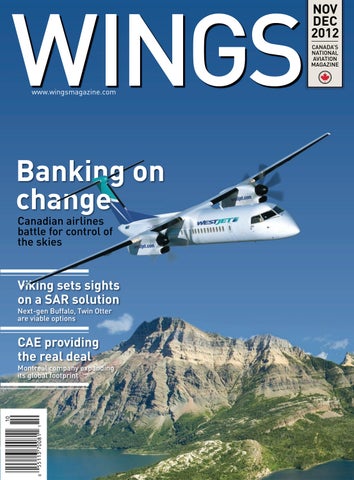
Banking on change canadian airlines battle for control of the skies
Viking sets sights on a SAR solution Next-gen Buffalo, twin otter are viable options
CAE providing the real deal
montreal company expanding its global footprint
NOV DEC 2012 caNada’S NatIoNal avIatIoN maGazINe
OUR FAMILY OF CUStOMeRS | A LetteR SeRIeS
FlightSafety: Enhancing Safety for Generations
Matt Simpson Chief Pilot
to find out about the many benefits of being a FlightSafety Customer, please call Scott Fera, Senior Vice President, Marketing, at 718.565.4774. sales@flightsafety.com • flightsafety.com • A Berkshire Hathaway company
NOVEMBER/ DECEMBER 2012
UPFRONT 5 Leading edge
Finding ‘Next Gen’ achievers
8 On the fly
News and opinion
12 Waypoint
Return of an aviation legend
14 Alternate approach Live and let fly
16 At the gate
The ABCs of the CSeries
Breitling’s high-flying jet team thrills at Switzerland’s Bouchs airport. P. 37
18 Legal eagle
Enemy at the gates
19 Glidepath
Saluting the efforts of the CATP
BACK 48 Marketplace 54 On final
Standing up for safety
FEATURES 20 ShAKEN BUT NOT yET STiRRED
Expect major change in Canada’s air transport sector in 2013 By david carr
24 hELPiNG ORNGE STAy iN ThE BLACK From top: Return of an aviation legend P. 12 the aBcs of the cSeries P. 16
A position report on Ontario’s Air Bravo By Frederick K. larkin
28 PROViNG TO BE ThE REAL DEAL
Montreal’s CAE is expanding its SIM success to new markets By Brian dunn
33 PROViDiNG TWiCE ThE VALUE
Viking offers venerable Otter and next-gen Buffalo for FWSAR By Paul dixon
37 MORE ThAN MARKiNG ThE TiME
Chronicling the efforts of the daring Breitling aviation team By david carr
COVER PHOTO: BOMBaRdiER
www.wingsMagazinE.COM
November/December 2012 | wings
3
®
LEADING
EDGE
| By Matt Nicholls
Finding ‘Next Gen’ achievers Initiatives to help guide the minds of tomorrow
F
PHOTOs: nORTHERn LigHTs awaRd
inding dynamic, innovative employees capable of developing new systems, processes and techniques that help fuel the success of an operation for years to come is a major challenge facing aviation and aerospace companies and fixed- and rotary-wing operators of all sizes. With a looming crisis of retiring pilots, maintenance workers, business operations and support staff, it’s little wonder upper management types are nervous about the prospects for the future. In key industry roundtables this year on both the rotary- and fixed-wing side, panel members voiced their concerns about finding “Gen Next.” They also agreed one of the best ways to help alleviate the impending resource crisis is for educational institutions and industry associations to work together to properly educate the developing workforce about the opportunities available in aviation and aerospace. Romantic perceptions of commercial airline pilots jetting off to tropical locales do not accurately portray a life in aviation. “We’ve had a lot of challenges internally, specifically with people, process and organizational hiring,” said Dave Shaver, director of business development for Toronto-based charter and aircraft management firm Chartright Air Group. “We feel some of these people could have been given additional tools to help them when they come into the marketplace so they can adjust better.” Sam Barone, president of the Canadian Business Aviation Association, agreed, suggesting educational institutions, industry associations, aviation and aerospace companies and operators can help shape the minds of tomorrow through education and awareness. “You have to convince young people that learning to work with composites or high-end avionics is something they will enjoy doing because other sectors are competing for these younger demographic profiles as well,” said
5
Barone. “Re-equipping aircraft is one thing, but how do we re-equip the human resource skills mix?” To help in the process of guiding younger generations towards diverse aviation careers, Wings is once again offering its “Careers in Aviation” (CIA) guide as part of the January/ February issue. This special editorial package with corresponding microsite (www. careersinaviation.ca) highlights aviation disciplines and other educational resources including flight schools, college and university programs and potential career paths. Estimated educational costs, job descriptions and more can help those interested in choosing a career in aviation or aerospace make solid choices. To build on our successful CIA guide, Wings’ is also developing its first Aviation Career Day to run next spring. The event will feature lively educational sessions, industry speakers and a trade show to help give those bent on a career in aviation an even better opportunity to interact with those forging their paths in this exciting industry.
TOP DATA BURSTS… in this issue
1. $240 billion: The amount of money the federal government plans to spend on military acquisitions (pg. 12). 2. $683 million: The value of westJet’s order for 20 Bombardier Q400s (pg. 16). 3. 17,101: The number of men and women who have lost their lives in world wars as members of the RCaF (pg. 19). 4. $231 million: The predicted profit of Canada’s air transport industry in 2013 (pg. 20). 5. CaE ended fiscal 2012 with $950 million in orders (pg. 28).
www.wingsMagazinE.COM
The introduction of another exciting project, Wings’ “Next Gen Top Achievers” special in the July/August issue (and July/August/September issue of Helicopters magazine) is also in the works. “Next Gen Top Achievers” will highlight 10 up-andcoming industry professionals in both the rotary- and fixed-wing environments who are making an impact in their given aviation streams. While replacing an aging workforce is a daunting task, the positive news is there are many dynamic workers in the early to middle stages of their careers ready to drive the Canadian aviation and aerospace industries for years to come. The recent Northern Lights Awards in Unionville, Ont., for example, highlighted three incredible women who show the strong talent base the industry has to build on. Georgian Bay Airways’ co-owner/chief pilot/business manager Nicole Saulnier (above left), Bombardier aerospace engineer Erika Kangas (above right) and Ontario Ministry of Natural Resources’ pilot Mary Ellen Pauli, are just three of the exceptional aviation professionals who are flourishing in a male-dominated industry. Finding Gen Next is indeed a challenge and it won’t be easy to replace so many skilled workers across a variety of disciplines. But with the proper education, leadership initiatives and industry co-operation, Canada will continue to develop a new generation of aviation and aerospace professionals – and continue to enhance its position as a leader on the world stage.
Romantic perceptions of commercial airline pilots jetting off to tropical locales do not accurately portray a life in aviation.
@Wings_Magazine November/December 2012 | wings
5
WINGS
NOV DEC 2012 caNada’S NatIoNal avIatIoN maGazINe
www.wingsmagazine.com
Vol. 53, issue 6 EDiTOR
Banking on change
Matt nicholls mnicholls@annexweb.com 416-725-5637
canadian airlines battle for control of the skies
MEDiA DESiGNER
Brooke shaw
Viking sets sights on a SAR solution Next-gen Buffalo, twin otter are viable options
FLiGhT DECK
CAE providing the real deal
Ray Canon, david Carr, Paul dixon, Brian dunn, Frederick K. Larkin, neil Macdonald, neil Macdougall, James Marasa, Carroll McCormick, david Olsen, Rob seaman
montreal company expanding its global footprint
SUBSCRIBE TODAY !
ASSOCiATE PUBLiShER
alison de groot adegroot@annexweb.com 1-888-599-2228 ext. 246
1 YEAR SUBSCRIPTION only
3000
$
ADVERTiSiNG SALES
adam szpakowski aszpakowski@annexweb.com 1-888-599-2228 ext. 246
(GST $31.50 • HST $33.90) US $42.00 (USD) • Foreign $65.00 (USD)
Name: _______________________________ Company: ____________________________ Title: _________________________________ Address: _____________________________ City: _________________________________ Prov: ________________________________ P.Code: _______________________________ Tel: __________________________________ Fax: _________________________________ e-mail:________________________________
PLEASE CHECK ONE: ❑ Commercial aircraft owner/operator ❑ Business/private aircraft owner/operator ❑ Military ❑ Aircraft maintenance/overhaul firm ❑ Airport ❑ Aerospace, airframe & component manufacturer and distributor
❑ Fixed base operator ❑ Aviation services, consultants and aircraft sales ❑ Government ❑ Aviation associations and organizations ❑ Flying schools, clubs and colleges ❑ Other (please specify) ______________
PAYMENT: Cheque - Payable to Annex Publishing & Printing Inc. Visa
MC
AMEX
Account #:__________________________
SALES ASSiSTANT
stephanie deFields sdefields@annexweb.com 1-888-599-2228 ext. 257 GROUP PUBLiShER
scott Jamieson sjamieson@annexweb.com PRESiDENT
Mike Fredericks mfredericks@annexweb.com WiNGS MAGAziNE
P.O. Box 530, 105 donly dr. s., simcoe, On n3Y 4n5 Tel.: 428-3471 Fax: 429-3094 Toll Free: 1-888-599-2228
Publication Mail agreement #40065710 Return undeliverable Canadian addresses to Circulation dept., P.O. Box 530, simcoe, Ont. n3Y 4n5 e-mail: subscribe@wingsmagazine.com Published six times per year (Jan/Feb, Mar/apr, May/ Jun, Jul/aug, sep/Oct, nov/dec) by annex Publishing & Printing inc. Circulation e-mail: subscribe@wingsmagazine.com Ph: 866-790-6070 ext. 208 Fax: 877-624-1940 Mail: P.O. Box 530, simcoe, On n3Y 4n5 Subscription Rates Canada – 1 Year $ 30.00 (includes gsT - #867172652RT0001) Usa – 1 Year $ 42.00 Foreign – 1 Year $ 65.00
Occasionally, wings magazine will mail information on behalf of industry-related groups whose products and services we believe may be of interest to you. if you prefer not to receive this information, please contact our circulation department in any of the four ways listed above. no part of the editorial content of this publication may be reprinted without the publisher’s written permission. ©2012 annex Publishing & Printing inc. all rights reserved. opinions expressed in this magazine are not necessarily those of the editor or the publisher. no liability is assumed for errors or omissions. all advertising is subject to the publisher’s approval. such approval does not imply any endorsement of the products or services advertised. Publisher reserves the right to refuse advertising that does not meet the standards of the publication. Printed in Canada issn 0701-1369
Expiry:_____________________________
TO SUBSCRIBE:
Tel: 866-790-6070 Fax: 877-624-1940 Mail: Wings Magazine c/o Annex Business Media P.O. Box 530 Simcoe, Ontario N3Y 4N5 e-mail: subscribe@wingsmagazine.com
www.wingsmagazine.com
GST#135274215RT001
6
Subscriptions non-refundable
wings | November/December 2012
Air Transport Association of Canada
ON THE
WEB
Canadian Owners & Pilots Association
Canadian Business Aviation Association
Magazines Canada
CAREERS iN AViATiON Looking for a great opportunity in aviation? Check out our updated Careers in Aviation section for the latest information on flight schools, news, employment opportunities, career choices and more! www.careersinaviation.ca
PHOTO: MaTT niCHOLLs
Signature: _________________________
PRO1112
www.wingsMagazinE.COM
40 40 Aviall stocking locations around the world means we have a location close to you. Aviall works hard to provide you with exactly what you need, precisely when you need it. Aviall Delivers.
ON THE FLY For late-breaking news, the Wings blog and exclusive web content, please visit us at: www.wingsmagazine.com
iNDUSTRy NEWS BUSiNESS AViATiON PEOPLE iNDUSTRy iNiTiATiVES
iNDUSTRy NEWS
KEy PARTNERShiPS FOR CANADiAN AiRLiNES WestJet has entered into a codeshare agreement with British Airways, the latest in a serious of agreements between Canadian and international carriers that will improve connectivity with the U.K., Ireland, South Africa and Qatar. The WestJet/British Airways agreement enables the Heathrow-based airline to market and sell WestJet-operated flights. British Airways was previously plugged into the Canadian market with Oneworld partner Canadian Airlines before the airline was swallowed up by Air Canada, a Star Alliance member. “Our partnership with WestJet will enable easier travel from Canada’s gateway cities to destinations that have been more difficult to access from the U.K.,” said Lynne Embleton, British Airways’ director of strategy and business units. The “BA” code has been added to select WestJet flights connecting Vancouver, Calgary and Toronto to Ottawa, Edmonton and Victoria. “With an extensive worldwide network, and a reputation for
great customer service, British Airways is one of the world’s most iconic airlines. We look forward to welcoming British Airways’ codeshare guests on board our WestJet flights,” said Bob Cummings, WestJet’s executive vice-president of sales, marketing and guest experience. Since September 2011, WestJet has initiated codeshare agreements with Air France / KLM, American Airlines, Cathay Pacific, China Eastern Airlines, Delta Air Lines, Japan Airlines, and Korean Air. It has been a busy season for closer links between Canadian and international airlines. Porter Airlines, based out of Toronto’s Billy Bishop Airport recently inked an interline agreement with South African Airways, a Star Alliance partner, that will open up connections for passengers travelling between Canada and West and Southern Africa through Washington, D.C.’s Dulles International Airport. This summer, Porter entered into its first interline agreement with Qatar Airways, one of the Persian Gulf ’s so-called “super connectors,” which began flying to Montreal from Doha in 2011. The agreement enables Qatar passengers to connect on Porter flights to Halifax, Toronto and Washington, D.C., through Toronto. “It’s the beginning of a plan to add multiple interline partners in 2012, introducing Porter to an entirely new set of passengers,” said Robert Deluce, Porter CEO. Air Canada has also announced an
WestJet’s new codeshare deal with British airways will make it easier for canadians to travel internationally. 8
wings | November/December 2012
interline agreement with Dublin-based Aer Lingus, expected to be the first step to a broader codeshare. The connection with Aer Lingus should help fill a gap left at London’s Heathrow Airport after Star Alliance partner Lufthansa sold BMI, its money-losing U.K. subsidiary, to British Airways earlier this year. “Air Canada is pleased to interline with Aer Lingus as it will complement our Toronto-Dublin seasonal service to make it easy to fly year-round between Canada and Ireland via convenient connections through London Heathrow, Air Canada’s largest international station,” said Marcel Forget, Air Canada’s vice-president of network planning. Star Alliance airlines are reported to be courting troubled Aer Lingus – itself a takeover target by Irish low-cost carrier Ryanair – after experiencing reduced connectivity at Heathrow, still the world’s busiest international airport. Aer Lingus already has a codeshare with Star’s United Airlines as well as a tie-up with JetBlue Airways. “We intend to follow through with other measures to enhance the experience for customers travelling between Canada and Ireland, including a full codeshare relationship with Aer Lingus beginning next year, the planned relocation of both carriers to Terminal 2 at Heathrow to facilitate connections, and following that, the introduction of year-round flights between Canada and Ireland,” said Forget.
ANOThER PLAyER iN FWSAR RACE Airbus Military and Canadian partner Discovery Air have joined forces on a bid for the Canadian fixed-wing search and rescue (SAR) contract. The two partners announced the partnership Oct. 10 in Yellowknife in front of a number of prominent dignitaries including Bob McLeod, premier of the Northwest Territories, Brian Semkowski, CEO of Discovery Air, and Antonio Rodriguez-Barberan, senior vice-president of Airbus Military. Under the terms of the MoU, Discovery Air, as the Airbus Military (AM) primary Canadian partner, will provide the in-service support for the program. “We are delighted to be able to offer this solution in conjunction with Airbus Military to the Canadian Forces,” noted www.wingsMagazinE.COM
PHOTO: wEsTJET
8 9 10 11
PHOTOs: disCOVERY aiR (TOP); EMBRaER (BOTTOM)
With a strong track record worldwide, the c295 is a strong contender for the FWSaR contract.
Semkowski. “We are very excited about the C295 aircraft; a proven and reliable SAR platform that has been sold all over the world with over 110,000 flying hours to its credit. With proven, stateof-the-art search capabilities, it offers a low-risk, low-cost solution, high in Canadian content. We believe Discovery Air is ideally placed to provide the 20-year support package that will be required for this program.” Barberan concurred, adding that Discovery Air is the perfect partner for Airbus Military. “The C295 is a proven platform as a world leader in terms of maritime patrol, search and rescue and related missions for twin engine military aircraft. “The C295 FWSAR is a robust, reliable aircraft that does not have the risk associated with unproven technologies and Airbus Military, being part of Airbus, is backed by the solid fundamentals and reputation of Airbus. Furthermore, it has the lowest life-cycle costs in its class, and compared to competitors could save Canada up to $1 billion in fuel costs alone over the life of the airframe,” he said. “The C295 aircraft is a proven and reliable SAR platform of which 114 examples have been sold in 17 countries. With proven, state-of-the-art search capabilities, it offers a low-risk, low-cost solution, high in Canadian content. In addition to Discovery Air, established partners include Pratt & Whitney Canada, CAE, L-3 Wescam and Vector Aerospace. Airbus Military is the world market leader in military SAR, maritime patrol and related missions. The aircraft’s search system has been fully integrated from the very beginning offering unparalleled levels of integration between the crew and the aircraft. www.wingsMagazinE.COM
Canada’s request for proposal for the FWSAR has not been released; however, it is expected that the C295 will be compliant in all areas. “We believe the RCAF can improve the level of service to Canadians by reducing response times in a region of Canada that is increasing in terms of activity and importance,” Semkowski said. “By basing aircraft in the North, and designating them as dedicated SAR assets, we believe Canada will be in an excellent position to respond to incidents in the North.”
BUSiNESS AViATiON
EMBRAER BEGiNS U.S. PRODUCTiON OF PhENOM 300 Brazil’s Embraer has added the production of the Phenom 300 light aircraft to
its executive jet assembly facility in Melbourne, Fla. Since it opened in December 2011, the Melbourne facility has produced more than a dozen Phenom 100’s for customers in Canada, the U.S. and Mexico. “We have added the Phenom 300 to bring production closer to our customers,” said Phil Krull, managing director of the facility. “Customers have been benefiting from the delivery of the entry-level Phenom 100 produced in Melbourne since last year and we are now ready to expand these operations. The first Phenom 300 wing and fuselage was transported to Florida in late August. The first U.S.-assembled Phenom 300 is scheduled for delivery in March 2013, one of more than 12 scheduled for production in Melbourne in 2013. The Phenom 100 and Phenom 300 assembly line has the ability to ultimately produce eight aircraft per month in a mix of the two executive jets on a single assembly line. The addition of the Phenom 300 to the assembly line comes as Embraer expands its U.S. operation to include its first engineering and technology centre. Scheduled for completion in 2013, the technology centre will first focus on Embraer executive jet interiors.
GULFSTREAM G650 RECEiVES TyPE CERTiFiCATE The latest entrant into the hot ultra long range sector, the Gulfstream G650 has been given its type certificate from the U.S. Federal Aviation Administration. “The G650 is a superlative aircraft
embraer’s new Phenom 300 light business aircraft will now be assembled at the firm’s melbourne, Fla., facility. November/December 2012 | wings
9
ON THE
FLY
aviation: safety, security, flexibility, comfort and capability.” The aircraft received a provisional type certificate from the FAA last November, and made its first trans-atlantic crossing in May en route to EBACE in Geneva in six hours and 55 minutes, setting a city-pair speed record. Gulfstream has received more than 200 orders for the aircraft, and expects to make deliveries to the first customers before year’s end.
PEOPLE
Gulfstream has received more than 200 orders for its G650 aircraft and expects to make deliveries to the first customers before year’s end.
with the most technologically advanced flight deck in business aviation and the largest, most comfortable cabin in
its class,” said Larry Flynn, president of Gulfstream. “In short, the G650 speaks to all that is good about business
Klaus Goersch, a former senior executive with Southwest Airlines subsidiary, AirTran Airways has been appointed Air Canada executive vice-president and chief operating officer, replacing Duncan Dee, who left the airline earlier this year. Goersch joins Air Canada as the airline is about to launch a low-cost leisure
Airport Management
Fuel Services
Real Estate Development
Specializing in Aviation Expertise and Services for Western Canada Fuel Services • Bulk Fuel • Fuel Drums • Remote Fueling • Into-Plane Refueling • Aviation Truck Rentals
Airports • Passenger & Terminal Services • Ground & Passenger Handling • Aircraft De-icing • Full Service FBO’s
Developments • Project Management & Administration • Hangar/Terminal Development • Facility Design • Office Space & Hangar Leasing
Visit www.EFCAviation.ca or call 1-888-299-2825 10 wings | November/December 2012
www.wingsMagazinE.COM
PHOTO: gULFsTREaM
AiR CANADA hiRES U.S. LOW-COST ExEC AS COO
PHOTO: BOMBaRdiER
carrier to serve international destinations including U.S. and Caribbean hot spots. “Klaus’s experience in the low cost/ low fare environment will further strengthen our executive team,” said Calin Rovinescu, Air Canada’s CEO. “I look forward to his contribution as we work to complete Air Canada’s transformation to position the airline for sustainable, long-term growth in our highly competitive industry.” A pilot and graduate of the Embry Riddle Aeronautical University with a Master of Aeronautical Science degree, Goersch has more than 25 years’ experience in the airline industry in both senior management and as a commercial pilot. As executive vice-president of operations and customer service for AirTran Airways, he oversaw the operational merger of the airline into Southwest Airlines, which created the world’s largest low-cost carrier. Goersch will have oversight of all of Air Canada’s key operating areas, including flight operations, maintenance
and engineering, airports, in-flight service and systems operations control.
iNDUSTRy iNiTiATiVES
hAMMERiNG AT ThE SUPPLy ChAiN Aéro Montréal, a strategic think-tank for Quebec’s aerospace cluster and the Ottawa-based Green Aviation Research and Development Network (GARDN), has wrapped up its second Global Supply Chain Summit. The summit was chaired by Janice Davis, vice-president and chief procurement officer for Bombardier Aerospace. According to the organizers, the Greater Montreal region has the secondlargest density of aerospace jobs in the world. The summit was structured to give small and medium enterprises (SEMs) supporting to stay in the race and maintain their position in the world. “Quebec’s aerospace industry most continue to mobilize and bring solutions to the various challenges and be ready for the long-term
Quebec’s aerospace cluster, including Bombardier aerospace, is hard at work developing projects such as last year’s successful first biofuel flight for the Q400.
growth of the sector,” said Gilles Labbé, chief executive of Héroux-Devtek and board chair of Aéro Montréal. This year’s theme, “Sustainable development with regards to supply,” brought together nearly 400 industry represents from around the world including SEMs, original equipment manufacturers (OEMs) and policy makers.
The Clock is Ticking
Meet the mandate with Universal Avionics TAWS The new Transport Canada Terrain Awareness and Warning System (TAWS) mandate brings urgency to equip with a TAWS system with Enhanced Altitude Accuracy (EAA). Our TAWS meets the requirement while offering the highest level of CFIT Protection along with a unique terrain display and look-ahead conflict advisories. Equip with Universal Avionics TAWS today. Visit uasc.com/TAWS to learn more about the mandate.
UNS-1Ew and TAWS 2MCU
www.uasc.com sales@uasc.com (800) 321-5253 (520) 295-2300
www.wingsMagazinE.COM Wings_UASC_Sept_Oct_2012_01.indd 1
November/December 2012 | wings
11
8/17/12 2:26 PM
WAYPOINT By Rob Seaman |
Return of an aviation legend? Chances of the Avro Arrow gracing the skies again are slim
T
12 wings | November/December 2012
The costs for tooling, redesign, testing and such would be astronomical. number of contracts with Lockheed Martin and other lead companies (BAE Systems, Northrop Grumman, etc.) on the F-35 program. Since the total build is expected to be at least 3,000 aircraft, the revenue opportunity will be very significant for those Canadian companies. Not many aircraft programs reach that total, for sure.” In comparison, the Arrow proposal calls for building just enough for Canadian needs – 65 if it were a strait swap for the current F-35 discussions. Sell more outside Canada and the plan becomes more lucrative. The costs for tooling, redesign, testing and such would be astronomical. In point of fact, the only real similarity between the proposed new Arrow and the original Arrow might, in the end, be the outward look. As for end cost what a company estimates each jet will cost and what that cost ends up to be are usually two different numbers. Another key point is the fact that production of the F-35 is much closer to the 2020 deadline necessary to replacing the aging CF-18s than a built-from-scratch Arrow. Can the military squeeze out extra time from the existing CF-18 fleet? While in good shape and well maintained, their “best before date” has most likely been rejigged a few times already. The Globe and Mail reported Sept. 24 that “the Harper government is embarking on an
ambitious effort to develop a Canada-first military purchasing strategy – one that aims to funnel as many procurement dollars as possible to domestic firms with the potential to be leaders in their field.” According to the Globe, “Over the past 30 years, Canada has shied away from using defense policy to promote and build domestic industries. In the case of major equipment buys, for instance, it has often relied on foreign contractors to share work with domestic firms in exchange for winning the job. Obviously, Ottawa is not planning to spurn foreign suppliers. But it wants to be smarter about backing Canadian industry where possible – funnelling more of the $240 billion the government plans to spend on military acquisitions to domestic suppliers. Yes, it would be very emotional and a great source of national pride to see the Arrow fly again, but I have to side with those who see it as nostalgic but unrealistic. As for the F-35 do we really need something that expensive and high end? More than one person has asked why not the updated and current version of the F-18 Super Hornet, an efficient and capable alternative. The bottom line is, proper analysis needs to be done before significant Canadian tax dollars are spent on the new F-35. As for the re-emergence of a next gen Arrow? Sorry Arrow fans – can’t see it happening. | W Rob Seaman is a Wings writer and columnist. www.wingsMagazinE.COM
PHOTO: MaRC-andRE VaLiQUETTE COLLECTiOn
here were several reports in September that an effort was afoot to make the vaunted Avro Arrow fly again. As an aviation enthusiast, I would certainly love to see this happen, but seriously? Had former prime minister John Diefenbaker reached out from his grave and undone his death sentence on this aircraft and the Canadian aviation industry as a whole? Most of us know people who were involved in the Arrow. Without question this aircraft was unique and, if put into production, would have set Canada amongst the leaders in aircraft design and manufacture in the world. I remember an engineer working with my father back in the late ’70s – exArrow – came into the office and announced with a smile that “the Americans just hit Mach 1.95 in the YV-17” (predecessor and prototype to the F-18). He followed this by noting, “Heck, we were doing that with the Arrow using the prototype engines way back.” There was no question Canada was on the cusp of aviation greatness. Fast-forward to today and once again Canada is seeking its next generation of front-line defense aircraft. And according to an article in Maclean’s (Sept. 9), “The plan to build an updated Arrow in Canada instead of buying into an international deal for a fleet of F-35s was originally put before the Harper Conservatives in 2010 by a company called Bourdeau Industries, which has offices in the U.K. and Canada.” The proposal, said the article, “suggested the plane could fly 20,000 feet higher than the F-35, soar twice as fast and would cost less. The total cost of the Arrow program would be $11.73 billion, compared to the $16 billion the federal government says the F-35 program will cost.” (The auditor general and parliamentary budget officer peg the true cost of the new stealth fighters at closer to $25 billion.) The article notes, “The Arrow project would also create a made-in-Canada plane and an industry that would add thousands of jobs and billions of dollars to the Canadian economy.” That said, the F-35 project is not without its Canadian benefits. As Rod Jones, executive director of the Ontario Aerospace Council, says, “Canadian companies – many of them in Ontario – have won a significant
"When your mission is to fly at 800 km/h less than tWo meters from other team aircraft, you only trust the chronometric precision of the world’s best chronograph."
Frédéric Schwebel ably handles his role in the "slot" position within the Breitling Jet Team, the toughest of them all. When performing with no obvious escape route, mistakes are just not an option. Strapped to his wrist is the Chronomat, powered by the ultimate high-performance chronograph movement, Breitling Caliber 01, chronometer-certified by the COSC (Swiss Official Chronometer Testing Institute), an exceptional "motor" entirely developed and built by Breitling. Ultra-sturdy, ultrareliable and ultra-watertight to 500 m, the Chronomat stands out for its unique design and its incredible concern for details. For Frédéric Schwebel, it is quite simply the world's best chronograph. 5-YEAR BREITLING WARRANTY CAD 8,960 Recommended Retail Price.
ALTERNATE
APPROACH By David Carr |
Live and let fly
Chronicling aviation’s key role in the James Bond franchise
H
“
14 wings | November/December 2012
scored big, while the JetStar and Rocket Belt fell slightly short of the mark despite the novelty, proving everything is subjective. This column went to press before the November premiere of Skyfall, the 23rd film in the James Bond franchise. As such, the inevitable aircraft and aviation scenes remain a tightly wrapped secret, although the trailer has given up a couple of clues including helicopters and what appears to be a sword fight inside an airplane cabin. Finally, in Devil May Care, the 2008 James Bond novel published to commemorate Ian Fleming’s 100th birthday, British author Sebastian Faulks picks up at the height of the Cold War where 007’s creator left off before his death in 1964. In the book, Bond foils a plot by a power-crazed pharmaceutical magnate to crash a stolen Vickers VC10 commercial jet into a Soviet nuclear factory, thereby forcing a retaliatory attack on Great Britain. Every inch as sleek and elegant as the Lockheed Constellation that came before her, Britain’s last long range jetliner also celebrates its 50th anniversary in 2012, and has long been this correspondent’s favourite airplane. Should 007’s film producers ever consider a retroBond, Devil May Care should be its first pick. The worthy VC10 is long overdue for its cinematic close-up. | W
With missions to faraway exotic destinations, 007 fed into the jet-set culture, and vice versa. another rarity, Pussy Galore’s Flying Circus, using five formation flying Piper Cherokee PA-28s, intended to release nerve gas over Fort Knox. Piper delivered the first PA-28 in 1960, and according to Air & Space magazine, the appearance in Goldfinger was an early example of product placement. Bond flies in the Space Shuttle two years before Columbia left the launch pad on its maiden voyage in Moonraker (1979), goes underwater to locate two NATO atomic bombs loaded onto a hijacked Avro Vulcan in Thunderball (1965) – after making a quick getaway in a Bell Aerosystems Rocket Belt in the same film – smuggles a rogue Russian general out of the Soviet Union in a British Aerospace Harrier T.10 in Living Daylights (1987) and rips the wings off a single-engine Cessna trainer during an airside chase scene in Live and Let Die (1973). “Let’s just wing it shall we, Mrs. Bell?” our hero exclaims. Air & Space magazine used the 2008 premiere of Quantum of Solace (featuring a black SIAI-Marchetti SF.260TP aerobatic and military trainer) to ask pilots to rate the performance of several of the higher-profile aircraft in the James Bond pictures – which ones were “Bond Cool.” The “Little Nellie” Autogyro and Acrostar Micro-jet both
David Carr is a Wings writer and columnist. www.wingsMagazinE.COM
PHOTO: MgM
ello New York, your Pan Am 323 just landed, Kingston, Jamaica,” confirms an air traffic controller as the Pan American Boeing 707 gracefully sped along a runway for the 1962 film Dr. No, James Bond’s first cinematic outing that would launch a $5 billion film franchise. The sequence was repeated in the sequel, From Russia with Love, again with a Pan Am aircraft (clearly early Bond’s airline of choice), this time in Istanbul. Aviation has played recurring roles in the Bond movies, either as part of the supporting cast in airport scenes and air-to-air footage, or delivering the thrills. The latter was the case with “Little Nellie,”the heavily armed, rocket launching and machine gun firing Wallis WA-116 autogyro (named after its creator, Ken Wallis, a retired Royal Air Force Second World War pilot) that Sean Connery flew in aerial combat against four SPECTRE helicopters in You Only Live Twice (1967). “Four big shots made improper advances toward her, but she defended her honour with great success,” Connery says. High on the thrills list was also the TRS-18 microturbopowered Bede microjet that Roger Moore manoeuvred to escape Cuba in the opening sequence for Octopussy (1983). This year marks the 60th anniversary of air travel by jet, but the jet age did not kick in until the very early 1960s, around the time of the first Bond release. With missions to faraway exotic destinations, 007 fed into the jet-set culture, and vice versa. The producers built on the fantasy with stunningly beautiful women, sophisticated gadgets, flashy sportscars (coming perilously close to ‘jumping the shark’ with an imagination-stretching invisible car in the 2002 film Die Another Day) and plenty of airplanes. Guy Hamilton, director of Goldfinger (1964), describes the Bond film culture in the October 2012 issue of Vanity Fair. “Don’t take a train when you can take a plane, and if you are going to take a plane, take the newest one.” And Hamilton did, transporting Bond to Kentucky aboard Auric Goldfinger’s large and thirsty, fourengined Lockheed L329 JetStar, piloted by Pussy Galore, and giving most of the audience their first glimpse of the world’s first executive jet. The audience watched
Major transformational shifts are occurring in the global aerospace industry. Technologies are fast evolving, markets are emerging and new players are becoming a force to contend with. Learn about emerging trends and challenges and how industry players can work together toward
GLOBAL VISION. ENHANCED COLLABORATION. SMART TRANSFORMATION. • Attend the “Bold Steps” Conference: Hear from renowned Canadian and international speakers on how shifting aerospace trends will impact your business. Discover how you can join the ranks of early adopters of transformational manufacturing and production process technologies and gain a serious edge over global competitors. • Do business and make connections: Use our Business-to-Business (B2B) matchmaking program to meet with leading Canadian and international contractors and suppliers. • Participate in the Trade Show and see the future of aerospace through the capabilities of domestic and international OEMs and suppliers of all sizes. • Network with industry leaders and decision makers from across Canada and around the world.
AT THE
GATE
By Brian Dunn |
The ABCs of the CSeries
Bombardier sets its sights on meeting high expectations
I
16 wings | November/December 2012
will not give up their turf without a fight. Airbus already has plans to equip its A319 model with the same Pratt & Whitney PurePower PW1000G turbofan engines that will power the CSeries. Bombardier’s 20-year forecast predicts the construction of 6,900 aircraft in the 100- to 149-seat range of which it expects to win at least half those orders. “Since the launch of the CSeries program in 2008, we’ve received 66 per cent of the orders in the 100- to 149-seat category,” according to Mike Arcamone, president of Bombardier Commercial Aircraft. But orders aren’t exactly flying through the door. As of the end of June, Bombardier has received only 138 firm orders for the CSeries and no options. On a more positive note, Bombardier said WestJet’s firm order for 20 Q400 NexGen turboprops has a list value of $683 million. In addition, Bombardier increased its lead over its closest rival in the business jet market, selling $2.37 billion of aircraft in the second quarter of this year, a 10-percent increase from a year ago, according to the General Aviation Manufacturers Association. By comparison, Gulfstream sold $1.84 billion worth of business aircraft, a 12-per-cent drop. Number 3 player Dassault Falcon saw sales almost double during the same period to $1.53 billion from $846.5 million. In short, it promises to be a very important year for Canada’s premier aircraft manufacturer – one that could reinforce its position on the world stage. | W
That delay is a nanosecond compared to the multi-year delays of Boeing’s 787 Dreamliner and the Airbus A380. & Whitney, Rockwell Collins and Fokker Elmo, along with other structural and system suppliers that delivered all the required components. Other CSeries ground-test rigs located at Mirabel include CAE’s Engineering Flight Simulator and the Interior and Environmental Control Systems. Rockwell Collins has already commissioned the avionics Systems Integration Test Stand and Parker Hannifin has commissioned the Flight Controls Integration lab at its own facilities. Bombardier has a lot riding on the new aircraft, which represents an investment of about $3.4 billion. Not only does it enhance its existing fleet of business and commercial offerings, but it will also provide close to 2,500 direct jobs in Quebec and hundreds more across Canada. Any delays will not only increase development costs, but will result in penalties from customers. A case in point is Boeing’s 787 Dreamliner, which was three years behind schedule due to engineering problems and delivery delays from suppliers. Delays continued even after the Dreamliner went into production, resulting in costly payments to customers. The Airbus A380 had similar problems. The CSeries is also moving in on the traditional turf of Boeing and Airbus and must follow through on its promise of reducing operating costs by 20 per cent compared to existing aircraft to garner new orders. The two leading aircraft manufacturers
Brian Dunn is a Wings writer and columnist. www.wingsMagazinE.COM
PHOTO: BOMBaRdiER
t’s one of the most aggressive new aircraft development programs in its history and Montreal’s Bombardier Aerospace is looking forward to seeing the fruits of its labour later this year. If everything goes according to plan, first flight of Bombardier’s CSeries CS100 110-seat single-aisle aircraft will have been completed in December and will enter into service by the end of 2013. The 130-seat CS300 aircraft should enter service a year after that. But as the target date approaches, speculation abounds that first flight will only occur in early 2013 and that Bombardier is trying to shift the focus away from first flight and emphasize the service entry date at the end of next year. “Our target is to fly in December. But I always said in these types of programs, given that I’ve done a few, three to five months would be considered on schedule,” Bombardier CEO Pierre Beaudoin said. “That delay is a nanosecond compared to the multi-year delays of Boeing’s 787 Dreamliner and the Airbus A380.” Bombardier acknowledges that some CSeries suppliers have had challenges delivering components on time and that they are working with the suppliers to try to solve the problem. But some fuselage components being built in China have been transferred to Bombardier’s Montreal plant and other western suppliers, according to industry reports. In August, the company started conducting virtual flights on “Aircraft O,” the onthe-ground Integrated Systems Test and Certification Rig at its Mirabel plant north of Montreal. The avionics, electrical, flight control, fly-by-wire, hydraulic, landing gear and wiring systems are now all commissioned and systems integration and communication have been successfully demonstrated. The development of the aircraft will now enter the intense ground-testing phase that will build the necessary maturity for all systems and drive towards the flight test program. The successful commissioning of all the systems on “Aircraft 0” was supported by several key aircraft partners and suppliers, including CAE, Goodrich Actuation Systems, Hamilton Sundstrand, Honeywell, Liebherr-Aerospace, Parker Hannifin, Pratt
www.vikingair.com Toll Free: 1-800-663-8444 info@vikingair.com
LEGAL
EAGLE By Neil J. Macdonald |
Enemy at the gates
Scanning the horizon for a better security option
W
18 wings | November/December 2012
the trajectory of the current technological privacy invasion means it will only get worse. Is there a better, less invasive, way to deal with airport security? What about good old-fashioned profiling or – to be more politically correct – “passenger behaviour observation screening?” The Canadian government is considering developing a program to enhance security using specially trained observers, much like those in customs and in many police forces. This may be a more operationally effective, and much less invasive, program than having a look under our clothes, as is the case with scanners. However, observation screening involves experience and common sense. Had the screeners in Manchester been more focused on observing people rather than relying on technology, they may well have asked why 11-year-old Liam Corcoran was able to board a flight to Rome without a passport, boarding pass or parent! Like it or not, terrorism and the paranoia associated with it is here to stay. We need to be sensitive to this fact but we must at the same time be sensitive to the privacy issues raised by body scanners. Just because technology allows us to peep under clothing does not necessarily mean that we should, or even that we will be safer if we do. | W
The Canadian government is considering developing a program to enhance security using specially trained observers. it comes to scanning devices. They claim privacy is protected because the technology does not retain personal information, the scanned image and passenger names are never matched, and no other identifying information gathered. These scanners show security personnel what we have hidden under our clothing. Corrine Theile, and Sam Wolanyk understand where this technology is heading, and decided to challenge U.S. authorities by baring most while going through security. Theile bypassed the scanner wearing only a bikini. Wolanyk was not as fortunate the first time, getting arrested for wearing little more than his Calvin Kleins. He has, however, sailed through more recently without being scanned. Both are publicity stunts for sure, but they do highlight a need for this security “invasion versus threat” issue to be explored further. Yes, people can hide weapons or explosives in their underwear. The discovery of Umar Farouk Abdulmutallab, a.k.a. the “Underwear Bomber,” probably contributed more to our current paranoia than any other event in recent times. So, how then do we reconcile bypassing scanning devices wearing little more than underwear with what happened on that Northwest Airlines flight in 2009 when Farouk’s bomb did not explode? The simple answer is, we can’t. In the grand scheme of things, it doesn’t make sense, and
Neil J. MacDonald is a pilot, lawyer, and aviation consultant. njm@neiljmacdonald.com This is not a legal opinion. Readers should not act on the basis of this article without first consulting a lawyer for analysis and advice on a specific matter. www.wingsMagazinE.COM
PHOTO: CaTsa
hat do Corinne Theile, Sam Wolanyk and Liam Corcoran have in common? In the past few months, they either frustrated airline security or felt frustrated by it. Unfortunately, we see that frustration all the time when we head to the airport these days. So, why are we becoming more and more paranoid? I get that we may need to be screened when we cross an international border, but why do we need to be screened when we go from Montreal to Toronto, or Vancouver to Saskatoon? Is there really such a big threat to our security that would warrant the type of screening we now have to endure at airports? What are we gaining, and more importantly, what are we losing with this technology? We certainly are letting our privacy rights slip away. Don’t get me wrong. As a pilot, I don’t want someone with a weapon on my aircraft, but as a lawyer, I can’t help but feel that the bigger threat is we are allowing government to look deeper and deeper into our private lives – and private parts! Many airports in the United States are using either active millimetre wave (MMW) radio frequency (RF) technology, or backscatter low energy radiation to scan passengers, and the public is not exactly amused. People don’t accept government assurances that the X-rays used are safe. Many feel that any radiation – however minor as claimed – is harmful. There are court challenges underway, but I doubt they will be successful. Add to that, a large anti-terrorism lobby in the U.S., and I think the din of this security paranoia will overpower those concerned about health or privacy. The problem for Canadians, and the rest of the world, is that to fly into the U.S. we must follow suit. Our security screeners use MMW technology, not X-rays or other ionizing radiation like our neighbours. With only a small portion of the RF energy transmitted by the device absorbed into our bodies, the manufacturer and the feds assure us, it’s much safer to use than radiation scanners. I’ll leave that one for others to debate; my concern is with privacy. The Office of the Privacy Commissioner of Canada has confirmed that privacy concerns have been “appropriately addressed” when
GLIDE
PATH
| By Paul Dixon
Saluting the efforts of the CATP Remembrance Day reminds us of an integral military program
PHOTO: PaUL dixOn
A
s summer fades and winter lurks behind dark clouds, we come across Remembrance Day. For some of us, it has taken a long time to gain an appreciation of what should be remembered and why. Our fathers and their generation went off to war and all too many of them didn’t come home. Out of a population of just over 11 million, more than 1.12 million Canadian men and women wore the maple leaf and more than 44,093 of them gave their lives, 17,101 of them while serving with the Royal Canadian Air Force (RCAF). I knew the stories of the RCAF in the Second World War and I even worked with a few veterans who didn’t talk much about their experiences. When they did talk, it was more often about the thrill of running a Model A Ford on 140-octane aviation fuel from Comox to Victoria, rather than exploits overseas. It took me a long time to realize that the numbers in the first paragraph are only the tip of the iceberg. My wife and I were in Prince Edward Island in 2003, at the end of the tourist season. We drove up from Halifax to Summerside the day before Hurricane Juan turned much of the region upside down. While the wind certainly whistled through Summerside that night, the community was spared the damage that befell Charlottetown just a few miles down the road. The next morning as we were headed out, we stopped at the tourist information booth on the highway. There was a memorial stone outside the building that caught my eye with an inscription that read, “In Memory Of Those Who Lost Their Lives While Serving Under The Commonwealth Air Training Plan.” Number 10 Bombing and Gunnery School, Mount Pleasant PEI. There were 22 names cut into the stone, ages ranging from 18 to 31. It made me think about how many other young men had died across Canada, eager to serve but never getting the chance. I was certainly aware of the British Commonwealth Air Training Plan (CATP) and knew of the airfields on my side of the country that had been part of the program. The program boasted some 107 airfields across the country and another 120 facilities; more than 167,000 aircrew were trained in Canada, including more than 50,000 pilots. The www.wingsMagazinE.COM
November 1940 proved the concept when seven Lockheed Hudsons made the crossing. The next year, the RAF took over responsibility and Ferry Command was born. Many of the pilots were civilians who spent the entire war ferrying aircraft, while for others it was a one-time trip as an opportunity to deliver both an aircraft and new aircrew to the front lines. More than 9,000 aircraft were delivered during Ferry Command’s existence, with more than 500 airmen perishing in the process, 200 of them Canadian. In one of the darker moments of our history, it took the federal government more than 50 years to finally acknowledge that the civilians who flew the North Atlantic routes were entitled to veterans’ benefits. I have noticed that many of the former CATP airfields have memorials of some sort and now I make a concerted effort to search them out. Some are front and centre, as at Southport, while others are harder to find. I always take a moment and say “hello” to those whose efforts will never grow old. On Nov. 11, take a moment to think of those who wanted to be there but never got the chance. | W
Of the 22 who died at Mount Pleasant, there were more in their teens than over the age of 25. airfields became the backbone of Canada’s post-war aviation sector and many of those airports are still in service today. In the shadow of all the Canadian airmen who perished over Europe, North Africa and the Pacific, we may not realize that over the short lifespan of the CATP, hundreds of aircrew lost their lives in training. Of the 22 who died at Mount Pleasant, there were more in their teens than over the age of 25. The oldest, LAC Joseph O. Girard, was 31 and no doubt known as “Pops” or “Dad.” Many of the CATP airfields grew after the war as aviation in Canada soared in the post-war economic boom. Southport in Portage La Prairie, Man., is still turning out pilots for today’s RCAF. Today, we fly more than halfway around the world non-stop, but remember that in 1940, trans-Atlantic flight was barely a concept. It was a Canadian, Churchill’s Minister of Aircraft Production, Max Aitken – a.k.a Lord Beaverbrook – who championed the idea of ferrying aircraft from Canada to Britain. The RAF wanted no part of the scheme; thus civilians undertook it. The first flight in
Paul Dixon is freelance writer and photojournalist living in Vancouver. November/December 2012 | wings 19
SHAKEN Bu
STIRRED ExPECT MAjOR ChANGE iN CANADA’S AiR TRANSPORT SECTOR iN 2013 By DAViD CARR
20 wings | November/December 2012
www.wingsMagazinE.COM
WestJet is scheduled to take delivery of its first Bombardier Q400 turboprops in June, followed by one aircraft per month until the end of the year.
PHOTO: BOMBaRdiER
uT NOT YET i
t promises to be a summer to remember next year in Canada’s air transport sector, one that will have significant reverberations for the next few years. Next June will be a watershed month as Air Canada and WestJet prepare to launch new subsidiary airlines, sparking the biggest shakeup in Canadian air transport since the arrival of Jetsgo 10 years earlier. Completing the picture will be the start of Air Canada’s retooling of its www.wingsMagazinE.COM
mainline narrowbody fleet. After two lost years, largely dragged down by losses at Air Canada, the Canadian air transport sector is expected to see a narrow return to profitability in 2012. Walter Spracklin, an analyst with RBC Capital Markets, expected solid operating results for both Air Canada and WestJet this third quarter as higher traffic and fares compensate for volatile fuel prices. “We see top-line revenue as being lifted in the Canadian airline segment
and we are adjusting our forecasts accordingly,” he wrote in a note to clients. Spracklin’s optimism is echoed by the Canadian Conference Board. The Board expects a profit of $231 million next year – a razor thin margin of just 1.2 per cent – which aligns with the International Air Transport Association’s (IATA) first glimpse for 2013 of a global profit margin of 1.1 per cent. But the Board also cautions that fiercer competition in the industry will continue to put pressure November/December 2012 | wings 21
on airline profit margins, which are already struggling to keep pace with the cost of capital. Competition will grow fiercer in 2013, especially in the low-cost leisure and regional markets, where Air Canada and WestJet are respectively upping their offerings. Air Canada has started to colour in details of its anticipated low-cost airline, although a formal announcement of the complete package is not expected before early November when the carrier will release third-quarter results. The subsidiary, which will launch in June, is to be merged with Air Canada Vacations to form an integrated leisure group offering full-service flights to destinations in Europe and the Caribbean where the mainline carrier has traditionally struggled to remain competitive because of higher operating costs, and to new destinations not currently served by Air Canada. The fleet, which will be released from Air Canada, will start with two Boeing 767300ER and two Airbus A319 aircraft. It will expand as the mainline carrier takes delivery of new wide-body equipment including two Boeing 777s this year and the Boeing 787 starting in 2014. The startup could have 20 767 and 30 A319 aircraft by the end of 2015, depending on market demand. The new leisure group will add 20 per cent more seats into each airplane – and more seats plus lower flight crew costs add up to profit. “On the leisure side, it makes sense for Air Canada to pull capacity out of the mainline,” said Cameron Doersken, an analyst with Montreal-based National Bank Financial. “Where I have a bit of concern is with the wide-bodies. A lot of what they are doing sounds like incremental capacity. So you operate 777s and 787s and have 20 additional 767s with the low-cost carrier. That is
an awful lot of extra capacity on European routes that are already well served.” Air Canada’s leaner leisure operation will face tough competition from SunWing and Transat A.T., the parent of Air Transat, and WestJet Vacations on popular medium haul destinations down south. Its strongest competitor over the long haul will be Air Transat, which has had a near lock on the European market among Canadian leisure operators, and would be most vulnerable should Air Canada dump lower cost capacity on routes to snatch market share. Air Transat turned 25 this year and is undergoing a two-year, $4-million cabin makeover on its entire Airbus A330 fleet, including mood lighting ambience, ergonomic seats and individual entertainment systems in both economy and Club Class cabins. The carrier has struggled in the European market recently as many Canadian consumers stayed home to pay down debts and the Euro crisis widened, affecting bookings both ways. This past summer season, Air Transat cut capacity by four per cent and in 2013 is expected to make further seat reductions. The airline is reported to be testing the waters in Asian markets, shifting some of its base to Vancouver. Speculation over Air Canada’s low-cost, long-haul flights has also ping ponged between Europe and Asia, which means the two airlines will inevitably go head to head over the Pacific at some point. “There will be point-of-sale demand in Canada for leisure packages focused on Asia,” Doersken confirmed. “But for those routes to become viable for Canadian carriers, you will also have to see a lot of point-of-sale demand in Asia for trips to Canada.” Closer to home, WestJet is scheduled to take delivery of its first Bombardier Q400
turboprops in June, followed by one aircraft a month until the end of the year. Bombardier’s WestJet order is for 20 Q400s with options for another 25. The launch of Encore, WestJet’s regional airline, will take place in the third quarter of 2013, and will closely mirror that of its parent by going small with a handful of services from one base, either Calgary or Toronto. Both cities will be active hubs in 2014 as more Q400s are added to the fleet. WestJet Encore comes with high expectations to crack the Air Canada Express monopoly on some routes, fill service gaps on others
Both air Canada and westJet have introduced contests to name their new subsidiaries. in October, air Canada asked its customers and travel agents to visit air Canada’s Facebook page to submit suggestions. Entrants were eligible to win a $1,500 gift certificate to apply to a package holiday by air Canada Vacations, suggesting that the airline could still make money on the deal. a separate contest was held for employees. “This is an exciting new venture for us and our customers, so we wanted to hear from them, our partners in the travel industry and our employees,” said Michael Friisdahl, chief executive officer of air Canada’s Leisure group. Friisdahl said the leisure group wanted to have some fun coming up with a distinctive brand name for the airline. westJet’s internal naming competition resulted in more than 800 submissions. according to the National Post, westJet took out trademarks in more than a dozen names, including Venture Q4 Connect, Connex, Breeze and Encore with employees selecting Encore in a runoff ballot. “Encore reinforces that our westJetters are ready to repeat the success of westJet, liberating Canadians in many communities from the high cost of travel,” said Bob Cummings, westJet’s executive vicepresident of sales, marketing and guest experience. air Canada will brand the low-cost leisure airline separately from the mainline carrier. westJet’s regional “guests” are going to have to search to find traces of the new name. westJet will not create a separate regional brand similar to air Canada Express. westJet and westJet Vacations recently received the highest brand equity scores among airline and vacations brands in the annual Harris/decima EquiTrend study. This low-key approach means the new name will be limited to boarding passes, the website, flight announcements and areas to satisfy regulatory requirements. “Familiarity, quality and consideration are the foundations of a strong and profitable brand,” said Richard Cooper, Harris/decima’s senior vice-president. 22 wings | November/December 2012
www.wingsMagazinE.COM
PHOTO: aiR Canada
What’s in a name?
air canada is expanding as a mainline carrier by taking delivery of new wide-body equipment including two Boeing 777s this year.
and lower point-to-point airfares in many markets. Last June, 30 communities arrived in Calgary to pitch for regional service. Most will be left empty handed, at least for the first two years. With a limited number of airplanes split between two regional hubs, new destinations will have to compete with existing city pairs such as Saskatoon and Winnipeg that do not have direct service, and the opportunity to swap Boeing 737s with smaller Q400s on high-frequency routes such as the eastern triangle and Vancouver and Calgary during off peak times. A decision on first routes will be made in early 2013.
WestJet is entering the regional game in Canada as the rules are changing in the United States and elsewhere, with airlines such as Delta and American either grounding or trying to sell off regional subsidiaries, and other regional airlines engaged in bidding wars to feed passengers into the majors. Even in this country the ground is shifting, and WestJet Encore’s lower cost structure is certain to put pressure on Air Canada Express partners by the main carrier to lower unit costs. Indeed, Air Canada is already using its collective agreement with pilots to look beyond its Capacity Purchase Agreement with Halifax-based Jazz and outsource more regional flying. Between February and June 2013, Air Canada will transfer 15 Embraer 175 aircraft to Sky Regional Airlines to operate short-haul regional routes, primarily from Toronto and Montreal to destinations in the northeast U.S., under the Air Canada Express banner. Sky Regional also operates Q400 turboprops between Montreal and Toronto’s Billy Bishop City Centre Airport on Air Canada’s behalf. The transfer of the Embraer 175 is part of a broader plan by Air Canada to retool its narrow-body fleet. With the bulk of the company’s A319s already earmarked for the low-cost carrier, what is most likely to happen is a phasing out of the Embraer 190, which the airline has described as an excellent aircraft but an awkward fit (and too large to transfer to a regional partner under the scoping clause in the collective agreement) and early retirement of the thirsty
Bombardier CRJ100 and CRJ200s. This could be potentially good news for Bombardier, with CRJ700s and CRJ900s seen as a possible replacement aircraft. The re-engined Boeing 737 MAX and Airbus A320 NEO are candidates to eventually replace Air Canada’s existing A320s on the larger end, but National Bank’s Doersken also sees a gap in the under 150seat segment that could be plugged by the 110-seat to 145-seat Bombardier CSeries. “It depends on what Air Canada wants to do here. If they continue to split the size of the narrow-body fleet they are going to have a need for an aircraft under 150 seats, so I see an opportunity for an order for the CSeries.” Air Canada is expected to make a decision on new narrow-body aircraft next year, but will not start taking deliveries until the end of the decade at the earliest. Despite new lines being drawn and capacity added in the regional and leisure sectors, the full impact of the shakeup in 2013 is not likely to be felt before mid-2014 at the earliest. This is especially true in the regional sector where Air Canada partners already have 158 aircraft spread across the continent. “Both airlines are not starting up until the middle of next year,” Doersken points out. “By the end of the year, WestJet will have ramped up to only seven aircraft. It starts to become more material in 2014. On the leisure side, it will depend on how quickly Air Canada’s low-cost airline ramps up. But it is likely that the full impact of both subsidiaries will not be felt until 2015.” However it pans out, it promises to be one of the most significant three-year periods in the history of Canada’s air transport industry. | W
Ancillary growth slows in 2011 growth in ancillary revenue among reporting airlines slowed to 5.3 per cent, or $22.6 billion in 2011, compared with 60 per cent growth for 2010. The data is provided by amadeus, a supplier of transaction technology for the global travel and tourism industry and ideaworksCompany, a consultancy specializing in airline ancillary revenue. ideaworksCompany analyzed financial data for 108 airlines, including 50 companies that continue to disclose ancillary revenue activity. United, delta, american, Qantas and southwest were top performers in 2011 among reporting airlines. ancillary revenue at air Canada grew a healthy 18 per cent in 2011, but the airline stopped disclosing details in 2010. The amadeus Review of ancillary Revenue Results for 2011 includes unbundled services, commissioned-based services such as hotel or car rental bookings, and other service revenue from co-branded credit cards, loyalty programs and other activities. it is difficult to accurately pinpoint ancillary revenue because there is no industry standard. Revenue at delta dipped in 2011, in part because the airline recently removed some aviation-related revenue from its listing. delta reported ancillary revenue of $2.5 billion for 2011, making the airline strong enough to place the air carrier a distant second behind industry leader United/Continental ($5.2 billion) on the overall chart, but not strong enough to be among the leading 10 airlines reporting ancillary revenue per passenger. Top prize in that category goes to australia’s Qantas, which collected $1.4 billion in ancillary revenue for 2011, or $50.82 per passenger. westJet’s ancillary revenue is equivalent to $14.89 per passenger. Wings estimates air Canada’s ancillary revenue to be approximately $1.1 billion or $33 per passenger. if inserted into the amadeus chart, air Canada would continue to be a global powerhouse both in total ancillary revenue (tied with ireland’s Ryanair for seventh spot) and revenue per passenger (also seventh, just behind allegiant). Top 10 spots in a third measure, percentage of total revenue, are almost exclusively held by low-cost carriers. ancillary revenue accounts for one-third of Florida-based spirit airlines’ total revenue compared with approximately 15 per cent for United/Continental and an estimated 10 per cent for air Canada. www.wingsMagazinE.COM
November/December 2012 | wings 23
POSITION
REPORT
the workhorse of air Bravo’s air ambulance operation is the Pilatus Pc-12/45.
Working with Ornge to stay in the black |
N
orthern Ontario represents approximately 87 per cent of the province’s land area, but only about six per cent of its population. That uneven distribution results in the need for emergency air transportation to connect its citizens in remote locations with the sophisticated health facilities in the south. The Ontario government’s provision of air ambulance services began in October 1977 with a Bell 212 operated by Toronto Helicopters from Toronto Buttonville Municipal Airport in Markham. It was joined by another Bell 212 in 1980. In the meantime, the first dedicated fixed-wing ambulance had entered service when Austin Airways based a Cessna Citation I at Timmins in October 1978. During the following quarter century, the air ambulance network in Ontario grew into a fleet of almost 90 aircraft operated by numerous private firms. 24 wings | November/December 2012
By Frederick K. Larkin
Ontario’s Ambulance Act states that the province’s Minister of Health and Long-Term Care (MOH) “has the duty and the power to fund and ensure the provision of air ambulance services.” While the MOH had relied upon private-sector participants to provide aircraft, flight crew and paramedics to support its air ambulance program that was to change. On Oct. 8, 2004, the MOH established the Ontario Air Ambulance Services Co. (OAASC). The ostensibly not-for-profit company was tasked to oversee all air ambulance operations within Ontario. That included contracting of flight service providers, oversight of all paramedics, dispatch and authorization of air ambulance transfers. OAASC inherited the contracts that the MOH had in place with 20 aircraft operators on Jan. 3, 2006. It was renamed Ornge in August of that year. In June 2007, Ornge issued a request for
information (RFI) to all its aviation partners. It asked each of them to provide operational and financial details related to their air ambulance businesses. Three months later, after the RFI had closed, Ornge announced that it would be establishing its own air ambulance business. On Sept. 17, 2007, 4384865 Canada Inc. (operating as Ornge Air) was created. Using rotary-wing and fixed-wing aircraft, it would compete with the private-sector providers. On Aug. 25, 2008, Ornge announced its plan to acquire 12 AgustaWestland AW139 helicopters for U.S. $148 million. These would replace the Sikorsky S-76As operated by Canadian Helicopters Limited (CHL). The second shoe dropped soon after, when on Oct. 7, Ornge ordered 10 Pilatus PC12/47E turboprops for U.S.$42 million. On March 31, 2009, Ornge purchased 11 S76As for $28 million and four hangars (in Kenora, London, Moosonee and Ottawa) for $2 www.wingsMagazinE.COM
PHOTO: aiR BRaVO
A position report on Ontario’s Air Bravo
million from CHL. The helicopter upgrade was accomplished with the delivery of 10 AW139s between June 2010 and May 2011. The last two arrived in May 2012 and were put up for sale. The PC-12s were delivered between March 2009 and January 2011. On March 31, 2012, CHL’s contract with Ornge expired and the flight operations were henceforth conducted by Ornge Air personnel. In late 2011, allegations of improper behaviour were made against senior Ornge officers and the MOH took control of the company in January 2012. Its CEO was replaced, as was its board of directors, and a team of forensic auditors was sent in to investigate the activities and finances of the state-sponsored enterprise. In addition to operating its own aircraft, Ornge currently contracts with five Standing Agreement carriers to transport patients throughout the province. The largest of those is Air Bravo Corporation of Blind River, Ont. Beginning in 2001 with a single piston-powered aircraft, the company has weathered the turbulence within the Ontario air ambulance industry and today operates a fleet of 10 turboprops. Can this feisty independent remain healthy going forward or will it succumb to the maladies that have plagued other air ambulance carriers? Before attempting to answer that, it is useful to examine where the company has come from.
That was then . . .
Back at the turn of the century, Rick Horwath was splitting his time between two employers. During the summers he flew the deHavilland Beaver and the Cessna 206 of Timber Wolf Air, the air charter arm of Louie’s Outposts – his family’s wilderness vacation outfit in Blind River, Ont. For the rest of the year, he flew the ambulance configured Rockwell Commander 700s of Air Muskoka out of Bracebridge, Ont. At the time, Horwath’s eye doctor was Paul Monk in nearby Gravenhurst. Dr. Monk flew his own Cessna 421B Golden Eagle to visit patients in remote northern communities. The two agreed that an opportunity existed to start up an air ambulance service and thus became 50/50 owners of a new venture named Air Bravo.
air Bravo is currently getting approximately 130 hours per month on each of its Pc-12s, down from 200 hours per month prior to the introduction of the ornge air fleet.
Given Rick Horwath’s familiarity with the Rockwell Commander 700, it made sense that the type was selected for their operation. Developed as the Fuji FA-300 in Japan, the Commander 700 had a large pressurized cabin that was ideal for medevac missions. Powered by two 340HP Lycomings, it cruised at 200 miles per hour with two patients, two paramedics and a pair of pilots aboard. Air Bravo’s first aircraft was registered in December 2001 and its first revenue flight took off on New Year’s Day 2002 from its base at Elliot Lake, Ont. The fledgling outfit’s second aircraft, another Commander 700, arrived at CYEL nine months later in September. While the first year of operations had seen almost all of its revenues realized from medevac missions, by the spring of 2003, the revenue mix had shifted to 85 per cent medical/15 per cent charter. Demand for
AiR BRAVO’S FLEET PC-12/45
Commander 700
King Air 200
Total
Thunder Bay (CYQT)
3
-
-
3
Elliot Lake (CYEL)
2
1
-
3
Oro Station (CYLS)
1
1
1
3
Timmins (CYTS)
2
–
-
2
Sioux Lookout (CYXL)
1
–
-
1
Total
9
2
1
12
Sources: Air Bravo and Transport Canada’s C.C.A.R. www.wingsMagazinE.COM
corporate and leisure charters was increasing and that led the two entrepreneurs to consider adding a third aircraft. In May 2003, a Pilatus PC-12/45 was leased from V. Kelner Pilatus Centre and was based at Thunder Bay, Ont. The single-engine turboprop was able to transport two patients, and a pair of paramedics further and faster than the Commander 700s. It could also carry up to nine passengers or as much as 2,800 pounds of cargo as a freighter. At the time, Air Bravo employed 22 – 10 pilots, eight paramedics and four administrative staff. During the following two years, the company remained viable, but experienced little growth. In 2004, Horwath bought out Dr. Monk and became Air Bravo’s sole shareholder. Activity picked up again the following year and the company added two more PC-12s to the fleet in February and October of 2005. Two additional PC-12s joined the operation in April and August of 2007. NAC Air, a Thunder Bay-based operator of seven PC-12s, shut down in January 2008. Air Bravo used that event as an opportunity to further expand and proceeded to add three more of the Swiss singles in March, April and June of that year. The company had doubled the size of its fleet from five to 10 aircraft in the 14 months between April 2007 and June 2008.
This is now . . .
Today, Air Bravo operates a dozen aircraft from five bases as shown in the accompanying table. (left) The PC-12s perform the air ambulance November/December 2012 | wings 25
missions, as well as charters. The two Commander 700s no longer fly medevacs and are primarily used for logistical support purposes. The King Air 200 is managed for CREEWESTair of Moose Factory and is used for charter work. The company had a base at Billy Bishop Toronto City Airport (CYTZ) for a number of years. Due to increased congestion at that urban hub, in October 2011 it moved the base north 60 miles to Lake Simcoe Regional Airport – located halfway between Barrie and Orillia at Oro Station.
Air Bravo is an Approved Maintenance Organization (AMO), certified by Transport Canada. Its facilities provide 24-hour daily routine line maintenance, heavy maintenance and perform structural repairs.
Prior to the creation of Ornge Air there were 13 so-called Standing Agreement private sector air ambulance outfits working on behalf of Ornge. Today, five SA carriers support Ornge.
The competitive environment
A significant portion of Air Bravo’s current revenues comes from flying for Ornge. The government sponsored entity is not only the company’s largest customer, but also its major competitor –equipped with a slightly larger fleet of similar aircraft.
ORNGE’S STANDiNG AGREEMENT CARRiERS Company
headquarters
Aircraft Types
Air Bravo
Blind River
Pilatus PC-12/45
Thunder Airlines
Thunder Bay
Mitsubishi MU-2, Beech King Air 100
Skycare Air Ambulance
Sioux Lookout
Swearingen Metro
Wabusk Air
Moosonee
Beech King Air 100
Northern Air Solutions
Bracebridge
Pilatus PC-12/45
Sources: Ornge and Transport Canada’s C.C.A.R.
Your hangar
our solution Custom-designed and built 50% faster than conventional hangars 4-season construction » benefit from an earlier roi optimal thermal efficiency » significantly reduce your energy bills maximum value from investment » specify your exact needs industry leader » Quality you can trust
1.866.466.8769 www.canam.ws/hangars
26 wings | November/December 2012
The balance of Air Bravo’s business comes from charters. These tend to be related to the movement of personnel and supplies associated with the exploration of natural resources and the maintenance of the infrastructure in Northern Ontario. Mining companies, telecommunications carriers, power utilities and governmental departments are typical charter customers. Key competitors for that business include Wasaya Airways and Private Air. Both of these Thunder Bay-based concerns operate PC-12s as well.
The plane
The workhorse of Air Bravo’s air ambulance operation is the Pilatus PC-12/45. Not only does it have a pressurized cabin that is ideally sized for medevac work, but its design and performance is well suited for the short gravel runways so often encountered at remote destinations. Furthermore, its single PT6-67B powerplant has proven to be reliable in all weather conditions and economical. Once a PC-12 has flown 20,000 hours, a life extension program (LEP) has to be performed. This involves the aircraft being taken apart, thoroughly inspected, then reassembled. During the LEP, an aircraft can be out of service for six to eight months. According to Robert Arnone, president/CEO of Pilatus Centre Canada, the inspection typically costs $300,000. Depending on the amount of remedial work that is required on an aircraft, the total cost of an LEP could be double that figure. Two of Air Bravo’s nine PC-12s are currently undergoing LEP www.wingsMagazinE.COM
work at the Pilatus facility in Thunder Bay. A third aircraft is approaching that event as well. The good news is that once the LEP is completed the airframe will be good for another 30,000 hours. Air Bravo is currently getting approximately 130 hours per month on each of its PC-12s. That is down from about 200 hours per month prior to the introduction of the Ornge Air fleet. That represents a 35 per cent decline in monthly utilization. That rate will likely get a bump while the highertime PC-12s undergo their LEPs.
model and therefore appreciate how a company may fare in the future, it is useful to perform a S.W.O.T. analysis (Strengths, Weaknesses, Opportunities and Threats). Doing so with Air Bravo provides the following insights:
//// STRENGThS CONSTANT DEMAND The air ambulance business has proven to be recession resistant.
REVENUE DiVERSiFiCATiON In 2002, the company received almost all of its revenues from air ambulance flying. That ratio declined to 85/15 in 2003 and declined further to about 75/25 in 2008. Today, it stands at approximately 60/40, reflecting the impact of Ornge Air and the increased demand for charters. STANDARDizED FLEET Operating principally one type of aircraft provides savings with respect to rotable coNtINued oN PG. 32
The team
Air Bravo’s headcount currently stands at 88. The roster includes 40 pilots, 25 paramedics, eight aircraft maintenance engineers, two in sales/marketing, five in administration and eight performing other duties. None of its employees is unionized. The employee turnover rate is typical of an operator this size in this part of the country. Pilots have the highest rate, due to the traditional ambition of individuals to command ever larger machines. The medical personnel tend to have a medium rate of turnover, while the AMEs have the lowest rate. About a quarter of its employees have been with the company for more than five years. Given the dynamics of the industry and the fact that the company is only a decade old, this is not unusual. Horwath points out that the company’s growth and ongoing success is due to the skill and efforts of his entire team and specifically of his senior managers. Chris Reynolds is Air Bravo’s operations manager. He is the second in command and has participated in the company’s expansion during his nine years there. Rob St. Michel, the company’s director of maintenance, has also been a key contributor to the firm’s evolution during his nine-year tenure. Relatively new to the scene, is Phil Cook. As Chief Pilot, he is charged with keeping the flight decks occupied, thereby enabling the aircraft to be ready on short notice. Excellent maintenance and skilled flight crews working together have resulted in an outstanding safety record at Air Bravo. That is supported by the fact that Air Bravo has received the Platinum rating from Argus International, the aviation safety auditors from Cincinnati, Ohio. Platinum is Argus’ highest level of quality rating and it’s only awarded to operators that have demonstrated successful implementation of industry best safety practices relative to their operations and maintenance. The rating is a useful accolade when it comes to bidding for air ambulance business, let alone charters.
S.W.O.T. analysis of AiR BRAVO In order to better understand any business www.wingsMagazinE.COM
November/December 2012 | wings 27
cae continues to grow its defence portfolio with contracts to deliver eight additional c-130J simulators to various units of the united States air Force.
MONTREAL’S CAE iS ExPANDiNG iTS SiM SUCCESS TO NEW MARKETS By BRiAN DUNN
i
t seems not a week goes by without CAE announcing it has been awarded another contract, be it military, commercial, fixed-wing, rotary, training or maintenance. This year alone, it is developing the first simulators for five new aircraft, among them the Airbus A350 and the new Bombardier CSeries. On the military side, the Montrealbased company ended fiscal 2012 with more than $897 million in revenue and $950 million in orders, including a record order from the U.S. of more than $400 million in the fourth quarter. On the civil side, revenue reached $841 million and the company booked record orders with an expected value of $1.1 billion. 28 wings | November/December 2012
The first quarter of fiscal 2012 got off to a good start with revenue of $480 million, or 12 per cent higher than in the first quarter last year. The civil side accounted for $251 million of sales, up 20 per cent, compared to $203 for the military, down two per cent. It already announced sales of 10 simulators this year and expects a figure in the mid-30s by fiscal year-end. “We booked orders during the quarter for a suite of fixed-wing Advanced Jet Trainer aircraft simulators and training devices and we received a contract to perform upgrades on the U.S. Navy’s MH-60S and MH-60R Seahawk helicopter maintenance trainers,” said Marc Parent, CAE’s president and CEO. “We also got an order from the U.S. Air Force
to upgrade a C-5 weapons systems trainer. In services, we received a contract to continue providing in-service support for the Canadian Forces CF-18 aircraft, and a contract to provide training support services for the Royal Australian Air Force on C-130H and C-130J aircraft. We received $145.5 million in combined military segment orders this quarter.” Asia, Australia, Canada, Central and South America and the Mideast are grouped together and account for 36 per cent of CAE’s sales, followed by the U.S. at 34 per cent and Europe at 30 per cent. The company has come a long was since it was founded on St. Patrick’s Day in 1947 as Canadian Aviation Electronics by Ken Patrick, an ex-Royal Canadian Air Force officer. His goal was to “create something Canadian and take advantage of a wartrained team that was extremely innovative and very technology-intensive.” The company was originally housed in www.wingsMagazinE.COM
PHOTO: CaE
PROvING TO BE THE
cae’s SIms train an impressive 100,000 pilots and crew annually on more than 130 different types of aircraft.
PHOTO: CaE
E REAL DEAL a vacant aircraft hangar at Saint-Hubert Airport, before moving to its current location near Pierre Elliott Trudeau International Airport in Dorval. With an original workforce of 18, CAE started to repair and overhaul ground communications equipment and install Antenna Farms in the Arctic for the RCAF. In 1952, the company entered the simulator business with a contract from the RCAF to develop a CF 100 flight simulator. Having no prior experience in this highly specialized field, it signed a sevenyear licensing agreement with CurtissWright Corporation of the United States to provide technological support. By late 1957, 10 additional units had been delivered, including the company’s first export order to the Belgian Air Force. Since the pioneer days, it has diversified from its original aviation roots into medical and mining simulation and, although these areas now represent less www.wingsMagazinE.COM
than five per cent in annual sales, they continue to grow. Along the way, CAE has passed, acquired or sold competitors such as Singer, L-3 Link and Thales to become the largest flight simulator manufacturer in the world. Annual revenue, equally split between civil and military, was more than $1.8 billion in fiscal 2012, up 12 per cent from a year ago, while the company’s order backlog stood at more than $3.7 billion during the same period. The company has approximately 8,000 employees, including 3,900 in Canada, at more than 100 sites and training locations in more than 30 countries. It has the largest installed base of flight simulators and training devices globally with 1,300. The SIMs train an impressive 100,000 pilots and crew annually on more than 130 different types of aircraft. In addition, CAE is one of the top Canadian companies investing in R&D, accounting for 10 per cent of annual revenues.
In May, CAE expanded its network of training centres to 42 with the acquisition of Oxford Aviation Academy. Through the $309 million purchase, the company has added seven civil aviation training centres in Denmark, Norway, Sweden, the U.K. and Hong Kong, while gaining 40 full-flight and 27 cabin-crew simulators. CAE also gained four ab initio flight schools in the U.S., U.K., Australia and Hong Kong equipped with 88 airplanes. Over the past 50 years, Oxford’s academies have trained more than 26,000 pilots. The latest is a new training centre in Seoul, Republic of Korea, to train pilots for the Boeing 737-800 aircraft. The CAE Seoul centre will be located near Gimpo International Airport and was scheduled to be ready for training by fall 2012. CAE Seoul will initially feature a Boeing 737800 full-flight simulator and Integrated Procedures Trainer. Additional training November/December 2012 | wings 29
capability will be added as needed to serve carriers in Korea and Japan. This will be CAE’s second civil aviation training location in Korea and 14th deployed or announced in Asia and Australia. CAE offers third-party training capability in Seoul on an A330 FFS in the Asiana Airlines training centre. In addition, CAE has become the first independent training provider to be qualified as a Civil Aviation Administration of China (CAAC) approved training organization for maintenance training for Dassault Falcons under China’s CCAR-147 regulation. The approval enables CAE to deploy maintenance training courses in China for the 7X, 900EX EASy, 900DX, 900LX, 2000EX EASy, 2000DX and 2000LX. CAE has yet to announce where the training centre will be located (likely Shanghai) or when it will go into operation. In the defence market, CAE provides innovative solutions to the forces of more than 50 nations in order for troops to be ready for their missions. This year, it delivered the first simulator for the Alenia Aermacchi M-346 advanced lead-in-fighter trainer and for the
YOUR FINGERS CAN’T WAIT TO GET YOUR HANDS ON THIS. You’ve never flown like this. Then again, who has? The all-new TTX features the first touchscreen, all-glass flight deck ever designed for a piston aircraft. All the menus have also been reconfigured so you can easily find what you want. In this new cockpit it’s just touch and go there.
TO LOOK INTO THE FUTURE OF AVIATION: 1-800-4-CESSNA I WWW.CESSNATTX.COM
X
CORVALIS TTX
YOUR EASTERN CANADA CESSNA SALES REPRESENTATIVE
Contact Anna Pangrazzi, Sales Manager 905.477.7900 | apangrazzi@leggataviation.com 30 wings | November/December 2012
www.wingsMagazinE.COM
PHOTO: CaE
cae has expanded its network of training centres to 42 with the acquisition of oxford aviation academy.
Boeing P-8 Poseidon maritime patrol aircraft. It is also developing the first simulator for AgustaWestland’s new AW189 helicopter. “Defence forces are looking for the most advanced technologies for effective mission training. Already, we are involved in networking multiple flight simulators, as well as linking virtual simulators to live aircraft in joint exercises,” Marc Parent, president and CEO said at CAE’s annual meeting in August. “More and more, militaries are extending their use of virtual simulation and will increasingly bring together virtual training across air, land and sea platforms and personnel to conduct highly realistic mission rehearsals. This innovation means an aircrew on a simulator in Canada and an aircrew flying a real aircraft in Europe will be able to participate in the same mission rehearsal exercise.”
PHOTO: CaE
Since the pioneer days, cae has diversified from its original aviation roots into medical and mining simulation. CAE continues to lead through innovative partnerships and relationships with its customers. A good example is its joint venture with Air Asia, the largest low-cost carrier in Asia. “At the beginning, we sold the airline simulators, and then we operated its training centre. Today, we train all its pilots, maintenance technicians, cabin crew and ground personnel. This is actually a total outsourcing of the airline’s training needs,” Parent said. In defence, it continues to grow its long-standing relationship with Lockheed Martin on the C-130J Super Hercules with contracts to deliver eight additional C-130J simulators to various units of the United States Air Force. CAE’s latest foray is into what Marc StHilaire calls the Augmented Engineering Environment (AEE) in the development of Bombardier’s CSeries aircraft. Basically, AEE is a comprehensive suite of engineering services and simulation-based technology tools, including an engineering development simulator. It is designed to facilitate the exchange of information in real time between system models by providing a set of tools that can visualize data, map and report information on the exchange flow. “What it does is take the definition of aircraft, piece by piece as it is defined by the aerospace engineer and builds a simulation model to deliver to the OEM www.wingsMagazinE.COM
this year, cae delivered the first simulator for the alenia aermacchi m-346 advanced lead-in-fighter trainer and for the Boeing P-8 Poseidon maritime patrol aircraft.
so . . . we can assemble a virtual simulated aircraft much earlier in the development timeline than has been done before,” explained St-Hilaire, CAE’s vice-president of technology and innovation. “It helps validate designs through engineering simulation. We’re not touching the airframe design. We’re into systems modelling supported with a full-flight training simulation.” While it is a first for Canada, CAE has adapted AEE to Japan’s Mitsubishi for the MRJ and to India’s NAL. The advantage of AEE is that it can detect problems early in the development process, thereby avoiding potential delays of months which could add up to hundreds of millions of dollars in cost overruns, according to St-Hilaire. In terms of customer support, CAE can monitor simulation failures 24 hours a day and it can usually repair them with a reset button. From SIM development to R&D, to expansion into new markets, CAE continues to show it’s the real deal on the global stage. | W
PELICAN-HARDIGG™
ADVANCED CASE SOLUTIONS
Custom cases created by Pelican-Hardigg™ Advanced Case Solutions (ACS) provide Mission Critical confidence using a four-stage process of analysis, design, testing and manufacturing.
WE DON’T MAKE HISTORY
WE HELP KEEP IT ON COURSE.
From technical prototypes to sensitive military electronics – ACS has the experience and resources to guarantee performance. When failure is not an option, an Authentic ACS solution is the answer.
www.pelican.ca/wings
Pelican Products, ULC • 10221-184th Street • Edmonton, Alberta T5S 2J4 Toll Free: 866.273.5422 • Tel 780.481.6076 • Fax: 780.481.9586
All trademarks are registered and/or unregistered trademarks of Pelican Products, Inc., its subsidiaries and/or affiliates.
November/December 2012 | wings 31
Working with Ornge to stay in the black Continued from pg. 27
and parts inventories, maintenance and training costs.
//// WEAKNESSES ONE SiGNiFiCANT CUSTOMER When one client represents more than half of a company’s top line, it focuses the management’s attention on providing a level of service that at least meets (and preferably exceeds) that customer’s expectations.
//// OPPORTUNiTiES iNDUSTRy RESTRUCTURiNG Perhaps, in due course, a decision will be made to downsize Ornge Air’s fleet or to contract out all air ambulance flying to private operators, as had been the practice for decades. iNCREASED ChARTERS With the long-term growth of Ontario’s economy should come increased demand for air charters in Northern Ontario. As a local operator, that is equipped with appropriate assets and has long-term relationships with established customers, the company stands to benefit from such activity. AiRCRAFT MANAGEMENT While the company only recently began participating in this niche market, future growth may be seen as more Northern Ontario based companies acquire aircraft. This would likely be a longer-term opportunity.
//// ThREATS ORNGE’S FLiGhT PLAN Should it decide to increase the size of its own fleet, Ornge Air could put additional financial pressure on existing private sector operators that are already finding it a challenge to keep aircraft utilization rates at acceptable levels. ECONOMiC DOWNTURN Global metal prices are key to the amount of exploration and development activity 32 wings | November/December 2012
air Bravo’s Pc-12s perform air ambulance missions as well as charters.
carried out by mining companies in Northern Ontario. A weaker economy would also reduce the demand for non-resource oriented charter work within the province.
Summary
The creation of Ornge Air has meaningfully impacted the Ontario air ambulance industry. Its government-sponsored fleet has altered the competitive landscape dramatically. There has been a decline in the number of private-sector operators and some have seen a drop in the number of hours flown. It appears, however, that the situation has stabilized. Horwath gives credit to Ron McKerlie, Ornge’s interim president and CEO, for a shift towards industry co-operation. An example of this was Ornge’s midSeptember launch of a six-month trial program of providing regularly scheduled air service, from Monday to Friday, between Sault Ste. Marie and Sudbury for patients with previously scheduled hospital treatment. Ornge contracted that flying out to Air Bravo, thereby making available its own aircraft for more urgent and emergency situations. When he announced the program last June, McKerlie noted that, “Our Standing Agreement carriers are valued partners in the delivery of air ambulance service and I look forward to working with them on this new initiative.” Echoing that sentiment, Horwath said, “We value our partnership with Ornge and welcome the opportunity for us to build on our existing relationships to help deliver an efficient and cost-effective air ambulance service for the benefit of the citizens of Ontario. By creating strong partnerships through our common goals,
we can continue to find innovative ways to deliver our services.” The key questions being posed by Ontario’s air ambulance operators relate to Ornge’s future operational strategy. Will Ornge continue to operate its own fleet of 20 aircraft? Will it expand that fleet? Or, will it decide to contract the operation of those aircraft to the private sector?
Key to the future: an agent of Ornge Air Bravo’s contract with Ornge will be up for renewal on March 15, 2013. Horwath and his team recognize that the competitive environment will require the company to continue delivering the same level of service that it has during the past decade in order to win a renewal. Given its operational footprint and its safety record, Air Bravo appears to be well positioned to assist Ornge in meeting its mandate for years to come. With respect to his company’s future relationship with the provincial air ambulance overseer, Horwath said, “We look forward to working with the new Ornge and MOH with the hope of bringing the air ambulance system back to where it should be.” In the meantime, the company continues to gradually diversify its revenue base by going after charters and aircraft management business. When asked what the Air Bravo fleet might look like in a decade, Horwath expects that the number of aircraft in service to double with the addition of more corporate aircraft, potentially including business jets. The past 10 years have been extremely hectic for the team at Air Bravo. Given what may transpire during the next several years it looks like another exciting decade is in store. | W www.wingsMagazinE.COM
PHOTO: aiR BRaVO
UNCERTAiNTy SURROUNDiNG ORNGE AiR Questions remain about the air ambulance administrator’s future. Will it become a larger competitor by expanding its fleet, or will it simply remain the competitor that it currently is?
the current cc-115 Buffalo can accommodate a fully loaded F-350 size pickup truck in its cargo bay and with a change of less than an inch, the Buffalo NG could accept the standard Nato 108 pallet and still operate from landing zones the size of soccer fields, making it interoperable with the c-130J and c-17.
PROvIDING TWICE THE vALuE ViKiNG OFFERS VENERABLE OTTER AND NExT-GEN BUFFALO FOR FWSAR
By PAUL DixON
PHOTO: RCaF
C
anada’s plan for the next generation of fixed-wing search and rescue (FWSAR) aircraft is evidently back on track, as indicated by a brief Letter of Interest (LOI) posted on the government's MERX website in July. An information session was held in Ottawa Oct. 1719 where the feds outlined the steps in the procurement process, the structure of the request for proposals, as well as details about the in-service support requirements. This www.wingsMagazinE.COM
will be followed by one-on-one meetings between government and industry representatives. The process has dragged on for years dogged by controversy after the original statement of operational requirements (SOR) gave every indication of having been written based on the capabilities of one particular aircraft rather than considering the potential mission(s). Appearing before the Senate Committee on National Security and Defence this past March, then-commander of the RCAF and Chief of the Air Staff, Lt.Gen. André Deschamps told
the senators that the RCAF will continue its long tradition of excellence, touching on the control of Canadian airspace, interoperability with our allies and the ability to respond quickly to events at home and abroad, with particular emphasis on the growing importance of the Canadian Arctic. Said Deschamps: “[We will provide] one of the best search and rescue capabilities in the world . . . the RCAF has proven its ability to deliver robust air power and – with our ongoing modernization – I am confident that we will continue to provide
the high degree of service that Canadians expect from us, in a fiscally responsible manner.” A report released by the Rideau Institute and the Canadian Centre for Policy Alternatives in June of this year entitled Search and Replace: The Case for a Made-inCanada Fixed-Wing Search and Rescue Fleet, called on the government to replace the Canadian Fixed-Wing Search and Rescue (FWSAR) fleet in a timely and objective manner, and proposed that Canadianbuilt aircraft be considered to fulfill this country’s search and November/December 2012 | wings 33
rescue requirements, especially on the West Coast. The report was written by Michael Myers, a University of British Columbia political science professor, Michael Byers, and Stewart Webb, research associate at the Salt Spring Forum. It makes three recommendations to the government as they prepare to address Canada’s FWSAR aircraft: • The Canadian government should clearly articulate a statement of operational requirements (SOR) for fixed-wing search and rescue aircraft that recognizes the different requirements on Canada’s West Coast and the necessity of a mixed fleet. • The Canadian government should ensure the SOR does not preclude consideration of made-inCanada aircraft. • The Canadian government should conduct a transparent competition that will provide the Canadian Forces with effective FWSAR aircraft at the 34 wings | November/December 2012
best value to Canadians in terms of cost, performance, and jobs. The report emphasizes the need for a clear and open process for acquiring the aircraft, citing the lack of transparency surrounding the F-35. Without a clearly stated SOR outlining the performance specifications that the aircraft must be able to achieve, there is no ability for the media and general public to understand the process. Byers also noted that transparency is important “so the requirements do not exclude Canadian-built planes that are proven, affordable and quickly available.” The subtitle to Search and Replace is “The Case for a Made-in-Canada Fixed-Wing Search and Rescue Fleet.” As long ago as 2008, Viking CEO Dave Curtis spoke publicly about his company being ready, willing and able to upgrade the current CC-115 Buffalo aircraft in service, as well as embark on production of the DHC-5NG (next-generation) Buffalo to meet future needs. www.wingsMagazinE.COM
PHOTO: RCaF
viking has received strong support from around the world for the NG Buffalo but, as viking ceo dave curtis says, the only true indicator of the customer’s desire is when they give you a cheque.
PHOTO: PaUL dixOn
vikings’ Series 400 twin otter is a strong contender for the FWSaR contract in tandem with the Next Gen Buffalo. this Series 400 twin otter sports the colours of the u.S. army Golden Hawks parachute demonstration team.
In January 2009, Viking released a document that outlined the development of the CC-115 Buffalo as operated by the RCAF, the C-27J Spartan, which was the only aircraft that appeared to meet the initial SOR released by the military in 2004 and Viking’s proposed DHC-5NG. The NG Buffalo would follow on Viking’s successful relaunch of the Twin Otter with the Series 400 incorporating cutting technology on the flight deck with a proven, robust aircraft. Another option, which apparently is still being considered, is “alternate service delivery” (ASD) or partial privatization of SAR, which would appeal to the federal government’s drive to reduce spending. In an interview with Wings earlier this year, Rob Mauracher, VP of business development with Victoria, B.C.based Viking Air, said Viking had indeed submitted a proposal to the federal government that would see Viking take over operations of fixed-wing SAR for the entire country with a mix of C-130J, DHC-5NG and www.wingsMagazinE.COM
DHC-6-400 aircraft. “Our board is prepared to buy the whole package, lease it to the government and operate the aircraft. DND would manage the co-ordination centre, dispatch the aircraft and SAR techs and the rest would be managed by the public sector,” said Mauracher. Adding the Series 400 Twin Otter to the SAR fleet hasn’t been in the mix until now. While the aircraft is definitely much smaller than the Buffalo and the Hercules, the appropriate question is how does it stack up against the profile of the missions, especially when considering the widely varying geography and flying conditions across the country? For decades, Twin Otters have been flown by military operators under the most harsh and demanding conditions around the world, from the Amazon jungle, across the deserts of Africa and the Middle East to the South Pole. Now, as smaller countries are recoiling from the “sticker shock” of larger military aircraft, countries such as Peru and Vietnam are turning
Not just a tug.
It’s a +1-503-861-2288 / 1-800-535-8767 www.lektro.com / sales@lektro.com November/December 2012 | wings 35
the cc-115 Buffalo has a long history of providing dependable service under extreme conditions.
36 wings | November/December 2012
C-27j
DhC-5NG
CC-115
DhC-6-400
Wingspan
94' 2"
96'
96'
65'
Overall length
74' 6"
79'
79'
51' 9"
Cabin length
28' 1"
31' 5"
31' 5"
Cabin height
7' 4"
6' 10"
6' 10"
Operating weight – empty
37,480 lb.
24,000 lb.
23,200 lb.
Maximum takeoff – transport
70,106 lb.
49,200 lb.
41,000 lb.
12,500 lb.
Maximum takeoff – STOL/ unprepared airfield
N/A
41,000 lb.
41,000 lb.
N/A
Maximum level speed
315 kt
300+ kts
235 kts
170 kts
Single-engine service ceiling
14,500'
20,000'+
14,300'
N/A
Take-off distance to 50'
2,100'
1,250'
1,540'
N/A
Stall speed
90 knots
71 knots
65 knots
58 knots
Maximum range
2,650 nm
N/A
1,400 nm
989 nm
and nacelle of the Bombardier Q400 as the best solution. The current CC-115 Buffalo can accommodate a fully loaded F-350 size pickup truck in its cargo bay and with a change of less than an inch, the Buffalo NG could accept the standard NATO 108 pallet and still operate from landing zones the size of soccer fields, making it interoperable with the C-130J and C-17. This would allow the RCAF to move supplies around the world, in theatre and to the schoolyard down the street, in a seamless operation. The Twin Otter and Buffalo have long histories of providing
dependable service under extreme conditions. The aircraft are robust, simple to fly, and designed for harsh environments and physically demanding operating conditions. They also don’t have the problems with wing replacements and cracks that larger aircraft experience. While assessing the market potential for the Series 400 Twin Otter, Viking had received strong support from around the world for the NG Buffalo, but, as Curtis said at the time, the only true indicator of the customer’s desire is when they give you a cheque. Now, with the Series 400 Twin Otter fully
airborne and four years of orders on the books, Viking is taking a big step towards the Buffalo NG. At this year’s Farnborough Air Show, Viking’s Mauracher announced that the company had commissioned a market study to determine customer demand and fully assess the feasibility of building the new aircraft. The study will be complete later this year and Maraucher said the company is prepared to operate “very quickly” if necessary. Time will tell if the next step is a call from the DND to set the plan in motion. | W www.wingsMagazinE.COM
PHOTO: RCaF
to the Series 400 Twin Otter as a long-range maritime patrol aircraft, outfitted with internal long-range tanks and a full suite of high-tech sensors. The Twin Otter is also a proven platform for parachute operations. For the past 10 years, the BC Wildfire Management Branch has operated a smokejumper or Paratack program out of Fort St. John in northern British Columbia, utilizing Twin Otter aircraft operated by Kenn Borek Air Ltd. of Calgary. The planes are configured for a pilot, command spotter, two three-person jump teams, as well as two 1,400-pound equipment bundles. The U.S. Army has purchased three Series 400 Twin Otters for their Golden Knights parachute demonstration team. Building on the success of the Twin Otter Series 400, the DHC-5NG would take the proven design of the Buffalo, add new engines and propellers along with a 21st century cockpit and instrumentation. Though Mauracher expressed some uncertainty about finding the “right” engine for the Buffalo NG, it appears that Viking has settled on the PW150 turboprop engine, prop
TALE OF ThE TAPE
MORE THAN MARKING THE TIME ChRONiCLiNG ThE EFFORTS OF ThE DARiNG BREiTLiNG TEAM
By DAViD CARR
PHOTO: BREiTLing
L
ong before Charles Lindbergh set off on his historic solo flight across the north Atlantic, a clock or watch with splitsecond precision was essential equipment in the cockpit. Aviation gave birth to the men’s wristwatch in 1904, when Santos Dumont, the Brazilian aviator and spiritual founder of Embraer, invited his friend Louis Cartier to design a strap-on watch to replace his less convenient pocket watch during flight. (Ladies were already wearing wristwatches, so a model for men was only a matter of time.) Watchmakers have been cashing in on their aviation roots ever since, crafting timepieces that capture the thrill and romance of flight. For some watchmakers, their connection with aviation is an exaggerated but effective marketing ploy. With others, the link is more genuine. No other watch manufacturer has strapped its brand as tightly around aviation’s heritage as Breitling, a Swiss-based manufacturer of high-end chronographs. To re-enforce its aeronautical bona fides, every year Breitling turns heads at air shows across Europe with thrilling aerobatic displays, wing walkers and the largest professional civilian jet formation team in the world. “We want our brand to be closely associated with aviation,” said Stefano Albinati, Breitling’s aviation department the Britain-based Breitling angels aerobatic team have been thrilling audiences worldwide for a number of years. www.wingsMagazinE.COM
November/December 2012 | wings 37
director, who manages an operation consisting of 17 aircraft and some 50 support staff, including full-time pilots. “Any manufacturer can show a picture of a watch inside a cockpit. We want our customers to feel like they are part of the experience. That is the image we want to send.” Founded by Leon Breitling in 1884, Breitling has been instrumental in the development of the modern chronograph, and a pioneer in wrist chronographs. Breitling’s conquest of the skies began in the 1930s by equipping Second World War fighter aircraft, including Royal Air Force (RAF) Spitfires, with onboard chronographs. An RAF Spitfire is anchored to the rooftop of Breitling’s headquarters in Grenchen, Switzerland. In 1952, the watchmaker launched the Navitimer, which featured a circular slide rule intended for airborne navigation. Shortly after, the company added wings to its stylized initial B logo. Breitling began assembling its eclectic air fleet in 1992, acquiring a vintage DC-3, circa 1940, and now either owns or sponsors a mini-Smithsonian that hits all the glory marks of aviation from Depression-era barnstorming to the golden age of air travel with one of the world’s last airworthy Lockheed Super Constellations, which had been restored by a group of passionate enthusiasts in the 1990s. The fleet is spread across Europe. Once a year, Breitling brings its “toys” together at the picturesque Bouchs Airport with its stunning views of the magnificent Swiss Alps. Over a two-week period in the summer, jewelry store owners and buyers (along with the occasional journalist) are brought to Bouchs from around the world to release their inner daredevil with an interactive air show that includes wing walking, sky jumping and aerobatic flying either with the Breitling Angels, onboard one of four brightly painted Pitt Special S2A biplanes, or as part of the Breitling Jet Team strapped into the spare seat of a powerful L-39C Albatros. (Your humble correspondent keeps his inner daredevil well buried and confined his activities to a flight over the Alps in the 38 wings | November/December 2012
www.wingsMagazinE.COM
PHOTO: BREiTLing
the Breitling Jet team performs more than 40 displays at air shows across europe every summer.
“any manufacturer can show a picture of a watch inside a cockpit. We want our customers to feel like they are part of the experience.” DC-3 and a fast-paced ride up a mountain in a Bentley Continental GT, driven by Derek Bell, a former Formula One driver and five-time Le Mans 24-hour endurance race champion. Breitling has had a partnership with Bentley since 2003, when the luxury carmaker approached the watchmaker to take part in the design of the Continental line’s technical instrumentation. The GT features a Breitling clock on the highly polished dashboard.) The Britain-based Breitling Angels aerobatic team is led by Nigel Lamb, an aerial acrobatics ace who is a winner of the British National Unlimited Aerobatic Championship for an unprecedented eight consecutive times, and competitor in the Red Bull Air Race World Championship until that event was placed on hiatus after the 2010 season. Lamb also flew the first civilian aerobatic team in China in 1996, and recently returned to that country to perform alongside the Jet Team as part of Breitling’s first Asian tour. Next year, the Breitling Jet Team celebrates its 10th anniversary. Since picking up sponsorship of the team based in Dijon France in 2003, Breitling has increased the fleet from an original four Albatros airplanes in 2003, to seven. In 2010, the fleet got an exterior make over with a distinct black and dark gray livery, with the company name painted in bright yellow across and underneath the fuselage. The Breitling Jet Team performs more than 40 displays at air shows across Europe every summer. The schedule was disrupted in September after an engine on number two aircraft failed in a repositioning flight from the Netherlands to Belgium. The pilot and technician ejected and landed safely. Two shows were cancelled as the fleet underwent extensive checks and examinations before return to the circuit. (Breitling has a spare Albatros used for air-to-air photos, passenger flights and as a replacement aircraft when needed.) In addition to the Jet Team, the Breitling Angels, Wingwalkers and vintage airliners top the bill at air shows throughout. Breitling is also the lead sponsor of the annual Reno Air Races, the last
pylon-racing event in the world, and has been at the centre of several modern-day historic firsts. In 1999, Bertrand Piccard of Switzerland and Englishman Brian Jones piloted the Breitling Orbiter III on the first non-stop, round-the-world balloon flight, beating out aviation notables such as Virgin’s Sir Richard Branson. The Orbiter III has since been retired to the Smithsonian in Washington, D.C. In 2008, Swiss aviator Yves Rossy – the Breitling Jetman – flew across the English Channel strapped to a rigid, carbon
Kevlar wing powered by four jet engines. The Breitling Jetman has followed up that accomplishment with breathtaking flights over the Grand Canyon in 2011 and Rio de Janerio in 2012. Such air power does not come cheap, especially at a time of rising fuel prices. Albinati, a pilot certified on several aircraft, including the Dassault Falcon 900 EX and 2000 refuses to say how much. “It is not about cost,” he says. “We want people who own airplanes or love aviation to know that we are part of the fun.”
GettinG you back in the air FaSter
ProPellerS
nDt
wheelS & brakeS
Dynamic balancinG
• Canada’s largest propeller and governor overhaul specialist
• Canada’s leading wheel and brake overhaul specialist
• Hope Aero has close relationships with the world’s leading propeller manufacturers and continues to achieve the highest levels of authorized service status
• Hope Aero has organized the facility into specialized units that turn work around faster saving you time and money
• Expert teams using the most innovative equipment
• Optimally located to serve Canadian operators
www.hopeaero.com 1.800.268.9900
November/December 2012 | wings 39
www.wingsMagazinE.COM hope aero wings nov 12.indd 1
12-10-24 6:58 AM
Swiss aviator Yves Rossy is the resident daredevil on the Breitling team. He has made numerous flights strapped to a rigid carbon wing powered by four jet engines. 40 wings | November/December 2012
www.wingsMagazinE.COM
PHOTO: BREiTLing
But while cost remains a closely guarded secret, the power of aviation to move over 150,000 timepieces a year from jewellers’ display cases cannot be undervalued. In 2010, the Financial Times estimated that media exposure for the wing walking team alone was worth between $7 and $10 million a year to its sponsor. Albinati is just as tight-lipped over future fleet expansion. He points out that vintage machines such as the DC-3 and restored Connie are high-maintenance aircraft and expensive to operate. As if to illustrate the point, the anticipated arrival of the Constellation at Bouchs was scrubbed when the airliner experienced technical difficulties and was returned to Germany. Albinati does hint that Breitling might be in the market for a jet fighter. It could turn out to be a timely acquisition. The watchmaker’s U.S. subsidiary is reported to be discussing a new project with Mark Kelly, a retired U.S. Navy aviator and astronaut. In 1962, Breitling entered the space race. American Astronaut Scott Carpenter wore a purpose built Navitimer during his historic three orbit voyage around the earth on board the Aurora 7 spacecraft. The brand became the first wristwatch to be blasted into space. This year, Breitling is celebrating the 50th anniversary with every aviator’s dream stocking stuffer, a limited edition Navitimer Cosmonaute that draws heavily from the manual winding chronograph originally worn by Carpenter, including a 24-hour display. With Breitling, the next aviation thrill is around the corner. Earlier this year, a group of lucky passengers were onboard the Breitling DC-3 to observe the Jetman streaking across the skies over Lake Lucerne. Rossy has also flown in formation with both the Jet Team and Breitling Angels. Once a navigational instrument to aid the lonely pilot calculate distance and gauge fuel consumption, the timeless design of the aviator watch continues to attract pilots and non-pilots alike, even though the modern chronograph is so complex that only a fraction of owners can use all functions. Owners don’t care. And while the category doesn’t need it, the classic aviator timepiece is in for an uptick when the sequel to Top Gun, Tom Cruise’s 1986 breakout blockbuster is released, although the status of that picture is up in the air. In the meantime, the Breitling logo will continue to roar across the skies, with sales of its finely crafted chronographs along for the ride. | W
#152
The official publication of the Canadian Business Aviation Association
NEws BriEF
CBAA/NBAA Conference Aimed at Easing Cross Border Flows
I
f you or your clients do business in the United States, you won’t want to miss the third annual CBAA/ NBAA Cross Border Issues Conference, December 6 and 7, 2012, at the Ottawa Marriott Hotel, Ottawa, ON. Anyone who’s flown across the U.S./Canada border knows that the rules have changed – and seem to change every day. A confusing jumble of different regulatory and filing requirements can cost you thousands of dollars in lost time and opportunity. Generally available information tends to target commercial flights – and cannot always meet business aviation’s needs. The CBAA and NBAA understand the unique nature and requirements of business aviation – and have used their expertise to develop the 2012 Cross Border Issues Conference based on the issues and needs that members – on both sides of the border – have identified as priorities. Drawing on expert speakers and the most currently available information, the conference will give delegates
practical information and advice, featuring key intelligence on compliance and regulations, including sessions on best practices, operational and facilitation issues, trusted traveller programs, international arrival fees, cabotage and more. New this year, the conference will also cover some of the most talked about issues in business aviation, such as the European Union Emissions Trading Scheme (EU-ETS) and use of iPads on the flight deck. Invited speakers include representatives of both nations’ key regulatory bodies, including the Canadian Border
Services Agency, U.S. Department of Transport, U.S. Customs and Border Protection Agency and the Canadian Transportation Agency. Interactive sessions will give delegates ample opportunity to ask questions, raise red flags and support their associations’ goal to identify and deal with the particular needs of business aviation and the critical bi-national trade and commerce it supports. The 2012 Cross Border Issues Conference is intended for flight department personnel, aircraft owners and operators, management companies, dispatchers, schedulers and others involved in U.S.Canada flights. It is a perfect opportunity to network and compare notes with our U.S. counterparts and to develop a two-nation perspective that put the needs of business aviation first. CBAA and NBAA are offering special discounted rates to their members, with savings of over 30% off the nonmembers rate. For more information, and to register, visit cbaa-acaa.ca.
Ceo’s Corner
Sam Barone
How tHe CBaa defends your Interests gloBally While the majority of the rules and regulations that govern Canadian business aviation are generated out of Ottawa, international aviation rules have an enormous impact on your business. Even if you fly only domestically, your operations are affected by the international agreements, protocols and conventions set thousands of miles away from Canada’s borders. A big part of our job is to ensure these rules work for you. The CBAA advocates internationally in three ways. First, we work with business aviation associations around the world, to promote an international regulatory regime that is designed ContInued on page 2
www.wingsMagazinE.COM
www.cbaa-acaa.ca
November/December 2012 | wings 41
CBAA-ACAA CBAA-ACAA News News BriefBrief 1
CONTENTS
3
4
3 3 3 3 4 4
CB CBaa protests Cta’s ta’s draft interpretation of ta who can fly on business flights
CB CBaa hosts its first webinar in cooperation with the Canadian Council for a aviation & aerospace (CCaa)
Vice president, government and regulatory affairs a Merlin Preuss , 613-656-0505, mpreuss@cbaa.ca
4 5 5 5 6
CB CBaa2013 sponsorship opportunities now available
Marketing & Industry relations Debra Ward, 613 274 0619 dward@cbaa.ca
fyI operators! fy CB CBaa makes progress on Is-Bao-like I regulations for Canadian business aviation CB CBaa member scott cott Macpherson appointed as Canadian rep on IBaC IB Board events Calendar
renew your membership for 2013! thanks to the CBaa’s CBaa aa’s recent advocacy... new Members Membership Benefits
CBAA
www.cbaa-acaa.ca Sam Barone Continued for business, not commercial, aviation. Second, we ensure that international agreements align with Canadian needs. And third, we help market Canadian aerospace and aviation services and goods around the world. A recent example is our work on the EU Emissions Trading Scheme, which has been condemned by nations around the world for its unfair and adverse effect on aviation. Its impact is even more severe on business aviation. The CBAA is fighting this on two fronts. First, we helped shape Canada’s official response to the EU and ensured that the specific impacts on business aviation were well understood. Second, we used our board position on the International Business Aviation Council (IBAC) to help orchestrate an international business aviation response to EUETS. We coordinated both of these efforts at ICAO, the International Civil Aviation Organization. While the battle continues, the Canadian business aviation position has been clearly and strongly communicated. Similarly, we used our knowledge of IBAC’s IS-BAO regulatory regime to
42 wings | November/December 2012
2
CBAA-ACAA 2 CBAA-ACAA NewsNews Brief
reboot Transport Canada’s thinking on our new regulatory framework. IS-BAO has become a gold standard – an industry-driven safety management system that saw its genesis in Canada. Merlin Preuss, CBAA’s Vice President of Government and Regulatory Affairs is on IBAC’s Standards Board and business aviation will get further support with the recent appointment of Scott Macpherson, founder and president of trainingport.net, as the CBAA representative to the IBAC board. With years of hands-on operational experience, Scott is a former CBAA director and was involved in developing the IS-BAO standards, ensuring that CBAA is represented by someone who has both practical operational experience and understand IS-BAO. CBAA also promotes Canadian business aviation on the world stage, recently co-hosting a special networking luncheon at NBAA2012 in cooperation with the Consulate General of Canada in Miami and providing special funding from the federal government’s Global Opportunities for Associations (GOA) to reimburse eligible companies for 50% of their NBAA 2012 costs.
55 Metcalfe St., Ottawa, Ontario K1P 6L5 Tel: (613) 236-5611 • Fax: (613) 236-2361 E-mail: info@cbaa.ca • Website: www.cbaa-acaa.ca
sTAFF MEMBErs president and Chief executive e officer Sam Barone, ext. 238 • sbarone@cbaa.ca e executive a assistant Aime O’Connor, ext. 228, aoconnor@cbaa.ca
Membership and Communications services, Rachel Duchesneau, ext. 221, rduchesneau@cbaa.ca
finance, Barb VanDoorn, ext. 222, bvandoorn@cbaa.ca
BoArd oF dirECTors EXECUTiVE CoMMiTTEE Chair • Frank Burke Operations Manager/Chief Pilot Tidnish Holdings Limited past ast Chair • Rob Madden Director/Flight OperationsProvince of Alberta, Air Transportation Services Vice Chair • David Hall Maintenance Manager Irving Air Services secretary ecretary • Andrew Wilson Litigation Council Rohmer & Fenn treasurer • Jean Menard treasurer Strategic Sales Director - OEM Accounts Honeywell
BoArd MEMBErs AT LArgE Rod Barnard • Flight Department Manager /Chief Pilot Kal Aviation Group Gordon Berturelli • Regional Marketing Manager FlightSafety International BC Campbell • Vice President, Flight Operations Skyservice Business Aviation Inc. Michael Fidele • Innotech Execaire Scott Harrold • GM YVR/BD Canada & Pacific USA, Landmark Aviation YVR Clement Nadeau • A.G. Aviation, Ltee. Jaime Vins • CEO, Vins Plastics Limited Joe Zigrossi • President and CEO; Global Aerospace Underwriting Managers Vice-presidents Airports • Rob Seaman, The Aviation Advantage Inc. Airworthiness • François Faust, Assigned Engineer; Skyservice Business Aviation Inc. Aviation Medicine and Human Factors • Dr. Randy Knipping Maintenance • David Hall, Chief of Maintenance; Irving Oil Transport Ltd. Network Operations • Dave Anderson, Anderson Air Operations • BC Campbell, Vice-president Flight Operations; Skyservice Business Aviation Inc. Projects • Gary Banks, VP, Marketing & Sales Support; John Hopkinson & Assoc. Ltd. Training • Doug Ware, Manager; FlightSafety Canada Ltd.
www.wingsMagazinE.COM
CBaa protests Cta’s ta ta’s draft interpretation of who can fly on business flights
o
fyI operators!
n August 17, 2012, the Canadian Transportation Agency (CTA) issued a non-binding, Draft Interpretation Note that, if accepted, would allow only officials, directors, employees, contractors, suppliers or goods on business flights and would exclude guests, clients and customers. If not addressed, this new interpretation of the rule would have a serious impact, leading to the need for a permit to fly guests or customers, or even seeing flights disallowed. While this is a “draft” note only and the matter is already under judicial review by the Federal Court, CBAA has taken early and proactive action, writing a formal response to the CTA, and meeting with both Transport Canada and Ministerial staff on this issue to have this interpretation changed. In its detailed response to the CTA, the CBAA suggested that these issues can be mitigated by simply adding clients, customers and guests to the definition of those allowed on business aviation flights. The response also touched on a number of related issues, including the larger concern of re-regulation by reverse onus on the part of the CTA and an examination of the broader implications of this direction on the aerospace sector, Canadian competitiveness and economic growth.
C
CBAA
CBaa makes progress on Is-Bao-like regulations for Canadian business aviation
t
he CBAA and Transport Canada Civil Aviation continue to work on the details of a new framework for business aviation using the IS-BAO standard. This represents light-years progress from where we started when Transport assumed responsibility for the former POC program in 2011. Then, its vision of the new regulations was far more onerous and complex than the business aviation industry warranted, far exceeding the standard of risk management required. Because of the ongoing efforts of the CBAA, Transport Canada has reexamined its direction, and is now seriously considering the Canadian-initiated IS-BAO model as the new regulatory framework for business aviation.
www.wingsMagazinE.COM
www.cbaa-acaa.ca
BAA members can log in to our website to access a range of critical documents and information, including:
•
CBAA dissent to Fatigue Crew Management Working Group Report
•
Transport’s Updated Guidance to Airport Security Program
•
Recently issued NOTAMS
•
CBAA Industry Partner Programs
•
New FAA Climb VIA and Descent VIA Procedures
•
and more....
FYi
AdvOCACy ANd NEwS Adv
Information is updated as it becomes available, so check in frequently for the latest news that affects your operations.
CBaa member scott Macpherson appointed as Canadian rep on IBaC board
s
cott Macpherson, founder and president of TrainingPort.net, has been named as the Canadian representative to the board of the International Business Aviation Council (IBAC) on behalf of the CBAA. Scott brings a wealth of experience as a CBAA member and operator to his new position. He has been an active member of the CBAA for many years, serving on the board of directors, as well as on a number of association committees, including a term as Chair of the Standards Review Committee. His previous work with IBAC on behalf of the CBAA includes participation in the development and implementation of IS-BAO standards and IBAC’s draft Business Aviation Safety Culture Evaluation Toolkit. A hands-on business aviation operator, Scott has been a pilot for 30 years, with over 20 years in corporate aviation and over 10 in corporate aviation management roles. IBAC is the international non-government organization that represents the interests of business aviation operators from around the world.
November/December 2012 | wings 43
CBAA-ACAA CBAA-ACAA News News BriefBrief 3
EvENTS ANd mEETiNgS EVENTs CALENdAr
oCToBEr 30 – NoVEMBEr, 1, 2012 nBaa 2012 – orlando, fl Information: www.nbaa.org
NoV. 5 & 6, 2012
safety in aviation a north america presented by flightglobal and flight International, Montreal, QC special CBaa-member discounts available Information: www.flightglobalevents.com/safetyna2012
dEC. 6 & 7, 2012
CBaa/ aa nBaa Cross Borders aa/ Issues Conference ottawa, on special CBaa-member discounts available Information: www.cbaa-acaa.ca
ApriL 11 & 12, 2013
flight safety foundation Business aviation a safety seminar Montreal, QC Merlin preuss, CBaa Vice president, government and regulatory affairs to speak. Information: www.flightsafety. org/BASS
CBaa hosts its first webinar in cooperation with the Canadian Council for a aviation & aerospace (CCaa)
a
t the request of NAVCANADA, as a service to the aviation industry, the CCAA, working in cooperation with the CBAA, has developed a two-hour webinar workshop focusing on changes to air navigation procedures. The webinar, to be held on November 29th, 2012, is free to members, and vital to any stakeholder using the air navigation system in Canada. This CBAA/CCAA webinar is designed for: • Individuals providing instrument training to student pilot • Individuals currently exercising instrument rating privileges • Organizations operating aircraft in instrument conditions For those who wish to attend the workshop in person, limited in-classroom seating will also be available at CQFA, 640, Orly Avenue, Suite 130, Dorval (QC). For more information and to register, please visit www.cbaa-acaa.ca.
CBAA
CBaa2013 sponsorship opportunities now available
s
ponsorship opportunities are now available for CBAA2013, Canada’s premier business aviation gathering. With operators from around the country, a trade show featuring the latest in goods, technology and services, a static display and a series of must-attend educational seminars, CBAA2013 will put sponsors front and centre at the industry’s most dynamic event. Prime sponsorship slots fill up quickly. For more information, contact Lise Hodgson, lhodgson@cbaa.ca.
save the date! ate! CBAA/NBAA Cross Border Issues Conference December 6-7, 2012 Ottawa, ON
44 wings | November/December 2012
4
CBAA-ACAA 4 CBAA-ACAA NewsNews Brief
www.wingsMagazinE.COM
mEmbErShip
renew your membership for 2013!
NEw MEMBErs
M
embership renewal notices are in the mail – and we urge you to reinvest in your business – and industry – today by renewing your membership in the CBAA. Together, we can ensure that you will be able to use your business aviation advantage, unimpeded, to move people and equipment where you need them, when you need them. Your membership will allow us to protect your interests and enhance your ability to: • Manage your business under a responsive, industry based, IS-BAO type regulatory regime; • Access major slot-restricted airport hubs such as Toronto, Calgary, Montreal and Vancouver; • Avoid the implementation of commercial airport-style security processes at FBOs; • Ensure that commercial fatigue management rules are not applied to business flights; • Avoid restrictions on who you can fly; • Fly under reasonable and business aviation-centric international rules and regulations; • Find the goods and services you need – at your fingertips – with the expanded 2013 CBAA Buyers’ Guide. And, as a 2013 member, you will also continue to enjoy unlimited access to CBAA information, IFR Type Rating renewal services, special discounts on a range of goods and services, and more. Protect your interests. Be heard. Make a difference. Renew your membership today.
CBAA
Signature Flight Support Signature Flight Support, a BBA Aviation plc company, is the world’s largest fixed-based operation (FBO) and distribution network for business aviation services. Signature’s services include fueling, hangar and office rentals, ground handling, maintenance and a wide range of crew and passenger amenities at strategic domestic and international locations. Headquartered in Orlando, Florida, Signature currently operates at more than 100 locations in the United States, Canada, Europe, South America.
thanks to the CBaa’s aa aa’s recent advocacy... • •
•
•
Transport Canada is considering adopting an IS-BAO type of regulatory regime. Business flights can now carry up to 39 persons when returning to Canada – just one of the wins we achieved for members in 2012. CBAA representatives sit on planning committees at major airports across Canada , to ensure fair access to slots, deicing and other airport services. Appropriate, risk-based security measures have been proposed for FBOs.
www.wingsMagazinE.COM
www.cbaa-acaa.ca
XN Air XN Air is the fixed-base operator at Spokane International Airport in Spokane, Washington (KGEG). XN Air can provide convenient quick-turn fueling services at the US Customs ramp for aircraft enroute to US destinations beyond Spokane.
November/December 2012 | wings 45
CBAA-ACAA CBAA-ACAA News News BriefBrief 5
MEMBERSHIP
BENEFITS
@CBaa-aCaa.Ca
CBAA defends your interests – and helps support all aspects of flight operations. Members enjoy a wide array of exclusive benefits, plus direct influence on the CBAA’s advocacy agenda.
Influence Government
Members drive the CBAA advocacy agenda, determine the issues and propose solutions. Recently, members have provided essential input into our discussions with the Canada Border Services Agency, fatigue management regulations, and the new business aviation regulatory framework.
CBAA
For more information on CBAA member benefits, visit our website, http://www.cbaa-acaa.ca/ or contact rachel Duchesneau, rduchesneau@cbaa.ca.
operators resource centre
The Operator Resource Centre is your one-stop destination for all information relating to operations in Canada and internationally. Here you will find information and documents from NAV CANADA, Transport Canada Internal Process Bulletins, the POC Manual (for reference), and more.
InDustry partners p proGram
Take advantage of CBAA’s exclusive agreement with industry suppliers for savings and special deals on insurance, training and a range of other products and services.
new Job boarD
CBAA members can now submit employment opportunities on CBAA’s new Job Board! Reach out to industry professionals to fill your employment needs, and find new career opportunities with other CBAA member companies! Contact Rachel Duchesneau, rduchesneau@cbaa.ca for more information.
Ifr anD aIrcraft type renewal forms CBAA will complete and file these forms for members.
www.cbaa-acaa.ca For more information on how the CBAA works for the business aviation community, and how it can work for you, contact Rachel Duchesneau, rduchesneau@cbaa.ca 46 wings | November/December 2012
www.wingsMagazinE.COM
Wayne Gouveia - wgouveia@atac.ca Vice President, Commercial General Aviation & VP Prairie and Northern Canadian Mission to sao Paulo Brazil The Canadian delegation, accompanied by ATAC officer Wayne Gouveia, travelled to Brazil August 12-17 to meet with key players in the Brazilian aviation industry. Three ATAC member flight schools (Ottawa Aviation Services, Waterloo Wellington Flight Centre and Diamond Flight Centre) met with Azul Airlines, flight schools, universities, Bombardier, and senior representatives from Citizenship and Immigration Canada (CIC) and the Department of Foreign Affairs and Industry Trade Canada (DFAIT). The Brazilian aviation industry is experiencing explosive growth. For example, new start up low cost airline, Azul, has taken over regional airline Trip. The increased demand for new pilots is constrained by the requirement that all pilots flying in Brazil are required to be Brazilian born or Brazilian nationals. The purpose of the Canadian mission was to discuss the needs for commercial pilot training of Brazilian pilots and to offer a Canadian solution. dangerous goods Coordinator national oCCuPational standard (nos) The Air Transport Association of Canada’s Dangerous Goods Committee, the Canadian Council for Aviation and Aerospace (CCAA) and other interested parties are working together on the NOS. The goal is to develop an industry standard to professionalize DG experts working in Transportation of Dangerous Goods (TDG) by air. Guidance from DG experts is needed to identify the essential components to be included in the standard. Subject matter experts are needed from air operators, freight forwarders and shippers, Canadian airports, provincial transportation departments, as well as aviation associations across Canada. The goal is to develop a well-rounded professional in the field of TDG with expertise in a number of operational areas: • Guide corporate direction through policy planning associated with carriage of dangerous goods. • Corporate safety - establishing emergency response plans, evacuation plans and liaison with airport emergency and local health care professionals. • DG program development. • Legislative/regulatory awareness working with Transport Canada. Focus group sessions are scheduled at the ATAC DG meeting November 15 in Vancouver. instruCtor guide for CoMMerCial Pilot training This project is a follow on to the CCAA/ATAC project on the development of Commercial Pilot Occupational Standards. According to Boeing’s Chief pilot “Training must transform to maximize full pilot potential”. The objective is to develop a “National Standardized Instructor Guide” for the training of commercial pilots to ensure that student objectives align with adult learning techniques and principles identified in the National Occupational Standards for Commercial Pilots created by industry for industry. The key components of the project will be: • a review of instructor standards, • identify essential skills, • set appropriate competency performance metrics with reference to the NOS and develop methods to bridge gaps. Industry participation will be needed through consultation in focus group meetings preAGM Nov. 12 in Vancouver. In addition a review of existing industry best practices will be referenced and included in the Instructor Guide. Contact wgouveia@atac.ca or gpriestley@ avaerocouncil.ca to participate. Air Transport Association of Canada 700 – 255 Albert Street, Ottawa, Ontario K1P 6A9 Phone: (613) 233-7727 • Fax: (613) 230-8648 Website: www.atac.ca www.wingsMagazinE.COM
what’s new at atac ATAC is proud to welcome the following recent New Members: Operator Members • Discovery Aviation Academy garson on • St. Thomas Flight Centre st. thomas on Associate Members • McMillan LLP toronto on
atac Upcoming events ATAC Annual General Meeting and Tradeshow Nov. 13–15, 2012 westin Bayshore hotel, vancouver, BC SMS Toolkit Workshops Visit our website for upcoming dates
Michael Skrobica - mikes@atac.ca Senior Vice President and CFO & VP Ontario
new tourisM tax is advoCated By the CtC The Canadian Tourism Commission (CTC), a semi official organ of Industry Canada is advocating a new $15 tax on incoming international passengers. The lobbying effort comes after the CTC’s cut in funding in the budget, and the launch of a U.S. media campaign called “Land of Dreams”. The tax would only apply to air passengers and would not be collected at land borders. ATAC has opposed this proposal. Cta PuBlishes first draft of airfare advertising regulations The Canadian Transportation Agency (CTA) published its anticipated Airfare Advertising Regulations. ATAC and a number of its members had participated in early discussions with the CTA on its announcement setting out their intentions to regulate. For the most part the regulations set out in Canada Gazette Part I were in line with ATAC members’ expectations. However, the CTA did include one item which ATAC opposed. The issue is with respect to advising the passenger on non ticket collected taxes/fees that may be collected by governments and other authorities at the airport. Collecting and maintaining such a worldwide database would be difficult and November/December 2012 | wings 47 expensive.
MARKETPLACE
NEW TANKS -
10 YEAR WARRANTY
QUOTES ON: Cherokee Tanks Fuel Cells & Metal Tanks Repair, overhauled & new Technical Information or Free Fuel Grade Decals
MONARCH PREMIUM CAPS Premium Stainless Steel Umbrella Caps for your Cessna 177 through 210 www.hartwig-fuelcell.com
info@hartwig-fuelcell.com
Keeping aircraft in the air since 1952
US: 1-800-843-8033 CDN: 1-800-665-0236
INTL: 1-204-668-3234 FAX: 1-204-339-3351
Become an Aircraft Structures Technician with UFV
IT’S TIME TO SOAR
With one of the largest and most most experienced flight training centres in Canada • • • • • •
Degree & diploma programs A fleet of 24 aircraft: Cessna, Diamond & Piper Attend one of our ‘Learn to Fly’ seminars Highly qualified staff Fun flyer activities throughout the year WWFC Client discounts with local businesses
• Study at the Aerospace centre at Abbotsford Airport • Transport Canada approved • Approved by Canadian Forces • 42 week program with a January start For more information, visit ufv.ca/aerospace
Enroll today! www.wwflightcentre.com or call 519-648-2213 4881 Fountain St., Unit 3, Breslau, Ontario
Email: info@wwflightcentre.com for more information
48 wings | November/December 2012
3210-17
www.wingsMagazinE.COM
MARKETPLACE
wings0210:Layout 1
2/18/10
Train in the U.S. Student Visas Available • Accelerated training • Experienced flight instructors • Safe, modern training aircraft • FAA approved for Private, Instrument and Commercial (single & multi)
sportysacademy.com fax: 1 (USA) 513.735.9200 phone: 1 (USA) 513.735.9000 Clermont County/Sporty’s Airport Batavia, OH 45103 USA
Follow us on Twitter @wings_magazine
Leaders in Advanced Aviation Training AeroCourse offers both IFR and ATPL groundschool seminars and refresher courses taught by professional pilots specialized in training. The ATPL and IFR groundschools are three-day courses, designed to lead students through the steps and knowledge necessary to obtain their IFR or ATPL ratings. Recently, an online IFR course has been added to enhance our IFR training. Workbooks are also available that significantly contribute to your success in obtaining the IFR and ATPL ratings. Courses are available across Canada and in conjunction with leading flying clubs.
Call 1-800 461-8857 Find upcoming course dates and register online at aerocourse.com
www.wingsMagazinE.COM
November/December 2012 | wings 49
2:2
MARKETPLACE
We’re rolling out the Red Carpet exclusively to COPA Members: • • •
Enjoy well deserved savings on your aircraft insurance, hangar insurance or pilot life insurance. Take advantage of the broadest, most flexible policy currently available to private aircraft owners and pilots in Canada. Have direct access to dedicated customer oriented staff available by phone or email from 7:30 am to 7:30 pm EST.
email: VIPCOPA@magnesaviation.com fax: 905-889-0205 or call us: 1-855-VIP-COPA (847-2672) www.magnesaviation.com/COPA
Administered by The Magnes Group Inc. Magnes is proud to be Canada’s largest independent professional risk and insurance advisor to the Canadian Aviation Industry. Please contact us for all your aviation insurance needs: 1-888-772-4672 www.magnesgroup.com.
Magnes mayjune12 wings.indd 1
50 wings | November/December 2012
12-04-27 8:08 AM
www.wingsMagazinE.COM
MARKETPLACE
www.wingsMagazinE.COM
November/December 2012 | wings 51
MARKETPLACE
View digital edition at
www.wingsmagazine.com
Professor, Aviation Flight Management Program We are seeking a Professor for our Aviation Flight Management program at our Aviation Centre of Excellence (ACE). Professors make a difference in the lives of our students every day by developing courses and labs related to the program. Since 1967, Confederation College has delivered exceptional education and training to meet the needs of our students. Along with the main campus in Thunder Bay, Confederation College has eight regional sites located in Dryden, Fort Frances, Geraldton, Kenora, Marathon, Red Lake, Sioux Lookout and Wawa.
The Aviation Flight Management program at Confederation College combines business, management and flight training into one unique program. An emphasis on “bush” type training combined with a strong foundation in IFR and two-crew operations gives students all the skills acquired to land his or her first job. The business and management training provides all the background knowledge you need, giving students a detailed and comprehensive understanding of today’s aviation industry. The College owns and operates 19 aircraft on wheels, floats and skis and two flight training devices (simulators) based at our Aviation Centre of Excellence hangar at the Thunder Bay International Airport. Flight training commences at the beginning of the first semester. Visit one of Canada’s most modern aviation training facilities at www.confederationc.on.ca/aviation Application Deadline: December 20, 2012 by midnight EST
Confederation College is a fragrance free and smoke free environment.
52 wings | November/December 2012
For a full description of responsibilities, qualifications and to apply, please visit our website at www.confederationc.on.ca/hr
www.confederationc.on.ca www.wingsMagazinE.COM
www.wingsMagazinE.COM
November/December 2012 | wings 53
ON
FINAL By John McKenna
Standing up for safety Creating industry-wide SMS policies remains a top priority
T
54 wings | November/December 2012
Safety is not a question of size but of commitment. Everyone in Canada’s aviation community is clearly focused on safety but there has to be one standard for all sectors. Yes, the management of safety will differ from one operator to the next depending on size and type, but the practices and the safety culture must be set and verifiable according to common standards. We ask that without further delay the Minister of Transport set April 1, 2014 as the date for SMS implementation for all operators not currently regulated to have SMS. This firm deadline would allow the regulator sufficient time to refine procedures, training and guidance material, and would give industry time to transition from their current quality control mechanisms to SMS. TC already oversees all commercial operations in Canada. Surely, the proposed deadline would give the department ample time to review its auditing process and procedures in order to offer an SMS compliant industry the oversight service it requires. Setting a firm compliance date now would send an even stronger message to the travelling public and to industry that Ottawa expects all carriers be subjected to the same safety requirements.| W
SMS would yield even greater efficiency and cost savings through reduced incidents and avoidable accidents. of SMS. However, the transition to SMS will certainly be very challenging for smaller operators. These operators have fewer management personnel and, in many cases, they fly in more hostile regions, have older aircraft and less experienced crews. This alone warrants a made-to-measure SMS to reflect such a reality. ATAC has recognized this from the outset and has lobbied TC to accept that SMS can only be implemented in smaller operations if the SMS requirements are commensurate to the size and complexities of such operations. We are now convinced that TC and its regional personnel fully recognize this essential condition; this is the only way SMS compliance by smaller operators is going to be successful or even possible. Consequently, ATAC has invested in developing an SMS Toolkit that supports the regulatory requirements and reflects the reality of smaller operations. ATAC’s policy is to promote SMS and its objective is to facilitate Canadian air operators’ implementation of an SMS appropriate to the size and complexity of their operation in compliance with the CARs. The ATAC Tool Kit and Guide accomplishes this and is available free of charge to all ATAC members.
John McKenna is the president/CEO of the Air Transport Association of Canada (ATAC). www.wingsMagazinE.COM
PHOTO: aiR gEORgian
he time has come for all commercial aviation operators to implement Safety Management Systems (SMS). Canada’s larger commercial carriers have been required to have fully implemented SMS in their operations since 2005. Yes, the cost of implementation has been significant, as would be that of any quality control system. But time has proven that the savings have far outweighed the cost incurred by operators. Few, if any, of Canada’s 705 operators would do without SMS today as they appreciate the benefits gained from their investment, both financially and in terms of safety. The Air Transport Association of Canada (ATAC) strongly defends that SMS is an investment in a safety culture and it’s a business model that benefits everyone involved. SMS is a safety culture synonymous with prevention, empowerment, communication, involvement, awareness, continuous improvement and appropriate actions. The fact remains, smaller operators are as safety conscious as larger ones. But they must now invest in structuring their safety culture in their day-to-day operations in a manner that allows Transport Canada (TC) to effectively monitor their practices. Smaller carriers already invest heavily in safety by keeping their fleets safe and by continuously training personnel, but SMS would yield even greater efficiency and cost savings through reduced incidents and avoidable accidents. Many 705 operators who hold other operating certificates that are not yet regulated to be SMS compliant have nonetheless implemented SMS throughout their operations. Unfortunately, a great number of operators in the 406, 702, 703 and 704 communities aren’t yet SMS compliant and won’t venture into SMS until they get a clear message from Ottawa as to what exactly is expected of them. For far too long, these operators have been getting mixed messages from TC on their eventual obligation to comply with SMS. They have grown weary and skeptical of Ottawa’s conviction and support of SMS for the smaller operator. The latest Transportation Safety Board Report offers an irrefutable argument in support of an industry-wide implementation
HAMILTON WATCH IS PROUD TO CONGRATULATE THE 2012 WEBSTER MEMORIAL TROPHY COMPETITION WINNER AND FINALISTS, CANADA’S TOP AMATEUR PILOTS. 2012 Webster Memorial Trophy Winner Andrew Curtis Woods (left foreground) representing Western Ontario/Confederation College. 2012 Webster Memorial Trophy Finalists (back row, left to right): Louis Rousseau, Quebec/ Cargair Ltee (St. Hubert); Robert Joseph Forrest, Atlantic/Greenwood Flight Centre; Andrew Michael Burns (Runner-up & 2012 Eunice Carter Memorial Award Winner), British Columbia/ Coastal Pacific Aviation; Jean William Caouette, Alberta/Skywings Aviation Academy; Shane Daniel Lanouette, Saskatchewan/Regina Flying Club; Damian Atanasov Dochev, Central Ontario/ Seneca College; Andrea Lane Marrocco, Eastern Ontario/Ottawa Flying Club; and McKenzie Heron, Manitoba/Harv’s Air Service. Hamilton Watch was pleased to award the 2012 winner a KHAKI ETO (Snowbird Edition), the runner-up a Khaki Aviation Auto QNE, and the finalists each a Khaki Pilot 42mm QTZ watch.
PERFORMANCE FOR THE JOURNEY
Class leading performance. With its clean-sheet design the Phenom 300 has an exhilarating climb rate, high cruise speed, superb range and low fuel burn. It’s in a class of its own. Find out more about the Phenom 300 and our six other exceptional models at EmbraerExecutiveJets.com Latin America +55 12 3927 3399, U.S., Canada and Caribbean +1 954 359 5387, Europe, Middle East and Africa +44 1252 379 270, China +86 10 6598 9988, Asia Pacific +65 6734 4321