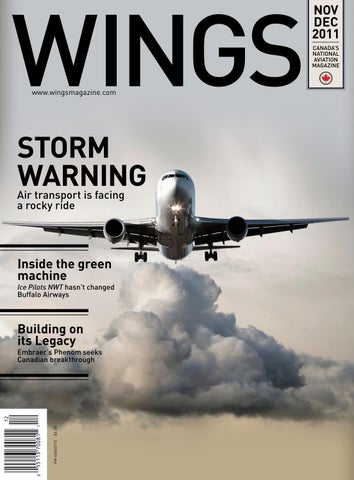
WINGS www.wingsmagazine.com
Storm WarnIng
Air transport is facing a rocky ride
Inside the green machine
Ice Pilots NWT hasn't changed Buffalo Airways
Building on its Legacy
PM 40065710
$6.00
Embraer's Phenom seeks Canadian breakthrough
noV DEC 2011 CANAdA’S NAtIoNAl AvIAtIoN mAGAzINE
A wide world of comfort starts here.
introducing the citation Latitude. When you told us you wanted a larger cabin and the freedom to move around, we listened. Now, the new Citation Latitude responds in a big way – with six feet of cabin height, 21 feet of cabin length and an astounding 77 unrestricted inches from side to side. Cozy up in the ample new seats. Mosey down the flat-floor aisle. Whatever you do in the stylish comfort of the newest and widest Citation in the sky, you have enormous Latitude for doing it. 1-877-410-8650 I wings.cessna.com
noV/DEC 2011
upFront 7
Leading edge Taylor honoured
10 on the fly
News and opinion
16 Waypoint
Spanning the generations
18 alternate approach A not-so-sunny day
19 at the gate
The One Sky approach
20 45˚42� north
Turning vision into reality
In 20 years, there will be a worldwide demand for between 28,000 and 31,000 airplanes with more than 100 seats. P. 22.
21 Legally Speaking Training bond enforceability
BaCk 59 marketplace 62 on final
In praise of BizAv
FEaturES 22 Storm on thE horIzon
Will sustained growth in air transport go by the wayside? By dAvId CArr
From top: Aviation families. P. 16. Provincial Aerospace. P. 36.
26 BuILDIng on ItS LEgaCy
Executive jet maker Embraer sees the Phenom as its Canadian breakthrough By dAvId CArr
31 InSIDE thE grEEn maChInE
Ice Pilots NWT fame hasn’t changed Joe McBryan or iconic Buffalo Airways By PEtEr PIGott
36 From thE roCk to thE WorLD
A position report on St. John’s, Newfoundland’s Provincial Aerospace By FrEdErICk k. lArkIN
42 EStaBLIShIng thE rIght path
Air Georgian is in full growth mode, adding a strong western presence By roB SEAmAN
47 FInDIng an aLtErnatIVE approaCh coVeR PHoTo: isTock
www.wingsMagazine.coM
Major aerospace players look to adjacent markets for growth prospects By BrIAN duNN
November/December 2011 | wings
5
“The S1’s ANR worked like I created a custom headset for my environment only” - Plane and Pilot Magazine August 2011 “Pressing “the adaptive ANR button” results in a quieter headset in all phases of flight” - AOPA Pilot Magazine August 2011 “The S1, once it has re-sampled the cockpit sound, cuts down cockpit noise more than any other competitor” - The Aviation Consumer October 2011
THE QUIET
REVOLUTION INTRODUCING THE S1 DIGITAL PILOT’S HEADSET FROM SENNHEISER The Sennheiser S1 Digital aviation headset is designed to give you maximum control over noise levels in the cockpit, so you can focus on the joy of flying. At the push of a button, the S1’s exclusive NoiseGard™/ digital technology accurately analyzes the cockpit’s noise levels to achieve superior noise cancellation during all phases of flight—from take-off to landing. Design features like adjustable headband contact pressure and a special “comfort zone” for glasses ensure you stay comfortable. And with a Bluetooth interface, clear voice transmission and a customizable treble boost function, you’ll never miss a word. See these Sennheiser Premium Aviation Headset Dealers to experience “The Quiet Revolution“: Aviation World (800-668-1987) • Calgary Pilot Supply (800-563-9633) • Aero Téknic (450-676-6299) Sennheiser aviation headsets. Put on before flight.™
Learn more: www.Sennheiser-Aviation.com/S1 or scan the QR code with your smartphone.
Designed in collaboration with
SCAN WITH YOUR QR CODE READER
MADE IN
GERMANY
BMW Group DesignWorksUSA
LEADING
EDGE
| By Matt Nicholls
honouring an aviation hero Trailblazer Roberta Taylor leads by example
PHoTo: elsie Macgill noRTHeRn ligHTs awaRd
A
s one of the country’s most accomplished aviators for more than four decades, you’d think Roberta Taylor might be ready to slow down just a wee bit and catch her breath. But using the phrases “slowing down” and “Roberta Taylor” in the same sentence is like calling the Avro Arrow a nice little aircraft – one that had some significance in the history of Canadian aviation. Of course, one wouldn’t blame Taylor for slowing down. At 65, the grandmother, paddler and environmental activist from Victoria, B.C., has amassed an impressive resumé in our Canadian skies, a career that spans a number of important disciplines – from bush pilot, to search-and-rescue expert, to aviation mentor. It’s a career that has also produced not only personal and professional achievement, but also several important industry awards. The most prestigious, for Taylor, was the Elsie MacGill Northern Lights Award presented in late September in an inspiring award ceremony in Unionville, Ont. Awarded annually to a Canadian woman “who has demonstrated determination, enthusiasm, courage, and personal accomplishment in the aviation or aerospace industry,” the Elsie MacGill has found a more than worthy candidate in Taylor. “I was thrilled to be selected for the award because I greatly admired Elsie MacGill, not only for her aeronautical achievements but also for her work on women’s rights and social activism in a broader societal context,” Taylor told Wings. “I was inspired by her tenacious approach to overcoming adversity and grateful for the trailblazing that she and others in my mother’s generation had achieved.” The Canadian aviation and aerospace industry is a predominantly male-oriented landscape – just five per cent of Canadian pilots are female – which, in many ways,
5
can produce roadblocks. Although Taylor overcame obstacles, she is well aware of how difficult the industry can be for women. “In the past, passengers refused to get into the aircraft because the pilot was a woman,”
There was a culture in the workplace that allowed sexual harassment and a hostile workplace environment to exist. Taylor said. “And results of a research study that I conducted revealed that there were discriminatory workplace practices for which women did not have the legal protection under human rights and employment equity legislation that exists today. There was a culture in the workplace that allowed sexual harassment and a hostile workplace environment to exist.” The daughter of two pilots growing up in Thunder Bay, Ont., Taylor began her career
top Data BurStS… in this issue
1. 238: The number of flights diverted to canada on 9-11. (pg. 18). 2. $120 billion: The cost of a one sky navigation approach. (pg. 19). 3. Embraer accounted for 19 per cent of all aircraft deliveries in 2010 (pg. 26). 4. $75 million: How much Provincial aerospace was awarded by the dFo (pg. 36). 5. the demand for the lightweight material in the aerospace & defence sector will be worth $41.8 billion by 2020 (pg. 47).
www.wingsMagazine.coM
as a bush pilot after attaining her commercial pilot’s licence before the age of 20. After working for several years in northwestern Ontario, she relocated with her husband to British Columbia, and started Taylor Aviation in 1978 at the Cranbrook, B.C., airport. The couple built a hangar at the airport and made it available free of charge to the Cranbrook/Kimberley Flying Club for meetings. It was also used as a base to organize the local airshow and coordinate search-and-rescue efforts. While qualifying as a civilian search master, Taylor quickly made search and rescue a significant part of her aviation vocation. She trained and organized volunteer pilots, navigators and spotters for civilian air searches, and was soon making a name for herself as one of the province’s most skilled searchand-rescue pilots. She also flew patrols in the Canadian Rockies for the B.C. Forest Service. An accomplished pilot, Taylor’s considerable influence extends beyond the piloting realm. She has worked hard to raise the status of women in aviation – much like the woman for whom the award was named. Taylor helped form the Women’s Resource Centre in Cranbrook and was a founding member of the Canadian Rockies chapter of the Ninety Nines. And although injuries sustained in a serious car accident ended her flying career prematurely, she went on to attain her master’s degree and is now a senior instructor in the Faculty of Human and Social Development at the University of Victoria in B.C. “Roberta was an excellent selection for this award,” said Leggat Aviation’s Anna Pangrazzi, one of the award organizers. “She was a pioneer woman aviator, bush flying in northern Ontario and setting up an aviation flight training/charter/aircraft sales company in Alberta. Wings congratulates Taylor on this prestigious honour and wishes to recognize all the dynamic women who have blazed a trail in the Canadian aerospace and aviation industry. We will continue to highlight the achievements of these inspirational women in our special Women in Aviation series in future issues. | W Your feedback is always welcome. Please contact me at mnicholls@annexweb.com. November/December 2011 | wings
7
new cover to come Vol. 52, Issue 6 EDItor
Matt nicholls mnicholls@annexweb.com 416-725-5637 proDuCtIon artISt
gerry wiebe
FLIght DECk
Ray canon, david carr, Paul dixon, Brian dunn, Frederick k. larkin, neil Macdonald, James Marasa, carroll Mccormick, david olsen, Peter Pigott, Rob seaman
SubScribe TODAY !
aSSoCIatE puBLIShEr
alison de groot adegroot@annexweb.com 1-888-599-2228 ext. 246
1 Year SubScription only
3000
$
aDVErtISIng SaLES
adam szpakowski aszpakowski@annexweb.com 1-888-599-2228 ext. 246
(GST $31.50 • HST $33.90) US $42.00 (USD) • Foreign $65.00 (USD)
Name: _______________________________ Company: ____________________________ Title: _________________________________ Address: _____________________________ City: _________________________________ Prov: ________________________________ P.Code: _______________________________ Tel: __________________________________ Fax: _________________________________ e-mail:________________________________
PLeASe cHecK ONe: ❑ Commercial aircraft owner/operator ❑ Business/private aircraft owner/operator ❑ Military ❑ Aircraft maintenance/overhaul firm ❑ Airport ❑ Aerospace, airframe & component manufacturer and distributor
❑ Fixed base operator ❑ Aviation services, consultants and aircraft sales ❑ Government ❑ Aviation associations and organizations ❑ Flying schools, clubs and colleges ❑ Other (please specify) ______________
PAYMeNT: Cheque - Payable to Annex Business Media Visa
MC
AMEX
Account #: __________________________
group puBLIShEr
scott Jamieson sjamieson@annexweb.com prESIDEnt
Mike Fredericks mfredericks@annexweb.com WIngS magazInE
P.o. Box 530, 105 donly dr. s., simcoe, on n3Y 4n5 Tel.: 428-3471 Fax: 429-3094 Toll Free: 1-888-599-2228
Publication Mail agreement #40065710 Return undeliverable canadian addresses to circulation dept., P.o. Box 530, simcoe, ont. n3Y 4n5 e-mail: ncuerrier@annexweb.com Published six times per year (Jan/Feb, Mar/apr, May/ Jun, Jul/aug, sep/oct, nov/dec) by annex Business Media. Circulation e-mail: ncuerrier@annexweb.com Ph: 866-790-6070 ext. 208 Fax: 877-624-1940 Mail: P.o. Box 530, simcoe, on n3Y 4n5 Subscription rates canada – 1 Year $ 30.00 (includes gsT - #867172652RT0001) Usa – 1 Year $ 42.00 Foreign – 1 Year $ 65.00
occasionally, wings magazine will mail information on behalf of industry-related groups whose products and services we believe may be of interest to you. if you prefer not to receive this information, please contact our circulation department in any of the four ways listed above. no part of the editorial content of this publication may be reprinted without the publisher’s written permission. ©2011 annex Business Media. all rights reserved. opinions expressed in this magazine are not necessarily those of the editor or the publisher. no liability is assumed for errors or omissions. all advertising is subject to the publisher’s approval. such approval does not imply any endorsement of the products or services advertised. Publisher reserves the right to refuse advertising that does not meet the standards of the publication. Printed in canada issn 0701-1369
Expiry:_____________________________ Signature: _________________________
TO SubScribe:
Tel: 866-790-6070 Fax: 877-624-1940 Mail: Wings Magazine c/o Annex business Media P.O. box 530 Simcoe, Ontario N3Y 4N5 e-mail: ncuerrier@annexweb.com
www.wingsmagazine.com
GST#135274215RT001
8
Subscriptions non-refundable
wings | November/December 2011
PRO01211
Air Transport Association of Canada
ON THE
WEB
Canadian Owners & Pilots Association
Canadian Business Aviation Association
Magazines Canada
CarEErS In aVIatIon Visit our new Careers in Aviation website to learn more about job forecasts and career overviews, and to access a listing of universities, colleges, and private training centres and programs. Look for updated stories and listings in the Jan/Feb issue! www.careersinaviation.ca
PHoTo: PoRTeR aiRlines
Date: _____________________________
www.wingsMagazine.coM
1.2 1.2 billion dollars invested in available inventory means we stock the parts so you don’t have to. And you can usually have what you need the next day. Aviall works hard to provide you with exactly what you need, precisely when you need it. Aviall Delivers.
ON THE FLY For late-breaking news, and exclusive web content, please visit us at: www.wingsmagazine.com
InDuStry nEWS opEratorS pEopLE LEttEr
InDuStry nEWS
pEtErBorough’S nEW DIgS opEn For BuSInESS It seems that any U.S. town with an ounce of ambition has a runway capable of accommodating narrow body jet airliners and long-range business aircraft. So, what does a Canadian city do to upgrade its aviation infrastructure? In the case of Peterborough, Ont., it hired LPS Avia Consulting to develop a business case for the development of Peterborough Airport (CYPQ). Subsequent to accepting the recommendations of that study, the city established an Airport Master Plan in the spring of 2009. That led to the creation of an Expanded Airport Development Program (EADP) and discussions with federal and provincial authorities regarding financial resources. On Oct. 16, 2009, the City of Peterborough was awarded $7 million from the federal government and a similar amount from the province of Ontario. Together
with the city’s $14.6 million contribution, the EADP now had a budget of $28.6 million. Upon completion, the airport had a new passenger terminal, an expanded apron and, most importantly, a 40 per cent longer runway. The new 7,000-ft. “09/27” can now handle airliners of the Boeing 737 and Airbus A320 families and enables ultra-long range corporate jets to launch on 6,500 nautical mile missions. It is now the longest runway (excluding CFB Trenton) between Toronto and Ottawa. On Oct. 14, the renamed Peterborough Municipal Airport was officially opened in the presence of Prime Minister Stephen Harper and Ontario Premier Dalton McGuinty. Numerous local politicians, city administrators and aviation industry players were also on hand to view the results of a two-year project that came in on budget and on schedule. A key aspect of the airports upgrade is its role in developing local employment through the construction of a comprehensive aviation industrial park on the site. Flying Colours, the airport’s largest tenant, is already busy as a completion centre working on Bombardier Challenger 850/ CRJ200 aircraft. It plans to do interior completions and refurbishment work on larger twin-jet airliners and the new runway will assist in that effort. – Frederick K. Larkin
Prime minister Stephen Harper announces the completion of the work done on the expansion of the Peterborough Airport. 10 wings | November/December 2011
diamond Aircraft’s d-JEt program is back in flight thanks to a significant investment in the program.
DIamonD out oF thE rough Diamond Aircraft has resumed flighttesting of its D-JET prototypes after the program was grounded earlier this year due to a funding shortfall. The company was forced to lay off 200 employees – approximately half of its North American workforce – leaving the D-JET program with a skeletal staff of only 20 engineers and technicians. “Our team’s spirits are certainly lifted with the resumption of flight activities,” said Peter Maurer, Diamond’s president. The future of Austrian-based Diamond Aircraft Industries’ North American operation in London, Ont. was thrown into doubt in March when the federal government turned down a $35-million loan request. Diamond had received a $19.6-million strategic, repayable loan from the Canadian government for DJET research and development in 2009, cementing London as the aircraft’s production centre. The federal government’s refusal to grant further investment also shut down access to matching provincial funding and private-sector investment worth an additional $20 million. In June, Diamond announced it had obtained a commitment for a significant investment exclusively dedicated to the D-JET. Details remain sketchy but the investment has been enough to return furloughed staff and return D-JET 003 to the air for its first flight since March 27. The one-hour flight included shakedown of aircraft systems, control sweeps, gear cycling, flap cycling, verification of navigation equipment and software, www.wingsMagazine.coM
PHoTos: PRiMe MinisTeR’s oFFice (BoTToM); diaMond aiRcRaFT (ToP)
8 14 15 15
several touch and goes, and completion of some control system test points. Diamond test pilot Mark Elwess reported the flight to be uneventful without any issues or snags. The challenge now is to make up for lost time, although Diamond will not be pinned down on a certification date. “We are looking forward to finishing the campaign with 002 and 003 [prototypes], while in parallel finalizing detail design work and starting the production of aircraft 004,” Maurer said. Diamond’s Austrian operations are also gearing up to support the D-JET. Having recently completed several necessary piston development programs, the Austrian plant will provide engineering and technical resources to support the completion of the D-JET program in the shortest time possible. Diamond did not exhibit at NBAA 2011 in order to focus on the certification program. The single-engine D-JET was first announced in 2003 as a more practical one-pilot alternative to the Cessna Citation Mustang and Eclipse 500. Diamond was reported to have 240 D-JET orders in March when the development program stalled.
PHoTo: canadian aiR & sPace MUseUM (ToP); PoRTeR aiRlines (BoTToM).
aIr & SpaCE muSEum gEtS ICED Canada’s only full-scale replica of the Avro CF-105 Arrow is now homeless after Toronto’s Canadian Air & Space Museum was booted from the building that has been part of Canada’s aviation heritage for more than 80 years. In late September, the 14-year-old museum, which owes the Crown corporation owning the building $100,000 in back rent, received an eviction notice along
toronto's recently closed Canadian Air & Space museum dates back more than 80 years.
with several neighbouring tenants, in order to clear the building to build a fourpad ice rink complex. The volunteer-driven Toronto museum, while not benefitting from dollops of federal cash as was the Canada Air and Space Museum in Ottawa, was not devoid of charm, even if some exhibits lacked focus. Sadly it did not have enough charm to shield the organization from low attendance, failed fundraising and a rickety management structure. While the Crown corporation granted the museum a six-month reprieve after the initial eviction hit the headlines, the stay dissolved into a dispute between management and landlord, who expected the museum to use the extra time to pack and crate its exhibits, an unworkable situation that forced the organization to close its doors for good on the final Sunday in September. Although the landlord has offered the Canadian Air & Space Museum space in other parts of the sprawling Downsview Park lands, the more likely result will be that the most valuable exhibits and artifacts, including the legendary Arrow, will be sold piecemeal to other aviation museums including Ottawa’s. What cannot be shipped off is the
building. The museum was housed in the oldest surviving aircraft factory in Canada. Built in 1929, it was the original home of de Havilland Aircraft of Canada, the birthplace of the famous Beaver and Otter bush airplanes, and later the plant where SPAR Aerospace built the famous Canadarm.
haLIFax BEComES portEr’S FIrSt CrEW BaSE outSIDE toronto Toronto-based Porter Airlines has opened a crew base for pilots and flight attendants in Halifax. The airline, which recently posted an industry-high 83 per cent customer satisfaction rating in an Ipsos 2011 Canadian Business Travel Survey, serves three cities in Atlantic Canada, with Halifax growing as a popular hub for both business and leisure travellers since service was launched in 2007. “Halifax is an important market for us,” Robert Deluce, Porter’s president and chief executive officer pointed out. “Establishing this base in the heart of our Atlantic operations demonstrates an ongoing commitment to Halifax as a valuable part
Porter president and chief executive officer, robert deluce, says establishing a base in the heart of Canada’s Atlantic region is a sound business decision. www.wingsMagazine.coM
November/December 2011 | wings
11
ON THE
of the Porter family.” Adding the crew base will double Porter’s employees in the city to 80. The local crew members primarily will be responsible for serving routes for Halifax, St. John’s, Montreal, Ottawa, Moncton and Toronto. “Porter has been a valued partner of ours for the past five years and we welcome the opportunities this expansion here at Halifax Stanfield will bring,” said Tom Ruth, chief executive officer for the Halifax International Airport Authority.
WILL BomBarDIEr hIt ItS CSErIES SaLES targEt? Bombardier may struggle to hit its target of 300 CSeries orders by the time the aircraft enters service in late 2013, according to a report by RBC Capital Markets. Even so, the report still expects Bombardier to capture a “significant share” of the 100- to
Concern is growing that Bombardier will not be able to meet its target of 300 CSeries orders by the time the aircraft enters service in 2013.
149-seat market as performance expectations are met. The report is based on a survey of 26 potential airline customers representing approximately 35 per cent of the 100- to 149-seat aircraft already in operation worldwide. “While we were encouraged
by the interest the airlines demonstrated in the CSeries, there was certainly a lack of urgency to place significant new orders,” Walter Spracklin, the analyst who headed up the report wrote in a client note. Concerns by the airline group included adding a new aircraft type to the fleet, the price of the CSeries and unproven performance data. Bombardier is promising that the CSeries will burn 20 per cent less fuel than similar aircraft, and operating costs will be 15 per cent lower. Delta Air Lines recently threw cold water on a potential CSeries order following its agreement to purchase 100 Boeing 737-900ERs to replace its ageing fleet of Boeing 757s. “I do want to put to rest any thought that we are in the market considering a new aircraft decision,” Delta president Ed Bastian said recently. Spracklin predicts that other carriers will defer potential orders for the CSeries. “We consider Delta’s deferral to be potentially indicative of a broader industry
As Canada’s Air Navigation Service Provider since 1996, safety and ef�iciency have always been our top priority. At NAV CANADA, we are moving aircraft safely and more ef�iciently than ever before, thanks to the hard work and dedication of our employees, customers and partners. We are proud that Canada’s air navigation service has been recognized as one of the world’s best, earning the IATA Eagle Award for our leadership and performance two years in a row. As we celebrate these achievements on our 15th Anniversary this November 1, 2011, we will continue to strive towards safer and more advanced services that provide value to our customers in Canada and around the world. www.navcanada.ca
IATA Eagle Award Winner – Best Air Navigation Service Provider in 2001, 2010 and 2011.
12 wings | November/December 2011
www.wingsMagazine.coM
PHoTo: BoMBaRdieR aeRosPace
FLY
PHoTo: PaUl dixon
trend,” he wrote. Even so, Bombardier still sees room for the CSeries in the Delta fleet, likely as a replacement for the carrier’s 66 MD88s. These have an average age of 21 years and are the oldest aircraft flown by the airline.
completed 25 flights with 115 flight hours. The PW1500G series engine test program will continue over the next 16 months with eight test engines, before scheduled certification in 2012 and entry into service in late 2013.
pratt & WhItnEy CompLEtES CSErIES EngInE tESt
aIr CanaDa SEES LIght at EnD oF 787 tunnEL
Pratt & Whitney Canada has completed tests of its PurePower PW1524G engine. PurePower is a $1-billion, 20-year investment in a new family of next-generation commercial and business jet engines that are expected to offer double-digit improvements in fuel burn, environmental emissions, engine noise and operating costs. P&WC has been testing its PW1524G engine, which will power the Bombardier CSeries, on its Boeing 747SP flying test bed at the firm’s Mirabel Aerospace Centre in Quebec since June 20. The engine has
The nightmare appears to be over. Boeing’s revolutionary and much-delayed 787 Dreamliner finally entered scheduled service on Nov. 1 with launch customer All Nippon Airways (ANA). What this means is that Boeing’s most recent update to Air Canada last March might just stick and the Montreal-based airline could take delivery of its first four 787s in late 2013 or early 2014, a further delay of between five and seven months from the previous schedule. Air Canada was originally supposed to begin taking
www.wingsMagazine.coM
Boeing’s much-delayed 787 dreamliner is poised to take to the skies for its maiden flight with launch customer All Nippon Airways (ANA).
delivery of its 787s in 2010. The 787 is critical to Air Canada’s global growth strategy as it opens up routes too thin for the larger 777, but out of range of the 767. Air Canada has ordered 37 787s. Powered by twin Rolls-Royce Trent 100 engines, the new jet is the first
November/December 2011 | wings 13
ON THE
FLY
WEStJEt anD EmIratES Form partnErShIp WestJet and Emirates have reached an interline agreement that should make the Calgary-based airline more attractive to the growing international market. The new partnership allows travellers to book flights on WestJet with connecting service to any of Emirates 114 international destinations through its Dubai hub. Emirates customers will be able
to book flights with connecting service on WestJet to more than 20 Canadian cities. “Emirates’ partnership with WestJet will allow travellers to explore our vast network of diverse and remarkable destinations with added ease and seamless connections,” said Don McWilliam, Emirates’ manager for Canada. Emirates is the largest airline not part of a global alliance such as the Star Alliance, Oneworld and SkyTeam. WestJet is also a non-aligned carrier and has been building an international strategy out of interline agreements with both Oneworld and SkyTeam airlines such as British Airways and Air France, and has codeshare partnership with American Airlines, Cathay Pacific and KLM. Emirates only flies to Toronto three times a week using Airbus A380 aircraft. The interline agreement with WestJet has put the spotlight back on Transport Canada’s refusal to allow the airline to introduce daily service to Toronto and add flights to Calgary and Vancouver. The government’s position is seen as allowing Star Alliance partners Air Canada and Lufthansa to protect Frankfurt as an international transfer point for Canadian travellers. But is that position tenable if by refusing Emirates added flights the government takes potential traffic away from WestJet?
Emirates airlines and Calgary-based WestJet have reached an interline agreement connecting service to any of Emirates' 114 international destinations through its dubai hub. 14 wings | November/December 2011
Auyuittuq Aviation is set to provide fixed-wing and rotary charter services to better meet the needs of Baffin Island’s growing mining industry.
opEratorS
ImproVIng aIr SErVICE on BaFFIn ISLanD A group of Inuit investors have partnered with Yellowknife-based Discovery Air to expand air service on mineral-rich Baffin Island. Auyuittuq Aviation will provide fixedwing and rotary charter services to better meet the needs of Baffin Island’s burgeoning mining industry. “The mining and exploration industries in Nunavut are growing rapidly and new opportunities are being created almost daily,” said company president Simon Merkosak. In addition to transporting workers and freight to the region’s mining and exploration sector, Auyuittuq Aviation will provide charter services and wildlife surveys for the Government of Nunavut. Air operations will be conducted by Discovery Air subsidiaries Air Tindi, the largest fixed-wing aircraft charter provider based in northern Canada, and Great Slave Helicopters, one of the country’s largest VFR helicopter operators. Both companies hold a minority stake in Auyuittuq Aviation. “The expertise of [these] partners allows us to offer the best of both worlds in the aviation industry, drawing on their fleets of approximately 75 helicopters and 21 airplanes,” Merkosak added. “Great Slave Helicopters and Air Tindi have a proven track record operating in the harsh environment of Canada’s north and creating wealth for our Aboriginal partners,” Chuck Parker, executive vicepresident of Discovery Air, noted. www.wingsMagazine.coM
PHoTos: wesTJeT (BoTToM); discoVeRY aiR (ToP)
commercial airliner built using carbon fibre – a strong, lightweight, high-tech plastic – rather than the typical aluminum skin. It is quieter and uses about 20 per cent less fuel than a comparably sized aluminum aircraft. Following a special charter flight from Tokyo’s Narita International Airport to Hong Kong on Oct. 26, ANA has deployed its first two 787s on domestic routes between Tokyo and Okayama, and Hiroshima. The airline plans to introduce its first long-haul service to Frankfurt in January and plans to use the aircraft on routes to North America, Europe and India, indicating a possible return to Vancouver or service to Toronto. All Nippon is a Star Alliance partner with Air Canada.
pEopLE
PHoTos: eMBRaeR (ToP leFT); PaRTneR JeT (BoTToM leFT); BoMBaRdieR aeRosPace (BoTToM Middle)
EmBraEr appoIntS CanaDIan SaLES ExECutIVE Embraer has named Robert Knebel vice-president executive aircraft sales for Canada, the U.S. and the Caribbean. Based out of Embraer’s U.S. headquarters in Melbourne, Fla., Knebel has held a number of sales and general management roles with Gates Learjet, Cessna Citation and Securaplane, a supplier of avionics and electronic security systems for business, commercial and military aircraft. He is an experienced private pilot with multi-engine and robert knebel instrument ratings. “Robert is a seasoned aviation sales professional and his knowledge of the executive jet business is the result of more than 30 years in the industry,” said Ernest Edwards, Embraer president of executive jets. Knebel will lead Embraer’s fieldbased team of regional sales managers throughout North America. He will also be responsible for operation areas at the new Executive Jets Customer Center in Melbourne, including the new aircraft contracts and specification functions.
Ontario, and was involved with Porter since the startup. “Adding Jim to our senior management team is exciting for us,” said Ian McDougall, executive chair and chief executive officer of Partner Jet. “His experience and reputation within the aviation business will allow us to grow and develop our business in many areas.”
traVoLta to Star aS BomBarDIEr BranD amBaSSaDor Screen legend John Travolta has joined Bombardier as brand ambassador for its Learjet, Challenger and Global product lines. The actor and film producer, who has starred in 60 movies, is also an accomplished pilot who currently holds 11 licences for both commercial and business jets. “He recently added the Challenger aircraft to the impressive list of different jets he is qualified to fly,” said Steve Ridolfi, president of Bombardier business aircraft. “We are thrilled to have him as brand ambassador.” Travolta has also served as a global ambassador for Australia’s Qantas Airways, and owns a Boeing 707 painted in the airline’s retro livery. Speaking about his new gig, Travolta had no problem slipping into character. “Bombardier designs aircraft as much for the person flying them as for the passenger. I’m proud to
JamES morrISon JumpS From portEr to partnEr JEt James Morrison, a former senior vicepresident and chief operating officer with Porter Airlines, has joined Partner Jet as managing director responsible for dayto-day management, growth and business development. Mississauga-based Partner Jet specializes in aircraft management, sales, maintenance James morrison and charter services. The company has a fleet of Bombardier, Cessna Citation and Hawker aircraft, as well as helicopters. Morrison began his aviation career in 1968 as a pilot for Ottawa-based Bradley Air Services. He has held senior management positions with Air Creebec and Air www.wingsMagazine.coM
you could say Bombardier Aerospace has chills and they’re multiplyin’ now that John travolta has been added as a brand ambassador for its learjet, Challenger and Global product lines.
represent their aircraft.” In addition to the Boeing 707, the Oscar-nominated actor’s collection also includes a classic Learjet 24. “Business aviation has always made sense to me in that it offers flexibility, privacy, security and most importantly, timesaving,” he pointed out. “On top of that, I’m a pilot – I love to fly.”
LEttEr
BrEakIng DoWn thE BarrIErS AME Mel Goddard of Fenelon Falls offers his perspective on Wings’ On Final piece by Kathy Fox in the Sept/Oct issue: Kathy Fox rightly identifies a number of Metropolitan Airport Safety issues in this piece, the prime one being “runway overruns.” She uses the classic example of the Air France A-340, (Jumbo Airliner?) Flt. 358 running off the runway at Pearson Airport. (We all have our thoughts on THAT one.) Her concern seems to be a lack of action from “the powers that be” on coming up with a solution for a sort of “failsafe” overrun area. She suggests longer safety areas and “engineered systems” at runway’s end. O.K., why not? For many years, the military has been using such devices as “arrestor barriers” of various designs to halt a run-a-way jet; and with great success. My personal involvement with them was the one at Royal Canadian Air Force. Stn. Chatham, N.B. I still have a nylon tow cable from that one. Sure, a military jet weighs a mere 20 tons or so, but so what! Cannot a larger version capable of stopping a 200-plus ton jet be installed? The Chatham barrier used pistons on cables in tubes filled with anti-freeze to do the job. Other barriers used cables and anchor chains laid out along the runway sides, such that the farther the jet went along, the more chain links were pulled out. They all worked. Surely, such a system could be installed at reasonable cost at all the major airports to prevent a repeat the Air France happenstance. No? November/December 2011 | wings 15
WAYPOINT By Rob Seaman |
Spanning the generations
To some, aviation “family” has several different meanings
M
16 wings | November/December 2011
Partner Jet, Jim started his career in the cockpit and grew into management, working with the likes of Bradley Air Services, Air Creebec, Air Ontario, Skyservice, Execaire and Porter. Jim’s dad – Angus Curran Morrison – served with the Royal Canadian Armoured Corps in the U.K., North Africa and Italy, and became a pilot before demobilization. He founded and operated his own firm, Atlas Aviation Ltd., in 1947 in Ottawa. In 1962, he became president of (ATAC), where he lobbied for more liberal government regulations of Canadian air transportation and aviation training by implementing the Instructor Refresher Course jointly developed by the Royal Canadian Flying Club Association and ATAC. He was inducted into Canada’s Aviation Hall of Fame in 1989. These are just three of the distinguished father/son success stories in Canadian aviation. There are many others, of course, in a variety of disciplines. Truth is, some come to this industry by chance, some by choice and some because – well, what else do we know? It’s in the family! But that’s what makes this a close-knit and wonderful business to be in. Thanks, dads! | W
With a dad like his, “Cooper” really had no choice when it came to his career. RAF with distinction in three separate theatres of war. In 1950, he co-piloted the C-102 Jetliner on its celebrated flight to New York (carrying the first air mail in North America moved by commercial jet). He later moved up the street to Orenda Engines, where he worked on the development and testing of the Iroquois turbojet for the Avro Arrow. At de Havilland Aircraft of Canada, he sold aircraft and aided in the further development of Beaver, Otter, Twin Otter and Caribou aircraft. After DHC, Cooper-Slipper moved to Field Aviation to market the Beechcraft; was instrumental in Falcon’s early successes in the Canadian marketplace; and was involved in the development and refinement of water pickup and delivery systems for water bombers. A review of distinguished dads would not be complete without mentioning the name Morrison. Jim Morrison is well known and respected for his achievements in both the business and commercial aviation communities. Currently the managing director of
Rob Seaman is a Wings writer and columnist. www.wingsMagazine.coM
PHoTo: cHRis cooPeR-sliPPeR
any refer to this industry as a family – and it is, by and large, a small, very close and supportive group with common interests and goals. But for others, myself included, the term actually has a double meaning. There are a surprising number of us who are multi-generation members of the bigger aviation family. Here are three profiles of industry leaders with special “family ties.” Michael Bannock is best known for his successful aircraft ferrying business – Worldwide Aircraft Ferrying Ltd. – and for his pioneering work in fractional business aircraft ownership through his firm JetShare Canada Inc. Mike comes by his aviation passions through a larger-than-life model – his dad, Russ Bannock. Russ is a Canadian aviation icon. He worked as a commercial pilot prior to joining the Air Force in the Second World War, service that resulted in a distinguished record 19-1/2 V-1 rockets downed and a DFC among many accolades before the war ended. After the Air Force, he worked for de Havilland Aircraft Canada and played a key role in the development of the Beaver and Otter series, eventually becoming director of military sales, and later, vicepresident. In 1968, he formed his own consulting firm and was instrumental in the development of the Cessna Caravan. Another prominent multi-generation family name is of course Cooper-Slipper. Chris Cooper-Slipper is well known across Canada as the VP of Field Aviation. Over the years, he has been involved in everything from sales of new Beechcraft and Hawker aircraft, through to sales of commercial aircraft such as the Dash 7 and 8 related to Field’s special missions upgrades. In his current role, Chris oversees marketing and promotions for the firm. With a dad like his, “Cooper” really had no choice when it came to his career. Mike Cooper-Slipper left his native England in 1947 to join A.V. Roe Canada, first as an engine fitter and later as a test pilot for Lancaster B-25 and Sea Fury aircraft being modified for peacetime. Mike’s career in aviation began in 1938 as a fighter pilot for the RAF. Cooper-Slipper served the
NAVITIMER A cult object among pilots and aviation enthusiasts, equipped with Manufacture Breitling Caliber 01, the most reliable and high-performance selfwinding chronograph movement, chronometer-certified by the COSC. CAD 5,865.-*
WWW.BREITLING.COM
*Recommended retail price
PURE LEGEND PURE BREITLING
ALTERNATE
APPROACH By David Carr |
a not-so-sunny-day in September Former Transport Minister David Collenette recounts 9-11
T
18 wings | November/December 2011
Canada’s 9-11 response was a textbook example of crisis management, which went strangely missing during the subsequent SARS outbreak and 2003 northeast blackout. The decision-making process in the aftermath was less hectic, but important in managing the system, especially on Sept. 24, when insurers cancelled AV52 policies protecting airlines for third-party coverage. Collenette had already announced that Ottawa would step in as insurer of last resort. There are several monuments and tributes to Canada’s 9-11 effort. For example, in May 2002, Lufthansa christened an A-340-300 “Gander-Halifax” after the two cities that welcomed seven company aircraft and approximately 1,500 passengers. At the time it was the only aircraft named after a nonGerman city (Lufthansa has since started naming A380s after cities it serves). Missing is a 9-11 exhibit at the Canadian Aviation and Space Museum, which is odd given that the museum stands as a magnificent tribute to Canada’s aviation heritage. September 11, 2001, was a defining moment in Canadian aviation history. It was a day when a transport minister held the pieces together in the face of enormous pressure, and Canada again shone on the world stage. | W
People don’t appreciate the massive machinery that springs into action to handle a crisis like this. possible and therefore away from potential New York and Washington target zones. NAV CANADA had established its own command centres, and air traffic controllers were on the frontline of an unprecedented clearing and shutting down of air space. “People don’t appreciate the massive machinery that springs into action to handle a crisis like this,” Collenette noted. Still, it must have been lonely for the man who had to make it up as he went along. Did he, for example, have authority to shut down the airways? “We were never challenged on that,” he said with a shrug. “You had to move quickly. There was no time for consultation. It was like coming across somebody who needs first aid. When you have to stop the bleeding you don’t muck about with meetings.” The first nod of approval likely came from Prime Minister Jean Chretien, who waived the need for an emergency meeting of cabinet. “Why?” he asked rhetorically. “You’ve made all the decisions.” The next came at approximately five in the afternoon when Norm Mineta, the U.S. Transportation Secretary, called to thank Collenette, the government and the people of Canada personally.
David Carr is a Wings writer and columnist. www.wingsMagazine.coM
PHoTo: isTock
here is a shopworn joke in air transport that now aircraft largely fly themselves and airlines are paying pilots for 20 minutes’ work. Trouble is, you never know which 20. A similar truism might be said of recent federal transport ministers. Like piloting an airliner, the responsibility for keeping Canada moving remains a great one. But privatization of Transport’s various pieces has shrunk the minister’s influence. Then along comes a sunny September morning in New York 10 years ago. Reflecting on 9-11 with David Collenette – Canada’s transport minister at the time – you are reminded there was no precedent for what unfolded that tragic day or those that followed. Over a two-week period, Collenette became the first transport minister in history to shut down Canadian airspace, preside over the diversion of 238, mostly U.S.-bound, flights to 17 Canadian airports (the bulk, 47 and 38, arriving in Halifax and Gander respectively), negotiate the orderly return to the of air ahead of the U.S. and respond to the possibility of insurers grounding airlines even longer. “It was one of those times when we all got it completely right,” Collenette told Wings, also giving credit to provincial and local governments that aided thousands of stranded passengers, the community centres and homes that took them in, and striking Department of Transport workers who laid down picket signs and returned to work to handle the crisis. Collenette was delivering a breakfast speech at an international conference of airport executives in Montreal when the towers were hit. The minister was barely in a car racing back to Ottawa when the U.S. Federal Aviation Administration (FAA) closed American airspace and Washington asked Canada to take in all overseas aircraft destined for American airports. En route, with mobile telephone batteries running out of juice, Collenette and a team back in Ottawa made a series of decisions. Canadian airspace would be shut down at 10 a.m. Operation Yellow Ribbon would be launched to “clear the skies” and accept only overseas flights without sufficient fuel to return to Europe or Asia. Orphaned airplanes inbound from across the Atlantic would be kept away from Toronto and Montreal where
AT THE
GATE
| By Brian Dunn
Implementing the one Sky approach Current air navigation service procedures need a massive overhaul
T
www.wingsMagazine.coM
navigation system are long overdue to enhance operational performance and capacity, efficiency, safety, and environmental performance, says Cyriel Kronenburg, assistant director, airport and ATC charges with the International Air Transport Association (IATA). And to make it happen, users need timely and coordinated implementation of major programs such as NextGen in the U.S. and SESAR (Single European Sky ATM Research), he adds. But with those initiatives budgeted in the billions of dollars, “no such investments can be expected without sustainable funding and deliverable benefits and targets,” suggests Kronenburg. In addition, although fleet equipage is essential to achieve the desired benefits, the “lack” of equipage is often used as a reason for the status quo. And, like Chew, Kronenburg notes that “in an environment where ‘cash is king,’ airlines require a clear business case,” to make equipage happen. But the economic benefits of the global aviation/air navigation system infrastructure go beyond commercial aviation alone by generating new jobs, contributing to the global gross domestic product and providing substantial tax revenue, notes Kronenburg. “Yet commercial aviation users are often the only significant contributor to the system. States should see investments in infrastructure as investments in their economy . . . as an engine for economic growth.” The IATA would like to see funding for future system enhancements from both public and private sources. | W
States should see investments in infrastructure as investments in their economy . . . as an engine for economic growth. new avionics equipage,” Chew argues. But public-private partnerships such as the NextGen Equipage Fund can solve this “paradox” through proven regulatory and policy mechanisms, in combination with private sector capital, commercial financing structures and service contract commitments, Chew adds. And without aircraft equipage, NextGen air traffic management (ATM) systems cannot produce operational benefits. The largest benefit of NextGen is the reduction in operating costs associated with delays in congested enroute airspace, which in turn cause delays from air traffic controller workload saturation, Chew adds. Major improvements in the current air
Brian Dunn is a Wings writer and columnist. November/December 2011 | wings 19
PHoTo: isTock
he world’s airlines carry more than 1.6 billion passengers annually and experts predict this figure will double in the next 15 to 20 years, with freight traffic growing even more quickly. However, current air navigation services procedures and infrastructure cannot effectively handle this growth. That’s why the air transport industry is expected to invest more than $120 billion on new technologies and systems worldwide over the next 10 years to move towards the One Sky vision. This is the industry’s vision of a future global air navigation system that offers enhanced safety and efficiency while accommodating worldwide air traffic growth in an airspace that is seamless and devoid of national borders. To prepare to meet this growth, the International Civil Aviation Organization (ICAO) held a Global Air Navigation industry symposium at its Montreal headquarters in late September. The symposium provided a platform for global and regional industry partners to share their latest developments, thus identifying commonalities and differences between the systems to ensure interoperability, to facilitate the harmonization of air navigation systems and to chart out the next step. It also paves the way for the 12th ICAO Air Navigation Conference in November, 2012. In a session entitled Tomorrow’s System: Justifying Spending and Financial Possibilities, a case was made that airlines are not making the necessary investments to solve the NextGen “Equipage Paradox.” That is according to Russell Chew, managing partner at Nexa Capital Partners, a Washington, D.C.-based provider of financial advice and capital investments to the aerospace industry. The Equipage Fund consists of $1.5 billion in public-private sector financing to help the airline industry adopt the avionics technologies needed to make the NextGen a reality. “Many airline balance sheets remain weakened since 2001, making the cost of discretionary, non-aircraft capital expensive and protecting cash flow remains a top priority. This handicaps their ability to close their business cases for long-term, non-aircraft capital investments, such as
45˚42�
NORTH By Peter Pigott |
turning vision into reality
Ottawa Aviation Services offers students a cutting-edge environment
N
20 wings | November/December 2011
in Canada has been set up here at Ottawa International Airport. It’s open not just to our own students but to all aspiring pilots and operators. When a student comes to OAS, the first thing they do is a four-hour assessment exercise. We assess them in eye/hand co-ordination, mathematics, orientation and task management – things essential to a pilot. We then show them the results and tell them this is where you can improve and this is how we can help with remedial work. We are the only school in Canada to offer this.” Although the simulator and pilot assessment centre are at the modern Innotech-Execaire Centre, the main OAS offices are dated and next to a giant Chinese food store. When asked if they planned to vacate, Paillard laughs and says they actually liked being there – it provides some “character.” However, they are discussing building their own premises. In terms of foreign markets, OAS is just now gaining traction in Asia. With the FSTD, the Diamond fleet, the research projects and the pilot assessment centre, there’s no doubt OAS has successfully identified a strategy for translating its vision into reality. | W
Canada is very respected in pilot training and if we can teach the Canadian way, that would be a good thing. Katanas, took it to the lab and with a local high-tech company, Beacon Engineering, built their own simulator.” OAS hopes this “sim” will be approved by Transport Canada by June 2012. This joint research project with OAS maintenance staff is studying the effects of aging on composite aircraft. When asked about OAS student intake, Palliard said about 30 come from Algonquin College annually and the remainder from advertising – an annual intake of 70 students on average. Once at OAS, they have access to Recreational Pilot Permit, Private Pilot Licence, Commercial Pilot Licence, Night Rating, Instrument Training, Instructor Rating, Multi Engine Rating, Aerobatic Rating and an RCAF Preparation Course. OAS is launching a professional pilot program structured so the students are actually on a timeline that has glass cockpit, upset recovery components and the simulator. So, what does OAS offer that other institutions do not? “We have pioneered Pilot Assessment Services,” Paillard says. “The first formal pilot assessment centre
Peter Pigott is a Wings writer and columnist. www.wingsMagazine.coM
PHoTo: MecHTRonix sYsTeMs inc.
imble, forward-looking and seeking to develop best practices and excellence in all areas of the operation. It’s a strong recipe for success and the governing philosophy of new Canadian aviation firm Ottawa Aviation Services. The team wouldn’t have it any other way, says Cedric Pallaird, vicepresident of marketing (and one of the firm’s partners). An ultra-modern aircraft fleet, keen instructors and the latest flight training devices (FTD) are essential to achieving excellence in such a competitive market and one of the measures of OAS’s success is its aircraft. The envy of other local aviation schools, OAS uses the elegantly beautiful Diamond Aircraft Katana DA20 for ab-initio training; the sleek Diamond Star DA40 for glass cockpit advanced and IFR training; a fully aerobatic (to +6G and -3G) Grob G115C; and a Piper Seneca II for multi-engine training. Ottawa Aviaition Services has also supported Canadian simulator expertise by getting an Ascent Turboprop Trainer from Montreal-based Mechtronix Systems Inc., the Flight Simulation Training Devices (FSTD) manufacturer. Configured as a generic regional turboprop with conversion kits to multi- and single-engine piston, the FSTD is used for ab-initio training, Turbine Transition, Crew Resource Management as well as Instrument Flight Rating. Before getting into an aircraft, students take 10 hours of flight training on the FSTD followed by the insertion of scenario-based training. Because of the Mechtronix simulator capabilities, OAS has partnered with Seneca College in its National Science and Engineering Research Council project to study simulator time as an alternative means of compliance in abinitio training. “We also partner with Algonquin College and Carleton University in Ottawa to offer training to their aeronautical engineering departments,” Pallaird says. “Carleton University provides 15 students – seven of which do a co-op. They fly and work, and what they work at goes towards their flying. With us, Carleton graduate students are also working on simulator development. They cut up one of our old
LEGALLY
SPEAKING | By Krista Bulmer
The enforceability of training bonds Sage words of advice before signing on the dotted line
W
WWW.WINGSMAGAZINE.COM
amount of the bond should not be more than the cost of the training. You should check to see that the amount is accurate. Finally, a pilot should be relieved of any liability under the training bond if: the employer becomes bankrupt or insolvent if the pilot is terminated or suspended for any reason other than just cause or the employee’s decision to resign; or if the employer is in breach of the terms of the employment contract during the term of the training bond. Although I am not a proponent of oral agreements, be aware they are still legally binding contracts. If you are offered a job over the phone as a pilot on the condition that you stay for 24 months due to the training cost and you accept the offer on those terms then complete the training, there is a binding agreement. If you leave your job before the end of the 24-month period, you are in breach of an enforceable contract. A court could hold you liable for some or all of the training cost, even if you did not sign a written contract. So, be sure to put every agreement into writing, and seek the advice of experienced legal counsel to avoid a situation where there is any question about your rights and obligations under the agreement. | W
A court could hold you liable for some or all of the training cost, even if you did not sign a written contract. Part III of the Canada Labour Code. No regulations with respect to training bonds are currently in force but it could be just a matter of time before the recommendations in the discussion paper become a requirement. There seems to be consensus that the value of the training bond should decrease pro rata throughout the time period to which the pilot has committed. So, for example, if the bond is for $10,000 and the pilot committed to two years of service, the value owing under the bond would decrease by $416.67 every month as the pilot works off his or her obligations under the bond. The term of the bond should be a fixed term, for example 12 months, and the total
This is for information purposes only and is not to be construed as actual legal advice nor take the place of legal counsel. You should not act or abstain from acting based upon such information without first consulting a legal professional. Krista Bulmer is a lawyer practising aviation law, business law and civil litigation with the law firm Willson Lewis LLP in Toronto. Willson Lewis also offers experienced legal counsel in civil litigation, employment law, equine law and family law. November/December 2011 | WINGS 21
PHOTO: ISTOCK
hen air operators hire pilots, they often need to send the new hires to receive training and become type rated on a particular aircraft. The cost to train pilots can be substantial. In order to minimize the risk in making a large investment in new hires, employers often require pilots to enter into an agreement in which pilots agree to work for the employer for a minimum time period. If they fail to do so, they will be held responsible for some or all of the cost of training them. These agreements are commonly referred to in the aviation industry as “training bonds.” Pilots generally feel that training bonds are unfair, especially if enforced after the pilot has been terminated or when the employer has gone bankrupt. Conversely, air operators view the training bond as insurance against having a pilot jump ship and take his or her newly acquired skills to a competitor. But are training bonds enforceable? The short answer is yes, a properly drafted training bond is enforceable. When looking at training bond agreements, there are certain things you need to consider. Every contract requires an offer, the acceptance of that offer and something called “consideration.” Consideration is basically the exchange of something of value by the parties to the agreement. If the agreement is signed after the training is completed, it may not be enforceable because at the time the contract was signed nothing of value was exchanged. This is precisely what happened in the 2011 case, Northern Thunderbird Air v. Van Haron. The pilot signed a training bond agreement but after having completed the training. The B.C. Court of Appeal upheld the trial judge’s decision that there was no consideration for the training bond agreement, since the employer did not provide any further benefit to the pilot after the agreement was signed. Therefore, the training bond was unenforceable. Recommendations in a 2009 discussion paper released by Human Resources and Development Canada (“HRDC”) proposed a framework for training bonds. The HRDC paper recommends that employers be permitted to require employees to post training bonds but it goes on to recommend that the terms of training bonds be regulated under
STORM ON HORIzON a ir transport planners are riding high on growth. It is estimated that by 2030, the world’s airlines will transport approximately six billion passengers,
22 wings | November/December 2011
more than double the number that passed through airports in 2011. Airbus predicts the greatest leap will come from emerging economies, although more mature markets such as Canada, the U.S. and Europe will more than hold
their own with traffic expected to double over 20 years. Depending on who is doing the forecasting, airlines either expanding fleets or replacing aging gas-guzzlers will create demand for between 28,000 and 31,000 airplanes
with more than 100 seats and freighters worth between $3.5 trillion and $4 trillion. Canada’s Bombardier estimates demand for up to 13,000 aircraft in the 100- to 149-seat CSeries category between now and 2030. www.wingsMagazine.coM
PHoTo: isTock
WILL SuStaInED groWth In aIr tranSport go By thE WaySIDE? By DaVID Carr
From building the airplanes to bringing them back to earth, air transport’s value chain is being weakened by skills shortages and underinvestment that could endanger future growth projections.
PHoTo: aiRBUs
N THE There are strong facts fuelling the optimism. Air travel remains remarkably resilient. Since 1970, world air traffic has roared back from two oil crises, a Gulf War, 9-11, SARS and the 2008 global financial meltdown. Last year, passenger air traffic rebounded to pre-recession levels. Despite unresolved concerns over government debt, the industry is on track to achieve six per cent growth in 2011. It also appears to be smarter growth. There are early indications that business www.wingsMagazine.coM
travellers are once again moving further up the aisle. The International Air Transport Association (IATA) reports a 7.5 per cent year-over-year increase in first- and business-class travel on overseas flights for the month of July. The industry is also doing a better job of filling all cabins. The average load factor is bordering on the 80 per cent mark as airlines have shifted to chasing profits rather than the destructive pursuit market share. Even so, profit has all the
resilience of a vapour trail. According to IATA, the average net margin since 1961 is a paper-thin 0.1 per cent. 2010 was air transport’s most profitable year, but the $18 billion earned amounts to a margin of 3.2 per cent and falls seriously short of the seven to eight per cent cost of capital. This situation raises the question, is 4.8 per cent annual growth over the next 20 years sustainable, especially when factoring in all the other supports needed to keep the airplanes flying? From building the airplanes to bringing them back to earth, air transport’s value chain is being weakened by skills shortages and under investment that could endanger future growth projections, especially in mature markets. As reported in the September/October issue of Wings, Canada faces a shortage of aviation engineers and technicians that for the first time may bubble up to impact original equipment manufacturers such as Bombardier and Pratt & Whitney Canada. The view is not much brighter from the flight deck. Boeing’s forecast of the need for 466,650 more commercial pilots by 2029 – including 97,000 in North America – is sparking a global recruitment drive that will pit airlines and countries against each other to fill cockpit seats.
In the U.K., BAA, the operator of London Heathrow, the world’s busiest international airport, claims that capacity constraints and the government’s cancellation of a third runway is shutting it out of emerging markets and eroding its position as a major global hub. Earlier this year the British government launched a Sustainable Aviation study and suspended urgently needed runway development at all of the London area airports until 2019 at the earliest. Not every country is in the same fix as the U.K. Transport Canada does not see the trigger for a second major Toronto area airport until 2027 at the earliest. But nobody is immune either. Last year, the IATA launched Vision 2050 (by which time IATA predicts aviation will move 16 billion passengers and 400 million tonnes of cargo), a forwardlooking strategy that will look at some of the rickety structures that are underpinning growth such as generational delays, build developing new infrastructure and managing more crowded skies with largely obsolete air traffic control systems. Perhaps even more so than congested airports, the greatest threat to aviation growth is a dysfunctional global air traffic control system that has not kept pace with aircraft avionics and burdens airlines with higher operating costs in terms of unnecessary fuel burn and delays. In September, the International Civil
the Airbus A-380 test aircraft mSN4 shows off its “love at first flight” heart logo as part of the Airbus global marketing campaign reflecting the A-380 passengers’ unanimous, positive feedback on the outstanding comfort they experience when flying on the aircraft. Airbus predicts the greatest increase in passengers in future years will come from those in emerging economies. November/December 2011 | wings 23
Aviation Organization (ICAO) held a summit in Montreal to assist in the modernization of air traffic management systems to support growth to 2030. It is a massive $120 billion undertaking that has little chance of succeeding unless ICAO can impose the same hard deadlines for technology installation as it has previously for airport noise abatement. Like any industry, aviation relies on economic growth for lift. Air transport did show great resiliency during the global financial meltdown. And while the industry may stumble as a result of the current government debt crisis and a possible double dip recession, commercial aviation
should experience robust growth at least for as long as cracks in the value chain are not fully exposed. But shortages in labour skills, runways and terminal capacity may curtail growth. What’s more, heavy investments in air traffic management technology and biofuel supply chains to offset the inevitable raise in oil prices may push the cost of flying out of the reach of threshold incomes even as more efficient aircraft lower the cost of flying. There is little point in looking to government for help. Governments were right to shift air transport to a userpay system. But it has been half a loaf. Protectionist policies that deny passengers
Canada’s Bombardier estimates demand for up to 13,000 aircraft in the 100to 149-seat CSeries category between now and 2030.
choice and promote greater inefficiencies, and using the industry as a cash cow to support social policies, have driven up costs and contributed to most of the challenges
the industry must confront. The airline industry might be able to withstand any outside crises. It is those forming beneath it that might prove to be its greatest challenge. | W
private jet operator, rean airport terminal is cently lowered the minithe great equalizer. airmum ownership share lines can offer added of a jet from 1/16th to perks to the premium 1/32nd to bag a greater cabin that help make share of business-class the terminal experience travellers. lufthansa is more comfortable. But in partnership with netlike remedies for a comJets to allow long-haul mon cold, they are unpremium-class passenable to cure the sympgers to connect to ontoms of discomfort such ward european destinaas security hassles, in- While the industry may stumble as a result of the current government debt tions by private jet. The sufficient staffing levels crisis and a possible double dip recession, commercial aviation should experience robust growth. airline plans to expand and chronic delays. Regardless of which cabin they occupy, travellers’ value its lufthansa Private Jet brand to the U.s. and Middle east. Meanwhile, clive Jackson, a British digital marketing their time and some are looking for alternatives to the disruption of flying commercial. in addition, main cabin pas- entrepreneur, is drawing the gap between private jet and sengers have to suffer the indignities of what some in the business class closer with the launch of Victor, described industry are now describing as “self-loading freight.” ac- as the world’s first online quote comparison, book and buy cording to a Usa Today/gallup Poll taken last year, just over marketplace for private jet charter. Victor is plugging a marone quarter of american fliers who made a round trip at keting hole not occupied by fractional operators by allowing least twice in 2009 were more likely to travel by car, train or members to buy empty seats on jet charters rather than investing in a fractional share of an aircraft. bus to avoid flying. inspired after full-service British carrier BMi suspended in canada, the market is eroded further by canadians who are prepared to fly but who are driving to U.s. border airports its route from Heathrow to Palma de Mallorca where Jackto avoid higher fares and sidestep taxes and other fees. ac- son keeps a second home, Victor has grown to 170 aircraft cording to the canadian airports council, approximately 2.5 flown by 38 partner operators and a network of 940 desmillion canadians crossed the border to fly out of smaller tinations since it was launched in august. Victor has also launched services in germany, austria and switzerland american airports last year. it is not just main-cabin travellers who are looking to save with the support of 12 operators, and has plans to expand a buck or anxious to skip the airline terminal building alto- into the U.s. Victor and netJets do not directly compete with commergether. Private aviation is targeting first- and business-class passengers by bringing the cost of private jet travel within cial aviation for first- and business-class travellers, but the striking distance of premium-class tickets, a trend that is ex- premium-cabin passenger accounts for a disproportionately higher percentage of an airline’s revenue stream and pected to reach canada. netJets europe, part of the world’s largest fractional first timers to private jets did not arrive from out of the blue. 24 wings | November/December 2011
www.wingsMagazine.coM
PHoTos: aiR canada (BoTToM); BoMBaRdieR aeRosPace (ToP)
Nibbling at the margins
ExECutIVE JEt makEr EmBraEr SEES thE phEnom aS ItS CanaDIan BrEakthrough
a
By DaVID Carr lberto Santos-Dumont, Brazil’s most famous aviation pioneer, was always easy to spot in a crowd because of his trademark Panama hat. Although he died 37 years before the Brazilian government created Embraer in 1969, tributes to Santos-Dumont can be found all around
26 wings | November/December 2011
the airframer’s sprawling complex in São José dos Campos, including an enlarged image of his famous hat. In the mid-1990s, deep in debt and facing a dwindling order book for its military aircraft and commercial turboprops, Embraer hung its own hat on the development of the ERJ 145, a 50-seat regional jet the company had put on hold at the height of its financial crisis. The ERJ 145 and its derivatives helped Embraer to privatize in 1994, set the stage for it to slide past Bombardier as the world’s largest builder of regional jets and paved the company’s entry into the business aviation market with the Legacy (since rebranded the Legacy 600), a super mid-size executive jet based on the same platform as the ERJ 135 derivative. In the high-stakes game of developing
and selling executive jets, timing is everything. Had the ERJ 145 development not been stalled, Embraer’s entry into the corporate market might have happened sooner, although the results may not have been the same. “The Legacy hit the market at just the right time,” explained Augusto Salgado da Rocha, senior manager of product strategy for the Executive Jets division. “The market was hot and rival manufacturers were pushing delivery times for new jets well into the future.” Embraer has also been tapping into a new generation of wealthy customer less interested in the “go with who you know” culture that has benefited established manufacturers than in a bigger bang for the buck. Embraer accounted for 19 per cent of all deliveries in 2010 compared
www.wingsMagazine.coM
PHoTo: eMBRaeR
BuILDING ON ITS LEG
GACY
with 2.7 per cent in 2005. The Executive Jet division has built an impressive portfolio in a short period of time. Its impressiveness was on display in Las Vegas during NBAA 2011. The company arrived with its entry-level and light Phenom 100 and 300, the Legacy 650, an updated, larger and more powerful successor to the 600, the Lineage 1000, an ultra-large version of the E-190 passenger jet and the latest mockup of the Legacy 500, the only full fly-by-wire aircraft in the mid-size market. The Legacy 500 is expected to make its first flight in late 2011. Indeed, the only hole in Embraer’s executive jet line is in the ultra-long-range category. That gap will not be plugged anytime soon, according to Ernest Edwards, president of Embraer Executive www.wingsMagazine.coM
the Phenom 300 is more than just a stretch version of the 100; most notable is the low-swept back wing design of the 300.
Jets. “My team would love to fill the hole that is there, but engineering are saying, ‘Guys, give us a break.’ The engineers are just about maxed out,” he said. Instead,
“The Canadian market is divided into two parts,” explained Edwards. “There is Calgary and there is Toronto east to Montreal. It would cost a couple of million to get the
my tEAm Would lovE to FIll tHE HolE tHAt IS tHErE, But ENGINEErING ArE SAyING, ‘GuyS, GIvE uS A BrEAk.’ Embraer is hoping to use the 19-passenger Legacy 1000’s US$50.5-million price tag to lure ultra-long-range customers willing to give up range for added comfort. To date, the entry-level, four-passenger Phenom 100 is the only aircraft in the portfolio to have sold in Canada. Neither Legacy aircraft is certified to operate here.
aircraft Transport Canada certified. You have to look at how many aircraft you can optimize that over, or whether the customer is prepared to pay a premium toward getting the aircraft certified.” That will not be the case with the Legacy 500 or smaller 450, another full fly-by-wire design aimed at the mid-light November/December 2011 | wings 27
the surprisingly affordable Phenom 100 sports a high-end interior cabin that rivals much more expensive business jets.
market. Both airplanes are being designed for certification in all countries. But the aircraft Embraer sees as having the strongest potential for the Canadian market will be the Phenom 100 and 300. “We have great hopes for the Phenom in Canada,” Edwards added. Both aircraft were on display at the CBAA show in Calgary this year, along with the Canadian premiere of the Legacy 500 mockup. Embraer launched the Phenom program in 2005. Deliveries of the 100 began in December 2008, followed 12-months later by the first deliveries of the 300. In 2010, the Phenom 100 was the most delivered executive jet in the world, whereas the 300 was the most delivered in its class. Deliveries slowed in the first half of 2011, although Edwards is confident that the program is on track to deliver 74 Phenoms in the second half, including the first Phenom to roll off Embraer’s new assembly plant at the Melbourne International Airport in Florida, the new headquarters for Embraer Executive Jets. (Twenty-two of Embraer’s 52 service 28 wings | November/December 2011
centres worldwide are located in North America, including Starlink Aviation in Montreal). The assembly plant is part of a US$50million complex that includes a paint shop and customer design centre to support all executive jets in the Embraer portfolio. The facility has the capacity to build up to eight Phenoms a month and is expected to turn out 60 aircraft a year by 2013. Despite the name, a similar design lineage, a shared cross-fuselage section and best-in-class customer features such as the cabin and baggage area (including a forward external baggage compartment on the 300), the Phenom 100 and larger 300 are two different aircraft, pointed out Carlos Fernandes, an Embraer executive jet product strategist. “The 300 is more than just a stretch version of the 100.” Most notable is the low swept back wing design of the 300 versus the super critical wing design of the 100. Powered by two Pratt & Whitney Canada PW535E engines, the 300 is twice as heavy as the 100, flies higher and faster,
and has a range of 3,650 kilometres with a standard six-passenger occupancy. Both cockpits feature Embraer’s Prodigy avionics suite tailored from the Garmin G1000 and sometimes referred to by the manufacturer as a G1000 on steroids. For the cabin interior, Embraer partnered with BMW Group Designworks on a mix-and-match concept that allows the customer to design their own interior from a wide selection of materials. Cabin highlights include the largest windows in its class, a large galley opposite the entrance and private lavatory. The cabin can be configured for up to nine passengers with an optional belted toilet. At US$8.5-million per aircraft, the Phenom 300 has become a favourite in the fractional market. In 2010, NetJets the world’s largest fractional aircraft operator, placed an order for 50 300s with options for 75 more. The NetJet purchase followed a 2007 order by Flight Options, the second largest fractional company in the United States, for 100 Phenoms with an option for an additional 50. www.wingsMagazine.coM
PHoTo: eMBRaeR
EmBrAEr IS HoPING to uSE tHE 19-PASSENGEr lEGACy 1000’S uS $50.5 mIllIoN PrICE tAG to lurE ultrA-loNG-rANGE CuStomErS.
the aircraft Embraer sees as having the strongest potential for the Canadian market are the Phenom 100 and 300.
PHoTos: eMBRaeR
rIGHt: In 2010, the Phenom 100 was the most delivered executive jet in the world.
Flight Options expects to have 16 300s in its fleet by year’s end. Earlier this year, Michael J. Silvestro, chief executive officer for the Cleveland-based operator, told London’s Financial Times that the airplane is Flight Options’ fastest-growing fractional program. “Our customers and prospects realize what a true game-changer this aircraft is. Every aircraft delivered to us has been presold into 2011.” Embraer predicts that the market for business jets troughed out in 2011, and the industry will rebound beginning in 2012, delivering 11,275 aircraft over the next 10 years worth approximately US$260 billion. The light category, occupied by the Phenom 300, will be the busiest market segment, capturing 18 per cent of all orders. The United States will continue to be the largest single market, and along with Canada, will account for approximately 5,265 aircraft, or 47 per cent, of all orders. Edwards sees strong growth potential in Brazil and Mexico, which has an aging fleet of www.wingsMagazine.coM
executive aircraft that will need replacing, and China, whose market he compares with his time in the Middle East in the 1970s. “In the mid-’70s they started at the upper end of the market and then they moved into other segments. You are seeing the same thing happen with China starting with the ultra-high range.” In 2005, Embraer unveiled a 10-year business strategy to parallel its success in the regional jet market by becoming one
of the world’s biggest manufacturers of executive jets. Despite a number of bright spots, the market downturn resulted in the airframer not reaching where it forecast to be in deliveries when the strategy was launched. The four years were not wasted, however, and Embraer was one of the most aggressive in new product launches, enabling the company to boost its portfolio and better align itself to ride the recovery. | W November/December 2011 | wings 29
Buffalo Airways president “Buffalo” Joe mcBryan (left) is now a legend worldwide thanks to the popularity of Ice Pilots NWT.
INSIDE THE GREEN MACHINE
Ice PIlots NWt FamE haSn’t ChangED JoE mCBryan or IConIC BuFFaLo aIrWayS
I
PHoTo: HisToRY cHannel
By pEtEr pIgott
f you’re a true aviation enthusiast, it’s hard not to be intrigued by the Buffalo Airways story. Based in Yellowknife, N.W.T., this iconic operation profiled in the hit television series Ice Pilots NWT, has served the far north since 1970, providing national and international air support services, including cargo shipments, fire suppression and passsenger transfers. So, how did it all happen for Buffalo Airways, its president “Buffalo” Joe McBryan and his adventurous pilots, engineers and crew? Wings correspondent Peter Pigott sat down with general manager Mikey McBryan, Joe McBryan’s son, to get an inside look at this unique northern operation. WINGS: Because of the television series Ice Pilots NWT, Buffalo Airways is probably the most famous airline in Canada. How did it begin? Mikey McBryan: My dad and four guys founded Buffalo Airways. There are different versions, but the current one is that the old man and three other guys bought the company from Bob Gauthier in May 1970. Eventually, he bought out the three other guys and has been running it solo ever since. WINGS: How is it organized? Are there shareholders and a board of directors? MM: It’s a strict dictatorship. They sent me to business school and there definitely isn’t a Buffalo business model. It’s run the way Cuba would be run. www.wingsMagazine.coM
WINGS: How did you get into it and what’s your role? MM: I was bred to do this right from Day 1. I grew up in Hay River and my dad flew us into Yellowknife in the DC-3 every day since 1982. If you do the math, it’s like 300 days a year for 30 years. I’m not a pilot, but a mechanic – actually I’m going back to do a refresher on DC-4s. But I do all the charter work, organize all the pilots, absolutely everything. I was told I was doing this just like a dictatorship. But with a dictatorship there comes a lot of freedom. There’s no red tape – if there is one guy in charge (my dad) there are no “maybes” only yes or no. It’s, “Mikey, go get the airplane ready by any means necessary” or “get the freight there by any means necessary.” WINGS: “Buffalo Joe” McBryan has become a legend around the world. How would you describe your dad? MM: My father is very eccentric. He has an uneducated business mind; never spent a day in the classroom. He has learned all by experience and mistakes. He does all the negotiations by himself. The forest fire contract he got for us in 1995, he took on Conair, the biggest firefighting company in the world. He’s very stubborn: once he gets his mind on something he gets it done. And at any given time his wardrobe is $35. He lives off café food, cans of beans. It’s almost like there’s seven
different personalities in him. My mom and him have been married some 45 years and even she can’t figure him out. WINGS: It sounds like he’s very hands-on in the day-today operations as well.
There’s an old Christmas movie (Rudolph the Red-Nosed Reindeer). It mentions, ‘the island of the misfit toys.’ We’re like that. MM: He still flies every day – works from six in the morning to nine at night. He never takes weekends off, he will never ask someone to do something that he doesn’t want to do himself. In one of the TV episodes, he is the one who cleans the cat litter. And he does that because he feels bad asking other people to do it. Whatever breaks down, he’s got a spare. He’s got backups on backups on backups. That’s how he operates. Every day, he buys more airplanes – he just bought two more DC-3s without telling anybody. So, that’s 15 DC-3s. I have to check Wikipedia to see how many aircraft we have – I think there’s 50 airframes, 26 working aircraft. We just
bought a Canadair CL-215 off e-Bay. Now we have 11 DC-4s, 15 DC-3s, three C-46s, one Norseman, one Vampire fighter jet that he got in some horse trading deal somewhere which is sitting in the Edmonton Museum. You look in the corner there – there’s an Aeronca Champ – he acquired it somehow. Nothing is planned, there’s no master plan. Buffalo Airways just grew. WINGS: What is the main focus of the Buffalo operation: is it scheduled passengers, freight or charter? Firefighting or the aviation school? MM: The most beautiful thing about Buffalo is that whatever is available, we do. Today, there’s a lot of mining work but mining dried up in the past two years, so we moved a lot of food. We also do firefighting, parts selling, and buying and selling airplanes. Then there is Buffalo Air Express, which is a courier company, so we do FedEx, DHL, all that fun stuff. WINGS: With such a varied but rapidly changing operation, how does Buffalo keep thriving? MM: It’s magic sometimes where the money comes from in aviation. We don’t really know – as long as the cheques are cashed and the airplanes kept in the air. WINGS: There’s a stack of CVs and emails on your desk. Given the current economic conditions, why do so many young pilots want to work for you? November/December 2011 | wings 31
MM: Buffalo Air is actually a very hard job. I don’t recommend it for anybody, but it’s a shortcut to the cockpit. For example, I have a guy called Larry. He’s 20 years old, he was on the ramp for
eight months and he’s co-pilot on the C-46 right now. Anywhere else you’ve got to work four to five years to get into the cockpit. By the time he’s 25, he’ll have enough time to be captain on a jet. But they
pay their dues on the ramp. You’ve really got to put them through the wringer. It costs a lot to check out a pilot. An aircraft like the L-188 Lockheed Electra, you’re looking at about $5,000 an hour. A
PHoTo: PeTeR Magill, BUFFalo aiRwaYs
the dC-4 and the dC-3 remain the backbone of the Buffalo Airways fleet. “I have to check Wikipedia to see how many aircraft we have,” says general manager mikey mcBryan.
10-hour flight, you’re looking at $50,000. At the end of the day, the guys are worn out and look like skid-row bums – they’ve really got to want it. Most don’t make it. WINGS: Sounds like a tremendous experience for a young guy. The TV series depicts some real characters. Are they true to life? MM: The two pilots I have right now – Justin Simle, chief pilot, and AJ Descoste, our pilot of everything – started green, green, green and now they fly absolutely everything we have. They’re one out a hundred – getting to the point where they can fly absolutely everything. Most young guys do their time here and then go south to the airlines. So for us, to get a “lifer,” you have to go through a hundred guys. It took them nine years to get this far. They could make more money with the airlines but these guys really, really want to fly. And you wouldn’t get so much of that with the airlines.
imagine no more sealers, Paints, ePoxy or wax. no more Failed coatings.
One-time
Hangar Floor Solution
Skyservice has a highly skilled team composed of individuals recognized within the industry who have vast experience in both corporate and airline aviation industries. No task is too big or too small. We have the trained personnel to provide 24/7 NDT coverage, whether requested within Canada or required elsewhere throughout the world. Parts pick-up and delivery services, if required, may also be arranged. Our Transport Canada approved facilities at Toronto and Montreal have the capability of accomplishing the following NDT methods: • Ultrasonics (UT) • Eddy Current (ET) • Magnetic Particle (MT) • Liquid Penetrant (PT) • X-Ray (Aircraft Structures) The Skyservice NDT teams guarantee you prompt professional service at competitive prices. Please contact: Gary Smith, NDT Manager YYZ\YUL (416) 807-9845 gary_smith@skyservice.com
High Performance aviation Floors
For a Free consultation, contact
John Pike | 780-264-8277 | john@stonewerkz.ca Polishing new and exisiting concrete
corporate, commercial & Private Hangars
Full polish, 3000 grit
starting at $3/sq. ft.
multi-hangar discount available
www.stonewerkz.ca
32 wings | November/December 2011
www.wingsMagazine.coM Stonewerks_wings sept11.indd 1
23/08/11 2:50 PM
PHoTo: PeTeR Magill, BUFFalo aiRwaYs
WINGS: So, it’s a very unique operation supported by a very unique group of individuals. MM: There’s an old Christmas movie (Rudolph the RedNosed Reindeer). It mentions, “the island of the misfit toys.” We’re like that. Buffalo is different for a reason, and the reason is the people. It’s almost like a fraternity – you’re put through the wringer and are really part of something. WINGS: Most of your aircraft – the DC-3s, DC-4s and C-46s – date from the Second World War. How do you get spare parts or even people who know to work on them? MM: All the people who designed DC-3s are dead. There is no one who can train you on World War II aircraft. The mechanics, a lot of them, are family. Fathers, uncles and brothers, not from the McBryan family but family in their own right. They’ve raised their kids as mechanics – and you can’t really go to school to
Founded in 1970, Buffalo Airways provides national and international air support services including cargo shipments, fire suppression and passenger transfers.
work on a DC-3. Spare parts? We have a World War II hangar in Red Deer, Alta., that is packed to the roof with parts. It’s like a Buffalo Airways Wal-Mart when you go in there. And the old man, he’s
got it all in his memory. He’ll say, “Walk 10 feet, pick up a box or dust off an old mattress and underneath there it is.” It’s a very eccentric way of running a business but it’s all there.
WINGS: How do you stay in business being located so far north? MM: There are no roads up here so everything is flown in. The Northwest Territories is as flat and boring as it looks,
24/7 READY TO SERVE AROUND THE WORLD
A Fully Authorized Pratt & Whitney Canada Distributor and Designated Overhaul Facility
MAINTENANCE
l
R E pA I R
l
OVERHAUl
To l l F re e : 1 . 8 8 8 . 7 6 9 . 0 9 9 9 l www.vectoraerospace.com
SETTING THE STANDARD OF CUSTOMER SERVICE www.wingsMagazine.coM
November/December 2011 | wings 33
A group of vintage car enthusiasts from Alaska gather their cars in front of C-GPNr after going for a short flight with Joe in his dC-3.
34 wings | November/December 2011
C-GtXW gets a scheduled maintenance check completed in the yellowknife hangar. the Pratt & Whitney r2800 is shown underneath its large cowling.
world – but we’re still isolated. You’re famous but you’re still in the freezer. You don’t get to go out into the kitchen; we’re not in downtown Toronto high on cocaine and acting like Charlie Sheen driving around. We’re still working our tails off in the freezer. It’s a weird thing. But the television
show is very truthful; it’s 100 per cent my life. The crew goes to our homes and films whatever you see on TV. Whatever is on TV is my day. WINGS: Does your dad watch the show? MM: He watches it the same as everyone else. I go to Vancouver to make sure it’s
somewhat accurate, that we’re not breaking any laws. But he doesn’t believe it – this is his world and he can’t believe it’s on TV. WINGS: “Buffalo Joe” is one of the legendary aviators who built the North like “Punch” Dickins or Max Ward. You know him best. What’s he www.wingsMagazine.coM
PHoTos: BUFFalo aiRwaYs
but it’s one of the richest mineral deposits in the world. You’ve got diamonds next to nickel, next to uranium, next to gold – minerals that I don’t even know the names of. There are even rare earth metals that they need to put into flat-screen TVs. Aircraft are the only way in or out. WINGS: If it’s so lucrative, why doesn’t Buffalo scrap these Second World War aircraft for Lockheed Hercules like First Air did? MM: Because they’re expensive. For a Herc, you’re looking at $23 million minimum. But a DC-3 costs, if you buy it from the sheriff, $70,000. Call it $250,000 by the time you clean it up and put in the modern stuff. You make that in a month out here. These DC-3s were all bought in the 1970s and they’ve not only paid for themselves but also paid for the whole company. WINGS: Let’s talk about the television series Ice Pilots NWT. How has it affected your life and Buffalo Airways? MM: We’ve been doing it for three and half years now – we’re known around the
to have to start attending art shows or history lectures so no one will know him. WINGS: What’s going to happen when “Buffalo Joe” is no longer there? Are you going to take over? MM: My dad is 67, I’m 28. His dad (my grandfather) is 91 and the oldest man in Hay River. So, we’ve got about 20 years at least. We’ll see how it goes. WINGS Why the name Buffalo Airways and the green paint scheme? MM: He originally wanted to call it “Big Indian Airways” but there was already “Big Indian Trucking.” Why Buffalo? It
was named for Wood Buffalo National Park, which is the largest park up here. And why green? There are 10 different stories – the guy who taught him to fly had a green airplane. Also, it’s now environmentally sound – yes, we can say we’ve been “green” since 1970. My dad says if he had to do it all over again he would have chosen bright orange because you can see bright orange a mile off. | W Wings correspondent Peter Pigott would like to thank Buffalo Airways’ Peter Magill for arranging the interview.
C-GWzS (front) and C-GWIr (back) in Hay river after a second scheduled night.
like in real life? MM: Dad doesn’t have a bankcard: he uses a credit card that the accountant pays off. He lives on his cellphone and he’s got an old school computer that he’s got set up so he can search for Ford Mercury car parts. In his mind, he’s got 22 cars but actually, he’s got more than 100. He’s got 20 here and the rest are in Red Deer. All vintage cars that he grew up with he has, the greasers. Basically his style is James Dean.
PHoTo: BUFFalo aiRwaYs
At the end of the day, the guys are worn out and look like skid-row bums – they’ve really got to want it. Most don’t make it. He wears the same clothes that he did in the 1970s because once he began working for himself, he never had a boss to tell him to put on a suit. His daily cars are crappy Ford Rangers. He never goes on a normal vacation, doesn’t go to Arizona. His vacation is going to junkyards to buy parts for his Mercuries. He’s always been a diamond in the rough – he’s always looking for a good deal. You cannot peg him, he has a very good talent of adapting towards the person he is currently with. In his car life, no one knew he was a pilot. They thought he was a car fanatic. And fame hasn’t changed him except that now when he goes to car shows people recognize him from the TV. He says he is going www.wingsMagazine.coM
November/December 2011 | wings 35
a poSItIon rEport on St. John’S, nEWFounDLanD’S proVInCIaL aEroSpaCE By FrEDErICk k. LarkIn
t
he sea has traditionally played an important role in the lives of Newfoundlanders. For centuries they have lived beside it and earned a living upon it. Today, there is an entrepreneurial outfit in St. John’s that prospers from the sea, except it does so from far above it. Provincial Aerospace Ltd. (PAL) has evolved over half a century from being a provider of flight training into a diversified collection of aviation-related activities that serve customers around the globe. In an investment environment where conglomerates are frowned upon and pure plays are deemed to be the best way to run a business, can such a strategy enable continued profitability, let alone growth? Before answering that question, it’s worthwhile reviewing how this organization has developed over time.
provincial aerospace: a historical perspective The Provincial story began in August 1972 with the creation of Aztec Aviation, a flight training and charter outfit in St. John’s. Scheduled passenger services began in 36 wings | November/December 2011
1980, then, in 1983, the company’s name was changed to Atlantic Airways Ltd. Within years, Atlantic’s scheduled network included more than a dozen communities within Newfoundland and Labrador, Quebec, Prince Edward Island and the French islands of St. Pierre and Miquelon. In 1988, Atlantic acquired Eastern Flying Service Ltd., a Halifax-based company headed by Gus Ollerhead. EFS had been formed as a flight training concern in Sydney, N.S., in 1956. Atlantic Airways became Provincial Airlines Ltd. in late 1989. Its fleet included four Beech King Air 200s, four Fairchild Metros and nine Piper Navajos. During the ’90s, it added numerous Labrador coastal communities, as well as Sydney and Halifax, to its route system. In 1995, it began operating some scheduled flights on behalf of Air Nova, an Air Canada connector carrier, using the Interprovincial Airlines brand. In August 1998, Provincial Airlines and Innu Economic Development formed a joint venture named Innu Mikun Limited Partnership. It began operating as Innu Mikun Airlines with one Twin Otter and performed charters from its base at Goose Bay. Two years later, it initiated scheduled services from Goose Bay to communities along the coast of Labrador. Effective May 28, 2001, Provincial Airlines initiated service with two 31-seat Saab 340As from St. John’s to Deer Lake, Goose Bay, Wabush and St. Anthony. On Jan. 13, 2003,
in response to a reduction in capacity by Air Canada’s Jazz Air affiliate, Provincial increased frequencies on its flights to Wabush and Goose Bay. In late March 2004, Provincial Airlines took delivery of its first DHC-8100 Dash 8 – appropriately registered “C-GPAL.” The 37-seater was assigned to the St. John’s-St. Anthony-Goose Bay route. The second Dash 8 arrived in November that year and was placed on the St. John’s-Deer Lake-Stephenville run. In May 2006, Innu Mikun Airlines was awarded a 10-year contract by Voisey’s Bay Nickel Company to provide support for its mining operations in Labrador using a PAL Dash 8. Provincial continued to spread its wings when it extended its network west to Montreal on Sept. 8, 2006. It now provided direct service to Dorval from Goose Bay via Wabush, as well as nonstop service from Sept-Iles, Que. Effective March 9, 2009, Innu Mikun started service from Montreal to the Quebec North Shore communities of Sept-Iles, Natashuan, La Romaine, St. Augustine and Blanc Sablon using PAL’s Saabs. While the airline was expanding its footprint across Eastern Canada, the firm’s management team was looking for other opportunities. As might be expected for Newfoundlanders, a significant one came along that was associated with the sea. Every year, thousands of icebergs are calved from glaciers on the west coast of Greenland. Hundreds are www.wingsMagazine.coM
PHoTo: PRoVincial aeRosPace
FROM THE ROCk TO TH
the growing worldwide need to mitigate environmental and sovereignty threats should result in continued success for the Provincial Aerospace team.
PHoTo: PRoVincial aeRosPace
HE WORLD carried south in the Labrador Current and end up drifting past Newfoundland along the Grand Banks – some 200 miles from shore. That puts these threatening beasts (some have a mass of one million tonnes) into the great circle shipping lanes between Europe and North America. It also brings them into the region where offshore platforms work the oil fields. In 1986, the company came up with an idea that would significantly influence its future. It became the first operator to install an X-band radar on a civilian aircraft. Normally used by military forces to hunt submarines, a unit was placed aboard King Air 200 “C-GPCD.” The aircraft proceeded to demonstrate its ability to spot potentially dangerous icebergs. As a result, the company was awarded a surveillance contract from the federal government that year. Further expansion into the airborne surveillance business occurred in 1996, when Provincial Aviation Maintenance Services Inc. (PAMSI) was established to modify aircraft for maritime patrol missions. In light of the group’s expanding array of aviation activities, Provincial Aerospace Ltd. was created as the organization’s parent company in 2001. A significant development for Provincial Aerospace came on July 14, 2006, when it won a contract worth approximately $120 million from the government of the Netherlands. The deal included the design and modification of www.wingsMagazine.coM
two DHC-8-100 Dash 8s into maritime patrol configuration by PAMSI and the provision of air reconnaissance flights for the Dutch Caribbean Coastguard (Kustwacht Caraibisch Gebied) for 10 years. Subsequent to the completion of the first aircraft, the surveillance sorties began in October 2007 from Hato, Curacao. Additional diversification of its activities took place on Nov. 23, 2006, when Provincial Aerospace and Memorial University of Newfoundland completed the first commercial flight of an unmanned aerial vehicle (UAV) within Canadian airspace at Clarenville, Nfld. PAMSI expanded its non-civilian work
in December 2008, when it began performing midlife structural maintenance on the Canadian Forces’ four CT-142 Dash 8 navigation trainers. The pace picked up in 2009. The world’s aerospace industry did a double take on Feb. 27, when PAL received a contract valued at approximately $370 million from the United Arab Emirates to convert two Bombardier Q300s into MPAs. Further good news was quick to follow. During April, PAMSI started work on a $4-million contract with Bombardier Aerospace to modify two Bombardier 415s into MPAs for the Malaysian Maritime Enforcement Agency. Soon after, on June 3, PAL was awarded
A PAl dash 8 used for surveillance in the Netherlands Antilles. November/December 2011 | wings 37
a $75-million follow-on contract by the federal Department of Fisheries and Oceans (DFO) to provide surveillance services for another five years.
•
provincial aerospace today Today PAL’s operations are divided into two groups: Commercial, and Aerospace and Defence. The businesses that comprise each of the divisions are as follows: Commercial: • Scheduled Airlines – Provincial Airlines serves eight communities within Newfoundland and Labrador and two in Quebec. Its route network, that stretches from St. John’s west to Montreal, is served by a 50-seat Dash 8-300, four 37-seat Dash 8-100s and two 31-seat Saab 340As. Innu Mikun Airlines connects six communities along the coast of Labrador from its base at Goose Bay with a fleet of four 19-seat Twin Otters. • Air Cargo – A Fairchild Metro III provides courier services. • Air Ambulance – A King Air 200 is operated on behalf of the Emergency Health Services of Nova Scotia out of Halifax, while a Citation S/II
• •
jet is flown out of St. John’s for the Government of Newfoundland and Labrador. Aircraft Management – Two King Air 350s are operated for private owners in Halifax and Goose Bay. Charter Services – Most of the aircraft types mentioned above are available for ad hoc charters. Fixed Base Operation – Torbay Aero Services operates the Shell Aerocentre at St. John’s, and Atlantic Sky Service operates the Esso Avitat at Halifax.
Aerospace and Defence: • Special Mission Operations – PAL utilizes highly modified aircraft to perform a multitude of missions, including flights in support of fisheries surveys, ice reconnaissance and mapping, pollution detection and border patrol. It also supports maritime search-and-rescue efforts and has often been the first respondent on station. Four King Air 200s are operated for the federal DFO from bases at St. John’s, Nfld., Halifax, N.S., and Comox, B.C. Another King Air 200 does ice surveillance flights for oil companies out of St. John’s and two
PELICAN > ADVANCED LIGHTING TOOLS REMOTE AREA LIGHTING PORTABLE • BATTERY POWERED RECHARGEABLE SAFETY APPROVED LIGHTS LED TECHNOLOGY • WATERPROOF 9435 RALS
> ADVANCED CASE SOLUTIONS SHOCK-MOUNTED METAL DECKS FOLDABLE OR FIXED METAL GUARDS CUSTOM DESIGNED FOAM CUSHIONS HEAVY DUTY HANDLES
PROTECTIVE CASES AND ADVANCED LIGHTING SOLUTIONS FOR THE AVIATION INDUSTRY For over 50 years Pelican has been providing protective cases and advanced lighting solutions to the Aviation Industry. From off-the shelf Protective Packaging and customized Advanced Case Solutions to rechargeable Remote Area Lighting and safety flashlights, we provide the best solutions that you can count on in the harshest conditions. www.pelican.ca/wings ©2011 PELICAN PRODUCTS, INC. ALL TRADEMARKS ARE REGISTERED AND/OR UNREGISTERED TRADEMARKS OF PELICAN PRODUCTS, INC., ITS SUBSIDIARIES AND/OR AFFILIATES.
38 wings | November/December 2011
Pelican Products, Inc. (Canada) 10221-184th Street Edmonton, Alberta T5S 2J4 Tel: (866) 273-5422 • Fax: (780) 481-9586
Dash 8-100s fly for the Dutch Caribbean Coastguard out of Curacao. • Aircraft Modification – The company designs and integrates customized systems that it then installs in special-mission aircraft. It has performed this work on various types including Dash 8-100s, Dash 8-300s, Bombardier 415s, Beech King Air 200s and Fairchild Metros. Typical modifications to a stock airframe include a nose-mounted searchlight; a drop hatch for the deployment of life rafts, smoke markers and sonobuoys; sonobuoy storage for up to 50 units; large bubble observation windows; enlarged side doors; and extended range fuel systems. • Mission Systems Integration – Special mission and maritime patrol aircraft have a wide range of electronics installed, depending on their intended use. Examples include forwardlooking infrared (FLIR) imaging systems; 360-degree maritime radars with 200-mile range; night photography systems with high-intensity lighting and video capability; satellite communications for voice and data transmissions; sonobuoy deployment systems; self-defence systems including radar, laser and missile detectors; pollution monitoring systems; and the associated workstations for sensor operators and managers. PAL not only uses off-the-shelf components, but has developed its own proprietary software. An example of that is its Asynchronous Data Acquisition and Management (ADAM) system that provides in-flight mission management and data collection, real-time mapping, as well as post-mission reports. PAL’s other proprietary systems include its Surveillance Information Server (SIS), the Virtual Radar Control Panel (VRCP) and its Ice Data Network Systems (IDNS). These are used by Provincial aboard its own aircraft and are sold to clients. In other words, they eat their own cooking. • Maintenance – Provincial Aviation Maintenance Services provides airframe maintenance and repair; avionics maintenance and repair; structural and sheet metal repair and aircraft interior refurbishing. PAMSI has assisted in the completion of six Beech C-12 (King Air 200) MPAs for the U.S. Customs Service. It has also modified 14 Fairchild C-26 (Metro) aircraft for the U.S. State Department. • Training and Support – For clients that wish to have their own personnel involved in MPA activities, PAL trains both flight crews and onboard technical operators for their specific www.wingsMagazine.coM
aircraft. Ongoing support and recurrent training is also provided. PAL operates a Dash 8-300 as a dedicated MPA trainer. In some cases, the company is asked to do everything for a new MPA operator. PAL assists the client in determining which aircraft model would be the best platform, given the requirements of the typical mission. It then procures the aircraft and avionics, modifies the airframe, integrates and installs the customized electronic systems, oversees the airworthiness certification of the completed aircraft, performs the associated ground/flight tests, trains the personnel needed to operate and maintain the airplane and its systems and finally delivers the aircraft to its base. Sometimes, PAL will operate the aircraft, provide ongoing technical training for personnel and perform the maintenance program for the aircraft subsequent to its delivery. In order to better understand any business model and therefore determine how a company might fare in the future, it is useful to perform a S.W.O.T. analysis (Strengths, Weaknesses, Opportunities and Threats). Doing so with Provincial Aerospace provides the following insights.
within its areas of expertise. The resulting team spirit is characterized by a relatively low rate of turnover among its more than 800 employees. Capable human resources will continue to be a treasured commodity going forward. Weaknesses: • Location – St. John’s is a beautiful place, but it is somewhat out of the way. That makes getting to and from clients a time-consuming effort. It can also make personnel recruitment a challenge. Having said
that, Newfoundland is special. For anyone who appreciates real people and easily partakes in the island’s unique culture, it can become addictive. St. John’s also happens to be the capital city of one of Canada’s “have” provinces. • Strong Canadian dollar – With the Canadian dollar at parity with its U.S. counterpart, the operating cost advantages of being Canadian in an industry that is generally priced in U.S. dollars are no longer as apparent as they once were.
AVIATION SERVICES THAT GO
S.W.o.t. analysis of provincial aerospace Strengths: • Diversification – Having achieved a meaningful profile in the general aviation industry within its home region, the company expanded into a growing niche of the global aerospace industry by levering off its airborne surveillance activities. The result is a diversified mix of businesses that complement one another, and are in many cases essential services. Included is one that stands to see impressive longer-term growth. • Vertical integration – PAL’s Aerospace & Defence division is a one-stop shop for customers looking to acquire maritime surveillance capabilities. This unique skill set has enabled it to win international contracts in the face of well-established competition. • Desirable customer base – Its clients include companies, governments and/ or militaries from many countries including Australia, Aruba, Barbados, Canada, Columbia, Ireland, Malaysia, Mexico, the Netherlands, Peru, Trinidad and Tobago, United Arab Emirates and the U.S. Accounts receivable tend not to be an issue with customers such as these. • Corporate culture – Over the decades, PAL has increased the breadth of its skills and the depth of the talent www.wingsMagazine.coM
• Flight Operations & Fleet Management • Maintenance & Engineering • Avionic & Structural Modifications • Pilot Training We deliver RELIABILITY
FWSAR
Supporting Commercial, Military & VIP Customers from around the World
flightcraft.ca November/December 2011 | wings 39
Provincial Aerospace diversified its operations in 2006 to include flying uAvs for special coastal assignments.
dEdICAtIoN IS tHE SPIrIt dEmoNStrAtEd By tHE tEAm, WHo rEFlECt tHE PrIdE oF BEING WItH A SuCCESSFul FIrm. Opportunities: • Domestic FWSAR – The Government of Canada is looking to replace its aging fleet of Lockheed CC-130E Hercules and de Havilland CC-115 Buffalo aircraft that are used in fixedwing search-and-rescue operations. It’s considering shifting the responsibility for some FWSAR flights to the private sector. Given its decades of operational experience and its knowledge of MPA systems design and integration, PAL is well suited for such work. • Foreign MPA upgrades – Between 1998 and 2001, PAL modified 14 Fairchild C-26 Metros as MPAs on behalf of the U.S. government. Delivered to eight nations within Latin America and the Caribbean, they continue to serve in counter-narcotics, border patrol, as well as search-and-rescue roles. Given their high utilization and the evolution of the associated electronics, these aircraft could be candidates for upgrades or replacement over the next several years. • New international customers – Having 40 wings | November/December 2011
established “showcase” MPA operations with customers in Canada, the Caribbean and the Middle East, PAL is positioned to provide similar equipment and supporting services for nations that have vulnerable coastlines anywhere in the world. • UAVs – Unmanned aerial vehicles have the potential to provide a costeffective surveillance solution for missions related to pipeline patrols, power line monitoring, forest fire prevention, wildlife surveys, and of course, coastal watch activities. Threats: • Competition – Since 1996, Field Aviation of Mississauga, Ont., has modified more than 30 Bombardier Dash8/Q Series aircraft into MPAs for customers in Australia, Iceland, Japan, Sweden, and the U.S. One distinct advantage that PAL brings to potential customers is operational experience, as it has flown more than 20,000 maritime patrol missions during the past 25 years. That represents more than 130,000 incident-free
hours of flight, often performed in extreme conditions. It therefore has the ability to advise which electronic systems, cabin layout, aircraft performance and crew training requirements would best suit a client’s specific needs. • Defence budget cuts – Some have speculated that reductions in defence spending might have an impact on the procurement of MPAs. Given their relatively low acquisition cost and their role in providing border protection, it seems more likely that MPAs would work well with the defensive strategies of many nations.
putting it into perspective Having recognized the advantages of using military technology to significantly enhance the effectiveness of civilian maritime surveillance, Provincial Aerospace has become a leading player in the design of MPAs. Based on the methodologies honed from its own operations, it also provides related services
CoNtINuEd oN PG. 50 www.wingsMagazine.coM
Numerous consequences arose from the measures imposed to increase aviation security. Here are what we believe to be the top eleven significant changes in the way commercial aviation services are offered today:
Message from ATAC CEO John McKenna The anniversary of 9/11 was the subject of thousands of articles on the dramatic changes in the way aviation services are offered not only in Canada but worldwide. Many transport related industries have had to completely review their procedures to include a heightened security both in their structure and in their daily operations. Commercial aviation took a severe hit on that historic day and passengers felt it firsthand. Our industry has had to comply with many new security measures imposed by the Government. Often precipitated to conform to US requests, these measures are costly and entirely paid for by the carriers and their passengers. Contrary to many G-8 countries where aviation security is considered an important element of national security and therefore largely paid for by government, the Canadian Government transfers that burden entirely to industry and passengers. Although passengers and carriers willingly submit to these measures as they endorse the effort toward heightened security, the governments should strive for better security, not simply more security. With the experience gained by the authorities over the last decade, we expect that they are in a position to rethink aviation security because just adding measures isn’t necessarily the best way to fight terrorism. These major changes have had a significant impact on the public perception of air travel as they have imposed on carriers a new operational model. Some of these changes were brought in gradually whereas others, such as the body scanners, were rushed in following highly publicized incidents. The air transport industry and its passengers have had little choice but to accept them. We all expect governments to adopt security policies which facilitate air travel for the ordinary citizens who pose no threat whatsoever and make up nearly 100% of our passengers. We should not forget, however, that historic acts of terrorism have occurred in Canada. Still fresh in our minds is Air India Flight 182, which in 1985 marked the first time that a 747 was blown up in flight, killing 319 people. Almost 40 years earlier, in 1949, a Quebec Airways DC-3 carrying 29 passengers and crew exploded a few minutes after takeoff, making it the first criminal related crash in the Western World. What does the next decade hold? Terrorists will certainly adapt to the new environment but the experience gained by the authorities and carriers over the past ten years should lead to more sophisticated security using new technology based on sciences such as biometrics and the ensuing next generation of scanning equipment. Canadian carriers and the Government endeavor to work together to continue to offer air travel considered to be among the safest in the world.
700 – 255 Albert Street Ottawa, Ontario K1P 6A9 Phone: (613) 233-7727 Fax: (613) 230-8648 Website: www.atac.ca
Significant changeS
Consequences for Aviation Since 9/11
1.
Cockpit Doors and walls have been reinforced to resist intrusions and crews no longer allow visitors in the cockpit;
2. Checked baggage screening was installed post 9/11 to assure passengers’ checked bags are threat free; 3. Passengers are expected to show up two to three hours before their flights and submit to security lines and searches which can sometimes be very intimidating; 4. Before 9/11, aviation on board personnel were taught to cooperate with hijackers, they are now trained to resist them; 5. Full body scanners have been installed in all major airports to check for passenger-carried threatening articles; 6. Restrictions on liquids, aerosols and gels reduce the threat of liquid explosives. These products are allowed in very limited sizes and have even been banned at times; 7. The Sky Marshals Program was established in September 2002 following an agreement between the RCMP and Transport Canada; 8. Passenger Protect establishes a No-Fly List which prohibits passengers who pose a threat from boarding a plane. This program has led to a lot of inconveniences for people who share their name with known offenders or suspected terrorists. 9. Non-Passenger Screening is practiced in Canada to ensure that employees working at airports are not carrying threatening objects; 10. Cargo Security – a new post 9/11 reform will bring greater assurance of cargo; 11. Restricted Area Identity Card was put in place in 2006. This is a new biometric identity card for employees authorized to access airport restricted areas.
Air Georgian is carving out quite a niche in the commercial carrier business. In toronto, the carrier is ranked the fourth busiest user of the airport by traffic frequency.
ESTABLISHING THE R
a
By roB SEaman dapting to change and redefining one's brand is critical to the success of any organization, and it’s precisely why Air Georgian continues to soar. The privately owned company is primarily known for its role as a Tier III carrier with Air Canada and the fleet of Beech 1900 aircraft it operates, but the company is much more than that – and it’s evolving to meet the needs of a growing client base and the market it foresees in the months and years to come. Air Georgian was formed in 1985 as an airport developer. Its first foray into commercial operations came in 1994 and set into motion the development of its commercial carrier business – a segment that today accounts for 87 per cent of its total business volume. It became an “at risk” code share partner of Canadian
42 wings | November/December 2011
Airlines in 1997, operating under the banner of Ontario Regional. Then, with the demise of Canadian in 2000, Air Georgian became a Tier III partner of Air Canada and began operating as Air Alliance under a CPA. Today, Air Georgian operates under the brand of Air Canada Express, as a partner of Air Canada. Its focus is on trans border and domestic operations, principally from Toronto Pearson Airport (YYZ). While the Toronto location is a lucrative part of the Air Georgian business model, it also boasts an active and growing operation at Stanfield Airport in Halifax, servicing the Maritimes. As of Oct. 1, a new location was added to the mix when service commenced from Calgary International Airport. It’s a key move, placing the company in the vibrant western market. The Air Georgian fleet is well equipped for its expansion. The fleet consists of 15 Beechcraft 1900D twin-engine turboprop airplanes, which carry more than 320,000 passengers a year from YYZ, YUL and YHZ to 22 Canadian and U.S. destinations. In Toronto, the carrier is ranked the fourth busiest user of the airport by traffic frequency. In 2011,
Air Georgian will fly 390,000 passengers, representing 41,000 flight hours and 28,000 landings. With roughly 87 per cent of the allocation focused on the CPA, the remainder breaks down to 7.1 per cent for shuttle operations, 3.2 per cent to recurring charter and the rest to day-of-ops recovery and ad-hoc services.
adapting to change Dealing with change is par for the course at Air Georgian, especially in the past few years. With the sudden and unexpected passing of former president Paul Mulrooney in 2009, the company was at a crossroads. Mulrooney was not only well known and respected in the industry, but he had a strong vision for the brand. Eric Edmondson replaced Mulrooney at the helm and implemented several key changes to build on the company’s success. New talent has been added, and Air Georgian has worked hard building on its “next generation” version of its brand. Under Edmondson, Air Georgian has expanded not only its network with Air Canada, but has increased aircraft charter revenues through the addition of new aircraft www.wingsMagazine.coM
PHoTo: aiR geoRgian
aIr gEorgIan IS In FuLL groWth moDE, aDDIng a Strong WEStErn prESEnCE
keeping aircraft in the air is a constant challenge for Air Georgian, especially with an ever-expanding fleet.
RIGHT PATH and new clients. Key partnership agreements have been signed for the provision of third-party aircraft management and maintenance services, and the company has diversified the operational department by offering aircraft training and support solutions.
PHoTo: aiR geoRgian
We focus on what we do best, which is being innovative and responsive to our customers. Air Georgian’s head office and maintenance facilities are located at Pearson. In addition to its scheduled passenger service, the group offers aircraft charter, maintenance, management and technical training services to major airlines, corporations and individuals. On the charter/management side, it has expanded business offerings substantially in recent years. For some time, the charter fleet consisted of a single, Cessna Citation but they now offer multiple Hawker Beechcraft Premier and www.wingsMagazine.coM
Hawker 800 aircraft. In addition, they are expanding their maintenance expertise, and have been appointed as an authorized Canadian Service Centre for the Premier. Running a 24/7 maintenance operation means Air Georgian is able to offer service beyond its in-house needs. From heavy maintenance through to routine and preventative service, the group is qualified for just about everything on an impressive list of aircraft that includes: • • • • • • • • • • • • •
Airbus 310, 330, 340 Boeing 727-100/200 Boeing 737-100/200/300/400/500 Boeing 767-200/300 Beechcraft 90, 100, 200, 350, 1900C, 1900D Cessna 208, C208B, C208 Amphib Cessna 550/560 Citation and Citation X DHC-8-100/200/300/400 Hawker 700/750/800/850 Jetstream 31/32 Learjet 24/25/28/29/35/36 Piaggio Avanti Pilatus PC-12 Ratheon Premier 1/1A
To further support the depth of maintenance services offered, in June, Vector Aerospace Engine Services-Atlantic, Inc. (Vector) announced it has entered into a service agreement with Air Georgian. Under the two-year deal, Vector is providing Air Georgian with fixedwing aircraft engine repair and overhaul support from its Vector-Atlantic facility, located in Prince Edward Island. This adds further depth to the Air Georgian service story and enables the operator to focus on supporting clients and internal needs in a variety of areas.
the value of experience Training is an important and growing part of the Air Georgian business model. Current programs being offered include dispatch, scheduling and technical ground schools. There is also a flight dispatcher prep program and an ATPL prep program. A new course offering covers outsourced dispatch and aircrew planning and scheduling. On the technical side, the aircraft technical ground school plays off the firm’s success in maintaining on-time and reliable aircraft operations on a 24/7 basis. November/December 2011 | wings 43
As an example, the initial and recurrent technical ground school courses cover Beech 1900D, Citation Bravo and the Raytheon Premier 1A. Experienced inhouse instructors teach the curriculum and the classes are held either on site in one of Air Canada Alliance’s classrooms or in a nearby facility (depending on the number of participants). The course material covers aircraft general, lighting, annunciator system, fire protection, electrical system, fuel system, power plant, propeller (if applicable), pressurization system, environmental system, oxygen system, pneumatics, hydraulic system, landing gear and brakes, flight controls, flaps, ice and rain protection, avionics, and more. Another area that is in demand today is the operational training course. This covers and includes instruction on dangerous goods, ground and airborne icing, emergency response, and safety management systems (SMS). A popular training element is the approved check pilot course. This detailed educational segment concentrates on initial and recurrent ACPs and covers areas such as administrative responsibilities; ACP delegation and authorities; TC licensing requirements, planning and conducting a PPC, flight test standards, briefing techniques, IFR rules and Procedures, PPC Evaluating and Comments, CRM and TEMs, and CAL Debriefing techniques. There are also options for simulator sessions, which are required for candidates who will conduct rides as an ACP in simulators as a delegate of the Minister of Transportation.
demand on smaller flight departments has increased, many have found their ability to handle all things in house has diminished. Air Georgian saw this as an opportunity to put its resources, experience and relationships to work to benefit more clients. For smaller operators, Air Georgian can handle all back-end support and allowing clients to focus on flying and customer service. The lists of services available starts with flight plan generation and dispatch releases. All-important aspects such as monitoring weather, diversions and delays are included. Air Georgian can plan your de-icing, arrange cargo, AVIA and payload restrictions and coordinate fueling. MEL co-ordination and execution of ERM is part of the service as well. Through its full-service flight centre, the Air Georgian team provides all coordination, arranges slot times, handles flight permissions and provides crew
Forward thinking It’s positive to see a company succeed and grow in tough economic times, and there’s little doubt Air Georgian is a bona fide Canadian aviation success story. In summing up his company’s success Edmondson notes: “We focus on what we do best, which is being innovative and responsive to our customers, offering them unique solutions and tailored products to meet their needs. Air Georgian’s partnership with Air Canada and the associated scale of our operations is what differentiates our experience and service from all other charter and management companies in Canada. The scale within our flight operations and maintenance departments, the investment in technology and the quality of our external audits (IOSA) are some of the ways that Air Georgian provides a unique value proposition to its customers.” | W
helping clients move forward Another recent service addition to Air Georgian’s “service for sale menu” is its scheduling and dispatching service. As 44 wings | November/December 2011
under new president Eric Edmondson, Air Georgian has not only expanded its network with Air Canada, but has increased aircraft charter revenues through the addition of new aircraft and new clients. www.wingsMagazine.coM
PHoTos: aiR geoRgian
Air Georgian has signed key partnership agreements for the provision of third-party aircraft management and maintenance services.
communication as needed. It can also “keep the house in order” for clients by providing full recordkeeping for up to 90 days post flight. Emergency response manual updates, dangerous goods coordination and aircraft flight data optimization and formatting are also services offered. On the crew side, Air Georgian can take care of building of pairings, creation of bid packages, coordinating for line in-doc scheduling and building of pilots and flight attendant schedules. This is supported with data base loading, 24/7 crew scheduling, building daily “moment” sheets and flight managements for dispatchers plus managing and coordination of crew qualification. For smaller or growing flight operations, this support is invaluable in keeping a professional, safe and efficient operation in play.
BAE Systems is just one of many aerospace firms involved in the lockheed martin F-35 lightning II fighter program.
FINDING AN ALTERNATIvE APPROACH maJor aEroSpaCE pLayErS Look to aDJaCEnt markEtS For groWth
I
PHoTo: Bae sYsTeMs
By BrIan Dunn
t’s no secret the aerospace and defence (A&D) industries spend billions of dollars on research and development and have been responsible for some of the most advanced technologies in modern history, such as computers, satellites and satellite navigation. Or that new technologies and innovation are essential to boost revenue and cut costs through the advances of lighter, stronger and smarter materials. In a report entitled, Gaining Technological Advant-ages, PricewaterhouseCoopers (PWC) looks at the A&D sector and suggests ways it can find other sources of revenue by looking at adjacent markets. Neil Hampson, the report’s author, suggests there’s a high level of synergy between new technologies and adjacent markets, and companies can benefit from their research when it can also be applied to those markets, especially since the aerospace industry has historically been very cyclical. The defence sector is also betting on diversification as a way to hedge against fluctuations in military budgets. In fact, investments in new technologies and adjacent markets “are core to our growth strategy and embedded in the business,” according to Ian King, CEO of BAE www.wingsMagazine.coM
Systems. And the financial crisis hasn’t dampened the focus of A&D companies on new technologies and adjacent markets, with most R&D budgets increasing last year and this year after declining in 2009. But defence budgets are getting squeezed, the report notes, with the U.S. (which accounts for 40 per cent of all military expenditures) looking to save some $100 billion through cost cutting over the current decade. Although some competitors, among them Boeing and Airbus, are co-operating in key initiatives such as aviation biofuels, companies will have to be very selective about which new technologies and adjacent markets to focus on, Hampson points out. For example, as David Thompson, chairman and CEO of Orbital Sciences, notes, “Commercial human spaceflight systems will become a reality in this decade, but the market for them may be slower to develop than currently projected.” Composites is one area that’s getting a lot of attention, with demand for the lightweight material in the A&D sector expected to be worth $41.8 billion by 2020, according to Lucintel, a Dallas-based marketing and research firm. This is an area where automotive manufacturing has many similarities with A&D. Both industries rely on extensive R&D, and in both cases, the emphasis is on reduced weight
and greater fuel efficiency. And A&D companies that have learned how to take advantage of the unique properties of composites may be well positioned to partner with automotive companies for two reasons: first, they have the design expertise to help automotive companies better understand the fundamental differences between metals and composite materials; and second, production processes developed for A&D applications may be suitable for automotive parts as well, thereby saving significant equipment costs.
Commercial human spaceflight systems will become a reality in this decade, but the market may be slower to develop than currently projected. Another area of “overlap,” according to Hampson is security, a promising adjacent market. Defence companies are taking advantage of stable spending to become more involved in the security sector.
The global security market is now estimated to be worth between $140 billion and $180 billion per year and is expected to double its worth in the next decade, according to AeroSpace, Defence, Security Group in U.K. BAE Systems, Thales, Boeing, Lockheed Martin, Northrop Grumman and Raytheon are all major players, competing with, and in some cases, working together with, security- and technology-focused companies. Some of the key fundamental drivers of the need for security such as terrorism and espionage, are also critical to defence efforts. Also, legislation around cyber security may strengthen the position of A&D companies in other adjacent markets like smart grids, if requirements increase. Wind power is another major focus for a number of A&D companies. The number of wind power installations is expected to more than double over the next five years and A&D companies are taking note of a range of opportunities, notably the wind turbine blade market. With climate change and energy security a priority for many governments, there’s greater funding for clean energy research and increasing demands on the defence sector to improve the environmental profile of military applications. Given the military’s increased focus on energy security, research around energy efficiency and renewability can November/December 2011 | wings 47
now be seen as part of A&D’s core market. In addition, these new technologies are highly marketable in commercial settings, which means research dollars have the potential to generate more revenue in the long run. Another example of opportunities in adjacent markets is CAE, which is branching out and now offers solutions for the mining and health-care industries. “For us, it’s growth. We believe that we’ve got leverage-able competencies, things that can deliver their value and provide significant growth opportunities,” says Nick Leontidis, executive vicepresident of strategy and business development at CAE. Smart grids may represent an extremely promising adjacent market for some defence companies. While government funding may be set to decline for the defence sector, it’s on the rise for energy-related projects, with the U.S. awarding $3.4 billion in 48 wings | November/December 2011
smart grid grants in October 2009 as part of the federal government’s economic stimulus programs. The worldwide market is expected to more than double from $69.3 billion in 2009 to $171.4 billion by 2013, according to the online publication Environmental Leader. “Succeeding in an adjacent market requires the right technology, but it also needs an understanding of how another industry works,” Hampson points out. “It also means being ready and able to work together, with government, academia, supply chain partners and competitors and across geographies, as the industry continues to globalize. That creates new risks. But taking a very defensive stance may jeopardize growth in the long run.” Investors usually dump stocks of a company when they feel the company has been underperforming, they are disappointed by quarterly results
or they see nothing positive on the horizon. In the case of Héroux-Devtek (HD), none of those scenarios applied, but its shares had fallen close to 30 per cent since early summer, but had since recovered some ground. That selloff is unjustified, according to Cameron Doerksen, an aerospace analyst at National Bank Financial in Montreal.
While concerns over a weakening economy and defence spending cuts have “cast a shadow” over some sectors of the aerospace industry, HD has a lot of positives going for it, he writes in a report. They include a seven- to eight-year order backlog at Boeing and Airbus, both major customers of HD. The company’s exposure to the business jet www.wingsMagazine.coM
PHoTos: Bae sYsTeMs (ToP); noRTHRoP gRUMMan (BoTToM)
the lucrative defence and securities market has opened the door for many firms, such as BAE Systems, to diversify their product base to stay profitable.
CAE has diversified its product base to offer a variety of simulators in varying industries, including health care. Here, students train at the university of montreal CAAHC simulation centre.
PHoTo: cae
unveiled on may 9, Northrop Grumman’s Firebird is an experimental intelligence gathering aircraft that can be flown remotely or with a pilot. It was designed by the company’s Scaled Composites design shop.
market is mainly through the Bombardier Global family, where the backlog also supports increased production and through new programs that have yet to begin production will ramp up starting next year. And that’s the case even www.wingsMagazine.coM
if the key Lockheed Martin F-35 fighter program were to be cancelled outright, a highly unlikely scenario. The program represents less than 10 per cent of company revenue and HD has the balance sheet to grow via acquisitions.
Shares of Bombardier and CAE have also been bruised in the past few months, along with stock markets in general. But the aerospace sector is well positioned to weather any turbulence, Doerksen suggests, adding it’s too soon to predict another 20092010 meltdown in the aerospace sector that resulted in thousands of layoffs in Montreal and from which the sector has yet to fully recover. In fact, Bombardier says it will hold off on cutbacks at Mirabel until early next year, if they make any at all, after reporting sharply higher second-quarter profits at the end of August. The company earned $211 million in the quarter, a 53 per cent jump over last year’s $138 million. All figures are in U.S. dollars. Although most of the improved profitability was the result of more contracts and better results at its rail division, Bombardier’s aerospace group was also profitable.
The group’s financial position is still precarious, but as Doerksen notes, Bombardier’s $3.2 billion in cash reserves and $57 billion in backlog orders, including a record $34 billion in rail, mean that “there are no financial worries here at all.” The one area of concern for Bombardier is the regional aircraft division, which still has not picked up sufficiently from the post-2008 downturn and some order deferrals. By comparison, business aircraft have posted three strong quarters in a row. As for CAE, it revealed in September that it has won more than $100 million in new military contracts, including one order for four additional full-flight simulators for the U.S. air force. CAE will also provide support services for the German air force’s Eurofighter simulators and upgrade existing Tornado fighter simulators. | W November/December 2011 | wings 49
From the rock to the world coNTINued from Pg. 40
(flight operations, maintenance and training) to a growing list of customers around the world. PAL has become a turnkey provider of airborne surveillance solutions to problems related to homeland security and environmental oversight. In the process, it has transformed the company from primarily being a scheduled regional air carrier. Today the Commercial operations represent approximately 30 per cent of the group’s total revenues, while its Aerospace and Defence activities generate about 70 per cent of its sales. It is clear that the ability to win MPA-related business is dependent upon the provision of a dependable system that gathers strategic data quickly and accurately in a cost-effective manner. Given its history of designing and delivering such systems, as well as its extensive operating track record, PAL is positioned to receive similar contracts.
What does the future hold? News headlines constantly feature environmental and homeland security issues. Environmental concerns include
pollution/oil spills, illegal fishing and the hazards associated with iceberg movements. Homeland security events include terrorism, drug smuggling, illegal immigration, human trafficking and foreign military movements. None of these threats appear to be abating anywhere on the planet. Back at home, there is a growing level of interest in Canada’s SAR resources – particularly in remote regions. With increased air and maritime traffic in the far north will come a greater risk of related emergencies. The Royal Canadian Air Force (RCAF) currently performs FWSAR flights with 10 Hercules and six Buffalo aircraft that are due to be retired in 2015. In 2006, the Department of National Defence (DND) produced a Statement of Operational Requirements (SOR) related to the acquisition of replacement FWSAR aircraft that would serve over 30 years. In 2009, the federal Department of Public Works and Government Services (PWGSC) contracted National Research Council Canada (NRC) to review the SOR. On March 12, 2010, the NRC released its 57-page report that put forward many recommendations including the following: • the SOR should be capability-based
rather than platform-centric; • it should outline the levels of SAR service that need to be delivered and detail the corresponding times required to do so; • new FWSAR aircraft must be equipped with electro-optical and infrared sensors, search radar, night vision imaging systems and a rear ramp; • multiple aircraft types may be an attractive alternative to a single-model fleet; • the four existing SAR bases (Greenwood, N.S.; Trenton, Ont.; Winnipeg, Man.; and Comox, B.C.) may not be the most suitable locations. While the Alenia C-27J Spartan and the Airbus Military C-295 have been considered the leading new platform candidates, there is now a stated desire to have maximum Canadian content in any aircraft that is/are eventually selected. On Aug. 16, 2011, the federal government hosted an industry consultation day in Ottawa to update private-sector players on the status of the FWSAR aircraft replacement program, provide a summary of the revised requirements and discuss the potential procurement strategies, including alternative service delivery (ASD) options. Industry attendees had until Sept. 16 to provide the government with their feedback and proposals regarding their potential ASD participation. These submissions are to be analyzed by DND officials, with assistance and support from staff at PWGSC and Industry Canada. Once this is completed, recommendations on the proposed FWSAR strategy (structure and procurement) will be made to the government for its review and approval. Given that the NRC has recommended an integrated sensor suite and high Canadian content for the new FWSAR platform, and that PAL offers FWSAR proven integrated mission management technology, this program falls right into Provincial Aerospace’s wheelhouse.
Final thoughts A revealing sentiment expressed by Gus Ollerhead, PAL’s chief executive officer, is that the company has three guiding principles: quality, innovation and dedication. Quality of the work is best when it exceeds a customer’s expectations. Innovation translates into leading-edge designs that are constantly being refined for improved performance and efficiency. Dedication is the spirit demonstrated by the team’s staff members, who reflect the pride of being with a successful firm. Combining that philosophy with the growing worldwide need to mitigate environmental and sovereignty threats should result in continued success for the team at Torbay. | W 50 wings | November/December 2011
www.wingsMagazine.coM
#140
News Brief The official publication of the Canadian Business Aviation Association
Call to Action: Get Involved in CBAA’s Advocacy Campaign WHAT iS THE BUSINESS AVIATION WORKS! ADvOCACy CAmPAigN?
C
BAA’s Business Aviation Works! campaign is designed to inform stakeholders that business aviation’s decades of contribution to international trade, local economies, job creation and to Canada’s Economic Action Plan is in jeopardy – but that there are positive steps the government can take immediately to reverse this trend. This campaign has been created to urge Transport Canada to change
its current direction and to focus on the bigger picture, by demonstrating that its decisions affect not only business aviation operators, but will have a pervasive and potentially negative impact on economic and employment opportunity that will be felt across the board, in such sectors as energy, financial services, manufacturing, tourism and many more. Transport Canada’s oversight, which came into effect on April 1,
Transport’s regulatory direction will lead to the most onerous governance system in the world – an exaggerated and unwarranted response to the risks associated with business aviation. Service levels are so out of step with business needs that planes have been left grounded or unsold, waiting on certification, with some 2011, has compromised the well being and competitiveness of business aviation. Without our intervention,
Continued on page 3
CEO’s | CORNER SHOW UP, STAND UP AND BE COUNTED
CBAA is your voice and resource in Ottawa. Your membership builds and supports a strong and professional association that fights for you, represents you and is essential to your daily operations and to your future. There is another side to this coin – strong associations are fundamentally important to government as well. Government must consult with stakeholders continuously – on regulations, on policies, and more. Then it must balance different stakeholder needs with dozens of other factors, and come up with a direction that is defensible. It is little wonder that the wheels of government grind so slowly. The only reason this works at www.cbaa.ca
all is because national associations build industry-wide positions, offering government a clear and united voice on the issue of the day. The clearer the message and the more united the voice, the better it will be heard. Since CBAA shifted to a trade association and advocacy model in April of this year, we have increased our lobbying and industry-outreach exponentially – working to build consensus, identify issues and ensure that we speak on behalf of all members of the business aviation community, large or small. This is no small thing – there are approximately 5,000 registered lobbyists in Canada, and some 70,000 associations. They are all jockeying
for something – and of all of these, only the CBAA that speaks for you. Here are a few of the things we have been able to accomplish since April: • We have ensured that CBSA will clear BizAv passenger loads of up to 30 people at Pearson, and now will clear FBOs at Quebec City; • We have launched a major awareness and advocacy campaign, Business Aviation Works!, to explain the importance of business aviation in every region of the country, and to build support across Canada; • The government of Canada and CBAA will be working together
Sam Barone, President and CEO
• •
to promote Canadian business aviation internationally through the Global Opportunities for Associations program; CBAA launched its new logo and website; CBAA 2011, the 50th anniversary celebration held in Calgary, Alta. was a huge success thanks to our many exhibitors, Continued on page 3
CBAA | News Brief
1
Kevin Parkinson joins John Hopkinson & Associates Ltd.
3
55 Metcalfe St., Ottawa, Ontario K1P 6L5 Tel: (613) 236-5611 • Fax: (613) 236-2361 E-mail: info@cbaa.ca • Website: www.cbaa-acaa.ca President and Chief Executive Officer Sam Barone, ext. 238 • sbarone@cbaa.ca
CBAA/NBAA Cross-Border Issues Conference 2011 Innotech Appoints Ken Moon Aircraft Sales Regional Manager, Western Canada CBAA Boosts Canadian Business Aviation Business Opportunity at NBAA Calendar of Events CBAA/NBAA Membership Benefits and Partner Opportunities
CBAA/NBAA New Members
4
Executive Assistant Aime O’Connor, ext. 228, aoconnor@cbaa.ca Vice President, Government and Regulatory Affairs Merlin Preuss , 613-656-0505, mpreuss@cbaa.ca Director, Government and Regulatory Affairs, John McNamara, ext. 226, jmcnamara@cbaa.ca
4
Vice-president, Marketing and Communications Andrew Oestreich, ext. 236 • aoestreich@cbaa.ca Membership and Communications Services, Rachel Duchesneau, ext. 221, rduchesneau@cbaa.ca Finance, Barb VanDoorn, ext. 222, bvandoorn@cbaa.ca Board of Directors – Executive Committee
4
Chair • Rob Madden Director/Flight Operations Province of Alberta, Air Transportation Services Vice-Chair • Frank Burke Operations Manager/Chief Pilot Tidnish Holdings Limited
5
Secretary • Dave Anderson Vice-president, Anderson Air Treasurer • Jean Menard VP Commercial and Transport Sales EMS Technologies Board Members-at-Large
5
Gary Banks • VP, Marketing & Sales Support; John Hopkinson & Assoc. Ltd. Rod Barnard • Flight Department Manager /Chief Pilot Kal Aviation Group Gordon Berturelli • Regional Marketing Manager FlightSafety International
5
BC Campbell • Vice President, Flight Operations Skyservice Business Aviation Inc.” Leonard Giacomelli • Director/Chief Pilot Scotiabank David Hall • Maintenance Manager Irving Air Services Inc.
CBAA and CBSA Continue to Remove Cross-Border Irritants
Scott Harrold • GM YVR/BD Canada & Pacific USA, Landmark Aviation YVR
6
Adam Keller • President; Chartright Air Inc. Andrew Wilson • Litigation Counsel Cavanagh Williams Conway Baxter LLP Jaime Vins • CEO, Vins Plastics Limited Joe Zigrossi • President and CEO; Global Aerospace Underwriting Managers
CBSA Can Accommodate BizAv Flights over PAX Maximums
6
Vice-presidents Airports • Rob Seaman, The Aviation Advantage Inc. Airworthiness • François Faust, Assigned Engineer; Skyservice Business Aviation Inc. Aviation Medicine and Human Factors • Dr. Randy Knipping Maintenance • David Hall, Chief of Maintenance; Irving Oil Transport Ltd.
CBAA Fights for Proper Fatigue Management Rules for BizAv
6
Operations • BC Campbell, Vice-president Flight Operations; Skyservice Business Aviation Inc. Projects • Gary Banks, VP, Marketing & Sales Support; John Hopkinson & Assoc. Ltd. Training • Doug Ware, Manager; FlightSafety Canada Ltd.
2 CBAA | News Brief
CBAA 2011 Golf Sponsors
7
CBAA 2011 Sponsorship
8
To represent and promote the Canadian business aviation community globally, advocating safety, security, and efficiency
Call to action... Continued from page 1
businesses forced to register their aircraft in the United States or overseas. CBAA has identified the issues – and created workable and practical solutions. Now, we are calling on all members to get involved by writing to their MPs, and bring the message directly to the home front. WHy HAS CBAA lAUNCHED THiS CAmPAigN?
Our repeated efforts to resolve issues related to service levels and the new regulatory regime with Transport have been met with a very worrisome lack of understanding and responsiveness. The situation has become critical, and we are using our strength in numbers, and the story of business aviation’s importance to our economy, to push our issues to the top of Transport’s agenda. We have to act together – and act now – or suffer potentially devastating consequences. If not resolved, Transport Canada’s current direction
will affect the sustainability of the entire business aviation community, from operators to manufacturers to suppliers, and rip through local economies, depressing business and job opportunities, especially for small and medium businesses. WHAT iS THE gOAl Of THE CAmPAigN?
Our goal is to resolve business aviation’s two most pressing issues: service levels and the regulatory framework. Current service levels are too slow and cumbersome. CBAA has developed realistic and practical solutions that will meet the needs of our sector, while addressing Transport Canada’s requirements. Our goal is to see these implemented as quickly as possible. Second, we need to stop the move to a 704-type regulatory regime, which was designed for commercial passengers, not business aviation users. This unwarranted step would make Canada’s business aviation sector the most regulated, and therefore, uncompetitive, in the world. Our goal
is to develop a regulatory framework that is commensurate with the real risks and in line with U.S. business aviation regulations. We will also use the campaign to raise awareness of the real value and importance of business aviation to our economy, and eliminate the “corporate excess” stereotypes that are both inaccurate and harmful. WHy SHOUlD i gET iNvOlvED?
As a leader within the business aviation community, your personal involvement is essential. Your voice will add to a groundswell of support across Canada and help raise politicians’ and government officials’ understanding of the importance and benefits of our sector in every riding
in the country. We want your MP and community leaders to become our champions and supporters. HOW DO i gET iNvOlvED?
The CBAA has produced all that you need to get involved online, through the Business Aviation Works! Toolkit. This toolkit includes a template letter for members of Parliament, an FAQ on the campaign, details of the issues and solutions, and more. Please visit www.cbaa-acaa.ca for more information and to download the toolkit. CBAA is ready to answer any of your questions and to provide additional support to you when you need it. Please contact getinvolved@ CBAA.ca to connect to the Business Aviation Works! campaign.
Kevin Parkinson Joins John Hopkinson & Associates Ltd.
J
ohn Hopkinson, President of John Hopkinson & Associates Ltd., is pleased to announce that Kevin M Parkinson has joined our team. He joins John Hopkinson & Associates Ltd. as
a 30-year veteran of the aviation industry having spent the majority of his career in various positions within the commerical and private aviation industry. Kevin holds a degree as a Busi-
ness Consultant and has an extensive background in the sales and marketing field. With his strong customer relations experience he will be an asset to our sales department.
CEO’s | CORNER Continued from page 1
CBAA Online Buyers Guide Visit CBAA’s Online Buyers Guide for a complete listing of CBAA Associate Members to provide valuable services for your operations!
Visit www.cbaa-acaa.ca for more information! www.cbaa.ca
attendees, sponsors and volunteers. CBAA makes sure that your needs are counted wherever and whenever it matters. We participate on a range of committees and groups that decide where aviation will go: from safety, to security, to taxes and fees, to environment, to border issues and more. Every time government
makes a move that affects business aviation, CBAA is there. We do not win all the fights, but we fight all the ones that matter to you. CBAA adds value to your bottom line, and we rely on your support to increase our ability to achieve on your behalf. Working together, we can stand up and be counted.
CBAA | News Brief
3
Cross-Border Issues Conference 2011
I
n addition to sharing the longest border in the world, at over 5,500 miles, Canada and the United States are also top trading partners. With this close geographic and economic relationship, many business aircraft operators from both countries conduct frequent cross-border flights. CBAA and NBAA have jointly developed a seminar to address the common challenges faced by operators transporting passengers across the border to conduct business in both countries. This interactive-seminar will bring together industry-leading experts on cross-border issues includ-
ing government officials, aviation attorneys and international service providers. Representatives from agencies such as U.S. Customs and Border Protection, the U.S. Department of Transportation and the Canada Border Services Agency have been invited to participate. Attendees of this CBAA/NBAA Cross-Border Issues Conference will learn how to: • Understand the economic and regulatory issues that pertain to cross-border flights; • Utilize trusted traveller programs in Canada, such as CANPASS, and comply with U.S. Advance Passenger Information
System requirements; Apply industry developed best practices for working with air charter brokers to arrange flights; • Understand cabotage restrictions and their impact on flights within the U.S. and Canada; • Develop best practices for clearing Customs in the U.S. and Canada based on feedback from regulators in both countries. This conference is intended for: flight department personnel, aircraft owners and operators, aviation professionals, attorneys, schedulers,
•
dispatchers and others who have an interest in cross-border flight operations. Both members and non-members of CBAA and NBAA are invited and encouraged to attend. The CBAA/NBAA Cross Border Issues Conference will take place December 8-9 in Mississauga, Toronto at the Hilton Toronto Airport Hotel & Suites. Registration fees CBAA and NBAA Members: $ 425 Non-Members: $ 625 Visit www.cbaa-acaa.ca or www.nbaa.org to register today!
Innotech Appoints Ken Moon Aircraft Sales Regional Manager, Western Canada
CBAA Boosts Canadian Business Aviation Business Opportunity at NBAA
nnotech-Execaire Aviation Group, a division of I.M.P. Group International, has appointed Ken Moon regional manager, Aircraft Sales Division for Western Canada, including new Cessna Citation sales, and brokerage of preowned aircraft worldwide. Moon brings to Innotech an extensive background in corporate aviation with over 32 years of experience in aircraft logistics and management. He has worked with several business aircraft companies both as an employee and owner. He joins Innotech with a deep knowledge of business aircraft operations and technical support, particularly in the West. Based in Vancouver, Moon reports to Innotech’s vice-president,
he CBAA role to promote Canadian business aviation globally was front and centre at the National Business Aviation Association (NBAA) Conference held in October in Las Vegas. CBAA, in partnership with the Canadian Consulate General and the Government of Quebec, hosted a networking event at the Las Vegas Country Club. Over 100 guests from around the world met with our sector’s key providers, and heard from an array of speakers including CBAA`s CEO Sam Barone, Canadian Consul General David Fransen, Las Vegas Mayor Goodman, Frank Spady of the newly formed Canada Nevada Business Council, and Jacques Saada, CEO of the Quebec Aerospace Council. CBAA also supported the attendance of small and mid-sized Canadian enterprises at NBAA, giving four member companies a
I
aircraft sales, Ray Kuliavas, who said, “Ken’s impressive technical knowledge of business aircraft and maintenance sales is an asset to our team. He is well regarded in the Canadian market, and as business continues to grow in Western Canada, his personal presence will be a valuable addition to our company.”
CBAA Online Buyers Guide
Visit www.cbaa-acaa.ca for more information! 4 CBAA | News Brief
T
unique opportunity to promote their goods and services to the 26,077 people attending NBAA. Their participation was made possible through the federal government’s Global Opportunities for Associations (GOA) program, which partially funds Canadian businesses’ attendance at international trade and sales venues. CBAA is one of only four aviation and aerospace associations that secured GOA funding for its members. Canadian business aviation’s position on the world stage was further cemented by CBAA’s involvement in a series of meetings held with the International Business Aviation Council (IBAC). As a member of the IBAC Board, the CBAA influences international policy and regulations that affect Canadian BizAv, including promotion of the IS-BAO standard, noise and emissions control standards and more.
To represent and promote the Canadian business aviation community globally, advocating safety, security, and efficiency
CALENDAR | OF EVENTS
Membership Benefits and Partner Opportunities
November 23, St. John’s
Atlantic Chapter Meeting Delta Hotel, St. John’s Info: www.cbaa-acaa.ca
T
November 30, Montreal
Quebec Chapter Meeting Starlink/Signature Contact: simon_roussel@skyservice.com December 7
Northern and Southern Alberta Chapter Meeting TBD Info: www.cbaa-acaa.ca December 8, Vancouver
Pacific Chapter Meeting Landmark Aviation Contact: sharrold@landmark.com Other Dates of Interest December 8-9, Toronto, ON
he Canadian Business Aviation Association (CBAA) is launching a new program to benefit all of our members. CBAA is developing partnerships with Associate Members who will provide discounted or preferred rates on products and services to all CBAA members. As an associate member, by partnering with the CBAA, you are promoting your products and services to business aviation operators and gaining access to the operator community. Expand your reach and focus on the operator community through this targeted program.
As operator members, you are receiving discounted rates for the services that best benefit your operations whether it be training, insurance, or other valuable products and services. Visit www.cbaa-acaa.ca/en/ op-info/ops-discounts for a list of discounted products and services already available. For more information on how you can partner with the CBAA to leverage your business, please contact Andrew Oestreich, Vice President, Marketing and Communications (aoestreich@cbaa.ca, 613-236-5611 ext. 236).
CBAA/NBAA Cross Border Issues Conference Info: www.cbaa-acaa.ca January 18, 2012, Toronto, ON
The Canadian Institute’s National Forum on Business and Commercial Aircraft Transactions Info: www.cbaa-acaa.ca
New CBAA Members Dangerous Goods Management Service Inc.
Dangerous Goods Management Service Inc. (DGMS) is owned and operated by Mr. Glen Varley who is a retired, Transport Canada (TC), Ontario Regional, Aviation Dangerous Goods, Superintendent. DGMS provides professional full service dangerous goods (DG) safety and compliance programs to Air Operators. Services include but are not limited to detailed, SMS compliant, TC approvable DG Operations Manuals and Training Courses, technical and operational support, quality assurance, safety oversight, corrective action plans, permit applications and any other service required by the operator for handling, offering. Importing and transporting DG’s. Significant discounts will be offered to CBAA members.
www.cbaa.ca
Lake Simcoe Regional Airport
The Lake Simcoe Regional Airport is one of the newest and best positioned regional airport facilities in Canada. Located in one of the fastest growing regions of Ontario directly serving a population base of over 200,000, the Lake Simcoe Regional Airport serves the municipalities of Barrie, Orillia and the township of Oro-Medonte and offers these users a convenient location in close proximity to both the Greater Toronto Area as well as pristine Central Ontario Cottage Country. With its modern airport facilities, the Lake Simcoe Regional Airport is able to serve a wide variety of aircraft ranging from small recreational and flight training aircraft to larger corporate, regional and commercial aircraft. Fully serviced by the Canada Border Service Agency, the Lake Simcoe Regional Airport maintains a Commercial Port-of-Entry status, which allows the airport to accommodate both international passengers and freight. With all of these attributes as well as easy access to major highway infrastructure the Lake Simcoe Regional Airport is a welcomed addition to the region and our partnering municipalities.
CBAA | News Brief
5
CBAA and CBSA Continue to Remove Cross-Border Irritants
T
he ongoing relationship and dialogue between CBAA and the Canadian Border Services Agency continues to reap benefits for business aviation, removing problems and irritants for crossborder travel. CBAA asked the CBSA to respond to and mitigate specific issues that were affecting our members’ daily activities. The Agency’s responses and resulting changes are reproduced below. In brief, the Agency has agreed to enhance its telephone system in the next year, ensure that
all stations are consistent in applying the SOP for fax receipt. CBSA also confirmed that it dealt with an issue relating to a dinner break closure at Windsor when it first received a complaint 18 months ago. CBAA Concern: Does CBSA accept faxes? CBSA Response: The Traveller Operations Unit reviewed the Telephone Reporting Centre (TRC) Standard Operating Procedures (SOPs) and spoke to the
chiefs of the four CBSA TRCs. The SOPs clearly state that within the reporting timelines the TRCs are to accept a fax for the initial set-up of the plane’s arrival but that the fax must be followed up by a phone call from the pilot upon landing. We discovered an inconsistency in this practice at one of the TRCs. The rationale for not accepting the faxes was due to past experiences with third parties (not the pilot) calling the TRC upon arrival, making the declaration on behalf of the passengers and crew, without even consulting the passengers or
crew. The Region has been reminded that the SOPs must be adhered to. CBAA Concern: Windsor – Service stoppage from 8:00 to 8:30 PM due to dinner break CBSA Response: The Windsor TRC informed us that a complaint had been filed 18 months ago regarding this stoppage in service; however, the problem was resolved at the time and no further complaints have been received since.
CBSA Can Accommodate BizAv Flights over PAX Maximums
CBAA Fights for Proper Fatigue Management Rules for BizAv
T
ith new regulations on flight and duty times being developed at Transport Canada, CBAA is working as a member of the TC Fatigue Management Working Group to develop appropriate regulations for business aviation operations. Without CBAA counsel and advocacy at this table, there is a risk that our sector might be forced into following the most stringent airline contract provisions. If allowed to go through unchanged, this would greatly impede Canadian business aviation. CBAA has been diligent to ensure that this does not happen– over the last year, VP of Govern-
he Canadian Border Services Agency may be able to help accommodate certain business aviation flights clear, even if they exceed the standard PAX maximums. To find out if a flight qualifies, business aviation operators are urged to contact CBSA directly as early as possible, with a clear indication of the number of people on the flight, including crew, and their nationalities, the fact that there are no commercial travellers on board, details on the flight, aircraft, routing, etc. Business aviation flights that have done so and met all the require-
ments have successfully worked with CBSA to allow well over the 30 maximum allowed at YYZ. For more information, please contact your local CBSA office.
W
ment and Regulatory Affairs Merlin Preuss has dedicated about 40 hours a month to providing input into the Working Group’s deliberations. CBAA anticipates another year of work at the same level of effort, going forward. “Crew and passenger safety is our primary concern” said Preuss “But, the demands on a business aviation flight crew versus a crew operating under current airline labour contracts are completely different. It is crucial that that flight and duty times reflect the real needs of our sector, based on fact, science and proof – and that is what we are providing the working group.”
CBAA’s News Brief is changing! Look for the new design in the Jan/Feb 2012 issue! 6 CBAA | News Brief
To represent and promote the Canadian business aviation community globally, advocating safety, security, and efficiency
CBAA 2011 is Canada’s premier event BOTTLED WATER cARTs for Canadian Business Aviation,POWER and this year
marks the 50th anniversary of the Canadian Business Aviation Association (CBAA). BREAKfAsT
GOLf HOLEs sPONsORs
Come celebrate CBAA’s 50th anniversary
with business leaders, government officials, business aircraft manufacturers, corporate LuNcH
aviation department personnel and fellow CBAA members for what is sure to be CBAA’s most successful event to date! For more information, visit
cHiPPiNG cONTEsT
www.cbaa-acaa.ca/convention
See you at CBAA 2011! fOuRsOmE PHOTOs
GOLf HOLE cO-sPONsORs
REfREsHmENT cART
www.cbaa.ca
CBAA | News Brief
7
CBAA 2011 is Canada’s premier event for Canadian Business Aviation, and this year marks the 50th anniversary of the Canadian Business Aviation Association (CBAA).
Gold SPoNSoRS
Come celebrate CBAA’s 50th anniversary
with business leaders, government officials, business aircraft manufacturers, corporate aviation department personnel and fellow
Silver SPONSOrS
CBAA members for what is sure to be
CBAA’s most successful event to date! For more information, visit www.cbaa-acaa.ca/convention
See you at CBAA 2011!
Bronze SPonSorS
CALGARY
MEDIA SPONSORS
sales
anD service
NEW TANKS -
10 YEAR WARRANTY
QUOTES ON: Cherokee Tanks Fuel Cells & Metal Tanks Repair, overhauled & new Technical Information or Free Fuel Grade Decals
MONARCH PREMIUM CAPS Premium Stainless Steel Umbrella Caps for your Cessna 177 through 210 www.hartwig-fuelcell.com
info@hartwig-fuelcell.com
Keeping aircraft in the air since 1952
US: 1-800-843-8033 CDN: 1-800-665-0236
www.wingsMagazine.coM
INTL: 1-204-668-3234 FAX: 1-204-339-3351
November/December 2011 | wings 59
sales anD TraininG Jet B In Drums For Sale Order sizes up to 150 drums Bulk fuel deliveries of Avgas and Jet fuel also available. Call ROTAIVA LTD.
TOLL FREE
1-888-778-8765
e-mail: rotaiva@telusplanet.net Fax: (780) 706-2113
Leaders in Advanced Aviation Training
professional pilot - 2 year diploma Train with Selkirk College’s veteran faculty in challenging conditions. Apply now for September entry.
AeroCourse offers both IFR and ATPL groundschool seminars and refresher courses taught by professional pilots specialized in training. The ATPL and IFR groundschools are three-day courses, designed to lead students through the steps and knowledge necessary to obtain their IFR or ATPL ratings. Recently, an online IFR course has been added to enhance our IFR training. Workbooks are also available that significantly contribute to your success in obtaining the IFR and ATPL ratings. Courses are available across Canada and in conjunction with leading flying clubs.
Call 1-800 461-8857 Find upcoming course dates and register online at aerocourse.com 1.888.953.1133, ex. 205 | selkirk.ca/aviation
60 wings | November/December 2011
www.wingsMagazine.coM
sales
Your Global Leader in Economic Solutions For Owners & Operators Of Fixed Wing & Rotary Wing Aircraft. 2965 Airport Road, Kamloops, BC V2B 7W8 Tel: (250) 376-1223 Fax: (250) 376-1223 Email: sales@proaeroengines.com
Tel. + 44 1753 832088 carlos@skyworld.co.uk The Regional Aircraft Marketing Specialist
For Sale or Lease Dash 8 Q400 (as appointed agent)
Package of four aircraft available for sale or long term lease • Build dates between 2007-2008 • 74 seats, 31 inch pitch • Good overall check status • Equipped with Head-up Guidance System
www.skyworld.co.uk www.wingsMagazine.coM
November/December 2011 | wings 61
ON
FINAL Sam Barone |
the power of business aviation Ironing home the economic viability of this critical sector
I
62 wings | November/December 2011
Business Aviation Works! asks everyone who has a stake in our industry to write to their MPs personally and raise awareness of our sector and its importance to both the local and Canadian economies. An MP cannot ignore a letter from a business leader living and working in his or her constituency. Dozens or hundreds of personal appeals sent to MPs in ridings across the country sends a powerful message. The success of Business Aviation Works! depends on you. The most important thing you can do for your business – and sector – is to write to your MPs, and help make them active, knowledgeable champions of our industry. The more voices we add, the more powerful we will be. The CBAA has developed a number of tools to make this easy for you, starting with our website: http://www. cbaa-acaa.ca/en/advocacy/business-aviationworks. Here, there is a template letter, key messages and more. We also have a dedicated email address, getinvolved@cbaa.ca, to provide support and answer any questions. The long-term viability of the Canadian business aviation market is critical on so many levels. Let’s help keep it thriving for years to come. | W
Small manufacturers, tourism providers, resource developers and others rely on business aviation to connect. These have been designed to be fully applicable in Canada, and can be adopted easily by the government as the Canadian – and global – “gold standard” for business aviation. Since spring of 2010, the CBAA has been meeting with officials at Transport Canada to suggest these, and other reasonable measures, for managing business aviation safely and responsively. We’ve made the business aviation case, but that is only part of a larger story. Business Aviation Works! was created to ensure that government understands what is at risk for ordinary Canadians, over and above the business aviation sector, if our issues are not resolved. The campaign highlights how business aviation is critical to communities and economic opportunity, supporting dozens, if not hundreds, of businesses and improving the quality of life and mobility for the millions of Canadians who do not have easy access to commercial air services. Small manufacturers, tourism providers, resource developers and others rely on business aviation to connect, trade and give Canadian business a leg up in a highly competitive international market.
Sam Barone is the president and CEO of the Canadian Business Aviation Association in Ottawa. www.wingsMagazine.coM
PHoTo: isTock
n September, the Canadian Business Aviation Association (CBAA) launched a comprehensive awareness and advocacy campaign entitled Business Aviation Works! and designed to raise awareness of the importance of business aviation as an economic enabler for businesses large and small, and to persuade Transport Canada to handle our sector in a more responsive way. Business Aviation Works! takes direct aim at MPs and senior government officials. Its launch was timed to coincide with the opening of the new session of Parliament, and to be in the field before the government releases its proposed business aviation regulations (anticipated to be published in the Canada Gazette I before the end of the year). Once the draft regulations are released, we have only a short window of time (perhaps not more than 30 days) to influence the final set of regulations that will determine how BiZav will be managed by government in the future. We have two serious concerns. The first is Transport Canada’s service levels, which could take weeks or months to certify an aircraft. Planes that should be facilitating trade and commerce are grounded, awaiting certification. The issue is so severe that operators have been forced to seek commercial certification or certify in the United States or overseas. The opportunity cost to Canadian businesses is enormous. The CBAA has developed realistic and practical solutions that will speed up the process, while addressing Transport Canada’s requirements. We would like to see these implemented as quickly as possible. The second issue is the government’s proposed move to a 704-type regulatory regime, which was designed for commercial passengers, not business aviation users. This unwarranted step would make Canada’s business aviation sector the most regulated, and therefore, the most uncompetitive, in the world. Our goal is to implement a regulatory framework that is commensurate with the real risks and in line with U.S. business aviation regulations. The International Business Aviation Council (IBAC), with CBAA’s full participation, has already developed comprehensive standards that would fulfil the most exacting regulatory requirements – the International Standards for Business Aviation Operators (IS-BAO).
Your CEO, stockholders and chief pilot will love it. Even if they all happen to be you.
Step aboard the King Air 250 and know you’ve arrived. As you settle in, every sensation conveys this is the aircraft for you. Expansive interior. Winglets. Composite scimitar propellers. Rockwell Collins Pro Line 21™ flight deck. Each detail, every amenity, combines to deliver the dependability, performance, technology, and efficiency that today’s passengers and pilots demand. We build aircraft you can believe in. HawkerBeechcraft.com. King Air 250