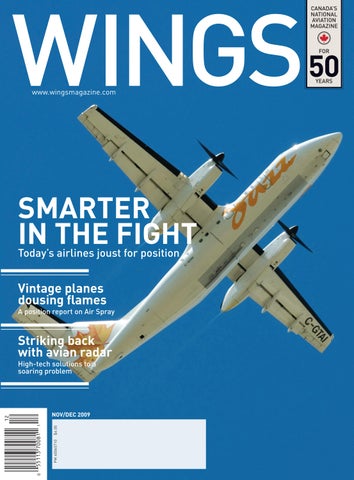
WINGS
canada’s national aviation magazine
50 for
YEARS
www.wingsmagazine.com
SMARTER IN THE FIGHT Today’s airlines joust for position
Vintage planes dousing flames
A position report on Air Spray
Striking back with avian radar High-tech solutions to a soaring problem
PM 40065710 $6.00
PHOTO CREDIT TK
NOV/DEC 2009
www.wingsmagazine.com
WIngs_NovDec09.indd 1
November/December 2009 | Wings
1
10/11/09 1:45 PM
Wings 16,25 x 10,875 - op 2.pdf
1
10/13/09
4:36 PM
C
M
Y
CM
MY
CY
CMY
K
WIngs_NovDec09.indd 2
10/11/09 1:45 PM
The Embraer Phenom 100© is now a reality. With Brazilian ANAC, FAA, EASA certification and entry into service, our new jet has officially arrived. And it’s here to stay. Offering premium comfort _ more headroom than any other in its class. And exceptional legroom. Yet it still takes off from short runways. Travels 1,178nm. And delivers enviable speeds of up to 390 knots. All with low operating costs and the best maintenance plan. The Phenom 100 is the product of a clean-slate design that has produced a truly revolutionary new business jet. One that both keeps and exceeds its promise.
WIngs_NovDec09.indd 3
10/11/09 1:45 PM
WIngs_NovDec09.indd 4
10/11/09 1:45 PM
PV.indd 1
Montreal 1 McGill Street, Suite 804, Montreal, QC P: 514-286-1114 I F: 514-286-1118
Edmonton #212-15202-131 Avenue NW, Edmonton, AB P: 780-482-1188 I F: 780-482-1185
05/11/09 11:48 AM
Toronto 3193 Coldstream Road, Mississauga, ON L5L 5H9 P: 905-997-5101 I F: 905-997-5102
Vancouver #207-17700-#10 Hwy, Surrey, BC P: 604-576-0004 I F: 604-576-0093
05/11/09 11:48 AM
UPFRONT 7
Leading edge Wings’ new fit and finish
10 On the fly
News and opinion
15 Waypoint
It’s time to put 2009 behind us
16 At the gate
A fortress hub at TCCA
18 Alternate approach
Vancouver takes the gold
19 45˚42� North
FS companies bring their magic
The industry strikes back with avian radar. P.48.
20 Position report
Air Spray: Vintage planes dousing flames
BACK 53 Wings on safety
FEATURES
54 A look back
24 The standard for strategic airlift
55 Marketplace 62 On final
28 Smarter in the fight
The ‘hear-back’ error A labour of love
Olympic security yes
From top: A position report on Air Spray. P.20. Change of air command. P.52.
Canada and the C-17 by Philippe Cauchi
Today’s airlines joust for position by david carr
33 Perimeter transports with ease Elevating wheelchair patients by james careless
35 Recruiting the next employee
Airport succession planning by carroll mccormick
38 passenger safety
It’s an issue of corporate culture BY TOM ZEISER
40 Major league excitement in Wisconsin Show report from AirVenture 2009 by Fred Petrie
#212-15202-131 Avenue NW, Edmonton, AB P: 780-482-1188 I F: 780-482-1185
1 McGill Street, Suite 804, Montreal, QC P: 514-286-1114 I F: 514-286-1118
NOV/DEC 2009
44 Keeping Canada competitive
Innovative research at Toronto’s DRDC by MIKE MINNICH
48 Striking back with avian radar
High-tech solutions to a soaring problem by blair watson
52 Change of air command
Canada’s new chief of air staff by peter pigott
PV.indd 1
COVER PHOTO: peter lubig
www.wingsmagazine.com
WIngs_NovDec09.indd 5
November/December 2009 | Wings
5
10/11/09 1:45 PM
COMPETITORS ARE ALREADY FRUSTRATED BY YOUR VISION.
INFURIATE THEM. Make no mistake, in these economic times, there will be winners and there will be losers. And in the zero-sum game of corporate survival, it goes without saying cavalier excess will no longer be tolerated. But neither will conventional thinking. The victors in this economy will be the ones who can keep a clear head and develop a plan to stare down the beast. To that end, we will be here with a full range of aircraft to maximize efficiency and increase productivity. So keep flying in this storm. Eventually, the weak will wither. And the bold will emerge stronger. Your primary mission is to ensure that you are among the latter.
PHOTO: archives
RISE.
May we help you develop your plan? Visit www.wings.cessna.com or call +1.877.410.8650.
CES9003-InfrteAd_8x10.88_Wngs.indd 1 WIngs_NovDec09.indd 6
10/6/09 2:01:26 PM 10/11/09 1:45 PM
LEADING
EDGE
| By Drew McCarthy
Wings’ new fit and finish
Our final tribute to a year of celebration and change
S
PHOTO: archives
ome years really do seem to fly by faster than others. It feels like just yesterday that the Canadian aviation community was preparing for the 100th anniversary of powered flight in Canada. That was 12 months ago. In spite of the economic situation, we were all in a state of excited expectation about the promise of 2009. Wings magazine was firmly committed to celebrating, reporting and supporting all of the stories and events of the year that was to come. We undertook a determined leadership role by initiating a number of important projects. In January, we launched a dedicated “100 Years of Powered Flight in Canada” website that continues to feature articles and events dedicated to our aviation history. We also followed the progress of the AEA 2005 Silver Dart replica project and were there when the first test flights took place on a bitter cold February day in Hamilton, Ont.; and then later in the month, covered the anniversary event in Baddeck, N.S. We introduced a new “100 Years” department in Wings magazine in order to feature some of the stories and upcoming events in our print publication throughout the year. In May, we published a special supplement on the 100th Year anniversary, written by renowned Canadian aviation historian and Wings columnist Peter Pigott, with a special introduction by longstanding Wings writer Raymond Canon. The feedback we received on this project was extremely gratifying. Not only is 2009 the 100th anniversary of powered flight in Canada, but it’s also the 50th anniversary of Wings magazine. Incredibly, Wings has covered, reflected, inspired and sometimes led the cause of aviation in this country for half a century now. We have grown and responded to the
5 www.wingsmagazine.com
times as aviation has evolved at its breakneck pace. I was reminded of the almost unfathomable technological changes in aviation at last summer’s CBAA annual trade show and convention in Montreal. On the last day of the convention, Bombardier
the stage and my eyes fixed on the bamboo and canvas construction of the Silver Dart replica. How incredible – from the first flights of the beautiful but awkward flying machines of the Wright brothers and the AEA, to landing and walking on the moon – in 60 years! There certainly has been a lot to keep up with. Now with most of the anniversary celebrations behind us, we are winding up 2009 with a bang by launching our newlook Wings magazine NextGen design. The process began earlier in the year when our publishing team began working with award-winning magazine designer Janice Van Eck. Our goal in redesigning the magazine was to carefully examine what was working from our readers’ point of view and maintain or improve on it. Anything that seemed to need an overhaul, was overhauled. We relied heavily on all of the feedback that our audience consistently provides. The new Wings magazine is better organized and easier to read than ever before. We have created a fresh look with modern fonts and colours. Each department, column and feature has been revamped to allow us to present our editorial content with more visual impact. Thanks to our new design, we are now able to publish more content per issue without increasing the size of the magazine. We are also expanding our coverage in interesting ways. We will be featuring more articles on Canadian airports, our military and the aerospace industry. We have added two new columns, one by Peter Pigott, who will focus on events and stories in and around the Ottawa area, and one by Brian Dunn, who will now do analysis on the airline industry. Another exciting element is our new guest column page. Starting with this issue, we will be featuring opinion articles written by influential members of the aviation community. There is all this and much more to discover in our new-look Wings magazine. We hope you enjoy it. | W
Wings has covered, reflected, inspired and sometimes led the cause of aviation in this country for half a century now. sponsored a luncheon event with Eugene Cernan as guest speaker. Astronaut Eugene Cernan is the last man to have walked on the moon (Apollo 17) back in 1972. Cernan’s incredibly inspirational presentation had me and everyone else in the room riveted. He showed us photographs, told us stories, and tried to explain the magic of what it was like to have actually walked on the lunar surface. At one point in all of this, I glanced off to the right of
top data bursts… in this issue 1. Olympic security will likely translate into $360,000 per athlete in 2010 (pg. 62). 2. Dornier will do its Seastar final assembly in Canada (pg. 10). 3. Canadian airports are paying nearly $300 million annually in “rent” directly to the federal government (pg.13). 4. Garmin has introduced touchscreen technology for light turbine flightdecks (pg.10). 5. Melatonin will shift the circadian rhythm forward (pg. 44).
Your feedback on our new design or any other issue is always welcome. Please contact me at dmccarthy@annexweb.com. November/December 2009 | Wings
7
01:26 PM WIngs_NovDec09.indd 7
10/11/09 1:45 PM
WINGS
cANAdA’S NATIoNAl AvIATIoN mAGAzINe
50 for
YeArS
www.wingsmagazine.com
new cover to come Editor
Drew McCarthy dmccarthy@annexweb.com 519-429-5192 • 888-599-2228 ext. 265
SMARTER IN THE FIGHT Today’s airlines joust for position
Associate Editor
Vintage planes dousing flames
Andrea Kwasnik akwasnik@annexweb.com 519-429-5181 • 888-599-2228 ext. 238
A position report on Air Spray
Striking back with avian radar High-tech solutions to a soaring problem
PHoTo cReDiT TK
magazine REDESIGN
SubScribe TODAY !
November/December 2009 | wings
www.wingsmagazine.com
Janice Van Eck
1 Year SubScription WIngs_NovDec09.indd 1
06/11/09 11:03 AM
only
Flight Deck
1
3000
$
Ken Armstrong, Roger Beebe, Ray Canon, James Careless, David Carr, Paul Dixon, Brian Dunn, Frederick K. Larkin, Neil MacDonald, Carroll McCormick, Mike Minnich, David Olsen, Peter Pigott, Dr. Tarek Sardana, Rob Seaman, Blair Watson Advertising Sales
Pauline O’Neill poneill@annexweb.com 519-429-5182 • 888-599-2228 ext. 273
(all taxes included)
US $42.00 (USD) • Foreign $65.00 (USD)
Name: _______________________________ Company: ____________________________ Title: _________________________________ Address: _____________________________ City: _________________________________ Prov: ________________________________ P.Code: _______________________________ Tel: __________________________________ Fax: _________________________________ e-mail:________________________________
PLeASe cHecK ONe: ❑ Commercial aircraft owner/operator ❑ Business/private aircraft owner/operator ❑ Military ❑ Aircraft maintenance/overhaul firm ❑ Airport ❑ Aerospace, airframe & component manufacturer and distributor
❑ Fixed base operator ❑ Aviation services, consultants and aircraft sales
❑ Government ❑ Aviation associations and organizations ❑ Flying schools, clubs and colleges ❑ Other (please specify) ______________ PAYMeNT: Cheque - Payable to Annex Publishing Visa
MC
AMEX
Account #: __________________________
Associate Publisher
Alison de Groot adegroot@annexweb.com 1-888-599-2228 ext. 246 Group Publisher
Scott Jamieson sjamieson@annexweb.com President
Mike Fredericks mfredericks@annexweb.com WINGS magazine
PO Box 530, 105 Donly Dr. S., Simcoe, ON N3Y 4N5 Tel.: 428-3471 Fax: 429-3094 Toll Free: 1-888-599-2228 Publication Mail Agreement #40065710 Return undeliverable Canadian addresses to Circulation Dept., P.O. Box 530, simcoe, on n3y 4n5 e-mail: ncuerrier@annexweb.com Published six times per year (Jan/Feb, Mar/Apr, May/ Jun, Jul/Aug, Sep/Oct, Nov/Dec) by Annex Publishing & Printing Inc. Circulation e-mail: ncuerrier@annexweb.com Ph: 866-790-6070 ext. 208 Fax: 877-624-1940 Mail: P.O. Box 530, Simcoe, ON N3Y 4N5
From time to time, we at Wings Magazine make our subscription list available to reputable companies and organizations whose products and services we believe may be of interest to you. If you do not want your name to be made available, contact our circulation department in any of the four ways listed above. No part of the editorial content of this publication may be reprinted without the publisher’s written permission. ©2009 Annex Publishing & Printing Inc. All rights reserved. opinions expressed in this magazine are not necessarily those of the editor or the publisher. No liability is assumed for errors or omissions. All advertising is subject to the publisher’s approval. Such approval does not imply any endorsement of the products or services advertised. Publisher reserves the right to refuse advertising that does not meet the standards of the publication.
Subscription Rates Canada – 1 Year $ 30.00 (includes GST - #867172652RT0001) USA – 1 Year $ 42.00 Foreign – 1 Year $ 65.00
Printed in Canada ISSN 0701-1369
Expiry:_____________________________ Signature: _________________________ Date: _____________________________
TO SubScribe:
Tel: 866-790-6070 Fax: 877-624-1940 Mail: Wings Magazine c/o Annex Publishing & Printing inc. P.O. box 530 Simcoe, Ontario N3Y 4N5 e-mail: ncuerrier@annexweb.com
www.wingsmagazine.com
GST#135274215RT001
8
Subscriptions non-refundable
Wings | November/December 2009
WIngs_NovDec09.indd 8 wings subad.indd 1
PRO1109
Air Transport Association of Canada
ON THE
WEB
Canadian Owners & Pilots Association
Member of the Canadian Circulations Audit Board
Canadian Business Aviation Association
Member of the Alberta Magazine Publishers’ Association
Web exclusive Aviation industry: Which way is up? By Peter Trabucco News highlights, web exclusives, blogs, job postings, new products, events and more www.wingsmagazine.com www.wingsmagazine.com
10/11/09 1:45 PM 06/11/09 11:05 AM
WIngs_NovDec09.indd 9
10/11/09 1:45 PM
ON THE FLY For late-breaking news, the Wings blog and exclusive web content, please visit us at: www.wingsmagazine.com
10 11 12 12 13 14 14
INDUSTRY NEWS PEOPLE COMMERCIAL AIRPORTS OP/ED OPERATORS CORRECTION NOTICE
INDUSTRY NEWS
Dornier Will Do Final Assembly in Canada Since its 2008 introduction at the NBAA, the Dornier Seaplane Co. has continued to build momentum in production, sales and product configuration definition. The company announced last month that the final assembly site selection for the Seastar aircraft has been narrowed to St-Jean-sur-Richelieu, Que. or North Bay, Ont. Winter flight operations will be based in Punta Gorda, Fla. After an extensive analysis of numerous sites in North America and subject to final governmental reviews, Dornier selected these two cities based on the availability of the local talent pool; the low cost of real estate and infrastructure; the strong local aviation supply chain, including Pratt & Whitney, which produces the Seastar engines; and the proximity of nearby lakes with their uncongested airspace for flight test activity. The final site decision will come in January.
Conrado Dornier, chairman of the Dornier Seaplane Co., said, “I am very pleased that we will continue to build on the 100year legacy of the Dornier family of aircraft in Canada. These sites are a natural market fit for our amphibious seaplane.” According to CEO Joe Walker, the supplier selection process will be completed over the next 12 months and deliveries will begin in 24 months. The FAA and EASA certified demonstrator Seastar aircraft has been upgraded to a 10-seat luxury interior with a new exterior paint scheme. It was on static display at the Orlando Executive Airport at this year’s NBAA annual meeting and convention.
Garmin introduces G3000 Garmin International Inc. has announced the Garmin G3000, the first touchscreencontrolled integrated flightdeck for light turbine aircraft. The G3000 is designed specifically for Part 23 turbine aircraft. The G3000 incorporates the all-new GTC 570-vehicle management system, a 5.7-inch diagonal touchscreen controller that uses a desktop-like menu interface with intuitive icons. The console-mounted GTC 570 allows for full control for radio management, audio management, flight management, weather systems management, synoptics and other vehicle systems.
The G3000 touchscreen has common sense functions like “back” and “home” that let pilots quickly retrace their steps or return to the home screen.
The simple user interface eliminates buttons, switches, and extraneous knobs. The touchscreen also enhances ease of use through common sense functions like “back” and “home” that let pilots quickly retrace their steps or return to the home screen. The primary flight displays (PFD) and multi-function display (MFD) are 14.1inch diagonal WXGA high-resolution wide aspect ratio displays. The large landscape oriented displays make it possible to have an enhanced view of Synthetic Vision Technology (SVT) that displays threedimensional terrain, obstacles, pathways, and traffic. Situational awareness is enhanced further with a large inset map, and an extended horizon line. The G3000’s large MFD also has splitscreen capability so that two separate vertical pages may be viewed side-by-side. Pilots may simultaneously view maps, charts, TAWS, flight planning, weather or video input pages. In addition, aircraft synoptics can be graphically depicted on the MFD to help simplify monitoring and speed troubleshooting. Garmin expects to receive G3000 Technical Standard Orders (TSO) certification in the second half of 2011.
Embraer launches Legacy 650 at NBAA 2009 Final assembly for the Dornier Seastar aircraft will be in Quebec or Ontario. 10 Wings | November/December 2009
WIngs_NovDec09.indd 10
Embraer presented the new Legacy 650 jet at a press conference at the 62nd annual meeting and convention of the NBAA www.wingsmagazine.com
10/11/09 1:45 PM
in Orlando, Fla. The large executive jet category Legacy 650 is based on the successful platform of the super midsize Legacy 600 and will provide longer range for up to 14 passengers. Currently, two Legacy 650s are performing flight tests, with certification and first deliveries scheduled for the second half of 2010. The Legacy 650 development costs are already included in the Company’s research and development plan for 2009 and 2010. The Legacy 650 will fly up to 3,900 nautical miles (7,223 km) nonstop with four passengers, or 3,800 nautical miles (7,038 km) with eight passengers, meaning approximately 500 nautical miles (926 km) farther than the Legacy 600. This significant increase in range was accomplished through extensive airframe modifications, such as reinforced wing and landing gear, larger fuel capacity, and new highly efficient and more powerful Rolls-Royce AE 3007A2 engines. Important city pairings now possible for this large business jet are London to New York; Dubai to London or Singapore; Miami to São Paulo; Singapore to Sydney; or Mumbai to central Europe.
Hartzell LargerDiameter Top Prop Conversions for Cessna 206 A new Cessna 206 Top Prop 3-blade propeller kit is now available from Hartzell Propeller Inc., allowing many owners to
The STC adds 82-, 84- and 86-diameter options to conversion kits already available from Hartzell for the 206.
undertake a performance-upgrade of their 206. The STC covers most normally aspirated floatplanes and landplanes manufactured from 1964 through to 1977, as well as most Turbo 206 floatplanes delivered between 1964 to 1973. The STC adds 82-, 84- and 86-diameter options to conversion kits already available from Hartzell for the 206. A warranty of 1000 hours/three years is also provided on the new offering. This new development in propeller engineering is applicable to more than 1500 users. The 206 is often described by Cessna as the, “sport-utility vehicle of the air.” The plane’s powerful engine, rugged construction and large cabin have made it popular with bush and remote area operators, both commercial and private. The aircraft is often used in some of the world’s harshest environments. Hartzell’s senior vice-president, marketing and customer services, Mike Disbrow, said: “In developing the 206 kit we are responding to commercial and private customer demand for the ultimate in takeoff performance thrust, reliability, ease of maintenance and field service. Essentially,
bush and other remote area operators were looking for the ultimate propeller package.”
PEOPLE
Heather Sifton Receives Inaugural Elsie MacGill Northern Lights Award On Oct.1, the Ninety Nines, International Organization of Women Pilots, presented Heather Sifton with the inaugural Elsie MacGill Northern Lights Award at a dinner held in her honour. The award stands to honour Canadian women who have contributed significantly to any facet of aviation in this country. The Sifton family has owned and operated the Toronto Buttonville Municipal Airport (CYKZ), a long established and respected service provider to the general, business and training aviation markets, since its inception.
Currently, two Legacy 650s are performing flight tests, with certification and first deliveries scheduled for the second half of 2010. www.wingsmagazine.com
WIngs_NovDec09.indd 11
November/December 2009 | Wings
11
10/11/09 1:45 PM
ON THE
FLY
Heather Sifton was a licensed and respected pilot and has been a leader in the Canadian aviation community. In the years since Buttonville was first established, Heather has maintained an important role in all aspects of the development and growth of the airport and its related operations. In addition to her business acumen, Heather has been a positive influence and role model for many aviation students – women in particular. Joined by members of her family, local aviation and political dignitaries and members of the Ninety Nines, in accepting the honour, Heather commented, “This is a special evening for me and the Sifton family as a whole. I want to thank you for such a tribute. To be surrounded by peers and friends and be honoured by you, makes for yet another truly good memory from all the years we have been involved in the aviation community.”
Porter’s Ottawa lounge is the first located outside of the airline’s main hub at Toronto City Centre Airport.
sleeves and working with the Operations team,” commented Saretsky. “WestJet runs a world-class organization, and I am proud to have the opportunity to lead such a dynamic and enterprising group. The men and women of the Operations team truly demonstrate the caring and can-do attitude of WestJet.”
COMMERCIAL
Canada; Air Canada Top Tier members will have the ability to access Star Alliance Gold and Silver benefits through Continental, including lounge and priority services; and Continental One Pass Elite members will have the ability to access Star Alliance Gold and Silver benefits through Air Canada, including lounge and priority services.
AIRPORTS
Air Canada Welcomes Continental to Star Lounge Around in Ottawa With Alliance Porter Air Canada has welcomed Continental Heather Sifton (second from left) has maintained an important role in all aspects of the Buttonville airport since its inception. Pictured, from left, are Michael Sifton, Anna Pagrazzi and Derek Sifton.
Gregg Saretsky New Executive VP, WestJet WestJet Airlines has announced the appointment of Gregg Saretsky (right) to the position of executive vice-president, operations. Saretsky began his airline career with Canadian Airlines in 1986, where he spent 12 years in a variety of operational and marketing roles. Prior to WestJet, Gregg was with Alaska Airlines for nine years, most recently as executive vice-president, Flight and Marketing. “I am looking forward to rolling up my 12 Wings | November/December 2009
WIngs_NovDec09.indd 12
Airlines as it joins Star Alliance. Air Canada customers will now have access to expanded travel options including codeshare flights to new destinations through Continental’s hubs and network. Said Calin Rovinescu, president and chief executive of Air Canada, “For Air Canada customers, Continental’s Newark and Cleveland hubs will create more options for travelling to the Eastern U.S. while its Houston hub will open new routes further south throughout Mexico and Central America.” Effective immediately, the two airlines have a full reciprocal agreement in place for each other’s frequent flyer program. As a result: Aeroplan members will have the ability to earn and redeem miles on Continental; Continental One Pass members will be able to earn and redeem miles on Air
Porter Airlines is announcing the opening of its dedicated lounge in Ottawa International Airport. All passengers have complimentary access to the airline’s comfortable, modern and stylish lounge, the first located outside of the airline’s main hub at Toronto City Centre Airport. Features and furnishings emulate the existing Toronto lounge, including comfortable seating, computer workstations, Wi-Fi access, a meeting room and business centre as well as snacks, cold beverages and espresso. From the lounge, it’s only a few steps to board Porter’s Canadian-built Bombardier Q400 aircraft featuring leather seats and extra legroom. “We are very pleased that Porter chose Ottawa for the first lounge away from its home base, and we know that clients will enjoy an end-to-end Porter experience when their travels take them to Toronto,” said Paul Benoit, Ottawa Airport Authority President and CEO. www.wingsmagazine.com
10/11/09 1:45 PM
OP/ED
Airports Present Airport Rent Business Case By Jim Facette As stimulus money started going out to various infrastructure projects around the country, very little of it went to airports. A new study commissioned by the Canadian Airports Council shows that just a little fiscal attention to the aviation sector could have a pretty dramatic economic impact. Canada’s aviation infrastructure is largely self-funded. The vast majority of the $9.5 billion in new airport infrastructure invested over the past 15 years was funded through airport improvement fees levied on passengers. At the same time, nearly $300 million in “rent” is being paid by airports each year directly to the federal government. This tax, on top of other fiscal policies unique to Canada, makes aviation in Canada more expensive than elsewhere. For quite some time, the CAC has lobbied for its elimination. Nearly $300 million a year is a substantial amount of money for the federal government to give up. The government would have to be sure that the money would be well spent. A recent study commissioned from independent consulting firm InterVistas shows the spin-off economic impact could be significant. Using 2007 data – the most recent year for which all the relevant data is available – InterVistas took a look at what would have happened should rent have been eliminated. The study concluded that the stimulus in additional travel from lower costs would result in just under 600,000 new passengers – including 125,000 to/from the United States and 106,000 to/from overseas. The additional tourism spending was estimated at $304 million. All this extra tourism spending represents an estimated 5,550 jobs earning $210 million in wages and total economic impact of $720 million. This clearly would go a long way to improving Canada’s battered tourism sector. According to the Canadian Tourism Commission, Canada’s international travel deficit reached $12.6 billion in 2008 – that’s a 26 per cent increase over the previous year and a new record. So the tourism sector could use a boost. Eliminating airport rent would cut nearly $300 million in tax revenue; however, the study shows that this would be partially offset by $50 million in new taxes from the increased business activity and employment. As we wrote in our pre-budget consultation submission to the House of Commons Standing Committee on Finance, when combined with the tremendous economic spin-offs from the elimination of rent outlined above, we contend eliminating rent would be a valuable direct investment in Canada’s aviation and tourism sectors. Jim Facette is president and CEO of the Canadian Airports Council (CAC). The CAC is the voice of 45 members that include 180 Canadian airports, including all major airports and most regional airports. www.wingsmagazine.com
WIngs_NovDec09.indd 13
November/December 2009 | Wings 13
10/11/09 1:45 PM
ON THE
FLY
WAA Takes Off With Two Million Construction Hours The redevelopment of Winnipeg James Armstrong Richardson International Airport has passed two million construction hours, with approximately 500 workers now employed throughout the site on a daily basis. Airport Redevelopment is forecast to contribute 6,370 person-years of employment to the local market, including $273 million in wages. Gross domestic product is projected at $343 million with total economic output for Manitoba at more than $1 billion. Major construction initiatives over the past five years have included a new four-level covered parkade, new air terminal building, additional aircraft apron, roadways and improvements to existing infrastructure. The entire program is more than two-thirds complete, with construction of the new terminal on target to be finalized in 2010.
OPERATORS
NL Government Purchases Bombardier 415 Amphibs
modifications, spare parts provisioning, training and technical support. Deliveries of the aircraft will begin during the second quarter of 2010 and will continue through 2011. The province’s Department of Transportation and Works operates six CL-215 aircraft. With this order, a portion of its aging fleet will be replaced with four of the world’s most efficient fire fighting machines: the Bombardier 415 aircraft. “Our agreement with Bombardier for the purchase of new Bombardier 415 waterbomber aircraft will allow us to replace some of the aging aircraft in our existing fleet with state-of-the-art, modern aircraft that will enhance our forest fire suppression capabilities,” said the Hon. Tom Marshall, acting minister of transportation and works for the government of Newfoundland and Labrador.
The Bombardier 415 firefighter aircraft has a maximum speed of 224 mph (359 km/h) under certain conditions. In an average mission of six nautical miles (11 kilometres) distance from water to fire, it can complete nine drops within an hour and deliver 14,589 US gallons (55,233 litres) of fire suppressant. | W
CORRECTION NOTICE In the July/August 2009 issue of Wings magazine, we published a news article on page 6 entitled, “Standard Aero poised to fly with the big boys.” In it, we identified CFM56-7 engines as being produced by General Electric (GE). In fact, the CFM 56 is a product of CFM International, a joint venture (50/50) between GE and Snecma (SAFRAN Group). We apologize for this regrettable mistake.
PHOTO: CHRIS VIKA
The government of Newfoundland and Labrador has purchased four Bombardier 415 amphibious aircraft to replace part of its aging aerial firefighting fleet. Based on the list price, the contract with Bombardier is valued at about US$120 million and includes aircraft
In an average mission, the Bombardier 415 can complete nine drops an hour and deliver 55,233 litres of fire suppressant.
14 Wings | November/December 2009
WIngs_NovDec09.indd 14
www.wingsmagazine.com
10/11/09 1:45 PM
WAYPOINT | By Rob Seaman
It’s time to put 2009 behind us All the bad aside, there is light on the horizon
PHOTO: CHRIS VIKA
F
or many, the end of 2009 cannot come soon enough. Let’s face it, this year should go on record as one of the worst periods in aviation. In a year when we celebrated the 100th Anniversary of Powered Flight in Canada and many other great achievements, 2009 saw more downs than ups. Many friends and colleagues lost jobs. It was tough for employers and employees alike, and corporate HR assets that could take years to replenish are gone. All the bad aside, there is a light on the horizon. In his most recent review of the market, Bob Rockwood of Bristol Associates states that September ’09 aircraft sales look to be 95 jets traded wholesale to retail. This number does not include fractional sales. It doesn’t compare favourably to the 150 per month back in 2007 but it does represent an upward trend from the 75 per month reported earlier this year. While some guess that prices will start to rise again, Rockwood says not to expect a 20 per cent increase in the next 60 days. But, if you are buying an airplane, or planning to, hurry up. Many feel that prices will start trending up soon and the best deals may be here today. According to Forecast International, one of the leading crystal ball gazers in the industry, the turbine engine market should remain stagnant through 2012, and then rebound in 2013 despite the credit crisis and resulting slowdown in the world economy. The total world turbofan engine market is projected to generate US$292 billion in revenue from 2009 to 2018 through the production of 66,273 engines; this covers both commercial airliners and corporate jets. Forecast International also states that in spite of cancellations and deferrals, the industry is still creating new designs for the market reversal. Pratt & Whitney Canada, Rolls-Royce, Honeywell and Williams are all involved in engine development programs to power new jets. Forecast estimates that US$1.7 billion will be spent between 2009 and 2018 on upgrades for fixed-wing aircraft weighing less than 70,000 pounds. According to its recent release: “With the new generation of very light aircraft entering the market – with some as cheap as $1.5 million – retrofitting is losing its cost advantage. www.wingsmagazine.com
WIngs_NovDec09.indd 15
FAA mandate can lead to a dramatic increase in activity. For example, TAWS and RVSM compliance revitalized the electronics aftermarket recently. Indicators are that the light aircraft retrofit market should not weaken over the next 10 years, though a number of unpredictable factors will be of major influence. During the tough months, the commercial route may have been tried but it still does not outweigh the benefits of the corporate jets. Looking at FBO ramps, the numbers are on the up side. Lower fuel prices are helping many justify the use of business aircraft again. Also, many Canadian charter operators are reporting that business has returned to levels from last year or before. Taking all these as positive signs, there appears to be life after the theoretical crash – no pun intended. As for what lies next, our industry could still be influenced by a pickup or slowdown in the recovery. Then there are seasonal factors. And let’s not forget the predictions for an H1N1 influenza pandemic (the memory of SARS is still fresh in many minds). Looking farther downstream, we still need to address the predicted shortage of trained flight crew – the ranks of new student pilots remain on the soft side as retirement looms for those in place now. It would seem that the glamour of flying an airplane to today’s young people does not outweigh the economic reality of starting salaries, as many flight training programs are reporting reduced student numbers. But that, as they say, is another issue that we will deal with on another day. In the meantime, let the New Year ring in – please! | W
The commercial route may have been tried but it still does not outweigh the benefits of the corporate jets. However, private operators are often more interested in maximizing their investment through performance upgrades than in focusing on efficiency. Comfort can also be a priority, one that is rarely affordable in other markets.” Adam Feld, an airborne R&M (retrofit and modernization) analyst with the company, states that “a private individual or corporation may have an easier time getting new engines funded, and smaller fleets with cheaper engines can make the price easier to manage – even with a comparably smaller budget.” On the avionics side, some of the more appealing electronic retrofits, such as WAAS, are relatively affordable. Transport Canada and the FAA, along with other aircraft associations, have a lot of influence on the light aircraft retrofit market. A TC/
Rob Seaman is a Wings writer and columnist. November/December 2009 | Wings 15
10/11/09 1:45 PM
at the
gate
By Brian Dunn |
A fortress hub at TCCA Will Porter Airlines’ hub-and-spoke model last?
W
16 Wings | November/December 2009
WIngs_NovDec09.indd 16
At the same time, the analyst suggested Air Canada could get more aggressive in its pricing to maintain its share of those U.S. markets that Porter has recently entered and plans to enter. “Porter still has a good niche business, which appeals to certain travellers on their nonstop routes by offering good service, good seat pitch and downtown airport location.” Another point of view is offered by Douglas Reid, a professor at Queen’s University School of Business specializing in the airline industry, who suggested Porter may not want to build another hub. “The problem with a second hub is that it entails a huge cost escalation and, let’s face it, Porter is a Toronto airline. And the fun part of TCCA is the lounge experience which makes people go ‘Wow’ when they see it. That would be hard to duplicate at other airports.” Reid believes Porter’s priority is to get all the slots it can at TCCA (which are limited under the tripartite agreement that controls the area) to make it a fortress hub and prevent Air Canada from moving in. “They also need to increase their load factors, which are slightly under 50 per cent by my calculations, even though they claim they’re profitable.” | W
“I think they realize that people flying from Montreal to Toronto aren’t necessarily going on to Boston or Newark.” the savings on Porter is only about $100 return and you’re still spending four hours travel time each way. “There’s no doubt, they’ll have to have more centres (like TCCA), because people just won’t put up with having to go through Toronto,” said one industry analyst who requested anonymity. “If I’m in Montreal, I’m not taking Porter to Boston or Newark, unless it’s the only flight available.” The analyst suggested Porter’s hands are tied due to its small fleet, but said the airline will probably add more centres as it adds more aircraft. The hub-and-spoke model puts Porter at a real disadvantage, because flying is more about convenience than price, according to another industry analyst who spoke off the record. “Porter can be competitive flying from point A to B, but not from A to C via B,” said the analyst. “But I think they know what’s going on and they’re realistic that there’s a certain segment of the market they won’t attract with their current model. I think they realize that people flying from Montreal to Toronto aren’t necessarily going on to Boston or Newark.”
Brian Dunn is a Wings writer and columnist.
PHOTO: ANDREW CLINE
ith Porter Airlines recently celebrating its third anniversary, it might be an idea to take a closer look at its hub-and-spoke model to see if it continues to make sense. When Porter began operations in October 2006 out of Toronto Island Airport, or Toronto City Centre Airport (TCCA), as it’s now officially called, it was a pretty straightforward business model, namely flights between TCCA and Ottawa. Then Montreal was added. Later came seasonal service between TCCA and Halifax via Ottawa, with Quebec City being added, along with year-round service to New York Newark, Thunder Bay, Chicago and Boston. The only problem is that all flights must pass through TCCA. So if somebody wants to fly from Montreal or Ottawa to Chicago, the flight stops at TCCA. Not a major inconvenience, since TCCA is geographically on the way to Chicago. But to fly from Montreal or Ottawa to Newark or Boston via Toronto? Not exactly on the way. More like out of the way. Why then, would anybody want to fly Porter from Montreal or Ottawa to Newark or Boston via Toronto instead of a direct flight on Air Canada or an American carrier? “Because people still prefer Porter’s service (including free beer and wine onboard) to other airlines and our proximity to downtown Toronto,” explained Porter spokesperson Brad Cicero who added the hub-and-spoke model won’t be changed anytime soon. That could be a mistake, according to several industry watchers. “Unless they offer me a real discount, which would hurt their profitability, I’m not interested in spending all that time getting there,” said Karl Moore, a management professor at McGill University. “Plus I would have to clear U.S. Customs in Toronto, because it would be a domestic flight (between Montreal and Toronto), whereas I would prefer to clear Customs in Montreal and not worry about getting to my destination late.” There are considerable savings on Porter versus other airlines if you book last minute and you’re prepared to spend four hours getting from Montreal to Newark via Toronto versus a little over an hour on Air Canada, for example. But if you book in advance on Air Canada,
www.wingsmagazine.com
10/11/09 1:45 PM
Aerial Aerial Firefighting Firefighting Conference International & Exhibition Conference & Exhibition Canada Sheraton Vancouver Airport Hotel Vancouver, BC, Canada
Europe NOVEMBER 2010
PHOTO: ANDREW CLINE
16-17 MARCH 2010
16 -17 MARCH
2010
WIngs_NovDec09.indd 17
www.tangentlink.com Connecting Business
NOVEMBER
2010
10/11/09 1:45 PM
ALTERNATE
APPROACH By David Carr |
Vancouver takes the gold
After years of phantom trains, Canada’s first air-rail link leaves the station
M
18 Wings | November/December 2009
WIngs_NovDec09.indd 18
Paris Charles de Gaulle and Frankfurt airports. It is expected that $300 billion will be spent on high-speed rail projects over the next five years. There is currently nothing slated for Canada (which recently announced a $300-million upgrade on Via Rail’s Toronto–Montreal corridor), but for how long? President Obama has already announced an $8-billion stimulus for high-speed and intercity rail projects. Airlines will naturally object to the hefty public price tag for high-speed projects built to draw passengers, especially on the Quebec–Windsor corridor. A high-speed train linking Calgary and Edmonton will cost between $3 billion and $20 billion, and will draw six million passengers by 2021. Still, the ground is shifting. Air transport is expected to grow five per cent a year between now and 2050, making a 50 per cent reduction in its carbon footprint more difficult. Partnering with airports on more ambitious fly-rail systems should ease the pressure and reduce winglock at the most congested hubs. As Daniel Patrick Moynihan, the late U.S. Senator for New York, once said, “we can build more airplanes and we can even build more airports. But try as we might we cannot build more airspace.” | W
Pearson airport (another SNC-Lavalin project formerly known as Blue 22) is still in development and will not be available commercially until 2015 at the earliest. It wasn’t supposed to be this way. The federal government considered a $25-million rail link between downtown Montreal, Dorval (since renamed Trudeau) and the future Mirabel airport as early as 1973. A train could not have rescued Mirabel. Nothing could. But a link to Dorval would have put Canada on the right track. Montreal is expected to map out an airport rail corridor by year’s end, although it is not clear whether the link will be a $3-billion light rail expansion of the Metro subway station, or a spur line out of Via Rail’s nearby Dorval Station. A plan to build a main line rail link to Trudeau as part of Via Fast, a $2.6 billion overhaul of the Quebec-Windsor corridor, was derailed in 2002. Like the Pearson link, trains on a potential Montreal air-rail line will not pull out of the station for at least five years. Calgary, Edmonton and Ottawa are also considering light rail links to their airports. The Holy Grail for air-rail service is to tie the airport into a broader highspeed intercity network similar to the
David Carr is a Wings writer and columnist. www.wingsmagazine.com
10/11/09 1:45 PM
PHOTOs: courtesy of marivent
The Holy Grail for air-rail service is to tie the airport into a broader high-speed intercity network
PHOTO: PAUL DIXON
onths early and at least 30 years too late, Canada has its first airport-rail link. In September, the turnstiles began clicking on Vancouver’s Canada Line – a $2-billion, 19-kilometre expansion of the city’s elevated rapid transit system. Built for the 2010 Winter Olympics and opened three months ahead of schedule, the Canada Line is expected to transport 100,000 passengers a day, although not all will be travelling to and from the airport on the 16-station line. Also in September, the international airline industry committed to work with aircraft companies and airports to make industry growth carbon-neutral by 2020 and slash emissions in half by 2050. The pledge is a pre-emptive strike ahead of Kyoto II, a global warming summit in Copenhagen in December – where aviation is expected to come under attack from environmentalists – and an attempt to head off a $10-billion tax on international flights to help developing countries fight climate change. Aviation accounts for almost three per cent of carbon dioxide (CO2) emissions, a figure that fails to account for the majority of passengers who drive to the airport. Only three per cent of passengers using Montreal’s Trudeau airport travel on public transport. In comparison, approximately 40 per cent of passengers using London’s Heathrow Airport connect by public transport, including the Heathrow Express dedicated rail line, which is estimated to pull 3,000 vehicles off the road. The Canada Line is a commuter rather than a dedicated air-rail service, although it is operated independent of Vancouver’s SkyTrain by Montreal-based SNC-Lavalin, using 20 two-car automated train sets specifically designed to handle the airport passenger. At maximum capacity, the Canada Line is expected to carry the equivalent of 10 vehicle lanes and cut greenhouse gas emissions by up to 14,000 tonnes annually. There are more than 70 airport-rail links operating worldwide and another 140-plus projects either in development or on the drawing board. After a number of false starts, Vancouver has won gold for Canada, but silver could still be at least six years away. The clean diesel train technology required for a rail link to Toronto’s
45˚42�
north | By Peter Pigott
FS companies bring their magic The transformation of Ottawa’s Carp Airport
PHOTOs: courtesy of marivent
PHOTO: PAUL DIXON
O
n the western edge of Ottawa, Carp Airport (ICAO identifier CYRP) owes its origins to the Commonwealth Air Training Plan. Postwar, it wilted in the shadow of its glamorous cousins – Uplands is the capital’s commercial aviation hub, Rockliffe Airport has the Canada Aviation Museum and Gatineau Airport houses the superb Vintage Wings collection. The City of Ottawa inherited Carp Airport in the amalgamation but did not know quite what to do with it. The airport’s potential as an airpark and residential fly-in community was recognized by Western Capital Development, which tore down old buildings and put in sewage and water facilities. But Carp’s Cinderella transformation took place on Oct. 15, 2009, when, as part of the Flight Test Centre of Excellence (FTCE), the Aerospace Flight Test Training Centre (AFTTC) was opened – the magic wand was waved by flight simulation companies Gladstone Aerospace and Marivent Corp. Said Ian G. McIntyre, vice-president of Gladstone Aerospace: “We’ve both been trying to get the capability for flight test evaluation training in Canada – as everybody has to go offshore to do that right now. We knew the market for test pilots was not being satisfied.” A year ago, the Aeronautical Test Establishment at Cold Lake put out a Request for Proposal (RFP) to offer two short courses, an introduction to fixed-wing flight testing and evaluation, and an avionics flight test and evaluation. “We have a relationship with the Empire Test Pilots’ School (ETPS) in the U.K. – as does John Maris, president of Marivent,” continued McIntyre. “Well, as soon as we saw the RFP, we realized that this was the opportunity to collaborate with them – to bring their courses over here. Marivent has the Flight Test Centre of Excellence, which has the capability for doing testing and evaluation, and we wanted to get into applied research on testing and evaluation. So with Marivent, Canadian Marconi, the National Research Council and Carleton University, we set about to bring the ETPS content here and meet the requirements for the RFP. We won both contracts and begin delivering the two-week courses on Oct. 19 and Nov. 2.” www.wingsmagazine.com
WIngs_NovDec09.indd 19
chosen, McIntyre explained, “Carp has had a resurgence. Besides Western Capital Development, Nav Canada has a nav aid facility out there and there’s also a helicopter company. What we want to do is formalize the airport’s regeneration. We were looking at the bigger picture – not just two courses but that this was going to be a new capability for Canada. The FTCE’s three pillars are an aerospace flight test centre, Marivent’s Piaggio Avanti flight simulator at Ottawa’s Carp Airport. a flight test and evaluation centre and applied research. How do you leverage that? We looked at Uplands – too full. We looked at Gatineau Airport – a well-run airport. But we started thinking of the bigger picture. On the west side of Ottawa are a number of aerospace companies – like LockheedMartin and Thales – and Carp Airport is only 12 minutes away from where most are located. We thought that at Carp we could create an aerospace ‘cluster’ in the west end of Ottawa. As to bringing jobs into the local area, as we begin to grow, there’s a good 40 to 50 jobs from ourselves alone – to say nothing of other aerospace compaJohn Maris and Keith Gladstone (the nies attracted to the cluster.” At present the FTCE uses the classroom president of Gladstone Aerospace) were both test pilots, with Gladstone graduating and hangar built by Western Capital from the prestigious ETPS. Here is a facil- Development, intending to construct its ity almost as old as aviation itself. In 1915, own with the objective of creating a “one concerned at the high number of fatalities stop shopping facility.” The two aircraft caused by new, untested aircraft, the Brit- presently used are Marivent’s Piaggio ish Ministry of Defence set up an experi- Avanti and the Cheyenne but the hope is mental flight at the Central Flying School, to eventually run the courses with helicopUpavon. From it evolved the present Em- ters. While the FTCE’s present customers pire Test Pilots’ School now at Boscombe are the Canadian military, McIntyre preDown, considered today to be the Oxford dicted that the larger market was going to University of test pilot schools. The ETPS be foreign military. For Carp Airport, one motto is “Learn to Test - Test to Learn.” can only say: Carpe diem. | W That Ottawa is getting a flight test training Peter Pigott is a Wings writer and facility with its stamp is considerable. When asked why Carp Airport was columnist.
“ The FTCE’s three pillars are an aerospace flight test centre, a flight test and evaluation centre and applied research.”
November/December 2009 | Wings 19
10/11/09 1:45 PM
POSITION
REPORT
Air Spray’s current fleet includes seven Electras, eight Turbo Commanders, three Cessna 310s and two Aerostars.
VINTAGE PLANES DOUSING FLAMES |
I
A war that never ends
f there is one aviation activity that defines a niche business it has to be aerial firefighting. It requires customized singlepurpose, high-performance aircraft, presents skill-testing flight profiles and provides everchanging theatres of operation. As well, it has an extremely limited customer base and produces relatively low annual asset utilization rates due to its seasonality. Despite those characteristics, it is a livelihood that has attracted and challenged entrepreneurs for decades. The North American airborne fire suppression industry came of age in the mid-1950s when suitable aircraft became obtainable. Former military 20 Wings | November/December 2009
WIngs_NovDec09.indd 20
transports and bombers, such as the Consolidated Catalina/ Canso, Douglas Skymaster, and Grumman Avenger were modified with tanks to hold water or fire retardant. The second generation of air tankers included 1950s vintage piston aircraft such as the Lockheed Neptune, Grumman Tracker, Douglas DC-6s and DC-7s. In later years, turbine aircraft became active with the availability of Lockheed C-130 Hercules and P-3 Orions. Canadian companies such as The Flying Fireman of Sidney, B.C., Avalon Aviation of Red Deer, Alta., Canspec Air Transport of Calgary, Alta., and North Canada Air of Prince Albert, Sask., have long since ceased to exist. Today, five
By Frederick K. Larkin provincial governments and a handful of private operators continue to use fixed-wing aircraft to fight an enemy that perennially regroups – wildfire. One of these companies is Air Spray (1967) Ltd. of Edmonton, Alta. Having been around for more than four decades, it is a survivor in an industry that has seen many a player burn out. Can it withstand the heat of competition and soldier on? To answer that we must first review how it got to where it is today.
That was then…
In February 1954, 27-year-old David Harrington created Airspray Ltd. in Wetaskiwin, Alta. The company provided crop dusting services with light
aircraft including a Champion 7GCA Sky-Trac and a Piper PA18A Super Cub. In July 1961, Airspray was awarded its first fire suppression contract from the Province of Alberta. Its expanded fleet now included a trio of Grumman TBM Avengers and a pair of Boeing Stearman biplanes. In 1967 Harrington renamed the company Mercury Flights Ltd., but later that year it became Air Spray (1967) Ltd. In 1969, Dave Harrington acquired a 1945 Douglas B-26 Invader located in Richmond, B.C. After having it converted into a water bomber at Prescott, Ariz., it was ready for service in the spring of 1970. In need of working capital, Harrington approached Edmonton businessman Donald T. Hamilton.
PHOTO: Marcel Keays
A position report on Air Spray
www.wingsmagazine.com
10/11/09 1:45 PM
PHOTO: Marcel Keays
Given that Air Spray had a contract with the Alberta Forest Service, Hamilton agreed to purchase a 50 per cent interest in the B-26 for $5,000. A few years later Hamilton became the company’s sole owner and continued to grow the enterprise. Later in 1970, Air Spray was awarded a three-year contract from Alberta to operate a pair of Invaders. In 1973 it began working for the Yukon Territory’s government with another pair of B-26s. The following year, Air Spray moved its operations base from the Edmonton Industrial Airport to the Red Deer Regional Airport in Penhold, Alta., where it had room to expand. During the 1970s and 1980s, Air Spray provided aerial firefighting services to the governments of Alberta, British Columbia and the Yukon. The speedy B-26 was the company’s weapon of choice. Air Spray acquired an average of one Invader per year and owned 17 of them by the summer of 1988. In 1990, after Air Spray had served the Yukon for 17 years, that contract was awarded to Conair Aviation of Abbotsford, B.C. During the 1990s, the fleet of large piston-powered air tankers in the United States began to be supplemented by turbine-driven machines. The Lockheed P-3 Orion, a fourengine turboprop, caught the eye of Don Hamilton. Aero Union of Chico, Calif., had converted a number of former U.S. Navy P-3s into air tankers and they were demonstrating attractive operational characteristics. The P-3’s civilian sibling was the Lockheed L-188 Electra, a 66-88 seat airliner. Like the P-3, the L-188 can carry 3,000 US gallons of retardant, cruise en route to its target at 380 miles per hour and perform with the required agility at the drop zone. Air Spray initiated Electra ops for the Province of B.C. in 1994 and did so for Alberta a year later. As the larger turbine aircraft met its performance expectations, the customers expressed their preference. The result was the retirement of the B-26 fleet at the end of the fire season in 2004. www.wingsmagazine.com
WIngs_NovDec09.indd 21
Over the years Air Spray owned 22 Invaders. Despite three being destroyed in a hangar fire at Red Deer on Oct. 16, 2000, and five being written off in action, the aircraft served the company well for 35 years. In the meantime, from 1988 until 2001, Air Spray operated four Canadair CL-215 amphibians owned by the Alberta government. As well, from 1999 until 2008, the company operated a trio of its own CL-215s for Alberta. Conair was awarded the management contract for the four 215s in 2001 and Air Spray sold its three Canadairs early this past summer. In addition to its fleet of air tankers, Air Spray has operated numerous bird dog aircraft in support of its water bombing activities. During the past 40 years the company’s bird dogs have been primarily Cessna 310s, Ted Smith Aerostars and Rockwell 690 Turbo Commanders. It has also used a Cessna 500 Citation in the bird dog role during the past 10 years. Earlier this decade, Air Spray operated a former military fighter to pursue revenues in a totally unrelated market – aerial target towing. The jet, a 1958 Canadair F-86E Mk.6 Sabre, sported the company’s bright yellow livery and served the Canadian Forces at Cold Lake, Alta. It was exported to the U.S. in February 2007 after Top Aces of Pointe-Claire, Que., was awarded the contract.
This is now…
During the first several years of this decade, Air Spray had a fleet that totalled 35 aircraft composed of air tankers, bird dogs and the Sabre. With the retirement of the Invaders and the sale of the CL-215s and the F-86, the operational fleet is down to 20 aircraft. It now includes seven Electras, eight Turbo Commanders, three Cessna 310s and two Aerostars. In addition to the latter two types, the company has six remaining B-26s for sale. Aerial firefighting is truly a specialized craft. The mission is to contain, if not extinguish, wildfires that have been created either by lightning or human activity. Two types of aircraft are
involved – the lead aircraft (bird dog) and the air tanker (water bomber). The lead aircraft locates the fire then determines the optimal flight path and profile that would best allow the tanker to deliver the water or fire retardant (typically a slurry of phosphates, clay, water and red dye). After the bird dog demonstrates the attack routing a couple of times, the tanker proceeds with a series of runs on the target before returning to its base to reload. As the bomber performs its passes, the bird dog flies in formation behind the tanker at the seven o’clock position to monitor the effectiveness of the attack. The crew aboard the bird dog includes a pilot and one or two air attack officers. The AAOs are responsible for determining the co-ordinates of the fire, planning the attack route and profile, recommending effective retardant dispersal patterns and advising the tanker of any obstructions on the way in and out of the target area. The goal of the air tanker is to create a barrier that will contain
The mission is to contain, if not extinguish, wildfires that have been created either by lightning or human activity the blaze for the team on the ground. It does so by dropping a line of retardant along the periphery of the fire. Besides the five provincial governments (Saskatchewan, Manitoba, Ontario, Quebec, and Newfoundland and Labrador) that operate their own fixed-wing tankers and bird dogs, there are only a few private aerial firefighting companies in Canada. Other than Air Spray, the largest firms include Conair Group of Abbotsford, B.C, Coulson Flying Tankers of Port Alberni, B.C., Buffalo Airways of Yellowknife, N.W.T.,
and Forest Protection of Lincoln, N.B. Air Spray is the world’s only operator of the Lockheed Electra outfitted as an air tanker. It has 10 of the classic airliners that have an average age of 50 years. Three are flying in British Columbia, two are operating in Alberta, two are available on standby and three are component donors. Parts for their Allison 501-D13 engines are readily available as the same model powers Convair 580s and Lockheed Herculeses. The Electras are equipped with the Aero Union Retardant Aerial Delivery System (RADS) tank system. The computerized system allows the crew to select the volume of retardant required, as well as the length and width of the line. It enables 3,000 US gallons/11,365 litres of retardant to be delivered in one massive drop that takes only three seconds. Alternatively, the load can be released over a long line. Reflecting this capability, Air Spray refers to its Electras as Long Liners. Sadly, two crew members were lost when one of the Electras crashed on a sortie near Cranbrook, B.C., on July 16, 2003. The Transportation Safety Board’s report concluded that the pilots likely miscalculated the aircraft’s proximity and rate of closure to the mountainous terrain. In spite of this mishap, the L-188 has been a reliable performer for more than a decade. Air Spray’s team of 80 nonunionized employees consists of approximately 25 pilots and 45 maintenance personnel. The balance work in administrative, marketing and information technology roles. Don Hamilton notes that the company has not had any difficulty attracting people and that many of the pilots and AMEs have been with the organization for 20 years. In order to achieve a better understanding of any business model and therefore appreciate how a company may perform in the future, it is useful to perform a S.W.O.T. analysis (Strengths, Weaknesses, Opportunities and Threats). Doing so with Air Spray provides the following insights: November/December 2009 | Wings 21
10/11/09 1:45 PM
POSITION
REPORT
From left: Don Hamilton, owner/CEO of Air Spray; the tail of an Air Spray Lockheed Electra.
//// STRENGTHS Barriers to entry The cost and availability of single-purpose aircraft, the established relationships between operators and their customers, and the need to source highly skilled employees are factors that make it difficult for a new entrant to gain a toehold in the industry. Constant demand Like death and taxes, another certainty of life is wildfires. Length of contracts A typical contract is five years long. That term allows the service providers to plan for their fleet and personnel requirements. At the same time, it gives the customer confidence that assistance will be available when an emergency hits. Minimal bad debt expense Accounts receivable problems rarely exist with clients that are government agencies. Limited exposure to fuel prices Many aviation companies are fully exposed to violent fluctuations in fuel prices. Air Spray pays for fuel related to its training and maintenance flights while the customers are 22 Wings | November/December 2009
WIngs_NovDec09.indd 22
//// WEAKNESSES Limited customer list The company currently has two key clients, the provinces of British Columbia and Alberta. Such is the nature of this business.
terms were attractive. Besides expanding the company’s client list, such business would enhance the annual utilization of its fleet. Related business development expenses and the potential for problem receivables are two issues that could deter action on this front.
//// THREATS
Privatization Perhaps at some point in the future, one or more of the five provinces that presently operate their own water bombers and bird dogs will farm out more or even all of this specialized work to the private sector. Potential catalysts for such a move might be the capital expenditures needed to replace their fleets and/or a change in public sentiment towards government’s role in the activity.
Competition As noted, this industry has a relatively small number of participants and even fewer customers. That makes for an extremely competitive marketplace. The largest Canadian aerial firefighting company is Conair Group of Abbotsford, B.C. With a fleet of some 40 tankers and approximately 15 bird dogs, it serves the governments of B.C., Alberta, the Yukon and Alaska. Along with its sister company, Cascade Aerospace, Conair has converted numerous aircraft types into air tankers for domestic and international operators. Besides Conair and the other aforementioned outfits, five provincial government water bomber operators provide aircraft across Canada as requirements dictate and equipment availability permits.
Geographic diversification Markets in the southern hemisphere, such as South America and Australia, might prove worthwhile if contract
Succession In most organizations, succession is an issue that has to be addressed. At 84 years of age, Don Hamilton continues to command the company
Aircraft utilization The fire season within Canada tends to run from April until October. Annual utilization of a land-based fixed-wing air tanker only averages between 100 and 150 hours depending on the level of fire activity.
//// OPPORTUNITIES
from the left hand seat. Last year he appointed one of his daughters to be president of Air Spray. Armed with master’s degrees in law and business administration, Lynn A. Hamilton provides a skill set that complements the CEO’s entrepreneurial talents. Replacement air tanker The global aerial firefighting industry is attempting to determine which aircraft will serve as the next generation of air tanker. Air Spray believes that its Electra fleet still has another decade of flying time left and can therefore wait for an attractively priced replacement to become available.
What does this all mean?
Air Spray has prospered for more than four decades in an industry that has seen other operators evaporate. It has achieved this commercial longevity by providing a vital service that is difficult to deliver in a professional manner. In the process, it has been a steady employer and has generated cash flow that has enabled the renewal of its fleet of aircraft.
Evolution of the air tanker
In order to get a better idea of what the air tanker of the future might look like, it is helpful to put that issue into perspective by reviewing the range
PHOTOS: Marcel Keays
S.W.O.T. ANALYSIS OF AIR SPRAY
responsible for fuel consumed during firefighting activities.
www.wingsmagazine.com
10/11/09 1:45 PM
of aircraft that have served to date. The table depicts 33 aircraft types that have been used to battle wildfires over the past half century. They are listed in order of tank capacity. This is an eclectic collection, indeed. Other than the Canadair CL-215 and its updated variant, the Bombardier 415, none of these aircraft was designed specifically as a water bomber. About half of these models no longer ply the skies and some of the rest are nearing retirement.
PHOTOS: Marcel Keays
What does the future hold?
In the years to come, the operating methodology of the aerial firefighting industry may be defined by the aircraft types that represent the next generation of air tankers. Airframe availability, cost of acquisition, operating expense and the preference shown by the customers will figure in the determination of the future fleet mix. At the lower end of the tank capacity spectrum, the singleengine air tanker (SEAT) is proving to be a cost-effective option that provides operational flexibility. The most popular platform in this category is the Air Tractor AT-802F. A fixedgear, low-wing, single turboprop, it carries 85 per cent of the payload of the now retired B-26 Invader. The Air Tractor AT-1002, currently under development, is capturing the attention of governments and private operators alike. It is expected to have a tank capacity of 1,057 US gallons/ 4,000 litres, to have a gross take-off weight of 20,000 pounds and to be powered by Pratt & Whitney Canada’s new 1,600-shaft-horsepower PT6A-67F engine. First deliveries are targeted for the second half of 2010. While the AT-1002 will be much smaller than the Bombardier 415, it offers an intriguing comparison. Its tank capacity will be 65 per cent of the 415’s and it will have 50 per cent the number of engines producing 33 per cent the total shaft horsepower. With a price that should enable an operator to purchase 15 AT-1002s for the US$30 million price www.wingsmagazine.com
WIngs_NovDec09.indd 23
of one 415, it promises to be a productivity enhancer. The mid-size (2,000-3,000 US gallon/ 7,500-11,500 litre) air tanker market will likely be active as older aircraft retire over the next decade. Finding suitable replacements is proving to be a challenge given the requirements of a readily available airframe at a reasonable price. The following three aircraft are examples of potential next-generation water bombers: de Havilland DHC-8-300 Dash 8 PROS: estimated 2,000 US gallon/ 7,570 litre capacity CONS: out of production, a limited aftermarket STATUS: prototype being built by Neptune Aviation Services in Missoula, Mont. Bombardier DHC-8-400 Q400 PROS: 2,600 US gallon/ 9,840 litre capacity CONS: US$32 million price pre mods, no aftermarket STATUS: two conversions by Cascade Aerospace are operating in France British Aerospace BAe146-200 PROS: est. 3,000 US gallon/ 11,360 litre capacity, a secondary market exists CONS: four engines STATUS: prototype being test flown by Minden Air in Minden, Nev. At the upper end of the range are the very large air tanker (VLAT) models. Examples are the two DC-10s operated by 10 Tanker Air Carrier of Victorville, Calif., and the 747-200 flown by Evergreen International Aviation of McMinnville, Ore.
Conclusion
Air Spray has played an important role in the preservation of the forestry resources of Alberta and British Columbia. It has performed well and without fanfare. Like his company, Don Hamilton has had an exciting and rewarding career. The success of Air Spray has enabled him to diversify into other business ventures, including
EVOLUTION OF THE AIR TANKER AIRCRAFT
TANK SIZE US gallons
Boeing Stearman 75 170 de Havilland DHC-3 Otter 210 de Havilland DHC-6 510 Twin Otter Grumman TBM Avenger 600 Grumman F7F Tigercat 800 Grumman S-2 Tracker 800 Air Tractor AT-802F 820 Conair Turbo Firecat 900 Douglas B-26 Invader 960 North American B-25 1,000 Mitchell Lockheed PV-2 Harpoon 1,200 Consolidated PBY 1,400 Catalina/Canso Canadair CL-215 1,410 Northrop P-61 1,600 Black Widow Bombardier 415 1,620 Fokker F-27 Mk.600 1,700 Friendship Boeing B-17 2,000 Flying Fortress Fairchild C-119 2,000 Flying Boxcar Douglas DC-4/C-54 2,000 Skymaster Consolidated P4Y 2,000 Privateer Convair 580 2,100 Bombardier Q400 2,600 Lockheed P-2V Neptune 2,700 Douglas DC-6/C-118 2,800 Liftmaster Douglas DC-7 3,000 Lockheed C-130A 3,000 Lockheed P-3 Orion 3,000 Lockheed L-188 Electra 3,000 Boeing KC-97 4,000 Stratofreighter Martin JRM-3 Mars 7,200 Ilyushin IL-76D 11,000 McDonnell Douglas 12,000 DC-10-10 Boeing 747-200 20,500 real estate and professional sports. From 1997 until 2008 he was a part owner of the Edmonton Oilers hockey team. His philanthropic activities include a $1 million donation to the Alberta Diabetes Institute in November 2007. Going forward, Air Spray’s growth will likely depend upon the level of its future capital expenditures related to a next generation air tanker and
ENGINES
litres
#
piston turbine jet
640 800 1,930
1 1 2
X X
2,270 3,030 3,030 3,100 3,400 3,635 3,785
1 2 2 1 2 2 2
X X X
4,540 5,300
2 2
X X
5,340 6,055
2 2
X X
6,135 6,435
2 2
7,570
4
X
7,570
2
X
7,570
4
X
7,570
4
X
7,955 9,840 10,220 10,600
2 2 4 4
11,360 11,360 11,360 11,360 15,140
4 4 4 4 4
X
27,275 41,640 45,425
4 4 3
X
77,600
4
X X
X
X X
X X
X X
X
X X
X
X X X
X X X
marketing efforts to expand its customer list. Given its long track record and its industry reputation, the company is equipped to meet demand for its expertise from additional geographic markets at home and abroad. In the meantime, like a properly trimmed aircraft, Air Spray appears to be configured to continue achieving financial stability as it supports forest sustainability. | W November/December 2009 | Wings 23
10/11/09 1:45 PM
The Canadian C-17 has been designated the CC-177 Globemaster III –“CC” for “Canadian” and “Cargo/Transport.” It is the only aircraft that can transport and deliver heavy and bulky loads close to the battlefield.
T
By PHILIPPE CAUCHI
he Boeing C-17 Globemaster III has marked out a prominent spot among today’s spectacular mastodons of the air. In a select group that includes the Lockheed C-5 Galaxy, the Antonov An124 Ruslan and the An225 Mriya, the C-17 represents the modern standard for strategic airlift. Its bulky silhouette has been seen during peacekeeping operations in Bosnia, war operations in Kosovo, Eastern Timor, Iraq and Afghanistan, as well as humanitarian missions following the tsunami of 2004, Hurricane Katrina in 2005, Cyclone Nargis in Myanmar in May 2008 and the conflict in Georgia in August 2008. This four-jet-engine widebody highwing T-tail airlifter draws its name from two other transport aircraft that served in the U.S. air force: the Douglas C-74 Globemaster, prominent at the time of the Berlin Airlift, and the Douglas C-124 Globemaster II, prominent during the Vietnam War. Since its entry into service within the 24 Wings | November/December 2009
WIngs_NovDec09.indd 24
U.S. air force in 1995, Globemaster III, which has accumulated more than oneand-a-half million flight hours, remains the only military cargo airplane able to carry troops and bulky loads on long distance trips directly to the zones of operations. Its capability in operating from short, unprepared landing strips makes such trips possible.
Troubled beginnings In the ’70s, the U.S. air force considered the replacement of the Lockheed C-130 Hercules. This led to the development of the Advanced Medium STOL Transport (AMST) program. Both the Boeing YC14 and McDonnell Douglas YC-15 were designed for the project, but neither got beyond the stage of flying prototypes because of the urgent need for a new strategic airlifter. The “New Cargo Experimental C-X” contest was launched to find a replacement for the growing older fleet of more than 200 Lockheed C-141 Starlifters. On Aug. 28, 1981, St.-Louis based McDonnell Douglas was chosen to develop, on the basis of YC-15, an all-new widebody cargo aircraft able to reach any point on the planet and to use unprepared
landing strips. In December 1985, a contract for 210 C-17A Globemaster IIIs was signed, a number that was reduced to 120 in April 1990. Eighteen months late, the C-17 prototype undertook its inaugural flight on Sept. 15, 1985, from the Long Beach airport adjacent to a facility especially set up by McDonnell Douglas for the Globemaster III. The flight test program went so wrong that the Department of Defense thought of shrinking the order to 40 aircraft. The first production C-17 was finally delivered June 14, 1993, to the 17th Airlift Squadron in Charleston AFB, in South Carolina. The squadron was declared operational on Jan. 17, 1994. In 1998, the USAF increased its order to 134 aircraft, then, in August 2002, to 180. The 2007 DOD budget included funds for 10 additional planes. On Feb. 6, 2009, funding was approved for an additional 15 C-17s, increasing the total ordered by the USAF to 205, and ensuring the assembly line will remain open until August 2010. On June 8, 2009, the U.S. Senate approved the FY09 Supplemental Defense Spending bill with funding for eight C17s. If the current legislations passes, the USAF’s total order would rise to 223 aircraft.
www.wingsmagazine.com
10/11/09 1:45 PM
PHOTO: COURTESY OF THE USAF
CANADA AND THE C-17
PHOTO: COURTESY OF BOEING
THE STANDARD FOR S
The C-17 requires only three crew members: a pilot, a co-pilot and a “loadmaster.”
R STRATEGIC AIRLIFT
PHOTO: COURTESY OF THE USAF
PHOTO: COURTESY OF BOEING
An outstanding design
Designed from technologies developed for the YC15, the C-17 is a high-wing, four-jetengine T-tail wide-body cargo plane. With a wingspan of 51.75 metres, a length of 53 metres and a height of 16.8 metres, it has a maximum take-off weight of 265 tons and flies in cruise at 13,500 metres at 830 kilometres per hour. Its 27-metrelong, 5.48-metre-wide and 3.76-metre-high cargo hold can transport up to 77 tons of equipment on 18 pallets, or 102 parachutists, or in medical transport configuration 48 litter and 54 ambulatory patients. It can accommodate loads as heavy as a 70ton Abrams M1 tank or as bulky as a Boeing CH-47 Chinook helicopter. With a payload of 72 tons, the operating range of Globemaster III without in-flight refuelling reaches 4,500 kilometres. Powered by four Pratt & Whitney 40,400lb thrust F117-PW-100 engines (military designation of the PW2040 which equips the Boeing 757), the C-17 can use runways as short as 3,000 feet and as narrow as 90 feet. The C-17 requires only three crew members: a pilot, a co-pilot and a “loadmaster” while the C-5 and the C-141 each require two pilots, a navigator, two mechanics www.wingsmagazine.com
WIngs_NovDec09.indd 25
and two loadmasters. Its design called mainly upon off-the-shelf-systems. The C-17 borrows the cockpit of the DC-10. It was ahead of its time by its rather important use of composites, which amounted to 16,000 pounds on an empty weight of 282,000 pounds. The C-17’s life expectancy was fixed at 30,000 hours on the basis of 1,000 hours per year. Since the beginning of the operations in Afghanistan and Iraq, the annual flight hours average is closer to 1,400. The C-17 Long Beach, Calif., plant can produce between 15 and 16 airplanes per year. With 5,000 employees and 990,000 square feet, it is also in charge of the construction of the wing and three sections of the fuselage, as well as pre-delivery tests and delivery. The C-17 program has created employment for 25,000 people at Boeing and another 700 with its suppliers. Into its 18th year in production, the configuration of C-17 Globemaster III has changed very little. The C-17 Block 18, the very last version, does not differ significantly from its predecessors, apart from the communication systems. The following USAF bases house C-17 squadrons: Charleston AFB, McChord AFB, Altus AFB for the training of U.S.
and international crews, Jackson-Evers International Airport ANGB, McGuire AFB, Elmendorf AFB, Hickam AFB, Travis AFB, March Air Reserve Bases and Dover AFB. The Globemaster III has accumulated 33 world records, more than any other transport aircraft. In May 1995, the C-17 received the most prestigious distinction in the world of the aviation, the Robert J. Collier Trophy, awarded by the National Aeronautics Association (NAA). In February 1999, then-president Bill Clinton awarded the prestigious Malcolm Baldrige National Quality Award to the Boeing Airlift and Tanker Programs team for “excellence in business.”
C-17 international operators Royal Air Force • In May 2000, the Royal Air Force announced a seven-year lease for four C-17s to fill the gap created by the progressive withdrawal of the oldest C-130 while waiting for the delivery of 25 Airbus A400M. Very pleased with the leased aircraft, the British government decided on July 21, 2004, to buy them. The acquisition of a fifth aircraft was made public on Aug. 4, 2006, and of a sixth, on July 26, 2007. The RAF took possession of its first November/December 2009 | Wings 25
10/11/09 1:45 PM
In the middle of the 1990s, McDonnell Douglas proposed a civil version of C-17, the MD-17 renamed BC-17 following its merger with Boeing in 1995. In March 2007, an obscure company named Total Heavylift Holdings announced its interest in purchasing about 30 C-17s. That led Boeing to resurrect the program around the time of the 2007 Paris Air Show.
Canada and the C-17 In order to airlift the DART team and its equipment to Sri Lanka following the December 2004 tsunami, Canada had to rely on leased Antonovs and Ilyushins. Canadian Forces depended entirely on Antonov An124 Condors to deploy in Haiti in 2003, and on An124, Ilyushins It-96s and USAF C-17s to convey heavy equipment in Afghanistan. In this context, the Canadian Forces Future Strategic Airlifter Project was set up in 2002 to study solutions in order to modernize the air transport capabilities of the Canadian Forces. On June 29, 2006, Minister of Defence Gordon O’Connor and Chief of Staff Gen. Rick Hillier, made public the request for proposal for four strategic transport aircraft and 17 transport aircraft tactical. The estimated total cost of the purchase of the four strategic airlifters is $1.8 billion to which a 20-year support contract estimated at $1.6 billion will be added.
These were the requirements: • To be able to carry 39,000 kilograms over 6.482 kilometres unrefuelled. • To be capable of taking off and landing on a 1,219-metre-long and 27-metrewide unprepared runway. • To offer a 27-metre-long, five-metrewide and four-metre-high cargo area allowing the transportation of NATO pallets as well as of wheeled equipment in combat-ready configuration and helicopters with only minor disassembly and without the need for loading equipment. To be certified at the date of signing the contract, the first aircraft had to be delivered 18 months after the signing of the contract, and the last, at the latest, 48 months after the signing of the contract. At that time, for strategic airlift, Canada relied on the five CC-150 Polaris, modified Airbus A-310 jetliners, which were limited because of their restricted capacity, their need for paved runways and their need for loading and unloading equipment. According to Air Force public affairs officer Lt. Paul Finnemore, only the Boeing C-17 fulfilled the requirements. The Airbus A-400M with first deliveries not scheduled before 2012, was at the time “a paper airplane.” On Feb. 2, 2007, the Department of National Defence announced the signing of a contract with Boeing for four C-17s that included the purchase of 18 Pratt & Whitney
F117-PW-100 engines, four infra-red countermeasures LAIRCM suites and 20 AN/ AVS-9 night vision goggles. Canadian C-17s carrying the CC-177 Globemaster III designation, “CC” for “Canadian” and “Cargo/Transport,” are the 177th, 180th, 186th and 187th built and have post registration numbers ranging from 177701 to 177704. In order to prepare for the arrival of the first aircraft, the 429th Transport Squadron “Bisons,” an element of the 8th Wing based at CFB Trenton in Belleville, Ont., was reactivated on June 18, 2007. Under the command of the Lt.-Col. Dave Lowthian, the squadron’s 200 members will be responsible for the operations and the maintenance of Canada’s C-17 fleet. On July the 23, 2007, “Canada One” made its inaugural flight in Long Beach and on Aug. 11, marked its arrival in Canada by showing up at the Abbotsford air show before joining CFB Trenton the following day. Two weeks later, the “177701” executed its first mission by delivering more than 32 tons of humanitarian aid to the victims of Hurricane Dean in Jamaica. Two days after its return, the same aircraft left for Afghanistan. Between August and September, it carried out 23 missions, including nine bound for Afghanistan. On Oct. 18, 2007, the second CC-177 joined CFB Trenton, while Boeing delivered the third and the fourth respectively on March 26 and April 3. The third Globemaster III flew on May 14, 2008, to
C-17 Long Beach, Calif., PLANT PRODUCTION HISTORY 1991
1992
1993
1994
1995
1996
1997
1
4
5
8
6
6
7 10 11 13 14 16 16 16 16 16 16 15
26 Wings | November/December 2009
WIngs_NovDec09.indd 26
1998
1999
2000
2001
2002
2003
2004
2005
2006
2007
2008
www.wingsmagazine.com
10/11/09 1:45 PM
PHOTOS: COURTESY OF THE CANADIAN FORCES
Civil version of C-17
On Oct. 18, 2007, the second CC-177 joined CFB Trenton, while Boeing delivered the third and the fourth respectively on March 26 and April 3.
PHOTO: COURTESY OF BOEING
C-17 on May 17, 2001, and of its sixth, on June 11, 2008. They all are attached to RAF Brize Norton base, 80 kilometres west of London. Royal Australian Air Force • In order to meet the needs for projection of its armed forces following the Timor incident, the Australian government, in March 2006, placed an order for three C-17s accompanied by an option. The first Globemaster III was delivered to the Royal Australian Air Force on Nov. 29, 2006, and the last, on Jan. 19, 2008. Several other countries, including Israel and Japan, expressed an interest in the Boeing C-17. On July 21, 2008, Boeing announced the sale of two C-17s to the government of Qatar, delivered in August and September 2009. On Nov. 24, 2008, 12 NATO countries made public the acquisition of two C-17s, the first of which was delivered on July 27, 2009. In February 2009, United Arab Emirates ordered four C-17s.
Currently, it is four and soon it will be seven, said Lt.-Col. Lowthian. Two hangars, one for maintenance and the other for support for the operations, each able to shelter one Globemaster III, will be built at CFB Trenton for 2012. In the meantime, the Squadron personnel carry out the maintenance of the aircraft at Jackson ANGB of the Mississippi Air National Guard. Every four months, each C-17 remains there for seven to 11 days. The arrival of the CC-177 required the purchase of new 60,000-pound, or eightpallet, loaders. Canada, like all current C-17 operators, is part of the “C-17 Sustainment Partnership” managed by Boeing, which allows for common management of the spare parts. The Canadian Forces C-17 should reach the 5,000 flight hours per year mark. For the moment, it is more likely around 4,000 with a readiness rate of 84.6 per cent, which is in line with the USAF C-17. Eventually, the 429th Squadron will be composed of 32 pilots – including 16 commanders and 16 first officers – 24 loadmasters, 105 technicians and 10 persons in charge of maintenance management. The majority of the C-17 pilots come from the CC-130 or the CC-150 with between 1,200 and 9,000 flight hours, some from the CP-140 Aurora, one or two from the CF-18 Hornet and eight directly from the flight school. The flight training, which lasts between three and four months, takes place at Altus AFB in Oklahoma and includes integration into a USAF unit.
Economic offsets Canadian Aviation Technicians learn the C-17 flight deck operation and maintenance, avionics, communications, and flight controls in the Trainer Evaluation Performance Aircraft Training Set (TEPATS) at Charleston, Va. BOTTOM: Eventually, the 429th Squadron will be composed of 32 pilots, 24 loadmasters, 105 technicians and 10 maintenance managers. From left to right : Capt. Simon Potvin, loadmasters Adj. Pete Lessard and Master Cpl. Rich Lees.
Thailand with 45 tons of emergency aid for the victims of the Cyclone Nargis that struck neighbouring Myanmar.
PHOTOS: COURTESY OF THE CANADIAN FORCES
PHOTO: COURTESY OF BOEING
A new era As Col. Michael Hood, commander of the 8th Wing at CFB Trenton, explains, the C-17 has opened the era of strategic transport for the Canadian Forces. Colonel David Lowthian, commanding officer of the 429th transport Squadron, says that the C-17 is the only aircraft able to fill tactical and strategic transport missions because of its ability to transport and deliver heavy and bulky loads close to the battlefield. The Globemaster III can carry up to 18 NATO pallets for a maximum load of 170,000 pounds or 143 passengers and two pallets for the luggage compared to six NATO pallets and 300,00 pounds for the www.wingsmagazine.com
WIngs_NovDec09.indd 27
C130. Its ramp is 18 feet wide, only a foot less than the C-5 Galaxy, but five more than the A-400M. On a typical mission, a Canadian Forces C-17 will take off with a load of between 90 and 100,000 pounds, fly at an altitude of between 33,000 and 38,000 feet, at a cruising speed of 450 knots – four to five times what a Hercules can carry and 50 per cent faster. The flights in support of Canadian troops in Afghanistan are carried out in three stages, starting from CFB Trenton: a first to Spangdhalem AFB in Germany, a second to Camp Mirage in the Persian Gulf and the last to the Kandahar airport, where the refuelling capabilities are very limited. There, the C-17 hardly remain more than two hours on the tarmac. Starting in July 2008, three flights were made every month to Afghanistan.
In January 2008, in order to conform to the requirements of the Canadian Industrial and Regional Benefits (IRB), Boeing made public a first series of contracts with the Canadian aerospace industry amounting to $795 million. The Seattle airframe manufacturer had then identified 66 per cent of its IRB that must correspond to 100 per cent of the value of the purchase of the C-17. Boeing already has in Canada its centre of excellence in composites with its Winnipeg facilities, which employ more than 1,500 people and produce more than 2,500 different parts. Many of these parts are major elements of the Boeing 787. Boeing has also acquired two companies specializing in software designed for the air transport industry: AeroInfo of Richmond, B.C., and Carmen Systems of Montreal. Not including the C-17 contract, Boeing annually purchases more than $800 million of products from some 200 Canadian aerospace companies. With all of its purchases included, Boeing injects $1 billion a year into the Canadian economy. | W November/December 2009 | Wings 27
10/11/09 1:45 PM
IN THE FIGHT Today’s Airlines Joust for Position
By David Carr
WIngs_NovDec09.indd 28
10/11/09 1:45 PM
PHOTO: Marcel Keays
SMARTER
PHOTO: Marcel Keays
W
ritten off as old, lumbering, with too much baggage to adjust, there are signs of life in the legacy airlines yet. It would have been the cruellest of jokes; surviving the recession only to fail the recovery. Yet legacy carriers – fat and burdened by operating costs one-third higher than their leaner low-cost rivals, handcuffed by excessive www.wingsmagazine.com
WIngs_NovDec09.indd 29
regulation and helpless to stem the bleeding from premium-class cabins – have run out of quick-fix options. That will be their salvation. On the surface the picture looks bleak. With a 36 per cent share of the domestic market, WestJet has Air Canada sufficiently on the ropes to capture a 50 per cent share by 2013. Should that take place, Air Canada would see its market share crumble below half. Air Canada spun off its
remaining stake in the Jazz regional feeder airline in 2008. Porter Airlines, which operates out of Toronto’s convenient downtown airport, is grabbing passengers on choice short-haul routes from Air Canada’s (and to a lesser extent, WestJet’s), Pearson hub. Business isn’t much brighter at British Airways. After reinventing itself in the 1980s from what Business Week described as “bloody awful to bloody awesome,” British Airways placed most of its eggs in November/December 2009 | Wings 29
10/11/09 1:45 PM
the premium-cabin basket, stripping out economy seats to create more room for its first and business class offering. The strategy was a money-spinner in the good times, but has left the airline vulnerable to a 20 per cent plunge in premium market travel. Japan Air Lines (JAL) has gone cap in hand to the government on three separate occasions since 2001. It is preparing the begging bowl one more time despite receiving a $1.2 billion bailout in June. JAL is planning to ground airplanes, shed 14 per cent of its workforce and slash 50 routes over three years. Japan’s new minister of transport says that is not enough. It is likely that either oneworld alliance partner American Airlines or rival Delta Airlines, part of the SkyTeam alliance, will take a $360 million stake in the struggling airline, although nothing is certain in multinational consolidations. The International Air Transport Association (IATA), which represents 93 per cent of the world’s scheduled airlines, is forecasting that its members will lose more than $11 billion in 2009. The belly of the beast isn’t doing any better, with cargo operations estimated to lose approximately $4 billion. In comparison, low-cost carriers continue to thrive, although the economic downturn has taken its toll. WestJet posted a second-quarter profit of $9.2 million, a 40.7 per cent year-over-year decline, but better than Air Canada’s second-quarter loss of $113 million compared with a $7 million gain in 2008. All budget airlines are low-cost airlines, but not all low-cost carriers are budget. As British Airways chief executive Willie Walsh is quoted as saying in the New York Times, “low cost doesn’t mean low fare. There is a lower cost base, but it is still a premium product.” Canada has not had a genuine low-fare carrier similar to Southwest in the United States or easyjet and Ryanair in Europe since Jetsgo was
the low-costs. The cost per employee at Air Canada has remained a stubborn three times greater than WestJet. Earlier tries to rein in higher operating costs by introducing lower-cost subsidiaries such as Air Canada’s Tango and Zip, Delta’s Song, and United’s Ted have failed in North America, likely because costs were still not low enough and the mainline carriers, still hooked on premium fare revenue, were hesitant to shift too much traffic to their budget offspring. British Airways, which sold its own budget baby Go Fly to easyjet in 2002, is gambling that it can apply the low-cost business model to an upmarket subsidiary, OpenSkies. Taking advantage of the recent U.S./Europe bilateral, which allows airlines to connect with America from any point in Europe, OpenSkies is a streamlined, all-premium-class-subsidiary without the costly baggage of its parent. The first flight from Paris to New York took off in June. So far it’s not coming up trumps. After talking of adding several European cities before the end of 2009, British Airways suspended a similar service from Amsterdam to New York and is reported to be seeking a buyer for a majority stake in its premium subsidiary. Confronted by the immovable object of higher costs and reluctant to trim the excesses of their premium-class product, the legacies took the path of least resistance – the rear cabin, copying some of the deeper discounters by adding seats, eliminating frills and charging for basics such as baggage check-in, seat selection and telephone reservations. Passengers shelled out approximately $11 billion for ancillary products and services in 2008, equal to what IATA airlines are expected to lose in 2009. United Airlines is expected to raise US$1.1 billion this year in ancillary revenues such as ticket change fees, in-flight food sales and baggage fees. In the first six
for the bulk of new Boeing 737s to 2016, and while some analysts are predicting up to 10 per cent growth for the carrier in 2010, lower fares will continue to depress earnings. But even if the low-cost airline’s traditional market stays home at least temporarily, the low-cost model, with high frequencies, newer fleets and a stronger emphasis on amenities, is positioned to fill the void by capturing a larger share of the price-sensitive business traveller. Bleeding in the front cabin and vulnerable to lowcost attacks in the back, where does this leave the legacies, especially during the slow winter travel season? A thawing of capital markets has eased the liquidity crisis faced by some of the largest legacies. According to U.K.-based Airline Business, six airlines raised $4.5 billion in July, including Air Canada, which has raised over $1 billion from a patchwork of sources including $600 million from a consortium of lenders made up of GE Canada Finance Holdings, Export Development Canada, Aeroplan and its parent, ACE Aviation Holdings. In September, American Airlines announced it had secured US$2.9 billion in financing by selling and leasing back 84 Boeing 737-800s to GE Capital Aviation Services and $1 billion from Citigroup for the advance sale of frequent-flyer miles. A portion of the financing is expected to go to American’s attempt to purchase a stake in struggling Japan Air Lines. The return of capital markets is an encouraging vote of confidence in the future of legacies. Still, the recovery will be slow, with the International Air Transport Association not expecting an industry-wide return to profit until 2011 at the earliest. There is no shortage of arrows in the legacies’ quiver, including global alliances, upgrades and powerful loyalty programs such as Aeroplan. Air Canada, Continental Airlines, Lufthansa and United Airlines have proposed a joint venture called Atlantic
grounded in 2005. With fares comparable to Air Canada but costs 36 per cent lower, WestJet is free to capture a greater share of the domestic air transport surplus. The low-cost revolution is no longer a phenomenon. Low-costs came into their own after 9-11 and SARS, but still legacies have struggled to compete with their leaner, more efficient, rivals. Even after flights through bankruptcy protection, Air Canada, United and others have failed to bring internal costs within striking distance of 30 Wings | November/December 2009
WIngs_NovDec09.indd 30
months of this year, the top 10 U.S. carriers have raked in $670 million on baggage check fees alone. But it is a strategy that could potentially backfire if legacies fail to distinguish their economy class product from that of the low-cost, especially if a return of the premium passenger lags the economic rebound. No carrier will emerge from the downturn without having been bruised in its core market segments. The traffic slump has caused WestJet to stretch deliveries
Plus – essentially an alliance within the existing Star Alliance (which Continental joined in October) that would maximize the advantage of open skies agreements between North America and Europe through greater collaboration on pricing, schedules and revenue splitting on transatlantic services. Atlantic Plus has already received anti-trust immunity in the United States, against the objections of the U.S. Justice Department, and is hoping for a green light from the European Union. But www.wingsmagazine.com
10/11/09 1:45 PM
PHOTO: Marcel Keays
Low-costs came into their own after 9-11 and SARS, but still legacies have struggled to compete with their leaner, more efficient, rivals.
PHOTO: Marcel Keays
Europe’s Competition Bureau has raised several red flags to a similar tie-up between American Airlines, British Airways and Spain’s Iberia. (British Airways is expected to complete a take-over deal for Iberia by year’s end). The U.S. was expected to rule on the BA/AA joint venture as Wings went to press. Europe should deliver its verdict on Atlantic Plus at the same time. There are concerns over such ventures. The BA/AA hookup would give the airlines a monopoly on the Heathrow/Dallas route and 70 per cent of Heathrow/Boston. Atlantic Plus is a smaller tie-up, but Air Canada and Lufthansa will have a near monopoly between their Toronto and Frankfurt hubs. Shedding routes or some airport slots may be the price of admission. But the process illustrates flaws in the regulatory process when two national regulators rule www.wingsmagazine.com
WIngs_NovDec09.indd 31
independently on a multinational hookup. In comparison to the legacies, low-costs have been slow to form alliances or introduce code-sharing. A planned codeshare agreement between WestJet and Southwest was put on hold earlier this year. The stumbling block has been the integration of reservations systems and a shuffling of Southwest’s revenue generating priorities. Both airlines claim to be committed to the codeshare and now expect it to be in place sometime in 2010. WestJet, Air France and its KLM subsidiary (part of the SkyTeam alliance) are also studying a codeshare agreement that would give WestJet customers easier access to Europe through links at Vancouver, Calgary, Toronto and Montreal. There are two other battlegrounds likely to open up on the Canadian front in 2010:
the seasonal leisure market and Toronto’s City Centre Airport (to be renamed after First World War flying ace Billy Bishop). WestJet Vacations will operate its largestever seasonal schedule this winter, adding eight international and three U.S. sunspot vacations. Next summer, Air Canada will launch seasonal service from Montreal and Toronto to Athens and Barcelona using Boeing 767-300ERs, a strategy intended to tie into the growing leisure market including cruises. International packaged holiday operators like Air Transat did not become fodder for the low-costs as was once predicted, but Air Canada and WestJet stepping up their leisure programs adds pressure at a challenging time for the Canadian industry. A glut of unsold packages and cutthroat pricing claimed Conquest Vacations last spring. Signature November/December 2009 | Wings 31
10/11/09 1:46 PM
32 Wings | November/December 2009
WIngs_NovDec09.indd 32
also speculation that WestJet is interested in buying a stake in the boutique airline. Everywhere in the industry, airlines are looking to re-solidify their position. Ancillary charges are unlikely to disappear, but legacies could become smarter in how they are marketed, making them less punitive and more value-added according to Alex Cruez, chief executive of Vueling Air, one of Europe’s fastest growing low-costs. United Airlines, for example, is offering economy passengers the opportunity to purchase packages of perks that include roomier seats and access to airport lounges. Air Canada, which recently dusted off its Rapidair brand on the Toronto/Montreal/Ottawa triangle, is also making its Maple Leaf airport lounges available to economy-class passengers for a fee. All legacies are rethinking the configuration of their multi-cabin aircraft, including reducing the size of the premium cabin and eliminating first class altogether, although
some are not going down without a fight. In September, British Airways launched an all-premium-class service from London’s own City Centre Airport to New York. Air Canada is considering squeezing an enhanced full-fare economy product to slow the slide from the business-class market out the door to WestJet. Legacies face other challenges, including enormous pension hangover, an inevitable bump in oil prices and obstructionist governments that continue to be a barrier to consolidation and cabotage, although Canada is moving in the right direction by relaxing foreign ownership regulations by 25 per cent to 49 per cent. More than 30 airlines went bankrupt in 2008 including Canada’s Zoom Airlines. More shutdowns might be needed to shake regulators out of their complacency. One thing is clear, after ceding territory to the low-costs, the legacies are becoming smarter in the fight. | W www.wingsmagazine.com
10/11/09 1:46 PM
PHOTO: perimeter
Vacations likely escaped a similar fate by merging with Sunwing, creating Canada’s second-largest tour operator after Transat. That is one battleground. The other is the potential return of Air Canada’s Jazz affiliate to Toronto’s downtown airport as early as April 2010. Neither Air Canada nor Halifax-based Jazz has been enthusiastic about operating from the island airport, but never wanted anybody else to. Since 2006, a controversial exclusivity agreement between the airport operator and Porter Airlines blocked Jazz from serving the airport. That agreement is set to expire next spring. Porter appears undeterred. The airline will open a new $45 million 10-gate passenger terminal in April, will take delivery of five more Bombardier Q400s (bringing the fleet to 20), is expected to launch service to Philadelphia and Washington in 2010, and is reported to be considering serving a second New York area airport, possibly La Guardia. There is
PHOTO: Peter Lubig
The return of capital markets is an encouraging vote of confidence in the future of legacies.
Perimeter Aviation is the first North American carrier to purchase the Amazon Stair Climber.
Perimeter transports with ease
Elevating wheelchair patients to new levels
W
PHOTO: perimeter
PHOTO: Peter Lubig
By JAMES CARELESS
innipeg’s Perimeter Aviation flies to places most Canadians have never heard of. It serves remote locations like Gods River, Red Sucker Lake and Oxford House, plus more familiar Manitoba towns such as Thompson. Although Perimeter Aviation flies Dash 8s, it has to rely on smaller Beech 99s and Fairchild Metro II/IIIs to serve these more remote destinations. The reason: “It is common for these isolated communities www.wingsmagazine.com
WIngs_NovDec09.indd 33
to have little more than a 3,000- to 3,400 foot runway made of crushed granite and a very small terminal,” says Mark Wehrle, Perimeter Aviation’s president. “These are not places where you can land big or even medium-sized aircraft.” Adding to Perimeter Aviation’s challenges is the nature of its business. Besides scheduled passenger and charter services, the airline provides medevac transportation for isolated First Nations communities. The company flies both emergency and non-emergency patients throughout
northern Manitoba and parts of northwestern Ontario. Given the low level of medical care in these areas, patients have to travel to major urban areas to get the sophisticated treatments they need. “These communities often lack roads, which means that air is the only way in or out,” Wehrle says. “So when patients need to be transported – including those needing wheelchairs – Perimeter Aviation is their only option.” When it comes to wheelchair-bound patients, the problem is that Perimeter Aviation is flying conventional fixed-wing aircraft, not air ambulances. As a result, getting remotely located patients with mobility issues where they need to go is a real challenge, especially because the flight crew has to get them up the aircraft stairs without the aid of a loading bridge. “Like many airlines in our position, we have tried everything from having strong crew members carry them in their arms, to specially modified chairs that still require two crew members to lift them vertically,” Wehrle says. “None of these solutions are optimal either in terms of patient safety or the physical strain on our crew.” After struggling with this problem for years, Perimeter Aviation appears to have found a solution. It is called the Amazon Stair Climber. Made in Europe and sold by BKD Aerospace Industries, the Amazon is a fully mechanized chair that can literally climb up and down a narrow aircraft stairway, without requiring the crew to do anything but steady it.
The Stair Climber explained At first glance, the Amazon Stair Climber looks unremarkable. It appears to be a straight-backed metal chair with sidemounted wheels and back handles, plus a rectangular box mounted underneath the seat by the larger back wheels. This box is where the Amazon’s secret lurks. Inside is a battery-powered, heavy-duty piston. It has the strength to push down a large rubbertipped foot housed within that lifts the entire chair up (or down) to the next stair. Upon arriving at the stair, the Amazon sits securely until the piston has finished another cycle, again moving it up or down one more step. All the crew member has to do is steady the device from behind. (When the chair is in motion, a second crew member holds onto its footrest to provide extra stability.) Once the stairs are dealt with, the wheels on the Amazon allow the passenger to be wheeled down a narrow aircraft aisle. “The Amazon Stair Climber weighs only 75 pounds [34 kilograms], yet it can raise or lower a 350-pound [159-kilogram] man up 15 to 20 aircraft stairs,” says Bill Carter, BKD Aerospace Industries’ VP of North American and International Sales. “When not in use, the Amazon can be carried November/December 2009 | Wings 33
10/11/09 1:46 PM
onboard an aircraft or kept within the terminal. Its battery can run for 300 trips, carrying an average weight of 180 pounds [82 kilograms]. However, since the Amazon uses a lead acid battery, you can plug it in for recharging at any time, without having to fully discharge the unit first.” According to Carter, European air regulations have mandated the use of this device by airlines across that continent. “However, in North America, there is no such requirement,” he tells Wings. “This is why Perimeter Aviation is the first North American carrier to purchase this product.” In support of this product, BKD Aerospace provided Perimeter Aviation with onsite staff training, to ensure that everyone knows how to use the equipment. “It takes about 2.5 hours to master it,” Carter says.
A better solution Perimeter Aviation jumped at the chance to purchase its first two Amazons, after learning about them during a sale presentation. “We have been trying to find a better way of moving mobility-challenged passengers for years,” explains Mark Wehrle. “But this is not an easy problem to solve.” In the past, the airline has built custom carrying chairs, to try and give passengers a safer, more secure ride. “But carrying a 250-pound [113-kilogram] person up the stairs of a Beech 99 is difficult even with this rig, because you have to have two staff
Stair Climbers for a relatively short period of time, so before buying any more, the company intends to spend six months putting the equipment through its paces. “We lift three to four patients a day,” says Mark Wehrle. “We also operate in conditions that can be extremely cold, snowy and icy. But during warm weather, the ground can be wet and muddy. Add the roughness Wheelchair patient transport rolling across crushed will cease to be the risky, back- of gravel runways, and you can breaking task that it is today. be sure that these Amazons will get a real workout. If members do the lifting,” he notes. “The re- they can’t take it, we will find out. But we sult can be injury to the crew due to back sure hope that they can.” If the first two units pass the test, strain. This is not something they signed up for when they entered flying school.” Other Perimeter will add more Stair Climbers to solutions include forklifts, or building of its fleet. They will be carried on both large long temporary ramps wherever possible. and small aircraft; even the Beech 99. With But neither are really good solutions, let the help of this new equipment, wheelchair alone something that can be practically car- patient transport will cease to be the risky, back-breaking task that it is today. ried aboard an aircraft. “We want to provide our mobility“The Amazon Stair Climber appears to be the solution we are looking for,” Wehrle challenged passengers with the safest, notes. “That’s why we bought two of them most comfortable and reassuring transport that we can, no matter where we are to start.” flying to,” Wehrle says. “The Amazon Stair Trial by snow, mud and gravel Climber looks like it will let us do a better Perimeter has been using its two new job of this than ever before.” | W
PERIMETER AT A GLANCE Perimeter Aviation operates 34 aircraft in Manitoba and Ontario, including Dash 8s, Fairchild Metro IIs and IIIs, and Beech 99s. The company also has a six-seater Merlin IIIA with leather interior. One of its Metro III is dedicated to cargo flights.
Perimeter Aviation offers multi-engine instrument training using PFC Elite simulators, Beechcraft Travelair aircraft and Bendix/King KLN 90B GPS.
The Amazon Stair Climber weighs only 75 pounds [34 kilograms], yet it can raise or lower a 350-pound [159-kilogram] man up 15 to 20 aircraft stairs. TOP: A medevac flight over Whale Cove, Nunavut. 34 Wings | November/December 2009
WIngs_NovDec09.indd 34
The company has its own maintenance services division serving its fleet as well as outside customers.
PHOTO: perimeter
Perimeter Aviation’s AeroMed Air Ambulance Services operates 24 hours a day using Fairchild Metro IIs. AeroMed has four medevac bases at Thompson, Cross Lake, Gods Lake Narrows, and Island Lake. According to the company, its air ambulances can reach any community in Manitoba within one hour.
www.wingsmagazine.com
10/11/09 1:46 PM
ILLUSTRATION: Michael Darcy Brown
The company has bases in Winnipeg and in Thompson, Man.
Recruiting the next employee THE CHALLENGES OF AIRPORT SUCCESSION PLANNING
G
ILLUSTRATION: Michael Darcy Brown
PHOTO: perimeter
By CARROLL McCORMICK
ood things can be said for going outside an airport to find new blood to inject into management-level ranks. However, plans that promote the development and upward movement of staff inside airports can inoculate airports from the disruption that can occur when upper management staff leave. Parm Sidhu, for example, has only the airport manager above him and no one below him who can step into his shoes. As the manager of operations and facilities at the Abbotsford International Airport, he is concerned. “There are 20 staff and me. There is no one in between. If I leave now, the airport will be in serious trouble.” Poaching Sidhu’s replacement, or anyone else’s, for that matter, is a shaky strategy. A couple of years ago, Abbotsford posted an airfield supervisor job and did not get a single applicant. More recently, he says, “We did a Canada-wide search for a www.wingsmagazine.com
WIngs_NovDec09.indd 35
duty officer position for regulatory affairs and couldn’t find anyone with the relevant five years’ work experience and the right education. So we chose a university-educated person with little hands-on airport experience.” Putting someone with no experience into an operations management position at Abbotsford would not work, Sidhu says. “A big airport can bring in someone green who can learn from others. But if I left, Abbotsford could not bring in a green person to replace me.” To protect against the turmoil that would result if Sidhu were to leave without a trained replacement available immediately to take his place, the airport has decided to create a succession program with enough depth to replace senior staff with those below them. “We are in the midst of hiring two more duty officers, and eventually I would like to hire a second manager within my department. This would give us two managers, three November/December 2009 | Wings 35
10/11/09 1:46 PM
duty officers and 20 staff in operations,” Sidhu explains. This summer Cranbrook’s Canadian Rockies International Airport lost its managing director, Phillip Elchitz, to the Kelowna International Airport. Todd Tripp, who happens to be the managing director of the North Peace Regional Airport in Fort St. John, replaced him as interim managing director. Tripp will wear two hats until Vancouver Airport Services (YVRAS), which runs these and 16 other airports in Canada and abroad, selects Elchitz’s replacement. Fortunately, YVRAS has a depth of employee talent that will make the task easier than it would be for a small airport flying solo. “We are constantly talking about who is ready to move on,” says Lori Chambers, senior director of airports, YVRAS. Of course, as YVRAS skims off its own to place elsewhere, new talent has to be fed in from below, or obtained by poaching. YVRAS recruits some of its staff from the British Columbia Institute of Technology (BCIT), located near its offices. Its airport operations program has benefited from the expertise and counsel of YVRAS and its parent company – the Vancouver International Airport. (Vancouver Airport Services is jointly owned by Vancouver Airport Authority (YVR) and Citi Infrastructure Investors (CII)). “There is a huge gap between the managing director of an
airport and the office or field staff. What we have done in British Columbia to bridge that gap is to hire BCIT graduates into positions,” says Coleen Rogers, vice-president operations, YVRAS. “Lori and I have taken turns on the BCIT advisory panel and picked people we see being able to fit into our airport system.” Sidhu is concerned that poaching is symptomatic of a static, and ultimately shrinking pool of skilled management-level people at Canadian airports. Rogers offers another, although not mutually exclusive, view, using the Elchitz event as an example: “I do a lot of poaching. I see it as a positive thing, an opportunity. We were recently poached and I could not be prouder.” Rogers adds, “Phillip is a great guy. For his development he needed to be working next at a bigger airport. We had our eyes open for an opportunity like that in our network, but didn’t have one. Kelowna hired him as airside director. He is at a bigger airport, in a community that understands the value of an airport. In five or six years he will have the experience for us to hire him back.” At the Calgary Airport Authority, Cynthia Ewanchyna, senior director, human resources, weighs in: “We have had employees come here from other airports – because they want to obtain experience at a larger airport. People who are keen on that career
Cynthia Ewanchyna, senior director, human resources, Calgary Airport Authority. 36 Wings | November/December 2009
WIngs_NovDec09.indd 36
www.wingsmagazine.com
10/11/09 1:46 PM
PHOTOs: victoria international airport; abbotsford international airport
FROM LEFT: Coleen Rogers, vice-president operations, YVRAS, and Lori Chambers, senior director of airports, YVRAS, in the Nassau airport terminal.
path are looking for a greater experience.” Ewanchyna continues, “When we lose people, we lose them to large facilities, such as educational institutes or other big airports. But this is rare, as Calgary is the fourth-largest airport in Canada. While people might consider going to an even larger airport, generally the higher cost of living [where these larger airports are] makes it unappealing.” The pain of moving to higher-cost towns strikes a nerve with Victoria International Airport CEO Richard Paquette. He has poached, but would rather fill jobs internally. Both scenarios have their challenges. “I’ve recruited a couple of people from other airports, but I cannot rely on poaching. Victoria is a high-cost city. It can be a challenge for a person’s spouse to find the right job.” Paquette also notes that people are not as inclined to pull up stakes and move around as much as they used to. His advice: “We have come to the reality that we have to do the development from within. But if you don’t have a high turnover, it is easy to ignore [the problem of succession] and it can hit you between the eyes.” Three top positions at Victoria, not counting Paquette’s, which he has held since 1998, are the managers of operations, terminal operations and emergency planning. For two of the positions there are candidates in those departments who could move up to fill them. As for the third position, says Paquette, “I have to figure out how to find the right person and create a development position. Succession planning is a real challenge.” In theory, Paquette says, “You have to look at all your positions and ask where you are going to get replacements for all of them. Look one level below and see who is there.” But one fly in that ointment at Victoria is that a move up can mean moving from a union job into a salaried position. Just below the managers of all three positions, for example, [staff ] would be promoted from union to non-union positions. Paquette has managed such moves, however. “I promoted my airfield electrical supervisor to manager of planning and development. It was a bit of a challenge for him to make that move from a union and technical environment to a managerial environment. I targeted him for that position years ago, encouraged him, and it turned out right.” Paquette takes this train of thought further: “For us it is a little bizarre. On the operations side we have
PHOTOs: yvras; calgary airport authority
new talent has to be fed in … from below, or obtained by poaching.
A CAREER IN AIRPORTS
Help prepare Canada’s airports for tomorrow
Canada’s airports are vital engines of economic growth for the communities they serve. As a generation of governmenttrained workers nears retirement, there exist tremendous opportunities for motivated workers to join the airports sector.
Victoria International Airport CEO Richard Paquette.
• More than 200,000 jobs are directly associated with CAC member airports, generating a payroll of more than $8 billion annually • As many as 1,500 jobs in airport operations and management are expected to become available over the next five to10 years • Canada’s airports create more than $45 billion in economic activity in the communities they serve Consider one of the college and university programs with aviation/airport programs available across Canada, including: British Columbia Institute of Technology School of Transportation, Richmond, B.C. Diploma of Technical Studies in Airport Operations www.bcit.ca Georgian College, Barrie, Ont. Diploma in Aviation Management www.georgianc.on.ca University of Western Ontario Administrative & Commercial Studies, London, Ont. Bachelor of Administrative and Commercial Studies, Commercial Aviation Management www.mos.uwo.ca Source: Canadian Airports Council, www.cacairports.ca
PHOTOs: victoria international airport; abbotsford international airport
PHOTOs: yvras; calgary airport authority
Parm Sidhu is manager of operations and facilities at the Abbotsford International Airport.
firefighters. We look for people with firefighting background. We look for volunteer firefighters in our community. We don’t look for people with university degrees. We recruited a journeyman electrician who is knowledgeable and has a good work ethic. Both can advance and ultimately become managers. But this is a bit of a challenge, because [in their union positions] they are eligible for overtime and shift arrangements that are in some ways better than a nine to five job.” He also cautions, “Equipment operators and mechanics can develop into field supervisors. But a great supervisor might not make a good manager.” Some positions are just plain tough to fill internally. “If you conclude that you need an executive with a Certified General Accountants degree, you may have to recruit from outside,” Paquette says. In general though, he suggests, “If a small airport makes its entry-level recruitment right, they can develop and grow people.” The future of airports will be secured by new generations of employees. Paquette, Rogers and Chambers are enthusiastic supporters of airports as places with career opportunities aplenty. “Airports are just wonderful places to work. The problem is getting in the door. Most entry-level positions at small airports are technical: electrical, equipment operators, firefighters. The people www.wingsmagazine.com
WIngs_NovDec09.indd 37
“ …it is easy to ignore [the problem of succession] and it can hit you between the eyes.” who advance are the ones who are enthusiastic,” Paquette says, while counselling patience and a little humility. “You can’t look at a small airport and say, ‘I have a Master of Business Administration, a Bachelor of Arts’ and expect to run the place. There are a lot of technical and operational things to learn.” Rogers adds, “It is a good time for young people to get into the business. Customer service, operations, business finance, retail. Any of the bigger Canadian airports offer career paths in any speciality you are interested in.” As for an operation like YVRAS, Chambers explains, “When we recruit, it is a totally different experience from a single airport: even when we hire for a single airport, we’re thinking about future opportunities in the network, in Canada and internationally. There are no guarantees that there will be something available exactly when you’re ready: you have to be adventurous, a risktaker and confident in your ability. When you get in and improve yourself, the opportunities will come.” | W November/December 2009 | Wings 37
10/11/09 1:46 PM
PASSENGER SAFETY CORPORATE CULTUR IT’S TIME TO REALLY ADDRESS THE ISSUE By TOM ZEISER
A
38 Wings | November/December 2009
WIngs_NovDec09.indd 38
Passenger safety awareness goes far beyond what you might find on a large scheduled air carrier.
aircraft are not sealed off from the cabin area. A punctured can of bear spray could incapacitate all on board, so therefore, should never be packed in a suitcase. The greatest challenge to overcome on any flight is complacency. Familiarity can often breed apathy, both with flight crew and passengers alike. Because a typical charter company routinely transports the same passengers to familiar destinations an actual briefing could go something like: “You’ve all heard this before. You know that the emergency exits are two on the right and one on the left side. Do you have any questions? Have a great flight.” As flight crew we train and prepare for the worst-case scenario as demonstrated in the take-off briefing. Here the normal, abnormal and emergency scenarios specific to this departure are reviewed, ensuring that everyone is on the same page. The flight crew is prepared for any contingency. The question remains, are the passengers
ready? Have they been given a comprehensive briefing? Have they read the safety features card? Do they even know where the nearest emergency exit is? Where will they go after they evacuate the aircraft? As an industry we are incredibly safety conscious. The CARs governing an airline with respect to passenger safety and the utilization of flight attendants are very specific. Unfortunately in a non-airline environment they are not. In addition to flying the airplane, the captain’s and first officer’s responsibilities extend to the passengers as well. In an abnormal situation the pilots must focus on resolving the abnormality. The result is that the passengers may be left in the dark until time permits. Passenger safety awareness begins by adopting a corporate safety culture that is proactive and goes far beyond what you might find on a large scheduled air carrier. The reason is quite simply that in remote locations services are limited. Emergency
PHOTO: pegasus
look out onto the busy ramp reminds me of just how much aviation has changed over the years. Back in the day, there were no such things as CARs, DG, CRM, or SMS, and the captain was always right. How did we survive? I remember in the late 1970s, there was an Amoco well near Drayton Valley that caught fire. The only way to smother the inferno was to utilize experts from Denver who had developed a technique of using high explosives to extinguish the flames. A Lear 35 was dispatched to pick up an explosives expert and fly him to the Edmonton International airport. He was then transferred to a Navajo, which I flew. I transported him and his very special suitcase filled with high explosives to Drayton Valley. A few days later, the flames were successfully extinguished. That was then. Today because of dangerous goods rules and regulations it would simply not happen. The high explosives would never be allowed on board any aircraft. Over the years the passenger briefing has also changed. I remember flying a Twin Otter in the late ’70s and saying, “Welcome aboard, in preparation for takeoff please ensure that your seat belts are fastened and your cigarettes are snuffed out. Thank you and have a nice flight.” Today’s briefing is more extensive, referencing emergency exits, fire extinguishers, and first aid kits, but typically, it is still minimal at best. Although general aviation has evolved in many ways, the concept of passenger safety awareness has yet to be addressed. While the pilot in command is ultimately responsible for all aspects of the flight, corporate due diligence suggests that the aviation company in conjunction with the corporation chartering the aircraft, must provide the education required to ensure the safety of all the passengers. The safety of a flight begins as the passenger packs his suitcase. For example, consider a product such as bear spray. The average passenger has no idea that the baggage compartments of most general
www.wingsmagazine.com
10/11/09 1:46 PM
PHOTO: pegasus
ETY AND TURE
vehicles may be a long way off and there is not always a building where passengers can seek shelter from the elements. A different example is the South Terminal at the Vancouver International Airport where passengers deplane light to medium aircraft and must traverse a perilous and frenzied ramp as they navigate towards the terminal building. At Vancouver security is tight and all passengers must be escorted to and from the terminal by airline or security personnel. Have these people undergone a comprehensive course on ramp procedures? Not always. You can imagine my surprise when one day I realized that my first officer was unaware that a rotating beacon on an aircraft is the universal signal that it is about to start engines and one must stay well clear. Vancouver is a controlled environment, but what about the ramps of many remote airfields? Here the passenger must assume responsibility for his/her own safety. The argument that they have done this many www.wingsmagazine.com
WIngs_NovDec09.indd 39
times and are familiar just doesn’t cut it. I have witnessed passengers sneak under the wing injuring their heads in the process. And yes, people are still smoking in close proximity to the aircraft. So how do we facilitate a positive change within our industry? Traditionally the concept of safety in air transportation lies with the air carrier and more specifically with the air crew providing the safety briefing. However, corporate due diligence has influenced a change in this philosophy. Safety has become the responsibility of everyone involved in air transportation. Beginning with the flight crew, pilots must understand that familiarity breeds complacency. They must strive to give a comprehensive briefing on each and every flight. With regular passengers one idea might be to brief something different on each leg or to add humour into the presentation. I know that pilots are very busy and conscious of “on time performance” but a few minutes spent on briefing the passengers will go a long way towards enhancing the efficiency and safety of the operation. The air operator must work together with and encourage its corporate clients to provide a comprehensive overview of the potential hazards involved in the dayto-day operations in this unique environment. Corporate due diligence suggests that companies assume their share of the responsibility and educate their staff. In addition to emergency procedures today’s passengers need to know what to pack and more importantly what not to pack. They must become familiar with the potential hazards within the terminal and ramp areas as they board and deplane their flight. Also, today’s passengers need an explanation of the changing security measures and expectations imposed upon them as they travel to and from their workplace destinations. The challenge is that as an industry we have never embraced our corporate clients and invited them into our world. Our philosophy has been what they don’t know won’t hurt them. Well, it is time that we invited our clients to share the responsibility in providing a blanket of safety for all of our passengers. The result of such a proactive attitude will be a respect and an enthusiastic willingness to participate by our corporate clients. Corporations will only hire operators who share the same corporate culture. | W Tom Zeiser is a corporate pilot and author of the book Soaring Sales. Through Pegasus Presentations, Zeiser has developed seminars and presentations for the aviation industry including “Sales Training for Flight Schools,” the “Skies Are Safe” and the “Passenger Awareness Program.” For more information, visit www.pegasuspresentations.com.
PASSENGER BRIEFING
TIPS Prior to leaving home the passengers must be made aware of: The appropriate clothing to wear for
the weather at the destination
What to pack and more importantly
what not to pack such as bear spray or other dangerous goods The maximum weight allowed for checked baggage The types of containers that are allowed in the baggage compartment Once at the airport, a comprehensive briefing should include instructions on how to safely traverse a busy ramp. This may include: Stay close to and follow the flight
crew to your aircraft
Remain well clear of all other
aircraft
Circumnavigate any area that may be
contaminated with de-icing fluid
Remain well clear of any jet blast
or prop wash as flying debris may be lethal Always walk around aircraft wings and not under them Prior to leaving the terminal, passengers must be told to stay alert. Listening to an iPod or talking on a cell phone impairs situational awareness while on the ramp If C of G issues exist, clarify where your passengers should sit In addition to the standard briefing given by the flight crew, passengers should be familiar with all of the safety procedures and protocols on normal flights and: What to do in any emergency
situation; the flight crew will be busy addressing the abnormality and flying the airplane What to do in an emergency should the flight crew become incapacitated
November/December 2009 | Wings 39
10/11/09 1:46 PM
PHOTO: FREDERICK k. LARKIN
WhiteKnightTwo is the quantum leap in space launch platforms that brings us to the dawn of commercial space flight.
WIngs_NovDec09.indd 40
10/11/09 1:46 PM
Major League Excitement in Wisconsin
INNOVATION, GUSTO and good old-fashioned fun at airventure 2009
A
PHOTO: FREDERICK k. LARKIN
By FRED PETRIE
irVenture 2009 has come and gone. In case you missed it, Wings offers this report. Let us first qualify that a full report on all that was new at OSH would take far more space than we have, so my choice of highlights will miss 90 per cent of what others might select. Apologies – you will just have to go yourself in 2010. The mood in 2008 was despondent as the economy was showing signs of stagnation, even before the September collapse of Lehman Brothers. But the mood in 2009 was definitely consistent with Mark Carney’s assertion that the recession is over. EAA was reporting that numbers were up across the board, from advance ticket sales to campground bookings – the North 40 (GA aircraft camping) was full by Monday afternoon. I have chosen four highlights for my report. The biggest was the visit by the Airbus 380, on the 40th anniversary of the Concorde’s first flight. The most spectacular visitor was WhiteKnightTwo, or VMS Eve (named for Richard Branson’s mother). Branson himself flew on board for its first public air show. There was strong Canadian participation for the centennial of Canadian flight. Finally, for the boy (or girl) in all of us, there were the latest in toys (the foundation of innovation) from flying road vehicles to electric aircraft.
Airbus 380 The Airbus 380 is the world’s largest “passenger” airplane. That www.wingsmagazine.com
WIngs_NovDec09.indd 41
qualification is because the Antonov 225 Mriya has a MTOW of 600,000 kg versus the freighter version of the A380 at 590,000 kg. With that quibble aside, the A380 is big. There are some who quibble over the “biggest” air show as well, trying to compare Oshkosh with Paris or Farnborough – they are simply different, but with the A380 now coming to OSH as well as the others, AirVenture is definitely in the same league, a league it has surely been in since Concorde began its regular visits in 1985. This was Airbus’ second appearance at OSH since it brought its A300 “Beluga” to celebrate the 2003 centennial of flight (at 1400 m3 interior space, it was only slightly smaller than the A380’s 1,570 m3. The Airbus 380 is also defined by its big numbers: 280,000 lbs of thrust powering 1.2 million lbs. But most impressive to me was watching its slow pass; at some 30 degrees of pitch, it seemed to be standing still, and certain to fall out of the sky at any second, then it added power and smoothly climbed out.
WhiteKnightTwo It was only in 2005 that WhiteKnight brought SpaceShipOne to OSH after claiming the Ansari X-prize. That year Richard Branson announced the formation of Virgin Galactic and ordered Rutan’s Scaled Composites to build him WhiteKnightTwo (WK2) and SpaceShipTwo for a fledging space tourism business (even at
$200,000 a pop, it was a giant step down from $20 million for a Soyuz ride). Only four years later, WhiteKnightTwo arrived for its first public outing. It is three times the size of its predecessor and radically different, with a twin fuselage configuration (flown from the starboard one, the other one is space for a flying lab). WK2 is powered by four Pratt & Whitney 308A high bypass ratio turbofans that are very quiet in flight. At a 140-foot wingspan, it is by far the largest all-composite aircraft ever built. Sir Richard always has
Aviation can sometimes be a discouraging business. If you need a “fix” head to Oshkosh another announcement. For 2009, it was the signing with Shiek Muhammad al Husseini (of Abu Dhabi) of a new joint venture for commercial launch of low-altitude satellites using WK2 (I guess even Sir Richard likes to spread the risk of the space business). WK2 is the quantum leap in space launch platforms that brings us to the dawn of commercial space flight. I asked Virgin Galactic’s president Will Whitehorn what event he could foresee as marking the moment of sunrise. He suggested either the first paying space tourist or
the first launch of a space payload from WK2, either event on tap for a year or two away. But the highest compliment for Rutan/Branson and company was an interview of Tom Poberezny, longtime EAA chairman, where he was asked, “if you could fly any aircraft coming to AirVenture …” and his answer was “WhiteKnightTwo.”
Canada at OSH The Canadian invasion of AirVenture 2009 included the Canadian Warplane Heritage Museum’s Lancaster, a Silver Dart replica and three specimens from Vintage Wings. EAA Canada’s Ed Lubitz had brought the Silver Dart Group’s replica to the federal pavilion; it was a special treat, after a detailed briefing, to wend my way to the controls for a picture. Michael Potter’s Vintage Wings of Canada brought three of its war birds to OSH: a Spitfire, a Hurricane and a Corsair. The Lancaster had a prominent position on Aeroshell Square; a personal memory was sheltering from a thunderstorm in the Lanc’s bomb bay and chatting with a Brit visitor whose father had been a Lanc pilot (followed by a career with BOAC), comparing notes about my namesake uncle, a flight engineer with Canada’s 405 Pathfinder squadron. A special treat was the presentation of “Billy Bishop Goes to War” in the Eagle Hangar of the EAA Museum. I was afraid of being disappointed, comparing it to the original with Eric Peterson, but November/December 2009 | Wings 41
10/11/09 1:46 PM
David Cecsarini of Milwaukee’s Next Act Theatre Company did a great job of bringing this chapter of Canada’s aviation heritage to life. Canada was well represented on the commercial front as well. I especially liked the huge Diamond exhibit with its full line from the DA20 to the DJet. I compared it to the other single-engine developments – Cirrus’ Vision and the Piper Jet. I liked the lines of the D-Jet. It just looked more real, not to mention, sleeker, than the overthe-fuselage engine placement on the others. The attendance at AirVenture 2009 was announced at 578,000, up 12 per cent over 2008. There were more than 10,000 aircraft arrivals, including 2,652 show planes, 1,023
homebuilts, 1,007 vintage, 355 war birds, 750 commercial exhibitors, and 2,182 international visitors, with an estimated 41,000 campers (a couple of years I have left the tent at home and literally slept under the wing, the best way to see Oshkosh). But more important than positive numbers was the spirit on exhibit – COPA’s Kevin Psutka and EAA Canada’s Jack Dueck meeting with AOPA’s Craig Fuller and EAA’s Tom Poberezny and pledging to promote general aviation in all respects, most importantly with education and youth, in events such as the first Learn to Fly day planned for May 2010. Aviation can sometimes be a discouraging business. If you find you need a “fix,” head to Oshkosh July 24-31, 2010.
Innovation at OSH “Toys for Boys” (and girls, of course) is always a fantasy treat at Oshkosh. This report has chosen three developments: go anywhere, aircraft for the road, and the latest in electric aircraft. Going anywhere in a personal aircraft means landing anywhere. With the world being mostly water, that means being an amphibian. Most aircraft designed for water as well as flight have shared a certain awkward look. But the ICON A5 has got to be the sexiest toy of late, designed specifically for the Light Sport Aircraft Rule. For the camper, it is hard to beat the Sportsman by Glasair with all options from amphibs to tundra tires. With the “Two weeks to taxi” build program,
anyone can build one during their next vacation. With up to 210-horsepower engine options, performance is fantastic whether in climb or cruise. The wings fold and you can trailer it home. Which brings us to flying cars that you can drive to the airport, or land when weather goes down and continue the trip on the highway. The Taylor Aerocar was flown in 1949 and certified by 1956, but only half of the 500 orders needed to put it into production were obtained, so only six were ever built (one still flying with the Kissimmee Air Museum). Somewhat similar, the Terrafugia Transition first flew last March. Its folding wings can convert it from a plane to a car in 30 seconds (versus the five
ALL PHOTOS: FRED PETRIE
The Canadian invasion of AirVenture 2009 included the Canadian Warplane Heritage Museum’s Lancaster.
With the A380 now coming to OSH as well as the others, AirVenture is definitely in the same league as Paris and Farnborough. 42 Wings | November/December 2009
WIngs_NovDec09.indd 42
www.wingsmagazine.com
10/11/09 1:46 PM
ALL PHOTOS: FRED PETRIE
The Terrafugia Transition first flew last March.
minutes the Aerocar required). It is also designed to fit into the Light Sport Aircraft Rule. With the second beta version under construction to continue the flight test program for possible flight display at OSH 2010, it is still targeting 2011 production. More recently, the Samson Motors Switchblade was unveiled. Still some way from a prototype, its unique design has the wings folding forward, tucking under the fuselage like a switchblade knife. Its innovative feature is that it meets road standards for a motorcycle, being a trike, even though it is two-seat, side-by-side, fully enclosed. It also scores high in the sleek looks department. The electric airplane pioneer was Randall Fishman, who
flew his single-seat Electroflyer C to OSH last year. His two-seat prototype Electroflyer X was on display and a test flight, by the time you read this report, should have already been completed. Kit manufacturer Sonex Aircraft, based at Oshkosh, is continuing its Waiex electric aircraft program. Meanwhile, Tom Peghiny, the principal of CT USA, had built an electric version of his Spyder ultralight that he was flying at OSH. He had met the revolutionary Yuneec electric engine at the Friedrichshafen show last spring and bought one. Which brings us to the Yuneec e430 two-place LSA. I had a chat with Yuneec International Managing Director Clive Coote back at their display after the
Diamond exhibited its full line from the DA20 to the D-Jet (shown here). www.wingsmagazine.com
WIngs_NovDec09.indd 43
Michael Potter’s Vintage Wings of Canada brought three of its war birds to OSH, a Spitfire (above), a Hurricane and a Corsair.
press conference. Coote explained that his background, and his relationship with Yuneec of China, was in model aircraft. I was surprised to learn that electric power has largely taken over from gas engines for model aircraft. With the advancements in UAVs, some see the day of pilotless flight. The e430 is effectively a model aircraft with a pilot (and passenger)! Such innovation is fascinating and what Oshkosh is all about. Its three-unit lithium polymer batteries drive its 40-kilowatt (54-horsepower) engine in virtually vibration-free silence. This e430 was built in a few months (since the decision was taken at Friedrichshafen), test flown, crated for shipment to California, and flown off its
25 hours proving flights so it could be exhibited at Oshkosh. Coote predicted being back at AirVenture 2010 with a solarcell-topped wing for recharging in flight for extended range. Indeed, pioneer Eric Raymond recently toured his Sunseeker motorglider around Europe, solar charging in flight. A final related highlight was the panel on the future of aviation fuels. Despite all the talk about auto fuel conversions, diesels with Jet A and biofuels, AirVenture Today reported “No ‘magic bullet’ to replace 100 LL.” Perhaps as the technology of batteries, or fuel cells, continues exponentially, we could all be flying electric aircraft in the not too distant future. At least its promise means we may still be flying! | W
The ICON A5 has got to be the sexiest toy of late, designed specifically for the Light Sport Aircraft Rule. November/December 2009 | Wings 43
10/11/09 1:46 PM
KEEPING CANADA C n an obscure corner of what was once Canadian Forces Base Toronto (i.e., Downsview airport) in north-central Toronto, leading-edge scientific research and testing has been conducted for 55 years, much of it aviation- and aerospaceoriented. Housed in a sprawling complex – built in the early 1950s and expanded several times since then – whose labyrinth corridors connect a spectrum of technological research projects, the Toronto branch of Defence Research and Development Canada (DRDC) combines a mix of civilian and military expertise. It works on everything from deep-sea diving technique to designing a better G-suit for high-altitude fighter pilots. Known until April 2002 as The Defence & Civil Institute of Environmental Medicine – and, years before that, as the Defence Research Establishment Toronto – DRDC traces its heritage even further back, to the early days of the Second World War when, among other things, one of the first human centrifuges in the world was developed at a predecessor Toronto location by the famed Dr. W.R. Franks, subsequent inventor of the “anti-G suit,” that has saved countless fighter-pilot lives by helping counteract loss-of-consciousness onset during intense aerobatic manoeuvres. Here’s a rundown of four projects that are especially interesting:
1 | Aircrew fatigue countermeasures
Proper rest (and therefore alertness) is a vital requirement for pilots and other aircrew. In high-intensity military – and sometimes civilian – operations, however, that can be easier said than achieved, especially when the crew is operating far from their natural “body-clock” time zone. DRDC’s Michel Paul is a worldclass specialist in fatigue countermeasures. “I moved into aircrew fatigue countermeasures research in the mid-1990s, when the Canadian Forces were heavily involved in flying troops and equipment into the Former Yugoslavia, flying from CFB Trenton to an RAF base in England, and then on to Sarajevo,” he begins. “Initially, there were 18 Canadian aircraft involved, with one landing in-theatre every four hours around the clock. The aircrew were trying to go to sleep upon arrival in England, where it was 2200 hours local…but their body clocks were only at 1500 hours, and they just weren’t able to get to sleep quickly, because the sleep-inducing melatonin hormone that our bodies always produce when it begins to get dark – and which leaves our bloodstream when it gets light at dawn, in what’s called the circadian rhythm – obviously wasn’t getting naturally produced as early as 1700 hours,” Paul explains. Paul’s team measured aircrew performance in flight and also tracked actual crew sleep periods using wrist actigraphs (which detect even minute body movement, at 0.1-second intervals) and revealed serious fatigue-based performance issues, even though this data was taken somewhat later, when the flight intensity had slacked off to three flights per week. Subsequent lab tests in Toronto involved giving subjects either doses of melatonin or a generic sleep-inducing drug called Zopiclone, letting them sleep from 1700 hours to midnight, and then waking them up to do mental-acuity testing for the next seven hours. This proved that using melatonin effectively shifted the circadian rhythm forward, and allowed sound sleep earlier than the body would naturally “want” to do.
1|
Glasses developed at the University of Toronto have light-yellow lenses and basically block the blue-green light spectrum; this suppresses the removal of melatonin that the brain normally undertakes when in daylight.
44 Wings | November/December 2009 www.wingsmagazine.com
WIngs_NovDec09.indd 44
10/11/09 1:46 PM
PHOTO: department of national defence
I
By MIKE MINNICH
Reduced doses of melatonin were subsequently administered to operational air-transport aircrews, and the benefit was exactly the same as in the controlled lab environment. A few years later, with the advent of Canada’s military operation in Afghanistan, even rougher fatigue issues came to the fore. “In 2003, I accompanied an incoming Hercules relief crew as they deployed via Airbus to Camp Mirage, our sustainment base in the Arab-Persian Gulf, and by the time I got there, I was experiencing the worst jet lag I’d ever seen in my life, having crossed nine time zones in less than 18 hours,” he reports. “At the time, the Air Force was having these newly arrived crews start flying missions up to Afghanistan within 36 hours, and they were still so jet-lagged that I knew that wasn’t a good idea.” Subsequent testing that compared the sleep habits of the new crew to a Herc crew that had been in-theatre for more than a month showed that it would take at least a five-day acclimation period until the new crew was safe to fly. This policy was subsequently put into effect. Paul speculated that an alternative to this would be to start giving late-afternoon supplementary melatonin dosages four days before the aircrew left Canada, plus one en route and one at the first sleep period at Mirage, and that would pull members’ body clocks forward the nine time zones. “This procedure hasn’t yet been approved, but our studies definitely proved the feasibility,” he says. However, the five-days-onthe-ground rule has proved frustrating for another category of aircrew at Mirage: those flying our new C-17 strategic transports. “They only fly at night up to Afghanistan, for tactical considerations, so these aircrew can make good use of that jet-lag ‘circadian inversion’ that they arrive with. Their bodies already want to be awake during local nighttime, so that’s helpful. The problem would be if they go outside in the daylight at the base, since then their bodies would start adapting to the local-time-zone sleep cycle. I think I may have come across a solution with glasses developed at the University of Toronto that have light-yellow lenses and basically block the blue-green light spectrum,” he explains.
PHOTO: mike minnich
RESEARCH PAVES THE WAY AT TORONTO’S DRDC
A COMPETITIVE
anthropometric situations,” defence scientist Pierre Meunier explains. “That’s nothing new, but back in the 1960s through most of the 1970s, they were assuming male applicants, and also just measuring four dimensions: overall standing height; seated buttockto-knee length; seated knee height; and buttock-to-heel length while sitting flat on the floor with legs straight out. Also, the criteria assumed that every applicant needed to be able to fit into any and all of the aircraft in the fleet.” Among other things, the advent of female pilot applicants and the realization that it was unnecessary, and unrealistic, to demand that every pilot fit into every cockpit (nowadays, “streaming” into one of three core areas of specialty – fast jets, multi-engine or rotary-wing – occurs pretty early in the pilottraining syllabus) led to the conclusion that more appropriate bodymeasuring criteria and technology were required. “Between 2002 and 2006, my associates and I developed what is now known as the Pilot Anthropometric Screening System (PASS), which works in conjunction with the digital-camera-based Body Sizing System (BOSS) to automatically take 12 different body-dimension The Pilot Anthropometric Screening System (PASS) works in conjunction with the digital-camera-based Body measurements, and then runs those Sizing System (BOSS) to automatically take 12 different body-dimension measurements. dimensions through detailed precalculated software modules that It’s been shown that blocking this spectrum to the eyes sup- reflect the cockpit demands of any aircraft type in the inventory. “PASS will provide a ‘grade’ that’s colour-coded red, yellow, presses the removal of melatonin that the brain normally undertakes when in daylight. Because aircrew who need to sleep during or green with respect to each of those 12 applicant dimensions daylight and be awake at night need to maintain their “jet-lag vis-à-vis a vast number of very specific cockpit criteria,” he adds. “The bottom line is that both the Forces and the applicant can see melatonin” during the day, these glasses may be the solution. “I’m waiting for funding from the Air Force to undertake a exactly where there are any problem areas. Any red- or yellowstudy to examine this theory,” Paul sums up. “And I’m hopeful that flagged areas can then be ‘drilled-down’ into to get detailed feedback as to why those assessments were made.” will come through before the end of 2009.” Plans call for the PASS system currently at Toronto to be relo2 | Helping pilot candidates PASS cated to the airbase at Trenton, Ont. (where the CF Aircrew SelecAlthough rarely a major concern in civil aviation, pilot (and some- tion Centre is located) in the near future, and, if funding develops, times other aircrew) physical dimensions can be a life-or-death perhaps to establish two additional ones at the training bases at factor in many military aircraft. Considerations that need to be Moose Jaw, Sask., and Portage La Prairie, Man. addressed virtually as soon as a pilot candidate walks through the “These additional locations would allow authorities to ensure recruiting-station door include: the need for legs long enough to that pilot trainees remain certified for the training aircraft as fully deflect the rudder pedals, arms long enough to provide full time goes by and possibly their weight or other dimensions would “authority” on the control stick, an eye level that can easily read all change,” Meunier explains. “As things stand now, the Hawk adthe instruments and gauges and also handle outside-the-cockpit vanced jet trainer and the Bell Jet Ranger helicopter trainer are scanning, and seated back-to-knee length that will still allow suc- the two aircraft types in our entire fleet that have the tightest cessful ejection-seat use. cockpit-occupant dimensions.” “One of the first elements of the aircrew-selection process Meunier also notes that his team has been able to get the prois to ensure that the applicant doesn’t have any ‘show-stopper’ cess of incorporating a new aircraft type into the PASS database
PHOTO: department of national defence
PHOTO: mike minnich
2|
www.wingsmagazine.com
WIngs_NovDec09.indd 45
November/December 2009 | Wings 45
10/11/09 1:46 PM
land-vehicle applications. This system has a very bright future,” he sums up.
3 | Not-so-simple SimON
– which involves measuring a great number of physical dimensions at the actual aircraft and also interviewing subject-matter experts at the appropriate squadrons to determine which pilotsize factors really matter and which don’t – down to less than three weeks from the first visit to the end of data input. “PASS has allowed the CF to create solid, scientifically demonstrable anthropometric occupational requirements for the pilot trade, and we are now researching using the same system for things like assessing Leopard-II tank drivers, and possible other
4 | Hercs in a HOT war zone
Virtually every day, a four-engined CC-130 Hercules tactical transport flies north from an airfield in the Arab-Persian Gulf region and, several hours later, lands at Kandahar Airfield, Afghanistan, with personnel, supplies or other equipment for Canada’s combat task force there. On its subsequent outbound leg, troops on leave or at the end of their tour of duty constitute the primary cargo. These Hercs are a vital element in sustaining Canada’s presence in “A-stan”…and that makes them targets that Taliban or al-Qaida forces would dearly love to shoot down. DRDC/Toronto has developed a trainer that helps make that less likely. 46 Wings | November/December 2009
WIngs_NovDec09.indd 46
www.wingsmagazine.com
10/11/09 1:46 PM
PHOTO: department of national defence
SimON can provide a virtual Sea King helicopter pilot for a simulator that trains landing signals officers.
PHOTO: department of national defence
3|
When it comes to training activity, human beings are busy and expensive, and the fewer you have to pull in to help train a given student on a simulator, the better. Enter SimON (Simulated Operator for Networks), a DRDC-developed system that, in the words of its handout “…is an engineering representation of operators that integrates relevant humanscience knowledge into a model using the Integrated Performance Modeling Environment [IPME – an earlier DRDC/Toronto project] for representing procedural knowledge and task execution.” In plain English, that means that SimON is an artificial-intelligence system that bridges the engineering and human-sciences sides of virtual-reality simulation, with a special emphasis on representing human behaviour in a networked environment. Both speech-recognition and voice-synthesis capabilities are supported. “Our primary implementation of SimON so far has been to provide a virtual Sea King helicopter pilot for a simulator that trains landing signals officers (LSOs) in how to communicate with that pilot to safely achieve a landing on the small flight deck of a navy destroyer or frigate,” Brad Cain, of DRDC/Toronto’s Human Systems Modeling Group, explains. Being able to simulate that pilot and to have the simulation realistically interact with the live human LSO student means that the CF would not have to pull a real pilot off his other duties to participate in training the LSO in a classroom. Also, the simulator reduces the need for the LSO student to tie up time and resources aboard an actual warship at sea. “SimON is really a framework for building models,” Cain goes on, “in which you can bring in other modules as required, to affect how the behaviours are represented. SimON isn’t necessarily about doing things right…it’s about trying to build models that do things the way people actually do them. We wanted to be sensitive to errors in the same way individuals are sensitive to errors – judgment errors, things like that – and eventually incorporate elements like emotional and motivational modules that could affect performance, such as simulating fatigue, fear, confusion and so forth.” At this point, SimON is a “proof-of-concept” demonstration project, and development to date has been aimed at replicating a limited number of human players who can interact via a network with live individuals. If funding is forthcoming, future applications are envisioned for simulation-based acquisition, operational analysis, mission planning or rehearsal, and accident investigation in addition to training functions such as with the shipboard LSO. “Military simulation is moving away from the large numbers of force-on-force, attrition-type models and instead there’s greater interest in models where individual decisions, behaviours and performance actually make a difference to the outcome of the problem that’s under study,” Cain observes. “That’s where we think SimON can make a real contribution.” “However,” he adds with understated humor, “it’s still a big challenge, modelling people. They demonstrate non-linear behaviours even under similar circumstances.”
PHOTO: department of national defence
PHOTO: department of national defence
“When a CC-130 is flying in a threat zone, the two loadmasters in back typically serve as observers, looking out the bubble windows in the left and right paratroop doors and constantly scanning for any ground-to-air or air-to-air threats,” Tony Ghoman of DRDC’s Human Effectiveness Experimentation Centre explains. “In the past, training ‘loadies’ for this observer function was just done in a classroom by showing slides and/or videos of the threats – machine guns, anti-aircraft cannons, surface-to-air missiles, and so forth – in action, and teaching them what “threat call” terminology to use over the intercom to alert the pilots to its nature and direction. “In 2006, the Air Force wrote a Statement of Operational Capability Deficiency that basically said this wasn’t good enough, and could somebody come up with a better system,” he goes on. “That request ended-up here at DRDC/Toronto about three years ago. Today, the result is HOT: the Hercules Observer Trainer.” Reduced to its essentials, HOT allows a headset-equipped trainee to sit at an actual Herc door and window, looking out at a circular concave screen onto which a digitally generated scene of sky and land is projected. When a threat is spotted with the “Mark-I eyeball,” the loadmaster immediately assesses the threat and warns the pilot over the intercom. The remotely located instructor who plays the role of the pilot can climb, dive or bank the “aircraft” as well as deploy defensive countermeasures (chaff/ flares), and these manoeuvres are reflected in the scene the HOT is presenting. Each scenario lasts between five and 10 minutes. For debriefing purposes, the speed and accuracy with which the observer spots and reports threats is also recorded. “We designed HOT to work over a network, so the instructor acting as the pilot doesn’t have to be physically co-located with the trainee,” Ghoman notes. “Also, we can modify the program to reflect other aircraft types, although so far the emphasis has just been on the Hercules.” Currently, there are three terrain/flight-path scenarios available: an approach to Kabul, Afghanistan; flying near Vancouver, B.C. (because of the upcoming 2010 Winter Olympics); and a generic over-water environment for search-and-rescue activity (where the observer, of course, is concerned with spotting a vessel or survivors, not a hostile threat). In the most hard-edged application (Afghanistan), the programmed threats are anti-aircraft guns, surface-toair missiles, armed helicopters and various combinations thereof. “The ground details have been mostly derived from satellite imagery, and currently our image quality is 1400x1050 resolution,” Ghoman notes. “We’re now working on upgrading the system to incorporate four projectors whose images would be interlinked to create a terrain image that’s three times sharper than we have now.” The only existing HOT at the moment is located at CFB Trenton for use by the loadmaster training course there, and fine-tuning is still underway by the staff at DRDC/Toronto. However, the future might hold a much-expanded suite of applications. “The Air Force is also now looking for an enhanced threattraining system that could represent all the different aircraft types in the fleet, and which would be physically installed at every Canadian airbase, then networked together to allow distributed training,” Ghoman says. “An enhanced modification of HOT is being considered for this requirement, and we hope to learn the decision about this in the coming months.”
Commercializing the knowledge
While the core reason for the activities of DRDC/Toronto is to support requirements of the Department of National Defence, it can’t do everything in house. It’s fully accepted that outside private-sector partners to help find those solutions – and subsequent licensing agreements with firms that want to commercialize the technology – are also necessary. And that’s where acting external relations manager Darren Menabney comes in. “Almost all our projects are initiated in house by defence www.wingsmagazine.com
WIngs_NovDec09.indd 47
4|
The HOT (Hercules Observer Trainer) allows a headset-equipped trainee to sit at an actual Herc door and window, looking out at a circular concave screen onto which a digitally generated scene of sky and land is projected.
scientists here,” he begins. “When one progresses to a certain point, we look at it to see if there might be some commercial potential, and whether we should seek patents. Getting patents is expensive, especially outside Canada and the U.S., so we only pursue that for high-potential projects.” DRDC retains the intellectual-property rights for any technology or product it licenses for further commercial development by a private company. Projects that are ripe for potential involvement by a private-sector or university partner are advertised in the federal government’s MERX online contracts-and-tenders site. All funds that DRDC earns through licensing agreements go back into its budget to support future R&D activity. “We finalize three or four licensing agreements in a typical year,” Menabney estimates. “One of the more significant ones has been the STING G-suit, which is not only manufactured under licence by Mustang Survival Systems out in B.C. for the Canadian Forces,
DRDC routinely contracts for expertise in support of its own projects, with about $150 million a year going out to companies and universities. but sold to approved overseas customers, too. Currently, PASS is out on a public tender, and we’re looking for a company – or a consortium of firms – to invest with us to develop it further, and then that partner could similarly conclude a licensing agreement to market it to military and civilian customers.” Menabney notes that DRDC itself routinely contracts for expertise in support of its own projects, with about $150 million a year going out to companies and universities. “And it works the other way as well,” he says. “DRDC will accept contracts from outside organizations to undertake specialized research for them, if it’s something where we have the best capability, and if we are able to fit it into our workload. As an aside, we also regularly hire out our low-pressure chamber here to firms and colleges that need to offer high-altitude-flying indoctrination to their people.” “In short, almost everything we do here ultimately involves disseminating technology into Canadian industry and academia,” he says. “And that helps make Canada a more competitive economic player, right around the world.” | W November/December 2009 | Wings 47
10/11/09 1:46 PM
Striking B With Avian Radar
48 Wings | November/December 2009
WIngs_NovDec09.indd 48
on Jan. 15, 2009. As the large birds were sucked into the Airbus A320’s engines, passengers and crew heard loud “thuds,” saw flames erupting from the left engine, and smelled burning geese (due to the engine bleed air used in all passenger jets to pressurize the cabin). Having lost thrust in both engines, Capt. “Sully” Sullenberger
did the only reasonable thing he could: glide and ditch the wounded airliner. The “Miracle on the Hudson” accident drew widespread attention to the problem of aircraft-bird collisions, which have increased 68 per cent in Canada since 1993. According to Richard Sowden, a bird and wildlife hazard specialist for the Air Canada Pilots
Association, “It’s generally getting worse. We are seeing the number of strikes going up.” While the heaviest bird carcass used in jet engine certification weighs four pounds (1.8 kilograms), the male Canada goose can weigh as much as 14 pounds (6.35 kilograms). Thirty-six avian species in North America are heavier than four www.wingsmagazine.com
10/11/09 1:46 PM
PHOTO: JOHN MUSOLINO
M
ore than a century after the first recorded bird strike – involving aero pioneer Orville Wright and birds he was chasing while flying near Dayton, Ohio – US Airways Flight 1549 collided with a flock of Canada geese at approximately 3,100 feet over New York City
PHOTO: DOUGLAS NOBLET
HIGH-TECH SOLUTIONS TO A SOARING PROBLEM By BLAIR WATSON
Worldwide, the annual expense of bird strikes to aircraft operators is $1.4 billion.
PHOTO: JOHN MUSOLINO
PHOTO: DOUGLAS NOBLET
triking Back pounds, and many travel in flocks. About 30 per cent of reported strikes involve more than one bird. Ninety per cent of aircraftbird collisions occur within 500 feet of the ground; 38 per cent during the take-off phase and 41 per cent during the landing phase. Since 1999, some 11,600 bird strikes have been reported in Canada, according to data on Transport Canada’s website. To reduce the likelihood of bird strikes in the vicinity of airports, three North American companies and two European www.wingsmagazine.com
WIngs_NovDec09.indd 49
government research organizations have been working on radar systems to detect and track birds. The sole Canadian player in the avian radar industry is Accipiter Radar Technologies of Fonthill, Ont. Avian radar detects birds and relays target data to users such as airport wildlife control (AWC) officers and biologists conducting avian research. Radar’s ability to detect birds dates back to the Second World War, when radar operators were trained to disregard avian signal returns – displayed in monochrome
– and focus on those from aircraft. Today, radar “echoes” from birds are processed by advanced electronics, filtered by proprietary software, and displayed in colour on computer monitors. Birds on the airfield and in the skies are shown on a digital map of an airport. NASA uses an avian radar system at the Kennedy Space Center to protect shuttle launches and the American military employs the technology at bases in the U.S. and Afghanistan. The Federal Aviation Administration (FAA) is currently evaluating avian radar systems made by Accipiter at three major airports: JFK in New York City, Chicago O’Hare, and Seattle-Tacoma (Sea-Tac) on the west coast (the installation at Sea-Tac in 2007 was the first of its kind at a commercial airport in North America). The FAA’s evaluation, which will be completed by 2011, will establish how bird radar data can be used operationally and by whom. It could be displayed to controllers in airport tower cabs, for example, but the current thinking is that the data might be a distraction and result in information overload at busy times. FAA testing will establish how much avian radar data should be made available to air traffic controllers without compromising safety. Although some Canadian airport authorities have expressed interest in avian radar and an Accipiter system was installed at the Vancouver International
Airport in 2008 for a threemonth study, no airport in this country currently employs the technology. Cost is apparently the main impediment. The price of an avian radar system ranges from $200,000 to $1 million, depending on the number of transceivers and other hardware and system features purchased. By comparison, the cost of replacing a turbine engine destroyed by one or more birds can be as high as $15 million if a Boeing 747-400 or Airbus A-340 is involved. Worldwide, the annual expense of bird strikes to aircraft operators is $1.4 billion. In early 2009, a radar system with a “switchedoff ” bird-detection capability was installed at the Toronto City Centre Airport, home of Porter Airlines and its 250 flights per week as well as other aircraft operations. The radar is being used to detect boats that cut across the marine exclusion zones under the approach and departure flight paths. How accurate is avian radar? According to Accipiter’s founding president and CEO, Dr. Tim Nohara, a system with at least one dish antenna can detect and track birds in the vicinity of an airport to within one metre and 2.5 seconds of their actual position. Depending on the manufacturer, avian radar systems are instrumented to spot birds out to 20 kilometres (12 nautical miles) and up to 10,000 feet. While bird location accuracy decreases with distance from the radar antenna, it has improved significantly during the past 15 years as a
US Airways Flight 1549, the severely damaged A-320 that ditched in the Hudson River. November/December 2009 | Wings 49
10/11/09 1:46 PM
• better bird tracking using predictive programming • reduced system latency • continuous target data
50 Wings | November/December 2009 dti.indd 1
WIngs_NovDec09.indd 50
recording • centralized target data collection • real-time target data distribution to users via local networks and/or the Internet • remote and unattended operation
• automated alerts • wide-area coverage • integration with other surveillance equipment (e.g., airfield cameras, acoustic detectors) The number of radar transceivers used – one to three in
www.wingsmagazine.com 06/11/09 10:57 AM
10/11/09 1:46 PM
PHOTO: COURTESY OF ACCIPITER RADAR TECHNOLOGIES
result of research and development work. Other advances in avian radar systems in the past decade and a half include:
PHOTO: COURTESY OF ACCIPITER RADAR TECHNOLOGIES
Bird radar display from the avian radar system at U.S. Naval Air Station Whidbey Island in northwest Washington State.
most cases – depends on the desired coverage. More than one antenna is sometimes necessary due to an object such as a building obstructing the transmission of S-band (1.5 to 5.2 GHz) or X-band (8.0 to 12.0 GHz) electromagnetic energy from the radar antenna to the area that needs to be monitored. For a multi-transceiver system, an antenna rotates horizontally while a second antenna spins vertically. Accipiter engineers have designed a system that uses a pair of dishes similar to TV satellite dishes, which are set at different inclinations for greater coverage. Placement two to 10 degrees (from the horizontal) eliminates radar “ground clutter” while providing excellent coverage of the airfield and surrounding airspace. For 360-degree vertical coverage, tests have shown that a rotating dish is better than a spinning radar “arm.” Accipiter has developed an advanced dish that provides unmatched 3-D surveillance.
PHOTO: COURTESY OF ACCIPITER RADAR TECHNOLOGIES
PHOTO: COURTESY OF ACCIPITER RADAR TECHNOLOGIES
Organizations such as Accipiter Radar Technologies are doing research to not only improve bird location accuracy in terms of the computer-processed and -displayed target data, but also help system users identify potential threats to aircraft more easily. Automated target extraction, which automatically filters out potential avian threats to aircraft from raw radar data coming from a myriad of targets and displays the threats, is one recent development. Another is multi-
deterrents such as air cannons or transmit alerts to wildlife control officers via hand-held devices. Integrating target data to provide regional, national and continental bird strike information is also being studied. Accipiter has also developed an advanced, multi-beam avian radar system; prototype testing is underway and production will begin in 18 to 24 months. The accuracy of the multi-beam technology – a single “black box” sends out multiple radar transmissions and receives bird
Avian radar dishes on the roof at Seattle-Tacoma.
FAA TESTING WILL establish how much avian radar data should be made available to air traffic controllers without compromising safety sensor integration (MSI), which holds the promise of combining bird radar data with information from other sources such as airfield cameras and acoustic sensors. MSI will not only improve threat identification, but also could be used to automatically cue bird
“echoes” – is significantly better than that of existing systems, particularly in terms of measuring the altitude of birds. The new technology is also less expensive than current systems that use more than one radar transceiver, which is usually the case. Since the high-profile ditching
of US Airways Flight 1549, interest in avian radar has soared, as evidenced by reports about the technology on popular news websites. At Sea-Tac, demand for data from the airport’s avian radar system has increased greatly since the US Airways accident. According
to the airport’s wildlife biologist, Steve Osmek, “Everybody wants the data yesterday.” If what is happening at SeaTac is an indication of where the airlines are headed in terms of using the latest technology to improve operational safety, it is very likely that more avian radar systems will be installed at airports in the United States. Will Canadian airports also acquire and use avian radar? Time will tell. | W
Canada’s preferred maintenance facility and OEM-recommended warranty provider. For more information about Skyservice Aircraft Maintenance call 1 877 759 8585 or visit www.skyservicebas.com
November/December 2009 | Wings 51
www.wingsmagazine.com SBA_WINGS_ad_03.indd 1
WIngs_NovDec09.indd 51
4/23/2009 5:14:56 PM
10/11/09 1:46 PM
The signing of the Change of Command Certificates – outgoing CAS, Lt.-Gen. Angus Watt (left); CDS, Gen. Walt Natynczyk (centre); and incoming CAS, Lt.-Gen. André Deschamps.
F
By PETER PIGOTT lanked by the past and present in Canadian aviation, the nose of the Avro Arrow towering over a CF-18, the Change of Command ceremony was held at noon at the Canada Aviation Museum, Ottawa, on Thursday, Oct. 1. After 37 years of service, the Chief of Air Staff (CAS) Lt.Gen. Angus Watt was retiring from service and handing over command of Canada’s air force to Lt.-Gen. André Deschamps. The scene was all Air Force blue – shiny boots, white sashes and gloves, fixed bayonets and gold braid. In the audience were rows of military attachés with manycoloured uniforms, Minister of National Defence, the Hon. Peter MacKay, Chief of Defence Staff (CDS) Gen. Walter Natynczyk, three former Chiefs of Air Staff and Honorary Colonel Senator Pamela Wallin.
52 Wings | November/December 2009
WIngs_NovDec09.indd 52
Accompanied by the skirl of bagpipes, the reviewing party inspected the ranks and then assembled for the Passing of the Air Command flag. To the amusement of all, Lt.-Gen. Watt pretended to hold on to the flag, not wanting to give it up – “Like being in the House of Commons,” said a laughing CBC cameraman. Watt compared passing on the flag to passing on a baton in a relay race in his farewell speech. This was his chance, he said, to say what he liked. “After all, what can they do to me? Well, my favourite colour is blue – as my mother, who is in the audience can testify, I like to fly and I like to be surrounded by a hardworking team – all of which I have done.” As to what he would do when he “flew off into the sunset,” Watt said that he was going to be a writer. “I want to write letters to the editor,” he told the audience – “all in
support of the Canadian Forces.” His speech was followed by the official signing of the Certificates of Change of Command and the historic bagpipe banner ceremony. The origin of this could be traced back in history to when Scottish regiments fought under their clan chieftains. The piper stepped forward, offering his pipes, so that Lt.-Gen. Watt’s colours were taken off them and replaced by those of Lt.-Gen. Deschamps. Minister MacKay thanked Lt.-Gen. Watt on
The scene was all Air Force blue – shiny boots, white sashes and gloves, fixed bayonets and gold braid. behalf of all Canadians, adding that his favourite colour was also blue. In his speech Gen. Natynczyk reminded all that Angus had served his country in Kosovo and Afghanistan
and said that he had thought of putting together a PowerPoint presentation (so beloved by the military) on his career, but knew it would be in excess of 60 slides. “You know how to speak Army, you know how to speak Navy – you are unflappable,” he told Watt. The general ended by saying that, as there are personnel serving around the world, the sun never sets on the Canadian air force. In the media scrum that followed the ceremony, the new CAS was asked when the fixedwing SAR aircraft were going to be purchased. Lt.-Gen. Deschamps replied that “progress was being made” on the file and that the present Hercules and Buffalo aircraft were still doing a good job. Besides, the Cyclone helicopters would be coming next November. Asked if Canada planned to extend operations in Afghanistan now that the Chinooks were arriving, the CAS said that there was no extension and that all operations were going to end in 2011. | W www.wingsmagazine.com
10/11/09 1:46 PM
PHOTo: DOUGLAS NOBLET
CANADA’S NEW CHIEF OF AIR STAFF HAS IMPORTANT BOOTS TO FILL
Photo: Cpl. Tanya Tobin
CHANGE OF AIR COMMAND
WINGS
ON SAFETY
The ‘hear-back’ error
The ATC system is based on clear, concise communication | By James Marasa
PHOTo: DOUGLAS NOBLET
Photo: Cpl. Tanya Tobin
I
n aviation, an industry that is no stranger to checklists, the most ubiquitous check-andbalance system may be the read-back. As a measure to safeguard against the likelihood of misunderstanding, pilots of IFR aircraft are required to read back any instruction or clearance issued by an air traffic controller. The theory is sound – if a controller detects a discrepancy between the instructions they have issued and what they hear from the pilot, further investigation is required. This system of verbal confirmation works almost every time. At any rate, a prevailing factor in the investigation of aircraft incidents is what is known as the “hear-back error” – the pilot or controller effectively hearing something other than what was actually said. The hear-back error is in many ways an error of habit and not naturally one of inexperience. It can strike even the most experienced pilots and controllers, all of whom are susceptible to a complacency that sets in after receiving or issuing similar clearances over and over again. As an example, a controller may issue initial descent to 10,000 feet on a regular basis for a particular RNAV arrival. If a pilot is flying this arrival for the first time, he or she will very likely be listening attentively for each altitude instruction as he or she is not saddled with the expectancy that may accompany a pilot who routinely flies the route. Some pilots may fly the same arrival several times a day, leading to an unconscious expectation that the same altitudes will be issued each time they fly. Such expectations lie dormant and unnoticed until the controller issues descent to a different altitude than normal www.wingsmagazine.com
WIngs_NovDec09.indd 53
King Air pilots receive landing instructions.
due to traffic or temporarily restricted airspace. In such cases, the pilot often tends to hear the altitude they are expecting to hear rather than what was actually issued. As the transgression occurs at the subconscious level
that this phenomenon is actually our brains trying to make things easier for us. This is what makes this error so insidious and so dangerous. When engaged in periods of focus such as sequencing arrivals or setting an
The hear-back error can strike even the most experienced pilots and controllers, all of whom are susceptible to a complacency that sets in… of the brain, it may be difficult for the pilot to believe they have done this until they hear their own voice played back to them on the incident tape. It is not only pilots who are susceptible to this form of complacency – air traffic controllers habitually fall victim to exactly the same type of error. After giving a routine clearance, a controller may be so accustomed to hearing a particular read-back (they may issue descent to “one-zero thousand” 15 or 20 times in an hour) that they begin to unconsciously expect the pilot to read back the altitude correctly and may not catch the erroneous transmission as phones from other sectors ring and other pilots call up on secondary frequencies. In discussing errors of habit, it is important to understand
aircraft up for an approach, our brain tends to look for patterns. It wants to free up processing power for other tasks by putting seemingly routine tasks in the category of “habit.” If we allow this to happen, our brain may try to filter information such as a crucial altitude from our conscious thoughts. It is a danger that flight crews and controllers must contend with regardless of our level of experience. A long-standing moniker used in flight training to convey the pilot’s priority chain is “aviate,
navigate,communicate.”Aspilotin-command, flying the airplane must always be the first priority. That being said, when it comes time to communicate, if one’s attention cannot be firmly focused on actively receiving and confirming instructions from air traffic control, then errors leading to catastrophic events can and do result. The air traffic control system is predicated on clear and concise communication between pilot and controller. Precise communication becomes ever critical in congested airspace where traffic volumes dictate that messages are received, understood and acknowledged correctly the first time. For pilots who are native speakers of English, this is a daunting task in itself. For non-native speakers it becomes an even greater obstacle. Aviation English is not the same as conversational English. It requires specialized training beyond that of generic language comprehension as the consequences of misunderstanding air traffic control can be disastrous. The challenge of bringing non-native speakers of English to international standards is a massive, yet crucial, step toward mitigating communication errors worldwide. Nevertheless, effective communication always comes down to personal discipline and investing the necessary time and attention to ensure that each ATC instruction is clearly understood and implemented correctly. | W
James Marasa is co-founder of www.atcreadback.com, an online training program designed to take student and ESL pilots beyond the basics of Aviation English to master communication skills that work in the operational environment. This information is intended to increase overall safety awareness and is not a substitute for compliance with regulatory guidelines. We welcome your feedback at akwasnik@annexweb.com. November/December 2009 | Wings 53
10/11/09 1:46 PM
A LOOK
BACK
A labour of love
I
n this year’s first issue of Wings, we began our salute to the 100th anniversary of flight, both in Canada and in the British Empire, by paying tribute to the many aviation museums across the country. The rebuilt or original versions of aircraft that have become a part of our country’s aviation history are displayed in these buildings. And the fame of these aircraft is not confined to Canada; a major British aviation publication is now offering a two-week tour next year that includes visits to some of the museums mentioned in our article. What more fitting way to bring this year-long salute to an end than to pay equal tribute to the people who have worked countless hours and, in many cases, years to bring many of these aircraft to a state where they can be seen and enjoyed by the public at large. In a way, they are the “behind the scenes but seldom seen” element of the aviation fraternity. Few people still believe that you can locate the vintage aircraft of your choice, kick the tires, open the throttle and fly away with your prize. That may have been close to the truth at one time, but far too often these aircraft were found at the bottom of a lake, in an isolated cornfield or in 1,001 rusty pieces in an isolated barn. Many of these aircraft, like the famous Halifax bomber, restored and now displayed at the Trenton museum, were found in another country. The Trenton museum is just one of many examples of a museum that displays the aircraft that it also rebuilt. In a truly remarkable example of the international nature of aircraft rebuilding, a Hawker Hurricane, built in Canada early in the Second World War by 54 Wings | November/December 2009
WIngs_NovDec09.indd 54
AEA 2005 members Gerald Haddon (left) and Doug Jermyn in front of the Silver Dart replica during its construction.
Canadian Car & Foundry, was shipped first to Great Britain and then to the Soviet Union as part of the lend lease program. It was damaged in an air-battle over the Russian-Finnish border and made a crash landing near its home airport. The remains were discovered 48 years later, and shipped to the United States in 1995. It was later purchased from a Canadian company in British Columbia by an American husband and wife who are currently restoring it to a flying condition.
In many cases the larger, more abundantly financed, operations get a considerable amount of publicity. Without diminishing the importance of these organizations, attention also needs to be paid to the smaller, dedicated operations that go largely unnoticed. Moose Jaw, Sask., is home to one such organization, the Vintage Aircraft Restorers (VAR). Headed by Don O’Hearne, a former W/O in the RCAF, the VAR has beavered away on a variety of reclamation projects since the 1980s.
I had the pleasure of visiting the VAR in the late ’80s when its team was working on the Mark I version of the Avro Anson, a task that took it almost seven years to complete. The Anson was built virtually from scratch, which accounts for the long time needed to bring it to its present condition. Sometimes a small company will specialize in one aspect of the rebuilding process. One of the better known companies is Sky Harbour Aircraft at Goderich, Ont. The company has, over the years, gained an international reputation for refinishing rebuilt aircraft. A visit to the airport provided a view of a number of rebuilt aircraft, including a Mustang that looked as if it had just come off the production line. No story about the aircraftbuilding scene would be complete without mentioning the Silver Dart that was one of the highlights of this year’s Centennial celebrations. C-IIGY – an exact replica of the original Silver Dart – was meticulously reconstructed over several years by numerous volunteers in the Niagara, Ont., region. It was transported to Baddeck, N.S., this past winter, where it flew on Feb. 22 to mark the 1909 flight in the same location. One of the salient features of the aircraft rebuilding process in Canada is that the majority of the work is done by volunteer labour. Without this contribution, few of the aircraft that are in such pristine condition today would be available to aviation enthusiasts. What better way to conclude this article and this Centennial year by extending to these workers a hearty vote of thanks for their intense and expert labour of love. Thank you so much. Merci infiniment. | W
PHOTO: courtesy of aea 2005
Contributions from behind the scenes | By Raymond Canon
www.wingsmagazine.com
10/11/09 1:46 PM
sales
AircrAft SAleS
2004 Bombardier Global Express. Immaculate, low time, 2004 Global Express with CorpCare engines, aPU on MSP and Smart Parts. Elegant cabin with a forward full service galley, double club mid-cabin layout, aft stateroom, forward and aft lavatory. Further features include defibrillator, Securaplane, HUD, EVS and Pulselite system.
1999 Citation X. Low time. on MSG3 and engines on CorpCare. Equipment for global travel with iridium airCell phone system, Mode-S enhanced transponders, EGPWS with Windshear, TCaS Change 7 with Elementary Surveillance, and SaT/ aFIS. Light coloured interior; double club, with airshow system & monitors at each seat.
Basler Turbo The World Has Discovered The Basler Turbo-67
BT-67 2004 Challenger 300 Immaculate and well maintained. MSP and Smart Parts Plus. Gorgeous interior with Birdseye Maple cabinetry, Signature Series Trim/ Plating package & aeronappa Vermillion leather for 9 pax, including a pullout divan.Features include cockpit writing tables, lighted control wheel charts, EFBs, over Water Flight Kit.avionics include 3rd VHF, FMS with V-Speed, Mode S Enhanced Transponder, 2nd CaS II antenna and FDR.
PHOTO: courtesy of aea 2005
1997 Hawker 800XP Well maintained. CaMP registered with engines on MSP. Honeywell Primus avionics suite with FM Immunity naVS, 5 tube EDZ-817 EFIS, aHZ-600 aHRS, primus 870 Weather Radar, TCaS II, artex 406 ELT, RVSM, long range oxygen and Motorola 9505 Iridium phone. 8 Pax in a forward club, RH 3 place divan and aft LH forward facing seat.
1992 Challenger CL601-3a/ER well maintained. on Smart Parts with only 4600 hours, 9 pax layout in bluegray Volo leather, Mahogany veneer cabinetry, and entertainment system comprising of DVD/VCR/CD and Rosen Monitors. and there’s more! Upgraded aPU, Triple VHF Comms, Iridium phone system, Mode S Enhanced Transponder, Gross Weight Increase, and engines upgraded with LEC II mods.
Stage III – Noise Certification Certified – Known Ice Load – 5 Tons (43% increase) Power – PT6A-67R Turbo Prop
Space – 1225 Cubic Feet (35% increase) Speed – 210 KTAS (24% increase) Systems – All New Fuel, Hydraulic, Electrical, Avionics Four Tube EFIS Cockpit
Bernie Scobie, Basler Turbo Conversions, Ontario, Canada, 519-372-3302 bscobie@aerocanada.com www.aerocanada.com
1979 Citation II. Equipped to perform med-i-vac work, or quick change to 8 passenger, center club. Cesscom maintained, Rohr TRs, Branson aft Baggage mod., Rosen visors, anti-skid, engine fan synch., and L.H. forward refreshment center. Please make offer.
– ConTaCT – Ric Cade – Vancouver Tel: 604-273-8686 ric.cade@innotech-execaire.com
www.wingsmagazine.com
WIngs_NovDec09.indd 55 56 NEW_WingsDec09mp.indd
Tony Caruso - Montreal Tel: 514-695-4441 tony.caruso@innotech-execaire.com
November/December 2009 | Wings 55
10/11/09 06/11/09 1:46 2:46PM PM
training
Be a part of Canadian aviation history. Visit our 100th Anniversary website
www.wingsmagazine.com
56 Wings | November/December 2009
WIngs_NovDec09.indd 56 57 NEW_WingsDec09mp.indd
www.wingsmagazine.com
10/11/09 2:46 1:46 PM 06/11/09
AeroCourse Nov 2009 Wingschange.pdf
10/28/09
1:14:26 PM
MRO/tRaining
www.wingsmagazine.com
NEW_WingsDec09mp.indd WIngs_NovDec09.indd 57 58
November/December 2009 | Wings 57
06/11/09 1:46 2:46 PM PM 10/11/09
training, sales
and service
professional pilot - 2 year diploma Train with our veteran faculty in challenging conditions. Apply now for September entry.
1.888.953.1133, ext 205 | selkirk.ca/aviation/
Give yourself the advantage of learning in an airline training environment.
World class facilities and new aircrafts, along with one of the most comprehensive and standard-setting training curriculums in the world await you at MFC. Complete your training with the largest flight training provider in Canada On Time, On Budget and On Course.
Programs are: • Diploma in Aviation Technology (2yr) • Integrated Airline Transport Pilot Course • Modular Pilot Training program • Bachelor of Science in Aviation Call France Arsenault at
1-800-760-4632 to discuss your specific needs.
www.mfc.nb.ca
58 Wings | November/December 2009
NEW_WingsDec09mp.indd 59 WIngs_NovDec09.indd 58
www.wingsmagazine.com
06/11/09 2:46 PM 10/11/09 1:46 PM
sales, service
and consulting
BUY/LEASE YOUR OWN 11 SEAT CESSNA CARAVAN
Having Trouble getting to your destination with the current hassles of travelling? There are only 90 airports in Canada served by commercial air services. Buy / lease your own 11 seat Cessna Caravan. You can fly direct to your destination and land at over 4000 Canadian airports! And likely be home the same day, after your meeting. Call: (905) 713-1059 Web: www.wilsonaircraft.com E-mail: ken@wilsonaircraft.com
WILSON AIRCRAFT www.wingsmagazine.com
NEW_WingsDec09mp.indd WIngs_NovDec09.indd 59 60
New C a rava n F in a n c in g Ava il a ble - C a ll
November/December 2009 | Wings 59
06/11/09 1:46 2:46 PM 10/11/09
mro, sales
and training
Dowty Hamilton Standard Hamilton Sundstrand Hartzell, McCauley
MT-propeller Ontic Sensenich Woodward
1-877-870-PROP 7 7 6 7
Jet B In Drums For Sale
westernprop.indd 1
06/11/09 2:44 PM
Order sizes up to 150 drums Bulk fuel deliveries of Avgas and Jet fuel also available. Call ROTAIVA LTD.
TOLL FREE
1-888-778-8765
e-mail: rotaiva@telusplanet.net Fax: (780) 706-2113
Be a part of Canadian aviation history. Visit our 100th Anniversary website www.wingsmagazine.com
60 Wings | November/December 2009
NEW_WingsDec09mp.indd WIngs_NovDec09.indd 60 61
www.wingsmagazine.com
06/11/09 10/11/09 2:46 1:46 PM PM
NEW_Wi
9 2:46 PM
mro and
employment
NEW TANKS -
10 YEAR WARRANTY
QUOTES ON: Cherokee Tanks Fuel Cells & Metal Tanks Repair, overhauled & new Technical Information or Free Fuel Grade Decals
MONARCH PREMIUM CAPS Premium Stainless Steel Umbrella Caps for your Cessna 177 through 210 www.hartwig-fuelcell.com
info@hartwig-fuelcell.com
Keeping aircraft in the air since 1952
US: 1-800-843-8033 CDN: 1-800-665-0236 www.wingsmagazine.com
NEW_WingsDec09mp.indd WIngs_NovDec09.indd 61 62
INTL: 1-204-668-3234 FAX: 1-204-339-3351 November/December 2009 | Wings 61
06/11/09 1:46 10/11/09 2:46 PM
on
final John McKenna | guest columnist
Olympic security yes
But not to the detriment of the B.C. air transport industry
T
62 Wings | November/December 2009
WIngs_NovDec09.indd 62
for the Games. Carriers flying people and cargo to the many regions of the province will be the last priority for air space clearance, basically cutting off that lifeline to the regions. ATAC is certainly not opposed to security. Security is a serious matter and we expect our governments to protect its people and Olympic visitors. Air carriers in this case, however, should not simply be considered as collateral damage. We call on the Canadian government to fully assume its responsibilities. If its actions jeopardize the livelihood, and in some cases the very existence, of legitimately established air carriers and flight training organizations, it should compensate them. Carriers affected by what some consider overly zealous security measures are not trying to benefit from government compensation, they are simply trying to recover the serious losses they will have to incur as a result of these measures. ATAC has been speaking on behalf of its members in B.C. on this issue for almost two years now. We are asking compensation for all members of the air transport industry affected by the security measures. There are precedents in Canada where compensation has been paid to carriers affected by severe security measures for events such as 9-11 and G8 summits. ATAC will go the distance to make sure that the B.C. air industry as a whole is compensated. We are hoping that the Canadian government will see fit to pay out the few million dollars needed to make reparation on its own and not as a result of court action, which we would not hesitate to undertake should that be required. | W
sightseeing flights around the picturesque region of Vancouver will be forbidden… will result in serious, and in some cases, dire consequences for many local air transport companies. Flight schools will be all but grounded for more than six weeks, seriously jeopardizing their very livelihood. Air shuttle operations around Vancouver, offering vital services to many hard-toreach outlying regions, will see their operations seriously compromised by access limitations and detours via selected ports of entry equipped with security scanners. These measures, which in many cases will more than double the flight time normally required, will scare the clientele away. Even if passengers continue to use these services, the added cost to the carriers cannot be passed on to them. Sightseeing flights around the picturesque region of Vancouver will be forbidden, depriving carriers of a rare opportunity to serve worldwide visitors coming in
John McKenna is the president and CEO of the Air Transport Association of Canada (ATAC).
PHOTO: Vancouver International Airport by Larry Goldstein Photography
he 2010 Winter Olympics will bring the attention of the world to British Columbia and Canada. Hundreds of millions of people will tune in to the Games and thousands will attend, including world leaders and royalty. Canada will cheer on its athletes, as they attempt to better the 24-medal mark obtained in Turin. We will all hope that the men’s hockey team makes the medal round and atones for its disappointing quarterfinal loss to Russia in Italy. Canada will be on an Olympic high for a few weeks preceding and during the Games. Politicians will try to reap as much credit as possible from the national enthusiasm, hoping it will convert into votes at the next elections. Olympic security cost estimates have gone from $175 million in the 2002 budget to $900 million in 2009. The final tally will probably be closer to the $1.4 billion Turin Olympics security bill in 2006. That is indeed a high cost, especially when you consider that roughly only 2,500 athletes participate in winter games compared to the nearly 12,000 athletes at the 2008 Beijing Games. Although politicians have already leaked that the $1 billion mark will be reached, should the $900 million estimate turn out to be accurate, this would translate into $360,000 per athlete. There are economies of scale and other factors that make it difficult to compare Winter and Summer Olympics, especially if they are held in a communist country, but there is no reason to believe that the Vancouver Games will cost less than the Turin Games, which amounted to $560,000 per athlete. “Outrageous” is the only word that comes to mind when looking at these numbers. The 2008 Vancouver Olympics budget, excluding security, is set at $1.8 billion, which is roughly $200 million more than the Turin Games budget. The security budget therefore represents 30 per cent of the total consolidated budget. These staggering numbers, however, fail to reveal other costs associated with Vancouver Olympic security, namely the costs incurred by local air transport companies. For some time now, ATAC and the local carriers and flight schools have been trying to reason with local and federal authorities, arguing that the current security measures
www.wingsmagazine.com
10/11/09 1:46 PM
WIngs_NovDec09.indd 63
10/11/09 1:46 PM
PHOTO: Vancouver International Airport by Larry Goldstein Photography
The Beechcraft 1900. Picture it anywhere. ®
Whether it’s getting passengers where they need to be, hauling critical supplies to a remote destination, or deploying a paramedic crew for a life-saving mission, the versatile Beechcraft 1900 is rugged enough to perform in some of the world’s toughest environments and sophisticated enough to get you there in style. Add turboprop efficiency and Beechcraft heritage, and you have a pre-owned aircraft that works as hard as an entire fleet to impact your bottom line. Visit the Beechcraft 1900 official website for a tour of its versatile configurations at www.raytheon.com, keyword: beechcraft1900. ®
www.raytheon.com Keyword: beechcraft1900
1900
1900
+1.316.676.1007
Raytheon Airline Aviation Services, LLC © 2009 Raytheon Company. All rights reserved.
09RAS003_Cargo_Wings_Nov09.indd 1 WIngs_NovDec09.indd 64
1900
10/5/09 5:44:29 PM 10/11/09 1:46 PM