WINGS
MAY JUN 2021 CANADA’S NATIONAL AVIATION MAGAZINE
www.wingsmagazine.com
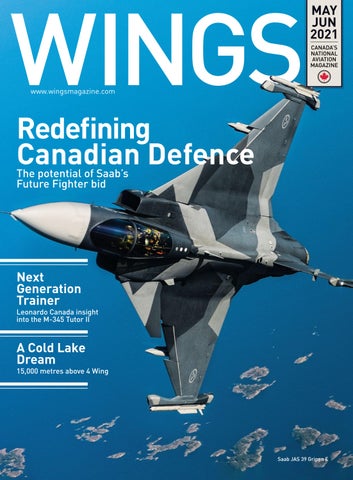
Redefining Canadian Defence The potential of Saab’s Future Fighter bid
Next Generation Trainer
Leonardo Canada insight into the M-345 Tutor II
A Cold Lake Dream
15,000 metres above 4 Wing
Saab JAS 39 Gripen E
Setting the Standard for Future Aircrew Training
Leonardo is committed to Canada - investing in people, innovation, technology-transfer and domestic intellectual property. As a preferred bidder for the Future Aircrew Training (FAcT) program, Leonardo is proud to leverage its 70 years’ experience of aircrew training in an offer to the Royal Canadian Air Force with the next generation of innovative, turn-key training solutions. Inspired by the vision, curiosity and creativity of the great master inventor Leonardo is designing the technology of tomorrow
canada.leonardocompany.com Helicopters | Aeronautics | Electronics, Defence & Security Systems | Space
Scan code to learn more
MAY/JUNE 2021
UPFRONT 6 LEADING EDGE
Ottawa proposes aircraft luxury tax
8 ON THE FLY
AirSprint adds Praetor, Cargojet expands Amazon, AerCap leasing
14 ALTERNATE APPROACH Inside Air Canada’s $5.9B aid package
Leonardo’s new M-345 Tutor II entered into service with the Italian Air Force in December 2020. P.22
15 AIR TRAFFIC
The struggles of international air
BACK 28 Marketplace 30 ON FINAL
Alisha Sohpaul to lead Iskwew Air's new AMO
FEATURES 16 SAAB FUTURE FIGHTER PLANS
Outlining the potential of the Gripen for Canada Team and the status of Canada’s Future Fighter program BY JON ROBINSON
From top: Capt. Joelle Thorgrimson describes CF-18 Hornet flight in Cold Lake. P 18. Alisha Sohpaul will lead Iskwew Air's new AMO in British Columbia. P. 30.
18 MY HIGHEST ADVENTURE YET
Realizing a dream 15,000 metres above Canada’s preeminent fighter base in Cold Lake BY CAPT. JOELLE THORGRIMSON
22 NEXT GENERATION TRAINER
Francesco Norante, Head of Leonardo Canada, shares insight into the Aermacchi M-345 Tutor II BY JON ROBINSON
24 MASKING FOR AVIATORS
Finding the right pilot protection as the COVID-19 pandemic continues to impact aviation
PHOTOS: ISKWEW AIR, NLAF, LEONARDO
BY PHIL LIGHTSTONE
COVER PHOTO: JAS 39 GRIPEN E IN FLIGHT, SAAB AB
WWW.WINGSMAGAZINE.COM
May/June 2021 | WINGS
3
Stay in Touch with Aviation News
Vol. 62, Issue 3 READER SERVICE
SUBSCRIBE
Print and digital subscription inquires or changes, please contact Jay Doshi, Audience Development Manager Tel: (416) 510-5124 Fax: (416) 510-6875 jdoshi@annexbusinessmedia.com Mail: 111 Gordon Baker Rd., Suite 400, Toronto, ON M2H 3R1
Online
EDITOR
TODAY
Jon Robinson jrobinson@annexbusinessmedia.com 647-448-6188 FLIGHT DECK
Volodymyr Bilotkach, David Carr, Kendra Kincade, Sam Laskaris, Phil Lightstone, Carroll McCormick, Joelle Thorgrimson NATIONAL ACCOUNT MANAGER
Mena Miu mmiu@annexbusinessmedia.com • 416-510-6749
wingsmagazine.com/subscribe
ACCOUNT CO-ORDINATOR
Magazine
Barb Vowles bvowles@annexbusinessmedia.com • 416-510-5103
Weekly E-Newsletter
MEDIA DESIGNER
Digital Edition
GROUP PUBLISHER/VP SALES
WINGS www.wingsmaga
zine.com
Emily Sun
Martin McAnulty mmcanulty@annexbusinessmedia.com COO
Scott Jamieson sjamieson@annexbusinessmedia.com
MAY JUN 2021
CANADA’S NATIONAL AVIATION MAGAZINE
Redefining Canadian Def ence
WINGS MAGAZINE
P.O. Box 530, 105 Donly Dr. S., Simcoe, ON N3Y 4N5 Tel: 519-428-3471 Fax: 519-429-3094 Toll Free: 1-888-599-2228
The Saab Grip its Future Fighen E and ter bid
FLYGTA’s Competitiv Advantage e
The developme entrepreneurialnt of an airline
Returning Nunavut to
Flying a PC-12
in the Arctic
Printed in Canada ISSN 0701-1369 PUBLICATION MAIL AGREEMENT #40065710
PHOTO CREDIT
TK
Published six times per year (Jan/Feb, Mar/Ap, May/Jun, Jul/Aug, Sep/Oct, Nov/Dec) by Annex Business Media SUBSCRIPTION RATES Canada – 1 Year $ 34.50 (plus GST - #867172652RT0001) USA – 1yr -$ 78.50 CDN (USD $60.50) International – 1yr - $90.50 CDN (USD $69.50) Occasionally, Wings magazine will mail information on behalf of industry-related groups whose products and services we believe may be of interest to you. If you prefer not to receive this information, please contact our circulation department in any of the four ways listed above.
Air Transport Association of Canada
Canadian Business Aviation Association
Annex Privacy Office privacy@annexbusinessmedia.com • Tel: 800.668.2374 No part of the editorial content of this publication may be reprinted without the publisher’s written permission. ©2021 Annex Business Media All rights reserved. Opinions expressed in this magazine are not necessarily those of the editor or the publisher. No liability is assumed for errors or omissions. All advertising is subject to the publisher’s approval. Such approval does not imply any endorsement of the products or services advertised. Publisher reserves the right to refuse advertising that does not meet the standards of the publication.
Magazines Canada
Visit Annex Business Media's group of brands focused on all aspects of Canada’s aviation and aerospace sectors, including Wingsmagazine.com, Helicoptersmagazine. com and UAV-Canada.com. Annex is also the publishing partner of COPA, providing news and marketplace content through COPAnational.org and Canadianplanetrade.ca.
4
WINGS | May/June 2021
WG_CircAd_MayJune21_MLD.indd 1
WWW.WINGSMAGAZINE.COM
2021-04-16 10:42 AM
TRUST YOUR NEXT PROJECT to Canada’s most capable aerospace engineering team. AIRFRAME REPAIR LOPA AND EMERGENCY EQUIPMENT AVIONICS UPGRADES AND IFE CARGO CONVERSIONS TC & DND DESIGN APPROVAL ORGANIZATION
...AND MANY MORE!
engineering@KFAero.ca
1 (250) 491.5500
www.KFAero.ca
LEADING
EDGE
By Jon Robinson |
Ottawa proposes aircraft luxury tax COPA responds to government tax plan targetting $100,000 aircraft
I
5 6
WINGS | May/June 2021
Canadians who can afford to buy luxury goods and should be taxed more. Owning an aircraft in Canada, for most, is not a luxury but a passion requiring hard work, determination and sacrifice.” COPA continues to point out the proposed tax will only further burden an already over-taxed sector, whereas, based on an Economic Impact Assessment conducted for COPA in 2017, general aviation contributes close to $10 billion annually to the Canadian economy through a range of existing taxes – “This sector of the aviation industry supports hundreds of airports that are the backbone to many communities, it cannot survive additional taxes or strains.” In its response to the newly proposed luxury tax, COPA notes that placing an equivalent threshold on a $100,000 luxury car to that of an aircraft at the same value is incorrect. Indeed, a quick look through Canadian Plane Trade (CPT), shows most used airplanes and helicopters, let alone what the Federal government might be defining as new personal aircraft, cannot be purchased for under $100,000 in Canada. COPA, which relates this environment to the number of new boats that can be purchased for less than $250,000, describes the $100,000 threshold placed on “new”, “personal” aircraft as highly unrealistic, particularly, when adding a 10 per cent tax to items that are already heavily taxed.| W
Most aircraft on CPT are being sold for more than $100,000, including this 1961 Cessna 185. COPA explains, that despite its lobbying efforts against its imposition, the luxury tax on “new” and “personal” aircraft remained in the 2021 budget, with the terms “new” and “personal” undefined. Regarding the now officially proposed tax, COPA states it firmly believes the infrastructure required for implementing and imposing this tax will create detrimental impacts to the GA sector and, as a result, the Canadian economy. COPA explains: “Of important note is the diversity of our community. We represent everyday Canadians, from business professionals to farmers to frontline workers of all ages. The average age of the aircraft flown by this community in Canada is 45 years old. As such, it is inaccurate to group personal aircraft owners as some of the wealthiest
TOP DATA BURSTS… in this issue 1. VistaJet to add up to 12 Global 7500s and 10 Challenger 350s over two years. (P. 10) 2. Ottawa takes a $500 million, 6% stake in Air Canada. (P. 14) 3. The Gripen E features the GE F414 providing up to 22,000 lbs of thrust. (P. 18) 4. Leonardo has delivered more than 1,000 jet trainers. (P. 22) 5. Maureen Routledge on March 11, 1971, became the first female AME in Canada. (P. 38)
WWW.WINGSMAGAZINE.COM
PHOTO: CANADIAN PLANE TRADE
n the Federal government’s first budget delivered in two years, due to the COVID-19 pandemic, the Liberal government proposed a luxury tax on new cars and personal aircraft priced over $100,000, and for personal use boats priced over $250,000. The tax would come into effect January 1, 2022. The Canadian Press notes the Liberals promised a luxury tax in their 2019 campaign platform. On Monday April 19, Federal Finance Minister Chrystia Freeland followed through with that earlier proposal, which in the newly tabled budget would be calculated as the lesser of 20 per cent of the value above the threshold (again $100,000 for aircraft) or 10 per cent of the full value of the luxury item. The GST/HST would apply to the final sale price, inclusive of the proposed tax. The Financial Post explains: “Upon purchase or lease of the car, boat or plane, the seller or lessor will be responsible for remitting the full amount of the federal tax owing, regardless of whether the good was purchased outright, financed, or leased over a period of time.” As noted by Maclean’s magazine, and other news outlets reporting on the April 19 budget introduction, Freeland’s foreword in the budget document includes a notable description of the government’s rationale for the proposed luxury tax: “If you’ve been lucky enough, or smart enough, or hard-working enough, to afford to spend $100,000 on a car, or $250,000 on a boat – congratulations! And thank you for contributing a little bit of that good fortune to help heal the wounds of COVID and invest in our future collective prosperity.” COPA back in February 2020 wrote a letter to then Finance Minister Bill Morneau on behalf of its members and Canada’s General Aviation community to express deep concerns regarding the proposed luxury tax.
2ND ANNUAL
AERIAL FIREFIGHTING VIRTUAL CONFERENCE OCTOBER 27, 2021
Resources and strategies for fixed-wing and rotary-wing operators, government and fire agencies
Platinum Sponsor
Sponsorship Available • Reach both operator and fire-agency decision makers • Leverage special media buy opportunities • Present a case study to attendees (limited availability)
Presented by
• Event content distributed to the full readership of WINGS or HELICOPTERS • Sponsored Content opportunities available
For advertising information contact:
Mena Miu, National Account Manager, WINGS, HELICOPTERS and COPA Flight MMiu@annexbusinessmedia.com
ON THE FLY For late-breaking news and exclusive web content visit www.wingsmagazine.com
THE LEAD CARGO COMMERCIAL BUSINESS AVIATION EVTOL
THE LEAD
AIRSPRINT ADDS PRAETOR 500 TO FLEET AirSprint completed its inaugural conversion of an Embraer Legacy 450 to an Embraer Praetor 500 aircraft. The conversion was performed at an Embraer Executive Jets Service Center and is the first of two conversions that Embraer will perform this year for the AirSprint fleet. Headquartered in Calgary, with offices in Toronto and Montréal, AirSprint made key appointments to its executive leadership team, including naming James Elian as President and CEO. Jared Williams takes on the role of Chief Operating Officer for Air Sprint and will also continue as Vice President, Operations. Judson Macor, who founded AirSprint in 2000, will continue as Chairman of the Board. The Praetor 500 conversions, along with the acceptance of a new Praetor 500 coming October 2021, will bring AirSprint’s count of this technologically advanced midsize business jet to three by the end of the year. AirSprint now holds a jet collection of Embraer Praetor 500s, Embraer Legacy 450s, Cessna Citations
CJ3+ and Cessna Citations CJ2+. The company flies Canadians from coast-tocoast including service from Vancouver, Calgary, Edmonton, Winnipeg, Toronto, Ottawa, Montréal and the Maritimes. AirSprint describes the Praetor 500 as “a stellar corner-to-corner aircraft” with the ability to span North America nonstop, connecting routes like Calgary to Maui, New York to Vancouver, Toronto to Los Angeles, or Montréal to Paris.
CARGO
CARGOJET EXPANDS AMAZON RELATIONSHIP Cargojet Inc. entered into a new Air Transportation Services Agreement with Amazon Canada Fulfillment Services ULC. Under the agreement, Cargojet will expand upon its existing commercial relationship with Amazon. As part of this arrangement, Cargojet will operate two Amazon-owned B767-300BDSF aircraft as part of the Amazon Air network on a CMI basis within Canada starting mid2021. Financial details of the transaction were not disclosed. Cargojet expects the agreement to generate additional revenue growth to Cargojet’s earnings and cash flows over time. The agreement has a four-year term with three successive two-year renewal options. “We are very excited to expand our longterm relationship of providing a portfolio
The Praetor 500 holds a 3,340 nautical mile range, connecting routes like Calgary to Maui, New York to Vancouver, and Toronto to Los Angeles. 8
WINGS | May/June 2021
Cargojet expands its relationship with e-commerce giant Amazon with a four-year agreement.
of services which support the rapid growth of e-Commerce in Canada,” said Dr. Ajay Virmani, President and CEO, Cargojet. “This new four-year Agreement with renewal options is a testament to our relentless focus on exceeding customer expectations.” Cargojet is one of Canada’s largest suppliers of time-sensitive premium air cargo services to all major cities across North America, providing Dedicated ACMI and International Charter services. The Mississauga based company carries more than 25,000,000 pounds of cargo weekly. Cargojet operates its network with its own fleet of 27 Cargo aircraft.
COMMERCIAL
AIR CANADA, TRANSAT CALL OFF $190M DEAL Air Canada and Transat A.T. Inc. on April 2 announced they had mutually agreed to terminate the Arrangement Agreement for the proposed acquisition of Transat by Air Canada. Air Canada and Transat had originally agreed in June 2019 on the acquisition, the terms of which were subsequently amended in August 2019 and then revised in October 2020 as a result of the severe economic impact of the COVID-19 pandemic. The acquisition was conditional on the approval of various regulatory authorities, including the European Commission (EC). Air Canada states it offered and enhanced a significant package of remedies to meet the conditions, which went beyond the commercially reasonable efforts required of Air Canada under the Arrangement Agreement and what has been traditionally accepted by the EC in previous airline merger cases. Following discussions with the EC, however, Air WWW.WINGSMAGAZINE.COM
PHOTOS: (LEFT) AIRSPRINT, EMBRAER; (TOP) CHAD SLATTERY / AMAZON
8 8 8 10 11
Canada states it has become evident that the EC would not approve the acquisition based on the currently offered remedy package. Air Canada concluded that providing additional remedies, which may still not secure an EC approval, would significantly compromise its ability to compete internationally. With the acquisition cancelled, Air Canada will pay Transat a termination fee of $12.5 million. On April 12, Air Canada announced it had entered into a series of debt and equity financing agreements with the Government of Canada, which will allow Air Canada to access up to $5.879 billion in liquidity through the Large Employer Emergency Financing Facility (LEEFF) program. As part of the financial package, which includes the government of Canada receiving a six per cent interest in the airline at the outset, Air Canada agreed to a number of commitments related to customer refunds, service to regional communities, restrictions on the use of the funds provided, employment and capital expenditures. (See David Carr’s column on page 14 for more information on the package and its potential impact.)
EU APPROVES $4.7B IN AID TO AIR FRANCE
PHOTOS: (TOP) AIR CANADA; (BOTTOM) IMAGE RENDERED BY FIXION, AIRBUS
Air France-KLM on April 6 outlined plans to restructuring measures after the European Union approved 4 billion euros in state aid for national carrier Air France as it struggles through the economic impact of the COVID-19 pandemic. In return for the aid, Air France is making up to 18
The A220 produced for Air Canada in Mirabel, Quebec, includes parts from 30 Canadian suppliers.
take-off and landing rights (slots) available at Paris-Orly airport to a competing carrier in order to develop or create a base at one of Europe’s busiest airports. Last year, Air France received 3 billion euros in direct loans from the French state, explains the Associated Press, which will be converted into bonds as part of a recapitalization of up to 4 billion euros (US$4.7 billion). The aid package for Air France includes a range of conditions relating to the airline’s business, including the introduction of more environmentally progressive programs. The government of France will also hold up to 29.9 per cent of capital in the Air France-KLM group, which relates to the French state now holding 14.3 per cent of its shares.
GE, AERCAP JOIN AIR LEASING BUSINESSES Aircraft leasing giant AerCap Holdings N.V. of Dublin, Ireland, entered into a definitive agreement with General Electric under which AerCap will acquire 100 per cent of GE Capital Aviation Services
(GECAS). The combined aviation leasing company will hold more than 2,000 owned and managed aircraft, more than 900 owned and managed engines, more than 300 owned helicopters, and approximately 300 customers around the world. Under the terms of the agreement, which has been unanimously approved by the boards of directors of GE and AerCap, GE will receive 111.5 million newly issued AerCap shares, US$24 billion of cash and US$1 billion of AerCap notes and/or cash. Upon completion of the transaction, GE is expected to own approximately 46 per cent of the combined company and will be entitled to nominate two directors to the AerCap Board of Directors. Citi and Goldman Sachs provided AerCap with US$24 billion of committed financing for the transaction. Over the past four years, AerCap and GECAS have sold on average more than US$5 billion of assets per year. Narrowbody aircraft will represent approximately 60 per cent of the combined aircraft fleet, while new technology aircraft will represent approximately 56 per cent of
As a result of a new state aid agreement, the French government now holds 14.3 per cent of the shares in the Air France-KLM group. WWW.WINGSMAGAZINE.COM
May/June 2021 | WINGS
9
ON THE
FLY
the combined in-service fleet, expected to grow to approximately 75 per cent by 2024. The combined company would have an order book of 493 new technology aircraft, more than 90 per cent of which are narrowbodies.
ROLLS-ROYCE, TECNAM JOIN FORCES WITH WIDERØE
Bombardier set a revenue target of US$7.5 billion for 2025, which would be led in large part by deliveries of its flagship Global 7500 business jet.
Tecnam P2010 aircraft with the H3PS1 propulsion system, which the engine maker describes as the first parallel hybridelectric propulsion system for General
SOUTHWEST ORDERS 100 737 MAX PLANES
An existing partnership between Rolls-Royce and Tecnam aims to develop the all-electric P-Volt aircraft, based on the 11-seat Tecnam P2012 Traveller.
track with our ambition of flying with zero emissions around 2025.” The project expands on a research program between Rolls-Royce and Widerøe on sustainable aviation and the existing partnership between Rolls-Royce and Tecnam on powering the all-electric PVolt aircraft, which is based on the 11-seat Tecnam P2012 Traveller. Rolls-Royce and Widerøe announced their joint research program in 2019 to evaluate and develop electrical aircraft concepts that would fulfil the Norwegian ambition of having the first electrified aircraft in ordinary domestic scheduled flights by 2030 and 80 per cent emission reduction in domestic flights by 2040. Rolls-Royce’s existing partnership with Tecnam aims to develop a modified 10 WINGS | May/June 2021
Boeing at the end of March announced Southwest Airlines placed an order for 100 737 MAX airplanes and 155 options across two models. The order comes after a multi-year fleet evaluation by Southwest which means that Boeing could build more than 600 new 737 MAX jets for the airline through 2031. The new purchase agreement takes Southwest’s order book to 200 737-7s and 180 737-8s, more than 30 of which have already been delivered. Southwest will also have 270 options for either of the two models, taking the carrier’s direct-buy commitment to more than 600 airplanes. The airline also plans additional 737 MAX jets through thirdparty lessors. At the end of April, Boeing then published its major program deliveries across its commercial and defense operations for the first quarter of 2021. This included 77 commercial aircraft, highlighted by 63 737s with two 787s and six 777s.
BUSINESS AVIATION
VISTAJET EXPANDS ITS FLEET WITH BOMBARDIER Bombardier unveiled that fleet operator VistaJet ordered 10 Challenger 350
business jets, first announced on December 23. It was one of the largest biggest jet orders of 2020. VistaJet, a longtime Bombardier customer, has also taken delivery of its first two Global 7500 business jets. Bombardier recently celebrated the milestone 50th delivery of this aircraft. The Malta-based company will add up to 12 Global 7500 aircraft and 10 Challenger 350s over the next two years to grow its fleet to more than 90 aircraft. In addition to the new orders, VistaJet plans to upgrade its entire Challenger 850 fleet, Challenger 605s, Challenger 350s and Global 6000s with updated technology and interiors. VistaJet said in a press release that its firm order for 10 Challenger 350 business jets is in response to “a growing and urgent demand” in the super midsize segment.
MURRAY BECOMES CEO OF SKYSERVICE Benjamin Murray succeeds Emlyn David as CEO of Skyservice, a move that was first announced in October 2020. David, who remains as a significant owner of the company alongside InstarAGF Asset Management Inc., will continue to provide guidance to the company as vice chair of its board of directors. Murray in November 2020 joined Skyservice as president and chief operating officer. He has more than 20 years of experience in business aviation throughout North America, including executive roles with NetJets Inc., described as the largest private aviation company in the world. Murray served as president and CEO of WWW.WINGSMAGAZINE.COM
PHOTO: ROLLS-ROYCE; BOMBARDIER
Rolls-Royce and airframer Tecnam are joining forces with Widerøe, the largest regional airline in Scandinavia, to deliver an all-electric passenger aircraft for the commuter market, projecting the aircraft will be ready for revenue service in 2026. “Norway’s extensive network of short takeoff and landing airports is ideal for zero emissions technologies,” said Stein Nilsen, Chief Executive, Widerøe. “This aircraft shows how quickly new technology can and will be developed, and that we are on
NetJets subsidiary Executive Jet Management, where he doubled revenue in less than two years.
EVTOL
PHOTO: UPS
UPS TO PURCHASE EVTOL FROM BETA Through its Flight Forward subsidiary, UPS plans to purchase electric vertical takeoff and landing (eVTOL) aircraft from Beta Technologies (BETA) as part of its strategy help small businesses with sustainable solutions. With the capability to take off and land directly on UPS property, the company explains eVTOL aircraft are perfect for moving smaller loads that would otherwise fly to and from airports on small feeder aircraft or take even longer by ground. UPS Flight Forward is scheduled to take delivery of its first 10 BETA eVTOL aircraft in 2024, with option to purchase
up to 150. The vehicle is projected to have a 1,400-pound cargo capacity, a range of 250 miles, and zero operating emissions. UPS has reserved BETA’s recharging station which aims to charge the aircraft in under one hour, facilitating faster cargo loading and unloading. The company explains after a battery’s first lifecycle in the aircraft is over, they can be fitted to a charging station to recharge the aircraft’s onboard batteries as well as UPS’s fleet of electric ground vehicles.
LILIUM UNVEILS 7-SEATER EVTOL Lilium GmbH of Germany entered into a definitive combination agreement with Qell Acquisition Corp., a publicly listed special purpose acquisition company, with the intention of being listed on the Nasdaq exchange. Qell is led by Barry Engle, a former president of General Motors North America.
UPS Flight Forward has an option to purchase up to 150 eVTOLs from Beta Technologies.
Lilium also revealed its 7-Seater Lilium Jet, which will become its first aircraft to go into serial production. The Lilium 7-Seater Jet has a projected cruise speed of 175 mph at 10,000 feet and a 155-plus mile range. Lilium then announced Munich and Nuremberg airports will become hubs for a proposed regional air mobility network in Bavaria. This news follows on Lilium’s planned hubs in North RhineWestphalia and Florida. Lilium expects its first passenger flights to take place from 2024 onwards. | W
ANNEX BUSINESS MEDIA’S
AVIATION GROUP
wingsmagazine.com
Proud publishing partner of
helicoptersmagazine.com
Leverage the reach and resources of Canada’s largest business-to-business publisher
copanational.org
canadianplanetrade.ca
UAV-canada.com
For advertising information contact:
Mena Miu, National Account Manager, WINGS, HELICOPTERS and COPA Flight MMiu@annexbusinessmedia.com WWW.WINGSMAGAZINE.COM WG_AFFGuide_BrandAd_HP_MayJune_CWM.indd 1
May/June 2021 | WINGS
11
2021-04-16 12:18 PM
OXYGEN RICH. prae•tor six hun•dred : arrive refreshed with the best-in-class cabin altitude of 5,800 ft +1 321 751 5050 | embraer.com/human
ALTERNATE
APPROACH By David Carr |
Inside Air Canada’s aid package
Ottawa takes ownership position, focuses on passengers, not airlines
O
14 WINGS | May/June 2021
estimated that Ottawa could raise between $7.2 billion and $16.6 billion by selling equity in airports. With revenue streams such as airliner user fees and passenger ancillary fees, including retail, having all but dried up, the investment is worth considerably less today, and perhaps at least for the next five years. If you’re not going to sell commercial assets, which should never be in government hands in the first place, when the market is red hot, when do you? The days of the state-owned flag carrier are as dead as two checked bags and a free meal with bar service on domestic flights. The financing package is good for the airline and the taxpayer, with minimal risk for the government and as much chance of renationalization as there was for the federal and Ontario governments to nationalize GM and Chrysler more than 10 years ago. Year 2009 was about bailing out businesses that had been bad at business. Covid is about government supporting businesses impacted by pandemic restrictions it imposed. Insisting on a discounted equity stake is, in itself, an unfair imposition as a condition of financing. Especially with the potential for government to hold onto its equity stake longer than it ought to, and interfere more than it should. | W
Days of the state-owned flag carrier are as dead as two checked bags and a free meal. Air Canada was viewed as an economic instrument of every government backbencher who believed that the local airport was entitled to jet service. The government has agreed to limit its voting interest to below 20 per cent. How about zero? One of the reason’s the Trudeau government’s signature infrastructure bank has been such a spectacular bust is the level of cabinet interference in projects that were supposed to be largely bankrolled by the private sector. What happens when Air Canada’s long-term commercial interest conflicts with the government’s narrower political interests on routes, where maintenance is conducted, equipment (immediate resumption of the A220-300 order appears to be tied to the deal) or cabin service, especially in the run up to a general election – and greater investor uncertainty. Finally, what about when it’s ideal to sell up? After 15 months of Covid there is public appetite for bigger, hands-on government, and an interventionalist prime minister proven to be one who does not like to let go. In the government’s first term, when all indications pointed to the time being right to cash in on Canada’s airports, the government backed away. C.D. Howe Institute
David Carr is a former editor of Wings and Helicopters magazines. WWW.WINGSMAGAZINE.COM
PHOTO: AIR CANADA
ttawa is back in the airline game. In some respects, it never left. As with the auto industry in 2009, Canada’s largest airline has landed a rescue package of low interest loans and equity financing. This is more of a bridge than a bailout. The government is ‘giving’ Air Canada approximately $5.9 billion in fully repayable, low interest loans that should help the airline lower existing borrowing costs, and ‘getting’ a six per cent stake at a deeply discounted price of $500 million. Nor can this be seen as a renationalizing of the former Crown corporation, as has been suggested in certain corners. The government can up its stake in Air Canada to about 10 per cent at the same 14 per cent discount per share as the first ‘buy in’. It’s a far cry from the 30 per cent stake the French government has taken in the Air France KLM Group, not including the 9.3 per cent the Dutch government owns in that same group, which is expected to increase. And, Ottawa can expect to pocket a tidy profit from its investment as air travel rebounds and Air Canada shares reach their market value. But only if the government is prepared to sell, and at the right time. This is where market value and the philosophy of the current government could be on a collision course. It has been more than 30 years since Air Canada was privatized. Commercialization of Canadian airports began in 1993 and the Greater Toronto Airport Authority was established in 1996. Still, politicians can’t resist dabbling in air transport, whether micromanaging airlines with a passenger’s bill of rights, which does not apply to any other mode of transport from ferry services to rail, or pouring hundreds of millions of scarce public transit dollars into a highend, dedicated rail line to Pearson International Airport that nobody wanted. At least not at fares that would have enabled the boutique service to pay for itself. So what now, with Ottawa having a foot in the door? In addition to refunding approximately $2.3 billion in prepaid fares, what appears to get this government’s motor running are strict conditions to “protect” travellers, including immediately restoring some regional services. Hark back to the dark days of the bloated Crown when
AIR
TRAFFIC | By Volodymyr Bilotkach
The struggles of international air
Sector hasn’t collapsed, but that’s the only good news for overseas travel
PHOTO: QANTAS
A
long with many other experts, I expected international air travel by this point would still be below pre-pandemic levels but well on its way to recovery. We are not even close. After a disastrous 2020, in which passenger traffic globally fell by two-thirds, the International Air Transport Association’s latest forecast (published in February) doesn’t expect this year’s total traffic to be more than halfway back to pre-pandemic levels. Full recovery isn’t expected before 2023. For some countries it might be even longer. Deloitte Access Economics in Australia, for example, published a report on Monday predicting international air travel may not fully recover until 2024; and that prediction was locked in before the Australian government announced on Sunday it was abandoning its target to have all Australians vaccinated by the end of October – a time frame on which the opening of international borders was predicated. That’s particularly bad news for Qantas, Australia’s main airline, which last year hoped to resume international operations by July. Now its plan (announced in February) to restart 22 of its 25 overseas routes in November also looks unlikely. But things could be worse. A year ago I (and others) expected many airlines to fail as prolonged revenue losses strained their liquidity positions beyond breaking point. I was wrong. According to aviation and travel analytics company Cirium, 43 airlines went out of business in 2020. But this was fewer than 2019 (when 46 carriers went bust) and in 2018 (when 56 airlines went out of business). Most of the bankruptcies were smallish regional carriers, such as Britain’s Flybe or AirAsia’s Japanese subsidiary AirAsia Japan. So far, no mid-sized and larger carriers went out of business, though a few have come close. For example, Thai Airways and Columbia’s Avianca (Latin America’s second-biggest airline) requested bankruptcy protection. Australia’s second major airline, Virgin Australia, also went into voluntary administration but was saved from collapse – at least temporarily – by being sold to private equity firm Bain Capital. These are the kinds of airlines I expected to collapse a year ago. But at what cost? WWW.WINGSMAGAZINE.COM
past year has been governments’ inability to effectively collaborate to relax international travel restrictions. Even between countries that have managed COVID-19 well, such as Australia and New Zealand. Their “travel bubble” could and should have started much earlier. IATA’s efforts to have governments embrace a system of COVID tests for travellers before departures, rather than quarantine of arrival, went nowhere. Travel bubbles have proved difficult to agree on and maintain. IATA’s February forecast of global travel volumes being back to 80% of 2019 levels by the last quarter of the year now principally rests on the speed of vaccination programs around the globe, and what happens with new COVID-19 variants. Until a considerable share of people are vaccinated, protective measures (masks, distancing, reduced capacity at events, track-and-trace) will remain necessary, both during travel and while on the ground. Crucial to international travel returning to normal will be “vaccine passports”, some form of which will likely be needed for most international travel for at least the next five years. I expect requirements such as the need to quarantine will start to be lifted for those who have been vaccinated between July and October. But there will be big differences between nations. Some may open their borders as soon as a sufficient share of domestic population has been vaccinated. Others may open quarantine-free travel only to vaccinated individuals for the next several years. The more governments cooperate and learn from each other’s successes, the quicker we can return to a world of unfettered travel. The livelihoods of tens of millions of people worldwide depend on it. | W
The biggest disappointment has been governments’ inability to relax international travel restrictions. The main reason for the lack of largescale airline bankruptcies has been government assistance. The International Air Transport Association’s latest tally puts the amount of state aid to airlines globally at US$225 billion. That’s equal to more than a quarter of the global airline industry’s revenues in 2019. IATA’s analysis of the first US$123 billion (published in May 2020) shows about 60% of the aid has been in loans or loan guarantees (with the balance being wage subsidies, equity financing, tax relief, operating subsidies and direct cash injections). Those loans must eventually be repaid. Governments have put little care into directing aid to airlines with the best chance of surviving in the longer term. IATA’s analysis shows no correlation between an airlines’ likely viability and the amount of aid received. This means many carriers could struggle to repay debts post-crisis. It also means lending governments have greater incentives to keep them afloat. One possible consequence is governments offering further support by protecting struggling airlines from competition post-COVID. A government could restrict flights, for example, to make routes more profitable. That would mean higher airfares. But at least the industry concentration I feared would result from collapses, mergers and acquisitions looks unlikely. The single biggest disappointment of the
Volodymyr Bilotkach is an Associate Professor, Singapore Institute of Technology, and External Instructor with IATA Training. This article was originally published by The Conversation. May/June 2021 | WINGS 15
FUTURE FIGHTER A GRIPEN E POTENTI THE INDUSTRIAL AND TECHNICAL BENEFITS OF SAAB’S JAS 39 GRIPEN E BID FOR CANADA BY JON ROBINSON
T
16 WINGS | May/June 2021
The swing-role Gripen E features supercruise efficiency for customers with wider territories to secure.
upgrades, in addition to adding a previously announced 18 Australian F/A-18s – with 15 of 18 already delivered, according to The Canadian Press, and three now in service. Crosby told Berthiaume the total cost of this Hornet upgrade plan is expected to cost about $1.3 billion. If Canada can keep to the current FFCP timeline, however, it would provide welcome investment across the domestic aerospace sector, as the winning bid must provide equal value of the fighter contract in Industrial and Technological Benefits (ITB) to the country. Canada’s Future Fighter evaluation is 20 per cent based on economic benefits, 60 per cent on technical merit, and 20 per cent on cost. The dollar-for-dollar investment could be anywhere from $15 to $19 billion based on the price of 88 fighters and specified training.
All three of the fighter jet competitors, Saab, Boeing and Lockheed Martin, have an existing presence in Canada (particularly the latter two), but the FFCP would set massive infrastructure investments into motion regardless of which company wins. In January 2021, Saab outlined key parts of its ITB plan, which would include establishing a new facility called the Saab Sensor Centre in Vancouver, BC, to focus on sensor technologies like radar. One of its proposed projects would be to develop a Space Surveillance Radar (SSR) in Canada, in cooperation with other Canadian companies and ultimately targeting a global surface radar market. Saab’s ITB proposal within its FFCP bid also includes developing another two proposed Saab centres, which would be known separately as the Gripen Centre and the WWW.WINGSMAGAZINE.COM
PHOTO: SAAB
he delta wing design of the Saab JAS 39 Gripen E opens strong emotional ties to the supersonic structure of Canada’s pioneering Avro CF-105 Arrow, designed for Cold War air power. Without ever entering service, but before program termination in 1959, CF-105 test aircraft were rated for speeds of up to 2,324 kilometres per hour (km/h), obliterating minimum supersonic levels defined by the speed of sound at sea-level pressure, 1,236 km/h. A year after Canada cancelled the Avro Arrow program, Saab of Sweden introduced into service its 35 Draken – the Dragon – with a double delta wing design (first flying in 1955), which would become Western Europe’s first fully supersonic aircraft, rated for a top speed of 2,125 km/h. Canadian nostalgia for delta wings will not determine the success or failure of Saab’s Gripen E bid in Canada’s Future Fighter Capability Project (FFCP) competition, but the design serves as a visualization of important differences between the three fighter jets still in the hunt. The competition to replace the Royal Canadian Air Force’s (RCAF) ageing fleet of CF-188 Hornet’s with 88 new-generation fighters also includes the Boeing F/A-18E/F Super Hornet (Block III) and Lockheed Martin F-35A Lightning II. In an April report by Lee Berthiaume of The Canadian Press, Canada’s top military procurement official Troy Crosby indicated the federal government is still on track to choose the winning fighter in 2022. This would maintain the government’s most recently updated delivery timeline (reaffirmed in early 2020) to have the first fighter jet arrive in 2025 and the last one by 2032. Despite the government’s current determination to complete the FFCP process, it has suffered from years of delays resulting in Ottawa’s 2019 commitment to extend the life of the RCAF’s current 76 CF-18s through avionics and systems
AND IAL
Aerospace Research & Development Centre, co-located in Greater Montreal. The Gripen Centre would be the E-Series’ ITB centerpiece, primarily staffed by members of the Gripen for Canada Team, working to ensure the fighter platform meets Canada’s NORAD and NATO requirements – another key piece of Canada’s overall Strong, Secure, Engaged defence investment policy into which FFCP fits. The Saab Aerospace R&D Centre would serve as a focal point over decades for developing innovations to test and produce next-generation aerospace systems and components, which, according to Saab, might include unmanned aerial systems, artificial intelligence, and environmentally progressive aviation technologies. Saab’s initial Gripen for Canada Team members include IMP Aerospace & Defence, CAE, Peraton Canada and GE WWW.WINGSMAGAZINE.COM
Aviation. Saab explains IMP Aerospace & Defence would contribute with in-country production and in-service support for the life of the Canadian Gripen fleet. CAE would provide training and mission systems solutions. Peraton Canada would provide avionic and test equipment component maintenance, repair and overhaul, and material management. GE Aviation would provide and help sustain the fighter’s F414-39E engines in Canada. Saab in April 2021 added StandardAero to the Gripen for Canada Team to serve as an in-country sustainment partner to support the GE F414 engine with MRO services. StandardAero has decades of experience serving RCAF aircraft engines, including propulsion sustainment for the T56 engines powering CC-130 Hercules and CP-140 Aurora aircraft. The new Gripen agreement focuses on providing MRO services out of StandardAero’s 665,000-square-foot campus in Winnipeg, Manitoba, where the company has continuously operated since 1911. StandardAero explains the deal could add a new military engine line in Winnipeg, while also supporting development for other F414 fleets, as well as work at its other Canadian facilities in BC and PEI. StandardAero also brings a long-term partnership with GE. In February of 2012, the two companies opened a $50 million aircraft engine Testing, Research and Development Centre (TRDC) in Winnipeg. The centre was specifically designed to perform icing certification testing on GE’s jet engines, as well as to develop advanced testing methodologies and equipment for GE Aviation’s commercial and military aircraft engines. The 122,500-square-foot facility is located at James A. Richardson International Airport. GE designed and built the TRDC and, under a long-term contract, StandardAero maintains and operates the certification test centre, which can test gas turbine engines of up to 150 inches in diameter and with up to 150,000 pounds of thrust, as well as holding capabilities to accommodate high performance military engines. The GE F414 engine, working in concert with a flight control system that is constantly trimming the Gripen E for the least drag, provides the aircraft with up to 22,000 pounds of thrust, as well as a 40 per cent greater internal fuel capacity relative to previous Gripen C/D models. The performance improvement allows for Gripen E’s supercruise mode, which means flying supersonic without using the afterburner. This is an attractive option for customers with wider territories to secure, such as Brazil, which ordered 36 Gripens through a development contract with Embraer (focusing on the two-seat Gripen F version), and Canada. The ice and snow
coastlines of Sweden, which has ordered 60 new generation Gripens, also provides an attractive comparable for Canada. Saab explains the Gripen was designed to operate and be serviceable in dispersed bases which require short take-off and landing (STOL) capabilities. The company states this maintenance advantage reflects the overall lifecycle cost – and ultimately cost per flight hour – of the relatively small-sized but efficient Gripen, which is known to hold low operating costs relative to other modern platforms. Lifecycle costs, however, will ultimately depend on a platform’s global fleet size and subsequent support network, which also relates to ITB work potential. Without delving too deep into specs, Saab points to the Gripen E’s upgradable firmware, being one of the newest platforms in production, with certification testing continuing in both Sweden and Brazil, as well as its fly-by-wire flight controls, and Electric Warfare capabilities with critical components surrounding the aircraft, including on its wing tips and fin, for aggressive, passive engagement. Saab also points to the Gripen’s AESA radar and IRST (infrared search and track), and Beyond Visual Range combat enabled by the availability of a MBDA Meteor missile. The aircraft has 10 hardpoints with a combat turnaround of 10 minutes. It is available for air-to-air refueling. Saab promotes the Gripen E as a true swing-role fighter, which speaks to its ability to quickly change roles potentially even during a single mission. The other two FFCP fighter jet competitors hold similar multi-role definitions, which also fits Canada’s existing CF-18 combat model. The three aircraft, however, do present significant differences illustrated by with the delta-wing canard design of the Gripen E; conventionally designed – albeit with an delta-like structure comprising the fuselage above the wing base into the cockpit – Boeing F/A-18E/F Super Hornet; and the stealth structured fusion of the F-35A Lightning II. The older delta-wing designs of the Avro Arrow and 35 Draken were built for straight-out interceptor speed, struggling with subsonic handling, but the Gripen E’s design is based on the 1980s introduction of Relaxed Artificial Stability (RAS), reducing drag trim to near zero and providing advanced aerodynamic maneuverability. The Super Hornet is also built around RAS and holds more traditional fighter jet maneuverability, whereas the F-35A is designed for stealth and fleet combat interoperability. The government will need to evaluate these costs and capabilities by the end of this year to meet its 2022 award timeline, ultimately pegged to decades of Canada’s economy and future fighter. | W May/June 2021 | WINGS 17
A Boeing CF-18 Hornet from a Canadian Air Task Force flies over Lithuania on September 15, 2014, for the NATO Baltic Air Policing Block 36 during Operation REASSURANCE.
LIVING A COLD LAKE DREAM
REACHING 15,000 METRES ABOVE 4 WING, CANADA’S BUSIEST FIGHTER BASE
C
old Lake – colloquially referred to as Cool Pool – is three and a half hours northeast of Edmonton on the Alberta-Saskatchewan border. It was previously separated into three distinct areas, Medley, Cold Lake and Grand Centre, now referred to as CFB 4 Wing Cold Lake, Cold Lake North and Cold Lake South, respectively. Although the subarctic temperatures can make you gasp for air during the short seven-hours of winter daylight, it is a small price to pay for having a daily airshow out of your back window. As a private pilot, the area is an oasis. The local regional airport, aka the “muni”, has many airplanes stored in hangers, as well as outside with grass tie-downs. I’ve been fortunate to experience the bird’s eye view of Alberta in my small single-engine airplane. I’ve been able to visit iconic Canadian locations like the hoodoos 18 WINGS | May/June 2021
of Drumheller, the glacier lakes of Jasper and the majestic Rockies. Lesser known are the patches of restricted airspace known as the Cold Lake Air Weapons Range-Complex (CLAWR-C) in which the 4 Wing aircraft operate. As a civilian pilot, entrance to these areas require prior permission and these approvals have allowed me to explore the vast northern parts of the province; but these are just the bonus adventures. The real reason I wanted to come to CFB Cold Lake, the busiest fighter base in the country, was to get the experience of flying in a fighter jet. This dream recently became reality with a backseat ride in a CF-188 Hornet. A lot of preparation is required to ultimately step foot in the jet’s cockpit. Since Flight Surgeons are aircrew, I already had my aircrew medical completed so the first step was the Aviation Life Support Equipment (ALSE) gear fitting. During winter, this means trying to fit into the G-suit, which is pressurized through WWW.WINGSMAGAZINE.COM
PHOTO; ROYAL CANADIAN AIR FORCE
BY CAPT. JOELLE THORGRIMSON
Engage the power of TAE Aerospace For over 30 years TAE Aerospace has been supporting worldwide operators of the TPE331 engine with world-class maintenance, repair and overhaul services. Commercial and military operators have come to rely on TAE Aerospace to maximize the performance of their TPE331 engines and minimize the impact on aircraft availability during routine and unplanned maintenance events. With Honeywell Authorized Service Centers across the globe, we are one of the world’s largest TPE331 engine service providers covering engines, fuel controls and engine component repairs. With multiple Airworthiness Approvals from around the world, OEM correlated dynamometer test cells for pre- and postmaintenance testing, vibration analysis and performance runs, we make sure you get the best from your TPE331. We deliver customer value by offering a high-quality service at a price that will reduce your maintenance cost. To find out more about why our customers rely on us,email sales@taeaerospace.com or visit our website for your local sales representative.
www.taeaerospace.com
Benefits of using an Authorized Honeywell Service Centre • Access to 100% guaranteed OEM certified parts • Reduced downtime due to availability of parts and guaranteed stock levels • Access to OEM support and warranties • TAE Aerospace technicians have access to the latest Honeywell technical documentation and training • Unparalleled global experience • Cost efficiencies through access to approved dealer discounts
a g-sensitive valve, as well as an ejection seat harness and a life preserver/survival vest, all while wearing a dual layer of long underwear, winter jacket, and snow pants, aka “bunny pants”. All of the gear worn is specifically designed to protect you while you fly or to survive post ejection in the winter weather. Truthfully, you can barely bend down to do up the buckles, leaving me more impressed at how these fast jet pilots, who I see as patients as their local Flight Surgeon, get into their gear quickly during a NORAD mission scramble.
WWW.STARTPAC.COM
Next is a visit to the seat check guru who will take you through the ejection seat procedures and the various survival equipment. This is to include understanding parachute emergencies and landing techniques based on different terrain and obstacles. As part of the seat check you have to practice the “2, 2, 1, O2” for emergency ground egress. This mnemonic is used by pilots to run a rapid checklist of disconnecting from the ejection seat. Lastly, I was given a simulator orientation to the Hornet, including a walkthrough of the heads-up display (HUD), controls,
TOLL FREE 844.901.9987
START YOUR ENGINES!
START PAC - THE BEST THERE IS.
• 28 AMP HOURS @ 10 HOUR RATE • • 2400 AMPS PEAK CURRENT • • SUPERIOR STARTS ON ALL ELECTRICALLY STARTED TURBINE ENGINES •
www.STARTPAC.com OR TOLL FREE 844.901.9987
multi-function-displays, as well as taxiing, takes-offs, loops, rolls, and landing. Ready for the flight line! The weather in January can be challenging with recurrent freezing fog, clouds, and poor runway conditions. I wasn’t sure if my sortie would happen, but the day finally came. My first steps beyond the ALSE shop brought me past the jets being worked on by the technicians and into the operations room to complete the pre-flight paperwork. Once I had the Commanding Officer’s blessing, the ALSE techs helped me clamour into the layers of protective equipment and strapped me into the ejection seat. Pins out, the seat is live and off we went taxiing to the runway, listening to ATC with the roar of the two GE 404 turbojet engines behind us.
I WAS BRIEFED THAT I WOULD HAVE THE FORTUNE TO FLY DURING A TRAINING MISSION... BREAK TURNS WERE IN MY FUTURE. As we took off, the inertia pulled me into the back of the seat. Up through the clouds with afterburners on while watching the altitude readout climbing faster than I thought was possible. Before I knew it, we were at the Hornet’s maximum service ceiling of FL480 (48000 feet) – any higher and the depressurization hypoxia risk is too high without continuous 100 per cent O2. We dove down toward the ground watching the speed climb, hitting Mach 1.56 (1926 km/h) before pulling out of the dive and experiencing my first real onset of “Gs”. We then did a loop, a slow roll, followed by a whiplash fast roll. By this point, the sun beating down was making me feel slightly flushed – must be the sun that’s doing it. I was briefed that if I was to get the fortune of flying during a training mission, break turns would be in my future. While experiencing the back-breaking force of 7g, the full pressure from the g-pants and straining to clench my legs and abdomen was all I could do to keep my vision from tunneling. We flew back to the airport for approaches before finally landing. Another 1.4 hours for the logbook in the most amazing aircraft I’ve ever had the privilege to fly. Although Cool Pool can be cold, this experience made it all worthwhile. These are the moments that I have dreamed of, and why I am grateful to be posted here. | W Capt Joelle Thorgrimson is a Metis Flight Surgeon from Kenora, ON, posted to Cold Lake, AB. She has BScH in astrophysics, a MSc in quantum physics and completed medical school and residency.
20 WINGS | May/June 2021
HE_Startpac_Jan20_CSA.indd NEW Li2800QC 4.625x7.5in.indd1 1
WWW.WINGSMAGAZINE.COM 2020-01-13 AM 13/01/2020 9:41 11:22
NEXT GEN TRAINER
FRANCESCO NORANTE, HEAD OF LEONARDO CANADA, SHARES INSIGHT INTO THE AERMACCHI M-345 TUTOR II
L
BY JON ROBINSON
eonardo describes the new M-345 Tutor II trainer as a cornerstones of its offer for the Canadian Future Aircrew Training (FAcT) program, a primary part of the country’s ongoing generational Strong, Secure, Engaged defence investment policy. Francesco Norante, head of Leonardo Canada, describes how the M-345 and Leonardo’s 70-year training heritage would fit Canada’s entire FAcT syllabus. WHY IS THE M-345 THE BEST OPTION FOR FACT? The new M-345 HET [High Efficiency Trainer] has been developed by exploiting all the consolidated experience gained by Leonardo in the designing and manufacturing of a large family of training aircraft, including the SF-260, MB.326, MB.339, M-346. 22 WINGS | May/June 2021
The aircraft has been designed for simplicity and effectiveness, and for performance. It is fitted with simple, essential systems for maximum safety and reliability with minimum maintenance needs. As a result, the M-345 is a turbofan-powered, high-efficiency trainer with lifecycle costs comparable to those of heavy turboprop trainers, but with enhanced performance. . WHAT ADVANTAGES DOES THE M-345 HOLD RELATIVE TO COMPETING TRAINERS? The M-345 offers a value for money solution, which benefits from jet performance and from the resultant expanded flight envelope, both in terms of speed and altitude, which, in, turn, ensures more training effectiveness per flight hour. With a better and early stream, and a greater ability to
download training from the Advanced Lead-In Fighter Training phase, it will provide important cost savings in producing jet pilots faster. That is why we think the performance of a jet should not be an option, but an absolute need. It is indisputable that the gap with a heavy turboprop trainer is wide, in particular with speed in all conditions, rate of climb and altitude, while offering safe and friendly flight performances at a low speed. Moreover, the M-345 can be networked
THE M-345 BUILDS ON LEONARDO’S LONG HISTORY WITH SUPPLING JET TRAINERS, WITH MORE THAN 1000 DELIVERED. to flight simulators, thanks to Leonardo’s innovative LiveVirtual-Constructive [LVC] technology, providing additional training cost-effectiveness to M-345 operators.
WHAT ONE ADVANCE OF THE M-345 EXCITES YOU MOST? The ETTS [Embedded Tactical Training Simulation] system enables the M-345 to generate the whole spectrum of simulated training functions while in flight; and provides both the student and instructor with the capability to simulate various scenarios. This can include a tactical scenario comprised of a digital map with threats and targets; the presence of realistic Computer Generated Forces – friend and foes; on-board sensors such as multimode Fire Control Radar, targeting pod and active/passive electronic countermeasures; and weapons, including specific symbology and delivery parameters. The LVC-enabled ETTS functions of the aircraft can support standalone flying in a single-ship mission or for multi-ship networked operations. Aircraft and simulators are able to be networked via a dedicated training datalink which enables them to exchange tactical scenario data with other participants. The WWW.WINGSMAGAZINE.COM
PHOTO: LEONARDO
The M-345 Tutor II is a candidate to replace the ageing CT-114 Tutors currently in service with the Canadian Forces Snowbirds demonstration team, 431 Squadron based out of 15 Wing, Moose Jaw, Saskatchewan.
capability delivered through the ETTS is very important for students from the initial phases of training to the challenges of systems management of complex platforms for both combat jets and/or multiengine aircraft. It allows us to download flying hours from the next – and more costly – training phases. We have great experience in LVC. An example is based at Lecce-Galatina AFB in Italy, and is operated by the Italian Air Force for its M-346 jet trainers. The M-345 LVC network will also be able to network with the M-346 LVC, along with 5th Generation aircraft data links. WHAT M-345 ADVANCE WILL STUDENT PILOTS ENJOY MOST? The Mission Planning and Debriefing Station, MPDS, allows trainees to plan and analyze the missions they have just flown. Designed to ensure excellent safety, comfort and ideal field of view, the cockpit has the latest generation avionics and human machine interface in line with modern frontline fighters. HOW WOULD LEONARDO IMPLEMENT THE TRAINING PROGRAM? We are more than confident that our training system is the perfect response to FAcT requirements. Leonardo is able to set up the most responsive support model, open to any level of synergy with local partners, as desired by the Canadian customer. From the outset, with a complete simulationbased syllabus and optimal degree of “virtualization through technologies” this assures cost-effectiveness in training. Looking to the future, our technology provides a clear, reliable path for potential implementation in several areas, which could result in valuable perspectives regarding system growth. LVC capability, provided by Leonardo’s training system, is currently one of the only fully developed such technologies, in comparison with similar initiatives in developmental phase. That provides us with solid positioning and a de-risking base where we are moving forward in several directions: We are continuously improving the capability of our system. Then we are moving ahead in developments, which are already in line with requirements implied by future generation combat systems – characteristics of the “system of systems” domain compared to today’s “defence aircraft” domain, with the aircraft interfacing unmanned elements and benefitting from Artificial Intelligence.
comprehensive solution. Drawing on more than 70 years of aircrew training experience from around the world, Leonardo is a leading provider of civil and military fixedwing, rotary-wing and mission training services ready to offer an innovative and comprehensive turnkey solution to meet all of the Royal Canadian Air Force training requirements. Leonardo is setting the standard for future aircrew training. Our Integrated Training Systems deliver solutions that can guarantee the highest quality standard at every training stage for pilots, ground crews, operators and maintainers. In other sectors, such as cyber security, radar systems, defence electronics, rotary- and fixed-wing unmanned air systems and remote sensing services Leonardo is keen to bring to Canada its leading high technology solutions. HOW IS LEONARDO’S EXISTING POSITION IN CANADA AN ADVANTAGE? Leonardo is among the top ten world players in Aerospace, Defence and Security. Leonardo has a significant industrial presence in Italy, the UK, Poland and the USA. A trusted Canadian partner for over 50 years, Leonardo is a leading provider of capabilities through innovative technologies
and integrated services. Leonardo’s Canadian subsidiary is based in Ottawa. Purpose built to serve the Canadian market, Leonardo’s Canadian team leverages and draws upon the full strength and depth of the global company. Leonardo coordinates all commercial activities in Canada through the Ottawabased team, including those activities related to Defence and Defence Systems, Aeronautics programmes for Air Traffic Control, Cyber Security and Automation with focus on solutions for airports, postal operators and couriers. Within the country, there are 50 civil, military and parapublic helicopters flying alongside 40 ATR aircraft. The company has five authorized helicopter service centres. With 400 people working across five sites in Canada. Leonardo is investing in innovation, technology transfer, intellectual property, research and development, and long-term relationships and partnerships with the Canadian Government, Canadian industry, including small to medium enterprises. Visit Wingsmagazine.com/leonardo-fact for the complete Norante Q&A, discussing DRS Technologies, Leonardo Canada, ITB requirements, and how the M-345 fits with the future of the Snowbirds. | W
Reach your Aviation Goals Learn from the Experts. For over 30 years, AeroCourse has been a leader in advanced aviation training in Canada. We provide aviation ground school seminars and courses for advanced training along with publishing manuals and workbooks. The courses include IFR and ATPL seminars, online courses, and advanced aviation courses with flight colleges, schools and airlines. Our instructors are professional pilots and flight examiners with thousands of hours experience. We pride ourselves on providing exceptional materials and training.
WHAT OTHER KEY ASPECTS ARE PART OF LEONARDO’S FACT BID? Leonardo is a champion in training fixedwing, rotary-wing pilots and ACSO/AES ops. In relation to the FAcT program, Leonardo can offer a modern and
Groundschool Dates ATPL IFR Virtual Classroom: Jun 11-13 & 19-20 MST Traditional Class:* May 7-9 Toronto May 14-16 Calgary July 9-11 Toronto
Virtual Classroom: May 8-9 & 15-16 MST Traditional Class:* Jun 4-6 Toronto Jun 18-20 Calgary
*(Face-to-Face Class - Subject to COVID-19 rulings)* Virtual classes will be added as needed Review sessions detailed on website
Call 1800-461-8857 Visit AEROCOURSE.COM May/June 2021 | WINGS 23
WWW.WINGSMAGAZINE.COM
WG_Aerocourse_MayJune21_CSA.indd 1
2021-04-16 7:22 AM
COVID-19 MASKS FOR AVIATORS
HOW PILOTS CAN BETTER ADDRESS THE THREE TYPES OF AIRBORNE THREATS IN THE CABIN BY PHIL LIGHTSTONE
D
uring the COVID-19 pandemic, masking and social separation have become the new normal. In January of 2020, some medical professionals did not feel that masking was required. Fast forward to 2021, masking has become mandatory in certain environments like airports. Recently, medical officials have recommended double masking. As part of our New Normal, some people never leave their home without their keys, wallet, smartphone and mask. Sadly, blue surgical masks have become the new liter and counterfeit masks have been found in Canada’s PPE supply chain. In Canada, medical masks are tested and certified by the National Institute for Occupational Safety and Health (NIOSH), 24 WINGS | May/June 2021
which maintains a database of masks. There are three types of airborne threats which we need to protect against: Pathogenic viruses (e.g. people to people, animals to people); ecologic, which is naturally occurring such as dust and allergens; and anthropogenic, which is human created such as automotive pollution and greenhouse gases. The COVID-19 virus can vary in length from nine to 12 nanometres (nm). Respiratory droplets, which contain COVID-19 are typically five to 10 micrometers (µm) in length. Individuals who are in close contact with an asymptomatic COVID-19 person, can be exposed to hundreds or thousands of virus particles, which will increase the probability of an infection. There is evidence that under certain conditions, people
WWW.WINGSMAGAZINE.COM
PHOTO: AIRPOP
AirPop recently introduced its Active+ Halo mask which is equipped with a Bluetooth sensor, about the size of three stacked quarters, installed on the outside of the mask.
with COVID-19 seem to have infected others who were more than two metres away. These transmissions occurred within enclosed spaces that had inadequate ventilation. An aircraft’s cockpit is a perfect environment to transmit viruses. They are small confined spaces where the flight crews are contained for many hours, such as the Cessna 150 or 172 environment which flight instructors and students operate out of during flight training. From General Aviation (GA) and Business Aviation (BA) perspectives, being in a small enclosed cockpit puts the flight crew and passengers into close proximity and at risk. Many flight schools have mandated the use of masks while flying dual. Transport Canada has mandated that passengers must wear a face mask at airport screening checkpoints, during the boarding process, during the flight, and upon landing and disembarking at a Canadian airport. Air operator flight crews are exempt from wearing a face mask while on the flight deck. New disinfecting protocols have been implemented to provide a sterile environment. (See my article entitled COVID-19 Aircraft Tech in the May 2020 edition of Wings magazine). Masks should solve three critical issues, including fit, filtration and breathability. Fogging of eye glasses and sunglasses is an inherent problem while wearing a mask. Consider an anti-fog spray or cloth, which typically provides up to 12 hours of protection to glasses. Other strategies include: Anti-fog lenses; tighten the mask around your nose and cheeks; place a tissue strip inside your mask between your nose and mask; exhale downward; and adjust the nose pads so that your glasses rest slightly away from your face. Masks fall into a three categories: Face masks, surgical masks, and respirators. More information can be found at the Centers for Disease Control and Prevention (CDC) COVID-19 webpage www.cdc.gov/ coronavirus. A face mask is a mask, with or without a face shield, that covers the wearer’s nose and mouth and may or may not meet fluid barrier or filtration efficiency levels. Face masks that are not intended for a medical purpose are not considered medical devices. Surgical masks are a mask that provides a physical barrier to fluids and particulate materials. Surgical masks intended for medical purposes are considered medical devices, which meet certain fluid barrier protection standards and flammability tests. Surgical masks are also tested for biocompatibility and are considered personal protective equipment (PPE). While a surgical mask may be effective in blocking splashes and large-particle droplets, they do not provide complete protection from germs and other contaminants because
of the loose fit between the surface of the mask and your face. Respirators, known as filtering face piece respirators (FFRs), including N95s and surgical N95s masks, filter at least 95 per cent of airborne particles. They are PPE that tightly fit the face and provide certain filtration efficiency levels to help reduce wearer exposure to pathogenic airborne particles. They provide a higher level of protection against viruses and bacteria when properly fit-tested. N95 masks from different producers may have slightly different specifications and the protective capabilities offered by N95 masks are largely attributed to the masks requirement to remove at least 95 per cent of all particles with an average diameter of 300 nm or less. The CDC does not recommend using NIOSH-approved N95 respirators which are plagued with shortages and should be reserved for healthcare workers. Further masks with exhale valves should be avoided, as your respiratory droplets may escape and reach others around you. Enterprise Premont (EP), a Louiseville company, is Quebec’s first manufacturer of disposable surgical masks. In 2020, the company pivoted its business, patenting both the mask manufacturing machinery and surgical masks, branded as Humask (www.humask.com). Its masks are manufactured to ASTM F2100 standards. EP developed a unique filtration technology, called the HuCare filter membrane, for its Humask Pro, which improves comfort and protection, while reducing the inconvenience associated with wearing traditional masks. EP has eight disposable masks, Humask (1000 and 2000), Humask Pro (3000 and 4000), Humask Pro Vision (2000 and 3000), and Humask Kids (1000 and 2000), which are available in a variety of colours. Jet Black is its most popular colour. The Humask 1000 is its entry-level mask, providing better filtration (and as such better protection) than a N95 mask. The Humask Pro Vision has a window allowing the wearer’s mouth to be seen. This facilitates an improved interaction between the wearer and people. In noisy environments, being able to see the wearer’s mouth facilitates a better understanding of their speech patterns, as well as seeing the wearer smile (perfect for individuals in the service industry). The Pro line of masks are made from a material designed to wick moisture similar to GORE-TEX. Humasks may be ordered directly from its website with prices starting from $17.75 (plus taxes and shipping) for a box of 50 masks. Shipping is free on orders greater than $75, with a flat rate fee of $5 for orders less than $75. On the horizon, Enterprise Premont, is working on a biodegradable mask.
AirPop, founded in 2015, introduced a form fitting mask designed to create an effective seal between your mouth, nose and the rest of the world. Its masks offer the same, highly effective two-way barrier as the best medical and industrial-grade masks, but are specifically engineered to be comfortable all day. AirPop has masks for adults and children using a unique design creating which creates a 3D canopy of air with two mask components, the outer shell and inner filter. The 3D air dome created by their design, results in better breathability and comfort. The outer shell
is washable while the snap in filter has a blocking efficiency of 99 per cent, including dust, bacterial and viral matter. The inner filter has a gel seal designed to provide a comfortable seal between your skin and the filter and should be replaced every 40 hours of use. Additionally, the masks are made with cutting-edge fabrics that deliver strength and flexibility while remaining lightweight and easy to clean. The AirPop Active mask retails for US$69.99 (excluding taxes and shipping), and includes four replaceable filters. A four pack of replaceable filters is US$24.99. All
WHEN MISSION-FIT IS CRITICAL, CHOOSE THE AIRCRAFT DESIGNED FOR ALL OF THEM www.pilatus-aircraft.com
Stan Kuliavas, Vice President of Sales | sales@levaero.com | 1.844.538.2376 May/June 2021 | WINGS 25
WWW.WINGSMAGAZINE.COM
Pilatus_PC-24_Wings-117.48x190.5mm_October.indd 1 WG_Levaero_MayJune21_CSA.indd 1
29.10.2020 2021-04-1512:40:07 11:21 AM
materials used to create the filter have been rigorously tested to meet U.S. and European ASTM F2100 and EN 14683:2019 performance standards. AirPop has recently introduced its Active+ Halo mask which is equipped with a Bluetooth sensor, about the size of three stacked quarters, installed on the outside of the mask. Breathing data is stored on the Halo sensor for seven days, until it is transferred to the Halo App on a smart phone or tablet. The Halo sensor has a light which flashes as the mask wearer breaths. The LED colour can be changed in the App. The sensor uses a CR1632 battery, which is easily replaceable. The mask kit includes a small plastic pry tool to open the sensor for battery replacement. The Halo App delivers a dashboard deepening the user’s understanding of the air quality around them and tracks: Number of breaths; pollutants captured by the filter; wearing
time; AQI index; and filter life in hours. The App has an activity mode (cycle, walk, run), which tracks breathes per minute, activity duration and distance travelled. The Halo App supports data integration to Apple’s Health App, pushing respiratory rate data (breaths per minute) to Apple Health. The Halo mask kit includes: an outer mask; four inner filters; travel pouch; user guide; and battery replacement tool, retailing for US$149.99 (plus taxes and shipping). On the horizon, the Halo app will deliver more information about the manner in which the user is wearing the mask, to ensure that the mask is worn to maximize protection. Sonovia Ltd. of Ramat Gan, Israel (www.sonoviashop.com), manufactures a high-quality, dual-layer breathable mask impregnated with zinc oxide. Founded in 2013, Sonovia, began manufacturing bed sheets
impregnated with zinc oxide for hospitals and clinics. Using high-quality cotton, Sonovia’s products were tested to stringent healthcare standards to ensure that pathogens could be safely removed as patients were moved in and out of beds. Actual COVID-19 virus is not available for testing of commercial products, however, the
THERE ARE THREE TYPES OF AIRBORNE THREATS WHICH NEED TO BE PROTECTED AGAINST. Sonovia material was tested at Austria's HygCen medical lab using Vaccinia virus, which has similar properties to the SARSCOVID family. When COVID-19 surfaced in 2019, Sonovia pivoted to manufacturing face masks, protecting both the wearer and those in close proximity, from pathogens.
Its SonoMask can be washed up to 55 times before it should be discarded. A convenient washing tracking card and fabric pouch is included with each mask. The masks are available in a variety of sizes, colours and either ear loops or head straps and can be ordered on-line or on Amazon. A single mask retails for $63.00 (plus taxes and shipping) Volume discounts are available. Use discount code “Aviation10” for an additional discount, when purchasing from Sonovia’s website. As COVID-19 variants change the pandemic’s landscape, more caution should be exercised. Understanding your aviation, social and work circles, will help ensure that you do not end up as a COVID-19 statistic. Staying vigilant during this difficult time should not impact your quality of life, but for some of us, contracting the COVID-19 virus can be life altering. | W
TAKE OFF WITH CONFIDENCE. Get SiriusXM Aviation Weather in flight FREE for 3 Months when you purchase and activate a Garmin GDL™ 51/51R or 52/52R. Plus get a $200 Rebate and a 1 Year COPA Membership.
Learn more at: siriusxm.ca/aviation Conditions apply. See offer details.
26 WINGS | May/June 2021 WG_Lektro_MarApr21_CSA.indd 1
WWW.WINGSMAGAZINE.COM 2021-02-19 WG_SiriusXM_JanFeb21_CSA.indd 1:39 PM 1
2020-12-10 3:38 PM
SCIENCE-BASED STRATEGIES TO RESTORE CONFIDENCE IN AIR TRAVEL This year’s annual US Chamber of Commerce Aviation Summit focused on the recovery of our sector. US and international industry leaders identified critical elements of the path toward a recovery of commercial air travel. Passenger levels in the US are still down more than 40%, with limited hope that air travel will return to sustainable levels by the fall of 2021 with carriers burning cash in excess of $150 million a day in the first quarter of 2021. Airports are not expecting to get back to 2019 levels for another five to seven years, which appears to be a slower recovery than anticipated by the carriers according to the International Air Transport Association (IATA). Issues of concern raised by industry leaders focused on identifying the critical elements for a recovery of the air travel sector included the need to reopen the Canada-US border, digital health passports, the industry’s pledge to net carbon emissions by 2050, and the impact of improving e-meeting technology. All agreed that any recovery effort has to include the restoration of confidence in air travel. To this effect, the report recently released by the world-renowned Harvard T.H. Chan School of Public Health, was cited as a solid framework for recovery. Entitled Assessment of Risks of SARS-CoV-2 Transmission During Air Travel and Non-Pharmaceutical Interventions to Reduce Risk, the two-phase report focuses on strategies and tactics to reduce risks of disease transmission during air travel. The report was drafted in cooperation with the Center for Public Leadership of the Harvard Kennedy School of Government. This report is the result of the Aviation Public Health Initiative (APHI). Its findings and recommendations are science-based and conclude that with a comprehensive compliance of a layered approach, which includes education and awareness, screening, physical distancing, process management, personal protection equipment, and ventilation gate-to-gate, reduces the risk of transmission onboard aircraft below that of other routine activities during the pandemic, such as grocery shopping or eating out. The APHI combined a team of faculty and associates at the Harvard School of Public Health, including environmental, infectious disease, medical, industrial hygiene, epidemiological and social scientists. “The project grew from interest by the aviation industry to both reduce risks of … disease transmission and safely reinvigorate operations in the midst of the global pandemic.” Airlines for America (A4A) and a consortium of aircraft and equipment manufacturers, airline operators, and airport operators sponsored the project. The findings and recommendations, however, are the independent conclusions of its authors and researchers.
The APHI project took a systems approach to problem assessment and solution building, engaging a wide scope of key aviation industry constituents. The objective was “to form a comprehensive understanding of the intersection between the science informing (virus) transmission and the operations in the aviation environment”. The intent was to formulate a broad analysis of options available to mitigate and reduce the risk of COVID-19 and its variants within the aviation system. The report was presented in two phases. The focus of Phase One Gate-to-Gate report was two-fold: 1) To understand the dynamics introduced by the potential presence of the virus in the confined space of a commercial passenger aircraft; and 2) To recommend actions and strategies to reduce and mitigate the risk of transmission on board the aircraft during cruise as well as boarding and deplaning. The recommended actions and strategies apply to the operators of airlines and rely critically on the behaviors and actions of airline cabin crews, airport employees, cleaning personnel, and individual travelers, who together protect against disease transmission. The Phase Two report draws two checklists to help travelers, airport employees, and crew. The first, the COVID-19 Checklist for Airport Travelers and Employees, lists ten reminders before and at the airport. The second, Checklist for Aircraft Passengers and Crew, suggests another ten on-the-plane reminders. The report suggests behavioral strategies to enhance aviation public health safety. Its research supports that the transmission of the virus intensifies or slows, in part, as a function of human behavior. “Curtailing risky behaviors is key to mitigating the pandemic, its anxieties, and its economic implications.” It is key that government and industry adapt a positive approach to restoring traveler confidence in air travel and thus help our industry to recover from this horrendous blow. Taking a page out of the Harvard report would help set such a constructive course. In Canada, current restrictions on air travel, considered the most severe by IATA, are rapidly weakening our carriers’ competitiveness with US and international carriers. Canadian carriers have not benefited from government support enjoyed by carriers in all but one other G8 country. Canadian carriers, whose resilience is being pushed to extremes through no fault of their own, recall Henry Ford’s famous quote “When everything seems to be against you, remember that the airplane takes off against the wind, not with it”. ATAC calls on the Government of Canada to adopt progressive solutions such as those brought forward in this summit as quickly as possible.
Air Transport Association of Canada 1110 - 222 Queen Street, Ottawa, Ontario, K1P 5V9 • Phone: 613-233-7727 • Website: atac.ca
MARKETPLACE
& &
Located in the Lac La Biche Forestry District
WE DESIGN AND BUILD AIRCRAFT HANGARS - ANYWHERE IN CANADA! Individual – Corporate – FBO’s – Airline
For Sale or Lease
Airport Hangar Westlock, AB
59509 RR260
HERE’S WHAT WE CAN DO FOR YOU:
• 7,400 sq.ft.± total space available • Forced air heating in the hangar bay and office • 60’ x 24’ Diamond Door, fully automated (fits King Air) with 20’ wide approach • Building is full insulated with metal cladding and many more features!
Questions? Phone 519.857.7639 or visit www.secandco.com
Daniel A. Amero
If you already have a design or drawings, send it along in in CAD or PDF for an estimate to:
780 436 7415 damero@naiedmonton.com
NAI Commercial Real Estate Inc. naiedmonton.com
WG_NAI Commercial Real Estate_MayJune21_CSA.indd 1
steve.secco@secandco.com
WG_SEC_CO_JanFeb21_MLD.indd 1 2021-04-14 7:16 AM
28 WINGS | May/June 2021 WG_Hartwig_Janfeb18_CSA.indd 1
Architectural & Engineered Drawings Municipal Applications & Permits Airport Applications & Approvals Transport Canada & NavCan Applications Complete Construction
2020-11-18 7:53 AM
WWW.WINGSMAGAZINE.COM
2017-12-13 12:46 PM
MARKETPLACE
SPORTY’S
NEW!
FLIGHT GEAR You can pay more, but you won’t ï ® v ÈÈ À ð È v
Unmatched durability Light weight High visibility interior
Pilot-centric design Personalization options Customizable add-ons
SPORTYS.COM/FLIGHTGEAR
The ultimate resource to buy and sell within Canada’s aviation community From parts and planes to helicopters and hangars, Canadian Plane Trade is the easiest and fastest way to search the aviation marketplace.
$&&(6625< 29(5+$8/6
45"35&3 (&/&3"5034 6$) 66$ $))5$ $ 5$1 $1 32 32:(5 (5 *22' 22' 22'5,& 2 5, 5,& 5,&+ 5,& &+ 6. 6.8 .85.$ 5. 5 . .$ $ $ $3 $3 $ 3& 7+$ 7+ +$/(6 $/(6 /((6 $ $8;, 8; 8;, ;,/( ;, /((& /( /(& &
Post your ads to Canadian Plane Trade through a range of cost-effective online and print packages. POWERED BY THE CANADIAN OWNERS AND PILOTS ASSOCIATION
CANADIANPLANETRADE.CA
COPA members receive a 10% discount
WWW.WINGSMAGAZINE.COM
UPCOMING PRINT DEADLINES: JUNE – MAY 7, 2021
JULY – JUNE 4, 2021
AUGUST – JULY 9, 2021
May/June 2021 | WINGS 29
ON
FINAL Sam Laskaris | guest columnist
AMO innovation and diversity
Iskwew Air hires female maintenance engineer to lead new AMO division
I
30 WINGS | May/June 2021
supported, welcomed and celebrated for being their authentic selves.” Fraser believes Iskwew is redefining the aviation industry with Sohpaul’s appointment. “What we’re doing today is creating a safe space for women in aviation which is long overdue and this is just the beginning.” Fraser also thanked Transport Canada for granting her company its AMO. “We see (Transport Canada) as a critical and very important partner in operating and in safety,” she said. “Transport Canada, in this time of COVID, has shown such great leadership, innovation, creativity, collaboration, partnership.” At last week’s press conference Fraser also provided details on Iskwew Air’s work with Remotely Piloted Aircraft Systems, which are more commonly known as drones. Iskwew Air has hooked up with InDro Robotics, a Canadian company specializing in drone technology. Fraser said several projects are currently in the works in this area. “We’re bringing traditional aircraft together with modern technologies and I now understand that these two worlds belong together. I used to think they were quite separate but they belong together.” Fraser said it’s ideal that her airline will play a role in this emerging industry. “Iskwew Air now sees ourselves as the bridge; the bridge between traditional air transportation and sustainable transportation of the future,” she said. “All of this is in support of our biggest vision which is advanced air mobility. “Iskwew Air is committed to decolonizing, decarbonizing and transforming the aviation industry for all humans, for all of our relatives and for Mother Earth.” | W
iskwew air’s amo means much more to me than a shop that maintains aircraft. of my best memories working alongside other female aircraft engineers because we’re able to support one another and relate to each other’s daily workplace issues,” she says. Sohpaul, however, does not like the fact there is such a small percentage of women in her industry. “Needless to say, we stick out like sore thumbs in a hangar,” she said. “In my experience, because there are so few of us, we constantly get questioned and asked why we are doing this because we look out of place. It is exhausting having to justify yourself in your abilities to your colleagues who should be trying to support you and not scrutinize you.” Sohpaul is thrilled to be working for her current employer. “Iskwew Air’s AMO means so much more to me than a shop that maintains aircraft,” she said. “Iskwew Air will be a place where everyone is uplifted,
Sam Laskaris, Local Journalism Initiative Reporter, Windspeaker.com WWW.WINGSMAGAZINE.COM
PHOTO: ISKWEW AIR
skwew Air continues to be involved with historic ventures. Back in March 2019, Teara Fraser, a Metis woman who lives in Vancouver, made history by becoming the first Indigenous woman in Canada to launch her own airline, Iskwew Air. Fraser, who operates Iskwew Air out of the Vancouver International Airport, hosted a press conference in March to announce important company news. She choked up while announcing Iskwew Air is now officially an Aircraft Maintenance Organization (AMO). “What this means is that we can fix our own plane and we can fix others’ airplanes too,” she said. Fraser was also thrilled to reveal that Alisha Sohpaul, a first generation Indo-Canadian, will be the lead for Iskwew Air’s AMO. Only about 2.8 per cent of aircraft maintenance engineers in the country are women. Fraser explains the timing of her company’s announcement was fitting. “We chose this date, March 11, because March 11, 1971, the very first female aircraft maintenance engineer in Canada (Maureen Routledge) was licensed,” Fraser said. Sohpaul’s parents were both born in India. “We estimate less than half of a per cent of aircraft maintenance engineers in Canada are women of colour,” Fraser said. “We are so very, very proud to have Alisha leading us in the maintenance of our aircraft with this new division of Iskwew Air.” Sohpaul is understandably thrilled with her new position. “Representation matters,” she said. “I recently became the person responsible for maintenance at Iskwew Air and it was such an emotional moment once I heard I had passed my exam. At that moment, with tears running down my face, I knew that 1. this was bigger than me and 2. we had just opened the door for so many women who might have thought they could not hold the same title.” Sohpaul is hoping others follow in her footsteps. “When people see someone that looks like them it can really help them realize they can do this too,” she said. “Aircraft maintenance is not a common job that you hear about at your average career fair so it’s so important to me that I not only represent women in my field but encourage young females to pursue careers in aviation.” Sohpaul has worked as an aircraft maintenance engineer since 2014. “I’ve had some
Waterloo Wellington Flight Centre The Skills You Need - The School You Want
Photo by Mike Reyno
Strong education and industry partnerships give our graduates a competitive edge and the skills needed to fly in jobs across Canada. Partnered with: Contact us today! 519-648-2213 | 1-877-FLY-WWFC | wwfc.ca Waterloo Wellington Flight Centre professional programs are approved as vocational programs under the Private Career Colleges Act, 2005 (PC# 105919).