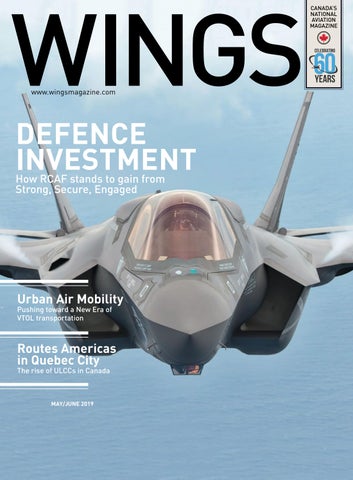
WINGS www.wingsmagazine.com
DEFENCE INVESTMENT
How RCAF stands to gain from Strong, Secure, Engaged
Urban Air Mobility Pushing toward a New Era of VTOL transportation
Routes Americas in Quebec City The rise of ULCCs in Canada
PHOTO CREDIT TK
MAY/JUNE 2019
CANADA’S NATIONAL AVIATION MAGAZINE
Tutor II Next Generation Trainer for Canada
Aermacchi M-345 Leonardo creates pilots. The new leading-edge M-345 is at the heart of Leonardo’s basic, advanced and flight simulation integrated training system. The M-345 provides jet performance at a turbo-prop cost for the next generation of Royal Canadian Air Force pilots. Inspired by the vision, curiosity and creativity of the great master inventor – Leonardo is designing the technology of tomorrow.
leonardocompany.com Helicopters | Aeronautics | Electronics, Defence & Security Systems | Space
MAY/JUNE 2019
UPFRONT 6 Leading edge
World trade disputes
8 On the fly
Harbour Air targets allelectric fleet and more
14 Business Aviation
CRA tax policy, one year later
16 At the Gate
European travel season from Canada
18 Air Traffic
Edmonton International and Elevate Aviation
BACK 43 Marketplace 46 On final
Erika Armstrong on pilot opportunities
The Lockheed Martin F-35A Lightning II is a serious contender to replace Canada’s aging CF-188 Hornet fleet. P.20
FEATURES 20 CANADA’S DEFENCE INVESTMENT PLAN
What the RCAF stands to gain over the next 20 years under the Strong, Secure, Engaged policy BY JON ROBINSON
From top: Javier Suarez discusses the direction of Canada Jetlines at Routes America in Quebec City. P.24. Danny Sitnam of Helijet describes the realities of Urban Air Mobility. P.28.
24 ULTRA-LOW COST IN CANADA
Routes Americas in Quebec City provides a platform for the growing ULCC business BY BRIAN DUNN
PHOTOS: LOCKHEED MARTIN (F-35A), BRIAN DUNN (SUAREZ), HELIJET (SITNAM)
28 URBAN AIR MOBILITY APPROACH
The world’s largest aerospace companies push into a New Era of VTOL transportation BY JON ROBINSON
32 AIRPORT INNOVATION LABS
North American airports are establishing incubators to drive and scale up entrepreneurs BY DAVID CARR
34 TARGETTING AIR TAXI SAFETY
The Transportation Safety Board of Canada focuses on safety challenges for passenger transport BY JON ROBINSON
COVER PHOTO: LOCKHEED MARTIN, F-35B
WWW.WINGSMAGAZINE.COM
May/June 2019 | WINGS
3
Stay in Touch with Aviation News
Vol. 60, Issue 3 EDITOR
Jon Robinson jrobinson@annexbusinessmedia.com 647-448-6188
SUBSCRIBE
FLIGHT DECK
Online
Tim Anderson, David Carr, Brian Dunn, Kathy Fox, Kendra Kincade, Chris Lawn, Sam Longo, Carter Mann, Carroll McCormick, Steven Sitcoff NATIONAL ACCOUNT MANAGER
Mena Miu mmiu@annexbusinessmedia.com 416-510-6749
TODAY
ACCOUNT CO-ORDINATOR
Barb Vowles bvowles@annexbusinessmedia.com 416-510-5103 MEDIA DESIGNER
Emily Sun
CIRCULATION MANAGER
wingsmagazine.com/subscribe
Jay Doshi jdoshi@annexbusinessmedia.com 416-442-5600 ext. 5124
Magazine
GROUP PUBLISHER/VP SALES
Martin McAnulty mmcanulty@annexbusinessmedia.com
Weekly E-Newsletter
COO
Scott Jamieson
Digital Edition
WINGS www.wingsmaga
PRESIDENT & CEO
Mike Fredericks
WINGS MAGAZINE
P.O. Box 530, 105 Donly Dr. S., Simcoe, ON N3Y 4N5 Tel: 519-428-3471 Fax: 519-429-3094 Toll Free: 1-888-599-2228
CANADA’S NATIONAL AVIATION MAGAZINE
zine.com
DEFENCE INVESTMEN
T
What the RCA F stands to gain Strong, Secure, from Engaged
Printed in Canada ISSN 0701-1369 PUBLICATION MAIL AGREEMENT #40065710
Urban Air Mo
bility
Pushing towar d VTOL transportaa New Era of tion
Routes Americ as in Quebec City
The rise of ULCC
s in Canada
PHOTO CREDIT
TK
MAY/JUNE 2019
CIRCULATION Email: apotal@annexbusinessmedia.com Phone: 416-510-5113 Fax: 416-510-6875 (main) 416-442-2191 Mail: 111 Gordon Baker Rd., Suite 400, Toronto, ON M2H 3R1 Published six times per year (Jan/Feb, Mar/Ap, May/Jun, Jul/Aug, Sep/Oct, Nov/Dec) by Annex Business Media SUBSCRIPTION RATES Canada – 1 Year $ 34.50 (plus GST - #867172652RT0001) USA – 1 Year $ 60.50 Foreign – 1 Year $ 69.50 Occasionally, Wings magazine will mail information on behalf of industry-related groups whose products and services we believe may be of interest to you.
Air Transport Association of Canada
ON THE
WEB
4
WINGS | May/June 2019
WG_CircAd_Mayjune19_MLD.indd 1
If you prefer not to receive this information, please contact our circulation department in any of the four ways listed above. Annex Privacy Office privacy@annexbusinessmedia.com • Tel: 800.668.2374 No part of the editorial content of this publication may be reprinted without the publisher’s written permission. ©2019 Annex Publishing & Printing Inc. All rights reserved. Opinions expressed in this magazine are not necessarily those of the editor or the publisher. No liability is assumed for errors or omissions. All advertising is subject to the publisher’s approval. Such approval does not imply any endorsement of the products or services advertised. Publisher reserves the right to refuse advertising that does not meet the standards of the publication.
Canadian Business Aviation Association
Magazines Canada
AVIATION THIS WEEK Looking to catch up on the latest hot news from around aviation and aerospace? Check out Aviation This Week, a live digital version of the top news stories affecting a variety of key markets. It's quick, essential information you need to know. WWW.WINGSMAGAZINE.COM
2019-04-24 11:24 AM
Together we fly.
Join the WestJet team westjet.com/greatjobs
LEADING
EDGE
By Jon Robinson |
World trade and aviation
New proposed tariffs could impact all of aviation by the end of 2019
T
5 6
WINGS | May/June 2019
market share throughout the world.” In particular, the USTR points to what it describes as more than US$5 billion in new subsidized financing for the A350 XWB – using the term “launch aid”. USTR then points to what is classified by the WTO as an appellate report issued in May 2018 that found EU subsidies worth billions of dollars for twin-aisle aircraft. In this report, USTR states “launch aid” provided for the A350 XWB and A380 caused significant lost sales to Boeing 787 and 747 aircraft. The trade agency continues to state Boeing lost market share for its large aircraft in specific markets like EU, Australia, China, Korea, Singapore, and UAE. Once the WTO arbitrator issues its report on the value of countermeasures, USTR explains it will announce a final product list covering a level of trade that counters what it describes as adverse effects from the subsidies. The preliminary products that the USTR might cover by additional duties contains a number of products in the civil aviation sector, listed by WTO reporting categories. This includes new helicopters, passenger transports and cargo transports categorized by weight, as well as undercarriages and parts, fuselages and fuselage sections like wings and assemblies. These tariffs would present a future cost challenge to the aviation world, including Canada. | W
The U.S. contends the current EU subsidies affect approximately $14.9 billion of trade per year. In its April 8 statement, the USTR specifically targets subsidies provided to Airbus, which the government agency states to have caused adverse effects to the United States: “After many years of seeking unsuccessfully to convince the EU and four of its member States (France, Germany, Spain, and the United Kingdom) to cease their subsidization of Airbus, the United States brought a WTO challenge to EU subsidies in 2004. In 2011, the WTO found that the EU provided Airbus [US]$18 billion in subsidized financing from 1968 to 2006.” The USTR continues to explain the WTO found that European subsidies were leveraged for Airbus to launch “every model of its large civil aircraft, which caused Boeing to lose sales of more than 300 aircraft and
TOP DATA BURSTS… in this issue 1. Harbour Air holds a fleet of more than 40 aircraft. (P. 8) 2. Nearly 33,000 variants of the M250 engine have been delivered to customers. (P. 10) 3. With foreign ownership limited to 49 per cent of a domestic airline, it should be easier to start a low-cost carrier in Canada. (P. 24) 4. Helijet provides more than 300 flights per week. (P. 28) 5. IATA expects traffic to nearly double to 7.8 billion by 2036. (P. 34)
WWW.WINGSMAGAZINE.COM
PHOTO: H. GOUSSE/MASTER FILMS/AIRBUS
he Office of the United States Trade Representative (USTR), which serves as that government’s agency to negotiate foreign trade agreements, resolve disputes and set policy, issued a statement on April 8 that it intends to impose what it describes as new countermeasures to longstanding European Union (EU) subsidies. The USTR released a preliminary list of EU products it might impose tariffs on, if subsidies are not stopped. That list includes a range of helicopters, aerostructures, and primarily commercial fixed-wing aircraft, as well as a range of food products from Swordfish steaks and cheeses to yogurt and wine. EU products like printed books, papers, carpets and clothing are also on the list, published with a statement of the reasoning from USTR. (The preliminary list of aerostructures and aircraft, categorized by weight and purpose, can be found at wingsmagazine.com.) The United States contends the current EU subsidies affect approximately US$11.2 billion ($14.9 billion) of trade per year. The USTR notes the exact amount of trade affected is still under arbitration is expected from the World Trade Organization (WTO) sometime this summer; and that its current push to impose additional countermeasure tariffs is in preparation for that day, again unless the EU removes what the U.S. views as unfair subsidies. “Our ultimate goal is to reach an agreement with the EU to end all WTO-inconsistent subsidies to large civil aircraft,” said U.S. Trade Representative Robert Lighthizer, noting the dispute has been in litigation at the WTO for 14 years. “When the EU ends these harmful subsidies, the additional U.S. duties imposed in response can be lifted.”
MAKE US YOUR TOP CHOICE IN 2019 VOTE FOR US IN THE WINGS FBO SURVEY
24/7 GUEST SERVICES DE-ICING RAMP SERVICES HANGARAGE
PAL AVIATION SERVICES - ST. JOHN’S FBO (YYT)
1
COMMISSARY MAINTENANCE ON-SITE CUSTOMS CLEARANCE REFUELING AMENITIES
PAL AVIATION SERVICES - HALIFAX FBO (YHZ) CARGO HANDLING
3
CHARTER FLIGHT BOOKINGS CUSTOMER SHUTTLE
palaviationservices.com
ON THE FLY For news and exclusive online content, visit www.wingsmagazine.com
THE LEAD COMMERCIAL BUSINESS AVIATION AEROSPACE MRO PEOPLE
THE LEAD
COLLINS AEROSPACE $67M ELECTRIC LAB Collins Aerospace Systems is building an electric power systems lab, called The Grid, to design and test systems like high-power generators for the next generation of electric aircraft. Work on the 25,000-square-foot, high-power, high-voltage lab is already underway in Rockford, Illinois. It is expected to be fully operational by 2021. Collins is targeting a $67 million (US$50 million) investment into the lab, which the company describes as being part of a larger $200 million (US$150 million) total investment in electric systems it will make over the next three years. Collins states it has already invested $4 billion (US$3 billion) on electric architectures over the past decade. “In the not-too-distant future, hybrid-electric and fully electric aircraft will revolutionize air travel as we know it, opening up new markets like urban air mobility, while reinvigorating others like regional service to underutilized airports,” said Kelly Ortberg,
CEO, Collins Aerospace. Among the first platforms to be supported by The Grid is the recently unveiled United Technologies hybrid-electric flight demonstrator, Project 804. This project is named for the straight-line mileage between Collins Aerospace’s facilities in Rockford and Pratt & Whitney’s facility in Montreal, Quebec, which is also working on the project. United Technologies is the parent company of both Collins Aerospace and Pratt & Whitney. The goal of Project 804, developed by the new United Technologies Advanced Projects (UTAP) division, is to re-engine and fly a regional turboprop aircraft powered by a 2 megawatt-class hybrid-electric propulsion system on what the company describes as a highly aggressive timeline. This converted Bombardier Dash 8 Q100 is projected to fly in 2022.
COMMERCIAL
WOW AIR CEASES OPERATION WOW issued a travel alert on March 28 that it has ceased operation and that all of its flights have been cancelled. Headquartered in Reykjavík, Iceland, and based at the country’s Keflavík International Airport, WOW air operated services between Iceland, Europe, Asia, and North America. The airline was founded in November 2011 by Skúli Mogensen, whose business background is largely in technology and
An illustration of UTC’s proposed hybrid-electric demonstrator, a Bombardier Dash 8 Q100, which will have the battery, power management system, and related electronics installed in the cabin; and the hybrid-electric propulsion system mounted in a modified nacelle. 8
WINGS | May/June 2019
WOW air's fleet primarily consisted of Airbus A320, A321 and A330 aircraft.
telecoms in Iceland, Europe and North America. WOW air’s inaugural flight was to Paris on May 31, 2012 and in October that same year WOW air took over the flight operations of Iceland Express. A year later, in October 2013, WOW was awarded the Air Operator‘s Certificate (AOC) by the Icelandic Transport Authority. The airline carried more than 400,000 passengers in 2013 and in December 2014 carried its millionth passenger. WOW air’s annual passenger number grew from 2.8 million in 2017 to 3.5 million in 2018. WOW air’s Website indicates the operation employs around 1,000 people. Its fleet consists of Airbus A320, A321 and A330 aircraft.
CANADA JETLINES TARGETS DECEMBER LAUNCH Canada Jetlines Ltd. set a launch date for its commercial airline service, targeting December 17, 2019, from its home base of Vancouver International Airport (YVR). Planning to leverage an Ultra Low Cost Career model, Canada Jetlines explains its target launch date is the result of new financing partnerships, particularly based on a transaction with SmartLynx Airlines SIA for up to $15 million. The new airline also recently announced a financing transaction with a Korean special purpose fund, led and established by InHarv Partners Ltd., for up to $14 million. As a result of its agreement with SmartLynx Airlines SIA, Jetlines explains it has mutually agreed with AerCap to terminate the leases for two Airbus WWW.WINGSMAGAZINE.COM
PHOTOS: UTAP; ERIC SALARD/PARIS, FRANCE.
8 8 9 10 11 11
A320 aircraft. Jetlines instead has entered into a letter of intent with SmartLynx Airlines for the lease of two alternate Airbus A320 that will be available for delivery in the fourth quarter of 2019 in line with the expected commencement of Jetlines’ operations.
HARBOUR AIR TARGETS ALL-ELECTRIC FLEET
PHOTOS: HONDAJET, HARBOUR AIR
Harbour Air, North America’s largest seaplane airline headquartered in Vancouver, BC, has formed a development partnership with magniX to transform Harbour Air seaplanes into an all-electric commercial fleet powered by the magni500, a 750 horsepower all-electric motor. The first aircraft to be converted will be the DHC-2 de Havilland Beaver, a six-passenger commercial aircraft used across Harbour Air’s route network. Harbour Air and magniX expect to conduct first flight tests of the all-electric aircraft in late 2019. Operating 12 routes between hubs like Seattle and Vancouver, and across rural regions of the Pacific Northwest, Harbour Air carries more than 500,000 passengers on 30,000 commercial flights each year. By modifying existing Harbour Air planes with all-electric magniX propulsion systems, the partnership would create the world’s first completely electric commercial seaplane fleet. A Harbour Air ePlane would have zero reliance on fossil fuels and produce zero emissions. This partnership follows significant milestones for both companies, including the successful testing of magniX’s 350 HP
The HondaJet Elite features the company’s unique Over-The-Wing Engine Mount configuration.
all-electric motor and the addition of a Vancouver to Seattle route in Harbour Air’s destination roster. Founded in 1982 with two small seaplanes, Harbour Air now holds a fleet of more than 40 aircraft and provides up to 300 daily scheduled flights, scenic tours, adventure packages, and private flights. The operation provides 12 scheduled destinations connecting downtown Vancouver, Victoria, Seattle (WA), Nanaimo, Tofino, Whistler, Richmond (YVR South), Sechelt, Salt Spring Island, Pitt Meadows, Maple Bay and Comox, BC.
BUSINESS AVIATION
HONDAJET ELITE CANADIAN CERTIFICATION The HondaJet Elite, first unveiled in May 2018, has received type certification from Transport Canada Civil Aviation (TCCA), as Honda Aircraft Company explains deliveries in the country will begin immediately. In addition to Canada, the HondaJet Elite holds type certifications in
the United States (Federal Aviation Administration), Europe (European Aviation Safety Agency), Mexico (Directorate General of Civil Aviation), Brazil (National Civil Aviation Agency), India (Directorate General of Civil Aviation) and Japan (Japan Civil Aviation Bureau). The HondaJet Elite is described by Honda as the fastest, farthest and highestflying plane in its class. To achieve this, the company points a range of technological innovations on the aircraft, including its Over-The-Wing Engine Mount (OTWEM) configuration, Natural Laminar Flow (NLF) nose and wing and composite fuselage. Honda also states the aircraft’s cabin is the largest in its class, featuring a full-service galley and a private lavatory with optional belted seat. The aircraft holds an exclusive Bongiovi sound system and a customized Garmin G3000 avionics suite. The twin-engine business jet is certified for single pilot operation. The HondaJet fleet is currently comprised of 118 aircraft around the globe, according to Honda, and has demonstrated a dispatch reliability of 99.7 per cent.
Harbour Air holds a fleet of more than 40 aircraft and provides up to 300 daily scheduled flights. WWW.WINGSMAGAZINE.COM
May/June 2019 | WINGS
9
ON THE
FLY
Up to 76 MQ-25 aircraft are expected to be built.
AEROSPACE
refueling program. Back in September 2018, Boeing was announced as the winner of a $1.1 billion (US$805 million) contract to build the U.S. Navy’s first operational carrier-based unmanned aircraft. Boeing was awarded the engineering and manufacturing development contract to provide four aircraft. The Navy expects the first airframes to begin flying by 2021 and the first four Stingrays should reach operational capability on carrier decks in 2024, according to a report on the U.S. Naval Institute’s online portal Usni.org. After this contract is complete, covering the four Stingray airframes for testing, Usni.org reports the Navy plans to buy 72 more vehicles with a total program cost of about $17 billion (US$13 billion)..
HÉROUX-DEVTEK TO SUPPLY LANDING GEAR FOR BOEING MQ-25 ROLLS-ROYCE STINGRAY ADVANCES HYBRIDHéroux-Devtek Inc. of Longueuil, Québec, ELECTRIC TESTS has been awarded a contract by Boeing to supply the complete landing gear system for the MQ-25 Stingray unmanned aerial
Rolls-Royce states it has taken a significant step in the development of a
hybrid-electric propulsion system, based on its M250 gas turbine engine, following recent, successful ground tests in Indianapolis. Nearly 33,000 variants of the M250 engine – typically used to power helicopters, but powering a range of aircraft – have been delivered to customers. The company explains its recent M250 hybrid tests are expected to result in experimental flights on aircraft beginning in 2021. This could include a range of platforms with the potential to integrate distributed electric propulsion, including vertical take-off and landing vehicles, general aviation aircraft and hybrid helicopters. Rolls-Royce’s tests on the M250 hybrid engine included a ground demonstration setting in three operating modes, defined as: Series Hybrid, Parallel Hybrid and Turbo-Electric. The M250 hybrid, which has been developed by engineers in the U.S., UK and Singapore, is to be used as a propulsion plant with power ranging from 500 kW to 1 MW.
Call 800.667.7742 Concierge & Business Services Ground Services Fuel Passenger Services Pilot Amenities
3035 Tutor Drive, Regina International Airport Regina, SK S4W 1B5 info@yqraero.ca | www.yqraero.ca 10 WINGS | May/June 2019 WG_Regina_Aerocentre_SeptOct16_EJS.indd 1
WWW.WINGSMAGAZINE.COM 2016-08-23 1:58 PM
Canada’s largest commercial MRO operation with more than 1,000 employees at facilities across Canada.
PEOPLE
MICHAEL DELUCE NAMED PORTER CEO KF Aerospace’s expanded hangar space is expected to create 75 jobs over the next two years.
MRO
KF AEROSPACE EXPANDING IN KELOWNA KF Aerospace, for the second time in three months, began construction on a hangar expansion to increase its maintenance, repair and overhaul (MRO) capabilities. After breaking ground on a $30-million expansion of its MRO facility at Hamilton International Airport (YHM) back in mid-February 2019, the company
WWW.WINGSMAGAZINE.COM WG_AGFT_mayJune19_CSA.indd 1
is adding 21,000 square feet to its Hangar 1 (South) facility at YLW Kelowna in British Columbia. This new capital investment focuses on one of five customer-dedicated hangars at the Kelowna base. It will bring KF’s capacity in Kelowna to a total of 13 concurrent lines of narrow-body and regional-aircraft maintenance, grow its staffing from 725 to 800 in 2020, and expand the YLW base to a total 370,000 square feet. Construction is expected to complete by mid-July. KF Aerospace states it is the largest private sector employer in Kelowna and
Michael Deluce becomes president and CEO of Porter Airlines, effectively immediately, as the Toronto-based operation reorganizes its executive management team. Robert Deluce, Porter’s founding CEO and Michael’s father, assumes the new role of executive chairman of the company. Michael Deluce is also noted as a founding team member at Porter, which describes his work as instrumental in defining the company’s business plan, commercial and brand strategies, while serving as executive vice president and chief commercial officer. With Michael Deluce’s appointment, Kevin Jackson becomes executive vice president and COO. | W
May/June 2019 | WINGS
11
2019-04-16 10:33 AM
DIFFERENT BY DESIGN. DISRUPTIVE BY CHOICE. Unprecedented performance. Industry-leading technology. Exceptional comfort. Introducing the new midsize Praetor 500 and the super-midsize Praetor 600 – the world’s most disruptive and technologically advanced business jets. A record-breaking best-in-class range. Enviable performance in challenging airports. Full fly-by-wire with active turbulence reduction. Unparalleled comfort in a six-foot-tall, flat-floor cabin. Ka-band home-like connectivity. Power the future. Take command. Lead the way. Learn more at executive.embraer.com.
IN T RO D U C I N G T H E N E W
BUSINESS
AVIATION By Steven Sitcoff |
Business aviation tax policy
One year later, a look at Canada Revenue Agency’s new policy
T
14 WINGS | May/June 2019
2. The use of boilerplate agreements with service providers and other documentation relating to the ownership and operation of aircraft could be problematic as these are likely to be subject to close scrutiny in the course of a CRA audit. 3. While a CRA auditor will typically request copies of flight logs prepared for Transport Canada, they contain no real useful information for tax purposes. Instead, aircraft owners should be reasonably disciplined to keep detailed information of their own on a continuous basis to demonstrate that a particular flight had a valid business purpose. 4. Maintaining one’s own flight data will also be important in order to monitor the number of non-business hours relative to the total flown in the year, as this could have a material impact for corporate and personal tax, as well as GST, purposes. If the CRA is counting your hours, so should you. 5. Offering the aircraft for external charter use could provide a crucial and necessary offset for personal flying hours, especially where business-use hours are relatively insufficient. | W
The worst time to find out you are not inline with CRA policy is when you’re under audit. measures applicable in the U.S., but it effectively permits a first-year deduction that is three times higher than that which previously applied. As such, this may provide an incentive for new aircraft acquisitions. On another note, I have frequently heard some owners muse about registering their aircraft in the U.S. in order to circumvent Canadian tax rules. This is generally inadvisable as it achieves nothing for tax purposes while creating unwanted complications for aircraft ownership and operation. The new policy will generally be manageable with proper planning and advice, however, it is strongly recommended that aircraft owners be adequately prepared in anticipation of a CRA audit. Best practices include the following: 1. The worst time to find out that you are not in line with the CRA’s policy is once you’re already under audit. Instead, proper advice should be obtained when structuring new acquisitions. Also, existing ownership structures and usage policies should be reviewed so as to mitigate audit exposure, which can result in a high tax cost for both the corporation and the individual user.
Steven Sitcoff is a tax lawyer with Spiegel Sohmer of Montreal. He can be reached at SSitcoff@spiegelsohmer.com. WWW.WINGSMAGAZINE.COM
PHOTO: CESSNA CITATION X1, FROM TEXTRON
he Canada Revenue Agency’s (CRA) previous position on taxable benefits associated with the personal use of business aircraft was cancelled in 2012. Since then, the absence of a clearly articulated policy was the source of much concern throughout business aviation, especially following CRA’s initiation of a national audit project in 2015. This led to some owners selling their aircraft, as well as the postponement, or even cancellation, of planned acquisitions. Thanks in no small part to the tenacity of the Canadian Business Aviation Association, the CRA finally released its new policy on March 7, 2018. (An overview of this policy can be found in WINGS May/ June 2018 issue). So, what have we learned over the last year under the new policy? Unfortunately, the new policy has not achieved as much as was hoped for to restore predictability. Not surprisingly, at a recent tax conference the CRA acknowledged that the new policy is only aimed at providing general guidelines and does not cover all scenarios. CRA auditors still have a wide latitude of discretion in these files. This is especially troubling given that while these audits are often aggressive, auditors generally have limited experience with, or understanding of, business aviation. Moreover, they continue to view corporate aircraft through the same lens as corporate yachts and condos, perceiving them to be a luxury rather than a business tool. It remains to be seen whether Revenue Quebec will follow the CRA’s approach, but it is clear that provincial auditors have a similarly broad scope of discretion. This is underscored in the most recent provincial internal interpretation, released shortly after the new federal policy, which suggests the expense of using an aircraft over less expensive alternatives might only be deductible if there is a demonstrable urgency for such use (such as a minimum travel distance of 200 kilometers each way). In the fall of 2018, the federal government introduced an accelerated tax depreciation proposal which should be of interest to owners of business aircraft. This measure will not increase the aggregate amount of depreciation that may be written off, nor is it as generous as depreciation
AT THE
GATE
By Brian Dunn |
Canada to Europe airline outlook
How the travel market is shaping up for Canadian carriers this summer
W
16 WINGS | May/June 2019
Calgary to London (Gatwick), Paris and Dublin this summer. WestJet will also add Toronto-Barcelona using its existing 767 aircraft. Doerksen notes that new international routes often take time to mature so he expects WestJet’s initial 787 routes may be a drag on company yields. Transat is reducing capacity growth to 2.4 per cent this summer, down from its 14.6 per cent growth last summer when Transat added frequency on many routes during the shoulder seasons and this summer it will lap this capacity increase. Transat’s strategy this summer is not to add a lot of new destinations, but rather to increase frequency and capacity from Montreal and Toronto into key markets. Air Canada has added two new Atlantic routes, Montreal-Bordeaux and Toronto-Vienna. The most important European destinations for Air Canada and Air Transat are London and Paris. For Air Canada, London represents 22.5 per cent of its deployed trans-Atlantic seats in the summer. Frankfurt is next at 12.7 per cent with Paris at 8.2 per cent and Rome at 5.8 per cent. For Transat, Paris represents 16 per cent of its summer capacity, followed by London at 14 per cent and Rome at 8.4 per cent. | W
Air Canada’s growth rate to Europe has been decreasing over the last three years. popular destination for Canadians in recent years, the increase in capacity growth this summer on top of the aggressive growth in prior years looks to be irrational in our view and we would not be surprised to see the airlines ratchet back flights as the summer approaches.” Air Canada’s growth rate to Europe has been decreasing over the last three years, from a year-over-year capacity increase of 15.8 per cent in 2016 to just 6.9 per cent this summer. With most of its new wide-bodies now delivered and the Rouge fleet now at a stable level, Air Canada’s aggressive international route expansion is effectively complete and Doerksen expects the company to focus more on driving yields higher as the routes fully mature. Canada’s flagship dominates the transAtlantic market with a capacity of more than five million seats from over 16,000 departures. Air Transat is second with 2.2 million seats and 2,770 departures, followed by Lufthansa (658,000), Air France, (576,000), British Airways (521,000) and WestJet (459,000). WestJet is launching three new direct flights with its new 787 wide-bodies from
Brian Dunn is a Wings writer and columnist. WWW.WINGSMAGAZINE.COM
PHOTO: AIR CANADA
ith the warmer weather upon us, it’s a good time to look at how the Canada-European travel market is shaping up for Air Canada, WestJet and Air Transat. Europe represents a key driver for Transat’s bottom line, is an important market for Air Canada and growth opportunity for WestJet, according to a report from National Bank of Canada. Europe represents an estimated 75 per cent of Transat’s revenue in its fiscal third and fourth quarters, dominated by the U.K. and France. For Air Canada, the trans-Atlantic market accounts for 30 per cent of its total revenue during the summer travel period to Oct. 31, with the bulk of travel occurring between July and August. WestJet’s trans-Atlantic capacity was up 15.3 per cent last summer and will increase 38.8 per cent this summer as it starts to take deliveries of 10 new Boeing 787-9 wide-bodies (plus 10 options) this year and beyond. While the increase is significant, WestJet was starting from a lower base than its competitors and is adding more destinations, noted National Bank analyst Cameron Doerksen. Total planned seat capacity from all three is up 7.9 per cent from last summer, slightly below the growth rate from a year ago, according to Doerksen. “Given the aggressive capacity growth in a softening economic environment, it is expected capacity will be trimmed back as summer approaches which may impact fares. Year over year, we expect them to be up slightly.” Uncertainty over the fallout from Brexit may impact demand for the U.K. where summer capacity on London routes is down 0.7 per cent. While Canada-Paris capacity is up 6.2 per cent, it pales in comparison to the very high 15.6 per cent spike last summer. Despite the drop, France could still represent a challenging market due to the political unrest. The bank report also highlights Canada-Ireland as it has seen “outsized industry capacity growth” in recent years with capacity expected to grow another 34 per cent this summer. Doerksen considers this level of capacity growth as irrational. Airlines are adding capacity to stimulate demand, he suggested. “Although Ireland has become a very
MAKE HOUSTON YOUR FAVORITE DESTINATION, AND ARRIVE IN STYLE. YOUR FBO FOR CONVENIENCE AND LUX LUXURY.
Voted Best
Independent FBO in the Houston Area*
ƛ Award-winning FBO services ƛ Close proximity to sporting events and downtown Houston ƛ 11 acres of concrete aircraft parking ƛ 6WDWH RI WKH DUW DLU WUDIÀF FRQWURO tower and radar system
Visit ReserveGlobalSelect.com today to request a quote or make a reservation.
ƛ Wi-Fi available on the ramp ƛ On-site car rental agencies ƛ On-site customs
Branded Fuel Partner
*By Professional Pilot magazine.
AIR
TRAFFIC By Kendra Kincade |
A new way to experience aviation
The Elevate Aviation Learning Centre focuses on inspiring a new generation
D
18 WINGS | May/June 2019
interest about the industry can help alleviate that pressure. Companies know that having women onboard (pardon the pun) is good for business and most are working hard at creating inclusive environments. Thankfully, there are organizations working hard at making the industry more attractive to women, such as Women In Canadian Aerospace (WIA), which is part of a global non-profit group, and Northern Lights Aero Foundation. WIA is holding its annual Canadian Women in Aviation Conference this June in Ottawa. We have all heard that women need to see women working in an industry or they don’t feel like it’s an option. In a nutshell, that is what both WIACanada and Northern Lights are doing by recognizing and celebrating the achievements of accomplished women in these fields. By doing so, they are putting a spotlight on women so that others can perhaps dream of what they accomplish. With The Elevate Aviation Learning Centre now open in Edmonton, a program I hope to see expand across Canada, I am dreaming of the lives that will be changed through our dynamic industry. We have already had feedback from women who have become stronger and more confident by entering this field. Aviation offers a life unlike a lot of other industries. The most-common comments we hear from industry are that no two days are alike; and once you get bit by the aviation bug, there is nowhere else you’d rather be. Well, I believe that there will be a lot more women getting bit by that bug; and that we are working in an enticing time when the industry is opening up their arms and welcoming them in. | W
Students from the Maskwacis Outreach School at North Cariboo meet with elevate aviation. North Cariboo Air, Absolute Combustion, Aerium, and ACAMP. Our mission at the Learning Centre is to provide participants with the most authentic, memorable and life-changing aviation experience. We have different weeks for (co-ed) students, women, and Indigenous people. On top of what they will learn about the industry, each participant is also offered assistance on their job applications and given access to a mentor who can offer guidance and advice toward their career in aviation. I think it’s so important that we continue to show women that not only does the possibility of beginning a career in aviation exists, but that it can also be fun, fulfilling and exciting. The industry is facing massive shortages but women in general don’t consider aviation as a career. Creating more
Kendra Kincade is an ATC with NAV CANADA and founder of Elevate Aviation. WWW.WINGSMAGAZINE.COM
PHOTO: ELEVATE AVIATION
reams do come true. That’s the thought that went through my mind when we found out we had been awarded funding for what has now been named The Elevate Aviation Learning Centre. We have been working hard at bringing awareness to women and youth about the wonderful industry of aviation and this next step seems like a natural progression. One of the main initiatives we have been focused on for the last six years is our cross-country tours. We go across the country and do a one-day free tour in different locations, bringing female students and young women out to the airport for a day. Participants walk away from the tour amazed at this industry that, believe it or not, some say they have never heard of. You would be surprised by how many students say that they don’t even know what aviation means. We have heard so many times at the end of the tours how people do not want it to end, thus, The Elevate Aviation Learning Centre was born! It is designed to ignite passion and to open up a world of possibility through week-long immersive, authentic learning experiences for students and adults. Through partnerships with industry representatives at Edmonton International Airport (EIA) and NAV CANADA, participants will engage in a week of learning and exploring the possibilities of aviation careers in all shapes and forms. Learning experiences include presentations, interviews, tours of unique spaces like air traffic control and hangars, as well as hands-on and technology-supported activities like an introduction to drones, flight simulators, aircraft design, and reflective practice through problem-solving and journal writing. Classes began in March 2019 with six weeks designed for high school students and four weeks for adults. This first year of The Learning Centre, which officially opened on March 4, was financed by the Government of Alberta and the space for the centre was provided for a three-year term by the Edmonton International Airport. More industry support came through industry partners such as NAV CANADA, the Edmonton Flying Club, Canadian North, Royal Canadian Air Force,
WG_Aerocourse_mayjune19_CSA.indd 1
CANADIAN AVIATION CONFERENCE & TRADESHOW 2019! A major Industry Networking Event not to be missed! ATAC’s Canadian Aviation Conference and Tradeshow has been the national gathering for operators, industry suppliers and government stakeholders involved in commercial aviation and flight training in Canada for 85 years!
BE PART OF ATAC 2019 TRADESHOW 500+ PARTICIPANTS AND 50+ EXHIBITORS
WWW.WINGSMAGAZINE.COM WG_ATAC_Tradeshow_MayJune19_MLD.indd 1
2019-04-23 10:32 AM
MONDAY, NOVEMBER 18 to WEDNESDAY, NOVEMBER 20 FAIRMONT THE QUEEN ELIZABETH HOTEL, MONTREAL, QC For more information contact: Debbie Simpson, Tradeshow Manager 613-233-7727 ext. 312 tradeshow@atac.ca www.atac.ca
May/June 2019 | WINGS 19 2019-04-18 2:44 PM
STRONG, SE AND ENGAGED A
few straightforward statistics – among mountains of convincing data available to be pulled – describe Canada’s need for its historically aggressive Strong, Secure, Engaged policy first introduced in mid-2017 for the Canadian Armed Forces. This includes the pending, marque 20 WINGS | May/June 2019
procurement of a new-generational fighter fleet, given the age of Canada’s current CF-188 Hornets first procured in 1983. What’s more, the Canadian Armed Forces (CAF) pegs its responsibility as covering an area greater than 15 million square kilometres. Statistics from the Department of National Defence (DND) indicate
approximately 600,000 aircraft enter and exit Canadian air-space annually, among some 4.3 million total flights, including 90,000 transpolar flights. There are 800,000 ship movements annually within Canadian waters, according to DND, and more than 8,000 search-and-rescue call outs per year.
At the Canadian Aerospace Summit held in Ottawa in midNovember 2018, BrigadierGeneral Michel Lalumière shared these statistics on the opening slide of his presentation to members of the Aerospace Industries Association of Canada, along with succinct words about the importance of the Royal Canadian Air Force WWW.WINGSMAGAZINE.COM
PHOTO: SAAB
WHAT THE RCAF GAINS IN CANADA’S 20-YEAR DEFENCE PLAN BY JON ROBINSON
A serious contender in Canada's Future Fighter program, the Saab Gripen E, equipped with air-to-air missiles on each wingtip, and four pylons under the wings, performing flight tests at supersonic speed.
on the timeline of CAF’s Future Fighter Capability Project, targetting a commitment to acquire 88 advanced fighter aircraft with first deliveries anticipated in 2025. SSE is now organized under the government’s Defence Investment Plan, which was made public for the very first time in late May 2018 by Defence Minister Harjit Sajjan. For continued transparency, the Investment Plan will be refreshed annually and approved by the Treasury Board every three years.
RCAF investments
PHOTO: JON ROBINSON
ECURE (RCAF): Canada’s defence and security depends on air power – Geography determines; history proves it. From search and rescue (SAR) missions and disaster response to NORAD cooperation and NATO commitments, the RCAF in terms of spending allocation will be the biggest benefactor of Strong, Secure, Engaged (SSE) among all branches of the CAF. SSE is built on a 20-year horizon to meet more than 200 CAF objectives, but it is being driven by a significant, initial WWW.WINGSMAGAZINE.COM
10-year increase in defence cash spending from $18.9 billion in 2016/17 to $32.7 billion in 2026/27 – an increase of more than 70 per cent. The government of Canada’s total defence spending over the next 20 years is projected to reach $553 billion on a cash basis. By 2024/25, defence spending in Canada will grow to 1.4 per cent of GDP, while the expenditure on major equipment will also reach 32 per cent, exceeding the NATO target of 20 per cent. These near-term projections are largely based
The 20-year plan for the RCAF with new investments alone will reach $46.5 billion, which accounts for 49.4 per cent of the CAF’s total spend of $93.9 on capital projects. This will be focused on what is described as 52 critical equipment, infrastructure and information technology projects. There are some discrepancies in the numbers with SSE being introduced in 2017 and the Investment Plan launching in 2018. The latter document pegs total spending on capital projects at around $107.9 billion, when also including services and goods, with $47.2 billion earmarked for the RCAF. The increase in capital project spending outlined in SSE is attracting the attention of domestic and international
suppliers from every facet of aviation and aerospace; largely because the policy moves well beyond the Future Fighter program to touch on 16 other large projects, including: Acquiring space capabilities to improve situational awareness and targeting; integrating new command and communications systems; replacing air-to-air tanker transport, utility transport and multi-mission aircraft fleets; investing in mediumaltitude remotely piloted systems; modernizing air-to-air missile capabilities; upgrading air navigation, management and control systems; acquiring new aircrew training systems; recapitalizing existing capabilities until the arrival of nextgeneration platforms; sustaining domestic SAR capabilities; and operationalizing the CAF’s new fixed-wing SAR fleet. The majority of SSE spending on capital projects, when categorized by asset class under the Investment Plan, is earmarked for equipment, accounting for approximately $76.9 billion, followed by what the government labels as “other” at $14.1 billion; IM/IT at $12.1 billion; and infrastructure at $4.9 billion. As BGen Lalumière explains, the scope of SSE has developed a need for expansive Request for Proposals, including the first draft sent out in October 2018 for the Future Fighter program, inviting Boeing, Dassault, Eurofighter Jagdflugzeug GmbH, Lockheed and Saab to participate in the process. The formal RFP for Canada’s Future Fighter program is
Brigadier-General Michel Lalumière discusses Canada’s Defence Investment Plan for the next 20 years in Ottawa, November 2018. May/June 2019 | WINGS 21
22 WINGS | May/June 2019
Italian Eurofighter Typhoons taxiing in Iceland. A twin-engine design is a factor in Canada's fighter needs.
from domestic pressures concerning its Future Fighter decision. Despite its participation in the F-35 program since 1997, Justin Trudeau’s Liberal government in November 2015, just days after being elected into office, cancelled an order for 65 Lockheed Martin F-35 aircraft. The order was made in 2010 by Stephen Harper’s Conservative government, which in 2012 was then accused of lying to Canadians about the cost of the F-35s. The Conservatives, according to the National Post (April 2012), pegged the cost at around $16 billion, including $9 billion for the aircraft and another $7 billion for maintenance and training, even as the government knew the true cost would be around $25 billion. In October 2018, however, The Globe and Mail reported Canada paid another $54 million toward development of the F-35 stealth fighter, bringing its total investment in the joint program to approximately half a billion dollars over the last 20 years. Participating in the program provides countries with access to supplier contracts and price reductions on the purchase of F-35 aircraft, which will ultimately be a major factor in determining which supplier wins the Future Fighter bid.
From fighters to strategic transport On April 17, 2019, Lockheed Martin announced it has moved some F-35 suppliers to what it calls longer-term Performance Based Logistics contracts and Master Repair Agreements – beyond what had been one-year contracts – to improve supply and reduce costs. The F-35 Joint Program
Office (JPO) states the F-35’s newer production aircraft are now averaging greater than 60 per cent mission-capable rates. Lockheed Martin has reduced its portion of operating costs per aircraft by 15 per cent since 2015. The F-35 JPO goal is to deliver 80 per cent mission capable rates in the near term, and achieve a $25,000 Cost per Flight Hour by 2025. In April 2019, Inside Defense reported the F-35 JPO has been working with the prime contractor Lockheed Martin and engine-maker Pratt & Whitney to reduce the cost of the F-35A to $80 million by 2020. Inside Defense also reported that Lockheed Martin expects to increase production rates by 40 per cent in 2019 with the delivery of 131 F-35 aircraft. These projections are significant in that it aligns the initially expensive F-35 platform with the other Future Fighter contenders on both cost per flight hour and cost per unit. A primary difference between the Future Fighter contenders is that the F-35 is classified as a true fifth-generation fighter relative to fourth-generation platforms, which are sometimes noted as 4.5 generation based on potential upgrades. Fourthgeneration fighters are naturally less expensive based on per-unit costs, but also raise concerns around upgrades and effectiveness against potential threats out to 2060, as Russia prepares to introduce the Sukhoi Su-57 in 2019 and China continues developing the Chengdu J-20 – both being fifth-generation fighters. The new SSE vision for Canadian defence translates Strong as Home, Secure as WWW.WINGSMAGAZINE.COM
PHOTO: GIOVANNI COLLA
expected to be released this spring, with a contract then awarded in 2021/22. “You need to fully understand the size of the challenge… by and large our geography can be described as four and a half time zones, or six and a half time zones depending how far out to sea, including the economic exclusive zones we care deeply about. We are 45 degrees of latitude north to south,” explains Lalumière. “When you are in defence you do not wait for what is fast and easy to come at your border. Of course, we look much further than this and [therefore] we are quickly interested in a quarter of the planet at all times.” In February 2019, the RCAF took delivery of two Australian F/A-18A Hornets, at 4 Wing Cold Lake, Alberta, as part of an interim measure until Canada’s new fighter fleet is secured and delivered. Canada initially planned to buy 18 new Boeing Super Hornets, but scrapped that plan in late-2017 in favour of 18 Australian F-18 Hornets – expected to be delivered at regular intervals until the end of 2021. This is part of SSE policy to ensure Canada has mission-ready aircraft to meet domestic and international obligations. The move was also linked to political motivations following Boeing protests with the World Trade Organization (WTO) around unfair subsidies provided by the Canadian government to Bombardier for its CSeries aircraft program, now under majority control of Airbus and renamed as the A220 Series. This same logic, however, would place the Saab Gripen E/F bid in the Future Fighter program at a disadvantage after Brazil in 2018 registered its own WTO complaint around Bombardier subsidies. With Brazil’s 2014 commitment to the Saab Gripen platform, Embraer became a major partner to manufacture the aircraft and to also help develop the two-seat F variant of the Gripen – with the E variant being the single seater. With Dassault’s self-removal from the Future Fighter RFP (confirmed on November 8 by Agence France-Presse), the idea of WTO disputes impacting procurement would leave just one viable Future Fighter candidate in the Eurofighter Typhoon, but even this multination platform (Airbus, Leonardo, BAE) would create complications considering newly proposed U.S. tariffs targetting civil aircraft from the European Union, specifically what the Office of the U.S. Trade Representative labels as launch subsidies given to Airbus and impacting Boeing. Given today’s range of WTO aviation disputes, it becomes difficult to predict how political pressures of the day might influence Canada’s Future Fighter RFP, particularly when the fleet is projected to last into the 2060s. Canada, as an early industrial partner of the F-35 Joint Strike Fighter Program, has not been immune
North America, and Engaged as World. The Secure portion of the policy outlines Canada’s intent to eliminate threats in North America primarily through its NORAD partnership with the United States. Dassault noted Canada’s extensive interoperability requirements with U.S. forces as a primary reason for its RFP withdrawal. The opening of the Arctic – and clear intentions from Russia and Nordic countries to gain control in the polar region – places more emphasis on developing defence capabilities in tandem with the U.S. But this cooperation can also be found in SSE surveillance and communications projects. SSE does not expressly account for a North Warning System Replacement, but it is on the table as a NORAD project. The Defence Investment Plan also holds a range of measures for improved sensors and control. BGen Lalumière in October
part as the Fighter Lead-In Trainer project. Current training is provided under contract with CAE for what is defined as NFTC (NATO Flying Training in Canada). The CFTS portion for advanced flight training of both multi-engine and rotarywing is currently under contract with KF Aerospace. A third component for Air Combat Systems Operators and Airborne Electronic Sensor Operators is currently provided by 402 Squadron, which will be rolled into an overall SSE training project called Future Aircrew Training (FAcT). The CAF is clearly putting an emphasis
people as the ultimate SSE ingredient to achieve its objectives. This includes programs around health and wellness, civilian life transition, tax relief and diversity. SSE targets an increase to the CAF’s regular force by 3,500 personnel, as well as an increase of 1,500 in the reserve force. Approximately 12,000 personnel are currently in RCAF’s regular force, as well as 2,100 reserves and 1,500 civilians. “People will be the limitation in our ability to move at this pace,” explains Lalumière. “Twenty years, 10 years happens very quickly when it is all dependent on people.” | W
THE F-35 JPO WANTS TO ACHIEVE A $25,000 COST PER FLIGHT HOUR BY 2025... AND TO REDUCE THE COST OF AN F-35A TO $80 MILLION PER UNIT BY 2020. describes these as SSE highlights, including the acquisition of new Tactical Integrated Command, Control and Communications, radio cryptography, and other necessary systems (Tic3Air), as well as upgraded air navigation management and control systems (MFATM); space-based development projects like the RADARSAT constellation mission; medium earth orbit search and rescue (MEOSAR); defence enhanced surveillance from Space (DESS-P); and Surveillance of Space 2 (SofS 2). Lalumière also points to SSE highlights directly affecting the future of CAF aircraft (around 350 among all current Canadia military fleets). The new Strategic Tanker Transport Capability project to replace the CC-150 and CC-130T is to provide a first draft proposal in 2027, although the CAF has expressed a desire to accelerate that timeline. The fixed-wing SAR C295W project expects to see its first proposal in 2019. The Utility Transport Aircraft project to replace the CC-138 Twin Otter is expected to begin in 2025 and the Canadian multimission aircraft project, to replace the CP140 Aurora, is expected in 2033. The timeline for the Remotely Piloted Aircraft System project for medium-altitude ISR & Strike capabilities is still to be determined, but companies are already positioning themselves to be a part of the process. The Cormorant Mid-Life Upgrade modernization project is currently ongoing and noted by Lalumière as a key part of SSE. The Future Fighter program also relates to major investments in training, defined in WWW.WINGSMAGAZINE.COM
May/June 2019 | WINGS 23
Canada Jetlines will use Vancouver International Airport as its home base and also leverage Hamilton International to compete with the likes of Swoop.
ULTRA-LOW COST IN CANADA T here is no other country in the world except Canada where two airlines control 80 per cent of the market. But that is about to change with at least four ultra-low-cost carriers (ULCCs), namely Canada Jetlines, WestJet’s Swoop, Flair and Enerjet, vying to disrupt that duopoly. They may find comfort in the fact that ULCCs have 30 per cent market share in the United States, according to Javier Suarez, CEO of Canada Jetlines, who has more than 15 years experience in the business, most recently as vice president, network planning, with ULCC carrier VivaAerobus of Mexico. However, Flair in February suspended several routes to Florida and California just months after expanding service to U.S. destinations due to disappointing load factors. It halted service from Edmonton, Winnipeg and Toronto to destinations including Miami, Tampa Bay and Palm Springs. 24 WINGS | May/June 2019
“There is plenty of room for ULCCs to gain 15 per cent market share in Canada,” Suarez explains, during a presentation at the Routes Americas 2019 Conference in Quebec City in February, the first time the conference has been held in Canada. It was attended by some 800 delegates representing 80 airlines, 300 airports and 50 tourism organizations. Why have there not been any ULCCs in Canada until now, Suarez asks? He said airport taxes might be a factor, but they are higher elsewhere and more than five million Canadians cross the border each year to get better deals. “There have been a few attempts in the past, but they were not using the right type of aircraft or didn’t have the right management or carriers simply wanted to beat Air Canada on service, which is not the right approach. There are only legacy carriers and regionals operating in Canada, while there are three LCCs in WWW.WINGSMAGAZINE.COM
PHOTO: CANADA JETLINES
ROUTES AMERICAS IN QUEBEC CITY PROVIDES INSIGHT INTO THE DIRECTION OF CANADA’S PRIMARY CARRIERS AND EMERGING ULCC OPERATIONS BY BRIAN DUNN
LEKTRO
WG_Gateway Facilities_revised_MayJune19_MLD.indd 1
® Since 1945
2019-04-18 1:45 PM
The Ultimate Aircraft Tug
Models for aircraft 15,000 to 280,000 lbs. MTOW
www.
LEKTRO .com
1-800-535-8767 1-503-861-2288 sales@lektro.com May/June 2019 | WINGS 25
WWW.WINGSMAGAZINE.COM WG_Lektro_.indd 1
2019-01-03 WG_David 11:22 charles AM abramson_MayJune19_MLD.indd 1
2019-04-15 10:32 AM
Australia, which has a smaller population.” With foreign ownership limited to 49 per cent of a domestic airline, it should be easier to start a low-cost carrier in Canada than elsewhere, especially with a receptive market of travellers crossing the border looking for cheap flights, coupled with Canada’s relatively high GDP per capita, notes Suarez. “Focusing on being the lowest-cost operator should give us a competitive advantage and be the most profitable ULCC, similar to Ryanair in Europe and Spirit Airlines in the U.S. We will leverage a lot
WWW.STARTPAC.COM
of new technology and offer personalized service. There is a difference in service levels when travelling between Toronto and Vancouver and Toronto to Cancun, for example.” Spirit improved on-time performance with lower utilization of aircraft and uses aircraft that requires less maintenance. Ryanair has good on-time performance, but treats its customers badly, Suarez points out. What is Jetlines’ game plan? It won’t be paying pilots $200,000 like Air Canada and in an era of a pilot shortage, it hopes
TOLL FREE 844.901.9987
YOU NEED POWER!
START PAC - THE BEST THERE IS.
• SOFT COOL STARTS EVERY TIME • • 3000 PEAK AMPS FOR ENGINE STARTING • • EXTENDS AIRCRAFT BATTERY LIFE • • 26V • 200AMP AT 28V CONTINUOUS •
www.STARTPAC.com OR TOLL FREE 844.901.9987
to attract new recruits with a quality of life that allows most personnel to be home every night. “And by joining a new airline, pilots will move to the left seat pretty quickly.” There will be a need for about 117,000 new pilots in North America alone over the next 20 years, but Jetlines already has over 200 resumes, notes Suarez. As for its route network, Jetlines will use Hamilton International Airport as a major base, as well as home base at Vancouver International Airport (YVR), to enable it to compete with Swoop. It will operate domestically year round and fly to the southern U.S. and Mexico during the winter. Suarez also believes Quebec City is a very underserved and promising market. In April, Canada Jetlines set a launch date of December 17, 2019, for its commercial airline service to begin out of YVR. Looking three years ahead, people realize it’s a great opportunity for ULCCs in Canada as long as they don’t jump in and out of different routes and Canadian airports aren’t as expensive and some people believe, says Suarez. Five years from now? “I don’t think Flair [which started as a charter airline] will be around or Swoop. An airline within an airline has its limitations and [Air Canada’s] Rouge can’t stop us from growing.” Swoop has also hired a person with experience in its president Steven Greenway, an Aussie with more than 20 years under his belt with stints in a number of LCCs, including Peach Aviation of Japan, Virgin Blue, Virgin Atlantic and Qantas. Why did he accept the challenge of running Swoop which began operations last summer? “I held WestJet in high regard and Canada was one of the last developed markets without low-cost carriers. Maybe it’s because the average stage length east to west is six hours which means you get less utilization which makes it expensive to operate in Canada which also has some of the highest airport and air traffic control fees in the world.” There are so many airlines that have gone out of business and others coming into the market that it will be interesting to see who will survive, says Greenway. It’s not the utilization of aircraft, but the number of departures that’s important. There are few opportunities for short stage operations in Canada with most flights being three to four hours. The second shortage stage flight at two hours is Hamilton to Halifax. By comparison there are several two hour flights in Europe. Asked why WestJet needed to launch an LCC, Greenway said it was part of the maturation of the airline, which is going after the corporate market dominated by Air Canada. “We’re looking at the lower end of the market since a huge part of the population still doesn’t fly. Two million Canadians flew out of Buffalo last year and WestJet
26 WINGS | May/June 2019 WG_StartPac_MarApr19_CSA.indd 1
WWW.WINGSMAGAZINE.COM
2019-02-20 12:39 PM
can’t [work the numbers economically to] stem that market.” Swoop hopes to have 10 Boeing 737-800 aircraft in its fleet by yearend, up from its current seven 737s. Based in Calgary, it flies to 19 destinations in Canada, the U.S., the Caribbean and Mexico on a seasonal basis. Its mandate is to focus on secondary markets like Hamilton and London, Ont., where WestJet doesn’t serve or under serves, says Greenway. Swoop could eventually serve Europe and Hawaii, he adds. Swoop hopes to succeed by coordinating its network with WestJet by ensuring they are complementary and buying fuel and aircraft from WestJet at a discount. “There’s a fine line between an integrated and smooth operation. The biggest mistake is to meld two cultures. For example, we don’t use WestJet employees to check in our aircraft. We have a common bargaining unit, but two different contracts. Swoop’s value proposition is price which is key. And all interaction with Swoop is digital interaction.” While Canada has been a “graveyard” for many airlines, Greenway doesn’t agree with Jetlines’s Suarez who predicted Swoop won’t be around in five years, noting it had already sold 100,000 tickets when it only has two aircraft in its fleet. “We see Flair hanging around, while Jetlines has been talking for the last two years, but hasn’t launched. Enerjet [a charter operator planning to launch as an ULCC this year] plans to operate on the international market which will be more of a competitor for WestJet and Air Canada. Swoop is focused on economies of scale and I doubt we’ll go into the main markets, because they’re too congested.” Keynote speaker Ferio Pugliese Sr., VP regional markets and government relations, Air Canada, noted how his airline has grown in the last 10 years, from 19 million passengers in 2009 to 32 million passengers today, while its share price has risen from $1 to $34 during the same period. “We are ready to become a global champion with an improved balance sheet from our investment in capital and people to reduce costs. Our 737-8 Max has increased our range, the [former CSeries] A220 has opened new opportunities and we’ve doubled down on the 777, giving us one of the most fuel efficient fleets in the world. In fact, it is 40 per cent more fuel efficient than it was 25 years ago.” Air Canada Rouge, Express and mainline has given the carrier increased flexibility, noted Pugliese. Rouge targets leisure markets with 70 destinations using a fleet of 23 A-319, 320 and B-767 aircraft. Air Canada Express is the airline’s workhorse, servicing Montreal, Toronto and Vancouver hubs and carries a third of the airline’s passengers. “Since 2015, we’ve opened 85 new
international and trans-border routes. We’ve also invested heavily in our business class lounges and reacquired Aeroplan. The result? Our share price has increased 3,500 per cent since 2009 and over $7.5 billion of value created.” Those numbers could be better, but a regulatory burden is slowing growth, states Pugliese. He notes the airline industry is one of the highest taxed industries in the world and high fees in Canada continue to lure travellers across the border. The net result is the cost of air travel in Canada continues to go up.
While the number of tourists to Canada continues to grow, we have gone from a Top 10 destination in 2000 to number 18 today, according to Minister of Tourism Mélanie Joly. She wants to get back to a Top 10 destination by tapping into winter festivals, promoting gastronomy, targeting the LGBT community and promoting Canada’s indigenous population. A national tourism strategy is being developed with the objective of increasing tourism dollars from $21 billion in 2017 to $46 billion and the creation of more than 200,000 new jobs by 2030. | W
May/June 2019 | WINGS 27
WWW.WINGSMAGAZINE.COM WG_LEVAERO_ISLAND_FEB19_JLR.indd 1
2019-02-27 10:25 AM
Airbus on March 11 unveiled a demonstration model of CityAirbus, scheduled to begin flight tests this summer in Germany at Manching airfield near Ingolstadt.
URBAN AIR MOBILITY
H
BYJON ROBINSON
AI Heli-Expo 2019, held this past March in Atlanta, included a growing focus on Urban Air Mobility (UAM), most noticeably with the presence of Bell Flight’s fullscale Nexus aircraft design on display. The Nexus was first unveiled in early January 2019 at CES in Las Vegas. Discussions at Bell about developing an VTOL aircraft for Urban Air Mobility (UAM) began in earnest more than three years ago based on its FCX-001 concept helicopter, described by the company as a future technology and leveraged as a roadmap. The Nexus illustrates how the company is also leveraging its experience in developing tiltrotor aircraft – like the V-22, V-247 and V-280 – for the benefits of flying in both airplane and VTOL mode. “We know a lot about why that is a good platform. They are very agile and very efficient 28 WINGS | May/June 2019
[in terms of ] speed and range,” says Levi Bilbrey, manager, creative services, Bell Flight, who is part of the team presenting the Nexus at Heli-Expo. Bell tested its tilting ducts at full-scale power in an Ottawa, Ont., wind tunnel through a partnership with the Canadian government. Not strictly designed for thrust, the noticeably thick and deep ducts also provide ample lifting surface as airfoils surrounding a central wing. The ducts could also potentially provide ample sound suppression. “Nexus is really just one of the configurations we have been exploring,” explains Bilbrey. “There are lots of different technologies we are looking at and obviously the partners we are bringing into the conversation have a lot to do with that.” Nexus is to be powered by a hybrid-electric propulsion system being developed by Safran. The program’s other current development partners include EPS (batteries), Thales (flight control hardware and software), Moog (flight control actuation) and Garmin (avionics). This cooperation is a prime example of today’s UAM environment in which partnership agreements form far upstream, even relative to traditional rotorcraft developments. The millions – potentially billions – of
R&D dollars being invested by these aerospace giants signal UAM technology is moving at a pace that might be expected, given the potential to sell thousands of these new-class aircraft for metropolitan areas becoming more congested by the day. The UAM market is also drawing the attention of systems start-ups and a range of intriguing external-aviation players from automobile makers to elevator builders, citing Otis’ March 2019 agreement with Sikorsky and The Spaceship Company (Virgin Galactic’s spacecraft builder) – and, of course, Uber. “This is near future. We are thinking five to 10 years at the most. We are looking at potential flight tests in the next few years and service by the mid-2020s. We want to lean in, lead it, but we want to make sure it is done right, make sure it is safe and make sure it is reliable,” says Bilbrey. “Bell knows how to make things well. We have been doing that for over 80 years. We want to make sure the experience is what it is supposed to be.”
The manufacturer’s view Most major rotorcraft manufacturers, and their key suppliers in areas from engines and structures to avionics and interiors, are in an enviable position to contribute WWW.WINGSMAGAZINE.COM
IMAGE: AIRBUS
THE WORLD’S LARGEST AEROSPACE COMPANIES CONTINUE TO PUSH TOWARD A NEW ERA OF TRANSPORTATION
Nexus leverages Bell's years of tiltrotor expertise and its engineering team is working to build a comfortable ride for the initial, critical UAM customer base.
IMAGE: BELL FLIGHT
Y APPROACHES UAM systems under a favourable R&D environment. “When you have market desires and technologies that can merge, the speed at which these things come out historically is pretty impressive,” says Scott Drennan, VP of innovation at Bell Flight, during an eVTOL panel discussion at Heli-Expo organized by The Vertical Flight Society. Drennan describes what has become a classic illustration of transportation progress captured on Fifth Avenue, New York: A picture taken on Easter morning in the year 1900 showing a single car among dozens of horse-and-buggy rigs, placed next to a second picture taken from the same spot on Easter morning 1913 showing a single horse-and-buggy among dozens of cars. “It is the same phenomenon… market demand and technology coming together at the same time.” Zach Lovering, VP of UAM systems at Airbus, speaking on the same panel, relates UAM market desire to the same city. “There are roughly 1 1/2 million people living in Manhattan, but there are three million people who work there; and that is enabled by the fact that they have Skyscrapers,” he says. “The real question is what systems can be put in place today to take a two-hour commute that you might have and change it to 10 minutes.” WWW.WINGSMAGAZINE.COM
Airbus operates a scheduled helicopter service called Voom in São Paulo, Brazil, which provides the company with valuable data points for its UAM programs. “The time it takes to drive from the airport to downtown São Paulo is about two hours. You can get in one of our helicopters today, through an app, say where you are, where you are going, and you’ll be at your destination in 10 minutes,” explains Lovering. “But even with a solution available based on helicopters, it is still out of reach for a lot of people.” During Robinson Helicopter’s press conference at Heli-Expo, company president Kurt Robinson addresses a question about his attendance at Uber’s Elevate conference, which first brought the potential of flying taxis to life in 2017: “We have had some conversations with them. What is interesting to me, and everybody here who owns a helicopter, is that we are actually already there today. A helicopter can land anywhere.” He points to the efficient design of the R44 and R66. Along these lines, Robinson describes how a California company recently installed an electric-propulsion engine on an R44, flying it for approximately 20 minutes and reaching a speed of around 80 knots. Robinson does note the clear
positive externality of UAM-tech growth in terms of the potential development of more heliports, or vertiports in UAM parlance – one of the many infrastructure hurdles for UAM adoption. Lovering points to advances in digital design manufacturing that can allow for more automated production and, therefore, significantly lower unit costs of VTOL aircraft, which can also drive efficiency through AI like autonomous operation. Airbus on March 11, 2019, unveiled a demonstration model of the CityAirbus, which it projects to be fully autonomous. The project started about three years ago and the Airbus UAM team, now up to 40 people, plans to begin CityAirbus test flights this summer near Ingolstadt, Germany. CityAirbus in its current configuration features fixed-pitch propellers, presenting less mechanical complexity relative to Bell’s tilting-duct design. With its wings expected to open up to approximately 30 degrees above flat in forward flight, CityAirbus is to be powered by electric (eVTOL) propulsion via 140 kW Siemens direct-drive engines. Current electric-propulsion systems, of course, provide little range and speed with less than favourable weight per kW output. Battery breakthroughs by Tesla, May/June 2019 | WINGS 29
however, show the potential of pure electric transportation. Perhaps more interestingly, the acceleration of Tesla’s cars hints at the significant potential advantages electric propulsion can provide to the rotor world in terms of immediate torque. It is a big reason why most aircraft manufacturers are investigating ways to integrate electric power systems, even if not initially serving as a powerplant. There will also be many hurdles in certifying battery-powered VTOL vehicles carrying human cargo, but this is an issue dwarfed by a mountain of regulations needed for UAM safety and airspace usage. “Our initial vehicle will be completely autonomous, but certification-wise and customer-acceptance-wise, as well as entering into the market [via certification], we do believe that we will need a piloted version, so that those initial flights can help the new customer base feel a lot more comfortable,” says Drennan. “[Team Nexus] is founded in people who know what aviation is, know how to certify vehicles, and know how to produce those vehicles or components in great numbers – with the qualities that mean you get what you designed on the backend of the factory line. If you integrate those [principles] together, you get a safe, high-volume vehicle.” Drennan continues to explain the challenge of UAM customer acceptance presents a range of hurdles for the Nexus team. “We are challenging our engineers to make a comfortable and familiar interior despite maybe what some would say is a short ride 30 WINGS | May/June 2019
in Urban Air Mobility,” he says. As a hybrid-electric vehicle, Nexus is targeting a range of 150 miles with a cruise speed of 150 miles per hour. “We would like to be prepared for having people experience comfort as if they were in their automobile or perhaps in a higher-end airline-ticket scenario. That is a challenge. It is called weight. It is called drag. But there are indications that your customer’s desire to feel comfortable is more important.”
The operator’s view Helijet International Inc. disrupted the aviation world on November 27, 1986, when it launched Canada’s first scheduled helicopter service between Vancouver and Victoria. It was one of the planet’s first pure plays in an air-taxi sector now dubbed as Urban Air Mobility, with the pending arrival of hybrid-electric or all-electric vertical landing and take-off vehicles . One of Helijet’s founders, current president and CEO Danny Sitnam, recalls speaking with his partners around 1985 because he felt helicopter technology seemed ready to begin scheduled air-taxi services, with the ability to fly at night and, arguably, handle more inclement weather than a VFR seaplane service. Car-carrying ferries were still slow between the Lower Mainland of Greater Vancouver and Victoria on Vancouver Island, even as commerce between the two areas grew, driven in large part by the island holding the provincial legislature. From its beginnings, with a leased Bell
WWW.WINGSMAGAZINE.COM
IMAGE: LEONARDO
Era Group in 2020 is scheduled to take delivery of two Leonardo AW609 tiltrotor aircraft, in a 9-passenger configuration, to be used for VIP transport, as well as offshore/utility, EMS and SAR applications.
412 helicopter, making the 32-minute flight from Lower Mainland to Vancouver Island about eight times a day, Helijet today is regarded as the world’s largest scheduled helicopter airline having carried more than 2.5 million passengers. The publicly traded company now holds operations in Richmond, Vancouver, Victoria, Nanaimo, Prince Rupert and Haida Gwaii, in addition to its Pacific Heliport Services subsidiary, which is Canada’s largest operator of publicly and privately designated heliports. “We kept telling ourselves only fear and ignorance is holding us back,” says Sitnam, during the The Vertical Flight Society’s eVTOL panel discussion. “You have to capture the situation seven months into it: We are broke. We are bleeding like stuck pigs. We are overdraft at the bank.” Sitnam describes a sobering board meeting to address the company’s early-day financial loses, as the directors presenting two alternatives: Throw in the towel or immediately increase fares by 100 per cent. “We decided to put the fares up the next day and we moved on… nobody flinched,” says Sitnam. “Today we operate over 300 weekly urban flights between the two cities, as well as Nanaimo which is another city on the island. We have an impeccable safety record and a very high dispatch reliability. We run at 99 per cent plus most of the time. We are operating numerous types of aircraft and are looking towards the future of new aircraft and certainly eVTOL, tiltrotors and so forth.” Sitnam continues to explain that winning the hearts and minds of air travellers is a slow process that requires a lot of patience and building of credibility, especially when operating in an urban environment. “They do not need another test-flight experience. All they really want is safe, reliable, affordable, seamless air travel,” he says. “So, when a newer technology or a disruptor – namely eVTOL – arrives, it is almost like starting over for us, 33 years ago. We expect eVTOL to advance toward commercially viable applications for ondemand or scheduled air services… and a few things have to happen from our side.” Emphasizing these are just a few of the things that need to happen from an operator’s perspective, Sitnam first points to the need for access to “patient capital.” He also stresses employees need to be assured that the vision of an eVTOL service is clear; and that systems manufacturers must wringout every risk in their programs and products during these early days of development, which he also ties to developing the highest levels of service and safety standards. “If a company like Helijet is to provide VTOL service to its customers, heliports – vertiports – must be designed with ease of access,” says Sitnam.
LET US BE YOUR SMS MANAGER! He then describes the footprint of PaAnnex 19 SMS, Regulatory SMS, Customer Based SMS cific Heliport Services, which manages and operates three large, certified waConcierge SMS: Get all that was promised terfront heliports, including a unique • Monitors all Safety Reports floating helipad on Vancouver’s waterfrom your SMS at 50% or less • Facilitates all Risk front that can house up to five helicopAssessments than it is costing you now! • Facilitates all Root cause ters in addition to offering fuel services. DTI has been developing and working with governments Analysis Sitnam explains any eVTOL-driven • Monitors all Corrective Actions and private enterprises for years and has found a way to heliports (or vertiports as the Urban • Much more eliminate all the obstacles! Air Mobility crowd prefers) must be in “non-exclusive proximity” to business “After years of working with hunLet us tell you how? centres and residential communities. dreds of enterprises we have come Some questions we have been asked! “Each carrier like ourselves must to realize that the constant meeting work with city [planners] and commuQ: Do I need to buy expensive software or anything else? and endless paperwork often nities to gain the understanding, trust A: No, we work using your existing system. associated with SMS have caused and respect needed for new eVTOL it to lose its effectiveness. We’ve Q: Who will talk to our regulator when they have questions? landing sites, so they can be designed figured a way to get great results, A: We will. Think of us as your SMS manager! to stick around for the long haul like cut the work load of the enterprise We know what it takes! airports,” says Sitnam, noting that nonand saved a ton of money…” SMS, when deployed and worked properly is the golden ticket travellers living underneath all of the -Dennis Taboada, CEO to achieving the safest, most predictable service or product proposed air-taxi traffic must also be you can. Unfortunately, many enterprises cannot find the satisfied. “expertise” needed to accomplish this. Sitnam then begins to describe HeContact us and we’ll explain it all to you! lijet’s current perspective of eVTOL potential, reiterating the existing services provided by Helijet. The company, which holds licenses to operate cross border, is also currently looking at inDTI Quality! troducing a nonstop service between www.dtiquality.com Vancouver and Seattle. 1-866-870-5490 “Today, for us, it is difficult if not impossible to fly the last few miles to our traveller’s most-important destination, which is their home or the suburbia office – and that is the challenge,” he says. WG_DTI_third_MarApr19_MLD.indd 1 2019-02-21 11:59 AM Customers have spoken with Sitnam directly about the difficulty in travelling to and from existing heliports, often located in large downtown areas or at airports. “We have this [potential] vision at Helijet: Deplane helicopter, transfer onto an eVTOL, and get into your suburbia areas in very real, effortless time. “These are all small pockets of populations between 3,000 and 20,000 people,” continues Sitnam. “All of them take anywhere from an hour to an hour and a half to get from the heliport to their final destination, on average. If we can cut that down, I believe eVTOL can give PNC AVIATION FINANCE | Privacy. Security. Efficiency. Luxury. Maximizing the us a 10-minute leg and probably save benefits of private aircraft ownership requires an experienced aviation lender that another hour or so off their day.” delivers flexibility, capital strength and confidence of execution. As a leading lender Sitnam estimates Helijet is already in aviation-specific lending for more than 10 years, our 40+ industry professionals saving, for example, four hours of travel provide a concierge-level experience to help you fly higher and be ready for today. time between Victoria and Vancouver For your next jet, turbo prop or helicopter finance need, connect with us by going for most travellers. The ability to cut out to pnc.com/aviation. another hour and a half as it relates to heliport travel would present a powerPNC is a registered mark of The PNC Financial Services Group, Inc. (“PNC”). ful incentive for customers. Equipment financing and leasing products are provided by PNC Equipment Finance, LLC, a wholly-owned “In many parts of the world, comsubsidiary of PNC Bank, N.A. Aircraft financing is provided by PNC Aviation Finance, a division of PNC Equipment Finance, LLC. In Canada, PNC Bank Canada Branch, the Canadian branch of PNC Bank, munities are shattered due to war and provides bank deposit, treasury management, lending (including asset-based lending) and leasing famine, mother nature’s wrath…,” says products and services. Deposits with PNC Bank Canada Branch are not insured by The Canada Deposit Sitnam. “I would encourage designers, Insurance Corporation or by the United States Federal Deposit Insurance Corporation. OEMs, suppliers and scientists to give a Lending and leasing products and services, as well as certain other banking products and services, require credit approval. little bit of their time and resources into CIB EF PDF 0319-0155-1189102 ©2019 The PNC Financial Services Group, Inc. All rights reserved. these communities where eVTOL can play a big part.” | W
CAN WE HELP YOU
FLY
HIGHER?
May/June 2019 | WINGS 31
WWW.WINGSMAGAZINE.COM WG_PNC aviation_Mayjune19_CSA.indd 1
2019-04-15 7:15 AM
AIRPORT INNOVAT
T
BY DAVID CARR echnology is making it both easier and more difficult for air transport to fatten the bottom-line through ancillary or non-aeronautical revenue. Some airports outside of Canada are not leaving the future to chance. They are building innovation laboratories to create a more seamless curb-to-gate passenger experience, with the added bonus of separating the customer from more of their discretionary income along the way. The final result could put airports and airlines in greater competition for a bigger slice of the passenger’s travel dollar. Canadian airports have a looming hole to fill as ride-hailing services such as Uber and Lfyt chip away at parking revenue and money raised through car rental concessions. Self-driving technology has hit some speed bumps along their road, but the arrival of driverless cars is inevitable, widening the gap even further. According to the 2017 Airports Council International Airport Economic Report, non-aeronautical revenue accounted for over 26 per cent of all airport revenue worldwide in 2015. “While this new era of online retail and services has disrupted the conventional business models on the non-aeronautical side of the airport business, they have also brought new and unexploited opportunities,” wrote Angela Gittens, director general, Airports Council International. Last August, San Diego International Airport launched AtYourGate, a food delivery app that brings meal and other retail items available in the terminal directly to the passenger while waiting on a flight. Airport Sherpa, a similar delivery service, went live at the Baltimore-Washington International Airport in July. AtYourGate currently delivers up to 75 orders per day at San Diego and has expanded to three additional airports, including Newark Liberty. In air transport’s menu-pricing universe, AtYourGate has the potential to take a bit out of inflight food sales by offering passengers a wider range of food choices than are available onboard, without leaving the departure lounge. AtYourGate was a tough sell according to its founder PJ Mastracchio, who began building the app in late 2014. Despite consumer acceptance of delivery apps such as Uber Eats and Grubhub, 99 of the 100 airports he pitched the idea to were hesitant to be first out of the gate. Enter the San Diego International Airport, which has converted an abandoned commuter terminal into an Airport Innovation Lab for tech start-ups like AtYourGate to test ideas in a simulated airport environment. The 325-square-metre space offers a functional mini-terminal area with ticket counters and bag claim carousel, without passenger or security concerns to work around. The concept of at-your-gate food service has now gained traction in Canada in a big way with Toronto Pearson in April 2019 undertaking the world’s first airport partnership with Uber Eats for in-terminal food delivery. As part of a pilot program – the first of its kind in the world – Toronto Pearson, Uber Eats and HMSHost have partnered to bring Uber Eats to Toronto Pearson's Terminal 3 international and domestic departures area. Using the Uber Eats iOS iPhone or Android app, passengers can choose to have food from their favourite HMSHost restaurants delivered to their gate. From burgers, burritos and smoked meat to shawarma, shepherd’s pie and fish and chips, travellers
32 WINGS | May/June 2019
can now access food from Caplansky’s Deli, Paramount Fine Foods, Smoke’s Burritorie, Smashburger or Fionn MacCools. “Just last month, Toronto Pearson was voted by passengers as the Best Large Airport in North America as part of Airports Council International’s Airport Service Quality program,” said Scott Collier, vice president, customer and terminal services at the Greater Toronto Airports Authority. “We also received the Most Improved Airport in North America recognition, and this innovative partnership with Uber Eats and HMSHost, unlike among airports worldwide, underscores our commitment to continued innovation in passenger service.” Marcus Womack, head of global airport products at Uber, added, “Uber Eats’ partnership with Toronto Pearson is a perfect example of how our platform is creating unique experiences in unexpected places, beyond rides.” Toronto Pearson and Uber Eats’ pilot is scheduled to run to the third quarter of 2019, and is available at gates B22–B41 and C30–C36 in Terminal 3. Neil Thompson, vice president of operations, HMSHost, said, “We are very excited about partnering with Toronto Pearson and Uber Eats to expand the amenities we offer and to providing passengers with an elevated guest experience through delivery service.” The Airport Innovation Lab in San Diego is also focusing on airport parking and easing the airport experience. The first five successful applicants checked into the lab at the end of September for a 16-week accelerator program to begin testing their ideas. Presentations to the airport authority will begin later this year. “It is very exciting to contemplate new ideas to address existing challenges, as well as the potential for developing radical new concepts,” said Kimberly Becker, chief executive of the San Diego International Airport Authority. The Airport Innovation Lab is one of a growing network of test sites set up by airports such as Atlanta Hartsfield-Jackson Airport, Singapore Changi and Munich Airport in Germany to deliver data-driven passenger solutions, expand the capacity of existing infrastructure and widen the revenue stream. Some operate
San Diego International is leveraging a new Innovation Lab to create better passenger experiences inside the airport. WWW.WINGSMAGAZINE.COM
PHOTO: ATYOURGATE
ESTABLISHING INCUBATORS TO DRIVE AND SCALE UP BUSINESS IN AIRPORTS
PHOTO: ATYOURGATE
TION LABS
will make the airport a centrepiece of the city of the future. “In the age of globalization and digitalization, airports have to blaze new trails to find and retain competitive advantages,” said Dr. Michael Kerkloh, the airport’s chief executive. The airport has already teamed up with the Senseable City Lab at the Massachusetts Institute of Technology. The new campus will be positioned as a meeting point for high-tech industries and key sectors in areas such as aerospace, digitalization, energy and mobilization. “There are 150,000 people at Munich Airport every day: passengers, employees and visitors who are potential customers, business partners and visitors for LabCampus,” said Thomas Weyer, the chief financial officer and director of infrastructure at Munich Airport. “Nowhere else will you find better connectivity to customers and partners.” Munich aside, most labs are focused on solutions to homegrown problems (albeit ones shared across the industry). And not just airports. SAS Labs, the Scandinavian airline’s innovation hub, is one of a handful of airlines working on eliminating the stop at a kiosk to print baggage tags for travellers who want to check in their own AtYourGate is a food delivery app that brings meal and other retail items into the terminal and directly to the bags. SAS Labs is working with lopassenger while waiting on a flight. cal start ups on a permanent electronic bag tag that can be attached as closed shops while others are open to partnerships with local to baggage. The device will be equipped with a display and upuniversities. All are expected to receive royalties as commercial dated automatically by an app. The electrochromic display will be innovations developed within their own labs are introduced at printed on polymer and will be bendable. Laboratories are enabling airport operators to breakout of the other airports and like-minded sectors such as shopping malls, bureaucratic shell that has traditionally separated large, processconvention centres and commuter transport hubs. In December, Delta Air Lines will launch North America’s first driven organizations from customer-friendly innovation. A frebiometric terminal at Atlanta, in partnership with U.S. Customs quent example of this is how slow airports have been in hopping and Border Protection (CBP), the Transportation Security Agency onto Uber. It remains a learning process and San Diego relied (TSA) and the airport. Located in the international terminal, cus- on the Detecon Innovation Institute, a Silicon Valley technology tomers flying direct to an international destination will have the op- consulting group to “cast a wide net” for start ups. Labs are givtion of using facial recognition technology curb-to-gate, including ing entrepreneurs an in to airport procurement, which has largely check in, identification at the TSA checkpoint, boarding and CBP been a closed shop to smaller service providers. processing for travellers arriving into the U.S. Greater demand for air travel will fuel the drive for more in“We’re removing the need for a customer checking a bag to pres- novation on the ground. The International Air Transport Assoent their passport up to four times per departure, which means ciation (IATA) expects traffic to nearly double to 7.8 billion paswe’re giving customers the option of moving through the airport sengers by 2036. “The world needs to prepare for a doubling of with one less thing to worry about,” said Gil West, Delta’s chief passengers in the next 20 years,” said Alexandre de Juniac, the operating officer. The service is optional and is also available to association’s director general and chief executive in 2017. “The soDelta partners Air France-KLM, AeroMexico and Virgin Atlantic. lution does not lie in more complex processes or building bigger and bigger airports, but in harnessing the power of new technolDelta will add end-to-end biometrics to its Detroit hub in 2019. Munich Airport, Germany’s second busiest, is developing Lab- ogy to move activity off-airport, streamline processes and improve Campus, a more ambitious and far reaching innovation centre that efficiency.” | W WWW.WINGSMAGAZINE.COM
May/June 2019 | WINGS 33
Kathy Fox, chair of the Transportation Safety Board, shares air-taxi safety insight at the Helicopters Association of Canada conference in Vancouver.
TRANSPORTATION SAFETY BOARD OF CANADA HAS SPENT FOUR YEARS FOCUSING ON PERSISTENT ISSUES AFFECTING AIR TAXI OPERATORS BY JON ROBINSON
T
he Transportation Safety Board of Canada in 2015 launched a Safety Issues Investigation to produce a report on the risks – and underlying safety issues – of domestic air-taxi operations. The research is based on 15 years of data from a range of sources not exclusive to TSB’s own investigations and the Civil Aviation Daily Occurrence Report System (CADORS) overseen by Transport Canada, as well as 17 previously existing studies produced by various agencies dating back to 1990. Air-taxi operators, as defined by Canadian Aviation Regulations (CARs), Part 703, hold no more than single- and multiengine aircraft (other than turbojet) with a maximum certificated take-off weight of 19,000 pounds, or less, and a seating
34 WINGS | May/June 2019
configuration of nine, or less – excluding pilot seats. As a key air-taxi segment, helicopter operator statistics, as well as accident types and themes, were broken out in the Safety Issues Investigation (SII), but ultimately presented as part of the entire air-taxi sector. In launching the SII program, the Transportation Safety Board (TSB) announced Part 703 deaths represented 62 per cent of all commercial aviation fatalities over the 15 years measured (2000 to 2014). The SII, according TSB, aims to address Part 703 issues that have not been sufficiently mitigated with the ultimate goal of taking action to reduce what Canada’s transportation watchdog describes as persisting risks. Based on its earlier investigations into Part 703, TSB notes there are multiple recurring
issues to address, including areas like pilot experience and training; ineffective pilot decision making/crew resource management; crew adaptations from standard operating procedures (SOPs); inadequate risk analysis of operations; operational control; organizational factors; and Transport Canada oversight. TSB chair Kathy Fox at the Helicopter Association of Canada conference in midNovember 2018 presented preliminary findings of the air-taxi SII, which included 11
LAST YEAR SOME 4.3 BILLION PEOPLE FLEW SAFELY ON 46.1 MILLION FLIGHTS... DATA TELLS US FLYING IS GETTING SAFER. common factors of all Part 703 accidents. She began her presentation showing bar graphs of accidents and fatalities from 2000 to 2017 involving Canadian registered aircraft by
operator type, including CARs Parts 702 up to Part 705 used to define the airline segment. “Air taxi sticks out like a literal soar-thumb in terms of the total number of accidents, and also the total number of fatalities,” Fox says. She is quick to point out how TSB does not have the underlying activity rates of Part 703 operators, meaning the research team did not have specific takeoff and landing totals, or number of hours flown. Fox also explains some operators have multiple certificates allowing them to report against the highest type they hold. As a result, TSB cannot determine the air-taxi sector accident rate, which has gone down in total numbers. Fox also notes a decrease in the total number of Part 703 operators. “If we look at these numbers in a different way, so which sector has the most accidents, again from January 2000 to December 2017, [air taxi is at] 189 and that is 55 percent of all commercial aviation accidents, 62 per cent of the fatalities,” Fox says. Looking at the same WWW.WINGSMAGAZINE.COM
PHOTO: JON ROBINSON
INSIDE AIR TAXI SAFETY
statistical categories and timeframe for airlines, there were 15 fatalities, including 12 deaths in the 2011 First Air Flight 6560 accident. “705 has a very good safety performance if you measure in terms of accidents and fatalities.”
Unstable approaches Fox reiterates the air-taxi SII is based on a data samples from 2000 to 2014, because the research team decided to focus on closed investigations. Fox presented the additional three years – 2015 to 2017 – to illustrate how air-taxi accidents and fatalities are still sticking out from other sectors. During the industry consultation phase of the SII, TSB produced more than 300 hours of testimony, based on approximately 125 interviews from 32 operators and Transport Canada inspectors. This included a range of single-pilot and multi-crew operations, involving seaplanes, helicopters, VFR, IFR, medivacs, and more. This resulted in the SII focusing on 19 accident themes, which TSB differentiates from accident types. TSB worked from 166 of its own investigations – including 109 involving airplanes and 57 involving helicopters. TSB identified 14 reoccurring airplane-related accident types and nine helicopter accident types. “For helicopters, it is primarily loss of visual reference in either controlled flight into terrain, or loss of control, or aerodynamic effects that resulted in a loss of control, [as well as] some other accident types, but the vast majority are in those first three categories.” Fox explains these air-taxi SII results were mapped into a theoretical model called Rasmussen’s Safe Operating Envelope to determine how operators can better manage competing pressures – financial sustainability – and a safety state. “I prefer to talk about risk, rather than safety,” says Fox, describing operational triggers like pilot experience, aircraft availability and weather – “operational context matters.” Fox acknowledges air-taxi operators must accept the limitations presented by critical WWW.WINGSMAGAZINE.COM
aviation services like air traffic control and airport authorities, regulations and, of course, individual employees. “The most frustrating and disappointing thing is that we see the same accidents over and over again,” says Fox, “So what do we need to do to raise the bar in this segment of the industry when there is no single issue that is the problem.” Fox explains TSB is planning to convene aviation stakeholders – operators and authorities – in fall 2019, which also happens to be the mid-way point of its biannual Watchlist, with the fifth edition being released in late-October 2018. Among seven key safety issues identified on the 2018 Watchlist, three multimodal issues affect aviation, including safety management and oversight, slow progress addressing TSB recommendations, and fatigue management. The risk of collisions from runway incursions and runway overruns were the two key Watchlist issues specific to aviation. “We are not just going to wait for people to take action. We are going to go out and talk to operators and airport authorities in this country,” Fox says. She explains the consultative approach will address a common criticism heard by the organization, that the Watchlist is driven too heavily by the TSB. “We would like to hear from industry… to identify what progress has been made on the issues that we have identified in 2018; and what are the key issues you think the board should consider in 2020.”
but a decline compared to 2017’s performance of 1.11. The 2018 rate for major jet accidents (measured in jet hull losses per 1 million flights), according to IATA, was 0.19, which was the equivalent of one major accident for every 5.4 million flights. This was an improvement over the rate for the previous 5-year period of 0.29 but not as good as the rate of 0.12 in 2017. IATA also notes the world turboprop hull loss rate was 0.60 per million flights, which was an improvement over 1.23 in 2017 and also over the 5-year rate of 1.83. Accidents involving turboprop aircraft represented 24 per cent of all accidents in 2018. There were 11 fatal accidents with 523 fatalities among passengers and crew. This compares with an average of 8.8 fatal accidents and approximately 234 fatalities per year in the previous 5-year period. In 2017, the industry experienced six fatal accidents with 19 fatalities, according to IATA, which was a
record low. The report notes that one accident in 2017 also resulted in the deaths of 35 persons on the ground. “Last year some 4.3 billion passengers flew safely on 46.1 million flights. 2018 was not the extraordinary year that 2017 was. However, flying is safe, and the data tell us that it is getting safer. For example, if safety in 2018 had remained at the same level as 2013, there would have been 109 accidents instead of 62; and there would have been 18 fatal accidents, instead of the 11 that actually occurred,” said Alexandre de Juniac, IATA’s director general. “Flying continues to be the safest form of long distance travel the world has ever known. Based on the data, on average, a passenger could take a flight every day for 241 years before experiencing an accident with one fatality on board. We remain committed to the goal of having every flight takeoff and land safely,” said de Juniac. | W
IATA safety report In April 2019, the International Air Transport Association (IATA) released data for the 2018 safety performance of the commercial airline industry showing continuing improvements, but an increase in accidents compared to 2017. The all accident rate (measured in accidents per 1 million flights) was 1.35, which was the equivalent of one accident for every 740,000 flights. This was an improvement over the accident rate of 1.79 for the previous 5-year period (2013-2017), May/June 2019 | WINGS 35
#191
The official publication of the Canadian Business Aviation Association
NEWS BRIEF CEO’S CORNER
Five reasons to register NOW for CBAA 2019, July 9 – 11, Calgary Alberta! 1. TO HEAR OUR KEYNOTE
W. Brett Wilson, Father, Entrepreneur, Philanthropist and Business Aviation Champion
Members, not customers
W. Brett Wilson
Best known as a “fan-favourite” on CBC’s hit reality TV show Dragons’ Den, Brett established himself as the all-time lead dealmaking “dragon.” He has built extensive holdings in the power, hydrocarbon, real estate, cannabis, agriculture, sports and entertainment industries and is a proud fractional business jet owner!
2. TO GET THE LATEST INFORMATION
Rolland Vincent
•
• •
•
Attend must-see sessions that were developed using the results of a nation-wide survey, including:
State of the BA Market: Insights, Trends and Industry Outlook, Rolland Vincent, President, Rolland Vincent Associates, LLC and JETNET iQ Creator / Director From the 604 Flight Deck: Hot Topics and Best Practices Government Departments and Agencies Updates: Transport Canada, Nav Canada, CBSA and TSB An Insider’s Guide to Recruiting, Educating and Retaining Top Talent: CEO’s Panel and Round Table
FOR MORE INFORMATION AND TO REGISTER, VISIT WWW.CBAA-ACAA.CA
• •
Financial and Tax Planning Strategies for Business Aircraft Owners Crew Resource Management: Be prepared!
3. TO CONNECT AND BUILD RELATIONSHIPS
With over 50 vendors and as many as 20 aircraft expected at the Sunwest hangar (our diamond sponsor) at Calgary International Airport, CBAA 2019 is a great way to connect face-to-face with your colleagues.
4. TO HAVE FUN!
With our ever-popular Charity Golf Tournament for Hope Air and CBAA 2019 taking place during the Calgary Stampede (July 5-July 14), this is a great opportunity to mix business and pleasure – for you and your clients!
5. TO ATTEND FOR FREE
If you are an operator member and hold a PORD, your convention fee is waived! For more information, please contact Lindsay Berndt lberndt@cbaa.ca
The past few months have been a golden opportunity to think about the relationship between the CBAA and members – and what it can and should be. Here’s the bottom line: you are members, not customers. That means the CBAA’s effectiveness depends on being sure that your voice is represented at all levels of government, especially on key files with Transport Canada, NAV CANADA, airports and many others. We are finding new and impactful ways to get timely information out and to collect your thoughts to guide our efforts. As a start, we are adopting new technologies to make our communications more effective and more inclusive. But that’s just the method. Far more important is developing our ability to speak with confidence and strength - to be certain that when we act on your behalf, we understand
continued on page 2 1
CBAA-ACAA News Brief
www.cbaa-acaa.ca
3 3 3
CBAA Launches Flight Ops Leadership Council Business Aviation Access at CYUL and CYYZ Aviation Day on the Hill
3
Industry Calls for Modernization of Canadian Aviation Regulations
3
CBAA Proud Supporter of Canadian Women in Aviation (CWIA) Conference, June 19 – 22 in Ottawa
4 4 5 5 5 6
Convention Program Highlights Schedule at a Glance Look Who’s Exhibiting at CBAA 2019 Test your drive against Lisa Longball at CBAA 2019’s Hope Air Charity Golf Tournament
1 Rideau Street, Suite 700 Ottawa, ON K1N 8S7 Tel: (613) 236-5611 • Fax: (613) 236-2361 Email: lberndt@cbaa.ca • Website: www.cbaa-acaa.ca
STAFF MEMBERS President & CEO Anthony Norejko, 613.236.5611 ext. 238, anorejko@cbaa.ca Executive Assistant and Director of Administration Aime O’Connor, 613.236.5611 ext. 228, aoconnor@cbaa.ca Vice President, Government and Regulatory Affairs Merlin Preuss, 613.883.7738, mpreuss@cbaa.ca Membership and Communication Services Manager Lindsay Berndt, 613.236.5611 ext. 221, lberndt@cbaa.ca Industry & Public Relations Debra Ward, 613.274.0619 dward@cbaa.ca Events Coordinator Lise Hodgson, 613.854.4686, lhodgson@cbaa.ca
Finance accounting@cbaa.ca 613.236.5611 ext. 222
BOARD OF DIRECTORS EXECUTIVE COMMITTEE
Enhance your convention experience with Attendify!
Chair • Peter Bing Director Aviation Operations Chief Pilot Sobeys Inc.
Thank You to Our CBAA 2019 Sponsors!
Vice Chair • James Elian President & Chief Operating Officer AirSprint Past Chair • Rod Barnard Director Aviation and Travel Services and Chief Pilot Kal Aviation Group
continued from page 1
Secretary • Bill McGoey President Aurora Jet Partners
exactly what you need – and what is at them understand how and when they can stake for your business. take off and land. We have begun to hold They will also help us online quarterly leadership build an incredibly powerful calls with our operator educational program for members – and will hold CBAA 2019. Thanks to the additional calls whenever a hot active support of some of topic or new issue emerges. our most respected and Thanks to technology, these knowledgeable members, Anthony Norejko we are confident that calls make it simple for President & CEO members to access and share every session offered to information and allows us to our delegates this coming retain a record of what’s been discussed. July will not only be relevant, but provide These invaluable conversations help set unique intelligence on best practices, our priorities and provide feedback on our solutions to operational challenges and actions in real time. effective strategic planning, created for – This allows the group to be responsive and by – business aviation operators. and proactive. For example, at this writing, Our mission to promote and simply our focus has been on business aircraft business aviation requires us to learn, access at CYUL and CYYZ. Working with share and lobby for the issues that members and the airports, the CBAA matter to you. We commit to honest and has succeeded in presenting workable open member outreach to allow us to be alternatives to the airports’ restrictive responsive, more accountable and more measures and provided accurate and successful on your behalf. helpful information to operators that help Will you help us?
Treasurer • Scott Harrold Regional Sales Manager Signature Flight Support
BOARD MEMBERS AT LARGE Jean-Christophe Gallagher • Vice President and General Manager - Customer Experience Bombardier Business Aircraft Gary Wood • Director – Corporate Sales & Marketing Flying Colours Lisa Clarke • Regional Sales Manager FlightSafety Canada Ltd. Ehsan Monfared • Associate YYZlaw Lyn Shinn • VP, Central Region, HondaJet Sales and Pre-Owned Aircraft Sales Skyservice Business Aviation Inc. Jacqueline Bailey • VP InflightSterling/ICFS Aviation Group Paul Carter • Director of Maintenance Skycharter Limited Ivano Mosca • CPA, CMA Vice-President Finance and Administration Innotech-Execaire Aviation Group Ian Darnley • Director of Business Development Sunwest Aviation Ltd.
CBAA-ACAA News Brief
2
ADVOCACY AND NEWS CBAA Launches Flight Ops Leadership Council
S
taying connected as an industry is an important part of our mandate at the CBAA. Whether it’s to share the issues that impact operations or to learn best practices from each other, our operator members represent an important part of what happens in business aviation. As part of our efforts to modernize and improve our ability to connect and influence what happens in and to our industry, the CBAA has instituted Leadership Council Calls to bring together key flight ops leadership personnel to chat about issues that matter. Employing a user-friendly app to host and record calls, this is an important new opportunity for us to discuss sensitive topics and react quickly to any changes in our operating environment. If you wish to join the council, or want more information, please contact Aime O’Connor, aoconnor@cbaa.ca 613 (613) 236-5611 ex 228.
Industry Calls for Modernization of Canadian Aviation Regulations
T
he Treasury Board of Canada has released its report on “what it heard” during an earlier consultation on regulatory modernization. We are pleased to report that some of the concerns we raised in our submission were shared by aviation sectors, and are acknowledged in this report, which said: “Stakeholder comments emphasized the need to update the Canadian Aviation Regulations to be more outcome-based and aligned with international standards, in order to implement current technologies and best practices. The Canadian Aviation Regulations need to be modernized to modify or remove prescriptive provisions that limit the implementation of new and innovative aviation technology such as allowing the use of personal electronic devices aboard aircraft. Stakeholders also remarked that regulations and the associated fees need to take into account the needs of small firms and individual users. Further, they noted that the high costs and administrative delays associated with becoming a pilot have contributed to labour shortages. (emphasis added)”
Aviation Day on the Hill
T
he CBAA joined other leading Canadian aviation associations to meet face-toface with members of Parliament at a special evening reception as part of an Aviation Day on the Hill, on May 7th. Attended by CEO Anthony Norejko and members of the board, it was an excellent way to introduce political leaders to the value and importance of business aviation to Canada and to Canadian companies. A joint letter, focussing on the shared concern of labour shortages and signed by all participating aviation associations was distributed prior to the event. CBAA plans to use this opportunity as a springboard to build relationships with members of Parliament as we head into the fall federal election.
3
CBAA-ACAA News Brief
Business Aviation Access at CYUL and CYYZ
C
BAA continues to work with both CYUL and CYYZ on virtually a daily basis to mitigate takeoff and landing restrictions on business flights that are either being contemplated or imposed by the airports. A critical element has been to ensure that operators have correct information, as the airports themselves have had communications challenges. The situation is highly fluid at both airports, and members are strongly encouraged to subscribe to the CBAA members forum under the topic “Canadian Aerodromes” for the latest information and to share their own questions and experiences.
CBAA Proud Supporter of Canadian Women in Aviation (CWIA) Conference, June 19 – 22 in Ottawa
T
he CBAA is proud to support the CWIA, a collective of women who work in Canadian aviation who believe that diverse and inclusive industries are more innovative, competitive and profitable. CBAA will be represented at the conference by Director of Administration and Executive Assistant, Aime O’Connor.
www.cbaa-acaa.ca
PROGRAM HIGHLIGHTS An Insider’s Guide to Recruiting, Educating and Retaining Top Talent
Find out what some of Canada’s top aviation companies are doing to attract and retain top talent – and how you can make their ideas work for you! Panelists: • James Elian, President and COO, AirSprint • John Gillespie, President & CEO, Flying Colours • Richard Hotchkiss, CEO, Sunwest Aviation • Tracy Medve, President, KF Aerospace Moderated by: Dr. Suzanne Kearns, University of Waterloo Associate Professor and Vice Chair of ICAO’s Next Generation of Aviation Professionals
From the 604 Flight Deck: Hot Topics and Best Practices
With input from chief pilots and directors of aviation from some of Canada’s leading corporations, this session will feature faceto-face and open discussions among Canadian 604 operators. Share your experiences, concerns and questions with your peers and colleagues in confidence, and then present your questions to senior government and agency representatives the next morning.
Government and Agency Updates, including: • Kathy Fox, Chair Transportation Safety Board of Canada • Nicholas Robinson, Director General, Civil Aviation, Transport Canada
Tax and Financial Planning for Business Aircraft Owners
The new administrative policy on the personal use of aircraft has added a new layer of complexity to an already complex task. Find out what you need to know to mitigate your tax burden and ensure that you can maximize the use of your business aircraft. This session is highly recommended for tax and financial professionals as well as BA operators.
Crew Resource Management Re-enactment
The regulations may have been delayed, but they are rapidly approaching. FlightPath International, a global leader in providing integrated training solutions will provide some answers and a way forward with a special CRM re-enactment. • Mark Halloran, Director of Training and Instructor • Andy Galambvary, Senior Flight Instructor
SCHEDULE AT A GLANCE This program is subject to change without notice
TUESDAY, JULY 9 07:00 – 15:00 18:30 – 20:30
Annual Hope Air Golf Tournament – Silverwing Links Welcome Reception / Westin Calgary Airport Hotel – Cypress Hill Ballroom A
WEDNESDAY, JULY 10 Westin Calgary Airport 07:00 – 8:00 Annual General Meeting Breakfast 08:00 – 16:00 Exhibitor/Static Set Up – Sunwest Aviation 08:00 – 9:00 Welcoming Remarks, and Keynote Speaker W. Brett Wilson 9:00 – 12:00 Educational sessions and panel discussions, including: • CEO’s Panel and Roundtable on Recruiting and Retaining Top Talent • Business Aviation Market Forecast 12:00 – 13:30 CBAA Awards Luncheon 14:00 – 17:00 Educational sessions and panel discussions including: • 604 Flight Operations HOT TOPICS Round Table • Tax and Financial Planning and Strategies for Business Aircraft Owners • CRM Re-enactment 18:30 Stampede-themed Fun Night – The Hangar Flight Museum
THURSDAY, JULY 11 Sunwest Aviation 08:00 – 10:00
Breakfast Plenary Session: Government and Agency Update from Transport Canada, the Transportation Safety Board of Canada, CBSA and Nav Canada
10:00 – 16:00
Exhibit and Static
SPONSORSHIP OPPORTUNITIES ARE STILL AVAILABLE! Please contact Lise Hodgson, 613-854-4686 lhodgson@cbaa.ca to find out more.
CBAA-ACAA News Brief
4
LOOK WHO’S EXHIBITING AT CBAA 2019 %$## oU 'ZJKDKV CPF 5VCVKE VCMGU RNCEG CV 5WPYGUV #XKCVKQPoU US HV UVCVG QH VJG CTV RWTRQUG DWKNV ($1 JCPICT HCEKNKV[ CV %CNICT[ +PVGTPCVKQPCN #KTRQTV /GGV YKVJ NGCFKPI UWRRNKGTU CPF DWKNF NCUVKPI TGNCVKQPUJKRU CV %CPCFKCP DWUKPGUU CXKCVKQPoU NCTIGUV GZJKDKVKQP QH IQQFU CPF UGTXKEGU #RTQP (WGN
-CFGZ #GTQ 5WRRN[
5WPYGUV #XKCVKQP
#8%10 99
-GNN[ 9GUVGTP
6JG 0#56#4 %GPVTG '6%
#XHWGN
.'-641 +PE
6TCKPKPI2QTV PGV
$K\#X ;6+
.QPFQP $KIIKP *KNN #KTRQTV
7PKXGTUCN #XKQPKEU 5[UVGOU
%#'
/CZETCHV #XKQPKEU .VF
8CNEQTC
%CPCFKCP $WUKPGUU #XKCVKQP #UUQEKCVKQP
/KF %CPCFC /QF %GPVGT
9GUV 5VCT #XKCVKQP
/KNNKQP #KT
9GUVGTP #KTETCHV
20% #XKCVKQP (KPCPEG
9KPIU
22) #GTQURCEG #5% %CPCFC
9KRCKTG
2TCVV 9JKVPG[ %CPCFC %QTR
9QTNF (WGN 5GTXKEGU
%CPCFKCP 9QOGP +P #XKCVKQP %QNNKPU #GTQURCEG &WPECP #XKCVKQP 'PVGTRTKUG *QNFKPIU (CTIQ ,GV %GPVGT
AIRCRAFT/OEM LIST
(NKIJV#YCTG
4GIKQP QH 9CVGTNQQ +PVGTPCVKQPCN #KTRQTV
(NKIJV5CHGV[ +PVGTPCVKQPCN
5CVEQO &KTGEV
(NV2NCP EQO # )CTOKP %QORCP[
5EQVV $WKNFGTU +PE
(N[KPI %QNQWTU %QTR
5JGNVCKT #XKCVKQP 5GTXKEGU
(QTG(NKIJV
5KIPCVWTG (NKIJV 5WRRQTV
)WNHUVTGCO
)QIQ $WUKPGUU #XKCVKQP
5MKGU /CIC\KPG
*QPFC #KTETCHV
*QPG[YGNN #GTQURCEG
5M[2NCP 5GTXKEGU .VF
+PPQVGEJ 'ZGECKTG #XKCVKQP )TQWR
*QRG #KT
5M[UGTXKEG $WUKPGUU #XKCVKQP +PE
.GXCGTQ #XKCVKQP
,GV #XKCVKQP
5VGTNKPI +%(5 #XKCVKQP )TQWR
,GV 5WRRQTV 5GTXKEGU
5VWFGPV #XKCVKQP (KPCPEKPI
$QODCTFKGT &CUUCWNV (CNEQP ,GV 'ODTCGT 'ZGEWVKXG ,GVU
6GZVTQP #XKCVKQP 9KRCKTG
&QPoV OKUU [QWT EJCPEG VQ VGUV [QWT FTKXG CICKPUV %CPCFCoU 'KIJV 6KOG %CPCFKCP .QPI &TKXG 0CVKQPCN %JCORKQP .KUC .QPIDCNN CV %$## oU *QRG #KT %JCTKV[ )QNH 6QWTPCOGPV (KPF QWV OQTG CDQWV .KUC CV JVVRU NKUCNQPIDCNN EQO 6JKU [GCToU VQWTPCOGPV YKNN VCMG RNCEG ,WN[ VJ CV VJG 5KNXGTYKPI .KPMU IQNH ENWD %$## UKPEGTGN[ VJCPMU VJG URQPUQTU QH %$## oU #PPWCN %JCTKV[ )QNH 6QWTPCOGPV HQT *QRG #KT 9G WTIG [QW VQ VJKPM QH VJGO ƂTUV YJGP [QW CTG EQPUKFGTKPI [QWT UWRRNKGTU CPF RCTVPGTU
CBAA-ACAA News Brief
+H [QW JQNF C 214& CPF CTG C %$## OGODGT KP IQQF UVCPFKPI [QWT TGIKUVTCVKQP HGG KU YCKXGF 1PG EQORNKOGPVCT[ TGIKUVTCVKQP RGT OGODGTUJKR XCNWGF CV WR VQ $600!
2TQHGUUKQPCN (NKIJV /CPCIGOGPV
Test your drive against Lisa Longball at CBAA 2019’s Hope Air Charity Golf Tournament
5
DID YOU KNOW?
Enhance your convention experience with Attendify! &QYPNQCF VJG #VVGPFKH[ #RR HTQO VJG #RR 5VQTG QT )QQING 2NC[ CPF ƂPF VJG %$## #PPWCN %QPXGPVKQP GXGPV VQ DTKPI [QWT EQPXGPVKQP GZRGTKGPEG VQ C YJQNG PGY NGXGN CNN VJG KPHQTOCVKQP [QW PGGF CDQWV %CPCFKCP DWUKPGUU CXKCVKQPoU DKIIGUV GXGPV KP VJG RCNO QH [QWT JCPF
FOR MORE INFORMATION AND TO REGISTER, VISIT WWW.CBAA-ACAA.CA
YYY EDCC CECC EC
THANK YOU TO OUR CBAA 2019 SPONSORS! DIAMOND SPONSORS
SILVER SPONSORS
BRONZE SPONSORS
GOLD SPONSOR
CBAA-ACAA News Brief
6
THE PERILS OF RUSHING PASSENGER RIGHTS REGULATIONS Proposed Air Passenger Protect Regulations have been published in Canada Gazette 1 and the Government has targeted July 1 as the implementation deadline. Transport Canada and the CTA appear to be modelling the foundation of the Canadian Passenger Protect regulations on European regulation 261/2004 which has many shortcomings and is itself under review in order to make passenger rights clear, simple and operationally reasonable. Cost to industry is a serious concern to ATAC. Airlines 4 Europe (A4E) has indicated that passenger protect fees in the European air industry now rank among the largest expenses of airlines, along with fuel, and wages. Airlines are one significant element in the air travelers’ ecosystem and there are many players and factors impacting flights including the weather, airport authorities, security, customs, air navigation services, and extraordinary circumstances. The regulations need to reflect this complex system and not solely penalize airlines for disruptions attributable to other and often multiple factors. The proposed “Passenger Protect Regulations” need to define the broad categories of large and small carriers. The proposed threshold of one million passengers for each of the past two years is totally inadequate. The regulator needs to consider different metrics in making the distinction as this can be a game changer in the viability of some sectors of the industry, particularly small carriers, LCCs, charter operators, and Northern and remote airlines. The distinction between large and small carriers must go beyond simply the level of compensation. It needs to take into account many other factors, including to the following: 1. Standards of treatment: the requirement to provide wi-fi, and food and drink for delays exceeding two hours. Absence of infrastruc-
ture and commodities in certain remote and Northern airports would make it unlikely to be able to comply with the standards of treatment established by the regulations. What are the consequences if the airport does not have these capabilities? 2. There must be an exemption for Northern and remote operations in terms of passenger protect regulations. 3. The regulation is silent on cascading delays. This is of high importance for regional carriers whose routes are often made up of multiple legs. The following must be addressed in the final drafting of regulations: 1. The list of events that affect compensation to passengers and are considered under the “control of the air operator”. 2. A clear definition of exemptions from paying compensation under circumstances ruled “extraordinary”. 3. A clear definition of the compensation differences between delays caused by snags resulting from maintenance vs occurring during scheduled flights as it relates to safety. 4. Seating requirements for family members in the various age categories travelling together on the same flight. Clarification is needed in terms of the compensation when the airline does not have the technology or capability to track the family members to assign seating at the time of the booking. 5. Air Operators would like to see a caveat that the compensation should not exceed the value of the original ticket. Particularly, if the operator is obligated to fly the passenger on a later flight that is not part of a codeshare agreement. 6. Are compensation levels being attached to the price of the ticket, with business and
Air Transport Association of Canada 1505 - 222 Queen Street, Ottawa, Ontario, K1P 5V9 Phone: (613) 233-7727 • Fax: (613) 230-8648 Website: www.atac.ca
first-class passengers receiving more as they paid more for the original ticket? 7. Clarification on the policies that airlines must establish regarding the transportation of musical instruments. Regulations must allow the option for airlines to state in their tariff that they do not carry musical instruments. 8. The Implementation Period for the new regulation and data collection is too short. We recognize that the regulation is on the fast track for implementation. However, the logistics of ensuring that processes are in place are not to be taken lightly. The proposed three-month window for compliance after Gazette 2 is not feasible. A time frame minimum of one year or more for implementation is more reasonable and achievable, for systems to be fully functional and reliable. ATAC will work to ensure that the proposed Passenger Protect Regulations define accurately the factors that the industry is directly responsible for: • Airlines are only one of many moving parts of the air transport industry and play one of the roles that account for the delay or cancellation of flights. • It is in the best interest to avoid the inconsistent interpretations and growth of “claims harvesters” who diminish compensation paid to the traveler. • It is essential that an industry working group be formed to clearly define a nonexhaustive list of situations considered “outside airlines’ control”. • It is important that the metrics differentiating between large and small airlines take into consideration the fabric of our industry and the Minister’s objective of creating LCCs. The European and American experience has proven that if the language of the regulation is onerously prescriptive and operationally expensive, it will result in a significant increase in costs to the travelling public, unnecessary expensive litigation and the demise of some small operators and discontinued service to various Canadian markets. This must be avoided at all cost in Canada. We trust that the Minister will take heed of the industry’s comments. John McKenna President and CEO Air Transport Association of Canada
MARKETPLACE
2017-12-13 Untitled-2 12:46 1 PM
2019-04-11 8:53 AM
PHOTO CREDIT TK
WG_Hartwig_Janfeb18_CSA.indd 1
WWW.WINGSMAGAZINE.COM
May/June 2019 | WINGS 43
®
MARKETPLACE
Flight School
&LIGHT 4RAINING s &LIGHT 2EVIEWS s )NSTRUMENT 0ROlCIENCY #HECKS Pilot Supplies #OURSES s $6$S s (EADSETS s '03 2ADIOS s &LIGHT "AGS s +NEEBOARDS s I0AD ACCESSORIES
s phone: 1 (USA) 513.735.9000
$&&(6625< 29(5+$8/6
45"35&3 (&/&3"5034 6$) 66$ $))5 $ 5$ $ $1 1 32 32:(5 (5 *22'5,& 22' 22' 2 5,& 5, + 5,&+ 5, 6.8 6. .85 5. .$ . $ $ $3 $3 3& & 7+$ 7+$ 7+$/(6 +$/(6 /((6 $ $8;, 8; 8;, 8 ; /(& ;,/( ;, /(& /( (
CREW RESOURCE MANAGEMENT For 702 A 703 A 704 A 705 Fixed Wing & Rotor Wing Operations
1.888.586.8020 empressaero.com
Delivering CRM since 2012
We Design and Build Hangars -RHMZMHYEP 'SVTSVEXI *&3´W 8 ,ERKEVW %VGLMXIGXYVEP )RKMRIIVIH (VE[MRKW 1YRMGMTEP %TTPMGEXMSRW 4IVQMXW %MVTSVX %TTPMGEXMSRW %TTVSZEPW 8VERWTSVX 'EREHE 2EZ'ER %TTPMGEXMSRW 'SQTPIXI 'SRWXVYGXMSR
Questions? Email info@secandco.com Viisi V isi sit ou our r we websit bs sit te
www.secandco.com
44 WINGS | May/June 2019
WWW.WINGSMAGAZINE.COM
MARKETPLACE
REGISTRATION FOR OUR 2019 CONFERENCE OPEN NOW
CWIA.ca Canadian Women in Aviation
Top-Level Networking
19 - 22 JUNE 2019 ALGONQUIN COLLEGE, OTTAWA
Industry-Relevant Skill Building
We’re more than a conference WE BELIEVE that people are at their best when they are surrounded by supportive peers. That empowered voices champion necessary transformation. That great minds craft greater ideas when open discussions happen in safe spaces. That shedding the limitations of your current perspectives will unlock your full potential. We believe IN YOU.
Panels, Speakers & Seminars
Get your tickets today at www.cwia.ca WWW.WINGSMAGAZINE.COM
May/June 2019 | WINGS 45
ON
FINAL By Erika Armstrong |
Greener grass at the airport
Opportunities for pilots amid a growing complexity of airline operations
Y
46 WINGS | May/June 2019
makes your pilots smile. Ah yes, the prima donna pilot. Give them everything they ask for and they still snarl and drool. It’s never enough. Often, they spread their self-importance to the rest of the flight department and the next thing you know, you have a rabid flight department. With the shortage of qualified pilots, you may think you need to retain this person, but Protagonist Pilots with an inflated view of their own importance will infect the herd. Unfortunately, these pilots can be hard to filter in the hiring phase. Often, they do have a lot of experience, and are often excellent stick and rudder pilots, but they failed out of Captain Charm School. They teach their copilots to do the same. Newbies can’t help but be influenced by their captain mentors, and they might just think that’s how it’s done. They teach their new pilots to have an “us” vs “them” attitude. Everything is a battle. Someone must lose. Protagonist Pilots directly affect safety, which is the dichotomy. The industry needs pilots with a variety of experience and great, raw pilot skills. Those who can use automation but won’t bat an eye to turn it off. But in a crew environment, emotional intelligence can be even more important than experience. | W
Protagonist pilots with an inflated view of their own self importance will infect the herd. to do that. But, the person who wants to do that is probably building hours to move on! Be logical for what you’re asking to do because you might just get it. Even if you have them sign a training contract, at the end, they’re on their way and you start over again. Maybe that’s how you want to set up your business model. There is a method to make it all work, but you must understand the correlation between the two and rebalance the budget. The anonymous pilot surveys that arrive in pilot’s email inboxes say they are anonymous. Yeah, right. You’re not going to get your answers there. As uncomfortable as it might be, the best solution is to grab a couple of flight crews at a time, buy them lunch when they’re in for recurrent training, and ask them point blank what you can do to make their flying life better. The pilot herd speaks louder since most pilots are introverts at heart and are uncomfortable looking the boss in the eye and complaining. But, get a few pilots together and have a thoughtful conversation that feeds off the idea of others, and you now have a productive conversation. You might just find that the simple luxury of having a rental car, even if it’s just a 24-hour stay,
Erika Armstrong is the author of A Chick in the Cockpit. WWW.WINGSMAGAZINE.COM
PHOTO: EMBRAER
ou’ve thought about it. You’ve looked across the airport and seen the hustle and bustle of those shiny airliners at the gate and wondered what their day might be like. You’ve looked across the ramp at the other flight crews and wondered if the flight coordinator just told them to stay at the airport for a few more hours at the end of your seven-days-on to see if they can fill the empty leg back…since your flight coordinator just did. You’ve got the hours, type ratings and experience. As those categories grow in your logbook, so does your power to move to a different flight department or start eying the majors. The grass always looks greener from the other side of the airport. You Thought the Solution Would be Difficult? The irony of pilot retention is that each individual pilot solution is so simple. Each pilot has their own solution. Too often, larger business aviation flight departments stack their management top heavy with a team of high-salary business managers (non-pilots) who claim they will find the solution when in fact, if the company had just given the pilots crew meals on long days or early morning departures (even at home base), the atmosphere would be less hostile. You can buy a lot of pilot happiness with an “Aviation Consultant’s” salary. There is a tone to a flight department and managers need to listen. You can cover it with louder music, but the offkey notes will eventually ruin the opera. Is there a common disgruntlement? Are pilots fighting flight coordination? Maintenance? Management decision? Have they reached that passive aggressive attitude when the pilots throw up their hands and say fine, I’m just here to fly the plane. You figure out the rest. We all know that being a business aviation pilot means that to complete the mission, you must work outside your job description. It’s part of the job description. In complex business environments, it’s onerous of management to make the arduous effort to ask each pilot what they can do to make their job gratifying, from the very beginning. Flight departments must be as transparent as the airlines. If you’re going to fly a pilot 22-days/month, that’s fine, there is a pilot out there who wants
Evolution Leads to a Revolution...
CITATION LONGITUDE: The New Standard in Business Aviation. Nine decades of Cessna® innovation, efficiency and technical evolution have made Citation® the world’s most popular line of business jets. And the new Citation Longitude® super-midsize aircraft has transformed that evolution into a revolution.
Citation Longitude features the next evolution of the Garmin™ G5000™ flight deck, with three large 14” glass displays, four touch-screen controllers and fully integrated autothrottles.
In fact, the Longitude delivers a whole new paradigm in business travel: • Range (3,500 nm with 4 passengers)
• Cabin comfort (quietest in its class)
• Cruise (476 ktas)
• Low operating cost
Since 1993, Execaire and Citation Team Canada have been honoured to represent the complete line of Citation business jets in Canada. Get a glimpse into the future of efficient business travel – ask us about the unmatched performance of the Citation Longitude. And leave the competition in your wake.
Incredibly spacious and comfortable, Citation Longitude’s cabin is the quietest in its class.
T E X T R O N AV I AT I O N ’ S E XC L U S I V E AU T H O R I Z E D S A L E S R E P R E S E N TAT I V E FO R C I TAT I O N J E T S I N C A N A DA . Harald Maron (East) Tel: 416.523.7266 Harald.maron@innotech-execaire.com Ken Moon (West) Tel: 604.644.6615 Ken.moon@innotech-execaire.com
Leon Munyon Tel: 630.267.7750 lMunyon@txtav.com
execairejetsales.com
Cessna, Citation and Citation Longitude are trademarks or service marks of Textron Aviation Inc. or an affiliate and may be registered in the United States.
C I T A T I O N
T E A M
C A N A D A
TRAINING.
The H135 & H145 are the helicopters of choice for military pilot training around the world. Exceptional safety and efficiency make them ideal for both basic and advanced training. There’s a reason we call it future aircrew training. Packed with technology such as the HELIONIX® flight control system, today’s new pilots will be armed with the skills needed for tomorrow. Superiority. We make it fly.
airbus.com