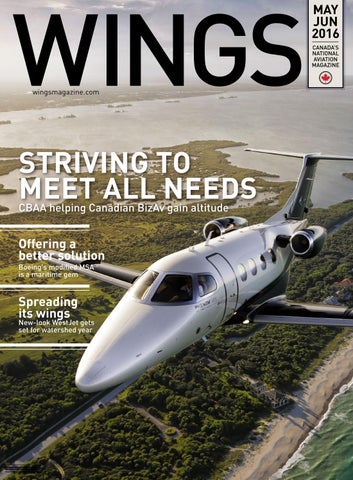
WINGS wingsmagazine.com
STRIVING TO MEET ALL NEEDS
CBAA helping Canadian BizAv gain altitude
Offering a better solution Boeing's modified MSA is a maritime gem
Spreading its wings
New-look WestJet gets set for watershed year
MAY JUN 2016 CANADA’S NATIONAL AVIATION MAGAZINE
AMAZING THINGS HAPPEN WHEN , YOU,RE BOUND ONLY BY PHYSICS.
................................................................................................................................................................................................................................................................................................................. .................................................................................................................................................................................................................................................................................................................
Barring the immutable laws of science, Embraer designers and engineers enjoy a unique freedom to create our executive aircraft. To reshape a fuselage that slips through the air while providing unrivaled cabin roominess. Or tweak the delicate balance of lift and thrust to increase efficiency. Or create control systems that help pilots always perform at their very best. All are a product of unconventional thinking at its finest. With all deference to pioneers like Newton, Galileo and Einstein—we simply don’t think their good work is finished.
Rethink Convention.
EmbraerExecutiveJets.com
MAY/JUNE 2016
UPFRONT 7
Leading edge The future is bright
10 On the fly
News and opinion
14 Alternate Approach Airport privatization gets a new ally
15 Legal
In the name of Safety
WestJet has a new look and a whole new focus as it ramps up operations in 2016. P.28
16 At the Gate
Providing necessary clout
FEATURES 20 STRIVING TO MEET ALL NEEDS The CBAA continues to elevate BizAv’s presence in Canada
BY MATT NICHOLLS
24 OFFERING A CANADIAN SOLUTION Boeing’s structurally modified MSA is the ideal maritime aircraft
18 Glidepath
Time to make decisions
BACK 50 Marketplace 54 On final
The power of relationships
From top: Airport privatization gets a new ally P.14 Time to make decisions P. 18
PHOTO; WESTJET (TOP); PAUL DIXON (TOP RIGHT); PAUL DIXON (BOTTOM RIGHT)
BY CHRIS THATCHER
28 SPREADING ITS WINGS
New-look WestJet gets set for a watershed year
BY DAVID CARR
37 STIMULATING THE MARKET
NewLeaf hopes to set the standard as an ULCC leader
BY DAVID CARR
41 CREATING BEHIND THE LENS
Air Canada’s Brian Losito captures the beauty of aviation in pictures
BY DAVID CARR
4
WINGS | May/June 2016
COVER PHOTO: EMBRAER
WWW.WINGSMAGAZINE.COM
SOMEWHERE BELOW YOU, THERE’S A WORLD FULL OF SPEED LIMITS. Leave everything else behind. The HondaJet won’t just get you there faster; it will do it with a level of comfort that makes getting there as exciting as the destination. Escape the gridlock. hondajet.com
LEADING
EDGE
| By Matt Nicholls
The future is bright
Leaders of tomorrow need persistence, flexibility, passion to pursue change
I
PHOTO: MENA MIU
nnovation and effective change management is never easy, no matter what stage of your professional development. It takes hard work, passion and a willingness to develop new processes while remaining efficient and flexible – a commitment to steadfastly follow a perceived vision and path. It also never hurts to inject some fun along the way. These were some of the salient messages shared by Porter Airlines’ president and CEO Robert Deluce at the Wings and Helicopters Careers in Aviation Expo (CIA) at the Porter Hangar April 9 at Toronto’s Billy Bishop City Centre Airport. The annual GTA version of the CIA Expo brought together a sold-out crowd of more than 230 air cadets, high school and college students, and aviation professionals seeking career changes to the bustling Porter Hangar for an informative day of information gathering, insight and invaluable networking opportunities with a wide cross-section of industry professionals and suppliers. Complete with a mini-Porter lounge and a shiny Q400 shadowing the stage, it created a dramatic backdrop to showcase the possibilities and future of what a career in aviation or aerospace could bring young adults – where they could be working, on what aircraft and with what industry players. And who better to deliver an informative morning keynote, highlighting the possibilities in a career in aviation than Deluce. Porter’s president and CEO comes from one of the most dedicated Canadian families in aviation and aerospace with more than 60 years in successfully financing, restructuring, organizing and operating regional airlines in Canada. With Porter, Deluce has seen the airline expand from two Q400s and a single route to Ottawa, to 26 Q400s and 23 scheduled destinations throughout Canada and the U.S. And
5 WWW.WINGSMAGAZINE.COM
are your wings. “In the
Your success will always only be end, it’s all about people predicated on the people you hire, – we are always seeking to find those future for they truly are your wings. leaders who can drive if airport expansion plans at Billy Bishop are approved, future growth including the deployment of the Canadian-made Bombardier C Series will mean a bevy of new destinations and opportunities. From a career opportunity standpoint, it would mean many more blue-uniformed workers winging their way across North America. It is a great Canadian aviation success story, giving credence to Deluce’s message that if you focus and understand your abilities (and limitations), build on your strengths, plan well, and make strategic choices for the future without being afraid to differentiate yourself from the crowd, success is a distinct possibility. Porter’s chief executive also hit on a critical point: success will always only be predicated on the people you hire, for they truly
TOP DATA BURSTS… in this issue
1. The global Phenom 300,000 fleet has accumulated close to 300,000 flight hours. (Pg. 10). 2. FlightSafety International annually provides 1.3 million hours of training. (Pg. 13). 3. $5.8 trillion: The amount ICAO’s “No Country Left Behind” initiative could provide to global GDPs. (Pg. 16). 4. 30,000: The number of man hours per aircraft it took to modify Boeing’s MSA aircraft. (Pg. 25). 5. AC photographer Brian Losito has acted as the curator for more than 800,000 slides.(Pg. 41).
change.” Riding on the wings of the people who drive your success is an apt way to describe how Calgary’s Westjet is achieving new heights. As David Carr explains in “Spreading its Wings,” on page 28, WestJet is off to a very strong start in the New Year and is poised for one of its best operating years on record in 2016. The airline, which is the lead sponsor for the CIA Expo in Calgary May 14 at the WestJet Campus, is currently introducing its Encore regional subsidiary into the U.S. and introducing or expanding upon a number of international routes, all despite less-than-robust economic realities in Western Canada. In sticking to its DNA and making strategic decisions in a slow economy, WestJet is finding resourceful ways to achieve its goals and find success – a worthy recipe to follow both as an individual or corporation – one I am sure Ferio Pugliese, president of WestJet Encore is bound to touch on when describing WestJet and WestJet Encore’s paths to success at the CIA Expo in Calgary. | W Your feedback is always welcome. Please contact me at mnicholls@annexweb.com. @Wings_Magazine May/June 2016 | WINGS
7
Vol. 57, Issue 3
. yrs
EDITOR
Matt Nicholls mnicholls@annexweb.com 416-725-5637 MEDIA DESIGNER
Brooke Shaw FLIGHT DECK
Rick Adams, David Carr, Paul Dixon, Brian Dunn, Frederick K. Larkin, James Marasa, Carroll McCormick, Anna Pangrazzi, Amanda Winters ACCOUNT MANAGER
Kory Pearn kpearn@annexweb.com 519-902-8574 ACCOUNT CO-ORDINATOR
Stephanie DeFields sdefields@annexweb.com 1-888-599-2228 ext. 257 NATIONAL ACCOUNT MANAGER
Mena Miu mmiu@annexweb.com 905-713-4351 GROUP PUBLISHER
CANADA’S #1 FULL SERVICE FACILITY
Martin McAnulty mmcanulty@annexweb.com WINGS MAGAZINE
P.O. Box 530, 105 Donly Dr. S., Simcoe, ON N3Y 4N5 Tel: 519-428-3471 Fax: 519-429-3094 Toll Free: 1-888-599-2228
BOMBARDIER ASF Printed in Canada ISSN 0701-1369 Publication Mail Agreement #40065710
HEAVY MAINTENANCE FBO CHARTER AIRCRAFT SALES HONDAJET
VISIT US @ BOOTH #59 AT THE CBAA JULY 5- 7TH
TORONTO | MONTREAL | CALGARY
www.skyservice.com 8
WINGS | May/June 2016
Published six times per year (Jan/Feb, Mar/Apr, May/ Jun, Jul/Aug, Sep/Oct, Nov/Dec) Subscription Rates Canada – 1 Year $ 32.95 (plus GST - #867172652RT0001) USA – 1 Year $ 57.95 Foreign – 1 Year $ 65.95 Circulation Email: apotal@annexbizmedia.com Tel: 416-510-5113 Fax: 416-510-5170 Mail: 80 Valleybrook Dr., Toronto ON M3B 2S9 Occasionally, Wings magazine will mail information on behalf of industry-related groups whose products and
Air Transport Association of Canada
ON THE
WEB
services we believe may be of interest to you. If you prefer not to receive this information, please contact our circulation department in any of the four ways listed above. Annex Privacy Officer privacy@annexbizmedia.com Tel: 800-668-2374 No part of the editorial content of this publication may be reprinted without the publisher’s written permission. ©2016 Annex Publishing & Printing Inc. All rights reserved. Opinions expressed in this magazine are not necessarily those of the editor or the publisher. No liability is assumed for errors or omissions. All advertising is subject to the publisher’s approval. Such approval does not imply any endorsement of the products or services advertised. Publisher reserves the right to refuse advertising that does not meet the standards of the publication.
Canadian Owners & Pilots Association
Canadian Business Aviation Association
Magazines Canada
AVIATION THIS WEEK
PHOTO: ANNEX BUSINESS MEDIA
GULFSTREAM AWF
Looking to catch up on the latest hot news from around aviation and aerospace? Check out Aviation This Week, a live digital version of the top news stories affecting a variety of key markets. It's quick, essential information you need to know! WWW.WINGSMAGAZINE.COM
BOUNDLESS POSSIBILITIES Gulfstream gives travelers the ability to live without limits. By fusing exceptional engineering with a genuine obsession for superior style and product support, Gulfstream delivers unsurpassed aviation performance. Our fleet empowers people by expanding horizons. Create boundless possibilities. Fly Gulfstream.
SCOTT NEAL | +1 912 965 6023 | scott.neal@gulfstream.com | GULFSTREAM.COM G650ER, G650, G600, G500, G550, G450, G280 and G150 are trademarks or registered trademarks of Gulfstream Aerospace Corporation in the U.S. and other countries.
ON THE FLY For late-breaking news and exclusive web content, please visit us at: www.wingsmagazine.com
THE LEAD COMMERCIAL BIZJETS OPERATIONS
THE LEAD
LATIN HEAT Embraer delivered 70 units of its best-selling Phenom 300 light jet in 2015, making the aircraft the most-delivered business jet in the world for a third year running, according to the Washington-based General Aviation Manufacturers Association (GAMA). Strength in the North American general aviation market notwithstanding, 2015 was a “mixed” year, says Pete Bunce, GAMA chief executive. Preliminary business jet shipments were relatively flat, up 1.6 per cent from 644 units in 2014 to 654 units in 2015. “Year-end number among the various sectors reflect a market characterized by plummeting energy sector revenue, economic uncertainty and current fluctuations in key [general aviation] markets such as Brazil, Europe, Russia and China,” Bunce notes. The North American market continues to show relative strength. The GAMA report held encouraging news for the Brazilian manufacturer. Embraer Executive Jets’ market grew to 17 per cent in terms of unit deliveries. In 2015, Embraer’s executive aviation division delivered 120 aircraft, including jets in the Phenom, Legacy and Lineage families; the highest number of deliveries in five years. Powered by two Pratt & Whitney
Canada PW535E engines, the Phenom 300 has a range of 3,650 kilometres and remains popular with fractional operators, charter services and owner-pilots. Threehundred and twenty 300s are in operation in 28 countries, and the fleet has accumulated close to 300,000 flight hours. “To have the most-delivered business jet in the world for the third consecutive year is a true recognition that we have achieved our commitment to design game-changing products to meet operators’ needs,” says Marco Tulio Pellegrini, chief executive of Embraer Executive Jets. A walk across the São José dos Campos facility to the commercial aircraft division, Embraer rolled out the first of its secondgenerationE2jetslastFebruary.TheE190-E2 was the first of four prototypes that will be used in the E190-E2 test program. The aircraft’s maiden flight is scheduled for the second half of 2016, with entry into service in 2018. Two additional aircraft will be added for the E195-E2 campaign, which is expected to enter service in 2019, and three more will be used in the E175-E2 campaign, which is scheduled to enter service in 2020. The E190-E2 has the same number of seats as the current generation E190, which is operated by a number of airlines including Air Canada, and can be configured with 97 seats in dual class service or with 106 seats in a single class layout. The range of the E190-E2 has been increased significantly over the current generation aircraft, by 740 kilometres to 5,185 km. Since the E2 family was launched in 2013, the program has reached 640 commitments, 267 of which are firm orders and 373 are options and purchase rights from both airline customers and leasing companies. Embraer is confident that the E2
There are a total of 320 Phenom 300s operating in 28 countries around the world. 10 WINGS | May/June 2016
program will consolidate its lead in the 70- to 130-seat market. “We have taken another step into the future of Embraer commercial aviation with the world premiere of our second-generation E-Jets,” said Paulo Cesar Silva, chief executive for Embraer commercial aviation. “I’m sure that as a result of this event, the market’s interest in the E2 will grow even further, increasing the commercial success of this program throughout the world.”
COMMERCIAL
GOVERNMENT PLANE? Presenting the C Series incorporated? A Scotiabank financial analyst sees an opportunity for Bombardier to spin off its troubled airliner program to a separate entity if the federal government comes through with $1 billion in bailout money. Turan Ouettawala says that ownership of “C Series Inc.” would be split evenly between Bombardier, the federal government and the province of Quebec, which injected $1 billion into the program last fall. The Quebec government already wants to loosen the disproportionate influence of Bombardier’s family interests, and has already proposed a separate seven-person board for the C Series, which would give the Quebec and federal governments two seats each, if Ottawa matches the province’s $1 billion stake in the program. The Trudeau government had not made a final decision on the C Series as Wings went to press, but Prime Minister Trudeau has been laying down markers. On a stop in Toronto to promote the budget, the prime minister said that the C Series is an “exceptional aircraft” and it is important to make sure that the Canadian aerospace industry is strong. The request for more federal money for the C Series has opened up a debate on government subsidies for business, including money for Ontario’s automotive industry. The move has been seen as a bargaining chip for Quebec approval for an oil pipeline from Alberta to New Brunswick. Mark Milke, a Calgary-based author who specializes on subsidies to business wrote in The Globe and Mail that this would be the 51st time that Bombardier has gone to the federal government for assistance since 1966. Bombardier has recently said that an additional $1 billion from Ottawa would be nice but not necessary. What else can they say? Analysts have suggested that delays in WWW.WINGSMAGAZINE.COM
PHOTO: EMBRAER
10 10 11 12
announcing a bailout could be harming C Series sales prospects following the landmark Air Canada order in the fall. Quettawala has described the situation as “Bailout 3.0” and argues that a new C Series entity could be split evenly between Bombardier and the two levels of government, and may boost the transport company’s languishing share value. “We have written extensively about why we believe the C Series is very unlikely to add positive value to Bombardier’s equity,” Quettawala wrote in a client note reported in the Financial Post. “As such, if Bombardier can sell 66 per cent of the C Series to the government for US$2 billion, that implies some value creation.” Meanwhile Bombardier, which recently announced the sale of 20 Challenger 350 business jets to an unspecified customer, has completed the C Series European routeproving program from launch customer Swiss International Airlines (SWISS) Zurich base. The aircraft completed more than 30 city-pair flights in European cities, including Paris, Milan, Manchester and Warsaw. “Considering that Bombardier inserted the CS100 aircraft into a number of the network operations we currently service, the route-proving program provided us with a real indication of how the C Series will operate in our route system when we take delivery of our first CS100 in June,” said Peter Wojahn, chief technical officer for SWISS. “As the launch customer and the first airline to operate the C Series aircraft, we are very pleased and impressed with the results.”
PHOTO: BOMBARDIER (BOTTOM LEFT) PHOTO: DASSAULT FALCON (TOP RIGHT)
BIZJETS
DASSAULT’S FLAGSHIP TRIJET
Braving the elements: The cosy Dassault Falcon 8X passes its cold-weather tests.
FACES THE COLD Dassault Aviation’s Falcon 8X ultra-long range trijet has left Canada following successful cold soak trials, and is expected to enter service later this summer. Three aircraft in the flight test program have nearly completed all certification test requirements, and to date have accumulated more than 650 flights hours in 325 flights. Powered by three Pratt & Whitney Canada PW307D engines and with a range of up to 11,945 kilometres, the 8X is a derivative of the popular Falcon 7X, and features the greatest range and longest cabin in the Falcon line. The manufacturer also says that the 8X offers the most extensive selection of cabin configurations available on any large cabin business jet. The cold soak campaign was conducted at Ranken Inlet, Nunavut between March 9 and 11. The tests are intended to demonstrate aircraft system functionality under extreme weather conditions. All systems, including avionics, electrical, hydraulic and digital flight control systems, performed flawlessly during the tests despite temperatures that dipped to -33C.
Will a C Series private sector owner be in the program’s future?
All cabin systems were successfully tested on ground after APU start-up and cabin warm-up. Full capability under extreme cold conditions was also demonstrated in flight at the end of the Canadian campaign. The third ship in the test program is now engaged in aircraft operational reliability and performance trials in different conditions of flight. The month-long campaign will take the aircraft through Europe, the Middle East, Asia and North and South America, and include more than 60 missions of various lengths representing the extremes of what Falcon 8X customers might expect to face during the aircraft’s operational life. The campaign is paying particular attention on cabin equipment and functionalities and other high-speed communications systems during long, intercontinental flights and flights over remote areas.
LOOSENING THE HANDCUFFS ON AC The Trudeau government has introduced legislation to modernize the Air Canada Public Participation Act (ACPPA) that binds the airline to certain business practices, including specific levels of maintenance services in Montreal, Mississauga and Winnipeg. Good for them, but the near 30-year old act, which was crafted to ease the sting of privatization, needs to be abolished. The ACPPA became a hot-button issue in 2012, when Air Canada’s practice of shifting more heavy-maintenance work outside of Canada was blamed for the sudden collapse of Montreal-based Aveos Fleet Performance (which had earlier purchased 70 per cent of Air Canada Technical Services). The Quebec government took the airline to court for moving maintenance work out of the province. That law suit appeared headed for the WWW.WINGSMAGAZINE.COM May/June 2016 | WINGS
11
ON THE
FLY
Supreme Court after the Quebec Court of Appeal upheld a lower court ruling that Air Canada had violated the act. Quebec recently agreed to discontinue litigation after Air Canada agreed to keep heavy-maintenance work on its C Series fleet in Quebec for 20 years. The airline has also promised to contribute to the creation of centres of
“Our airline industry today is very different from what it was in the 1980s, with greater domestic competition, many more foreign carriers and maintenance dynamics that have dramatically changed on a global basis.”
OPERATIONS
FLIGHTSAFETY TURNS 65 Sixty-five years ago, Albert “Al” Ueltschi, a personal pilot to Pan Am’s Juan Trippe and associate of Charles Lindbergh, founded FlightSafety International. Ueltschi, who began his aviation career with Pan Am 10 years earlier was concerned that corporate pilots did not receive the same level of training as airline pilots. “We will always be truly thankful to Al Ueltschi for founding this outstanding company,” Bruce Whitman, chair and chief executive of New York, LaGuardia-based FlightSafety said on the occasion of the
Aircraft Maintenance Engineering Next intake is Sept 2016 at our Dawson Creek Campus Affordable student residences available!
380/16.0
2.12.j
NLC’s 15-month Aircraft Maintenance Engineering program is designed to train individuals wanting to work in the aerospace industry. Graduates receive the full training component and 1.5 years of the four-year experience component required for an AME licence, category M1 or M2. Apply online through the Apply BC link at nlc.bc.ca or email studentrecruiter@nlc.bc.ca for more information.
nlc.bc.ca 12 WINGS | May/June 2016 WG_MarApr16_Northernlights_CSA.indd 1
1-866-463-6652 WWW.WINGSMAGAZINE.COM 2016-02-16 9:06 AM
PHOTO: AIR CANADA
Air Canada has promised to help create centres of excellence for aircraft maintenance in Quebec and Manitoba.
excellence for aircraft maintenance in Quebec and Manitoba, allowing that province to step back from its own litigation. “It is important for the government of Canada to allow air carriers equal opportunities to compete in an evolving air sector,” said Transport Minister Marc Garneau when he announced changes to the ACPPA. Indeed it is important. But the ACPPA was written before a low-cost tsunami crashed over legacy airlines, and before the rise of lower-cost, global heavy maintenance centres. The more prudent approach would be for the government to step aside. For its part, Air Canada welcomes a level playing field. “Air Canada is a private sector company, owned by private sector interests, which operates in a highly competitive global industry that has undergone dramatic transformation over the past three decades,” Calin Rovinsecu, chief executive of Air Canada said in a statement. “No other airline in Canada is subject to restrictions such as those imposed on Air Canada.
PHOTO: FLIGHTSAFETY
FlightSafety’s 1,800 instructors deliver more than 4,000 courses for 135 aircraft models worldwide.
WWW.WINGSMAGAZINE.COM
company’s 65th anniversary. Whitman added that the company is still guided by Ueltschi’s passionate belief that the best safety device in any aircraft is a welltrained crew. From the start of building aircraft specifically for business aviation, FlightSafety worked directly with customers and aircraft manufacturers to develop and deliver safety-focused training, riding the dawn of the business jet. Today, FlightSafety serves business aviation, commercial airlines, governments and military agencies around the world, including Toronto where the company specializes in Beech 1900, legacy de Havilland and Bombardier Q400 operations. The company is co-located at Bombardier’s Downsview plant, providing a value added benefit to customers. Close to 1,800 instructors deliver more than 4,000 courses for 135 aircraft models, as well as new advanced training programs and specialty courses throughout the company global network
of Learning Centres and online through eLearning. The company provides more than 1.3 million hours of training each year to pilots, technicians and other aviation professionals from 167 countries, and operates the world’s largest fleet of advanced, full-flight simulators. With manufacturing facilities in Oklahoma, Missouri and Texas, FlightSafety continues to be a leader in the design, manufacture and support of flight simulators, visual systems, displays and other advanced-technology training equipment. Many leading commercial, government and equipment manufacturers rely on the company’s advanced technology equipment and mission critical training products and services. In April, Whitman, who joined FlightSafety in 1961 and became its chief executive in 2003, was keynote speaker at the Wichita Aero Club’s April luncheon. Whitman’s first visit to Wichita was in the early 1960s when he paid a visit to Bill Lear, founder of Learjet.
May/June 2016 | WINGS 13
ALTERNATE
APPROACH By David Carr |
Airport privatization gets a new ally David Emerson’s new report redrafts Canadian air transport
I
14 WINGS | May/June 2016
dividends to shareholders and taxes. Still, Canada ranks 135th in airport cost competitiveness according to the World Economic Forum, suggesting there is opportunity to bring costs down. How will the current government respond? It’s tough to say. The report was commissioned by the previous administration. Transport minister Marc Garneau wants the spring and summer to study the report. Political backrooms, however, have long memories. Emerson likes to get things done, but was a minister in the last Liberal government before jumping ship to join Stephen Harper’s cabinet after the 2006 election, making him perhaps the wrong guy to deliver the right message. The commercialization of airports and the privatization of Air Canada, the CN Railway and NAV CANADA are some of the few bright spots in a fading national transport picture. Interestingly, these bold initiatives came from Liberal and so-called red-Tory governments that mirror the direction of the current one. Emerson has delivered a road map forward; it is time to re-think how transport is built, owned and operated in Canada, beginning with the sale of airports. | W
We love them because they pay a steady income for our retirees, protect against inflation and are a diversifier. “Sooner or later, the model will have to evolve; otherwise airports are likely to fall back into the same state of under-funding that led to divesture in the first place." CAPA, a U.K.-based air transport research group reports that around 500 commercial airports worldwide, have some form of private-sector participation in management or ownership. Approximately 15 per cent are owned outright. Airport authorities deserve credit for investing and rebuilding Canada’s once tired air transport infrastructure, transforming it into one of the best in the world. But commercialization is not privatization. Airport authorities function as corporations, sit on billions of dollars of public-owned land, selfappoint their own boards of directors and are unaccountable to shareholders. They are not bound by private-sector discipline and, as not-for-profits, revenues are recycled back into the authority, whereas profits from airports owned by funds such as the OTPP, flow out to retirees or shareholders. And here is the thorniest bit about privatization; it is unlikely to lower the cost of air travel, at least immediately. Airport rents should disappear, but there will be
David Carr is a Wings writer and columnist. WWW.WINGSMAGAZINE.COM
PHOTO: PAUL DIXON
s it time to sell off Canada’s airports? David Emerson, a former chief executive of the Vancouver International Airport Authority (VIAA) says “yes.” In 2012, Emerson headed a federal government review of Canada’s aerospace industry. He has recently dropped another door-stopper, this time a report that redrafts the framework of Canadian transport, including dismantling Canada’s not-for-profit airport authorities. Air transport already operates on a user pay model at home, and Canadian pension funds are big investors in airports abroad. The U.K. estimates that 12 Canadian pension plans are investing in British airports, including Caisse de dépôt et placement du Québec, which owns over 12 per cent of London Heathrow and the Ontario Teacher’s Pension Plan (OTPP) – a partner in a consortium that recently bought London’s City Centre Airport for an estimated £2 billion – and has equity stakes in airports in Birmingham, Bristol, Brussels and Copenhagen. Like other pieces of pay as you go infrastructure such as toll roads and bridges, airports are popular with pension funds, private equity funds and stock portfolios because they deliver reliable, long-term revenue streams from diverse resources such as airline user fees and passenger ancillary fees, including parking and retail – a growing driver of airport revenue. “We love them because they pay a steady income for our retirees, protect against inflation and are a diversifier,” Andrew Claerhout of the OTPP told The Economist newspaper last year. In March, Fairfax India, a division of Toronto-based Fairfax Financial paid US$321 million for a 33 per cent stake in Bangalore International Airport. Emerson recommends that within three years, the federal government move to a share-capitalstructureforlargerairports,with equity-basedfinancingfromlargeinstitutional investors such as Caisse and OTPP. “The Review heard from many of the original authors of the Canadian [airport] model, who considered it to be a first step towards fully private, for-profit airports,” Emerson wrote. Presentations to Emerson’s Review suggest airports could already be chaffing under the current model.
LEGAL By Darryl Pankratz |
In the name of safety
Setting a high bar for airport security clearance
PHOTO: BRIAN LOSITO, AIR CANADA
H
olding a valid security clearance is essential for pilots and flight crews of various operators, and may also be necessary for mechanics, baggage handlers, food services personnel and others because they require entry into restricted areas of airports in order to carry out their employment duties. With recent enhanced safety measures and programs throughout the industry, obtaining, and in some circumstances maintaining, security clearance may be more difficult than ever before. The Minister of Transport (Minister), through the Canada Transportation Agency (CTA), operates the Transportation Security Clearance Program (TSCP), whose aim is to prevent unlawful acts of interference with civil aviation by standardizing the requirements necessary to obtain security clearance. The Minister is responsible for determining whether to grant, maintain, or revoke a person’s security clearance. For individuals working in the aeronautics industry, they may find their security clearance at risk due to past activities or transgressions, or even relationships with others. In recent decisions, Canadian courts have confirmed the Minister’s discretion to deny, suspend or revoke security clearance for a number of reasons. Of interest is of Christie v Canada Transport. Christie was a full-time employee of a major airline, and he applied for security clearance in January 2013. The TCSP obtained an RCMP background check as part of its review of Christie’s application, which showed two police incidents in 2007, where four individuals who were present with Christie had prior convictions for violence, drugs and weapons. Christie’s application was referred to the Appeal Board, where Christie argued that his criminal tendencies were part of his past and that the charges against him had been withdrawn. Nevertheless, the Appeal Board concluded that there was reason to believe the Christie “may be prone or induced to undertake an action that would unlawfully interfere with civil aviation” and recommended Christie’s application be refused. On a review of that decision, the Federal WWW.WINGSMAGAZINE.COM
individuals involved in drug trafficking at the airport. The Court, however, noted previous cases have confirmed that association with individuals involved in crime is sufficient for the Minister to exercise his broad discretion to cancel a security clearance. When a person’s security clearance is refused or revoked, he or she is entitled to “procedural fairness.” This means he or she has a right to know the facts that the Minister is considering when making a determination. Mere explanations and representations, however, may be insufficient to overturn an unfavourable decision. In Rossi’s case, he gave specific explanations for several instances of association relied on by the Minister. However, the Court found the Minister’s decision was reasonable because of the broad discretion with which he is afforded to make these determinations. Clearly, it is imperative that those with access to restricted areas at airports are properly screened so as to ensure the safety of airports, employees and passengers. | W
Certain individuals may find their security clearance at risk due to past activities or transgressions. Court confirmed the threshold for determining whether a person may be prone or induced to unlawfully interfere with civil aviation is very low. Further, the Court confirmed when denying security clearance, the Minister can consider not just criminal charges that led to conviction, but also charges that were withdrawn. Accordingly, the Federal Court agreed that the Appeal board’s decision was reasonable in the circumstances. The Federal Court considered similar issues in Rossi v Canada, where Rossi appealed the Minister’s decision to cancel his security clearance. Rossi was a manager of a food service company at an airport, where he had been employed since 1998. In December 2013, a record check revealed links between Rossi and individuals involved in the import and export of drugs from the airport. As a result of Rossi’s suspected association with an organized crime group, his security clearance was revoked. At Rossi’s appeal to the Federal Court, he argued the decision was unreasonable because he was never convicted of any criminal charges, was unaware of any criminal activities of his co-workers and there was no evidence that he was affiliated with any
Darryl Pankratz is a partner and chair of the Aviation Practice Group at Alexander Holburn Beaudin + Lang LLP. The Aviation Practice Group handles legal matters of special concern to the aviation community across Canada and internationally. For more information, go to www.airlawblog.com. May/June 2016 | WINGS 15
AT THE
GATE
By Brian Dunn |
Providing necessary clout
ICAO’s Montreal base helps stimulate the local economy, drive change
16 WINGS | May/June 2016
Just upgrading air traffic systems alone could add $300 billion a year to the global economy.
fossil fuels, airlines must increase their “uptake of energy-efficient technologies and procedures,” while airports and aviation infrastructure must be sustainable and climate sensitive. And ICAO must continue to work with its members toward a viable market-based measures solution to CO2 emissions for international aviation at its upcoming assembly this fall. In a more recent development, ICAO implemented a new regulation in Montreal for the real-time tracking of distressed commercial aircraft aimed at preventing a repeat of the MH370 mystery. Two years after Malaysia Airlines flight 370 vanished en route from Kuala Lumpur to Beijing with 239 passengers and crew onboard, ICAO approved a series of proposals answering industry calls for greater aircraft tracking and better flight data utilisation. The outlines include aircraft carrying tracking devices able to transmit their location once a minute when distressed, a ruling applicable to aircraft built in six years’ time and beyond. In addition, operators will now be obligated to ensure the recoverability of their flight recorder data while the duration of cockpit voice recording time has been extended from two to 25 hours. | W
growth, safely and efficiently,” Dr. Liu said. With sectoral growth its greatest challenge, ICAO recognizes that without major modernization, the projected expansion of air travel could “overload the system,” resulting in a negative impact for economies and businesses, large and small. Taking a proactive stance, ICAO revised its Global Aviation Plan and Global Air Navigation Plan, setting out timelines, performance targets and “technology roadmaps.” One topic of concern is climate change and aviation’s role in reducing emissions that currently account for two per cent of the world’s greenhouse gas emissions. The expected increase in air traffic will make reductions much more challenging. “Fortunately, aviation has a long record of driving significant fuel efficiency improvements, which bring with them winwin reductions in aircraft emissions,” Dr. Liu said. And while a historic consensus was recently reached at ICAO on a new standard for aircraft CO2 emissions, particulate matter and noise abatement, more needs to be done, Dr. Liu said. The industry needs Brian Dunn is a Wings writer and more sustainable energy alternatives to columnist.
WWW.WINGSMAGAZINE.COM
PHOTO: ICAO
T
here is no question that having the International Civil Aviation Organization (ICAO) based in Montreal has helped attract other aviation organizations to the city, including Airports Council International, the global pilots association (IFLPA) and the global air traffic controllers’ association (IFATCA). The city is also home to 51 of ICAO’s 191 member states and permanent staff. The importance of ICAO to the city’s economy was outlined in a recent speech by Dr. Fang Liu, secretary general of ICAO to the Conseil des relations internationales de Montréal (CORIM). Liu notes that the number is roughly $120 million a year. “And let us not lose sight of the fact that, as a number of U.N. agencies are looking beyond New York for cost-effective locations for their operations, Canada’s positive approach to multilateralism and Montreal’s many international qualities could drive an even greater U.N. presence in this city in the years ahead,” she remarked. One of ICAO’s occupations is working with other U.N. organizations towards its historic “Agenda 2030” and its Sustainable Development goals. ICAO is supporting the initiative through its own initiative called “No Country Left Behind” which is focused on providing and coordinating assistance and capacity-building for developed and developing countries, Dr. Liu explained. “By improving and reinforcing their ability to implement ICAO standards, becoming full and responsible members of the global air transport network in the process, ICAO helps ensure that all states and regions can prosper from aviation’s many benefits,” she said. Implementing measures under ICAO’s initiative could double aviation’s global GDP contribution to about $5.8 trillion over the next 15 years. Just upgrading air traffic systems alone could add $300 billion a year to the global economy, Dr. Liu pointed out. But in this age of belt tightening, she questions how much money will actually be spent, since only 2.6 per cent of annual global development financing supports aviation infrastructure upgrades. “This is absolutely insufficient if we wish to accommodate and manage future
GLIDE
PATH
By Paul Dixon |
Time to make decisions
Canada’s military role is in dire need of refinement and strategic vision
I
18 WINGS | May/June 2016
Crystal Serenity traverse the Passage with 1,700 passengers and crew. The question of Canada’s sovereignty in the North is still an issue that the Americans choose to ignore and the Russians are making their own noises. We have certainly not shied away from the North, as support has been there for the Breadalbane expedition in the late 1970s and then the successful search for the Franklin ships in recent years. From the DEW Line to maintaining CFS Alert, Canada has met its obligations to NORAD and other alliances. Now, as the ice wanes and commercial travel expands in the high Arctic, our international SAR obligations take on a three-ocean perspective. As we struggle to focus on recent events in Europe and the Middle East, we need to get a grip on where we fit in and what we can do and then make our global commitment. It’s a commitment to our friends and allies abroad, and even more so, to the men and women we are going to ask to undertake these missions, wherever they may be. To get it right, we have to do it right. | W
The key to creating a military capable of carrying out its duties is providing it with the tools to do the job. time and it has served us well. It would be nice to replace it with an aircraft that will be at least as capable in terms of meeting future requirements. In so many other cases over the past 30 years, we’ve seen half-baked results where compromise becomes the key word and we end up with an aircraft that does a number of things moderately well, but doesn’t excel in any facet. Another shortcoming has been the false economy of buying too few assets. We didn’t buy enough CH-149 Cormorants to adequately cover four SAR bases, so Trenton operates Griffons in the SAR role. We have five C-17 Globemasters, but it’s my personal bias that eight would have been a more optimum number, especially when you project 20 to 30 years into the future. Canada has a huge area of responsibility opening up in the North. It’s been 47 years since the SS Manhattan was guided through the Northwest Passage by both Canadian and American icebreakers, and this summer will see the cruise ship
Paul Dixon is a freelance writer and photojournalist living in Vancouver. WWW.WINGSMAGAZINE.COM
PHOTO: PAUL DIXON
’ve lost count of the urgent needs for our military and I’m not going to subject you to the torture of trying to recall them with me. A few highpoints will suffice for now. There’s the replacement for the CF-18 that is still up in the air (sorry, couldn’t resist), the Fixed-Wing SAR (FWSAR) replacement that has crept into the RFP stage . . . then there’s the navy’s lack of supply ships and the revelation that the National Shipbuilding Program, which was supposed to be the blueprint for future military acquisition projects, has lost momentum and may not in fact be what was promised. Now, Defense Minister Harjit Sajjan has announced a series of public consultations, soliciting input from all sectors of Canadian society, “to inform the development of a new defense policy for Canada.” It would seem the government wants to hear from Canadians what we think our country’s role should be in world affairs, and from that, create a Canadian military that is capable of performing these roles. The key to creating a military that is capable of carrying out its duties is providing it with the tools to do the job. And along these lines, the right tools to do the job. Former Lt.-General Andrew Leslie, now a government MP, wrote a document in 2011 entitled “Report on Transformation,” which laid out 43 recommendations for streamlining the Canadian military. It outlined ways to save money by eliminating waste and duplication that he had identified in many areas. The report supposedly ruffled more than a few feathers within DND and fell by the wayside, only to be resurrected during the most recent election. Common themes at election time include reining in government spending, cutting waste and doing all the right things in all the right ways. It’s great talk, but as you’ve read in this space before, if you don’t know where you are going, then how in the blazes can you decide how you’re going to get there? Now, it appears we might be on track to first decide what this country of ours should be doing in the world, so we can then properly equip and train the people we will be relying upon to get the job done. The CF-18 was the right aircraft at the
STRIVING T
ALL NEEDS
THE CBAA CONTINUES TO ELEVATE BIZAV’S PRESENCE IN CANADA
BY MATT NICHOLLS 20 WINGS | May/June 2016
WWW.WINGSMAGAZINE.COM
The CBAA remains committed to raising safety standards in Canada, including initiatives like its “Partners in Safety” program.
TO MEET PHOTO: EMBRAER
I
n motivating his team for its match against the vaunted Russians before the gold medal game in the 1984, U.S. men’s hockey coach Herb Brooks noted that great moments are born from great opportunity. It’s certainly an apt way to describe the opportunities that exist for the Canadian Business Aviation Association (CBAA), as it continues to strengthen its advocacy position for members and help identify the scope of business aviation in WWW.WINGSMAGAZINE.COM
Canada. It has been a challenging last few years as the association has worked to reinvent itself into more of an advocacy role. In May 2014, Transport Canada (TC) announced new regulatory measures for the issuing of Private Operator Certificates (POC) – one of the main responsibilities the association had administered and closely monitored for years. In turn, the CBAA has refocused its efforts on its key missions of promoting business aviation
in Canada and internationally – advocating, highlighting safety, security and efficiency. Under the patient and studious guidance of CBAA president and CEO, Rudy Toering, the CBAA is concentrating on several key projects, including: enhancing educational opportunities and increasing the scope of its annual convention; working closely with TC to improve efficiencies and prospects for business aviation operators; enhancing safety May/June 2016 | WINGS 21
22 WINGS | May/June 2016
Wings and discuss the association’s progress, key initiatives for 2016 and beyond, economic realities and more.
What are the biggest challenges facing Canadian business aviation in 2016? Five years from now?
RT
One of the biggest challenges we have faced recently has been the changes to the regulatory framework for business aviation. Fortunately, we expect that these will be behind us shortly – and that after all this time, we have gained important ground and we can turn our attention to other issues. For example, many of our challenges stem from a basic misperception that business aviation is a luxury and not a business tool. An ongoing and major part of our work is to educate decisionmakers on the true facts. Our latest iteration of the Business Aviation Economic Impact Study [EIS] report contains data on both business aviation operations and manufacturing which will strengthen our economic argument even further. Five years from now, I would like to be at a point where business aviation is widely understood to be a valuable business tool used proudly by corporate Canada.
PHOTO: MATT NICHOLLS
“We are influencing a far larger audience with a much more professional and persuasive message.”
through programs such as its Partners in Safety program launched last year; expanding on its economic impact study and more. Toering says he is pleased with the results, but recognizes there is much more to do, more issues to explore. “We are influencing a far larger audience with a much more professional and persuasive message,” Toering told Wings in advance of its annual convention and exhibition in Calgary July 5-7. “Contacting members of parliament in the new government is an important opportunity to press the reset button, and ensure that MPs are in a position to make good decisions and are well-informed about the importance of business aviation, both as a part of Canada’s strategic aerospace sector and also as a net contributor to our national and local economies. To do this, the office has contacted all MPs and also launched a new grassroots program, called, ‘Connecting to Parliament’ for our members to reach out to their MPs directly. I am extremely pleased – and heartened – by the number of our members who wrote to their MPs and even more so by the number of MPs who wrote back.” Toering took time out of his busy preconference schedule to sit down with
WWW.WINGSMAGAZINE.COM Ad.indd 1
2015-04-24 1:30 PM
Economic realities and the current slowdown in the oil patch have affected some sectors of Canadian aviation. What has been the impact on business aviation in Canada?
RT
As you know, there is more to Canada’s economy – and provincial economies – than oil. It’s no secret that commodity prices are cyclical, and I think for the most part, our members take a long view; they are in it for the long haul. As far as the health of business aviation is concerned, it is better to consider the recent spike in Gross Domestic Product, which is way above forecasts. I think that demonstrates that the underlying fundamentals of our economy are strong – and as long as Canadian companies are on the world stage competing for customers and market share, business aviation will always have an important role.
What effect has the new regulatory framework had on CBAA/Transport Canada (TC) relationships? And what are the most important issues and challenges members have with TC?
RT
There has been a big change in leadership at TC and the CBAA has worked professionally with TC for many years and continues to do
WWW.WINGSMAGAZINE.COM
so. Transport Canada has been very complimentary regarding the CBAA safety initiatives and the operator member’s acceptance of our “Partners in Safety” program. One of the benefits of a Safety Management System (SMS) should be a reduction in prescriptive regulations and more performance-based approaches to rule-making and compliance. TC sees and recognizes the safety culture that the business aviation sector adheres to and now we need to see that reflected in our rules and regulations.
How effective has the CBAA been over the last few years in eliminating the “one size fits all” approach to the Canadian regulatory environment?
RT
In the past, members were frustrated with the regulatory requirements that targeted large airline operators but were not scaled to the smaller operators. However, the government has recently recognized the importance of having different approaches and regulations for different aviation sectors. This position was most recently reinforced by a recommendation in the Canadian Transportation Agency review and we hope this helps further this directed
approach even more.
The “Business Aviation Economic Impact Study (EIS)” report outlining the scope of influence business aviation has in Canada was significant. What were the main take-aways from the study and how has it helped the association in its advocacy efforts? How has this helped business aviation in Canada?
RT
The Business Aviation Economic Impact Study [EIS] has allowed us to use evidence-based data, not just words, to make the case of the importance of business aviation both within and beyond the aerospace sector. The updated study includes data on manufacturing as well, adding to the strength of our argument and building a more comprehensive and cohesive picture of business aviation in Canada.
How has the CBAA worked to gain influence on the international scale? How critical is this? What is the working relationship like with the National Business Aviation Association (NBAA) and how important is it? CONTINUED ON PAGE 34
May/June 2016 | WINGS 23
OFFERING A CANAD SOLUTION BOEING’S STRUCTURALLY MODIFIED MSA IS THE IDEAL MARITIME AIRCRAFT
H
BY CHRIS THATCHER
ow do you get all the advantages of a P-8A Poseidon mission system without footing the bill for a US$170 million maritime patrol aircraft? Shrink the plane and drop the weapons. Make no mistake, Boeing is still seeking foreign sales for the P-8A, a multimission maritime aircraft based on a 737 airframe. But for countries requiring all-domain ISR capability without anti-submarine warfare (ASW) systems, the company has developed a lower cost alternative: the Maritime Surveillance Aircraft, or MSA. And it’s Canadian. The MSA is a Bombardier Challenger 605 or 650 structurally modified and reconfigured by Field Aviation of Toronto. But it comes with many of the bells and whistles of a Poseidon. “You are basically benefiting from the huge investment the U.S. Navy and Boeing have made in the P-8 mission systems as well as AWACS,” said Jim Barnes, director of business development in Canada for Boeing Defense, Space and Security. “You are putting that in a smaller platform. So for countries that just need ISR capability – that don’t need the ASW – this platform is great.” First unveiled as a concept at the 2012 Farnborough Air Show, the MSA has rapidly progressed to a demonstrator aircraft – a Challenger 604 that was previously the private jet of recently retired Boeing CEO James McNerney. Boeing conducted the first flight on February 28, 2014, and the plane has since been performing technology demonstrations to potential customers worldwide. “In less than three years we went from concept to completion for the demonstrator aircraft,” Matt Carreon, head of global sales and marketing for Boeing Military 24 WINGS | May/June 2016
Field Aviation has experience modifying four Challenger 604s for the Royal Danish Air Force to perform maritime surveillance, Arctic patrol and search and rescue.
Aircraft, explained during a recent stop in Ottawa. “This is not a prototype, this is a fully missionized aircraft that can do the mission tomorrow.” The demonstrator includes a Selex Active Electronically Scanned Array multi-mode radar, a FLIR 380 high definition electro-optical/infrared camera, a communications intelligence suite from Boeing subsidiary Argon ST, and a Boeing electronic support measures (ESM) system. The interior features up to five dual-screen, multi-touch workstations and open architecture to readily accept new technology. The Canadian content is no accident.
Carreon, a former P-3 Orion tactical navigator, says Boeing “defined the mission” before identifying the aircraft. “We came up with the Challenger based on its capability, payload, size, weight and power – key characteristics when you are adding sensors. We did a full trade analysis on the Bombardier aircraft.” Not only is it the “largest selling midsized business jet on the market,” the Challenger offers “growth capacity” to accept more sensor capability and the flexibility to adjust to other mission requirements, he added. “[It] has the added benefit of being easily reconfigurable from an ISR platform to a transport or medevac role. WWW.WINGSMAGAZINE.COM
ADIAN
and obviously in Boeing as a partner.” The structural modifications range from the tail cone to ESM antenna, a retractable EO/IR camera and an underbelly radome, and were designed to ensure the aircraft could accept whatever sensors, radar, camera and other system the customer requires. Love said the alterations were designed by Boeing or Field Aviation and then adapted for the aircraft by Field, a process he jokingly equated to “sleeping with an elephant.” “Our two engineering teams worked extremely well together,” he said. “Boeing was willing to learn from us in some areas and certainly we learned a lot from them.” Love said the modifications involved about 30,000 man-hours per aircraft and the company would have to consider expanding its workforce if there is high demand for the MSA.
“For countries that just need ISR capability – that don’t need the ASW – this platform is great.”
Even after we have added all these sensors and the mission system and the crew stations, there is still room for growth on this aircraft – additional sensors based on customer requirements.” Field Aviation was also selected following a “full market analysis,” Carreon said. One of the attractions was the company’s recent experience modifying four Challenger 604s for the Royal Danish Air Force to perform maritime surveillance, Arctic patrol and search and rescue. Brian Love, Field’s chief commercial officer, said the conversion model is one the Toronto company has been using “successfully for the last 40 years. We are a big believer in the market, in the model, WWW.WINGSMAGAZINE.COM
Having spent a significant amount of his U.S. Air Force career on surveillance missions over land and sea, Carreon believes the MSA is an “innovative concept” ideally suited for the tasks of tomorrow’s ISR operations. With an endurance of eight to nine hours, depending on mission profile, he sees the aircraft as a perfect fit for South East Asia where monitoring the vast array of maritime traffic is a critical requirement. Arctic nations, too, could incorporate a range of sensors, including oil slick detection, to monitor increased traffic. To date, however, much of the early interest has come from Eastern Europe where countries are looking to strengthen overland and border ISR capability. As a Canadian built and modified aircraft, Boeing is also hoping to acquire a customer in the Royal Canadian Air Force. Boeing still aims to eventually sell Canada on the P-8, so there is no intent to replace the CP-140 maritime patrol aircraft with an MSA. Rather, Carreon believes there is a complimentary role for the Challenger to help extend the operational life of the Aurora fleet. “Anyway we can support [DND’s] plan for the CP-140, we will,” he said in an
CREAM OF THE
CROP EARLIER THIS SPRING, Boeing recognized six Canadian suppliers in its annual Boeing Performance Excellence Awards (BPEA) program for 2015. With approximately 600 suppliers across the country, Canada is one of the largest international supplier bases for Boeing. “BPEA WINNERS – roughly four per cent of our supply chain – are among the best aerospace suppliers the world has to offer, and Canadian companies are regularly among our top achievers,” noted Jim Barnes, Boeing Defense, Space and Security director of global marketing for Canada. “Our Canadian suppliers and partners are critical to our efforts to address the needs, not just of Canadian customers, but of customers around the world.” APEX INDUSTRIES OF MONCTON, N.B., received a gold award for providing products and services to Boeing that meet or exceed lofty performance targets for quality, delivery, cost and other areas. AVCORP INDUSTRIES (DELTA, B.C.), Fellfab Limited (Hamilton, Ont.), Magellan Aerospace Winnipeg (Winnipeg), Messier Dowty (Ajax, Ont.), and Valliant Machine & Tool (Windsor, Ont.) were recognized with silver awards. In order to receive an award, a supplier must maintain a composite performance rating of either silver or gold for each month. CANADIAN PARTNERS PROVIDE aerospace parts for all Boeing commercial airplane models and defense programs, including the V-22 and CH-47 rotorcraft, F/A-18 and F-15 fighter aircraft, P-8A maritime patrol aircraft and aircraft trainers. Combined with the Boeing facilities, this supply network contributes significantly to the Canadian economy by generating approximately U.S. $1 billion in business annually.
May/June 2016 | WINGS 25
Boeing believes it has struck on a solution that meets the needs of many countries for maritime and land operations.
interview at CANSEC, noting that the air force now plans to keep the Auroras flying until 2030. “The MSA could be a solution by either offsetting their flight hours or reducing the flight hour stress on the CP-140.” In July, he added that Boeing had spoken with both the RCAF and Special Operations Forces Command about the
26 WINGS | May/June 2016
“mission capability” of the MSA. (SOFCOM, through National Defence, has since September 2013 been seeking a multi-sensor manned airborne ISR capability known as the MAISR project. However, in a notice posted on July 8, DND confirmed its interest in the competitive procurement of a modified Beechcraft King Air 350ER platform.
Carreon said offsetting some CP-140 missions with an MSA could save the RCAF more than $2.5 billion over the next 10 years, according Boeing’s analysis. The cost per flight hour of a CP-140 is about $19,000 while the Challenger 604 is roughly $4,500, he noted. “It is a very cost effective aircraft.” The Royal Australian Air Force operates both CP-140s and Dash-8s for coastal patrol and is now acquiring four Challengers “into a similar program,” Love observed. “The cost analysis on the CP140 versus the Dash 8 is something like 3.90 per square nautical mile patrolled versus 31 cents, including the acquisition costs of the aircraft.” And as a business jet with a global commercial market, its maintenance costs are significantly less than a military aircraft. If the Challenger has a unique selling feature, John Verniest says it is the aircraft’s reliability. Seated in the demonstrator’s cockpit on the tarmac in Ottawa, the lead test pilot on the MSA program glances across the apron at an RCAF Challenger parked nearby. “In talking to [their pilots], they have a 99.7 rate of being able to meet their sorties,” he says of the Bombardier VIP transport aircraft. “We have been flying [this MSA demonstrator] for just about two years now and the only thing we have replaced on it is a fuel boost pump. It is a super airplane, and that is coming from a guy who wears a Boeing flight suit.” That reputation for reliability is only going to improve with the use of a Challenger 605 or 650 for the actual MSA, he added, noting a range of avionics upgrades such as the Rockwell Collins Pro Line 21 integrated flight deck and a tablet-accessible mission system that will be on the final aircraft. With high demand for enhanced ISR capability, Boeing believes it has struck on a solution that meets the needs of many countries for maritime and land operations without the high operating costs of larger aircraft. And it is ready to entre operations tomorrow. The question is, is Canada buying? | W WWW.WINGSMAGAZINE.COM
PHOTO: BOEING
“This is not a prototype, this is a fully missionized aircraft that can do the mission tomorrow.”
Elevate Your Career to New Heights. With Seneca’s Airline Pilot Flight Operations graduate certificate program: • Become Industry ready as a First Officer in just two semesters • Experience Multi Crew and Line Oriented Flight Training in 703 and 705 environments • Graduate with employment opportunities with our industry partners Must hold a valid CPL and Group 1 Instrument Rating. Seneca: A National Leader in Aviation Education for more than 45 years.
WG_Seneca_MayJune16_CSA.indd 1
WWW.WINGSMAGAZINE.COM
For more information or to apply: senecacollege.ca/fulltime/APF.html
2016-04-11 1:47 PM
May/June 2016 | WINGS 27
SPREADING ITS W
W BY DAVID CARR
a market that has traditionally been under-served with flights to Europe. “The point of sale for international services started to develop with Dublin and Glasgow,” Cummings says. “Those routes gave us experience with the European GDS [global distribution system] getting used to currency issues and meeting our partners there. We always had our eye on taking it to the U.K. in a bigger way, so that worked out well.” The U.K. is the Canadian transport industry’s most competitive overseas market, and WestJet is expected to be in tough entering such a crowded field. Montreal-based National Bank reports there will be at least 113 weekly flights this summer between six Canadian cities and London’s Heathrow, Gatwick and Stansted Airports, including Air Canada rouge, which announced daily flights between Toronto and Gatwick within days of WestJet outlining its U.K. plans. “We pride ourselves on achieving our targeted return on investment capital,” Cummings explains. “This combined with where we can fly to, availability of slots and when we needed to move, we determined the time was right to go to Gatwick. London is a high margin [destination] for other carriers – we could get a healthy number of slots and only need to secure those slots every six years.” Gatwick is an airport in transition. Largely considered a lower-cost airport supporting the leisure sector, Gatwick handled 31 million passengers last year, and is served by approximately 45 airlines, including ultra-low cost operator, easyjet, and is attracting more full service and business traffic. WestJet’s 767s will include a 24-seat premium cabin. The airline introduced its “Plus” enhanced economy product last year to appeal to business and leisure travellers wanting a little more space and extra amenities. While WestJet is not part of a global alliance, it does have codeshare agreements with 16 airlines, including British Airways and Persian Gulf super-connector, Emirates which flies Airbus A380s twice daily out of Gatwick to Dubai. WestJet Encore will also plug into the mainline carrier’s London service
ith a fourth Boeing 767 delivered this April, 2016 is shaping up as a watershed year for WestJet. The airline is re-tooling its Alberta base to adjust to a recession driven by plummeting oil prices, introducing its Encore regional subsidiary into the United States. It is launching 767-300ER service to London Gatwick from six Canadian cities, including daily from Toronto, five-times weekly from Calgary (three in the winter) and seasonal service from Vancouver, Edmonton and Winnipeg. St. John’s will also get daily service to the U.K. using Boeing 737-700 aircraft, which are ETOPS-certified. The 767s, which are later model ex-QANTAS airplanes, arrived in Canada sporting a new look. WestJet’s blue, white and teal colours remain, but the traditional “WestJet Ever-Expanding Horizon” logo, which featured a stylized mountain, has now been encased in a maple leaf. That logo will be displayed across the entire fleet. “Our intent was to use the logo on the 767s only, given the international nature of the routes they will serve. But the response has been so positive that we’ve decided to use it across our entire fleet,” says WestJet’s public relations manager Robert Palmer. Since starting service 20 years ago, WestJet’s pathway to growth can be likened to an interlocking walkway; no new stone along the path is added before the previous stone is locked firmly in place. WestJet launched with a fleet of three classic Boeing 737-200s bought from Canadian Airlines in 1996. At the time, Canadian joked internally that those aircraft had so many hours on the airframe that the upstart would spend more time in the hangar than in the air competing for passengers. Competitors aren’t laughing anymore. WestJet has methodically broke out of its western base, grabbed a 38 per cent market share nationally, added trans-border and sunspot destinations, hammered into place a codeshare program that now involves 16 U.S. and international airlines, overhauled its cabins to introduce a business-friendly product and resisted adding widebodied aircraft and the lure of overseas markets until its Encore regional strategy – flagged as a necessity to feed international routes – was firmly in place. “In going into any market, it is always expected that we will have the cost advantage, price advantage and value advantage. That is our holy grail,” Bob Cummings, executive vice-president of commercial told Wings. “When we sit down and do our annual review the question is, what are the logical markets for our airline while staying true to our core market – which is leisure – while supporting and expanding our geographic reach based on that? That’s the DNA of where we are coming from. Of note is that at 20 years of age, our size and schedule is such that we are now relevant to the business and frequent flyer as well.” Sticking with its DNA, WestJet deployed its 737 equipment to clear a path for the larger 767s across the North Atlantic. In 2014, the carrier tested the market by launching a seasonal daily flight from St. John’s to Dublin, Ireland. One year later, flights from Halifax to Glasgow, Scotland were added. Both services originate out of Toronto, but geography and the range of the 737 WestJet’s new “Plus” cabin is aimed at business and leisure travellers made Atlantic Canada the jumping off point – also stimulating wanting more space and extra amenities.
28 WINGS | May/June 2016
WWW.WINGSMAGAZINE.COM
PHOTOS: WESTJET
WESTJET GETS SET FOR A WATERSHED YEAR
WINGS
be to operate to different parts of the world,” Cummings adds. According to the WestJet senior vice-president, there are 150 widebodies operating from Canada, including 65 currently flying to Europe and 30 to Asian destinations. “We have dissected the flow: where there is heavy traffic, where there is traffic to be stimulated and where there is traffic to be moved in terms of market share. We have a host of opportunities. Doing it in a measured way, if you look at the growth rates in Asia and off a smaller base in South America – these are huge growth markets,” he says. There are also opportunities to expand international service out The Q400 remains the backbone of WestJet’s Encore portfolio. of the Atlantic, where Cummings notes the airline has already carved out a nice niche. This summer, the region will be served with daily 737 flights to London and Dublin from St. John’s and Glasgow from Halifax, which is a growing hub for WestJet. Also on the go is the launch of Encore Q400 service to Boston, the second destination in the regional carrier’s push into the trans-border market (Toronto, Boston was Encore’s inaugural U.S. service, and will be followed by Nashville). “There is more opportunity in Atlantic Canada,” Cummings says. “Drawing the range circle for the 737 you get into continental Europe, so there are still some marWestJet is adjusting its product offering due to a recession driven by plummeting oil prices. kets available to us. We have set with deep discount fares for connecting passengers. up Halifax with a growing number Plotting where WestJet is headed next is as clear as drawing of [domestic] flights a day, and St. John’s with red-eye flights so circles on a map. There may also be further opportunities for the there is a network to feed into the East Coast.” airline to stretch its reach from Atlantic Canada using 737s. By Setting the versatile 737s aside, it appears that WestJet might be summers end, the wide-body fleet is expected to do split duty thin on the ground when it comes to the number of wide-bodied between the U.K. and WestJet Vacations seasonal winter desti- aircraft it is operating. Certainly the 767 is cheap, low-cost and nations, including Calgary and Hawaii – where the airplane cut easy to come by, but London may hold the answers on whether its Canadian teeth. Other wide-body sun destinations will not be the type is a transitionary airplane for the carrier. WestJet is revealed until July. already in discussions with Airbus and Boeing over newer aircraft “We gave a terrific leisure franchise out of Canada,” Cummings such as the A330, A350, 777 or 787. An approximate 13 per cent points out. “We have a 5,000-mile [8,000-kilometre] range 767. We return invested capital on the London service is regarded as a could fly to a number of new winter destinations from Western Can- tipping point for fleet decisions. Still, for Cummings, it remains ada, from Toronto and from across Canada.” the $125 million-plus question. Further down the road, more international flying will be based “Old planes versus new – you really need to do all the math on on a number of measurements, including performance on exist- that,” he cautions. “We will gather all the data and decide whether ing U.K. routes. “There are some tremendous and purposeful it is prudent to keep going with used aircraft, which really flow learnings heading into our wide-body launch on the European through the financial models nicely. We will get into the market side. And going forward, we need to operate and pull through the and we will look at the utilization of new aircraft to get pay back, Gatwick results. We will take some of those learnings as early as what type of ‘front of the aircraft’ revenue we need, what type of partway through the season to answer universal questions such cargo. There are all parts of the model in terms of choosing the as where we are going to fly and what the successful factors will right aircraft.” WWW.WINGSMAGAZINE.COM
May/June 2016 | WINGS 29
At home, WestJet continues to wrestle with the benefit of lower oil prices, which have gutted its Alberta base, with a lower Canadian dollar. Approximately a quarter of WestJet’s flights originate from Alberta, and 55 per cent of the airline’s expenses are paid out in U.S. dollars. “It has moved around some traffic,” Cummings admits, including the Plus side of the cabin. “We had a real nice trajectory going until April of last year and then those [traveller] budgets started to get cut. For the first time in a number of years, we saw that particular region’s growth flatten and dip at the end of the year. In the last couple of months, we are starting to see another levelling off. Ideally, an upturn starts soon.” WestJet has responded to the economic churn by deferring deliveries of some 737 aircraft and shifted some capacity out of Alberta to the busier Vancouver and Toronto markets. “We have pockets in Canada that are very strong, and Alberta is maintaining a core level of flying,” Cummings says. “At any time there is the benefit of upward forces and there are the downward forces. Over the long run, they seem to level out. Underneath that, you keep your fundamentals strong in terms of being low-cost and offering a good experience.”
“STICKING WITH ITS DNA, WESTJET DEPLOYED ITS 737 AIRCRAFT TO CLEAR A PATH FOR THE LARGER 767S ACROSS THE NORTH ATLANTIC.” Despite the sudden downtick in the Alberta market, WestJet is not altering course with respect to year-round flights to Gatwick. Air Canada has already reduced capacity on its Calgary to London route. WestJet believes that the pieces are in place to fill its weekly 767s (five from Calgary and two from Edmonton), including the strength of its brand. “We have such a strong franchise with the Alberta community. Whenever we introduce a new service like WestJet Vacations or Encore it has been gobbled up. Not only in Alberta, but in Western Canada – and Canada in general,” Cummings notes. WestJet, which was the original, low-cost market stimulator in Canada, believes it is positioned to compete for the next frontier in Canadian air transport, the ultra-low
LEKTRO
cost carrier (ULCC). In a high dollar, high-cost environment, established Canadian airlines like WestJet, Air Canada and Transat were already competing against American ULCCs at border cities, a sector that has slowed as the rising American dollar ate into travel bargains, but will also rebound as the Canadian dollar strengthens. “We are very wary of that part of the [ULCC] market,” Cummings says. “Encore has really strengthened our overall network with new destinations flying into what we are now calling our hubs. It is offering new spokes, creating new connections and is adding frequencies for flying under 700 miles (1,126 kilometres). It has created new utility with respect to our value proposition. We now not only talk about price stimulation, but as we continue to penetrate non-core markets like the wide-bodied market, we are talking about how we handle loads on O&Ds versus non-stop. We will continue to focus on stimulating the market, putting people on airplanes rather than driving in cars and making more trips. Furthermore, we are looking at our fare products, cabin configurations and other competitive considerations for this part of the market. As the consumer market evolves, we will evolve as well.” | W
Since 1945
The Original Towbarless Tug
Models From
15,000 to 210,000 lbs.
Electric Towbarless Certified Easy to Use Universal Rugged Simple to Maintain www.
LEKTRO .com
1-800-535-8767 1-503-861-2288 sales@lektro.com 30 WINGS | May/June 2016
WWW.WINGSMAGAZINE.COM
PRODUCT
SHOWCASE
NEW AVIATION SOLUTIONS
The Bose A20 is even better, a drone that carries people and more . . .
The Bose A20 Aviation headset continues to make its mark with pilots around the globe for its superior noise reduction and advanced features. And with the addition of Bluetooth
3
audio, customizable audio prioritization, flexible power with auto-on capability and more, it continues to set itself apart from its competition. Last year, the A20 was updated to include an important feature for helicopter pilots – a coil cord. The optional coil cord configuration allows for a shorter cable to be used in the cockpit. It reduces the problem of bound-up cables, yet can stretch and allow for movement when needed. The boom microphone and cable can easily connect to the left or right ear-cup. Ingenuity in design and functionality continues to make the A20 a sound choice for fixed- and rotary-wing pilots worldwide. www.bose.ca
SUCCESSFUL TESTS FOR UNIVERSAL’S FANS AND CPDLC SOLUTION
Universal Avionics has offered countless solutions to make pilot’s lives easier and more efficient. The company has now achieved successful testing of departure clearances (DCL) using ContollerPilot Data Link Communications (CPDLC) with the Federal Aviation Administration (FAA) Tech Centre. The company’s Cessna Citation VII equipped for Future Air Navigation System (FANS) 1/ A+ completed the live test of the system in Louisville, Ky. When equipped and properly trained for CPDLC-DCL, operators have the ability to receive clearances directly from Air Traffic Control (ATC). Operators simply log on to the tower, receive their 32 WINGS | May/June 2016
clearance in seconds, and then call ground control for taxi. Universal’s FANS and CPDLC solution includes a Satellite-based Augmentation System (SBAS), Flight Management System (FMS), Unilink UL-800/801
2
THE DRONE THAT CAN TAKE YOU ANYWHERE
In the 1960s Hanna-Barbera’s American futuristic animated sitcom The Jetsons, the affable George Jetson jetted around in his aerocar constantly, freewheeling it wherever he wanted in and out of flashy space city architecture. UAV technology seems to be following suit as Ehang, a Chinese UAV company, earlier this year unveiled its Ehang 184, the world’s first electric personal Autonomous Aerial Vehicle (AAV). Showcased first at the Consumer Electronics Show (CES) in January, Ehang suggests the Ehang 184 – with its ready-to-fly AAV – is a short-to-medium drone capable of carrying one passenger for transportation, but it has a bevy of other uses, including shipping, medicare and retail. It may be some time before the Ehang is flying around Communications Management Unit (CMU) and North American skies, data capable Cockpit Voice however. The company’s assertion that no pilot licence Recorder (CVR). All in all, is required to navigate the a terrific system, designed device to its fully automated to enhance safety and navigation system is sure to communication. create regulatory red flags. www.uasc.com www.ehang.com WWW.WINGSMAGAZINE.COM
PHOTO 1: BOSE, PHOTO 2: EHANG, PHOTO 3: UNIVERSAL AVIONICS
1
MAKING ITS MARK
EXTENSIVE AND GROWING RANGE OF PROGRAMS DALLAS Airbus H135 Bell 212 Bell 412EP Bell 412EP-Fast Fin Bell 430 Sikorsky S-76B LAFAYETTE AgustaWestland AW139 Bell 206 Bell 407 Sikorsky S-76C+/C++ Sikorsky S-92 LONDON FARNBOROUGH Sikorsky S-92
LEVEL D HELICOPTER TRAINING FOR SUPERIOR QUALITY, EFFECTIVENESS AND VALUE
SHREVEPORT Airbus AS350 B2 Airbus H135 SINGAPORE Sikorsky S-76C+/C++
FlightSafety, the global leader in training, offers Level D qualified simulators for twin- and single-engine helicopters. Designed to enhance the safety and proficiency of helicopter flight crews, our training recognizes that different missions require different skills. Our simulator-based training provides in-depth instruction, from basic operation to highly specialized maneuvers and recovery techniques that would be difficult to perform in a helicopter. FlightSafety’s
STAVANGER, NORWAY Sikorsky S-92 WEST PALM BEACH Sikorsky S-70 A/L Sikorsky S-70i Sikorsky S-76C+/C++ Sikorsky S-76D
extensive and growing range of helicopter training programs includes advanced-technology
Sikorsky S-92
simulators that replicate an aircraft’s exact flight and performance characteristics. Our VITAL 1100 visual system offers resolutions of more than 12 million pixels that, combined with our exclusive CrewView glass mirror displays, delivers unprecedented fidelity. And our knowledgeable, experienced instructors are simply the best in the business, dedicated to providing the highest quality professional aviation training. That’s why the majority of today’s aircraft manufacturers – including AgustaWestland, Airbus Helicopters, Bell Helicopter and Sikorsky – trust us to provide world-class training. Train with us and we’ll earn your trust, too.
UPCOMING AND PLANNED DENVER Airbus AS350 B3 Airbus H130 Airbus H135 Bell 407GXP SHREVEPORT Airbus EC145
Aviation professionals from around the world trust us to provide the highest quality training and outstanding service. More than 1,800 highly experienced professional instructors deliver aircraft- and mission-specific courses, using our comprehensive training systems and advanced-technology flight simulators designed to enhance safety. Trust your training to FlightSafety. You’ll see why so many aviation professionals make the same choice. And have since 1951. For more information, please contact Steve Gross, Senior Vice President, Commercial 314.785.7815 • sales@flightsafety.com • flightsafety.com • A Berkshire Hathaway company
CONTINUED FROM PAGE 23
RT
The CBAA is one of the founding members of the International Business Aviation Council (IBAC). Through our support of and participation in the IBAC, we ensure that business aviation is promoted around the world and that owners can use their aircraft in an international scope. It is of great value to our members that they have seamless access to business opportunities and trade. For that to happen, the
IBAC provides a platform for us to access help from 15 international associations, as well as, access to [the] International Civil Aviation Organization (ICAO) in Montreal. Our working relationship with the 15 members of IBAC including the NBAA is excellent. This close sharing of issues has allowed us to address such issues as third-country operator (TCO), European Union Emissions Trading Scheme (EU-ETS), International Civil
Aviation Organization (ICAO) standards and more.
The annual CBAA convention continues to improve and develop on many levels. What is new for 2016 and what plans are in place to improve value for members?
RT
We are very excited about the upcoming CBAA 2016 in Calgary at the Million Air FBO. Every year, we increase the educational elements of the event to address member requests, and this year we will offer more than 15 educational and plenary sessions as well as advanced discussions on SMS and an update on the Economic Impact of Business Aviation in Canada. Delegates will be given the opportunity to influence government officials and decision-makers face-to-face. OEMs will have their aircraft or other products on display and suppliers will build and cement key relationships.
How can the CBAA increase its influence and be more valuable to its members?
RT
We have an initiative with TC to facilitate delegations to experts in the field to increase their level of service. The manner in which the CBAA has shared its operational experience with TC has been a driver to help us succeed and earn their trust. The CBAA value to the members and TC lies in our commitment to operational safety. It is scalable to the size of operations and by ensuring that the CBAA is in a position to help its members operate as safely as possible and maintain its stellar safety record. This achievement is invaluable.
What are the growth opportunities for business aviation in Canada? How can the CBAA help drive that growth process?
RT
Members of the CBAA represent the top echelon of corporations in Canada. We need to ensure that these successful business leaders and corporations can compete on the world stage. Our flight management companies and flight departments are partly responsible for that success. The government of Canada should not take actions, which prevent companies and individuals from taking full advantage of the powerful tool of business aviation. The CBAA through its economic impact studies will continue to drive home the true contributions that our sector provides to the Canadian economy. | W 34 WINGS | May/June 2016 WG_Rousseau_MayJune16_CSA.indd 1
WWW.WINGSMAGAZINE.COM 2016-04-18 1:43 PM
NATIONAL AVIATION CONFERENCE & TRADESHOW 2016!
TUESDAY, NOVEMBER 15 to THURSDAY, NOVEMBER 17 The major Industry Networking Event not to be missed! WESTIN BAYSHORE HOTEL VANCOUVER, BC ATAC’s National Aviation Conference and Tradeshow has been the national gathering for operators, industry suppliers and government stakeholders involved in commercial aviation and flight training in Canada for over 80 years!
BE PART OF ATAC 2016 TRADESHOW 500+ PARTICIPANTS AND 50+ EXHIBITORS
WG_ATAC_HALFPAGE_MAYJUNE2016_ASK.indd 1
WWW.WINGSMAGAZINE.COM WG_womeninaviation.indd 1
For more information contact: Debbie Simpson, Tradeshow Manager 613-233-7727 ext. 312 tradeshow@atac.ca www.atac.ca
2016-04-22 12:42 PM
May/June 2016 | WINGS 35 2016-03-09 3:49 PM
NewLeaf’s business plan is based on an Indirect Air Service Provider (IASP) model in partnership with Flair Air.
STIMULATING THE MARKET
NEWLEAF HOPES TO SET THE STANDARD AS AN ULCC LEADER
F PHOTO: FLAIR AIR
BY DAVID CARR
ewer Canadians appear to be travelling to U.S. border points to take advantage of cheap flights. Plattsburgh International Airport, which serves Montreal, and Buffalo International Airport, which drains from southern Ontario, have experienced dips in the number of Canadian travellers, as a weak dollar takes a bite out of the cost advantage of buying seats on U.S. ultra low-cost carriers (ULCC) such as Spirit and Allegiant. Still, passenger traffic has climbed at Niagara Falls, suggesting there are bargains still to be had for Canadian travellers. For most of this budget-constrained segment of the leisure market, which is estimated to have hit five million Canadian travellers as recently as 2014, the choice hasn’t been whether to fly out of a Canadian or U.S. airport. The choice has been WWW.WINGSMAGAZINE.COM
between taking a cheap flight from a U.S. airport, packing the car for a long vacation drive, or staying home. The same scenario has played out on Canada’s highways as steep fares and fees have priced air travel out of the budget for many travellers.
“YOUNG BELIEVES THERE IS A ‘GLASS HALF EMPTY’ ATTITUDE IN CANADA WHEN IT COMES TO AIR TRAVEL.” Canada is the only developed economy without a ULCC. That appears set to change now that the Canadian Transportation Agency (CTA) has ruled that Winnipeg-based NewLeaf Travel Company, is a “reseller of airline services, and does not have to hold an air licence. The decision clears the way for Canada’s first ULCC to begin service. NewLeaf was
scheduled to launch on Feb. 12, with an introductory $99 fare between Hamilton, Ont. and Halifax, N.S. NewLeaf ’s business plan is based on an Indirect Air Service Provider (IASP) model in partnership with Flair Air, a Kelowna, B.C-based charter operator. Under an IASP, the airline does not operate any aircraft, but markets and sells air service to the public. NewLeaf ’s plan is to take the model to the next level using branded aircraft and flight crews operated by Flair Air. The CTA had granted NewLeaf an exemption from holding a direct licence, but the airline delayed its launch while the agency sorted out the rules governing licensing. “While Canada has many other IASP operators, NewLeaf is in a unique position as we are the first large-scale IASP,” says NewLeaf chief executive James Young. The CTA ruled that, “resellers do not operate air services and are not required to hold an air licence, as long as they do not hold themselves out to the public as an air carrier operating an
air service.” Young describes the decision as a victory for Canadian travellers. “The introduction of the distinctive term ‘reseller’ in airline regulation not only clarified the role of NewLeaf in the travel marketplace, but also allows for innovation and consumer choice, while maintaining consumer protections. This backing shows that Canadian travellers truly desire an ultra low-cost air service option.” Young believes there is a “glass half empty” attitude in Canada when it comes to air travel. “We think that as many flyers as there are out there; only Air Canada and WestJet are the ones who get to have them. We have to think about it as the ‘glass half full’. There is a chunk of the market that has stopped flying domestically because it is all too expensive.” NewLeaf market analysis shows for every one per cent drop in airfares, the market is stimulated by 1.3 per cent. “That’s the market we are going after.” Asked why NewLeaf is chasing this market with a May/June 2016 | WINGS 37
the right relationship can help you soar.
I
PNC AVIATION FINANCE When it comes to financing private aircraft, we know you value decades of aviation expertise, track record and financial strength. That’s why aviation clients across the U.S. and Canada choose PNC Aviation Finance to help their business take off. To learn more, visit pnc.com/aviation. PNC is a registered mark of The PNC Financial Services Group, Inc. (“PNC”). Equipment financing and leasing products are provided by PNC Equipment Finance, LLC, a wholly-owned subsidiary of PNC Bank. Aircraft financing is provided by PNC Aviation Finance, a division of PNC Equipment Finance, LLC. In Canada, PNC Bank Canada Branch, the Canadian branch of PNC Bank, provides bank deposit, treasury management, lending (including asset-based lending through its Business Credit division) and leasing products and services (through its Equipment Finance division). Deposits with PNC Bank Canada Branch are not insured by the Canada Deposit Insurance Corporation. Deposits with PNC Bank Canada Branch are not insured by the Federal Deposit Insurance Corporation, nor are they guaranteed by the United States Government or any agency thereof. Lending and leasing products and services, as well as certain other banking products and services, require credit approval. ©2015 The PNC Financial Services Group, Inc. All rights reserved. CIB EF PDF 0715-070-195013
MAKING A PILOT OUT OF YOU.
Grad duates from the Seneca Airline Pilot Flight Operattions prog gram are eligible for interviews at Air Georgian that d lead to a piloting career path. could WORKING TOGETHER TO ENSURE YOU HAVE A FUTURE CAREER IN AVIATION. Find out more & apply at senecacollege.ca/aviation. The above is subject to meeting Air Georgian’s standardized testing and evaluations. Air Georgian is a Proud Air Canada Express Partner.
38 WINGS | May/June 2016
third-party operator, Young says it is all about focus. “If you think about 100 things that could go wrong with respect to starting up a new carrier, 75 to 80 of those things relate to the operation. The last 20 to 25 of them are how to get the butts in the seats. We decided to focus on being really excellent on doing that and leaving the rest to our partner, Flair Air.” For an ULCC to succeed in Canada, conventional wisdom has called for at least 10 airplanes launching a route network that prevents mainline carriers from entering a price war across all points. Young isn’t big on convention. NewLeaf will launch using Flair’s two 158-passenger 737s, linking lower cost airports such as Abbotsford, B.C., but not with daily routes. Hamilton Airport, which has approximately nine million in its catchment area also fits prominently in NewLeaf ’s route network. One conventional approach NewLeaf will duplicate is the low-cost approach to ancillary fees. On average, ULCC’s such as Southwest and Europe’s Ryanair collected approximately 26 per cent of revenue from ancillary fees. Canadians can expect a ramp up of these fees beyond what the market is used to with Air Canada, WestJet and Porter. Are we ready to pay extra for a printed boarding pass? Young says the market is already conditioned as he points to the five million Canadians a year who travelled on American ULCCs. “We are completely unbundling the product,” he insists. “Not everybody wants a no frills trip. NewLeaf is expected to resume accepting bookings soon, but a new launch date had not been set when Wings went to press. The domestic launch will be followed with flights to sun spots, where Young points out there are still a lot of secondary airport opportunities available in places like Florida. That means more equipment. As the Boeing 737 MAX enters the market, NewLeaf expects a lot of older “Next Gen” 737s coming onto the market, bringing down the lease price for additional airplanes. “The way we look at aircraft is like Spirit and Allegiant. Young said. “We are going to look at opportunities to get well-maintained, used aircraft.” When service does begin, NewLeaf expects to go up against Air Canada rouge, WestJet and perhaps at least one more ULCC. Vancouver-based Canada Jetlines just secured financing, raising the question of who will be first out of the gate. Is there room for more than one ULCC? “If you are running a low-cost carrier and you stay disciplined to cost, you actually can be very successful,” Young says. “This is not just flash in the pan stuff.” | W WWW.WINGSMAGAZINE.COM
FBO SURVEY 2016 WINGS magazine is LOOKING FOR CANADA’S TOP FBO’S!
VOTE IN OUR FBO SURVEY AND YOU COULD WIN! Does your favourite FBO deliver service with a smile? We want to hear about it! WINGS magazine is seeking to find the best of the best in our sixth annual Canadian FBO survey.
COMPLETE THE ONLINE SURVEY
and you will be entered for a chance to win a custom propeller art piece courtesy of Charter Air Transportation Services, Inc. (CATS). Approximate prize value is $1000. PRIZE COURTESY OF
Results will be announced in the September/October issue of WINGS magazine! Contest and survey close July 8, 2016
VOTE NOW AT
wingsmagazine.com/ fbo-survey
CANADA’S GLOBAL DEFENCE & SECURITY TRADE SHOW MAY 25-26, 2016 EY Centre, Ottawa PRODUCED BY:
Canadian Association of Defence and Security Industries
#CANSEC2016 defenceandsecurity.ca canseccanada.ca
Brian Losito estimates that he is on an aircraft out of Montreal, where he is based, two to three times a week.
CREATING BEHIND THE LENS AIR CANADA’S BRIAN LOSITO CAPTURES THE BEAUTY OF AVIATION IN PICTURES
B PHOTO: AIR CANADA
BY DAVID CARR
y the time an Air Canada passenger steps onboard a new aircraft or grabs a cup of coffee in a refurbished lounge, or settles into a redesigned seat, it is already “old hat” for Brian Losito, Air Canada’s “photographer-in-residence.” Losito has been chronicling the business of running Canada’s largest airline and one of the world’s premier commercial aviation brands for more than 28 years, dating back to early Boeing 747 classics and the Lockheed L1011. Airplanes are just one piece of a much bigger picture, and held little interest for Losito when he was first hired by the company in 1987 to support his predecessor behind the lens. “I didn’t get out much in those days,” he laughs. “I was stuck in a darkroom or stuck in the terminal. Some days in the winter, I wouldn’t see daylight.” That changed about 25 years ago when Air Canada’s previous photographer retired and Losito began running his own show. The job has expanded a bit since then. Losito acts as consultant whencollectiblemanufacturerslikeGeminijetsandHerpaissueanew scale diecast model of a current or vintage Air Canada airplane, and
WWW.WINGSMAGAZINE.COM
has up until recently acted as the curator for more than 800,000 slides and negatives dating back to 1937 and the launch of Trans Canada Air Linespassengerservices.Modellersrelyonmanufacturer’sblueprints and Pantone colour charts (a standardized colour reproduction system that assigns numbers to various shades). Losito is the last word on specifications. “I have become quite the aficionado of aircraft. The marketing department comes to me with miniature models to make sure they are to spec with the actual aircraft.” He is also working on digitalizing the company’s image library to eventually post online. But the real action is still behind the camera. Losito estimates that he is on an aircraft out of Montreal where he is based two to three times a week; mostly to Toronto, but also to destinations where the company may have upgraded a business class lounge, in order to capture a landmark event or fill in gaps in the photo library. “We’d like to have photographs of all our pilots,” he notes. “We aren’t quite there yet.” Perhaps aircraft exteriors are only a portion of Losito’s company portfolio, sometimes crowded out by marketing images of inflight meals, seats (and close ups of seatbelts), staff assisting customers May/June 2016 | WINGS 41
and the like, but the airplane is largely the public face of his work. And photographing airliners has evolved over the years. “Certain shots do get stale,” he says. Technology is also allowing aviation photographers to do so much more. “Ten years ago you would only get the side view of an aircraft. You could barely get a shot from the front only. We chartered a Learjet 25 for the day and joined the Boeing 787-8 in the sky at about 12,500 feet over northern Washington State. While the pilots of both aircraft were in constant communication with each other, I was able to direct the Learjet to whatever position I needed to capture the perfect shot,” Losito says. In a nod to a competitors’ camera work, Losito points to a recent dramatic video of a Delta Airlines Airbus A330 taking off from a runway in Mojave Desert, Calif. Thirty-five cameras, nine months of planning and one camera-rigged Porsche driving at 258 kilometres an hour, just .06 kilometres below the airplane to capture spectacular images of the belly-logo livery just as the A330 takes off. “As the aircraft lifts, you see that the remote control camera mounts up and takes pictures and video. That is how technology is changing what we do,” Losito adds. It’s also putting new demands on photographers. “I’m
always thinking about different angles, doing things differently when taking pictures of airplanes – people and interiors.” Still there will always be a call for the old standbys such as the air-to-air shot of an airliner crossing the coast, one-dipped wing piercing the shoreline. Not surprisingly, Losito’s favourite airliner to photograph is the elegant Boeing 787, although he is already lending thought to what he wants to do in late 2017 when the first two of 61 Boeing 737 MAX join the fleet. Previous favourites included the older model Boeing 747-200 and Lockheed Tristar.. Photo shoots of company executives pose their own unique challenges. Executives understandably have a tendency to squeeze portrait sessions into last minute short windows in their busy schedules. “It is always tough to do portraits,” he says. “Executives are difficult to pin down. They can give me 15 minutes, and I’m no Karsh.” Yousuf Karsh, the legendary Ottawa-based photographer who was given a short amount of time to take a picture of Winston Churchill, created one of the most iconic pictures of the wartime leader by reaching over and pulling the cigar from his mouth after the petulant former prime minister had first refused. Losito
says that chief executive Calin Rovinescu is easy to work with, and that clearly shows in the quality of photographs, some of which have appeared in the pages of Wings. If executives’ time can be difficult to schedule, airplanes can be even more so. A moving aircraft will always be difficult to film, but a still airplane can be just as tricky and time can be as big a factor. “There is a lot of work in filming an aircraft, because you need it for one or two days and they are very expensive when they sit on the ground,” Losito notes. It is also tough to completely light something as large as an idle Boeing 777. “A flash won’t cover the aircraft. I am using a super bright flashlight and just painting the airplane.” The flash is also great for night shots, one of the photographer’s personal favourite settings. Another obstacle can be weather, which is why the photo shoot is often booked over two days. “There is a lot of planning in advance, and you don’t know what the weather will be,” Losito says. On a recent shoot in Vancouver the aircraft had to be flown down to Seattle because of bad weather on the British Columbia coast. “In aviation photography, you are always chasing good weather,” Losito adds. | W
GROUND P WER AT ITS BEST NEW PATENTED QUICK CHANGE GPU LINE
BATTERIES
POWER SUPPLY
• 24V, 26V, OR 28V OPTIONS • • 62 AMP HOURS AT 10 HOUR RATE • • 3200 PEAK AMPS •
• 28 - 28.5 VOLT OUTPUT • • 50-300 AMP DC CONTINUOUS OUTPUT •
• 10-SECOND BATTERY CHANGES • • AUTOMATIC SOFT STARTS • • EXTENDS TURBINE LIFE •
• OVER-VOLTAGE/CURRENT PROTECTION • • NO DUTY CYCLE • • EXTENDS AIRCRAFT BATTERY LIFE • • AC INPUT: 110V OR 220V OPTIONS •
www.STARTPAC.com OR TOLL FREE 844.901.9987
42 3300QC WINGS |(7x5).indd May/June12016 WG_Startpac_MayJune16_CSA.indd 1
WWW.WINGSMAGAZINE.COM 19/04/2016 13:31 2016-04-25 1:40 PM
#173
The official publication of the Canadian Business Aviation Association
NEWS BRIEF
CBAA 2016 Promises Something For Everyone – including the Calgary Stampede!
www.cbaa-acaa.ca
PHOTO CREDIT: GUY POMERLEAU
If you are part of business or private aviation, you won’t want to miss Canadian business aviation’s premier event --CBAA 2016, July 5th – 7th, right before the Calgary Stampede. CBAA 2016 is a “big tent”, open to members and non-member alike, with value for everyone: • Professional development workshops and high-level briefings and more than 15 educational and plenary sessions; • Influence government officials and decision-makers face-to-face; • Have direct access to the best products and services in the business with over 50 exhibits & 20 aircraft; • Build and cement key relationships at our Annual Golf Tournament for Hope Air and other social events CBAA continues its commitment to encouraging as many operators (and their staff) as possible to attend by keeping registration fees low, and providing one complimentary convention registration to each CBAA operator member. This comprehensive no-charge registration package includes access to all major activities: educational and plenary sessions, the exhibit, static, meals and receptions. Only the
CBAA 2015 Static at AV FUEL H-18, St. Hubert, Quebec
charity Golf Tournament and City Fun Night are extra. OEM displaying aircraft include the industry’s biggest and most important players, including Bombardier Business Aircraft, Dassault Falcon Jet Corp. Embraer Executive Jets, Gulfstream, HondaJet, Quest Aircraft Company and Textron Aviation, offering a diverse field of aircraft for every type of demand. The static display takes place one day before the launch of Stampede – an excellent opportunity for members to invite their VIP clients on a tour of the aircraft and allow them to experience the power of business aircraft first hand. CBAA’s president, Rudy Toering, is delighted to be back in Calgary with CBAA 2016. “Alberta is home to hundreds
CEO’S CORNER
of business aviation operations and their employees, as well as dozens of corporations which rely on business aviation to get the job done. We look forward to welcoming the entire community to our event, and together, sending a strong signal to the government about the value and importance of business aviation to our economy and the future of Canada.” CBAA would like to sincerely thank our many sponsors, including Diamond Sponsor and exhibit and static venue, Million Air, for their support, which allows us to keep our quality high and registration rates affordable. A complete list of sponsors is on page 5. To register and for more information on sessions, speakers, vendors and sponsors, please visit www.cbaa-acaa.ca.
New air policy for a new era The Canada Transportation Act Review report, helmed by former federal cabinet minister and Vancouver business leader, David Emerson, is a detailed 30-year road map on transportation policy, legislation and regulation, that touches on everything from airport governance models and global hubbing strategies to northern and remote access and international trade services, and for the first time in Canada’s history, business aviation. The recommendations that relates directly to business aviation are critical – they call on the government “… to invest in the resources and expertise needed to properly assess risks and impacts when formulating new regulations and standards in Canada and at the International Civil Aviation Organization and that regulations and standards should reflect an understanding of the differences between each aviation segment, including business aviation and small northern and remote
continued on page 2 CBAA-ACAA News Brief
1
CONTENTS
3
Clarifying pilot competency requirements
3
CBAA Monitoring CRA Changes to Fair Market Value Assessments
3
Connecting g to Parliament Builds Grassrootss Support for BA
3
Sign up forr CBAA Hope Air Golff Tournament and support a worthy cause
4
CBAA2016 – Who Should Attend, Program Highlights, General Plenaries
4 5
CBAA2016 – Preliminary Program Sponsors and Exhibitor Update
955 Green Valley Crescent, Suite 155 Ottawa, ON K2C 3V4 Tel: (613) 236-5611 • Fax: (613) 236-2361 Email: lberndt@cbaa.ca • Website: www.cbaa-acaa.ca
STAFF MEMBERS President and CEO Rudy Toering, rtoering@cbaa.ca Executive Assistant and Director of Administration Aime O’Connor, 613.236.5611 ext. 228, aoconnor@cbaa.ca Vice President, Government and Regulatory Affairs Merlin Preuss, 613.656.0505, mpreuss@cbaa.ca Membership Sales & Communication Services Manager Lindsay Berndt, 613.236.5611 ext. 221, lberndt@cbaa.ca Marketing & Industry Relations Debra Ward, 613.274.0619 dward@cbaa.ca Events Coordinator Lise Hodson, 613.854.4686, lhodgson@cbaa.ca
continued from page 1 operators, as well as large commercial ommendations,, there is far more work recommendations, carriers.” e done. to be This was exactly what we This his is consultation process is our recommended to the CTA Review Panel portunity to undo the years of neglect opportunity back in December 2014, and to the best and misunderstanding of the nature of our knowledge, the first time that and function of business aviation that business aviation made a submission led to government bad decisions and to the federally-mandated review. Had even worse treatment of a strategically those two elements been in place in important sector. the last few years, a lot of Our position is that unnecessary pain would have the impact on business been avoided, and at the aviation must be included end of the day, Canadian in government policies BA would be fairly regulated related to air service, and still boast the world’s airports, the Canadian best safety record. Transportation Agency and In fairness, even though so forth. those recommendations It’s a different world Rudy Toering, were not in place, CBAA for business aviation President & CEO was able to make a huge now than it was when amount of progress getting the last review was done the regulations closer to where they in 2001. Business aviation adopted need to be – but it took far longer than it its first SMS. Regulations changed, should have. and our relationship with government But, today, thanks to the CTA Review changed along with them. And, we consultations underway, business created our Economic Impact Study aviation has the opportunity to embed that demonstrates, with hard evidence, some critical principles into federal air that business aviation is a partner and policy for decades to come. While our enabler of jobs and wealth in Canada: first order of business would be to get we are more than aircraft at an airport’s the government to accept these two periphery – we are part of the solution.
Finance accounting@cbaa.ca 613.236.5611 ext. 222
BOARD OF DIRECTORS EXECUTIVE COMMITTEE Chairr • David Hall Maintenance Manager Irving Air Services Past Chair • Frank Burke Vice Chair • Rod Barnard, Flight Department Manager/Chief Pilot, Kal Aviation Group Secretary • Bill McGoey, President Aurora Jet Partners Treasurer • Mike Fedele, Innotech Execaire
BOARD MEMBERS AT LARGE BC Campbell • Aviation Director, Chief Pilot Scotiabank Louise Dunlop • President, Sterling Aviation Services Peter Bing • Sobeys Jean-Christophe Gallagher • Vice President, Strategy and Marketing, Bombardier Business Aircraft; Clement Nadeau • A.G. Aviation, Ltee. Anthony Norejko • Director, Travel Services & Aviation/Chief Pilot, Walmart Canada Corporation; Jim Thompson • Chief Pilot Saskatchewan Air Transportation Services Andrew Tuck • Assistant Chief Pilot, Air Services Branch, RCMP Jaime Vins • CEO, Vins Plastics Limited Gary Wood • Corporate Sales and Marketing, Flying Colours Mark Van Berkel • President & CEO, TrueNorth Avionics Inc. David Weger • Sr. Director Administration Services Potash Corporation of Saskatchewan Inc.
2
CBAA-ACAA News Brief
ADVOCACY AND NEWS
Clarifying pilot competency requirements
D
espite what some TC inspectors are saying, CAR 604 operators currently certifying pilot competency using a training to proficiency program in accordance with the requirements of BAOSS Section 4.8 b., and as permitted by the current CAR 604 exemption, DO NOT require a CAR Part VII PPC or a CAR 604 PCC to be completed on every pilot they use if they are to continue to fly after the current exemption expires. In fact, Competency certification based on a BAOSS training to proficiency program under the current exemption is
valid for TWO years. As well, those doing training to proficiency are advised not to do a PPC or PCC based solely on advice from TC (i.e. that the training to proficiency competency certification expires when the exemption expires) because it may become an obstacle to transition to the training to proficiency program defined in an exemption currently under final review at TC. The training to proficiency exemption, its accompanying Advisory Circular (AC), an extension to the current CAR 604 exemption taking it from 31 May 2016 to 30 November
2016 and CAR 604 guidance material (in an AC) and specific SMS guidance material are all in final draft form and are expected to be provided to operators by the end of May if not sooner. TC continues to consult the CBAA on these documents as they work to prepare them for publication. More details, including contact information on who at TC headquarters should be called if an inspector has questions on this interpretation of the competency requirements, are available on the CBAA Members Forum.
CBAA Monitoring CRA Changes to Fair Market Value Assessments
C
BAA has been made aware of potentially damaging changes to the tax interpretation of Fair Market Value on the personal use of business aircraft. Because of confidentiality issues, there will be little public comment or detail, but members should be aware that the CBAA is involved in both scoping out the size of the issue and supporting members in developing the appropriate responses or remedies.
Connecting to Parliament Builds Grassroots Support for BA
A
new government signifies a new opportunity to get our industry’s story in front of Parliamentarians. CBAA launched a new awareness program at the end of 2015, with personal correspondence to every member of Parliament outlining the importance of business aviation to Canada, backed by the data from our Economic Impact Study. Our aim is to identify our champions and supporters who can carry the business aviation
www.cbaa-acaa.ca
message into caucus and committee meetings. We received a very heartening response, from a number of MPs—and ministers -- asking for more information or meetings. This was only the first step – with literally thousands of associations and special interest groups vying for government attention, we needed to elevate our approach. We reached out to our members, asking them to contact their MPs and share how business aviation impacts
their riding and local economy – that became our new grassroots advocacy program, Connecting to Parliament, which provided a number of customizable communication and information tools for our members. Many of our members jumped on board – and their MPs responded. Thanks to our members support, we have developed a significant database of interested Parliamentarians with whom we will continue to build a relationship over the next few months and years .
Celebrating
30
Years
100,000+ Flights
Sign up for CBAA Hope Air Golf Tournament and support a worthy cause You don’t have to be a business aviation operator to enjoy one of the best golf tournaments in aviation: everyone is welcome at the Annual Hope Air Golf Tournament at the beautiful Inglewood Golf and Curling Club in Calgary on Tuesday, July 5th, 08:00 – 14:00. Sign up now to support a great cause, have fun and build relationships with some of the most influential leaders in business aviation and corporate Canada. To register, please visit the CBAA convention page at www.cbaa-acaa.ca. To see the moving Stories of Hope Air, and find out more about the charity, please visit www.hopeair.ca/
CBAA-ACAA News Brief
3
Join over 700 industry leaders from Canada’s $5.5 billion business aviation sector when CBAA 2016 lands in Calgary, AB, July 5th to 7th for a national two-day event at the Hyatt Regency and Diamond Sponsor Million Air hangar. Featuring targeted educational sessions, renowned speakers, and Canadian business aviation’s largest exhibit and static display, you won’t want to miss this made-inCanada opportunity to advance your business interests.
Who Should Attend? CBAA 2016 offers value to anyone involved in business or private aviation, including: • AMEs • FBOs and Business Airports • Flight Departments and Management Companies • Maintenance Engineers • Pilots and Crew • Schedulers & Dispatchers • Aircraft Owners/Operators • Vendors
Program Highlights1 Increase your personal skills and knowledge -and those of your staff -- with informative plenary sessions and targeted educational streams. Our roster of well-known speakers and subject matter experts includes Peter, Agur, the Van Allen Group; Captain John, Cox, Safety Operating System; Dave Dueck, Dueck Aviation; Brendan Kapuscinski, Beyond Risk Management; Debbi Laux, MedAire; Michele Mentink, ICFS/Altitude; Randy Pettipas, Global Public Affairs; Rik Peterson, Air Culinaire; Merlin Preuss, CBAA; Ed Ratzlaff, Aerofoil Consulting; Mike Tretheway, InterVISTAS Consulting;
General Plenaries: • Business Aviation Outlook, • Federal Government Update with Transport Canada, CBSA, Nav Canada and others • The Economic Impact of Business Aviation, presented by: InterVISTAS Consulting
Streamed Educational Sessions2: • All Politics is Local: How You Can Influence Government, presented by Global Public Affairs • Fitness for Duty , presented by Medair • How Social Media Affects Your ERPs and your Brand, presented by the Van Allen Group • Interference with Crew Members Awareness Session, presented by ICFSAltitude • Lithium Batteries on Aircraft, presented by Safety Operating Systems • Overview of CARs Maintenance presented by Dueck Aviation • CBAA Member SMS and National Aggregate Database, presented by Aerofoil and CBAA • Overview of Maintenance Responsibilities of a Private Operator vs. an Aircraft Maintenance Organization, TBD • Safe Food Service, presented by Air Culinaire • Your ERP “The Day After”, presented by Beyond Risk Management 1 2
Please note that the program is subject to change without notice CBAA is proud to offer specialized educational sessions streamed for flight operations/ managers; pilots/crew; maintenance; schedulers/dispatchers and FBOs. 4
CBAA-ACAA News Brief
Preliminary Program TUESDAY, JULY 5 08:00 – 14:00
Annual Hope Air Golf Tournament – Inglewood Golf and Curling Club
08:00 – 17:00
Quality Systems Auditor Workshop for 604 Operations.
19:00
Ice-Breaker – TBD
WEDNESDAY, JULY 6 HYATT REGENCY CALGARY 07:30 – 08:30
Breakfast AGM
08:00 – 17:00
Quality Systems Auditor Workshop for 604 Operations. (Continued)
08:30 – 09:15
Opening Remarks, Rudy Toering, President & CEO, CBAA Keynote Address, TBD
09:15 – 12:00
Educational Sessions
12:00 – 13:30
CBAA Awards Lunch
13:30 – 17:00
Educational Sessions
17:00 – 18:00
Welcome Reception
18:30
Wednesday City Night CBAA 2016 Salutes the Stampede with Reception, dinner and entertainment at Bookers BBQ & Crab Shack
THURSDAY, JULY 7 MILLION AIR CALGARY 08:00 – 09:30
Government Update
09:30 – 10:00
New Report on the Economic Impact of Business Aviation
10:00 – 10:30
Business Aviation Outlook
10:00 – 17:00
Exhibit and Static Display
16:00 – 17:00
Closing Reception
DIAMOND SPONSOR PLATINUM
SPONSOR GOLD SPONSOR
SILVER SPONSOR
BRONZE SPONSOR
AS OF APR 15
CBAA 2016 EXHIBITORS
CBAA 2016 STATIC DISPLAY COMPANIES
Apron Fuel Services
IBAC
Signature Flight Support
Avfuel
Irving Aviation Services
Skies Magazine
Avmax
Jet Aviation
CAE
Kadex Aero Supply
Skyservice Business Aviation
Bombardier Business Aircraft
Calgary Mosquito Society
LEKTRO Inc
SKYTRAC Systems
Dassault Falcon Jet Corp.
Canadian Business Aviation Association
Marriott Hotels
CASP Aerospace
Million Air Calgary
CYHU H-18 Services Inc Duncan Aviation Enterprise Holdings Fargo Jet Center FlightAware Flightcraft FlightSafety International FltPlan.com Flying Colours Corp. Foreflight Hope Air
www.cbaa-acaa.ca
Maxcraft Avionics
SkyPlan Standard Aero TrainingPort.net
Embraer Executive Jets Fast Air
PNC Aviation Finance
Upper Valley Aviation
Pratt & Whitney Canada Corp.
West Star Aviation Western Aircraft
Professional Flight Management
Wings
Region of Waterloo International Airport
Wipaire
Innotech-Execaire Aviation Group
Women in Corporate Aviation
Levaero Aviation
Satcom Direct Scott Builders Inc Scott International Procedures
World Fuel YYC Calgary Airport Authority
Gulfstream HondaJet
Prairie Aircraft Sales Quest Aircraft Company Textron Aviation
CBAA-ACAA News Brief
5
REGISTER NOW FOR CANADIAN BUSINESS AVIATION’S BIGGEST EVENT!
• • • • • • •
OPEN TO MEMBERS AND NON-MEMBERS
UPGRADE your skills and expand your career opportunities at more than 15 educational and plenary sessions;
Who should attend?
INFLUENCE government officials and decision-makers face-to-face;
AMEs FBOs/business airports Flight departments and management companies Maintenance engineers Pilots/crew Schedulers & dispatchers Aircraft owners/operators
CBAA Operator members: ATTEND FOR FREE! You may be eligible for ONE COMPLIMENTARY FULL REGISTRATION, worth up to $550.00!
EXPLORE more than 50 exhibits & 20 aircraft; BUILD and cement key relationships at our Annual Charity Golf Tournament for Hope Air and other social events! FEATURING PRESENTATIONS BY: • Air Culinaire • Beyond Risk Management • Global Public Affairs • InterVISTAS Consulting • MedAire • Safety Operating Systems • The Van Allen Group • AND MORE
REGISTER NOW @ CBAA-ACAA.CA DIAMOND SPONSOR
PROUD SUPPORTER OF
ATAC REACTS TO THE EMERSON REPORT On February 25th, Transport Minister Marc Garneau tabled the Canada Transportation Act Review Report in Parliament. The Honourable David Emerson was mandated in June 2014 by then Transport Minister Lisa Raitt to “look forward 20 to 30 years to identify priorities and potential actions in transportation that will support Canada’s long-term economic well-being”. The Government is “currently reviewing the Report and is looking forward to hearing from Canadians on the findings of the Report”. ATAC’s approach to this report is to see whether its recommendations support the long-term well-being of air transportation in Canada. We have carefully read the Report and closely studied all of its recommendations. We have asked our various ATAC Member Committees to give us their reactions. ATAC Officers have met with Duncan Dee, one of five Advisors to Mr. Emerson, who was very helpful in clarifying our understanding of some of the recommendations. While we agree with many of the recommendations, we question a number of them, and in some cases strongly object. It appears that some of the recommendations were suggested by the authors of the Report themselves and were not directly proposed by any of the 300 stakeholders queried during the examination. The findings of the Report are the result of the analysis of the examination by Mr. Emerson and his Advisors and are not founded on their likelihood of being politically acceptable and certainly not based on their acceptability by industry. That responsibility lies on Minister Garneau. Consequently, it is ATAC’s job to ensure that positions on, and negative impacts of, the various recommendations are made abundantly clear to the Minister. Our initial reactions and questions on the recommendations on Air Transport are the following: Recommendation 1: We certainly support the four sub-recommendations aimed to
“reform the user-pay policy for air transport and improve its cost competitiveness”. We also agree that the federal government assume a greater financial role in providing a secure and accessible air transport system in the North and other remote areas. Recommendation 2: We endorse this recommendation which suggests re-investing fuel tax revenues in smaller, regional and northern airports; eliminating aviation taxes on international flights in those provinces which haven’t done so already; allowing arriving international passengers to purchase duty-free merchandise, and reviewing airport payments in-lieu of municipal taxes. Recommendation 3: This recommendation raises many key aspects of the National Airport System which merit further study. We are, however, in agreement with the objective of this recommendation which is to “strengthen the viability, accountability, and competitiveness of the NAS”, but not at a cost to be borne by air carriers. Recommendation 4: We would support foreign ownership up to 49%, but we strongly oppose increasing “foreign ownership limits to 100 percent for airlines operating all-freight and specialty air services”. Such a measure would be incredibly detrimental to Canadian cargo and specialty air service providers and the only stakeholders who stand to gain by such a measure are some Canadian airports and large US operators. ATAC will fight against such a measure. Recommendation 5: ATAC supports the creation of an Advisory Committee on Transportation and Logistics to be chaired by the Minister of Transport and vice-chaired by the Minister for International Trade. Recommendation 6: ATAC fully supports the measures proposed by this recommendation, all of which could help foster the development of international air hubs in Canada. Recommendation 7: ATAC applauds
all efforts of harmonizing strategies by the Government aimed at supporting key sectors such as tourism, immigration and improving border facilitation. Recommendation 8: ATAC believes that the solution to the efficiency problems at the Canadian Air Transport Security Agency (CATSA) is indeed through “stable and predictable financing”, both from a dedicated Air Travellers Security Charge and the government general revenue, as is done in most other jurisdictions. Also, pulling the passenger security regulatory responsibility away from Transport Canada (TC) and shouldering CATSA with it is not the only solution to the current poor coordination between TC and CATSA. Recommendation 9: The notion of consumer protection for airline passengers raises a lot of concern. Shared responsibility, one size fits all policies, and federal-provincial jurisdictions, are just some of the issues to be juggled with by the regulator, the legislator and the air transport providers. We suggest that the Government not rush to emulate US and European Union policies as there are many shortcomings with the application of those policies, particularly in Europe. We are happy to see ATAC’s recommendation to “require complainants to have been a customer of the operator against whom the complaint is being laid”. Such a measure would limit the abuse of complaints to the CTA that we have witnessed in recent years. Recommendation 10: We are happy to endorse the recommendation that compliance with ICAO standards in Canada “should reflect an understanding of the differences between each aviation segment… and small northern and remote operators, as well as large commercial carriers”. This has been a grievance voiced by ATAC for many years on the application of industry wide regulations. ATAC is currently consulting with its Board of Directors and Members and will release an official response later this spring. Our response will also comment on specific recommendations found in the chapters on Governance, the North, and the Canadian Transportation Agency.
Air Transport Association of Canada 700 – 255 Albert Street, Ottawa, Ontario K1P 6A9 Phone: (613) 233-7727 • Fax: (613) 230-8648 • Website: www.atac.ca
marketplace
GLOBAL DISTRIBUTOR OF CERTIFIED PISTON ENGINES & PARTS STOCK PARTS SHIP WITHIN 24 HOURS
CONTACT US TODAY FOR YOUR QUOTE AND ASK ABOUT FREE SHIPPING
1-800-264-6019
WWW.PROGRESSIVEAIR .COM 2965 AIRPORT RD., KAMLOOPS, BC V2B 7W8
BUILD YOUR POST MAKE AN A JOB ANNOUNCEMENT BRAND
WG_ProgressiveAir_MayJune16_CSA.indd 1
50 WINGS | May/June 2016 brantaero.indd 1
KORY PEARN
2016-04-06 9:22 AM 519.902.8574
MARKETPLACE kpearn@annexweb.com
WWW.WINGSMAGAZINE.COM
2016-02-12 11:01 AM
Individual • Corporate • FBO’s • T-Hangars
Western Canada’s Factory Authorized Propeller Facility
• Architectural & Engineered Drawings • Municipal Applications & Permits • Airport Applications & Approvals • Transport Canada & NavCan Applications • Complete Construction
marketplace
We Design and Build Hangars
Questions? Email info@secandco.com Visit our website
www.secandco.com Complete Maintenance Support & Sales: • Metal & Composite Propellers, Blades & Components • Turbine & Reciprocating Governors • NDT & On wing Maintenance • Experienced, factory trained with licensed, certified personnel 1-800-773-6853 24/7 & AOG Technical Support www.canadianpropeller.com
The Skills You Need
CanPropeller_MKplace_mar SEPT 15.indd 1
2015-09-01 9:27 AM
THE SCHOOL YOU WANT
AT WWFC, WE OFFER YOU COMMITMENT To you and your success
June 3-5 June 10-12 July 22-24 Sept 9-11
Toronto Calgary Toronto Toronto
May 13-15 June 10-12 June 24-26 July 8-10
Toronto Toronto Calgary Toronto
ACHIEVEMENT From methodical, collaborative training CONNECTIONS To launch your career CALL SARAH THOMSON TODAY!
wwfc.ca // 1-877-359-9932 Waterloo Wellington Flight Centre Professional programs are approved as vocational programs under the Private Career Colleges Act, 2005 (PC#105919)
May/June 2016 | WINGS 51
WWW.WINGSMAGAZINE.COM WG_WWFC_Quarter_Apr16_EJS.indd 1
2016-04-22 2:58 PM WG_Aerocourse_MayJune16_CSA.indd 1
2016-04-26 2:25 PM
MARKETPLACE
LYCOMING & CONTINENTAL PISTON ENGINE & ACCESSORIES
REPAIR OVERHAUL NDT AIRCRAFT SERVICE
Looking for employees? Reach 1,000s of Aviation Professionals Contact Kory Pearn kpearn@annexweb.com
1-800-667-0522
WWW.PROAEROAV .COM
2965 AIRPORT RD., KAMLOOPS, BC V2B 7W8
View digital edition at
www.wingsmagazine.com/digital
NEW TANKS -
10 YEAR WARRANTY
QUOTES ON: Cherokee Tanks Fuel Cells & Metal Tanks Repair, overhauled & new Technical Information or Free Fuel Grade Decals
MONARCH PREMIUM CAPS Premium Stainless Steel Umbrella Caps for your Cessna 177 through 210 www.hartwig-fuelcell.com
info@hartwig-fuelcell.com ®
Keeping aircraft in the air since 1952
US: 1-800-843-8033 CDN: 1-800-665-0236
INTL: 1-204-668-3234 FAX: 1-204-339-3351
Flight School
&LIGHT 4RAINING s &LIGHT 2EVIEWS s )NSTRUMENT 0ROlCIENCY #HECKS Pilot Supplies #OURSES s $6$S s (EADSETS s '03 2ADIOS s &LIGHT "AGS s +NEEBOARDS s I0AD ACCESSORIES
sportys.com s phone: 1 (USA) 513.735.9000
52 WINGS | May/June 2016
WWW.WINGSMAGAZINE.COM
ON
FINAL Anna Pangrazzi | guest columnist
The power of relationships
Skyservice’s Lyn Shinn has forged a very rewarding BizAv career
T
here are plenty of wise cracks about aging but there are some really great things about it too. One of them is contemplating relationships that span more than 30 years. One of my long-time pilot friends is Lyn Shinn, vice-president of business development at Toronto’s Skyservice Business Aviation. Shinn is a veteran in the business aviation world and has been with Skyservice since 1999. She currently heads up the HondaJet sales team. It’s a competitive business with long hours and plenty of stress but, she loves the work. In the past, we have often shared a laugh over the old joke about the guy who cleans the airplane lavatories, sometimes referred to as the honey boxes. Although he would get dripped on occasionally, he remained jubilant over the fact that at least he got to work in aviation! Sometimes this business is like that and yet most of us feel lucky to be a part of it. I caught up with Lyn recently to discuss her long career in the industry.
Did you have any role models and/or mentors? LS: I was fortunate to have outstanding role models at Skyservice. Russ Payson is an icon in the aviation industry with an incredible entrepreneurial spirit and a passion for service. Tim Casgrain provided both wisdom and a strong business sense. To give you an idea of the calibre of mentors I had access to, Tim was also the chairman of the CBC. Last but certainly not least, Marshall Myles who was CEO of Roots for more than 26 years, brought an entirely different skill set with a strong sales and marketing background. All three shared the same belief 54 WINGS | May/June 2016
You need to embrace the change and look at change as a new opportunity. that the business starts with valuing your employees. What kind of challenges have you had to deal with and how have you overcome them? LS: I’ve been through a bankruptcy with an aviation company and it was a very painful experience. At another company, I had a salesperson who did not speak to me for two years because I was outselling him. I just kept doing what was expected of me and eventually we became a great team. I’ve been through many changes in leadership and held many different positions within the same company. You need to embrace the change and look at change as a new opportunity. Fight it and you might as well get off the bus. Have you ever felt overwhelmed? Do you have certain strategies to help you affect change?
How do you describe your professional style? LS: Consultative. Over the years, leadership style has changed from top down to a more inclusive approach. Good leadership does not dominate employees. It engages and involves them in the process. The consultative style is a more natural style for women. It produces longer-term rewards and results, and is highly effective for most organizations. Would you recommend flying to other young women? LS: Absolutely yes. Why should men have all the fun?! What advice would you give them? LS: Expect to work twice as hard and be twice as good as your male counterpart but most of all, remain professional at all times. That is sometimes easier said than done. | W Anna Pangrazzi is president/owner of Apex Aviation Sales in Toronto and a regular contributor to Wings. WWW.WINGSMAGAZINE.COM
PHOTO: SKYSERVICE
Why did you choose a career in aviation? LS: Aviation chose me in a way I was not expecting. I graduated with a degree in physical education and worked for the City of Toronto for 10 years but needed a change. I had achieved a private pilot licence during that time and when I needed work, a friend told me about a job opening at Pearson Airport working for an air ambulance company. It sounded like fun. It was less than half of my previous salary and included being on call 24 hours a day, five days a week. What did I know?
LS: Most of us feel overwhelmed on a daily basis. Our industry is small but very complex, especially in business aviation where virtually every trip is handcrafted. We could be asked to fly to any country in the world. There may be a different language, culture, customs, aviation regulations, different monetary requirements, or crew and passenger visas. One time we were en route to a Middle Eastern country only to discover that the female flight attendant could not enter the country without a burka. We could not find a burka, so we flew a male flight attendant in to complete the leg in and out of the country. Then, we needed to coordinate getting the original flight attendant back on the aircraft. All this needed to happen without affecting the passengers.
WELCOME TO OUR WORLD
As a naval aviator, test pilot and astronaut, Mark Kelly has been recognized for his courage and determination. A true pioneer, he appreciates the innovation, craftsmanship and utility of the Exospace B55, the first Breitling connected chronograph. This multifunction electronic instrument, powered by an exclusive COSC chronometer-certified caliber, reinvents the connected watch by dedicating it to the service of aviation professionals. Performance, functionality, and reliability. Welcome to the world of tomorrow’s technology. Welcome to our world.
BREITLING.COM