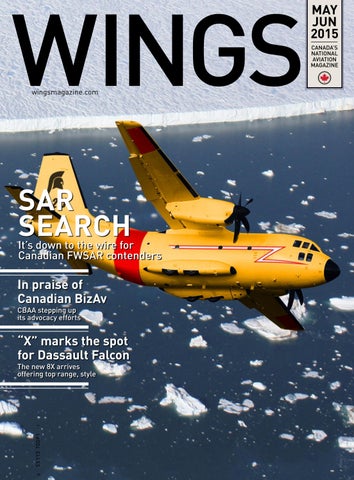
WINGS wingsmagazine.com
SAR SEARCH
It’s down to the wire for Canadian FWSAR contenders
In praise of Canadian BizAv CBAA stepping up its advocacy efforts
“X” marks the spot for Dassault Falcon The new 8X arrives offering top range, style
MAY JUN 2015 CANADA’S NATIONAL AVIATION MAGAZINE
MAY/JUNE 2015
UPFRONT 5 Leading edge Taking the lead
8 On the fly
News and opinion
12 CIA Calgary 14 Alternate Approach
Amputating empty legs
15 At the Gate
Innovating to improve
16 Glidepath
Saluting the wonders of flight
Production of Dassault Falcon’s classy new 8X is in full swing. P. 34
17 Women in Aviation
Some 54 countries and counting
BACK 58 Marketplace 62 On final
Safety is in our hands
From top: Innovating to improve P. 15 Saluting the wonders of flight P. 16
FEATURES 18 CHOOSING A WORTHY OPTION
The FWSAR RFP is on the books, three main competitors eyeing the prize BY PAUL DIXON
23 RAISING THE BAR
CBAA is stepping up efforts to advocate for Canadian BizAv BY DAVID CARR
PHOTO: DASSAULT FALCON (TOP) NAV CANADA (TOP LEFT) PAUL DIXON (BOTTOM LEFT)
27 CRAFTING A WINNER
Textron’s blending of Beechcraft, Cessna, Hawker looks to pay dividends BY DAVID CARR
34 DASSAULT ADDS AN “X”
New Dassault Falcon 8X offers plenty of range and class BY RICK ADAMS
40 THE POWER OF DIVERSIFICATION
Capitalizing on its opportunities helps Avcorp flourish BY BRIAN DUNN
46 CLOSE ENCOUNTERS OF THE DRONE KIND COVER PHOTO: ALENIA AERMACCHI
How TC is making UAVs in civil airspace a simple process BY RICK ADAMS
WWW.WINGSMAGAZINE.COM
May/June 2015 | WINGS
3
Kelowna Flightcraft is now KF Aerospace. However, our world-class service is still our world-class service.
---
After four decades, it was time to perform a little maintenance on our brand. Our services have evolved over time, and we needed to better reflect who we are today -- a modern aerospace company with a timeless approach to our craft. After some time in the hangar, we’re proud to roll the new KF Aerospace out on to the ramp for the rest of the world to see.
SEE THE WHOLE STORY AT KFAero.ca
LEADING
EDGE
| By Matt Nicholls
Taking the lead
More corporate leadership is needed to help drive grassroots development
S
PHOTO: BRIAN LOSITO, AIR CANADA
afety, innovation and establishing new partnerships to solve ongoing challenges are the cornerstones of what makes aviation so great. And it’s precisely why I’m always impressed when OEMs, operators and aerospace and aviation companies extend themselves and make collaborative attempts to address NextGen challenges both here in Canada and on a global scale. An April announcement by Airbus and FlightSafety International to provide “ab-initio” training to aspiring pilots at the FlightSafety Academy in Vero Beach, Fla., is one such initiative. The three-year deal between two great aviation leaders is meant to help address the worldwide demand for new pilots and provide a heightened level of safety in commercial aviation. And while a recent report by the International Air Transport Association (IATA) reveals that 2014 was one of the safest on record for global commercial airlines (see, On the Fly, page 8), collaborations like these go a long way in solidifying a strong safety culture. Under the terms of this agreement, courses and programs will be aimed at First Officers, Multi-Crew Pilot (MPL) and specifically in the North America Airline Transport Pilot-Certified Training Program (ATP-CTP). FlightSafety and Airbus will offer candidates the opportunity to be trained in Florida, from those with no prior flight time all the way up to a qualified A320 first officer. FlightSafety’s role will be to train candidates to be qualified pilots, while Airbus will train them to be qualified as pilots specifically on Airbus equipment. FlightSafety International certainly knows a thing or two about preparing pilots for the roles as commercial pilots. The
5 WWW.WINGSMAGAZINE.COM
aviation and aerospace, albeit on a different level than this key partnership. Our Careers in Aviation Expos in Hamilton, Ottawa and Calgary held this spring (www.careersinaviation.ca/ expo/) helped ignite the passions of high school and college students who are setting their sights on aviation and aerospace careers. These day-long events bring together top leaders in a variety of aviation and aerospace professions to give students a chance to see what different aviation careers are all about – and help forge their path for future development. Key industry partners joined us in supporting the events, but we certainly can’t do it alone – much more industry involvement on all levels is needed to educate and help cultivate more young adults and ensure generation next is ready to fill future employment needs. The CIA Expos are certainly not on the same educational and training level as the Airbus/FlightSafety collaboration, but they underscore how corporate leadership can drive innovation, development and ultimately, a safer working environment for aviation and aerospace. As corporate citizens in the aviation and aerospace communities, it’s incumbent upon all of us to cultivate relationships and drive change – the future of our industry depends on it. | W
Collaborations to enhance safety and train generation next are always crucial on any level of the operational process. company operates the largest fleet of flight simulators in the world and has learning and training centres in 11 countries. It provides more than a million hours of training each year to pilots, technicians and other safety personnel from more than 167 countries. The 110,000-square-foot Miami training facility is indeed impressive, boasting six full flight simulators, cabin door and slide trainers, state-of-the-art computerbased training classrooms and six flight training devices for the A320, A330, and A340 aircraft. Some 2,000 trainees from Airbus airline operators in the U.S, Canada and Latin American take courses here every year under the direction of top instructors. At Wings and Helicopters magazines, we, too, recognize the value of collaborative partnerships to help drive change. We are also taking a leadership role to help educate and drive innovation and safety in
TOP DATA BURSTS… in this issue
1. The IATA notes there were 12 major fatal accidents globally and 641 fatalities in 2014. (Pg. 8) 2. $125 million: The estimated first-year cost savings of space-based ADS-B receivers (pg. 15) Nachelle White has visted more than 54 countires and counting in her career as a pilot. (Pg. 17). 4. $3.1 billion: The rather modest amount the federal government is allocating for the Canadian FWSAR program. (pg. 18) 5. Cessna has an installed customer base of 250,000 aircraft. (pg. 27).
Your feedback is always welcome. Please contact me at mnicholls@annexweb.com. @Wings_Magazine May/June 2015 | WINGS
5
Vol. 56, Issue 3 EDITOR
Matt Nicholls mnicholls@annexweb.com 416-725-5637 MEDIA DESIGNER
Gerry Wiebe
FLIGHT DECK
Rick Adams, David Carr, Paul Dixon, Brian Dunn, Frederick K. Larkin, James Marasa, Carroll McCormick, Anna Pangrazzi,
SUBSCRIBE TODAY !
ACCOUNT MANAGER
Jarah Stefek jstefek@annexweb.com 519-429-5191
1 YEAR SUBSCRIPTION only
3000
$
ACCOUNT CO-ORDINATOR
Stephanie DeFields sdefields@annexweb.com 1-888-599-2228 ext. 257
(GST $31.50 • HST $33.90) US $42.00 (USD) • Foreign $65.00 (USD)
Name: _______________________________ Company: ____________________________ Title: _________________________________ Address: _____________________________ City: _________________________________ Prov: ________________________________ P.Code: _______________________________ Tel: __________________________________ Fax: _________________________________ email: ________________________________
NATIONAL ACCOUNT MANAGER
Mena Miu mmiu@annexweb.com 905-713-4351 GROUP PUBLISHER
Scott Jamieson sjamieson@annexweb.com DIRECTOR OF SOUL/COO
Sue Fredericks
WINGS MAGAZINE
P.O. Box 530, 105 Donly Dr. S., Simcoe, ON N3Y 4N5 Tel: 519-428-3471 Fax: 519-429-3094 Toll Free: 1-888-599-2228
PLEASE CHECK ONE:
❑ Charter/Fractional ❑ Commercial Airlne ❑ Private Aircraft Owner/Operator ❑ Air Transport-Cargo ❑ Tour Operator ❑ Training/Education ❑ Airport ❑ FBO ❑ MRO ❑ OEM ❑ Aviation Distributor ❑ Aviation Fuel Supplier ❑ Aviation Services ❑ Aviation Sales/Marketing ❑ Para-Public/EMS/SAR/Law Enforcement ❑ Government/Military ❑ Resources - Construction, Fire, Forestry, Mining, Oil & Gas, Wildlife, etc ❑ Other (please specify) ______________
Publication Mail Agreement #40065710 Return undeliverable Canadian addresses to Circulation Dept., P.O. Box 530, Simcoe, Ont. N3Y 4N5 email: subscribe@wingsmagazine.com Published six times per year (Jan/Feb, Mar/Apr, May/ Jun, Jul/Aug, Sep/Oct, Nov/Dec) by Annex Publishing & Printing Inc. Circulation email: subscribe@wingsmagazine.com Ph: 450-458-0461 Fax: 877-624-1940 Mail: P.O. Box 530, Simcoe, ON N3Y 4N5
PAYMENT: Cheque - Payable to Annex Publishing & Printing Inc. Visa
MC
Account #: __________________________
Subscription Rates Canada – 1 Year $ 30.00 (includes GST - #867172652RT0001) USA – 1 Year $ 42.00 Foreign – 1 Year $ 65.00 Occasionally, Wings magazine will mail information
on behalf of industry-related groups whose products and services we believe may be of interest to you. If you prefer not to receive this information, please contact our circulation department in any of the four ways listed above. No part of the editorial content of this publication may be reprinted without the publisher’s written permission. ©2015 Annex Publishing & Printing Inc. All rights reserved. opinions expressed in this magazine are not necessarily those of the editor or the publisher. No liability is assumed for errors or omissions. All advertising is subject to the publisher’s approval. Such approval does not imply any endorsement of the products or services advertised. Publisher reserves the right to refuse advertising that does not meet the standards of the publication. Printed in Canada ISSN 0701-1369
Expiry:_____________________________ Signature: _________________________
Tel: 450-458-0461 Fax: 877-624-1940 Mail: Wings Magazine c/o Annex Business Media P.O. Box 530 Simcoe, Ontario N3Y 4N5
ON THE
WEB
email: subscribe@wingsmagazine.com
www.wingsmagazine.com
GST#135274215RT001
6
Subscriptions non-refundable
Canadian Business Aviation Association
Magazines Canada
SPREADING YOUR WINGS Looking for more great stories on aviation safety, aerospace, military, airports or business aviation? Check out the new-look Wings website for more in-depth news stories and features.
PRO0515
WINGS | May/June 2015
wings subad.indd 1
Canadian Owners & Pilots Association
PHOTO: AVCORP
Air Transport Association of Canada
TO SUBSCRIBE:
WWW.WINGSMAGAZINE.COM
2015-04-28 7:24 AM
Trade your chocks for
S TA R T I N G B L O C K S .
C ESS N A T Tx This beautiful sprinter was born with the heart of a racer. A twin-turbocharged racing powerplant that speeds the TTx™ to the top of its class at 235 knots. Elegant gull - wing doors float up to reveal sleek, custom cabin schemes and a Garmin® G2000™ flight deck. The all - composite a i r f r a m e m a ke s i t t o u g h e n o u g h f o r U t i l i t y C a t e g o r y c e r t i f i c a t i o n . T h e r e’s a l s o a n e c o n o m y cruise setting – but – really? On your mark. Get set. Go to Cessna.com to catch the TTx.
U. S . + 1 . 8 4 4 . 4 4 .T X TAV
|
I N T E R N AT I O N A L + 1 . 3 1 6 . 5 1 7. 8 2 7 0
© 2015 Cessna Aircraft Company. All rights reserved. TTx is a trademark of Textron Innovations Inc., used by permission. Garmin and G2000 are trademarks of Garmin International or associate companies.
ON THE FLY For late-breaking news and exclusive web content, please visit us at: www.wingsmagazine.com
THE LEAD
CS300 SOARS BUT BOMBARDIER HQ SHAKEN . . . AGAIN Bombardier has once again shaken up the executive office. Mike Arcamone, president of the commercial aircraft division, is the latest casualty as the airframer struggles with its CSeries program. Arcamone, who has navigated the program through some milestone events, including the February 27 maiden flight of the larger CS300, has been replaced by Fred Cromer, a former president of International Lease Finance Corporation (ILFC), the world’s largest aircraft lessor by value, which was bought by AerCap Holdings in 2013. Cromer has extensive airline experience including executive positions at Continental and Northwest. The latest shakeup should not have come as a surprise given that Alain Bellemere, a former United Technologies executive and recently installed Bombardier chief executive would want to build his own team. “Fred is an amazing addition to our team,” said Bellemare. “Throughout his impressive career, he has led businesses with enterprise values of $500 million to more than $30 billion and developed an
unparalleled network of contacts in the airline industry. His strong leadership skills, international network and deep understanding of the aviation industry are a perfect match for Bombardier Commercial Aircraft, as we are preparing to realize the true market potential of our new CSeries aircraft, while refocusing on our Q400 and CRJ programs.” Pierre Alary, senior vice president and chief financial officer is retiring and Bellemare has hired Plane View Partners and its chairman, Henri Courpron, another ILFC alumni, to conduct an extensive review of Bombardier Commercial Aircraft’s operations. Courpron is also a former chief executive of Airbus North America. Bombardier is also looking at raising cash through the sale or merger of its rail unit. These changes came in the slipstream of the first flight of a CS300 test aircraft. Approximately 2,000 Bombardier employees, board members, partners, suppliers and customers braved frigid temperatures to witness the flight, which lasted four hours and 57 minutes. “It was an absolute privilege to fly the first flight of the CS300 airliners and I’m absolutely ecstatic with how well it handled,” said Captain Andris (Andy) Litavniks, who also sat as co-pilot on the maiden flight of the CS100 in 2013. “It’s a pilot’s aircraft and handled exactly as predicted by simulation. Pilots will find it easy to transition from the CS100 to the CS300 aircraft or vice versa, which will greatly reduce training costs for operators using both models.”
Some 2,000 Bombardier staff, partners, suppliers and customers braved poor weather conditions Feb. 27 to witness the CS300’s first flight. 8
WINGS | May/June 2015
In spite of high profile catastrophic commercial events, 2014 was the safest on record according to the International Air Transport Association (IATA).
The family of clean sheet, single-aisle jets is specifically designed for the 100- to 149-seat market segment, filling a gap below the smallest versions of the larger Boeing 737 and Airbus A320 aircraft. Bombardier claims the CS300 aircraft will offer the best seat-mile cost in its category, making it the most profitable solution for mid-sized markets with up to 150 passengers per flight, and ideal for a range of short-haul to longer transcontinental markets. Both Boeing and Airbus have succeeded in using pricing to back stop larger re-engined versions of those venerable aircraft. With the addition of the CS300, there are now five CSeries aircraft in the flight test program. A second CS300 is in final assembly. The test program has completed more than 1,000 test hours. “Our CSeries aircraft program is progressing well, with results from testing as expected or better,” said Rob Dewer, vice president of the CSeries program. “We are confident the CS100 aircraft will be certified in the second half of 2015, followed closely by entry-into-service. The CS300 airliner is expected to follow about six months later.” That entry into service is not expected now until early 2016. “With certification of the program planned for the end of 2015, you don’t do a delivery before the start of the next year anyway,” Bellemare told Bloomberg News at a Montreal aviation analysts conference. The program is reportedly drawing keen interest among startup airlines in Asia, Africa and Europe, and the company hopes the CSeries debut at this year’s Paris WWW.WINGSMAGAZINE.COM
PHOTOS: BOMBARDIER COMMERCIAL AIRCRAFT (BOTTOM LEFT); ISTOCK (TOP)
8 THE LEAD 9 INDUSTRY HAPPENINGS 11 PEOPLE ON THE MOVE
Air Show will inject renewed interest in the aircraft. The Wall Street Journal has reported that the airframer has reached an agreement with Fly Mojo, a new Malaysian airline for up to 40 CSeries 100. The upstart has signed a letter of intent for 20 aircraft, with options for an additional 20 airplanes. Fly Mojo would be the first operator in the Asia Pacific region. Porter was named official Canadian airline of the Pan Am games and signature sponsor of the torch relay.
PORTER CHANNELS ITS INNER PAN AM Two Porter Airlines’ Bombardier Q400s are carrying a sporty new look. The aircraft have been kitted out in 2015 Pan Am Games decals to promote the Pan Am and Parapan Am Games being hosted this summer in the Toronto-based carrier’s own backyard. The Pan Am/Parapan Games will be the largest international multi-sport event to be held on Canadian soil. Porter was named official Canadian airline of the games and signature sponsor of the torch relay; the largest in the history of the Pan Am Games. Shortly after unveiling the new livery in February, Porter transported the torch carrying the official Pan Am flame to Thunder Bay and the Terry Fox memorial. “Just as the athletes are focused and determined, our success comes from motivating our own team and focusing on the details that create an exceptional trip,” said Robert Deluce, chief executive officer of Porter. “We’re excited to provide people with convenient access to numerous
Games venues in the heart of the city.” Meanwhile, Porter continues to pursue its own ambitions to go faster and further by launching Bombardier CSeries aircraft from Toronto’s Billy Bishop Airport.
HÉROUX-DEVTEK GEARS UP IN CAMBRIDGE Héroux-Devtek has opened a new manufacturing facility in Cambridge, Ont. to supply landing gear systems for the Boeing 777 and Boeing 777X aircraft. Based in Longueuil, Quebec, Héroux-Devtek is the world’s third largest manufacturer of landing gear systems. The Boeing contract is the largest in company history and the first time Héroux-Devtek is building a complete landing gear system for a large commercial aircraft. The $54.2 million plant, with $7 million in support from the Ontario government, further strengthens the province’s aerospace sector, particularly in commercial landing gear, where Ontario is already a global leader. Héroux-Devtek specializes
in the design, development, manufacture and repair and overhaul of landing gear and actuation system and components. The new 108,000 foot Cambridge facility will primarily manufacture large-scale, complex landing gear components. The manufacturer believes the facility will set new standards in regards to manufacturing technology and productivity. “This new facility will play a pivotal role
The new 108,000 foot Cambridge facility will primarily manufacture large-scale, complex landing gear components.
INDUSTRY HAPPENINGS
PHOTOS: GULFSTREAM (BOTTOM); PORTER AIRLINES (TOP)
GULFSTREAM GIRDLES THE GLOBE
A Gulfstream G650ER recently set two city-pair records while flying around the world in one stop. The aircraft took off from White Plains, N.Y., with three passengers and four crewmembers on board. It flew the 12,851 kilometres eastbound to Beijing for a total flight time of 13 hours and 20 minutes. The airplane then flew eastbound, 12,171 kilometres to company headquarters in Savannah, Georgia, completing the mission in 12 hours. The airplane landed both times with fuel in excess of National Business Aviation Association (NBAA) instrument flight rule reserves. WWW.WINGSMAGAZINE.COM
May/June 2015 | WINGS
9
ON THE
FLY
in executing the most important landing gear contract in Héroux-Devtek’s history and its high level of automation will allow us to provide superior quality products to Boeing at a very competitive cost,” said Gilles Labbe, company chief executive. The plant, which has been named in honour of the late John Cybulski, a long-time chairman of the board and noted contributor to the emergency of the landing gear industry in Canada, can be expanded to almost double its current size. Approximately 75 per cent of Héroux-Devtek’s products are for the global aerospace industry, with 50 per cent exported to the United States. The first set of 777 landing gear are scheduled for delivery in 2017.
SAFETY COMMITMENTS HELP INDUSTRY IN 2014 Despite high profile accidents such as the disappearance of Malaysian Airlines MH370, and the crash of an AirAsia
Airbus A320 halfway into a two-hour flight between Indonesia and Singapore, the 2014 global jet accident rate was the lowest in history, according to the International Air Transport Association (IATA), the leading industry group. The 2014 global jet accident rate, measured in hull losses per one million flights, was 0.23, or the equivalent of one accident for every 4.4 million flights. A hull loss is an accident in which the aircraft is destroyed or substantially damaged and is not subsequently repaired for whatever reason, including a financial decision of the owner. 2014 was a year-overyear improvement on 2013, when the global hull loss rate stood at an average of one accident every 2.4 million flights, and an improvement over the five-year rate (2009-2013) of 0.58 hull loss accidents per million flights. “Any accident is one too many and safety is always aviation’s top priority,” said Tony Tyler, IATA’s director general and chief executive. “While aviation safety was in the headlines in 2014, the data
show that flying continues to improve its safety performance.” But while hull losses were down, fatalities were up, highlighted by the disappearance of MH 370 and the destruction of a second Malaysian Boeing 777, MH 17 shot down by Russian rebels over the Ukraine. There were 12 fatal accidents involving all aircraft types in 2014 with 641 fatalities, compared with an average of 19 fatal accidents and 517 fatalities per year between 2009-2013. There were 210 fatalities in 2013, less than the number who died onboard MH 17. The destruction of MH 17, however, is not included as an accident under globally-recognized accident classification criteria. The four aircraft involved in the events of 9/11 were treated in the same way, according to IATA. “The shooting down of MH 17 took with it 298 lives in an act of aggression that is by any measure unacceptable. Governments and industry have come together to find ways to reduce the risk of
THE DAVID CHARLES ABRAMSON MEMORIAL
2015 A ward
DCAM
FOR FLIGHT INSTRUCTOR SAFETY
pour l’instructeur de vol sÉcuritÉ aÉrienne To be awarded at the Annual General Meeting & Convention of the Air Transport Association of Canada in Montreal, Qc from November 2nd to 4th.
Jane & Rikki Abramson established this Award in 2003 through Air Transport Association of Canada, and will personally present this year’s award. The recipient's name will be engraved on the prestigious perpetual trophy and entered in the associated logbook, both on permanent display in the Canada Aviation & Space Museum in Ottawa. The Award is generously supported by:
Nominations can be made at any time throughout the year, prior to the deadline of September 14th, 2015 For entry requirements contact: Jane Abramson, Founder & National Administrator Tel: 450-458-3164 Fax: 450-458-5245 Email: janeabramson@videotron.ca
Essential Turbines Inc.
www.dcamaward.com 10 WINGS | May/June 2015
WWW.WINGSMAGAZINE.COM
PHOTO: HEROUX-DEVTEK
The Award recognizes and honours a flight instructor, either fixed or rotary wing, who has made a significant contribution to safety in Canada, also having demonstrated superior teaching skills.
over-flying conflict zones,” Tyler pointed out. “This includes better sharing of critical information about security risks to civil aviation. “To the flying public an air tragedy is an air tragedy, regardless of how it is classified. In 2014, we saw a reduction in the number of fatal accidents – and that would be true even if we were to include MH 17 in the total. The greatest tribute that we can pay to those who lost their lives in aviation-related tragedies is to continue our dedication to make flying safer. And that is exactly what we are doing.”
PEOPLE ON THE MOVE Martin J. Eley, has retired as director general, civil aviation at Transport Canada (TC). A graduate of the U.K.’s Imperial College of the University of London, with a an honours bachelor of science in aeronautical engineering, Eley began his aviation
career in 1972 as an undergraduate with the British Aerospace Civil Division at Weybridge, Surrey. He later worked on the application of composite materials for British Aerospace’s Jaguar and Tornado military aircraft. In 1982, Eley joined TC as a structures engineer in the Airworthiness Branch. As a senior engineering program manager from 1985 to 1994, he was responsible for the Type Certification of many Canadair/Bombardier aircraft and various products brought into Canada. Eley was appointed Canada’s director general, civil aviation in May 2009, and was accountable for Canada’s civil aviation safety regulatory framework and the safety oversight of the civil aviation system. He also oversaw extensive modifications made to TC’s Civil Aviation Program. Despite tough economic times and budgetary constraints, Eley
succeeded in maintaining stability in the directorate and worked with his team to find efficiencies and target program resources in high-risk areas that provide the greatest safety benefits for Canadians. During the planning for Eley’s succession, TC decided to assign him to the directors-general to oversee the very large and complex Civil Aviation Program. Denis Guindon has been appointed head of Aviation Safety and Oversight and will be responsible for working closely with the regions and other operational branches to deliver oversight surveillance activities and services. Guindon has also been assigned the responsibility to develop a change management plan to ensure that consistent direction is provided across the regions. He will be the focal point for addressing regional issues and concerns. Aaron McCorie will be in-charge of the Aviation Safety Regulatory Framework and will be responsible for policy, regulations and standards. | W
DTI is still the only private consulting group to have developed and taught the SMS and QA disciplines to BOTH the regulatory government agencies (ie. Transport Canada, U.S. DoD, NASA) and to the private enterprises that they govern. Over 300 Canadian Aviation Certificate holders have consulted with DTI in a myriad of ways, including:
Workshops currently scheduled in the following locations:
• Attending workshops
• And more…visit our website
• Company Specific training • QA, SMS, MCM, MPM and FOQUA manuals building • Corrective Action Plan assistance
Contact us for answers to your questions and help achieving all you can be! Interested in hosting workshops, contact us for incentives!
• Calgary
• Edmonton
• Vancouver
• Toronto
• Winnipeg for complete list of curriculums & locations.
Save the Date
The 2015/2016 SMS/QA Symposium
January 3, 4 & 5 2016
This year’s theme: The Future of Auditing! Being held once again at the fabulous, Coronado Springs Convention Resort, Disney World, Florida • Keynote address and hands on workshop of new program Iauditor to be presented by Luke Anear, CEO of Safety Culture, Australia
No one knows Quality Assurance, SMS or Regulatory Compliance issues like us! For more information, visit our website dtitraining.com | dtitrainingcanada.ca | 1-866-870-5490 WWW.WINGSMAGAZINE.COM DTI_Symposium_Halfpage_May 2015.indd 1
May/June 2015 | WINGS
11
2015-04-28 10:52 AM
CIA EXPO 2015
WRAP-UP
By Matt Nicholls
CIA Expo Calgary: learning to “wear that tie”
F
12 WINGS | May/June 2015
knows someone else who might be valuable to you in some way or another,” said Hal Hobenshield, program chair at Northern Lights College. “It’s key for students and those just getting into the industry to always put their best image forward. You can never be too professional in any situation.” Stan Kuliavas, vice president of sales and business development for Pilatus Centre Canada – the platinum sponsor of the 2015 CIA Expos – stressed in both his inspirational pre-luncheon address and later as a participant on the various aviation panel, two key points – the importance of effectively marketing yourself and the necessity of seeking mentors to help guide young aviators in the process. “Mentors are invaluable and I encourage you to seek out them throughout your career – and they don’t necessarily have to be in the world of aviation,” Kuliavas said. The CIA Expos are all about igniting the passions of young aviators and helping guide them in formulating a sound strategy for future career development and growth. It’s a grassroots commitment that is very important to the staff at Wings and Helicopters magazines. And thanks to the solid commitment from guest speakers, sponsors and the men and women at the amazing host venues, this year’s events were a definite success. | W
Attendees also had the chance to network and glean information from some 18 vendors Services. Kirzinger was one of five rotary and fixed-wing pilots sharing information to kick off the educational sessions in Calgary. Three more sessions on educational opportunities, various aviation pursuits and aerospace/aircraft maintenance and completions rounded out the day. “One of the things that new pilots and those getting into all aviation disciplines will need is plenty of determination and the ability to do a variety of different tasks,” said Kirzinger. “They also need drive. So, coming to events like these to meet people that have grown in their careers is an important first step in the developmental progress. The fact you are here, certainly shows your commitment.” Networking and interacting with people in an industry where everyone seems to be connected in one way or another is also paramount. Why? Simply because everyone seems to know everyone else in this industry. “It’s all about who you know and chances are the person you just spoke to,
WWW.WINGSMAGAZINE.COM
PHOTOS: MENA MUI
inding the perfect career in aviation and aerospace takes passion, flexibility and the ability to capitalize on opportunities – and learning how to “wear your tie” and treat every day in a professional manner goes a long way, too. These were just some of the key messages conveyed by a variety of industry experts during Wings and Helicopters Careers in Aviation Expo in Calgary on Saturday, April 11. Some 65 air cadets, high school and college students, parents and industry professionals seeking to change careers took part in the event at the impressive Aero Space Museum of Calgary. Attendees were treated to four educational panels covering a variety of topics including industry trends, job preparation techniques, how to choose the right educational path to meet your specific needs, what to expect at flight school, developments aircraft maintenance and the aerospace market and much more. Attendees also had the chance to network and glean information from some 18 vendors offering flight school, college and university program advice and other professional job opportunities from the Royal Canadian Air Force (RCAF) to air navigation (NAV CANADA). In an industry facing a significant talent drain in the next few years both in the cockpit and in the maintenance and aerospace ranks, events such as the CIA Expo Calgary – and earlier events in Hamilton and Ottawa – go a long way in igniting the collective passions of the next generation of aviation and aerospace workers in Canada. And with more than 20 speakers on hand and a variety of industry vendors at each event, it presents the perfect opportunity for grassroots development, information gathering and networking. “It’s great to see so many passionate young people out on a Saturday morning wanting to learn more about aviation,” said John Kirzinger, a WestJet pilot and part owner/founder of Mitchinson Flight
ALTERNATE
APPROACH By David Carr |
Amputating empty legs
Toronto entrepreneurs seek solutions for empty charter flights
14 WINGS | May/June 2015
operators, including brand names such as Chartright and Skyservice, with more than 200 jets ranging from the Embraer Phenom to Bombardier Global 6000. The current strategy is to stick with larger operators, although that rule isn’t carved in stone and is based more on how an operator brings clients in and service standards. FlyEasy never gets involved with the end user, and operators pay a monthly subscription fee based on aircraft, the size of the operation and the suite of online services they use. FlyEasy calculates that it saves operators a minimum up 15 hours a week on sales and marketing, and delivers better results. “All of a sudden, the ROI numbers become significantly more attractive for the high net worth individuals who own the aircraft,” Bhanji points out. Depending on the size of jet and airport, FlyEasy estimates its service can save users up to 75 per cent on empty legs compared with regular charter, and without the multiple stops that are sometimes a problem with fractionals. It's quite the revenue offset for owners looking to reduce equipment costs or have a third party chip in for the gas on an otherwise empty airplane returning home. The biggest challenge for the selfdescribed “techies passionate about aviation” has been gaining the trust of operators, despite FlyEasy’s aviation pedigree. “A lot of customers don’t see our service as a potential for them to increase revenue, expand their customer base and make their owners happy,” Bhanji admits. “But owners are quite passionate about empty legs, so we have to push them a bit. We want to use cutting-edge technology to make the industry more efficient.” | W
It ain’t exactly Uber for the air, but it does have the potential to revolutionize business travel.
and empty leg updates is that each email contains a lot of empty legs that are not necessarily relevant to the person who is receiving it,” Filatov explains. “We found a way to advertise empty legs that is very targeted and very efficient. If you are interested in specific routes, you are guaranteed to receive flights for those routes.” FlyEasy filters out unnecessary information leaving the customer with a clean sheet of easy to follow options, including possible repositioning alternatives at surrounding airports. The system is also good for operators who experience a mechanical problem with an aircraft and need to locate a fast alternative. The company recently expanded its profile, especially in the United States, by tapping into the NBAA Air Mail charter availability feed, pushing the information available on that cluttered forum through its own more streamlined system. To-date, FlyEasy has signed up to 40 air David Carr is a Wings writer and columnist. WWW.WINGSMAGAZINE.COM
PHOTO: GAVIN COTTERING
E
mpty legs are an industry headache. It is estimated that in any given year, at least 33 per cent of Canada’s private jet capacity flies empty. This is the accumulative effect of having to reposition aircraft or return airplanes to base; both without passengers. It is likely a lowball estimate. Whatever the exact number, empty legs are a drain on charter operators who already fly on thin margins and need to maximize the utilization of fleets. They are also a drag on private jet owners who have invested big on multimillion dollar pieces of high-end machinery, and would like to see greater returns on investment (ROIs). Tucked in the corner of an energetic, brick-walled communal office inside of Toronto’s MaRS building – a sprawling incubator for innovative start-up businesses – two entrepreneurs have founded FlyEasy, a technology-based company aimed at reducing the number of times a private jet flies empty by simplifying the connection between prospective customers and inventory. It ain’t exactly Uber for the air, but it does have the potential to revolutionize business travel the same way the plucky, hitech “rent-a-ride” service is changing how we hail a cab. Empty legs are the biggest problem facing charter operators, says Shaan Bhanji, a FlyEasy co-founder and chief executive officer. “It is money left on the table and it isn’t a problem easily solved with existing scheduling and inventory systems, most of which were developed in the early 2000s.” Bhanji, who had gained insight into the fractional sector by working with industry giant NetJets while he was a project manager for Bombardier, teamed up with Konstantin Filatov (FlyEasy’s chief technological officer), a technology specialist and software builder to develop a system that would push available inventory, including round trips and one ways, out to potential customers automatically and in real time complete with pricing and repositioning options. Prior to that, most callouts for empty legs were done either by brokers over the telephone or cumbersome emails that contained long lists of available inventory. “The biggest problem with empty leg blasts
AT THE
GATE
| By Brian Dunn
Innovating to improve
Canadian aviation organizations working hard to control emissions
PHOTO: NAV CANADA
W
hile air travel plays a major role in Canada’s economy, it also contributes to greenhouse gas emissions. On June 1, 2012, the Government of Canada introduced its Action Plan to Reduce Greenhouse Gas Emissions from Aviation, developed with the Canadian aviation industry to increase efficiency and improve environmental performance in the sector. The plan sets out specific measures to improve fuel efficiency and includes commitments from the Government of Canada, the Aerospace Industries Association of Canada (AIAC), the Air Transport Association of Canada (ATAC), the Canadian Airports Council (CAC), the Canadian Business Aviation Association (CBAA), the National Airlines Council of Canada (NACC) and NAV CANADA. However, it does not contain legal obligations of any kind or impose unreasonable expectations on any party, or intend to negatively impact any air carrier’s ability to do business in Canada. The Action Plan aims to improve fuel efficiency by an average of at least two per cent per year until 2020, which will help Canada’s target of reducing greenhouse gas emissions by 17 per cent from 2005 levels by 2020. In terms of how this compares to other countries, there’s been a lot of debate internationally on targets, according to NAV CANADA director of government and public affairs Michelle Bishop. “IATA has set a target of an average of 1.5 per cent improvement per year between 2009 and 2020 and carbon neutral growth beyond 2020,” she said. For the past three years, NAV CANADA has released an annual report called the Collaborative Initiatives for Emission Reductions (CIFER), outlining the progress the aviation industry has made to reduce its footprint. The 2014 report highlights several initiatives that are making a significant impact. Among them is the Gander Oceanic Flight Level Initiative (GO-FLI) where controllers at the Gander Area Control Centre are able to offer more efficient altitudes to pilots, significantly increasing the number of climbs in Atlantic airspace. By enabling a Boeing 767 to climb 2,000 WWW.WINGSMAGAZINE.COM
The first phase of the Windsor-Toronto-Montreal corridor airspace redesign, which roughly accommodates 3,000 flights per day, has been in effect since February 2012 and has reduced cumulative flying time by 10 hours daily and reduced GHG emissions by 15,000 tons annually. The current phase will realize an additional 16,000 ton reduction in annual GHG emissions. A collaborative approach between air navigation service providers in several countries is behind an initiative to put ADS-B receivers into space on orbiting satellites, in order to provide global aircraft surveillance by 2018. It is expected to result in fuel savings of $125 million in the first year alone, Bishop said. Like all large projects with many players, getting this done is a complex undertaking. But with so many parties focussed on such a worthwhile outcome, the future is bright, Crighton noted" to "NAV CANADA CEO John president and CEO John Crichton noted | W
By enabling a Boeing 767 to climb 2,000 feet for example, reduces hourly fuel burn by two per cent. feet for example, it reduces hourly fuel burn by two per cent. And it has a domino effect. When one aircraft climbs, it frees airspace for another aircraft below to climb as well. By taking the initiative, air traffic controllers are letting pilots know that this type of flexibility exists, which results in more regular pilot requests. More offers were not accepted, because many flights were either already at their optimal “sweet spot” cruising level, the offer was made too early in the flight or maybe there were stronger winds aloft, Bishop suggested. Another innovation, implemented in northern airspace out of the Edmonton Area Control Centre, optimizes flight routes reducing distance and travel times for North American flights bound for Europe and Asia and vice versa. This can be as much as five minutes or 25 miles saved per flight for a total savings of $6 million in 2013.
Brian Dunn is a Wings writer and columnist. May/June 2015 | WINGS 15
GLIDE
PATH
By Paul Dixon |
Saluting the wonders of flight
Commercial route development means world travel is much easier
T
16 WINGS | May/June 2015
transfer en route and the same rule for the return trip on the around the world leg. There are actually multiple choices both legs and this may be a clue that there is a significant shift in just how the world travels, or more importantly, where the world thinks it needs to be and how it chooses to get there and back. It’s about six hours longer in the air taking the China route back to Vancouver, but it can still be done in under 24 hours from start to finish. It took Marco Polo more than 20 years to get back home, Columbus was gone for months and the legendary Pan Am Clipper took a week to get its 12 passengers from San Francisco to Manila. Now, with the latest A350 XWB and B787 magic carpets, I can make the journey in the lap of luxury. Thirty years ago, Dubai and its neighbours had changed little over the preceding two millennia. Then, we used to think nothing of flying down to San Francisco for the weekend. Today, I’m looking at making it around the world in the same time frame, with a stop-over in a city state where the past has become the future almost overnight. | W
Now, with the latest A350 XWB and B787 magic carpets, I can make the journey in the lap of luxury. time, while Etihad – which didn’t come into existence until 2003 – is now 13th. Collectively, they offer 25 flights a day from the U.S. to the Gulf, versus the two a day three legacy American airlines. Out of curiosity, I started searching for the cheapest fare from Vancouver to Dubai using the full-range of Internet sites that offer the lowest/cheapest fares “guaranteed.” It is interesting to note that of the six sites I was querying simultaneously, I rarely received the same quote for the same return flight. The lowest I saw was $715/return for dates in April, though it was gone when I returned to that site a few minutes later. There was often a $200 differential for exactly the same flights from the various third-party sites, which is interesting enough in its own right. Then I noticed something, which led me to another little game. Even for the lowest quoted return fare on some dates, I could make my return by way of China, on one of the Chinese airlines that calls at YVR. Call it Phineas Fogg in the 21st century. Refining the game, I then looked to make the hop from Vancouver to Dubai, Doha or Abu Dhabi with only one stop/
Paul Dixon is a Vancouver-based photojournalist. WWW.WINGSMAGAZINE.COM
PHOTO: PAUL DIXON
hings are changing and it’s not just the weather. Say what you will about today’s weather versus memories of childhood, but something is happening, and for many of us, it is not a good thing. Winter may have bypassed the west coast, but if you live in the Maritimes you are likely wondering when winter will leave. This year’s Iditarod (aka The Last Great Race) was forced to move the start 260 kilometers from Anchorage, Alaska to Fairbanks due to a lack of snow, which seems to be a requirement for dog sleds. It’s all due to changes in the jet stream, that great influencer of weather patterns. Follow the peaks and valleys of the jet stream from mid-Pacific and then across North America and you get a pretty clear picture where winter was and wasn’t this past year. One of the major influences on the jet stream is the earth’s magnetic field, which is in turn created by the churning of the earth’s core of molten iron. We’ve been warned by those in the know that earth’s magnetic poles have flipped many times over the past few billion years and we’re about half a million years overdue for another flip. This, as the magnetic North Pole chugs steadily further north at a rate of about 80 kilometres a year. It won’t be too long before it goes over the top and starts rolling downhill towards Russia. Dog sleds and magnetic compasses aside, there are major tilts in the world of commercial aviation as the world’s economic axis are shifting. Recently, the big three American airlines – United, Delta and American – have been outspoken in their view that they are being undercut by the big three from the Persian Gulf states – Etihad, Qatar Airways and Emirates. It is no secret that they are actively promoting the idea that the shortest route between China, India or the rest of Asia and Europe and North America is through Abu Dhabi, Doha or Dubai. They’ve supported this hypothesis by topping the order books at Boeing and Airbus. In 1998, Emirates ranked No. 30 globally in international capacity. Today it ranks first, while Qatar has moved up from 90th to be 10th on the list in that
WOMEN IN
AVIATION | By Anna Pangrazzi
Some 54 countries and counting
Pilot Nachelle White’s magical mystery tour is both aspiring and unique
P
assion, curiosity, and a sense of adventure . . . aviation attracts a lot of people with these amazing qualities and Nachelle White has them all in spades. A recent recipient of the Northern Lights Award in the flight ops category, White began her career as a flight instructor and followed a typical Canadian path of bush flying, survey work, forest fire suppression support flying, and flying night cargo runs. She has spent the past seven years flying for a humanitarian organization in Africa and Afghanistan. It’s certainly not the typical career path for your average young Canadian woman, but White is far from typical or average. White has visited more than 54 countries and has an amazing enthusiasm for life and flying. She has flown across the Atlantic and surveyed the wild life from 300 feet over Central Africa. She has flown through the jungles and mountain ranges of the DR Congo and Uganda, across the deserts of Sudan and up the Cote d’Ivoire of West Africa. Yet, it is her compassion for the people she has met along the way, which animates her conversation. She talks fondly of the air traffic controllers she got to know in Darfur and the guy who brought her bags of fruit in the Congo and the Persian rug dealer she shared tea with in Afghanistan. She is indeed a collector of “life experiences” and the flying – although interesting and challenging – was also her ticket to travel the world and really experience life. Wings caught up with White during her magical mystery tour and asked her to share some insights into her life, challenges young women face in the aviation business and more! What advice would she give budding young aviators? NW: Dream big, dream outside the box and then follow your dreams and they will lead you to magical, amazing places! Wow, Nachelle. What a life! What is your next adventure? NW: After many years away, I decided to come back to Canada to spend time with my family and friends. Now, I am flying a corporate jet around North America. It’s a big change in my flying and a huge adjustment returning to life in North America but I am enjoying it very much. WWW.WINGSMAGAZINE.COM
challenging but not particularly because I am female. The uniform gets a lot of respect over there no matter who’s wearing it. I find that most flying jobs require an initiation into the group. I like to think of it as a wolf pack; once they decide you are okay, you are accepted into the pack and treated as an equal. All the pilots become protective of their group and we help each other out. I think it was very important to show confidence in my flying abilities and also confidence in getting along in that part of the world. What kind of challenges have you encountered? NW: Well, once my team tried to sell me for some cows! I didn’t think four cows were quite enough! Kidding aside, in aviation, you encounter all kinds of personalities and cultures and you need to figure out the best way to work with people. That can be the most challenging aspect. Would you recommend a career in aviation to other young women? Certainly, but you do need to have a sense of adventure and a free spirit. It helps if you like to travel obviously. Other helpful qualities are resourcefulness, resilience and flexibility of course. | W
I like to think of it as a wolf pack; once they decide you are okay, you are accepted into the pack and treated as an equal. Why did you choose a career in aviation? NW: I grew up around airports and airshows. My mother was a private pilot, my father flew commercially and eventually worked at Transport Canada and my uncle flew Hercs and then went on to fly for Air Canada. Aviation was just in my DNA. My parents tried to encourage me to take a different career path but my mind was made up fairly early. Did you have any role models and/or mentors? NW: Exposure to aviation was the biggest influence of all. I took a familiarization flight at 13 and was lucky enough to fly in a jet with my dad. I read a few books like “West with the Night” by Beryl Markham about flying in Africa and the biography of Jaqueline Cochrane, a famous American aviatrix. I also joined the Women in Aviation Chapter in Toronto and met a few Air Canada pilots, Lisa Graham and Cathy Fraser, and they were very encouraging. Was it hard being a woman pilot in Africa? NW: To be honest, the work was
Anna Pangrazzi is the president/owner of Apex Airccraft and a strong advocate for women in aviation May/June 2015 | WINGS 17
CHOOSING
OPTION
THE FWSAR RFP IS ON THE BOOKS
BY PAUL DIXON 18 WINGS | May/June 2015
WWW.WINGSMAGAZINE.COM
PHOTO: AIRBUS
A WORTHY A
big sigh of relief was heard March 31st when the federal government finally released the RFP for the Fixed Wing Search And Rescue (FWSAR) Project with little public fanfare. It’s a document that gives little clue of the long and winding road getting to this point, nor the frantic race to the finish line a mere six months later. The RFP objective was clearly outlined: WWW.WINGSMAGAZINE.COM
“OBJECTIVE: The Department of National Defence (DND) has a requirement to replace the existing Fixed-Wing Search and Rescue fleet of CC-115 (Buffalo) and CC-130H (Hercules) aircraft. The intent of the Department of National Defence (DND) is to procure a fleet of new sensorequipped aircraft, including long-term In-service Support (ISS) for a period up to 20 years, in order to provide an effective response to SAR incidents anywhere in the
Canadian Area of Responsibility, and to support the National Search and Rescue Program.” More than a decade ago, the Liberal government of the day announced plans to replace the C-115 Buffaloes that had been in use at that time for 35 years. Funding was set aside at that time and the first new aircraft were to be delivered starting in 2006. But then the government changed and the project and the plan was shelved May/June 2015 | WINGS 19
for a number of reasons. When governments change, government commitments and priorities change, not necessarily for any reason other than that’s just the way it happens. There is a long history in this country of tight funding control for our military and it would not be untrue to suggest that the Canadian Forces were living by the credo of “doing more with less” long before it became the flavour of the month. The result, all too often, sees all three branches of the military forced to use their major systems – ships, aircraft, heavy vehicles – long past their best-before date has clicked past. This leads to a lowered state of mission readiness from the increased downtime as maintenance requirements grow, which in turn costs more and can have a significant impact on human performance factors. Now, the pretenders have been separated from the contenders. The three main contenders – who have forged strong Canadian partners – are the twin-engine Airbus C-295, Alenia Aermacchi's C-27J Spartan and Lockheed Martin’s four-engine C-130J Hercules. The FWSAR field features two youngish, scrappy middleweights and a cruiserweight. The three represent legitimate contenders, and each are different enough
The Alenia Aermacchi team includes a strong contingent of Canadian suppliers.
from the others to make it difficult to pick a winner in the early going. All three camps have also created strong teams to meet the demand for in-service maintenance, on-board systems and training. Pablo Molina, head of Airbus Defence Canada, spoke to Wings just prior to the release of the RFP, on the virtues of the C-295. While Airbus has been waiting for this opportunity for almost 10 years, Molina is quick to emphasize that they have not been sitting still for that time. “Since our first delivery to the Spanish
Better Price, Greater Value On Shipping
Greyhound Package Express knows the importance of delivering more value when it comes to shipping. It’s why we’ve invested in new trailers and upgraded buses, a dedicated shipping fleet, and scanning technology that allows customers to track shipments in real-time. We’ve made it easier for customers with accounts to order and manage shipments, and print waybills, all from Shipgreyhound.ca. We’re providing a better service at prices that are still lower than other national carriers, especially on shipments of 75 lbs. or more. Greyhound Package Express always delivers greater value for a better price. Guaranteed. Fast. Reliable. Convenient. Always Affordable.
shipgreyhound.ca • 877.463.6446 20 WINGS | May/June 2015
Air Force in 2001 we have made a lot of modifications and many different systems have been integrated into the aircraft,” Molina said. “Recently we have added winglets. We are the market leader, with many missionized models, aircraft modified for different missions. In addition to the winglets, we have new engine settings that allow extra performance.” To date, Airbus has sold 155 of the aircraft to 21 operators around the globe, operating in a wide range of environments from the equator to the high arctic. Joining Airbus on the C-295 team are Provincial Aerospace as the in-service support provider, Pratt and Whitney Canada for the engines, CAE with training support, L-3 Wescam for the EOIR (electrical optical infra-red) camera and Vector Aerospace for engine maintenance. “We know that we have a winning aircraft and a winning strategy as well as a winning team,” Molina says. “We will have a challenging competition, but we love competition and that is why we are the market leader.”
A worthy opponent Steve Lucas is the point person for Team Spartan, Alenia Aermacchi’s C-27J. In more formal terms, that would be Lt. Gen (ret.) Steven Lucas, who retired in 2007 as Canadian Forces chief of air staff. Of the Spartan he says, “the aircraft itself is well known, it has all the characteristics that I think the air force is looking for in an aircraft, the speed, great range and the ability to carry almost as much gear as a SAR Tech would want.” Kelowna Flightcraft will be the MRO provider and would work with General Dynamics Canada to provide the longterm maintenance care and overhaul as well as engineering and supply chain services. Kelowna Flightcraft has been a service provider for the current CC-115 Buffalo aircraft, which Lucas feels gives them an extra appreciation of the SAR business. Lucas was quick to add that more members of Team Spartan make it a worthy competitor for the SAR program. For example, IMP Aerospace will handle installation of the GDC mission system, installation of bubble windows, a number of interior design modifications and installation of the EO/IR turret. CMC Electronics in Montreal will provide the C-27J flight management system, and this will occur even if the C-27J is not selected as the FWSAR aircraft, but will still become the standard flight management system. Calgary’s Flight Aerospace Solutions will provide the latest Iridium communication system, satellite communications for operations in the high north where ground communications are unreliable. WWW.WINGSMAGAZINE.COM
C
M
Y
CM
MY
CY
CMY
K
Visit us at CANSEC Booth 1601
BEST IN CLASS MANEUVERABILITY NIMBLE, STABLE AND SAFE AT MOUNTAIN SAR SPEEDS
OUTSTANDING REACH
RAPID RESPONSE
2800 NM W/2000 KG PAYLOAD IN SAR CONFIGURATION
325 RTAS SUSTAINABLE CRUISE SPEED
CFB Comox EXCEPTIONAL VISIBILITY
CFB Winnipeg
16 COCKPIT WINDOWS LARGE SPOTTER BUBBLE WINDOWS
CFB Trenton
Capable. Affordable. Right for Canada. C-27J: Covers all the Bases.
Mission Systems–Canada
CFB Greenwood
A tried and true performer The C-130 Hercules has been a key performer for the RCAF since 1960, supporting operations around the world in everywhere the Canadian Forces have gone, from war zones to United Nations peacekeeping missions to disaster relief. In May 2012, the RCAF took delivery of the last of 17 new C-130J Hercules, replacing older E and H models. With the nine C-130H models retained in service, the RCAF now has a total of 26 in service, flying a wide range of missions including FWSAR.
In 2012, Lockheed Martin and Cascade Aerospace of Abbotsford, B.C., signed a MOU to jointly pursue “mutually beneficial business opportunities,” which included FWSAR. Cascade supports the RCAF C-130J fleet under a 20-year contract and it also provides fleet management services directly to the RCAF for the legacy C-130 Hercules fleet. In 2013, Lockheed formally designated Cascade as one of only two C-130J Heavy Maintenance Centers in the world. Now, Cascade provides service to Hercules
operators around the world. In an interview with Wings last year, Duane Lucas, executive vice-president of Cascade Aerospace, spoke about Cascade’s relationship with the RCAF, as well as the FWSAR Project. “The 130J looks almost identical to the older Hercules, but internally the J-model is essentially a completely new aircraft,” he said. “It flies faster, higher and farther and it can carry heavier loads while burning less fuel. It uses shorter landing and take-off fields and climb time is reduced by up to 50 per cent compared to the older models.” With the C-130J, Cascade is already working with a team of providers, including L-3 Wescom and CAE, to supply technology and training for the 17 new Hercs currently in service with the RCAF. That has become the cornerstone of a fully integrated support system that includes the engineering skills, project management skills, fleet management skills and logistic skills that would allow this team to move onto bigger projects. From Lucas’ perspective the C-130J makes sense for the next-generation FWSAR aircraft. “We’re the only team that actually works the airplane today,” he said. “With this aircraft, there is already an infrastructure network in place and we’ve already got trained personnel. It reduces the risk for the government and it reduces the upfront cost. We have a very capable aircraft and system in place and we believe that we are going to be able to fit nicely within the budget that has been allocated. Capable, affordable and very Canadian.”
A new beginning The RFP has been a long time coming, but it also signals a change in how the federal government will conduct military procurement in the future. The FWSAR Project stalled in 2008, after then Defence Minister Peter McKay was roundly criticized for supporting a sole-source proposal for the C-27J. The global financial meltdown as well as other changing priorities in defence spending contributed to the shelving of the project. In essence, the government went away and thought about how to go about procurement in a different way. The major change sees overall responsibility for defence procurement taken over by Public Works and Government Services. Then, the government released a draft RFP back in 2013 and set about meeting with potential bidders – aircraft manufacturers and the companies that would likely provide the support systems and technology, in order to give potential bidders a peek at what might be on the table as well as soliciting their input on what was feasible. It offered a better understanding continued on page 32 22 WINGS | May/June 2015 NAV Flight Plan AD_45/8x71/2_FontsOutlined.indd 1
WWW.WINGSMAGAZINE.COM 15-04-02 9:09 AM
The length of time to register an airplane continues to be a frustration for some operators.
RAISING THE BAR L
CBAA STEPPING UP EFFORTS TO ADVOCATE FOR CANADIAN BIZAV
PHOTO: MATT NICHOLLS
BY DAVID CARR
ast year’s Canadian Business Aviation Association’s (CBAA) convention and exhibition in Edmonton experienced a 60 per cent increase in operator attendance. Rudy Toering, CBAA chief executive, sat down with Wings to discuss advocacy, changes at Transport Canada (TC) and plans for the upcoming conference June 16-18 at Avfuel H-18 St. Hubert in Montreal. Except for the oil and gas industries, Canada is riding an economic rebound. Fuel prices are low. Is this a good time for corporate aviation in this country? Business is good for us. There is a tremendous amount of increased business for our members, especially internationally. We are seeing similar growth in the United States. There has been an uptick in the longer range, larger cabin aircraft in combination with an increase in the mid-to-small aircraft to serve the WWW.WINGSMAGAZINE.COM
Canadian community. There are a lot of negatives going on in the oil industry, and it is impacting the national economy. From a business aviation perspective there has been some impact such as usage of aircraft in provinces that have been affected by the industry. But many of our members operate in multiple energy/business sectors. Of the very small aircraft – especially with jets – there has been a stall on acquisitions. That has a lot to do with the regulatory environment. What is it about regulations surrounding small aircraft operators that is holding the sector back? Regulations and criteria surrounding the registration, operation and ownership of those airplanes have to be scalable to the size of the operation. When a single pilot goes out, he is flying his own airplane, he hires out maintenance and different consultants May/June 2015 | WINGS 23
to help him do things. He does not have the same type of regulatory demand a larger operator would have on the commercial side. Many of the regulations and Safety Management Systems (SMS) documentations are written for larger departments who have the internal resources to manage those departments. That is one of the big items we are working on with TC; we need to ensure that regulations are scalable to small aircraft operations. And we are working with our operators to remove the red tape for them. The CAR604 private sector has an exceptional safety record and we need to make it attractive for operators to operate to that standard. Today, that is not the case. As a matter of fact, these operators are looking at ways to exit 604. It’s an interesting point. The CBAA has a very diverse membership with different airplanes and different operator profiles. Do you prioritize the files you are working on or is every file treated equally? I wouldn’t say we prioritize them. We work closely with TC and the Minister of Transport. We continue to ensure, for example, that 604 regulations are a working solution for our members. We have an exemption that allows us to continue to operate as we are with previous 604 regulations, and we continue to work closely on an agreed way forward with the Minister’s office and TC. So would you say the CBAA is moving the regulatory needle forward? We have moved the needle a hell of a long way forward because the whole emphasis for us is we walk the walk. Look at what we have done with the Partners in Safety program (to ensure that CBAA members have access to the right tools to comply with current safety regulations that are practical, cost-effective and scalable to operations of all sizes). The fact Bombardier and NAV CANADA are supporting our Partners in Safety program is a good indication that we are doing something right. 24 WINGS | May/June 2015
We are one of the only countries in the world that has a regulated requirement for SMS. Europe doesn’t have one yet and the United States doesn’t have one. Business aviation in Canada is the safest sector in the industry worldwide. In Canada, we have a performance and safety culture that we have been building on since 2002. Regulators need to look at that and recognize that the performance-based approach we have operated under for many years has worked extremely well and that we do not need prescriptive regulations to maintain safety. As a matter of fact, an SMS culture demands that operators take responsibility for their operations. Our operators are doing that. I attended nine of the 12 604 meetings we held across Canada. Members came up to me and said, “We appreciate you being here to speak on our behalf and share what the CBAA expectations of TC have been an what is actually happening.” Those 604 sessions were as beneficial for TC regional operations across the country as they were for our members. Do you see a day when you can yank the regulatory chain back to self-regulation? The Private Operators’ Certificate (POC) approvals process is a thing of the past. It was an excellent, performance-based approach to our sector. There are probably things we could have done differently, and that TC and the government could have done differently. But that is history. Our goal now is to provide advocacy for our members and to make sure we aren’t burdened with enormous regulations. We are already the most regulated worldwide in this sector. We work with our members to make sure they are fully onboard with the safety approach we have taken. My impression is that our members are appreciative and accepting of the direction we are taking. There have been changes announced at TC. Martin J. Eley (director general, civil aviation) has retired and the agency has appointed two director generals. WWW.WINGSMAGAZINE.COM
PHOTO: H-18
Avfuel H-18 in St. Hubert in Montreal is the home for the 2015 CBAA conference June 16-18.
2012 2013 2014
I wish Martin all the best in his retirement. He has dedicated many years to TC and has earned a well-deserved retirement. Aaron McCorie (in charge of the aviation safety regulatory framework) and Denis Guindon (head of aviation safety and oversight) are well known and respected within our organization. Merlin Preuss (CBAA’s vice-president of government and regulatory affairs) has worked with both these men continually over the years and we are already seeing some good indications of the genuine willingness to consider alternatives and listen to our experts. So you see a benefit in splitting TC’s director general function in two. If it addresses TC’s ability to focus on performance-based solutions and addresses service levels for our members, absolutely. When one of our [aircraft] management companies gets a new airplane, for example, one of the benefits they advertise to the owner is to get the airplane operating for them very quickly. Registering that airplane is supposed to be a one- to two-day process under the new regulations. If that airplane sits on the ground for 90 days, that is unacceptable. In the United States, they can probably get that same airplane up and running in a week. In the Cayman Islands it can be up and running in four days. Our safety record for business aviation does not warrant placing our operators in a non-competitive position. The length of time it takes to register an airplane continues to be a frustration for some operators. Is that a regional problem? TC is a big company. There are leaders in Ottawa and there are regional leaders across the country. The responsibility to make sure those regional leaders are well informed and operating in harmony lies in Ottawa. That is where the direction needs to come from and in a timely fashion.
The regions need to be saying the same thing and applying the same rules and processes across the board. Obviously TC and the Minister have taken the steps to ensure that the regions are in tune with Ottawa central. Do your members understand the behind the scenes work that you do on their behalf ? Most of them do and they also appreciate the internal communications we’ve been doing. We continue to get support and advice from our members. We recently held two cross-Canada members-only conference calls and had over 100 members on the line. There was a trust and responsibility placed on the CBAA that we need to maintain. It we are not successful in our work with TC our members may drive us to alternative approaches. I continue to push for the collaborative and subject matter decision-making approach. That is the preferred solution. Last year in Edmonton, we had an increase of 60 per cent attending our convention and exhibition, mainly attributed to the lack of trust and confidence our operators had for TC. We want to build on that attendance in Montreal. We are very upbeat about the location. The cooperation from St. Hubert Airport has been fantastic. The heart and soul of this convention is to deliver value to the operators and associate members and to ensure that it is a place where we will have face-to-face and frank discussions with TC and the government. | W
For more on business aviation, visit www.wingsmagazine.com
Educating Aviation Professionals for 45+ Years
Our Graduates: RESPONSIBLE / KNOWLEDGEABLE / SKILLED / AIRLINE INDUSTRY-READY GRADUATE CERTIFICATE Airline Pilot Flight Operations
DEGREE Bachelor of Aviation Technology
DIPLOMAS Aviation Operations / Safety
FIND OUT MORE
senecacollege.ca/aviation 26 WINGS | May/June 2015
WWW.WINGSMAGAZINE.COM
The four Latitude test aircraft have completed more than 500 flights and 1,200 hours.
CRAFTING A WINNER TEXTRON’S BLENDING OF BEECHCRAFT, CESSNA, HAWKER LOOKS TO PAY DIVIDENDS
PHOTO: TEXTRON AVIATION
BY DAVID CARR
I
t was one of the biggest aviation business stories of 2014 – the US$1.4 billion acquisition of Beechcraft by Cessna parent Textron, pulling together three of the most iconic brands in business and general aviation, Beechcraft, Cessna and Hawker. By the spring, the two Wichita “neighbours” had been rolled into a new entity, Textron Aviation (which does not include Textron’s Bell Helicopter unit), although each brand will preserve its distinct identity. Scott Ernest, who served as Cessna’s CEO since 2011, remains chief executive of the larger company. “Each brand represents decades of experience and strength in their respective product segments,” he said. “We are preserving the rich history of each, but leveraging it to create an even stronger value proposition WWW.WINGSMAGAZINE.COM
for our customers to own aircraft within the Textron family.” Textron Aviation debuted at spring tradeshows in Asia and Europe. Ernest was anxious to draw a red line under the “integration story” by the time the airframer arrived at the annual National Business Aviation Association (NBAA) Convention and Exhibition six months later with a full range of Beechcraft and Cessna business aircraft, including a fully configured model of the new US$16.2 million Citation Latitude. The midsize Latitude features a 77-inch wide, six feet tall, standup cabin. Cessna rolled out the first production model at the company’s Wichita, Kan. manufacturing facility in late January. The four test aircraft have completed more than 500 flights and 1,200 hours, and the program is on track for May/June 2015 | WINGS 27
DANCE
STEPS
NOTABLE MERGERS AND ACQUISITIONS IN AVIATION MANUFACTURING
1967, McDonnell and Douglas In January, McDonnell, a dominant producer of military aircraft acquired Douglas, the manufacturer of air transports including the venerable DC-3 and DC-8. Both were family owned companies. Cash-strapped Douglas did not have the resources to support its order book of DC-8s and DC-9s or to invest in the development of a DC-10 wide body. McDonnell was anxious to expand into commercial aircraft, but the family did not understand the business, and missed an opportunity to jump ahead of Boeing and the emerging Airbus in Europe by building a wide body twinjet. Boeing acquired McDonnell Douglas in 1996 for US$13 billion. Sources: Encyclopedia Britannica, TheNew York Times, company reports
28 WINGS | May/June 2015
The Cessna Caravan is a staple aircraft with many Canadian operators.
certification in the second quarter of this year. The company boasts one of the largest and most diverse portfolios in the industry with 21 aircraft ranging from the Caravan single-engine utility turboprop and venerable King Air twin turboprop – introduced in 1964 – to super midsize business jets. In the past 18 months, Cessna has certified four jet aircraft upgrades: the high speed Citation X+, mid-size Sovereign+, and the M2 and CJ+ light jets. They have an installed customer base of 250,000 aircraft including 6,500 Citation business jets (making it the largest fleet of business jets in the world) and 3,000 Hawker jet aircraft. Beechcraft shut down the business jet unit in 2013. Supporting this fleet is the world’s largest global service network including 21 company-owned service centres, 44 mobile service units and eight distribution centres.
TEXTRON ESTIMATES IT CAN SAVE BETWEEN US$75 MILLION AND US$85 MILLION BY BENDING THE COST CURVE THROUGH COMBINED BUSINESS OPERATIONS. “Customers now have access to the widest range of class-leading products in general aviation through these three iconic brands, and are benefitting from the largest global service network,” David Rosenberg, VP of strategy and innovation at Textron Aviation said. But since the 2008 global recession, both Hawker Beechcraft (as it was then
known) and Cessna were struggling. Cessna, which dominated the light jet category, was hit by a deep slide in demand for smaller jets. The segment was squeezed further by the splashy arrival of Embraer’s Phenom 100 and 300 light business jets. Of the two, however, Hawker Beechcraft had the rougher ride. While demand for the King Air remained steady, the company was being pulled down by its struggling Hawker jet business. It had been hard hit by cuts in U.S. military spending, and lacked the backing of a supportive parent company like Textron. The troubled airframer was offloaded by parent Raytheon to a group of investors, including Canada’s Onex Corporation, in 2008. Hawker Beechcraft filed for bankruptcy protection in 2012, and entered into takeover negotiations with Superior Aviation Beijing – an obscure fit with a Chinese company that manufacturers engines for homebuilt aircraft. The company emerged from bankruptcy and rebranded as Beechcraft in 2013. It also pulled out of the jet business, but promised to continue supporting its aircraft. Discussions with the Chinese collapsed, but according to Bloomberg Business, the leaner company had at least three potential suitors including, Embraer, Mahindra & Mahindra, a Mumbai, India-based automotive manufacturer and Textron, who was keen to add Beechcraft’s turboprop offerings such as the King Air to its own piston and turbo-driven lines. Cessna estimates that about one-third of customers who graduate to light jets come from the turboprop sector. There is no overlap in the Cessna and WWW.WINGSMAGAZINE.COM
PHOTO: TEXTRON AVIATION
A merger between Beechcraft and Cessna was in the cards as early as 1992. In 1980, Beech Aircraft Corporation became a subsidiary of Raytheon Aircraft Holdings. Six years later, Beech entered the business jet market with the purchase of Japan’s Mitsubishi Aircraft International. In 1993, Raytheon expanded its business jet holdings by acquiring Hawker, the corporate jet subsidiary of British Aerospace (BAe). The companies were merged to former Hawker Beechcraft in 2007. Cessna Aircraft, a division of General Dynamics, had introduced its first Citation business jet in 1972. In 1992, Textron bought Cessna from its parent company as part of a larger selloff that included its tactical fighter business going to Lockheed, missile business to Hughes Electronics (a subsidiary of General Motors) and space systems to Martin Marietta. In acquiring Cessna, Textron had beat out Gulfstream, France’s Dassault Aviation and Raytheon.
The Citation Sovereign+ features a large cabin for up to 12 people and a range of 3,188 nautical miles (5,904 km).
made easier for the fact that in a lot of households in Wichita, airplane building is already a family business that includes Bombardier’s Learjet division. A deal was reached in October with a six-year contract covering 4,100 workers. It is now about looking forward, and plugging one and possibly two gaps in
the extensive product line. Ernest is an enthusiastic supporter of investing in new airplanes. Fifty per cent of the jets Cessna will deliver in the next two years are aircraft that have been certified in the last 18-months, according to Forbes Magazine. In contrast, Beechcraft has not officially launched a new product since
WHERE EVERYONE’S A VIP. At Landmark Aviation, we treat everyone who comes through our doors with the same white glove service. Our Fixed Based Operations located in Vancouver (YVR), Toronto (YYZ) and Calgary (YYC) offer perks such as pilot lounges, cafés, snooze rooms, executive conference rooms and more. Convenient flight planning, Wi-Fi and secure computers with WSI make preparing for your next flight easy. And if you don’t see what you need – just ask. With a growing network of over 65 FBOs, make Landmark Aviation your destination of choice every time you fly. FBO / MRO / Charter / Aircraft Management
30 WINGS 2015Ad2.indd 1 LAND 19917 - WINGS 2015 | May/June
Setting the Mark
landmarkaviation.com
WWW.WINGSMAGAZINE.COM 4/3/15 3:35 PM
PHOTO : TEXTRON AVIATION
Beechcraft product lines. For its investment, Textron has acquired a much leaner company that had already gone through the scars of bankruptcy protection (Beechcraft shed $2.5 billion in debt), the coveted King Air production line and product support network; two strong assets that analysts rate as jewels in the crown. Textron also has Beechcraft’s installed 35,000 customer base, and will be anxious to coax owners of older Hawker aircraft to upgrade to Citation jets. “Our focus continues to be winning the market by providing the best product and services for our customers across the entire family of aircraft,” Rosenberg said.“You will see us continue to put the right resources to investment and talent in place to make that happen.” Textron estimates it can save between US$75 million and US$85 million by bending the cost curve through combined business operations. Most of the mechanics of integration is already behind them. The former Beechcraft and Cessna plants – only 21 kilometres apart in Wichita – have been relabelled the west and east campuses. The potentially thornier issue, labour relations and fusing two workplace cultures, has also been settled. The challenge was likely
2010. The parent company appears to support its chief executive’s vision. Plus, it now has 1,500 engineers to keep busy, including the 500 that came over from Beechcraft. “We are always looking for new ways to meet our customer’s needs and are continnuing to invest in new products,” Rosenberg said. “During the last 12 months, we introduced four new or upgraded aircraft to our Citation jet product line alone, as well as upgrades to our piston and turboprop aircraft ane offerings within our service network. We also secured key international customers for the Beechcraft Defence T-6 trainer. “Key programs moving forward include the certification of the Citation Latitude and further development and updates on the Citation Longitude program.” An early-post merger priority appears to be an eight- to 11-seat, single-engine turboprop to fill out the range between pistons and the King Air. Beechcraft had sketched out such an airplane at NBAA 2012 based on the fuselage of the Hawker Premier I light business jet, as part of an ambitious upgrade of the product line. Another priority will be the longrange, large-cabin jet segment, already dominated by Bombardier, Dassault and Gulfstream. Honeywell predicts that large-cabin aircraft will account for approximately 85 per cent of the value of business jet deliveries over the next decade. Textron is expected to dip a toe in that market in 2017 with the first delivery of its super-midsize Longitude. Also announced at NBAA 2012, the Longitude is nine feet longer than the Latitude and shares several features including fuselage cross section. It will have a range of 4,000 nautical miles at a speed of Mach 0.82. The airplane is scheduled to make its first flight in 2016, but there is speculation that the timetable may be pushed back as Cessna considers enlarging the design. It is clear that Textron Aviation is stronger than the sum of its two impressive parts. The company has a leading market position in the turboprop and light business jet categories and is well-positioned to capture a share of the rebound, including the anticipated recovery in demand for light jets. In any case, Cessna has lessened its dependence on this sector by expanding into midsize and super midsize business jets with the Latitude and Longitude. The used market is also tightening, which signals renewed demand for new turboprops and business jets. Textron’s inventory of used Citations and King Airs, for example, has been cut in half. Forbes Magazine reports that the WWW.WINGSMAGAZINE.COM
number of used Citations came down from 900 to 600 in 2014. “The light jets segment remains difficult. However, as evidenced by our 2014 results, we are seeing new product innovations invigorating the segments in which we compete,” Rosenberg said. “As a broader market, our internal measurement indices are positive. Industry flight hours have increased for 12 straight months and used aircraft availability in the segments in which we compete are at the lowest levels since the downturn. With stronger demand for exisitng
products and plans to invest in new airplanes, the order book appears to get thicker over the next few years. “North America remains home to our largest installed customer base, but we are active and growing in all parts of the world. We are seeing, for example, consistent sales activity throughout Canada despite the weakened dollar and low oil and gas prices. We have been successful in finding new markets in the region for the popular King Air and Caravan turboprops as well as the Citation business jets.” | W
Organize your workspace for a lifetime
Storage & WorkStation Systems for your Need
INNOVATION • DURABILITY • FLEXIBILITY
Other Rousseau products lines
Booth # 1331
Quality Storage Solution 1.866.463.4270 info@rousseaumetal.com • rousseaumetal.com
May/June 2015 | WINGS 31
Cascade Aerospace is working closely with Lockheed Martin’s C-130J Hercules team in its quest to win the Canadian FWSAR contract.
from both sides of the table of what the government was asking for and what the companies could actually provide. While $3.1 billion is not an insignificant amount of money, it shrinks in comparison to Canada’s two major defence procurement items, the RCAF’s CF-18 replacement and the RCN’s replacement of destroyers, frigates and supply ships, not to mention the Polar 8 icebreaker that has been on wish lists for years. The FWSAR Project is serving as the government’s first effort at changing Canada’s military procurement procedure. Now, with the release of the actual RFP, we can see a change in the costing of projects for the future. The RFP covers the aircraft, avionics and sensor systems, as well as long-term maintenance and support. Discussions over the F-18 replacement several years ago bogged down over the true cost of the new aircraft, depending on whether it was based on the new car price off the dealer’s lot or did the cost of the aircraft include the costs of acquiring the aircraft, but also operating it for 20 years. With the FWSAR program, we have three aircraft in the competition that each has their own strong points. With four engines, the C-130J is faster than the twinengine C-295 and C27J, but the larger aircraft will be that much more costly to operate and maintain over its lifetime. The Canadian military have an impressive reputation for maintaining their aircraft 32 WINGS | May/June 2015
long past the best-before day and there is no reason to think that any of these aircraft wouldn’t be capable of joining the list of gracefully aging airframes. And it’s much more than just the aircraft, as the systems that the aircraft is outfitted with are of equal importance. The Mark 1.0 eyeball will never be replaced as the ultimate sensor, but the array of sensors and systems that provide a level of search and communications that was never conceived of 20 years ago serve to make that human eye much more effective in the long run. Lucas maintains that from a pure search perspective, SAR is pretty straightforward compared to other military aviation missions. In SAR, even if the object of the search is not able to actively respond to searchers, unlike submarines and other military targets, they don’t take steps to avoid detection. We know the vast area of Canada’s SAR area of responsibility, both domestically and by international agreements. At best, it is a rugged and challenging environment and all too often it is a brutal and unforgiving world, where death for all involved may be little more than a heartbeat away. The RCAF flies about 1,000 SAR missions a year, which often see fixedwing and rotary-wing aircraft working together across a wide range of scenarios. What we don’t realize is the number of hours that are spent in training – on the ground, in simulators and in the air, in order to maintain proficiency and a high state of readiness.
SAR responses above the Arctic Circle will increase in future years as the Northwest Passage becomes more accessible to shipping and as more and more ER commercial aircraft fly an increased number of polar routes. One of the cost points in the RFP would be the potential to base aircraft in the north. For the C-295 and C-27J, basing aircraft possibly at Yellowknife, N.W.T. or Iqaluit, Nunavut, at least on a seasonal basis, goes a long way to cutting any advantage the Hercules derives from its higher cruising speed. For any aircraft, operating from Yellowknife or Iqaluit could eliminate thousands of kilometres of distance and hours of travel that we see from the current bases. That would likely call for a higher number of aircraft, in response to the need to maintain operational minimums at all bases while maintaining maintenance schedules. These are just a few of the questions that the teams are going to have to work through as the end of September looms closer and closer.
Looking to the future In November 1942, Winston Churchill rose in the House of Commons and spoke of General Montgomery’s defeat of Rommel’s Afrika Korps at the Second Battle of El Alamein, “Now this is not the end. It is not even the beginning of the end. But it is, perhaps, the end of the beginning.” Let us hope that given the time it has taken to reach this point, that there will indeed be an end to the FWSAR question. | W WWW.WINGSMAGAZINE.COM
PHOTO: PAUL DIXON
Continued from page 22
Canada’s Premier Defence Trade Show
May 27-28, 2015 EY Centre, Ottawa •
More than 10,000 industry suppliers and government customers;
•
400 exhibitors and 120,000 sq. ft. of indoor and outdoor display space;
•
More than 30 international defence delegations;
•
Confirmed Ministerial keynote speakers such as the Minister of National Defence and the Minister of Industry; and
•
B2B/B2G networking events.
Register Today
www.defenceandsecurity.ca
Show Sponsors:
Exhibit and sponsorship opportunties still available!
In essence, Dassault stretched the Falcon 7X, which has enabled them to bring the 8X to market so quickly.
DASSAULT ADDS AN
NEW DASSAULT FALCON 8X OFFERS PLENTY OF RANGE AND CLASS BY RICK ADAMS
W
ith longer-range jets continuing to dominate new business aircraft sales, Bordeaux, Francebased Dassault Aviation fast-tracked its first ultra-long-range aircraft by stretching the highly regarded fly-by-wire Falcon 7X tri-jet. The new Falcon 8X was announced only a year ago at the European Business Aviation Conference and Exhibition (EBACE) in Geneva, Switzerland, but is already in test flight mode, and initial deliveries are proposed for late next year. There were two driving factors for the project, according to Frédéric Petit, who is in charge of all Falcon programs except for the in-development 5X and who initiated the market and design studies which led to the 8X. “When we launched the Falcon 8X program, we had two objectives in mind,” Petit told Wings. “First, increase the range of the aircraft 34 WINGS | May/June 2015
compared to the 7X to access some important city pairs with Asia. We needed some significant extra range compared to a 7X.” “In addition, we had in mind a good flexibility in cabin comforts, and this has been achieved by adding an extra metre to the cabin length, which allows us a number of different cabin configurations.” In essence, Dassault stretched the Falcon 7X, which has enabled them to bring the 8X to market so quickly. The project was started in 2011 under the code name M1000. Petit said a primary reason for using an existing airframe is that “we were already working on the launch of the 5X, and we considered that keeping the 7X platform was the right decision in the amount of time and to enter the market very soon.” Even so, this is the first time in Falcon history for parallel development and launch of two aircraft in less than a year. The all-new 5X super-mid-size aircraft was started in 2006 as the SMS, announced in 2013, and is expected to enter into service in 2017. “It shows our unprecedented financial investment and confidence in our
continued success in this market,” stated Eric Trappier, Dassault Aviation chairman and CEO.
Common weight, common handling Despite the extra length, the Falcon 8X at 80.2 feet (24.6 metres) will weigh in similar to its shorter 76.08 feet (23.2 metres) 7X predecessor – the same zero fuel weight of 41,000 pounds. The maximum takeoff weight for the 8X is 73,000 pounds. “It has been done through significant weight reduction, especially in the wings,” Petit said. “They are the same external shape on the ground, but inside it’s significantly different with many weight reductions everywhere in the wings – mainly reduced thickness on panels and ribs – a half millimetre here, a quarter millimetre somewhere else.” Altogether, Dassault designers saved about 250 kilograms (600 pounds) across the wing span. “There are some other areas where we have also done weight reduction, but the main contributor is the wings.” A consequence of the weight reduction is that the wing shape changes slightly in WWW.WINGSMAGAZINE.COM
PHOTO: DASSAULT FALCON
“X”
flight. “It will be a little more flexible, and it has been designed in a way that is beneficial for the performance,” Petit noted. Pilots “will not feel anything different” between flying the 8X and the 7X, Petit said. To cause the 8X to fly aerodynamically like the 7X, Dassault made adjustments in the flight control load to minimize overall aircraft drag. Indeed, Dassault hopes to achieve a common type rating between the two aircraft. “We need to finalize the 8X development and to have a very good knowledge ourselves of the differences, and then discuss with the training providers and regulators. It is too early in the program to tell the amount of differences,” he said. FlightSafety International was selected as the factory authorized provider for the Falcon 8X, and will initially build two Level D flight simulation training devices to coincide with the 2016 entry into service. One simulator will be located at FlightSafety’s Teterboro, N.J. centre in the U.S. and the other in Paris, France. The 8X cockpit will feature the thirdgeneration EASy (Enhanced Avionics System) integrated flight deck, Dassault’s WWW.WINGSMAGAZINE.COM
version of Honeywell’s Primus Epic avionics – including three-dimensional depictions of hazardous weather – and a next-gen flight management system (FMS). The EASy III will also be on the new 5X, and Petit said it might be available in the future for the Falcon 900 and 2000 aircraft lines. In addition to the four-panel graphical display, the Falcon 8X will offer an optional Combined Vision System (CVS): a “wide screen” head-up display (HUD) from Elbit Systems with both advanced infrared and simulation-like synthetic vision derived from a terrain database. Petit explained that, “Synthetic vision is for the sector that is far from the aircraft. Close to the aircraft, we move to infrared when you are within range of the sensor. The two systems on the same HUD will use “a clever algorithm” to determine the best image for the conditions. Petit has been with Dassault for 25 years, starting as an engineer on military weapons systems and navigation, then support manager for the Falcon 900 program, EASy development leader, then Falcon 7X program manager postcertification in 2008. The first flight test of the Falcon 8X
in February occurred a little more than a month after the aircraft’s public rollout. Aircraft s/n 02 joined s/n 01 in early April at Bordeaux-Merignac airport for a flight test program expected to last about 500 hours. (see, “And then there were two,” page 38.) The third 8X prototype will be shipped mid-year to Dassault’s completion facility in Little Rock, Ark., fitted with an interior, and submitted to a complementary test campaign. Just as Dassault leverages its military experience with high-performance fighters such as the Rafale and Mirage (and the Neuron unmanned combat air vehicle), Falcon 8X test pilot Eric Gérard is a crossover too. A former French naval aviator, the 8,200-hours pilot is a graduate of EPNER (École du personnel navigant d’essais et de reception) at Istres Le Tube Airbase, not far from Dassault’s flight test centre northwest of Marseille. In addition to flight testing new civil and military aircraft, Gérard is responsible for flight training and acceptance. His colleague on the 8X program, HervéLaverne, also an EPNER graduate, has about 10,000 hours testing Falcons, as well as Socata and Airbus aircraft. May/June 2015 | WINGS 35
RANGE WARS – EXTENDING BIZAV’S REACH AIRCRAFT
RANGE
PRICE
PASSENGERS
ENTRY INTO SERVICE
Falcon 8X, Dassault
7,422 miles
US$58M (Cdn $72.7)
Up to 16
2016
Global 7000, Bombardier
8,401 miles
US$72.4M (Cdn $90.8)
Up to 17
2016
Global 8000, Bombardier
9,091 miles
US$68.7M (Cdn $86.2)
Up to 13
2017
G650ER, Gulfstream
8,631 miles
US$66.5M (Cdn $83.4)
Up to 18
2017
Long reach with short-field capability The extra range means the Falcon 8X can fly 6,450 nautical miles (11,945 kilometres) non-stop at Mach 0.80. Dassault claims the wing re-design, together with an improved version of Pratt & Whitney Canada’s PW307D 6,722-pound thrust powerplant, translates to 35 per cent better fuel efficiency compared with competitor aircraft in the ultra-long-range segment. Maximum operating speed is Mach 0.9 and the maximum certified altitude is expected to be 51,000 feet. Nonetheless, the 8X will maintain the 7X’s ability to access shorter runways such as London City, Aspen, Colo., and Lugano, Switzerland. The balanced field takeoff length is predicted at 6,000 feet (1,829 metres) and the landing distance 2,150 feet (656 metres) with an approach speed of 106 knots (197 kilometres per hour) at typical landing weight. The figures are based on eight passengers and three crew aboard. City pairs in play for the 8X include Los Angeles to Beijing, São Paulo, or Moscow; London to Cape Town or Hong Kong; Paris to Singapore; or Mumbai to Sydney. The 8X’s cabin length is 13 metres (42 feet, 8 inches) at a height of 1.88 m (74 in.) and width of 2.34 m (92 in.). Separate baggage volume is four cubic metres (140 cubic feet). After flying for up to 14 hours in your office/hotel in the sky, BizAv warriors will appreciate the cabin configuration that incorporates a shower in the lavatory. It’s one of 30 configuration options made possible by that extra metre. Another option is a long entryway with a crew rest area. “The 8X will feature the highest level of customization of any large cabin business jet on the market,” Trappier claims. The 8X in 2016 and the 5X the year after give Dassault a fleet of six Falcon models at distinct price points: 2000S, 2000LXS, 900LX, 5X, 7X and 8X. The OEM has estimated the 8X’s list price at 10 per cent higher than the 7X’s US$52.8 million (Cdn $65.6 million), or about US$58 million (Cdn $72 million). 36 WINGS | May/June 2015 Island Ad-2015.indd 1
WWW.WINGSMAGAZINE.COM 2015-04-23 3:59 PM
VOTE NOW FOR A CHANCE TO WIN!
Top 20 Ad.indd 1
2015-04-30 11:44 AM
Results will be announced in the September/October issue of WINGS Magazine!
WINGS Magazine is looking for Canada’s top FBOs and we want to hear from you in the 5th Annual CANADIAN FBO SURVEY. Go to www.wingsmagazine.com, click on the FBO Survey button, complete the online survey and enter to win a Charter Air Transportation Services, Inc. (“CATS”) gift certificate, valued at $1,000 Cdn. The gift certificate is redeemable towards an aircraft charter booked through CATS*
VOTE TODAY AT • WWW.WINGSMAGAZINE.COM • SURVEY AND CONTEST CLOSE ON JULY1ST, 2015 *Gift Certificate can only be used towards an aircraft charter and has no cash value; full details and restrictions on www.wingsmagazine.com
WWW.WINGSMAGAZINE.COM Half Page.indd 1
May/June 2015 | WINGS 37 2015-04-23 4:03 PM
AND THEN THERE
WERE TWO DASSAULT ADDS SECOND 8X TO ITS FLIGHT TEST STABLE
Dassault has delivered more than 2,300 Falcons worldwide, including more than 250 Falcon 7Xs, 500 Falcon 900s, and 500 Falcon 2000s. Their service network includes more than 40 service stations around the globe. “The market is still a bit slower than I expected,” Trappier said, “but I am optimistic. I see a trend toward rational purchase decisions with more importance paid to real-world operational capabilities and total ownership cost.” Honeywell’s forecast for the next five years predicts big jet orders will account for 56 per cent of unit orders and 83 per cent of dollar value. Dassault Aviation is counting on the Falcon 8X to reverse last year’s sales decline by capturing a slice of that big jet trend. | W Voted BEST
in Ontario
4
4
For more on business aviation, visit www.wingsmagazine.com 38 WINGS | May/June 2015
WWW.WINGSMAGAZINE.COM
PHOTOS: DASSAULT FALCON
The 8X cockpit will feature the third-generation EASy (Enhanced Avionics System) integrated flight deck
A second aircraft has joined the Falcon 8X flight test campaign as the ultra long-range trijet continues to pass key development milestones. Falcon 8X s/n 02 took to the skies from Dassault Aviation’s Bordeaux-Mérignac facility on Monday, March 30 at 3:24 PM local time with test pilots Hervé Laverne and Etienne Faurdessus at the controls. The flight plan was similar to that of the maiden flight on February 6. After initial checks on the digital flight controls and engine system, the pilots took the aircraft to 43,000 feet and Mach 0.8 for performance tests. After the test routine, the aircraft ran a series of additional checks before touching down after 2 h and 45 min in the air. “We are very pleased with the way the aircraft responded and flew,” said Laverne. “It demonstrated the same flawless handling qualities as s/n 01, a very positive development at this early stage of the flight test campaign.” The aircraft will now join s/n 01 at the Dassault flight test center at Istres, near Marseille, where it will mostly serve for performance testing. The full program will total about 200 flights and 500 flight hours through final EASA and FAA certification, which is anticipated in mid-2016. Unveiled in May 2014 at European Business Aviation Convention & Exhibition (EBACE), the latest addition to the growing Falcon business jet family rolled out on 17 December. It will offer the greatest range and the longest cabin in the Falcon line, along with the most extensive selection of cabin configurations available on any business jet.
Our InStructOrS
MAke All tHe DIFFerence
Benefit from our instructors’ Wide range of experience • Highly Experienced Pilots • Skilled Maintenance
Customers come to FlightSafety for our advanced-technology training systems; our efficient, effective learning environment; our global Learning Center network; and our unrivaled Customer support. They keep coming back, time after time, for our knowledgeable, experienced instructors. They are, simply, the best in the business. Our instructors are dedicated to earning your trust by providing the highest quality professional aviation training available today.
Technicians • Accomplished Cabin
Professionals • Experts in Scheduling
and Dispatch
Aviation professionals from around the world trust us to provide the highest quality training and outstanding service. More than 1,800 highly experienced professional instructors deliver aircraft- and mission-specific courses, using our comprehensive training systems and advanced-technology flight simulators designed to enhance safety. Trust your training to FlightSafety. You’ll see why so many aviation professionals make the same choice. And have since 1951. For information, please contact Steve Gross, Vice President, Sales • 314.785.7815 sales@flightsafety.com • flightsafety.com • A Berkshire Hathaway company
THE POWER OF DIVE BY BRIAN DUNN
W
hile the Montreal region is considered the aerospace capital of Canada with Bombardier, Bell Helicopter Textron, CAE, Héroux-Devtek and Pratt & Whitney Canada as the main anchor tenants, there are other parts of the country that are playing an important role as well. A good example is Avcorp Industries of Delta, B.C., which began operations in 1955 in Richmond, B.C., as Canadian Aircraft Partners, designing and building sheet metal floats for Bombardier, Cessna and the DH6 Twin Otter. In the 1970s, it began manufacturing the horizontal stabilizer for the Bombardier 600 Challenger and the horn assembly for the McDonnell Douglas MD-80, before diversifying into complex wing assemblies in the 1980s. The 1990s saw other major developments, including the company going public in 1996 and changing its name to Avcorp Industries and relocating to its sprawling 354,000 square-foot manufacturing facility in Delta which employs some 400 workers and where production began on the Boeing 737 Wheel Well Fairing (WWF) and Bombardier CRJ 200 and CRJ 700 Stabilizers. Avcorp reached an important milestone in 2006 when it shipped the 1,000th shipset of the Boeing 737 WWF and has since done work for the Boeing 747, 767 and 777. In 2001, Avcorp landed another important client when it signed an agreement to build the wing spar assemblies on Cessna’s Sovereign Corporate Business Jet and then to supply the centre wing box for the Cessna Citation CJ3 Business Jet a year later. Then, in 2004, it signed another contract with Cessna to supply the vertical and horizontal stabilizers and also snagged a multi-million dollar agreement to produce the Boeing 757200 wing extension assembly. In 2008, Avcorp signed another agreement with Cessna to build the tail assembly for the Citation CJ4. A year earlier, Avcorp acquired Comtek Advanced Structures of Burlington, Ont., which designs and builds advanced composite aerostructures. It also signed an agreement to become a major component supplier for the Hondajet. The logic behind the acquisition of Comtek was quite simple, explained Avcorp senior vice-president of business development Larry Glenesk. Until the early 2000s with the sale of Avior, Avcorp had composite capabilities. But it became so busy with metal bonding, it decided to get out of conventional composites. “But then we decided we needed some kind of composite capabilities and Comtek was all out-of-autoclave which was good for certain projects we were working on,” Glenesk said. It was around this time that Avcorp considered going after some military work to balance its civilian business, according to Glenesk. “We felt a need to diversify into defence to balance the cyclical nature of the commercial market. Their cycles are not the same and defence is less vulnerable to the economy. In addition, because the barriers to entry are higher, the margins are generally higher in defence and there are a smaller number of competitors.” Its first military contract, signed in 2008, was to build the
40 WINGS | May/June 2015
nose enclosure for the Boeing CH-47 Chinook, a twin-engine, tandem rotor heavy-lift helicopter. Its primary roles are troop movement, artillery placement and battlefield resupply. Then in 2010, Avcorp won a “Best Value” competition for a contract with BAE Systems to build the Lockheed Martin F-35 Carrier Variant Outboard Wing. The Outboard Wing is the foldable portion of the wing on the carrier version of the F-35 aircraft, which allows for handling and storage of the aircraft on the aircraft carrier’s deck and hangers. The first delivery occurred in late 2011 and Avcorp expects to deliver in excess of 340 shipsets of outboard wings over 20 years, according to Glenesk. Two years later, it signed a contract with Boeing Defence to build the prototype for a newly designed set of flight control surfaces, known as Ruddevators, for the refuelling boom on the U.S. Air Force’s KC-135 Stratotanker military aerial refuelling aircraft. “There are mor than 450 KC-135s still flying and the projected requirement is for more than 100 shipsets of Ruddevators per year for at least the next 20 years,” Glenesk said. During the same year, Avcorp signed a contract extension with Bombardier to manufacture the horizontal stabilizer and fuel tanks for the Challenger 605 and 850 and a five-year contract renewal for the Boeing 737 WWF and Boeing 777 metal bond and flex work. And then in 2013, Avcorp signed another contract with Boeing for the production of tunnel cover assemblies (shipsets of six large and complex metal bonded access covers) for the CH-47 Chinooks. Deliveries will begin this year for the U.S. Army and could reach more than 300 shipsets, dependent upon the quantities of options exercised by the US Army and Foreign Military Sales (FMS) orders placed internationally. Today, the company’s clients read like a who’s who of the aerospace industry with Boeing and Bombardier heading the list. It also does work for Cascade Aerospace and Conair of Abbotsford, B.C., Lockheed Martin, Fort Worth, Texas, Boeing Defence, St. Louis, Mo., IMP Aerostructures, Amherst, N.S., BAE Systems in
Prior to 2008, Avcorp was 100 per cent on the commercial side. Now, defence accounts for about one-third of its revenues of $77.3 million in 2013. WWW.WINGSMAGAZINE.COM
PHOTO: AVCORP
CAPITALIZING ON ITS OPPORTUNITIES HELPS AVCORP FLOURISH
PHOTO: AVCORP
ERSIFICATION
platform (based on the BAE-146 platform) which can carry up to 3,300 gallons of retardant, which is more than the Bombardier 415. They have modified 14 aircraft, with the potential for up to 35 more for markets worldwide.” For Cascade, Avcorp is manufacturing most of the machine and metal bonded skins for the external fuel tanks for extra range on the Q400 platforms used in Maritime patrol. “We’re unique in Canada for complex assembly work and for a full suite of services in commercial, defence, search and rescue and surveillance. We have a three-year order backlog of $200 million at Avcorp and $45 million at Comtek.” Boeing is by far Avcorp’s biggest client, representing about 35 Avcorp has developed into one of Canada’s leading aerospace companies on the West Coast. per cent of its business, followed by BAE and Bombardier at 25 per the U.K. and Boeing Tianjin in China. cent each, with Conair and Cascade making up most of the rest. Avcorp is also certified as a Tier One supplier to BAE Systems All current F-35 work is through BAES but the expanded work(BAES). It also just responded to a Request for Proposal (RFP) scope would be directly with Lockheed Martin and would evenfrom Lockheed Martin for leading edge and other assembly tually be approximately the same Revenues as Boeing Defence. “The F-35 is a fantastic program from a technology and longwork on the outboard wing, which would make Avcorp a Tier term value standpoint which locks us into their global supply One supplier to Lockheed. “That work is currently being done on the Lockheed assembly chain,” Glenesk said. “Boeing operates with major Japanese supline, but it is more convenient and efficient to do it off aircraft,” pliers, which offers significant promise. We are also beginning Glenesk explained. Prior to 2008, Avcorp was 100 per cent on to work with European suppliers for Boeing and Airbus and the commercial side. Now, defence accounts for about one-third directly with Airbus.” Both Boeing and Airbus have billions of dollars in order backof its revenues of $77.3 million in 2013. The three main contenders for Canada’s Fixed Wing Search logs with narrow body aircraft ramping up production and both & Rescue (FWSAR) program are the Alenia Aermacchi C-27J are looking to take risk out of their supply chains through dual Spartan, medium-sized military transport aircraft, the Airbus sourcing and Avcorp is working with both of these organizaMilitary C-295, a twin-turboprop tactical military transport tions on new B737 and new A320 manufacturing opportunities, aircraft and the Lockheed Martin C-130J Super Hercules – a Glenesk pointed out. “In 2014, Boeing was producing 42 aircraft a month, which four-engine turboprop military transport aircraft. The C-130J is a comprehensive update of the Lockheed C-130 Hercules, with will rise to 47 by 2016, and planned to increase to 50 or higher,” new engines, flight deck and other systems. Avcorp also hopes he said. “The Airbus single-aisle line is up to 50 aircraft a to garner some work as part of Canada’s FWSAR procurement month and projected to increase to more than 60. Airbus program to replace its CC-115 Buffalo and older model CC-130H believes the supply chain in Europe is saturated and they are looking to North America. That opportunity for us wasn’t there with between 15 and 19 new search and rescue (SAR) aircraft. “We try to get work directly or indirectly with the OEMs two years ago.” Because of the specialized work it does, Avcorp is contem(original equipment manufacturers). The defence side will grow, especially as the F-35 program ramps up and we can see plating moving some work to “best cost” countries in Eastern it reaching 40 per cent of our total business over the next three Europe, Mexico and India, but not on the military side where a to five years,” Glenesk said. “We’d like to get to 50-50, but that lot of the work is highly confidential. Avcorp’s Delta plant is currently operating at about twowill take a lot more work, especially on the strategic development side.” The F-35 program alone generated $22.6 million thirds capacity. After the economic downturn in 2009, Cessna of revenues in 2013, a 49 per cent increase in revenues over the and Avcorp parted ways as Cessna was hit harder than most in year ended Dec. 31, 2012. the sector and had to bring work back to their large Wichita Avcorp is also working closely with Cascade Aerospace on its facility. But the Avcorp plant expects to replace the space ocMaritime Patrol and Surveillance program and with Conair on cupied by Cessna with new business. “We’re making room for a new Japanese contract and another one with Lockheed Martin,” its aerial firefighting division. “Firefighting is not prone to economic cycles and they’re con- Glenesk said. tinuing to grow their business in the U.S., Australia and EuFor Avcorp, it seems when one door closes, another one, or rope,” Glenesk noted. “We’re helping them modify their RJ-85 possibly two, opens. | W WWW.WINGSMAGAZINE.COM
May/June 2015 | WINGS 41
While it may be viewed that the HMI is an integral part of the product itself (which it ultimately becomes), the design and manufacture of the interface is often a separate, specialized process that involves the highest levels of complexity, both human and technological. At the same time, build-to-print HMI designs created without the collaboration of an interface specialist is almost always fraught with problems. Developing a successful machine interface involves design subtleties such as ergonomics, psychology and other “user-centric” considerations. Plus, there is a host of available materials and interface technologies to choose from, the need to perform in harsh environments and, increasingly, the need to fit the most effective HMI within extremely limited space on smaller products. Whether the interface is displaying information, collecting data or controlling operations, it may require special design consideration such as ruggedized features or the integration of multiple elements into one. These are indicative of the many design challenges at the higher levels of complexity shared by HMIs.
Integrating all components of an HMI during the design phase ensures for smoother performance later on.
INTRICACIES OF INTERFACE DESIGN
CREATING HMIS IS COMPLEX BUT SIMPLIFYING THE PROCESS IS POSSIBLE SPECIAL TO WINGS
T
he design of the HMI, or humanmachine interface, can be as vital to the success of today’s products as the design of the product itself. The effectively designed HMI has made a vital contribution to the success of countless products across the spectrum of industries ranging from the most soughtafter consumer products to the most advanced military and aerospace equipment. Aerospace applications range from 42 WINGS | May/June 2015
cockpit controls and displays, cabin environment controls, to in-flight entertainment systems. HMIs are used throughout the defense industries, whether shipboard, airborne or ground mobile applications, such as hand-held computers, highresolution monitors and secure voice/ data communications devices. Because of their exposure to harsh environments and rough treatment, these products often require a ruggedized HMI.
The past shows us that the improper design of an HMI can render a product astonishingly ineffective. The VCR stands out in the consumer electronics arena as a product that was designed to revolutionize television viewing habits, yet the product interface was daunting enough to discourage users from even setting the time. Other newly developed consumer, scientific and industrial products have also been compromised by user-unfriendly interfaces. One example is requiring the use of touchscreen typing, which is considerably more difficult to perform than keyboard typing, particularly in turbulent or bumping conditions. Today, particularly when developing professional equipment for critical applications, designing the most appropriate HMI has become in many respects even more challenging. With such a dizzying array of solutions available, it is extremely difficult for most product designers to determine which switch and display technologies are appropriate, which control modalities should be used, which functions require direct user access, which materials and construction techniques are optimum, and what engineering constraints influence both design and costs. Seasoned engineers well versed with HMI solutions often provide complete documentation for their designs. While these are often excellent, they may be losing opportunities for cost reduction or other benefits if they do not consult with expert HMI manufacturers before completing WWW.WINGSMAGAZINE.COM
PHOTO: JAYCO
Avoiding design pitfalls
their designs. “There are serious challenges involved when customers build-to-print their own interface designs,” Keith Heinzig, VP engineering at Secure Communication Systems, Inc. in Santa Ana, Calif says. “Those include possible errors requiring redesign and additional time and money. Also, depending on the application, reliability is always a key constraint.” Heinzig adds that Secure Communications Systems engineers are not open to compromises that may impact reliability. The company provides custom rugged computer solutions and custom contract manufacturing solutions for defense, aerospace and industrial applications that involve cold weather and other extreme conditions. Secure Communications Systems specializes in the integration of commercial off-the-shelf equipment (COTS) into rugged solutions that are reliable and cost-effective. Also, from an interface developer/manufacturer’s perspective, the built-to-print approach carries with it certain avoidable risks. “In most cases, a build-to-print HMI requires re-design, re-thinking that can be unnecessarily expensive and delay product releases,” Jayco’s Mistry says. Founded in
44 WINGS | May/June 2015
1980, his firm designs, engineers and manufactures a wide variety of interface products, specializing in extreme applications for defense, aerospace and other sectors. Jayco designs and builds parts to meet or exceed MIL-STDS and other rigorous specifications for environmental conditions, shielding, and lighting conditions. Mistry views the HMI as a system, not just a component, starting with what the user sees and touches all the way through to communication with the host computer. Early involvement during the design phase and integrating all the various components of an HMI into a complete subassembly including enclosures, displays, switches, and electronics, ensures that all the parts work in harmony to meet the required performance levels. The end result is a higher performing HMI that is easier for the end user to manage and integrate into their system. Mistry says that the most efficient and effective approach to HMI design usually involves a team approach that includes the product engineering staff as well as the interface supplier. The latter would provide consulting and design expertise based on the experience and diversity of interface hardware and software engineers, human factor experts, product designers and
manufacturing expertise. This consultative process can reduce product development time and costs while solving complex problems with superior solutions and packaging. “I think the best HMIs are actually simple and intuitive,” he adds. “But to make them simple and intuitive is not easy.” Ensuring that interface devices are ruggedized for environmental conditions are a major concern in military and aerospace applications. This includes protection against corrosive environments, providing for ultra-rugged applications that require military-grade shielding, protection against shock or vibration, contaminate sealing, sunlight readability, night vision lighting and extended-life grade products. To complement the consultative approach, Mistry’s firm goes a step further by providing a digital or virtual prototype so that the customer can see precisely the proposed solution as well as how it will fit and operate in the end-user’s environment. Heinzig adds that finding room for the HMI controls on the product often requires creativity and a bit of finesse: “It is often necessary to place the controls on the periphery of the product, and that requires advanced planning.” Virtual prototyping aids in the process and shows exactly what is possible. | W
WWW.WINGSMAGAZINE.COM
MAX SPEED: MACH 0.85 MAX RANGE: 3,600 NM MAX ALTITUDE: 45,000 FT
T HE TOTAL PACKAGE
Delivering superiority in all aspects of a super-midsize aircraft, the Gulfstream G280™ gives you outstanding performance, comforts and advanced technology. Add to that its exceptional fuel efficiency, low operating costs and Gulfstream’s award-winning
worldwide product support network, and it’s clear that the G280 is everything you want in a new aircraft.
SCOT T NEAL | +1 912 965 6023 | scott.neal@gulfstream.com | GULFSTREAMG280.COM Range shown is based on NBAA IFR theoretical range at Mach 0.80 with four passengers. Actual range will be affected by ATC routing, operating speed, weather, outfitting options and other factors.
The first phase of Transport Canada’s UAV Working Group focused on drones of 25 kg and under.
CLOSE ENCOUNTERS
BY RICK ADAMS
I
didn’t get a drone for Christmas. Or for my birthday. It seems like just about everybody and his brother-in-law has one, and they’ve all been cavorting through fields and along beaches, trying to figure out how to manipulate their new fly-by-wireless, GoPro camera-equipped quadcopters so they can post mallard’seye views of the church steeple at Sainte Antonine, New Brunswick or a golf course at Rossland, British Columbia to their Facebook page and websites such as www. dronestagram.am. The golf course looks nice, by the way. But I still don’t have a drone. If I were in the United States (and I had a drone), I might be intimidated into keeping it in the box because of the new Federal Aviation Administration (FAA) regulations governing the use of unmanned aircraft in American civil airspace. Recreational model aircraft are supposed to be exempted by the FAA 46 WINGS | May/June 2015
Modernization and Reform Act of 2012. However, an FAA interpretation implies that unspecified aviation regulations “may apply to model aircraft operations, depending on the particular circumstances of the operation.” New rules for smaller drones are in the works. The FAA says their guidance is based on “recent incidents involving the reckless use of unmanned model aircraft near airports and involving large crowds of people.” And that was before an inebriated U.S. “government intelligence agency” employee crashed a toy drone on the grounds of the White House, triggering a brief national security crisis. Since 2009, the FAA says, there have been more than 200 unsafe incidents involving drones – formally known as unmanned aerial vehicles, UAVs, or unmanned aerial systems, UASs – including more than two dozen reports from pilots and air traffic controllers during recent months in which unmanned aircraft were observed in the vicinity of manned airplanes. For example, last June, a Porter Airlines flight from Toronto reported a black-andsilver drone zipping past within 50 feet as
the DHC-8 descended through the 2,800foot mark toward Washington Dulles. A Republic Airways flight at 4,000 feet was “almost hit” by a small, brightly coloured drone on approach to New York Laguardia in September. In July, the crew of an Airbus A320 only 700 feet above the runway at London Heathrow spotted a drone buzzing alongside. On Canada Day last July, a Piper business aircraft pilot reported a near-miss with a drone on takeoff from Qualicum Beach, B.C. It was one of 44 incidents logged by Transport Canada (TC) in 2014, a jump from only five in 2013. “If one of those things gets into an engine, that airplane could go down,” says Capt. Craig Blandford, president of the Air Canada Pilots Association. Capt. Lee Moak, president of the Air Line Pilots Association, told a U.S. congressional hearing: “I think many people don’t realize they are flying them in commercial airspace and it could cause a significant hazard.”
Two very different processes Unfortunately, irresponsible thrill-seeking amateur drone operators who fly their holiday or birthday presents in restricted WWW.WINGSMAGAZINE.COM
PHOTOS: DJI
HOW TC IS MAKING UAVS IN CIVIL AIRSPACE A SIMPLE PROCESS
With the rapid advance of drone, camera, and sensor technologies, applications for unmanned aircraft have proliferated in the past few years.
OF THE DRONE KIND airspace have led to highly restrictive regulations in the U.S. Though it’s not as bad as France which requires modellers to have a private pilot’s license (PPL) or be part of an authorized community-based organization. The FAA has been doling out Certificate of Waiver or Authorization (COAs) to commercial applications at an excruciating pace: from around 1,000 applications submitted the past two years, only 24 exemptions had been granted, primarily to film/television production companies and aerial surveyors. They picked up the pace considerably this spring, issuing as many as 30 COAs in a week. And through intense lobbying pressure, Amazon approval to test drones for package deliveries. Within five years, the FAA estimates 7,500 commercial drones will be flying in the U.S, so presumably they’ll pick up the approval pace at some point. “The FAA put the brakes on this whole thing a few years ago when they realized it was going to take a foothold without any regulatory oversight mechanisms,” Eric Edwards told Wings. Edwards is the president of Xiphos Technologies, based in Montreal. “You can see what’s happening now. It’s bursting at the seams, and WWW.WINGSMAGAZINE.COM
obviously there are people going out and doing things that are not terribly smart and not terribly legal.” “It’s quite a different environment in Canada,” Edwards says. He chaired Transport Canada’s UAV working group, which made recommendations to TC that were migrated into the first set of new regulations, issued in November 2014. Since 2008, it’s been legal in Canada to fly a commercial UAV. “There has been a formal mechanism for doing this,” explains Edwards. The mechanism is a special flight operations certificate (SFOC). “What you’re essentially doing is making an application to TC that says, ‘Here are the qualifications of my pilots. Here’s some information about my aircraft and my system and here’s how it works, the backups and fail-safes and so on. And here’s what I’m going to be doing in terms of altitude and airspace and air traffic communications.’ Based on your successful risk management and your company’s track record, if you’ve demonstrated you can safely operate these things consistently, TC will give you a flight operations certificate that might have varying degrees of restriction.” TC, Edwards
notes, “has developed a lot of experience and expertise in how to deal with these things.” With the rapid advance of drone, camera, and sensor technologies, applications for unmanned aircraft have proliferated: digital mapping, photography, surveys of farm crops and livestock, spraying of hard-to-access vineyards, wildlife management, search-and-rescue, high-resolution inspection of power lines, quarries, ski slopes, and oil rigs. SFOC applications to TC have spiked as well. In 2011, they issued 155 certificates, in 2013 nearly 1,000. The process was bogging down. What used to take 20 days was backlogging up to six months in some regions. So TC, based on the working group recommendations, performed a risk assessment on the typical types of applications, and issued new exemptions in November: • For aircraft weighing 2 kg or less (about the weight of six cans of soda), you don’t need to request permission to fly • For aircraft weighing between 2.1 kg and 25 kg (about the weight of an adult German Shepherd dog), you don’t need to request permission to fly. However, May/June 2015 | WINGS 47
you must notify TC via a form which includes the UAV model and serial number, description of the operation, and intended geographical boundaries. In both new exemption situations, of course, you must meet a set of common-sense safety conditions such as keeping at least nine kilometres from airports and at least 150 metres from people, animals, buildings, structures, and vehicles; flying no higher
than 90 metres above the ground; avoiding restricted airspace such as military bases and prisons, and so forth. The SFOC application process is still required for drones more than 25 kg. The first phase of the working group, focused on 25 kg and under UAVs, completed its work a couple of years ago. They are now nearly finished with phase two, aircraft weighing more than
Aero Space Museum of Calgary
LEKTRO
Celebrating 70 Years of Innovation, 1945-2015
Models From
15,000 to 210,000 lbs.
www.asmac.ab.ca 48 WINGS | May/June 2015
open daily from 10:00-16:00
Electric Towbarless Certified Easy to Use Universal Rugged Simple to Maintain www.
LEKTRO .com
1-800-535-8767 1-503-861-2288 sales@lektro.com WWW.WINGSMAGAZINE.COM
PHOTO: GENERAL DYNAMICS
The General Atomics MQ-1 Predator is used primarily by the United States Air Force for military applications.
PHOTO: U.S. AIR FORCE
CAE is looking to provide training for commercial operators. Militaries operating drones already have training processes in place.
25 kg, and will eventually move on to the beyond visual line-ofsight challenge. By Canadian law, the working group’s recommendations to TC are publicly available, unlike the FAA’s lesstransparent closed-door approach.
Training drone pilots In the big boy drone arena, Montreal-based simulation and
training company CAE is looking to provide training for commercial operators, leveraging the programs they have been conducting for the U.S. Air Force and others who fly the MQ-1 Predator and MQ-9 Reaper Hellfire missile-dispensing drones (and which the USAF is having difficulty keeping up with staffing targets between increasing ops tempo demand but declining retentions).
May/June 2015 | WINGS 49
WWW.WINGSMAGAZINE.COM Ad.indd 1
2015-04-24 1:30 PM
for going above and beyond.
CAE USA, headquartered in Tampa, Florida, was selected by Navmar Applied Sciences Corporation (NASC) in Warminster, Pennsylvania, as the preferred simulation and training partner for its TigerShark XP unmanned aerial system. CAE’s role will include courseware, a next-generation ground control station (GCS) and simulator, and training support services. Working with NASC and CAE is NewExperience provides a clear approach ark, New Jersey-based Pentagon Perforto aviation financing. Relationships mance Inc. (PPI), which has been conmake it as smooth as possible. tracted to commercialise the TigerShark For those looking for a relationship backed for international markets. “For the basic by the stability of one of the nation’s largest exportable commercial variant, we’ve stripped all the Department of Defense financial institutions, it’s time to think PNC. connection to make it a standalone, nonTo learn more, visit pnc.com/aviation weaponized commercial platform,” PPI president Anthony Lasure told Wings. The XP version of the TigerShark incorporates beyond-line-of-sight capability for the achiever in you® with 15-plus hour endurance, carrying up to a 125-pound payload. Lasure is a retired USAF and Air National Guard colonel, as well as a comPNC and “for the achiever in you” are registered marks of The PNC Financial Services Group, Inc. (“PNC”). mercial pilot, who has served as a senior Equipment financing and leasing products are provided by PNC Equipment Finance, LLC, a wholly-owned advisor to the FAA Technical Centre insubsidiary of PNC Bank, National Association. In Canada, PNC provides equipment financing and other lending products through PNC Bank Canada Branch. PNC Bank Canada Branch does not accept deposits volved with unmanned programs. from the public in Canada and is not a member institution of the Canada Deposit Insurance Corporation. He says, “CAE is helping develop a Aircraft financing is provided by PNC Aviation Finance, a division of PNC Equipment Finance, LLC. Lending and leasing products and services require credit approval. training program for what we see will likely be the most critical FAA requireCIB PDF 0415-083-191351 ©2015 The PNC Financial Services Group Inc. All rights reserved. ments, reading the tea leaves into the future, what the FAA’s going to want for a certified drone operator. We’re building a complete system, which includes the zero-flight-time simulator to have a CIB Aviation Ad_4.625x5_191351.indd 1 4/10/15 3:00 PM commercially offered certificate. None of the other OEMs are in that business yet. We’re trying to position ourselves to become the de facto standard.” Among the potential applications: surveillance for UN peacekeeping missions, fire-spotting, tracking ice pattern migrations in Alaska, airdropping emergency supplies, and support to oil drilling operations in the pirate-infested Gulf of Guinea. “We’re going to have a revolutionary ground control station,” Lasure predicts. “Current ground control stations are clunky and they don’t really relate to aviaGreyhound Package Express knows the importance of delivering more value when it comes to tion. It’s time to take the next evolutionshipping. It’s why we’ve invested in new trailers and upgraded buses, a dedicated shipping fleet, ary step, and the GCS that we’ve designed and scanning technology that allows customers to track shipments in real-time. We’ve made is going to put the pilot back into the unit easier for customers with accounts to order and manage shipments, and print waybills, all manned system.” from Shipgreyhound.ca. We’re providing a better service at prices that are still lower than other The new CAE ground control station was expected to debut in May at the Asnational carriers, especially on shipments of 75 lbs. or more. sociation for Unmanned Vehicle Systems Greyhound Package Express always delivers greater value for a better price. Guaranteed. International (AUVSI) conference in Atlanta, Georgia. Fast. Reliable. Convenient. Always Affordable. By the summer, even I might have a drone. Or maybe a Rapere, a prototype “drone-hunting drone” which is fast and agile so it can intercept and bring down poorly piloted unmanned aircraft. The FAA would probably like that. As might shipgreyhound.ca • 877.463.6446 my commercial pilot friends. | W
Better Price, Greater Value On Shipping
50 WINGS | May/June 2015
WWW.WINGSMAGAZINE.COM
#167
The official publication of the Canadian Business Aviation Association
NEWS BRIEF
Bigger, better, but always Canadian – Welcome to CBAA 2015!
N
o matter your type of operation – or profession – CBAA 2015 has something of unique value for every individual in or with the Canadian business aviation community. Here are only a few examples of what our educational sessions offer: • Are you a single aircraft owner/operator? Find out how you can make your 604 SMS work with our introductory session to CBAA Member SMS. • Wondering how to plan for your future? Attend our Career Aviation Management session. • Flying internationally? Our mini-IOC will provide essential top-line information on the U.S., Europe and Mexico/Caribbean rules. • Want to know how CBAA can become more relevant to schedulers & dispatchers? Our S&D roundtable will help
chart that course. • Concerned how the latest federal government regulations will impact your business? The government update will both provide information and an opportunity to speak with the regulators face-to-face. Wondering how changes to FBOs will affect your operations or how to work with business airports? You’ll find out about that too at CBAA 2015. CBAA 2015 will be held at Montreal/St. Hubert Airport, CYHU, June 16 – 18, in the heart of Canada’s aviation and aerospace region. With a recently announced federal contribution of $17 million for runway enhancements, and home to major Canadian operations, including Pratt & Whitney Canada, the Canadian Space Agency; and the École nationale d’aérotechnique (ENA), a leader in technical aeronautics training in Quebec, CYHU is an
important partner for business aviation. “CBAA’s convention and exhibit is an essential part of our services to members and to the business aviation community. It provides important educational opportunities for aviation professionals, increases sales and networking opportunities, and helps promote the value of Canadian business aviation to this country” said president and CEO, Rudy Toering. “The convention has grown considerably in the last few years, with attendance topping 600 in 2014 in Edmonton. This year we’ve upped the quality of the event even more with great speakers, expanded educational sessions, new roundtable discussions and more networking opportunities.” For highlights on what CBAA 2015 has for you, check out pages 4 and 6 of this News Brief and get detailed information and register online at cbaa-acaa.ca.
DID YOU KNOW YOU MAY QUALIFY FOR A FREE CONVENTION REGISTRATION?
If you are an operator member in good standing with the CBAA, you are eligible for one complimentary full registration – a saving of up to $550.00. You should have received your special code via private email. For more information, please contact Lindsay Berndt, lberndt@cbaa.ca
www.cbaa-acaa.ca
CEO’S CORNER
WHY CBAA 2015 MATTERS TO YOU Rudy Toering, President & CEO There are dozens of business aviation events held across the world every year. But there is only one that is dedicated to Canadian operations and their suppliers: CBAA’s Annual Convention and Exhibit. In 2013, we rebooted, creating more value with streamed educational sessions and a greater focus on bringing potential buyers to sellers. Last year, with over 600 attendees and a 60 per cent increase in operator attendance, our reboot started to get traction. I think we’ve had this success because our program is designed for and by Canadian operators, and their suppliers. The volunteers on both the national and local CONTINUED ON PAGE 2
CBAA-ACAA News Brief
1
CONTENTS 3
3
4
CBAA builds on existing relationships at TC following Martin Eley’s departure
3
CBAA Holds National 604 Calls
3
Government explains, fine-tunes, aerodrome consultation requirement
4 4
Event Calendar
5
Major Aviation Organizations Support CBAA Safety Initiative
5 6
WHAT’S NEW AT CBAA 2015?
New Members CBAA 2015 Sponsors, Static Display & Exhibitors
5 provided to every organizing committees are operator member. dedicated, thoughtful and Our exhibit and static smart. We have been able display are evolving too, to create programming with returning and new based on their expertise vendors and aircraft, and first-hand knowledge supported by personnel of what Canadian operators who know the Canadian need – and how to market and have a stake maximize the value of the Rudy Toering, in this country. From national convention. President & CEO what delegates told me, CBAA 2015 is inclusive last year’s exhibit was one of the best and relevant to all operators, regardless in years, with significant new sales of their size or location. Our goal is to and contacts made by many vendors, deliver one-of-a-kind information and including OEMs. We are aiming to opportunities with programming that has relevance to every type of profession increase opportunities this year. There are bigger business aviation and business within our community, events worldwide, and they are focussing on specifics for 604, 703 and impressive. But, only at CBAA 2015 are 704 operations. you guaranteed that your operations – Our Board of Directors took the and Canadian interests – are at the core deliberate decision to keep registration of everything you experience. fees as low as possible again this I invite you to be part of our unique year, and we continue to encourage event, and welcome you to CBAA 2015! attendance with one free registration
2
CBAA-ACAA News Brief
955 Green Valley Crescent, Suite 155 Ottawa, ON K2C 3V4 Tel: (613) 236-5611 • Fax: (613) 236-2361 Email: info@cbaa.ca • Website: www.cbaa-acaa.ca
STAFF MEMBERS President and CEO Rudy Toering, rtoering@cbaa.ca Executive Assistant Aime O’Connor, ext. 228, aoconnor@cbaa.ca Vice President, Government and Regulatory Affairs Merlin Preuss, 613-656-0505, mpreuss@cbaa.ca Membership Sales & Communication Services Manager Lindsay Berndt, (613) 236-5611 ext. 221, lberndt@cbaa.ca Marketing & Industry Relations Debra Ward, 613 274 0619 dward@cbaa.ca Events Coordinator Lise Hodson, lhodgson@cbaa.ca
Finance Barb VanDoorn, ext. 222, bvandoorn@cbaa.ca
BOARD OF DIRECTORS EXECUTIVE COMMITTEE Chair • David Hall Maintenance Manager Irving Air Services Past Chair • Frank Burke, Operations Manager/Chief Pilot, Tidnish Holdings Limited Vice Chair • Rod Barnard, Flight Department Manager/Chief Pilot, Kal Aviation Group Secretary • Andrew Wilson Litigation Council Rohmer & Fenn Treasurer • Mike Fedele, Innotech Execaire Executive Committee member • Scott Harrold Landmark Aviation
BOARD MEMBERS AT LARGE Dave Anderson • Vice President/Owner Anderson Air BC Campbell • Aviation Director, Chief Pilot Scotiabank Louise Dunlop • President, Sterling Aviation Services David Mann • Director of Aviation, TransCanada Pipelines; Bill McGoey • President, Aurora Jet Partners Clement Nadeau • A.G. Aviation, Ltee. Anthony Norejko • Director, Travel Services & Aviation/Chief Pilot, Walmart Canada Corporation; Jim Thompson • Chief Pilot Saskatchewan Air Transportation Services Andrew Tuck • Assistant Chief Pilot, Air Services Branch, RCMP Jaime Vins • CEO, Vins Plastics Limited Joe Zigrossi • President and CEO; Global Aerospace Underwriting Managers CBAA Advisory Board OPERATIONS BC Campbell • Aviation Director, Chief Pilot Scotiabank NETWORK OPERATIONS Dave Anderson • Anderson Air AIRPORTS Rob Seaman • The Aviation Advantage AIRWORTHINESS Francois Faust • Assigned Engineer Skyservice Business Aviation MAINTENANCE David Hall • Manager of Maintenance Irving Air Service Inc. TRAINING Doug Ware • Manager, FlightSafety Canada Ltd PROJECTS Gary Banks • Vice President, Marketing & Sales Support, John Hopkinson & Associates Ltd AVIATION MEDICINE AND HUMAN FACTORS Dr. Randy Knipping
ADVOCACY AND NEWS
CBAA builds on existing relationships at TC following Martin Eley’s departure
CBAA Holds National 604 Calls
W
hile CBAA worked closely with Martin Eley prior to his May 29th retirement as Director General (DG), Civil Aviation, Transport Canada, it also had strong working relationships with the people who reported to Martin. This has proven to be critical moving forward, as TC recently announced that they are promoting from within and splitting Martin’s position into two: Aaron McCrorie will be DG, Aviation Safety Regulatory Framework and Denis Guidon has been appointed DG, Aviation Safety Oversight. CBAA works closely with these individuals, both of whom have a good understanding of business aviation and knowledge of issues associated with the 604 regulations and proposed flight duty time regulations, to name just two. We look forward to working with Aaron and Denis in their new senior roles. We also wish Martin Eley much success in his future endeavours, and thank him for his service at TC.
A
s a follow up to CBAA president & CEO Rudy Toering’s participation at nine of the 12 Transport Canada 604 Information Sessions, he held two national open conference calls with members to update them on what was said at the meetings, and to inform them of CBAA’s next steps. The key topics addressed included changes in Transport Canada’s direction, training to proficiency, operations and maintenance manuals and the CBAA member SMS and National Aggregate Database. Members from across Canada participated in the calls.
Government explains, fine-tunes, aerodrome consultation requirement
A
fter the aviation and airport sectors sounded the alarm over proposed regulations that seemed to indicate that aerodromes could be shut down based on public consultation, Transport Canada held two focus group sessions with stakeholders to clarify the intent of the regulations and to get industry input prior to the formal publication of draft regulations in Gazette I. Rudy Toering, attending the second focus group, held on March 31/April 1, found that Transport Canada had filled in critical details, with assurances that public consultation would be only one element of a broader outreach, and that it would consider the airport business, economic
www.cbaa-acaa.ca
development and other factors as part of the process. CBAA is monitoring the issue and will provide further comment
to Transport Canada during the Gazette I official consultation period.
CBAA-ACAA News Brief
3
EVENTS AND MEETINGS EDMONTON CHAPTER MEETING
May 26th 2015 – Sponsored by EMBRAER
CALGARY CHAPTER MEETING
May 27th 2015 – Sponsored by EMBRAER
WHAT’S NEW AT CBAA 2015? • • • • • • • •
Streamed sessions for FBOs Schedulers & Dispatchers Round Table Ask Me Anything Round Table Introduction to CBAA Member SMS Mini-IOC IS-BAH Overview One-of-a-kind aviation facilities tours Attend the Exhibit and Static for a Chance to Win a $5000 Travel Voucher!
VANCOUVER CHAPTER MEETING
MONDAY, JUNE 15TH
May 28th 2015 – Sponsored by PILATUS CANADA
• •
QUEBEC CHAPTER MEETING
TUESDAY, JUNE 16TH
June 3rd 2015 – Sponsored by EXECAIRE
CBAA 2015 CONVENTION
Montreal – St-Hubert Diamond Sponsor AVFUEL CYHU h-18 Services June 16th-18th 2015
• • •
Fundamentals of IS-BAO Fundamentals of IS-BAH (separate registration required)
ANNUAL CHARITY GOLF TOURNAMENT FOR HOPE AIR IS-BAO Auditors Workshop (separate registration required) IS-BAH Auditors Workshop (separate registration required)
ICE-BREAKER RECEPTION SIGNATURE FLIGHT SUPPORT EVENT
WEDNESDAY, JUNE 17TH KEYNOTE SPEAKER: Gilles Ouimet, frm. Chair, Pratt Whitney Canada STREAM SESSIONS for Flight Ops/Management, Pilots/Crew, Schedulers & Dispatchers, FBOs and Maintenance, including: • “Mini” International Operations Conference • S&D Round Table • How to Implement CBAA SMS • The impact of IS-BAH on business aviation operations • The Changing Role of FBOs • Working With Business Airports • Canadian aircraft requirements at US repair stations • Datalink ADS-B Technology • Enhanced Low Vision Operations • What the Certified Aviation Manager Program can do for you • AOG in Outlying Airport ASK ME ANYTHING ROUND TABLE an open session with aviation subject matter experts WELCOME RECEPTION IN EXHIBIT HALL SPECTACLE À LA MONTRÉAL Join PNC Aviation Finance and CBAA’s local organizing committee for a spectacular evening of performances à la Cirque, dinner and dancing. Then, try your luck at our casino tables for your chance to win cash prizes!
FIND OUT MORE AND REGISTER AT WWW.CBAA-ACAA.CA 4
CBAA-ACAA News Brief
MEMBERSHIP
THURSDAY, JUNE 18TH CBAA ANNUAL GENERAL MEETING General information sessions including: THE ECONOMIC IMPACT AND OUTLOOK FOR BUSINESS AVIATION, presented by Mike Tretheway, Chief Strategy Officer, InterVISTAS Consulting. GOVERNMENT UPDATE FOR BUSINESS AVIATION STATIC AND EXHIBITION OPEN PRIVATE TOURS OF • Pratt Whitney Canada • École nationale d’aérotechnique Closing Reception SPEAKERS INCLUDE: • • • • • •
Elaine Parker, Vice President, Operations, Beyond Risk Management Gilles Ouimet, former Chair, Pratt & Whitney, Canada Ken Elliott, VP Avionics Systems, Jetcraft Avionics Laura Everington, Manager, Global Regulatory Services, Universal Weather & Aviation Merlin Preuss, Vice President, Government & Regulatory Affairs, CBAA Mike Tretheway, Chief Economist & Chief Strategy Officer, InterVISTAS Consulting
AND MANY MORE
Major Aviation Organizations Support CBAA Safety Initiative Bombardier Business Aviation, and Nav Canada, both internationally recognized for their commitment to aviation safety, have signed on as sponsors of CBAA’s Partners-in-Safety initiative, a program that ensures regulatory compliance with a program that is practical, costeffective and scalable for business aviation operations of all sizes. Program elements include the CBAA Member SMS, including templates and guidance materials, the National Aggregate Database for reports on aviation hazard and risk information and the Flight Data Analysis, a valuable source of data that is an integral part of a functional SMS. Both the Member SMS and National Aggregate Database were released earlier this year, with the Flight Data Analysis. While Partners-in-Safety is available only to CBAA members, it has been designed with individual needs in mind. “A lot of our members already have systems in place, so we have deliberately made each element distinct,” Toering explained. “You don’t have to use the CBAA Member SMS to sign up for the National Aggregate Database. In fact, you don’t even have to be a 604 operator to use many of the functions of the program. For example, any 704 operation will find many elements very useful.”
www.cbaa-acaa.ca
Welcome New Members Duncan Aviation Duncan Aviation is the world’s largest, family-owned aircraft service provider. Services include airframe/engine maintenance, avionics installations, interior/paint completions/modifications, avionic/instrument/accessory repairs and parts support for Learjets, Citations, Falcons, Hawkers, Globals, Challengers, Gulfstreams & Embraers. Duncan Aviation has comprehensive facilities in Lincoln, NE and Battle Creek, MI and a maintenance shop in Provo, UT as well as 25 satellite avionics sites and 11 engine Rapid Response launch points.
Canadian Equipment Finance and Leasing Inc. Founded in 2009, CEFL is an independent company specializing in the finance and lease of corporate aircraft and other transportation, construction, industrial and manufacturing assets throughout Canada. Aircraft financing can be a complex undertaking these days, and CEFL can navigate the issues to provide you with competitive and timely financing. With a variety of options and structures available, CEFL has the capability and knowledge to finance or lease all aircraft types starting at $1MM deal size. Today more than ever, public and private businesses of all sizes are wise to consider financing or leasing their next corporate airplane.
Luxia Innovation ltee Luxia Innovation Ltd is a Canadian corporation specialized in carpet and other floor covering solutions. Our facility, located in Ville St-Laurent, Quebec, has a CNC cutting table to process the materials with an exceptional precision for all desired configurations. This enables us to fulfill any customer requirements for floor covering products with accuracy and quality. For more than 23 years, we have been working in the aeronautic field, offering a selection of exceptional products including cabin carpets, maintenance runners, cockpit cabin carpets, anti-slip steps, other finishing cabin products and floor coverings. Our highly experienced staff can answer all your demands regarding complex cutting designs and highly specialized finishing and configurations. With personal and exceptional service, we offer premium finishing solutions guaranteed to be unique and exclusive. Our sense of commitment and creativity distinguish us from our competitors. Innovation, elegance and commitment are the three fundamental values of Luxia Innovation Ltd.
Flightdocs In 2003 Flightdocs opened operations, with just a handful of aircraft on our system. Today, Flightdocs provides web based maintenance tracking and inventory management services for over 4,000 aircraft worldwide. Flightdocs provides the most responsive customer service in the industry, with 24/7/365 analyst support to all of our customers. We also own and develop all of our products in house, and have continuously released new apps, modules, and features driving efficiency for our customer base. If you are interested in learning more about Flightdocs, please visit our website, www.flightdocs.com or call 1-800-747-4560
Quest Aircraft Quest Aircraft manufactures the KODIAK, a 10-place single-engine turboprop that is at home on any airstrip. The rugged, reliable KODIAK combines superior STOL performance and high useful load with the proven reliability of the Pratt & Whitney PT6A engine. It is designed for amphibious floats with no structural upgrades. Three interior packages are available along with a wide range of factoryinstalled options. Quest has seen strong market acceptance in key market segments, including personal use, Part 135 operations, government, and humanitarian organizations. A number of strategically-located Authorized Service Centers are situated around the globe to support the growing fleet of KODIAKs in the field. CBAA-ACAA News Brief
5
SPONSORS
EXHIBITORS JOIN US IN WELCOMING RETURNING AND NEW COMPANIES TO CBAA 2015
WE SINCERELY THANK THE FOLLOWING COMPANIES FOR THEIR GENEROUS SUPPORT
DIAMOND
P L AT I N U M
S I LV E R
BRONZE
MEDIA SPONSOR
STATIC DISPLAY CANADA’S LARGEST DISPLAY OF PRIVATE AND CORPORATE AIRCRAFT WILL INCLUDE:
• • • • •
Bombardier Columbia/Daher-SOCATA Dassault HondaJet Innotech Execaire
• • • •
Quest Aircraft Textron Aviation Waterloo Warbirds Embraer Executive Jets
•
Apron Fuels
•
AV Fuel H18
•
Avfuel Corp
•
CAE
•
CASP Aerospace Inc.
•
CBAA
•
Duncan Aviation
•
Enterprise Holdings Inc.
•
Fargo Jet Center
•
Flightdocs
•
Flight Safety International
•
FltPlan.com
•
Flying Colours Corp
•
GoGo Business Aviation
•
Harwig Fuel Cell Repair
•
Hope Air
•
IBAC
•
JetAviation
•
Kadex Aero Supply
•
Kinnear Upholstery
•
Lake Simcoe Regional Airport
•
Landmark Aviation
•
Lektro
•
Million Air
•
New United Goderich
•
NBAA Schedulers & Dispatchers
•
PNC Aviation Finance
•
Pratt and Whitney Canada
•
Professional Flight Management
•
Region of Waterloo International Airport
•
Satcom Direct
•
Scott Builders
•
Scott International Procedures
•
Sennheiser Canada Inc.
•
Signature Flight Support
•
Skyplan
•
Skyservice Business Aviation
•
Start Pac / Rotorcraft Enterprises
•
Trainingport.net
•
Universal Weather & Aviation
•
Western Aircraft
•
Wings
•
Wipaire
•
Women in Aviation
•
World Fuel
•
YYB North Bay Jack Garland Airport
LES AALDERS
WAYNE GOUVEIA
laalders@atac.ca ATAC and its Members Provide Practical Solutions to TC ATAC has continued to work closely with our members to find reasonable ways forward regarding various recent regulatory proposals that TC has issued as Notices of Proposed Amendments (NPA). These include NPAs regarding Pilot Fatigue, Seaplane Operations and Aerodrome Development. These practical industry-driven proposals would allow for many improvements in the various sectors of our industry, where warranted, and be commensurate with the anticipated safety gain. In addition, the Canadian economy would be less severely impacted and allow air service to continue to be the great socioeconomic enabler that it is, within all areas of Canada including its many remote areas. ATAC will continue to advocate for solutions that improve safety and at the same time do so in a sustainable manner.
wgouveia@atac.ca ATAC Flight Training Mission to Ireland and the UK Spring is in the air in Canada and Canadian flight schools are ramping up for the good weather ahead. It is also the season during which the Global Opportunities for Association (GOA) program wraps up current missions and approves missions for 2015-2016. In March, Calgary Flying Club, Essential Helicopters, Super T Aviation and Waterloo Wellington Flight Centre, participated in the Professional Flight Training Exhibition (PFTE) mission to Dublin, Ireland. With the help of Irish Trade Commissioner, Georges Mongey, the “FlyCanada” booth at the show was visited by our new Ambassador to Ireland, H.E. Kevin Vickers, who was called a hero after the shooting on Parliament Hill in October. The Ambassador welcomed the Canadian delagation and offered to host a future meeting at his residence. Over 400 students attended and over 140 visited the FlyCanada booth. The group also met with City Jet, Aer Lingus, the Irish Aviation Authorities and Irish ATOs. A stopover in London followed to attend meetings at the Canadian Embassy.
Executive Vice President & VP Atlantic Canada and British Columbia
ATAC MRO Successes @ MRO Americas 2015 ATAC and Canadian MROs attended the Aviation Week MRO Americas trade show and conference, the largest MRO event worldwide, April 14-16 in Miami Beach, FL. The three days of conference, B2B meetings, and our Annual Canadian MRO Networking Event were very productive for our MROs in connecting with current and prospective customers and continuing to spread the message that Canadian MROs offer world class services. ATAC facilitated booths for Avianor, Discovery Air Technical Services, KF Aerospace (Kelowna Flightcraft) and Premier Aviation Overhaul Center. The next major MRO event facilitated by ATAC will be MRO Europe 2015 in London, UK on October 13-15. Contact ATAC if you wish to be part of the Canadian MRO team.
Vice President, Commercial General Aviation & VP Prairies and Northern
International Mission to China Planned for Fall 2015 GOA has approved the current mission to the Aircraft Owners and Pilots Association (AOPA) International Flight Training Exhibition in Shenzhen China in September 2015. This mission builds on initial meetings with the AOPA President in Beijing in April. The gradual release of low altitude airspace has improved activity in general aviation in China which includes regional airlines, on demand charter, business aviation and flight training. The GOA project supports a “FlyCanada” booth focused on international student pilot recruitment, as well as outreach to domestic airlines. AOPA’s membership includes regional airlines, on demand charter
operators and business aircraft operators. Participation in GOA missions is open to association members only and is facilitated through ATAC. For info, contact Wayne Gouveia at wgouveia@atac.ca.
MIKE SKROBICA
Senior Vice President and CFO & VP Ontario
mikes@atac.ca Transport Canada Planning to Withdraw Third Party War Risk Indemnification ATAC has learnt that Transport Canada is planning to withdraw the Third Party War Risk Indemnification. Third Party War Risk is that insurance which covers airlines for damage to third parties (eg. building, etc...) struck by aircraft in a “war” scenario. As a result of the 9/11 attacks, insurers withdrew the insurance altogether on September 15, 2001. The Canadian Government stepped in to extend an indemnification to air carriers. Recently the market for third party war risk insurance has re-established reasonable rates which will allow carriers to obtain coverage through normal channels. Transport Canada Announces New Non-Passenger (Staff) Screening and Vehicle Screening Plans In order to comply with changes to ICAO security requirements, Transport Canada is in the process of announcing new measures for non-passenger screening and vehicle screening. The focus will be on international and transborder flights from larger airports. Transport Canada Issues an Objectionable NPA on Airport Consultations On February 26, 2015, Transport Canada issued a Notice of Proposed Amendment concerning requirements that airports will have to undertake in order to proceed with development or construction. ATAC will strongly oppose this NPA as it will, in ATAC’s view, impede development of Canadian airports.
Air Transport Association of Canada 700 – 255 Albert Street, Ottawa, Ontario K1P 6A9 Phone: (613) 233-7727 • Fax: (613) 230-8648 • Website: www.atac.ca
MARKETPLACE
Looking for employees? Reach Thousands of Aviation Professionals Contact Jarah Stefek 519-429-5191 jstefek@annexweb.com
Let us help you achieve your IFR and ATPL Ground School training goals Leaders in Advanced Aviation Seminars AeroCourse has been assisting students to reach their aviation goals for over 25 years. Our IFR and ATPL/IATRA weekend seminars feature quality instruction and valuable and practical course materials presented in a fun atmosphere conducive to learning. Our instructors are all highly qualified professional pilots working for Canada’s major airlines. Face-to-face instruction from experienced pilots makes a difference in guaranteeing your success.
Register today at www.aerocourse.com or call 1-800-461-8857 Upcoming Seminars: ATPL
IFR
May 29-31 Winnipeg May 29-31 Toronto
June 26-28 Calgary July 10-12 Toronto
June 12-14 Calgary
Aug 14-16 Toronto
July 24-26 Toronto
58 WINGS | May/June 2015
Sept 11-13 Calgary
WWW.WINGSMAGAZINE.COM
MARKETPLACE
NEW TANKS -
10 YEAR WARRANTY
QUOTES ON: Cherokee Tanks Fuel Cells & Metal Tanks Repair, overhauled & new Technical Information or Free Fuel Grade Decals
MONARCH PREMIUM CAPS Premium Stainless Steel Umbrella Caps for your Cessna 177 through 210 www.hartwig-fuelcell.com
info@hartwig-fuelcell.com
Keeping aircraft in the air since 1952
US: 1-800-843-8033 CDN: 1-800-665-0236
WWW.WINGSMAGAZINE.COM
INTL: 1-204-668-3234 FAX: 1-204-339-3351
May/June 2015 | WINGS 59
MARKETPLACE
®
Flight School
Flight Training • Flight Reviews • Instrument Proficiency Checks Pilot Supplies Courses • DVDs • Headsets • GPS Radios • Flight Bags • Kneeboards • iPad accessories
sportys.com • phone: 1 (USA) 513.735.9000
We Design and Build Hangars Individual • Corporate • FBO’s • T-Hangars • Architectural & Engineered Drawings • Municipal Applications & Permits • Airport Applications & Approvals • Transport Canada & NavCan Applications • Complete Construction
Questions? Email info@secandco.com Visit our website
www.secandco.com
LET YOUR CAREER TAKE FLIGHT! Are you looking for a flight school that will engage you? One that will help launch your career in aviation? A flight school with a solid industry reputation? The Waterloo Wellington Flight Centre (WWFC) is that school. Partnered with both the University of Waterloo and Conestoga College, WWFC provides students with a choice between an aviation degree or diploma. In the competitive world of aviation a post-secondary education gives you the edge you need to stand out in the industry. Our graduates leave ready to work coast-to-coast in entry level flying positions. Find out more! Visit www.wwfc.ca or call us today! 1-877-359-9932
Waterloo Wellington Flight Centre Professional programs are approved as vacational programs under the Private Career Colleges Act, 2005 (PC#105919)
60 WINGS | May/June 2015
WWW.WINGSMAGAZINE.COM Quarter Page.indd 1
2015-04-24 9:16 AM
MARKETPLACE
Western Canada’s Factory Authorized Propeller Facility
Complete Maintenance Support & Sales: • • • •
Metal & Composite Propellers Turbine & Reciprocating Governors NDT & On wing Maintenance Experienced, factory trained with licensed, certified personnel 1-800-773-6853 24/7 & AOG Technical Support www.canadianpropeller.com
CanPropeller_MKplace_mar apr13.indd 1
13-02-11 9:11 AM
FOR SALE
Flight Simulators One ALSIM AL200 MCC Two Frasca TruFlite/Duchess FSTD For an information package and a bid form contact purchasing@selkirk.ca or visit selkirk.ca/surplus
WWW.WINGSMAGAZINE.COM
May/June 2015 | WINGS 61
ON
FINAL Rudy Toering, | guest columnist
Safety is in our hands
CBAA working to ensure BizAv gets the respect it deserves
W
62 WINGS | May/June 2015
the B.C. Government eliminated its aviation fuel tax for international flights in recognition of the value of the aviation industry as an economic engine and an enabler of trade, travel and tourism. Since then, B.C. has reported that 22 airlines have added flights to Vancouver, generating new jobs and economic activity. We continue to call on Premier Kathleen Wynne, Minister Sousa and the Government of Ontario to show vision and leadership in recognizing the value of the aviation industry as an economic engine for Ontario, a facilitator of growth for many areas of the economy and an enabler of travel and tourism. It is time to take a step back and conduct a full review of the adverse impacts of the aviation fuel tax increase. This would include meaningful consultations with Ontario municipalities, consumer organizations, chambers of commerce, airports and tourism operators. Taking a step back to get this policy right for Ontario is more important than ever. | W
Some of the provisions are beyond any reasonable expectation of what an operator can possibly manage. $97 million in GDP for the province. The tax increase could also mean a loss of more than 2,000 jobs and 400,000 air travellers in Ontario. By 2030, this could cost the province up to $1 billion in lost GDP. In London, Paris, Chicago, New York – and almost everywhere in the world – commercial air carriers pay zero tax on aviation fuel used for international flights. In fact, Ontario is one of the only jurisdictions in the world that still imposes a tax on fuel used for international flights. Not only is Ontario already uncompetitive with these international jurisdictions, it is also uncompetitive when compared to other provinces within Canada. International flights from Vancouver, Calgary and Montreal are not subject to a fuel tax. Public policy leaders and the aviation community have long been making the case for the Government of Ontario to eliminate the fuel tax on international flights to make the province more competitive. In 2012, as part of its Jobs Action Plan,
Rudy Toering is the President and CEO of the CBAA. To find out more about the CBAA please visitcbaa-acaa.ca WWW.WINGSMAGAZINE.COM
PHOTO: FLYING COLOURS
ithout warning, the 2014 Ontario Budget introduced a stunning 148 per cent increase to the aviation fuel tax – from 2.7 cents to 6.7 cents per litre – to be phased in over four years. Unfortunately, this decision is counterproductive and seriously impairs the aviation industry’s ability to do what it does best – create jobs, stimulate trade and tourism, and generate revenue for the Ontario government. The 2014 Budget proposal is precisely the type of measure that harms consumers and middle-class families, makes Ontario a less attractive destination in which to invest and expand, and will exacerbate an already large competitiveness gap with U.S. border airports. The economic benefits of air transportation are significant. As part of a high value supply chain, the air travel sector is vital to the success of many other industries across Ontario. A recent study by the Conference Board of Canada found that aviation contributes nearly $35 billion to Canada’s GDP and supports more than 140,000 jobs across the country. The report also concludes that the aviation industry could garner even greater economic benefits with the proper policy support. Not only is the Government of Ontario’s decision to increase the aviation fuel tax by 148 per cent inconsistent with the interests of Ontarians as it will hinder job creation and economic growth, it denotes a complete lack of understanding of the aviation sector, fuel taxes and their compounding impact across the travel and tourism supply chain and the province’s overall competitiveness. Finance Minister Charles Sousa has argued that Ontario’s tax increase is a “modest change” with “minimal impact on consumers.” He couldn’t be more wrong. Three million Ontarians already choose to drive across the border to fly out of U.S. airports every year. Increasing the fuel tax will exacerbate this leakage of jobs and economystimulating spending to the U.S. It is no surprise that Buffalo and Niagara Falls airports see the tax as boosting business in the U.S. A recent study by Dr. Fred Lazar of the Schulich School of Business at York University estimates that the 148 per cent fuel tax increase could result in a decrease of up to
Innotech full pg IBC
AN ICON JUST GOT LARGER
THE NEW NAVITIMER 46 mm
B R E I TL I NG .C O M