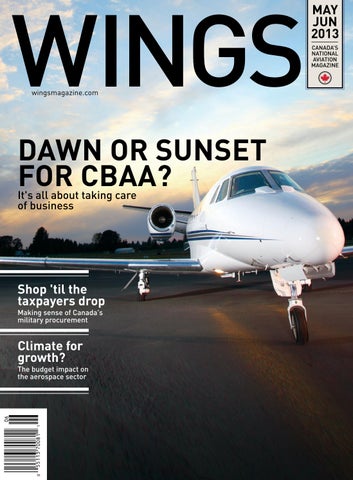
WINGS wingsmagazine.com
Dawn or sunset for CBaa?
It's all about taking care of business
shop 'til the taxpayers drop Making sense of Canada's military procurement
Climate for growth?
The budget impact on the aerospace sector
May jun 2013 CaNada’S NaTIoNal avIaTIoN MaGazINe
Fifty Years of Passion Generations of Falcons have one thing in common. Each one advances the state of the art. Becoming more efcient. More capable. More comfortable. Always ahead of the curve, with innovations such as Digital Flight Control technology and ultra-efcient, ultra-capable wings—at both ends of the speed envelope. We’re celebrating 50 years since the rst ight of the Mystère 20, but we’re hardly resting on our laurels.
The best is yet to come. Eastern Canada +201.981.2869 Western Canada +201.245.9399
Find out why. Scan the code or visit falconjet.com/50-years
May/june 2013
upfront 5 leading edge
A recruiting job half done?
8 on the fly
News and opinion
12 waypoint
Where are we?
14 alternate approach Air show economics
16 at the gate
CSeries set to shake up the market
20 air surveillance
Cessna’s Corvalis TTx is certified in the Faa’s utility category. P. 36.
Finding a new direction
BaCk 56 Marketplace 62 on final
FOA takes flight
features 22 BounDary Bay BuilDs for the future
Airport aims to be an economic hub servicing Vancouver and the surrounding area By Paul dIxoN
From top: Boundary Bay builds for the future. P. 22. a procurement problem. P. 26.
26 a proCureMent proBleM
Process has a history of bogging down procurement of military aircraft By Paul dIxoN
32 new lines on the horizon
Two well-known players introduce low-cost airlines to the Canadian market By BrIaN duNN
36 new Corvalis is really iMproveD
The TTx cruises to the top of its class By NeIl a. MaCdouGall
40 CBaa at post-poC CrossroaDs
CBAA navigating a brave new world of business aviation regulations By davId Carr
46 positioneD for takeoff
Economic Action Plan delivers for Canadian aerospace By KrISTeN vaNderHoeK, aIaC
coVeR PHoTo: foTolia
www.wingsMagazine.coM
May/June 2013 | wings
3
WINGS Magazine is looking for Canada’s top FBOs and we want to hear from you in the 3rd Annual CANADIAN FBO SURVEY. Go to www.wingsmagazine.com, click on the FBO Survey button, complete the online survey and enter to win a Sennheiser MM 550 Travel Premium Wireless Headset with NoiseGard ™ 2.0 Active Noise Cancelling and Bluetooth®. Approximate Retail Value $650. Survey and Contest close on June 15th, 2013. Results will be announced in the September/October issue of WINGS Magazine!
Vote today at www.wingsmagazine.com
LEADING
EDGE
| By Matt Nicholls
a recruiting job half done?
Careers in Aviation Expo reveals challenges in recruiting women
T
he Canadian aviation and aerospace sectors are about to face significant challenges in replacing a retiring workforce. Less than 40 per cent of the Canadian population is made up of white males. Taken together, those two facts should be forcing a cultural shift in the recruiting styles of Canadian aviation companies, and of the training centres that feed our industry. Looking out over the full house at the first Careers in Aviation Expo, it’s not clear those changes are being made. The recruiting event was hosted by Wings and Helicopters magazines in Toronto in early April, and targeted high school and junior college students interested in the aviation and aerospace sectors. It drew a capacity crowd of more than 180, including 110 students. The day included panel sessions on various career streams, including pilots, mechanics, engineers, management, navigation, sales and marketing, the military, and manufacturing. Young attendees could visit the dozens of exhibits from schools and potential employers, and try their hand on a FlightSafety International flight simulator. In organizing the event, we deliberately chose two Elsie MacGill Northern Lights Award winners as panellists, including Bombardier’s Erika Kangas (photo above). The luncheon keynote speaker was also an Elsie MacGill Northern Lights Award winner, as well as a successful entrepreneur and bush pilot. The education panel included two women, both pilots. Sadly, they outnumbered the women in the audience. Other than exhibitors, there was a grand total of three young women in the audience – two very keen grade nine students, and a pilot trainee.
5
Missing the Mark Why the preponderance of testosterone?
www.wingsMagazine.coM
cality, Canada’s armed forces have pursued gender and race equality targets for decades now. And while they regularly face criticism for falling short, they are at least facing up to the challenge. Currently, there are no formal restrictions to the roles women can pursue in the armed forces, a long-standing policy that has in many ways made Canada an example for other developed nations. The RCAF has openly and actively recruited women, visible minorities and aboriginals for years, striving to meet very public goals of 25, 12, and three per cent respectively. Still women make up just 15 per cent of our armed forces, visible minorities and aboriginals five and two per cent. The relatively low numbers for all three groups in the armed forces should be a wake-up call to our industry as we slowly realize our need to broaden our recruiting base. Changing culture and public perception is not a switch you flip when you see an empty recruiting pipeline. Nor are we alone in targeting these groups for future recruits. Forest products, mining, trucking and construction, for starters, are all looking to this demographic to fill their own staffing needs. If we’re not proactive, we will face the coming demographic challenge of still recruiting from our current shrinking talent pool.
Changing culture and public perception is not a switch you flip when you see an empty recruiting pipeline. We promoted the event through school guidance counsellors, sending posters and postcards that prominently featured several young women. We followed up with similar ads in Tonight, Toronto’s commuter newspaper, as well as radio ads in the weeks leading up to the event (it’s hard to be more gender neutral than radio). Our website landing page and registration page showed seven youth walking away from a helicopter, four of which are young women. And yet the results speak for themselves. Of course, Wings and the industry it serves are not alone in struggling to increase participation from the other 60 per cent of the population. Originally for political reasons, but increasingly out of practi-
top Data Bursts… in this issue 1. Bombardier's 160-seat cseries cs300 is getting a lot of attention (pg. 8). 2. 50: the number of air shows cancelled following sequestration cuts in the U.s. (pg. 14). 3. Boundary Bay sits on 300 acres (pg. 22). 4. 235 ktas: the maximum cruising speed of cessna's T240 corvalis TTx (pg. 36). 5. ottawa will provide $110 million to create an aerospace Technology Demonstration Program (pg. 46).
regs anD More regs As an industry, we love regulations. OK, maybe not, but we do need to understand them. With that in mind, Wings is launching a new column by David Olsen to track changes in regulations and how they may affect us. Air Surveillance will look at the reasons behind new or changing regulations, ask hard questions about why, or even whether, we need them, and judge how well they reflect the reality under which we work on a daily basis. If you have specific regulations you’d like us to look into, let me know. | w Your feedback is always welcome. Please contact me at mnicholls@annexweb.com. @Wings_Magazine May/June 2013 | wings
5
vol. 54, issue 3 eDitor
Matt nicholls mnicholls@annexweb.com 416-725-5637 MeDia Designer
gerry wiebe
flight DeCk
Ray canon, David carr, Paul Dixon, Brian Dunn, frederick K. larkin, neil a. MacDougall, James Marasa, carroll Mccormick, David olsen, Rob seaman
SubScribe TODAY !
assoCiate puBlisher
alison de groot adegroot@annexweb.com 1-888-599-2228 ext. 246
1 Year SubScription only
3000
$
sales assistant
stephanie Defields sdefields@annexweb.com 1-888-599-2228 ext. 257
(GST $31.50 • HST $33.90) US $42.00 (USD) • Foreign $65.00 (USD)
Name: _______________________________ Company: ____________________________ Title: _________________________________ Address: _____________________________ City: _________________________________ Prov: ________________________________ P.Code: _______________________________ Tel: __________________________________ Fax: _________________________________ e-mail:________________________________
PLeASe cHecK ONe: ❑ Commercial aircraft owner/operator ❑ Business/private aircraft owner/operator ❑ Military ❑ Aircraft maintenance/overhaul firm ❑ Airport ❑ Aerospace, airframe & component manufacturer and distributor
❑ Fixed base operator ❑ Aviation services, consultants and aircraft sales ❑ Government ❑ Aviation associations and organizations ❑ Flying schools, clubs and colleges ❑ Other (please specify) ______________
PAYMeNT: Cheque - Payable to Annex Publishing & Printing Inc. Visa
MC
AMEX
Account #: __________________________
group puBlisher
scott Jamieson sjamieson@annexweb.com presiDent
Mike fredericks mfredericks@annexweb.com wings Magazine
P.o. Box 530, 105 Donly Dr. s., simcoe, on n3Y 4n5 Tel.: 428-3471 fax: 429-3094 Toll free: 1-888-599-2228
Publication Mail agreement #40065710 Return undeliverable canadian addresses to circulation Dept., P.o. Box 530, simcoe, ont. n3Y 4n5 e-mail: subscribe@wingsmagazine.com Published six times per year (Jan/feb, Mar/apr, May/ Jun, Jul/aug, sep/oct, nov/Dec) by annex Publishing & Printing inc. Circulation e-mail: subscribe@wingsmagazine.com Ph: 866-790-6070 ext. 208 fax: 877-624-1940 Mail: P.o. Box 530, simcoe, on n3Y 4n5 subscription rates canada – 1 Year $ 30.00 (includes gsT - #867172652RT0001) Usa – 1 Year $ 42.00 foreign – 1 Year $ 65.00
occasionally, wings magazine will mail information on behalf of industry-related groups whose products and services we believe may be of interest to you. if you prefer not to receive this information, please contact our circulation department in any of the four ways listed above. no part of the editorial content of this publication may be reprinted without the publisher’s written permission. ©2013 annex Publishing & Printing inc. all rights reserved. opinions expressed in this magazine are not necessarily those of the editor or the publisher. no liability is assumed for errors or omissions. all advertising is subject to the publisher’s approval. such approval does not imply any endorsement of the products or services advertised. Publisher reserves the right to refuse advertising that does not meet the standards of the publication. Printed in canada issn 0701-1369
Expiry:_____________________________
TO SubScribe:
Tel: 866-790-6070 Fax: 877-624-1940 Mail: Wings Magazine c/o Annex business Media P.O. box 530 Simcoe, Ontario N3Y 4N5
Air Transport Association of Canada
ON THE
WEB
e-mail: subscribe@wingsmagazine.com
www.wingsmagazine.com
GST#135274215RT001
6
Subscriptions non-refundable
PRO0513
wings | May/June 2013
wings subad.indd 1
Canadian Owners & Pilots Association
Canadian Business Aviation Association
Magazines Canada
Careers in aviation Looking for a great career in aviation and aerospace? Check out our Careers in Aviation micro site, a handy guide to help you better understand what a career in aviation is all about. Check out www.careersinaviation.ca for news, updated listings and more!
PHoTo: Rcaf
Signature: _________________________
www.wingsMagazine.coM 13-05-01 1:14 PM
OUR FAMILY OF CUstOMeRs | A LetteR seRIes
FlightSafety Customer for Life
Bill Wagner Denver-Based Corporate Pilot
to find out about the many benefits of being a Flightsafety Customer, please call scott Fera, senior Vice President, Marketing, at 718.565.4774. sales@flightsafety.com • flightsafety.com • A Berkshire Hathaway company
ON THE FLY For late-breaking news, the Wings blog and exclusive web content, please visit us at: www.wingsmagazine.com
8 CoMMerCial 8 inDustry news 11 Careers in aviation
CoMMerCial
160-seat Cseries attraCting airline interest Several airlines including Lufthansa and easyJet, the U.K. discount carrier, are showing interest in a 160-seat version of Bombardier’s CSeries CS300 jetliner. A 160-seat version was first dangled in front of AirAsia at last year’s Farnborough Air Show. AirAsia eventually selected the Airbus A320neo, but reaction from the industry was sufficient for Bombardier to announce it will be going ahead with an extra-capacity version at the same time it unveiled the first CSeries flight test aircraft in March. A 160-seat aircraft moves Bombardier closer to the Airbus and Boeing orbit at the smaller range of their bread and butter product line, the A320 and Boeing 737. “Our main focus continues to be the development, optimization and
marketing of the CSeries family of aircraft in the 100- to 149-seat market segment. The CSeries aircraft is a game-changer in a changing economic environment, and following keen customer interest and market trends, we have enhanced the productivity of the CS300 aircraft further by offering the extra capacity seating option,” said Mike Arcamone, president of Bombardier Commercial Aircraft. “Specifically adapted for airlines looking at further increasing the productivity of their aircraft, the extra capacity seating option enables the CS300 aircraft to offer the highest seating capacity in its market segment, with the best-in-class seat mile costs and comfort.” Latvia-based airBaltic has converted its order for the CS300 to the higher capacity version and will be the launch customer. “We are delighted to select the extra capacity seating option and the additional pair of over-wing emergency exit doors. In keeping with our ReShape business plan, we are taking full benefit of the aircraft’s cabin design as we look to further increase the productivity of our CS300 aircraft and our network,” said Martin Gauss, chief executive officer of airBaltic. Germany’s Lufthansa is giving the aircraft a closer look. Swiss, a Lufthansa subsidiary, is expected to take delivery of its first CS100 in 2015. The CS300 aircraft’s systems’ capacity
Boasting a top speed of Mach 0.925, the G650 is the fastest civilian aircraft in service.
has been increased to accommodate a higher passenger count. The extra capacity seating option, which requires the addition of a second pair of over-wing exit doors, will be available both in-production and as a retrofit should customers need that flexibility in the future. The redesign to add 12 seats to the CS300 caused a ripple effect that extended to the design of the smaller CS100, contributing to a six-month delay in the CSeries first flight. An event is expected to take place in late June, after the Paris Air Show where Bombardier hopes to announce a major order. “This isn’t a paper airplane anymore,” Arcamone told the National Post.
inDustry news
The new CSeries was unveiled at Bombardier’s Mirabel, Que., plant on March 7. 8
wings | May/June 2013
Gulfstream Aerospace has set another citypair speed record with its new ultra-large, ultra-long-range G650. The 11,721-kilometre flight from Australia’s Melbourne International Airport to Abu Dhabi’s Al Bateen Executive Airport took 13 hours and five minutes at an average cruise speed of Mach 0.87. The trip is the demonstration aircraft’s longest nonstop flight since it entered service in late 2012. Previously, its longest flight was from Doha, Qatar, to Teterboro, N.J., a journey of 11,301 kilometres. The aircraft completed that trip in 13 hours and three minutes. The record will be sent to the Fédération Aéronautique Internationale in Switzerland for recognition as a world record. If recognized, it will be the aircraft’s sixth record this year. www.wingsMagazine.coM
PHoTos: BoMBaRDieR (BoTToM); gUlfsTReaM (ToP)
g650 sets speeD reCorD
Dassault extenDs health CheCk to 2000 anD 900 easy MoDels
PHoTos: flYing coloURs (ToP); DassaUlT falcon (BoTToM)
Dassault Falcon’s new FalconBroadcast airborne health monitoring service is now available on all Falcon 2000 and 900 models equipped with the EASy flight deck. Unveiled in Geneva in May 2012 on the Falcon 7X, FalconBroadcast enables operators to address unscheduled maintenance events while still in flight with the help of automated real-time troubleshooting and satellite links, allowing the issue to be resolved as soon as the aircraft lands. “This has been available for our Falcon 7X customers since mid-2012 and the response has been universally positive,” said Jacques Chauvet, senior vice-president of worldwide customer service. “Dispatch rates increase and in the event of AOG, aircraft downtime is decreased.” The service is available for in-production Falcon 900LX, 2000LX and the new Falcon 2000LXS, which is expected to enter operation in 2014. In March, Dassault, which turned 40 this year, celebrated the 20th anniversary of the first flight of the groundbreaking Falcon 2000 at the Abu Dhabi Air Expo. Since the first flight in Bordeaux Mérignac, France, Dassault has delivered nearly 500 Falcon 2000s worldwide, chalking up two million flying hours.
Peterborough's Flying Colours continues to expand its footprint worldwide and now has a stronghold in China.
flying Colours soliDifies fast route to China Asia continues to be a growth spot for Peterborough, Ont.-based Flying Colours Corp., a business aircraft maintenance, completion and refurbishment company. The company reports a widening of the geographical spreads of its aircraft completion clients with airplanes being delivered to Beijing, Shenzhen, Shanghai and other cities in mainland China, as well as Hong Kong. By year-end, Flying Colours expects to deliver 15 Bombardier Challenger 850s to China. The company has also completed two major refurbishments of Global Express models for China-based clients. To improve delivery efficiency across the region, Flying Colours has strengthened its relationship with the Civil Aviation Administration of China (CAAC) for aircraft certification. “There is a very specific process that has to be followed
and it takes time,” said John Gillespie, company president. “We have now had extensive experience so we can anticipate what the authority needs. Likewise the CAAC officials know they can rely on us to provide the necessary documents. This is a real bonus for our clients as it means an aircraft can enter service as soon as it arrives.” Meanwhile, Bombardier has awarded Flying Colours an exclusive contract to modify seven CR700 Neaten aircraft for an undisclosed Chinese client. The airplanes will be kitted out for specific mission purposes with emphasis on VIP modifications. The first aircraft is scheduled to arrive in Peterborough in the fourth quarter of this year, with the final airplane being delivered to the customer during the first quarter of 2015. Flying Colours has already converted 12 CRJ200 regional airliners to executive VIP configurations. Modification of the CRJ700 will be a first for the company.
The FalconBroadcast system is now available on all Falcon 2000 and 900 models equipped with the eaSy cockpit. www.wingsMagazine.coM
May/June 2013 | wings
9
ON THE
FLY
eMBraer Delivers first u.s.-Built phenoM 300s Brazil’s Embraer Executive Jets has made the first customer delivery of a Phenom 300 stamped “made-in-theUSA.” The delivery to an undisclosed customer comes after Embraer’s executive jet flight department accepted the first Phenom 300 to roll off the Melbourne, Fla., assembly line. That airplane is being used as a demonstrator. “This is a major milestone for Embraer and proves the maturity of our assembly facilities,” said Phil Krull, managing director of Melbourne assembly. Market acceptance for the eight- to 11-seat Phenom 300 has been high in Canada and the United States according to Bob Knebel, vice-president of sales for North America. “We have found the Phenom 300 to be particularly well received by owners-operators, corporate flight departments and leading
in Oklahoma City on June 14. No Canadian stopovers are planned. Announced at the National Business Aviation Association (NBAA) convention in October 2011, the eight-passenger Latitude will have a maximum range of 4,630 kilometres and maximum cruise speed of 815 kilometres. Cessna claims that the aircraft will have the most open, spacious and refined cabin environment in its category. The manufacturer said that the aircraft is on schedule and expects full airframes later this year. The first airframe is planned for testing cyclic fatigue; the second for static testing. “We’ve started building engineering test articles,” said Terry Shriner, business leader for the Latitude program. “The first prototype is expected to fly in Q1 2014. We’ve moved from engineering, analysis and modelling to cutting metal and driving rivets. The team is always energized when we see an airplane begin to take shape for the first time.”
fractional providers.” Embraer has also announced that its midsize Legacy 500 jet is on track to enter service in the first half of 2014. A third prototype for the clean sheet design first flew in March. “Testing to validate all systems and interior components is proceeding well,” said Ernest Edwards, president of the executive jet division. “After some 150 hours of test flights we are pleased with the results. Having three prototypes in the air in such a short time with such good results is a testament to the skill and dedication of our flight test team who have got the program off to such a good start.”
latituDe launChes tour The Cessna Aircraft Company is taking a mockup of its Citation Latitude on the road. The 19-city tour began on April 4 in West Palm Beach, Fla., and will finish
24/7
READY TO SERVE AROUND THE WORLD
Visit us at EBACE Booth #1647 A Fully Authorized Pratt & Whitney Canada Distributor & Designated Overhaul Facility
MAINTENANCE
l
R E PA I R
l
OVERHAUL
Toll Free: 1.888.769.0999 l www.vectoraerospace.com
SETTING THE STANDARD OF CUSTOMER SERVICE
10 wings | May/June 2013
www.wingsMagazine.coM
Careers in aviation
Wings gives next-gen aviators an insiDer’s look Wings magazine’s first Careers in Aviation Expo was an enormous success, bringing a wide array of young Canadians and potential employers together for insightful panel discussions. They were told that the much-anticipated pilot and aircraft mechanics shortage has arrived, and there are great career opportunities on the horizon for those showing passion, commitment and a strong work ethic. Held in April near Toronto Pearson International Airport, the Careers in Aviation Expo was organized by Wings and Helicopters magazines and is based on the popular annual Careers in Aviation guide and website. The event featured four panel discussions investigating career paths for pilots, aircraft mechanics and engineers/aerospace, aviation and
aerospace schools, and business management, sales and navigation. More than 100 potential candidates joined 60 industry experts and educators for the full-day event. Attendees also visited the nearby FlightSafety International Simulator Training Centre to try their hands on a flight simulator. They also had the chance to tour more than 20 exhibits to get more details on the opportunities and costs of preparing for a career in aviation. “The number, quality and focus of participants exceeded our expectations,” said Wings and Helicopters group publisher Scott Jamieson. “The industry panellists were very open and honest in sharing their experiences and in discussing career prospects in Canada’s aviation and aerospace sectors. The delegates I spoke with appreciated the insights they were getting.” Nicole Saulnier, chief pilot and owner with her husband, Keith, of Georgian Bay Airways Ltd., was the keynote speaker,
and treated delegates to a glimpse at the remote float plane experience, a truly Canadian aviation heritage. “We knew the industry’s need to get the next generation involved in aviation and aerospace,” Jamieson explained. ”That was the reason behind the guides in the first place, and now this event, as well as our Top 10 Under 40 contest. The enthusiastic crowd, all of whom paid to attend, tells us there is an appetite for these indepth, targeted expos.” The event was sponsored by Air Georgian, Great Lakes Helicopter, Ottawa Aviation Services, SmartPilot.ca, and the Waterloo Wellington Flight Centre.
for expanDeD inDustry news anD Daily upDates visit www.wingsMagazine.CoM.
The Perfect Solution for Flight Deck Upgrades Flexible Options for over 50 aircraft types
Renew your flight deck with an FMS upgrade or a suite of flat panel displays all certified in aircraft ranging from the Pilatus PC-12 to the Boeing 747. Contact an Authorized Dealer to find the right solution for your aircraft. www.wingsMagazine.coM UASC_Wings_1/2pg_ May_June.indd 1
www.uasc.com sales@uasc.com (800) 321-5253 (520) 295-2300 May/June 2013 4/22/13 9:30 AM11 | wings
WAYPOINT By Rob Seaman
where are we?
Some days even a good GPS is no help
T
12 wings | May/June 2013
are generally on the rise. Domestically it is certainly not a bad time to be building aircraft if your name is Bombardier. A recent $7.8-billion order from VistaJet, a Swiss entity, for a top-end, all-Bombardier fleet, coupled with the business the company already had in hand means a busy shop and high demand from those in its supply chain. On the not-so-great side, Diamond unfortunately announced that its much-anticipated D-Jet is back into “hold” and the staff who were working on it laid off. This is sad news for an aircraft that had potential to take piston and turboprop owner/ operator types into the jet age. That particular market still has of course the venerable Cessna Mustang and Embraer Phenom 100 along with a resurgent Eclipse, but look out – Honda Jet is about to arrive too. Skyservice Business Aviation has been appointed as sales and service rep for what many have predicated will be the “Civic” of the skies – a quality, reliable and very well-thought-out and tested mode of transport. So where are we? I think it is a case of doing OK. There are some challenges, some good things to come and some possibility for either growth or retraction depending on outside influences. As I always say, the greatest thing about working in aviation is that it changes all the time – for better or worse.| w
Some secondary airports have taken advantage of government funding for infrastructure improvements in recent years and in the process created new sites for development. The numbers don’t lie – Pearson is basically full, Toronto Island is likewise full or restricted by runway length and noise management. Oshawa has runway issues for larger business jets and other airfields are underdeveloped, crowded or just not able to handle the business. That extra drive to Peterborough, Barrie or Kitchener is one very real consideration, but the owners and operators are not there yet. This story is repeated across Canada as airports face increased operational support costs, redevelopment and expansion concerns and the government remains out of the ownership business. Looking more closely at the bizjet market, in February, Forecast International predicted that global business jet production will total 761 aircraft in 2013. Put this into perspective: Canada is at best no more than five to seven per cent of this total. That is no more than 54 aircraft. A bit high perhaps? At any rate, regardless if it is Forecast, Brian Foley or any of the other “predictors,” all seem to agree that 2013 marks the start of a recovery in annual business jet build rates that will extend at least through 2019. The used inventory of aircraft is slowly coming down and overall use through private/owner flights, charter and fractional
Rob Seaman is a Wings writer and columnist. www.wingsMagazine.coM
PHoTo: eMBRaeR
he business aviation sector appears to be bouncing back after a few rough years. Ramps are busy and hangar space is definitely at a premium but there are few signs of expansion or new facilities due to two key factors that could prove to be major hurdles in the years ahead: restricted land available at many airports for general aviation and BizAv and the operators’ need to see a sustained level of business to warrant any expansion. Demand will change sooner than later, but land use is going to be an ongoing and growing battle at key or hub airports. Fuel prices seem to have levelled and in fact dropped a bit – a trend projected to continue. That is good news as lower prices always encourage more activity. Generally the FBO and aircraft support side of the market is doing better, with room for more growth and, according to many leading operators across the country, is looking for sustained business signals to expand. On the down side, airport access and availability is still a concern. Case in point: the closure of the Edmonton Municipal Airport and the pending closure of the Toronto Buttonville Municipal Airport in the next few years. Just replacing these airports and their capacity will mean extensive spending and developing new sites after land has been procured. Given environmental restrictions and government oversight, the prevailing “not in my backyard” attitude of many municipalities and the lack of government-driven funding, creating new airfields is no small task. It requires deep pockets and significant commitment to servicing aviation as a business. Some secondary airports have taken advantage of government funding for infrastructure improvements in recent years and in the process created new sites for development. In Ontario for example, Peterborough, the Region of Waterloo International Airport and Lake Simcoe Regional Airport are three such airfields with the “welcome” mat out. The issue in many cases, however, is convincing aircraft owners and operators that these are good places to locate their aircraft for the extra road time.
ALTERNATE
APPROACH By David Carr |
air show economics
Aviation events are feeling the effects of scaled back spending
T
14 wings | May/June 2013
prestige of a Paris or a Dubai but have been thrilling crowds since the barnstorming era don’t enjoy similar fallbacks. John Cudley, president of the International Council of Air Shows (ICAS) estimates there are between 300 and 325 such shows in Canada and the United States every year. They attract up to 13 million spectators and pump over $1.5 billion into local economies. This crowd does not click over the turnstiles to watch airplanes that can be spotted at any airport. The U.S. Air Force has responded to sequestration budget cuts by grounding all non-essential flying, including goodwill appearances at local air shows. As a result, 50 shows have been cancelled and the ICAS is concerned that number could double if the military does not restore some level of participation. American hardware including aerobatic teams such as the Blue Angels continue to be a huge ticket in Canada, which means the impact of sequestration cuts will percolate north. Could similar cuts happen here with, say, the Snowbirds? The current government appears to understand the importance of Canadian symbols. Hopefully it also appreciates the economics of air shows and the value of goodwill. | w
For now, any pullback by corporate aviation and defence at broader trade shows will be offset by a stronger presence in the hotly competitive commercial sector. aircraft. That number is certain to shrink, but Canada’s geography and dependence on international economic activity will continue to make it a substantive market for OEMs. “We know that OEMs have finite resources,” says Debra Ward, CBAA’s manager of marketing and industrial relations. “OEMs need to see a return on the time and cost of attending CBAA. We are responding by providing value along the entire chain.” For CBAA 2013 in Vancouver, that includes a private VIP event for OEMs, expanded education programs with sessions geared to pilots, flight managers and schedulers and beefed up networking opportunities. Clearly, the industry understands the economics of air shows. Executive aviation is gravitating toward targeted shows. For now, any pullback by corporate aviation and defence at broader trade shows will be offset by a stronger presence in the hotly competitive commercial sector. Smaller public shows that lack the
David Carr is a Wings writer and columnist. www.wingsMagazine.coM
PHoTo: PaRis aiR sHow
his year the Paris Air Show opens the gates for the 50th time. Paris, which celebrated its 100th anniversary in 2009, got a dry run as an add-on to the Paris Automobile Show in 1908 before becoming the first exhibition devoted exclusively to aircraft one year later. If the numbers don’t add up that is because the show became a biennial event after 1924, and was halted during two World Wars. Paris remains the undisputed la vieille dame of aviation trade shows in an increasingly busy circuit. In a 2005 column, I wrote about the success of the National Business Aviation Association’s (NBAA) regional Business Aviation Convention & Exhibition (BACE) strategy for executive aviation conferences and exhibitions in Latin America, Europe and China, and predicted that limited trade show budgets, “must either be increased, stretched over even more events, or strategically invested.” Since then, the popularity of BACE has soared while shows in order-rich India, Singapore and Dubai are gaining traction. Exhibitors have become more strategic in where they invest, with executive aviation original equipment manufacturers (OEMs) either making token appearances at less targeted shows such as Paris and Farnborough or bypassing them altogether. Defence companies are also becoming more selective or scaling back. There is another dynamic at play according to Emeric d’Arcimoles, chief executive of the Paris Air Show. “Due to the decreasing of the military budgets of the different countries involved in the exportation of their own production . . . now they say they have to compete more aggressively,” he told the New York Times. While exhibitors are showing signs of trade show fatigue, it isn’t always apparent on the ground. Paris had a record-breaking 2,100 exhibitors in 2011 and will hit capacity again this year. Singapore, which holds its biennial show next February, is reporting 80 per cent of floor space has been snapped up. The Canadian Business Aviation Association’s (CBAA) annual show has traditionally attracted heavy hitters such as Bombardier, Cessna, Dassault and, more recently, Embraer. Canada accounts for an estimated five per cent of the global market for private
Works well with others.
Flight departments everywhere are under pressure to deliver more for less. The King Air 350i lets you do just that, without compromise. Its unsurpassed versatility and payload, combined with class-leading range and efficiency, carries more people farther at lower cost than any other aircraft. More for less, or the ideal stable mate? How about both. Visit us at Beechcraft.com. For more info, please contact: U.S. & the Americas +1.316.676.0800 EMEA +44(0) 1244.523803 • Asia-Pacific +65.6423.0321
We build aircraft you can believe in.®
©2013 Beechcraft Corporation. All rights reserved. Beechcraft and King Air are the registered trademarks of Beechcraft Corporation.
AT THE
GATE
By Brian Dunn |
Cseries set to shake up the market Bombardier’s new single-aisle plane caters to low-cost carriers
W
16 wings | May/June 2013
leasing firms and low-cost carriers. Arcamone noted that the three latest CSeries customers “have come in rapid succession since December” from airBaltic, Russian leasing firm Ilyushin Finance Co. and an unidentified client. “We have 15 months before we go into service and we are confident we will reach our forecasts,” said Arcamone. When one analyst suggested that Bombardier has been less aggressive in its marketing than either Boeing or Airbus, Arcamone noted that unlike its rivals, the CSeries is a completely new aircraft and not a re-engineered one. Analysts seemed bullish on the CSeries in reports to clients after many of them saw the first-test vehicle during a tour of the Mirabel plant. “First flight [slated for the end of June] will be a trigger point for some airlines to order,” wrote Cameron Doerksen of National Bank Financial in Montreal. “Only minor systems remain to be assembled into the plane.” Benoit Poirier of Desjardins Securities in Montreal wrote that he was impressed by the “additional transparency and significant progress” reported by Bombardier at the launch event and “remains confident that first flight can occur by the end of June.”| w
In addition to stretching the fuselage by a seat-row, Bombardier will install a second pair of over-wing exits and increase the maximum take-off weight to carry more fuel and preserve a range of 2,950 nautical miles. 180-seat aircraft so that airlines that cannot fill the larger aircraft can still have the same cost advantage. According to Dewar, the CSeries flexibility is “unmatched,” including a smaller noise footprint for noise sensitive airports like London’s City Airport. “It has the bestin-class cabin comfort and flexibility. And it has a game-changing engine [Pratt & Whitney PW 1500G] for a game changing aircraft with a 20 per cent fuel burn advantage and 15 per cent less emissions.” However, the seat pitch will drop from 32 inches on the base model to 28 inches on the 160-seat version. Ergonomic improvements like the enhanced curvature of the seat should mitigate the difference. A report by Bloomberg News suggested orders for the CSeries are lagging, at only 180 aircraft, and series would need a 67 per cent increase in orders to meet a goal of 300 by mid-2014. But Arcamone maintained that orders are on target. He repeated the company is looking at 300 firm orders by 2014 from 20 customers from geographically mixed clients from major airlines,
Brian Dunn is a Wings writer and columnist. www.wingsMagazine.coM
PHoTo: BoMBaRDieR
hile a decision by Bombardier to offer as many as 160 seats on the larger of its two new CSeries aircraft was made to attract orders from low-cost airlines, it will also attract attention from Boeing and Airbus as the company encroaches further on territory long held by its bigger rivals. The announcement came during the unveiling of Bombardier’s highly anticipated CSeries amid much fanfare at its Mirabel, Que., facility, north of Montreal. The event marks the first time since 1987 that any company has rolled out an all-new, singleaisle plane in the smallest category of mainline passenger jets. Bombardier said its main focus will continue to be on development and marketing of the CSeries 100 and 300 aircraft for the 100- to 149-seat market segment, but customer interest and market trends prompted it to offer the higher capacity option. “Simply, the more seats you make available, the better the seat costs,” Mike Arcamone, president of Bombardier Commercial Aerospace, said at the unveiling. “We made the economics today even better.” The decision to go to 160 seats is a crucial play to win orders from low-cost carriers and puts pressure on Airbus’s A319, which has a standard configuration of 124 seats but can hold up to 156 passengers. Boeing’s 737-800, slightly bigger than the 737-700, can seat 162 passengers in a two-cabin format, or 189 in one class. In addition to stretching the fuselage by a seat-row, Bombardier will install a second pair of over-wing exits and increase the maximum take-off weight to carry more fuel and preserve a range of 2,950 nautical miles. For the first time in the industry, customers will be able to have the extra exits installed during production or retrofitted in service to increase capacity, noted Robert Dewar, vice-president and general manager of the CSeries program. Structural provisions for the second pair of over-wing exits will be built into the basic aircraft. Arcamone said the 160-seat version will have a cash operating cost per seat that is eight per cent lower than the baseline 135-seat CS300. Dewar said the 160-seat model will have the same seat-mile cost as a
I like to stay ahead of my airplane. So if I’m 40 miles out with weather rolling in, I’m listening to what’s happening in front of me. AWOS. Pilot chatter. A quick check with flight service. Sometimes, there’s a lot to decipher. But I need to hear it clearly. Because when I do, I feel confident. Prepared. In the moment. And that allows me to just
focus on what matters,
flying.
MORE NOISE REDUCTION. LESS DISTRACTION. Better sound can make all the difference, especially where you go. Which is why, with 30% greater noise reduction than conventional noise reducing aviation headsets, the A20 headset lets you hear more of what you need to hear. While proprietary cushions and minimal clamping force let you fly comfortably for hours. Meets or exceeds TSO standards. Made in U.S.A.
Bose A20 ®
Aviation Headset
To order 1.800.901.0497 | Learn more at Bose.ca/A20_27
©2013 Bose Corporation. Delivery is subject to product availability.
®
GLIDE
PATH
By Paul Dixon |
a new age in commercial aviation
Today’s travellers create their own increasingly customized experiences
T
18 wings | May/June 2013
together in one row had had the foresight to provision ourselves with smoked meat sandwiches from Rue St. Catherine. When the announcement was made that meals were now available for purchase, we were able to “whip it out,” much to the chagrin of our fellow travellers. I had a beefy RCMP sergeant hanging over the back of the seat in front of me looking for all the world like a puppy hoping for a scrap. Air travel today is sold as an “experience,” from the front door of the airport terminal, through the shops, high-end coffee bars and duty-free offerings. There was a time when duty-free really meant duty-free. Two dollars for a bottle of Canadian Club and another two for a carton of Players Filter and then off to Mexico for a week. I suppose that was my personal Golden Age of Aviation. Let me be clear: I don’t need an “experience.” All I want is an airport that is clean and an aircraft that is mechanically sound with a crew that is proficient, well rested and happy to be there. I’ll take care of creating my own experience beyond that. | w
Air travel today is sold as an “experience,” from the front door of the airport terminal, through the shops, high-end coffee bars and duty-free offerings. the flying was just a way of getting there and back again, with a few concessions to creature comfort. As long as I knew the aircraft was well maintained and the pilots were well rested and happy with their lives, then I was happy to go along for the ride. The food and drink was never a big deal. I’ve been trying to think about my most memorable airline meal and the only one that comes to mind is an attempt at a full breakfast service on a stretch DC-8 flying the VancouverCalgary route. It was an early morning business flight. The cabin crew needed track shoes to get up and down the aisle in time. Looking back, my only thought about that meal service is “why?” I do have a “best meal on flight” story, but it was an exercise in self-catering. It was about the time airlines started selling box lunches on domestic flights and I was part of a large group returning to Vancouver from an international conference in Montreal. Three of us sitting
Paul Dixon is freelance writer and photojournalist living in Vancouver. www.wingsMagazine.coM
PHoTo: PaUl Dixon
here was a series of articles in national media a couple of months ago lamenting the passing of the “Golden Age of Aviation” in Canada – that mythical, mystical time when air travel was exotic. Maybe it was, but that was a long time ago in more ways than one. I can remember my grandmother arriving at the new Vancouver International Airport terminal on a flight from Toronto. We stood on the viewing platform and watched the shiny new TCA DC-8 glide onto the tarmac only a few feet away. There was my granny, descending the stairs, waving at us. It never occurred to me that I was witnessing the golden age of anything, but it was pretty neat all the same. That was in the time before the TransCanada Highway was completed and we had two national railways that both operated two national passenger trains on daily service. As a family we did the Vancouver-Toronto train trip a couple of years later to visit the same grandmother. It was exciting for a couple of young boys, sitting up in the dome car in the middle of the night talking to the conductor. The food was pretty good too. That was right about the time when the pendulum started to swing away from the train and commercial air travel was catching on. A few years later I returned to Toronto, again to visit my gran; however, this time I flew. I took a brand-new 747 one way and a rather tired DC-8 the other. It cost me $249, return. I was making $2.55 per hour at the time, which was well above average for someone working their way through college. VancouverToronto for 97.5 times my hourly wage. Who would pay that today? Who could pay that today? I don’t remember much about those flights other than you could smoke (I did) and drink (ditto) and they fed you at some point. What I do remember is that I had to go to the airline office in downtown Vancouver to pick up my ticket. In those days the airline offices were all within shouting distance of each other. I’ve never come close to being a frequent flyer, but I’ve done my share of flying for business and pleasure. For me
MAX SPEED: MACH 0.88 MAX RANGE: 4,350 NM MAX ALTITUDE: 45,000 FT Large-Cabin | Long-Range
E XCEL
BORN TO
The Gulfstream G450® has been the overwhelming choice of discriminating travelers for nearly a decade. Not surprising, since it’s the direct descendant of the world’s best-selling GIV series. Like its legendary predecessor, the G450 delivers high-cruise speeds, intercontinental range, and unsurpassed reliability – all complemented by a worldwide product support network. Success. It drives us.
SCOT T NEAL
|
+1 912 965 6023
|
scott.neal@gulfstream.com
|
GULFSTREAMG450.com
Range shown is based on NBAA IFR theoretical range at Mach 0.80 with eight passengers. Actual range will be affected by ATC routing, operating speed, weather, outfitting options and other factors.
AIR
SuRvEILLANCE By David Olsen |
finding a new direction
Now is the time to rethink how regulations are made and enforced
I
20 wings | May/June 2013
in the last century and has
It is time to de-politicize never been seen again. Transport Canada and let the staff All this seems to be just the tip of the iceberg. That get on with doing the jobs that is not to say that Transport Canada is totally wrong, need doing – and of course, nor is industry totally right. fund the job properly. But the situation is a mess and confrontation, Australia has completed public consultation on FCFM and, to accompany the introduction of the new rules (civil aviation order 48) in April, has produced an excellent free booklet on managing fatigue. Operators will complete transition to the new rules by April 2016, by which time cabin crew fatigue management rules will also be implemented. On the airport front, things are equally murky. In October 2012, the Airport Management Council of Ontario sent a letter to the Transport Canada DGCA noting that there had been a 100 per cent failure rate on approvals of airport safety management manuals in the Ontario region and blaming Transport Canada for a lack of resources and guidance. Similarly, those who have been waiting many years for CAR 322 to replace the ancient TP 312 (Aerodrome Standards and Recommended Practices 4th Edition, March 1993) had better plan to keep waiting. Transport Canada Policy Letter 121 from 2002, spoke of “continuing work,” which has not seen the light of day 11 years later. And if you are planning on writing an airport operations manual (AOM), good luck. The excellent specimen AOM format document for airport operators disappeared
and the sooner the minister wakes up to the fact and moves Transport Canada from being a political “yes man” to a genuine expert-based organization working for the good of industry, the public and aviation employees, the sooner we might start catching up to Australia and other countries. It is time to de-politicize Transport Canada and let the staff get on with doing the jobs that need doing – and of course, fund the job properly. Tax cuts may sound sweet on the election trail, but in this business it can mean aircraft falling out of the sky. Just around the corner, there are changes coming for business aviation. New regulations will amend CAR 604 and address all aspects of private aircraft operations. At this time, all private operators will need to hold Transport Canada Private Operator Certificates and comply with the subpart 604, which, according to the Canadian Business Aviation Association should be a more streamlined regime than at present. | w David Olsen has spent more than 50 years in aviation, in the Royal Air Force, DCA New Zealand, Transport Canada, ICAO, IATA, industry and as a consultant and writer. www.wingsMagazine.coM
PHoTo: aiR canaDa
n November 2012 the new International Civil Aviation Organization (ICAO) flight plan was quietly and efficiently implemented – a good example of a process that works. What is not happening quietly and efficiently is the development of solutions to the two ongoing bogeymen of flight crew fatigue and airport (and other) safety management systems, not to mention aircraft maintenance engineer fatigue management, the Dreamliner problems and amended Water Airport Regulations, to name but a few. In 2010, Wings published reports on flight and duty time limitations (FDTL) and fatigue risk management systems (FRMS). After much work by New Zealand, Australia, the United Kingdom, ICAO, FAA and others since 2006, Transport Canada somewhat belatedly struck a Canadian Aviation Regulation Advisory Council (CARAC) Flight Crew Fatigue Management (FCFM) Working Group. Convening 14 times between August 2010 and December 2011, the group submitted its final report to CARAC in August 2012 – and that’s when the cat really got among the pigeons. Fred Jones, president of the Helicopter Association of Canada, had already highlighted dysfunctionalities in the group and the report was not unanimous. Most of the members dissented and in January they sent a blistering criticism of Transport Canada, the co-chairs and the report to Transport Canada’s director general of civil aviation (DGCA). A major criticism was that Transport Canada was trying to force a one-size-fits-all approach on the whole industry. In the Wings fatigue feature, we reported an industry expert’s view that “the nation’s regulating body is not so much broken as it is dysfunctional.” The dissenting industry experts sure made the dysfunctional point in spades when it came to the FCFM working group! Despite having received a presentation from Australia’s Civil Aviation Safety Authority, the FCFM working group seems to have ignored the 2012 CASA notice of proposed rule making (NPRM), which stated “the proposed rules would introduce a graduated approach to fatigue regulation so air operators can use the most appropriate set of standards for their type of operations.” Furthermore, while the Canadian process has descended into chaos
&
Recognizing the next geneRation in the canadian aviation and aeRospace industRy! Canada is full of young, skilled and knowledgeable people who are driving the aviation and aerospace industry forward. From pilots and AMEs to ground crew and business managers, they are the best and brightest in our industry. Join us as we celebrate the future of aviation and aerospace in Canada.
coming in the
july/august
issue
WHO CAN BE NOMINATED?
Anyone in the aviation or aerospace industries who is under the age of 40 as of December 31, 2013. Equipment and technology suppliers as well as operators are welcome.
ALL NOMINEES SHOULD: • • • •
Demonstrate a strong work ethic Show leadership and initiative Actively seek new opportunities for training and education Be involved in industry association or broader industry initiatives
NOMINATIONS ARE NOW OPEN
To nominate someone to be recognized as one of the Top 10 under 40, visit www.wingsmagazine.com or www.helicoptersmagazine.com and click on the “Top 10 Under 40” link to complete a nomination form.
The Top 10 Under 40 will be featured in the July/August 2013 issue of WINGS Magazine and the July/August/September issue of HELICOPTERS Magazine.
Boundary Bay’s new airport terminal was completed just ahead of the 2010 Winter olympics in vancouver.
airport aiMs to Be an eConoMiC huB serviCing vanCouver anD the surrounDing area By paul Dixon
f
ive years ago when Wings visited Boundary Bay Airport (CZBB) the operation was very much a work in progress, a vision with a story written largely in the future tense. Today, the future is now and the little airport is ready to spread its wings, like the caterpillar emerging from its cocoon as a beautiful butterfly to become not just an airport but a multifaceted economic hub serving one of the fastest growing metro regions in Canada. Located in Delta, B.C., adjacent to the aptly named Mud Bay, the airport is a product of the British Commonwealth Air Training Program. Officially christened as Number 18 Elementary Flying Training School (No. 18 EFTS), it was opened by Prime Minister William Lyon 22 wings | May/June 2013
Mackenzie King in July 1941. Boundary Bay went through three phases: first as a primary training operation, then as a Royal Canadian Air Force (RCAF) base operating Hurricanes and Kittyhawks after Pearl Harbour, and, for the past two years of the war, as a primary training centre for B-25 Mitchells and B-24 Liberators. At its peak, more than 4,000 personnel were stationed at Boundary Bay. At the end of the Second World War, the training centre was shut down and the site went unused until it was reopened in 1949 as the Vancouver Wireless Station for use by the Royal Canadian Corps of Signals as a communications and signals intelligence operation. The station was permanently closed in 1971, a result of the unification of the Canadian military and changes in communications technology. These days the small city that housed base personnel and their families is gone and much of the site is used as a landfill by the City of Vancouver. For years, the site was used by the community for a wide range of activities running the gamut from picnics and public fairs to auto racing and flying model planes. Municipal police forces
in the metro area used the runways for their high-speed driver training. The rebirth of the airport came in 1982, when Transport Canada recommissioned and reopened it to provide an alternative for the flight schools that were operating at Vancouver International Airport (YVR). Today, Boundary Bay is one of the premier flight training centres in Canada. In 2011, there were 147,000 aircraft movements at CZBB, ranking it seventh in the country. In 1998, the federal government turned the airport over to the local municipality, the Corporation of Delta. The municipality tried a couple of different management companies before entering into an agreement with Alpha Aviation in 2004. “We’ve been very busy since 2004. The first thing that everyone sees here is the brand new terminal, which was opened in 2010, just before the Olympics,” says Lyle Soetaert, the airport manager. “We have also resurfaced and reclaimed additional length on runway 07/25. It went from 3,600 feet out to 5,600 feet. That’s our main runway for the larger aircraft. We also put in instrument approaches on www.wingsMagazine.coM
PHoTo: alPHa aViaTion
BOuNDARY BAY BuIL
Passengers arriving at Boundary Bay can taxi up to the terminal and then drive away.
LDS FOR THE FuTuRE two of the runways, runway 30 and runway 07/25, and we did a complete apron rehabilitation.” While the main runway theoretically could accommodate an aircraft the size of a Boeing 737 or Airbus 320, Soetaert says, that would be “challenging” at best. “We’re ideally designed for 60 to 70,000 pound aircraft, super mid-size jets for corporate and business, and we’re also designing the airport for a Dash-400 community service.” He goes on to describe maintaining and growing Alpha’s role as a satellite to YVR: “The flight schools will always be a part of Boundary Bay. We make sure they are well cared for and can do their business. It’s been a fantastic relationship with them as well as NAV Canada in the tower. That works really well. We see the business market and the corporate market as slowly being moved out of YVR because of congestion issues and because of pricing issues. We see ourselves as a logical place for some of that traffic to come to and operate. We’ve got our Boundary Bay Air Services FBO here, so we’ve been marketing to that segment – the business and corporate market – the fact that Boundary Bay www.wingsMagazine.coM
exists, as well as all the improvements that we’ve made to the airport and what that will mean to them when they come to Vancouver.” At a large airport such as YVR, the smaller business and commercial aircraft are often treated as an afterthought, whereas at Boundary Bay the business is being developed to service them specifically. “I’ve talked to a lot of crews that have come in here and YVR as well and the difference is that at YVR you can be stuck between the runways, or behind heavies when you have to depart,” says Soetaert. “At Boundary Bay the corporate and business aircraft are number one, all the time. “One of the concerns I hear from people [who haven’t been here before] when they learn that there are flight schools here is ‘how long am I going to have to wait to land’ and the answer is ‘you’re not.’ The flight schools understand the situation and they’re happy to go around one more time. The tower does an incredible job of co-ordinating everybody and I haven’t had anybody actually complain about the flight schools.” Customs clearance at YVR is another
time challenge for smaller aircraft: navigating across the airport to customs, a likely delay for clearance and then back over to the FBOs on the south side of the airport, deferring to larger aircraft the whole way. At Boundary Bay, the customs box is right at the terminal. Many frequent users use the CANPASS system, so clearance is simply a 1-800 phone call away. For those without the CANPASS, Canada Border Services Agency (CBSA) personnel drive over from the Point Roberts border crossing 15 minutes away. Soetaert says it’s an opportunity for the agents to get out of the office. There is a very positive relationship between the airport and CBSA, so the system works well. The time saved in getting out of the airport once on the ground more than makes up for the perception that being 20 kilometres farther south of downtown Vancouver than YVR is a disadvantage. Another big advantage for Boundary Bay over YVR in its chosen market is what it costs to fly in to CZBB. “We’re about half the price of YVR; we consciously put it there. That’s parking fees, terminal fees, you name it,” says May/June 2013 | wings 23
Soetaert. Alpha also operates the FBO. “We’ve always had facilities here, but we didn’t market it as a stand-alone FBO. Most airports you go to, you have the airport operator and the FBO as two separate entities. When we started, we just operated the FBO under Alpha Aviation. We’ve decided now the best way is to have the FBO stand alone, have its own contacts, its own marketing. That way people understand that if they are going to Boundary Bay and they need an FBO, then this is it. We can waive landing fees or we can waive terminal fees. There’s so much more we can do than your standard FBO because we operate the entire airport. At YVR, you’re not going to get your landing fees waived.” The relationship between Alpha and the Corporation of Delta became even stronger when Alpha’s original 35-year lease, signed in 2004, was extended to 2099. The rationale is that this gave Alpha a degree of confidence in engaging in long-term planning and was equally attractive to potential clients. Improvements to the airport include much more than the terminal and runways. Speaking to a Delta Chamber of Commerce luncheon held in the new terminal building, Delta Mayor Lois Jackson delivered the message that: “Delta council has made the economic viability of Boundary Bay Airport a priority. We have committed to maximizing the industrial land development at Boundary Bay Airport. With its close proximity to BC Ferries, the U.S. border, Deltaport, YVR and the South Fraser Perimeter Road, the airport offers a prime location for industrial development.” With more than 300 acres of property available, the airport has plenty of room to grow for both aviation-related businesses and other sectors. Heli-One, the 24 wings | May/June 2013
world’s largest helicopter repair company, built a 235,000-square-foot facility at CZBB in 2008 and today employs more than 500 people at the facility. Soetaert describes this as a period of heavy expansion for the airport, primarily because of the longer lease terms. “We’ve got lots of aviation interests looking to move here, due to costing reasons and also the long lease. We built 40,000 square feet of new hangar space in the past year and it’s all gone. The RCMP is in the process of moving out here from YVR and we’re in conversation with Transport Canada. YVR is an expensive place to do business. Our advantage over our GA neighbours in the region is that we have the longer runways, so we are able to take some of the bigger aircraft.” In 2011, the municipality rezoned the airport land that doesn’t have direct access to the airport apron or runways for industrial use to attract a wider range of users, including warehousing, wholesaling and distribution, as well as business park office uses. The Corporation of Delta has committed to improving the infrastructure by embarking on a number of projects, including designing and upgrading roads as well as improving water, sanitary and drainage. Some work has already been completed and other work will continue in phases. An $18-million project underwritten by three levels of government and Port Metro Vancouver has seen a new rail overpass built to relieve the impact on airport traffic caused by dozens of unit trains a day serving Deltaport, the adjacent container port and coal shipping facility. The first direct effect of the zoning change and infrastructure improvements was the decision by Dayhu Corporation to build a 900,000-square-foot distribution centre directly behind
www.wingsMagazine.coM
PHoTo: PaUl Dixon
The Boundary Bay airport terminal is dwarfed by the heritage hangar – the last building left from the airport’s rCaF days.
Heli-One. Work is already underway and completion is slated for 2014. This one project is expected to produce up to 1,000 new jobs in the community and provide an additional $1 million in tax revenue to the municipality. The money that is generated by developing the airport lands will be used for major capital improvements at the airport. Lyle Soetaert has his to-do list ready. “The first thing we are going to do is a major apron rehabilitation, crack sealing and filling, new concrete, and designing our taxiways to ensure that our corporate customers are served better, our flight schools are served better and our commuter services are served better. Part of runway 12/130 was never claimed back, so we want to claim the full length back on this runway. We already have an instrument approach on the runway and this would allow corporate and commuter traffic to use it as well. We’re also looking at replacing our lighting with LEDs and [precision approach path indicators] to improve overall operations.” Another big investment is the airport’s decision to incorporate solar energy into operations at the new terminal, with an eye on earning Leadership in Energy and Environmental Design (LEED) certification. “Boundary Bay is very green, the Corporation of Delta is very green, so we built a 10-kilowatt-hour panel and it is feeding the batteries as an emergency backup for the terminal and the rest is going to the grid,” says Soetaert. “On sunny days, it’s putting that out without any difficulty and on slower days, maybe not so much, but it’s still putting some power out. Our system was designed and built by a collaboration of other members of the Alpha Group of companies; Alpha Technologies Ltd. in Burnaby, B.C., Alpha Energy and OutBack Power Technologies. As we continue to expand at the airport, we will continue to find ways to use technology to help us increase our use of renewable sources of energy.” When the training facility at Boundary Bay shut down in October 1945, the last day was marked by a massive air show that drew more than 20,000 spectators – five times the population of Delta at the time. Today, that experience lives on in another collaboration between Alpha Aviation and the Corporation of Delta. The annual Boundary Bay Airshow draws performers from Canada and the U.S. for a day of aerial acrobatics, warbird formations and static displays. The best part is that it’s free! In 2012, the Northwest Council of Airshows awarded its “#1 Up and Coming Airshow” prize to Boundary Bay. | w
DEFENCE & SECURITY TRADE SHOW
May 2014
Ernst and Young Centre (Formerly CE Centre)
Ottawa, Canada Canada’s Leading Defence & Security Trade Show • Over 10,000 industry suppliers and government customers. • Over 600 booths and 120,000 sq. ft. of indoor and outdoor static display space. • Over a dozen International defence delegations anticipated based on CANSEC 2013.
Produced by:
Mark Your Calendars
A PROCuRE
PROBLEm
CanaDa's proCureMent proCess with Military airCraft is laCking By paul Dixon
26 wings | May/June 2013
www.wingsMagazine.coM
The ongoing controversy over the CF-18 replacement project has brought the military procurement process in Canada into serious question.
EmENT PHoTo: Rcaf
t
he storm of controversy that has arisen around the CF-18 replacement project and the ongoing delays with the CH-148 Cyclone are but the latest chapters in a play that has been running since Confederation. The Canadian public have a limited awareness of their military. The day-today operations of the army, navy and air force largely take place out of the spotlight and are rarely newsworthy. Two www.wingsMagazine.coM
things have largely determined the state of our military, one being our political heritage and the other being the reality that we have largely been dependent on other countries to equip our military or provide the design expertise for domestic manufacture. Prior to Confederation, Britain was responsible for the defence of Canada through the presence of the British Army and units of the Royal Navy. After 1867, the Canadian Army gradually evolved
from British units with the first permanent force being created in Kingston, Ont., in 1871. When the Northwest Field Force was dispatched to put down the Northwest Rebellion in 1885, it was the first time Canadian troops (a mixture of regulars and militia) had been commanded by Canadian officers. The Boer War marked Canada’s first official dispatch of troops to an overseas war. It was a political hot potato for the Liberal government of Sir Wilfrid May/June 2013 | wings 27
Laurier rationalized at the time that this overseas expedition was not a precedent, but history has proven otherwise. Towards the end of the Boer War, a diplomatic tiff between Britain and Canada resulted in Britain refusing to supply any more Lee-Enfield rifles to the Canadian troops. Canada had no arms or munitions industry and had relied on Britain. Attempts by the Canadian government to entice British manufacturers to set up operations in Canada failed. This forced the government to turn to the Ross rifle, developed
31/01/13 à 10:39
Laurier, establishing a pattern that would repeat itself many times over in years to come. While Canadians of British heritage supported the war, urging the government to send troops, most French-Canadians and immigrants of other nationalities weren’t convinced that Canada had any business in a war halfway around the world. Laurier demurred until the internal and external pressure forced his hand. Initially agreeing to send a battalion of volunteers, he eventually sent more than 7,000 Canadians to South Africa.
DATA:LIVE:Studio_MTL:CANAM:30048_HANGAR (campagne 2012):PRODUCTION:30048_HalfWingsMagHangarAN_A01.indd
Pamper your plane. Build a Canam hangar.
Welcome to the world of Canam. In our 50 years of experience, we have established an accelerated construction process that is reliable and adaptable to all of your airport projects; whether for airplane, helicopter or maintenance hangars. Structures, walls and building envelopes: all of our construction solutions are simple and straightforward. So you don’t get any surprises.
canam-construction.com 1-866-466-8769
28 wings | May/June 2013
by Charles Ross. It was an accurate weapon and a fine hunting rifle, but a poor infantry weapon, heavy and prone to malfunction when exposed to dirt. When Britain declared war on Germany in 1914, Canada and the rest of the Commonwealth were caught up in the rush to arms. The government had no plan in place for mobilization and the standing army of less than 3,000 exploded to more than 32,000 in the first two months of the war as recruiting centres were overwhelmed. The need to outfit and equip this many soldiers was an overwhelming task. The first two Canadians sent overseas were clothed in shoddy uniforms and boots that disintegrated in the filth and muck of the trenches and armed with rifles that were next to useless. There was widespread outcry of war profiteering by suppliers such as Ross who were awarded contracts more on the merit of their political and social contacts rather than the quality of their products. There had been a considerable gap between the military and the industrial world before the First World War, but as warfare became increasingly mechanized the gap closed. As Germany rearmed in the ’30s after Hitler’s rise to power, the British recognized the need to remove weapons production from the reach of enemy air forces and, in 1937, approached the Canadian government for assistance. Prime Minister William Lyon Mackenzie King, true to form, was hesitant to agree to the request, fearing public backlash. In 1938, John Inglis and Company was awarded a contract to produce Bren guns for Britain and Canada. There was considerable outcry, not over the fact that weapons were being produced, but because there had been no public bid process in awarding the contract. This awakened sentiments of war profiteering from 20 years earlier. A royal commission was appointed and concluded that while there may not have been any actual impropriety, there were inadequate controls in place. The commission’s findings resulted in the federal government creating a centralized procurement agency with civilian experience in purchasing to deal with both Canadian military needs and export demands, with the goal of economic and administrative efficiency. The Defence Purchases, Profits Control and Financing Act was passed, authorizing the creation of the Defence Purchasing Board (DPB) in July 1939. The DPB was replaced in 1940 by the War Supply Board, a full government department created to handle military www.wingsMagazine.coM
procurement. Canada now had a system in place to deal both with determining the needs of the military and meeting those needs. The reality is that while Canadian shipyards and factories churned out ships, aircraft, vehicles of all descriptions and a wide array of arms and munitions, virtually everything was based on plans and designs provided by the British or Americans. Canadian industrial production boomed through the war years, but once the war ended production shifted back to civilian needs as soldiers, sailors and airmen were demobilized. The Royal Canadian Air Force (RCAF) came into its own in the First World War. Canada trained more than 130,000 pilots and aircrew under the British Commonwealth Flight Training Plan and thousands of aircraft were manufactured in dozens of plants across the country, but all those aircraft were of British or American design. Another major Canadian contribution was the creation of the air route over the North Atlantic that was created after the RAF said it couldn’t be done. Almost 10,000 multi-engine aircraft were delivered to Britain by what became known as Ferry Command, establishing the routes that would open up commercial aviation after the war. Within two years of the end of the war, 90 per cent of RCAF personnel had been demobilized and flying duties in Canada included aerial photography and surveying, mapping, and search and rescue. With the rise of the Soviet bloc and the creation of NATO in 1949, Canada quickly found itself making a contribution of 12 front-line squadrons in Europe. The RCAF received its first jet in 1947: the de Havilland Vampire. The aircraft were limited by the cold in much of the country, but the Canadian government was bound to accept them as part of a complex system of wartime credits negotiated between Britain and its allies during the war. The front-line squadrons in Europe flew the CF-86 Sabre and the CF-100 Canuck, two Canadian success stories. The CF-100 was designed and built in Canada by Avro to meet the RCAF’s need for an all-weather interceptor capable of operating over Canada’s north. It was one of the best fighter aircraft of its time. The CF-86 was built under licence in Canada by Montreal’s Canadair. More than 1,800 were produced with the Mark VI variant, incorporating design upgrades hailed as the ultimate Sabre. Canadian astronaut Chris Hadfield, interviewed by Wings while flying the Sabre Hawk 1 as part of the www.wingsMagazine.coM
Centennial of Flight in 2009, said flying the Sabre made him feel as though he had been given a pair of wings. As the Cold War expanded through the 1950s, the new Conservative Prime Minister John Diefenbaker played a political trump card that would have wide-reaching and long-lasting consequences for military procurement and supply in Canada. In 1957, Diefenbaker committed Canada to NORAD without consulting either his cabinet or Parliament – a decision that led directly to the cancellation of the Avro Arrow.
With Canada’s aviation dream shattered, the RCAF was forced to accept the American F-101 Voodoo (an aircraft it had previously turned down in favour of the Arrow) to replace the Canuck with a supersonic interceptor. In Europe, the RCAF’s duties expanded to include delivery of tactical nuclear weapons at the same time consideration was being given to a replacement for the Sabre. The RCAF preferred the F-105 Thunderchief, but the government chose the F-104 Starfighter based on Lockheed’s proposal to build the aircraft in Canada
May/June 2013 | wings 29
30 wings | May/June 2013
www.wingsMagazine.coM
PHoTo: locKHeeD MaRTin
The F-35 lightning II may still be an option to replace the CF-18.
in collaboration with Canadair. Canadair built 200 Starfighters for the RCAF as well as sections of 104s destined for the German Luftwaffe. Moving into the mid-1960s, the RCAF was under fiscal restraint and was not able to acquire all the Voodoos and Starfighters required to replace the phased-out Canucks and Sabres. In 1965 a competition was announced for a lightweight fighter. The aircraft that the RCAF preferred, the F-4 Phantom, was far from a lightweight and the government chose the Northrop F-5 Freedom Fighter, to be designated as the CF-116. Again the government insisted on a license agreement and most of the 115 CF-116s were built by Canadair. The Freedom Fighter was purchased for the RCAF, but delivery was made to the Canadian Forces starting in 1968, shortly after unification of the three services. Unification was touted by Defence Minister Paul Hellyer as a way to achieve both cost savings and improved command, control and logistical support of a unified military.
In the 1970s, the Canadian Forces had two major procurement projects on the books to address a mixed fleet of aircraft that were aging and becoming increasingly costly to maintain. The first was the Long Range Patrol Aircraft (LRPA) project, which would select the CP-140 Aurora, a modified version of the Lockheed P-3 Orion, and the second was the New Fighter Aircraft (NFA) project to find a replacement for the Voodoo, Starfighter and Freedom Fighter. The LRPA was first up, and while the committee settled on the P-3 quickly, the project was shelved by the government. Once reinstated, the project lurched through a series of blunders that saw cost estimates out by hundreds of millions of dollars and a government minister sued for slander. Adding to the overruns on the original budget was the need to modify the aircraft’s sensor suite and other modifications after the contract had been inked, a problem known as “gold-plating.” Going into the NFA project, the government made it clear that it would only consider an “off the shelf ” aircraft that would require minimal modifications. It took three years of study to decide on the McDonnell Douglas F/A-18, known as
www.wingsMagazine.coM
the CF-18 Hornet. The Canadian Forces received 138 Hornets to replace almost twice as many Voodoos and Starfighters. By this time, Canada’s NATO commitment was reduced to three squadrons in Europe. The increased mechanical reliability of the new aircraft and a higher availability rate made it possible to meet commitments with fewer aircraft. The CP-14 Aurora has been undergoing modernization over the past decade through two projects. The Aurora Incremental Modernization Project (AIMP) to upgrade the electronics and the sensors as well as a glass cockpit. The Aurora Structural Life Extension Project (ASLEP) will see 10 of the 18 Auroras receive new wings and key structural components, addressing structural fatigue issues with the intention of extending the aircraft’s service life by 5,000 flight hours per aircraft.
finding the right fix The CF-18s are rapidly nearing the end of their serviceable life. With no presence in Europe, the operational aircraft are posted to two active squadrons at Bagotville, Que., and Cold Lake, Alta. Just as a change in international obligations allowed the military to downsize its
fleet with the acquisition of the Hornet, the RCAF had announced its intention to replace the Hornet with 66 Lockheed F-35 Lightning II. In a 2010 interview with Wings, Lt.Gen. Yvan Blondin, then the commanding officer of 1 Air Division, articulated the thought process behind deciding on the number of aircraft, integrating them into existing units and identifying training needs and methods. One thing he clearly stated at the time was that it was his job to fly whatever aircraft the government provided him. It seems the whole procurement process has become a quagmire, more about process or the appearance of propriety rather than actually getting the job done. The contrariness of our political process and the lack of a clear vision of this country’s place in the world are leading us into a dead end. It’s time we stopped what we are doing and figured out what we want to be so that we can understand what it will take to get us there. | w
For more on government affairs, please visit www.wingsmagazine.com.
May/June 2013 | wings 31
air Canada was scheduled to launch rouge in July with two Boeing 767 widebodies and two airbus a319 narrowbodies, but could have 32 planes by the end of 2014.
two well-known players introDuCe low-Cost airlines to the CanaDian Market By Brian Dunn
t
here’s nothing like increased competition to fuel consumer interest and hopefully grow a market and that’s exactly what’s happening with the launch of WestJet’s Encore and Air Canada’s Rouge, although both are aimed at different market segments. While Encore is aimed at boosting WestJet’s regional business in Western Canada before moving east, Rouge is attempting to bolster Air Canada’s international leisure travel market share to both sun destinations in winter and Europe in summer. “It’s an exciting year in the air carrier industry, because you have two launches in the same year from two major players,” said Calgary-based consultant Rick Erickson of R.P. Erickson & Associates. “Both are quite different and not likely to bump up against each other.”
32 wings | May/June 2013
But Air Canada had little choice as it was losing market share to sun destinations, because all most sun seekers want is the cheapest ticket, which the carrier couldn’t offer under its old cost structure. And with Rouge, Air Canada can return to markets it pulled out of and even fly to new markets like Venice, said Erickson. He pointed out that a lot of Canadians have bought property down south lately and need to get to it four or five times a year to justify their investment. Now Air Canada can be an attractive option. “By and large, Rouge is a good thing. Air Canada is highly motivated and they have an improved cost structure.” Air Canada was scheduled to launch Rouge in July with two Boeing 767 widebodies and two Airbus A319 narrowbodies, but could have 32 planes by the end of 2014 and eventually up to 50 aircraft in its low-cost fleet. The widebodies will operate on new service from Toronto to Edinburgh and Venice. Rouge will also take over Air Canada’s mainline service from Toronto and Montreal to Athens and assume Air Canada’s service to 10 Caribbean destinations, namely Punta Cana, Liberia, San Jose, Puerto Plata,
Varadero, Kingston, Santa Clara, Cayo Coco, Holguin and Samana. The Rouge fleet will be replaced at the flagship by the 37 Boeing 787 Dreamliner aircraft expected to begin arriving in 2014. “So Air Canada Rouge has the potential to become quite a substantial player in the leisure market where the economics cannot support our mainline network service,” said CEO Calin Rovinescu during a conference call. Air Canada appears on its way towards sustained profitability, soaring back into the black in 2012 when it earned $131 million, versus a loss of $249 million in 2011, which included a $55-million charge related to its Aveos maintenance operations. Rovinescu said the results clearly demonstrate that the carrier’s plan launched three years ago to stabilize and grow on a sustained basis is working. “While we have more work to do, Air Canada today is a stronger and more stable airline and we can now fully turn our attention to the future,” he said. Unlike previous failed attempts by Air Canada to compete in the low-cost market, Rouge could work, according to analyst David Tyreman at Canaccord
www.wingsMagazine.coM
PHoTo: aiR canaDa
NEW LINES ON THE H
WestJet will increase its regional service in the west first. Service to eastern Canada is expected to follow within a year.
PHoTo: wesTJeT
HORIzON Genuity, Toronto. “They have a lower cost structure, their pilot agreement has been amended and their density of seating is much higher,” he explained. “It’s a big difference. The objective is to have a similar cost structure to its competitors such as Sunwing, Thomas Cook, WestJet and Air Transat on sun destinations.” Rouge could be a thorn in the side of Air Transat, which has been trying to improve its profitability by cutting costs for years, Tyreman added. “They’re restructuring their product with new software and moving towards an all Airbus A330 fleet, but these moves all predate the launch of Rouge.” And Transat does have some advantages over its competitors. It’s still the largest player in the leisure market, which gives it better buying power and allows it to spread its fixed costs better, Tyreman pointed out. “But Air Transat’s biggest problem is that there’s too much competition in the space they’re in and everyone is adding capacity except them.” It appears Air Transat is pulling back slightly in some markets where it faces direct competition with Rouge. Online www.wingsMagazine.coM
route tracker Airline Route has reported that during July and August, Air Transat will reduce its Toronto-Athens frequencies from twice weekly to once weekly compared with the same period last year. Weekly frequencies between Toronto and Glasgow are falling from six to five year-over-year. Air Transat also serves Venice from Montreal and during the July to August period, it is increasing frequencies on the route from once weekly to twice weekly year-over-year but operating the service with a 249seat Airbus A310 aircraft instead of the 342/343-seat Airbus A330-200/300 aircraft used on the route a year ago. And the four times a week Toronto-Frankfurt service has been cancelled, among other service reductions to Europe. WestJet said it plans to use its new fleet of Bombardier Q400 NextGen aircraft at Encore to enhance its schedule in Alberta and Saskatchewan. It will also add Fort St. John, B.C., to its network and use the first two 78-seat Bombardier Q400s on routes between Vancouver and Victoria, and from Calgary to Nanaimo. Calgary, Edmonton, Grande Prairie and Saskatoon will see an increase in the number of flights to
their cities this summer on a year-overyear basis. The airline has firm orders for 20 Q400s and options for 25 more planes over the next six years that Erickson believes WestJet will convert to orders. After increasing its regional service in the west, WestJet plans to introduce Encore to Eastern Canada in about nine to 12 months. The Calgary-based carrier is facing increased competition from Air Canada, which recently announced increased frequencies in Western Canada with its own fleet of Bombardier Q400s, operated by Jazz. It plans to increase its capacity, for example, between Vancouver and Fort St. John by 19 per cent. Additional routes will be added as it takes delivery of five more planes by the end of the year. “The launch of Encore could prove to be a good move, as WestJet really only had two choices to grow,” said Tyreman. “It could down gage or go international and down gaging is a much smaller, less risky and less costly step as they know the Canadian market. It’s also a good opportunity to service much smaller city pairs and feed more passengers onto May/June 2013 | wings 33
Rouge At A Glance rouge flights on airBus 319-100 (a319)
rouge flights on Boeing 767-300 (B763)
number of seats
142
number of seats
282
Cabin configuration
3-3
Cabin configuration
2-2-2 (premium rouge) 2-3-2 (rouge and rouge Plus)
Cabin class – 118 rouge seats
Pitch: 29 inches (new comfortable slim line seats) Recline: three inches Width between armrests: 18 inches Width outside armrests: 22 inches Wheelchair accessible
Cabin class – 230 rouge seats
Pitch: 30 inches (new comfortable slim line seats) Recline: three inches Width between armrests: 18 inches Width outside armrests: 22 inches Wheelchair accessible
Cab class – 28 rouge plus seats
Pitch: 35 inches Recline: five inches Width between armrests: 18 inches Width outside armrests: 22 inches Wheelchair accessible
Cabin class – 24 premium rouge seats
Pitch: 37 inches Recline: seven inches Width between armrests: 18.5 inches Width outside armrests: 23.5 inches
Cab class – 24 rouge plus seats
34 wings | May/June 2013
Pitch: 35 inches (new comfortable slim line seats) Recline: five inches Width between armrests: 18 inches Width outside armrests: 22 inches Wheelchair accessible
www.wingsMagazine.coM
their 737s.” Erickson is “convinced” that WestJet will go international within the next 24 to 30 months and is using Encore to feed traffic to its mainline carrier. “I think that’s why [president and CEO Gregg] Saretsky was attracted to WestJet. He did the same at Alaska Airlines.
Between Edmonton and Grande Prairie, WestJet will increase the number of daily flights to three from two by September, and all flights between the two cities will be operated by WestJet Encore. WestJet Encore’s president, Ferio Pugliese, called the upcoming launch a “historic moment.”
IT aPPearS aIr TraNSaT IS PullING BaCK SlIGHTly IN SoMe MarKeTS WHere IT FaCeS dIreCT CoMPeTITIoN WITH rouGe. WestJet wants to be recognized as a true national player. It flies to the 30 largest Canadian cities, compared to 70 for Air Canada and is still not recognized as a national carrier.” WestJet will extend service between Calgary and Grande Prairie to yearround from seasonal, adding one new daily flight in August, operated by WestJet Encore. WestJet will also increase the number of daily flights between Calgary and Edmonton to nine from seven by September. Both new flights, as well as two existing flights on WestJet’s Boeing 737 Next-Generation aircraft, will be operated by WestJet Encore.
www.wingsMagazine.coM
“We are just getting started,” said Pugliese, who is also WestJet executive vice-president. The airline said Fort St. John, the socalled Energetic City, creates a strong foundation for the new service as a centre for northeastern B.C.’s diverse economic base of oil, natural gas, forestry and agriculture. A WestJet spokesman said starting in Western Canada is less about protecting its turf than making sure the Calgarybased Encore is comfortable with starting a new service and adding a new fleet type from its home base. About 300 employees will be hired
by year-end to operate the first seven Bombardier aircraft. Up to 1,800 will be employed when the service is totally ramped up. Employees will earn about 10 per cent less than what colleagues make at the main line carrier, but earnings will be in line with a low-cost regional service, spokesman Richard Bartrem added. WestJet also announced that it will deploy its fleet of Boeing 737 jets to two more U.S. destinations and beef up its main line service to several destinations in Canada, the Caribbean and Mexico. Among the Canadian service enhancements is non-stop service between Toronto and Fort McMurray. The launch of Rouge and Encore should offer plenty of new choices for Canadian travellers and hopefully at reduced fares. “For Joe Public, especially in the [underserved] regions, this is great news,” said Erickson. | w
For more on business, please visit www.wingsmagazine.com.
May/June 2013 | wings 35
NEW CORvALIS IS REALLY ImPROvED the ttx Cruises to the top of its Class By neil a. MaCDougall
w
36 wings | May/June 2013
The TTx comes equipped with two 60-amp alternators and two 15-amp-hour batteries.
pilot does not need to shed electrical load. Additional support comes from the new digital L3 Triology, which shows attitude, altitude and airspeed in a single instrument, replacing three conventional analogue ones. I had a chance to sample the TTx (for twin turbo) at Toronto-Buttonville during the plane’s visit last year. The TTx is average on the first count, but the bolts on the doors appear as big as those on a bank vault. The satisfying closing “thunk” assures you of their security. A pneumatic seal eliminates leaks and reduces noise. The cockpit is 49 inches (1.24 metres) wide and everything is comfy and handy. Leather-wrapped side sticks pivot around a single point, unlike other side controllers, which slide. They seemed
more natural than the controls in the Cirrus, Davis DA 2 and Airbus A320. A castoring noise wheel makes parking and taxiing easy. Excessive brake use has caused fires in other aircraft so Cessna has designed the gear to minimize fire risk. The takeoff was sprightly but the rate of climb was kept to 1,200 feet per minute in order to improve the view. Controls are well harmonized. At 9,500 feet and 80 per cent power we cruised at 192 knots true air speed. The air was smooth, but the plane’s high wing loading should provide a superior ride in turbulence. During a stall, the ailerons were fully effective, due to the wing cuff and unspecified “elevator features.” There was no wing drop. Hand flying non-precision approaches is simplified www.wingsMagazine.coM
PHoTo: cessna
hile new models of popular light planes often differ little from the previous model, Cessna’s new Corvalis TTx stands out. It has the same sleek lines, beguiling gull-wing doors and ramp appeal of the Corvalis 400, but the cockpit’s sports car feel, avionics, pilot-friendly features and Citation jet upholstery put it in a new class. Garmin G2000’s two 14-inch screens, one for the primary flight and the other multi-function, are eye-poppers. Displays are crisp, colourful and readable in any light. The multi-function display (MFD) can be split to show engine gauges, GPS and charts simultaneously. The G2000 is like an automatic transmission compared to the G1000’s stick shift. Knobs and keys are replaced by a more intuitive smartphone-like controller located between the front seats. Radios, checklists, flight plans, weather, traffic, charts, direct-to and utilities are accessed by a touchscreen. An infrared system activates before a screen is touched, eliminating smears on the glass. You can even read the names on the side-wall fuses. The fully integrated Garmin EFIS includes dual attitude and heading reference systems, Mode S transponder with traffic information, dual nav-com/ GPS/WAAS, terrain awareness system (TAWS-B), electronic checklist, synthetic vision, Garmin SafeTaxi and FliteCharts, Garmin GFC-700 autopilot and electronic stability and protection (ESP). Cessna says the ESP applies control pressure to “nudge” the pilot closer to safe speeds, bank or descent rates. Pilots of many old airliners and military aircraft would drool at such capabilities. Having experienced two electrical failures during night cross-countries, I am a fan of suspenders. The TTx has two 60-amp alternators, two 15-amp-hour batteries and no cranky vacuum pump. In the event of an electrical failure, the
D The Corvalis TTx has a maximum cruising speed of 235 ktas.
knots indicated air speed) and ability to never exceed (230 knots indicated air speed) speeds are further evidence of the plane’s sturdy construction. Cessna test pilots reportedly spun the TTx over 500 times and met the FAA requirements. Perhaps fearing that some loony would spin the plane, Cessna has not applied for certification. This decision – which Cessna has not explained – allows competitor Cirrus Aircraft to advertise that neither plane is spin certified, though Cirrus models can’t be spun and require a parachute to be airworthy. Talk about turning a shortcoming into an advantage! According to Aviation Consumer magazine, the Cirrus SR20 and 22 have a fatal accident rate of 1.6 per 100,000 hours while the Columbia/Corvalis have a rate of 1.0. A Columbia sales rep who used to sell the Cirrus told me he much preferred the Columbia. He was frustrated that his
by the plane’s stability and the avionics, which offered aural warnings like “turn to 277 degrees in three seconds” on the RNAV approach to Barrie-Orillia. We did not need the spoilers that allow you to maximize time at cruising altitude without shock-cooling the engine during descents. Altogether the Cessna Corvalis TTx is a sturdy machine as confidenceinspiring as the Socata TBM 700. The TTx is certified in the FAA’s utility category (4.4 to -1.76Gs) rather than the less demanding and usual normal category (3.8 to -1.52Gs). Each of the two wing spars can support the full load limit of the aircraft. The spars also protect the fuel cells from rupture carbon fibre is used widely because it is up to three times as strong as the same weight of aluminum. Design life of the airframe is 25,000 hours. High manoeuvring (158 www.wingsMagazine.coM
prospects, many of them doctors, liked the Columbia, but bought a Cirrus because their wives wanted parachutes. TTx safety features include seatbelt airbags and proprietary three-point seatbelts that transmit lower loads to occupants than typical four-point harnesses. A built-in CO-pulse oximeter reads your blood oxygen level and pulse rate as soon as you put your finger in a hole in the panel. It’s a neat way to check your personal serviceability and the built-in oxygen system. The latest FAA standards require light planes to have rollover protection for the occupants. That includes a mallet for breaking windows. Seats must stand vertical loads of 19Gs and a horizontal load of 26Gs. IFR note aircraft must have lightning protection, which the TTx does. The sturdy structure of the roll cage results in wide windshield pillars that block the view. Monitoring these blind
Cessna T240 Corvalis TTx • • • • • • • • • • • • • • • •
one 310-hp Continental TSIo-550-C turbocharged engine Height 9 ft. (2.74 m) length 25 ft. 2 in (7.68 m) Wing span 36 ft. (10.97 m) Maximum seating capacity 4 Baggage capacity 120 lb. (54 kg) Maximum take-off weight 3,600 lb. (1,622 kg) Typical empty weight 2,600 lb. Maximum useful load 1,000 lb. usable fuel capacity 102 u.S. gal (386 l) Maximum cruising speed 235 ktas range 1,250 nm (2,315 km) (45 min. reserve, 55% power 25,000 ft.) rate of climb, sea level 1,515 ft./min. (462 m/min.) Certified ceiling 25,000 ft. (7,620 m) Take-off distance to 50 ft. 1,900 ft. (579 m) landing distance over 50 ft. obstacle) 2,600 ft. (792 m) –preliminary figures from Cessna May/June 2013 | wings 37
takeoffs & landings the crucial maneuvers and everYthing in between Leighton Collins’ Takeoffs and Landings — The Crucial Maneuvers and Everything in Between provides expert, flight-tested techniques pilots need in these critical phases of flight, in every contingency of arrival and departure, VFR and IFR, single and twin, tricycle gear and taildragger. Back in print, this revived aviation classic is about the realities of flying into and out of an airport, and the practical matters of taking off and landing safely and skillfully, every time.
38 wings | May/June 2013 Wings_BookAd_june13.indd 1
www.wingsMagazine.coM 13-05-01 2:25 PM
PHoTo: cessna
The TTx features two 14-inch screens: one for primary flight and the other able to perform multiple functions.
spots on even a short flight is a nearly impossible task, except in Diamond’s piston-engine aircraft whose pillars are further aft. The TTx’s deep panel also makes the aural traffic reporting service essential. The TTx is powered by a 310-horsepower Continental TSIO-550-C turbocharged engine. Recommended time between overhauls is 2,000 hours or 12 years, whichever occurs first. Flying such engines with the mixture lean-of-peak was thought to damage the engines; about 10 years ago Continental found that lean-of-peak operation was safe, if the pilot enriched the mixture before adding power. Operating lean-of-peak slows speed five to eight knots but saves five gallons of fuel per hour. Maximum cruise power is 85 per cent. When even air conditioning is standard, few options are needed. The most popular is the $25,750 TKS weepingwing system for flight into known icing. The 65-pound weight includes two wing lights and glycol for 2.5 hours. Other options are a tactical weather detection system, iridium satellite transceiver, distance measuring equipment and automatic direction finder.
PHoTo: cessna
Three days of training are included in the plane’s U.S. $733,950 price. Twelve hours of ground school emphasize systems and how to cope with failures. About 11 hours of VFR and IFR flying training follow. A buyer’s instructor can take the ground school free. Most buyers of the 795 Corvalises sold have also owned a Cessna 210, 206 or 182, although a few have had a Mooney, Cirrus or light twin, according to demo pilot Jeremy Schrag. Although the TTx can reach flight level 20 in 19 minutes, many owners flight plan for 8,000 or 9,000 feet because of the inconvenience of masks and the cost and erratic availability of oxygen, he added. Oh well, drivers of many fourwheel-drive SUVs don’t use their capabilities either. The TTx has superior speed and range, marvellous equipment, fine flying characteristics and lots of pizzazz. It may not be a Cirrus killer, but it’s a formidable competitor. | w
For more on Wings profiles, please visit www.wingsmagazine.com. during a stall, the ailerons were fully effective, due to the wing cuff and unspecified “elevator features.”
www.wingsMagazine.coM
May/June 2013 | wings 39
CBAA AT PO
CROSSROADS CBaa navigating a Brave new worlD of Business aviation regulations
By DaviD Carr 40 wings | May/June 2013
www.wingsMagazine.coM
The CBaa The CBaa is in transition modeisassearching it tries tofor ways to better the properly represent the many needsrepresent of Canadian interests of Canadian business business aviation operators. aviation operators.
OST-POC PHoTo: BoMBaRDieR
t
he March 2010 announcement that Transport Canada was clawing back private operator certification and oversight functions from the Canadian Business Aviation Association (CBAA) did not come as a complete surprise. Transport Minister John Baird had indicated as much in the House of Commons three months earlier. Still, no amount of foreshadowing could soften the final blow when it came. Transport Canada transferred authority to issue private operator certificates www.wingsMagazine.coM
(POC) to the CBAA in 2005. The association and its membership invested time and resources on a successful ramp-up strategy, only to see that work come undone five years later. It raised concerns over the effectiveness of CBAA’s lobbying effort between Dec. 1, 2009, when Baird sketched out the government’s thinking and March 16, 2010, when a formal announcement was made. Some operators now question the value of CBAA postPOC, while others think Canada’s private aviation sector may be better represented as a chapter of the U.S. National
Business Aviation Association (NBAA). Neither the disappearance of CBAA nor integration with the NBAA is in the sector’s interest, says Merlin Preuss, the association’s vice-president of government and regulatory affairs. “Start with the value proposition. This industry would die if we weren’t able to do what we have been able to do and what we hope to do in the future. You are not going to find the Royal Bank of Canada or Amaco going to bat for this sector against the federal government. It’s not their business and they are not going to May/June 2013 | wings 41
42 wings | May/June 2013
“you make a phone call to your Transport Canada inspector and tell him you are adding a new aircraft type arriving in august. I’d like to be able to fly it the day it arrives." – Bill McGoey
including working with airport authorities in Toronto, Calgary and elsewhere to pry open additional night slots for business aviation; working with the Canada Border Services Agency to standardize point of entry regulations for private operators across the country; and, partnering with the NBAA, the International Civil Aviation Organization and the International Business Aviation Council to pressure Europe away from imposing a discriminatory, airline-style carbon tax based on maximum payload rather than aircraft weight, an important consideration given the increased global profile of Canadian business aviation. “None of this happens without consultation,” Debra Ward, CBAA’s manager for marketing and industry relations, points out. “Wherever there is flying there are rules and rules tend to yield to the larger players. Business aviation is quite small in the aviation community. So when we show up at an airport committee to argue access or de-icing issues, we are competing against the major airlines. That can’t be done on an ad hoc basis.” Nor can it be done should CBAA membership be absorbed into the NBAA, even if the powerful Washington-based
www.wingsMagazine.coM
PHoTo: MaTT nicHolls
waste their silver bullets on their flight department. Unlike an issue with Air Canada, if we weren’t there, there would be no business aviation. It’s that simple.” Speaking at a Wings industry roundtable in 2012, Sam Barone, who recently stepped down as president of the CBAA to become vice-chair of the Canadian Transportation Agency, illustrated the evolution of Canadian air transport and the impact it has had on CBAA. “Twentyfive years ago, you only had to make a call to Transport Canada because they controlled airports and they controlled [the air navigation system]. Today, if you have an issue in Edmonton you’ve got to call the Edmonton Airport Authority. If it’s a NAV Canada issue, you are dealing with a NAV Canada entity, and you are dealing with another Transport Canada official on top of that. “The regulatory framework under which CBAA deals on behalf of its members, or what our members face at the operational level is much more complex because all these different agencies have their sphere of influence.” Setting aside POC, the association has navigated through a thicket of agencies and authorities to come out with some positive wins for its membership,
PHoTo: cBaa
association were to consider opening a northern chapter. The Canadian operating environment is different from the American one, and Canadian issues would get short shrift despite the best of intentions. “We are dealing station by station, FBO by FBO and shift by shift,” Ward adds. “It takes an enormous amount of detail work.” Adam Keller, president of Chartright, a Toronto-based business aviation service provider and aircraft management company with operations in Calgary and Vancouver, agrees. “We would not be well represented as an NBAA chapter – they would not understand our issues.” Keller, a former CBAA board member, still believes there is a role for the CBAA, but feels the association has stumbled in recent years, especially in representing the grassroots. “There is a communications problem. They don’t succinctly tell us what they are doing, so nobody knows how to put a value on them.” Ironically, POC may have helped to drive a wedge between CBAA and its membership, and it is the cancellation of the program that will bring the pieces together again. “CBAA was a much plugged in grassroots organization. They had to
"This industry would die if we weren’t able to do what we have been able to do and what we hope to do in the future.” – Merlin Preuss
understand our challenges because it was membership driven. With POC it became mandatory that all operators had to pay. They gravitated toward the easy money and lost touch with the grassroots issues,” Keller says. “The government taking back POC is a huge penalty to the industry. It is also a tremendous loss of revenue to the CBAA, and it will drive them back to the grassroots.” The biggest challenge facing operators is that since the 2005 budget cuts, Transport Canada no longer has the resources or staff to take on what it has taken back, resulting in lengthy delays for an operators certificate. At the Wings industry roundtable, Bill McGoey, president of the Edmonton-based Morningstar Group, which includes an all-cargo airline operating exclusively for FedEx, explained the problem. “You make a phone call to your Transport Canada inspector and tell him you are adding a new aircraft type arriving in August. I’d like to be able to fly it the day it arrives. They point to their service time of 200 days and tell us to expect the maximum service time. It is not a problem with the inspector and I’m not saying they aren’t doing the best they can. But when you say, ‘I can’t park
Not just a tug.
Experience the Quality Skyservice Avionics has been servicing and leading the aviation industry for over 25 years with a strong focus on providing the best service and quality for our customers. Our Avionics department provides clients worldwide with a variety of specialized offerings. SalES: New, overhauled, exchanged or removed serviceable avionics components and systems (Universal Avionics, Honeywell, Rockwell Collins, Aircell, ACR/ARTEX, Guardian – Aircraft Flight Following/Trend Monitoring). SErvicES: FDR/CVR correlation & recertification, Aircraft NiCad, lead acid batteries, emergency power supplies/lighting packs, emergency locator transmitter (ELT’s) repairs, programming, underwater locating devices (ULD’s/ULB’s), laser wire marking (harness assembly, repairs and overhaul). Engineering development. E.O, SSTC, STC, SB, fleet requirements/upgrades.
Global on-site support is available by our skilled Skyservice technicians anywhere in the world. inStallationS: Our success in completed avionics installations includes the following systems:
Laser reference, AHRS, flight management, HF, transponders, TCAS, Selcal, TAWS, Satcom, NAV/COM/GPS, head-up guidance and much more.
It’s a LEKTRO +1-503-861-2288 / 1-800-535-8767 www.lektro.com / sales@lektro.com www.wingsMagazine.coM
www.skyservice.com toronto
MontrEal
calgary
imam_cella@skyservice.com
patrick_canuel@skyservice.com
eric_gabriel@skyservice.com
imam cella 905-678-5794
Patrick canuel 514-420-2405
Eric gabriel 403-592-3727
May/June 2013 | wings 43
my airplane’, they say please complain to the folks in Ottawa, let them know that you are not happy.” The situation is in sharp contrast to service levels under the abandoned POC program. “Operators could get things done in a day or two,” Preuss points out. “Now it takes three to four months. That’s what’s killing us right now. They can’t get the service levels they were used to because there isn’t the staff.” Things are likely to get much worse.
This year’s federal budget was the first in modern history to not allocate budgets and to impose spending cuts to individual ministries. Transport Canada is expected to be one of the ministry’s hardest hit. The cuts may not be as deep as sequestration cuts in the United States, which are forcing the Federal Aviation Administration to close down airport towers, slow certification and toss 47,000 employees on 11 days of involuntary furlough, but they do raise the
44 wings | May/June 2013 Ross Aviation wings marapr13.indd 2
"The regulatory framework under which CBaa deals on behalf of its members, or what our members face at the operational level, is much more complex because all these different agencies have their sphere of influence." – Sam Barone
www.wingsMagazine.coM 13-02-25 2:28 PM
PHoTos: MoRningsTaR gRoUP (lefT); MaTT nicHolls (RigHT)
Business aviation operators like the Morningstar Group in edmonton are looking for stability within the CBaa so its interests can be better represented in ottawa.
potential for a longer, more cumbersome and uneven regulatory process across the country. “With going across the board at Transport, the only way business aviation is going to get anything is if the CBAA is there constantly and reminding them we are a priority. Because all other sectors of transport – not only air transport – are going to be affected as well. The loudest voices are going to get the first cut of what they want,” Ward says. Preuss points out that while shutting the door on POC was a politically motivated mistake, it is in the past. CBAA must deal in the new reality, which is to make the new system workable for its members. That involves streamlining the regulatory process to start bringing it up to the speed of the industry. He insists that this is not an attack on Transport Canada safety inspectors, who are managing the hand they were dealt, “but nobody is growing here because there is too much bureaucracy and too-low service levels. “We have been really successful in pulling the situation back with the new regulations. I can’t say too much because of confidentiality agreements. Are we going to get to where we were before? No. But we are going to be a lot closer to where we were before. I just wish we could get the new regs out sooner.” Being closer still puts private aviation in Canada steps behind the Americans, and behind other professions and sectors in this country that are industry regulated. “The government was unprepared and will be hard pressed to provide the service that was offered by the CBAA,” Keller insists. Interestingly, the next round of government budget cuts could work in the industry’s favour. “Regulations do two things,” Preuss says. “They may impede day-to-day operations, but they also add to the regulatory overhead. Every time you add a regulation you add to your cost. There is also the cost to the industry. We have been very successful to this point in getting [Transport Canada] to understand that whatever new regulatory regime we ultimately come up with should have the lowest impact possible on them and us. The more you can get industry to do the better off everybody is going to be.” Business aviation in Canada has thousands of moving pieces. Airport access will continue to be a concern, as will “regulation creep” and Transport Canada’s habit of applying an airline template to all sectors in areas such as fatigue rules, largely seen by the ondemand industry, including helicopter operators, as the next regulatory hill to WWW.WINGSMAGAZINE.COM
die on. Keeping the pieces moving in a direction that keeps business aviation on an even footing with the rest of the world demands a single voice. Was the unintended consequence of POC a blurring of the CBAA’s focus? Perhaps. But Ward insists the association is tackling existing and emerging challenges with eyes wide open. “The shift [away from POC] and the new regs has taken up an enormous amount of our equity in time and expertise. Once this is resolved, we will be able to redeploy a lot of our internal resources on a host of
T H I S
I S
O U R
other issues that we would like to spend more time on, such as financing and the tax financial structure around our industry, which are enormously complicated issues. “We are taking the association in the right direction to help our members do their business better. That is our core reason for being.” | W
For more on Wings profiles, visit www.wingsmagazine.com.
C L A S S R O O M
TRAINING TOMORROW’S RCAF PILOTS
CANA CA NADA DAWI DA W NG WI GS.CA CA A 20 204-42 4288-25 2504 04
0$,17(1$1&( 02',),&$7,216 '$2 (1*,1((5,1* 0$,17(1$1&( 02',),&$7,216 '$2 (1*,1((5,1* /2*,67,&6 $9,21,&6 &20321(176
WE DELIVER FLEET RELIABILITY FLIGHTCRAFT.CA 250-4 -5500
May/June 2013 | WINGS 45
The budget includes earmarks for consultations on a national research and technology network in support of the industry.
POSITIONED FOR TAkEOFF eConoMiC aCtion plan Delivers for CanaDian aerospaCe
By kristen vanDerhoek, aiaC
46 wings | May/June 2013
Supportive and well-implemented government programs are critical, and the Aerospace Industries Association of Canada (AIAC) will continue to work with the government to move the Emerson Report’s recommendations forward. The Economic Action Plan can be downloaded in full at www. budget.gc.ca. Here are key highlights that will impact the aerospace industry, with references to their location in the budget.
aerospace-specific measures Budget 2013 provides an excellent response to the Emerson Report with the following commitments: • Strategic Aerospace and Defence Initiative (SADI): The government will continue to provide stable funding of nearly $1 billion over five years and commits to reviewing SADI’s administration and operation in the coming year. (p. 113) • Technology demonstration: Creation of an Aerospace Technology Demonstration Program with $110 million in funding over five years beginning in 2014-15, and $55 million annually thereafter, to be partly funded by SADI at $20 million per year. (p. 115) • Technology collaboration: Launching of consultations www.wingsMagazine.coM
PHoTo: isTocK
t
he 2013 Economic Action Plan, which was unveiled by the federal government in Ottawa on March 21, contains several important measures for the aerospace industry in Canada. It also constitutes an excellent short-term response to the Honourable David Emerson’s Aerospace Review report, released late last year. Key budget commitments, which include continued funding for the Strategic Aerospace and Defence Initiative (SADI) and the creation of an Aerospace Technology Demonstration Program, come as a direct response to recommendations contained in the Emerson Report. Additional measures that will have a significant positive impact for the Canadian aerospace industry include the use of key industrial capabilities for military procurement, small business incentives, skills development, domestic financing, and technology development. The Action Plan also contained a commitment to review the Emerson Report recommendations to better support Canada’s space leadership and capabilities. The government’s continued support for the growth and competitiveness of the aerospace industry is very encouraging. Canada’s global success depends on the development of innovative technologies and securing sales in this highly competitive global industry.
regarding the creation of a National Aerospace Research and Technology Network to be led by Industry Canada. (p. 115) Certification: Review of cost-recovery rates for aircraft safety certification to ensure the program responds to growth in demand for certification. (p. 116) Space leadership and technologies: The government is currently reviewing volume two of the recommendations made in the Emerson Report. (p. 116)
innovation. (p. 199) Industrial Research Assistance Program (IRAP): $20 million over three years for a new pilot program to help small and medium enterprises (SMEs) commercialize their products. (p. 199) Granting councils: $37 million annually to support research partnerships. (p. 193)
Small business-specific measures Other significant measures Other measures introduced in the Economic Action Plan that will have an impact on the aerospace industry include: Military procurement/Key industrial capabilities: The government commits to ensuring that purchases of military equipment create economic opportunities for Canada by developing key industrial capabilities. (p. 106-109) Export Development Canada: Domestic financing powers extended to March 2014 or until new regulations come into force. (p. 135) A two-year extension of the temporary Accelerated Capital Cost Allowance (ACCA) for machinery and equipment. (p. 101) Sustainable Development Technology Canada (SDTC): $325 million over eight years to support the development and demonstration of small-scale clean technology projects. (p. 200) Creation of a $200 million (over five years) Advanced Manufacturing Fund in Ontario to be delivered by FedDev. (p. 106) National Research Council: $121 million over two years to “invest in NRC’s strategic focus” and foster business
Several initiatives supporting small business were also announced in the Economic Action Plan, including: Expansion and extension of the hiring credit. (p. 122) Additional red tape reduction. (126) Access to research and business development services through IRAP. (p. 199)
Skills development The Economic Action Plan addresses skills development through: Creation of the Canada Job Grant, in collaboration with the provinces and territories, for training unemployed and underemployed Canadians. (p. 67) Promotion of education and development of new outreach efforts in high-demand fields such as science, technology, engineering, mathematics (STEM) and skilled trades. (p. 74) Support of the use and reduction of the barriers to access apprentices in skilled trades. (p. 69) | W
For more on government affairs, visit www.wingsmagazine.com.
A PILOT’S GUIDE TO SAFE FLYING BY SANDER VANDETH An ideal reference for the GA pilot, summarizing the many ways of avoiding situations that can affect the safety of a flight. This internationally acclaimed book is perfect for GA and sport pilots to learn the accumulated wisdom (from over 80 years of accident investigation) on how to avoid situations that can impair the safety of a light airplane flight. It is a long practical reference that will help pilots avoid the pitfalls that have trapped many pilots over the years. Easy to read and focusing on the facts a pilot really needs, this book is one of the most complete references available on almost any aspect of general aviation safety. Now includes the extra booklet 178 Seconds, a pocket size manual serving as a checklist for all phases of flight.
WWW.WINGSMAGAZINE.COM
May/June 2013 | WINGS 47
October 16 & 17 Ottawa Convention Centre
This year’s theme:
Engage in Change Innovate | Transform | Excel Go to www.aiac.ca/summit for registration information, a full downloadable program, bios of this year’s key speakers and much more! Proudly hosted by
Do Business. Network. Learn. With over 600 attendees and 100 exhibitors, the Canadian Aerospace Summit is Canada’s leading national aerospace event. For more information or to learn about advertising/sponsorship opportunities: cas@aiac.ca
#156
The official publication of the Canadian Business Aviation Association
NEWS BRIEF
What the CBAA Does for You
Don’t miss CBAA 2013
W
ith the business aviation community gathering in Vancouver to attend the 62nd CBAA Convention, it’s a good time to take stock of what CBAA does, how it does it, and why it is more important than ever. In a nutshell, CBAA works to make sure that the rules and regulations are fair, and that governments in Canada and around the world understand the importance – and needs – of business aviation. To do this, we cover a lot of ground. We have open access to more than 15 federal departments and agencies that affect business aviation, and regularly meet with dozens of political staff and senior bureaucrats whose actions and policies affect our members. The CBAA also sits on every international and domestic working group or committee that provides aviation industry advice to government. Once we transformed into an advocacy and membership association, we became the government’s “go to” sounding board for any issues related to business aviation. For example, the CBAA is often asked to provide input to potential policies or actions
www.cbaa-acaa.ca
June 25-27, Vancouver, BC!
cbaaconvention.com Twitter: @CBAAconvention before they become public. Many policies that could have harmed business aviation have never seen the light of day simply because we were able to shut them down at the earliest stages. General advocacy is only part of the job. Another big part is our direct work with individual members, when we intervene with government WR GHDO ZLWK WKHLU VSHFL¿ F issues. It is a custom service that gives every member the opportunity to solve their problems without committing their own resources. We don’t win them all – but in a world of competing voices and changing government priorities, no one
does. The CBAA has made as much, if not more, progress RQ LWV PRVW FULWLFDO ¿ OHV VXFK as the new business aviation regulations, than many other associations have made, regardless of size. CBAA succeeds because we have the fundamentals right. We know how to talk to government – which has a language all its own. We know when --- and where --- to push. But, most importantly, we never lose sight of who we are working for, or why. You are the ones who set the priorities and give us direction. The Ottawa staff provides the voice, but our members are the backbone of the CBAA.
SEE PAGE 4 FOR DETAILS.
CBAA-ACAA CBAA-ACAA News News BriefBrief 1
CONTENTS 3
4
5
Merlin Preuss at BASS 2013: t What it takes to be safe and efficientt in today’s world world.
4
Expanded CBAA 2013 takes aim at key audiences
4 5 5
Calendar of Events Exhibitors Sponsors and Partners
Some of the aircraft on exhibit at CBAA 2013 Static Display
955 Green Valley Crescent, Suite 155 Ottawa, ON K2C 3V4 /i \ÊȣήÊÓÎÈ xÈ££ÊUÊ >Ý\ÊȣήÊÓÎÈ ÓÎÈ£ > \Ê v JVL>>°V>ÊUÊ7iLà Ìi\ÊÜÜÜ°VL>> >V>>°V>
STAFF MEMBERS Interim President À> Ê ÕÀ i]Ê> V ÀJVL>>°V> Executive Assistant iÊ"½ À]ÊiÝÌ°ÊÓÓn]Ê> V ÀJVL>>°V> Vice President, Government and Regulatory Affairs Merlin Preuss , 613-656-0505, mpreuss@cbaa.ca Membership and Communications Services, ,>V i Ê ÕV ià i>Õ]ÊiÝÌ°ÊÓÓ£]ÊÀ`ÕV ià i>ÕJVL>>°V> Marketing & Industry Relations iLÀ>Ê7>À`]ÊÈ£ÎÊÓÇ{ÊäÈ£ Ê`Ü>À`JVL>>°V> Finance, >ÀLÊ6> À ]ÊiÝÌ°ÊÓÓÓ]ÊLÛ> ` À JVL>>°V>Ê
BOARD OF DIRECTORS EXECUTIVE COMMITTEE Chairr U À> ÕÀ i ChairÊUÊ À> Ê Operations Manager/Chief Pilot / ` Ã Ê ` }ÃÊ Ìi` Past ChairÊUÊ, LÊ >``i ÀiVÌ ÀÉ } ÌÊ"«iÀ>Ì Ã*À Û ViÊ vÊ LiÀÌ>]Ê ÀÊ/À> ë ÀÌ>Ì Ê-iÀÛ Vià Vice ChairÊUÊ >Û `Ê > Maintenance Manager ÀÛ }Ê ÀÊ-iÀÛ Vià SecretaryÊUÊ `ÀiÜÊ7 Ã Ì }>Ì Ê Õ V , iÀÊEÊ i TreasurerÊUÊ i> Ê i >À` Strategic Sales Director - OEM Accounts iÞÜi
BOARD MEMBERS AT LARGE , ` >À >À`ÊUÊ } >À >À` U } ÌÊ Ì i«>ÀÌ i ÌÊ > >}iÀÊÉ i«>ÀÌ i Ì > >}iÀ É , `Ê * ÌÊ > Ê Û >Ì Ê À Õ«Ê
iv ivÊ
À` Ê iÀÌÕÀi ÊUÊ,i} > Ê >À iÌ }Ê > >}iÀ } Ì->viÌÞÊ ÌiÀ >Ì > Ê > «Li ÊUÊ6 ViÊ*Àià `i Ì]Ê } ÌÊ"«iÀ>Ì Ã - ÞÃiÀÛ ViÊ Õà iÃÃÊ Û >Ì Ê V° Õ ÃiÊ Õ «ÊUÊ*Àià `i Ì]Ê-ÌiÀ }Ê Û >Ì Ê-iÀÛ ViÃÊ V >i Ê `i iÊUÊ ÌiV Ê ÝiV> Ài -V ÌÌÊ >ÀÀ `ÊUÊ Ê96,É Ê > >`>ÊEÊ*>V wÊVÊ1- ]Ê > ` >À Ê Û >Ì Ê96, Ê V iÞÊUÊ*Àià `i Ì]Ê ÕÀ À>Ê iÌÊ*>ÀÌ iÀÃÊ i i ÌÊ >`i>ÕÊUÊ ° °Ê Û >Ì ]Ê Ìii° Ê/ «Ã ÊUÊ ivÊ* ÌÊ ->à >ÌV iÜ> Ê ÀÊ/À> ë ÀÌ>Ì Ê-iÀÛ ViÃÊ > iÊ6 ÃÊUÊ
"]Ê6 ÃÊ* >ÃÌ VÃÊ Ìi`
iÊ< }À Ãà ÊUÊ*Àià `i ÌÊ> `Ê "Æ L> Ê iÀ ë>ViÊ1 `iÀÜÀ Ì }Ê > >}iÀà Vice-presidents À« ÀÌÃÊUÊ, LÊ-i> > ]Ê/ iÊ Û >Ì Ê `Û> Ì>}iÊ V° ÀÜ ÀÌ iÃÃÊUÊ À> X ÃÊ >ÕÃÌ]Ê Ãà } i`Ê } iiÀÆÊ - ÞÃiÀÛ ViÊ Õà iÃÃÊ Û >Ì Ê V° Û >Ì Ê i` V iÊ> `Ê Õ > Ê >VÌ ÀÃÊUÊ À°Ê,> `ÞÊ «« } > Ìi > ViÊUÊ >Û `Ê > ]Ê ivÊ vÊ > Ìi > ViÆ ÀÛ }Ê" Ê/À> ë ÀÌÊ Ì`° iÌÜ À Ê"«iÀ>Ì ÃÊUÊ >ÛiÊ `iÀà ]Ê `iÀÃ Ê ÀÊ "«iÀ>Ì ÃÊUÊ Ê > «Li ]Ê6 Vi «Àià `i ÌÊ } ÌÊ "«iÀ>Ì ÃÆÊ- ÞÃiÀÛ ViÊ Õà iÃÃÊ Û >Ì Ê V° *À iVÌÃÊUÊ >ÀÞÊ > Ã]Ê6*]Ê >À iÌ }ÊEÊ-> iÃÊ -Õ«« ÀÌÆÊ Ê « à ÊEÊ Ãà V°Ê Ì`° /À> }ÊUÊ Õ}Ê7>Ài]Ê > >}iÀÆÊ } Ì->viÌÞÊ > >`>Ê Ì`°
2
CBAA-ACAA 2 CBAA-ACAA NewsNews Brief
ADVOCACY AND NEWS
Merlin Preuss at BASS 2013: What it takes to be safe and efficient in today’s world.
C
BAA’s Vice President of Government and Regulatory Affairs, Merlin Preuss, addressed over 280 delegates at the April 2013 Business Aviation Safety Seminar held in Montreal. His presentation was a frank examination of the international and domestic rules and regulations that affect business aviation operations – and what makes sense and what does not. A portion of his speech is reproduced below. A copy of the Power Point presentation is available at www.cbaa-acaa.ca, through the members’ portal only. For more information on the CBAA’s position and advcoacy on Safety Management Systems and safety regulations, please contact Merlin at mpreuss@cbaa.ca.
Globally and especially in North America (Canada’s) safety record is second to none. It is our job to keep the safety record at this high level to avoid any call for new regulations. To do this we need to focus on risk awareness and risk avoidance. Given the global pressures to add more safety regulations, we should be ready to show that the status quo, in most situations, is adequate. However, just “saying no” to any change in regulations may not be enough to stop the change initiative so we should be ready to provide alternatives that make sense.
Basic Requirements $ À H[LEOH VLPSOH DQG FOHDU VHW RI regulations, As few regulations as possible to meet safety risk and reduce service level and oversight requirements Provisions for issue of authorities to meet both domestic and international requirements that are accepted by other states Service levels that are high to provide
for immediate issue of required authorities and government inspection requirements are minimal.
What is appropriate for business aviation In situations where we are asked for advice or we wish to offer advice we should promote the adoption of ICAO Annex 6 Part II regulations. It is easy for governments to agree with us when we promote these regulations simply because virtually all countries with business aviation sectors are signatories. It is equally easy for us to comply with these relatively simple regulations. If all countries adopt them then it makes it easy for business aviation to comply, creates an economic level playing ¿ HOG DQG DOORZV FRXQWULHV WR PXWXDOO\ UHFRJQL]H FHUWL¿ FDWHV LVVXHG E\ VWDWHV WR business aviation operators. Unfortunately, states often believe they need to go beyond ICAO requirements, sometime for valid reasons, and in these situations, it’s our job to make sure any additional requirements are
CBAA uses multiple tracks to lobby emissions trading schemes
T
he EU’s now-delayed Emissions Trading Scheme sent shockwaves throughout the international aviation community – with business aviation being especially targeted with an unfair and costly process. To counteract this, the CBAA lobbies through two avenues. 7KH ¿ UVW LV DV SDUW RI WKH ,QWHUQDWLRQDO Business Aviation Council (IBAC) and the
www.cbaa-acaa.ca
second is as a contributor to the government RI &DQDGD¶V RI¿ FLDO SRVLWLRQ DV D PHPEHU state of ICAO. While both of these feed into to ICAO and its work to develop a framework for market based measures, the CBAA’s approach allows us to use the dual strengths of using a member state as well as an internationally-recognized industry body to have our views tabled at the highest levels
IXOO\ MXVWL¿ HG IURP D ULVN SHUVSHFWLYH LQFOXGLQJ D VRXQG FRVW VDIHW\ EHQH¿ W analysis. This should be the starting point for making any additions to ICAO Regulations.
What should we be doing to keep the regulatory wolves away from our door? In other words, how do we sustain the status quo to guard against crippling over regulation? The answer is simple: documented safety risk management. But, implePHQWLQJ LW FDQ EH YHU\ GLI¿ FXOW DQG selling risk management to a regulatory authority as non-regulatory way to address safety concerns can be even more GLI¿ FXOW 7KDW EHLQJ VDLG , GR QRW NQRZ of a practical alternative that doesn’t result in additional regulatory requirements and associated overhead. Regulations cannot address every contingency – but risk management can. Merlin Preuss April 10, 2013
of decision making at ICAO. As an IBAC board member, the CBAA helped develop and supports this global position: “The business aviation industry is resolved to address the environmental impact attributed to aircraft operations by mitigating carbon generation through performance–based operator programs and reducing the emissions of business aircraft operations through new technologies, infrastructure improvements and operational procedures. “
CBAA-ACAA CBAA-ACAA News News BriefBrief 3
EVENTS CALENDAR
CBAA 2013 – Vancouve
May 23, 2013 Quebec Chapter Meeting Montreal, QC Sponsored and Hosted by: Execaire Info: www.cbaa-acaa.ca May 30, 2013 Vancouver, BC Pacific Chapter Meeting Sponsored by: Hosted by: Landmark Aviation Info: www.cbaa-acaa.ca June 25-27, 2013 Vancouver, BC CBAA 2013 Info: www.cbaaconvention.com
Find out what CBAA2013 can do for you and register today at www.cbaaconvention.com
Expanded CBAA 2013 takes aim at key audiences
U
nder the direction of the newly formed Convention Planning Committee, CBAA 2013, June 25 – 27, Vancouver BC, has been expanded to include more educational sessions and workshops, extended exhibit hours, greater value for OEMs and sponsors, and more networking opportunities. Our aim is to make CBAA2013 the must-attend event of the year. Thanks to the direct input of members and the guidance of the planning committee, we have found ways to enhance the value of the convention to everyone in the business aviation community. CBAA 2013’s expanded education program tarJHWV SLORWV À LJKW PDQDJ HUV VFKHGXOHUV DQG
4
CBAA-ACAA 4 CBAA-ACAA NewsNews Brief
GLVSDWFKHUV DQG PDLQWH nance with detailed workshops geared to day-to-day operations as well as C-Level H[HFXWLYH EULH¿ QJV 3ODQQHG topics include iPads on the À LJKW 'HFN )OLJKW 'HSDUW ment Fundamentals, a “mini” M&O session and Trip Planning & International Trip Planning Service Providers. 'HOHJDWHV DOVR KDYH WKH RS tion of selecting the full day session, Fundamentals of IS-BAO, now included as part of convention registration. Convention registration includes access to educational seminar streams, general plenary sessions, Welcoming Reception and full access to the exhibit and static display. CBAA operators members in good standing qualify for one free full convention registration.
([KLELWRUV will get more WUDI¿ F ZLWK WKH :HOFRPH Reception held in the exhibit hall at the London Aviation Centre (LAC), plenary sessions held at LAC and dedicated exhibition time. OEMs will reach a larger audience with a new VIP breakfast that will attract high-end potential corporate clients. Sponsors have been able to select
expanded range of sponsorship opportunities and enjoy greater exposure. And, everyone will enjoy the spectacular Gala Dinner Cruise and entertainment held aboard one of Vancouver’s most luxurious cruise ships. To learn more and register please visit cbaaconvention.com
er, BC – June 25-27
EXHIBITORS AND STATIC ( AS OF APRIL 19TH ) 1st Source Bank Aircell Aviall, a Boeing Company BOMBARDIER Boundary Bay Air Services Canadian Business Aviation Association Canam CASP Aerospace Inc. Dassault Falcon Jet
Duncan Aviation Edmonton Shell Aerocentre EPIC Fargo Jet Center Innotech-Execaire Aviation Group & Cessna Aircraft Maxcraft Avionics Ltd. PNC Aviation Finance Prairie Aircraft and Sales Pratt & Whitney Canada
Satcom Direct Signature Flight Support Corporation TrainingPort.net Tulmar Universal Avionics Systems Corporation World Fuel Services
Canada’s Voice For Business Aviation
THANKS TO OUR SPONSORS AND PARTNERS Diamond Sponsor
Gold Sponsor
Silver Sponsor
TrainingPort, Bombardier
Bronze Sponsor
www.cbaa-acaa.ca
CBAA-ACAA CBAA-ACAA News News BriefBrief 5
MEMBERSHIP
BENEFITS
CBAA-ACAA.CA
CBAA defends your interests – and helps support all aspects of flight operations. Members enjoy a wide array of exclusive benefits, plus direct influence on the CBAA’s advocacy agenda.
INFLUENCE GOVERNMENT
Members drive the CBAA advocacy agenda, determine the issues and propose solutions. Recently, members have provided essential input into our discussions with the Canada Border Services Agency, fatigue management regulations, and the new business aviation regulatory framework. For more information on CBAA member benefits, visit our website, http://www.cbaa-acaa.ca/ or contact Rachel Duchesneau, rduchesneau@cbaa.ca.
OPERATORS RESOURCE CENTRE
The Operator Resource Centre is your one-stop destination for all information relating to operations in Canada and internationally. Here you will find information and documents from NAV CANADA, Transport Canada Internal Process Bulletins, the POC Manual (for reference), and more.
INDUSTRY PARTNERS PROGRAM
Take advantage of CBAA’s exclusive agreement with industry suppliers for savings and special deals on insurance, training and a range of other products and services.
NEW JOB BOARD
CBAA members can now submit employment opportunities on CBAA’s new Job Board! Reach out to industry professionals to fill your employment needs, and find new career opportunities with other CBAA member companies! Contact Rachel Duchesneau, rduchesneau@cbaa.ca for more information.
IFR AND AIRCRAFT TYPE RENEWAL FORMS CBAA will complete and file these forms for members.
www.cbaa-acaa.ca For more information on how the CBAA works for the business aviation community, and how it can work for you, contact Rachel Duchesneau, rduchesneau@cbaa.ca
Letter tO tHe MINISter
IrrItANt ISSueS
January 30, 2013
•
The Honourable Steven Fletcher, PC, MP Minister of State for Transport Transport Canada Ottawa, Ontario
•
Dear Minister, The Air Transport Association of Canada (ATAC) is pleased to respond to your December 14, 2012 letter seeking our cooperation and input regarding irritants during the very much welcomed review of the body of regulation and regulatory programs the air transport industry is burdened with. Considering that all irritants cannot be responded to with the same urgency given the department’s resources available to service our industry, and rather than send you an endless list of industry irritants, we have identified eight key irritants in the attached document which, if resolved, could result in a major improvement in the level of the service to our industry and significant cost savings for your department. ATAC has identified these irritants in the past but they remain unresolved. Most represent an unjustified use of Transport Canada resources which could be put to better use to complete Transport Canada’s principal responsibility of safety oversight. We respectfully submit that these irritants be addressed with the utmost of urgency and in the most efficient manner. These efficiencies include the highly recommended optimum use of experienced personnel within our member companies for many tasks that need not be accomplished by Transport Canada staff. In order to remain sustainable domestically and competitive internationally, Canada’s air transport industry seriously needs the Canadian Government to change its outlook of the aviation industry and start seeing it as the critical economic enabler that it is rather than as another revenue stream. ATAC is eager to assist you in any way possible in this review. To that end, we would be happy to meet with your representatives for a more in-depth look at some of these issues and to draft solutions which would meet your objective of greater service to the air transport industry and a lessened regulatory burden for our members. Sincerely,
Les Aalders Executive Vice President
• •
•
•
•
•
The air transport industry is seen as a revenue stream by the Canadian Government. The Canada Transport Act allows for “any person” to file a complaint. ATAC believes these statutes intend to provide a degree of consumer protection. Our members recently faced complaints by individuals not appearing on any passenger lists. This has caused substantial legal costs in defending themselves against people who are not even consumers of their product. ATAC recommends that the words “any person” be replaced with “any customer”. Canadian Transportation Agency Mandate Review With the implementation of Safety Management Systems (SMS) within air operators and maintenance organizations, a commensurate streamlining or elimination of various oversight and approval processes is required. This would improve the very long processing time imposed on our members and at the same time reduce handling costs within TCCA. Examples include Manual amendments and Maintenance Schedule approvals. Level of Service as it relates to Service Requests from our members must be improved to better meet the needs of industry. Current published levels of service are often used by department staff as “not before” dates instead of attempting to complete the service as soon as is practical but “no later than” the published dates. Disparities between TC Regions regarding regulatory requirements interpretation by TC inspectors continues to cause major compliance challenges and the resulting inefficiencies for our members in certain regions. The regulatory mandate for air transport, and more specifically, the Government of Canada’s Transport Canada Civil Aviation jurisdiction/oversight of flight training units versus provincial regulators enforcing consumer protection, must be enforced. Hosting delivery of professional pilot exams by Canadian FTUs is the next logical step to the current practice of FTUs hosting delivery of private pilot exams. Service has been scaled back at many examination centres and outsourcing of this task has been promised to industry for years.
Air Transport Association of Canada 700 – 255 Albert Street, Ottawa, Ontario K1P 6A9 Phone: (613) 233-7727 • Fax: (613) 230-8648 • Website: www.atac.ca
MARKETPLACE
NEW TANKS -
10 YEAR WARRANTY
QUOTES ON: Cherokee Tanks Fuel Cells & Metal Tanks Repair, overhauled & new Technical Information or Free Fuel Grade Decals
MONARCH PREMIUM CAPS Premium Stainless Steel Umbrella Caps for your Cessna 177 through 210 www.hartwig-fuelcell.com
info@hartwig-fuelcell.com
Keeping aircraft in the air since 1952
US: 1-800-843-8033 CDN: 1-800-665-0236
56 wings | May/June 2013
INTL: 1-204-668-3234 FAX: 1-204-339-3351
www.wingsMagazine.coM
MARKETPLACE
®
Flight School
Flight Training • Flight Reviews • Instrument Proficiency Checks Pilot Supplies Courses • DVDs • Headsets • GPS Radios • Flight Bags • Kneeboards • iPad accessories
sportys.com • phone: 1 (USA) 513.735.9000
www.tulmar.com
Sales, Maintenance and Rentals of Life Jackets Life Rafts Survival Kits Seat Restraints Training Equipment
Canadian Distributor
and Authorized Repair Station for:
Leaders in Advanced Aviation Training AeroCourse offers both IFR and ATPL groundschool seminars and refresher courses taught by professional pilots specialized in training. The ATPL and IFR groundschools are three-day courses, designed to lead students through the steps and knowledge necessary to obtain their IFR or ATPL ratings. Recently, an online IFR course has been added to enhance our IFR training. Workbooks are also available that significantly contribute to your success in obtaining the IFR and ATPL ratings. Courses are available across Canada and in conjunction with leading flying clubs.
Call 1-800 461-8857 Find upcoming course dates and register online at aerocourse.com
1123 Cameron Street, Hawkesbury, ON, K6A 2B8 Tel: 613-632-1282 · Fax: 613-632-2030
www.wingsMagazine.coM
May/June 2013 | wings 57
MARKETPLACE
job opportunity Position: Charter Pilot with Class 2 or 3 Instructor Rating Aircraft Types: C-172, Piper Arrow, Beech Baron Company Name: Super T Aviation Location: Medicine Hat, Alberta, Canada Contact Person: Chief Pilot / CFI – Terri Super Job Description: The successful candidate will be a team player with excellent interpersonal skills and hold a Class 2 or 3 Instructor Rating with a Multi-IFR Rating preferred. Some charter duties will be required. We operate a very busy summer flight school program, with additional light charter and pipeline patrol opportunities.
Resumes and questions can be directed to tsuper@supertaviation.ca or submitted by fax at 403-548-6687. Phone calls will not be accepted.
CALGARY PILOT SUPPLY
superaviation market wings mayjune13.indd 1
13-04-26 8:44 AM
www.PilotShop.ca
1-800-563-9633 A Canadian Pilot Owned Company Since 1993. Buy Canadian!
FREE SHIPPING for Bose, Lightspeed & Sennheiser!
*
Sennheiser S-1
The NEW ZULU 2
ADVANCED NOISE REDUCTION SYSTEM
NEW!
The best service! Call us today!
$895
$795
Bose® A20™ From
$995
Save $100 until May 31! Ultimate performance!
• Sennheiser S-1 ANR .............$995.00 • Sennheiser S-1 Passive ........$387.99 • Bose A-20 w/Bluetooth ......$1,095.00 • Bose A-20.............................$995.00 • Lightspeed Zulu2 ..................$795.00 • Lightspeed Sierra..................$624.99 • ASA HS-1A............................$116.99
• Flightcom 4DLX ....................$128.50 • Flightcom 5DX ......................$171.50 • Flightcom 2 place Intercom...$106.50 • Telex Airman 750 ..................$244.99 • Telex Airman 850 ..................$459.99 • Telex 5x5 Pro 3 .....................$259.99 • David Clark ............................... $ Call
*Standard shipping charges will be added, some restrictions. Quantities limited. Applicable tax will be added. All prices subject to change without notice.
58 wings | May/June 2013
www.wingsMagazine.coM Calgarypilot wings june 13.indd 1
13-05-01 3:14 PM
MARKETPLACE
Western Canada’s Factory %YXLSVM^IH 4VSTIPPIV *EGMPMX]
Complete Maintenance Support & Sales: 1IXEP 'SQTSWMXI 4VSTIPPIVW 8YVFMRI 6IGMTVSGEXMRK +SZIVRSVW 2(8 3R [MRK 1EMRXIRERGI )\TIVMIRGIH JEGXSV] XVEMRIH [MXL PMGIRWIH GIVXM½IH TIVWSRRIP 1-800-773-6853 24/7 & AOG Technical Support www.canadianpropeller.com
www.wingsmagazine.com
WWW.WINGSMAGAZINE.COM
May/June 2013 | WINGS 59
MARKETPLACE
Keystone AIRCRAFT MAINTENANCE LTD. AMO 67-04 Winnipeg/St.Andrews Airport, Manitoba
Aircraft Maintenance – Structures – Avionics • Over 75 Years of Combined Maintenance, Sheet Metal, Structures, and Avionics Experience • Airframe Rebuild & Overhaul • STC and SB Modifications
• General & Commercial Aviation Maintenance on Piston & PT6 Aircraft • Avionics Installations, Modifications, Maintenance, and Repair
Please contact us at maintsales@keystoneair.mb.ca or call us at 204-837-9941 60 wings | May/June 2013
www.wingsMagazine.coM keystone_MPlace_marchapr13.indd 1
13-02-08 9:18 AM
MARKETPLACE
www.wingsMagazine.coM
May/June 2013 | wings 61
ON
FINAL By Jim Hartwell |
foa takes flight
Focusing on best practices to strengthen the industry
T
62 wings | May/June 2013
The public needs to know that efforts are being made to ensure their enjoyment and safety as we strive to make improvements to our equipment, our methodology and our outlook.
•
•
•
•
•
member creates and records a database for determining average weight per passengers, etc. Participated in the Senate Standing Committee examining light station de-staffing. This issue is of great concern to members who rely on weather reports from these light stations. Invited presentations to the FOA board from the B.C. Forest Safety Council and other groups, to show best practices and safety cultures in other organizations. Organized presentations to the FOA board by manufacturers of safety products such as luminescent exit strips and placarding, windscreen water repellents, etc. Assigned a board member to be each FOA member’s point of contact to engage with the association, and to share and disseminate concerns, best practices and other ideas. Solicited membership by means of
a questionnaire that will be used to create a baseline of statistics to determine where we can best focus our efforts with best practices. We are also compiling a list of members’ best practices to be posted on the FOA’s website • Compiled a list of active webcams that is accessible to everyone through the FOA website, providing a further weather gathering tool for the operators. • Exploring an online and printed manual containing local area information. The contents would come from the local area membership. • Participating in the Canadian Aviation Regulation Advisory Council (CARAC) process, especially where there are changes to the regulations that will impact floatplane operators. The FOA also sees a need to continue educating the public about the safety, convenience and logic of commercial floatplane travel in British Columbia. The FOA believes one of the best ways to accomplish these goals is through the continued creation and implementation of best practices. | w
Jim Hartwell is the administrative executive assistant of the Floatplane Operators Association. www.wingsMagazine.coM
PHoTo: floaTPlane oPeRaToRs associaTion
he intent of the founding members of the Floatplane Operators Association (FOA) was to deliver positive results to commercial floatplane operators and the travelling public. The mandate put forth by the membership was safety advancements and progressive ideas in the form of best practices. As key words that we use as a point of focus and a motivator alike, “best practices” can mean many things to many people. Our first objective is to make it understood what the term best practices means to the FOA and the public, and more importantly, what we are going to do to make best practices work. Here is what we have done so far to make best practices work: • Formed this association, creating common ground where all operators with a vested interest in improving upon safety can meet and discuss best practices. We have taken techniques and ideas for improving safety from each operator and are starting to see these practices shared and implemented. • Those improvements include a consensus to implement PFDs whereby the FOA membership is working to develop procedures and products to ensure that in an emergency situation, all passengers exit the aircraft with a PFD. • Advocated egress training for crew members. This is now offered by most operators. • Installed ergonomic door latches and exit points in members’ aircraft for more efficient egress. • Encouraged operators to use satellite-tracking systems, leading to improved flight monitoring of departures, in-flights and landings. These check-in calls with pilots and dispatch, flight followers, and monitors are now cycled on a more frequent and consistent basis. • Implemented back-up protocols related to specific flights and scenarios. Most operators are now using GPS navigation and tracking equipment. • Improved load monitoring, segmented weights and actual weights. Each
Modern business communication technology is so good, it’s almost like you’re there. But you’re not. No matter how technology improves, nothing can replace real-life facetime. It builds relationships and trust. It inks deals. A Citation business jet puts your best people face-to-face with clients and prospects faster and more often. And gets them back home in time for important family events. At Citation Team Canada, we live and breathe business aviation. Let us demonstrate what it can do for your organization.
C
I
T
A
T
I
Harald Maron (East) Tel: 905.673.0800 harald.maron@innotech-execaire.com
O
N
T
Ken Moon (West) Tel: 604.273.8686 ken.moon@innotech-execaire.com
E
A
M
C
A
N
A
D
A
Mark Gardner Tel: 303.880.6372 mgardner@cessna.textron.com
CESSNA'S EXCLUSIVE AUTHORIZED SALES REPRESENTATIVE FOR CITATION JETS IN CANADA. www.execairejetsales.com
PERFORMANCE FOR THE JOURNEY
Class leading performance. MORE innovation with a clean sheet design. MORE performance with superb range, speed and climb rate. MORE comfort with a spacious Oval Lite® cabin cross section. MORE advanced with single point refueling and a glass cockpit. MORE confidence with a design made for high utilization. Find out more at EmbraerExecutiveJets.com Latin America +55 12 3927 3399, U.S., Canada and Caribbean +1 888 344 2873, Europe, Middle East and Africa +44 1252 379 270, China +86 10 6598 9988, Asia Pacific +65 6734 4321