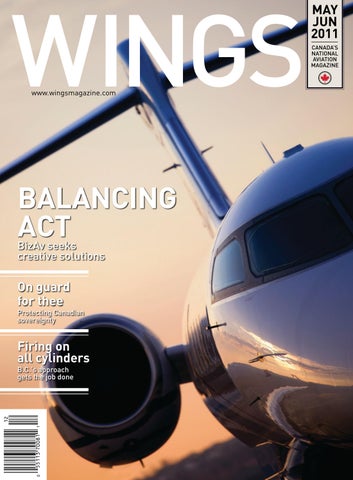
WINGS www.wingsmagazine.com
balancing act
BizAv seeks creative solutions
On guard for thee
Protecting Canadian sovereignty
Firing on all cylinders B.C.'s approach gets the job done
May jun 2011 CANAdA’S NAtIoNAl AvIAtIoN mAGAzINe
May/junE 2011
uPFrOnt 5 leading edge
Under the microscope
8 On the fly
News and opinion
12 Waypoint
The numbers just don’t add up
14 alternate approach
Tapping into the triangle
16 at the gate
Air Canada seeking fun in the sun
18 45˚42� north
Protecting Canada's border is a vast undertaking. P.33
One big happy family
20 Women in aviation Tracy Medve
bacK 58 Marketplace 62 On final
Heading toward a common goal
FEaturEs 22 balancing act
BizAv seeks creative solutions By RoB SeAmAN
27 a cOMManding FOrcE From top: Canadian North's tracy medve P.20 A commanding force P.27
Canadian Forces Maj. Gen. Yvan Blondin: calm, confident and in control By PAul dIxoN
33 On guard FOr thEE
Protecting Canada’s border is a vast undertaking By PeteR PIGott
37 Firing On all cylindErs
B.C.’s integrated approach gets the job done By PAul dIxoN
42 saFE and sEcurE
Ensuring a sound cargo chain By BRIAN duNN
COVER PHOTO: isTOCk
www.wingsMagazinE.COM
May/June 2011 | wings
3
INTRODUCING THE HAWKER 200. OUTPERFORMS EVERY OTHER LIGHT JET.
VISIT US AT CBAA JULY 6– 7 Calgary, Canada (Calgary Int. Airport/YYC)
SUPERIOR PERFORMANCE. UNRIVALLED AFFORDABILITY. NO COMPROMISE. CRUISE AT 450 KNOTS, FLY 43,000 FEET AND TRAVEL MORE THAN 1,200 NAUTICAL MILES NONSTOP. With the new Hawker 200, you never compromise between high cruise speed, efficient altitude, long range and low cost. Its ground-breaking superiority results from a lightweight, rugged composite airframe and efficient new Williams International turbofans, delivering performance that humbles the competition. Inside, you’ll appreciate the space and luxury of a true Hawker cabin—with the widest cross-section in the category—an experience to which no other can aspire. With the ultimate light jet at your command, your competitors may never catch up. Learn more, visit HawkerBeechcraft.com
UNITED STATES & THE AMERICAS +1.316.676.0800 EUROPE, MIDDLE EAST & AFRICA +44 (0)1244.523.803 ASIA-PACIFIC +852.3756.3755 SPECIFICATIONS SUBJECT TO CHANGE WITHOUT NOTICE. ALL PERFORMANCE DATA IS PRELIMINARY AND SUBJECT TO FLIGHT TESTING. ©2011 HAWKER BEECHCRAF T CORPORATION. ALL RIGHTS RESERVED. HAWKER AND BEECHCRAF T ARE TRADEMARKS OF HAWKER BEECHCRAF T CORPORATION.
LEADING
EDGE
| By Matt Nicholls
under the microscope
Accountability and reliability remain at the forefront
S
PHOTO: isTOCk
pring brings with it a reaffirmation of personal and corporate goals – a chance to reassess processes, implement change and establish a new direction. And given recent events in the aviation industry south of the border, there’s plenty to analyze – at all levels of the corporate spectrum. The “season of scrutiny” kicked off with a cruel April Fool’s joke when a five-foot-long stress fracture in the passenger cabin of a Southwest Airlines Boeing 737-300 airliner forced the plane to make an emergency landing at a military base near Yuma, Ariz. The plane, cruising at 34,000 feet at the time and carrying 118 passengers, landed safely without significant passenger injuries, but the harrowing incident immediately brought into question maintenance practices, and the corporate philosophy, of one of the most reliable airlines in the United States. Southwest is the world’s largest operator of 737-300s and the specific aircraft in question had had 39,781 takeoffs and landings prior to the incident. Boeing has noted metal fatigue on the fuselage of this aircraft should not have occurred until 60,000 takeoffs and landings. The incident forced the Dallas, Texas-based airline into scramble mode, leading to the cancellation of some 700 flights the next day. A subsequent National Transportion Safety Board (NTSB) investigation of all Southwest maintenance records revealed all inspections of the plane were up to date, but it immediately raised the question of air safety on older-model aircraft throughout North America, and caused passengers to ask, “is my aircraft going to break apart in the sky?” Plane manufacturer Boeing also experienced its fair share of public scrutiny after the incident. The NTSB concluded the rip in the fuselage was likely caused by misaligned rivet holes where two parts of the fuselage were
5 www.wingsMagazinE.COM
assembled. According to the NTSB, cracks stretched from 42 of the 58 rivet holes along a nine inch wide hole. Said Boeing president and CEO James Albaugh at a conference in Washington: “It looks like there was a manufacturing issue on that plane.” And while Al-
catching 40 winks while on the job. These disturbing events heightened the fears of passengers throughout North America, but the FAA did the right thing and fired and suspended several air traffic controllers. The FAA also took steps to combat air traffic controller fatigue, an issue Wings will cover in more depth in the future. The media frenzy over air traffic controllers didn’t end there: a C-17 cargo plane approaching Andrews Air Force Base in Maryland came too close to a 737 carrying U.S. first lady Michelle Obama and Jill Biden, wife of Vice President Joe Biden, causing more angst. The good news? It momentarily took the attention away from a frightening ground collision on a dark, wet tarmac at New York’s Kennedy Airport between an Air France A380 airliner and a Bombardier CRJ700 regional jet operated by Comair. Some 586 passengers were on the two aircraft at the time of the collision, though fortunately none was hurt. The media storm following these highprofile incidents was intense and justified – and a harrowing reminder the stakes are exceedingly high in the aviation industry. As the overriding theme of the brilliant 2011 CHC Safety & Quality Summit in Vancouver March 28-30 reinforced, responsibility and accountability at all levels of an organization is paramount – especially when you’re constantly in the public eye. Southwest, Boeing, the FAA – no matter what organization it is this week, making necessary changes to the corporate culture instils trust and value with customers. “What you’re doing is really making a psychological switch at all levels of your organization,” said Bill Chiles, president and CEO of Bristow Helicopters, at the CHC event. “You can implement all the SMS systems you want, but without the right culture, you just won’t get there.” In order to gain the trust of your customers, it’s important to communicate with your employees, and ensure buy-in of your organization’s goals. Making the necessary changes and reaffirming your corporate culture – it’s a rite of spring. | W
The incident forced the Dallas, Texas-based airline into scramble mode, leading to the cancellation of some 700 flights baugh didn’t want to discuss what the company needs to change or do differently with its 737-300 fleet, he did take responsibility and make assertions about Boeing’s commitment to manufacturing the best planes possible. The Southwest/Boeing near miss was just the start of the spring media frenzy. Between late March and early April, the Federal Aviation Administration (FAA) had to deal with the sobering issue of air traffic controllers at a number of U.S. airports
tOP data bursts… in this issue 1. there are more than 320,000 general aviation aircraft worldwide (pg. 12). 2. $600 million: the annual value of the Toronto/Montreal/Ottawa domestic air transport triangle (pg. 14). 3. Ottawa’s rockcliffe aviation club is 50 years young (pg. 18) 4. bombardier’s 20-year delivery forecast predicts 26,000 business jet deliveries worth $661 billion (pg. 24). 5. 2.5 million litres of fuel are transported annually into CFs alert (pg. 34).
Your feedback is always welcome. Please contact me at mnicholls@annexweb.com. May/June 2011 | wings
5
WINGS
May jun 2011 CANAdA’S NAtIoNAl AvIAtIoN mAGAzINe
www.wingsmagazine.com
vol. 52, issue 3 EditOr
Matt nicholls mnicholls@annexweb.com 416-725-5637
balancing act
BizAv seeks creative solutions
assOciatE EditOr
On guard for thee
andrea kwasnik akwasnik@annexweb.com 519-429-5181 • 888-599-2228 ext. 238
Protecting Canadian sovereignty
Firing on all cylinders B.C.'s approach gets the job done
PrOductiOn artist
kelli kramer
SubScribe TODAY !
Flight dEcK
Roger Beebe, Ray Canon, David Carr, Paul Dixon, Brian Dunn, Frederick k. Larkin, neil MacDonald, James Marasa, Carroll McCormick, Mike Minnich, David Olsen, Peter Pigott, Dr. Tarek sardana, Rob seaman, Blair watson
1 Year SubScription WINGS_MayJune11.indd 1
02/05/11 1:14 PM
only
3000
$
assOciatE PublishEr
alison de groot adegroot@annexweb.com 1-888-599-2228 ext. 246
(GST $31.50 • HST $33.90) US $42.00 (USD) • Foreign $65.00 (USD)
Name: _______________________________ Company: ____________________________ Title: _________________________________ Address: _____________________________ City: _________________________________ Prov: ________________________________ P.Code: _______________________________ Tel: __________________________________ Fax: _________________________________ e-mail:________________________________
PLeASe cHecK ONe: ❑ Commercial aircraft owner/operator ❑ Business/private aircraft owner/operator ❑ Military ❑ Aircraft maintenance/overhaul firm ❑ Airport ❑ Aerospace, airframe & component manufacturer and distributor
❑ Fixed base operator ❑ Aviation services, consultants and aircraft sales ❑ Government ❑ Aviation associations and organizations ❑ Flying schools, clubs and colleges ❑ Other (please specify) ______________
PAYMeNT: Cheque - Payable to Annex Publishing Visa
MC
AMEX
Account #: __________________________ Expiry:_____________________________
advErtising salEs
Ryan Culver rculver@annexweb.com 519-429-5182 • 888-599-2228 ext. 273 grOuP PublishEr
scott Jamieson sjamieson@annexweb.com PrEsidEnt
Mike Fredericks mfredericks@annexweb.com Wings MagazinE
P.O. Box 530, 105 Donly Dr. s., simcoe, On n3Y 4n5 Tel.: 428-3471 Fax: 429-3094 Toll Free: 1-888-599-2228
Publication Mail agreement #40065710 Return undeliverable Canadian addresses to Circulation Dept., P.O. Box 530, simcoe, Ont. n3Y 4n5 e-mail: ncuerrier@annexweb.com Published six times per year (Jan/Feb, Mar/apr, May/ Jun, Jul/aug, sep/Oct, nov/Dec) by annex Publishing & Printing inc. circulation e-mail: ncuerrier@annexweb.com Ph: 866-790-6070 ext. 208 Fax: 877-624-1940 Mail: P.O. Box 530, simcoe, On n3Y 4n5 subscription rates Canada – 1 Year $ 30.00 (includes gsT - #867172652RT0001) Usa – 1 Year $ 42.00 Foreign – 1 Year $ 65.00
Occasionally, wings Magazine will mail information on behalf of industry-related groups whose products and services we believe may be of interest to you. if you prefer not to receive this information, please contact our circulation department in any of the four ways listed above. no part of the editorial content of this publication may be reprinted without the publisher’s written permission. ©2011 annex Publishing & Printing inc. all rights reserved. opinions expressed in this magazine are not necessarily those of the editor or the publisher. no liability is assumed for errors or omissions. all advertising is subject to the publisher’s approval. such approval does not imply any endorsement of the products or services advertised. Publisher reserves the right to refuse advertising that does not meet the standards of the publication. Printed in Canada issn 0701-1369
Signature: _________________________ Date: _____________________________
TO SubScribe:
Tel: 866-790-6070 Fax: 877-624-1940 Mail: Wings Magazine c/o Annex Publishing & Printing inc. P.O. box 530 Simcoe, Ontario N3Y 4N5 e-mail: ncuerrier@annexweb.com
www.wingsmagazine.com
GST#135274215RT001
6
Subscriptions non-refundable
wings | May/June 2011
PRO0511
Air Transport Association of Canada
ON THE
WEB
Canadian Owners & Pilots Association
Canadian Business Aviation Association
Magazines Canada
carEErs in aviatiOn Visit our new Careers in Aviation website to learn more about job forecasts and career overviews, and to access a listing of universities, colleges, and private training centres and programs. www.careersinaviation.ca www.wingsMagazinE.COM
1.2 1.2 billion dollars invested in available inventory means we stock the parts so you don’t have to. And you can usually have what you need the next day. Aviall works hard to provide you with exactly what you need, precisely when you need it. Aviall Delivers.
ON THE FLY For late-breaking news, the Wings blog and exclusive web content, please visit us at: www.wingsmagazine.com
OPEratOrs PEOPlE industry nEWs
OPEratOrs
gliMPsE intO FuturE With gEOrgian With industry shortages looming on the horizon for many key aviation sectors, enticing future students into these areas is crucial. Barrie Ontario’s Georgian College did just that in a unique way on March 26, when more than 60 prospective students and family members attended a tour of Lester B. Pearson International Airport in Toronto, hosted by its Aviation Management Advisory Committee. The tour offered insight into the various career possibilities in aviation and provided a practical view of what the future could hold for graduates of Georgian College’s Aviation Management Program. The tour was designed to give an inside look at several key areas that are essential to the global aviation industry. Members of the advisory committee – including Bill Newman, director of Strategic Projects Corporate Affairs for GTAA, Michael Barfoot, manager, Regulatory Affairs- Flight Operations Air Canada, and Wayne Anaka, president WGA-AVCON Enterprises Inc. – led the group through the Central De-Icing Facility, Skyservice FBO and an Air Canada hangar where they boarded a Boeing 777-300. Real-world experience is key to the
program in which a full-year of co-op placements is incorporated into the three-year Aviation Management advanced diploma. Graduates have the opportunity to work in such fields as airline management, airport management, airport planning, flight dispatch, aircraft maintenance and government aviation agencies. Celebrating 25 years of aviation studies at the Barrie, Ont., campus, Georgian College’s articulation agreements with Embry-Riddle Aeronautical University, Griffith University and Loughborough University, also allow students the opportunity to apply their diploma credits towards a degree in Technical Management. For more information, contact Derrick Todd, co-ordinator, Aviation Management, at dtodd@georgianc.on.ca.
quEbEc schOOl uPs thE antE With the promise of transforming traditional approaches to pilot training, Quebec’s A.L.M. Par Avion flight school has introduced a new digital video technology to help students improve their technical performance. The cockpit camera system captures pilot and aircraft movements in real time for a multiple-perspective view of the entire flight. Back on the ground, students can replay their flight video with their instructor or save a copy to watch at home. Beginner and experienced pilots can now benefit from this technology to
A prospective Georgian College Aviation management student gets a glimpse into an aviation career. 8
wings | May/June 2011
A.l.m. Par Avion is incorporating cockpit video cameras into its student training flights.
review and improve their flight technique. According to the school, the flight videos are exceptional development tools that are delivering concrete results. The satisfaction rate is very high and users have been unanimous that it’s a true revolution in the world of pilot training. Located about 20 minutes from Montreal at the Mascouche Airport, A.L.M. Par Avion is also looking to the future by contributing to offsetting carbon emissions produced by its business activities.
PEOPlE
thE sPirit OF hOPE Celebrating its 25th year in operation in 2011, Hope Air, a national charity that arranges free flights for Canadians who are in financial need and must travel to health care, recently honoured two of its volunteers with Spirit of Hope Awards. Presented at the charity’s AGM on March 8, the awards recognize the key role volunteers play in fulfilling Hope Air’s mission. Gerd Wengler was honoured with the Distinguished Volunteer Pilot Award, reflecting 83 flights flown since 2000. Passionate about combining his community giving spirit with the love of flying his Cessna Skyplane, Wengler is also a long-standing member of the Hope Air board of directors. Commenting on his service, Wengler said, “This is a remarkable thing to me: I was told by the nurses of one man that I flew to hospital, that he described the flight we shared as ‘one of the most exciting things he had done in his life.’ That means a lot to me.” Pat Sillers received the Distinguished Volunteer of the Year Award, reflecting her more than 500 hours of service over seven www.wingsMagazinE.COM
PHOTO (TOP): a.L.M. PaR aViOn, (LEFT): gEORgian COLLEgE
8 8 9
years. Sillers, who described her volunteer time as very worthwhile and satisfying, coordinates flight requests from clients, many of whom are dealing with serious health issues and financial difficulties. Peter Jennings, Hope Air’s chair of the board, said, “We are all extremely grateful for Gerd and Pat’s dedication and commitment to the Hope Air vision that everyone in Canada has access to the health care they need, despite distance or cost of travel. Their leadership is inspiring.” Providing flights to people of all ages and illnesses since 1986, Hope Air will achieve a tremendous milestone of 66,000 flights this year. Yet, another reason to celebrate, in April, His Excellency the Right Honourable David Johnston, Governor General of Canada, agreed to be the Patron of Hope Air for the duration of his term. Johnston joins Dr. Marc Garneau, Canada’s first astronaut, who has been Hope Air’s National Honorary Patron since 2001.
FrOM Mud huts tO cOcKPits
PHOTO (TOP): www.DanaBRaMOViCiPHOTOgRaPHY.COM, (BOTTOM): M.O.M.
Melissa Pemberton, a full-time air show performer and former member of the U.S. Unlimited Aerobatic Team will be bringing a special message to the EAA Airventure in Oshkosh, Wis., this summer. Recently, Pemberton and her husband Rex travelled to Kpong Airfield in Ghana, West Africa, to work with a group called Medicine on the Move (M.O.M.). M.O.M. was started by Jonathan Porter, a Brit with a dream of general aviation in
Hope Air executive director doug Keller-Hobson (left) congratulates Gerd Wengler, the distinguished volunteer Pilot of the year.
West Africa. M.O.M takes young Ghanaian girls from the villages and trains them to become pilots and engineers. Equipped with aviation skills, they return to their villages with the knowledge necessary to bring medicine to remote villages where there is no road access. Medicine on the Move brought Pemberton to Africa to teach the girls about aerobatics and the importance of unusual attitude recovery. While working with the group, Pemberton met Patricia Mawuli, 23, the first female to receive the Ghanaian National Pilots Licence through M.O.M.. This summer, Porter will be bringing Mawuli and one of her students to EAA Airventure, where Mawuli will lead the international parade as the first representative from Ghana. Together, Mawuli and Pemberton will deliver a
melissa Pemberton (right) flies with a young woman training with medicine on the move in Ghana. www.wingsMagazinE.COM
presentation about their experiences in Ghana with M.O.M. for Women in Aviation. Pemberton plans to use her airshows this season to raise awareness about M.O.M. Visit www.medicineonthemove.org to find out more about the organization. Melissa Pemberton and her husband, Rex Pemberton, the youngest Australian to climb Mount Everest and the Seven Summits, are creating a documentary, The Calling, about Medicine on the Move (www.rexpemberton.com). To catch them at an air show, visit www.sportsgal.com.
industry nEWs
hérOux-dEvtEK hEads tO MExicO In its first foray outside of Canada and the U.S., Quebec-based Héroux-Devtek is entering the Mexican marketplace, with plans to build a facility for its aerostructures and landing gear operations in Mexico. Local government approvals have been granted for construction on a 4,200-square-metre facility at the Queretaro Aerospace Park, slated to begin in the coming months. The first phase of the project will be equipped with machinery for the production of aerostructure components. The facility is expected to produce its first components early next year and HérouxDevtek said it will spend up to $20 million over three years on the first phase. A potential subsequent phase expanding the plant to 13,500 square metres would allow the company to manufacture and assemble aerostructure and landing gear systems. The Mexican manufacturing facility will be located near several aerospace original May/June 2011 | wings
9
ON THE
FLY
equipment manufacturers, including Bombardier Aerospace. Héroux’s Mexican production line will make products for several customers, including Bombardier’s commercial and business aircraft. Chief executive Gilles Labbe said the project will give Héroux-Devtek the “the capacity and the flexibility to capture additional business opportunities.” Héroux-Devtek’s $175-million contract with Bombardier in February was expected to be a catalyst for it to finally set up shop in low-cost countries. Under the extended contract, the company will manufacture more than 300 structural components, such as fuselage frames and wing ribs for Bombardier planes, including the new composite CSeries and Learjet 85.
The Canadian Airports Council (CAC) named Daniel-Robert Gooch president in mid-March. At 36, Gooch is the youngest president in the association’s 19-year history and the first to be promoted to the leadership position from within. Gooch will oversee operation of the CAC’s Ottawa office and preside over the refinement of the organization’s role within Airports Council International – the voice of the world’s airports. “It is an honour to be selected by the nation’s airports to support the sector in its dealings with the federal government and the international airport community,” said Gooch. “Our industry is strong, but faces challenges. The CAC stands as our sector’s champion for federal regulatory and legislative issues with the goal to positively impact the nation’s airports for long-term growth.” Gooch has served with the Canadian Airports Council for five years, most recently as director of communications and policy. He brings to the position 16 years of experience in communications and public affairs.
hybrid OF thE FuturE Aviation Capital Enterprises, Inc., an Alberta-based private company, has contracted with Lockheed Martin to design, develop, build, flight test and certify (FAA) a family of hybrid aircraft. Hybrid aircraft are ideally suited for heavy-lift cargo transport, domestic disaster relief and international 10 wings | May/June 2011
Work is currently underway on a 20-ton hybrid aircraft variant called Skytug, a joint industry project between Aviation Capital enterprises and lockheed martin.
humanitarian re-supply. The aircraft require little or no fixed-ground infrastructure, and can launch, land and be serviced on unimproved surfaces and water using an innovative air cushion landing system. Aviation Capital will make the hybrid aircraft available to the commercial market and Lockheed Martin will retain rights to the military market. Three variants of the hybrid aircraft ranging in size from 20 tons to several hundred tons will be developed to open transportation pathways to austere locations currently inaccessible to other modes of transport. Civil applications are likely to start in the oil and gas industries and other sectors for heavy-lift transport missions in remote and inaccessible regions. The technologies required for the hybrid aircraft have been demonstrated in-flight in Lockheed Martin’s P-791, a fully functional manned flight demonstrator. Work is currently underway on the 20-ton variant called the SkyTug at the Lockheed Martin Aeronautics facility in Palmdale, Calif. Delivery of the first experimentally certified hybrid aircraft variant is expected in 2012.
caE MPl cadEts hEad intO hOME strEtch On track for a May graduation, 12 AirAsia cadets in CAE's Multi-crew Pilot License (MPL) beta program class have successfully completed the third of four program phases. CAE announced the news at the Asia Pacific
Airline Training Symposium (APATS) Ab Initio and Evidence- Based Training conference in March. All cadets have passed three formal evaluations to date: an equivalent private pilot check ride, an equivalent instrument check ride, and an equivalent Beechjet type rating. Each of the 12 CAE MPL cadets tested to the International Civil Aviation Organization (ICAO) Level 6 (Expert) standard, administered by Canadian examiners at the end of the Intermediate phase at CAE SimuFlite in Dallas, Texas. This proficiency indicates a high degree of confidence in the ability of the pilot to handle communications in a high workload environment. (ICAO minimum guidelines require a Level 4 competency.) Phase IV-Advanced of the CAE MPL program is being conducted at CAE Training and Services in Toronto, which has received Approved Training Organization (ATO) certification from Transport Canada. The Advanced phase is an expanded type rating course for the Airbus A320. Training integrates AirAsia Standard Operating Procedures and incorporates a CAE-built A320 full-flight simulator. At the conclusion of the 14-month beta program, which began in March 2010, graduates are expected to receive an MPL licence from Transport Canada and authority from the Department of Civil Aviation Malaysia (DCAM). The MPL licence will be granted following the takeoff and landing phase of training in Kuala Lumpur, Malaysia. Graduates will then enter AirAsia’s initial operating experience program for Airbus A320 First Officers. www.wingsMagazinE.COM
PHOTO (TOP): aViaTiOn CaPiTaL EnTERPRisEs, (LEFT): CaC.
gOOch naMEd cac lEadEr
GO AHEAD, YOU CAN PUT THE KITCHEN SINK IN THERE, RIGHT BEHIND THE HIPPOPOTAMUS. Your average hippo weighs in at around 1,363 kgs, 204 south of the max payload of the Caravan. The planes that are sure footed in the wild can also turn into a flying boardroom with a sumptuous Oasis interior. If you’re taking to the sky the first thing you should ask is, what’s on your list of things to lift?
CALL US TODAY. | DEMO A CARAVAN TOMORROW. 877-410-8650 | WINGS.CESSNA.COM
CARAVAN
WAYPOINT By Rob Seaman |
the numbers just don’t add up It’s time to quantify general aviation’s impact in Canada
O
12 wings | May/June 2011
community airfields as, in many cases, they represent a significant means for getting people, goods and materials where they need to be in a timely manner. And in times of disaster or stress, it is GA that is able to respond quicker and with more humanity than commercial or military operations. During the devastating earthquake in Haiti, GA aircraft flew in tons of aid and support to victims. More recently in Japan, GA flights were able to evacuate people first, while governments were still planning an exit strategy. The NBAA are particularly adept at this sort of response and support to their members. By March 14, barely three days after the initial disaster in Japan, its Humanitarian Emergency Response Operator (HERO) database – where people can register themselves and their aircraft in support of efforts to help the people of Japan – was active. By March 17, U.S. trade media were reporting many companies had sent corporate aircraft to Japan to pick up executives and workers. Private jet providers had received thousands of inquiries from people eager to escape. One L.A.-based broker of charters reported its normal monthly charter request for Japan is around one. In the days immediately after the first earthquake hit, they had 25 to 30 inquiries – and that was just one firm. As part of the transportation network, GA is irreplaceable. Working as a unit – all the alphabet organizations and individuals collectively – there is a real need to focus on encouraging governments at all levels not only to create a favourable and encouraging environment, but also to develop strategies to encourage and grow the business and community. | W
Past reports from other sources have shown that GA actually transports more passengers than the commercial carriers. GAMA data, past reports from other sources have shown that GA actually transports more passengers than the commercial carriers. There are also nearly 4,000 paved GA airports open to the public in the U.S. By contrast, scheduled airlines serve less than 500. This is a significant amount of data that clearly illustrates the importance of the sector. It also shows GA is far more than government or public perception – it’s not a “hobby” or just “lives of the rich and famous” oriented, with limited public or general benefit. I’ve said it before, but it bears repeating. Those working in GA in this country must work together to support and substantiate its value. There needs to be a national transportation and airports policy that addresses and includes the rights and needs of GA. There must also be real support for
Rob Seaman is a Wings writer and columnist. www.wingsMagazinE.COM
PHOTO: isTOCk
ne of the unfortunate things about general aviation in Canada is there’s a noticeable lack of hard data indicating its size and relevance – and that’s a real problem when it comes to determining influence in critical situations. The Canadian Business Aviation Association (CBAA) attempted to create this type of information a few years back because frankly, whenever asked, it lacked the data to illustrate and support some of its arguments. The most relevant data it possessed centred around the number of members and aircraft, which to groups like the Canadian Owners and Pilots Association (COPA), is significant. But this alone is not sufficient when you’re dealing with the government – or funding sources – over airport access, community support or even the most basic rights and equality. Our friends south of the border are more savvy when it comes to creating quantifiable information. When analyzing general aviation (GA) numbers from the United States, it’s apparent the value this segment holds here. The General Aviation Manufacturer’s Association (GAMA) tracks data that includes the market as a whole – and that includes Canada to some extent and the world at large. In its 2010 annual report, GAMA defines GA as all aviation other than military and scheduled commercial airlines. There are more than 320,000 GA airplanes worldwide, ranging from two-seat training aircraft to intercontinental business jets. Of aircraft flying today, nearly 228,000 are based in the U.S. GAMA reports that GA contributes more than $150 billion to the U.S. economy annually and employs more than 1.3 million people. The spillover to Canada, while not nearly as big, is considerable, given the country’s population base – and the fact many of our domestic aviation-focused businesses provide manufacturing or parts support around the world. In addition, many Canadian support organizations are a valuable part of larger international operations and make significant contributions to the $150 billion pie. In the U.S., GA aircraft fly close to 24 million hours and carry 166 million passengers annually. And while not part of current
Aerotek knows the value of flexible staffing services. Because let’s face it, business as usual ... rarely is.
Whether you’re looking for one key person or an entire staff, Aerotek has the experience, expertise and plenty of solutions to meet all your ever-changing needs. We can find, hire and oversee your workforce. And that can save time, money and your sanity. To find out how you can save time and money with Aerotek’s Staffing Solutions, call 888-AEROTEK or visit aerotekcanada.ca.
An Allegis Group Company. © 2011
ALTERNATE
APPROACH By David Carr |
tapping into the triangle
Free beer and other amenities define Canada’s busiest market
T
14 wings | May/June 2011
For all its considerable advantages, the Island is a slot constrained airport, heavily tilted in Porter’s favour, offering largely point-to-point service to a narrow slice of the southern Ontario market. With 156 of the 202 available slots, Porter has room to grow. Air Canada Express, not so much. The airline cannot break out of the 30 slots already dedicated to the Montreal service, although it is not clear if it could purchase additional slots from rival Porter, or if those slots belong to the Toronto Port Authority, the operator of Toronto’s downtown jewel. United, Air Canada’s Star Alliance partner, has the remaining 16 slots but is yet to use them. With close to 60 per cent of the triangle and operations at both Toronto’s commercial airports, Air Canada is comfortably bookended by Porter at Billy Bishop and WestJet at Pearson. Can WestJet opening up a second beachhead on the triangle be ruled out entirely? Reports that Porter is considering re-launching its stalled IPO are certain to rev up speculation that WestJet will grab an equity stake. It is a rumour brushed off at the airline’s Calgary headquarters. But given the size of the market and what is at stake, every advantage must be seized. | W
“Depending on its success, the triangle could become the service model for WestJet on other routes.” cent off a next flight voucher as compensation for significant delays or cancellations. The inflight offering has been upgraded to include a complimentary beer or wine (Air Canada has upped the ante with a full bar service) and snack other than the cookies and bar mix that has been a company staple. Depending on its success, the triangle could become the service model for WestJet on other routes as the single cabin carrier seeks to capture a larger share of the corporate market against Air Canada’s executive class cabin and the pull of Aeroplan. “The road warrior is not going to be terribly interested in our value proposition,” says Robert Palmer, WestJet’s director of public affairs. “But there are a lot of business travellers who are still flying in the back of the airplane. They are either not flying enough or they aren’t being bumped up. They are price sensitive so our service promise meets their needs.” As for the ground war, is Toronto Island – recently renamed Billy Bishop Airport after the First World War flying ace – the weak flank in WestJet’s strategy to reinsert itself on the triangle? Not necessarily.
David Carr is a Wings writer and columnist. www.wingsMagazinE.COM
PHOTO: BRian MCnaiR
he Toronto/Montreal/Ottawa triangle is the richest slice of the domestic air transport pie, worth an annual $500 million to $600 million in corporate air travel alone. In May, both Air Canada and WestJet ramped up their presence on the triangle, adding capacity and perks not experienced in North America since legacy carriers began stripping amenities out of an economy class ticket and charging for service basics such as baggage check-in and seat selection. Call it the Porter domino effect after the Toronto-based boutique airline that has carved a market niche by offering retro-style cabin service, complete with boxed snacks and stylish pillbox hats, out of the city’s convenient Island airport. Air Canada has just returned to the Island following a six-year absence (the result of an earlier self-imposed exile) with 15 flights to Montreal using identical Bombardier Q400 aircraft picked up from bankrupt Frontier Airlines. Air Canada Express, as the new service is being branded, is being operated by Sky Regional Airlines. Of the two national carriers, the stakes may be highest for WestJet, which has slipped behind Porter as the second busiest airline serving the triangle. At 25 per cent and 15 per cent respectively, the airline’s share of the corporate and triangle markets drag behind its 35 per cent share of the overall domestic scene. WestJet will have to shore up both numbers if it is to hit its target of 45 per cent to 50 per cent market share nationwide by 2016, and grab a greater chunk of the premium ticket. But does WestJet risk being squeezed by Air Canada’s enormous market presence at Pearson and a lack of presence on the Island? “You look at the history of the triangle and Air Canada has done a great job against many entries and exits including names like CP Air, Canadian Airlines and Wardair,” says Sam Barone, CEO of the Canadian Business Aviation Association (CBAA), and a former aviation consultant and president of the Canadian Air Transport Association. “WestJet is a more formidable competitor. It is a major hub carrier with a strong brand name.” WestJet admits its brand is not as well known on the triangle. So, in addition to adding capacity, the airline has introduced a more business-friendly schedule, free booking changes on same-day flights and a 50 per
AT THE
GATE
By Brian Dunn |
air canada seeking fun in the sun National airline plans to launch low-cost carrier
T
16 wings | May/June 2011
its low-cost model. “But if oil hits $150 a barrel, it’s a nogo with these older aircraft,” says Erickson. He expects to see the airline reconfigure or eliminate its business class in the new business model to fit in more seats and reduce costs further.
“It’s an astute move on Air Canada’s part, because they’ve been steadily losing market share to discount-oriented airlines.” “It’s an astute move on Air Canada’s part, because they’ve been steadily losing market share to discount-oriented airlines like WestJet, Sunwing and Air Transat.” Erickson also believes WestJet’s success with its vacation routes in just two short years prompted Air Canada to respond. What’s also driving the move is that a number of Canadians have bought properties in Mexico, Latin America and the Caribbean, and to get value out of them, they have to use them three or four times a year, says Erickson. Most travel with family and are looking for the cheapest fares. Air Canada plans to use Airbus A319s, A320s and Boeing 767s currently in its fleet whose capital costs are largely written off, allowing them to make money, Erickson notes. “And because of that, they don’t have to have them in the air 15 hours a day like other low-cost carriers.” These aircraft will be withdrawn from the mainline fleet and eventually be replaced by Boeing 787 Dreamliners, making them redundant. And since there’s little demand for older aircraft on the open market it makes sense for Air Canada to use them for
Meanwhile, over on the island . . . Air Canada isn’t the only Canadian airline with good news on the horizon. Porter Airlines is also celebrating, at least for now, due to the fact United Airlines has abandoned its plans to launch a new service from Billy Bishop Toronto City Centre Airport. The main reason? The high cost of fuel, putting its 16 landing slots up in the air. The carrier may consider service from Billy Bishop Toronto City Centre Airport sometime in the future, but in the meantime will be forfeiting its current landing slots. Erickson suspects there’s more than higher fuel costs behind the decision not to launch. He believes the decision by U.S. customs not to install a customs clearance facility at the airport nixes the time advantage United would have had over its competitors. Now, all passengers will have to clear customs at their U.S. destination instead of in Toronto. | W Brian Dunn is a Wings writer and columnist. www.wingsMagazinE.COM
PHOTO: aiR CanaDa
hird time lucky? Air Canada has previously entered the low-cost market with Tango and Zip, both of which lasted two years. Now, it appears the carrier is taking another crack at that segment of the market by launching another low-cost airline. Neither Air Canada nor the Air Canada Pilots Association would comment, but industry analysts weighed in with their thoughts. “It’s been done before with Tango and Zip, which didn’t last long, but Air Canada is a different creature now than seven or eight years ago,” says Karl Moore, a professor at McGill University’s Faculty of Management. “They’ve got lower costs in their system and they’ve learned something from their past experiences.” Other mainline carriers have gone the low-cost route with varying degrees of success, notes Moore. “Qantas has done it the best and both BA (British Airways) and Lufthansa have also enjoyed some success,” he says. “The reason airlines do it is to recover market share they’ve lost to low-cost competitors.” Australia’s Qantas did it with Jetstar Airways set up to compete with Virgin Blue Airlines with a mix of wide bodies and narrow bodies. “A lot of different carriers have tried it and not too many have survived. In theory, it sounds good to lower your cost structure, but for whatever reason, they always have challenges,” says analyst David Tyreman of Cannacord Genuity Capital Markets in Toronto. He notes the low-end market segment uses a different business model from a legacy carrier, requiring much higher volumes to compensate for thinner margins and the lack of business travellers. The first obstacle is to get clearance from the various Air Canada unions, since the proposal calls for a different contract for new hires and new pilots would not be covered by a host of benefits enjoyed by current ACPA members, and affecting pay, vacations and crew-rest facilities. The product Air Canada is looking at is essentially for sun destinations and not the domestic market, according to analyst Rick Erickson of Calgary-based R.J. Erickson & Associates. But he maintains it will be an airline within an airline and not have a different brand identity so as not to confuse travellers.
THE STRENGTH TO LEAD. BOMBARDIER HAS A HISTORY OF INSPIRING CHANGE WITH CONFIDENCE, OF FORGING AHEAD ACROSS UNCHARTED GROUND, OF PROGRESS, OF LEADERSHIP, OF INNOVATION. TODAY, OUR THREE FAMILIES OF HIGH-PERFORMANCE BUSINESS JETS, LEARJET, CHALLENGER AND GLOBAL, REPEATEDLY OUTPERFORM, OUTCLASS AND OUTMATCH EVERYONE ELSE. ACROSS THE FULL RANGE, FROM LIGHT TO LARGE, OUR AIRCRAFT DON’T JUST BREAK THE MOLD, THEY RECAST IT.
www.businessaircraft.bombardier.com
Bombardier, Learjet, Challenger and Global are registered trademarks or trademarks of Bombardier Inc. or its subsidiaries. © 2011 Bombardier Inc. All rights reserved.
45˚42�
NORTH By Peter Pigott |
One big happy family
Saluting 50 years of the Rockcliffe Flying Club
I
18 wings | May/June 2011
and Mark Braithwaite, the assistant certified flight instructor, students can be confident in the flight training they receive. Also Pilot Examiners, between the three of them, they are able to provide RPP, PPL, CPL, IFR and Class 4 Instructor Initial and Class 3 and 4 Instructor renewal flight tests. As operator of the Rockcliffe Airport, the Rockcliffe Flying Club also works closely with the Canada Aviation and Space Museum and Vintage Wings of Canada to ensure the airport is available and accessible for an ever-growing list of aviation and non-aviation related events, such as Capital Wings and Wheels (formerly the Classic Air Rallye), Canada Day, Battle of Britain, EAA Fly-in and the Canadian RC Off-Road Championships. And there’s big news on the horizon. “Steeped with history and personal achievements of many of its members, the Rockcliffe Flying Club is privileged to be hosting, for the first time, the Webster Trophy Competition in 2012,” said Garrett. “With a DCAM recipient on staff and several members of the Club members of the CPFA, hosting the Webster is truly going to be an honour. | W
“You can always come here, even if you are grumpy, and know you will leave happy. There is a true sense of community.” In fact, several other members are said to have met their spouses at the Club. “The Club is a jewel,” said Candace Denison, who has just completed her PPL. “The members and staff are truly special – it feels like one big happy family.” Jordan Steingass first came to the Club as a co-op student in 2004 and has been, when studies allowed, the Club dispatcher. She echoed Denison’s view. “The Club is very much like a family. You can always come here, even if you are grumpy, and know you will leave happy. There is a true sense of community and everyone is so friendly.” Although focused on recreational flying, with an IFR pilot examiner on staff and more than 20 students on course for commercial training, the RFC remains fully committed to producing professional commercial pilots, several of whom have gone on to fly for Air Canada and First Air. There are six Class 1 instructors, one Class 2 and several Class 3 and 4 instructors on staff. With instructors like Kathy Fox, one of the great Canadian aviators, Garrett, who was awarded the David Charles Abramson Memorial Flight Instructor Safety Award,
Peter Pigott is a Wings writer and columnist. www.wingsMagazinE.COM
PHOTO: ROCkCLiFFE FLYing CLUB
t’s one of the country’s most iconic flying clubs, and in 2011 it’s celebrating a very special milestone: 50 years of splendid service. Ottawa’s Rockcliffe Flying Club came to life when Wing Commander Norman Hoye arrived at RCAF Station Rockcliffe with “a strong desire to see the formation of a service-operated flying club.” Through his efforts, on August 28, 1961, the Department of Transport issued Rockcliffe Flying Club (RFC) Operating Certificate No. 1859. A pair of Aeroncas CF-JKW and a CF-NMY were bought for $1,825 and $1,374 respectively, and the Air Force’s storage facilities were put to use. Sadly, when the RCAF moved to Uplands Airport in 1964, the Club lost its hangar space, snow removal service, air traffic control and runway lights. But the members coped, DND gave the Club the authority to use UNICOM 122.8, flare pots were used for night operations, aircraft landed on skis and a modest clubhouse was built. A study of its history depicts a flying club rich with stories of tornadoes, social events, Charlie Brown the Club cat, the day a replica of Charles Lindbergh’s Ryan monoplane visited, and armchair generals who analyze all takeoffs and landings. Fifty years old this summer, the RFC is one of the few remaining authentic flying clubs in the country. Other clubs have shut down or saved themselves by aligning with college programs. But Rockcliffe continues to do well on its own merits, and when visiting the Club, it’s easy to see why. “With a new maintenance hangar, the Redbird Full Motion Flight Training Device, a leased C182, two C162s on order and a Super Decathlon coming on-line for its aerobatic and tail wheel-training programs, the RFC has successfully positioned itself to be ‘a one-stop shopping center’ for the recreational pilot,” said Simon Garrett, chief flight instructor and operations manager. Added Michael Hopkinson, a member since 2003 who got married at the club: “What makes the club unique is the camaraderie of the staff and members. The Rockcliffe Flying Club was the only place my wife, Rica (who is working on her Recreational Pilot Permit) thought of to get married in. Thanks to Brenda Reid, the RFC Office Manager and Garrett, they made it happen.”
W H AT I F W E M A D E THE SEA A SAFE HARBOUR? Systems from EADS are working together to track ships and freight in countless ways— ensuring that they move across international waters easily and securely. Explore our ideas and share yours at eads.com/thinkbank
WOmEN
IN AvIATION
northern perspective
Cool and confident, Tracy Medve makes Canadian North shine | By Matt Nicholls
H
20 wings | May/June 2011
to 15. Our community air service has expanded from zero to 11 communities in the Kitikmeot and Qikiqtani regions of Nunavut. And we are the largest provider of contracted charter services to the oil sands in Canada. Q| Obviously you have a unique passion for the North, having spent your entire career there. What drew you to that part of the country? A| My first experience living in the North came when I articled in Yellowknife beginning in 1983. The city was quite different than now but very exciting and, at the time, seemingly very remote. I soon discovered that there was another whole north beyond Yellowknife – and I have now had a most unique opportunity to visit most of the smaller communities in the Northwest Territories and Nunavut . . . I love the North. People are friendly and willing to chat and have/take the time to visit. Q| You’re on the road a significant part of the year. What are your “musthave” things when travelling? A| In the winter, a good coat, good boots and a warm pair of mitts! And, unfortunately, my BlackBerry. | W
“The success of any woman in any industry is based on a common theme: hard work, persistence, collaboration.” found myself working as in-house counsel for the Saskatchewan Housing Corporation. I was lucky to have the job because the economic picture at the time was horrendous and jobs, particularly for lawyers, were very hard to come by. However, I realized at that point the law was not going to be my career choice. I picked up the phone one day, called the owner and president of Norcanair in Saskatoon and begged for a job. As a result of that I found myself working in a fascinating industry with no end of interesting challenges, and I was hooked. Q| Three of your main goals when taking over at Canadian North were maximizing cargo capacity of scheduled flights; enhancing community service; and building charter services to the oil sands projects. Are you attaining your goals? A| We have had considerable success in all these areas. Since I came to the airline in 2007 our fleet has grown from seven to 14 aircraft. We have recently introduced the 737-300 as part of our fleet modernization program and expect a second 737-300 later this year, bringing our total fleet size
For the complete interview with Tracy Medve go to www.wingsmagazine.com and look under “Web Exclusives.” www.wingsMagazinE.COM
PHOTO: CanaDian nORTH
ard work, luck and a guiding hand or two along the way. It’s a tried and true recipe for successful career development and it’s precisely how Tracy Medve has risen to prominence in the Canadian aviation business. The president of Canadian North in Yellowknife, N.W.T., is one of the most respected executives in the industry. Since 1985, she has held prominent roles in airline management with Norcanair, Time Air, Canadian Partner and Canadian Regional Airlines. Medve spoke with Wings about her passion for aviation, her love of the north, and her “must-have” travel tools. Q| You recently were named Honorary Life Member with the Air Transport Association of Canada (ATAC), the first woman to do so. How important is this achievement to you? A| The Honorary Life Membership from ATAC is a satisfying recognition of my years of experience and service to the airline industry. The fact I am the first woman in Canada to be the recipient of an Honorary Life Membership since the awards were first established in 1976 speaks to the opportunities which lie ahead in this exciting industry for women. Q| What are the benefits/strengths of being a woman in such a male-dominated industry? A| I’m not sure there are any benefits/ strengths or advantages in being a woman over a man in this industry. We’re all just people trying to do a job. The success of any woman in any industry is based on a common theme: hard work, persistence, collaboration and not making a big deal of the fact that you’re a woman in a maledominated industry. Q| How did you choose a career in aviation? A| My aviation career began somewhat as an accident. My father was a private pilot and used to take us flying almost every Sunday around Prince Albert, Sask. I also remember the wonder of my first ride in a “big” airplane – a Douglas DC-3. So, there was always an undercurrent of aviation in my world growing up. However, the real breakthrough came after I had graduated from law school in the early 1980s and had completed my articles in Yellowknife. I
Combat proven to deliver a reliable tactical advantage.
© 2011 Rockwell Collins Inc. All rights reserved.
Rockwell Collins’ Common Avionics Architecture System (CAAS) – battlefield proven. Operational on five rotary-wing platforms today, with more under way, CAAS is safely serving U.S. and coalition forces in Iraq, Afghanistan and around the world. A fully integrated flight and mission management system delivers a host of advanced capabilities, including mature situational awareness coupled with the latest navigation system and a hover display that has demonstrated safer operations in low-visibility conditions. Give your helicopter crews the proven tactical advantage. Visit us at CANSEC, exhibit 1705 in the Boeing Hall Learn more at www.rockwellcollins.com
sTAYING
BALANCED
bizav sEEKs crEativE sOlutiOns
by rOb sEaMan
PHOTO: EMBRaER
t
he drive for accurate information and forecasts has never been more intense, as corporate Canada tries to determine which direction to take with business aviation ownership and operations. Determining when the business aviation market will rebound from its current sluggish state is one of the biggest challenges facing manufacturers, operators and financial www.wingsMagazinE.COM
analysts alike. And whether it’s related to aircraft acquisition, replacement, business development or expansion, the quest for credible information is steady and determined. “What do you think the market will do,” or “do you think we have hit bottom yet” or “is it time to make a move”? – they’re all common questions. The answers most often depend on a number of things: which geographic market you’re
in, which industry segment you represent and which type of aircraft you’re talking about. Regardless of the information in hand, however, it remains a guessing game when determining an accurate recovery flight path. Political and social unrest in the Middle East has driven up the price of oil, a key cause of the current recession. The devastation following the earthquake and tsunami this past March May/June 2011 | wings 23
Canadian manufacturers, operators and FBoS are all trying to set a proper course in dealing with the sluggish economy.
in Japan resulted in severe economic trauma throughout the Pacific Rim, and reverberations are sure to follow in North America. The interruption in microchip production in Japan alone will have severe effects on technological development and, as a result, the entire aviation industry.
leading the way In spite of current political and social uncertainty on the world stage, however, many Canadian companies in the business aviation sector are experiencing positive outlooks. Montreal’s Bombardier Aerospace is leading the pack when it comes to Canadian success stories in business aviation. In its annual forecast and overview of the industry, Bombardier stated sales last year rose to “normal levels” and, subsequently, pre-owned inventories declined. In addition, business jet utilization, as 24 wings | May/June 2011
measured by aircraft movements, was up significantly year-over-year. And as anticipated, positive net orders for business jets have resumed, albeit at a low rate. Furthermore, business aviation penetration in the fastest expanding world economies – China and India in particular – is accelerating. So, the stage is set for a full industry recovery. Optimism is also reflected in Bombardier’s 20-year industry delivery forecast, which predicts 26,000 business jet deliveries worth $661 billion, of which 10,500 deliveries worth $254 billion are anticipated in the period from 2010 to 2019. Similarly, 15,500 deliveries worth $407 billion will be made in the period from 2020 to 2029. The worldwide business jet fleet was approximately 14,200 aircraft at the end of 2009 and is expected to grow by a compound annual growth rate (CAGR) of 3.6 per cent over the forecast period to
amount to approximately 29,000 aircraft by 2029 (net of aircraft retirements). The Bombardier report also suggests that although demand has been slow to recover since the beginning of 2010, expectations are the industry order intake is set to return to positive territory this year – and things are off to a good start based on recent announcements. For example, Bombardier announced in early March its largest business jet order ever: up to 120 business jets from its Global family to NetJets Inc., a subsidiary of Warren Buffett’s Berkshire Hathaway Inc. The initial order was for 50 new business jets: 30 Global 5000 Vision and Global Express XRS Vision aircraft, and 20 new Global 7000 and Global 8000 aircraft, to be delivered in 2017. It’s a US$2.8 billon deal that could be worth up to US$6.7 billion, provided the option for 70 more Global jets is picked up. Steve Ridolfi, Bombardier business www.wingsMagazinE.COM
PHOTO: LanDMaRk aViaTiOn
IN AeRoSPACe, We Seem to HAve tuRNed tHe CoRNeR WItH BuSINeSS jet oRdeRS.
aircraft president, was understandably thrilled with the deal. “We are very proud to have NetJets, the worldwide leader in private aviation, select the Bombardier Global aircraft family,” he said. Over the next three years, Bombardier’s order intake should return to the level reached during the last peak. The majority of orders over the next 10 years will likely come from North America, Europe, Latin America, Russia, China, Asia, Middle East, India and Africa. “This past year has been challenging yet positive,” said Pierre Beaudoin, Bombardier’s president and chief executive officer. “In aerospace, we seem to have turned the corner with business jet orders picking up substantially in the fourth quarter of 2010. To further strengthen our product leadership position, we continue to make progress on the development of new products within our business and commercial aircraft segments, both of which have healthy longterm growth prospects.”
Flight of fancy Bombardier’s fortunes are encouraging and positive numbers on business aviation flight activity point to resurgence in the market, according to TraqPak data from aviation services company ARGUS. In December 2010, there was a 4.4 per cent year-over-year increase in business flight activity from 2009, bolstered by a double-digit-percentage resurgence in Part 91 corporate operations in the U.S. Broken down by aircraft category, mid-size jet activity increased 6.5 per cent, followed by large-cabin jet activity (4.4 per cent). This should spell positive things for the Canadian market as well. Other positive trends surfaced in the year-end report from the GAMA (General Aviation Manufacturer’s Association). Speaking at GAMA’s “State of the Industry” press conference in February, GAMA chairman John Rosanvallon, president and CEO of Dassault Falcon, reported that, although the global economic downturn continued to negatively impact general aviation manufacturers in 2010, signs of recovery are on the horizon. “Our industry experienced another challenging year that required many manufacturers to continue to make careful decisions about production schedules, employment and product development,” said Rosanvallon. “However, despite the pain caused by the downturn, we are now seeing strong GDP
Ready and able THERE’s A WHOLE NEW CROP OF LuxuRIOus BusINEss jETs BATTLING FOR mARkET sHARE. HERE’s A LOOk AT sOmE OF THE BIGGEsT NEWsmAkERs. bombardier global 7000, global 8000 – Launched in the fall of 2010, these ultralong-range business jets are set to enter service in 2016 and 2017, respectively. The two jets are expected to challenge gulfstream’s g650 for control of the long-range business jet market. Both aircraft will have a highspeed cruising speed of Mach 0.90. The 7000 will have a range of 7,300 nautical miles, whereas the 8000’s range will be 7,900 nm. The new jets – with a price tag of $65 million each – will feature general Electric’s new emission-cutting TechX engine, Global 7000 making them both powerful and environmentally conscious. said steve Ridolfi, president of Bombardier Business aircraft: “The global 7000 and global 8000 jets will give our customers the reliability to reach more destinations non-stop than ever before.” Embraer legacy g650, legacy 450 and 500 – The Legacy g650, an extendedrange variant of the Brazilian aircraft manufacturer’s Legacy g600 was launched in October 2009 as a rival to Bombardier’s large-cabin Challenger 605, Dassault Falcon’s 2000LX, and gulfstream’s g350 and g450. The Legacy 650 jet has been certified in the U.s. and the first Legacy was delivered in 2010. it features a 3,900 nm range with four passengers in the most spacious cabin in its class. Embraer is also working to bring its Legacy 450 and 500 business jets to market in 2013 and 2014. During the first quarter of 2011, Emlegacy 650 braer delivered eight executive jets, indicating the market is continuing its steady recovery this year. Operations have also begun at the new industrial plant in Melbourne, Fla., to deliver Phenom jets to the north american market. cessna citation ten – The enhanced version of the Citation X will fly higher and cruise faster than the current model, carry more payload, burn less fuel and be a nicer ride for passengers. The Ten will have a range of 3,242 nm, and operators can fly between a variety of destinations in north america and Europe with just one refuelling stop. The Citation Ten has upgraded Rolls-Royce aE3007C2 turbofan engines with new fans, elliptical winglets and garmin g5000 avionics.
CoNtINued oN PG. 47 www.wingsMagazinE.COM
May/June 2011 | wings 25
maj.-Gen. yvan Blondin greets Haitian officials at the jacmel airport after Canada started flying C-130s into the 3,000-foot runway during operation HeStIA.
A COmmANDING FORCE
canadian FOrcEs’ Maj.-gEn. yvan blOndin: calM, cOnFidEnt and in cOntrOl
i PHOTO: DnD
by Paul dixOn
f there’s one man in the Canadian Forces who has his finger on the pulse of all rotary- and fixed-wing activity, it has to be Maj.-Gen. Yvan Blondin – and he wouldn’t have it any other way. The Montreal native joined the Canadian Forces in 1980 and has steadily risen in the ranks. A CF-18 pilot with more than 3,000 hours on type, he is today, as the commander of 1 Canadian Air Division and Canadian NORAD Region, the one person responsible for the people and machines that comprise today’s Canadian Air Force. Fit, trim and relaxed, Blondin spoke with Wings in his Winnipeg office about his colourful career and the status of some the AF’s most important assets. Q| How did you come to join the Canadian Forces? A| I was 21, going to school and needed a job. I answered a classified ad for an insurance salesmen but after the interview, I knew they www.wingsMagazinE.COM
weren’t going to call me back so I was pretty much out of options. My car just happened to be parked in front of the recruiting centre, so I thought “what the hell, let’s go have a look inside.” I went inside and asked, “do you have any jobs here?” The person behind the counter asked me what I wanted to do. I saw a poster behind his back of a pilot in a dark green flying suit standing by a jet and I thought that looked good. So, that’s how the Air Force reeled me in. When I went home and told my mother that I had joined the Air Force and was going to be a pilot she thought I was joking. I arrived in Portage the next summer for flight training and I’d never been in an airplane before. My first flight, in a Muskateer, scared the hell out of me. I couldn’t wait to get back on the ground. You go up and fly again the next day because you’re more scared about what the other guys are going to say about you than what the airplane can do to you. May/June 2011 | wings 27
Anywhere. Anytime. Anything. Wherever you need to go, whatever you need to take with you. That’s the promise of a Beechcraft® 1900D. It can serve as a corporate shuttle, charter workhorse or heavy-duty cargo hauler – all in the same day. Meet face-to-face with a client and deliver his equipment at the same time. Transport time-critical or oversized parts to an out-of-the-way facility. Bring in your product team to fix a problem personally. These are some of the missions that the 1900D allows you to do. Add in 24/7 factory support and low turboprop operating costs, and you can see why the Beechcraft 1900D is the ultimate troubleshooter. www.beechcraft1900.com +1.316.676.1007
www.raytheon.com Keyword: beechcraft1900
+1.316.676.1007
Raytheon Airline Aviation Services, LLC © 2011 Raytheon Company. All rights reserved. 2811RAS023_AAA_Wings_MayJune2011.indd wings | May/June 2011 1
www.wingsMagazinE.COM 4/19/11 5:06 PM
PHOTO: DnD
maj. Gen. yvan Blondin walked into a recruiting office and pointed to poster of a pilot and said, “that looks good.”
I was in it all for the adventure, just for five years, and then I was going to get a real job. After five years, I was posted on the CF-18, a brand new airplane. Then, at the end of nine years, I thought I would leave because they give you a year’s pay (as a bonus) and I could get a real job. But by then, I was involved with the CF-18, and I was doing something I was happy to do and being paid to do it. Here I am 30 years later, haven’t found a real job yet and just loving it. Q| Your role has changed significantly over the past 30 years. Can you explain the breadth of your position as Major-General? A| I’m in charge of all Canadian Air Force operations. It’s a great honour, the responsibility of being able to lead and make a difference. It’s certainly not a regular office job. The span of operations, Afghanistan, air security operations in Canada for CANADACOM, NORAD operations, operations for the Canadian north region . . . I’m also responsible for force generation, mission capability, developing pilots and air frames, so we can use them during operations. It’s true the technology is great, but flexibility is the key to air power and this is where I exercise flexibility, having control of all the levers so that we can deliver the best effect in the end. Over the past three years, we’ve had some big challenges, any one of which would be big enough on its own. Q| What are those challenges and how do you manage human assets, especially given all the operation levels you oversee? A| The first challenge is the people one. We downsized [in the 1990s] and we didn’t recruit. When you do this, you end up with a lot of young and lots of old, with nobody in between. The experienced folks are really what make it work, but they are the ones retiring. So, I’ve got lots of new folks coming in and
PHOTO: CPL. JaX kEnnEDY, DnD
we’ve been recruiting, doubling the rate of recruiting the past two or three years. It’s great to see all those new people coming in, but by the time we recruit them, train them and get them experienced, there’s a period of three or four years that they’re not useful to me. They’re actually a drain on assets, because I need to use experienced people to train them to get them up to speed. I’m operating probably with about 80 per cent of effective manning into my units. This people challenge, when you couple it with the transition from old aircraft to new aircraft, is also a concern. Having new aircraft is great. With seven new fleets in 10 years, we’ve never seen that in the Air Force. But when you get a new fleet, there’s a period of learning. There’s a period of not just learning to fly it, but also how to maintain it, to ensure you’re using it effectively. To get the best effect, it takes time. Another key challenge is that we are so busy with operations. We took Chinooks that were virtually scrapped in Afghanistan, turned them around, qualified on them, started doing operations and we’ve been successful for the past year. We’ve done that in a combat theatre. And if you do this with the C-17, do this with the Cyclone, do this with the Chinook, it takes people away – and it’s people I don’t have here to use the older aircraft. So, to try to go from one to the other has been a challenge. Q| How has the role of the Canadian Air Force changed over the years, and what is the primary focus now? A| The pace of operations has been unprecedented in the past 30 years. If you look at the 1940s and ’50s, when we had the Second World War and then the Korean War, we had operations ongoing with a huge Air Force and plenty of new people. After that, until the ’90s, it was 40 years of training. We didn’t have operational missions like we do now. For every one person that you deploy,
www.wingsMagazinE.COM
CF-18 Hornets from 409 tactical Fighter Squadron, 4 Wing Cold lake, refuel from the CC-130 Hercules during operation PodIum.
you’ve got another one in training and one just coming back. In the past year, we knew that supporting Afghanistan would be a drain on what we did. We knew with the Olympics coming up, we needed to prepare early, train people early, be careful in scheduling, deciding who would be used for what, whether they would be deployed to Afghanistan this year or next. We actually
May/June 2011 | wings 29
told people to take their leave early in the year because we thought it was going to be busy after Christmas for three months. We arranged the training schedule with the different operational training units so we had enough assets to support Afghanistan and the Olympics. So, when Haiti came up right in the middle of the operations, it wasn’t a question of whether we could do it or not. It was, “OK, we’re going to Haiti.” Because I control everything, I could decide to slow down a bit on training for helicopters because I needed a six-pack
to go to Haiti. It was easily co-ordinated and done. We could use the flexibility we needed, and within 12 hours, we had a plan on how we were going to support Haiti – and how we could do other operations because everything was controlled out of here from the CAOC [Combined Air Operations Centre]. Every day for the first two weeks, we were having video-conferences daily with Ottawa, Vancouver and everybody involved with the different operations, to see where the stresses were and what we needed to adjust to be able to support.
Your hangar
our solution Custom-designed and built 50% faster than conventional hangars 4-season construction » benefit from an earlier roi optimal thermal efficiency » significantly reduce your energy bills maximum value from investment » specify your exact needs industry leader » Quality you can trust
1.866.466.8769 www.canam.ws/hangars
30 wings | May/June 2011
Q| So, you’re functioning today at a level that wouldn’t have been possible in that old regime, during the Cold War? A| During the Cold War, we didn’t have that flexibility. We didn’t have the same operational mindset or the same qualifications. Actually, the people principle is probably what makes us successful. The motivation is just unbelievable. If I keep them busy, if they’re doing operations, they just love it. When we do something it’s more than just getting the pay, it’s like you make a difference, like you’re useful, especially doing all this and the tremendous support we’re getting from the population. Q| Canada is poised to replace 138 CF-18s with 65 of the hotly debated F-35s. How is this possible? A| When we bought the F-18 we bought 138, but we had three squadrons of F-18s in Germany at that time. We were supporting four operational squadrons in Canada plus an OTU, so we were supporting eight squadrons with 138. Right now, we are operating with around 78 F-18s, but there’s a huge inventory at the OTU, so if you look at my four squadrons, I’m operating with 13 or 14 planes per squadron today. The F-35 is planned to be 12 per squadron with four squadrons, but it is assuming we’re going to have an OTU, which would have 15 to 17 airplanes. We still need to decide how we’re going to train the pilots, because part of the F-35 concept, the international concept, is they are going to provide an international training unit in Texas. The proposal is that countries will send their pilots to be trained on the F-35 at that unit and then move out to their country once they are qualified on the airplane. So, the advantage of going with the international OTU is that you don’t need a fleet of 15 airplanes. With the F-18, we can still support it until 2020, but by 2016 there’s a point where there is too much strain and fatigue on the airframe and we’ve got to start parking them. So, in 2016 our numbers start to come down and by 2020 we won’t have the numbers to have an effective force of F-18 squadrons. I can do the job with 65. If we decide to have our own OTU, if you look at how we do the training with the F-18, I’d say about 70 per cent of the training is being done in flight with some duals and singles. With the F-35, you optimize the training by simulation, so there are no duals. The first time you fly is in a single, all your training before you fly off is done on a simulator. Taking advantage of advanced technology there’s a lot more you can do with simulators. You need less hours on airplanes, so we wouldn’t be using 25 airplanes like we do today for the training. www.wingsMagazinE.COM
Q| You have many people who report to you, but by the same token, you have different people you report to above you, depending on the situation. Do you find that difficult? A| I provide the air support, so it’s just that different missions have different bosses. I’m really the facilitator, the co-ordinator. I make sure that I advise them the best way possible – and ensure we can still do other missions. It’s all about having one point of co-ordination and offering the best use of resources available, because I can play with everything. I can slow things down, because everything is based on force generation capabilities. It’s all about training. I need hours to train my new pilots, qualify them. That requires a lot of available resources. The more I use for that, the less I have for force employment and operations. When something comes up, I can say, “slow down,” let’s slow down on this and we can catch up later, re-adjust. If there’s a mission out there to be done, we’ll do it. So, I wouldn’t want to separate those hats, they need to be together. Q| What are your thoughts on the Family Support Initiative and how different is a military career today compared to several decades ago? A| The more I talk about operations, the more the guys want to do them. But when you deploy people for six months and they come back, it’s tough on the family. The problem we have with attrition is not necessarily coming from the guys. I can keep them interested, they love what they are doing, but when the spouse says, “I’ve had enough,” I lose a guy. If I don’t take care of the family, I’ve got a problem. So, we’ve put a lot of effort into supporting people. If I’ve got someone coming back with psychological problems from an operation in Afghanistan, it’s not just that person who has the problem; the wife and the kids are having the same problems. Even if there are no psychological problems, repeated operations abroad has an effect on the family. Q| So, the CF is much more concerned about looking after its human assets today? A| When I joined 30 years ago, they would ask me which posting interested me, but we knew we were just going to go where we were told. It’s much different today. We consult. We ask people . . . what about moving this year? What about next year? We make long-term plans. We’re much more flexible in our approach, trying to consider family issues, family obligations, location preferences. It’s not because we want to be nice people. It’s what you need to do if you want to retain people. www.wingsMagazinE.COM
The truth is, the only reason we are successful in our operations is because of the people who make it work. If I can retain the good people, and just let them do their job, they will work miracles. It’s not the equipment that makes us different from other Air Forces; it’s the people flying it and maintaining it that make the difference. It’s what I see in everything we do. It’s a highly professional force; we’re a small, but elite force. Q| Risk is an important part of any Air Force mission. How do you manage risk – and does it ever worry you? A| You’re always operating at the edge of
your capabilities, having to make the call: do we do it or not? But if we don’t do Search And Rescue in bad weather, who’s going to do it? It’s always about risk management. How much should we do and how much do we not do? It’s a tough question. If we go to Haiti, how far do we push, where do we stop? Everything is about pushing the limits but keeping it within safety parameters. After all, managing risk is my bread and butter. Every day, there’s another decision, always based on the risk. There’s a lot of stuff being done here – but that’s what makes it enjoyable. | W
May/June 2011 | wings 31
For more information:
Canadian Rangers from the 1st Canadian Ranger Patrol Group (1 CRPG) meet up with a 440 Squadron CC-138 twin otter aircraft near eureka, ellesmere Island, Nunavut, as part of operation NuNAlIvut 08.
ON GuARD FOR THEE
PrOtEcting canada’s bOrdEr is a vast undErtaKing
i
PHOTO: MasTER CPL. kEVin PaUL, CF COMBaT CaMERa
by PEtEr PigOtt
t’s one of the most contested issues in Canadian politics – “a top priority,” says Prime Minister Stephen Harper – but for the men and women protecting Canada’s Far North, it’s simply a rare opportunity to experience real adventure while working with dynamic, versatile aircraft. Protecting Canada’s Arctic sovereignty is a huge undertaking. The Canadian Arctic begins at the 60th parallel and comprises 40 per cent of Canada’s landmass with more than 19,000 islands in the Arctic Archipelago. With its potentially vast reserves of fossil fuels, abundance of minerals, gold, www.wingsMagazinE.COM
and diamonds – and potential for shorter shipping routes as the ice cap melts away in the face of global warming – this once inaccessible land is drawing increasing national and international attention. It’s little wonder the Canada First Defence Strategy calls for the Canadian Forces (CF) to have the commitment to “vigorously protect Canada’s Arctic sovereignty.” Since 2006, military responsibility for protecting the interests of the North has fallen under Canadian Command with the Joint Task Force North, (JTFN) located in Yellowknife, N.W.T. The JFTN is responsible for all CF operations in the north.
These days, regular Northern Patrols are conducted by CP-140 Aurora maritime patrol aircraft. With an endurance of 17 hours and a range of almost 10,000 kilometres, these strategic surveillance aircraft safeguard Canada’s waters from security challenges such as illegal fishing, immigration, drug trafficking and pollution violations. The air force, in conjunction with NORAD, also maintains four Forward Operating Locations (FOLs) where it can pre-deploy CF-18 Hornet fighter aircraft in response to, or anticipation of, unwelcome activity. The FOLs are located in Inuvik and Yellowknife, N.W.T., and in Iqaluit and May/June 2011 | wings 33
the pilot of this CF-18 Hornet skillfully “takes the cable” at Inuvik airport.
all roads through yellowknife Operating four CC-138 Twin Otters, Yellowknife-based 440 (Transport) Squadron is the only Canadian Forces unit north of the 60th parallel. Although the smallest squadron in the CF that maintains its own aircraft, 440’s 51 personnel cover one-third of Canada’s landmass: four million square kilometres from Whitehorse across to Northern Quebec, then to Baffin Island and north to Alert. Their 40-year-old Twin Otters provide an air transport capability to JTFN and the Canadian Rangers. Lieutenant-Colonel Dwayne Lovegrove, the squadron’s commanding officer, says providing security support in the 34 wings | May/June 2011
most northerly stretches of the Canadian landscape is definitely a unique experience. One operation that typifies this, Lovegrove says, was last year’s Operation NUNALIVUT. It showed the functionality and reliability of the CF’s current aircraft assets, while illustrating the adaptability and resourcefulness of CF staff.
New eyes in the sky while a variety of fixed-wing aircraft play a critical role in servicing Canada’s Far north, they aren’t the only “eyes in the sky” monitoring the northern landscape. Project Polar Epsilon is a $60-million space-based initiative that uses imagery and information from Canada’s radar satellite, RaDaRsaT-2, to provide enhanced land and sea surveillance capabilities for the Canadian Forces at home and abroad. with its polar orbit and radar characteristics of all-weather, day or night sensor capability, RaDaRsaT-2 is ideal for arctic land surveillance. when interviewed by Wings about arctic sovereignty, one subject matter expert within Canada Command called the project an integral part of the future of arctic security. “we are in a period of transition, from a construct where northern surveillance is being conducted solely by aircraft to a new construct where we will have persistent, widearea surveillance sensors, which include space-based RaDaRsaT-2, space-based ais [automated identification system] and the CCg-run, ground-based LRiT [Long Range identification and Tracking].” in June 2010, Canada Command assumed responsibility for the Polar Epsilon Project arctic surveillance (Land) when it achieved Full Operational Capability. Canada Command now has access to RaDaRsaT-2 imagery of the north and is working to refine the RaDaRsaT capability for maritime surveillance. in the future, with the persistent, wide-area surveillance assets in place, mobile resources such as auroras, and possibly unmanned aerial vehicles (UaVs), Canada Command will be able to provide reactive reconnaissance to investigate contacts identified for followup by the persistent surveillance assets. The UaV project is still in the requirements definition phase, with many technological hurdles, such as the command and control over the long distances. “That in a nutshell is what we foresee as the way ahead,” said the source. whether it be UaVs, new fixed-wing aircraft such as the hotly debated Lockheed Martin F-35 Lightning ii Joint strike fighter, a combination of both, or indeed another fighter jet, one thing is for certain – protecting Canada’s interests in the Far north will continue to be one of our most critical issues in the years to come. www.wingsMagazinE.COM
PHOTO: CPL. JEan-FRanCOis LaUzé, DnD
Rankin Inlet, Nunavut. They provide all the necessary infrastructure and supplies to support the air force’s fighter aircraft in these remote and isolated regions. Given the lack of roads or ports throughout much of the North, the CF CC-177 Globemaster III and the CC-130 Hercules also provide vital resupply services for northern military installations like CF Station Alert on the northern tip of Ellesmere Island. The Canadian Air Force officially took over the responsibility of CFS Alert on April 1, 2008, and the CC-177 Globemaster made its inaugural landing there on April 14, 2010. With its much greater carrying capacity, the CC-177 can move approximately three times more cargo to CFS Alert on each trip than was done with the CC-130 Hercules. During OPERATION BOXTOP, the annual resupplying of Alert, the Forces runs supplies to the station each spring and fall. Over the past 20 years, the mission has averaged an annual delivery of approximately 294,000 kilograms of dry goods and 2.5 million litres of fuel into CFS Alert.
The crux of the operation saw members of the Canadian Rangers establish an ice camp 90 kilometres north of CFS Alert. The insertion of the ice camp on the sea ice allowed the CF the opportunity to extend its patrol range, gain experience in setting up a patrol base on the ice, and conduct trials of new equipment. CFS Alert is the most northerly permanently inhabited location in the world, and the ice camp location was the farthest north that the Canadian Rangers have ever conducted patrols. “Operation NUNALIVUT 2010, for example, provided many of us with a fantastic opportunity to employ the Twin Otter to the extremes of its abilities,” says Lovegrove. “440 Squadron deployed two aircraft in support of this operation to CFS Alert, arriving early in the month. Our ski-equipped Twin Otters almost seemed to enjoy being flown every day despite the bone-chilling temperatures found at that latitude and time of year. It left us with only a few minor maintenance snags to fuss over. We quickly became pretty good at getting the wing ‘skins’ (protective covers) and engine blankets on and off the aircraft, with the bite of the extreme temps providing tangible motivation.”
PHOTO: CPL. JEan-FRanCOis LaUzé, DnD
Lovegrove says the weather was VMC (visual meteorological conditions) for the most part during the operation, allowing for breathtaking views of the starkly rugged, mountainous landscape. “As several of us were relatively new to operating the aircraft on skis, we set out in the first few days to find nearby fjords to ‘work up’ in, practising the procedures that would allow us to tackle the more formidable sea ice later on,” says Lovegrove. “What powdered snow exists up there tends to accumulate in the fjords, making for landings that were far smoother than what we would soon experience. “Our confidence bolstered, we soon got into the real work of flying JTFN personnel and Rangers out to Ward Hunt Island, and onto the sea ice. But getting in and out of Ward Hunt was a challenge.” Lovegrove says someone before them had marked out a short, narrow landing strip with black garbage bags, but getting onto it meant parallelling the ridge and its accompanying “saddle back,” which always featured a solid crosswind on landing. “If you didn’t nail the touchdown point right off, you quickly were faced with overshooting in order to avoid rocketing
A CC-177 Globemaster III takes off at the Inuvik airport after delivering supplies and equipment to the Canadian Forces Forward operating location (Fol).
onto the uneven sea ice and surrounding ice shelf,” he says. “Similarly, failure to maintain directional control in the post-landing phase would find you hurtling either towards stacked oil drums or the rock face of the adjoining ‘mountain.’ Riding on the skis, you don’t have any brakes for landing, so salvation lies in the
judicious use of rudder and the skilled application of reverse propeller thrust. “Once stopped and shut down, the aircrew immediately became ground crew, faced with the prospect of loading/unloading fuel barrels, burdensome snowmobiles, and in a couple instances, dogs from the Danish ‘Sirius’ patrol.”
SettinG the StanDaRD OF cuStOMeR SeRvice
M a i n t e n a n c e • R e pa i R • O v e R h a u l
Visit us at EBACE Booth 579 Vector Aerospace is a leading, global provider of Maintenance, Repair and Overhaul services for Pratt & Whitney Canada’s PT6A, PW100, JT15D, PW307A and PW308A/C series of engines. Our reputation for superior customer service continues to grow at Vector Aerospace, Engine Services – Atlantic. We’re proud of our past – working hard for your future.
To l l F re e : 1 . 8 8 8 . 7 6 9 . 0 9 9 9 W W W. v e c t O R a e R O S pa c e . c O M
www.wingsMagazinE.COM
May/June 2011 | wings 35
conquering the elements After a few days of working out onto Ward Hunt Island, Lovegrove’s unit entered the next phase, which involved inserting a Ranger patrol out onto the sea ice some
80-plus nautical miles from shore. Finding a suitable landing site was the first challenge. Only the newest of sea ice is smooth; ice thick enough to reliably support the landing of fixed-wing aircraft
THANK YOU
CANADA! For making DTI a global leader in SMS Training!
Call or email for a FREE CAP Planning Canada is leading the way in SMS Guide implementation, and DTI Training Consortium of Atlanta, GA, is proud to be a part of your success.
DTI – the training choice of North American federal regulators as well as individual operators – is offering its internationally heralded SMS/QA for the Aviation Industry to everyone interested in real world, practical applications of the new Safety Management Systems requirement in Canada. DTI is expert in all aspects of SMS/QA, period! We’ve actually done it, hands on, no sugar coating, and have come to determine that if you are a reputable company, you are probably doing 80 to 90 percent of what you need to do to implement a great system. Let us show you how to get the extra 10% that will make you stand out in the crowd!
dUle
he Upcoming Sc Winnipeg
July11&12 nce for SMS Quality Assura July 13 Principles Basic Auditing July 14 CAP Developing a
YelloWknife
ToronTo
6 August 15&1 nce for SMS Quality Assura August 17 Principles Basic Auditing August 18 CAP Developing a 6 August 15&1 n SPC for Aviatio
July 25&26 nce for SMS Quality Assura July 27 Principles Basic Auditing July 28 CAP Developing a
atlanta.com Visit www.dti 5490 call 1-866-870nta.com oada@dtiatla or email stab ional courses ails and addit et d te le p m co r
fo
Visit: www.dtiatlanta.com Call: 1-866-870-5490 Email: staboada@dtiatlanta.com 36 wings | May/June 2011 DTI_Wings_mayjune11.indd 1
www.wingsMagazinE.COM 19/04/11 2:21 PM
PHOTO: CPL. JEan-FRanCOis LaUzé, DnD
Aviation technician Cpl. Richard vantyghem and flight engineer Sgt. Ron mann of 440 Squadron, yellowknife, install a new generator on the starboard engine of a CC-138 twin otter aircraft at eureka, ellesmere Island, Nunavut.
typically features several patterns of drift snow, and is far more rugged in nature than what meets the eye. Landing on such surfaces feels akin to bellyflopping onto cement, says Lovegrove, with the snow ridges creating miniature ski jumps that cause the aircraft to thump hard, often setting off the ELT (Emergency Locator Transmitter). Takeoffs are even worse, as these same ski jumps repeatedly launch the aircraft prematurely into the air in a series of mini-stalls before it is ready to “slip the surly bonds” – of gravity. “After my first sea-ice landing, I fully expected to find the airframe rippled with a trail of broken parts behind, but the ruggedness of the Twin Otter won out,” he says. It is during such operations that one truly gains a deep respect for this uniquely Canadian aircraft, he says. “It really is built like the proverbial outhouse of old.” Lovegrove says the experience taught him the true meaning of Arctic sovereignty. For most Canadians it’s a clichéd catchphrase overused by media and politicians alike. But for the CF, it’s much more than that. As Lovegrove says, “We are the physical expression of Canada maintaining sovereignty over the North.” | W
An integrated approach with both fixed- and rotary-winged assets helps keep B.C.’s fires at bay. Here, a martin mars water bomber accompanies a Sikorsky S-76B Firewatch helicopter.
FIRING ON ALL CYLINDERs
b.c.’s intEgratEd aPPrOach gEts thE jOb dOnE
e PHOTO: COULsOn
by Paul dixOn
very year, on average, 8,500 wildfires are reported across Canada, burning an area of 2.5 million hectares. Wildfires destroy property, cause economic hardship and generally disrupt lives. Over the past 10 years, the direct costs of fighting wildfires in Canada has ranged between $400 million and $800 million each year. Canada has developed a sophisticated management system to manage wildland firefighting response from the smallest isolated communities to international
www.wingsMagazinE.COM
response. At the bottom rung, firefighting response within organized territory is the responsibility of the local authority: towns, cities, regional districts. If the situation is beyond their capabilities and/or resources, they may turn to neighbouring communities by way of mutual-aid agreements or to their provincial authority. All provincial and territorial governments have a forest protection agency. When the province’s resources are overwhelmed, the Canadian Interagency Forest Fire Centre (CIFFC) steps into the picture.
Located in Winnipeg, CIFFC co-ordinates services for all the provinces, territories and federal fire-management agencies, and co-ordinates sharing of resources with the United States and other countries. Funding for CIFFC is a federal-provincial joint venture, with the federal government contributing one-third and the provinces making up the remainder based on their inventory of productive forestland. British Columbia pays 17 per cent of that twothirds, while Prince Edward Island pays only 0.1 per cent. In 2010, the CIFFC processed 130 Resource Request Orders (RRO), which resulted in 26 water bombers, six air tankers and almost 2,500 firefighters, with their equipment being shared across the country. While the terminology may be different from one province to the next, the philosophy of wildland firefighting is the same across the country – strike early, strike often, keep it small. Early detection of fires enables early dispatch of a co-ordinated response of ground and aerial resources. In British Columbia, the decision to deploy crews on any fire is made at one of six Regional Fire Centres located around the province by the Regional Wildfire Control Officer using the criteria of closest and/ or most effective resource available to respond. Considerations for most effective use of a resource required to respond – or a combination of resources – include the size of the fire and burning conditions; any access issues (can you drive to it or is the fire remote?); dispatch distance; what is threatened (i.e., homes and infrastructure, high-value timber, etc.); and what is the current and predicted fire load within that Fire Centre’s region.
all about the team British Columbia employs 1,100 Class 1 firefighters and 30 Initial Attack (IA) firefighters operating from 50 bases across the province. Three-person IA teams can be deployed by helicopter or vehicle. Salmon Arm is home to the province’s 36-member Rap attack team that rappels from helicopters to access fires in the heavily treed, steep mountain terrain, while Fort St. John in northern B.C. is home to the North Peace Smokejumpers, who operate out of fixed-wing aircraft. The para-attack program operates with a single DeHavilland Twin Otter aircraft and Kenn Borek Air of Calgary provides pilots. Tom Reinboldt, the supervisor of the smokejumpers, describes the relationship between the pilots and his staff as “absolutely extraordinary. The pilots we work with are exceptional at understanding the nature of the job and our requirements.” With an operational radius of more than 350 miles, the Twin Otter covers far more May/June 2011 | wings 37
the North Peace Smokejumpers, based in Fort St. john in northern B.C., pose in front of the Kenn Borek Air twin otter.
the fire, depending on resource availability. Ideally, they will have the support of one or more tankers for retardant drops and helicopters for bucketing. Hitting the fire so soon after ignition, the team strives to work around the fire, building a guard-line using chainsaws and hand
Martin Mars: 50 years on the job The red and white giant Martin Mars water bombers are icons in the sky in B.C. Originally conceived as long-range bombers and maritime patrol aircraft for the U.s. navy in the second world war, they served as long-range transports when their heavy-lift capability became apparent. Twenty had been ordered, but only seven were actually built before the war ended in 1945. in 1949, the Caroline Mars set a record by carrying 269 people between san Diego and alameda, Calif., a distance of almost 800 kilometres. Until 1956, when they were retired from active service, the planes were employed carrying military cargo between san Francisco and Hawaii. in 1959, hearing that the planes were going to be scrapped, Dan Mcivor, representing a consortium of Vancouver island forestry companies, purchased the remaining four planes under the ownership of Flying Tankers, inc. and they were converted to aerial firefighters. The Marianas Mars crashed on its first operational mission in 1961, killing all four crew members and the CarolineMars was destroyed on land during a severe storm in 1962. since then, Hawaii Mars and Philippine Mars have flown thousands of incident-free hours. in 2007, the planes were sold to Coulson Forest Products of Port alberni, leading to the creation of Coulson Flying Tankers. after purchasing the Mars, Coulson made significant upgrades to the Hawaii Mars including an EFis glass cockpit and the ability to stream live data from on board. Other forms of data that are available from the aircraft in real time are Flight Tracking, Load Data measuring, aircraft Performance statistics, atmospheric Condition at Drop readings, and accurate Drop Location reporting. Coulson operates its s-76B Firewatch helicopter, loaded with the complementary data systems, as the bird dog for the Mars. Coulson has been operating the Hawaii Mars in both B.C. and California over the past four years and will be in the air over B.C. for the summer of 2011. Dan Mcivor, who passed away in 2005, received the Order Of Canada in 2003 for having “developed water bombing techniques that have saved thousands of acres of forest in British Columbia.” He is in the B.C. and Canadian aviation Halls of Fame. 38 wings | May/June 2011
tools, then their pumps and hose lines to effectively widen the guard line. Swift response by B.C.’s initial attack crews across the province keeps the team close to the goal of keeping 95 per cent of all wildfires under four hectares. Last year was the busiest year for the smokejumpers since the inception of the program in 1998. Smokejumpers were deployed to more than 60 separate fires, for a total of more than 250 operational jumps. Over the past 12 years, the team has been deployed to more than 350 fires. And Reinholdt takes pride knowing no jumper has suffered a time-loss injury related to jumping in that time.
aircraft support services Unlike other provinces such as Alberta and Ontario, B.C. owns none of its own aircraft – part of the provincial government’s commitment to private-public partnerships. All aircraft are contracted, with a core group hired on a seasonal basis and others on an as-needed basis. At the peak of the 2009 fire season, there were 251 helicopters actively engaged in firefighting activities (57,000 hours flown), as well as 42 aerial tankers and water bombers. B.C.’s contracted tanker force comprises Air Spray’s Electras and Conair’s mixed fleet that ranges from single-engine Air Tractors to the four-engine Electra and DC-6. The B.C. Forest Service air tanker fleet command and control is the responsibility of the Provincial Air Tanker Centre, located in Kamloops. The centre dispatches the fixed-wing aerial firefighting resources from any one of the 18 Tanker Bases in the province. When the Fire Centre dispatches on an initial report of a fire, multiple resources are sent simultaneously as part www.wingsMagazinE.COM
PHOTO: CHRis BERgMann
territory than a helicopter, flies faster and is able to “loiter” for much longer periods without refuelling. Its excellent short takeoff and landing (STOL) capabilities enable it to operate from rough strips and forward bases that are inaccessible to larger aircraft, while its operational costs are measured in the hundreds of dollars an hour versus thousands of dollars an hour for a medium helicopter. The aircraft carries the pilot, command spotter and two three-person teams of smokejumpers, as well as up to 1,400 pounds of firefighting gear, including two high-pressure pump kits, 4,600 feet of lightweight hose, chainsaws, overnight gear, food and water. Depending on the terrain and fire activity, the jumpers may have to land some distance from the fire. After reconnoitering the area around the fire to determine the best landing zone, the team leader will jump on the next pass. Once on the ground, the leader confirms the landing zone and the remaining two team members jump on the next pass. Feet on the ground, the team forms up and heads for the fire. The plane will have dropped the equipment closer to the fire in a separate drop. At the same time the paraattack crew was dispatched, air tankers and/ or helicopters may have been dispatched to
of a unified response, each with specific responsibilities. Helicopters bucketing water and foam, as well as tankers dropping retardant to contain the spread of the fire, will support initial attack firefighters on the ground. The philosophy, as explained by Jeff Berry, B.C.’s superintendent of air tanker operations, is simple enough. “Send enough resources to knock it down without a reload,” he says. The challenge is integrating the aerial response with the
ground personnel, relating the resources to the event. It’s always easier to cancel a tanker en route when it’s not needed than to allow a situation to escalate by practising false economy and not dispatching.
looking to the future As the fleet of large air tankers ages, the challenge will be in sourcing replacement aircraft at affordable prices. Most current large air tankers are conversions of aircraft
Need healthcare but can’t afford to fly there? NAV CANADA Salutes Heather Bell
General Manager, Vancouver Flight Information Region NAV CANADA wishes to recognize our own Heather Bell for being honoured with the 2011 Women in Business Award (Corporate category) from the Surrey Board of Trade. In her current position, Heather oversees Air Traffic Services throughout British Columbia, including the Area Control Centre in Surrey, 9 Control Towers, 12 Flight Service Stations and one Flight Information Centre and is responsible for 600 employees. Her award testifies to her motivational leadership, passion for the industry, and commitment to service excellence.
Congratulations, Heather!
Getting Canadians To Getting Better www.hopeair.ca 40 wings | May/June 2011
www.wingsMagazinE.COM
PHOTO: COULsOn
the martin mars water bomber casts an iconic presence on the B.C. firefighting scene.
built in the 1950s, with more years behind them than in front of them. Bombardier has created a significant presence over the past 40 years with its CB-415 water bomber. To make the aircraft more attractive to governments, Bombardier markets it as a multi-dimensional platform, with the firefighting role just one of many potential tasks, including SAR and maritime reconnaisance. The Very Large Air Tanker (VLAT) concept is being promoted as the future of aerial firefighting, with two American companies attempting to create a market. California’s Tanker Air Carrier operates two converted DC-10 aircraft (Tanker 910 and 911), and is capable of delivering 40,000 litres of product, while Oregon’s Evergreen Aviation International operates a 747 with a capacity of 75,000 litres. Tanker 910 first flew operations in California in 2006 for CALFIRE, the state wildfire agency, at an hourly rate of $26,500. The Evergreen 747 made its operational debut in 2009 in Cuenca, Spain. Following the disastrous wildfires of 2009, in which 170 people died, the government of the Australian state of Victoria leased Tanker 910 for a 10-week operational trial during the 2009/10 fire season. The aircraft made only one actual operational
PHOTO: CHRis BERgMann
t
wan
drop during that period, and a number of evaluation drops. The question, as articulated by Richard Alder, general manager of Australia’s National Aerial Firefighting Centre, is whether “a single 40,000-litre drop can be as effective as 10 4,000-litre drops.” A report issued by Australia’s Bushfire Co-operative Centre concluded “such an aircraft is not suitable for effectively suppressing fires under most Australian wildfire conditions” and that the drops from the DC-10 were found to have “limited effectiveness” during the trial. After spending $10.5 million on the DC-10 trial in 2010, the Victoria government is conducting trials this year with two CV-580 aircraft operated by Abbottsford, B.C.-based Conair. The cost of the CV580s, an additional Sikorsky Skycrane and four additional Air Tractors will total $12 million, versus the cost of the single DC10. The CV-580s carry an 8,000-litre payload at speeds of up to 500 kilometres per hour, but their manoeuvrabilty and proven record in Canadian operations should put them more in sync with Australian firefighting techniques. If the trial proves succesful, it may be a prelude to Canadian fixed-wing operators joining Canadian rotary-wing operators operating Down Under during the busy fire season. | W
more than 8,500 wildfires are reported across Canada each year, burning an area of 2.5 million hectares.
Jetco Jets
Freedom to Fly When you want
where you want
Fractional Jet Ownership • Cessna Citation • Low Initial Buy-in • Edmonton, Alberta based
Skyservice has a highly skilled team composed of individuals recognized within the industry who have vast experience in both corporate and airline aviation industries. No task is too big or too small. We have the trained personnel to provide 24/7 NDT coverage, whether requested within Canada or required elsewhere throughout the world. Parts pick-up and delivery services, if required, may also be arranged. Our Transport Canada approved facilities at Toronto and Montreal have the capability of accomplishing the following NDT methods: • Ultrasonics (UT) • Eddy Current (ET) • Magnetic Particle (MT) • Liquid Penetrant (PT) • X-Ray (Aircraft Structures) Contact
James Jespersen | 780.405.5485 | james@jetcojets.ca www.jetcojets.ca www.wingsMagazinE.COM
The Skyservice NDT teams guarantee you prompt professional service at competitive prices. Please contact: Gary Smith, NDT Manager YYZ\YUL (416) 807-9845 gary_smith@skyservice.com May/June 2011 | wings 41
sAFE AND sECuRE
Ensuring a sOund cargO chain by brian dunn
W
hile enhanced security measures at major North American airports have changed the face of commercial travel, new processes on the cargo side are also being implemented to ensure the highest safety standards possible.
42 wings | May/June 2011
The changes at North American airports were accelerated by an incident two days before Christmas last year following word of alQaida’s air cargo bomb plot using insulated drinking mugs and thermoses. The U.S. Transportation Security Administration (TSA) responded to the incident by
moving up its proposed 100 per cent cargo-screening target to Dec. 31, 2011. The earliest possible implementation date for 100 per cent cargo screening in the U.S. was initially planned for 2013, given the complex challenges associated with screening international inbound cargo carried on
passenger aircraft. But now, 100 per cent of the cargo that is uplifted on passenger aircraft headed south of the border must be screened by the end of this year. All carriers will have 30 to 45 days to comment on the new 100 per cent screening requirement and the TSA will review and evaluate the www.wingsMagazinE.COM
Securing cargo shipments continues to be a hot-button item for many airlines.
As part of the standards in place, TSA evaluates and approves technologies that air carriers and Certified Cargo Screening Program participants may acquire to conduct screening operations. To speed up cargo screening, 12 L-3 X-ray screening systems were placed on the TSA’s Air Cargo Qualified Technologies List. The L-3 screens are for both breakbulk and skid-based air cargo, with systems covering TSA’s small, medium and large Xray classifications.
it’s all about the value
PHOTO (TOP): isTOCk, (RigHT): aiR CanaDa
Although air cargo represents just two per cent of all international cargo shipped versus 98 per cent by sea, it accounts for 35 per cent by value, according to the International Air Transport Association (IATA). And cargo is expected to generate $68 billion of the industry’s projected $594 billion revenues in 2011. Volumes are projected to grow by 6.1 per cent for a total of 46.2 million tonnes of air cargo this year. “The air cargo value chain must offer better quality and improved efficiency with operations that are safer and even more secure,” says Giovanni Bisignani, IATA’s director general and CEO. “Our message to governments is clear. We must resist the knee-jerk call for 100 per cent cargo screening. The industry industry comments prior to finalizing the requirement. As to how this accelerated process will affect Canadian carriers, the “airlines are making the necessary adjustments in order to be compliant with the regulations. However, we cannot provide further details as this issue involves matters of safety and security, which must remain confidential in order to be effective,” says Brigitte Hébert, director, National Airlines Council of Canada. According to TSA adminwww.wingsMagazinE.COM
istrator John Pistole, the alQaida plot involved the use of triacetone triperoxide (TATP) around the cylinder of a thermos to be put on either passenger or cargo of an aircraft. Obviously, the outcome could have been catastrophic had the plot not been averted by the fast work of security personnel. “We put out an alert just making sure that all of our transportation security officers were alert to that and did additional physical screening in addition to the X-rays,” Pistole says.
must be secure with effective measures that facilitate the speed needed to support global commerce. Air cargo security must be based on a combination of three measures – supply chain security, scanning technology and better use of e-freight data,” adds Bisignani. IATA’s e-freight project began in 2004 and aims to take the paper out of air cargo. Facilitated by IATA, the project is an industry-wide initiative involving carriers, freight forwarders, ground handlers, shippers and customs authorities. Each air cargo shipment carries with it as many as 30 paper documents – enough to fill 80 Boeing 747 freighters every year. E-freight aims to take the paper out of the air cargo supply chain and replace it with cheaper, more accurate and more reliable electronic messaging. E-freight data has huge potential, says Bisignani. For example, IATA has targetted 10 per cent e-freight volumes by the end of 2011, and 100 per cent by 2015. “The e-freight network covers 80 per cent of cargo volumes,” says Bisignani. “But e-freight penetration stands at just 2.8 per cent. Most governments have legislation that recognizes electronic documentation. The exceptions include Thailand, Indonesia, Russia and Vietnam, which much catch up fast or risk being left behind in this important business.” The IATA e-freight program’s objective is to save the industry $4.9 billion by
All cargo placed on an aircraft in Canada is currently 100 per cent secured prior to loading onto an aircraft. May/June 2011 | wings 43
Cargo is expected to generate $68 billion of the industry’s projected $594 billion revenues in 2011, according to the IAtA.
Finding common ground In Canada, air cargo security falls under the jurisdiction of Transport Canada (TC), which is working with the aviation and cargo industries to develop an Air Cargo Security Program (ACSP) that is compatible with that of the United States and other key international partners. “New security measures have been introduced to develop a secure supply chain for cargo using enhanced screening methods. The use of new screening requirements under the new measures is being phased in,” explains spokesperson Mélanie Quesnel of Transport Canada. But unlike the U.S., Canada does not have a specific date for 100 per cent cargo screening for inbound cargo, although all cargo placed on an aircraft in Canada is currently 100 per cent secured prior to loading onto an aircraft, according to Quesnel. “While a form of screening has been used for a number of years, under the [Air Cargo Screening] Program announced in May 2010, a 44 wings | May/June 2011
new standard will take place which considers factors such as the origin and destination of the cargo, the type of aircraft used (whether passenger or all-cargo), the contents,
or baggage screening. As well, the technology capable of screening (without unacceptable delay) varies based on the variety, quantity, and size of the air cargo.”
simplifying the process To reduce bottlenecks at airports, screening can now been done by shipper, freight forwarder or air carrier if they are ACSP participants. This eliminates the need for last-minute screening at airports, unless the pre-screened cargo appears to have been opened, screening is required for customs purposes (or for spot checks), it’s necessary for quality control or TC must inspect it. In order for shippers and others to participate, ACSP created the Secure Supply Chain Management System (SSCMS) database. This database captures the information SSCMS participants must provide to become trusted members. It includes agent information, inspection
joining forces INTERNATIONAL CARGO sECuRITY GROuP TAkEs AIm AT kEY IssuEs The formation of a new international cargo security working group is an important step in the development of new standards for the industry. The global air Cargo advisory group (gaCag) was created in mid-March at the international air Transport association’s (iaTa) world Cargo symposium in istanbul, Turkey. it brings together four key international organizations to discuss key cargo security and e-commerce issues – the international Federation of Freight Forwarders association (FiaTa); the iaTa; The international air Cargo association (TiaCa); and the global shipper’s Forum (gsF). The purpose of the working group is to establish a vision and strategy for the global air supply chain and to present joint industry recommendations to third parties, including intergovernmental organizations such as the world Customs Organization (wCO) and the iCaO. Each member organization will designate two representatives to the steering committee, who will direct, supervise and assist Task Forces of technical experts responsible for addressing gaCag’s objectives in relation to security, ecommerce, Customs and sustainability. Four key areas of discussion will be explored when it comes to air Cargo security: • advance electronic information process and
timelines to improve aviation security risk assessment; • The security declaration process and layout; • supply chain security program guidelines in countries that have none; • ad hoc supply chain issues. The four founding members of the group included: Michael steen, chairman of TiaCa; Des Vertannes, global Head of Cargo for the iaTa; Jean-Claude Delon, president of FiaTa; and Peter gatti, executive vice-president of the U.s.-based gsF. in a joint statement, the heads of the four founding member associations stated: “The high level of co-operation and commitment from all members has ensured a faster formation of the global air Cargo advisory group than was originally anticipated. we believe this reflects the need for such a strong industrywide voice to address the challenges and opportunities facing everyone in the air cargo supply chain and, ultimately, businesses across the globe that rely on the speed, safety and efficiency of air cargo for their own growth and development. we are now ‘ready to go to work’ with a clear agreement on the prime areas we must focus on and the supporting structure to achieve our goals.” www.wingsMagazinE.COM
PHOTO: aiR CanaDa
converting the 30-plus shipping documents and the processes behind them to electronic format. “It’s a nobrainer. If we can be faster, cheaper, more accurate and secure we need to get it done.”
size/configuration and wrapping/packaging and sealing of the cargo.” In terms of inbound cargo, TC is currently strengthening air cargo security by harmonizing inbound cargo requirements with international partners, including the U.S., European Commission and Australia, along with the International Civil Aviation Organization (ICAO) and IATA, says Quesnel. The biggest obstacles to achieving 100 per cent cargo security are the complexity of the air cargo industry and the importance of the industry to the Canadian economy, says Quesnel. “Given the considerable volume, diversity of origins and destinations of air cargo, the physical size and contents of the shipments and the size and sophistication of companies sending cargo, air cargo security requirements are different from those in place for passenger
Canada’s Largest Aircraft Cargo Carrier
We deliver unparalleled fleet reliability WWW.fLightCrAft.CA
full Service MrO • Components • Landing Gear • Engineering • Airframe • Paint • Interiors • Avionics
We provide outstanding customer service
www.wingsMagazinE.COM
May/June 2011 | wings 45
and compliance results, and air cargo security templates. Shippers and freight forwarders that choose not to participate in the ACSP program must have their air cargo screened by an ACSP participant or an air carrier to secure their cargo. Each participant in the supply chain security system will accept, as secure, air cargo from the participant before them in the chain and will be responsible for keeping that air cargo secure until the next participant along the secure supply chain accepts it. Last year, TC introduced changes to the regulatory framework for air cargo security in Canada that outline new requirements for airlines operating in Canada. These measures address security gaps and bring Canada in line with its international partners. The measures apply to domestic, trans-border and international passenger flights transporting screened passengers from Canada’s designated airports. Among other
46 wings | May/June 2011
things, they require air carriers to secure all air cargo before loading onto the aircraft to the same level of security as that required for passenger baggage and to provide for adding specific measures for all-cargo flights. But unlike airport screening, where passengers foot the bill, the cost for cargo screening equipment will be paid by airlines and shippers, not the airports themselves. How much that cost will be is still unknown, according to Cherif Rizkalla, president and chief commercial officer of Smiths Detection, the largest airport and cargo screening equipment company in the world with more than 2,500 employees and $1 billion in revenue. It has Canadian offices in Laval, Que., where Rizkalla is based, and in Mississauga, Ont. “The regulations are still being defined, so the cost will depend upon Transport Canada regulations, which will be in line with other countries,” says Rizkalla.
In January, Smiths Detection, which spends eight per cent of its total revenue on research and development, was awarded a $19-million contract from the Canadian Air Transportation Security Authority (CATSA) to provide advanced X-ray machines at airports for carry-on bags, a process that provides multiple views of a bag’s contents. The company has more than 30 different screening models, the largest measuring 180 centimetres by 180 centimetres (six feet by six feet), for screening aircraft cargo pallets which can cost upwards of $300,000. Rizkalla believes it’s possible to obtain 100 per cent cargo screening, but it will take time to implement. “It’s a realistic target, but not in the next few months,” he says. “All the airports in the world have 100 per cent inspection of baggage and yet there is a (cargo) package next to it that hasn’t been inspected. That is changing.”
a constant threat While TC is working hard to implement security enhancements for cargo shipments, security measures for the transportation of dangerous goods have remained the same, says David Evans, manager of the transportation of dangerous goods at Purolator Courier in Mississauga. Dangerous goods are anything that could cause damage to an aircraft and include flammable liquids, acid and compressed goods. “We’ve always been required to scrutinize dangerous goods before they’re loaded onto an aircraft,” says Evans. “They have to be documented so pilots know where they’re going on the aircraft. It’s been like that for the past 50 years.” So, whether it’s the transportation of dangerous goods, regular cargo, commercial passengers or all three, authorities are attempting to make flying as safe as possible from the flight deck, through the aircraft and to the cargo hold. | W
www.wingsMagazinE.COM
staying balanced continued from pg. 25
growth on a global level and corporate profits are up. This bodes well for general aviation’s future as shipments have traditionally lagged an economic recovery by one to two years.” Rosanvallon underscored other indicators that point to a turnaround. “Markets other than North America and Europe are leading the global recovery, flying hours are steadily on the rise, and there are two critical U.S. tax provisions in place that will help our industry recover . . . Two areas of concern continue to be the sluggish used market and the lack of third-party financing, especially for the middle and light end of the business jet segment, as well as turboprops and piston engine powered airplanes.” The GAMA report reveals worldwide shipments of general aviation airplanes declined for the third year in a row to a total of 2,015 units, an 11.4 per cent decrease over the previous year’s total of 2,274 airplanes. Worldwide general aviation billings, nevertheless, rose by 1.2 per cent in 2010 to $19.7 billion. Last year was the third-best year ever for total industry billings, driven by deliveries of long-range, large-cabin aircraft. This part of the business jet segment remained relatively stable during the recession with delivery rates increasing in 2010. As Rosanvallon states, the piston and turbo prop segment continues to struggle. The piston airplane segment shipped 889 units in 2010, compared to 963 units in 2009, a 7.7 per cent decline. The turboprop sector was down 17.7 per cent, shipping 363 units in 2010, compared to 441 units the previous year. The business jet sector declined 12.3 per cent with 763 airplanes shipped, compared to 870 airplanes the previous year.
aviation going back to Transport Canada’s sole domain/control. As Barone notes, it will create a more complex operating environment for business aviation operators. (see “Heading toward a common goal,” pg. 62). Other top issues Canadian business aviators will face in 2011 include the EU environmental compliance/Canadian initiatives; increased security screening procedures at FBOs; and border management issues with the TSA/CBP in relation to the LASP regulations.
“With the new CBAA going forward, we will continue to focus on advocacy and representation of our members in Ottawa and beyond,” says Barone. And the fact the association has been able to attract people like Merlin Preuss, former head of Civil Aviation at Transport Canada, says a lot about the validity of its vision and mission going forward. Overall, 2011 looks like a promising year for corporate aviation in Canada and around the world – but just how it will unfold remains a hot topic of conversation. | W
EXPERIENCE. ALTITUDE.
EXPERIENCE A HIGHER LEVEL OF PERFORMANCE. Attentive service. Luxurious surroundings. Uncompromised quality. The comfort of knowing that every detail will be handled with extraordinary professi�onalism. The Million Air Experience is a result of more than 25 years as the premier �Fixed Base Operator in North America, providing award-winning service to more than �one million flights annually. From the moment you taxi onto our ramp, each element is orchestrated to meet your every need until you depart for your next destination. Sett�ing the bar and performing to the highest standards. That’s the Million Air Experience.
a view from the top As president and CEO of the Canadian Business Aviation Association (CBAA), Sam Barone has an excellent read on where the business aviation market is headed. And although he has some trepidation about some aspect of the business aviation market, the long-term drivers of growth for business jets remain solid – wealth creation, emerging markets, increased globalization, replacement demand and market access. The most compelling concern for Canadian corporate operators this year will be the certification of business
UNITED STATES Anchorage Albany Alexandria Burbank Dallas Fayetteville Gulfport/Biloxi (Coming Soon) Houston Indianapolis Lake Charles Los Angeles Medford Moses Lake
Provo Richmond Reno (Coming Soon) Rome Salt Lake City San Antonio San Bernardino St. Louis Tallahassee Topeka Tuscon Victorville White Plains
CANADA Toronto Vancouver CARIBBEAN San Juan
May/June 2011 | wings 47
www.wingsMagazinE.COM MA Wings Half Pg Island Ad 0311.indd 1
3/21/11 7:34 AM
S E C O N D O F F I C E R R E C RU I T M E N T Cathay Pacific Airways is seeking aspiring Airline Pilots to be selected for our Second Officer Training programmes. Second Officer Recruitment has three entry programmes depending on your level of aviation experience: • A 61 week Ab-Initio programme for applicants with little or no aviation experience • A 30 week Advanced Entry programme for applicants who possess a CPL licence and in excess of 250 hours flight time • A 12 week Transition Training programme for applicants with passes in all ATPL subjects and in excess of 1500 hours total flight time Upon successful completion of our all expenses paid residential course in Adelaide, Australia, you will be considered for a Second Officer position based in Hong Kong on a competitive package plus comprehensive benefits. This exceptional opportunity qualifies you for a career with one of the worlds’ leading international airlines. For details of our extensive package and on-line application please visit http://careers.cathaypacific.com Applicants are required to meet the following criteria: • Be at least 18 years of age • Be at least 160cm tall • Have an excellent command of English • Have completed secondary education, preferably with science/mathematics subjects, OR hold a diploma or degree in any discipline • Be physically fit • Be disciplined and determined to succeed • Be ambitious and enthusiastic about aviation
48 wings | May/June 2011 Can aviation warplane wing may 11.indd 1
www.wingsMagazinE.COM 19/04/11 11:33 AM
#137
CBAA News Brief
The official publication of the Canadian Business Aviation Association
Interview with Merlin Preuss, CBAA’s Vice President of Government and Regulatory Affairs
A
s the former Director General of Civil Aviation at Transport Canada, and an architect of Canadian aviation SMS, Merlin Preuss is one of aviation’s most knowledgeable and influential people, equally adept in the cockpit of a plane or easing a path through the halls of official Ottawa. Recently appointed as the CBAA’s Vice President, Government
and Regulatory Affairs, Merlin will be working to ensure the legislative and regulatory environment helps promote the growth of business aviation in Canada. The CBAA interviewed Merlin Preuss to learn his opinion on how the business aviation community in Canada must develop in the coming months and his role in accomplishing these developments.
As Vice President, Government and Regulatory Affairs, what do you believe are the most critical issues facing business aviation and how will you address them? Canadian business aviation must continue to carve out and sustain a niche in the regulatory framework whether we are talking about safety, security or the environment, similar to the niche we lost in the aviation
safety regulatory framework. We have unique requirements and capabilities that they need to understand, accept and support in the face of continued pressure to treat us like commercial operators either as a matter of convenience or through ignorance of our differences. Continued on page 3
CEO’s | CORNER n Where Do We Go From here?
April 1st has come and gone, and with it, the POC program has been moved to Transport Canada. CBAA has upped the ante over the last year for its members, working to ensure that Transport would able to respond to the operators efficiently, and with a minimum of red tape. In addition to a Board transition committee, Art Laflamme and Merlin Preuss were instrumental in liaising with Transport to ensure that member interests and the CBAA position on POC operational issues were heard and addressed by government officials. I am pleased to report that we have succeeded in moving the goalpost; Transport not only used our www.cbaa.ca
input, but tacitly acknowledged that CBAA has a store of institutional and operational knowledge that they lacked – and needed for the future success of the program. We are in discussions with TC on how CBAA can provide value to members and services that may not otherwise be provided in a timely manner. I hope to give you more detail shortly. This outcome was the result of the expertise of our key internal resources, and I want to take this opportunity to thank Art Laflamme, who as a special advisor to me over the last 18 months has proven indispensable as a calm source of sage advice and aviation expertise. On May 1st, Art will be leaving CBAA
to pursue other interests (primarily golfing). Thanks again Art! This experience has allowed us to gain a greater understanding of our operator members’ needs and create a new bundle of services that are focused on delivering value to all business aviation operators, no matter their size. Watch for more details coming out shortly. We have also reaffirmed our strategic mandate to be our members’ voice on government and advocacy issues in Ottawa and beyond. As has already been announced, Merlin Preuss another former Director General, Civil Aviation has joined the CBAA as Vice President, Government and Regulatory Affairs. Merlin will be
Sam Barone, President and CEO
spearheading our government affairs and advocacy initiatives for CBAA members, including tracking and providing feedback to the official version of the 604 Business Aviation regulations that will form the new POC framework. Merlin, will also oversee many of the government-wide liaisons Continued on page 3
CBAA | News Brief
1
Merlin Preuss, PEng FRAes
100/0: 100% Responsibility / Zero Excuses: How Stepping Up Can Change Your Company & The World
3
55 Metcalfe St., Ottawa, Ontario K1P 6L5 Tel: (613) 236-5611 • Fax: (613) 236-2361 E-mail: info@cbaa.ca • Website: www.cbaa.ca President and Chief Executive Officer Sam Barone, ext. 238 • sbarone@cbaa.ca
4
Executive Assistant Aime O’Connor, ext. 228, aoconnor@cbaa.ca Vice President, Government and Regulatory Affairs Merlin Preuss , 613-656-0505, mpreuss@cbaa.ca Vice-president, Marketing and Communications Andrew Oestreich, ext. 236 • aoestreich@cbaa.ca Marketing and Communications Analyst, Rachel Duchesneau, ext. 221, rduchesneau@cbaa.ca
New CBAA 2011 Bronze Sponsorship Opportunity
4
Director, Membership and Convention Services Janet Maslin, ext. 225 • jmaslin@cbaa.ca Certification Specialist, POC Program Shirley Londry, ext. 229 • slondry@cbaa.ca Finance, Barb VanDoorn, ext. 222, bvandoorn@cbaa.ca
New CBAA Members
5
Board of Directors – Executive Committee Chair • Rob Madden Director/Flight Operations Province of Alberta, Air Transportation Services Vice-Chair • Frank Burke Operations Manager/Chief Pilot Tidnish Holdings Limited
Calendar of Events
5
Secretary • Dave Anderson Vice-president, Anderson Air Treasurer • Jean Menard VP Commercial and Transport Sales EMS Technologies Past Chair • Doug Ware Manager, FlightSafety Canada Ltd.
In Memoriam James (Jim) Gordon Edward May 8, 1944 – April 1, 2011
Board Members-at-Large
5
Gary Banks • VP, Marketing & Sales Support; John Hopkinson & Assoc. Ltd. Gordon Berturelli, Regional Marketing Manager FlightSafety International BC Campbell • Vice President, Flight Operations Skyservice Business Aviation Inc.” Anne Dinwoodie • Director, Flight Services, Execaire
Order AEROPUBS at the NAV CANADA Online Store
6
Leonard Giacomelli, Director/Chief Pilot Scotiabank David Hall - Maintenance Manager Irving Air Services Inc. Scott Harrold, GM YVR/BD Canada & Pacific USA, Landmark Aviation YVR Adam Keller • President; Chartright Air Inc.
BLG Welcomes Carlo Vairo
6
Andrew Wilson, Litigation Counsel Cavanagh Williams Conway Baxter LLP Joe Zigrossi • President and CEO; Global Aerospace Underwriting Managers Vice-presidents Airports • Rob Seaman, The Aviation Advantage Inc. Airworthiness • François Faust, Assigned Engineer; Skyservice Business Aviation Inc.
CBAA – Save the Date
6
Aviation Medicine and Human Factors • Dr. Randy Knipping Maintenance • David Hall, Chief of Maintenance; Irving Oil Transport Ltd. Operations • BC Campbell, Vice-president Flight Operations; Skyservice Business Aviation Inc. Projects • Gary Banks, VP, Marketing & Sales Support; John Hopkinson & Assoc. Ltd.
2 CBAA | News Brief
Focus On…Airports
7
CBAA 2011 Sponsorship
8
To represent and promote the Canadian business aviation community globally, advocating safety, security, and efficiency
Training • Doug Ware, Manager; FlightSafety Canada Ltd.
Interview with Merlin Preuss Continued from page 1
What is your approach to Government Relations and working with Transport Canada and other agencies and departments, and how will you respond to the particular needs of operators? Having been on the receiving end of complaints from industry, I know that just going to a government organization with a complaint is unlikely to be very effective and might not result in the desired action. The best approach will be to go to the organization with solutions to the need and convince them to choose and take action on our first choice. This may sound simple but it involves a bit of work up front on my part to first correctly identify and understand the need and then work with members to develop ways to address the needs. This all starts with me getting to know the operators better. I’ll be attending the next series of Chapter meetings to do this as well as ensuring all members know I’m here and what my responsibility areas are. How will CBAA help the operators change to and work under the new regulatory regime? There are three challenges involved with this change: • Working with Transport to ensure the new regulations are tailored to our needs while still meeting Transport’s requirements. • Convincing Transport of the need for a high level of service to our members and then follow-up to ensure they deliver. • Continued communications with Transport to smooth the transition to the new regulatory regime for our operators. This will involve a great deal of analysis of the new regulations before they become law, consultation with our members to determine the impacts of changes from the CBAA standards and discussions with Transport officials to convince them to make the necessary changes. None of this will be easy. www.cbaa.ca
How does the small operator fit into your portfolio? Single aircraft owner/operators are particularly vulnerable to the adverse effects of regulatory change introduced by big government and bureaucratic processes that don’t add value to their operation. Their needs are often overlooked and their concerns are not addressed promptly or adequately because they don’t have easy access to or receive the priority for resources from government organizations. Especially, in the safety regulation area where we are no longer masters in our own house, their vulnerability is growing. I intend to be there to help them through the maze of changes and ensure that their concerns reach the government officials in a position to address them. What are your 12-month goals as Vice President, Government and Regulatory Affairs? Create a sustainable relationship with the government organizations with the most impact on successful and efficient business aviation operations that permits our members’ concerns to be heard, understood and addressed. This will be especially challenging respecting Transport Canada Civil Aviation given the fundamental change in the relationship brought about by the cancellation of the delegations of authority active until the first of April of this year. Where would you like to see business aviation in a year’s time? Business aviation is an economic enabler and as such an essential tool in the success of any enterprise with national or international or global reach. Our job is to help ensure that tool is as sharp and effective as possible and we’ll know if we have been successful when we see continued growth in this aviation sector, which is leading economic growth. Bottom line, in a year’s time I’d like to see our sector vibrant and successful with effective lines of communication to government organizations provided by the association as an essential ingredient in the success and growth of the sector. Once again, the CBAA welcomes Merlin and his expertise.
Merlin Preuss, PEng FRAes Merlin Preuss has more than 40 years of experience in aviation and management, first as a pilot in the Canadian Air Force, then with Transport Canada (Department of Transportation) where he spent his last seven years in the public sector as the Director General, Civil Aviation for Canada, and most recently as an aviation and management consultant. Merlin began his career in aviation with the Canadian Air Force in 1967 after graduating from the Royal Military College of Canada with an honors degree in mechanical engineering. He held various positions of increasing responsibility in the Air Force. Merlin achieved the rank of Lieutenant Colonel and the position of Director of equipment acquisition projects, which included two major Crown projects, from definition to implementation, at National Defence Headquarters. Following his military career, Merlin was employed with Transport Canada
Civil Aviation as Air Carrier Inspector and Chief, Air Carrier Standards Division. In 1997, Merlin was appointed Director, Commercial and Business Aviation / Air Carrier Branch at Transport Canada where he developed the safety policy, regulations, and standards governing operations, certification, occupational safety and health, and the transportation of dangerous goods for all Canadian commercial and business aviation. By 2002, Merlin would be appointed Director General, Civil Aviation at Transport Canada. While Director General he oversaw the design, development and implementation of a Safety Management System (SMS) regulatory framework for the Canadian Aviation industry. He is recognized globally as an authority on risk management systems in aviation from an industry and regulatory authority perspective. He is also a fellow of the Royal Aeronautical Society of the United Kingdom.
CEO’s | CORNER Continued from page 1
that we undertake here in Ottawa and beyond. We are also busy preparing for a busy 50th Anniversary celebration in Calgary in July. For the first time, you can register online by visiting http://www.cbaa-acaa. ca/convention/cbaa-2011-1. The convention kicks off with the 18th annual golf tournament benefiting Hope Air and the Alberta Children’s Hospital Foundation, followed by the CBAA’s 50th Anniversary dinner. The dinner will feature keynote speaker Dr. John Izzo of the Izzo Group. This year’s convention also features pre-
convention training sessions on July 4th and 5th. For more information on CBAA 2011, including the pre-convention training sessions and program details, please visit http://www.cbaa-acaa.ca/ convention/cbaa-2011-1. Thanks to the commitment of our Board and members, CBAA is changing – for the better. CBAA’s aim is not only to be your representative, but also to provide you with services and advocacy that make your business, and your sector, stronger. Watch for some important announcements in the weeks ahead.
CBAA | News Brief
3
100/0: 100% Responsibility / Zero Excuses: How Stepping Up Can Change Your Company & the World The CBAA is pleased to announce Dr. John Izzo of The Izzo Group as CBAA 2011’s keynote speaker on Wednesday, July 6, 2011, at CBAA 2011’s 50th Anniversary Celebration
D
r. Izzo will be delivering an inspiring keynote address on how taking responsibility can change your life, your company and the world. Can one person or a small group of dedicated people change the world? Is it possible, no matter what we think our talents are, to play a big part in making the world a better place? Are people who believe they can change things happier and more successful than those who think things can’t change? Taking responsibility means stepping up and seeing yourself as an agent of change – whether it is changing your company, improving your community or changing the world. This inspiring keynote shows how “stepping up” and seeing it as “my job” creates positive change while improving our satisfaction at work and in life. Dr. Izzo shows how a simple concept called 100/0: 100% responsibility and zero excuses
transforms how we see the world. Your audience will see why new research shows that the more we think we can change things, the more successful and happy we are. Izzo shares a simple formula: “change begins in this room, it begins with me, and it begins now.” Filled with inspiring examples of how people have stepped up and made things better, your audience will leave knowing that the more each of us takes personal responsibility, the better the workplace, the better our
life and the better the world will be. Among other things, you will hear: • How a small group of employees got together and transformed service and morale at a large hospital; • How a leader took a dying business unit within a large telco and got employees to step up creating a “cash cow” for her company; • How a homeless alcoholic spurred a recycling revolution; • How a paramedic became one of Time magazine’s most influential
people of the decade; • How one woman with a vision tackled poverty in Africa; • How a small group of people stepped up and transformed one of the worst slums in the world into a thriving community. From global warming to improving customer service and profits, to making your family a better place, this keynote will show how making the choice to step up changes everything.
About Dr. John Izzo John Izzo is one of North America’s most sought after speakers on creating great workplaces who build sustainable success through their people. He is the author of five books, including the international business best-sellers, Awakening Corporate Soul and Values Shift. He is also author of the international best-seller The Five Secrets You Must Discover Before You Die and host of the five-hour Biography Channel TV series by the same name. His newest book is about how stepping up and taking responsibility changes everything (published fall 2011). He has spoken to over one million people and close to 600 companies, including HP, IBM, Novartis, Northrop Grumman, Blue Cross, Mosaic, Marriott, Dow, GE, Xerox and Exxon.
NEW CBAA 2011 BRONZE SPONSORSHIP OPPORTUNITY HAWK ONE SABRE $5,000
“Resurrect, Celebrate and Motivate”
is the theme behind the refurbishment of a classic RCAF F-86 Sabre 5 (Canadair Serial Number 23314) in the colours of the legendary Golden Hawks aerobatic team that thrilled Canadians from coast-to-coast for five airshow seasons commencing in 1959. Help celebrate CBAA’s 50th Anniversary and our aviation heritage by sponsoring the participation of HAWK ONE on the CBAA 2011 Static Display in Calgary, July 7. BENEFITS OF SPONSORSHIP Company name and acknowledgment of support: • on CBAA website before, during, and after the Convention • in CBAA publications before, during, and after the Convention • on a banner stand at the convention • on a screen at the Plenary Session and Annual General Meeting • verbal acknowledgement at your sponsored event, where applicable • hyperlink to your website from CBAA website
• post-conference list of registrants: name, title, company affiliation • inclusion of one promotional piece in delegate registration bags • display of one (1) piece of company-branded material at your sponsored event • two (2) complimentary Trade Show passes • 10% discount on an ad in the CBAA 2011 Show Guide by WINGS Magazine
CONTACT: Andrew Oestreich, Vice President, Marketing and Communications, 613-236-5611 x 236, aoestreich@cbaa.ca for more information or to reserve this opportunity. 4 CBAA | News Brief
To represent and promote the Canadian business aviation community globally, advocating safety, security, and efficiency
New CBAA Members
Aversan Inc.
Aircraft embedded software development and verification and validation. Aircraft systems design and testing; hardware circuit design and build; aircraft automated test station development and build. DO178B and DO-254 certification. Program management and project engineering; contract engineering; simulation and training.
Cavanagh Williams Conway Baxter LLP
Commercial litigation counsel specializing in insurance defence, corporate and commercial law, professional liability, administrative & regulatory law, and aviation law.
FltPlan.com
Flight planning, flight tracking, eAPIS, SMS, FAA-approved weather and FBO/Airport database. Professional IFR flight plans and navigational logs for corporate, charter, and business pilots.
Pelesys PELESYS is a training solutions provider to airlines and airline training organizations. Their focus is to provide cost-effective solutions and consultancy services that deliver targeted training/e-Learning to meet customers’ specific objectives and business needs. Pelesys offers domain knowledge in both e-Learning and aviation training that is easily demonstrated in its Learning Management System, Exam and Assessment System, Content Management System, CrewKey offline delivery platform and Qualifications Management System. In addition to their proven delivery environment and track record, they offer the most comprehensive flight training courseware library in the industry.
CALENDAR | OF EVENTS CBAA Dates to Note: May 25, Halifax
Atlantic Chapter Meeting sponsored by FltPlan.com. Citadel Hotel. Information: clementnadeau@hotmail.com June 24, Vancouver
Pacific Chapter Meeting sponsored by Gulfstream. 1730. Landmark Aviation. Information: Scott Harrold, scotth@fbovancouver.com July 4, Calgary
Introduction to IS-BAO Workshop presented by IBAC. Sponsored by Colt International. 0830-1630. Skyservice FBO. Information: www.cbaa-acaa.ca/convention/cbaa-2011-1/ introduction-to-is-bao-workshop-and-auditor-accreditation-workshop July 5, Calgary
Auditor Accreditation Workshop presented by IBAC. Sponsored by Colt International. 0830-1630. Skyservice FBO. Information: www.cbaa-acaa.ca/convention/cbaa-2011-1/ introduction-to-is-bao-workshop-and-auditor-accreditation-workshop July 5, Calgary
Aviation Human Factors Seminar presented by Convergent Performance. Sponsored by Global Aerospace. 0830-1630. Westin Calgary Hotel. Information: www.cbaa-acaa.ca/convention/cbaa-2011-1/ aviation-human-factors-course July 6-7, Calgary
CBAA 2011 – Celebrating the Association’s 50th Anniversary. Information: www.cbaa-acaa.ca/convention Other Dates of Interest
In Memoriam
James (Jim) Gordon Edward May 8, 1944 – April 1, 2011
May 17-19, Geneva
11th Annual European Business Aviation Convention & Exhibition (EBACE2011). Information: www.ebace.aero
I
t is with heavy hearts and great sadness that the family of Jim Edward announces his passing on April 1, 2011, after a short and courageous battle with cancer. Jim leaves behind his loving and beloved wife Jean, his sons Doug (Shelley), Derek and daughter Laura, stepdaughters Kristina (Ron), Lisa, granddaughters Sarah, Stefanie, Lily, and grandson Evan. He will sorely be missed by his beloved dogs whom he called his babies, Saydie, Sonny, Missy, and Milo. Jim served from 1961 to 1988 in both the RCAF Police and Military Police Branch after unification. He had served in Germany, Moose Jaw, SIU in several locations, a key leader for the Canadian Embassy in Iran during the U.S. Embassy Tehran Hostage Crisis, 1 MP Platoon, Cyprus and Cold Lake. Up until his current illness at age 66 years, Jim had been the Security Manager at the Calgary International Airport for The Calgary Airport Authority since 1988. The Family wish to say Thank You to Unit 61 and Unit 47 at the Foothills Hospital for all of their support and the caring of Jim. If family and friends so desire, memorial donations can be made to the Calgary Poppy Fund Veterans Food Bank, 1, 4539 - 6 Street N.E., Calgary, AB, T2E 3Z6. A Memorial service in Jim’s Memory was held on April 8 at 1300 hours at the Aerospace Museum, 4629 McCall Way N.E., Calgary (Telephone 403-250-3752). A Graveside Ceremony Service at the Field of Honor was held at the Mountain View Funeral Home on April 9, 2011, at 1100 hours. A Husband, Father, Gentleman, Friend, Mentor Never Forgotten! Forever in our mind “To my Always… from your forever”
www.cbaa.ca
CBAA | News Brief
5
Order AEROPUBS at the NAV CANADA Online Store
N
AV CANADA customers looking for a fast and convenient way to order aeronautical publications now have a new option – online shopping. Launched on January 31, the NAV CANADA Online Store can be accessed by visiting the NAV CANADA website (www.navcanada. ca), or directly via its own address at products.navcanada.ca. In the virtual store, all NAV CANADA aeronautical publications are available for ordering through the secured website. “Our customers have been asking for online purchasing for a long time,” says Janelle Denton, Manager, Customer Contact Centre & Aeronautical Publications at NAV CANADA. “It enhances our customer service, and makes the ordering process more convenient for everyone.” NAV CANADA currently has between 7,000 and 7,500 active cus-
tomer accounts for its publication products (including the CAP and CFS, charts, maps, books and other documents). Before shopping online, all customers – including those with existing accounts – must first register to obtain a User ID and password.
Once registered, customers can order all the publications they need from the convenience of their desktop or laptop. They also receive other
benefits such as renewal notices for documents that are regularly updated. Payments for online orders are through either Visa or MasterCard. NAV CANADA became the supplier of aeronautical publications in 2003, taking over from Natural Resources Canada (NRCan). Online ordering is the first phase of an enhanced customer service initiative. NAV CANADA is also exploring the possibility of soon offering electronic downloads of its publications. While ordering by phone or fax is still an option, online volumes indicate customers are catching on quickly to the new method, with sales orders at the Online Store increasing by 100 per cent in March compared to February. “Ultimately we’d love to have all our customers order our publications online, but we think a target of about 75 per cent is more realistic,” says Ms. Denton.
BLG welcomes Carlo Vairo Carlo brings in-depth experience in aviation and transportation law to the Firm
B
orden Ladner Gervais LLP (BLG), Canada’s largest full-service law firm, is pleased to announce that Carlo Vairo has joined the Firm as a partner. Carlo will practise in BLG’s Financial Services Group, focusing his practice in the areas of aviation and transportation finance and leasing. In addition to aviation finance and leasing matters, Carlo practises in such areas as aviation commercial and tax matters, aviation regulation, aviation bankruptcy, restructuring and litigation, aviation insurance and litigation, and business/corporate aviation, as well as maritime and rail law. Carlo is a member of the
6 CBAA | News Brief
Canadian Bar Association (Air and Space Law Section), the American Bar Association (Aircraft Finance Subcommittee), the Ontario Bar Association, Professional Engineers Ontario, and the Canadian Business Aviation Association. He was admitted to the Ontario Bar in 1992 after graduating from the University of Windsor Law School in 1990 with Honours. Prior to that, Carlo received a Bachelor of Applied Science from the University of Toronto in 1985. Carlo is an accredited Professional Engineer (P.Eng.) in Ontario and is fluent in English and Italian. He is the author of “The Business of Owning a Business Aircraft”, published in Report on Business, May 2009.
CBAA 2011 is Canada’s premier event for Canadian Business Aviation, and this year marks the 50th anniversary of the Canadian Business Aviation Association (CBAA). Come celebrate CBAA’s 50th anniversary with business leaders, government officials, business aircraft manufacturers, corporate aviation department personnel and fellow CBAA members for what is sure to be CBAA’s most successful event to date! For more information, visit www.cbaa-acaa.ca/convention
See you at CBAA 2011!
To represent and promote the Canadian business aviation community globally, advocating safety, security, and efficiency
Focus on… Airports
pearson airport
C
BAA’s work on behalf of its members doesn’t end at the gates of Parliament Hill. We put our efforts wherever operators need issues resolved; and one of our most critical files is the relationship between airports, airport partners and business aviation. In general terms, we work to resolve issues of access in all forms, working with all classes of airports (Class I, Class II and Class Other) to ensure fair treatment of business aviation within their operations. Right now we are working to resolve specific issues for members at Oshawa and St-Hubert, to name only two examples. We have also stepped up our interventions with Class 1 airports, especially now that many small airports are closed or closing. As well, we hold ongoing meetings with agencies such as CBSA and CATSA to ensure that they understand, and make provisions for, the unique needs of business aviation at every airport. This work is continuous. CBAA www.cbaa.ca
President Sam Barone and board members identify issues, set detailed agendas based on members’ needs and input and then meet with senior personnel at airports across Canada. We deal with highly detailed and complex issues, unique to each airport, working to find mutually beneficial solutions and reasonable accommodations. We are pleased to report on some recent meetings, and most importantly, the significant outcomes we received for business aviation operators large and small. Greater toronto airports authority (Gtaa)
GTAA is a major player for BA, and as a result of our meetings with senior staff, we have agreed to collaborate on a long-term development plan for BA at GTAA. This will mean that we will have input into land development issues, forecasts and assumptions, and other issues that would affect our sector, and a commitment that CBAA and its members
will be consulted and involved going forward. eDmonton international airports authority (eiaa)
When Edmonton’s downtown “Muni” closed, CBAA met with EIAA to put in place a transition plan for BA’s migration to the international airport location. Our outreach has included organizing a meeting between EIAA President Reg Milley and the local CBAA chapter, and the establishment of a local working group made up of EIAA and CBAA local chapter members to deal with issues on an ongoing basis. VancouVer international airport authority (yVr)
CBAA met with YVR to resolve issues around de-icing costs, which resulted in a commitment from the airport to review the fee structure for BA. We also addressed the issues and needs arising from the closing of runway 26R, to ensure equitable access for our sector.
calGary airport authority (yyc)
At Calgary Airport Authority, a major issue we addressed dealt with NAV CANADA and airspace restrictions. Meeting with officials from both the airport and NAV CANADA, we had an opportunity to raise awareness of the delays BA had experienced, and to discuss mechanisms that would be acceptable to our sector. These meetings are only a part of our work with airports and airport partners. We are in routine contact with senior personnel at Class I and Class II airports across the country, alerting them to issues, finding solutions and maintaining professional and informed relationships. CBAA is very aware that Ottawa’s impact on business aviation is only part of the story. The most urgent issues are often local, and we deal with them in our members’ backyards: providing leadership, support and solutions in every region of the country. CBAA | News Brief
7
DON’T MISS CANADA’S LARGEST
DEFENCE & SECURITY TRADE SHOW JUNE 1 & 2, 2011
Bringing solution-driven suppliers together with requirement-focused customers. CANSEC is your opportunity to access: Over 8,000 industry suppliers and government customers Over 400 booths, 128,000 sq ft of exhibition space
SHOW SPONSORS:
State of the art defence and security technologies, equipment and services
DEFENSE
Exclusively open to Government Employees, Canadian Military & Security Personnel, First Responders and CADSI Members
COMPLIMENTARY SHUTTLE SERVICE FROM MAJOR FEDERAL BUILDINGS
www.defenceandsecurity.ca call: 613-235-5337
1-866-786-4661
SERVICE
BT-67 BT-67
Special Operations by Basler
For more info contact: Bernie Scobie Basler Turbo Conversions, Ontario, Canada 519-372-3302 bscobie@aerocanada.com - www.aerocanada.com
58 wings | May/June 2011
www.wingsMagazinE.COM
sales
and SERVICE
The Manitoba Aviation Council Training Centre offers a range of programs to meet the training needs of our aviation community. Safety First courses target regulatory and operational safety issues, while the gOpportunities Ahead gcourses focus on organizational and staff development. Check our website gfor upcoming trainingg events, registration information and new courses. We offer reduced rates to MAC members.
Safety First
• • • • • • • • •
• Airport Winter Maintenance & Runway Surface Conditions Reporting • Crew Resource Management • Flight Safety in Inclement Conditions (Icing) • Dangerous Goods/WHIMS • Emergency First Aid and CPR • Emergency Planning
Opportunities Ahead
• Enhancing Customer Service. • Supervisor Development Series • Workplace Team Building
Human Factors Training Human Physiology Training Pilot Decision-Making Quality Assurance Risk Management Safety Management Systems Water Immersion and Egress Wilderness Survival Wildlife Control
• Healthy Workplaces • Rural & Northern Airport Worker Certificate Program
mac ad.indd 1
30/03/11 12:51 PM
NEW TANKS -
wings0210:Layout 1
2/18/10
Jet B In Drums For Sale Order sizes up to 150 drums Bulk fuel deliveries of Avgas and Jet fuel also available. Call ROTAIVA LTD.
TOLL FREE
1-888-778-8765
e-mail: rotaiva@telusplanet.net Fax: (780) 706-2113 www.wingsMagazinE.COM
MONARCH PREMIUM CAPS Premium Stainless Steel Umbrella Caps for your Cessna 177 through 210
Train in the U.S. Student Visas Available • Accelerated training • Experienced flight instructors • Safe, modern training aircraft • FAA approved for Private, Instrument and Commercial (single & multi)
sportysacademy.com fax: 1 (USA) 513.735.9200 phone: 1 (USA) 513.735.9000 Clermont County/Sporty’s Airport Batavia, OH 45103 USA
10 YEAR WARRANTY
QUOTES ON: Cherokee Tanks Fuel Cells & Metal Tanks Repair, overhauled & new Technical Information or Free Fuel Grade Decals 2:2
www.hartwig-fuelcell.com
info@hartwig-fuelcell.com
Keeping aircraft in the air since 1952
US: 1-800-843-8033 CDN: 1-800-665-0236
INTL: 1-204-668-3234 FAX: 1-204-339-3351
May/June 2011 | wings 59
SaLES
60 wings | May/June 2011
www.wingsMagazinE.COM
sales
and TRaInInG
Leaders in Advanced Aviation Training AeroCourse offers both IFR and ATPL groundschool seminars and refresher courses taught by professional pilots specialized in training. The ATPL and IFR groundschools are three-day courses, designed to lead students through the steps and knowledge necessary to obtain their IFR or ATPL ratings. Recently, an online IFR course has been added to enhance our IFR training. Workbooks are also available that significantly contribute to your success in obtaining the IFR and ATPL ratings. Courses are available across Canada and in conjunction with leading flying clubs.
professional pilot - 2 year diploma Train with Selkirk College’s veteran faculty in challenging conditions. Apply now for September entry.
Call 1-800 461-8857 Find upcoming course dates and register online at aerocourse.com 1.888.953.1133, ex. 205 | selkirk.ca/aviation
www.wingsMagazinE.COM
May/June 2011 | wings 61
ON
FINAL Sam Barone | guest columnist
heading toward a common goal Aviation stakeholders working better, together
62 wings | May/June 2011
This concept isn’t “pie in the sky”: there are examples of this type of symposium working. organizations, both within and outside government, and include not only Transport Canada, but also the other agencies and departments, such as Environment, Trade or Industry, that have a stake, and a level of influence, in business aviation. There are many benefits to such a scheme. It would allow us to work collaboratively and strategically, reducing fragmentation and conflicting policies. Different government departments would benefit as much as, if not more than, business aviation, as an industry symposium or forum would give them the much-needed opportunity to cross-pollinate ideas in the early stages of policy formation. To list just a few of the questions we can better resolve together: • Canada is committed to promoting strategic gateways, industry competitiveness and the export of its aviation and aerospace segments. However, do the fiscal, security and border management policies facilitate these goals, or do they in fact, stifle, competitiveness? • When aviation safety and security policies and regulations are formulated, is there a process that evaluates the
economic impacts? What are the bilateral and international operating implications of the regulations? • How can different agencies improve their co-ordination? Dealing with all these entities can be cumbersome and costly, especially for small business aviation flight departments and operators – is there a better way? • There are instances when Department of the Environment policy differs from Transport Canada’s environment policy objectives – how can they find a more congruent approach? This concept isn’t “pie in the sky”: there are examples of this type of symposium between departments and industry working, and working very well. The most successful of these share some common elements: a strong commitment from the senior bureaucracy and C-level business executives and a shared view of outcomes. The CBAA is dedicated to providing unified positions to government. We are ready and able to work collaboratively and professionally with government on behalf of our unique sector, and to build a regulatory framework that protects, and at the same time, promotes, business aviation. | W Sam Barone is president and CEO of the Canadian Business Aviation Association. www.wingsMagazinE.COM
PHOTO: isTOCk
T
he sheer volume of rules, regulations and requirements that government imposes on business aviation is daunting, especially for small operators in every region, who are busy enough without this additional burden. The Canadian Business Aviation Association (CBAA) works to help lift that burden, dealing with various departments and issues every day. But, underneath all of this, the fundamental challenge in dealing with government isn’t the mountains of paperwork and snarls of red tape. It’s myopia. Each government department exists in its own world, reporting up the chain of command to its minister, following its own procedures and setting its own objectives based on its own internal policies. Rarely if ever do bureaucrats have the time, or the mandate, to look up and see how their work fits into the larger picture. This “silo” effect puts the CBAA in a position of stating the same positions over and over again to different groups of bureaucrats; wasting time on repetition that would be better spent finding shared solutions. To make it worse, any time there is a change in department staff, from the minister on down, the whole process of education, rather than dialogue, starts all over again. This problem is well known to the bureaucracy, and is almost as big a source of frustration to them as it is to us. And, in fairness, they are already pulled in many directions, with competing and conflicting government, business and public agendas, and the same challenge we all face: too much to do, and not enough time to do it. Associations share some of the blame. By dutifully knocking on the different doors, and stating our case over and over again, we are not putting enough pressure on government departments to get them to work together. The CBAA has an idea to break out of the silos. We suggest that, in support of the necessary work we do with different departments and agencies, we and the government together take a holistic, whole-government approach to complex aviation and aerospace policy objectives. The CBAA would like to see the creation of a true government-aviation industry symposium or forum, held regularly, that would bring together a large number of diverse
EFFECTIVE BUSINESS TOOLS COME IN ALL SHAPES AND SIZES.
From paper clips to business aircraft, every capital expenditure must satisfy the same burden of proof – does it make your company more profitable? Which is why prudent business leaders demand that every tool used by their organization contributes positively to fiscal performance: • Will it return more than it costs? • Will it improve or enhance our customer service or brand? • Will it help our employees work, communicate and sell better? • Will it make our organization more competitive? • Will it expand our market and foster growth? The past 25 years of business aviation offer tangible proof that most corporate aviators grow faster and make more profits than their earthbound competitors. Of course, not every organization needs an airplane. But the value and utility of business aviation are by no means exclusive to mega-corporations – they also benefit those who have set their sights on becoming one. In fact, the vast majority of companies that currently rely on business aviation are small- to medium-sized operations.
C
I
T
A
T
I
O
N
T
We’re Citation Team Canada, Execaire’s premier aviation sales and service organization and Cessna’s exclusive Authorized Canadian Sales Representative for the world’s best selling family of business aircraft. Call us – we’d love to show you why more successful Canadian companies get down to business in a Citation than any other business jet, and help you determine if you’re ready to take your organization to new heights.
A Citation business jet puts your best people face-to-face with clients and prospects faster and more often. That's a competitive advantage you can take to the bank.
E
A
M
Ray Kuliavas V. P. Aircraft Sales Tel: (905) 673-0800 Ray.Kuliavas@innotech-execaire.com
www.execairejetsales.com
C
A
N
A
D
Steve Zuercher Regional Sales Manager–Canada Tel: (316) 517-6270 SZuercher@cessna.textron.com
A
THE NEW GREEN Falcon 2000LX Owners Fly 20 to 40% Greener And smarter. Because on a typical business trip, the 2000LX uses that much less fuel and releases fewer emissions than anything else in its large-cabin class. In fact, less than most jets in the next smaller class. The secret? Superior aerodynamics, lighter-stronger materials, leading technology and experience building legendary ghter jets. Learn about the efcient 4,000 nm Falcon 2000LX – and the other smart, green Falcons at falconjet.com/greener.