SIX DOLLARS : Volume 49, Issue 3 : May/June 2008 : www.wingsmagazine.com
BCIT: 50 years of aerospace excellence CANADA’S NATIONAL AVIATION MAGAZINE
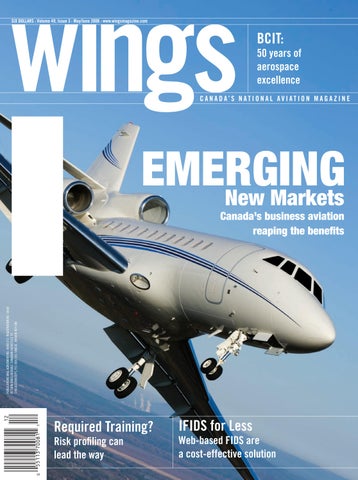
EMERGING New Markets PUBLICATIONS MAIL AGREEMENT NO. 40065710 REGISTRATION NO. 10666 RETURN UNDELIVERABLE CANADIAN ADDRESSES TO CIRCULATION DEPT., P.O. BOX 530, SIMCOE, ONTARIO N3Y 4N5
Canada’s business aviation reaping the benefits
Required Training?
IFIDS for Less
Risk profiling can lead the way
Web-based FIDS are a cost-effective solution
-/,1
/-Ê Ê 9,"-Ê Ê
Ê, * ,-Ê Ê -/ / " -
, , /9Ê /9Ê Ê1 Ê1 ", ", -
{äÈ
ÊÊ , , 1 -/ 1 -/
-
ââ
£Ó£°xÊ âÊ /ÊÃ>Ìi ÌiÊV ÛiÀ>}iÊÜ Êi `Ê iLÀÕ>ÀÞÊ£]ÊÓää
-Ê9"1,Ê -Ê9"1,Ê
/Ê, /Ê, 9Êttt 9Êttt
"7Ê 1/ ", <
Ê ,/ 8Ê- ,6
Ê
/,
/ " Ê/ -Ê Ê Ê, 6 Ê Ê - "1 /Ê" 9"1,Ê 8/Ê ,/ 8Ê{äÈÊ âÊ /Ê*1, 3OME CONDITIONS MAY APPLY
ÓÇxÊ*> iÀÊ, >`Ê > }>ÀÞ]Ê Ê/Ó ÊÇ { nää ÈÈn Çä{
ÓÎäÊ Ê{xÓäÊ }>ÀÊ À Ûi , V `]Ê Ê6Ç Ê£ Î nnn nÇ äÈÓ{
May/June
WINGS MAGAZINE : Issue 3 : Volume 49 : Table of Contents
26 COVER STORY Emerging New Markets Canada’s business aviation reaping the benefits
6
McCarthy
You’re so vain – you probably think this ad is about you.
On the Fly
12
On the Web
13
Airline Insider
By Brian Dunn.
18
Carr
Taming an elephant.
Flying Green
In the second of three parts on Flying Green, David Carr chats with CBAA president and CEO Rich Gage about the environmental challenges facing the sector.
44
Fire and Ice
Aviation and the environment.
Suppressing Hailstorms in Alberta, by Blair Watson.
20
48
19
Seaman IFIDS for Less
One on One
Web-based Flight Information Display Systems are a cost-effective solution, by Carroll McCormick.
Darren Locke speaks with Joe Sparling, president of Air North.
22
Nikolas Chapman discusses the importance of an accurate training needs assessment to define what ‘required training’ means to your organization.
Atlas Aviation Services
James Careless looks at how a company headquartered in Richmond Hill, Ont., is making the world a safer place for non-scheduled air travellers.
32
Slimmed Down and Shaped Up
Drew McCarthy discusses Standard Aero’s focus on aligning cultures and creating awareness after the recent launch of its new corporate identity. 4 | WINGS magazine | May/June 2008
52
48
One on One with Joe Sparling
BCIT: 50 years of aerospace excellence
BCIT opened its new Aerospace and Technology campus last October, adding to its long and proud history as a leader in aerospace training. Blair Watson reports.
40
IFIDS for Less
Le
ar
Policy al Visu rt ma rd s art Wo sm dy Bo
8
36
20
ni ng k p sty rofi les l Accu ing racy Procedu re Required traini ng Relevancy y iguit Amb S M S
Ris
52
Required Training?
56
Avro Arrow - R.I.P.
Required Training?
56 A Look Back Avro Arrow – R.I.P., by Raymond Canon.
70
Purser
Weird and wonderful.
www.wingsmagazine.com
dfjc88
S
UDDENLY THE SKY IS MADE OF SILK.
Nothing can make the air perfectly smooth, but nothing can touch the incredible Falcon 7X for smooth flying. Its Digital Flight Control System — the business-jet evolution of our fighter-jet technology — blends the reflexes of a fighter with the agility of a bird. And its
all-muscle-no-fat design will whisk you over 5,950 miles with the efficiency of a smaller plane — in a cabin of a silken quiet — within a whisper of the speed of sound.
Visit us at Falcon7X.com Or call: U.S. 201.541.4600 France +33.1.47.11.82.32
dfjc88281b
1
4/28/08
1:29:53 PM
McCarthy
DREW MCCARTHY is the editor of Wings.
Back in the 1970s, when Carly Simon sang, “Then you flew your Learjet up to Nova Scotia to see the total eclipse of the sun,” everyone wanted to know if the song was about Warren Beatty. What no one questioned was the idea that this kind of self-indulgence “is what flying a private jet is all about.” Almost 40 year later, the stereotypical image of private aircraft ownership has barely changed. The impact of that stereotype plays out in numerous negative ways, often in terms of unnecessary government regulation, fees, taxes and most recently, criticism over environmental impact. Setting the record straight has been an industry goal for decades. At the beginning of May, Flexjet (By Bombardier), based in Richardson, TX, launched a multi-milliondollar, consumer-focused advertising campaign that does service to both them and the entire business aviation industry. Tackling the stereotype head on, Flexjet is running print and online ads in publications such as Fortune, Fast Company, Departures, Worth, Harvard Business Review, Barron’s, Forbes and the Wall Street Journal, presenting the private aircraft as a business tool. Gone are the images of impeccable people, standing in front of beautiful aircraft, with exotic background locations. Instead, the campaign uses sophisticated graphical images coupled with some straight-talking text. The ads focus on efficiency, saving time, work ethic, productivity, and middle-class values, all the while stressing the company’s aviation credentials. The campaign, in the words of Flexjet’s VP of marketing and administration, Sylvain Levesque, “speaks candidly about private jet travel and leverages Flexjet’s unique aviation expertise with ‘straight talk from plane people.’” “Over the past 12 months,” says Levesque, “we conducted a series of in-depth studies of our target audience and the research confirmed what we’ve known instinctively all along: for the majority of our customers, private jet travel isn’t a glamorous perk, it’s an essential tool. It’s an investment in productivity and their most valuable asset: time.” In the past, companies and organizations have had their challenges presenting the business case to those outside the industry. This broader-based consumer approach helps address those challenges. To be sure, Flexjet’s goal is to increase its market share in the fractional, whole ownership and management segments, but it is also intent on growing the category. The positive message of the campaign has the potential to do so, and Flexjet has shown some very creative leadership in bringing this message to a wider audience.
You’re so vain You probably think this ad is about you.
6 | WINGS magazine | May/June 2008
WINGS MAGAZINE PO Box 530, 105 Donly Dr. S., Simcoe, ON N3Y 4N5 Tel.: 428-3471 Fax: 429-3094 Toll Free: 1-888-599-2228 PUBLISHER TIM MUISE tmuise@annexweb.com EDITOR DREW MCCARTHY dmccarthy@annexweb.com ASSOCIATE EDITOR ANDREA KWASNIK akwasnik@annexweb.com SENIOR ASSOCIATE EDITOR RICHARD PURSER PRODUCTION ARTIST KRISTA MISENER OTTAWA CORRESPONDENT KEN POLE AVIONICS EDITOR ROB SEAMAN FLIGHT DECK RAY CANON, JAMES CARELESS, DAVID CARR, NIKOLAS CHAPMAN, BRIAN DUNN, DARREN LOCKE, CARROLL McCORMICK, BLAIR WATSON ADVERTISING SALES MARK MCWHIRTER mmcwhirter@annexweb.com SALES ASSISTANT MARY BURNIE mburnie@annexweb.com VP/GROUP PUBLISHER DIANE KLEER dkleer@annexweb.com PRESIDENT MIKE FREDERICKS mfredericks@annexweb.com PUBLICATION MAIL AGREEMENT #40065710 RETURN UNDELIVERABLE CANADIAN ADDRESSES TO CIRCULATION DEPT., P.O. BOX 530, SIMCOE, ON N3Y 4N5 e-mail: alados@annexweb.com Periodical postage paid at Buffalo, NY. USPS 021-029, ISSN 0701-1369. Published six times per year (Jan/ Feb, Mar/Apr, May/Jun, Jul/Aug, Sep/Oct, Nov/Dec) by Annex Publishing & Printing Inc. US Office of publication c/of DDM Direct.com, 1175 William St., Buffalo, NY 14206-1805. US postmasster send address change to P.O. Box 611, Niagara Falls, NY 14304. Printed in Canada ISSN 0701-1369 CIRCULATION e-mail: alados@annexweb.com Ph: 866-790-6070 ext. 208 Fax: 877-624-1940 Mail: P.O. Box 530, Simcoe, ON N3Y 4N5 SUBSCRIPTION RATES Canada – 1 Year $ 34.00 (includes GST - #867172652RT0001) USA – 1 Year $ 50.00 Foreign – 1 Year $ 65.00 From time to time, we at Wings Magazine make our subscription list available to reputable companies and organizations whose products and services we believe may be of interest to you. If you do not want your name to be made available, contact our circulation department in any of the four ways listed above. No part of the editorial content of this publication may be reprinted without the publisher’s written permission. ©2008 Annex Publishing & Printing Inc. All rights reserved. opinions expressed in this magazine are not necessarily those of the editor or the publisher. No liability is assumed for errors or omissions. All advertising is subject to the publisher’s approval. Such approval does not imply any endorsement of the products or services advertised. Publisher reserves the right to refuse advertising that does not meet the standards of the publication.
Air Transport Association of Canada
Canadian Business Aviation Association
Canadian Owners & Pilots Association
Member of the Alberta Magazine Publishers’ Association
Member of the Canadian Circulations Audit Board
www.wingsmagazine.com www.wingsmagazine.com
eurocopter.com
When it comes to protecting the environment, no other helicopters go further.
Scientists surveying Antarctica. Oceanologists researching sealife. Maritime authorities tracking oilspills. Firefighters controlling bushfires. All of them rely on Eurocopter helicopters as essential equipment. Quiet, safe and dependable. Equipped with advanced sensors. Coupled with lower fuel consumption and reduced gas and particle emissions. When you think environmental conservation, think without limits.
onthefly INDUSTRY NEWS : COMMERCIAL AVIATION : GENERAL AVIATION
BUSINESS AVIATION : MILITARY AVIATION
Skyservice Goes Platinum
Skyservice Business Aviation Inc. has been rated “Platinum” by the Aviation Research Group/U.S. Inc. (ARG/US) which is the highest and most stringent rating in the research group’s hierarchy of operational safety classifications. ARG/US conducts on-site safety audits of the operation, maintenance, aircraft and pilots of over 140 business jet operators a year and measures the operator’s safety record against the industry’s best practices. To qualify for Platinum, an operator must have operational and maintenance standards that are deemed exceptional. Out of a total of over 1,200 charter opera-
The D-JET Personal Light Jet is an attractive option for pilots stepping up from highperformance piston singles, twins and light turboprops or downsizing from older light business jets. To qualify for Platinum, an operator must have operational and maintenance standards that are deemed exceptional.
tors in the ARG/US database, only 63 have achieved ARG/ US Platinum rating. Skyservice Business Aviation
Inc. is a Canadian business aviation and air ambulance enterprise with over 450 employees worldwide.
CAC Appoints Chairman, Vice-Chairman The Canadian Airports Council (CAC) has elected Winnipeg Airports Authority president and CEO Barry Rempel as chairman for the next two years. William A. Restall, president and CEO of Saskatoon Airport Authority, has been elected the association’s new vicechair. Rempel has served on the board of the CAC since 2002, since 2006 as vice-chair, and replaces outgoing chair Jim Cherry, who is president and CEO of Aéroports de Montréal and retains his seat on the CAC board. Prior to his appointment with Winnipeg Airports Authority, Rempel was president and CEO of Trade8 | WINGS magazine | May/June 2008
D-JET S/N 003 Makes First Flight
parks Development Corp., the land/business development subsidiary of the Calgary Airport Authority, and served as chief executive for two of Canadian Airlines International’s operating divisions: Cargo and Canadian North. He is the former president of the Northern Air Transport Association. Restall becomes the association’s first vice-chair from Canada’s small-airports community. A 34-year veteran of the air transportation industry, he previously served in progressively senior positions with Transport Canada. A former director, airport operations for Transport Canada’s
New CAC chairman Barry Rempel has served 30 years in the Canadian aviation industry.
William A. Restall is the CAC’s new vice-chair.
Central Region, he managed the administration of 15 airports, including maintenance of 22 airports operated by third parties. He became the airport manager in Saskatoon in 1985 and president and CEO of the Saskatoon Airport Authority in 1999.
Diamond Aircraft Industries announced in April that D-JET serial number 003 completed its first flight, marking another important milestone in the company’s D-JET personal jet program. The aircraft departed from Diamond Aircraft’s London, Ont. facility for a successful 85-minute flight with chief test pilot Daniel Ribeiro at the controls. The flight went exactly as planned with completion of all test cards. D-JET 003’s initial test program will focus on performance and handling quality refinement, similar to the mission of previous Diamond D-JET flight test aircraft, but will additionally be used to further develop key systems, including avionics, fuel, autopilot, and anti-ice. Later this year S/N 003 will be retrofited with the Williams International FJ33-19 engine, to begin testing with the production configuration powerplant. www.wingsmagazine.com
ON THE FLY
Leadership Changes at Bombardier Aerospace Group Guy C. Hachey has been appointed Bombardier Aerospace’s new president and chief operating officer, effective May 12. A period of transition will follow until June 4, when Pierre Beaudoin, current president and chief operating officer, will take over the position of president and chief executive officer of Bombardier Inc., as previously announced last November 28. Bombardier also announced the appointment of three of its senior leaders to new positions: Gary R. Scott, currently president, New Commercial Aircraft Program and Aircraft
Services, is appointed president, Bombardier Commercial Aircraft, integrating two business units – Regional Aircraft and the New Commercial Aircraft Program – into one new unit. Steve Ridolfi, currently president, Bombardier Regional Aircraft is appointed president, Bombardier Business Aircraft. He will replace Pierre Gabriel Côté who has been appointed Chief Executive Officer of SFK Pulp and will leave Bombardier Aerospace on July 18. James Hoblyn, currently senior vice-president, Customer Experience, Bombardier Business Aircraft, is appointed president, Bombardier Aircraft
TrainingPort.net Signs Experts TrainingPort.net, which provides online recurrent pilot safety training, has added agreements with a number of prominent subject matter experts, including Terry Kelly (Safety Management Systems), Dr. Mark Rosekind (Fatigue Management), Dr. Karsten Shein (Meteorology) and others. TrainingPort searches out subject experts or the best training materials for each topic; licensing arrangements have been made for recognized published materials, such as the Flight Safety Foundation’s CFIT Education and Training Aid. Each topic forms part of a comprehensive program that is delivered to flight operations following a detailed Training Needs Assessment which considers the operator’s regulatory environment, identified hazards, risk profile, and other pertinent factors that impact training requirements. Scott Macpherson, presi-
Guy C. Hachey is Bombardier Aerospace’s new president and chief operating officer.
Services, which includes the Amazing Customer Experience initiative for Aerospace as a whole; aftermarket services for Business and Commercial Aircraft (Parts, Service Centres, Training); Specialized Aircraft Solutions; and Amphibious Aircraft.
Porter Inaugurates New York
Options range from a basic customized program as indicated by the Training Needs Assessment, to an unlimited program that includes more than 25 topics.
dent, TrainingPort.net, explains: “Under the CARs and particularly with the move to SMS, operators have an ethical and legal responsibility to identify specific training requirements for their organization, whether or not those requirements are detailed in the Standards.” With continuing regulatory change and technological development, subject matter agreements are an ongoing focus for TrainingPort.net as it adds new topics, and updates current lessons to answer the industry’s demand for additional training and continual improvement.
Robert Deluce (right), president and CEO, Porter Airlines, presents John Jacob, general manager, Newark Liberty International Airport, a model Bombardier Q400 aircraft commemorating the Canadian carrier’s inaugural flight at Newark on March 31.
Porter Airlines began service between Toronto City Centre Airport and New York on March 31, with seven daily flights. Porter’s New York route, via Newark Liberty International Airport, is its first venture to the U.S., delivering convenience, speed and service to short-haul air travel that has been successfully welcomed in other Canadian destinations.
Events Calendar JUNE 2008 Canadian Airline Investment Conference 2008 June 9-10 Toronto, ON http://www.insightinfo.com CBAA 47th Annual Convention, Tradeshow and Static Display June 16-19 Toronto, ON http://www.cbaa.ca
JULY 2008 2008 Geneseo Airshow, The Greatest Show on Turf July 12-13 Geneseo, NY http://www.1941hag.org/ files_airshow/airshow _hilites.html Farnborough International Airshow July 14 - 18 Farnborough, UK http://www.farnborough. com/intro.aspx ALEA 2008 Conference & Exposition July 16-19 Houston, TX http://www.alea.org/public/ seminars/annual_conference/index.htm EAA AirVenture Oshkosh July 28 - Aug. 3 Oshkosh, WI http://www.airventure. org/index.html
AUGUST 2008 Classic Air Rallye August 23-24 Rockcliffe Airport Ottawa, ON http://www.flightworks.ca/
May/June 2008 | WINGS magazine | 9
ON THE FLY
Gulfstream Announces G650 Gulfstream Aerospace announced in March the introduction of an all-new business jet, the Gulfstream G650, that offers the longest range, fastest speed, largest cabin and the most advanced cockpit in the Gulfstream fleet. It is capable of traveling 7,000 nautical miles at Mach 0.85 or 5,000 nautical miles at Mach 0.90. Using an advanced aerodynamic design, the G650 has a maximum operating speed of Mach 0.925,
PW545C Certified to Power Cessna Citation XLS+ Jet Pratt & Whitney Canada has received type certification from Transport Canada for its new PW545C turbofan engine to power the Cessna Citation XLS+ business aircraft. The PW545C, delivering over 4,100 pounds of thrust at takeoff, is the sixth engine in the popular PW500 family selected by Cessna Aircraft Company for its growing line of light and midsize Citation business jets. The new turbofan outfits the Citation XLS+ with a full-authority digital engine control (FADEC) for reduced pilot workload and intelligent diagnostic capability. PW500 engines today power some 1,000 business jets in 50 countries, including the Cessna Citation Bravo, Citation Excel, Citation XLS, Citation Ultra Encore and Citation Encore+ aircraft. The PW500 family has accumulated a total of five million flight hours. 10 | WINGS magazine | May/June 2008
The G650 has a maximum operating speed of Mach 0.925, which will make it the fastest civil aircraft flying.
which will make it the fastest civil aircraft flying. It can climb to a maximum altitude of 51,000 feet, allowing it to
Cessna Rolls avoid airline traffic congestion Out First and adverse weather. Gulfstream expects to be- Production gin G650 customer deliveries in 2012. Based on the aircraft Citation XLS+ development schedule, the company projects it will receive Federal Aviation Administration Type Certification and validation by the European Aviation Safety Authority in 2011. First flight of the aircraft is scheduled for the second half of 2009.
Flying Colours: Project Phoenix Signing Flying Colours has signed a contractual agreement with Dubai-based Project Phoenix to complete the first CRJ Phoenix. The aircraft will be equipped with Flying Colours’ CRJ executive interior and auxiliary fuel system. The first CRJ Phoenix S/N 7211 is undergoing maintenance upgrades at Skyservice Aviation in Toronto. Once the maintenance upgrades are completed the aircraft will be relocated to Flying Colours’ facility in Peterborough, Ont., to begin
Flying Colours of Peterborough, Ont., will complete the first CRJ Phoenix for Project Phoenix.
the completion process. Flying Colours Corp. is a completion centre specializing in exterior and interior refinishing, as well as maintenance and modifications on all types of business and commercial aircraft.
Michael Moore to Lead Standard Aero’s Associated Air Center Standard Aero has appointed Michael Moore as senior vicepresident of Associated Air Center (AAC), the VIP transport completion facility in Dallas. For the past year Moore has served as vice-president, Production, Planning and Supply Chain at AAC. Moore earlier served as vicepresident and general manager of an aviation services company, and in the airline industry where
Michael Moore will lead the VIP completion facility in Dallas.
he held the position of director of operations and managed large fleets of engines. Moore holds an MBA from Indiana Wesleyan University and is a graduate of Valdosta State University. He is also a licensed A&P.
FAA certification is expected by mid-year, with deliveries starting before the end of 2008.
In late April, Cessna Aircraft Company rolled out the first production Citation XLS+ at its primary design and manufacturing facilities in Wichita. The XLS+ is the latest version of the Citation business jet model. The first production unit now will go to paint and interiors, while two flight test aircraft continue to work toward type certification. Federal Aviation Administration certification is expected by mid-year, with deliveries starting before the end of 2008. The upgrade to the midsize Excel/XLS will feature the fully integrated Rockwell Collins Pro Line 21 avionics suite and electronically controlled (FADEC) engines from Pratt & Whitney Canada. Exterior and interior restyling is also integrated into the new model, most prominently the extended contour of the nose and expanded seat widths, both introduced to more closely resemble Cessna’s Citation X and Citation Sovereign models. Priced at $11.595 million US, the Citation XLS+ will travel as fast as 440 knots, have a range of more than 1,800 nautical miles and land on runways as short as 3,180 feet at its maximum landing weight, 2,700 feet at its typical landing weight. www.wingsmagazine.com
ON THE FLY
AirSprint Orders two new jets was scheduled for 23 Aircraft for May at the EBACE in Geneva, where a full-scale mock-up of Fractional Fleet the Embraer MSJ will be show-
Embraer Announces MSJ and MLJ Executive Jets Embraer has formally introduced its new Embraer MSJ and Embraer MLJ executive jet programs, which were recently approved by the company’s board of directors. The midsize Embraer MSJ, with a 3,000-nm range, and the mid-light Embraer MLJ, with a 2,300-nm range, will be positioned between the Legacy 600 and the Phenom 300 in the company’s executive jets portfolio. An estimated $750 million US will be invested in research and development for the new models, which will enter service
Executives from Embraer, Honeywell International, and Rockwell Collins unveil the models of the new Embraer MSJ (left) and Embraer MLJ (right) executive jets.
in the second semester of 2012 and 2013 respectively. The Embraer MSJ and Embraer MLJ were first presented at NBAA 2007 in Atlanta as concept aircraft. Commercial launch of the
cased and the brand names of the jets will be unveiled. Honeywell’s latest-generation HTF7500E engines will power the two new jets with 6,000-7,000 pounds of thrust and Rockwell Collins will supply its Pro Line Fusion avionics suite. Both jets will be equipped with a full fly-by-wire actuation system for ailerons, elevators, rudder and spoilers, which is unique to their classes.
MFC Extends Contract With Beijing Moncton Flight College (MFC) and Beijing University of Aeronautics and Astronautics (BUAA) signed a 2-year flight training contract extension in Beijing. The deal is valued at over $24 million and will continue the flow of Chinese students entering New Brunswick to take training at MFC bases in Moncton and Fredericton. Between 300 and 400 students are expected to arrive between May 2008 and May 2010. The initial
2-year contract, signed in 2006, was about to expire and executives on both sides were pleased to conclude the extension. MFC received Civil Aviation Authority of China authorization to train Chinese pilots in May 2006. BUAA became MFC’s first Chinese customer when students arrived in July 2006. The College has since diversified its China customer base by partnering with Air China, Air China Cargo, China
Moncton Flight College received Civil Aviation Authority of China authorization to train Chinese pilots in May 2006.
Eastern, Shenzhen Airlines and Xiamen Airlines. In August 2007, due to increasing demand, a second campus was opened in Fredericton in partnership with CANLink Aviation.
Universal Avionics’ WAAS-FMS Flies LPV Approach First Air has successfully conducted LPV approach operations in Canada with the Universal Avionics’ Wide Area Augmentation System-Flight Management System (WAASFMS). Transport Canada approved the use of WAAS in Canadian airspace (CWAAS) on October 27, 2005. Coverage was just recently made available with the launching of four Canadian ground reference stations in support of WAAS operations in Canada. The Localizer Performance
with Vertical (LPV) guidance approach was conducted the first week of March at the Region of Waterloo International Airport (CYKF) in Ontario, on a Boeing 737-200 aircraft equipped with dual UNS-1Fw FMSs. First Air is Universal’s first commercial airline transport customer for the SBAScapable WAAS-FMS, which is installed throughout First Air’s fleet of 737s, 727s and ATRs. First Air’s accomplishment of LPV approach operations in Canadian airspace provides unprecedented approach
capabilities for the airline. There is a worldwide initiative to incorporate these highly accurate approach procedures at airports because it provides the most precise approach capabilities available without the purchase, installation or maintenance of ground-based navigation equipment at the airport. It also boosts airport capacity by increasing maximum capacity on intersecting runways. The new Canadian ground reference stations are located in Goose Bay, Gander, Winnipeg and Iqaluit.
Judson Macor was the winner of the prestigious Ernst and Young Entrepreneur of the Year in the Business Products and Services category in 2006.
Judson Macor, chairman and CEO of AirSprint Inc., has announced that the company has placed an order for 23 aircraft with an aggregate retail value of $116 million US. AirSprint will take delivery of three Citation XLS/XLS+ jets and three Pilatus PC-12/47Es over the next 24 months, bringing the total number of aircraft under the company’s management to 27 (including 10 Citation XL/XLS/XLS+ aircraft). The balance of the aircraft deliveries are earmarked for future growth and fleet rejuvenation. “The demand for our services has steadily increased since our introduction of fractional ownership in Canada back in 2000,” Macor said. “Our continued growth is a testament to a dedicated staff of service-oriented professionals.” With revenues that have soared more than 600 per cent during the last five years, the company was named to Profit Magazine’s list of Fastest Growing Canadian Companies in 2007. AirSprint operates from bases in Toronto, Ottawa, Montreal, Kitchener/Waterloo, Edmonton and Calgary. May/June 2008 | WINGS magazine | 11
ontheweb www.wingsmagazine.com
NEWS HIGHLIGHTS
FIRST PHENOM 300 EXECUTIVE JET PERFORMS MAIDEN FLIGHT UNIVERSAL AVIONICS’ WAAS-FMS FLIES LPV APPROACH IMP WINS CONTRACT TO UPGRADE NORWEGIAN PLANES BOEING COMPLETES 737 CARBON BRAKES CERTIFICATION TESTING DIAMOND RECIEVES 13-AIRPLANE ORDER FROM MAYLAN VISTAJET ORDERS AND SECURES OPTIONS FOR 60 BOMBARDIER BUSINESS JETS Read the Full Stories Online at www.wingsmagazine.com
Web Exclusive: BACTERIA IN AIRCRAFT CABIN AIR MAY POSE LESS OF A RISK TO TRAVELLERS THAN IMAGINED Popular wisdom says that aircraft provide the perfect environment for spreading disease, but few studies exist to confirm or deny this suspicion. Now, a team of researchers from the University of Massachusetts Amherst, a leading federal agency and Harvard University has measured concentrations of bacteria in the cabin air of 12 commercial passenger aircraft, and found that flying may be safer than we think
NEW PRODUCTS • New railing options for Joe Scaffold portable work platforms
• Rosen Sunvisor Systems announces complete Sunvisor line
A-LIST The Canadian Aviation Guide (A-List) is the only reference tool to bring the entire Canadian aviation industry together in one directory.
For full details, go to www.wingsmagazine.com and click on web exclusives.
DIGITAL MAGAZINE
AVIATION MEMOIRS: A LOVE AFFAIR WITH FLIGHT
Visit www.wingsmagazine.com to sign up for a free trial of Wings magazine – digital version
Ross Smyth’s story is the story of a lifetime in the rapidly developing world of aviation. As a schoolboy he started an aviation club in Toronto, persuading prominent airmen like Erroll Boyd to speak at their monthly meetings. Problems with his eyesight prevented him from becoming a pilot until middle age. But this did not prevent him from following an adventurous route in the fledgling industry.
Visit www.wingsmagazine.com and click on bookstore to learn more about the book and order a copy. 12 | WINGS magazine | May/June 2008
BLOG Have your say on a variety of industry topics… • He must be kidding (shining a laser into the cockpit) • Airport slots – going, going, GONE! • Has Transport Canada dropped the ball on SMS? www.wingsmagazine.com
airlineinsider BARBADOS OPENS SKIES TO WESTJET WestJet is still considering which Canadian cities it will connect to Barbados after receiving regulatory approval to operate scheduled service to the Caribbean island. Service to Barbados potentially fits a number of cities, according to Bob Cummings, executive VP, guest experience and marketing. While seasonal Barbados flights is likely the way service will start initially, year-round service is not out of the question, he added. The carrier’s regulatory approval was facilitated by the “openskies-type” accord recently brokered by the two countries. It is part of the Boeing 737 operator’s larger strategy to boost service to the Caribbean and Mexico. WestJet will pose competition to Air Canada, which currently links Barbados from Toronto and Montreal.
WestJet will pose competition to Air Canada, which currently links Barbados from Toronto and Montreal.
MORE BIG APPLE FLIGHTS FOR AIR CANADA Daily nonstop fights between Calgary and New York Newark Liberty International airport by Air Canada are scheduled to debut June 16 to complement the carrier’s existing daily nonstop service from Calgary to New York’s JFK airport. The carrier plans to use 120-seat Airbus A319s on the route featuring executive and economy classes. Star Alliance carrier Air Canada is competing with SkyTeam member Continental Airlines in the new market. The Houston-based carrier flies between the two destinations using a 104-seat Boeing 737-500. Once the new service starts, Air Canada said it will offer 41 daily fights from Canada to the New York-New Jersey area this summer.
Air Canada plans to use 120-seat Airbus A319s on the route.
By Brian Dunn
Third major delay for Boeing’s 787 Dreamliner
BOEING’S DREAMLINER LAUNCH POSTPONED Boeing recently announced a third major delay for its 787 Dreamliner program that will postpone first flight and first delivery by about another six months, as well as cutting planned aircraft production in 2009 by more than 75%. The move could impact the delivery schedule for Air Canada, North America’s largest airline customer for the 787 with 37 of the aircraft on order. “Boeing has advised us of the delay to the 787’s launch date, but the impact to Air Canada’s scheduled deliveries is not yet determined,” said Air Canada spokesman Peter Fitzpatrick. The aircraft maker blamed the most recent delay on outsourcing problems from contractors in several countries, unexpected rework tasks and the addition of more time to complete flight tests. In addition, Boeing has delayed first delivery of the stretched 787-9 by two years to 2012. This means the shortened 787-3 will become the second version of the baseline design to enter service. “Our revised schedule is built upon an achievable, high-
confidence plan for getting us to our power-on and firstflight milestones,” Boeing Commercial Airplanes CEO and President Scott Carson said in a company statement. The revision means Boeing will deliver only 25 aircraft in 2009, rather than the original plan that called for 112 aircraft during the first year of production. “As a result of that assessment, the first-year delivery plan…will be followed by a more gradual ramp up to full-rate production than previously planned,” Boeing’s statement adds.
Porter currently operates six Q400 with four more coming in the next year.
Q400 FURTHERS PORTER EXPANSION Porter Airlines has converted two of 10 options it has with Bombardier for 70-seat Q400 turboprops. It ordered 10 Q400s in 2006, along with options for 10 additional aircraft. Porter currently operates six Q400s, and recently the May/June 2008 | WINGS magazine | 13
AIRLINE INSIDER carrier’s executives said four additional aircraft are expected for delivery during the next 12 months to support network expansions from Toronto to Boston, Chicago, Washington DC and Philadelphia. Porter’s seven daily flights from Toronto to New York Newark started March 31. The value of the aircraft in the twoplane order from Porter is approximately $51 million.
new non-stop service to Buenos Aires, an exclusive flight to Santiago and the introduction of a Boeing 777-300ER for Sao Paulo. “Air Canada is improving its services to Argentina, Brazil and Chile in response to continued strength in these markets during the busy southern hemisphere summer, including the demand for connections between South America and our global network
Skyservice Airlines will launch seasonal scheduled flights to Croatia, Portugal and Italy.
SKYSERVICE RESUMES GATEWAY FLIGHTS Skyservice Airlines plans to launch seasonal scheduled flights from Toronto to Zagreb, Croatia on May 28, followed by additional scheduled flights to Portugal and Italy this summer. The carrier’s flights to Zagreb are a resumption of seasonal flights Skyservice offered to Croatia in 2007. It is using Boeing 757s on the route, with outbound flights departing Canada on Wednesdays and the inbound return leaving Zagreb on Thursdays. The airline said early on-line bookings indicate Croatia is a popular choice for travellers as a gateway to Eastern Europe. SOUTH AMERICAN UPGRADES FOR AIR CANADA Air Canada is enhancing service to South America next winter with the introduction of 14 | WINGS magazine | May/June 2008
through our Toronto hub to Europe and Asia. By establishing two separate, non-stop services for Argentina and Chile and deploying our largest, most modern aircraft for Brazil, customers will have faster travel times and better connection opportunities than previously,” said Ben Smith, executive vice president and chief commercial officer. “Moreover, all the aircraft serving these routes will feature lie-flat suites in Executive First and personal audio visual entertainment, a power plug and USB port at every seat to provide customers the most modern amenities in the sky today.” Starting December 1, 2008 and ending April 1, 2009, Air Canada will split its current daily Toronto-Santiago-Buenos Aires flight into two separate flights, each operating five times a week between Toronto and the cities of Santiago and
Air Canada is introducing a Boeing 777-300ER for its flights to Sao Paulo, Brazil.
Buenos Aires. Also during the period, Air Canada will begin flying a 349-seat Boeing 777300ER daily between Toronto and Sao Paulo, which is currently served with a 211-seat Boeing 767-300ER. This new service will reduce travel times between Buenos Aires and Toronto and other points in Air Canada’s network by up to 3 1/2 hours. The Santiago route will be served with a refurbished Boeing 767-300ER. Also starting December 1, 2008, Air Canada will upgrade the aircraft serving Toronto-Sao Paulo to a Boeing 777-300ER from a Boeing 767300ER, providing an additional 138 seats a day. The flights are timed to connect with onward flights to Europe and Asia, providing convenient travel times between those continents and South America. The deployment of a Boeing 777 on the route will also enable Air Canada to expand cargo services between Canada and Brazil. CODESHARE FOR WESTJET WestJet Airlines continues to have discussions with potential interline and codeshare partners and aims to finalize deals this year. Currently WestJet has a single interline pact with Taiwan’s flag carrier China Airlines. The airline said it hopes to announce one or possibly two interline deals. It
has previously been reported that WestJet is in talks with Air France and Cathay Pacific. Along with those discussions, another obstacle WestJet needs to overcome this year is selecting a new reservations system. Last year WestJet had a non-cash writedown of $31.9 million after opting to scrap plans to use the aiRES reservation system from Travelport. WestJet opted to upgrade its Open Skies system supplied by Navitaire for use through 2008. MODEST PROFIT FOR INDUSTRY After barely breaking even last year, Canada’s airline industry should make a modest profit of $150 million in 2008, according to a Conference Board of Canada study. But profits will remain thin over the next five years, it added. Increased demand for air travel has resulted in better load factors, resulting in healthy revenue growth. “It should be boom times for Canadian airlines,” said Board economist Alexander Fritsche. “However, record fuel prices and labour shortages are driving up costs, while intense competition is preventing carriers from raising prices.” While fuel prices and labour costs should begin to moderate this year, industry costs are expected to increase by an average of 6.5% annually over the next five years. www.wingsmagazine.com
I T S I M P LY O U T C L A S S E S T H E C L A S S .
The clean-sheet design of the Embraer Phenom 300® brings a new definition of class to light jets. It has the largest cabin and baggage compartment. The cabin is even more in tune with you. A maximum altitude of 6,600 ft. reduces fatigue and makes sure you arrive refreshed. It has speed and cruising altitude among the highest and operating costs among the lowest of any light jet. Not to mention range and short field performance that makes it more versatile than any other. The Phenom 300 is simply in a class by itself.
Latin America +55 12 3927 3399 – U.S., Canada, Mexico and Caribbean +1 954 359 5387 Europe, Middle East and Africa +33 1 4938 4444 – China +86 10 6598 9988 Asia Pacific +65 6734 4321 – www.EmbraerExecutiveJets.com/Ph300
Security, made by
EADS AZ SEC WiMag_412-8x276-2_UK2 2
21.04.2008 16:29:02 Uhr
EADS A
9:02 Uhr
EADS. At EADS, we help provide security against the threats no-one wants to think about. Eurofighter Typhoon, the world‘s leading high performance multi-role combat aircraft is guarding borders across Europe and beyond. Early-warning and air defence technologies monitor and manage threats from the sky. Sensor technologies are protecting our airports. Security systems keep us safe in the crowd at large sporting events. At EADS, we‘re here to make the world a rather more secure place to be. www.eads.com/madebyeads
AIRBUS A380
EUROCOPTER EC135
EADS AZ SEC WiMag_412-8x276-2_UK3 3
A400M
EUROFIGHTER
METEOR
GALILEO
ARIANE 5
21.04.2008 16:29:13 Uhr
carr
DAVID CARR is a Wings writer and columnist.
Pickering, the controversial site for a second major Toronto airport, is the two-tonne elephant in the room. Few acknowledge his presence, but we keep feeding him peanuts nonetheless. The Greater Toronto Airports Authority (GTAA) has been understandably silent on the issue. The elephant can be ignored. Facts can’t. Even if air transport throttled back as a result of an economic slowdown and global frustration over check-in and security hassles, Pearson International Airport will likely hit capacity by 2020. This is especially concerning for the business aviation community, which would face a return to the dark days of metering slots if more airport capacity isn’t added to the GTAA in the next 12 years. But Toronto should not be locked into a dual airport monopoly, without first parsing the entrails of the recent London Heathrow Terminal 5 fiasco, along with the GTAA’s outburst against an independent survey of more than 150 airports that reportedly give Pearson low marks for efficiency, placing the authority in the same high-cost neighbourhood that Transport Canada put the airport with its own scorecard. Of the two, Heathrow is more straightforward. The transfer to the $8.5-billion Terminal 5 was a cock-up start to finish. Sole tenant British Airways will carry the water for the blunder. Two executives have already paid with their jobs and the head count could grow, although a post mortem should sort out how much was the fault of the airline versus BAA plc, the airport operator. First privatized in 1987, BAA, which operates seven airports in the UK including London Gatwick and Stansted, was purchased by Spanish infrastructure firm Grupo Ferrovial in 2006. Ferrovial also holds a controlling interest in Ontario’s 407ETR toll highway through its subsidiary, Cintra. In hindsight it was an error to bundle all three London airports in a single package. In the capital at least, BAA’s best days are behind it, for now. In addition to the cleanup in Terminal 5, a rebuild of dilapidated Terminals 1 and 2 will not be complete in time for the London Summer Olympics in 2012. The cracks at Heathrow started to form before Ferrovial, but the infrastructure company financed the BAA purchase on a carpet of debt and is now struggling to restructure in the wake of the global credit crisis. The difficulties are
Taming an elephant Heathrow and the GTAA’s McCoomb add to the case against a dual airport monopoly.
18 | WINGS magazine | May/June 2008
compounded because unlike Pearson, which is one of the world’s most expensive airports, Heathrow, the world’s busiest international airport, is regulated to charge less than its value. Breaking up the monopoly by forcing BAA to sell Gatwick, traditionally a leisure-travel airport, should create sufficient competition that Heathrow’s pricing could rise to its market value, while an alternative hub would be a break on excessive financing while keeping all facilities up to date and the traffic flowing, as two airport companies compete for airlines and customers. Here in Canada, the GTAA knows how to execute a textbook terminal transfer. But like everything else the authority does well, it charges more for it. Lloyd McCoomb, the president and CEO, bullied Dr. Tae Oum, a business professor at the University of British Columbia (UBC) to remove Pearson from an international survey that placed the airport near the top of the deck in user charges and close to the bottom in operational efficiency. McCoomb, a former professor of civil engineering, told Dr. Oum that if Pearson was not removed from the survey the authority, “would pursue all means at our disposal to receive fair treatment.” The intimidation tactics worked. Scott Armstrong, a GTAA spokesman, told Canadian Press that McCoomb wasn’t threatening legal action, but speaking “academic to academic.” Gee, makes you wonder about the tone of letters exchanged by law-school academics. McCoomb says UBC’s findings are “unsupported” and the survey displayed a “total lack of academic rigour.” He may be right. Armstrong wouldn’t return telephone calls. Clearly, Pearson has never been as efficient as it should. And while most blame can be pinned on an unfair rent burden, not all can. What of the Transport Canada scorecard that supports the UBC survey, reporting that between 2002 and 2006, Pearson handled 79 passengers per airport employee versus Vancouver’s 131? And why transfer such baggage to a second Toronto-area airport? It is easy to dismiss your critics when you are the only game in town. Less so when you have to fight for every dollar. The UK’s Civil Aviation Authority must decide whether air transport is better served by breaking up BAA’s London monopoly. Transport Canada needn’t let it get to that point in Toronto. David Carr is a former editor of Wings. He can be reached at davidjcarr@sympatico.ca www.wingsmagazine.com
ROB SEAMAN is a Wings writer and columnist.
We keep hearing how the environment and aircraft are becoming more connected as an issue of social concern. The “not in my backyard and therefore none of my business” attitude is not going to cut it any longer. We simply must start paying attention to the impact of aviation – be it as a hobby or vocation – sooner and not later. One thing for certain – the environmentalists already have. I hate to admit it but I well remember a day not so long ago when a fuel spill on the ramp was considered a non-issue. It will evaporate later in the day, we were told. Or you could wash it down the drain. And speaking of that, how many recall when changing the oil in the aircraft was completed by simply pouring the old stuff down the drain? Out of sight and out of mind. And of course we can recall seeing DC8s and 707s lifting into the sky streaming a trail of dirty exhaust behind them. By the nineties we had finally figured out that old oil needed to be disposed of properly and if fuel was spilled, there were containment and cleanup kits on the fuel trucks and around the pumps. We also had cleaned up the fuel we burned and the engines we used so that the tell-tale black streamers were all but gone. But we still had not started to think about the footprint or impact that an aircraft engine could have on the environment. Two years ago, a major airport commissioned an environmental air quality assessment to measure its impact on the local area. It concluded that the adjacent highway was contributing more to area air pollution than the aircraft were. So everyone was happy – at least in aircraft circles. We have heard a lot recentlyabout carbon credits – the concept of buying your way into less quilt is how I see it. Paying for what you create does not necessarily clean up the mess. That said, the money does have to come from somewhere to invest in the research and technology needed to reverse what is obviously a true and global issue. Some are taking the carbon credit issue very seriously. In fact, the 2008 edition of the Canadian International Air Show (Labour Day weekend at Toronto’s Canadian National Exhibition) will be one of the first – if not the first – carbon-neutral events in North America. Show president Patricia (Trish) Roberts is actively promoting this to all her sponsors.
seaman On the aircraft front, we are also seeing some gains. Sir Richard Branson has shown some new thinking on jet fuel. Using a biofuel mix – a product usually derived from soybeans or algae – Branson has proven that it can be used for commercial flight. In early 2008 he and his Virgin Group flew a B747 with biofuel. Branson is publicly committed to sticking with his green ways and is pushing for further development and acceptance of nonfossil fuels as a means to keeping his fleet flying while doing its part for the environment. And on February 1, the A380 test aircraft MSN004, powered by Rolls-Royce Trent 900 engines, flew using an alternative ‘gas to liquid’ fuel for the first time in the history of commercial aviation. Shell International Petroleum provided the Shell GTL jet fuel used in the test. During the flight, engine number one was fed with a blend of GTL and jet fuel while the remaining three were fed with standard jet fuel. GTL has attractive characteristics for local air quality, as well as some benefits in terms of aircraft fuel burn relative to existing jet fuel. For instance, it is virtually free of sulphur. Synthetic fuel can be made from a range of hydrocarbon sources including natural gas or organic plant matter made by a process called Fischer-Tropsch. Airbus is also looking to biofuel options to see how they may also find a place in commercial use. It is not just the commercial folks looking at fuel alternatives. Green Flight International, founded by Douglas Rodante, has already flown its version of biofuel – used canola cooking oil being the main ingredient – in an L-29 fighter/trainer aircraft. For its next trick, it plans to fly a Lear 25 around the world at normal altitude, using the same biofuel product. So it would seem that despite all the negative rhetoric targeted at aviation by the environmental movement, we actually are making progress and not ignoring the issue. Hopefully in the not so distant future the options at the pump will be 100LL, Jet A or Bio-Fuel. And that is lot more impressive and effective than simply buying credits.
Aviation and the environment Like it or not, we have got to start paying attention to the tree-huggers!
May/June 2008 | WINGS magazine | 19
IFIDS FOR LESS Web-based Flight Information Display Systems are a cost-effective solution By Carroll McCormick This March, Lynden Pindling International Airport in the Bahamas completed an expansion of its Flight Information Display System (FIDS): two outdoor monitors for flight and baggage carousel information for baggage handlers and a Baggage Information Display System (BIDS) monitor for each of the four baggage carousels in the international arrivals area. This equipment, plus the 12 FIDS displays installed in the airport’s three terminals in April 2007, make up what is more accurately called an iFIDS – the “i” stands for Internet – that presents flight information routed over the Internet via servers in Thunder Bay, Ont. IFIDS is a remotely-hosted, Internet browser-based flight scheduling solution provided by a company called iFIDS.com Inc., a subsidiary of the Thunder Bay International Airport Authority (TBIAA). The company was born of the need to replace the old FIDS after Transport Canada divested itself of the airport. Aviation InterTec Services, which provides browser-based aircraft maintenance software, developed iFIDS for TBIAA and co-owns iFIDS.com. Scott McFadden, president of iFIDS.com and CEO of Thunder Bay Airport, recalls the search for a suitable FIDS. 20 | WINGS magazine | May/June 2008
“We put out a request for proposal with criteria that included not being expensive, requiring little IT [information technology] support, having a degree of automation and a cost structure such that small carriers could be represented on the FIDS. Regular FIDS vendor pricing was unbelievable and labour-intensive to maintain. We decided not to go ahead until we found a better solution.” The airport has been running its IFIDS since 2000. The commercial result to date is the iFIDS in Nassau, five iFIDS-equipped airports in Canada – Prince George, Kelowna, Hamilton, London and Thunder Bay – and also the Duluth Airport Authority in Minnesota, which selected iFIDS.com last November. The Duluth system will have eight displays. Yet, says Duluth Airport Authority executive director Brian Ryks, “The scalability of the solution, which met all our key criteria, means [iFIDS] will grow as our traffic demands. We won’t be paying for unnecessary infrastructure at the front end.” In fact, notes iFIDS.com technical director Eric Hansen, “One of our clients has just two displays.” Small airports, remote ones especially, avoid the challenges and cost of running traditional dedi-
The Lynden Pindling International Airport in the Bahamas has the largest iFIDS system, and is also the farthest from Thunder Bay. (Photo courtesy of NAD)
cated data links to FIDS, and are relieved of any IT or maintenance costs, making modern FIDS capabilities that much more affordable. “iFIDS provided us with a very cost-effective solution for an airport our size. Before, there was no flight information display at all,” says Lori Chambers, vice-president, operations of the Nassau Airport Development Company (NAD). iFIDS was officially unveiled on April 2, 2007, the same day that NAD, a wholly-owned subsidiary of the Bahamas government, took over operation of the airport. Vancouver Airport Services (YVRAS) manages the airport under a 10-year contract and NAD chose iFIDS through its contacts with other airports managed by YVRAS. “A YVRAS-operated airport in Canada uses iFIDS and suggested we look at the product for Nassau,” Chambers notes.
“If I had bought a specialized FIDS software program and proprietary equipment from a vendor, the cost would have increased significantly. They are very expensive. We would have had to install extensive infrastructure and ensure that we had an expanded IT department to handle management of the system,” Chambers explains. Ryks came to the same conclusion: “Our research didn’t find another vendor that could touch iFIDS.com functionality at a similar price point. It provides our airport with tier-one software at a fraction of the price. Finally, the hosted service removes us from any maintenance obligations. So long as power and Internet connectivity are in place, iFIDS.com remotely manages the rest.” Such simple technical requirements are ideal for the Bahamas: The country has www.wingsmagazine.com
IFIDS FOR LESS would look like. IFIDS.com asked us what we would like our displays to look like. The folk at iFIDS.com were fantastic to deal with from a technical and service point of view.” Castorf notes that the hosting fees Kelowna pays iFIDS.com are comparable to the monthly maintenance fees vendors would have charged. Too, he says, “iFIDS has lower operating costs, more flexibility
for inputting data and from where people can do that.” The system also drives Aileron, an aviation billing system provided by Aviation InterTec Services. It assigns the landing fees and other charges to the airlines for operating at Kelowna. “Once we have entered aircraft into the iFIDS, this
CONTINUED ON PAGE 38
>>>
>>>
90
80
70
Business aviation maintenance and repair now has A NEW STANDARD.
60
50
>>>
40
>>>
>>>
30
20
>>>
advanced Internet and cabling capabilities, but there are local challenges getting vendor service. “For airport-specific applications there is not an extensive base of highly-trained IT specialists here. iFIDS is very reliable and requires very limited IT support. IFIDS.com manages any major problems with the servers right at their offices in Thunder Bay. IT requirements are much less than for a conventional system,” Chambers explains. The only technology an airport requires to support iFIDS, other than the necessary monitors, display driver PCs, CAT 5 and power cabling, is an ordinary computer with an Internet connection. iFIDS.com receives baseline scheduling data from participating carriers and feeds them to its client airports’ iFIDS. Carriers provide “day of” updates when necessary, which iFIDS.com uses to update flight schedules. Carriers can provide these updates from anywhere and staff can log their computers on to the Internet. The flexibility iFIDS gives carriers is well appreciated at the Kelowna International Airport, which replaced a FIDS that was at the end of its useful life with iFIDS in May 2005. “Airlines can use their own PCs, meaning there is no more need for [us to provide] a dedicated PC,” says Henry Castorf, Kelowna’s airport duty manager, development. Kelowna’s iFIDS consists of 14 flat screen monitors and six BIDS – three in the public baggage area and three on the ground handling side. iFIDS also supports the way-finding to and from the gates with eight screens. Eight more screens provide flight information from behind-the-gate counters. The data feed to the iFIDS comes through Shaw Cable into a router, with cabling going to the PCs. Castorf was happy to see the servers for the old FIDS removed. “Getting the servers out of the airports meant one less thing for us to deal with. The iFIDS server computers are in Thunder Bay. They are responsible for all the maintenance and upgrades. I like that. Any issue we might have, I just make a phone call.” Castorf also found iFIDS.com to be particularly flexible for the system set-up. “Other vendors told us what our displays
For over 50 years, Standard Aero has been a leader in engine maintenance for military and commercial aviation. We’re known for our innovation and the efficiency of our work processes, helping to minimize costs and downtime. Now, we’ve joined forces with Landmark Aviation’s MRO services, allowing us to provide a global level of capabilities and service to business aviation. To find out more about the new Standard Aero, and what we can do for you, visit our website at standardaero.com.
May/June 2008 | WINGS magazine | 21
ATLAS AVIATION SERVICES Making the world safe for non-scheduled air travellers By James Careless There is a world outside of Air Canada and WestJet; a world of non-scheduled flights where air travellers must arrange their own transportation. Even for those who own or lease their own aircraft, this is no mean feat; especially if they need to travel outside of North America and Europe. In regions such as the Middle East, Africa, Asia and South America, there are all kinds of arcane and even unfair regulations that can trip up unwary travellers – especially in Third World nations where fuel shortages, civil unrest, and corruption are daily facts of life. To save travellers and their aircraft from these many perils, there’s Atlas Aviation Services. Headquartered in Richmond Hill, Ont. (just north of Toronto), with extra staff members posted overseas, AAS covers all the details associated with making international travel safe, secure, and as hassle-free as possible. “We provide global flight support for corporate, commercial, cargo, ambulance, diplomatic and military operations,” explains Shaen Worthington, owner of AAS. “Our customers include diplomats, heads-ofstate, royalty, charter operators, cargo airlines, the U.S. military and air ambulances; all of whom 22 | WINGS magazine | May/June 2008
count on us to smooth the way for them.” AAS was started by Worthington and his partners three years ago. “We knew that companies such as ours existed in the Middle East to help air travellers from around the world, including North America,” Worthington says. “We decided to cut one step out of the process, by opening a business here that would serve those North American travellers using the contacts that we had collectively built up over the years.” These contacts are wideranging. On the official side, they include airport managers, fuel and service providers, aviation regulators, immigration officers, and all the many other professions that deal with aircraft on the ground. On the unofficial side, these contacts can include locals who know how to push paperwork through and, when necessary, how to convince corrupt persons of power to look favourably upon AAS clients, through whatever means are legally reasonable. “We’ve dealt with situations where someone has landed in Lagos, Nigeria, refueled, and been held at the airport because the fuel supplier is now
demanding payment in cash to the tune of $25,000,” says Worthington. “Thanks to our resources and contacts, we have both the credit facilities to help get this bill paid so that the aircraft can take off, and the people on the ground who can help get the problem resolved quickly.” He adds that, “we work hard to keep our contacts useful in the regions we serve, including rewarding them for their efforts, if need be.” The fact that AAS people sometimes have to deal with less-than-honourable characters is not unique; anyone who does business in the Third World knows this to be a fact of life. Still, it is reassuring to AAS clients that this company can get them out of sticky situations, and even prevent them from occurring in the first place. The word ‘services’ in Atlas Aviation Services’ name neatly captures what this company is all about. The company’s portfolio starts with charters: Thanks to its 2,000-plus partners worldwide, AAS is able to charter turboprops, jets and helicopters for corporate, commercial, cargo, military transport and air ambulance services. This last point is where the company’s contacts can pay off in life-or-death
AAS was started by Shaen Worthington and his partners three years ago.
situations. “If someone gets sick in remote Africa and needs to be medevaced out, it usually takes four days to get the paperwork through,” Worthington says. “We can typically get it done in 24 hours, getting them to firstclass medical care sooner.” This said, charters are only a small part of the business. Arranging permits, ground handling, fueling, flight planning and ground transportation are the lion’s share of what AAS does for its clients. ‘Permits’ refers to a range of permissions that must be obtained to fly legally worldwide. They include overflight, landing and takeoff permits; prior permission numbers and slots, and even diplomatic clearances. AAS prides itself in being to obtain such permits within 12-24 hours, thanks to its contacts on www.wingsmagazine.com
ATLAS AVIATION SERVICES the ground. They are the kind needed to clear an air ambulance from Africa in a day’s time. ‘Ground handling’ is a multifaceted term. It covers loading and unloading cargo, of course, but also covers aircraft handling and security, customs and immigration clearances, crew and passenger visa assistance, hotels and transportation to and from the airport, in-flight catering, and even ambulances when required. “Because of our longstanding liaisons, we can provide ground handling services on credit worldwide; including at Middle Eastern, African, South American and Asian destinations,” Worthington says. “In addition, ground handling services can also be provided on credit in remote locations.” ‘Fuel’ is the most critical element for any aircraft, and some-
24 | WINGS magazine | May/June 2008
thing that can be leveraged by unscrupulous vendors looking for high profits, instant cash, or both. Mindful of this, AAS has spent a lot of time developing trusted fuel suppliers around the world. “Our fuel department has negotiated exclusive prices in over 2,000 locations worldwide,” Worthington notes. “We are able to provide our clients with Jet A fuel or avgas at competitive rates, and with a credit facility upon approval.” AAS provides fuel price quotations on a 24/7 basis to clients by phone or e-mail. ‘Flight Planning’ covers all the details needed to fly in and out of any location. AAS has its own staff of flight planners. They devise plans for clients that cover aspects such as safe flight routes, fuel requirements, aircraft weights, payloads and
flight plan filing. These plans are computer-based, and come with weather packages, NOTAM alerts and trip kits/charts. Finally, AAS ‘Transport’ services cover ground transportation for those who intend to do more than stay at a hotel before departing. The company can arrange limousines, minivans, SUVs and armoured vehicles, for moving around safely in dangerous areas of the world. For Worthington and his staff, working at AAS is not your regular job. Every day, they find themselves dealing with all kinds of strange travel challenges, often using international telephone circuits that are far from adequate. “Communications are often our biggest headache,” he sighs. “It can be really hard to get in touch with places like Togo when the
phone lines are jammed. Thank God for satellite phones!” This said, it is precisely the novelty and challenge of his job that keeps Worthington happy to come to work. “Every day there’s something different; every day there’s a new chapter, and it’s not the same as the day before,” he says. “It really keeps you on your toes!” For AAS clients, such enthusiasm is a godsend, because there are many, many hurdles that must be cleared to fly safely in the Middle East, Africa, Asia and South America. “We are here to help them get to and from where they need to go safely, quickly, and as comfortably as possible,” Worthington concludes. “It can be a dangerous world out there, which is why we cover an entire range of flight services from A to Z.”
www.wingsmagazine.com
Reaches places
others can’t. A runway normally too short to be true? Or maybe your destination is not even close to a major airport? When you are out on a challenging mission, the spn will revolutionize your idea of mobility. Outstanding short field performance and easy operation even from grass and gravel will get you closer to wherever you want to go, and back out again. This unique, single pilot capable aircraft will fly six passengers and one pilot an impressive 1,800 nm. The spn represents a quantum leap in aircraft design, a large light jet featuring a luxurious cabin with eight double club configured seats, cutting-edge interior design, and premium materials. Its highly resilient carbon fiber airframe stands up to harsh environments, provides exceptional durability, and thus requires low maintenance. And, no matter where you are: our worldwide network of experienced service partners offers you best-in-class warranty and around-the-clock product support, always within your reach. The spn. Exponential possibilities. Find out more: Web: www.grob-aerospace.com, Email: enquiries@grob-aerospace.ch, Phone: +41 44 876 56 85
The new Business Aircraft Where applicable, performance data assumes standard ISA conditions and a smooth, dry, hard and level surface runway with no wind. Data is subject to final confirmation.
EMERGING NEW MARKETS
The significant growth in demand for Bombardier business jets is coming from major emerging markets such as Russia and Asia. Pictured here is the Global Express XRS cabin.
Canada’s business aviation reaping the benefits By Rob Seaman Corporate aviation in Canada is still running in top gear and so far is showing positive signs of being able to avoid the fallout from the U.S. money crunch. That bodes well for the jobs in this country that are so closely tied to business aviation. From aircraft OEMs through to avionics suppliers, engine manufacturers, finishing centres, oil and lube producers and even the folks who build ground support equipment, as well as the FBO network across our nation – all are busy and reportedly going to stay that way 26 | WINGS magazine | May/June 2008
for the foreseeable future. The cornerstone of corporate aviation in Canada remains the CBAA and the POC Program that it manages and oversees. CBAA stats show that at the end of 2007, the number of business-focused, pressurized, turbinepowered aircraft had more than doubled in this country over the last few years. When first announced, the POC Program was developed for 135 POCs – with modest growth expected from there. Today there are 306 POCs in Canada with one or more new
ones being added monthly. That is a strong growth rate considering the size of our nation’s total aircraft fleet. It once again illustrates how bizav has been welcomed and embraced by corporate Canada. We don’t seem to track numbers in this country regarding growth or changes in aviation at any level – other than, of course, the published airline passenger loads. In terms of what lies ahead, we can only guess based on what our friends to the south say. In a report released by the
FAA in the summer of 2007, the crystal-ball gazing indicated that the active general aviation fleet is projected to increase at an average annual rate of 1.4 per cent over the 14-year forecast period, growing from an estimated 226,422 in 2006 to 274,914 aircraft in 2020. The more expensive and sophisticated turbine-powered fleet (including rotorcraft) is projected to grow at an average of 3.6 per cent a year over the 14-year forecast period with the turbine jet fleet increasing at 6.0 per cent per year. The www.wingsmagazine.com
EMERGING NEW MARKETS
Embraer has been a welcome alternative to the corporate market. From the popular VLJ type through to intercontinental corporate airliner derivatives, we can expect to see the first Phenom 100 VLJs here by 2010.
number of general aviation hours flown is projected to increase by 3.4 per cent yearly over the 14-year forecast period. Jet aircraft are forecast to account for most of the increase, with hours flown expanding at an average annual rate of 9.4 per cent. VLJs will play an important part of this growth with as many as 500 per year forecast to be added to the overall general aviation fleet of the 14-year period. Within this segment, the predicted utilization rates for VLJs will vary by mission. VLJ air taxis (a model we do not see in Canada any time soon) are expected to average approximately 1,500 hours per year, fractionals 1,200 hours per year, and privateuse 350 hours per year. Looking downstream, this results in an expected utilization rate for all VLJs in 2020 of 1,067 hours vs. traditional (nonVLJ) turbojets being expected to average approximately 407 hours per year by 2020. The same report notes that as the demand for business jets has grown over the past several years, the current forecast assumes that
business use of general aviation aircraft will expand at a more rapid pace than that for personal/sport use. The business/corporate side of general aviation should continue to benefit from a growing market for new microjets. In addition, corporate safety/ security concerns for corporate staff, combined with increased processing times at some U.S. airports, have made fractional, corporate, and ondemand charter flights practical alternatives to travel on commercial flights. Looking to another success indicator, the major OEMs are increasingly quoting long (and getting longer) delivery times for just about all the aircraft they manufacture. According to data from Bombardier, a delivery date for newly ordered Global aircraft would be early 2012, Challenger early 2011, and Learjet at the end of 2009. In fiscal year 2007/08, Bombardier delivered 232 business jets, compared to 212 for the same period last fiscal year – an increase of approximately 9 per cent. Bombardier is reporting a 26 per cent share
of the market on a revenue basis. Looking forward, it received orders for 154 business aircraft compared to 117 orders last year. Looking at the bigger picture, the significant growth in demand for Bombardier business jets is coming from major emerging markets such as Russia and Asia. This has tipped the balance over the previously dominant U.S. market and progressively shifted demand for business jets to international markets. In fiscal year 2007/08, approximately 30 per cent of business jet orders came from the U.S. This is a big change from the past. Dassault Falcon also announced 2007 sales milestones. The firm has reported 212 firm orders with 70 new Falcons delivered over the year. The company reports that Falcon business jets accounted for 57 per cent of the firm’s total consolidated sales last year. In its year-end media release, chairman and CEO Charles Edelstenne stated that “the trend of widespread global growth that has led to three years of record sales started a couple of years ago when markets such as Europe, Russia, Brazil and the Asia-Pacific countries entered a very rapid expansion phase.” Edelstenne added, “those markets continue to grow along with India and the Middle East. Dassault’s sales balance is moving towards those and other countries, from markets that have traditionally been the strongest like the U.S.” One of the most exciting new pieces of OEM news to hit Canada continues to be the introduction of Embraer and its corporate aircraft. Mike Payne was announced
as the firm’s first representative for Canada a year ago and to date has been busy pressing the company story and creating new clients. With a product line that ranges from the popular VLJ type through to intercontinental corporate airliner derivatives, Embraer has been a welcome alternative in this market. Payne says we can expect to see the first Phenom 100 VLJs here by 2010. He also has orders on the books for other models while reporting continued high and new interest from all across Canada. Like all the other OEMs however, Embraer too is facing growing order books and longer wait times. The short news on the pre-owned and resale market is that it is strong in large and intercontinental-type aircraft, all right in medium-sized aircraft, but starting to show some softening, according to brokers, in older and turboprop aircraft. All that said, aircraft management firms in major Canadian business centres here report solid growth, strong charter demand and new arrivals of client aircraft on a regular basis. For example, Lyn Shinn, Skyservice director, business development, reports that in the last year alone, charter sales increased by 18 per cent over 2006. In 2007, the fleet flew a combined total of 15,000 hours on owner and charter flights representing a 12-per cent increase over the previous year. The Skyservice fleet of managed aircraft grew by 11 in 2007, and 2008 is already showing strong signs with four new and additional aircraft in-house by March. Overall, Shinn says the May/June 2008 | WINGS magazine | 27
EMERGING NEW MARKETS Skyservice fleet has grown by 30 managed aircraft in the last six years. It has not seen any signs of a slowdown and its cross-border and European travel is strong. These are important numbers considering that this is just one of the management firms in Canada. The other notables who all reported growth in the same period are Chartright Air, Execaire, Image Air, Jet Share, Partner Jet and UYJ Aviation in eastern Canada. In the west the more significant players on the move remain fractional/charter success Air Sprint along with charter provider London Air Services and the management/charter firms of Sunwest Aviation and Skyservice’s Calgary branch operation. Of special note in this western group, Judson Macor, chairman and CEO of AirSprint Inc. – whose fractional aircraft cover all markets and regions in Canada – announced in March that the company has placed orders for 23 new aircraft worth some $116 million US. Over the next 24 months, AirSprint will take delivery of three Citation XLS/XLS+ jets and three Pilatus PC-12/47Es. This will bring the total number of aircraft under the company’s management to 27 (including 10 Citation XL/ XLS/XLS+). The balance of the aircraft deliveries are earmarked for future growth and fleet rejuvenation. With revenues that have soared more than 600 per cent during the last five years, Air Sprint was named to Profit Magazine’s list of “Fastest Growing Canadian Companies in 2007.” Once again – this is a strong testament to the strength of corporate aviation in Canada. 28 | WINGS magazine | May/June 2008
But not all the news is good. One area of concern is the increasing shortage of qualified personnel – at all levels and in all capacities – for the near and long term. This is no longer just a rumour. It is fact. The various “alphabet organizations” on both sides of the border have already fired the warning flares and issued reports with some disturbing numbers. They illustrate a real shortage of trained and qualified people not only to fly the aircraft, but to support and service the present and growing needs of aviation at all levels. Part of this is due to the industry growth from traditional strong points like Canada, the U.S. and Europe into new and rapidly expanding markets like China, India and the former Soviet states. The potential for disaster is real as the need for trained and qualified people is quickly getting outpaced by a combination of retirements from those already in place and additional or new jobs that are coming on line.
The Skyservice fleet has grown by 30 managed aircraft in the last six years.
Bob Scott is no stranger to this industry. As chief operating officer of Mississauga-based Mx Aerospace Services Inc. – a relatively new player in the support, maintenance and service role for corporate aircraft – Scott has some interesting views and has experienced recent challenges in putting together a team in this current market. He starts by noting that gone are the days when family generations followed almost a prescribed path in the footprints of fathers and grandfathers. “There are no longer the familiar lines we used to hear about ”I was born into aviation” or “I grew up in the back seat of a Super Cub,” he says. The “genetic” draw to the industry ended with many of those now in their 40s and 50s. This inevitably created the huge gap between those in the later years of their careers and those just entering from technical schools. As Scott and others have
noted, the general attitude of those entering the industry has dramatically changed, and not necessarily for the better. It’s far more a career choice, and not always for the right reasons as the apparent “glamour” of aviation provides some stimulus for entering a tech school and beginning the process. Many of these new recruits have no aviation roots and the expectations don’t match the realities of working in aviation. Add that to the “what can aviation do for me?” and “someone owes me a living” attitude of many of the young engineers, and the result is a huge gap of professionals that fully embrace aviation from its worst to its best and are willing to actually work within the industry for prolonged periods of time – if not a lifetime. If left unchecked this could spell trouble for an industry that has built its success on service and personal relationships. As we all know, www.wingsmagazine.com
EMERGING NEW MARKETS attitude is everything. And in the service world you are only as good as your last mistake. As for a solution, the approach that Scott and others have adopted is the “build your own” method. This applies to maintenance and avionics engineers, pilots, schedulers and dispatchers, line crew and many other roles. Basically, this means you find that one person within the overall group who has the right attitude for the right reasons … and train, train, train. “Hire for attitude, train for competence” has never been more true, says Scott. He also points out that it has become the responsibility of the older generation to become increasingly more active within the technical schools and training facilities to help ensure that what’s being produced within these learning centres actually meets what the industry requires. “If you’re not willing to help fix the problem, consider that you have forfeited the right to complain,” he says. For many in the aviation world, the option is there to open your doors to the co-op programs and take a few of the new recruits for a test drive. Getting involved with the technical schools also provides a great chance to preselect the “right ones” to invest in and then create real assets. From the point of view of the schools, based upon the feedback they receive, they can make changes to the programs to help ensure they teach real world techniques. Not only has the AME world taken note of this, the CBAA has also recognized the importance of early encouragement and nurturing by working with Air Cadets across the nation. Under this 30 | WINGS magazine | May/June 2008
program, the corporate aviation industry supports young, would-be pilots who are part of the Air Cadet movement with their training and career start. Each year a leading cadet is given a scholarship to proceed to a power licence. The chosen cadet also attends the CBAA convention for a firsthand view of the industry and its potential for career development. In a similar vein, the CBAA has frequently worked with local colleges during convention time, encouraging volunteers from the student population to help with the event in exchange for some quality first-hand exposure to their chosen career path. Like all report cards, this one needs a summary and here it is: Overall the industry gets an A grade for today. But the one comment that just about covers it all – “Needs some improvement.” Sales of aircraft and charter revenues are good and that speaks well for today. However, taking the success of today and doing a little banking for tomorrow is always wise. Investments need to be made in both hard and soft resources to ensure continued success. The business needs to keep an eye on the core things that got it here – service excellence and a ‘can-do’ attitude. Moving forward, it will be the involvement of the whole industry with the next generation that furthers our goals and overall success. Plus, applying the profits and achievements of the bizav world today to the future can take many forms. Regardless of the path chosen, we as an industry need to take the good times we know right now and share them, for the certainty that there will be more tomorrow. www.wingsmagazine.com
SLIMMED DOWN AND SHAPED UP Standard Aero focuses on aligning cultures and creating awareness By Drew McCarthy There’s a story told about NASA back in the 1960s. A visitor walked into one of the buildings and saw a man sweeping the floor. He asked the man what he was doing and the worker replied, “I’m sending a man to the moon.” That’s the type of vision that Andrew Farrant, senior vice-president, marketing and corporate communications at Standard Aero, is working to foster. “The point is that he understood what he was doing in the broader context,” says Farrant, “ and that’s really what we want our employees to recognize.” Farrant is one of the key players in the recent alignment of the group of businesses that now make up Standard Aero. It was in late March 2008 that Standard Aero completed the integration of Landmark Aviation’s legacy maintenance facilities (formerly Garrett Aviation Services) and launched its new corporate identity. The new Standard Aero, which now consists of the five legacy Landmark Aviation maintenance facilities and the seven legacy Standard Aero facilities combined, was created when Dubai Aerospace Enterprise (DAE) purchased 32 | WINGS magazine | May/June 2008
Standard Aero and Landmark Aviation from the Carlyle Group in July 2007. In February 2008, DAE sold the FBOs and the Landmark name to GTCR, Encore FBO and Platform Partners. The company is now operating as one unified entity with more than 4,000 employees in the US, Canada, Europe and Asia. Annual sales are $1.4 billion.
The Associated Air Center specializes in VVIP conversions and modifications for BBJ, ACJ and other transport category airplanes.
Bringing these kinds of entities together is not without its challenges. “This has been much more than simply a corporate identity re-brand,” Farrant explains. “The toughest part of bringing these businesses together is getting the culture aligned.” The goal is to instil in all
employees the brand, vision and values of the company. To accomplish this, the company plans to draw from the history of its predecessor businesses and ensure that important defining characteristics are articulated both internally among employees and externally into the marketplace. www.wingsmagazine.com
SLIMMED DOWN AND SHAPED UP
Part of that process involves helping employees see the bigger picture. For example, some employees in the legacy Standard Aero environment actually never see a customer. An engine gets boxed up and shipped to a facility, they fix it and they send it back. “We want them to think about what they are doing in a much broader way than just fixing an engine,” says Farrant. “Ultimately that engine’s going to fit onto a customer’s product and ultimately they’ve got an opportunity to enhance that customer’s ownership Andrew Farrant, senior vice-president, marketing and corporate communications at Standard Aero, says that the toughest part of bringing the businesses together is getting the cultures aligned. Standard Aero president Paul Soubry: “The key to Standard’s success at this point is its ability to optimize unique and specific customer solutions.”
and operating experience and that’s really what we are getting at with the vision.” The thought process is based on the idea that ‘a brand is synonymous with a company’s reputation.’ “The idea was to take a venerable name like Standard Aero and present it in an updated context and ensure that it is extendable over a broad range of services so that we didn’t end up in a position where we were ‘enginecentric’,” says Farrant. The company now has five broad markets: business aviation, airlines, services and helicopters, military, and VVIP interior completions. BUSINESS AVIATION For the time being, Standard’s business aviation efforts are largely North American focused. “For us the bizav segment is all about ‘tip to tail,’” says Standard Aero president Paul Soubry. “It’s engines, it’s airframes, it’s avionics, paint,
C130 at the Ogden Air Force Base. Standard Aero designed and built these maintenance docks as part of the Ogden redesign effort.
interior refurbs, completions, and so forth.” The company has locations in LA (LAX) Houston (IAH), Augusta (AGS) and Springfield (SPI) and also operates 14 mobile service teams across the continent. Standard has recently signed with Pratt & Whitney to be the launch service facility for the Pratt 600 VLJ engines. “We are excited about that not only because of the air taxi market but also because of what it means for business aviation,” says Soubry. Standard wanted to be part of an engine program as early as possible instead of waiting for a large market population to emerge and then competing with everyone else for transaction events. “What we did,” says Soubry, “was team with Pratt & Whitney the minute the engine started being delivered to the marketplace. We
have effectively invested and bought into that aftermarket support network from day one.” Standard believes that it’s now well positioned in this market and is building a new test complex to support the engine over the long term. They’ve set up a facility in Maryville TN, commissioned the operating cell, and have already completed field service and shop events for Pratt. AIRLINES AND FLEETS “Airlines and fleets will be our fastest growing business,” says Soubry. “ In Winnipeg, we will soon be announcing another expansion of our CF34 shop.” The CF34 is a GE engine found on Bombardier’s CRJ100/-200/-700/ -900s, Bombardier’s Challenger 601/604/605s, Embraer’s 170/ 175/190/195 and the Chinese May/June 2008 | WINGS magazine | 33
SLIMMED DOWN AND SHAPED UP of what it does. Its largest customer is the US Department of Defense. Standard does work for the US army, navy, air force and coast guard, both directly as well as through prime contractors such as Lockheed Martin, M7 Aerospace and Sikorsky Aerospace Services. SERVICES AND HELICOPTERS At the core of Standard’s operation is its services segment. A longtime major player in the helicopter business servicing the RR250, Standard has supported the engine for more than 40 years and boasts the world’s largest Model 250 MRO. The company has recently acquired TSS Aviation in Cincinnati, which does nothing but component repair and overhaul for large fan engines and industrial engines. “Component repair and overhaul is an area that you will see us growing in,” says Soubry. Standard is currently the largest regional aviation engine maintenance provider in the world, working on fans, turboprops and APUs.
ACAC ARJ21. In addition to the CF34, Standard also offers complete engine MRO services for the AE3007, the PW100, the PT6, the PW600 and for Honeywell APUs. Standard is currently the largest regional aviation engine maintenance provider in the world, working on fans, turboprops and APUs. The company operates facilities in Canada, the US and the Netherlands. MILITARY SUPPORT Historically, Standard Aero started out by supporting the Canadian military, but that now represents less than five per cent of its sales. The com34 | WINGS magazine | May/June 2008
pany continues to do work for domestic military as well as foreign militaries. It also provides a combination of MRO services for engines, props and QEC MRO work and has the world’s largest T56 MRO. In addition to these MRO activities, Standard has an engineering business that sells consulting services, facility transformation, and reliability-centred maintenance to both military and governments. In the consulting business Standard has capability in Canada and the US, and has recently set up a facility in Australia. Military is the single largest part of Standard’s business, making up roughly 35 per cent
VVIP COMPLETIONS Considered to be the “sweet spot” of the DAE enterprise, Standard Aero is committed to growing its aircraft completions segment through the Associated Air Center. Acquired when Landmark was owned by the Carlyle Group, Associated Air Center has been operating now for 60 years. Located at the Dallas Love Field in Texas, the company has a full range of completion and modification capabilities on aircraft ranging from Boeing and Airbus business jets to the Boeing 747. “In the last 10 or so years, the market for BBJs, ACJs and other transport category airplanes being converted for private transport has really taken off,” says Soubry. “It’s a very buoyant part
of the market and we have a really unique position in that we support both the Boeing and Airbus fleets.” ALIGNING WITH THE OEMS The most important strategy in Standard’s approach is that its whole business is aligned with the OEMs, meaning that they use their intellectual property, technical data and everything else that follows. At the same time, Standard continues to develop a lot of its own intellectual property. “The key to Standard’s success at this point,” says Soubry, “is its ability to optimize unique and specific customer solutions. Because we have the benefit of dealing with both OEM programs and fleets, military, regional airlines and so forth, we have been able to take a lot of the learning across these different segments and apply it to our service offerings.” With the restructuring now complete, Standard Aero is confident that it has the solid strategies and infrastructure required to both grow market share and expand into new markets. “Any brand is measured on two attributes,” says Farrant, “one is ‘awareness’ and the other is ‘equity.’ Take for example, the ‘Titanic,’ he says, “high on awareness, but low on equity because it sank on its maiden voyage. We have the opposite situation here at Standard, we are very high on equity but we need to improve on awareness.” That is the task that Standard Aero is now undertaking. Farrant sees Standard Aero as being one of the industry’s best-kept secrets and his goal quite simply is to let the cat out of the bag. www.wingsmagazine.com
BCIT 50 years of aerospace excellence By Blair Watson At a grand opening ceremony in October, the British Columbia Institute of Technology (BCIT) opened its new Aerospace Technology Campus (ATC) to the public. The ATC, a 28,300-square-metre facility that cost $77 million, is situated on Sea Island, home of the Vancouver International Airport. The campus, which incorporates state-of-the-art facilities and teaching technologies, can accommodate 1,000 students, more than double BCIT’s previous capacity. “BCIT has a long and proud history as a leader in aerospace training, having supplied the aviation industry with more than 5,000 graduates over the past 50 years,” said the acting president of BCIT, Dr. Verna Magee-Shepherd. “This spectacular new facility will ensure that we continue to meet industry demand for workers by providing hands-on, technology-driven education, the cornerstone of our polytechnic mandate.” The ATC was designed by 36 | WINGS magazine | May/June 2008
Kasian Architecture Interior Design and Planning Ltd. and built by Ledcor Construction Ltd., two prominent companies in their respective fields in BC. Building the ATC involved 2,300 workers and 377,662 construction hours, 11,000 cubic metres of concrete, and approximately 1,700 glass panels. It has more than 40 ‘smart’ classrooms and laboratories equipped with the latest wireless and multimedia technology, and 22 workshops where industry conditions are duplicated. The campus has an integrated research and resource library, a lecture theatre with global teleconferencing capabilities, 36 faculty offices, lounges, a cafeteria, and a gym. The 3,716-square-metre Honeywell Aerospace Education Hangar houses BCIT’s fleet of 23 aircraft, including a Boeing 737-200 donated by WestJet Airlines. The hangar has six, 12.5-metre-high doors, spanning 60 metres in total, which can be opened and closed by just one person thanks to two
drive motors. The ATC’s design comprises a spacious central hub and three wings: A main entry and administrative zone (the 3-storey West Wing), an office space and workshop zone along the Fraser River (the 5-storey North Wing), and a classroom and workshop zone (the 2-storey South Wing) that includes faculty offices. ATC stands for not only Aerospace Technology Campus, but also air traffic control. BCIT is the first aerospace training institute in Canada to have an air traffic management laboratory utilizing 3-D animation technology. The Raytheon FIRSTPlus simulator simulates enroute and terminal air traffic environments, including 3-D animation that replicates what controllers in a tower cab see looking outside. The simulation technology was donated by Raytheon Canada and the lab was partly funded by the federal government. Raytheon was not the only aerospace company to do-
Above: BCIT’s new Aerospace Technology Campus is located on Sea Island and can accommodate 1,000 students. (Photo by Jim Jorgenson) Inset: The Raytheon FIRSTPlus simulator simulates enroute and terminal air traffic environments, including 3-D animation that replicates what controllers in a tower cab see looking outside. (Photo courtesy of Raytheon Canada)
nate leading-edge technology to help BCIT train students. Honeywell Aerospace donated a $2.2-million ‘glass cockpit’ that represents the latest in digital avionics. Unlike the ‘steam’ gauges in aircraft of a generation or more ago, many modern airplanes are equipped with sophisticated computerized displays. With Honeywell’s contribution, BCIT will continue to offer training in advanced avionics systems for many years to come. The ATC not only has modern aviation technologies, but also 21st-century ‘green’ systems. The building’s geothermal pump utilizes the hangar slab as a radiant source with airto-air heat recovery providing www.wingsmagazine.com
BCIT heating for adjacent shops and classrooms. The heat pump is also used in the primary heating and chilled water system. The large volume of warm air generated in the hangar provides a source of heating for two levels of workshops on the space’s perimeter. The heating system for the hub and two large circulation atriums employs a similar approach; return air is used for heating before being exhausted. Operable windows on the east and west sides allow for cooling and ventilation. On June 2, 2003 the BC Government announced that it would provide $16.4 million to BCIT for a project focused on meeting the educational needs of a growing provincial aerospace industry. In 2004, BCIT embarked on a campaign, “Soaring to Excel,” to invite industry partners to provide funding support for the ATC. Twenty-two companies, seven non-profit organizations, four individuals, and two estates donated a total of $10 million. Nationally, aerospace is a $22-billion industry that employs 75,000 workers; Canada is the world’s fourth-largest provider of aerospace services and products. According to industry estimates, 10,000 new aerospace professionals will be needed by 2011. In BC, the annual revenues
of aerospace manufacturing and maintenance companies total about $1.25 billion. Four hundred companies employ 10,000 personnel, paying $426 million in salaries and wages. Aerospace jobs include the maintenance, repair and overhaul (MRO) of airplanes and helicopters, and high-tech work in space technology, manufacturing, engineering and special processes. Notable aerospace companies in BC include Avcorp Industries (designer and manufacturer of major airframe structures), Viking Air (manufacturer of the new Twin Otter 400 series and components for de Havilland aircraft), Vector Aerospace (independent provider of MRO services for fixed wing and rotary wing aircraft operators around the globe), Cascade Aerospace (aircraft MRO and aviation product engineering), Air Canada Technical Services (MRO provider), MTU Maintenance (turbine engine repair and overhaul services), and MacDonald, Dettwiler and Associates (operator of space, air, and seabased data-gathering platforms and information provider with civilian, defence and commercial clients). BCIT has become one of the top aerospace training schools in North America because of the vision, dedication, and hard
AEROSPACE PROGRAMS AT BCIT Certificate and diploma aerospace programs offered by BCIT are: Aircraft Gas Turbine Engine Technician; Aircraft Maintenance Engineer Category E (Avionics), M (Maintenance), and S (Structures); Aircraft Interior Technician; Aircraft Mechanical Component Technician; Aircraft Structures Manufacturing Technician; Airline and Flight Operations (Commercial Pilot); and Airport Operations. The polytechnic institute is offering new programs in the fields of air traffic management, ambient intelligence and homeland security.
A student participates in the hands-on component of the AME training, an integeral part of the aerospace training at BCIT. (Photo by Scott McAlpine)
work of many people over the past 50 years. Apprenticeship programs at the Federal Provincial Technical Training Institute (FPTTI) and British Columbia Vocational School (BCVS) – the predecessors of BCIT – were based on the Aircraft Apprentice Scheme (AAS) that was introduced in Great Britain in 1920. Young men aged 15 and older would receive 20 hours per week of technical training in workshops, nine hours of physical training, and eight hours of education. BCIT’s aerospace programs reflect the approach of theoretical instruction and hands-on experience developed in Britain 80+ years ago. In 1957, the provincial
government appointed LCol John W. Inglis to be the first FPTTI principal. Under his leadership and the guidance of instructors such as Geoff Bateman, Pete Mills, and Cy Tinley – AAS graduates – the first aviation training program was developed. Students spent equal amounts of time in class and the workshop learning aircraft engine maintenance. BCVS opened in June 1960, initially offering 14 aviation-related courses, from six months for most trades to two years for aeronautics. In the same year, “aerospace” replaced “aviation” in the school’s training
CONTINUED ON PAGE 51 May/June 2008 | WINGS magazine | 37
IFIDS FOR LESS CONTINUED FROM PAGE 21 information automatically goes to Aileron for billing. Otherwise there may have been compatibility or other issues with two different systems communicating,” Castorf explains. WestJet Airlines started using iFIDS in 2002 as a sole source flight data distribution service provider. iFIDS.com receives WestJet’s scheduling data in bulk and routes them not only to iFIDS-equipped airports served by the airline, but to airports that handle a lot of WestJet flights; at smaller airports WestJet agents enter the flight information manually. In all, the airline uses iFIDS at 20 of the 47 airports with scheduled flight destinations. “IFIDS improves accuracy and there is less manual work for us at the airport. In the event of a major snowstorm, [iFIDS and] FIDS updates are virtually as quick as the flight dispatch system is updated. It takes some of the pressure off our agents. The customer service boost you get sometimes outweighs the cost. As we grew we found it a better service for our guests and our airport staff. We are happy with the price we are paying,” says Mike Hafichuk, WestJet’s director, guest services, planning. IFIDS.com is connected to 21 Canadian airports and can distribute any air carrier’s data; for example, it moves data for Northwest and Alaska Airlines for some airports, says Hansen. On-airport passengers see the usual flight and other information on the monitors. People can also see current flight information on the airports’ websites and even link to the carrier websites. Three airports’ websites also offer flight 38 | WINGS magazine | May/June 2008
notification: users can key in the airport, airline, flight number, date and their e-mail address, and iFIDS will automatically e-mail them any flight status changes. Updates can also be text-messaged to cell phones. The browser-based system gives airports the same flexibility in configuring display form and content (the presentation on the monitors are actual Web pages) that one would have with any Web page. An on-line administration tool lets airports define as many display profiles as they like; e.g., arrivals only, departures only, arrivals and departures, specific airlines/ airports or all airlines/airports. The tool is used to create pages, control which displays show what information and when and to upload to the pages any information the airports desire. Airports can earn advertising revenue with iFIDS just as they would with traditional systems: iFIDS lets them upload and run text, videos and static images at scheduled times and on any display and share page space with any other information they wish. Kelowna has opted not to run ads on its screens, and at Lynden Pindling the FIDS monitors currently carry just flight data. “One of our plans was to walk before we ran. Later, we can add on as we see the need,” Chambers says. Although iFIDS.com can provide custom solutions, redundant Internet connections, integration with billing functions and other advanced services, a basic package is straightforward, McFadden explains. “The hardware is offthe-shelf. Smaller airports prefer that we purchase the hardware, configure it here and ship it to the airport so it is plug and play.”
This was the case at Kelowna, which will be expanding iFIDS into its new terminal. “Getting the three commercial-grade additional displays was as simple as a single call to iFIDS.com and telling them what we are going to do. They configure the PCs and tell us how to add the monitors. If there are any problems, they handle it,” says Castorf. Although delivery timetables vary according to a con-
tract’s complexity, a system can be configured and ready to ship in as little as 30 days. An airport in a hurry to put its new system in operation can operate it over a wireless network and install hard-wiring later, if desired. IFIDS.com provides on-line and phone support. As for local IT requirements, McFadden notes: “If local IT can supply a desktop computer, it can support the iFIDS hardware.”
ENTREPRENEURIAL AIRPORT AUTHORITY The Thunder Bay International Airport Authority (TBIAA) not only co-owns iFIDS.com Inc., it has two other operating subsidiary companies: Sleeping Giant Enterprises Ltd., (SGE) and Thunder Bay Airport Services Inc. (TBAS). SGE is the Canadian dealer for Boschung maintenance equipment for runways and highways, and technical, parts and training support. Airport equipment includes jet brooms, blowers, spreaders and deicers. SGE recently sold a JetBroom Runway version to Fort McMurray. Other customers include the Greater Toronto Airports Authority and the St. John’s Airport Authority. “TBAS is primarily our consulting and management company. It operates the Red Lake Airport and we are actively pursuing other small airports that can benefit from our cost effective management methodology. TBAS has also been retained to provide consulting services on such topics as airport and terminal redevelopment, airport economic development and air service development,” explains Scott McFadden, president of iFIDS.com and CEO of Thunder Bay International Airport. TBAS provides accounting services to the City of Red Lake for the airport operation, but also offers accounts receivable outsourcing: e.g., it manages the Canadian Coast Guard Western Region billing and receivables. It also offers fire training in a fossil fuels training area, ranging from simple hot drills to meet the recurrent practical training requirements of the Canadian Aviation Regulations (CARS 323), to full airport operations specialist (AOS) training; St. John’s was the first airport to participate in TBAS AOS training. TBAA also offers an airport billing system called Aileron, which McFadden describes as “the first browserbased aeronautical fees and lease management billing system developed specifically to support the complex and diverse requirements inherent in an airport’s billing process.”
www.wingsmagazine.com
Charter The Exceptional Privacy, security, flexibility… There are many benefits to business aircraft charter. Add a level of service excellence and operational safety that exceeds the industry standard, and you have the unrivaled advantages of Skyservice Business Aviation charter.
More than a mere broker, we are Canada’s premier private aviation services provider. And we are one of few in North America to have earned ‘Platinum’, the Aviation Research Group/U.S.*, Inc.’s highest and most stringent rating for operational safety. We meticulously manage and maintain the aircraft we charter, leveraging the capabilities of Canada’s largest and leading fixed base operations – our own. Our range of aircraft and services is complete. Our commitment to your comfort and peace of mind is without equal. And our 21-year tradition of satisfying our clients and anticipating their needs offers you an experience that’s beyond compare. We invite you to charter the exceptional.
C A L G A R Y
T O R O N T O
M O N T R É A L
For more information on the complete range of Skyservice business aviation services please call (866) 759-4132 www.skyservice.com * Aviation Research Group/U.S., Inc (ARG/US) is an industry leader in the specialized field of aviation information collection, analysis and distribution.
FLYING GREEN By David Carr
)
Business aviation has managed to fly below the environmental radar, but for how much longer? In the second of three parts on Flying Green, David Carr chats with Canadian Business Aviation Association (CBAA) president and CEO Rich Gage about the environmental challenges facing the sector.
CONCERN OVER THE ENVIRONMENTAL IMPACT OF FLYING APPEARS CENTRED AROUND COMMERCIAL AIR TRANSPORT. DO YOU SEE THAT FOCUS SHIFTING OVER THE NEXT FIVE YEARS? Air transport has been an easier target. That is partly because commercial aviation is the larger sector and it’s been easier to model its impact on the environment. But there is already a shift to engage the business aviation community. The expectation is that we will be more involved and that there will be greater modeling from a data perspective to quantify what business aviation is contributing and what we might be able to do to minimize and reduce that environmental impact. The CBAA is already working closely with the International Business Aviation Council (IBAC) and International Civil Aviation Organization (ICAO) on improved modeling. 40 | WINGS magazine | May/June 2008
AIR TRANSPORT ACCOUNTS FOR APPROXIMATELY TWO PER CENT OF GLOBAL CARBON DIOXIDE (CO2) EMISSIONS, AND BUSINESS AIRCRAFT PRODUCE LESS THAN 1.5 PER CENT OF THAT TOTAL. IS THAT A SUSTAINABLE ARGUMENT FOR BUSINESS AS USUAL? It’s a fact, but it’s not a sustainable argument now. It’s easy to say, ‘our contribution is wafer-thin, so why are we bothering?’ But the world doesn’t work that way. These aircraft have a lot more visibility than the 1.5 per cent generated and will be an easy target for politicians and environmentalists to point to a trend. There may be an argument linking Gross Domestic Product (GDP) to the CO2 emission impact. In business aviation, the GDP contribution would clearly outshine the impact of emissions. But that doesn’t necessarily float very far when you get into the public domain.
GIVEN SPIKES IN THE PRICE OF OIL AND THE DESIRE OF CORPORATIONS TO BE SEEN AS GREEN, IS THERE INCREASED DEMAND FROM THE MARKETPLACE FOR CLEANER, MORE EFFICIENT MODELS? It is an ongoing trend whether there is a spike in the price of oil or not. There are lots of drivers to make aircraft engines more efficient from a fuel consumption, maintenance and overhaul standpoint. There will always be market pressure to produce a product that has a cost advantage over the competitor. Manufacturers want to maintain a competitive position in the marketplace and must produce products at the leading edge.
THE EMERGENCE OF LOW-BUDGET AIRLINES IN THE 1990S IS OFTEN CITED AS ONE OF THE CAUSES FOR COMMERCIAL FLIGHTS BEING TARGETED BY ENVIRONMENTAL CAMPAIGNERS. COULD THE ARRIVAL OF SMALLER JETS BE A SIMILAR TRIGGER FOR BUSINESS AVIATION? It could be if you’re looking for a case to point to in terms of trending up, but I don’t see it as something significant. There are other emerging issues that will drive the environmental bus. ARE SOME SOLUTIONS, SUCH AS BIOFUELS, OVER-HYPED? There can be a tendency to over-hype a solution. Technology is always more difficult to introduce than originally
BY THE NUMBERS • Overall CO2 emissions per year by all business aircraft combined are approximately the equivalent of one medium-sized power plant. • Hourly emissions of business aircraft range from under 1,000 kgs to approximately 4,000 kgs. • Typically business aircraft fly 400-500 hours per year versus over 3,000 for commercial air transport. • A typical medium size turbo-jet produces 2.5 tonnes of CO2 emissions per flight, and 1,250 tonnes of emissions per year. • Business aircraft produce approximately one to 1.5 per cent of all aviation CO2 emissions. • Operations into small or regional airports minimize ground tax and flight time distance. Source: IBAC/February 2008
www.wingsmagazine.com
AT $20 A POUND, FRESH INDONESIAN LOBSTER CAN’T WAIT,
ESPECIALLY FOR ITS FLIGHT. Pratt & Whitney Canada engines don’t waste time. And for Susi Pudjiastuti’s growing fish and seafoodtrading business, delivering on time is an essential ingredient. With a fleet of 12 Pratt & Whitney Canada powered aircraft to transport her fresh catch across Southeast Asia, dependability is of the essence. Susi’s clients depend on freshness. And the success of her business depends on our support.
WWW.PWC.CA/SUSI-16
FLYING GREEN advances at some prescribed rate. You can track noise reductions and fuel consumptions over time, and the industry comes out ahead in those comparisons. But the chance of a big-bang approach in technology is highly unlikely.
Rich Gage is CBAA president and CEO.
perceived. There is a difference in, say, developing a fuel that will contribute to a pristine environment and transitioning it in the marketplace from what we do today. Technology forcing does not work. You can only realistically create technological
42 | WINGS magazine | May/June 2008
FROM A REGULATORY STANDPOINT, HAVE GOVERNMENTS, AIR NAVIGATION SYSTEMS AND AIRPORTS DONE ENOUGH TO HELP THE CURRENT FLEET OF BUSINESS AIRCRAFT REDUCE ITS OVERALL CARBON FOOTPRINT? It’s hard to measure. There has been a considerable amount of work done by our industry and other agencies, including government, to make the environmental impact of our activities better. There is technical evidence showing that engines and technology improve and
continue to improve. But if you’re an environmentalist that argument might be a complete sham. As for the flow of traffic from an ATC perspective – a minute saved here and there all adds up to incremental changes in reduction in the footprint. My personal view is there has been a lot of work done. The operator is interested in getting his airplane from point A to point B in the most economical way possible. That’s the driver. The regulator deciding on a target downstream at some time frame has traditionally not worked very well. WHAT WOULD THE CBAA LIKE TO SEE? More market-based measures. One we would be supportive of is an emissions trading
concept. We determine what your carbon footprint is, a price is set and that money is put into offsets. Again, we get into the potential for overhyped solutions. Some offsets will have less merit in helping to mitigate the carbon footprint. Planting trees in Scotland, for example, might not be the best offset. One of the pieces for us is that the numbers are very small and it is quite possible that many of the business aircraft will fall below some kind of entry-level point involved in emissions trading. But it’s not going to be good enough to be out of sight, out of mind. The visibility of business aviation means we are all going to have to do our part and be good citizens in all this activity.
www.wingsmagazine.com
BOMBARDIER* BUILDS THEM. THREE FAMILIES OF HIGH-PERFORMANCE BUSINESS JETS — FROM LIGHT TO ULTRA LONG-RANGE AIRCRAFT — THAT CONSISTENTLY OUTPACE, OUTCLASS AND OUTPERFORM THE COMPETITION. ONLY BOMBARDIER OFFERS THE COMPLETE RANGE OF BUSINESS AVIATION SERVICES, FROM FLEXJET * FRACTIONAL OWNERSHIP AND SKYJET * ON-DEMAND CHARTER, TO OUR WORLD-CLASS TRAINING AND SERVICE NETWORKS. RESPONDING TO YOUR EVERY NEED, BOMBARDIER PROVIDES SOLUTIONS THAT CONSTANTLY MEET AND EXCEED THE EXPECTATIONS OF THE WORLD’S MOST DISCERNING TRAVELERS.
GENERATIONS AHEAD. WORLDS ABOVE.
www.businessaircraft.bombardier.com
* Registered trademark(s) or trademark(s) of Bombardier Inc. or its subsidiaries © 2008 Bombardier Inc. All rights reserved.
FIRE AND ICE
Last season, a Piper Cheyenne II (shown here) and a Cessna 340 were based in Calgary, and a Beech King Air C90 operated from Red Deer.
Suppressing hailstorms in Alberta By Blair Watson It is known as “Hailstorm Alley,” one of the worst areas in the world for property-damaging lumps of ice created by thunderstorm clouds. In 1991, a single hailstorm in the area caused $400 million in damage, and from 1992 to 1995, annual losses were about $100 million. Alberta is home to “Hailstorm Alley,” which runs from High River (65 km south of Calgary) to Lacombe (175 km north of Calgary) to west of Rocky Mountain House (160 km northwest of Calgary). Twelve years ago, insurance companies affected by hail damage claims formed the Alberta Severe Weather Management Society (ASWMS), 44 | WINGS magazine | May/June 2008
which contracted Weather Modification, Inc. (WMI) of Fargo, ND to provide hail suppression via cloud-seeding. This year is the 12th of the Alberta Hail Suppression Project (AHSP), which operates 24/7 from June 1st to September 15th. In 2007, about 76 cloudseeding sorties were flown by WMI crews. The success of the AHSP is best reflected in the reduction in insurance claims of about 50% since the program came into effect. Savings of approximately $50 million each year makes the $2 million annual investment in the AHSP very worthwhile for the ASWMS. The objective of cloud-
seeding is to create or increase precipitation such as rain or snow, or reduce the formation of hail, as occurs in Alberta. Silver iodide and dry ice are used extensively for weather modification, with hygroscopic materials such as salt being increasingly employed due to promising research results. The history of cloud-seeding dates back to the mid1940s. While working for General Electric in New York State in 1946, atmospheric scientist Bernard Vonnegut (brother of famed novelist Kurt Vonnegut, who died in April 2007) discovered the potential of using silver iodide for weather modification.
In the same year, a GE chemist, Vincent Schaefer, dumped six pounds of dry ice into a cloud from an airplane, resulting in snow falling near Schenectady, NY. For six years during the Vietnam War, the U.S. military carried out Operation Popeye, a weather modification program that extended the monsoon season over areas used by North Vietnamese forces. With an unofficial motto of “make mud, not war,” the U.S. 54th Weather Reconnaissance Squadron seeded clouds and extended monsoons up to 45 days. The U.S. military was also involved in cloud-seeding over the part of the Atlantic www.wingsmagazine.com
FIRE AND ICE where hurricanes developed. Project Stormfury of the 1960s had the objective of modifying hurricanes to diminish their destructive power, but it was never determined whether or not the project was successful. Two other U.S. federal agencies have supported weather modification research projects: the United States Bureau of Reclamation (BoR) and the National Oceanic and Atmospheric Administration. The former sponsored several cloud-seeding research projects from 1964 to 1988 as part of Project Skywater; the latter conducted the Atmospheric Modification Program from 1979 to 1993. The projects, which involved the study of winter and summer cloudseeding, were carried out in several U.S. states as well as Thailand and Morocco. More recently, the BoR sponsored the Weather Damage Modification Program from 2002 to 2006. An explanation of how hail is created would be beneficial for readers not familiar with the process. Hail formation requires the tremendous amount of water vapor and powerful convective activity present in cumulonimbus (CB) clouds, which are associated with thunderstorms. Updrafts of 10,000+ feet per minute and downdrafts of half that figure have been reported by pilots flying in CBs. The temperature in the upper portion of the CB cloud must be below freezing for hail to form, but no cooler than -30 degrees Celsius, the temperature at which super-cooled water droplets become rare. Hail is most common in mid-latitude areas such as Alberta during summer where surface temperatures are warm enough to create the water
vapor and convective activity necessary for thunderstorms, but the higher atmosphere is still cool enough to support the formation of ice. Evaporated surface water is carried aloft by warm, rising air, and reaches cooler, higher altitudes, condensing into water droplets. Caught in strong updrafts, the droplets rise above the freezing level, where they become super-cooled. Dust whipped up by surface winds also ascends in the warm air, and when supercooled water droplets collide with dust particles, ice crystals are formed around the condensation nuclei. Additional collisions with super-cooled droplets inside a CB cloud add layers of ice. Eventually, the ice lump—usually roughly spherical in shape—becomes too heavy and falls out of the cloud. Sometimes hail is ejected out of the side of the cloud due to the turbulence inside. The largest hailstone on record was 17.8 cm in diameter and had a circumference of 47.6 cm! For cloud-seeding to be successful, the cloud must be cold in its upper portion and relatively ice-free, and have a steady updraft. The upper part of the cloud must be colder than -5 degrees Celsius (warmer clouds won’t develop much ice). The steady updraft is required to provide a continuing supply of moist air to above the freezing level in order for layers of ice to form around the condensation nuclei. The fine particles produced by burning silver iodide flares mounted on frames extending aft of an airplane’s wings or ejected into clouds from a rack mounted underneath are the nuclei to which supercooled water droplets attach
CONTINUED ON PAGE 55
The fine particles produced by burning silver iodide flares can be ejected into clouds from a rack mounted underneath the aircraft.
A Cessna 340 is used to seed the cloud base.
Hygroscopic flares used in cloud seeding. May/June 2008 | WINGS magazine | 45
“Safety is economical ... safety management is actually a method of controlling costs.” — R.H. Wood
this month’sTip Avoiding Fuel Mismanagement
The following are excerpts from A Pilot’s Guide to Safe Flying by Sander Vandeth. Fuel starvation (engine stoppage due to fuel interruption when there is still fuel available) and fuel exhaustion (engine stoppage due to depletion of all available fuel), have been major continuing contributors to airplane accidents. Errors that have resulted in fuel related accidents include: • Water contamination • Use of an incorrect fuel • Selection of the wrong fuel tank • Incorrect calculation of the fuel required • Inadvertently switching off a fuel tank • Higher than expected fuel consumption • Inadequate fuel monitoring • Incorrect operation of the fuel selector valve • Fuel vent blockage • Incorrect operation of the auxiliary feed pump Most of these errors can be attributed to pilot mismanagement and can therefore be prevented. Lessons from past accidents indicate that they can be easily avoided by: • Pilots ensuring they have a sound understanding of the fuel system and the airplane fuel-related performance parameters • Careful and prudent preflight fuel planning • Conducting a thorough preflight fuel check and inspection • Systematic in-flight fuel management Fuel System Understanding An airplane should not be flown unless the pilot has a thorough understanding of the particular airplane fuel system and operating procedures as outlined in the POH. Note that it is a dangerous practice to apply a common set of procedures to fuel management, as there are many differences between airplane types. A lack of specific airplane knowledge can lead to an unsafe action, such as switching to the wrong tank. Fuel system understanding requires an appreciation of the overall fuel system and its operation. In addition, you should be aware of any fuel system modifications that may have been made (e.g. long-range tanks) and ensure that the procedures reflect such modification. There are numerous examples where pilots have not thoroughly understood the fuel system, resulting in simple errors being made which in turn have led to an accident.
Fuel Consumption Planning Rate While fuel consumption rates are given in the POH, it must be recognized that these figures are based on optimally tuned new engines, operated under optimum conditions and correct mixture settings. As a result of service and wear, you can expect a fuel consumption figure up to 20 per cent more than the published rate. Alternatively, you can use the average fuel consumption rate recorded over a period of time, but remember that the fuel consumption rate is dependent on altitude, power settings, mixture settings and airplane configuration. A suitable margin therefore needs to be added to the required fuel quantity. Fuel Endurance It is always advisable to compute the fuel endurance for your airplane based on a conservative fuel consumption rate. Subtracting the time equivalent of your reserves and any personal minimums, will give you the available “time in your tanks.” Refueling and Preflight Fuel Checks A thorough preflight check of the fuel quantity, quality and system operation is vital before each flight and after refueling. Many accidents have resulted from improper and careless preflight fuel checks. Whenever possible…observe the refueling to ensure the correct fuel is used and the correct tanks are being filled. Refuel on level ground but if this is not possible, take any unevenness into account. Try to leave tanks full overnight to minimize condensation. Prior to any flight (including intermediate stops) a pilot should always physically check the fuel quantities in the tanks, making sure that they are either full, filled to the tabs or dipped with a properly calibrated dipstick. Any other visual check (e.g. judging the level relative to the tank wall) will not give an accurate result. Compare the gauge readings with the tank visual readings. It is a good idea to double-check all fuel related activities to avoid any chance of error. Never take shortcuts where fuel is concerned. Fuel contamination, exhaustion and starvation can be deadly. Sander Vandeth is a mechanical engineer with many years of flying experience in Canada and Australia. He is a passionate advocate of aviation safety and his manual A Pilot’s Guide to Safe Flying is the product of several years of exhaustive research and consultation. For more information on the manual, or to contact the author, visit www.mcove.com.
Reprinted with permission. Tips are intended to increase overall safety awareness and are not a substitute for compliance with regulatory guidelines.
We welcome your feedback. If you have a comment or a useful safety tip, please contact us at WINGS magazine, PO Box 530, 105 Donly Drive South, Simcoe, ON N3Y 4N5 Phone: 888-599-2228 Ext. 238 • e-mail: info@wingsmagazine.com
oneonone with Joe Sparling, president of Air North
HOW DID THE REPLACEMENT OF YOUR PISTON FLEET FROM 1996 ONWARD CHANGE AIR NORTH? The introduction of first the turboprops and then the jets brought a new level of service and a new level of reliability. Evolving from just the bush flying work into the scheduled service was a move that fairly purposefully put the company out of what I consider to be the more risky environment and into a more stable year-round type of work, and the scheduled flying produced that for us. Like a lot of airlines we started with piston-engine equipment – the DC-3s were the airplanes that most major airlines and a lot of smaller airlines started with. We certainly enjoyed operating them, they gave us great service, great reliability, but as time went on it became more difficult to support the piston-engine fleet, and the fact remains that they were unpressurized airplanes, so you were often travelling in the weather rather then above it. And I think that being able to evolve, when we acquired the Hawkers, we suddenly had turboprop reliability, we had pressurization, we had better speed, better payloads, and it marked a significant improve48 | WINGS magazine | May/June 2008
ment to our scheduled operation. Then as time went on we built up a significant charter operation with the Hawkers as well. DID THE ADDITION OF B737-200s IN 2002 MEAN A MAJOR BOOST TO YOUR CAPABILITIES? It did; the idea of us providing jet service to the South in 1977 seemed totally out of the ball park for us, but as time went on it didn’t seem that unreasonable. I remember a longtime Yukoner telling me that “you don’t realize it, but one day you’ll be flying jet service to Vancouver.” I distinctly remember him making that comment, and I remember that my own reaction was one that “yeah, that doesn’t seem all that unreasonable,” although we didn’t have any specific plans for it. But it seemed like a doable proposition, and when Canadian Airlines was acquired by Air Canada that was when we started thinking about it more seriously. Canadian was a carrier that had originated in the North, it was a favourite in the Yukon, and I think that for us to establish a service to compete with them would have been pretty risky. But when it became an Air Canada product the degree of loyalty that Yukoners had was nowhere near the same as the loyalty that Yukon residents had for Canadian. We then started thinking, “well maybe this is something that we can seriously look at.” The public didn’t seem to mind it so badly when it was Canadian in the market, but when it was Air Canada people started looking at alterna-
tives, and the Yukon government in particular began to get active in thinking about ways in which a competitive service might be introduced. I think their initial thoughts were that the competition had to come from outside, and we did our best to convince them after all that this was something that could be done from within the Yukon, and in a lot of ways could be done to the advantage and benefit of the Yukon and the people who live here. HAS THE HAWKER SIDDELEY 748 TURBOPROP BEEN A SOLID PERFORMER FOR AIR NORTH? The Hawker’s been a great airplane for us, and we didn’t break any new ground in replacing our DC-3s with Hawkers. Most of the northern airlines had DC-3 fleets, and replaced them with Hawkers, so they were the logical DC-3 replacement for northern carriers. They have a great gravel capability, a passenger/freight combi capability, a short-field capability – a very versatile airplane, a rugged airplane. They’re the mainstay of our turboprop scheduled service throughout the Yukon and between the Yukon, the Northwest Territories and Alaska. We use them extensively in our turboprop charter operation as well. ARE THERE ANY PLANS TO ADD NEW AIRCRAFT TO YOUR FLEET? Yes, we plan quite specifically to upgrade and modernize both our turboprop and our jet fleet. We’re looking at Dash-8 equipment for the turboprop fleet, and a newer-generation 737 for the jet fleet, perhaps a
Photo by Stephanie Churchill
WHEN YOU LOOK AT HOW AIR NORTH HAS DEVELOPED SINCE IT STARTED IN 1977 WITH A SINGLE CESSNA 206, WHAT KIND OF A JOURNEY HAS IT BEEN FOR YOUR AIRLINE? Slow and steady, slow and methodical. Certainly things have changed a lot since 1977, but I don’t think our growth has been particularly dramatic. In fact, we’ve tried to keep it from being too dramatic.
BY DARREN LOCKE, MBA
300 series. This is something we hope to accomplish during 2008 if we can. We’ve got to move on to more fuel-efficient aircraft. Unlike the carriers in Nunavut and the Northwest Territories, we don’t have as many gravel runways to contend with. Certainly, our north-south jet route, we can replace the 200-series Boeing with a 300-series without any problem at all. We’re not dealing with gravel runways for our turboprop network. If we ultimately want to bring jet service to some of the Yukon communities, Dawson and Old Crow, we’re going to have to have paved runways. I don’t expect that’s going to happen overnight. AT WHITEHORSE YOU PROVIDE GROUND HANDLING FOR CONDOR AND FIRST AIR. IS THIS A GOOD EXAMPLE OF MAXIMIZING YOUR REVENUE SOURCES? When you’re based in the North, you want to have control and ownership, or I’ve always felt you want to have control and ownership of as much of your infrastructure as possible. So we have a good www.wingsmagazine.com
ONE ON ONE spread of ground-handling equipment here in Whitehorse, and we have a good spread of ground handling equipment in Vancouver, and we want to keep a good stable crew of people. We also have our own flight kitchen in Whitehorse. Again, we want to keep the people that we hire to work in these operations, so it helps to do that if we’re able to take on a little bit of outside work. So we’re ground-handling First Air and Condor, and in Vancouver we’re groundhandling American Airlines. It’s not work that we necessarily sought out aggressively, particularly in Vancouver. In fact, we are not trying to get heavily into the ground-handling business, but it’s nice to have one other little contract that allows us to give the guys working for us a full work day, instead of just part-time work. WILL WE SEE AN EXPANSION OF AIR NORTH’S ROUTE NETWORK? We recognize that our strengths are here in our own backyard, and once we get too far out of our own backyard we’re just like anybody else. I think that what we want to do is continue to improve the service that we provide in the Yukon and to and from the Yukon, and beyond that I don’t see us taking on additional routes that don’t involve the Yukon. We’ve had one of our jets down helping out Canadian North a little bit out in Alberta, and we’ve got a little tour program into Nevada that we’re operating right now out of Edmonton and Calgary. Again, those things I don’t consider to be too far from our backyard. But we’re definitely focused on maintaining our core product, which is our
service to and from and within the Yukon. SINCE THE ARRIVAL OF YOUR 737200s, HOW HAS YOUR PHYSICAL INFRASTRUCTURE GROWN IN WHITEHORSE? When we first got the jets I imagined that our workforce was going to go from 28 to 56 people. I shouldn’t say imagined, I projected that. We thought we were going to maybe subcontract a lot of work to get us started. In any case, here we are today with around 200 full-time employees. Certainly we’re doing more business then I projected we would be doing in 2002 when we started. I didn’t imagine that we’d have our own catering department, and I thought we’d be farming out more of the maintenance functions. To a certain extent we perhaps underestimated the amount of infrastructure that would be required to run the jet operation, and particularly in the maintenance department I imagined we’d be taking on five or six new people, and we’ve probably taken on 15 additional people or more since we started. So for a whole bunch of reasons our infrastructure has grown quite a bit. We started off operating out of the original building that we built in 1981. The first thing that we acquired after we bought the airplanes, because after all that was number one, you’ve got to get the assets that are going to generate the revenue. Step two, we thought we were maybe going to share the hangar between the turboprop and the jets, and it soon became apparent that wasn’t going to work out very well. So we put up a 14,400-square-foot hangar primarily for the jet mainte-
nance and administration. The third thing we bought was the catering building and ground support equipment building, and then fourthly we built an administration building for our call centre. We do over half our bookings out of our call centre. We also figured out that if you can keep the call centre agents happy and in a good mood that tends to roll over into the way they talk to the customers. So we figured it would be pretty important to put the call centre in a nice, bright, well-lit environment, and that was the reason for putting up the admin building. Certainly I think that’s been a good move for us as well. DO YOU SEE AIR NORTH ACQUIRING REGIONAL JETS, OR LARGER AIRCRAFT, IN THE FUTURE? I don’t know that a much larger aircraft would make a lot of sense, because of course you’re trading off frequency with economies of scale. The bigger the aircraft, the lower your seat-mile costs are going to be. I don’t think our market would be happy with two flights per week with a 300passenger airplane. So, you have to trade that off. I think the size we’re at now makes some sense for us – I could see that growing, perhaps a larger 737 model. We’ve looked at the 300, the 400, the 700 and the 800. I think that either a 300 or 400 would work in our market. Certainly, I like the seat-mile costs of the 400. But, you have to sell those seats in order to justify the extra operating costs. So for us today in this market, it maybe makes more sense to look at the 300, which is what we’re doing. With respect to the northern routes, I think if we could introduce jet service, and it has
to be combi jet service for it to make sense, I think that there would be some economies of scale that the northern points would enjoy. Now that may have to be, undoubtedly would have to be traded off with some frequency sacrifices, and there would have to be a balance there that was acceptable to the communities. But in general, our turboprop operation costs us about twice as much per seat mile as our jet operation, but if you are flying a half-empty jet on northern routes you’re not accomplishing anything because you’ve got to pay for the empty seats. It’s without a doubt a tradeoff, but some day I can see us being able to bring jet service to the northern routes as well. So step one is the infrastructure, we need to be looking at paved runways, and step two will naturally follow, and that is the combi jet service to the northern communities. DO AIR NORTH’S IN-FLIGHT CATERING SERVICES DISTINGUISH IT FROM OTHER AIRLINES, PARTICULARLY LARGER ONES? I think larger airlines maybe is the difference. When we started we looked at the field of actual and potential competitors and we thought, although there are some areas [where] we can’t possibly compete with the big guys, there are also areas that any of them would have a tough time competing with us, and that is the fact that we do live here. On any given flight, our customer service staff, our flight attendants, even our pilots are going to know a certain proportion of the passengers that are on that aircraft, and they’ll know them on a first-name basis. We encourage them to interact with the people that May/June 2008 | WINGS magazine | 49
ONE ON ONE they know just the same way that they would on Main Street or in the schoolyard or in the grocery store. And the other people, the people that don’t know the service staff, its “polite professionalism,” and those people will pick up on the genuine interpersonal reaction between the people that do know one another. That’s really been successful for us – we see it in the comment cards, and it’s something that a large competitor can’t possibly duplicate. It makes a huge difference for us having our pilots, our flight attendants, our maintenance people living right here in Whitehorse. They’re members of the community, they know everybody, they know a lot of people in the community and that’s where I think we have our edge.
The addition of B737-200s in 2002 added a major boost to Air North’s capabilities.
Flying in and out of the Yukon, at the northern end of the route the air service is really more important to the northerners then it is to the southerners. If you walk around Vancouver and talk about air service to Whitehorse, even in the Vancouver airport most of the people
won’t know where Whitehorse is, who flies there, what you are talking about. But you walk down Main Street in Whitehorse and you ask them what time the sched to Vancouver goes, and most of the people can probably tell you! And I think that’s the difference.
WHAT DO YOU SEE AS THE FUTURE FOR AIR NORTH? Well, I think more of what we’re doing now. We have recently, as part of our fleet modernization program, started the process for another local equity offering. We were very, very pleased with the results; we raised almost $5 million in just three days here a couple of weeks ago. We’re very nearly at the point where we can say one in ten Yukoners has an ownership stake in the airline, and I think that’s a pretty significant and remarkable statistic. The way the share subscriptions have rolled in, it absolutely surprised me. When we did our first local equity offerings in 2002 I was unsure as to whether or not they would sell. They absolutely did sell, and they sold much quicker then I thought they would.
Raise The Bar in your
Career www.BARXH.com
Bar XH Air is currently accepting applications for our Calgary and Medicine Hat operations. We offer a comprehensive group benefits program that boasts Retirement Savings Plan (RSP) & Deferred Profit Sharing Plan (DSP); with employer contribution, Extended Health Care, Dental Insurance, Vision Care, Short and Long Term Disability Insurance, Life, AD&D and Dependant Life Insurance. The following positions are available, please send applications to the corresponding email address: Operations Manager bphillips@barxh.com King Air 200 Captains chiefpilot@barxh.com
50 | WINGS magazine | May/June 2008
Jetstream 31/32 Captains chiefpilot@barxh.com TC licensed M1/M2 AME dbowers@barxh.com
Calgary Airport 575 Palmer Road NE Calgary, AB T2E 7G4 Phone: (403) 291-3227 Fax: (403) 291-3295
Medicine Hat Airport PO Box 161 Medicine Hat, AB T1A 7E8 Toll Free: 1-877-399-1234 Fax: (403) 527-4721
www.wingsmagazine.com
BCIT CONTINUED FROM PAGE 37 manuals. For the rest of the decade and into the 1970s, the BCVS aerospace program grew significantly, training hundreds of skilled workers for aviation fields that included not only aircraft maintenance, but also flight operations and airport management and maintenance engineering. By mid-1978, BVCS and another educational organization, the Haney Education Centre, were amalgamated under the direction of BC’s education minister, Dr. Pat McGeer, to become the Pacific Vocational Institute. The PVI Aerospace Program was relocated to a large hangar on the south side of Sea Island. The larger space and expanding fleet of fixed- and rotarywing aircraft allowed PVI to train 400 aerospace students. PVI and the BCIT merged in 1986 under the BCIT name. During the 1990s, the aerospace program continued to expand as much as the physical facilities allowed. By 2000, the old hangar was becoming crowded and a new facility that incorporated the latest in aerospace technologies clearly needed to be built. A five-hectare parcel of land on the east side of Sea Island was purchased by BCIT and planning and design of the ATC began. Less than a year has passed since BCIT’s new Aerospace Technology Campus was completed, and the facility is filled with several hundred students eager to learn their chosen craft. They will enjoy an aerospace educational experience that is unparalleled in Canada. It will surely remain so for decades to come. May/June 2008 | WINGS magazine | 51
REQUIRED TRAINING? Risk profiling can lead the way By Nikolas Chapman rd Wo
Le
ar
Ris
ni
ng
Policy al Visu art sm rt a sm
52 | WINGS magazine | May/June 2008
For example, if we lower the experience requirement for pilots operating in environments with particularly short runways, we are increasing the risk of an overrun. Pilot experience is a human factor that will affect the likelihood of an accident or incident. Also affecting likelihood are operational factors (e.g., approach lighting, runway condition reporting, navigation services, etc.), and technical factors (e.g., aircraft performance). Alternatively, if we decide to increase our passenger-carrying capacity, the severity of an accident may include the fatality/ injury of an additional person. In both cases our risk of injury or loss increases. Risk profiling is a proactive process that includes identifying hazards that produce risk, eliminating risks, controlling or mitigating risks, documentation, and considering the effectiveness of current risk mitigation. Conducting a risk profile should involve a wide range of experienced personnel within your organization. Individuals that are familiar with your particular operation will provide the most valuable input. Also, including a consultant or an individual from outside of your organization may offer a unique perspective and valuable insight. One at a time (using realistic scenarios), identify risks that affect your operations. Each time a risk is identified, consider its likelihood of occurring
dy Bo
The term ‘required training’ has become an ambiguous one. Where is the exhaustive list an aviation manager can reference to ensure that everything ‘required’ is being accomplished? While some training requirements are prescribed by regulation or standard, others are less clear, such as performancebased standards. Safety Management Systems (SMS) invoke performance-based training requirements that are no less required than those prescribed by regulation. The problem is that sometimes we may not recognize that training is needed until we are left trying to determine the cause of an accident or incident. Of course, this is a worstcase scenario; however, it emphasizes the importance of an accurate assessment of training needs. It also emphasizes the need for a reliable method of measuring the effectiveness of training provided. A trainingneeds assessment can be quite naturally undertaken with each update of an organization’s risk profile. The reason for this is simple; most risks dictate training as at least part of an effective mitigation. Plainly speaking, risk is a product of the likelihood of a loss or injury occurring, and the severity of the loss or injury that may result from such an occurrence. Our risk rises whenever the likelihood or likely severity of an occurrence increases.
st rofi yles l Accu ing racy Procedu re Required traini ng Relevancy y iguit Amb S SM
kp
and the severity of its outcome. This will help you categorize the risk. It doesn’t really matter what descriptor you use – low to high, no risk to considerable risk, etc. You may also consider rating the risk on a scale of one to ten, or plotting it on a matrix. Regardless, it is most important to assign parameters to risk categories that are either: acceptable, acceptable with control or mitigation, or unacceptable. It is human nature to become accustomed to hazards following long enough exposure. Do not become complacent and underestimate the true risks that regularly-faced hazards present. Each time you evaluate risk, try to look at it from a renewed perspective. Remember complacency is the culprit in many disasters. Collaborate with your group on risks that require mitigation or control; you will
find that in addition to policy changes and resources, training is commonly part of the answer. Well-directed training will inform individuals of the risks present and identify means of protecting themselves from potentially harmful outcomes. Relevant training will arm individuals with the knowledge to confront challenging situations and react in an appropriate manner. By understanding how we as humans learn, we can begin to assess prospective training before we choose to apply it. Before selecting or administering a particular course, consider the following factors: 1. Accuracy – Is the training correct? This may seem obvious, but it is important that training be based on proven practices, scientific study, and empirical knowledge. It can be dangerous to provide training www.wingsmagazine.com
Anywhere. Anytime. Anything.
R AY T H E O N A I R L I N E A V I AT I O N S E R V I C E S
+1.316.676.1007
Wherever you need to go, whatever you need to take with you. That’s the promise of a Beechcraft® 1900D. It can serve as a corporate shuttle, charter workhorse or heavy-duty cargo hauler — all in the same day.
1900D
Meet face to face with a client and deliver equipment at the same time. Transport time-critical or oversized parts to an out-of-the-way facility. Bring in your product team to fix a problem personally. These are some of the missions that the 1900D allows you to do. Add in 24/7 factory support and low turboprop operating costs, and you can see why the Beechcraft 1900D is the ultimate troubleshooter.
WE ’ RE THE ENGI NE EXPERTS FROM PRINCE EDWARD I SLAND Which Ma y Explai n Why We’re Su c h Good Li st e n e rs
-
At Atlantic Turbines, we’ve built our reputation on where the winters are never longer than the stories. listening to customers. We listen when they tell us Of course, we do more than listen. We respond with they need engines overhauled quickly. When they fast and reliable OEM-authorized services for both say they want flexible pricing. When they ask us for business and commercial aircraft engines. Simply ask more options. Maybe we’re good listeners the owners of the thousands of engines because we’re from Prince Edward ATLANTIC TURBINES we’ve serviced. Atlantic Turbines. When Island, Canada, population 140,000, it comes to your engine, we hear you. A Vector Aerospace Corporation C O M P L E T E E N G I N E R E PA I R A N D O V E R H A U L F O R J T 15 D, P T 6 A , A N D P W 10 0 S E R I E S E N G I N E S . A fully authorized Pratt & Whitney Canada Distributor and Designated Overhaul Facility. Call 888.769.0999 or visit www.atlanticturbines.com May/June 2008 | WINGS magazine | 53
REQUIRED TRAINING? that is simply theoretical. Check training resources and references to ensure that the training you are providing is based on the latest proven information. Updating course material to incorporate the latest research will also ensure the training remains fresh, and continues to captivate the audience. 2. Learning Styles – How is the training being delivered? Much research has gone into determining how we as humans learn.
It is apparent that we do not all learn by the same teaching styles. Some of us may learn better by pictures (visual), some may favour writing (word smart), and others may learn best by doing (body smart). Although we as individuals may lean toward one style, all of us tend to learn best when a number of styles are combined1. So look at the training material. Is it simply words on a page, or does it include diagrams, pictures, video, etc.
n o i l l i m a s k than At Million Air… · We are trained and inspired by the best. · Our line professionals will welcome you in perfect formation. · Your safety is our most important concern. · We will always anticipate and comply with your every need. · We work diligently to create a safe, secure and accident free environment. · We appreciate your input, your suggestions and your trust.
These days, it is certainly becoming easier for us to draw on a number of media forms to support a variety of learning styles. These are only two factors to consider – there are more. Important factors will become apparent when you seek feedback from within your organization. You will continue to provide captivating lessons when you sample your group, and choose/ develop training that honestly considers your audience’s input. Evaluation of the training you provide is an important process to ensure that the results of the training are effective. There are a number of ways to measure training effectiveness, including review of course materials, testing, and sampling. Testing can be an effective means of measuring how well a topic has been received. It can also provide a sound basis for determining if and when recurrent training should be provided. Training is not the only effective method for reducing or eliminating risk. A policy or procedure may work equally as well. Just be certain that you have a reliable method of communicating these developments or changes. It is a good idea (perhaps imperative) to provide training to cement the policy or procedure, and ensure that each individual within your organization has a similar understanding. Effectiveness of training provided should be considered when you complete your next risk profiling exercise. These results may further determine risk mitigation strategies, and perhaps additional, updated, or refocused training needs. Risk profiling is an integral part of your organization’s SMS. Diligent and meaningful risk profiling will certainly identify or confirm areas where training will aid in the prevention of occurrences, and more clearly define what ‘required training’ means to your organization. References: 1 Armstrong, Thomas (1993). 7 Kinds of Smart: Identifying and Developing Your Multiple Intelligences. New York: Plume.
Why Go Anywhere Else?
54 | WINGS magazine | May/June 2008
w w w. m i l l i o n a i r . c o m
Nikolas Chapman is the Content Coordinator for TrainingPort.net, a recognized pilot training organization focused on corporate and business aviation. www.wingsmagazine.com
FIRE AND ICE CONTINUED FROM PAGE 45 themselves. Good timing and having aircraft in the right area at the right altitude are crucial factors in effective cloud-seeding. For the AHSP, two turboprop aircraft and a piston twin-engine airplane are used by WMI. For the 2007 season, a Piper Cheyenne II and a Cessna 340 were based in Calgary, and a Beech King Air C90 operated from Red Deer. The turboprop aircraft, which have a greater rate of climb than the Cessna, are typically used to seed the upper portion of the clouds, while the C340 seeds the cloud base. The aircraft are flown along the upwind side of a mature storm. Due to its greater endurance in comparison to the Cheyenne’s, the C90 is able to reach the far western part of the target area near Rocky Mountain House and remain on-station, seeding clouds. WMI personnel consist of meteorologists, Canadian pilots, and aircraft maintenance staff. Thanks to highspeed Internet service at the Calgary and Red Deer bases, pilots are able to monitor developing storms via a feed from the weather radar at the Olds-Didsbury Airport (100 km north of Calgary). Environment Canada’s radars at Strathmore and Carvel, AB provide a back-up in case of radar failure. There can be more than one storm at a time threatening communities in “Hailstorm Alley” during the three-and-a-half month period, and WMI’s aircraft are launched to the area deemed to have the highest priority. WMI has integrated weather radar with computer technology to produce real-time,
full-sky weather observation and data archiving. TITAN (Thunderstorm Identification; Tracking, Analysis, and Nowcasting) radar processing software is part of the system used in Alberta. The radar data acquisition system (RDAS) receives the raw radar data, does preliminary (calibration) processing, and passes it on to the TITAN processing and display software. The RDAS is typically programmed to control the radar antenna so that it scans the sky (a 360-degree sweep) in 18 separate height increments, up to 45 degrees of elevation. The TITAN software receives a “full-sky” scan every five minutes, and processes the data to provide horizontal and vertical storm cross-sections, storm motion and history, estimated total precipitation, and other useful information. Also, position data from the aircraft is automatically received and displayed on the TITAN display. Data from the radar and aircraft is regularly archived and provided to the client. Although a 2003 report by the U.S. National Research Council concluded that “…there still is no convincing scientific proof of the efficacy of intentional weather modification efforts,” as far as insurance companies in Alberta are concerned, the Alberta Hail Suppression Project has proven its value greatly since 1996. The confidence of the ASWMS in the effectiveness of the hail suppression work done by Weather Modification, Inc. is such that the company has been contracted to provide cloud-seeding until 2010. It looks like airborne weather modification in Canada is here to stay. May/June 2008 | WINGS magazine | 55
a lookback
By Raymond Canon
AVRO ARROW - R.I.P.
It would seem fitting to ring in black any article on the demise of the Avro Arrow. Never in the annals of Canadian aviation history has cancellation of the production of an aircraft been so keenly deplored. Even 50 years later it is hard not to remember both the excitement that accompanied the first flight of this powerful aircraft and the agony expressed after the Canadian government axed not only the Arrow but the promising Iroquois engine that went with it. The Arrow was a product of the Cold War that the western world first faced in 1948. It soon became obvious that Soviet bombers on their way to attack strategic targets in the U.S. would have to pass over the Canadian north. This was the ideal place to shoot them down; the problem lay in the unavailability of suitable aircraft – short-range day fighters were not the answer! Avro Canada provided the first solution in the form of the CF-100 Canuck, a twinengined all-weather fighter that was well suited to the requirement. It was rugged, long-ranged and subsonic (although the famous test pilot Jan Zurakowski managed to crack the sound barrier with it while doing a shallow dive at a British air show). RCAF pilots were pleased with it and 53 of the Mark 5 version were sold to Belgium to augment the three RCAF squadrons already serving in Europe with NATO, at a time when the alliance was woefully short of 56 | WINGS magazine | May/June 2008
all-weather fighters. In realty the Canuck was a stopgap creation; the pièce de résistance was gradually taking shape in the Avro factory at Toronto’s Malton Airport. This was the CF-105 Arrow, also twin-engined and long-ranged but designed to go through the sound barrier with ease. Concomitant with the development of the Arrow was the engine to power it, the Iroquois, and it is safe to say that the combination of the Arrow airframe and the Iroquois made every design board on both sides of the Iron Curtain sit up and take notice. Roly Andrews, an engineer who worked on the Arrow project, recalls the high level of enthusiasm and confidence that permeated the entire design team. “Although the working conditions were not always the best,” he observed, “we were convinced of the capabilities of the Arrow/
In all, five examples of the Arrow were built and tested. (Photos courtesy of the Toronto Aerospace Museum)
Iroquois creation as we were of the Jetliner and it showed in the quality of the work being done. Nobody was more proud than we were when we watched the first aircraft being towed out of the hangar.” The announcement that the first flight of the Arrow would be made on March 25, 1958 was greeted with great anticipation by both the public and the industry. The pilot was to be Zurakowski, already something of a legend as a test pilot. The flight went off amazingly well, with Zurakowski giving the high sign as he emerged from the cockpit. In all, five examples (2520105) of the Arrow were built and tested with the last one only making one flight. Since
the Iroquois engine was not yet available, a pair of lowerpowered Pratt & Whitneys were utilized; even with these engines the Arrow showed remarkable agility, breaking the sound barrier with ease in level flight. There were several minor problems over the better part of a year that the five models were tested, a perfectly normal situation considering that this was a radical new design, The highest speed attained was Mach 1.96, achieved with 25202. What is not so well known is that the company had moved on to produce the first Mark II (25206). Following that would be the Mark III, designed for Mach 2+ speed. That day never came! While www.wingsmagazine.com
May/June 2008 | WINGS magazine | 57
A LOOK BACK
A full-sized model of the Avro Arrow is on permanent display at the Toronto Aerospace Museum. (Photo by Robert St. Pierre)
SUBSCRIBE TODAY ! 1 YEAR SUBSCRIPTION
$
00
34
only
(with GST)
(with HST/QST $36.59) US $50.00 (USD) • Foreign $65.00 (USD)
Name: ________________________________ Company: _____________________________ Title: __________________________________ Address: ______________________________ City: __________________________________ Prov: _________________________________ P.Code: ________________________________ Tel: ___________________________________ Fax: __________________________________ e-mail:_________________________________
PLEASE CHECK ONE: ❑ Commercial aircraft owner/operator ❑ Business/private aircraft owner/operator ❑ Military ❑ Aircraft maintenance/overhaul firm ❑ Airport ❑ Aerospace, airframe & component manufacturer and distributor
❑ Fixed base operator ❑ Aviation services, consultants and aircraft sales
❑ Government ❑ Aviation associations and organizations ❑ Flying schools, clubs and colleges ❑ Other (please specify) ______________ PAYMENT: Cheque - Payable to Annex Publishing Visa
MC
AMEX
Account #: __________________________ Expiry:_____________________________ Signature: _________________________ Date: _____________________________
TO SUBSCRIBE: Tel: 866-790-6070 Fax: 877-624-1940 Mail: Wings Magazine c/o Annex Publishing & Printing Inc. P.O. Box 530 Simcoe, Ontario N3Y 4N5 e-mail: alados@annexweb.com
www.wingsmagazine.com GST#135274215RT001
Subscriptions non-refundable
58 | WINGS magazine | May/June 2008
PRO0508
1958 may have been a banner year for Canadian aviation, the following year was the antithesis. In the spring of 1959 Ottawa announced the cancellation of the entire project, including the Iroquois. Pride turned quickly into sorrow. Although there were indications earlier that the project was in trouble at cabinet level, disbelief still prevailed. There were a number of arguments subsequently used to justify the cancellation of the Arrow. One was that the small population of Canada could not support the cost of the project. If so, someone was horribly negligent in not informing Sweden of this handicap. That country, with a population smaller than Canada’s, was also determined to create modern jet fighters to defend itself. Its latest accomplishment, the Saab-39 Gripen, is its fifth and is still in production for the Swedish Air Force; its qualities have resulted in it being sold to two NATO and three non-NATO countries. Sweden is justifiably proud of this accomplishment. The Arrow, inspired as it may have been, was sacrificed on the altar of political expediency. The government of the day was obviously incapable of appreciating what its aviation sector had produced, a failure that spilled over into the alsocancelled Avro Jetliner. Since 1958, the release of federal documents reveals the extent and nature of the opposition. Ottawa seemed more diligent at the time in creating a scenario that would justify cancelling the project rather than accepting and acting on the astounding prize that had come off the Avro design boards. Nor did Ottawa cover itself with anything but shame by ordering the complete destruction of all five examples of the Arrow; nothing, it seems, was to remind the public how close Avro had come to making history. Ironically, 25206 managed to survive; it provided the parts that are on
display at the Canada Aviation Museum in Ottawa. The ultimate tragedy is that the failure of the Arrow to go into full-scale production robbed Canada of a glorious moment to shine brightly in the aviation world. It should not be forgotten that, in the same decade that the Arrow was being designed, built and tested, Avro Canada had come up with the Jetliner and the Avrocar; it was patently obvious that the design teams responsible for these products were not capable just of a lucky guess but found themselves on the leading edge of new technology that was the equal to similar teams anywhere in the world. For a nation that is beset with continual problems of self-confidence, surely the Arrow would have provided the breakthrough the country needed to leave this negativity behind. Avro had already caught the Americans’ attention and admiration with the flight over New York City of the Jetliner, a fourengined commercial jet, a flight that even the U.S. could not rival for the better part of a decade. Add to that the promising development of the company’s flying saucer. If ever a country was poised to enter the realm of aviation greatness, it was Canada of the 1950s. A double irony is that it was Prime Minister John Diefenbaker, a gifted orator, who had done so much to portray a new and great vision for Canada, who turned out to play the decisive role in wielding the axe on the Arrow project, the very thing that could have provided him with a concrete example of the products that would accrue from such a vision. Mourners and any others who would like to pay tribute to this achievement may call at the Toronto Aerospace Museum at the north end of Downsview Airport where a full-sized model of the aircraft is on permanent display. This has been created and paid for over the years by the legion of Arrow admirers. Visiting hours are from 10-4 daily. While paying your respects, please feel free to engage your mind in a flight of fancy as to what the golden age of Canadian aviation might have resembled. Sagitta Avri (1951-1959) Resquiescat in Pace Raymond Canon is an aviation analyst at the University of Western Ontario. www.wingsmagazine.com
EMPLOYMENT
Field Service Representative National Flight Services, Inc., is offering an exciting career opportunity for a self-starting, success-oriented individual to work as an Independent Field Service Representative in our newest location in Calgary, Alberta. Requirements: Licensed AME, with 5 years of turbine powered aircraft experience, excellent communication, customer service, problem solving, strong sales ability and organizational skills. Experience with Honeywell TPE331 engine is a plus. Interested candidates may contact Ron Heenan at (519) 217-6331 or Bev Kish at (419) 865-2311, or submit a resume to bevkish@nationalflight.com. EOE
A world-leading general aviation company, with an expanding line of modern training and personal aircraft, Diamond offers competitive salaries and comprehensive benefits including our employee flying club. A global company with 3 production facilities, employing over 1400, Diamond Aircraft is experiencing exponential growth. Current opportunities include: Diamond Aircraft is located in London, Ontario Canada. Offering world-class medical and educational institutions, performing arts and sports facilities, restaurants and parks, while keeping all the advantages of a smaller city, London offers an affordable high quality of life.
Visit our website at www.diamondaircraft.com Apply with cover letter and resume to: jointheteam@diamondair.com. Diamond Aircraft Industries 1560 Crumlin Sideroad, London, Ontario N5V 1S2
60 | WINGS magazine | May/June 2008
• Customer Service Field Technician AME or A & P license required • Pilots with commercial license / Multi IFR rating and 1,000+ hours in general aviation aircraft • Stress Engineer • Systems Designers • Engineer - Powerplant & Fuel Systems (propulsion) • Flight Test Engineers • Structural Designers
www.wingsmagazine.com
EMPLOYMENT
Looking to fill that valuable Position within your company... Visit www.wingsmagazine.com and post your job online. With thousands of registered users, we are the best recruitment firm in the industry. Contact Mark McWhirter at mmcwhirter@annexweb.com
To advertise in the marketplace please call 1-888-599-2228 ext 270 May/June 2008 | WINGS magazine | 61
EMPLOYMENT
KELOWNA Flighcraft GROUP OF COMPANIES
LOOKING TO FURTHER YOUR CAREER IN AVIATION? Kelowna Flightcraft Group of Companies is an award winning AMO and operates two full service MRO facilities in Kelowna, BC and Hamilton, ON with 11 bases spread across Canada. Our facilities are powered by over 900 skilled and experienced staff that fly, maintain, modify, engineer and paint aircraft. It is a one stop-shop servicing the aviation industry worldwide. Kelowna Flightcraft’s subsidiary, Allied Wings, provides full-service Pilot Training in fixed- and rotary-wing aircraft under a 20-year contract for the Canadian Forces near Winnipeg, MB. With brand new Grob 120A aircraft on site, the state of the art training facilities are home to computer based training, modern flight simulators and “smart board” technology. We are currently hiring for the following positions: x x
Licensed Avionics & Structures Technicians Primary Flight Training Instructors
For more information on these and other vacancies please visit our website at www.flightcraft.ca.
SALES & SERVICE
NEW TANKS -
10 YEAR WARRANTY
QUOTES ON: Cherokee Tanks Fuel Cells & Metal Tanks Repair, overhauled & new Technical Information or Free Fuel Grade Decals
MONARCH PREMIUM CAPS Premium Stainless Steel Umbrella Caps for your Cessna 177 through 210 www.hartwig-fuelcell.com
Interested in advertising in the marketplace section of WINGS? Call 1-888-599-2228 ext. 270 for details 62 | WINGS magazine | May/June 2008
info@hartwig-fuelcell.com
Keeping aircraft in the air since 1952
US: 1-800-843-8033 CDN: 1-800-665-0236
INTL: 1-204-668-3234 FAX: 1-204-339-3351
www.wingsmagazine.com
EMPLOYMENT
We are currently expanding and seeking qualified applicants for the following: FLIGHT DISPATCHERS &/or FLIGHT FOLLOWERS Location: Moncton, NB AIRCRAFT MAINTENANCE ENGINEERS M1 &/or M2 Licensed
In the coming months, our scheduled flights will be increasing and our aircraft fleet is growing. We service a wide variety of markets with over 50 departures a day. Our aircraft fleet includes Piper Chieftain, Cessna Caravan, Beech 99, Beech 200, Beech 1900, and Saab 340. Our maintenance bases include Halifax NS, Moncton NB, St. John’s NL, Hamilton ON and Mirabel QC. We have competitive wages, benefit packages and the exciting opportunity to advance. Interested applicants should submit their resume to: Attn: Human Resources 250 Brackley Point Rd., Charlottetown, PE C1A 6Y9 Fax: (902) 873-3963 Email: jobs@peair.com Only those applicants selected for an interview will be contacted.
SALES & SERVICE
Looking for personnel? Selling Aircraft? We can help! Call 1-888-599-2228 x 270 or email at mmcwhirter@annexweb.com May/June 2008 | WINGS magazine | 63
SALES, SERVICE & TRAINING
AIRCRAFT SALES 2005 Cessna Citation X. One owner. Impeccable condition. Very low time. Cescom; all SBs and Ads up-to-date. Aircell Iridium ST-3100; Dual Mode-S Enhanced XS-82. 406 Mhz ELT. RVSM, FM Immunity 8.33 spacing; Airshow 4000. Dual Disc DVD. Extended Oxygen System.
1988 Challenger CL601-3A. One Fortune 100 owner since new. Professionally flown, and maintained, to the highest standard. Airframe and engines at 5449 hours and 2632 landings. 20-year inspection and gear overhauled June-07. 6 and 12 month; 100, 300, 600 & 1200 hour inspections carried out January 2008. Please make offer. 2001 Cessna Citation Excel, S/N 5200 TTSN: 2310 8 Passengers: 6 seats, 2-place divan. Recent Phase V & Engine Hot Sections (HSI) Inspections
1984 Citation III,S/N 650-0046, TTAF 9447, Landings: 6565, EGPWS: HON KGP-860 Class B, TCAS: HON TCAS II Model 2000 Change 7, 731-3C-100S engines on MSP Gold, APU: Sundstrand T62T TTSOH:1027, RVSM, Hi-Gross Mod, CESCOM, FWD Club 4, 2 place divan w/belted lav. 1999 Beech King Air 350, S/N FL-234. TTSN: 3584; TCSN: 2822. Maintained by Innotech-Execaire to highest standards. 8 pax-double club. Forward galley. Phase 3 April 2008.
– CONTACT – Ric Cade – Vancouver Tel: 604-273-8686 ric.cade@innotech-execaire.com 64 | WINGS magazine | May/June 2008
Tony Caruso - Montreal Tel: 514-695-4441 tony.caruso@innotech-execaire.com www.wingsmagazine.com
SALES, SERVICE & TRAINING
BT-67
Special Operations by Basler
For more information contact: Bernie Scobie Basler Turbo Conversions Ontario, Canada 519-372-3302 bscobie@aerocanada.com www.aerocanada.com
BUY/LEASE YOUR OWN 11 SEAT CESSNA CARAVAN ION IC S G1000 AV EL N GLASS PA IN STA NDA RD NS AVA NEW CA R STA RT ING 08 A PR IL 20
Having Trouble getting to your destination with the current hassles of travelling? There are only 90 airports in Canada served by commercial air services. Buy / lease your own 11 seat Cessna Caravan. You can fly direct to your destination and land at over 4000 Canadian airports! And likely be home the same day, after your meeting. Call: (905) 713-1059 Web: www.wilsonaircraft.com E-mail: ken@wilsonaircraft.com
WILSON AIRCRAFT May/June 2008 | WINGS magazine | 65
SALES, SERVICE & TRAINING
www.wingsmagazine.com
66 | WINGS magazine | May/June 2008
www.wingsmagazine.com
SALES, SERVICE & TRAINING
AeroCourse is pleased to introduce an
In-depth IFR ground school This ground school is intended to give students the tools to handle the practical world of IFR and prepare them for the INRAT exam. This new expanded 40-hour, two-weekend, comprehensive ground school is designed to lead students in a logical progression through the steps and knowledge necessary to carry out an IFR flight.
Two-weekend course May 23-25 and May 30, 31, June 1 Pacific Flying Club Vancouver, BC May 30, 31, June 1 and June 6-8 Brampton Flying Club Brampton, ON
Results guaranteed!
Register today!
604 946-0011 800 461-8857 800 387-2534 www.pacificflying.com
www.aerocourse.com
www.bramfly.ca
May/June 2008 | WINGS magazine | 67
Advance your aviation career with AeroCourse As the leader in advanced aviation seminars, AeroCourse has been offering IFR and ATPL/IATRA seminars across Canada for 20 years as well as Crew Resource Management and Flight Dispatcher seminars. We pride ourselves on being leaders in advanced aviation materials providing current knowledge and experience-based manuals and seminars. Our publications and seminars provide you a solid foundation for your aviation career.
Canadian ATPL Workbook, Fourth Edition Our ATPL workbook consists of six sections that includes extensive updates to each section. These updates include the latest material tested on the Transport Canada exams. The most notable changes are: navigation is now included in Section 4, Radio Aids and Flight Planning; the recent changes to GPS; and updated performance charts/tables.
Upcoming courses IFR Calgary.................June 13-15 Toronto ................June 20-22 Toronto .................July 18-20 Toronto............August 15-17 Calgary ..........September 5-7 Toronto......September 12-14 Winnipeg...September 19-21
ATPL/IATRA Vancouver............June 13-15 Calgary.................June 20-22 Toronto .................July 11-13 Toronto..........September 5-7 Calgary.......September 12-14 Vancouver..September 19-21 Winnipeg ...........October 3-5
Results guaranteed!
For more information or registration, call toll-free 1 800 461-8857 or visit www.aerocourse.com
Leaders in advanced aviation seminars Box 53033, 5100 Erin Mills Parkway Mississauga, Ontario L5M 5A7 Fax (905) 271-0345
68 | WINGS magazine | May/June 2008
www.wingsmagazine.com
TRAINING & MRO
To advertise in the marketplace please call 1-888-599-2228 ext 270
Advertisers' Index Aero Consulting ................ 55 Air BP ............................... 71 Atlantic Turbines ............... 53 BJAC ................................ 35 Bar XH .............................. 50 Bombardier ....................... 43 Bose ................................... 3 CAMC ............................... 30 Cessna ............................. 72 Dassault Falcon.................. 5 EADS .......................... 16, 17 Eurocopter .......................... 7 Field Aviation .................... 42 Flying Colours ............ 23, 24 Grob Aerospace ............... 25 Hope Aero ........................ 24 Innotech-Execaire............. 29
Marketplace ................. 59-69 Matthew Lang Photography .................. 57 Million Air .......................... 54 Moncton Flight College..... 51 Mount Royal College ........ 57 Pratt & Whitney ................ 41 Precise Flight.................... 42 Raytheon Aircraft Co. .................... 53 Shell Aviation .............. 15, 47 Ship it AOG....................... 57 SkyService........................ 39 Standard Aero .................. 21 Universal® Avionics ........... 51 Western Avionics ................ 2 World Fuel Services ......... 31
May/June 2008 | WINGS magazine | 69
purser The goings-on in the world aviation industry are often such that one wishes Gilbert and Sullivan had lived into the air age and were able to pay appropriate theatrical tribute to it – perhaps Hindenburg: The Musical or The Pirates of AirCan about the destruction of Canadian Airlines International, or Heathrow Follies about more recent shenanigans. So much has been going on lately in the industry that it has gone almost beyond satire. Look at the array of recent airline failures: U.S. carriers Maxjet Airways, Aloha Airlines, ATA Airlines and Skybus shut down on Christmas Eve, March 31, April 3 and April 4 respectively. Hong Kong’s Oasis Airlines, which flew to Vancouver, followed suit on April 9. Several other small airlines are threatened, and then there’s the more noteworthy matter of Italy’s basket-case national airline Alitalia, which was a political football even before Air France-KLM – itself an odd combination – walked away from its bid for the carrier. It has become even more of one since, especially with the election once again of the ever-erratic Silvio Berlusconi to become prime minister of Italy. And it will be some time before British Airways lives down the fiasco of the March 27 opening of its costly Terminal 5 at London Heathrow. The terminal was evidently opened with a minimum of advance preparation. BA’s CEO, Willie Walsh, said he took full responsibility for the mess. Did he resign? Perish the thought! But a couple of underlings found themselves out of a job. (I use this circumlocution because no one will say whether they resigned or were fired.) Airline merger mania was rife in the U.S.; Delta and Northwest finally decided in midApril to merge and form the world’s largest airline (under the Delta name). The deal had been off the rails for some time because the managements were unable to bring the pilots’ unions on board. This is still the case, but the airlines went ahead anyway, adding one really big problem to the problems already inherent in such a colossal merger. The Delta-Northwest decision set off talk of other large U.S. airlines seeking competitive mergers, with United especially setting its sights on Continental. Continental said it would prefer
Weird and wonderful The aviation industry is going through a time of death, near-death, and other bizarre experiences.
70 | WINGS magazine | May/June 2008
RICHARD PURSER is the senior associate editor of Wings.
to stay independent for now. This set off further talk of United going after US Airways, which would be interesting because US Airways is still having trouble digesting the former America West Airlines. We’re probably spared this sort of concern in Canada – it’s not easy to conceive of Air Canada and WestJet merging! Still, Air Canada is not averse to picking away at less powerful airlines, like Porter. Robert Milton’s approach to YTZbased Porter is reminiscent of his predessor Hollis Harris’s stiletto-in-both-hands approach to Canadian a decade and a half or so ago. Then there were the regulatory antics in the U.S., starting with the Federal Aviation Administration’s penalizing on March 6 of Southwest Airlines, the low-cost icon and corporate mentor of WestJet. This was for alleged maintenance faults, flying older B737s without required structural inspections. Southwest briefly grounded a number of planes to catch up with the inspections; but that was nothing compared to what happened in early April when the FAA jumped on today’s industry giant, American Airlines, over inspections of its MD-80 aircraft. A series of flight cancellations culminated on April 9 when American dropped more than 1,000 flights, nearly half of its schedule, for aircraft inspections. The result was chaos for tens of thousands of passengers and the loss of tens of millions of dollars for the airline. Parent AMR Corp. had already lost $328 million U.S. in the first quarter, compared with a profit of $81 million U.S. in the same 2007 period. All this set off an ardent discussion, sometimes enlightening and sometimes not, about the relationships between the FAA and the airlines it regulates. And let’s not get into Boeing and the tribulations of its vaunted 787 Dreamliner, or its fight with the U.S. military over the contract (which it lost) for air refuellers; or the government of Missouri scrambling to entice Bombardier to build its projected C-series there. Or Air Canada getting into the news over the carriage of pets and charging for second pieces of checked luggage. Re the Dreamliner and its innovative technology: A leading business publication recently described it as “the first jetliner with a carbonfibre composite (read: plastic) frame.” This is supposed to encourage the consumer? There is just so damn much going on! www.wingsmagazine.com
Beyond Petroleum More than just a leading fuel supplier, Air BP is an industry partner in today’s ever changing aviation market.
A Global Business Represented at over 1600 locations in over 90 countries with offices worldwide serving the airline, cargo, general aviation and military sectors
Products
Starlink Aviation, Dorval Airport, QC
Million Air Toronto, Buttonville Airport, ON
Aviation fuels, aviation lubricants and specialty fluids
Sterling Card An innovative card program providing customer service around the clock and across the globe
Environmental Supporter Dedicated to no accidents, no damage, no harm to the environment Over 75 years serving the Aviation community
For more details Call us at 905-671-4568 Fax us at 905-671-1617 For your Turbo Oil needs: 1-866-BP-4-OILS (274-6457) Visit our web site at www.airbp.com