WINGS www.wingsmagazine.com
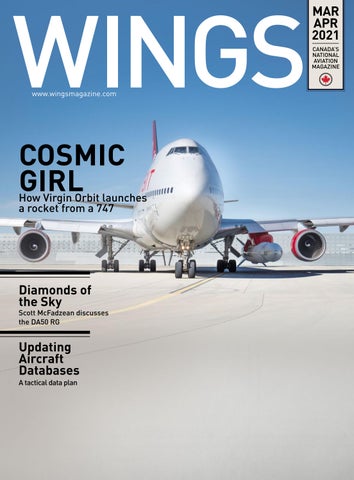
COSMIC GIRL
How Virgin Orbit launches a rocket from a 747
Diamonds of the Sky
Scott McFadzean discusses the DA50 RG
Updating Aircraft Databases A tactical data plan
MAR APR 2021 CANADA’S NATIONAL AVIATION MAGAZINE
PRAETOR 600: CERTIFIED OUTPERFORMANCE. The Praetor 600 — the world’s most disruptive and technologically advanced super-midsize aircraft that leads the way in performance, comfort and technology Unveiled at NBAA in October 2018 and now certified by ANAC, FAA and EASA, the Praetor 600 did not just meet initial expectations, it exceeded them. Named for the Latin root that means “lead the way,” the Praetor 600 is a jet of firsts. It is the first super-midsize jet to fly beyond 3,700 nm at M0.80. The first with over 4,000 nm range at LRC. The first with full fly-by-wire. The first with turbulence reduction capability. The first with a cabin altitude as low as 5,800 feet. The first with high-capacity, ultra-high-speed connectivity from Viasat’s Ka-band. And all of this, backed by a top-ranked Customer Support network. Learn more at executive.embraer.com/praetor600
L E ADING THE WAY
Come train at Near North Aviation!
With locations at the Parry Sound Area Municipal Airport and at York Airport in Haldimand, we are within close proximity to some of the province’s most treasured landscapes. Enjoy the benefits of learning to fly in low traffic airspace that is located only a short distance from Toronto.
Some of the programs available: • Training School • Commercial Pilot License • Private Pilot Licence program available • Flight Training program available • Instrument Meteorological Conditions program available Flight Training | Aircraft Maintenance • Multi-Engine Rating program available Charters | Aerial Tours | Aerial Survey • Night Rating on a Private Pilot program available With two Ontario locations:
Sound 705.378.0981 • Parry VFR Over-The-Top Rating| Hamilton program905.679.5577 available www.nearnorthaviation.com
COPA_NEAR_NORTH_Dec20_CSA.indd 1
Parry Sound 705.378.0981 Our new Location is now open! 400 Stoney Creek Road, Haldimand ON
2020-10-19 12:25 PM
www.nearnorthaviation.com
MARCH/APRIL 2021
UPFRONT 8 Leading Edge
Air taxi potential, from legacy airlines to start-ups
10 On The Fly
Flair invests in 737 Max, Learjet production, and Magellan engine support
14 Alternate Approach
Back off Brussels, danger of foreign regulator interferance
15 Position Report
Cosmic Girl is a former passenger 747-400 transferred to Virgin Orbit in 2017 for rocket-launching modifications.
NASA’s rover lands in a crater named after a Balkan village
BACK 31 ATAC Report 32 Marketplace 34 On Final
Suzanne Kearns on driving change through aviation collaboration
From the top: The Conair Fire Boss being worked on in Abbotsford, BC. P. 28. Diamond Aircraft’s new DA50 RG will soon be built in London, ON. P. 24
FEATURES 16 UPDATING AIRCRAFT DATABASES
How to develop a tactical aircraft data update plan with Digital Flight Deck integration BY PHIL LIGHTSTONE
20 COSMIC GIRL
Virgin Orbit launched a rocket from a plane – here’s how they did it BY SIMON LINDSAY
22 FERRYING AIRCRAFT DURING COVID-19
The ever-changing rules for pilots who move planes cross country and across the border BY PHIL LIGHTSTONE
24 DIAMONDS OF THE SKY PHOTOS CONAIR (TOP); DIAMOND AIRCRAFT
Inside Canada’s piston aircraft powerhouse and the latest DA50 RG developments BY JON ROBINSON
28 CONAIR MODIFICATION
Specialty aircraft modifications in Canada for global amphibious aerial firefighting BY SHANNON DE WIT
COVER PHOTO: VIRGIN ORBIT
WWW.WINGSMAGAZINE.COM
March/April 2021 | WINGS
5
Stay in Touch with Aviation News
Vol. 62, Issue 2 READER SERVICE
SUBSCRIBE
Print and digital subscription inquires or changes, please contact Jay Doshi, Audience Development Manager Tel: (416) 510-5124 Fax: (416) 510-6875 Email: jdoshi@annexbusinessmedia.com Mail: 111 Gordon Baker Rd., Suite 400, Toronto, ON M2H 3R1
Online
EDITOR
Jon Robinson jrobinson@annexbusinessmedia.com 647-448-6188
TODAY
FLIGHT DECK
David Carr, Shannon De Wit, Robert Greenberg, Suzanne Kearns, Phl Lightstone, Simon Lindsay, Carroll McCormick, NATIONAL ACCOUNT MANAGER
Mena Miu mmiu@annexbusinessmedia.com • 416-510-6749
wingsmagazine.com/subscribe
ACCOUNT CO-ORDINATOR
Barb Vowles bvowles@annexbusinessmedia.com • 416-510-5103
Magazine
MEDIA DESIGNER
Brooke Shaw
Weekly E-Newsletter
GROUP PUBLISHER/VP SALES
Martin McAnulty mmcanulty@annexbusinessmedia.com
Digital Edition
WINGS www.wingsmaga
zine.com
COO
Scott Jamieson sjamieson@annexbusinessmedia.com
MAR APR 2021 CANADA’S NATIONAL AVIATION MAGAZINE
WINGS MAGAZINE
COSMIC GIRL
P.O. Box 530, 105 Donly Dr. S., Simcoe, ON N3Y 4N5 Tel: 519-428-3471 Fax: 519-429-3094 Toll Free: 1-888-599-2228
How Virgin Orb it launches a rocket from a 747
Diamonds the Sky of
Scott McFadzean discusses the DA-52 RG
Updating Aircraft Databases
Leveraging digita l
flight decks
Printed in Canada ISSN 0701-1369 PUBLICATION MAIL AGREEMENT #40065710 Published six times per year (Jan/Feb, Mar/Ap, May/Jun, Jul/Aug, Sep/Oct, Nov/Dec) by Annex Business Media SUBSCRIPTION RATES Canada – 1 Year $ 34.50 (plus GST - #867172652RT0001) USA – 1yr -$ 78.50 CDN (USD $60.50) International – 1yr - $90.50 CDN (USD $69.50) Occasionally, Wings magazine will mail information on behalf of industry-related groups whose products and services we believe may be of interest to you. If you prefer not to receive this information, please contact our circulation department in any of the four ways listed above.
Air Transport Association of Canada
ON THE
WEB
6
WINGS | March/April 2021
WG_CircAd_MrApr21_MLD.indd 1
Canadian Business Aviation Association
Annex Privacy Office privacy@annexbusinessmedia.com • Tel: 800.668.2374 No part of the editorial content of this publication may be reprinted without the publisher’s written permission. ©2021 Annex Publishing & Printing Inc. All rights reserved. Opinions expressed in this magazine are not necessarily those of the editor or the publisher. No liability is assumed for errors or omissions. All advertising is subject to the publisher’s approval. Such approval does not imply any endorsement of the products or services advertised. Publisher reserves the right to refuse advertising that does not meet the standards of the publication.
Magazines Canada
Visit Annex Business Media's group of brands focused on all aspects of Canada’s aviation and aerospace sectors, including Wingsmagazine.com, Helicoptersmagazine.com and UAVCanada.com. Annex is also the publishing partner of COPA, providing news and marketplace content through COPAnational.org and Canadianplanetrade.ca. WWW.WINGSMAGAZINE.COM
2021-03-01 2:30 PM
LEADING
EDGE
By Jon Robinson |
eVTOL main street investment
Weeks of air taxi potential from legacy airlines and aircraft start-ups
J
5 8
WINGS | March/April 2021
Bell explains the alterJoby is developing a four nate platform operates with passenger, plus pilot, eVTOL, with the same architecture and propulsion system of its tailthe goal of operating an airsitter aircraft but utilizing a taxi service as early as 2023. different airframe. The purfor vertical-lift electrification. Nowhere has this been more evident than in Mirabel, Quebec, where Bell Textron Canada is playing a lead role in the transformation. In December 2020, this effort was showcased with the public debut of its Electrically Distributed Anti-Torque (EDAT) system, which will not be market-ready for several years, but at the same time serves as a precursor to the hybrid-electric potential in commercial-grade helicopters. Bell’s Mirabel facility is also pushing the envelope of Remotely Piloted Aircraft Systems, which in January included running flight tests for the first alternate configuration of the company’s Autonomous Pod Transport (APT). The testing was conducted on December 11 at Mirabel in collaboration with ARA Robotics.
TOP DATA BURSTS… in this issue 1. Challenger 350 is GAMA’s medium category leader for a 7th consecutive year. (P. 11) 2. Canadian airlines operate more than two thirds of all seats over the north Atlantic. (P. 14) 3. Cosmic Girl launched 10 NASA satellites from a height of 11 kms. (P. 20) 4. Conair’s Fire Boss can pick up to 800 gallons of water. (P. 28) 5. Before Covid, nearly 70% of current pilots have never faced unemployment. (P.34)
pose of the project, according to Bell, was to explore variations in the design and evaluate changes in performance, autonomy and user interactions. Airbus Helicopters in January updated in-flight tests being performed on board its Flightlab demonstrater, described as a platform-agnostic flying laboratory dedicated to maturing new technologies. Airbus explains Flightlab provides an agile and efficient testbed to quickly test technologies that could later equip Airbus’ current helicopter range, and even more disruptive ones for future fixed-wing aircraft or eVTOL platforms. In late-February, California-based Archer Aviation, led in part by the former chief engineer on Airbus’ Vahana eVTOL program, announced plans to launch its first UAM network in Los Angeles by 2024. Just days earlier, Archer, which is still to unveil a prototype, received a boost from United Airlines with a deal to purchase up to 200 Archer eVOTLs to help customers in urban areas reach the airport. That announcement surrounded Archer’s plans to go public through a special purpose acquisition company (SPAC) to help generate funds for its eVTOL development. This move mirrors another SPAC creation by the founders of Joby Aviation. | W WWW.WINGSMAGAZINE.COM
PHOTO: JOBY AVIATION
oby Aviation in December 2020 reached an agreement to acquire Uber Elevate as part of a larger transaction that sees the parent company of the latter, Uber Technologies, invest another US$75 million into Joby. Uber previously made an undisclosed US$50 million investment in Joby as part of a Series C financing round in January 2020. Full financial terms of the acquisition were not disclosed, but the transaction speaks to the ongoing push to develop vertical-lift aircraft with revolutionary electrification – hybrid or full – propulsion. Joby is developing a four-passenger, plus pilot, eVTOL with the goal of operating an air-taxi service as early as 2023. Founded in 2009 and headquartered in Santa Cruz, California, Joby has raised US$820 million in investment to date and employs more than 500 people. The company projects building an electric aircraft that reaches 150 miles on a single charge with a top speed of 200 mph. A key part of the transaction will see the two parent companies Joby and Uber integrate their respective services into each other’s apps, with the goal of integrating ground and air travel for future customers. Established in 2016, Uber Elevate played a significant role in laying the groundwork for a potential aerial ride-share market by bringing together regulators, civic leaders, real estate developers and technology companies around a shared vision. Several technology plans, including eVTOL aircraft, hardware and software, were announced at what were initially annual Uber Elevate conferences. Pushed by the attention afforded to Uber Elevate, most major helicopter manufacturers moved from watching the eVTOL revolution to building their own platforms
The ultimate resource to buy and sell within Canada’s aviation community From parts and planes to helicopters and hangars, Canadian Plane Trade is the easiest and fastest way to search the aviation marketplace. Post your ads to Canadian Plane Trade through a range of costeffective online and print packages.
CANADIANPLANETRADE.CA
COPA members receive a 10% discount
POWERED BY THE CANADIAN OWNERS AND PILOTS ASSOCIATION
UPCOMING PRINT DEADLINES: MARCH – FEB 5, 2021
APRIL – MARCH 5, 2021
MAY – APRIL 9, 2021
PACKAGES AVAILABLE BUDGET
STANDARD
PREMIUM
ULTIMATE
Regular positioning 1 photo online No video No photo in magazine Up to 35 words printed in magazine 100% secure
Regular positioning 6 photos online No video 1 photo(s) in magazine Up to 35 words printed in magazine 100% secure
$45
$80
Featured positioning 9 photos online 1 video 1 photo(s) in magazine Up to 75 words printed in magazine 100% secure
Featured positioning 12 photos online 1 video 1 photo(s) in magazine Up to 125 words printed in magazine 100% secure
$95
$120
FOR 30 DAYS
FOR 30 DAYS
FOR 30 DAYS
FOR 30 DAYS
ON THE FLY For late-breaking news and exclusive web content, please visit us at www.wingsmagazine.com
COMMERCIAL BUSINESS AVIATION MILITARY AME
THE LEAD
WESTJET REINTRODUCES BOEING 737 MAX IN CANADA WestJet on January 21 made the first commercial-passenger return of a Boeing 737 MAX in Canadian airspace after the aircraft was grounded worldwide nearly two years ago. The flight, WS115, departed in the morning from WestJet’s home base at Calgary International for Vancouver International. Flight WS122, would then return to Calgary departing at noon. “The return of WestJet’s MAX aircraft to the fleet marks an operational milestone after 22 months of intense review,” said Ed Sims, WestJet CEO, in a statement. Sims was one of 71 people on board flight WS115, which also included Chris Burley, WestJet board chair, and Chris Rauenbusch, president, CUPE Local 4070 and a member of WestJet's Inflight team. The aircraft was piloted by Captain David Colquhoun, WestJet master executive council chair, Air Line Pilots Association (ALPA), and Captain Scott Wilson, vice ,president of WestJet Operations.
“For nearly two years, ALPA has been working tirelessly with Transport Canada, international regulators, and airline management on reviewing the MAX and the revised pilot training requirements needed to safely return this aircraft to service,” said Colquhoun, in a statement. “No one knows better than airline pilots what is needed to be adequately prepared and trained to manage the handling qualities of this renewed aircraft. Today, as we usher the safe return of the MAX in Canada, ALPA will continue to provide its expertise and voice of safety in future discussions.”
COMMERCIAL
PAL, DE HAVILLAND MOU FOR MISSIONIZED DASH 8 PAL Aerospace and De Havilland Aircraft of Canada entered a Memorandum of Understanding to pursue the development of a fully missionized Dash 8-400 aircraft. Named the Dash 8 P-4, it is designed for maritime patrol, intelligence, surveillance and reconnaissance, as well as other applications. Modified with auxiliary fuel tanks, the Dash 8 P-4 will have superior range, endurance and time-on-station. PAL Aerospace and De Havilland Canada believe there exists a significant global market for missionized turboprop aircraft, especially in the MPA and ISR market. In combination with PAL Aerospace’s
The fully missionized Dash 8 P-4 is to feature auxiliary fuel tanks to provide superior range.
demonstrated global capability as a fullservice provider of specialized aircraft modification, technology integration and special missions operation, the companies explain the Dash 8 P-4 promises to deliver a unique value proposition for clients with MPA and ISR programs. PAL Aerospace and De Havilland Canada are currently working together to offer a comprehensive Dash 8 P-4 MPA solution for the Royal Malaysian Air Force’s ongoing maritime surveillance aircraft procurement. This new collaboration affirms commitments from both PAL Aerospace and De Havilland Canada to continue the development of multi-role, MPA and ISR configurations for the Dash 8-400 aircraft. The two companies will continue to cooperate in business development and marketing activities while fortifying long-term support, developing training capacity and combining resources for aircraft performance. The MOU shortly followed news on Feb. 18 that the first of Fisheries and Oceans Canada’s (DFO) Dash-8 aircraft became operational. In 2019, Fisheries and Oceans Canada in 2019 awarded a five-year, $128 million contract with PAL Aerospacelocated in St. John’s to deliver a new fleet of four aerial surveillance aircrafts, including two long-range maritime patrol Dash 8-100 aircraft. The contract also includes two King Air 200 aircraft, which became operational in September 2020 with one based in Halifax, NS, and another based in St. John’s, NL.
FLAIR INVESTS IN 737 MAX, PLANS TO ADD DOMESTIC ROUTES Boeing’s 737 Max aircraft returns to Canadian airspace on Jan. 21 with WestJet flight 115 departing Calgary International bound for YVR, piloted by Captains David Colquhoun (left) and Scott Wilson. 10 WINGS | March/April 2021
Ultra-low-cost carrier Flair Airlines in lateJanuary announced plans to expand its WWW.WINGSMAGAZINE.COM
PHOTOS: WESTJET (LEFT); AIR TRANSAT (TOP)
10 11 11 13
fleet, currently consisting of Boeing 737800 NG aircraft, with the addition of 13 737 MAX 8 airplanes. These new aircraft will be configured to seat 189 passengers and fly 3,550 nautical miles (6,570 km). Flair explains it will lease the initial 13 aircraft from 777 Partners, which recently entered into an agreement with Boeing for 24 737-8 aircraft along with options to purchase another 60 such aircraft. Flair’s new management team, led by Stephen Jones and new COO Garth Lund, both formerly of Wizz Air, expect to begin accepting delivery of the MAX aircraft in early 2021. Flair states, with this order, it is well on the way to achieving its “F50” goal of growing to 50 planes within five years. Flair then unveiled plans to expand its service to a total of 18 Canadian destinations by summer 2021. Service to four of the new destinations is scheduled to begin this May, including: Ottawa, KitchenerWaterloo, Halifax, and Saint John. Flair then plans to add service in June to Thunder Bay and Charlottetown; in July to Victoria; and in August to Abbotsford. “Canadians have been paying too much for too long, and we are changing that with our ULCC model that makes getting around Canada affordable,” said Flair CEO Jones, in a statement. “Providing affordable air travel within Canada is the first step in restarting travel and tourism.”
BUSINESS AVIATION
BOMBARDIER TO END LEARJET PRODUCTION
PHOTOS: FLAIR AIRLINES (BOTTOM); BOMBARDIER (TOP)
Bombardier in mid-February reported its fourth quarter and full year 2020 results, noting plans to reduce its overall workforce by about 1,600 jobs in anticipation
Bombardier’s Learjet 75 Liberty entered service in October 2020.
of a long aviation-industry recovery, in addition to consolidating Global aircraft completion work in Montreal. The company also stated it would end production of the Learjet in the fourth quarter of 2021, in an effort to focus on more profitable Global and Challenger business jet families. More than 3,000 Learjets have been delivered since its entry-into-service in 1963 and Bombardier will continue to service the aircraft. Bombardier’s Wichita facility, where the Learjet is produced, will continue to serve as the company’s primary flight-test centre and remain as a key part of its global services network. In addition, Bombardier has designated Wichita as the Centre of Excellence for its specialized aircraft business and expects the facility will play a leading role in future special mission modification contracts. Before the end of February, Bombardier’s Challenger 350 aircraft was reported as the most-delivered medium category business jet in 2020, according to General Aviation Manufacturers Association’s annual shipment and billings report. This makes the Challenger 350 the medium category leader for a seventh consecutive year. General Aviation Manufacturers Association’s
(GAMA) report also shows Bombardier outpaced its competitors by delivering 44 aircraft in the fourth quarter of 2020. This accomplishment, notes Bombardier, was driven by a record 16 Global 7500 business jet deliveries in that timeframe. In 2020, Bombardier announced a firm order for 10 Challenger 350 aircraft in a transaction valued at US$267 million and also marked the 350th delivery of the Challenger 350 business jet, a milestone reached after only seven years in service.
MILITARY
MAGELLAN MOU TO SUPPORT GE ENGINE UNDER BOEING’S FUTURE FIGHTER BID Magellan Aerospace Corp. signed a Memorandum of Understanding with General Electric Aviation Canada for the purpose of exploring an arrangement whereby GE Canada would support Magellan in establishing and delivering a Canadian-based sustainment solution for the GE F414GE-400 engine, which powers Boeing’s F/A-18 Block III Super Hornet fighter jet. Magellan states this initiative is in support of Boeing’s proposal to provide the Block
Flair Airlines invested in the lease of 13 new Boeing 737 MAX aircraft and anticipates opening it ULCC domestic service to 18 routes by summer. WWW.WINGSMAGAZINE.COM
March/April 2021 | WINGS
11
ON THE
FLY
III Super Hornet to Canada under the ongoing Future Fighter Capability Project (FFCP) competition – aiming to update
12 WINGS | March/April 2021 WG_Diamond Aircraft_REV_March21_MLD.indd 1
provides engine R&O and fleet management services for the F404 engine that powers Canada’s existing fleet of CF-18 Hornet aircraft and is an approved source for F404 and J85 engine repair.
F-15EX FIRST FLIGHT The new Boeing F-15EX fighter jet completed its first flight on Feb. 2, 2021, paving the way for what the aircraft manufacturer describes as the early delivery of the first two jets to the U.S. Air Force later this quarter. The F-15EX took off from St. Louis Lambert International Airport and completed a 90-minute test flight before returning to the airport. Boeing explains F-15 Chief Test Pilot Matt Giese checked out the multirole jet’s avionics, advanced systems and software. A test team monitoring the data collected during the flight, according to Boeing, confirmed that the aircraft performed as planned. Boeing explains the fighter’s digital backbone means it can serve as a testbed
WWW.WINGSMAGAZINE.COM 2021-02-22 10:27 AM
PHOTOS: GE AVIATION (LEFT) MOHAWK COLLEGE (RIGHT)
Magellan would build a domestic program to provide all aircraft engine sustainment services for the RCAF on a GE F414 engine fleet.
the country’s fighter jet fleet with 88 newgeneration aircraft. Under this Memorandum of Understanding (MOU), and with the selection of the Super Hornet for the FFCP, GE Canada and Magellan would develop a domestic program to provide all aircraft engine sustainment services for the Royal Canadian Air Force (RCAF) on its F414 engine fleet. The in-country depot level sustainment support for the engines, explains Magellan, includes onsite maintenance, repair and overhaul (MRO) support services, technical services, and engineering support and would be performed in Magellan’s facility in Mississauga, Ontario, for the life of the program. This engine sustainment work for Magellan aligns with the objectives outlined in Canada’s ITB requirements under the FFCP competition. Magellan notes it and GE Canada have fostered a successful relationship spanning more than five decades. Magellan’s Mississauga facility currently
for future technology insertion. Modern variants of the F-15 also include fly-bywire flight controls, an all-new digital cockpit, modern AESA radar and the ADCP-II, described by Boeing as the world’s fastest mission computer. The F-15EX features the Eagle Passive/Active Warning and Survivability System electronic warfare system. In July 2020, the Air Force awarded Boeing a contract to build the first lot of eight jets. Future plans call for as many as 144 aircraft.
AME
MOHAWK OPENS CENTRE FOR AVIATION TECHNOLOGY Mohawk College held a virtual event on Feb. 9 to officially open its Centre for Aviation Technology, bringing together all of the college’s aviation programs into one facility. The new 75,000-square-foot complex is housed in one facility in an airside
Mohawk’s new facility at John C. Munro Hamilton International Airport includes a hangar, expanded MRO facilty, and piston and turbine engine labs.
hangar at John C. Munro Hamilton International Airport. The three-storey facility provides students with modern labs, shops, training aids, classrooms and access to nearly 20 aircraft, doubling the student enrolment capacity for the college’s aviation programs. The Centre for Aviation Technology was
built in cooperation with KF Aerospace, which recently constructed an expansion of its aircraft maintenance, repair and overhaul facility. The Mohawk and KF Aerospace buildings are connected by common areas, providing Mohawk students with the opportunity to gain handson experience, working side-by-side with certified tradespeople in placements and experiential learning opportunities in a hangar adjacent to their classes and labs. Previously, aviation students in the Aviation Technician – Maintenance, Aircraft Structure and Avionics Maintenance programs were trained at four different college locations, with a total limit of 175 student seats available. Features of the new facility include: The only 737 NG Virtual Maintenance Training system at a Canadian College; turbine and piston engine labs; hangar space for 20 static aircraft, including a Sikorsky helicopter and Falcon jet; and outside space for operational planes, including a Boeing 727; and enrolment capacity for 350 students. | W
al250 ALL YOUR PISTON AIRCRAFT IN ONE COMPACT SIMULATOR
WE HAVE YOUR TRAINING NEEDS COVERED BE ONE STEP AHEAD INNOVATION IS IN OUR DNA
US BASED SERVICE FROM SINGLE PACKAGES TO FULL SERVICE CONTRACTS
FINANCING OPTIONS AVAILABLE
REAL GARMIN
WANT A DEMO?
WWW.WINGSMAGAZINE.COM WG_Alsim_MarApr21_CSA.indd 1
TC LEVEL 2-IPC
CONTACT@ALSIM.COM
ALSIM.COM TEL: +1 877 594 7426
450+ CERTIFIED SIMS 350+ CLIENTS 60+ COUNTRIES SINCE 1994
March/April 2021 | WINGS 13 2021-02-19 10:11 AM
ALTERNATE
APPROACH By David Carr |
Back off Brussels
The consequences of foreign regulator interference on national interests
I
14 WINGS | March/April 2021
regulatory authority not to have given acquisition approval when Boeing walked away from the deal. In 2001, the commission rejected GE Aviation’s proposed takeover of Honeywell International. There was little overlap between GE and Honeywell in the U.S. and the acquisition would have rebalanced GE’s industrial and financial portfolio, but a deal between two American firms would have reduced competition within the European Union. Foreign regulators bigfooting into deals negotiated in someone else’s backyard is the price of globalization. It can be messy, especially in areas of national pride. Or even groceries in the case of the French government blocking Quebec’s Couche-Tard’s (Circle K in the rest of Canada) proposed takeover of Carrefour, the world’s third largest grocer. Boeing was eyeing an exit from the Embraer deal before Europe delayed its decision. Air Transat will survive regardless of what the Europeans decide and whether or not Air Canada has lost interest. Premier Francois Legault’s roots with Air Transat run deep as a co-founder. Pierre Karl Peladeau, chief executive of media giant Quebecor, is still interested, and can a bid by WestJet be ruled out. But is it too much to ask that when ruling on the fate of offshore deals that European regulators respect local deadlines? | W
Canadian airlines operate more than two thirds of all seats over the north Atlantic. Air Canada has the lion’s share even without air transat. imbalance, Europe only has itself to blame. As Canadian airlines targeted Europe, Canada was an afterthought for European airlines more focused on the huge American market. It is much the same formula that “little KLM” used to become a global powerhouse in the 1950s and 60s. Air Canada has played its hand well. Still, 60 per cent market share, and up to 67 per cent on a choice route such as YYZLondon is pause for concern in any sector; and it is unlikely the Competition Bureau would have been as laissez-faire over the deal if both sides had not been battered by Covid. But what of Europe? Brussels suspended its investigation into the merger for three months in June as it waited on more data. And missed the February 15 deadline for the deal to be completed entirely. There’s nothing new here. The European Commission delayed its decision on the US$4.2 billion Boeing-Embraer tieup, which had been in response to Airbus taking over the Bombardier C-Series program. The commission, whose members have a direct stake in Airbus, was the only
WWW.WINGSMAGAZINE.COM
PHOTO: AIR TRANSAT
t is tough to shake off the sense that if it were Air France/KLM rather than Air Canada acquiring Transat AT through an ownership model, similar to what German leisure company TUI has with Sunwing, this deal would have sailed through Europe’s regulatory waters without delay. It may have been a different story in Canada, where the competition bureau approved the Air Canada Transat deal with cosmetic conditions that micro-manage in scope but fail to address that the merged airline would control almost 60 per cent of the CanadaEurope market. Or would have pre-Covid. Next closest is Star Alliance partner Lufthansa with just over six per cent. WestJet is not happy: “It is hard to imagine a deal as anti-competitive in any industry where the number one player buys number three without meaningful remedies,” Ed Sims, WestJet’s chief executive stormed in a statement. He has a point. Air Canada was given a skate. Keep the head office and heavy maintenance in Quebec where feasible, employ at least 1,500 in the “leisure travel business” and open new routes in the first five years. Hardly a burden for an industry whose reason for being is to build markets by putting metal between city pairs. Bureaucratic lip service to competition was paid, including “monitoring” fare prices and encouraging other airlines to fly former Transat European routes, however that works. Nothing about giving up slots or preventing Air Canada from rolling Air Transat into Aeroplan. WestJet can’t scupper the deal. At this stage only the Europeans can, and regulatory delays have already put this all-Canadian merger on thin ice. Airline mergers rarely deliver the two complete sides of the whole. WestJet’s growth post the Air Canada/Canadian Airlines merger is proof of that. With 4.4 market share over the north Atlantic, WestJet has room to grow, whereas a combined Air CanadaAir Transat will likely fight to keep the 60 per cent it holds. Air France was planning a Canadian expansion before the outbreak. Canadian airlines operate more than two-thirds of seats over the north Atlantic. Air Canada has the lion’s share even without Air Transat. If European regulators (versus European airlines) don’t like the
POSITION
REPORT
| By Robert Greenberg
Origins of Jezero
How NASA’s new rover came to land in a crater named after a Balkan village
PHOTO: NASA/JPL-CALTECH/MSSS/JHU-APL/ESA
T
he world was excited by the news last week that NASA’s Perseverance rover had successfully landed in a Martian crater. The rover will now set about collecting samples from what scientists say was an ancient lake fed by a river. The name of this exotic Martian crater is Jezero. As a South Slavic linguist, I immediately recognised the word. In several former Yugoslav countries, including Bosnia and Herzegovina, Croatia, Montenegro, Serbia and Slovenia, “jezero” (pronounced “yeh-zeh-ro”, with the stress on the first syllable) means lake. Fair enough – but why a Balkan lake on Mars? The task of providing names for places of interest on Mars falls to the International Astronomical Union (IAU). They apparently named the Martian crater Jezero in 2007, well before earthlings had paid any attention. I later discovered the name was not, in fact, intended simply as a generic “lake”, but refers to a specific village called Jezero. With a population around 500, it is located in western Republika Srpska, the Serb-dominated part of Bosnia and Herzegovina. It is very near a river-fed lake called Veliko Plivsko Jezero, or Great Plivsko Lake. According to the Balkan Insight news service, the mayor of Jezero first learned of NASA’s plans in a letter from the US ambassador in Bosnia and Herzegovina, informing her the village and its name were to be honoured by the spacecraft landing in the Jezero crater. The villagers apparently first dismissed this as fake news. But, to their later amazement, people all over the world have now been learning to pronounce Jezero properly. The landing was broadcast live at the village’s only school, with the Balkan Insight reporter describing the villagers as “star-struck” and justifiably proud of their connection to the mission. There was also cautious optimism about the prosperity that might flow from tourists discovering their sleepy hamlet (at least after the pandemic). Famous on Mars, might Jezero be celebrated on Earth as well?
WWW.WINGSMAGAZINE.COM
Will people quibble over whether the crater is named for the village or for its nearby lake, or any lake within the region? Or should all who say “jezero” feel proud the word is now in the global lexicon? During the time of Tito’s rule in Yugoslavia, such matters would not have been as contentious, since many people believed the dominant common language of the country was Serbo-Croatian. Ethno-nationalism was forbidden and people mostly got along. However, since the violent break-up of Yugoslavia, people in the newly independent states now speak separate languages: Bosnian, Croatian, Montenegrin and Serbian. Over the years, speakers of the four languages have slowly drifted apart, but they all agree a lake is called “jezero”. Further complications arise with peoples and governments even further afield. The Slovenes and Czechs also say “jezero”, and the Macedonian and Bulgarian form is the almost identical “ezero”. Any similarity between the landscape around Jezero in Bosnia and Herzegovina and the crater with the same name on Mars may end with the name. And I doubt the scientists at NASA or the IAU ever considered the potential implications of using a common word shared by so many nations to name an important site on Mars. But, as we know, words have power. It would be a shame if a distant, silent crater on another planet caused envy and resentment here on Earth. So far, however, the political situation in the Balkans remains almost as calm as that on Mars, and that is cause for hope.| W
The landing was broadcast live at the village’s only school, with the Balkan Insight reporter describing the villagers as “starstruck” and justifiably proud of their connection to the mission. The alternative to be avoided, one hopes, is that a minor Balkan conflict breaks out over language and designated names. Every one of the former Yugoslav countries can claim the word “jezero” in their respective dictionaries. And any traveller to the Balkans knows the region is rich with lakes. But only one village carries this generic word as its name. Was it politically advisable for one village in the Serb-dominated entity of Bosnia and Herzegovina to be singled out? For many, this part of the country is still associated with the nationalism and ethnic cleansing of the Bosnian war in the 1990s. How would the members of other communities in the country – Bosniaks (the country’s Muslim population) and Croats – respond? Could they support the Serbs of Jezero receiving such positive media coverage? As my book about the break-up of the Serbo-Croatian language explored, language rifts in the Balkans are endemic and have long been both a symptom of ethnic animosity and a cause for inflaming it.
This article was originally published by The Conversation. Robert Greenberg is Dean of Arts, University of Auckland, and a Professor of Linguistics. March/April 2021 | WINGS 15
UPDATING AIRCRAFT DATABASES
DEVELOP A TACTICAL AIRCRAFT DATA UPDATE PLAN WITH DIGITAL FLIGHT DECK INTEGRATION
A
BY PHIL LIGHTSTONE
viation and avionics have come along way over the past 20 years. The cluttered panels of endless analog dials and gauges of yesteryear have been replaced by a few flat glass (Primary and Multi Function Displays). Modern panel architectures and designs simplify and concentrate data enhancing the flight crew’s integration with the aircraft’s systems, taking workflow, 16 WINGS | March/April 2021
scans and ergonomics into consideration. For the purposes of this article “flight decks” (FD) will be used to encompass all aircraft systems which contain data and databases. Modern panels require updating software (applications running on the hardware), firmware (software instructions providing low level control of the hardware), and databases (an organized collection of data) over time. For example, chart, navigation and airport directory updates occur
WWW.WINGSMAGAZINE.COM
PHOTO: BAD ELF
Bad Elf’s Wombat is able to upload data from SD or USB directly into Cloud-based management tools.
every 14, 28 and 56 days, while terrain data is infrequently updated. Software updates released by the avionics manufacturer enhance hardware by resolving software bugs, improve performance and add new features. Firmware updates take software upgrades one step closer to the hardware layer of the avionics suite. Data from the aircraft systems can be downloaded from the FD to the cloud or a IT device for access by applications to facilitate day-to-day maintenance and troubleshooting. A variety of connections from physical cards, Wi-Fi, Bluetooth and satellite data networks can be used to offload data from the aircraft. Digitalized aircraft store data on their systems, which provides pilots, owners and mechanics insight into the operation and maintenance of the aircraft. Through reviewing and analyzing this increasing amount of data, owner/operators can improve the manner in which the aircraft is operated with the goal of protecting and improving the lifespan of critical systems like the engine and reducing the probability of Aircraft on Ground (AOG) time, impacting costs or lost revenue caused by hardware faults. Many digital instruments are, in fact, purpose-built computers, requiring updates essential to safeguarding their operation. Not unlike oil changes, owner operators should stay abreast with the maintenance upgrades and updates which the hardware manufacturers publish. FDs, instrument and database providers use a variety of technologies and applications to move data back and forth. Some country’s air navigation services will not allow an aircraft to depart into or transit through their airspace if the aircraft does not have the latest navigation databases installed. This can cause economic impacts as the aircraft is AOG while waiting for the update. As such, some flight departments avoid this economic and process challenge by equipping the aircraft with a laptop computer to facilitate the update process. Garmin FDs span a broad range of aircraft types, starting with its General Aviation-focused G1000 NXi flight decks to its G5000 integrated FDs focused on Business Aviation class aircraft. Garmin FD firmware and software upgrades are completed by Garmin factory repair centres or Garmin itself. Generically, the FD database update process may require a laptop or tablet computer. Various FD manufacturers and data suppliers, such as Jeppesen, have different requirements. Some flight departments leverage their maintenance personnel or flight crews to accomplish the update task. When the aircraft is away from its home
base, at the time the database update is due, flight crews will require a laptop, application login credentials and Internet connectivity. The logistics surrounding the update process should be considered. In a multi-aircraft and multi-crew scenario, for example, is the crew’s laptop used, is the laptop corporate issued (and controlled) or is a bring-your-own-device (BYOD) practice utilized? Does the crew have access to the database download Website? Does the database update device comply with your corporate IS/IT (information systems, information technology) security procedures and practices? From a corporate security perspective, what happens when crew turnover occurs? Should the airplane have its own laptop and what is the impact to total cost of ownership of the IT asset? These factors should be taken into consideration when developing and updating your tactical aircraft data update plan. Not only does the aircraft’s data driven systems require updating and managing, but so does the technology driving the update process. Many FDs allow for two copies of the databases to reside on the FD, the current databases and the next-time periods databases. Different FD, FMS and Nav/Com hardware use different processes and hardware (DVD, USB stick, Web, Microsoft Windows, Apple iOS, and SD Card) to facilitate the updating process. Once the new database update is downloaded to the medium supported by the specific aerospace hardware manufacturer, the updating process will be initiated on-board the aircraft. Download managers require minimum computer operating system requirements, with an outcome of more computer hardware to keep up to date or replace. Aircraft database containers add more complexity to managing the fleet’s databases. For example, Garmin’s GNS 530/430 data cards are proprietary, use a non-standard writer and have three different card types, denoted by Green, Silver and Orange labels, based upon the specifics of the GNS530/430 (WAAS and non WAAS). Jeppesen’s Skybound writer adapter is tied to the type of cards. A Skybound G2 silver tagged adapter is not able to update Garmin orange data cards. Garmin’s USB Aviation Data Card Programmer will program Garmin navigation, obstacle and terrain databases, but is not compatible with Apple’s Mac operating systems or Jeppesen Skybound adapter, adding more complexity to the process. Many aerospace manufacturers have created applications to facilitate laptop and tablet integration into their panels to support the uploading and downloading process. Garmin’s database Concierge, part of its Connext ecosystem, utilizes an iPad or Android device running Garmin Pilot to push database updates to its GTN or GTN Xi series touchscreen navigators and FDs. Wi-Fi or Bluetooth integration into its avionics suites is accomplished with Garmin’s Flight Stream 510 multimedia card. Bad Elf ’s Wombat is designed to make the updating process simpler on specific aircraft hardware. The Wombat is a piece of hardware, about the size of a power vault. With USB, SD card ports and an App, flight crews are able to update their aircraft systems without the necessity of bringing the cards back to base, relying on a laptop or the airport’s Wi-Fi connections. Using Jeppesen Distribution Manager Mobile, update files can be downloaded onto a tablet at home, hotel or the office using a high-speed connection. At the aircraft, simply pop the card out of the navigator and insert it into the slot on the Wombat. For Garmin 530/430s, the Jeppesen Skybound adapter will be required. The Wombat and JDM Mobile will not update Garmin obstacle and terrain databases. The Wombat is a multi-tool product, which is able to upload data from SD or USB sticks directly into Cloud based management tools like Savvy Analysis, MyTBM and Cirrus Reports. Wombat for piston aircraft retails for US$249.99 (one-year warranty) and $499.99 (threeyear warranty) for the turbine version. Electronic Flight Bags (EFB) and their hardware should be considered as part of the aircraft’s digital update process. EFB applications like ForeFlight, Garmin Pilot, WingX and portable GPS, should be updated before you fly. The amount of data to be
downloaded will depend upon the states, provinces, and chart types selected in the EFB. As an example, ForeFlight would require 63 GB of storage space to store The America’s and Europe. The initial download would require 1.5 hours at 100 Mbps, but all subsequent data cycles will require significantly smaller download sizes due to ForeFlight’s Delta Downloads process: By only downloading the charts that have changed with the new cycle, ForeFlight can reduce the size of subsequent downloads to 20 per cent or less of the original. If you do not plan on downloading all of the U.S. or Canada, a good rule of thumb for the U.S. is that each state requires, on average, 480 MB to download all content. Larger states like Texas or California will require more space, and Alaska alone takes up around 4.5 GB of space. Canada requires, on average, 950 MB per province or territory with all available items selected. Larger areas like Nunavut will take up about 3.5 GB of space. Foreflight’s pack feature analyzes your route of flight and downloads only the charts and data required for the flight which have changed. For a one-time cross-country flight, iPad space can be efficiently managed through downloading only the databases required for the flight. Executing the download process when the flight crew has access to a high-speed, quality broadband Internet connection will allow the updating process to run quickly without loss or corruption of data. Most EFBs, FD and FMS systems allow the current and next database cycle to be stored, permitting convenient access to high speed broadband networks to be used to accomplish the next cycle’s download. Keeping your aircraft’s avionics, digital instruments and smart device’s data, operating system and applications up to date is a fundamental safety requirement. Having up-to-date information in the cockpit is not only a regulatory requirement, but improves the probability of a safe outcome. | W
March/April 2021 | WINGS 17
WWW.WINGSMAGAZINE.COM WG_GlobalAircraft_NovDec20_CSA.indd 1
2020-11-09 1:21 PM
SPONSORED CONTENT
MOHAWK AND KF BUILDING AVIATIO A look inside Mohawk College’s new Centre for Aviation Technology By David Carr
C
Hamilton-based Mohawk College’s new Centre for Aviation Technology was built in partnership with KF Aerospace, a nose-to-tail heavy maintenance and modification specialist.
anada’s aviation industry had a shortage of aircraft maintenance engineers (AMEs) before Covid-19, and will contend with a deeper skills shortage as the industry pulls out of the pandemic at a time when experienced AMEs have jumped on the Covidhiatus to retire. For students considering a career in aircraft maintenance or aerospace manufacturing, the timing could not be better. While the deep impact of the pandemic will be felt for years to come, the importance of air transport and travel has been reinforced by the crisis and there is a great deal of optimism that the industry will resume its pattern of growth and expansion. Holding that long view is Hamilton-based Mohawk College of Applied Arts and Technology, which recently opened a new state-of-the-art Centre for Aviation Technology in a 75,000-square-foot hangar at the busy Hamilton International Airport. The state-of-the-art building, which is adjacent to KF Aerospace, an Okanagan, BC-based nose-to-tail heavy maintenance and modification specialist, enabled Mohawk to consolidate its Aviation Technician – Aircraft Maintenance and Aviation Technician – Aircraft Structures and Avionics programs, previously spread out over four campuses, under one roof. The new facility also allows Mohawk to house a fleet of 16 hands-on training aircraft, including a Falcon business jet, Sikorsky helicopter and a Boeing 727 cargo jet; and expand the college’s push into composites, the cutting edge of airplane structures manufacturing. Operating the Centre of Aviation Technology airside at one of Canada’s fastest growing passenger and cargo airports, alongside the country’s largest commercial mainten-
ance, repair and overhaul (MRO) provider, opens up a new world of opportunity for Mohawk students. “We hire avionics, mechanics and structural engineers. All of the programs that Mohawk offers,” says Grant Stevens, vice president of corporate services for KF Aerospace. “This gives students the opportunity to observe real-world work that’s going on and ask questions in real time. So, that as we grow the business, it is a natural progression for Mohawk grads to come next door and continue their apprenticeship with us.” Even during the pandemic, KF Aerospace finds itself on a growth trajectory. Hamilton has been a centrepiece of KF’s Canada-wide footprint for 25 years; and is the location for the company’s first wide-body maintenance hangar, which opened in November 2019. KF provides third-party maintenance for Sunwing, WestJet and Air Transat, as well as a growing number of international customers. KF had outgrown their original hangar built in 1995 and, looking to support wide-body aircraft, broke ground on an ambitious 150,0000-square-foot expansion. As one of the top aeronautical employers in Canada, KF puts a premium on creating job and education opportunities for apprentices to build their career and support its global reputation for service excellence. KF has a partnership with a local college at its MRO facility in Kelowna, BC, and Mohawk’s Centre for Aviation Technology was always part of the Hamilton expansion picture. But KF had to think bigger when they learned what the college had in mind. “It grew from carving out learning space in a new hangar to building the second hangar to support Mohawk’s vision,” Stevens explains. “It takes highly skilled people working on airplanes to keep our customers happy and safe,” he continues. “As an
F AEROSPACE, ON EXCELLENCE employer, we can’t complain that there aren’t enough students coming out of school for us to hire if we haven’t pitched in and helped to encourage people to think about a job in aircraft maintenance and get into school. At the end of the day, it’s about the jobs.” With MRO facilities Kelowna and Hamilton, KF can now support 19 lines of concurrent maintenance, including widebodies, and diversify into the lucrative aircraft modification market, including the conversion of passenger airplanes into dedicated freighters by installing cargo doors. “Our reputation for quality and on-time delivery is always exceptional,” Stevens says. “The expansion has allowed us to significantly improve customer service and slot availability. We already have the majority of Canadian airlines as customers, so the next expansion will be global.” “There is no better place to run an aviation program than at an airport,” George Miltenburg, Mohawk’s associate dean of engineering technology, points out. Mohawk is plugged into Hamilton’s air transport scene and many of the students in the aircraft maintenance programs have jobs at the airport loading cargo, refuelling and taxiing aircraft after class. The move to a state-of-the-art purpose-built facility has given Mohawk the coveted blank sheet of paper to build classrooms, labs, study halls and other facilities specific to needs of the industry for aviation maintenance, avionics and structures learning. The school holds Canada’s only L3Harris virtual maintenance trainer (VMT) for the Boeing 737-NG jet, the workhorse of airline fleets worldwide.This simulation-based training tool, used by Boeing itself, enables students to conduct virtual engine runs, troubleshoot mechanical and electronic systems, remove aircraft components and see the results of their work in real time. The new campus is also supporting Mohawk’s accelerated push into composite material manufacturing; and students will be involved with the research and development into one of the industry’s leading-edge technologies. “They are very forward thinking as they continue to grow their programs,” says Desirée Squires, an engineer and now the CEO of Sunset Renewables, a cleantech company that provides sustainable end-of-life solutions for the renewable energy industry. Previously, Squires studied aeronautical engineering and worked with composites for aircraft structures.Today, lighter weight composite material can make up approximately 50 per cent of a modern airliner like the Boeing 787. Materials for the program are supplied by Airbus Helicopters Canada, part of the world’s largest commercial aircraft builder. “Composites is a special area, because they’re more complex than traditional materials,” Squires says. “Offering these programs means that Mohawk students will be futureready.” Squires was recently invited to be part of the Centre for Aviation Technology’s program advisory committee and wants to focus on putting sustainability into the curriculum. “Mohawk is a big supporter of sustainability and they are
Mohawk’s Centre for Aviation Technology is housed in a 75,000-squarefoot hangar at the busy Hamilton International Airport.
already offering renewable energy training to students. It’s another new avenue of learning,” she adds. Connections with innovative players in the airline and aerospace sectors continues to fuel Mohawk’s aviation program development. “They have great insight into what’s going on in the industry,” says Robin Lovell, president of Comtek, a highly specialized manufacturer of advanced components and MRO supporting business jets and regional airplanes for 140 airline operators worldwide. Comtek began its ties with Mohawk a few years ago when the college was looking at a composite training program, and a couple of technicians were involved in helping to develop the program. Mohawk is a college where employers often go to snap up apprentices before they graduate. Covid has slowed that process, but Lovell is bullish on aviation’s resilience and the emerging need to back fill retired workers. “It’s going to be a challenging couple of years. But all of the hits aviation has taken over the years, it still continues on a doubling trend after each correction,” he says. “Going into the pandemic, one of the things that was driving growth in the job market was the ageing workforce. If anything, that has accelerated during Covid. Older people at the higher-end are exiting the industry sooner.We’re going to see the skills shortage open up pretty quick.” KF Aerospace will be ramping up operations at the Hamilton facility in the fall and expects business to be “red hot” by spring 2022, Stevens says. The new Centre for Aviation Technology and its important industry partnerships provide a built-in showcase for the future of Mohawk and the Canadian aviation industry. “One of the great strengths of our partnership with Mohawk is students and parents can see the training environment and working environment, have candid conversations with technicians and know that there are jobs and how much they will earn at the end of training,” Steven says. “That’s a winning formula and a solid platform to build a career on.”
Virgin Orbit on January 17, 2021, completed a successful launch demonstration with its LauncherOne rocket reaching space and deploying 10 payloads for NASA’s Launch Services Program.
FLYING THE COSMIC GIRL
VIRGIN ORBIT LAUNCHED A ROCKET FROM A PLANE – HERE’S HOW
E
arlier in 2021, 10 cubesats – small, cheap satellites weighing about a kilogram each – were sent into orbit around Earth. With almost 1,500 of these small satellites launched so far, adding another 10 might seem trivial. But this was no ordinary launch. Instead of lifting off from the ground, the rocket carrying these National Aeronautics and Space Administration (NASA) satellites was slung under the wing of a modified Boeing 747, called Cosmic Girl. The plane carried them to a height of 11km (6.8 miles) before launching the rocket. This milestone was the first successful launch of Virgin Orbit’s LauncherOne rocket, marking the start of its commercial ventures. The company hopes to provide cheap, flexible satellite launching services, without the need to use sites on the ground. BUT HOW DOES LAUNCHING A ROCKET FROM A PLANE ACTUALLY WORK? Usually, a rocket launched from a launch site on the ground will 20 WINGS | March/April 2021
have two or three stages, which allow the rocket to shed weight as it uses up fuel. The first stage is the part which ignites at launch, powering the rocket from the ground. When the rocket reaches a certain altitude, the first stage then separates, leaving the second to ignite. A third stage operates on the same principle and typically places the payload – the part we want to get into space – in its final orbit or interplanetary trajectory. When satellites are launched from a plane, the carrier aircraft functions as both a launch site and a reusable first stage of the rocket. Aircraft are more efficient than rockets at getting off the ground, but they cannot function without an atmosphere to generate aerodynamic lift. Air-launching takes advantage of this by attaching a rocket to an aircraft and releasing it at high altitude. As well as saving fuel getting off the ground, aircraft launches offer other benefits, including the costs of traditional rocket launches being repeatedly delayed by bad weather conditions. With an aircraft, it’s easy to change launch sites because it can WWW.WINGSMAGAZINE.COM
PHOTOS: VIRGIN ORBIT
BY SIMON LINDSAY
A former passenger 747-400 operated by Virgin Atlantic, Cosmic Girl in 2017 was transferred to the orbital launch subsidiary Virgin Orbit for modification.
take off from a commercial airport. Pesky weather conditions can simply be flown around, and different launch requirements for different spacecraft can easily be accommodated. THERE ARE LIMITS Of course, air-launching isn’t a perfect solution. The size of rocket is limited to the carrying capacity of the aircraft. A dedicated carrier aircraft may be able to carry much more, but for now there is not much scope for larger launchers. Stratolaunch, the developers of the enormous carrier aircraft of the same name able to carry a rocket weighing 250 tonnes, abandoned its heavy-lift launch vehicle program in 2019. For comparison, LauncherOne weighs 30 tonnes, and will only be used to carry small satellites. Launching a rocket 10 kilometres from the ground saves some fuel, but most of the fuel requirement to achieve orbit is not in gaining height, but getting it moving with enough speed so that it falls into orbit. While the flight speed of an aircraft can make a small contribution to this requirement, the fuel saving from air launch is not as large as it might first appear. A relatively small launch vehicle, LauncherOne, has the capacity to launch 500 kg into low earth orbit. Heavy-lift launchers like Ariane, Delta and Falcon can launch many times this weight, and will continue to be used for large satellites and interplanetary missions. But large, expensive launches aren’t Virgin Orbit’s target audience. For small satellites, cubesats, micro-satellites and nanosatellites – all of which are being rapidly adopted by the space industry – air launches could represent a significant improvement in versatility and, crucially, cost. WHAT’S NEXT? The idea of air launching has been around for some time. NASA launched a Pegasus rocket from a B-52 bomber as long ago as 1990. The Pegasus launch service is still operational and has completed 39 successful flights, but its launches are expensive and only four have been made in the last 10 years. In the short term, several launch contracts are already in place. Longer term, there are plans to expand the LauncherOne rocket with a third stage, which may be able to place smaller satellites – 50 kg or so – into much more distant orbits to fly past Mars or Venus. WWW.WINGSMAGAZINE.COM
There are not many other air launch programs in development. SpaceX abandoned an air-launched Falcon variant way back in 2012. The Pegasus launch vehicle still exists, but hasn’t launched since 2019. British aerospace company Reaction Engines aims to fully combine aircraft and spacecraft with the SABRE engine, which can function like a jet within the atmosphere and a chemical rocket in space. But this project has been delayed multiple times and may still be some distance from making its first commercial launch. As the provision of launch services moves ever more into the private sector, LauncherOne must make an economic case to survive in an increasingly competitive market. There aren’t yet many direct competitors for small individual launches like those offered by Virgin Orbit, although heavier launchers from more established companies such as SpaceX can compete by launching several small payloads on the same rocket. It remains to be seen if the system’s versatility and relatively low cost will win out. | W This article was originally published by The Conversation. In addition to working on MIXS, Simon Lindsay is a researcher in the School of Physics and Astronomy, University of Leicester. March/April 2021 | WINGS 21
FERRYING AIRCRAFT DURING COVID
THE EVER-CHANGING RULES FOR PILOTS WHO MOVE PLANES CROSS COUNTRY AND DOWN SOUTH
M
BY PHIL LIGHTSTONE
any General and Business Aviation pilot/ owners need to have aircraft ferried during COVID-19. Moving aircraft in a safe manner during a pandemic presents challenges, which are exacerbated by ever-changing regulations. The trip is much simpler if it’s a short flight between border cities like from Buttonville to Buffalo Niagara International (KBUF). Arranging ground transportation or a flight back to Toronto is more about logistics and cost. (This article includes information as of February 4, 2021, and is subject to change.) 22 WINGS | March/April 2021
A longer ferry flight, such as Toronto to Miami, will be much more complicated, especially if weather or the aircraft’s speed does not allow the ferry flight to occur in a single day. Ferry pilot Peter Zaccagnino, explains, “I think that everyone is confused about the rules and requirements. There is a lot of demand to ferry CJ aircraft to Europe, but the challenges have to be balanced against the reward. Over the past 15 years, on average, I visited 33 countries per year ferrying aircraft. In 2020, I went to zero countries.” Effective midnight February 3, 2021, in addition to proof of a negative pre-departure test, Transport Canada (TC) expanded
WWW.WINGSMAGAZINE.COM
PHOTO: PETER ZACCAGNINO
Before the pandemic, Peter Zaccagnino would typically ferry aircraft to more than 30 countries per year.
its existing international flight restrictions to funnel scheduled international commercial passenger flights into four Canadian airports including Montréal-Trudeau International, Toronto Pearson International, Calgary International and Vancouver International for both the airlines and part 604 operators. The new restrictions include scheduled flights arriving from the U.S., Mexico, Central America, the Caribbean and South America, which were exempted from previous restrictions. Business and charter flights from all countries will also be required to land at the four airports listed above. Refer to NOTAM G0082/21 for additional information. Aircrew are exempt from quarantine requirements and COVID-19 testing. However, with the current level of confusion, some airlines may not allow aircrew returning to Canada to board their flight without a COVID-19 test conducted in their country. The new NOTAM restrictions do not apply to aircraft operated in the following circumstances: Direct flight from Saintpierre-et-miquelon; medevac; ferry and crew repatriation; cargo flights carrying only aircrew or airline employees; technical stops where passengers do not disembark; at an alternate airport identified in a flight plan to address weather; aircraft safety situations; or in the case where special authority has been granted by Transport Canada. A crew member, as defined in subsection 101.01(1) of the Canadian Aviation Regulations, relates to a person who is assigned to duty in an aircraft during flight time, or assigned to duty related to the operation of a remotely piloted aircraft system during flight time. By definition, a ferry pilot is one who is compensated for the trip, typically paid an hourly or daily per diem, inclusive of expenses (fuel purchases, landing fees, tie down, hanger, de-icing, hotel and food). This certainly sounds like the requirement for the pilot to hold a commercial rating. If the pilot is not being compensated, other than cost reimbursement, then a private pilot could ferry the aircraft. There is a lot of confusion about the new rules, with more changes to come. Peter Campbell, director of external relations, Canadian Owners and Pilots Association, in discussions with TC Aviation Security has confirmed that private pilots who are “transporting themselves” back to Canada from a foreign country do not qualify as “aircrew”. Under the aggregated orders, a private pilot (flying for leisure) will be required to: clear customs at the current entry airports and are not restricted to the above four airports; have an accredited PCR test, conducted within 72 hours prior to arrival into Canada at either the point of origin in the foreign state, or at the last overnight stay prior to arrival in Canada; quarantine for three days at a federal government
approved hotel; and in Ontario quarantine for an additional 11 days at the final destination in Canada. Quarantine requirements (in addition to the federal three-day quarantine) varies by province. Private pilots on a leisure flight do not qualify for an exemption from the negative test requirement, as they are not deemed to be acting as aircrew. New Health Canada rules that came in midFebruary apply to all aircraft operators, including private (recreational, not for hire) aircraft owners and operators. From a ferry pilot’s perspective, Public Safety Canada defines “Air transportation employees, including pilots, flight attendants and flight crew, air traffic controllers, ramp personnel, aviation security, and aviation management” as essential service workers. To facilitate the process at the border, a letter of authorization (LoA) as an essential service worker is a recommended document for a freelance ferry pilot to have in hand. The LoA would come from the company employing the ferry pilot. For freelance ferry pilots new to the business, the acquisition of a LoA may be more challenging. Resourcefulness is part of the core DNA of most ferry pilots – at least the good ones. Anthony Norejko , CEO of Canadian Business Aviation Association, explains, “There can be confusion with the local
CBSA officials as to how the rules apply to business aviation operators, especially when the rules are quickly put into force. This adds complications and added to costs for flights to and from the U.S.” Starting January 7, 2021, flights into Canada required passengers and leisure pilots to have proof of a negative PCR COVID-19 test. The new Canadian federal requirements, beginning Feb. 3, 2021, required passengers and leisure pilots to quarantine at a federally approved hotel for three days, (initially suggesting a cost of $2,000) upon entering Canada. For passengers, aircrew and leisure pilots, the ArriveCAN process must be used to provide mandatory travel information on and after your entry into Canada. In the case of aircrew, the quarantine details are not required. If you’re not able to use the ArriveCAN app, you can submit your information online. Failure to submit your information could cause delays at the border and/or be subject to an enforcement action, from a verbal warning to a fine of $1,000. According to TC, “A pilot operating an aircraft under CAR 604 is considered a crew member and therefore not required to have a negative COVID-19 molecular test within 72-hours of their flight into Canada. Depending on when they are next expected
to return to duty, however, the flight crew operating a CAR 604 aircraft may need to undergo additional testing or quarantine upon arrival to Canada, at the direction of a Canada Border Services Agency or Public Health Agency of Canada staff member.” As pilots, we consider the risk of the flight before embarking on a long cross-country. Weather, aircraft endurance, fuel availability (and price) and the aircraft’s mechanical capabilities are factors which the ferry pilot considers in an effort to make a go/ no-go decision. COVID-19 adds more risk and cost to the flight. Financially, who will cover the risk of returning back to Canada after a long multi-day cross-country, in the event that the next COVID-19 test is positive or the final destination country’s requirements. A ferry pilot should read the fine print of their insurance policy to determine whether the pandemic nullifies the coverage and if there is an upper limit to the coverage. The annual cost of one provider’s COVID-19 Emergency Medical plan, for example, is $64 for a ferry pilot in good health and under the age of 60, where the pilot will be out of Canada for four days or less. Other trip durations and options are available at additional cost. As with all insurance plans, read the fine print and understand the exclusions and requirements. | W
SUPPRESSING WILDFIRES SUPPORTING FIREFIGHTERS For over 50 years Conair has partnered with governments on forest fire missions around the globe, operating the largest, privately owned, fixed-wing fleet in the world. A New Generation: The Q400AT Fast, fuel efficient and tactically flexible. A modern airtanker with a 10,000 litre capacity to drop retardant, water or gel over diverse geography. Setting the standard for NextGen aircraft with OEM support to keep the firefighter flying for decades.
conair.ca Photo: Alexandre Dubath
WWW.WINGSMAGAZINE.COM WG_Conair_MarApr21_CSA.indd 1
March/April 2021 | WINGS 23 2021-02-17 3:48 PM
The new DA50 RG has a useful load of just over 1,200 pounds and is rated for a fuel consumption of only 34.1 litres per hour at maximum range.
DIAMONDS OF THE SKY
A LOOK INSIDE CANADA’S PISTON AIRCRAFT POWERHOUSE
D
iamond Aircraft is among the three largest piston-engine aircraft manufacturers, globally, and aiming to wrestle away the top spot from Cirrus Aircraft within the next three years. This potential to put more Diamonds in the sky is fueled in large part by Diamond Aircraft’s North American operation in London, Ontario (Diamond North America). Headquartered in Austria, Diamond also leverages a growing facility in China’s Wanfeng Airpark, where its new corporate owners reside. The company’s Austrian footprint is also home to one of the world’s leading jet-fuel-burning piston engine plants, Austro Engine GmbH, founded in 2007 to power Diamond’s carbon-fibre airframes – along with some incredible industrial
24 WINGS | March/April 2021
Remotely Piloted Aircraft Systems like Schiebel’s CAMPCOPTER S-100. To put the importance of the London facility into perspective, however, consider the Wiener Neustadt plant in December 2020 celebrated building its 500th single-engine DA40 NG, whereas Diamond North America has now produced more than 1,350 of the same aircraft. The Type Certificates for the DA40 (both the NG and Lycoming models) and multi-engine DA62 were moved to Canada in 2016. The London plant already held the Type Certificate of the DA20 C1, now accounting for more than 700 delivered aircraft – among more than 1,100 DA20s built in Canada. The DA42 is the only Diamond plane not currently being produced in Canada, as well as the new DA50 RG, which in WWW.WINGSMAGAZINE.COM
PHOTO: DIAMOND AIRCRAFT
BY JON ROBINSON
Untitled-4 1
2021-02-19 2:44 PM
TAKE OFF WITH CONFIDENCE. Get SiriusXM Aviation Weather in flight FREE for 3 Months when you purchase and activate a Garmin GDL™ 51/51R or 52/52R. Plus get a $200 Rebate and a 1 Year COPA Membership.
Learn more at: siriusxm.ca/aviation Conditions apply. See offer details.
March/April 2021 | WINGS 25
WWW.WINGSMAGAZINE.COM
WG_Lektro_MarApr21_CSA.indd 1
2021-02-19 1:39 PM WG_SiriusXM_JanFeb21_CSA.indd 1
2020-12-10 3:38 PM
September 2020 received its basic Type Certification from EASA. By the end of 2021, however, Diamond plans to establish a new production line in London to build the DA50 RG, featuring retractable gear, a highly anticipated arrival expected to mirror the timing of certifications from both the FAA and Transport Canada. LONDON AND THE FLEET Diamond Aircraft’s production presence in London measures 220,000 square feet, along with two 20,000-square-foot hangars, sitting on 55 acres of owned land with a taxiway and through-the-fence 26 WINGS | March/April 2021
access agreement with London International Airport, as well as the Diamond Flight Centre and Katana Kafe building located at the runway end of Blair Blvd. There is plenty of room to accommodate more production in London, but the new DA50 RG line will fit nicely into its existing footprint as Diamond prepares to increase its reliance on the available expertise and strong track record in Canada to eat into Cirrus’ market share. “Cirrus really had us beat in the highperformance single market targeted at the private or owner-flown customers. The DA62 and new DA50 compete aggressively in this space,” says Scott McFadzean,
WWW.WINGSMAGAZINE.COM
PHOTO: DIAMOND AIRCRAFT
Scott McFadzean, CEO of Diamond Aircraft’s North American operation in London, Ontario.
CEO of Diamond North America, noting these two models provide Diamond with a portfolio stretching from private owners to charter operations. McFadzean has spent almost 20 years with Diamond’s London operation, progressing through a number of roles before his promotion to CEO in January 2018. “We have private customers and business owners, who were typically buying a DA40 to learn how to fly or as their first airplane, because it is so docile and forgiving,” he says. “It’s a great airplane to learn to fly in; and to take your family in and be completely safe. But typically people will want to move up to a larger, faster airplane at some point and we only had the twin option in the Diamond portfolio.” With the DA62 and DA50, McFadzean explains no competitor in General Aviation can serve all of the different segments like Diamond, from a two-seat VFR trainer and four-seat, single-engine IFR airplane for training, as well as the DA42 Twin, to the seven-seat “flying SUV” DA62. The five-seat DA50 RG, which during its 2017 introduction was envisioned to include six- and seven-seat variants, shares family ties with the twin-engine DA62. “The DA50 takes everything that we have done so well on the DA62 and matches it up into a single-engine configuration, with the same cabin and cockpit, just obviously with an engine on the nose versus [two] hanging off of the wings,” McFadzean explains, comparing their modern design to trends in the automotive sector. “It fills a niche we see [growing] in General Aviation… People want to have space to carry more, travel further and have that luxury, convenient and comfortable private travel experience.” With its all-carbon-composite airframe, the jet-fuel burning DA50 RG has a useful load of just over 1,200 pounds and is rated for a fuel consumption of only 34.1 litres per hour (nine U.S. gallons) at maximum range – 750 nautical miles (1,389 kilometers). Leveraging a six-cylinder, 300-horsepower Continental CD-300 diesel engine, with dual redundant FADEC, integrated gearbox and propeller governor, the DA50 RG is rated for a max speed of 181 KTAS and 20,000-foot ceiling. The aircraft features Garmin G1000 NXi avionics, gullwing doors and a rear passenger door, and double-slotted flaps for high lift and strong slow-speed behaviour in flight. “Diamonds are a luxury brand and our operators watch total cost of ownership and cost per flight hour closely,” McFadzean explains. “When you get into parts costs and maintenance costs, those are all competitive. But then looking at fuel
savings is where we really run away with it; we’re burning not only 40 per cent less fuel, if you’re talking about the same horsepower gasoline engine, but also fuel that’s typically $1 to $2 cheaper per gallon.” SAFETY AND SALES Diamond a few years ago started an aircraft trade-in program, which ultimately led to its Certified Pre-Owned program where the factory replaces all parts that are less than 70% life limit, typically give the plane fresh paint and new interior, zero-time prop, and renewed factory warranty. McFadzean explains trade-in activity typically aligns with TBO timelines, when owners might consider overhauling an engine. “It’s an affordable solution to purchase a new aircraft” McFadzean says. “It gives customers a lower entry point into an airplane that has been completely refurbished by the factory and goes out the door looking like new.” Diamond is now moving away from a factory-direct sales model, once again taking on a distribution approach in North America. “We feel customers are best served with one dedicated person or company that can walk them through the buying decision,” McFadzean says. “They’ll help them deal with the trade, as well as take care of any of their servicing and parts or training needs. It’s really a one-stop shop for the customer to give them that higher level of service a dealership can offer.” Diamond Aircraft in November 2020 reached a renewed agreement with Aviation Unlimited to serve as its exclusive partner in Canada. Founded in 1983, Aviation Unlimited specializes in highperformance, technically advanced, owner-flown aircraft – serving as one of Canada’s longest continuously operating General Aviation companies. Headquartered at Oshawa Executive Airport, Aviation Unlimited is a Transport Canada AMO based out of Hangars 1 and 2 at Buttonville Municipal Airport. “Aviation Unlimited has been a strong partner of ours in the past... We’re very happy to have them serving the Canadian market,” says McFadzean. “They are going to represent the brand very well.” One of the greatest strengths of the Diamond brand is safety, largely based on designing its initial platform more recently than most OEMs, using modern resources and what McFadzean again describes as modern automotive concepts. He outlines Diamond’s philosophy of active and passive safety. “Active safety for us means how do
we prevent the accident from happening in the first place; and that’s about aerodynamics and flight characteristics, so that when you fly a Diamond and you approach a stall, or you’re even in a fully developed stall, you do not have any nasty wing drops or coffin corners,” McFadzean explains, as an example. “It’s a very docile stall and you have full aileron control through the stall. It gets a bit soft, but you are able to turn and control the airplane.” McFadzean explains Diamond’s handling characteristics provide active safety throughout all phases of flight, aided by a design with unobstructed views in the canopy and steel control rods that do not stretch or degrade over time. “Probably the most revolutionary development of Diamond Aircraft was to put tremendous focus on protecting the fuel,” he says, as an example of the company’s passive safety measures to address a reality that not all accidents are preventable. “We designed a carbon-capped, dual wing spar and put aluminum fuel cells in between the spar with TSO stainless-steel braided fuel lines, none of which run through the cabin.” McFadzean explains Diamond also leverages a 26 G safety cell, a design borrowed from the evolution of Formula One
to protect the cockpit. He also points to Diamond’s longstanding development with Garmin, beginning with the DA42 serving as the launch aircraft for the G1000 avionics system. “Now we’re into G1000 NXi on new aircraft and we continue to certify and unlock a number of very interesting features,” McFadzean says, describing glass-cockpit advantages for situational awareness. “We’re getting to the point where we’re showing all of the wires, telephone wires, power lines, in real time on moving maps. We will have 3D Audio where you can tell the direction of the voice... It will say, ‘Traffic, same altitude, two o’clock’ and the voice will come from two o’clock so that your head automatically turns. We’re trying to keep people from burying their heads in the cockpit.” Even as advances found in the DA50 RG and DA62 allow Diamond to push into new Business Aviation segments, the company’s importance to General Aviation is not lost on McFadzean. “It’s really the foundation of all things aviation. No pilot can fly anything until they start here,” he says. “The other thing that often gets overlooked in GA is just the ultimate kind of flexibility… Having a personal time machine and the ability to go anywhere you want.” | W
Reach your Aviation Goals Learn from the Experts. For over 30 years, AeroCourse has been a leader in advanced aviation training in Canada. We provide aviation ground school seminars and courses for advanced training along with publishing manuals and workbooks. The courses include IFR and ATPL seminars, online courses, and advanced aviation courses with flight colleges, schools and airlines. Our instructors are professional pilots and flight examiners with thousands of hours experience. We pride ourselves on providing exceptional materials and training.
Groundschool Dates ATPL IFR Virtual Classroom: Virtual Classroom: Apr. 9-11 & 17-18 (EST) Mar. 13-14 & 20-21 Jun 11-13 & 19-20 (MST) (MST) Traditional Class:* Traditional Class:* Mar. 12-14 Toronto Apr. 23-25 Calgary May 7-9 Toronto Jun 4-6 Toronto May 14-16 Calgary Jun 18-20 Calgary
*(Face-to-Face Class - Subject to COVID-19 rulings)* Virtual classes will be added as needed
Call 1800-461-8857 Visit AEROCOURSE.COM March/April 2021 | WINGS 27
WWW.WINGSMAGAZINE.COM
WG_Aerocourse_MarApr21_CSA.indd 1
2021-02-19 2:08 PM
The Conair Fire Boss is an amphibious version of the Air Tractor AT802A with the capability of scooping from water sources near fires.
CONAIR MODIFICATION
F
BY SHANNON DE WIT
or more than 50 years, Conair Group’s culture has been to do it better when it comes to aerial firefighting. Over the decades the company has introduced many aircraft types to its fleet, making modifications that improve pilot safety and increase value through quicker response, bigger payload and more precise delivery to support wildfire agencies. There is not one airtanker in the company that has not been modified to enhance performance. And the Air Tractor AT802A and Wipaire Fire Boss are no exception, with the Conair team taking already great firefighters and making them even better. 28 WINGS | March/April 2021
TRACTOR TURNED FIRE ENGINE, OPENING DOORS In 1996, Conair introduced the Air Tractor AT802A to Canada as a modern replacement for its fleet of Firecat airtankers. Air Tractor had adapted its agriculture spray aircraft into a nimble aerial firefighter, capable of rapid attacks out of small rural bases with short dirt runways to fight forest fires in remote geography. Impressed by the effectiveness of the aircraft, Conair became the Canadian dealer, a natural partnership given Conair’s start doubling as both a budworm spraying and aerial firefighting business in 1969. After a period of use on wildfires, it was discovered that the Air Tractor firegate, the mechanism that holds and
releases the suppressant during a mission, could be improved by modifying the doors to produce a higher flow rate of retardant or water so that the drop could penetrate dense timber forests as well as provide shorter, thicker drops for blanketing spot fires. Conair was the first to install a high flow rate firegate with larger doors, providing additional capabilities to government agencies. The Conair wheeled AT802A fleet has grown to eight aircraft, operating primarily in Alberta and the Yukon. The AT802A is an excellent initial attack tanker that can help extinguish small flames before they grow into beasts. And they operate well during sustained support, often flying in groups of three or more. FROM WHEELS TO FLOATS In 2003, Conair took it a step further and invested in the new Wipaire Fire Boss, an amphibious version of the Air Tractor
AT802A with the capability of scooping from water sources near fires without having to return to base for refueling for hours.
THE AGILE AIRCRAFT CAN DROP LOW AND SLOW, FLYING AT 105 KNOTS, 100-150 FEET ABOVE THE TREES. On this airtanker, the Air Tractor airframe is equipped with a pair of Wipline 10000 series water-scooping floats enabling the aircraft to scoop up to 800 gallons of water in seconds through hydraulically actuated water scoops, one in each float. The agile aircraft can drop low and slow, flying at 105 knots 100-150 feet above the trees to accurately release water to support ground crews, helping to cool flames so firefighters can work towards containment, then ferry fast back to the water WWW.WINGSMAGAZINE.COM
PHOTO: TOM MCKIBBON
THE EVOLUTION OF SPECIALTY AIRCRAFT MODIFICATIONS FOR AMPHIBIOUS AERIAL FIREFIGHTING
source enabling the aerial firefighter to deliver up to 14,000 gallons per hour provided the water source is close to the fire. Conair has 15 in their fleet, flying throughout British Columbia and Alberta, with each aircraft being serviced and maintained by 2 to 3 Aircraft Maintenance Engineers at remote bases, increased up to five crew during extremely busy periods. Another impressive tool in the toolbox but Conair learned it could use a retooling to become even better. More power would give the aircraft the ability to fly to fires faster and scoop at higher elevations, often required in western Canada’s mountainous region.
PHOTO: CONAIR
PACKING MORE POWER Conair in 2003 realized the Fire Boss was underpowered for the scooping role in western Canada. “We teamed up with Air Tractor and went to Montreal to present to the Pratt & Whitney executive. We successfully lobbied to increase the shaft horsepower output of the PT6-67F engine from 1,350 to 1,600 SHP. They had just developed higher heat components for a military trainer aircraft and were able to apply that technology for the agricultural variant of the PT6-67F engine,” explains Larry Pahl, director of engineering, Conair. The first engine was purchased for Conair and installed into an AT802A. Conair flew the aircraft to Wipaire where the floats were installed. The newly converted Fire Boss then flew to Canada where Conair took the initiative to complete the required certification flight tests to achieve an STC to the greater horsepower. The TCCA issued the STC to Conair to operate the Fire Boss for the first time at 1,600 SHP, providing a huge safety and efficiency improvement for Fire Boss operations at higher altitudes, which are prevalent in western North America. The PT6-67F engine is installed in all Conair Fire Bosses and four wheeled AT802As. The 1,600 SHP means the aircraft climb faster, reducing the time from the target to the base. The performance improvement was obvious – the AT802A often beat the Firecat to the fire. ROOM FOR IMPROVEMENT Conair also discovered through operational experience that it was difficult to get the loaded aircraft off the water on hot days at high altitude lakes. In this scenario, the ground speed required on the water to get enough lift in thin air was too much for the power available. Taking action, the company outfitted sensors on the aircraft and their
Conair beginning in 2003 worked with Pratt & Whitney to increase the shaft horsepower of the PT6-67F engine from 1,350 to 1,600.
engineers studied the data to investigate why energy was being lost during the scooping phase. They discovered that speed was being reduced due to drag caused by the scoop and the cavity in the float where the scoop opening was outfitted. Conair’s design team set out to create an entirely new smaller scoop that maintained fill rate yet streamlined the float to eliminate the drag. The group installed three scoop designs on float hull designed and
ENOUGH HEADROOM FOR YOUR BOARDROOM www.pilatus-aircraft.com
Stan Kuliavas, Vice President of Sales | sales@levaero.com | 1.844.538.2376
March/April 2021 | WINGS 29
WWW.WINGSMAGAZINE.COM Pilatus_PC-24_Wings-117.48x190.5mm.indd 1 WG_Levaero_MarApril21.indd 1
18.06.2020 14:49:54 2021-02-18 2:16 PM
built by Chuck Karassowitsch. They instrumented the test hull and towed it using a boat on Harrison Lake to determine which design had the most promising results. Brad Belyan and Brad Schull worked with Claude Marchand, the sponsor of the new scoop initiative, to install the prototype design and study its operation, investigating how to optimize its sustainability over its first season in 2017. Using operational data, they then 3D
WWW.STARTPAC.COM
TOLL FREE 844.901.9987
START YOUR ENGINES!
START PAC - THE BEST THERE IS.
• 28 AMP HOURS @ 10 HOUR RATE • • 2400 AMPS PEAK CURRENT • • SUPERIOR STARTS ON ALL ELECTRICALLY STARTED TURBINE ENGINES •
www.STARTPAC.com OR TOLL FREE 844.901.9987
printed five more variants of the scoop to configure the best design to maximize flow rate while minimizing drag. Their recommended changes were incorporated into the prototype and operated for a second year to confirm that the team was headed in the right direction in terms of creating a more efficient scoop. After the second year of successful operations the program moved into the production phase, installing the design on two aircraft in 2019 and six in 2020. The final six installations on Fire Boss fleet will be completed this year. Each installation takes 725 hours, typically completed by a group of four Aircraft Maintenance Engineer over four weeks. LESS DRAG, BETTER FLOW, FUTURE FORWARD Gulfstream iIn order to maintain flow rate during the scoop phase with the new smaller scoop opening, Conair modified the flow of the water from the scoop to the hooper by eliminating the sharp 90-degree elbow in the original pipe design. Instead, the company installed a more gradual angle splitting into two pipes versus one to get the water into the hopper faster. In addition, gaps around the scoop itself were closed with a better design to reduce water suction, enabling steady speed. The scoop and pipe modifications mean there is now very little drag and vibration on the airframe, creating a more efficient Fire Boss with less chance of airframe fatigue in the future and improved pilot safety. “The new scoop hydraulic system is also more maintenance friendly and, ultimately, more reliable. Access to components inside the floats have also been improved,” adds Ray Zurowski, an Aircraft Maintenance Engineer (AME) at Conair. Twenty AMEs inspect and maintain the fleet of 23 AT802s over the winter, completing 25,000 hours of maintenance. Conair knows there is always something that can be done better. As a team they work with their customers and industry partners to look for ways to improve, sharing ideas and experiences in order to create solutions. Further development of Conair’s Training + Tactics Centre is next in the works, with Conair investing in simulation tools that recreate true-to-life aerial firefighting missions. Their AT802 FTD has been certified to Level 5 and they are in the process of creating five fully networked FTDs with reconfigurable cockpits and simulation flight dynamics so that pilots can train in teams, as the aircraft are generally dispatched in small groups on aerial firefighting missions. Great can always be better. | W
30 WINGS | March/April 2021 HE_Startpac_Jan20_CSA.indd NEW Li2800QC 4.625x7.5in.indd1 1
WWW.WINGSMAGAZINE.COM 2020-01-13 AM 13/01/2020 9:41 11:22
PHOTO: TIM GARRISH
A Conair Air Tractor working in the Kootenays. In 1996, Conair introduced the AT802A to Canada as a replacement for its Firecat fleet.
THE WIND OF CHANGE AT TRANSPORT CANADA With the appointment on January 8 of a new Minister of Transport, the Honourable Omar Alghabra, Member of Parliament for Mississauga Centre, will we finally have the champion air transport in Canada so desperately needs? Known to be in the Prime Minister’s close circle, will the new Minister have the influence and the time needed to reset the course at Transport Canada before the next general election, an election that many predict could be on the agenda this spring. We hope that Minister Alghabra will help us meet the challenges imposed on our industry for the past year. That he will address national testing, quarantine issues, and safe corridors, all key elements for the recovery of commercial aviation in Canada. The Minister’s announcement on January 31 not to impose hotel quarantine rules for air travelers returning home until logistics were finalized was met with much relief by the air transport industry. Unfortunately, the inspiration of a viable and original solution will not come from the Prime Minister's Office. The Supplementary Mandate Letter to the new Minister of Transport issued on January 15 avoided committing to finding much needed solutions for helping the air transport industry and was very vague as to the expected achievements with respect to air travel in general. “Recognizing the unique impact of COVID-19 on the Canadian air travel network, work with the Deputy Prime Minister and Minister of Finance, the Minister of Innovation, Science and Industry and the Minister of Economic Development and Official Languages, and with the support of the Special Representative for the Prairies, on measures for the air travel sector that: ensure Canadians get refunds for air travel cancelled due to the pandemic, promote Canada’s green and innovative aerospace sector, sustain regional air infrastructure, support regional economic development and enable growth in other key sectors such as tourism”. Absent from the government's statement of intent was urgently needed decisive action regarding an aid package, passenger testing and the lifting of quarantines. Unfortunately, just the opposite is happening as each new restriction further hampers recovery efforts by industry and adds further layers to overcome with already reduced resources.
WWW.WINGSMAGAZINE.COM
Industry is not asking for a handout or a bail-out. ATAC would support an aid program which could include loans, debt forgiveness, subsidies, but also reduction of fees imposed on our industry, that would enforce strict conditions. These could include passenger reimbursements, and temporary dividend payout and executive bonus payment limits, or perhaps carbon emission reduction goals. More than 130 communities in Canada rely entirely on regional air travel for their socio-economic survival. Members of Parliament who represent Canada's regions have long been pushing for government involvement in the national government caucus, but their grievances and attempts to help preserve air service have so far failed to lead to government action. We hope that the Minister will be able to convince his colleagues in Cabinet of the unquestionable necessity to act now. Canada’s air transport industry is composed of a variety of operator types, ranging from air taxi operators, regional, national and international carriers, all connected but with very different needs. Consequently, an air sector specific government aid package must include programs tailored to the different types of operators and avoid at all cost a one-size-fits-all approach. Not to be neglected either is the high cost of maintaining professional proficiency of maintenance engineers and pilots. These costs will increase significantly as this COVID imposed down time is prolonged and will affect the availability of a highly skilled workforce once the recovery occurs. Minister Alghabra must convince Cabinet to act quickly to stabilize all sectors of Canada’s commercial aviation, and thus prevent insolvency and further job losses, which may be irreparable if left unchecked. However desperately needed a government aid package might be, it would be of limited help if severe air travel restrictions are not lifted as quickly as possible. Air travel worldwide will undoubtedly change as a result of this pandemic. Canada’s air transport community is eager to work under the Minister’s leadership not only to survive in the short term and ensure that the industry can play its necessary and vital role in driving a national post-pandemic economic recovery, but also to remain competitive on the international scene and continue to be an efficient and reliable mode of transport for Canadians.
Air Transport Association of Canada 1110 - 222 Queen Street, Ottawa, Ontario, K1P 5V9 Phone: (613) 233-7727 • Website: www.atac.ca
March/April 2021 | WINGS 31
MARKETPLACE
& &
WE DESIGN AND BUILD AIRCRAFT HANGARS - ANYWHERE IN CANADA! Individual – Corporate – FBO’s – Airline
HERE’S WHAT WE CAN DO FOR YOU: Architectural & Engineered Drawings Municipal Applications & Permits Airport Applications & Approvals Transport Canada & NavCan Applications Complete Construction
Questions? Phone 519.857.7639 or visit www.secandco.com If you already have a design or drawings, send it along in in CAD or PDF for an estimate to:
steve.secco@secandco.com
Not all Canadians can easily reach the vital medical care they need
WG_SEC_CO_JanFeb21_MLD.indd 1
That’s why Hope Air provides free travel and accommodations for Canadians in financial need who must access medical care far from home. Learn more at hopeair.ca.
2020-11-18 7:53 AM WG_PrairieAircraft_CBAAbuyersguie19_MLD.indd 1
2019-05-24 10:16 AM
SPORTY’S
NEW!
FLIGHT GEAR You can pay more, but you won’t find a better flight bag
Unmatched durability Light weight High visibility interior
Pilot-centric design Personalization options Customizable add-ons
SPORTYS.COM/FLIGHTGEAR 32 WINGS | March/April 2021 WINGS print - 1/4 page.indd 1
WWW.WINGSMAGAZINE.COM 2020-12-16 1:41 PM WINGS_1/21_.indd 1 WG_Sportsman_JanFeb21_CSA.indd 1
2021-01-04 12/22/20 10:29 9:35 AM AM
MARKETPLACE $&&(6625< 29(5+$8/6
45"35&3 (&/&3"5034 6$) 66$ $))5$ $ 5$1 5 $1 1 32 32:(5 (5 *22' 22' 2 5,& 5,& 5, &+ 6.8 6. .85. 5. .$ $ $ $3 $3 $ 3& & 7+$ 7+ +$/( $/(6 (6 $ $8;, 8; 8;, ;,,/(& ;,/( /((& /(
WWW.WINGSMAGAZINE.COM
March/April 2021 | WINGS 33
ON
FINAL By Suzanne Kearns
Impacts of COVID-19 on Aviators
How universities can help drive change with cross-sector collaboration
B
34 WINGS | March/April 2021
granted before the pandemic. We must mobilize Canadian universities’ research capacity to directly support aviation, analyzing social sustainability in the workforce. This work has been underway at the University of Waterloo, where more than 25 researchers have united across academic disciplines, collaborating on research in direct service of the aviation industry. Targeted research is exploring the attraction, education and retention of the next generation of aviation professionals. Research projects are focusing on equity, diversity and inclusion; machine learning and AI; optimizing how pilots learn and exploring the integration of training technologies like augmented and virtual reality; competency-based education; and how the electrification of flight training aircraft can reduce noise and carbon emissions. There is light over the horizon. Boeing predicts that between 2020 and 2039, the world will need 763,000 pilots, 739,000 maintenance technicians, and 903,000 cabin crewmembers. In the coming decade alone, CAE projects that the civil aviation industry will require more than 260,000 new pilots – with 27,000 new pilots needed by the end of 2021. This demand is likely to cause a reemergence of aviation personnel shortages as early as the end of this year. Through innovative cross-sector collaborations, we can drive meaningful change. Sustainable, economical, and social solutions to address pressing needs facing aviation and support post-pandemic recovery within the industry – supporting a future that will, once again, allow aviation to bring the world together. | W
Dr. Kearns’ newest textbook, launching on March 22, will be published in multiple languages. reporting system has received numerous self-reports of pilots feeling “rusty” in their flying skills. A longer-term challenge is associated with the attrition of aviation workers. Facing layoffs, many senior crew members have chosen early retirement, mid-career professionals pivoted into other fields, and youth are discouraged from pursuing aviation careers due to perceived precarity. Attrition is compounded by a diminished training capacity, resulting from pandemicrelated training backlogs. At the University of Waterloo, we had to reduce our first-year intake class size by half, from 120 to 60 pilot-students, for 2021 and 2022. Our workforce’s long-term sustainability is a critical consideration: We must invest in today to support a stronger future for the sector. There is an opportunity to challenge the industry’s status quo and factors taken for
This article was first published by The Hill Times. Dr. Suzanne Kearns is an Aviation Professor at the University of Waterloo. WWW.WINGSMAGAZINE.COM
PHOTO: ROUTLEDGE, TAYLOR & FRANCIS GROUP
efore the pandemic, the air transport sector was booming. ICAO had projected international aviation would double annual flights between 2019 and 2026. The world was facing a looming shortage of aviation professionals as training organizations struggled to meet demand. Today, airlines around the world are struggling for survival. COVID-19 has been devastating for the sector – 2020 international passenger demand was down 75.6 per cent from 2019 levels, as reported by IATA. The most significant challenges facing Canadian aviation are economic. Our operators’ survivability is top priority, requiring financial support to remain viable. However, there is another issue receiving less attention; specifically, the pandemic’s impact on the aviation workforce and how innovative research is needed to support a sustainable workforce. With travel restrictions decreasing demand for flights, most aviation workers have been out of work for months. According to FlightGlobal, about 43 per cent of the world’s pilots are still flying professionally. Most are unemployed, furloughed (laid off, often without pay, waiting to be recalled) or working in a role outside of their field. In Canada, aviation workers have taken to social media with the request to #SaveCanadianAviation, drawing attention to the need for financial bailouts to ensure they have an employer to go back to. What has received less attention is the distressing emotional impact on the workers themselves. Despite aviation being a cyclical industry marked by waves of profits and losses, nearly 70 per cent of current pilots have never faced unemployment, as before the pandemic, the sector had experienced a record 10 years of profits. It was typical for trainees to be told that there was a looming shortage of professionals, and they could look forward to unprecedented career progression. With the pandemic, the rug has been abruptly pulled from below their feet. Around 82 per cent of pilots are reporting concerns about job security, according to FlightGlobal, and 58 per cent of pilots under 24 years of age report their mental health has been affected. For pilots who have been fortunate enough to be called back to the flight deck, NASA’s confidential safety
TRUST YOUR NEXT PROJECT to Canada’s most capable aerospace engineering team. AIRFRAME REPAIR LOPA AND EMERGENCY EQUIPMENT AVIONICS UPGRADES AND IFE CARGO CONVERSIONS TC & DND DESIGN APPROVAL ORGANIZATION
...AND MANY MORE!
engineering@KFAero.ca
1 (250) 491.5500
www.KFAero.ca
INSTRUCTOR-LED TRAINING ONLINE
Learn on Your Schedule From Your Location Trust online training developed and perfected to maximize and enhance the learning experience. Choose from scheduled, instructor-led recurrent ground school and maintenance training, always-available eLearning courses, or develop a custom course library to meet your specific needs.
www.flightsafety.com/online-training/ • 201.528.0170 • A Berkshire Hathaway company