WINGS wingsmagazine.com
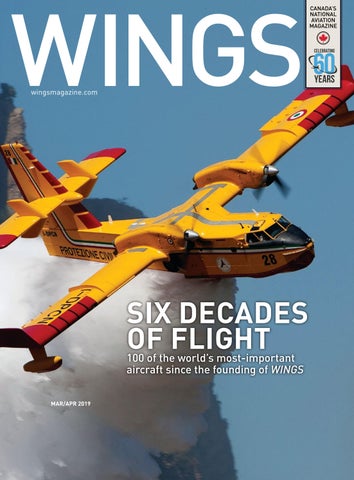
SIX DECADES OF FLIGHT
100 of the world’s most-important aircraft since the founding of WINGS MAR/APR 2019
CANADA’S NATIONAL AVIATION MAGAZINE
DIFFERENT BY DESIGN. DISRUPTIVE BY CHOICE. Unprecedented performance. Industry-leading technology. Exceptional comfort. Introducing the new midsize Praetor 500 and the super-midsize Praetor 600 – the world’s most disruptive and technologically advanced business jets. A record-breaking best-in-class range. Enviable performance in challenging airports. Full fly-by-wire with active turbulence reduction. Unparalleled comfort in a six-foot-tall, flat-floor cabin. Ka-band home-like connectivity. Power the future. Take command. Lead the way. Learn more at executive.embraer.com.
INTRODU CING THE NE W
MARCH/APRIL 2019
UPFRONT 8 Leading edge
World air cargo forecast
10 On the fly
KF Aerospace Hamilton expansion and more
14 Alternate Approach Digging up the roots, M&A moves
15 At the Gate
Weighing in on Canada’s pilot shortage
16 Air Traffic
Roberta Bondar’s place in Canadian aviation
BACK 44 Marketplace 46 On final
Passive aggressive pilot automation
PHOTO CREDITS, FROM TOP: NATIONAL MUSEUM OF NAVAL AVIATION, NASA, ALSIM
From top: Roberta Bondar in 1992. P.16. Scott Firsing of Alsim. P.34.
Three Canadair CF-104 Starfighters from 417 Squadron of the RCAF in flight above Cold Lake Alberta, 1972. P.22
FEATURES 18 RUNWAY INCURSIONS
From the Transportation Safety Board Watchlist, a look at why runway incursions happen and four solutions to reduce the safety threat BY KATHY FOX
22 SIX DECADES OF FLIGHT
From the Cold War Era to the Modern Era, 100 of the world’s most important fixed-wing aircraft since the founding of WINGS magazine BY JON ROBINSON
34 TWENTY-FIVE YEARS OF SIMULATION
Scott Firsing, who leads the development of Alsim’s North American operation, discusses the progress of simulators and the impact on Canada BY JON ROBINSON
COVER PHOTO: MAARTEN VISSER, NEDERLAND, FEATURING THE VIKING AIR CL-415 WATERBOMBER OPERATED BY ITALY
WWW.WINGSMAGAZINE.COM
March/April 2019 | WINGS
5
Stay in Touch with Aviation News Vol. 60, Issue 2 EDITOR
SUBSCRIBE
Jon Robinson jrobinson@annexbusinessmedia.com 416-448-6188
Online
FLIGHT DECK
David Carr, Brian Dunn, Kathy Fox, Kendra Kincade, Sam Longo, Carter Mann, Carroll McCormick, Anna Pangrazzi, Bill Zuk NATIONAL ACCOUNT MANAGER
TODAY
Mena Miu mmiu@annexbusinessmedia.com • 416-510-6749 ACCOUNT CO-ORDINATOR
Barb Vowles bvowles@annexbusinessmedia.com • 416-510-5103 MEDIA DESIGNER
wingsmagazine.com/subscribe
Emily Sun
CIRCULATION MANAGER
Magazine
Jay Doshi jdoshi@annexbusinessmedia.com • 416-442-5600 ext. 5124
Weekly E-Newsletter
GROUP PUBLISHER
Martin McAnulty mmcanulty@annexbusinessmedia.com
Digital Edition
WINGS
PRESIDENT & CEO
Mike Fredericks
WINGS MAGAZINE
CANADA’S NATIONAL AVIATION MAGAZINE
P.O. Box 530, 105 Donly Dr. S., Simcoe, ON N3Y 4N5 Tel: 519-428-3471 Fax: 519-429-3094 Toll Free: 1-888-599-2228
wingsmagazine.c om
Printed in Canada ISSN 0701-1369 PUBLICATION MAIL AGREEMENT #40065710
SIX DECADE S OF FLIGHT
100 of the wor aircraft sinc ld’s most-important e the founding of WINGS MAR/APR 2019
CIRCULATION Email: apotal@annexbusinessmedia.com Phone: 416-510-5113 Fax: 416-510-6875 (main) 416-442-2191 Mail: 111 Gordon Baker Rd., Suite 400, Toronto, ON M2H 3R1 Published six times per year (Jan/Feb, Mar/Ap, May/Jun, Jul/Aug, Sep/Oct, Nov/Dec) by Annex Business Media SUBSCRIPTION RATES Canada – 1 Year $ 34.50 (plus GST - #867172652RT0001) USA – 1 Year $ 60.50 Foreign – 1 Year $ 69.50 Occasionally, Wings magazine will mail information on behalf of industry-related groups whose products
Air Transport Association of Canada
ON THE
WEB
6
WINGS | March/April 2019
WG_CircAd_Marapr19_MLD.indd 1
and services we believe may be of interest to you. If you prefer not to receive this information, please contact our circulation department in any of the four ways listed above. Annex Privacy Office privacy@annexbusinessmedia.com • Tel: 800.668.2374 No part of the editorial content of this publication may bereprintedwithoutthepublisher’swrittenpermission. ©2019 Annex Publishing & Printing Inc. All rights reserved. Opinions expressed in this magazine are not necessarily those of the editor or the publisher. No liability is assumed for errors or omissions. All advertising is subject to the publisher’s approval. Such approval does not imply any endorsement of the products or services advertised. Publisher reserves the right to refuse advertising that does not meet the standards of the publication.
Canadian Business Aviation Association
Magazines Canada
AVIATION THIS WEEK Looking to catch up on the latest hot news from around aviation and aerospace? Check out Aviation This Week, a live digital version of the top news stories affecting a variety of key markets. It's quick, essential information you need to know! WWW.WINGSMAGAZINE.COM
2019-02-27 12:52 PM
WHEN YOU’RE READY TO GROW, WE DELIVER. Your aerospace products belong in new international markets.
FedEx can get them there. As the world’s largest cargo airline, we deliver to over 220 countries and territories and have the expertise to provide the right logistical solutions – from small packages to heavyweight freight. Is your company ready to expand? Trust FedEx. fedex.ca/international
LEADING
EDGE
By Jon Robinson |
World air cargo forecast
Behind all of the positive passenger numbers sits another growth platform
T
5 8
WINGS | March/April 2019
production freighter deliveries valued at US$280 billion. Demand for regional express services in fast-developing economies will boost the standard-body share of the freighter fleet from 37 per cent today to 39 per cent. The company projects 1,170 standard body and 500 medium widebody passenger airplanes will be converted into freighters over the next two decades. Dedicated freighters, which Boeing explains to provide unique capability that passenger belly-cargo cannot match, will continue to carry more than 50 per cent of the world’s air cargo demand. The company expects the majority will be in the large wide-body freighter category, such as the 747-8 Freighter and 777 Freighters. “With 90 per cent share of the freighter market, Boeing is well positioned to capture this growth,” said Hulst. Since January 2017, Boeing has sold 128 freighters, including 80 production and 48 converted. Air cargo has recovered and is on track to grow 4.2 per cent over the next 20 years Air cargo traffic grew 10.1 per cent in 2017, more than double the long-term average growth rate. In the next 20 years, Boeing projects air cargo traffic will more than double and the world freighter fleet will grow by more than 75 per cent. Global retail e-commerce sales were US$2.3 trillion in 2017, more than double the US$1.1 trillion spent in 2012. | W
Air cargo represents less than one percent of global trade by tonnage, but transports $6 trillion growth story,” said Darren Hulst, managing director of market analysis and sales support at Boeing Commercial Airplanes. “Our new forecast indicates strong longterm air cargo trends, which coincide with the market recovery that we have seen over the last few years across Europe, North America, and Asia.” Some of the factors driving the growth in air cargo, explains Boeing, include a growing express market in China and the global rise of e-commerce, which is forecast to increase 20 per cent annually to nearly US$5 trillion in 2021. To meet growing market needs, Boeing also forecasts the world freighter fleet will expand by more than 70 per cent, from the current total of 1,870 to 3,260 airplanes. Boeing projects new
TOP DATA BURSTS… in this issue 1. Eight Canadian astronauts have been on 16 space missions since 1984. (P. 16) 2. From 2013 to 2017, NAV CANADA recorded an average of 445 runway incursions per year. (P. 18) 3. The 1960s CF-104 Starfighter has a 244 m/s rate of climb. (P. 22) 4. The Lockheed SR-71 Blackbird is designed to cruise at Mach 3.2. (P. 23). 5. The CL-415 can scoop up to 6,140 litres of water. (P. 27)
WWW.WINGSMAGAZINE.COM
PHOTO: BOEING
he Vancouver International Airport in mid-February released final passenger numbers for 2018, confirming another year of recordbreaking growth, as it embarks on a $9.1 billion, 20-year infrastructure expansion project based around 75 major capital improvement projects. YVR welcomed more than 25.9 million passengers in 2018, a 7.3 per cent increase over 2017, reaching its 25 million passenger milestone two years ahead of forecast. YVR is on track to serve more than 29 million passengers in 2020, with projections indicating the airport will serve 32 million by 2022. This is a similar story of passenger growth over the past decade across most major Canadian airports and often overlooked is the corresponding growth of cargo running out of these expanding airport infrastructures. YVR, for example, moved 338,000 tonnes of cargo, an 8.1 per cent increase from 2017. The Boeing Company in late 2018 issued its biennial World Air Cargo Forecast (WACF) to summerize the world’s major air trade markets, identify major trends, and present forecasts for the future performance and development of markets, as well as for the world freighter airplane fleet. The next update to the WACF will appear in Q4 2020. Boeing projects air cargo operators will need more than 2,600 freighters over the next two decades to keep up with increasing global freight traffic, which is expected to double with 4.2 per cent growth annually. The 980 new medium and large freighters and 1,670 converted freighters will go toward replacing older airplanes and growing the global fleet to meet demand, according to the World Air Cargo Forecast. “The air cargo market continues to be a major element of commercial aviation's
The Greatest Value in Aviation Training
Quality • Experience Service • Technology
Your Most Trusted Safety Partner
Unmatched Advantages
Customers choose FlightSafety for our unequaled experience,
• 1,800 master instructors deliver 1.4 million hours
of instruction annually
master instructors and advanced-technology training devices. But they return for the consistent value they receive in every
•
Outstanding Customer service, amenities and benefits including Proficiency Protection
•
Global network of Learning Centers provides worldwide reach for training
•
Unequaled advanced training programs and most complete range of courses
•
Master Aviator™ takes pilots beyond proficiency delivering the highest standard in safety
•
Largest fleet of advanced-technology simulators manufactured by our experts
•
Dedicated to enhancing aviation safety since 1951
safety-focused training program we offer. At each of our numerous locations that span the globe, Customers know they’re trained by experts, and assisted by FlightSafety teammates who go above and beyond to ensure the best possible experience. With unmatched service and support, Customers become part of the FlightSafety family during and after their training. They train on precision simulators designed and manufactured by engineers and technicians with decades of real-world training experience to match today’s sophisticated aircraft. Expect the greatest value from your most trusted training provider. Only FlightSafety delivers it.
Aviation professionals from around the world trust us to provide the highest-quality training and outstanding service. More than 1,800 highly experienced professional instructors deliver aircraft- and mission-specific courses, using our comprehensive training systems and advanced-technology flight simulators designed to enhance safety. Trust your training to FlightSafety. You’ll see why so many aviation professionals make the same choice. And have since 1951. For more information, please contact Steve Gross, Senior Vice President, Commercial 314.785.7815 • sales@flightsafety.com • flightsafety.com • A Berkshire Hathaway company
ON THE FLY For late-breaking news and exclusive web content, please visit www.wingsmagazine.com
THE LEAD BUSINESS AVIATION COMMERCIAL AEROSPACE DRONES
THE LEAD
KF AEROSPACE HAMILTON EXPANSION KF Aerospace in February broke ground on a $30-million expansion of its MRO facility at John C. Munro Hamilton International Airport (YHM). The expansion will add 150,000 square feet and more than 275 new jobs. Expected to triple its business in the area, KF explains the centrepiece of the project is a 75,000-squarefoot hangar, which introduces wide-body aircraft capability and additional lines of maintenance. Construction on the widebody hangar is expected to be complete by October 2019. KF explains the expansion will allow it provide new facilities, including hangar space, for Mohawk College’s aviation programs. In fall 2019, Mohawk will add a new 2-year Aviation Technician (Avionics) program, focusing on navigation systems, avionics installation practices and electronic circuits, which leads to an Aircraft Maintenance Engineering (AME-E) license. The college currently offers Aviation Technician programs in Maintenance and Structures streams.
BUSINESS AVIATION
AVFLIGHT EXPANDS INTO WINNIPEG Avflight Corp. at the end of January expanded into Canada by transitioning Kelly Western Jet Centre at Winnipeg James Armstrong Richardson International Airport (CYWG) to Avflight Winnipeg. This marks the company’s first venture into Canada and brings the chain’s total to 21 FBOs across North America and Europe. Avflight is part of the Avfuel Network, offering a range of Avfuel fueling products and services, such as Avfuel Contract Fuel and AVTRIP rewards. The Avfuelbranded network includes more than 650 FBOs around the globe.
BOEING INVESTS IN AERION SUPERSONIC Boeing made what it describes as a significant investment in Aerion of Nevada to accelerate the development and design of supersonic aircraft with the goal of delivering Aerion’s AS2 as the first supersonic business jet to reach market. Boeing, through its NeXt division targeting investment into programs that can shape the future of travel and transport, is provide Aerion with engineering, manufacturing and flight test resources. The AS2, slated for first flight in 2023, is designed to fly at speeds of up to Mach 1.4 or approximately 1,000 miles per hour.
KF Aerospace, including CEO Barry Lapointe (fourth from right), celebrate a $30 million expansion. 10 WINGS | March/April 2019
Aerion introduced its AS2 12-passenger business jet design in 2014.
Boeing describes this speed as being as much as 70 per cent faster than today’s business jets. This would mean the AS2 could save approximately three hours on a transatlantic flight. Founded in 2003 to develop supersonic aircraft, Aerion introduced its AS2 12-passenger business jet design in 2014. The company unveiled the AS2’s GE Affinity engine design in 2018. It is described as the first new civil supersonic engine in half a century.
G500 INTERNATIONAL DELIVERIES Gulfstream Aerospace at the start of 2019 made the first international deliveries of its clean-sheet Gulfstream G500 to Qatar Airways, which received two G500s to join five Gulfstream G650ER aircraft already in service with Qatar Executive. The all-new G500 earned its FAA type and production certificates in July 2018 and entered service in September of last year. The Qatar Civil Aviation Authority validated the U.S. type certificate in October. As part of a tour to introduce the world to the aircraft and its new Symmetry Flight Deck, the G500, as it was completing FAA certification, flew nearly 130,000 nautical miles (240,760 kilometers) and set 22 city-pair speed records. This was done in addition to the test flights required for G500’s certification. In total, Gulfstream explains the G500 has achieved nearly 30 city-pair speed records. Within the 2014 agreement to become the international launch customer for the G500, Qatar Airways established an order for up to 30 Gulfstream aircraft. WWW.WINGSMAGAZINE.COM
PHOTO CREDIT KF AEROSPACE; AERION
10 10 11 12 13
COMMERCIAL
CANADA JETLINES AIRPORT AGREEMENTS Canada Jetlines Ltd., set to become a new Ultra Low Cost Carrier (ULCC) airline, has chosen Vancouver International Airport (YVR) as its home base when it begins flight operations targeted for later this year. YVR will hold the airline’s first two Airbus A320 aircraft. Jetlines plans to operate flights across Canada and provide non-stop service from Canada to the United States, Mexico and the Caribbean. Jetlines at the start of 2019 also added the following airports to its network: Quebec City Jean Lesage International Airport (YQB); Aéroport Montréal Saint-Hubert Longueuil; Kelowna International Airport (YLW); and Winnipeg James Armstrong Richardson International Airport (YWG).
AIRBUS TO CEASE A380 PRODUCTION
PHOTO CREDIT BOMBARDIER; AIRBUS
Airbus plans to cease deliveries of the A380 in 2021. The company explains its key customer for the aircraft, Dubai-based Emirates, cut back its A380 orderbook by 39 aircraft and that there is little A380 order backlog with other airlines. The A380 was developed at a cost of US$25 billion and Airbus has delivered a total of 234 A380. The A380 took to the skies in 2005. Airbus currently has a total order backlog of around 7,600 aircraft. This backlog includes 480 A220s, with that aircraft program being consolidated
The CRJ550 is introduced as a viable replacement option for ageing 50-seat aircraft in North America.
into Airbus as of July 1, 2018. Net profit for Airbus in 2018 increased by 30 per cent over the previous year to €3.1 billion ($4.7 billion) and consolidated revenues increased to €63.7 billion ($95.8 billion) from €59.0 billion ($88.7 billion) in 2017. Airbus expects to deliver up to 890 commercial aircraft in 2019.
YQB PASSENGER RECORD Québec City Jean Lesage International Airport (YQB), managed by Aéroport de Québec Inc., processed 1,774,871 passengers in 2018, a 6.2 per cent increase over the previous year, which represents the 17th consecutive year of growth for the airport. In addition to its infrastructure improvements, YQB also points to airlines increasing travel to and from YQB in 2018. This includes WestJet adding a new destination (Calgary) and increasing the number of flights from YQB to Toronto. American Airlines doubled its flights from YQB to the U.S. YQB explains passengers also took advantage of the arrival of Air Canada Rouge
for Québec City-Montréal and Québec City-Toronto routes. Air Transat also has more of a presence in YQB, having added more summer flights to Montréal to help its passengers travel to Europe.
BOMBARDIER LAUNCHES CRJ550 Bombardier Commercial Aircraft launched the 50-seat CRJ550 aircraft with a new type certificate based on the CRJ700. United Airlines is the launch customer of this new model. The company describes the CRJ550 as the solution in North America that can replace the existing fleet of ageing 50-seaters, which includes a market of more than 700 aircraft. The CRJ550 will feature a self-serve beverage and snack station and, according to Bombardier, more overall legroom per seat than any U.S. carrier 50-seat aircraft.
CHORUS, AIR CANADA PARTNER TO 2035 Chorus Aviation in February entered into a firm purchase agreement with
Emirates cut back its A380 orderbook by 39 aircraft, reflecting a growing preference among airlines for smaller, more fuel-efficient aircraft with extended range. WWW.WINGSMAGAZINE.COM
March/April 2019 | WINGS
11
ON THE
FLY
AEROSPACE
AIRBUS, DASSAULT 5-YEAR DEAL CRJ900 aircraft in the Air Canada Express livery.
Bombardier Commercial Aircraft to acquire nine CRJ900 regional jet aircraft. The purchase is a key measure within a Capacity Purchase Agreement (CPA) extension to 2035 between Air Canada and Chorus, which includes an equity investment from Air Canada of $97.26 million in Chorus. The CPA outlines a Chorus addition of 14 larger-gauge CRJ900 (76-seat) aircraft of which nine aircraft are to generate
Airbus and Dassault Systèmes signed a five-year agreement to cooperate on what the companies describe as collaborative 3D design, engineering, manufacturing, simulation and intelligence applications. Airbus expects the deal to boost its digital transformation and, ultimately, lay the foundation for a new European industrial ecosystem in aviation. Under the agreement, Airbus will deploy Dassault’s 3DEXPERIENCE platform to make digital design, manufacturing and services (DDMS) a company-wide platform for all Airbus divisions.
COMPLETE IRIDIUM NEXT CONSTELLATION Aireon in mid-January completed the eighth and final payload deployment of 10 satellites within the Iridium NEXT satellite constellation. There are now 75 Iridium satellites (66 operational and nine spares) in Low Earth Orbit (LEO) holding Aireon's space-based Automatic Dependent Surveillance-Broadcast (ADSB) system, which is expected to begin a new era of global air traffic surveillance and aircraft tracking. The original Iridium constellation was put into LEO in the late-1990s with the primary goal of using satellites to link phone calls to any location on the planet. Iridium NEXT was completed for an estimated cost of more than US$3 billion. Iridium NEXT and the Aireon ADSB system will be leveraged by NAV CANADA and other global air traffic management entities like NATS in the UK, the Irish Aviation Authority, Enav, and
CHOOSE GLOBALSELECT: THE LUXURY GATEWAY TO HOUSTON.
VISIT GLOBALSELECTFBO.COM TODAY TO REQUEST A QUOTE OR MAKE A RESERVATION
12 WINGS | March/April 2019 WG_SugarlandGlobalselect_MarApr19_CSA.indd 1
WWW.WINGSMAGAZINE.COM 2019-02-20 11:19 AM
PHOTO CREDIT: JAZZ AVIATION
additional lease revenue under the CPA. The nine new CRJ900 aircraft will be operated by its subsidiary, Jazz Aviation LP, under the Air Canada Express brand. The nine aircraft will be delivered in 2020.
system, with a wing span of approximately 12 feet.
FLIR ACQUIRES AERYON LABS
The final Aireon satellite payload was carried into Low Earth Orbit by a SpaceX Falcon 9 rocket.
Naviair, to redefine the routing of aircraft. The technology gives air traffic controllers and airlines a more complete and comprehensive view of the entire sky.
PHOTO CREDIT SPACEX
DRONES
DDC UNVEILS 400-LB CONDOR Drone Delivery Canada (DDC) in February unveiled its new Condor drone, which has been in development for the past year to serve as a delivery cargo aircraft. The
Condor is expected to have a payload capacity of 180 kilograms (400 pounds) and a potential travel distance of up to 200 kilometres. Also in February, DDC received Transport Canada approval to begin testing a new cargo delivery drone, called Falcon, with a lifting capability of 50 pounds of payload and an approximate travel range of 60 km at 50 km/h. It is designed to address the need for a multi-package payload drone able to carry around five cubic feet of cargo. It is described by the company as the big brother to DDC’s Sparrow, based on an electric-propulsion
FLIR Systems of Oregon acquired Aeryon Labs of Waterloo, Ont., which develops unmanned aerial systems for military, public safety and critical infrastructure sectors. The deal is worth approximately US$200 million, according to FLIR, which notes how Aeryon’s development of vertical takeoff and landing quad-copter airframes integrate multiple sensors, including FLIR thermal technology, to provide high-resolution ISR capabilities. FLIR is one of the world’s largest producers of sensor systems with close to 3,700 employees. Aeryon, founded in 2007, is a designer and manufacturer of mission-focused Group 1 UAS with aircraft under 20 pounds. Aeryon’s family of UAS are deployed by 20 militaries in more than 30 countries, including the U.S. | W
Fire Extinguishers Oxygen Cylinders, Regulators, Crew Masks and PBE’s Inflation and Pneumatic Reservoirs Securaplane Batteries, Cameras, and Security Systems Floor Coverings THERE WHEN YOU NEED US™
98 Columbus Avenue, Pointe-Claire, Qc, Canada H9R 4K4 TEL | 514.630.7777 FAX | 514.630.9999 AOG | 514.981.7362 | info@caspaerospace.com
WWW.WINGSMAGAZINE.COM WG_Casp_SeptOct18_cCSA.indd 1
March/April 2019 | WINGS 13 2018-07-30 11:06 AM
ALTERNATE
APPROACH By David Carr |
Digging up the roots
Is there more of Bombardier for Airbus to buy
N
14 WINGS | March/April 2019
with upgraded regional jet models? Something Bombardier has little appetite for, and even less for competing against Boeing-Embraer without the might of Airbus behind it. Bombardier’s insistence it is in the regional jet business for the long-haul is as bankable as its assurances during the Pierre Beaudoin period that the CSeries program was on track. It wasn’t and in the Alain Bellemare era, they aren’t. Airliner production in Montréal is secure, and will inevitably include a larger version of the A220-200 (formerly the CS300) – the CSeries variant that did worry Seattle and Toulouse. Will Bombardier even be involved at that point? The company has the option to sell its stake in the A220 after five years. An attractive proposition for an airplane builder exiting the airliner business, especially if a contract to design and build the wing for the bigger jet is part of the deal. If the CRJ has a future, it will be with another manufacturer. Mitsubishi is sometimes mentioned and would be an interesting side bar in Bombardier’s lawsuit against the Japanese industrial giant over trade secrets. But it is Airbus who will have a hole in its product line once Boeing’s takeover of Embraer’s civilian business is completed. | W
Bombardier does hold leverage with the future development of advanced wing technology. at Mirabel, experience building the airplane and a new plant in Mobile, Alabama, will drive costs down further. Bombardier has hived off a chunk of its purchasing clout through transfer of the CSeries and sale of the Q400, and has less leverage. It would unlikely experience a similar turnaround in production costs in any case. Where Bombardier does hold leverage is with future wing technologies. While the CSeries program headed to Europe, IP rights for the airplane’s ground-breaking carbon-fibre wing design and manufacturing processes stayed with Bombardier’s Aerostructures and Engineering Services (BAES) division. In January 2019, Bombardier moved to acquire the Global 7500 wing program from Triumph Group. BAES builds wings for the A220 family in Belfast, making Bombardier the first outside supplier to manufacture a wing for Airbus. An inevitable evolution to be sure, but one that supports BAES’ future as a tier-one supplier of aerostructures for the world’s airliners. A path Bombardier is most likely to follow, alongside its corporate jet business. Is there space for the CRJ in such a strategy? Especially if a full-scale upgrade, including new engines, is needed to compete
David Carr is a Wings writer and columnist. WWW.WINGSMAGAZINE.COM
PHOTO: BOMBARDIER, CSERIES COMPOSITE DEMONSTRATOR WING, BELFAST
ews post-CSeries was Bombardier returning to its regional roots with incremental upgrades of its CRJ and Q400s, including the introduction of the more comfortable Atmosphere cabin, and renewed focus on Asian markets, especially China. What has come out of Montréal, however, has been more of an uprooting. The Bombardier name all but disappeared from the Mirabel manufacturing facility where Airbus A220 and CRJ airplanes are produced. The CRJ is the only family of airliners manufactured exclusively by Bombardier after handing a controlling stake in the CSeries program to Airbus and selling the Q400 program to Longview Aviation Capital, parent company of Viking Air. But for how much longer? According to Bombardier’s estimates, airlines will order 5,750 airplanes in the space occupied by the CRJ and Q400 (likely to be re-branded as the de Havilland Q400 after Longview bought the iconic badge along with the program) over the next 20 years. Orders by Delta and American for the CRJ900 with Atmosphere interiors confirms there is life in the platform. Problem is, as with the Q400, Bombardier lose money on every CRJ aircraft it builds. Supplying even 25 per cent of demand would spill a lot of red ink. Nor will incremental improvements to the product line alone suffice, especially when going noseto-nose with the much-delayed Mitsubishi 76 and redesigned Embraer E2 regional jets, which unlike the Airbus-Bombardier tie-up, are rolled into the Boeing-Embraer partnership, with the Seattle giant set to own 80 per cent of the joint venture. Bombardier has production costs much higher than Boeing and Airbus. One of the airline industry’s main concerns over the CSeries was not aircraft performance, but if Bombardier, already bleeding cash, had the resources to bring a finished product to market. In Bombardier’s case, the shining knight was the Quebec and federal governments, and ultimately Airbus. McDonnell never ‘got’ the civilian airliner business. Airbus does (while mired in its own military transport), and has made significant progress leveraging its buying power to cut A220 costs. New investments
AT THE
GATE
| By Brian Dunn
Is Canada facing a pilot shortage The urgency for pilots differs depending on your operation
B
oth Air Canada and WestJet in mid-2018 say they have no problem filling their cockpits with qualified personnel. “We get thousands of applications far exceeding vacancies in every round of pilot hiring and we have a rigorous selection process,” explains Isabelle Arthur. Director, Media Relations at Air Canada. “We select only the best pilots to fly our planes and even before being considered by the airline, pilots require a minimum 2,000 to 3,000 hours of flying time.” In addition, the airline actively encourages women to consider a career in aviation. In mid-2018, of its 3,500 active pilots at the main carrier and Air Canada Rouge, 210 were women, representing six per cent of the total. Regional carriers like Porter tend have higher percentages. “Our talent acquisition team goes around the country visiting schools and taking part in activities during the International Women’s week and supporting the Northern Lights Award, whose mission is to encourage women to undertake careers in aviation by recognizing women in the field of aerospace and aviation,” says Arthur. The shortage of pilots had not impacted WestJet as of mid-2018, according to company spokesperson Lauren Stewart. “We are hiring as we always have been, recruiting pilots on a continual basis as needed… and we receive a good quantity of applications for most rounds of hiring. Despite this, we believe it is extremely important to support the future of aviation in Canada.” The story is different for the smaller airlines, especially northern carriers who are losing pilots to bigger airlines in the south. The Air Transport Association of Canada (ATAC) estimates the industry will face a shortage of 6,000 pilots over the next 20 years, due to low wages for new pilots and the high cost of training. The industry is also expanding. According to Transport Canada, between 2010 and 2016, airlines added more than 2,200 new aircraft. Nearly 4,000 new pilots got their licenses during that time, but according to Victoria, B.C., flight school manager Gerry Mants, that’s not enough to meet demand. And at least one flying club almost closed its doors due to a lack of instructors, pointing to the growth of the industry, retirements WWW.WINGSMAGAZINE.COM
“Some smaller carriers like Air Canada Jazz wouldn’t even talk to you if you had less than 1,000 hours. Now, if you have 200 hours, they at least want to get you into their system.” McKenna suggests solutions to the problem include attracting more women to the industry, more funding for expensive training, and to let former instructors hired away by airlines to continue to train during their down time. A report released in April 2018 by the Canadian Council for Aviation and Aerospace (CCAA) estimates Canada should be producing an extra 300 pilots a year to meet demand of a growing air travel industry. The report also warns how demand for new hires for expansion and replacement of retirees could mean a shortfall of 6,000 pilots by 2036. Projections show the industry will need an additional 7,300 pilots by 2025. Less than 1,200 new commercial pilot licences were issued in 2016 and almost half of those were issued to international students. The 1,200 figure is down 28 per cent from the 2009 peak of 1,645 licences. To compound the issue, only about 70 per cent of these new pilots choose to remain in the industry, which translates to fewer than 500 new pilots being available to Canadian aviation each year. If this continues, there will be a shortage of close to 3,000 pilots by 2025. | W
A solution to the problem includes attracting more women to the aviation industry. from the Baby Boomer Generation, and fewer pilots entering the industry. “The major airlines are going after pilots from the regionals and the regionals are going after pilots from business aviation and private pilot instructors from places like ours,” says a spokesperson from the Ottawa Flying Club, which has managed to turn things around. “It’s a major issue not only in Canada but worldwide and the problem is growing annually,” says John McKenna, president and CEO of ATAC. “The major impact is mostly on smaller communities, because they’re served by the regional carriers and they’re feeling the pinch a lot more than the major carriers, because their pilots are scooped up by the larger carriers and they’re having a hard time finding replacements.” It’s been a serious problem for at least the last four years and even the larger carriers have finally acknowledged it, McKenna adds. Several regionals have even cancelled flights, including Canadian North, Air North and Bearskin Airlines. Some smaller carriers have lost half their pilots, according to McKenna. The problem is compounded by foreign airlines recruiting Canadian pilots.
March/April 2019 | WINGS 15
AIR
TRAFFIC By Carroll McCormick |
Where is Roberta Bondar
The first Canadian female astronaut is still not inducted in the CAHF
C
16 WINGS | March/April 2019
After the first five of those 10-year blocks, if a nominee has not been recommended for induction, the nomination can get a little boost from supplementary evidence. “Supplementary evidence is material produced and submitted to the CAHF office – and by extension the Nominations Review Committee – that is outside of the original package. This could be an additional letter of support, a newspaper article, anything that could enhance the nomination,” Cooper explains. However, a nomination expires after 10 years, and that person must be re-nominated to be considered again for induction. Dr. Bondar was nominated in 2001, and re-nominated in 2011. “If she is not selected by the 2020 Nominations Review Committee meeting,” Cooper says, “a new nomination package must be submitted. At this point, it will be her final attempt to be inducted into CAHF.” The likelihood of her induction on a third attempt, should it go that far, is anyone’s guess. Cooper explains, “There have been no nominations that have been brought forward to CAHF that have not been selected for induction before the termination of their final (third) attempt at induction.” Good luck, Dr. Bondar! | W
Payload specialist Roberta Bondar works on the Microgravity Laboratory biorack. place in space could be as follows: She was a member of Canada’s first team of astronauts. She was the first neurologist in space and Canada’s second astronaut to fly, on STS-41 in 1992, an eight-day, 3.36-million-mile mission. She was NASA’s head of space medicine for more than a decade. Globally, she was the eighteenth woman astronaut in space (Payette was No. 36). Post-CSA and -NASA, the physician and scientist, remains active as a photographer and author, environment interpreter and, presumably, founder of the Roberta Bondar Foundation with its goal to “educate and improve knowledge of the environment.” So, what gives? While the deliberations of the CAHF’s nomination review committee are secret, Aja Cooper, collections manager, CAHF, shared some details of the process: “A nomination, once submitted to CAHF, is in the system for 10 years. If the nominated individual has not been recommended for induction within those 10 years, a new application must be submitted. An individual can be nominated up to three times – essentially 30 years within the nomination process – before they are no longer eligible for nomination,” Cooper explains.
Carroll McCormick is a freelance writer from Montreal. WWW.WINGSMAGAZINE.COM
PHOTO: NASA
anada’s Aviation Hall of Fame (CAHF) in January 2019 introduced its five newest inductees, bringing its members to 233 since formation in 1973. This year’s aviation additions include: David Charles Fairbanks, a threetime recipient of the Distinguished Flying Cross; John Peter Holding, executive with Canadair/Bombardier and past CAHF chairman; Barry Lapointe, founder of Kelowna Flightcraft (now KF Aerospace); James McDougall, founder of Harbour Air; and William Paris, WWII fighter pilot and a Member of the Order of Canada. There are several CAHF inductees from Canada's astronauts ranks, which currently holds 14 members (active and retired), of which eight have been on 16 space missions between 1984 and 2013. Some of their names stick in my mind like Marc Garneau, the first Canadian to blast off, flying on STS-41-G in 1984. A military man – in fact, he was seconded from the Department of National Defense to the Canadian Astronaut Program – my impression at the time of his flight was that he was involved in a secret military mission. Dr. Dave Williams flew on STS-90 in 1998. I interviewed him in 2003 about maintenance on the Space Shuttle. (Duct tape is a low-tech, but highly effective remedy for keeping screws and other bits and pieces from floating away.) Julie Payette, well, while having the greatest respect for her incredible accomplishments with CSA and NASA, I recall her youthfulness and great space-hair. Chris Hadfield is surely Canada’s most famous astronaut. He was Top Gun at the U.S. Air Force Test Pilot School, a CF-18 pilot, Commander of the International Space Station, and of course a musician in space. But the astronaut who intrigues me most is Dr. Roberta Bondar, because she is not a member of the CAHF. Doing research for a past WINGS project to celebrate 100 years of powered flight in Canada, I learned that, as of 2009, just six women were members of the CAHF. Too, and astonishing to me, while I learned that the CAHF inducted Hadfield and Garneau in 2005 and 2008, respectively, (the CAHF inducted Payette in 2010 and Williams in 2012), Dr. Bondar was not a member. A thumbnail sketch of Dr. Bondar’s
1/2 Pg 1
2019-02-12 8:54 AM
REGISTER NOW APRIL 2019
2- 4
THE DESTINATION FOR THE AIRCRAFT INTERIORS INDUSTRY. www.aircraftinteriorsexpo.com
Co-located with:
Organised by:
In co-operation with:
Supported by:
World Travel Catering & Onboard Services 2 – 4 April 2019 Hamburg Messe, Germany
WWW.WINGSMAGAZINE.COM WG_Reed Exhibitions_marapr19_CSA.indd 1
March/April 2019 | WINGS 17 2019-02-22 9:49 AM
Runways 24L and 24R highlighted in yellow and green make up the South Complex at Toronto Pearson; with the two closely spaced, parallel runways being studied in a TSB Safety Issue Investigation to illustrate the risk of runway incursions in Canada as a primary Watchlist safety issue since 2010.
RUNWAY INCURSIONS
BY KATHY FOX
L
ast fall, the Transportation Safety Board of Canada (TSB) released Watchlist 2018, which identifies the key safety issues that need to be addressed to make our air, marine, and rail transportation systems even safer. Every year, there are millions of successful takeoffs and landings on Canadian runways. However, an accident can occur when an aircraft or vehicle mistakenly occupies an active runway. From 2013 to 2017, NAV CANADA recorded an average of 445 runway incursions each year. Although the vast majority of incursions posed little to no risk, some of them have the potential to be catastrophic. Since this issue first landed on the Watchlist in 2010, TSB has completed at least 10 investigations into runway 18 WINGS | March/April 2019
ground. So why do incursions still happen? The answer goes to the heart of airport operations, human psychology, and even airport geometry.
Uncommon features incursions. In January 2019, we released a safety issues investigation (SII) focused entirely on two parallel runways locally known as the South Complex at Lester B. Pearson International Airport (CYYZ). That report, which examined a group of incursions between 2012 and 2017, found 27 instances where an aircraft had landed on one runway – the “outer” one – only to incur on the other “inner” parallel runway while taxiing back to the terminal. Pearson International is the largest and busiest airport in Canada, and its airport traffic is tightly controlled and monitored. For instance, flight crews receive specific instructions from air traffic controllers to “hold short” of active runways. Crews also receive cues from multiple lights, warnings signs, and painted lines on the
To start with, the rapid exit taxiways, or RETs, that are used by aircraft at CYYZ’s South Complex are different from almost every other major airport in North America. For example, the exits lead directly to the “inner” parallel runway, the holdshort lines are located immediately following a 65-degree curve and, most notably, are farther away from the protected runway. These uncommon features mean the hold-short lines are not where crews are expecting to see them. If crews who are unfamiliar with the exits are also operating a regional jet – the most common type of aircraft involved, and one with relatively fast taxi speeds – they will have even less time to recognize the lines in time to stop before incurring on the runway. Speed and the unusual placement of the cues are not the only
contributing factors. Distraction – often created by the flight crews’ own Standard Operating Procedures – also compounds the risks. For instance, it is normal for many crews to initiate their post-landing actions immediately after exiting the runway. Doing this, however, can take their attention away from other more critical tasks, such as watching for the hold-short line. But telling flight crews to keep “heads-up” doesn’t always solve the problem. When one procedure says to be heads-up upon leaving the runway while another says “complete your post-landing actions,” flight crews often opt for the action – becoming distracted at the worst possible time.
Recommendations TSB, therefore, made four recommendations to reduce the risks involved. Some of those recommendations target problems specific to CYYZ. Others are more general and could help reduce risks across Canada and around the world. The first is aimed at air-traffic WWW.WINGSMAGAZINE.COM
IMAGE: TSB/GOOGLE EARTH
TSB WATCHLIST, A NEW REPORT FOCUSES ON THE RISK OF INCURSIONS AND MEASURES TO PREVENT THEM
iNTRODUCING THE NEW INNOVATION HUB AT CANSEC 2019 Looking for new opportunities to showcase your innovative technologies to national and international decision-makers? Become an Innovation Hub exhibitor now! Your investment includes:
Prestige Level Turnkey Kiosk à Branded marketing wall à 42” LED monitor
Package Price
$3975
Exhibitor Profile Participation in Business Development (B2B/B2G) Program Innovation Hub on CANSEC App Access to Innovation Hub Lounge Onsite marketing promoting Innovation Hub CADSI 2019 Membership
Produced by: CANADIAN ASSOCIATION OF DEFENCE AND SECURITY INDUSTRIES
@CADSICanada canseccanada.ca
The new Innovation Hub is available to companies that have never exhibited at CANSEC, nor been a member of the Canadian Association of Defence and Security Industries (CADSI), and are not traditionally involved in the defence sector. We invite companies involved in, but not limited to, the following areas: Robotics, Training & Simulation, Cyber Defence, Engineering, Advanced Manufacturing, Advanced Infrastructure, Artificial Intelligence, Autonomous Vehicles, New Cutting Edge Technologies, etc.
TSB illustrates the path of a possible incursion between two aircraft at Toronto Pearson’s South Complex.
This issue will remain on the TSB Watchlist until the rate of runway incursions, particularly the most severe, demonstrates a sustained reduction. In the meantime, TSB will continue to monitor and push for safer skies – and safer airports – for everyone. | W Kathy Fox is Chair of the Transportation Safety Board of Canada, an independent agency that investigates aviation, marine, pipeline and railway transportation occurrences.
Call 800.667.7742 Concierge & Business Services Ground Services Fuel Passenger Services Pilot Amenities
3035 Tutor Drive, Regina International Airport Regina, SK S4W 1B5 info@yqraero.ca | www.yqraero.ca 20 WINGS | March/April 2019 WG_Regina_Aerocentre_SeptOct16_EJS.indd 1
WWW.WINGSMAGAZINE.COM 2016-08-23 1:58 PM
IMAGE: TSB/GOOGLE EARTH
controllers, who are the last-line of defense in these situations. When controllers issue critical instructions, flight crews may not always respond appropriately. Either they don’t realize an order is being directed at them, or they don’t recognize the significance of what was said. That’s why the Board recommended that NAV CANADA modify controllers’ phraseology to better capture crews’ attention – for instance, using the word “immediately,” or even repeating the instruction. The next two recommendations – one to Transport Canada, the other to the U.S. Federal Aviation Administration – would see flight crews’ Standard Operating Procedures amended so that post-landing actions are only begun after an aircraft has cleared all active runways. This would keep flight crews’ attention focused outside the cockpit when approaching and crossing active runways, and reduce work-related distraction at critical moments. Finally, the Board has recommended that the Greater Toronto Airports Authority (GTAA) make changes to the taxiway layout at Pearson International’s South Complex. They could, for instance, change the design and position of the rapid exits, create a perimeter taxiway to go around the other active runway, or even construct a separate intermediate taxiway between the two parallel runways. The final choice will be up to the GTAA, but in the meantime, further improvements are required to increase the visibility of hold-short positions. Because clearly, more needs to be done so that all flight crews see the cues and react as required. Beyond the four recommendations to emerge from TSB’s Pearson SII, there are other broader solutions that also address the risk of incursions. These include a greater use of technology – such as in-cockpit electronic situational awareness aids – and direct-to-pilot warnings, such as runway status lights. Another option is improved surveillance and warning systems.
ANNIVERSARY ISSUE
SIX DECADES OF FLIGHT
FROM THE COLD WAR AVIATION ERA TO THE MODERN DAY ERA, 100 OF THE WORLD’S MOST-IMPORTANT AIRCRAFT SINCE THE FOUNDING OF WINGS MAGAZINE
I
1960s 1960
BY JON ROBINSON n 1959, when WINGS magazine was founded, the Avro Arrow program was terminated by the Canadian government. As a result, A.V. Roe Canada stopped production of the CF-105 Arrow interceptor. Reaching speeds of 2,324 kilometres per hour, the CF-105 never entered service, but it has been on the minds of Canadians for six decades. The Arrow – with its Canadian-built Orenda Iroquois engines and iconic delta wings – was designed for the Cold War, with nuclear bombers and supersonic jets roaming the sky. Lasting until 1995, the Cold War drove much of the aircraft innovation highlighted on this list featuring 100 of the world’s most-important aircraft since the founding of WINGS.
22 WINGS | March/April 2019
Growth in the access to commercial and general aviation influences the entire list; from the 1960s and into the Modern Day Aviation Era, which is recognized as starting after the Cold War Aviation Era ended and continuing into present day. Aircraft on this list, noted by country of origin, are chosen based on three primary criteria: Innovation, adoption, and successful human flight. The list avoids aircraft variants, unless driven by major investment or a critical company position. The Cessna 172, Avro Vulcan and Lockheed C-130 Hercules are the only planes on the list introduced (put into service) before 1959. Some of the most current aircraft consider first flights, as they await introduction, because they fit the criteria.
The Saab 35 Draken, introduced in 1960, features a double delta wing design. Robert Jackson (Men of Power) describes it as the first fully supersonic aircraft to be deployed in Western Europe. Powered by one Volvo turbojet engine, it is rated for a top speed of 2,125 km/h and 200 metres per second (m/s) rate of climb. More than 650 were built. (Specs on this list are primarily sourced from Militaryfactory.com, Airvectors.net, attributed Wiki sources, WINGS archives, and corporate and public reports.) The McDonnell Douglas F-4 Phantom II, introduced in
1960, served in the Vietnam War and the 1991 Persian Gulf War. Powered by two GE turbojet engines, the supersonic Phantom II is rated for a top speed of 2,370 km/h and could climb at 210 m/s. Produced until 1981, 5,190 were built. 1961 The Piper PA-28 Cherokee, introduced in 1961, is a family of two- or four-seat light aircraft designed for flight training, air taxi and personal use (Plane & Pilot, 1978). The PA-28’s all-metal, low-wing design competed against the 172 (see 1978, Cessna 172S). More than 32,800 have been built.
The Canadair CL-90 Starfighter, a modified Lockheed F-104 built under licence by Canadair, makes its first flight in 1961. Powered by a single Avro turbojet engine, the WWW.WINGSMAGAZINE.COM
PHOTOS, BY STORY APPEARANCE: CANADIAN AVIATION AND SPACE MUSEUM, KATSUHIKO TOKUNAGA, NATIONAL MUSEUM OF NAVAL AVIATION
The Avro CF-105 Arrow was designed as a Cold War interceptor to attack enemy aircraft, particularly with the growing threat of nuclear bombers.
fighter is rated for a top speed of 1,845 km/h and – leveraging its thin-wing design – a high rate of climb at 244 m/s. With more than 200 produced, the Starfighter operated until 1983. The Lockheed JetStar, introduced in 1961, is regarded as the first dedicated business jet to enter service. It was also used for military purposes. The JetStar is distinguishable by its four rear-mounted engines. More than 200 were built.
PHOTOS, BY STORY APPEARANCE: YOKOHAMA, SGT DAVID NOLAN, U.S. DEFENSE IMAGERY, LARS SODDERSTROM, LUC VERKURINGEN
The Dassault Mirage III, introduced in 1961, was used the 1967 Six Day War. Powered by a one Volvo turbojet engine, the supersonic fighter is rated for a top speed of 2,112 km/h with a climb of 83 m/s. More than 1,400 were built. 1964 The Boeing 727, introduced in 1964 with Eastern Air, features three P&W turbojet engines and a range of 5,370 km. The last 727 in operation was retired in January 2019 by Iran Aseman Airlines. In July 2018, 44 Boeing 727s were still in commercial service with 23 airlines, according to FlightGlobal World Airline Census.
The Beechcraft King Air, introduced in 1964, holds a top speed of 500 km/h and a 2,446 km range. Author William Green (Beech 65-90 King Air) notes 152 King Airs were ordered a month after delivery of the first production aircraft. More than 3,100 have been produced. The Super King Air was then introduced in 1972. The Learjet 23, introduced in 1964, is powered by two GE turbojet engines. Built in Wichita, Kansas, with a fully pressurized cabin, Bill Lear WWW.WINGSMAGAZINE.COM
based its design on the Swiss P-16 prototype jet fighter. With a max speed of 902 km/h, 101 aircraft were built until 1966. 1965
The Avro Vulcan, with its production ended in 1965, first flew in 1952. Later named the Hawker Siddeley Vulcan B.2, the tailless, delta wing, high-altitude bomber was built by A.V. Roe and Company (Avro), with 136 produced, including prototypes. The iconic aircraft flew a combat mission during the 1982 Falklands War, before being retired by the RAF in 1984. The Dassault Falcon 20, introduced in 1965, is the first business jet produced by the French company. It features two turbofan engines, reaching a top speed of 860 km/h and a range of 3,350 km. One of its prototypes was used by aviator Jacqueline Auriol to set the women’s world speed record. More than 510 were built. 1966 The Canadair CT-114 Tutor, with its production ended in 1966 after 212 were built, was used for training purposes by the RCAF until 2000. It is currently used by the Canadian Snowbirds demonstration team (431 Squadron), with 24 aircraft. Powered by a single GE turbojet engine, the Tutor has a top speed of 741 km/h and a range of 648 km. Malaysia became its sole foreign operator.
The Lockheed SR-71 Blackbird, introduced in 1966,
is a reconnaissance aircraft designed to cruise at Mach 3.2 (more than 3,540 km/h or slightly more than three times the speed of sound), with a service ceiling of altitude of 25,900 metres. With 32 produced, 12 were lost in non-combat accidents. Although it flew until 1998, the SR-71’s 1990 official U.S. Air Force retirement flight from Los Angeles to Washington took just 67 minutes. The de Havilland Canada DHC-6 Twin Otter, introduced in 1966, featured a high rate of climb for a twin turboprop aircraft at 8.2 m/s, in addition to its short take off and landing capability. The 19-passenger aircraft was the precursor to the Dash 7 program. Initially produced until 1988 as the 100-300 series (with more than 950 built), Viking Air in 2005 purchased the Type Certificates for all out-of-production de Havilland aircraft (DHC-1 to DHC-7), including the Twin Otter. It restarted the program in 2007 as the Viking Series Twin Otter 400. 1968
The Boeing 737, introduced in 1968 with launch customer Lufthansa, is a twin-engine, narrow-body domestic airliner. It provided more fuel efficiency than the trijet 727, well known at the time for its unique hot-and-high performance. The 737 would become the most prolific airliner ever. Today, there are more than 12 variants carrying passenger numbers from 85 up to 215. A total of 10,478 737s had been built by January 2019, according to Boeing delivery reports. The Canadair CF-5 (officially designated as the CF-116 Freedom fighter), introduced
into the Canadian Forces in 1968, is a licenced-built version of the lightweight Northrop F-5 Freedom Fighter. It was developed as a low-cost, low-maintenance fighter and produced domestically through Canadair, including 30 dual-seat aircraft built for the Royal Netherlands Air Force. A total of 240 CF-5 aircraft were built. Initially seen as a step back for Canadian Aerospace, the role for the CF-5 throughout its service with the RCAF changed frequently and the lightweight fighter would eventually serve as a light attack strike fighter, reconnaissance platform and trainer (Aeroware, 2012)
1970s 1970 The Boeing 747, introduced in 1970 as the world’s first jumbo jet with launch customer Pan Am, holds a tail height equal to a six-story building. Powered by four turbojet engines, allowing the aircraft to reach speeds of 945 km/h and a range of 13,425 km (747-400), the 747 held the passenger capacity record for 37 years, until the 2007 introduction of the massive Airbus A380 (BBC, 2010). According to Flight International, the program in 1968 was estimated to cost US$1 billion ($7.2 billion today). A total of 1,548 aircraft had been built as of December 2018, according to Boeing. 1971
The Cessna 500 Citation I, introduced in 1971, launched Cessna’s business jet family. It first flew in 1969 as the Fanjet 500 prototype, but was renamed after major structural changes before FAA certification. This included, according to The International Directory March/April 2019 | WINGS 23
ANNIVERSARY ISSUE utility aircraft. Dropping Super from its name in 1996, a total of 3,781 had been built by the end of 2015, according to a Beechcraft technical publication.
million, which equates US$151 million in 2016 dollars, or $199 million Canadian (Flight International Airliner Price Index, 1972).
1975
The McDonnell Douglas F-15 Eagle, introduced in 1976, was selected by U.S. Air Force in 1967 to meet its need for an air-superiority fighter. The twin-engine F-15 is among the most-successful modern fighters, with more than 100 victories and no losses in aerial combat (Davies and Dildy, F-15 Eagle Engaged, 2007). With more than 1,200 produced, it also entered service with Israel, Japan and Saudi Arabia.
1973
The Dassault Mirage F1, introduced in 1971, was designed to replace the Mirage III. It used a shoulder-mounted swept wing, instead of the delta wing of the Mirage III, which resulted in a more than 50 per cent reduction in required runway length and increased fuel tankage for 40 per cent greater combat range (Spencer Tucker, Persian Gulf War Encyclopedia, 2014). Powered by a single turbojet engine, it had a top speed of 2,350 km/h, with 720 built until 1992. 1974 The Airbus A300 , introduced in 1974 with launch customer Air France, is a widebody passenger airliner that represented Airbus’ move into building commercial aircraft. It held a range of 7,540 km in its typical two-class configuration carrying 266 passengers, but was often used for cargo operations. Forecast International, using Airbus data, in 1993 pegs the A300 program cost at US$4.6 billion. Airbus delivery reports show 561 aircraft were built until 2007. The Beechcraft Super King Air, introduced into the civil market in 1974 (1972, military), has been in continuous production since 1974, according to Hawker Beechcraft, which is the longest production run of any civilian turboprop aircraft in its class – as a pressurized multi-engine turboprop 24 WINGS | March/April 2019
The Tupolev Tu-144, performing its first operational flight in 1975 to haul cargo, became the first Supersonic Transport Aircraft (SST) to reach Mach 2 back in June 1969, besting the Concorde by four months. Following its infamous 1973 crash at the Paris Air Show, however, the Tu-144 did not begin passenger service until 1977 and was grounded in 1978 after an improved version (Tu-144D) crashed during a test flight. It conducted 55 passenger flights, according to Tupolev, at an average service altitude of 16,000 metres and a cruise speed of around Mach 1.6 (2,000 km/h). It served as a cargo aircraft on another 47 flights until retirement in 1983. 1976
The Concorde, beginning the first SST passengercarrying service in 1976, had a maximum speed of Mach 2.04 (2,179 km/h), more than twice the speed of sound. It was operated by British Airways and Air France until 2003. Twenty were built, including six non-commercial aircraft. The Concorde program cost £1.3 billion ($2.3 billion), which equates to £7.67 billion ($13.4 billion) in 2016 pounds (The Daily Telegraph, 2000). The unit cost of the aircraft in 1972 was US$33.8
1978 The de Havilland Canada DHC-7, introduced in 1978, is a four-engine turboprop designed as a regional airliner, with the manufacturer’s now renowned short take off and landing (STOL) performance. The Dash 7 would also enter service with militaries. With 113 aircraft produced, it remained in production until 1988 when de Havilland Canada was purchased by Boeing and later sold to Bombardier. In 2005, the Type Certificate for the aircraft design was sold to Viking Air of Victoria, BC. The Pilatus PC-7, introduced in 1978, is a low-wing tandem-seat aircraft eventually used by more than 20 air forces as an ab initio trainer. Powered by a single Pratt & Whitney Canada PT6A turboprop engine, the PC-7 is capable of all basic training functions including aerobatics, instrument, tactical and night flying. More than 650 have been produced.
The General Dynamics F-16 Fighting Falcon,
introduced in 1978, is a 4th Generation lightweight fighter with a max speed of 2,120 km/h and a 254 m/s rate of climb. Lockheed purchased General Dynamics’ military operation in 1992 for US$1.53 billion. Lockheed reports 4,604 aircraft had been produced by June 2018, as it announced plans to begin making the fighter in South Carolina in 2019. Although it is no longer purchased by the U.S. Air Force, it is operated by more than 20 countries. 1979 The Dassault Falcon 50, introduced in 1979, was the first Dassault three-engine business jet, as a super-midsize, long-range aircraft. Its trijet design provided hot-and-high performance and more options on long routes, with a max range of 6,480 km. The Falcon 50 has the same fuselage crosssection as the earlier twin-engine Falcon 20, but is a completely new design that is area ruled and includes a more advanced wing design (Michael Taylor, 1988). A total of 352 were produced until 2008.
1980s 1980
The Bombardier CL-600 Challenger, introduced in 1980, is a twin turbofan business jet best recognized for its wide cabin, according to Jetcraft research, which also notes it was one of the first civil jets designed with a low-drag supercritical wing. It was originally produced by Canadair in the late-1970s, before Bombardier bought the operation in 1986 for $120 million. As of December 2017, close to 1,100 Challenger 600 Series aircraft had been built. WWW.WINGSMAGAZINE.COM
PHOTOS, BY STORY APPEARANCE: CHRIS LOFTING, JIM ROSS/NASA, EDUARD MARMET, U.S. AIR FORCE, KONSTANTIN VON WEDELSTAEDT
of Civil Aircraft (Gerard Frawley), a longer forward fuselage, repositioned engine nacelles, a larger tail and more dihedral to the horizontal tail. Powered by two Pratt & Whitney Canada turbofans, the Citation I was rated for a top speed of 749 km/h. Textron Aviation notes 689 were built until 1985.
ANNIVERSARY ISSUE aircraft built. The F-117 was retired in 2008. 1983
The Boeing 767, beginning production in 1981 and first delivered to United in 1982, is the company’s first wide-body twinjet and its first airliner with a two-crew glass cockpit. It was developed in tandem with Boeing’s narrowbody 757 twinjet. Powered by two turbofan engines, the 767 has a range of up to 11,825 km, seating up to 375 people. A total of 1,135 aircraft were built as of January 2019, according to Boeing. 1982
The McDonnell Douglas CF-18 Hornet, introduced by the Royal Canadian Air Force in 1983 and later dubbed the CF-188, is based on the F/A-18 Hornet fighter introduced in the same year by the U.S. Air Force. The RCAF order included 98 single-seat variants and 40 dual-seat variants, for a total of 138 purchased. Canadian Forces explained its selection of the CF-18 was based on, in part: Two engines for reliability (considered essential for conducting Arctic sovereignty and overthe-water patrols), an excellent radar set, while being considerably more affordable than the F-14 and F-15 – at a total capital cost of $4 billion in 1982 dollars. (National Post, 2010). 1984
The Mikoyan MiG-29, or Fulcrum, introduced into the Soviet Air Force in 1982, is a 4th generation, twin-engine fighter. Powered by two Klimov afterburning turbofan engines, the Mig-29 has a max speed of Mach 2.25 (2,400 km/h) and an initial rate of climb of 330 m/s. More than 1,600 have been built. The Lockheed F-117 Nighthawk was delivered in 1982 as the first stealth aircraft to reach operational status, but not publicly displayed until 1988. Powered by two GE turbofan engines, the single-seat aircraft was used by the U.S. Air Force in the 1991 Gulf War. The average unit cost is pegged at US$111.2 million, while the flyaway (production-only) cost is US$42.6 million (Aronstein and Piccirillo, Have Blue and the F-117A, 1997), with 59 26 WINGS | March/April 2019
The Space Shuttle Discovery, with its first flight in 1984, two years after the program ’s initial Columbia launch, is the third of five fully operational fixed-wing orbiters to be built. Over 27 years of service, it launched and landed 39 times, gathering more spaceflights than any other spacecraft to date (retiring in 2011). The Space Shuttle was the first and only spacecraft to carry large
payloads back to Earth and into space, including the Hubble Space Telescope. Commercialdriven human space flight is expected to begin in 2019. The Dassault Mirage 2000, introduced by the French Air Force in 1984, is a multirole fighter developed to succeed the Mirage III and F1 series. With a single SNECMA afterburning turbofan engine, the Mirage 2000 reaches a top speed of 2,530 km/h with a rate of climb at 284 m/s. The Cessna Caravan, introduced in 1984, is a singleengine (P&WC PT6A) turboprop primarily used as a short-haul regional airliner, cargo and utility aircraft. A freighter variant without cabin windows was developed at the request of Federal Express as the Cargomaster (Frawley, 1997). More than 2,600 were built by the end of 2017. The de Havilland Canada DHC-8 (or Dash 8), introduced in 1984, is a series of turboproppowered regional airliners. As with the Dash 7, the program was purchased by Boeing in 1988 and then transferred to Bombardier in 1992. Longview Aviation, parent of Viking Air, then moved to purchase the program in late-2018. Bombardier modernized the program into the Q400 series, with more than 1,150 produced by mid2018. All Dash 8s delivered from of 1996 include the Active Noise and Vibration System. 1986 The Antonov An-124 Ruslan, introduced in 1986, is a quadjet strategic transport aircraft. The An-124 flew for 30 years as the world’s heaviest gross-weight cargo airplane and second heaviest operating cargo aircraft, behind the oneoff Antonov An-225 with a max take-off weight of 640,000 kg. A total of 55 An-124 aircraft were produced until 2004. Powered by four turbofan engines, it is rated for a max takeoff weight of 405,000 kg.
1988
The Airbus A320, introduced in 1988 by launch customer Air France, is noted for pioneering the use of fly-bywire flight controls on commercial airliners. The Airbus A320 family relatively quickly became one best-selling airliners of all time and positioned Airbus in the realm of Boeing’s commercial dominance. By the end of 2018, 8,605 aircraft had been built, according to Airbus reports.
1990s 1990
The P.180 Avanti, introduced in 1990, is a business jet with push-mounted twin turboprop engines. It is marketed as being faster than other turboprops and many mid-sized jets, with cost efficiencies as much as 40 per cent better than competing jets. (Jason Fogelson, Forbes, 2011). In November 2018, Piaggio Aerospace informed the Italian government it needed to enter receivership. The government appointed new management to seek a buyer for the operation. 1991
The Pilatus PC-12, with its first flight in 1991, is a pressurized, single-engine turboprop noted for versatility. Introduced WWW.WINGSMAGAZINE.COM
PHOTOS, BY STORY APPEARANCE: RICHARD SNYDER , VITALY V. KUZMIN, STAFF SGT. PERRY ASTON, NASA, MICHEL GILLIAND, TIBBOH, AIR FORCE SPECIAL OPERATIONS COMMAND (US AIR FORCCE)
1981
LET US BE YOUR SMS MANAGER! Annex 19 SMS, Regulatory SMS, Customer Based SMS in 1994, the PC-12 features a highly reconfigurable cabin, high loading capacity with a large cargo door, and superior short-field capabilities. More than more 1,500 were produced by mid-2017. The platform’s next-generation aircraft, PC12 NG, was introduced in 2017.
Concierge SMS: • Monitors all Safety Reports • Facilitates all Risk Assessments • Facilitates all Root cause Analysis • Monitors all Corrective Actions • Much more
1992 The Bombardier CRJ100, introduced in 1992 with launch customer Lufthansa, became Canada’s first civil jet airliner, considering the Avro C102 Jetliner never entered service. The initial CRJ concept was to stretch a build of the Challenger 600. The 50-seat CJR 100 and 200 were quickly adopted by regional airlines. A total 1,021 aircraft were built until 2006.
Let us tell you how?
1994
Get all that was promised from your SMS at 50% or less than it is costing you now! DTI has been developing and working with governments and private enterprises for years and has found a way to eliminate all the obstacles!
Some questions we have been asked! Q: Do I need to buy expensive software or anything else? A: No, we work using your existing system. Q: Who will talk to our regulator when they have questions? A: We will. Think of us as your SMS manager!
We know what it takes!
SMS, when deployed and worked properly is the golden ticket to achieving the safest, most predictable service or product you can. Unfortunately, many enterprises cannot find the “expertise” needed to accomplish this. Contact us and we’ll explain it all to you!
“After years of working with hundreds of enterprises we have come to realize that the constant meeting and endless paperwork often associated with SMS have caused it to lose its effectiveness. We’ve figured a way to get great results, cut the work load of the enterprise and saved a ton of money…” -Dennis Taboada, CEO
DTI Quality! www.dtiquality.com 1-866-870-5490
PHOTOS, BY STORY APPEARANCE: MAARTEN VISSER, U.S. AIR FORCE
WG_DTI_third_MarApr19_MLD.indd 1
The Canadair CL-415, introduced in 1994, is designed for aerial firefighting, built first by Canadair and then Bombardier. Production on CL-415 superscooper began in 1993 with 95 aircraft being built until 2015. In mid-2016, Viking Air purchased the CL-415 Type Certificate from Bombardier along with the older CL-215 and CL-215T. The CL-415 can scoop up to 6,140 litres of water from a nearby source and drop it on a fire without returning to base. With the increase in devastating forest fires, the CL-415 is a worldwide aviation marvel operated by more than a dozen countries. 1995
2019-02-21 11:59 AM
the right relationship can help you soar.
I
PNC AVIATION FINANCE When it comes to financing private aircraft, we know you value decades of aviation expertise, track record and financial strength. That’s why aviation clients across the U.S. and Canada choose PNC Aviation Finance to help their business take off. To learn more, visit pnc.com/aviation.
The Boeing C-17 Globemaster III, introduced in 1995, is a military transport aircraft initially developed for the
PNC is a registered mark of The PNC Financial Services Group, Inc. (“PNC”). Equipment financing and leasing products are provided by PNC Equipment Finance, LLC, a wholly-owned subsidiary of PNC Bank. Aircraft financing is provided by PNC Aviation Finance, a division of PNC Equipment Finance, LLC.In Canada, PNC Bank Canada Branch, the Canadian branch of PNC Bank, provides bank deposit, treasury management, lending (including asset-based lending through its Business Credit division) and leasing products and services (through its Equipment Finance division). Deposits with PNC Bank Canada Branch are not insured by the Canada Deposit Insurance Corporation. Deposits with PNC Bank Canada Branch are not insured by the Federal Deposit Insurance Corporation, nor are they guaranteed by the United States Government or any agency thereof. Lending and leasing products and services, as well as certain other banking products and services, require credit approval. ©2017 The PNC Financial Services Group, Inc. All rights reserved. CIB EF PDF 0715-070-195013
March/April 2019 | WINGS 27
WWW.WINGSMAGAZINE.COM CIBEF Know Ad_Aviation_4.625x5_195013_2017_final.indd 1 WG_PNCaviation_MarApr19_CSA.indd 1
2/16/17 11:56 AM 2019-02-15 7:24 AM
ANNIVERSARY ISSUE
The Boeing 777, introduced in 1995, is a twin-engine jet airliner with a typical seating capacity of 314 to 396 passengers. With more than 1,580 built through December 2018, it was launched with United Airlines, which remains as a primary user along with Emirates, Cathay Pacific and Air France. The 777F freighter version debuted in 2009 with high-output GE90 engines. The new 777x is scheduled for first flight in mid-2019. The Cirrus SR20, with its first flight in 1995, is a single piston-engine, composite monoplane. The SR20 was the first production GA aircraft to be equipped with a parachute designed to safely lower the aircraft to the ground after loss of control or failure. 1996
The Cessna Citation X, introduced in 1996, had a high rate of speed among all civil airplanes at the time, reaching Mach 0.935 and a range of 6,408 km. Powered by two Rolls-Royce engines, the aircraft is built to cruise near the speed of sound at Mach 0.92. It won the Collier Trophy. More than 330 were built until 2018. The Airbus A319, introduced in 1996 with Swissair, is 28 WINGS | March/April 2019
a shortened-hull variant of the A320, but it has made substantial impact with close to 1,500 produced as of January 2019. With a max speed of Mach 0.82 (871 km/h), it has a typical payload range of 6,940 km.
billion through 2004. The B-2 Spirit is capable of all-altitude attack missions of up to 15,000 m, with a range of more than 11,000 km on internal fuel and more than 19,000 km with one midair refueling.
1997 The Bombardier Global Express, introduced in 1997, is a large-cabin business jet sharing a fuselage cross section with Challenger 600 and CRJ, but employing a new wing and Ttail. Powered by two RollsRoyce turbofan engines, both 5000 and 6000 models are rated for a top speed of Mach 0.89, with ranges of 9,630 km (5000) and 11,112 km (6000) when cruising at Mach 0.85.
The Saab JAS 39 Gripen, introduced in 1997, is a lightweight 4th generation fighter. Powered by a single Volvo afterburning turbofan engine, the JAS 39C/D variant is rated for a top speed of 2,460 km/h. With more than 247 produced, the aircraft holds an advanced aerial platform, which builds upon its relatively modest size. It had a program cost of US$13.54 billion (Defense Aerospace, 2006).
The Diamond DA40 Star, introduced in 1997, is a lightweight four-seat, singleengine aircraft constructed from composite materials. Built in both Austria and Canada, the aircraft is popular with flight schools and is used by at least six militaries. A modified hybrid-electric DA40 was flown for the first time in late-2018 in Austria.
The Northrop Grumman B-2 Spirit, introduced in 1997, is a stealth bomber tracing its development back to the 1970s. The aircraft first flew in 1989. With 21 built, the unit cost of the B-2 Spirit, which included development, engineering and testing, averaged US$2.1 billion per aircraft in 1997, with a total program cost of US$44.75
1998 The Cessna Skyhawk 172S, introduced in 1998, serves as a key future base model for the aircraft. First introduced in 1955 and still in production today, the GA-driven Cessna 172 is the world’s best-selling aircraft with more than 44,000 built by the company and its partners. 1999 The Lockheed C-130J Super Hercules, introduced in 1999, builds upon the original C-130 platform, which entered service in 1957. The significantly upgraded C-130J attracted the attention of several militaries. With more than 400 produced, the C-130J had a per unit flyaway cost (production only) of US$67.3 million in 2014, according to the public U.S. Air Force budget. The Boeing FA-18 Super Hornet , introduced in 2019, is a multirole, twin-engine, carrier-capable, multirole fighter evolving from the Hornet series that began under the McDonnell Douglas. It is produced in F/A-18E single-seat and F/A18F tandem-seat variants, in addition to the EA-18G Growler. With more than 600 produced, it is rated for a top speed greater than Mach 1.8 (2,205 km/h) and a 228 m/s rate of climb.
2000s 2001 The Cirrus SR22, with its production beginning in 2001, is a single-engine composite aircraft. It quickly became one of the most produced aircraft in the Modern Aviation Era, with more than 5,100 built to 2016, according to GAMA. It holds an approximate unit cost of US$540,000 (2017). It is equipped with the Cirrus Airframe Parachute System (CAPS), providing whole-plane emergency recovery.
The Dassault Rafale, introduced in 2001, is a 4th Generation twin-engine, canard delta wing, multirole fighter. A total of 169 had been produced by the end of 2018, according to Dassault. The aircraft is available in three main variants: Rafale C single-seat land-based version, Rafale B twin-seat land-based version, and Rafale M single-seat carrier-based version. The total cost of the program for the state was measured at €45.9 billion ($68.8 billion) in 2013. The Bombardier CRJ700 Series, introduced in 2001, includes the CRJ700, CRJ900 and CRJ1000 regional aircraft. In a 2016 market forecast, Bombardier notes the CRJ700 family operates more than 200,000 flights per month. More than 850 aircraft were produced by the end of 2017. Newer airframes include Bombardier’s Atmosphere cabin. 2003 The Eurofighter Typhoon, introduced in 2003, is a 4th generation multirole fighter in operation with militaries like Austria, Britain, Germany, Spain and Italy, with WWW.WINGSMAGAZINE.COM
PHOTOS, BY STORY APPEARANCE: TOMAS DEL CORO, BOMBERPILOT, U.S. AIR FORCE, TIM FELCE (AIRWOLFHOUND)
U.S. Air Force by McDonnell Douglas, which merged with Boeing in 1997. The C-17 primarily performs tactical and strategic airlift, transporting troops and cargo, medical evacuation, and airdrop. Ultimately, 279 aircraft were produced until 2015 (Press Telegram, 2015). It is in service with nine countries, including Canada. A single C-17 can haul as much as 160,000 lbs of cargo approximately 4,442 km.
more than 550 produced by October 2017 (The Economist). The Typhoon was developed from the British Aerospace EAP demonstration aircraft. 2004
PHOTOS, BY STORY APPEARANCE: WO ST 01/WIKIPEDIA, ADRIAN PINGSTONE, ESTORMIZ, VIKING, ROB HODGKINS, HONEYWELL (EMRAER)
The Gulfstream G550, introduced in 2004, is a business jet that saw its 500th delivery in May 2015. Powered by two Rolls-Royce BR710 turbofan engines, the G550 is rated for a top speed of Mach 0.85 and a cruising speed of Mach 0.80 with a range of 12,501 km.
The Embraer E-Jet, introduced in 2004 with launch carrier LOT Polish Airlines, is narrow-body, short- to medium-range, twin-engine jet airliner, carrying anywhere from 66 to 124 passengers. The program cost US$850 million, according to Flug Revue. A total 1,500 aircraft had been produced by the end of 2018, according to Embraer.
The Diamond DA42 Twin Star, introduced in 2004, is a four-seat, twin-engine aircraft. It was named as one of the Top 100 Tech Innovations of 2004, by Popular Science. In 2004, the DA42 Twin Star became the first diesel-powered, fixed-wing aircraft to perform a WWW.WINGSMAGAZINE.COM
non-stop crossing of the North Atlantic, taking 12.5 hours while operating with an average fuel consumption of 21.73 litres per hour. The new generation DA42NG, introduced in 2009, is powered by Diamond’s third generation Austro AE 300 turbo diesel engine. The Virgin Galactic SpaceShipOne, built by Scaled Composites, is unveiled in 2004 as an air-launched, rocket-powered aircraft with suborbital spaceflight capability. It reached speeds of up to 900 m/s and featured an atmospheric feathering re-entry system. It completed the first manned private spaceflight in 2004, winning the Ansari X Prize. It was immediately retired from active service. 2005 The Dassault Falcon 7X, with its first flight in 2005, is a long-range, large-cabin business jet developed from the Falcon 900. Powered by three P&WC turbofan engines, it has a max speed of Mach 0.9 (956 km/h) and a range of 11,019 km. More than 260 aircraft were produced by mid-2016. The Lockheed Martin F-22 Raptor, introduced in 2005, is a 5th Generation fighter. Secretary of Defense Robert Gates explained its high cost of production, as well as the development of the more versatile F-35, led to the end F-22 production. A total of 195 aircraft were produced until 2011, with a program cost of US$66.7 billion, according to Cost of War. 2007 The Airbus A380, introduced in 2007 with Singapore Airlines, becomes the world’s largest passenger airline with a typical seating capacity of 525, although it is certified for up to 853 passengers. Powered by four turbofan engines, the double-deck aircraft has a range of 15,200 km. With approximately 240 produced, Airbus in February 2019 announced it would end A380 production in 2021.
The Viking Twin Otter 400, with production beginning 2007, is the result of Viking Air in 2005 purchasing Type Certificates for out-ofproduction de Havilland aircraft, including the Twin Otter developed in 1965. The first Twin Otter 400 was operational in 2010 and 75 of the new series were delivered by mid-2015. Enhancements include upgraded Pratt & Whitney PT6A-34 engines, Honeywell Primus Apex avionics, LED lighting, and approximately 800 other modifications. 2008 The Quest Kodiak , introduced in 2018, is a high-wing, un-pressurized, single-engine turboprop with fixed tricycle landing gear. The versatile aircraft is suitable for STOL operations, serving a range of sectors from VIP travel and cargo to reconnaissance and skydiving. In 2017, the Kodiak received its Type Certificate from EASA. More than 250 were produced by the end of 2018. The Embraer Phenom 300, with its first flight in 2008, is a light business jet. Embraer began designing the twinjet 300 shortly after the Phenom 100, which first flew in 2007. The Phenom 100 was the Brazilian company’s first fullscale commitment a dedicated business jet. Embraer in 2018 delivered 53 Phenom 300 and Phenom 300E aircraft, which amounts to 490 since 2009.
jet designed by a division of United Aircraft Corp. The airliner typically seats 87 to 98 passengers. Powered by two PowerJet turbofans, developed in a joint venture between Safran and Russian NPO Saturn, the aircraft has a range of up to 4,578 km. A total of 177 aircraft were built by the end of 2018. Aeroflot operates 50 of the latest Sukhoi Superjet 100s. The Boeing 787 Dreamliner, introduced in 2011 with All Nippon Airways, is a longhaul, mid-size wide-body, twinengine jet airliner. Its variants seat 242 to 335 passengers in typical three-class seating configurations. It is described by Boeing as the first airliner with an airframe constructed primarily of composite materials. A total of 789 aircraft were built as of January 2019. 2012
The Gulfstream G650, introduced in 2012, is a twin-engine business jet that can be configured to carry 11 to 18 passengers, based on what the company describes as the widest, tallest and longest cabin in its class. Powered by two RollsRoyce turbofan engines, the G650ER has a top speed of Mach 0.925 and a range of 13,890 km at Mach 0.85. 2014
2010s 2011 The Sukhoi Superjet 100, introduced in 2011 with launch customer Armavia, is a regional
The Embraer Legacy 500, introduced in 2014, followed by the Legacy 450, March/April 2019 | WINGS 29
ANNIVERSARY ISSUE incorporates full fly-by-wire technology, with seating for up to 12 passengers. Powered by two Honeywell turbofan engines, the aircraft is rated for a top speed of Mach 0.83 and a range of 5,788 km at cruise speed (863 km/h). The Sukhoi Su-35, introduced in 2014, is a single-seat, twin-engine fighter. Powered by two Saturn turbofan engines, the Su-35S variant is rated for a top speed
of Mach 2.25 (2,400 km/h) and climb greater than 280 m/s. The Su-35 employs a thrust-vectoring system and integrated propulsion-controls to attain what is termed supermaneuverability. The Airbus A350 XWB, introduced in 2015 with Qatar Airways, is the first Airbus aircraft with both fuselage and wing structures made primarily of carbon fibre reinforced polymer, which supports lower
fuel burn, easier maintenance and increased resistance to corrosion. The A350900 is described as the cornerstone member of the A350 family, accommodating 325 passengers in a standard three-class configuration. With a program cost of €11 billion (BBC, 2013), more than 240 were built as of January 2019. 2015 The Diamond DA62, introduced in 2015, is a five- to seven-seat, twin-engine light aircraft. The DA62 is based upon the fuselage of the single-engine Diamond DA50, but with two Austro AE300 diesel engines burning Jet-A fuel. The DA62 is rated for a top speed of 367 km/h and a range of 325 km. The Mitsubishi Regional Jet, with test flights beginning in 2015, is Japan's first jet aircraft developed by Mitsubishi Aircraft. The company anticipates first delivery of the aircraft, which will be primary used as a regional carrier, by mid-2020. Known as the MRJ, the jet is powered by two Pratt & Whitney GTF PW1200G engines. P&W explains the GTF engine’s geared fan architecture enables doubledigit reductions in fuel consumption, noise footprint and regulated emissions. The COMAC ARJ21 Xiangfeng, introduced in 2016 with Chengdu Airlines, is described as China’s first modern airliner. COMAC, which stands for Commercial Aircraft Corporation of China, was founded in 2008. According to Boeing, Chinese airlines are expected to order more than 6,300 airplanes over the next 20 years with a total value topping US$1 trillion. The ARJ21 is a twin-engine, 90-seat regional airliner designed for short- to-mediumrange flights, powered by two GE engines. In late 2018, COMAC had more than 300 orders for the aircraft.
The Dassault Falcon 8X is an ultralong range, trijet designed to follow 7X series with refined swept-back wings (featuring winglets). Powered by three Pratt & Whitney Canada turbofan engines, the 8X 30 WINGS | March/April 2019 WG_LEVAERO_ISLAND_FEB19_JLR.indd 1
WWW.WINGSMAGAZINE.COM 2019-02-27 10:25 AM
PHOTO: MARIE-LAN NGUYEN
2016
Waterloo Wellington Flight Centre The Skills You Need - The School You Want
3KRWR E\ 0LNH 5H\QR
Strong education and industry partnerships give our graduates a competitive edge and the skills QHHGHG WR À\ LQ MREV DFURVV &DQDGD 3DUWQHUHG ZLWK
Contact us today! )/< ::)& wwfc.ca
:DWHUORR :HOOLQJWRQ )OLJKW &HQWUH SURIHVVLRQDO SURJUDPV DUH DSSURYHG DV YRFDWLRQDO SURJUDPV XQGHU WKH 3ULYDWH &DUHHU &ROOHJHV $FW 3& WWW.WINGSMAGAZINE.COM
March/April 2019 | WINGS 31
ANNIVERSARY ISSUE
The Virgin Galactic SpaceShipTwo, VSS Unity, unveiled in 2016, was developed from the initial SpaceShipTwo, VSS Enterprise, that performed its first test flight in 2013. The fatal crash of VSS Enterprise led to significant design changes in its feathering re-entry system. In 2018, VSS Unity successfully reached the civilian defined edge of space (50 miles) at 51.4 miles. Then, in February 2019, VSS Unity reached 55.87 miles (89.9 km) and a speed of Mach 3.04. The Airbus A320neo, introduced in 2016 with launch customer Lufthansa, is narrowbody airliner. It features newgeneration engines and optimized aerodynamics. The neo lineup of medium-range airliners includes the 160-seat A319neo, 189-seat A320neo, and 240-seat A321neo. As of December 2018, Airbus received 6,526 orders and delivered 635 aircraft for the neo. The Bombardier C-Series, introduced in 2016 with launch customer Swiss International, is a narrow-body, twin-engine, medium-range aircraft, which Airbus took majority control of in 2018. The 108- to 133-seat CS100 became the A220-100 and the 130- to 160-seat CS300 became the A220-300. A total of 57 had been built as of January 2019.
The Lockheed F-35 Lightning II, introduced in 2016, is a 5th Generation fighter that incorporates new stealth technology and a modular build approach. The F-35 is 32 WINGS | March/April 2019
currently being developed into three distinct airframes. More than 355 had been built as of December 2018. Its program cost, as outlined by the U.S. government, is pegged at US$1.51 trillion (through 2070 in then-year dollars). The most expensive variant, F-35B, has a unit cost of US$115.5 million.
The Honda HA-420 HondaJet, introduced in 2016, is a lightweight, entry-level business jet, described as one of the quietest and fastest jets of its class. The HondaJet was the most-delivered aircraft in its class in 2018, with 37, based on numbers provided by GAMA. This was the second consecutive year the HondaJet has been the world ’s most-delivered very light jet. In 2018, the new HondaJet Elite received Type Certification from the Japan Civil Aviation Bureau and it was delivered to its first customer in Japan. 2017 The Chengdu J-20, introduced in 2017, is a 5th Generation, single-seat, twinjet, allweather, stealth fighter aircraft developed by China ’s Chengdu Aerospace Corp. for the People’s Liberation Army Air Force (PLAAF). The J-20, also known as the Mighty Dragon, is powered by two WS-10B afterburning turbofan engines. It is rated for a max speed of more than Mach 2.5 (more than 2,100 km/h), a high rate of climb at 304.8 m/s, a range of 3,400 km and a ceiling of 18,000 m. The Irkut MC-21, with its first flight in 2017, is a singleaisle, twinjet airliner, developed by the Yakovlev Design Bureau and produced by its parent Irkut, a branch of the United Aircraft Corp. The initial design started in 2006. Powered by
Pratt & Whitney PW1000G or Aviadvigatel PD-14 turbofans, and featuring a carbon fibre reinforced polymer wing, the MC-21 is rated for a range of up to 6,400 km. It can accommodate 132 to 211 passengers depending on configuration. Aeroflot is expected to take delivery of 50 MC-21 aircraft. The COMAC C919, with its first flight in 2017, is a narrow-body, twinjet airliner. It is built for flight economics shared by the Airbus A320neo and Boeing 737 MAX. Carrying 168 or 158 passengers, depending on configuration, the C919 is expected to enter commercial service in 2021. The ER model is expected to have a range of around 5,555 km.
The Embraer E-Jet E2 series, introduced in 2018 with Widerøe, is a medium-range, narrow-body twinjet passenger airliner. Relative to the E-Jet series, there are three E2 variants with new wings, Pratt & Whitney PW1000G turbofans, fly-by-wire controls new avionics and an updated cabins. The E190-E2, carrying 96 passengers, is designed for a range of 5,280 km. In early 2019, a joint venture centred on Embraer’s commercial operations was close to completion, with Boeing owning 80 per cent and Embraer 20 per cent. The Saab JAS 39 Gripen E/F , with its first flight in 2017, is one of the contenders to become the next generation fighter for the Canadian Armed Forces. Also referred to as the Gripen NG, two of the company’s test aircraft, 39-9 and 3910, in late-2018 adopted systems to rapidly add computing, improving upon the first aircraft, 39-8. Saab explains this means the Gripen E/F can be at
the forefront of air combat for decades as new features come online. The Gripen F is the twoseat version under development with Embraer. The Boeing 737 MAX, introduced in 2017 with Malindo Air, is described by the company as the fourth generation of its 737 short-to-medium range airliner, which it has been producing for 50 years. The 737 MAX features new engines, wings and avionics in four variants, including: the 149-seat 737 MAX7, 189-seat MAX8, 200-seat MAX200, and 220seat MAX9. The Embraer KC-390, introduced in late 2018, is a transport aircraft expected to challenge the medium-lift market dominated by the Lockheed C-130 Hercules series, which was first introduced in the 1950s. In 2019, Embraer was working to finalize a joint venture with Boeing around the KC-390 program. It would see Embraer own a 51 per cent stake, with Boeing owning the remaining 49 per cent. 2018
The Pilatus PC-24, introduced in 2018, is a new entry for the Swiss company into the light passenger jet market, even as the aircraft maintains the versatility of the PC-12, often deployed as an air medical aircraft. The PC-24 is designed for short, unpaved runways to open up a large degree of flexibility and new opportunities. The PC-24 provides access to almost twice as many airports worldwide, explains Pilatus, compared to other jets currently available on the market. The Bye Aerospace Sun Flyer 2, with its first flight in WWW.WINGSMAGAZINE.COM
PHOTOS, BY STORY APPEARANCE: MASTER SGT. DONALD ALLEN/U.S. AIR FORCE, SERGEY RYABTSEV, VALENTIN HINTIKKA, STEPHAN WIDMER
is rated for a top speed of Mach 0.90 and a range of 11,945 km. Its cabin structure provides for more than 30 distinct layouts.
2018, is a two-seat electric aircraft designed for flight training with a single tractor electric motor powered by Lithium-ion batteries. In February 2019, the Sun Flyer 2, completed the first official flight test with a Siemens electric propulsion motor. The aircraft, along with the four-seat Sun Flyer 4, aim to be the first FAA-certified, practical, all-electric aircraft.
and a four-passenger range of 6,482 km, as well as a service ceiling of 14,000 m. The Mikoyan MiG-35, expected to be introduced in 2019, after its first flight in 2017, is an evolution of the MiG-29 Fulcrum fighter, featuring improved radar and new wings. The 10G-plus aircraft is rated for an initial max speed of Mach 2.2 (2,400 km/h) and a 330.2 m/s rate of climb.
The Boeing KC-46 Pegasus, introduced in 2019 after its first flight in 2017, won the KC-X tanker competition for the U.S. Air Force. Powered by two Pratt & Whitney turbofans, the KC-46 has a maximum take-off weight of 186,880 kilograms (with a 96,297 kg fuel capacity) and is rated for a range of 12,200 km. It is estimated to have an average unit cost of US$147.4 million; or US$241.1 million with R&D factored in. | W
The Diamond Dart 550, with its first flight in 2018, is an aerobatic trainer following the 2014 introduction of the Dart 450. The 550 is powered by a GE H75-100 turboprop engine with 550 hp featuring an electronic engine and propeller control (EEPC) system. The Dart 550 also features Martin Baker MK16 ejection seats and Garmin G3000 integrated avionics systems. In January 2018, China’s Wanfeng Aviation purchased Diamond Aircraft. The Bombardier Global 7500, introduced in 2018, is a clean-sheet design building from the heritage of the Global Express business jet line. The company expects to deliver 20 Global 7500s in 2019, followed by 40 deliveries in 2020, which will be close to the aircraft’s full annual production level. At its optimum cruise speed of Mach 0.85, the aircraft can connect New York to Hong Kong and Singapore to San Francisco, nonstop.
At YHM Hamilton with: 150,000 sq ft. expansion Wide-body capability 4 new maintenance lines
The Gulfstream G500, introduced in 2018, is set to become the company’s flagship business jet, along with the G600. By January 2019, the twin-engine G500 achieved nearly 30 city-pair speed records. Powered by P&WC engines, it is rated for a range of 9,630 km at Mach 0.85 cruise speed, hitting a max speed of Mach 0.925. The G600 has a max range of 12,040 km. The Embraer Praetor 500 and 600, unveiled in late-2018, are expected to begin certifications in the third quarter of 2019, holding ranges of 6,019 km and 7,223 km, respectively. Embraer explains the Praetor 600 will be the farthest-flying super-midsize business jet, which allows nonstop flights between London and New York. Both models are powered by two Honeywell HTF 7500E turbofan engines. 2019 The Cessna Citation Longitude, expected to be certified in the third quarter of 2019, after its first flight in 2016, is a twinengine, long-range business jet designed to accommodate eight to 12 people. Powered by Honeywell HTF7000 turbofan engines, the Citation Longitude is expected to have a cruise speed of approximately 882 km/h
KFAero.ca We’re all about the craft.
March/April 2019 | WINGS 33
WWW.WINGSMAGAZINE.COM
WG_KF Aerospace _marApr19_CSA.indd 1
2019-02-22 9:51 AM
The Alsim AL250 simulator, designed in 2016, is reconfigurable for SEP/MEP and handles PPL, CPL and IR/ME training.
25 YEARS OF SIMULATION BY JON ROBINSON
T
wenty-five years ago, the founders of Alsim shared a vision to develop a flight training device to unite different aircraft types into one simulator. Today, Alsim has more than 350 certified flight training devices in service with more than 250 clients worldwide. WINGS spoke with Scott Firsing, who in 2017 became Alsim’s first hire, as sales and business development manager, for its new North American operation. Below, Firsing shares insight into Alsim’s progress over the past 25 years, its position in Canada, and simulator innovation in aviation.
How did Alsim’s founders build a new sim strategy? One of the founders was an Air France pilot, Jérôme, and 34 WINGS | March/April 2019
Jean-Paul was a software developer. Jérôme was concerned that flight training was becoming more push-button rather than truly learning how to fly an airplane – memorizing a cockpit and pushing buttons. We had a product called the AL200 MCC, which a lot of operators in Canada still use today, with 18 different flight aircraft in it, from a 172 all the way up to twin-engine jet… that was really unique at the time. It essentially evolved into the ALX, which has now been out for eight years and is our best-selling simulator. We have about 80 ALXs worldwide.
How is Alsim unique now? Immersion is something we are known for. Most of our technology is done in-house for both reliability and innovation
purposes. For example, we had a new visual system that came out in 2016 and we have another one coming out in the near future. Because we develop our own technology, we are able to upgrade, modernize and listen to our clients’ needs.
Why is immersion important to flight training? People used to always think of simulators only for instrument ratings, but now they can be used for a lot more, especially beginning at your PPL level.
IN ADDITION TO VISUALS, OUR SIMULATORS FLY LIKE AN AIRCRAFT, WITH AN ELECTRO SERVO-DRIVE FORCE FEEDBACK SYSTEM. Some flight schools have their students spend 10 to 20 hours in a simulator before they even see a real aircraft, a more military style approach. [With our visual systems] you are able to
learn your home airport because we do 3D custom airports for our clients, to fly more realistic patterns or cross countries. We hear compliments about our visuals, but also for how our simulators fly more like an aircraft, with an electro servodrive force feedback system.
Why is AL250 important? The first ever AL250 was sold to Pacific Flying Club outside of Vancouver. They had the older AL200 and needed another device. Essentially, AL250 is all of your piston aircraft in one simulator. We noticed the ALX could be a little bit pricey for a lot of flight schools and it has a big physical footprint. We took a lot of the best technology and [learning] with ALX and shrunk it down into the fully enclosed AL250. We have sold over 25 in the past two years.
How was 2018 for Alsim? We sold close to 50 simulators last year and that is a big jump for us. Alsim would typically sell between 10 and 15 simulators a year... and then two WWW.WINGSMAGAZINE.COM
PHOTO: ALSIM
SCOTT FIRSING OF ALSIM DISCUSSES THE COMPANY’S GROWTH IN NORTH AMERICA AND THE PROGRESS OF SIMULATORS
ATAC COMMENTS ON PROPOSED AIR PASSENGER PROTECT REGULATIONS Transport Canada and the CTA appear to be modelling the foundation of the Canadian Passenger Protect regulations on the European regulation which has many shortcomings. Airlines 4 Europe’s experience with the EU Regulation, itself under review, reveals that the European regulation has resulted in a sharp escalade in the cost of passenger claims to airlines. Passenger Protect claims are now the second largest operating expenses on the balance sheet of European airlines. Airlines are one significant element in the air travelers’ ecosystem and there are many players and factors impacting flights. They include the weather, airport authorities, security, customs, air navigation services, and extraordinary circumstances. The regulations need to reflect this complex system and not solely penalize airlines for disruptions attributable to other or multiple factors. The proposed “passenger protect regulations” need to define the broad categories of large and small carriers using a threshold appropriate to the markets served, number of legs flown, and the gauge of the aircraft used. The regulator needs to consider different metrics in making the distinction between large and small carriers, as this can be a game changer in the viability of some sectors of the industry, particularly small carriers, low-cost carriers, charter operators, and northern and remote airlines. The distinction between large and small carriers must go beyond simply the level of compensation. • Standards of treatment: the requirement to provide wi-fi, food and drink for delays exceeding 2 hours. What are the consequences if the airport does not have
these capabilities? • There must be an exemption for northern and remote operations as those operators face operational and environmental challenges hugely different to operators in the south. • Regulation is silent on cascading delays. For example, the late arrival of inbound aircraft due to earlier delays outside of the carriers’ control. This is of high importance for regional carriers whose routes are often made up of multiple legs. • The non-availability of substitute equipment (gravel equipped) and smaller gauge aircraft in the case of snags or other mechanical malfunctions in remote and northern regions. ATAC has yet to succeed in convincing the Government that the North must be offered a cut out from this regulation. However, that remains a viable solution to address the unique conditions of the North. There are clear irritants that must be addressed by passenger protect regulations: • The list of events that affect compensation to passengers and are considered under the “control of the air operator”. ATAC requests that a working group be formed to define the events that are “under the control of the air operator” using the SMEs working in the air industry. • We need a clear definition of the exemption from paying compensation under circumstances ruled “extraordinary” circumstances. • Need a clear definition of the compensation differences between identifying delays caused by snags resulting from maintenance vs during scheduled flights as it relates to safety. • Seating requirements for the family
members in the various age categories travelling together on the same flight. There needs to be a distinction between large and small carriers for this requirement. • Compensation should not exceed the value of the original ticket. Particularly, if the operator is obligated to fly the passenger on a later flight that is not part of a code-share agreement. • Are compensation levels being attached to the price of the ticket, with business and first-class passengers receiving more as they paid more for the original ticket? • Clarification on the policies that airlines must establish regarding the transportation of musical instruments. The regulations must allow the option for airlines to state in their tariff that they do not carry musical instruments. • Third party representation: There is no language in draft regulation prohibiting third parties from representing passengers in the claims process. Our members support a system where an airline has the opportunity to work directly with the traveler to ensure that the appropriate compensation is applied as well as to create goodwill for future business with the client. • The Implementation Period for the new regulation and data collection is unreasonably short, unrealistic and impractical. • There is no mention of exemptions as it relates to new crew fatigue rules or new labour laws, which may cancel a flight due to delays. We understand that the Government wants a win before the fall elections but clearly a lot of work still remains to be done. Rushing these regulations through could turn out to be a short-term gain for the Government but a long-term pain for everyone. John McKenna President and CEO Air Transport Association of Canada
Air Transport Association of Canada 222 Queen Street, Suite 1505 Ottawa, Ontario K1P 5V9 Phone: (613) 233-7727 • Fax: (613) 230-8648 Website: www.atac.ca
ON
FINAL By Erika Armstrong |
Passive aggressive automation
Developing a more rewarding relationship between pilot and automation
E
46 WINGS | March/April 2019
you are, the autopilot is better. It’s perfection. Pilots are a bit jealous, but it makes our job so much safer and we look so good when the flying is smooth. We can fly around the world in complex airspace safer than we ever have before. Then, suddenly, for no apparent reason, the automation feels neglected. It thinks you’re not paying it enough attention, so out of nowhere, it misbehaves. We’re shocked because we love it so much and we initially want to trust it. We follow it down the wrong path and when we realize the deception, we can’t find our way back to the truth. The reality is that pilots must know and train for so many different things, it’s impossible to train for all of the variables. So we need to train for the default of all those variables; raw, basic pilot skills. But, that also means we need to convince engineers, that indeed, things do happen even if they think it’s going to be impossible. Just ask the B747 crew that had all three INS units fail, or the Beechjet pilots that had dual engine flameout, or the B777 that had dual engine flameout on final because of ice crystals, or every flight crew that has two or all three AHARs flight displays showing different indications, or every CFIT victim. The impossible happens all the time. | W
We can fly around in the world in complex airspace safer than we ever have before. of a misunderstanding between pilot and computer, all 11 people became part of a mountainside. Lots of layers here, but the tragedy was a result of responding to passive aggressive automation. Initial reports from the Lion Air 610 crash have similar divorce qualities, but the airplane automation took it one step further. Even with autopilot off, internal automation (MCAS) kept screaming at the pilots to listen to it, by shaking the stick, moving the trim and forcing the nose over to comply with a faulty AOA indicator. Two good engines, one false indication, and all 189 people onboard had to suffer the consequences of this toxic relationship. As with all relationships, in the beginning, it’s bliss as you learn new things about each other. Ahhh, you can do vertical navigation for me – really? Oh, thank you. Can you navigate us down a perfect ILS approach to minimums? Oh my, that’s lovely. EFB, Auto-throttle, FADEC, Auto Emergency Descent, Automatic Ground Spoilers – thank you. Then, time moves on and because each is so reliable, the relationship becomes co-dependent and complacency sets in. The pilot neglects their basic piloting skills, because no matter how good
Erika Armstrong is the author of A Chick in the Cockpit. WWW.WINGSMAGAZINE.COM
PHOTO: COLLINS AEROSPACE
very professional pilot has been taught about Crew Resource Management, but the most important crewmember has been left out of the conversation – that relationship between pilot and airplane automation. Most of these relationships are constantly on the edge of divorce. Neither side is really listening to the other and each spends most of their time just telling each other what to do, rather than trying to understand. The point of contention – By the time they go to the counselor for therapy (Chief Pilot's office), the relationship is ruined. Someone is in trouble, but the pilot is always going to take the blame. The automation will always believe its opinions are correct, so there is no way to convince it otherwise. Sometimes during an argument, pilots need to say, “Fine, I'm done with you.” Click – Off with automation. Make sure you have a clear understanding of the automation’s opinion before reengaging. Don’t re-engage until you only pay attention to the systems that are functioning correctly. Do you have two good engines, with normal indications? The growing trend of recent fatalities, in both business aviation and with the airlines, is the misunderstanding between the pilot and the automation they’re trying to have a relationship with. Consistently, the problem lies in the pilot misunderstanding the variables of a selected setting, but also automation having an erroneous belief and then demanding that the pilot react to this incorrect input. A Challenger 604 crash in March 2018 was a result of this dysfunctional relationship. The short story is that there was a discrepancy between the airspeed indicators. There was severe turbulence and icing condition forecasted up to FL450 that day. The captain’s side indicated an overspeed condition with warning clacker and during a climb up to FL380, the captain brought both engines to idle – and the first officer asks the captain to disregard his airspeed indicator. Then in complete contrast to what the captain thought was happening, they received the correct stick-shaker indication that the captain ignored while putting the aircraft into a deep stall, flaming out both engines. Within nine minutes
THANK YOU TO OUR CLIENTS FOR 25 SUCCESSFUL YEARS!
MORE AT 350+ CERTIFIED SIMS, 250+ CUSTOMERS 50 COUNTRIES, SINCE 1994
ALSIM.COM