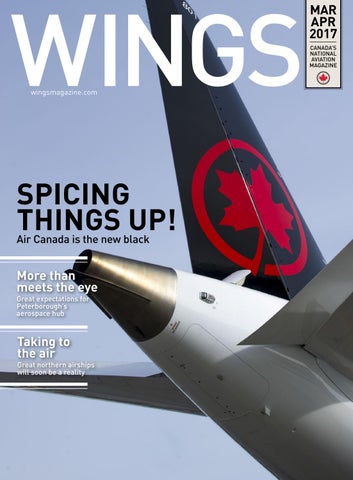
WINGS
MAR APR 2017 CANADA’S NATIONAL AVIATION MAGAZINE
wingsmagazine.com
SPICING THINGS UP!
Air Canada is the new black
More than meets the eye Great expectations for Peterborough’s aerospace hub
Taking to the air
PHOTO CREDIT TK
Great northern airships will soon be a reality
The game-changing Legacy 500 — the first midsize jet with fly-by-wire controls — is the benchmark for the future in performance, passenger room and comfort. On the flight deck, th complete control in a cockpit environment that provides superior ergonomics. With seating for up to 12 passengers, the Legacy 500 delivers a smooth flight in a largest-in-class stand-u entertainment and elegant seating that converts into fully flat berths in a low cabin altitude. The main baggage compartment is the largest in class and complements generous inflight-a also the fastest jet in its class, delivering a high-speed cruise of Mach 0.82 and excellent runway performance.
he advanced Rockwell Collins Pro Line Fusion™ platform puts pilots in up cabin with a flat floor, fully equipped galley, state-of-the-art inflight accessible cabin stowage space. The clean-sheet-design Legacy 500 is
LEGACY 500: LEAPS AND BOUNDS BETTER THAN OTHERS “The cockpit design in the Legacy 500 is clean, dark and quiet, which is very nice. Everything’s at 12 o’clock. The flight deck is efficient in layout, very easy for a pilot to get the airplane started and avionics loaded. As far as using the sidestick and flying the Legacy 500, it really is amazing. You can have the airplane go to a certain position and it’ll hold that position in flight. It’s really neat. In most airplanes, you have the yoke in the middle; it can be very confining. We had a long trip, about five hours and 45 minutes, and I remember that trip, in the cockpit, I was able to cross my legs. I looked over at the other pilot and said ‘Boy, this is nice. When was the last time you were able to cross your legs in the cockpit?’ And you’re able to do that in the Legacy 500. The passengers are really taken aback, especially on takeoff. And they’re shocked at how quickly we get to altitude and also how steep of a climb we’re doing. They’re really impressed by that. They’re like ‘Wow, that’s pretty amazing.’” - Brad Knaack, Legacy 500 Pilot Watch Brad’s story and request more information at EmbraerExecutiveJets.com/Brad
Take Your Training to New Heights. Graduate Certificate program in Airline Pilot Flight Operations: • Become industry ready as a First Officer in just two semesters • Experience Multi Crew and Line Oriented Flight Training in 703 and 705 environments • Graduate with employment opportunities with our industry partners Must hold a valid CPL and Group 1 Instrument Rating.
APPLY AT: senecacollege.ca/fulltime/APF.html
Short Courses: Seneca also offers shorts courses that bridge the gap between single-pilot operations and the practices found in Corporate, Air Taxi and Airline multi-crew environments. • 1-4 weeks • Customized to help you meet your professional goals • Flexible start dates
FOR MORE INFORMATION AND TO START TRAINING CONTACT: Lynne.McMullen@senecacollege.ca Lynne McMullen, Director, Business Development Seneca School of Aviation 416.491.5050 ext. 44237
MARCH/APRIL 2017
UPFRONT 6 Leading edge Generating a “wow” factor
10 On the fly
News and opinion
14 Alternate Approach A plusher experience
16 At the Gate
Finding the right formula
17 Glidepath
Making the Super decision
The redefined Montréal-Trudeau airport has a brand new look and it’s generating some buzz. P. 29
18 Women in Aviation All in the family
BACK 46 Marketplace 50 On final
Putting the pieces together
From top: Finding the right formula. P.16 All in the family. P. 18.
FEATURES 20 SPICING THINGS UP!
Air Canada is the new black BY DAVID CARR
24 MORE THAN MEETS THE EYE
Great expectations for Peterborough’s developing aerospace hub BY MATT NICHOLLS
PHOTO: ADM (TOP, MAIN); BRIAN DUNN (TOP LEFT); AIR CANADA (BOTTOM LEFT) T
29 HERE’S LOOKING AT YOU KID
Casablanca route in re-energized Montréal-Trudeau growth strategy BY DAVID CARR
35 TAKING TO THE AIR
Northern airships will soon be a reality BY BRIAN DUNN
COVER PHOTO: BRIAN LOSITO, AIR CANADA
WWW.WINGSMAGAZINE.COM
March/April 2017 | WINGS
5
LEADING
EDGE
By Matt Nicholls |
Generating a “wow” factor
Boeing’s Everett site, Canadian footprint is certainly impressive
impress me. I’ve encountered some pretty cool things in my tenure as editor of Wings magazine. In the last three months for example, I have been all over North America bearing witness to some great product launches, OEM facilities and more. I’ve even managed to make every young fighter pilot’s job that much more secure after my stint in a Boeing F/A-18 E/F Super Hornet simulator. Yes, I rid the world of a few critical “threats” – trees, rocks and other nasty intruders – in my time in the cockpit. Sorry Maverick and Goose; guess I didn’t feel the need for speed. One experience that certainly hit the “wow” factor for me, however, was a recent tour of Boeing’s commercial airline manufacturing site in Everett, Wa., home of the production lines for the 747, 767, 777 and 787. Standing there, gazing at the line of 777s in production, the highly-organized manufacturing processes at full, highlyefficient capacity, I couldn’t help but think what aviation pioneers Orville and Wilbur Wright might have thought had they had the opportunity to gaze down at the aircraft being produced. Could they have even fathomed what impact their makeshift flying machine would have had when it soared to the skies on that magical December day in 1903? Could they have envisioned what ingenuity had germinated there and where the engineers at companies like Boeing were going to take it? Let's start with a few numbers. Boeing’s Everett facility is the largest manufacturing
5
“If you’ve ever wondered if there’s an aerospace achievement out there that merits countless ‘wows’ here’s one that does.” operation in the world by sheer volume at a remarkable 472 million cubic feet. Located on the northeast corner of Paine Field, Everett is essentially a small city with intricate “roadways” for the efficient movement of the more than 30,000 employees that work here. For those doing the math, that’s just a tad smaller than the entire population of two Canadian Territories and countless cities, towns and hamlets across Canada. Employees here are blessed with all the creature comforts of a small community on
TOP DATA BURSTS… in this issue
1. The Quebec government has committed $1 billion to the C Series program (Pg. 10). 2. The top 100 Canadian companies spent $12.8 billion on R&D in 2015. (Pg. 16). 3. Air Canada’s fleet of 787s and 777s will be repainted within 18 months. (Pg. 20). 4. $20.2 million: The amount Flying Colours invested last April on its most recent expansion. (Pg. 24). 5. Lockheed Martin will deliver its first $40 million airships to Hybrid Enterprises in 2019 (Pg. 35).
6
WINGS | March/April 2017
site to make sure things run as productively as possible. Several cafés dot the premisis as does a bank (BECU branch), fitness centre, daycare, theatre and more. Everett even has its own fire department! A short jaunt away is The Boeing Store and the Future of Flight Aviation Centre, which runs a factory tour for aviation enthusiasts. There are even individual pathways that run throughout the facility for the more than 1,300 bikes and trikes employees can use to get around. Boeing’s footprint in Canada is as impressive as the Everett site. For more than a century, Canada’s commercial, military and research and development opportunities have played a key role in the growth of the company. With more than 17,518 employees nationwide at several sites, Canada is Boeing’s second-largest international supplier with a 2015 company-wide spend of US $1.3 billion. Canada’s largest airlines – Air Canada (AC) and WestJet – are flying a wide selection of Boeing products and more than a dozen other Canadian airliners operate some 270 aircraft. Daily, 620 commercial flights and 80,000 passengers fly on Boeing equipment, a number that will increase as both WestJet and AC update their fleets to increase their international footprints. “We have had – and continue to have – a very strong relationship with Canada,” notes Roberto Valla, vice-president of global sales, Canada. “It’s a longstanding relationship that will most certainly grow on so many levels going forward.” The numbers certainly don’t lie. Boeing’s presence in this country will continue to flourish in the months and years ahead – and, to me, that’s certainly a “wow” factor worth noting. | W @Wings_Magazine WWW.WINGSMAGAZINE.COM
PHOTO: MATT NICHOLLS
C
all me a cynic but I don’t use the word “wow” too often, especially when it comes to achievements in the aviation world that are supposed to
POWERFUL. EFFICIENT. VERSATILE. SOUND LIKE ANYBODY YOU KNOW? You demand continuous improvement in your business, so why not expect it from your business aircraft? Through intelligent design the new PC-12 NG climbs faster, cruises faster, and is even more quiet, comfortable and efficient than its predecessor. If your current aircraft isn’t giving you this kind of value, maybe it’s time for a Pilatus.
Stan Kuliavas, Vice President of Sales | skuliavas@levaero.com | 1.844.538.2376
Vol. 58, Issue 2 EDITOR
Matt Nicholls mnicholls@annexweb.com 416-725-5637 FLIGHT DECK
Rick Adams, David Carr, Paul Dixon, Brian Dunn, Frederick K. Larkin, James Marasa, Carroll McCormick, Anna Pangrazzi NATIONAL ACCOUNT MANAGER
Mena Miu mmiu@annexweb.com • 905-713-4351
SUBSCRIBE TODAY !
MARKETPLACE ACCOUNT MANAGER
Kory Pearn kpearn@annexweb.com • 519-902-8574
1 YEAR SUBSCRIPTION
3295
$
ACCOUNT CO-ORDINATOR
(GST $34.60 • HST $37.23)
Stephanie DeFields sdefields@annexweb.com • 1-888-599-2228 ext. 257
US $57.95 (USD) • Foreign $65.95 (USD)
MEDIA DESIGNER
only
Gerry Wiebe
Name: _______________________________ Company: ____________________________ Title: _________________________________ Address: _____________________________ City: _________________________________ Prov: ________________________________ P.Code: _______________________________ Tel: __________________________________ Fax: _________________________________ email: ________________________________
CIRCULATION MANAGER
Carol Nixon cnixon@annexweb.com • 450-458-0461 GROUP PUBLISHER
Martin McAnulty mmcanulty@annexweb.com COO
Ted Markle tmarkle@annexweb.com PRESIDENT & CEO
Mike Fredericks
PLEASE CHECK ONE:
WINGS MAGAZINE
❑ Charter/Fractional ❑ Commercial Airlne ❑ Private Aircraft Owner/Operator ❑ Air Transport-Cargo ❑ Tour Operator ❑ Training/Education ❑ Airport ❑ FBO ❑ MRO ❑ OEM ❑ Aviation Distributor ❑ Aviation Fuel Supplier ❑ Aviation Services ❑ Aviation Sales/Marketing ❑ Para-Public/EMS/SAR/Law Enforcement ❑ Government/Military ❑ Resources - Construction, Fire, Forestry, Mining, Oil & Gas, Wildlife, etc ❑ Other (please specify) ______________
P.O. Box 530, 105 Donly Dr. S., Simcoe, ON N3Y 4N5 Tel: 519-428-3471 Fax: 519-429-3094 Toll Free: 1-888-599-2228 Printed in Canada ISSN 0701-1369 PUBLICATION MAIL AGREEMENT #40065710 CIRCULATION Email: apotal@annexbizmedia.com Phone:416-442-5600 ext. 3258 Fax: 416-510-6875 Mail: 80 Valleybrook Dr, Toronto, On M3B 2S9 Published six times per year (Jan/Feb, Mar/Ap, May/Jun, Jul/Aug, Sep/Oct, Nov/Dec) by Annex Business Media
PAYMENT: Cheque - Payable to Annex Publishing & Printing Inc. Visa
MC
Account #: __________________________
SUBSCRIPTION RATES Canada – 1 Year $ 32.95 (plus GST - #867172652RT0001) USA – 1 Year $ 57.95 Foreign – 1 Year $ 65.95 Occasionally, Wings magazine will mail information on behalf of industry-related groups whose products
and services we believe may be of interest to you. If you prefer not to receive this information, please contact our circulation department in any of the four ways listed above. Annex Privacy Office privacy@annexbizmedia.com • Tel: 800.668.2374 No part of the editorial content of this publication may be reprinted without the publisher’s written permission. ©2017 Annex Publishing & Printing Inc. All rights reserved. Opinions expressed in this magazine are not necessarily those of the editor or the publisher. No liability is assumed for errors or omissions. All advertising is subject to the publisher’s approval. Such approval does not imply any endorsement of the products or services advertised. Publisher reserves the right to refuse advertising that does not meet the standards of the publication.
Expiry:_____________________________
TO SUBSCRIBE:
Tel: 416-510-5113 Fax: 416-510-5172
Mail: Wings Magazine c/o Annex Business Media Circulation 80 Valleybrook Dr., Toronto, Ontario M3B 2S9
Air Transport Association of Canada
ON THE
WEB
email: subscribe@wingsmagazine.com
www.wingsmagazine.com
GST#135274215RT001
8
Subscriptions non-refundable
Canadian Business Aviation Association
Magazines Canada
AVIATION THIS WEEK Looking to catch up on the latest hot news from around aviation and aerospace? Check out Aviation This Week, a live digital version of the top news stories affecting a variety of key markets. It's quick, essential information you need to know!
PRO0417
WINGS | March/April 2017
WG_subad_MarApr17_MLD.indd 1
Canadian Owners & Pilots Association
PHOTO: ANNEX BUSINESS MEDIA
Signature: _________________________
WWW.WINGSMAGAZINE.COM
2017-02-28 2:42 PM
“Peterborough offers the best of a larger regional airport with benefits of a smaller community such as low cost of living and operations.” - John Gillespie President & CEO, Flying Colours Corp.
LET YOUR BUSINESS TAKE FLIGHT Peterborough & the Kawarthas is home to the longest paved civil runway between Ottawa and Toronto. Our 7000 ft runway supports Boeing 737-900 and Airbus 320 operations. Peterborough & the Kawarthas
has excellent access to unrestricted airspace, a highly skilled and creative workforce, industry leading training facilities, and desirable infrastructure to reduce operating costs.
REDEFINE YOUR SUCCESS IN PETERBOROUGH & THE KAWARTHAS. Find out how at PeterboroughED.ca/aerospace
ON THE FLY For late-breaking news and exclusive web content, please visit us at: www.wingsmagazine.com
10 10 11 11 12 13 13
THE LEAD MILITARY OPERATIONS PRODUCTS AEROSPACE AWARDS PEOPLE
THE LEAD
FEDS CHIP IN TO HELP C SERIES, GLOBAL 7000 The federal government will lend Bombardier $372.5 million over the next four years to support the development of the Global 7000 ultra-long range business jet and the C Series commercial airliner programs. But the no-interest loan may come at a cost as Brazil’s Embraer prepares to challenge subsidies to Bombardier from the Quebec and federal governments at the World Trade Organization (WTO). Last year, the Quebec government invested $1 billion for a 49.5 per cent equity stake in the C Series. The Global 7000, which completed its maiden flight last November, will compete against the Gulfstream 650 in the ultra-high end market. Bombardier is pushing its clean sheet design as a “segment defining” airplane, including a next-generation, high-speed transonic wing that will enable the aircraft to reach speeds of Mach .90 and has an ultimate range of 13,705 kilometres.
“The Global 7000 business jet’s impressive capabilities promise to establish a whole new category for large business jets,” says David Coleal, president of the business aircraft division. At a cost of almost $100 million per unit, the Global 7000 is now on track to enter service in the second half of 2018, following a twoyear delay. It is expected that a portion of federal money will go to developing a 160-seat version of the larger CS300, which entered revenue service with launch customer airBaltic in December. “The CS300 aircraft’s [flawless] entry-intoservice confirms Bombardier’s successful execution on our commitment to deliver the only all-new family of single-aisle airliners for the 100- to 150-seat market in 30 years,” says Fred Cromer, president of Bombardier Commercial Aircraft. Bombardier delivered seven C Series aircraft in 2016, including five CS100s to Swiss International Airlines. The manufacturer expects to deliver just over 30 airplanes this year. The C Series and Global 7000 are the airplanes of the future that Ottawa is throwing its support behind but rival Embraer is crying foul, arguing that the latest round of subsidies violates Canada’s WTO obligations (Embraer’s business jet division does not compete with Bombardier in the ultra-high end, long-range sector). “The subsidies that [Bombardier] has already obtained and continues
receiving from the Canadian government have not only been fundamental in the development and survival of the C Series program but have also allowed Bombardier to offer its aircraft at artificially low prices,” says Paulo Cesar Silva, Embraer’s chief executive. “It is essential to restore a level playing field to the commercial aircraft market and ensure that competition is between companies, not governments.” Bombardier disagrees. “These are repayable contributions coming from existing programs and we are very confident that they are fully compliant with Canada’s international trade obligations,” Simon Letendre, a Bombardier spokesperson told the Montreal Gazette.
Airbus Defence & Space has selected CAE to provide training services for Canada’s new C295W SAR fleet.
AIRBUS PICKS CAE FOR FWSAR TRAINING
The federal Liberals have given Bombardier a $372.5 million loan to support its Global 7000 and C Series programs. 10 WINGS | March/April 2017
CAE will build a new training facility in Comox, B.C. to support the Royal Canadian Air Force’s (RCAF) FixedWing Search and Rescue (FWSAR) program. The training facility, which will open in 2019, is part of a contract awarded to CAE to provide aircrew and maintenance training support for the RCAF’s new fleet of Airbus C295W aircraft. As reported in December last year in Wings, the Airbus C295W was selected by the Government of Canada for its new FWSAR platform. The RCAF will receive 16 C295W aircraft specifically modified WWW.WINGSMAGAZINE.COM
PHOTOS: BOMBARDIER (LEFT); AIRBUS DEFENCE & SPACE (TOP)
MILITARY
for search and rescue. The contract was awarded to CAE by Airbus Defence & Space and includes a three-year in-service support (ISS) transition period for the C295W aircraft and maintenance training program, followed by actual support. CAE will provide a range of training services, including training device upgrades and maintenance, hardware and software engineering, obsolescence management and other ISS service. CAE will also provide academic and simulator instructors to deliver aircrew and maintenance training. CAE already provides C295 training systems to Airbus and other global operators of the aircraft. “CAE and Airbus’ partnership has a long history across many platforms,” Simon Jacques, head of Airbus Defence & Space Canada said. “This relationship has continually expanded, including Airbus’ announcement of the purchase of two other C295 simulators from CAE in November. We are pleased to extend this relationship with CAE to Canada for the FWSAR program.” Built at RCAF’s 19 Wing in Comox, the training facility will feature a range of simulation and training equipment, including one C295W full-flight simulator, eight mission procedures trainers, one sensor station simulator used for rear-crew training and an operational mission simulator. “The search and rescue mission in Canada is both critical and challenging,” said Joe Armstrong, vice-president and
Express Scripts Canada is seeking to help more aviation companies keep benefits costs down.
general manager for Montreal-based CAE Canada. “We are proud that we will play a role in helping train and prepare the RCAF for this mission.” The contract is worth approximately $200 million over the next 11 years and includes options to extend ISS services for an added 15 years.
OPERATIONS
DRIVING DOWN BENEFIT COSTS Aviation is a data-driven industry. Express Scripts Canada, a Toronto-based provider of health benefit management services, wants to help aviation companies to use their data to help drive down escalating drug benefit costs. The company does not do sectorial breakdowns but estimates that employer-funded prescription drug benefit plans in Canada waste more than $3 billion a year through unmanaged costs. The two biggest culprits are channel waste – the repeat costs of
refilling the same prescription and not comparison shopping between pharmacies for the lowest dispensary fees – and drug mix costs, opting for expensive medicines when there are cheaper alternatives that are just as effective. It comes down to empowering the employee, John Herbert, a research expert with Express Scripts Canada says. “Uninformed employee decisions result in up to $1 out of every $3 spent on drug benefits not contribution to better health. Companies must give employees the information they need to make better decisions. They also need to educate employees around lower cost medicines that may be available and encourage them to have that conversation with their physician,” Herbert told Wings. Companies may want to strike up that conversation sooner rather than later. Canadian employers, including aviation and aerospace, face a $5.6 billion price tag by 2020 just for specialty drugs alone. “High-cost specialty medications continue to consume an ever-larger
PRODUCTS
PHOTOS: MATT NICHOLLS (TOP); LEVAERO AVIATION (RIGHT)
LEVAERO UP ITS GAME Levaero Aviation has signed new dealer agreements with Advent Aircraft Systems Inc. for the sale and installation of Advent’s eABS anti-skid braking systems for the Pilatus PC-12 and King Air B200/B300 aircraft. Advent’s eABS anti-skid braking system is designed for turbine powered aircraft up to 20,000 lb. MTOW. The system offers sound braking performance and requires no change to existing braking system components. Advent’s eABS helps aircraft improve runway performance and dispatch reliability by providing better directional control, reduced tire wear and potentially shortened stopping distances on dry runways or those contaminated with water, ice and snow. “eABS is one more option that we are now able to offer to our customers who are looking for ways to improve safety and reduce their costs,” said Steve Davey, Levaero’s executive vice-president and COO. “It helps us to fulfill our promise to our customers of being their one-stop shop.” The eABS is currently FAA certified for the Eclipse 500/550, Beechcraft T-6B/C and King Air B300, with Pilatus PC-12 and King Air B200 FAA certification expected in the second quarter of 2017. WWW.WINGSMAGAZINE.COM
Advent’s new eABS anti-skid braking systems improve the performance of PC-12s and King Air B200/B300 aircraft. March/April 2017 | WINGS
11
ON THE
FLY
portion of total prescription drug spending,” Herbert notes. Of greatest concern to companies is that specialty spending is on track to reach 42 per cent of total spending by 2020. That threatens plan sustainability.” Express Scripts Canada typically sees around 10 per cent to 15 per cent cost savings in drug expenditures when a client takes advantage of more tightly managed controls. “An unmanaged plan is seeing expediential increases over time,” Herbert adds. “What is important here is that savings mechanisms will reduce costs over time. Data is a key component of this. We have the prescription drug benefit history for millions of Canadians. We can look at an individual’s prescription history and see if they have tried a lower cost medication. That is where those data driven insights will trigger us to provide that level of insight to the patient or physician.” Among the services Express Scripts Canada offers is for pharmacists to sit down with employees and educate them
12 WINGS | March/April 2017
on lower cost drug alternatives that are available. The company will also work with employers and benefit service providers to reduce drug expenditure and curb the drug trend increase when employer-funded insurance plans are up for renewal. One recommendation according to Herbert, is stepping back from 100 per cent employer-funded plans. “A plan should not be covering 100 per cent of everything,” he points out. “There needs to be skin in the game for the employee themselves, to not be wasteful and to save themselves some money as well as the plan. What is more useful is to get to that culture and foster change than to have the employee pay 20 per cent.”
AEROSPACE
MAGELLAN IS GROWING
Magellan Aerospace is expanding its footprint in India. The company has announced it will begin construction on a
new 140,000 sq. ft. building on seven acres of land in the Aerospace Special Economic Zone near the Bangalore International Airport. The project breaks ground in June. The $28-million manufacturing and assembly plant will be constructed in three phases. When the first phase is commissioned near the end of 2017, it will employ some 120 engineers, machinists, procurement professionals and quality and management personnel. “Magellan’s expanding footprint in India and increasing spectrum of capabilities reflects the company’s commitment to provide competitive solutions for major commercial customers,” noted Phillip Underwood, president and chief executive officer of Magellan Aerospace. The new manufacturing and assembly facility will help Magellan to support the production of larger work packages for major structural assemblies, fabrications and machined components for the global market.
WWW.WINGSMAGAZINE.COM
AWARDS
www.northernlightsaerofoundation.com. Nominations submission deadline is March 31.
NLAF SEEKING TOP WOMEN The Northern Lights Aero Foundation is accepting nominations for its 8th annual awards program. Each year, the national not-for-profit foundation honThe annual Northern Lights Aero Foundation dinner ours outstanding Canadian women who is set to go in Toronto again this fall. have made a significant contribution to aviation or aerospace and who continue to lay the groundwork for other women World War. During her career, MacGill to enter or excel in these industries. was appointed to the Canadian Royal The Northern Lights Aero Commission on the Status of Women Foundation’s Elsie MacGill Awards and was made an Officer of the Order of – The Elsie – is named after aviation Canada. pioneer and human rights advocate The 2017 winners will be selected by Elsie Gregory MacGill, the world’s a judging panel comprised of industry first female aircraft designer. MacGill experts and veterans and will be honoured graduated from the University of at the Elsie Awards Gala in Toronto. Toronto’s electrical engineering program To nominate an outstanding woman, or in 1927 and later became pivotal in the for more information about the Northern design and production of the Hawker Lights Aero Foundation 2 2017-02-17 1:58 PM and sponsorship opportunities: HurricaneAirGeorgian_CareersInAviation_Ad_7x5_V2.pdf in Canada during the Second
PEOPLE ON THE MOVE Embraer has named Michael Amalfitano president and CEO of its Executive Jets business unit. Amalfitano succeeds Marco Tulio Pellegrini who will assume another leadership position. The change came into effect March 1. Amalfitano has held several global leadership positions with equipment leasing companies such as Stonebriar Commercial Finance, Banc of America Leasing, Fleet Capital and GE Capital . . . Skyservice has added PJ Sharpe as its new senior business development manager. Sharpe will lead the charge for Skyservice’s charter and aircraft management portfolios in Central Canada. He will be based out of the Toronto office. Sharpe brings more than 15 years of aviation experience to his new role.
C
M
Y
CM
MY
YOUR CAREER FROM A NEW PERSPECTIVE
CY
CMY
K
PHOTO: MATT NICHOLLS
Air Georgian offers the brightest young minds in aviation the opportunity to grow their careers in one of the most hands-on, experience-focused working environments in the Canadian aviation industry. We look for people that reflect the Air Georgian approach – Innovative, Adaptable And Passionate In Everything We Do.
clearedfortakeoff.ca Copyright © 2017 Air Georgian Ltd. All Rights Reserved.
WWW.WINGSMAGAZINE.COM WG_AirGeorgian_MarApr17_CSA.indd 1
March/April 2017 | WINGS 13 2017-02-21 1:55 PM
ALTERNATE
APPROACH By David Carr |
A plusher experience
Operators are pulling out the stops to update their flying experiences
D
14 WINGS | March/April 2017
“There has never been greater opportunity for passengers to upgrade on the cheap.” cabin, or walking across the tarmac to a private jet) and operators to cash in more on the asset. Here are two examples. Air Canada is set to launch online auctions to move economy ticket passengers into higher margin, premium-economy and business class seats. The service is being provided by Montreal-based Plusgrade, which is already providing a similar service to some 35 airlines worldwide, including Lufthansa, QANTAS and Air New Zealand. Booked passengers will get an email if premium seats are available on that flight and are encouraged to submit a bid for an upgrade. According to a recent Globe and Mail report, economy passengers on a TorontoRome flight can upgrade to business class for less than half of the original business class fare. The service will be available on both Air Canada mainline and Rouge flights. It is all about raising the stakes on ancillary revenue and private aviation is not immune. Indeed, the need to offset the cost of operating executive jets may becoming more urgent. The UK’s Economist reports that business jets are becoming harder to justify and cites research by J.P. Morgan,
an investment bank, where executive travel is cut by a third over three years at companies taken over by private equity firms. At the same time, the use of private jets for leisure travel is on the rise. Toronto-based FlyEasy, a software specialist that is already helping operators fill empty legs by connecting customers with seats, has expanded its offering. FlyEasy, whose co-founder cut his private aviation teeth at NetJets, the world’s largest fractional operator, has launched OpenPoint, tracking software that puts the availability of seats and pricing on any corporate jet anywhere in the world at a customer’s fingertips and within minutes. Passengers whose household budgets do not stretch to premium cabins or private jets, will, nevertheless pay extra for pampering – at the right price. Lower fuel costs may prompt airlines to return some perqs to the economy cabin but the long-term trend will continue to be ancillary fees, no matter how many complimentary meals Delta rolls out. That trend is increasingly going to spill over to the private aviation sector as technology enables operators to cash in on surplus inventory. | W David Carr is a Wings writer and columnist. WWW.WINGSMAGAZINE.COM
PHOTO: AIR CANADA
elta Air Lines made news in February when it announced the return of free meal service on long haul domestic flights. Delta was one of the first carriers to take complimentary meals off the menu on longer legs in 2001. Is this a return to air travel as some of us over a certain age remember? Air Canada highlighted a higher quality economy class food offering in its recent rebrand. And what will those who have known nothing but pay-as-you-go austerity in the air think of the added pampering? Delta test marketed the return of complimentary meals late last year. It was met with surprise. Paint me shocked. The author of this column has always been an advocate of paying for a basic seat and adding on or, in the case of the premium cabin, subtracting to create your own inflight experience within a budget. And it remains a puzzle why airlines have fallen short of the enormous potential. Still, Delta’s announcement illustrates how far service levels in air transport have slipped when free grub grabs the headline. Nevertheless, there is something in the air, if you will forgive the rather lame pun. There certainly is a shift to better service, whether it is a return of free meals on Delta or improved food choices on Air Canada. The bigger trend, however, may be the effort to push cost conscious bums into plusher premium seats – for a price. This is likely to be a more resilient business practice given that an inevitable hike in oil prices is certain to trigger a fresh round of cabin cost cutting. And this push does not differentiate between the online cheap fare clicker or higher end traveller. After all, even the bottom ninth of the top 10 per cent can’t always afford to splash out on private jet travel for leisure. Whether commercial or corporate, produce is still the best analogy when looking at an empty airplane seat. Like a rotting tomato, an unoccupied seat (or empty legs in corporate parlance) is costly overhead. Best get something for inventory before the “sell by” date: which for the aircraft is take off. There has never been greater opportunity for passengers to upgrade on the cheap (either moving up the aisle to the premium
AT THE
GATE
By Brian Dunn |
Finding the right formula
Bombardier sorting out the dynamics of the C Series market
N
16 WINGS | March/April 2017
Bombardier’s C Series is ideal for the U.S. commuter market, notes analyst Richard Aboulafia.
“There is nothing that could threaten the C Series except the realities of being Bombardier.”
said. “In the event of a downturn, Airbus is stuck with it.” Between 2009-2014, twin-aisle average annual growth rate was 17.8 per cent compared to 6.5 per cent for single-aisle. The forecast between 2015-2019 is 9.4 per cent for twinaisle versus 13.1 per cent for single-aisle. In 2016, the top five aviation programs accounted for 40 per cent of volume and it marked the first year that saw total industry growth decline (including rotorcraft and military aircraft) by one per cent compared to a year earlier. Aboulafia remains “cynical” about China developing new aircraft models. “Stateowned aircraft typically don’t do well in the commercial market, but they might do better with the COMAC C919,” he said. Turning back to the C Series, Aboulafia maintains Bombardier president and CEO Alain Bellemare is doing the right things which allows him to negotiate aggressive deals, although there is not a lot of margin for error. “I’ve never seen a program with so much risk, but it’s still a good airplane,” Aboulafia said. “The C Series program is making other Bombardier programs starved for resources.”| W
would not necessarily do the trick, said Aboulafia. During his presentation, Aboulafia noted the commercial and military markets delivered a record $181 billion worth of aircraft in 2015 ($101 billion from Boeing and Airbus alone) and that the market grew 53 per cent between 20062015 and by an annual growth rate of 9.2 per cent over the last 12 years. Aboulafia doesn’t think that growth rate is sustainable nor does he feel a bust cycle is coming with an order backlog of 12,000 aircraft over the next few years, combined with IATA’s prediction of an annual seven per cent increase in available seat miles along the way. The twin-aisle market hasn’t grown much lately and is getting crowded, with 10 aircraft in the segment combined between Boeing and Airbus. Most industry watchers expected record numbers in the category, but it saw a cooling period instead, said Aboulafia, noting the Airbus 380 and Boeing 747 are dying. “The A380 was poorly thought out. Profitability would have been better with a Brian Dunn is a Wings writer and smaller aircraft and only two engines,” he columnist.
WWW.WINGSMAGAZINE.COM
PHOTO: BRIAN DUNN
ow that the C Series appears to be finally gaining traction, it’s time for Bombardier to rejuvenate its regional aircraft program with an eye towards a favourable U.S. market. That’s one of the recommendations made by Richard Aboulafia, vice-president, Teal Group, Fairfax, Va., during a presentation to the Montreal-Ottawa chapter of the American Helicopter Society. The analyst said the C Series was a good aircraft and estimated Bombardier could sell about 60 of them a year, but declined to predict the long-term profitability of the C Series. The best short-term strategy for Bombardier would be to concentrate on the regional aircraft market in the U.S. where it could provide a solution to “scope clauses” with a re-engined and upgraded CRJ-900 using something lighter than the PW1000, the same engine used by the C Series. Aboulafia suggested the GE Passport engine used on the Global 7000 could probably be used on the CRJ 900. After his presentation, Aboulafia was asked if there was any new aircraft coming to market in the next few years that could pose a threat to the success of the C Series. “There is nothing that could threaten the C Series except the realities of being Bombardier. Do they have the financial resources to compete with Boeing and Airbus?” he asked. Once again, Bombardier led all other Canadian companies in terms of research and development spending in 2015, with $2.3 billion dedicated to R&D, primarily on developing the C Series. The top 100 Canadian companies spent a combined $12.8 billion on R&D in 2015, a seven per cent increase from 2014. Among other Quebec-based companies, BRP (Bombardier Recreation Products) spent $164 million on R&D (21st place) and CAE was right behind, spending $139 million. In early February, the federal Liberals added some $372.5 million in interestfree loans to the C Series and Global 7000 programs, though the move was widely panned by the critics for not being enough. Ottawa’s plan to raise the cap on foreign ownership of Canadian airlines from 25 per cent to 49 per cent, in an effort to increase competition and reduce prices,
GLIDE
PATH
| By Paul Dixon
Making the Super decision Getting the Boeing Super Hornet makes sense for RCAF
PHOTO: BOEING
F
inally, there’s a little light at the end of the tunnel – and a big thank you to those folks in Ottawa for getting me out of a jam. I was stuck on deadline and seeking a way to pen the perfect column and then came the announcement that the federal Liberals will be purchasing 18 Boeing Super Hornets to tide us over until the never-ending rolling thunder road show to replace the entire fleet of legacy Hornets can get its instruments in tune. The Liberals described this announcement as filling a “capability gap,” but it’s a creative way of saying we are running out of serviceable aircraft. I interviewed (then) Maj. Gen. Blondin in 2010 at 1 Canadian Air Division and part of the discussion was the replacement of the CF-18. At that point, the F-35 was accepted in most as a foregone conclusion. I found the general to be frank and plainspoken in everything we discussed that day. I didn’t ask him if he had an opinion on which aircraft the RCAF should be flying and he didn’t offer any. What he did say was he would operate whichever aircraft was selected. It was clear from our conversation that a lot of thought had already gone into just what it would mean to transition from the legacy Hornet into a next-generation aircraft such as the F-35. And there’s a lot more to buying new aircraft than simply buying the aircraft. I’ve had the pitch, up close and personal, from both Lockheed Martin (the makers of the F-35) and Boeing (manufacturers of the Super Hornet) to get me more acquainted with their respective wares. For Lockheed, it was four years ago at the Abbotsford International Air Show and at that time, their aircraft was the next best thing for the RCAF in everything but name. Then, last year the Liberals came into power. During that election, some things got said that people took to heart and now the F-35 wasn’t quite the next best thing after all. Cue the organist for the re-entry of the Super Hornet into the contest. This year at Abbotsford, I had my chance to meet the Boeing test 17 WINGS | March/April 2017
aircraft – and over the next 20 to 30 years, the cost to keep them in the air. The challenge is to ask the right questions and those questions are very dependent on what it is we want the aircraft to be doing over their projected lifespan. The political reality is that there are no neat answers to the questions that need to be asked – certainly not within an electoral cycle of four years. For example, where will these aircraft most likely be deployed and what will they be doing when they go where we ultimately send them out? We are certainly living in interesting times from a global perspective, with Brexit and the recent U.S. election only two of the factors at play in trying to determine where we will find ourselves in 2017, let alone in 20 years. From my perspective, the decision by the federal government is indeed a sound one – one that will ensure the RCAF maintains its ability to meet Canada’s overseas obligations for the near future and gain some breathing room to get the big purchasing project finally figured out. Purchasing Super Hornets ensures that it won’t take much time to take existing legacy Hornet pilots and convert them, a point Boeing has been pushing it its sale pitch to the Canadian government for some time. Good news like this reminds me of the first whiff of the Christmas turkey in the oven. It sure smells nice, but it just makes you all the more hungry for the real thing. As we head further into 2017, I can’t wait to hear what this government has in store for us next. | W
It’s a creative way of saying we are running out of serviceable aircraft. pilots and tabulated their thoughts on how their aircraft stacked up against the competition. Were it only so simple that as in American Graffiti, we could just roll out to the valley at sunrise and let the ’32 Deuce and the ’55 Chevy decide it once and for all. Unfortunately, it’s not that simple. There’s the question of offsets for the benefit of the Canadian economy. Fair enough. Then we have to consider the cost of operating these aircraft over their anticipated lifespan, not to mention the question of fuel consumption and maintenance issues. The short answer is it’s going to cost a lot of money any way you look at it. Up front, there’s the cost just to buy the
Paul Dixon is a freelance writer and a photojournalist living in Vancouver.
WWW.WINGSMAGAZINE.COM
WOMEN IN
AVIATION By Anna Pangrazzi |
All in the family
Air Canada’s Denise Egglestone continues to lead by example
F
18 WINGS | March/April 2017
12-hour shifts and I like to use all the resources we have including my colleagues because you can’t know everything about all things all the time. Learning doesn’t stop once you have the certificate. What advice would you give and what needs to be done to get more women in the field? Don’t take no for an answer! And if you don’t like the answers you get, find someone else to ask. Join the organizations that work to mentor like Women in Aviation and the Ninety-Nines. There is a perception that non-traditional jobs in aviation are inherently difficult and we need to focus on and showcase those women who are successful in their careers. We also need to teach networking. Sometimes women believe that they cannot achieve both personal and professional goals. Young women need to talk to people who are successfully balancing both goals. | W
“Don’t take no for an answer! And if you don’t like the answers you get, find someone else to ask.” What kind of challenges have you had to deal with? Many of the challenges I had in my early career are quite different than what my daughter has to deal with now. As a charter pilot, I had to share accommodations with the men and some tried to rattle me by walking around barely clothed. That wouldn’t happen today. A pilot refused to fly with me once because his wife wouldn’t allow it. When I became the first female flight operations instructor at AC, I got a lot of negative feedback such as, “they must have had no one else apply if they hired a woman!” I learned to ignore a lot. The challenges I face today are being able to coordinate and prioritize workload and to keep up with the huge amount of rules and regulations to ensure I have done my part to have my aircraft leave on schedule. How do you describe your professional style? I like to work collaboratively. We work
Anna Pangrazzi is the president of Apex Aviation Sales Ltd. and Wings women in aviation specialist. WWW.WINGSMAGAZINE.COM
PHOTO: AIR CANADA.
lying is not always a family affair. It has been my experience with selling airplanes for more than 30 years, that not everyone will share a pilot’s passion or thrill for flying. Sometimes, it becomes a solitary hobby. My close friend and colleague, Denise Egglestone, however, has had a very different experience. In fact, her entire family has the aviation bug. Denise received her flight training very early and at a time that her job prospects weren’t ideal – but that didn’t stop her. She knew from an early age that she wanted to work for Air Canada (AC) and started working in the parts department as a purchaser back in 1978. She became a ground school instructor and eventually went on to work as a flight dispatcher, a position she has held for the past 20 years. The Egglestone family is truly an aviation wonder. Denise’s husband Jim flies for AC and her daughter, Lauren, is a Seneca aviation graduate and is flying for Missinippi Airways in The Pas, Man. Her son, Ian, is also currently in flight training. As Denise says, the aviation industry offers many great career opportunities on a number of levels. Wings recently sat down with Denise to get her perspective on career options, challenges she has faced, the industry make up and more. Why did you choose a career in aviation? For as long as I can remember, I wanted to work for AC. My dad worked in the cargo department and I remember going to work with him on Saturdays, roaming around the warehouse and climbing onto the DC-8 freighters. Did you have any role models and/or mentors? I didn’t really have any role models when I was younger. In fact when I was in my teens, I really wanted to be a pilot and I was told it was “impossible.” But I loved hearing about the flying and travel from a pilot friend of my parents. And one day, a friend of mine said he was taking flying lessons and I said sign me up. I was hooked right away. Later, when I was transferred to Toronto, I became a member of the Ninety-Nines, the international organization of women pilots, and many of them became my role models and mentors.
Achieve New Career Heights with
Alkan Air Stay ahead of the curve and do your training in Whitehorse Yukon, capital of the north’s most beautiful and diverse territory. Fly in the mountains, in remote areas and to gravel runways but be based out of a controlled International Airport – the best of both worlds. Alkan Air has proudly served Canada for 40 years and offers the following professional pilot training courses to give your career wings: • • • •
Private Pilot License Commercial Pilot License Multi-Engine Rating Instrument Rating
• Night Rating • VFR Over the Top • Professional Pilot Course
The Yukon also boasts the north’s ONLY Two-year Aviation Management Diploma in partnership with Yukon College that allows you to earn your Private Pilot License and Commercial Pilot License and develop practical business skills to support your flying career and increase opportunities for employment. Flight training with Alkan Air allows you to learn in a unique northern climate, while business courses at Yukon College can open up a world of opportunities in the aviation industry and beyond. Our fleet includes Cessna 172 Skyhawk and Piper Seneca aircraft.
867-333-9793 | ftu@alkanair.com | alkanair.com |
SPICING TH PHOTO: BRIAN LOSITO, AIR CANADA
AIR CANADA IS THE NEW BLACK
BY DAVID CARR
20 WINGS | March/April 2017
WWW.WINGSMAGAZINE.COM
HINGS UP A
ir Canada turns 80 in April and has reconnected to its roots with an eye-popping new look. The airline also wants to seal its status as a global brand and leverage several operating advantages to boost international market share out of Toronto’s Pearson International Airport, where it lags other global powerhouses such as British Airways, Emirates and Lufthansa at their WWW.WINGSMAGAZINE.COM
primary hubs. The historic Rondelle – a stylized red maple leaf inside a circle – which had been banished from the tails of the Air Canada fleet since 1993, has made a triumphant return as the centrepiece of a bold new livery, highlighted by a black tail, engine nacelles, aircraft belly and flight deck windows. “I followed airline liveries as a kid,” Benjamin Smith, Air Canada’s president of passenger airlines and the driving force
behind the return of the Rondelle said. “My favourite was when Air Canada was first rebranding from Trans Canada Air Lines. My position was to return to some of those elements and to show our Rondelle much more prominently.” The black flight deck windows and word mark across the front of the fuselage are other nods to Air Canada’s original 1964 design and black nose cone. The new paint job was unveiled simultaneously at Toronto, Montreal and March/April 2017 | WINGS 21
Vancouver, using Air Canada’s first Boeing 787-8 and two Airbus A320 aircraft respectively. The airplanes were the centrepieces of a broader reveal that included new company uniforms, menu choices and wines, showcasing some of Canada’s best design and culinary talents. This is the future Air Canada. “Our customers are becoming more sophisticated in their tastes and the standards of service they are looking for. Our flights are getting longer as we start to fly further,” Smith pointed out. “You can’t just do that with airplanes. It comes from the livery, uniforms, food and wine. You put all of this together to come out with a brand promise that meets or exceeds the expectations of a very discerning clientele.” Mack Ferguson, a brand specialist at the Toronto office of British-based Brand Finance believes the company is onto something. “What they are doing is quite clever,” he said. “They are competing against much bigger global airlines with a distinct Canadian brand to drive international business class traffic, which has higher margins than domestic traffic.” Air Canada has climbed 12 spots to 22 on Brand Finance’s annual ranking of the country’s most valuable brands (replacing Bombardier, which tumbled to 23). A brand is an intangible asset that can protect a company’s value, especially during turbulent market conditions. Brand Finance ranks brands based on several factors, including marketing investment, familiarity, loyalty, staff satisfaction and the proportion of overall business revenue that is contributed by the brand. “There is no question if you look at Air Canada, they climbed because of investments in marketing and advertising, the tremendous job they did squeezing costs out of their system and how their brand is perceived in the market place,” Ferguson added. The new fleet design was created by international design firm Winkreative, headed by Canadian entrepreneur Tyler Brûle,
22 WINGS | March/April 2017
whose previous work includes a complete rebrand and simple red and white aircraft livery for Swiss International. “There was a real ambition laid in front of us,” Brûle recalled. “The design wasn’t supposed to be the best in eastern Canada or the best in North America. We were going global.” Brûle was keen to avoid what he described as the “trickery” of other airline designs, which he said includes shades and shadow and are sometimes loaded down with multiple layers of decals. “You see some airlines with simple red, white and blue, but it is quite a complicated livery. The exercise of painting these aircraft is very much simpler.” Smith pointed out that the new livery is less intense and more environmentally friendly than Air Canada’s previous “toothpaste” livery. “It passed our bean counter test,” he said. “It uses less paint and we won’t have to paint the aircraft as often.” The Rondelle, which also features prominently on the front lower fuselage, aircraft belly and inside engine to reaffirm brand awareness from inside the cabin was first stripped from Air Canada tails in 1993 by American chief executive, Hollis Harris. The signature piece continued its exile in American-cum-naturalized Canadian Robert Milton’s company rebranding in 2004. Less clear was the choice of colour. There was a lot of back and forth before the company ditched traditional red and white for black. “It took over a year,” Smith said. “To get a livery going needs a long time to get it just right. We had a very strong symbol of Air Canada with our trademark Rondelle and we wanted to see it back on the tail of our airplanes. Then of course the experts took over.” “What was interesting was where we ended up,” Brûle picked up. “We decided on the design whether it was going to be red or dark blue. Then we were just tweaking the pantones a bit.” “Once we agreed on the black it was incredibly fast,” Smith added. “We agreed on black in May and here it is February.” Indeed, the bigger challenge was keeping the design a secret. Brand Finance’s Ferguson believes Air Canada landed on the right colour for the market they are chasing. “Black luxury cards are sophisticated. Dark blue cars aren’t. They are presenting themselves as a sophisticated international airline. It is a refreshing change from fighting over discounted fares and bringing your own lunch,” he said. It will take up to four years to repaint what Smith described as Air Canada’s “most prominent billboards”: its fleet of 300 mainline and regional aircraft. The company’s rouge leisure airline will maintain its distinct red, white and burgundy livery, with an enlarged and cropped version of the Rondelle on the tail. The current mainline fleet of 787s and 777s will be repainted within 18 months. The remaining 14 787s on order and the first 737 MAX aircraft, which are expected this December, will be delivered in the new paint scheme. All front-line employees should be kitted out with the new uniform by the end of the year. The rebranding is the latest in a series of strategic pieces – including a modern, long-range fleet and long-term labour piece – in place to help Air Canada transition into North America’s first global hub airline. “There are strong U.S. domestic hub carriers, but none of them play the role of global hub carrier like many airlines in Asia and Europe,” Smith told Wings. “We are already the largest foreign carrier into the U.S. You can’t transit in the U.S, but for international customers, you can transit out of Toronto, Montreal and Vancouver like you can in Amsterdam and Seoul.” Smith especially wants to see Air Canada grow its share of international traffic out of Toronto’s Pearson International Airport above 50 per cent. “We are determined to get our international share up,” he said. “When you look at Toronto and its geographic location, we are sitting on a gold mine. We have five runways, no slot restraints, reasonable curfew hours and route rights to anywhere we want to fly. We have got a good shot at becoming a true global carrier.” | W WWW.WINGSMAGAZINE.COM
Some of Peterborough’s top aerospace leaders (from left): Trent Gervais, Peterborough Airport manager, chief executive, Loomex Corp.; Lynne McMullen, director, business development, Seneca College; Jordan Lavery, outside sales/marketing, KADEX Aero Supply; Gary Wood, director corporate sales and marketing, Flying Colours; Rhonda Keenan, president and CEO, Peterborough Economic Development.
MORE THAN MEETS THE EYE...
GREAT EXPECTATIONS FOR PETERBOROUGH’S AEROSPACE HUB
W
PHOTO: MATT NICHOLLS
BY MATT NICHOLLS
hen Seneca College set out to find a suitable location to meet its needs for a new aviation campus in 2010, the relocation team put a plan in motion to meet very particular objectives. For four decades, the campus was based at Buttonville Municipal Airport in Markham, Ont. and it functioned well. The impending closure of the airport, however, meant a new path was needed. The new location needed to be part of a growing aerospace hub able to provide flexibility and growth opportunities while still giving it the space to further develop as one of Canada’s leading post-secondary aviation schools. It also needed to be part of a dynamic, highly functional airport – one that had strong ties to the community and also offered close proximity to other educational institutions for future academic partnerships. Finally, there needed to be an intangible quality – an “it just feels right” feeling, a sense of belonging, a sense of home. Fortunately, it didn’t take the relocation team long to realize “home” would be the Peterborough Airport. “When we started the process, we drew a circle of potential locations with Buttonville in the middle of the map,” notes Lynne McMullen, Seneca’s director of business development, who was aviation chair at the time. “One WWW.WINGSMAGAZINE.COM
of the things that impressed me most about Peterborough was the sense of appreciation for the area – the city embraced the airport as an economic driver.” Here, decision makers such as the City of Peterborough, as well as Peterborough Economic Development (the regional economic development agency), recognize the benefit of including the airport in the community. Having just completed $28.6 million in upgrades to the airport with funding from municipal, provincial and federal governments – the addition of an aviation industrial park, air terminal building, maintenance facility, increasing the length of the runway from 5,000 to 7,000 ft. and more – the Peterborough hub was positioning itself as a player in the Canadian aerospace community. Adding a premier academic institution like Seneca was an important part of the process, completing the education pillar. McMullen fondly recalls one of her first “ah ha” moments when evaluating the site. “When I got there, I saw a busload of children in the airport having lunch together – and people of all ages coming in to have their lunch,” she says. “The (Gardens & Fields) restaurant was so popular; this was a destination inside the airport. This is something that I liked for our students because they spend so much time here.” Seneca completed its move in late 2012 and opened for business in January 2013. Since that
time, the college has flourished with a dramatic increase in flight movements, attendance and a special synergy with other airport tenants. There’s a kinetic buzz around campus and McMullen couldn’t be happier – and was beaming throughout a recent tour with Wings. The campus is a sight to behold, an aviation school ready to inspire the next generation of fixed-wing pilots. Bright, wellorganized and self contained, the new space includes a bright, spacious hangar capable of housing 13 aircraft, two state-ofthe-art academic classrooms, 10
The economic development corporation really recognized the benefit of including the airport in the community. simulators (including a CRJ 200 regional jet, Redbird crosswind simulator and B200 turboprop), active learning classrooms, flight dispatch and operations offices, flight briefing rooms, a student lounge and more. There’s also additional space to grow for future expansion. “We couldn’t be happier, it is really working out for us,” McMullen says. “The students are thriving, the program is
thriving. I think that it’s great for the students to see an aviation hub working together, working with the city – we’re not just individual businesses here.” BUILDING FOR THE FUTURE A sense of community, a familyoriented entrepreneurial spirit, a friendly atmosphere, individual businesses working together to drive the future success of the airport and the developing Peterborough aerospace hub. It’s the overriding philosophy all partners at the airport share and it’s something Rhonda Keenan, president and CEO, Peterborough Economic Development, maintains is unique to her city. “It may sound cliché, but we really are like a family here,” Keenan told Wings. “When you think about the individual businesses, many are familyowned and operated . . . this type of entrepreneurial spirit and camaraderie occurs at the airport. We have close-knit relationships and this has really helped us grow.” Trent Gervais, airport manager of the Peterborough Airport and chief executive of on site aviation management firm Loomex Group, agrees. With the expansion of the airport complete, a solid operating structure in place and tenants such as Seneca College, Flying Colours, KADEX Aircraft Parts & Service and others thriving, the focus now is on developing the Peterborough aerospace footprint to attract new players. March/April 2017 | WINGS 25
SHOWING THEM HOW TO SOAR The MRO space has certainly been a good fit for Flying Colours, a great example of a 26 WINGS | March/April 2017
ABOVE: Flying Colours’ Canadian headquarters is a bustling completions centre with a growing international footprint. RIGHT: Seneca College has 10 simulators on campus, including a CRJ 200 regional jet and a B200 turboprop to train students.
small Canadian aerospace firm expanding on the international stage. What started out as the hometown Gillespie family’s “Mom and Pop” family-owned paint shop in the 1960s, has morphed into a leading global aviation services provider, offering not only paint services but also specialized completion, MRO, avionics, engineering and aircraft interior services. Founder, president and CEO John Gillespie keeps close watch over the business but it’s very much a family affair – there are at least half a dozen family members driving its development and growth. “If you approach the average reader of your magazine and say what do you know about Flying Colours, the typical response would be that we are a paint shop,” notes Gary Wood, corporate sales and marketing at Flying Colours. “But there’s a multitude of skillsets here that we have – and we’re growing. We are a full-service facility here that does a little bit of everything. Completions, interior refurbishment, conversions, MRO, external paint, avionics
upgrades – we are trying to be all things to all people. We don’t take no for an answer.” Flying Colours’ customer base is truly international and the Canadian footprint is very much a small part of the makeup. Clients are distributed pretty much everywhere, Woods notes, and while the economic slowdown may have affected some other parts of the industry, Flying Colours is still thriving. In fact, when Wings toured the facility, aircraft from Great Britain, Qatar, China and Canada were on site, with one just being shipped to the Isle of Man. And there’s plenty more to come in the months and years ahead. A $20.2 million expansion for a 100,000 square-foot hangar was announced last April that will enable Flying Colours Corp. to take on work for larger airplanes and will
help the company address the increasing global demand for customized aircraft retrofitting. The firm has had a special relationship with Bombardier over the years. For example, since 2006, Flying Colours’ CRJ ExecLiner program has brought to market some 18 aircraft in various configurations including full VIP, shuttle, special mission and more. On its Challenger 850 completions program, which began in 2008, some 15 aircraft have been delivered to date and an additional seven have been delivered on the CRJ 700 special mission program. Several special completions projects have also been made on the Global G5000, G6000, G7000 and G8000 aircraft. Flying Colours has a special relationship with Canada’s Bombardier Aerospace, but its OEM partnerships do not stop WWW.WINGSMAGAZINE.COM
PHOTOS: FLYING COLOURS (TOP) SENECA COLLEGE (ABOVE)
“There are many growth opportunities for us,” Gervais says, “and when you look at how we are developing, seeing the number of aircraft movements jump from 10,000 to just shy of 60,000 this year – a lot is happening. And it’s not just Flying Colours, it’s different categories across the board. Business travel is increasing, people are coming in and out for meetings. “We’re also working on our east development project which is across from Flying Colours to have more service land ready to go. The land we did develop is almost full. What we offer here for potential new tenants is fully serviced land – hydro, gas, fibre, sewer and water. We are so flexible in the size of land you want, we can work with anyone that is ready to develop.” One of goals on the table, Gervais notes, is boosting the maintenance, repair and overhaul (MRO) footprint. Flying Colours speaks for itself in this realm. The familyowned completions and MRO specialist has established itself as one of Canada’s fastestgrowing aerospace companies, with some 445 employees at three facilities worldwide – 250 at its 150,000 sq. ft. Peterborough headquarters; 170 at its 65,000 sq. ft. St. Louis, Mo. completions facility; and 25 at its Bombardier service facility at Seletar Airport in Singapore. Flying Colours has room to develop – and has some exciting projects on the horizon – but Gervais is confident more MRO opportunities are out there. “MRO has been a very good pillar for us and we are trying to attract more MRO business here – it makes sense,” he says. “We are ideally situated between Toronto and Ottawa, have the longest runway between the two cities save for the military base in Trenton, Ont. and we can accept a Boeing 737 or Airbus A320.”
WG_JAN17_top20ad_GHW.indd 1
LEKTRO
Applied Informatics & Research
2017-01-23 2:59 PM
The Original Towbarless Tug Setting the Standard in Excellence Since 1945
Flight Data Monitoring (FDM) Flight recorder readout & playback services Data readout software sales Fuel, economic analysis and carbon emissions tracking
Models ranging
15,000 to 280,000 lbs.
Electric Towbarless Certified Easy to Use Universal Rugged Simple to Maintain
Transport Canada AMO 42-13 Authorized by Honeywell Approved by L-3 & Universal Avionics
www.
400- 205 Catherine Street, Ottawa, ON, Canada, K2P 1C3 Tel: +1.613.749.1015 airinc.ca for more information sales@airinc.ca to contact us
1-800-535-8767 1-503-861-2288 sales@lektro.com March/April 2017 | WINGS 27
WWW.WINGSMAGAZINE.COM WG_Airinc_NovDec16_CSA.indd 1
LEKTRO .com
2016-10-18 WG_Lektro_NovDec16_CSA.indd 7:24 AM 1
2016-10-24 12:50 PM
the right relationship can help you soar.
I
PNC AVIATION FINANCE When it comes to financing private aircraft, we know you value decades of aviation expertise, track record and financial strength. That’s why aviation clients across the U.S. and Canada choose PNC Aviation Finance to help their business take off.
KADEX Aero Supply’s vice-president and technical support guru Ken Blow is one of the capable members of the small team.
To learn more, visit pnc.com/aviation. PNC is a registered mark of The PNC Financial Services Group, Inc. (“PNC”). Equipment financing and leasing products are provided by PNC Equipment Finance, LLC, a wholly-owned subsidiary of PNC Bank. Aircraft financing is provided by PNC Aviation Finance, a division of PNC Equipment Finance, LLC.In Canada, PNC Bank Canada Branch, the Canadian branch of PNC Bank, provides bank deposit, treasury management, lending (including asset-based lending through its Business Credit division) and leasing products and services (through its Equipment Finance division). Deposits with PNC Bank Canada Branch are not insured by the Canada Deposit Insurance Corporation. Deposits with PNC Bank Canada Branch are not insured by the Federal Deposit Insurance Corporation, nor are they guaranteed by the United States Government or any agency thereof. Lending and leasing products and services, as well as certain other banking products and services, require credit approval. ©2017 The PNC Financial Services Group, Inc. All rights reserved. CIB EF PDF 0715-070-195013
Achieve a higher level of efficiency with innovative materials from BASF. Labor and cost savings, increased passenger comfort, and design flexibility are just a few of the ways we deliver solutions to the entire value chain. At BASF, we create chemistry. aerospace.basf.com
A FAMILY AFFAIR PART TWO Though they may not have the caché of a Flying Colours, KADEX Aircraft Parts & Service has also made a name for itself on the Canadian aerospace scene. And like Flying Colours, this family-run business has benefitted from its location at the Peterborough Airport due to its cost effectiveness and efficiencies. Some 20 employees work at the KADEX facility at the Peterborough Airport which spans some 24,000 sq. ft. – 18,000 of which is a well-organized mini warehouse of more than 55,000 parts from more than 100 manufacturers around the globe. The KADEX team gets some 300 quotes a day from 500 active customers around the world, so offering maintenance and technical support to operators is paramount. A second location in Calgary caters to a western customer base. Customers span a Continued on page 38
28 WINGS | March/April 2017 WG_BASF_third_future.indd 1
WWW.WINGSMAGAZINE.COM 2016-10-24 1:25 PM
PHOTO: MATT NICHOLLS
We create chemistry to build lightweight space saving interiors.
CIBEF Know Ad_Aviation_4.625x5_195013_2017_final.indd 1 WG_PNC_MarApr17_CSA.indd 1
there. The company has refurbishments, green aircraft completions and paint contracts with a wide selections of OEMs including Gulfstream, Cessna, Dassault Falcon, Beechcraft, Sikorsky, Airbus for both fixed- and rotary-wing aircraft, along with an arms length number of certification approvals. On the avionics side, Honeywell and Rockwell Collins are 2/16/17 11:56 key AM clients. 2017-02-16 1:22“We’ve PM even painted one of the four Challengers the prime minister flies around in,” Wood says with a smile. “Good bad or indifferent, he is carrying our paint. So, when you look at our customer base, it’s a little bit of everything – and it’s all over the globe. Our reach is pretty significant.”
Montréal-Trudeau handled a record 16.6 million passengers in 2016.
HERE’S LOOKING AT YOU KID
CASABLANCA ROUTE IN RE-ENERGIZED MONTRÉAL-TRUDEAU GROWTH STRATEGY
F PHOTO: ADM
BY DAVID CARR
oreign tails are returning to Montreal in a big way. In fall 2015, Air China opened up the first direct trans-Pacific link between Montreal and Asia with non-stop Boeing 777 service to Beijing. Thirteen years after Aéroports de Montréal (ADM) rescued international traffic from Mirabel – the city’s disastrous second airport that opened in 1976 – and consolidated passenger operations at Pierre Elliot Trudeau International (Montréal-Trudeau), Canada’s third busiest airport has been reinventing itself. YUL turned 75 last year. Air transport in Montreal has never been healthier and its airport more confident. Montréal-Trudeau handled a record 16.6 million passengers in 2016, including a 5.9 per cent increase in international traffic, the airport’s busiest sector. ADM, the non-share, not-forWWW.WINGSMAGAZINE.COM
profit operator of Trudeau and Mirabel airports wants to build on this success. The airport has leveraged Quebec and Montreal’s language and culture to link with similar markets in French Europe and North Africa. “We have worked with airlines like Air Canada and have focused on special destinations where there is a solid North American base of those passengers in Montreal,” says James Cherry, the recently retired chief executive of ADM. Wings interviewed Cherry just before he stepped down. “The main reason for [growth] has been Air Canada’s expansionary strategy, supported by low fuel prices and a favourable exchange rate,” says Philippe Rainville, Cherry’s successor as chief executive. Last summer, Air Canada launched non-stop seasonal service March/April 2017 | WINGS 29
between Montreal and Casablanca, and year-round service between Montreal and Lyon. The Casablanca service, using Rouge equipment, is Air Canada’s first African route and the only scheduled non-stop to North Africa by a North American carrier. “Because we have a solid French base, we can optimize those flights and increase our numbers for both transiting passengers and links with destinations such as Brussels, Lyon, Geneva and Casablanca. It was a challenge at the beginning, but it is working really well,” Cherry adds. The number of connecting passengers jumped in 2016 to 3.1 million and represents almost 19 per cent of the airport’s passenger traffic. “If the present trend continues, our annual traffic will be in the neighbourhood of 20 million passengers by 2020, propelling Montréal-Trudeau to the next level,” says Rainville. “The prospects for 2017 are already very promising.” These include Air Canada’s new daily route to Shanghai that was launched in February and Air Transat’s roster of destinations, which is expanding to include Tel Aviv. The Air Canada-Shanghai service is expected to generate some 125,000 passengers a year. “Our passengers have never had so many travel options, particularly internationally,” Cherry points out. “With the launch of the international expansion, we will be able to effectively meet this projected growth in demand.”
One thing Cherry would have liked to have seen during his tenure was individual airports with a direct seat at the table when negotiating bilateral air agreements. “We’ve got a good piece of airlines already and we work closely with them to ensure they help us to develop the market place,” he explains. “But airports do belong at the [bilateral] table because our interests are a little different from the airlines. It isn’t always in the best interest of an airline when an airport goes after a destination or route. It would be useful to have airports as part of the discussion.” To support growth, Montréal-Trudeau cut the ribbon on a new six-gate international pier in time for the busy summer season. The pier is the centrepiece of a $350 million (US$273 million) expansion and improvement program that has added 800 square metres of retail space in both the domestic and international area, with a stronger focus on local brands and experiences. “Our renewed retail offering at Montréal-Trudeau is our commitment to offer a truly Montreal experience, rather than something generic,” Cherry points out. To illustrate the point, Avenue des Canadiens, an upmarket restaurant and bar that opened last spring features a true hockey experience, including Canadiens’ memorabilia and retail outlet. Montréal-Trudeau now has almost
16,000 square metres of retail space, a 38 per cent increase since 2011. Non-aeronautical revenue accounted for 46.1 per cent of total revenues in 2015, with retail contributing 27.5 per cent. An aesthetic highlight of the development is an interior open-plan area designed to create a unique atmosphere through the integration of artistic and cultural elements, including a lighted ceiling installation titled Nuée de verre (Veil of Glass) composed of different-coloured glass triangles illuminated by spotlights. Cherry is very supportive of the art installations, noting they represent a small percentage of the overall budget. “It is these little extras, in conjunction with the open-plan [and] transparent architectural design that make all the difference,” he says. “The project is part of a master plan to create a facility that is both functional and vibrant. It has been completed showing imagination and taking into account our limited financial resources.” Financial resources are certain to be an issue going forward. Montréal-Trudeau was one of the first airports to be leased out to a local, not-for-profit operating authority in the 1990s. It’s a watered-down version of the airport privatization that had already taken place in the U.K. Those leases are set to expire in 2072, which will impact airports ability to borrow in the future. Airport investments are typically
30 WINGS | March/April 2017
PHOTO: ADM
Former ADM chief executive James Cherry stepped down just when the airport is hitting on all cylinders.
WWW.WINGSMAGAZINE.COM
WANT TO BE A COMMERCIAL PILOT? We can get you CPL qualified in 1 year. GUARANTEED.
WHAT ARE YOU WAITING FOR?
www.durhamflightcentre.com Tel. 905-720-2831 Durham Flight Centre is registered as a private career college under the Private Career Colleges Act, 2005. Guarantee based on full-time studies by admitted students
WG_DurhamFlight_change_MarApr17_MLD.indd 1
2017-02-15 7:27 AM
Located in Portland, Oregon Factory trained technicians Nearly 70 years of excellence WWW.FLIGHTCRAFT.COM
March/April 2017 | WINGS 31
WWW.WINGSMAGAZINE.COM
WG_Flightcraft_SeptOct16_CSA.indd 1
2016-08-16 2:41 PM
amortized over 40 years, meaning the investment window will begin closing by 2032 at the earliest so airport authorities can transfer assets back to the federal government in good condition and debt free. “There are at present no clear arrangements for the transfer of airport assets and contracts back to the federal government when airport authority leases expire,” as noted in the Canadian Airports Council 2015 review of Canadian transport. “Unless these issues are addressed, airport authorities will no longer be able to obtain financing for major airport expansion projects and to maintaining existing assets.”
Addressing this so-called “end-of-lease” issue could mean converting existing leases into perennial agreements or inviting in the private sector. “There is potential in the Canadian market for pension fund investors and other Canadians to get involved in the success of Canadian airports going forward,” said George Casey, chief executive of Vantage Airport Group, a Vancouver-based airport investment and management company. “We have seen that happen in places like Australia where the local investor is involved in the success and development of airports.” Vantage, which operates smaller
Canadian airports in Hamilton, Moncton and British Columbia has transferred 20 international airports over to the private sector and took over the operation and redevelopment of New York’s LaGuardia Airport (see below). There are signs that early resistance to airport privatization is softening. The federal government is considering selling its airport holdings to help pay to rebuild Canada’s crumbling infrastructure. In early 2016, David Emerson, the first chief executive of the Vancouver Airport Authority recommended just that. Whatever the government decides, ADM is
It’s up to you, New York, New York Canada’s Vantage Airport Group has been involved in 28 airport projects worldwide and is a global leader in private sector airport management and finance. Its redevelopment of New York’s LaGuardia Airport may be the foothold the Vancouver-based operator is looking for to fully break into the U.S., a market that has been slow to embrace private sector models. LaGuardia Gateway Partners, a consortium headed by Vantage, has taken over operations of LaGuardia from the Port Authority of New York and New Jersey, which also operates John F. Kennedy International Airport and Newark’s Liberty Airport. The transfer is part of an ambitious $5.12 billion (US$4 billion) modernization of the cramped and outdated airport, including the redevelopment of LaGuardia’s 52-year old Central Terminal (Terminal B). LaGuardia handled 28.4 million passengers in 2015, with close to half travelling through the Central Terminal. The project is the first rebuild of a major American airport in over a generation, and the largest public-private partnership undertaken in the U.S. “It’s a good opportunity to look at different options or private involvement in the development of airports in the U.S.,” said George Casey, chief executive of Vantage. “We think it is a very interesting model for the U.S., and one that sets the stage for the private sector working closely with stakeholders to deliver public infrastructure.” It is a welcome rebound from 2013, when a $3.23 billion (US$2.52 billion) deal to privatize Chicago’s Midway Airport was cancelled because of tightening money markets. Much of the groundwork that went into the Chicago deal has laid the foundation for LaGuardia. “We had a good experience in Chicago,” Casey 32 WINGS | March/April 2017
says. “We worked very closely with the Chicago Department of Aviation, airport personnel, unions and airlines, and completed the necessary transition work ahead of the project potentially unfolding. It gave us good insight into the workings of Midway, but also on the U.S. perspective. So, we gained some experience even though it didn’t close.” LaGuardia has its share of detractors, including those who would like to shutter the dysfunctional airport, shift traffic to Kennedy and Newark and build a dedicated express rail link connecting Manhattan with JFK. Still, the plans for the new development are impressive, including approximately 121,000 square metres of new terminal space, including retail and pedestrian bridges that span airside taxi lanes, a global first in airport development. The project also includes a central hall that will create a single, unified airport. “Despite different government models, we have added value – and in some cases, significant value – at airports we have taken over,” Casey points out. “That value has come in a number of areas such as access to capital, development expertise, continuous improvements around nonaeronautical revenue and innovative approaches in dealing with airlines and airline partnerships.” Vantage began operating in 1994 as an airport consulting division of the Vancouver Airport Authority (VAA). The VAA sold its final 50 per cent stake in the company late last year, although the two companies maintain a strategic alliance. “YVR remains best in class,” Casey insists. “We will continue to capitalize on the partnership we have had with them over the last 20 [plus] years. We are excited that our relationship still exists and we can
access the world-class resources of Vancouver International Airport. At the same time, we are an independent organization and can share resources back with YVR.” While Vantage has been able to build an impressive global portfolio, it remains a bit player in its home market. Commercialization in Canada has put the largest properties such as TorontoPearson, Montréal-Trudeau and Vancouver out of reach of private sector operators. That might be set to change. “Canada is still evolving,” Casey observes. “The interesting thing about the Canadian market is its similarities with major airports in Australia. All the airports were part of a central airports corporation that are now spun-off under long-term leases to private consortiums. There has been capital investment and these airports are world class. The Canadian market could look at the Australian experience and potentially benchmark against that.” Back in the big apple, Vantage will oversee construction of the project, operations and commercial development of the terminal building through to 2050. The modernization will be completed in phases over the next six years, with a significant milestone being reached in early 2020, when 100 per cent of passengers will check in at the Central Terminal. “The development of LaGuardia’s Central Terminal meets Governor [Cuomo’s] central vision for infrastructure, and what the airlines need to operate going forward,” Casey insists. “We are obviously looking at other opportunities in the U.S. market to build on what is happening at LaGuardia. We see activity in the market and we are bullish on the success of LaGuardia and what that will bring for other projects.” WWW.WINGSMAGAZINE.COM
PHOTO: ADM
ABOVE: The redefined Montréal-Trudeau was part of a master plan to create a facility that is both functional and vibrant. RIGHT: The great Montreal Canadiens are featured prominently in the new airport décor.
ready. Indeed, the Montreal authority busted open the debate on private sector models in 2015 with its presentation to Emerson’s review. “We are in an odd position where Canadian pension funds are investing in airports around the world, but they can’t invest equity in airports in Canada,” Cherry observes, adding that privatization may not be for everybody. “Canada’s airport sector has already passed the point where a uniform solution works for everybody. Some airports may decide to privatize. Others will not. I am neither stressed nor intimidated by how a private investor might act in the airport community. I am willing to look at a range of ownership possibilities.” In the meantime, there is an airport (or in ADM’s case, airports) to run. Montréal-Trudeau recently scored in the high 90s in passenger satisfaction for both arriving and departing passengers. The airport has also launched YULi, a mobile app to provide passengers with a personalized route, including walking time and wait times at the security checkpoint, real-time updating of all flight information, online reserving of parking spots near the terminal and the ability to pushout exclusive promotional offers at airport shops and restaurants. “This app will allow passengers to breeze through the airport,” Marc Cardinal, ADM’s director of technologies and innovation told delegates at the SITA IT Summit in Barcelona. “With two clicks, passengers will have 90 per cent of the information they will need.” More important to the bottom line, the app will enable Montréal-Trudeau to increase revenues by further monetarizing WWW.WINGSMAGAZINE.COM
the passenger. Fifty-one kilometres along Autoroute 13, north of MontréalTrudeau, work continues on Mirabel, ADM’s repurposed cargo airport and industrial facility. Mirabel is already home to several big names in global aerospace including Bombardier’s C Series assembly plant, Pratt & Whitney Canada and L3 Communications. The demolition of Mirabel’s passenger terminal is almost complete and ADM has invested $50 million to fully refurbish the airport’s main runway, an essential piece in ADM’s cargo strategy. Cherry stepped down as Montréal-Trudeau rides a wave. “Traffic is up by 83 per cent, we have a great variety of destinations, Air Canada has invested in routes out of Montreal and our commercial revenue has increased by over 80 per cent. We have every reason to be optimistic for the next while.” | W March/April 2017 | WINGS 33
CANADA’S GLOBAL DEFENCE & SECURITY TRADE SHOW Produced by:
WG_HE_CADSI_MarApr17_CSA.indd WG_MARAPR17.indd 34 1
CANADIAN ASSOCIATION OF DEFENCE AND SECURITY INDUSTRIES
#CANSEC2017 defenceandsecurity.ca canseccanada.ca
2017-02-14 2017-03-03 11:50 7:54 AM
PHOTO: LOCKHEED MARTIN
MAY 31 - JUNE 1, 2017 | EY CENTRE, OTTAWA
Lockheed Martin and LTA Aerostructures are investing in large airships that will work in the mining and other natural resource industries in the far north.
TAKING TO THE AIR
NORTHERN AIRSHIPS WILL SOON BE A REALITY
M
PHOTO: LOCKHEED MARTIN
BY BRIAN DUNN
ost of us are familiar with the Goodyear blimp or MetLife blimp which cover major sporting events south of the border. Here in Canada, we don’t see or hear much about blimps or airships as they are often called. But at least two companies are planning to build airships aimed at northern communities and the mining and oil and gas sectors. One is LTA Aerostructures based out of Mirabel, Que., which is majority owned by U.S. parent company LTA Corporation. The other is Lockheed Martin, which plans to deliver its first $40 million airships to Hybrid Enterprises in 2019, its exclusive reseller, who will then hand them over to U.K.-based Straightline Aviation which will operate WWW.WINGSMAGAZINE.COM
them on behalf of Quest Rare Minerals, a Montreal-based mining exploration company. The use of airships in transportation provides a costeffective alternative in cases where the delivery of materials presents major logistical challenges, according to LTA which plans to invest $90 million over three years and create 180 new jobs. This form of transportation reduces the need to build often intrusive and ecologically harmful infrastructures. The technology can be used in remote and inaccessible areas without altering the natural ecosystem. LTA holds a broad portfolio of airship patents. The first prototype designed by the company had its maiden flight in 2009. “Canada in general and Quebec in particular represent a major market for transportation by airships in remote northern areas where
there is an abundance of natural resources,” said Michael Dyment, chairman and CEO of LTA. “We have received superb support and encouragement from the aerospace community and from local authorities. We are eagerly looking forward to collaborating with numerous Quebec companies.”
“CANADA IN GENERAL AND QUEBEC IN PARTICULAR REPRESENT A MAJOR MARKET FOR TRANSPORTATION BY AIRSHIPS IN REMOTE NORTHERN AREAS.” The Conference Board of Canada forecasts that Canada’s overall northern metal and non-metallic mineral output will grow by 91 per cent from
2011 to 2020. The annual gross domestic product of mining in the north, which was $4.4 billion in 2011, is expected to reach $8.5 billion in 2020. But the lack of transportation, energy and communities’ infrastructure is the biggest obstacle to northern mining development, the board added. LTA is developing two models of airships, a 10-tonne and 70-tonne airship in partnership with several major aerospace companies, including Stelia North America (Airbus), Honeywell, Esterline CMC and Zeppelin Luftschifftechnik GmbH, among others. The smaller model is 80 metres long by 40 metres wide and can travel up to 130 km/h with a range of 1,287 km. The 70-tonne model measures 152 metres by 76 metres and can also travel up to 130 km/h at a range of 4,074 km. The smaller model is aimed March/April 2017 | WINGS 35
at northern transportation and logistics, governments and first nation logistics and mining, oil and gas exploration logistics. The larger model is designed for northern mining production and extraction, construction, wind farms and power plant construction. On return trips, airships will remove decades of trash for recycling and take Arctic products such as fish and other locally produced items to southern markets. A new $60-million manufacturing facility is planned for construction at Mirabel this year. Upon completion, each
airship will be sold to a third party aviation leasing company who will then lease it back to LTA Flight Operations. Airship capacity will be sold on an hourly, weekly, monthly or yearly basis, depending on a customer’s requirements. Airships make a lot of sense in a country where 70 per cent of our land mass has no rail or road access, according to Barry Prentice a professor of supply chain management, at the University of Manitoba. Sealift is the least expensive form of transport available to communities with seasonal access to open water, Prentice
explained to Wings. But seasonal service also means that if cargo misses the sailing date, a construction project or other projects could be delayed for a year or forced to use more expensive air transport. Airships could fill in when seasonal service comes to an end. They could also provide a feeder service for Mackenzie River barges, for example, by transporting pipes, equipment, fuel and supplies from barges to mining sites and haul mineral concentrates back to the barges. The construction of all-weather gravel roads is even more challenging, given the expense in areas of muskeg, permafrost and several water crossings. On average, these roads cost about $3 million per kilometre, excluding maintenance and snow clearing. “At that price, it would cost $15 billion just to convert the 5,000 km ice-road networks of Ontario and Manitoba into one-lane gravel roads,” Prentice said. “Compared to the cost of converting ice roads to gravel, airships would be an inexpensive means to expand service to remote communities and resource development. For the cost of building about 300 km of gravel roads, a transport airship industry could be established that would serve the entire north of Canada.” But in 2006, an El Ñino year, the ice road serving diamond mines in Yellowknife closed early and the expense to fly in fuel and supplies added $100 million to the cost of the mines’ operations. While air transport is the only yearround transportation available, shipments can be expensive and limited to cargo size. And only specially kitted jet aircraft can operate from gravel runways, which may be too soft to land on during spring, Prentice pointed out. “Airplanes can easily ‘cube out’ before they ‘weigh out’ if the cargo is low density items like bread, corn flakes, diapers, paper towels etc.,” he said. “Transport airships could reduce the transportation costs of food and general merchandise to remote communities by a third.” That is great news for people like Guy Freedman, president and senior partner, First Peoples Group, an indigenous consulting firm who notes the cost of shipping drives up the price of food and materials to being unaffordable in many cases. For example, online auctions for six cans of Coke in Nunavut can reach $80. “LTA’s new generation of cargo airships will significantly lower food prices, clean up landfills and make housing a reality,” he said. “It will open up access to economic opportunities in sectors such as mining, oil and gas.” In the case of mining company
36 WINGS | March/April 2017 startpac (kirby) 4.625 x 7.5.indd 1 WG_StartPac_MarchApr17_CSA.indd 1
WWW.WINGSMAGAZINE.COM 29/01/20179:13 14:12 2017-01-31 AM
Quest Rare Minerals of Montreal, it plans to use a fleet of seven Lockheed Martin airships, each costing about $40 million, to transport personnel and supplies to its Strange Lake mine on the Quebec-Labrador border, 1,100 km northeast of Quebec City. Once the mine is operational, it will use the airships to carry more than 200,000 tons of rare earth ore concentrate annually to its Bécancour refining facilities near Trois-Rivières. The agreement with Quest is valued at about US$850 million, including fuel costs, over a 10-year period that is slated to start in 2019, with further extensions of up to 20 additional years in line with the current projected life of the mine. “We are looking forward to working with Quest and believe that our Hybrid Airships will provide significant benefits in reaching remote locations such as the Strange Lake complex. Removing the need for expensive, intrusive infrastructure, it is a significant step in re-defining the way transport works in remote regions,” said Mike Kendrick, CEO of operator Straightline Aviation. “I believe this hybrid technology will change Canada’s north by giving us reliable year-round transportation, to
WWW.WINGSMAGAZINE.COM WG_SIIT_CIAjan17_CSA.indd 1
bring global access to the people who live there and finally connect it to the rest of Canada,” added Grant Cool, COO of Hybrid Enterprises.
“THE LACK OF TRANSPORTATION, ENERGY AND COMMUNITIES’ INFRASTRUCTURE IS THE BIGGEST OBSTACLE TO NORTHERN MINING DEVELOPMENT.” The first version of the airship will be 91 metres long and be able to transport up to 20 tons of cargo and 19 passengers, but later versions could carry up to 50 tons. Using a combination of helium and aerodynamics, the airships will burn less than one-tenth the fuel of a helicopter per ton and cost approximately one-quarter of what it takes to operate a fixed-wing cargo aircraft, according to reseller Hybrid Enterprises. “Lockheed Martin’s Hybrid Airship represents a revolution in remote cargo delivery. The Quest Strange Lake Project is a prime example of how our Hybrid Airship enables a cost effective and environmentally friendly solution to accessing
strategically important mineral deposits,” said Rob Binns, CEO, Hybrid Enterprises. The airships will not only help Quest develop its Strange Lake mine without having to wait for roads and rail lines to be built but it will also be better for the environment, added Quest chairman Pierre Lortie. “We avoid having to build an intrusive land-based infrastructure, either across Labrador or Quebec and therefore contribute to sustainable development,” added Lortie, who has held several senior executive positions at Bombardier, including president of Bombardier Aerospace, Regional Aircraft. The lack of infrastructure in the north has long been considered a barrier to economic development in the region. Both the Quebec and Ontario governments have recognized this challenge and have committed a combined $3 billion for infrastructure development for their respective Plan Nord and Ring of Fire resource initiatives. The question now remains as to whether the private sector, including resource and mining companies, will embrace this not-so-new technology by leasing airships to tap into the north’s unlimited potential. | W
March/April 2017 | WINGS 37 2016-12-15 8:01 AM
Continued from page 28 variety of aviation realms including AMOs, airlines, charters, Medevac services and helicopter transport fleets. Key Canadian commercial fixed-wing clients include WestJet, Air Canada Express, Air Inuit and Pacific Coastal Airlines. Founded by former Transport Canada inspector and commercial pilot John Lavery in 1994, KADEX reflects the qualities that make the Peterborough hub so successful – resilient, efficient and adaptable. Like Flying Colours, the family
business has strong ties to the community and the airport. The team utilizes several shipping services, including FedEx, UPS and Purolator. In addition to a number of key suppliers, KADEX recently became the national distributor for all AeroShell products and continues to set its sights on future growth and expansion. “We started with just three people – John, Ken Blow (vice-president/technical support) and Glenda (John’s wife, COO/office manager),” notes Jordan Lavery, John and Glenda’s son and outside sales and business development manager.
“To be honest, I don’t think we would have been this successful if we were based in Toronto. Peterborough has been a solid choice for this company.”
“The restaurant was so popular; it was a clear indication that this (the airport) was a destination inside the airport.” A LOOK TO THE FUTURE While Flying Colours, KADEX and educational institutions such as Seneca College have flourished in Peterborough, challenges remain in attracting new tenants. The biggest snafu, notes Gervais, is distance. Peterborough is isolated from other aerospace clusters, however the extension of the 407 highway to highway 115 by 2020 will help better connect the city to the GTA. Gervais also points out that the GO bus system is very efficient in connecting people as well, and students utilize it often. “The 407 is coming very soon,” Gervais says, “and if you travel the new part of the highway that just opened up, it has shaved 25 minutes off my drive. So, there will be an ease in getting here.” Distance aside the lower cost of living in Peterborough, recreational lifestyle, strong commitment to health and community living – they’re all benefits that make the city an attractive option for potential aerospace companies, AMEs and research and development leaders. And with two dynamic academic institutions in Trent University and Fleming College, the potential for R&D opportunities is endless. The development of the Trent Research and Innovation Park at Trent University – a clean technology research centre connected to Trent University on 85 acres of land set to open in 2018 – is considered to be a significant economic driver for the community. “In the end, it comes down to potential,” Gervais says. “We have overcome a lot here. This site used to be a landfill back in the 1960s. So everything we have had to do from remediating garbage and cleaning it up . . . the costs have been fairly high, but as a group, we have come up with ways to keep our costs down. “We work hard as a team, with Peterborough Economic Development to raise the visibility of the airport. We have a vested interest in it because we see it succeeding and we’re taxpayers in the city. It’s been a great model that has worked for everybody. It’s a model everyone should look at.” | W
38 WINGS | March/April 2017
WWW.WINGSMAGAZINE.COM
#178
The official publication of the Canadian Business Aviation Association
NEWS BRIEF
The fight for fair flight & duty time regs continues
I
n what might be one of the most protracted negotiations over Canadian aviation regulations, the CBAA, in conjunction with a number of other leading aviation associations, has now entered the tenth year of consultations with the federal government on appropriate flight and duty time regulations for different Canadian aviation sectors. As it stands today, the government is marching towards a solution that would see regulations designed for long-haul commercial networked carriers applied to almost every other sector, including a key component of business aviation, and CBAA membership: ad-hoc commercial charter, which includes air evac operations. This “one-size-fits-all” approach has not been taken elsewhere in the world nor is it reflected in ICAO standards, as well as being at odds with the latest scientific thinking on fatigue. ICAO, the FAA and EASA all recognize that different flight & duty time regulations apply for different types of operations, and have put appropriate standards and regulations in place. Not only is Canada out of step with the rest of the world respecting non-airline operations, the government is putting Canadian operators at a real disadvantage when competing www.cbaa-acaa.ca
with other nation’s operators for international clients and flights. Unfortunately, the problems do not stop at the hangar door. These regulations will have a negative effect on Canadian communities, economic development and jobs. Most ironically, the most negative impact could be felt by the people who the Canadian government is committed to help: indigenous and northern communities would be placed at the greatest risk as humanitarian relief, medevac and supply flights would not be able to be accomplished within the rules at all and in other cases, at prohibitive costs. “We haven’t waivered in our resolve to defend our members.” CBAA president and CEO Rudy Toering said. “And while we are very pleased that the government has exempted 604, our advocacy continues for our 704 members. Fatigue has never been shown as a contributing factor in business aviation accidents -- it has never been put on the TSB watch list, nor is it identified as a hazard in our own analysis of safety trends and hazards in business aviation. So, we are at loss to explain why the government would take this approach and put aviation and communities at risk for no reason that we can see.” The CBAA and fellow coalition members, the Air Transport
Association of Canada (ATAC), the Helicopter Association of Canada (HAC) and the Northern Air Transport Association (NATA)are fighting back on numerous fronts with the aim to reboot the process and put it on a fairer footing. “Other types of aviation, even certain types of 705, are facing the same challenges as our 704 members. Their companies and livelihoods are at stake. For that reason, we came together as a coalition to bring a unified and strong voice to the table” Toering explained. Because the process has been so protracted, and positions at Transport Canada so entrenched, the coalition has been forced to make this battle political – asking their members to contact their members of Parliament directly, and meeting with key MPs and officials as well as provincial and territorial leaders to help expand the discussion beyond the narrow view of the regulators. The urgency increased in February as Transport Canada hinted that it would release the prescriptive portion of the regulations – the Fatigue Risk Management System – in March, three months earlier than planned. “This is clearly an attempt to throw us off” said Toering. “But, it’s had the opposite effect – we’ve redoubled our efforts.” A meeting with Minister continued on page 3
CEO’S CORNER
Over the last few months the CBAA has been hard at work to find a better solution for our members than the one-sizefits-all flight and duty time regulations being proposed by Transport Canada. Our discussions with the department, as well as other aviation associations made me realize how advanced the business aviation community is as a group in applying the principles of Safety Management. Since 2002, the CBAA focus has been on how to make SMS work for both big and small operations. With the help of our members, and the expert representation from Merlin we are there. Today the CBAA offers a comprehensive Risk Management System that includes the SMS, review of SMS, audit tools, Ops Manuals, Training Request forms and more; all supported through a Database Dashboard that allows our members to collect data within a Canadian database that provides the strictest security protocols. I would be remiss not to thank
continued on page 2 CBAA-ACAA News Brief
1
CONTENTS 3
Information and Documentation on CAR 604 Pilot Training
3
CBAA member Scott Macpherson elected Chair of IBAC
3
Person Assigned On Board Duties (PAOBD) Exemption
4
CBAA 2017 Convention Update: Sessions And Exhibit Expanded to Two Days
4
Do You Know Someone Who Qualifies for CBAA’s Scheduler & Dispatcher Scholarship?
4
How to Get the Most Out of the CBAA Members Forum
4
CBAA Awards Nominations Now Open
5 6
CBAA Welcomes Newest Members Go West
CBAA IS MOVING!
As of April 1st 2017, CBAA’s new address is 1 Rideau Street, Suite 700, Ottawa, ON K1N 8S7. Our phone and fax numbers willl be the same.
continued from page 1
955 Green Valley Crescent, Suite 155 Ottawa, ON K2C 3V4 Tel: (613) 236-5611 • Fax: (613) 236-2361 Email: lberndt@cbaa.ca • Website: www.cbaa-acaa.ca
STAFF MEMBERS President and CEO Rudy Toering, rtoering@cbaa.ca Executive Assistant and Director of Administration Aime O’Connor, 613.236.5611 ext. 228, aoconnor@cbaa.ca Vice President, Government and Regulatory Affairs Merlin Preuss, 613.656.0505, mpreuss@cbaa.ca Membership Sales & Communication Services Manager Lindsay Berndt, 613.236.5611 ext. 221, lberndt@cbaa.ca Marketing & Industry Relations Debra Ward, 613.274.0619 dward@cbaa.ca Events Coordinator Lise Hodson, 613.854.4686, lhodgson@cbaa.ca
Finance accounting@cbaa.ca 613.236.5611 ext. 222
BOARD OF DIRECTORS EXECUTIVE COMMITTEE Chair • Rod Barnard Director Aviation and Travel Services and Chief Pilot Kal Aviation Group Past Chair • Dave Hall Maintenance Manager/General manager Irving Air Services Inc. Vice Chair • Anthony Norejko President Crew Sked Secretary • Bill McGoey President Aurora Jet Partners Treasurer • Michael Fedele Vice President and General manager Execaire , a division of I.M.P. Group Limited
BOARD MEMBERS AT LARGE Peter Bing • Chief Pilot Sobeys Inc.
Charles Guerin, president the NAD, NAV CANADA at OBDS for his important and an ever increasing contributions to this number of data sources to product, allowing the CBAA grow our sample sets for a to surround the National better information return to Rudy Toering, you, our members. As noted Aggregate Database President & CEO with a fully functional by one of our small single SMS reporting and data pilot operations, the report is collection platform. immediately beneficial to his operation as In mid-February, Merlin released the the data is produced in a format that he 2016 Trend Analysis Report, available to can use for his SMS. all members through our online forum. So my sincere thank you for the subject This is just one of the numerous benefits matter experts and our members for we can deliver as we populate the NAD your continued contributions to our with data provided by our members. This phenomenal safety record. very simple report combines data from
Louise Dunlop • President Sterling Aviation Services Jean-Christophe Gallagher, Eng. • Vice President/Business Aircraft Bombardier Clement Nadeau • Operations Manager/Chief Pilot A.G. Aviation Ltee. Jim Thompson • Chief Pilot Saskatchewan Air Transportation Services Executive Air Services Mark Van Berkel • President & CEO True North Avionics Jamie Vins • CEO Vins Plastics Limited David Weger • Sr. Director Administration Services Potash Corporation of Saskatchewan Inc. Gary Wood • Director – Corporate Sales & Marketing Flying Colours Scott Harrold • Regional Sales Manager Signature Flight Support James Elian • President & Chief Operating Officer AirSprint
2
CBAA-ACAA News Brief
ADVOCACY AND NEWS
Information and Documentation on CAR 604 Pilot Training Status Available to CBAA Members
A
s of 1 February 2017, competency certification using a Training to Proficiency Program (TTPP) may only be accomplished by meeting the conditions of the TTPP exemption (NCR033-2016). Competency certification under the general CAR 604 exemption remains
valid after 1 Feb 2017 i.e. you don’t need to redo the certification-it remains valid for two years. Furthermore, there is no requirement to do a PCC just because the general exemption expired. If you qualify for and meet the conditions of the exemption, you can certify competency under the TTPP Exemption.
CBAA member Scott Macpherson elected Chair of IBAC
L
ong-time member and business aviation champion, Scott Macpherson, founder and president of TrainingPort.net, has been appointed Chairman of the International Business Aviation Council (IBAC) Governing Board. Scott has been on the IBAC Board since 2014 as its Vice-Chairman. A pilot and manager in corporate aviation for over 25 years, Scott was named as the CBAA’s representative to IBAC in 2012 after serving on a number of CBAA committees and on the CBAA board. “Since its establishment in 1981, with the CBAA at the charter table, IBAC has become an official observer at ICAO, influencing decisions affecting business aircraft operators and their supporting services,” Scott said. “The challenges continue, with IBAC and its member associations steadily educating governments worldwide on the importance and diversity of the economic multiplier that is business aviation. In the coming years, a greater voice will be found in welcoming new national and regional associations from around the world, supporting each other regionally and through the joint efforts of IBAC’s team to communicate the policy and infrastructure means by which business aviation can facilitate growth www.cbaa-acaa.ca
and employment.” CBAA’s president, Rudy Toering, said “I have had the pleasure to sit at many IBAC meetings with Scott, and I know that he will do us all proud. Scott’s commitment to IBAC is exemplary and he has always represented the CBAA with his very professional manner.” Scott led his flight department to be the first to adopt the IS-BAO (International Standard for Business Aircraft Operations). Through his involvement with IS-BAO since its early stages, Scott became aware that the industry lacked a comprehensive, one-stop shop for online operational business aviation safety training. To fill this gap, he created TrainingPort. net, which went online at the 2006 US NBAA convention. Today, TrainingPort.net consolidates over 75 unique business aviation-related topics for all personnel in fixed- and rotary-wing operations. “It is an honour to represent the CBAA as Chairman of the IBAC Governing Board and to work with the IBAC Directorate and its Director General, Kurt Edwards, to help IBAC achieve the aims of the member associations, with the result that business aviation has a greater global influence and freedom to power growth,” Scott stated.
CBAA members, including ATOs can access a number of documents and tools related to CAR 604 Pilot training status, including Sample Training Scenarios, the latest version of Flight Test Guide, a TTPP FAQ and more. The information and documents are available the online Members Forum. .
The fight for fair flight & duty time regs continues continued from page 1 Garneau has been confirmed. “While we continue to meet and negotiate with Transport Canada in good faith, unfortunately it is clear that we will not move the bar enough with them alone. “Rudy explained. “The next step is asking the Minister to intervene personally and put this back on track. With this level of clear dissent from the majority of the stakeholders, our “ask” is simple: Put the brakes on and reconstitute a fair and expert working group.” Rudy concluded “Let me be clear: there is no safety issue that would be resolved by the imposition of these regulations. Business aviation is a gold standard for safety management, operating under SMS since 2002. We have no hesitation in going to the Minister and letting our record speak for itself.”
Person Assigned On Board Duties (PAOBD) Exemption
CBAA has successfully worked with TC to make further changes to CAR 604. In this case, the development and issue of an exemption that allows CAR 604 operators to assign persons on board duties on CAR 604 flights who have been trained in accordance with CAR 704 PAOBD standards in lieu of the more onerous CAR 604 flight attendant training requirements. Special thanks to CBAA members, Michele Mentink, President, ICFS-Altitude and BC Campbell (Scotia Bank) for their assistance in this matter. A copy of the exemption is available on the CBAA Members Forum.
CBAA-ACAA News Brief
3
EVENTS AND MEETINGS
CBAA 2017 Convention Update: Sessions and Exhibit Expanded to Two Days
E
xciting new opportunities are coming to CBAA 2017 (August 9 – 11, 2017, Abbotsford, BC) which will be held in conjunction with two other major aviation activities – the Abbotsford International Airshow and the Aerospace Defense and Security Expo (ADSE).
We are taking advantage of the huge Tradex venue to enhance the value of the event – by offering our exhibitors and OEMS a full two-day exhibition and delegates, two days of sessions, panels and workshops at the same Tradex venue. With everything taking place at one location, we guarantee a captive and engaged audience!
NEW EXHIBITION OPPORTUNITIES! The exhibition hall will be open to both CBAA and ADSE delegates. That means you can expect over 1,000 leaders representing business, military and government aviation and aerospace on site at the venue. And, for the first time, we will be able to offer exhibitors and delegates B2B meeting scheduling services!
NEW SPONSORSHIP OPPORTUNITIES! Among the many sponsorship opportunities on offer, the CBAA will host a special Chalet at the Twilight Airshow on Friday night. Featuring a reception, dinner and ring-side seats at one of North America’s best airshows, this sponsorship may be one of the most high-profile and talked about business aviation event this year. And we offer even more sponsorship opportunities at CBAA’s Charity Golf Tournament for Hope Air at the beautiful Northview Golf & Country Club, an Arnold Palmer Signature Course. The already popular event will be bigger than ever as we open it to ADSE delegates and anyone else who wants to join us, hit some golf balls and support a great cause! For more information on exhibit or sponsorship opportunities, contact Lise Hodgson, lhodgson@cbaa.ca or register directly on our website at www.cbaa-acaa.ca and click on the Events tab and CBAA 2017
NEW EDUCATIONAL OPPORTUNITIES! The National Program Committee is developing a program aimed at supporting both your business and career goals. Here are just a few of the highlights.
PROFESSIONAL DEVELOPMENT PROGRAMMING CBAA is working with expert partners to develop a number of professional development courses that will help career growth and add value to our members operational and management skill sets. More information will be available shortly.
PLENARY SESSIONS AND STREAMED EDUCATIONAL SESSIONS Designed specifically for business aviation operations, and aimed five professional streams: fight management/ops; pilots & crew; maintenance; schedulers & dispatcher and FBOs, give you the nuts & bolts information you need to operate at peak efficiency. Here are a few of the sessions available to you:
• • • • • • •
Government Update Business Aviation and Economic Outlook Roundtable on Operational Issues Tax and Financial Planning for the Purchase and Use of Business Aircraft Dealing with Unruly Passengers Workshop on CBAA’s Risk Management System and SMS ADS-B
Sponsorship and exhibit registration is now open, and delegate registration opens on April 3rd. Remember, operator members are entitled to full-registration (a $600.00) value at no charge! An email with full details will be sent to members shortly.
4
CBAA-ACAA News Brief
MEMBERSHIP
Do You Know Someone Who Qualifies for CBAA’s Scheduler & Dispatcher Scholarship?
C
BAA members are encouraged to identify employees or aviation program students who would qualify for a new scholarship aimed at current and prospective Canadian schedulers and dispatchers. Winners would receive a bursary that includes both the institutional and expense components required to continue their education.
The application form and more information is available on the CBAA website homepage under Latest CBAA News. The scholarship is funded by sponsors and administered by the CBAA with the support of a committee chaired by Dolores Johnson, Director of Sales, Million Air. Applicants must be Canadian citizens or residents and either be
employed by a CBAA member company or attend a CBAAmember educational institution. CBAA gratefully acknowledges the support of the sponsoring companies: Air Service Hawaii, AirSprint, FlightSafety, Jet Aviation, Million Air, NBAA, SheltAir, Signature, Skyplan and WorldFuel.
How to get the most out of the CBAA Members Forum CBAA’s online Members Forum is an invaluable asset, providing documentation, FAQs, discussion threads and more on a host of subjects ranging from our first Annual Trend Report to Ops Manual templates, an RMS, questions on Flight Following and much more.We provide several ways for you to access the information: • You can select “Follow All” on the Forum landing home page and be sure that you don’t miss any updates or news; • Just interested in a few topics? Select “subscribe” on that individual topic page. • Looking for information? Use the Keyword Search box in the upper right hand corner to bring up all references to your query
More information on using the Members Forum will be provided in a new How-To Tutorial Webinar. Dates will be announced in an upcoming email Business Aviation Bulletin send to all members. Please note, you must be logged on our website as member to access the Forum. If you have any questions, please contact Lindsay Berndt, lberndt@cbaa.ca
CBAA Awards Nominations
NOW OPEN CBAA is proud to acknowledge leaders in the business aviation community who have raised the professionalism, safety and reputation of our sector. Winners will be honoured at a special breakfast ceremony at the CBAA 2017 convention, August 10th, in Abbotsford, BC. The awards categories include: • Honorary Lifetime Membership Award • Award of Merit • Safety Award • Hope Air Philanthropist of the Year Award For nomination forms and terms of reference, please visit our webpage at www.cbaa-acaa.ca under the Events Tab, and Awards.
www.cbaa-acaa.ca
CBAA Welcomes newest member Honeywell Aerospace Honeywell Aerospace is a global leader of integrated avionics, engines, surface systems and service solutions for aircraft manufacturers, airlines, business and general aviation, military, space and airport operations. We give you the power to protect and the technology to perform – even in the most challenging environments – while optimizing energy efficiency and product lifespan and increasing the productivity of critical assets in order to minimize maintenance costs. GoDirect – From Honeywell GoDirect is the latest in a centurylong line of service innovations from Honeywell Aerospace, a leading force in the air transport, business aviation, and defense and space industries. LBC Capital’s Aviation Finance Group provides capital for the acquisition and refinance of corporate aircrafts including Turbojets, Turboprops and Helicopters. We serve corporations, high net worth individuals and aircraft charter operators within the General Aviation market. About LBC Capital: The mission of LBC Capital is to support business productivity by facilitating the acquisition, sale and refinancing of equipment. To do so, we partner with manufacturers, distributors, retailers, equipment users and the various financial players in the market. Recognized for its excellent service, proximity and simplicity, LBC Capital is proud to serve local communities across Canada. Our partners are supported by teams specializing in the following sectors: transportation and construction, technology and office equipment, manufacturing, franchising and corporate aviation. LBC Capital is a subsidiary of Laurentian Bank of Canada (TSX: LB). Founded in 1846, the Bank serves one and a half million clients across the country and employs more than 3,600 people, making it a major player in several market segments.
CBAA-ACAA News Brief
5
da
ana , d C r , tsfo umbia o b Ab h Col is Brit
SAVE THE DATE August 9-13, 2017
August 9-11
cbaa-acaa.ca
August 10-11
adse.ca
August 11-13
abbotsfordairshow.com
PILOT RECRUITMENT: DIALOGUE AND SHARED OUTLOOK NEEDED Second and third tier carriers expect their pilots to inevitably move on when the larger carriers invite them to join their ranks. It is an accepted fact that the smaller carriers are a training ground for pilots and a feeder to the first-tier carriers. Few pilots elect to stay with the air taxi or regional carriers, usually for the lifestyle that these jobs offer, closer to family or attachment to a region, but the majority of them jump at the opportunity when approached by the larger carriers. In many cases these pilots are willing to accept a drop in salary for the opportunity to fly the heavier planes. Ridiculously short notices from pilots not wanting to forgo a take-it or leave-it opportunity have led in the past decade to the implementation of training bonds among many smaller carriers as a way to protect the training investment they have made in these pilots. Unfortunately, a number of resulting disputes had to be settled in the courts. High pilot turnover is something that the smaller carriers learn to cope with. The problem arises when they lose too many of their experienced pilots unexpectedly and over a very short period. There are many accounts of 703 and 704 carriers having to park planes because they just don’t have a sufficient number of experienced pilots checked out for captains’ positions. These carriers have to scramble to accelerate pilot training to fill the vacancies. The larger carriers hardly ever talk about a pilot shortage because they still have a pool of experienced flight instructors and smaller carrier captains to recruit from. That outlook is changing as we see the large number of pilots that the world air transport industry is expected to need within 10 years. Massive wave of retirements among the baby boomers are expected in the legacy carriers within two
to three years. Consequently, the demand for pilots will increase significantly and supply chain problems will seriously affect all operators, large and small. This pressure could lead to staffing problems for the carriers and this could then also lead to other concerns as a result of accelerated training and promotions before pilots feel ready to move to the left seat or to a new carrier. Although the supply of qualified pilots will remain a challenge for years to come as our industry continues to grow at a steady pace, a greater dialogue between the larger carriers and those supplying the pilots would greatly help alleviate the stress put on smaller carriers. Of course, no one can predict the exact number of pilots required in the next three to five years for any given 705 carrier, but Human Resources should have a very good idea of what the needs of each company are going to be and plan accordingly. To share this information with the supplier carriers would only help better coordinate recruitment efforts for everyone concerned. Many ATAC Members have voiced serious concern over the lack of advance notice for the recruitment schedule of the larger airlines. ATAC would like to see a better dialogue between carriers, a dialogue that would quantify the expected needs over the next few years and the recruitment planning schedule. This would help prevent hiring waves that literally wash out the smaller carriers of many of their captains in a very short and unexpected timeframe. An exchange of information, a sharing of concerns, and agreeing to work together to meet today’s and tomorrow’s market needs would be a remarkable start and it would promote safe, reliable, efficient and affordable air transport in Canada.
ATAC IS PROUD TO WELCOME THE FOLLOWING NEW MEMBERS
AIR CREEBEC - VAL D’OR, QC
MAG LOGISTICS - TORONTO, ON
OCTANT AVIATION - LONGUEUIL, QC
ORNGE - MISSISSAUGA, ON
SUMMIT AIR - YELLOWKNIFE, NT
John McKenna President and CEO TYLAIR AVIATION - KAMLOOPS, BC
Air Transport Association of Canada 700 – 255 Albert Street, Ottawa, Ontario K1P 6A9 Phone: (613) 233-7727 • Fax: (613) 230-8648 Website: www.atac.ca
MARKETPLACE
BUILD YOUR POST MAKE AN A JOB ANNOUNCEMENT BRAND
KORY PEARN 519.902.8574
MARKETPLACE kpearn@annexweb.com
We Design and Build Hangars Individual • Corporate • FBO’s • T-Hangars • Architectural & Engineered Drawings • Municipal Applications & Permits • Airport Applications & Approvals • Transport Canada & NavCan Applications • Complete Construction
Questions? Email info@secandco.com Visit our website
www.secandco.com
QUOTES ON: Cherokee Tanks Fuel Cells & Metal Tanks Repair, overhauled & new Technical Information or Free Fuel Grade Decals
MONARCH PREMIUM CAPS Premium Stainless Steel Umbrella Caps for your Cessna 177 through 210 www.hartwigfuelcell.com
info@hartwig-fuelcell.com
Keeping aircraft in the air since 1952
US: 1-800-843-8033 CDN: 1-800-665-0236 46 WINGS | March/April 2017
INTL: 1-204-668-3234 FAX: 1-204-339-3351 WWW.WINGSMAGAZINE.COM
photo courtesy of Bombardier
MARKETPLACE
Make your dream of becoming an airline pilot a reality! Exceptional Training, Excellent Facilities, Energized Environment Brampton Flight College (BFC) is recognized as one of the top-flight training schools in Canada. The IATPL program is designed specifically to provide students with the skills required by today’s airlines. It includes over 1000 hours of ground school, flight and simulator instruction, covering basic skills to highly advanced training.
Integrated Airline Transport Pilot Licence (IATPL)18-month program • Focused on advanced airline operational knowledge • Experience in a full motion simulator used by airlines • Includes training by industry experts from AeroCourse
For More Information: Call 905-838-1400 ext 248 admissions@bramfly.com bramptonflightcentre.com
At BFC, we are dedicated to produce qualified pilots, job-ready and familiar with current industry expectations. Students graduating from the IATPL program are eligible to apply to destination:porter, The Porter Pilot Mentoring Program.
WG_Brampton_MarApr17_CSA.indd 1
2017-02-24 8:42 AM
Reach your Aviation Goals Leaders in advanced aviation training
ATPL Seminars
IFR Seminars
Ae AeroCourse IFR and ATPL/IATRA seminars feature quality instruction, valuable and practical course materials and foster an atmosphere conducive to learning. Our instructors are all pilots working in the Canadian aviation industry and we pride ourselves on cur keeping current on information and regulation changes.
WWW.WINGSMAGAZINE.COM WG_Aerocourse_Marapr17_CSA.indd 1
March/April 2017 | WINGS 47 2017-02-24 8:43 AM
®
MARKETPLACE
Flight School
Flight Training • Flight Reviews • Instrument Proficiency Checks Pilot Supplies Courses • DVDs • Headsets • GPS Radios • Flight Bags • Kneeboards • iPad accessories
sportys.com • phone: 1 (USA) 513.735.9000
ACCESSORY OVERHAULS
STARTER-GENERATORS SAFRAN POWER (GOODRICH) SKURKA/APC THALES (AUXILEC)
WG_StudentAviation_JanFeb17_CSA.indd 1
2017-01-16 10:29 AM
WG_Heli_JanFeb17_Flyrite_CSA.indd 1 2017-01-05 11:18 AM
CONFIDENT FLYING Written for pilots of all skill levels and interest, this book explores common misconceptions regarding piloting risks and shows what the actual risks are and why. Reflective insight is the basis for this book’s program for risk management, sound decision-making, and judgment. With the bringing together of varied experiences and different perspectives, pilots can examine the risks in each phase of flight: preflight, takeoff, en-route portions of VFR and IFR flight, approach and arrival, and landings. Particular high-risk areas are evaluated as well, including night flight, aerobatics, midair collision risks, special weather considerations, and human factors.
48 WINGS | March/April 2017 WG_Bookad_MarApr17_MLD.indd 1
WWW.WINGSMAGAZINE.COM 2017-02-23 9:04 AM
only
3295
$
MARKETPLACE
SUBSCRIBE TODAY ! 1 YEAR SUBSCRIPTION
e t a d n ! a m -b ching s d a a n o e r g nextfast app is
(GST $34.60 • HST $37.23) US $57.95 (USD) • Foreign $65.95 (USD)
Name: _______________________________ Company: ____________________________ Title: _________________________________ Address: _____________________________ City: _________________________________ Prov: ________________________________ P.Code: _______________________________ Tel: __________________________________ Fax: _________________________________ email: ________________________________
PLEASE CHECK ONE:
❑ Charter/Fractional ❑ Commercial Airlne ❑ Private Aircraft Owner/Operator ❑ Air Transport-Cargo ❑ Tour Operator ❑ Training/Education ❑ Airport ❑ FBO ❑ MRO ❑ OEM ❑ Aviation Distributor ❑ Aviation Fuel Supplier ❑ Aviation Services ❑ Aviation Sales/Marketing ❑ Para-Public/EMS/SAR/Law Enforcement ❑ Government/Military ❑ Resources - Construction, Fire, Forestry, Mining, Oil & Gas, Wildlife, etc ❑ Other (please specify) ______________
PAYMENT: Cheque - Payable to Annex Publishing & Printing Inc. Visa
If so, contact us today for a quote on an ADS-B installation in your aircraft and
MC
Account #: __________________________ Expiry:_____________________________
BEAT THE RUSH!
Signature: _________________________
TO SUBSCRIBE:
Tel: 416-510-5113 Fax: 416-510-5172
Mail: Wings Magazine c/o Annex Business Media Circulation 80 Valleybrook Dr., Toronto, Ontario M3B 2S9
email: subscribe@wingsmagazine.com
www.wingsmagazine.com
GST#135274215RT001
Subscriptions non-refundable
PRO0417
March/April 2017 | WINGS 49
WWW.WINGSMAGAZINE.COM
WG_subad_MarApr17_MLD.indd 1
www.brantaero.com
2017-02-28 WG_ProgressiveAir_Brant_JanFeb17_CSA.indd 2:42 PM 1
2017-01-10 8:07 AM
ON
FINAL By Kathy Fox |
Putting the pieces together Wider use of CVRs, FDRs would help TSB investigators
T
50 WINGS | March/April 2017
In the first, a privately operated Mitsubishi MU-2B-60 crashed as it approached the airport in Îles-de-la-Madeleine, Que., in March 2016, killing all seven people on board. Although the aircraft was not required to be equipped with a CVR or FDR, investigators were nonetheless able to retrieve valuable recorded information from a recording device that had been installed. In the second accident, a privately operated Cessna C500 Citation crashed minutes after departing the airport in Kelowna, B.C. in October 2016, killing all four people on board. Once again, there was no requirement for a CVR or FDR, nor was there any other recording device installed. Given the timelines involved in implementing new regulations, it could be a while before any wider requirement for recorders takes effect. In the meantime, the TSB is encouraged by remarks made by the minister of transport following the Kelowna crash, who said now is a good time to look at extending the use of data and voice recorders to aircraft that currently do not have them. The TSB will continue to advocate actively for the timely installation of recorders, and their expanded use, until action is taken.| W
“We’d like to see recorders required aboard more aircraft and for reasons that go beyond just accident investigation.” Not only would a wider requirement for recorders be a great benefit to accident investigator but those companies searching for a proactive way to enhance safety could use the recorded information within the context of a non-punitive SMS, or safety management system, to help identify hazards in their operations. However, such a proposal would require a change to legislation such as the Canadian Transportation Accident Investigation Safety Board Act, which currently prohibits use of audio/video recordings for anyone but our investigators. Many operators under part 705 of the Canadian Aviation Regulations are already analyzing digital flight data as part of a flight data monitoring program. In 2013, following the Mayo investigation, the TSB issued a recommendation for TC and industry to work together to remove obstacles to, and develop recommended practices for, the implementation of lightweight flight recording devices by commercial operators not currently required to carry them. And even this may not be going far enough – particularly in light of two recent accidents involving private aircraft, each of which generated significant media attention.
Kathy Fox is chair of the Transportation Safety Board of Canada. WWW.WINGSMAGAZINE.COM
PHOTO: TSB
he Transportation Safety Board of Canada (TSB) has long stressed the importance of recorders – voice, video, and data – in accident investigation. Devices such as cockpit voice recorders (CVRs) and flight data recorders (FDRs), which have been employed in the aviation industry for decades, are an invaluable source of information. Not only do they provide objective, hard data that can help investigators establish possible causes, but they also corroborate the sequence of events – and they can be especially valuable when there are no witnesses at all. Over the years, the TSB has issued a number of recommendations regarding the wider adoption and extended use of CVRs and FDRs, as well as smaller, lightweight versions. In short, we’d like to see recorders required aboard more aircraft and for reasons that go beyond just accident investigation. Here in Canada, the requirements for CVRs and FDRs to be installed are based primarily on the number and type of engines on an aircraft and on the number of passenger seats. Most major carriers are required by regulation to have recorders installed on their aircraft but a large percentage of other aircraft are not. That may be fine if every flight goes exactly as planned but should there be an accident, investigators may be hindered in their attempts to determine what happened and why. One such accident took place in March 2011, when a de Havilland DHC-3 Otter experienced a catastrophic in-flight breakup not long after departing Mayo, Yukon. The pilot suffered fatal injuries and the absence of a recorder presented the TSB with an almost impossible task. As a result, our final report cited just a single item in the section titled Causes and Contributing Factors: “The aircraft departed controlled flight for reasons which could not be determined and broke up due to high speed. Because the aircraft involved in the Mayo crash was not required to have a recorder on board, the accident illustrates a wider, more systemic problem: without hard data, the same accidents may keep happening. Fortunately, there have been major gains in the development of flight recording technology and standalone systems are becoming both lighter and less expensive.
Pamela, Flight Service Operations
You’ll recognize us by our smiles When you fly into one of our Newfoundland FBOs you’ll get the kind of welcome we are world famous for. Had a good visit? Please remember us when you vote in the Wings FBO Survey. wingsmagazine.com/fbo-survey
Gander (CYQX) • Goose Bay (CYYR) • St. John’s (CYYT)
Our Aviation programs can help you take flight. With more than 45 years of aviation training experience, Centennial College’s School of Transportation’s Aviation Technician programs provide students with the opportunity to learn the mechanical, electrical, electronic and other science skills related to aircraft and avionics maintenance. The Aviation Technician programs place an emphasis on various aspects of electrical and mechanical systems within the aircraft. In option M (maintenance), students study hydraulics, fuels, engines, flight controls, landing gear systems, airframes and structures. In option E (avionics) students perform tasks associated with the maintenance and repair of aircraft communication, navigation and data systems. A large portion of the programs emphasize aviation maintenance practices, procedures and Canadian aviation regulation requirements through hands-on practice in labs at the campus airplane hangar and avionics labs. Students meeting the Transport Canada (TC) accreditation requirements receive 18 month credit towards the experience requirements for issue of an Aircraft Maintenance Engineer (AME) Licence (M or E rating), and TC technical examination credit. The programs are also accredited by The Canadian Council for Aviation and Aerospace (CCAA) as meeting the national occupational standards for aircraft/avionics maintenance training. For more information contact: Coordinator, Aviation Programs, Jim Passant 416-289-5000, ext. 7510 jpassant@centennialcollege.ca
Coming in 2018! Centennial College’s Downsview Park Aerospace Campus.
centennialcollege.ca/transportation
See where experience takes you.