WINGS wingsmagazine.com
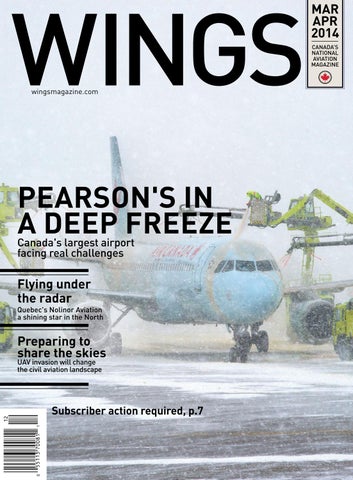
pEArSON'S IN A DEEp FrEEZE
canada's largest airport facing real challenges
Flying under the radar
Quebec's Nolinor aviation a shining star in the North
preparing to share the skies Uav invasion will change the civil aviation landscape
Subscriber action required, p.7
MAr Apr 2014 caNada’S NatIoNal avIatIoN maGazINe
THE MIGHTY XP42A ENGINE UPGRADE SYSTEM A more powerful 208A Caravan is a workhorse that will enhance every aspect of your operation. Are you ready to leap off the runway, climb like crazy, fly faster, and carry more? Out-fly, out-work, and out-earn your competition with just one investment. Call a Blackhawk engine performance expert today.
(254) 755-6711 |
info@blackhawk.aero
|
www.blackhawk.aero
MArCH/AprIL 2014
upFrONt 5 Leading edge
It's time to get it right
8 On the fly
News and opinion
14 Alternate approach
Can a winter wind blow change?
15 At the gate
Making safety the top priority
16 glidepath
Beware the eyes in the sky
bACk 50 Marketplace 54 On final
Time for Transport Canada to step up
toronto's Pearson International airport is facing a bevy of challenges and is seeking creative solutions. P. 18.
FEAturES 18 DEALINg wItH pEArSON’S DILEMMA Toronto’s top airport in a deep freeze on a number of critical levels By davId carr
From top: Beware the eyes in the sky. P. 16. Flying under the radar. P. 22.
22 FLyINg uNDEr tHE rADAr
Quebec’s Nolinor Aviation continues to be a shining star in the North By BrIaN dUNN
26 CArgO AIrSHIpS FOr MANItObA SkIES? PHOTO: MasTer-COrPOral DaviD singleTOn-BrOwne, CanaDian FOrCes COMBaT CaMera (TOP); Brian Dunn (BOTTOM leFT)
Lighter-than-air (LTA) aircraft could be gracing the skies in the next few years By BIll zUk
32 CrEAtINg A vIrtuAL buy-IN
A new roster of rivals wants a bite out of CAE’s juicy commercial simulator apple By rIck adamS
38 SHArINg tHE SkIES
UAV invasion will markedly alter the civil aviation landscape By PaUl dIxoN
COver PHOTO: Brian lOsiTO, air CanaDa
www.wingsMagazine.COM
March/April 2014 | wings
3
eaRlY BiRd Rate
39
$ •
•
•
Whether you are looking for a career change or just about to start one, come learn about different career paths the aviation industry has to offer: airplane pilots, helicopter pilots, maintenance engineers, aerospace design & engineering, aviation business management, air navigation, flight operations and more. Meet with Canada’s leading aviation colleges, universities, flight schools and hiring managers from Canada’s largest aviation operators and aerospace companies. Find out what it takes to get hired!
YOuR RegistRatiOn includes: speaker sessions covering a variety of aviation career paths, networking with Canada’s top training programs and hiring managers, luncheon with keynote speaker, coffee breaks and the Careers in Aviation exhibit hall. For information on sponsorship and exhibitor opportunities, please contact: Weng Ng · 905-713-4351 • wng@annexweb.com Jarah Stefek · 519-429-5191 • jstefek@annexweb.com
Until March 26
when
APRIL 26, 2014
wheRe
Aero Space Museum of Calgary, CALGARY, AB
hOw To register visit: www.careersinaviation.ca/expo
$59 +HST SponSored by
Careers in Aviation
LEADING
EDGE
| By Matt Nicholls
It’s time to get it right
Delaying military spending doesn’t fix the problem
A
PHOTO: rCaF
s a young man not yet versed in the day-to-day processes of life, I learned from my parents two important lessons that helped shape my philosophies today: don’t put something off that may very well come back to bite you, and if you failed to remember point number 1, always fix the problem pronto before it turns into a bigger one down the road. Procrastination, indecision and uncertainty are anything but aspects of strong leadership and such a road is usually full of minefields. Which brings us to the decision of the federal conservatives to push some $3.1 billion in planned capital spending for Canada’s military to the back burner in its recently released federal budget. Long expected by some in military circles, the delays in purchasing new fighter jets to replace the aging CH-18 and new maritime helicopters to replace the veritable CH-124 Sea Kings, and the introduction of new search-and-rescue (SAR) aircraft for the much-needed SAR efforts nationwide, are simply the latest examples of just how mismanaged the military procurement and budgetary processes are in this country. Minister of finance Jim Flaherty suggests the delay in decision-making will not mean a reduction in military spending but instead gives the government time to make a proper decision on each of these procurements. “There’s no point in having money sitting there when they can’t spend it this year,” Flaherty told the Canadian Press prior to the budget’s release. “We’re pushing it forward, not taking it back.” How much time does it take to make the proper decision? Such a spin may sound like fiscal prudence, but it seems like it has more to do with political posturing than with being prudent or providing the hardware
5
Procrastination, indecision and uncertainty are anything but aspects of strong leadership. Canadians need, expect and deserve. The move is simply meant to help cut the deficit and place the conservatives in a much better position for a 2015 election. Improved maritime operations, more efficient SAR capability, enhanced Arctic sovereignty, greater border security, more efficient and safer operational situations for the Royal Canadian Air Force, manageable maintenance and upkeep of equipment costs – all apparently are not part of the immediate equation. I wonder what the political ramifications of these might be? Would they influence the deficit? Given the escalating costs of upkeep, maintenance, training and more, of course they would. The three aforementioned military procurements have become political footballs over the past number of months (and years), exposing major problems
tOp DAtA burStS… in this issue
1. $6 billion: annual amount the air transport industry contributes to Canada’s gnP (pg. 14). 2. 36.1 million: number of passengers who travelled through Toronto Pearson last year (pg. 18). 3. nolinor aviation moved into the 100,000-square-foot hangar formerly occupied by air Transat (pg. 22). 4. remote communities rely on air transport for 60 to 75 per cent of the year (pg. 26). 5. $2 billion: annual revenue of Montreal-based simulation maker Cae (pg. 33).
www.wingsMagazine.COM
in government structure and leadership. The much-maligned CH-148 Cyclone project continues to drag on with Sikorsky only recently being granted the chance to redeem itself and get the blades turning. The Sea King fleet is in desperate need of replacement and doubts remain as to the viability of the late December decision to forge ahead with the Cyclone project. Sikorsky, which has incurred millions of dollars in late fees, came within inches of losing the deal to a competitor and has vowed to meet all deadlines going forward. With so much swirling in the wind, it’s anyone’s guess as to whether or not the Cyclone will live up to expectations. In terms of the CF-18 replacement, the political backlash over the F-35 continues. The program was put on hold in December 2012 and a decision has yet to be made as to whether or not a competition will be held to determine a new supplier. Critics maintain it’s entirely the wrong option for the job, which simply underscores the mess this has become. In early February, the feds took steps to redefine the military procurement process. Defence minister Rob Nicholson and public works minister Diane Finley announced changes to bring more scrutiny to military spending. The new system will see increased co-operation among defence, public works and industry officials under an umbrella secretariat at public works. It’s a good first step and will hopefully rein in a process that is terribly out of control. With as much as $200 billion earmarked for military spending on trucks, helicopters, fighter jets and ships over the next 20 years, indecision, procrastination and mismanagement will simply lead to bigger mistakes. It can’t continue. Canadians need leaders to lead – we deserve and demand a stronger sense of order when it comes to military spending and procurement. | w Your feedback is always welcome. Please contact me at mnicholls@annexweb.com. @Wings_Magazine March/April 2014 | wings
5
WINGS
MAr Apr 2014 caNada’S NatIoNal avIatIoN maGazINe
wingsmagazine.com
vol. 55, Issue 2 EDItOr
Matt nicholls mnicholls@annexweb.com 416-725-5637
pEArSON'S IN A DEEp FrEEZE
canada's largest airport facing real challenges
MEDIA DESIgNEr
Chris springle
Flying under the radar
Quebec's Nolinor aviation a shining star in the North
FLIgHt DECk
rick adams, Krista Bulmer, David Carr, Paul Dixon, Brian Dunn, Frederick K. larkin, James Marasa, Carroll McCormick, anna Pangrazzi, Bill zuk
preparing to share the skies Uav invasion will change the civil aviation landscape
SubScribe TODAY ! $6.00
ACCOuNt MANAgEr
PM 40065710
Jarah stefek jstefek@annexweb.com (519) 429-5191
1 Year SubScription WINGS_MARAPR14.indd 1
only
2014-02-18 12:19 PM
3000
$
ACCOuNt CO-OrDINAtOr
stephanie DeFields sdefields@annexweb.com 1-888-599-2228 ext. 257
(GST $31.50 • HST $33.90) US $42.00 (USD) • Foreign $65.00 (USD)
Name: _______________________________ Company: ____________________________ Title: _________________________________ Address: _____________________________ City: _________________________________ Prov: ________________________________ P.Code: _______________________________ Tel: __________________________________ Fax: _________________________________ e-mail:________________________________
PLeASe cHecK ONe: ❑ Commercial aircraft owner/operator ❑ Business/private aircraft owner/operator ❑ Military ❑ Aircraft maintenance/overhaul firm ❑ Airport ❑ Aerospace, airframe & component manufacturer and distributor
❑ Fixed base operator ❑ Aviation services, consultants and aircraft sales ❑ Government ❑ Aviation associations and organizations ❑ Flying schools, clubs and colleges ❑ Other (please specify) ______________
PAYMeNT: Cheque - Payable to Annex Publishing & Printing Inc. Visa
MC
ASSOCIAtE pubLISHEr
weng ng wng@annexweb.com grOup pubLISHEr
scott Jamieson sjamieson@annexweb.com prESIDENt
Mike Fredericks mfredericks@annexweb.com wINgS MAgAZINE
P.O. Box 530, 105 Donly Dr. s., simcoe, On n3Y 4n5 Tel.: 428-3471 Fax: 429-3094 Toll Free: 1-888-599-2228
Publication Mail agreement #40065710 return undeliverable Canadian addresses to Circulation Dept., P.O. Box 530, simcoe, Ont. n3Y 4n5 e-mail: subscribe@wingsmagazine.com Published six times per year (Jan/Feb, Mar/apr, May/ Jun, Jul/aug, sep/Oct, nov/Dec) by annex Publishing & Printing inc. Circulation e-mail: subscribe@wingsmagazine.com Ph: 866-790-6070 ext. 208 Fax: 877-624-1940 Mail: P.O. Box 530, simcoe, On n3Y 4n5 Subscription rates Canada – 1 Year $ 30.00 (includes gsT - #867172652rT0001) usa – 1 Year $ 42.00 Foreign – 1 Year $ 65.00
AMEX
Occasionally, wings magazine will mail information on behalf of industry-related groups whose products and services we believe may be of interest to you. if you prefer not to receive this information, please contact our circulation department in any of the four ways listed above. no part of the editorial content of this publication may be reprinted without the publisher’s written permission. ©2014 annex Publishing & Printing inc. all rights reserved. opinions expressed in this magazine are not necessarily those of the editor or the publisher. no liability is assumed for errors or omissions. all advertising is subject to the publisher’s approval. such approval does not imply any endorsement of the products or services advertised. Publisher reserves the right to refuse advertising that does not meet the standards of the publication. Printed in Canada issn 0701-1369
Account #: __________________________ Expiry:_____________________________
TO SubScribe:
Tel: 866-790-6070 Fax: 877-624-1940 Mail: Wings Magazine c/o Annex business Media P.O. box 530 Simcoe, Ontario N3Y 4N5
Air Transport Association of Canada
ON THE
WEB
e-mail: subscribe@wingsmagazine.com
www.wingsmagazine.com
GST#135274215RT001
6
Subscriptions non-refundable
Canadian Business Aviation Association
Magazines Canada
CArEErS IN AvIAtION Looking for a great career in aviation and aerospace? Check out our Careers in Aviation micro site, a great location to help you better understand what a career in aviation is all about. Go to www.careersinaviation.ca for news, updated listings and more!
PRO0314
wings | March/April 2014
wings subad.indd 1
Canadian Owners & Pilots Association
PHOTO: sTanDarDaerO
Signature: _________________________
www.wingsMagazine.COM
2014-02-18 12:56 PM
ON THE FLY For late-breaking news, and exclusive web content, please visit us at: www.wingsmagazine.com
tHE LEAD
C-LIp, C-LIDINg AwAy? It appears that a further delay in Bombardier’s CSeries test program will not hurt sales, and January’s announcement that additional time is needed to complete flight testing was a case of the airframer finally catching up with analysts’ expectations for an early-to mid-2015 entry into service for the 110-seat CS100, versus the original schedule for a late 2014 service date. The 135-seat CS300 will enter service six months later. One analyst, Darryl Genovesi of UBS Securities, has warned of further delays, writing in a research note that “progress through the first four months of CSeries flight-testing is well behind Boeing’s early pace on the 787.” Bombardier’s second test vehicle (FTV2) successfully completed its first flight on Jan. 3. Little happens by chance in the timing of commercial aircraft orders. The announcement that Saudi-based Al Qahtani Aviation Company signed a firm purchase agreement for 16 of the larger CS300 aircraft, with options for an additional 10 airplanes, on the same day a “red-faced” Bombardier announced the latest delay was clearly time to demonstrate market confidence in the program. The Saudi US$1.2 billion (list price) purchase is the third Middle East order for the CSeries. SaudiGulf Airlines, a
newly launched national carrier, will operate the aircraft. At a speech to the Canadian Club of Montreal, Calin Rovinescu, Air Canada’s chief executive, dismissed suggestions that the delay would impact his carrier’s decision on a replacement aircraft for the airline’s Embraer 190 and Airbus A319 jets, noting that there are “about 150 drivers” that go into selecting an airplane. “It is going to be a good airplane no matter what,” Rovinescu told the Globe and Mail. “Delays in and of themselves are not a factor for us at this stage.” In December, Air Canada placed an order for 33 Boeing 737 Max 8 and 28 Boeing 737 Max 9. Meanwhile, the FlightGlobal website was reporting negotiations between Bombardier and Indonesia’s Lion Air for a significant CS300 launch order have slowed. The range and economics of the larger CS300 are considered ideal for the fast-growing low-cost carrier’s long and thin routes. Rusdi Kirana, Lion Air’s chief executive officer, met with three reporters from the Montreal Gazette last September and reportedly could not contain his enthusiasm for the CS300. Fast-forward to January when the newspaper reports Kirana was telling reporters in Indonesia that the airline was looking at “other types” and a final decision has not been made. It could be a negotiating tactic as airline and airframer hammer out terms, including price, for an order anticipated to be in the high double digits. A potential Air Canada and Lion Air order is expected before or during the Farnborough Air Show in July, where Bombardier is also expected to display the CS100.
a further delay of Bombardier’s cS100 aircraft is not expected to influence sales. 8
wings | March/April 2014
a key setback contributing to the relatively low number of women in some aviation fields is the limited awareness of the diverse career opportunities available.
wOMEN tO HIgHLIgHt AvIAtION EXpLOItS Female participation in aviation has lagged other traditionally male-dominated sectors such as medicine, law and law enforcement. In 1910, when Raymonde de Laroche, a talented French engineer became the first woman and only the 36th person to earn a pilot’s licence, she single-handed bumped up the female quotient of licensed pilots to three per cent. Today, the percentage of female pilots is approximately six per cent in most developed countries, according to the Institute for Women of Aviation Worldwide (iWoAW), an organization set up to encourage more women to seek career opportunities in aviation. In 2011, women made up about five per cent of the 53,000 members of the Air Line Pilots Association, representing pilots for major and region carriers in Canada and the U.S. Female aircraft mechanics fare even worse at three per cent, while the percentage of female aeronautical engineers sits at only nine per cent. It is not the meteoric rise one might expect given the contribution women have made in air and space. www.wingsMagazine.COM
PHOTO: BCiT (TOP); BOMBarDier (BOTTOM)
8 tHE LEAD 10 pErSpECtIvES 12 pEOpLE
PHOTO: airBus
The Canadian chapter of iWoAW used the run-up to Women of Aviation Worldwide Week in March to highlight the slow climb of women finding careers in aviation. Women of Aviation Worldwide Week is observed in more than 30 countries around March 8, the day that Laroche received her pilot licence. This year the week fell on March 3 to 9, prior to Wings going to print. Activities include trophies for the most non-pilot girls and women introduced to aviation during the week. Last year, Canada swept the board including, Waterloo Wellington Flight Centre as the most female pilot friendly training centre worldwide, Kirsten Brazier of Yellowknife, Northwest Territories as most dedicated female pilot worldwide (for the second year running) and Frank Roberts of St. Andrews, Man. as most supportive male pilot worldwide. Chris Dancy, a spokesperson for the U.S.-based Aircraft Owners and Pilots Association (AOPA), told CNN that, “getting more women involved in all aspects of aviation is a nut that everyone in the industry would like to crack but that no one, to date, has.” As far back as 2001, the Air Transport Association of Canada (ATAC) concluded that, “a key setback is the limited
awareness of the diverse career opportunities and benefits for women in technical fields. For instance, the small percentage of women pilots in Canada has been linked to observations that most women have never thought of an aviation career.” According to iWoAW, numerous studies support the view that for as long as the aviation industry has existed, it has been described as a male activity leading many qualified women to not even consider the field. This does not explain, however, women’s ascendency in other male-dominated sectors. According to the U.S. Department of Labor, between 1960 and 2010, the number of female doctors and surgeons jumped from just over five per cent to 31.80 per cent; women practicing law grew from approximately four per cent to almost 39 per cent; while, the number of female police officers grew to 15 per cent from approximately two per cent. Not the brightest statistics, but numbers that outshine the aviation sector. The cost of becoming a commercial pilot is a factor, especially for women who did not have the opportunity to transition to the flight deck from a career in the military. Old attitudes are also a barrier. There are signs that this is changing and women are becoming more aware of the opportunities available for them in aviation. Many
young women attended Wings Careers in Aviation Expo in Toronto in March, with many qualified women in aviation participating in panel discussions and leading by example.
A350 tESt AIrCrAFt ArrIvES IN IQALuIt An Airbus A350 development aircraft ran hot and cold in January, arriving in minus 28-Celsius temperatures in snowy Iqaluit, days after completing “hot and high” tests in Bolivia. The aircraft, XWB MSN3, and a team of 48 specialists arrived in the Nunavet capital on Jan. 28 for several days of cold-weather trials. The various tests for the aircraft, its engines and its systems include a “cold soak” down to minus double-digit temperatures. The scope of the trials include, auxiliary power unit and engine starts after a cold soak, verification of system behaviour, low-speed taxi and rejected takeoffs, and thrust-reverser tests in snow. Since the A350’s first flight on June 14, 2013, the development program has completed more than 900 hours in close to 200 test flights using two aircraft. In total, the flight test campaign will accumulate approximately 2,500 hours with a fleet of five aircraft. The A350 is expected to enter commercial service in late 2014.
a team of 48 specialists chilled out in Iqaluit while cold-weather testing the new airbus a350 xWB mSN3. www.wingsMagazine.COM
March/April 2014 | wings
9
ON THE
FLY
pErSpECtIvES
F-35 AND CF-18 ArE ‘AppLES AND OrANgES’
into the Canadian evaluation process, which include the Advanced Super Hornet and the F-35. These two aircraft offer the same class of capabilities, including acceleration, advanced radar, networking and weapons carriage. The Advanced Super Hornet, however, offers greater range with the conformal fuel tanks, has two engines for safety in remote operating areas, and has a two-seat option for more difficult missions. Both aircraft have stealth attributes that are optimized for a selected segment of the radio frequency spectrum. The F-35 is projected to have marginally better inband signature than the Advanced Super Hornet, but both aircraft have adequate
signature reduction features to safely address the projected threats. To fully compare and contrast the value of reduced signature between platforms, operational analyses must be performed in a classified environment. Stealth, like all other measures of performance, has varying degrees of effectiveness. Most of the stealth features attributed to the F-35 by Heneghan also exist on the Advanced Super Hornet. Additionally, and even more importantly, both aircraft are equally susceptible to out-of-band threats that reside in the remainder of the radio frequency spectrum. Typical threat radars and missile systems use multiple portions of the RF spectrum to detect, track and shoot at aircraft. The
PHOTO: BOeing
Walter Heneghan’s piece entitled “The F-35 Lightning: Up Close and Personal” (page 28, Nov/Dec. 2013 issue) highlights the “impressive” capabilities of the F-35. However, the article fails to include several important facts that must be considered in Canada’s search for an optimal fighter solution. Firstly, comparing the F-35 to the legacy Hornet (CF-18) is similar to comparing apples to oranges, as is comparing the CF-18 to the Advanced Super Hornet, which is the result of Boeing’s evolution approach from the F/A-18C/D Night Attack, to the Super Hornet, to the Super Hornet Block II and then to the Advanced Super Hornet. The true comparison should be between the two U.S. offerings
the F-35 is projected to have marginally better in-band signature than the advanced Super Hornet (above), but both aircraft have adequate signature reduction features to safely address the projected threats.
10 wings | March/April 2014
www.wingsMagazine.COM
the F-35 is projected to have marginally better in-band signature than the advanced Super Hornet.
bottom line here is that neither the F-35 nor the Advanced Super Hornet is invisible. The only airborne tactical asset that can suppress threats across the majority of the RF spectrum is the Super Hornetderived Growler (EA-18G) Airborne Electronic Attack aircraft. Both the F-35 and the Advanced Super Hornet need the Growler to effectively attack these frequency-diverse threats. The Advanced Super Hornet and the F-35 both will have AESA-based radar jamming capability. However, although AESA jamming will be a valuable tool, there are some inherent limitations to that capability for both aircraft: the AESA radar jamming feature operates only against
the aforementioned in-band threats; its effectiveness is impacted by area of regard and duty cycle limitations inherent in modern AESA radars; and when the AESA is in use as a jammer, it is not providing critical threat and situational awareness information to the aircrew. The Growler mitigates those jamming limitations of AESA-equipped strike fighters. In the article, Keith Knotts asserts that “the F-35 has 10 times the dedicated jamming power of the EA-18G Growler variant.” This statement is simply inaccurate. Today’s Growler is capable of carrying multiple ALQ-99 jamming pods, which, in the aggregate, have much greater effective radiated power than an F-35 AESA.
The operators have the ability to use one or multiple onboard jamming sources against any given threat emitter. In addition, by the time the F-35 could be in Canada’s inventory, the EA-18G Growler will be flying with the Next Generation Jammer system, which, in effect, will have the equivalent of several AESAs operating concurrently, covering 360 degrees field of regard and being able to address threats across a much broader frequency spectrum than a single AESA. There is no comparison in relative jamming capability. I sincerely hope that these significant facts help readers to better understand that the F-35 and the Advanced Super Hornet are very similar in operational capabilities and that price and value differences should be considered as a more significant discriminator for the Royal Canadian Air Force. Paul Summers, Director of F/A-18 & EA18G Innovation & Capabilities Growth, Boeing.
The Perfect Solution for Flight Deck Upgrades
PHOTO: lOCKHeeD MarTin
Flexible Options for over 50 aircraft types
Renew your flight deck with an FMS upgrade or a suite of flat panel displays all certified in aircraft ranging from the Pilatus PC-12 to the Boeing 747. Contact an Authorized Dealer to find the right solution for your aircraft. www.wingsMagazine.COM UASC_Wings_1/2pg_ March_April 2014.indd 1
www.uasc.com sales@uasc.com (800) 321-5253 (520) 295-2300 March/April 2014 2/11/14 8:13 11 AM | wings
ON THE
FLY
SAr HErO tIM JONES LED by EXAMpLE
pEOpLE Raymond Jones has been appointed senior vice-president, sales, marketing and asset management, for Bombardier Commercial Aerospace. Jones has been selling business jets for Bombardier for the past 10 years, and was more recently vice-president, worldwide strategic accounts on the business jet side. He is a certified commercial pilot and flying instructor with 16 years in the Royal Air Force. Jones holds a master’s degree in air transport management for City University in London . . . Million Air has appointed Rick Boyce its new director of FBO safety operations. Boyce arrives at the Houston-based executive 12 wings | March/April 2014
aircraft terminal and upscale private charter service provider from fractional operator NetJets where he held several positions, including director of aviation infrastructure and services for 12 years. “After spending 12 years evaluating hundreds of FBOs all across North America, I can honestly say I have landed with the premier brand in our industry,” Boyce said. Million Air operates 28 facilities in Canada and the United States, including locations at Toronto/Buttonville, Calgary and Vancouver . . . Dassault Falcon Jet recently appointed three new sales managers, including two to cover territories in the U.S. and Canada. Kirsten Krueger will serve the Pacific Northwest U.S. and Western Canada, and Rhett Reavis, the mid-Atlantic U.S.
and Eastern Canada. “When we bring on a new sales manager we look for several qualities; passion for the Falcon product, a deep knowledge and understanding of our industry and a desire to offer the best available products and solutions to our customers,” said Paul Floreck, senior vice-president of sales for North America. Krueger previously served as inside sales manager, covering the western U.S. and Canada. Her 13 years of experience include time as regional vice-president of fractional aircraft sales with NetJets. Hancock has nearly a decade of experience in business aircraft sales, having previously held sales positions with two business aviation manufacturers. He is a commercially rated pilot | w www.wingsMagazine.COM
PHOTO: Paul DixOn
Tim Jones, the public face of North Shore Rescue, died on Mount Seymour on Sunday, Jan. 19. After spending the weekend on the mountain conducting avalanche awareness training for the public with other members of the team, Jones collapsed that evening while walking to the parking lot accompatim Jones joined North Shore rescue in 1987 and was an integral part of a team that honed itself into an nied by his daughter, Taylor, and another elite group of mountain rescue specialists. Hundreds of people attended his funeral in vancouver. team member. He stopped walking, said, “hang on a minute,” and collapsed without warning. His daughter and others started ambulance that carried Tim’s ashes from dedicated the best part of his life to helping people in the worst moments of theirs. CPR immediately to no avail. Tim Jones the North Vancouver armouries to the Tim Jones and North Shore Rescue, for was 57. Centennial Theatre, as a formation of helicopters and small planes circled overhead. many people, meant the difference beHe grew up in North Vancouver in the shadow of the mountains that would come Thousands lined the routed, applauding the tween life and death.” Son Curtis Jones, also a member of North procession as it passed. North Vancouver to be his life. An outstanding football Shore Rescue, characterized his father as City Mayor Darrell Mussato said he could player in high school and later at Simon “unique” in that he always stood out in the not remember such a public outpouring. Fraser University, he was drafted by the crowd. He set his own path and he did what Toronto Argonauts but a knee injury ended At the theatre, admission was restricted to was right without getting bogged down 600 invited guests and VIPS, while several his football days. Those who remember by politics or protocol, and for this he made thousand more watched the ceremony on playing with him at SFU described him as no apologies.” The last speaker was his big screens set up in the parking lot. a joker off the field but “super serious” on daughter, Taylor, who raised a hearty roar Inside the theatre, co-workers, friends the field, the same way he approached his of laughter from the crowd when she said and family remembered Jones. Local MP work as a paramedic with the BC Ambulance Service and later as a volunteer with she would miss cringing at the things he Andrew Saxton read a letter from Prime North Shore Rescue. sometimes said on the news, but how proud Minister Stephen Harper. “Tim Jones was Tim was with BC Ambulance for 32 years, an exemplar of the valour demonstrated by she was that her father brought others’ loved as an Advanced Life Support paramedic ones home safely. these everyday heroes. I admire the courage, compassion and dedication of rescue and the unit chief of the North Vancouver At the conclusion of the ceremony, a service volunteers. Tim Jones was an Station. He joined North Shore Rescue in piper led the procession outside where the 1987 and was an integral part of a team that exemplar of the valour demonstrated by honour guard escorted his remains and personal effects including his hat and helmet these everyday heroes. Countless families honed itself into an elite group of mountain through a block long salute. The finish saw have had a loved one saved from peril rescue specialists. A community memorial Tim Jones’ family and his remains depart thanks to his valiant efforts.” service was held, preceded by a parade. in a yellow Talon helicopter, to be taken to Provincial Minister of Public Safety More than 1,000 search-and-rescue (SAR) an unnamed spot in the mountains above Susan Anton, read a letter from Premier volunteers, paramedics, firefighters and police officers marched behind a black-draped Christy Clark that said in part, “He North Vancouver. – Story by Paul Dixon
www.wingsMagazine.COM
March/April 2014 | wings 13
ALTERNATE
APPROACH By David Carr |
Can a winter wind blow change?
Shutdown at Pearson raises accountability issues at Canadian airports
A
14 wings | March/April 2014
board of directors account-
To set the record straight, a case able to whom exactly? The Globe and Mail arfor or against privatization is gued that airport authorinot going to be won or lost on ties are “neither fish nor fowl” and as such, lack the reaction to a ‘snow day.’ won or lost on the reaction to a “snow day.” There is no guarantee that the GTAA in private hands would have acted any differently, as evidenced in 2010 when privately held London Heathrow, the world’s busiest international airport, closed its runways for several days due to heavy snow. Still, in politics it is not usually the breach but the cover-up that triggers the scandal. With the GTAA’s Heathrow moment, it was not the “ground halt” but the lack of communication and an early striptease on how much of an internal review into operations would be released to the public that has invited questions over how accountable Canadian airport authorities really are? The answer? Not very. Full disclosure: in 1995, this correspondent co-wrote a report urging the government to scrap commercialization (which we called privatization-lite) in favour of the national selloff of airport infrastructure. In a recent editorial entitled “Who’s the pilot of Canada’s airports?” the Globe and Mail suggested it was time for Ottawa to rethink the airport ownership model. The editorial touched on identical points raised in the almost 20-year report, including the lack of profit motive (that can lead to built-in inefficiencies and overbuilding in a non-profit model where surpluses must be ploughed back into the asset) and self-selecting a
the necessary accountability mechanisms of either a private-sector company or Crown corporation. That is one of the flaws of public-private partnerships, upon which airport authorities are loosely based. Lines of accountability are blurred as politicians and operators find cover by pointing fingers. That is if they respond at all. The shutdown at Pearson presents an emotional argument, so it is unlikely that privatization will pop up like spring crocuses in a winter snow anytime soon. But privatization is not a radical undertaking. Airports already act as shells for privatesector businesses, including previously state-owned airlines. The Vancouver International Airport Authority and Canadian pension funds have cashed in on foreign airports and other infrastructure investments. The motivation in Canada for privatizing airports in 2014 is much different than what drove commercialization 30 years ago. Airports are no longer taxpayer sinkholes for one. But they are sitting on billions of dollars of land that the federal government could unlock to lower the debt or invest in other infrastructure projects. From rusting bridges to crumbling roads, there is no shortage of opportunities. | w David Carr is a Wings writer and columnist. www.wingsMagazine.COM
PHOTO: gTaa
fter too many years on the back burner, the pot is starting to bubble again. Abacus Data, a market research organization, is reporting that Canadians are warming up to selling off public-owned assets, including the Canadian Broadcasting Corporation (45 per cent), Canada Post (47 per cent) and VIA Rail (53 per cent). At the same time, resistance to privatization is softening. Less than 40 per cent are strongly opposed to the federal government placing any of the above-mentioned assets in the shop window. Airports were not on the list, but that should not come as any surprise. Airports are no longer the financial drain they were in the 1980s ahead of commercialization (Pearson being the sole exception). Indeed, the case for a selloff rather than leasing airport lands to local non-profit, operating authorities has weakened with better infrastructure, improved customer service levels and added revenue opportunities. Many factors can drive the privatization agenda. In the Mulroney/Chretien years the country was steered through a bold overhaul of its transport system with the public selloff of shares in Air Canada and the Canadian National Railway; the sale of the air navigation system to NAV CANADA, a non-profit private enterprise; and the lease of airports to local operators. Motivation this time would be for a heavily indebted federal government to raise needed cash. Airports like Pearson, Vancouver and Calgary are sitting on piles of it. The Mulroney government left the door open a crack for airports to eventually be privatized. The Chretien government saw to it that this door was shut and bolted. Few have complained, until now. But a harsh winter has sent a chill over how airports are owned and operated. The Greater Toronto Airports Authority (GTAA) has not had a good year so far. The decision to order a “ground halt” for several hours one extremely cold day in January after temperatures plunged and the tarmac and equipment iced over has exposed the GTAA to some heavy criticism and calls for the inevitable shakeup. A lot of it has been unfair. To set the record straight, a case for or against privatization is not going to be
AT THE
GATE
| By Brian Dunn
Making safety the top priority Raitt’s appointment a boon for Canadian air transport: ATAC
PHOTO: MiKe DOriOn
T
he appointment of Lisa Raitt as minister of transport last July was a plus for the aviation industry, according to Harvey Friesen, president of Bearskin Airlines and past chairman of the Air Transport Association of Canada (ATAC). “We view her experience in aviation and her influence in Parliament as a major plus for our industry. We are hoping that her influence in cabinet will sway some of her colleagues to finally recognize the importance of aviation as a socio-economic enabler, not just a cash cow for the government,” Friesen said at ATAC’s 79th annual general meeting and tradeshow in Montreal in the fall. “With the appointment of Lisa Raitt as minister of transport, the department should see a level of prominence it has not enjoyed for many years.” Many key issues remain to be tackled by ATAC heading into the new year, the most pressing one being the need to keep asking Ottawa to revise its overall approach towards the aviation industry and give it the consideration it deserves, since the industry can no longer be the cash cow for government revenues, said Friesen. “How could Canada cope socially and economically without a strong aviation industry? How could the outlying regions of the country survive? How would Canada fare in the global market? Our industry needs a government that appreciates the market conditions we operate in and recognizes the vital socio-economic enabling role aviation plays in Canada. We are counting on Minister Raitt to be our champion in cabinet.” From a policy standpoint, ATAC would like regulations to reflect the complexity and variety of air operations in Canada and not promote policies of “one-size-fits-all.” In addition, the association has tackled issues concerning operations, safety, finances and operating costs, fees, security, facilitation, airports, international development, government action and level of service. Minister Raitt acknowledged in her luncheon address that the air transportation industry is a major economic development tool and said it was her job to incorporate that belief in the government’s agenda. www.wingsMagazine.COM
hundreds of thousands of more people a year across multiple markets.” Last April, Porter announced its new growth plans and a $2.3-billion-dollar conditional purchase agreement for up to 30 Bombardier CS100s and six additional Bombardier Q400s. Delivery of the CS100s is planned to start in January 2016. The CS100 deliveries will depend on a number of conditions being met, including the approval of jet service at Billy Bishop and the approval to extend the runway at both ends. Growth plans include new service to Calgary, Vancouver, Los Angeles, Orlando, Miami and the Caribbean. “I believe that benefits for travellers will also contribute to less Canadians going across the border to use U.S. airports, such as Buffalo and Niagara,” the Porter founder said. And while there is a lot of opposition to Deluce’s expansion plan, he’s confident he’ll win out, noting he has the majority of city councillors on his side. “Over 28,000 people have already signed up to show support, and more than 10,000 have contacted city hall to directly express their support,” he says. A recent economic impact study commissioned by the Port Authority and endorsed by the Toronto Board of Trade revealed Billy Bishop contributes $2 billion annually to the city’s economy, Deluce pointed out. The airport is also helping in the redevelopment of Toronto’s waterfront, he added. But there is still a lot of work ahead, Deluce concluded. “We don’t think for a moment that the outcome of our requested amendments is a foregone conclusion. We do believe passionately that we are deserving of support from the City of Toronto, the federal government and the Toronto Port Authority and we look forward to a continuing conversation.” Striving to create a stronger air transport environment for Canadians from coast to coast. It’s a goal shared by those driving the industry and the association that works so diligently to protect it. | w
‘‘Our industry needs a government that appreciates the market conditions we operate in.’’
The industry is responsible for 100,000 jobs and contributes $6 billion annually to Canada’s GDP and “the more successful you are, the more successful the country is,” she said. But in order for consumers to have faith in the system, they have to believe that its health and safety is the government’s top priority. Consumers need to know a strong air sector can play a role, said Raitt. Under the auspices of creating a strong air sector, Porter Airlines president and CEO Robert Deluce also took to the podium at the luncheon to pitch his business plan. He reminded his audience that fares drop by up to 60 per cent whenever Porter enters a new market, is the third-largest scheduled carrier in Canada, and enjoys the highest on-time performance of any scheduled Canadian airline. Billy Bishop Toronto City Airport, Porter’s key hub, is the ninth busiest airport in Canada by passenger volume. “Passengers are returning to the air in many cities now that there is an affordable option,” Deluce said. “This amounts to
Brian Dunn is a Wings writer and columnist. March/April 2014 | wings 15
GLIDE
PATH
By Paul Dixon |
beware the eyes in the sky UAVs may be useful, but invasive? Don’t sweat the small stuff!
T
16 wings | March/April 2014
There’s a long way to go in refining the technology and then matching the technology with the need. There seems to be a fixation with the idea that someone may be seeing us, looking at us or as many cultures viewed photography on first blush stealing our souls. We’ve willingly allowed ourselves to be tracked by a pack of electronic wolves that is rapidly expanding as it feasts on the minutia of our lives. But ask yourself this: Do you have any secrets from your credit card company? When was the last time you did your banking with a real, live person? How about loyalty cards for oil companies, groceries, drug stores or travel points? The fact is, everywhere you go, you leave a little bit of yourself behind. Now, we’re about to take a quantum leap forward as Google and others take that cached information on your past behaviour and use it to shape your future experience. When you query anything on the Internet, more and more, the responses you get are being tailored behind the scenes specifically for you based on your online history. Not to mention the paid links that appear on your screen, which is very much focused on you – where you’ve been and where you’re likely to be headed online. For your next vacation, you may book the flight and hotel online, perhaps even using your personal electronic device.
Your boarding pass is a series of squiggles on your PED and you’ve loaded your own inflight entertainment on your electronic device, or if need be, you’ll simply stream whatever the airline has to offer. Suddenly, haunted by the thought you may not have turned off the stove as your plane lifts off, you’ll be able to take care of yourself because your house is wired for everything and you control it all from that same PED. You can even answer the front door from 10,000 miles away and check out your visitors by video before sending them on their way. As you’re winging your way home, you can check your fridge and work up a shopping list for breakfast. Don’t be surprised if the voice of Hal from 2001 suggests you might want to make some healthier choices. How important to me is it that my grocery list and every other possible smidgeon of information about my so-called life will live forever in the clouds in the not too distant future? Compare that with the thought that someone, either the 12-yearold living down the street or “the government” might take my picture when I’m not looking. If you want to take my picture, help yourself, but when it comes to your knowing whether it’s butter or margarine in my fridge, I’ve got to draw the line. | w Paul Dixon is freelance writer and photojournalist living in Vancouver. www.wingsMagazine.COM
PHOTO: isTOCK
he rise of the drones. It sounds sinister, in the same way as “bad moon rising” or “It was a dark and stormy night.” The media is fixated on drones. The word, that is. It is used to describe anything and everything flies above the surface of the earth without a human being on board. Drone, drone, drone and more drones. There’s little perspective on the concepts involved or even trying to stay within a nineiron shot of reality. The general public has watched Predators and Grim Reapers on the evening news for the past decade and then Jeff Bezos of Amazon turned the world on its ear in late 2013 by introducing the Amazon Prime Air Project to viewers of 60 Minutes. Remember this one? Bezos suggested Amazon had the ability to deliver your order from Amazon to your home in 30 minutes (or less) for urban customers using UAV technology. Well, we are a long way from the day when our skies will be darkened by clouds of unmanned aerial vehicles (UAVs), large or small, in the service of humanity. The sky may well be the limit, but there’s a long way to go in refining the technology and then matching the technology with the need. The regulations that govern the use (s) of UAVs have to be realistic in the operational sense as well as minimize the impact on the broad universe of aviation in general. And while there is significant progress on both the industry and regulatory fronts in this country, I find it interesting that from the public perspective the most publicly stated concern regards “privacy,” or to be more accurate, the potential for infringement of our individual privacy. I’ve seen comments from provincial and federal privacy watchdogs, as well as various citizen groups voicing concern about the possibility of police or “the government” to use “drones” for aerial surveillance of citizens. Of course it’s possible, given that our neighbours to the south are currently using Predators along their northern and southern borders. But there is a big difference between using aerial surveillance, manned or unmanned, to scan an area looking for anyone that may trespass in some way and the idea that you or I are being specifically targeted by the authorities (or anyone else for that matter) as we walk down the street.
&
Recognizing the next geneRation in the canadian aviation and aeRospace industRy! Canada is full of young, skilled and knowledgeable people who are driving the aviation and aerospace industry forward. From pilots and AMEs to ground crew and business managers, they are the best and brightest in our industry. Join us as we celebrate the future of aviation and aerospace in Canada.
2
nd
ANNUAL AWARD SPONSORSHIPS
AvAILABLE ContaCt: Weng ng
wng@annexweb.com
WHO CAN BE NOMINATED?
Anyone in the aviation or aerospace industries who is under the age of 40 as of December 31, 2014. Equipment and technology suppliers as well as operators are welcome.
ALL NOMINEES SHOULD: • • • •
Demonstrate a strong work ethic Show leadership and initiative Actively seek new opportunities for training and education Be involved in industry association or broader industry initiatives
NOMINATIONS ARE NOW OPEN
To nominate someone to be recognized as one of the Top 10 under 40, visit www.wingsmagazine.com or www.helicoptersmagazine.com and click on the “Top 10 Under 40” link to complete a nomination form. Nominations close on May 1st, 2014 The Top 10 Under 40 will be featured in the July/August 2014 issue of WINGS Magazine and the July/August/September issue of HELICOPTERS Magazine.
“as canada’s largest airport, it is important to work with our air carriers to further develop toronto as North america’s premier gateway.” –Howard eng, the Gtaa’s chief executive
DEALinG Wi
DiLEmmA
gtAA, AIr CANADA FACE grOwtH ISSuES
by DAvID CArr 18 wings | March/April 2014
www.wingsMagazine.COM
PHOTO: gTaa
iTH PEARsOn’s A ir Canada is hungry for more traffic. The airline is looking at the number of passengers travelling between the United States, Europe and Asia on non-U.S. airlines with an eye to growing its share of the market from 0.3 per cent to 1.5 per cent within five years. The strategy is to plug more of its transborder traffic into an expanding long-haul network through its main hub at Toronto’s Pearson www.wingsMagazine.COM
International Airport, and to a lesser extent, Vancouver. The Greater Toronto Airports Authority (GTAA), the non-profit entity that has operated the facility since 1996, is a willing suitor. Approximately 30 per cent of the 36.1 million passengers who travelled through Pearson last year boarded flights without setting foot outside either of its two terminal buildings. That is up from approximately 27 per cent in 2012. Management would like to see the
number of connecting passengers bumped again to 33 per cent, a figure that would still pale when compared against traditional hubs like Atlanta, Chicago and Amsterdam, and super-connector airports such as Dubai, Doha and Istanbul, which have all been built or rebuilt on hubbing strategies. On Jan. 1, 2014, a five-year commercial agreement between Air Canada and the GTAA to work together and continue to grow Pearson as a global hub came into effect. March/April 2014 | wings 19
“Toronto has the potential to become a preferred global routing because it offers some of the best elapsed travel times between the U.S. and major centres in Europe and Asia,” said Ben Smith, Air Canada’s executive vice-president and chief commercial officer. “It will transform our relationship with the GTAA.” Pairing Air Canada and Air Canada Express’ 49 U.S. destinations (many with multiple frequencies per day) with its 16 Asian and European gateways creates more than 780 added international route combinations, which will grow as the Boeing 787 enters service and starts to anchor the airline’s international network along with the Boeing 777, especially over long and thin pairings that cannot support a 777 but are out of range or uneconomical using the older 767-300ER. By December 2015, the airline plans to be operating 12 of 37 787s on order, 23 777s, eight Airbus A330 and a dwindling number of long-range 767s that are being pensioned off to Air Canada rouge, the lower cost leisure carriers, as the newer Boeings arrive. The airline estimates that a 1.2 per cent increase will translate into an additional 1.1 million incremental passengers and more than $400 million in revenue per year. The bulk of this growth will flow through Pearson, where Air Canada and its Star Alliance partners including United Airlines and Lufthansa already operate under one roof (WestJet is not a member of an airline alliance but has interline agreements with several major carriers serving Toronto including, Air France/KLM, British Airways and Delta), and a newly streamlined transit process is in place to expedite connections. 20 wings | March/April 2014
“Passenger flow is important because connecting traffic is what allows airports to truly grow into international hubs,” Calin Rovinescu, Air Canada’s chief executive recently told an audience in Vancouver. “I think of Schiphol in Amsterdam, which has a share of global traffic far disproportionate to the small size of Holland because its convenient design and location attract so much connecting traffic. KLM brings the traffic into the hub; there is good collaboration and growth for all.” The agreement between the GTAA also stabilizes Air Canada’s operating costs at the airport with annual fixed aeronautical fees such as landing fees, general terminal charges and apron fees, and can even earn the carrier performance rebates based on connecting passenger volumes that surpass growth targets. The Air Canada agreement is the latest in a string of incentive programs introduced to increase traffic levels and encourage airlines to add new flights to unserved and underserved destinations. The GTAA estimates that these measures have grown traffic and opened service on 10 unserved routes, including Turkish Airlines’ service to Istanbul, one of the world’s fastest growing hubs, and Ethiopian Airlines to Addis Ababa, inaugurating Pearson’s first link with Africa. In 2013, five new airlines commenced services to Pearson, including Egypt-Air, with four times weekly 777 service to Cairo and Saudi Airlines, with a thrice-weekly 777 service to Jeddah and Riyadh. Aeroflot also returned with a thrice-weekly 767 service to Moscow following a lengthy absence. “As Canada’s largest airport, it is important to work with our air carriers to
further develop Toronto Pearson as North America’s premier gateway,” said Howard Eng, the GTAA’s chief executive. A refreshing departure from galloping fee hikes that put Pearson near the top of the deck in aeronautical charges. In 2013, the GTAA shuffled that deck, lowering landing by more than 31 per cent per tonne while increasing smaller general terminal fees by almost 40 per cent for nondomestic passengers for a year-over-year reduction of approximately 10 per cent in aeronautical fees. The operator plans to hold the line on fees until at least 2016. Still, there are concerns that charges at Pearson remain stubbornly high compared with other airports and that the installation may continue to price itself out of a larger share of the connecting market. One reason is the ground rent that the GTAA shells out to the federal government each year. The annual rent payment dipped slightly in 2012 to $130,500, but accounts for 18.4 per cent of operating expenses. “That is really [an] issue we need to focus on,” said Air Canada’s Rovinescu. “The federal government collected $989 million in 2012 from the Air Travellers Security Charge; airport ground lease payments; and, federal and provincial government excise taxes on jet fuel.” It is these charges that have ranked Canada in the bottom five per cent of countries based on aviation cost structure (versus the top 10 per cent with regards access), according to the World Economic Forum, and is driving more than five million Canadians to U.S. border cities such as Niagara Falls and Buffalo to catch a flight. “While it may not be obvious how a www.wingsMagazine.COM
PHOTO: gTaa
the Gtaa was forced to shut down Pearson for several hours in January due to extreme winter weather and cold.
PHOTO: gTaa
Pearson’s shut down of the airport due to cold weather in January was troublesome for travellers, but it was simply a blip that will have no direct impact on the Gtaa’s hub strategy.
traveller who spends just a few hours at a Canadian airport connecting to somewhere else is good for Canada, Canadian airports and air carriers are direct beneficiaries of these passengers,” Daniel-Robert Gooch, Canadian Airports Council (CAC) president to a House of Commons Standing Committee in December. “Additional passengers make international routes more viable, help grow demand on existing routes, and increase competition to bring more travellers who are destined for Canada.” International and connecting passengers are also more likely to open their wallets at airside shops, restaurants and bars than domestic passengers, helping the GTAA to expand non-aeronautical revenue. The Montreal-based Airports Council International estimates that 45 per cent of global airport revenues come from non-aeronautical activities, including car parking and concessions. Non-aeronautical revenues accounted for 40 per cent of Pearson’s revenue in 2012 when the airport improvement fee (clearly a grey area) was factored in, but only 13.4 per cent of revenue when the fee was stripped out, with only 7.1 per cent flowing from its share from the cash register. According to Arthur D. Little, a Bostonbased consultancy, retail will be the main driver of non-aeronautical revenue, suggesting that Pearson has room to grow, although the numbers of overall passengers who still keep their hands in their pockets at all airports remains stubbornly high despite an increase in consumer choices. “The airport retail sector is a far larger business than it was 20 years ago, and it is growing at a faster pace than street retail for www.wingsMagazine.COM
many reasons,” said Mike Ross, Director of Commercial Development for the GTAA. “With an increase in dwell time for passengers – particularly international tourists – there is an opportunity for people to spend that time shopping. Also, increasing traffic
numbers bring more footfall to an airport retailers doors, which is an advantage compared to regular retail operations that must advertise and discount to drive traffic.” Despite opening a new “brownfield” coNtINUed oN PG. 42
YYZ’s top 10 destinations 1. 2. 3. 4. 5. 6. 7. 8. 9. 10.
vancouver, British Columbia (Yvr) Montreal, Quebec (Yul) Calgary, alberta (YYC) Ottawa, Ontario (YOw) new York laguardia, us (lga) edmonton international, alberta (Yeg) london Heathrow, uK (lHr) Halifax, nova scotia (YHz) Chicago O’Hare, us (OrD) winnipeg, Manitoba (Ywg)
top five carriers (representing more than 340,000 flights in 2013) air Canada westJet american airlines / usairways (Oneworld) united airlines (star alliance) Delta airlines (skyClub)
revenue 2012: $1,137,637
landing fees, 28.3% ($322,433) airport improvement fee, 26.6% ($304,331) general terminal fees, 19.8% ($224,934) Car parking and ground transport, 11.6% ($132,797) Concessions, 7.1% ($81,690) rentals, 5.6% ($63,556) Other, 0.7% ($7,896)
March/April 2014 | wings 21
In 2007, Nolinor acquired two ex-royal air maroc Boeing 737-200 combi aircraft and another 737-200 full freight aircraft in 2011.
FLYinG unDER THE R QuEbEC’S NOLINOr AvIAtION CONtINuES tO bE A SHININg StAr IN tHE NOrtH
t
here are a number of Canadian airlines that fly under the radar because of their size or because they don’t get a lot of media coverage, or for both reasons. One of them is Nolinor Aviation. Founded in 1992, Nolinor is an air transport company that specializes in commercial charter flights out of Mirabel airport in Montreal. Its fleet of five Convair 580s and four Boeing 737200s are a combination of combi or full-freight aircraft that can be easily 22 wings | March/April 2014
configured a number of ways depending on clients’ diverse requirements for transporting passengers, cargo, or both. Nolinor serves all regions of Canada, the United States and other international destinations, including remote regions – its specialty – where gravel and ice runways are the norm. About 80 per cent of its business from close to 20 clients under contract is generated in Canada, 15 per cent in the U.S. and the remaining five per cent outside of North America. Some of its 737s are equipped with gravel kits which consist of a deflector
on the front landing gear to protect the aircraft from stones on gravel runways and a vortex dissipater under each engine to prevent similar debris being sucked into the engines. In just one hour, passenger planes can be reconfigured in a number of different ways. The Convair aircraft can accommodate from 32 to 50 passengers, while the 737-200s can comfortably seat 11 to 119 people. The 11-passenger configuration allows the transport of six pallets, 29 passengers allows five pallets, 34 passengers equals four pallets, 59 equals www.wingsMagazine.COM
PHOTO: nOlinOr
by brIAN DuNN
RADAR three pallets and 77 passengers allows two pallets of cargo. Nolinor is a combination of the words nolis (charter) and nord (north). It began operations mainly to service hunting and fishing outfitters in the Schefferville area in Northern Quebec near the Labrador border, then provided charter services for passengers and freight. Since June 1999, it has been doing its own aircraft maintenance. In 2001, the company bought its first full cargo Convair and took over a daily flight between Dorval (now Trudeau International www.wingsMagazine.COM
Airport) and Cincinnati for DHL Express after acquiring Air Wave Airlines which held the contract. DHL remains a client today. In order to respond to the growing cargo market, it purchased two more full cargo Convair 580s in 2004. In 2006, the fourth passenger Convair 580 was delivered. While the 580 is a relatively old aircraft no longer in production, it’s a real workhorse and fits the needs of Nolinor, according to Yves Bergeron, director of flight operations. “It’s fast for a turboprop, faster than a Dash 8 and has lots
of cargo space and good range,” he says. “It has a true air speed of 285 knots with a range of up to 1,000 nautical miles, depending on the payload.” In 2000, Nolinor president Jacques Prud’homme was offered a 24 per cent share of the company before becoming sole shareholder in 2011. Before that, he ran Cargair between 1968 to 1988, when he sold it to his brother. With expansion, Nolinor needed more space for its fleet and in 2005 the company moved its maintenance facilities from Trudeau, where it was leasing space from now March/April 2014 | wings 23
defunct Skyservice Airlines, to Mirabel. The tarmac has more than 300,000 square feet and provides sufficient parking for all of Nolinor’s aircraft and any new aircraft it acquires. Nolinor moved into the 100,000-square-foot hangar formerly occupied by Air Transat (which relocated to Trudeau) and shares it 50-50 with Avianor Inc., a privately-held
for its strong performance and excellent management. In 2006 and 2009, Nolinor won Gold in the SME category for the Laval-North Western Quebec region. In 2006, it won Bronze in the same category at the provincial level. In 2007, Nolinor acquired two ex-Royal Air Maroc Boeing 737-200 combi aircraft and another 737-200, full freight aircraft in 2011. Its last 737-200
It would seem to be a no brainer to contract out its maintenance to its neighbour, but Bergeron said Nolinor wants to control its costs by doing it themselves. corporation that specializes in aircraft maintenance and component maintenance (seats, wheels and brakes), manufacturing (crew seats and cabin interior items) and cabin modification. It would seem to be a no brainer to contract out its maintenance to its neighbour, but Bergeron said Nolinor wants to control its costs by doing it themselves. Nolinor has been honoured on three separate occasions by the annual National Bank of Canada’s SME Awards 24 wings | March/April 2014
combi aircraft was scheduled to join the fleet on May 1. The company outfitted one of its Boeing 737s with a gravel runway kit to meet ever-increasing transportation demands in the Canadian North with the capacity to transport 119 passengers to extremely remote villages, a pressing need for mining companies. In order to meet the growing demand for its services, two of the four 737s are able to operate on gravel airstrips. The fourth is a full
cargo aircraft with a payload of 35,000 pounds of cargo. Three of the five Convairs can carry between 30 and 50 passengers, while the two cargo aircraft can carry more than 15,000 pounds of cargo. Bergeron estimates cargo accounts for 30 per cent of company revenue, while 70 per cent is generated by passenger flights which includes combi flights. When the recession hit in 2008, Nolinor was able to contract out two of its Convairs in Africa for transporting cargo between Libreville and Port Gentil in Gabon. Nolinor employs a Type B operational dispatch system, similar to that used by Air Canada, Air Transat and WestJet and all its aircraft are equipped with Flight Tracker software to track an aircraft’s route progress. The company has between 125 to 150 employees depending on the season, consisting of pilots, flight attendants, certified flight dispatchers and mechanics. Together, they ensure the reliability of flights and allow it to offer the best service in the industry, according to Bergeron. He cites an incident that occurred in March 2011, when Nolinor got a call at 4 a.m. to evacuate 350 people from client Alnico Eagle Limited Mines site in www.wingsMagazine.COM
PHOTO: nOlinOr
Nolinor began operations mainly to service hunting and fishing outfitters in the Schefferville area in Northern Quebec near the labrador border.
PHOTO: Brian Dunn
Nolinor has now moved into the 100,000-square-foot hangar formerly occupied by air transat, which subsequently relocated to trudeau.
Meadowbank, Nunavut. “We dispatched five aircraft and 17 hours later, they were all back in Montreal. We tried contacting other airlines, but nobody was available,” he says. “We were able to come through, because we are a strictly charter operation which gives us flexibility. Other scheduled airlines only do charter when they have excess capacity. And because we fly to remote regions where maintenance may not be available, all our flights have an engineer on board.” For the past 20 years, Nolinor has developed air transportation expertise in Quebec’s north, a strategy that sets it apart from the competition, according to Prud’homme. As a private company and because of stiff competition, he would not divulge sales figures, total flying hours or the names of clients, but claimed Nolinor is profitable, despite the fact most of his competitors receive government subsidies. “I can say that our major clients are involved in the mining industry, courier business and tourism,” says Prud’homme. “We carry tourists as far west as Winnipeg and Vancouver. Our clients can call us 24 hours a day, seven days a week. That’s why we have two of www.wingsMagazine.COM
the largest mining companies in Canada under contract.” Nolinor was designated last January, for the third consecutive year, as the air carrier for the mining teams of Agnico Eagle Limited Mines, between Montreal and Meadowbank, Nunavut and also carry supplies between Thompson and Meadowbank for the same company. Another mining client is Baffinland, which is 50 per cent owned by ArcelorMittal and 50 per cent by Nunavut Iron Ore, with ArcelorMittal remaining as the project operator. To help it bid on mining contracts, Nolinor has teamed with Sarvaq Logistics, a specialized group of expediting and freight forwarding experts based at the Iqaluit International Airport. On Sept. 25, Nolinor began charter service from Waterloo International Airport to Baffinland’s Mary River iron ore site in Nunavut via the Iqaluit Airport using a B737-200 with three times weekly service and a fourth flight every other week. “Waterloo offered the best operating cost and it was what the customer wanted,” says Bergeron. “We needed an airport that operated 24 hours a day and Pearson was too expensive and had too
many restrictions.” Waterloo is also close to Baffinland’s head office in Oakville. “Our exposure to the mining industry has attracted a lot of interest from other mining companies,” says Bergeron. “Our next aircraft purchase will probably be a Hercules which is the best cargo aircraft available.” In fact, Nolinor had agreed to purchase two Lockheed 100-30s (the civil variant of the military C-130 Hercules) in 2012, but they had exceeded their lifetime cycle under new FAA regulations and the deal was cancelled. “Right now, the mining sector is down. But as soon as it returns, we’ll consider the Hercules again,” says Prud’homme. “As for future growth, the courier business is interesting for us and we’re looking at offering scheduled service. But our niche is the north, so we’re also looking at things like DND and the Coast Guard as potential customers.” And who knows what opportunities lie ahead if Quebec’s ambitious Plan Nord to exploit the province’s huge northern mining potential ever gets untracked. | w
For more profiles, go to www.wingsmagazine.com March/April 2014 | wings 25
mAniTOBA? MAkE wAy FOr LtA
by bILL Zuk 26 wings | March/April 2014
www.wingsMagazine.COM
PHOTO: aerOsCraFT
CARGO AiR
the aeroscraft dragon dream airship is a rigid-type cargo airship designed to carry 66 tons of cargo or more for both military and civil applications. Its first flight is scheduled for 2016.
RsHiPs FOR D
avid Harper, grand chief of the Manitoba Keewatinowi Okimakanak (MKO), knows first-hand how difficult it is to live in Manitoba’s farflung reservations and remote communities. With nearly every commodity shipped or hauled up north through winter roads or flown in by an expensive network of regional air services, the cost of a two-litre carton of milk can soar up www.wingsMagazine.COM
to six dollars or more. More crucial is the exorbitant price of building materials resulting in a housing crisis in the North. This explains why Chief Harper, representing Manitoba’s northern chiefs organization, was standing next to Manitoba transportation expert and airship advocate Dr. Barry Prentice at the University of Manitoba’s recent unveiling of an experimental MB80 airship, pledging to work together for the development
of cargo airship technology. Although the MB80, dubbed Giizhigo-Misameg (“Sky Whale” in the Oji-Cree language), is an experimental blimp built by Buoyant Aircraft Systems International and ISO Polar, headed by Dr. Prentice, the 25-metre prototype will test out the potential for future cargo airships in the North. Harper said he believes airships could be a reality in Manitoba in three to five years. March/April 2014 | wings 27
Financial assistance from military programs such as the U.S. defense advanced research Projects agency (darPa) program has spurred the nascent airship industry and helped in the creation of lockheed martin’s P-971.
28 wings | March/April 2014
for a northern school. Not surprisingly, each presentation at the event showcased a potential winner, albeit focusing on the specific advantages of a particular design. Dr. Prentice and Kevin Carlson, former MKO housing capital and transportation advisor, acted as co-chairs and set up the parameters of the event as being a “working conference.” Chief Ron Evans, Grand Chief for the Assembly of Manitoba Chiefs, set the tone of the assembly as being “… important for us to do what we can to ensure that our people are healthy and have the best conditions of life. It’s time we look at all solutions and although I have yet to see a cargo airship in Manitoba, we need to look at this.” Throughout the two-day event, the northern chiefs were active participants in Q&A sessions and panel discussions linking them with the shippers, stores and air transport representatives who work in the north. While the North West Company took an active role, air carriers were more limited in their participation, although offering data and background information as part of a panel discussion. Other aspects of airship operation were also examined, including research and development in an emergent industry as exemplified by the work of Canada’s National Research Council, regulatory considerations worldwide and infrastructure needs for manufacturing and northern operations.
Other stakeholders included Manitoba Hydro and Centreport Canada, but noticeable in their absence, were government representatives, especially from federal departments such as saying Aboriginal Affairs and Northern Development, Ministry of Transport and Natural Resources and Environment, all invited but unable to attend. Alaska state senator Lesil McGuire, on record that “cargo airships could be a game changer in Alaska” was also invited to the conference, but was a late no-show. Representatives from NASA Ames were also scheduled to attend but fell victim to the effects of U.S. congressional sequestration. tHE wINtEr rOAD DILEMMA Freight shippers in Canada’s North will strive to utilize the most cost-effective means for transport, and where the locations have access to sealift, rail or a permanent road, remote and isolated communities can be served adequately. Many of Manitoba’s remote communities, however, including 16 reserves of the MKO, depend on seasonal winter roads, often inaccurately described as “ice roads.” In the ESLW (East side of Lake Winnipeg) region, 69 per cent of the total freight tonnage is transported by truck. In order to minimize freight costs, the majority of the shipments north are scheduled during the winter road season. www.wingsMagazine.COM
PHOTO: lOCKHeeD MarTin
The first tangible evidence of the new collaboration of northern stakeholders and ISO Polar was an initiative of the Wabung Development Limited (the MKO’s business development arm) in association with MKO and the Government of Canada in co-sponsoring the “Remote No More: Cargo Airships Conference” this past Oct. 9-10 in Winnipeg. The merging of stakeholders, government and industry also involved the traditions and heritage of the First Nations people with participation from elders and community members, incorporating the unique aspects of northern life into the proceedings. As Dr. Prentice explained, “It’s the Manitobans who live north of 65 who understand that transportation is an integral and everyday problem. The lack of reliable, cost-effective transport delivery systems has created cost-of-living realities that have kept generation after generation in preventable poverty.” Building on the recent 2013 Cargo Airships For Northern Operations workshop held at the University of Alaska, Anchorage, this past July, “Remote No More” brought together the leading exponents of the Lighter-thanair (LTA) industry with the people who live and work in Manitoba’s north. In order to set out a real-life scenario, each airship company in attendance was presented with a homework assignment – hauling 50 tonnes of building supplies
The approximately 2,500 kilometres of winter roads are temporary seasonal byways carved through bush and across frozen muskeg, lakes, rivers and waterways to temporarily connect remote regions with the rest of the province. Typically, winter roads had been open from mid-January until sometime in March, but seasonal changes have considerably shortened their usefulness as well as created dangerous conditions as the roads deteriorate.
materials, to the north. A 2013 study, “Assessing the Cost Competitiveness of a Cargo Airship for Freight Re-Supply in Isolated Regions in Northern Canada” undertaken by graduate student Matthew Adaman for the Department of Supply Chain Management, University of Manitoba, noted, “less than 30 days utilization is observed in half the years since 1997.” The solution proposed for the region by the Manitoba government is to build
the lack of reliable, cost-effective transport delivery systems has created cost-of-living realities that have kept generation after generation in preventable poverty. According to Larry Halayko, a director with the Manitoba Infrastructure and Transportation Department, “The warm start to the winter certainly was a challenge, to get out there and get that frost into the ground and get the ice built up.” With later opening dates for some of the roads and, initially, load restrictions, it was difficult to haul the customary “year’s worth” of supplies such as food, fuel and construction
www.wingsMagazine.COM
a permanent 872-kilometre, all-weather road system, the East Side Road. It is an estimated $2 billon-plus, 30-year project with an unannounced start date. Tackling a major infrastructure project such as this comes with its accompanying environmental and technological challenges. In considering other Canadian remote and Arctic regions, however, a permanent road system will not even be an option.
tHE CASE FOr AIrSHIpS The only mode of transportation available year-round in the north is air transport. According to Adaman, with modal choices constrained by the seasonal availability of truck and barge operations, northern and remote communities have to rely on air transport for approximately 60 to 75 per cent of the year. In addition to its use in searchand-rescue (SAR) missions, specialized surveillance and monitoring, and emergency medical evacuation – and despite its high costs – air transport has also been used for shipping food and general merchandise. Adaman’s study showed that in 2011-12, actual cost of freight supply and re-supply by air was 625 per cent more than shipping by winter road or via permanent road access. The near-collapse of the winter road system has led to a crisis in Manitoba’s north where air transport is presently the only option, albeit a costly and similarly unreliable delivery system due to inclement weather. Two major shortcomings of conventional aircraft are their high operating costs and their need for extensive supportive infrastructure including runways, hangars and repair facilities.
March/April 2014 | wings 29
The prohibitive costs of northern transport have led to a renewal of interest in what is the world’s oldest aviation technology: Lighter-than-air (LTA) designs. Despite the public perception that after a series of notable air disasters in the 1930s, LTA technology was no longer feasible, airships in various formats continue to be successfully employed in niche roles such as advertising, sightseeing and surveillance, but have never been used in a freight transportation role.
30 wings | March/April 2014
conventional aircraft that are typically in service in Canada’s North. Giant airships, larger than the Royal Canadian Air Force’s current C-17 Globemaster III with its 164,900-pound payload, will lift hundreds of tons, although flying at slower speeds and lower altitudes. The next question that must be answered is this: does it make sense economically? The rationale for the cargo airship rests on its theoretical cost advantage over other modes of transport when operated in isolated regions. Adaman estimates a 30 per cent saving over air transport, in line with a 2011 study by Maj. Philip W. Lynch, United States Air Force, that compared projected cargo airship deployment to a combat environment as more cost-effective than C-17 or sea-lift options. In the daunting conditions of the Russian hinterlands, many of the remote Siberian communities no longer can depend on regular service by air, as the runways over a decade of disrepair and neglect are no longer sustainable, with large helicopters employed for supply missions. The cost effectiveness of cargo airships compared to helicopters such as the Mi-26 is readily apparent with an estimate of “$150 to $200/hour compared to $1,500 to $4,000 for helicopters,” Sergei Bendin of the Russian Aeronautical Society noted in 2009. Cargo airship service would theoretically be available all year, and this would lead to indirect economic benefits. For example, commodities that are today shipped in large quantities during the
winter road season and stockpiled throughout the year could instead be shipped year-round. Dr. Prentice also counters that “airships could also offer occasional passenger capability as well as the opportunity to return with partial or full back-hauls in order to better support the economy of the region.” SAFEty FIrSt: ArE AIrSHIpS SAFE AND rELIAbLE? One of the significant advantages to the Augur RosAeroSystems line of specialized LTA aircraft is that each design is built to the demanding requirements of operating in Russia, including Siberia. The company’s latest Atlant cargo airship with variants flying with 16-, 60- and 170-ton payloads, has an aerodynamic shape consisting of composite materials providing additional lift, stability in strong side gusts, and low loads in flight and on the ground, with the composite shell allowing for “hangarless” operation. Company president Gennady Verba clearly linked the types of weather and ground conditions in Siberia to that of northern and Arctic Canada. The Atlant is built to meet the following demanding specifications: • temperature extremes from 20 down to -50 C • 40- to 50-knot winds, including side gusts • snow load of up to 100 kilograms/ square metre • ability to fly in icing conditions • 100 days a year of Polar Night • lack of ground infrastructure www.wingsMagazine.COM
PHOTO: aerOveHiCles inC.
AIrSHIp tECHNOLOgy ON DISpLAy The lineup present at the “Remote No More” conference was a veritable “who’s who” of the fledgling airship industry that included Aeros Corporation, AeroVehicles Inc., Augur RosAeroSystems, Hybrid Air Vehicles, Lockheed Martin, Ohio Airships/Dynalifter International and Varalift Airships PLC. One notable absentee was Airship do Brasil, listed in the program, but whose representative was not present during the formal part of the presentations. A genuine airship celebrity was also present in the form of the former Goodyear Blimp pilot and current Aeroscraft test pilot Corky Belanger. Although no production examples exist, several cargo airship developers have successfully flown a modern cargo airship prototype. The main types of airship are non-rigid (blimps or aerostats), rigid (airship designs featuring an internal framework) and semi-rigid (designs using a spine or keel with powerplants, flight control systems and ballonets/cells attached). All contemporary airship designs in development are “hybrid,” combining features of an aircraft, hovercraft and helicopter with that of an LTA. A number of significant questions need to be answered in order for the industry to consider cargo airships as a serious solution to northern air transport. The first is the fundamental one: can a cargo airship lift enough to be cost-effective, especially when loading and offloading has to involve the shifting of massive weight? Earlier dirigibles depended on a mooring system to tether the airship during ground operations. All modern airships have a buoyancy control system to allow efficient loading and off loading, and have proven their individual systems in tests that have involved proof-of-concept demonstrators. Hybrid Airship program manager Dr. Robert Boyd from the Lockheed Martin “Skunk Works” says, “If it’s about the science, the science works.” Airships that are now in development offer some other advantages over
aerovehicles Inc. of Santa maria, calif. is currently developing the aerocat r40, a hybrid aircraft that could prove useful in several capacities in canada’s Far North.
similar Hybrid Air Vehicles (U.K.) Airlander design, developed in partnership with Northrop Grumman. Both projects faltered when government assistance did not get extended beyond the research and development phase. With proper financing, the civil versions of the projects can be revived.
AeroVehicles CEO and co-founder Bob R. Fowler indicated that Aerocat 20/40, similarly, is designed to operate in Antarctica and its design features a nosecone that “will shed snow, ice and ice particles” and an aerodynamic shape that will create lift as well as be impervious to weather conditions it will face in one of the most challenging environments on Earth. Varialift Airships PLC CEO and founder Alan Handley dealt with the design choice of an all-aluminum concept: “History shows us that to carry heavy loads over long periods of time and distance, a strong, robust vehicle is required,” he said. “As demonstrated, ships at sea, railways, aeroplanes and now airships. Aluminum is ideal for containing helium with a minimum loss of helium, long working life, repair away from base with mig/tig process and recycling after a long lifespan.” The question of safety still remains, and in designing the Atlant, one controversial option was advanced – the use of hydrogen as a lifting gas, already in use in Russia where UAVs and unmanned aerostats operate under a special provision administered via the Russian State Fire Service. Citing ongoing research on inhibiting agents (hydrogen phlegmatizing inhibitors), Verba has shown promising results in tests. The use of the readily available and inexpensive gas compared to increasingly depleting stocks of helium, provides for a performance advantage over any other form of LTA. Yet, Verba conceded that the use www.wingsMagazine.COM
of hydrogen may be abandoned due to customer resistance, and that the Atlant series can operate with the inert, but safe helium. So, is there government support for airship operations? Ron Hochstetler, an LTA engineer, with Science Applications International Corporation (SAIC), has dealt with the need to modernize both the Federal Aviation Administration (FAA) and Transport Canada regulations to meet the needs of a new hybrid airship category. One significant aspect of the development of the Lockheed P-971 cargo airship was that its FAA certification process has “covered 90 per cent of all the worldwide designs.” Regulations also have to apply to operational needs. When AeroVehicles Inc. began the process of certification of the airship pilots in Alaska, the FAA countered with “there are no existing regulations to certify airship pilots in the U.S.” In Canada, the airship pilot licence requirements in CARS 421.25 similarly need a drastic overhaul, as ISO Polar’s Dale George, the only Canadian pilot certified for airship flying, can attest, after being first to qualify as a “balloonist.” Financial assistance from military programs such as the U.S. Defense Advanced Research Projects Agency (DARPA) program has spurred the nascent airship industry and has led to the landmark hybrid cargo airship program in 2006, the Lockheed Martin P-971, a scaled prototype of the projected 70-ton-payload SkyTug non-rigid hybrid design. DARPA also financed the
COSt AND INFrAStruCturE: IS It FEASIbLE? Nearly all the airship designs in development are also considered hybrid as the characteristics of aircraft and even helicopters are incorporated, with little or no requirements for ground infrastructure if hovering or short take-off landing (STOL) or short take-off and vertical landing aircraft (STOVL) characteristics are built in. The combination of buoyant lift control, high cargo carrying capacity and greatly reduced ground requirements means the cargo airship should theoretically be able to move a unit of cargo over a unit of distance at a lower cost than conventional aircraft. Some designs feature a hard shell casing that allows for a hangarless operation, although the problems of manufacture of a large aircraft must still be considered. Dr. Boyd mused that when competing with conventional aircraft, the odds are still stacked against cargo airships: “The risks and costs of building an infrastructure are still high.” Aerospace experts have indicated big airships struggle with both regulatory issues and a costly infrastructure, including hangars and production facilities. Richard Terry, engineering division, from Arup Canada, one of the world’s most prestigious engineering firms, provided a “cautionary tale in the form of the CargoLifter experience” where costs and financial problems crippled a major program. Aerium, the immense production hangar built to accommodate the CL160, was abandoned when CargoLifter AG went bankrupt in mid-2002. John Spacek, CentrePort Canada’s vice-president of planning and development, offered an intriguing possibility at “Remote No More” for cargo airship development. CentrePort Canada on the outskirts of the Winnipeg James Armstrong Richardson International Airport complex, is the only inland port in Canada offering business single-window access to Foreign Trade Zone benefits, coNtINUed oN P. 37 March/April 2014 | wings 31
link Simulation & training, based in crawley, U.k., has won a number of recent SIm contracts.
CREATinG A ViRTuAL BuY-in
A rOStEr OF rIvALS wANtS A bItE Out OF CAE'S COMMErCIAL SIM AppLE by rICk ADAMS
PHOTO: l-3
F
or about the past quarter-century, since the self-inflicted demise of the once-dominant Singer-Link in the late 1980s, the commercial aviation Level D full-flight simulator business has been a story of CAE and the dwarfs. It still is, for the time being; however, the dwarfs have now almost all joined forces with well-heeled new friends, seeking to cash in on the perceived profit mine of airline expansion. Unwilling to concede any of the roughly 75 per cent market share they have enjoyed for the past several years, Montreal-based CAE has been aggressively signing new deals with customers – a record-shattering 43 fullflight simulators (FFSs) announced through late January (the previous high mark was 38) with two full months remaining in the company’s fiscal year. Among the former dwarfs who intend to challenge CAE’s near-monopoly in the coming years is Montreal neighbour Mechtronix, acquired by Bell Helicopter owner Textron in November, along with another small but equally persistent entrepreneurial simulation firm, Opinicus, based in the Tampa, Fla. area. A year earlier, traditional CAE nemesis Thales sold its civil simulation and training business to L-3 Communications. U.S. defence giant www.wingsMagazine.COM
Lockheed Martin acquired Netherlands-based simulator manufacturer Sim-Industries in 2011. Aircraft avionics specialist Rockwell Collins amalgamated NLX, Evans & Sutherland, and SEOS Displays into an integrated FFS operation in 2003-08. And FlightSafety International, founded six decades ago by industry legend A.L. Ueltschi, became part of Warren Buffett’s Berkshire Hathaway holdings in 1996. Buffett’s Berkshire is No. 5 on the Fortune 500 list with more than US$160 billion in annual sales. Lockheed Martin (No. 59) is approaching $50 billion in annual sales. L-3 (No. 197) and Textron (No. 225) are both above $12 billion. Rockwell Collins is just outside the elite list with about $5 billion. By comparison, CAE’s yearly revenue is slightly under $2 billion (over $2 billion in Canadian dollars). Other than the family-run Frasca International, CAE is the only “pure play” remaining in the niche industry of flight simulation; their only focus is on training. Their competitors, though now with different brand names on the business cards, are many of the same leaders and engineers they have successfully competed with over the years. And historically, training business units, which are part of large, bureaucratic conglomerates risk being
neglected in terms of investment and overburdened with corporate overhead cost and paperwork. This appeared to be the case with Thales’ training unit (elements of the former Rediffusion Simulation and Singer Link-Miles in the U.K.), which had been in steady decline, at least in commercial simulator sales, before being rescued by L-3. In 2006, for example, Thales sold 16 FFSs to CAE’s 28, but in recent years Thales’ sales had dropped to the mid-single digits.
With CAE snatching up nearly 50 sales worldwide, the rest of the industry is left with a handful of deals each. But the X factor in the fullflight simulator mix is the potentially deep pockets of CAE’s new challengers. The capability to sustain investment in new technology concepts – or to buy market share with loss-leader bids. With the Fortune 500 businesses, it is sometimes difficult to know the true revenues and profitability of their simulation units; the
numbers are buried among layers of other groups and divisions. In 2011, the year before it was sold to L-3, Thales pegged its fixed-wing civil simulation revenues at €97million (US$132 million, Canadian $152 million). Textron reportedly paid about US$125 million for both Mechtronix and Opinicus. L-3 bought the Thales business, which included some training centre assets, for about $132 million. CAE’s revenues for the segment they label “Simulation Products/ Civil,” were Cdn $402.4 million (US$361.2 million) for its FY2013. Despite the buyer’s-market pricing pressures, CAE margins have held up remarkably well. In the most recent quarter reported (in November), Q2 of FY 2014, civil simulator sales represented about 30 per cent of the company’s operating income and a 19 per cent profit margin, compared with 13.4 per cent operating profit overall. CAE also has a strong base of long-time customers, including joint venture training centres with traditional carriers such as Emirates, China Southern, LAM-TAN, Iberia, and ambitious low-fare airlines such as AirAsia and Cebu Pacific. Simulation is not a huge market, certainly not compared with aircraft and avionics. With Airbus, ATR, Boeing, Bombardier, Embraer, March/April 2014 | wings 33
despite the buyer’s-market pricing pressures, cae margins have held up remarkably well.
and others delivering about 1,500 new aircraft per year that translates to roughly 60 new full-flight simulators based on a rule-of-thumb of 25 aircraft per FFS. An airline’s training requirement varies, of course, according to how much a simulator is used for longer
initial type-rating or transition courses and shorter recurrent training courses. Also, one significant training trend is shifting some training tasks away from the $10 to 20 million FFSs to considerably cheaper non-motion simulators or monitor-based procedures trainers.
So, with CAE snatching up nearly 50 sales worldwide, the rest of the industry is left with a handful of deals each. Deploying two or three simulators a year is not a viable business model, so we can expect some of the diversified conglomerates to abandon the civil simulator domain in due course. Or perhaps one of them, or another aerospace megacorp, will buy CAE itself. In a sense, the new era in this domain is just ramping up. It will take TextronMechtronix-Opinicus some time to sort out their new organization and determine which technologies they will keep and expand. L-3 Link has only recently integrated Thales and is gaining traction. Rockwell was relatively dormant in this space for some years but has recently become very active, especially in China. Lockheed replaced the original Sim-Industries leadership last summer. And at CAE, there’s also a new team at the top; civil group president Jeff Roberts, who had directed that business for more than a decade, was replaced by supersalesman Nick Leontidis. Here’s an overview of CAE’s
hope aero Now all UNder oNe roof PLeAse COMe vIsIT OuR New HOMe
WHEELS & BRAKES
NDT SERVICES
50% MORe PROduCTION fLOOR sPACe AddITIONAL sTATe Of THe ART TOOLINg ANd equIPMeNT
DYNAMIC BALANCE EQUIPMENT
Hope Aero Propeller & Components Inc. 7605 Bath Road, Mississauga, ON L4T 3T1 Canada t | 905-677-8747 or 800-268-9900 f | 905-677-5935
CONTINuOus fLOw PROduCTION fOR eveN fAsTeR TuRN TIMes
hopeaero.com
PHOTO: Cae
PROPELLERS
goodtogo@hopeaero.com
34 wings | March/April 2014 WINGS Hope Aero.indd 1
www.wingsMagazine.COM 2014-02-19 11:25 AM
In commercial aviation, FlightSafety Internatonal’s strength is with regional airlines, particularly in North america.
well-funded foes and some of their technologies and recent market activities:
FlightSafety International
a Beechcraft 1900D SIM to Air New Zealand. FlightSafety’s latest visual system, VITAL 1100, is now being fielded on both fixed-wing and helicopter simulators. The first were on a Sikorsky S-92 device in Stavanger, Norway, an S-92 and
AgustaWestland AW-139 in Lafayette, a Eurocopter EC-135 (with night vision goggle capability in Dallas, Tex. and an Embraer 190 in St. Louis, Mo. The computational performance of VITAL 1100 is claimed to be up to five times greater than that of its predecessor. Since its
PHOTO: FligHTsaFeTY inTernaTiOnal
New York City-based FlightSafety is a strong No. 1 to CAE’s No. 2 in the business aviation training sector, a market for which both companies build their own simulators. The two rivals are about equal in the rapidly growing civil helicopter market. FlightSafety has S-92 FFSs in operation at its Farnborough, U.K., West Palm Beach, Florida, and Lafayette, La., centres. In March, Sikorsky and FSI announced orders for four more S92 FFSs – to be positioned in Lafayette, Brazil, Norway and Southeast Asia. In commercial aviation, FlightSafety’s strength is with regional airlines, particularly in North America. It offers simulators for Bombardier’s CRJ and Dash 8 series at multiple locations in Canada and the U.S., as well as the U.K. They’ve also built an ATR 42/72 turboprop FFS for Azul Airlines in Brazil, as well as a couple of Embraer E-jet trainers. In 2013, FlightSafety delivered
www.wingsMagazine.COM
March/April 2014 | wings 35
2009 acquisition of Glass Mountain Optics, FlightSafety has implemented glass mirror displays, said to be free of visible distortions and artifacts out to the mirror edge.
L-3 Link/thales Link Simulation & Training, based in Crawley U.K., won a contract in December for a Boeing 787 FFS for KLM Royal Dutch Airlines. They also received Level D certification on a 787 Reality Seven device for a Middle Eastern customer. The former Thales operation has been Boeing Alteon’s designated Dreamliner simulator provider, but a majority of 787 FFSs openly competed by airlines had been won by CAE. Link also won 777-300ER simulator contracts from China Airlines for installation in Taipei, and from EVA Airways, also in Taiwan. Both are scheduled for 2014 delivery. In January, Link received certification for an Airbus A320 FFS for EVA. In June 2013, Link announced expansion of the Asian Aviation Training Centre (AATC) it inherited from Thales in Bangkok, Thailand, adding an A330 FFS.
Lockheed/Sim-Industries Sim-Industries has been relatively quiet since the Lockheed takeover and the subsequent reorganization in 2012, when it became Lockheed Martin Mission Systems and Training. Last summer, Sim-Industries founder Frank Uit den Bogaard stepped down as CEO, succeeded by Jeffrey Wood, who was previously in charge of airlines and fleets for StandardAero. In September, Lockheed signed a contract with Lufthansa Flight Training, one of the industry’s most demanding customers, for a Boeing 777-300 FFS. Sim-Industries also won a contract with another industry benchmark, FedEx, for a pair of 767 FFSs. Other Sim-Industries customers have included Sri Lankan Airlines, Jakarta Aviation in Indonesia, Japan’s Panda Flight Academy, and even CAE (indirectly) in an A320 for Oxford Aviation Academy, which CAE acquired in 2012. Lockheed opened a flight training facility in Brazil last February, serving GOL and other South American airlines.
rockwell Collins Banking on a 30-year history of doing business in China, Rockwell Collins formed a joint venture company – ACCEL (Tianjin) Flight Simulation – with Beijing Bluesky Aviation Technology, a subsidiary of the Aviation Industry 36 wings | March/April 2014
Corporation in China (AVIC). Its training centre southeast of Beijing will focus on commercial flight training and is expected to open in May. ACCEL will be managed by Rockwell’s Andrew Morris, who spent 24 years with CAE, including a role as VP, marketing. Colin Mahoney, Rockwell SVP, International, said the JV will develop Level D simulators for single-aisle aircraft, initially for Chinese airlines “and ultimately for the rest of the world.” Rockwell and Beijing Bluesky have previously worked together on China’s C919, MA60, and MA600 programs. Mahoney regards their open systems architecture design as the strength of the strategy, applicable both to simulation and flight decks. The open architecture approach incorporated in Rockwell’s Pro Line Fusion avionics is featured in the Bombardier CSeries commercial aircraft, which is in flight test phase in Montreal, as well as in the Mitsubishi Regional Jet being developed in Japan.
textron/Mechtronix/Opinicus Mechtronix was innovative and bold to the point of brash in challenging the simulation status quo when the Concordia University graduates launched the company in 2004. And though their sales were infrequent, Mechtronix represented the proverbial gnat on the elephant’s behind. Positioning its headquarters within walking distance from CAE down the Cote de Liesse near Pierre Trudeau airport, Mechtronix claimed it could reduce the cost of simulation by 50 per cent. Mechtronix targeted second- and third-tier airlines such as Copa in Panama and schools like the Civil Aviation Flight University of China (CAFUC). Sales of high-end simulators hovered around three to five per year. There were periodic rumblings that the upstart would go out of business, but then Mechtronix would receive an infusion of survival cash – $18.6 million in 2010 from the federal government’s Strategic Aerospace and Defence Initiative and $7 million from the Business Development Bank of Canada in 2009, as examples. Around 2008, a representative of Richardson Capital called to solicit my thoughts on the flight simulation market as a potential investment. The rep didn’t mention which company they were interested in, but not long after, the Calgary-based private equity firm, part of James Richardson & Sons, Winnipeg (found in 1857), purchased a sizeable stake in Mechtronix for $39 million. Textron’s new training business will
MAJOR COMMERCIAL AIRCRAFT & CIVIL HELICOPTER SIMULATOR MANUFACTURERS CAE – Canada FlightSafety International – u.S.
• Acquired by Berkshire Hathaway, 1996 • Acquired Glass Mountain Optics, 2009
L-3 Link Simulation & training – u.S., u.k.
• Acquired Thales Training & Simulation, 2012 • Acquired Raytheon flight simulation and training businesses, 2000, including legacy elements of Singer-Link and Hughes / Rediffusion Simulation
Lockheed Martin – u.S., Netherlands
• Acquired Sim-Industries, 2011
rockwell Collins – u.S.
• Acquired NLX, 2003 • Acquired Evans & Sutherland, 2006 • Acquired SEOS Display, 2008 • Acquired Blue Ridge Simulation, 2010
textron – u.S., Canada
• Acquired Mechtronix , 2013 • Acquired Opinicus, 2013 be led by Opinicus co-founder Jim Takats, a BEEE electrical engineering graduate of McGill University in Montreal who in the early ’80s worked a stretch at CAE as an avionics engineer. Takats is regarded as one of the foremost experts in the science of motion cueing for flight simulators, and was team leader for the Royal Aeronautical Society’s international working group on the topic. Mechtronix, on the other hand, has been a vocal advocates for eliminating the motion requirement for fixed-wing flight simulation. “We are already seeing the opportunities for customers that come with such deep compatibility between the established AAI, Mechtronix, and Opinicus offerings and capabilities,” Takats told Wings. Textron Simulation & Training Systems has the right team in place, the right capabilities and a proven history of high-performance products and industry-leading expertise.” | w
For more features, go to www.wingsmagazine.com www.wingsMagazine.COM
manitoba transportation expert and airship advocate dr. Barry Prentice of the University of manitoba is a staunch believer in the value of airships to the manitoba economy.
Cargo airships for Manitoba skies? Continued from pg. 31
PHOTO: Bill zuK
much like the San Luis Free Trade Zone in Argentina, a key component of the AeroVehicles Inc. long-term plan. In the final presentation of the twoday conference, Ohio Airships/Dynalifter International president Craig Zimmerman described the unique Dynalifter project, with a 1/6 scale prototype now entering flight-testing. Zimmerman made an unexpected announcement that the Dynalifter was coming to Manitoba in 2014 and that preliminary studies had pinpointed a possible manufacturing site in the abandoned Saunders Aircraft Company plant in Gimli, Man. The airport and industrial park would also become a centre for test flights and proving trials, with a later establishment of a supply depot for future northern operations. wILL CArgO AIrSHIpS tAkE tO tHE SkIES SOON? After flying airships for almost 40 years, Belanger is one of the most experienced LTA pilots in the world. Belanger was hired by Goodyear and spent more than a decade flying the iconic airships – including a star turn as one of the pilots in the iconic Black Sunday film in 1977. Since leaving Goodyear, Belanger also has flown airships for brands like Budweiser, MetLife, Sea World, Farmers, and dozens of others. He holds a Multi-ATP License from the FAA, and has more than 15,000 hours at the helm of a dozen different airships, flying for companies on five continents. He is now the test pilot for www.wingsMagazine.COM
Worldwide Aeros Corporation where, for 13 years, he has worked closely with the engineering team to optimize pilot controls and ergonomics, while also developing flight procedures and coordinating pilot training. As the test pilot for the company’s new hybrid airship series, he flew the Aeroscraft proof-of-design technology demonstration vehicle in 2013. Corky Belanger Jr. now continues the family tradition as the pilot of the Goodyear Blimp, “Spirit of Innovation.” “I’ve witnessed both rigid and nonrigid types and their advantages and disadvantages to airship design,” he says. “The industry has moved forward slowly but constantly making some airships very advanced in comparison to the airships prior to the 1970s. Some of these advancements include tail configurations to include X, inverted Y and +. Others are the implementation of ‘vectored thrust’ allowing the pilot to control the angle of thrust in relation to the angle of incidence, allowing short take-off capabilities and tail thrusters, allowing greatly increased control during takeoff and landing at low airspeeds. The one problem that engineers had not been able to overcome is the offloading of passengers/cargo without an established infrastructure. That fact, in itself, has been the biggest drawback to the future of airships. The inability to offload goods without having ballast to offset the loss of load has been something that many companies have tried with no success. With the management of ballast control as used in the Aeroscraft, it appears now that problem has been overcome.”
tHE rOAD AHEAD “Remote No More” showed that cargo airship technology has matured and now requires the commitment of regular service with an established service provider and shipper and government investment to launch airships into Canada’s northern skies. At the end of the formal proceedings, the MKO representatives spent the following day in consultation with airship industry representatives, many of the parties agreeing to continue the dialogue in the coming months. Recently, the House of Commons Standing Committee on Transport, Infrastructure and Communities in its Innovative Transportation Technologies report, made three recommendations on airships. The first recommendation was for Public Works and Government Services Canada to consider a “pilot project” involving the transport of non-urgent goods to remote destinations. The test run would involve proving the technology was safe as well as commercially viable. A push for international regulations for airships and hybrid air vehicle technology was also part of the report. On Feb. 15, Natural Resources announced a grant of $2.2 million to support one airship company. In related news, on Nov. 18, Aeros Corporation announced it had signed a memorandum of understanding with Canada’s CAE, a global leader in simulation and training for civil and military aviation. The MOU specifies that the two principals will explore potential business relationships leading to the development and delivery of simulation-based training for the new Aeroscraft series. Finally, on Nov. 21, Cliffs Natural Resources Inc., a major U.S. player in northern Ontario’s Ring of Fire project says it’s indefinitely suspending its chromite project in the mineral-rich area. The company blames an uncertain timeline and risks associated with developing infrastructure. Building roads, threatening a fragile biosphere and negotiating with First Nations people were all cited as stumbling blocks. But imagine what a fleet of airships could have done in hauling the equipment and building supplies needed to jumpstart the project? It’s but one example to illustrate the potential value airships can bring to help drive the Canadian economy. | w
For more profiles, go to www.wingsmagazine.com March/April 2014 | wings 37
the cU-170 Heron Uav is a one ton aircraft that can conduct operations in excess of 24 hours with a maximum speed of more than 100 knots (180 km/h) and at altitudes of up to 10,000 metres.
sHARinG THE skiEs
uAv INvASION wILL MArkEDLy ALtEr tHE CIvIL AvIAtION LANDSCApE
C
oming soon to a sky near you: drones! There is no shortage of hyperbole, distortion and misunderstanding in public perception of the current and future state of unmanned aerial vehicles (UAVs) in Canada. The public has become aware of “drones” after more than a decade of nightly news reports on the use of the use of drones in a variety of military roles in conflicts around the globe. The announcement by Amazon CEO Jeff Bezos in December 2013 that Amazon was developing its own airborne delivery service, Amazon Prime Air, with the intention of delivering an order to the customer in 30 minutes or less. Apart from the fact that current regulations would currently prohibit such a service, there is also the little matter of whether such an endeavour would ever be 38 wings | March/April 2014
technically feasible. Reality aside, it certainly did get Bezos some serious media exposure for free and did spark public interest. The term “drone” has won common acceptance to describe a wide variety of systems and technologies that more accurately can be referred to as Unmanned (or Uninhabited) Aerial Vehicles (UAVs), Remotely Piloted Vehicles (RPVs), Remotely Operated Aircraft (ROA) and Unmanned Combat Aerial Vehicles (UCAVs) to more accurately describe the aircraft and its intended uses. Section 101.01 of the Canadian Aviation Regulations (CARs) states, “Unmanned Air Vehicle” means a power driven aircraft, other than a model aircraft, that is operated without a flight crew member on board. Whatever they are called, they are all considered to be aircraft from a regulatory point of view and
for the purposes of this article we shall use the terms UAV and drone interchangeably. UAVs are generally classified into three main groups based on a number of criteria includ-
tHe rcaF Had coNSIderaBle exPerIeNce WItH UavS IN aFGHaNIStaN From Small HaNdlaUNcHed UNItS USed to SUPPort INFaNtry oPeratIoNS to tHe larGer BoeING ScaN eaGle. ing the basic characteristics of the aircraft, its mass and speed, means of power and number of engines, the type of aircraft (fixed-wing, rotary-wing,
airship), endurance and range, its designed to operator within visual range or beyond visual range, the mission and payload, the level of supervision and/ or automation, failure mode or flight termination system, and the method of launch and recovery. High Altitude Long Endurance (HALE) vehicles operate above 50,000 feet with endurance of long as 36 hours or longer. The Northrop Grumman Global Hawk jet-powered UAV is a prime example of this type, with the wingspan of 40 metres. Medium Altitude Long Endurance (MALE) UAVs operate up to about 25,000 feet and have endurance of 24 hours. They can provide continuous surveillance at tactical ranges and have the flexibility to be armed for strikes. The Predator is the prime example of these. For shorterrange requirements there is www.wingsMagazine.COM
PHOTO: sergeanT Daren Kraus, iMage TeCH, TFK aFgHanisTan, rOTO 9
by pAuL DIXON
PHOTO: CrPl riCK aYer, FOrMaTiOn iMaging serviCes, HaliFax, nOva sCOTia
Brad mcPhee (left) and denis dagenais (right) recover the ship’s unmanned aerial vehicle (Uav) (Scaneagle) after being caught by the Skyhook during operation artemis in the arabian Sea on Nov. 8, 2012.
a very wide range of UAVs stretching right down to handlaunched vehicles such as Desert Hawk; typically these vehicles allow a ground commander to see over the next hill and to patrol his close-in area of interest. Large fixed-wing UAVs require runways and hangar facilities, as well as sophisticated ground-control stations and highly skilled operators. Smaller fixed-wing UAVs can be launched by catapult or even by hand. At the other end of the spectrum, Transport Canada (TC) refers to anything less than 35 kilograms as a “model aircraft” in the sense that aircraft of this size have been generally flown by members of organized clubs in specific sites or by universities or research institutions. The Canadian military has had considerable experience in Afghanistan with UAVs and in the words of Royal Canadian Air Force Lt.-Gen. Yvan Blondin, the experience was overwhelmingly positive. He was personally impressed with the incredible amount of information these systems can provide in a military context. Appearing before the Senate Defence Committee in March 2013, Lt.-Gen. Blondin spoke of his desire to acquire a platform that is able to fly on extended, long-range surveillance patrols far out to sea off Canada’s Atlantic and Pacific coasts, as well as conduct Arctic sovereignty patrols. Lt.-Gen. Blondin also noted that these machines could be deployed in humanitarian missions such as the response to Haiti in 2010, where the ability to more quickly determine the damage to roads and other infrastructure in remote areas would have been invaluable. Blondin’s comments were backed by the Chief of Defense staff, Gen. Tom Lawson, in a November, 2103 speech to the Center for Strategic and International Studies. Lawson said the purchase of a fleet of drones www.wingsMagazine.COM
was included in the 2008 Canada First Defence Strategy. The decision to be made is whether Canadian drones will be armed or strictly for intelligence, surveillance and reconnaissance (ISR) purposes. Reportedly, the government is considering purchasing up to 18 UAVs for the Royal Canadian Air Force: Medium Altitude Long Endurance (MALE) aircraft such as the Heron, which the Canadian Forces has operated in Afghanistan, or High Altitude Long Endurance (HALE) machines such as the Predator or possibly a combination of types. No specific costs have been released but the project’s price tag is estimated to be more than $1.5 billion. The RCAF had considerable experience with UAVs in Afghanistan, from small hand-launched units used to support infantry operations,
to the larger Boeing ScanEagle and up to MALE UAVs, starting with the CU-161 Sperwer in 2003 and followed by the Israeli-developed Heron. Small UAVs that could be carried in a backpack, assembled, deployed and operated by a single soldier gave front-line infantry units the ability to conduct tactical assessments of their immediate environment, whether taking a closer look at potential roadside IEDs or simply being able to look and see what may or may not be hiding behind a wall or building 100 metres away. The Herons, leased from Israel, had an operational ceiling of up to 27,000 feet with a flight endurance of up to 45 hours depending on mission profile and the sensor package. In 2011, Canadian frigates operating in the Mediterranean in support operations in Libya and on piracy patrols in
the Gulf of Aden and off the coast of Somalia used UAVs. Originally developed as a tool by the American firm Insitu, now a subsidiary of Boeing, to conduct offshore surveys to assist commercial fishermen by collecting weather information and tracking offshore fish, the ScanEagle today carries either an optical camera or an IR camera in an inertia stabilized system and has endurance of up to 20 hours. The UAV is launched by compressed air and is retrieved using a “skyhook.” In 2009, a ScanEagle was used by the U.S. navy for surveillance purposes during the Maersk Alabama high jacking incident. The current state of UAVs is akin to aviation at the end of the First World War. In the past decade, the military have come to rely on UAVs to fill a number of roles and are March/April 2014 | wings 39
the Scaneagle unmanned aerial vehicle (Uav) is prepared for takeoff from HmcS charlottetown during a surface exercise for operation active endeavour on Feb. 29, 2012.
restrict a wholesale unleashing of machines in a repeat of the barnstorming era of the 1920s. If the Canadian military is to enter the world of UAVs to the extent suggested, there are
a performance-based regulatory framework for medium- to long-range, medium altitude, beyond line-of-sight UAV operations in Canadian airspace.” That said, the group realized very early in the process that most future UAV operations would likely be small UAVs operated at low altitudes, rather than larger, general aviationsized aircraft that are capable of flying in Class A or Class B airspace. The Working Group includes representation from TC, DND, NAV CANADA, National Research Council, Canadian Owners and Pilots Association and 16 private-sector Canadian UAV stakeholders including unmanned aerial system (UAS) system developers, operators, UAV sector associations and academia. However, working group members realized early on that the basis of future UAV operations would not be general aviation sized aircraft, but rather small lightweight UAVs
PHOTO: Os JasOn MCissaC, HMCs CHarlOTTeTOwn
seeking to expand both the technology and the roles. On the civil side, many operators see the commercial potential for UAV operations in a number of areas, but current regulations
lessons that can be learned by those in the civilian world who have designs on commercial UAV operations. There are a number of issues that will have to be addressed before UAVs can enter commercial service in any meaningful numbers, and these include certification process, registration, maintenance regimes and especially, pilot/operator training and certification. It may come as a surprise to many Canadians to know that TC has been working closely with industry over the same period to develop regulations for the operations of UAVs in Canadian airspace. Under current TC regulations, UAVs operating in Canada must meet “equivalent” levels of safety as manned aircraft and no one may operate an “unmanned aerial vehicle” without a Special Flight Operation Certificate (SFOC). The terms of reference for the working group state that “the primary goal of the working group is to define
40 wings | March/April 2014
www.wingsMagazine.COM
operated at low to medium altitudes and beyond visual range. At present, there are a very limited number of UAV models that are capable of flying in Class A and/or B airspace, and they are very expensive. In the U.S., for example, UAVs that fly at low altitude and weigh less than 10 kilograms are expected to make up approximately 80 per cent of civil production. Medium- and high-altitude aircraft may make up only five to six per cent of all civil unmanned aircraft production. The working group recommendations capture “medium to long-range, medium altitude, beyond line-of-sight operations,” but the bulk of recommendations are more comprehensive in nature to address the emerging market. A summary of the scope is found at Section 5.0. Stewart Baillie, chairman of Unmanned Systems Canada, sees this as an exceptionally positive arrangement. “The regulator and the industry are
collaborating and working together,” says Baillie. “Everyone has a lot of time for us and certainly we are having good discussions.” Bailllie described TC as being very pragmatic given that they are working with limitations of budget and staff. “They’ve been very receptive, we’re helping to develop the syllabus, we’re talking about registering aircraft and they are quite open to us (the industry) doing some of the legwork and then trying to adopt (suggestions) as best they can,” he notes. An example of the willingness of the regulator to work with the industry was the full-day workshop at the 2013 Unmanned Systems Canada Conference in Vancouver last November that featured Martin Eley, director general of civil aviation and other officials from TC. The problem will come as more UAV operators come on line and SFOC requests increase accordingly. SFOCs are issued by the TC regional offices, by general aviation inspectors who
have a wide range of responsibilities. Within TC there is not a single position that is specifically responsible for UAVs and this situation will create a bottleneck as SFOC requests increase. The good work done by working with industry may come to naught if certificate requests cannot be handled in a reasonable timeline. As much as the regulations are required to enable the industry to grow, TC needs to be given enough staff with the requisite skills to support the industry as it moves out of the incubator and into its growth phase. Future growth in the Canadian UAV industry can only come from within. Canadian universities and colleges are seeing a surge in interest around UAVs. The Unmanned Systems Canada Student Competition started a decade ago with three entrant teams. This year’s competition
will see 16 teams from institutions across Canada converge on Southport in Manitoba. The three-day competition will see teams integrate an aircraft, sensor package and ground control station as they are given a complex series of tasks to perform based entirely on real-world situations. The potential exists for UAVs to operate in many environments in a wide variety of roles, in some cases potentially replacing piloted aircraft while in other situations working in concert with piloted aircraft to increase the efficiency and effectiveness of the mission. The day is coming when UAVs will operate in civil airspace, but until the technology is developed that will enable UAVs to be fully integrated and the regulatory framework is in place, it will be one step at a time. | w
For more Wings features, go to www.wingsmagazine.com
SINCE 1987
SALES RENTAL CALIBRATION REPAIR
For all
CALIBRATION LABORATORY your testing tool needs
Advantages:
Capabilities:
• 72 hour standard turn-around time • 24 hour service available • Rigorous quality control procedures • On-site service teams
Hope Air has a simple mission: To provide free flights for Canadians who are in financial need and must travel to healthcare. Donate. Volunteer. Organize. Ask us how. We need your help.
www.hopeair.ca 1-877-346-4673
Dimensional
Repair
Electrical
NEW : Torque wrench calibration capability up to 1000 lbf.ft.
For a complete listing of our CALIBRATION CAPABILITIES, visit our Website
WWW.PRIMOINC.COM SERVICE@PRIMOINC.COM
ACC R E D I TAT I O N
17025 ISO/IEC
ISO/IEC 17025:2005
1 888 774-6665 4407, Charleroi street, Montreal-North, Quebec, H1H 1T6
March/April 2014 | wings 41
www.wingsMagazine.COM
Hope air wings NOVDEC13.indd 1
Precision tooling
2013-11-04 7:59 AM
Gtaa management would like to see the number of connecting passengers at Pearson bumped again to 33 per cent.
Continued from pg. 21
terminal in 2005, and being ranked North America’s second largest airport for international traffic, Pearson has lagged behind the retail component of other major international airports, especially in the luxury goods category. This is gradually changing as new stores such as a Hudson’s Bay Trading Company boutique and iStore are added and food and beverage offerings are expanded to reflect Toronto’s culturally diverse restaurant scene. HST-free shopping similar to what is available at major European airports would be a welcome boost to Pearson’s retail sector, but that would require a regulatory change, and right now the GTAA has a shopping list of larger priorities to grow the hub.
Not just a tug.
It’s a LEKTRO +1-503-861-2288 / 1-800-535-8767 www.lektro.com / sales@lektro.com 42 wings | March/April 2014
“PaSSeNGer FloW IS ImPortaNt BecaUSe coNNectING traFFIc IS WHat alloWS aIrPortS to trUly GroW INto INterNatIoNal HUBS.” right call. Michael Rousseau, Air Canada executive vice-president and chief financial officer, told the National Post that the tarmac was a skating rink. “So, the planes, rather than taking 20 minutes to tow, took an hour and half to tow. Things were frozen. Fuel tanks were frozen. We made the decision to stop flying into Toronto because we would have left customers on the tarmac for four or five hours because there were no gates. The GTAA followed right afterwards.” Even so, the GTAA’s Eng told CBC Radio’s Metro Morning that the authority had “dropped the ball.” Vijay Kanwar, chair of the GTAA, has ordered a review of how the airport handles severe weather events, which will include the buildup of ice on the tarmac and customer engagement. The review will be made in public and will likely include recommendations for new investments in more winter resilient ground equipment. Whatever the outcome, January was a blip that will have no direct impact on the GTAA’s hub strategy. The bigger threat may come from a shakeup to airport hubs 40 years after the concept was first introduced. Delta has pulled out of its Memphis hub and United Airlines recently announced it will be closing its Cleveland hub by June. Regional hubs using 50-seat jets no longer make sense economically, and low-cost carriers have been nibbling at legacy airline fortresses at the margins, wooing connector traffic of the mainline carrier’s long haul routes and weakening the effectiveness of the hub. None of this should affect Air Canada’s international hub strategy: its penetration into the U.S. by the mainline carrier and Air Canada Express is so strong it makes the bleeding of traffic by low-cost carriers less likely. At the same time, the 787 and the arrival of the Airbus A350 are redrawing network maps and making Toronto an attractive gateway for a larger number of foreign tails. | w www.wingsMagazine.COM
PHOTO: gTaa
Dealing with pearson’s dilemma
At the top of the shopping list, however, is an easing of visa requirements for emerging markets such as Mexico (a NAFTA trade partner), Brazil and Chile, and an expansion of the Transit Without Visa program that already allows travellers from certain Asian cities visiting the U.S. to transit through Canada without a visa. “Visas impact Canada’s competitiveness as a tourism destination, the attractiveness of our international airport hubs for connecting traffic, the viability of potential new international routes, and the capacity to increase activity in global trade,” said the CAC’s Gooch, pointing to a Conference Board of Canada study that estimated that expansion of the existing Transit Without Visa program could set the stage for Canada to capture five per cent of connecting traffic between Asia and the U.S. For now at least, the GTAA’s largest headache will be operational. An extreme weather “ground stop” in January halted hundreds of North American flights over an 11-hour period, causing a ripple effect across the country that took days to clear up and triggering unfair comparisons with smaller cold-weather airports such as Halifax and Winnipeg. A computer glitch just a few days later compounded problems by knocking out check-in counters, forcing airline staff to process passengers manually. At least one airline executive believes the authority made the
#160
The official publication of the Canadian Business Aviation Association
News Brief
CBAA rallies industry on 604 regulations
t
he CBAA’s nation-wide consultation process on the new regulations drew hundreds of responses from business aviation operators. “With Merlin Preuss’s excellent leadership and intimate knowledge of TC, plus industry participation
through the CBAA Matters! forum, Chapters, emails and meetings we have provided Transport Canada a document that must be considered,” said President & CEO, Rudy Toering. The process was opened to non-members as well. “This approach had two important
benefits,” Rudy continued. “We were able to create an outstanding and detailed submission that reflects the majority of operators’ concerns. Second, we demonstrated the value of the CBAA as a dynamic and one-of-a-kind resource for expertise, industry consultation and advocacy.”
what people are saying Here is a sampling of some of the comments CBAA received during the 604 consultation:
“
Recently through Merlin’s work with the CAIPD and this recent defense of 604 operators against ill-conceived and outrageous proposed regulations, CBAA is now proving to be a valuable and worthwhile entity. So much so that I am rejoining the organization voluntarily. Thank you for the work you, Merlin and your entire staff are doing on behalf of business aviation in Canada. Ed McDonald, JetPro Consultants
”
“
(W)e should all be proud of the work that Rudy, Merlin, and (the staff) are doing, as well as the guidance being provided by the board. We need to work together, providing our input … to ensure that the community view is being expressed…coordinated by the CBAA. Scott Macpherson, trainingport.net
”
“
This draft submission is detailed, complete and pertinent in all its points. It covers all our issues and more and we are very appreciative of the professional analysis. Furthermore, the quality of CBAA support in this matter alone amply justifies the annual membership fees. CBAA gets it; from the stand-alone one pilot operations to the large multi aircraft fleet flight department. Bravo! Jean Langevin, Aviation CMP
”
Ceo’s Corner
our future is sMs Over the last few months, I have had a crash course in how Ottawa thinks about business aviation and in particular how the terms SAFETY and SAFETY MANAGEMENT have become buzzwords for our officials. Reviewing the history of the POC and how we got to this point, three things became very clear to me. First, at least at the political level, there is a belief that business aviation has already implemented SMS. Second, the government does not have a clear understanding of what that SMS terminology actually means. And third, SMS is our best, and I believe, only way forward. To be very clear, SMS is simply an organized effort to identify hazards and manage risks in day to day operations. The underlying enabling factor is a cultural move away Continued on page 2
www.wingsMagazine.COM
www.cbaa-acaa.ca www.cbaa-acaa.ca
March/April 2014 | wings 43 CBAA-ACAA News Brief 1
CONTENTS
1
3 3 3 4 4 4 5 5 5
4
5 6
955 Green Valley Crescent, Suite 155 Ottawa, ON K2C 3V4 Tel: (613) 236-5611 • Fax: (613) 236-2361 E-mail: info@cbaa.ca • Website: www.cbaa-acaa.ca
CBaa pushes forward on 604 Changes at issue: the problem with the proposed regulations CBaa Matters! Look Who’s Coming to CBaa 2014! events Calendar thanks to our sponsors sessions and speakers sneak preview CBaa membership shows significant gains in 2014 renew your membership by March 31st to keep your services active CBaa to launch sMs gap analysis tool show guide promotion!
president and Ceo Rudy Toering, rtoering@cbaa.ca executive assistant Aime O’Connor, ext. 228, aoconnor@cbaa.ca Vice president, government and regulatory affairs Merlin Preuss , 613-656-0505, mpreuss@cbaa.ca Membership and Communications services, Rachel Duchesneau, ext. 221, rduchesneau@cbaa.ca Marketing & industry relations Debra Ward, 613 274 0619 dward@cbaa.ca events Coordinator Lise Hodson, lhodgson@cbaa.ca
finance Barb VanDoorn, ext. 222, bvandoorn@cbaa.ca
BoArd of direCTors eXeCUTiVe CoMMiTTee Chair • Frank Burke Operations Manager/Chief Pilot Tidnish Holdings Limited past Chair • Rob Madden Director/Flight OperationsProvince of Alberta, Air Transportation Services Vice Chair • David Hall Maintenance Manager Irving Air Services secretary • Andrew Wilson Litigation Council Rohmer & Fenn treasurer • Jean Menard Strategic Sales Director - OEM Accounts Honeywell
Rudy ToeRing ConTinued from human factors blame (who did it) to organizational factors (why it happened) and root cause solutions. A properly designed SMS may identify latent conditions that have lain dormant in the system long before an incident. There’s no doubt in my mind that if our sector is to grow and our operators succeed, a compliant and functional SMS is a necessity. In fact, it is the single most important action we could take. I would like to share what CBAA intends to do to ensure that every operator can become compliant and get maximum value from SMS. First, under Merlin Preuss’ expert guidance, we are currently developing an sMs gap analysis tool that operators can use to do a quick evaluation of where their SMS stands in comparison to a recognized standard. Second, we will strongly encourage members to take advantage of CBAA’s existing internal expertise and links with industry partners to help them with their SMS. Third, we will educate Ottawa officials on what SMS is and how – and why – it
sTAff MeMBers
BoArd MeMBers AT LArge Rod Barnard • Flight Department Manager /Chief Pilot Kal Aviation Group Gordon Berturelli • Regional Marketing Manager FlightSafety International BC Campbell • Vice President, Flight Operations Skyservice Business Aviation Inc. Louise Dunlop • President, Sterling Aviation Services Michael Fidele • Innotech Execaire Scott Harrold • GM YVR/BD Canada & Pacific USA, Landmark Aviation YVR Bill McGoey • President, Aurora Jet Partners Clement Nadeau • A.G. Aviation, Ltee. Jim Thompson • Chief Pilot Saskatchewan Air Transportation Services Jaime Vins • CEO, Vins Plastics Limited Joe Zigrossi • President and CEO; Global Aerospace Underwriting Managers CBaa advisory Board operations BC Campbell • Vice President, Flight Operations, Skyservice Aviation Inc
works. The value of SMS as the gold standard of safety management has been tested and measured in fields ranging from aviation to healthcare to rail, and has been proven to be vastly superior to traditional approaches. Government’s misunderstanding of SMS has led them to ill-informed decisions and hasty judgments. We cannot and will not allow that to happen again.
netWork operations Dave Anderson • Anderson Air airports Rob Seaman • The Aviation Advantage airWorthiness Francois Faust • Assigned Engineer Skyservice Business Aviation MaintenanCe David Hall • Manager of Maintenance Irving Air Service Inc. training Doug Ware • Manager, FlightSafety Canada Ltd projeCts Gary Banks • Vice President, Marketing & Sales Support, John Hopkinson & Associates Ltd aViation MediCine and huMan faCtors Dr. Randy Knipping
2
CBAA-ACAA 2 CBAA-ACAA NewsNews Brief
AdvOCACy ANd NEwS
CBaa pushes forward on 604 Changes
a
lthough the official consultation period has ended, CBAA continues to press government to adopt the changes detailed in our 604 submission. “I’ve discussed our next steps with Martin Eley, Director General at Transport.” said President & CEO Rudy Toering. “Although there are limits on what a government department is permitted to do during a regulatory review process, Martin has promised
to engage in an ongoing dialogue with us. This is a very positive development, but our job doesn’t end there. We are fully prepared to engage at whatever level it takes to register our concerns, and get appropriate government action.” The CBAA has prepared a contingency plan that will be triggered if TC has not responded to its requested changes. “We will escalate our advocacy as high in the
government as necessary, including to MPs and other officials, to ensure that business aviation’s concerns are heard and understood,” Rudy said. “It is not only our operators who would bear the brunt of the regulations,” he said. “The negative impacts will ripple down to Canadian business aircraft manufacturers, corporations, communities, emergency air services and more. It is a serious matter
At Issue: the problem with the proposed regulations
a
s the new regulations are in the final stages of completion, the process and the proposed regulations confirm that a major problem for business aviation has been, and continues to be, a complete lack of understanding on the part of regulators and officials on the nature of business aviation. This is reflected in the flawed Regulatory Assessment Impact Statement (RIAS) in the proposed regulations. The RIAS is incomplete, misleading and severely underestimates the impact of the new regulations on operators, likely as a result of a flawed triage process. Evidently, the impact of these regulations was assessed as low rather than medium/high, perhaps on the faulty assumption that the regulatory impact was the difference between the requirements in the Interim Order (IO) and those in the proposed regulations. Nothing could be further from the truth. The IO was a stop-gap measure that met no regulatory development criteria or Treasury Board or TC policy requirements. The triage should have been done against the BAOSS requirements which assuredly would have resulted in a medium/high assessment. Specifically, there is no discussion of regulatory and non-regulatory options and most importantly no Benefit and Cost Analysis. The RIAS demonstrates that the government does not have a handle on how business aviation works, and most especially, what the impact of the proposed regulations would be on small operators, who make up 50% of all operations.
www.cbaa-acaa.ca
for the entire country. With one of the best safety records in the world, Canadian business aviation doesn’t need unnecessary regulation. It needs a government which understands its importance, and regulates it in the right way.” CBAA has already briefed the Minister of Transport’s senior staff. “We met with the Minister Raitt’s Chief of Staff, Doug Smith, and Veronica Gerson, Policy and Stakeholder Advisor, to ensure that they heard the industry concerns directly from us,” Rudy said. “It’s a completely different perspective from what they would hear from Transport Canada officials. As a result of this meeting, the Minister’s staff have asked to be kept in the loop as the regulations move forward.”
for the Latest inforMation, Log on to CBaa Matters!
CBAA-ACAA News Brief
3
EvENTS ANd MEETiNgS
eVeNTs CALeNdAr
northern alberta and territories Chapter Meeting Edmonton, AB April 15, 2014 Location TBD Info: www.cbaa-acaa.ca southern alberta Chapter Meeting Calgary, AB April 16, 2014 Location TBD Info: www.cbaa-acaa.ca pacific Chapter Meeting Vancouver, BC April 17, 2014 Location TBD Info: www.cbaa-acaa.ca eBaCe 2014 Geneva, Switzerland May 20-22, 2014 Info: http://ebace.aero/2014/ CBaa 2014 Edmonton, AB June 17-19, 2014 Info: cbaaconvention.com nBaa 2014 Orlando, FL October 21-23, 2014 Info: www.nbaa.org/events/ bace/2014/
Look Who’s Coming to CBaa 2014! The CBAA convention preparations are well under way. We are pleased to announce that our sponsors and exhibitors are booking early to ensure their presence at what is shaping up to be another great convention. exhibitors, oeMs and convention supporters • • • • • • •
Aircell Apron Fuel Services Atlantic Aviation Aviall, A Boeing Company Banc of America Merrill Lynch CASP Aerospace Clay Lacy Aviation
• • • • • • •
Daher Socata Dassault Falcon Edmonton Shell Aerocentre Embraer Executive Jets Enbridge Enterprise Holdings Innotech Execaire
• • • • • • •
Landmark Aviation PPG Aerospace Pratt & Whitney Canada Scott Builders Skyservice Business Aviation Tesla Industries TrueNorth Avionics
thanks to our sponsors DIAMOND SPONSOR
PLATINUM SPONSOR
SILVER SPONSOR
BRONZE SPONSOR
sessions and speakers sneak preview The convention will feature both general plenary sessions and specialized educational streams for Pilot and Crew; Schedulers and Dispatchers; Maintenance; Operations and Management. A sample of topics: • Economic Update & State of the Business Aviation Industry • 604 Regulations Update • International Border Issues • Human Factors • EMAS and runway safety We look forward to seeing you there. There’s lots more to come. Don’t forget to visit www.cbaaconvention.com for updates.
4
CBAA-ACAA News
MEMbErShip
CBaa membership shows significant gains in 2014
renew your membership by March 31st to keep your services active
t
he deadline for 2014 renewals is fast approaching. Please renew your membership before March 31st to avoid cancellation. Cancelled members will be fully deactivated in our system and no longer have access to: • •
L
ess than one month into 2014, CBAA is already on track for a strong membership year. Renewals are coming in quickly, and a number of operators have either joined as new members or have come back into membership.
“We are seeing strong growth in both the operator and associate membership categories. i take that as an extremely positive sign that CBaa’s on the right track.” “CBAA is building momentum in its most critical area; membership,” said President & CEO Rudy Toering. “We are seeing strong growth in both the operator and associate membership categories. I take that as an extremely positive sign that CBAA’s on the right track.” Rudy continued: “Since I joined the CBAA last June, my priority has been to increase the association’s value proposition. In recent months, with the launch of a number of new initiatives, including our members’ forum, CBAA Matters, and most especially with our extensive consultations and work on the new 604 regulations, we have demonstrated the critical role that CBAA plays in business aviation and the value of membership. This is something we will continue to build and grow in the months ahead.”
www.cbaa-acaa.ca
• • •
CBAA Matters Forum and members’ web logon Members-only discounts and special programs Processing of IRR and Aircraft Type Rating (operator members only) Complimentary full registration to CBAA 2014 (operator members only) and other benefits
You can renew online at cbaa-acaa.ca, or for more information, please contact rachel duchesneau, rduchesneau@cbaa.ca. discounts available to both operator and associate members.
CBaa to launch sMs gap analysis tool
C
BAA is committed to ensuring that its members are all SMS active and compliant and is providing them with a helpful tool to do just that. We are developing an SMS Gap Analysis Tool
that operators can use to do a quick evaluation of where their SMS stands in comparison to a recognized standard. It will be a simple to use, yet highly effective tool aimed at smaller operators across Canada.
CBAA-ACAA News Brief
5
John McKenna President & ceo jmckenna@atac.ca
ATAC Expects Government to Introduce Passenger Rights Bill Before the 2015 Election Popular issues, such as consumer protection, are always appealing to elected officials. Consequently, it would not be surprising to see Passenger Rights appear on the government’s agenda before the next election. Private members bills were tabled in the past by opposition parties, one of which passed second reading only to be abandoned after committee work. Industry unilaterally opposed this bill because it was badly drafted, threatened to oppose safety considerations against financial loss, and would have ended up raising costs for both the industry and passengers. The industry was expecting Passenger Rights to be a key element of the last Throne Speech and all were surprised, including senior political observers, to see the issue left out. It is possible that the government did not want to play such a trump card two years away from the election. ATAC plans to work with its airlines and other industry partners to propose key elements of a future Passenger Rights Regime. These would include many difficult aspects such as the whole question of carrier liability which has to be drafted in accordance with the Montreal Convention and take into account the number of parties involved in the reasons for flight delays and/or cancellations. ATAC is certainly planning on being an active participant in this debate!
Les aaLders
executive vice President
MRO International Marketing a Focus of ATAC ATAC continues to develop great new international opportunities for Canadian MROs! Building on previous successes at MRO Americas and MRO Europe, ATAC continues to work with our MRO members and our government colleagues to grow the Canadian MRO presence in the US and Europe and going forward, Latin America. ATAC is again providing full support for MRO Americas 2014 taking place in Phoenix, April 8-10, and plans are under development for MRO Europe 2014 in Madrid, October 7-9, MRO Latin America 2015 in Buenos Aires, January 2015 and MRO Americas 2015 in Miami Beach, April 14-16. For those interested in participating in a booth, matchmaking/B2B sessions and/or taking part in a Canadian networking event please contact Les.
Wayne Gouveia
vice President, coMMerciaL GeneraL aviation wgouveia@atac.ca
ATAC SMS Toolkit “New Additions for 2014” After the successful launch of the ATAC Toolkit in 2011, ATAC has undertaken a rewrite based on the comments and suggestions from Transport Canada Regional Directors and SMS experts. The rewrite has a more robust emphasis on quality assurance and work flows to enhance the user experience. The Toolkit helps build a compliant SMS process which is commensurate with the size and complexity of your company. The 2014 version will be sent via e-mail to all current ATAC member companies holding original copies and to any ATAC members who request it.
laalders@atac.ca
ATAC Utilizing New CARAC Consultation Process Following the launch last fall of the new CARAC consultation process, ATAC has been using the simpler and more accessible tool to comment on planned new regulatory activities related to Aerodromes and CAR 521. ATAC sincerely hopes that this new process will help remove and prevent from re-occurring the logjam of regulatory changes that the industry has worked so hard to develop for safety and efficiency gains!
Mission to Singapore Airshow and China - February 2014 ATAC was invited to represent flight training in a Department of Foreign Affairs, Trade and Development (DFATD) Canadian aerospace mission to the Singapore Airshow and China, February 9-22. Four ATAC member companies participated: Medicine Hat College, Moncton Flight College, STR-SpeechTech and Super T Aviation. The mission introduced Canadian aviation companies to prospective Asian partners and
What’s neW at atac atac sPrinG event May 29, 2014 - ottawa, on Industry Symposium: “Passenger Rights” Reception: “Women and Aviation”
allowed them to gain first-hand knowledge of the market environment. The activities included one-on-one meetings, networking events and seminars. The focus was on Canadian companies like FTUs to showcase their training capabilities to the Asian market. There were 11 companies participating in the mission representing a broad cross section of the Canadian aviation and aerospace industry. ATAC will be reporting on the opportunities identified in the Asia market at the May 29 meeting of the Flight Training Committee in Ottawa.
MiKe sKrobica
senior vice President and cFo mikes@atac.ca
Government Announces New Tax on Visitors On December 7, 2013, the Department of Citizenship and Immigration announced a new tax on non-visa exempt visitors to Canada. The tax will be called the Electronic Travel Authorization or eTA. The tax will fund a new Advanced Passenger Information System similar to the United States’ ESTA System. While no amount was announced the Department previously has said the tax would be competitive with the U.S. ESTA tax of $14 per passenger. The Department expects the system to be effective April 2015. ATAC will attempt to put a number of safeguards in place regarding the eTA. CTA Announces New Interline Baggage Rules The Canadian Transportation Agency announced the establishment of new Interline Baggage Rules. The intent of the rules is to avoid consumer inconvenience on interline travel as it relates to baggage. The rules are similar to the U.S. rules introduced in 2012-2013. This alternative was favoured by virtually all Canadian airlines.
Air Transport Association of Canada 255 Albert Street, Suite 700, Ottawa, Ontario K1P 6A9 Phone: (613) 233-7727 • Fax: (613) 230-8648 • Website: www.atac.ca
MARKETPLACE
®
Flight School
Flight Training • Flight Reviews • Instrument Proficiency Checks Pilot Supplies Courses • DVDs • Headsets • GPS Radios • Flight Bags • Kneeboards • iPad accessories
sportys.com • phone: 1 (USA) 513.735.9000
Staying in touch with your customers every day! @wings_magazine
www.wingsmagazine.com
online to receive weekly enews 50 wings | March/April 2014
www.wingsMagazine.COM
MARKETPLACE
Leaders in Advanced Aviation Training AeroCourse offers both IFR and ATPL groundschool seminars and refresher courses taught by professional pilots specialized in training. The ATPL and IFR groundschools are three-day courses, designed to lead students through the steps and knowledge necessary to obtain their IFR or ATPL ratings. Recently, an online IFR course has been added to enhance our IFR training. Workbooks are also available that significantly contribute to your success in obtaining the IFR and ATPL ratings. Courses are available across Canada and in conjunction with leading flying clubs.
Call 1-800 461-8857 Find upcoming course dates and register online at aerocourse.com
www.wingsMagazine.COM
March/April 2014 | wings 51
MARKETPLACE
NEW TANKS -
10 YEAR WARRANTY
QUOTES ON: Cherokee Tanks Fuel Cells & Metal Tanks Repair, overhauled & new Technical Information or Free Fuel Grade Decals
MONARCH PREMIUM CAPS Premium Stainless Steel Umbrella Caps for your Cessna 177 through 210 www.hartwig-fuelcell.com
info@hartwig-fuelcell.com
Keeping aircraft in the air since 1952
US: 1-800-843-8033 CDN: 1-800-665-0236
INTL: 1-204-668-3234 FAX: 1-204-339-3351
Handling in-FligHt EmErgEnciEs Do you know the best way to get found if you’re forced down, radioless, in the wilderness? Can you land in heavy surface winds? What happens if your engine fails? Are you prepared for the unexpected? Pilot Jerry Eichenberger’s Handling In-Flight Emergencies is the best way to prepare for the unexpected-and to fly more confidently and safely. This guide can help you: • • • • • • •
52 wings | January/February March/April 2014 2013 Wings marapr14 bookad.indd 1
Apply the best prevention, management, and correction strategies for all in-flight emergencies Fly knowing you’re armed with the best solutions to in-air crises Follow critical preflight and training procedures that protect you aloft Learn preferred ways of coping with icing, thunderstorms, wind shear, mechanical and electrical failures, IFR conditions, navigational errors, spatial disorientation, and more Discover equipment to help you identify and reduce dangers that might otherwise go undetected Evaluate avionics products before you need them Learn from other pilots’ errors
www.wingsMagazine.COM 2014-01-21 7:59 AM
MARKETPLACE
www.wingsMagazine.COM
January/February March/April 2013 2014 | wings 53
ON
FinAL By Stephen Nourse |
time for transport Canada to step up Established ways of getting things done simply aren't working
W
54 wings | March/April 2014
It’s time to get rid of MEL approvals, especially for any item that is in accordance with a Master Minimum Equipment List (MMEL). It’s time to eliminate TC conducting line-by-line reviews of log books on licence applications in cases where a company has already done all the math and certified the times. It’s time to eliminate the requirement for an incoming aircraft to have an approved maintenance program detailed to the end of time before it can enter service. Yes, it needs to have everything detailed out to and including the next major inspection, but surely requirements past that can have a grace period to get all laid out and tied up with a bow. I’m quite sure that everyone has a pet item to add to this list – items that can be easily verified during normal surveillance activity. Items that have no demonstrable safety gain. Items where an inspector’s time would be far better spent doing something else that does enhance safety. One might say the simple answer is to add TC resources, but we all know that in today’s budgetary reality that is not about to happen. On the other hand, industry cannot continue to sustain the economic hit from the inadequate level of service being provided in so many cases. We urge TC to move forward with reducing or eliminating these non-value-added activities. Industry is ready to work with them on it. | w
Virtually every carrier I talk to has had aircraft parked for periods of time, sometimes months, waiting on some process or another. industry, but I certainly believe that it has a lot of zeros at the end. Now I don’t believe for a minute that any of this is malicious or intentional on Transport’s part; it’s just the result of all the circumstances that I mentioned previously. So what’s the solution? Well, there has been plenty of talk about getting rid of non-value-added activities, but to date no action. It’s time to take action and get rid of them. It’s time to get rid of approving manual revisions. In some cases, the implementation of important safety improvements are actually delayed, some perversely even ending up as audit findings. The onus is on the operator to be in compliance with regulations. If during a Program Validation Inspection (PVI) there is an issue with a specific manual revision, it becomes a finding and is dealt with. It’s also time to get rid of individual ops specs for every aspect of using GPS equipment. GPS is now a mature technology, but it’s being treated like it’s brand new. Again, the onus is on the operator to be able to demonstrate the equipment meets standard and there is proper training in place. The only specific approvals tied to GPS IFR navigation should be for approaches classed as “authorization required.”
Stephen Nourse is the executive director of the Northern Air Transport Association. www.wingsMagazine.COM
PHOTO: air nOrTH
hen most people think about the role of Transport Canada (TC) in Canadian aviation their minds go to the oversight aspect. Rules, regulations, audits, inspections, surveillance, enforcement . . . all the things the public expects to happen in ensuring that Canadian air carriers continue to provide some of the safest services in the world, as well as keeping an eye on foreign carriers. However, TC plays another equally important role, that of a service provider to air carriers, aviation professionals and aerospace manufacturers. The list of services involving them is immense: personnel licensing, aircraft registration, various manual approvals, aircraft type certification, Minimum Equipment List (MEL) approvals, repair and/or modification certification, operations specification (Ops Spec) approvals, approach design approvals, aircraft leasing, and more. The Service Standards TP14984e document alone lists 240 items requiring TC involvement. The problem is TC has been unable to hold up this part of its mandate particularly well the past few years. Years of Safety Management System (SMS) implementation, personnel attrition, seemingly endless reorganization, and of course budget cuts, have taken their toll. Layer on some modest industry expansion and you end up with a bad situation. In the end, safety and oversight have priority, and industry waits. All too often, the maximum in the service standard becomes the minimum, and any excuse is used to reset the clock. But waiting has a cost. Virtually every carrier I talk to has had aircraft parked for periods of time, sometimes months, waiting on some process or another. Be it manual approvals, personnel issues, aircraft certification or registration, it doesn’t matter. The end result is the aircraft sits, customers are not happy, and payment on the asset continues with no revenue. Others tell me of flights cancelled as they cannot get MELs processed, or pilots approved. Still others tell me they have ended up sending work to the United States as it takes too long to process a registration into Canada. I don’t have a figure on what all this ends up costing the Canadian aviation
DEFENCE TRADE SHOW
May 28-29, 2014 EY Centre, Ottawa
Canada’s Premier Defence Trade Show This year’s show features more than: •
10,000 industry suppliers and government customers;
•
300 exhibitors and 120,000 sq. ft. of indoor and outdoor display space; and
•
a dozen international defence delegations;
plus Ministerial-level keynote speakers.
Register Today
www.canseccanada.ca Show Sponsors:
Produced by:
DEFENSE
Space in a class of its own. This is the future of midsize jets. It's the first in its class with an unbelievable 6ft tall cabin and flat floor. With its advanced fly-by-wire technology, you're guaranteed a smoother flight to enjoy the space that makes this jet experience out of this world. See what makes this jet so remarkable at EmbraerExecutiveJets.com Latin America +55 12 3927 3399, U.S., Canada and Caribbean +1 888 344 2873, Europe and Africa +44 1252 379 270, Middle East +9714 4280682, China +86 10 6598 9988, Asia Pacific +65 6734 4321