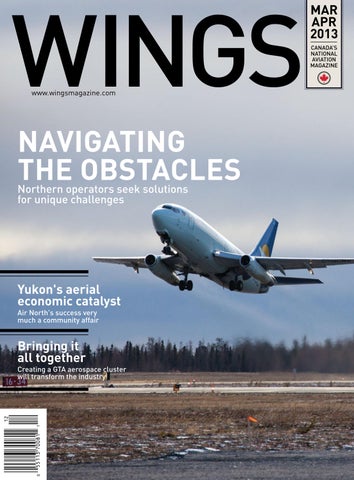
WINGS www.wingsmagazine.com
NavigatiNg the obstacles
Northern operators seek solutions for unique challenges
Yukon's aerial economic catalyst Air North's success very much a community affair
bringing it all together
Creating a GTA aerospace cluster will transform the industry
mar apr 2013 CANAdA’S NATIoNAl AvIATIoN mAGAzINe
Go Where Others Can’t. INTRODUCING THE FALCON 2000LXS It is the ultimate combination of nonstop range, airfield agility and widebody cabin. No other 4,000 nm aircraft can deliver so many airports in such quiet comfort. Thank optimized aerodynamics, new inboard slats and highly advanced acoustics. Thank Falcon DNA. And go where others can’t.
DNA. It Matters. Eastern Canada +201.981.2869 Find out why. Scan the code. Or visit falconjet.com/2000LXS
•
Western Canada +201.245.9399
march/april 2013
upfroNt 5 leading edge
Excellence in design
8 on the fly
News and opinion
12 Waypoint
Humbly serving King and country
14 alternate approach Finding a break in the clouds
16 at the gate
Depending on development
Quest Aviation’s Kodiak is specially designed to handle demanding conditions. P. 44
18 legal eagle
Stepping up with SMS
20 glidepath
Deciphering the F-35 conundrum
back 56 marketplace 62 on final
Time for an infrastructure infusion
From top: Finding a break in the clouds. P. 14. depending on development P. 16.
features 22 NavigatiNg the pitfalls
Northern operators must deal with holes in infrastructure, unique conditions By dAvId CArr
28 briNgiNg it all together
The establishment of a GTA aerospace cluster would provide real rewards By mATT NIChollS
34 evaluatiNg fWsar hopefuls
Alenia Aermacchi C-27J Spartan, Bell-Boeing V-22 Osprey join the mix By PAul dIxoN
38 YukoN’s aerial ecoNomic catalYst A position report on Air North By FrederICK K. lArKIN
44 experieNciNg a kodiak momeNt
Quest Aircraft explores new frontiers in the roughest terrain possible By JAmeS mArASA
COVER PHOTO: JasOn PinEau
www.wingsMagazinE.COM
March/April 2013 | wings
3
&
RECOGNIZING THE NEXT GENERATION IN THE CANADIAN AVIATION AND AEROSPACE INDUSTRY! Canada is full of young, skilled and knowledgeable people who are driving the aviation and aerospace industry forward. From pilots and AMEs to ground crew and business managers, they are the best and brightest in our industry. Join us as we celebrate the future of aviation and aerospace in Canada.
WHO CAN BE NOMINATED?
Anyone in the aviation or aerospace industries who is under the age of 40 as of December 31, 2013. Equipment and technology suppliers as well as operators are welcome.
ALL NOMINEES SHOULD: • • • •
Demonstrate a strong work ethic Show leadership and initiative Actively seek new opportunities for training and education Be involved in industry association or broader industry initiatives
NOMINATIONS ARE NOW OPEN
To nominate someone to be recognized as one of the Top 10 under 40, visit www.wingsmagazine.com or www.helicoptersmagazine.com and click on the “Top 10 Under 40” link to complete a nomination form. Nominations close on May 1st, 2013. The Top 10 Under 40 will be featured in the July/August 2013 issue of WINGS Magazine and the July/August/September issue of HELICOPTERS Magazine.
LEADING
EDGE
| By Matt Nicholls
celebrating excellence in design A Greater Toronto Area aerospace cluster makes perfect sense
O
PHOTO: uTC aEROsPaCE
n a recent tour of the University of Toronto Institute for Aerospace Studies (UTIAS) with faculty director David Zingg and Centennial College special projects officer Andrew Petrou, I came across a sight that stopped me in my tracks. Several neatly arranged images of the Avro Canada CF-105 Arrow in various stages of development were meticulously organized on one of the aging facility’s walls, celebrating one of Canada’s most impressive aerospace achievements. It, of course, immediately brought me back to grade 10 history at Lakeview High School in Thunder Bay, where Mr. Rogers (no joke) extolled the virtues of this incredible aircraft and how it had put Canada on the map as a leader on the global aerospace stage. And while most of the class were probably thinking about what they were having for lunch that day, I was captivated – my interest in aviation solidified. The Avro project is, of course, heralded in Canadian history and signifies one of the greatest examples of aerospace excellence and collaboration this country has ever produced. It’s a reminder of everything that’s right about Canadian aerospace. Other notable projects – such as the Space Shuttle’s Canadarm, Bombardier’s CSeries aircraft, Pratt & Whitney Canada’s dependable PT6 engine and more – illustrate just what happens when innovation, collaboration and the proper resources unite. Such achievements have far-reaching tentacles. In addition to the obvious economic benefits, they help fuel the passions of young people, setting them on career paths that will drive them to future success. Why is this so important? Timing is everything and as noted in my piece “Bringing it all together,” pg. 28, an aging aerospace workforce will create a skills abyss in the future that could
5 www.wingsMagazinE.COM
cripple Canada’s chances of grabbing a piece of the global aerospace pie. And believe me, it’s a good-sized pie. To wit, some $3.2 trillion in new commercial aircraft orders and an additional $661 billion in business aircraft deals will be on the books over the next 20 years.
companies are making impacts in the manufacturing, research and development, IT, engineering, aircraft modification, MRO and other realms. More needs to be done, however, to keep the industry vibrant and the development of a Greater Toronto Area cluster like the one that exists in Montreal will reap significant rewards. As David Emerson notes in his recently released “Beyond the Horizon: Canada’s Interests and Future in Aerospace” report, such a development would unite educational establishments with industry to provide greater opportunities for collaboration, strengthen and create a more vertically integrated supply chain and establish a stronger industry profile to solicit government support. The creation of an aerospace centre of excellence at Downsview airport presents yet another opportunity for the GTA and Ontario aerospace. Home to a rich aviation history, Bombardier and, a 7,000-foot operating runway, and close to both TTC and GO Train access, Downsview is an ideal location as a hub for an Ontario aerospace cluster. Petrou and Zingg, along with several key industry players, are keen drivers of the concept. The Downsview Aerospace Cluster for Innovation and Research (DAIR) team has a clear vision of what’s at stake, and in the months and years ahead, will be working hard to make the project a reality. The Downsview hub would also be a focal point for fostering the hopes and dreams of youngsters interested in careers in Canadian aerospace. It would leverage the province’s best educational institutions in a partnership to develop innovative new technologies, aid in workforce training and skills development, and participate in supply chain initiatives. And who knows? Years from now, once UTIAS and others have moved to the Downsview site and reaped the rewards of the cluster concept, perhaps a new gallery of images will showcase other aerospace success stories garnering international headlines. | W
“While most of the class were probably thinking about what they were having for lunch that day, I was captivated.” Fortunately, Ontario’s aerospace companies are moving in a positive direction to take a serious bite out of that pie. With more than 350 firms, 22,000 employees and $7 billion in annual economic output, the province’s aerospace footprint is significant. Companies such as Bombardier, Pratt & Whitney Canada, Honeywell, Goodrich Landing Gear (UTC Aerospace Inc.), SAFRAN, MessierBugattiDowty and hundreds of smaller, dynamic tier-two, tier-three and tier-four
top data bursts… in this issue 1. 2014: the year air canada is supposed to receive its first 787 (pg. 8). 2. 60,000: the number of passengers air Creebec carries annually (pg. 16). 3. there are some 23 boeing 737-200s still flying in Canada, (pg. 22). 4. $7 billion: The total annual economic output of Ontario’s aerospace sector (pg. 28). 5. 12,000 feet: The cruising altitude of Quest aircraft’s versatile Kodiak (pg. 44).
Your feedback is always welcome. Please contact me at mnicholls@annexweb.com. @Wings_Magazine March/April 2013 | wings
5
WINGS
mar apr 2013 CANAdA’S NATIoNAl AvIATIoN mAGAzINe
www.wingsmagazine.com
vol. 54, issue 2
NavigatiNg the obstacles
editor
Matt nicholls mnicholls@annexweb.com 416-725-5637
Northern operators seek solutions for unique challenges
media desigNer
Kelli Kramer
Yukon's aerial economic catalyst Air North's success very much a community affair
flight deck
bringing it all together
Ray Canon, David Carr, Paul Dixon, Brian Dunn, Frederick K. Larkin, neil a. MacDougall, James Marasa, Carroll McCormick, David Olsen, Rob seaman
Creating a GTA aerospace clusterwill transform the industry
SubScribe TODAY !
associate publisher
alison de groot adegroot@annexweb.com 1-888-599-2228 ext. 246
1 Year SubScription WINGS_MARAPR13.indd 1
only
3000
13-02-19 3:37 PM
$
advertisiNg sales
(GST $31.50 • HST $33.90)
adam szpakowski aszpakowski@annexweb.com 1-888-599-2228 ext. 246
US $42.00 (USD) • Foreign $65.00 (USD)
Name: _______________________________ Company: ____________________________ Title: _________________________________ Address: _____________________________ City: _________________________________ Prov: ________________________________ P.Code: _______________________________ Tel: __________________________________ Fax: _________________________________ e-mail:________________________________
PLeASe cHecK ONe: ❑ Commercial aircraft owner/operator ❑ Business/private aircraft owner/operator ❑ Military ❑ Aircraft maintenance/overhaul firm ❑ Airport ❑ Aerospace, airframe & component manufacturer and distributor
❑ Fixed base operator ❑ Aviation services, consultants and aircraft sales ❑ Government ❑ Aviation associations and organizations ❑ Flying schools, clubs and colleges ❑ Other (please specify) ______________
PAYMeNT: Cheque - Payable to Annex Publishing & Printing Inc. Visa
MC
AMEX
Account #: __________________________
sales assistaNt
stephanie DeFields sdefields@annexweb.com 1-888-599-2228 ext. 257 group publisher
scott Jamieson sjamieson@annexweb.com presideNt
Mike Fredericks mfredericks@annexweb.com WiNgs magaziNe
P.O. Box 530, 105 Donly Dr. s., simcoe, On n3Y 4n5 Tel.: 428-3471 Fax: 429-3094 Toll Free: 1-888-599-2228
Publication Mail agreement #40065710 Return undeliverable Canadian addresses to Circulation Dept., P.O. Box 530, simcoe, Ont. n3Y 4n5 e-mail: subscribe@wingsmagazine.com Published six times per year (Jan/Feb, Mar/apr, May/ Jun, Jul/aug, sep/Oct, nov/Dec) by annex Publishing & Printing inc. circulation e-mail: subscribe@wingsmagazine.com Ph: 866-790-6070 ext. 208 Fax: 877-624-1940 Mail: P.O. Box 530, simcoe, On n3Y 4n5 subscription rates Canada – 1 Year $ 30.00 (includes gsT - #867172652RT0001) usa – 1 Year $ 42.00 Foreign – 1 Year $ 65.00
Occasionally, wings magazine will mail information on behalf of industry-related groups whose products and services we believe may be of interest to you. if you prefer not to receive this information, please contact our circulation department in any of the four ways listed above. no part of the editorial content of this publication may be reprinted without the publisher’s written permission. ©2012 annex Publishing & Printing inc. all rights reserved. opinions expressed in this magazine are not necessarily those of the editor or the publisher. no liability is assumed for errors or omissions. all advertising is subject to the publisher’s approval. such approval does not imply any endorsement of the products or services advertised. Publisher reserves the right to refuse advertising that does not meet the standards of the publication. Printed in Canada issn 0701-1369
Signature: _________________________
TO SubScribe:
Tel: 866-790-6070 Fax: 877-624-1940 Mail: Wings Magazine c/o Annex business Media P.O. box 530 Simcoe, Ontario N3Y 4N5
Air Transport Association of Canada
ON THE
WEB
e-mail: subscribe@wingsmagazine.com
www.wingsmagazine.com
GST#135274215RT001
6
Subscriptions non-refundable
PRO0313
wings | March/April 2013
wings subad.indd 1
Canadian Owners & Pilots Association
Canadian Business Aviation Association
Magazines Canada
careers iN aviatioN Looking for a great career in aviation and aerospace? Check out our Careers in Aviation micro site, a handy guide to help you better understand what a career in aviation is all about. Check out www.careersinaviation.ca for news, updated listings and more! www.wingsMagazinE.COM
13-02-19 3:42 PM
PHOTO: ROYaL CanaDian aRMED FORCEs
Expiry:_____________________________
Out of the BOX and into the CLOUD Introducing the new Satcom Direct Router from the innovators at Satcom Direct. A next generation network manager that simplifies aircraft communications, provides additional configuration management as well as simultaneous operation of multiple networks and integrates with all current /future Satcom Direct services. Creating the ultimate user experience. That’s what we do. For more details, contact us at +1 321.777.3000 or SDR@satcomdirect.com.
ON THE FLY For late-breaking news, the Wings blog and exclusive web content, please visit us at: www.wingsmagazine.com
iNdustrY NeWs
Jetz puts legroom oN ice National Hockey League (NHL) players looking for added perks to ease travel discomfort had to settle for less after boarding chartered aircraft for the first away game following the recent lockout. Jetz, Air Canada’s premium charter subsidiary, has contracts with more than 13 NHL franchises, including all seven Canadian clubs, to take their games on the road. Jetz operates five Airbus A320 and one A319 aircraft with all-executive class seating – until recently, that is. To minimize the financial hit from a four-month game stoppage, Jetz returned five aircraft to the mainline fleet with reconfigured business and economy class cabins. The NHL’s return to the ice in January after the briefest of training camps meant Jetz had to take back the airplanes without time to refit cabins. Economy class seating did not go over well according to the Vancouver Sun. At least one NHL team refused to take this latest indignity to its players sitting down. “We are currently exploring our
options with respect to how our team will travel this year and who will be our carrier,” Vancouver Canucks assistant general manager Laurence Gilman told the Sun. For the start of the season at least, it was a question of which team would luck out by landing the one Jetz airplane not reconfigured. And while all aircraft include an executive class cabin, the Sun reported that those seats were likely reserved for management, coaching staff and those who pay the freight. The Los Angeles Kings were the first NHL franchise to introduce a private jet in 1990, a luxury-appointed Boeing 727-100. The aircraft was grounded two years later as the Kings struggled to pay the bills. Since then, the NHL – like all professional sports organizations – has infused operating budgets with first class travel, sleep experts and nutritionists to overcome jetlag and maximize performance on game day. So it is understandable how having a professional athlete fold his considerable frame into an economy seat runs counter to keeping players game ready. This is especially true during a truncated season when the league is squeezing games through a very tight window. Still, with six-abreast seating along 22 rows, there is ample space to stretch out. If that is not enough, millionaire players can do like many economy passengers in need of added leg room; pay extra for an exit row seat.
The Nhl lockout also changed the layouts of team-designated Air Canada Jetz aircraft. 8
wings | March/April 2013
The Pilatus PC-12 has carved a niche for itself in the Canadian north with its ability to take off and land on very short runways.
fleet upgrades iN the North The opening of an aftermarket for specific airplane types has opened up opportunities for northern operators to upgrade their fleets, according to Stephen Nourse, executive director of the Northern Air Transport Association (NATA). The ATR42, early Bombardier Q Series and Beech 1900 are replacing vintage airplanes such as the HS748 in smaller communities. It has been a long wait. Part of the problem, Nourse told Wings, has been economics. “It is not that operators don’t want to fly shiny new airplanes. But you still have to make money.” Most operators serve remote communities that can’t support daily service and routes tend to be long and thin. “When you string together a route structure you may get to use the airplane 1,600 to 1,800 hours a year. A new airplane needs 2,400 hours plus. So operators had to wait for an established aftermarket for aircraft like the Dash 8 and ATR42, where lower utilization makes economic sense.” Another obstacle continues to be infrastructure, especially runways of 1,200 metres or less. “They were perfectly fine when they were initially built and the design aircraft was the DC-3,” Nourse told a Senate Committee last year. “However, in today’s world, this significantly limits the availability of newer aircraft types. Most of the newgeneration aircraft suitable for smaller www.wingsMagazinE.COM
PHOTO (TOP): PiLaTus, (BOTTOM): aiR CanaDa
8 - iNdustrY NeWs 9 - airport NeWs 10 - people
markets need 1,520 metres as a minimum standard.” The Cessna Caravan and Pilatus PC-12 are building a presence in niche markets and Nourse expressed surprise at the number of King Airs that have invaded the North. With only 10 paved runways in all three territories, the industry still needs a replacement for the aging Boeing 737-200, the only jet certified to operate from gravel strips (for more information, see “Navigating the pitfalls,” page 22).
roviNescu relieved air caNada Not oNe of the first
PHOTOs: aiR CanaDa
From the beginning, Calin Rovinescu has had strong praise over how Japan’s All Nippon Airways introduced the Boeing 787 into the fleet. Air Canada is not scheduled to receive the first of 37 of the Dreamliners until 2014. It is a timeline that suits the airline’s chief executive. “The attention that the 787 has received in the past few weeks as a result of a number of technical problems, for me, just confirms the wisdom of avoiding the ‘first mover’ step and waiting to take delivery of a new aircraft model only after the initial problems are fixed,” Rovinescu told the Metropolitan Board of Trade in January, a few days after the 787 was grounded by the U.S. Federal Aviation Administration. “Problems are common during the introduction of new models, especially ones as revolutionary as the 787,” he said.
Air Canada president Calin rovinescu says problems are common with the introduction of new models into fleets.
air caNada adds a touch of rouge Rouge, Air Canada’s new low-cost airline, will begin flying July 1, with service from Toronto and Montreal to Venice and Edinburgh, two destinations not served by the mainline carrier. Rouge will begin operations with two Boeing 767-300ER and two Airbus A319 aircraft. Flights to the Dominican Republic, Jamaica and Athens will be added. The airline unveiled the Rouge name and logo – which returns the familiar stylized maple leaf in a circle to the tail of the aircraft – last December. The destinations are areas where demand for leisure travel has been growing, according to Ben Smith, Air Canada’s chief commercial officer. “With the introduction today of Rouge, Air Canada enters today’s growing leisure travel market on a truly competitive basis.” Rouge will be a full-service carrier, and Air Canada plans to leverage other marketing strengths such as the Aeroplan
frequent flyer reward program to fill the airplanes. The discount carrier may grow to 30 A319 and 20 Boeing 767-300ER aircraft. Additional 767s will be released from the mainline carrier as it takes delivery of Boeing 787s. The 787s are expected in 2014, but that delivery date is now a moving target since the 787, also branded the Dreamliner, was grounded in January following safety concerns with the aircraft’s lithium-ion battery.
airport NeWs
halifax bulks up to attract greater freight traffic Halifax Stanfield International Airport is confident that a newly extended main runway will bring more freighter traffic to the Atlantic Canada hub. Work to extend the 2,682-metre- air strip to 3,200 metres began in September 2011. The lengthened runway was officially opened in January 2013, although it has been operational
Air Canada’s discount carrier rouge may grow to 30 A319 and 20 Boeing 767-300er aircraft. www.wingsMagazinE.COM
March/April 2013 | wings
9
ON THE
FLY
since November. “The extension of our main runway provides Atlantic Canada with new economic development opportunities, particularly in the air cargo sector,” Tom Ruth, airport authority chief executive, said at the opening. “The ability to handle the biggest cargo freighters, and also to add more cargo to the larger passenger aircraft, will provide a ripple of prosperity through the region.”
caNada’s first pilot hoNoured Aviation pioneer John Alexander Douglas (J.A.D.) McCurdy has been inducted into the Canada Science and Technology Museum. On Feb. 23, 1909, McCurdy took off from the ice-covered waters of Bras d’Or Lake, N.S. in the Silver Dart to become the first person to achieve powered flight in Canada and the British Empire. The Silver Dart was designed and built by McCurdy, Alexander Graham Bell and members of the Aerial Experiment Association. McCurdy graduated from the University of Toronto in 1906 with a degree in mechanical engineering. He was instrumental in the creation of the Royal Canadian Air Force and was appointed lieutenant governor of Nova Scotia from 1947 to 1952. McCurdy’s grandson, Hon. Col. Gerald P.J. Haddon, and his wife, Amanda were present for the Nov. 21,
24/7
READY TO SERVE AROUND THE WORLD
Visit us at Update 2013, Airworthiness Symposium and Tradeshow, March 13-15 in Calgary, Alberta A Fully Authorized Pratt & Whitney Canada Distributor & Designated Overhaul Facility
MAINTENANCE
l
R E PA I R
l
OVERHAUL
Toll Free: 1.888.769.0999 l www.vectoraerospace.com
SETTING THE STANDARD OF CUSTOMER SERVICE
10 wings | March/April 2013
www.wingsMagazinE.COM
PHOTO: HaLiFax sTanFiELD inTERnaTiOnaL aiRPORT
halifax Stanfield International Airport handled approximately 3.6 million passengers in 2011.
people
Halifax handled approximately 3.6 million passengers in 2011. It is Canada’s seventh busiest airport, and is considered one of the world’s best airports handling passengers under five million annually. It is estimated that the airport handled 29,300 metric tonnes of cargo in 2012, and that will increase by over four per cent in 2013. Fresh seafood is responsible for most airfreight shipments out of Halifax. The airport authority covered 50 per cent of the $28 million project, while Transport Canada and the Nova Scotia government chipped in $9 million and $5 million respectively. Jerry Staples, vice-president of air service marketing and development told the Halifax Chronicle Herald, that several operators have already expressed interest in expanding freighter service to the airport. “We’re not yet in a position to make an announcement, but we’re pretty close to having additional service in the market,” he said.
induction ceremony, which included a proclamation of McCurdy’s aviation firsts from Prime Minister Stephen Harper, and the presentation of a piece of Nova Scotia handmade crystal. McCurdy was the world’s oldest living pilot when he died in Montreal in 1961. He was buried in Baddeck, N.S., facing the waters from where he made his historic flight. A full-size replica of the Silver Dart is on display at the Canada Aviation and Space Museum in Ottawa.
PHOTO: PauL DixOn
salutiNg keY iNflueNcers The David Charles Abramson Award, awarded annually at the ATAC Annual General Meeting and Conference to a deserving member of the flight instruction community, this year recognized Paul Harris, manager of flight operations at the Pacific Flying Club in Vancouver. An innovator in the field of
flight instruction, Harris has spent more than 20 years and 12,000 hours guiding young pilots. Other award winners at this year’s event included Patrick Lafleur, chief flight instructor at the Passport Hélico in Mascouche, Que. Lafleur received a Safety Management Systems workshop sponsored by ATAC in honour of his work in the industry. Chris Walsh, director of training and manager of corporate safety and quality at Moncton Flight College, was also honoured for his contributions on the fixed-wing side. He received a three-day instructor refresher course sponsored by Seneca College. For more than 10 years, the David Charles Abramson Award has recognized industry leaders in the flight instruction arena. The David Charles Abramson Memorial (DCAM) Flight Instructor Safety Award is named in honour of Jane and Rikki Abramson’s son, a heroic individual whose life came to a tragic end in 1998.
Paul harris, manager of flight operations with vancouver’s Pacific Flying Club, with the david Charles Abramson Award and Wings associate publisher Alison de Groot and account manager Adam Szpakowski.
David Abramson’s professionalism as a flight instructor was the inspiration behind this annual recognition of excellence in Canadian flight training. David lost his life while on a routine training flight with a student on July 18, 1998. He was just 24. David’s heroic actions that day saved the life of his student – and established a legacy for all to follow.
WAAS Gets Them There Avionics upgrades for reliable deliveries to the jobsite
Mine and rig operations don’t depend on the weather. Transporting staff and hot-shot parts to the jobsite shouldn’t either. WAAS Flight Management Systems enable precision-like LPV approach procedures with lower minima that get them on-site, on time, every time. Visit us at Heli-Expo Booth C2401 or www.uasc.com to learn more.
WAAS/SBAS-FMS Family LP/LPV Monitor, UNS-1Lw, -1Fw and -1Ew
www.uasc.com sales@uasc.com (800) 321-5253 (520) 295-2300
www.wingsMagazinE.COM Wings Universal Avionics_WAAS Gets Them There_March_April_02.indd 1
March/April 2013 11 2/11/13 4:25 PM | wings
WAYPOINT By Rob Seaman
humbly serving king and country
George Stewart is a quiet reminder of those who deserve our utmost respect
E
12 wings | March/April 2013
aircraft, than most museum and private collection operators own. At 89, he continues to be a guiding influence and be the go-to-guy for input and help on anything related to flight ops in the aircraft he grew up on. Over the past two years, Stewart and Dave Phillips, charged with flying a Mosquito under rebuild, streamed e-mails back and forth about “handling” the aircraft. Phillips was able to get some good tips from Stewart; no Mosquitoes have flown since the 1990s, so input from others was sketchy at best. Avspec Aviation – the group rebuilding the Mossie for U.S. owner Jerry Yagen – completed a nine-year rebuild of what is today the only flying Mosquito in the world. Stewart and his son, Peter, flew to New Zealand last October, where Stewart continued his mentoring to the pilots Phillips and Keith Skilling during their test flying. It was a resounding success. Yagen will be bringing his Mosquito to the Hamilton Airshow on June 16-17. The Canadian Warplane Heritage (CWH) museum plans on having a “Mossie” night with Stewart among the speakers. This will also be one of the few chances to see a venerable “wooden wonder” in formation with the CWH Lancaster, two Spitfires and two Hurricanes. It will not only be a rare site, but also a great sound of 10 Merlins in close formation. Mark your calendars! Stewart is one of many Canadians who served with honour and distinction, and live their lives in humble silence. Years ago, I read a line that stuck with me. “Every once in a while, have lunch with someone who has forgotten more than you will ever know.” If you get such a chance, don’t wait, do it today. You will never regret it. | W
Stewart relays what he knows in bits and pieces . . . and only if he thinks you might find it of interest. Communists. About a dozen pilots were sent for training in Canada, but our snowy winter rendered the effort a washout. As Stewart recalls, they wound up writing off about seven aircraft in the snowbanks at Downsview. After returning home, Stewart became a reserve pilot for the RCAF. Back then in Hamilton, being a reservist meant flying P-51 Mustangs from Mount Hope. He once told me how for lunch he would break from work, leave the graphics shop he operated until he retired, head up the mountain to the airport and get in a short flight either on his own or with some other like-minded reservists. Quite the gentleman’s existence, but then again, he pursued it quietly, humbly and it was well earned. Stewart has flown more versions of what we today consider vintage, high-powered
Rob Seaman is a Wings writer and columnist. www.wingsMagazinE.COM
PHOTO: gEORgE sTEwaRT
ach year in Canada, we lose veterans who helped protect the way of life we so greatly cherish today. Some of these veterans we know via stories and other exploits. Books and movies have recorded their efforts immortalizing them for future generations. But there are many others who live in quiet reflection, their dedication, history and achievements filed away, never to be uncovered. George Stewart is one of these men, typical of so many Canadian pilots. A private person, he is well spoken about his service to King and country . . . but only if you ask. Like most from his generation, he does not openly seek the spotlight. If you inquire, however, you will get an impressive stream of stories and history; but it will not come all at once. Like many of his peers, Stewart relays what he knows in bits and pieces, as something reminds him, and only if he thinks you might find it of interest. In our case, these stories have been – and continue to be – rendered over many years. A lot were delivered through a headset while he acted as my sometime instructor. Others came over lunch at the airport as he played the role of mentor. Still others came out over the course of a meeting as my employer. To meet Stewart, you’d never think of him as an accomplished flyer with a Distinguished Flying Cross (DFC). Born in January 1924 in Hamilton, Ont., he joined the Royal Canadian Air Force (RCAF) in March 1942, graduated as a pilot, and was “commissioned” a year later. He served with No. 23 Squadron Royal Air Force (RAF), as a low-level, “Night Intruder” pilot, and flew an extended tour of 50 sorties in the MKVI Mosquito fighter-bomber with his navigator, Paul Beaudet. The pair did not have radar at that time, and from July 12 until Dec. 8, 1944, they did some amazing things together. In 1945, Stewart was awarded his DFC. His citation reads: “This officer has completed a period of intensive operations . . . Flying Officer Stewart’s eagerness to operate against the enemy, his unflagging zeal and determination combined with his devotion to duty have won the admiration of all.” After the war, in 1948, Stewart instructed Chinese Nationalist pilots during their 1946-49 “civil war” against the Chinese
W O R L D C L A S S T R AV E L E R S
David Beckham. A global icon who insists on perfection. Precision and style. A legend forged by accomplishments. On his wrist is the Breitling Transocean Chronograph Unitime, the ultimate traveler’s watch. Manufacture Breitling Caliber B05, officially chronometer-certified by the COSC, endorsed by a 5-year Breitling warranty. High-performance selfwinding chronograph. Universal time function enabling permanent readings of the time in all 24 timezones thanks to a patented mechanism and an ultra-user-friendly crown-operated correction system. Comfort and elegance for first-class travelers. Signed Breitling.
CAD 11,200 Recommended retail price
ALTERNATE
APPROACH By David Carr |
finding a break in the clouds
Boeing tries to get back on track after myriad Dreamliner issues
A
14 wings | March/April 2013
“Boeing has an airplane problem, not a PR problem.” Actually, it has both, meaning that solving the problem is only half the solution. Boeing builds the airplanes, but it is customers, like Air Canada, who have to fill them. As the 787 returns to service, the airframer is going to have to repay the loyalty of its customers by stepping up its own public relations game. Watch for Boeing to launch an aggressive media campaign, including social media, promoting the 787 as the marvel it is. So far, the 787 order book is holding firm and social media has not exploded with travellers refusing to fly the airplane. That may change as the investigation is prolonged and the vacuum is filled with speculation (the chair of the U.S. Senate Commerce, Science and Transportation Committee is calling for public hearings on the safety of the lithiumion battery). When it does conclude, the investigation will benefit the development of other next-generation airliners such as the Bombardier C-Series and rival Airbus A350. But will customers be as keen to board a 787 when the airplane returns as they were when it first entered service? Pockets of hesitation not withstanding, the answer is ‘yes.’ Everyone has confidence in Boeing. | W
“Airplanes don’t make money when rubber stands idle on concrete, so there is a hefty price to be paid.” battery overshadow other glitches such as cracks along the cockpit windshield. The 787’s troubles are more deeply rooted and the remedies more severe because the design is so revolutionary. Boeing has many quality program partners around the world, but the aircraft manufacturer is clearly paying a steep price for listening to its bean counters and outsourcing too much of the airplane’s development, resulting in a global jigsaw of blueprints, components that did not fit and massive production delays. In contrast with the early development of the airplane, Boeing has been able to keep tighter control of the current situation. Public pronouncements have been few outside the rudimentary confidence in lithium-ion technology and that accelerated production will get the delivery schedule back on track (although that is unlikely for new customers such as Qantas and British Airways, who are expecting deliveries of aircraft this summer. Air Canada’s first 787s are not scheduled to arrive until 2014). Behind the scenes, Boeing is working the telephones daily to keep customers in the loop. Forbes Magazine recently reported that,
David Carr is a Wings writer and columnist. www.wingsMagazinE.COM
PHOTO: BOEing
s the Boeing 787 Dreamliner sat grounded for a fourth week, the U.S. Federal Aviation Administration (FAA) approved the aircraft for test flights. Still, it wasn’t all good news. Regulators in the U.S. and Japan continued to comb over the airplane looking for whatever it was they might have missed the first time. That same week, the National Transportation Safety Board signalled that a report into the lithium-ion battery was weeks away. Deborah Hersman, NSTB head, has called for regulators to go back to the beginning and review the certification process for the lithium-ion battery onboard the airliner. Airbus has switched to nickel-cadium batteries for the 350, although lithium-ion technology will be used in early flight testing scheduled to begin later this year. Airplanes don’t make money when rubber stands idle on concrete, so there is a hefty price to be paid for the thousands of flights cancelled. Launch customer All Nippon Airways (ANA), which has 17 787s in its fleet, calculates it lost $15 million in January alone and is pressing Boeing to accelerate delivery of three Boeing 777s as the airline contemplates a summer schedule without the newest addition to its fleet. Requests for compensation will come later. Other carriers are also plugging gaps with airplanes on routes the 787 was to replace. The 787 is a magnificent airplane that has landed in with some unfortunate company. The British de Havilland Comet – the world’s first passenger jet – and McDonnell Douglas DC10, were grounded in the early 1950s and late 1970s respectively, following a series of tragic crashes. Both aircraft returned to service (the Comet after a prolonged six-year absence), but neither recovered from the setback. A similar fate does not await the 787. Boeing has the confidence of its customers. That confidence (along with Boeing’s share price) is proving to be resilient, even as the market wrestles with the grounding possibly stretching into 2014. As was also experienced with the Airbus A380, every new airplane experiences teething troubles as it enters service (as opposed to fatal design flaws in the case of the Comet and DC10). The 787 was no exception, although issues surrounding the lithium-ion
AT THE
GATE
By Brian Dunn |
depending on development
Northern Quebec’s Air Creebec showcasing its resourceful approach
S
16 wings | March/April 2013
months. But the carrier has four main centres, in Dorval, Val d’Or, Timmins and Moosonee, Ont., and 15 destinations listed on its website. While the bulk of Air Creebec flights are in Quebec the airline is also active in northern Ontario. Happyjack said that the company bought the new Dorval facility last year to accommodate the expected growth in traffic over the next few years. Revenues are roughly $70 million a year and each year is better than the previous one. A big part of Air Creebec’s growth since 1996 is from the charter half of the business. Goldcorp is Air Creebec’s largest single customer, a position formerly held by Hydro-Québec. But the utility is finishing up its Eastmain project, so business there is slowly diminishing. However, Air Creebec expects to pick up new business from Hydro-Québec’s other project, La Romaine. Another large customer is De Beers, the diamond company that operates a mine near Attawapiskat, Ont. What’s next for Air Creebec? Happyjack has his sights set on Manitoba and possibly beyond. It’s a resourceful approach, perfect for a company thriving in Canada’s northern resource-based sectors. | W
“Val d’Or is the most prosperous city in Quebec and that’s where Air Creebec does a lot of business.” at a rate of nearly $1 billion a year, employing 10,000 people in the region with 11 major mining projects in various stages of development. And all these projects need transportation to move workers in and out of the area and this is why Air Creebec feels, “the sky’s the limit” when it comes to future growth, said Happyjack. Val d’Or is the most prosperous city in Quebec and that’s where Air Creebec does a lot of business, he added. It has bought three de Havilland Dash-8 35-seaters in the past two years and is adding another. Its fleet of 16 aircraft consists of Dash-8 100 and 300 aircraft, Beechcraft 1900 D and King Air, Embraer 110 and two Hawker 748 Series cargo planes. Each aircraft averages 1,800 flights per year, according to Happyjack. The airline carries about 60,000 passengers a year, with service divided equally between scheduled and charter flights. The number of destinations it serves is hard to pin down, said Happyjack, because an aircraft can touch down in a village one day to pick up or let off passengers working on a company project and not go there again for
Brian Dunn is a Wings writer and columnist. www.wingsMagazinE.COM
PHOTO: JOHn FaRRingTOn, aiR CREEBEC
ince its founding in 1982, Air Creebec has depended heavily on northern development, mostly mining, forestry and Hydro-Québec, for its growth. The Val d’Or, Que.-based airline owned by the Cree nation saw a niche market to serve the north and has taken the ball and run with it. “There was a need for an airline to serve isolated communities because the only way to get to them was by seaplane,” Matthew Happyjack, president and CEO of Air Creebec, told Wings. The seeds were planted in 1979 following ratification of the James Bay and Northern Quebec Agreement when the Cree Regional Authority saw a unique opportunity to extend its activities to the field of transportation. The Cree Nation was a promising market and needed a carrier to meet its expectations. In the spring of 1979, the Grand Chief of the Cree Nation of Quebec and Austin Airways of Timmins, Ont., held their first of several meetings, which eventually led to the creation of Air Creebec. At the start of operations, 51 per cent was Cree-owned and 49 per cent was owned by Austin Airways. In 1988, the Cree bought out their partner’s share of the business, making it the largest commercial transaction ever completed by Canada’s aboriginals. At the time, Nordair and Quebecair had a near duopoly serving northern Quebec, but CP Air absorbed the two in 1986, leaving a void that Air Creebec gladly filled. Last fall, on its 30th anniversary, Air Creebec inaugurated a new $10-million hangar and terminal at Dorval’s Pierre Elliott Trudeau International Airport with a $1.3-million subsidy from Quebec. The airline had anticipated a boom in northern development long before former premier Jean Charest announced his Plan Nord in 2011, an ambitious project that calls for public and private investment of an eventual estimated $80 billion by 2036 to open up Quebec’s huge northern region to mining, renewable energy and forestry projects. With the Parti Québecois now in power, the future of Plan Nord is still very much up in the air. But even before Plan Nord was announced, investment was pouring into mining development in northern Quebec
AVIATION
EXCELLENT QUALITY AND DESIGN The aviation sector in Poland has been developing for over 80 years. Today it is an important sector of the economy, which includes the aerospace industry companies supported by research and development as well as educational centres.
Poland occupies an important position on the global map of aerospace industry. At present, the companies here manufacture a wide range of products from engine components to complete aircraft.
Visit Polish exhibitors at the trade show AEROMART in Montreal between 23rd and 25th of April 2013. At the same time also participate in:
• Matchmaking meetings with Polish companies • Trade conference with the participation of experts
We also invite you to visit the stand of Polish Ministry of Economy.
FOR MORE INFORMATION PLEASE CONTACT US:
Ewa Ostrowska Tel. +48 61 869 2694 E-mail: Ewa.ostrowska@mtp.pl
Marcin Sułek Tel. +48 61 869 2970 E-mail: Marcin.sulek@mtp.pl
LEGAL
EAGLE By Neil J. Macdonald |
stepping up with sms
Meetings and posters can’t create a complete SMS culture
M
any Canadian aviation firms profess to have a bona fide safety management system (SMS) in place at their organization, but I’m not convinced that’s always the case. To wit, an SMS is not a monthly meeting, nor is it posters on the wall. SMS is, in fact, a culture; it is a mindset. It comes from the top down and from the ground up. SMS meets in the middle and is the stew that everything in your organization marinates in. If you do not believe in the idea of SMS as a holistic entity embracing your organization, then you do not have a proper SMS program, regardless of how many times your operations manual says you do. It’s also worth noting that if you do not have an SMS program, it could be costing you money. Maybe not today, but it may well do so in the future. “If you think safety is expensive – try an accident.” This saying is so well known to us in the aviation industry, yet we ask ourselves why it is not always followed in practice. The answer may be that we are not having very many accidents these days. The total number of accidents and incidents has been on a steady decline for well over the past decade, experts say. The 10-year average for accidents in Canada, or accidents involving Canadian aircraft, was 307 occurrences. There was a step down of occurrences in each of 2009, 2010, and 2011 (last full year of reporting). Last year’s number appears to be lower again still. Private aircraft accidents account for more than twice the average of commercial accidents, although they too are on the decline over the same reporting period. It is important to note that only those entities involved in commercial operations will be required to have an SMS program in place by 2015. The aviation industry itself has the overall responsibility for aviation safety. Transport Canada as the regulator, is tasked with ensuring industry has effective systems in place to manage safety. The International Civil Aviation Organization (ICAO) requires that regulators monitor companies with respect to SMS once every 12 months. This is not that practical in Canada due to the (large) size of our industry and the (small) size of Transport Canada’s budget. ICAO estimates a four per cent increase in 18 wings | March/April 2013
According to the Transportation Safety Board website, “Watchlist,” Transport Canada does not provide proper oversight on those carriers it requires to have an SMS, and while at the same time does not require smaller operators to have a system in place. The Auditor General tends to agree. While it found that Transport Canada has “implemented a suitable regulatory framework for civil aviation safety” it is “…not adequately managing the risks associated with its civil aviation oversight.” Transport Canada is working hard on making the appropriate changes. I believe it’s time we remind ourselves that we in the aviation industry have the overall responsibility for aviation safety. We should not need to wait for Transport Canada to inspect us before we act on implementing a proper safety management system. It’s a beginning, and a way to demonstrate your commitment to the safety management system philosophy. Just make sure they are not the only things you are doing! | W
If you do not believe in the idea of SMS as a holistic entity embracing your organization, then you do not have a proper SMS program. air traffic in North America year after year over the next dozen years, suggesting a possible doubling of the current amount. Interestingly, Transport Canada does not expect any significant increase in its current budget over that same period! Transport Canada effectively does much the same risk assessment on companies as it asks companies to perform on themselves – focus on the areas that display a higher risk for regulatory non-compliance. There are approximately 34,000 aircraft registered in Canada, with more than 5,000 companies authorized to operate. Transport Canada was only able to inspect roughly 30 per cent of the organizations in 2010-11. This is well short of their stated goals, and potentially allows for a high degree of noncompliance within the industry. The Auditor General of Canada found that even within those organizations inspected, there was some confusion on the part of the inspectors as to what they should be looking for or at. Part of this confusion may well have been because only 40 per cent of inspectors had been trained on the new surveillance methodology by that time.
This is Neil MacDonald’s last column for Wings after several years of offering readers ironclad legal advice. We wish to thank Neil for his efforts and wish him all the best in his future endeavours. www.wingsMagazinE.COM
•
Whether you are looking for a career change or just about to start one, come learn about different career paths the aviation industry has to offer: airplane pilots, helicopter pilots, maintenance engineers, aerospace design & engineering, aviation business management, air navigation, flight operations and more.
•
Meet with Canada’s leading aviation colleges, universities, flight schools and hiring managers from Canada’s largest aviation operators and aerospace companies.
•
Find out what it takes to get hired!
•
Tour the Downsview FlightSafety simulator training centre.
Your registration includes: speaker sessions covering a variety of aviation career paths, networking with Canada’s top training programs and hiring managers, tour of a leading edge flight simulator training facility, luncheon with keynote speaker, coffee breaks and the Careers in Aviation exhibit hall.
WHere
Holiday Inn 3450 Dufferin Street Toronto ON M6A 2V1
WHen
Saturday, April 6, 9am-3pm
HoW
Visit: www.careersinaviation.ca to register! $59 for early bird sign-up
SponSored by
Careers in Aviation
GLIDE
PATH
By Paul Dixon |
deciphering the f-35 conundrum An endless string of numbers, cloudy vision have hampered objectives
N
20 wings | March/April 2013
costs vary and alternative fuels become more widely available the company will be able to source its fuel accordingly. A safety management system in a garbage truck? Absolutely! The truck features multiple video cameras that can be set up to record the external operations as well as the driver’s position. Data capture on all facets of vehicle operation allows you to monitor both the driver as well as maintenance requirements. The life cycle of the truck is projected at 10 years and the company has the costs pegged for that entire time, from labour to fuel to simply maintaining the vehicle. The main difference between the garbage truck and the F-18 replacement is that, in the case of the garbage truck, there is a clear understanding of what that truck will be doing over the course of its lifetime. In choosing an airplane, it’s difficult to make the “right” decision when there is no clear vision of what we will expect of our military five, 10 or 20 years from now. It’s been said many times before, but it fits here – if you don’t know where you are going then any road will take you there. That’s where you find the “reset” key – halfway between where you are and the “any” key. Doh! | W
“You have to have your undercoating, after all . . . got to have it for those long, cold winters up north.” chalet: the Canadian pilot who rhapsodized about the aircraft under the watchful eyes of the people from head office (disclosure, they offered me lunch from a lavish buffet, but I declined though I did have a glass of water). That was all well enough, but what impressed me most that day was the representative I met from a local waste haulage outfit. There was a shiny new garbage truck on display right beside the media tent (which strangely enough was located about as far as you could be from chalet row and still be on the airport grounds). What started out as trading jokes with the fellow became a very serious discussion about the waste removal business in general and the truck in particular. The company is a large multinational that has recently taken over a large municipal contract in metro Vancouver. The truck, straight from the factory, was one of 50 that would service this particular contract. Talking numbers with the ops manager, it was clear that he knew his business. The diesel engine runs on just about anything that is combustible, so that as fuel
Paul Dixon is freelance writer and photojournalist living in Vancouver. www.wingsMagazinE.COM
PHOTO: LOCKHEED MaRTin
umbers, numbers, numbers. We’ve heard nothing else about the Lockheed Martin F-35 Lightning II project for months. Everyone’s got a different number and a different twist on the final purchase price depending on your point of view. The federal government originally started off with $9 billion as the “acquisition” cost. The dollars grew exponentially, as first the parliamentary budget officer and then the auditor general weighed in, pointing out details that had been omitted from the original rosy estimates, such as operating costs. KPMG had the final word on this chapter of the process when it unveiled its definitive amount of $45.8 billion, which includes the acquisition cost of the aircraft as well as the costs associated with operating them for a projected 42-year life span. That time line sounds crazy until you consider it is measured from the time the first aircraft is accepted until the last aircraft is retired, which will likely be a similar number for the CF-18. It was at this point that defence minister Peter MacKay hit the “reset” button while conceding that in that $9 billion price tag operating costs were not taken into account. MacKay and Public Works Minister Rona Ambrose are quoting the cost on the terminology “life cycle” as in “the full 42-year life cycle” of the aircraft. They’d also have us believe that they really did know that the $9 billion was the sticker price on the dealer’s lot. But does that include tax? Dealer prep is also extra – and don’t forget about dealer prep. You have to have your undercoating, after all, got to have it for those long, cold winters up north and it’s on special this week (just for you, but don’t tell my boss). What we have seen here could be the lost episode of The King of Kars, that lighthearted reality show of a few years ago. Over the past several months, the numbers have been batted about like a beach ball on a windy day – and the sad truth is that depending on how you choose to define the parameters of the deal and the time frame, then any particular number can be held up as being correct. At the 2012 Abbotsford International Air Show, I had my 15-minute one-on-one with the F-35 project team in the Lockheed
Seneca and Jazz have teamed up to offer a first-of-its-kind cadet program in Canada.
Find out more:
senecacollege.ca/aviation
NAvIGATIN
PITFALLs flYiNg the NortherN WaY
bY david carr 22 wings | March/April 2013
www.wingsMagazinE.COM
PHOTO: JaMEs REDEKER
NG THE a
viation in northern Canada is tethered to global demand for minerals. The resource boom that drove growth in 2011 slowed last year, but is showing signs of heating up in the first quarter of 2013. “There are a couple of big gold projects coming into play,” says Steve Hankirk, president of Canadian North, one of the “big four” northern airlines, predominantly serving www.wingsMagazinE.COM
the Northwest Territories and Nunavut. “There is also a large iron ore find on Baffin Island. These are all exciting projects and mean steady growth for the airline.” Air transport across Canada’s Northwest, Nunavut and Yukon territories is a study in contrast. Approximately 112,000 people – one third of one per cent of Canada’s population – are spread out in 65 communities dotted along four million kilometres of unforgiving geography, accounting
Canadian North is one of the far north's most iconic carriers.
for 40 per cent of Canada’s land mass. With few year-round roads or marine links, the airplane is the only access point for most communities, essential for delivering fresh produce, milk and meat, and the reason residents north of 60 fly twice as much as those living south of the line. Even so, northern operators must navigate through a mine field of gravel runways that are too short, and deal with inadequate weather aids that can keep airplanes March/April 2013 | wings 23
grounded and spotty fuel distribution that often leaves airport fuel tanks dry and airlines sacrificing payload to bring their own gas. It’s a small wonder that Tracy Medve, Hankirk’s predecessor at Canadian North, and Joe Sparling, president and founder of Air North, Yukon’s airline, once made a presentation at a major Toronto airline finance conference entitled: You Fly Where?. (For more on Air North, see “Yukon’s aerial economic catalyst,” page 38). “Our carriers run the gamut from the large scheduled jet carriers such as First Air, Canadian North, Air North and Air
Inuit, to small mom-and-pop operations and everything in-between,” says Stephen Nourse, executive director of the Northern Air Transport Association (NATA). “The common link between them all is they are operating into remote airfields with limited weather, navigation aids, fuel and other infrastructure; having to deal with climatic extremes; and having to deal with processes and regulations designed for major international carriers and not necessarily appropriate for their operating environment.” NATA represents 37 operators north of
Full Service MRO • Scheduled Cargo Operations Avionic Upgrades & Modifications Structural Repairs & Upgrades Heavy & Line Maintenance Landing Gear Repair / Overhaul Engineering (DAO) Aircraft Painting
MAINTENANCE SERVICE THAT IS Commercial • VIP • Military We deliver RELIABILITY flightcraft.ca • 250-491-5500 24 wings | March/April 2013
the tree line. Nourse, who began his aviation career with First Air, has written about the challenges facing northern operators in Wings’ On Final guest column (see, “Time for an infrastructure infusion,” page 62). But what of the operators that have to fly above those challenges daily? Based in Yellowknife, with flight operations out of Calgary, Canadian North was pieced together in 1998 from the northern operations of former Canadian regional airlines, Nordair, Pacific Western and Transair. The airline is a member of the NorTerra Group of Companies, a private investment and holding firm based in Edmonton and owned by the Inuvialuit and Inuit of the N.W.T. Hankirk joined the airline when it began service in 2001 as director of flight operations. He has had a front row, left-hand seat on the frustrations of flying over a vast territory starved for critical infrastructure ever since. “There is no question we are restrained by infrastructure,” Hankirk says. And he has a list of priorities, including reviewing all instrument approaches and repairing airport infrastructure (Canadian North aircraft support staff bring along head lamps to meet basic lighting regulations at many airports), starting with runways. The three territories have only 10 paved runways. Virtually all communities are served by gravel, or so-called unsealed strips, limiting jet service to the long-in-the-tooth Boeing 737-200, the only passenger jet in Canada certified to operate on gravel, and one of only three aging, western-built jets that can do so. Neighbouring Alaska, with less than half the geography (but seven times the population) has 61 paved runways, many of which were built for strategic purposes at the height of the Cold War. Even labelling many of the north’s runways ‘gravel’ is a bit of a stretch, Hankirk points out. “There’s not a huge amount of gravel available in eastern Nunavut. You have to take rocks and crush the heck out of them. It is something southern carriers wouldn’t even think about – landing on a runway with big boulders on it, but it causes us to go through tires at an outstanding rate.” A number of mining companies have helped to reduce such wear and tear by building and maintaining their own strips as the cost of doing business. Canadian North has several long-term contracts with mining companies such as De Beers. Hankirk describes infrastructure installed by mining clients as, “far superior to that in many of the communities we serve. The Diavik Diamond Mine [owned by global mining giant Rio Tinto] put in their own infrastructure that is first class.” Not all communities have traffic levels high enough to make a paved strip economical, and permafrost puts the cost www.wingsMagazinE.COM
of paving runways out of reach for other communities that do. Still, the pouring of concrete is long overdue at airports such as Cambridge Bay in the Kitikmeot Region of Nunavut. Cambridge Bay is the largest stopover for passengers and research vessels travelling along the Northwest Passage. It is also where the Harper government’s Arctic sovereignty strategy is likely to be tested because other nations are disputing Canada’s claim that the passage is part of Canadian territorial waters. “Paving Cambridge Bay has been the number one priority for seven years, and it still hasn’t happened,” Hankirk says, noting that the gravel runway is preventing his airline from serving the community with the larger Boeing 737-300. Nourse points out that a big part of the problem is who pays. “If you add up the combined populations of the Yukon, Northwest Territories and Nunavut, you come up with just under 112,000, or roughly the size of a mid-sized city such as Kingston, Ont. The reality is that for this small a population, there simply is not the tax base for large infrastructure projects. If the [federal] government is truly committed to the Arctic and its sovereignty, then they have to pony up to the bar.” Another obstacle is time and how it drives up the cost of construction. The lack of year-round access means that equipment and resources must be brought in through a very narrow window. It can take up to three years to lengthen a gravel airstrip. Paving Cambridge Bay would be a much longer undertaking. “You have the equipment on the dock in Vancouver in June to get there by mid-July,” Hankirk notes. “You get to pave one mile before you have to take it out again in August.” Canadian North continues to update its fleet. The airline took delivery of its fifth Boeing 737-300 in 2013. It also operates four Bombardier Dash 8s and eight Boeing 737-200s. The classic 737 remains a pampered machine in the Canadian North fleet, and with its cockpit upgrades dual flight, moving map and terrain awareness systems, it brings the standard up to a 737700. But time is not the airplane’s friend. In addition to consuming more than 400 litres of fuel per hour more than the 737-300, the 200’s operating costs are double, and the airline recently paid $2.5 million for a heavy maintenance check – twice the aircraft’s market value. “We will keep a couple of the 200s,” Hankirk insists, “but at some point keeping them in operation will no longer be cost effective.” It is a problem confronting all jet operators flying in the northern interior. The first Boeing 737-200 was certified for gravel runways in 1969. There are approximately 23 200s still flying in Canada, of which two-thirds are gravel equipped. But
with the clock winding down on this workhorse, the northern airline industry is running out of jets to serve most communities. “The 737-200 has already hit an economic wall,” Nourse says. “Canadian North and Air North will always use [a turboprop] against a 200 whenever they can. But for a destination like Cambridge Bay, there is no replacement for a jet.” A fallback solution might be the Britishbuilt BAe146, which has been in service since 1983. Last year, Australia’s Cobham Aviation Services became the first airline to modify a 146-100 with gravel kits to support
WE TREAT YOUR PROPELLERS LIKE THEY ARE OUR OWN.
01
www.wingsMagazinE.COM
the operators mining and energy clients with jet service. “The 146 is newer,” Nourse concedes, “but it is smaller than the Boeing and has its own issues.” Included in the challenges is the fact it is an even thirstier airplane. “We contracted out a 146,” Hankirk adds, “and it can cost as much in gas as the 200, but without the payload.” Then again, flying across the territories, the cost of fuel is sometimes moot. The larger problem can be filling the tanks. In some communities, fuel is shipped in once a year to tank farms that have not kept pace with growth in aviation activity. “A lot
pr:01 PROPELLERS
wb:02 WHEELS & BRAKES
tst:03 NDT
db:04 DYNAMIC BALANCING
You need it done right, signed off, and back in the air. It is as simple as that. Hope Aero is Canada's largest propeller and governor overhaul specialist, optimally located to serve Canadian operators best. Organized into specialized teams using the latest and most innovative equipment, our expert staff ensure your job gets done on time, the first time. When schedules matter – and they always do – You need a partner who knows what matters most.
1-800-268-9900 March/April 2013 | wings 25
Canadian North president Steve hankirk is optimistic that Canada’s resource boom will mean greater profitability for the airline.
keep serving them, but we have to bump payload and we don’t get to recover any of that money,” Hankirk says.
of tank farms have not increased in size at airports when you know you have multiple carriers coming in,” Nourse pointed out. “It has become a problem, especially when the military comes in for an exercise. That messes everything up.” It is not just the availability of fuel, but sometimes the quality, that is the issue. “Continually, communities will go off spec and we can’t use it,” Hankirk says. “It will
have to be run through a bunch of filters. But up here there is not three or four of everything. There is one filter at best – perhaps a backup.” An airport that has been dry for up to three months is not uncommon and can impact the level of service across the line. “If Clyde River doesn’t have any fuel we have to carry enough to take us to Pond Inlet, which drives up your per-unit costs. We
Four northern jet operators share approximately one per cent of the Canadian air transport market. For a hub such as Yellowknife, with a population just under 20,000, it would be the equivalent of Air Canada, WestJet, Jazz and Air Transat all serving Gibsons, B.C. The window is very narrow. Whitehorse Airport, for example, generates more than one-third of its annual passenger traffic during the peak summer months. It is also becoming increasingly crowded, especially on bread-and-butter routes such as Edmonton-Yellowknife and Vancouver-Whitehorse, where Air Canada and WestJet have entered the fray, driving down prices to what Nourse describes as “unsustainable levels.” The problem, according to Nourse, is the knock-on-effect to the local economy. “There is significant investment up here in terms of hangars and employment, all of which is going into the northern economy.
Sponsorship and exhibit opportunities now open for CBAA 2013! CBAA 2013 is the only event of its kind in Canada, allowing you to reach hundreds of business aviation owner/operators, management companies and senior corporate executives. For information, please contact Lisa Hearty lhearty@cbaa.ca
HANGAR SPONSORED BY:
26 wings | March/April 2013
www.wingsMagazinE.COM
PHOTO: siD BaRBER
sharing the air transport landscape
PHOTO: CanaDian nORTH
The airplane is the only access point for most communities and is essential for delivering fresh produce, milk and meat.
Look at Yellowknife and who is supporting culture and events for people with disabilities. It is all the northern carriers. If you take away the profitability of the northsouth link because southern carriers are cherry picking, northern carriers are going to start scaling back service and investment in the Arctic. Although you try not to cross-subsidize routes, the ones producing the money are becoming a target.” Hankirk agrees it is tougher sledding when you get southern carriers “plucking the cream market,” but Canadian North does have some built-in advantages, such as carrying the through traffic from the short, gravel strip communities where the mainline airlines will not fly. The airline also competes on quality service that still includes an inflight meal. Last year, Canadian North signed an interline agreement with WestJet, strengthening north-south links through the airline’s Ottawa and Edmonton gateways. “We do make money on Edmonton-Yellowknife,” Hankirk says. “The problem is strategic. If we didn’t make money, it would be harder to remain viable on those smaller strips.”
basking in the glow The Canadian north is booming, fuelled by large mineral deposits containing more of what the world wants to buy, and helped along through increases in tourism, especially eco-tourism. To support the territories, Canadian North and others fly across long and thin routes, denting vintage airplanes on rugged gravel strips and often not
knowing what they will confront on the other end. There are easier airline jobs, but Hankirk would not trade where he is right now. “I have been here since we started and flown everywhere we fly. Despite all the infrastructure issues we have – and they are huge and they are daily – our employees do a great job operating a safe and profitable airline.” | W
SAVE THE DATE: CBAA 2013 is in Vancouver, BC, June 25–27 Canada’s premier event for business aviation, CBAA 2013, is coming to Vancouver in June. Join us for our two-day event featuring educational sessions and workshops, exhibits from aviation’s leading suppliers and Canada’s largest static display of private and corporate aircraft.
Visit www.cbaa-acaa.ca for more information
HANGAR SPONSORED BY:
www.wingsMagazinE.COM
March/April 2013 | wings 27
With its strong influence both in Canada and abroad, Bombardier’s support of an ontario cluster is imperative.
the establishmeNt of a gta aerospace cluster Would provide real reWards bY matt Nicholls
W
ith some 350 companies, 22,000 employees and more than $7 billion in total annual economic output, Ontario’s aerospace sector is easily one of the most robust in Canada. Leading firms such as Bombardier Aerospace, Pratt & Whitney Canada, Honeywell, Goodrich Landing Gear (UTC Aerospace Inc.), SAFRAN, Messier-BugattiDowty and hundreds of smaller, dynamic tier-two, tier-three and tier-four companies are making a huge impact in the manufacturing, research and development, IT, engineering, aircraft modification, MRO and other realms both domestically and on the world stage. (See, “Trending up!, page 30) The province also boasts some of Canada’s leading educational facilities involved in hundreds of top-level research and development projects.
28 wings | March/April 2013
But as Canadian Aerospace Review lead David Emerson aptly points out in his comprehensive, two-volume report on the state of the Canadian aerospace industry, much more needs to be done to ensure Canada continues to maintain its role as a global aerospace leader – in Ontario, the GTA and nationwide. Globalization, competition from emerging countries, volatility, fluctuating exchange rates and a diminishing skilled workforce are significant challenges facing the Canadian aerospace industry going forward. In “Beyond the Horizon: Canada’s Interests and Future in Aerospace,” released just prior to the Dec. 5-6, 2012, Aerospace Industries Association of Canada (AIAC) annual conference in Ottawa, Emerson makes 25 recommendations to federal industry minister Christian Paradis to help the nation’s space and aerospace industries stay competitive and trending upward in the future. So, exactly what’s at stake? On the aviation side of the coin, plenty. Some $3.2 trillion in new commercial aircraft orders and an additional $661 billion in business aircraft orders will be on the books over the next 20 years, and Canada needs to step up its game in order to score a larger
chunk of the projected business. Add in an impending skilled-workforce shortage and the stakes are indeed very high. From a space perspective, halting the malaise that has, in the words of many space leaders, caused the Canadian space program to flounder in recent years – and arguably led to the recent resignation of Steve Maclean, head of the Canadian Space Agency, prior to the end of his fiveyear tenure as the agency’s leader – is also paramount. Without a larger commitment to drive innovation, research and development and more, Canada will continue to lag behind competitors for a large piece of the global aerospace pie. “If you look at the future demand for aircraft and the economies that are going to dominate that demand, there’s no doubt in my mind that if you are not prepared to put a physical presence on the ground such as joint ventures and production, you are not going to be particularly successful,” Emerson said at the AIAC conference. “Messy developments” are emerging in the global economy and steps need to be taken in order to stay competitive. That means a more strategic, cohesive unified approach from industry, educational facilities and governments alike.
www.wingsMagazinE.COM
PHOTO: BOMBaRDiER
BRINGING IT ALL TOG
Toronto’s university of Toronto Institute for Aerospace Studies is looking to move out of its aging facility and will likely be one of the first to move into a downsview-based centre of excellence.
GETHER
PHOTO: uTias
the cluster philosophy Building on the more cohesive approach, one of Emerson’s recommendations involves the establishment of an aerospace training and research “cluster” in Ontario which would unite colleges, universities, aerospace firms and government-supported research and technology transfer centres in close proximity to one another to develop the skills necessary to help continue to elevate Ontario’s aerospace footprint. Within that cluster would exist a hub or “centre of excellence” in the GTA. It’s a model that currently exists in Montreal’s world-renowed aerospace hub with the École nationale d’aerotechnique and the Centre Technologique en Aérospatiale, for example, closely aligned with industries and universities to help form the Montreal aerospace cluster. With four prime aerospace contractors – Bombardier Aerospace, Pratt & Whitney Canada, Bell Helicopter and CAE – 15 tier-one suppliers and 215 tier-two to -four suppliers, the Montreal aerospace cluster is one of the largest and most successful in the world. Strategically organized under the direction of Aéro Montréal, the cluster brings together key decision makers from www.wingsMagazinE.COM
industry players including aerospace companies, educational institutions, research organizations, associations, unions and government to help set a course for the successful development of all aerospace interests for the region. Aéro Montréal was formed with the financial commitment from all three levels of government to help increase the city’s aerospace footprint both here and abroad. This industry-driven initiative has helped unite the individual components in the Montreal aerospace community to give it a strong, cohesive voice. Speaking at last June’s “Taking Flight: Making an Ontario Aerospace Cluster a Reality” conference in Toronto, Suzanne Benoit, president of Aéro Montréal, told Ontario and GTA aerospace leaders, that an aerospace cluster offers “a proactive position to leverage new opportunities. It is not a defensive position but one that allows organizations to act collectively for a common goal.” Through its six strategic committees, Aéro Montréal helps drive innovation, heightens the sectors’ value, enhances the supply chain, focuses on human resources development, protects the interests of small and medium-sized enterprises (SMEs) and much more.
The cluster philosophy is not new and is not exclusive to the aerospace industry. Successful clusters have been established worldwide in a number of industries and while a GTA-based aerospace cluster would be a much different animal than its Montreal counterpart due to the size of aerospace firms in this region, their proximity to one another and many more factors, mean its benefits would be just as fruitful. Some include: • greater opportunities for collaboration • strengthened and more vertically integrated supply chain • stronger industry profile to solicit government support • sharing of best practices from cluster partners leading to greater innovation • a pipeline of well-trained graduates who are “industry ready” • creates an industry that is better positioned to deal with the escalating demands of the sector Simon Roberts, vice president and general manager, Turboprops and Toronto Operations, Bombardier is a strong proponent of the cluster philosophy and a key advocate for the establishment of a GTA March/April 2013 | wings 29
cluster. As the most prominent OEM in the Toronto area, Bombardier’s support is essential – and the company is more than happy to oblige. A fixture in Toronto for many years, Bombardier’s Q400 and Global business jets are currently being assembled there. “There are many examples in our industry and outside of our industry whereby the convergence of industry, government, academia, research and development, coming together in a coordinated – and in many cases geographically centred way – has real benefits,” Roberts told Wings. “We definitely see the benefits of how those particular industries or jurisdictions have really accelerated their ability to collaborate.” Dan S. Breitman, vice president of engine development programs at Pratt & Whitney Canada in Mississauga, agrees. With more than 800 GTA-based employees, Pratt has been in the Mississauga area since 1979 producing its PW300 engine line and working on research and development. “To me, collaboration is what spawns innovation,” Breitman says. “If you can form a cluster which allows for proximity, and with the proximity you spawn collaboration, with that collaboration you will have aerospace. So, in that sense it would be
good for anyone to be involved in a cluster. That’s why it makes sense and why we think it really needs to happen.” The prospects of like-minded companies participating and contributing towards progression in many facets of the industry is an exciting prospect, notes Frank Karakas, vice president, Airbus Business Unit, UTC Aerospace Systems. With sites in Burlington and Oakville, UTC’s legacy Goodrich plants create landing gear systems for military, regional and commercial airlines. The Oakville plant serves as Boeing unit headquarters and is an Airbus regional and business aircraft unit. Another significant leader in the GTA space, Karakas says his team fully supports a cluster formation. “I think there are clearly opportunities for synergy, collaborative research and development, and there are obvious areas of mutual interest,” Karakas says. “Overall, it would make for a strengthened supply chain when you look at the vertical integration that will ultimately take place. That already exists to some extent in a very informal manner in Ontario, but when you look at the heritage of the industry in this area that goes back decades, clearly there has been a handful of dominant players that have led to the establishment and growth of a variety of ancillary companies.”
the downsview effect – a ‘centre of excellence’ An intriguing element of the proposed Ontario cluster is the development of a GTA hub or “centre of excellence” at the Downsview Park site in Toronto. As Emerson notes in his report, “one of the significant constraints to industry growth identified is an aging workforce and skilled labour shortage.” The Downsview hub would do just that – leveraging the province’s best educational institutions in a partnership to develop innovative new technologies, aid in workforce training and skills development, and participate in supply chain initiatives. A public-private partnership has formed to promote the establishment of a cluster at the Downsview Park site, which would serve as an ideal focal point of a GTA cluster with its highly developed transit infrastructure (a GO Train commuter line and TTC subway stop nearby), close proximity to universities with innovative research and development opportunities. The Downsview Aerospace Cluster for Innovation and Research (DAIR) team involves key industry players and the province’s best educational institutions. Founding partners include Bombardier, Centennial College and the University of Toronto Institute for Aerospace Studies (UTIAS),
Trending up! THE GTA Is BLEssED WITH mYRIAD GLOBAL AEROsPACE LEADERs. HERE ARE 10 ON THE mOvE. aversan inc. This global engineering firm based in scarborough, Ont. has its tentacles in several key projects in north america and around the globe in commercial and military arenas. it offers embedded systems hardware design, automated test station and systems integration labs and flight siMs. bombardier aeropace One of the world’s largest aircraft manufacturers and the largest aerospace OEM in Ontario, Bombardier’s Toronto site serves as the final assembly plant for both the global Express business jets and the popular Q400 turboprop. celestica This influential Toronto-based electronics manufacturing and supply chain leader has found global success on a number of fronts. with 2012 revenues in excess of $6.5 billion, Celestica boasts more than 30,000 employees worldwide at some 20 locations. field aviation internationally renowned for its extensive aircraft modifications, particularly on government services aircraft, this Mississauga, Ont.-based firm has also expanded operations to include aircraft sales. firan technology group This growing scarborough, Ont.-based aerospace and defence electronics product and subsystem supplier develops technologically advanced cockpit panels and keyboard solutions for a growing international client base. honeywell One of the gTa’s leading aerospace companies, Honeywell boasts a 330,000 square-foot facility in Mississauga that supports the global aerospace market in the 30 wings | March/April 2013
design, development, manufacture and aftermarket support of a number of key initiatives. l-3 Wescam Two gTa locations of L-3 wescam are helping to increase the company’s profile on the local aerospace scene. The company’s Burlington, Ont., location serves as the company head office and is home to the development of the Mx-15 and Mx-20 imaging devices used on both fixed wing and rotary wing aircraft. applied Physics specialties, based in Don Mills, Ont., specializes in the development of custom opto-mechanical lens assemblies and aspheric components. magellan One of Canada’s leading aerospace players, Magellan has made a significant footprint on the world stage in a number of key capacities including the development of engine components, structures, rotating parts (shafts, disks and spacers), static assemblies (exhaust systems, compressor cases frames, combustors, by-pass ducts), and more. shimco For the past 25 years, the Markham, Ont.-based firm has been creating a variety of precision shims, tapers, spacers and more for both the fixed and rotary-wing markets. Key suppliers include Bell Helicopter and Bombardier. utc aerospace systems uTC aerospace systems designs, manufactures and services integrated systems and components for the aerospace and defense industries and is once again showing solid growth both here and abroad. The company’s goodrich Landing gear operation based in Oakville and Burlington has long been one of the top aerospace entities in the region. www.wingsMagazinE.COM
PHOTO (TOP): uTC aEROsPaCE sYsTEMs, (BOTTOM): CEnTEnniaL COLLEgE
With two locations in the GTA, uTC Aerospace Systems is a huge proponent of a proposed ontario aerospace cluster. The firm designs, manufactures and services integrated systems and components for the aerospace and defense industries.
Centennial College is helping to lead the charge for the establishment of an aerospace centre of excellence in Toronto’s downsview Park area. It would be a welcome move for students and faculty alike, as its Ashtonbee Campus in Scarborough is not sufficient for its needs.
with the support of several other firms and educational institutions. The Downsview site was developed in 1939 as an airfield next to an aircraft manufacturing plant owned and operated by de Havilland Canada. It has had a very rich history, including being home to the Royal www.wingsMagazinE.COM
Canadian Air Force, who, in 1947, set up an air base there and expanded the property. The base closed in 1996, and since 1998, the land has been administered by Crown Corporation Parc Downsview Park, which co-manages the airfield with Bombardier. Bombardier owns numerous hangars
at the airport and with one 7,000-foot operational runway and parallel taxiway, it makes for an ideal location as a starting point to bring in not only colleges and universities for future research, training and development initiatives, but other aerospace tenants as well. A centre of excellence would serve as a focal point of a province-wide initiative and help ignite the passion from the grassroots level to help highlight the value and influence of the industry. “I think it’s very important to have something like that here,” Roberts says. “And let’s not just focus on the manufacturing footprint that we have here . . . Given the benefit of our facilities, the runway obviously being a key component of that, and also when you look at the infrastructure that has been developed around our facilities, with the public transport developments and investment, the ability for us to connect this location for growth – and with public transport being a key strategy for the province, there is a great connection point there specifically around the actual subway extension that is currently taking place, some of the future plans around rail transportation around this location.” Andrew Petrou, special projects officer with Toronto’s Centennial College, is a key driver of the initiative. Centennial is searching for a new home for the college’s aerospace maintenance program, as the Ashtonbee campus location in Scarborough is simply not adequate for the program’s needs. Relocating to the Downsview location makes a lot of sense. Petrou is working closely with industry partners, educational institutions and government to make the centre of excellence at Downsview a reality. “The potential for something special here is immense,” he says. “It’s the biggest city in the country with three subway access points and GO Train station. There’s a physical presence that I think is hard to compare.” Petrou isn’t the only one passionate about the possibilities. David Zingg, Professor, Canada Research Chair in Computational Aerodynamics and Environmentally-Friendly Aircraft Design and Director at UTIAS, is equally intrigued with the possibilities. UTIAS is keen to locate from its aging facility and join Centennial as an early adopter. Zingg is also quick to point out that the Ontario cluster would be unique to the GTA and this province – building on its unique strengths. “What we’re trying to create here is something very different from Aéro Montréal,” Zingg says. “We’re trying to create a physical infrastructure that complements the whole thing. If you start with the big picture, you have the Ontario aerospace scene and you have some scope with that, then you come down to the GTA area. It’s a March/April 2013 | wings 31
subset of Ontario but a very large chunk of the Ontario aerospace scene is in the GTA. So, what we’re trying to create is a hub. We use the word hub quite carefully as it includes everything along with that – universities, colleges, industries, SMEs, and it’s right beside Bombardier.”
The cluster itself would not be confined to Downsview, but include the province as a whole – a collective unit. “The cluster is industry, it’s academia, it’s R&D both in universities and other research organizations like the National Research Council and others, it’s engineer-
“We deFINITely See The BeNeFITS oF hoW ThoSe PArTICulAr INduSTrIeS or JurISdICTIoNS hAve reAlly ACCelerATed TheIr ABIlITy To CollABorATe.” Timing, of course, is everything and Zingg maintains all the elements are working to make a centre of excellence a reality. “You have these institutions that can move, you have some land that has come available in a perfect location, a large chunk of land in an urban centre that’s at the epicentre of Ontario aerospace, and it has constraints on it – you can’t build condos on it because you have a runway there. So, everything is lining up on this and if we don’t move on it, shame on us.” Rod Jones, executive director of the Ontario Aerospace Council, maintains the Downsview centre of excellence is a tremendous idea but cautions it is just one piece of the overall Ontario aerospace pie.
ing development organizations,” he says. “Industry represents everyone from business consultants to technical consultants to the whole raft . . . a centre for education, engineering excellence, R&D, all of that, those are the drivers, those are the pieces that are the difference makers in our situation going forward.”
breaking down the barriers Putting all the pieces together in the development of an Ontario cluster will take time and there are several things that must be accomplished. Getting the support of all three levels of government is needed to sustain it going forward, and incentives must be in place to make it attractive for
32 wings | March/April 2013
aerospace companies to take part. Industry leaders are also needed to help generate interest in the project and create momentum to champion the initiative on a day-to-day basis. Finally, industry associations such as the OAC will be needed to help co-ordinate efforts and provide industry oversight – from a collective position. It must be viewed in the best interests of all players. And it won’t happen overnight. While the framework for a cluster is starting to take shape, it realistically will be three to five years for a strong semblance to evolve. “There’s enough conceptual strategic alignment, but now the business case needs to be real,” says Roberts. “We also need to see the first move physically in 2013 or 2014 and I am keen with our discussions with Centennial College around our needs, in terms of the Toronto site, in terms of workforce growth, and the anticipated retirements. “Once we have that business case and we can promote what this is and how attractive it will be to suppliers, to research institutes, we will have something. The pieces of the jigsaw will quickly follow. I don’t think it’s unreasonable to imagine that in five years’ time we will have a very well-established footprint across all of the sectors
www.wingsMagazinE.COM Ross Aviation wings marapr13.indd 2
13-02-25 2:28 PM
PHOTO: PRaTT & wHiTnEY CanaDa
in place, but what dictates five years time is really the progress we are going to make in the next 12 to 18 months.” Jones agrees and notes a big advantage is that all industry players already know each other well and have worked together on a project basis in the past. It will certainly help in the formation of a cohesive strategy going forward. “What we don’t have is the ongoing, day in, day out and progressing work that builds on those assets and that’s my notion of what a cluster would do for us,” he says. “It needs a leadership team, it needs some resources to help make it all happen. Having Bombardier leading is a very positive idea, but I think the strength of this initiative is it doesn’t serve the position of just one company, it serves the sector. It’s not a UTIAS initiative, it’s not a Centennial initiative, it’s not a Bombardier initiative – it’s an Ontario aerospace initiative.”
Pratt & Whitney Canada has been in the mississauga area since 1979 producing its PW300 engine line and working on research and development.
makiNg somethiNg great eveN better With more than 28 per cent of the employment base in Canadian aerospace, the formation of an Ontario aerospace cluster and GTA hub will only help to galvanize the industry – and continue to enhance Canada’s role in the global aerospace industry. “This is going to be a flagship that shows
that Ontario is recognized as a powerhouse of aerospace even including outreach,” says Zingg. There is a rich history here in Ontario . . . “Emotion is great, but we have a phenomenal sector that is in an exportdriven sector that is going to grow, is inspiring people, it’s creating high level jobs with both skilled workers and engineers.
www.wingsMagazinE.COM
Canada is already doing well in it, how can you not invest in this?” It’s a great point, and one the key drivers in the development of a GTA aerospace cluster will hope to capitalize on in the near future to help this plan take off. This is part two in Wings’ special six-part series on Canada’s aerospace industry. | W
March/April 2013 | wings 33
aleNia aermacchi c-27J spartaN, bell-boeiNg v-22 bY paul dixoN
T
he need to replace Canada’s fixed-wing search and rescue aircraft (FWSAR) was identified by the Chretien government more than a decade ago. It was trumpeted as a priority at the time but has been floundering ever since for a number of reasons. While Canada’s commitment
34 wings | March/April 2013
to the mission in Afghanistan and the urgent purchases that mission entailed pushed the FSWAR replacement project far down the page, it was an apparent miscalculation by military planners in trying to present the next-generation FSWAR aircraft as a fait accompli that caused the process to slam to a halt.
Urgent material requirements to support the combat mission in Afghanistan were filled by sole-source contracts. The military identified its choice for helicopters, armoured vehicles and transport aircraft and the purchases were made. These purchases, plus complaints raised in the House of Commons and by domestic
aerospace firms that the Royal Canadian Air Force (RCAF) had decided on a “foreign” aircraft, were enough to stall the project. In 2008, Defence Minister Peter MacKay tried to fast-track the project, but this was stymied again by allegations that the air force had rigged the specifications to favour one aircraft. www.wingsMagazinE.COM
PHOTO: PTE. 1sT CLass BEnJaMin waTsOn, usMC
EvALuATIN FWsAR HOPEFuLs
The v-22 was redesigned and re-introduced in 2001-02 and is now operational with the u.S. marine Corps and u.S. Special Forces.
PHOTO: aLEnia aERMaCCHi
NG
Following in the footsteps of the F-35 purchase/non-purchase and resulting “reset” by the government, the FWSAR replacement project will head into its second decade with renewed vigour. To date, there have been at least six serious contenders identified and a couple of “maybes” noted circling out over the horizon (see the Nov/Dec 2012, Jan/Feb 2013 issues of Wings for profiles of the Next Gen Buffalo and Twin Otter, C-130 Hercules and C-295). In September of last year, Italian OEM Alenia Aermacchi www.wingsMagazinE.COM
While the RCAF has denied rigging the specifications for the FWSAR selection process to enable it to sole-source the aircraft, there are some attributes of the aircraft that would have made it particularly attractive to the RCAF. The Spartan was originally a joint venture between Alenia Aermacchi and Lockheed Martin in a project that would see Alenia’s G.222 fitted with the glass cockpit of the C-130J and a pair of Rolls-Royce AE 2100 engines and six-bladed propeller. The partnership later developed when Lockheed decided to bid its C-130J against the Spartan in the Joint Cargo Aircraft (JCA) competition for the U.S. Army and U.S. Air Force. The Spartan was the winner of that competition, but after delivering 38 aircraft, the contract was cancelled by the USAF. Including those delivered to the U.S., the C-27J Spartan has been selected by several national air forces around the world, including Bulgaria, Greece, Italy, Lithuania, Romania, Morocco, Mexico, Slovakia and Australia.
the provincial connection Beginning in 1974 as a flight school with 10 employees, Provincial Aerospace has grown to more than 800 employees, with operations across a wide spectrum in 30 countries around the world including touted its C-27J Spartan as being “designed, built and equipped for completely autonomous deployment in extreme conditions such as those found in Canada’s North. The aircraft operates safely from even the most remote, isolated Canadian locations.” In response to those who labeled the Spartan as “foreign,” Team Spartan now comprises Alenia Aermacchi North America, General Dynamics Canada, DRS Technologies Canada and Provincial Aerospace of St. John’s N.L.
scheduled passenger service, air cargo, aircraft maintenance, air ambulance, FBO, maritime surveillance, mission systems integration, aircraft modification, training, integrated logistics support and mission operations. With its headquarters at St John’s International Airport (YYT), Provincial Aerospace has hangars at Halifax International, Goose Bay, Labrador, and Comox, B.C. Its subsidiary, Provincial Airlines, is the largest regional carrier in Eastern Canada. Provincial Aerospace currently operates maritime surveillance aircraft for the Canadian government flying a myriad of multi-purpose missions, including fisheries surveys, ice reconnaissance and mapping, pollution detection, and sovereignty patrols, using four specially modified Beech King Air B200s. Two aircraft operate from Comox, B.C., one from St. John’s and one from Halifax. Underscoring its existing relationship with the federal government, Provincial Aerospace was awarded the contract for performing midlife structural maintenance on the Canadian Forces’ four CT-142 Dash 8 navigation trainers. Notable contracts in recent years for Provincial have included a $120 million contract in 2006 with the Netherlands government for the design and modification of two DHC-8-100 Dash-8s into maritime patrol configuration for the Dutch Caribbean Coast Guard and
In response to those who labelled the Spartan as “foreign,” Team Spartan now comprises Alenia Aermacchi North America, General dynamics Canada, drS Technologies Canada and Provincial Aerospace. March/April 2013 | wings 35
the provision of reconnaissance flights for 10 years. That was followed in 2009 by a $370-million contract with the United Arab Emirates for the design, modification and integration of two Bombardier Dash-8 Q300 aircraft as well as training and integrated logistics support. The aircraft will be operated as
36 wings | March/April 2013
long-range maritime patrol aircraft.
the case for the v-22 osprey A dark horse candidate in the FWSAR sweepstakes is the V-22 Osprey tilt-rotor aircraft. The backers of the Osprey are encouraging officials to “think outside the box”
when it comes time to make a decision. Made in a 50-50 partnership by Bell Helicopter and Boeing, the Osprey, which first flew in 1989, became notorious after a series of fatal crashes, schedule delays and cost overruns. The V-22 was redesigned and re-introduced in 2001-02, and is now operational with the U.S. Marine
www.wingsMagazinE.COM
PHOTO: aLEnia aERMaCCHi
The Spartan was originally a joint venture between Alenia Aermacchi of Italy and lockheed martin.
Corps (USMC) and U.S. Special Forces. Bell boasts that the V-22 is “ideally suited to the SAR mission in Canada, with its vast distances and harsh environments, and could do the work of several aircraft on a typical mission.” Bell takes the position of why send multiple aircraft when one aircraft – the V-22 Osprey – is all you need. Flying as a fixed-wing aircraft from base to mission, the aircraft descends in tilt-rotor mode to make the rescue, then takes off vertically before switching back to fixed-wing configuration to return to base. In this ideal world, only one aircraft (and one crew) is required, unlike the current situation in which the initial contact is made by a fixed-wing SAR aircraft, SAR techs parachute to the scene and a helicopter must be used to extract the techs and the victim(s). There are significant issues that would have to be put
tale of the tape v-22
Price
$53 million
$70 million
Maximum speed
325 knots
275 knots
Minimum speed
105 knots
n/a
Range
1,000 nm
879 nm
Takeoff roll – max weight
580 m
n/a
Landing roll – max weight
340 m
n/a
31/01/13 à 10:39
c-27J
Pamper your plane. Build a Canam hangar.
DATA:LIVE:Studio_MTL:CANAM:30048_HANGAR (campagne 2012):PRODUCTION:30048_HalfWingsMagHangarAN_A01.indd
CANAM 30048_HalfWingsMagHangarAN_A01.indd 4,675” x 7,5” 4C
Brigitte (223) Olivier (240) Nom (000) Rafik (232)
A01
under the microscope with the V-22, not the least of them being the tremendous force of the down wash from the twin rotors. USMC aviators refer to it as the eggbeater effect. The V-22s flown by the USMC take on a wide variety of tasks, including aerial firefighting utilizing a Bambi Bucket. Initial trials with the Bambi Bucket using a standard longline proved futile, however, as the rotor wash was so strong that the bucket was whipped around in the wake of the aircraft perpendicular to the ground. The solution was to use a 150-foot long line to minimize the eggbeater effect. The V-22 is described as having the same rotor wash footprint as a CH-53, which is not insignificant in its own right. The major difference is that the rotors of the V-22 are turning at three times the rate of the CH-53 and it’s not just the footprint of the rotor wash, but the velocity. This would be extremely important for the many times when a helicopter can’t actually land at a site and has to employ a winch to remove victims. The rotor wash from the V-22 is also a potential threat to other aircraft. A major hazard for Ospreys flying in formation behind others in helicopter mode is the risk of the trailing aircraft getting into the lead aircraft’s powerful rotor wash, which can knock the lift out from under one of the second V-22’s rotors and cause a sudden “roll off ” that may be unrecoverable. Osprey pilots are advised to keep at least 250 feet between cockpits and avoid the 5 to 7 o’clock positions behind another V-22. The USMC has embraced the V-22 and the aircraft satisfied its operational requirements in Afghanistan for mission availability and overall safety. One issue that arose in Afghanistan was the premature wear on critical parts that saw the per-hour operational cost of the aircraft balloon. While the aircraft may have survived the heat and dust of Afghanistan, there is the question of the Canadian winter in the high Arctic, not to mention the hostile maritime environment of a country with three coastlines.
it’s ‘go’ time Since the Canadian Treasury Board has the money set aside, it’s time to stop cutting bait and get on with the job at hand when it comes to Canadian FWSAR. The aircraft we’ve been using have served us well and that’s an understatement. The people who fly SAR missions deserve proper support, which can only come in the form of one or more new aircraft to give them the tools to continue to get the job done as only they can do it. The V-22 Osprey or the C-27J Spartan may soon get the chance to offer that support. | W www.wingsMagazinE.COM
Welcome to the world of Canam. In our 50 years of experience, we have established an accelerated construction process that is reliable and adaptable to all of your airport projects; whether for airplane, helicopter or maintenance hangars. Structures, walls and building envelopes: all of our construction solutions are simple and straightforward. So you don’t get any surprises.
canam-construction.com 1-866-466-8769 March/April 2013 | wings 37
POSITION
REPORT
Air North operates a fleet of 10 aircraft, consisting of two principal types: five hawker Siddeley hS-748 turboprops and five Boeing 737 jets.
A position report on Air North
By Frederick K. Larkin
anada’s far northwest corner has challenged entrepreneurs for centuries. Yukon’s bounty of natural resources has tempted many to head up there in search of golden opportunities. Between 1896 and 1899, the Klondike Gold Rush saw about 100,000 prospectors travel to the area around Dawson City. The community’s population exploded from 500 to almost 40,000 during that period. By 1902, that wave of humanity had receded to 5,000. Some 111 years later, it stands at 2,000. With a landmass of almost 500,000 square kilometres, Yukon is roughly the size of
economic performance that resulted in an unemployment rate of 6.0 per cent at the end of 2012 compared to 7.1 cent for the nation. During the past 85 years, air transport has played a key role in the development of Yukon’s economy. It began on Oct. 25, 1927 when a Ryan B-1 Brougham of The Yukon Airways and Exploration Company arrived at Whitehorse. Since then, many charter firms have come and gone. Scheduled carriers have also found it difficult to achieve longevity. From 1935 until 1970, operators including British Yukon Navigation, Northern Airways, Yukon Southern Air Transport, Canadian Pacific Air Lines,
c
38 wings | March/April 2013
Spain. Approximately 36,000 people live there, 27,000 of whom reside in Whitehorse. While they may be remotely located and few in number, Yukoners are productive. The territory’s gross domestic product (GDP) grew 5.6 per cent in 2011, far exceeding Canada’s national growth rate of 2.6 per cent. In fact, 2011 was Yukon’s eighth consecutive year of GDP growth. Having seen the price of gold more than double over the past five years, it shouldn’t be a surprise that gold-related work currently represents about 70 per cent of the mining industry’s exploration activity within the territory. Construction and tourism also contributed to Yukon’s impressive
Connelly-Dawson Airways and Great Northern Airways provided sked services across Yukon. Unfortunately, financial issues forced them to either retreat from the territory, merge with a competitor or shut down. More recently, one airline has been able to gradually expand its network throughout the region, as well as to the south, thereby becoming an important economic conduit. Air North has provided scheduled services for most of its 36 years and has so far survived the same economic downturns that have doomed numerous larger Canadian airlines in more southerly climes. Given the slow rate of recovery underway in the North www.wingsMagazinE.COM
PHOTO: siMOn BLaKEsLEY
YukoN’s aerial ecoNomic catalYst |
American economy, can this plucky independent continue to prosper? Before we attempt to answer that question, it is useful to review how the company got to where it is today.
That was then . . .
Joseph T. Sparling, an aspiring commercial pilot, and Thomas A. Wood, an aircraft maintenance engineer, identified an opportunity to build an aviation business in Whitehorse. On Feb. 1, 1977, they purchased a financially challenged outfit called Globe Air Services Ltd. and renamed it Air North Charter and Training Ltd. Starting with a Cessna 206, “C-GLIZ,” they flew charters for mining companies and later provided flight training. The fleet quickly grew with the addition of a Cessna 150, 172s, 185s and other 206s. Between 1980 and 1996, Air North operated an eclectic array of piston-powered models. These included the Beech Twin Bonanza, Expeditor and Queen Air; the BrittenNorman Islander; the Cessna Super Skymaster; the deHavilland Beaver, Otter and Caribou; the Douglas DC-3 and DC-4; the Fairchild Husky; the Helio Super Courier; and the Piper Seneca and Navajo. The company initiated scheduled service in the mid1980s with a DC-3 between Whitehorse and Fairbanks, Alaska. Several years later, the Whitehorse-Dawson CityOld Crow run was introduced. Its first turbine aircraft arrived in August 1996, when the company bought a pair of Hawker Siddeley HS-748s. Their pressurized cabins and higher cruise speeds were a welcome improvement over the DC-3s. The 40-seat turboprops were put to use on the scheduled network that by then included Inuvik, N.W.T; Mayo, Yukon; and Juneau, Alaska. By the end of 1998, the fleet was totally turbine with a trio of HS-748s and a Beech 99. Air North joined the Canadian jet club in May 2002, when it added two Boeing 737-200s. They arrived with a purpose – to www.wingsMagazinE.COM
provide scheduled service to southern gateway cities. On June 7, they began flying the Whitehorse-Calgary-Edmonton-Whitehorse loop every Monday, Wednesday and Friday. Two days later, the 737s initiated a roundtrip between Whitehorse and Vancouver on Sundays, Tuesdays and Thursdays. Air North offered a one-way fare on those routes that was less than half that charged by the incumbent mainline carrier. Almost a year later, on May 15, 2003, the company doubled its frequency on the Vancouver run to six trips per week. On Oct. 1, 2005, Air North withdrew from the Whitehorse-Fairbanks route for the winter. The company had operated it twice weekly during the summer and reinstated it on May 15, 2006. In the meantime, it doubled the frequency on the WhitehorseInuvik run from three to six times per week. During the summer of 2008, the company initiated fishing lodge charters from Vancouver to Masset and Sandspit on Haida Gwaii. The flights used 737s and HS-748s from June until Sept. In July of that year, a Boeing 737200C was added. Equipped with a cargo door and a gravel deflector kit, it enabled Air North to access many more airfields in support of natural resource projects. During 2010, two newer models of the Boeing 737, a -400 and a -500, joined the fleet. They provided more capacity for both the scheduled and charter services, as well as improved fuel efficiency. As a result of increased tourist traffic during the summer of 2011, Air North doubled the frequency of its Albertan route to six times per week from May 25 until Sept. 9. It also increased the number of flights between Whitehorse and Dawson City from six to eight per week, from June 13 to Sept. 9, using HS-748s. On Sept. 5, 2012, Air North operated the WhitehorseDawson City-Old Crow-Inuvik-Dawson City-Whitehorse service with its 737 Combi
instead of the usual HS-748. It was the first time that a 737 had visited Dawson and it demonstrated the ability to provide greater lift to those communities should it be required. Two months later, on Nov. 21, the airline carried its one-millionth passenger since it began 737-scheduled service a decade earlier.
This is now . . .
Today, Air North operates a fleet of 10 aircraft, consisting of two principal types: five Hawker Siddeley HS-748 turboprops and five Boeing 737 jets. The 737 fleet includes a 153-seat 400, two 122-seat 500s, a 120-seat 200 and a 200C. The latter can carry 120 passengers, or seven pallets as a freighter or a mix of passengers and cargo. Air North derives its revenues from the following activities: • Scheduled network. Using its HS-748s, the company connects Whitehorse to Dawson City, Old Crow and Inuvik. Between June
“during the past 85 years, air transport has played a key role in the development of yukon’s economy.” and Sept., it operates a roundtrip from Dawson City to Fairbanks twice per week. Its 737s are flown between Whitehorse and Vancouver, as well as on the Whitehorse-CalgaryEdmonton-Whitehorse loop. Scheduled service connecting Whitehorse with Yellowknife (690 miles to the east) and Anchorage (500 miles to the west) has been considered, but never initiated due to a lack of demand. During 2012, the scheduled operations represented
approximately two-thirds of Air North’s top line. • Charters. Be it the movement of people or cargo, or a combination of the two, Air North’s fleet is able to respond to a wide range of customer requirements. The HS-748s can be configured to carry 40 passengers; 32 passengers with 4,500 pounds of cargo; 20 passengers with 6,500 pounds of cargo; 12 passengers with 8,000 pounds of cargo; or 10,000 pounds of cargo as a pure freighter. They can also be fitted with eight tanks that hold a total of 2,000 U.S. gallons/7,560 litres of fuel. The 748s regularly fly into the airstrip at Capstone Mining’s Minto mine, into Mayo in support of Alexco Resource’s Bellekeno mine, and perform the quarterly fuel airlift into Old Crow. The 737s also perform many missions, be it taking Yukoners south to Victoria, B.C., or Las Vegas, Nev.; flying tourists north from Vancouver to Haida Gwaii for fishing holidays; or moving oil sands workers between points within Alberta. Last year, charter work contributed roughly one quarter of the company’s total sales. • Other. Air North also provides ground-handling services (fuel and baggage) for others carriers. Examples are the work done year-round for American Airlines at Vancouver and during the summer for Condor Flugdienst at Whitehorse. Last year, almost 10 per cent of the company’s revenues came from these activities. The team responsible for executing the company’s business plan consists of approximately 300, most of whom are Yukon-based, with another 60 or so down south at Vancouver.
Mainline competition
During the winter months, November through April, Air March/April 2013 | wings 39
POSITION
REPORT
leFT: A key reason behind Air North’s success is its close relationship with yukon’s residents – not only as customers, and employees, but as owners as well. rIGhT:Starting with a Cessna 206 “C-GlIz,” Air North flew charters for mining companies and later provided flight training.
Local ownership
A key reason behind the company’s success is its close relationship with Yukon’s residents – not only as customers, and employees, but as owners as well. The Vuntut Gwitchin First Nation’s 850 people 40 wings | March/April 2013
own approximately 3,000 square miles of land around Old Crow in northern Yukon. Since 1999, their Vuntut Development Corporation has invested proceeds from their 1995 land claim settlement into local enterprises. Since Old Crow is not accessible by road or water, aircraft are the only means of delivering people and essentials such as food and fuel to its inhabitants. So, when co-founder Tom Wood decided to divest his interest in Air North, VDC recognized the opportunity to make a strategic investment. It astutely acted upon it by purchasing a 30 per cent interest in 2000, followed by an additional 19 per cent in 2001. When the company wanted to retire vendor financing on its first 737 aircraft in early 2002, it turned to local residents. It did so by using the Yukon Small Business Investment Tax Credit Program to issue Class C shares to individuals. Each investor received a one-time tax credit applicable to their Yukon taxes that was equal to 25 per cent of their investment. Each Class C share also provided a four per cent cumulative annual cash dividend and four flight segment tickets per year. After five years, the Class C shares could either be redeemed by the company or converted by the investor into Class D shares. While the Class D shares continue to provide four flight segment tickets
per year, they are redeemable at Air North’s discretion. How did this equity issue fare? Was it deemed to be too risky? Not at all. Six hundred and forty Class C shares were offered at $5,000 apiece and 544 investors took them up in short order, thereby providing $3.2 million for Air North. In March 2008, the company issued more shares at $7,500 apiece and used the proceeds of $6.1 million to assist in the acquisition of younger 737s. Today, Air North is owned by Joe Sparling (50.3 per cent), Vuntut Development (48.4 per cent) and about 1,250 local residents (1.3 per cent).
The company’s call centre handles flight bookings. In addition to owning its computer reservation system, Air North is soon to be fully bookable in the Sabre Global Distribution System. This will enable the company to sell its seats through Expedia and Travelocity, thereby expanding its reach. Today almost half of its tickets are sold outside Yukon. Finally, the light meals served aloft are prepared in the company’s flight kitchen at Whitehorse.
s.W.o.t. aNalYsis Independent attitude air North Reflecting the spirit of most Yukoners, the company has become a largely self-reliant operation. This is evident in many of its supporting activities such as maintenance, fuel supply, ticketing and inflight catering. Within its three hangars at Whitehorse that provide 39,000 square feet of floor space, Air North performs most of the maintenance on its aircraft. The exception being the C checks on the 737s that are farmed out to MRO specialists in southern B.C. Air North’s fuel is barged north from B.C. to Haines, Alaska. From there it is trucked to Whitehorse, where it is stored in the company’s tank farm until it is delivered to aircraft in its tankers.
In order to better understand any business model and therefore appreciate how a company may fare in the future, it is helpful to perform a S.W.O.T. analysis (strengths, weaknesses, opportunities and threats). Doing so with Air North provides the following insights:
//// streNgths fiNaNcial health The company has been profitable in all but a few years since its inception. Having kept a disciplined eye on its borrowings, its balance sheet boasts a healthy debt/equity ratio. www.wingsMagazinE.COM
PHOTO (LEFT): siMOn BLaKEsLEY, (RigHT): aiR nORTH
North competes with Air Canada (AC) on the WhitehorseVancouver route. While AC operates three flights per day in each direction with 50-seat Bombardier CRJs, Air North operates two daily returns with Boeing 737s. Assuming the use of its 153-seat 737400, Air North flies about 67 per cent of the weekly available seat miles on that route. During the winter, Air North is the only carrier that offers non-stop service between Yukon and Alberta. Like migratory birds in search of replenished fields to feed upon, Canada’s two mainline carriers return north in the spring. WestJet Airlines provides a daily flight between Vancouver and Yukon’s capital with a 119-seat 737600, and AC up gauges one of its three daily trips with a 93seat Embraer 190. As a result, Air North sees its share of the weekly ASMs decline to about 50 per cent. As well, AC operates two daily return flights between Calgary and Whitehorse with 50-seat CRJs. This surge in seat capacity has a less than desirable impact on Air North’s overall load factor and yield.
Air North has provided scheduled services for most of its 36 years and has survived economic downturns that have doomed others.
corporate culture During the past decade, Air North’s headcount has grown tenfold from 30 to about 300. The company’s relatively low rate of employee turnover can be attributed to its efforts to attract and retain talented individuals who demonstrate a service-oriented attitude.
basic iNfrastructure Only two of Yukon’s 29 aerodromes have hard surface runways. That limits Air North’s use of its younger fuel-efficient 737s and largely dictates the utilization of its turboprops within the territory.
local support Whether they are customers, employees or shareholders (directly or indirectly), many Yukoners are associated with the company daily. Add to this the important logistical role played by the carrier and it becomes clear that Air North is woven into the fabric of Yukon’s economy.
//// opportuNities
//// WeakNesses
PHOTO: aiR nORTH
small market With only 36,000 residents, Yukon’s home market is roughly equal to that of Vernon, B.C. or Woodstock, Ont. While air transport is the principal mode that Yukoners depend upon to support their existence, it offers modest growth at best. costlY locatioN Generally speaking, the higher a region’s latitude, the higher its cost of living. This translates into higher salaries for similar work performed in the south, as well as higher expenses for supplies sourced down south. www.wingsMagazinE.COM
strategic partNership An interline agreement, or a code-share arrangement, with one of the two Canadian mainline carriers would provide a win-win solution for Air North and its partner. The larger carrier would gain access Air North’s loyal customers in a cost-effective manner, while Air North would have the potential to attain an improved level of revenue per available seat mile on its southern routes. tourism traffic Approximately 320,000 tourists visited Yukon during 2012. Increased interest in wilderness adventures, arctic ecology and aboriginal culture is resulting in increased numbers of visitors. Be they from North America, Europe or Asia, these travellers get to the territory via Vancouver, Calgary or Edmonton. Because of Air North’s presence in Whitehorse, these consumers provide approximately twice the impact on Yukon’s economy when flying aboard the local airline than
they do when using a mainline carrier. resource exploratioN traffic Five Yukon mines are expected to begin production over the next 10 years. According to the Conference Board of Canada, mining output in Yukon is forecast to achieve a compound annual growth rate of 10.7 per cent between 2013 and 2020.
//// threats iNcreased maiNliNe competitioN Every summer, the two major Canadian airlines add capacity on their services to Whitehorse from Vancouver and Calgary. While Air North has so far managed to endure the associated pressure on profit margins, it has not gone unscathed. If additional seat capacity is introduced by the mainline carriers, the local carrier might have to consider strategies that would be less than welcome for itself and its stakeholders. Weaker global ecoNomY Demand for precious and basic metals is driven by economic activity around the world. Reduced demand results in lower commodity prices and in turn lower levels of exploration, development and production. Given that the mining industry is a key
sector within Yukon’s economy, the territory and Air North would be exposed to any downturn. fleet reNeWal The company estimates that the HS-748s can be operated for another five years. The deHavilland DHC-8-100 Dash 8 and the ATR42-300 are the most likely candidates to replace them. Both types have proven themselves with carriers operating “north of 60” in Canada and there should be suitable aircraft available when the time comes. There are no immediate concerns related to the replacement of Air North’s 737s.
What does this all mean?
Air North has adhered to a conservative business philosophy by: • focusing on the needs of its home market • providing a quality service at a competitive price that is also compensatory • building a team of capable and customercentric employees • monitoring the level of financial leverage as assets are added Joe Sparling provided clarity on the subject at a Standing Senate Committee hearing when he said, “At Air North, we describe our corporate March/April 2013 | wings 41
POSITION
REPORT
yukon's treasure trove of natural resources should keep Air North flying high for years.
objectives as endeavouring to operate safely and successfully while respecting the interests of our customers, our employees and our shareholders in exactly that priority.” While many airlines have in the past bragged about achieving aggressive growth,
they’ve often subsequently disappeared off the radar. Air North’s ascent has been much more gradual, but no less impressive over the long haul.
Final words
Given Yukon’s treasure trove of natural resources and photogenic
topography, there continues to be a steady stream of people seeking to quench their thirst for financial gain, exotic adventure or spectacular scenery. Having recognized the opportunity to provide the lift required to support such activity, Air North has evolved over
almost four decades from being a tiny local bush operation into a logistical network upon which Yukon’s economy relies. “Yukon’s Airline” is more than the company’s branding slogan. It is Air North’s mission statement that it accomplishes every day. | W
Leaders in Advanced Aviation Training AeroCourse offers both IFR and ATPL groundschool seminars and refresher courses taught by professional pilots specialized in training. The ATPL and IFR groundschools are three-day courses, designed to lead students through the steps and knowledge necessary to obtain their IFR or ATPL ratings. Recently, an online IFR course has been added to enhance our IFR training. Workbooks are also available that significantly contribute to your success in obtaining the IFR and ATPL ratings. Courses are available across Canada and in conjunction with leading flying clubs.
Call 1-800 461-8857 Find upcoming course dates and register online at aerocourse.com
42 wings | March/April 2013
www.wingsMagazinE.COM
www.wingsMagazinE.COM
March/April 2013 | wings 43
ExPERIENCING A K mOmENT Quest aircraft explores NeW froNtiers iN the roughest terraiN possible bY James marasa
N
44 wings | March/April 2013
Quest is delivering two aircraft per month with production slated to gear up in 2013.
than on anything else,” says Rask. “If you cut fuel costs, you get a huge savings and that is what we have seen with the Kodiak.” Given that the Kodiak was conceived for operations far away from major centres, ease of maintenance had to be considered. A PT6 turbine engine which one Quest pilot referred to as “bulletproof ” was incorporated, as were an abundance of inspection plates on the airframe to accommodate work needing to be done in the field.
up close and personal It’s one thing to read about what an aircraft is capable of and quite another to see it for yourself. So after I got familiar with the aircraft on paper, Quest’s engineering test pilot, Kenny Stidham, showed me what the Kodiak could really do.
Backtracking on Sandpoint’s 5,500 foot paved runway, Stidham spun the aircraft around at the threshold and briefed me on a maximum-performance takeoff. Releasing the brakes with 750 horsepower roaring on the four-bladed prop, the Kodiak vaulted off the runway and the VSI reached for 2,000 feet per minute. Obstacle clearance was a nonissue. Stidham lowered the nose to a cruise climb of 100 knots and 1,500 feet per minute. “What was the ground-roll? 300 feet?” I asked. “Yeah about that,” Stidham said. Quest publishes a power loading of nine pounds per horsepower on the Kodiak. “We have a better power-to-weight ratio than the competition,” said Stidham. “Even at gross-weight, the aircraft doesn’t feel like it is. We would still be airborne in www.wingsMagazinE.COM
PHOTOs: QuEsT aiRCRaFT
ot often does one rumble through a gravel parking lot to the doorstep of an aircraft manufacturer. That being said, in the shadow of the Selkirk mountain range on the shores of Idaho’s Lake Pend Oreille, the setting seemingly fits. After all, rough terrain was what the Kodiak was built for. Quest Aircraft’s roots in mission and humanitarian aviation hang as tributes in the otherwise simply adorned 84,000-square-foot facilities in Sandpoint, about an hour south of the Canadian border. A humble reception area is in keeping with Quest’s foundations. Tom Hamilton, founder of the Glasair, teamed up with veteran missionary pilot Dave Voetmann in 1998 to build a new-generation aircraft that could respond to the challenges faced by single-engine aircraft in some of the world’s most inhospitable regions. Initial funding for the Kodiak was raised on the idea that commercial sales could subsidize one of every 10 airplanes to be put to use by non-profit humanitarian organizations. Dave Rask, director of aviation resources with Mission Aviation Fellowship (MAF) in Nampa, Idaho says the Kodiak was seen as the most beneficial way to bolster a fleet comprising largely Cessna 206s. “We needed an aircraft that could land in the same airstrips as a 206, carry twice the payload and fly faster with a greater margin of safety,” he says. “We got all of that in the Kodiak.” There was also a pressing need to move away from reliance on Avgas, which can be scarce in many of the areas of the world where MAF operates. When available, Avgas can cost upwards of $20 per gallon in certain regions. “When you look at the money spent on an aircraft, you spend more on fuel
KODIAK
around 700 feet.” I asked what the competition was and Stidham just smiled. “We have a bit of a niche,” he said. Indeed, the Kodiak came about to fill a gap in the commercial market. As a 10-place single-engine turboprop, design similarities to the Caravan were unavoidable, but Quest doesn’t like the comparison. Stidham said the Caravan is well suited to hauling heavy loads off paved surfaces, but that the Kodiak was designed specifically for the backcountry. “The Kodiak will go places a Caravan won’t,” he said. When equipped with 29 x 11-inch main tires, the Kodiak certainly feels at home on unimproved surfaces.
primed to perform At a cruising altitude of 12,000 feet, fuel flow is roughly 300 pounds-per-hour www.wingsMagazinE.COM
with a true airspeed in the range of 170 to 175 knots. The speed is nothing to sneeze at for a fixed-gear, single-engine airplane, but at its core this is an STOL aircraft. Superior Airways of Red Lake, Ont. acquired a Kodiak as a replacement for its Piper Chieftain. “I really like the wing,” said president Mike Misurka. “Whoever designed it knew what they were doing.” The Kodiak wing flaunts impressive aileron control approaching a stall due to the discontinuous leading edge. The outward section of the wing droops forward at a lower angle of incidence than the inward section. A feature familiar to Cirrus owners, the design provides a significant margin of safety when manoeuvring at low speeds near the ground. According to Quest, the outer section of the airfoil provides lift and full aileron control at airspeeds lower than comparably sized airplanes can fly. Stidham demonstrated the Kodiak’s slow flight and stall characteristics at altitude. With flaps down and an approach power setting, the aircraft did not stall until an indicated airspeed of 40 knots. Even then, there was no real tendency for a wing drop, nor did rolling with aileron in one direction or the other aggravate the stall. Recovery to cruise was brisk. Stidham inputted a flight plan on the Garmin G1000. A magenta “highway in the sky” appeared on the synthetic vision above the artfully pixelated mountains of Northern Idaho. “It does what I’ve always felt an airplane should do,” said Stidham. “I can bring the power right back from cruise and push the props full forward if I need to get down,” which Stidham did without the Kodiak missing a step. We descended for the Magee airstrip, a half-mile high, 2,400-foot grass field in a valley near Coeur d’Alene. Synthetic vision is nothing new to business jets, but for an aircraft designed to operate in the bush it’s something special. Garmin’s 3-D rendering of the earth’s surface coupled with a terrain-awareness and warning system (TAWS) comes standard on the G1000 of every Kodiak. “It allows you to make better decisions when navigating in low-visibility,” said Stidham. And if the weather calls for the Kodiak to be operated IFR, the aircraft can come equipped with TKS ice protection. The approach to Magee was low and slow between the rolling hills, with the TAWS eagerly drawing attention to the hazardous terrain surrounding the field. The runway became visible only on the
Kodiak specifications WEIGHTs max. Takeoff Weight - 7,255 lbs. Base Aircraft useful load - 3,535 lbs. Fuel Capacity - 320 gal./2,144 lbs. max. Wing loading - 30.1 lbs./sq. ft. max. Power loading - 9.67 lbs./hp FLIGHT suRFACEs Wing Area - 240 sq. ft. Span - 45 ft. Flap Type - Fowler, single-slotted overall height - 15.3 ft. PERFORmANCE Stall Speed (flaps up) - 77 kcas Stall Speed (flaps down) - 60 kcas max. rate of Climb (Sl) - 1,371 ft./min. Takeoff Ground roll - 934 ft. Braked roll (w/out reverse) - 705 ft. Certified Ceiling - 25,000 ft. POWERPLANT – P&W PT6A-34 Takeoff Power at 2,200 rPm - 750 hp max. Continuous Power - 700 hp PROPELLER – HARTzELL 4-BLADE, CONsTANT sPEED, FEATHERING, REvERsIBLE diameter - 96 in. Tip clearance - 19 in. CRuIsE PERFORmANCE – 183 KTAs max. Cruise - 174 ktas at 12,000 ft., fuel burn is 48 gph, range is 1,005 nm over 5.8 hrs. max. range Cruise - 137 ktas at 12,000 ft., fuel burn is 34 gph, range is 1,113 nm over 8.1 hrs. FusELAGE Cabin Width - 54 in. Cabin height - 57 in. Cabin length - 190 in. Cargo volume - 248 sq. ft. Seats - one to 10 doors - three Cargo door - 49.25 in. x 49.25 in.
March/April 2013 | wings 45
delivering on its promise
The Kodiak’s wing design provides a significant margin of safety when manoeuvring at low speeds near the ground.
turn to final. At 70 knots with downdrafts and a strong potential for wind shear it was comforting to know the discontinuous leading edge works the way it’s supposed to. The aircraft touched
down smoothly and as Stidham slid the eight-foot prop into beta, deceleration was rapid with plenty of field to spare. It truly felt like you could go anywhere in this airplane.
At the time of writing, Quest had delivered 75 Kodiaks with three so far in Canada. Though close to 20 per cent of the total orders have been for aircraft on amphibious floats, it caught me by surprise when Stidham referred to the Kodiak as “the modern-day Beaver.” Quest’s director of sales and marketing, Steve Zinda, echoed that claim. “We have great respect for the Turbo Beaver. The Kodiak design has taken some of the Turbo Beaver’s best features and brought them into the 21st century.” Comparisons to the legendary Canadian workhorse are bound to raise eyebrows. That being said, a public procurement process determined that an amphibious Kodiak would best meet the needs of the RCMP’s operations in Northern British Columbia. In 2011, the RCMP acquired a Kodiak as a replacement for its old Turbo Beaver in Prince George. Neil Penny, a civilian pilot who flies the RCMP Kodiak, says the aircraft has exceeded a lot of expectations. “I love it . . . the speed is awesome,” he says of the 155 knots true airspeed in cruise. “That’s very fast for a float plane.”
Nominations for awesome women in aviation and aerospace are now open for the 5th annual awards gala. For instructions please visit our website at www.northernlightsaward.ca. There are six award categories this year: Flight Operations/Maintenance, Business, Government, Education, Pioneer, and Rising Star.
Deadline for submissions is March 31. Mark your calendar • 2013 Awards Gala – Friday, September 27, 2013. Visit our booth at the 2013 WINGS Careers in Aviation Expo, Saturday, April 6th, 2013 at the Holiday Inn Yorkdale, 3450 Dufferin Street, Toronto, Ontario. www.careersinaviation.ca
46 wings | March/April 2013 Northern Lights wingsmar13.indd 1
www.wingsMagazinE.COM 13-02-15 10:40 AM
the safety principle Due largely to the avionics, Penny claims the Kodiak is a much safer airplane than the legacy float aircraft he has flown. He lauds the Kodiak’s range and endurance for the type of missions the RCMP is tasked with, especially search and rescue. “It has much greater range than the Turbo Beaver. We used to have a fuel cache at Tsay Keh (250 nautical miles northwest of Prince George) but with the Kodiak, we don’t need it anymore.” After a 2008 recession that took the floor out of aircraft orders in the domestic United States, Quest hung on through some lean years. Today, Quest is delivering two aircraft per month with production slated to gear up in 2013. Attention has been readdressed overseas with much interest now coming internationally. A backorder list about three months long includes aircraft to be ferried as far as Thailand, Panama, Brazil and China. Zinda points out that a partnership with Northrop Grumman is evidence of how the Kodiak is penetrating new markets. A surveillance version of the Kodiak, known as the Air Claw, is being shopped to law enforcement agencies and militaries in developing economies. At $1.7 million U.S. before the surveillance retrofit, the Kodiak costs less than other airborne platforms.
To meet the needs of humanitarian organizations such as mission Aviation Fellowship, the Kodiak was designed to land in the same airstrips as a 206, carry twice the payload and fly faster with a greater margin of safety.
Quest set out to create an aircraft with a purpose. The philosophy behind the creation was that the aircraft would be able to effectively serve people who could least afford it. The hope was that commercial
success of the aircraft could augment that mission. The concept – like the aircraft – is unique, but in rough terrain and rough times, the Kodiak has clawed its way through. | W
Not just a tug.
It’s a +1-503-861-2288 / 1-800-535-8767 www.lektro.com / sales@lektro.com www.wingsMagazinE.COM
March/April 2013 | wings 47
48 wings | March/April 2013
www.wingsMagazinE.COM
#155
The official publication of the Canadian Business Aviation Association
News Brief
it’s Business as Usual as CBAA Transitions to New Leadership
t
he CBAA Board has implemented a transition plan to ensure that the work of the CBAA will continue uninterrupted following the departure of CEO Sam Barone who was appointed as Vice Chair of the Canadian Transportation Agency. Merlin Preuss, Vice President, Government and Regulatory Affairs will continue in his role, working on the association’s most critical advocacy files, including the new business aviation regulations, fatigue management requirements, cross border issues and international emissions trading schemes among others. All services to members will continue seamlessly, including IRR and Type Rating submissions, working with individual members to resolve specific issues and outreach to the business aviation community at large.
Work also continues unabated on the convention, under the guidance of the newly formed convention planning committee that includes broad industry and regional representation. All other staff and contract employees, including Aime O’Connor, Director of Administration, Rachel Duchesneau, membership and communications, Lise Hodgson, events coordinator, Barb Van Doorn, accounting and Debra Ward, marketing and industry relations, have clear direction from the CBAA board of Directors going forward to ensure that there will be no disruption to member services or to advocacy during the transition. Frank Burke, CBAA Chair and Flight Department Manager/Chief Pilot Tidnish Holdings Ltd. will serve as the association’s interim president until the position is filled. “Prior to his departure,
From tHe CHair
Sam gave me a full briefing on the status of all the files and hot button issues. I am confident that he is leaving the association in a solid and stable position. All of our files are being managed competently by very fine staff and contract employees. As Chair of the Board I have complete confidence in each of their abilities.” CBAA Director and Treasurer Jean Ménard, Strategic Sales Director – OEM Accounts, Honeywell, is heading up the CEO Selection Committee. Jean has been a long time CBAA member, board member and supporter and understands the needs of the association, its membership and industry. Under his direction, the selection committee has reviewed and updated the CEO job description. The position has been advertised in the Globe and Mail, Ottawa Citizen, Wings and Canadian Skies.
On-line registration for CBAA 2013 opens April 1st. Visit cbaa-acaa.ca for more information
From the Chair Frank Burke Flight Department Manager/Chief Pilot Tidnish Holdings Ltd.
our work and Commitment Continue Change is a fact of life, and that’s never been more true than it has been for the CBAA over the last few years. Through all of these changes, the repatriation of the POC program to Transport Canada, an internal reorganization and staff changes, the impacts of the 2008 recession, and most recently, the departure of Sam Barone as president and CEO, one thing has remained consistent: the unwavering commitment of the CBAA board of directors to work for the betterment of the association, its members and for the business aviation community. Continued on page 2
www.cbaa-acaa.ca
CBAA-ACAA CBAA-ACAA News News BriefBrief 1
CONTENTS
3
4
3
CBaa meets new senior staff at transport
3
Sam Barone assumes new role as Vice-Chair, Canadian transportation agency
3 4 4
FYi operators events CBaa 2013 Convention planning Committee members
5
diamond and platinum CBaa 2013 sponsors
6
membership Benefits
www.cbaa-acaa.ca
sTAff MeMBers president and Chief executive officer Sam Barone, ext. 238 • sbarone@cbaa.ca executive assistant Aime O’Connor, ext. 228, aoconnor@cbaa.ca Vice president, government and regulatory affairs Merlin Preuss , 613-656-0505, mpreuss@cbaa.ca membership and Communications Services, Rachel Duchesneau, ext. 221, rduchesneau@cbaa.ca marketing & industry relations Debra Ward, 613 274 0619 dward@cbaa.ca Finance, Barb VanDoorn, ext. 222, bvandoorn@cbaa.ca
BOArd Of direCTOrs eXeCUTiVe COMMiTTee Chair • Frank Burke Operations Manager/Chief Pilot Tidnish Holdings Limited past Chair • Rob Madden Director/Flight OperationsProvince of Alberta, Air Transportation Services Vice Chair • David Hall Maintenance Manager Irving Air Services Secretary • Andrew Wilson Litigation Council Rohmer & Fenn treasurer • Jean Menard Strategic Sales Director - OEM Accounts Honeywell
FRANK BURKE CoNtiNUEd
Board members have unstintingly dedicated hundreds of volunteer hours to ensuring the association is stable, relevant and headed in the right direction. Frankly, it has not always been da’s Voice For Business Aviation a straight line, but the board never lost sight of the big picture and continues to move the bar. Our mission, as it has always been, is to ensure that the business aviation sector can operate in a safe, free and fair environment, supporting Canadian businesses, jobs and economic opportunity in every corner of the country. We fight for your rights with a strong and unified voice in Ottawa, Washington and around the world. We continue to serve your interests on the ground and in the air, whether the issue is airport access, Nav Canada regulations or the impact of the latest technologies on the flight deck. As your Chair, I assure you that this work will continue at the same level of intensity and professionalism during the
955 Green Valley Crescent, Suite 155 Ottawa, ON K2C 3V4 Tel: (613) 236-5611 • Fax: (613) 236-2361 E-mail: info@cbaa.ca • Website: www.cbaa-acaa.ca
transition to new leadership. Change may be inevitable, but it is rarely comfortable. But the CBAA does not exist to be comfortable. We are here to challenge the status quo – and react quickly and decisively to the concerns and needs of our members and sector. Sam’s leadership has put the association on stable ground. From his work to entrench CBAA as the ultimate “go to” for insight and advice on business aviation in Canada, to the strong Ottawa team he assembled, his legacy is a solid foundation that will allow us to build an even more powerful and influential business aviation lobby. At this time, I call on all members, and those who may be sitting on the fence, to support your national association, and give us the power to continue to advance and protect your interests. As your Chair, I guarantee that the board and staff will get the job done. Your continued involvement is essential.
BOArd MeMBers AT LArge Rod Barnard • Flight Department Manager /Chief Pilot Kal Aviation Group Gordon Berturelli • Regional Marketing Manager FlightSafety International BC Campbell • Vice President, Flight Operations Skyservice Business Aviation Inc. Louise Dunlop • President, Sterling Aviation Services Michael Fidele • Innotech Execaire Scott Harrold • GM YVR/BD Canada & Pacific USA, Landmark Aviation YVR Bill McGoey • President, Aurora Jet Partners Clement Nadeau • A.G. Aviation, Ltee. Jim Thompson • Chief Pilot Saskatchewan Air Transportation Services Jaime Vins • CEO, Vins Plastics Limited Joe Zigrossi • President and CEO; Global Aerospace Underwriting Managers Vice-presidents Airports • Rob Seaman, The Aviation Advantage Inc. Airworthiness • François Faust, Assigned Engineer; Skyservice Business Aviation Inc. Aviation Medicine and Human Factors • Dr. Randy Knipping Maintenance • David Hall, Chief of Maintenance; Irving Oil Transport Ltd. Network Operations • Dave Anderson, Anderson Air Operations • BC Campbell, Vice-president Flight Operations; Skyservice Business Aviation Inc. Projects • Gary Banks, VP, Marketing & Sales Support; John Hopkinson & Assoc. Ltd. Training • Doug Ware, Manager; FlightSafety Canada Ltd.
2
CBAA-ACAA 2 CBAA-ACAA NewsNews Brief
AdvOCACy ANd NEwS
Sam Barone assumes new role as Vice-Chair, Canadian transportation agency
Resources Council. There are a total of five members of the board of the Canadian Transportation
Agency, including the Chair and Chief Executive Officer and the Vice-Chair. The members, who are all based in the National Capital Region, are supported in their decisionmaking process by some 250 employees and administrative staff. The CTA is an independent administrative body of the Government of Canada. As a quasi-judicial tribunal, the agency, informally and through formal adjudication, resolves a range of commercial
and consumer transportationrelated disputes, including accessibility issues for persons with disabilities. As an economic regulator, the agency makes determinations and issues authorities, licences and permits to transportation carriers under federal jurisdiction. Sam’s experience and expertise in this field will serve the CTA and transportation communities well, and the CBAA wishes him success in his future endeavors.
CBaa meets with new senior staff at transport
FYi operators!
t
C
he CBAA recently met with the new Deputy Minister of Transport, Louis Lévesque. “This was an opportunity to introduce the new Deputy Minister to business aviation” said CBAA President & CEO Sam Barone. “We briefed him on the role and importance of the business aviation sector as an economic enabler in Canada and were able to advocate for a streamlined regulatory framework for our operations at this very high level”. The CBAA has also scheduled a meeting with Minister’s new Director of Policy, Brent Babcock. These are only two of a number of staff changes at Transport Canada’ senior levels, which also includes the appointment of Scott Streiner as Assistant Deputy Minister, Policy. “A big part of our work is a constant re-education process as new staff come in and have to be brought up to speed on our issues.” said Barone. “Although it can be time consuming to revisit old ground in a way, we consider these meetings to be great opportunities to get business aviation in front of the new decision makers early, and with a powerful message.”
www.cbaa-acaa.ca
BAA members can log in to our website to access a range of critical documents and information, including:
•
CBAA dissent to Fatigue Crew Management Working Group Report
•
Transport’s Updated Guidance to Airport Security Program
•
Recently issued NOTAMS
•
CBAA Industry Partner Programs
•
New FAA Climb VIA and Descent VIA Procedures
fYi
S
am Barone has been appointed to a five year term as Vice-Chair of the Canadian Transportation Agency. Serving as president & CEO of the CBAA since 2008, Sam previously held a variety of senior positions in the field of transportation, including president and CEO of the Air Transport Association of Canada, regional vice-president of InterVISTAS Consulting Inc. and president and CEO of the Canadian Trucking Human
Information is updated as it becomes available, so check in frequently for the latest news that affects your operations.
CBAA-ACAA CBAA-ACAA News News BriefBrief 3
EvENTS ANd mEETiNgS eVeNTs CALeNdAr
march 13, 2013 pacific Chapter meeting Vancouver, BC Contact: Scott Harrold, (604)818-9904 Information: www.cbaa-acaa.ca
CBaa 2013 Convention planning Committee members The CBAA wishes to thank the following individuals who have volunteered their time and expertise to the association in planning CBAA 2013.
april 11 & 12, 2013 Flight Safety Foundation Business aviation Safety Seminar montreal, QC Merlin Preuss, CBAa Vice President, Government and Regulatory Affairs to speak. Information: www.flightsafety.org/BASS
darryl shaw London Air Services Manager, Client Services
June 25-27, 2013 CBaa 2013 Vancouver, BC Information: www.cbaa-acaa.ca
Christine Marcenuik Aurora Jet Partners Executive Assistant
Peter stanislawski Airside FBO Operations Ltd. General Manager
dave Anderson Anderson Air
Jill Batson World Fuel dayle Conlin Shell Aircraft International Ground Operations Supervisor Paul T. engl Jet Aviation Director of Client Relations Cameron B. gowans Embraer Regional Sales Manager Embraer Executive Jets
Jim Lewis Gulfstream Sales Director - Northwest david MacLean FlightSafety International John L. winn Pratt & Whitney Canada Corp. Regional Sales Manager, Canada damian Mcevitt Telus
SAVE THE DATE: CBAA 2013 is in Vancouver, BC, June 25–27 Canada’s premier event for business aviation, CBAA 2013, is coming to Vancouver in June. Join us for our two-day event featuring educational sessions and workshops, exhibits from aviation’s leading suppliers and Canada’s largest static display of private and corporate aircraft.
Visit www.cbaa-acaa.ca for more information
HANGAR SPONSORED BY:
4
CBAA-ACAA 4 CBAA-ACAA NewsNews Brief
mEmbErShip
thank You to the following sponsors of CBaa2013 diamond Sponsor
London Air Services The London Aviation Centre was completed in 2007, a fitting home for our exquisitely engineered fleet of aircraft. The facility is equipped with state-of-the-art features to ensure our aircraft receive optimal care when they are not in the air. Luxury Accommadations for Advanced Aircraft London Aviation Centre was engineered for function. With the latest aircraft maintenance technology and a state-of-the-art fire safety system, our hangar provides an optimal environment to house and maintain sophisticated, high-performance aircraft.
platinum Sponsor
Sonora Resort Sonora Resort is one of Canada’s best eco adventure travel destinations and was voted the #1 Luxury Hotel in Canada by Trip Advisor’s Travellers’ Choice 2011 Awards. This Relais & Chateaux luxury wilderness resort is an absolute jewel amid one of Canada’s most alluring, pristine environments. Sonora Resort is where uncompromising eco adventure travel meets luxurious accommodations, unparalleled service and five star facilities. Whether you want action-packed adventure or an exquisite spa getaway, you’ll find it at this spectacular Canadian resort.
On-line registration for CBAA 2013 opens April 1st. Visit cbaa-acaa.ca for more information
Join the CBAA today. As a member of the only national association dedicated to business aviation, you will be able to: • Directly influence Canadian and international policy and regulations that affect your operations • Use CBAA IFR Renewals and Type Ratings services for a speedy application process • Build local and national business networks through regional chapter meetings, national and international events • Receive discounts on CBAA-related products, services and specialized training
To find out how the CBAA can help your business, contact Rachel Duchesneau, rduchesneau@cbaa.ca or visit our web site, www.cbaa-acaa.ca CANADIAN BUSINESS AVIATION ASSOCIATION
www.cbaa-acaa.ca
CBAA-ACAA CBAA-ACAA News News BriefBrief 5
MEMBERSHIP
BENEFITS
CBaa-aCaa.Ca
CBAA defends your interests – and helps support all aspects of flight operations. Members enjoy a wide array of exclusive benefits, plus direct influence on the CBAA’s advocacy agenda.
Influence Government
Members drive the CBAA advocacy agenda, determine the issues and propose solutions. Recently, members have provided essential input into our discussions with the Canada Border Services Agency, fatigue management regulations, and the new business aviation regulatory framework. For more information on CBAA member benefits, visit our website, http://www.cbaa-acaa.ca/ or contact rachel Duchesneau, rduchesneau@cbaa.ca.
operators resource centre
The Operator Resource Centre is your one-stop destination for all information relating to operations in Canada and internationally. Here you will find information and documents from NAV CANADA, Transport Canada Internal Process Bulletins, the POC Manual (for reference), and more.
InDustry partners proGram
Take advantage of CBAA’s exclusive agreement with industry suppliers for savings and special deals on insurance, training and a range of other products and services.
new Job boarD
CBAA members can now submit employment opportunities on CBAA’s new Job Board! Reach out to industry professionals to fill your employment needs, and find new career opportunities with other CBAA member companies! Contact Rachel Duchesneau, rduchesneau@cbaa.ca for more information.
Ifr anD aIrcraft type renewal forms CBAA will complete and file these forms for members.
www.cbaa-acaa.ca For more information on how the CBAA works for the business aviation community, and how it can work for you, contact Rachel Duchesneau, rduchesneau@cbaa.ca
An UnAcceptAble competitive AdvAntAge The Canadian Government is considering a request tabled by Air door asking for similar consideration. According to its 2012 4th quarter Canada to cap special payments towards its huge pension fund deficit financial statements, Air Canada is a profitable company today, with at $150 million a year for the next ten years. While ATAC is happy that positive free cash flow and over $2 billion of cash on its balance sheet. the government is considering helping the Canadian air transport inFurther financial support from the Government is no longer required. dustry, we are convinced that granting relief to only one carrier would Unfortunately, the governments of the past twenty years have seldom seriously and adversely impact the balance and the competitiveness of denied Air Canada proposals. Therefore it is likely that the proponents our industry. A further “handout” to a former crown corporation, that of Air Canada in Cabinet will win over those in favour of a more level has already had immense support, not forthcoming to its competitors, playing field. Consequently, the Government will again help Air Canada is not the type of strategy that would benefit Canadians or the air out of its self-induced situation. Should that turn out to be the case, industry now or in the future. ATAC would strongly recommend that a short-term solution be applied The enormity of what Air Canada is asking should raise a big Rouge based on annual approvals using established financial measurement flag in Cabinet. The cap requested by Air Canada would barely cover tools commonly used to evaluate a company’s financial health includthe deficit’s annual interest and would do absolutely nothing to tackle ing among others its debt ratings and debt ratios. Too many market this outstanding debt. This means that Air Canada is counting on variables could change over such a long time for a ten year period to be hypothetically increasing interest rates to melt away the deficit rather even considered. than urgently addressing this very serious problem. Canadian corporaThe Government should also set a condition that for the duration of tions are usually allowed five years to make up the pension fund deficit. such a privilege, no bonuses be paid to Air Canada senior management. In actual fact, Air Canada is asking the government to allow it to use Outrageous bonuses paid in the last few years, while very significant money normally dedicated to its pension fund obligations and channel operational deficits were incurred, have left a very sour taste in the it towards its operations. These funds continue to be used to support Air mouth of line employees and the general public. Given that allowing Canada’s aggressive fare discounting which has a direct negative impact the deficit to remain unaddressed would certainly shake the long term on other airlines. Not having to meet its pension fund obligations, confidence of active and retired employees, it would only be ethically contrary to every other responsible company in Canada burdened with and morally correct that the Government impose sacrifices on managea Defined Benefits Pension Plan, would grant Air Canada a huge and ment as well. unfair competitive advantage not available to other companies in this highly competitive “We urge the government to draFt its industry. Why would the Government grant such resPonse…in such a Way that it Would a privilege to Air Canada and not every other Canadian carrier? No doubt Air Canada is helP all canadian carriers equally an important carrier but it does not warrant special consideration over its competitors rather than Privilege one carrier…” making up the rest of the industry. These competitors play just as important a role, and actually a more important role in outlying regions and in the Canadian North. Back to work legislation granted by Air Canada was privatised twenty-five years ago and consequently this Government has already given Air Canada an advantage it would should be regarded with the same consideration accorded to the many not have extended to any other carrier in Canada. other Canadian airlines, most of which are Air Canada’s competitors, Obviously, to allow Air Canada to forgo its obligations doesn’t comwho would be unfairly impacted should the Government give a favourpromise the Government financially as it is not being asked to commit able response to the Air Canada request. any money whatsoever, contrary to their 2009 grant of a $250 million ATAC is a strong proponent of a level playing field in air transloan. Although this request is very astute on the part of Air Canada, port in Canada. Consequently, we urge the Government to draft its and very appealing to the Government in these times of serious budget response to Air Canada’s request in such a way that it would help all constraints, it has huge consequences on the Canadian air transport Canadian carriers equally rather than privilege one carrier above all industry. The obvious reaction to such a privilege granted to a leading others. ATAC respectfully suggests that the Cabinet should keep in player in the aviation industry would set the precedent for large corpomind that the Canadian air transport industry as a whole is an essential rations in other sectors of the economy to come knocking at the PM’s service, and not just any single carrier. Air Transport Association of Canada 700 – 255 Albert Street, Ottawa, Ontario K1P 6A9 Phone: (613) 233-7727 • Fax: (613) 230-8648 • Website: www.atac.ca
MARKETPLACE
NEW TANKS -
10 YEAR WARRANTY
QUOTES ON: Cherokee Tanks Fuel Cells & Metal Tanks Repair, overhauled & new Technical Information or Free Fuel Grade Decals
MONARCH PREMIUM CAPS Premium Stainless Steel Umbrella Caps for your Cessna 177 through 210 www.hartwig-fuelcell.com
info@hartwig-fuelcell.com
Keeping aircraft in the air since 1952
US: 1-800-843-8033 CDN: 1-800-665-0236
INTL: 1-204-668-3234 FAX: 1-204-339-3351
56 wings | March/April 2013
www.wingsMagazinE.COM Avionics.indd 1
12-12-17 8:45 AM
MARKETPLACE
Follow us on Twitter
When You Need
@wings_magazine
Heat!
www.tulmar.com
Sales, Maintenance and Rentals of Life Jackets Life Rafts Survival Kits Seat Restraints Training Equipment
Canadian Distributor
and Authorized Repair Station for:
BT400 NEX-D DUCTIBLE GSE HEATER
• AVIATION • OIL & GAS • MILITARY
1123 Cameron Street, Hawkesbury, ON, K6A 2B8 Tel: 613-632-1282 · Fax: 613-632-2030
www.wingsMagazinE.COM
1-800-486-4328 • info@hermannelson.com www.hermannelson.com March/April 2013 | wings 57
MARKETPLACE
58 wings | March/April 2013
www.wingsMagazinE.COM
MARKETPLACE ®
Flight School
Flight Training • Flight Reviews • Instrument Proficiency Checks Pilot Supplies Courses • DVDs • Headsets • GPS Radios • Flight Bags • Kneeboards • iPad accessories
sportys.com • phone: 1 (USA) 513.735.9000
Western Canada’s Factory Authorized Propeller Facility
Staying in touch with your customers every day! @wings_magazine www.wingsmagazine.com
online to receive weekly enews
Complete Maintenance Support & Sales: • • • •
Metal & Composite Propellers Turbine & Reciprocating Governors NDT & On wing Maintenance Experienced, factory trained with licensed, certified personnel 1-800-773-6853 24/7 & AOG Technical Support www.canadianpropeller.com
CanPropeller_MKplace_mar apr13.indd 1
13-02-11 9:11 AM
Calgary Pilot Supply MR 13
CALGARY PILOT SUPPLY www.PilotShop.ca
1-800-563-9633 A Canadian Pilot Owned Company Since 1993. Buy Canadian!
FREE SHIPPING for Bose, Lightspeed & Sennheiser!
*
Sennheiser S-1
The NEW ZULU 2
Bose® A20™
$895
$995
ADVANCED NOISE REDUCTION SYSTEM
NEW!
The best service! Call us today!
From
Ultimate performance! • Sennheiser S-1 ANR...........$995.00 • Sennheiser S-1 Passive ......$387.99 • Bose A-20 W/Bluetooth ..$1,095.00 • Bose A-20 ..........................$995.00 • Lightspeed Zulu2 ...............$895.00 • Lightspeed Sierra...............$624.99 • ASA HS-1A.........................$119.99
• Flightcom 4DLX .................$149.99 • Flightcom 5DX...................$209.99 • Telex Airman 750...............$244.99 • Telex Airman 850...............$459.99 • Telex 5x5 Pro 3 ..................$259.99 • David Clark ............................$ Call
*Standard shipping charges will be added, some restrictions. Quantities limited. Applicable tax will be added. All prices subject to change without notice.
www.wingsMagazinE.COM
March/April 2013 | wings 59
MARKETPLACE
Keystone AIRCRAFT MAINTENANCE LTD. AMO 67-04 Winnipeg/St.Andrews Airport, Manitoba
Aircraft Maintenance – Structures – Avionics • Over 75 Years of Combined Maintenance, Sheet Metal, Structures, and Avionics Experience • Airframe Rebuild & Overhaul • STC and SB Modifications
• General & Commercial Aviation Maintenance on Piston & PT6 Aircraft • Avionics Installations, Modifications, Maintenance, and Repair
Please contact us at maintsales@keystoneair.mb.ca or call us at 204-837-9941 60 wings | March/April 2013
www.wingsMagazinE.COM keystone_MPlace_marchapr13.indd 1
13-02-08 9:18 AM
MARKETPLACE
www.wingsMagazinE.COM
March/April 2013 | wings 61
ON
FINAL By Stephen Nourse |
time for an infrastructure infusion Government funding, philosophy change necessary to enhance safety
W
62 wings | March/April 2013
or about the same population as a southern mid-sized city such as Kingston, Ont. If the Harper government is truly committed to northern sovereignty and infrastructure improvement then it needs to step up to the plate. The present federal Airport Capital Assistance Program (ACAP), although beneficial, is limited in both total available funds and in what qualifies for funding. Typically, items such as initial paving, runway extensions, terminals, fuel storage, and weather reporting systems do not qualify. Given the strategic and social importance of airport infrastructure in the north, serious consideration must be given to a supplemental program, or a northern ACAP. It should be a program that can assist in upgrading these areas to a standard that will allow air carriers to use newer, more fuel-efficient aircraft and provide to the communities reliable all weather service they deserve. In short, it’s time to provide the necessary and appropriate infrastructure and don’t burden the north with well intentioned, but inappropriate, regulations. When this does happen, northern carriers will not only be able to continue providing safe and efficient service under challenging conditions, but they will also be able to improve it. | W
Here, aircraft serve as the local bus, the delivery truck to the store, and the ambulance restrictions on small operators based on union agreements with large international carriers and European flying conditions. Should some changes be made based on current fatigue science? Yes, but only when also properly taking into account unique Canadian operating conditions. • Provide more pavement. A significant number of runways serving the smaller, and some not so small, communities remain gravel surfaced. This not only increases operating cost due to aircraft damage but it also greatly limits the types of aircraft that can be utilized – again increasing cost. • Provide longer runways. In addition to being gravel, most of the northern strips are also short: 1,200 metres or less. This further limits the availability of new aircraft types that can properly serve these airports. Most of the new-generation aircraft suitable for the smaller markets need 1,520 metres as a minimum standard. Of course a lot of this takes money – money that northern and remote communities simply do not have. All three territories combined have only about 110,000 people,
Stephen Nourse is the executive director of the Northern Air Transport Association www.wingsMagazinE.COM
PHOTO: CanaDian nORTH
hen people think of the challenges in running an airline, they often focus on the obvious aspects: which aircraft types and how many of each they should have, the maintenance of the aircraft, pilots and their training, and more. However, for air carriers operating in northern and remote regions of Canada, sometimes this is the easy stuff – at least the relatively known and somewhat predictable stuff. Mention the challenges of northern aviation and most people add to the above snow, extreme cold weather, long periods of darkness, and flying on floats or skis. However, the reality is once you move north, away from the 49th Parallel and the 26 airports in the National Airports System, you enter a brave new world. It’s a world where the norm transitions to shorter, often gravel, runways, limited navigational aids, shorter hours of weather observations, sometimes minimal fuel supplies, a quantum increase in cost, and yes, long, cold, dark winters. Perversely, these also tend to be locations where the communities served are virtually completely dependent on air travel as there is no other year-round mode of transportation available to them. Here, aircraft serve as the local bus, the delivery truck to the store, and the ambulance. So, what are air carriers looking for to assist them in providing safe, efficient, and cost-effective service in these areas? Simply put, infrastructure and not more regulatory requirements based on southern perspectives. For example: • Don’t mandate Runway End Safety Areas (RESA) in remote areas based on international aviation standards at a cost of hundreds of millions of dollars, or worse, shorter runways to get low-cost compliance. Instead, put that money where it will actually increase safety and help prevent accidents. Better approach lighting, improved navigational aids, more modern GPS approaches, longer runways where practical, and 24-hour weather services will all contribute to getting aircraft safely on the runway rather than just minimize damage to it past the end of the runway. • Don’t impose flight-and-duty time
DEFENCE & SECURITY TRADE SHOW
May 29-30, 2013 Ernst and Young Centre (Formerly CE Centre)
Ottawa, Canada
Produced by:
Show Sponsors:
DEFENSE
CABIN FOR THE JOURNEY
Three cabin spaces and incredible range. Powered by Rolls-Royce engines, you can fly from London to New York or Dubai to Johannesburg in total comfort. The largest living space in its class divided into three separate areas allows you to work or rest. And with the largest baggage compartment in its class, you can carry everything you need to do more. Find out more about the Legacy 650 and our six other exceptional models at EmbraerExecutiveJets.com Latin America +55 12 3927 3399, U.S., Canada and Caribbean +1 888 344 2873, Europe, Middle East and Africa +44 1252 379 270, China +86 10 6598 9988, Asia Pacific +65 6734 4321