SIX DOLLARS : Volume 49, Issue 2 : March/April 2008 : www.wingsmagazine.com
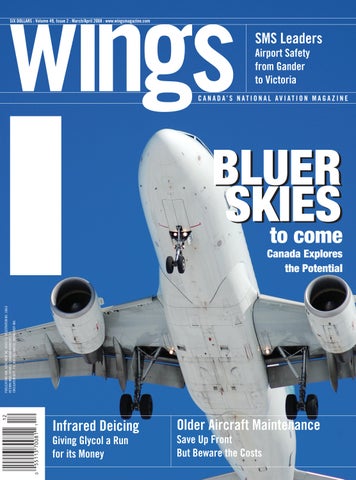
SMS Leaders Airport Safety from Gander to Victoria CANADA’S NATIONAL AVIATION MAGAZINE
BLUER SKIES to come PUBLICATIONS MAIL AGREEMENT NO. 40065710 REGISTRATION NO. 10666 RETURN UNDELIVERABLE CANADIAN ADDRESSES TO CIRCULATION DEPT., P.O. BOX 530, SIMCOE, ONTARIO N3Y 4N5
Canada Explores the Potential
Infrared Deicing
Older Aircraft Maintenance
Giving Glycol a Run for its Money
Save Up Front But Beware the Costs
March/April
WINGS MAGAZINE : Issue 2 : Volume 49 : Table of Contents
26 COVER STORY Bluer Skies to Come Canada Explores the Potential
4
McCarthy
A lot of proof and a little faith.
6
26
18
SMS Leaders
22
Exercising Judgment
32
Older Aircraft Maintenance
40
Flying Green
Bluer Skies to Come
Ray Canon discusses Canada’s current role in the Blue Skies initiative.
On the Fly 28
10
On the Web
12
Airline Insider
Infrared Deicing:
Giving glycol a run for its money. Carroll McCormick reports on how some airports are saving big using infrared deicing systems.
By Brian Dunn
32 14
Carr
Waiting in the wings
16
Seaman
So you want a job in aviation?
18
Older Aircraft Maintenance
Rob Seaman discusses the pros and cons of older aircraft in corporate aviation and how support facilities are stepping up to the plate.
SMS Leaders
David Olsen looks at how Canada’s leaders in airport safety are implementing SMS strategies.
40
Flying Green
In the first of three parts on Flying Green, David Carr looks at fuel alternatives and whether they can live up to the hype.
54
Purser
The Good Old Days
22
Exercising Judgment
James Marasa discusses the importance of simulators in complementing skillbased flight training. 3 | WINGS magazine | March/April 2008
www.wingsmagazine.com
McCarthy
DREW MCCARTHY is the editor of Wings.
Last year, aircraft manufacturers shipped a record 1,138 business jets worldwide – an increase of 28 per cent over 2006. Over the last three years, the industry has seen an overall increase of more than 50 per cent, rivaling the kind of growth that was seen in the late 1990s. In total dollars, billings for these aircraft last year came to US$19.43 billion, representing a 17 per cent increase over 2006. While we’ve yet to see the full impact of VLJs and PLJs, it is noteworthy that Eclipse alone was responsible for selling 98 new aircraft in the VLJ category, while Cessna sold 45 of its Citation Mustangs in the same category. Bombardier delivered 226 business jets with industry-leading total billings of $5.2 billion, while Gulfstream billed $4.83 billion, Cessna $3.91 billion and Dassault $2.32 billion. Cessna sold more units than anyone else with 1,274 business jets delivered during the year. The market continues to be diverse. The main driver for the upsurge in sales is still the continuing economic growth in India, China, Russia, Eastern Europe and the Middle East. Bombardier has seen a lot of growth throughout both Eastern and Western Europe and Russia. Meanwhile, places such as India and the Asia Pacific are considered to be emerging markets, which will become even more dynamic once infrastructures are in place to support the widespread use of business aircraft. Historically, North America has been the centre of the business jet universe. But Bombardier is now delivering about 70 per cent of its business jets to non-traditional (international) markets. This trend started about four years ago and has reversed the traditional 70 per cent North America, 30 per cent international, sales pattern that had always existed. An important reason for the growing acceptance of business jets internationally is that manufacturers have been able to market their products as business tools. Still, international buyers have their own approach to business jet ownership. One interesting difference between traditional North American customers and European business jet owners is that when the aircraft is not in use, the Europeans are much more likely to offer it for charter, in order to bolster the business case. While many economists are warning us of a global downturn caused by the continuing economic woes in the US, the effects on the business jet market might be somewhat cushioned by the current backlog of orders. US economic problems notwithstanding, some manufacturers are expecting a leveling off of the market by 2010 anyway, but no one is predicting much of a downturn over the next decade. As evidence of the confident attitude among manufacturers, Cessna has affirmed its faith in the future of the market by announcing its new large-cabin intercontinental aircraft, the Model 850 Citation Columbus, while Bombardier has recently released plans for its new all-composite Lear 85. Barring some unforeseen catastrophe, the future still looks very bright.
A lot of proof and a little faith Business jet sales continue to impress
4 | WINGS magazine | March/April 2008
WINGS MAGAZINE PO Box 530, 105 Donly Dr. S., Simcoe, ON N3Y 4N5 Tel.: 428-3471 Fax: 429-3094 Toll Free: 1-888-599-2228 PUBLISHER TIM MUISE tmuise@annexweb.com EDITOR DREW MCCARTHY dmccarthy@annexweb.com ASSOCIATE EDITOR ANDREA KWASNIK akwasnik@annexweb.com SENIOR ASSOCIATE EDITOR RICHARD PURSER PRODUCTION ARTIST BROOKE SHAW OTTAWA CORRESPONDENT KEN POLE AVIONICS EDITOR ROB SEAMAN FLIGHT DECK RAY CANON, JAMES CARELESS, DAVID CARR, BRIAN DUNN, MATT LANG, DARREN LOCKE, CARROLL McCORMICK, FRED PETRIE, BLAIR WATSON ADVERTISING SALES TIM MUISE tmuise@annexweb.com SALES ASSISTANT MARY BURNIE mburnie@annexweb.com VP/GROUP PUBLISHER DIANE KLEER dkleer@annexweb.com PRESIDENT MIKE FREDERICKS mfredericks@annexweb.com PUBLICATION MAIL AGREEMENT #40065710 RETURN UNDELIVERABLE CANADIAN ADDRESSES TO CIRCULATION DEPT., P.O. BOX 530, SIMCOE, ON N3Y 4N5 e-mail: alados@annexweb.com Periodical postage paid at Buffalo, NY. USPS 021-029, ISSN 0701-1369. Published six times per year (Jan/ Feb, Mar/Apr, May/Jun, Jul/Aug, Sep/Oct, Nov/Dec) by Annex Publishing & Printing Inc. US Office of publication c/of DDM Direct.com, 1175 William St., Buffalo, NY 14206-1805. US postmasster send address change to P.O. Box 611, Niagara Falls, NY 14304. Printed in Canada ISSN 0701-1369 CIRCULATION e-mail: alados@annexweb.com Ph: 866-790-6070 ext. 208 Fax: 877-624-1940 Mail: P.O. Box 530, Simcoe, ON N3Y 4N5 SUBSCRIPTION RATES Canada – 1 Year $ 34.00 (includes GST - #867172652RT0001) USA – 1 Year $ 50.00 Foreign – 1 Year $ 65.00 From time to time, we at Wings Magazine make our subscription list available to reputable companies and organizations whose products and services we believe may be of interest to you. If you do not want your name to be made available, contact our circulation department in any of the four ways listed above. No part of the editorial content of this publication may be reprinted without the publisher’s written permission. ©2008 Annex Publishing & Printing Inc. All rights reserved. opinions expressed in this magazine are not necessarily those of the editor or the publisher. No liability is assumed for errors or omissions. All advertising is subject to the publisher’s approval. Such approval does not imply any endorsement of the products or services advertised. Publisher reserves the right to refuse advertising that does not meet the standards of the publication.
Air Transport Association of Canada
Canadian Business Aviation Association
Canadian Owners & Pilots Association
Member of the Alberta Magazine Publishers’ Association
Member of the Canadian Circulations Audit Board
www.wingsmagazine.com www.wingsmagazine.com
E
VERYBODY WORRIES ABOUT THE COST OF FUEL. FALCON OWNERS WORRY 20-60% LESS.
The most efficient companies in twenty-six countries demand the most efficient large-cabin business jets and fuel is just one reason. Falcons not only match many smaller planes in fuel economy, high-tech design lets them use hundreds of small airports other wide-cabins can’t. City-hopping, ocean-hopping, flying-more-people-to-more-places proves again: Less is more.
Visit us at: Falconjet.com Or call: U.S. 201.541.4600 France +33.1.47.11.82.32
onthefly INDUSTRY NEWS : COMMERCIAL AVIATION : GENERAL AVIATION
ACASS launches Hawker charter ACASS Canada Ltd., a corporate aviation support services company based in Montreal, recently announced the introduction of a new corporate jet charter service utilizing a Hawker 700A – an eight passenger mid-size aircraft. The company states that the new acquisition will operate mainly out of Montreal to support its current high profile clients, including some of the province’s most prominent groups, but
will also be servicing organizations in major cities across the Eastern part of North America. Andre Khury, president and CEO of ACASS said: “We are providing this solution in response to increasing market demand for high-end yet competitive private jet charter programs. The industry is very healthy at the moment due to increased awareness in regards to the advantages of private
BUSINESS AVIATION : MILITARY AVIATION
ACASS invested three quarters of a million dollars to strip out the aircraft’s interior and to refurbish the entire cabin.
jet travel. Advantages such as increased cost effectiveness, important time savings, non standard customs and immigration procedures, complete flexibility in scheduling itineraries and the possibility to work efficiently while traveling in uncompromising safety, all
contribute to make the case for business aviation over airline.” ACASS recently tore down and completely rebuilt 12,000 square feet of office space near Trudeau Airport to better serve its high profile client base while remaining close to its industry partners.
Conklin makers and to advancing Cana- an MSc and PhD in nuclear & de Decker da’s contribution to global safe- engineering from Rensselaer ty in aviation, national security, Polytechnic Institute in Troy, releases 2008 economic competitiveness, and NY, following a BScA in engiLIFE CYCLE neering physics from the Ecole global environmental affairs. He joins the AIAC follow- Polytechnique de Montréal. He The board of directors of the COST Aerospace Industries Asso- ing his tenure as president of is currently a member of the Claude Lajeunesse is AIAC’s new president and chief executive officer.
ciation of Canada (AIAC) has appointed Claude Lajeunesse as president and chief executive officer. Lajeunesse’s unique blend of business acumen, managerial skills, and energy for change will be central to the association’s advocacy efforts aimed at legislators and policy
AIAC appoints president/CEO
Concordia University in Montreal. He earlier served for ten years as president of Ryerson University in Toronto. He is also past president and CEO of the Association of Universities and Colleges of Canada (AUCC). A native of Quebec City, Lajeunesse obtained
boards of TD Meloche Monnex and Atomic Energy of Canada Limited (AECL). A fellow and past president of the Canadian Academy of Engineering, he is also a member of the Ordre des ingénieurs du Québec, and a member of the board of the Canadian Liver Foundation.
Grob/Bombardier partnership Bombardier Aerospace has selected Grob Aerospace to develop the all-composite structure of its new Learjet 85 aircraft. Grob will also build the first three prototype aircraft for the program. Launched on October 30, 2007 – with a provisional name – the new Learjet 85 will be the first Bombardier Aerospace jet 6 | WINGS magazine | March/April 2008
Grob Aerospace has been selected by Bombardier to develop the all-composite structure of its new Learjet 85 aircraft.
to feature an all-composite structure and will be the first
all-composite structure business jet designed for type certification under FAR Part 25. The Learjet 85 aircraft’s prototype structures will be manufactured at Grob Aerospace’s facility in Tussenhausen-Mattsies, Germany, where Learjet design teams are currently on site as part of the joint conceptual design phase.
Conklin & de Decker has released its innovative LIFE CYCLE COST 2008 Volume 1, part of a family of aircraft operating and acquisition data products. LIFE CYCLE COST provides extensive ownership and operating cost data for more than 300 jets, turboprops, helicopters and piston aircraft. Newly added aircraft in this 2008 edition include the Sierra Industries’ Citation models FJ44 Stallion, Eagle II, Super II, and Pilatus PC-12 Next Generation. The new budgeting software puts all aspects of owning and operating an aircraft into one easy-to-use program. For more information, visit www.conklindd.com. www.wingsmagazine.com
ON THE FLY
Events Calendar
Grob’s spn light jet heads for Granada for flight tests Grob Aerospace spn test aircraft No. 3 (D-CSPJ) departed Tussenhausen-Mattsies, Germany for Granada, Spain on January 28. There it is undergoing three months of extensive flight testing, including Aircraft Configuration Identification (ACID) tests. A team of approximately 20 specialists is supporting the aircraft. The test centre at Granada was selected for the trials owing to its combination of good flying weather, cooperative Eamonn Flynn is a new member of the management team for Wings & Wheels.
The Toronto Aerospace Museum and Parc Downsview Park Inc., cohosts of the Wings & Wheels Heritage Festival, have announced the appointment of Eamonn Flynn to their management team. Welcoming his appointment, show manager Paul Cabot said “I am delighted to welcome Eamonn Flynn to the Wings & Wheels team. This decision reflects the Toronto Aero-
agencies and the convenience of remaining within the EU. The facilities in Granada are managed by the INTA Department of Spain’s Ministry of Defence, and have been successfully used by other aircraft manufacturers in recent years. “Initial testing will focus on flight characteristics and performance while subsequent flights will cover avionics and subsystems including hydraulics, environmental control and the landing gear. The high-
APRIL 2008
The Grob spn test aircraft is undergoing three months of extensive flight testing in Spain. A team of approximately 20 specialists is supporting the aircraft.
speed envelope will also be fully opened,” said Grob Aerospace chief test pilot Peter Weger who is leading the program in Spain. “All these tests are necessary as we move toward our certification goal.” The spn was due to return to Germany to then conduct icing trials in northern Europe.
Airworthiness Symposium & Trade Show -Update April 3-4 Calgary, AB www.wamea.com Airports Canada AGM (CAC) April 22-23 Montreal, QC www.cacairports.ca/conn2/ conn.html
New management consultant guides Prague Wings & Wheels Heritage Festival AeroExpo April 25-27 space Museum’s commitment to improving and expanding our capabilities for a bigger and better annual show. Eamonn brings with him a wealth of experience both as a show operator and director, at a key point in our festival’s evolution.” Flynn was owner, CEO and show manager of the Toronto Aviation & Aircraft Show from 1992-2000. He was responsible for concept, planning and implementation of Canada’s
largest aviation trade and consumer show, and is the recipient of COPA’s Good Show Award. He holds a private pilot licence, and has enjoyed a 20-year career as an Air Traffic Controller at YYZ ACC. Toronto’s 3rd annual Wings & Wheels Heritage Festival takes place at Downsview Park on Saturday and Sunday, May 24-25. For further information contact Paul Cabot, show manager, at 416-638-6078.
Spirit Air receives first KODIAK Quest Aircraft Company announced the first customer delivery of the KODIAK aircraft to Spirit Air in a ceremony on January 25 at the company’s headquarters in Sandpoint, Idaho, in the presence of the entire Quest team. Accepting the KODIAK were the co-owners of Spirit Air, JoAnn Wolters and Dan Schroeder. Spirit Air was the lead commercial customer for the KODIAK when the company began taking deposits.
Aircraft Interiors Expo April 1-3 Hamburg, Germany www.aircraftinteriors-expo. com
Said Wolters, “We chose the KODIAK because of its robustness, reliability and versatility. We are looking forward to putting it to work in the Alaska wilderness, Idaho backcountry and on commuter and The quest team with the first KODIAK. small-package runs.” sonal use, Part 135 operations, The KODIAK received FAA Type Certification on May government, and humanitarian 30, 2007, and Quest has been organizations. Customer orders working with the FAA to achieve have exceeded expectations and its production certificate. Quest the company has a 3-year backhas seen strong acceptance in key log, which it is working to bring market segments, including per- down as production ramps up.
Pribram, Prague, Czech Republic www.expo.aero/prague/ 20th Annual Canadian Aviation Safety Seminar (CASS 2008) April 28-29 Calgary, AB www.tc.gc.ca/civilaviation/ systemsafety/CASS/menu. htm
MAY 2008 Regional Airline Association (RAA) Convention May 5-8 Indianapolis, IN www.raa.org EBACE May 20-22 Geneva, Switzerland www.ebace.aero/ Wings & Wheels Heritage Festival May 24-25 Toronto Aerospace Museum Contact Paul Cabot: (416) 638-6078 March/April 2008 | WINGS magazine | 7
ON THE FLY
Standard Aero completes MRO transformation Standard Aero has recently completed a US$1.6-million facility transformation to improve the work flow at its Pratt & Whitney Canada PT6A engine MRO facility in Winnipeg. The company anticipates a 30% increase in PT6A engine overhaul capacity without the addition of more floor space or equipment. The project is already producing faster and more accurate estimates. The Standard Aero facility and work flow design methodology has been implemented by the company worldwide in more than 200 of its production cells and at multiple factories. In addition to the aircraft MRO services provided by the company, the transformation and work flow design methodology is also available separately as a
service to customers. Standard Aero’s Enterprise Services business, the company’s operational and management services division, can be contracted for factory and industrial manufacturing redesign. Standard Aero Enterprise Services currently is contracted to implement the work flow design methodology at several US Department of Defense MRO depots. As part of Standard Aero’s growth and diversity in its PT6A offerings, the company recently announced several Supplemental Type Certificates (STCs) for engine upgrades on aircraft powered by the PT6A engine. The STC programs focus on transforming the aircraft into a high-performance airframe.
Aerion Supersonic Business Jet secures first orders Aerion Corporation, together with its international sales distributor, ExecuJet Aviation Group, has further bolstered the order book for its Supersonic Business Jet. Within the first few weeks of 2008, Letters of Intent included a commitment for three from the first, undisclosed customers from India. This takes
the total pledged to US$2 billion, based on the SBJ’s US$80 million price tag. Aerion Corp. elected to begin taking orders in November because of strong customer interest and advancing discussions with potential OEM partners. The company is still on track to recruit and contract with an OEM manufacturing
Researcher gets Honda grant for hands-off instrument panel Tarek El Dokor, a professor at Embry-Riddle Aeronautical University, has been awarded a Honda Initiation Grant of US$50,000 for the development of holographic instrument panel controls and displays. The proposal by El Dokor, an assistant professor of electrical and computer engineering at the Prescott, Ariz. campus of Embry-Riddle, was selected from among 300 grant submissions. Five other US university professors also received the Honda grants. El Dokor says the interactive instrument panel he is developing will give the operator of a vehicle faster, safer, and more efficient access to information. “It implements a software alternative to what is currently a hardware solution
to various controls,” he explained. “Think iPhone, which has a software-based touch keypad, versus current PDAs, which have actual keyboards. You don’t need to touch any screens. Content is projected away from the dashboard and toward the user, where the user can manipulate it in many ways.” El Dokor is director of the Embry-Riddle Machine Vision Lab, where researchers investigate and develop machine vision, machine perception, and robotics applications. The goal of the Honda Initiation Grant program is to fund innovative ideas in the early stages of research that are likely to make valuable contributions to technology over a longer term of five to 10 years.
Aerion plans to recruit and contract with an OEM manufacturing partner by early 2009, which would lead to certification of the Supersonic Business Jet by 2014.
partner by early 2009 which would lead to certification and service entry by 2014. The Aerion supersonic business jet was formally unveiled in October 2004. Since then, wind tunnel and other tests have taken the aircraft to an advanced stage of design. The Aerion jet is designed to cruise at speeds up to 1.15
Mach over land without producing a boom on the ground, and at speeds up to 1.6 Mach in other areas. The aircraft seats eight to 12 passengers in standup comfort and has a range in excess of 4,000 nautical miles.
Embraer Legacy 600 deliveries grow More than 130 Legacy 600s have been delivered to 23 countries.
Embraer delivered 36 Legacy 600 executive jets in 2007, surpassing the 30 aircraft the company had projected 8 | WINGS magazine | March/April 2008
in January of that year. This represents a 33% increase over 2006 and 80% over 2005 deliveries. The first Legacy 600 entered service in 2002 and more than 130 have been delivered to 23 countries. The jet is currently available for delivery in mid-2009, and the list price for
contracts signed after March 31, 2008, will be US$26.93 million. Last January, the first Legacy 600 with an enhanced interior was delivered to a European customer. The new interior, which was displayed at the NBAA annual convention
in Atlanta last September, features a taller cabin and a slimmer valance which provides an even more spacious feel to the cabin. Noise abatement improvements enhance cabin soundproofing, and auxiliary audio input makes cabin sound integration possible. www.wingsmagazine.com
YAH
DAVE WAS HERE when he discovered that the best family vacation photos aren’t taken through the window of a minivan.
“I only drive on vacation when I have to. Which is, hopefully, never.” – Dave Harvey, Cessna Owner In a brand-new Cessna Stationair, every single weekend becomes your chance for a family getaway. Without ever hearing the dreaded words, “Are we there yet?” Call +1-316-517-6056. Or visit CessnaYouAreHere.com/22. Sure Thing®
YAH Lake Pwl_Wings.indd 1
2/14/08 4:38:41 PM
ontheweb www.wingsmagazine.com
NEWS HIGHLIGHTS
P&W LAUNCHES 10,000-POUND-THRUST ENGINE FAMILY BOMBARDIER GIVES GREEN LIGHT TO SALES DEALS FOR CSERIES AIRCRAFT ADAM AIRCRAFT FILES FOR CHAPTER 7 LANDMARK/STANDARD AERO APPOINT SALES MANAGER DIAMOND AIRCRAFT RECEIVES GOVERNMENT OF CANADA INVESTMENT
Who Killed the Avro Arrow? A fascinating examination of the international politics, pressures and personalities behind one of the most controversial decisions in Canadian history, the mothballing of the incredibly sophisticated jet fighter, the Avro Arrow. Visit www.wingsmagazine.com and click on bookstore to learn more about the book and order a copy.
Read the Full Stories Online at www.wingsmagazine.com
By Doug Morris Pilots and ATC abide by it, aviation weather references it, and aircraft maintenance and the military adhere to it. Formerly known as Greenwich Mean Time, now called UTC, time for flying still bears the elusive “Z” (phonetically known as Zulu) appended to most timely things in aviation. Why the “Z,” why the confusing acronym UTC for Coordinated Universal Time and just where is this place that marks the beginning of time? Doug Morris, author of the new book, From the Flight Deck: Plane Talk and Sky Science, answers these questions and provides an interesting and straightforward look at how we arrived at the current system of time in aviation.
Web Exclusive: TUNDRA SURVIVOR By Michel Coté Recovering a Canadian Historical Aircraft – the CF-CPA Project In the summer of 2004, during a routine flight to Northern Québec, Patrick Cloutier, bush pilot for Aventures Norpaq, noticed a familiar shape reflecting from the wilderness. It became clearer the closer he flew that this was not an ordinary aircraft. As he circled for a second glance, he recognized the Lockheed Lodestar. Upon his return from dropping off a group of fishermen, he started his research and came to the conclusion that this was in fact the Lockheed Lodestar that originally flew with Canadian Pacific Airlines during the Second World War. This was the start of what became known as the CF-CPA Project.
For full details, go to www.wingsmagazine.com and click on web exclusives. 10 | WINGS magazine | March/April 2008
The Canadian Aviation Guide (A-List) is the only reference tool to bring the entire Canadian aviation industry together in one directory. SIX DOLLARS : Volume 49, Issue 2 : March/April 2008 : www.wingsmagazine.com
SMS Leaders
DIGITAL MAGAZINE
Airport Safety from Gander to Victoria CANADA’S NATIONAL AVIATION MAGAZINE
BLUER SKIES to come Canada Explores the Potential
RETURN UNDELIVERABLE CANADIAN ADDRESSES TO CIRCULATION DEPT., P.O. BOX 530, SIMCOE, ONTARIO N3Y 4N5
Web Exclusive: TIME FOR FLYING
A-LIST
Visit www.wingsmagazine.com to sign up for a free trial of Wings magazine – digital version
Infrared Deicing
Older Aircraft Maintenance
Giving Glycol a Run for Its Money
Save Up Front But Beware the Costs
POLL Take part and view results of our weekly polls… The implementation of new “Customs Controlled Areas” at Canadian airports will enhance security. Agree 40% Disagree 20% Undecided 40%
BLOG Have your say on a variety of industry topics… • When is Private Public? • Will the A380 inflight experience really last? www.wingsmagazine.com
airlineinsider Air Canada Jazz will add numerous nonstop flights from Ottawa, starting May 1st.
AIR CANADA EXPANDS OTTAWA SERVICE Air Canada is expanding its Ottawa service, adding four new markets with nonstop flights and increasing the number of available seats by 19% over last summer. Starting May 1, Air Canada, through its regional affiliate Jazz, will add nonstop flights between Ottawa and Washington, DC, Saskatoon, Thunder Bay and Charlottetown. Other service to Calgary, Saskatoon and Toronto will also be increased this spring. Air Canada will also launch additional service between Calgary and Chicago, Toronto and Austin, Tex., and Toronto and Richmond, Va.
A strong interest in Italy has prompted Zoom to add direct flights to Rome.
ZOOM HEADS TO ROME Zoom Airlines is adding direct flights from Toronto and Montreal to Rome, with two 12 | WINGS magazine | March/April 2008
By Brian Dunn
A year-round service from Toronto to Quebec City will mark WestJet’s 27th destination within Canada.
flights a week from Toronto starting May 3 and one flight a week from Montreal beginning May 6. “Our customer research indicates a strong interest in Italy,” said Zoom CEO Kris Dolinki. “The addition of Rome is another step in establishing Zoom as a valuefocused carrier for long-haul destinations.” Ottawa-based Zoom already serves several destinations in Europe, including Belfast, Glasgow, London/ Gatwick and Paris/de Gaulle. A UK subsidiary is based at Gatwick. WESTJET TO LAUNCH QUEBEC CITY SERVICE WestJet plans a May 18 launch of year-round service from Toronto to Quebec City, coinciding with Quebec’s 400th anniversary celebrations. The Boeing 737 carrier will fly daily nonstops on the route, which marks WestJet’s 27th destination within Canada. WestJet is also enhancing its summer schedule to include new seasonal nonstop service on the Regina-Toronto, Saskatoon-Toronto and Abbotsford-Toronto routes as well as from Ottawa to Edmonton and Halifax.
AIR TRANSAT STEPS UP SUMMER SERVICE At the end of May Air Transat will begin offering weekly departures from Montreal and Toronto to Basel/Mulhouse on the Swiss-French border, as well as a new service between Montreal and Dublin. The carrier will also add flights between Toronto and Brussels and a new weekly flight between Fredericton and London. From the west, two weekly flights will be offered between Vancouver and Paris, one nonstop and another via Calgary. Service between Paris and Montreal and Toronto will see two more weekly flights for a total of nine from Montreal and five from Toronto. A third flight per week will be offered from Montreal to Nice, Athens and Barcelona, a second flight each week from Montreal to Bordeaux and an additional flight from Toronto to Barcelona and Athens.
MEMPHIS-BASED PINNACLE RECEIVES DOT CLEARANCE Memphis-based Pinnacle Airlines has received DOT clearance to fly between the US and Canada on behalf of Delta Air Lines. The regional airline, which has long operated as a Northwest Airlink affiliate, recently launched Delta Connection service from Delta’s Atlanta hub with the first of 16 Bombardier 90-seat CRJ900 regional jets acquired by the US regional for its new 10-year feeder contract with Delta. The entire CRJ900 fleet will be placed into service by February 2009, and the contract could expand this to 23 aircraft or more. Pinnacle will also inaugurate a number of new daily routes on May 2 on behalf of Northwest Airlines, including service between Northwest’s Air Transat will add flights to Europe, starting in May.
www.wingsmagazine.com
AIRLINE INSIDER
Porter’s expanded service into the US was made possible with the addition of two new 70-seat Bombardier Q400 turboprops.
Minneapolis/St. Paul hub and Ottawa using 50-seat Bombardier CRJ200s on all the new flights. PORTER ENTERS US MARKET As expected, Porter Airlines has announced its first foray into the US market with new service between Toronto City Centre Airport and Newark Liberty International Airport starting March 31. The service will consist of seven weekday round-trips with two on Saturday and three on Sunday. The expanded service was made possible with the addition of two new 70-seat Bombardier Q400 turboprops, bringing the fleet to six with four more expected to be added within the next 12 months. Other planned services include Boston, Chicago, Washington and Philadelphia. “We’re currently reviewing our summer schedule and we’ll probably increase service between Ottawa and Halifax,” said Porter spokesperson Brad Cicero. “We also expect to add two more aircraft by the end of summer and add service to Chicago and Boston.” Asked about Porter’s seasonal service to Mont Tremblant, Cicero said it was quite popular. “As a weekend winter destination, we’re happy with it,” although as a private carrier, he wouldn’t provide load factors. UNITED AIRLINES’ REGIONAL PARTNERS United Airlines will begin service to Quebec City and Victoria on June 5. Daily United
Express service between Chicago and Quebec City will be operated by regional partner Shuttle America using 70-seat Embraer 170 aircraft. Regional partner Skywest Airlines will operate as United Express between San Francisco and Victoria using 70-seat CRJ700s. THE EVOLUTION OF JAZZ Air Canada’s Jazz affiliate has added two Bombardier Dash 8-300 turboprops to its charter fleet. A Jazz spokeswoman said the aircraft are being leased. The two 50-seat turboprops will bring to four the number of aircraft in Jazz’s charter fleet. The carrier currently has two 37-seat Dash 8-100s dedicated to charters. “Given our operating expertise, the expansion of our charter services with the addition of these two Dash 8-300 aircraft is a logical step in Jazz’s evolution as we seek to grow our business beyond our current capacity purchase agreement with Air Canada,” said Scott Tapson, Jazz VP, business development. “This aircraft will be the Jazz has added two Bombardier Dash 8-300 turboprops to its fleet.
perfect choice for clients looking to carry up to 50 passengers for sports groups, entertainers, corporate shuttle operations, or any customer who requires the flexibility and convenience that a private charter can provide,” added Shelley Wilson, Jazz manager, charter marketing and sales. CANADA-MEXICO LIBERALIZATION Canada has expanded its bilateral air transport accord with Mexico in a move that adds “more flexibility” to the long-standing agreement and could pave the way for further liberalization. Amendments to the accord were brokered after discussions between Canadian Transport Minister Lawrence Cannon and Mexican Transportation Secretary Luis Tellez Kuenzler. Effective immediately, the new provisions provide greater market access options for airlines from both countries for passenger, combination and all-cargo services. Specifically, they will allow “more Canadian carriers to provide more scheduled air service to Mexico, to a greater number of cities,” said a Transport Canada spokesman. In turn, if Mexican operators show interest in serving more Canadian cities “we’ll assess it in light of this agreement and the demand,” he added. Airlines are reviewing the amendments to determine what new air service initiatives may be
New provisions in Canada’s bilateral air transport accord with Mexico provide greater market access options for airlines from both countries. Pictured here is Canadian Transport Minister Lawrence Cannon.
introduced. Meanwhile, delegations from both countries have agreed to meet again in 2009 to explore further areas of modernization and liberalization. This could lead to an open skies agreement between the two countries. For now, however, Canada is “pleased with the new arrangements,” said the Transport Canada spokesman. ETHOPIAN AIRLINES EYEING CANADA SERVICE Ethiopian Airlines is eyeing new services to Toronto, Kuwait, Riyadh and Equatorial Guinea’s capital Malabo, as it strives to increase its network to 60 cities by 2010. Addis Ababa-based Ethiopian serves 50 destinations, including 30 within Africa. It operates a fleet of 33 aircraft, including five Fokker 50s, six Boeing 737s, eight 757s and 10 767s. Ethiopian has long-held ambitions to serve Toronto. Late last year its operation was audited by four representatives from Transport Canada. “We expect the result of their survey in the near future. Internally it needs our schedule arrangement and externally we have to secure a permit to operate flight services to Toronto,” an Ethiopian Airlines spokesman said. March/April 2008 | WINGS magazine | 13
carr
DAVID CARR is a Wings writer and columnist.
If an airline fails and nobody is paying attention, does it make a sound? Apparently not. While Jetsgo collapsed with a bang in March 2005, Vancouver-based Harmony Airways exited the field last year with barely a whimper. It has been three up and three down for challengers to Air Canada and WestJet since 2005, although describing either Harmony or CanJet, which shut down in 2006, as ‘national’ competitors is a bit of a stretch. Bare-bones CanJet was knocked back to its Atlantic Canada perch almost as soon as it reached Vancouver. Even with full-cabin service, Harmony’s single daily Boeing 757 between Vancouver and Toronto was little match for Air Canada and WestJet’s 25 daily departures, and often took off with four-fifths of the airplane empty. Nevertheless, Canada is without a national low-cost scheduled airline in the mould of a Southwest or the UK’s easyJet. A spot occupied by WestJet before a hardening market removed an important commodity from the national landscape: competitive seats. Yet despite the market void, the arrival of a new national cost cutter is unlikely, at least for the time being. The airline industry is notorious for attracting start-ups against sound economic principles. But surging oil prices – albeit moderated by a stronger Canadian dollar – and a struggling economy have left potential investors in a third national airline understandably jittery. Frequent flyer point rewards and gimmicks such as Jetsgo’s one-dollar fares have lowered the public value of air travel while raising the expectation for cheap seats. Reality is murkier. There is zero national entitlement to low fares, and neither Air Canada nor WestJet are under any obligation to short-change investors by pricing their product below what the market will bear or accept. Given that on average both airlines take off with more than three-quarters of their airplanes full, they would appear to be doing something right. But for how long? Both these market-savvy companies understand that that same market cannot tolerate a vacuum forever, and the conditions that have created the current oligopoly have a limited shelf life. Enter the Canadian Competition Bureau. Late last year the Bureau recommended the Harper government embrace unfettered open
Waiting in the wings Canada is without a national low-cost scheduled airline in the mould of a Southwest or easyJet.
14 | WINGS magazine | March/April 2008
skies and allow foreign airlines to set up domestic subsidiaries along the lines of Virgin Blue in Australia. The Air Transport Association of Canada (ATAC) disagrees, as it should. ATAC is an industry association, not a consumer group and suggesting, as the Competition Bureau has, that Canada should invite a global free-for-all while the rest of the world continues business as usual is well intentioned, but naïve. The larger question is, how much longer do we have to have this discussion? For now at least, domestic competition is going to come not from a third national low-cost airline (although this is inevitable), but from the fringe. JetBlue’s plan is to operate charter and scheduled services to Canada, and regional point-to-point startups that could chip away at Air Canada and WestJet’s market share especially on underserved routes, flying the right mix of airplanes. The nouveau niche. Such carriers are going to have to be well financed with ownership in it for the long haul (note that Lufthansa recently snapped up 19% of JetBlue). Ottawa should immediately facilitate this trend by bumping the foreign cap on ownership of a Canadian airline to 49% from the present 25%. Internationally, it is a different game entirely. Since the federal government finished commercializing the Canadian airport system and now extracts huge rents, it should no longer have a say on what foreign tails nudge up to the terminal gates, and how many times. Case in point is Emirates, which launched service to Toronto from Dubai last year. Emirates would like a daily flight. Canada’s bilateral agreement with the United Arab Emirates limits the airline to three a week. But isn’t that something for the Greater Toronto Airports Authority (GTAA) to decide? And if not, shouldn’t Ottawa have to compensate the GTAA for revenue lost as a result of those four non-flights? That should be an incentive to keep the bilateral ball rolling. Airports are businesses that should be able to negotiate their own commercial agreements with the airlines that want to fly into them. Full stop. Too many commercial opportunities both in passenger and cargo transport could be lost otherwise. It is not up to government to pick the winners and losers. David Carr can be reached at davidjcarr@sympatico.ca. www.wingsmagazine.com
B o s e® A v i a t i o n
H e a d s e t
X™
Preferred by professional pilots year after year.
Is the Bose Aviation Headset X really that much better? Professional pilots think so. For the sixth year in a row, they’ve voted it their #1 choice in Professional Pilot magazine’s annual survey, rating it the best for comfortable fit, technical advancement and clear audio. “The most comfortable headset I have ever worn.” That’s what pilot James Hillhouse says. You’ll notice the difference as soon as you pick it up. Its patented TriPort® headset structure allows for acclaimed noise reduction and clarity in a lighter, smaller headset, one with 50% less clamping force than most R A T E D conventional ANR headsets.
1
“The absolute very best noise cancelling headset on the market today,” says Boeing 737 pilot William Logan. Whether you fly commercial jets or prop planes, you’ll hear the difference Bose noise reduction technologies make.
IN A ROW
“Unsurpassed clarity of sound...amazing ANR reduces fatigue,” Cessna pilot Michael Hart says. The Aviation Headset X provides an unsurpassed combination of full-spectrum noise reduction and clear audio.
#
SIX YEARS
PROFESSIONAL PILOT HEADSET PREFERENCE SURVEY
Try the Aviation Headset X for yourself. We think you’ll understand right away why pilots rate us #1 time and time again. And why Piper Seminole pilot Casey Carmody says, “Worth every penny – wear the Bose one time and you will never want to wear anything else.”
www.Bose.ca/pilot ©2008 Bose Corporation. U.S. patent rights issued and/or pending. Quotes reprinted with permission: Professional Pilot magazine annual Headset Preference Survey, 12/06. C_000249
Get a demo of the #1-rated Aviation Headset X from those who know it best – these authorized Bose dealers: ALBERTA
MANITOBA
Calgary Calgary Pilot Supply Ltd. 800-563-9633 Edmonton Ducey Avionics Inc. 780-451-7600 Parsonage & Associates 780-890-7668 Red Deer Q.F. Avionics Centre Ltd. 403-886-4306
Flin Flon Bakers Narrows Air Service (toll free) 866-603-6390 204-681-3250
Stoney Creek Heli Lynx Helicopter Services 905-643-7334 Toronto Aviation World 416-674-5959
NOVA SCOTIA
QUEBEC
Enfield Atlantic Avionics Inc. 902-873-3534
Dorval Airnav Electronique Ltee 514-631-1233 Mascouche Avtronics Radio Technology 450-474-7377 St. Bruno VIP Pilot Centre 800-361-1696 St. Foy Tel Air Electronique Inc. 418-871-0686
BRITISH COLUMBIA Kamloops Inland Communications Services Ltd. 250-376-1121 Spring Aviation Ltd. 250-554-2616 Delta R&Z Avionics Ltd. 604-946-6212 North Saanich Vancouver Island Helicopter Ltd. 250-656-3987 Richmond Maxcraft Avionics Ltd. 604-270-3080 Sidney Victoria Avionics Ltd. 250-656-2733 Vancouver Aviation World 604-718-7400
ONTARIO
Brantford Brant Aero 519-753-7022 Breslau Kitchener Aero Avionics 519-648-2921 Hammond Aviation Ltd. Authorized Repair Centre 519-648-3464 St. Hubert Huron Park Aero Teknic Inc. Goderich Aircraft Inc. 450-676-6299 519-228-6832 Markham SASKATCHEWAN Aviation Unlimited Saskatoon 905-477-0107 Saskatoon Avionics Ltd. Mississauga 306-244-4252 Field Aviation East Ltd. 905-676-1540
seaman Just where are we going with corporate aviation? We cannot ignore that the US is suffering from the flu right now. And as we well know, if they get sick, eventually we do too. Being neighbourly and passing them a couple of ColdfX will not help. If the sub-prime lending mess there continues to be an issue, some corporate aircraft could start getting parked or sold. Owners have a hard time justifying the biz jet when times get tough. And some firms will find the banks strangling their credit lines to the point where they are not able to keep the private jet on call anymore. Less flying means fewer visits to Canada and that means less business for our aviation support structure – at least from our US friends. Thank heaven we have a lot of overseas visitors too. Right now, the OEM order books are at record levels. Try to buy a new Bombardier product and you will be quoted delivery in the order of four to five years. That’s good for the manufacturers but is becoming a bit of issue for our established corporate operators. And the North American market for new aircraft no longer represents the lion’s share of corporate order books. The evolving economies in Russia, Europe, China and India are creating new and growing demand at many levels. Some say that our home market may now represent as little as 25-30% of the total global marketplace. Corporate aviation has developed in these new markets through the lack of dependable and modern commercial airline services. And some of these nations are under military control while others lack the flight handling, navigation and safety systems that we expect at home. They are behind us in their ground support capability. But they are catching up fast and in turn driving demand for equipment and materials and, more importantly, people. Not just flight crews but also maintenance and support personnel. And with their ability to pay salaries at global equivalent or better, they are providing not only new opportunities, but indirectly adding to the shortage already present here at home. Shortage, you say? Why, yes. The shortage in aviation is not just a possibility. It is a current reality!
So you want a job in aviation? Well, it may or may not be a good time to try.
16 | WINGS magazine | March/April 2008
ROB SEAMAN is a Wings writer and columnist.
The General Aviation Manufacturers Association (GAMA) says shipments in 2006 rose in all sectors (piston, turboprops and business jets) and manufacturers delivered a record number of business jets, eclipsing the previous record by more than 100 airplanes. But in the US alone, the number of pilots has dropped below 600,000 for the first time in decades. And student starts are down by over 2,000 since 2005. The decline in pilots is even more alarming since the average age of US pilots is at an all-time high of 46. GAMA has been encouraged by the introduction of light sport aircraft as a means to learn to fly at lower cost. Katie Priby, GAMA’s director of communications, notes that “two of our manufacturers in 2007, Cessna and Cirrus, both introduced their own light sport aircraft. Airplanes and the technology our manufacturers are showcasing are making flying easier and safer. General aviation manufacturers are committed to creating a renewed interest in flying through the introduction of products that will spur more people worldwide to learn to fly and choose a career in aviation.” GAMA shares the concern of many about the growing need to hire new and replacement workers. Says Priby: “Training and attracting skilled replacements will be critical to maintaining the industry’s worldwide competitiveness in the coming decade.” She cites Wichita State University’s school of Economic Development and Business Research, which projects that over the next decade, aircraft and aircraft parts manufacturing employment will increase 8%, adding 36,000 jobs. Wichita State says that with this increase in manufacturing, total employment for the aviation industry will increase 15% over the next decade. As for pay, GAMA says that the US Bureau of Labor Statistics shows the average private sector job in the US pays an annual salary of $40,500, while the average aviation manufacturing job is 90% higher, at $77,000. GAMA has recognized that we must do our part to encourage kids at all education levels to consider careers in Science, Technology, Engineering and Mathematics (STEM). So while we may be facing a short-term burp because of our US friends’ indigestion, the longer view bodes well. So tell Johnny or Suzie to get going to the flying club and start their interest in aviation. Hopefully, it will pay in the years to come. www.wingsmagazine.com
i
8& 3& .07*/( '038"3% 8*5) *//07"5*0/ m .",*/( #-6& 4,*&4 (3&&/&3
u
Melinda Bissinger Staff Materials Analyst
Operating a corporate jet is good business. Flying one equipped with green-technology engines is even better. At Pratt & Whitney Canada, we’re working hard to make engines like our next-generation 10,000-lb thrust power plants the greenest in the sky, by reducing fuel emissions, noise levels and the use of hazardous materials in our manufacturing processes. It’s just good business. Something you can always count on, from Pratt & Whitney Canada. The Eagle is everywhere.
www.pwc.ca
SMS LEADERS Airport Safety From Gander to Victoria By David Olsen It was a long time in the making but on January 1, 2008, Canada formally instituted Safety Management Systems (SMS) for airports. The airport SMS story began in earnest in 2003, with the ICAO Standard requiring certification of aerodromes and implementation of SMS effective November 2006. Concurrently, Canada developed national measures to implement the ICAO Standards and on December 26, 2007, new Canadian Aviation Regulations (CARs) were gazetted, requiring airports to implement SMS. So, is it “all change?” Not quite – most airports already have a range of safety procedures in place and new initiatives in airport operations don’t happen overnight. The difference is the adoption of a systematic process, based on a Transport Canada (TC) framework. The regulations, based on a four-phase implementation schedule, apply immediately to the ten international airports in the schedule to the CARs, and to other airports from January 2009. However, some airport managers bit the bullet and got a head start preparing for the new system. Richard Paquette, CEO of Victoria International Airport, started the ball rolling in 2005. By 2006, Victoria International had its SMS up and running with a Gap Analysis, Hazard and Risk 18 | WINGS magazine | March/April 2008
Analysis, Safety Management Manual and some training already completed. Victoria was quickly followed by Kelowna, Gander, Abbotsford and Calgary to name just four. The Abbotsford initiative is particularly significant. Not only is Abbotsford (YXX) one of the busiest flight training airports in Canada, but posts steady increases in scheduled traffic (508,464 pax and 175,405 movements in 2007) and is home to the Abbotsford International Air Show. Led by operations manager Carman Hendry, YXX completed preparations for implementation of the new SMS regulations in mid-January 2008, 12 months ahead of the regulatory deadline. Supported by airport general manager Mike Pastro and the Airport Authority Board, Hendry undertook SMS implementation in a textbook operation, in line with CARs requirements and the processes developed by TC. Hendry undertook specialised SMS training in 2006, and in 2007 the City of Abbotsford selected QualaTech Aero Consulting to assist in implementing the airport SMS. Hendry steered the airport through the recommended TC process, from a detailed Gap Analysis, followed by a Project Plan, to Hazard Identification and Risk Analysis, training and preparation of the Safety Management Manual. A unique aspect of the Abbotsford approach was
Above: Richard Paquette, CEO of Victoria International, led the field in airport SMS. Top right: Mike Pastro, general manager of Abbotsford International Airport. Right: Carman Hendry, operations manager at Abbotsford International Airport.
establishment of a Risk Assessment Team, composed of managers and airside employees. The team received specialized training and provides a focus for risk assessment activities. In addition, all airside employees received the safety-oriented human factors training, required by CARs, plus basic safety management training. Adoption of SMS in Canada followed an intensive consultation process with the airport industry, during which many opinions surfaced – not all of them supportive of either the ICAO or TC initiatives. However, what seems to have resulted is a common sense approach to ensuring that the airports are increasingly proactive toward their major role – namely, ensuring the safety of operations
and mitigating all possible risks of accidents or incidents. TC has published airport SMS implementation procedures in Advisory Circular 300-002. Is this overregulation? Absolutely not. The whole thrust of SMS in ICAO, airlines, airports, air traffic services and all the supporting functions, is that it is proactive and based on a strong corporate safety culture. It is all about airports and others, taking the initiative to prove that their operations are www.wingsmagazine.com
SMS LEADERS
Above: The Abbotsford Risk Assessment Team at work. (Photo courtesy of David Olsen) Right: Kelowna International Airport is Canada’s 10th busiest airport.
safe and answering the questions “do they say what they do” and “do they do what they say.” The latter is echoed by veteran Vancouver International Airport safety manager Dave Larrigan, now an independent consultant. As he puts it – “in principle, safety management is not new; what is new is the structured and documented approach.” Larrigan believes that the phased approach to implementation makes sense and should help airports to develop an SMS that not only complies with CARs but meets their needs according to their circumstances. He emphasises the different challenges facing airports compared with air carriers. The problem for the airport “accountable executive” he says, is that he or she is not the employer of most of the airside
thinking without limits
eurocopter.com
20 | WINGS magazine | March/April 2008
EC155 412 76x138 12 GB indd 1
www.wingsmagazine.com
SMS LEADERS personnel. “The accountable executive is more like a mayor of a small city, providing operational facilities, utilities and accommodation for tenants and travellers – but does not have an employer/employee relationship with the majority of those who are expected to follow the safety procedures.” In 2006, Kelowna International Airport – 10th busiest in Canada – was experiencing spectacular traffic growth and the need for infrastructure development. Determined to get ahead of the curve, airport general manager Roger Sellick assigned the task of SMS implementation to fire and security chief Neil Drachenberg and operations AGM Dave Fuller. As at Victoria and Abbotsford, Kelowna undertook a structured process, working with consultants and starting
with a Gap Analysis. “Kelowna has put a lot of work into training employees for SMS,” says Drachenberg, “and is prepared for a TC SMS Audit.” Drachenberg echoes Victoria’s Paquette, noting that implementation of SMS has not had a major effect on resources while the upgrading and improvement of policy, procedures and infrastructure to reflect a safer operational environment, are seen as benefits. Gander International Airport faced particular challenges with the introduction of SMS, but was ready with its safety management manual and welldocumented procedures by the time the amended CARs were published. Gander has a proud history as a cornerstone of North Atlantic aviation and although transatlantic scheduled traffic no longer lands at
Gander, the airport is often a hive of activity, handling state and military aircraft of many nations. Furthermore, it is a vital diversion facility – as demonstrated by 9/11 – and frequently receives aircraft with a wide variety of problems from technical faults to medical emergencies. The irregular and varied nature of operations at Gander, frequently during severe weather, combined with economic pressures and stretched resources, make SMS both an essential tool and an implementation challenge. At Victoria International, Canada’s 9th busiest airport, Paquette emphasizes that although SMS has been fully implemented, “it does not mean that we are finished – the framework is in place but we will continue to refine and improve the system.” With the system
working and well documented in the SMS Manual, Paquette reports that it took about oneperson year for implementation, half that effort for ongoing management, and some consultant effort to produce the SMS Manual. Paquette stresses that safety was always a priority at Victoria International but it is now managed systematically – which involved reorganization and additional activities. He believes that SMS has made Victoria International an even safer airport, and is ready for the first TC SMS Audit. Back at Abbotsford, Mike Pastro points to the strong buy-in by the Airport Authority Board, prudent and effective use of qualified consultants, and good communication with
CONTINUED ON PAGE 37
More than a great executive helicopter. A pretty effective time machine.
The Eurocopter EC155. Carrying up to nine executives up to 370nm. Offering a comfortable workspace in the largest, quietest cabin around. Using advanced, efficient technology. A proven track record of reliability backed by a wealth of experience in maintenance and training. More than a helicopter, a business tool that rewrites the laws of time and space. When you think efficiency, think without limits.
March/April 2008 | WINGS magazine | 21
21/02/08 14:09:36
EXERCISING JUDGMENT Complementing skill-based flight training By James Marasa Of all the challenges faced when training to be a pilot, flying the airplane is generally not the most difficult. Apart from an unusual flight condition, maintaining control of an airplane is a skill that can be mastered with a high likelihood of success. With the appropriate amount of study and time at the controls, most individuals could successfully join the roughly 2,000 private pilots who are licensed in Canada each year. The traditional system of flight training has worked effectively, though the industry has been playing catch-up with advances in technology as the relationship between pilot and machine continues to evolve. Many of today’s aircraft are more than capable of flying themselves – the precision of an autopilot far exceeds that of a human – and technically advanced aircraft have demanded that general aviation pilots attain competency in managing advanced technology. Nevertheless, even in the face of the most ultramodern instrument panel, a human is meant to assure the system works the way it is supposed to. With the responsibility for flight safety still resting on the pilot’s shoulders, skill and judgment are the two most critical attributes needed to captain an aircraft. Any private pilot curriculum will teach the skills required to fly an airplane, but with the vast majority of air22 | WINGS magazine | March/April 2008
Above: In a simulated flight environment, students are able to make more decisions in a limited timeframe and see the effects of their actions, both positive and negative. (Photo courtesy of Alsim) Right: Pacific Flying Club’s Paul Harris navigates through the AL200’s setup menu. The system can simulate up to 18 different aircraft in various weather conditions at any airport in Canada or the United States. (Photo courtesy of Edward Lee)
craft accidents attributed to pilot error, how is one meant to edify good judgment? The student-friendly environment of a controlled-aerodrome circuit is vastly different than the type of flying a commercial operator or serious recreational pilot will routinely face. Though there are legal amounts of cross-country flight and air exercises to be completed, the circuit encompasses the bulk of the flying a student pilot will experience before he or she is able to attain a private licence. “Teaching someone to
fly is not the same as teaching them to be a pilot,” says Clark Duimel, chief flight instructor at Pacific Flying Club, one of the major flight schools at Boundary Bay Airport near Vancouver. “It’s a mindset.” Certain students approach aviation with an innate ability to grasp the concepts of piloting an airplane and the responsibility they accordingly take on. Others enter their first airplane from a less-enlightened position, and the “coaching” required to bring the student to a high level of decision making
becomes a priority that permeates the entire flight training process. Paul Harris, manager of flight operations at Pacific Flying Club, believes it is up to the instructor to “model” good attitudes, leadership and professionalism. In a process of “Incremental Decision Making,” Harris advocates that the student needs to be involved in the decision-making process from the very beginning. From analyzing the weather to conducting flight-planning scenarios, the student must learn to apply theoretical knowledge www.wingsmagazine.com
BOMBARDIER* BUILDS THEM. THREE FAMILIES OF HIGH-PERFORMANCE BUSINESS JETS — FROM LIGHT TO ULTRA LONG-RANGE AIRCRAFT — THAT CONSISTENTLY OUTPACE, OUTCLASS AND OUTPERFORM THE COMPETITION. ONLY BOMBARDIER OFFERS THE COMPLETE RANGE OF BUSINESS AVIATION SERVICES, FROM FLEXJET * FRACTIONAL OWNERSHIP AND SKYJET * ON-DEMAND CHARTER, TO OUR WORLD-CLASS TRAINING AND SERVICE NETWORKS. RESPONDING TO YOUR EVERY NEED, BOMBARDIER PROVIDES SOLUTIONS THAT CONSTANTLY MEET AND EXCEED THE EXPECTATIONS OF THE WORLD’S MOST DISCERNING TRAVELERS.
GENERATIONS AHEAD. WORLDS ABOVE.
www.businessaircraft.bombardier.com
* Registered trademark(s) or trademark(s) of Bombardier Inc. or its subsidiaries © 2008 Bombardier Inc. All rights reserved.
EXERCISING JUDGMENT to real-world situations. “You are teaching people to think,” he says. How then, is Pilot Decision Making measured or tested? Harris would agree that assessment of a pilot’s decision-making abilities is difficult. “No one makes all the right decisions,” he admits, and there are no objective criteria within the Transport Canada standards from which to evaluate one’s critical thinking process. “It becomes an intuitive decision on the part of the examiner,” he says. One of the crucial elements when training someone to make good decisions is allowing them to learn from their own mistakes. However, airplanes can be brutally unforgiving of lapses in judgment, yet theoretically, a student pilot cannot stumble into a potentially dangerous situation without the instructor taking control to ensure flight safety. Such corrective action is necessary of course, but it robs the students of the opportunity to see the results of their actions. Consequently, a vast amount of learning takes place within a pilot’s first few hundred solo hours – but so do many accidents. The question is, how can flight training allow a pilot obtain this experience without taking on the inherent level of risk? In 1990, the Embry-Riddle Aeronautical Lab in Daytona Beach, Fla., released a study evaluating the effectiveness of a simulator-based approach to training skills in risk-assessment and decision-making in the cockpit. The study took a group of pilots enrolled in an aviation science program, provided them with classroom instruction designed to enhance their judgment abilities, and followed up with four hours of simulated flights during which 24 | WINGS magazine | March/April 2008
numerous critical events took place. The results of these sessions were measured against a control group who had not received judgment training. It was determined that the students who received the training and simulator practice fared much better during the evaluations than those who did not receive the extra practice. In November 2001, a dissertation submitted to the Virginia Polytechnic Institute and State University reached similar conclusions. The author, Edward L. Deitch, suggested that presenting inflight scenarios to students by way of simulation would result in a more profound learning experience as a simulated flight environment more closely replicates actual experience than does classroom instruction or ground briefings. Deitch said decisions made in-flight are generally tainted by stress and involve “ill-structured problems” clouded in a dynamic and uncertain environment. He advocates that allowing a student to see the effects of an ambiguous scenario will create a lasting impression – more so than by merely discussing “theoretical outcomes.” Pilot Decision Making is a mandatory subject in groundschool and though it may be discussed in length, Deitch suggests that complementing theoretical knowledge with actual decision-making scenarios has proven far more effective. Unlike ab-initio flight training, air traffic control instruction is centred on students making decisions and learning from their mistakes during simulation. Students are not permitted to interact with live airplanes until 8 to12 months into their initial course at an Area Control Centre. ATC Instructors generally find simulators to be a significant teaching tool as they allow
Simulators, like the Alsim 200 MCC, afford decision-making opportunities that are not available in real airplanes. (Photo courtesy of Alsim)
students to learn from situations that occur only sporadically in the real world such as medical emergencies, fuel dumps and NORAD operations. In turn, students are afforded the liberty to see the consequences of their decisions, both good and bad. Most experience one or more losses of separation in the simulator, mistakes that provide valuable learning opportunities, but are strongly discouraged with real airplanes. Though commercial and airline operators have stressed simulator training for years, the same technology has not become available to General Aviation in Canada until quite recently. After discussing the challenges instructors face while teaching in an airplane, Harris eagerly led me through a dimly lit doorway at the back of the flying club. In the centre of the large room was a 180-degree wraparound projection simulator. The Alsim AL200 MCC is a Level 5-capable flight-training device, which Pacific Flying Club is introducing to its curriculum. “You can’t acquire judgment without exercise,” Harris insisted as he climbed through the back of the device into the well-crafted model cockpit. He explained how the system had recently been used while training a flight instructor candidate. “We were able to do several forced approaches to the runway in one hour… the computer takes the aircraft right back to 3,000 feet.” In a
simulated flight environment, students are able to make more decisions in a limited timeframe, and ultimately to see the effects of their actions, both positive and negative. Duimel has found similar advantages during his time evaluating pilots in the Alsim. “One pilot stalled during the flare to land, and the airplane crashed down to the runway” – an experience he would not have allowed to happen in a real 172. “You can’t do that!” he laughed. Duimel was glad, both he and the other pilot were able to see the result first-hand. It may have ultimately saved the pilot from making that same mistake in the real world. As technology evolves and the pilot’s role changes, it is important that such advances filter through the flight training industry as well. Simulators afford decision-making opportunities that are not available in real airplanes, and often provide a way for pilots to improve upon their errors before the stakes are raised. The goal of training is to learn from mistakes in a controlled and safe environment so as not to suffer the consequences in an unforgiving reality. New pilots shouldn’t be forced to learn that the hard way. James Marasa is an air traffic controller, commercial pilot and former flight instructor. He and Edward Lee are co-founders of ATCreadback.com. www.wingsmagazine.com
BLUER SKIES TO COME Canada explores the potential By Raymond Canon For Canada and its aviation sector, the expression “Open Skies” is somewhat analogous to “Free Trade.” In both cases we are part of the way to both “free” and “open” but in neither case has the promised land been totally reached. Perhaps it would be accurate to describe both movements as being in a constant state of liberalization with periodic advances being followed by longer periods of assessment and adjustment. For the Canadian aviation scene, one of these major moves to improve on the original 1995 agreement took place in November 2005, when Washington and Ottawa announced an agreement to further open up the skies over the two countries. The most significant step was to allow each other’s carriers to pick up passengers for a third country; this was considered as something of a breakthrough, given that for a long while countries had tended to guard jealously their ability to protect their own markets – what protectionists have come to call “fair trade,” but is in reality one-sided trade. At the same time both the US and Canada had to recognize that the European Union had stolen a march on North America in colouring its skies a bluer shade. Anybody who has travelled there recently has come across names of airlines, not to mention cities and airports such as Ryanair, flybe and babooair, Frankfort-Hahn, 26 | WINGS magazine | March/April 2008
that they had never heard of before. The Europeans have been extremely fortuitous in being able to reactivate a considerable number of former NATO air bases closed after the demise of the Soviet Union. These bases have long paved runways and considerable infrastructure. A case in point is the former Canadian NATO airfield at Baden/Soellingen in Germany. After the departure of the CAF’s F-18’s in 1992, the base became virtually abandoned. Today it is a busy airport serving the areas of Baden and Karlsruhe, not to mention that part of France on the other side of the Rhine River. There are no fewer than six airlines and nine destinations, not counting charter flights. Most of the flights are by these low-cost carriers. This is an enviable situation for a once neglected landing field. Canada has many small airports with paved runways but the low population density in this country does not really give scope for airlines even of the low-cost variety, unless, of course, you are offering services with a J-3 Cub. This is quite different from either Europe or the US, both of which have a much greater population density. One of the reasons Ottawa could feel comfortable deciding to open up the skies in 2005 was that our airline industry was, and still is, arguably in better shape than the www.wingsmagazine.com
BLUER SKIES TO COME competition in the US. Of all the major American carriers, American Airlines alone has escaped the traumatic experience of going through bankruptcy proceedings and even it came close. Only the leading low-cost carrier, Southwest Airlines, has remained virtually unharmed by the aviation turmoil. At home, Air Canada escaped from its lengthy bankruptcy proceedings in relatively good shape with 60% of the domestic market although it has unfinished business to be carried out internally. The No. 2 carrier, WestJet, has grown steadily from a regional to a national carrier while avoiding most of the pitfalls along the way; it has just seen fit to expand its services to Quebec City and has wisely remained with one type of aircraft, the Boeing 737 NG. It is also not afraid to pull back from routes where load factors fail to meet expectations. The 2005 agreement was to come into effect on September 1, 2006, but the world of politics being what it is, the Liberal government fell before that date and was replaced by the Conservatives. The latter, to their credit, did not let the changes wither on the vine but made sure that the agreement was put into place. On March 12, 2007, Ottawa announced its version of the 2005 accord, one that is basically the same as that negotiated by the Liberals. While the above-mentioned third-country servicing rights is an important item, the major hurdle of cabotage still remains untouched. This is the ability of a Canadian airline to pick up passengers in the US and fly them to another destination in the same country (ditto for US carriers in Canada). Some Canadians are strongly opposed to taking such a step,
due partially to our relatively small population. However, cabotage is an issue that has to be faced sooner or later and, if accepted, could well be introduced in stages, permissible initially only between cities above a certain population level. Even before the issue is faced, the battle lines are being drawn. The Competition Bureau (CB) in Ottawa, supported by Canadian Business magazine, has come out strongly in favour of a one-sided agreement, no less, of granting foreign carriers cabotage rights in Canada without
be the first time we have attempted to wrap all these into a single accord. The negotiations could be challenging since the EU has already reached a more advanced level in the liberalization of its airways. The two moves to further open commercial air traffic with the US and the EU are the bookends. In between came an announcement from Ottawa on November 27, 2006, of the “Blue Sky” policy that holds all the international agreements together. This policy declares that Canada is prepared to
These talks will also set the stage for the next round in which the delicate question of cabotage is highly likely to come up. demanding them for Canadian carriers in other countries (for other countries, read US). The Air Transport Association of Canada, representing our air carriers, has come out strongly against such a measure. In view of the give-and-take relationship that exists in current international negotiations, it seems somewhat unrealistic to expect that the CB will get its way in this matter. Meanwhile, Ottawa has also recently opened negotiations on another front, with the European Union (EU). While Canada has individual agreements with most (19 out of 27) members of the EU, this will
negotiate an agreement with another country if it can be shown to be of benefit to us. With the US and the EU looked after, the most obvious area for Ottawa to examine would be the Pacific Rim countries of Asia. While the Blue Sky framework will not have an agreement signed one day to fly to Ouagadougou or Timbuktu and a Canadian carrier able to take off the next with a load of passengers for either of those two places, it does accelerate not only the opening up of Canadian skies but also improves or introduces service to more international destinations.
Canada is wise to explore all the possibilities that would lead to better service for Canadian travellers in the form of better service and lower prices since the open skies concept is an idea whose time has obviously come and we will not be allowed to stand pat. The US already has an agreement with the EU; this will give Ottawa something to go on as it progresses in its negotiations with the EU as well as further negotiations with the US. These talks will also set the stage for the next round in which the delicate question of cabotage is highly likely to come up. Canada seems comfortable with a two-airline national system; this keeps fares lower than they might normally be but they could be even lower. Other major airlines such as Air Transat and Zoom are mainly into charter work and are developing their niche in the international market. The US still has one major airline too many; it is a question of which will eventually be the one to go or to be absorbed. Talks have taken place between Delta, Northwest and United, although negotiations between the first two have stalled over seniority and other issues. One of the clouds in our blue-sky policy is the current minority government that exists in Ottawa. We could well have an election in 2008 and, according to the polls, no party is currently in majority territory. In the meantime, the outcome of the current talks with the EU should be awaited with positive anticipation as it will undoubtedly help set the tone for adding more blue to Canadian skies at a later date. Raymond Canon is an Aviation Analyst at the University of Western Ontario. March/April 2008 | WINGS magazine | 27
INFRARED DEICING Giving glycol a run for its money By Carroll McCormick
JFK’s infrared deicing system can handle aircraft up to the B-747 classics.
While the US Environmental Protection Agency reportedly contemplates implementing an effluent limit guideline that will require airlines to conduct glycol mitigation, New York’s John F. Kennedy International Airport (JFK) is enjoying a 90% reduction in glycol use in a new infrared (IR) deicing system. Designed and built by Radiant Aviation Services, a US-based wholly-owned subsidiary of the Canadian company Radiant Energy Corporation, the patented InfraTek system relies almost entirely on IR, which lies just to the right of the visible spectrum, to deice aircraft. The Port Authority of New York and New Jersey commissioned the US$9.5-million system in time for the 2006-2007 winter season. “I like that it is an alternative to glycol. It is reliable, based on our Newark experience,” says Richard Louis, program director for JFK redevelopment and an 28 | WINGS magazine | March/April 2008
early champion of the Radiant system. At the Newark International Airport, Continental Airlines has been operating a Radiant system sized for aircraft up to the B-757 since 2000. To date the airline has used it to deice over 1,500 aircraft. “Airlines can deice in a controlled environment, the process is predictable and it is cost-effective. Continental’s experience has been very good. That is why we discussed the possibility of a common-use system here at JFK with our airline community and jointly decided to try one,” Louis says. The system’s virtues were put to a big test during an ice storm on March 15-16, 2007: Even while the airport at one point reportedly ran out of glycol, the IR system continued to process aircraft. The traditional deicing facilities were taking as long as an hour to an hour and a half and spraying between 3,000 and 5,000 gallons of glycol, at a
cost of about $10 per gallon, to deice a single 747, according to anecdotal reports from airline managers during debriefing meetings. The Radiant system, on the other hand, continued to work efficiently. “Our average aircraft “block” time (aircraft brakes on to brakes off)
was less than 28 minutes. Even the B-777 and A-340 sized aircraft had an average block time of less than 43 minutes,” says Ian Sharkey, director, deicing services, with Radiant Aviation Services. Before joining Radiant, Sharkey worked from 1993
NOT IN CANADA YET, EH? The appearance of the Radiant Energy Corporation’s InfraTek deicing systems at airports in northern climates suffered a severe blow after 9/11, the aftermath of which brought many air traffic management and airport infrastructure projects to a thundering halt. The company has since regained some of its earlier pace, with interest from other airports, the US military and the signing last November of an exclusive distribution agreement with Jet Enviro Deicing LLC (JEDI) to distribute its deicing systems in Alaska. It’s first goal is to establish a JEDI-owned deicing service center at the Ted Stevens Anchorage International Airport. The facility will be capable of deicing aircraft as large as a Boeing 747-8. As for setting up infrared deicing systems in Canada, there appears to be nothing barring their deployment, says Ian Sharkey, director, deicing services with Radiant Aviation Services. “I am not aware of any technical roadblocks or regulatory issues that would prevent our InfraTec systems from being used in Canada.” www.wingsmagazine.com
Charter A World Of Service Anytime, anywhere you want the security, privacy and flexibility of Business Aircraft Charter, expect a warm welcome, a complete range of aircraft and a full complement of professional services and personal courtesies from Skyservice. All with a single call.
Call on us, too, for all your corporate and private Aircraft Management needs. From complete operational support to specific support services for a single airplane or an entire fleet, we are efficient, secure, confidential – and enthusiastically at your service.
Experience all the service in the world from Canada’s only ARG/US Platinum Rated Charter Operator, Skyservice business aviation. Canada’s first name in quality aviation services.
C A L G A R Y
T O R O N T O
M O N T R É A L
For more information on the complete range of Skyservice business aviation services please call (866) 759-4132 www.skyservice.com
INFRARED DEICING to 2000 establishing and managing the airport operations of Canada’s glycol recovery program for Hudson General Aviation Services on behalf of airlines. He was also responsible for establishing deicing operations at Toronto Pearson’s centralized deicing facility. Louis comments on the quick deicing times, even in poor
weather: “This system allows a much more stable price structure and a lower cost associated with predictability. Because we have a departure allocation process in place at JFK during winter operations, the airlines have a great incentive to make their allocated slots; they like predictability.” Predictability comes in
A US Airways A-320 leaves the Radiant system. Some of the infrared panels are visible in the upper left.
HOW INFRARED DEICING WORKS Radiant, or infrared (IR) heaters have been in commercial use for years and have kept mechanics and aircraft warm in hangars for decades. Aircraft manufacturers have responded positively to every customer request to use IR deicing on their planes, says Ian Sharkey, director, deicing services, Radiant Aviation Services, which designs and manufacturers IR deicing systems. Below the ceiling of a Radiant deicing enclosure hang IR panels grouped into heating zones arranged in roughly the shape of the biggest aircraft the system can handle. Depending on the size of the plane being deiced, fewer or more panels are turned up to full power simply by selecting the appropriate, pre-programmed heating zone for each aircraft type on a computer screen; the rest idle at a standby power level. IR does not heat the air. Rather, it penetrates frost, snow or ice on the plane to a depth of about two microns, causing the molecules to vibrate rapidly. The resulting heat starts the melting process. Only after a plane’s surfaces are dry will IR start to heat the skin, but to a lesser degree than the sun’s heat or that of deicing fluid. At that point the appropriate zones are turned down to standby power levels. 30 | WINGS magazine | March/April 2008
several forms with the Radiant system. Since the deicing takes place under cover, deicing is not a running battle with bad weather, and aircraft stay uncontaminated until they exit and begin taxiing to the runway. In heavy winter storms it is also less likely that planes will exceed their maximum usable holdover time than with existing methods. Airlines like that, since if an aircraft misses its departure slot, it could wait a long time for another to become available. The Radiant system complies with the Federal Aviation Administration (FAA) Advisory Circular 150/530014 for the design of aircraft deicing facilities. Radiant has approvals or “no technical objections” from key aircraft manufacturers such as Bombardier, Boeing, Airbus and Embraer.The system occupies a 260-foot x 260-foot (79-metre x 79-metre) footprint and is 84-feet (25.6 metres) high. It provides the recommended International Civil Aviation Organization wingtip clearances inside, with room for a deicing truck to move around the aircraft to perform inspections and, when necessary, apply anti-icing fluids after the snow and ice has melted; no glycol application is required after frost removal. Sized to accommodate about 95% of the aircraft types that use JFK, the system can accommodate any plane up to the B-747 classics and some B-777 types. “Airlines wanted the system to be as large as the site could accommodate. We picked the 747-300 as the maximum size because it accommodates the bulk of our passenger aircraft and the majority of cargo aircraft,” says Louis. The JFK system is the third
one to be commissioned at a North American airport for regular deicing operations: The first was an RJ-sized system commissioned at the Rhinelander-Oneida County Airport, Wisconsin in 1998; some of its systems and programming are scheduled to be updated. The second is the Newark system, which Radiant owns and Continental operates. The Port Authority chose Radiant based on an analysis of performance data from Continental’s IR system; Newark has been the proving ground for IR deicing in a busy airport environment. “All of Continental’s Radiant system operational records are computerized. We have very accurate records,” says Sharkey. The JFK system is located adjacent to Hangar 12, the former TWA aircraft maintenance facility – a 12-minute taxi ride away from the winter departure runway 4L/22R. Already a proven centralized site for traditional deicing operations, it relieves some of the congestion caused by dispersed deicing operations at gates, in alleyways between buildings and on taxiways. “We have about 1,200 daily operations. There has been a cooperative effort between us and the airlines to improve our ability to keep the runways open longer during winter operations and the airlines wanted more deicing capability. We needed a permanent central site for deicing and that property was available to us,” Louis explains. The FAA partnered with the Port Authority with contributing funds. The Port Authority, the airline community and the JFK air traffic control tower
CONTINUED ON PAGE 38 www.wingsmagazine.com
“Safety is economical ... safety management is actually a method of controlling costs.” — R.H. Wood
this month’sTip Pre-flight Planning Actions to Avoid Airframe Icing
The following is an excerpt from A Pilot’s Guide to Safe Flying by Sander Vandeth. Preparation is the key strategy for avoiding icing and managing any inadvertent icing encounter. It should include an assessment of your knowledge, experience and proficiency with respect to flying in conditions conducive to airframe icing.
Avoid flying just above the tops of cloud, as they can rise rapidly and water concentration is greatest near the top of cloud.
Obtain a comprehensive weather forecast and briefing. Check:
If you have anti-icing equipment, make sure it is functioning properly before takeoff, and that you plan for minimum exposure during climb and descent.
• for any forecast icing on takeoff, en-route and landing; • the extent of frontal activity, convective activity and rising terrain when below freezing temperatures are forecast aloft (this will aid in ascertaining the likelihood of localized icing); • the cloud tops and thickness; • the locations of any areas of warm air; • the likelihood of freezing rain. Avoid the “freezing zone” (0°C to -20°C) when there is visible moisture or the likelihood of freezing rain. Pick a route where the minimum en-route altitude is below the forecast freezing level or you are able to fly in clear conditions.
Have an escape plan should icing be encountered en-route.
Provide extra fuel margin. Review the pilot operating handbook (POH) to refresh your memory on the airplane icing limitation and procedures.
Sander Vandeth is a mechanical engineer with many years of flying experience in Canada and Australia. He is a passionate advocate of aviation safety and his manual A Pilot’s Guide to Safe Flying is the product of several years of exhaustive research and consultation. For more information on the manual, or to contact the author, visit www.mcove.com.
Reprinted with permission. Tips are intended to increase overall safety awareness and are not a substitute for compliance with regulatory guidelines.
We welcome your feedback. If you have a comment or a useful safety tip, please contact us at WINGS magazine, PO Box 530, 105 Donly Drive South, Simcoe, ON N3Y 4N5 Phone: 888-599-2228 Ext. 238 • e-mail: info@wingsmagazine.com
OLDER AIRCRAFT MAINTENANCE
Save up front but beware the costs By Rob Seaman Corporate aviation continues its record growth rate in Canada. The Canadian Business Aviation Association reports the Private Operator Certificate (POC) program that it administers is growing at 10% per year for new or expanding operators. That’s perhaps only a couple of dozen or so new aircraft per year in our relatively 32 | WINGS magazine | March/April 2008
small market, but the number of business-focused, pressurized, turbine-powered aircraft has more than doubled in the last few years. The CBAA program was developed for 135 POCs at the start, with modest growth expected from there. Today there are 306 POCs in Canada. Still more significant is that not all of the aircraft involved are factory-
new deliveries – most are a resale of some sort. Price is a frequent factor in the decision to buy an older aircraft. Many older aircraft now cost considerably less to acquire than they did a year or two ago – and in many cases they are older variants of Learjets, Challengers, Falcons and Cessnas that represent value in today’s market. Being “ex-
Above: Toronto-based MX Aerospace is a new maintenance and repair facility. One of its special areas of interest is “legacy” type aircraft. Insert: Being “experienced,” as some brokers like to say, makes older aircraft an attractive option for those who don’t have the resources or perhaps the time to wait for a factory-fresh delivery.
perienced,” as some brokers like to say, makes them an attractive option for those who have determined the need for www.wingsmagazine.com
OLDER AIRCRAFT MAINTENANCE a corporate aircraft but don’t have the resources or perhaps the time to wait for a factoryfresh delivery. Depending on the age of the aircraft, they may still have some sort of warranty attached to them for their new owners. Most OEM warranty periods go for about five years but their support and responsibility for oversight of the product extends well beyond a warranty. And there are of course parts and engine support programs that can and do continue beyond the factory warranty period. Such things have an impact on the value of the aircraft. When does on older aircraft become too old? Even older aircraft can have many useful years of service left in them. As Paul Carter, a Toronto-based corporate aviation importation and maintenance specialist, says: “Shelf life for an airframe is a tricky question. A large number of components have finite lives placed on them by the manufacturer of these components. For structural components, such as fuselage, flight controls, etc., as long as these areas are free from corrosion and in a serviceable condition, there is really no shelf life against them. After all, DC-3s are still flying and these aircraft were built in the 1930s and 40s.” As Carter points out, the question of usable and renewable has to deal more with the expense of maintaining the aircraft and the amount of downtime required to keep the airframe in a fit and safe condition for flight. “Even the oldest aircraft may be usable,” says Carter, “but will it make sense financially to keep them in the air?” The key issue here
is that the older the airframe, the more that will be found in the inspection process and the more extensive the repairs will be. As to the role the manufacturer has in older aircraft, as the OEM of a specific aircraft type, there are many things it is responsible for – as long as it owns the type certificate. Examples are providing support in the form of parts, service advisories, technical assistance and oversight of the aircraft. All of this is associated with the ownership of the specific aircraft type certificate. It is not uncommon for aircraft that have aged to have their type certificates sold to other manufacturers or owners over time. For example, the Israel Aircraft Industries Westwind I and Westwind II aircraft now fall under Gulfstream for support as does its more recent Astra family. This does not necessarily mean that Gulfstream is still making all the parts to support that aircraft – that role has fallen to aftermarket support providers in some cases. It does, however, mean that it is responsible for the technical support and oversight of operational issues that may require fleet attention under the issuance of a service or mandatory maintenance bulletin.
In some extreme cases, the OEMs are starting to pull away from some aircraft types still in service but long since out of manufacture. Last year, for example, Lockheed Martin got a lot of attention when it said it plans to issue revisions that limit the life for wing attachment bolts, tail pivot fittings, flaps and nose wheel steering on its firstgeneration bizjets. Such repairs could, say some service experts, potentially cost operators almost one third to a full half of the current book value of their aircraft. There are in many cases alternative parts sources for older aircraft that can represent cost savings.
However, in the case of the JetStar, the replacement parts do not exist yet and given the relatively small number of them still in service, it is not likely that many aftermarket parts manufacturers will tool up to make these items. There are simply not enough aircraft out there to justify the initial cost and therefore the return on investment. Engineers like Gord Williams, a Field service representative under contract to Bombardier, and others in the industry from GAMA (General Aviation Manufacturers Association) through to the FAA and Transport Canada are all looking at
Top right: It is not uncommon for aircraft that have aged to have their type certificates sold to other manufacturers or owners over time. For example, the Israel Aircraft Industries Westwind I and Westwind II aircraft now fall under Gulfstream for support. Bottom right: Under the experienced leadership of Bob Scott, MX Aerospace has set up shop in a central market where it felt there was a need and void for such focussed support to corporate aircraft.
March/April 2008 | WINGS magazine | 33
OLDER AIRCRAFT MAINTENANCE
An older aircraft can represent a great opportunity for gaining the benefits associated with corporate aviation.
the older-aircraft issue with new eyes these days. As both Williams and Paul Carter point out, as older aircraft are updated we will see more and more deterioration in wiring for primary systems. In fact, they point out that
34 | WINGS magazine | March/April 2008
a large number of 25- to 35year-old corporate jets still have the original engine and aircraft wiring systems installed. And as we all know, wire does not last forever, so to undertake the complete rewiring of a JetStar or even
an old Lear 25 is a huge and costly undertaking. Who is going to engineer the NDT (nondestructive testing) techniques for inspecting the spars on older out-of-production aircraft that don’t have a set life? Who has the funds for that? And when will it be due? All these are questions that are increasingly being asked. While nobody has yet been totally left out in the cold where maintenance for their older airframe is concerned, there have been reports of some service centres shying away from the older aircraft, citing possible liability concerns. But this has also spurred the development of service specialists who embrace redevelopment and support of older aircraft. In Wichita, for example, Yingling Aviation came out swinging last year
when it announced that it loves older “legacy” models of Cessna aircraft. Lynn Nichols, president of Yingling, cites as an example its work with Cessna directly in the Spar Strap kit Cessna developed for operators of 400 series twins and Conquest turboprops. Yingling’s maintenance team assisted Cessna’s engineers on just what was needed to install these kits, such as time studies, methodologies and procedures. That’s a program that is directed specifically to older airplanes which may have developed fatigue cracks over a period of extended service. Says Nichols, “the Cessna Aircraft Company takes a serious and proactive approach in supporting legacy aircraft. And we take great pride in helping operators of legacy aircraft extend the life and
www.wingsmagazine.com
WE’RE THE ENGI NE EXPERTS FROM PRINCE EDWARD I SLAND Which May Explain Why We’re Such Good Listeners
At Atlantic Turbines, we’ve built our reputation on listening
the winters are never longer than the stories. Of course,
to customers. We listen when they tell us they need engines
we do more than listen. We respond with fast and reliable
overhauled quickly. When they say they want flexible
OEM-authorized services for both business and com-
pricing. When they ask us for more options. Maybe
mercial aircraft engines. Simply ask the owners of
we’re good listeners because we’re from Prince
the thousands of engines we’ve serviced. Atlantic
Edward Island, Canada, population 140,000, where
Turbines. When it comes to your engine, we hear you.
COMPLETE ENGINE REPAIR AND OVERHAUL FOR JT15D, PT6A, AND PW100 SERIES ENGINES. A fully authorized Pratt & Whitney Canada Distributor and Designated Overhaul Facility. Call 888.769.0999 or visit www.atlanticturbines.com. A Vector Aerospace Company
05ATI035_Listen_Wings_m02.indd 1
3/29/05 5:12:36 PM
Raise The Bar in your
Career www.BARXH.com
Bar XH Air is currently accepting applications for our Calgary and Medicine Hat operations. We offer a comprehensive group benefits program that boasts Retirement Savings Plan (RSP) & Deferred Profit Sharing Plan (DSP); with employer contribution, Extended Health Care, Dental Insurance, Vision Care, Short and Long Term Disability Insurance, Life, AD&D and Dependant Life Insurance. The following positions are available, please send applications to the corresponding email address: Operations Manager bphillips@barxh.com King Air 200 Captains chiefpilot@barxh.com
Jetstream 31/32 Captains chiefpilot@barxh.com TC licensed M1/M2 AME dbowers@barxh.com
Calgary Airport 575 Palmer Road NE Calgary, AB T2E 7G4 Phone: (403) 291-3227 Fax: (403) 291-3295
Medicine Hat Airport PO Box 161 Medicine Hat, AB T1A 7E8 Toll Free: 1-877-399-1234 Fax: (403) 527-4721
March/April 2008 | WINGS magazine | 35
SIX DOLLARS : Volume 49, Issue 2 : March/April 2008 : www.wingsmagazine.com
SMS Leaders Airport Safety from Gander to Victoria
OLDER AIRCRAFT MAINTENANCE
CANADA’S NATIONAL AVIATION MAGAZINE
BLUER SKIES to come PUBLICATIONS MAIL AGREEMENT NO. 40065710 REGISTRATION NO. 10666 RETURN UNDELIVERABLE CANADIAN ADDRESSES TO CIRCULATION DEPT., P.O. BOX 530, SIMCOE, ONTARIO N3Y 4N5
Canada Explores the Potential
Infrared Deicing
Older Aircraft Maintenance
Giving Glycol a Run for Its Money
Save Up Front But Beware the Costs
SUBSCRIBE TODAY ! 1 YEAR SUBSCRIPTION
$
3400
only
(with GST)
(with HST/QST $36.59) US $50.00 (USD) • Foreign $65.00 (USD)
Name: ________________________________ Company: _____________________________ Title: _________________________________ Address: ______________________________ City: _________________________________ Prov: _________________________________ P.Code: _______________________________ Tel: __________________________________ Fax: __________________________________ e-mail: ________________________________
PLEASE CHECK ONE: ❑ Commercial aircraft owner/operator ❑ Business/private aircraft owner/operator ❑ Military ❑ Aircraft maintenance/overhaul firm ❑ Airport ❑ Aerospace, airframe & component manufacturer and distributor
❑ Fixed base operator ❑ Aviation services, consultants and aircraft sales
❑ Government ❑ Aviation associations and organizations ❑ Flying schools, clubs and colleges ❑ Other (please specify) ______________ PAYMENT: Cheque - Payable to Annex Publishing Visa MC AMEX Account #: _________________________ Expiry:____________________________ Signature: ________________________ Date: ____________________________
TO SUBSCRIBE: Tel: 866-790-6070 Fax: 877-624-1940 Mail: Wings Magazine c/o Annex Publishing & Printing Inc. P.O. Box 530 Simcoe, Ontario N3Y 4N5 e-mail: alados@annexweb.com
www.wingsmagazine.com GST#135274215RT001
Subscriptions non-refundable
36 | WINGS magazine | March/April 2008
PRO0308
usefulness of their airplanes.” Closer to home there is a new welcome sign alight for older-aircraft service. It is Mississauga-based MX Aerospace Services. Calling Hangar 9 at Pearson International Airport home, MX COO Bob Scott and his team have brought together experience and maintenance capability through professionals who are focused on high-end support and service that all aircraft need – but older airframes in particular demand. Scott says they found that in this area for older aircraft, there was a lack of both a facility and the positive attitude that could provide the right balance of service expertise and sensitivity. “I truly believe that both new and used aircraft owners and operators are becoming increasingly more sophisticated with their understanding of the process for maintaining their assets. They are equally concerned with some existing ideals of throwing capital at a problem until it goes away. There should be a balance between the ideals of who’s proposing work scopes versus who’s funding these decisions, regulatory concerns, asset value initiatives and operational objectives. These ideals can become increasingly distorted when older aircraft become the focal point. Without a clear understanding between the owners and support facilities and a healthy respect for each other’s objectives, costs can become unrestrained with the unfortunate default back to the aircraft principal to subsidize improperly assessed exposures.” Combining the proper support and equipment and a reasonable approach to budgets, Scott feels that MX differentiates its centre from others with the seen and unseen things. Attitude and business approach are part of the mix. It sees older aircraft as an opportunity. “MX is not just about fixing it today,” says Scott. “We are here to service and support for today, tomorrow and as long as you own the aircraft.” Bombardier came under some heat last year when it announced that it would start charging for some aspects of support for its older aircraft. One of Gord Williams’ recent projects with Bombardier involved just this subject. As Williams explains it, Bombardier has fully supported all its product lines, but more recently it has become difficult to run a 24-hour-a-day
AOG (aircraft on the ground) hot line while it was getting 30 to 50 calls a week from third-party maintenance facilities requesting Bombardier support. These calls were typically requests for in-depth troubleshooting that were going to the Bombardier hot line techs. They found that in many cases the callers had received no type training or were asking for copies of manuals they had not purchased. These calls tied up personnel who were set up specifically to address customer AOG situations. This is the main reason that the OEM launched what it refers to as its Classic Program. An aircraft is designated “Classic” 10 years after the last serial number of a specific model is delivered. Classic aircraft include all Learjet models manufactured prior to, and including, the Learjet 31 (but excluding the Learjet 31A) as well as the Challenger 600, 601-1A, 601-3A and 6013R. Bombardier says that as its aircraft fleets age, the need for engineering and technical support resources is growing to stay current on relevant technology and to provide support for parts that are no longer in production. To sustain support to aging product lines, customers have been charged for technical support and service of their Classic aircraft since September 1, 2007. Every day Bombardier continues to assist 600/601 customers with problems that, if caused by a customer’s inability to locate a part, is done at “no charge.” However, a database is kept and for constant callers, remedial training is suggested. As Williams concludes, with all “current production aircraft” like the Global Express, Challenger 604/605 and Challenger 300, if 600/601 customers request engineering support and it’s not a warranty request, they will be charged the current rate as per a published rate card. An older aircraft can represent a great opportunity for gaining the benefits associated with corporate aviation. It can also be a nightmare and a money pit if not handled correctly. The trick is to buy well up front, manage and maintain properly and go into this sort of ownership fully prepped for the good and bad things. And most important – have the money and mind-set to support it all. www.wingsmagazine.com
SMS LEADERS CONTINUED FROM PAGE 21 employees that has created a strong safety culture and a hands-on functional SMS. Pastro and Hendry see the airport SMS not as an imposition but as a business benefit and a means to manage risk. This will help YXX to not only manage risks at an increasingly busy airport but to continue successful management of the Air Show, when hundreds of thousands of people, large numbers of high-performance aircraft and a multitude of support teams descend on the airport every August. Meanwhile in Canada’s heartland, Regina International Airport VP of operations Steve Burchi is reviewing the CARs requirements and plans to start an SMS implementation project in 2008. Vancouver International is Canada’s second busiest airport, handling over 16 million passengers annually, and Paul Levy, VP airside operations, started planning for SMS in 2007. He is upbeat about SMS implementation, emphasising that “both the airport industry and Transport Canada will learn a great deal as we work together to identify and achieve the expected benefits of SMS.” Furthermore, he makes the point that although the YVR safety record demonstrates a solid existing safety management program and safety culture, SMS is a new approach to safety, which he says “will place all certificate holders on common ground, with a common language for safety management.” Asked about the benefit to airlines and passengers, Levy stresses that the most significant and measurable benefits from SMS will accrue as organizational systems mature and safety data is shared between certificate holders across the entire aviation industry, enabling it to identify and respond to risks in a more timely fashion. Paul Van den Eynden, SMS Director at Calgary International Airport, with over 12 million passengers annually, displays the confidence in SMS common to many airports in western Canada. Says Van den Eynden: “We meet all requirements for initial certification, and our Gap Analysis confirmed we already have most SMS elements in place.” He emphasizes that the key to the readiness for a TC-regulated SMS was the appointment of the SMS Implementation project manager in 2005,
upgraded to director SMS, in 2006. Like Carman Hendry at Abbotsford, Van den Eynden sees SMS as a cornerstone of good business practice, enhancing airport safety and protecting airport users. All the SMS leaders focus on training and Calgary is no exception, with Safety and Emergency Preparedness, SMS and Human Factors training programs. How is Canada doing internationally? Although the UK, European Union and
Australia took a number of early SMS initiatives, on a world scale Canada is doing pretty well in keeping up with its ICAO obligations. A documented and regulated program is now in place, but in large areas of the world, lack of implementation is an issue, and this is where accidents are a continuing problem. However, none of
CONTINUED ON PAGE 39
n o i l l i m a s k than At Million Air…. · We want to acknowledge and thank you for taking care of everyone and everything with professional courtesy. · We will always recognize the enormous responsibilities within your care. · We commit to provide you with luxury amenities and personal service. · We genuinely take interest in you and seek to always provide you with the most positive customer experience. · We want to thank you for trusting us to care for you, our valued customer.
Why Go Anywhere Else?
w w w. m i l l i o n a i r . c o m
March/April 2008 | WINGS magazine | 37
INFRARED DEICING CONTINUED FROM PAGE 30
Top: Mouseclicks control the deicing process in Radiant’s deicing system. (All images courtesy of Radiant) Bottom: The location of infrared emissions on the electromagnetic spectrum.
worked together to place any departure bottleneck before the system, not after it. “The Port Authority requires that during major storms, every plane must have a departure slot before it is allowed to come out for deicing. The Port Authority and the control tower liason so planes should then be able to go directly to the runway for takeoff,” says Sharkey. Louis adds, “You have a clear shot to the end of the runway after you deice.” Although the Port Authority, as airport operator, is not in the deicing business, it felt that taking this initiative was necessary to provide needed capacity, as passenger traffic has grown from 31.7 million in 2003 to an estimated 42 million in 2006. The system operates on a costrecovery basis. “Our goal is to recover 38 | WINGS magazine | March/April 2008
all costs to provide the service on a longterm basis. We publish rates and airlines have the option to sign up on an annual basis or as per-use users,” Louis explains. Radiant signed a 20-year contract to operate and maintain the system, which has an operating life of 20-plus years; ventilating fans are the system’s only moving parts. Radiant is responsible for marketing and providing the deicing services to the airlines. It also established the manner in which all deicing facility operations – communication protocols and airport and airline coordination are accomplished. Subcontractor Contego Systems handles the day-to-day operations. The system itself is operated by one person, with additional staff performing aircraft
marshalling, inspections and anti-icing, in accordance with customer airline policies and procedures. Radiant signed up five airlines, including US Airways, Air Jamaica and a major European flag carrier for the 2006-2007 season and provided deicing services to eight other companies on an ad hoc basis. Two more US carriers and a second major European flag carrier signed with Radiant for the 2007-2008 season, and had already received deicing, along with seven ad hoc customers, by January 2008. As of early 2008 a number of other US and international airlines were in the final stages of technical and/or contract approval to use Radiant’s services. System capacity is five to seven planes an hour and per-plane deicing time is as good or better than with glycol deicing, says Sharkey. “We are looking for an average complete throughput time of under 15 minutes for a B-747. With truck deicing you have to get the aircraft parked, the pilot has to configure the plane for spraying, drive trucks in, communication … it is only at this point that most deicing companies start the clock. With our system we start deicing as soon as the plane enters the system. We are using dead time and picking up efficiencies. “When an aircraft comes in, we have IR coming from the panels to all points of the aircraft simultaneously. We observe a fairly linear increase in deicing time as the aircraft get bigger. With traditional deicing methods, the increase in deicing time can be exponential as aircraft size increases.” Pricing predictability is guaranteed. “We have lower, more consistent variable operating costs, so we can offer fixed pricing,” Sharkey explains. “With natural gas we know what an hour at full power will cost. Our customers at JFK know exactly what it will cost. We are charging them fixed prices per plane – one price for frost, another for snow and ice. With glycol, who knows (what the cost will be until the deicing is completed)?” That said, Louis notes that lower deicing cost is not the only point of the exercise. “This facility is one of our best-management practices for minimizing glycol use on the airport as a whole.” www.wingsmagazine.com
SMS LEADERS CONTINUED FROM PAGE 37 us can be complacent – we still have airport accidents in Canada – and those airports and managers that have seized the initiative are good examples of what can be done, even in the face of resource difficulties. Recently, the UK Health and Safety Executive reported that the airport apron had overtaken the construction site as the most perilous of all industry workplaces. This sparked off a good deal of controversy, with many airside managers claiming that airside handling companies have higher standards than the construction industry. Nevertheless, the mix of highenergy aircraft, vehicles and people introduces the kind of hazards that motivated the
early implementation of SMS by Victoria, Kelowna, Calgary and Abbotsford. IATA, which already has a successful airline operational safety audit program, has introduced the Safety Audit for Ground Operations (ISAGO) program that will audit ground handlers to a common set of standards. Vancouver International was one of the sites used for the ISAGO trial audits and management is convinced of its merits. So, is it worth getting really serious about SMS? QualaTech consultants Keith Green and John Barnett have no doubts. As proof, they point to the Flight Safety Foundation report, reprinted in TC’s January 2007 Aviation Safety Letter.
TC stressed that ramp personnel work in a noisy environment, in all weather and light conditions, in day and night. They are under pressure to complete often physically demanding tasks within a tight time frame, often with limited communication with other groups involved in ramp operations, such as pilots, fuel handlers, customer service agents, etc. TC pointed out that existing data paints a regrettable picture and when compared to other industries, the scheduled air transport industry is not doing well in terms of safety incidents. In 1998 US industrial safety statistics, the lost-workday incidence rate per 100 employees showed an average of 3.2 for the construction indus-
try, considered to be a high-risk workplace, and a staggering 8.2 for the scheduled air transport sector. U.S. data for 2004 showed a rate of 8.0 lost workdays per 100 employees. Thus, TC emphasized, although the aviation industry had seen large increases in productivity, the advent of new technology aircraft, and new airlines, there had been “absolutely no significant improvement in injury rates”! The SMS is our safety net – let’s use it! David Olsen is an aviation consultant, based in Victoria, BC, whose 49-year career includes extensive expeience in airports, CNS/ATM systems, safety and training. He can be reached at olsendj@shaw.ca.
March/April 2008 | WINGS magazine | 39
FLYING GREEN By David Carr
Aviation is responsible for approximately two per cent of greenhouse gas emissions, a figure expected to climb above three per cent by 2025 despite improvements in fuel efficiency over the last 20 years. In the first of three parts on Flying Green David Carr looks at fuel alternatives and whether they can live up to the hype.
The heat is on. As oil bobs above the US$100 a barrel mark and air transport confronts renewed public pressure to significantly reduce its carbon footprint, airframe and engine makers are scrambling to develop lower cost and more environmentally friendly alternatives to kerosene. For now the hunt for alternatives is focused on “drop in” or direct replacement solutions that could be integrated into today’s fleets without substantial design modifications to the engine or airframe. Both Airbus and Boeing were quick out of the gate in February with potentially cheaper and cleaner fuel substitutes. Airbus got a jump on its rival flying a Rolls-Roycepowered A380 from its wings assembly plant in England to Toulouse France on February 1, using a 50/50 blend of kerosene and Gas-to-Liquids (GTL) synthetic in one of four engines. 40 | WINGS magazine | March/April 2008
Instead of crude oil, GTL fuels are produced with hydrocarbon materials such as natural gas or coal, using Fisher-Tropsch (FT) technology, a process first invented in oilstarved Germany in the 1920s to produce liquid fuel from coal. Airbus estimates that approximately 25 per cent of aviation fuel will come from alternative sources, including FT produced synthetics by 2025. The United States military, which burns through 30 billion litres aviation fuel a year, would like to quicken the pace, and has been running its own experimental program. The Air Force would like its entire fleet certified to fly on some form of synthetic fuel blend by 2016, a goal that environmentalists argue is predicated more on cost than concern over the environment. Emissions data for synthetic fuels is sketchy. The reduction in CO² emissions is negligible
– less than two per cent versus kerosene, although synthetics are almost sulfur free and have lower particulate exhaust emissions. But at what price? Twice as much CO² is pumped into the air to produce syngas than conventional jet fuel. FT is also a thirsty process, drinking litres of water to produce a single litre of fuel. Environmentalists worry that the cost benefit of GTL fuels will push the arrival of lower or no emission technologies further down the horizon. Perhaps not. Before airline industry officials, scientists and environmentalists had a chance to catch their breath from the Airbus demonstration, a Virgin Atlantic Boeing 747-400 took off from London’s Heathrow Airport to Amsterdam on February 25, powered by biofuel. In 2006, UK-based Virgin Airways chairman Sir Richard Branson, pledged to plow all profits from his 51 per cent stake in his air and passenger rail businesses into fighting global warming, a gesture that could top US$3 billion. Biofuels are derived from fast growing crops such as soybean, corn and canola. One of the Virgin 747s four engines was fed a mixture of 80 per cent Jet-A aviation fuel blended with 20 per cent coconut and babassu oil from an independent tank.
February’s pioneering flight was a joint venture between Virgin, Boeing and GE Aviation. Later this year a second Boeing 747-400, this time operated by Air New Zealand and powered by Rolls-Royce engines, will make a similar demonstration flight. The Air New Zealand demonstration will likely use a different formula. A Boeing official told Wings that the Virgin demo was geared toward proof of concept, while the Air New Zealand test-flight will focus on the more sustainable aspects of biofuels. Biofuels are considered a zero sum game since the plant has already absorbed the carbon dioxide released into the atmosphere as it was growing. But are they as carbon-neutral as first thought? A number of environmentalists argue that carbon dioxide emissions from the volume of fertilizer and the farm equipment needed to produce aviation fuel from plants could leave the planet in even worse shape. Greenpeace has already dismissed the Virgin experiment as a “high altitude greenwash.” There is also the question of land. According to Boeing, today’s biofuels are not capable of supplying a larger percentage of fuel without displacing human food production. Producing two billion gallons of www.wingsmagazine.com
March/April 2008 | WINGS magazine | 41
FLYING GREEN biojet fuel - sufficient to support the US domestic airline industry with a 15 per cent biojet blend - would gobble up acres of farmland equal to the State of Florida, driving up food prices. Virgin Airways insists that the exact type of biofuel used on its recent demonstrator will not divert from the food chain. The search is already on for the next generation of biofuels using more sustainable sources. Indeed, algae might be the industry’s silver bullet. Scientists estimate that algae could produce 150 – 300 times more oil than a crop of soybean. Boeing and NASA report that if algaebased biojet fuels were fully compatible with today’s aircraft, 100 per cent of air transport’s fuel needs could be met from feedstock produced on a land mass equivalent to Maryland.
Despite the success of the Virgin flight, biojet fuels still have a considerable number of obstacles to overcome, although none are considered insurmountable. While FT processed jet fuel hold properties similar to conventional fuel, biojet has a tendency to freeze at normal cruising temperatures. One hundred per cent biojet also displays poor high thermal stability characteristics in the engine, although biojet fuels blended at 20 per cent with Jet-A fuel appears able to overcome this requirement. The use of biojet as a fuel alternative in air transport is at least eight to 10 years away. The International Air Transport Association (IATA), estimates that only 10 per cent of airline fuel needs will come from alternative fuels by 2017.
This will likely involve the blending of biofuel with FT processed synthetics, with the percentage of biojet in each blend increasing as engine design involves. Still, this will not satisfy environmentalists who want to see specific targets from greenhouse gas emissions rather than biofuel consumptions. But biofuels are a mid-term step toward a low or zero-carbon fuel. A zero-carbon universe will certainly require a revolution in airframe design and propulsion systems, and is likely at least 25 years along the planning horizon. A lot of stock is being placed in cryogenic hydrogen or liquid methane, although such solutions will require enormous compromises in aircraft design, such as heavy insulated fuel tanks. In the meantime there is a
lot more governments and the air transport industry can do to clean up its own act. A global patchwork of inefficient air traffic control systems, bilateral agreements that still direct air routes between countries, and airport congestion are adding precious minutes onto every flight. IATA claims that 18 per cent of aviation fuel is wasted as a result of inefficient operations, resulting in more than 100 million tonnes of CO² emissions. IATA estimates that if airlines could shave a minute off every flight each year, the industry would reduce CO² emissions and other pollutants by 4.2 million tonnes. In part II of Flying Green, David Carr will look at making corporate aviation greener.
The Aviation Book: A survey of the World's Aircraft A fully illustrated A-to-Z of all the great flying machines, presented alphabetically by manufacturer, this remarkable book is a comprehensive, detailed and international survey of all the main plane types, civil and military, from the pioneering years to today’s transonic and aerospace flights. Included are nearly 400 aircraft types, some famous—like the examples from Canada’s DeHaviland and Bombardier — and some rescued from obscurity by the author, with complete technical specifications for each one. The author describes structures with an acute and knowledgeable insight, and the over 850 drawings are painstakingly accurate and wonderfully atmospheric. The ultimate guide to flight, The Aviation Book also includes an illustrated timeline and features a special section profiling aviation’s greats, from the Wright Brothers to the designer Ed Spencer.
Item #: 0811856186
$62.50 From The Flight Deck Perfect for informing the aviation enthusiast and calming the fearful flier, this insightful glimpse into the world of commercial airline travel explains all of the topics any passenger would want to know about flying. With a unique insider’s perspective, a broad range of flight-related topics — including the physics of flight, how airplanes work and what they’re made of, and how pilots are trained — are discussed at length in this account. Blending facts, trivia, and humor, this ultimate flight companion provides up-to-date, accurate information about the science of aviation.
Item #: 1550227653
$18.95
42 | WINGS magazine | March/April 2008
www.wingsmagazine.com
EMPLOYMENT
Field Service Representative National Flight Services, Inc., is offering an exciting career opportunity for a self-starting, success-oriented individual to work as an Independent Field Service Representative in our newest location in Calgary, Alberta. Requirements: Licensed AME, with 5 years of turbine powered aircraft experience, excellent communication, customer service, problem solving, strong sales ability and organizational skills. Experience with Honeywell TPE331 engine is a plus. Interested candidates may contact Ron Heenan at (519) 217-6331 or Bev Kish at (419) 865-2311, or submit a resume to bevkish@nationalflight.com. EOE
March/April 2008 | WINGS magazine | 43
EMPLOYMENT
Field Service Representative National Flight Services, Inc., is offering an exciting career opportunity for a self-starting, success-oriented individual to work as an Independent Field Service Representative in our newest location in Calgary, Alberta. Requirements: Licensed AME, with 5 years of turbine powered aircraft experience, excellent communication, customer service, problem solving, strong sales ability and organizational skills. Experience with Honeywell TPE331 engine is a plus. Interested candidates may contact Ron Heenan at (519) 217-6331 or Bev Kish at (419) 865-2311, or submit a resume to bevkish@nationalflight.com. EOE
March/April 2008 | WINGS magazine | 43
page 44 Ad Name
Make a great career decision...
As part of a large family of privately Canadian owned companies doing business for the last 103 years, London Air Services offers private, customized business travel, and is dedicated to making the corporate charter air service the best customer service experience. We are seeking innovative, customer focused Pilots (Full Time) to join our team.
We offer a supportive fun working environment, coupled with an absolute commitment to the best safety standards, and superb maintenance. Join us and Ày our expanding, progressive modern Àeet including Lear 45XRs, Challenger 604s (soon to be 605s), an Augusta AW 139 helicopter, and coming soon, a Global Express XRS. As a successful candidate, you will have your Air Transport Pilot License. In addition, you have at least 3000 hours total time, and previous turbine experience. You will be on-call, and available to work a Àexible schedule, Monday through Sunday. If you have a positive, mature, leadership style, as well as excellent interpersonal and communication skills, with a commitment to excellence in customer service then we have the opportunity for you to excel!
We offer a stable work environment, salaries commensurate with experience, as well as a comprehensive bene¿ts program including: • Helping you plan for your future with company matched RRSPs • Comprehensive life, medical, dental, prescription drug and vision coverage for you and your family • Lifelong learning with ongoing training & education • Employee Discounts from an af¿liated company – London Drugs • Free con¿dential counselling through our Employee & Family Assistance Program • Postsecondary Entrance Scholarships for you or your children • Health & Wellness (We repay up to 100% of your YM/YWCA gym membership)
If you possess the necessary skills and expertise and would like to join an exciting team of professionals, Apply Now: info@londonair.ca Fax: (604) 233-0202 Vancouver International Airport South Terminal #105 - 5360 Airport Road South, Richmond, BC Canada V7B 1B4
EMPLOYMENT
MRO
We are currently expanding and seeking qualified applicants for the following: FLIGHT DISPATCHERS &/or FLIGHT FOLLOWERS Location: Moncton, NB AIRCRAFT MAINTENANCE ENGINEERS M1 &/or M2 Licensed
In the coming months, our scheduled flights will be increasing and our aircraft fleet is growing. We service a wide variety of markets with over 50 departures a day. Our aircraft fleet includes Piper Chieftain, Cessna Caravan, Beech 99, Beech 200, Beech 1900, and Saab 340. Our maintenance bases include Halifax NS, Moncton NB, St. John’s NL, Hamilton ON and Mirabel QC. We have competitive wages, benefit packages and the exciting opportunity to advance.
Royal Canadian Mounted Police
Gendarmerie royale du Canada
AVIONICS TECHNICIAN
Interested applicants should submit their resume to: Attn: Human Resources 250 Brackley Point Rd., Charlottetown, PE C1A 6Y9 Fax: (902) 873-3963 Email: jobs@peair.com Only those applicants selected for an interview will be contacted.
The Royal Canadian Mounted Police, Air Services Branch
has an opening for an experienced Avionics Technician for the Vancouver Air Section. Candidates must possess a valid AME-E Licence and must have at least five years experience since obtaining their Licence. The core function of this position is to troubleshoot and repair Avionics and Electrical systems, as well as carry out System Installations in various RCMP owned aircraft. Previous experience with specialized Police Mission Equipment will be considered an asset. The Candidate selected will be the only Avionics Technician on site, therefore must be self-motivated and have excellent troubleshooting skills. Some travelling throughout British Columbia and Alberta will be required at times.
SALES & SERVICE
Please send resume to: Mr. Donald Toupin RCMP, Air Services Branch (Avionics) 1200 Vanier Parkway Ottawa, Ontario K1A 0R2 Tel: 613-998-3500 Fax: 613-993-2431 E-Mail: don.toupin@rcmp-grc.gc.ca 46 | WINGS magazine | March/April 2008
www.wingsmagazine.com
SALES, SERVICE & TRAINING
AIRCRAFT SALES 1988 Challenger CL601-3A. One Fortune 100 owner since new. Professionally flown, and maintained, to the highest standard. Airframe and engines at 5449 hours and 2632 landings. 20-year inspection and gear overhauled June-07. 6 and 12 month; 100, 300, 600 & 1200 hour inspections carried out January 2008. Please make offer.
2001 Cessna Citation Excel, S/N 5200 TTSN: 2310 8 Passengers: 6 seats, 2-place divan. Recent Phase V & Engine Hot Sections (HSI) Inspections
1984 Citation III,S/N 650-0046, TTAF 9447, Landings: 6565, EGPWS: HON KGP-860 Class B, TCAS: HON TCAS II Model 2000 Change 7, 731-3C-100S engines on MSP Gold, APU: Sundstrand T62T TTSOH:1027, RVSM, Hi-Gross Mod, CESCOM, FWD Club 4, 2 place divan w/belted lav.
– CONTACT – Ric Cade – Vancouver Tel: 604-273-8686 ric.cade@innotech-execaire.com
Tony Caruso - Montreal Tel: 514-695-4441 tony.caruso@innotech-execaire.com
March/April 2008 | WINGS magazine | 47
SALES, SERVICE & TRAINING
Deadline to book space in Wings May/June 2008 is April 25 48 | WINGS magazine | March/April 2008
www.wingsmagazine.com
SALES, SERVICE & TRAINING
Advance your aviation career with AeroCourse As the leader in advanced aviation seminars, AeroCourse has been offering IFR and ATPL/IATRA seminars across Canada for 20 years as well as Crew Resource Management and Flight Dispatcher seminars. We pride ourselves on being leaders in advanced aviation materials providing current knowledge and experienced based manuals and seminars. Our publications and seminars provide you a solid foundation for your aviation career.
Canadian ATPL Workbook, Fourth Edition Our ATPL workbook consists of six sections that includes extensive updates to each section. These updates include the latest material tested on the Transport Canada exams. The most notable changes are: navigation is now included in Section 4, Radio Aids and Flight Planning; the recent changes to GPS; and updated performance charts/tables.
Upcoming courses IFR Ottawa ....................April 4-6 Toronto................April 18-20 Calgary ................April 25-27 Winnipeg .................May 2-4 Edmonton ..............May 9-11
ATPL/IATRA Calgary ..............March 28-30 Vancouver ...............April 4-6 Toronto..................April 18-2 Calgary .....................May 2-4 Toronto.................May 23-25
Results guaranteed! NEW In-depth IFR ground school offered in partnership with Pacific Flying Club Two weekend course May 24-26 and May 30-June 1 in Vancouver
For more information or registration, call toll-free 1 800 461-8857 or visit www.aerocourse.com
Leaders in advanced aviation seminars Box 53033, 5100 Erin Mills Parkway Mississauga, Ontario L5M 5A7 Fax (905) 271-0345
March/April 2008 | WINGS magazine | 49
SALES, SERVICE & TRAINING
BUY/LEASE YOUR OWN 11 SEAT CESSNA CARAVAN ION IC S G1000 AV EL N GLASS PA IN STA NDA RD NS AVA NEW CA R STA RT ING 08 A PR IL 20
Having Trouble getting to your destination with the current hassles of travelling? There are only 90 airports in Canada served by commercial air services. Buy / lease your own 11 seat Cessna Caravan. You can fly direct to your destination and land at over 4000 Canadian airports! And likely be home the same day, after your meeting. Call: (905) 713-1059 Web: www.wilsonaircraft.com E-mail: ken@wilsonaircraft.com
WILSON AIRCRAFT www.wingsmagazine.com
50 | WINGS magazine | March/April 2008
www.wingsmagazine.com
SALES, SERVICE & TRAINING AeroCourse is pleased to introduce an
In-depth IFR ground school This ground school is intended to give students the tools to handle the practical world of IFR and prepare them for the INRAT exam. This new expanded 40-hour, two-weekend, comprehensive ground school is designed to lead students in a logical progression through the steps and knowledge necessary to carry out an IFR flight.
Two-weekend course May 23-25 and May 30, 31, June 1 Pacific Flying Club Vancouver, BC May 30, 31, June 1 and June 6-8 Brampton Flying Club Brampton, ON
NEW TANKS -
10 YEAR WARRANTY
QUOTES ON: Cherokee Tanks Fuel Cells & Metal Tanks Repair, overhauled & new Technical Information or Free Fuel Grade Decals
Results guaranteed! MONARCH PREMIUM CAPS Premium Stainless Steel Umbrella Caps for your Cessna 177 through 210 www.hartwig-fuelcell.com
info@hartwig-fuelcell.com
Register today! Keeping aircraft in the air since 1952
US: 1-800-843-8033 CDN: 1-800-665-0236
INTL: 1-204-668-3234 FAX: 1-204-339-3351
604 946-0011 800 461-8857 800 387-2534 www.pacificflying.com
www.aerocourse.com
www.bramfly.ca
Interested in advertising in the marketplace section of WINGS? Call 1-888-599-2228 ext. 234 for details March/April 2008 | WINGS magazine | 51
SALES, SERVICE & TRAINING
Wings May/June 2008 issue has a bonus distribution at CBAA Trade Show and Convention Deadline to book space in Wings May/June 2008 is April 25
52 | WINGS magazine | March/April 2008
www.wingsmagazine.com
TRAINING
BT-67
Special Operations by Basler
For more information contact: Bernie Scobie Basler Turbo Conversions Ontario, Canada 519-372-3302 bscobie@aerocanada.com www.aerocanada.com
Interested in advertising in the marketplace section of WINGS? Contact 1-888-599-2228 ext. 234 for details MRO
Advertisers' Index Aero Consulting Services ...... 19 Air BP .................................... 55 Annex Bookstore ................... 42 ATAC ..................................... 41 Atlantic Turbines .................... 35 Bar XH ................................... 35 Bombardier ............................ 23 Bose ...................................... 15 Cessna .............................. 9, 56 Dassault Falcon....................... 5 Field Aviation ......................... 34 Hope Aero ............................. 41
Marketplace ...................... 43-53 Matt Lang Photography ....................... 34 Million Air ............................... 37 NAV Canada .......................... 19 Pratt & Whitney ..................... 17 Raytheon Aircraft ................... 39 Shell Aviation ................... 25, 31 Ship it AOG............................ 41 Skyservice ............................. 29 Western Avionics ..................... 2 World Fuel Services .............. 11
March/April 2008 | WINGS magazine | 53
purser Fare between Toronto and Montreal: Economy Class $20 each way; First Class $28 each way. Fare between Toronto and Vancouver: Economy Class $99 each way; First Class $148 each way. This was discovered while thumbing through a volume of well over 1,200 pages purchased at an antiquarian bookshop in Sacramento several years ago. The publication’s title, exactly as described on the front cover, was: “The Official Guide of the Railways and Steam Navigation Lines of the United States Porto Rico Canada Mexico and Cuba Also Time-Tables of Railroads in Central America.” Then, as an afterthought following a long dash: “Air-line Schedules.” The date of this issue was September 1961. Airline schedules occupied only a piffling 50 pages of this volume, but the jet age had already begun with DC-8s and B707/720s edging out the DC6, DC-7, Constellation and the early turboprop Electra and Britannia. Train timetables still took up 881 pages, but this was down from the 1,150 pages they took up in the June 1947 issue of the Official Guide. (Today’s Amtrak timetable is about 130 pages.) The fare quotations at the top of this column were taken from the entry for Canadian Pacific Airlines, which in those heavily regulated days was allowed exactly one transcontinental flight each way daily (Montreal-Toronto-WinnipegVancouver). Price comparisons between now and nearly half a century ago are always eyecatching, but what was striking here was not so much their level as their simplicity. There was one flat fare for Economy Class and one for First Class – take it or leave it – and the difference between the two was no more than 50%. Today, with deregulation, computerization and “yield management,” airline fares are all over the map. They are too confusing to be printed in a timetable, if indeed airlines still printed timetables at all. The process has led to air travel becoming a mass market, and the resulting free-for-all has changed the world. It has also created endless anomalies, and every traveller has his own list from personal experience.
The Good Old Days Air travel may have been for the elite but it was at least simple.
54 | WINGS magazine | March/April 2008
RICHARD PURSER is the senior associate editor of Wings.
For example, in a Vancouver hotel last year I got into breakfast conversation with a couple at the next table. They had just returned from an Alaska cruise and were about to fly home to Minneapolis. But their flight was part of the cruise deal, and the cruise line had a contract with American Airlines. So they had to fly by way of Dallas, for a total travel time of seven hours and 20 minutes. If not encumbered by that contract, they could have flown non-stop on Northwest Airlines in three hours and 38 minutes! Also in Vancouver last year, I was staying at the airport hotel one morning when the need arose to head for Seattle earlier than I had planned. (I had originally intended to take that evening’s Amtrak train at a cost of $36.55). I checked out and trundled my bags downstairs, first to the Horizon and then to the Air Canada counter. It would cost me more than $300 in total for that short hop across the border! I protested to Horizon that I was booked on one of its flights from Seattle to Edmonton the following week – a much longer trip – for only $116.20. But I was told, in effect, that I had to pay through the nose for late booking – even though there were empty seats on the plane that were bound to remain unfilled. So I walked across the street, rented a car and drove to Seattle. National Car got my revenue, the airlines didn’t. Later last year, I was flying on Continental Airlines from Houston to New Orleans. The flight was overbooked, and the airline asked for volunteers to allow themselves to be bumped to a later flight. I volunteered, and for my minimal inconvenience I was rewarded with a US$300 credit toward a future Continental flight. Not a bad deal! A week later, I decided to head home a day earlier than planned. My New Orleans-Houston flight was non-refundable, but for a $25 fee Continental allowed me to book onto an alternative flight within three hours of departure if a seat was available. This was done. Again, not a bad deal. But when I tried to rebook my Air Canada flight from Houston to Calgary, I was told that the change would cost me more than $900 – on top of an original total roundtrip fare of $529.52! Again, the late-booking problem. So I spent an unplanned (but interesting) day in Houston.
www.wingsmagazine.com
Beyond Petroleum More than just a leading fuel supplier, Air BP is an industry partner in today’s ever changing aviation market.
A Global Business Represented at over 1600 locations in over 90 countries with offices worldwide serving the airline, cargo, general aviation and military sectors
Products
Starlink Aviation, Dorval Airport, QC
Million Air Toronto, Buttonville Airport, ON
Aviation fuels, aviation lubricants and specialty fluids
Sterling Card An innovative card program providing customer service around the clock and across the globe
Environmental Supporter Dedicated to no accidents, no damage, no harm to the environment Over 75 years serving the Aviation community
For more details Call us at 905-671-4568 Fax us at 905-671-1617 For your Turbo Oil needs: 1-866-BP-4-OILS (274-6457) Visit our web site at www.airbp.com