WINGS
JUL AUG 2017 CANADA’S NATIONAL AVIATION MAGAZINE
wingsmagazine.com
AGENTS OF CHANGE
Introducing our Top 20 Under 40 leaders
London calling
Uncovering hidden gems that drive this aerospace hub
From the ground up
GTAA sets the bar high for Pearson’s future growth
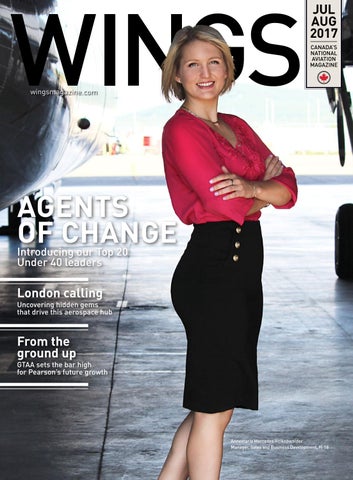
Annemarie Mercedes Heikenwälder Manager, Sales and Business Development, H-18
Bombardier, Global 6000 and Exceptional by Design are trademarks of Bombardier Inc. or its subsidiaries. © 2017 Bombardier Inc. All rights reserved.
We didn’t get here by sheer luck. This was deliberate.
An act of craftsmanship and engineering prowess. Decades in the making. Meeting at the intersection of art and technology. Defying conventions. Redefining luxury. So when all is said and done,
we’ll know that we achieved something truly extraordinary. businessaircraft.bombardier.com
JULY/AUGUST 2017
UPFRONT 4 Leading edge Of sound mind
8 On the fly
News and opinion
13 Alternate Approach The vanishing ATC tower
14 At the Gate
Leading the AI charge
16 Glidepath
A journey realized Toronto-Pearson ranks 32nd out of the world’s 100 busiest airports. P.37
BACK 54 Marketplace 58 On final
The aftermath of Germanwings
FEATURES 18 AGENTS OF CHANGE
Introducing our 2017 Top 20 Under 40 winners BY MATT NICHOLLS
31 UNCOVERING HIDDEN GEMS From top: The vanishing ATC tower. P.13. A journey realized. P.16
London, Ont.’s aerospace hub features a diverse mix of high achievers BY MATT NICHOLLS
PHOTO: GTAA (TOP); BRIAN LOSITO, AIR CANADA (LEFT ABOVE); PAUL DIXON (LEFT, BELOW)
37 FROM THE GROUND UP
The GTAA has set the bar high for the growth of Pearson International BY DAVID CARR
43 A NEW REALITY
Montreal’s TRU Simulation + Training is making a move in the SIM market BY BRIAN DUNN
COVER PHOTO: H-18
WWW.WINGSMAGAZINE.COM
July/August 2017 | WINGS
3
LEADING
EDGE
By Matt Nicholls |
Of sound mind
Continuing to establish the safest regulatory environment possible
C
5
industry – non-commercial, non-scheduled operators in locations where flying is simply a necessity. Many of these operations represent an important lifeline connecting communities that need search and rescue (SAR) services, medevac, firefighting and more. So, it’s not surprising, the new regulations were met with scorn from Canadian aviation associations for myriad reasons. A coalition of nine regional and national Canadian associations – fixed- and rotarywing – is vehemently against a “one-sizefits-all” approach and contends it fails to reflect the majority of flying operations that take place on a daily basis. The coalition also contends that TC has simply not considered the measured recommendations the Canada Transportation
TOP DATA BURSTS… in this issue
1. Throughout its production run 470 Cessna Citation Mustangs were delivered worldwide. (Pg. 8). 2. Quebec will invest $100 million in an artificial intelligence cluster. (Pg. 14). 3. 514,685: Passenger movements at YXU last year (Pg. 31). 4. $60 million: The amount the GTAA needs to invest in CATSA enhancements. (Pg. 37). 5. Textron Systems accounted for 13 per cent of the company’s $13.6 billion in fiscal 2016. (Pg. 43).
4
WINGS | July/August 2017
Act Review made last year that maintain the regulations should be redeveloped to fit different segments of the aviation community. The coalition’s advised next step is simple: stop forcing the issue, revisit the process and introduce more comprehensive, sensible fatigue legislation that more accurately reflects operational tendencies in this country – not dictated by large operators flying scheduled, commercial service. This premise seems necessary and will help prevent increased operational costs, fewer flights, logistical snafus and ultimately, not compromise an already safe operating environment – all situations that may occur under the proposed fatigue legislation. As the nine association’s point out in their “Safer Skies for All” open letter to Garneau: “The unions do not have a monopoly on safety. Lives are precious to all of us . . . Canadians deserve to fly safe, with appropriate regulations in fatigue.” Canada has always been a global leader in the development of its regulatory policies. TC must continue to take a careful, responsible approach with its regulatory development both in the unmanned space and with its pilot fatigue processes. We need to get this right. | W
“in 2016, there were 148 unmanned vehicle/airplane incidents in Canada.”
@Wings_Magazine WWW.WINGSMAGAZINE.COM
PHOTO: BRIAN LOSITO, AIR CANADA
anada boasts one of the safest regulatory operating environments in the world but there is plenty of room for improvement – and changes are necessary to ensure it remains safe and secure in the months and years ahead. Two critical regulatory issues facing Transport Canada (TC) are the establishment of comprehensive regulations for the use of unmanned aerial vehicles and systems (UAVs, UASs) and the development of a concrete regulatory approach to pilot fatigue – a hot button issue being debated across the country by both pilot unions and aviation associations. On the unmanned side, the challenge is creating the right environment to ensure economic growth, innovation and commercial development while mitigating risk and protecting public safety. In 2016, there were 148 unmanned vehicle/airplane incidents nationwide and the number is on the rise. Near misses at large Canadian airports are becoming more prevalent and while TC has upped its marketing efforts and has erected NoDroneZone signage, more needs to be done. TC has established recreational drone regulations and penalties – to which not everyone is enamoured – and is actively developing a framework for all types of unmanned aircraft. The good news is federal Transport Minister Marc Garneau is cognizant of the threat and his team is being proactive in creating a workable unmanned framework. The pilot fatigue issue is in more of a slumber – a fatigue-inducing process that has been going on for years with no suitable solution in sight. TC proposed new pilot fatigue regulations at the end of March but it failed to sufficiently deliver the goods for pilots representing a wide percentage of the
Flight Plans Change
Time For An Update? The time has come for you to take it up to the next level. Efficiency and quality are essential elements of who you are. Levaero can guide you through the process of upgrading or expanding your current aircraft inventory. Whether you are in the market for a new or pre-owned aircraft, or have a specific interest in the Pilatus PC-12 NG or the new Pilatus PC-24 Super Versatile Jet, Levaero’s sole purpose is getting you the right flight solution. Ready to expand your air space? Give us a call.
SALES • SERVICE • SOLUTIONS
Stan Kuliavas, Vice President of Sales sales@levaero.com 1 844-538-2376
www.levaero.com
Stay in Touch with Aviation News
Vol. 58, Issue 4 EDITOR
Matt Nicholls mnicholls@annexweb.com 416-725-5637
SUBSCRIBE
FLIGHT DECK
Online
Rick Adams, David Carr, Paul Dixon, Brian Dunn, Frederick K. Larkin, James Marasa, Carroll McCormick, Anna Pangrazzi NATIONAL ACCOUNT MANAGER
Mena Miu mmiu@annexweb.com • 416-510-6749
TODAY
MARKETPLACE ACCOUNT MANAGER
Kory Pearn kpearn@annexweb.com • 519-902-8574 ACCOUNT CO-ORDINATOR
Stephanie DeFields sdefields@annexweb.com • 1-888-599-2228 ext. 257 MEDIA DESIGNER
wingsmagazine.com/subscribe
Emily Sun
CIRCULATION MANAGER
Magazine
Carol Nixon cnixon@annexweb.com • 450-458-0461
Weekly E-Newsletter
GROUP PUBLISHER
Martin McAnulty mmcanulty@annexweb.com
Digital Edition
wingsmagazine.c om
PRESIDENT & CEO
Introducing our Top 20 Under 40 lead ers
P.O. Box 530, 105 Donly Dr. S., Simcoe, ON N3Y 4N5 Tel: 519-428-3471 Fax: 519-429-3094 Toll Free: 1-888-599-2228 and services we believe may be of interest to you. If you prefer not to receive this information, please contact our circulation department in any of the four ways listed above.
PUBLICATION MAIL AGREEMENT #40065710
London calling
Annex Privacy Office privacy@annexbizmedia.com • Tel: 800.668.2374
CIRCULATION Email: apotal@annexbizmedia.com Phone:416-442-5600 ext. 3258 Fax: 416-510-6875 Mail: 80 Valleybrook Dr, Toronto, On M3B 2S9
hub
From the ground up
GTAA sets the for Pearson’s bar high future growt h
Annemarie Mercede s Heikenwälder Manager, Sales and Business Development, H-18
WG_July17_EJS.indd
WINGS MAGAZINE
Printed in Canada ISSN 0701-1369
AG E N T S OF CHANGE
Uncovering hidden gems that drive this aerospace
Mike Fredericks
JUL AUG 2017 CANADA’S NATIONAL AVIATION MAGAZINE
1
2017-06-20
1:26 PM
Published six times per year (Jan/Feb, Mar/Ap, May/Jun, Jul/Aug, Sep/Oct, Nov/Dec) by Annex Business Media SUBSCRIPTION RATES Canada – 1 Year $ 32.95 (plus GST - #867172652RT0001) USA – 1 Year $ 57.95 Foreign – 1 Year $ 65.95 Occasionally, Wings magazine will mail information on behalf of industry-related groups whose products
Air Transport Association of Canada
ON THE
WEB
6
WINGS | July/August 2017
WG_Sub_HouseCircAd_JulyAug17_MLD.indd 1
No part of the editorial content of this publication may be reprinted without the publisher’s written permission. ©2017 Annex Publishing & Printing Inc. All rights reserved. Opinions expressed in this magazine are not necessarily those of the editor or the publisher. No liability is assumed for errors or omissions. All advertising is subject to the publisher’s approval. Such approval does not imply any endorsement of the products or services advertised. Publisher reserves the right to refuse advertising that does not meet the standards of the publication.
Canadian Business Aviation Association
Magazines Canada
AVIATION THIS WEEK
PHOTO: ANNEX BUSINESS MEDIA
WINGS
COO
Ted Markle tmarkle@annexweb.com
Looking to catch up on the latest hot news from around aviation and aerospace? Check out Aviation This Week, a live digital version of the top news stories affecting a variety of key markets. It's quick, essential information you need to know! WWW.WINGSMAGAZINE.COM
2017-06-20 1:36 PM
Check Out The FlightSafety Advantage
Quality • Value • Service • Technology
Customers recognize our many advantages, including
We never rest in making our already industry-leading
delivering the highest-quality training and outstanding
training even better, offering unmatched advanced
service. The trust we have built over time and continue
master-level courses and training tailored to specific needs.
to earn every day is reflected in our dedication to safety,
Our ongoing investment gives our Customers the widest
experienced instructors, training effectiveness, and
and most complete range of training services, equipment
advanced-technology simulators. Our commitment to train
and locations available. That adds up to the greatest value
to proficiency goes well beyond minimum requirements.
in aviation training.
Ask yourself an important question. How does your training match up with the FlightSafety Advantage? Programs Tailored to Your Specific Needs
Master Aviator™ and Master Technician Recognition Programs
Exceptional Overall Value and Customer Service
Extensive eLearning and LiveLearning Programs
1,800 Highly Qualified Instructors
Training to Proficiency
More Than 3,500 Courses for 135 Aircraft
Flexible, Convenient Online Scheduling
Serving 95% of Fortune 100 Companies That Own Corporate Aircraft
Proficiency Protection Support Program
Courses for Pilots, Maintenance Technicians, Dispatchers, Cabin Attendants
World’s Largest Fleet of Flight Simulators Global Network of Learning Centers
Aviation professionals from around the world trust us to provide the highest quality training and outstanding service. More than 1,800 highly experienced professional instructors deliver aircraft- and mission-specific courses, using our comprehensive training systems and advanced-technology flight simulators designed to enhance safety. Trust your training to FlightSafety. You’ll see why so many aviation professionals make the same choice. And have since 1951. For more information, please contact Steve Gross, Senior Vice President, Commercial 314.785.7815 • sales@flightsafety.com • flightsafety.com • A Berkshire Hathaway company
ON THE FLY For late-breaking news and exclusive web content, please visit us at: www.wingsmagazine.com
THE LEAD
WESTJET LAUNCHES NEW CHAPTER WestJet is expanding its global reach and has plans to launch a new domestic ultralow-cost-carrier (ULCC). The airline will purchase up to 20 Boeing 787-9 Dreamliners (10 firm orders plus options), with deliveries scheduled to begin in the first quarter of 2019. “This order represents an exciting new chapter in WestJet’s history,” said Gregg Saretsky, WestJet’s chief executive. The ULCC and 787 announcements came within weeks of each other, a rapid, unprecedented one-two punch from an airline better known for its methodical approach to steady growth. “We have carefully executed on our strategic plan,” Saretsky said. “First launching WestJet Encore to connect smaller communities across Canada to our growing network followed by our successful venture into wide-body flying to Hawaii and London (using older model, ex-QANTAS 767s). We [now] turn our attention to further growing our international presence and introducing even more travellers to our award-winning guest experience.” That same “guest experience” will be
available onboard the not-yet-named no frill ULCC, but passengers will have to pay more for it through ancillary charges. “The worldview on low-cost airlines has changed since the launch of WestJet in 1996 and we are responding,” Saretsky noted. “The complete unbundling of services and products in order to lower fares for the price-sensitive traveller has created the ULCC category. Our new airline will provide Canadians a procompetitive, cheap and cheerful flying experience from a company with a proven track record.” Bob Cummings, formerly WestJet’s executive vice-president, commercial will be responsible for the new airline. Cummings will have accountability for all aspects of the new venture, including planning, branding, pricing, product development and operationalization. “Bob has been an integral part of the successful transformation of WestJet,” Saretsky said. “I am eager to bring our ULCC to market on behalf of Canadians looking for even lower fares,” Cummings said. “Travellers can expect a very different approach from this new ULCC, yet one that will ultimately provide air travel accessibility to many more Canadians.” ULCC service hinges on an agreement with WestJet pilots and other required regulatory approvals. WestJet expects to start operations in late 2017/early 2018, with an initial fleet of 10 high-density Boeing 737-800s. WestJet is also converting 15 firm
Throughout its 12-year production run, 470 Cessna Citation Mustang’s were delivered.
orders for the Boeing 737 MAX that were to be delivered between 2019 and 2021 to options available between 2022 and 2024 as part of the 787-purchase agreement. The 787 is 20 per cent more fuelefficient than WestJet’s 767 aircraft. With a range of more than 14,000 kilometres, the airplane, which is also operated by Air Canada, will give WestJet the ability to serve new destinations in Asia and South America, and expand its service offerings into the European market.
BIZJETS
MUSTANG FINAL DELIVERY The final production Cessna Citation Mustang has rolled off the assembly line in Wichita, and will be delivered as Wings was going to press. The entry-level Mustang quickly set the standard in its category for pilots stepping up to jet ownership. Throughout its 12-year production run, 470 aircraft were delivered. “The Mustang proved to be an incredible success for our company and our customers, and we’re thrilled to celebrate the ingenuity and pride that went in to creating the world’s most popular entry-level jet,” said Rob Scholl, senior vice-president of sales and marketing for Textron Aviation, owner of the Cessna Citation brand. The Citation M2, introduced in 2013, offers Cessna customers a seamless transition within the light jet segment. Nearly 150 M2’s have already been delivered.
WestJet is converting 15 firm orders for the Boeing 737 MAX to options available between 2022 and 2024. 8
WINGS | July/August 2017
WWW.WINGSMAGAZINE.COM
PHOTOS: TEXTRON AVIATION (TOP); BOEING (LEFT)
8 THE LEAD 8 BIZJETS 10 AEROSPACE
BOMBARDIER, PILATUS TO RE-OPEN PC-24 ORDER BOOK
PHOTOS: PILATUS (TOP); EMBRAER (RIGHT)
When launching its first business jet, the PC-24 in 2014, Pilatus took the unusual step of limiting sales for the so-called Super Versatile Jet. The Swiss-based manufacturer sold 84 PC-24s in the first 36-hours. With the maiden flight of the third test vehicle on March 6, Pilatus has plans to re-open the order book on or around the 2018 edition of NBAA. The third PC-24 prototype, which also represents the series standard, was unveiled to the general public at this year’s European Business Aviation Exhibition. “I’m delighted that we [could] unveil the first series-conform PC-24 to the general public,” said Oscar J. Schwenk, chair of Pilatus. “We are confident of being able to convince even more potential customers of the uniquely outstanding performance of our made-in-Switzerland business jet.” The PC-24 is the first business jet worldwide designed to take off and land on very short runways, or unpaved runways, and to come with a cargo door as standard. With the addition of the third aircraft, the PC-24 test fleet is now complete. The three prototypes have accumulated a total of 950 flights and 1,525 hours in the air. Pilatus plans to produce 4,000 PC-24s over the next 20 years. Work is already underway on the first aircraft to enter service, likely in early 2018. Pilatus reports that the production status of the first few PC-24s is well advanced, with the first aircraft already painted in its final livery.
Pilatus plans to produce 4,000 PC-24s over the next 20 years.
EMBRAER MAKE MILESTONES Bombardier and Embraer celebrated major delivery milestones this spring. Embraer delivered its 1,100th business jet, an industry best-selling Phenom 300 to fractional operator NetJets, the world’s largest private aviation company. Since delivering its first executive jet model in 2002, Embraer has built up a base of over 670 customers, and has a market share of 18 per cent of the industry’s global deliveries. “Embraer scored the four-digit mark in business jet deliveries in an impressively short period of time,” said Michael Amalfitano, chief executive of Embraer Executive Jets. “NetJets has been integral to our success story by co-creating a premium product to meet the discerning tastes of their owners.” Bombardier handed over the 3,000th Learjet at its facility in Wichita, Kan. The aircraft is also the 100th Learjet 75 to be delivered, and its customer Leggett &
Platt, a Missouri-based manufacturer’s second. Learjet introduced the first ever business jet, the Learjet 23, in 1963. Bombardier acquired the business in 1990, introducing the Learjet 45 in 1997, the first new clean sheet design since the original airplane. The light category Learjet 75 derived from the Learjet 45 XR aircraft.
GULFSTREAM, BOMBARDIER, TEXTRON BEEF UP PROGRAMS Several OEMs ramped up flight-test programs for new business jets this spring, as they work toward certification over the next two years. Textron Aviation added its fourth super-midsize Cessna Citation Longitude on May 6, with an initial three-hour and 20-minute flight, where the test aircraft hit all of its performance targets. The first Citation Longitude flew in October 2016 and the flight-test program
Embraer has delivered its 1,100th business jet, a Phenom 300 to fractional operator NetJets. WWW.WINGSMAGAZINE.COM
July/August 2017 | WINGS
9
ON THE
has completed more than 230 flights, accumulating nearly 450 hours. “With four aircraft now flying in the Longitude test program in less than eight months, we are demonstrating that our product development processes and teams are second to none in the industry,” said Brad Thress, Textron’s senior vicepresident of engineering. “In addition to further systems testing, this fourth aircraft allows us to evaluate the overall passenger experience in the cabin, which is just as vital as the performance and technology in the cockpit.” This is the first flying test aircraft with a fully fitted interior. A fifth and final flighttest vehicle is expected to join the program this summer, highlighting Textron’s desire for getting the aircraft in the hands of its customers as quickly as possible. The company anticipates achieving Longitude certification by the end of this year. One day earlier, a third Gulfstream G600 test aircraft took off from
Textron Aviation has added its fourth super-midsize Cessna Citation Longitude test aircraft to the program.
Savannah-Hilton Head International Airport for a four-hour and 35-minute flight. The move comes after the first G600 flight in mid-December. “The consistent execution of the G600
flight-test program is directly correlated to our investments in research and development and is a testament to the rigor and discipline of our processes,” said Mark Burns, president of Gulfstream. “We take
DTI Training can help you achieve your goals DTI spent the last 15 years helping develop and deliver training to Transport Canada, NASA and the U.S. DoD, on Quality Assurance, SMS and Surveillance Procedures. Now we are ready to help you achieve all you can! Our workshops are designed to familiarize participants with the basics of a QA/SMS system and what Transport Canada, the FAA and other governing bodies will be looking for. Taught by the same group (DTI) that has helped Canadian Regulators develop the QA & Surveillance portions of the SMS, and has spent the last ten years th facilitating the implementation of the new process to all its inspectors.
What’s new? • QA, CAP and Audit Workshops across Canada coming in the fall. Visit our website for dates and a location near you. • Now offering FREE consultation and advice (via email and phone) through to September 30, 2017. Contact us today! • Our new industry service web page will feature free information and “how-to” videos on the key elements needed for a successful and compliant system.
dtitraining.ca • dtiatlanta.com • 1-866-870-5490 10 WINGS | July/August 2017
WWW.WINGSMAGAZINE.COM
PHOTO: TEXTRON AVIATION
FLY
great pride in ensuring we deliver on our promises and look forward to our G600 entering service next year.” A fourth test aircraft is in production and will join the fleet in the fall. Gulfstream launched the G600 and G500 at the same time. Flight-testing on the smaller and shorter-range G500 is winding down, and the aircraft is expected to be certified by the end of the year. Bombardier’s third Global 7000 flighttest vehicle made its first flight on May 10. Dubbed “The Navigator,” the airplane will be used to test advanced avionics and electrical system performance. Bombardier reports that the 7000 test program has been demonstrating excellent system reliability and breaking new ground since it got underway in November 2016. Just five months into testing, the Global 7000 set a record as the largest business jet to operate so close to the sound barrier. “The Global 7000 business jet is a
WWW.WINGSMAGAZINE.COM
highly sophisticated, state-of-the-art aircraft, and we are pleased that our flight-test vehicles have been showing a high degree of maturity,” said Michel Ouellette, senior vice-president of the Global 7000 and Global 8000 program. “Our test program’s development and certification schedule is on track, and the addition of our third flight-test vehicle is in line with our commitment for certification in 2018.” The airplane took off from Bombardier’s facility at Downsview in Toronto, and is continuing flight-testing at its airfield in Wichita.
AEROSPACE
P&WC DELIVERS 100,000 ENGINE Every second, a Pratt & Whitney Canada (P&WC)-powered aircraft takes off or lands somewhere in the world. In May,
P&WC celebrated the production of its 100,000th engine. Since it was founded in 1928, P&WC has helped define general aviation and usher in a new generation of fast and versatile small aircraft with the introduction of the PT6A engine, is a world leader in the regional turboprop segment with the PW100/150 family of engines and pioneered the light business jet market with the JT15D engine, before redefining the sector with the PW500 engine. The latest addition to its 14 engine families the PurePower PW800, is powering the Gulfstream G500 and G600 next-generation long-range and ultralong-range business jets. Today, P&WC has 60,000 in-service engines operated by 12,300 customers in more than 200 countries and territories worldwide. Its engine families, including civil helicopters and auxiliary power units have chalked up an impressive 730 million flight hours.
July/August 2017 | WINGS
11
ALTERNATE
APPROACH | By David Carr
The vanishing ATC tower
Digital ATC’s promises myriad benefits for future navigation
PHOTO: BRIAN LOSITO, AIR CANADA
T
he virtual control tower grabbed news headlines in Britain this spring, when London City Airport took the wraps off its plan to open the U.K.’s first digital air traffic control (ATC) tower in 2019. Controllers will have a 360-degree view of the airfield – approximately 130 kilometres away. Fourteen high definition cameras, two pan-tilt zoom cameras and sensors will give air traffic controllers a level of detail greater than the human eye, alongside the noise of the airfield. “Digital towers are going to transform the way air traffic services are provided at airports,” said Mike Stoller, director of airports at NATS, the U.K.-based air traffic service provider. NATS hopes London City Airport will spark a national revolution in ATC. Flying below the radar, but just as important to Canada, was the announcement that NATS had partnered with NAV CANADA to take an equal stake in Seabridge Technologies, an Ottawa-based firm specializing in remote ATC operations. In 2006, Moodie Cherkin and Alex Sauriel launched a tech company in search of a problem looking for a solution. At around the same time, LFV, Sweden’s air navigation service provider and Saab, a Swedish military and aerospace technology company (including the Saab 340 and 2000 regional turboprops) partnered to develop remote ATC tower technology. Sweden’s Ôrnskôldsvik Airport, became the first in the world to operate using a remote tower service (RTS) in April 2015. A second local airport was added last year, and by this summer, Saab expects to have three airports being served by 16 controllers at the same remote location, with separate screens showing real-time activity at the different airports. “During the test period, we informed the airport and airlines concerned that we would control traffic partly from the on-site tower and partly remotely from Sundsvall, but we didn’t tell them exactly when. They didn’t notice any difference, which was the best feedback we could get,” said Erik Bäckman, an air traffic controller and head of the remote tower centre in Sundsvall. WWW.WINGSMAGAZINE.COM
46 large and small airports, estimates that operating air traffic for several airports from one remote location could cut costs by 30 to 40 per cent, while also avoiding investment costs for new or upgraded control towers. Remote technology can also add a new layer of safety at uncontrolled airports. The potential extends beyond small and remote airfields. “Today even large airports may need to invest in a remote tower system as contingency and other digital services linked to air traffic management,” said Niclas Gustavsson, Saab’s vice-president of business development and government affairs. “The remote tower is driving the business transformation within the industry.” Seabridge already serves major airports in 35 countries, including remote ATC trials at airports in Budapest and Milan, and was the first in the world to install an operational video system in an ATC tower. This year at the World ATM Congress in Spain, Seabridge unveiled Aimee, the world’s first artificial intelligence platform for air traffic management. “Artificial Intelligence is enabling a new tier of applications across all of aviation,” Sauriol said. “With Aimee, we are making it easy for our customers to conceive, develop and implement new operational solutions that enhance safety and improve efficiency.” NAV CANADA, the world’s second largest air navigation service provider by traffic volume, bought a controlling interest in Seabridge in 2010. For larger airports, at least, the digital transformation will likely be used to serve as a reserve control tower. | W
“Digital towers are going to transform the way air traffic services are provided at airports.” Seabridge’s Cheikh and Sauriol also landed remote ATC technology long before the first airplane had landed at Ôrnskôldsvik using the remote tower service. “What is going to restrict growth [at airports] is that there won’t be enough room on the ground,” Cheikh told the National Post. “We decided to focus on technology to help airports and air traffic control providers increase efficiency in that area.” For isolated airports in Canada’s North, with very little traffic spread over lengthy periods, remotely operated air traffic control has the potential to reduce the cost of local ATC infrastructure. Avinor, Norway’s state-owned airport operator, plans to link up to 15 airports to a single remote operations centre located above the Arctic Circle. Avinor, which operates
David Carr is a Wings writer and columnist. July/August 2017 | WINGS 13
AT THE
GATE
By Brian Dunn |
Leading the AI charge
Montreal aerospace cluster hopes to become AI “super cluster”
L
14 WINGS | July/August 2017
aerospace companies to the region. F. List Canada Corp., a subsidiary of F. LIST GMBH of Austria, a global manufacturer of high-class interiors for business and private jets, is opening a new production facility by the end of 2017 in the Montreal area. This investment of more than $20 million is expected to create 100 jobs by the year 2020. Earlier in the year, GE Aviation announced plans to invest $238 million to modernize its engine components plant in Bromont, QC. The investment will primarily be used to acquire new equipment to manufacture components for next generation engines for the Boeing 737, Airbus A320neo and Comac C919. The investment is expected to add 115 jobs to the 200 currently at Bromont. And in 2013, Airbus-owned Stelia Aerospace, opened a facility near Bombardier Aerospace in Mirabel to assemble fuselage centre sections for Global 7000/8000 business jets. There is a gap in system engineering and system integration capability in Quebec, which is needed to play a key role in AI, according to Benoit. The challenge the Montreal cluster faces is to stay ahead of the curve in terms of innovation. | W
“The roughly 200 companies in Montreal’s aerospace cluster employ some 40,000 workers” The entrepreneurial and engineering skills it is hoped an AI super cluster will bring to Quebec are expected to play a role in the aerospace industry’s ongoing transition to “Industry 4.0” which includes virtual design, automation and connected manufacturing, a task that falls heavily onto Aéro Montréal because of the high proportion of small companies in the cluster. The cluster also includes educational establishments and Aéro Montréal works with the region’s trade school, technical schools and universities, to ensure a supply of engineers and technicians. “When we know that the industry is booming, we do a big campaign to get students enrolled,” Benoit says. “When there is a slowdown, we adjust the flow so everyone will get a job.” The region’s aerospace sales declined in 2016, to $14.4 billion from $15.5 billion a year earlier, due to the downturn in business aviation and commercial helicopters. Bombardier has been shedding jobs as part of its five-year turnaround plan, but Benoit says Aéro Montréal has a strategic working group in which the OEMs cooperate in an effort to minimize the impact of cyclical layoffs. Quebec continues to work to attract
Brian Dunn is a Wings writer and columnist. WWW.WINGSMAGAZINE.COM
PHOTO: COMAC
ed by Quebec, Canada’s aerospace industry hopes to cash in on a new government initiative to boost investment in artificial intelligence (AI), advanced manufacturing and other digitaldriven technologies that can be applied throughout the life cycle of aircraft. Montreal is aiming to become a “super cluster” in AI, a suite of technologies that the aerospace industry is applying to analyze the vast amounts of data generated during the design, manufacture and operation of aircraft. Headed by Aéro Montréal, its aerospace cluster hopes the new innovation strategy will attract the expertise in advanced software and systems design that is needed to be competitive going forward. The federal government’s latest budget proposes a new department, Innovation Canada, that will invest up to $950 million over five years to support a small number of business-led super clusters with the greatest potential for driving economic growth. A competition for the funds is being held this year focusing on advanced manufacturing, clean technology, digital and other sectors in addition to transportation. Quebec’s own budget includes plans to invest $100 million over five years to create a scientific and industrial super cluster devoted to AI. The proposed super clusters will develop know-how that can be applied across several industry sectors, according to Suzanne Benoit, president of Aéro Montréal. “In its budget, the Quebec government recognizes the importance of developing transformative technologies with investments aimed at creating a super cluster in artificial intelligence and developing the sector of virtual reality,” she says. “These new technologies alone present enormous potential for our aerospace companies.” The roughly 200 companies in Montreal’s aerospace cluster employ some 40,000 workers and generate about $15.5 billion in annual sales, according to Aéro Montréal. The sector has about 185 small- to medium-sized enterprises (SME) in addition to OEMs Bell, Bombardier, CAE and P&WC. Developing the capabilities of the SMEs is a major part of Aéro Montréal’s raison d’être.
WANT MORE?
More Seats, More Useful Load and More Capability
The Diamond DA62
Available in Canada beginning 2018 Order yours today! +1-226-227-1592
|
www.diamondaircraft.com
GLIDE
PATH
By Paul Dixon |
A journey realized
Harbour Air celebrates 35 years seaplane success
T
16 WINGS | July/August 2017
Harbour
Air.
He
talked
“It’s still about the ocean . . . and about changes in attitudes over the years and the way Harbour Air has indeed made a operators and pilots look at name for itself on a global scale.” the industry today versus were closing and the forest industry went through a series of mergers and acquisitions at the same time that world markets shifted. A series of what were described as minor recessions through the 1970s and into the early ’80s were devastating to those in the coastal aviation business who saw their key customers shrink or disappear altogether. At the same time one market segment was disappearing, another was expanding. Scheduled floatplane service, primarily from Vancouver, was being developed. There were operators offering service from what were ostensibly temporary facilities on docks along the waterfront road. In 1982, the company that is now Harbour Air was started by Greg McDougall and joined the other operators on the waterfront. Today, 35 years later, most of those other operators are a distant memory while Harbour Air has established itself as the largest operator of scheduled seaplane service in North America and possibly the world (it all depends on the unit of measurement one relies on). The company operates 38 upgraded Otters and Beavers with up to 200 scheduled flights a day. I recently spoke with Peter Evans at
“then.” Safety is paramount – without exception – and the days of “get there at any cost” are over. Then there’s how pilots look at the job. It used to be that flying Beavers, Otters and Twin Otters was simply a stepping-stone to a job with a “real” airline. But today, more and more pilots are choosing to make this their career. Flying legacy aircraft is now an enticement and there can be some serious perks, as evidenced by Harbour Air being tasked with transporting Will and Kate along with Prince George and Princess Charlotte from Victoria to Vancouver in Twin Otter. You can’t buy the goodwill that was generated by that trip. If you look hard enough as you stare out over Vancouver harbour you can see the shadows of the canoes of the ancients that once patrolled this coast. Look further to the horizon for the shadows cast by the sails of Narvaez and Vancouver. Then look back at today, as the seaplanes come and go against a backdrop of today’s giant ships. It’s still all about the ocean . . . and Harbour Air has indeed made a name for itself on a global scale. | W
Paul Dixon is a freelance writer and a photojournalist living in Vancouver. WWW.WINGSMAGAZINE.COM
PHOTO: PAUL DIXON
here’s a lot of aviation history on Vancouver’s waterfront. Almost a century ago, in March 1919, W.E. (Bill) Boeing made the first international air mail flight from Vancouver to Seattle in a Boeing floatplane. With no facilities catering to aviation on the Vancouver waterfront at the time, photos from the day show him being rowed out to the waiting aircraft and clambering up into the cockpit clutching a Canada Post Office canvas bag in one hand. In 1929, Mr. Boeing’s company started building seaplanes in a factory located near the entrance to Stanley Park, roughly where he had set out from 10 years before. Today, Vancouver’s harbour has the most seaplane traffic of any city in North America, if not the world and there’s not a rowboat in sight. Passengers board their aircraft at the Vancouver Harbour Flight Centre, a short walk to the central business district, but still in Coal Harbour. Water has defined Vancouver and the West Coast of Canada, since humans arrived thousands of years ago. After the First World War, the first aircraft tentatively appeared. Aviation grew slowly on the coast between the wars, as airfields were few and far between and seaplanes (flying boats or floatplanes) predominated. The years following the Second World War saw a sea change in transportation on the West Coast. Aircraft started to nibble away at the passenger loads of the coastal steamers. While airports had been built on the coast as part of the war effort, many communities were still only reachable by water. Seaplanes became an integral part of the West Coast lifestyle. While there were a number of different aircraft in operation, it was the introduction of the de havilland Beaver on floats as the right plane at the right time that took things to the next level. While business was booming for many, it was still a tough way to make a buck. Most operators were small, basic Mom and Pop operations. Safety wasn’t necessarily a prime consideration and there was often pressure to get the job done in less than ideal conditions – or the client would find someone who would. Then the business environment changed. The fish canneries
AN UNPARALLELED EXPERIENCE Range. Speed. Comfort. The G650ER™ is truly in a class all its own. Our proud commitment to service takes you with confidence from Vancouver to Hong Kong* and everywhere else your spirit beckons. This is Gulfstream. The world’s finest aviation experience. GULFSTREAM.COM
SCOTT NEAL | +1 912 965 6023 | scott.neal@gulfstream.com *Theoretical range with eight passengers, four crew and NBAA IFR fuel reserves. Actual performance will be affected by ATC routing, operating speed, weather, outfitting options and other factors.
Andrew Persaud, assistant chief pilot, Skylink Express
AGENTS OF CHANGE: T0P 20/40 HIGHLIGHTING 2017’S FINEST YOUNG LEADERS
F
COMPILED BY MATT NICHOLLS
PHOTOS: SKYLINK EXPRESS (LEFT); FAST AIR (MIDDLE); AIR CANADA (RIGHT)
inding and retaining talented employees continues to be one the greatest challenges facing many of Canada’s top aviation and aerospace companies, but fortunately, many firms are blessed with employees who are taking the reigns and implementing change for the better; developing value-added efficiencies to enhance operations. In our annual Top 20 Under 40 report, Wings magazine uncovers 20 influencers who have altered their respective organizations for the better, spearheading change on a number of levels. The 20 individuals profiled here were carefully selected by our editorial team following an online nomination process. Candidates were nominated based on their influence at work, leadership in their communities, commitment to clients/colleagues and more. Featured alphabetically, our Top 20 Under 40 achievers represent the resourcefulness, commitment and dedication organizations are craving in today’s marketplace.
NAME: JASON ARTHUR TITLE: IFR OFFSHORE FIRST OFFICER, COUGAR HELICOPTERS LOCATION: ST. JOHN’S, N.L. Jason Arthur, 35, is certainly making a name for himself in the Canadian helicopter industry. An IFR offshore first officer with Cougar Helicopters, Arthur holds a Group 4 instrument rating and is certified on the Sikorsky S-92, Bell 412 and Chinook CH-147. He also maintains a fixed wing Group 1 instrument rating with multi-engine ratings and boasts more WWW.WINGSMAGAZINE.COM
than 2,200 accident-free flight rotary wing hours. Arthur is a graduate of Mount Royal University and served in the Royal Canadian Air Force (RCAF) from 2004-14 as a unit flight safety manager, aircraft captain and flight instructor. In 2009, he completed the mountain flying course at Canadian Helicopters School of Advanced Flight Training and is now working on his BSc in Aeronautics with minor in helicopter operations and safety. Since joining Cougar in 2015, he has taken additional responsibilities in the industry. He sits on the HAI membership committee and is a mentor for its military to civilian pilots program. He is also a mentor at Mount Royal and works as a fundraiser for the Wounded Warriors Foundation. Arthur is always looking for opportunities to do things better. He is indeed a rising star at Cougar Helicopters and within the industry as a whole.
requests and many other tasks. Her patient demeanour, outstanding communication skills and clever problem solving ability always gets things accomplished – and done well. Bisch is also tasked with preparing flight crews to ensure they have a seamless trip – providing the executive experience to the customer. She also schedules aircraft for maintenance or coordination of defect rectification while away from base if required. In each role she is intuitive and resourceful, ensuring customers and crew have the information they need. Bisch is truly an aviation junkie. She has a broad knowledge of the industry and is a proud supporter of the Royal Aviation Museum of Western Canada. In the office, she inspires camaraderie and helps create a fun atmosphere where everyone is welcome. She is an asset to not only Fast Air, but the industry as a whole.
NAME: HEATHER BISCH TITLE: CHARTER FLIGHT COORDINATOR, FAST AIR LTD. LOCATION: WINNIPEG
NAME: LOUIS-PHILIPPE CHARLAND TITLE: IN-FLIGHT SERVICES TRAINING SPECIALIST, AIR CANADA LOCATION: TORONTO
Motivated, determined, dependable. These are just three of the words that accurately describe Heather Bisch, 36, charter flight co-ordinator, with Winnipeg-based Fast Air Ltd. Bisch is the primary contact between Fast Air Ltd. and its business jet customers and owners, an often delicate and demanding role. On a nearly daily basis, she skillfully manoeuvres the intricacies of international operations, customs, customer specialized
Louis-Philippe Charland, 37, is an ambassador for safety, professionalism, training and customer service. Commencing his aviation career as a flight attendant with Air Transat in 2000, Charland’s passion for aviation took hold. After gaining experience as a line flight attendant, he joined Privatair in Geneva, Switzerland. For the next six years, he worked his way into positions of in-flight director of the VVIP scheduled and charter flights, July/August 2017 | WINGS 19
NAME: COLIN DEMPSEY TITLE: GENERAL MANAGER, NORTHERN AIR TRANSPORT ASSOCIATION LOCATION: YELLOWKNIFE, N.W.T. Colin Dempsey is one of those individuals you know will go far. Since joining the Northern Air Transport Association (NATA) in 2011, the 32-yearold has tirelessly served first as its executive assistant and currently general manager. NATA is the advocacy group and industry association focused on the creation and maintenance of the safest and most efficient-possible operating environment for northern and remote aviation in Canada. The general manager position rolls the functions of bookkeeper, event planner, web master, graphic designer, membership coordinator, association representative and referee all into one. Somehow Dempsey, has not only managed to get all of this done, but to excel at the process. He has also juggled being the owner of an art gallery, the president of the Northern Frontier Visitor’s Centre in Yellowknife, managing the local farmer’s market, teaching at the local college and being a landlord. In addition to the skills in the day-to-day running of the association, Dempsey has been a quick study in all the various aviation and government relations challenges. With a strong moral compass and sense of fairness he is always striving to do the 20 WINGS | July/August 2017
Hai’s rapid rise through Vector’s leadership is a reflection of both her strong academic credentials and approachable character. right thing whenever possible, be if for NATA or his involvement in local politics. It would be hard pressed to pick only one word to describe Dempsey from the long list that comes to mind: diplomatic, conscientious, hardworking and more.
NAME: LINDSAY HAI TITLE: SENIOR FINANCE PROJECT MANAGER, VECTOR AEROSPACE LOCATION: SUMMERSIDE, P.E.I. Lindsay Hai’s interest in aerospace dates back to when she was a child growing up in Hong Kong. Hai’s father, a 40-year veteran with Cathay Pacific, immersed his daughter in the business. By the time she was 10, she had travelled to 18 countries worldwide. In 2009, the now 30-year-old joined Vector’s Engine Services – Atlantic team as a financial analyst while in the last year of study for her bachelor’s degree in business administration at the University of Prince Edward Island. Hai would continue working in the financial analyst role with Vector while simultaneously studying for both her MBA and certified management accountant (CMA) designation at Saint Mary’s University, Halifax. She graduated in 2013 at the top of her class, receiving the E.L Whitman Gold Medal Award. Upon graduation, Hai spent one year with the IMP Group in Halifax as an internal auditor, assisting the company’s management with identifying and evaluating risk management, control and governance processes. In 2014, she was welcomed back to Vector, initially as a senior financial analyst. Just 18 months later, Hai was promoted to business performance manager, in which role she was actively involved with Vector’s continuous improvement initiatives. One year after her initial management appointment, Hai was promoted to senior finance project manager. Her rapid rise through Vector’s leadership is a reflection of both her strong academic credentials and her approachable character. Outside of Vector, Hai sits on the
Investigations Committee for Chartered Professional Accountants P.E.I and is actively involved in her local community. She truly is an invaluable member of the Vector team.
NAME: LEE HAWKE TITLE: CREW CHIEF, ROCKY MOUNTAIN AIRCRAFT LOCATION: CALGARY For Lee Hawke, it’s truly the advancement of a new generation of aircraft maintenance professionals that motivates his every day since joining Rocky Mountain Aircraft in 1999. As a Southern Alberta Institute of Technology, aircraft maintenance engineering technology graduate, Hawke received his AME M1 licence in 2002. He has travelled extensively in support of key contracts within the organization including throughout Europe, India, North and South America. In his role as lead engineer and crew chief, Hawke, 38, has contributed to the growth and development of many AMEs including a past nominee. He is also passionate in his commitment to the continued growth of the organization as demonstrated in his more than 18 years of dedicated service. Always ready for a new challenge, Hawke’s daily life starts with a mindset steeped in achieving the highest standards and work ethic based on leading by example. As a leader and motivator of young people within the aviation community, Hawke’s creative approach has also served to encourage others to participate and become involved in numerous aviation events and organizations. As a key member of Rocky Mountain Aircraft, Hawke also sits as a member of the S.A.I.T aircraft maintenance technology advisory committee. He is a regular contributor to implementing new processes and improvements. Hawke is a consummate professional who continues to provide a new generation of aircraft maintenance engineers with the knowledge and skills to thrive within this organization and in their careers. WWW.WINGSMAGAZINE.COM
PHOTOS: NATA (LEFT); VECTOR AEROSPACE (MIDDLE); ROCKY MOUNTAIN AIRCRAFT (RIGHT)
cabin safety instructor, and security team member. In 2014, he accepted the role of in-flight supervisor and cabin safety trainer at Air Georgian. In this capacity, Charland assisted the flight attendant manager in supervising the Toronto base, assessing flights and line checks, and creating and delivering the flight attendant training program. In 2015, he joined Transwest Air as flight attendant manager, responsible for the professional standards of the cabin safety department. He then joined Air Canada in the capacity of in-flight services training; he did so while still attending to his many responsibilities at Transwest while they searched for a suitable replacement. Charland is an excellent trainer. His knowledge is enviable and his enthusiasm is infectious. He is also active in the industry. He works for ATAC and NACC, actively sharing experiences to help foster industry development.
NAME: ANNEMARIE MERCEDES HEIKENWÄLDER TITLE: MANAGER, SALES AND BUSINESS DEVELOPMENT, H-18 LOCATION: ST-HUBERT, QUE.
SKY-HIGH EXCELLENCE
Driven. Passionate. Dedicated to providSUZANNE KEARNS ing top-notch customer service. Goes ASSOCIATE PROFESSOR, AVIATION above and beyond what’s expected. Ask those that nominated Annemarie Mercedes Heikenwälder for a Top 20 Under 40 award in 2017 and these are just some of the words and phrases used the describe this dynamic 28-year-old polyglot. Heikenwälder, in fact, wins the distinction of garnering the most nominations of anyone in 2017 voting. Heikenwälder Congratulations Dr. Suzanne Kearns! is the manager of University of Waterloo Aviation is sales and business proud to have you in our ranks, development for Stleading and inspiring the next generation of pilots in our BSc and Hubert, Que.-based BES undergraduate programs. FBO H-18. It’s a demanding role on a variety of levels, but one Heikenuwaterloo.ca/aviation wälder flourishes in. Having officially started as a customer service representative, Heikenwälder quickly became the manager of sales and business development. When she began her new role, occupancy at the hangar was sitting at some 40 per cent, but within two years, she had brought the occupancy level to a cool 100 per cent. And that’s not all. Heiken1 2017-06-09 7:13 AM wälder’s commitment to training hasWG_UniversityofWaterloo_JulyAug17_CSA.indd enCOMING SOON to CYHU abled H-18 to be widely recognized now Montréal/St-Hubert airport by clients, customers and competitors for its high safety standards, service excellence and more. Heikenwälder completed her IATA Aviation management certificate from Stanford University earlier this year, and continues to impress clients and colleagues with her professionalism, integrity and commitment to top service standards. She actively supports industry associations and her drive, diplomacy and competitive edge will serve her well as she continues her aviation career.
BRAND NEW
PHOTO: H-18
NAME: MAJOR JAMEEL JANJUA TITLE: EXPERIMENTAL TEST PILOT, RCAF LOCATION: OTTAWA (AND EDWARDS AFB, CALIF.)
We are proud of our true dream team!
Since he was 17, Major Jameel Janjua has chosen a life of service and adventure. Major Janjua, 38, is an experimental test pilot and fighter pilot with the Royal Canadian Air Force (RCAF). He is currently an exchange officer and test pilot to the United States Air Force (USAF) at Edwards AFB, Calif. Janjua’s background reflects an
Congratulations Annemarie “We look forward to the opening of our new hangar with you on board!”
Full Service FBO Facility
26,000 ft2 Heated Hangar Space 45,000 ft2 Building Multiple Conference Rooms Rentable Office Space 4,000 ft2 Passenger Lounge with Bistro Area
Inquiries at info@fboh18.com | (855) 568-4400 July/August 2017 | WINGS 21
WWW.WINGSMAGAZINE.COM CYHU_onethird2017_GHW.indd 1
2017-06-13 3:27 PM
in aviation, graduating with a bachelor of science degree in aeronautical science in 2000 and subsequently a master of science degree in human factors and systems engineering in 2002. Upon returning to Canada, she was hired by the University of Western Ontario as a full-time lecturer. While working full time, she completed her PhD in education and was promoted to assistant professor in 2008 and subsequently an associate professor in 2014. Her research reflects the combination of her interests – exploring the impact of human factors on aviation safety, along with a variety of educational theories including competency-based education. She is also actively involved with the University Aviation Association (UAA). She is now the past president of the association.
Janjua’s leadership in combat was proven during a three-year exchange program with the RAF. Kearns also volunteers to support the International Civil Aviation Organization’s (ICAO’s) Next Generation of Aviation Professional (NGAP) program, as vice-chair of Outreach. In 2016, Kearns accepted an invitation to move into the University of Waterloo’s aviation program where she has already made an impact. She teaches about 100 aviation students each year in courses she has developed in human factors and international aviation.
NAME: SUZANNE KEARNS TITLE: ASSOCIATE PROFESSOR, UNIVERSITY OF WATERLOO LOCATION: WATERLOO, ONT.
NAME: NORMAN KWONG TITLE: DYNAMIC COMPONENT TECHNICIAN, AIRBUS Suzanne Kearns, HELICOPTERS CANADA 37, has been pas- LOCATION: FORT ERIE, ONT.
sionate about aviation since her childhood growing up in Wiarton, Ont. She began flight training at the age of 15, soloed on her 16th birthday and had her private airplane and helicopter pilot licences signed off on her 17th birthday. She finished high school and moved to North Bay, Ont. and received her commercial rotary-wing licence from Canadore College. In 1998, she earned a bachelor’s degree 22 WINGS | July/August 2017
The importance of details is certainly something Norman Kwong understands. For the past four years, the 33-yearold has worked as a dynamic component technician in the repair and overhaul department at Airbus Helicopters Canada in Fort Erie, Ont. – a challenging and very detailed-oriented profession. Kwong graduated in 2006 from the
University of British Columbia with a bachelor of science, focusing on physics. He furthered his education at the British Columbia Institute of Technology (BCIT) and completed the aircraft maintenance engineer (category “M”) program in 2008. In his role as dynamic component technician in the Airbus Helicopters Canada repair and overhaul department he is directly responsible for receiving customer parts, completing initial assessment and paperwork and expediting the completion of repair and overhaul work. Kwong completes each job task with the customer in mind, displaying strong attention to deadlines, accuracy in completion of work and high standards of quality. His knowledge of repairing dynamic components is unparalleled and his customer services skills are exemplary. Earlier this year, Kwong was asked to take on additional responsibilities as an official trainer of Airbus Helicopters. In this role, he teaches Airbus Helicopter employees on the AS350 dynamic components overhaul. This new opportunity will directly impact Airbus Helicopters repair and overhaul employees worldwide. Kwong’s strong work ethic and drive for continuous learning is helping Airbus Helicopters Canada maintain a solid leadership position with customers worldwide.
NAME: ALAIN MADORE TITLE: PRESIDENT/CEO, DART AEROSPACE LOCATION: SAINT-LAURENT, QUE. “There’s an importance in following market trends and pushing for growth in our industry,” states Alain Madore as he settles into his new office, as president and CEO of DART Aerospace. This 35-year-old MBA graduate and aerospace engineer has been working in the aeronautical industry for close to 15 years now. Driven by business strategies and opportunities, Madore has plans to leverage his experience and his vision to continue to grow the business and adapt it to changing market conditions. During his five years at DART Aerospace, the newly appointed president and CEO has restructured the commercial organization that has thereafter made its proof: DART has outperformed the market over the last few years despite the industry downturn. Madore has also put much effort into the rebranding of the company as well WWW.WINGSMAGAZINE.COM
PHOTOS: RCAF (LEFT, TOP); UNIVERSITY OF WATERLOO (LEFT, BOTTOM); AIRBUS HELICOPTERS CANADA (MIDDLE, TOP); DART AEROSPACE (RIGHT)
unparalleled work ethic and opportunities he has capitalized on as a RCAF pilot. He graduated first in his class at the Royal Military College of Canada, receiving the Governor General’s Silver Medal. He subsequently completed a master’s in aeronautics and astronautics at the Massachusetts Institute of Technology (MIT). Following pilot training and conversion to the CF-18 Super Hornet, he was selected for the Fighter Weapons Instructor Course (FWIC). Janjua’s leadership in combat was proven during a three-year exchange tour flying Tornado GR4’s with the Royal Air Force (RAF). He completed more than 80 missions/450 hours on combat operations in Afghanistan and Libya with the RAF. Following his return from the U.K., he once again sought out highly specialized training in aviation by petitioning to become one of Canada’s very few military test pilots. After an intense yearlong course, he became only the fourth Canadian ever, including Chris Hadfield, to receive the Liethen-Tittle award as the top graduate of the U.S. Air Force Test Pilot School (USAF TPS). Following graduation from USAF TPS, Janjua was selected to remain at Edwards AFB as an exchange test pilot. He is also the lead test pilot on the team of experts that advances Automatic Collision Avoidance Technologies in the USAF. Janjua is certainly a role model for young Canadians to show them that anything is possible, including their wildest dreams.
SETTING THE STANDARD OF CUSTOMER SERVICE
engines
•
dynamic components
•
airframes
Our reputation for superior customer service continues to grow at Vector Aerospace.
We’re proud of our past – working hard for your future.
24/7
READY TO SERVE AROUND THE WORLD
MAINTENANCE REpAIR OVERHAUl
WWW.VEcTORAEROSpAcE.cOm
• av i o n i c s
NAME: MARIUS MAGEARU TITLE: SYSTEMS ARCHITECT, JEPPESEN CANADA LTD. LOCATION: MONTREAL For the past six years, Jeppesen Canada Ltd. systems architect Marius Magearu has worked diligently on delivering the Jeppesen Manpower (JMP) crew management
product to commercial operator, Aeromexico. And over that timeframe, the 34-yearold’s commitment and dedication to the project has been exemplary. Magearu began work on a mock JMP project in 2011 to make sure the Montreal office was ready to handle all aspects of the implementation process. He even travelled to Sweden for up to three months at a time to be closer to the development team to better understand the product and process development. Magearu’s hard work has paid off, and twice his peers throughout the years for the project’s development have recognized him. At a specific users conference, for example, Aeromexico presented the program to the audience, explaining how it created significant cost savings for the organization. It was indeed a defining moment for Magearu and the Jeppesen team. Magearu’s ironclad relationship with Aeromexico is indicative of how he works with his entire team. He consistently shows strong leadership ability and is not only extremely knowledgeable, but is an outstanding coach and mentor to his team members. Highly motivated and enthusiastic, he received the Captain Jeppesen Award last year, the company’s most prestigious internal award, for his
resourcefulness, creativity and commitment to the organization.
NAME: SCOTT MARKWICK TITLE: MANAGER BASE MAINTENANCE, HELI-ONE LOCATION: RICHMOND, B.C. Scott Markwick is an invaluable member of the Heli-One team. Markwick, 37, has been at Heli-One for 10 years, working his way up from lead mechanic, airframes to manager, base maintenance. He grew up in B.C. and after high school, immediately started the airframes structures AME program at BCIT. He received his AME S licence at 23 and has worked in fixed- and rotary-wing maintenance roles ever since. Markwick has been in leadership roles for the past seven years. As the youngest base maintenance manager at Heli-One, he recognizes the importance of bringing up new generations of AMEs and actively encourages and mentors apprentices that join the shop. As one of two of his original AME class to still be in aviation, he recognizes the importance of newer aircraft mechanics honing their skills in a variety of ways in order to be flexible in a dynamic job market. Markwick has been instrumental in implementing new processes and project management methodologies to increase the efficiency at Heli-One. He is very dedicated to his career, colleagues and industry, and takes great care and consideration in all aspects of his craft.
NAME: EHSAN MONFARED TITLE: ASSOCIATE LAWYER, CLARK & COMPANY LOCATION: TORONTO Ehsan Monfared has certainly accomplished a great deal in a very short timeframe. The 28-year-old associate lawyer with Toronto-based Clark & Company is becoming a strong advocate for industry, often calling out various regulatory bodies when policy decisions are inefficient or unproductive for accomplishing their stated objectives. 24 WINGS | July/August 2017 WINGS_FASTAIR_JUNE_BAS.indd 1
WWW.WINGSMAGAZINE.COM 2017-06-09 4:17 PM
PHOTOS: JEPPESEN CANADA (LEFT); HELI-ONE (TOP, RIGHT); CLARK & COMPANY (BOTTOM, RIGHT)
as increasing business relationships with OEMs. He previously worked for Bombardier in marketing and business development and has brought his passion for operational excellence to DART. He has travelled to more than 30 countries and has developed a taste for global expansion and the fundamentals of doing business internationally. His unprejudiced, customer-first focused mentality has brought him thus far in his early career and he wishes to inspire young leaders in wanting to strive for advancement of the industry’s technologies.
Seneca congratulates the
2017 WINGS Top 20 Under 40 winners.
WG_Seneca_JulyAgu17_CSA.indd 1
2017-05-29 10:33 AM
AVIATION MANAGEMENT SOFTWARE
CONGRATULATIONS TO WINAIR’S COMMERCIAL MANAGER, KYLE VERGEER, FOR MAKING THE WINGS MAGAZINE TOP 20 UNDER 40 AVBASE SYSTEMS, INC. WINAIR_SOFTWARE INFOWINAIR.CA 5196910919
WWW.WINAIR.CA
26 WINGS | July/August 2017 WG_WinAir_JulyAug17_CSA.indd 1
WWW.WINGSMAGAZINE.COM 2017-06-05 7:41 AM
PHOTOS FLYHT AEROSPACE SOLUTIONS (MIDDLE); BOEING CANADA (TOP,RIGHT); CAE (BOTTOM RIGHT)
Monfared regularly deals with Transport Canada in matters relating to foreign and domestic operating authorities, UAV regulation, and CARs violations and enforcement. He also currently serves as an officer for the Canadian Bar Association’s (CBA) Air & Space Law Section. He be will moving to the position of vice chair later this year. During his short term with the CBA, Monfared has led the preparation and issuance of commentary to various regulatory bodies including submissions aimed at the CTA review and the currently ongoing Regulatory Modernization Initiative. He has also been actively involved in the rapidly changing area of UAV regulations in Canada and working closely with Unmanned Canada in the planning of its annual conference. Monfared is very involved with industry associations, particularly the CBAA. His regular involvement in aircraft transactions has exposed him to the practical and operational challenges present in Canada’s aviation industry. He was immersed in the recent dispute between the business aviation community and the GTAA in relation to access restrictions at Toronto’s Pearson International. He has also helped clarify various legal issues affecting aviation on national news outlets. Concise and thorough in his approach to all projects, Monfared is certainly an emerging force in the Canadian aviation community.
NAME: ANDREW PERSAUD TITLE: ASSISTANT CHIEF PILOT, SKYLINK EXPRESS LOCATION: VANCOUVER For Andrew Persaud, the sky literally is the limit. The 28-year-old assistant chief pilot with Vancouver’s Skylink Express – Canada’s largest regional air cargo feeder carrier – oversees the operation of hundreds of weekly flights around North America. He does so with tremendous efficiency and skill. Persaud is also a training captain on the Beechcraft 1900 and Cessna 208B Grand Caravan regional freighters. Persaud has a passion for aviation and possesses diverse educational background, giving him a unique view of his industry. He graduated from York University with a liberal arts degree and was vicepresident of the York University Aviation Association. Growing up in Toronto also gave him a keen sense of community and he quickly understood the importance of giving back to his community. He volunteered as a pilot for Hope Air, flying Canadians in need from rural locations to urban centres and is WWW.WINGSMAGAZINE.COM
currently volunteering for the Urban Pilot’s Network, a non-profit organization geared towards mentoring youth in the pursuit of academic and aviation opportunities. Recently, Persaud added to his impressive achievements by becoming a captain with the Department of National Defence, working as a training officer for an air cadet squadron in Richmond, B.C. In grooming the aviation leaders of tomorrow, Persaud actively shares his message of hard work and dedication combined with the passion to soar.
NAME: MATIEU PLAMONDON TITLE: VP OPERATIONS AND CUSTOMER FULFILLMENT, FLYHT AEROSPACE SOLUTIONS LOCATION: CALGARY Devising solutions to enhance supply chain management, internal program management and customer account management is simply par for the course for Matieu Plamondon. The 38-year old is vice-president of operations and customer fulfillment at Calgary-based FLYHT Aerospace Solutions Ltd., a role that includes overseeing operations not only here at home but also in Europe, China, India and with other global customers. He does it all with determination and verve, showing a commitment to excellence that is truly infectious. FLYHT is adopting lean processes in its operation and Plamondon has uncovered key assets in the company’s efforts to create and improve standard processes. He has identified n ew w ays t o m easure, c reated metrics that highlight improvements and has demonstrated significant objective enhancements in all areas. Plamondon bring more than 18 years of experience to his role and works hard to ensure his customers get maximum value from the products FLYHT creates. He joined the FLYHT team because he maintains that real-time data that the Automated Flight Information Reporting System (AFIRS) offers c an i ncrease e fficiencies and safety throughout the industry. Plamondon has a diverse background in aviation. He started his journey as a maintenance apprentice while earning his pilot’s licence and working part time as an airlines operation agent. A “high potential” executive on the rise, Plamondon is making a difference o n a number of critical levels.
NAME: DAWEN NOZDRYN-PLOTNICKI TITLE: ADVANCED ANALYTICS, BOEING CANADA LOCATION: VANCOUVER For 34-year-old Dawen NozdrynPlotnicki, the numbers tell the story. As director of advanced analytics and Boeing’s business consulting analytics practice lead, Nozdryn-Plotnicki is responsible for leading the analytics team in collaborating with Boeing’s airline, airport and defence customers to enhance their operations and maintenance through applied analytics. Her consultive approach combined with astute business acumen and technical abilities has provided a blueprint for the concept and development of Boeing Vancouver’s Digital Aviation Labs division, which opened last September. Today, NozdrynPlotnicki leads a team of data science and analytics professionals in the new labs environment, bridging the gap between technical and business groups to find solutions to some of the most challenging problems facing commercial carriers today. Since joining Boeing in 2014, NozdrynPlotnicki has worked on a number of projects, ranging from anomaly detection using text mining and machine learning to inventory optimization and passenger flow stimulation. Her focus as a leader revolves around empowerment – encouraging others to shape their careers, grow as leaders and excel in all aspects of their profession. Nozdryn-Plotnicki’s team has been recognized with a number of top awards and she continues to be the driving force for its success. Her leadership skills and technical acumen are beyond reproach and as aviation technology continues to evolve at lightening speeds, one thing is certain: the possibilities of what Nozdryn-Plotnicki and her team can do next are endless.
NAME: ALEXANDRE PREVOST TITLE: REGIONAL BUSINESS LEADER, ASIA PACIFIC, CAE LOCATION: MONTREAL A go-getter from the outset, 32-yearold Alexandre Prevost started his journey at CAE as a financial analyst in Montreal in 2008 and his career has been on the fast track ever since. July/August 2017 | WINGS 27
NAME: KYLE VERGEER TITLE: COMMERCIAL MANAGER, WINAIR LOCATION: LONDON, ONT. If you’re looking to meet a young leader who has had a tremendous impact on the aviation industry, look no further than WinAir’s commercial manager Kyle Vergeer. At 29, this budding executive boasts an extensive portfolio that is worthy of attention. Born into an aviation family, Vergeer was immersed in aviation when he was just an infant. At 11 months, he
took flight for the first time in his father’s Cessna 140 from a private grass runway located steps from the family home. At 12, he enrolled in the Royal Canadian Cadets in London, Ont., retiring from the program six years later as a Cadet Squadron Commander. He then initiated his career at an MRO stores department and followed with a role as a safety management systems administrator, where he learned about aviation maintenance and inventory control. Vergeer joined WinAir in 2008, and after several years of dedication and organizational growth, he was promoted to commercial manager. His responsibilities included co-managing staff, overseeing operations, generating new business opportunities and assembling and accompanying implementation teams for new product installations. It’s in this role that Vergeer shines. Acting as process consultant, he takes a hands on approach to maintenance management and helps organizations streamline operations, improve efficiencies and save capital expenses. An active voice in industry associations, he is also completing his pilot’s licence and striving to become a subject matter expert in aviation maintenance standardization.
NAME: JONATHAN WOOD TITLE: STRUCTURES ENGINEER AME S, AVIALTA HELICOPTER MAINTENANCE LOCATION: VILLENEUVE AIRPORT, ALTA. Suffice to say, Jonathan Wood had his sights set on an aviation career at a very young age. Wood started his career with Great Slave Helicopters at the age of eight doing anything he could do to help out including everything from sweeping to sanding. He attended NAIT in Edmonton focusing on sheet metal maintenance and graduated in 2000. Feeling inspired, he packed his bags and started working back in Yellow-
CYOO is Ontario’s Busiest GA/ Corporate ONLY Airport serving Oshawa, Durham Region and the Greater Toronto Area
Serving Toronto’s Corporate traffic with the lowest landing, ramp and fuel costs Full Service Premier FBO open 24/7/365 GNSS/LPV approaches down to 250 ft AGL
knife with Air Tindi. He got his big break as an apprentice and was sent to work under veteran sheet metal engineer Don Netskar to rebuild one of Tindi’s Twin Otters at Ken Borek’s hangar in Calgary. While working there, he rekindled his love of helicopters and shifted gears to work for Chinook Aviation on various helicopter types. A variety of positions followed, including a stint in the Antarctica to recover a crashed Basler DC3 off the ice and more. In 2008 he joined Avialta Helicopters where he focuses on complex structural repairs on both helicopters and fixed wing aircraft. He is constantly learning new techniques, technologies and processes and continues to hone his skills with OEM training, attending HAI technical courses. Wood is not only a creative, dedicated professional, he is a true leader and mentor to the entire Avialta team. | W
WINGS AND HELICOPTERS MAGAZINES WOULD LIKE TO CONGRATULATE THE WINNERS AND NOMINEES OF THIS YEAR’S TOP 20 UNDER 40 AWARDS PROGRAM.
Nav Canada control tower and Canada Customs on-site Home to over 250 Aircraft, 5 aircraft maintenance facilities, 2 flight schools and 300,000 sq ft of hangar space
WE WOULD ALSO LIKE TO THANK SENECA COLLEGE
www.oshawa.ca/airport 28 WINGS | July/August 2017 TAAS_M-17-1050_ADVERT_Wings-Quarter_1.0.indd WG_Oshawa Executive Airport_Julyaug17_CSA.indd 21
for sponsoring this important national initiative.
Please stay tuned for next year's online nomination process and remember to vote for your firm's top young leaders! WWW.WINGSMAGAZINE.COM
2017-06-05 9:41 9:31 AM
PHOTOS: WINAR (TOP); AVIALTA HELICOPTER MAINTENANCE (BELOW)
Prevost has quickly climbed management ranks into finance, operations and business development roles, now covering CAE’s training business in Asia. During his time at CAE, Prevost has developed strong relationships with customers all over Asia, and has been instrumental in solidifying and growing CAE’s presence in the region. No better was this demonstrated than during the company’s landmark joint venture with Kuala-Lumpur-based airline AirAsia, where he played a pivotal role. This relationship has proven to be a great success, with AirAsia being a key partner in developing CAE’s next generation of training products – the results of which will likely shape the next generation of pilot training on a global scale. Prevost holds the highest role in CAE’s civil division in this region and he has myriad responsibilities, including creating and maintaining relationships with various airlines, increasing the number of airlines using CAE training solutions and more. After only one year in his current role, Prevost has surpassed all financial objectives and has secured a number of key partnerships. Dedicated and driven, Prevost is certainly one to watch in the months and years ahead.
Reasons to locate your business at London International: j London’s a vibrant city with a population of 512,400 j We’re a growing airport with low operating costs and excellent, modern infrastructure j There’s an abundance of serviced land for development j Employers have access to a talent pool with post-secondary degree and diploma programs in aviation j We’re a progressive airport with an “easy & comfortable” approach to business “The administration and support staff make us feel that we’re valued business partners. It’s a good way to do business.” Bill Welsh, Diamond Flight Centre
Make your move - contact
Mike Seabrook, CEO, London International Airport, 1750 Crumlin Road, London ON 519.452.4038 |
mseabrook@flylondon.ca |
flylondon.ca/about-us/business-yxu
MAKE HOUSTON YOUR FAVORITE DESTINATION, AND ARRIVE IN STYLE. YOUR FBO FOR CONVENIENCE AND LUXURY. The most convenient gateway to the Houston area, GlobalSelect is the premier, full-service FBO at Sugar Land Regional Airport (KSGR). • Award-winning service • Close proximity to game events in central Houston • 500,000 square feet of aircraft parking • State-of-the-art air traffic control tower and radar system • Wi-Fi available on the ramp • On-site car rental agencies • On-site customs
Visit ReserveGlobalSelect.com today to request a quote or make a reservation.
Branded Fuel Partner
London International Airport had 514,685 passengers in 2016 with 94,747 aircraft movements.
UNCOVERING HIDDEN GEMS
LONDON, ONT.’S AEROSPACE HUB FEATURES A DIVERSE MIX OF ACHIEVERS
BY MATT NICHOLLS
H
PHOTO: LONDON INTERNATIONAL AIRPORT
“
ey Matt, are you OK back there? Are you ready for some fun?” It’s a question I was expecting and to be completely honest, wasn’t sure how to respond. Excited? Apprehensive? Psyched?! They all fit the bill. “Ok, let’s go . . . let’s do this!” I’m sitting in the jump seat of a Douglas A-4K Skyhawk training aircraft with the team from London, Ont.-based International Test Pilots School Canada (ITPS), one of the key stops on my recent tour of the London International Airport and its an impressive aerospace hub. We’re doing an air-to-air photo shoot with the ITPS team and I’m in the trusted care of one of its top military pilot trainers: Sèphane Logette, head of the training organization. I’m in good WWW.WINGSMAGAZINE.COM
hands. With 24 years of flying experience as a test and fighter pilot, Logette has an extensive background on more than 40 aircraft. His experience, professionalism and attention to detail is immediately apparent, as he goes through a number of safety checks and preflight instructions. ITPS has a staff of 10 highly qualified military training instructors and it has been active at the airport since 2009. The stakes for the flight are high. Mike Seabrook, president and CEO of the Greater London International Airport Authority (GLIAA) which operates London International Airport (XYU), has been a gracious host for the day. He has given me one task: take a great shot of a Skyhawk over the airport. Seabrooke needs one to accurately showcase the hidden gems like ITPS that showcase the eclectic aerospace mix at YXU – a mix of aviation craftsmen, business aviation and aviation and aerospace training leaders. July/August 2017 | WINGS 31
Thankfully, our half hour flight is an unqualified success. We get a selection of great shots and for me, it’s an unforgettable experience – I do feel the need for speed! Mission accomplished! AN INTERNATIONAL LEADER ITPS is an intriguing addition to the airport’s aerospace footprint – an international success story in southwestern Ontario. The company offers a range of training course for test pilots and flight test engineers from around the globe. The training that pilots receive in London
reflects lessons its test pilots have learned throughout their careers on a variety of fixed- and rotary-wing aircraft. All training is up-to-date, effective and affordable and gives students a chance to do so in a community-oriented environment. The company has 23 employees and has a mixed fixed-wing fleet of training aircraft and simulators including Skyhawks, an Embraer EBM 314 Super Tucano, Cirrus SR22, Rockwell Commander RC700, Aero L-39 Albatros and Bucket Jungmann. Rotary trainers and SIMs include an MBB BO-105M, Leonardo AE119Ke, Airbus
H120 and an Airbus AS350 Squirrel. Students and clients come from around the globe, to either train on new aircraft types or extend their skills to become training pilots themselves. Most often, their families join them for the training period and ITPS offers them accommodations in 11 offsite houses. “All of our students are highly experienced pilots, they are training to be test pilots. And most of them are engineers as well,” notes Giorgio Clementi, president, test pilot and engineer, with ITPS Canada. “They have engineering degrees, some have masters in engineering. They come to us for a year and we teach them to plan and execute flight tests for the whole spectrum of measuring quality, safety, flight patrol systems training, avionic testing, the whole gamut. It is a fully-fledged test pilot’s school. We expect to be an approved test pilot training organization by EASA.” Clementi has 34 years of flying experience of which 20 have been in flight-testing. He set up shop in London after a long and successful international aerospace career after being contracted by Diamond Aircraft to set up a flight test department in Canada. He conducted initial proof of concept flight test for the D-Jet Prototype as well as the whole Diamond piston engine line. He moved over to set up the ITPS in 2009 after the D-Jet program was put on hold. “We are in expansion mode and will be building a new facility on the field shortly,” Clementi says. “And we are really happy with London. Years ago I used to think, London, really? Who’s going to come to London? People would often say, London, England? But this has not been an issue. Canada is a very popular destination with pilots that want to be instructors. The country is very well known in aerospace, so it doesn’t make it a tough sell.” A DIVERSE MIX Clementi’s experience as a tenant at YXU has been a positive one, and it’s a sentiment shared by other aerospace tenants Wings visited on its tour. Operated by the Greater London Airport Authority as a notfor-profit organization, YXU is a bustling aerospace hub that offers a unique blend of services, including a strong commercial footprint that includes airline service from Air Canada Express, WestJet, WestJet Encore, Sunwing, and Air Transat. With a main runway of some 8,800 feet (200 ft. wide) and a secondary runway of 6,300 ft. (200 ft. wide), YXU is capable of accepting a range of aircraft, including wide body aircraft. The airport is classified as an airport of entry by NAV CANADA and is also staffed by the Canada Border Services Agency. It is also a key member of the new Southern Ontario Airport
32 WINGS | July/August 2017 startpac (kirby) 4.625 x 7.5.indd 1 WG_StartPac_MarchApr17_CSA.indd 1
WWW.WINGSMAGAZINE.COM 29/01/20179:13 14:12 2017-01-31 AM
PHOTO: MATT NICHOLLS
Training top guns: London’s ITPS Canada is a leading military pilot instructor training school.
Network, working to unlock the demands of aircraft capacity in the region. The numbers certainly tell a tale of success for YXU. In 2016, for example, the airport had some 514,685 commercial passengers and 94,747 aircraft movements, making it the 20th busiest airport in Canada. Its success is mainly predicated on a diversified revenue base with a foundation built on efficient operations and low fees for businesses operating at the airport. YXU is home to more than 50 businesses, collectively employing 1,700 professionals, ranking it in the top 10 employers in the London area. YXU generates an economic impact in excess of $357 million, and businesses at the airport run the gamut from aircraft maintenance, to business charters, aviation training, manufacturing, education and research and more. And the good news for London is there’s room for plenty of growth. The airport itself is situated on about 1,500 acres, notes Seabrook, and there is a real opportunity to attract new businesses to the site. “We have just under 400 acres that is serviced to date, so, we have a lot of land, a lot of development opportunities,” Seabrook says. “We also have long runways, a terminal building that is in good shape, our financial model is extremely viable, and we operate at a surplus every year. So, it’s a very attractive site for new companies coming in.” Seabrook notes that there are some solid leads in the pipeline for future aerospace businesses at YXU and he is actively working with the London Economic Development Corporation (LEDC) on future business. “There really isn’t a specific sector were are targeting,” Seabrooke notes. “Any sector of aviation we would like to take a shot at. It’s just a matter of being persistent and working with the economic WWW.WINGSMAGAZINE.COM
development team to try to get them here.” Growing the commercial passenger experience at YXU also has potential. The future development of ULCC airlines could help in this regard. “We are under-utilized passenger wise in London and I would like that to change,” Seabrook says. “Our studies indicate that passengers love our airport, we are convenient, but they want more service. Unfortunately in Canada we have two main carriers and they have their network. We hope that with the development of ULCC carriers we will be an optimal secondary airport for them to choose.” Maintaining a close working relationship with the LEDC is also paramount for future expansion. It’s a partnership that has been a solid one, mainly because both parties have a clear understanding and vision of the value that YXU brings to the local economy. “Airport development helps the business development of the city,” notes Kapil Lakhotia, president and CEO of the LEDC. “We have a well-balanced economy in London ¬– a healthy balance over a variety sectors that share the pie equally, such as manufacturing, finance and insurance services, education (Western, Fanshawe, school boards), hospitals and health care. And between white collar and blue collar, we have a good mix of occupations and income levels. “All of this sets up the perfect ecosystem for talent attraction. Whether it is for leisure or business travel that is just one element. There are also cargo opportunities, MRO, commercial business . . .there are many possibilities.” As Lakhotia points out, not a lot airports in Ontario boast high quality educational programming, manufacturing and MRO facilities all in one place. Fanshawe College – with its excellent Norton Wolf School of
Aviation – and Western University, both offer comprehensive aviation and aerospace programs, while Diamond Flight Centre (DFC), is one of the nation’s premier flight schools. DFC is part of a network of Diamond flight training schools in North America, and provides high-quality flight training using Diamond aircraft and Diamondspecific flight training simulators. YXU is a great training spot for students, because it is busy enough that students acquire experience with traffic, yet is generally quiet enough so that students can practice in a relaxed atmosphere without long waits for clearance. The school’s training fleet includes Diamond C1, DA40 and DA42 aircraft. Advanced simulator training is also available. Diamond Flight Centre is affiliated with Western University’s excellent commercial aviation management (CAM) program, which offers students a stepping-stone to a career in aviation. CAM students graduate with a bachelor’s degree in management and organizational studies (BMOS), with specialized courses in aviation management. CAM students graduating with the flight option receive a bachelor’s degree in management and organizational studies and a Transport Canada approved integrated commercial pilot’s license (ICPL) with multi-engine and instrument ratings. “All of this builds up the profile of the airport here a lot differently than some of the others in Ontario and Canada,” Lakhotia notes. “And while it is important to chase passenger and cargo service, it is equally important to bring in education providers, or develop more entrepreneurial businesses.” A DIAMOND IN THE ROUGH Arguably the highest profile aerospace tenant at YXU is Diamond Aircraft, one of Canada’s leading aerospace companies and manufacturers of an impressive line of all composite aircraft competing on the world stage in a general aviation, training and business aviation sectors. Boosting a state-of-the-art, 220,000 sq. ft. manufacturing facility on some 55 acres of land at YXU, Diamond creates a full line of aircraft including the DA62, DA42, DA40 NG, DA40 Tundra, DA40 XLT, and DA20 models. The company also does specialized composite structure work on the Dornier Seastar, creating its fibreglass fuselage. Last December, Wanfeng Aviation, a division of China-based Wanfeng Auto Holding, purchased a 60 per cent share of Diamond Aircraft. Under the terms of the agreement, production of the high-end DA62 moved to London, along with the diesel version of the single-engine, fourseat DA-40. July/August 2017 | WINGS 33
“YXU’S SUCCESS IS MAINLY PREDICATED ON A DIVERSIFIED REVENUE BASE WITH A FOUNDATION BUILT ON EFFICIENT OPERATIONS AND LOW FEES.”
Research and design of both aircraft was also transferred. The result means a boost in manpower at the Diamond facility, which could bring employment from approximately 150 employees to twice that. Wanfeng Holding also owns the DFC. London’s Diamond plant will also produce the DA-20 model. It’s a great bounce back position for the company, which was dealt a blow in the spring of 2010 when the federal government refused its request for a $35 million loan to support its fledgling D-Jet program, promoting a number of layoffs. The program is in hiatus mode, with more than 300 orders on hold. The north hangar dedicated for the DJets program has also been refurbished and is being leased to Northrup Grumman Canada for the development of an unmanned surveillance aircraft. Diamond is partnering with Northrup Grumman on the UAV project. Diamond is now focusing on its strong demand for its popular all-composite models, and a tour of the facility reveals a bright, modern, well-organized and highly functional site. The roots of the company are proudly displayed throughout the lobby area, and there’s a positive vibe from the staff throughout. “One thing about Diamond that is impressive is we are vertically integrated. We build a lot of our own parts and supply to ourselves,” notes Scott McFadzean, COO, Diamond Aircraft. “And frankly, it’s so exciting to work here. It’s such an innovative company with the best airplanes in GA, and I’m saying that as an aviation fan not 34 WINGS | July/August 2017
just an employee. It’s great for Ontario and Canada.” In terms of market penetration, Diamond’s bread and butter is the U.S. market, but European sales are steady and Australia, New Zealand have potential. “And with our new investors, we are also targeting China,” McFadzean says. “The DA62 program gives the team a great product to grow around. We are looking for people who have moved up in their flying, people who are looking for the next step . . . the high performance single-engine market.” COMPANIES ON THE MOVE Diamond Aircraft isn’t the only company at YXU in expansion mode. Executive Aviation, a premier fixed based operation (FBO) and ground handling services company, is now operating as an FBO in London, Sault Ste. Marie and Sudbury, and has expanded its ground handling services to seven locations across Ontario. The company has 40 employees in London, and offers a variety of services and amenities to a wide selection of clients. “It is a very white collar city so we have a lot of financial companies. But we also see a lot of doctors come through with their own aircraft, and we also see some cross country travel,” notes Glenn Wickert, general manager, Executive Aviation. “We also get a lot of American registrations.” So what sets the London location apart from other FBO services? “I think we are also different than a Toronto or Calgary FBO in that we can get a little more personal,” notes Nelson Bradshaw, president
WORKING WITH A CLEAR VISION Growth opportunities, dynamic partnerships with industry and educational institutions, sound working relationships with the city and a solid, functional infrastructure. They’re all key elements in the success of the YXU aerospace hub and its bright future. “We have done two or three strategic planning sessions, and our airport board of directors is on the same page as we are. They get it, they are progressive, they understand the processes that need to happen,” Seabrook notes. “We have great staff, and they trust and believe in management. I think this is probably the thing that is our ace in the hole as we go forward.” | W WWW.WINGSMAGAZINE.COM
PHOTO: MATT NICHOLLS
Scott McFadzean (left) and Trevor Mustard showcase Diamond Aircraft’s gorgeous DA62.
of Executive Aviation. “It’s very one-onone, we know a lot of our clients, a lot of repeat clients. We will never be a Million Air, but we don’t want to be either.” A chance to offer more personalized service and develop a solid client base has served Chris Eaves well for years. The DOT AMO of maintenance structures at MRO repair specialist XU Aviation is the oldest tenant at YXU at 40 years. His team works on a variety of projects in the company’s 8,000 sq. ft. hangar, including GA, recreational aircraft, racing aircraft (Red Bull ace Pete McLeod is a client), Diamond aircraft repair and more. Eaves has a particular interest in gliders, which are composite structures similar to those manufactured at Diamond. It’s just one of the synergies tenants seem to share at YXU. The chance to expand a customer base in a vibrant new market, is also the driving force behind the relocation to YXU of avionics specialist Midland Instruments Ltd. Originally based in Midland and Collingwood, Ont. the decade-old firm specializing in avionics installations, upgrades, STCs, maintenance and more and is eager to expand its markets in a more dynamic location. “We are looking forward to having the support and the infrastructure that YXU offers,” says Vince Scott, founder and president of Midland Instruments. “I know a few people here and under the direction of Mike (Seabrook), the airport has really turned around. There is plenty of opportunity and growth potential here.”
CONVENIENT ACCESSIBLE UNCONGESTED
CYLS
YOUR BEST BUSINESS AVIATION DESTINATION IN THE TORONTO AREA Open 24/7 for efficient VIP business aviation service and quick turn-arounds Easy highway access between Toronto and scenic Cottage Country / Georgian Bay Only 55 minutes via major highways north of Pearson Airport
Tel: 705 • 487 • 0999 WG_LakeSimcoe_JulyAug17_CSA.indd 1
36 WINGS | July/August 2017
Member of the Southern Ontario Airport Network Port of Entry with Canadian Border Services on site Fully serviced airside lots available Part of the Avfuel global network
www.lakesimcoeairport.com
2017-06-05 7:43 AM
WWW.WINGSMAGAZINE.COM
Currently 32 per cent of Toronto-Pearson’s passenger volume is transfer traffic.
FROM THE GROUND UP
THE GTAA HAS SET THE BAR HIGH FOR THE GROWTH OF PEARSON INTERNATIONAL
T PHOTO: GTAA
BY DAVID CARR
here is a maxim in national politics; think global, act local. It appears to have also taken root in Canadian air transport as the Greater Toronto Airports Authority (GTAA) launches an ambitious strategy to grow Toronto Pearson International Airport into a global mega hub serving as many as 80 million passengers a year, while at the same time, positioning Canada’s busiest airport as the heart of a regional bus and light rail network. The GTAA insists the strategy is two sides of the same coin. Toronto-Pearson ranks 32nd out of the world’s 100 busiest airports. The airport handled 44.3 million passengers in 2016, a year-over-year increase of eight per cent, with strongest growth coming off the international side. The airport is WWW.WINGSMAGAZINE.COM
second only to New York’s JFK in terms of international passengers, and currently connects with 67 per cent of the global economy. To almost double its traffic and expand its coverage to more than 80 per cent of the world’s economic centres over the next 20 years, Toronto-Pearson will be responding to average annual growth of approximately 2.8 per cent, with most of that coming from international and connecting sectors. While the target is on the ambitious side, it is not unprecedented as illustrated by similar experiences at Frankfurt-Main, Hong Kong and Singapore. The GTAA believes that most of the ingredients are in place to achieve its goals. They are not alone. Air Canada views Toronto as essential to its own global strategy. “When you look at Toronto and its geographic
location, we are sitting on a gold mine,” Benjamin Smith, Air Canada’s president of passenger airlines told Wings at the launch of a new branding strategy earlier this year. “We have five runways, no slot restraints, reasonable curfew hours and route rights to anywhere we want to fly.” Air Canada has plans to grow its share of international traffic at Toronto to above 50 per cent. It is not just Air Canada that is looking to expand its global origin and destination (O&D)
“THE AIRPORT HANDLED 44.3 MILLION PASSENGERS IN 2016, A YEAR-OVERYEAR INCREASE OF EIGHT PER CENT.” and connecting traffic out of Toronto-Pearson. WestJet’s recent order for 10 Boeing 787-9 Dreamliners (with options for another 10) will enable the airline to add new destinations
in Asia and South America, and expand existing services to Europe, currently being operated by 737 and 767 equipment. WestJet will begin taking delivery of its 787s in the first quarter of 2019. Interestingly, the mega hub strategy is pinned to the success of the ground piece, even though building a mega hub means expanding a segment of passenger traffic that will never set foot outside the terminal building. Currently 32 per cent of Toronto-Pearson’s passenger volume is transfer traffic. The GTAA will need to grow this between 40 to 50 per cent by 2035. This planning will not happen in isolation confirms Eileen Waechter, the GTAA’s director of corporate relations and strategic partnerships. Until recently, Waechter was the GTAA’s director of airport planning, and played a key role in the conception of the regional transit plan. “As connecting volumes increase they start to support more O&D traffic. Those O&D July/August 2017 | WINGS 37
passengers need to get to and from the airport. Employees also need to get to and from the airport. We need for TorontoPearson not to be choked off because of increasing levels of road congestion,” Waechter says. “Only 10 per cent of the airport’s passengers currently use public transit, versus 36 per cent for London Heathrow, 40 per cent for Amsterdam Schipol and 60 per cent for Shanghai Pudong, which is connected by a magnetic levitation (Maglev) train, that whisks passengers to the city centre in under 10 minutes. “If we can’t resolve the congestion issue for ourselves and the region, our collective prosperity becomes compromised.” While Toronto-Pearson is a magnet for a 320,000-regional employee zone – the second largest in Canada – a regional transit centre will do more than help employees get to work. The centre will feature integrated terminal passenger processing with check-in and bag
drop facilities. Over the longerterm, the GTAA would like to enhance the return portion of the trip by adding customs processing and bag pick up.
“Air Canada views Toronto Pearson as invaluable to its own global strategy.” An integrated regional transit centre is consistent with the GTAA’s approach to rolling out the mega hub strategy before expanding, through more efficient use of existing terminal facilities. “We have a long-range infrastructure plan that leverages our existing facilities before building new,” Waechter explains. “We will have to eventually expand the terminals and
aprons to accommodate more aircraft parking and processing – a typical industry standard often used to measure utilization of existing terminals and apron is the number of annual passengers per gate handled. Our long-range infrastructure plan anticipates upwards of 500,000 passengers per gate. Although that gets more complicated when you are parking actual airplanes with a specific sector and aircraft mix.” Where the GTAA is confident that it already has the capacity to grow to 80 million is runway capacity. While passenger traffic at Toronto-Pearson grew eight per cent last year, the number of aircraft handled was just over two per cent, as airplanes got larger and airlines squeezed in more rows of seats. In the last five years, the average aircraft size arriving at the airport increased from 113 to almost 130-seats. The mega hub strategy acknowledges that average
aircraft size will continue to increase, Waechter adds. “We have excellent folk in the operations unit who seem to be able to magically park more and more airplanes on the building. Every year we think this is the year we might have to increase our busing, and every year they manage to make it work.” While so many of the key ingredients to transform Toronto-Pearson into a mega hub are already in place, several others are still missing from the mix, including many outside the GTAA’s immediate reach. Meaning that for the airport to grow to its full potential, other partners such as the federal, provincial and municipalities, and the Canadian Air Transport Security Authority (CATSA) are going to have to step up. “We need some things,” Waechter concedes. “Inside the building, we need to put in place more resources so that passengers can transit more quickly, not only on their
GREAT EDUCATION GREAT TRAINING GREAT AIRPLANES
dan.uwo.ca/undergraduate/cam
38 WINGS | July/August 2017 WG_DiamondAircraft_CIAjan17_CSA.indd 1
www.dfclondon.com
www.diamondaircraft.ca
WWW.WINGSMAGAZINE.COM 2016-12-19 10:14 AM
LEKTRO
Since 1945
The Original Towbarless Tug
Models From
15,000 to 280,000 lbs.
Electric Towbarless Certified Easy to Use Universal Rugged Simple to Maintain www.
LEKTRO .com
1-800-535-8767 1-503-861-2288 sales@lektro.com
WG_Lektro_MayJune17_CSA.indd 1
WWW.WINGSMAGAZINE.COM WINGS_MRO_JUNE_BAS.indd 1
2017-04-18 10:12 AM
July/August 2017 | WINGS 39 2017-06-16 2:40 PM
LEFT: The end game for Toronto Pearson is upwards of 80 million passengers by the mid-2030s.
PHOTOS: GTAA (LEFT); BRIAN LOSITO, AIR CANADA (RIGHT)
RIGHT: Air Canada is looking to expand its global origin and destination and connecting traffic out of Toronto-Pearson.
departing flights through security and U.S. customs, but also inbound through the Canada Border Services Agency (CBSA).” There are encouraging signs that government partners are listening. Streamlining arrivals processes so that international and trans-border passengers transiting through Canadian airports no longer retrieve checked bags before clearing customs has been a big win for the Canadian airport industry and sets us apart from U.S. airports for transiting passengers. The same appears to be happening groundside. There are four local transit operators and Metrolinx, a provincial agency that operates the GO commuter rail/bus network and the UP Express, dedicated rail link that connects downtown Toronto with Pearson. With the obvious exception of Metrolinx UP Express, all have previously failed to close the loop and properly integrate WWW.WINGSMAGAZINE.COM
the airport into their networks. That too is changing. “We have been overlooked historically,” Waechter admits. “Folks in the province and municipalities understandably viewed Toronto-Pearson as a federal animal, so they would have to work around it. We have shifted the conversation successfully in the last few years, and we are working more collaboratively with us in the future planning of a regional transportation network.” The province is conducting an environmental assessment on a $21 billion high-speed rail service between Toronto and Windsor with stops at Toronto-Pearson. A more urgent priority, however, is funding to extend Crosstown, a multi-billion rapid transit line being built by Metrolinx that will run along Toronto’s east-west spine out to the airport. Crosstown will be operational in 2021. There are many other items
that need to be crossed off the GTAA’s “to do’ list.” “As we become more efficient with our own processes, what we need from government is for them to be more efficient at processing people through customs inspection and security screening,” Waechter points out. “Other airports are much better at that.”
“WHILE THE TARGET IS ON THE AMBITIOUS SIDE, IT IS NOT UNPRECEDENTED.” The GTAA estimates that Toronto-Pearson requires an additional $5 million annually in funding for more CBSA officers to meet a standard screening of 90 per cent of passengers in 20 minutes or less, including peak hours. The airport also needs an
extra $20 million in CATSA funding to meet a standard screening time of 95 per cent of passengers in 10 minutes. In addition, the GTAA will have to invest approximately $60 million, including $30 million from CATSA, to install CATSA Plus, a next generation screening process that has been successfully tested at MontrealTrudeau and other Canadian airports, and is now operational at the Calgary International Airport. CATSA Plus will begin to roll out at Toronto-Pearson later this year. The GTAA is also pressing the federal government to lighten up on duty free regulations, and free up Canadian airports to join the global trend toward arrivals duty free shopping. “Obviously, we would like to get more rational policies around arrivals and departures duty free. If we don’t catch up to how the rest of the world is handling those things, we will July/August 2017 | WINGS 41
be left with an eroding duty free market,” Waechter predicts. Duty free shopping will either take place at the O&D airport, or on the aircraft. While the end game is upwards of 80 million passengers by the mid-2030s, there is no published timeline to put the individual pieces for the mega hub strategy in place. The GTAA is working on a masterplan update, which it expects to release later this year. One wild card could be privatization, and whether potential equity partners would be onboard with the vision, especially for a regional transit centre, which will cost billions of dollars to build and reduce the parking revenue stream.
the right relationship can help you soar.
I
PNC AVIATION FINANCE When it comes to financing private aircraft, we know you value decades of aviation expertise, track record and financial strength. That’s why aviation clients across the U.S. and Canada choose PNC Aviation Finance to help their business take off. To learn more, visit pnc.com/aviation. PNC is a registered mark of The PNC Financial Services Group, Inc. (“PNC”). Equipment financing and leasing products are provided by PNC Equipment Finance, LLC, a wholly-owned subsidiary of PNC Bank. Aircraft financing is provided by PNC Aviation Finance, a division of PNC Equipment Finance, LLC.In Canada, PNC Bank Canada Branch, the Canadian branch of PNC Bank, provides bank deposit, treasury management, lending (including asset-based lending through its Business Credit division) and leasing products and services (through its Equipment Finance division). Deposits with PNC Bank Canada Branch are not insured by the Canada Deposit Insurance Corporation. Deposits with PNC Bank Canada Branch are not insured by the Federal Deposit Insurance Corporation, nor are they guaranteed by the United States Government or any agency thereof. Lending and leasing products and services, as well as certain other banking products and services, require credit approval. ©2017 The PNC Financial Services Group, Inc. All rights reserved. CIB EF PDF 0715-070-195013
“The GTAA is working on a masterplan update, which it expects to release later this year.”
“A decision to change our not-for-profit business model is ultimately the federal government’s decision to make,” Waechter says. If that is going to be the case, what we are saying here is the mega hub strategy and why that strategy is important 2/16/17 11:56 AM to the GTAA and to Canada. Having a 2017-04-11 8:25 AM multi-modal hub is a clear piece of essential infrastructure, and is reflected in our MATIEU, ON YOUR observation of other mega hubs.” SELECTION FOR THE In any case, the GTAA is already thinking about disruptions to the parking business model as more passengers use curbside pickup and drop off, and the potential of self-driving cars reduces demand for parking spaces. “Parking facilities are a very expensive Matieu Plamondon, VP of Operations & investment,” Waechter points out. “It Customer Fulfillment leads his department might be a better road ahead to get more to make a difference for FLYHT and our yield out of our existing facilities. Imagine customers. FLYHT is the leading provider autonomous vehicles that are continuof real-time data streaming technology ously circling and picking people up. Do we need to create more parking spaces that enhances the efficiency and safety of for single passenger or two passenger aircraft. FLYHT technology saves aircraft vehicles?” operators money, helps to streamline Finally, there is the question of the their operations and proactively enhances mega hub concept. As airplanes such as safety, which can save lives. FLYHT is a the Airbus A350 and Boeing 787 scratch rapidly growing company to watch in the the itch for greater point-to-point service, aviation technology space. can demand for large, global transfer airports remain viable? “There will always be a need for global hubs,” Waechter insists. “We are getting more point-to-point routes. But pointto-point must be supported by O&D demand. To the extent that this demand is emerging or doesn’t exist for a market, that is where a hub comes into play.” | W flyht.com
CONGRATULATIONS
CIBEF Know Ad_Aviation_4.625x5_195013_2017_final.indd 1 WG_PNC_Aviaiton_MayJune17_CSA.indd 1
42 WINGS | July/August 2017 WINGS_FLYGT_JUNE_BAS.indd 1
WWW.WINGSMAGAZINE.COM
2017-06-13 1:25 PM
Since being created by Textron, TRU has doubled its output and employment in Montreal and secured major clients such as Boeing.
A NEW REALITY
MONTREAL’S TRU SIMULATION + TRAINING IS MAKING A NOTICEABLE MOVE IN THE SIM MARKET
W PHOTO: BOEING
BY BRIAN DUNN
hen thinking of flight training and simulation, the first names that usually come to mind are Montreal-based CAE, L-3 Link Simulation in the U.K. and New York-based FlightSafety International with 57 per cent, 22 per cent and 11 per cent market share respectively. But another player located close to CAE’s Montreal location is starting to flex its muscles – TRU Simulation + Training. TRU began life as a research project by five graduate students from Concordia University to design a flight simulator using microprocessor technology developed by the National Research Council. After successfully completing their project, the five students launched their own company in 1987 called Mechtronix. WWW.WINGSMAGAZINE.COM
The firm started as an engineering consultancy group specializing in all aspects of microprocessor industrial applications, but in 1996, the company introduced its family of flight training simulators ranging from software applications to Flight Training Devices (FTD) and full motion Level D Full Flight Simulators (FFS). In November 2013, Textron acquired Mechtronix and Opinicus of Lutz, Fla. and merged them with Goose Creek, S.C.based AAI Logistics & Technical Services, a unit of Textron Defense to form TRU Simulation + Training. Later that year, TRU acquired ProFlight, a certified Cessna Citation CJ and Conquest series pilot training centre in Carlsbad, Calif. TRU Simulation + Training was essentially the amalgamation of three entities that each brought a set of expertise and capabilities which allowed the
company to have a complete portfolio of products and services, according to George Karam, vice president and general manager, air transport simulation who was vice-president of business operations at Mechtronix when it was acquired by Textron. At the time, Mechtronix was focused on commercial fixed wing flight simulation, mainly in emerging markets, for OEMs, airlines and training centres. Except for the software supplied by external vendors, most
THE SCENE WAS ALL AIR FORCE BLUE – SHINY BOOTS, WHITE SASHES AND GLOVES, FIXED BAYONETS AND GOLD BRAID. of the hardware of the FTD and FFS built in Montreal is made in house like the frames, panels and visual displays. For its part, Opinicus was split 50-50 between civil and business aviation, essentially
for Cessna Citation, Bell Helicopter and military work. Although both companies have been around for some 25 years, Mechtronix and Opinicus had made only small inroads into a simulation market dominated by FlightSafety and CAE on the civil side and L-3 Simulation & Training on the military side. The goal of Textron in founding TRU was to get a fullfledged training company. “Textron was able to identify that Mechtronix had solid technology with good capacities in the simulation area, but as a company we were lacking a balance sheet,” Karam noted. “So having Textron as the parent company providing the fuel to grow the company allowed us to go the next step and be able to compete.” TRU’s first contract was the sale of a CJ3 FFS to a customer in Germany. It was also the first provider of an FFS for the ATR-600 Series in Latin America, providing a Level D FFS for ATR’s Avianca training facilities in Bogota, Colombia. It also signed a contract to provide China Express Airlines July/August 2017 | WINGS 43
LEFT: TRU Simulation + Training’s first 737 MAX FFS is currently operational at Boeing’s training centre in Miami.
with a Bombardier CRJ 900 FFS X FFS to support the airline’s increasing numbers of the CRJ. But the company’s major breakthrough was its 10-year deal signed in 2014 to supply all FFS for the Boeing 737 Max and 737X. “It was a very competitive deal with all the major simulation companies keen to win the contract, but ultimately we knew we had the capability to be considered a serious candidate,” Karam said. At the time of the acquisition, Mechtronix had less than 200 employees and was delivering about 10 FTD and FFS a year. Since being created by Textron, TRU has doubled its output and employment in Montreal now represents 360 of the company’s 1,000 employees. While Textron doesn’t break down sales at TRU specifically, it is part of Textron Systems, which builds unmanned systems and armoured vehicles among other products such as FFS. This division accounted for 13 per cent of Textron’s total revenue of $13.8 billion in fiscal 2016. The first 737 MAX FFS is currently operational at Boeing’s training centre in Miami. The second is in Boeing’s Singapore training centre, a third was installed at Gatwick in June and the fourth will be installed in Shanghai. TRU also announced in May that it has signed an agreement with Icelandair to provide a Boeing 737 MAX FFS to its flight-training centre in Reykjavik, Iceland. The device is planned to be delivered in mid 2018. The new B737 MAX full 44 WINGS | July/August 2017
flight simulator will be the second device delivered to Icelandair’s Flight Training Centre. The centre currently has a B757 full flight simulator, which was delivered in late 2015. In April, TRU announced it had signed an agreement for an Airbus 320 full flight simulator with Finnair Flight Academy, based in Vantaa, Finland. The device is expected to be delivered in the third quarter of this year. And late last year, TRU delivered a suite of new simulation and training devices for Oman Air. Under the agreement, TRU both delivered and qualified two FFS for the B737 and A330 aircraft operated by Oman Air along with a flight training device and virtual cockpit classroom for the B737NG. The suite of training products provided for the B737NG share the same software, allowing the same high-level fidelity across the product suite. TRU will also be providing a full turn-key maintenance service for the devices. TRU has also tapped the Indian market after signing an agreement with Flight Simulation Technique Centre to provide a new B737-800W FFS in Gurgaon, India. The company is also active in the military and business aircraft sectors. In March, it announced it had completed modifications to the U.S. Air Force’s (USAF) C-17 Maintenance Training System (MTS) as well as a Maintenance Training Device (MTD) for the Royal Australian Air Force (RAAF). The modifications, a combined value of over $30 million, were completed under a contract with the C-17 Training System
(TS) prime contractor, L-3 Link Simulation and Training. The C-17 MTS is the USAF Air Mobility Command’s large complex training system with 11 device types. The USAF has a total of 37 devices installed at eight locations. TRU has performed as the maintenance device provider for the C-17 training system since 1997. In the BizJet world, TRU said it will continue to expand its pilot training capabilities throughout the year to include several popular Textron Aviation business jet models including the Cessna Citation Longitude, Citation Sovereign+, Citation Latitude and Citation CJ3+. Most recently, the Citation CJ3+ training program, which is available at the TRU ProFlight Pilot Training Center-Tampa, successfully received full program certification and is currently accepting customers. The Level D full flight simulator for this course is configured for the Citation CJ3+ and Citation M2 aircraft models and is EASA and FAA certified to serve the needs of American and European pilots. Despite its impressive growth, TRU has a long way to go to catch up to leader CAE. According to Flightglobal, CAE has more than 700 commercial simulators installed globally, compared to 295 for L-3 and 46 for TRU. Still, it’s a good start. “If you asked CAE, they would tell you that the last couple of years have been more competitive in the simulation market,” noted National Bank Financial analyst Cameron Doerksen. “Lockheed tried to get into the market, but gave up. The WWW.WINGSMAGAZINE.COM
PHOTOS: BOEING
RIGHT: This new B737 MAX full flight SIM is the second device to be delivered to Icelandair’s Flight Training Centre.
J O I N T H E A V I A T I O N C O M M U N I T Y F O R T H E 13 T H A N N U A L
C A N W E T R U LY M A N A G E A L L O F T H E R I S K : WHAT IF THE BARRIERS ARE NOT AS ROBUST AS WE THINK?
S E P T E M B E R 2 7 - 2 9 , 2 0 17 G AY L O R D T E X A N R E S O R T & C O N V E N T I O N C E N T E R GRAPEVINE, TEXAS
C H C S A F E T YQ UA L I T YS U M M I T.C O M
SPONSORED BY
P L AT I N U M
GOLD
BRONZE R o c k w e l l C o l l i n s S i m u l a t i o n & Tr a i n i n g S o l u t i o n s Davis LLP PA R T N E R S I N S A F E T Y
S I LV E R
MEDIA
Since being created by Textron, TRU has doubled its output and employment in Montreal and secured major clients such as Boeing.
market through Boeing, Airbus and ATR.” In terms of growth opportunities, it will come from all market segments, namely OEMs, training centres and airlines. Geographically, most demand will come from aircraft deliveries in Asia and the Middle East, like everyone else.
CANADIAN AVIATION CONFERENCE & TRADESHOW 2017 The major Industry Networking Event not to be missed! ATAC’s Canadian Aviation Conference and Tradeshow has been the national gathering for operators, industry suppliers and government stakeholders involved in commercial aviation and flight training in Canada for over 80 years!
BE PART OF ATAC 2017 TRADESHOW 500+ PARTICIPANTS AND 50+ EXHIBITORS
46 WINGS | July/August 2017
“Therefore we will focus on positioning ourselves within those market segments,” Karam said. It appears that TRU Simulation + Training has to be considered a serious player in the global simulation market. | W
MONDAY, NOVEMBER 6 to WEDNESDAY, NOVEMBER 8 FAIRMONT QUEEN ELIZABETH HOTEL, MONTREAL, QC
For more information contact: Debbie Simpson, Tradeshow Manager 613-233-7727 ext. 312 tradeshow@atac.ca www.atac.ca
WWW.WINGSMAGAZINE.COM
PHOTO: TRU SIMULATION + TRAINING
Boeing contract awarded to TRU was primarily for training centres and does not preclude CAE from supplying other customers such as commercial airlines with 737 simulators.” Karam underlined the fact that a small company with investments from Textron is able to compete internationally and grow. “The fact that a Canadian company owned by an American group is supplying FFS and FTD to Boeing for their new aircraft “is a huge vote of confidence,” he said. And now that TRU has a diversified revenue stream as part of Textron compared to what Mechtronix had on its own, it has the ability to ride out any market downturn, added Karam. With the backing of Textron, Karam was asked if TRU will be looking at other acquisitions to grow its business. “It will be a combination of organic growth through increased output over the short and medium term and we’ll be keeping our eyes open for other opportunities. But we will not jump into a business we’re not familiar with just for the sake of growth. “TRU is building relationships with airframe contractors which will make it a major supplier for training centres around the world. We’ve gained some recognition and have captured an impressive share of that
#180
The official publication of the Canadian Business Aviation Association
NEWS BRIEF
8 Great Reasons to Attend CBAA 2017!
C
anadian business aviation’s most important industry event offers more for you than ever before. Find out about the exciting opportunities waiting for you at CBAA 2017 in this special Convention Edition of the News Brief. See you in Abbotsford! 1. GET SMART
CBAA 2017’s comprehensive program of workshops, plenaries and streamed educational sessions will help you to advance your business and professional goals. Over the course of two days, our roster of subject matter experts and thought-leaders will present on a wide range of subjects to increase your skills and knowledge – and support your operations. 2. GET CERTIFIED (NEW THIS YEAR)
Grow your career and put yourself on the leadership track with two professional development courses aimed at the Canadian business aviation operator: 604 Quality Systems Auditor and Strategic Leadership. Check out the convention registration site to see if you qualify for the low introductory price of only $200.00 per course.
5. TOUR THE AIRCRAFT AND LEARN ABOUT THE LATEST TECHNOLOGY
In the market for an airplane? Want to check out the latest tech? CBAA’s static display will give you an up-close-and-personal pilot’s-eye-view of some of the world’s most innovative corporate and private aircraft.
3. GET TOGETHER
6. FEED YOUR AIRPLANE PASSION
The aviation and aerospace industries are joining forces! For the first time ever, CBAA and the Aerospace Defense and Security Expos (ADSE) are holding their event concurrently – a great opportunity to expand your network and reach a new and influential aviation community.
Come to CBAA and get a front-row seat, plus dinner at the fabulous Abbotsford International Airshow Twilight Show extravaganza! Enjoy Fraser Valley cuisine, a world renowned aerial performance, and end the evening with fireworks. Opportunities to meet pilots and walk the static line are available to all guests.
4. MORE WAYS FOR BUYERS AND SELLERS TO CONNECT!
7. HIT SOME GOLF BALLS AND HELP A CHILD
With ADSE delegates having full access to the CBAA tradeshow, we expect over 1,000 people to visit our exhibitors over the two day event. Take advantage of our new B2B TO GO appointment scheduling app to network and build new relationships.
Join your colleagues from across Canada and support a great cause at CBAA’s Annual Golf Tournament for Hope Air at the beautiful Arnold Palmer-designed Northview Golf and Country Club.
FOR MORE INFORMATION AND TO REGISTER, VISIT WWW.CBAA-ACAA.CA
www.cbaa-acaa.ca
8. JOIN UP
CBAA 2017 is open to everyone, but members enjoy one-ofa-kind special offers. All operator members are entitled to one complimentary full registration per company – a $600 value. And members who are fully registered can sign up for our new professional development courses for only an additional $200 per course!
CBAA-ACAA News Brief
1
CONTENTS
DIAMOND SPONSOR
3
CBAA 2017 Session Highlights: Focus On Canadian Operations
3
Airport Committee Builds New Relationship with GTAA
4 4 5
CBAA 2017 Program Highlights
5
CBAA 2017 Exhibit and Static Display Highlights
5
Sign up for CBAA’s Hope Air Golf Tournament
5
Meet Dave McElroy, Award Winning Give Hope Air Wings Pilot at CBAA 2017!
CBAA 2017 Preliminary Program CBAA 2017 Participating Exhibitors
5
NEW! B2B TO GO will build valuable partnerships at CBAA 2017
6
Thank You to Our CBAA 2017 Sponsors!
1 Rideau Street, Suite 700 Ottawa, ON K1N 8S7 Tel: (613) 236-5611 • Fax: (613) 236-2361 Email: lberndt@cbaa.ca • Website: www.cbaa-acaa.ca
STAFF MEMBERS President and CEO Rudy Toering, rtoering@cbaa.ca Executive Assistant and Director of Administration Aime O’Connor, 613.236.5611 ext. 228, aoconnor@cbaa.ca Vice President, Government and Regulatory Affairs Merlin Preuss, 613.656.0505, mpreuss@cbaa.ca Membership and Communication Services Manager Lindsay Berndt, 613.236.5611 ext. 221, lberndt@cbaa.ca Marketing & Industry Relations Debra Ward, 613.274.0619 dward@cbaa.ca Events Coordinator Lise Hodgson, 613.854.4686, lhodgson@cbaa.ca
Finance accounting@cbaa.ca 613.236.5611 ext. 222
BOARD OF DIRECTORS EXECUTIVE COMMITTEE Chair • Rod Barnard Director Aviation and Travel Services and Chief Pilot Kal Aviation Group Past Chair • Dave Hall Maintenance Manager/General manager Irving Air Services Inc. Vice Chair • Anthony Norejko President Crew Sked Secretary • Bill McGoey President Aurora Jet Partners Treasurer • Michael Fedele Vice President and General manager Execaire , a division of I.M.P. Group Limited
BOARD MEMBERS AT LARGE
Thank You to Our CBAA 2017 Golf Sponsors! Abbotsford
Peter Bing • Chief Pilot Sobeys Inc. Louise Dunlop • President Sterling Aviation Services Jean-Christophe Gallagher, Eng. • Vice President/Business Aircraft Bombardier Clement Nadeau • Operations Manager/Chief Pilot A.G. Aviation Ltee.
AirSprint Inc.
Pratt & Whitney Canada Corp
Anderson Air
Scott Builders Inc
Atlantic Aviation
Shaw Communications
Mark Van Berkel • President & CEO True North Avionics
Aurora Jet Partners
Sheltair
Jamie Vins • CEO Vins Plastics Limited
Canadian Business Aviation Association
Skyservice Business Aviation
Canadian Propeller Ltd. Chartright Air Group
Standard Aero
Jet Aviation
World Fuel Services
Prairie Aircraft Sales 2
CBAA-ACAA News Brief
Wings
Jim Thompson • Chief Pilot Saskatchewan Air Transportation Services Executive Air Services
David Weger • Sr. Director Administration Services Potash Corporation of Saskatchewan Inc. Gary Wood • Director – Corporate Sales & Marketing Flying Colours Scott Harrold • Regional Sales Manager Signature Flight Support James Elian • President & Chief Operating Officer AirSprint
ADVOCACY AND NEWS
CBAA 2017 Session Highlights: FOCUS ON CANADIAN OPERATIONS Roundtable on Operational and Regulatory Hot Topics Featuring SMEs who will answer your questions on critical issues, this 90-minute session will cover the topics that matter most to CBAA members, including: • • • • • • • • • •
The practical guide to applying regulations Understand the requirements for TTPP, training and competency checks Qualification requirements for ground instructors, including internet training Who can sign pages 13 & 14 of the pilot’s license booklet New F&D time regulations for Part VII operators Can NavCanada be your flight follower When does a private operator need an MEL Medical requirements outside Canada How to deal effectively with Transport Canada 2017 Aviation Compensation Survey – topline findings
Workshop on CBAA’s Risk Management System and SMS CBAA 2017 features a two-part workshop on the SMS and RMS that the CBAA created expressly for business aviation operations of all sizes. • •
Part 1 - Presentation and run-through of the online CBAA RMS tool, plus Q&A Part 2 - In this interactive session we will have some scenarios on hand and take suggestions for issues from the floor to input incident and hazards through the SMS to see the program in operation and demonstrate how it would apply to individual operations.
Working with Airports Featuring a panel of senior airport executives, this session will be an open dialogue to answer questions and help create a way forward for business aviation and airports to work together on a number of issues, including: • • • • •
The future of business aviation access at Canada’s major airports The potential impact of airport privatization The role of regional airports De-icing and related issues How technical working groups could support future actions
www.cbaa-acaa.ca
Airport Committee Builds New Relationship with GTAA
A
recently-formed Technical Working Group established to deal with slots and landing restrictions at the Toronto Pearson International Airport (TPIA) has led to a new and positive working relationship between CBAA, Nav Canada and the Greater Toronto Airport Authority (GTAA). With meetings scheduled every two weeks, the CBAA has established an important connection to solve issues that involve the airport and NavCanada. Going forward we will work proactively to identify and manage any capacity restraints at TPIA. With no planned construction events on the horizon, we do not see anything of significance for the balance of the year. CBAA wishes to thank Nav Canada and the GTAA for their partnership, with additional thanks to CBAA members on the Technical Working Group: Derek Reiners, Skyservice; Robert Squires, Chartright and Jamieson Collins, Execaire, and especially to CBAA Vice Chair, Anthony Norejko, for providing us with the leadership and vision to move forward in a positive way
CBAA-ACAA News Brief
3
PROGRAM HIGHLIGHTS
PRELIMINARY PROGRAM
Speakers
Unless otherwise noted, all events take place at Tradex The program is subject to change without notice
Featuring presentations by a wide range of aviation-related organizations and companies including Rockwell Collins, TrainingPort, Nav Canada, InterVISTAS Consulting, the Wyndford Group and more, a partial list of our well-known and respected speakers includes Denis Guindon, Transport Canada; Michele Mentink, ICFS-Altitude; Dr. Antonio Cortés, EmbryRiddle Aeronautical University; Steve Cash, Talus Group; Jamieson Collins, Jamieson Collins & Company; Steven Sitcoff, Spiegel Sohmer Inc.; Jens Hennig, GAMA and more.
General Plenaries & Streamed Educational Sessions Advance your business and professional goals with comprehensive program of workshops, plenaries and streamed educational sessions. • Assessing Your Training Needs • Business Aircraft Tax & Financial Planning • Dealing with Unruly Passengers • Economic Impact of Business Aviation in Canada • Expectation Bias and the Role It Plays in Accidents • How to use the CBAA SMS and RMS Tool • How to Work with Airports • Introduction to the CBAA RMS & SMS • NextGen and Business Aviation: It’s operational now. Are you? • Regulatory and Operational Hot Topics (check out the Hot Topics list on page 3) • Sharing the Skies with Drones • Unconventional Risk • Using Technology to Increase Efficiency
TUESDAY, AUGUST 8 0800 – 16:00
CBAA Professional Development Course: 604 Quality Systems Auditor
WEDNESDAY, AUGUST 9 0800 – 16:00
08:00 – 14:00 19:00
CBAA Professional Development Course: 604 Quality Systems Auditor Annual Hope Air Golf Tournament
Northview Golf & Country Club Signature Flight Support Ice-Breaker The Reach Gallery
NEW Certified Professional Development Courses
THURSDAY, AUGUST 10
Quality Systems Auditor Workshop for 604 Operators
08:00 – 09:00 09:00 – 12:00 09:00 – 16:00
Please visit our website for information on our special introductory prices.
This two-day workshop provides an in-depth focus on 604 operators and how to audit their Quality Assurance Program (604.204 CARs) and Safety Management System (604.207 CARs). It is a learning opportunity for aviation operational personnel with little or no auditing experience, as well as experienced aviation operational personnel who wish to become internal operational auditors. Presented by CCAA The content covered includes: • Preparing an audit program • Developing and validating checklists • Understanding risk management as a component of the audit process • Addressing common quality assurance issues • Scheduling and planning audits • Analyzing evidence and applying audit evaluation methods • Preparing audit reports and developing corrective action plans • Improving audit performance Upon completion of this workshop, participants will receive a certificate of achievement.
Strategic Leadership: How to Influence and Achieve Results As a developing leader, you want to close the gap between any differences in how you believe you are performing and what is perceived by others. To aid in your discovery, Leadership Strategy (Professional Development Program course L3) features four essential areas to learn as selected by both aviation professionals and professional educators. Presented by Summit Solutions. Topics include: • Ethical, moral and legal behavior: when challenges become dilemmas • Leadership styles and strategies: models to understand when to use them • Motivation theory and techniques: when to apply them to your department • Team building strategies – how to recognize the four stages of team development This course fulfills NBAA PDP Leadership Objective L3 and attendees will receive course certificates. 4
CBAA-ACAA News Brief
12:00 – 13:30 Luncheon 12:00 – 18:00 13:00 – 17:00 18:00 – 20:00
AGM Breakfast CBAA Guest Speaker and Sessions CBAA/NBAA Professional Development Course: Strategic Leadership Joint CBAA/ADSE Opening Ceremony and Keynote Address Exhibit and Static Display and B2B Educational Sessions Welcome Reception Cascade Aerospace
FRIDAY, AUGUST 11 08:00 – 09:00 09:00 – 14:30 09:00 – 16:00 12:00 – 13:00 10:00 – 16:00 16:00 - 17:00 17:00 – 22:00
CBAA Awards Breakfast Educational Sessions Exhibit and Static Display and B2B Lunch on Trade Show Floor Exhibit and Static Display CBAA/ADSE Joint Closing Ceremony Chalet Dinner and Twilight Show
Abbotsford Airport
PARTICIPATING EXHIBITORS (AS OF JUNE 2, 2017) Alpha Aviation, Inc.
Peterborough, Ontario
West Star Aviation
Apron Fuel Services
LEKTRO Inc.
Western Aircraft
Avfuel
Maxcraft Avionics Ltd.
Wings
Axis Global Logistics
Million Air
Wipaire Inc.
Banyan Air Service
National Business Aviation Association
Women in Corporate Aviation
BC Aviation Council CAE Calgary Mosquito Society Canadian Business Aviation Association Canadian Propeller Ltd CASP Aerospace Chartright Air Group Diamond Doors Inc Duncan Aviation Enterprise Holdings Fargo Jet Center Fast Air FlightAware FlightSafety International FltPlan.com Flying Colours Corp. ForeFlight General Bank of Canada Gogo Business Aviation Harrods Aviation Honeywell Aerospace Hope Air IBAC
World Fuel Services
Oceans Aviation LLC PNC Aviation Finance PPG Aerospace, ASC Canada Prairie Aircraft Sales Pratt & Whitney Canada Corp
OEMS & COMPANIES AT THE STATIC DISPLAY Bombardier Aerospace Learjet 75
Professional Flight Management
Bombardier Aerospace Challenger 650
Region of Waterloo International Airport
Dassault Falcon Jet Corp. Falcon 900LX
Satcom Direct
Embraer Executive Jets Phenom 300
Scaled Analytics Scott Builders Shell Aviation
Gulfstream - G280
Signature Flight Support
Gulfstream - G600 Mock up
Skies Magazine
Levaero Aviation -PC-12
Skyplan Services Limited
Quest - Kodiak
Skyservice Business Aviation Inc.
Textron Aviation - KA350i
Sprung Structures
Textron Aviation Grand Caravan EX
The Honorary Company of Pilots
Textron Aviation - Latitude
The Nastar Center - ETC
Textron Aviation - M2
The Peterborough Airport
Skies Magazine Royal Aircraft Factory SE
ICFS Inc
Total Aviation & Airport Solutions / Oshawa Municipal Airport
Irving Aviation Services
TrainingPort.net
Jeppesen Sanderson Inc.
Tulmar Safety Systems Inc.
Jet Aviation
Upper Valley Aviation Ltd.
Give Hope Wings Vans RV aircraft Give Hope Wings Vans RV aircraft
KADEX Aero Supply -
MEET DAVE MCELROY & RUSS AIREY, Award Winning Give Hope Wings Pilots at CBAA 2017! CBAA delegates will have the unique opportunity to meet Give Hope Wings volunteer pilots when we welcome Dave & Russ with their Vans RV aircraft in Abbotsford. In early 2018 Dave (RV6) and Russ (RV9A) are going to circumnavigate the Americas in their aircraft and raise more than $400,000 for Hope Air. Accomplished formation flyers, enthusiastic aerobatic pilots and race competitors – and now making One Epic Flight to launch hundreds of others. www.cbaa-acaa.ca
Join over 60 exhibitors and 10 static display companies as we open our doors to over1,000 business, government and defense aviation leaders for a full two-day tradeshow and Canada’s largest static display of corporate and private aircraft! It’s all happening at the 120,000 sq. ft. Tradex facility, just across the street from our Diamond sponsor, the Abbotsford International Airport.
Embraer Executive Jets Legacy 500
Sheltair
Standard Aero
EXHIBIT AND STATIC DISPLAY HIGHLIGHTS
Sign up for CBAA’s Hope Air Golf Tournament No matter what kind of golfer you are, you will have a great time at CBAA’s annual golf tournament, being held at the Northview Golf and Country Club in Abbotsford on August 9th. Support a great cause, and build relationships with some of the most influential leaders in aviation – this year the tournament is open to our colleague attending the Aerospace Defense and Security Expo! To register, please visit www.cbaa-acaa.ca. Find out more about Hope Air’s important work at www.hopeair.ca. See you on the green! FOR MORE INFORMATION AND TO REGISTER, VISIT WWW.CBAA-ACAA.CA
CBAA-ACAA News Brief
5
Thank You to Our CBAA 2017 Sponsors! DIAMOND SPONSOR
PLATINUM SPONSORS
GOLD SPONSOR
SILVER SPONSORS
BRONZE SPONSORS
Contad the CBAA or visit our website to find out how membership will: .... Enhance your safe operations and simplify regulatory compliance .... Save hundreds - or even thousands - of dollars with members' only discounts .... Allow the CBAA to help promote your business .... Keep you informed and engaged on the Members Forum .... Increase your influence with government and opinion leaders .... Keep you on top of the latest news in aviation From its one-of-a-kind Partners-in-Safety program, to major victories on transiting US airspace, extending exemptions on 604 regulations, and beyond, CBAA is committed to actions that ensure your success - and the ongoing success of our $10.7 billion business aviation sector.
EXPECTED SHORTAGE OF 6,000 PILOTS IN CANADA On May 16, ATAC held a Symposium in Ottawa on Pilot Recruitment. This is an issue of global concern to all carriers and innovative solutions are required if we are to meet the expected demand for pilots in the next twenty years. A panel of speakers representing carriers of all types gave testimony of the impact that the existing pilot shortage has on their operations and the anticipated disruptions the growing shortage will have if we ignore the problem. Representatives from Sunwing, Porter, Jazz, Bearskin, Transwest Air, Waterloo Wellington Flight Centre, and ALPA described their perspective on the impact of the growing demand for pilots on our market and suggested ways forward. Mike Doiron presented the Canadian Council for Aviation and Aerospace (CCAA) data and trends on the international and Canadian demand for pilots. Airbus and Boeing forecast that the need for new pilots to be trained in the next twenty years to exceed 500,000 worldwide. The information also indicates that there will be a shortage of 6,000 pilots in Canada within twenty years if no action is taken to increase the number of people entering the profession. Mike emphasized the need to attract the next generation to the industry at a very young age. Although Canadian flight training institutions train a growing number of professional pilots every year, the growth is mostly from international students training here and leaving the country shortly after. Unfortunately, the number of Canadian trained pilots each year has been stagnant while demand grows. CCAA data indicates that we are falling behind by over two hundred pilots a year in Canada which impacts the way Canadian airlines do business.
The problem doesn’t only lie in Canada. The US FAA is reporting a similar sombre outlook. “FAA data shows the number of ATP practical tests being administered in the United States is declining… ATP numbers peaked in 2016 at over 8,000 certificate issuances. If the current monthly trend continues this year, that number is expected to reach only about 3,300.” (CCAA) The market outlook by Airbus and Boeing points to an insufficient number of trained pilots to meet market demand worldwide. The fact that other jurisdictions are experiencing the same loss of new talent to other occupations can only further add to the problem in Canada as the demand from abroad for Canadian pilots will increase. Canadian pilots are sought after by foreign airlines due to the robust training provided by Canadian flights schools. Canadian carriers of all types are finding it increasingly difficult to find qualified and experienced pilots. Attracting and retaining pilots to remote locations and smaller communities in all provinces and territories is proving to be more and more challenging. The high cost of training, the limited availability of financial aid, and the relatively low wages paid to new low time pilots is making our industry less and less appealing to youth looking for a career path. The aviation industry is also having a difficult time attracting women and visible minorities. This problem must be addressed urgently as we are depriving ourselves of a significant pool of potential recruits. Although the problem is most severe with pilots, other trades in our industry are finding it just as difficult to attract newcomers. Aircraft maintenance professionals and flight attendants also see demand exceeding supply.
Air Transport Association of Canada 700 – 255 Albert Street, Ottawa, Ontario K1P 6A9 Phone: (613) 233-7727 • Fax: (613) 230-8648 Website: www.atac.ca
As if the situation was not already alarming enough, new flight and duty rules recently tabled by Transport Canada will only increase the demand for pilots and exasperate the shortage. Industry has been waving a huge flag before the authorities to point out that their new rules will jeopardize safety rather than increase it. It is unacceptable that new rules, aimed at augmenting safety, could have the reverse effect because they are putting pressure on industry to rely on less experienced pilots to meet the market demand. The small and regional carriers are already suffering from the growing demand for pilots, often compromising their own operation as pilots are swept away faster than they can be trained. Flight training organizations are finding it increasingly challenging to retain flight instructors as they are also the target of the larger airlines in dire need of experienced pilots. The Government needs to appreciate the importance of the looming crisis and work with air carriers, flight training organizations, and the Education Departments across Canada to help attract sufficient pilots and maintenance personnel to preserve our current level of service in Canada. ATAC will be relentless in the pursuit of innovative solutions in addressing this issue and will continue its lobbying and awareness campaigns in an effort to help meet the needs of today and tomorrow.
John McKenna President and CEO
ATAC IS PROUD TO WELCOME THE FOLLOWING NEW MEMBER
WILDERNESS SEAPLANES - PORT HARDY, BC
MARKETPLACE
BUILD YOUR POST MAKE AN A JOB ANNOUNCEMENT BRAND
KORY PEARN 519.902.8574
MARKETPLACE kpearn@annexweb.com
We Design and Build Hangars Individual • Corporate • FBO’s • T-Hangars • Architectural & Engineered Drawings • Municipal Applications & Permits • Airport Applications & Approvals • Transport Canada & NavCan Applications • Complete Construction
Questions? Email info@secandco.com Visit our website
www.secandco.com
QUOTES ON: Cherokee Tanks Fuel Cells & Metal Tanks Repair, overhauled & new Technical Information or Free Fuel Grade Decals
MONARCH PREMIUM CAPS Premium Stainless Steel Umbrella Caps for your Cessna 177 through 210 www.hartwigfuelcell.com
info@hartwig-fuelcell.com
Keeping aircraft in the air since 1952
US: 1-800-843-8033 CDN: 1-800-665-0236 54 WINGS | July/August 2017
INTL: 1-204-668-3234 FAX: 1-204-339-3351 WWW.WINGSMAGAZINE.COM
MARKETPLACE
e t a d n ! a m b hing s d a roac n e g nextfast app is
A PILOT’S GUIDE TO SAFE FLYING BY SANDER VANDETH
An ideal reference for the GA pilot, summarizing the many ways of avoiding situations that can affect the safety of a flight. This internationally acclaimed book is perfect for GA and sport pilots to learn the accumulated wisdom (from over 80 years of accident investigation) on how to avoid situations that can impair the safety of a light airplane flight. It is a long practical reference that will help pilots avoid the pitfalls that have trapped many pilots over the years. Easy to read and focusing on the facts a pilot really needs, this book is one of the most complete references available on almost any aspect of general aviation safety. Now includes the extra booklet 178 Seconds, a pocket size manual serving as a checklist for all phases of flight.
If so, contact us today for a quote on an ADS-B installation in your aircraft and
BEAT THE RUSH!
www.brantaero.com July/August 2017 | WINGS 55
WWW.WINGSMAGAZINE.COM WG_BookAd_JulyAug17_EJS.indd 1
2017-06-19 WG_ProgressiveAir_Brant_MayJune17_CSA.indd 1:16 PM 1
2017-04-11 1:45 PM
MARKETPLACE
Reach your Aviation Goals Leaders in advanced aviation training
ATPL Seminars
IFR Seminars
Ae AeroCourse IFR and ATPL/IATRA seminars feature quality instruction, valuable and practical course materials and foster an atmosphere conducive to learning. Our instructors are all pilots working in the Canadian aviation industry and we pride ourselves on keeping current on information and cur regulation changes.
WG_Aerocourse_Julyaug17_CSA.indd 1
photo courtesy of Bombardier
2017-06-09 2:37 PM
Make your dream of becoming an airline pilot a reality! Exceptional Training, Excellent Facilities, Energized Environment Brampton Flight College (BFC) is recognized as one of the top-flight training schools in Canada. The IATPL program is designed specifically to provide students with the skills required by today’s airlines. It includes over 1000 hours of ground school, flight and simulator instruction, covering basic skills to highly advanced training.
Integrated Airline Transport Pilot Licence (IATPL)18-month program • Focused on advanced airline operational knowledge • Experience in a full motion simulator used by airlines • Includes training by industry experts from AeroCourse
For More Information: Call 905-838-1400 ext 248 admissions@bramfly.com bramptonflightcentre.com
At BFC, we are dedicated to produce qualified pilots, job-ready and familiar with current industry expectations. Students graduating from the IATPL program are eligible to apply to destination:porter, The Porter Pilot Mentoring Program. 56 WINGS | July/August 2017 WG_Brampton_MarApr17_CSA.indd 1
WWW.WINGSMAGAZINE.COM 2017-02-24 8:42 AM
®
Pilot Supplies Courses • DVDs • Headsets • GPS Radios • Flight Bags • Kneeboards • iPad accessories
sportys.com • phone: 1 (USA) 513.735.9000
ACCESSORY OVERHAULS
STARTER-GENERATORS SAFRAN POWER (GOODRICH) SKURKA/APC THALES (AUXILEC)
WG_Heli_JanFeb17_Flyrite_CSA.indd 1 2017-01-05 11:18 AM
WWW.WINGSMAGAZINE.COM WG_David charles abramson_MayJune17_MLD.indd 1
July/August 2017 | WINGS 57 2017-04-24 1:44 PM
MARKETPLACE
Flight School
Flight Training • Flight Reviews • Instrument Proficiency Checks
ON
FINAL By Shaun Foster |
The aftermath of Germanwings Sorting out the legalities of reporting pilot medical conditions
O
58 WINGS | July/August 2017
Of note, in July 2016, 147
“transport canada has plaintiffs (the family memof the passengers killed concluded that a two person in the bers in the crash) filed a lawsuit cockpit rule is not necessary.” in Arizona against the U.S. disciplinary, or other proceedings can be brought against a physician for anything done by him or her in compliance with the reporting requirement. Further, section 404.06 of the Canadian Aviation Regulations (CARs) requires a pilot to “ground” him or herself if he or she suffers from an illness that could impair his or her ability to exercise his or her flying privileges. The laws in Canada are intended to encourage self-reporting of medical issues and protect doctors who may be concerned about violating confidentiality, thereby contributing to the ultimate goal of increased aviation safety. Almost immediately following the Germanwings crash, the Canadian Minister of Transport released an Interim Order requiring operators to implement a “two person in the cockpit rule.” The Interim Order provided that two crew members (one of whom must be a pilot) were required to be in the cockpit at all times. The Interim Order expired on June 16. Transport Canada has concluded that a two person in the cockpit rule is not necessary, because the regulatory regime described above effectively mitigates the risk of an unfit pilot operating a commercial aircraft.
training school, ACTA, who provided flight training to Lubitz in 2010. Although ACTA’s involvement was very remote, the plaintiffs are likely seeking to recover larger damages awards than they might otherwise expect to receive in Germany. At the time of writing, ACTA has filed a motion with the Court asking the claim be dismissed on the grounds of jurisdiction and on the basis that it could not have known about Lubitz’ medical history. It is clear that the Germanwings incident had global effects on the implementation of pilot medical reporting and minimum personnel in the cockpit requirements. While it is impossible to ensure that the aviation industry is completely free of risks, safety agencies across the globe are constantly evaluating these and other policies, regulations, and rules with the goal of minimizing these risks to the greatest extent possible. | W Shaun Foster is an associate in the Aviation Practice Group at Alexander Holburn Beaudin + Lang LLP. The Aviation Practice Group handles legal matters of special concern to the aviation community across Canada and internationally. For more information, go to www.airlawblog.com WWW.WINGSMAGAZINE.COM
PHOTO: BRIAN LOSITO, AIR CANADA
n March 24, 2015, the passengers and crew of Germanwings Flight No. 9525 (from Barcelona to Dusseldorf ) were the victims of a tragic aviation incident. Shortly after take-off, the pilot left the cockpit. The copilot (Andreas Lubitz) locked the cockpit door and initiated a steep descent into the French Alps. Despite attempts by the crew to gain entry to the cockpit and communicate with Lubitz, the plane crashed, killing everybody on board. The incident sparked international concern and the incident resulted in the implementation of various safety measures across the globe. The French Aviation Investigation Authority (the BEA) investigated the accident. The BEA report revealed that Lubitz suffered from a prior history of depression and psychological disorders. Shortly after commencing flight school in Germany in September 2008, he suspended his training for medical reasons. In 2010, he completed a component of his flight training at the Airline Training Centre Arizona (ACTA). Following that training, he returned to Germany to obtain his commercial pilot’s licence. Only a few months before the crash, Lubitz saw a private physician who diagnosed him with a psychosomatic disorder and possible psychosis. Despite attending various health care providers during his employment, no practitioner informed any aviation authority (or his employer) about Lubitz’ mental state. Lubitz also advised no one. The BEA report identified a lack of clear guidelines in German regulations with respect to a physician’s obligation to report a pilot’s medical issues. The law in Canada with regard to the reporting of pilot medical conditions is clearer. Section 6.5 of the Aeronautics Act (Act) requires that any physician who believes on reasonable grounds that a patient is a pilot who has a medical condition that is likely to constitute a hazard to aviation safety, must inform a medical adviser designated by the Minister of Transport forthwith. Section 6.5 also requires that pilots inform each physician they see that they are the holder of a Canadian aviation document (i.e. a pilot’s license). The Act explicitly states that no legal,
It’s not just a place to land.
signatureflight.com or +1 888 367 0673
Honda Aircraft Company is pleased to announce full type certification of the HA-420 by Transport Canada. As the most technologically advanced light jet in the world, the HondaJet offers best-in-class, speed, range, cabin size and fuel efficiency. Visit HondaJet.com to learn more about the world’s most technologically advanced light jet.
hondajet.com