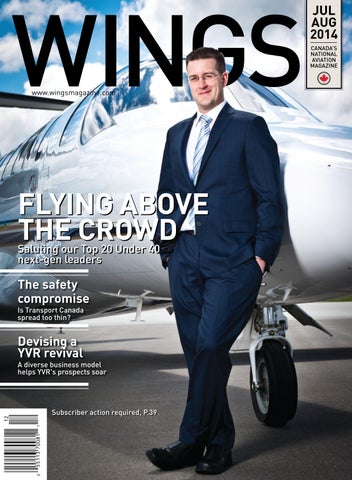
WINGS www.wingsmagazine.com
FLYING ABOVE THE CROWD
Saluting our Top 20 Under 40 next-gen leaders
The safety compromise
Is Transport Canada spread too thin?
Devising a YVR revival
A diverse business model helps YVR's prospects soar
PHOTO CREDIT TK
Subscriber action required, P.39
JUL AUG 2014 CANADA’S NATIONAL AVIATION MAGAZINE
The 850 Horsepower PT6A-42A Engine Upgrade From Blackhawk Blackhawk is a game changer. Short Runway. Tall Trees. Heavy Load. Go when the others can’t by increasing the horsepower in your Cessna Caravan or Grand Caravan with a new PT6A-42A engine upgrade from Blackhawk. Contact a Blackhawk engine upgrade expert today.
(254) 755-6711 | info@blackhawk.aero | www.blackhawk.aero
JULY/AUGUST 2014
UPFRONT 5 Leading edge
And the winner is . . .
8 On the fly
News and opinion
12 Alternate Approach Living the dream
14 At the Gate
Nurturing an essential program
15 Glidepath
Practising model behavior
BACK 58 Marketplace 62 On final
Fuelling a western revival
A diverse business model has helped YVR thrive in a competitive environment.
FEATURES 16 FLYING ABOVE THE CROWD
Wings and Helicopters expands its coverage of the industry’s brightest young stars BY MATT NICHOLLS
From top: Living the dream. P. 12 Practising model behavior. P. 15
30 IS TRANSPORT CANADA SPREAD TOO THIN?
Survey results suggest the regulator may be depending too much on SMS BY DAVID CARR
PHOTO: PAUL DIXON (RIGHT); AIR CANADA (LEFT TOP); PAUL DIXON (LEFT BOTTOM)
35 THE ORGANIC APPROACH Growing a sound safety culture BY BRIAN DUNN
40 DEVISING THE PERFECT YVR REVIVAL
Creating a diverse business model is key to the bustling airport’s future BY PAUL DIXON
44 SEEKING TO GROW
Can CARIC expand CRIAQ’s success? BY RICK ADAMS
48 FROM ROAD TEST TO FLIGHT TEST COVER PHOTO: AIRSPRINT
WWW.WINGSMAGAZINE.COM
Canada’s automotive research centre offers its services to the aerospace industry BY CARROLL MCCORMICK July/August 2014 | WINGS
3
Flying is my passion. And my job. Many of the airports I fly my clients into are located in major international cities. That usually means congested airspace and sometimes hard-tounderstand controllers. So I need to be on my game. Hear other pilots. Gather my clearances accurately. Because when I’m in control, I’m completely relaxed. And so are my passengers. Only then can I
focus on what matters,
flying.
MORE NOISE REDUCTION. MORE COMFORT.
®
Better sound can make all the difference, especially where you go. Which is why, with 30% greater noise reduction than conventional noise reducing aviation headsets, the A20 headset lets you hear more of what you need to hear. While proprietary cushions and minimal clamping force let you fly comfortably for hours. Meets or exceeds TSO standards.
To order 1.800.901.0497 | Learn more at Bose.ca/a20 | ©2014 Bose Corporation. Delivery is subject to product availability. CC014275
Bose A20
®
Aviation Headset
facebook.com/BoseAviation Made in U.S.A.
LEADING
EDGE
| By Matt Nicholls
And the winner is . . .
OK, we don’t have a red carpet, but our award programs rock too
S
PHOTO: SKYSERVICE
pring is a time for high-profile entertainment awards – from the hoopla of the Oscars and the dressed-up divas on the red carpet, to the brilliant performances of rockers at the Grammy’s, to the sophistication of the Tony’s, and more. It’s a celebration of excellence on a grand scale, the crème de la crème of many of our entertainment leaders. For the nominees – and of course the lucky winners – it’s a time to chronicle excellence for another year, to mark the time in an industry that inspires and excites the masses. At Wings and Helicopters, we certainly can’t match the pomp and circumstance of the red carpet pizzazz or the spectacular performances of Hollywood’s top performers, but no matter – we wholeheartedly embrace the chance to shell out the hardware with our own awards in two very-important verticals within our impressive markets. Call them the “Oscars of Canadian aviation,” if you will. These awards highlight excellence and achievements in the Canadian industry. We kick off two important award programs each spring with our annual search for top aviation and aerospace talent with our Top 10 Under 40 program, and our search for the Top FBOs in Canada. Our second annual Top 10 Under 40 program this year grew by leaps and bounds, as fixed- and rotary-wing operators and firms nationwide jumped at the chance to recognize their most influential employees under the age of 40. Nominated in most cases by top members of these companies’ management teams, the inspiring individuals represent overachievers in a variety of professions, including pilots, AMEs, aviation executives, COOs, aviation lawyers and more. All winners share a commitment to the growth of their firms, but they also show a high devotion to aviation and aerospace as
5 WWW.WINGSMAGAZINE.COM
a whole and a desire to help Canada continue to make its mark in the global marketplace. Often, their leadership skills extend to mentoring and nurturing the youth of tomorrow, helping them see the relevance of an aviation career and the value it brings
quest to find the top Canadian FBOs, fuel providers and others has also grown over the past number of years – and more surprises are likely afoot this year. Driven by a relentless desire to exceed customers’ needs, past winners show high levels of commitment to ensuring all the tiny details are met on so many key levels. As Zoran Bratujevic, president/ CEO of three-time national winner Starlink/Signature Montreal has told me on numerous occasions, it’s all about sweating the small stuff – employees who live and breathe the corporate mandate and “get it” on all levels. Please stay tuned, our fourth annual FBO winners will be announced in the September/October issue of Wings. In the end, it’s all about a high commitment to excellence – flying above the crowd to deliver results that exceed all expectations. It’s the driving force that all award winners of both our Top 20 Under 40 and Top Canadian FBO programs share. And no, winning these awards won’t get you the glitter of a red carpet appearance . . . but it’s still a special achievement, one that needs to be recognized and celebrated within the industry. Congratulations to all of our winners, very well deserved! | W
Their leadership skills extend to mentoring the youth of tomorrow – helping them see the relevance of an aviation career. on so many levels. I am also happy to report that participation in this year’s awards program was so overwhelming that we included 10 additional winners – a Top 20 Under 40 – with many more highly qualified competitors just missing the mark. The achievements, goals and influence within the industry of these outstanding young aviators are chronicled in “Flying Above the Crowd” on page 16. Like the Top 10 Under 40, Wing’s annual
TOP DATA BURSTS… in this issue 1. Air Canada is spending $360 million to refurbish its older 777s. (pg. 12). 2. 3.3 billion: The amount of revenue generated annually by the Canadian space program (pg. 14). 3. In 2010, TC spent $148 million to monitor 34,000 aircraft (pg. 30). 4. Some 25,000 local jobs flow directly from YVR activities (pg. 40). 5. $20 million: Estimated annual budget of the CARIC (pg. 44).
Your feedback is always welcome. Please contact me at mnicholls@annexweb.com. @Wings_Magazine July/August 2014 | WINGS
5
WINGS
JUL AUG 2014 CANADA’S NATIONAL AVIATION MAGAZINE
www.wingsmagazine.com
Vol. 55, Issue 4 EDITOR
Matt Nicholls mnicholls@annexweb.com 416-725-5637
FLYING ABOVE THE CROWD
Saluting our Top 20 Under 40 next-gen leaders
MEDIA DESIGNER
The safety compromise
Kelli Kramer
Is Transport Canada spread too thin?
FLIGHT DECK
Devising a YVR revival
Rick Adams, Krista Bulmer, David Carr, Paul Dixon, Brian Dunn, Frederick K. Larkin, James Marasa, Carroll McCormick, Anna Pangrazzi, Bill Zuk
A diverse business model helps YVR's prospects soar
SubScribe TODAY ! Subscriber action required, P.39
ACCOUNT MANAGER
Jarah Stefek jstefek@annexweb.com 519-429-5191
1 Year SubScription WINGS_JULYAUGUST14.indd 1
only
2014-06-19 10:55 AM
3000
$
ACCOUNT CO-ORDINATOR
Stephanie DeFields sdefields@annexweb.com 1-888-599-2228 ext. 257
(GST $31.50 • HST $33.90) US $42.00 (USD) • Foreign $65.00 (USD)
Name: _______________________________ Company: ____________________________ Title: _________________________________ Address: _____________________________ City: _________________________________ Prov: ________________________________ P.Code: _______________________________ Tel: __________________________________ Fax: _________________________________ email: ________________________________
PLeASe cHecK ONe: ❑ Commercial aircraft owner/operator ❑ Business/private aircraft owner/operator ❑ Military ❑ Aircraft maintenance/overhaul firm ❑ Airport ❑ Aerospace, airframe & component manufacturer and distributor
❑ Fixed base operator ❑ Aviation services, consultants and aircraft sales ❑ Government ❑ Aviation associations and organizations ❑ Flying schools, clubs and colleges ❑ Other (please specify) ______________
PAYMeNT: Cheque - Payable to Annex Publishing & Printing Inc. Visa
MC
AMEX
Account #: __________________________
NATIONAL ACCOUNT MANAGER
Mena Miu mmiu@annexweb.com 905-713-4351 GROUP PUBLISHER
Scott Jamieson sjamieson@annexweb.com PRESIDENT
Mike Fredericks mfredericks@annexweb.com WINGS MAGAZINE
P.O. Box 530, 105 Donly Dr. S., Simcoe, ON N3Y 4N5 Tel.: 428-3471 Fax: 429-3094 Toll Free: 1-888-599-2228
Publication Mail Agreement #40065710 Return undeliverable Canadian addresses to Circulation Dept., P.O. Box 530, Simcoe, Ont. N3Y 4N5 email: subscribe@wingsmagazine.com Published six times per year (Jan/Feb, Mar/Apr, May/ Jun, Jul/Aug, Sep/Oct, Nov/Dec) by Annex Publishing & Printing Inc. Circulation email: subscribe@wingsmagazine.com Ph: 866-790-6070 ext. 208 Fax: 877-624-1940 Mail: P.O. Box 530, Simcoe, ON N3Y 4N5 Subscription Rates Canada – 1 Year $ 30.00 (includes GST - #867172652RT0001) USA – 1 Year $ 42.00 Foreign – 1 Year $ 65.00 Occasionally, Wings magazine will mail information
on behalf of industry-related groups whose products and services we believe may be of interest to you. If you prefer not to receive this information, please contact our circulation department in any of the four ways listed above. No part of the editorial content of this publication may be reprinted without the publisher’s written permission. ©2014 Annex Publishing & Printing Inc. All rights reserved. opinions expressed in this magazine are not necessarily those of the editor or the publisher. No liability is assumed for errors or omissions. All advertising is subject to the publisher’s approval. Such approval does not imply any endorsement of the products or services advertised. Publisher reserves the right to refuse advertising that does not meet the standards of the publication. Printed in Canada ISSN 0701-1369
Expiry:_____________________________
TO SubScribe:
Tel: 866-790-6070 Fax: 877-624-1940 Mail: Wings Magazine c/o Annex business Media P.O. box 530 Simcoe, Ontario N3Y 4N5
Air Transport Association of Canada
ON THE
WEB
email: subscribe@wingsmagazine.com
www.wingsmagazine.com
GST#135274215RT001
6
Subscriptions non-refundable
PRO0714
WINGS | July/August 2014
wings subad.indd 1
Canadian Owners & Pilots Association
Canadian Business Aviation Association
Magazines Canada
CAREERS IN AVIATION Looking for a great career in aviation and aerospace? Check out our Careers in Aviation micro site, a great location to help you better understand what a career in aviation is all about. Go to www.careersinaviation.ca for news, updated listings and more!
PHOTO: STANDARDAERO
Signature: _________________________
WWW.WINGSMAGAZINE.COM 2014-06-19 1:27 PM
SHIPPING DANGEROUS GOODS CAN BE COMPLEX. WE CAN HELP.
Our team of expert consultants have over 160 years of combined experience to help keep you compliant. Our services include: • Compliance Assessments and Gap Analyses • Policy Manual and Standard Operating Procedure • Customized Training Development • Parts Classification • Special Permit and Approval Applications • Penalty Remediation Support • On-call Compliance Support
Only Labelmaster® offers the powerful trifecta of best-in-class software, professional consulting services and an assortment of products to keep you compliant, safe and efficient when shipping Dangerous Goods. Trust Labelmaster®.
514-656-3733
labelmasterservices.com
ON THE FLY For late-breaking news and exclusive web content, please visit us at: www.wingsmagazine.com
THE LEAD INDUSTRY HAPPENINGS AIRPORTS PEOPLE ON THE MOVE
THE LEAD
WATCHING WESTJET WestJet dipped a wing into trans-Atlantic waters this June, launching a seasonal, daily flight between St. John’s and Dublin, Ireland. “Atlantic Canada is underserved. Roughly one in five people in Newfoundland/Labrador are of Irish decent,” said Robert Palmer, WestJet’s manager of public relations. “They basically had to fly to Toronto and then fly back over their house on the way to Europe. We have essentially cut the flying time in half.” Dublin has been the most successful launch in WestJet history, with more than 80 per cent of seats sold and the program extended by three weeks. The route, which includes same-plane service to Toronto (allowing passengers to stop over for up to a week with no financial penalty), is likely the first step in establishing a broader international network, which will prospectively include the operation of wide-bodied airplanes. “No decision [has been] made yet, but we’re getting all the pieces in place to be able to make a good decision,” WestJet chief
executive, Gregg Saretsky, recently told analysts. One of the pieces that needed to be put into place was establishing a regional carrier. “It was a classic decision of do we go bigger or do we go smaller in terms of the type of aircraft; do we set up a regional service or an overseas service,” Palmer said. “We decided we needed to continue to bring additional guests into our network. We were running out of runway for the Boeing 737 in Canada. But we knew all along that it was a decision to go smaller to get bigger.” Since launching WestJet Encore in June 2013, the regional operations has already exceeded expectation, grabbing market share while also helping to grow the size of the pie through lower fares and improved schedules. “A little more than 50 per cent of guests getting on an Encore flight are getting on a WestJet flight,” Palmer added. “One of the purposes of launching Encore was bringing additional guests into our 737 network. It is doing that in spades.” Encore recently broke into the Ontario market with service between Toronto and Thunder Bay replacing a 737. “That was always one of the strategies of Encore, to put the right size aircraft on the right route and the right time of day,” Palmer said. The airline will soon be ramping up a Toronto hub with services to six other destinations including destinations the airline does not currently serve. This is a competitive strike that Ben Cherniavsky, an analyst with Raymond James estimates could take up to $150 million in revenue out of Air Canada’s
CTI Professional Flight Training has placed an order for 22 Diamond aircraft with a list value of US$7.8 million.
pockets through a lowering of fares. From Toronto, Encore will push east to Atlantic Canada where cities are closer together and ideal for a Q400 aircraft. Longer term, the airline will begin transborder service with short-hops similar to Porter Airlines. WestJet’s core strategy for regional markets has been to operate between underserved city pairs, putting downward pressure on ticket prices. It is a strategy Saretsky appears ready to take global. “Obviously, we are looking for markets that are burdened by very high airfares and there are lots of those in the international space so there are opportunities across many geographies.” The airline, which already serves destinations in Mexico, Hawaii and the Caribbean, is expected to ease into the international market. Certainly there are opportunities to go deeper into western Europe using the 737, which is already Extended range Twin Operations certified. WestJet has been “kicking tires at Boeing and Airbus, but an order for twin-aisle aircraft is probably 18-months down the road, with some analysts pointing to the Boeing 787 as a likely candidate, enabling WestJet to push into underserved markets in Asia and South America, in addition to service to Europe.
DIAMOND SHINES FOR U.S. FLIGHT SCHOOL
Since launching WestJet Encore in June 2013, the regional operations has already exceeded expectation, growing several new markets. 8
WINGS | July/August 2014
CTI Professional Flight Training has placed an ordered for 22 Diamond aircraft with a list value of US$7.8 million. The order, which includes options for an additional 10 airplanes, is for a mixed WWW.WINGSMAGAZINE.COM
PHOTO: WESTJET (BOTTOM); DIAMOND AIRCRAFT (TOP)
8 9 9 10
fleet of Diamond DA20 C1 single-engine and DA42 twin-engine trainers. “We looked carefully at all competitors in the marketplace,” said Alan Mullen, CTI’s chief executive. “At the end of the day Diamond’s safety record, low operating costs, modern design, training effectiveness and excellent customer service and warranty support left no rational alternative.” Formerly known as Crew Training International, CTI has traditionally specialized in advance training for military, government and corporate operators. The company has recently entered the flight school sector with the acquisition of Fort Lauderdale-based Professional Flight Training, including three flight simulators and 10 training aircraft. CTI will use the DA20-C1 as its primary trainer and the Austro Engine-powered DA42 for complex, multi-engine training. Diamond Regional Distribution Centre Premier Aircraft Sales of Fort Lauderdale negotiated the agreement, which includes training and support.
A PILATUS PC-24 SELL OUT Pilatus Aircraft’s first entry into the business jet market appears to be going well. The Swiss-based airframer has sold all 84 delivery slots for its PC-24 aircraft, taking production of the $9-million, superlight twinjet to the end of 2019. Customers
Pilatus has launched the new PC-24, a souped up version of the popular PC-12 (above).
interested in purchasing fin number 85 and beyond are going to have to cool their heels for a bit. Taking a page out of the theatre operator’s playbook, Pilatus is holding back on taking orders beyond the initial production run. “Pilatus made a deliberate decision not to accept orders for deliveries from 2020 or afterwards, preferring to wait until a later date to announce plans for the opening of the order books for PC-24 deliveries from 2020,” the airframer said in a statement at the European Business Aviation Convention and Exhibition (EBACE), where the Pilatus booth featured a giant screen, symbolizing an order book on which visitors followed the progress of the self-described “super versatile jet.” A 1:1 mock-up of the aircraft was also on display. “Over 10 years ago we started asking our PC-12 customers what they would like to see in the next Pilatus aircraft,” Oscar J. Schwenk, Pilatus chair said during the PC24 launch. “The answers were always the same: further and faster while retaining
the much-appreciated strengths of the PC-12, such as the ability to use very short runways. It was a huge challenge for our development team.” The team has met the challenge with an aircraft Pilatus says combines the versatility of a turboprop, cabin size of a mediumlight jet and performance of a light jet. “It’s a plan that simply doesn’t fit into any of the existing business jet categories. That’s why we had to create a new one. The PC-24 has been engineered to be off-road compatible from the beginning.”
AIRPORTS
AIRPORT EXPANSION IN FORT MCMURRAY, CALGARY Fort McMurray Airport opened a new $258-million passenger terminal in June, replacing an aging building that has struggled to keep pace with climbing
PHOTO: PILATUS (TOP); BOMBARDIER (BOTTOM)
INDUSTRY HAPPENINGS
Bombardier Aerospace transported the largest aircraft mock-up in business aviation to Geneva in May for the annual European Business Aviation Conference and Exhibition. The mock-up showcased the aircraft’s spaciousness, which features four distinct living spaces, including a private stateroom, and the largest total window area, allowing for more natural light inside the cabin. WWW.WINGSMAGAZINE.COM
July/August 2014 | WINGS
9
ON THE
FLY
passenger volumes at Canada’s fastestgrowing airport. The hub of Alberta’s oil production, Fort McMurray, with a base population of approximately 105,000, is a transient town with oil workers shuttling between home and work after a typical 20 days on, 10 days off shift rotation. Traffic at Fort McMurray increased 25 per cent in 2013 to 1.3 million passengers, making the airport Canada’s 16th busiest. Growth is expected to “slow” this year to 12 per cent, but is likely to pick up again as Alberta’s energy production doubles over the next 10 years to 4.5 million barrels a day. The airport’s original terminal is 30 years old and has capacity for 250,000 passengers. The new building is five times the size with amenities such as larger passenger lounges, two sit-down restaurants, shops and fast food outlets, although Fort McMurray’s chronic labour shortage and suspension of the federal immigrant worker program means that no merchants will have
to operate understaffed or curtail hours. Approximately 60 per cent of Fort McMurray’s passengers fly to destinations within Alberta and British Columbia, although there is a healthy flow of traffic from Ontario and Atlantic Canada. The new terminal enables Fort McMurray to increase the number of direct flights to Las Vegas and western sun destinations (the older terminal will remain open for charter flights), which might divert some traffic from the Edmonton International Airport, approximately 435 kilometres southwest. Retired Canadian astronaut Chris Hadfield presided over a gala opening on May 30, where Randy Bachman and Fred Turner of The Guess Who and BTO fame rocked the building. Despite the celebrity power, the terminal remained the star of the evening. The 15,000-square-metre building was built from prefabricated modules transported in, and the Fort McMurray Airport Authority expects further expansion within the next five years.
Further south, the Calgary Airport Authority kicked off the opening of its new runway with a weekend Run and Roam the Runway weekend event. An estimated 10,000 people showed up over two days to participate in runs along the 4.2-kilometre runway – Canada’s longest – or roam the strip while viewing vintage airplanes and sampling treats from YYC Food Trucks. The first flight departed from the runway five days later. The $600-million runway is part of a $2-billion expansion that includes a 22gate international concourse scheduled to open in 2015. Calgary reported a 4.3 per cent increase in passenger volume in 2013, to 14.3 million, overtaking Montreal’s Pierre Trudeau International Airport as Canada’s third busiest.
PEOPLE ON THE MOVE Clément Fortin has been appointed president and chief executive of the Consortium for Aerospace Research
special certificate Workshops sessions aUgUst 2014
Workshops and symposium
thank you for your confidence over the years Canada. We’re now a Canadian company and want to repay your trust with some very special educational events. •
•
Workshops in Quality Assurance, Root Cause Analysis and Corrective Action Plans and required Basic Auditing Skills
•
Special rate for our Canadian friends see our website for details
annUal Qa/sMs syMposiUM
No one knows Quality Assurance, SMS or Regulatory Compliance issues like us.
being held once again at the Coronado Springs Resort inside Disney World Florida!
Don’t miss the Annual DTI Training SMS/QA Symposium Coronado Springs Convention Resort, Disney World, Florida! early bird registration: A special fee for our Canadian friends INCLUDES 3 nights lodging
WWW.DTITRAINING.COM • WWW.DTITRAININGCANADA.CA • 1-866-870-5490
DTI Ad_Apr14.indd 1
•
We have worked with over 100 Canadian aviation enterprises and have held 3 major contracts with Transport Canada.
visit oUr Website for More info
10 WINGS | July/August 2014
with the latest methods and Regulatory revisions being held in Winnipeg and Calgary this August.
JanUary 4-6, 2015
•
This years theme “the Future of Regulations in QA & SMS” with our guest speaker, Martin Eley – Director General of Transport Canada
• •
2 days of Certificate workshops Bring your family and mix business with pleasure
•
A great way to meet and greet influential industry colleagues in an intimate atmosphere (less than 100 seats are available for this years event
BOOK Early!
less than 100 seats are available for this years event!
WWW.WINGSMAGAZINE.COM 2014-06-10 1:19 PM
and Innovation in Canada (CARIC), a joint initiative by the Aerospace Industries Association of Canada and Consortium for Research and Innovation in Québec (CRIQ). Formally launched at a CRIQ innovation forum in April, CARIC is a national research and technology network that unites stakeholders from industry, universities, colleges and research institutions to advance strategic aerospace technology areas and facilitate collaborative research and development. “The establishment of CARIC offers participating organizations a competitive advantage and boosts aerospace innovation, while giving Canada a strategic expertise that consolidates its global leadership,” Fortin said. The establishment of CARIC reflects the recommendations of the Aerospace Review Report released in 2011 . . . Tasneem Hashmié has been appointed manager of FlightSafety International’s Toronto Learning Centre. Hashmi has
held a number of positions of increasing responsibility since joining FlightSafety in 1999 at the Toronto Learning Centre. He started as a ground school and simulator instructor for the Twin Otter. He then served as program manager for FlightSafety’s Twin Otter and Bombardier Dash 8 training, quality coordinator and manager of the centre’s Safety Management System. He was promoted to director of training in 2001 and most recently served as assistant centre manager. Hashmi holds a Master of Science degree in Management and Strategic Leadership from New England College in New Hampshire. He was a pilot for Union Texas Petroleum and Exxon Mobil prior to joining FlightSafety . . . Patrick Coulter has been promoted to director, business development, commercial training for FlightSafety. Coulter joined FlightSafety in 1998 as ground school and simulator instructor at the
Learning Centre in Toronto. He will work to identify, secure and manage growth opportunities and help to determine optimum locations for simulators and the expansion or establishment of training facilities as FlightSafety seeks to further expand its presence in the commercial aircraft training segment . . . Skyworld Aviation has engaged Andrew Moore of airside as marketing representative in North America. Skyworld Aviation is a specialist in regional aircraft marketing, organization and offers consultancy, marketing and asset management services to a global client base. Moore has been involved in the regional aircraft sector for more than 30 years, having worked at Bombardier, the U.K.’s BAe and Macquarie Aviation Capital, focusing on aircraft and engine financing and marketing. He will assist Skyworld in placing its current aircraft inventory primarily in Canada, the U.S. and Caribbean.
Say Goodbye to “Say Again” Clear communications with FANS and CPDLC
Fast, secure CPDLC datalink “text” messaging eliminates radio communications confusion and gets you to the front of the line. Equip for FANS 1/A+ and CPDLC with SBAS Flight Management Systems, UniLink® Communications Management Units and datalink-recording Cockpit Voice Recorders. Contact an Authorized Dealer or visit www.uasc.com/fans. Say Goodbye to “Say Again”.
WWW.WINGSMAGAZINE.COM Wings FANS July_Aug 2014 Ad_01.indd 1
UniLink UL-801/UNS-1Ew
www.uasc.com sales@uasc.com (800) 321-5253 (520) 295-2300
July/August 6/12/14 2014 | WINGS 11:22 AM11
ALTERNATE
APPROACH By David Carr |
Living the dream
Boeing 787 is the centrepiece of Air Canada’s global jigsaw puzzle
I
12 WINGS | July/August 2014
elsewhere, and directly connect Calgary with China, a route coveted by the Calgary Airports Authority. The question now is: who will be next? WestJet is facing the same saturated domestic market as AC, even as Encore carves out greater share regionally. As the economics of longer-distance leisure travel, especially to Asia, become more attractive as a result of Canada’s population demographic and aircraft such as the 787 and A350, expect a larger share of the market to book vacation packages to destinations that are out of reach of Air Transat, an Airbus airline, with its current fleet. What the 787 will not do from a passenger’s perspective is satisfy an expectation for significantly lower air fares. A lot of balls get juggled when setting fares, and the 787s fuel efficiency and economics are easily offset by currency exchanges, soaring fuel prices and taxation, such as an Ontario proposal to raise aviation fuel taxes two cents a litre. In a capital-intense industry with paper-thin profit margins, a slowing of fare increases is likely the best the market can hope for. After all, the airplane was christened Dreamliner, not Miracleworker. | W
The pure magic of the 787 is not in its hubbing potential but on point-to-point. the world’s busiest international airport. But that’s a story for another day. Still, the pure magic of the 787 is not in its hubbing potential but on point-topoint. Early on, Airbus and Boeing bet on very different visions of the future of air transport when launching the A380 and 787. Boeing clearly won the bet, although Airbus hedged wisely by launching the A350. It is now AC’s turn to cash in. A new daily service from Toronto to Tokyo Haneda will be joined with services to Tel Aviv, Vancouver to Shanghai, a return to India and potential to fly deep into China beyond the big too destinations. To date, much has been written about swapping out 767s with an airplane that offers superior range and economics. What does that mean to markets outside the two primary hubs? Over the long term, AC has greater flexibility to open the underserved Maritime and Atlantic provinces to a broader menu of international destinations (AC recently announced year-round services between St. John’s and Heathrow), expand Montreal as a secondary hub with point-to-point service to Asia and
David Carr is a Wings writer and columnist. WWW.WINGSMAGAZINE.COM
PHOTO: AIR CANADA
t was a sight to behold. Hundreds of Air Canada (AC) elite passengers, some with more than one million miles under their belt, waiting for more than an hour inside a hanger at Pearson International Airport to catch a glimpse of the airline’s future: the first Boeing 787 Dreamliner. Since April 1, 1960, when Trans-Canada Air Lines’ first Douglas DC-8 screamed out of Montreal’s Dorval Airport, AC has integrated 13 different types of jetliners into its fleet, including airplanes operated by Canadian Airlines at the time of the merger. More than any jetliner that arrived ahead of it, the 787 is perhaps AC’s signature aircraft – an airplane that appears almost tailor-made for the long and thin routes that would make up the bulk of Canada’s global marketplace. Like the country it serves, AC has historically punched above its weight internationally – a lot of that during its time as a Crown Corporation when money was a trade-off for flying the flag. Competing in a crowded domestic market that is certain to grow tighter as WestJet Encore expands, AC’s more expansive global ambitions have been pinched by the 767, an airplane the airline has clearly outgrown. The older Boeing may have had the right number of seats for some of the longer and thinner routes the airline wants to serve (the Toronto to Rio de Janerio route that will be launched in December for example), but its limited range blocked AC from going the distance to press its award-winning cabin service advantage into new markets, especially in the surging Asian markets. Now is where the dream begins: a fleet of 787s, high-density triple-sevens and a $360-million refurbishment of older 777s with the new, so-called International Cabins beginning in 2015 (and a smaller number of Airbus A330s) to turn primary hubs in Toronto and Vancouver into global crossroads, boosting revenue by connecting the dots between Asia, Europe and the United States. The model, for Toronto at least, is Amsterdam, where KLM, serving a population half the size of Canada, built Schipol into a major connector airport serving 52.5 million passengers last year. Another example is Emirates, where the Dubai (population 2.1 million) airport is expected to surpass London Heathrow as
We go the Extra Mile
For the 8th year in a row, Irving Aviation’s Gander (CYQX) FBO is ranked the #1 FBO in Canada by Pro Pilot. Visit us to find out why.
Thank you to our customers for their loyal support and our exceptional team for their superior service standards. Gander CYQX | Goose Bay CYYR | St. John’s CYYT irvingaviation.com
AT THE
GATE
By Brian Dunn |
Nurturing an essential program CSA president Walter Natynczyk expands on Canada’s role
C
14 WINGS | July/August 2014
stakeholders in the program and a consensus was reached by the creation of the CSA in 1990 that brought together 21 different government departments and all provincial space programs. “What’s the next breakthrough technology for Canada? Communication satellites, optics and robotics are where Canada is a leader,” Natynczyk noted. It was suggested after the presentation that maybe Canada should not rely on other countries to send our astronauts and satellites into space, and that we should have our own rockets with financing partially coming from the private sector. “When I work with my counterparts from all the other agencies around the world, they’re absolutely impressed by the value that Canada achieves and successes we’ve had in orbit, both in terms of exploration and satellite operations, because we’re able to put our effort into spacecraft,” he said. “There are a lot of countries . . . that are into the launch business and so we’re able to leverage the existing launch capabilities around the world to get the best price points. And so what we’re able to do is get extraordinary value for the Canadian dollar.” Natynczyk was also asked if his agency has had to cut some programs due to budget constraints. “No. We’ve got the funds we need to run all the programs that we have now,” he said. “The government of Canada has put a lot of money into these granting councils, and some of them haven’t spent money on space for many years even though it’s in their charter to spend money on space. So we’re trying to build those relationships and partnerships.” | W
Space is essential for everyone in Canada and its success requires a full-time investment . . . and it requires co-operation. Americans, on such projects such as the international space station is essential. The fourth principle is the promotion of Canadian know-how like the Canadarm and Canadarm II, which are vital for the space station maintenance and for other uses on earth such as surgical procedures. The fifth principle is the development of future “space pioneers” by encouraging future generations to study space and pursue careers in space-related industries. One step in that direction is a summer program for 110 of the brightest space students from around the world being presented by HEC Montreal. “The Canadian space program is alive, and it relies on 200 companies with 8,000 workers, and depends on international friends,” said Natynczyk. There were many
Brian Dunn is a Wings writer and columnist. WWW.WINGSMAGAZINE.COM
PHOTO: CANADIAN SPACE AGENCY
anadians reap the benefits of space technology on a daily basis, whether it’s satellite television, GPS navigation on land, in the air, or among other uses such as monitoring climate change or facilitating agriculture, according to Walter Natynczyk, president of the Canadian Space Agency (CSA). “Space is essential for everyone in Canada and its success requires a full-time investment, and it requires co-operation,” he said in a recent speech to the Montreal Council on Foreign Relations. He referred to an industry review by former cabinet minister David Emerson, who said Canada’s space program has floundered recently and that an increase in global competition was affecting Canada’s aerospace industry. Natynczyk also noted that Canada’s space industry employs some 8,000 people and generates $3.3 billion in annual revenue, half from exports. Further, it employs 1,300 researchers at 30 Canadian universities. “My sense is all of us take space for granted,” he said. “We talk about (retired astronaut) Chris Hadfield and the Canadarm, but little else. The reality is everybody relies on space and space is about international co-operation and that’s why we’re committed to an international partnership and the ($100-billion) international space station.” Industry Minister James Moore is trying to encourage more co-operation between the government, private and education sectors for space research and space projects, Natynczyk pointed out. He said the space industry is “congested” with more than 1,100 satellites in space. And while there’s more competition, there are also more opportunities for exports. Natynczyk listed five principles governing Canada’s space program. The first is Canada needs a space program for our national interest, security and sovereignty. He noted Radarsat is one of the best imagery systems in the world. Space is also an economic engine for Canada with highly qualified personnel that support the auto, mining and medical professions, among others, with innovative technologies. The third principle is that the need to work with other international partners, such as the Russians, Japanese, Europeans and
GLIDE
PATH
| By Paul Dixon
Practising model behaviour
The art of making paper airplanes and surviving Grade 8 science
PHOTO: PAUL DIXON
P
icture yourself as Peter Graves, at the start of yet another episode of Mission Impossible, when his character Jim Phelps would extract that impossibly small tape recorder from under the shelf in a phone booth (you do remember phone booths, don’t you?). Your mission this week, Mr. Phelps, is to find the perfect airplane and let nothing stand in your way. As the tape starts to self-destruct the enormity of the task sinks in. Have you been singled out to fulfill the CF-18 replacement project? The fixed-wing SAR replacement per chance, or could it be another kick at the Maritime Helicopter project? No friend, it’s nothing quite that simple, it’s the dreaded Grade 8 Science Fair project. I can’t speak for the rest of Canada, but in B.C., the annual Grade 8 Science Fair is part of the curriculum for every student and by default, parents, guardians and the assorted passers-by. Above all, it’s an exercise in making time stand still, in stretching a seemingly simple project over four months while making it seem like four years. Motivating, exhorting, cajoling and even begging seem to have little effect on today’s 13-year-olds (if they ever did) in an exercise that makes Sisyphus look like a clean breakaway in comparison. OK, we finally settle on doing something to do with paper airplanes. So, what are we looking for? Is there a “best” paper airplane? Turns out it’s not quite that simple. There’s a world record for distance (226 feet and 10 inches) and another record for longest time flying (29.2 seconds), but it’s not the same airplane design. Then there’s the highest-flying paper airplane. There are books of paper airplane designs, scores of YouTube videos and hundreds of web sites all touting the “best” paper airplane. Is it possible that they are all as wonderful as they are made out to be? Are any of these designs worth the paper they are drawn on? The project hinges on creating a means to evaluate paper airplanes based on distance flown. Our project engineer (my grandson) studies a wide range of potential designs and selects five models for evaluation, a “fly before you buy” program. All five are touted as superior performers, but WWW.WINGSMAGAZINE.COM
analyze the data, which will form the basis of your display at the Grade 8 Science Fair. There was one big winner in the competition. The name Belly Button Glider may not cause you to look up in the sky, but it was the model that flew furthest, both as the single longest throw and for the average of the group. The actual Science Fair sees four classrooms turned into a maze of table-top displays, with a roiling mix of students, and parents with the occasional teacher tossed in, all swimming upstream against a fire hose. You’ve likely heard the comment that Grade 8 is the acid test for life – if you can make it through Grade 8 relatively unscathed then your life should work out just fine, though there’s always a few that find Grade 8 to be the longest five years of their lives. It’s one thing living through these phases of our lives as part of growing up (so I’ve been told), but it’s quite another thing altogether when one chooses to live in that world permanently as evidenced by the current state of politics in this country. Paper airplanes or real airplanes, it’s not that difficult to reach a decision if you understand the issues at hand and can follow the rules of nature. | W
Motivating, exhorting, cajoling and even begging seem to have little effect on today’s 13-year-olds. they are all significantly different from each other. Paper airplanes obey the same laws of physics as their larger, non-paper brethren – lift, gravity, drag and thrust, so care must be taken in the actual construction process to ensure that each example of a particular type conforms to the design as closely as possible. All of the aircraft are made from the same size sheet of 24-pound paper, though the finished size depends on the number of folds. The airplane made from the simplest design dwarfs the finished product of the most complex design, which was well along the road to origami. You need to build 12 examples of each of the five models, to give a decent sampling. Now, you have to find a controlled environment where weather and external factors can’t influence the test. So, it’s off to the school gym early one morning with the project engineer and a 100-foot tape measure. We set up a simple grid on the gym floor and let the chucking begin, ensuring that the same motion is used to minimize variations in thrust. We make our measurements, collect the data and prepare to
Paul Dixon is freelance writer and photojournalist living in Vancouver. July/August 2014 | WINGS 15
James Elian is the COO of Calgary-based Airsprint Inc.
FLYING ABOVE THE CROWD
WINGS AND HELICOPTERS EXPANDS ITS COVERAGE OF THE INDUSTRY’S BRIGHTEST YOUNG STARS
BY MATT NICHOLLS
F
inding (and retaining) dynamic employees who can lead, innovate and transform corporate cultures is a goal management teams nationwide are always striving to attain. And with a looming crisis of retiring pilots, maintenance workers and other skilled aviation and aerospace professions, the search for these multi-dimensional allstars is suddenly paramount. Fortunately, Canada is blessed with talented young aviation and aerospace personnel and many are under the age of 40. In Wings and Helicopters second annual next-gen leaders special report, we proudly highlight some of these top achievers – men and women who have helped transform their organizations in maintenance, business operations, flight operations and more. And this year, we’ve taken it up a notch – highlighting 20 top achievers who are making their marks in their respective organizations. The 20 individuals featured here were carefully selected by our editorial team following an online contest that ran earlier this spring. Candidates were nominated by colleagues based on their influence to drive change, leadership skills, commitment to clients/colleagues, and their forward thinking towards the industry as a whole. In most cases, nominators had several years of experience working with the candidates, observing how they cultivated their skills and grew in their respected spheres. Featured alphabetically, our Top 20 Under 40 achievers represent the resourcefulness, commitment and dedication organizations are craving in today’s marketplace. On behalf of the nominees, candidates and winners, we thank you for your support and salute the achievements of all who participated.
Twining, and he’s helped build a law practice defending mostly operators and pilots in legal actions arising from aircraft accidents. In addition to providing career advice to readers of his book, Ball regularly writes and speaks on various aviation law topics. He also continues to contribute articles to various industryspecific magazines. Ball’s commitment to the legal and aviation communities is commendable, particularly given his young age – he has achieved more than most could hope for before turning 40.
NAME: JAMES BALL TITLE: ASSOCIATE LAWYER, WHITELAW TWINING LAW CORPORATION LOCATION: VANCOUVER
PHOTO: WHITLAW TWINING LAW CORP.
NAME: BRENDEN BEAUDOIN TITLE: PILOT, AIR CANADA James Ball, 34, is a licensed commercial pilot, author of the LOCATION: EDMONTON book, “So, You Want to be a Pilot, Eh?” and an aviation lawyer at Whitelaw Twining Law Corporation in Vancouver. A graduate of Seneca College’s Aviation and Flight Technology program, Ball was previously a first officer on fixed-wing medevac aircraft and then a captain and training captain on charter aircraft in Northern Manitoba and Nunavut. Having had his fill of the life of a northern pilot, Ball returned to school and completed a Bachelor’s degree in Geography and his law degree. While in school, he wrote the book, “So, You Want to be a Pilot, Eh?” which provides career advice for aspiring pilots. The book has sold more than 2,000 copies and has been a valuable resource for many aspiring men and women entering the profession. Ball is now a key part of the aviation legal team at Whitelaw WWW.WINGSMAGAZINE.COM
It’s fair to say that Brenden Beaudoin lives and breathes aviation . . . and has for his entire life. Beaudoin, 31, is a pilot with Air Canada (AC) and is living a life many only dream of – working as a commercial airline pilot with Canada’s national airline. He started his career journey on one of the most vaunted days in history – Sept. 11, 2001 – at the Centennial flight school in Edmonton. Working diligently, Beaudoin attained his commercial pilot’s licence in 2005 and commenced a career path that has taken him all around the globe with a variety of different aviation firms. He has worked in a wide range of capacities, from loading cargo, to fueling and marshaling jets and has flown tourists in the worldfamous Okavango Delta and different parts of Southern Africa, July/August 2014 | WINGS 17
for extended periods of time. As a 25-year-old, Betz was in the process of settling in as Heavy Maintenance Shop Supervisor at VIH’s Prince George facility – and had just finished completing a pair of pre-purchase inspections in northern Manitoba – when he received a call from a trusted colleague. He was told a “friend” had just toured Slave Lake’s brand new hangar (still in final construction) and the owners were looking for someone to come on board and “pick the colour of their new office.” The “friend” immediately thought of Betz to pick the colour. After Betz and his wife met with the owners, they decided to take the plunge. The plan was to have Betz work as a contract engineer under Tempest Maintenance Solution’s AMO, the company’s maintenance partner at the time. Slave Lake had every intention of creating an AMO position for Betz, but he was too young to legally hold the Director of Maintenance designation. In 2007, however, he successfully completed his AMO designation and gained Transport Canada approval to become Director before returning to work as a bush pilot in Canada. of Maintenance for Slave Lake. Beaudoin’s career path has also taken him to the charter busiA tremendous mentor with a terrific attitude and vast knowlness for five years, and flying medevac flights before joining AC edge of his role, Betz is an integral part of the Slave Lake team and in 2012 at age 29. Beaudoin is also starting his own aviation con- a shining light in the industry. sulting company and is very active in Edmonton’s remote-control airplane community. An active advocate of Canadian airports – and a strong proponent of Canada’s rich aviation history – Beaudoin is the perfect NAME: SCOTT CONLIN example of a young pilot who is willing to do anything to reach his TITLE: CHIEF ENGINEER, CALGARY POLICE SERVICES AIR SUPPORT UNIT or her ultimate career goal.
LOCATION: CALGARY
Peter Betz prides himself in consistently keeping the blades turning at Slave Lake Helicopters. For the past seven years, the 33-year-old Betz has been the Director of Maintenance for Slave Lake, initially earning the position at the young age of just 26. Betz graduated from Northern Northern Lights College in 2000 and began his apprenticeship with Northern Mountain Helicopters (NMH). He subsequently moved to Vancouver Island Helicopters (VIH) along with the assets of NMH when the company went out of business. Hardly skipping a beat, Betz performed field and heavy maintenance for VIH and also managed remote bases such as Ft. Nelson and Sandspit on the Queen Charlotte Islands 18 WINGS | July/August 2014
If anyone in Canadian aviation deserves the label “unsung hero,” Scott Conlin just might be it. Conlin, 36, is the Chief Engineer of the Calgary Police Service (CPS) Air Support Unit in Calgary and like many aviation personnel working behind the scenes, he is one of the critical elements that contribute to the success of the organization. The Calgary Police Service operates two helicopters in support of police operations for a city of 1.2 million. The CPS Air Support Unit was created in 1995 after the tragic line of duty death of Cst. Rick Sonnenberg and has been operating ever since thanks to the Helicopter Air Watch for Community Safety (HAWCS) program. Four years after its inception, Conlin joined the operation as a contract engineer. Conlin began his permanent career as a Line Engineer, and in 2004 was promoted to the position of Chief Engineer. Since then, his unit has grown from a single helicopter operation flying less WWW.WINGSMAGAZINE.COM
PHOTOS: AIR CANADA (TOP); GREAT SLAVE HELICOPTERS (BOTTOM LEFT); CALGARY POLICE SERVICES AIR SUPPORT UNIT (RIGHT)
NAME: PETER BETZ TITLE: DIRECTOR OF MAINTENANCE, SLAVE LAKE HELICOPTERS LOCATION: SLAVE LAKE, ALTA.
than 1,000 hours per year to an operation flying more than 2,500 hours a year. He has strived to ensure the unit’s maintenance requirements meet or exceed the commercial standard and is committed to the unit’s safety above all else. Conlin is always on the lookout for new technologies and continually tries to ensure that his unit is operating at the highest technological level possible. He has worked tirelessly to understand the mission of Airborne Law Enforcement and continually goes above and beyond to ensure his crews have the tools they need to execute their missions effectively. His dedication to his role and commitment to incorporate the highest safety standards possible are certainly worth celebrating.
NAME: RobERt CotE JR. tItLE: QuALIty AssuRANCE MANAgER, CANAdIAN HELICoptERs Ltd. LoCAtIoN: EdMoNtoN
PHoTo: Hnz grouP (lefT); bell alianT (ToP);
NAME: dARRyL CRoss tItLE: pILot, FLIgHt LogIstICs MANAgER, bELL ALIANt LoCAtIoN: HALIFAx
Robert Cote Jr. perfectly embodies the concept of “work ethic.” Never content to accept “good enough,” the 37-year-old Quality Assurance Manager with Canadian Helicopters Ltd. is driven on a daily basis to perform to the highest standard and to encourage and mentor both peers and subordinates in the same goal. Since his first days as an apprentice aircraft maintenance engineer, Cote Jr. has demonstrated a strong intellect and a desire to learn. Whether working as a Product Support Engineer for Bell Helicopter or working as the Bell Maintenance Manager for Canadian Helicopters, he knows the importance of customer service. His work with third-party suppliers and with Canadian, has allowed him to leverage his skill sets to create a valuable toolkit and reputation as a top-notch AME. And his unwavering personal high standards have helped him to ascend to the role of Chief AME for Western Canada within Canadian Helicopters and subsequently to his current position. Cote Jr.’s interpersonal skills are a big part of his success. His relationship with a variety of OEMs, third-party vendors and regulators has facilitated the company’s success on many levels. These relationships have expanded to tripartite discussions with airworthiness inspectors from the U.S., Australia, New Zealand and Canada and have greatly enhanced Canadian Helicopters and its parent, HNZ Group Inc., in its operations worldwide. Professional, smart, driven, keen to learn, and reliable, Cote Jr.’s work speaks volumes as it epitomizes the phrase “industry best practice.” www.wingsmagazine.com
For the past 10 years, Darryl Cross has been a shining star for Halifax-based Bell Aliant. The 36-year-old’s resume is certainly an impressive one. Private Pilot’s licence from the Interlake International Flight Centre, check. Class A Licenced Dispatcher from Air Canada Jazz, check. Commercial Pilot’s Licence from the Moncton Flight College, check. Multi Engine IFR rating from Greenwood Flight Centre, check. Cross also hold a diploma in Aircraft Mechanics. From a professional standpoint, Cross has demonstrated a strong work ethic and outstanding leadership qualities throughout his career. He kicked things off as a Line Service Technician with Provincial Airlines in the late-1990s before moving to Air Canada Jazz as a Certified Class A Flight Dispatcher with Air Canada Jazz in the early-2000s. He moved to Bell Aliant in 2004 and has held various roles for the firm, including Flight Scheduler, Pilot and Flight Logistics Manager, Apprentice AME and more. Cross continually leads by example through the development of new initiatives and procedures to assist and guide others in making informed decisions. He demonstrates excellent project management skills and exhibits strong leadership and organizational skills in the completion of many critical projects. Active in the aviation industry in a variety of roles, Cross inspires others with his positive attitude, exceptional work ethic and interest in developing and expanding his knowledge in the industry. He is truly a shining star when it comes to the next generation of aviators, engineers and aviation professionals.
NAME: CHRIs dAvENpoRt tItLE: AIRCRAFt MAINtENANCE ENgINEER, oRNgE LoCAtIoN: LoNdoN, oNt. Juggling a variety of different tasks in high-tempo, demanding environment is something Chris Davenport thrives on. Davenport, 26, is an Aircraft Maintenance Engineer based in London, Ont., with Ontario medical transport provider Ornge. He has spent the past seven years keeping S-76 and AW139 helicopters in the skies and, at times, the work can be July/August 2014 | wings 19
place during the 2010 Winter Olympics in Vancouver. He was instrumental in his role during the Games, supporting all of the corporate aircraft that flew into the city. For two weeks, he provided 24-hour support and troubleshooting for Learjets 35/36, 45, 60, Challengers, Falcon 50EX, Globals, Gulfstreams and more. It may have been only two weeks, but these busy days created a lasting impression with customers . . . and he hasn’t missed a beat since. He classifies his greatest strength as an ability to troubleshoot pretty much any problem and never giving up until it’s rectified.
quite demanding. Time is of the essence with Ornge, where seconds saved in maintaining the aircraft can mean lives are saved as well – and that can’t be done when the birds are on the ground. Aircraft need to be available for dispatch and Davenport works hard to ensure this is the case. Davenport has a wide range of responsibilities at the base including technical records, storing shipping and receiving requests, computer/IT issues, general housekeeping, training and much more. If there’s an avionics snag at the base, Davenport is your man – he will find a fast, effective solution for safe rectification. The ever-evolving computer-based aircraft systems at Ornge require an IT-like finesse job, and Davenport certainly has the acumen to deliver. Proactive and thoroughly on board with the team concept, Davenport instills a “happy-go-lucky” attitude and positive vibe that keeps the Ornge team in London focused and ready for action.
NAME: JOSHUA DERISH TITLE: AVIONICS ENGINEER, AVMAX AVIONICS LOCATION: RICHMOND, B.C. Joshua Derish is rapidly building a solid reputation as a “go-toguy” at Avmax Avionics. At just 28, Derish has managed to attract clients from all over the world to Avmax’s Richmond, B.C., location, as customers fly in from locations throughout the globe with assurances that their avionics needs will get looked after with the highest degree of reliability, knowledge and experience. One of the best examples of Derish’s accomplishments took 20 WINGS | July/August 2014
For Anthony Dyck, leading by example is simply a way of life. The 33-year-old has spent the past decade honing his skills as an Aircraft Maintenance Engineer with Winnipeg’s Fast Air Ltd. and has developed into one of the company’s brightest young talents. Dyck has been instrumental in helping the company expand its third-party maintenance capabilities by providing aircraft upgrades with Garmin and HALO products. He has also been recognized by Gulfstream to sit on its Customer Advisory Board, in which he has been an active member for the past two years. Respected as a true leader within Fast Air’s dynamic and broad maintenance business, Dyck manages the complexity of a charter WWW.WINGSMAGAZINE.COM
PHOTOS: ORNGE (TOP LEFT); AVMAX AVIONICS (TOP RIGHT); FAST AIR LTD. (BOTTOM)
NAME: ANTHONY DYCK TITLE: AIRCRAFT MAINTENANCE ENGINEER, FAST AIR LTD. LOCATION: WINNIPEG
A True CAreer AlTernATive AirSprint is striving to provide Canadian pilots with a true career alternative to the airlines. We are proud of our exceptional safety record that we have achieved through the support of our dedicated team, and through the adoption of airline quality training, procedures, and maintenance. We offer stability that is uncommon when flying business jets, as well as competitive wages and benefits. I am also pleased to announce the introduction of a fair share preferential bidding system that will provide our pilots with increased control over their schedule leading to an improved quality of life. Having recently added our 6th brand new Citation CJ2+ to our fractional fleet, we are looking for customer focused professional pilots to help us build on our 14 years of success. For more information, take a look at our website or give me a call and I would be happy to speak with you. James Elian Chief Operating Officer
Safety – People – Service – Integrity – Humility – Community. www.airsprint.com I 1-877-588-2344
fleet, medevac fleet, multiple managed jets, as well as Bell Jet Rangers. He does it all with a focus on teamwork, the customer, and maximum efficiency. Dyck is a member of the Central Aircraft Maintenance Association (CAMA) and promotes the benefits of its membership to all AME’s and apprentices. He was also responsible for encouraging Fast Air to become a member of the Canadian Council for Aviation and Aerospace (CCAA), and sees the value in occupational standards for the industry. He is also active in supporting and developing the Fast Air team and has been instrumental in the growth of the company fleet and its AMO capabilities. He is a fine example of the emerging leadership in the Canadian aviation industry.
committee. Elian also holds an Airline Transport Pilot Licence and is qualified as Captain on the Citation XLS and CJ2+ jets. A gifted leader and manager, Elian’s strong work ethic and drive for success make him an invaluable part of the AirSprint team.
NAME: AURIOL MARASCO TITLE: AVIATION LAWYER, BLAKE, CASSELS & GRAYDON LLP LOCATION: TORONTO, ONT.
James Elian has certainly made the most of his developing aviation career. Elian, 34, joined AirSprint in 2001 as a Pilatus PC-12 first officer and has since held various positions including Vice President, Operations, Director of Flight Operations, Chief Pilot, Special Projects Manager, Flight Coordination Manager, Health & Safety Chairman and Training Captain. His impressive education includes a diploma in aviation technology from Selkirk College, an MBA from the University of Calgary’s Haskayne School of Business, and he is currently finishing up a Master’s of Aeronautical Science degree from Embry-Riddle Aeronautical University. In 2011, Elian led AirSprint’s operational expansion to the U.S. by attaining FAA 91K fractional ownership approval. It was this experience that allowed Elian to work with Transport Canada in developing the current Canadian Fractional Ownership national exemption. In April this year, Elian was appointed Chief Operating Officer. In each of his roles, he has made innovations and improvements to the inherent processes of each department and, as a result, AirSprint is now recognized as one of the best-run aviation companies in North America. In the larger aviation community, Elian is an active member of the Selkirk College Aviation program advisory committee and has volunteered with the CBAA Government and Regulatory Affairs 22 WINGS | July/August 2014
As an associate at Blake, Cassels & Graydon LLP, Auriol Marasco has focused on aviation law for the past five years. Marasco is developing into one of Canada’s leading aviation law experts. She has gained significant experience negotiating and drafting aircraft purchase agreements, credit agreements, leases and security agreements. Liaising with counsel for several airlines and aerospace companies, she frequently provides advice relating to aircraft financing and regulatory matters. Her experience also includes working for Porter Airlines in various departments including contracts and marketing, as well as for Hope Air, a not-forprofit aviation organization which partners with airlines and private pilots to ensure Canadians have access to medical resources. Marasco is the author of several legal papers in the aviation field on such topics as the Cape Town Convention and its implementation in Canada, aircraft leasing in the United States, and airline consumer protection legislation. As a current commercial multi-IFR pilot, Marasco is always looking for an excuse to take to the air. She is a member of the Ninety-Nines, an international female pilots organization, where she is the Secretary of the Constitutional Committee and a volunteer with the annual Poker Run flying competition. She is also an enthusiastic member of Women in Aviation, a volunteer for Women in Aerospace and an executive member of the Canadian Bar Association Air and Space Law section. Marasco’s passion for flight is complemented with a degree in Commercial Aviation Management, a program that combined an analysis of the business of the aviation industry with the technical aspects of flight. Beyond all of her many accomplishments, she is a pleasure to work with – smart, funny and dedicated to law and to aviation. She is a true leader in her field. WWW.WINGSMAGAZINE.COM
PHOTOS: AIRSPRINT (LEFT); BLAKE, CASSELS & GRAYDON LLP (RIGHT)
NAME: JAMES ELIAN TITLE: CHIEF OPERATING OFFICER, AIRSPRINT INC. LOCATION: CALGARY
NAME: SHANE MENZEL TITLE: SMITHERS, B.C. BASE MANAGER, HIGHLAND HELICOPTERS LOCATION: FORT NELSON, B.C.
NAME: HELEN PAPATHANASAKIS TITLE: CHIEF OPERATING OFFICER, SKY REGIONAL AIRLINES LOCATION: MISSISSAUGA, ONT. Helen Papathanasakis is a skilled leader who fully understands the importance of developing an effective corporate culture. Papathanasakis, 35, is the Chief Operating Officer (COO) at Sky Regional Airlines in Mississauga, a regional airline operating a fleet of five Bombardier Dash 8 Q400 aircraft as well as 15 Embraer 175s on behalf of Air Canada Express. The company provides 30 scheduled flights daily between Toronto City Airport and Montreal’s Pierre Elliott Trudeau International Airport, and approximately 100 flights a day to various airports in the U.S. Northeast out of Lester B. Pearson Airport and Montreal’s Pierre 24 WINGS | July/August 2014
Elliott Trudeau International Airport. It is Papathanasakis’ job to provide requisite leadership and direction. Papathanasakis has been with Sky Regional since the inception of the airline in 2010 and has been actively involved in employee relations and building a strong company culture, with the emphasis of putting people first. Her accomplishments throughout the last few years include the successful implementation of the Safety Management System (SMS) for the airline, leading regulatory audits and organizational development. She has also played a key role in the expansion of the E175 program in the past year. Focused, determined and professional, Papathanasakis is certainly an emerging force in the Canadian fixed-wing community.
NAME: JEAN-PHIIPPE POMERLEAU TITLE: DIRECTOR, ACCOUNT AND PRODUCTION MANAGEMENT, GAL AEROSPACE LOCATION: MONTREAL Jean-Philippe Pomerleau, 30, is a customer-focused problemsolver with a tremendous capacity to learn and integrate new ideas and processes to improve production efficiencies and better address customer needs. Pomerleau is a graduate of Quebec’s école nationale d’aérotechnique in Construction Aéronautique. He began his career in 2005 with Bombardier Aerospace as a Methods Agent on the Global XRS. After gaining experience in special projects such as the integration of swift broadband high-speed Internet service, and Satcom relocation, he participated in Bombardier’s ECCB (Engineering Change Control Board), and EMT (Effectivity Management Team) before joining the GAL Aerospace Group in 2011. His participation in the leadership team has been critical in WWW.WINGSMAGAZINE.COM
PHOTOS: HIGHLAND HELICOPTERS (LEFT); SKY REGIONAL AIRLINES (RIGHT)
When opportunity knocked, Shane Menzel definitely knew how to respond. Although considerably less experienced than helicopter pilots usually considered for the substantial responsibility inherent in effectively managing a multi-helicopter base in northern British Columbia, Menzel, 38, seized the opportunity when it was presented to him. He immediately set about rectifying a variety of shortcomings in base procedures, facilities and staff, reorganized and improved numerous functions, and originated several highly effective new ones. In an exceptionally trying environment, and a hotly competitive market, he guided the base to an exemplary status and regained solid profitability in his first year. Duly acknowledged by management and fellow employees, he was also highly commended by major clients. Always seeking and ready to seize new opportunities for both personal growth and company benefit, he is rated among Highland Helicopters’ exceptional employees. Upper management is unanimous in affirming they would be thrilled to have one or two dozen more employees like him – and there’s no higher corporate honour than that.
PHOTOS: GAL AEROSPACE (LEFT); SKYLINE HELICOPTER TECHNOLOGIES (RIGHT)
NAME: CHRYSTAL ROBERTSON TITLE: HEAD OF PARTS SALES, SKYLINE HELICOPTER TECHNOLOGIES LOCATION: LIVELY, ONT.
establishing the following processes at GAL Aviation: a lean manufacturing production flow; logistics control processes; AS9100 and NADCAP accreditations; and the development and implementation of a company-wide ERP system. He has also greatly contributed to the efficient start-up of a production facility now employing more than 50 people south of Quebec City. Pomerleau is an achiever and energetic young leader who has established his reputation with aircraft manufacturers and tier level suppliers. His no nonsense, straightforward approach has made him an invaluable member of GAL Aviation and the GAL Aerospace Group.
WWW.WINGSMAGAZINE.COM
Since graduating from Northern Lights College’s AMT program in 2008, Chrystal Robertson has been working hard to make an indelible mark on the Canadian helicopter industry – and she’s definitely succeeding. The 39-year-old Robertson began her career at Bailey Helicopters in Fort St. John as an apprentice before moving to Ontario in 2010 where she joined the maintenance team at Skyline Helicopter Technologies in Lively, Ont. An expansion in the sales department at the firm created an opportunity for a full-time sales position and the opportunistic
July/August 2014 | WINGS 25
NAME: MARTIN SIMARD TITLE: MANAGER, TECHNICAL TRAINING, CAE LOCATION: MONTREAL Providing outstanding technical support is something Martin Simard prides himself in. Simard, 39, has been working at CAE for 16 years in a variety of functions. His latest responsibility is to manage the technical training group for the CAE Montreal Training Centre, one of CAE’s 50 aviation locations worldwide. In his role, his focus is to
enhance the structure and delivery criteria with regards to flight simulator maintenance. In the eyes of his management team, Simard consistently provides world-class support and technical expertise in all aspects of flight simulation to help his clients be ready to fly safely. He works countless hours and provides substantial expertise in resolving customer issues, performing integration on site and supervising
PHOTO: CAE
Robertson jumped at the chance. A neophyte to the sales world, she quickly turned out to be a natural. With a nice blend of hard work and dedication, Robertson quickly became a driving force, making consistent sales while forming strong business relationships with new and existing customers. Robertson’s background in maintenance has proven to be a Godsend, as she can bring a detailed understanding of helicopters to the sales arena in a way few sales professionals can, consistently putting the right part in a customer’s hands. And she does all of this while expertly maintaining a home and a young 16-monthold son. Robertson’s skills have helped keep Skyline going strong during slow operational periods and she has drawn significant praise from customers and operators alike. She also shows considerable leadership skills by volunteering outside of the industry in a number of realms, working on the shop floor and diligently pursuing her AME licence. Robertson is proving to be an invaluable member of the Skyline team.
Fast Air Congratulates our Director of Maintenance
Anthony Dyck
Maintenance | Air Charters | Aircraft Management | Medevac
Canada’s First and Only Authorized King Air G1000 and Halo 250 Installation Centre
1.888.372.3780 • flyfastair.com 26 WINGS | July/August 2014
WWW.WINGSMAGAZINE.COM Quarter Page.indd 1
2014-04-28 3:59 PM
the company’s aviation training centre in Montreal. Hi excellent communication skills make him the perfect leader to motivate employees and help customers in resolving problems as well as achieving their goals. Simard’s technical expertise, structured approach and outstanding performance are of paramount importance to CAE. His contribution has been appreciated by customers of CAE Training Centre and other centres worldwide where CAE products are used. Simard and his team help clients operate their simulators efficiently and as a result enhance their operational safety.
PHoTo: ensco avionics canada
NAME: SEAN SMith titLE: MANAgiNg DirEctor, ENSco AvioNicS cANADA LocAtioN: DorvAL, QuE. When ENSCO Avionics, Inc., of Endicott, N.Y., a wholly-owned subsidiary of ENSCO, Inc., hired Sean Smith as a systems analyst in 2006, it was to support a Canadian customer on-site for six months. That time frame certainly changed in a hurry. Smith’s leadership skills and determination quickly became apparent as he converted this contract into a long-term, multiperson project in his first year. His dedication and entrepreneurial spirit would lead ENSCO Avionics to become a soughtafter commodity in the Canadian aerospace industry. Smith was instrumental in growing his firm’s operations in Canada by putting in long hours and bringing high-value projects into the company. He inspires his staff and those who work with him toward a singular vision by effectively communicating his ideas and sharing his creative approach. As a Systems Analyst, he developed scripts to simplify data
www.wingsmagazine.com
review and new control logic for a geared turbofan fuel system. He also took the lead in establishing ENSCO’s Controlled Goods Registration program and dedicated himself to understanding the program and ensuring compliancy. As a result of his resourcefulness and dedication, Smith was promoted to managing director of the Canadian operation in 2011. Smith, 32 was integral to the establishment of ENSCO Avionics Canada (EAC) in Dorval, Que., in 2012, opening ENSCO’s first international office and subsidiary. His creative leadership introduced new internal processes and systems to streamline complex activities and reduce cost for the customer. Today, Smith is the managing director of ENSCO’s Canadian
July/August 2014 | wings 27
subsidiary. In 2010 and 2011, he was awarded and recognized by a customer for his innovation, efforts, dedication, and technical support in resolving highly-visible engine production and field issues. A member of the CADSI SME Advisory Committee and a strong advocate for Canadian aerospace, Smith is one of the up-and-coming names in Canadian aerospace.
NAMES: LukAS vELDMAN, BENtLEy thiStLEwAitE, ADAM Boyko titLES: Shop SupErviSor, MAiNtENANcE MANAgEr, AvioNicS MANAgEr, EurotEc cANADA LtD. LocAtioN: MiLLgrovE, oNt. As an international leader in helicopter maintenance, repair and overhaul, Millgrove, Ont.’s EuroTec Canada Ltd. relies on its dedicated team to keep its client’s aircraft in the air. Three of the firm’s top employees are all shining examples of the what the Top 20 Under 40 is all about – hard-working, budding leaders who inspire and earn the respect and admiration of not only colleagues but existing customers and potential clients alike.
Growing up in southeastern Ontario, Boyko has always been technically strong and loved working on his snowmobiles and cars. Looking out west for different opportunities, he soon found himself in Peru working for Calgary’s Abitibi Helicopters, enjoying the international travel and work experience he had craved for years. Setting his sights on his M2 licence, he applied to Canadian Helicopters Air Evac program in Toronto and was introduced to the Sikorsky S-76 and soon thereafter the newly acquired AgustaWestland AW139 helicopters at Ornge. With his M1 and M2 licence and currently endorsed on the Airbus Helicopters’ AS350 and the AW139, Veldman continued at Ornge and the air ambulance division. Veldman then moved to EuroTec Canada and has been a galvanizing force on the shop floor. Bentley Thistlewaite - Growing up around helicopters and coming from an aviation family, a career in helicopters was something that Bentley Thistlethwaite was destined to pursue. Born in Australia and living in PNG (Papua New Guinea), Thistlethwaite always hung around his father and the flight crew at Talair and Pacific Helicopters. His father’s love and passion for aviation has set a strong foundation within Thistlethwaite and has propelled him to be one of the finest helicopters AMEs in Canada. At the age of 33, he is currently the Maintenance Manager at EuroTec Canada. He leads a very talented team of individuals from the QA department to the apprentices on the hangar floor and provides guidance and feedback to help everyone succeed at the task at hand. 28 wings | July/August 2014
Having graduated from Canadore College in 2002, he moved to southern Ontario to continue his passion for the aviation industry. He started at the Brampton flying club as an AME apprentice and worked until the opportunity of moving into the rotary-wing side of things presented itself. Accepting a job at Heli-Lynx Helicopter Services as an apprentice engineer, he started to experience the completion side of the business. Everything from striping and painting the complete aircraft, to structural repairs, component O/H, composite layups to major STC incorporation, and regulatory documentation, he is now a well-rounded engineer that can take on anything that is handed to him. Adam Boyko - From the simplest wiring harness installation to a full glass cockpit and complex integrated avionics completion, Adam Boyko, EuroTec Canada’s Avionics Manager, has the natural ability to plan and design exactly what the customer requires to deliver the quality they expect in the finished product. Boyko’s career and technical accomplishment started in 2005 when he graduated from the Avionics Maintenance Engineer course at Canadore College. After finishing at the top of his class with honours, Boyko found himself at Heli-Lynx helicopters working on their FX program as a young apprentice AME. Growing up in southeastern Ontario, Boyko has always been technically strong and loved working on his snowmobiles and cars. His love for electronics and avionics started at a young age with him working around his mom’s airplanes, and he soon realized that aviation was the right career path for him. In his spare time, he volunteers and helps the local EAA and RAA aviation chapters with Vintage and Experimental aircraft. He provides technical guidance and support with a large number of aircraft owners throughout southern Ontario. As Avionics Manager, Boyko attends yearly avionics training seminars, and has been instrumental in helping EuroTec Canada set up their Avionics Aircraft Maintenance Organization, as well as several key distributorships which include Technisonics, Avidyne, AEM, Cobham, Garmin, Freeflight, DSS MicroVibe and many others. He is continuously watching the current trends and the newest equipment that is available on the market. Veldman, Thistlewaite and Boyko all have the technical skills and accomplishments that meet the standards of the “next generation leaders” of the Canadian helicopter industry. www.wingsmagazine.com
PHoTo: euroTec canada LTd.
Lukas Veldman - Lukas Veldman, 30, EuroTec’s Shop Supervisor, leads a highly skilled group of technicians. As a young apprentice AME, graduating from the Canadore College aviation program in 2005, he apprenticed at Heli Lynx Helicopters and soon moved to Gateway Helicopters to experience the “bush life” and to gain more field experience.
PHOTO: NATIONAL HELICOPTERS (LEFT); AVIALTA HELICOPTER MAINTENANCE LTD. (RIGHT)
NAME: TOM WOERLEN TITLE: DIRECTOR OF MAINTENANCE, NATIONAL HELICOPTERS INC. LOCATION: KLEINBURG, ONT.
NAME: MAURY WOOD TITLE: CUSTOMER SUPPORT, AVIALTA HELICOPTER MAINTENANCE LTD. LOCATION: STURGEON COUNTY, ALTA.
Since joining the team at National Helicopters in 2010, 34-yearold Tom Woerlen has become an invaluable asset to not only his company but the Canadian helicopter industry. Woerlen joined the National Helicopters’ team as Quality Assurance Manager in June 2010, but it didn’t take him long to establish himself as a true leader at the firm. Through good-oldfashioned hard work and determination, he was promoted to Director of Maintenance and now oversees one of the largest helicopter maintenance organizations in the Greater Toronto area. It’s anything but an easy task – he holds maintenance destinations for a varied fleet of some 20 helicopters including key brands such as Robinson, Bell, Airbus, and AgustaWestland aircraft. Woerlen leads a growing team of highly-skilled AMEs who are mobile between the company’s numerous bases in southern Ontario and across international borders. In a market with constantly changing priorities and tight deadlines, Woerlen and his team always get the job done on time and with high efficiency. But Woerlen’s skills transcend the maintenance realm. Since joining the company, Woerlen has attracted numerous new clients to the firm, especially in the twin-engine market. He has also been vital in positioning National as an authority in exporting aircraft to one of the world’s largest and fastest growing markets for privately-owned helicopters: China. Definitely a force to be reckoned with, Woerlen is one to watch as he makes further strides in his career and in the helicopter industry as a whole.
It’s safe to say Maury Wood has always been a well-rounded aviation enthusiast. Born in Yellowknife, Northwest Territories and a graduate of NAIT with a diploma in Petroleum Technology, Wood, 35, has always had a keen eye on the skies. Wood began his aviation career as student pilot with Great Slave Helicopters at its flight school at the Villeneuve Airport outside of Edmonton in 2002. Upon graduation, he accepted a flying position based out of Yellowknife, flying various missions “North of 60.” He worked his way through the ranks, gaining valuable experience and flying different types of aircraft and then moved over to Great Slave’s flight training school as a full-time flight instructor during the winter months. Wood worked in the field during the summer months, anticipating that his valuable experience would be better suited to helping low-time pilots get much-needed experience before they set out on their own newly-found flying careers. He has now accumulated more than 3,300 accident-free flight hours and has earned his Class 2 instructors training rating. As customer support at Avialta, Wood attacks his role with great pride and enthusiasm. He ensures customers receive the full benefit of the services offered and directs them to many of the new types of STC’s and evolving avionics in the marketplace, especially with private helicopter owners. His training background has proven invaluable, enabling clients to save precious time and expense in many stages of the avionics implementation process. A keen advocate of the industry, Wood has also served on the board of the Helicopter Association of Canada as an associate member. Attentive to detail and safety conscious, Wood is certainly one of the up-and-coming young guns in the industry. | W
WWW.WINGSMAGAZINE.COM
July/August 2014 | WINGS 29
IS TC SPREA TOO THIN? SURVEY SUGGESTS REGULATOR MAY BE SMS OBSESSED BY DAVID CARR
A
s Canadian air transport continues to grow, Transport Canada (TC) has been plotting an opposite course. Budget cuts and attrition has left the regulator struggling to do more with less. In 2010, TC had approximately 1,400 employees dedicated to civil aviation oversight, 30 WINGS | July/August 2014
spending more than $148 million to monitor roughly 34,000 aircraft owned and operated by more than 5,000 companies. And those weren’t the golden years. Since 2005, TC has gradually been bridging the resource gap through greater dependence on Safety Management Systems (SMS) that pushes more of the burden of ensuring
safety out to the operators, resulting in fewer direct safety audits by the regulator. In other words, asking the industry to police itself. “TC needs about 250 pilot inspectors and 250 technical inspectors to fulfill its inspection mandate,” says Captain Daniel Slunder, a veteran TC pilot inspector and president
of the Canadian Federal Pilots Association (CFPA), representing approximately 450 pilots largely employed in the federal government sector. “We have steadily lost 100 members over the last 10 years – a 20 per cent drop while the workload has never been higher.” The SMS concept originated in the chemical industry and WWW.WINGSMAGAZINE.COM
Since 2005, Transport Canada has tried to solve the resource gap by putting an increase safety responsibility on operators.
PHOTO: ISTOCK (TOP); WESTJET (BOTTOM)
EAD
makes companies responsible for proactively looking at overall processes and systems, including human, organizational, technical and environmental factors (key drivers of any incident) over individual occurrences. In aviation, operators then implement systems based on industry regulation to ensure safety. The SMS arrival at TC was intended to create a more accountable air transport industry. But its implementation met with resistance almost from the beginning. WWW.WINGSMAGAZINE.COM
SMS prevents the correction of safety problems in a timely fashion (up from 80 per cent). • Two-thirds believe TC’s SMS will increase the chances of a major aviation accident or incident (up from 61 per cent). • Eighty-five per cent believe air travellers have been exposed to higher risk as a result of TC’s SMS (up significantly from 67 per cent). “What we are seeing is an indication of how people are frustrated with a system that doesn’t allow them to see all that they used to,” Slunder says. “SMS keeps us out of the cockpit. That means we are not seeing errors or difficulties the pilots are experiencing. That makes it difficult for us to have intelligence on an operator and determine what the risk factor is for a particular company.” Slunder recalls the old “trap line” where an inspector would travel across the north doing site inspections from small operator to small operator. “We don’t do that anymore,” he says. “We need to be at the pointy end. We need to be talking with the pilots and doing the line checks. We have let all that slip quite a bit.” Indeed, TC has extended its mandatory frequency of inspection of airlines with SMS from one to three years (versus In 2007, a CFPA survey indicated that a majority of TC pilot inspectors believed that SMS would prevent the correction of safety problems and increase the chances of a major crash in the near future. This year, CFPA went out with an identical survey – this time including non-pilot aviation inspectors represented by the Union of Canadian Transport Employees – and found that attitudes against SMS had hardened. Some key findings: • Nine-in-ten aviation inspectors feel that TC’s
a pre-SMS schedule of a yearly inspection and full audit every three years) and can be up to five years based on the risk assessment of the SMS paperwork. However, in his spring 2012 report, Michael Ferguson, Canada’s auditor general, noted that, “a minimum acceptable level of surveillance [had] not been clearly established to indicate how long aviation companies can operate without being inspected and only two-thirds of planned inspections [had] been carried out.” A cross-check of the Auditor General’s 2012 report on air safety and his autumn 2013 report on rail safety uncovered similar concerns (see chart, page 32). Still, not everybody is convinced by the CFPA survey. Stephen Nourse, executive director of the Northern Air Transport Association (NATA), an industry organization that represents 37 operators north of the tree line, told the Northern Journal that the CFPA numbers should be taken “with a grain of salt.” “The reality is that a TC inspector coming into a SMS system actually has more tools to conduct an inspection. They never lost any of their old ones,” he said. Perhaps, but clearly the old tools are not being taken out of the box as often as was the case leading to the question: is SMS the issue or is it that SMS has been pushed to the frontline of aviation safety oversight? And would TC place so much emphasis on SMS if it
A recent CFPA survey indicated that attitudes against Transport Canada’s approach to Safety Management Systems had hardened since the first report in 2007. July/August 2014 | WINGS 31
rule, you’ve created a hazard virtually by definition. So one of the things we’ve asked [operators] to do is put a system in place that shows us that yesterday and today and tomorrow, you’re in compliance with the current regulations. And that gets inspected, and we have all the enforcement tools we had yesterday and we will apply them – and we have.” Slunder agrees, but argues that TC needs to look at SMS as it
SMS KEEPS US OUT OF THE COCKPIT. THAT MEANS WE ARE NOT SEEING ERRORS OR DIFFICULTIES THE PILOTS ARE EXPERIENCING.
“One one the things we’ve asked [operators] to do is put a system in place that shows us that yesterday and today and tomorrow, you’re in compliance with the current regulations.” – Merlin Preuss, CBAA vice-president of government and regulatory affairs.
was not caught in a budgetary vice? Merlin Preuss, the Canadian Business Aviation Association’s (CBAA) vice-president of government and regulatory affairs was TC’s director general of civil aviation when SMS was being implemented. He told CBC News at the time, “You break a
was intended to be: an additional layer of safety. “There is an urgent need to reinstate a traditional oversight program that has atrophied during the introduction of SMS.” It is an argument he took to the House of Commons Transport, Infrastructure and Communities Committee looking into the safe transport of dangerous goods along with the current status of SMS implementation across all modes of transport, and whether SMS has improved safety. A report is expected this December. “It used to take one week to conduct an audit of a typical operator,” Slunder points out. “Under SMS, there is one week spent preparing for a validation; the site visit requires two or three days; and the validation report takes a week to produce. It easily requires twice as long to assess and validate a company’s SMS. “I recommended we go back to doing our inspection and if we find something that is inappropriate or doesn’t meet regulations – or goes against regulations – we say, ‘show us your SMS’ and that it
COMPARISON OF AUDITOR GENERAL REPORTS ON RAIL AND AVIATION SAFETY RAIL
Risk
APRIL 2012
Lack information to ensure compliance
X
X
Information to assess risk is not available or complete
X
X
Risk assessments not done on significant portion of industry
X
No assessment of the risk of moving to SMS Inspectors
Inspection
QA
32 WINGS | July/August 2014
Number of inspectors and engineers required to ensure safety is unknown
X X
Training and competencies required to deliver program unknown
X
X
X
Significantly fewer inspections are done than planned
X
X
Minimum acceptable level of surveillance not established
X
X
No documented rationale for changing acceptable minimum level of surveillance
X
X
Most inspections not fully conducted according to established method with little management oversight
X
TC may not be inspecting the companies that represent the highest risk to safety because information used to assess risk is incomplete, inaccessible or non-existent
X
TC lacks QA program to continuously improve its surveillance program
MAY 2008
X
X
WWW.WINGSMAGAZINE.COM
PHOT: CBAA
Compliance with safety requirements
AVIATION
NOV. 2013
Be Prepared for Take Off From Commercial Pilot Licensed and Group 1 Instrument Rated to Commercial Airline Flight Operations First Officer.
Elevate your career to new heights. SENECA’S TWO-SEMESTER AIRLINE PILOT FLIGHT OPERATIONS POST-GRAD PROGRAM PROVIDES: •
A transition to a national airline First Officer
•
Extensive multi-crew flight training in turboprop and jet simulators using Scenario Based and Line Oriented Flight Training (LOFT) models
•
Instruction in Transport Category aircraft systems and operations, as well as flight management system operations in the classroom and flight simulator
•
Instruction in basic and advanced maneuvers, including: wind shear, aircraft upset training, GPWS recovery, TCAS maneuvers and emergency operations of transport category aircraft
For more information or to apply: senecacollege.ca/fulltime/APF.html
Jazz Aviation LP will interview select qualified graduates for direct entry positions.
The Transport Safety Board (TSB) of Canada investigation into the First Air Boeing 737 in Nunavut that killed 12 passengers and crew concluded that a combination of factors contributed to the accident.
is a viable system,” he says. “If they can’t demonstrate that error was picked up or they are working on the problem, then we issue a fine or suspension.” In other words, it’s a backstop. Another question is given the implementation of SMS and improvements in air safety, whether there is a case for the same level of TC oversight as there was 30 years ago. The latest International Business Aviation Council (IBAC) safety report, for example, puts business aviation at the lowest risk method of transport worldwide. (This did not stop the government from adding to the regulator’s caseload by taking management of private operator certificates out of the hands of CBAA.) Not surprisingly, Slunder says yes and points to the crash of a First Air Boeing 737 in Nunavut that killed 12 passengers and crew. The Transport Safety Board (TSB) of Canada investigation concluded that a combination of factors contributed to the accident, including the fact that an unstable approach was continued to the landing, and while the two pilots were aware they were off course, they each had a different understanding of the situation and did not take corrective action in time. A TC assessment of First Air’s SMS carried out 22-months before the crash found no problems. Closer scrutiny after the crash by TSB and the regulator uncovered a number of issues including an inadequate training program. “The First Air pilots not believing they can be off course and arguing about it right to impact. That is something we used to see 30 years ago,” Slunder says. “We thought we were reducing those types of incidents. We still need to educate people. We still need to be in 34 WINGS | July/August 2014
the company and talking to the pilots.” There is little to suggest that air safety in Canada is at risk. TC continues to be a rigorous regulator, has acknowledged the flaws in safety oversight uncovered by the Auditor General in his 2012 report, and has laid out a priority list to address his recommendation – although the pace of change is not as quick as some would like. The regulator also continues to hammer out the bumps in SMS, a system that TC, which also operates a shrinking fleet of aircraft, has had difficulty implementing internally. Expect these efforts to intensify in 2015 after the House of Commons committee delivers its report on transport safety. Resources continue to be an issue. Tight budgets and an even tighter labour market for qualified pilots will be a challenge for the organization as it tries to fill vacancies. NATA’s Nourse says money and not safety is the issue. “Because they have been so lean and the safety and inspection side of course has to take priority, it’s crippling the industry on a commercial basis,” he told the Northern Journal. Slunder suggested that operators are not being served from all sides. “Everybody wants to be a good operator and many looked forward to having us visit. We were the second set of eyes that looked over their books. We are doing a disservice to the industry – and we are doing a disservice to the pilots.” Asked if he could reverse one trend, Slunder said it would be to gather better intelligence about operators. “For that to happen we need to put pilots back in the front end looking at what is happening on the ground.” | W WWW.WINGSMAGAZINE.COM
PHOT: TSB
WE HAVE STEADILY LOST 100 MEMBERS OVER THE LAST 10 YEARS – A 20 PER CENT DROP WHILE THE WORKLOAD HAS NEVER BEEN HIGHER.
The engine that drives a safe operating culture is trust: you can’t punish human error because you want to learn from it and prevent it from happening again.
THE ORGANIC APPROACH GROWING A SOUND SAFETY CULTURE
A
PHOTO: FOTOLIA
BY BRIAN DUNN
culture of safety in aviation is always evolving and it must be managed properly or there won’t be a solid Safety Management System (SMS). That’s the message from David Campbell, vice-president of Safety Security and Environment at American Airlines. And the process is often more important than the culture itself. Campbell made the comments during a spirited presentation at the recent Safety in Aviation North America conference in Montreal organized by Flightglobal and Flight International. Campbell was one of the key speakers at a session entitled Safety Management Systems at work: Have integration and implementation gone (according) to plan? Doug Diehl, Director of Safety, Frontier Airlines, echoed Campbell’s comments and asked, “What does it take to change WWW.WINGSMAGAZINE.COM
the safety culture and how many people does it take to portray a negative culture in an organization with 10,000 employees? When the U.S. Federal Aviation Administration (FAA) asked Frontier what it was doing to mitigate the problems of overruns at Jackson Hole Airport in Wyoming, the airline turned its attention to backend operations, chief pilot processes and ramp operations. “A lot of incidents result in complete process change. The key is how to collect and use data sources,” said Campbell. It’s important to get the information to the right people and make sure it’s accurate before arriving at a decision (an informed culture), added Blake Kelly, manager of SMS at Jet Blue airlines. You might have a good safety program, but often the data is rich and the information is poor, he added. “Competing airlines must share information related to safety in airport approaches,” suggested Michael Anderson, senior July/August 2014 | WINGS 35
director of Safety, Spirit Airlines. He cited the challenging approach to San Jose, Costa Rica, with its surrounding mountains as an example. There are different reporting cultures within the same airline. Pilot incident reports are different from in-flight incident reports, noted Diehl. One survey of safety issues with onboard personnel was disappointing so maybe the survey should have been worded differently, he offered. A reporting safety culture should be without consequences to determine what department has the strongest and which one has the weakest culture and how to change it, suggested Kelly. At Jet Blue, flight ops has the strongest reporting culture, while tech ops has the weakest. The quality of reports had a lot of grey areas at American, but the airline is working with its pilots to improve procedural changes, said Campbell. “We struggled with the maintenance side for years which undermined other programs, but it’s improving.” Since mistakes happen, a just culture should not be punitive, said Anderson. American has created an atmosphere of responsibility and accountability, but people can’t be blame-free as it would undermine relationships with other employees and the
FAA, said Campbell. “We focus on engaging employees, including unionized employees, on how to drive behavioural changes in the company. We focus more on critical behaviour,” he said. And you can’t hold a person accountable because of different levels of processes, said Kelly. “You can’t punish human error because you want to learn from it and prevent it from happening again. You have to understand what a just culture is all about.” Frontier is working on so many programs in addition to demands from the FAA and senior management; then just culture is added to the mix, which becomes difficult because of powerful unions, said Diehl. “The big challenge is to get a just culture approved, but you’ll never achieve a just culture unless you can apply it to all groups.”
Dealing with potential hazards Another thought-provoking session during the conference was entitled Identifying risks and hazards to reduce the likelihood of real accidents. Jacques Mignault, senior director safety, quality and security at Air Transat, said his firm uses all available data to determine if they’re at risk in certain areas and brings it to the attention
In order to create a sound global safety culture, pilots from competing airlines must share information in terms of safe airport approaches, says Michael Anderson, senior director of Safety at Spirit Airlines.
Flexibility and performance measures that reflect constantly changing demands are key to the development of a safe operating culture at today’s airlines. 36 WINGS | July/August 2014
of senior management. “SMS is a never-ending project,” noted Mignault. “We built a team around safety and established what works best within the culture of the airline.” Air Transat uses events that occur within its own organization, not so much to establish what happened as to find out what might happen next. And its flight data monitoring program is a key tool to tap into. “On the proactive side, we perform a safety case exercise,” Mignault said. “We ask, what are the possible risks associated with changes within the organization? We also look at what’s happening in the rest of the industry and see how we measure up. The internal quality insurance program is also an excellent source of information.” The predictive side is harder to tackle, he noted. The airline performed a detailed trend analysis to determine if the corrective measures put in place in the past are still relevant today. In terms of fatigue issues, they should be acted upon ahead of time. “We have the safest aviation system in the world,” said Goran Mrkoci, program manager, safety at CSSI. Founded in 1990, CSSI provides technical services in air traffic management. “On the operational side it all comes down to reporting,” Mrkoci said. “If risks are deemed too high, what kind of mitigation is required?” ExpressJet Airlines has an internal reporting system where calls are made anonymously, said Sherry Brooks, manager, internal evaluation programs. “The challenge is to analyze what we have and what is happening down the line. We’re very conscience of the need to create follow up reports as it goes a long way to building trust.” Mignault maintains a key aspect of developing a sound safety culture is developing a strong trust factor, one where employees feel confident to report a problem or a hazard. “You can’t expect every time someone reports something will result in a change of procedures,” he said. “But it can provide feedback so people don’t stop filing reports. Otherwise people would lose confidence in the system. Communications must be tailored to the groups you’re WWW.WINGSMAGAZINE.COM
PHOTOS: FOTOLIA (TOP); AIR CANADA (BOTTOM)
You can’t punish human error because you want to learn from it and prevent it from happening again. You have to understand what a just culture is all about.
Tomorrow’s aircraft interiors industry in the making Aircraft Interiors Expo Americas 2014 Washington State Convention Center, Seattle 14-16 October 2014 Aircraft Interiors Expo Americas is the place to build relationships within the cabin interiors and passenger comfort industries. Discover business solutions with key industry suppliers and manufacturers. Plus, keep up to date with the latest industry knowledge at the new Passenger Experience Conference.
Visit www.aircraftinteriorsexpo-us.com for more information
REGISTER YOUR INTEREST Organised by:
Air Transat is using flight data monitoring to help create a safer, more risk-averse operation.
Focusing on human factors In terms of human factors, by far the majority of the most recent accidents have occurred with fully operational aircraft, according to Captain Jim Gorman, retired vice-president, managing director, flight training and standards, US Airways, NetJets and FedEx Express. “The accidents that have had aircraft malfunctions have oftentimes been misidentified or handled incorrectly by the crews,” he said in a presentation entitled Engaging with human factors as 38 WINGS | July/August 2014
a possible risk to ensure a proactive plan. “I don’t believe this is the crew’s fault as much as it is ours for not providing the proper tools for success. We still struggle with identifying and correcting human behaviours with our crews and it inherently lies with not training our trainers adequately.” Gorman likened basic airmanship, technical proficiency and human factors to a three-legged stool where all three legs work together to make a pilot stronger. “Does there need to be a more technical and practitioner-focused agenda?” he asked. “What happens when we let one of the legs get shorter? How do we strengthen the legs to ensure a strong base? Gorman maintains that institutionalizing human factors into our operations is one way to ensure compliance. “This also allows our training and standards personnel to train and evaluate to a standard instead of just touching on the ideas,” he said. “Pilots will do what you ask them to if it is in the book and it makes sense. You must be careful not to make it too rote (a memorization technique based on repetition) as people tend to mimic and not comprehend their actions and statements.” Finding a strategy that takes real human performance into account includes active pilot monitoring, eliminating areas of distraction and adding standards that can be observed, he added. “Using human factors in a positive way to drive and improve safety includes a two-minute debriefing, mentoring, taking ownership (for actions) and showing the wins, not just the losses.”
Making it all work As the varying perspectives from several industry leaders points out, creating a solid SMS and proactive safety culture is not without it’s challenges, but sharing perspectives, keeping an open mind and providing continuous monitoring and regular assessment of the safety performance can go a long way in making it happen. | W WWW.WINGSMAGAZINE.COM
PHOTO: AIR TRANSAT
dealing with. Pilots are different from maintenance. In terms of risk management, the challenge in risk assessment is to assess the severity.” The sharing of data is very important to promote safety within the aviation industry, added Mrkoci. Today’s business environment is constantly changing with increased pressure on capacity, safety, security, the environment, regulations and competition, noted Morten Ydalus, managing director at Vision Monitor Aviation. To continue to operate safely will require flexibility and performance measures to reflect constantly changing demands on the system. “We need to shift from a reactive to predictive approach on safety and we need to develop a new safety culture,” he said. “We can’t just drive by looking in the rear-view mirror.” As a minimum, an SMS should identify safety hazards, provide for continuous monitoring and regular assessment of the safety performance and strive for a continuous improvement of the overall performance of the SMS. “Obtaining a global picture of your organization’s data is a necessity,” Ydalus said. “Use operational insight to develop foresight and know what you know or don’t know.” To improve safety, we have to go beyond compliance, be predictive, improve change capability, manage risk to as low as reasonably possible and be transparent, suggested Ydalus.
for going above and beyond.
Experience provides a clear approach to aviation financing. Relationships make it as smooth as possible. Let PNC show you where thousands of hours in aviation finance can get you. With access to a full range of proven products, you can reduce risk and find the flexibility you need to fly with confidence. For those looking for a relationship backed by the stability of one of the nation’s largest financial institutions, it’s time to think PNC. To learn more, visit pnc.com/aviation. for the achiever in you®
PNC and “for the achiever in you” are registered marks of The PNC Financial Services Group, Inc. (“PNC”). Equipment financing and leasing products are provided by PNC Equipment Finance, LLC, a wholly-owned subsidiary of PNC Bank, National Association. In Canada, PNC provides equipment financing and other lending products through PNC Bank Canada Branch. PNC Bank Canada Branch does not accept deposits from the public in Canada and is not a member institution of the Canada Deposit Insurance Corporation. Aircraft financing is provided by PNC Aviation Finance, a division of PNC Equipment Finance, LLC. Lending and leasing products and services require credit approval. ©2014 The PNC Financial Services Group Inc. All rights reserved. CIB EF PDF 0414-0155-178502
DEVISING THE PERF BY PAUL DIXON
I
n the summer of 1927, in the wake of his epic New York to Paris flight, Charles Lindbergh undertook a grand tour of North America, flying into more than 75 cities in his Spirit of Saint Louis. When Vancouver’s city fathers extended an invitation, Lindbergh spurned it with the comment “there was no field fit to land on.” Well, if Lucky Lindy had been able to look into the future, he would have been pleasantly surprised to discover that by 2014 Vancouver’s airport would be named the best airport in North America for the fifth consecutive year by Skytrax, the international air travel rating and review service. The World Airport Awards are based on 12.85 million customer nominations across 110 nationalities of air travellers and, for 2014, included 410 airports worldwide. The survey evaluates customer satisfaction across 39 key performance indicators for airport service and product – from check-in, arrivals, transfers, shopping, security and immigration, through to departure at the gate. So, is the Skytrax honour a big deal? That was the first question we put to Vancouver Airport Authority CEO Craig Richmond when Wings sat down with him for an exclusive interview shortly after this year’s award was announced. “It is a big deal,” Richmond said emphatically. “It’s not a Canadian thing to blow your own horn, but to be named, ‘the best airport in North America’ for the fifth year in a row is something else.” Richmond will tell you that all he ever wanted to do was to be around airplanes. Growing up in Kamloops, his first job was fueling aircraft at the local airport. He had his pilot’s license before he could drive a car. He joined the Royal Canadian Air Force (RCAF), and by age 20, he was flying CF-104 Starfighters and then CF-18 Hornets in Europe. The fall of the Berlin Wall gave him cause to re-evaluate his future and after 10 years with the RCAF, he left to pursue higher education. With an MBA from the University of Manitoba, he joined YVR in 1995. The rest, as they say, is history, culminating with his appointment as President and CEO in June 2013. So, is there a direct connection between being a jet fighter pilot and CEO of a major airport? “Team work,” Richmond said without hesitation. “It’s the value of team work, of everybody pulling in the same direction. It might be a cliché, but it’s really true. You can do amazing things when no one cares who gets the credit. When you’re on squadron, you’re part of a big machine. Everyone knows their part, everyone’s working very hard, every job is important. That’s a lesson that you learn very quickly: you’re not much of a fighter pilot if your plane’s not fixed or armed or fueled, and you’re always working as part of a team and you have the entire base supporting you. This is the type of teamwork that has made Vancouver airport what it is.”
set about creating an airport. In 1931, the Vancouver Airport (and Seaplane Harbour) was opened to great fanfare as the first airfield in Canada with a hard-surface runway. It was reported by the Vancouver Province that more than 55,000 people showed up for the official opening over four days of festivities and the paper went on to enthuse that “Vancouver this week celebrates an important and a memorable occasion – the official opening of the $600,000 first unit of her airport, which, because of the city’s geographical position at the gateway to the Orient, is destined to play an increasingly effective role in international and inter-empire (sic) communication.” The unofficial tally for passengers in the first year of operation was a whopping 2,652, with the majority there to embark on sightseeing flights. On July 1, 1934, the first scheduled commercial aircraft, a United Airlines Boeing 247 from Seattle, arrived at the airport. And during the Second World War, the airport was home to RCAF Sea Island, part of the Commonwealth training program, as well as a large Boeing aircraft plant that built hundreds of PBY Catalina flying boats. The RCAF departed in the early-1960s, but Burkeville, a community of homes built for workers at the Boeing plant and named after the then president of Boeing, Stanley Burke, remains as a tightly knit community, fiercely proud of its roots, as the airport has expanded around it. Following the Second World War, the airport grew along the south side of Sea Island on the middle arm of the Fraser River, but as air travel surged with the arrival of the commercial jetliner, a new main terminal was built at the present location in the middle of the island. The old terminal building is now part of Airport South, which provides a hub for the smaller coastal carriers, float planes, helicopters and executive aircraft operators. Opening in 1968, the new terminal building saw 1.9 million passengers pass through in the first year of operation, a huge increase over 1931, but a small fraction of the almost 19 million that came through in 2013.
YVR emerges After Lindbergh’s putdown, Vancouver city council bought 192 hectares on Sea Island, in the suburb of Richmond, and 40 WINGS | July/August 2014 WWW.WINGSMAGAZINE.COM
YVR President and CEO Craig Richmond is looking to the future with both feet planted firmly on the ground.
PHOTO: BEN NELMS, YVR
CREATING A DIVERSE BUSINESS MODEL IS KEY TO THE BUSTLING AIRPORT’S FUTURE
PHOTO: PAUL DIXON
RFECT YVR REVIVAL Richmond also maintains that expanding this program would potentially benefit travellers from a number of countries. “Why not other countries?” he asked. “If your ultimate destination is the U.S. and you have a Visa, then why not come through Vancouver? It’s a different world today from what it was 20 years ago. Ultimately we would like to do that between ourselves and South America. It’s an amazing geographical coincidence what a straight line there is between Rio de Janeiro, Vancouver and Beijing.” As many as half a million metro Vancouver residents a year choose to drive 30 minutes south of the border to fly out of Bellingham or even the three hours to SeaTac rather than come to YVR, something that Richmond is acutely aware of. “It’s pretty tough,” he admits. “Bellingham has really exploited a niche with the ultralow-cost carriers. They are in an entirely different regulatory environment with government support and people can take advantage of these cheap flights to Las Vegas and Hawaii. We cannot compete on price because the user-pay methodology up here is just more expensive. However, YVR is a full-service airport where The Canada Line rapid transit arrives at YVR. It’s the only airport in North America with a direct rapid transit link you can fly all over the globe. I to downtown, 22 minutes away. think you can access 49 per cent of the global economy directly in one In 1992, the Vancouver Airport Authority (VAA) took over flight from here. That’s not the Bellingham model. “What really concerns me in terms of moving forward with operation of the airport from the federal government. VAA operates and manages the airport, but the land underneath our hub philosophy, is the bigger airports like Seattle, San it still belongs to the federal government. The 1968 terminal Francisco, LA, Chicago, Calgary and Dallas, with new aircraft building was renovated and expanded as traffic increased, they want to be the new hubs between Asia and the Americas. and in 1996 a new wing was finally opened, housing the in- There’s nothing written in stone that says we’re ‘it.’ Right now ternational terminal as well as a new runway on the north we are, we have the highest number of flights per week to Asia side of terminal complex. In 2000, a further expansion of the of any airport in North America, 75 flights a week. Many peointernational terminal saw the Fairmont YVR hotel incorpo- ple don’t know that. We have more than LAX, more than San rated into the terminal structure; the 400-room hotel was Francisco, more than New York, twice as many as Toronto. described by one reviewer as “not your average airport hotel,” But, that’s not a given forever. That’s why we really have to be underscoring the market that YVR is seeking to attract. smart about what we invest in the terminal and how we do our business and go after more Asian carriers, not just China.” A look into the future The hub concept extends over a full 360 degrees. Last year, Richmond sees the future of YVR as the travel hub connecting Icelandair initiated twice-weekly service from YVR to Iceland Asia to all of North and South America. “We’re already doing between May and October, offering simplified connections that to the U.S., with the transit without visa program from to Scandinavia and northern Europe. The domestic market four cities (in China) and two carriers,” he said. “If a Chinese holds promise as well, with a number of energy and resourcenational has a visa for the U.S. they don’t need one for Canada. based mega-projects slated for northern B.C. in the early We keep the traveller in a sterile, customs-controlled area be- planning stages. YVR planners have that on their radar and tween flights. It’s been very successful, with zero issues in over Richmond said that they are already seeing an upward trend two years.” in traffic, “but if these big projects come off even half as big as WWW.WINGSMAGAZINE.COM
July/August 2014 | WINGS 41
SETTING ITSELF APART
YVR’S UNIQUE PERSONALITY SHINES THROUGH IN ITS ART
YVR’s domestic departure level is open, spacious and bright. It’s a very inviting space for a busy international airport.
people expect, we’ll have a lot of traffic to the North and up the B.C. coast.” “We’re very well positioned, with our south terminal for the interior and up the coast,” Richmond said. “We are also starting to see direct jet service up to the north as well [replacing smaller turboprops]. We want to be ready for it and don’t want to get too far behind in our terminal capacity. One project underway right now is a high-speed baggage network connecting the domestic and international terminals, cutting the baggage transfer time in half. Above the baggage conveyor is a walkway for passengers that will allow them to connect from one terminal to the other without having to pass through security screening again.” One area where Richmond thinks YVR can improve is in air cargo, with the realization that the newer aircraft such as the B777 and B787 have a much greater cargo capacity than the previous generation of aircraft. Increased capacity for belly cargo may obviate the need for dedicated freighters and increasing cargo makes routes more attractive for airlines. “Over the next several years, we really want to kick up the volume on our cargo,” Richmond said. “It’s not easy, because a lot of cargo is outside of your control and depends on the 42 WINGS | July/August 2014
“Business defines YVR and in many ways YVR is a barometer for the economic well-being of Canada’s Pacific Coast.” community. We are looking at what we can do to boost our cargo, talking to all the freight forwarders and many small operators on this airport that are involved in cargo to understand what facilities they need in order to get bigger.”
The Eastern influence As much of as the emerging middle class in China and other Asian countries will start to vacation overseas, it will also exert its new wealth by buying premium foods and other premium goods from abroad. This is another market that YVR hopes to exploit, by working with Canadian exporters to help them get their timesensitive products to market to meet the growing demand, as Richmond explains. “We work very closely with these industries to get them through customs, on the plane and overseas and then through the customs at the other end,” he said. “We also have a working WWW.WINGSMAGAZINE.COM
PHOTOS: PAUL DIXON
A China Southern Boeing 787 Dreamliner arrives from Guangzhou, China. Asia’s largest airline operates five non-stop flights a week between YVR and Guangzhou.
One of the keystones to establishing an airport’s identity or personality is the need for visitors to immediately be able to identify where they are in the world from the moment they step into the terminal. Over the past two decades, the Vancouver Airport Authority has amassed a collection of West Coast First Nations art that that is prominently displayed throughout the terminals. From Bill Reid’s masterpiece, Jade Canoe – The Spirit of Haida Gwaii that dominates the international departures level, there are works by mater artists Don Yeomans, Dempsey Bob, Robert Davidson, Richard Hunt and Susan Point that would be equally be at home in the world’s leading museums. The YVR Art Foundation fosters the development of young and emerging artists by providing scholarships and mentorship opportunities as well as exhibiting their works in the terminals alongside the work of the established masters. From the moment, when you enter YVR, arriving or departing, there is no question of where you are in the world as you are surrounded by the art form that has defined the west coast for thousands of years.
agreement with Shanghai airport to work on their cargo, to try and cut down minutes of unnecessary delay. Dungeness from B.C. goes to market in Shanghai, it has 28 hours before it starts to go bad. That’s perishable, it can’t get left out in the heat or be caught in paperwork. Matsutake mushrooms from northern B.C. are worth $100 a kilo, but nothing if they spoil. Geoduck clams, spot prawns, crabs, tree fruits – freshness is everything and that’s why it’s shipped by air. B.C. cherries that sell for $2 a kilo in local stores can fetch $22 a kilo in China, a powerful incentive for growers. In 2014, B.C. cherry producers anticipate one-quarter of their crop will go to China. As part of its commitment to working with customers, the Vancouver Airport Authority is a member of the B.C. Cherry Association. “You might wonder why,” said Richmond, “but it’s important for us to be tied in with our customers.” Another innovation has the cherry producers paying for two Chinese agricultural inspectors to come to B.C. to inspect the cherries as they are packed to expedite entry into China. It’s a great model from Richmond’s perspective, “and you have to wonder if we could do it for seafood as well.”
YVR hopes larger aircraft such as the Boeing 787 and 777 will help improve cargo capacity at the airport.
PHOTO: PAUL DIXON
Good business practice Business defines YVR, and in many ways YVR is a barometer for the economic well-being of Canada’s Pacific Coast. From the hospitality industry, through to the small business models in high-value agriculture and seafood to the multi-billion dollar mega-projects the business community, the airport is vital to the economy. To put a face to it, while the Airport Authority directly employs a workforce of just over 400 people, recent economic studies show almost 25,000 local jobs flow directly from airport activities and another 35,000 regional
job in the broader context. It’s come a long way since 1931, with that original 192 hectares expanding to more than 1,300 hectares, enabling it to meet its obligations to the traveller of today and the future, whether they are arriving in Vancouver as their destination or just passing through on their way to the other side of the world. The world comes here every day and they like what they see. I’m sure even Charles Lindbergh would be impressed. | W
The most reliable towbarless tow vehicles in the world. AP8360
For aircraft up to 15,000 lbs. Quiet, quick and maneuverable
It’s not just a tug. It’s a
LEKTRO www.lektro.com US
WWW.WINGSMAGAZINE.COM
1-800-535-8767
sales@lektro.com
INT’L
1-503-861-2288
July/August 2014 | WINGS 43
SEEKING
TO GROW
CAN CARIC EXPAND CRIAQ'S SUCCESS?
BY RICK ADAMS 44 WINGS | July/August 2014
WWW.WINGSMAGAZINE.COM
PHOTO: BOMBARDIER
Collaborative CRIAQ projects have helped Bombardier with its Learjet 85 program.
W
hen the 2012 Aerospace Review Report (otherwise known as the Emerson Review) recommended that the Canadian government fund technology demonstration projects to support the country’s aviation and space businesses, David Emerson’s emissaries travelled the world – from Seattle to Beijing – in search of best WWW.WINGSMAGAZINE.COM
practices examples. As it turns out, they didn’t have to look any further than the province of Quebec. In April, federal Industry Minister James Moore applauded the formation of the new nationwide Consortium for Aerospace Research and Innovation in Canada (CARIC), a commitment, he said, “to keeping Canada’s aerospace industry flying high.” The similarly named program on which CARIC is modelled,
which is known as the Consortium for Research and Innovation in Aerospace in Quebec (CRIAQ), has been doing that since 2002. “CRIAQ was very successful in creating a framework for funding technology development between the universities, industry, and the federal government. The framework created a lot of adherence and has aligned all the players to the point where the Canadian government realized July/August 2014 | WINGS 45
Montreal’s Bell Helicopter is just one of the Quebec-based companies participating in CRIAQ.
this was a fantastic formula for success,” comments Claude Lauzon, a Montrealbased aerospace strategy consultant. Technically, CARIC is a joint initiative of CRIAQ and the Aerospace Industries Association of Canada (AIAC), which represents Canada’s more than 700-company, $27-billion aerospace manufacturing and services sector. Few will be surprised, though, if CRIAQ is eventually absorbed into the broader scope of CARIC. “Ideally, CRIAQ would go away and we’ll have only one CARIC across the nation, but, in practice, this will not happen in the short term because the federal government has agreed to fund research through CARIC on the condition that in every province the provincial government contributes,” Bombardier Director of Engineering, Fassi Kafyeke, told Wings. The purpose of CARIC, as it has been with CRIAQ, is to foster a collaborative research network among industry and 46 WINGS | July/August 2014
academia, bringing together the best minds among Canadian technologists to initiate investigations, which will help the nation’s aerospace businesses to remain competitive in the global marketplace. The CRIAQ Forum is “like a stock market of research,” says Kafyeke. The 7th Forum was held in April this year, simultaneous with the first national CARIC gathering, attracting an estimated 1,500 participants, including more than 400 from outside Canada. “We present the five or six projects we are interested in, and we are seeking inputs from academia to find out which professors have competency in that area and are willing to work on those projects,” he says. “Then we select the professors that best match our needs and then develop IP agreements, work statements, and start the project.” In selecting projects to propose for CARIC/CRIAQ, Kafyeke explains: “At Bombardier we always start with the
potential applications to one of our current, derivative, or new airplanes, and then we work backwards to the technology drivers we need in order to have a competitive product,” he says. “Then we find out what technology gaps we have, things we need to learn more about, and from there we come out with potential research subjects.” One of the notable CRIAQ projects in recent years was a study of out-of-autoclave composite manufacturing. Industry partners included Bombardier, Bell Helicopter and Delastek. University participants (15 students – four undergrads, seven Master’s and three PhD candidates, and one post-doctoral) were McGill University, Ecole Polytechnique Montréal, the University of British Columbia in Quebec, and Le Centre de développement des composites du Québec (CDCQ) du Cégep Saint-Jerome. Kafyeke says the project “explored ways WWW.WINGSMAGAZINE.COM
PHOTO: BELL HELICOPTER
IT GAVE US BETTER UNDERSTANDING OF HOW THIS MATERIAL WORKS AND HOW TO GET THE BEST ADVANTAGE OF IT.
to use materials for composite structures that can be cured simply in an oven so you don’t need the pressure of an expensive autoclave.” Bombardier is applying some of the knowledge gained to its Learjet 85 aircraft. “It gave us better understanding of how this material works and how to get the best advantage of it.” Flight simulator manufacturer CAE submitted nine potential projects this year, according to Marc St-Hilaire, Chief Technology Officer and secretary on the transitional CARIC executive committee. “The student talent is fabulous,” he says. “With this type of fundamental research through the universities, you get a lot bigger bang for the buck. It’s especially helpful for smalland medium-size enterprises which don’t have the runway to do research on their own.” This year’s projects to receive funding are expected to be announced in October or November, according to CARIC spokesperson Lucie Boily, AIAC Vice President Policy and Competitiveness.
Providing the seed money The project dollar amounts are not huge. The not-for-profit CARIC network’s operating budget will start at less than $4 million annually, but it is expected to grow to more than $20 million a year. In addition, the federal government has budgeted $55 million annually for technology demonstrator projects. The Quebec progenitor, by comparison, has an estimated $15.0 million worth of projects in development. Across a dozen years, there have been 106 completed or ongoing CRIAQ projects with a total value of $101.4 million. But big money is not necessary for the types of projects involved. In research parlance, CARIC projects are restricted to “pre-competitive” programs, Boily says, or those at Technology Readiness Level (TRL) 6 or below. (See sidebar, “The Readiness Process” for an explanation of TRLs.) Once research reaches the systems prototype stage of TRL 7 or other caveats, the World Trade Organization prohibits governments from subsidizing commercial companies. Witness the decade-long accusation/ counter-accusation between Airbus and Boeing over allegedly illegal trade practices. The flow of funds is from industry and the government to the university research partners. In the proposed CARIC model, the federal government will ante up half the project’s cost, the provincial government will add 25 per cent, and the commercial enterprises who may ultimately benefit from the research will share the remaining 25 cent. In addition, the companies will provide an equivalent 25 per cent “in-kind” contribution such as equipment. Each project requires at least two industry partners and two universities. The government funding can help fill the gap that Boily calls the “Valley of Death.” The early stages of research in labs are usually not expensive, she says, “but when it transitions into industry, you’re dealing with real-life situations and it becomes expensive. A lot of ideas that could have been good often get dropped because no one has the funds to follow through.” Dr. Hany Moustapha, one of the co-founders of CRIAQ, former Chief Technology Officer for Pratt & Whitney, and now Professor and Director AéROéTS at école de Technologie Supérieure, notes the exposure to industry is a big advantage in career recruitment. For the university, the benefit is the opportunity to collaborate with colleagues from other academic institutions, particularly what he calls the “G7” of aerospace universities in Canada: McGill, Concordia, the University of Montreal, and his own ETS in Quebec, Carleton in Ottawa, and the University of Toronto and Ryerson in Ontario.
Aerospace Industry report, Quebec generates some 60 per cent of the nation’s aerospace manufacturing and spends 65 per cent of the sector’s R&D. Montreal’s aerospace cluster is one of the three largest in the world, together with Toulouse, France and Seattle. Boily says CARIC will have offices in British Columbia, Manitoba, Toronto, Ottawa, Montreal, and the Atlantic Provinces. “These people will scour the environment to look for potential matches for projects, encouraging companies to submit project ideas, and most important to develop a culture of collaborative research,” he says. “Governments and industry often change funding priorities or altogether eliminate funding,” cautions Adolfo Klassen, President, Paladin: Paradigm Knowledge Solutions, Montreal, and former Chief Technology Officer for CAE. “If one industry partner decides that it no longer supports the project or its R&D budget was cut, the project is at risk of termination or, as a minimum, does not achieve its original objectives.” Klassen says another issue that often prevents projects from starting or completing is the ownership of resulting intellectual property (IP). “The researcher is intent on publishing a paper and the company is intent on gaining a competitive advantage through possible patent protection or simply by trying to ensure IP becomes the sole ownership of one company. If general agreement cannot be reached, projects get cancelled or simply do not achieve their objectives.” Bombardier’s Kafyeke considers CRIAQ, and now CARIC, a guichet unique, a single point of contact, “where you can go and meet all the academic professors. We got to know all the expertise available in the universities in Quebec so we know now who to work with. I think we’ve developed a unique skill at finding common ground with other companies and between the university professors to be able to join forces and advance faster than if we were doing the research alone.” | W
CARIC Challenges What are the challenges CARIC faces? Foremost, will the provinces other than Quebec financially support proposed projects, as required by the model? According to the AIAC’s 2013 State of the Canadian WWW.WINGSMAGAZINE.COM
July/August 2014 | WINGS 47
ROAD TES FLIGHT TEST
MARRYING AUTOMOTIVE KNOW-HOW WITH AEROSPACE BY CARROLL MCCORMICK
T
he superb facilities at Transport Canada’s Motor Vehicle Test and Research Centre (MVTC) in Blainville, Que., have much to offer the aviation industry, argues PMG Technologies, which manages the MVCT. To that end, PMG has joined the Consortium de recherche
48 WINGS | July/August 2014
et d’innovation en aérospatiale au Quebec (CRIAQ) which facilitates collaboration between aerospace companies. To introduce its capabilities to Quebec’s large aerospace industry this February, the MVTC hosted a CRIAQ research committee meeting at which members
presented projects they are working on. Members also got the cook’s tour of the facility. They watched a car impact test on the 200-metre-long, indoor track and technicians demonstrated the Hi-Ge sled, which can accelerate a 3,000-kilogram (6,600 pounds) payload to a G-force of 92 in less than
one metre (3.3 feet). Members also saw the crash test dummy workshop, environmental chambers and other test equipment. MVTC joined CRIAQ in March 2013. “We became a member to be closer to the industry and to be able to offer our solutions to CRAIQ members and to support WWW.WINGSMAGAZINE.COM
The Motor Vehicle Test and Research Centre has also tested aircraft.
PHOTOS: PMG
T TO their innovations,” explains Claude Sauvageau, director, testing and capital projects at PMG Technologies. CRIAQ has 54 industry members, 25 universities and research centres and 11 associate members under its umbrella. A not-for-profit organization, it is funded primarily by industry, the National Sciences and Engineering Research Council of Canada and universities. The Quebec government funds committee meetings. “Our role is to bring together and WWW.WINGSMAGAZINE.COM
help [members] build collaborative building projects. CRIAQ [also] helps fund the projects themselves,” says Clément Fortin, president and director general, CRIAQ. Every two years, CRIAQ holds a research forum attended by as many as 1,000 people. This April’s forum included 200 delegates from 15 countries. In essence, CRIAQ is a speed dating R&D service to aerospace companies looking for project partners and collaborators.
“It brings together context, objectives, and partners you are looking for. Each company presents three slides. At the end of the day it signs a non-disclosure agreement with interested partners. Now, PMG can come to the research forum and say, ‘we’d like to collaborate,’ ” Fortin says. Since PMG began managing the MVTC in 1996, Transport Canada has invested $50 million in infrastructure improvements. It asserts that it has the most accurate and reliable test facility in the world. Automotive Testing Technology International agrees. In 2012, it selected MVCT from competitors from around the world for its Crash Test Facility of the Year Award. “We are capable of doing things that are far better than some other facilities,” Sauvageau says. PMG already has a history of doing research for aerospace companies: Rolls Royce, Pratt & Whitney Canada, Bombardier, Bell Helicopter and Sikorsky. In one P&WC project, for example, PMG built a vacuum chamber to simulate an altitude of 6,100 metres (20,000 ft.). It operated the vacuum chamber at -40 Celsius for P&WC 200-series engines. That program ran from 1997 to 2009. PMG conducted the other
projects in its two environmental test chambers. The smaller of them measures 3.4 m wide x 7.2 m long x 3.0 m high (11 ft. x 23.5 ft. x 9 ft 8 in). Rated at 30,000 BTU an hour, it can be cooled to -40 degrees C (-40 Fahrenheit) within three hours. It has a temperature range of -55º C to +85º C (-67º F to +185º F). Temperatures can be set and maintained to an accuracy of plus or minus 0.5º C (± 1º F). The larger environmental chamber can swallow a good chunk of a Bombardier CRJ fuselage or most of a Sikorsky S-76B. It measures 6.4 m wide x 16.5 m long x 4.2 m high (21 ft. x 54 ft. x 13 ft., 9 in.). The doors are 3.2 m wide x 4.1 m high (10 ft., 6 in x 13 ft., 5 in.). It is rated at 444,000 BTU an hour and has the same temperature range and accuracy as the small chamber. P&WC summarizes the vacuum chamber and environmental chamber tests. “We tested the PW207E model for software validation from August 1999 to November 1999. We also tested the PW207E model for certification from December 1999 to January 2000. The purpose of these types of testing was to validate the engine control systems under simulated altitude operating conditions. We also used PMG facilities for other limited PW200 tests (cold tests), PT6 (cold start tests) and the PW127 program (cold start tests). The dates of those tests were confined to 1997 and 2008,”
Cameras at the MVTC can take 1,000 four-megabyte images per second. July/August 2014 | WINGS 49
A Sikorsky S-76B undergoing tests in an environmental chamber.
says Annick Lambert, manager, communications, marketing and business. P&WC. Sauvageau adds, “The engines were tested full time between 1997 and 2008.” An impressive fact about the refrigeration units for the environmental chambers is that they can maintain a constant temperature – e.g., -40º C with a P&WC engine running inside. “We were running two to three shifts a day, with the engine running almost continuously,” Sauvageau recalls. Bombardier tested a section of a CRJ fuselage in the large environmental chamber between 1996 and 2001. Bombardier was unable to provide details of the projects. However, Sauvageau recalls, “Bombardier did thermal analyses of the fuselage using 500-600 strain gauges. We [also] generated ice on the plane and then tested the effect of the ice on the opening of the doors.” Commenting on its use of testing facilities in general, Lambert says, “Bombardier Aerospace has in the past years used facilities such as PMG to perform numerous test campaigns to develop and certify its products. “These tests range from component integration testing such as gas springs (allow a controlled drop of the door in
A Bombardier CRJ undergoing tests in an environmental chamber that can be chilled or heated from -55º Celsius to +85º C.
Able to accelerate payloads to 104 G-forces, this sled has crash test possibilities for aircraft. 50 WINGS | July/August 2014
cold weather), electric motors, seals in the passenger doors of our aircraft, to temperature cycling from +30 to -50 C to verify water ingress and freezing impact on the door mechanism (friction increase, jamming potential) and its rigging all the way to validating and certifying the operational handle loads to operate the doors while a thick layer of ice is formed on the periphery of the door and fuselage. The large chambers are used to recreate an environment to simulate extreme cold weather cases required by the certification authorities.” PMG’s market research suggests that aerospace clients might also be interested in using the Hi-Ge sled for testing aircraft structures. It can accelerate payloads on its 3.5 m x 1.5 m platform (4.9 ft. x 11.5 ft.) to a maximum G-force of 104, with a peak energy of 678,000 N-m (500,000 ft. lb.). MVTC’s family of sensor-packed crash test dummies, ready and willing to sign on to any ride, can collect occupant data. “I have seen photos of cockpits with dummies installed in the seats. Our competitors are getting business from the aviation industry, so we should be getting that Hi-Ge sled business. Maybe plane manufacturers would want to do it at PMG,” Sauvageau says. “One of our roles is to bridge that automotive testing with aviation testing. It’s about learning to work together and find collaboration,” says Fortin. The trick, he adds, is for PMG to find its place among aircraft testing facilities. “It is a matter of PMG finding the sweet spot. I’m sure that with crash and environmental chambers testing, they can do things. It’s obvious,” he adds. Noting that manufacturers could do their testing at home rather than in the United States or Europe, Sauvageau says, “We want to be able to offer a state-of-the-art solution to the aviation industry, while reducing the cost of their business.” | W
For more aerospace features, visit www.wingsmagazine.com WWW.WINGSMAGAZINE.COM
PHOTOS: PMG (BOTTOM, MIDDLE); SIKORSKY (TOP)
In essence, CRIAQ is a speed dating R&D service to aerospace companies looking for project partners and collaborators.
John McKenna President & ceo
jmckenna@atac.ca
Entitled “Passenger Rights – A Shared Responsibility,” the May 29th ATAC Symposium Dipped into the Murky Waters of Responsibility Towards Passengers ATAC Director Bruce MacDougall reviewed recent regulation brought by the European Union and the U.S. Department of Transportation with regards to the development of rules on passenger rights and regulation of airline operations. Greg Sheahan, General Counsel for Porter Airlines and ATAC’s Legal Committee Chair, focused on recent decisions by the Canadian Transportation Agency regarding the reasonability of airline tariffs. He fears that these decisions could potentially move airlines to a “strict liability” regime with respect to liability and passenger rights regardless of whether or not the irregular events were within the airlines control. Gord Kenny, Acting Director, Commercial Operations, Sunwing Airlines, reviewed experiences with passenger rights practices and questions which need to be clarified by regulatory agencies. He also pointed out that flights are a shared responsibility among a range of service providers, not just the airlines, and that any of them could be the root cause for any delay or flight cancellation. A consensus on the general principles supporting passenger rights needs to be reached in our industry which could be drafted into a formal position paper. The air transport industry’s position should be clear as the political attractiveness of this popular issue could unfortunately result in costly and unrealistic legislation.
MiKe sKrobica senior Vice President and cFo and VP ontario
mikes@atac.ca
CTA Announces New Interline Baggage Rules The Canadian Transportation Agency (CTA) issued a decision and an interpretation note on April 15, 2014, regarding a new Interline Baggage Rule. This rule would apply to flights originating or terminating in Canada. The intent is to standardize and make transparent the rules that apply in interline flights.
CTA had a choice between two options, that of an existing rule promulgated by the U.S. Department of Transportation and a proposed method advocated by the International Air Transport Association. The U.S. rule is relatively easier to understand by passengers and, more importantly, the costs of CRS and ATPCO coding has already been borne chiefly by U.S. carriers. At a consultation held by the CTA in the spring of 2013 virtually all carriers present preferred the U.S. rule. ATAC is pleased with the CTA’s ultimate selection of a rule very similar to the U.S. rule.
Les aaLders executiVe Vice President & VP atLantic canada and british coLuMbia
laalders@atac.ca
ATAC Welcomes Minister Raitt’s Initiative to Expand Onboard Use of PEDs and Implement Improved Manual Approval Process The global exemption issued by TC on May 26th, to allow use of non-transmitting Portable Electronic Devices (PEDs) during all phases of flight, is a great move forward. Previously PEDs were only allowed to be used inflight during the cruise portion of the flight. The simplified manual approval process, included within the exemption, adopts in principal what ATAC has been advocating for many years. ATAC is very pleased to see this excellent example of an efficiency improvement of documentation approvals come to fruition and looks forward to it being used more broadly as soon as possible. MRO International Marketing ATAC continues its focus to develop great new international business opportunities for its MRO industry partners! Building on previous successes at MRO Americas and MRO Europe, ATAC continues to work with our MRO committee members and our government colleagues to grow the Canadian MRO industry through successful relationship building in Europe and Latin America. ATAC is providing support, including on-site facilitation and limited financial support for MRO Europe 2014 in Madrid, Spain, October 7-9, and MRO Latin America 2015 in Buenos Aires, Argentina, January 2015. For those interested in participating in a booth, B2B sessions and/or taking part in a Canadian networking event or information on any of the above please contact Les.
Wayne GouVeia Vice President, coMMerciaL GeneraL aViation and VP Prairies and northern
wgouveia@atac.ca
Global Opportunities for Associations (GOA) Funding Now Approved for ATAC Missions to China ATAC companies have successfully participated in GOA sponsored international missions to promote Canadian flight training to foreign operators. The most recent mission occurred in February 2014 to Singapore and China, which opportunities are still available. Flight training companies providing professional pilot training and interested in reaching out to the China aviation market are encouraged to contact ATAC to find out how to join the 20142015 missions. Two missions for 2014-2015: China Aviation Training and Education Summits. • The China Academy of Civil Aviation Science and Technology (CAST) will hold its Civil Aviation Administration of China (CAAC) Ab-initio Training Summit October 20th, 2014, in Sanya Hainan Province, China. The 5th China Aviation Training & Educa• tion Summit March 2015 will be held in Shanghai Hongqiao, China. Participation at these events provides an opportunity to exhibit, and be part of B2B meetings with local companies, and to meet with the regulator supported commissioners. For more information contact wgouveia@atac.ca.
neW atac sMs WorKshoPs announced For 2014 New this November, we will hold an ATAC Senior Managers Workshop in Vancouver. The goal will be to provide a complete overview of the ATAC SMS program to senior executives and accountable executives of aviation companies. The one-day workshop will be facilitated by Mike Doiron, ATAC SMS Expert, and will involve the opportunity to be interactive with your peers who manage the resources allocated to the SMS program in aviation companies.
Air Transport Association of Canada 255 Albert Street, Suite 700, Ottawa, Ontario K1P 6A9 Phone: (613) 233-7727 • Fax: (613) 230-8648 • Website: www.atac.ca
Kudos are certainly in order for the team from Signature Flight Support Edmonton and the Morningstar group, the hosts of this year’s event
CBAA 2014 mAkes A splAsh in edmonton More than 600 attendees descend upon the “Gateway of the north”
T
he Canadian Business Aviation Association’s annual convention and trade show in Edmonton June 17-19 was a resounding success, driven by a high level of educational content as well as the CBAA’s commitment to provide members with tools they need to succeed in all aspects of their operations. In his opening remarks to CBAA members, president/CEO Rudy Toering talked about his first year on the job and the many strides the association has made over the past few months. “It’s funny how time flies when you are having fun,” Toering said. “My experience has been of respect, commitment, involvement, constructive criticism and guidance and for that, I thank you. I am very pleased to report that we have advanced in our advocacy role. Our efforts over the last year have led to positive outcomes that I would not have conceived of a year ago.” 52 WINGS | July/August 2014
Toering confessed that he was very “green,” at the beginning of his tenure, and while working with regulators before, he found that there has been a learning curve in getting the objectives of the association across to government. He made specific note of the new 604 regulations and stressed that when he first became involved, he was highly impressed with the role the CBAA had made in working with Transport Canada (TC). The association’s detailed job in defining the correct path was admirable, he said, but Toering added that he was less impressed with how unresponsive TC was during the process and wondered why the association’s reasonable solutions to various points failed to get traction in an effective consultation practice. Most pronounced was TC’s failure to acknowledge the nature of risk in business aviation. “It seemed like TC was unaware or oblivious to the strong safety WWW.WINGSMAGAZINE.COM
Photo: Matt Nicholls
By Matt nIchoLLs
Photo: Photo: Matt Matt Nicholls Nicholls
record of business aviation (in Canada),” Toering noted. “The bottom line is a lot of hard work has been done by Merlin Preuss (CBAA VP, Government and Regulatory Affairs), in particular, by our board, and members over a period of time. Fortunately, that situation has changed. We have recently enjoyed a high level of co-operation on 604 issues with the minister’s office and TC. We believe we have made significant process in ensuring both the minster’s office and TC, now understand business aviation’s exceptional safety record and that this must be a factor in determining the correct regulatory environment. It’s not [by] good luck that we have achieved that.” Toering added that not all of the key changes to 604 are in the regulations – as many members have pointed out – most notably because of the short time frame. Accidents in rail have taken precedence for TC and have consumed tremendous amounts of labour. The CBAA will continue to work closely with TC in the coming months to ensure business aviation’s concerns are duly noted, Toering stressed. “You can very well see that our work has just started . . . and you can be rest assured we will work to accomplish what we need to.” Much more on the 604 regulations – and operator requirements for SMS enhancement – was discussed later in the conference. In Preuss’ SMS Gap Analysis Tool session late Tuesday afternoon, operators had the opportunity to evaluate their current SMS systems and match it with updated demands from government. The highly useful tool is accessible to all members on the CBAA web site (http://www.cbaa-acaa.ca/). The “Government update for business aviation” session with Preuss, TC’s Director-General, Civil Aviation Martin Eley, Director General of Air Policy, Robert Dick, and the TSB’s Jon Lee, gave members a chance to hear the government’s perspective on the new regulations from a variety of angles. During an at times spirited session, members voiced their concerns over discrepancies and omissions within the new regulations, with some even suggesting the new framework could drive them out of business in as little as two years. Eley listened intently and stressed that exemptions will be in place where necessary and TC will continue to work closely to ensure the needs of business aviation professionals in this WWW.WINGSMAGAZINE.COM
country will be met. Toering, who was listening intently in the audience, concurred, adding that the CBAA will ensure it continues to work closely with TC and CBAA members to bridge any contentious gaps. “We are thrilled to have at the CBAA a significant amount of subject matter expertise that we can draw upon
when working with Transport regarding the regulations,” he said. “We are also pleased to work with TC going forward in sharing this expertise and getting the best regulations in place for our members.” Much more on the 604 regulations will appear in future issues of Wings magazine. | w
The CBAA’s static display was of strong interest to those that attended the conference on the second day.
CBAA news and notes Several key awards were handed out on June 18 during a special luncheon. On
behalf of his team, TrainingPort.net president Scott Macpherson accepted the Hope Air Outstanding Philanthropist of the Year Award. Jamie McIntyre, Director of Marketing and Communications at Romeo Oscar Inc., was awarded the Award of Merit, while Gary Banks, VP Sales Support/Marketing for Hopkinson & Associates, received an Honourary Lifetime Award. David Hall, Maintenance Manager/General Manager, Irving Air Services Inc. has
been appointed Chair of the Canadian Business Aviation Association for a twoyear term. Joining the Executive Committee are Vice Chair, Rod Barnard, Flight Department Manager/Chief Pilot, Kal Aviation Group, Secretary Andy Wilson, Treasurer Michael Fedele Vice President and General Manager, Execaire and Scott Harrold. The 21st annual CBAA golf tournament wrapped up on Tuesday, June 17, prior to
the main event, with lucky golfers enjoying a fun day on the links at Edmonton’s beautiful Lewis Estates Golf Course. Proceeds for the event went to Hope Air, the Toronto-based national charitable organization that provides free medical air transportation for financially burdened Canadians. The event was a tremendous success, raising some $25,000 for the charity. CBAA president/CEO Rudy Toering did his part to help out, consistently out-driving the majority of challengers in the marshmallow driving competition. Yes, sounds odd, but it was a blast – try putting a marshmallow on a tee. More than 600 attendees took part in this year’s event, making it one of the
strongest CBAA conventions in recent memory. Next year’s event is set for June 16-18 at Avfuel H-18 Services in St. Hubert, Que. July/August 2014 | WINGS 53
4
CBAA-ACAA News
#162
The official publication of the Canadian Business Aviation Association
News Brief
CBAA 2014 smashes records
W
ith over 600 delegates gathering in Edmonton, AB, CBAA 2014 was one for the record books, with operator attendance up 60% and the highest traffic and sales in the exhibit hall and static in years. “CBAA 2014 is proof that our operator members will respond to an event that gives them what they need: quality sessions, networking, and the
opportunity to buy and sell business aviation products, services and aircraft.” Delegates responded enthusiastically to the focused educational sessions that included the launch of CBAA’s SMS Gap Analysis Tool, a review of the new 604 regulations, emergency response preparedness, runway awareness training, contract pilot legalities and more. “The streamed educational
sessions were put into place last year, and are now a key reason that people are coming to our event.” Rudy explained. “Thanks to our planning committee, made up of members, CBAA has the unique ability to build an educational program that focuses directly on what Canadian business aviation operators want, and need, to know.” Even a steady downpour couldn’t curb operators’ keen
interest in new products and aircraft on display at Signature Flight Support Edmonton. “The exhibitors and OEMs told me that visits were up, and more importantly, so were sales.” Rudy reported. “One exhibitor said he sold more at CBAA in Edmonton than he had in the past two years at CBAA. This tells me we’re on the right track. “The past year has been one of building value, and one of the
Continued on page 2
PHOTO:CBAA
Changing of the Guard: CBAA introduces 2014 - 2015 Board
Changing of the guard: From Left Front row: Gordon Berturelli(former), Michael Fedele, David Hall, Rudy Toering, Frank Burke(former), Scott Harrold From Left Back row: Andrew Tuck, Jean Menard(former), Anthony Norejko, David Mann, BC Campbell, Jamie Vins. Missing: Andy Wilson, Louise Dunlop, Rod Barnard, Joe Zigrossi, Clement Nadeau, Bill McGoey, Jim Thompson. David Hall, Maintenance Manager/General Manager, Irving Air Services Inc. has been appointed Chair of the Canadian Business Aviation Association for a two-year term. Joining the Executive Committee are Vice Chair, Rod Barnard, Flight Department Manager/ Chief Pilot, Kal Aviation Group, Secretary Andy Wilson, Treasurer Michael Fedele Vice President and General Manager, Execaire and Scott Harrold, Landmark Aviation.
www.cbaa-acaa.ca
CBAA-ACAA News Brief
1
POST SHOW REVIEW outcomes was the success of CBAA 2014. I am grateful and lucky to have had the direction of the board under Chair Frank Burke to help get us to where we are today. I look forward to our new board and Chair’s guidance to accomplish even more in the year to come.” Frank Burke passed the gavel to new Chair, David Hall, who began his two year term at the AGM held in Edmonton. Joining David as members of the executive committee for 2014-2015 are Vice Chair, Rod Barnard, Flight Department Manager/ Chief Pilot, Kal Aviation Group, Secretary Andy Wilson, Treasurer Michael Fedele Vice President and General Manager, Execaire and Scott Harrold, Landmark Aviation. CBAA is indebted to the member-led convention planning committees and
Signature Flight Support Edmonton for their guidance and support. CBAA 2015 will be held June 16 – 18 at Diamond Sponsor AVFUEL CYHU H-18 Services’ hangarFBO-ramp facility at the Montreal StHubert airport. public, politicians and others, not understanding the value of the BA aircraft tool, love to pick on us. Let’s face it, the prime minister of Canada has to walk on egg shells to use his own corporate aircraft to run a country. What hurts our efforts the most is the criticism, “so what is my membership worth?”, spoken in anger when we have not yet achieved our goal in representation of member needs. With an anti-business aviation bias tilting the odds against us, this is the time we need to stick together and not point fingers in frustration.
In the midst of this negativity comes the successes as we take our position again in the advocacy role we never should have left. Without the CBAA maintaining the pressure for proper consultation, we would not now be talking to the Minister of Transport staff. Through the Minister we are forcing TC to hold the proper meetings with the right experts to ensure they understand the multiple types of operations. CBAA understands – and advocates for – all types of business operation, from single owner-operator to fleets operating under 604, 703 and 704. Without CBAA, supported through strong membership, government will take the path of least resistance – easiest for them – and most destructive for us.
CBAA would like to thank the 2014 Convention Planning Committees for their hard work and dedication and by helping us make this convention a success. Convention Program Committee Members
Local Organizing/Golf Committee
Peter Stanislawksi • Airside FBO Operations Ltd. – Chair Kristy Sheehy • Signature Flight Support Edmonton Dave Anderson • Anderson Air Jill Batson • World Fuel Dayle Conlin • Aviation Consultant Paul T. Engl • Jet Aviation Cameron B. Gowans • Embraer Executive Jets Jim Lewis • Embraer Executive Jets David MacLean • Flight Safety International John L. Winn • Pratt & Whitney Canada Corp P.J. Sharpe • CATS Damien McEvitt • Telus Jody Weyman • Albatross Debra Ward • CBAA Rachel Duchesneau • CBAA Lise Hodgson • CBAA
Marty Hope • Millar Western – Co-Chair Rob Madden • Alberta Government Air Transport Service – Co-Chair Kristy Sheehy • Signature Flight Support Edmonton Brad Whalen • Millar Western Hillary Clark • Sterling Aviation Grace Pesaruk • Sterling Aviation Lise Hodgson • CBAA
955 Green Valley Crescent, Suite 155 Ottawa, ON K2C 3V4 Tel: (613) 236-5611 • Fax: (613) 236-2361 E-mail: info@cbaa.ca • Website: www.cbaa-acaa.ca
sTAff MeMBers President and CEO Rudy Toering, rtoering@cbaa.ca Executive Assistant Aime O’Connor, ext. 228, aoconnor@cbaa.ca Vice President, Government and Regulatory Affairs Merlin Preuss , 613-656-0505, mpreuss@cbaa.ca Marketing & Industry Relations Debra Ward, 613 274 0619 dward@cbaa.ca Events Coordinator Lise Hodson, lhodgson@cbaa.ca
Finance Barb VanDoorn, ext. 222, bvandoorn@cbaa.ca
BoArd of direCTors eXeCUTiVe CoMMiTTee Chair • David Hall Maintenance Manager Irving Air Services Past Chair • Frank Burke, Operations Manager/Chief Pilot, Tidnish Holdings Limited Vice Chair • Rod Barnard, Flight Department Manager/Chief Pilot, Kal Aviation Group Secretary • Andrew Wilson Litigation Council Rohmer & Fenn Treasurer • Mike Fedele, Innotech Execairel Executive Committee member • Scott Harrold Landmark Aviation
BoArd MeMBers AT LArGe BC Campbell • Aviation Director, Chief Pilot Scotiabank Louise Dunlop • President, Sterling Aviation Services David Mann • Director of Aviation, TransCanada Pipelines; Bill McGoey • President, Aurora Jet Partners Clement Nadeau • A.G. Aviation, Ltee. Andrew Norejko • Director, Travel Services & Aviation/ Chief Pilot, Walmart Canada Corporation; Jim Thompson • Chief Pilot Saskatchewan Air Transportation Services Andrew Tuck • Assistant Chief Pilot, Air Services Branch, RCMP Jaime Vins • CEO, Vins Plastics Limited Joe Zigrossi • President and CEO; Global Aerospace Underwriting Managers CBAA Advisory Board OPERATIOnS BC Campbell • Aviation Director, Chief Pilot Scotiabank nETWORk OPERATIOnS Dave Anderson • Anderson Air AIRPORTS Rob Seaman • The Aviation Advantage AIRWORThInESS Francois Faust • Assigned Engineer Skyservice Business Aviation MAInTEnAnCE David Hall • Manager of Maintenance Irving Air Service Inc. TRAInInG Doug Ware • Manager, FlightSafety Canada Ltd PROjECTS Gary Banks • Vice President, Marketing & Sales Support, John Hopkinson & Associates Ltd AVIATIOn MEdICInE And huMAn FACTORS Dr. Randy Knipping
2
CBAA-ACAA 2 CBAA-ACAA NewsNews Brief
www.cbaa-acaa.ca
CBAA-ACAA News Brief
3
MARKETPLACE
NEW TANKS -
10 YEAR WARRANTY
QUOTES ON: Cherokee Tanks Fuel Cells & Metal Tanks Repair, overhauled & new Technical Information or Free Fuel Grade Decals
MONARCH PREMIUM CAPS Premium Stainless Steel Umbrella Caps for your Cessna 177 through 210 www.hartwig-fuelcell.com
info@hartwig-fuelcell.com
Keeping aircraft in the air since 1952
US: 1-800-843-8033 CDN: 1-800-665-0236
INTL: 1-204-668-3234 FAX: 1-204-339-3351
SEVERE WEATHER FLYING Focusing on detection and avoidance of severe weather, this book teaches pilots how to lessen their chances of being caught in extreme weather conditions. Written so that anyone can understand complex meteorological terms, it attempts to bring across the most crucial principles that pilots can use to fly more wisely.
Staying in touch with your customers every day!
Different weather conditions, including lightning, icing, and wind shear, and their effect on flying are discussed in detail.
@wings_magazine www.wingsmagazine.com
online to receive weekly enews 58 WINGS | July/August 2014 Wings July aug 14 bookad.indd 1
WWW.WINGSMAGAZINE.COM
2014-06-19 8:21 AM
MARKETPLACE
• Repair • Overhaul • NDT • Airframe Services
Leaders in Advanced Aviation Training AeroCourse offers both IFR and ATPL groundschool seminars and refresher courses taught by professional pilots specialized in training. The ATPL and IFR groundschools are three-day courses, designed to lead students through the steps and knowledge necessary to obtain their IFR or ATPL ratings. Recently, an online IFR course has been added to enhance our IFR training. Workbooks are also available that significantly contribute to your success in obtaining the IFR and ATPL ratings. Courses are available across Canada and in conjunction with leading flying clubs.
Call 1-800 461-8857 Find upcoming course dates and register online at aerocourse.com
WWW.WINGSMAGAZINE.COM
July/August 2014 | WINGS 59
MARKETPLACE
®
Flight School
Flight Training • Flight Reviews • Instrument Proficiency Checks Pilot Supplies Courses • DVDs • Headsets • GPS Radios • Flight Bags • Kneeboards • iPad accessories
sportys.com • phone: 1 (USA) 513.735.9000
60 WINGS | July/August 2014
WWW.WINGSMAGAZINE.COM
MARKETPLACE
Let your career take flight Train at the Waterloo-Wellington Flight Centre, one of the largest flight schools in Canada. With over 80 years of pilot training behind us you’ll learn to fly with the experts while making your dream of flying a reality. Choose from five professional flight training programs, access a diverse fleet of aircraft, and graduate as a leader in aviation ready to work coast-to-coast in the industry. With academic partners at two leading post-secondary institutions an aviation degree or diploma gives you the edge you need to stand out in the aviation industry.
Get your career off the ground today wwfc.ca/professional
WWFC Professional programs are approved as vocational programs under the Private Career Colleges Act, 2005 (PC#105919)
FREE SHIPPING !
vippilot.com THE LOWEST PRICES ON AVIATION BESTSELLERS
WWW.WINGSMAGAZINE.COM
July/August 2014 | WINGS 61
ON
FINAL Jim Quick | guest columnist
Fuelling a western revival
A $5-million B.C. aerospace commitment ensures the province’s edge
W
62 WINGS | July/August 2014
to expand access to global markets and will work on improving the B.C. aerospace industry’s research and development capabilities. It also plans to increase collaboration among B.C. aerospace industry partners, and enhance market access and expand international trade opportunities. The Pacific region’s growth will accelerate and we will prosper with a truly panCanadian aerospace industry. Workers, taxpayers and the economy in B.C. will all benefit from the provincial government’s investment in our industry. The key people, assets, ideas and opportunities that are brought together at this event will help grow our local, regional and national economies and stimulate a thriving aerospace industry in Canada and the rest of the world. By taking clear steps to act on the many opportunities facing this important industry, the AIAC Pacific partnership with the provincial government sends a clear signal to entrepreneurial B.C. companies and the next generation of innovators: B.C. is a great place to do business in the aerospace sector. | W
The aerospace industry generates $1.2 billion in revenues annually and employs more than 10,000 British Columbians. B.C. Finance Minister Mike de Jong said that in forging the relationship with Canada’s national aerospace industry (AIAC), the B.C. project is designed “to solidify, coordinate, amplify and expand our efforts.” During the implementation of the project, AIAC Pacific’s efforts will be aligned with the work AIAC is doing at the national level to promote the competitiveness of the Canadian aerospace industry. AIAC has worked closely with the federal government to implement key initiatives that will improve the competitiveness of Canadian aerospace companies domestically and around the world. Over the next five years, AIAC Pacific is responsible for developing a more unified aerospace industry in B.C. and helping attract more investment from global firms. AIAC Pacific will work with the provincial government to access B.C.’s fair share of federal program, procurement and research funding. It will leverage provincial training programs and opportunities to strengthen the advanced manufacturing skills base. AIAC Pacific will lead the way in developing a globally competitive supply chain
Jim Quick is the President and CEO of the Aerospace Industries Association of Canada (AIAC). WWW.WINGSMAGAZINE.COM
PHOTO: AIAC
ith $1 million of a $5-million, five-year commitment by the provincial government to help develop the B.C. aerospace industry already secured, the Aerospace Industries Association of Canada’s (AIAC) new Pacific Division is working hard to ensure B.C.’s aerospace innovators and leaders keep their competitive edge. We have the capability and the training that is needed in B.C. to maintain our advantage, but we can’t take anything for granted in this extremely competitive global marketplace. We need to take some next steps to ensure our aerospace companies remain world class. The April 8 funding announcement at Victoria International Airport in Sidney, home of Viking Air, builder of the legendary Twin Otter airplane, is one of those next steps. The funding is great news for the aerospace sector in Western Canada. It will help provide long-needed support to develop the aerospace industry in B.C. Asia Pacific is a key market for Canada’s aerospace industry, and companies located on the west coast are perfectly situated to take advantage of this opportunity, which is made even greater by the B.C. government’s contribution. With a diverse range of companies that are proven aerospace innovators and technology leaders in B.C., the industry generates $1.2 billion in revenues annually and employs more than 10,000 British Columbians. Simply put, aerospace is one of the best job creators in B.C. Given its proximity to Boeing’s final assembly and integration of production lines in Seattle, B.C. also serves as a major hub for the Pacific Northwest and Canada’s aerospace sectors. It is recognized as a preferred gateway for the aerospace industry to Asia Pacific. Expanding B.C.’s aerospace industry into new markets, such as Asia, is key to B.C.’s future. Almost half of the world’s air-traffic growth will be connected to or within the Asia Pacific region in the next 20 years. At the same time global aircraft sales, for both fleet growth and replacement of aging aircraft, will total 35,000 units for a value of more than $4.8 trillion.
Shell Aviation
A COMPREHENSIVE FBO NETWORK FOR RELIABILITY ACROSS CANADA
At Shell Aviation, we’re working hard to make it easier for you to do business with us by providing a comprehensive, reliable FBO network. BRITISH COLUMBIA 1 Abbotsford International Airport 2 Comox 3 Kamloops 4 Kelowna 5 Prince George 6 Smithers 7 Vancouver International Airport 8 Victoria International Airport ALBERTA 9 Albian 10 Calgary International Airport 11 Edmonton International Airport SASKATCHEWAN 12 La Ronge 13 Regina International Airport 14 Saskatoon International Airport
YT
NT
MANITOBA 15 Thompson 16 Winnipeg International Airport
NU 33
YZF
BC 6
YYD YXS
YEG
YWK
YTH
12
YQQ
28
YVC
7 8
31
YKA 1
4
YXX
NEWFOUNDLAND AND LABRADOR 28 Gander 29 St Anthony 30 St John’s International Airport 31 Stephenville 32 Wabush
NL
30
YYT
14
YXE
10
YLW
YQX YJT
3
YVR
NEW BRUNSWICK 27 Moncton
YAY
32
SK
2
NOVA SCOTIA 26 Halifax International Airport
29
15 11
YYJ
NL
MB
AB
5
QUÉBEC 25 Montréal-Trudeau International Airport
NORTHWEST TERRITORIES 33 Yellowknife
9
JHL
ONTARIO 17 Hamilton 18 Kenora 19 London 20 North Bay 21 Ottawa International Airport 22 Sudbury 23 Thunder Bay 24 Toronto Pearson International Airport
YYC
QC ON
13
YQR
16
YWG
18
YQM
YQK
27
PE
NB
26
YQT 23 YSB
22
20
YYB
25 21
YUL
YHZ
NS
YOW 24
YXU
Shell Aviation FBO
19
YYZ
17
YHM
Shell Aviation www.shell.com/aviation Copyright® 2013 Shell Aviation. This map is not to scale.FBO information is subject to change without notice. Contact your FBO for the most up-to-date information.
Space in a class of its own. This is the future of midsize jets. It's the first in its class with an unbelievable 6ft tall cabin and flat floor. With its advanced fly-by-wire technology, you're guaranteed a smoother flight to enjoy the space that makes this jet experience out of this world. See what makes this jet so remarkable at EmbraerExecutiveJets.com Latin America +55 11 3469 4121, U.S., Canada and Caribbean +1 888 868 9838, Europe, CIS and Africa +44 808 271 8958, Middle East +9714 4280682, China +86 10 6598 9988, Asia Pacific +65 6734 4321