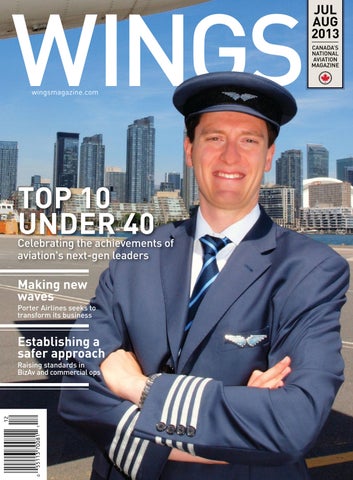
WINGS wingsmagazine.com
TOP 10 UNDER 40
Celebrating the achievements of aviation's next-gen leaders
Making new waves
Porter Airlines seeks to transform its business
Establishing a safer approach Raising standards in BizAv and commercial ops
JUL AUG 2013 CANADA’S NATIONAL AVIATION MAGAZINE
Fifty Years of Passion Generations of Falcons have one thing in common. Each one advances the state of the art. Becoming more efcient. More capable. More comfortable. Always ahead of the curve, with innovations such as Digital Flight Control technology and ultra-efcient, ultra-capable wings—at both ends of the speed envelope. We’re celebrating 50 years since the rst ight of the Mystère 20, but we’re hardly resting on our laurels.
The best is yet to come. Eastern Canada +201.981.2869 Western Canada +201.245.9399
Find out why. Scan the code or visit falconjet.com/50-years
JULY/AUGUST 2013
UPFRONT 5 Leading edge
Honouring the leaders of tomorrow
8 On the fly
News and opinion
12 Waypoint
Saluting SAR professionals
14 Alternate approach The shrinking infrastructure
15 At the gate
Ramping up the demand
Adding Bombardier’s CS100 aircraft to the Porter fleet will transform the firm’s Toronto-based operation. P. 34.
16 Glidepath
Lightening the load
BACK 56 Marketplace 62 On final
A case for lightweight flight data recorders
FEATURES
18 FINDING NEXT-GEN ACHIEVERS
Wings and Helicopters recognize some of the industry’s brightest young stars BY MATT NICHOLLS
25 THE DIFFERENCE MAKERS From top: Saluting SAR professionals. P.12. Ramping up the demand. P.15.
Montreal’s aerospace sector is blessed with a bevy of global influencers BY MATT NICHOLLS
34 MAKING NEW WAVES
Porter Airlines surprised the industry with a conditional order for 12 CSeries CS100 aircraft BY DAVID CARR
38 IMPROVING BIZAV SAFETY
Protecting pilots from laser attacks and enhancing the safety culture are paramount BY BRIAN DUNN
42 TAKING STEPS TO AVOID THE INEVITABLE Sleep deprivation is a top priority when it comes to aviation safety BY PAUL DIXON
PHOTO: BOMBARDIER
46 THE WEATHER MAKERS
How cloud seeding is helping shield Alberta from the next big storm BY JAMES MARASA
COVER PHOTO: MATT NICHOLLS
WWW.WINGSMAGAZINE.COM
July/August 2013 | WINGS
3
1-3 OCTOBER 2013
Tomorrow’s aircraft interiors industry in the making Be part of the only dedicated aircraft interiors event in the Americas region, taking place in Seattle the hub of aviation, October 1-3, 2013.
Register your interest to attend at www.aircraftinteriorsexpo-us.com/wings
Interested in exhibiting? If you are interested in exhibiting at Aircraft Interiors Expo Americas 2013 contact Daniel Kazimierczak on +44 (0) 208 910 7132 or daniel.kazimierczak@reedexpo.co.uk
Organised by:
co-located with:
LEADING
EDGE
| By Matt Nicholls
Honouring the leaders of tomorrow The Top 10 Under 40 highlights the best of the next-gen achievers
J
“
PHOTO: MATT NICHOLLS
ust move a little more to your right, Mike. That’s it, now just twist your body a bit more, just like so. Hey, we don’t want the CN Tower growing out of your left shoulder now do, we? Oh, and brighten up on that smile a little bit – why are you frowning? That’s right . . . you have every reason to be proud of this achievement! Sell it!” It’s a warm, sunny morning at Toronto’s Billy Bishop City Centre Airport and I’m putting poor Michael Schuster, left, with his buddy John, through the ringer. The 33-year-old Guelph native, Porter Airlines pilot and president of aviation consulting firm Aviation Solutions, has now been photographed about 200 times for a potential cover image for Wings magazine. But in spite of the at times uncomfortable photo barrage and multiple scenarios I am putting him through, Schuster’s resolve doesn’t break once – in fact, he’s handling it all in a calm, highly professional manner, cool as a cucumber. Deep down, I think he’s even having some fun out there in the blazing sun. Schuster is professional, resourceful and understands the aviation game and everything it entails – all at the ripe old age of 33. This is highly apparent when we start bantering about his life as a pilot, his years of training, his philosophies on the development of young pilots in today’s environment, and the safety standards that he believes need to change within the Canadian aviation landscape. He’s a man with a plan, and armed with a pedigree that includes stints as a flight instructor for several firms and schools and a commitment to giving back to the industry he is passionate about, Schuster shows precisely the kind of leadership and commitment to aviation excellence that made him a deserving recipient
5
it’s a testament to their internal drive and commitment. It’s also about something more – a true passion for aviation. of one of Wings and Helicopters magazines’ inaugural Top 10 Under 40 awards (see, “Finding next-gen achievers,” pg. 18). And the good news? He’s just one of 10 (actually 11) who received an award in 2013 for precisely this type of personal drive. The Top 10 Under 40 awards were developed this spring in a collaborative effort by the editorial and marketing departments at Wings and Helicopters to uncover and honour the achievements of the next generation of aviation superstars. In an industry clamouring to fill a growing void of retiring pilots, maintenance workers, business administration professionals and more, our goal was to identify young professionals making a difference in a variety of realms, within their organizations and
TOP DATA BURSTS… in this issue
1. Bombardier exited the Paris Air Show with $1.3 billion in new business jet orders. (pg. 8) 2. 42,000: The approximate number of aerospace workers in the province of Quebec. (pg. 15) 3. An increase of one cent a gallon in fuel costs translates to about $40 million over a year for Delta Airlines. (pg. 16) 4. $12.1 billion: The annual sales revenue generated by Montreal’s aerospace sector (pg. 25) 5. 12: The number of CS100 aircraft purchased by Porter (pg. 34)
WWW.WINGSMAGAZINE.COM
the industry. It was our goal to feature new leaders ready to carry the torch. The response to the initiative was strong, with plenty of nominations in both the rotary- and fixed-wing realms. The unique thing about this contest is that it’s not all about pilots: it’s about professionals flying high in a variety of disciplines from maintenance to business operations. It also was refreshing to see a number of nominations from women excelling in various aviation disciplines. The aviation world is a male-dominated industry, but there are countless women making inroads in it. Young achievers such as Trisha Lakatos, business development director at ACASS in Montreal, and Jen Norie, general manager of VIH Helicopters in Victoria, B.C., perfectly illustrate this point. Both have reached high levels of achievement within their organizations and within the industry itself, a testament to their internal drive and commitment. It’s also about something more, a motivation all winners show – a true passion for aviation that drives them to reach new heights, and challenge themselves to reach higher still. On many occasions in the past few years, the question of how prepared the aviation industry is for the future has been addressed in the many interviews I have had with top industry executives. Key corporate leaders often pause, and say “finding top talent” is their organization’s greatest challenge – those with the right mix of savvy and smarts, confidence and know-how to redefine corporate realities and lead future generations of employees. As our award winners illustrate, there are reasons for considerable optimism: the aviation landscape is obviously rich with precisely these kinds of individuals. Wings and Helicopters congratulates all the Top 10 Under 40 winners. May you continue to strive to reach new heights and foster change in the months and years ahead. It’s precisely what this industry needs. | W Your feedback is always welcome. Please contact me at mnicholls@annexweb.com. @Wings_Magazine July/August 2013 | WINGS
5
WINGS
JUL AUG 2013 CANADA’S NATIONAL AVIATION MAGAZINE
wingsmagazine.com
Vol. 54, Issue 4 EDITOR
Matt Nicholls mnicholls@annexweb.com 416-725-5637
TOP 10 UNDER 40
Celebrating the achievements of aviation's next-gen leaders
MEDIA DESIGNER
Making new waves
Emily Sun
Establishing a safer approach
Krista Bulmer, David Carr, Paul Dixon, Brian Dunn, Frederick K. Larkin, Neil A. MacDougall, James Marasa, Carroll McCormick, David Olsen, Rob Seaman
Porter Airlines seeks to transform its business
FLIGHT DECK
Raising standards in BizAv and commercial ops
SubScribe TODAY !
ASSOCIATE PUBLISHER
Alison de Groot adegroot@annexweb.com 1-888-599-2228 ext. 246
1 Year SubScription only
3000
$
ACCOUNT MANAGER
Nash Barsky nbarsky@annexweb.com 1-905-431-8892
(GST $31.50 • HST $33.90) US $42.00 (USD) • Foreign $65.00 (USD)
Name: _______________________________ Company: ____________________________ Title: _________________________________ Address: _____________________________ City: _________________________________ Prov: ________________________________ P.Code: _______________________________ Tel: __________________________________ Fax: _________________________________ e-mail:________________________________
PLeASe cHecK ONe: ❑ Commercial aircraft owner/operator ❑ Business/private aircraft owner/operator ❑ Military ❑ Aircraft maintenance/overhaul firm ❑ Airport ❑ Aerospace, airframe & component manufacturer and distributor
❑ Fixed base operator ❑ Aviation services, consultants and aircraft sales ❑ Government ❑ Aviation associations and organizations ❑ Flying schools, clubs and colleges ❑ Other (please specify) ______________
PAYMeNT: Cheque - Payable to Annex Publishing & Printing Inc. Visa
MC
SALES ASSISTANT
Stephanie DeFields sdefields@annexweb.com 1-888-599-2228 ext. 257 GROUP PUBLISHER
Scott Jamieson sjamieson@annexweb.com PRESIDENT
Mike Fredericks mfredericks@annexweb.com WINGS MAGAZINE
P.O. Box 530, 105 Donly Dr. S., Simcoe, ON N3Y 4N5 Tel.: 428-3471 Fax: 429-3094 Toll Free: 1-888-599-2228
Publication Mail Agreement #40065710 Return undeliverable Canadian addresses to Circulation Dept., P.O. Box 530, Simcoe, Ont. N3Y 4N5 e-mail: subscribe@wingsmagazine.com Published six times per year (Jan/Feb, Mar/Apr, May/ Jun, Jul/Aug, Sep/Oct, Nov/Dec) by Annex Publishing & Printing Inc. Circulation e-mail: subscribe@wingsmagazine.com Ph: 866-790-6070 ext. 208 Fax: 877-624-1940 Mail: P.O. Box 530, Simcoe, ON N3Y 4N5 Subscription Rates Canada – 1 Year $ 30.00 (includes GST - #867172652RT0001) USA – 1 Year $ 42.00 Foreign – 1 Year $ 65.00
AMEX
Account #: __________________________
Occasionally, Wings magazine will mail information on behalf of industry-related groups whose products and services we believe may be of interest to you. If you prefer not to receive this information, please contact our circulation department in any of the four ways listed above. No part of the editorial content of this publication may be reprinted without the publisher’s written permission. ©2013 Annex Publishing & Printing Inc. All rights reserved. opinions expressed in this magazine are not necessarily those of the editor or the publisher. No liability is assumed for errors or omissions. All advertising is subject to the publisher’s approval. Such approval does not imply any endorsement of the products or services advertised. Publisher reserves the right to refuse advertising that does not meet the standards of the publication. Printed in Canada ISSN 0701-1369
Expiry:_____________________________
TO SubScribe:
Tel: 866-790-6070 Fax: 877-624-1940 Mail: Wings Magazine c/o Annex business Media P.O. box 530 Simcoe, Ontario N3Y 4N5
Air Transport Association of Canada
ON THE
WEB
e-mail: subscribe@wingsmagazine.com
www.wingsmagazine.com
GST#135274215RT001
6
Subscriptions non-refundable
Canadian Business Aviation Association
Magazines Canada
CAREERS IN AVIATION Looking for a great career in aviation and aerospace? Check out our Careers in Aviation micro site, a handy guide to help you better understand what a career in aviation is all about. Check out www.careersinaviation.ca for news, updated listings and more!
PRO0713
WINGS | July/August 2013
wings subad.indd 1
Canadian Owners & Pilots Association
PHOTO: RCAF
Signature: _________________________
WWW.WINGSMAGAZINE.COM
2013-07-02 10:08 AM
Yes…You Can Improve performance Lower operating costs expand mission profiles Increase aircraft value reduce TIme for the same flights reach highest levels of safety dozens of Grand caravan operators have transformed their operations with the Blackhawk xp42a performance upgrade. Now certified for the Cessna Caravan. Talk to a Blackhawk performance expert today.
ON THE FLY For late-breaking news, the Wings blog and exclusive web content, please visit us at: www.wingsmagazine.com
INDUSTRY NEWS OPERATORS PEOPLE AEROSPACE
INDUSTRY NEWS
OUT OF THE BLUE A second major Toronto airport is going forward on lands first acquired by the federal government in the early 1970s for that purpose. The so-called Pickering Airport was intended as an alternative to expanding the congested Malton (now Pearson) International Airport. A 2010 Pickering Lands Needs Assessment Study concluded an additional airport will be needed within the Greater Golden Horseshoe (a region stretching from Niagara Falls to Oshawa) between 2027 and 2037. Buttonville Airport, Canada’s busiest private aviation hub, is scheduled to close in 2015. Despite being 40 years in the making, the announcement appeared “rushed to air,” overshadowing a federal-provincial announcement to turn a parcel of the Pickering lands into an urban park and putting the project on shaky ground. Finance Minister Jim Flaherty and Environment Minister Peter Kent made
the announcement, without Transport Minister Denis Lebel anywhere in sight. Ontario Transportation Minister Glen Murray was present but claimed to be “blindsided” by the announcement. It was learned later that the federal and Ontario governments had been working on the airport announcement since January, but the province pulled its quotes from the news release at the last minute. The original, controversial Pickering Airport was cancelled after the provincial government withdrew plans to build ground access roads. Flaherty has hinted that the new airport will be a private-public partnership and may end up not costing the taxpayer. It is not clear whether the Greater Toronto Airports Authority, which was involved in an earlier Pickering study, will build or operate the airport. Since 1975, properties on the 7,530-hectare Pickering lands have been leased to residential, farm and commercial tenants. The announcement is certain to resurrect the People or Planes movement, which successfully turned up the heat on the original Pickering Airport in the mid-’70s. A trimmed down Pickering Airport will not gobble up as much land. Over 2,000 hectares (13 times the size of Vancouver’s Stanley Park) has been set aside for parkland. Enough to mollify the Pickering protests? Unlikely.
Canadian air carriers such as Air Canada will be landing in Pickering in the not too distant future. 8
WINGS | July/August 2013
The Paris Air Show was not as robust as expected for Bombardier and its new CSeries.
TAILS OF ONE CITY Paris had separate outcomes for Bombardier and Brazil’s Embraer, two airframers that once upon a time held the regional jet market to themselves. While Bombardier exited the Paris Air Show with $1.3 billion in orders for 12 Global 8000 and 20 Challenger 350s, it was shut out in new orders for both the CSeries and Q400. Embraer used Paris as a stage to launch its E2 family of jetliners, including the 118-seat E-195 E2, which will be a direct competitor with the CSeries CS100. An 80-seat E-175 E2 and 97-seat E-190 E2 will complete the family. Embraer announced orders and commitments for over 300 E2 aircraft, including an order from launch Skywest Airlines and a conditional order by International Lease Finance Corp, a Los Angeles-based aircraft lessor. In contrast, Bombardier was able to confirm that Odyssey Airlines, a U.K. paper airline, is the previously undisclosed customer for 10 CS100s. The new airline plans to operate the aircraft from London City Airport, including a transatlantic service to New York. Bombardier remains unfazed over the lack of orders coming out of Paris, pointing out that the company does not hoard orders for splashy air show announcements. The airframer is reported to be in advanced discussions with up to 12 airlines, and there is considerable interest in a 160-seat version of the CS300, which Bombardier had first dangled in front of Air Asia at last year’s Farnborough Air Show, and officially launched in March. WWW.WINGSMAGAZINE.COM
PHOTOS: AIR CANADA (BOTTOM); BOMBARDIER (TOP)
8 9 10 11
Re-engineered versions of Embraer’s E-Jet family were not unexpected, but it does add new competitive pressure in the crowded 100- to 149-seat category. Nevertheless, Bombardier has reason to remain confident with its clean sheet design. The first CS100 made its maiden flight from Mirabel in June and can now begin proving itself to potential customers. The CS100 has greater range than the E-195 E2 and a considerable lead over its Brazilian rival. The CS100 is expected to enter service in late 2014. The E-190 E2 will enter service in early 2018, followed by the E-195 E2 in 2019 and E-175 E2 one year later.
LEARJET 75 DEBUTS AT EBACE 2013
PHOTOS: FREDERICK K. LARKIN (BOTTOM); BOMBARDIER (TOP)
The Bombardier Learjet 75 made its world debut at the 13th annual European Business Aviation Conference and Exhibition in Geneva, Switzerland. The super-light jet was launched one year earlier, along with the Learjet 70, as a replacement for the Learjet 45XR. It features an upgraded Honeywell TF731 turbofan engine, Bombardier Vision Flight Deck and interior influenced by its larger stablemate, the eight-plus-two passenger Learjet 85. “The debut of the Learjet 75 aircraft marks another exciting year of innovation and we look forward to delivery of the first aircraft in the fourth quarter of this year,” said Steve Ridolfi, president of Bombardier Business Aircraft. London Air Services (LAS) of Richmond, B.C., has an order for five Learjet 75s, which can carry four passengers and
Bombardier's classy new Learjet 75 made its world debut at Ebace in Geneva.
two crew nonstop from Toronto to Los Angeles. LAS operates a mixed fleet of rotary- and fixed-wing aircraft including, six of the older Learjet 45XRs, two Challenger 605s and a Challenger 604. The company will take delivery of a Bombardier Global 7000 in 2017. At EBACE, the Learjet was accompanied by a Challenger 300, Challenger 605 and Global 6000.
CITATION X AGAIN WORLD’S FASTEST JET Speaking of records, the Cessna Citation has reclaimed its title as the world’s fastest civilian aircraft after Gulfstream stole the belt last year. In 2012, the Gulfstream G650 hit Mach .925 (1,133 kilometres per hour), clipping Citation’s previous best of Mach .92 (1,127 kilometres per hour) and shattering Cessna’s 16-year record as world’s fastest. The new Citation X has a top speed of Mach 0.935 (1,145 kilometres per hour). Cessna recently rolled out its first production unit of the Citation X at the company’s Wichita, Kan., manufacturing facility.
“Speed is the reason for flight. It was true for Clyde Cessna in 1927, and it’s true today,” said Scott Ernest, Cessna’s chief executive officer. “The Citation X is the perfect aircraft for customers wanting to move faster, be more efficient and get where they need to be more quickly than ever before.”
OPERATORS
AURORA JET BANKING ON PHENOM Edmonton-based Aurora Jet Partners is opening up business aviation to Canadian corporations and some families that fly more than 100 hours annually and are looking for a cost-effective alternative to scheduled airlines. While larger companies and extremely wealthy families have purchased private jets for decades, fractional ownership programs have more recently provided an attractive avenue to bizjet ownership. Today, the combination of such a program with a next-generation very light jet offers a compelling value proposition to the frugally peripatetic. Aurora Jet Partners, Canada’s exclusive
More Canadian corporations and families flying over 100 hours annually will make the switch from scheduled airlines to private aviation. The interior of the Phenom 100 is a perfect spot to relax in flight or get work accomplished. WWW.WINGSMAGAZINE.COM
July/August 2013 | WINGS
9
ON THE
FLY
PEOPLE
HONOURING TOP CANADIAN WOMEN AVIATORS The Northern Lights Award Foundation (NLAF) has announced the winners of its 2013 aviation and aerospace awards. The Foundation’s prestigious award program, called the Elsie MacGill Northern Lights Awards, is named after aviation pioneer Elsie MacGill who had a pivotal role in the design and production of the Hawker Hurricane in Canada during the Second World War, earning her the title, “Queen of the Hurricanes.” MacGill was the first Canadian woman to graduate with a degree in electrical engineering and the first woman in North America to earn an advanced degree in aeronautics. The national award program was established in 2009 to recognize and honour the outstanding achievements of women in aviation and aerospace in Canada. Since its inception, the program has grown from one to six separate award categories that now include: Flight Operations/Maintenance, Business, Government, Education, Pioneer and Rising Star. The 2013 winners come from all across Canada including British Columbia, Saskatchewan, Manitoba, Ontario and Quebec. 10 WINGS | July/August 2013
Flight Operations/ MaintenanceAward– Lt.-Col. Maryse Carmichael is commanding officer of the Canadian Forces’ 431 Air Demonstration Squadron based out of Moose Jaw, Sask. She has more than 3,300 flight hours logged with the Canadian Forces on the CT-114 Tutor, BombardierCanadair CE-144 and CC-144 Challenger aircraft, and CC-130 Hercules. Lt.-Col Carmichael was the first female pilot selected to fly with the elite Snowbirds Aerobatic Team in 2000, and in 2010, she was the first woman chosen to lead the squadron. GovernmentAward– Catherine (Kate) Fletcher is Transport Canada’s regional director of civil aviation for the Prairie and Northern Region where she is responsible for all civil aviation safety including airports, maintenance and manufacturing, commercial, business and general aviation, flight training, engineering, and enforcement. Fletcher is heavily involved in the implementation of safety management systems in the aviation industry and she sits on the National Civil Aviation Management Executive Team at Transport Canada. Fletcher holds an Airline Transport Pilot Licence (ATPL) and has more than 8,000 hours of flying experience. Business Award – Marcia Strang works in airport operations for the Vancouver Airport Authority. In her capacity as coordinator of emergency programs, Strang runs full-scale training exercises in emergency response and incident command systems (ICS) for Vancouver International Airport (YVR) staff. Strang was instrumental in preparing YVR for the 2010 Vancouver Olympics where she held an additional post as the Olympic airside coordinator. Most recently, Marcia organized and ran the largest multi-agency exercise in the history of YVR, involving more than 700 people.
Education Award – Elizabeth Wieben taught at Confederation College in Thunder Bay, Ont. from 1986 until 2005 where she was honoured with an Outstanding Service Award in 1998. As the first full-time female faculty, she served in many capacities including professor, aviation program coordinator and director of flight operations. Wieben has made a significant contribution to aviation throughout her career as a bush pilot, flight instructor, air charter operator, flight test examiner and Civil Aviation Tribunal officer. Pioneer Award – Felicity McKendry was one of the first female flying instructors in Canada. During her career, she trained more than 1,100 students and had many diverse roles in flight training including Transport Canada designated flight test examiner and demonstration pilot for Transport Canada documentary training films. Among her multiple accomplishments, McKendry was instrumental in the formation of the Canadian Owners and Pilot Association (COPA). Rising Star Award – Natalie Panek obtained her master of applied science in aerospace engineering from the University of Toronto Institute for Aerospace Studies in 2009. That year, she received a scholarship to attend the International Space University Space Studies Program at NASA Ames from the Canadian Foundation for the International Space University. One of two Canadians selected for NASA internships in 2008, Panek now works in flight support for the International Space Station at MDA SpaceMissions, performing systems and operations engineering. The 2013 award recipients will be honoured at a gala ceremony and dinner on Sept. 27 at the Spirale Banquet Hall and Conference Centre in Toronto. WWW.WINGSMAGAZINE.COM
PHOTOS: ELSIE MACGILL NORTHERN LIGHTS AWARDS
sales representative for Embraer Executive Aircraft, sells interests in the EMB500 Phenom 100. The shares range from 12.5 per cent to 50 per cent. A one-eighth interest represents 100 hours of annual flight time – an amount that should suit the schedules and the budgets of costconscious, time-constrained travellers. Sitting high on its gear, the Phenom 100 has a ramp presence that is more akin to larger, weightier aircraft. Entry is made up an airstair similar to that of mid-sized machines and, once inside, the cabin reveals the tony look of far more expensive craft. The interior, created by BMW Group DesignworksUSA, features four-place club seating with a cabinet just aft of the cockpit across from the door. Another “big jet” feature of the EMB-500 is its fully enclosed lavatory at the rear of the cabin. Having been the first to operate the Phenom 100 in Canada, it wouldn’t be a surprise to see Aurora’s fleet expand beyond the pair currently in service, as the attributes of this pocket rocket become better known. – Frederick K. Larkin
AEROSPACE
BOOST FOR WESTERN AEROSPACE The federal government has announced funding to support western Canadian aerospace companies to develop supply chains and compete in global markets. The Aerospace Industries Association of Canada (AIAC) will manage a two-year, $534,000 fund intended for seven specific projects. These projects are designed to facilitate stronger western involvement in domestic and international aerospace-related events, and enhance market access and supply chain development opportunities for small and medium enterprises based in the west. “As the fifth-largest aerospace nation in the world, Canada is at its strongest when each region enjoys the support and collaboration that it needs,” said Jim Quick, chief executive of AIAC. “Western Canadian companies are leaders in their fields and critical to the success of Canadian aerospace
both domestically and around the world.” The announcement was made by Lynne Yelich, Minister of State for Western Economic Diversification (WD) at the Cascade Aerospace hangar in Abbotsford, B.C., with a Royal Canadian Air Force Hercules CC-130J heavy lift transport as a backdrop. Last August at the Abbotsford International Air Show, Lockheed Martin announced that Cascade would be authorized as a C-130 Heavy Maintenance Centre – only the second such centre in the world. “In western Canada alone, the aerospace industry supports the employment of nearly 27,000 people, and generates more than $3 billion in annual revenues,” Yelich told the Abbotsford Times. The funds will raise the profile of western Canadian aerospace at major international air shows such as Paris and Farnborough, support domestic shows such as the Abbotsford Aerospace and Defence Expo, the only show of its type in Canada, and invest in research, innovation and collaboration among aerospace companies. In addition to
Cascade, which was purchased by the Halifax IMP Group last year, western Canada is home to a number of internationally known companies including, Vector Aerospace, Viking Air and StandardAero. Last year, David Emerson released a two-volume report, Beyond the Horizon: Canada’s Interests and Future in Aerospace (see Wings Jan/Feb 2013). In the report, Emerson, a former chief executive of the Vancouver International Airport Authority and a minister in both Paul Martin’s and Stephen Harper’s cabinets, called for governments to put more bite into the promotion of Canadian aircraft manufacturing and support abroad.
FOR EXPANDED INDUSTRY NEWS AND DAILY UPDATES VISIT WWW.WINGSMAGAZINE.COM.
The Clock is Ticking
Meet the mandate with Universal Avionics TAWS The new Transport Canada Terrain Awareness and Warning System (TAWS) mandate brings urgency to equip with a TAWS system with Enhanced Altitude Accuracy (EAA). Our TAWS meets the requirement while offering the highest level of CFIT Protection along with a unique terrain display and look-ahead conflict advisories. Equip with Universal Avionics TAWS today. Visit uasc.com/TAWS to learn more about the mandate.
UNS-1Ew and TAWS 2MCU
www.uasc.com sales@uasc.com (800) 321-5253 (520) 295-2300
WWW.WINGSMAGAZINE.COM UASC_2013_Wings July_Aug.indd 1
July/August 2013 11 | WINGS 5/30/13 4:27 PM
WAYPOINT By Rob Seaman |
Saluting SAR professionals
It’s not all bad news for Canada’s search-and-rescue infrastructure
W
12 WINGS | July/August 2013
navigators, spotters, search coordinators, electronic search specialists, radio operators and administration staff. They are trained to work as spotters on military aircraft, and to carry out searches using light aircraft and ground vehicles. CASARA has been the umbrella organization for independent provincial and regional groups since 1986. Beyond its search-and-rescue work, the group also gives back to the community and helps build for the future through the CASARA Foundation – a subset of the main association that was incorporated in 1998. The “foundation” presents scholarships and bursaries to deserving individuals who wish to enhance their education or further their aviation careers. SARSCENE is an annual event that is hosted by the National Search and Rescue Secretariat (NSS) and is co-hosted by a provincial or territorial government in association with local search-and-rescue volunteer associations. SARSCENE and the annual awards are an integral part of the overall CASARA effort. The SAR Conference and Trade Show that is part of SARSCENE are held at a different location across Canada each year. The event is an interactive tradeshow that brings together SAR manufacturers and service providers, and offers SARSCENE delegates the opportunity to network with peers, the private sector and the academic sector. In addition to the SAR Games – a friendly and competitive learning opportunity – the program includes sessions targeted to SAR management, SAR volunteers, and SAR response, prevention and mitigation. SARSCENE also honours Canada’s SAR elite through the National SAR Awards of Excellence Program. When all is considered, the folks involved with SAR have a job that most do not think much about – until they need it. And while the Auditor General may have some less than ingratiating observations, the simple fact is that these women and men – mostly volunteers – provide an incredible service and are worthy of positive praise and recognition. | W
These unpaid and devoted specialists are the backbone of the SAR response in Canada. territorial SAR authorities and police services to develop and standardize the quantity and quality of SAR service.” Regardless of whether you are talking about CFSAR or CASARA, the word “volunteer” comes often in their materials. These unpaid and devoted specialists are the backbone of the SAR response in Canada and provide the critical service delivering search and rescue on the water, in the air and on the ground. They sacrifice their time, their money and sometimes their careers to answer the call when it comes. The Civil Air, Search and Rescue Association (CASARA) also play a significant role in the SAR equation. Celebrating its 25th anniversary, CARASA is made up of 2,800 volunteers who are called upon to search for individuals when they become lost or are in distress. Their mission is “to support Canada’s Search and Rescue (SAR) program and to promote aviation safety.” Funded by the Department of National Defence, CASARA volunteers provide air search assistance to the Royal Canadian Air Force, and as a means to reduce overall SAR incidents, promote flight safety for general aviation. This dedicated group consists of pilots,
Rob Seaman is a Wings writer and columnist. WWW.WINGSMAGAZINE.COM
PHOTO: RCAF
hen the worst-case scenario becomes reality and you have a mishap with your aircraft, there are two groups in Canada who can instantly become your best friends. One is the search-and-rescue professionals, known as CFSAR, the Canadian Forces’ search-and-rescue unit. The second is the Civil Air, Search and Rescue Association, better known as CASARA, who work hand in hand with CFSAR. CFSAR came to the attention of many Canadians in late April when Auditor General Michael Ferguson posted an alarming report. And although the report points out that aging equipment is hampering efforts to produce a top-notch SAR response – coupled with staffing and training concerns – there are many positives to highlight about the SAR system in Canada. As its website best describes it, “The National Search and Rescue Secretariat (NSS) is an autonomous arm’s length organization within the Department of National Defence, accountable to the Lead Minister for Search and Rescue who is also the Minister of National Defence.” The NSS was established in 1986 and as such is responsible for management and coordination of the National Search and Rescue (SAR) Program. While it does not direct or manage the work of its partners, the NSS brings them together to encourage collaboration and ensure best use is made of their diverse resources and capabilities. The following federal departments are responsible for search-and-rescue delivery in Canada: • Canadian Forces (Department of National Defence) • Canadian Coast Guard (Department of Fisheries and Oceans) • Royal Canadian Mounted Police (Public Safety Canada) • Transport Canada • Meteorological Service of Canada (Environment Canada) • Parks Canada (Agency) Representatives from these organizations comprise the Interdepartmental Committee on Search and Rescue (ICSAR). As noted on the main CFSAR website, “Within the non-federal jurisdiction, the NSS works directly with provincial and
“WELCOME TO OUR WORLD”
At the heart of the most extreme missions are the exceptional pilots who experience daring feats on a daily basis and are prepared to entrust their security only to the most high-performing instruments. At the heart of the most extreme missions is the Breitling Avenger. A concentrated blend of power, precision and functionality, Avenger models boast an ultra-sturdy construction and water resistance ranging from 300 to 3,000 meters. These authentic instruments for professionals are equipped with selfwinding movements chronometercertified by the COSC – the highest official benchmark in terms of reliability and precision. Welcome to the sphere of extremes. Welcome to the Breitling world.
AVENGER II SEAWOLF
ALTERNATE
APPROACH By David Carr |
The shrinking infrastructure
Airport closures in Toronto, Edmonton spell tough times for business aviation
B
14 WINGS | July/August 2013
to a more aggressive userpay model. It is precisely this move that may prevent capacity catching up with the need. When lower traffic volumes caused the Greater Toronto Airports Authority (GTAA) to cancel a $1.5-million annual payment to Buttonville in return for supporting Pearson as a reliever airport, the federal government refused to open its cheque book, even though the GTAA paid more than $140 million in ground rent that year and Buttonville’s status as an economic generator was well established. It was widely at the time that $1.5 million was the difference between keeping the airport running the owners hammering in the “for sale” sign. As Washington wrestles with its debt and some American municipalities, which own the airports and charge no tax, teeter on bankruptcy, it is likely that the U.S. will move closer to the Canadian model. Still, unlike Canada, the U.S. already has the infrastructure in place to support business aviation. Relief may be in sight. The federal government recently dusted off plans for a second Toronto Airport, northeast of a city on a proposed airport site from the 1970s. The Canadian Business Aviation Association (CBAA) and stakeholders have also been successful in having local and regional airports included on the agenda for community infrastructure funding. It will be a tough slog. Making recreational centres, swimming pools and other community supports take a back seat to the perception of pampered executives and their expensive toys always will be an unpopular decision. Corporate Canada has traditionally been jittery about drawing attention to business jets. That is going to have to change. The industry is growing and the airplanes have to go somewhere. | W
It was widely reported at the time that $1.5 million was the difference between keeping the airport running and seeing it redeveloped. This is a consequence of different airport building philosophies dating back more than 50 years. In the U.S., the government funded the construction of reliever airports near major population centres. The result is a general aviation infrastructure that enables private operators to sidestep congested commercial hubs and avoid the uneven tug of war between airlines and business aviation for access that occurs in Canada, especially over peak period slots. According to the Washington-based National Business Aviation Association, BizAv operations at America’s 20 busiest hub airports account for less than three per cent of total activity. A yawning gap in airport philosophies still exists between Canada and the U.S., which does not bode well for advocates of increased airport capacity for business aviation. Toll booth versus spark plug is how the Canadian Senate characterized the difference in a report published last year. In the U.S., airports, including executive airports, are seen as economic engines, whereas in Canada airports have switched
David Carr is a Wings writer and columnist. WWW.WINGSMAGAZINE.COM
PHOTO: PORTER AIRLINES
usiness aviation in Canada is literally running out of landing strip. The Toronto Port Authority has proposed a 336-metre runway extension at Billy Bishop Airport, pictured, right, and a lifting of a jet ban to allow Porter Airlines to fly Bombardier CSeries twin jets from the downtown facility. If approved, it is not clear whether loosening the rules would make more room for business aviation. But opening the convenient waterfront airport a crack will not start to balance out the loss of Buttonville, Canada’s busiest general aviation airport. It’s the closest Canadian BizAv has to a Van Nuys in California, America’s largest general aviation airport or Teterboro, the New Jersey general aviation “reliever” airport, a 20-kilometre cab ride to Manhattan. Markham, Ont.-based Buttonville is the 11th busiest airport in Canada and a valuable asset for the general aviation community. But the land the airport sits on is even more valuable as a mixed-use commercial, residential and retail development as part of one of Canada’s fastest growing communities. Developer Cadillac Fairview bought the land from the owners of the privately held airport in 2009 for an undisclosed sum rumoured to be upwards of $150 million. The developer is expected to begin paving over the airfield by 2015, dispersing more than 136,000 annual aircraft movements to other airports within the country’s most crowded air transport corridor, and further removed from the Toronto core. A similar script is being played out in Edmonton, where the local council began declaring “last orders” on the Alberta capital’s city centre airport in 2009. Since then, council has gradually phased out access, starving the airport of revenue to build the case that the facility is unsustainable. It is estimated that Canada has 10 per cent of the number of paved airports that are available in the U.S. Considering populations, it is a solid line-by-line comparison. But domestically, Canadian business aviation covers more territory than does the U.S. with a thinner population spread over greater distances. Many of the paved runways Canada operates do not have runways long enough to support private jet transport.
AT THE
GATE
| By Brian Dunn
Ramping up the demand Aerospace prospects are on the rise in Montreal
PHOTO: BOMBARDIER
F
earing a shortage of workers in the Canadian aerospace industry in the years ahead, Aéro Montréal wants to encourage more young people to consider a career in aerospace. The organization brings together all the major decision makers in Quebec’s aerospace sector, including manufacturers, educational and research institutions, associations and unions. In 2011, it launched MACH, a program to improve the competitiveness of the province’s aerospace industry supply chain, backed by a $4-million grant from the Quebec government to kick-start the initiative. The program also gets funding from the private sector. But Aéro Montréal is so concerned about not having enough manpower that it is launching a web site listing job opportunities and information on training programs. A study done last year for the organization concluded there was a lack of information available to the general public about employment and training opportunities in this key sector of the Quebec economy, which employs 42,000 workers. If everything goes according to plan, the web site will be launched this fall along with a Facebook page, Twitter feed and LinkedIn page. According to the Comité sectoriel de main-d’oeuvre en aérospatiale du Québec, the industry this year is expected to create more than 2,300 jobs for engineers, machinists, plane interior finishers and technicians. The jobs are in addition to 2,900 others that need to be filled this year due to retirement or others leaving the business. Over the next 10 years, more than 40,000 positions will need to be filled. But according to Hélène Gagnon, vicepresident, public affairs, at Bombardier Aerospace, many young people are wary of the aerospace industry due to its cyclical nature and the fact that layoffs are a common occurrence. As an example, employment in Quebec’s aerospace sector declined 8.1 per cent between 2009 and 2010, according to l’Institut de la statistique du Québec. The number of jobs in the sector dropped to 20,601 from 22,422 in the previous year. By comparison, aerospace jobs throughout Canada declined 6.4 per cent to 36,947 employees. However, Gagnon pointed out that over WWW.WINGSMAGAZINE.COM
and other customers. PFW plans to bring in about 25 engineers from abroad and then build up and train a local workforce of graduates and other employees. Austrian firm FACC, which specializes in the manufacture of aircraft composite components, plans to open an engineering office to complement its existing work on business aircraft interiors. It already works on the interiors of Bombardier’s Challenger 300 business jet. It was also chosen as a component supplier to the CSeries and Global business aircraft. FACC plans to add at least 12 people to its current workforce of about 40. But that number could grow by another 20 to 40 if it adds a parts assembly line. And LGM of France plans to invest more than $2 million and add 20 workers to develop its business in Canada. The company specializes in risk management and verifying that planes and railway products are safe to operate. LGM, which has a workforce of 800 in France, Germany and China, decided to open a fourth centre to be close to potential customers such as Bombardier, Pratt & Whitney, and CAE. Aerolia, another French company, has some 100 engineers working at its Aerolia Canada office in Montreal on the centre fuselage for Bombardier’s new Global 7000 and 8000 aircraft that is scheduled to enter into service at the end of 2016 or early 2017. Final assembly will take place at a new Quebec plant, while the production of the first subassemblies will take place at Aerolia’s French and Tunisian plants. The plant is slated to open by next January and will house about 200 employees, according to Aerolia Canada. The bottom line? Things are definitely taking off in Montreal’s vaunted aerospace market, already Canada’s most vibrant aerospace sector. | W
Many young people are wary of the aerospace industry due to its cyclical nature and the fact that layoffs are a common occurrence. the medium to long term, employment in the industry is growing. In fact, to fill certain positions, the aerospace giant has had to hire foreign workers, primarily engineering specialists. This is particularly the case for the development for the new CSeries aircraft. Quebec Finance Minister Nicolas Marceau, who attended Aéro Montréal’s annual meeting in April, said hiring foreign workers cannot become a permanent solution to the pending labour shortage and that more Quebecers must be trained to bridge the labour gap. The gap could grow, as demand for aerospace engineers will increase over the next few years with three European companies announcing plans to create about 200 jobs in Montreal. The companies said they were attracted to the city by the availability of trained workers and their ability to work with major OEMs such as Bombardier. German company PFW plans to move its Seattle-based aerospace tube and duct systems North American headquarters to Montreal. It hopes to hire about 100 people in the city over three years to join its global workforce of 2,500. The company will initially provide engineering services to the area’s large equipment manufacturers and eventually become a parts supplier for Bombardier
Brian Dunn is a Wings writer and columnist. July/August 2013 | WINGS 15
GLIDE
PATH
By Paul Dixon |
Lightening the load
Paying what you weigh may indeed be the ticket of the future
I
16 WINGS | July/August 2013
as they need.” Samoa Air reports a 20 per cent increase in revenues since the program was introduced. Since the dawn of modern commercial aviation with the introduction of the jet age, the “average” weight of North American men and women has increased by 15 per cent. Maybe this isn’t a weighty concern at the upper end of the market where widebody aircraft can accommodate wide-body clientele with relative ease, but it is a growing concern in the domestic market where smaller aircraft leave less wiggle-room. I say this after being privy to a conversation between the pilots of a Dash 8-100 and ground handlers that led to a mother and her young son being taken off the flight. There is something about hearing the word “overweight” when you realize that it is in reference to the aircraft you are sitting in that gets your undivided attention. The weight of the two who were taken off was otherwise insignificant, but it must have been enough to get us under the magic number. You might imagine how much attention I paid to every second of our takeoff, but the fact that you are reading this now is evidence that someone did indeed know what they were doing. | W
With the introduction of the jet age, the “average” weight of North American men and women has increased by 15 per cent. passengers based on their weight. It’s actually the combined weight of the passenger and their baggage, with the same rate per kilo applied to both. To say that you can’t buy the publicity generated by this announcement is an understatement of epic proportions. CEO Chris Langton has had his name and face splashed across the world’s media as he has defended the program. Langton points out that as with any airline, fuel is its major cost. Unlike larger commercial airlines, Samoa Air has fewer chances at ancillary charges as they carry little freight and don’t offer food or beverages on flights. At check-in, Samoa Air passengers step a scale with their luggage. Human or suitcase, the charge is the same on a per-kilogram basis. An 80-kg passenger flying from Apia to Asau and carrying 20 kilograms of luggage would pay US$132 for the flight (at $1.32/kg) while another passenger weighing 60 kg and travelling without luggage would pay US$79.20 for the same flight. Langton defended the system to CBS News, saying, “An airline only has weight to sell. That’s the product. And we’re asking people to buy as much weight
Paul Dixon is freelance writer and photojournalist living in Vancouver. WWW.WINGSMAGAZINE.COM
PHOTO: PAUL DIXON
t’s a weighty problem: how do you put people into metal tubes and then transport them across vast distances while and do it for a price that will not scare the passengers off allowing room for profit? The business model for commercial aviation, large or small, has been unalterably changed by two factors in the past 20 years: the stratospheric rise in fuel costs coupled with an equally pervasive demand for cheaper fares from those who fill the tubes. Forty-five years ago the future lay in “plastics,” but today the future lies in “ancillary revenues.” That’s the future of maintaining profitability in the aviation business. For airlines, their success will depend on how much money the passenger is willing to spend beyond the price of the ticket. It’s the challenge of providing services that people want and will actually pay for, while at the same time eliminating as many of the money-losers as possible. Eliminating meals on domestic flights not only saves money for the airline, but just as importantly, it eliminates weight from the flight. Last year at the Aircraft Interiors Expo in Seattle, I spoke with Melissa Raudebaugh, Delta Airlines’ general manager of aircraft experience, about Delta’s approach to levying baggage charges. Delta was the only major American carrier to hang back on charging for checked bags, as they anticipated a wave of customer resistance towards the airlines that did. They were in for a rude shock, as there was no meaningful impact in terms of passengers flocking to Delta to save a few dollars. The lesson they did learn was that Delta had lost tens of millions in potential revenue by waiting a year to implement checked baggage fees. By introducing baggage charges as well as lowering the allowable weight limits on baggage, airlines are indeed capturing additional revenue on the one hand, but they are also saving money by creating an incentive for passengers to pack less. Less baggage, less weight. Less weight, less fuel burn. For Delta, an increase of one cent a gallon in fuel costs translates to about $40 million over a year, creating a huge incentive to reduce non-revenue-generating weight on aircraft. Samoa Air, a very small airline, made worldwide headlines earlier this year when it announced it would begin charging
Setting the CorreCt CourSe Recent actions by the Minister of Transport and by the Senate Standing Committee on Transport and Communications have sent an encouraging message to the air transport industry that our cries for support have been heard and may be acted upon. Last year, Minister Lebel invited key stakeholders to roundtable discussions on the challenges facing our industry. In December, the Minister of State for Transport began consultations with industry on key regulatory irritants. An interesting backdrop to this recognition of concern by the ministers is the tabling of the two Senate reports on the state of aviation in Canada. It remains to be seen now if the goodwill shown will be transformed into concrete action supporting our industry. ATAC has been an active partner throughout these consultations and this will continue. Clearly, ATAC has never shied away from speaking out on issues which affect our industry. Some of these opinions have been voiced for years but remain unaddressed by authorities; others, more daring perhaps but equally important, have generated strong reactions. Key issues seldom reach complete consensus and innovative solutions require openness and a trusting relationship between the industry and the decision makers. Building on recent comments and statements made by ATAC to the Senate regarding airport governance and to Transport Canada Minister of State for Transport Fletcher regarding regulatory and level of service “irritants”, ATAC encourages the Government to continue and in fact grow its implementation of innovative ideas that strengthen the Canadian economy by allowing and recognizing the aviation industry as the key economic enabler that it is. The Government has achieved great success in taking world-leading radical actions such as the creation of NAV CANADA. As a not for profit entity it has become a leader amongst ANSPs worldwide in implementing innovative technology while at the same time balancing the costs to a level that industry can live with. This model of providing the required and sought after services that industry actually needs should be fully utilized in as many ways and areas as possible to allow Transport Canada to be able to better provide the level of service our industry is entitled to. Innovative funding mechanisms and process efficiency improvements would benefit the Government, the aviation industry and the general public. ATAC would support innovative government action aimed at making our industry more competitive with our American neighbours, establishing a level playing field with other modes of transport, giving carriers a greater voice in the drafting of air policy in Canada and in the management of our airports. ATAC has initiated many debates over the years which today are bearing fruit. These initiatives are the result of input from ATAC members who not only are supporting these positions but often are the very inspiration for the solutions put forth through their active participation in our numerous committees. Although some important carriers prefer not to join and therefore remain absent from the interaction leading to new ideas, many stakeholders contribute significantly to the debates and offer constructive ideas which help make ATAC the effective advocate it has become. This national aviation industry collective gathers each year during our Annual General Meeting. This event offers member companies a forum for open discussion and engagement on the issues at the very heart of our industry. The active participation by our members in our committees and during the AGM is the reason behind all of ATAC’s successful stands on key issues over the past seventy-nine years. In addition to properly representing members and promoting a continual engagement with like-minded companies through the active board and committee structure, ATAC has always defended and supported the importance of a strong national voice on issues of common interest. This is why our AGM and national tradeshow attracts hundreds of stakeholders from across our industry, domestic and international, to the only national forum for commercial aviation and flight training in Canada. Not only do we encourage all ATAC members to join the effort to obtain tangible results but we welcome all aviation associations to this premier networking event in Canadian commercial aviation. It is only through open dialogue with our members and, on a larger scale, with other industry partners, that our industry can hope to move our issues forward on the government agenda. Only when industry speaks with one voice can we hope to achieve the very best of results. It is unfortunate that Governments need to be reminded of the key socio-economic enabling role our industry plays in Canada. We sincerely hope that recent openness by the authorities results in the much needed course change in government policy towards aviation.
WhAt’S neW At AtAC ATAC is proud to welcome the following recent New Members: operator Members •
Langley Flying School Langley, BC
•
Springbank Air Training College Calgary, AB
•
GoHelico Quebec, QC
•
Saltspring Air Salt Spring Island, BC
Associate Members •
United Parcel Service Concord, ON
•
L-3 Electronics System Services Toronto, ON
•
WJR Aviation Ottawa, ON
•
Code Hunter LLP Calgary, AB
•
Skeye Aviation Systems Montreal, QC
•
SkyTrac Systems Kelowna, BC
•
Frasca International Urbana, IL
•
Kelly Aviation Center Montreal, QC
•
Parlee McLaws LLP Calgary, AB
Air Transport Association of Canada 700 – 255 Albert Street, Ottawa, Ontario K1P 6A9 Phone: (613) 233-7727 • Fax: (613) 230-8648 • Website: www.atac.ca
Tim Anderson of newly minted Anderson Aviation is one of our Top 10 Under 40 winners.
FINDING NEXT GEN ACHIEVERS
WINGS AND HELICOPTER RECOGNIZES SOME OF THE INDUSTRY’S BRIGHTEST YOUNG STARS IN OUR FIRST ANNUAL TOP 10 UNDER 40
BY MATT NICHOLLS
F
inding dynamic, innovative employees capable of developing new systems, processes and techniques to fuel the success of an operation for years to come is a major challenge facing fixed- and rotary-wing operations of all sizes. And with a looming crisis of retiring pilots, maintenance workers on the horizon and a dearth of highly qualified business operations personnel and aerospace engineers, it’s little wonder management types are nervous about the prospects for the future. But for those desperately seeking to enhance their talent pool or worried about Canada’s ranking on the world aviation/aerospace stage, don’t be too alarmed – there are many talented aviation employees under the age of 40 making a difference at their respective organizations, reaffirming that the future is indeed bright for Canadian aviation. In our inaugural Top 10 Under 40 special report, Wings and Helicopters proudly highlights 10 of these top achievers – men and women who have helped transform their organizations in maintenance, business operations, flight operations and more. The 10 individuals featured – OK, we cheated, the Laflamme brothers pushed the total to 11, forgive us – were carefully selected by our editorial team following an online contest that ran earlier this spring. Candidates were nominated by their colleagues based on their influence to drive change at their respective organizations, their leadership skills and commitment to clients/ colleagues, and their forward thinking towards the industry as a whole. In most cases, nominators selecting our featured “Next Gen” leaders had several years’ experience working with the candidates, observing how they cultivated their skills and grew in their respected spheres. Featured alphabetically, our Top 10 Under 40 achievers represent the resourcefulness, commitment and dedication organizations are craving in today’s marketplace. On behalf of the nominees and potential candidates, we thank you for your support and salute the achievements of all who participated.
PHOTO: TIM ANDERSON
NAME: TIM ANDERSON TITLE: OWNER, TIM'S TERRY AIR (SOON TO BE REBRANDED ANDERSON AVIATION) LOCATION: HURON PARK, ONT. To say Tim Anderson likes aviation would be a gross understatement. Here’s a guy who lives and breathes it. The 30-year-old owner of Tim’s Terry Air Inc. in Huron Park, Ont., has long been interested in a career in aviation and he was very proactive in getting the ball rolling. Shortly after his first airplane ride at the age of 15, Anderson joined the 614 squadron of the Royal Canadian Air Cadets to hone his aviation skills. Following Cadets, he quickly earned his pilot’s licence at Empire Aviation in London, Ont. WWW.WINGSMAGAZINE.COM
Anderson began his formal aviation career at the age of 18 with General Airspray, an aerial seeding and spraying service based in Lucan, Ont. At General, Anderson was entrusted with operating their mix rigs throughout northern Ontario, gaining valuable experience. Following his stint at General, Anderson sought a formal degree in an aviation-related discipline and found precisely what he was looking for in the aircraft maintenance program at North Bay’s Canadore College. Armed with a degree, courage and plenty of ambition, Anderson went looking for adventure – and he found it in the form of Buffalo Airways in Yellowknife. After a stint with the famed northern airline, Anderson moved over to Hicks and Lawrence, a subsidiary of Discovery Air Inc., before returning to southern Ontario in 2006 to work with Supermarine Aircraft based in St. Thomas.
The Top 10 Under 40 achievers represent the resourcefulness, commitment and dedication organizations are craving in today’s marketplace. While working at Supermarine, Anderson garnered several personal achievements among them the completion of his commercial pilot licence and the attainment of his aircraft maintenance engineer licence. That decision led to a new bout of adventure and career development that included valuable experience at Sander Geophysics in Ottawa on international contracts in Greenland, Denmark, and the high Arctic; a stint at Enterprise Airways in Oshawa, Ont., including the Alfred Wagner Institutes’ Polar 5 Basler DC-3 Aircraft; as base manager in Resolute Bay; and a period of working for Calgary’s Kenn Borek Air, that saw him spend two months at the South Pole Station. But Anderson craved more and in 2011, joined the ranks of aviation entrepreneurs, purchasing Glen’s Terry Air and renaming it Tim’s Terry Air. Offering customers a variety of services, including maintenance, aircraft storage, aircraft brokerage, fuel parts, pilot supplies and more, Tim’s Terry Air aptly reflects the commitment and spirit of its owner –providing the highest levels of services to its loyal customers. Terry Air was founded in 1982 by Terry Stuart to provide aviation services to southern, midwestern and central Ontario. It was purchased in 1999 by longtime employee and AME Glen Latour and renamed Glen’s Terry Air. Anderson, who is an M1 and M2 AME as well as a multi-IFR commercial pilot, purchased the business and hasn’t looked back. He is currently in the midst of July/August 2013 | WINGS 19
rebranding the business to Anderson Aviation Services. Launching in July, Anderson Aviation more aptly reflects the man behind the name – a lifetime aviation enthusiast who has taken his career to the next level and never looked back. Anderson is living the dream, so to speak – as a leader, adventurer and member of several aviation organizations who gives back to his industry in so many ways.
NAME: TODD CALAIEZZI TITLE: PRESIDENT, EXPEDITION HELICOPTERS LOCATION: COCHRANE, ONT.
“He’s the hardest working person I know. Many times he calls me at 11 p.m. and he is still at the hangar.” This is just one sentiment to describe Expedition Helicopters’ president Todd Calaiezzi, left, by one of his loyal customers, a dedicated, hardworking leader who knows what it’s like to build an organization from the ground up. Located in Cochrane, Ont., with satellite offices in Moosonee, Ont., and Roquemaure, Que., Expedition operates a fleet of a dozen Bell and Eurocopter helicopters and boasts staff with some 40 years experience in the field.
“He’s the hardest working person I know. Many times he calls me at 11 p.m. and he is still at the hangar.”
NAME: JASON FOGG TITLE: PROGRAM MANAGER/BASE MANAGER, DISCOVERY FIRE SERVICES INC., LOCATION: SUDBURY, ONT. Having the acumen to put out fires on a consistent basis is one of Jason Fogg’s specialties. And that’s a good thing, especially when his role is to help monitor more than one million square kilometres of pristine Ontario forest. As program manager/base manager with Discovery Air Fire Services in Sudbury, for the past five years, Jason has been coordinating the facilitation of putting out real fires across the province. And that has saved not only thousands of acres of prime forests, but property and lives as well. Just 24, Fogg has a host of personal achievements to his credit, including a bachelor’s degree in management and organizational studies with a specialization in commercial aviation management from the University of Western Ontario in London. He is a commercially licensed pilot with an MIFR and float plane ratings, and is also a Class 3 flight instructor. He is also currently in the process of completing a masters of business administration through Laurentian University. Fogg joined the Discovery team in 2008 as aerial operations coordinator, running logistics on more than 30 aircraft contracted to the Ontario Ministry of Natural Resources (OMNR) in support of the fire management program. Innovative and efficient, Fogg has demonstrated a high level of creativity when necessary, and has tried to create new technologies within the fire detection environment. One such initiative was the “Firehawk Airborne Wildfire Reporting Tool,” in collaboration with the OMNR. Firehawk allows for more timely and accurate reporting in order to catch wildfires while they are small. This initiative won a provincial Diamond Award, given to the top innovative project within Ontario’s public sector. In 2011, Fogg continued to demonstrate his industry leadership with the creation of an initiative aimed at establishing a flight training school at the Greater Sudbury Airport called the Discovery Aviation Academy (DAA). Fogg’s vision was to create an employment-focused training program that would bridge the gap between a student’s graduation and employment. To benefit this endeavour, Fogg established a partnership with Cambrian College and established co-op positions within the Discovery Air network. In its first full year of operations in 2012, DAA flew more than 1,200 hours and had 17 first solos and 11 successful flight tests. Under Fogg’s leadership, DAA has become a member
20 WINGS | July/August 2013
PHOTOS: TODD CALAIEZZI (LEFT); JASON FOGG (RIGHT)
Specializing in northern operations specific to the natural resources sector including mining, forestry and hydro support, the 38-year-old’s business acumen and vision has led to the development of specific divisions at the company with high levels of specialization – specifically its “Service and Logistics” division. The camp section provides turnkey camp set-ups, rentals and logistics to the mining and forestry industries nationwide. Calaiezzi’s concept for the division was born in the late ’90s, when it became apparent the mining/forestry industry was growing. As projects grew and companies struggled with effective camp setup, Expedition capitalized and developed a way to provide turnkey solutions for camp setups and more. The firm has also set up a freight division with 13 tractor trailers and a fuel company to capitalize on this category. The diversified product offering devised by Expedition’s competent and hard-working leader, reflects the entrepreneurial spirit Calaiezzi brings to every project. And building from one machine to more than a dozen in such a competitive environment, it’s apparent Calaiezzi has Expedition headed in the right direction. WWW.WINGSMAGAZINE.COM
of the Air Transport Association of Canada, a key stepping stone to being awarded a contract with the Department of National Defence to train 10 air cadets in 2013. It’s not a surprise that’s Fogg’s strong business acumen and work ethic has enabled him to be promoted to Sudbury base manager while keeping his role as program manager from DAA. So, is it accurate to say Fogg is more than capable of putting out fires? Absolutely. Few are as competent in helping douse the flames while keeping so many irons in the fire himself.
NAME: DAVID AND ENRICK LAFLAMME TITLE: LAFLAMME ENGINEERING LOCATION: ST-JOSEPH-DE-COLERAINE, QUE.
In 2009, the brothers took over the LAF-01 helicopter project with the hopes of raising the quality of the project to a new level. Since that time, they have also been working to develop unmanned aircraft vehicles (UAVs) and are planning to certify the enhanced LAF-01 concept as the LX4. Active participants in the aviation community, the brothers are members of the American Helicopters Society and have joined Aéro Montréal and the Consortium for Research and Innovation in Aerospace in Quebec (CRIAQ), with the goal of developing collaborative research projects with Canadian universities. The Laflamme brothers are working hard to apply their shared strategic vision to becoming a Canadian leader in VTOL UAVs and light helicopters. Don’t bet against the dynamic duo doing just that.
PHOTOS: DAVID AND ENRICK LAFLAMME (LEFT); ACASS (RIGHT)
NAME: TRISHA LAKATOS TITLE: DIRECTOR, BUSINESS DEVELOPMENT, ACASS LOCATION: MONTREAL QUE.
Resourcefulness and entrepreneurial spirit are the hallmarks of the Top 10 Under 40, and David and Enrick Laflamme of Laflamme Engineering in St-Joseph-de-Coleraine, Que. certainly possess these qualities. David, 34, and Enrick, 33, are professional engineers who have spent their entire lives surrounded by aviation-related projects and pursuits. At a very young age, they were immersed in the world of helicopters, gyrocopters and various helicopter parts – a path that captured their imagination and ignited their passion for everything aviation. Their father, Rejean, an avid aviation enthusiast and designer, completely rebuilt gyrocopters in the 1980s and soon after, introduced the very first Laflamme helicopter – the LAF-01, a machine with tandem rotors designed for the general aviation market under the Laflamme Helicopters brand. David and Enrick helped their father on the LAF-01 project after each graduated with an engineering degree from Ecole de Technologie Superieure in Montreal, but in 2004 branched out to form their own engineering firm after the LAF-01 program slowed due to a lack of funding. Laflamme Engineering specializes in finite element analysis with ANSYS (APDL, also called classic version). Mastering this software allows the design and analysis of complex parts, often using materials such as orthotropic composite materials. The firm provides state-of-the-art engineering services for aerospace and transportation companies such as CAE, Bombardier Transportation and Messier-Bugatti-Dowty. It also has diversified operations extending beyond its aerospace footprint to include engineering services such as oil tank analysis, the design/certification of industrial machinery and equipment, and the design/certification of mining equipment. WWW.WINGSMAGAZINE.COM
She excels in all aspects of her life and does so with a “can-do,” positive attitude. That’s how one top client described Trisha Lakatos, Director, Business Development with ACASS in Montreal. “She has excelled in all aspects of her career personally, professionally and academically. She is reliable, open to ideas, works incredibly well with others and is always looking for ways to improve herself and her business.” A glowing analysis for sure, and it typifies the work ethic and commitment Lakatos brings to all that she embraces. The 30-yearold joined ACASS in June 2007, following a one-year stint as a bilingual recruiter with experiential marketing firm Inventa. Her tenacity and drive quickly propelled her into a key leadership role at ACASS, which provides support services for business aviation including entry into service support; pilot and engineer support; aircraft management aircraft sales and acquisitions; SMS compliance support; and interim lift and leasing. Drive and commitment are not lost on Lakatos, as she brings the same mindset to her work and academic pursuits that she did when she was a top-flight national swimmer for the University of Illinois (she graduated with a degree in kinesiology in 2006.) Hardly resting on her laurels, she is currently pursuing a master’s of business administration at Concordia University. Trisha is a consummate professional who always pushes herself, embodying everything future leaders in aviation demand, which is precisely why she is a deserving of winner of a Top 10 Under 40 Award. July/August 2013 | WINGS 21
You might say Jen Norie has spent her entire life in the helicopter industry. And though it sounds like hyperbole, such an assertion wouldn’t be far from the truth. Born in 1982, Norie has some 15 years of aviation experience under her belt. Norie is currently the general manager of Canada’s oldest privately owned helicopter company, VIH Helicopters Ltd., operating heavy helicopters that service domestic and international contracts for a global clientele. She is also general manager of YYJ FBO Services Ltd., a full service Shell Aviation FBO at Victoria International Airport, as well as Marketing and Communications Manager for VIH Aviation Group of Companies. In addition to her professional role, Norie was elected to the Helicopter Association of Canada (HAC) Board of Directors as secretary in 2012 and has been an active chair of the Air Taxi Committee since 2009. Norie’s career began in 1998 with VIH Helicopters, progressing through a series of increasingly challenging roles such as executive assistant, operations assistant and facilities manager. In 2006, she was appointed base manager in Fort Nelson, B.C. and prior to that was sales/marketing coordinator with Hawkair Aviation Ltd. She studied business management at Dalhousie University, and international business and commercial law at the University of Victoria. She has completed the Canadian Helicopter Operator and AMO Management Course with Conklin and De Decker. Being a third-generation helicopter manager, Norie adheres to her grandfather’s (Frank Norie) philosophy: “You may have 10 reasons why something can’t be done, but all I need is one good reason to do it.” Norie’s father, Ken, has been guided by this principle and it serves as both inspiration and motivation for her as she leads VIH into the future. VIH operates within a tradition of innovation: it was instrumental in obtaining the Canadian certification of the Kamov KA32 helicopter. At such a young age one might think that Norie’s role could be intimidating; however, she quickly points out that there is a highly experienced team of more than 100 professionals supporting her. And while her youthfulness belies her experience, Norie is strategically positioning VIH for growth and is forging a path as a future industry leader. 22 WINGS | July/August 2013
NAME: PETER RICE TITLE: PRODUCTION/QUALITY ASSURANCE MANAGER, SUMMIT HELICOPTERS (FORMERLY TRINITY HELICOPTERS) LOCATION: YELLOWKNIFE, N.W.T. For Peter Rice, taking on new responsibilities and showing meticulous work ethic in every role he tackles is simply par for the course. The 31-year-old is the production/quality assurance manager for Yellowknife-based Summit Helicopters, operated by the Ledcor Group of Companies, which purchased Trinity Helicopters this past spring. Sporting one of the largest, most diverse fleets in the north, Summit proudly calls the far north home and is keen to provide clients with the most reliable and safest services possible. Enter Rice, who was hired as an engineer level 1, with duties on the Bell 206 in his initial role with the firm, but quickly ascended the company ranks with endorsements on all four company type aircraft. He then moved on to the role of production manager and most recently has accepted additional duties as our quality assurance manager. Rice’s technical accomplishments and personal skillset not only meet the standard of a true “Next Gen” leader, but exceed it and set an industry benchmark. He demonstrates a strong work ethic and commitment to the organization, showing an extreme ability to balance operational demands and human resource pressures to ensure company goals are met. Rice’s ability to lead and work with his team are his strongest assets. It is commonplace for him to be found wrenching on machines or providing guidance and technical direction to others, helping other members of the Summit team. “Rice’s technical acumen commands respect from his peers and this combined with his personal humility makes him an exceptional leader,” notes Rob Carroll, vice-president of business development, Summit Helicopters. Rice has taken the initiative to complete a course on Project Management Fundamentals and a course on Developing Manuals that Work. “While the company was growing, we found ourselves challenged between initiating an SMS System and following the procedures and processes required for such a system,” Carroll says. “Again, Peter stepped up and completed courses in Corrective Action Plan Management.” Rice quickly pointed out the shortfalls in the process and offered solutions by providing assistance in quality assurance. He again took charge and supported his newly adopted role as quality
WWW.WINGSMAGAZINE.COM
PHOTOS: VIH HELICOPTERS (LEFT); SUMMIT HELICOPTERS (FORMERLY TRINITY HELICOPTERS) (RIGHT)
NAME: JEN NORIE TITLE: GENERAL MANAGER, VIH HELICOPTERS LOCATION: VICTORIA, B.C.
assurance manager (while still maintaining production manager duties) and took it upon himself to work with technical records overseeing a self-auditing process. Carroll says this initiative led the company to obtain operational approvals with several large international oil and gas and base metal exploration and mining clients. In 2013 he attended the Western AME Association AGM and was appointed a board member. He consistently offers feedback as a member and his desire to see the organization mature reflects his drive for day-to-day responsibilities and success. Rice is indeed a true leader and an integral part of the Summit Helicopters team.
NAME: KEITH SAULNIER TITLE: CEO/CO-OWNER, GEORGIAN BAY AIRWAYS LOCATION: PARRY SOUND, ONT.
Youth Achievement Business Award in North Bay. Saulnier has volunteered on the Parry Sound Airport Board and the West Parry Sound District Museum, and is currently an elected councillor for the Town of Parry Sound. As a husband and father of three young children, Saulnier has had to balance family commitments with business and public service obligations. His skill at meeting these three commitments has gained him respect with his peers, his customers and his competition. Saulnier continues to watch for trends and opportunities to bolster GBA and is always interested in working with partners to shine a light on different perspectives of the working and natural environment in which he operates. His skills and aptitude are definitely driving the aviation and aerospace industries forward.
NAME: CHRIS SCHAEFER TITLE: GENERAL MANAGER, BELL HELICOPTER LOCATION: CALGARY, ALTA. For Chris Schaefer, spinning a winning solution for a tough challenge is something Bell Helicopter management has come to expect. Schaefer, 38, graduated from SAIT Polytechnic’s Aircraft Maintenance Engineering Technologist program in 1994 and earned his AME licence in 1996. Following terms of employment at Chevron Aviation Services, Canadian Helicopters Western and Madonna Helicopters Ltd., Schaefer took on the role of Quality Control Inspector at Bell Helicopter in 2003, inspecting rotables for the Canadian Air Force’s CH-146 Griffon helicopter fleet. Schaefer’s performance has consistently exceeded expectation, leading him to advance first to senior repair and overhaul administrator and then to material program lead. He counts his
PHOTO: GEORGIAN BAY AIRWAYS
PROVIDING THE BEST SERVICE. WITHOUT EXCEPTION. Having the ability to successfully multitask and exceed all expectations in a variety of realms is a special talent – one Keith Saulnier is meticulously working on perfecting. The 38-year-old CEO/co-owner of Georgian Bay Airways (GBA) – he shares the business with wife Nicole Saulnier, an accomplished aviator in her own right – has successfully managed a busy seaplane business from Parry Sound Harbour for more than 10 years. Operating May through October, GBA offers express trips to Toronto, seaplane charters, float training and various other tourism options from its home base off Parry Sound harbour. Saulnier balances his “day job” around other key responsibilities, including work with the local business community in joint ventures and establishing a public service track record with which to funnel interest and partnerships. When he’s not concentrating on the business or other ventures, Saulnier, tries hard to inspire new pilots to join the industry, and has worked hard to ensure that his company is “gender neutral.” He offers his time to any potential pilot, answering questions about the industry, and offers advice on career paths and general business dealings. He also regularly speaks at colleges, flying clubs and other venues about the virtues of aviation as a career. GBA has been recognized by many organizations in the past and Keith is a big reason why. In 2004, GBA received the “Entrepreneur of the Year Award” from the Parry Sound and Area Chamber of Commerce (and is currently nominated as “Business of the Year” for 2012). In 2006, the Saulniers received the Ontera WWW.WINGSMAGAZINE.COM
Safety Management and Risk Assessment
Training sessions to full consulting and implementation Fully customized and scalable Special small operator packages available Let us show you how safety management can improve your bottom line.
Instructor Refresher Courses
Professional development renews your rating 2 day course in lieu of flight test Affordable value with tuition receipt Learn new techniques and best practices, upgrade your skills, and increase your marketability.
AVIATION SOLUTIONS
YOUR PARTNER IN SUCCESS AviationSolutions.Net (226) 780-4990 Recipient
July/August 2013 | WINGS 23
NAME: MICHAEL SCHUSTER TITLE: PRESIDENT, AVIATION SOLUTIONS LOCATION: GUELPH, ONT. Resourceful, determined and ambitious are ideal words to describe Michael Schuster, a young aviation leader worthy of recognition on the Wings and Helicopters Top 10 Under 40 list. The 33-year-old’s strong work ethic has propelled him to start his own business, Aviation Solutions, which offers Flight 24 WINGS | July/August 2013
Instructor Renewal courses. Schuster’s program is one of only four Transport Canada (TC) approved programs in the country and he could not have started the firm without a tremendous amount of knowledge, skill and leadership. Schuster also develops safety management system (SMS) and operations manuals, and has created a collection of original written training material – as well as courses for instructor upgrades, advanced systems and more. At all times, he is driven by his primary goal of improving the safety and quality of flight training nationally – especially through the pursuit of SBT and better development of PDM. Schuster’s experience also includes chief flight instructor for the National Flyers Academy (merged with Waterloo-Wellington Flight Centre), and director of flight operations at Mayan Aviation/Empire Aviation. In addition to being a Class 1 instructor, he is also a Q400 Captain at Porter Airlines and an Authorized Person and English Examiner for TC. Schuster is dedicated to continuous professional improvement, bringing material from 703 (where he flew the Pilatus PC-12) and 705 back into the flight training community. He participated in NAV CANADA’s Toronto airspace redevelopment project and has taken professional development courses such as SMS and CRM to continually improve his abilities. Schuster was also published in TC’s Aviation Safety Letter (2011) and founded an annual award to recognize superior flight instructors. Most recently Mike Schuster has redeveloped the Instructor Refresher Course, being the first provider in Canada to offer an online/in-person hybrid to better meet the needs of Canada’s flight instructors. Schuster sponsors an award for the local Air Cadet squadron and has reached out to the community by teaching aviation for the City Recreation Department and University Aerospace Club. He was recognized for his efforts by being named a local 40 Under 40 in 2011, as well as receiving an Honorable Mention in the 2011 David Charles Abramson Memorial Flight Instructor Safety Award selection process. Without a doubt, Schuster brings a tireless work ethic in his pursuit of improving Canadian Aviation. His leadership brings together pilots, controllers and AMEs to present at his courses. It’s easy to see that his passion inspires students and clients alike to be the best they can be. | W
For more Wings profiles, visit www.wingsmagazine.com WWW.WINGSMAGAZINE.COM
PHOTOS: BELL HELICOPTER (LEFT); MATT NICHOLLS (RIGHT)
involvement in negotiating DND and Bell Helicopter’s CH-146 Griffon Optimized Weapon System Support (OWSS) contract among his many successes in his last role. Leading the Material Support team, he added staff management to his responsibilities, a task that’s expanded since he stepped in to his current role as general manager of Bell Helicopter Calgary. Along the way, Chris earned his bachelor’s degree in business operations and achieved honours standing, no small feat for a man who invariably puts his family and friends ahead of himself. As a leader, Schaefer is a true egalitarian, mindful of his staff ’s input while remaining focused on continuing to provide the commercial and military business with exceptional service. Under his‚ guidance, service levels at Bell have held or improved even as the volume of part movements has more than doubled. A novel feature of OWSS, performance measures were encouraged by Schaefer as a means of accountability and transparency, goals he champions today with both commercial and military customers. While overseeing the Material Program for DND, Schaefer earned the Six Sigma Green Belt, showing leadership in continuous improvement of company employees, not to mention saving the DND a significant amount of money. As general manager, Schaefer is keen to build the commercial business and is excited by the diverse and important tasks carried out by rotary-wing aviation in Canada. He currently sits on the SAIT Art Smith Aero Center President’s Advisory Council and has been a volunteer board member for the Western Aircraft Maintenance Engineers Association. He encourages the staff at Bell Helicopter Calgary to take advantage of employer-paid continuing education, ranging from aircraft type courses to MBAs, and continues to champion the relationship between the Bell Helicopter Training Academy and SAIT Polytechnic, a first for rotary-wing OEMs in Canada. There’s little doubt Schaefer is committed to providing high performance solutions at Bell Helicopter Calgary and within the industry as a whole.
sat down with the leaders of three dynamic firms to get a look at how their aerospace achievements are shaping the industry, and how smaller firms are positioning themselves with their larger brethren.
Forging out in a new market: LATECOERE Services Canada
Marinvent president/CEO John Maris shows off his company’s impressive Piaggio Avanti 180.
THE DIFFERENCE MAKERS
MONTREAL’S AEROSPACE SECTOR IS BLESSED WITH A BEVY OF GLOBAL INFLUENCERS
PHOTO: MATT NICHOLLS
BY MATT NICHOLLS
I
n terms of its influence on Canadian aerospace, it’s difficult to match the power of the Montreal aerospace cluster. With more than 215 companies and annual sales revenue of more than $12.1 billion, it’s the nation’s aerospace jewel. Just how influential is it? On a global scale, Montreal’s cluster is the world’s third largest aerospace cluster after those in Toulouse, France and Seattle and ranks sixth in the world in annual sales. WWW.WINGSMAGAZINE.COM
Some of the country’s most influential firms call Montreal home, with national and international powerhouses such as Bombardier Aerospace, Pratt & Whitney Canada, CAE, Héroux-Devtek, and Bell Helicopter all making their mark. And while it’s easy to recognize the exploits and international influence of Montreal’s major tier one aerospace leaders, there are countless other companies in this cluster that are making their marks both here and abroad. Wings
You know you qualify as a small Canadian aerospace firm when the dry wall guy is one of your “go to” stops on your telephone speed dial. This is certainly the case for the small but expanding engineering design services firm LATECOERE Services Canada, a Canadian subsidiary of the European aerospace giant, the Latecoere Group. Moving the walls of its tiny Laval office has become a priority as more and more employees join the fold and the firm expands its growing Canadian footprint. Founded in 1917 by famed French aviator and aerospace legend Pierre-Georges Latécoère, the Latecoere Group is a tier one partner to some of the world’s top OEMs. With more than US$843 million in revenues in 2012 – and a U.S. order book of more than $2.8 billion – the Latecoere Group has 4,288 employees in 11 countries and has firmly established itself as a global leader in aerospace development. The group is divided into three main businesses: • Latecoere, which specializes in the development of aerostructures such as fuselages and doors for a variety of key clients including Airbus, Boeing, Dassault Aviation, Embraer and Bombardier. • LATelec, which has extensive experience in the development of electrical racks and harnesses for both commercial and space clients including Eurocopter, Airbus, EADS Astrium and Dassault Aviation. • LATecis offers structural design engineering services. The company provides turnkey solutions that span from design delivery of production tooling, automated lines and specialized equipment. Latecoere is the No. 1 producer of aircraft doors worldwide and is the sixth ranking producer of aircraft fuselages in Europe. LATelec is the leading producer of electrical racks in the world and is second in the development of electrical harnesses. Its design and engineering group LATecis is well respected for its thorough designs, and for efficiently bringing all developmental projects together in one clean package. With its successful European footprint well established, LATECOERE Services Canada was born in November 2010 when the fledgling startup was awarded its first major contract – the design project for the forward fuselage section of Bombardier’s July/August 2013 | WINGS 25
The team at LATECOERE Services Canada. From left: Eric Giguère, general manager; Delphine Ramade, business development manager; Charles Dieudé, vice-president.
26 WINGS | July/August 2013
a front office to try to get contracts. Our goal is to create the business here in Canada.” Creating business and establishing a firm Canadian footprint is precisely what LATECOERE Services Canada is doing. In addition to the major contracts from Bombardier, LATECOERE Services Canada has a diversified product offering of engineering design services, turnkey tooling systems for manufacturing and assembly lines which allows for the design of product and tooling simultaneously. It also has considerable expertise in onboard wiring – the design of wiring systems, electrical racks and harnesses. The drywall guy has indeed been busy. When Wings visited in the spring, Giguère pointed out where the wall of the office had ended and where it was moving to . . . quite a few feet farther down the line. The office was alive with activity, as employee count has gone from two in 2011 to 45 by the end of
this year, some 60 next. The majority of the LATECOERE Services Canada team consists of designers, stress engineers and electrical engineers, with the talent pool drawn from across the globe. Finding just the right engineers and design team members at the cutting edge of aerospace design, is extremely difficult, notes Giguère. “When we started, some people came to us saying there is a lack of skilled people. We are doing business with our customers – so we won’t get people from them. We went around the world looking for talent. Some 95 per cent are coming from outside Canada. And yes, we are helping them adapt to the snow. I think those from India have the greatest learning curve.” In addition the landing gear tool on the CSeries, design and stress teams are working on the new local business jet program development. Giguère is also keen to expand the firm’s
commercial business and sees the military market as definite growth potential. “When you look at the growth we have had, we are doing very well,” he says. “We are happy with what we have accomplished. And I think what has happened in Canada with the new programs and the companies that are coming in, it’s a very positive environment.” Sounds like the drywall guy will be plenty busy at the Laval office of LATECOERE Services Canada in the months and years ahead.
Reducing the risks: Marinvent Corporation When the president of the United States wants to get in touch with you for a pressing matter, you know that you’ve “arrived” as an entity of influence – even if the “president” in this case is a make-believe one. That’s the situation Marinvent Corporation’s John Maris found himself in in mid-March WWW.WINGSMAGAZINE.COM
PHOTO: MATT NICHOLLS
CSeries aircraft. LATECOERE Services Canada had a concrete physical presence less than 18 months later, when the tiny Laval office was established to continue the Latecoere tradition here in Canada. Canada represents the 10th country where the Latecoere Group is present worldwide. “It was always the company strategy to come and establish themselves in Canada,” says Éric Giguère, general manager of LATECOERE Services Canada, a former longtime engineer with Bombardier. “We ended 2011 with two employees. In March 2012, we won a contract that consisted of building a tool to install the main landing gear on the CSeries. That was our first tool project in North America. “But the most important thing for LATECOERE Services Canada was to become independent in the sense of having a full capacity offering as we have in France. We’re not
PHOTO: MARINVENT CORPORATION
Marinvent’s state-of-the-art Piaggio Avanti 180 boasts a cockpit that comes complete with a number of multimillion-dollar enhancements.
when Wings caught up with the enigmatic president/CEO of this small but dynamic Montreal-based aerospace firm. Maris had just arrived at Mid Canada Mod Centre in Mississauga in the company’s technologically advanced Avanti Piaggio 180 for maintenance and enhancements following meetings with NASA in the U.S. “That was Martin Sheen’s production company on the phone,” John Maris says to me casually as we get ready for our interview. “He hosts his own show now on PBS called Breakthroughs (Sheen’s awardwinning human interest show focusing on education). They evidently got one of our last press releases . . . would be fun to do that.” The latest in a string of noteworthy press releases Maris is referring to details the company’s selection as the winner of the C2-MTL prize for Aviation & Aerospace for its adaptive fight test bed project. One of 10 such prizes awarded annually, WWW.WINGSMAGAZINE.COM
the C2-MTL is given to a company in recognition of the highly creative projects that provide solutions to real commercial issues in various sectors. Marinvent’s adaptive flight test bed project is a boon for the unmanned aviation category – a platform that is ideal for companies and regulators
Marinvent can quickly and efficiently fly novel avionics and UAS systems in civil airspace without the need to undertake expensive and time consuming aircraft modifications to do so. It’s a process that Marinvent can do with virtually any flight deck platform – plug and play avionics testing. What’s more
“WE’RE NOT A FRONT OFFICE TO TRY TO GET CONTRACTS. OUR GOAL IS TO CREATE THE BUSINESS HERE IN CANADA.” looking to develop, evaluate, test and certify Unmanned Aerial Systems (UAS) and integrate them into civil aerospace. Using its Piaggio Avanti P-180, Marinvent can re-architect the avionics and safety systems on the aircraft and integrate an on-board UAS ground station and satellite link that allows them to control and fly the aircraft as if it were unmanned, even though a safety pilot is on board at all times. As a result,
impressive, is that the $10-million Piaggio can replicate virtually any avionics architecture, making certification and flighttesting a snap. The award is the latest in a bevy of accolades Marinvent has garnered in the past number of years for its groundbreaking technologies. Other noteworthy accolades include a Canadian American Business Achievement Award (2003), CASI Trans Canada (McKee)
Trophy (2005), Ecole de Technologie Supérieure (ETS) Award of Excellence (2005), Aviation Week and Space Technology Laureate (2006), New Zealand’s Minister’s Award to Industry, CBAA Award of Merit (2006), and the AQA Prix de l’Enterprise 2006 as the Aerospace Association of Quebec’s Aerospace Company of the year. A privately held corporation that Maris proudly says carries no debt, Marinvent – which aptly stands for “Maris inventions” – was founded in 1983 for the purpose of conducting research and aerospace development. The company boasts three key areas of specialization including human factors engineering, systems engineering and flight test and certification services. It also develops advanced navigational systems for several different types of aircraft and helped NASA with the development of the Synthetic Vision System, a key component of NextGen July/August 2013 | WINGS 27
cockpits. Reducing risks, cutting life cycle costs/time to develop, and reducing time to certify novel aerospace technologies for fixed-wing, rotarywing and unmanned platforms is the bread and butter behind what Marinvent does. “It’s impossible to explain in detail, but what Marinvent does is a very simple concept,” Maris says. “We take the risk out of complex aerospace programs. How do we reduce risk? One, we have a team that’s been together for quite some time. Typically the average tenure with Marinvent is between 10 and 15 years in the same job, working with the same people. We don’t claim to be able to do anything that Bombardier or Boeing or whatever can’t do. Of course they can do anything that we can do. But can they do it practically and with our agility?” The Marinvent team consists of a dozen capable and highly dedicated employees, including esteemed Canadian helicopter test pilot Shawn Coyle, and Mark Haynes, the company’s program manager in the U.S., who has more than
17 space shuttle flights as a NASA Mission Controller on his resumé. It’s an impressive array of talent. And in the course of our lively 75-minute interview, Maris points out
he’s never at a loss for words. He sets the bar high when it comes to talent, and is clear about what his vision is for certain projects. An outspoken force in the Montreal aerospace
“For a long time, we didn’t even market ourselves – we do now, but essentially it was word oF mouth.” Marinvent’s impressive client list, one few companies could achieve at all, let alone in such a short time frame or with such a small team. To wit, as Wings went to press, Marinvent had just secured its first Canadian deal – providing two courses on standardization training for Bombardier’s CSeries flight test personnel. “I’m pointing this out to show you the sort of things we do and yet no one has ever heard of Marinvent,” he says, smiling. “For a long time, we didn’t even market ourselves. We do now, but essentially it was word of mouth.” Maris is a high-energy kind of guy and you get the feeling
community, he speaks at industry events and worked closely with other Canadian aerospace leaders in the development of aspects of the Emerson report. His resumé includes work as a test pilot in the Royal Canadian Air Force (CP 140 crew commander, project officer and engineering test pilot for the CC-130H Tactical Transport Tanker), International Space Station MCE manager with the Canadian Space Agency and more. He is also president/CEO of the Advanced Aerospace Solution in North Carolina and has a pair of masters degrees in aviation management and air science from Embry-Riddle
Aeronautical University (he is working on a doctorate in aviation human factors.) Maris and his firm achieved commercial success early on with the development of Jeppesen’s JeppView Electronic Charting program. Introduced in 1996, the program now has thousands of customers worldwide using about 40,000 charts updated every two weeks. The program is called TCL/MC3 and it has a special meaning, says Maris, especially for Trekkies. “TCL stands for ‘The Captain’s Log’ and it’s a double pun; the first part of it refers to Star Trek, and of course thinking of the tablet computers, we can control our plane from an iPad mini just like James T. Kirk. The other half of the captain’s log is more significant. My dad was a sea captain and he’s the one that got me my start in life and in business and everything else. ‘The Captain’s Log’ was actually in deference to my Dad, ‘the Captain’ but with something that other people would understand. The MC3 charting integrity is guaranteed
Making their mark We all know about montreal aerospace stalwarts Bombardier aerospace, cae, Bell Helicopter and Héroux Devtek, but what of some of the medium-sized to smaller firms establishing themselves on the global stage? Here are some companies making noise in their own right. ABB: Located in Quebec city, aBB is considered a key influencer on the province’s aerospace scene. aBB specializes in the development of analytical spectrometres and infrared sensors for industrial processes. The firm is a key player in the defence and space markets. ADACEL: This 140-employee firm designs simulation and software for the aerospace, maritime and defence markets. some of its most sought-after products include air traffic control software solutions used for the training of air traffic controllers and products for air traffic management. AEROSYSTEMS INTERNATIONAL: specializing in data link support systems, this dynamic firm has developed a product related to sideband radio monitoring (radio spectrum) used mostly for airport security. They also specialize in consultancy and engineering services. ALTITUDE AEROSPACE: altitude is a leading engineering design firm that works closely with major oems in the development of key structural sub assemblies such as aircraft fuselage sections, wing boxes doors and cockpit structures. The company also prides itself on its R&D investments. CIARA: new to the aerospace industry – but big players in 28 Wings | July/August 2013
the european automotive industry – ciara is a global provider of products, technologies and software solutions. one of its key products is business management software that works to boost other companies’ productivity. ESTERLINE CMC ELECTRONICS: a world leader in cockpit integration and avionics solutions, esterline cmc has locations in montreal, ottawa and chicago. esterline cmc is a wholly owned subsidiary of the esterline corp. located in Bellevue, Wash. esterline cmc has a significant global footprint, employing 10,000 worldwide. SONACA: This montreal affiliate, which is headquartered in Belgium, this montreal affiliate specializes in the development of large aerospace structures. Key partners include business and regional commercial aircraft oems, including Bombardier, embraer, mitsubishi, spirit aerosystems and Héroux-Devtek. MDA: an intelligence leader in communication technology and surveillance, mDa is best known as its formal incarnation spar, the leaders in the development of the canadarm. Today, mDa is actively generating next gen technologies in a variety of robotics, communications and satellite-based technologies that benefit both the aviation and space markets. Xiphos Technologies: a high-performance avionics firm, Xiphos provides processing solutions specially designed for space and unmanned aerial vehicles (UaVs). The company’s processors are designed to function in incredibly harsh environments, such as those susceptible to pressure. WWW.Wingsmagazine.com
at the same level as the aircraft’s primary navigation systems, which is a unique accomplishment.” Integrity, experience, energy, creativity, a commitment to reducing risk in aviation and so much more. These are the driving forces behind everything John Maris does and all are key elements of his growing, dynamic Montreal-based aerospace firm.
Breaking it down: Newmerical Technologies Inc. Even if you didn’t know in advance that Dr. Wagdi G. Habashi is a highly respected professor and leader of a small but very talented team at Newmerical Technologies International (NTI), you likely would guess he was indeed a professor or teacher upon first meeting him. Thorough and meticulous in describing his company’s background in the utmost detail, Habashi has the quiet confidence, patience and communication skills to make the most complicated mathematical and software engineering concepts discernable. Taking complex data and breaking it down for multiple applications, melting away the complexity of a seemingly difficult scenario, is the crux of what NTI is all about. NTI has become the world leader in the development of in-flight icing simulation software and associated design, testing and certification services – an “agile” company at the frontier of research in its field. It offers a one-stop shop for a structured and systematic methodology to in-flight icing certification of aircraft, rotorcraft and jet engines. With its patented 3-D Computational Fluid Dynamics (CFD) software technology, NTI focuses on niche areas of aerodynamics that are too complex to tackle such as in-flight de-icing, aerodynamic design and computational wind engineering. And its services don’t stop there – if you’re tired of opening up your ice cream and finding it soft in one place and hard in another, these guys can help save the day. Dreyer’s took them up on the challenge and poof, no more non-uniformity – your next tub of Dreyer’s Ice Cream is good to go. The chiller’s operator does not even know that he is using a sophisticated aerospace application – but NTI can help. If you are the Government of Canada adding buildings to Tunney’s Pasture, or the Cirque du Soleil adding floors to your headquarters, or the McGill University Health Center creating the hospital of the future, or the NYC developer of the immense Atlantic Yards, or constructing the new Marriott Hotel-cum-Condos around Phillips Square in Montreal, and you want to ensure that pedestrians will not be inconvenienced by wind effects when coming to your building, NTI can help, there, too. WWW.WINGSMAGAZINE.COM
“Globally, we are a small company of 18 engineers, most of them with Masters and PhDs,” says Habashi, who not only heads up NTI as president/CEO but is also an award-winning mechanical engineer and professor/director of McGill University’s CFD Lab among other key leadership roles. His cosy McGill office is brimming with academic and industrial awards, including four walls full of decorative “steins” – gifts to commemorate his many speaking engagements worldwide. It’s obvious this is a man in demand and passionate about what he does. No wonder, Quebec knighted him
in 2012 as Chevalier de l’Ordre national du Québec. “Yes, we are very, very dedicated, passionate people who are not just in it for the commercial success – we truly believe in what we are doing: we want to make flying into the clouds safer, through science. It’s an amazing atmosphere,” he says. Amazing is an ideal way to describe the software and other tools NTI has created, which can, through 3-D simulation, track ice development on aircraft at various stages of flight, enabling major OEMs, pilots and governments to understand the
Full Service MRO • Scheduled Cargo Operations Avionic Upgrades & Modifications Structural Repairs & Upgrades Heavy & Line Maintenance Landing Gear Repair / Overhaul Engineering (DAO) Aircraft Painting
MAINTENANCE SERVICE THAT IS Commercial • VIP • Military We deliver RELIABILITY flightcraft.ca • 250-491-5500 July/August 2013 | WINGS 29
process of ice formation and work to alter initial aircraft designs or make key modifications later in the developmental process, before seeking certification. And although the company does not have icing tunnels and does not have airplanes to fly – traditional tools to test and monitor the
30 WINGS | July/August 2013
formation of ice on aircraft for certification or design – it does have associations with companies that do have these assets. NTI’s own creation, its special 3-D software, however, can easily shorten all of those traditional processes. “It’s that which allows us to be, from the beginning, a
one-stop shop for anyone who wants to certify an aircraft to safely fly in ice. And when I say an aircraft, I mean a rotarywing aircraft or a fixed-wing aircraft,” Habashi says. Habashi founded NTI in 2000, continuing his long and distinguished career in academia and, as well, as
WWW.WINGSMAGAZINE.COM
PHOTO: MATT NICHOLLS
This team really is cool – the engineers at Newmerical Technologies Inc. who melt away the complexities of ice formation on aircraft and other structures.
Aerodynamics Consultant to Pratt & Whitney Canada for 24 years. The idea for the company was born after it was repeatedly brought to his attention that there was a glaring need for advanced icing tools and products among pilots complaining that available icing methodologies were woefully inadequate and did not duplicate reality. NTI is currently majority owned by Habashi and his children and went private in 2011, after 10 years on the TSX-Venture listed as “CFD.” It has developed an impressive list of clients over the years in 16 countries. Firms such as Airbus, Bombardier Aerospace, Lockheed Martin, Bell Helicopter, Eurocopter, General Electric, Honeywell, to name a few in its three focal areas, have all used the company’s icing tools or engineering services. It is a list that continues to grow, especially in countries
such as China, Korea, Japan, Turkey, Poland where the budding aerospace industry, unimpeded by legacy approaches, has zeroed in on NTI’s technology as being the most modern solution. The reasons for its success are simple: OEMS developing aircraft, engines or any other structural components are seeking safer, more cost-efficient components that are less susceptible to ice buildup – not to mention the enhanced cost savings, fuel consumption in flight and more advantage that stem from operating “clean” aircraft. NTI has various competitors in its field including NASA in the U.S., ONERA (Office National d’Études et de Recherches Aérospatiales) in France, and CIRA (Centro Italiano Ricerca Aerospaziali), but despite providing their indigenous companies with free software, none boosts the amount of detail NTI’s 3-D software can provide. Current tools offered
CertifiCation tools
Marinvent’s CertPro is a complete test organization and management tool suite developed specifically to simplify, optimize and control aircraft and avionics/aircraft systems test/ certification efforts, leading to substantial project cost savings.
flight test & CertifiCation
Marinvent’s unique combination of skilled engineers, Transport Canada DARs, flying avionics test bed and research simulator make it one of the world’s most flexible, reliable and trusted partners to plan, manage and complete customers’ flight test and certification projects.
aCquisition independenCe
Marinvent’s team of independent experts apply proven methods and tools to assist Government customers to make informed and impartial major capital acquisition decisions based upon objective comparison of candidate platforms against operational requirements.
by the competition cannot duplicate NTI’s detailed 3-D ice prediction; ice protection equipment design; flight conditions evaluation; engine available heat at different power settings; performance of the
accepted in this field,” says Habashi. “They are quite conservative about accepting new technologies. So, what we do is a creeping slow but structured and systematic application of science to the certification of air-
“WE ARE VERY, VERY DEDICATED, PASSIONATE PEOPLE WHO ARE NOT JUST IN IT FOR THE COMMERCIAL SUCCESS – WE TRULY BELIEVE IN WHAT THEY ARE DOING.” anti-icing protection system and more. It’s a package that is setting NTI apart from its competitors. And after watching a comprehensive video of the technology prepared by NTI’s enthusiastic engineering team when I visited the company headquarters in downtown Montreal, the best thing that can be said is that the buildup behind “the goods” is more than legit. “It’s a very, very slow-moving process to get new products
craft, rotorcraft and jet engines so that they are certified in the shortest time and with the maximum safety possible. . . ours is a very realistic tool that uses very complex mathematical calculations to predict the shape of ice – its depth, shape, volume. We do all of this analytically, even before the airplane is designed: “an ounce of prevention is worth a pound of cure!” NTI’s biggest success? Well, what company in the world has yet managed to get the FAA,
projeCt risk reduCtion
EASA and Transport Canada to grant three Supplemental Type Certifications based on analytical ice shape prediction and only flight-testing, “without ever resorting to an icing tunnel”? NTI has, marking a major milestone towards virtual certification. An analytical, calculated approach to solving a complex problem that touches so many levels of the aerospace industry is the best way to describe Habashi and his dedicated team of young engineers, a small company finding its niche, creating a cache of state-of-the-art tools and building a name for itself on the global stage. It’s also the best way to describe Montreal’s aerospace brethren, large and small – countless professionals helping Canada solidify its position as a world leader in aerospace. | W
For more Wings profiles, visit www.wingsmagazine.com
In-flight Icing: Analysis - Design - Certification
Marinvent applies successful aerospace project know how and sound project management to every new project, however complex, to reduce project risk.
A ONE-STOP-SHOP FOR IN-FLIGHT ICING CERTIFICATION
researCh & development
Marinvent collaborates with customers to help them bring their ideas to market quickly, cost-effectively and safely.
other serviCes
• Certification and flight test training • Outsourced software development and certification • IP licensing
ContaCt us
Marinvent Corporation
Tel: +1.450.441.6464 Fax: +1.450.441.2411 50 Rabastalière East, Suite 23 St-Bruno, Québec, Canada J3V 2A5 info@marinvent.com www.marinvent.com
680 Sherbrooke Street West, Suite 723, Montreal, QC, CANADA H3A 2M7 +1 514 398 2671
sales@newmerical.com
www.newmerical.com
July/August 2013 | WINGS 31
WWW.WINGSMAGAZINE.COM Newmerical wings julyaug13.indd 1
2013-06-13 3:56 PM
AN INDUSTRIAL PARK WITH A 10,000 FOOT TWIST North Bay opens new business and industrial park with unprecedented access to global markets
N
orth Bay’s first aerospace industrial business park is open for business. The ribbon has been cut on the the Jack Garland Airport Industrial Business Park, offering 208 acres of fully serviced land for sale or for lease that adds valuable new space to North Bay’s booming industrial/commercial sector. North Bay’s park is home to a full-service passenger terminal, adjacent to Canadore College’s stateof-the art School of Aviation, and an existing aerospace/aviation cluster. “Our other business parks are at capacity,” says Mayor Al McDonald, “Companies across North America are looking at the pro-business attitude in North Bay and the quality of life we offer to their employees, and they want to be part of that.” The new $6 million Airport Industrial Business Park was a result of a partnership by all three levels of government. The centrepiece is 65 acres of airside land with access to a 10,000 foot runway, capable of handling aircraft the size of the Boeing 747-8 and Antonov 124, the world’s largest dedicated freighter. Jack Garland Airport Manager Jack Santerre adds, “Dedicated freighter aircraft already carry 60% of cargo shipped by air and are the future of
the air cargo industry. They transport cargo that cannot be carried in the hold of a passenger airplane and to destinations where scheduled airlines don’t fly.” McDonald agrees. “There is nowhere else in Canada where you will be able to own or lease a shop on a 10,000 foot airport runway capable of landing anything that flies while offering immediate access to any market or supplier around the world,” the Mayor adds. North Bay’s newest industrial park is a welcome boost to the city’s dynamic aerospace cluster. “Aerospace is an economic engine for the area,” says Mayor McDonald. Over 500 employees already work at more than 20 aviation and aerospace companies located at the park, including Voyageur Airways, Vortex Aerospace Service and Bombardier Aerospace, where final assembly, testing and delivery of the amphibious Canadair CL415 water bomber is conducted. “Our aerospace cluster is already involved in a wide range of functions such as assembly, repair and overhaul, flight services and training activities,” Santerre explains. “This next phase is enabling us to expand into new areas including aeronautical research and development, air cargo warehousing Special advertiSing Feature
and other high-value aerospace related businesses.” “North Bay has a very diverse economic base and skilled workforce. This is only the beginning of our ongoing efforts to attract new business and industry, retain existing business and assist local business and industry so they can grow, expand and create jobs. Everybody is on our radar,” says Mayor McDonald. The Airport Community Investment Program provides incentives such as the Tax Incremental Base Grant and the Municipal Fee Rebate Program to qualified companies. The airport, which was formerly a part of the still active and operational Canadian Forces Base North Bay’s 22 Wing, has recently rebranded itself as part of the industrial park development, incorporating its Transport Canada YYB airport code into its logo and promoting the catch line “depart the usual and arrive at the extraordinary.” The airport is aggressively pitching to additional scheduled and seasonal airlines for more services and destinations. “The airline industry is evolving,” Santerre says. “New airlines are giving passengers more choice for business and leisure travel. YYB is well positioned to tap into that market.”
Dash 8-300
Boeing 747–8
to the dock! Explore your development opportunities at YYB North Bay, a fully serviced Airport Industrial Business Park. Make it your next business location.
North Bay is a vibrant city, servicing a regional catchment area of 112,000 people, nestled between two freshwater lakes. This growing city of 54,000 residents is conveniently located less than an hour’s flight time from major Ontario centres such as Toronto and Ottawa and a short distance from major U.S. markets.
North Bay, considered the “Gateway to the North”, is situated at the crossroads of the Trans-Canada Highway and Highway 11 south to Toronto and fibre-optic routes, providing a link to global markets ensuring fast, efficient transportation of goods and services.
Sault Ste. Marie
Sudbury
17
QUEBEC
63
North Bay
Dash 8-300
Ottawa
London 401
Detroit
Boeing 747–8
80
Hamilton
91
401
400
Toronto
Chicago
Montreal
ONTARIO
LAKE HURON
U.S.A.
17
11
GEORGIAN BAY
LAKE ONTARIO
90
Boston
90
90
Buffalo 81
LAKE ERIE
80
Economic Development Department City of North Bay 1.800.465.1882 ext. 2431 invest@yyb.ca www.yyb.ca/shoptodock
95
New York
MAKING NE
ON THE ISLAND PORTER POISED TO SPREAD ITS WINGS
BY DAVID CARR 34 WINGS | July/August 2013
WWW.WINGSMAGAZINE.COM
Toronto’s iconic skyline may soon be dominated not only by Porter’s Q400 aircraft, but by CSeries jets as well.
PHOTO: FREDERICK K. LARKIN
EW WAVES T
he air transport landscape is littered with the names of operators who went head-tohead with the two mainline carriers on the Toronto-Vancouver route. WestJet filled a gap left by Canadian Airlines, but Wardair, HMY and Jetsgo disappeared by way of acquisition, orderly shutdown and collapse. Now, after using convenience and popular retro-service to transform Toronto’s sleepy WWW.WINGSMAGAZINE.COM
waterfront aerodrome into Canada’s ninth busiest airport, Robert Deluce, chief executive of Porter Airlines is looking to spread out of the comfort zone. On April 10, 2013, Deluce announced Porter was the “mystery buyer” for 12 Bombardier CSeries CS100 jetliners. The first CS100 test aircraft is scheduled to make its maiden flight in late June as Wings goes to press. The airplane would enable Porter to open routes from Toronto’s Billy Bishop City
Centre Airport to western Canada, Los Angeles, Florida and the Caribbean, beginning with service to Vancouver in early 2016. The order is conditional on changes to the airport’s 30-year operating agreement, including a 336-metre extension of the main runway and a lifting of a ban on commercial jet traffic. Seven years after launching Porter over the objections of a hostile mayor – who had successfully halted a plan to build a fixed bridge to the July/August 2013 | WINGS 35
island airport – and CommunityAir, a local ratepayers group dedicated to shutting down the airport, Deluce is again making waves. And while not taking anything for granted, he is anticipating a smoother ride. “This time we are not a paper airline,” Deluce told Wings. “We are a proven entity. That’s a better place to start from than where we started seven years ago. We have a proven track record. We are a strong regional carrier with a strong brand and we have been respectful of the environment. We picked the absolute best turboprop and we have picked the absolute best jet. Environmentally, it is leaps and bounds ahead of everything else available.” It has also triggered a redrawing of old battle lines between the Toronto Port Authority (TPA), which owns and operates Billy Bishop City Centre Airport, and several members of city council, led by Adam Vaughan, a former local television journalist, whose constituency includes Billy Bishop, and who has accused Deluce of wanting to “cement” over the lake.
Changing perspectives At one time a working harbour, most of the industry that lined the Toronto waterfront has disappeared and been replaced by a wall of glass condominiums, strips of parkland and marinas. A few freighters still appear over the horizon, but cargo traffic has dwindled and the huge lakers have given way to pleasure craft and dinner cruises. The Toronto Islands are a lush chain of islands and inlets, largely used for recreation and bookended by a charming small community of less than 300 residents to the east and Billy Bishop City Centre Airport to the west. At different times and depending on the political hue of city council, there have been attempts to either evict the residents or bulldoze the airport for additional park space. Both have proven remarkably 36 WINGS | July/August 2013
Porter president/CEO Robert Deluce says Porter’s main hub at Billy Bishop is very much a connecting hub for those coming out of northern Ontario, Windsor and Quebec City, and even for those flying in from the United States.
resilient and are an accepted part of life on a bustling waterfront. An expanded airport hasn’t dampened residential development along the waterfront. In fact, it has done just the opposite. Ten years ago, Deluce hired an aerial photographer to produce an illustrated survey of the shoreline. Recently, Porter brought him back to update the survey. “It was amazing to see how much the waterfront has built up. He shot all the same shots from similar angles,” Deluce pointed out. “Most of the condominiums have been built since Porter began operating, and many developers use the proximity to Billy Bishop City Centre Airport and Porter’s 19 destinations as one of the advantages of living here. People walk and ride their bikes to get to this airport.” A 338-metre runway extension to support the CS100 is likely the less controversial of the two proposals. A 10 per cent increase into the water on each end of the runway is not expected to disrupt marine traffic because the extension would be contained inside existing marine exclusion zones that already ring both sides. Prior to Porter’s announcement, TPA was already planning to fill in areas of Lake Ontario inside the exclusion zone to ensure boats stayed out. That plan has been put on hold over concerns that the intended filler might be too soft to support the proposed runway extension. The debate might prove to be moot. Transport Canada is evaluating all Canadian airports to determine whether runway extensions are necessary to meet the Runway End Safety Area (RESA) standard. RESA is intended to reduce the severity of damage to an airplane undershooting or overrunning the runway. “Some airports like Pearson and Ottawa have pre-emptively moved to put in place a 150-metre enhanced RESA safety area,” Deluce explained. “Porter’s proposal already includes
the 150-metre runway and safety area.” Except for medical emergencies, jet aircraft are banned from the island airport. In 1983, the TPA (then the Toronto Harbour Commission), the City of Toronto and Transport Canada formalized the ban with a tripartite agreement intended to set the terms for operating the airport for the next 50 years. In 1990, Britain’s British Aerospace establishment (BAe) tried to obtain an exception by demonstrating the quietness of its BAe 146 regional jet at the Canadian National Air Show. The effort landed on deaf ears. Setting aside the absurdity of an agreement locking in for 50 years an industry that can grow greener and quieter every 10, it can be argued that the tripartite agreement’s ban on engine type has outlived its purpose. “With the footprint of new aircraft today, you’ve got more noise coming off the [nearby] Gardiner Expressway in your condo than a Global Express landing at the Toronto Island,” said Sam Barone, the former president of the Canadian Business Aviation Association at a Wings roundtable discussion held last year. “Nobody could have contemplated the possibility of the CS100 30 years ago when the agreement was first entered into – or even 10 years ago when we were starting to put Porter in place using the very quite Q400 turboprop,” Deluce insisted. “It is not really about jets versus turboprops anymore. It is about noise and there is no discernible difference between a CS100 and Q400. As long as the aircraft proves to be as good as advertised by Bombardier – and our order is conditional on that – it should be allowed to operate from Billy Bishop.” The magic number according to the tripartite agreement is 86.5, or the average of three noise profiles. The Q400 slips in at 85.0. Bombardier is targeting 85.7 for the CS100, slightly above the noise ceiling, but still quieter than early de Havilland WWW.WINGSMAGAZINE.COM
PHOTOS: PORTER AIRLINES
Robert Deluce, president/CEO of Porter Airlines, is confident his vision of a new Billy Bishop Toronto City Centre Airport will fly. “We are a proven entity. That’s a better place to start from than where we started seven years ago,” he says.
Dash 8 100s that were granted an exemption. Still, opponents of erasing the jet ban, including Councillor Vaughan, argue that the CSeries is only the beginning. “If Porter’s proposed amendments are passed we will see a quantum leap in the size and operations of the Island Airport. There will be jets, the runways will be lengthened by filling in the harbour and lake [and] the number of flights will increase dramatically,” said Community AIR in a statement. WestJet CEO Gregg Saretsky recently gave lift to those concerns when he mischievously suggested that with the extended runway and fewer seats he could bring Boeing 737s to the airport. “For WestJet or Air Canada to say they would like to bring in a 737 or Airbus A320 that is nothing short of mischief. We looked at every available aircraft and the only airplane suitable is the CS100. Even the Embraer 190 is about 38 per cent above the tripartite agreement,” Deluce said, also pointing out that even with the runway extension, Billy Bishop will continue to be a severely slot controlled airport. WestJet signalled its desire to fly out of Billy Bishop City Centre Airport when it took delivery of its first Q400 turboprop for its Encore regional subsidiary. The airline posted a picture on Facebook of the airplane flying over the airport with the caption: “Knock, Knock. Who’s there?” Deluce described the runway extension as “marginal.” He was also the first airline executive to brand the CS100 a “whisper jet.” It may be when he brings a fleet of whisper jets to the marginally enlarged Billy Bishop that the heavy lifting begins. There are sceptics who believe that the CS100s in a 107-seat mixed cabin configuration will not be large enough and connecting opportunities at Billy Bishop not developed enough to support Porter as Canada’s third mainline carrier on routes such as Vancouver, Calgary and Los Angeles. “We created our own room on the Toronto-Ottawa-Montreal triangle. We created our own room in New York. Nobody thought we would take the kind of market share we have successfully taken. We are giving our customers what they have been asking for. But we can’t do that with the Q400, which would require a fuel stop just to serve Florida. There is no reason that by extending the Porter brand and service we can’t enjoy the same level of success again,” Deluce said. Porter, which operates as a private company, stopped publishing monthly load factors in April. “We introduced monthly reporting when we intended to go public,” Deluce explained. “It served a purpose and showed we had grown beyond the load WWW.WINGSMAGAZINE.COM
factors we needed to establish profitability. Today, our concentration is ensuring our costs are right and our revenues are right.” The fleet of 26 Q400s are flying at just over 58 per cent capacity, which given the airline’s cost structure, is sufficient to turn a profit and deliver a yearly dividend to its 1,400 employees. But even with a lean cost structure, the airline is going to have to fill up more of the CS100 to remain profitable. Deluce is not worried. “Billy Bishop is very much a connecting hub for those coming out of northern Ontario, Windsor and Quebec City, and even for those flying in from the U.S.,” Deluce said. “We are doing a fair bit of connecting and we expect the CS100 will strengthen our regional Q400 operation. With a 60 per cent drop in average base fares, we may even cut into the leakage that is happen-
the airport to jets. The airport is powerful economic engine for the area. Vancouver-based InterVISTAS Consulting Group reports that the airport pumps almost $2 billion into the local economy and has created 5,700 jobs, including 1,700 directly associated with the airport. Those are difficult numbers for council to turn its back on without being labelled anti-development, especially after overwhelmingly voting down a casino and resort complex earlier this year. “The airport has experienced continued double-digit passenger growth and serves a large concentration of high-value frequent business and tourism travellers on its routes. It has become an essential facilitator in the growth of trade and tourism for Toronto,” said Geoffrey Wilson, the TPA’s chief executive.
“This time we are not a paper airline. We are a proven entity. That’s a better place to start from than where we started seven years ago.” ing across the border to places like Buffalo and Plattsburg, and other airports on the west coast. This will become an important gateway and connecting hub to some destinations that will be attractive to both business and leisure customers.” In addition to the 12 jetliners (and options for an additional 18), Porter has taken out options for an additional six Q400s, with deliveries linked to the success of the CS100 growth plan, raising the possibility for Porter Q400s meeting CS100 at hubs other than Billy Bishop. That is on the horizon. First there is the thorny issue of approvals. Regardless of the ratio of for and against, changes to Billy Bishop City Centre Airport are divisive. The issue is expected to resurface at City Hall in late summer or early fall when councillors debate a study on the impact of the proposed changes that had been ordered by council in the spring and is being funded by the TPA. Deluce sees the 29-15 vote for the study as an encouraging sign. Others, including Councillor Vaughan, view it as gathering additional ammunition to sink the proposal. “I’m very confident that the move to protect the waterfront will end up protecting the waterfront,” he told Canadian Press.
Understanding the bottom line Detractors of an urban airport on the Toronto waterfront will always paint jets as an environmental issue. But that is oldtime thinking and appears to be at odds with the mood of the city. According to a 19,500-person survey commissioned by Porter, two-thirds of Torontonians in every corner of the city, including the waterfront, favour extending the runway and opening
A CSeries operation out of a high-density downtown airport like Billy Bishop would be an excellent showcase for Bombardier that could lead to added orders and more work at the airframer’s Toronto plant. If city council plays to type it will delay a decision, making the island airport an issue in local elections to be held in October 2014. It is not clear whether Porter is interested in waiting that long. Don Carty, chairman of Porter and former chief executive of American Airlines parent AMR Corp., told the Wall Street Journal that the viability of Porter is not linked to the CS100. “It will be quite a different future if we don’t have that approval,” Carty said. “But Porter is a successful operation in its own right today. We need it to make it a bigger, more successful business. But, it does not jeopardize Porter’s existence if we don’t get it.” Deluce, who learned to fly at the island in 1966 and who still keeps a Cessna 185 amphibian aircraft at the airport remains patient, but the clock is ticking. “We will need to get the approvals and put in place the infrastructure, including the modest extension of the main runway, so we are ready when those airplanes start to flow to us in January 2016. “It is important to study [the impact] and have an open and honest dialogue. The proposal should be measured on the basis of its merit. I don’t think it should be put into never-never land while some nonsupportive councillors try to figure out how to stop it.” | W
For more on business, visit www.wingsmagazine.com July/August 2013 | WINGS 37
IMPROVING BIZ IS A SHARED P PROTECTING PILOTS FROM LASER ATTACKS AND ENHANCING THE SAFETY CULTURE ARE PARAMOUNT
BY BRIAN DUNN
T
38 WINGS | July/August 2013
While runway excursion causes are the same for business and commercial aircraft, exposure to certain risk factors is often higher during business operations.
prosecutions of offenders, increasing public awareness of the problem. Other countries are also taking steps to increase the civil and criminal penalties for interfering with a flight crew by use of laser illumination,” said Snyder. Laser characteristics include power output, wavelength, divergence of the laser and pulse versus continuous laser, with
pulse being the most dangerous. There are five classes of lasers with the lowest being Class 1 of less than 0.5 milliwatts of power used in CD and DVD players to read encoded data and Class 2 lasers (0.5-1.0 mw of power) used in store barcode scanners that do not cause eye damage if used as intended. Class 3b and Class 4 lasers (greater than WWW.WINGSMAGAZINE.COM
PHOTO: ISTOCK
he incidents of laser hazards in aviation continue to climb and many eye specialists have no idea how to deal with the problem, delegates were told at the 58th annual Business Aviation Safety Seminar in Montreal in April. It was the first time the seminar was held outside the U.S. “For pilots, the dangers from exposure to lasers in the aviation environment are threefold. First, the visual effects of lasers may compromise aviation safety, particularly at critical phases of flight. Second, the laser may cause temporary or permanent physical damage to the eyes. Finally, laser exposures may result in psychological trauma with residual effects,” explained Quay Snyder, MD, president/CEO, Aviation Medicine Advisory Service of the National Business Aviation Association. The number of aviation laser events in the U.S. increased 13-fold from 283 in 2005 to 3,591 in 2011, although the Federal Aviation Administration reported 3,482 events last year, the first decline since statistics were collected, Snyder noted. “Great Britain, Canada and Australia report similar rises in aircraft being accidentally struck or intentionally targeted by ground-based lasers, usually handheld. Per capita and aircraft flights, these countries have higher rates than the U.S.” he said. The trend may be declining in the U.S. due to increased awareness of the potentially severe risks posed by these events, Snyder added. Washington recently increased the penalties for striking an aircraft with a laser. In 2012, President Obama signed a law subjecting those who knowingly aim a laser pointer at an aircraft to $11,000 in fines and up to five years in prison for each event. “The media has increased coverage of both aircraft struck by lasers and
ZAV SAFETY PROPOSITION
500 mw of power) have the potential to cause permanent eye damage and are used for industrial purposes, for weapon targeting by the military and for light shows. Lasers having 1,000 mw of power can be purchased on the Internet for $300, Snyder pointed out. A 500 mW laser will cause damage at 10 times the distance of a 5 mW laser. And green lasers are brighter than red ones. Laser employment factors include direct WWW.WINGSMAGAZINE.COM
versus indirect illumination, daytime versus nighttime, distance to an aircraft and phase of flight. A high-risk environment would be a slow moving aircraft close to the ground on a predictable flight path at night under visual flight rules where the aircraft is being intentionally targeted. Some protective measures can be taken, according to Snyder, including crew training and reaction, the use of glare shields/ light blockers, public education and
increased legislation and enforcement. Snyder also recommended pilots turn up the cockpit lights, turn their head away from a laser and keep the head down, perform a go-around and declare an emergency. He said they should then, report the incident to authorities and warn other pilots. In addition, pilots should avoid rubbing their eyes, which can result in an abrasion that may be painful. “Sometimes ATC will change runways to avoid laser incidents,” Snyder added. In terms of laser effects and eye injuries, he said permanent eye damage is very rare and usually requires no evaluation or treatment. But pilots are likely to suffer psychological effects and it may compromise the safety of an aircraft. But pilots, air-traffic controllers or flight crew members who have been exposed to a laser beam should see an eye specialist if they experience swelling, pain, itching, watering, discharge, dryness or redness of the eye. Visual disturbance such as blurring, black spot, trouble reading, loss of peripheral vision, poor night vision and sensitivity to light are also warning signs. These symptoms may not appear until hours after the incident and may not be related directly to laser exposure, but could reflect other eye issues perhaps not previously noticed. The highest risk is at the critical phase of flight when a pilot is unable to complete a landing safely, is unable to see instruments clearly and may have difficulty taxing. In terms of what’s available on the market, there’s a model from www.wickedLasers.com called Spyder with 1,000 mW that sells for $300. There’s also the Torch 100W with 100,000 mW, which can melt plastic, light matches and cigarettes, and scramble eggs, for $149.95. Snyder said there are many resources pilots can refer to when it comes to safety preparation, including the ALPA Guidance pamphlet entitled “Laser Illumination Threat Mitigation,” ICAO Document 9815 “Manual on laser emitters & flight safety,” and Pilot Safety Brochure (FAA AAM400-10-3) “Laser Hazards in Navigable Airspace.” Transport Canada has similar resources, he added. July/August 2013 | WINGS 39
A safer approach In another presentation entitled, “Why do business aircraft go off the runway more often than commercial aircraft?” it was revealed that 35 per cent of all takeoff and landing accidents with business operators involve runway excursions. And while business aircraft had 3.8 runway excursions per million flights in 2012, compared to 2.3 for commercial aircraft, the difference has been getting smaller over the past five years, according to presenter Gerard van Es, senior advisor, flight and safety operations, NLR-Air Transport Safety Institute. The period of his study was 1980 to 2010 worldwide and included turbine/turboprop aircraft, but excluded single-engine aircraft. While runway excursion causes are the same for business and commercial aircraft, exposure to certain risk factors is often higher during business operations, said van Es. He cited unstabilized approaches, long landings, fast landings and high tailwind landings as examples. “Business aircraft tend to operate at smaller airports where runway monitoring is less sophisticated and there is less equipment for snow removal.” In terms of unsterilized approaches, laser incidents occur between one to eight per cent of all approaches in commercial operations and
“Great Britain, Canada and Australia report similar rises in aircraft being accidentally struck or intentionally targeted by ground-based lasers.”
one to 14 per cent in business aircraft. “And only one to two per cent of all unsterilized approaches result in a go-around with higher values in commercial operations,” said van Es. As for fast approaches, it is three to five times more likely in business aircraft operations and eight times more likely in long flare. There are also more tailwind landings in business operations. “Remember, there is more than one factor causing runway excursions such as excess approach speed, late touchdown and delayed application of wheel brakes,” van Es noted.
Creating a safer footprint
Concentrating on takeoff and landing safety is another key BizAv initiative.
The definition of a safety culture and the six steps needed to achieve it was also on the agenda. “Not that long ago, an accident was just the price of doing business. Today, an accident can be the end of doing business,” said Gordon Dupont, CEO, System Safety Services. “Statistics show that the probability of being killed in an aircraft accident varies from one in 260,000 flights (Africa) to one in 11,000,000 flights, and improving (U.S.). This is a difference of 42 times and the primary reason is very simple. The safety culture makes the difference.” One of Dupont’s six steps is developing a
“The pinnacle aviation and aerospace recognition program dedicated to advancing women in these fields.”
Join us at the GALA AWARDS Dinner Friday, September 27, 2013 Spirale Banquet and Conference Centre 888 Don Mills Road, Toronto Ontario www.spirale.net
TICKETS $99.00 adults / $65.00 student For ticket purchases, more information on this year’s winners, information on how to nominate future honourees, donations and sponsorship opportunities, visit our website: www.northernlightsaward.ca. You may also contact us at info@northernlightsaward.ca or 416-877-2083.
WInGS
PROUD MEDIA SPOnSOR 40 WINGS | July/August 2013 northernlightsaward2013.indd 1
2013 ELSIE MACGILL nORThERn LIGhTS AWARD WInnERS Flight Operations/Maintenance Lt.-Col. Maryse Carmichael Canadian Forces Government Kate Fletcher Transport Canada Business Marcia Strang Vancouver Airport Authority Education Elizabeth Wieben Confederation College (retired) Pioneer Felicity McKendry Rising Star Natalie Panek MDA Space Missions
www.northernlightsaward.ca WWW.WINGSMAGAZINE.COM 2013-06-26 3:42 PM
Statistics show that the probability of being killed in an aircraft accident varies from one in 260,000 flights (Africa) to one in 11,000,000 flights and improving (U.S.).
just culture that recognizes that honest mistakes do happen and must be looked at as “learning outcomes” and not be dealt with through harsh punishment, including firings. The second step is becoming trusting culture to avoid an “us versus them” mentality between employees and management and where everyone is working together to improve the level of safety instead. From the trusting culture evolves the reporting culture, which provides the means to analyze lessons learned from human errors and near misses. “You can’t fix what you don’t know about and the persons with the authority to rectify the problem won’t know if the previous two steps aren’t in place and working,” Dupont noted. The learning culture takes hold when a company learns from its mistakes and near mistakes and it can understand human error and develop “safety nets” within the corrective actions to prevent an occurrence. Step four is the informed culture, which provides
vital feedback so all employees are part of the previous steps and feel it is one of their responsibilities. “This important feedback keeps everyone informed, educates, promotes teamwork and does wonders for morale,” said Dupont. The final step is the flexible culture that calls for an organization to be able to make major changes if necessary and does not consider the status quo as an acceptable option, but will be constantly looking for better ways to operate more safely. “With these steps in place, a safety culture has been accomplished with a safety management system to provide the structure. Safety is a never-ending goal with a continuous striving for improvement,” Dupont concluded. | W
For more on training, visit www.wingsmagazine.com
Not just a tug.
NDT SOLUTIONS ANYWHERE, ANYTIME.
Skyservice specializes in stateof-the-art Non-Destructive capabilities utilizing the latest generation equipment. We can provide customer support 24/7 both in-house at our facilities in Montreal, Toronto and Calgary or at your remote location with our worldwide mobile services.
We specialize in a large variety of NDT offerings: • Liquid Penetrant Inspection • Magnetic Particle Inspection • Eddy Current Crack/ Corrosion Inspections • Ultrasonic Crack/ Thickness Inspections • Bond Test Inspection • Radiographic Inspection
It’s a LEKTRO +1-503-861-2288 / 1-800-535-8767 www.lektro.com / sales@lektro.com WWW.WINGSMAGAZINE.COM
For more information contact : 416.807.9845 / 888.759.3269 gary_smith@skyservice.com
www.skyservice.com
July/August 2013 | WINGS 41
An engine check on a CC-130 Hercules before its early morning takeoff from Kandahar Airfield, Afghanistan. Dr. Michael Paul has worked with RCAF crews to study the effects of sleep deprivation.
SLEEP DEPRIVATION IS A TOP PRIORITY WHEN IT COMES TO AVIATION SAFETY BY PAUL DIXON
T
he theme of the 2013 CHC Safety and Quality Summit was “Building an Accident Free Legacy: Predictive Safety to Avoid ‘the Inevitable.’ ” It was all about inevitable outcomes – not accidents – as events that are entirely foreseeable and as such can be mitigated. Aviation in Canada is barely past the century mark and commercial aviation has grown up with the baby boomers. Today, not only are we working around the clock, but we are also sending people halfway around the world in half a day and turning their personal world upside down in the process. There is a single causal factor common to accidents large and small. The nuclear meltdown at Chernobyl, the Exxon Valdez oil spill, the space shuttle Challenger disaster and more than 100,000 traffic accidents a year in North America are a 42 WINGS | July/August 2013
direct result of fatigue. Whether the determining factor was a skill-based error or an error in judgment, the underlying cause was fatigue. We describe these incidents as “accidents,” yet there is nothing accidental about any of these incidents as their outcomes were entirely predictable had consideration been given to the potential impacts of decreased cognitive functioning, impairments in alertness and performance caused by fatigue. Over the past two decades, fatigue has increasingly been identified as a causal factor in aviation “accidents” or near misses resulting from poor reaction or poor decision-making. The root cause of individual fatigue is not a one-size-fits-all problem as there are many factors that influence the quantity and quality of sleep. Recent notable incidents where fatigue has been identified as a causal factor include: • January 2012 runway overrun of a Boeing 737-700 operated by Enerjet in Fort Nelson, B.C. The approach speed was slightly faster than normal, resulting in the touchdown occurring beyond the recommended touchdown point on the runway, thus reducing the distance available to stop the aircraft.
•
The autothrottle system was not disengaged after touchdown which led to the late application of the thrust reversers and speed brakes. The aircraft overran the runway by 230 feet. There were no injuries or damage to the aircraft. The crew did not follow the descent path indicated by the instrument landing system, which led to a faster approach. The faster approach and the autothrottle being left on for the touchdown contributed to the overrun. In addition, the investigation uncovered that the captain did not get sufficient sleep in the 24 hours before the flight. May 2009, an Air France A-330 carrying 228 people from Brazil to France crashed into the Atlantic Ocean, killing all on board. According to the judicial report, the pilot was suffering from extreme fatigue. “I didn’t sleep enough last night. One hour – it’s not enough,” pilot Marc Dubois was recorded as saying one hour into the flight. Dubois was taking a scheduled nap when the plane entered a tropical storm, and he reportedly took more than a
WWW.WINGSMAGAZINE.COM
PHOTO: CORPORAL SIMON DUCHESNE, RCAF
TAKING STEPS TO AV
Canadian soldiers head towards a waiting CC-130 Hercules aircraft on the tarmac at Kandahar Airfield.
PHOTO: SGT. DENNIS POWER, RCAF
VOID THE INEVITABLE minute to respond to his co-pilot’s calls for help. • January 2011 a fatigued and groggy Air Canada co-pilot mistook Venus for an oncoming aircraft and took evasive action, sending the plane into a momentary dive that injured 16 passengers. The Transportation Safety Board found “sleep inertia” to blame for the co-pilot’s misjudgment. • February 2009, a Colgan Air Dash8 Q400 stalled on approach to Buffalo, N.Y, then crashed to the ground killing everyone on board and one person on the ground. The NTSB determined that the accident was caused by the pilots’ inability to respond properly to the stall warnings, through a lack of experience and that their performance was likely impaired because of fatigue. Stanley Coren is a professor emeritus of psychology at the University of B.C. His research has covered many areas of neuropsychology and cognitive processing and his 1996 best-selling book Sleep Thieves delved into the mysteries of the perils of sleep deprivation. He describes how man has evolved over the past four million WWW.WINGSMAGAZINE.COM
years, with lifestyle and behaviour patterns evolving at a rate incompatible with our physical evolution. As hunter-gatherers, we evolved into a pattern of activity during daylight hours and rest during the dark. The first evidence of use of the simplest machines dates back a mere 5,000 years, when evidence of the wheel first appeared. The Industrial Revolution dates back to the 1760s, but it really didn’t hit its stride until the introduction of the electric light bulb and the alternating current electric motor in the late 1800s. Depending on the age of the reader, it is only four or five generations since the social model went from a world where most people’s daily patterns followed the sun according to a standard that had evolved over thousands of generations. We are now in a world that bombards us from multiple sources of stimulation and demands our attention at any hour of the night or day.
Covering a wider scope Fatigue is not an isolated issue in the aviation industry, where pilots frequently have long and varied duty cycles and short rest periods, as well as frequent crossings of time zones. A recent National Sleep Foundation survey found that one in five pilots
said that they’d made a “serious” error due to sleep deprivation. A 2006 survey of 162 short-haul commercial pilots in the U.K. found that three-quarters reported severe fatigue, and the vast majority said that the problem of fatigue was worse than two years before. Another report by the British Airline Pilots’ Association (BALPA) of 500 of its members showed 43 per cent had involuntarily fallen asleep in the cockpit, and of those, 31 per cent said that when they woke up the other pilot was also asleep. Determining just how much performance is affected by sleep loss is difficult, in part because of factors such as individual differences in sensitivity to sleep deprivation, as well as individual differences in motivation to stay alert despite sleep loss. Even so, the evidence is clear that a lack of sleep leads to poor performance. As the prevalence of inadequate sleep grows and the demands of the workplace change, it becomes increasingly critical that we recognize and take action to mitigate the impact that insufficient sleep has on our safety and well-being.
The RCAF perspective Michael Paul, a defence scientist with Defence Research and Development Canada July/August 2013 | WINGS 43
in Toronto, was a featured presenter at this year’s CHC Safety and Quality Summit. His presentation was based on his years of work for the RCAF on human factors and aircrew fatigue. Paul has established compelling evidence that shows the effects sleep deprivation has in the day-to-day world by analyzing the impact of moving the clock backwards or forwards each year for daylight savings time. “One of the most compelling Canadian statistics with respect to deleterious effects of sleep deprivation is based on more than one million motor vehicle accident records around the seasonal clock changes, such as moving our clocks forward in the spring (losing an hour of sleep) and moving our clocks back in the fall (gaining an hour of sleep),” he says. “On the Monday morning after the Saturday night spring clock change, motor vehicle accident rates are up by seven per cent and by later in the week, this seven per cent increase in accident rates has disappeared. In the fall, 44 WINGS | July/August 2013
when we move our clocks backward and gain an additional hour of sleep, motor vehicle accident rates fall by seven per cent, but by later in the week, the accident rates are back up to normal. The only place in Canada where this does not happen is Saskatchewan where they don’t conduct seasonal adjustments of their clocks in the first place.” If a two-dimensional task such as driving is that sensitive to a one-hour change in sleep, consider the impact on military and civilian pilots who are routinely subjected to multiple changes in time zones and workday patterns. Dr. Paul first worked with RCAF crews operating into what is now Croatia in Op Alliance, which saw 18 CC-130 Hercules crews performing an airlift between CFB Trenton and Split (Croatia) via RAF Lyneham in the U.K. Crews were achieving their maximum flying time of 120 hours per 30-day period in as little as two weeks. The initial airlift consisted of six flights per
Ironing the point home Dr. Scott Shappell has been a mainstay of the CHC Safety and Quality Summit since its inception. Currently chair of the department of human factors and systems at Embry-Riddle Aeronautical University, he has also served human factors research branch manager at the Civil Aerospace Medical Institute and served for more than 16 years in the U.S. navy as an aerospace experimental Psychologist. Shappell developed a program of time-shifting naval pilots during the period aircraft carriers were deploying from stateside to station WWW.WINGSMAGAZINE.COM
PHOTO: PAUL DIXON
Chesley “Sully” Sullenberger at 2012 CHC Safety and Quality Summit in Vancouver: “We learn from the mistakes of others because no one can live long enough to see all the mistakes.”
day with 14 hours on the ground between mission legs and then shifted into a sustainment mode of three flights per week with 32 hours on the ground between flight legs. There was a fatigue-induced decrease in performance on the long outbound transatlantic leg and it was discovered that crews were having difficulty sleeping in the U.K. because though it was 22:00 local time, it was only 17:00 on their body clock time and they were out of phase with their bodies’ circadian rhythms. In 2003, Paul was asked to evaluate CC-130 crews tasked on Op Tempo, supporting operations in Afghanistan after an unusually high number of flight safety incidents were reported. With daily missions into Kabul from Camp Mirage, crews were exceeding their maximum 30-day limit of 120 hours and were being given waivers to fly up to 150 hours in the 30-day period. Sleep data along with crew duty day data was used as inputs to a cognitive effectiveness modelling program. The findings were troubling. Crews that had just arrived in theatre and commenced operations were operating at a level of reduced efficiency of 77.5 per cent, equal to a Blood Alcohol Concentration (BAC) of 0.05 per cent and often would deteriorate to a level of 70 per cent cognitive efficiency, equal to a BAC of 0.08 per cent. At times, some individuals would slip even lower in the efficiency scale, to a point that Dr. Paul describes as “clinical stupidity.” Crews that had been in theatre for a month and had time to adjust their body clocks had no problems, but it was the effect of nine hours of time zone shift and the resulting change in sleeping patterns that played havoc with newly arrived crews. Performance would improve by each day, but it was clearly shown that full recovery takes nine to 10 days. The RCAF response to these findings was a mandatory five-day acclimation period (after arrival in theatre) prior to commencement of flying operations. The RCAF also funded a four-year project to optimize our ability to manipulate circadian rhythms (forwards or backwards) to counter jetlag and shift-lag.
while he served with the navy and supporting carrier aviation groups. By pre-planning and controlling the environment of the pilots onboard the carrier, pilots’ body cycles were acclimated to the region they would be operating in by the time their ship arrived on station. This enabled the naval air group to be fully operational from the first possible moment. In his presentation at CHC, Shappell shared a more personal story on the effects of sleep deprivation and one that most people can more readily identify with: a lesson learned from his father. His father taught him how to play poker in Las Vegas and make money at it, by understanding some very basic factors about human behaviour and sleep deprivation – that and just a bit of self-discipline. The plan went like this. You join a poker table in the evening and play for a couple of hours. No matter what is happening, you leave the game at 11 p.m. and go to bed. Then you set the alarm for 5 a.m. and come back down to the poker table. Many of the same players will still be sitting there, suffering from the lack of sleep and a few free drinks, just waiting for the well-rested player to sit down and take their money. It works and as Shappell emphasizes, whether it’s playing poker, driving a car or
WWW.WINGSMAGAZINE.COM
flying an airplane, the worst judge of your current condition and ability to perform the task(s) at hand is you.
Sully’s perspective Captain Chesley “Sully” Sullenberger was the keynote speaker at the 2012 CHC Safety and Quality Summit. Now retired from US Airways, he has become the pub-
A RECENT NATIONAL SLEEP FOUNDATION SURVEY FOUND THAT ONE IN FIVE PILOTS SAID THAT THEY’D MADE A “SERIOUS” ERROR DUE TO SLEEP DEPRIVATION. lic face of a campaign in the U.S. to have the FAA change the regulations on pilot duty hours and fatigue management. Interviewed by ABC News several months after the Flight 1549 incident, Sullenberger was asked if he could have done what he did if he had not been fully rested before starting his duty day. He replied, “I’m convinced that had we been tired, had we not got sufficient rest the night before, we could not have performed at the same
level. The fact that we got so much so right so quickly under that sudden stress is a testament not only to our training, but also that we had a chance to get sufficient rest.” Asked if there was a system in place to ensure that pilots were properly rested, Sullenberger diplomatically responded, “not completely,” and went on to reference the rule changes that the FAA was then contemplating to update flight-time and duty-time rules for the first time in more than a generation. “I don’t know what the companies’ motivation is, but their actions indicate it is not a big concern to them, but it is a big concern to me,” he said. During his research for the book Sleep Thieves, Coren interviewed an unnamed pilot who described his job in this way: “Flying a plane is just shiftwork in the sky and some of the shifts are pretty brutal.” As technology improves and aircraft fly higher, faster and farther, the toll on the humans tasked with flying them will only become more exacting. How close are we to the point where the ability of the machine outstrips the ability of the human to keep pace? | W
For more on training, visit www.wingsmagazine.com
July/August 2013 | WINGS 45
THE WEATHER MAK BY JAMES MARASA
I
You are trying to figure out where the ground is, how high the cloud is. There are so many things going on that you forget that you were nervous. Then all of a sudden two hours goes by and it felt like it was 15 minutes,” he says. Since then, Fischer has made a career as one of the select few pilots who purposefully fly through thunderstorms for a living. Though some might dismiss that notion as cavalier, it doesn’t take long to understand that Krauss and Fischer are not adrenalin junkies by any stretch. While flying in the vicinity of severe weather is certainly a calculated risk, they passionately convey a strong methodology to the science behind cloud seeding and flying through storms. “The reason hail forms is because the rain process isn’t that efficient,” says Krauss. “Otherwise, a few particles couldn’t grow to giant size. Contrary to popular belief, we don’t break up the hail. We are treating the developing stages of a storm. All of our attempts are to prevent the large hail from forming.” WMI maintains a fleet of four aircraft in Alberta: a King Air and a Cessna 340 are based at Springbank airport near Calgary, and another King Air and 340 are located in Red Deer. The project radar is mounted on a 12-metre tower at the Olds-Didsbury Airport halfway between Red Deer and Calgary. Three meteorologists watch the weather radar 24 hours per day during the project, which runs every year from June 1 to Sept. 15. “They will call us when they think weather is starting to get rolling they will send one or two crews to the airport on standby,” says Fischer. The meteorologists brief the crews every day at 12 noon. “When the weather is prime, they tell us to get airborne,” Fischer says. “Once we get to the storm, then it is up to the pilot to find the right cloud to seed.” The most dynamic storms arrive on the southern Alberta landscape on hot days, when southeasterly winds drag moisture to the foothills from as far as the Gulf of Mexico. When the risk of a hailstorm is apparent, the meteorologists launch patrol flights (call
t was suppertime when the hail started to fall. Once the skies went dark over Calgary on Sept. 7, 1991, hailstones some 10 centimetres in diameter pounded suburban neighbourhoods for close to 30 minutes. By the time the anvil clouds drifted off, they had left split trees, broken windows and close to $400 million in property damage in their wake. Roughly 160,000 separate insurance claims were filed in the most destructive hailstorm in Canadian history. “That single event brought the insurance companies to their knees,” says Dr. Terry Krauss, project director for the Alberta Severe Weather Management Society. “Our goal is to avoid the next $400-million storm.” Likely, no one knows better how to do that than Krauss. While working as a research scientist on the Alberta Hail Studies program from 1974 to 1984, Krauss earned a PhD in atmospheric science before leaving to quarterback hail suppression and rain enhancement projects around the world. In the past 15 years, Krauss has been the chief scientist and vice-president for Weather Modification Inc., and a project manager for the Alberta Hail Suppression Project, the Mendoza Argentina Hail Suppression Project, and the Saudi Arabia Rain Enhancement Program. In response to the 1991 hail disaster, an operational hail suppression program was launched in Alberta, funded solely by private insurance companies. The project was introduced in 1996 as a five-year trial covering a 26,000-square-kilometre area around Red Deer and Calgary. Weather Modification Inc. of Fargo, N.D. was awarded the contract and Dr. Krauss was brought on to oversee the operation. “The insurance companies were expecting $100 million per year in hail damage payouts,” Krauss says. “The actual payouts came out less than half.” The hail program was renewed indefinitely in 2001 and has continued every summer since then. “As long as it doesn’t get worse,” he says, “we get the benefit of the doubt.” The dangers of flying near thunderstorms are well documented. Pilots are trained to avoid cumulonimbus clouds by a healthy margin for good reason. In that light, the practice of flying aircraft into developing storms to conduct “cloud-seeding,” has often been viewed as a dark art in aviation circles. “Somebody always thinks it’s crazy,” says Weather Modification Inc. chief pilot Jody Fischer. “When you learn to fly, you are taught: ‘Here’s the thunderstorm. You go way around it.’ Now, we are going directly to the weather all the time,” he says. Fischer began studying for an aviation career at the University of North Dakota in 1999. “I never really wanted to be an airline pilot,” he says. “I grew up in central North Dakota on a farm, so you are always outside looking at storms. I don’t know why but I always thought storms were cool.” Weather Modification Inc. maintains a close relationship with the University of North Dakota to this day. According to Fischer, many of WMI’s pilots come up through UND’s Aviation Department as interns in a state-sponsored program that offers elective classes on cloud seeding. That is how Fischer got his start. “My first flight was at night, at cloud base in North Dakota. Both the King Airs and the Twin Cessna aircraft are armed with flare racks on There were no lights except for the lightning flashing all around. the belly and under the wings. 46 WINGS | July/August 2013
WWW.WINGSMAGAZINE.COM
PHOTO: WEATHER MODIFICATION INC.
HOW CLOUD SEEDING IS HELPING SHIELD ALBERTA FROM THE NEXT BIG STORM
PHOTO: WEATHER MODIFICATION INC.
KERS
tightened and loose articles are secured in the cabin. Even after 12 years in the business, Fischer admits there is always an element of uncertainty. “When you are approaching a storm and making a game plan, you have an idea how it’s going to go but it doesn’t always work the same way every time.” Fischer explains that there are contingencies in place if the approach to the storm is not working out. “Every few flights it happens. You get too close, or you don’t read the storm right . . . It changes on you. We always have an out heading. We set our heading bug so that if things aren’t going right, you turn to that heading to get out of the weather.” Still, Fischer explains that there are certain characteristics that by nature exist in every storm. Understanding the dynamics of what is actually going on inside the cell allows WMI crews to accurately fire the silver iodide where it will be most effective. “At the outside edges of the cloud, the air is going down,” says Fischer. “So when you enter the cloud, you float off your seat a little bit. You are not ready yet to start seeding. Then when you get a little further in the cloud . . . BOOM! The updraft hits the airplane . . . you feel A hailstorm over Calgary in 1991 caused close to $400 million in property damage. Weather Modification Inc. is that positive G . . . (if you see) liquid working hard to ensure this doesn’t happen again. water . . . it’s time to seed. So you fire a flare. Wait a couple seconds, if (the sign HAILSTOP) as a means to provide a quick response to the updraft) continues, you fire another one. developing cells when the time for seeding is ripe. “As soon as you feel light in your seat, you stop and you are “Once it’s time to seed, silver iodide (AgI) is the chemical of about to come out of the cloud. That’s what happens every time.” choice,” says Krauss. When dispersed, silver iodide acts as an ice- Two aircraft often seed the largest storms: one seeding at cloud nucleating agent, allowing for the development of ice crystals base and the other aircraft at the -10 C level. within a cloud at a warmer than natural temperature. Though WMI has been operating in North Dakota since 1961. Now water freezes at 0 degrees Celsius, substantial ice is not found in running hail suppression and rain enhancement programs in 19 cloud until temperatures reach -20 C. From 0 C to -20 C, super- countries, WMI has a remarkable safety record with zero crashes cooled water droplets can grow to large hailstones. The goal, ac- or fatalities over the past 50 years. cording to Krauss, is to create millions of smaller ice crystals early Last year in Alberta alone, WMI aircraft logged 383 flight in the process to prevent a few larger ones from forming. hours, more than any of the previous 16 seasons and almost douBoth the King Airs and the Twin Cessna aircraft are armed with ble their average activity for the season. And there is no indication flare racks on the belly and under the wings. The ejectable flares that the program will be scaled back any time soon. contain 20 grams of seeding material and will burn for approxi“How do you know when it’s too late to start seeding?” I asked. mately 37 seconds in the updraft of the cloud. The end-burning “When it’s hailing on the ground,” laughs Krauss. It’s a constant flares contain 150 grams of seeding material and burn for ap- battle against nature, but in the 16 years that WMI has been on proximately six minutes. watch in Alberta, the $400-million dollar storm hasn’t reap“When we are top seeding, we are looking for clouds that are peared on the horizon. | W growing through our altitudes,” says Fischer. “Minus 10 seems to be where the most liquid water is and where the silver iodide does For more Wings profiles, visit its best work.” www.wingsmagazine.com As the cloud seeders approach the storm, the seatbelts are WWW.WINGSMAGAZINE.COM
July/August 2013 | WINGS 47
MARKETPLACE
NEW TANKS -
10 YEAR WARRANTY
QUOTES ON: Cherokee Tanks Fuel Cells & Metal Tanks Repair, overhauled & new Technical Information or Free Fuel Grade Decals
MONARCH PREMIUM CAPS Premium Stainless Steel Umbrella Caps for your Cessna 177 through 210 www.hartwig-fuelcell.com
info@hartwig-fuelcell.com
Keeping aircraft in the air since 1952
US: 1-800-843-8033 CDN: 1-800-665-0236
48 WINGS | July/August 2013
INTL: 1-204-668-3234 FAX: 1-204-339-3351
WWW.WINGSMAGAZINE.COM
Aviation Fuel Where and when you need it
Airport Services • Remote Fueling • Bulk Deliveries
MARKETPLACE
To learn more about EFC’s capabilities
Visit EFCAviation.ca or call 1-888-299-2825
Leaders in Advanced Aviation Training Space for your aircraft is waiting in downtown Toronto. Porter FBO has full-service space for private and commercial aircraft at YTZ available immediately.
AeroCourse offers both IFR and ATPL groundschool seminars and refresher courses taught by professional pilots specialized in training. The ATPL and IFR groundschools are three-day courses, designed to lead students through the steps and knowledge necessary to obtain their IFR or ATPL ratings. Recently, an online IFR course has been added to enhance our IFR training. Workbooks are also available that significantly contribute to your success in obtaining the IFR and ATPL ratings. Courses are available across Canada and in conjunction with leading flying clubs.
Call 1-800 461-8857 Find upcoming course dates and register online at aerocourse.com For more information call 416.203.2424, email customer.service@flyporter.com, or visit our FBO page on flyporter.com
WWW.WINGSMAGAZINE.COM
July/August 2013 | WINGS 49
MARKETPLACE
www.wingsmagazine.com
50 WINGS | July/August 2013
WWW.WINGSMAGAZINE.COM
MARKETPLACE
FOR ALL YOUR SOLAR OBSTRUCTION LANDING SOLUTIONS
1-866-948-5996 W W W. L A N D S E A P O W E R . C O M
solar lanterns COMPLETE HELIPAD KITS AVAILABLE
• Commercial Ground School 3x per year • IFR Ground School 4x per year • Large fleet of 24 aircraft, including 3 twins
Advanced Flight Training
With one of the largest and most experienced flight training centres in Canada
®
• Group 1 & 3 IFR Ratings • Highly qualified staff
Flight School
• Instructor Rating several Class 1 instructors available • ILS, RNAV (LPV), VOR and NDB all available at CYKF
Flight Training • Flight Reviews • Instrument Proficiency Checks Pilot Supplies Courses • DVDs • Headsets • GPS Radios • Flight Bags • Kneeboards • iPad accessories
sportys.com • phone: 1 (USA) 513.735.9000
RegisteR today foR ouR next CommeRCial oR ifR gRound sChool
519-648-2213 www.wwfc.ca Email info@wwflightcentre.com
4881 Fountain St., Unit 3. Breslau, Ontario
Connect Life and Learning
Registered as a Private Career College under the Private Career Colleges Act, 2005 (PCC#105919)
Waterloo wellington wings julyaug13.indd 1
2013-06-25 7:43 AM
Calgary Pilot Supply MR 13
CALGARY PILOT SUPPLY www.PilotShop.ca
1-800-563-9633 A Canadian Pilot Owned Company Since 1993. Buy Canadian!
FREE SHIPPING for Bose, Lightspeed & Sennheiser!
*
Sennheiser S-1
The NEW ZULU 2
Bose® A20™
$895
$995
ADVANCED NOISE REDUCTION SYSTEM
NEW!
The best service! Call us today!
From
Ultimate performance! • Sennheiser S-1 ANR...........$995.00 • Sennheiser S-1 Passive ......$387.99 • Bose A-20 W/Bluetooth ..$1,095.00 • Bose A-20 ..........................$995.00 • Lightspeed Zulu2 ...............$895.00 • Lightspeed Sierra...............$624.99 • ASA HS-1A.........................$119.99
• Flightcom 4DLX .................$149.99 • Flightcom 5DX...................$209.99 • Telex Airman 750...............$244.99 • Telex Airman 850...............$459.99 • Telex 5x5 Pro 3 ..................$259.99 • David Clark ............................$ Call
*Standard shipping charges will be added, some restrictions. Quantities limited. Applicable tax will be added. All prices subject to change without notice.
WWW.WINGSMAGAZINE.COM
July/August 2013 | WINGS 51
MARKETPLACE
Keystone AIRCRAFT MAINTENANCE LTD. AMO 67-04 Winnipeg/St.Andrews Airport, Manitoba
Aircraft Maintenance – Structures – Avionics • Over 75 Years of Combined Maintenance, Sheet Metal, Structures, and Avionics Experience • Airframe Rebuild, Overhaul, Modification, and Paint
• General & Commercial Aviation Maintenance on Piston & PT6 Aircraft • Avionics Installations, Modifications, Maintenance, and Repair
Please contact us at maintsales@keystoneair.mb.ca or call us at 204-837-9941 52 WINGS | July/August 2013
WWW.WINGSMAGAZINE.COM keystone_MPlace_julyaug13.indd 1
2013-06-21 1:25 PM
MARKETPLACE
WWW.WINGSMAGAZINE.COM
July/August 2013 | WINGS 53
ON
FINAL By Mark Clitsome |
A case for lightweight FDRs Now is the time to embrace the safety benefits of critical information
M
54 WINGS | July/August 2013
One major concern has been the possible misuse of CVR information for punitive or litigation purposes. Voice and video recordings are currently strictly protected in law. The TSB may look at ways in which this information could be used to make aviation safer – without being used to discipline employees or to take legal actions against them. In the meantime, there are no restrictions on the use of data for flight data monitoring to improve safety. In fact, some lightweight recording systems can have restrictions built in so that voice and video recordings can be accessed only by authorized company officials, leaving open access to aircraft performance and flight data for monitoring or quality assurance staff. Today, travel in large passenger aircraft is safer than it ever has been. This is due in large part to the way in which the passenger industry embraced continuous improvement in the early years. Globally, hundreds of millions of passengers depart and arrive at destination safely because airlines saw early on how knowing what went on in the aircraft, and in the cockpit, could inform and benefit the safety of future flights. Now is the time for aerial work and air taxi industries to install lightweight flight recorders and implement flight data monitoring programs. Obstacles that stand in the way of this change must be eliminated to allow operators to access flight data recorders for legitimate safety purposes. I am certain that if this new generation of flight recorders is embraced by the industry, air taxi and aerial work flights will become increasingly safe. I urge you to see these recorders, not as a cost to be borne, but as an investment in your industry’s future. | W
Unfortunately, without accurate information from which to learn a lesson, the accident is bound to be repeated. audio and image data and are increasingly being adopted by operators around the world. This can only have a positive effect on industry safety going forward. And the benefits don’t end there. The TSB has asked Transport Canada and the industry to work together to remove obstacles and develop recommended practices for the implementation of flight data monitoring and the installation of lightweight flight recording systems. The information could be used by operators for internal flight data monitoring and flight operations quality assurance programs – programs that help airlines to manage safety in a proactive manner. With them, operators could have an opportunity to review objective data and to reduce risks before an accident occurs. With a much more detailed understanding of how aerial work and air taxi flights are conducted, operators and regulators can take concrete steps to reduce accident rates in this vital sector of the aviation industry. It is understood that the changes contemplated here are not without obstacles.
Mark Clitsome is the Director of Investigations – Air Branch with the Transportation Safety Board of Canada. WWW.WINGSMAGAZINE.COM
PHOTO: ISTOCK
any accident investigations by the Transportation Safety Board (TSB) in recent years have demonstrated that without flight recording systems, critical information that can ultimately help prevent accidents is not captured and available for analysis. Unfortunately, companies who operate smaller aircraft in Canada and perform aerial work and air taxi operations are not currently required to have installed flight data recorders (FDRs) or cockpit voice recorders (CVRs). Last year, 6,957 commercially registered aircraft were listed on the Canadian Civil Aircraft Register. Almost 80 per cent of those commercial aircraft operate under CAR subpart 702 Aerial Work and CAR subpart 703 Air Taxi. Over the past 10 years (2002 to 2012), those small aircraft accounted for 88 per cent of commercial aviation accidents and 87 per cent of commercial aviation fatalities. This is a very tragic reality. Every large passenger aircraft built today has a number of devices that record thousands of bits of information covering every system aboard these complex machines. They also record conversations in the cockpit between the flight crew, the cabin crew and air traffic control. This information has been invaluable in determining what was happening in the aircraft in the hours, minutes and seconds before an accident occurred. But for a significant segment of commercial air operations in Canada, when an accident happens, there may be no information, no recorded witness, to assist in telling the story of what went wrong – and that is a tragedy within the tragedy of the accident. Unfortunately, without accurate information from which to learn a lesson, the accident is bound to be repeated. Of course, in large passenger aircraft, FDRs and CVRs that record large amounts of data are easily incorporated into the design. In smaller aircraft, such has not been the case, as weight and the integration of new equipment can often be limiting factors. However, lightweight flight recorder technology is now available for installation in smaller aircraft. These systems can record aircraft performance data, cockpit
October 16 & 17 Ottawa Convention Centre
This year’s theme:
Engage in Change Innovate | Transform | Excel Go to www.aiac.ca/summit for registration information, a full downloadable program, bios of this year’s key speakers and much more! Proudly hosted by
Do Business. Network. Learn. With over 600 attendees and 100 exhibitors, the Canadian Aerospace Summit is Canada’s leading national aerospace event. For more information or to learn about advertising/sponsorship opportunities: cas@aiac.ca
TH
400 DELIVERY AND CLIMBING
The Phenom 100 and Phenom 300 have redefined their categories. Each has the largest cabin and baggage compartment in its class, fastest cruise speed, class-leading range and advanced technology. With 400 Phenoms now in service, it's clear why these game changing jets are the number one choice for the world's leading fractional companies, global corporations and individuals. Learn more at EmbraerExecutiveJets.com
Latin America +55 12 3927 3399, U.S., Canada and Caribbean +1 888 344 2873, Europe, Middle East and Africa +44 1252 379 270, China +86 10 6598 9988, Asia Pacific +65 6734 4321