SIX DOLLARS : Volume 49, Issue 4 : July/August 2008
One on One with Shawn Clarke of Discovery Air www.wingsmagazine.com
CANADA’S NATIONAL AVIATION MAGAZINE
PUBLICATIONS MAIL AGREEMENT NO. 40065710 REGISTRATION NO. 10666 RETURN UNDELIVERABLE CANADIAN ADDRESSES TO CIRCULATION DEPT., P.O. BOX 530, SIMCOE, ONTARIO N3Y 4N5
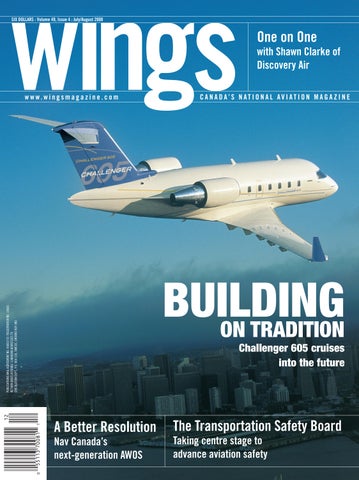
BUILDING ON TRADITION Challenger 605 cruises into the future
A Better Resolution
The Transportation Safety Board
Nav Canada’s next-generation AWOS
Taking centre stage to advance aviation safety
-/,1
/-Ê Ê 9,"-Ê Ê
Ê, * ,-Ê Ê -/ / " -
, , /9Ê /9Ê Ê1 Ê1 ", ", -
{äÈ
ÊÊ , , 1 -/ 1 -/
-
ââ
£Ó£°xÊ âÊ /ÊÃ>Ìi ÌiÊV ÛiÀ>}iÊÜ Êi `Ê iLÀÕ>ÀÞÊ£]ÊÓää
-Ê9"1,Ê -Ê9"1,Ê
/Ê, /Ê, 9Êttt 9Êttt
"7Ê 1/ ", <
Ê ,/ 8Ê- ,6
Ê
/,
/ " Ê/ -Ê Ê Ê, 6 Ê Ê - "1 /Ê" 9"1,Ê 8/Ê ,/ 8Ê{äÈÊ âÊ /Ê*1, 3OME CONDITIONS MAY APPLY
ÓÇxÊ*> iÀÊ, >`Ê > }>ÀÞ]Ê Ê/Ó ÊÇ { nää ÈÈn Çä{
ÓÎäÊ Ê{xÓäÊ }>ÀÊ À Ûi , V `]Ê Ê6Ç Ê£ Î nnn nÇ äÈÓ{
July August
WINGS MAGAZINE : Issue 4 : Volume 49 : Table of Contents
28 BUILDING ON TRADITION Challenger 605 cruises into the future
6
37
8
On the Fly
Raymond Canon discusses the role of the CF-104 Starfighter, the predecessor of the CF-18.
12
On the Web
13
Airline Insider
By Brian Dunn
Carr
Will oil really kill the cheap seats?
19
Seaman
Getting found when you are down.
20
The Transportation Safety Board
40
26
A Better Resolution
34
Island Hopping to the Land Down Under
43
26
62
A Better Resolution
44
One on One with Shawn Clarke, Discovery Air
Wings of the Past: Heritage for the Future
The Very, Very, Very Light Jet
Brian McNair shows how Leading Edge’s unique approach is taking training to the next step.
44
Nav Canada’s next-generation AWOS, Canada’s legacy Automated Weather Observation System is getting an update. By Ken Pole.
A Look Back
Mike Minnich examines the progress the Toronto Aerospace Museum has made in the 11 years it’s been in existence.
Blair Watson discusses the important work of the TSB and how they are taking centre stage to advance aviation safety.
34
The Transportation Safety Board
McCarthy
Human error or malevolence?
18
20
One on One
Darren Locke speaks with Shawn Clarke, chief operating officer of Discovery Air.
Purser
Air Canada faces the facts.
ON THE COVER Bombardier’s Challenger 605
Island Hopping to the Land Down Under
With its 72-passenger seat configuration rearranged to accommodate six ferry tanks, VH-QOI left Canada for Australia on February 4, 2008, making it the first Q400 to cross the Pacific. Joe Sargo reports. 4 | WINGS magazine | July/August 2008
www.wingsmagazine.com
NTRODUCING THE FALCON 900LX. GREAT 4,800 NM RANGE. BEST AIRPORT PERFORMANCE, HIGHEST FUEL EFFICIENCY AND FEWEST EMISSIONS OF ANYTHING IN ITS CLASS. PERIOD.
details at falconjet.com/900LX
U.S. 201.541.4600 France +33.1.47.11.82.32
McCarthy
DREW MCCARTHY is the editor of Wings.
Human error or malevolence? That’s the difference between safety and security. In the realm of safety, statistics show that about 80 per cent of all aviation accidents and incidents result from human factors. Security is a different species. A security breach occurs because someone intentionally causes an accident or uses an aircraft to commit a crime or an act of terrorism. In both cases, risk analysis and management are the best tools to minimize or eliminate potential damage to human life and property. In terms of risk, there are three broad threats to aviation: the use of an aircraft as a weapon, the use of an aircraft to carry and deploy a weapon, and the use of an aircraft to transport people, weapons, or other illicit materials for the purpose of committing a terrorist or criminal act. The implementation of SMS across Canadian aviation has been in progress for some time now. The basic SMS philosophy of performance-based assessment replacing prescriptive rules has become increasingly engrained in the industry. These same principles are also being applied to security. Transport Canada has been working with both commercial and business operators to formalize their security procedures. Insofar as current security practices are concerned, business and commercial aviation has been operating with a heightened sense of awareness and rigorous procedures for some time now. The task of security management systems (SeMS) is to document these procedures within individual organizations in a way that integrates them into the culture of the company – a secure culture parallels a safe culture. As with SMS, SeMS is based on management commitment and leadership (which includes an accountable executive), a written policy, traceability, employee participation and the creation of external partnerships. Most operations will find that documenting and formalizing what they currently do will demonstrate that they are already running secure businesses. Fundamental to SeMS is the idea that different types of operations with different business models and of different sizes will all benefit from the performance-based approach. As with all systems approaches, sometimes the jargon can dilute the message, so the questions really are: Have you thought of all the ways in which you, your employees, your partners, and your customers might be harmed by someone who is intent on doing harm? What is the likelihood of certain things happening, and what are the consequences if they do? What can your company do consistently and automatically to minimize these risks? Are you able to imagine all of the possibilities on your own, or should you be partnering with your colleagues, governments and other trusted associates to further your goals? Do you have a written security plan that is understood by everyone in the operation? Security management is proactive. Chasing perpetrators after they’re gone is outdated and ineffective. The bad guys are definitely still out there and operators need to be ready on the day that the threat becomes a reality.
Human error or malevolence? Different problems, same remedy
6 | WINGS magazine | July/August 2008
WINGS MAGAZINE PO Box 530, 105 Donly Dr. S., Simcoe, ON N3Y 4N5 Tel.: 428-3471 Fax: 429-3094 Toll Free: 1-888-599-2228 PUBLISHER TIM MUISE tmuise@annexweb.com EDITOR DREW MCCARTHY dmccarthy@annexweb.com ASSOCIATE EDITOR ANDREA KWASNIK akwasnik@annexweb.com SENIOR ASSOCIATE EDITOR RICHARD PURSER PRODUCTION ARTIST KRISTA MISENER OTTAWA CORRESPONDENT KEN POLE AVIONICS EDITOR ROB SEAMAN FLIGHT DECK RAY CANON, JAMES CARELESS, DAVID CARR, NIKOLAS CHAPMAN, BRIAN DUNN, DARREN LOCKE, CARROLL McCORMICK, BLAIR WATSON ADVERTISING SALES MARK MCWHIRTER mmcwhirter@annexweb.com SALES ASSISTANT PAULINE CECILE pcecile@annexweb.com VP/GROUP PUBLISHER DIANE KLEER dkleer@annexweb.com PRESIDENT MIKE FREDERICKS mfredericks@annexweb.com PUBLICATION MAIL AGREEMENT #40065710 RETURN UNDELIVERABLE CANADIAN ADDRESSES TO CIRCULATION DEPT., P.O. BOX 530, SIMCOE, ON N3Y 4N5 e-mail: awebster@annexweb.com Periodical postage paid at Buffalo, NY. USPS 021-029, ISSN 0701-1369. Published six times per year (Jan/ Feb, Mar/Apr, May/Jun, Jul/Aug, Sep/Oct, Nov/Dec) by Annex Publishing & Printing Inc. US Office of publication c/of DDM Direct.com, 1175 William St., Buffalo, NY 14206-1805. US postmasster send address change to P.O. Box 611, Niagara Falls, NY 14304. Printed in Canada ISSN 0701-1369 CIRCULATION e-mail: awebster@annexweb.com Ph: 866-790-6070 ext. 208 Fax: 877-624-1940 Mail: P.O. Box 530, Simcoe, ON N3Y 4N5 SUBSCRIPTION RATES Canada – 1 Year $ 34.00 (includes GST - #867172652RT0001) USA – 1 Year $ 30.24 Foreign – 1 Year $ 65.00 From time to time, we at Wings Magazine make our subscription list available to reputable companies and organizations whose products and services we believe may be of interest to you. If you do not want your name to be made available, contact our circulation department in any of the four ways listed above. No part of the editorial content of this publication may be reprinted without the publisher’s written permission. ©2008 Annex Publishing & Printing Inc. All rights reserved. opinions expressed in this magazine are not necessarily those of the editor or the publisher. No liability is assumed for errors or omissions. All advertising is subject to the publisher’s approval. Such approval does not imply any endorsement of the products or services advertised. Publisher reserves the right to refuse advertising that does not meet the standards of the publication.
Air Transport Association of Canada
Canadian Business Aviation Association
Canadian Owners & Pilots Association
Member of the Alberta Magazine Publishers’ Association
Member of the Canadian Circulations Audit Board
www.wingsmagazine.com www.wingsmagazine.com
EXPO Aircraft interiors AMERICAS
THINKING OUTSIDE THE BOX
INSIDE THE CABIN
US Airline Industry reaches breaking point, do you have the solutions for the future? We can help…
• GET AHEAD OF THE COMPETITION: A groundbreaking strategy forum which will tackle head on the issues faced by the aviation industry today and provide solutions for airlines and suppliers, ensuring that they are equipped for the rough ride ahead.
A UNIQUE NETWORKING AND SUPPLY CHAIN EVENT
• MEET THE INDUSTRY: A networking & supply chain event for cabin systems and relevant component parts. Meet and network with Americas and International suppliers and airlines to see the latest interior products and technology. Find out what is happening in your industry.
FOR THE INTERNATIONAL AND AMERICAS AIRCRAFT INTERIORS MARKET
REGISTER NOW FOR FREE ADMISSION
• ONE STOP SHOP: Co-locating with the WAEA creating a one stop show for the interiors industry.
SEPT 09,10,11 2008 LONG BEACH CC | CALIFORNIA
www.aircraftinteriorsexpo-us.com
Priority Code: AD4 Sponsored by
Co-located with
onthefly INDUSTRY NEWS : COMMERCIAL AVIATION : GENERAL AVIATION
BUSINESS AVIATION : MILITARY AVIATION
Chartright orders 10 D-JETs Chartright Air Group and Diamond Aircraft have announced a major order for the Diamond D-JET personal jet to complement Chartright’s existing fleet of large business jets. Chartright has ordered 10 D-JET aircraft with first delivery to begin in the third quarter of 2010. These aircraft will be available for Chartright’s charter and managed aircraft customers. Operated from Toronto, Chartright forecasts the D-JET will serve destinations, such as New York, Montreal or Philadelphia in less than two hours, an
Chartright has ordered 10 D-JET aircraft with first delivery to begin in the third quarter of 2010.
elapsed time that includes checkin, security and customs. A typical private jet charter to one of these destinations would cost between
$10,000 and $15,000 round-trip. The D-JET will accomplish the same mission for less than $4,000, Chartright expects.
Air France sues Pearson, Ottawa over 2005 crash Pearson International Airport’s newest runway lacks proper safety margins and falls short of international standards, Air France alleges in a lawsuit following the dramatic 2005 crash of one of its jets at the site.
In its lawsuit, Air France pins the blame on the Greater Toronto Airports Authority, Nav Canada and the individual air-traffic controllers who guided the big jet to the airport in the fateful minutes before the crash.
The French airline and its insurers are suing the Greater Toronto Airports Authority, which runs Pearson, the federal government and the country’s air-traffic control agency for about $180 8 | WINGS magazine | July/August 2008
million, charging they all cut corners that contributed to the crash of its Airbus A340 jet. The airline takes aim at the airport operator, saying the design of Runway 24 Left – which ends at a steep ravine – failed to ensure there was an “adequate margin of safety for aircraft in the event of an overrun event.” It also says in a statement of claim filed with the Ontario Superior Court that “GTAA failed to provide a safe environment for the conduct of civil air operations.” Flight 358 arriving from Paris was battered by a violent thunderstorm just as it touched down on August 2, 2005. Going too fast, it ran off the rain-slicked runway and into the ravine, where it broke apart and burst into flames. All 297 passengers and 12 crew survived the accident but 33 people were taken to hospital.
The federal government says Air France knew that runway runoff areas “are not standard in Canada” and noted the airline operated from Pearson for “many years” before the crash. “Air France has continued to operate flights including those by A340 aircraft on Runway 24L since the said incident,” the government says in its statement of defence. Federal officials point the finger at the pilots, saying the crew failed to calculate a safe landing distance, despite reports that thunderstorms were expected at the time of landing. An investigation by the Transportation Safety Board of Canada concluded last December that the jet touched down almost halfway down the 2,740-metre runway and was still travelling at almost 150 km/h when it went off the runway.
Seaplanes North to distribute Viking spares Viking Air Ltd. has selected Seaplanes North of Anchorage as its material sales and distribution centre for DHC-2 Beaver and DHC-3 Otter parts to better serve its Alaskan customers. The decision comes as a customer service enhancement effort to facilitate faster overnight deliveries to the region and to eliminate potential customs delays. In business since 2000, Seaplanes North is a well-established parts distributor and an aircraft maintenance provider located at Anchorage’s Lake Hood, the busiest seaplane base in the world. Viking launched the all new DHC-6 Series 400 Twin Otter last year, with over 40 orders to date and deliveries to begin in 2009. Viking also provides OEM support for the worldwide fleet of the de Havilland heritage line of aircraft (DHC-1 through DHC-7).
Hawker 4000 receives FAA approval Hawker Beechcraft Corporation (HBC) received FAA type certification for the new flagship Hawker 4000 supermidsize business jet in June, allowing the company to begin delivering to customers. HBC concurrently received the FAA production certificate for the Hawker 4000. www.wingsmagazine.com
ON THE FLY
Customers on board with Guardian Mobility Guardian Mobility has introduced its first new products designed to operate with the Iridium satellite system. The new products, Skytrax 3i and Skytrax 3xi, offer complete global coverage for aircraft tracking around the world including all continents, oceans and the polar regions. Customers for the new products already include Sabina Aircraft Consulting of Belgium, and Canadian operators CHC Helicopter Corporation,
Transwest Air and Gateway Helicopters. Skytrax 3i is intended to be internally mounted on the aircraft and is ideal for helicopters. Skytrax 3xi is mounted externally on the aircraft with the electronics hub mounted inside the aircraft. Both products use the same electronics hub, which contains the GPS receiver and an Iridium transmitter, which communicates with the satellite system during flight. The
products are priced at $2,395. Locational data includes relaying longitude, latitude, speed, heading and altitude, and conform to the AFF standard. The location data is plotted to a Web-based mapping tool, which enables trip views of either a single or multiple aircraft during flight. The Skytrax units are small in size, lightweight, compliant in terms of industry standards and easy to carry or to install permanently.
Events Calendar AUGUST 2008 LABACE 2008 (Latin American Business Aviation Conference & Exhibition) Aug. 14-16 Sao Paulo, Brazil http://www.labace.aero Classic Air Rallye August 23-24 Rockcliffe Airport, Ottawa, ON http://www.flightworks.ca/
SEPTEMBER 2008
Northern Jet acquires 100th Learjet 40 XR Bombardier announced in midJune the delivery of the 100th manufactured Learjet 40 XR light business jet to Northern Jet Management, an aircraft management and shared ownership company headquartered in Grand Rapids, Mich. The new Learjet 40 XR joins The Company Jet fleet, Northern Jet’s shared owner-
Bombardier delivered the 100th manufactured Learjet 40 XR light business jet to Northern Jet Management in mid-June.
ship program, which currently features three Learjet 40 XR and one Learjet 45 XR aircraft. The Company Jet’s fleet is based at
Gerald R. Ford International Airport in Grand Rapids. Since acquiring Learjet in 1990, Bombardier has carried forward the brand’s legacy by launching eight high-performance and fuel-efficient Learjet aircraft.
Appointments at Atlantic Turbines Scott Taylor Atlantic Turbines International, than two decades includes extenjoins Standard a Vector Aerospace company, sive sales experience across CanAero has hired Rick Halipchuk as sales ada as well as in Montana, South and service manager for PT6, JT15D, and PW100 engine lines in Canada, and Barry Seddon as Canadian field service technician. Halipchuk’s career of more
Rick Halipchuk is an industry-proven veteran with a career that spans more than two decades.
Dakota and Minnesota. Seddon is a licensed Canadian aircraft maintenance engineer with 19 years experience. He will be travelling to customers’ locations to offer on-site field services.
Barry Seddon is a licensed Canadian aircraft maintenance engineer.
Standard Aero has appointed Scott Taylor as Business Aviation business development leader based in Tempe, Ariz. Taylor will be responsible for developing a sustainable long-term strategy for the business aviation sector and for creating innovative approaches to growing existing products and services. Prior to joining Standard Aero, Taylor managed sales and marketing operations for Honeywell Aerospace and most recently was general manager, business and regional aviation marketing for General Electric Aviation.
2008 International SeaKing Maintenance Symposium Sept. 30 - Oct. 2 Vancouver, BC http://www.seaking symposium2008.com.
OCTOBER 2008 NBAA 61st Annual Meeting & Convention Oct. 6-8 Orlando, FL http://www.nbaa.org SARSCENE 2008 Oct. 15-18 St. John’s, NL http://www.nss.gc.ca ALEA Canadian Regional Safety Seminar Oct. 22-24 Montreal, QC http://www.alea.org/public/ seminars/index.aspx CAMC Forum and AGM Oct. 22-24 Calgary, AB http://www.camc.ca Ontario A.M.E. Workshop & Symposium Oct. 22-24 Mississauga, ON http://www.ame-ont.com For a full listing of events, go to www.wingsmagazine.com July/August 2008 | WINGS magazine | 9
ON THE FLY
e
g d s o r d e g s e y s d A p s
Boeing completes Power On sequence for Dreamliner Boeing has completed the Power On sequence for the first 787 Dreamliner, marking the completion of the next major milestone on the path to first flight later this year. Power On is a complex series of tasks and tests that bring electrical power onto the airplane and begin to exercise the use of the electrical systems. The 787 is a more-electric airplane with the pneumatic, or bleed air, system being totally replaced by electronics. The Power On sequence began in early June with a series of pre-test continuity checks to verify that the wiring installed in the airplane had been connected properly. Upon completion of those checks, the Boeing team
The 787 is expected to enter revenue service in 2009 after an extensive flight test program.
plugged in an external power cart and slowly began to bring full power into each segment of the system, beginning with the flight deck displays. From that point forward, the pilot’s controls were used to direct the addition of new systems to the power grid. At each step of the testing, power is allowed to flow
into one additional area and gauges are used to verify that the right level of electrical power reached the intended area. Work will continue to finish building the first 787 and further test its readiness for operations. First flight is expected in the fourth quarter. The Boeing 787 Dreamliner is a more fuel-efficient mid-sized jetliner capable of serving long-distance routes. The 787 is expected to enter revenue service in 2009 after an extensive flight test program. Fifty-eight customers around the world have ordered nearly 900 787s since the program was launched in April 2004, making the Dreamliner the fastest-selling new commercial jetliner in history.
John French consultants to merge with Solocks.com Training After providing dangerous goods training to the aviation world for over 25 years, John French has decided to officially merge John French Consultants Ltd. with his online company, Solocks.com Training Inc. (www.solocks.com) and has appointed Vern Busch as its new managing director. Solocks.com specializes in providing TDG & WHMIS courses over the Internet, accessible 24 hours a day from anywhere
John French, left, will continue as president and senior consultant, while Vern Busch will handle day-to-day operations.
with a web browser. Dangerous goods training manuals previ-
ously provided by John French Consultants Ltd. will be available through Solocks.com Training Inc. French will continue as president and senior consultant, while Busch will handle day-to-day operations. Busch comes from a background of over 25 years in the training and technology industries, and has worked with French and Solocks.com for several years.
Aviation Solutions and Turbine Solutions expand in western Canada Aviation Solutions Inc. and Turbine Solutions Inc. have expanded the Turbine Solutions Inc. component shop in Calgary. Along with Garrett 331 engine maintenance, Turbine Solutions has 10 | WINGS magazine | July/August 2008
added various aircraft wheel and brakes overhaul capabilities at the Calgary facility. In addition to supporting Western Canada with a large inventory of Beechcraft and Garrett
331 parts, the facility has wheel and brake overhaul capabilities for King Air, 1900, Hawker, Jetstream, Citation, Lear, Challenger, PC12 and Falcon Jet aircraft, among others.
Montreal FBO completed Aero Toy Store has announced completion of the 45,000 square foot expansion at its Montreal facility. Located at Trudeau International Airport, the company’s fixed-base operation has added a 30,000square-foot aircraft hangar as well as a 15,000-square-foot completion centre to its current spacious facility.
Aero Toy Store has added a 30,000square-foot aircraft hangar as well as a 15,000-square-foot completion centre to its facility.
The approximately $8-million project began in late summer 2007. Aero Toy Store’s Montreal FBO encompasses 200,000 square feet, including ramp space, and features a 41,000-square-foot showroom, hangar and offices equipped with the most advanced security and technological aviation equipment available. With the addition of its new aircraft hangar and completion centre, the facility is able to offer an expanded line of Aero Toy Store services, including aircraft interior refurbishment and completions.
ON THE FLY
BASLER BT-67 approved for flight into known icing
Sales soaring for Air Tractor Despite gloomy forecasts for many sectors of the U.S. economy, agricultural aircraft manufacturer Air Tractor Inc. is experiencing one of its best years ever, says Leland Snow, founder and president of the company. During the first five months of 2008 Air Tractor licensed and delivered 50 airplanes, including some that were produced in late 2007. The bright yellow aircraft cost an average of $700,000 US. Kristin Edwards, vice-president of sales, says the company expected to conclude sales of 59 aircraft by July 1. Annual production is forecast to total 94 aircraft, with
anticipated production of 120 aircraft for 2009, says Edwards. “Strong sales of Air Tractor aircraft are the result of increased demand around the world for aerial application aircraft,” explains Snow. “A combination of economic factors are producing a favourable climate for aircraft sales. High commodity prices and the worldwide boom in agriculture, plus a weak U.S. dollar have made aircraft more affordable for overseas customers.” Air Tractor is also experiencing strong demand for its aerial firefighting tanker plane, the AT-802F, Snow reports. Eastern European
Leland Snow, founder and president of Air Tractor Inc.
countries that have experienced devastating wildfires for the past several years are purchasing the single-engine air tanker in increasing numbers because of its low operational costs and versatile mission profile capabilities.
Elizabeth Lund named vice-president at Boeing Elizabeth Lund has been named vice-president of product development for Boeing Commercial Airplanes. Lund will be responsible for leading preliminary design of new and derivative airplanes and systems, and environmental performance strategy. Lund also will manage the overall R&D plan across Commercial Airplanes, and support the Product Strategy and Advanced Technology organizations within Commercial Airplanes and Phantom Works. The position reports to Boeing Commercial Airplanes engineering vicepresident Mike Denton. Lund, 43, succeeds Todd Zarfos, who was recently named
Lund is the new vice-president of product development for Boeing Commercial Airplanes.
vice-president of 747/767/777 engineering. Since June 2005, Lund has served as director of Boeing 777 manufacturing in Everett, Wash. In November 2006, Lund and
her team started using a moving assembly line to build the longrange twin-engine airplane family. Prior to that, Lund was the director of the Boeing Interiors Responsibility Center. The IRC designs, manufactures, assembles and integrates a wide range of interior systems for production, aftermarket and spares for Boeing commercial jets. She also served as the director of business operations and supply chain management for Boeing’s Fabrication Division, where she was responsible for strategy development, work statement management, strategic work placement and integration of division-wide initiatives.
With FAA approval for flight into known icing, the utility of the DC3-67TP is further increased.
Basler Turbo Conversions LLC of Oshkosh, Wis. has announced FAA approval for flight Into known or forecast icing conditions for its DC367TP modified airplanes. These aircraft, modified by Supplemental Type Certificate SA4840NM, are fitted with Pratt & Whitney PT6A-67 engines and Hartzell five-bladed propellers. In addition the airframes are completely refurbished to ‘as-new’ condition. This airplane configuration has become a workhorse in the scientific, transport & special missions community and is in service throughout the world wherever a stable flight platform is required or adverse environmental conditions exist. A new Airplane Flight Manual Supplement has been issued and the Basler training program is being updated to incorporate this new capability.
Héroux-Devtek signs Learjet 85 contract Héroux-Devtek Inc. has been awarded a contract from Bombardier Aerospace to provide the landing gear for the newly launched Learjet 85 business aircraft program. Héroux-Devtek will design,
develop, fabricate, assemble, test and deliver landing gear structure and actuation for the Learjet 85 aircraft. This life-cycle mandate also includes the provision of spare parts. Launched on Oct. 30, 2007,
the new Learjet 85 aircraft will be the first Bombardier Aerospace jet to feature an all-composite structure and will be the first allcomposite structure business jet designed for type certification under FAR Part 25.
Héroux-Devtek Inc. will provide the landing gear for the newly launched Learjet 85. July/August 2008 | WINGS magazine | 11
ontheweb www.wingsmagazine.com
NEWS HIGHLIGHTS
JOB BOARD
BOEING TEAMS WITH SKYHOOK TO BUILD HEAVY-LIFT ROTORCRAFT
Your source for aviation jobs: • Pilots • Maintenance • Executive positions and more!
LOW COST CARRIER COMES TO TORONTO ACASS APPOINTS KEVIN J. HARRIS AS NEW V.P. OF BUSINESS DEVELOPMENT PROMOTING ETHANOL FUEL MISGUIDED – C.D. HOWE INSTITUTE NAV CANADA SELECTS SEARIDGE TECHNOLOGIES FOR DIGITAL WEATHER CAMERA PROJECT
POLL Take part and view results of our weekly polls…
BOEING DELIVERS NEXT-GENERATION 737 TO SUNWING AIRLINES OF CANADA Read the full stories online at www.wingsmagazine.com
Web Exclusives: AROUND THE WORLD IN 40 DAYS... IN A DA40! 2250 NM NONSTOP FROM JAPAN TO ALASKA! Marc Aurel Lehman took delivery of his DA40XL at Diamond’s London, Ontario facility last summer. He’s back in London this summer for some scheduled maintenance and upgrade of his G1000 with GARMIN’s new SVT (Synthetic Vision Technology). The unusual thing about this? His return to London involved flying completely around the world!
For full details, go to www.wingsmagazine.com and click on web exclusives.
GET HOME ON TIME – CESSNA STARS IN TIMES SQUARE Cessna Aircraft Co. is taking its marketing program to Broadway with a new video appearing over the next two months on one of the jumbo video screens in New York’s Times Square.
The pilot shortage is having a negative effect on my operation. Agree 67% Disagree 33% Undecided 0%
A-LIST The Canadian Aviation Guide (A-List) is the only reference tool to bring the entire Canadian aviation industry together in one directory.
DIGITAL MAGAZINE Visit www.wingsmagazine.com to sign up for a free trial of Wings magazine – digital version
To watch the innovative video, visit www.wingsmagazine.com and click on web exclusives.
AMENDMENTS TO DANGEROUS GOODS ACT At the end of May 2008, The Honourable Lawrence Cannon, Minister of Transport, Infrastructure and Communities, tabled amendments to the Transportation of Dangerous Goods Act, 1992 in the House of Commons. The amendments would enhance security and safety in the transport of dangerous goods.
BLOG Have your say on a variety of industry topics… • Air France sues over 2005 crash at Pearson • Manipulated media passing judgment on CBAA
For full details, go to www.wingsmagazine.com and click on web exclusives. 12 | WINGS magazine | July/August 2008
www.wingsmagazine.com
airlineinsider Due to further delays, Air Canada’s first 787 Dreamliner will not arrive until at least January 2012.
AIR CANADA BUILDS OTTAWA PRESENCE Air Canada Jazz has launched new nonstop year-round flights between Ottawa and four new markets – twice daily to Washington National Airport and once daily service to Saskatoon, Thunder Bay and Charlottetown. “Air Canada has been steadily building its Ottawa presence in response to market demand and it now connects the capital to 23 destinations with nonstop service. This summer’s schedule provides for a 19-per-cent increase in departing capacity over the previous summer,” said Daniel Shurz, VP, network planning.
Air Canada Jazz RJ.
(Photo by Andrew Cline)
The airline has also started three nonstop flights per weekday from Toronto to Grand Rapids, Mich., and twice-daily service to Dayton, Ohio. Both routes use 18-passenger Beech 1900D aircraft operated by Air Georgian.
AIR CANADA EVALUATING SCHEDULES DUE TO DREAMLINER DELAYS Air Canada has announced its Toronto-Rome and Vancouver-Osaka routes will be suspended effective October 26, the start-up of the winter schedule period. TorontoRome is currently planned to be reinstated in the spring of 2009 for the peak summer travel period. The Vancouver-Osaka route is a permanent suspension and passengers will be routed through Tokyo.
Beechcraft/Raytheon 1900D operated by Air Georgian Ltd.
Concerning new aircraft, Air Canada has been informed by Boeing of further 787 Dreamliner delivery delays. The airline had expected to take delivery of its 37 787-8s and 7879s between 2010 and 2014. However, the first 787 will not arrive until at least January 2012. Air Canada is now evaluating its schedules for this period and may hold back expansion and look for compensation from Boeing. Boeing is informing all carriers of the delays due to a slower ramp-up in production. Boeing is now being more cautious with its previous very aggressive production timetable. Delays are expected to average around 20 months for each 787 Dreamliner. CASCADE TO PERFORM WESTJET’S HEAVY CHECKS WestJet will add a second
By Brian Dunn
daily nonstop flight between Quebec City and Toronto effective November 2. It currently operates a single daily flight. Meanwhile, Cascade Aerospace of Abbotsford, B.C. has landed a three-year contract to perform heavy checks on WestJet’s fleet of Boeing 737NGs. The company expects to complete 32 heavy checks for WestJet by the end of 2010. WestJet’s fleet currently comprises 75 Boeing 737-600s, 700s and 800s and the airline has another 33 -700s and -800s on order, according to Ascend’s CASE database. Cascade, which also provided engineering services for WestJet, is conducting the work at its Abbotsford heavy maintenance and modification facility, and previously installed LiveTV on the carrier’s entire fleet. SUNWING BRINGS THE PLANE TO YOUR DOOR The Canadian Transportation Agency has granted Sunwing Airlines a licence to operate scheduled international service between Canada and Antigua and Barbuda. And beginning this fall it will
WestJet’s fleet currently comprises 75 Boeing 737-600s, 700s and 800s and the airline has another 33 -700s and -800s on order. July/August 2008 | WINGS magazine | 13
offer service to Las Vegas from Vancouver, Calgary and Toronto. Flights will be offered on Thursdays and Sundays with Vancouver and Toronto inaugural flights on September 11, and Calgary launching on November 20. The upcoming winter season is already shaping up as a promising one for Sunwing Vacations. It will be flying to 30 destinations in Mexico, the Caribbean, Central America and the U.S. With the addition of
thinking without limits
eurocopter.com
With the addition of six new gateways, Sunwing will be flying from 29 cities across Canada.
six new gateways, Sunwing will be flying from 29 cities across Canada. As part of its philosophy of “bringing the plane to your door” Sunwing has added even more mid-sized centres to its list of gateways, including Kelowna (with flights to Cancun and Riviera Maya), Windsor (Santo Domingo and Varadero), Hamilton (Punta Cana and Varadero),
(Photo by Andrew Cline)
AIRLINE INSIDER
Porter hopes to add credit card, hotel and car rental partners to its frequent flyer program.
Kitchener-Waterloo (Cancun and the Riviera Maya as well as Jamaica), Sault Ste. Marie (Varadero) and Val d’Or (Varadero). VIPORTER A BREATH OF FRESH AIR Porter Airlines has launched its own frequent flyer program, VIPorter, and points collected can be used to redeem travel on the airline
after as few as five one-way flights. There are no blackout periods and allocated seats for free travel represent up to 10 per cent of total seat capacity, or seven seats on its 70seat Q400 aircraft. “VIPorter broadens Porter’s premium offering and provides travellers with realistic, attainable rewards,”
said Don Carty, chairman of Porter Airlines. “Porter’s approach to our frequent flyer program … will be a breath of fresh air in an industry bogged down in overly complicated reward and redemption systems.” The airline hopes to add credit card, hotel and car rental partners to the program. As it adds more aircraft to its fleet, Porter is also looking to bolster its leisure routes, like increasing winter flights to Mont Tremblant and making seasonal service to Quebec City year-round. In response to an FAA ruling, Porter has boosted weekend service between Toronto City Centre Airport and Newark after it was ordered to cancel four primetime daily flights to reduce congestion in the New York area. The new schedule fea-
tures six return flights every weekday, three return flights on Saturday and five return flights on Sunday. Total flights per week change to 38 from 40. Porter was operating seven round trips on weekdays on the route. The airline has also added one TCCA-Montreal return flight Monday through Friday during the busy afternoon period. This route increases to 10 return flights from nine every weekday. During the summer, there will be eight return flights every weekday. FUEL SURCHARGES COMBAT RECORD FUEL PRICES Higher fuel prices are reversing the airline industry’s projected $4.3-billion US profit into a $2.3-billion US loss this year, according to IATA. And that loss could jump to $6.1 billion US of
(Photo by Brian McNair)
AIRLINE INSIDER
All major Canadian airlines have introduced fuel surcharges to help defray higher fuel costs.
red ink if oil hovers around $135 US a barrel for the rest of the year. All major Canadian airlines have introduced fuel surcharges, with the biggest bite coming from Air Canada’s long-haul flights. The one-way fuel charge between Toronto and London, for example, stood at $145 in June which still didn’t cover the one-way fuel costs for each passenger. And ana-
lysts estimate that every $1 increase in the cost of a barrel of oil cuts $25 million from the airline’s operating profit. To help defray costs, Air Canada is charging $25 for checking in a second bag on lower-fare flights within North America, and on June 17 the the airline announced it will cut 2,000 jobs this fall and reduce system-wide capacity by seven per cent.
More than a great executive helicopter. A pretty effective time machine.
The Eurocopter EC155. Carrying up to nine executives up to 370nm. Offering a comfortable workspace in the largest, quietest cabin around. Using advanced, efficient technology. A proven track record of reliability backed by a wealth of experience in maintenance and training. More than a helicopter, a business tool that rewrites the laws of time and space. When you think efficiency, think without limits.
Protection, made by
EADS. Revolutionary wing design at Airbus is just one way that EADS technology is balancing our need to travel with our need to safeguard the environment. It helps the A380 burn 17 per cent less fuel per seat than rival aircraft. And Eurocopter is reducing helicopter noise levels ahead of its competitors. EADS makes the transport solutions the world needs. And helps to protect the things we value most. | www.eads.com/madebyeads
AIRBUS A380
EUROCOPTER EC135
A400M
EUROFIGHTER
METEOR
GALILEO
ARIANE 5
carr
DAVID CARR is a Wings writer and columnist.
At $145 a barrel, oil has become the black ink that is rewriting the rules of air transport. Interestingly, there are disparate views on where these rules will lead us. Michael O’Leary, the take-no-prisoners chief executive of Dublinbased budget airline Ryanair, said in June that bargain carriers like his and U.K. rival easyjet are here to stay. Air Canada’s Robert Milton holds an opposite view, predicting that record high fuel prices could spell the end of discount airlines. A moot point in Canada given that WestJet jettisoned its discounter roots years ago and nobody has jumped in to take over where Jetsgo left off. Not surprisingly, both O’Leary and Milton were defending their respective business models against that of the other. No model is immune to the soaring price of fuel, and some airlines are going to take a harder hit than others. Major U.S. airlines, for example, have been slow to renew their fleets and retire older, thirstier airplanes. That’s going to hurt. Predictions, like business planning, are a tough business especially when the price of the commodity driving the business increases 35 per cent over 90 days, as oil has recently. Just ask General Motors. In June, when the price of oil was $130 a barrel, O’Leary announced a 20-per-cent increase in year-over-year profitability, while cautioning that the best his airline could expect is to break even this financial year, and only if the price of oil held firm. So what is it to be at $145 a barrel – higher fares, fewer flights, fewer passengers, or a combination of all three? At the same time Milton was speculating on the end of cheap airfares, Air Canada was matching WestJet’s latest seat sale with $19 base fares between Toronto, Montreal and Ottawa, although in an era of fixed fuel charges, cheap does become a relative term. To be fair, Milton was referring to the single-cabin, no-frill business model. He might have a point. JetBlue Airways is considering a premium cabin to boost revenue, and word out of Calgary is that everything is on the table at WestJet, including charging a premium for the extra legroom in emergency exit rows – something this space advocated many columns ago.
Will oil really kill the cheap seats? Why a green agenda could spell more red for a beleaguered industry
18 | WINGS magazine | July/August 2008
But while Air Canada joins other ‘full-service’ airlines in cutting staff, parking aircraft and shedding routes, single-cabin WestJet appears to be in an expansionist mood, taking on new routes, increasing the frequency of others and adding up to 46 airplanes by 2013. Perhaps the new rules are that there are no rules, just individual circumstances. What is certain is that the current oil crisis may result in an industry shakeup so severe that even Chapter 11 may not be enough to help the mangiest American dogs survive for much longer. Airlines are going to disappear, but a single versus multi-tier cabin is not going to be the arbiter of who stays or goes. Both Air Canada and WestJet will ride out this storm, as will other well-managed carriers such as Air Transat, Southwest and O’Leary’s Ryanair, although some airlines will have to rethink charging extra for anything that is not nailed down, and roll some of the added costs of doing business into the price of a ticket. Fuel surcharges are a case in point. Given such a heightened level of uncertainty, is now the time to burden a beleagured industry with a new layer of green taxes? This means either Europe’s proposed cap-and-trade system or Canadian Liberal Leader Stéphane Dion’s uneven carbon tax shift that would be applied to aviation fuel but leave the local Esso gas pump untouched. Emissions from fossil fuels are a global problem and aviation is an easy target. But it is not NIMBYism to suggest that air transport has already carried incredible costs since 9/11, especially in Canada where the government profits excessively from the same airports it once bankrupted. In fact, why not consider that annual $1-billion windfall as aviation’s carbon offset by pouring it into environmental R&D? In June, Ottawa International Airport cut charges five per cent, saving grateful customer airlines an estimated $600,000. The Greater Toronto Airports Authority has slashed charges to freight carriers 25 per cent (freight being less discriminatory than passengers over where it lands). As Ottawa’s chief executive said at the time, “this is not just an airline crisis, but one that impacts the entire industry and ultimately our communities.” Precisely. David Carr can be reached at davidjcarr@sympatico.ca www.wingsmagazine.com
ROB SEAMAN is a Wings writer and columnist.
Flying around with a little box that directs rescuers to your location in the event of disaster is comforting. So the Emergency Locator Transmitter (ELT) has an accepted place in our lives. But times change and the ELT of today may not be able to save your hide tomorrow. In 2003 Transport Canada announced that in accordance with ICAO policy, January 2005 was target date for ELTs to have dual mode frequency capability – the traditional 121.5 MHz plus the newer 406 MHz. At the same time it proposed that aircraft in international travel should be equipped with 406-MHz ELTs but did not recommend this for the domestic fleet. Now all of that is going to change. As of February 2009, the COSPAS satellite monitoring of frequency 121.5 will stop. That action will have a dramatic effect on many Canadian domestically operated aircraft. Like it or not, if you have an older 121.5-MHz ELT, you will have to change to something that can be monitored on the 406-MHz frequency. Transport Canada has issued the notice of proposed amendment to the appropriate CARs for this; the NPAs are 2007-031/032/033. These mandate that all Canadian-registered aircraft are to be equipped with UHF ELTs. Older VHF ELTs will not be acceptable. One rationalization for the change is that the newer frequency is optimized for accurate satellite location; it will provide a far better signal-to-noise ratio for the monitoring satellites. These new satellites can look at a lot more data and locate signals with far greater accuracy. Each 406-MHz ELT comes with its own distinct digital code and owners must register that unique information into a general data base when they first install and activate the unit. When a satellite receives a transmission of the code, it relays the information back to the ground and those receiving it may then figure out the aircraft owner, type and registration. Satellites are supposed to be able to locate a 406-MHz ELT within about two kilometres – far more accurate than the older 121.5 ELTs. In fact it is ten times more accurate and accordingly should cut down the search area by a factor of 100. This is significant! So based upon all this and the fact that the old satellite is going to be dead to the 121.5 units, this all seems to make sense. Not so, says Kevin Psutka, president and CEO of the Cana-
seaman dian Owners and Pilots Association (COPA). He writes that the cost to Canadians for this transition is not justified. “ELTs fail to perform in the majority of accidents because antennas break off, the device becomes submerged in water or the wreckage masks the antenna. The new ELTs retain these problems and so the prospects of being found are not significantly improved with the move to the much more expensive 406-MHz ELTs. Our estimate of the cost to equip the fleet in Canada is between $80 million and $120 million.” On May 25, COPA stated that “Transport Canada has listened to COPA’s strong warning that there must be a transition period to ensure that there is an adequate supply of ELTs and personnel to install them. COPA’s research indicates that at least three years must be provided. However, Transport Canada believes this can be accomplished much sooner and also feels that there must be some incentive to convert earlier rather than have everyone wait until the end of the period and create a bottleneck. So they have chosen, against our advice, a twoyear transition period and conditions that will require some, if not most owners, to equip much sooner.” As for the new units, there are some options that come in at under $1,000. Installation is additional. But Psutka says one COPA member recently paid double the amount of the unit for installation. The final bill came to some $3,500 and he feels that such a figure is simply too much. In reply, some would offer that if $3,500 is all that prevents you from updating and operating your aircraft safely, then perhaps you need to rethink the affordability of flying altogether. Add to that fact that the cost for SAR can and will be passed along at some point and in some manner to those who use the service, then $3,500 could be a cheap investment when compared to the time and cost of finding you without such mandatory equipment. Like all changes in aviation, this one is hard for some. But like it or not, the change is coming. As it stands today you can get onboard or stay on the ground.
Getting found when you are down Changes to the ELT world are not going over well with some
July/August 2008 | WINGS magazine | 19
THE TRANSPORTATION SAFETY BOARD Taking centre stage to advance aviation safety Every day nearly a dozen transportation accidents and incidents are reported to the Transportation Safety Board of Canada (TSB). This unique federal organization has the mandate to advance safety in the marine, pipeline, rail and air modes of transportation. The history of the TSB and its activities related to aviation are the focus of this article. The TSB takes centre stage in the public’s awareness after an aircraft accident. Video of investigators combing through wreckage and comments by a lead TSB member about the accident and investigation are broadcast on major news networks. Also, the popular television program aired on Discovery Channel’s ‘Mayday’ has helped Canadians better understand the work of aircraft accident investigators. Some of the more prominent aircraft disasters investigated by the TSB during the past 18 years include the August 2/05 runway overrun and crash and fire of Air France Flight 358 at Toronto International Airport, the October 14/04 crash of MK Airlines Flight 1602 at Halifax International Airport, and the crash of Swissair Flight 111 off the coast near Peggy’s Cove, N.S. on September 2/98. 20 | WINGS magazine | July/August 2008
(Photo courtesy of Transportation Safety Board of Canada)
By Blair Watson
Independent of other federal agencies and departments such as Transport Canada, the TSB reports to Parliament through the president of the Queen’s Privy Council for Canada.
Occurrences involving small to large aircraft and less frequently, air traffic control mistakes, keep TSB air sector personnel busy. The TSB was formed in part due to criticism of the federal government’s handling of the investigation into the crash of Arrow Air Flight 1285 on December 12, 1985 through the responsible agency at the time, the Canadian Aviation Safety Board (CASB). AAF1285 was an international charter flight
that had arrived from Cairo and was departing Gander for Fort Campbell, Ky. On board the DC-8 were 256 crew and passengers; most of the latter were members of the U.S. Army’s 101 Airborne Division. All occupants died in the crash and subsequent fire, making it the worst air disaster in terms of fatalities to occur in Canada. Five of the nine CASB members concluded that the probable cause of the crash
was ice contamination on the leading edge of the wings. The other four dissented, issuing their opinion that stated, “An in-flight fire … may have resulted from detonations of undetermined origin brought about catastrophic system failures.” A 1989 review by former Supreme Court of Canada Judge Willard Estey ruled that the available evidence did not support ice on the wings as being a cause, let alone a probable cause, of the www.wingsmagazine.com
disaster. Because these events undermined Canadians’ confidence in federal civilian aircraft investigation, the Mulroney government addressed the situation by creating the TSB. The Canadian Transportation Investigation and Safety Board Act, which came into law on March 29, 1990 provides the legal framework governing TSB activities. Independent of other federal agencies and departments such as Transport Canada, the TSB reports to Parliament through the president of the Queen’s Privy Council for Canada. The agency’s independence not only allows it to be objective in determining causes and contributing factors of transportation occurrences and making safety recommendations, it also in-
(Photo courtesy of Transportation Safety Board of Canada)
THE TRANSPORTATION SAFETY BOARD
A positive trend over the past decade has been a decrease in the rate of Canadian-registered aircraft accidents per 100,00 hours of operation.
stills confidence in the public concerning the investigation process. The board consists of five
members: Wendy Tadros, R. Henry Wright, Jonathan Seymour, James Walsh and Kathy Fox. Tadros, a lawyer with
extensive experience in the transportation sector, was appointed chair in August 2006 after serving as an appointed
Anywhere. Anytime. Anything. Wherever you need to go, whatever you need to take with you. That’s the promise of a Beechcraft® 1900D. It can serve as a corporate shuttle, charter workhorse or cargo hauler – all in the same day. Move your executives efficiently between multiple locations and return them home for quality family time. Eliminate non-productive travel time and expense. Transport time-critical or oversized parts to an out-of-the-way facility. Provide superior customer service. All these are missions that the 1900D allows you to do. Add in 24/7 factory support and low turboprop operating costs, and you can see why the Beechcraft 1900D is uniquely suitable for so many requirements.
R AY T H E O N A I R L I N E AV I AT I O N S E R V I C E S
+1.316.676.1007
1900D
July/August 2008 | WINGS magazine | 21
(Photo courtesy of Transportation Safety Board of Canada)
THE TRANSPORTATION SAFETY BOARD
member for a decade. Fox is the board member with an aviation background, which dates back to 1974 when she began training with Transport Canada as an air traffic controller. In addition to her ATC experience, Fox worked in management positions at Transport Canada and later at Nav Canada, holds an airline transport pilot licence, has flown more than 4,000 hours, and still flies part-time as an instructor and pilot examiner. The TSB has a staff of about 220 employees, a head office in Gatineau, Que., and regional offices with Air Sector investigators in Dartmouth, N.S.; Dorval, Que.; Richmond Hill, Ont.; Winnipeg; Edmonton; and Richmond, B.C. The agency’s engineering laboratory is in Gloucester, Ont. The TSB cooperates with Transport Canada, the RCMP, Canadian Coast Guard, De22 | WINGS magazine | July/August 2008
partment of National Defence (DND) and National Energy Board (NEB) as necessary to meet its mandate to investigate transportation occurrences, identify safety deficiencies, and make recommendations. With the exception of the RCMP and DND, no federal department other than the TSB can investigate an accident for the purpose of establishing causal and contributory factor findings. Transport Canada and the NEB may investigate for other purposes such as regulatory infractions. A positive trend over the past decade has been a decrease in the rate of Canadian-registered aircraft accidents per 100,000 hours of operation (10.1 in 1997 down to 6.2 in 2006, the last year of statistics on the TSB website as of this writing). Two years ago, flying activity in Canada was estimated to be 4,161,000
(Photo courtesy of Transportation Safety Board of Canada)
In the past five fiscal years, the TSB Air Sector started and completed 238 and 266 investigations respectively, with an average completed investigation duration of 485 days.
With the exception of the RCMP and DND, no federal department other than the TSB can investigate an accident for the purpose of establishing causal and contributory factor findings. www.wingsmagazine.com
Double your Rewards
Earn DOUBLE AIR MILES® reward miles with Shell Aviation... No limits all summer long! Visit any Shell Aviation FBO location across Canada between June 30 and September 15, 2008 and earn DOUBLE AIR MILES® reward miles on each minimum $25 purchase of Jet Fuel or AVGAS. When you fuel with Shell Aviation, the sky's the limit! Call or visit your local Shell Aviation Dealer for further details. www.shell.com/aviation ®™ Trademarks of AIR MILES International Trading B.V. Used under license by Loyalty Management Group Canada. Inc and Shell Aviation.
THE TRANSPORTATION SAFETY BOARD hours, with 262 reported accidents involving aircraft (except ultralights). The average annual number of accidents between 2001 and 2005 was 275. In the past five fiscal years, the TSB Air Sector started and completed 238 and 266 investigations respectively, with an average completed investigation duration of 485 days. During the same period, the TSB issued 31 recommendations, 54 safety advisories and 37 safety
information letters. The largest TSB investigation to date occurred after the crash of Swissair Flight 111; it lasted 4.5 years and cost $57 million. The McDonnell Douglas MD11 and its occupants and cargo sustained an impact force “in the order of at least 350 g,” breaking apart into millions of pieces, which made the investigation significantly more difficult. DNA-testing of human remains was required. For weeks
>>>
>>>
90
80
70
Business aviation maintenance and repair now has A NEW STANDARD.
60
50
>>>
40
>>>
>>>
30
>>>
20
For over 50 years, Standard Aero has been a leader in engine maintenance for military and commercial aviation. We’re known for our innovation and the efficiency of our work processes, helping to minimize costs and downtime. Now, we’ve joined forces with Landmark Aviation’s MRO services, allowing us to provide a global level of capabilities and service to business aviation. To find out more about the new Standard Aero, and what we can do for you, visit our website at standardaero.com.
24 | WINGS magazine | July/August 2008
after the accident, debris washed ashore and was added to what had already been collected. After the flight data recorder was recovered from the seabed, TSB investigators discovered that the last five minutes and 37 seconds of the flight were not recorded because the aircrew had turned off the airplane’s electrical power in its attempt to isolate and fight the fire. Reconstructing what happened to SR-111 during its last few minutes was a major challenge for the investigators. More than 350 specialists from the TSB, National Transportation Safety Board (U.S.), Federal Aviation Administration (FAA), Air Accidents Investigation Branch (U.K.), Boeing, Pratt & Whitney, and other organizations such as the Nova Scotia Coroner’s Office were involved. Part of the laboratory work done by the TSB revealed to the surprise of investigators that the airplane’s thermal insulation blankets, which had passed an FAA test for fire safety, readily ignited. Of the 11 causes and contributing factors of the crash determined by the TSB, the most significant was: “Aircraft certification standards for material flammability were inadequate in that they allowed the use of materials that could be ignited and sustain or propagate fire. Consequently, flammable material propagated a fire that started above the ceiling on the right side of the cockpit near the cockpit rear wall. The fire spread and intensified rapidly to the extent that it degraded aircraft systems and the cockpit environment, and ultimately led to the loss of control of the aircraft.” The TSB made nine recommendations concerning changes in electrical systems, flight data capture, and aircraft materials (testing, certification, inspection and maintenance). General recommendations were also made for improvements in checklists and fire-detection and firefighting equipment and training. The work of aviation investigators and other specialists led to changes in Canada and abroad, principally affecting aircraft wiring and fire hardening. The results of the efforts of TSB personnel after the crash of SR-111 are evidence of how the federal agency meets its mandate to improve transportation safety. www.wingsmagazine.com
ANavBETTER RESOLUTION Canada’s next-generation AWOS By Ken Pole With the possible exception of meteorologists, few in the world fret more about the weather than pilots. They talk about it lovingly or with loathing, depending on whether flight plans get them around the weather or force them to fly through it. A measure of interest is the fact that Nav Canada’s aviation weather website, which has been significantly upgraded in the 10 years the corporation has been running air navigation services in Canada, averages at least 27,000 visits a day. As manager of Aviation Weather Services at Nav Canada, John Foottit is particularly attuned to the flying community’s meteorological needs, whether in the cockpit, the control tower or elsewhere. His current challenge is replacing a “legacy” Automated Weather Observation System (AWOS) which has been around since the 1980s and used 1970s technologies. Several years ago, Environment Canada’s weather wizards, under contract to Nav Canada, gave notice that data from the legacy system could not be guaranteed beyond May 2007. The warning was premature because there were enough spare parts to keep the system viable a while longer, but subsequent difficulty in getting some chipsets for critical sensors made it clear that time was running out. There also was Transport Canada’s March 2005 exemption to Canadian Air Regulation 26 | WINGS magazine | July/August 2008
804 which, among other things, sets AWOS sensor accuracy standards. “Our legacy AWOS couldn’t meet those standards and couldn’t be modified,” Foottit said during a joint interview with William Estrada, manager of Flight Information Services Automation. So Nav Canada solicited private-sector interest in the nextgeneration AWOS, yielding responses in the “double digits” from industry, where there was access to an array of potential off-the-shelf solutions. Companies with proven technologies were short-listed, leading to a request for proposals and an eventual contract with Coastal Environmental Systems of Seattle. Estrada explained that Nav Canada has enhanced the AWOS. The legacy system, for example, does not report thunderstorm activity. The new AWOS will, using data provided from the nationwide array of sensors in Environment Canada’s Canadian Lightning Detection Network (CLDN). The AWOS wind sensor is also less vulnerable to weather in that it uses heated probes with no moving parts, so freezing rain or fog or wet snow doesn’t impair the data flow. Foottit said the CLDN, using purpose-built lightning sensors, will triangulate a strike with high temporal and spatial resolution, reporting the data to users within 90 seconds. “The current system has an accuracy
Digital weather cameras will be installed at new sites and will replace existing analog cameras, providing superior image quality. WxCam images are accessible at www.flightplanning. navcanada.ca.
of plus or minus 500 metres of the actual strike.” All AWOS reports of thunderstorm activity originate with the CLDN. “If there is lightning within five miles of its airport, the AWOS will report a thunderstorm there. If the lighting is within the five-to-10-mile range, it reports ‘lightning in the vicinity’ and if it’s further out, between 20 to 30 miles, the AWOS would report ‘distant lightning’ with the octant (within a 45-degree arc). In other words, it will be better than human observation for the
distant lightning.” Estrada said air traffic controllers and flight service specialists will receive a continuous data flow and, for pilots, any time there is a change, there is a virtually immediate update on the voice generator broadcast. It should be as close to real-time reporting as current technology can make it. St. John’s and Iqaluit were chosen for the first tests because of their often extreme conditions, the idea being that if the new AWOS worked there, it would work anywhere. Nav www.wingsmagazine.com
A BETTER RESOLUTION Canada worked with air traffic management engineering specialists and the Meteorological Service of Canada on setting up new AWOS at each station as well as weather instruments for two regular observers. Four seasons of testing yielded 300 days of comparative data which were then analyzed by an independent engineering company, Digilog, which has extensive Canadian and U.S. expertise. The AWOS met Transport’s requirements. “The biggest advantage is that the AWOS is very attentive in sampling the atmosphere and putting out a report every minute,” Foottit said. “So, 24 hours a day, seven days a week, you’re getting weather observation data. That’s important to air crews, even if during the night when maybe there’s no traffic at a particular site. It gives you that continuum of what’s happening with the atmosphere.” It also makes it much easier for pilots to check temperature and humidity trends. “We know from the testing that the accuracy of the data is good,”
The new AWOS will include the latest in Laser Ceilometer technology and report cloud bases up to 25,000'.
he said. “It’s not perfect, but then neither is a human being.” He cited U.S. trials involving human observers on opposite sides of an airfield. “You’d be surprised at the disparity between what those observers saw.” A pilot himself, he has had issues at St. John’s and Toronto Island Airport when ground observers were reporting situations which turned out to be quite different from what he saw himself. He landed in St. John’s because the conditions were not as bad as expected, but opted to divert to Toronto International when conditions at the island airport were poorer than had been expected. These examples highlight the fact that what the pilot sees from the cockpit and what is observed from the ground often differ in poor weather. The new AWOS also relies on digital cameras rather than their analog forerunners at about 20 sites across the country. Estrada said resolution is significantly better, enabling operators to do a visual confirmation of the raw AWOS data. In addition to installations at all AWOS sites, cameras are planned for some 70 other sites where there currently is no weather data collection. Foottit said cameras will be particularly helpful where challenging terrain or some other site-specific situation is involved. “So if you call a Flight Information Centre, the specialist can access the imagery and give you a general picture of what’s happening, even en route.” The new system will involve about 350 cameras at about 130 sites – with two cameras at most and three at some – where approaches present unique challenges. All images are date- and time-stamped at 10-minute intervals so users can run through a sequence to see how a situation may be changing even as they’re on approach.
CONTINUED ON PAGE 48 July/August 2008 | WINGS magazine | 27
There have already been many dozens of orders for the Challenger 605, sold for $29.8 million US for delivery in 2010.
BUILDING ON TRADITION Challenger 605 cruises into the future By Jean-Christophe Lamy Jean-Christophe Lamy flew with Yves Tessier, one of Bombardier’s demonstration pilots, on the Challenger 605. What follows is his report on this revolutionary new aircraft. Many versions of the Challenger 600 have been created over its 30 years. This constant evolution was fueled not only by the necessary integration of new technologies but also by Bombardier’s desire to respond to the needs expressed by its clients – a wise choice since almost 800 Challenger 600 series aircraft in service on all continents prove its intrinsic qualities on a daily basis. Backed by this rich heritage, the Challenger 605 continues the tradition. 28 | WINGS magazine | July/August 2008
In 1976 Bill Lear designed the LearStar 600, one of the first business airplanes equipped with winglets. Soon acquired by Canadair, this concept – renamed Challenger CL-600 – went through numerous modifications. For example, the size of the fuselage was greatly increased so that passengers could stand up in the cabin, another first at that time. The inaugural flight took off from Montreal on November 8, 1978 and certification was obtained in the fall of 1980. The aircraft was an immediate success since in three years Canadair sold 86 of them around the globe. With the launch, the continuous evolution of the Chal-
lenger had already started and would never stop. In 1983, the first CL-6011A was delivered. It featured a new engine, increased fuel capacity and winglets. Four years later, after Bombardier purchased Canadair, the CL601-3A became one of the first aircraft in its category to have a cockpit equipped with display screens grouping most of the flight instruments. The fundamental characteristics of the plane would ensure not only its success in the business airplane market, but also lead to the creation of the CRJ, brought to market in 1992; more than 1,200 have been sold to date. Numerous technical synergies were to evolve
from this situation, unique in the aeronautic industry’s annals. In 1996, with almost 350 CL-601s in service, Bombardier unveiled the first Challenger 604. This new version clearly benefited from the great deal of experience acquired through the CRJ, since the landing gear, engines and avionics were completely reconfigured; 366 planes were sold over a 10-year period. Now, statesmen and company presidents, armies and all sorts of elite cross the globe on Challengers. Instead of being satisfied with its success, the advent of new technologies and the desire to keep up with the growing needs of a www.wingsmagazine.com
BUILDING ON TRADITION
demanding client base motivated the Montreal-based manufacturer to once again revise its leading product, resulting in the introduction of the Challenger 605 in January 2007. VISIBLE IMPROVEMENTS For the first time in 25 years, some of the improvements made to the Challenger 605 are visible from the outside. The one I will be flying is shining in the sun on the tarmac of the Hartford, Conn. international airport. The most obvious change is the increased size and the location of the windows. They are over six centimetres higher on the fuselage and are five centimetres taller than before. This modification has quite an impact, as the quantity of natural light coming into the cabin has increased by 30 per cent. Attentive observers will also notice the new tailcone. It is now a conical-shape tail
Above: The 605 can become an extension of the office: an onboard computer server allows passengers to connect their computers to a wireless network (option) so that they can go on the Internet or share and print their documents. Right: The Challenger 605 features a remodelled cabin with a new galley. Passengers now benefit from the latest technological advances, particularly in telecommunications and data transfer.
instead of the previous boattail shape. However, the change is cosmetic and does not affect the aerodynamic characteristics of the aircraft. Once I am aboard, the work done by the engineers is obvious; to the left, a totally re-equipped cockpit and to the right, a remodelled cabin with a new galley. I am told that Challenger 605 passengers now benefit from unparalleled comfort as well as the latest technological advances, particularly in telecommunications and data transfer. For example, an onboard computer server allows passengers to connect their computers July/August 2008 | WINGS magazine | 29
BUILDING ON TRADITION
The Rockwell Collins Pro-Line 21 avionics suite features four well-proportioned liquid crystal screens. Essential information is highlighted on the screens, which can be configured to the pilots’ preferences.
to a wireless network (option) so that they can, among other things, go on the Internet or share and print their documents. The hours spent onboard are therefore totally productive and the plane becomes an extension of the office. The cabin can also be transformed into a luxurious living room or even into a bedroom. The different configurations (lighting, window shades, air conditioning, audio-visual system, etc.) can be controlled through a touch screen installed at the VIP seat, or the main screen installed in the galley. For more operational flexibility, all of these controls are also accessible from the cockpit. This is where Yves Tessier, one of Bombardier’s demonstration pilots, is waiting for me. He invites me to sit in the left seat, which provides ample room. Even the crew has a right to its share of comforts! At first glance, the installation of the Rockwell Collins Pro-Line 21 avionics suite is a success. Before me are four well-proportioned (25.4 cm wide and 30.5 cm high) liquid crystal screens. I immediately feel comfortable with the ergonomics. The controls are easily accessible, essential information is right in front of me and highlighted on the screens. These can, how30 | WINGS magazine | July/August 2008
ever, be configured in great part to the pilots’ preferences. The configuration can be saved for the next flight. The active and display functions are accessible through pull-down menus and through a control panel located on the central pedestal. For its part, the ceiling is the same as in the Challenger 604. In my opinion, this is where the manufacturer’s efforts should be concentrated in the future. Indeed, since the principal systems of the 605 are identical to those of the 604, operational procedures reflect the relatively low level of automation of this plane. For example, in the absence of FADEC, engine management, although quite easy, requires a certain number of manual operations and precautions that are no longer required on more recent aircraft. The pilots therefore have more to do. However, this characteristic becomes an advantage in the context of a fleet made up of Challengers of different generations since they all possess the same type of certification. IN FLIGHT Seen from the cockpit, the most striking characteristic of the Challenger 605 is that it’s an electronic airplane. The airport and approach maps, the www.wingsmagazine.com
BUILDING ON TRADITION pull-down navigation maps and even the checklists are shown on the multifunction display. Before approaching the runway, Yves tells me about the extreme redundancy of the flight instruments. For example, we could take off with only three out of four functional screens, or without an autothrottle. The plane is in perfect shape, but it does not come with a certain number of options that I would have liked to test, such as the Head-Up Display and the Bombardier Enhanced Vision System. (This is in certification and will soon be available on the Challenger 605.) It moves quite easily, but to ensure passenger comfort we have to guard against applying the brakes too suddenly before the carbon disks have attained the optimal temperature. The weather is perfect, a slight wind blowing in the runway centre line, the sky is totally clear and the external temperature is approaching the freezing mark. The FMS determined the power
required for takeoff of this 17-ton aircraft and estimated the length of runway needed. Once the plane is aligned, I activate the automatic control by pressing only one button and we’re off. We leave the ground after less then 1,100 metres and ascend without interruption to 17,000 feet at a rate of 5,000 fpm. After rising above the many levels imposed by air traffic control, we settle at 23,000 feet. In the very first minutes spent on the controls, I can tell that the Challenger 605 has a good performance and is easy to pilot. Without wasting time, Yves suggests that I perform a few manoeuvres to get even more comfortable with the plane. We then accelerate to the maximum speed allowed at the current altitude. The level of noise in the cockpit is very reasonable. After these manoeuvres, we start descending quickly, engines slowing down and airbrakes being deployed to the maximum. The airframe vibrations are minimal. I also notice that the pressurization
Some of the improvements made to the Challenger 605 are visible from the outside, the most obvious being the increased size and the location of the windows.
system works effortlessly and easily adapts itself to these sudden changes in altitude. Once the aircraft has stabilized at 13,000 feet, Yves lets me try the different approach configurations. Deploying the flaps and landing gear brings about small changes of attitude, which can be perfectly managed with depth compensator. The plane is very stable when flying slowly, perfectly at ease on all axes. It’s now time to prepare for our return to the airport. Yves puts the approach map
CHALLENGER 605 PERFORMANCE AND CHARACTERISTICS Max.Range (at Mach 0.74) Cruising speed Maximum speed Maximum ceiling Thrust Max. takeoff weight (MTOW) Max. landing weight (MLW) Maximum payload Distance - takeoff (MTOW, ISA, SL) Distance - landing (MLW, ISA, SL) Total length Overall height Wingspan Cabin useable volume Cabin Height Cabin Width Cabin useable length Baggage compartment Price
32 | WINGS magazine | July/August 2008
4,045 nautical miles (7,491 km) Mach 0.80 (850 km/h) Mach 0.85 (904 km/h) 41,000 feet (12,497 meters) 8,729 pounds (38.83 kg) 48,200 pounds (21,863 kg) 38,000 pounds (17,237 kg) 5,015 pounds (2,275 kg) 5,840 feet (1,780 m) 2,777 feet (846 m) 68.42 feet (20.85 m) 20.67 feet (6.30 m) 64.33 feet (19.61 m) 1,150 cubic feet (32.56 cubic m) 6.08 feet (1.85 m) 7.17 feet (2.19 m) 28.42 feet (8.66 m) 115 cubic feet (3.26 cubic m) $29.8 million US
on his multifunction display. The symbol indicating our actual position is superimposed. The FMS is programmed and the navigation radios automatically search the frequencies required for the approach chosen. As soon as the APP mode is activated, the radios automatically switch to the correct frequencies, with no need for further action by the pilot. The weight during landing is slightly over 15 tons and the FMS calculates a Vref of 123 kts, a relatively slow speed which will allow the aircraft to stop in 800 metres without strain. The Challenger 605 can be proud of its roots. The changes which the 604 went through to give birth to the 605 have in no way altered its tested qualities, appreciated by many prestigious clients and their pilots. A solid guarantee (for example, 10 years of coverage for the airframe), a worldwide network of technical assistance, and a training program developed and delivered by Bombardier complete the package. There have already been many dozens of orders for the Challenger 605, sold for $29.8 million US for delivery in 2010. There is no doubt that many other orders will follow. www.wingsmagazine.com
“PARTICIPATE.”
That’s what Art Smith
Authority and was then asked by Premier Ralph Klein to create the Alberta
said in his last interview, and judging from his life, it’s a word he took very
Economic Development Authority. He was CEO of the Calgary Homeless
seriously. Smith was a two-time recipient of the Order of Canada, member
Foundation, President of the Calgary Chamber of Commerce, President
of the Alberta Order of Excellence, holder of the Distinguished Flying Cross,
of the Air Cadet League of Canada, board member on both the Asia
honorary Doctor of Law at UofC, honorary member of APEGGA, honorary
Pacific Foundation and Alberta Cancer Foundation and mentor to several
Colonel of the 416 Fighter Squadron and an honorary Colonel to 4-Wing
prominent business leaders and politicians. Art Smith made a difference
Cold Lake. He served in all levels of government including as a delegate
in the lives of many, including those who now study at SAIT’s Art Smith
to the United Nations. He successfully established the Calgary Economic
Aero Centre. He will be missed. He will be remembered.
sait.c a
ISLAND HOPPING TO THE LAND DOWN UNDER The first Q400 across the Pacific By Joe Sargo “The only time an aircraft has too much fuel onboard is when it is on fire.” Many pilots are familiar with this quote. It is attributed to Sir Charles Edward Kingsford Smith, a pilot who wholeheartedly believed this as a pioneer of many long-distance flying records. Arguably, his most notable long-distance accomplishment was in the spring of 1928, when he and three other crew members became the first to fly across the Pacific, from Oakland, Calif. to Brisbane, Queensland. Almost 80 years later, flying the first Dash 8 Q400 across the largest and deepest ocean on the planet, I could not agree more with his assertion. Sir Charles flew a Fokker Trimotor, which he named the Southern Cross, on his Pacific crossing; our Q400 was just referred to by its Australian registration, VH-QOI. While the Southern Cross was previously owned by fellow Australian George Hubert Wilkins, our Q400 was just off the line at Downsview, the 189th to be built, serial number 4189. It had just over ten hours on it when Australian-based Sunstate Airlines took acceptance of it at the Bombardier Delivery Centre in Toronto. Due to the distances between stops being longer than 34 | WINGS magazine | July/August 2008
the standard range of either plane, both planes had to have extra fuel tanks installed. The Q400 wing tanks can carry 11,700 pounds of usable fuel. VH-QOI had the 72-passenger seat configuration (it can be configured for up to 78 passengers) rearranged to accommodate six ferry tanks, capable of carrying an additional 6,000 pounds of fuel, allowing for close to 18,000 pounds of jet fuel. The Southern Cross had two additional fuel tanks for a total capacity of 7,790 pounds of aviation fuel. The Dash 8 400 is powered by two Full Authority Digital Electronic Control (FADEC) PW 150 turbine engines, capable of more than 5,000 shaft horsepower. The Fokker Trimotor had three Wright J-5 radial engines (the same used on Charles Lindbergh’s “Spirit of Saint Louis”) rated at 220 hp. But even with extra fuel, these planes still had limited range. This Dash 8 ferry system was developed by Worldwide Aircraft Ferrying Ltd. (WWAF), which was awarded the contract for delivering 4189 to Brisbane. VH-QOI was flown from its birthplace in Toronto to North Bay, Ont., to have the fuel ferry system installed by Voyageur Airways’ Maintenance and Engineering. The Fokker had
Left to right: Bill Reed (maintenance engineer with Sunstate Airlines), Michael Bannock (president of WWAF), and Joe Sargo (Dash 8 pilot and former Q400 technical writer).
its additional tanks installed in California. On board VH-QOI was Michael Bannock (president of WWAF), and Bill Reed (maintenance engineer with Sunstate Airlines) and myself. We were delivering the plane to Brisbane for Sunstate, which operates several Dash 8s in eastern Australia for Qantas under the QantasLink name. Serial number 4189 had the
latest modifications and QantasLink had it equipped with the latest Dash 8 HF radio and two Universal FMSs. So we had all the electronic equipment required to fly and stay in communication with ATC in non-radar airspace. In comparison, Smith had three radio transmitters and two receivers along with a radio operator and navigator on his Pacific crossing. www.wingsmagazine.com
ISLAND HOPPING TO THE LAND DOWN UNDER
1 2 3 4
5
Q400 ROUTE: 1. NORTH BAY, ONTARIO 2. OMAHA, NEBRASKA 3. OAKLAND, CALIFORNIA 4. HONALULU, HAWAII 5. MARSHALL ISLANDS 6. BRISBANE, AUSTRALIA
6
On February 4, 2008, a few days after the tenth anniversary of the first flight of the Dash 8 Q400, Michael and I drove to North Bay where we met up with Bill. Bill had flown up from Toronto a couple of days earlier. After loading food supplies and double-checking the extra tanks and plumbing, we taxied to the terminal ramp to get deiced and fueled. We just filled the wings, as our first stop was to be Omaha to clear U.S. customs. We took off at 7:35 pm, and with the swift climb rate of the Q400, reached our requested altitude of FL250 in about 20 minutes. We reached Omaha at about 10 pm, buttoned down 4189 and checked into a hotel, just as more snow started to fall. After a good night’s rest, we got a lift out to the airport FBO, TAC AIR. We arranged for Jet A, and filled up the main and ferry tanks. After deicing a second time in as many days, we took off for
the west coast. A high-speed climb of 210 KIAS got us to FL250, and after about an hour we transferred fuel from the tanks in the fuselage to the wings, where it finds its way to the PW 150s. Rough calculations showed that fuel could be put into the wings at 3,600 pounds every hour. Setting the power to 50-per cent torque, just above long-range cruise, gave us a true airspeed (TAS) of 316 knots with a burn rate of 1,900 lbs/hr. Our track took us just north of Denver, and as we came up on the Colorado mountains, the EGPWS showed the highest terrain in our navigation display to be 13,600 feet. After talking to Denver and Salt Lake Centre, Oakland Centre and approach, we were passed us on to Buchanan Field Tower (KCCR), just north of Oakland. Our big Dash easily handled the 5,000foot runway, as it can regularly operate from 4,000-foot strips. We were finally able to
walk outside with just a shirt on, which we would be able to do the rest of the trip. The fuel truck met us as soon as we opened the service door. After filling up the main tanks, the truck was repositioned closer to the service door, so the hose could reach all the ferry tanks in the fuselage. Bill and I filled up the six tanks manually. I then went to the FBO office to get the fuel bill, and was told that ATC was on the phone wanting to talk to me. Did I break some sort of FAA rule flying a plane from “down under” into American airspace? No, seems like the ATC computer would not accept the Dash 8 400 designator, “/D”. Maybe it was because the system did not think a 400 could go all the way across the Pacific. The controller told me that he would try again, and let us know when we radioed him for our IFR clearance. Sure enough, when we called for the IFR, it was in the system OK.
We then lifted off into some of the busiest airspace I have ever seen, due no doubt to the perfect VFR flying weather. I do not think departure was expecting us to climb so fast, we were quickly passed on to the next controller, and vectored out over the Pacific, and given FL 250 as our final. Before leaving radar coverage, we called San Francisco radio to get HF frequencies to use beyond the VHF radio range. After getting assigned frequencies (primary and secondary), we tested our new Dash 8 HF set to ensure our position reports would be acknowledged. As we chased the sun toward Hawaii, an overcast layer formed below us, and we could see a very slow sunset. About three hours from Honolulu, the overcast rose to the height of the windshield. I imagined the QantasLink logo on the tail making it look to another plane passing by as a Kangaroo skimming along the tops of the July/August 2008 | WINGS magazine | 35
ISLAND HOPPING TO THE LAND DOWN UNDER clouds. Although a torque setting of 43 per cent gave us a true airspeed of 300 knots, we were not able to keep up with the sun. Seven hours and 16 minutes after leaving California, we landed on Honolulu’s 4R at about nine in the evening. Smith and his crew took 27.5 hours. We used 1,843 U.S. gallons of Jet A. Bradley Pacific greeted us, and gave us each a lei, then drove us to the hotel. The Pro Bowl was taking place in Honolulu that week, so we had to settle for second-rate hotel, with no dining room or lounge. We walked over to a plaza to get some over-thecounter sandwiches and chips. Luckily, they sold beer. The following morning was almost perfect, 24 degrees C. After breakfast, we got a lift to the FBO, and after topping up all the tanks, we were given taxi clearance for runway 8R. The runway was quite a distance from where we parked, so taxiing took a while. Bill joked that we needed one ferry tank just for the taxi. After takeoff, it was a right climbing turn to continue west to the Marshall Islands, our next stop. The Southern Cross stopped in the Fiji Islands instead. Pearl Harbor was on our right on the way out. I climbed to altitude at 215 KIAS, giving us a TAS of 300 knots. At FL 250, I set NORTH BAY, ONTARIO TO BRISBANE, AUSTRALIA • Total distance covered – 8,457 nm. • Total air time – 28.4 hours • Average ground speed - 297 nm/hour (knots) • Total fuel burned – over 55,000 pounds (8,088 U.S. gal)
36 | WINGS magazine | July/August 2008
power to 42 per cent for a TAS of 300 knots. We used about 2,200 lbs in the first hour, including the climb. At the power setting I had, VH-QOI was using about 1,600 lbs per hour. We still had 15,000 pounds of jet fuel, which meant we should reach our destination with about four hours range. Of course, that was assuming we could get the fuel from the ferry tanks to the wings. Michael and I both kept an eye on the fuel calculations. Bill again started transferring fuel to the main tanks, until they were topped up. We would have to transfer fuel two more times to get all the fuel into the main wing tanks, where the PW 150 can make use of it. Bill then brought us some food, with his lei around his neck. This part of the journey took us across the International Date Line, which meant we jumped a day, from Thurs-
One of the stops on the trip was the Majuro airport in the Marshall Islands, a group of islands formed on the rim of an underwater volcano.
day to Friday. After a couple more position reports to San Francisco radio, we finally had our destination in sight. The skies were clear for this entire part of the trip. Since we are still outside any radar coverage, ATC gave us a clearance “clear to cruise at FL 250”, which means we are cleared to leave our altitude and make an approach to Majuro. The Marshall Islands are formed on the rim of an underwater volcano, making for very narrow spots of land. The airport we were headed for is on a very narrow strip of terrain. It almost looked like I was making an approach to an aircraft carrier, only longer and not moving, but water everywhere. The winds kept getting stronger every time the radio operator from Majuro updated it. I finally landed with the
wind about 25 knots. Six and a half hours (the next day) after leaving Hawaii, I taxied up to the in ground pump, as there was no fuel truck. The hose just reached the farthest tank. The Southern Cross flew to Fiji rather than the Marshall Islands, it took almost 35 hours. After our last refueling, we repositioned 4189 out of the way, and into wind, where Bill buttoned it up for the night. Michael and I went ahead to the hotel in a van. Later we all went for a dip in the warm waters of the Pacific. For dinner, the hotel had roast beef on special, but we all decided that we were nowhere near any cattle, so we went for the catch of the day instead. The same driver picked us
CONTINUED ON PAGE 50 www.wingsmagazine.com
a lookback
By Raymond Canon
CF-104
SUBSCRIBE TODAY ! 1 YEAR SUBSCRIPTION (Photo courtesy of Canadian Warplane Heritage Museum)
As airplanes go, the Lockheed F-104 was something of a rejected child. Designed by Kelly Johnson in Lockheed’s famous Skunk Works, the aircraft was intended to be the Mach 2 point defence fighter called for by the U.S. to combat MiG fighters. Yet in the end, the same air force made relatively little use of it and, had it not been for the widespread production for NATO and other foreign air forces, it might just have faded away as just another ugly duckling of the air force world. Canada was one of the NATO air forces participating. Initial choices to replace the F-86 Sabre then in service were the McDonnell F-4 Phantom and the Grumman F-11 Super Tiger. The first was rejected because of cost and the second because it did not go into production in the U.S. Finally on 02/07/59 it was announced that the F-104 had been selected. Canadair of Montreal was chosen to produce the CF-104 just as it had been for the Sabre but the Canadian version was not a point defence fighter but rather a nuclear strike aircraft. The first of 200 to be produced took to the air in 1961 and the last was turned out on 04/11/63. Canadair then switched over to the production of F-104Gs for other NATO countries. The CF-104s were used for eight squadrons starting in 1962. When the RCAF’s two French bases, Marville and Grostonquin, were closed, all aircraft were located at the other two bases in Germany – Zweibruecken and Baden-Soellingen. Finally the latter remained the only Canadian base, although for a while two squadrons were stationed at Lahr, south of BadenSoellingen. In 1967-68 the CF-104 squadrons were reduced to six, four nuclear strike and two tactical reconnaissance. Two years later the number was further reduced to three and all of them became ground attack squadrons. Finally in 1986 the CF-104s were replaced at Baden by the CF-18 A/B, the
The CF-104s were used for eight squadrons starting in 1962.
aircraft that is still in service today. As far as Canada was concerned, its CF104s were used for just about everything except the original intent of the aircraft. The Starfighter was not in the least forgiving; almost half of the planes produced for the RCAF were lost in non-combat crashes. This fact earned the aircraft the sobriquet “The Widow Maker” as well as others not so printable. The 104 soldiered on in other air forces long after it was phased out by Canada in 1985. In fact, it last saw service in the Italian Air Force as late as 2005. To achieve this the Italians developed the best of the Starfighters, the F104S that had remarkably better characteristics than earlier versions. But it was a Canadian aircraft that achieved one record. In 1967 W/C Robert White took a RCAF 104A to a recordbreaking altitude of just over 100,000 feet. The record has yet to be equaled. CF-104s are to be found today at various locations, most notably at the Canadian Warplane Heritage Museum at Hamilton International Airport and at the former NATO base at Lahr, Germany. Some are still flying under private ownership. Raymond Canon is an aviation analyst at the University of Western Ontario.
$
3400
only
(with GST)
(with HST/QST $36.59) US $50.00 (USD) • Foreign $65.00 (USD)
Name: ____________________________ Company: _________________________ Title: _____________________________ Address: __________________________ City: _____________________________ Prov: _____________________________ P.Code:____________________________ Tel: ______________________________ Fax: ______________________________ e-mail: ____________________________
PLEASE CHECK ONE: ❑ Commercial aircraft owner/operator ❑ Business/private aircraft owner/operator ❑ Military ❑ Aircraft maintenance/overhaul firm ❑ Airport ❑ Aerospace, airframe & component manufacturer and distributor
❑ Fixed base operator ❑ Aviation services, consultants and aircraft sales
❑ Government ❑ Aviation associations and organizations ❑ Flying schools, clubs and colleges ❑ Other (please specify) ______________ PAYMENT: Cheque - Payable to Annex Publishing Visa
MC
AMEX
Account #: __________________________ Expiry:_____________________________ Signature: _________________________ Date: _____________________________
TO SUBSCRIBE:
Tel: 866-790-6070 Fax: 877-624-1940 Mail: Wings Magazine c/o Annex Publishing & Printing Inc. P.O. Box 530 Simcoe, Ontario N3Y 4N5 e-mail: awebster@annexweb.com
www.wingsmagazine.com GST#135274215RT001
Subscriptions non-refundable
PRO0808
July/August 2008 | WINGS magazine | 37
WE ’ RE THE ENGI NE EXPERTS FROM PRINCE EDWARD I SLAND Wh ich Ma y Exp lai n Why We’re Su c h Good Li st e n e rs
-
At Atlantic Turbines, we’ve built our reputation on listening to customers. We listen when they tell us they need engines overhauled quickly. When they say they want flexible pricing. When they ask us for more options. Maybe we’re good listeners because we’re from Prince Edward Island, Canada, population 140,000,
where the winters are never longer than the stories. Of course, we do more than listen. We respond with fast and reliable OEM-authorized services for both business and commercial aircraft engines. Simply ask the owners of the thousands of engines we’ve serviced. Atlantic Turbines. When it comes to your engine, we hear you.
C O M P L E T E E N G I N E R E PA I R A N D O V E R H A U L F O R J T 15 D, P T 6 A , A N D P W 10 0 S E R I E S E N G I N E S . A fully authorized Pratt & Whitney Canada Distributor and Designated Overhaul Facility. Call 888.769.0999 or visit www.atlanticturbines.com
38 | WINGS magazine | July/August 2008
www.wingsmagazine.com
“Safety is economical ... safety management is actually a method of controlling costs.” — R.H. Wood
this month’sTip Preparing for Lightning Safety This Thunderstorm Season By:
Ronald L. Holle, Vaisala Meteorologist/Consultant Nicholas Wilson, Vaisala, Inc., Thunderstorm Data Product Manager
Lightning strikes pose a threat to lives and property – both in the air and on the ground. Each year, about 10 Canadians are killed after an encounter with this dangerous weather phenomenon and an estimated 70 to 160 are injured, often severely. One of the best ways to ensure the safety of ramp personnel and flight crews is effective thunderstorm prediction. Effective lightning warning programs depend on accurate, reliable and automated lightning warning systems to help keep people safe, protect property and maximize operations. Realtime lightning maps from sophisticated lightning detection systems indicate thunderstorm development, strength and paths for more accurate severe weather forecasting and for issuing lightning warnings. Advanced software then analyzes the information to determine the threat level in a userdefined warning area. It can also send warnings and all-clear messages through its remote alarm display systems, email notifications and relays. Many members of the general public still believe it is safe to be outside during a storm as long as there is no rain. In addition they don’t realize that the sound of thunder is a very valuable tool to help range the distance to lightning. In general, if you can hear thunder from a storm, it is close enough to be dangerous.
Lightning occurs when electrical charges separate inside storm clouds, with the negative charges tending to accumulate in the middle and the positive charges in the upper or lower altitudes. The bright light seen is caused by the electrical energy released when these opposite charges connect and neutralize each other. As recorded by lightning detections systems, these “cloud discharges” may travel distances as great as 120 miles/190 kilometers. To help ensure safety during thunderstorm season, there are several precautions that can be taken. Always plan ahead as there is no place safe from lightning outside. When a thunderstorm threatens, get inside a home or large building, or inside an all-metal (not convertible) vehicle. When inside your home, avoid using a corded telephone, except for emergencies. Avoid electrical appliances and plumbing. The storm is finished at a location when no thunder or lightning is heard or seen for 30 minutes. As young children are taught “when thunder roars, go indoors.” About The Vaisala Group Vaisala provides services, products and solutions for meteorology, environmental sciences, aviation, traffic and industry that are built on science-based innovation, advanced technology and over 70 years of experience. www.vaisala.com.
Tips are intended to increase overall safety awareness and are not a substitute for compliance with regulatory guidelines.
We welcome your feedback. If you have a comment or a useful safety tip, please contact us at WINGS magazine, PO Box 530, 105 Donly Drive South, Simcoe, ON N3Y 4N5 Phone: 888-599-2228 Ext. 238 • e-mail: info@wingsmagazine.com
WINGS OF THE PAST Heritage for the future by Mike Minnich Now entering its second decade, the Toronto Aerospace Museum not only preserves the city’s aviation heritage; it occupies a structure that itself witnessed some significant elements of that history as it unfolded. Nestled within a sprawling yellow-brick complex in the middle of what until 1996 was Canadian Forces Base Toronto – and, decades before that, the heart of the de Havilland Canada aircraft plant at Downsview airfield – the Toronto Aerospace Museum (TAM) has made significant progress in the 11 years it’s been in existence. And the dozen-plus aircraft and replicas it proudly displays are only part of the story. “Our mandate is to preserve and promote the aeronautical history of the Toronto area, and these very rooms we occupy were employed by de Havilland for a number of significant aviation and aerospace projects over the years,” TAM manager/ curator Paul Cabot explains as we walk among the exhibits. “The classic de Havilland Canada DHC-2 Beaver bush aircraft was built in this complex, as was the DHC-1 Chipmunk military primary trainer,” Cabot says. “Also, there was work done in here on the Alouette satellite as well as the guidance system for the Black Brant research rocket. You would be hard pressed to find a more appropriate venue for an aviation museum, and much of the structural interior is unchanged 40 | WINGS magazine | July/August 2008
from how it was in the Forties, Fifties and Sixties.” Today the aerospace museum is just one of several tourist attractions and other activities of Downsview Park, the federally established corporation that inherited much of the old military base when the Department of National Defence substantially moved out in 1996. TAM currently occupies about 35,000 sq. ft. of indoor space on a multi-year lease from the Park. The de Havilland Canada plant – now part of Bombardier Aerospace – is still very much in operation at Downsview, but its operations have been consolidated south of the now-closed
TAM manager Paul Cabot stands in front of the full-scale Avro Arrow replica.
east-west runway. Until the 1990s this northern half of the airfield was a confusing checkerboard of buildings housing Canadian Forces activities and immediately adjacent areas containing de Havilland departments. Cabot joined the museum – it currently has about 800 paid-up annual memberships – in 2000. “I’d encountered a booth that TAM had at the Canadian National Exhibition that year, and was intrigued,” he recalls. “I’d done some glider flying when I’d been in Air Cadets many years before, but I certainly didn’t have any significant personal history in
aviation or any particular mechanical skills as far as restoring aircraft. Still, I just showed up and told them I’d do whatever needed doing.” That soon evolved into Cabot being the co-ordinator for many simultaneous activities the young museum was undertaking, as well as making sure the phone got answered, the newsletter got produced, and greater focus was achieved in administration. His past experience as a salesman and adviser in the financial-investment field proved useful, too. “I found myself volunteering here 35 to 40 hours a week, so it basically became my www.wingsmagazine.com
WINGS OF THE PAST full-time job. It’s only more recently that I became manager and actually could draw a bit of a salary,” he says with a smile. The museum’s first key project was an ambitious one that the original founders had envisioned even before TAM was chartered: to create an accurate, full-scale replica of the famed Avro Arrow jet fighter, a state-of-the-art – but extremely expensive – program for the RCAF that was cancelled by the federal government in early 1959 in a decision that remains controversial to this day. “The early museum members knew that a really welldone, full-size static replica of the Arrow would be a real attention-getter, so considerable volunteer resources – and vital donations from Canadian companies – were applied to making this a reality,” Cabot says. “In October 2006 we had the rollout, and this display has consistently been one of our most popular.” Construction of the Arrow replica was taken very seriously, and it’s been mostly made of metal, not just formed fibreglass. The cockpits are com-
All the TAM aircraft are static displays, and are not flown at this time.
plete, with proper controls and instrumentation. “We don’t receive any ongoing federal or provincial funding, so the hands-on involvement of many of our members, plus some corporate donations, make all the difference,” Cabot says. The idea for a Toronto Aerospace Museum got some valuable publicity in the earliest days from a local television newscaster and journalist specializing in science and space – David Onley, who in 2007 became Ontario’s lieutenantgovernor and is now the official
AIRCRAFT ON DISPLAY AT THE TORONTO AEROSPACE MUSEUM: • full-scale Avro Arrow replica (RL203) • AVRO Lancaster Mk. X bomber FM 104 (under restoration) • de Havilland Canada Tiger Moth trainer (#3874) • Grumman CS2F2 Tracker maritime patrol aircraft • T-33 Silver Star jet trainer (#581) • Beech Musketeer trainer (#132220) • Fleet 80 Canuck light private aircraft (C-FEAI) • Bell CH-136 Kiowa tactical observation helicopter • Stinson V-77 Reliant light private aircraft (CF-CAJ) • Zenair Zenith CH200 homebuilt-kit light aircraft (CF-EYC) • Ultimate 10-100 homebuilt aerobatic biplane • Easy Riser ultralight aircraft • Morelli M1 sailplane (glider) (CF-RIV) • U. of Toronto “Ornithopter” experimental flapping-wing aircraft
patron of the museum. A group of TAM members now is working on the museum’s next high-profile project: restoring a Second World Warvintage Avro Lancaster Mk. X heavy bomber. This aircraft was built at Malton (within the modern-day perimeter of Toronto’s Pearson International Airport) in 1944, but arrived in England too late to actually fly any combat missions. Upon return to Canada, it ended up at Downsview for conversion by de Havilland into a maritime patrol aircraft, since the Avro plant at Malton was busy with other projects. After it was retired from the RCAF in 1964, the aircraft wound up outdoors on a pylon in a Toronto park near the Lake Ontario shoreline. The years were not kind to it, and it had deteriorated significantly when the City of Toronto agreed in 1999 to relocate it on long-term loan to the Downsview museum, which committed to undertake a thorough restoration. “Again,” Cabot says, “we have an aircraft here that has a strong Toronto heritage.” The plan is to restore the Lanc back to its 1945 wartime configuration and markings. There’s no “official” completion date,
since so much depends on volunteer availability (and the Lanc project requires very different skills from the Arrow), sources of parts and components, and funding. All the TAM aircraft are static displays, and are not flown at this time. “With many of our aircraft, the real story here is how they trigger reactions from people,” Cabot adds. “We’ve had countless visitors come through here and share with us their stories of how a given aircraft type on display had been a part of their lives. I’ll mention just two: we have an elderly lady who comes here regularly, and tells us about her days as a young woman during the Second World War, working on the Lancaster assembly line at Avro. She always has some new incident to share. And, one day Fred Eaton of the department-store family, came here and just freaked out when he saw our little Fleet Canuck: it turns out he learned to fly on one of those.” Some aircraft have come to the museum by direct personal contribution, including the pristine de Havilland Canada Tiger Moth Second World War biplane primary trainer, which had been built in 1942 in the very area now occupied by the museum, and which owner/ restorer Bob Laidlaw flew to Toronto from his current home in California. His route included visiting the airfields in Manitoba where this specific aircraft had served during the war. As he arrived in Brandon, however, the aircraft’s engine threw a rod. When word got back to TAM about this mishap, museum member Bob Murphy volunteered to provide a replacement engine that he owned, but which was located in Oshawa, Ont. So the little biplane was July/August 2008 | WINGS magazine | 41
WINGS OF THE PAST disassembled and crated, taken to Oshawa by train, and the necessary repairs were accomplished. Intrepid aviator Laidlaw then at last flew his Tiger Moth to a safe delivery at Downsview. Another high-interest display is the original Easy Riser ultralight aircraft that Ontarian Bill Lishman first used to teach abandoned baby Canadian geese to go into formation on him in the air. This was part of his innovative plan that later employed a larger ultralight to actually lead the young geese on the necessary fall migration into the southern U.S. (this story was immortalized in the 1996 motion picture “Fly Away Home”). Future plans for the Toronto Aerospace Museum are extensive, and a study now being finalized looks at options
Front section of a Lancaster on display at the TAM.
for more efficient use of display space as well as physical growth. But much depends on developing a larger revenue flow. Membership dues, gift-shop revenues, plus renting out areas of the museum for television and motion-picture shoots, help – but can only do so much.
“Our annual attendance is currently running between 20,000 to 25,000 visitors a year, and we really need to at least triple that for starters, and then look to breaking the 100,000 level,” Cabot reports. “As far as exhibit space goes, we definitely will need to expand in some fashion if we’re to accommodate any more large aircraft, because we absolutely refuse to let any aircraft be subjected to the deterioration you get from sunlight and climate changes outdoors.” Cabot reveals that the
museum is in advanced negotiations to try to acquire the original circa-1958 prototype de Havilland Canada DHC-4 Caribou twin-engine STOL (short takeoff and landing) military transport. It’s currently located in Ypsilanti, Mich., and its actual ownership status is somewhat unclear. “We’d really like to make it part of our museum, and we think it’s in good enough shape that we could get a ferry permit to actually fly it into Downsview,” Cabot says. “Stay tuned for more news on our efforts to bring home this significant part of Toronto aviation-industry history.” As I walked out to my car, I knew I’d be back more than once to follow the saga of this little gem of an air museum and its band of enthusiastic supporters. Contact information: Toronto Aerospace Museum, 65 Carl Hall Rd., Toronto, ON M3K 2E1. Tel. 416-638-6078. E-mail for tours for school and other groups: education. tam@bellnet.ca. Visit the Museum website: www.toronto aerospacemuseum.com.
ATTENDANCE TAKES OFF AT WINGS & WHEELS ’08 The sunny weekend of May 24-25 saw the third annual “Wings & Wheels” heritage festival at the former Downsview airbase. It’s a family-oriented special event that brings together the Toronto Aerospace Museum’s holdings, many visiting aircraft, and also a wide range of immaculately restored vintage automobiles. “This year, paid attendance doubled to more than 7,000, and we were able to put on display more than 100 automobiles and about 50 visiting aircraft, ranging from a Canadian Forces CF-18 Hornet and a CP-140 Aurora down to bush planes and homebuilts,” Paul Cabot reports. Held in a huge hangar near the museum plus the adjacent outside ramp, the event included cockpit tours of some of the aircraft, helicopter rides, and seemingly endless opportunities to talk with aircrew, aircraft restorers and antique car and motorcycle buffs to learn the story behind their display. A wide selection of aviation-related toys, gifts and collectables were available for sale from multiple vendors. 42 | WINGS magazine | July/August 2008
www.wingsmagazine.com
THE VERY, VERY, VERY
Walter Randa alongside his inflatable aircraft that resembles a Lear 45XR for hands-on training.
LIGHT JET A unique approach to training By Brian McNair The annual CBAA conference, held in Toronto this year, gives companies a gathering place to meet, network and do business face to face. One such company attending this year’s gathering was Leading Edge, a de-icing and ground-handling training company based in Montreal. Now, there are other very good training companies out there in the industry but this company has taken a unique approach to training air and ground crews. They provide classroom and e-training but then they take it to the next step by providing a scale, inflatable aircraft for hands-on training. Their (MTU) Mobile Training Unit is an inflatable aircraft on a trailer that resembles a Lear 45XR. This unit is ideal for safely training new ground handlers at FBO’s or corporate flight departments without endangering multi-million dollar aircraft. The ramp and hangar work
environment can be challenging and intimidating for new employees, and handson training can make the difference between a steep learning curve or a bad case of hangar rash. Leading Edge has been in business since 1997, training air crew and ground handlers on proper de-icing procedures. The “flexible jet” entered service in 2006 and has become a valuable training aid. Students get to actually practice what they have learned in the classroom. They can walk through the safety procedures and identify danger zones associated with jets. They can even practice de-icing and towing the flexible jet as they would a real aircraft. The wheel base is accurate and a tow bar can be attached to practice pushbacks and hangar loading. Company president Walter Randa has even bigger plans for the flexible jet
concept. Next year he plans on adding an 80 foot long 737 model to help service the airline industry’s training needs. Companies will be able to train on bridging, towing, approaching an aircraft with ground servicing equipment, de-icing and much more. The big advantage of this concept is that the training is not restricted to the airport environment. The classroom work and flexible jet training can be brought directly to a company facility, saving time and money. In an industry where properly trained and qualified people are in demand and the need for companies to control their budgets and expenses is at an all time high, this portable and effective training concept maybe just what training departments have been looking for. Check them out at www.deicingspecialists.com. July/August 2008 | WINGS magazine | 43
oneonone
With Shawn Clarke, Chief Operating Officer of Discovery Air WHEN AND WHY WAS DISCOVERY AIR CREATED? Discovery Air was created in 2004 by our chairman and CEO, David Taylor. David is also the president and CEO of Pacific and Western Bank of Canada. That’s a small schedule one bank based in London, Ont., and it focused on niche-market lending. Low-risk, low-spread, but very secure loans. It did a lot of financing in the Northwest Territories, public sector financing, things like that. And he came across some of these wonderful businesses through the Aurora Fund, a start-up fund for Northern-based businesses. He recognized that these were a group that had unique skills sets, that tapped into a fantastic market, had enduring competitive advantage, and that gave them pricing power. So they were able to generate very strong margins in the markets in which they participated, because not a lot of competition had the skill sets to participate in those markets. He saw the challenge that they had, being in the aviation industry, which is capitalintensive. He thought the challenge that these groups would run into would eventually be that traditional lenders would get to a point where their exposure to these groups would become uncomfortable for them and they would no longer fund their continued growth. So David’s vision was to create a public entity that could provide access to costeffective capital to fund the organic growth of these businesses. And then, if you bring them together, there could be
44 | WINGS magazine | July/August 2008
BY DARREN LOCKE, MBA
opportunities to realize efficiencies and economies of scale, because they’re operating in the same industry, but that could also help them expand their margins. So it became an opportunity to provide accessible financing with a friendly banker, and then there were opportunities for these companies to work together in some capacity to increase their margins. WHAT IS DISCOVERY AIR’S CORPORATE MISSION? Essentially, to build shareholder value by creating an alliance of niche-market aviation service businesses, who together can realize synergies and economies of scale and deliver safe, effective air services to customers in niche markets. The exact language is available on our website. HOW DOES DISCOVERY AIR’S ALLIANCE STRATEGY BENEFIT ITS MEMBER COMPANIES? We create an alliance for these businesses, and the reason we do that is because their brand equity is so strong, they’re so well established in their markets. These are operators who understand their marketplace, their customers. They understand the uniqueness of the services they provide, so to collapse those brands would be in our opinion a loss of a ton of equity that’s been built up over the years. So we’ve created an alliance of these businesses, and what we think the benefit to them is, again, there’s hopefully improved access to capital, notwithstanding the challenging credit markets right now. But as we were derived from a bank, a
Shawn Clarke, Chief Operating Officer of Discovery Air
number of our corporate team members’ area of expertise is in structured finance – lending, capital markets, these kinds of things. It’s not necessarily issuing stock to raise funds, but just different kinds of structured finance mechanisms that we can put in place to assist the various operating subsidiaries in achieving their organic growth initiatives. Also, when you bring these great companies together, we have some of the most capable aviation minds in the country assembled together. You put those folks in a room, and you
have an opportunity to share best practices, to share different mechanisms and systems they’ve developed over the years, to share their experience. And even though they participate in very different areas – Top Aces is our military focus, Great Slave is our rotary-wing focused on resources, and then Air Tindi of course fixed-wing but focused on resources, as well as some tourism and emergency medical systems. These are a very diverse group, but they’ve all seen various aspects of the aviation industry and they can www.wingsmagazine.com
ONE ON ONE share their experiences with one another. And we think that’s a great opportunity to tap into that knowledge base that’s been built over decades. COULD YOU DESCRIBE THE FIVE SUBSIDIARIES OF DISCOVERY AIR AND HOW THEY CAME INTO THE CORPORATE FAMILY? The first was a company called Hicks and Lawrence Ltd. Hicks and Lawrence came into the family, initially a 50-per cent position was purchased in the corporation in December of 2004, and then the final 50 per cent was acquired in August of 2005. Hicks and Lawrence at the time was primarily focused on the provision of aerial forest fire management services to the Ontario Ministry of Natural Resources, so you have two long-term contracts in place. The services they provide are to source fires, basically aerial surveillance, and then it’s what they call air space and aircraft management – working on fires that are found, and then based on different types of aircraft, working with water bombers to extinguish the fires. There are various other aspects as well, but that’s the core. They’ve provided those services in terms of Natural Resources for the last 20 years, and they’re certainly a long-standing niche player. That company was actually acquired before the company went public, so before Discovery IPO’d (initial privatization offer) in 2006. The first large acquisition was Great Slave Helicopters in Yellowknife. A wonderful business, and as they’re exposed to the broad spectrum of industry sectors but their core being resources – oil and gas, forestry, base metal and mineral exploration, precious mineral production, that kind of thing. They also do some tourism through their wholly-owned subsidiary Hudson Bay Helicopters out of Manitoba. So they have a very broad range of services. That transaction occurred in June of 2006, and shortly after that, just six months, was the acquisition of Air Tindi Ltd. in December of 2006. Air Tindi’s markets are very well aligned with Great Slave, but of course providing fixed-wing services as opposed to rotarywing services. Air Tindi is again exposed to the oil and gas market, the mineral and mining exploration and production
markets, the mining sector. Forestry, a little bit of it, tourism, and then there are the emergency medical services they provide for their air ambulance contracts with the Stanton Hospital. So a very diverse business, and they operate the most diverse fleet in the North. In March of 2007 there was the first “tuck-under” acquisition done by the subsidiary Hicks and Lawrence, and
that was the acquisition of Walsten Air Services. Walsten Air operates in Kenora, Ont., and since 1976 they’ve provided air charter services to the Department of Justice moving judges, legal counsel, legal aid back and forth from the more southerly destinations to the various destinations throughout northwestern Ontario to conduct court services. That was a small “tuck-under”
Appointment Notice – Claudio Silvestri June 2008 John W. Crichton, President and Chief Executive Officer of NAV CANADA, is pleased to announce the appointment of Claudio Silvestri to the newly created position of Vice President and Chief Information Officer, effective May 12, 2008. As Vice President and Chief Information Officer, Mr. Sylvestri will be responsible for providing executive leadership and direction to the Information Management department, ensuring the effective and efficient administration of business information and management systems at NAV CANADA to all client groups. Mr. Silvestri has an extensive background in the high-tech industry. Most recently, he was the Chief Information Officer at Cognos, in Ottawa. He has also held senior roles at Crystal Decisions/Business Objects, Microsoft and Compaq. Mr. Silvestri has diverse experience developing and implementing strategic initiatives to increase the effectiveness and contribution of IT within organizations. Together with his business-related experience, he has long and successful track record of leading companies through significant operational and organizational change. Mr. Silvestri is a well known and respected IT professional in North America, is an active speaker at key IT industry forums and events and has recently published several articles related to the IT profession. NAV CANADA, the country’s civil air navigation services provider, is a private sector, nonshare capital corporation financed through publicly traded debt. With operations coast to coast, NAV CANADA provides air traffic control, flight information, weather briefings, aeronautical information services, airport advisory services and electronic aids to navigation.
www.navcanada.ca July/August 2008 | WINGS magazine | 45
ONE ON ONE acquisition, really not a platform company, but now it’s fully integrated with Hicks and Lawrence and it has allowed Hicks and Lawrence to expand their product and service portfolio. In August of 2007 the corporation acquired Top Aces Inc., which is based out of Pointe Claire, Quebec, the head office. They have operations at Dorval; Cold Lake, Alta.; Bagotville, Que.; and also bases in Halifax and Victoria. Top Aces provides combat airborne training services to the Department of National Defence, and they provide these services to the Air Force, the Army, and the Navy. Different services are provided to each, but they are the primary supplier of these services, and really it’s just a wonderful business. As an example, for the Air Force they provide what they call “Adversarial Support,” which is basically training against aggressors in the air, whereas with the land-based and the naval forces they provide close air support training, which means they’re simulating having air strikes being called in
coordinated with a ground-based mission, and the same with the Navy. All sorts of electronic warfare training for these groups as well, which is very sophisticated equipment that’s actually in the aircraft, and during those types of missions they actually carry military personnel with them onboard the aircraft. We think that’s a huge testament to the safety and ability that Top Aces brings to the table. Our last acquisition to date would have been in January of 2008 which was the acquisition of Discovery Mining Services. Little bit of a different story here, fairly classical vertical integration. Discovery Mining Services operates out of Yellowknife, but they are developing a fairly strong presence in the northern ends of the provinces, particularly in Saskatchewan and Alberta. Some work in northwestern Ontario, some work in Newfoundland and Labrador as well, and they see opportunities in Nunavut which they are keeping their eye on. Those guys are a very busy group, and
basically they would describe themselves as they are everything an exploration company needs out away from base. So they provide freight forwarding, expediting and logistics services, primarily in support of the remote exploration camps that they set up literally in the middle of nowhere. “First guys in, last guys out” – they support a complete camp infrastructure that supports the exploration groups while they’re conducting their business in these remote regions. So they set it up, they manage the camp, they head all logistics associated with moving people, freight and equipment in and out of the camp, they demobilize the camp, clean up according to the environmental requirements at the end of it, and provide a full ‘turnkey’ solution. In 2007 I believe they moved 21 million pounds of freight, equipment, people, etc. and that was by almost 1,800 flights over the course of that fiscal period. So we view this group as sort of our eyes and ears in terms of the exploration activity, certainly a channel for new business into our various operating subsidiaries that provide aviation services. We certainly don’t dictate that they would have to use these services, it’s an open market and that’s part of their business, and we wouldn’t want to compromise that. They go about their business, and it provides our aviation operators with better insight into what lift products should be developed, where the sweet spots are in the market, and how we can develop more comprehensive products and what the customer is demanding in terms of lift products as we go forward. It gives us huge visibility on where mining activity will be developing, and it gives us a better view of the life cycle of the various potential production projects down the road. We can see where the exploration activity is happening, and we can sort of extrapolate from there. It allows us again to plan our service portfolio appropriately. WHERE DOES DISCOVERY AIR SEE ITS FUTURE GROWTH OPPORTUNITIES NATIONALLY – AND INTERNATIONALLY? In Canada certainly we’ve got fairly reasonable exposure to the resources industry. We’re keeping a close eye on
46 | WINGS magazine | July/August 2008
www.wingsmagazine.com
ONE ON ONE that. We see the North as a huge growth opportunity – we think there’s a ton of great businesses still in the Canadian Arctic that we think would benefit from the model that we’ve put together and from the expertise that our operators have established and that we’ve been able to bring into the fold. It gives you a number of things – one, it gives you geographic diversity. Two, it gives you access to new equipment, new markets, new services. So we’re looking forward to continuing to pursue opportunities in the North. Southern Canada – when you look at, in Canada alone there are just over 700 commercially registered air operators, both fixed- and rotarywing, across the country. Of course all 700 wouldn’t be our targets, but even when one cuts that into half, maybe even into a quarter, you’re still into a very plentiful sort of acquisition landscape that we think we can certainly benefit from. We’re extremely fortunate that we have a number of wonderful businesses continuously coming to us, assessing our model, and having a look at what we can bring to the table. It brings a number of opportunities for these operators. Although we have a focus on the North, we look at the entire Canadian landscape as a growth opportunity for us simply because the Canadian geography dictates that any kind of infrastructure development in areas that haven’t been developed at this time are going to require specialized aviation services. We certainly want to be there to capitalize on that. Of course in government services, we see the Canadian government
embracing sort of an outsourcing model a little more positively then they have in the past. We’re seeing that model being adopted well in the U.K. and overseas, and Top Aces certainly is a wonderful example of how the government is using to its advantage the outsourcing of these capital-intensive aviation services. We see Canada as offering plentiful, robust, wonderful opportunities for us, and as for moving abroad, we certainly have our eyes on it. At Top Aces in particular we keep our eyes closely peeled on the U.S. military market, but once you cross borders you’re dealing with a whole different range of regulatory agencies, processes, procedures and what not. We certainly think we have the expertise to manage that, but we think probably before we start looking into cross-border activities we’ll continue to focus on the Canadian aviation industry because we’ve developed some expertise in it. We see a global vision medium to long-term, but certainly short-term we see plentiful opportunity throughout Canada. WITH THE RECENT ANNOUNCEMENT BY PRIME MINISTER HARPER THAT CANADA WILL ACQUIRE 65 NEW FIGHTERS BY 2017, WILL THIS MEAN NEW OPPORTUNITIES FOR YOUR TOP ACES SUBSIDIARY? We think so. Top Aces certainly have their fingers on the pulse of DND and how that program is emerging, and this can provide new opportunities for new adversarial training programs. It could mean different equipment or new equipment. One thing Top Aces certainly have going for them, currently they
are the only external provider of these services to the DND, they’ve distinguished themselves and established very strong, highly functional relationships with the DND. Quite frankly, they bring a product to the table that we don’t see anyone in the market emulating. The aircraft platform is one thing; they were able to source a brilliant platform in the Alpha jet. There are well-capitalized businesses out there that could think of bringing a similar platform, but Top Aces’ complement of fighter pilots have come out of the military, they’re retired, typically 20 years experience. They have some of the top CF-18 fighter pilots in the country now working for them. The government views this as very, very favourable, because they still see the value and the investment they’ve put in these folks now coming back in a training capacity. We have no doubt that there are opportunities for outsourcing of these services that are precipitated from this new equipment, and we believe Top Aces will certainly be first and foremost to capitalize on those. WHAT ARE YOUR MAJOR AVENUES FOR ACHIEVING GROWTH? Our growth strategy is twopronged. Our goal is to provide access to capital to the existing companies to fund their organic growth. Organic growth for one of the subsidiary companies could still mean an acquisition, they could look at penetrating new markets through an acquisition or maybe just services they don’t provide or that would be too difficult to develop from the ground up. So they would go and acquire a target, bring that target in.
You might see a higher level of integration, because that’s an organic growth initiative for a subsidiary opportunity. That could be one side, or as you said it could just be equipment expansion, you know maybe there’s a need for Air Tindi to operate larger equipment to deal with the heavy-lift market, or maybe there’s a niche market in there somewhere or a gap in the market that nobody’s servicing that they’ll need specific equipment for to get into. Or it could be infrastructure expansion, to have a jump-off point to new markets that have been unexploited. The organic growth initiative is realized through various financing initiatives and allows the individual companies to be able to continue to grow their service portfolios. To pinpoint it, we very much like operating in the resources sector, we believe that’s sustainable demand, especially with the massive demand we’re seeing coming out of the emerging economies like China and India. So we think that the demand for the base metals that Canada is so fortunate to have is going to be consistent and sustainable, so we’re happy with that exposure. Oil and gas, you get tired of reading that oil is spiking again. We think the demand for oil is going to be long-term as well, that the exploration sector is going to remain robust, and we want to participate in that. Canada, when it comes down to it the fundamentals look amazing. These are aligned with the businesses that we have been so fortunate to bring into our alliance; the services they provide are absolutely aligned with the fundamentals of the Canadian economy. July/August 2008 | WINGS magazine | 47
A BETTER RESOLUTION CONTINUED FROM PAGE 27
A Nav Canada AWOS compound. Nav Canada will manage the maintenance and engineering lifecycle management of the new systems.
New ice-resistant anemometer sensors are heated and have no moving parts, preventing the accumulation of ice and snow that sometimes hampered the functioning of the old sensors.
While most installations are expected to be relatively straightforward, Nav Canada is looking at a couple of Rocky Mountain sites which likely will require independent power sources and wireless communica-
48 | WINGS magazine | July/August 2008
tions. “If you’ve got some guy trying to take a Cessna 152 through the Rockies, the weather in Calgary and the weather in Kelowna may be great, but what’s in between?” Foottit asked. “You really want to have a close look at what’s going on.” Cameras are scheduled for installation wherever there is sufficient VFR traffic volume and, currently, no weather information. “If you weighted it across the country, we’re going to have far more in B.C. than we have in other places, but the cameras will be pretty much everywhere.” Better lightning detection and virtually current imaging are only part of the equa-
tion. There has been a lot of “under-thehood stuff” from an engineering and technical perspective, all designed to improve reliability and reduce downtime. “Do the math,” Foottit urged. “The legacy AWOS have three-month maintenance cycles; somebody has to go in and do things that keep it running. The new AWOS is annual.” Remote monitoring of the digital network also facilitates maintenance, giving Nav Canada technicians more of a headsup about evolving issues. “That’s kind of on the boring side, but it does mean a lot to the customer,” Foottit said. Foottit noted “one other small improvement” which could be a significant benefit for VFR pilots: air density data. “If you’re operating from an airfield that’s hot and high, it will do a density-altitude calculation and ... you’ll get a much better idea of the performance you can expect from the aircraft.” The first installation is already going in at Kelowna, simply because the weather breaks earlier in the Okanagan Valley. It is scheduled to be commissioned in September along with a couple of smaller sites in the West, all relatively close together to make best use of the specialized construction crew. It will take at least four years to complete all of the new installations because there almost always are issues to be addressed such as current use of a proposed site, legal and zoning issues, anemometer tower proximity to the runway, possible IFR approach limitations, etc. While much of the hardware is off the shelf, some of the underpinning software and other elements are proprietary to Nav Canada, having been customized to address specific needs. “It’s expensive, but it’s the right way to do it, not just to meet Transport Canada’s requirements, but to meet our clients’ requirements,” Foottit said. “Aircraft operators have to rely on this; they have to trust it.” www.wingsmagazine.com
July/August 2008 | WINGS magazine | 49
ISLAND HOPPING TO THE LAND DOWN UNDER
The VH-Q0I at its new home in Australia.
CONTINUED FROM PAGE 36
“I imagined the QantasLink logo on the tail… looking like a Kangaroo was skimming along the tops of the clouds.” 50 | WINGS magazine | July/August 2008
up at 8 am to drive us to the airport. We picked up a few more food supplies, and then readied the Q400 for the final leg of the crossing. On this section of the trip we would cross the equator, and go from winter to summer, and forget about that deicing we did at the beginning of our voyage. Our final track to Australia would have us pass over Guadalcanal, in the Solomon Islands, and then south to Brisbane. Half way to the Solomons, we flew right over an isolated island. No place to land a plane, but it broke up all that vastness of salt water. We still had to make position report on the HF to San Francisco, but eventually were back in radar coverage with Australian ATC. I set the torque for about 43 per cent for the first part of the trip. But once we determined we had plenty of fuel, and could easily make it through some scattered thunderstorms, I moved the POWER levers to the rating detent, and the torque automatically matched the Maximum Cruise
Rating (MCR) determined by the FADEC, taking into account all the temperature and mechanical limitations. With an outside temperature of -13 degrees C, that gave a power setting of 55 per cent. The resulting TAS was 350 knots, or Mach 0.6. The fuel flow to each Pratt and Whitney was 1,040 lbs per hour. As we got closer to Brisbane, and farther from the equator, the temperature cooled to -17C, resulting in a MCR of 58 per cent. After seven hours in the air, we got a straight-in approach to runway 19. Smith was airborne for 21 hours on his final leg to Brisbane. I taxied VH-QOI to her new home. Not only was customs required, but Australia Quarantine also met us to check and make sure no pests or bugs get into the country. We had some bug spray with us, which Bill sprayed in the fuselage after landing. I then held up the empty can to the Quarantine agent, before opening the door. Bill placed a self-spraying can in the baggage compartment before we left the Marshalls, as there is no access to the aft baggage compartment in the 400. www.wingsmagazine.com
ISLAND HOPPING TO THE LAND DOWN UNDER
VH-QOI had the 72-passenger seat configuration rearranged to accommodate six ferry tanks, capable of carrying an additional 6,000 pounds of fuel, allowing for close to 18,000 pounds of jet fuel.
Any unused food that could contain insects was removed in a plastic bag to be burned.
After leaving the latest Dash 8-402 with her new owners, Michael and I checked
into a very nice hotel by the river, and were treated to a good steak. The following
morning we took a Qantas B767 to Kingsford Smith International Airport in Sydney, and landed just as a new A380 was departing. The return trip to Canada was on an Air Canada B777. After her Pacific crossing, the Southern Cross completed many other long-distance flights, including an aroundthe-world flight, and a westto-east Pacific crossing. It is now housed in a speciallybuilt hanger in Brisbane. We also left VH-QOI in Brisbane, but at the Sunstate hanger for her to be prepared for operational flying. QantasLink has another 10 Dash 8 400s on order. At the time of this writing, I have since delivered a second 400 to Brisbane, and hope to take a few more Dashes across the Pacific.
July/August 2008 | WINGS magazine | 51
Raise The Bar in your
Career www.BARXH.com
Bar XH Air is currently accepting applications for our Calgary and Medicine Hat operations. We offer a comprehensive group benefits program that boasts Retirement Savings Plan (RSP) & Deferred Profit Sharing Plan (DSP); with employer contribution, Extended Health Care, Dental Insurance, Vision Care, Short and Long Term Disability Insurance, Life, AD&D and Dependant Life Insurance. The following positions are available, please send applications to the corresponding email address: Operations Manager bphillips@barxh.com King Air 200 Captains chiefpilot@barxh.com
52 | WINGS magazine | July/August 2008
Jetstream 31/32 Captains chiefpilot@barxh.com TC licensed M1/M2 AME dbowers@barxh.com
Calgary Airport 575 Palmer Road NE Calgary, AB T2E 7G4 Phone: (403) 291-3227 Fax: (403) 291-3295
Medicine Hat Airport PO Box 161 Medicine Hat, AB T1A 7E8 Toll Free: 1-877-399-1234 Fax: (403) 527-4721
www.wingsmagazine.com
EMPLOYMENT
Promote your business at
NBAA
Interested in advertising in the marketplace section of WINGS? Call 1-888-599-2228 ext. 270 for details
Wings Sept./Oct. issue is given out to all attendees at the show.
July/August 2008 | WINGS magazine | 53
54 | WINGS magazine | July/August 2008
www.wingsmagazine.com
EMPLOYMENT / SALES & SERVICE
Jet B In Drums For Sale Order sizes up to 150 drums Bulk fuel deliveries of Avgas and Jet fuel also available. Call ROTAIVA LTD. TOLL FREE
1-888-778-8765
e-mail: rotaiva@telusplanet.net Fax: (780) 706-2113
BT-67
Special Operations by Basler
For more information contact: Bernie Scobie Basler Turbo Conversions Ontario, Canada 519-372-3302 bscobie@aerocanada.com www.aerocanada.com
NEW TANKS -
10 YEAR WARRANTY
QUOTES ON: Cherokee Tanks Fuel Cells & Metal Tanks Repair, overhauled & new Technical Information or Free Fuel Grade Decals
MONARCH PREMIUM CAPS Premium Stainless Steel Umbrella Caps for your Cessna 177 through 210 www.hartwig-fuelcell.com
info@hartwig-fuelcell.com
Keeping aircraft in the air since 1952
US: 1-800-843-8033 CDN: 1-800-665-0236
INTL: 1-204-668-3234 FAX: 1-204-339-3351
To advertise in the marketplace please call 1-888-599-2228 ext 270 July/August 2008 | WINGS magazine | 55
SALES & SERVICE
AIRCRAFT SALES 2005 Cessna Citation X. One owner. Impeccable condition. Very low time. Cescom; all SBs and Ads up-to-date. Aircell Iridium ST-3100; Dual Mode-S Enhanced XS-82. 406 Mhz ELT. RVSM, FM Immunity 8.33 spacing; Airshow 4000. Dual Disc DVD. Extended Oxygen System.
1988 Challenger CL601-3A. One Fortune 100 owner since new. Professionally flown, and maintained, to the highest standard. Airframe and engines at 5449 hours and 2632 landings. 20-year inspection and gear overhauled June-07. 6 and 12 month; 100, 300, 600 & 1200 hour inspections carried out January 2008. Please make offer. 2001 Cessna Citation Excel, S/N 5200 TTSN: 2310 8 Passengers: 6 seats, 2-place divan. Recent Phase V & Engine Hot Sections (HSI) Inspections
1984 Citation III, S/N 650-0046, TTAF 9677, Landings: 6565, EGPWS: HON KGP-860 Class B, TCAS: HON TCAS II Model 2000 Change 7, 731-3C100S engines on MSP Gold, APU: Sundstrand T62T TTSOH:1027, RVSM, Hi-Gross Mod, CESCOM, FWD Club 4, 2 place divan w/belted lav. 1999 Beech King Air 350, S/N FL-234. TTSN: 3584; TCSN: 2822. Maintained by Innotech-Execaire to highest standards. 8 pax-double club. Forward galley. Phase 3 April 2008.
– CONTACT – Ric Cade – Vancouver Tel: 604-273-8686 ric.cade@innotech-execaire.com 56 | WINGS magazine | July/August 2008
Tony Caruso - Montreal Tel: 514-695-4441 tony.caruso@innotech-execaire.com www.wingsmagazine.com
SALES & SERVICE
BUY/LEASE YOUR OWN 11 SEAT CESSNA CARAVAN ION IC S G1000 AV EL N GLASS PA IN STA NDA RD NS AVA NEW CA R G IN STA RT 08 A PR IL 20
Having Trouble getting to your destination with the current hassles of travelling? There are only 90 airports in Canada served by commercial air services. Buy / lease your own 11 seat Cessna Caravan. You can fly direct to your destination and land at over 4000 Canadian airports! And likely be home the same day, after your meeting. Call: (905) 713-1059 Web: www.wilsonaircraft.com E-mail: ken@wilsonaircraft.com
WILSON AIRCRAFT Looking for personnel? Selling Aircraft? We can help! Call 1-888-599-2228 x 270 or email at mmcwhirter@annexweb.com July/August 2008 | WINGS magazine | 57
Showcase your training facility by placing your ad here! For more details call 1-888-599-2228 x 270
Advance your aviation career with AeroCourse As the leader in advanced aviation seminars, AeroCourse has been offering IFR and ATPL/IATRA seminars across Canada for 20 years. We also offer 40-hour in-depth IFR courses with associate flying clubs. Please contact us for further details. We pride ourselves on being leaders in advanced aviation materials providing current knowledge and experience-based manuals and seminars. Our publications and seminars provide you a solid foundation for your aviation career.
Canadian ATPL Workbook, Fourth Edition Our ATPL workbook consists of six sections that includes extensive updates to each section. These updates include the latest material tested on the Transport Canada exams. The most notable changes are: navigation is now included in Section 4, Radio Aids and Flight Planning; the recent changes to GPS; and updated performance charts/tables.
Upcoming courses IFR Toronto............August 15-17 Calgary ..........September 5-7 Toronto......September 12-14 Ottawa ......September 26-28 Edmonton ..........October 3-5 Calgary ...........October 17-19 Winnipeg .......October 17-19
ATPL/IATRA Toronto..........September 5-7 Calgary.......September 12-14 Vancouver..September 19-21 Winnipeg ...........October 3-5 Toronto ..........October 17-19 Calgary ...........October 24-26 Montreal ........November 7-9
Results guaranteed!
For more information or registration, call toll-free 1 800 461-8857 or visit www.aerocourse.com
Leaders in advanced aviation seminars Box 53033, 5100 Erin Mills Parkway Mississauga, Ontario L5M 5A7 Fax (905) 271-0345
58 | WINGS magazine | July/August 2008
www.wingsmagazine.com
TRAINING
Interested in advertising in the marketplace section of WINGS? Contact 1-888-599-2228 ext. 270 for details
July/August 2008 | WINGS magazine | 59
AeroCourse is pleased to introduce an
In-depth IFR ground school
Continuing Education at SAIT’s Art Smith Aero Centre Advance your career goals with these upcoming courses: Aircraft Metal Structures I • starts August 15, 2008
Composite Training • starts August 25, 2008
Air Regulation (CARs) - online delivery • starts September 2, 2008 • starts January 7, 2009 Flight Dispatcher Ground School • starts September 15, 2008 (evening course) • starts September 29, 2008 (daytime course)
This ground school is intended to give students the tools to handle the practical world of IFR and prepare them for the INRAT exam. This new expanded 40-hour, two-weekend, comprehensive ground school is designed to lead students in a logical progression through the steps and knowledge necessary to carry out an IFR flight.
Two-weekend course September 27-28 and October 3-5, 2008 Pacific Flying Club Vancouver, BC November 8-9 and November 14-16, 2008 Brampton Flying Club Brampton, ON
Results guaranteed!
Register today!
Call 403.284.7018, toll free 1.877.284.7248, or e-mail aerocentre@sait.ca for more information.
604 946-0011 800 461-8857 800 387-2534 Hands-on learning
60 | WINGS magazine | July/August 2008
www.pacificflying.com
www.aerocourse.com
www.bramfly.ca
www.wingsmagazine.com
TRAINING & MRO
Ad Index Wings
To advertise in the marketplace please call 1-888-599-2228 ext 270
Aero Art ..........................................................48 Aero Consulting ..............................................27 Aircraft Interiors EXPO .....................................7 Air BP ...........................................................IBC ATAC ..............................................................51 Atlantic Turbines .............................................38 Bar XH ............................................................52 BOSE................................................................3 CAMC .......................................................25, 30 Cessna ....................................................... OBC Dassault Falcon................................................5 David Charles Abramson................................49 EADS .........................................................16-17 Eurocopter .................................................14-15 Field Aviation East ..........................................42 Field Aviation West .........................................52 Innotech-Execaire.....................................31, 56 Marketplace ...............................................53-61 Matthew Lang Photography ...........................52 Mount Royal College ......................................38 Mxaerospace ..................................................49 Navindex Canada ...................................................45 to cme Raytheon ........................................................21 Shell Canada ............................................23, 39 SAIT..........................................................33, 60 Standard Aero ................................................24 Universal Avionics ..........................................46 Western Avionics .......................................... IFC July/August 2008 | WINGS magazine | 61
purser So the fuel-price cudgel that has been battering U.S. airlines has finally been seriously felt by Air Canada. The blows can no longer be countered merely by fuel surcharges and charging for a second checked bag (some U.S. carriers are now charging for any checked bag). Air Canada has admitted that it is going to have to cut back seriously on its own infrastructure, eliminating up to 2,000 jobs and reducing route capacity by seven per cent for the fourth quarter of this year and the first quarter of 2009. And “if fuel prices remain at current levels,” CEO Montie Brewer said on June 17, “we can anticipate further capacity reductions.” The Prince George-Calgary route had already been axed two weeks earlier, so that Prince George travellers now have to fly to Vancouver before heading for any points east. In the couple of weeks following Brewer’s announcement, word of further cutbacks began to trickle out: all Hamilton, Osaka, Port of Spain and Sacramento service cancelled; Calgary-Comox and Montreal-Deer Lake service cancelled; CalgaryPalm Springs and Ottawa-Orlando winter service cancelled; Montreal-San Francisco, TorontoKelowna, Toronto-Madrid and Toronto-Rome service suspended for the winter season; flight frequencies sharply reduced on the TorontoTel Aviv, Vancouver-Beijing and VancouverShanghai routes. This, of course, is just the beginning. But since the capacity reductions announced in June were uneven – only two per cent on domestic routes and seven per cent on overseas routes, but a hefty 13 per cent on transborder routes – the forthcoming cutbacks are going to be most severe on services to the U.S. So far, only one U.S. destination – Sacramento – has been wiped off the Air Canada map completely. Will there be others, or will the target be achieved by flight frequency reductions? Air Canada is the biggest player in the transborder market. Not counting doomed Sacramento, 50 U.S. airports are listed in the Air Canada timetable. Eight of these, all in the northeast, are served for Air Canada only by Air Georgian’s Beech 1900Ds. The others are served by Air Canada itself or its Jazz affiliate. That’s 42 airports – quite a formidable list. But
Air Canada faces the facts The latest grim reality catches up with Montie Brewer’s hopes
62 | WINGS magazine | July/August 2008
RICHARD PURSER is the senior associate editor of Wings.
there used to be even more. Some fell by the wayside in the years after 9/11/01. Most of these were places that might seem marginal to Canadian eyes, but at least one major city was dropped; New Orleans lost its service from Toronto. (When this writer was in New Orleans a few months ago, Air Canada signage was still evident around the airport, but there were no flights.) The 42 airports? Alphabetically, they are Anchorage, Atlanta, Austin, Baltimore, Boston, Charlotte, Chicago, Cleveland, Columbus, Dallas, Denver, Detroit, Fort Myers, Hartford, Honolulu, Houston, Indianapolis, Kahului, Kansas City, Las Vegas, Los Angeles, Miami, Milwaukee, Minneapolis, Nashville, New York (three airports), Orlando, Philadelphia, Phoenix, Pittsburgh, Portland, Raleigh, Richmond, San Diego, San Francisco, Seattle, St. Louis, Tampa and Washington (two airports). Which do you think are most expendable? When Air Canada fully decides where it is going to cut back, we know it is going to be on the weakest routes. As Montie Brewer said, at current fuel prices and capacity levels, Air Canada would spend an average of $230 in fuel costs alone to carry one passenger on a round-trip journey, which is up from an average of $146 in 2007 and $110 in 2004. “The loss of jobs is painful in view of our employees’ hard work in bringing the airline back to profitability over the past four years. I regret having to take these actions but they are necessary to remain competitive going forward. Air Canada, like most global airlines, needs to adapt its business and reduce flying that has become unprofitable in the current fuel environment.” In the U.S. itself, things are perhaps even worse. American Airlines, the world’s largest, is cutting eight per cent of its workforce, or nearly 7,000 jobs, in the fourth quarter. All the biggies – Continental, Delta, United – are doing likewise. Many passengers who booked early for fall and winter vacations are finding that their flights no longer exist. Some smaller airports may find they no longer have scheduled service. Even popular destinations are facing severe reductions in service; seat capacity at Honolulu in October will be down 23.7 per cent from last October’s figure. Secondary airports in large metropolitan areas are suffering; Oakland airport in the Bay area dominated by SFO will see a reduction of 21.8 per cent. Sacramento is losing more than its one daily Air Canada flight from Vancouver; its capacity reduction in October will be 10.5 per cent. www.wingsmagazine.com
Beyond Petroleum More than just a leading fuel supplier, Air BP is an industry partner in today’s ever changing aviation market.
A Global Business Represented at over 1600 locations in over 90 countries with offices worldwide serving the airline, cargo, general aviation and military sectors
Products
Starlink Aviation, Dorval Airport, QC
Million Air Toronto, Buttonville Airport, ON
Aviation fuels, aviation lubricants and specialty fluids
Sterling Card An innovative card program providing customer service around the clock and across the globe
Environmental Supporter Dedicated to no accidents, no damage, no harm to the environment Over 75 years serving the Aviation community
For more details Call us at 905-671-4568 Fax us at 905-671-1617 For your Turbo Oil needs: 1-866-BP-4-OILS (274-6457) Visit our web site at www.airbp.com
BILL WAS HERE when he discovered that the thrill of hanging 10 has nothing on hanging around Cloud 9.
“When I see the beaches from my Skyhawk, I realize that the people down there don’t know what they’re missing.” – Bill Bradley, Cessna Owner In a brand new Cessna Skyhawk, you too will discover life in a brand new way. Whether you’re learning to fly or fulfilling the lifelong dream of owning a new Cessna. Call +1-316-517-6056. Or visit CessnaYouAreHere.com/22. Sure Thing®