WINGS
JAN FEB 2018 CANADA’S NATIONAL AVIATION MAGAZINE
wingsmagazine.com
Careers in Aviation 2018
Education training and job prospects in Canada’s aviation and aerospace sector
On the Fly
News and headlines from all over Canada
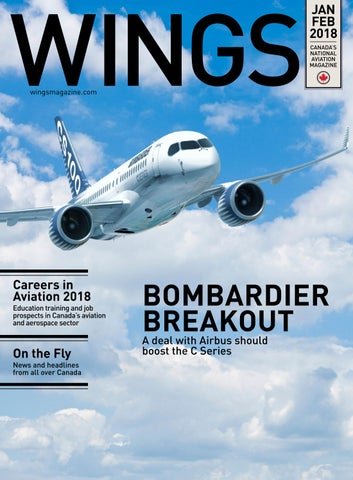
BOMBARDIER BREAKOUT
A deal with Airbus should boost the C Series
JAN/FEB 2018
UPFRONT 6 Leading edge Pilots wanted
8 On the fly
News and opinion
12 Alternate approach Red Bull continues air racing’s proud legacy
13 At the gate
AI strides ahead
18 Glidepath
Here’s to the Air Cadets Bombardier and Airbus are partnering on the C Series. Good news or bad news for Canadian aircraft manufacturing? P. 14
BACK 26 Marketplace 30 On final
Airport safety relies on great people
FEATURES 14 SEEKING TO BREAK OUT
A new deal with Airbus could help the C Series take off BY DAVID CARR
From top: Another look at air racing P.12. Smart machines are coming P.13.
C-1 CAREERS IN AVIATION 2018
Education, training and job prospects in Canada's aviation and aerospace sector BY DAVID CARR
19 CANADIAN BUSINESS AVIATION ASSOCIATION
The official publication of Canada's voice for the business aviation sector
PHOTO CREDIT BOMBARDIER
BY CBAA
COVER PHOTO: BOMBARDIER
WWW.WINGSMAGAZINE.COM
January/February 2018 | WINGS
3
Stay in Touch with Aviation News
Vol. 59, Issue 1 EDITOR
SUBSCRIBE
Matt Nicholls mnicholls@annexweb.com 416-725-5637
Online
FLIGHT DECK
Rick Adams, Krista Bulmer, David Carr, Paul Dixon, Brian Dunn, Frederick K. Larkin, James Marasa, Carroll McCormick, Anna Pangrazzi, Bill Zuk NATIONAL ACCOUNT MANAGER
Mena Miu mmiu@annexweb.com • 416-510-6749
TODAY
MARKETPLACE ACCOUNT MANAGER
Kory Pearn kpearn@annexweb.com • 519-902-8574 ACCOUNT CO-ORDINATOR
Barb Vowles bvowles@annexbusinessmedia.com • 416-510-5103
wingsmagazine.com/subscribe
MEDIA DESIGNER
Brooke Shaw
CIRCULATION MANAGER
Magazine
Carol Nixon cnixon@annexweb.com • 450-458-0461
Weekly E-Newsletter
GROUP PUBLISHER
Martin McAnulty mmcanulty@annexweb.com
Digital Edition
WINGS wingsmagazine.c om
COO
Ted Markle tmarkle@annexweb.com PRESIDENT & CEO
Mike Fredericks
JAN FEB 2018
WINGS MAGAZINE
CANADA’S NATIONAL AVIATION MAGAZINE
P.O. Box 530, 105 Donly Dr. S., Simcoe, ON N3Y 4N5 Tel: 519-428-3471 Fax: 519-429-3094 Toll Free: 1-888-599-2228 Printed in Canada ISSN 0701-1369
Leading by listening
Levaero’s Rob relies on input Arnone
Honeywell hums along
An aerospace pioneer eyes new oppor tunities
BOMBAR BREAKOUDTIER
A deal with boost the C Airbus should Series
PUBLICATION MAIL AGREEMENT #40065710 CIRCULATION Email: apotal@annexbizmedia.com Phone:416-442-5600 ext. 3258 Fax: 416-510-6875 (main) 416-510-5133 Mail: 80 Valleybrook Dr, Toronto, On M3B 2S9 Published six times per year (Jan/Feb, Mar/Ap, May/Jun, Jul/Aug, Sep/Oct, Nov/Dec) by Annex Business Media SUBSCRIPTION RATES Canada – 1 Year $ 32.95 (plus GST - #867172652RT0001) USA – 1 Year $ 57.95 Foreign – 1 Year $ 65.95 Occasionally, Wings magazine will mail information on behalf of industry-related groups whose products
Air Transport Association of Canada
ON THE
WEB
4
WINGS | January/February 2018
WG_Sub_HouseCircAd_JanFeb18_MLD.indd 1
and services we believe may be of interest to you. If you prefer not to receive this information, please contact our circulation department in any of the four ways listed above. Annex Privacy Office privacy@annexbizmedia.com • Tel: 800.668.2374 No part of the editorial content of this publication may bereprintedwithoutthepublisher’swrittenpermission. ©2018 Annex Publishing & Printing Inc. All rights reserved. Opinions expressed in this magazine are not necessarily those of the editor or the publisher. No liability is assumed for errors or omissions. All advertising is subject to the publisher’s approval. Such approval does not imply any endorsement of the products or services advertised. Publisher reserves the right to refuse advertising that does not meet the standards of the publication.
Canadian Business Aviation Association
Magazines Canada
AVIATION THIS WEEK Looking to catch up on the latest hot news from around aviation and aerospace? Check out Aviation This Week, a live digital version of the top news stories affecting a variety of key markets. It's quick, essential information you need to know! WWW.WINGSMAGAZINE.COM
2017-12-18 7:21 AM
Proud co-host of
CBAA 2018
Convention & Exhibition
Waterloo, ON June 12-14, 2018
E XC LU S I V E
TORONTO YYZ
LAKE ONTARIO
LAKE HURON
Join one of Canada’s most innovative communities 45 minutes west of Toronto LAKE ERIE
Access to: 24 months exclusivity 2.5 million O/D passengers annually within a For more information visit: For information: 35 km primary catchment area Chris Wood Airport General Manager www.waterlooairport.ca/ASD-RFP 24-hour onsite Customs (CBSA) Phone: 519-648-2256 ext. 8502 Proposals accepted until January 31, 2018 Runways – 7,000 and 4,100 feet Toll Free: 1-866-648-2256 ext. 8502 The Airport is owned and operated by the Regional Municipality of Waterloo, Ontario (Canada). Email: cwood@regionofwaterloo.ca Two full-service FBOs The Airport is owned and operatied by the Regional Municipality of Waterloo, Ontario (Canada).
LEADING
EDGE
By Matt Nicholls |
Replenishing the pipeline Uniting forces to solve pilot shortage issues
F
5
flight schools and is affecting other aviation professions such as retiring airport professionals, flight attendants and more. The Air Transport Association of Canada (ATAC) has taken a leadership role in the development of such solutions to the industry shortfall with the formation of its Pilot Shortage Discussion Panel last May. As ATAC president John McKenna reported in the July/August 2017 issue of Wings, the symposium brought together the CCAA, the College of Professional Pilots of Canada and operators including Sunwing, WestJet, Air Georgian, Jazz and Porter Airlines to share experiences and seek to find solutions. Much of the group’s progress was shared at the ATAC conference Nov. 6-9 in Montreal, as the task force described how it plans to unite as an industry, raise awareness about the profession, seek government
1. TSX60 companies using business aviation outperformed companies that didn’t by 43 per cent between 2013 and 2017. (pg. 8) 2. P&WC’s new PurePower PW814GA turbofan engine produces 15,144 pounds of thrust. (pg. 9) 3. Flight time from Billy Bishop Toronto City Airport to Niagara Flight Services: 12 minutes. (pg. 10) 4. Driving time from downtown Toronto to Niagara area: 90 minutes (if you’re lucky). 5. Global demand over 20 years for aircraft in the 60- to 150-seat segment according to Bombardier: 12,500. (pg.15)
6
WINGS | January/February 2018
support to help students with high training costs and look for tangible ways to help feed the pipeline and entice a new generations of pilots and aviation professionals. Wings and Helicopters magazines are doing their part to help guide and educate younger generations with the development of our Careers in Education Guide and the continued growth of our Careers in Aviation Expos. Both products aim to provide more information about a wide cross-section of aviation professions. This year’s CIA Expos – Saturday, April 28 at the Jazz Aviation hangar in Toronto and Saturday, May 12 at the Aurora Jet Partners fixed based operation in Edmonton – will give aspiring aviators a chance to rub shoulders with a wide cross-section of aviation and aerospace professionals, presenting an opportunity to gain insightful information what to expect in their desired career path. Building on some of the efforts outlined by the ATAC Pilot Recruitment working group to attract more aviation cadets to educational career development events, Wings is working with the Air Cadet League of Canada and industry partners to find ways to bring more cadets to the Toronto Expo, including offering the first 100 cadets through the door free of charge. See careersinaviation.ca/expo to register. | W
Canada will experience a pilot shortage of some 6,000 pilots over the next 20 years.
@Wings_Magazine WWW.WINGSMAGAZINE.COM
PHOTO: MATT NICHOLLS
inding solutions to the growing pilot shortage in Canada is one of the most pressing issues facing the Canadian aviation industry – and it’s a challenge that affects all segments, from large commercial operations to northern operators, the military and rotary-wing operators from coast to coast. The numbers are indeed staggering. The Canadian Council for Aviation and Aerospace (CCAA) estimates that Canada will experience a pilot shortage of some 6,000 pilots over the next 20 years with annual pilot shortfall of some 200 pilots. It’s an issue that’s also not unique to Canada. In its 2017 Airline Pilot Demand Forecast released at last year’s Paris Air Show, Montreal-based training and development company CAE revealed that the global demand for pilots over the next 20 years will reach 255,000, with some 85,000 of those jobs based in the Americas. The CAE report concludes that many of these pilots have not even commenced their training yet. Recent studies by Airbus (more than a million pilots and technicians by 2036), Boeing (1.2 million pilots and technicians by 2036) and the International Civil Aviation Organization (15,000 new pilots globally over the next two decades) outline the scope of the global demand. Many of these new positions will be filled by pilots being trained in Canada, as a large contingent of students training at Canadian flight schools currently are foreign students. Canadian flight schools offer extremely high-training standards and graduates are highly-sought after for positions abroad; as the numbers reveal, the opportunities are certainly there. The diminishing talent base in Canada is not unique to professionals flying the aircraft, either. The shortfall starts with qualified flight instructors at Canadian
LEKTRO
CYOO is Ontario’s Busiest GA/ Corporate ONLY Airport serving Oshawa, Durham Region and the Greater Toronto Area
The Original Towbarless Tug Setting the Standard in Excellence Since 1945
Models ranging
Serving Toronto’s Corporate traffic with the lowest landing, ramp and fuel costs
15,000 to 280,000 lbs.
Electric Towbarless Certified Easy to Use Universal Rugged Simple to Maintain www.
LEKTRO .com
GNSS/LPV approaches down to 250 ft AGL Nav Canada control tower and Canada Customs on-site Home to over 250 Aircraft, 5 aircraft maintenance facilities, 2 flight schools and 300,000 sq ft of hangar space
1-800-535-8767 1-503-861-2288 sales@lektro.com
www.oshawa.ca/airport January/February 2018 | WINGS
WWW.WINGSMAGAZINE.COM WG_Lektro_NovDec17_CSA.indd 1
Full Service Premier FBO open 24/7/365
2017-10-20 12:49 PM TAAS_M-17-1050_ADVERT_Wings-Quarter_1.0.indd WG_Oshawa Executive Airport_Julyaug17_CSA.indd 21
7
2017-06-05 9:41 9:31 AM
ON THE FLY For late-breaking news and exclusive web content, please visit us at: www.wingsmagazine.com
THE LEAD
CANADIAN BIZJETS SHOW THEIR VALUE The Canadian business aviation sector is a net contributor to GDP, according to a new report by NEXA Advisors, a Virginia-based consultancy specializing in transport. The 2017 edition of Business Aviation and Top Performing Companies evaluated financial data from TSX60 and S&P500 companies between 2013 and 2017. This represents North America’s largest publically traded companies from across all sectors of the economy. “Business aviation again proves its worth as a powerful tool of North America’s best managed companies,” the report concludes, even during an economic downturn. Between 2012 – 2017, 70 per cent of TSX60 companies had regular access to business aviation, through flight departments, charter or fractional ownership. In “top line” revenue growth, NEXA
found that TSX60 business aviation users outperformed non-users by over 43 per cent in a five-year period. This aligns with similar findings with S&P500 companies. “Canada’s commercial air transport networks address only a small percentage of the point-to-point geographic coverage needed for its largest companies to compete effectively on the world stage,” the reported notes. Also, a user could expect to improve EBITDA (Earnings Before Interest, Taxes, Depreciation and Amortization) at a rate of 50 per cent higher than non-users after weighting financial results for company size. Indeed, users outperformed non-users in four critical measures, including ROE (Return on Equity) and ROA (Return on Assets). The study also found that on average, almost 95 per cent of companies which appear in the “Top Performing” lists – whether it be for innovation, ranking the most admired or trustworthy companies or recognizing outstanding corporate citizens, use business aviation. “Video and phone don’t help close the deal,” Jamie Vins, chief executive of Brantford, Ont.-based Vins Plastics noted. Vins produces packaging materials, including high-end packaging for
pharmaceutical products. It is a very competitive market. “Time is of the essence for our pharmaceutical customers and we can react quickly with a business aircraft.” Vins Embraer Phenom 100 completes approximately eight flights a month, primarily to U.S. customer cities. The company charters the airplane out to offset costs. “Companies that use business aviation have a huge advantage – and better financial results – than those that don’t,” said Rudy Toering, outgoing chief executive of the Canadian Business Aviation Association (CBAA). “Business aviation is embedded in the DNA of success.” There are an estimated 1,900 business aviation aircraft operating in Canada according to a 2017 Economic Impact Study by Vancouver-based InterVISTAS Consulting for the CBAA. Approximately 26 per cent (504 aircraft) are based in Ontario, followed by Alberta (22 per cent or 419 aircraft), Quebec (19 per cent or 364 aircraft) and B.C. (15 per cent or 288 aircraft). The remainder of the fleet, 316 aircraft are spread out across the remaining provinces and territories. The CBAA study shows that business aviation generates $12.8 billion and 47,000 jobs annually in Canada (direct,
PHOTO: EMBRAER
8 – THE LEAD 9 – AEROSPACE 9 – COMMERCIAL 10 – PEOPLE
Business aviation generates $12.8 billion and 47,000 jobs annually in Canada (direct, indirect and induced) 8
WINGS | January/February 2018
WWW.WINGSMAGAZINE.COM
indirect and induced). “These two reports allow us to paint a 360-degree picture of the impact of business aviation in Canada,” Toering added. “We can show its direct contributions: for example, that jobs in business aviation pay two-thirds more than the average Canadian salary.” Business aircraft represent five per cent of the 36,000 airplanes registered in Canada.
AEROSPACE
PHOTO: GULFSTREAM (TOP); AIR TRANSAT (BOTTOM)
P&WC READIES PW800 FOR SERVICE A Gulfstream G500, the first jet to be powered by Pratt & Whitney Canada’s (P&WC) new PurePower PW800 turbofan engine was set for certification as Wings was going to print. The PW800 recently reached the milestone of 16,600 hours and 16,800 cycles, including both ground testing and flight-testing. P&WC is in the final stages of putting the new engine’s global support infrastructure in place. “The PurePower PW800 is the only engine in the 10,000- to 20,000-lbs. thrust class that’s primed to enter service,” Scott McElvaine, vice president of marketing and customer service for the PW800 program said. “It has proven its capacity to meet and exceed targets throughout many hours of comprehensive testing, making it the new benchmark in its class for performance, maintenance and reliability. We look forward to further develop our relationship with Gulfstream and its operators and ensure our teams are ready to fully support the entry into service process.” The PW800 is expected to deliver 99.99 per cent dispatch reliability, offer greater ease of maintenance with a projected 40 per cent reduction in scheduled on-wing maintenance plus a 20 per cent reduction in inspections. More than 90 per cent of the spare parts inventory has been stocked in parts distribution centres worldwide and are ready to be dispatched. P&WC reports that technical publications are 100 per cent complete as a result of a strong working relationship with Gulfstream, and the initial overhaul shop is ready to complete a final certification audit. The G500 is powered by the 15,144-pound thrust PW814GA, while the more powerful 15,680-pound-thrust WWW.WINGSMAGAZINE.COM
The Gulfstream G500 is powered by the 15,144-pound thrust PW814GA.
PW815GA will be installed on the larger G600. In November, the P&WC operations team, led by Benoit Beaudoin, vice president of operations, received the James C. Fly Award by the Aerospace Industries Association of Canada (AIAC) for their exceptional contributions to Canadian aerospace innovation and leadership in advanced manufacturing and workforce development.
COMMERCIAL
AIR TRANSAT SHOW ITS COLOURS Air Transat marked 30 years of service with an updated paint scheme. Gone is the palate of “welcome” word marks in the languages of the major markets
served by the leisure carrier. The company has opted for a cleaner look that maintains the stylized star symbol, a recognized emblem of the Transat brand, along with subtle touches of gray, a nod to Air Transat’s very first livery. The new livery features the star symbol on the tail, rear side fuselage and also on the wing tips. The Air Transat name appears on the side and underside of the fuselage, ensuring its visibility even when the aircraft is in flight. Graduated shades of blue are intended to evoke the transformative power of holidays. “I feel a great sense of pride when I look at how far we’ve come since November 1987, when our first flight took off from Montreal bound for Acapulco,” said Jean-Marc Eustache, chief executive officer of Transat, the integrated leisure company that operates Air Transat.
Air Transat’s stylized new look maintains its stylized star symbol. January/February 2018 | WINGS
9
ON THE
FLY
JUST A HOP AND A SKIP FLYGTA Airlines is expanding its offering, enabling travellers along Ontario’s strained 400 series of highways to skip traffic congestion. The airline, which began scheduled service between Billy Bishop Toronto City Airport and the Niagara district in 2016, has launched service to three additional cities, including the Kitchener-Waterloo region – an 18-minute jump. The 12-minute Toronto-Niagara route is North America’s shortest route, and has been a strong proving ground for FLYGTA. “We’ve been pleased with the success of our Toronto-to-Niagara flight services over the past year, and FLYGTA is excited to be able to add to our list of destinations in Ontario,” said Chris Nowrouzi, the airline’s chief executive. “This will be a big benefit to travellers because we can turn long car rides on busy highways into short, comfortable flights that will get
our passengers where they want to go in a matter of minutes.” The same 118-kilometre trip by car between Toronto and Niagara takes 90 minutes or more, depending on traffic. The Toronto to Waterloo service will operate twice daily using an eight-seat, twin-engine Piper Panther aircraft. FLYGTA, which also flies charter as far south as the Caribbean operates a sevenaircraft fleet, including the GA8 Airvan and Cessna Conquest. In addition to Waterloo, FLYGTA has launched service to Simcoe Regional airport, serving the Barrie area and London. The distance from the Billy Bishop Airport to the London International Airport is 185 kilometres; to the Lake Simcoe Regional Airport is 130 kilometres. “FLYGTA will operate from an executive terminal on Toronto Island, right next door to the main terminal building. When you arrive, a shuttle is waiting to take you to the main terminal, where you can continue your travels by air or use the pedestrian
tunnel to reach the mainland,” said Chris Wood, general manager of the Region of Waterloo International Airport.
PEOPLE
DCAM SALUTES EXCELLENCE IN FLIGHT TRAINING Luke Penner, chief flight instructor at Winnipeg-based Harv’s Air accepted the prestigious 2017 DCAM flight instructor safety award at the Air Transport Association of Canada’s (ATAC) annual Canadian aviation conference in Montreal. Created to honour the legacy of David Abramson, the DCAM Award recognizes excellence in Canadian flight instruction, and is a highlight of the annual ATAC meeting. Both Jane and Rikki Abramson, founders of the award, were on hand at the event. Penner is an accomplished pilot, a class 1 flight instructor and a class 1
MARCH 21 - 23 COAST PLAZA HOTEL CALGARY, AB
WWW.WAMEA.COM
10 WINGS | January/February 2018 WG_WAMEA Symposium_JanFeb18_CSA.indd 1
WWW.WINGSMAGAZINE.COM 2017-12-05 7:37 AM
Ruth Abramson hands out the 2017 DCAM award to Harv Air’s Luke Penner at ATAC 2017 in Montreal.
aerobatic flight instructor. He finished first in his category at the U.S. National Aerobatic Championships in 2016. He is a strong believer of aerobatic experience to make a pilot that much more competent and safer. His name is engraved on the base of the trophy and entered in the official logbook, both of which are on permanent display at the Canadian Aviation and Space Museum in Ottawa. Since first introducing the DCAM, the Abramson family have expanded the influence of the award in flight safety. Janet Keim, a flight instructor with the Mitchinson Flight Centre in Saskatoon, was the recipient of the 2017 DCAM Legacy Award. Keim began cutting a path in the maledominated training industry in 1971, and quickly distinguished herself as an unparalleled instructor and aviator. Thomas Sandrin, brand manager with Hamilton Watches presented both Penner and Keim with specially engraved DCAM aviator watches. Harv’s Air and the Mitchinson Flight Centre are part of the Wings/Helicopters Careers in Aviation supplement.
AVIATION HALL OF FAME TO INDUCT FOUR NEW MEMBERS Canada’s Aviation Hall of Fame (CAHF) will induct four new members in 2018, at a ceremony to be held June 7 in the Sunwest Aviation hangar at Calgary International Airport. Selected for their contributions to Canada’s development through their integral roles in the nation’s aviation history, the 2018 inductees will join the ranks of the 228 esteemed men and women inducted since the Hall’s formation in 1973. The new members are John Bogie, co-founder of the Canadian Owners
Dwight Powell
John Bogie
and Pilots Association; General Paul D. Manson, former chief of the defense staff and former chairman of Lockheed Martin Canada; John Maris, air force pilot and Canadian Space Agency project lead for the ISS robotic arm; and Dwight Gregory Powell, founder of the STARS air ambulance service and professor emeritus at the University of Calgary. “In 2018 we will again be honouring four Canadians for their outstanding places in Canadian aviation,” said Hall of Fame board of directors chairman,
General Paul Manson
John Maris
Rod Sheridan. “Their careers over several decades span a wide breadth of both military and civilian aviation. They have contributed to the building of airlines and aviation organizations, leadership in the air force, management of industry, development of aviation systems and establishment of air rescue services. “We expect another sell-out for the celebration in Calgary,” says Sheridan, “and I encourage early purchase of tickets for this premiere celebration of Canadian aviation development.”
the right relationship can help you soar.
I
PNC AVIATION FINANCE When it comes to financing private aircraft, we know you value decades of aviation expertise, track record and financial strength. That’s why aviation clients across the U.S. and Canada choose PNC Aviation Finance to help their business take off. To learn more, visit pnc.com/aviation. PNC is a registered mark of The PNC Financial Services Group, Inc. (“PNC”). Equipment financing and leasing products are provided by PNC Equipment Finance, LLC, a wholly-owned subsidiary of PNC Bank. Aircraft financing is provided by PNC Aviation Finance, a division of PNC Equipment Finance, LLC.In Canada, PNC Bank Canada Branch, the Canadian branch of PNC Bank, provides bank deposit, treasury management, lending (including asset-based lending through its Business Credit division) and leasing products and services (through its Equipment Finance division). Deposits with PNC Bank Canada Branch are not insured by the Canada Deposit Insurance Corporation. Deposits with PNC Bank Canada Branch are not insured by the Federal Deposit Insurance Corporation, nor are they guaranteed by the United States Government or any agency thereof. Lending and leasing products and services, as well as certain other banking products and services, require credit approval. ©2017 The PNC Financial Services Group, Inc. All rights reserved. CIB EF PDF 0715-070-195013
January/February 2018 | WINGS 11 CIBEF Know Ad_Aviation_4.625x5_195013_2017_final.indd 1 WG_PNC_Aviation_JanFeb18_CSA.indd 1
2/16/17 11:56 AM 2017-12-07 2:42 PM
ALTERNATE
APPROACH By David Carr |
Time at the races
America’s railroad watch clocks 100 years of aviation
I
12 WINGS | January/February 2018
‘brand ambassador’ – sped across the slalom track in his Edge 540 V2 ultralight raceplane, in Hamilton’s distinct orange colour scheme, with an enlarged close cropped image of a pilot’s watch face painted on one wing. “We are back as the main partner with more passion than ever to make this championship a global eminent event.” Considered one of France’s top aerobatic pilots, Ivanoff was a latecomer to the sport. As a flight instructor in his native Corsica, he flew an aerobatic airplane for the first time in the 1990s. “It was a revelation. I was angry at myself for not getting into this sport sooner,” he said. Ivanoff compares piloting a raceplane with “painting in the sky.” As brand ambassador, he is in close touch with the Hamilton production department to integrate new functions into the company’s line of pilot watches; the latest, a special edition Khaki Air Race watch to celebrate the Hamilton/Red Bull tie up. Back at Indianapolis, Canada’s McLeod finished third in the championship after the wing of his raceplane clipped (but did not deflate) an air pylon on the windy track. He will be back competing against Ivanoff and the rest when the ultimate air show kicks off in Abu Dhabi this February. | W
I was angry at myself for not getting into this sport sooner. times on the silver screen. A crossover with the watchmaker’s cinematic branding. This year, Hamilton celebrates its aviation centenary. In a touch of irony, America’s “watch of railroad accuracy” was chosen to be the official timepiece of the first U.S. airmail flights between Washington D.C., Philadelphia and New York. Thus began the transition from “The Railroad Timekeeper of America” to “Timer of the Skies.” By the 1930s, Hamilton timepieces were standard issue for pilots of iconic airlines such as Eastern, TWA and United. Here in Canada, Hamilton relies on a strong ground game to burnish its aviation heritage. The company has built relationships with the Air and Army Cadets, and is the timekeeping sponsor of organizations such as the Air Transport Association of Canada (ATAC) and the Northern Lights Aero Foundation (NLAF). Associations with flight schools beginning with Waterloo Wellington Flight Centre and Pacific Flying Club in Vancouver are also being made. In 2017, Hamilton returned as the official timekeeper for the Red Bull Air Race World Championship, a spot it had vacated since 2010 when the sport went on hiatus. The company’s association with the series began in 2005, when Ivanoff – Hamilton’s
David Carr is a Wings writer and columnist. WWW.WINGSMAGAZINE.COM
PHOTO RED BULL
t was damp and overcast along the windswept Indianapolis Motor Speedway when the final installment of the 2017 Red Bull Air Races got underway. For nine months, 14 highly-skilled pilots competed at “tracks” across the globe; wowing audiences by threading their ultralight machinery through 25-metre high, air inflated pylons and beneath unforgiving bridges in a race against the clock, which some have described as the most challenging aerial races ever witnessed. Air races are woven into the historic tapestry of aviation. The first held in Reims, France in August 1909, a month after Louis Blériot captured the imagination of his fellow countrymen, crossing the English Channel by air. Almost as famous for its sponsorship of extreme sport as its energy drink, Red Bull ramped things up several notches in 2003 with the high speed, low altitude Red Bull Air Race World Championship. The series returned to the skies in 2014, after a three-year absence where the Red Bull sports “think tank” fine-tuned the concept with lighter airplanes, standardized engines and propellers, and new rules that brought skill back to the cockpit. The competitive spirit of great air racing pioneers such as Blériot, America’s Glenn Curtiss and Henri Farman now rests with the skilled hands of Japan’s Yoshihide Muroya (2017 world champion), Canada’s Pete McLeod, the youngest rookie to qualify for the Air Bull Air Races, and Nicolas Ivanoff of France an aerobatic master whose team competes under the Hamilton watch banner. Because for almost as long as there have been air races, watchmakers have strapped their brands to the adventurous spirit, precision and romance of flight. “Aviation speaks to everyone,” Sylvain Dolla, chief executive of Hamilton told Wings. Hamilton is a division of the Swiss-based Swatch Group, whose showcase contains 19 watch brands. “Our watches are not only loved by pilots from Air Zematt (Switzerland’s world-renowned air rescue organization) and Canada’s Snowbirds, but also by people who love the look of aviation watches.” Movie pilots too. Dolla points out that Hamilton watches have been featured 450
AT THE
GATE
| By Brian Dunn
Leading the AI surge
Thales to explore AI capabilities at new Montreal facility
PHOTO: THALES
I
nvestments in artificial intelligence (AI) and machine learning are burgeoning throughout the aerospace and defence sector and could be the next big wave in regard to the industry’s digitization. According to a report by consulting group Accenture, aerospace and defence executives in the U.S. expect to invest “extensively” in AI-related technologies such as robotics process automation, natural language processing, machine learning and video analytics. On June 2 2017, for example, Boeing said it was joining a group of strategic investors led by Verizon Ventures in an initial $32 million funding called SparkCognition. The Austin, Tx.-based company focuses on AI and machine learning for information technology security and industrial. Raytheon, BBN Technologies said it was awarded $4 million to provide automatic speech recognition, machine translation, text-to-speech and optical character recognition software licenses for one year to the U.S. Army’s Machine Foreign Language Translation System. And last October, Thales SA said it was opening an artificial intelligence centre in Montreal and will hire 50 people for the new facility. Its aerospace division designs and integrates avionics suites, flight controls, head-up displays, enhanced vision systems for regional and business aircraft customers globally. The new hub, called the Centre of Research and Technology in Artificial Intelligence eXpertise (cortAIx), will focus on creating solutions for airlines, satellite operators, air traffic controllers, rail operators, armed forces and critical infrastructure managers. The creation of cortAIx is another building block of the company’s digital strategy, one of the key initiatives for growth. The mission of the new hires will be to advance the “safe and ethical applications of artificial intelligence across Thales’ vast product portfolio.” In AI, Patrice Caine, chairman and CEO, maintains Thales has honed world-class skills, thanks to its defence background. But he also notes that they do not have enough AI experts. Currently only about 100 are on staff (out of a total global workforce of 46,000), to deal with all potential applications. He is WWW.WINGSMAGAZINE.COM
of our partners, we will leverage Montreal’s unique ecosystem of world class talent and creativity to advance the applications of ethical artificial intelligence world-wide,” Caine said. Building on Thales’ recent acquisition of Guavus last year and Vormetric in 2016, the creation of cortAIx is yet another example of how Thales is strengthening its positioning in one of the key technologies at the heart of global digital transformation, Caine noted. In the past three years, Thales has invested more than $1.5 billion in digital technologies and recently announced the launch of its high-tech Digital Factory in Paris. This activity brings together leading technology experts who support the injection of big data and artificial intelligence into Thales solutions, while also ensuring data security, a fundamental requirement of the modern digital economy. Canada is becoming a destination for foreign companies working in AI. San Francisco-based Uber Technologies Inc. set up shop in Toronto last year to help improve its autonomous vehicle software, while Alphabet Inc.’s Google also has an AI presence in Toronto and Montreal. Paris-based Thales said it was attracted to Montreal because of its rich ecosystem of AIfocused universities and laboratories. Facebook Inc. and Samsung Electronics Co. Ltd. have also opened AI research labs in the city. The new centre will be working with Google-backed Vector Institute of Toronto, the Artificial Intelligence Institute of Quebec and the Institute of Data Valorization. Thales Canada has 1,800 employees in six locations working in defence, avionics and transportation and generates $500 million in annual sales. | W
In the past three years, Thales has invested more than $1.5 billion in key digital technologies. focusing his efforts on growing that number. AI could be used in aviation to optimize a flight path in real time, according to Caine. “Currently, nobody has an overall, dynamic view of an aircraft’s flight path. When a weather event occurs in flight, the pilot is on his own to optimize the trajectory,” he said. In development at Thales’s Bordeaux campus, is an AI solution that culls and maximizes data from air traffic management, weather offices (from observation and forecast) and airports. The biggest challenge faced by AI experts today is to perfect the understanding of the mechanisms behind AI developments, while simultaneously evaluating human behaviours as people interact with these new systems. The key mission of Thales’ cortAIx is to build “AI inside” solutions that are safe and ethical while granting full authority to the human decision makers. “With Thales’ leadership and the support
Brian Dunn is a Wings writer and columnist. January/February 2018 | WINGS 13
Bombardier's deal to have Airbus assemble the C Series may be helping the aircraft lift off at last.
WILL BOMBARDIER’S NEW DEAL WITH AIRBUS PRODUCE A BREAKOUT?
D
BY DAVID CARR id Bombardier hand more than half its C Series airliner over to Airbus for “zero dollars down” or is 50.01 per cent of the estimated $6.1 billion program the opening price to secure Airbus’ expertise for lowering per unit production costs, installing a global support network and getting a lot more of those units sold? (The bonus is skillfully sidestepping the threat of crippling U.S. countervailing duties, which if imposed would jack the cost of each airplane exported to American carriers by up to 300 per cent). On the surface, the gambit is already paying dividends. Since the deal was struck in October, Bombardier has announced the sale of 42 C Series jets to EgyptAir and an unidentified European carrier, with options for an additional 14 WINGS | January/February 2018
42 aircraft. Clearly, these orders would have been in the pipeline for some time, although it is not unreasonable to suggest that the tie up with Airbus gave the customers the comfort level they needed to place the order. “It takes time to close a deal,” John Di Bert, Bombardier’s chief financial officer said in an analyst call. “The customer needs to be ready to place orders. It is clear that Airbus coming into the program is adding confidence about the long-term success of the C Series.” Perhaps more pressing: what does transferring a majority stake in the Canadian aerospace industry’s flagship program to a European competitor mean to the future of aircraft design and manufacturing in this country? As it stands, assembly of part or all of the breakthrough Delta order will be shipped to Alabama, where Airbus already assembles A320s for the U.S. Bombardier estimates it will cost US$300 million to build a C Series production line alongside the A320, an investment that Boeing says does not add up. “Bombardier and Airbus are extremely
unlikely ever to actually establish a C Series assembly line in Alabama,” Boeing noted in a letter to the U.S. Commerce Secretary. Bombardier’s C Series program should breakout in 2018. After a smooth entryinto-service, the C Series is getting rave reviews from launch customer airlines Swiss (CS100) and AirBaltic (CS300), production is expected to ramp up to 30 aircraft this year after supplier problems with the engine slowed down the Mirabel assembly line in 2017, and the unparalleled Global 7000 ultra-long-range, largecabin business jet will enter service in the second half of the year. As it did with the C Series, the Global 7000 pushes Bombardier closer to its larger rivals with an aircraft comparable to the business jet versions of the Boeing 737 and Airbus A319. At 33.9 metres nose to tail, the 7000 is the largest purpose built business jet in the industry and is expected to fly unchallenged until at least 2020. “We already have the best product lines out there,” Alain Bellemare, Bombardier’s chief executive said. “When we add
WWW.WINGSMAGAZINE.COM
PHOTO: BOMBARDIER
SEEKING TO BREAK O
Airbus plans to assemble the C Series at its plant in Alabama where it assembles the A320 for the U.S. market.
OUT
the Global 7000, we will have the best business franchise in the world. Customers are clearly beginning to realize how game changing the Global 7000 will be.” The 7000 production line is sold out until 2021. Bombardier is positioned to make inroads into the 100- to 150-seat market. “Airlines are shifting their primary metric for network and fleet optimization strategies from “cost” to “profit” notes Fred Cromer, president of Bombardier Commercial Aircraft. “With this thinking in the forefront, more airlines are investing in right-sized aircraft that maximize their profits.” In its most recent 20-year market forecast, Bombardier sees global demand for 12,500 airplanes in the 60- to 150-seat segment, with demand highest for C Series type aircraft in the 100- to 150-seat range. Bombardier’s forecast notes the costper-seat instead of yield-per-passenger has resulted not only in lower profits for airlines but also in poor passenger experience. In some regions, even heavy WWW.WINGSMAGAZINE.COM
discounting can’t fill oversized planes, while in other regions, overbooked flights are generating outrage amongst passengers. “In that segment, there is really only two competitors, Embraer and us,” Bellemare said. “If you look at the low end of the narrow body product lines, Airbus and Boeing aren’t really there. So there will still be [only] two competitors moving forward.”
insisted. “There is nothing that comes close to the C Series on range and performance. You add this to the Airbus product portfolio and you have a full portfolio covering the narrow body range. It is adding value to Airbus and it is helping the C Series to fully unleash the full value of the program.” But what of the future? Was Bombardier’s gamble to go nose-to-nose with
“When we add the Global 7000, we will have the best business franchise in the world.” One with Airbus’ marketing and procurement muscle now behind it, which has the potential to double the value of the C Series program. (Watch for further market consolidation between Embraer and Boeing, which is concentrated on the so-called middle-of-market segment once occupied by the 757, but which now has a more defined gap in its product line versus Airbus.) “We have the best aircraft in the 100to 150-seat plus segment,” Bellemare
Airbus and Boeing its last? At least on the lower margin commercial aircraft side? Bombardier is looking at a re-engined version of its CRJ line, which has steadily lost ground to Embraer. Only four CRJs and seven Q400 turboprops were delivered in the last quarter and Bombardier is increasingly looking at C Series deliveries to offset lower CRJ and Q400 revenues. It is also likely that Airbus will shelve the struggling A319neo – the smallest jet in the A320 new engine option family January/February 2018 | WINGS 15
40
generation aircraft in terms of cockpit, in terms of material.” A bigger concern for the Canadian aerospace industry should be Ottawa’s ongoing feud with Boeing, despite the American airplane maker’s strike to slap an 80 per cent duty on C Series deliveries to U.S. airlines (it was the U.S. Commerce Department that ratcheted the tariff ’s to a ludicrous 300 per cent, an amount that is certain to get knocked down in the months ahead). Boeing has 13 locations across Canada, including a plant in Winnipeg, which is the country’s third largest aerospace
ATLANTIC REGION AIRCRAFT MAINTENANCE CONFERENCE
APRIL 1820, 2018 • WESTIN NOVA SCOTIAN HOTEL, 1181 HOLLIS ST • HALIFAX, NS
Recurrent Training Sessions Trade show featuring more than 40 exhibitors Networking opportunities including annual Meet & Greet opening event Banquet and Awards
16 WINGS | January/February 2018
REGISTER NOW! www.atlanticame.com
e-mail: aramc@atlanticame.com Presented by the Atlantic Aircraft Maintenance Engineers (AME) Association
WWW.WINGSMAGAZINE.COM
PHOTO: BOMBARDIER
– which hasn’t recorded an order since 2012. “That was the last time we sold the plane,” Tom Enders, chief executive for Airbus told Bloomberg News. “That tells you something about the competition between the A319 and the C Series. Airbus also plans to transfer C Series technologies to its product lines, another boost for Canadian aerospace. “That has always been Airbus’s strategy, to look for as much commonality between the various aircraft as possible,” Enders told a European aeronautics conference in Brussels. “The C Series is a state-of-the-art aircraft in every aspect. One of the most modern
manufacturing facility. The company recently took to the airwaves and print to let Canadians know what is at stake. “Boeing contributes approximately $4 billion annually to Canada’s economic growth and development, which is nearly 14 per cent of Canada’s entire aerospace economic impact,” Kim Westenskow, managing director for Boeing Canada said. The company has 560 Canadian suppliers in its network, the largest amount outside of the United States. As for Bombardier, 2018 should be shaping up to be its breakout year after a rough 2017. It is too early, however, to predict whether there will be a Canadian follow up act to the C Series, although a larger version of the airplane and greater commonality with the A320 should not be ruled out. The agreement with Airbus includes an option that both sides would need to agree on for the European airplane maker to buy the program in 2025. “We’re talking seven to eight years down the road,” Bellemare pointed out. “I’d say we’re going into this partnership with Airbus with the long term view of staying in the program. We like the business. Clearly, we love the product. Right now our thinking is to stay involved in the commercial aerospace segment.” | W
WINGS
CAREERS IN AVIATION & AEROSPACE
2018
PHOTO CREDIT TK
PM 40065710
$6.00
PHOTO COURTESY OF CENTENNIAL COLLEGE
EDUCATION, TRAINING, JOB PROSPECTS IN CANADA’S AVIATION AND AEROSPACE SECTOR
Apply today for
Fall 2018!
The
SKY’S THE LIMIT with a career in the aviation industry and we can get you there!
Earn your diploma at the brand new Centennial Downsview Aerospace and Aviation Campus (opening in Fall 2018), future home of Centennial’s Aviation Technician and Aerospace Manufacturing programs including: • Aerospace Manufacturing Engineer Technician/Technology • Aviation Technician – Aircraft Maintenance • Aviation Technician – Avionics Maintenance
centennialcollege.ca/transportation 1206_DEC17
See where experience takes you.
CIA2018
CAREERS IN AVIATION:
A SCHOOL FOR EVERY JOB
A
viation and aerospace are complex, high-tech industries rooted in education and the pursuit of excellence. Canada’s flight schools, training colleges and universities are the essential pivot between raw talent and enthusiasm, and tomorrow’s pilots, technicians and air transport and aerospace leaders. It’s a huge responsibility, ensuring there is a school and classroom for every job, and a job for every school to keep the pipeline flowing with exciting new talent. Canada is home to the world’s fifth largest aerospace industry, and is supported by a dynamic air transport sector. How big is that? The Aerospace Industries Association of Canada (AIAC) reports the sector employs about 87,000 Canadians and generates $27 billion in revenues each year in aerospace manufacturing and MRO activities. Recent surveys suggest about 15,000 pilots and flight engineers. There are skill shortages popping up everywhere, meaning there are job opportunities for qualified new graduates in almost all sectors. “Educational outreach and career pipeline programs will be essential to inspiring the next generation of pilots, technicians and cabin crew,” Boeing concludes in its 2017 Pilot & Technician Outlook, a respected industry forecast of personnel demand in the global air transport sector. “As personnel demand increases over the next two decades, the aviation industry will need to find innovative solutions to keep pace with training requirements.” Boeing projects global demand for two million commercial airling pilots, maintenance technicians and cabin crew between now and 2036: 637,000 pilots, 648,000 technicians and 839,000 cabin crew. There's no field with more opportunity. And while a shortage of pilots tends to grab the headlines, the story runs much deeper. Up to 800 engineers are reported to retire every year between now and 2024, according to Canadian Business, while the rate of new hires is expected to outpace retirements as demand for Canadian aerospace products grows. And not just among large companies such as Bombardier, Pratt & Whitney Canada and Boeing – but also medium and small high-tech firms that feed the global supply chain.
According to the Aerospace Industries Association of Canada (AIAC), the share of supply chain exports stamped “made in Canada” increased by 20 per cent over the last 15 years, and now accounts for more than 60 per cent of Canadian aerospace product exports. Canada’s academic infrastructure appears ready to meet the challenge of feeding the Canadian aerospace and air transport sector’s appetite for innovative and new graduates with full-time, parttime and learn-at-your-own-pace courses, and opportunities to upgrade academic skills such as partnerships between flight schools and flight colleges. Major industry players are helping academia develop course curriculum, and mentoring programs are springing up between operators, colleges, universities and flight schools to provide mentorship and career pathways for aspiring pilots. Still, the learning experience should not be limited to the walls and runways of flight schools and academia, especially in the early days when a student is considering career options in aviation. But a learning experience should not be limited to the walls and runways of academia, especially in the early days when a student is setting a career course. There are many industry associations in Canada ready to help you make career choices, and many enthusiastic people in this industry who enjoy sharing their experiences. The 2018 edition of Wings and Helicopters Careers in Aviation (CIA) guide is an introduction to a variety of careers in aviation and aerospace. It provides listings, helpful tips for choosing a flight school, and sets expectations for new graduates breaking into the industry. Whether you are looking to fly fixedwing airplanes or helicopters. Launch a career in the sky with an airline or corporate operator, or keep your feet planted firmly on the ground in manufacturing and maintenance or industry support, this is an invaluable starting point. Good luck on your journey!
TAP THESE RESOURCES
Aviation and aerospace leaders at various associations can aid in your career search • AéroMontréal www.aeromontreal.ca/capacitedinnovation-en • Aerospace Industries of Canada www.aiac.ca • Air Transport Association of Canada www.atac.ca/web/en • Air Line Pilots Association www.alpa.org • AME Canada www.amecanada.ca/en/about/ about-ame-canada.html • Aviation Alberta www.aviationalberta.com • B.C. Aviation Council www.bcaviationcouncil.org/about-thebcac • Canadian Business Aviation Association www.cbaa-acaa.ca • Canadian Council for Aviation and Aerospace www.avaerocouncil.ca • Canadian Owners and Pilots Association www.copanational.org • National Airlines Council of Canada www.airlinecouncil.ca • Helicopter Association of Canada www.h-a-c.ca
ON THEWEB
To find out more about Wings and Helicopters Careers in Aviation Expos, go to www.wingsmagazine and www.helicoptersmagazine.com January/February 2018 | C3
CIA2018
PART 1: FLYING THE AIRCRAFT
COCKPITS ARE CALLING by David Carr
A
n industry-wide demand for new pilots continues unabated, with shortages impacting even flight schools that are on the lookout for instructors. There are an estimated 36,000 registered aircraft in Canada (both fixed-wing and rotary), that are calling for crews. The 2017 Boeing & Technician Outlook, a respected industry forecast of personnel demand, projects that North America will need 117,000 new pilots over the next 20 years, to support industry growth. That is for commercial aviation alone and doesn’t include backfilling positions of retiring pilots heading for the exits. Transport Canada estimates there are over 800 “on-demand” aviation service providers such as charter operators, law enforcement and emergency medical services, and helicopters supporting Canada’s resources industry and a growing demand for rotary business aircraft. Approximately 26 per cent of Canada’s business aviation fleet are helicopters. “Airlines across the globe are expanding their fleets and flight schedules to satisfy demand generated by global economic expansion,” the report notes. “The aviation industry continues to address these challenges by creating balanced, sustainable solutions to fill future pilot pipelines.” The Jazz Aviation Pathways Program, for example, has agreements with 15 aviation colleges, flight schools and universities across Canada, including Seneca College, to create a streamlined career path for pilots. Jazz is Canada’s third largest airline. Thirdyear Seneca Bachelor of Aviation Technology students are eligible for the Jazz cadet program that includes direct entry into the airline’s hiring pool. It is all about giving low-time pilot graduates a ticket to develop their skills and enter the cockpit. Earlier this year, Air Georgian – with bases in Calgary and Toronto – launched SOAR – Sharing Opportunities for Advancement and Reward – mentorship program in partnership with Ottawa Aviation Services (OAS), a flight school. Flight instructors are given the opportunity for employment at Air Georgian. Air Georgian recently added Ornge, Ontario’s air ambulance operator with its fleet of fixed wing and rotary aircraft, to the C4 | January/February 2018
SOAR operator partnerships. The partnership provides a career pathway for pilots at Ornge to become first officers with Air Georgian. Watch programs like Jazz Aviation Pathways and SOAR grow as operators look to fill cockpit seats and flight schools look for incentives to attract qualified instructors. Flight schools sign a small number of graduates as instructors. It is a stepping stone where recruits build up necessary hours. An increased demand for pilots, especially at the regional level, means that the turnover of instructors is higher; a good opportunity for students entering the industry. Other entry-level opportunities to build up hours include air taxi operator or general aviation pilot. Canada’s thriving corporate aviation sector should not be overlooked. Business aviation accounts for five per cent of registered airplanes in Canada, about 50 per cent of the fleet based in Ontario and Alberta. Modern corporate jets are every bit as sophisticated as today’s airlines, and the requirements to fly these airplanes is often equivalent and sometimes greater than what is required in the airline business. Canada also has the second largest fleet of helicopters in the world. The backbone of the sector remains resource-based, although opportunities in the executive sector are available around major urban centres. Boeing notes that regional markets that have relied heavily on recruiting pilots from outside their home locations are increasingly seeking to recruit, train and develop locally sourced pilots. Local aviation and aerospace expos such as the Wings and Helicopters Careers in Aviation Expos – this year in Toronto and Edmonton – certain help in this regard. In Ontario, Ready Set Fly (RSF) is a notfor-profit organization specializing in educating high school students about aviation careers, including highlighting the skills and education needed to achieve a specific career. RSF is building an industry network to connect students and aviation organizations. SELECTING A FLIGHT SCHOOL If you have little or no aviation experience, selecting a flying school can be overwhelming and is best not done on impulse. Many questions go into selecting a flight school, beginning with identifying your flight goals. What province do you want to learn in,
the type of airplane you want to learn on (fixed-wing, dual engine, helicopter, turbine engine) and whether you prefer to train fulltime or part-time. Learning to fly is time consuming and expensive. Students who train part-time typically do so to build flying lessons into a busy schedule that often includes a job, or to spread the cost over a longer period. Depending on the length of break between lessons, part-time will cost more because the student often has to relearn lessons. For those planning a career in aviation, full-time lessons are recommended. There are two parts to learning how to fly; flight training and ground school. Ground school is classroom instruction where students learn the principles of flight, pilot decision-making, navigation and prepare for the written examination. Many flight schools offer ground school courses online. Transport Canada requires 40 hours of ground school instruction for a commercial pilot licence, so a flight schools approach to classroom instruction should not be overlooked. Transport Canada has an online Flight Training Units Search tool to help find schools that offer the precise type of training a student is looking for. The search page includes drop-down menus that allow potential students to specific the type of training and type of aircraft to be used in training. Canada’s aviation regulator does not rank flight schools or flying colleges, so an online search should be considered a starting point. Industry professionals agree that when picking the right flight school or graduating up to a flight college (see separate article), be prepared to ask a lot of questions. Don’t be timid. For example, ask about the number of hours it takes for students to complete a course. This number may vary from instructor to instructor. Don’t be afraid to walk away if a flight school does not answer all your questions. What about the accessibility of the instructors, the number and types of training aircraft available and the quality of maintenance? An unwritten industry rule is one training aircraft for every four or five fulltime students, although that ratio changes with part-timers. Training aircraft clock a lot of hours and are put through tough paces. Maintenance is an important consideration for both safety and scheduling.
—— BRITISH COLUMBIA INSTITUTE OF TECHNOLOGY
— THE SKY IS LITERALLY THE LIMIT. AEROSPACE FOR A COMPLEX WORLD. BCIT offers one of the largest aviation training facilities in Canada. Attend an info session or spend a day on campus to explore the Aircraft Gas Turbine Technician, Aircraft Maintenance, Avionics, Airport Operations or Commercial Pilot (Rotary or Fixed-Wing) programs. Learn how BCIT gives students the best opportunity to launch their careers at bcit.ca/aerospace
—— BCIT Aerospace Technology Campus
CIA2018
[PART I. FLYING THE AIRCRAFT]
FLIGHT SCHOOLS
TOP OPTIONS FOR PILOT DEVELOPMENT AND TRAINING YUKON Alkan Air | Whitehorse Alkan Air flight training is partnered with Yukon College to offer a two-year Aviation Management Diploma program. Whitehorse is an excellent place to learn to fly. It offers unique experiences and challenges that are not found elsewhere in Canada. Students not only experience flying at an international airport with traffic including large airliners, but also fly to gravel strips in more remote areas of the territory. Learn more: ftu@alkanair.com
BRITISH COLUMBIA Canadian Flight Centre | Boundary Bay & Kamloops B.C. Canadian Flight Centre (CFC) opened in 1979 at B.C.’s Boundary Bay Airport, near Vancouver, and became one of the first flight schools to specialize in instrument flying and other advanced training. For students looking to sharpen their flying skills, tail wheel and aerobatic training is one of CFC’s specialties. Kamloops proximity to the mountains also allows pilots the opportunity for mountain checkouts. Learn more: flying@cfc.aero
Chinook Helicopters | Abbotsford, B.C. Chinook Helicopters began training operations in 1982 at the Abbotsford Airport. The Abbotsford area is ideal for yearround helicopter training. Chinook utilizes the expansive Fraser Valley for all initial flight exercises, and the Coastal Mountain Range for intermediate and advanced exercises. Due to the extensive commercial helicopter activity in southwestern British Columbia, most approaches and landings are to actual industry helipads. Learn more: training@chinookhelicopters.com
Coastal Pacific Aviation | Abbotsford International Airport, Abbotsford, B.C. Coastal Pacific Aviation (CPA) started operations in 1973. CPA’s main business is a University Aviation Program in partnership with the University of the Fraser Valley. Offerings include a one and two-year C6 | January/February 2018
by David Carr
Diploma, or a choice of a four-year Business (Aviation) Degree, or a General Studies Degree. CPA also offers non-university training for students who wish to complete their career flight training in fast paced year long program or self-paced flying for fun. Learn more: info@coastalpacific.com
Glacier Air | Squamish Municipal Airport, B.C. Glacier Air has experience along the Sea- to- Sky corridor from Vancouver to Whistler. Glacier Air specializes in mountain flight training for fixed wing and rotary aircraft. Given the terrain, Glacier Air also offers survival ground school, which includes studies in weather, flight techniques, effects of density altitude, emergencies, route planning and aircraft preparation, and survival gear. Learn more: glacier.com
Ocean Air Floatplanes | Victoria, B.C. Seaplanes are a way of life along coastal Canada. Coastal jobs require high levels of experience because of the many challenges that the coast offers. Ocean Air Training specializes in seaplanes. The company’s beautiful Gulf Island’s setting just outside Victoria and close proximity to Vancouver, creates a perfect training environment for learning to be an experienced bush/urban Seaplane pilot. Learn more: info@oceanair.ca
Okanagan Mountain Helicopters | Kelowna, B.C. Okanagan Mountain Helicopters started as a helicopter flight training school in 2003. Training in the Okanagan area provides the variety of terrain and weather that exposes a student to new challenges while under the supervision of skilled instructors. The training facility at Kelowna International Airport – the tenth busiest in Canada – introduces students to fully controlled radio procedures, multiple training locations for confined areas and mountain flying introduction within a control zone, and the best blend of controlled and uncontrolled practice areas. Learn more: okheli.ca/flight-training
Pacific Flying Club | Boundary Bay, B.C. The Pacific Flying Club (PFC) was formed in 1965 as the Canadian Pacific Airlines Employees Flying Club. It remains one of the premier flight training and general aviation centres in Western Canada. Students train at Boundary Bay Airport, one of the busiest general aviation airports in Canada. PFC is also partnered with the British Columbia Institute of Technology, and together offers the diploma course, Airline & Flight Operations. Learn more: info@pacificflying.com
Southern Interior Flight Centre | Kelowna, B.C. Southern Interior Flight Centre (SIFC) is located at Kelowna International Airport in the heart of the Okanagan Valley, where students spend time flying in mountain valleys, visiting the Rocky Mountains, travelling out over the Canadian prairies and exploring the coast of British Columbia running along the Pacific Ocean. The area is also surrounded by many small air strips, which allow for exposure to every level of controlled and uncontrolled environments a pilot might encounter. Learn more: info@flysifc.ca
Victoria Flying Club | Victoria, B.C. The Victoria Flying Club (VFC) has been training professional pilots since 1946. Located at the Victoria International Airport, one of Canada’s busiest airports, VFC specializes in mountain flying. In the Pacific Region, the combined effect of the great mountain system and adjacent Pacific Ocean lead to some extremely changeable flying conditions. VFC has partnered with the University of Victoria to offer a Diploma in Business Administration – Aviation Option program. Learn more: info@flyvfc.com
ALBERTA Absolute Aviation | Wetaskiwin Regional Airport, Alta. Absolute Aviation is a flight training and aircraft maintenance facility, largely serving students from Edmonton and central Alberta. Absolute operates out of
ADVANCED HAS NEVER BEEN SO SIMPLE Only the Pilatus PC-12 NG offers the advanced avionics of a high-end business jet tailored for the single pilot. Featuring an autopilot optimized for stability and smoothness, and SmartView™ synthetic vision with performance-based HUD symbology, it sets the bar for ultimate control and situational awareness. Simple. Powerful. Intuitive. Definitely Pilatus. Visit www.pc-12advantage.com to learn how easy it is to advance to the head of the class. Pilatus Business Aircraft Ltd • +1 303 465 9099
Stan Kuliavas, Vice President of Sales | sales@levaero.com | 1.844.538.2376
www.levaero.com
www.pc-12advantage.com
CIA2018
Calgary Flight Training Centre | Olds-Disdury Airport The Calgary Flight Training Centre (CFTC) provides training for professional pilots and enthusiasts alike. Olds-Disdury Airport is uncontrolled airspace. There is no waiting for air traffic controllers to clear students’ take-offs and landings. Students are also able to start up the aircraft, taxi directly to the runway and takeoff when safe to do so. Learn more: info@calgaryflight.com
Canadian Centre for Unmanned Vehicle Systems | Medicine Hat, Alta. The Canadian Centre for Unmanned Vehicle Systems (CCUVS) offers a 1.5 day condensed Unmanned Vehicle Systems (UAS) ground school course to both civil and commercial operators, covering a range of topics including, aerodynamics, air law and regulations, weather, basic UAS 101, and aviation chart and flight supplements. Students also receive instruction for an Industry Canada Restricted Radio Operators License (Air). CCUVS also offers UAS training in Ontario and B.C. Learn more: info@ccuvs.com
Centennial Flight Centre | Edmonton Centennial Flight Centre has been operating since 1967. Located at Villeneuve Airport, approximately 25-kilometres northwest of Edmonton, Centennial offers a full range of training including a Recreational Pilot Permit, Private Pilot Licence, Commercial Pilot Licence, Multi-Engine and Instrument Rating. Villeneuve Airport has 3500-foot and 5,000-foot runways with approach lighting which are perfect for night flight training. Learn more: info@centennial.ca
Mountain View Helicopters | Springbank, Alta. Mountain View Helicopters (MVH) has been training pilots for commercial or private helicopter licences for over 15 years. The training facility is located near Calgary International Airport, providing several advantages such as exceptional flying weather found on the prairies, close proximity to the mountains for use as a valuable training tool and the experience gained through frequent contact with air traffic controllers operating out of one of C8 | January/February 2018
Canada’s busiest airports. Learn more: info@mvheli.com
Real life bush flying is only minutes away. Learn more: prairiehelicopters.com
SASKATCHEWAN
Winnipeg Aviation | St. Andrews Airport
Mitchinson Flight Centre | Saskatoon, Sask. Since 1946, Mitchinson Flight Centre has been one of Saskatchewan’s leading flight training schools. The school is located in its own hangar at the Saskatoon John G. Diefenbaker International Airport. Students learning to fly with Mitchinson train in an ATC controlled environment, providing experience for flying in larger centres, but without the traffic delays and congestion of a larger airport. Mitchinson is owned by professional airline pilots who have trained at the school and know what it takes to get ahead in today’s competitive aviation industry. Contact: info@flymitchinson.com
MANITOBA Brandon Flight Academy | Brandon, Man. Brandon Flight Academy has been placing qualified pilots in cockpits since 1936. Located at Brandon Municipal Airport, just outside of Winnipeg, Brandon Flight Academy offers one-stop training in a multitude of courses. Southern Manitoba has excellent weather and terrain for conducting visual flight rules (VFR) flight training. Brandon offers students a varied flight experience with the practice facilities close by and no delays on the ground or in the air, students experience an efficient and educational learning environment. Learn more: cfi@brandonflightcentre.com
Harv’s Air | Winnipeg Manitoba’s extreme four seasons allow pilots to experience all types of flying conditions from cold air performance to hot summer day. Harv’s Air is a family owned training operator with locations near Steinbach and St. Andrews, Man., both in the Winnipeg area. In business since 1973, the company offers comprehensive courses for both recreational flying and those seeking a career in aviation. Learn more: www.harvsair.com
Prairie Helicopters | Gimli Airport Prairie Helicopters is a leading custom charter helicopter service and Manitoba’s only turbine helicopter flight school. Low traffic volume at the world-famous Gimli Airport – 45 minutes north of Winnipeg – provides ideal conditions for students to acquire radio communication skills pilots require throughout their careers.
Winnipeg Aviation has been a leading trainer of pilots for over 20 years. The school’s base at St. Andrews Airport, 15 kilometres outside of the Manitoba capital offers three runways to maximize your training with and without cross winds. Instructors take students into Winnipeg International Airport to get first-hand experience to mix it up with the big players, while also flying to small short, uncontrolled grass strips to learn procedures. Learn more: winnipegaviation.com
ONTARIO Brampton Flight Centre | Brampton-Caledon Airport, Ont. The Brampton Flight Centre (BFC) has been conducting flight training for more than 70 years. Located just northwest of Toronto’s Pearson International Airport, BFC teaches students to fly in a variety of airspace classifications, experiencing both controlled and uncontrolled environments. BFC is owned and operated by the Brampton Flying Club, and owns its airport. The centre has a tie-in with Sheridan College’s Bachelor of Business in Global Business Management, a strong fit for an ambitious professional pilot. Learn more: www.bramptonflightcentre.com
Diamond Flight Centre | London, Ont. The Diamond Flight Centre (DFC) in London is part of a network of Diamond flight training schools in North America, and provides high-quality, flight training using Diamond aircraft and Diamondspecific flight training simulators. DFC London is located at the London International Airport. The airport is busy enough that students acquire experience with traffic, yet is generally quiet enough so that students can practice in a relaxed atmosphere, without long waits for clearance. Learn more: info@dfclondon.com
Durham Flight Centre | Oshawa, Ont. Durham Flight Centre (DFC) has been training aspiring pilots for 20 years. Located in the Enterprise Airlines hanger buildings on the grounds of Oshawa Municipal Airport, DFC charges competitive prices for ground training, instructor time and airplane rentals. There are major advantages to the Oshawa airport for flight training, including virtually no congestion, 24-hour operation, an air traffic control tower and modern navigational aids, extensive airport based facilities and more. From the Oshawa airport to nearly
PHOTO CREDIT CENTENNIAL COLLEGE
Wetaskiwin, Alta., with close proximity and access to major airports such as Edmonton International. The school operates in both uncontrolled and controlled airspace, eliminating costly ferrying time to training areas. Learn more: info@absoluteaviation.ca
[PART I. FLYING THE AIRCRAFT]
photo courtesy of Bombardier
Make your dream of becoming an airline pilot a reality!
Exceptional Training, Excellent Facilities, Energized Environment Brampton Flight College (BFC) is recognized as one of the top-flight training schools in Canada. The IATPL program is designed specifically to provide students with the skills required by today’s airlines. It includes over 1000 hours of ground school, flight and simulator instruction, covering basic skills to highly advanced training.
Integrated Airline Transport Pilot Licence (IATPL)18-20 month program • Focused on advanced airline operational knowledge • Experience in a full motion simulator used by airlines • Includes training by industry experts from AeroCourse At BFC, we are dedicated to produce qualified pilots, job-ready and familiar with current industry expectations. Students graduating from the IATPL program are eligible to apply to several career programs like destination:porter, The Porter Pilot Mentoring Program and SOAR Mentoring Program with Air Georgian open to flight instructors.
For More Information: Call 905-838-1400 ext 248
admissions@bramfly.com
bramptonflightcentre.com
CIA2018 practice airspace the flight time is only about 10 minutes, which means less time and money spent travelling and more on training. Learn more: info@durhamflightcentre.com
Essential Helicopters | North Bay, Ont. Essential Helicopters is a leader in helicopter charters and flight training. Essential has developed an efficient model for providing all levels of service and specialization within the helicopter industry. Students participate in strenuous physical activities such as helicopter log pad construction, chain saw operation, underwater egress training, winter survival program and winter helicopter operations. Essential Helicopters is also aligned with the Canadore College Commercial Helicopter Pilot Licence and Pilot Preparedness program. Learn more: info@essentialhelicopters.com
Genesis Flight College | Collingwood, Ont. Genesis Flight College is a registered private career college located at the Collingwood Regional Airport. Through its affiliated holding company, Genesis owns the real estate and all the buildings on the field in which it operates. its students expect knowledgeable, highly trained professionals, premium training facilities, and an array of amenities. The facilities, flight training professionals and equipment at Genesis offer a breadth of services to students in the GTA and Georgian Bay region. A significant advantage of our program is that 100% of the flying is in advanced aircraft (DA40 and DA42). The program is designed to prepare students for direct entry into a commercial flying job with expert-level knowledge of the advanced systems of the DA40 and DA42 platform. Collingwood and Blue Mountain is a resort town and there are many accommodation options in the area. Students who like skiing or enjoy water sports will find lots of extracurricular opportunities. Genesis also has new accommodations being built at the airport, which will be ready in the summer of 2018. Services include commercial flight training, a college diploma program, private pilot training, instrument rating, multi-engine rating, instructor rating, sightseeing flights, and air taxi services. Learn more: flygenesis.ca
Great Lakes Helicopter | Waterloo, Ont. Great Lakes Helicopter offers helicopter flight training and charters. The operation is based at the Region of Waterloo International Airport, one of the best training C10 | January/February 2018
[PART I. FLYING THE AIRCRAFT] airports in Canada. The region offers a unique blend of modern, energetic urban centres and scenic, rural landscapes creating diverse experiences for helicopter flight training. The training school also has a partnership with Conestoga College to provide a two-year Commercial Helicopter Pilot General Art and Science diploma program. Learn more: info@greatlakeshelicopter.ca
Spectrum Airways | Burlington, Ont.
Helicopters Canada | North Bay, Ont.
Waterloo Wellington Flight Centre | Waterloo, Ont.
Helicopters Canada trains students from across the country and around the world from its training facility at Jack Garland Airport in North Bay. Just minutes north of the airport are heavily forested areas that contain multitudes of lakes and rivers, providing the ideal location for helicopter training to prepare a student pilot for real life helicopter industry experiences. Learn more: info@helicopterscanada.com
Ottawa Aviation Services | Ottawa Ottawa Aviation Services (OAS) is a professional flight training and maintenance operation based out of Ottawa International Airport. OAS provides aviation professionals and enthusiasts with aviation services based on the values of the “golden age” of flight. The school specializes in designing customized, pay-as-you-go flight training programs that accommodate each student’s pace. Learn more: info@ottawaaviationservices.com
Ottawa Flight College | Ottawa The Ottawa Flying Club, operating as the Ottawa Flight College (OFC) has been training pilots since 1928, and is Canada’s oldest flight training college. The school provides float and instructor ratings, and supports a large number of recreational pilots who fly for fun. Located at Ottawa International Airport, students learn to interact with a control tower and operate in an airport control zone as part of their training. The school’s practice area is minutes away from the airport. Learn more: dispatch@ofc.ca
St. Thomas Flight Centre | St. Thomas, Ont. Established in 1996, the St. Thomas Flight Centre has a flight training program customized to suite budgets and schedules. The school operates out of St. Thomas Airport in an uncongested flight training environment. School offices are located in the main terminal building and ground school classes are held on site. The Flight Centre has two additional satellite locations at Chatham airport and London airport. Email: learntofly@learntofly.on.ca
Spectrum Airways has been teaching students how to fly for over 40 years. The training facility is at the heart of Burlington Executive Airport, one of the busiest airparks in Ontario. Burlington Executive Airport averages 30 flights on weekdays and many more on weekends, and has become an exciting centre for general aviation enthusiasts. Learn more: info@spectrumairways.com
The Waterloo Wellington Flight Centre (WWFC) is located at the Region of Waterloo International Airport and is one of the largest and most experienced flight training centres in Canada. WWFC is partnered with Conestoga College and the University of Waterloo to offer diploma and degree programs. WWFC also has a well-developed network among entrylevel aviation employers across the country. The centre also offers a UAV course designed to introduce people to the range of scope of the two categories of UAV’s (under 2 kg or from 2-25 kg). Learn more: info@wwfc.ca
QUEBEC Air Richelieu (Montreal Flying Club) | Montreal Air Richelieu is an accredited flight training centre that delivers both Canadian and American licences at the same time, and under the same roof. The school is located at St-Hubert Airport, approximately 20 minutes from Montreal. The airport provides a busy environment for training, but without the inconvenience of dense air traffic. Learn more: info@airrichelieu.com
CQFA Aviation Industry Training | Montreal The CQFA overs more than 50 courses, including a light unmanned aerial vehicle (UAV) professional pilot course, which has been offered since 2007. The 140hour, light UAV training covers the regulations, aerodynamics, flight discipline and human factors for operating a light UAV aircraft. The course covers all phase of a drone mission within the framework of a commercial or public safety operation. All the theory necessary for the operation of a light drone for the purpose of a commercial or public security flight is presented and learned prior to practical flight. Learn more: info@cqfa.ca
Dorval Aviation | Montreal Dorval Aviation is the only flight training centre located at the Montreal Trudeau International Airport, Canada’s third busiest, and at the heart of one of the country’s main
Let Your Dreams Take Flight! At the heart of the Burlington Executive Airpark, Spectrum Airways is a premium flight training facility. We are proud to offer the following professional courses: • Discovery Flights • Private Pilot License • Night Rating • Commercial Pilot License
• Multi-Engine Rating • Instrument Rating • Flight Instructor Rating • Professional Pilot Program
• Aircraft Rental • Sightseeing Tours • Photo Flights
“Over 40 years of professional flight training excellence” info@spectrumairways.com
www.spectrumairways.com
905-336-4010
CIA2018 aviation centres. This strategic location provides all experiences required for successful training within controlled airspace. Dorval offers bilingual services and a complete selection of courses from a simple introduction to aviation to a commercial pilot licence. Learn more: info@dorvalaviation.com
Laurentide Aviation | Greater Montreal Area Laurentide Aviation has been providing professional flight training since 1946. Based at Les Cedres Aerodrome, approximately 25 kilometres west of Montreal, Laurentide offers bilingual inflight and ground school instruction to suit any style of learning. The flight school is located at an uncontrolled airport, allowing students to get in the air and into the practice area quickly, reducing the cost and amount of time spent on the ground taxing and waiting for clearance at busy controlled airports. Learn more: info@laurentideaviation.com
Quebec City Flight School | Quebec City Quebec City Flight School is a Canadian Helicopters’ flight school offering training to students and company pilots. Canadian
C12 | January/February 2018
[PART I. FLYING THE AIRCRAFT] Helicopters is Canada’s largest helicopter transport services company. The school offers introductory and recurrent training. Instructors are operationally experienced in a broad variety of fields, including air ambulance, offshore, mining, firefighting, aerial construction and spraying. Instruction can be provided in French and English. Learn more: www.canadianhelicopters.com/services/flight-training
NOVA SCOTIA Debert Flight Centre | Truro, N.S. Debert Flight Centre, part of the Truro Flying Club (TFC), operates out of one of the best facilities in Atlantic Canada for flight training. Students learn in uncontrolled airspace that is not crowded with commercial jets and other air traffic. Debert is a compact airport offering students less than five minute from flight to the training areas. Ground school is held at Debert Airport and Halifax. Learn more: fly@flytfc.ca
Greenwood Flight Centre | Annapolis Valley, N.S. The Greenwood Flight Centre (GFC) is located in Nova Scotia’s Annapolis Valley,
approximately one hour’s drive west of Halifax. Greenwood Flight Centre has been training pilots since 1958. Students often gain subsequent employment with the GFC. In addition to Kings County Municipal Airport, the school operates two satellite sites at Digby Municipal Airport and Yarmouth Airport in south-west Nova Scotia. Learn more: mail@flyfc.com
NEWFOUNDLAND GFT Aerospace | Gander, N.L. GFT Aerospace has been offering elite flight training in Canada since 1992, and prepares pilots for the real work of aviation from its state-of-the-art training facility. Located in Gander Newfoundland, GFT proves to be beneficial because students experience real world weather conditions. GFT’s sister company, EVAS Air, is a local airline for Air Canada. Because of this, GTF has established its Career Progression Program, which is open to all students at no additional cost. Learn more: admin@gft.com
GIVE YOUR CAREER A
VERTICAL LIFT
AIRCRAFT MAINTENANCE ENGINEERING PROGRAM Transport Canada accredited
Northern Lights College offers
Aircraft Maintenance Engineering in the
Aerospace Centre of Excellence
380-17.12.7-d
The Aircraft Maintenance Engineering Program is applicable to both rotary wing aircraft (helicopters) and fixed wing aircraft. Contact our Trades and Apprenticeship Division or visit our website 1-866-463-6652 | nlc.bc.ca
CIA2018
[PART II. DESIGNING, BUILDING AND MAINTAINING THE AIRCRAFT]
PART II: DESIGNING AND MAINTAINING AIRCRAFT
A LAND OF OPPORTUNITY
CANADA’S VIBRANT AEROSPACE AND MRO INDUSTRIES PROVIDE GREAT OPTIONS
A
erospace jobs in Canada are nationwide, meaning there are excellent job opportunities coast-to-coast for graduates of colleges with aviation technician programs. Students interested in manufacturing will largely be based in Quebec and Ontario, which account for 80 per cent of manufacturing (55 per cent and 25 per cent respectfully). For MRO students, Western and Atlantic Canada remain strong, capturing almost 60 per cent of the sector. According to Boeing, global fleet growth will continue to drive a strong demand for technicians to repair and maintain the airplanes. Boeing predicts that North America will need 118,000 new technicians to support airline growth alone. Airplanes are very mobile. While many basic MRO functions have been exported to lower wage countries, Canada remains a global player in higher end and more sophisticated MRO. There are manufacturing opportunities in Western Canada also. For example, Winnipeg is home to Boeing Canada, which operates the country’s third-largest aerospace manufacturing facility (Canada is Boeing’s second-largest international supplier network, working with more than 560 suppliers across the country). There are good jobs available for graduates interested in both fixed wing and rotary aircraft and propulsion systems. Canada ranks in the top three worldwide in terms of civil airplanes (No. 2 in business aircraft production and #3 in regional aircraft), helicopters (No. 3 in helicopter production) and aircraft engines (No.1 in turboprop and helicopter engine production). Canada also ranks fourth worldwide in turbofan production and large jet production. Like other sectors in Canada’s manufacturing industry, aerospace is scrambling to close a skills gap. According to a 2015 labour market report by the Canadian Council for Aviation and Aerospace (CCAA), 83 per cent of Canadian aviation and aerospace companies expect to continue to grow. Another driver for C14 | January/February 2018
by David Carr
hiring will be retirements. As the Canadian workforce ages, demand for younger workers – and workers with skills to apply to new and emerging technologies in aviation, is expected to also grow. The CCAA study noted an imbalance in skills needed and those that are available, something students should research carefully when selecting an aviation technician program. Boeing notes that as operators continue to take delivery of new airplanes, advances in airplane technology will drive an increased need for technicians skilled in avionics, composites and digital troubleshooting.
AVIATION TECHNICIAN COLLEGES BRITISH COLUMBIA British Columbia Institute of Technology | Vancouver The British Columbia Institute of Technology (BCIT) School of Transportation is a North American leader in transport training and producing high-quality, job-ready graduates in demand by the aerospace sector. The School of Transportation delivers accredited and globally recognized programs tailored to meet the human capital needs of the transport industry. The school’s aerospace facility is the largest provider of skilled graduates to the aviation industry in British Columbia, and offers accredited programs that prepare graduates for careers as Aircraft Maintenance Engineers (avionics and maintenance), and Gas Turbine/Jet Engine Technicians. The Aerospace Technology Campus is conveniently located at the Vancouver International Airport and features a dramatic 40,000 square foot hangar at the centre for BCIT’s fleet of light piston, turboprop, corporate and jet transport aircraft, and light and medium helicopters. Learn more: www.bcit.ca/about/aerospace
Northern Lights College | Dawson Creek Northern Lights College (NLC) opened in 1975. It is known as B.C.’s Energy College, serving northern British Columbia in an area covering more than 324,000 square kilometres. NLC’s Aerospace Centre of Excellence opened in 1981, at the college’s Dawson Creek Campus. Aspiring students and current aircraft maintenance engineers receive hands-on training in a hangar that houses 13 aircraft, including a Robinson R44, Airbus AS350D and Bell 205 and 206 helicopters, a Cessna 180, Beechcraft King Air, Piper Aztec and British Aerospace Jetstream 31, turboprop airliner. Learn more: www.nlc.bc.ca
ALBERTA SAIT Polytechnic | Calgary The Southern Alberta Institute of Technology (SAIT) Polytechnic is a member of Polytechnics Canada, a national alliance of leading research-intensive colleges and institutes of technology. SAIT’s School of Transportation, provides hands-on, practical education for the aviation, heavy equipment and rail sectors. The school offers full-time training in aircraft maintenance engineering, aircraft structures and avionics technology. All programs are taught at the state-of-the-art Art Smith Aero Centre for Training and Technology, located at the Calgary Airport. Learn more: transportationinfo@sait.ca
SASKATCHEWAN The Saskatchewan Indian Institute of Technologies | Saskatoon The Saskatchewan Indian Institute of Technologies (SIIT) was created in response to the need for quality, post-secondary education for First Nations people. The Saskatchewan Aviation Learning Centre at Saskatoon’s Diefenbaker International Airport is a joint effort of SIIT, the government of Canada, province of Saskatchewan and the Saskatoon Airport Authority. The SIIT Aircraft Maintenance Engineer program is open to First Nation and non-First
SEE YOUR CAREER TAKE OFF! START SEPTEMBER. APPLY TODAY! Transport Canada-approved aviation programming in: Diplomas • Aviation Technician – Aircraft Maintenance • Aviation Technician – Avionics Maintenance
CO-OP OPTIONS AVAILABLE!
LEARN MORE
fanshawec.ca/aviation
WG_FanshaweCollege_CIAJan18_CSA.indd 1
2017-12-19 10:33 AM
Delivering skills-oriented aviation programs for over 85 years in Canada’s most comprehensive training facility, the Art Smith Aero Centre.
Aircraft Maintenance Engineers Technology Aircraft Structures Technician Avionics Technology LEARN MORE AT SAIT.ca
School of Transportation
Industry-experienced instructors and a hands-on, practical education. And with an 87% employment rate, our graduates are in demand.
January/February 2018 | C15 WG_SAIT_CIAJan18_CSA.indd 1
2017-12-13 3:01 PM
CIA2018
[PART II. DESIGNING, BUILDING AND MAINTAINING THE AIRCRAFT]
Nation students, and delivers the knowledge and skills required for eligibility to apply as an apprentice in the aircraft maintenance industry. Graduates are credited with 18 months toward the current four-year industry requirement to obtain a licence. Learn more: www.siit.ca
MANITOBA Red River College | Winnipeg Red River College (RRC) offers training in all aspects of the aviation and aerospace sector. RRC’s Aircraft Maintenance Engineer program is designed to develop the knowledge and skills in maintenance of both large and small airplanes and helicopters. This program has been accredited by the Canadian Forces for their Non-Commissioned Member Subsidized Education Plan. RDC also offers programs for careers as an Aircraft Structures Technician, Aircraft Gas Turbine Engine Repair and Overhaul Technician. Learn more: www.rrc.ca
ONTARIO Algonquin College | Ottawa Algonquin College’s School of Advanced Technology of a broad range of programs including Transportation Technology departments. Programs are created with the needs of industry sectors in mind, with skills that are transferable around the world. The Aircraft Maintenance Technician program teaches students the knowledge and skills required to equip themselves for work in the aircraft maintenance industry. Learn more: www.algonquincollege.com
Canadore College | North Bay, Ont. Canadore has been a leader in aviation training for more than 40 years. The School of Aviation is a dedicated aviation training facility and courses are delivered at the college’s Aviation Campus at Jack Garland Airport. The campus includes prime training space, and is filled to capacity with fixed and rotary wing aircraft for students to work hands-on. A New Advanced Composites, Fabrication, Repair and Test Centre is a recent addition to the campus and supports innovative technologies, applied research, materials testing opportunities and customized training programs. The college offers three basic training programs; the Aircraft Maintenance (AMT) and the Avionics Maintenance (AVN) program, and a Structural Repair (ASR) Technician program. In addition there are advanced aviation technology programs. Learn more: www.canadorecollege.ca
Centennial College | Toronto Centennial College’s School of Transportation is Canada’s transport training hub. The faculty are among the most highly skilled in the industry, and training equipment is state-of-the-art, including a fully equipped hangar for aerospace and avionics students. Programs are supported and reviewed by industry representatives to ensure they are of the highest quality. Aircraft Maintenance and Avionics Maintenance are the two Aviation Technician programs offered within the school. The Aviation Technician – Aircraft Maintenance program is for students who are more interested in the airplane than the trip. It provides the opportunity to master mechanical, electrical, electronic and other science skills related to aircraft maintenance. The program emphasizes the repair of electrical and mechanical systems within the aircraft. Students will study hydraulics, fuels, environmental systems, engines, flight controls, landing gear system and airframes and structure. The Aviation Technician – Avionics Maintenance program provides students with the knowledge and skills to launch a career as an aircraft maintenance technician in avionics, which covers a wide-range of the aviation and aerospace sectors that work together to keep aircraft safe and airworthy. A large portion of this program focuses on aviation maintenance practices, procedures and Canadian aviation regulation requirements through hands-on practice in labs. Avionics Maintenance courses are designed to teach students how to perform tasks and activities associated with the maintenance and repair of aircraft communications, navigation and data systems, and inspection and troubleshooting of basic electronics circuits to sophisticated avionics systems found in modern aircraft. In this program, a significant portion of time is spent on practical applications in labs. Training focused on the aircraft’s various electronic systems – electrical power distribution and control, navigation, flight instrumentation, communication and radar. Students are also prepared to be a bench technician for avionic-approved shops and aircraft manufacturing companies. The course material is very technical and comprehensive, and to achieve success, students should be prepared to invest extra time on study, mandatory project completion and exam preparation. Centennial College’s Ashontbee Campus’ airplane hangar provides a learning environment that conforms to industry standards. Students will learn about routine maintenance, servicing, inspection, diagnostics and repair, as well as performing flight-line duties. In the fall of 2018, Centennial College will open its Centre for Aerospace and Aviation, now under construction at Toronto’s Downsview Park. The project includes a hangar, which is large enough to accommodate today’s commercial jets, as well as new classrooms, laboratory space, workshops, offices, a library and, for the first time, access to working runways. Learn more: www.centennialcollege.ca
C16 | January/February 2018 WG_Mag Aerospace_CIA_JanFeb 18_CSA.indd 1
2017-12-18 11:15 AM
your flight plan with STEP 1: LEARN TO FLY Get your commercial pilot licence with one of our flight school partners. Upon graduation continue to build your hours as an instructor or apply to one of our SOAR mentorship pilot opportunities. For a full list of our partners, visit airgeorgian.ca.
STEP 2: FLY WITH AIR GEORGIAN Do you have 800 hours of flying time? You’re ready to start your career with Air Georgian flying as an Air Canada Express First Officer! Gain airline experience and take advantage of quick upgrades, training department opportunities and fleet transfers.
STEP 3: INTERVIEW WITH AIR CANADA Have you dreamed of flying for Air Canada? We can help you achieve your dreams. As a pilot flying for Air Georgian you are guaranteed an interview with Air Canada once you meet their minimum hiring requirements.
INTERESTED IN LEARNING MORE? Visit airgeorgian.ca/soar for program details
CIA2018 Confederation College | Thunder Bay, Ont. Confederation College offers several aerospace and aviation technician courses at its Aviation Centre of Excellence (ACE) at Thunder Bay International Airport, Ontario’s third busiest. For example, Students learn about composites and how these materials make a difference in flight. Programs were developed in partnership with some of Canada’s leading aerospace companies including Bombardier and Magellan, and ACE has a sizeable fleet of non-flying aircraft for students to work on. Learn more: confederationcollege.ca
Fanshawe College | London, Ont. Fanshawe College is one of the largest colleges in Ontario. The school’s Aviation Technician – Avionic Maintenance program covers all aspects of aircraft avionics systems used in general aviation, corporate, charter transport category aircraft and helicopters. The course provides students with the knowledge and skills needed for servicing, repair and maintenance of aircraft electrical and electronics systems. Learn more: www.fanshawec.ca
[PART II. DESIGNING, BUILDING AND MAINTAINING THE AIRCRAFT] St. Clair College | Windsor, Ont. St. Clair College delivers a customized training program to train aircraft maintenance and repair workers in partnership with Quebec-based Premier Aviation at its Windsor maintenance, repair and overhaul (MRO) facility. The course will future classroom and hands-on study. Premier Aviation’s Windsor MRO facility is capable of handling all types of aircraft, including the Boeing 747. Learn more: www.stclaircollege.ca
NOVA SCOTIA Nova Scotia Community College | Dartmouth, N.S. The Nova Scotia Community College’s (NSCC) Aviation Institute provides students with the opportunity to build their skills using the latest technology, and to apply learning to real aircraft. The Aviation Institute is housed in a modern, 43,000 square-foot training facility. Students will learn from faculty who bring a passion for their work, valued experience and strong industry connections. NSCC offers three aircraft maintenance engineer programs at the Aviation Institute; structures, mechanical and avionics. Learn more: www.nscc.ca
PRINCE EDWARD ISLAND Holland College | Summerside, P.E.I. The Holland College Aircraft Gas Turbine Engine Repair and Overhaul Technology program works closely with PEI’s growing aerospace industry. In this 10-month program, students will learn the techniques, procedures and the documentation requirements necessary to perform the disassembly, inspection, repair, reassembly and testing of the turbine engines used to power today’s aircraft. The program consists of approximately 60 per cent practical and 40 per cent theory. Hands-on, practical training is carried out on a variety of turbine engines. Learn more: info@hollandcollege.com
NEWFOUNDLAND College of the North Atlantic | Gander, N.L. The College of the North Atlantic (CNA) is part of the Lufthansa Technical Training network of approved schools. The Aviation division of the College of the North Atlantic delivers several aerospace programs at its Gander, Newfoundland campus, including Aircraft Maintenance Engineering Technology and Aircraft Structural Repair Technician. Learn more: www.cna.nl.ca
Earn a Master’s Degree in Aviation with an additional 1 ½ years of study. Georgian’s Aviation Management program is the only 3 year program in Canada that allows students to progress directly into Griffith University’s Masters in Aviation Management degree program. With only 1 additional year of study our grads also have a choice to complete one of two Bachelor of Science degrees with Embry-Riddle Aeronautical University.
C18 | January/February 2018 CIA_JanFeb16_Georgian bay_MLD.indd 1
2016-01-14 11:42 AM
LOOKING FOR A GREAT CAREER IN AVIATION OR AEROSPACE? The 2018 Careers in Aviation Expos bring together leading experts in a variety of aviation fields for an exciting opportunity to map out your future career!
2018
Come visit the WINGS exhibit booth at the Careers in Aviation Expo for a chance to WIN a Hamilton Khaki Aviation X-Wind Auto Chrono Watch.
REGISTER ONLINE: CAREERSINAVIATION.CA/EXPO
TWO GREAT LOCATIONS! PREMIER SPONSOR PREMIER SPONSOR
April 28, 2018 // Mississauga, ON
May 12, 2018 // Edmonton, AB
WHO SHOULD ATTEND:
WHY SHOULD YOU ATTEND:
• High school students • Air Cadets • Post-Secondary students • Flight school students • Anyone looking for a career
• Network with industry professionals • Meet a mentor or future employer • Learn about educational requirements • Discover new options to get your flight
change!
PREMIER SPONSORS
I
hours • Have fun, take a tour, and win prizes!
PLATINUM SPONSOR
I
SILVER SPONSORS
R
FOR MORE INFORMATION, PLEASE CONTACT // TARA JACOBS // 1.888.599.2228 EXT 213 // tjacobs@annexbusinessmedia.com
CIA2018
[PART II. DESIGNING, BUILDING AND MAINTAINING THE AIRCRAFT]
MOVING TO A HIGHER PLANE:
THE UNIVERSITY EDGE by David Carr
UNIVERSITY STREAMS OFFER VALUE
A
erospace is a research-driven industry, and Canada needs a steady supply of sharp and disciplined minds to maintain its innovative edge and push forward in aircraft design and productions, composites, integration, artificial intelligence and advanced propulsion systems. This is where universities come in. The Canadian aerospace industry invests almost $2 billion annually in R&D, and is the number one investor in research and development compared with all other Canadian manufacturing sectors. Aerospace manufacturers also partner more with academia, government and others more than any other manufacturer. As a student in a university with an aerospace diploma program you will work hands on alongside creative thinkers and designers to research and develop the products that will enter the global supply chain, while building a path to excel and position yourself as a leader in this exciting industry. But it’s not just aerospace. A university degree is also regarded as a valuable asset by the airline industry when hiring pilots with the potential to transition from the flight deck to executive management. Many excellent Canadian universities have aerospace engineering and other programs at the undergraduate, graduate and PhD levels to support great careers in the aerospace and air transport sectors.
BRITISH COLUMBIA Fraser Valley University | Fraser Valley, B.C. Fraser Valley University (UFV), in partnership with Coastal Pacific Aviation, a renowned flight training company located at Abbotsford International offers a Bachelor of Business Administration (Aviation) degree to equip you with the flight and business skills you need to succeed in the aviation industry. Graduates not only have the potential to become flight captains, they can also assume management responsibilities for an airline or airport. Learn more: www.ufv.ca.
ALBERTA MacEwan University | Edmonton MacEwan’s Business Management Aviation Major is a unique partnership between MacEwan University and Transport Canada-approved training centres. The Aviation Major provides a mix of skills that prepares students for the business of flight. Five courses from the Business Management diploma are replaced with aviation training, leaving students with instruction in many core business skills, including accounting, marketing and strategic management. Learn more: www.macewan.ca C22 | January/February 2018
Mount Royal University | Calgary Mount Royal University’s Aviation Diploma program combines flight training with an academic diploma, preparing students to handle the role of a pilot both in the air and on the ground. Students will receive more than 420 hours of aviation education and will have a foundation in aviation-related studies including, aviation economics and management, safety management systems, aircraft systems, advanced meteorology, and GPS and crew management. Practical flying experience is accumulated on Mount Royal’s fleet of four, single-engine aircraft and three multi-engine aircraft. The fleet is equipped with the latest GPS avionics, and is located at the Mount Royal Hanger at Springbank Airport just west of Calgary. While making flights across Western Canada, students will earn more than 200 hours of total flying experience. In addition to the Commercial Aviation Diploma, Mount Royal also offers Private Pilot Licence training.
ONTARIO Carleton University | Ottawa Carleton Aerospace is an organized research group concentrating many researchers at Carleton University to encompass the full breadth and depth of aerospace and aeronautics. It features one of the largest groups of professors conducting aerospace research in the country. Aerospace Engineering students at Carleton actively participate in design projects. Carleton is a long-time leader in aerospace and has chalked up a number of impressive firsts, including introducing the First Bachelor of Aerospace Engineering program in Canada, in 1988, and first undergraduate course on rotorcraft in Canada. The university has one of the largest undergraduate aerospace programs in Canada, and one of the largest graduate aerospace populations. Learn more: aerospace@carleton.ca.
Ryerson University | Toronto The mission of Ryerson University’s Aerospace Engineering graduate program is a combination of several interconnected objectives: to provide an excellent academic experience for graduate students within the realm of aerospace engineering that will better enable them to realize their potential upon graduation; to bring relevance to the program through strong interaction with the aerospace industry as it related to both education and research; and to conduct innovative, internationally recognized research across a spectrum of key areas that are of significant to the Canadian and global aerospace industries. Learn more: www.ryerson.ca
University of Toronto | Toronto The University of Toronto Institute for Aerospace Studies (UTIAS) offer many exciting research activities for prospective undergraduate and graduate students. The undergraduate program is offered through the Engineering Science Program. At the graduate level, UTIAS offers research-intensive programs leading to MASc and PhD degrees, and a professionally-oriented
Flight Operations - Maintenance & Engineering - Pilot Training A World Leader In Innovative Aircraft Modifications
Challenging work Rewarding environment Continuous learning & development Dynamic & growing operations
A EROSPACE
KFAero.ca
[PART II. DESIGNING, BUILDING AND MAINTAINING THE AIRCRAFT]
program leading to the MEng degree. The scope of research includes aeronautical engineering (aircraft flight systems, propulsion, aerodynamics, computational fluid dynamics and structural mechanics) and space systems engineering (spacecraft dynamics and control, space robotics and mechatronics, and microsatellite technology). Learn more: www.utias.utoronto.ca
University of Waterloo | Waterloo The University of Waterloo’s Bachelor of Environmental Studies (BES) and Bachelor of Science (BSc) programs have been designed to provide a strong base for careers in a diverse array of aviation and aerospace industries. Through a strong partnership with the Waterloo-Wellington Flight Centre, students will complete a Professional Pilot Program where courses are offered over a period of six academic terms, beginning in second semester. Overall, the flight-training component is offered concurrently with the courses. Learn more: www.uwaterloo/aviation
University of Windsor | Windsor The University of Windsor’s Aeronautics Leadership program provides students with a unique opportunity to combine a university education with flight training. Students take classes on the University of Windsor campus in areas of Arts, Humanities, Social Sciences, Business, Science and Engineering.
C24 | January/February 2018
The Aeronautics Leadership curriculum is diverse and flexible, giving students the chance to explore various areas of study. This education is coupled with commercial flight training, which is run by Journey Air at the Windsor International Airport. Learn more: www.uwindsor.ca
Western University | London, Ont. The Commercial Aviation Management (CAM) program at the Western University is a stepping stone to a career in aviation. CAM students graduate with a Bachelor’s degree in Management and Organizational Studies (BMOS), with specialized courses in aviation management. Western is the first Canadian university to offer an aviation management program, and the only university to offer a four-year university degree in Aviation Management. The CAM program was developed in response to the changing Canadian aviation industry, which is increasingly requiring a university degree. Learn more: www.welcome.uwo.ca
QUEBEC Concordia University | Montreal For graduates with longer-term executive career ambitions in aviation and aerospace, the Aviation Management Institute (AIM) at Concordia University offers courses in aviation management and leadership development. Part of Concordia’s
PHOTO CREDIT CENTENNIAL COLLEGE
CIA2018
TAKE CHARGE Did you now that NAV CANADA was selected as one of Canada’s Top 100 Employers? Work for NAV CANADA as an Air Traffic Controller or Flight Service Specialist and help contribute to aviation safety.
Apply today at takecharge.navcanada.ca
CIA2018
[PART II. DESIGNING, BUILDING AND MAINTAINING THE AIRCRAFT]
John Molson School of Business, AMI has established partnerships with leading universities and international aviation organizations. It has developed e-learning programs for the International Aviation Organization (ICAO) and Airports Council International (ACI). AMI offers online programs such as the Aviation Security (AVSEC) Professional Management Certificate (PMC). Created in partnership with ICAO, this is the first and only certificate of its kind in the world, designed to provide specialized training focused on the evolving and critical area of aviation security. AMI’s Airport Executive Leadership program helps to develop airport industry leaders and advance the professionalism of airport management practices. Learn more: www.concordia.ca
Ecole Polytechnique de Montreal | Montreal The master’s program in Aerospace Engineering aims to broaden candidates’ technological and scientific knowledge of aerospace engineering and to train highly specialized engineers. The program is offered in conjunction with McGill and Concordia universities, Ecole de Technologie Supérieure, Université Laval, Université de Sherbrooke and a number of aerospace companies in the Montreal region. Students must follow at least two specialization courses (with the exclusion of case studies) given by the other participating institutions. Candidates who successfully complete the professional master’s in Aerospace Engineering program obtain a Master of Engineering (MEng) degree. Learn more: www.polymtl.ca
McGill University | Montreal McGill University offers an Air and Space Law LL.M. with Thesis or Non-Thesis. A Master’s Thesis is a 30,000-word project. It should constitute a sustained analytical contribution to an ongoing academic discussion or to developing concepts and practices. Non-Thesis 15,000-word Supervised Research Project. The paper constitutes a substantial piece of critical writing, of publishable length and quality that elucidates particular ideas or problems within an area of law. The Thesis program is suited to students who wish to focus on original scholarly research and writing under the supervision of a law professor. In turn, the Non-Thesis program is suited to students who wish to gain a wide exposure to a range of taught courses within, and related to, the domain of Air and Space Law. Learn more: www.mcgill.ca/law
NEW BRUNSWICK Mount Allison University | Moncton, N.B. Offered in partnership with the Moncton Flight College, Mount Allison’s aviation program allows students to earn an undergraduate degree incorporating flight and ground school training. The major is an interdisciplinary science program, featuring study in depth of subject that are relevant to aviation. Before graduation, students must complete over 200 hours of flying, hundreds of hours of ground training and hold a Commercial Pilot Licence with multi-engine and instrument ratings. Learn more: www.mgta.ca/aviation Learn more: www.mtroyal.ca
ONE YEAR DIPLOMA PROGRAM
Genesis Flight College is a private career college offering specialized flight training programs which expose students to the most advanced equipment available in the industry. Graduates of the one year program achieve a COMMERCIAL PILOT DIPLOMA and have the credentials required to begin flying as a career immediately. NEW DIAMOND FLEET G1000 FOR ENTIRE PROGRAM
FLYGENESIS.CA C26 | January/February 2018 WG_GeneisisFlight_CIAJan18_CSA.indd 1
2017-12-12 1:23 PM
CIA2018
[PART III. SPECIALIZE AVIATION SUPPORT SERVICES
PART III: SPECIALIZE AVIATION SUPPORT SERVICES
READY AND ABLE
by David Carr
SPECIALIZED PROFESSIONALS IN AIRCRAFT MOVING
A
viation relies on a vast and complex network to dispatch airplanes, turn aircraft around at a local airport, guide flights across the sky and safely back to the ground, finance equipment and maintain the regulatory framework that keeps aviation and aerospace turning over. There are literally thousands of jobs for recruits who want to keep their feet on the ground, and those who want to work in the air in a different capacity – flight attendants. Careers in Aviation provides a sampling of some of these opportunities.
Aircraft maintenance crew
efficient flight, including giving the crew a situational update prior to departure, including aircraft activity and weather information and feeding data to the flight deck en route. A commercial pilot licence, flight services specialist experience, air traffic control experience or related experience within a flight operations centre can improve career prospects, especially with the larger air carriers.
EDUCATIONAL OPPORTUNITIES AIR NAVIGATION, NAV CANADA (internal)
Business offers non-credit courses in leadership development and aviation management to partners in the aviation industry. Concordia’s Aviation Management Institute (AMI) has partnerships with many universities and international organizations, and has developed blended learning programs for both the International Civil Aviation Organization and Airports Council International. AMI initiatives include on-line programs such as the AVSEC Security Professional Management Course and the Airport Executive Leadership Program, as well as organization-specific executive programs. These programs are offered at Concordia, international training centres or on-site at the client’s home offices.
Depending on the size of airplane, a team of up to 35 ramp attendants will offload an arriving flight and ready the airplane to receive a new load of passengers. An aircraft maintenance crew will marshal aircraft to and from the gate, manoeuvre the air bridge, operate a fleet of vehicles including tow trucks and catering trucks, attach nozzles to the aircraft to pump lavatory waste out, unload hundreds of passenger bags and tonnes of air freight, refuel and clean the cabin. There is more to the job than meets the eye. Each aircraft is different, and the weight of an aircraft changes daily. Airlines, third-party air service providers or airport authorities employ most ramp attendants. It is demanding physical work and airlines typically have standards on how much a candidate is able to lift on a regular basis.
Before controlling, directing and advising aircraft in Canadian air space, air traffic controllers and flight service specialists go through intensive training programs that last anywhere between one- and two-anda-half hours. The curriculum and duration of NAV CANADA’s training programs depend on the stream a student is selected for. All streams require focus, hard work and commitment. Training is delivered on a full-time basis. Class times vary by location, but they are typically eight hours a day. Students can also expect to put in additional study and simulator time to prepare for next day’s classes. Expect to invest a further two to three hours after class hours to succeed. Learn more: takecharge.navcanada.ca
AVIATION MANAGEMENT, Georgian College (Barrie, Ont.)
Flight operations dispatch
AIRPORT OPERATIONS, BCIT, (Vancouver)
FLIGHT SERVICES, Seneca College (Toronto)
The award-winning BCIT diploma program in Airport Operations is designed to meet the demands of today’s unique and dynamic global airport operation environment. The 16-month Airport Operations is supported and approved by the aviation industry and provides students with a comprehensive, interdisciplinary program of study. This is the only program of its type in Western Canada. BCIT also offers an online Airport Operations Part-time studies Associate Certificate.
The Flight Services program encourages students to develop career-related skills, knowledge and behaviours to effectively perform a variety of functions required in providing exceptional passenger service. As a Flight Services graduate students may find employment as a passenger service representative, check-in agent or reservation agent. The Operations and Cabin Management diploma program encourages students to develop career-related skills, knowledge and behaviours to effectively perform a variety of functions required in providing passenger safety and customer service in the airline industry.
A flight dispatcher is like a ground captain, except where the captain is operating a single aircraft, an airline dispatcher can be responsible for up to 50 aircraft during a single shift, including charting routes and alternates, calculating fuel loads and aircraft weight, monitoring flights (known as “flight watch”) and making decisions whether to divert or cancel flights if an aircraft cannot continue to operate safely. A dispatcher is also plugged into air traffic control to ensure the most efficient routings and minimize costly air traffic control delays. An airline dispatcher makes joint decisions with the flight captain to ensure a safe and
AVIATION MANAGEMENT, Concordia University (Montreal) Concordia’s
John
Molson
School
of
The Canadian Aviation Institute (CAvI) at Georgian College is a national centre of aviation management training and education. Graduates of CAvI work in a variety of aviation fields including airport management, aviation operations, airport planning and air traffic control. Commercial pilots, flight dispatch, flight services specialists and many other aviation-related occupations have benefited from this additional enhancement to their chosen career field. Located in Barrie, Ont., the three-year Aviation Management diploma program provides students with a solid understanding of the aviation industry.
January/February 2018 | C27
CIA2018
[PART III. SPECIALIZE AVIATION SUPPORT SERVICES
FLIGHT COLLEGES
SURGING FORWARD
E
ven in a tight labour market, unlocking the door for the chosen career is going to be tough. Education will always be the key. Recruiters are more likely to put candidates with a college degree or university closer to the top of the list, especially if the post-secondary program includes studies in fields linked with aviation. Indeed, it is estimated that up to 95 per cent of pilots hired by commercial operators also have a college degree. Canadian colleges with aviation programs teach essential skills not always found at flight schools, something else to consider when selecting a flight school. These skills include a deeper understanding of the technical aspects of the industry, critical decision-making and so-called “soft skills” such as effective communication; an important consideration on the flight deck, or flying for a corporate charter provider where the client base is often top executives of some of Canada’s largest corporations. The one-two punch of a pilot’s licence and college degree is also smart career planning for the student that wants to consider transitioning into an executive position for an airline, airport or aerospace company. Not everything taught in a college setting will be connected with aviation, and students with broader career ambitions outside of a long-term career in aviation may want to consider flying school while taking a degree program not so closely tied in with the aviation and aerospace industry. Although this may limit your potential within the airline sector. Aviation is also an assessment-based and cyclical business. Think of a degree as an insurance policy against an unexpected failed health check or layoff. Finally, the subject matter for many aviation-related college courses is set and taught by industry professionals, and offer students greater opportunities to build a network to land secure that critical first job.
YUKON Yukon College | Whitehorse The Aviation Management Diploma at Yukon College trains in a unique northern climate that offers variable topography and an increased number of acceptable flying day. Part of the School of Business and C28 | January/February 2018
by David Carr
Leadership, the diploma comprises a block transfer of pilot training credentials earned at Alkan Air (or other recognized flight schools) that equals one year or 30 credits and an additional 30 credits earned at Yukon College. Students are expected to earn a commercial pilot licence while concurrently earning academic credits. However, students may enter the program with some pilot training (a private pilot licence for example) or a completed commercial licence. Learn more: sbl@yukoncollege.yk.ca
BRITISH COLUMBIA British Columbia Institute of Technology The British Columbia Institute of Technology (BCIT) is Canada’s largest English-language aviation training school. The Institute has paired with Pacific Flying Club, one of Western Canada’s premier flight-training schools to provide an opportunity for students who wish to become airlines pilots with a strong skill set of aviation industry knowledge. It is a fully integrated program that combines flight training with industry focused academic training. Flight training is conducted at Pacific Sky Aviation’s flight school at Boundary Bay Airport, outside of Vancouver. Learn more: www.bcit.ca
College of New Caledonia The College of New Caledonia operates an Aviation Business Diploma program in conjunction with Guardian Aerospace Holdings, a Canadian licensed flight training and air taxi operator. The program is designed to provide highly trained single engine VFR pilots for entry level pilot in command positions with Canada’s northern air carriers and with similar air taxi companies operating in difficult conditions around the world. Learn more: www.cnc.bc.ca
Douglas College | New Westminster, B.C. Douglas College’s Associate of Arts Degree for Future Professional Pilots is a program for students who wish to continue to a career in the aviation industry. This program is jointly offered with Professional Flight Centre, located at Boundary Bay Airport. Douglas College provides the academic instruction leading to the Associate of Arts
Degree, and Professional Flight Centre provides the ground and flying instruction. These two distinct and separate components together provide students with the foundation needed in the aviation industry. Learn more: www.douglascollege.ca
Okanagan College | Kelowna The Commercial Aviation diploma program at Okanagan College consists of two distinct and separate areas of study: flight training and business studies. The business portion is completed at Okanagan College and normally consists of two business courses per semester for a total of eight courses over two years. The flight-training portion taken with Southern Interior Flight Centre, out of Kelowna Airport, and consists of flight training, theory and exams. Southern Interior Flight School offers graduating students the opportunity to become flight school instructors. Learn more: www.okanagan.bc.ca and info@flysifc.ca
ALBERTA Red Deer College Red Deer College’s (RDC) partnership with Sky Wings Aviation Academy combines a foundation in business with hands-on flight training. The college provides high-quality academics that are critical to the credibility of the Aviation Diploma Program. This two-year course enables students to earn a certificate in Business Management while obtaining an Aviation Diploma. Flight training is provided approximately ten minutes from the RDC campus at Red Deer Regional Airport. Sky Wings Aviation Academy has providing flight training since 1982. Highlights of the Aviation Diploma Program include a trans-continental flight crossing the Canadian/U.S. border, familiarization training for a regional or national airline and crew resource management. Most RDC courses are university transferable. Learn more: www.rdc.ab.ca and info@skywings.com
SASKATCHEWAN Saskatchewan Polytechnic The Saskatchewan Polytechnic is a member of Polytechnics Canada, an alliance of 11
CIA2018
[PART III. SPECIALIZE AVIATION SUPPORT SERVICES research-intensive, industry-responsive post-secondary institutions. The Polytechnic’s Commercial Pilot program is offered in partnership with the Saskatchewan Aviation Council, a membership-based association. The Commercial Pilot diploma program provides a strong foundation in the basic principles of aviation. Students study aviation-related topics such as the theory of flight, advanced aircraft systems and flight. Flight training takes place at a student’s home flying school. Learn more: www.saskpolytech.ca
ONTARIO Algonquin College | Ottawa Algonquin College’s Aviation Management program is a starting point to launch a career in aviation. This two-year course is designed to provide students with the knowledge and skills required to become a commercial pilot. Through a series of classroombased courses and hands-on practical labs, students are provided the opportunity to develop the required level of proficiency. Algonquin has contracted the Ottawa Flying Club and Ottawa Aviation Services to provide up to 250 hours of flight time experience. Learn more: www.algonguincollege.com/sat/program/ aviation-management-general-arts-and-science
Conestoga College | Kitchener, Ont. Conestoga pathways enable students to build on their academic achievements in order to earn a degree or additional credentials. Pathways are formed through agreements between Conestoga and partner institutions. The Aviation – General Arts and Science program is a collaboration between Conestoga and the Waterloo Wellington Flight Centre (WWFC) and Great Lakes Helicopters
(GLH). Students in this program will take classes at the college and flight training with WWFC or GLH, depending on whether they have chosen the fixed-wing or rotary-wing option. Training takes place at the Region of Waterloo International Airport. Learn more: www.wwfc.ca/fly-professional or www.greatlakeshelicopter.ca
Confederation College | Thunder Bay, Ont. The Aviation Flight Management program at Confederation College combines business, management and flight training into one program. The program has been running at Confederation since 1973 and is a demanding academic program with rigorous flight standards. The business and management training provide students with background knowledge to complete a detailed and comprehensive understanding of today’s aviation industry. The college operates its owns aircraft and flight simulators at its Aviation Centre of Excellence hanger at Thunder Bay International Airport. Learn more: www.confederationc.on.ca/flight-mgmt
Georgian College | Barrie, Ont. The Georgian College Aviation Management program gives students knowledge and hands-on experience in Aviation and Management as well as provides co-operative work within the aviation industry. A variety of aviation courses provide students with a solid understanding of the aviation industry in Canada and around the world. Georgian has contracted with Future Air to provide Flight Labs that offer practical training required by its Aviation Program students. Future Air gives students a structured foundation in an aircraft cockpit and operating within an airport environment as part of the learning process. Learn more: www.georgiancollege.ca
January/February 2018 | C29 WG_Waterloo_Wellington_CIAJan18_CSA.indd 1
2017-12-12 3:10 PM
CIA2018 Sault College | Sault Ste. Marie, Ont. Sault College has been training and graduating professional pilots since 1974. Sault’s three-year Aviation Technology Flight program includes on-campus classroom and simulator room facilities. Students gain hands-on training with a fleet of aircraft. Flight training is conducted at the Sault College hangar at the Sault Ste. Marie International Airport, just 15 minutes from the college. The surrounding landscape provides a safe backdrop to learn the art of flying. Students may receive advanced standing from Algoma University, towards a Bachelor of Business Administration program. Learn more: www.saultcollege.ca
Seneca College | Peterborough, Ont. and Toronto Seneca College has been a national leader in aviation education for more than 40 years, and continues to respond to emerging industry demands. The college is now educating students at the degree level. The Honours Bachelor of Aviation Technology program provides a rigorous aviation technology-based curriculum and application of this theory to aviation. Students gain the skills and knowledge to operate safely in a complex aircraft, to understand the technologies and human factors that affect the successful operation of an aircraft, and to assume the professional responsibility associated with being a commercial pilot. Flight training and classroom instruction for students in year’s two to four of the Honours Bachelor of Aviation Technology program takes place at Seneca’s state-of-the-art Peterborough Campus. Seneca’s flight consists of 19 aircraft, including Cessna 172s (including four with Garmin G1000 glass cockpits), Beechcraft Bonanza’s and Baron’s (including one with a Garmin G1000 glass cockpit). Students begin their flight training in the single-engine Cessna 172 before moving on to the Bonanza’s. Training in the Bonanza’s includes long distance flights to places such as Burlington, Vermont, Fredericton, New Brunswick and Detroit, Mich. Students then progress to the twin-engine Beechcraft Baron. Seneca’s Airline Pilot Operations program is the only graduate certificate program of its kind in Canada. The program delivers a comprehensive education in airline operations that includes the study of airline operations and administration as well as extensive practical training to prepare students for direct entry into a First Officer position in airline operations. Halifax-based Jazz Aviation and Seneca College have recently enhanced its career pathway partnership for student pilot. The agreement includes a Cadet program whereby a group of top performing students are selected as Jazz Cadets following completion of the third year of their aviation C30 | January/February 2018
[PART III. SPECIALIZE AVIATION SUPPORT SERVICES degree and evaluated on professionalism, discipline and both flight and academic performance during their fourth year. Upon completion of the degree program, the Jazz Cadets undergo a comprehensive review and simulator evaluation with Jazz, Canada’s third largest airline. The enhancements to the agreement include the addition of a flight simulator pathway and two scholarships for student pilots enrolled in Seneca’s Bachelor of Aviation Technology program. Learn more: www.senecacollege.ca
NEW BRUNSWICK Moncton Flight College | Moncton N.B. The Moncton Flight College (MFC) has been training pilots since 1929, and is the largest private flight school in Canada. Since its inception, MFC has taught over 20,000 pilots from around the world, with graduates holding senior positions throughout the world’s airlines, aviation authorities and companies. The college educates aviation professionals with state-of-the-art curriculum, highly qualified instructors and modern facilities and equipment. MFC’s Moncton campus benefits from efficient airport infrastructure and low commercial flight activity. There are 21 combined training areas in Moncton for local training, all within five minutes flying time from the airport. This proximity makes MFC one of the few major schools with training areas so close to its main base of operations, resulting in maximum training time on every flight. Because of its location, students benefit from four-season training, and are better equipped to safely manage different weather conditions. MFC has partnered with Mount Allison University is offer one of the few aviation programs in Canada that allows students to earn an undergraduate degree incorporating flight and ground school training. Learn more: mfc.nb.ca
UNMANNED AERIAL VEHICLES Drones and unmanned aerial vehicles (UAVs) is a growth industry in Canada. Transport Canada regulates the use of drones and UAVs. It is important that operators understand and comply with all rules governing this sector. For example, all airports, heliports and seaplane basis should be considered “No Drone Zone” unless the operator has permission from Transport Canada (it is recommended that operators fly outside a nine kilometre radius). Canada also limits and controls the use of unmanned aircraft inside national parks. Penalties for non-compliance are steep and can result in up to $25,000 in fines for a single violation and/or jail time. Operators who fly a UAV for work or research – or if the UAV weighs more than 35 kilograms, a Special Flight Operations
Certificate (SFOC) is required. An SFOC outlines where and how a UAV can be operated. Transport Canada recommends that UAV training should be similar to training taken for manned aviation since fundamental knowledge, experience and skills are basic requirements to assure a safe and effective operating environment.
Canadian Unmanned | Medicine Hat, Alta. Canadian Unmanned Incorporated (CUI) is a highly specialized UAV/drone and support company whose objective is to generate a safe and educated culture for both civil and commercial operators throughout Canada. CUI is the only organization of its type in Canada that offers a 2.5 day unmanned air ground school course for civil and commercial operators. This course is compliant with training requirements set out by Transport Canada for operators of small UAV’s under 25 kg. in weight for visual line of sight operations. This course is based on the proven Canadian Centre for Unmanned Vehicle Systems (CCUVS) ground school with over eight years of serving the Canadian UAS industry. The course focuses on aviation themed instruction, including aerodynamics, air law and regulations, communications, weather and Basic UAS 101, with regular industry updates. Students receive instruction for an Industry Canada Restricted Radio Operators Licence, which will allow them to operate and monitor aviation band frequencies. CUI has successfully trained more than 1,400 students in the past seven years, and offers its course both in house and on location as required. Learn more: info@canadianunmanned. com or info@ccuvs.com
CQFA Aviation Industry Training | Montreal The CQFA maintains the skills of professionals in aviation through more than 50 courses, including a light unmanned aerial vehicle (UAV) professional pilot course, which has been offered since 2007. The 140-hour, light UAV training is given by professional UAV operators and covers the regulations, aerodynamics, flight discipline and human factors for operating a light UAV aircraft. The course covers all phase of a drone mission within the framework of a commercial or public safety operation. All the theory necessary for the operation of a light drone for the purpose of a commercial or public security flight is presented and learned prior to practical flight. The hours of supervised practice are followed by solo flying hours and culminate into a practical flight test. The student will develop the skill and ability for planning, operational risk management and the preparation and execution of actual missions. Learn more: info@cqfa.ca
Seneca Aviation: Celebrating 50 Years of Excellence and Innovation in Aviation Education. senecacollege.ca
WWW.WINGSMAGAZINE.COM WG_top20ad_halfH_JanFeb18_MLD.indd 1
January/February 2018 | WINGS 17 2017-12-18 8:44 AM
GLIDE
PATH
By Paul Dixon |
Stepping stones to career growth Highlighting the importance of the Royal Canadian Air Cadets
C
18 WINGS | January/February 2018
Royal Canadian Air Cadets. In that capacity, she served as reviewing officer of the Battle of Britain memorial ceremonies at Boundary Bay Airport (YBB). Addressing the more than 600 cadets arrayed before her, she spoke of what being an air cadet had meant to her. Through the air cadets, Carmichael learned what she was capable of and it gave her the confidence to be the best that she could be. The so-called soft skills, not easily quantified, are what the future is built on. Learning teamwork from the bottom up gives one the necessary tools for leadership, but it can also teach one that sometimes a good leader knows when to be a follower. All of the people I’ve listed as air cadet alumni had their own vision for the future and the courage and strength of conviction to reach, in some cases literally, for the stars. We know them today because in their own way they did catch their star. But they’ll be the first to tell you that there were more than a few bumps along the way and likely a few abject failures. The lessons they had learned in their teens allowed them to pick themselves up and keep going. We could use a lot more of that spirit to get us through the next 150 years. It’s people that have made this country what it is today – people from every walk of life and all corners of the world. We would be well served for the future to put a few more dollars into developing the type of people we want to lead us into Canada 200. | W
It can also teach one that sometimes a good leader knows when to be a follower. Clark, country singer George Strait, children’s entertainer Fred Penner, author and historian Gwynne Dyer and CBC meteorologist Johanna Wagstaffe are but a few who have an impact on our lives with what they have done and continue to do, without any link to aviation. In their own way, they will tell you that being a cadet had a profound impact on their lives. Many of them did learn to fly and some still do today, but more importantly, they learned the soft skills that enable us to take our raw talent and refine ourselves into someone who will live a life that will bring value to ourselves, our families and our community. Carmichael, now retired from the RCAF, is the honourary president of the
Paul Dixon is a freelance writer and a photojournalist living in Vancouver. WWW.WINGSMAGAZINE.COM
PHOTO: PAUL DIXON
anada 150 is over and its time to get our eyes back on the road ahead. Think of your life as if you were driving a car. There’s the windshield, your view of the world ahead and then there’s the rear-view mirror that lets you keep an eye on what’s behind you and helps you remember how you got here. And the sky ahead could be a bumpy one, as on one hand, we have projections of unending commercial airliner sales and development while at the same time, there’s a challenge in finding the people who are going to fly and maintain theses aircraft. The Royal Canadian Air Cadets were established in 1941 to train young men (at that time) for future service in the RCAF. A couple of years ago, I wrote about a family that has produced four generations of military pilots and it occurs to me that the second generation was one of those early air cadets, walking over the Lions Gate Bridge from West Vancouver every week to parade in the old armoury at the entrance to Stanley Park. On his 18th birthday he enlisted, was off the flight school and earned his wings. His son flew 35 years with the RCAF and airlines and today his grandson is a RCAF pilot. Since 1941, hundreds of thousands of young Canadians have worn the cadet blue. Involvement in the aviation world brings them in the door and for many it is an end in itself. Some 20 per cent of private pilots licenced in Canada today are former air cadets, as are two-thirds of our commercial airline pilots. It can go even higher than that, as former air cadet Chris Hadfield has most ably demonstrated. Women were first admitted into the cadet program in 1975 and today make up about 30 per cent of the program. LCol (ret) Maryse Carmichael was an air cadet prior to joining the RCAF. She went on to become the first female member of the Snowbirds and later returned to 431 Demonstration Squadron as the commanding officer. Many other notable Canadians are proud to say they were air cadets and made their mark in fields far removed from aviation. Former governor-general Ray Hnatyshyn, B.C. Lieutenant-Governor Stephen Point, former prime minister Joe
#183
The official publication of the Canadian Business Aviation Association
NEWS BRIEF CEO’S CORNER
No Pause in CBAA Advocacy During Transition CBAA members -and government – can expect to see the same high level of engagement and commitment on key advocacy issues as the new president and CEO, Jim Facette, takes over from outgoing president, Rudy Toering. “Rudy kindly stayed on during the month of December to bring me up to speed on critical files, including the CRA’s new policy on personal taxation on the use of business aircraft and new flight and duty time regulations”. Jim Facette explained “His help, plus the excellent support of our very professional team has made for a smooth transition.” One major file on which they worked closely was regarding taxation on the personal use of business aircraft. The CBAA has made a number of thoughtful and legally-sound representations to CRA and has been in continuous contact with members for feedback and comment. “We have built a strong foundation, and whatever further action may be required from us will be built on compelling policy and legal positions.” said Facette. Another critical file with a long history is the new regulatory framework for flight and duty time. While our 604 members are exempt, this has been an urgent issue for CBAA members
Getting to Know You; Moving Forward Together
who operate 704 on-demand charters who may be required to operate under the same regulations as 705 long-haul and international scheduled service. It looks like our advocacy has made a difference. First, we have been told that Transport Canada is adjusting the final regulations before they are published in Canada Gazette II, taking into account at least some of our concerns and remedies. Second, coalition members provided new information from SMEs on sleep research and FRMS. Finally, as a specific remedy for our 704 members, CBAA is in discussion with TC to create a new FRMS designed specifically for on-demand operations. “I plan to spend a lot of time at Transport Canada, working one-on-one with officials” said Facette. “We need to get
back to how regulations used to be created, and develop regulations that are appropriate for business aviation’s distinct characteristics. “I am extremely impressed by the quality of the submissions and the industry’s determination to have new regulations that maintain the highest standards of safety while accommodating the needs of different aviation segments” Facette continued. “While much of the work appears to be in its final stages, I think my experience with regulators, safety regimes and with Transport Canada will help spur our efforts. While current issues are a priority, that is not the only thing on Facette’s agenda in his first 100 days. “I plan to start my mandate listening to members – they are a crucial resource as we develop our goforward strategies.”
It is my privilege to introduce myself to you as CBAA’s new president and CEO and share my thoughts on what I can bring to the table to strengthen the CBAA, support your operations and enhance the awareness of our $12.1 billion sector. I have 18-years’ experience as a senior association executive. As the CEO of associations representing highly-regulated sectors, I learned how to navigate through the maze of bureaucracies, and work successfully with regulators, elected and non-elected officials, multiple stakeholders and others. Most particularly, during my six years as CEO of the Canadian Airports Council, I developed strong and mutuallybeneficial relationships with Transport Canada, elected officials, and key business and aviation associations. I’ve set myself a “first 100 days” mandate, with an initial
continued on page 2 CBAA-ACAA News Brief
1
that is strong, united and has a clear value proposition for focus on getting to know the its members. I am indebted to CBAA membership, dealing Rudy Toering, the board and with current regulatory and staff for creating membership policy issues, and developing value and strengthening strategies to support CBAA’s premier role as the Jim Facette, voice of business aviation. advocacy and issue resolution. President & CEO My most important job I will build on what they’ve initially will be to listen, and to achieve, to strengthen understand exactly what your challenges the notion that CBAA is seen by all are. Our regional chapter meetings will be stakeholders as the go-to Canadian entity a great opportunity to start the process for all things business aviation related. and to meet as many of you as possible It’s fair to say that I do not have all face-to-face. I plan to ask a lot of questions the answers; I am still learning what the because I believe that our members are questions are. But I will listen and learn: our greatest resource. I am accessible and I have a plan. And I While there are no shortage of have no doubt that working together, we challenges we will tackle together, I am can make a difference to your bottom line, fortunate to be coming into an association to business aviation and to our country.
continued from page 1
Connect with Canada’s Business Aviation Leaders at CBAA 2018
1 Rideau Street, Suite 700 Ottawa, ON K1N 8S7 Tel: (613) 236-5611 • Fax: (613) 236-2361 Email: lberndt@cbaa.ca • Website: www.cbaa-acaa.ca
STAFF MEMBERS President and CEO Jim Facette, 613.236.5611 ext. 238, jfacette@cbaa.ca Executive Assistant and Director of Administration Aime O’Connor, 613.236.5611 ext. 228, aoconnor@cbaa.ca Vice President, Government and Regulatory Affairs Merlin Preuss, 613.656.0505, mpreuss@cbaa.ca Membership and Communication Services Manager Lindsay Berndt, 613.236.5611 ext. 221, lberndt@cbaa.ca Marketing & Industry Relations Debra Ward, 613.274.0619 dward@cbaa.ca Events Coordinator Lise Hodgson, 613.854.4686, lhodgson@cbaa.ca
Finance accounting@cbaa.ca 613.236.5611 ext. 222
BOARD OF DIRECTORS EXECUTIVE COMMITTEE
S
ponsorship and exhibitor registration is now online! Join your peers as business aviation lands in the heart of Canada’s Silicon Valley, home to 15,000 high tech companies, for two days of networking, educational sessions, exhibits and Canada’s largest static display of corporate and private aircraft, June 12 -14. Check out the many exciting ways your company can connect with delegates at Canada’s premier event for business aviation at www.cbaa-acaa.ca.
Chair • Rod Barnard Director Aviation and Travel Services and Chief Pilot Kal Aviation Group President • Crew Sked Secretary • Bill McGoey President Aurora Jet Partners Treasurer • Michael Fedele Vice President and General manager Execaire , a division of I.M.P. Group Limited
BOARD MEMBERS AT LARGE JUNE 12 - 14, 2018
Join us and our Diamond Sponsors, Region of Waterloo International Airport and Chartright Air Group for targeted educational sessions, networking events, exhibits and Canada’s largest static display of private and corporate aircraft.
Peter Bing • Chief Pilot Sobeys Inc.
Jean-Christophe Gallagher • Vice President and General Manager - Customer Experience Bombardier Business Aircraft Clement Nadeau • Operations Manager/Chief Pilot A.G. Aviation Ltee. Mark Van Berkel • President & CEO True North Avionics
Gary Wood • Director – Corporate Sales & Marketing Flying Colours
JUNE 12-14
Contact Lise Hodgson at 613.854.4686 or lhodgson@cbaa.ca
cbaa-acaa.ca
Scott Harrold • Regional Sales Manager Signature Flight Support
James Elian • President & Chief Operating Officer AirSprint Susan Gunn • Operations P.M. Air
Lisa Clarke • Regional Sales Manager FlightSafety Canada Ltd. Ehsan Monfared • Associate Clark & Company
Lyn Shinn • VP, Central Region, HondaJet Sales and Pre-Owned Aircraft Sales Skyservice Business Aviation Inc.
2
CBAA-ACAA News Brief
www.cbaa-acaa.ca
C A N A D I A N B U S I N E S S AV I AT I O N A S S O C I AT I O N
2017 ANNUAL REPORT
Chair’s Message | HOW CBAA IS MAKING A DIFFERENCE
I
t is my privilege to report on our progress and success with this 2017 Annual Report, and to provide you with a preview of what lies ahead in the year to come. I am proud to say that every year, the CBAA works harder and more effectively on behalf of its members and sector. Over the last year, we were able to raise the bar again, increasing our advocacy efforts and expanding member services. The CBAA is a dynamic advocate for Business Aviation: we continue to press ahead for solutions on critical files like taxation on the personal use of business aircraft, and flight & duty times for 704 operations. We have also made significant progress on resolving issues outside of government’s sphere of influence, such as our success in finding ways to deal with GTAA slot and landing restrictions. We are active internationally, working with IBAC and Business Aviation associations in every jurisdiction, develop shared advocacy messages, deal with issues such as carbon emissions schemes, and educate policy-makers globally about the value of our sector. The CBAA is committed to assisting your safe operations and to preserving our enviable record as the safest form of flight in the world. We are expand-
ing our SMS/ RMS program, Partners-in-Safety, with new training, a new Flight Data Monitoring option and new sample templates supporting the RMS. We are proud to continue to offer all of the Partners-in-Safety elements at little or no cost. Finally, we have taken a number of actions to help attract and retain a strong and dedicated Business Aviation labour force, with our new Compensation Survey and Schedulers and Dispatchers scholarship, with the first ones awarded at CBAA 2017. I look forward to continuing to work with the Board, staff and members in the year to come to make even greater advances on behalf of Canada’s $12.1 billion Business Aviation industry.
Rod Barnard Director, Aviation and Travel Services Chief pilot Kal Aviation Group
About the CBAA Formed in 1961, the Canadian Business Aviation Association defends the interests of Canada’s $12.1 billion business aviation sector. Its mission is to represent and promote the Canadian business aviation community globally, advocating safety, security and efficiency. With approximately 400 members including operators, management companies and suppliers, CBAA represents the entire business aviation community with one collective and powerful voice.
About business aviation
Highlights of advocacy wins, actions and priorities CBAA continues to push ahead on key issues,
Business aviation is an essential part of Canada’s transportation infrastructure, filling a unique economic niche that enhances opportunities for Canadian companies and smaller communities, while creating high-paying employment across the country. Business aviation provides safe, secure, direct and timely transportation.
working with government officials, the aviation
By the numbers
n A fair and equitable policy to guide taxation on the personal use of business aircraft
community and business leaders to ensure that business aviation’s agenda stays top of mind, and our issues are resolved. In 2017, the CBAA fought for: DOMESTI C PRI O RI TI E S n “Right-sized” flight & duty time regulations and a specially-created Fatigue Risk Management System (FRMS) customized for CARs 704 operations;
1,900 business aviation aircraft in operation, representing 5% of aircraft registered in Canada and 17% of all aircraft movements between 2006 and 2016
n Protecting business aviation’s landing rights at Toronto Pearson International Airport (TPIA)
Generates a total of $12.1 billion in total annual economic outputs: $5.5 billion from operations, $6.6 billion from manufacturing
INT ERN ATI O N AL PRI O RI TI E S
Remits almost a BILLION DOLLARS ($896 million) in taxes to all levels of government BA employs a total of 47,100 Canadians who derive some or all of their income as a result of BA activities (i.e. direct, indirect and induced employment) at an average salary of $74,300; People directly employed in BA operations and manufacturing have an average salary of $95,900; the average Canadian salary is $49,700.
n Intervening for members on a case-by-case basis with Transport Canada’s level of service
n Formal ICAO recognition that Canadian standards are equivalent to or better than ICAO regulations n Europe’s Third Country Operators Regulations recognition of Canadian standards as equivalent
Annual Total Economic Impacts of Business Aviation Operations and Business Aircraft Manufacturing in Canada, 2017 EMPLOYMENT (FTEs)
WAGES ($ Billions)
GDP ($ Billions)
OUTPUT ($ billions)
DIRECT
23,000
$2.3
$3.4
$7.8
INDIRECT
14,300
$0.9
$1.4
$2.7
INDUCED
9,800
$0.4
$1.0
$1.6
TOTAL
47,100
$3.5
$5.8
$12.1
IMPACT
NOTE: Figures may not sum, due to rounding. SOURCE: InterVISTAS Analysis using multipliers and ratios from Statistics Canada Interprovincial Input-Output Model
Distribution of Total Direct Business Aviation Operations and Business Aircraft Manufacturing Employment (FTEs)
130
Yukon
270
Northwest Territories
70
Newfoundland and Labrador
Nunavut
British Columbia
2,620 Alberta
170
10,730
2,330
Quebec
570 420
Manitoba
Saskatchewan
5,460 Ontario
Prince Edward 20 Island 130
Nova 180 Scotia New Brunswick
Canada Total: 23,000
Building awareness CBAA educates stakeholders and decision-makers, including politicians, senior civil servants and business leaders on the importance of business aviation through its extensive contacts and relationships, which includes a NAV CANADA board seat, chairmanship of the NAV CANADA Advisory Council, cooperative actions with aviation associations, and with seats on over 30 government working groups and committees. This effort is supported by the 2017 Economic Impact of Business Aviation in Canada study, which demonstrates the high-value and strategic importance of business aviation to Canada, the report includes extensive analysis of data and Canadian case studies that demonstrate business aviation’s positive impact in virtually every community in Canada. Copies are available online at cbaa-acaa.ca.
Enhancing safety PA RTNE RS IN SAF ETY Partners-in-Safety is a proactive and comprehensive safety program developed to support regulatory compliance for all members, particularly small operators. It has been expanded to be even more useful to operations of all sizes and types. There are three main elements to Partners-in-Safety: 1. CBAA 604-SMS plus template operations manual, other downloadable tools for large operators n Cost: $800 annual subscription 2. On-line RMS with sample operational manual, de-identified hazard reporting, and training (NEW) for small to medium sized operators
n PARTNERS/PROVIDERS: OBDS for the online RMS and TrainingPort for on-line training (NEW)
n NO COST TO MEMBERS 3. Flight Data Analysis Service (NEW)
n PARTNER/PROVIDER: Plane Sciences n Cost: 10% - 50% discount (annual fee discounts will be based on #of aircraft signed up through CBAA preferred National Group Rate)
Supporting and communicating with members CBAA supports its members’ safe and efficient operations with high-value, no-charge services Social Media and Networking Connect, learn and engage with CBAA’s new social media programming. Just launched in 2017, look for new 5x5 podcasts, YouTube videos and much more, and be part of our national and active business aviation community. Chapter meetings – held across Canada, these meetings, often sponsored by leading OEMs encourage local CBAA members to come out to hear about CBAA’s latest work, raise questions and share their views. Members forum – CBAA’s on line two-way communications online tool gives members 24/7 exclusive access to critical information and documentation; Access to industry and regulatory experts – we work with members to resolve their operational issues and help them navigate the regulatory maze. Access to CBAA’s delegation for fast and efficient processing of initial type ratings. The email News Bulletin -- a weekly update of news, information and briefings from CBAA as well as the latest business aviation news from around the world.
Creating business opportunities for members CBAA supports its members’ sales opportunities at home and abroad: The CBAA2017 Annual Convention and Exhibit held in Abbotsford BC, attracted over 700 delegates 85 exhibitors and 17 state-of-the-art business aircraft from leading OEMs from around the world. Industry Partners Program. A member-to-member preferredrate sales opportunity including the high-profile Industry Partner of the Month promotion. Buyers Guide. Part of the Convention Show Guide and available 24/7 online to the business aviation community, listings are free for all associate members. International Marketing. CBAA promotes members’ products at major events by facilitating meetings, making introductions, supporting networking and much more at key venues like NBAA-BACE (CBAA’s Canadian Pavilion), S&D and more.
Our commitment to our people CBAA has introduced a number of programs that help ensure that business aviation has the tools to attract and retain “the best and brightest”, including: n 2017 Aviation Compensation Survey that allows business aviation operations to assess the competitive staffing environment and plan for their future labour needs. n New professional development courses, endorsed by CBAA and created or adapted for Canadian operations. At CBAA 2017, we presented a Quality Systems Auditor Workshop for CARs 604 as well as a Strategic Leadership Course, which counted towards individuals’ Certified Aviation Management (CAM) programming. n Schedulers & Dispatchers Scholarship - a $10K annual scholarship for current and prospective Canadian schedulers and dispatchers as well as aviation students, to receive bursary toward continuing their education. From the 2017 CBAA Compensation Survey: Based on four common job families surveyed for both the 2013 and 2017 Aviation Surveys, a summary of salary increases is presented above.
A look ahead Looking ahead to 2018, expect even more from CBAA
Total Economic Impacts of 1 Business Aviation Aircraft’s Ongoing Operations Per Annum
Corporate Partners Program. New and exciting inclusive opportunities for members to maximize their reach and influence. Packages include benefits such as: Membership, year-round priority marketing at CBAA’s venues and expanding electronic/social platforms, chapter meeting sponsorship and more. Advocacy. CBAA will continue to press for resolution to its critical issues and priorities, and identify our supporters: political and business leaders who will act as advocates and champions. Awareness. Business aviation is at the centre of economic opportunity anywhere companies and communities need to connect – and the CBAA will be promoting the value of our sector to politicians, civil servants, influential national business associations and others. Going forward, we will continue to find new ways to expand our “community of interest”, working with members to deliver our message in every community in Canada, and to ensure that decisionmakers and influencers understand business aviation’s importance to Canada. CBAA 2018: a marquee event for business aviation. CBAA 2018, June 12 -14 will take place the region of Waterloo, home to some of Canada’s leading technology companies and post-secondary educational institutions. A unique opportunity to connect with high-value companies and innovative leaders.
Canadian Business Aviation Association www.cbaa-acaa.ca | 613.236.5611
THE 2018 AVIATION AGENDA The air transport industry has a lot on the legislative and regulatory agenda for 2018. After years of little or no legislative initiatives in commercial aviation, we are faced with significant proposed amendments to the Aeronautics Act. Bill C-49, which probably won’t be released by the Senate Committee on Transport and Communications before late February, covers many important aviation issues ranging from passenger rights, foreign ownership, CATSA operations, and joint ventures. ATAC fully intends to appear before the Senate Committee when it receives testimony from industry stakeholders on this issue. Unfortunately, the applicability of the proposed measures in the Canadian context will only be determined by the accompanying regulations. These regulations, which will be developed by the Canadian Transportation Agency, are probably one year away. When drafting passenger rights regulations, one must keep in mind that unreasonable monetary compensation, disproportionate to the magnitude of the carriers’ revenues on any given flight, can only result in the deterioration of our enviable air transportation system, perhaps even including reduced service on some routes. For example, air passenger rights in Europe are generous to the point that a passenger could receive compensation for a delayed flight which far exceeds the price paid for the ticket. Such practices can only lead to increased costs to airlines and passengers. As for foreign ownership of Canadian airlines, the Minister has repeatedly said that increased foreign ownership “will lead to more options for Canadians, and allow the creation of new, ultra-low-cost airlines (ULCCs) in Canada”. The presence of more airlines usually offers greater choice to travellers but we have yet to hear a convincing argument to support the
claim that foreign investments would pave the way to ultra-low-cost carriers. The ownership of an airline is not the gateway to ULCCs in Canada that the government boasts it will be. Lower operational costs to airlines is the key to lower costs to the travelling public. Only when the government decides to financially support, rather than bleed, the air industry will ultralow-cost carriers stand a real chance in Canada. Let us not forget that increasing foreign ownership of airlines can also lead to an increase in the export of profits generated in Canada to foreign interests rather than reinvestment in our industry. While appearing before the Senate Committee on December 12th, the Minister declared that he expects to table an additional three or four bills in 2018 and 2019 in accordance with his Transportation 2030 Strategic Plan for the Future of Transportation in Canada. This would be a difficult promise to deliver considering that 2019 will be an election year and the government’s legislative agenda will be very strategically managed. The Minister’s biggest aviation file for the next few months remains flight and duty time regulations. This most controversial regulatory project is of the utmost importance to our industry as it will have a profound and lasting impact on aviation services in Canada. ATAC and other like-minded industry associations have been collaborating to convince the Minister that the current proposed set of regulations will be detrimental to our industry, to the travelling public and particularly to northern and remote regions. The Minister’s reasoning for refusing to listen to industry common sense is that he is motivated by safety concerns. Our response to that is clear. Not only will this new set of regulations increase the cost of living for those people most dependent on aviation services as a lifeline, it will not increase
Air Transport Association of Canada 700 – 255 Albert Street, Ottawa, Ontario K1P 6A9 Phone: (613) 233-7727 • Fax: (613) 230-8648 Website: www.atac.ca
safety in the least. How can imposing an even greater pilot shortage on air carriers in Canada increase safety. In a faulty attempt to increase safety, the Minister is creating an even greater safety concern. In wanting to comply with ICAO standards on flight and duty time, Transport Canada once again falls into its habit of applying a One-Size-Fits-All approach to aviation issues in Canada. Applying the same set of rules to all sectors of aviation is ludicrous. How can medevac operations, float plane operations, small air commuters, regional carriers and Canadian domestic carriers be given the same solutions as international carriers crossing 10-12 time-zones in 12 or more-hour flights? How can Canadian cargo operators or vacation destination operators be asked to compete with US carriers not required to meet the same limitations? We have asked the Minister to pause in his hurry to push this regulatory change through and work with industry and all other aviation stakeholders on developing a solution that will not result in irreparable damage to our industry. ATAC is eager to help the Minister leave a legacy of positive development for aviation in Canada rather than a muchweakened industry, a loss of service to those who rely on it most, increased cost for the travelling public with no gain in safety whatsoever, perhaps even the opposite.
John McKenna President and CEO ATAC IS PROUD TO WELCOME THE FOLLOWING NEW MEMBERS
AIRCRAFT COLLECTION VAL-MORIN, QC
MITSUBISHI AIRCRAFT CORPORATION PLANO, TX
FALCK SAFETY SERVICES CANADA DARTMOUTH, NS
Q1 AVIATION MISSISSAUGA, ON
LACHUTE AVIATION LACHUTE, QC
SUPERIOR AIRWAYS RED LAKE, ON
MARKETPLACE
Reach your Aviation Goals Leaders in advanced aviation training
ATPL Seminars
IFR Seminars
Ae AeroCourse IFR and ATPL/IATRA seminars feature quality instruction, valuable and practical course materials and foster an atmosphere conducive to learning. Our instructors are all pilots working in the Canadian aviation industry and we pride ourselves on cur keeping current on information and regulation changes.
WG_Aerocourse_changes_JanFeb18_CSA.indd 1
2017-12-06 9:31 AM photo courtesy of Bombardier
Make your dream of becoming an airline pilot a reality! Exceptional Training, Excellent Facilities, Energized Environment Brampton Flight College (BFC) is recognized as one of the top-flight training schools in Canada. The IATPL program is designed specifically to provide students with the skills required by today’s airlines. It includes over 1000 hours of ground school, flight and simulator instruction, covering basic skills to highly advanced training.
Integrated Airline Transport Pilot Licence (IATPL)18-month program • Focused on advanced airline operational knowledge • Experience in a full motion simulator used by airlines • Includes training by industry experts from AeroCourse
For More Information: Call 905-838-1400 ext 248 admissions@bramfly.com bramptonflightcentre.com
At BFC, we are dedicated to produce qualified pilots, job-ready and familiar with current industry expectations. Ask about our self-paced programs and career path opportunities for Destination: porter and the Soar Program at Air Georgian. 26 WINGS | January/February 2018 WG_Brampton_revision_NovDec17_MLD.indd 1
WWW.WINGSMAGAZINE.COM 2017-10-18 2:03 PM
Flight School
Flight Training • Flight Reviews • Instrument Proficiency Checks Pilot Supplies Courses • DVDs • Headsets • GPS Radios • Flight Bags • Kneeboards • iPad accessories
sportys.com • phone: 1 (USA) 513.735.9000
WWW.WINGSMAGAZINE.COM
January/February 2018 | WINGS 27
MARKETPLACE
®
MARKETPLACE
ACCESSORY OVERHAULS
GLOBAL DISTRIBUTOR OF CERTIFIED PISTON ENGINES & PARTS
STARTER-GENERATORS SAFRAN POWER (GOODRICH) SKURKA/APC THALES (AUXILEC)
WG_Heli_JanFeb17_Flyrite_CSA.indd 1 2017-01-05 11:18 AM
STOCK PARTS SHIP WITHIN 24 HOURS CONTACT US TODAY FOR YOUR QUOTE AND ASK ABOUT FREE SHIPPING
1-800-264-6019 WWW.PROGRESSIVEAIR .COM
CERTIFIED LYCOMING & CONTINENTAL PISTON ENGINES & ACCESSORIES www.harbourpublishing.com
REPAIR OVERHAUL
WG_Harbour_JanFeb18_CSA.indd 1
2017-11-30 1:13 PM
NDT COMPONENT PAINTING AIRCRAFT SERVICE
1-800-667-0522 WWW.PROAEROAV.COM 28 WINGS | January/February 2018 WG_progressiveAir_Jan18_CSA.indd 1
WWW.WINGSMAGAZINE.COM
2017-12-05 1:10 PM
MARKETPLACE
HE_SOLOTRAINING_QP_JAN2017_ASK.indd 1
2017-01-20 WG_Hartwig_Janfeb18_CSA.indd 3:14 PM 1
2017-12-13 12:46 PM
HANGAR SPACE
FOR LEASE
Fly a unique rebuilt as new 1938 Beech Staggerwing SD17S ser# 201 CF-BJD. It is a classic vintage historical cross country aircraft. Mass balanced controls make it easy to trim. On floats or wheels it is the only seaplane version that is flying in the world as airworthy. Only 3 owner, so far. It has totalled 2860 hrs as an executive airplane and a bush plane. Modern Garmin radios, ELT and navigation aids, always hangered. Can be seen at Hangar#1 Blgd# 33 at Langley airfield B.C., some 30 miles east of Vancouver. Max velocity is 212 MPH and its cruise is 150 MPH which at 7000 ft Alt yields a fuel burn of 22 US Gals per hour. Four fuel tanks hold 124 US Gal. Vintage Garmin radios were installed in 2010 with a ELT. The original Floats Edo 4665’s will be available once I make them airworthy. Asking price is $480,000 USD. Call James R Britton Peng at 1-604-926-2965
WWW.WINGSMAGAZINE.COM
WG_SD17S_Sale_Dec17.indd 1
4000 Sq Ft of hangar space available at the Villeneuve Airport (ZVL) , a general aviation airport located NW of the City of Edmonton. Brand new heated building with security system, washrooms and a 60’ X 16’ vertical lift bi-fold door. Available December 1st, 2017 For details contact Lorne Gray 403-547-1024 • email info@aircraftcanada.com January/February 2018 | WINGS 29
WG_PROPWORKS_MARKETPLACE_NOVDEC2017_ASK.indd 1 2017-12-05 9:08 AM
2017-12-12 4:19 PM
ON
FINAL By Daniel-Robert Gooch
Keeping Canadian airports safe Why a career at an airport is a very wise choice
W
30 WINGS | January/February 2018
For Canadians entering the workforce, aviation has a lot of employment potential. As a result, Canada’s airports compete for top candidates – and they regularly win top employer awards in their respective regions. YYC Calgary International Airport is a top example. It has some 24,000 workers on its land, including 250 staff with the airport authority itself. The airport has been named a top Alberta employer seven times. Toronto Pearson, Halifax Stanfield and other airports have developed programs to empower their leaders and front-line staff to go out of their way to help passengers on a daily basis. This makes for happier air travellers and staff alike. The 2013 occupations study found that most airport positions require a college or university degree, but the specialized nature of many positions means that airports do a lot of on-the job training. This also helps to keep employees motivated and at the top of their game. This attention to ongoing support is part of the reason why airports are seen as attractive places to work – and employees tend to stay. For example, the Vancouver Airport Authority maintains an average of 35 hours of training per person each year. On average, employees stay a decade. The hard work and dedication of airport
workers support a safety culture that is engrained in dayto-day life. Getting young Canadians aware, interested and prepared for a career at airports can be a challenge,
though. When Transport Canada ran most of Canada’s airports, the government provided centralized training in key occupations, with plenty of opportunity to learn at airports of different sizes throughout the country. This model changed after 1992, when major airports were transferred to local airport authorities. Filling a gap, Georgian College, the British Columbia Institute of Technology (BCIT), and other schools have programs for entry-level, operational and management positions at airports. To support students interested in the aviation field, the federal government also recently gave CCAA $4.8 million to support some 1,000 student work placements for post-secondary students. Getting Canadians interested in these programs and in the career opportunities at airports was top of mind during Canadian Airports Safety Week. Keeping the industry filled with talented and motivated workers is essential to the industry’s future.| W Daniel-Robert Gooch is president of the Canadian Airports Council. WWW.WINGSMAGAZINE.COM
PHOTO: FOTOLIA
hen many think of a career in aviation, pilots and flight attendants come to mind, but there are thousands of jobs in the heart of the action at Canada’s airports. Many of these jobs were highlighted this past October during Canadian Aviation Safety Week. Thousands of workers at large and small airports across Canada were involved, promoting the latest in safety for passengers and workers at Canada’s airports. From management to airfield operations specialists and airline staff, 29 airports across the country participated. While it was a reminder of the important role they play in aviation safety, it was also an opportunity to highlight careers in the field available at airports now and in the coming years. Airfield operations make up about a third of the jobs at airport. They include roles such as apron operations officers, who facilitate the safe and expeditious movement of airport traffic on aprons, and airside operation specialists who operate heavy equipment to maintain the airfield, including keeping the runway clean and safe during the winter. Careers in terminal and ground operations make up another third of airport jobs in areas as diverse as terminal safety, security and building. Another third of airport occupations are in management and administration, including leadership roles on the operations and business sides of the industry. For Canadians entering the workforce, aviation has a lot of employment potential. Passenger traffic is up nearly 25 per cent in the past five years, outpacing economic growth and supporting infrastructure investments and jobs. Aéroports de Montréal created 570 jobs last year alone, in part due to projects to expand Montréal Trudeau’s international jetty and commercial areas. Growth is coming as many skilled workers are preparing to retire. What is now the Canadian Council for Aviation and Aerospace, with support of the Canadian Airports Council, conducted a study in 2013 on airport occupations and found that 25 per cent of Canadian airports anticipate staffing shortages – particularly for smaller regional airports.
Meet Citation Team Canada
Ken Moon
Mark Gardner
Ember Millott
Harald Maron
Ray Kuliavas
Steve Sperley
Western Regional Sales Manager, Execaire
Canadian Regional Sales Director, Textron Aviation
Sales Administrator, Execaire
Eastern Regional Sales Manager, Execaire
Vice President Aircraft Sales, Execaire
Vice President Sales, Textron Aviation
Trust Strengthens Our Relationships, Teamwork Drives Our Success. Execaire is proud to have earned the privilege of representing Cessna Citation in Canada for more than 22 years. So, we felt it was time to acknowledge the talented specialists that comprise Citation Team Canada – the country’s premier aviation sales, service and support organization, and Cessna’s exclusive Authorized Sales Representative in Canada.
Citation Team Canada offers comprehensive sales and support services for the entire family of Cessna Citations, the world’s best-selling business jets, for all corporate mission profiles and budgets. Call us. We’d love to show you how Citation Team Canada can help your organization rise to the next level of success.
Harald Maron (East) Tel: 905.673.0800 harald.maron@innotech-execaire.com
Mark Gardner Tel: 303.880.6372 mgardner@txtav.com
Ken Moon (West) Tel: 604.273.8686 ken.moon@innotech-execaire.com Cessna’s exClusive authorized sales representative for Citation Jets in Canada.
www.execair ejetsales.com
© 2017 Innotech-Execaire Aviation Group. All rights reserved. Citation is a trademark or service mark of Textron Aviation Inc. or an affiliate and may be registered in the United States.
C i tat ion t e am
Canada
New Master-Level Courses Increase Safety And Proficiency
Skill Building • Safety Enhancing Raising the Bar for Achievement
FlightSafety Advanced Training
Fixed-Wing Pilot Courses
FlightSafety proudly offers a new series of advanced pilot
Advanced Upset Prevention and Recovery Training Focuses on preventing in-flight loss of control, and recovery from upset if prevention is not possible.
courses designed to enable flight crews to respond to challenging situations and achieve the highest level of safety. Enhance your skills with master-level, aircraft-specific training in a controlled learning environment. Our progressive curriculum expands aviation education beyond the fundamentals covered by initial and recurrent training. Compelling scenarios, coupled with breakthroughs in simulator technology, deliver deeper knowledge of the aircraft and help ensure a safe and correct response to demanding flight situations. Trust us to deliver the highest level of professional aviation training available.
Advanced Energy Management Teaches the physics of operating aircraft during descent. Advanced Rejected Takeoff Go/No-Go Promotes best practices using 18 scenarios that require a decision to continue the takeoff or abort. Advanced Crew Resource Management/ Human Factors Line Oriented Flight Training Bolsters proficiency in crew coordination and communication.
Aviation professionals from around the world trust us to provide the highest quality training and outstanding service. More than 1,800 highly experienced professional instructors deliver aircraft- and mission-specific courses, using our comprehensive training systems and advanced-technology flight simulators designed to enhance safety. Trust your training to FlightSafety. You’ll see why so many aviation professionals make the same choice. And have since 1951.
For more information, please contact Steve Gross, Senior Vice President, Commercial 314.785.7815 • sales@flightsafety.com • flightsafety.com • A Berkshire Hathaway company