WINGS
JAN FEB 2017 CANADA’S NATIONAL AVIATION MAGAZINE
wingsmagazine.com
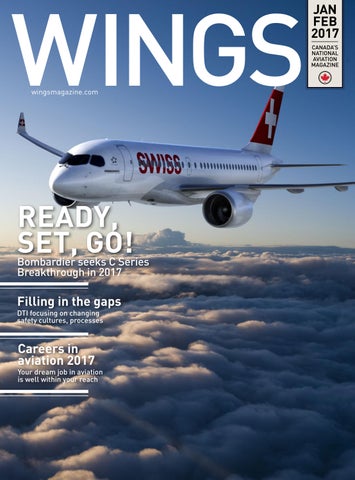
READY, SET, GO!
Bombardier seeks C Series Breakthrough in 2017
Filling in the gaps
DTI focusing on changing safety cultures, processes
Careers in aviation 2017
PHOTO CREDIT TK
Your dream job in aviation is well within your reach
JANUARY/FEBRUARY 2017
UPFRONT 4 Leading edge
Laying the foundation
8 On the fly
News and opinion
10 Alternate Approach Supporting the next generation
12 At the Gate
Southern hospitality
The Bombardier CS300 has taken to the skies for launch customer airBaltic.
BACK
27 Marketplace 30 On final
Finding better solutions
FEATURES 13 READY, SET, GO!
Bombardier looks for C Series breakthrough in 2017 BY RICK ADAMS
PHOTO: BOMBARDIER (TOP MAIN); SENECA COLLEGE (TOP LEFT); BRIAN LOSITO, AIR CANADA (BOTTOM LEFT)
17 FILLING IN THE SAFETY GAPS From top: Supporting the next generation. P.10 Southern hospitality P. 12.
DTI’s approach centres on fixing culture and processes BY DAVID CARR
C-1 CAREERS IN AVIATION 2017
Education, training and job prospects in Canada’s aviation and aerospace sector BY DAVID CARR
COVER PHOTO: BOMBARDIER
WWW.WINGSMAGAZINE.COM
January/February 2017 | WINGS
3
LEADING
EDGE
By Matt Nicholls |
Laying the foundation
Working to drive the future of aviation, aerospace
W
5
“If we’re going to punch above our weight, we’re going to have to innovate.” weight, we’re going to have to innovate,” noted Ontario premier Kathleen Wynne at the groundbreaking event. “It will incubate and grow well-paying professionally rewarding jobs.” Wynne’s remarks are precisely what the Canadian aerospace industry – and operators of all types – must consider in order to remain competitive. The benefits of the DAIR project – and aviation and aerospace initiatives nationwide that unite academia and industry to create new aviation products, processes and services – are critical to Canada’s future success.
TOP DATA BURSTS… in this issue
1. The maintenance support contract for the Airbus C-295 is pegged at $4.7 billion. . (Pg. 8) 2. $500 million: The additional cost to keep the RCAF’s CF-18s airborne (Pg. 8). 3. 814,000: The global need for flight attendants by 2035. (Pg. 10). 4. The C Series program will reach $5.5 billion in annual revenue by 2020. (Pg. 13). 5. $255 billion : Honeywell’s 10-year value forecast for the business aviation industry. (Pg. 13).
4
WINGS | January/February 2017
The economic ramifications in maintaining a strong aerospace footprint are significant. According to “The State of the Aerospace Industry: 2016 Report” released last year by the Aerospace Industries of Canada (AIAC) in concert with Innovation, Science and Economic Development Canada, the Canadian aerospace industry in 2015 contributed more than $28 billion to the GDP and generated some 211,000 jobs in the Canadian economy. Yet innovation can only occur through the development of a pipeline of talented, dynamic young leaders. Filling the talent gap in all facets of aviation remains a critical challenge for industry going forward. Working to ignite the passions of future aviators and aerospace professionals is the goal of Wings and Helicopters annual Careers in Aviation Expos – grass roots events to help maintain a strong pipeline of aviation and aerospace talent. This year’s events – Saturday, April 22 at the Jazz Aviation hangar at Toronto’s Pearson International Airport and Saturday, May 6 at the Westjet Campus in Calgary – showcase dynamic companies, flight schools and educational institutions doing their best to lay the foundation for industry growth. Find at more at www.careersinaviation.ca/expo. Careers in Aviation and Aerospace 2017 in this issue is a tool that does precisely the same thing. It serves to help inform and ignite the passions of young aviation and aerospace professionals, setting them on the right path for future success. As industry partners, we can all “punch above our weight” and help in the process of educating the next generation of aviation and aerospace leaders. Challenging economic realities notwithstanding, innovation and an eye to the future remain paramount; the future of our industry depends on it. W @Wings_Magazine WWW.WINGSMAGAZINE.COM
PHOTO: MATT NICHOLLS
hen Centennial College broke ground on its new aerospace campus at the Downsview Airport in Toronto in late 2016, it marked the culmination of a vision that was years in the making. It also marked a brand new era for the future of aerospace in Ontario. The $72 million project at the former Downsview air force base will be the new home of Centennial’s aerospace technology programs. Located in one of the nation’s historic aerospace jewels – de Havilland of Canada – the campus will be a site to behold, sporting a sparkling new hangar large enough to accommodate a variety of modern aircraft. Close to Toronto with easy access to public transportation, the influence of Canadian aerospace leader Bombardier and much more, it’s the perfect location for the development of an academic and industry hub of aerospace excellence. Centennial currently trains some 300 aircraft technicians and avionics technicians annually at its Ashtonbee Campus in Scarborough. When the campus opens its doors in 2018, the new space will serve as a dynamic centre of innovation and research and development excellence, bringing industry and academia together to devise new products, technologies and solutions. Academic partners and industry leaders including the University of Toronto Institute for Aerospace Studies (UTIAS), Ryerson University, York University and Bombardier will anchor the Downsview Aerospace Innovation and Research (DAIR) cluster. The DAIR consortium also includes industry players such as Honeywell, SAFRAN, United Technologies, Flight Safety International and MDA. “If we’re going to punch above our
SO FAST IT LEAVES TRADITIONAL LUXURY IN ITS WAKE. The HondaJet isn’t just the world’s most advanced light jet. Find out more about our speed and spacious cabin at HondaJet.com
Vol. 58, Issue 1 EDITOR
Matt Nicholls mnicholls@annexweb.com 416-725-5637 FLIGHT DECK
Rick Adams, David Carr, Paul Dixon, Brian Dunn, Frederick K. Larkin, James Marasa, Carroll McCormick, Anna Pangrazzi NATIONAL ACCOUNT MANAGER
Mena Miu mmiu@annexweb.com 905-713-4351
MARKETPLACE ACCOUNT MANAGER
Kory Pearn kpearn@annexweb.com 519-902-8574
ACCOUNT CO-ORDINATOR
Stephanie DeFields sdefields@annexweb.com 1-888-599-2228 ext. 257 MEDIA DESIGNER
Brooke Shaw
CIRCULATION MANAGER
Carol Nixon cnixon@annexweb.com 450-458-0461 GROUP PUBLISHER
Martin McAnulty mmcanulty@annexweb.com WINGS MAGAZINE
P.O. Box 530, 105 Donly Dr. S., Simcoe, ON N3Y 4N5 Tel: 519-428-3471 Fax: 519-429-3094 Toll Free: 1-888-599-2228 Printed in Canada ISSN 0701-1369 PUBLICATION MAIL AGREEMENT #40065710 CIRCULATION Email: apotal@annexbizmedia.com Phone:416-442-5600 ext. 3258 Fax: 416-510-6875 Mail: 80 Valleybrook Dr, Toronto, On M3B 2S9 Published six times per year (Jan/Feb, Mar/Ap, May/Jun, Jul/Aug, Sep/Oct, Nov/Dec) by Annex Business Media SUBSCRIPTION RATES Canada – 1 Year $ 32.95 (plus GST - #867172652RT0001) USA – 1 Year $ 57.95 Foreign – 1 Year $ 65.95 Occasionally, Wings magazine will mail information on behalf of industry-related groups whose products
ON THE
WEB
6
WINGS | January/February 2017
Annex Privacy Office privacy@annexbizmedia.com • Tel: 800.668.2374 No part of the editorial content of this publication may be reprinted without the publisher’s written permission. ©2017 Annex Publishing & Printing Inc. All rights reserved. Opinions expressed in this magazine are not necessarily those of the editor or the publisher. No liability is assumed for errors or omissions. All advertising is subject to the publisher’s approval. Such approval does not imply any endorsement of the products or services advertised. Publisher reserves the right to refuse advertising that does not meet the standards of the publication.
Canadian Owners & Pilots Association
Canadian Business Aviation Association
Magazines Canada
AVIATION THIS WEEK
PHOTO: ANNEX BUSINESS MEDIA
Air Transport Association of Canada
and services we believe may be of interest to you. If you prefer not to receive this information, please contact our circulation department in any of the four ways listed above.
Looking to catch up on the latest hot news from around aviation and aerospace? Check out Aviation This Week, a live digital version of the top news stories affecting a variety of key markets. It’s quick, essential information you need to know! WWW.WINGSMAGAZINE.COM
THE DESTINATION FOR THE AIRCRAFT INTERIORS INDUSTRY. Aircraft Interiors Expo 2017 4-6 April 2017, Hamburg Messe, Germany Aircraft Interiors Expo is the world’s market leader event dedicated to airlines and the supply chain to source the latest innovations, technologies and products for the cabin interiors, inflight entertainment, connectivity and passenger comfort industries. Register online for your FREE place today www.aircraftinteriorsexpo.com
SAVE THE DATE
4-6
Co-located with:
Organised by:
In co-operation with:
APRIL 2017
Supported by:
ON THE FLY For late-breaking news and exclusive web content, please visit us at: www.wingsmagazine.com
THE LEAD COMMERCIAL AEROSPACE PEOPLE
THE LEAD
FWSAR SAGA ENDS: AIRBUS GETS THE NOD Finally, there’s a winner in the longrunning fixed wing search and rescue (FWSAR) procurement saga. At a ceremony at CFB Trenton in December 2016, Defence Minister Harjit Sajjan in the company of Public Works Minister Judy Foote and RCAF Commander Lt. Gen. Michael Hood, announced that Airbus Defence & Security has been awarded a contract for 16 of its C-295W aircraft to replace the current C-130 Hercules and C-115 Buffalo aircraft. In the first phase of the contract, the delivery of the aircraft is pegged at $2.4 billion. The second phase of the contract, 20 years of in-service support to be delivered by Airbus – to be negotiated – is valued at a further $4.7 billion. Certainly a procurement that is long overdue, the competition had been kicked to the curb a decade ago as questions arose about the methodology used to determine the specifications of the ideal aircraft. Critics accused military planners of stacking their specs to favour one manufacturer over all others and this, coupled with more than one change in the governing federal party, effectively put the brakes on the project. It was only in the last couple of years that the project was rejuvenated, with as many as six manufacturers now promoting a wide range of aircraft as being suitable for the mission. With the RFP call earlier this year, the field was narrowed to two serious
contenders and one black horse. Airbus Defence & Security, with its C-295W and Leonardo Aircraft’s C-27J were the frontrunners, with Embraer’s KC-390 lurking in the shadows. With the government announcement, it’s easy to talk about “winners” and “losers,” but it’s not quite that simple. Airbus built a team that includes Provincial Aerospace for in-service maintenance, Pratt & Whitney Canada already providing to C-295Ws in service around the world and CAE for the ground simulator. Minister Sajjan and Lt. Gen. Hood were effusive in their praise for the C-295W, with the minister describing the aircraft as a “game changer” while the general said it “more than meets the requirements of the RCAF.” At the other end of the scale, Leonardo-Finmeccanica released a brief statement to the effect that “the company has been informed that it is not the winner and will take some time to avail itself of a ‘debrief ’ from government officials before commenting.” One of the big winners in the decision is Comox, B.C. – CFB Comox, home to 19 Wing and 442 Squardon in particular and the surrounding community known collectively as The Comox Valley. The base, with 1,400 personnel is the largest employer in the region and that number will be growing in the future. The Comox Valley Economic Development Society worked hard to ensure that Comox would be the site of the Search and Rescue (SAR) Training Centre, producing a report that showed Comox is the ideal location based on a wide range of considerations including agreeable weather enabling year-round operations, few air space restrictions, the most varied and representative terrain in the country and a full complement of operational support. Both Airbus and Leonardo had both committed to building the FWSAR training centre in
The federal government’s FWSAR decision means positive economic benefits to Comox, B.C. 8
WINGS | January/February 2017
With the CF-18 fleet possibly staying in service past 2025, the F-18 Super Hornet will provide a key stopgap.
Comox and Lt.Gen. Hood echoed this commitment in an interview with the Vancouver Sun earlier this year. With CFB Comox already the site of the Canadian Forces School of Search And Rescue as well as the training centre for the CH-149 Cormorant, Comox is poised to become a SAR Centre Of Excellence.
CANADA BACKS SUPER HORNET STOP GAP Canada entered into discussions with Boeing in late 2016 for an “interim” purchase of 18 Super Hornets as it prepares to launch a transparent and open competition to replace the existing fleet of aging CF-18 fighter jets, following a review of Canada’s defence policy, expected to be completed early this year. “We are addressing the capability gap,” Defence Minister Harjit Sajjan noted. The minister also announced a package of new measures to extend the service of the existing CF-18 fleet, including expanded recruiting and training to address fleet understaffing and enhanced maintenance and operational issues. In a report by The Globe and Mail newspaper, Lt.-Gen. Michael Hood, head of the Royal Canadian Air Force (RCAF), told the minister that Canada’s 77 existing CF-18 jets will be able to stay in service until 2025 and even later. The competition for replacement aircraft is expected to take five years, pushing a final decision past the next election. The added cost of keeping the existing CF-18s mission ready for at least another nine years is estimated at more than $500 million. The two jets share common weapons systems, but have different engines and avionics. There is also the prospect of adding WWW.WINGSMAGAZINE.COM
PHOTO: AIRBUS DEFENCE & SECURITY (BOTTOM); BOEING (TOP)
8 9 9 9
a third type, quite possibly the Lockheed Martin F-35 into the fleet after 2025, as the legacy CF-18s are pulled out of service. Both the United States Navy and Royal Australian Air Force operate a mixed fleet of F-35s and Super Hornets. Whether the Super Hornets will be withdrawn from service as the replacement aircraft is added to the fleet adds another question mark. “An interim fleet is an interim fleet,” John Vance, chief of defence staff for the Canadian Armed Forces said, without providing detail. Vance did say, however, that the announcement, “marks a significant investment in air power in Canada for the long term.” The cost of purchasing 18 Super Hornets is also not known. The government of Kuwait reportedly purchased 40 weaponized Super Hornets for $13.6 billion (US$10.1 billion), including training and support. The per unit cost for Canada is expected to be higher, but will include offset investments in the Canadian aerospace industry.
COMMERCIAL
PHOTO: GTAA
DOMESTIC AIR TRANSPORT SET FOR OVERHAUL Canada’s air transport industry is bracing for a shakeup as the federal government opens up new sources of investment capital for airlines, and sets the stage to sell off major airports. The Trudeau Liberals plan to introduce legislation to almost double foreign ownership of domestic airlines to 49 per cent. The government has also hired Credit Suisse, one of the world’s biggest investment banks, to probe the sale of eight of Canada’s busiest airports, including Toronto Pearson, Montreal-Trudeau and Vancouver International. Both initiatives will be part of a broader overhaul of Canada’s transport system, and were key recommendations of the Canada Transportation Act Review Secretariat, headed by David Emerson, a former federal cabinet minister and founding chief executive of the Vancouver International Airport Authority. The big winner in boosting foreign ownership of domestic airlines will be Canada’s nascent, ultra-low cost airline sector, which has struggled to get off the ground. Canada is the only major economy without an ultralow cost carrier (ULCC) network. Conventional wisdom suggests that for a ULCC to succeed in Canada, an operator must have WWW.WINGSMAGAZINE.COM
The Trudeau Liberals are poised to sell eight of Canada’s busiest airports, including Toronto Pearson.
at least 10 airplanes launching a route network that prevents Air Canada and WestJet from entering a price war across all points. Winnipeg-based NewLeaf Travel, a “reseller of airline services” recently launched branded service with two 158-passenger Boeing 737s operated by Flair Air, a Kelowna, British Columbia-based charter operator. NewLeaf is linking lower cost airports such as Abbotsford, B.C. and Hamilton, Ont., but not with daily routes. Loosening limitations on foreign investment is expected to allow NewLeaf and other new entrants to scale up by attracting international investors that specialize in ULCC start-ups. “We [need to] set the conditions for lower fares and increased competition by changing the rules on ownership in Canada’s passenger airline industry,” Transport Minister Marc Garneau told a Transportation 2030 conference in Montreal. “International companies will be able to own 49 per cent of an airline in Canada. This will lead to more options for Canadians, and allow the creation of new, ultra-low cost airlines.” Calgary-based Enerjet wasted no time in announcing its intention to join up with Indigo Partners, an American private equity and venture capital firm specializing in air transport. Canada Jetlines is planning to launch operations in summer 2017, offering scheduled point-to-point service with primary bases in Vancouver and southern Ontario. “The minister’s announcement is further confirmation that there is a lack of access to risk capital in Canada and that foreign investment is critical to meeting consumer demand in the airline sector through increased, competition,” said Mark Morabito, chief executive of Jet Metal Corp, a uranium mining company that is also a partner in Canada Jetlines. “We now have the opportunity to offer new options for the more than 10 million Canadians who are not choosing to fly in Canada and to repatriate the five million annual flights Canadians have been accessing via U.S. airports and bring that business back to Canada.” The government has been less clear on its plans to privatize Canada’s major airports,
but a sale appears inevitable, especially if the Liberals want to put a substantive deposit in a planned infrastructure bank intended to stimulate private sector partnerships to rebuild crumbling public infrastructure.
PEOPLE
PEOPLE ON THE MOVE Montreal’s TRAXXALL Technologies opened its first U.S. based office in Jacksonville, Fla. in November 2016 and made several additions to its team. Joining the Florida-based team: James Cook, formerly a business analyst with SkyBOOKS, Cook served in the U.S. Navy and has more than 25 years of aviation maintenance and software application experience. Jeremy Figus was most recently a quality assurance analyst with SkyBOOKS. He has more than 20 years of aviation maintenance experience and is FAA airframe and powerplant (A&P) certified. Ryan Kraus was previously a senior analyst at Gulfstream CMP. Kraus has almost 25 years of industry experience and is also FAA airframe and powerplant (A&P) certified. Tory Martin, formerly an account representative at SkyBOOKS for almost a decade, Martin previously served in the U.S. Navy for more than 23 years. Michael Shelton was previously a quality assurance analyst with SkyBOOKS. Shelton has 15 years of aviation industry experience. He began his career in the U.S. Marine Corps. The team will be led by TRAXXALL’s Jeff Dougherty and Dewayne James, who are already well-established in the Florida aviation community . . . Aéroports de Montréal (ADM) has a new leader. Philippe Rainville has taken the reigns as the new chairman of the board of ADM from James C. Cherry, who has retired after 15 years. Rainville is a chartered professional accountant and has an extensive background as an auditor and financial analyst at a number of corporations. He has been with ADM since 2008 . January/February 2017 | WINGS
9
ALTERNATE
APPROACH By David Carr |
Supporting the next generation Taking the next steps to an exciting aviation career
T
10 WINGS | January/February 2017
(TC) already does a good job ensuring flight schools are safe and that equipment is properly maintained. Other organizations such as the Private Career Training Institutions Agency of British Columbia also help protect students by accrediting independent learning institutions such as flight schools. But these are government organizations that do not outline business models – and nor should they be expected to. But in the absence of this initiative, then who? What such an association would do is present potential students with a one-stop resource where they can learn about industry requirements, licencing, training specialties, helpful tips on what to look for when selecting a flight school, arranging financing, reducing training costs offering a job board and so much more. Given the high cost of training and the proliferation of industry associations in Canada, including the aviation sector, a member-based association of Canadian flight schools is an idea whose time has already come (if not long overdue). Certainly additional stakeholders such as industry associations, financial institutions looking to lend and recruiters anxious to snap up graduates would support such an association. The future of Canada’s aviation and aerospace industries deserves no less. | W
“It is not always a reduction in numbers that forces these layoffs, as much as it is a re-alignment of skill sets.” association of flight schools, similar to what the Canadian Business Aviation Association (CBAA) is to business aviation and the Canadian Owners and Pilots Association (COPA) is to general aviation, including recreational flyers. The Pennsylvania-based Flight School Association of North America (FSANA) was launched in 2011 and promised the first flight school accreditation program in the history of flight training. It’s a worthy ideal, but one that has fallen short of the mark. Still, FSANA is on the right track – so why not an association like that here? There is precedent. The Canadian Association of Aviation Colleges (CAAC) was set up in 2008 as a voice for promoting and furthering aviation education in Canada and with an impressive list of early backers such as the British Columbia Institute of Technology (BCIT), Chicoutimi College and Seneca. Information on the CAAC website, however, shows that information has not been updated since 2009, suggesting that the initiative has stalled. History needn’t repeat itself. A Canadian Association of Flight Schools (and aviation colleges) would not necessarily be for accreditation purposes. Transport Canada
David Carr is a Wings writer and columnist. WWW.WINGSMAGAZINE.COM
PHOTO: CENTENNIAL COLLEGE
he January/February 2017 issue of Wings magazine contains the seventh annual Careers in Aviation (CIA) supplement, a launching pad for the future of Canada’s aerospace and air transport industries. And based on the level of participation at our previous Careers in Aviation Expos in the Greater Toronto Area, Ottawa and Calgary, that future is looking bright. Canada is facing a shortage of pilots and technicians needed to grow the world’s fifth largest aerospace industry and according to Boeing’s 2016 Pilot and Technician Outlook, the world’s commercial airline industry alone will need 1.5 million new pilots and technicians over the next 20 years, a more than 10 per cent increase in demand over last year’s forecast. For the first time, the Boeing report also looked at cabin crew demand, forecasting on a need for 814,000 new flight attendants by 2035. This same talent gap exists on the aerospace side of the ledger, where there’s an increasing demand for skilled workers in a variety of disciplines from engineering to software development. Air transport is riding a wave and “real time” layoffs in the broader aviation and aerospace industries will always test the most evidence-based projections. But aviation is also cyclical and even now, it is not always a reduction in numbers that forces these layoffs, as much as it is a realignment of skill sets. In other words, that means a hiring trend and job potential. The Careers in Aviation Guide opens up a world of career choices and job opportunities in the aviation and aerospace industries for a new generation of the best and brightest. But it barely peels back the first layer of the onion. Canada is home to hundreds of excellent flight schools and other sources of higher learning, suggesting that the industry needs to lay down more introductory markers like CIA to help more students take those critical first steps along a rewarding career path. It can be argued that right hand seats onboard training aircraft are already being filled and enrolment at colleges and universities with aviation programs remains strong. So, where is the problem? CIA suggests the industry could be doing more, beginning with a Canadian member-based
LEKTRO The Original Towbarless Tug Setting the Standard in Excellence Since 1945
Models ranging
15,000 to 280,000 lbs.
Electric Towbarless Certified Easy to Use Universal Rugged Simple to Maintain www.
LEKTRO .com
1-800-535-8767 1-503-861-2288 sales@lektro.com January/February 2017 | WINGS
WWW.WINGSMAGAZINE.COM WG_Lektro_NovDec16_CSA.indd 1
2016-10-24 12:50 PM
11
AT THE
GATE
By Brian Dunn |
Southern hospitality
Canadian air carriers battle for sun-destination supremacy
A
12 WINGS | January/February 2017
“Less than 15 per cent of Air Canada’s total capacity is deployed to sun destinations during the winter.”
last winter, to 2,048,257 this winter. WestJet is slightly down from last winter’s 1,464, 116 seats as is Transat at 1,457,447. Sunwing is up almost two per cent from 1,206,009 to 1,228, 689. Judging from the numbers, Mexico and the Caribbean Islands are gaining capacity at the expense of Cuba. While Air Canada is adding seats to Cuba, the three other major tour operators are pulling back, resulting in a 6.6 per cent total drop from 1,093,117 to 1,020,722 seats. It is believed Cuba is becoming more expensive for Canadians who previously paid in Canadian dollars for hotels, which are now priced in U.S. dollars. One region that is seeing new capacity from all tour operators is Central America. While Costa Rica has been growing in popularity for years, countries such as Nicaragua, El Salvador and Honduras are emerging as popular destinations, noted Doerksen. “I think one of the reasons the area becoming popular is that a lot of Canadians are getting tired of going to the same places over and over again like Florida, Mexico or the Caribbean and want to try something different,” Doerksen said.| W
WestJet is less dependent on sun destinations than most other tour operators, but it still allocates 20 per cent of its capacity to these markets during the winter. Its capacity deployment plans look disciplined to Doerksen, especially to the U.S. market and lower capacity growth should help WestJet return to positive revenue per available seat mile in the first quarter of 2017. Although seat capacity last winter only increased by a combined one per cent to sun destinations, the sector was hurt by a weaker Canadian dollar and a decline in demand from Alberta. But while Air Canada, Transat and Sunwing are reducing capacity from Alberta, WestJet is adding 10.6 per cent more seats to Mexico and Caribbean from the province. “In our view, the most important driver for profitability in these markets is industry capacity,” notes Doerksen. “Higher capacity typically leads to lower prices and, conversely, capacity restraint facilitates pricing increases.” Air Canada is increasing sun destina- Brian Dunn is a Wings writer and tion seats 14.8 per cent, from 1,783,991 columnist.
WWW.WINGSMAGAZINE.COM
PHOTO: BRIAN LOSITO, AIR CANADA
s we settle into another long, dark, cold winter (sorry about that), many Canadians look south for relief and Canadian airlines and tour operators are only too happy to help. Sun destinations have been one of the most competitive markets in recent years and a key component for airline profitability, according to analyst Cameron Doerksen of the National Bank Financial Markets. Total scheduled seat capacity from Canada by Air Canada, WestJet, Sunwing and Air Transat between Nov. 1 and April 30, is up 3.4 per cent from a year ago, which appears a little aggressive based on market conditions, Doerksen maintains. That 3.4 per cent incorporates scheduled capacity to Mexico, Caribbean, Central America, Florida and Hawaii. The Mexican and Caribbean market (excluding Central America) will see a 4.1 per cent increase in seat capacity, driven by a 27.5 per cent increase from Air Canada. Capacity on direct flights to Florida and Hawaii will be down from last season, reflecting a weak Canadian dollar and continuing weakness in the Alberta oil patch. “With market shares now more balanced between the big four tour operators and Air Canada’s aggressive growth set to slow, we believe industry capacity growth to the sun will potentially be more muted in winter 2017-2018,” Doerksen wrote in a report. What does this all mean for the four carriers? Air Canada’s increase in seats to sun destinations (15 per cent overall and 29 per cent to Mexico, the Caribbean and Central America) appears aggressive. But less than 15 per cent of Air Canada’s total capacity is deployed on these markets during the winter and Doerksen believes management has the fleet flexibility to lower capacity growth if necessary. The analyst is encouraged that Air Transat is taking “a rational approach” to capacity deployment of only a one per cent increase, according to airline management. But it is facing tough competition in its core Quebec and Ontario markets from Air Canada, which is boosting seats by 31 per cent in Quebec and 25 per cent in Ontario. This poses a challenge for Transat since 80 per cent of its winter revenue is generated by sun destinations.
Bombardier’s CS300 service with launch customer airBaltic commenced in December 2016.
READY, SET, GO! BOMBARDIER LOOKS FOR C SERIES BREAKTHROUGH IN 2017
T PHOTO: BOMBARDIER AEROSPACE
BY RICK ADAMS
he past year was a good one for the folks at Bombardier Aerospace, at least those who still work there. If you bought BBD.B stock on the Toronto Stock Exchange at its lowest ebb of 87 cents on Jan. 28 2016, your shares would have gained nearly 150 per cent by year-end. No, it’s not back to the $2.82 value when the C Series aircraft program was launched in March 2005, but it is still an impressive recovery from the dismal days of 2015. About a year ago, Bombardier was precipitously close to bankruptcy. The long-delayed C Series challenge to Airbus and Boeing in the commercial narrowbody aircraft market had not made a single sale in 2015. The company wrote off US$3.2 billion on the program and analysts suggested the Montreal-based planes and trains manufacturer should euthanize the beleaguered aircraft. The company’s debt had reached approximately US$9 billion. Nearly 15,000 job losses had been announced over a couple of years. Bombardier even discussed the possible
WWW.WINGSMAGAZINE.COM
sale of the C Series program, quelle horreur, to Airbus. At the end of 2015, there were a couple of hopeful signs. Transport Canada (TC) certified the CS100 in mid-December 2015. And the Quebec provincial government anted up a billion-dollar cash infusion in exchange for an equity stake in the limited partnership that controls the C Series program. The cash is ostensibly a “repayable loan,” but some economists question whether the government will ever be reimbursed, calling it a “corporate welfare” bailout. Bombardier has also been negotiating with the Government of Canada for a further $1 billion aid package, but is reluctant to accept the reported stipulation that the company eliminate the dual-class share structure, which enables the Bombardier and Beaudoin families to control the company despite minority ownership. Prime Minister Justin Trudeau acknowledged, “We’re working in a very productive manner with Bombardier. Our government understands the extent to which the aeronautics industry is important to the entire country, not just Quebec.” January/February 2017 | WINGS 13
Federal funding would improve Bombardier’s “financial flexibility,” which could even lead to development of a third C Series model in a 160- to 180-seat configuration. “We’re seeing opportunities where a next version of this plane can be more of a reality,” according to Bombardier Commercial Aircraft president Fred Cromer. The real turnaround started in April 2016 with an order of 75 CS100 aircraft plus another 50 options from U.S. carrier Delta. Delta chief executive Ed Bastain lauded, “These new aircraft are a solid investment, allowing us to take advantage
of superior operating economics, network flexibility and best-in-class fuel performance.” Moody’s senior vice-president Russell Solomon labelled the Delta order the “beginning of the end” of the Boeing and Airbus duopoly. “The mere presence of the C Series will have at least an indirect (if not a direct) impact on the competitive dynamic between the two industry titans, causing them to sharpen their pencils even more on strategic campaigns.” Boeing reportedly gave United Airlines a 65-70 per cent discount on an order for 40 737s, $24
to 28 million per aircraft, to undercut the CS300 market price of $36 million. Canaccord Genuity analyst David Tyerman said the deep discounting “raises the question of how profitable the next C Series order they win will be for them.” George Ferguson at Bloomberg Intelligence claimed Delta is getting the C Series for $4 million per plane less than it costs to build them in Mirabel, Que. Cromer told a Bombardier Investors Day audience in December the C Series program will be profitable by 2020 when it is expected to reach $5.5 billion in annual revenue and deliveries of 90 to 120 aircraft per year. “We couldn’t be in a better spot today as we think about 2017 and beyond,” Cromer added. “We really don’t have room for a large order until we get to the back end of 2019.” At year-end 2016, Bombardier had orders for 360 C Series aircraft, including a firm order from Air Canada for 45 CS300 aircraft and options for an additional 30. According to the CAPA Fleet Database, the 360 C Series orders as of mid-December were greater than the combined totals of the aircraft types against which the 108to 133-seat CS100 and 130- to160-seat CS300 compete: Embraer EJet E190-E2 and E195-E2 variants (178), Boeing 737 MAX 7 (70) and Airbus A319neo (56).
“WE’RE SEEING OPPORTUNITIES WHERE A NEXT VERSION OF THIS PLANE CAN BE MORE OF A REALITY.” The first delivery of a CS100 was in June last year to Lufthansa Group’s Swiss, with the initial CS300 entering service with airBaltic in December 2016. Bombardier is targeting 30 to 35 deliveries in 2017, including Korean Air and also hopes to achieve certification for landing on the short strip at London City Airport.
Narrowbody market dominates If the C Series is able to ramp up to 120 deliveries a year, that would represent roughly one-third of the estimated 350 average annual requirement Bombardier estimates are needed worldwide for the so-called 100- to 150-seat market over the next 20 years. Those 7,000 aircraft, however, are only one-quarter of the more than 28,000 forecasted by Airbus and Boeing for the single-aisle market. Overall, Boeing is projecting commercial fixed-wing aircraft demand of 39,620 airplanes, Airbus 33,000. “Despite recent events that have impacted the financial 14 WINGS | January/February 2017
markets, the aviation sector will continue to see long-term growth with the commercial fleet doubling in size,” said Randy Tinseth, vice president of marketing, Boeing Commercial Airplanes. “We expect to see passenger traffic grow 4.8 per cent a year over the next two decades,” more than doubling today’s boardings by the 2032-36 timeframe. To fly and maintain all those new aircraft, Boeing predicts a need for 560,000 new pilots and 540,000 new technicians over the next 20 years. Richard Aboulafia, vice president, analysis, for the Teal Group, sounded a note of caution in the commercial space however. “The two large jetliner primes need to re-think their production ramp plans,” he said. “A very difficult world macroeconomic environment, coupled with the strong prospect of a long period of cheap fuel, means we may see these plans slow considerably.”
PHOTO: DASSAULT FALCON
Bizjets still seeking recovery While the C Series is a big story heading into 2017 on the commercial side, the business aviation trend is described as a “muted recovery” by U.S.-based aircraft broker Jetcraft. “We expect 2016 to be an important year for business aviation as the industry is at the mid-point of the recovery run in the current business cycle,”
The Dassault Falcon 8X entered service in October 2016 and is one of the most dynamic new bizjets on the market.
(since the 2008 recession), according to Jetcraft board chairman, Jahid FazalKarim. “This year will determine whether our call for the current business cycle, for example muted but resilient recovery followed by a softer downturn, will hold true. To skeptics, we may seem to be perpetually turning a corner in terms of the recovery. However, the danger is not so much the slower-than-hoped-for recovery itself, but rather the possibility of creating a self-fulfilling prophecy with an inevitable downturn.” Jetcraft’s 2016 market forecast calls
for 7,879 unit deliveries over the next 10 years, representing US$248 billion in revenues. That’s a decrease of 10 per cent in unit deliveries and nine per cent in revenues from their inaugural estimates last year. Honeywell’s annual forecast calls for up to 8,600 new business jet deliveries worth $255 billion from 2016 to 2026, a six to seven per cent reduction from their 2015 call. Brian Sill, president, commercial aviation, Honeywell Aerospace, said, “We continue to see relatively slow economic growth projections in many mature business jet
Airworthiness Symposium & Trade Show
UPDATE 2017
Coast Plaza Hotel - Calgary, Alberta CANADA
MARCH 15-17, 2017
For more information, including courses, registration and schedule, see
www.wamea.com WWW.WINGSMAGAZINE.COM HE_WAMEAsymposium_JanFeb17_CSA.indd 1
173 Fax: (780) 413-0076 E-mail: info@wamea.com
January/February 2017 | WINGS 15 2017-01-16 8:01 AM
Members of Bombardier’s C Series team celebrate the delivery of the CS300 to airBaltic in Nov. 2016.
The real turnaround for Bombardier’s C Series started in April 2016 with an order of 75 CS100 aircraft plus another 50 options from U.S. carrier Delta.
markets. While developed economies are generally faring better, commodities demand, foreign exchange and political uncertainties remain as concerns.” However, Sill indicated “there is improved interest in new aircraft acquisition in the medium term, particularly in the 2018-19 period.” Fazal-Karim noted, “The planned introduction of many new aircraft over the next five years will again stimulate replacement demand by introducing new technology and aircraft mission capabilities.
These new aircraft models will be key in sustaining growth until at least 2021.” The Dassault Falcon 8X entered service last October and over the next four years another eight new bizjets are scheduled to enter service: Bombardier’s Global 7000 (first flight in November 2016) and 8000 models, Cessna’s Longitude, Dassault’s Falcon 5X, the Gulfstream 500, 600 and 750 models, and Pilatus’s first jet, the PC-24. In the business aviation engine segment,
I
PNC AVIATION FINANCE When it comes to financing private aircraft, we know you value decades of aviation expertise, track record and financial strength. That’s why aviation clients across the U.S. and Canada choose PNC Aviation Finance to help their business take off. To learn more, visit pnc.com/aviation. PNC is a registered mark of The PNC Financial Services Group, Inc. (“PNC”). Equipment financing and leasing products are provided by PNC Equipment Finance, LLC, a wholly-owned subsidiary of PNC Bank. Aircraft financing is provided by PNC Aviation Finance, a division of PNC Equipment Finance, LLC. In Canada, PNC Bank Canada Branch, the Canadian branch of PNC Bank, provides bank deposit, treasury management, lending (including asset-based lending through its Business Credit division) and leasing products and services (through its Equipment Finance division). Deposits with PNC Bank Canada Branch are not insured by the Canada Deposit Insurance Corporation. Deposits with PNC Bank Canada Branch are not insured by the Federal Deposit Insurance Corporation, nor are they guaranteed by the United States Government or any agency thereof. Lending and leasing products and services, as well as certain other banking products and services, require credit approval. ©2015 The PNC Financial Services Group, Inc. All rights reserved. CIB EF PDF 0715-070-195013
Low oil pressure for rotorcraft In the global civilian-use helicopter market, Honeywell has reduced its estimate by nearly 10 per cent from the previous year. The avionics and engine manufacturer now predicts that between 4,300 and 4,800 rotorcraft will be delivered in the five-year period from 2016-20, compared with a prediction of 4,750-5,250 a year ago. With the oil-and-gas sector accounting for about one-quarter of the global helicopter fleet, the energy downturn has created a sizeable surplus of aircraft. Roughly 20 per cent of the 1,900 helicopters worldwide serving the oil-and-gas industry are idle or underemployed. Two of the most visible industry casualties have been CHC Group, formerly Canadian Helicopter Company and Erickson AirCrane, both of which filed for bankruptcy protection in November 2016. Mike Madsen, president, defense and space from Honeywell Aerospace, offered some optimism in the months and years ahead. “Purchase interest for helicopters in training, tourism, firefighting and law enforcement categories is trending up, influenced by increased utilization rates and helicopter replacement cycles,” Madsen said. “Interest across these sectors is helping to sustain near-term demand. Looking ahead, new platforms are scheduled to enter service over the next few years, bolstering overall helicopter demand.” New rotorcraft on the horizon include the Bell 505 Jet Ranger X, which was recently certified by Transport Canada and which will be produced in Mirabel, Que., the Bell 525 Relentless, Airbus’ H160 and H175 public services variant, the Leonardo AW609 tiltrotor and the Skye SH09 from Marenco Swisshelicopter. | W 16 WINGS | January/February 2017
WG_PNC_Janfeb17_CSA.indd 1
2016-12-12 10:48 AM
PHOTOS: BOMBARDIER AEROSPACE
the right relationship can help you soar.
Pratt & Whitney Canada (P&WC) is expected to supplant Rolls-Royce as the market share leader, aided by the entry into service of the new Gulfstream large aircraft family.
WINGS
CAREERS IN AVIATION & AEROSPACE
2017
PHOTO CREDIT TK
PM 40065710
$6.00
EDUCATION, TRAINING, JOB PROSPECTS IN CANADA’S AVIATION AND AEROSPACE SECTOR
Our Aviation programs can help you take flight. With more than 45 years of aviation training experience, Centennial College’s School of Transportation’s Aviation Technician programs provide students with the opportunity to learn the mechanical, electrical, electronic and other science skills related to aircraft and avionics maintenance. The Aviation Technician programs place an emphasis on various aspects of electrical and mechanical systems within the aircraft. In option M (maintenance), students study hydraulics, fuels, engines, flight controls, landing gear systems, airframes and structures. In option E (avionics) students perform tasks associated with the maintenance and repair of aircraft communication, navigation and data systems. A large portion of the programs emphasize aviation maintenance practices, procedures and Canadian aviation regulation requirements through hands-on practice in labs at the campus airplane hangar and avionics labs. Students meeting the Transport Canada (TC) accreditation requirements receive 18 month credit towards the experience requirements for issue of an Aircraft Maintenance Engineer (AME) Licence (M or E rating), and TC technical examination credit. The programs are also accredited by The Canadian Council for Aviation and Aerospace (CCAA) as meeting the national occupational standards for aircraft/avionics maintenance training. For more information contact: Coordinator, Aviation Programs, Jim Passant 416-289-5000, ext. 7510 jpassant@centennialcollege.ca
Coming in 2018! Centennial College’s Downsview Park Aerospace Campus.
centennialcollege.ca/transportation
See where experience takes you.
CIA2017
CAREERS IN AVIATION:
MORE THAN JUST PILOTS
PHOTO: BRIAN LOSITO, AIR CANADA
I
t can be said that the dullest day in aviation still tops the most interesting day in almost any other industry. There is something about the business of flight. It gets in your blood, and once there it does not leave. The 2017 edition of Wings and Helicopters Careers in Aviation (CIA) guide offers an introduction to a variety of careers in aviation and aerospace. It provides helpful tips for choosing a flight school, and sets expectations for new graduates breaking into the industry. Canada has one of the most dynamic and diverse aviation and aerospace industries in the world, including a strong airline industry, corporate aviation prospects, the second largest helicopter fleet in the world, and Montreal – the hub of the world’s fifth largest aerospace industry. It is but one of several dynamic aerospace hubs across the country, all offering a variety of maintenance, avionics, software and engineering opportunities in a variety of exciting disciplines. Canada also has hundreds of first-rate flight schools, colleges (flight and maintenance) and university programs to maintain and support industry growth and help potential new graduates chart a course along one of the many career paths available. A Canadian licence, trade certificate or diploma also helps punch the ticket for many graduates to work almost anywhere in the world. So, it is sometimes good to take a global perspective when looking at demand for skills. According to the Boeing Airplane Company, the world’s commercial airline industry will need 617,000 new commercial pilots over the next 20 years. That represents approximately 31,000 new pilots a year, not including filling demand for corporate jets, helicopters, military and law enforcement and emergency services. Demand for pilots always grabs the headlines, but it does not tell the entire story. The Aerospace Industries Association of Canada (AIAC) estimates that some 400 aerospace firms employ more than 80,000 Canadians across the country. And while many basic aircraft maintenance, repair and overhaul (MRO) functions have peeled away to lower wage countries, Canada remains a global player in higher end and more sophisticated MRO, with job
opportunities spread across the country. Indeed, the same Boeing survey reports that 679,000 new commercial airline maintenance technicians and 814,000 new cabin crew will be needed by 2035 to keep the airplanes flying and supporting passenger growth. Demand for maintenance technicians has grown 11.3 per cent over the last year. These numbers add up to strong demand for pilots and other skilled professionals in Canada’s aviation and aerospace industry. Still, while the jobs are available or will be opening up in the near future as older pilots exit the flight deck and technicians lay down their tools, aviation remains a complex and competitive business. Flight school on its own may no longer be sufficient, and a pilot’s licence might need to be linked with a college degree or university diploma. The 2017 edition of Careers in Aviation is presented in three sections: • Flying the aircraft (including flight schools, flight colleges and schools that specialize in unmanned aerial vehicles, or UAVs) • Designing, building and maintaining the aircraft (including maintenance colleges and universities that offer aviation programs) • Supporting the aircraft, which is an introduction to careers in airport operations, air traffic control and flight services. The listings directory covering each section are intended as an introductory snapshot of the types of flight schools, colleges (flying and aviation technician) and universities and is by no means a comprehensive list. This guide is meant to be a jumping off point for your research, so please dive in once your path is more focused. Whether you are looking to fly fixedwing airplanes or helicopters, launch a career in the sky with an airline or corporate operators, or keep your feet planted firmly on the ground in manufacturing and maintenance or industry support, CIA 2017 is an excellent opening reference point. Good luck on your journey!
HEAD OF THE CLASS
Industry associations are ready to aid in your career search • AeroMontréal www.aeromontreal.ca • Aerospace Industries Association of Canada www.aiac.ca • Air Transport Association of Canada www.atac • Air Line Pilots Association www.alpa.org • AME Canada www.ame.org • B.C. Aviation Council www.bcaviationcouncil.org • Canadian Business Aviation Association www.cbaa-acaa.ca • Canadian Council for Aviation and Aerospace www.avaerocouncil.ca • Canadian Owners and Pilots Association www.copanational.org • National Airlines Council of Canada www.airlinecouncil.org • Helicopter Association of Canada www.h-a-c.ca • Unmanned Systems Canada www.unmannedsystems.ca
ON THEWEB
For expanded listings and career options – and to find out more about Wings and Helicopters 2017 Careers in Aviation Expos – go to www.careersinaviation.ca January/February 2017 | C3
CIA2017
PART 1:
FLYING THE AIRCRAFT
Y
our mind is made up; you have decided to become a pilot. Congratulations, the industry needs you. The next thing you need to think of, even before deciding on a flight training school, is what kind of pilot do you want to be. It is a question that goes deeper than choosing between fixed-wing airplanes or helicopters, although that is also an important consideration. There are many exciting career options for licenced pilots in Canada outside of the high profile flying for a national or regional airline. Ultra-low cost carriers (ULCC) have the potential to be a high-growth sector for Canadian air transport over the next five years. Students need to first determine what their final career position will be. Transport Canada estimates there are more than 800 “on-demand” aviation service providers such as charter operators, law enforcement and emergency medical services, and helicopters supporting Canada’s resource industry and engaged in fire suppression. This is a less predictable career than scheduled flying, and often involves being able to fly on short notice. And, of course, there’s also the military option with the Royal Canadian Air Force (RCAF). While your passion may lean toward piloting the larger commercial jets, Canada’s thriving corporate aviation sector should not be overlooked. Modern corporate jets are every bit as sophisticated as today’s airlines, and the requirement to fly these airplanes is often equivalent and sometimes greater than what is required in the airline business. Corporate aviation is largely “on demand” flying, although there is stability in the flight departments of some companies, especially in the resource sector, which can operate like a regional airline. The corporate sector may also offer greater diversity, with pilots jumping from intercontinental to remote flying. With approximately 1,700 registered rotary-wing aircraft, Canada has the second largest fleet of helicopters in the world. The backbone of the sector remains resourcebased, although opportunities in the executive sector are available around major urban centres. Helicopter flying can be more physically intense, especially for pilot flying out of
C4 | January/February 2017
camps in the Canadian north. Still, helicopter pilots are less likely to swap the “handson” flying for a fixed-wing airplane. In all cases, aviation is a “pay your dues” industry with a large gap between the 100to 200-hours accumulated during flight training, and the 1,000 to 1,500 hours needed to become a commercial helicopter pilot or to earn an Airline Transport Pilot Licence. Most graduates build up time with entrylevel positions such as flight instructor, air taxi operator or general aviation pilot. This route is something else to consider when picking a flight school. STEP 2: PICKING A FLIGHT SCHOOL Learning to fly is expensive, so matching a flight school to a potential career as a professional pilot will help reduce the margin for error of starting out on the wrong foot, and may even lower the cost of training overall. This is because Canada’s aviation industry is so diverse, with so many varying job opportunities in both airplanes and helicopters. Canada also has many excellent flying schools and colleges, many of which specialize in specific types of flying. Floatplanes versus a private jet, or turbine-powered rather than piston-driven helicopters, are two extreme examples. If you have little or no aviation experience, selecting a flying school can be overwhelming and is best not done on impulse, Transport Canada cautions. Canada’s aviation regulator does not rank flight schools or flying colleges, but there are specific steps a student should take to make the right determination. Start by plotting out a career path, which is not to say there can’t be a detour or two along the way. A switch from airplanes to helicopters, is one example. Industry professionals tend to agree, that when picking the right flight school or graduating up to a flight college, be prepared to ask a lot of questions. Many factors should go into determining a flight school and program, including location of the school and condition of the facilities, accessibility of the instructors, the number and types of training aircraft available and the quality of maintenance.
An unwritten industry rule is one training aircraft for every four or five full-time students, although that ratio changes with parttimers. These airplanes clock a lot of hours and are often put through tough paces. Maintenance is an important consideration for both safety and scheduling, and who is on the hook financially if maintenance problems (or weather) cancel a flying lesson. Flight school is divided between handson airplane training and ground school, where students learn such things as the principles of flight, pilot decision-making, navigation, etc. It might not be the sexiest part of learning to fly, but it is essential and a school’s approach to ground school should not be overlooked. Nor should other operational issues such as does the school offer progressive flight checks to monitor a student’s progress, how are flight lessons scheduled, what is the insurance coverage of a student pilot (how does the deductible work in case of an accident) and who is responsible for keeping a student’s flight records? Remember, detailed records are a passport to that first job. STEP 3: COSTS AND FINANCING Cost will always be a determining factor in picking a flight school. Schools in Canada are cost competitive, but the final bill will depend on what you want to get out of your training. And don’t forget to factor in transport, accommodation and meals when assessing the cost of learning how to fly. Once a flight school has been selected, it is up to the student to make secure a written agreement outlining all costs and payment procedures. At the very least, picking the right school will help students build up the necessary hours while sticking to a budget. For example, airplanes rent by the hour. Learning to fly in uncontrolled airspace will reduce the amount of time spent on the ground taxiing or idling for takeoff. But students who want to fly for an airline also need to build up the experience of slotting in and out of a controlled airport. Likewise, pre-paying for lessons in “block-time” can reduce costs, but students should be wary of flight schools that insist on covering the cost of the full course upfront. Most schools are “pay as you go” and some offer financing or have links to financial institutions that offer loans for flight training.
PHOTO: RCAF
VARIETY IS THE SPICE OF LIFE FOR ROTARY- AND FIXED-WING PILOTS
What’s Next?
Take the Next Step Through tireless work and sacrifice, you’re ready to take the next step. A step where time and efficiency are even more important to your success. At Levaero Aviation we understand that a corporate aircraft may be that next step in your evolution. Whether you are interested in new or pre-owned aircraft, or have a specific interest in the Pilatus PC-12 NG or the new Pilatus PC-24 Super Versatile Jet, our mission is helping you find the right aircraft for your needs. What’s next? Give us a call.
Stan Kuliavas, Vice President of Sales skuliavas@levaero.com 1 844-538-2376
www.levaero.com
CIA2017
[PART I. FLYING THE AIRCRAFT]
FLIGHT SCHOOLS
SOME TOP OPTIONS TO CONSIDER FOR PILOT TRAINING AND DEVELOPMENT
Alkan Air | Whitehorse, Yukon Alkan Air has been providing charter service throughout the Yukon since 1977. The company has now added professional pilot training to its list of transport and logistic solutions. The flight instructing team has flown many different types of aircraft with collective flight instructing time exceeding 5,000 hours and total flight experience over 10,000 hours. Whitehorse is an excellent place to learn to fly. It offers unique experiences and challenges that are not found elsewhere in Canada. Students not only experience flying at an international airport with traffic including large airliners, but also fly to gravel strips in more remote areas of the territory. Alkan Air flight training is also partnered with Yukon College to offer a twoyear Aviation Management diploma program. Equipment: Cessna 172s and a Piper Seneca multi-engine aircraft Learn more: alkanair.com
BRITISH COLUMBIA Glacier Air | Squamish Municipal Airport, B.C. Located in the beautiful and challenging British Columbia coastal mountain range, Glacier Air describes itself as a mountain flying adventure company with a long history of pioneering the mountain flying experience along the Sea-to-Sky corridor from Vancouver to Whistler. Glacier Air’s location and facilities provide an exceptional training environment. Their instructors are also active charter pilots, so they are very familiar with “real world” flying outside the training environment. The school offers a wide variety of specialty flight training including aerobatics and mountain flying to understand winds, density altitude, rapidly changing weather and other outside factors to be considered when flying around rugged peaks. Equipment: Cessna 172, Cessna 206, Bell 206 JetRanger. Learn more: glacierair.com C6 | January/February 2017
Okanagan Mountain Helicopters | Kelowna, B.C. Okanagan Mountain Helicopters started as a helicopter flight training school in 2003. The company has grown to serve many clients in the energy, agriculture and forestry sectors, as well as continuing to train helicopter pilots from launching their careers to advanced training and recurrent skills review. Okanagan Mountain Helicopters tailors its course to meet the needs and demands of commercial helicopter companies in Canada, with a focus on developing the best possible flying skills and airmanship, and an introduction to the various types of operational flying that a pilot might encounter. The training facility at Kelowna International Airport – the 10th busiest in Canada – introduces students to fully controlled radio procedures, multiple training locations for confined areas and mountain flying introduction within a control zone, and the best blend of controlled and uncontrolled practice areas. Equipment: Primary training aircraft are Robinson R22 and Robinson R44 helicopters. Optional training is available on a Bell 206 JetRanger. Learn more: okheli.ca
Pacific Flying Club | Boundary Bay, B.C. The Pacific Flying Club (PFC) was formed in 1965 as the Canadian Pacific Airlines Employees Flying Club. It remains one of the premier flight training and general aviation centres in Western Canada. PFC’s instructors, engineers and administrative staff are committed to ensuring students receive the highest level of customer service and instruction possible. The club is a not-for-profit organization and is continuously upgrading facilities and equipment. It is accredited by the Private Career Training Institutions Agency of British Columbia, and was the first training centre in Vancouver to hold this distinction. Students train at Boundary Bay Airport, one of the busiest general aviation airports in Canada. PFC is also partnered with the British Columbia Institute of Technology (BCIT), and together offers the diploma
course, Airline & Flight Operations. Equipment: PFC’s fleet of 27 aircraft includes Cessna 152s, 172s and Piper Seneca multi-engine airplanes. The club also offers the most simulator options of any school in the province. Learn more: www.pacificflying.com
Southern Interior Flight Centre | Kelowna, B.C. Southern Interior Flight Centre’s (SIFC) training courses are delivered by industryexperienced instructors who not only ensure students learn the basics, but are also flying in the “real world” of aviation. Located at Kelowna International Airport in the heart of the Okanagan Valley, students spend time flying in mountain valleys, visiting the Rocky Mountains, travelling out over the Canadian prairies and exploring the coast of British Columbia running along the Pacific Ocean. SIFC’s programs help to steer training towards the needs of both the pilot and the industry. Many of the courses are supplied or augmented by aviation companies, employers and industry pilots. Kelowna International Airport is busy enough to challenge students and let them become used to a controlled airport with many different operations and aircraft, but quiet enough to prevent training delays. SIFC recently signed a new deal with Jazz Aviation LP that could spell more career opportunities for pilots graduating from Okanagan College’s Commercial Aviation diploma program. The Jazz Aviation Pathways Program (APP) serves as a fast track for the OC pilots to land flying careers with the national airline. Equipment: Cessna 152, 172s and a Beechcraft Duchess BE-76 multi-engine aircraft. Learn more: www.flysifc.ca
ALBERTA Absolute Aviation | Wetaskiwin Regional Airport, Alta. Absolute Aviation is a flight training and aircraft maintenance facility, largely serving students from Edmonton and central Alberta. The school offers flexible schedules
“PHOTO: WATERLOO WELLINGTON FLIGHT CENTRE
YUKON
photo courtesy of Bombardier
Make your dream of becoming an airline pilot a reality!
Exceptional Training, Excellent Facilities, Energized Environment Brampton Flight College (BFC) is recognized as one of the top-flight training schools in Canada. The IATPL program is designed specifically to provide students with the skills required by today’s airlines. It includes over 1000 hours of ground school, flight and simulator instruction, covering basic skills to highly advanced training.
Integrated Airline Transport Pilot Licence (IATPL)18-month program • Focused on advanced airline operational knowledge • Experience in a full motion simulator used by airlines • Includes training by industry experts from AeroCourse At BFC, we are dedicated to produce qualified pilots, job-ready and familiar with current industry expectations. Students graduating from the IATPL program are eligible to apply to destination:porter, The Porter Pilot Mentoring Program.
For More Information: Call 905-838-1400 ext 248 admissions@bramfly.com bramptonflightcentre.com
CIA2017
[PART I. FLYING THE AIRCRAFT]
to accommodate various student lifestyles. Ground school can be taken in regular weekly scheduled classes, through an accelerated pace on weekends and even online. Absolute operates out of Wetaskiwin, Alta., with close proximity and access to major airports such as Edmonton International. The school operates in both uncontrolled and controlled airspace, eliminating costly ferrying time to training areas. Equipment: five Cessna 172Ms, one Piper Twin Comanche and one Piper Aerostar. Learn more: www.absoluteaviation.ca
including flat lands for training, mountains to gain mountain experience and close proximity to Calgary International Airport, Canada’s fourth busiest. Equipment: A fleet of Diamond DA20 Eclipse aircraft, a DA40 XLS and Piper PA-30 Twin Comanche multi-engine trainers. The company also offers simulator training. Learn more: www.calgaryflight.com
Calgary Flight Training Centre | Olds-Disdury Airport, Alta.
Since 1946, the Mitchinson Flight Centre has been one of Saskatchewan’s leading flight training schools, and has a long history of guiding pilots to their desired careers in aviation. The school is located in its own hangar at the Saskatoon John G. Diefenbaker International Airport. Students learning to fly with Mitchinson train in an ATC controlled environment, providing experience for flying in larger centres, but without the traffic delays and congestion of a larger airport. Professional airline pilots who have trained at the school and know what it takes to get ahead in today’s competitive aviation industry own Mitchinson. The
The Calgary Flight Training Centre (CFTC) is inside hangar 15 of the OldsDisdury Airport, between the cities of Calgary and Red Deer. The school provides training for professional pilots and enthusiasts alike. Olds-Disdury Airport is uncontrolled airspace. There is no waiting for air traffic controllers to clear students’ take-offs and landings. Students are also able to start up the aircraft, taxi directly to the runway and take-off when safe to do so. West central Alberta is a great location to learn to fly for a number of reasons,
SASKATCHEWAN Mitchinson Flying Service| Saskatoon, Sask.
ground school classroom is comfortable and equipped with the latest technologies, including SMART board and Apple TV. For students who need greater flexibility, Mitchinson offers ground school DVDs. Mitchinson’s fleet of 13 aircraft are equipped with modern Garmin avionics. Equipment: Cessna 152s, 172s, 182s, a 185 floatplane, two Cessna 182s and two Cessna 310 multi-engine aircraft. The company also offers simulator training. Learn more: www.mitchinsonflyingservice.com
MANITOBA Winnipeg Aviation | St. Andrews Airport, Man. Winnipeg Aviation has been a leading trainer of pilots for more than 20 years. The school’s base at St. Andrews Airport, 15 kilometres outside of the Manitoba capital, offers three runways to maximize training with and without cross winds. The airport has a student-friendly control tower to give learners the valuable experience needed to work and communicate within a busy air traffic control system. Instructors take students into Winnipeg International Airport to get first-hand experience to mix it up with the big players,
C
M
Y
CM
MY
CY
CMY
K
Join a team that keeps aircraft moving safely and efficiently in Canadian airspace. NAV CANADA’s careers are among the most exciting the aviation industry has to offer. No aviation experience required – paid training provided.
APPLY TODAY!
takecharge.navcanada.ca C8Wings 2017 7 x 5.indd 1 | January/February WG_NAVCanada_CIAjan17_CSA.indd 1
15/12/2016 3:16:35 PM 2016-12-15 3:37 PM
YOUR CAREER FROM A NEW PERSPECTIVE
Air Georgian offers the brightest young minds in aviation the opportunity to grow their careers in one of the most hands-on, experience-focused working environments in the Canadian aviation industry. We look for people that reflect the Air Georgian approach – Innovative, Adaptable And Passionate In Everything We Do.
clearedfortakeoff.ca Copyright © 2016 Air Georgian Ltd. All Rights Reserved.
CIA2017
[PART I. FLYING THE AIRCRAFT]
while also flying to small short, uncontrolled grass strips to learn procedures. Equipment: Cessna 152s, 172s, 182, Piper 28s and a 34 multi-engine trainer Learn more: www.winnipegaviation. com
three consecutive years. Equipment: BFC operates a fleet of 22 aircraft including Cessna 152s, 172s and Piper Seneca multi-engine trainers. Learn more: www.bramptonflightcentre.com
ONTARIO
Central North Airways Limited | North Bay and Sudbury, Ont.
Brampton Flight Centre | Brampton/Caledon, Ont. The Brampton Flight Centre (BFC) celebrated its 70th anniversary in 2016, and is recognized as one of Canada’s top-flight training schools. Owned and operated by the membership-based Brampton Flying Club, BFC is located close to Toronto’s Pearson International Airport – Canada’s busiest – and offers students a variety of airspace classifications, experiencing both controlled and uncontrolled environments. BFC is also the only flying club in Canada to own an airport. This offers students many advantages, including quick access to the student pilot practice area, providing ample opportunity for training. Its winning record in the Webster Memorial Competition exemplifies the excellence of BFC’s training for top amateur pilot in Canada. BFC has produced the winner for
Central North Airways provides flight training and ground school at three locations in Ontario’s north: Coniston (20 minutes from downtown Sudbury), North Bay and the Greater Sudbury Airport. This enables Central North to offer greater flexibility in meeting its students diverse needs. The private aerodrome in Coniston is an ideal location for flight training. Situated just outside the Greater Sudbury Airport control zone so students do not have to waste precious flying time waiting for aircraft traffic or flying to the practice area. Coniston’s short runways can be difficult, so students complete their licences with the ability to handle almost any takeoff or landing conditions. Operations are transferred to the Greater Sudbury Airport during winter months. The flight school also frequently flies from the Coniston aerodrome to the
Sudbury airport year-round for practice on longer runways or when busier airspace will be beneficial to students. Equipment: PA31-350 Piper Navajo Chieftain, C172 Cessna Skyhawk, C150 Cessna aircraft Learn more: Mike Rocha, chief pilot, 705-694-9000
Diamond Flight Centre | London, Ont. The Diamond family of aircraft are easy to learn to fly, have an excellent safety record in the industry and utilize the latest technology for students to get the most out of their training. The Diamond Flight Centre (DFC) in London is part of a network of Diamond flight training schools in North America and provides high-quality flight training using Diamond aircraft and Diamond-specific flight training simulators. DFC is located at the London International Airport. The airport is busy enough that students acquire experience with traffic, yet is generally quiet enough so that students can practice in a relaxed atmosphere without long waits for clearance. Equipment: Diamond C1, DA40 and DA42 aircraft. Advanced simulator training is also available. Learn more: www.dfclondon.com/
Want to be a commercial pilot? We can get you cpl qualified in 1 year. Guaranteed.
What are you WaitinG for?
www.durhamflightcentre.com Tel. 905-720-2831 Durham Flight Centre is registered as a private career college under the Private Career Colleges Act, 2005. Guarantee based on full-time studies by admitted students
C10 | January/February 2017 WG_enterprise_Durham_CIAjan17_CSA.indd 1
2017-01-18 9:27 AM
CIA2017
[PART I. FLYING THE AIRCRAFT] Essential Helicopters | North Bay, Ont. Essential Helicopters is a leader in helicopter charters and flight training. Essential has developed an efficient model for providing all levels of service and specialization within the helicopter industry. The school’s flight training and ground school are designed to provide graduates with the skills, knowledge and attitude necessary to operate helicopters efficiently and safely under various flight conditions and remote geographic locations. Students will be involved in the multiple daily tasks plus all other aspects pertaining to the duties of a pilot, as well as benefiting from the highest level of training delivered by qualified and experienced instructors who have accumulated thousands of flying hours all across Canada. Expect to also participate in strenuous physical activities such as helicopter log pad construction, chain saw operation, underwater egress training, winter survival program and winter helicopter operations. Essential Helicopters is also aligned with the Canadore College Commercial Helicopter Pilot Licence and Pilot Preparedness program. Equipment: Robinson R22, R44 and Bell 206 JetRanger turbine helicopters.
Learn more: www.essentialhelicopters. com
Great Lakes Helicopter | Waterloo, Ont. Great Lakes Helicopter offers both helicopter flight training and charters. The operation is based at the Region of Waterloo International Airport, one of the best training airports in Canada. The region offers a unique blend of modern, energetic urban centres and scenic, rural landscapes creating diverse experiences for helicopter flight training. Great Lakes offers 3P – a pilot proficiency program – that is the first program of its kind in Canada. 3P is for pilots possessing a valid Private Pilot licence or better, to further advance competence and skillfulness of the fundamentals of helicopter flight deriving from practice and familiarity. The training school also has a partnership with Conestoga College to provide a two-year Commercial Helicopter Pilot General Art and Science diploma program. Equipment: Robinson R22, R44 and Bell 206 JetRanger turbine helicopter. Learn more: www.greatlakeshelicopter.ca
National Helicopters | Bolton, Ont. National Helicopters is a full-time private career college and one of Canada’s premier helicopter flight training schools. Located just north of Toronto, National has trained and employed commercial helicopters students, including flying for its extensive tourist operation to Niagara Falls. National’s training program guarantees top-level education with both structured classroom and individual sessions. Students will obtain the necessary guidance and education to ensure preparedness for both written and flight exams. National’s operation – including a large staff and training aircraft – with onsite flight test examinations, ensures maximum availability to each student. Equipment: Primary training is conducted on a fleet of Robinson R22 helicopters. A Bell 206 JetRanger is used for turbine training. Learn more: www.nationalhelicopters.com
Ottawa Flight College | Ottawa, Ont. The Ottawa Flying Club, operating as the Ottawa Flight College (OFC), has been training pilots since 1928, and is
Aircraft Maintenance Engineering
NLC’s 15-month Aircraft Maintenance Engineering program is designed to train individuals wanting to work in the aerospace industry. Graduates receive the full training component and 1.5 years of the four-year experience component required for an AME licence, category M1 or M2.
To register apply online at nlc.bc.ca email study@nlc.bc.ca or call 1-866-INFO-NLC
Next intake is Sept 2017
at our Dawson Creek Campus Affordable student residences available! 380/16.01.05-j
nlc.bc.ca 1-866-463-6652 January/February 2017 | C11
WG_NothernLights_CIAjan17_CSA.indd 1
2017-01-06 2:14 PM
CIA2017
[PART I. FLYING THE AIRCRAFT]
Canada’s oldest flight training college. OFC offers a diverse number of professional pilot training programs aimed at preparing pilots to fly for the airlines. The school also provides float and instructor ratings, and supports a large number of recreational pilots who fly for fun. OFC provides a unique training environment. Located at Ottawa International Airport, students learn to interact with a control tower and operate in an airport control zone as part of their
training. The school’s practice area is minutes away from the airport. Training programs are flexible and can be tailored to a student’s schedule and skill levels. Students who wish to achieve a diploma along with their flight training can enrol in the Algonquin College Aviation Management program. Equipment: Eight Cessna 150s, five 172s and a Beechcraft Duchess BE-76 multi-engine aircraft. Advanced simulator training is also available. Learn more: www.ofc.ca/introflight
Spectrum Airways | Burlington, Ont. Spectrum Airways has been teaching students how to fly for more than 40 years, and has a multitude of training programs. The training facility is at the heart of Burlington Executive Airport, one of the busiest airparks in Ontario. Burlington Executive Airport averages 30 flights on weekdays and many more on weekends. The facility has become an exciting centre for general aviation enthusiasts. Spectrum also offers advanced training, including glass cockpit procedures. Equipment: A fleet of 18 aircraft; Cessna 152s, 172s, 172SP featuring a Garmin G1000 glass cockpit, Piper Warrior, Super Cub and Seneca multiengine aircraft. Advanced simulator training is also available. Learn more: www.spectrumairways. com
Toronto Airways/Canadian Flight Academy | Oshawa, Ont. Toronto Airways has moved out of Buttonville Airport. Toronto Airways and its sister flight school, the Canadian Flight Academy, have consolidated operations out of the Oshawa Executive Airport. The combined operation is one of Canada’s largest flight schools, and offers eight distinct aviation-training programs from learning to fly for fun to launching a pilot career with a professional pilot program. The flight school also offers a number of shorter-term programs. Oshawa is a busy regional airport that handles flight training, air ambulance, passenger charter services, freight services and aerial police operations. The Canadian Flight Academy is currently renovating its hangar as part of a $7 million expansion program. Equipment: A fleet of 45 aircraft made up of Cessna 172s (including one with a Garmin G1000 glass cockpit, Piper Archer II, Warrior II and Seminole multiengine airplane. Advanced simulator training is available. Learn more: www.torontoairways. com
Maintenance & Engineering Heavy Maintenance & Modifications
Defence Programs In Service Support & Pilot Training
Waterloo Wellington Flight Centre | Waterloo, Ont.
Leasing B737, B727, CV580/5800 For the complete story and our capabilities, visit KFAero.ca
A EROSPACE
We’re all about the craft
The Waterloo Wellington Flight Centre (WWFC) has been in the business of training pilots since 1932. Located at the Regional of Waterloo International Airport, WWFC is one of Canada’s five largest flight schools. WWFC maintains its own aircraft, and the centre’s new facility offers plenty of classroom space, instruction aids and briefing/study areas. The Waterloo International Airport is a controlled facility surrounded by airspace that supports a variety of flying C12 | January/February 2017
WG_KF_Aerospace_CIAjan17_CSA.indd 1
2017-01-10 7:50 AM
WG_SIIT_CIAjan17_CSA.indd 1
2016-12-15 8:01 AM
January/February 2017 | C13
CIA2017 experiences. For undecided students who would like to first experience piloting an aircraft, WWFC offers a special “test the skies,” 30-minute introductory flight in a Cessna 152 or 172 with one of the school’s qualified instructors. WWFC also offers an unmanned aerial vehicle (UAV) course. This course is designed to introduce people to the range of scope of the two categories of UAV’s (under two kilograms from two to 25 kg.). It will provide participants with sufficient knowledge and resources to operate safely and comply with Transport Canada requirements. The flight centre has also been offering post-secondary programs for more than a decade, and is partnered with Conestoga College and the University of Waterloo. Equipment: Six Cessna 152s, 12 172s, one Diamond DA40 and two Piper Seminole multi-engine aircraft. Learn more: www.wwfc.ca
QUEBEC Dorval Aviation | Montreal, Que. Dorval Aviation is the only flight training centre located at the Montreal-Trudeau International Airport, Canada’s third busiest, and at the heart of one of the
[PART I. FLYING THE AIRCRAFT] country’s main aviation centres. This strategic location provides all experiences required for successful training within controlled airspace. Dorval offers bilingual services and a complete selection of courses from a simple introduction to aviation to a commercial pilot licence. Specialized recurrent training is also provided. Seaplane instruction is also available during the summer months. Students also have the opportunity to build up real operational experience through the schools Internship program. Equipment: Cessna 172, 172 float and Piper Navajo multi-engine aircraft. Learn more: www.dorvalaviation.com
Laurentide Aviation | Greater Montreal Area, Que. Laurentide Aviation is a family business that has been providing professional flight training for 70 years. Based at Les Cedres Aerodrome, approximately 25 kilometres west of Montreal, Laurentide offers bilingual inflight and ground school instruction to suit any style of learning. The flight school is located at an uncontrolled airport, allowing students to get in the air and into the practice area quickly, reducing the cost and amount
of time spent on the ground taxiing and waiting for clearance at busy controlled airports. Laurentide is located close to two major Canadian airports, including Montreal-Trudeau to ensure that students receive experience in controlled air space. The large classroom provides an excellent learning environment, including hands on teaching aids and visuals. Equipment: Cessna 152s, a 172 and a Grumman GA-7 Cougar. Learn more: laurentideaviation.com
NOVA SCOTIA Debert Flight Centre | Truro, N.S. Debert Flight Centre, part of the Truro Flying Club (TFC), operates out of one of the best facilities in Atlantic Canada for flight training. Students learn in uncontrolled airspace that is not crowded with commercial jets and other air traffic. Debert is a compact airport offering students less than five minutes from flight to the training areas. Ground school is held at Debert Airport and Halifax. Equipment: Cessna 152, 172s. Simulator instruction is also available. Learn more: www.flytfc.ca
Delivering skills-oriented aviation programs for over 85 years in Canada’s most comprehensive training facility, the Art Smith Aero Centre.
Aircraft Maintenance Engineers Technology Aircraft Structures Technician Avionics Technology Learn more at sait.ca
School of Transportation
And with a 93% employment rate, our graduates are in demand.
C14 | January/February 2017 WG_SAIT_CIAjan17_CSA.indd 1
2016-12-09 2:04 PM
CIA2017
[PART I. FLYING THE AIRCRAFT]
NEWFOUNDLAND GFT Aerospace | Gander, N.L. GFT Aerospace has been offering elite flight training in Canada since 1992, and prepares pilots for the real work of aviation from its state-of-the-art training facility. Located in Gander, N.L., GFT proves to be beneficial because students experience real world weather conditions. GFT’s sister company, EVAS Air, is a local airline for Air Canada. Because of this, GTF has established its Career Progression program, which is open to all students at no additional cost. The program provides students with the opportunity to advance directly into an airline position without ever leaving GTF. Several pilots with Air Canada and Air Canada Jazz provide advanced instruction and conduct flight tests at GFT Aerospace College. The experience and expertise of these active industry pilots provide students with exposure to the airline industry, while motivating them toward success. Equipment: Three Cessna 150s, nine Cessna 152s, four Cessna 172s (including one with a Garmin G1000 glass cockpit) and one Piper Seminole multiengine aircraft. Simulator instruction
is also available. Learn more: www.evasair.com/gft/
UNMANNED AERIAL VEHICLES Canadian Unmanned | Medicine Hat, Alta. Canadian Unmanned Incorporated (CUI) is a highly specialized UAV/drone and support company whose objective is to generate a safe and educated culture for both civil and commercial operators throughout Canada. CUI is the only organization of its type in Canada that offers a 2.5 day unmanned air ground school course for civil and commercial operators. This course is compliant with training requirements set out by Transport Canada for operators of small UAVs under 25 kg. in weight for visual line of sight operations. This course is based on the proven Canadian Centre for Unmanned Vehicle Systems (CCUVS) ground school with more than eight years of serving the Canadian UAS industry. The course focuses on aviation themed instruction, including aerodynamics, air law and regulations, communications, weather and Basic UAS 101, with regular industry updates.
Students receive instruction for an Industry Canada Restricted Radio Operators Licence, which will allow them to operate and monitor aviation band frequencies. Learn more: www.canadianunmanned.com
CQFA Aviation Industry Training | Montreal, Que. The CQFA maintains the skills of professionals in aviation through more than 50 courses, including a light unmanned aerial vehicle (UAV) professional pilot course, which has been offered since 2007. The 140-hour, light UAV training is given by professional UAV operators and covers the regulations, aerodynamics, flight discipline and human factors for operating a light UAV aircraft. The course covers all phases of a drone mission within the framework of a commercial or public safety operation. All the theory necessary for the operation of a light drone for the purpose of a commercial or public security flight is presented and learned prior to practical flight. The hours of supervised practice are followed by solo flying hours and culminate into a practical flight test. Learn more: www.cqfa.ca/public/accueil.html
Go first-class As Western Canada’s largest aviation training facility, BCIT prepares students to meet industry demands. Our students benefit from: Learning on an extensive fleet of aircraft World-class instructors Industry-driven curricula Explore aerospace programs today.
bcit.ca/aerospace
BRITISH COLUMBIA INSTITUTE OF TECHNOLOGY
January/February 2017 | C15 WG_BCIT_CIAjan17_CSA.indd 1
1 Ad Name: Aerospace
2016-12-07 1:01 PM
CIA2017
[PART I. FLYING THE AIRCRAFT]
RISING TO THE TOP
FLIGHT COLLEGES CAN BRING YOUR EDUCATION TO A NEW LEVEL
YUKON Yukon College | Whitehorse, Yukon The Aviation Management diploma at Yukon College trains in a unique northern climate that offers variable topography C16 | January/February 2017
and an increased number of acceptable flying days. Part of the School of Business and Leadership, the diploma comprises a block transfer of pilot training credentials earned at Alkan Air (or other recognized flight schools) that equals one year or 30 credits and an additional 30 credits earned at Yukon College. Students are expected to earn a commercial pilot licence while concurrently earning academic credits. However, students may enter the program with some pilot training (a private pilot licence for example) or a completed commercial licence. Students may complete the ground school and flight training component of the Aviation Management diploma in a flexible manner. The majority of ground school courses will occur during the evening at Alkan Air and training must take place during daylight hours, except for nighttime flight training. Learn more: www.yukoncollege.yk.ca
BRITISH COLUMBIA Douglas College | New Westminster, B.C. The Associate of Arts Degree for Future Professional Pilots is a program for students who wish to continue to a career in the aviation industry. This program is jointly offered with Professional Flight Centre, located at Boundary Bay Airport. Douglas College provides the academic instruction leading to the Associate of Arts Degree, and Professional Flight Centre, a recognized leader in flight training provides the ground and flying instruction with enough flight experience to obtain a Commercial Pilot Licence and Multi-engine Instrument Rating. These two distinct and separate components together provide students with the foundation needed in the aviation industry. The Associate of Arts portion at Douglas College consists of 60 credits of university transfer courses, which are mainly offered within the Faculty of Humanities and Social Sciences. The recommended courses have relevance to the aviation industry. The program includes geography courses
relating to climate and weather, as well as psychology courses and up to three related business courses. Students need to apply to both Douglas College and the Professional Flight Centre. Learn more: www.douglascollege.ca
Okanagan College | Kelowna, B.C. The Commercial Aviation diploma program at Okanagan College consists of two distinct and separate areas of study: flight training and business studies. The business portion is completed at Okanagan College and normally consists of two business courses per semester for a total of eight courses over two years. The flight training portion is taken with Southern Interior Flight Centre out of Kelowna Airport and consists of flight training, theory and exams. Southern Interior Flight School offers graduating students the opportunity to become flight school instructors. Notwithstanding general policies of Okanagan College, the business and elective courses must be completed while concurrently enrolled in the Flight Portion of the Commercial Aviation program. Interested students should contact the Southern Interior Flight School directly. Learn more: www.okanagan.bc.ca
ALBERTA Red Deer College | Red Deer, Alta. Red Deer College (RDC) is one of Canada’s premier community colleges. RDC’s partnership with Sky Wings Aviation Academy combines a foundation in business with hands-on flight training. The college provides high-quality academics that are critical to the credibility of the Aviation diploma program. This two-year course enables students to earn a certificate in business management while obtaining an aviation diploma. Flight training is provided approximately 10 minutes from the RDC campus at Red Deer Regional Airport. Sky Wings Aviation Academy has providing flight training since 1982, and operates a fleet of Cessna 172s, a twin-engine Piper Seneca and Navajo.
PHOTO: MONCTON FLIGHT COLLEGE
Y
ou have just graduated flight school and have earned your commercial pilot’s licence. What’s next? As noted earlier in the 2017 CIA Guide, Canada is home to many excellent flight schools that concentrate on ground school and learning to fly exclusively. However, except in the rarest circumstances, a stand-alone licence – even after building up the prerequisite hours to qualify as a first officer – may not be enough to land that coveted job with an airline or corporate flight department (to name just two). Even in a tight labour market, unlocking the door for the chosen career is going to be tough; education will always be the key. Recruiters are more likely to put candidates with a college degree or university closer to the top of the list, especially if the post-secondary program includes studies in fields linked with aviation. Indeed, it is estimated that up to 95 per cent of pilots hired by commercial operators also have a college degree. Canadian colleges with aviation programs teach essential skills not always found at flight schools, something else to consider when selecting a flight school. These skills include a deeper understanding of the technical aspects of the industry, critical decision-making and so-called “soft skills” such as effective communication – an important consideration on the flight deck – or flying for a corporate charter provider where the client base is often top executives of some of Canada’s largest corporations. The one-two punch of a pilot’s licence and college degree is also smart career planning for the student that wants to consider transitioning into an executive position for an airline, airport or aerospace company.
Achieve New Career Heights with
Alkan Air Stay ahead of the curve and do your training in Whitehorse Yukon, capital of the north’s most beautiful and diverse territory. Fly in the mountains, in remote areas and to gravel runways but be based out of a controlled International Airport – the best of both worlds. Alkan Air has proudly served Canada for 40 years and offers the following professional pilot training courses to give your career wings: • • • •
Private Pilot License Commercial Pilot License Multi-Engine Rating Instrument Rating
• Night Rating • VFR Over the Top • Professional Pilot Course
The Yukon also boasts the north’s ONLY Two-year Aviation Management Diploma in partnership with Yukon College that allows you to earn your Private Pilot License and Commercial Pilot License and develop practical business skills to support your flying career and increase opportunities for employment. Flight training with Alkan Air allows you to learn in a unique northern climate, while business courses at Yukon College can open up a world of opportunities in the aviation industry and beyond. Our fleet includes Cessna 172 Skyhawk and Piper Seneca aircraft.
867-333-9793 | ftu@alkanair.com | alkanair.com |
CIA2017 Ground training is conducted in a large, multi-media classroom. Multi-engine preparatory training is provided on an ALSIM 200 Flight Simulator. Highlights of the Aviation diploma program include a trans-continental flight crossing the Canadian/U.S. border, familiarization training for a regional or national airline and crew resource management. Most RDC courses are university transferable. Learn more: www.rdc.ab.ca and info@skywings.com
ONTARIO Confederation College | Thunder Bay, Ont. The Aviation Flight Management program at Confederation College combines business, management and flight training into one unique program. The program has been running since 1973 and is both demanding on the educational front with rigorous flight standards throughout. From “bush”-type flying to IFR, the college provides students with the skills they need to land their first entry-level job. The business and management training gives students background knowledge to form a detailed and comprehensive understanding of today’s aviation industry. The college owns a selection of Cessna aircraft and two advanced flight simulators at its Aviation Centre of Excellence hangar at the Thunder Bay International Airport. Confederation graduates are in high demand and have found success in locating positions across a diverse selection of aviation and aerospace professions. Learn more: www.confederationcollege.ca
Conestoga College | Kitchener, Ont. Conestoga is one of Ontario’s fastest growing colleges. Aviation – General Arts and Science is the only pilot training diploma program that offers students a choice between flying airplanes at the Waterloo Wellington Flight Centre or flying helicopters at Great Lakes Helicopter. Through pilot training at one of the flight centres and classes, Conestoga College students can complete this program in only two years as well as the pilot training to allow students to take the Transport Canada commercial pilot licence testing. The ratio of students to instructors is low, providing a personalized and collaborative approach to training. Instructors are part of a Program Advisory Committee (PAC) made up of industry professionals, alumni, academic advisers and student representatives, keeping the program in
C18 | January/February 2017
[PART I. FLYING THE AIRCRAFT] line with air transport industry needs and expectations. Learn more: www.conestogac.on.ca
Sault College | Sault Ste. Marie, Ont. Sault College has been training and graduating professional pilots since 1974. The college’s three-year Aviation Technology – Flight program includes quality oncampus classroom and simulator room facilities at the Sault College hangar, located next to the Sault Ste. Marie International Airport. The surrounding landscape provides a safe backdrop to learn the art of flying. Flight instructors prepare students to become professional pilots with commercial licences endorsed with multi-engine instrument ratings. Students train in a fleet of immaculately maintained Zlin 242L and Piper Seminole multi-engine aircraft. Each aircraft has advanced radio navigation systems and real-time aircraft tracking systems. Learn more: www.saultcollege.ca
Seneca College | Toronto and Peterborough, Ont. Seneca College has been a national leader in aviation education for more than 40 years, and continues to respond to emerging industry demands. The college is now educating students at the degree level. The Honours Bachelor of Aviation Technology program provides a rigorous aviation technology-based curriculum and application of this theory to aviation. Students gain the skills and knowledge to operate safely in a complex aircraft, to understand the technologies and human factors that affect the successful operation of an aircraft, and to assume the professional responsibility associated with being a commercial pilot. Flight training and classroom instruction for students in year’s two to four of the Honours Bachelor of Aviation Technology program takes place at Seneca’s state-of-the-art Peterborough Campus. Seneca’s flight consists of 19 aircraft, including Cessna 172s (including four with Garmin G1000 glass cockpits), Beechcraft Bonanza’s and Baron’s (including one with a Garmin G1000 glass cockpit). Students begin their flight training in the single-engine Cessna 172 before moving on to the Bonanza’s. Training in the Bonanza’s includes long-distance flights to places such as Burlington, Vermont, Fredericton, New Brunswick and Detroit, Michigan. Students then progress to the twin-engine Beechcraft Baron. Seneca’s Airline Pilot Operations program is the only graduate certificate program of its kind in Canada. The program delivers a
comprehensive education in airline operations that includes the study of airline operations and administration as well as extensive practical training to prepare students for direct entry into a First Officer position in airline operations. Halifax-based Jazz Aviation and Seneca College have recently enhanced its career pathway partnership for student pilots. The agreement includes a cadet program whereby a group of top performing students are selected as Jazz Cadets following completion of the third year of their aviation degree and are evaluated are on professionalism, discipline and both flight and academic performance during their fourth year. Upon completion of the degree program, the Jazz Cadets undergo a comprehensive review and simulator evaluation with Jazz, Canada’s third largest airline. Learn more: www.senecacollege.ca
NEW BRUNSWICK Moncton Flight College | Moncton, N.B. The Moncton Flight College (MFC) has been training pilots since 1929 and is the largest private flight school in Canada. Since its inception, MFC has taught more than 20,000 pilots from around the world, with graduates holding senior positions throughout the world’s airlines, aviation authorities and companies. The college educates aviation professionals with state-of-the-art curriculum, highly qualified instructors and modern facilities and equipment. MFC’s Moncton campus benefits from efficient airport infrastructure and low commercial flight activity. There are 21 combined training areas in Moncton for local training, all within five minutes flying time from the airport. This proximity makes MFC one of the few major schools with training areas so close to its main base of operations, resulting in maximum training time on every flight. Because of its location, students benefit from four-season training, and are better equipped to safely manage different weather conditions. A staff of aircraft maintenance engineers, which allows for minimal downtime and maximum efficiency, maintains all MFC aircraft. MFC’s 46 aircraft include Beechcraft King Air’s, Cessna 172s, Diamond DA20 Eclipse and Piper Seminoles. Extensive simulator training is also available. MFC has partnered with Mount Allison University to offer one of the few aviation programs in Canada that allows students to earn an undergraduate degree incorporating flight and ground school training. Learn more: www.mfc.nb.ca
Waterloo Wellington Flight Centre The Skills You Need - The School You Want
Photo by Mike Reyno
Strong education and industry partnerships give our graduates a competitive edge and the skills needed to fly in jobs across Canada.
Contact us today! 519-648-2213 1-877-FLY-WWFC | wwfc.ca
Partnered with:
Waterloo Wellington Flight Centre professional programs are approved as vocational programs under the Private Career Colleges Act, 2005 (PC# 105919).
WG_waterlooWellingtongFlight_CIAjan17_CSA.indd 1
2016-12-07 3:45 PM
Earn a Master’s Degree in Aviation with an additional 1 ½ years of study. Georgian’s Aviation Management program is the only 3 year program in Canada that allows students to progress directly into Griffith University’s Masters in Aviation Management degree program. With only 1 additional year of study our grads also have a choice to complete one of two Bachelor of Science degrees with Embry-Riddle Aeronautical University.
January/February 2017 | C19 CIA_JanFeb16_Georgian bay_MLD.indd 1
2016-01-14 11:42 AM
CIA2017
[PART II. DESIGNING, BUILDING AND MAINTAINING THE AIRCRAFT]
PART II:
DESIGNING, BUILDING AND MAINTAINING THE AIRCRAFT
C
anada’s aerospace manufacturing and maintenance, repair and overhaul (MRO) sectors have been on a strong growth trajectorytt and are the source of many highly-skilled and well-paying jobs. According to a labour market report by the Canadian Council for Aviation and Aerospace (CCAA), 83 per cent of Canadian aviation and aerospace companies expect to grow over the next five years. Another driver for hiring will be retirements. As the Canadian workforce ages, demand for younger workers – and workers with skills to apply to new and emerging technologies in aviation – is expected to grow rapidly. The highest demand over the next few years appears to be for AMEs, aircraft mechanics and aircraft inspectors. Rapidly changing advancements in software development, avionics and data management (particularly on the unmanned systems arena) also present opportunities. Here are some top eductional institutions to drive next gen leaders.
AVIATION TECHNICIAN COLLEGES BRITISH COLUMBIA British Columbia Institute of Technology | Vancouver, B.C. The British Columbia Institute of Technology (BCIT) School of Transportation is a North American leader in transport training and producing high-quality, job-ready graduates in demand by the C20 | January/February 2017
aerospace sector. The School of Transportation delivers accredited and globally recognized programs tailored to meet the human capital needs of the transport industry. The school’s aerospace facility is the largest provider of skilled graduates to the aviation industry in British Columbia, and offers accredited programs that prepare graduates for careers as Aircraft Maintenance Engineers (avionics and maintenance), and Gas Turbine/Jet Engine Technicians. The 285,000 foot Aerospace Technology Campus is conveniently located at the Vancouver International Airport and features a dramatic 40,000 square foot hangar at the centre for BCIT’s fleet of light piston, turboprop, corporate and jet transport aircraft, and light and medium helicopters. BCIT’s new Aviation Maintenance Technician – Avionics program consists of 68 weeks of full-time studies. Approximately 50 per cent of the day is spent on theory in a classroom setting, followed by hands-on practical training in the shops and hangar located at the Aerospace Technology Campus. The Aircraft Gas Turbine Technician program consists of 38 weeks of full-time studies, and includes access to a wide variety of gas turbine engines and extensive use of specialized engine tooling. Learn more: www.bcit.ca
Northern Lights College | Dawson Creek, B.C. Northern Lights College (NLC) opened in 1975. It is known as B.C.’s Energy College, serving northern British Columbia in an area covering more than 324,000 square kilometres. NLC’s Aerospace Centre of Excellence opened in 1981, at the college’s Dawson Creek Campus.
Aspiring students and current aircraft maintenance engineers receive handson training in a 26,000 square foot hangar that houses 13 aircraft, including a Robinson R44, Airbus AS350D and Bell 205 and 206 helicopters, a Cessna 180, Beechcraft King Air, Piper Aztec and British Aerospace Jetstream 31, turboprop airliner. NLC offers two types of Aircraft Maintenance Engineer training: Basic Training and Type Training. The 15-month Basic Training program is designed to train individuals wanting to work in the aerospace industry. Learn more: www.nlc.bc.ca
ALBERTA SAIT Polytechnic | Calgary, Alta. The Southern Alberta Institute of Technology (SAIT) Polytechnic is a member of Polytechnics Canada, a national alliance of leading research-intensive colleges and institutes of technology. SAIT’s School of Transportation provides handson, practical education for the aviation, heavy equipment and rail sectors. The school offers full-time training in aircraft maintenance engineering, aircraft structures and avionics technology. All programs are taught at the state-of-the-art Art Smith Aero Centre for Training and Technology, located at the Calgary Airport. The two-year Aircraft Maintenance Engineers Technology program trains an aircraft maintenance technician to be responsible for the service and repair of all types of helicopters and airplanes. Aircraft Structures Technician is a one-year program that teaches the modification and repair of aircraft, helicopters and their structural components. Avionics Technology is a two-year program where students learn to repair and maintain the electrical and electronic systems in all types of airplanes and helicopters. Learn more: www.sait.ca
PHOTO: STANDARDAERO
AVIATION TECHNICIANS ARE THE BACKBONE OF THE CANADIAN AVIATION AND AEROSPACE INDUSTRIES
CIA2017 SASKATCHEWAN The Saskatchewan Indian Institute of Technologies | Saskatoon, Sask. The Saskatchewan Indian Institute of Technologies (SIIT) was created in response to the need for quality, post-secondary education for First Nations people. The Saskatchewan Aviation Learning Centre at Saskatoon’s Diefenbaker International Airport is a joint effort of SIIT, the Government of Canada, Province of Saskatchewan and the Saskatoon Airport Authority. The SIIT Aircraft Maintenance Engineer program is open to First Nation and non-First Nation students and delivers the knowledge and skills required for eligibility to apply as an apprentice in the aircraft maintenance industry. Graduates are credited with 18 months toward the current four-year industry requirement to obtain a licence. Learn more: www.siit.ca
MANITOBA Red River College | Winnipeg, Man. Red River College (RRC) offers training in all aspects of the aviation and aerospace sectors. RRC’s Aircraft Maintenance Engineer program is designed to develop the knowledge and skills in maintenance of both large and small airplanes and helicopters. Aircraft Engineer Maintenance uses a combination of classroom and practical training on a fleet of fixedand rotary-wing aircraft to provide the necessary foundation for entry-level positions in the aircraft maintenance industry.
The diploma program is designed to develop the knowledge and skills in maintenance of both large and small airplanes and helicopters. Time is split between the study of aircraft maintenance theory and practical projects. Upon graduation, students receive an experience credit of one month for every 100 hours of training and will have completed all the necessary exams with the exception of the Transport Canada administered Canadian Aviation Regulations (CARs) exam. This program has been accredited by the Canadian Forces for their Non-Commissioned Member Subsidized Education Plan. RDC also offers programs for careers as an Aircraft Structures Technician, Aircraft Gas Turbine Engine Repair and Overhaul Technician. Learn more: www.rrc.ca
ONTARIO Canadore College | North Bay, Ont. Canadore has been a leader in aviation training for more than 40 years. The School of Aviation is a dedicated aviation training facility with approximately 30 employees assigned to the Aircraft Maintenance, Avionics Maintenance and Aircraft Structural Repair programs. Courses are delivered at the college’s Aviation Campus at Jack Garland Airport. The 87,000 square foot campus includes 17,000 square feet of prime training space and is filled to capacity with fixed- and rotary-wing aircraft for students to work hands-on. A new Advanced Composites, Fabrication, Repair and Test Centre is a recent addition to the campus and supports innovative technologies, applied research, materials testing opportunities and customized training programs. The college offers three basic training programs: the Aircraft Maintenance (AMT), Avionics Maintenance (AVN) and Structural Repair (ASR) programs. Learn more: www.canadorecollege.ca
Centennial College | Toronto, Ont. Centennial College’s School of Transportation is Canada’s transport training hub. The faculty are among the most highly-skilled in the industry and training equipment is stateof-the-art, including a fully equipped hangar for aerospace and avionics students. Programs are supported and reviewed by industry representatives to ensure they are of the highest quality. Aircraft Maintenance and Avionics Maintenance are the two Aviation Technician programs offered within the school. The Aviation Technician – Aircraft Maintenance program is for students who are more interested in the airplane than the trip. It provides the opportunity to master mechanical, electrical, electronic and other science skills related to aircraft maintenance. The Aviation Technician – Avionics Maintenance program provides students with the knowledge and skills to launch a career as an aircraft maintenance technician in avionics, which covers a wide-range of the aviation and aerospace sectors that work together to keep aircraft safe and airworthy. Avionics Maintenance courses are designed to teach students how to perform tasks and activities associated with the maintenance and repair of aircraft communications, navigation and data systems and inspection and troubleshooting of basic electronics circuits to sophisticated avionics systems found in modern aircraft. Centennial College’s Ashontbee Campus’ airplane hangar provides a learning environment that conforms to industry standards. Students learn about routine maintenance, servicing, inspection, diagnostics and repair, as well as performing flight-line duties. Learn more: www.centennialcollege.ca C22 | January/February 2017 Untitled-1 1
2016-01-22 11:29 AM
GREAT EDUCATION GREAT TRAINING GREAT AIRPLANES
dan.uwo.ca/undergraduate/cam
WG_DiamondAircraft_CIAjan17_CSA.indd 1
www.dfclondon.com
www.diamondaircraft.ca
2016-12-19 10:14 AM
January/February 2017 | C23
CIA2017
[PART II. DESIGNING, BUILDING AND MAINTAINING THE AIRCRAFT]
STEP UP TO THE PLATE:
UNIVERSITIES THAT HAVE AVIATION STREAMS
R
esearch and development (R&D) in Canadian aerospace manufacturing is estimated to be five times greater than Canada’s total manufacturing average. The industry invests $1.9 billion in R&D annually according to the Aerospace Industries Association of Canada (AIAC). Increasingly, Canada’s aerospace companies are relying on the university sector to help maintain the industry’s position as a global aerospace leader. A university degree is also regarded as a valuable asset by the airline industry when hiring pilots with the potential to transition from the flight deck to executive management. Many excellent Canadian universities have aerospace engineering and other programs at the undergraduate, graduate and PhD levels to support the aerospace and aviation sectors.
BRITISH COLUMBIA University of Fraser Valley | Fraser Valley, B.C. University of Fraser Valley (UFV), in partnership with Coastal Pacific Aviation, a renowned flight training company located at Abbotsford International Airport, offers a Bachelor of Business Administration (Aviation) degree to provide the flight and business skills needed to succeed in the aviation industry. Graduates not only have the potential to become outstanding fixedwing captains, they can also assume management responsibilities for an airline or airport. Graduates leave with a university degree, as well as private and commercial pilot licences. In the fourth year, students have the option to specialize in either heavy jet transport operations or professional flight instruction. As part of the aviation C24 | January/February 2017
degree, students experience 200 hours of flight training in Cessna single engine and Piper multi-engine aircraft, as well as up to 175 hours of simulator training. In the classroom, students gain all the knowledge necessary to pass Transport Canada examinations, cover human factors affecting pilot decision-making and learn how to be a valuable member of an airline crew. Learn more: www.ufv.ca
ALBERTA Mount Royal University | Calgary, Alta. Mount Royal University’s Aviation Diploma program combines flight training with an academic diploma, preparing students to handle the role of a pilot both in the air and on the ground. Students receive more than 420 hours of aviation education and will have a foundation in aviation-related studies including aviation economics and management, safety management systems, aircraft systems, advanced meteorology and GPS and crew management. Practical flying experience is accumulated on Mount Royal’s fleet of four, single-engine aircraft and three multi-engine aircraft. The fleet is equipped with the latest GPS avionics and is located at the Mount Royal Hanger at Springbank Airport just west of Calgary. While making flights across Western Canada, students earn more than 200 hours of total flying experience. In addition to the Commercial Aviation Diploma, Mount Royal also offers Private Pilot Licence training Learn more: www.mtroyal.ca .
ONTARIO Carleton University | Ottawa, Ont. Carleton
Aerospace
is
an
organized
research group concentrating many researchers at Carleton University to encompass the full breadth and depth of aerospace and aeronautics. It features one of the largest groups of professors conducting aerospace research in the country. Aerospace engineering students at Carleton actively participate in design projects. Carleton is a long-time leader in aerospace and has chalked up a number of impressive firsts, including introducing the first Bachelor of Aerospace Engineering program in Canada, in 1988, and first undergraduate course on rotorcraft in Canada. The university has one of the largest undergraduate aerospace programs in Canada and one of the largest graduate aerospace populations. The university’s aerospace engineering program emphasis the development of analytical, computational and hands-on engineering and design skills related to the aerospace field. The broad range of topics and applications included in this discipline are covered in four main streams: Aerodynamics (aerospace propulsion and atmospheric flight); Aerospace Structures (lightweight vehicles for flight and space travel); Aerospace Electronics and Systems (aircraft control, communication and navigation systems) and Space Systems Design (astronautics and space/satellite technology). All four streams emphasize the development of practical and problem-solving skills based on hands-on laboratory and design work. Learn more: www.carleton.ca
Ryerson University | Toronto, Ont. The mission of Ryerson University’s Aerospace Engineering graduate program is a combination of several interconnected objectives: to provide an excellent academic experience for graduate students within the realm of aerospace engineering that will better enable them to realize their potential upon graduation; to bring relevance
PHOTO: UTIAS
AVIATION AND AEROSPACE OPTIONS IN A HIGHER LEARNING ENVIRONMENT
CIA2017
[PART II. DESIGNING, BUILDING AND MAINTAINING THE AIRCRAFT] to the program through strong interaction with the aerospace industry as it related to both education and research; and to conduct innovative, internationally recognized research across a spectrum of key areas that are of significant to the Canadian and global aerospace industries. This program focuses on the intellectual development of graduate students within the field of aerospace engineering. Students further develop critical and independent thinking throughout the wide spectrum of graduate courses offered. Located in the George Vari Engineering and Computing Centre, a state-of-the-art building in the heart of downtown Toronto, the Department of Aerospace Engineering has garnered an esteemed reputation, due in part to its partnerships with industry and its contribution to the development of strategic plans for promoting the growth of the aerospace industry on provincial, national and international levels. Learn more: www.ryerson.ca
University of Toronto (UTIAS) | Toronto, Ont. The University of Toronto Institute for Aerospace Studies (UTIAS) offers many exciting research activities for prospective undergraduate and graduate students. The undergraduate program is offered through the Engineering Science program. At the graduate level, UTIAS offers research-intensive programs leading to MASc and PhD degrees and a professionally-oriented program leading to the MEng degree. The scope of research includes aeronautical engineering (aircraft flight systems, propulsion, aerodynamics, computational fluid dynamics and structural mechanics) and space systems engineering (spacecraft dynamics and control, space robotics and mechatronics and microsatellite technology). Learn more: www.utias.utoronto.ca
University of Waterloo | Waterloo, Ont. The University of Waterloo’s Bachelor of Environmental Studies (BES) and Bachelor of Science (BSc) programs have been designed to provide a strong base for careers in a diverse array of aviation and aerospace industries. Through a strong partnership with the Waterloo-Wellington Flight Centre (WWFC), students complete a Professional Pilot program where courses are offered over a period of six academic terms, beginning in second semester. Overall, the flight-training component is offered concurrently with the courses. These programs provide students with a solid and comprehensive grounding in aviation-related subjects such as geomatics, climatology, cartography and remote sensing. The BSc degree additionally
provides candidates with a strong science and technology base while the BES provides expertise in areas such as tourism and geomatics. For students interested in combining a passion for flying with a love for the environment, Waterloo’s Geography and Aviation program takes a different approach to aviation studies. Instead of looking at the industry as a business, students explore it from the perspective of a geographer and pilot. In the Faculty of Environment classes, students will learn to interpret weather patterns, identify land formations, read multi-layer maps and use tools such as geographic information systems and remote sensing. Learn more: www.uwaterloo/aviation
Western University | London, Ont. The Commercial Aviation Management (CAM) program at Western University is a stepping-stone to a career in aviation. CAM students graduate with a Bachelor’s degree in Management and Organizational Studies (BMOS), with specialized courses in aviation management. Western is the first Canadian university to offer an aviation management program and the only university to offer a four-year university degree in Aviation Management. The CAM program was developed in response to the changing Canadian aviation industry, which is increasingly requiring a university degree. Small aviation management class sizes (usually around 35) allow students to receive individual attention from distinguished aviation professors. Those in the flight option, with flight training provided by neighbouring Diamond Flight Centre, will additionally be licenced to commercially fly aircraft. Learn more: www.welcome.uwo.ca
University of Windsor | Windsor, Ont. The University of Windsor’s Aeronautics Leadership program provides students with a unique opportunity to combine a university education with flight training. Students take classes on the University of Windsor campus in areas of arts, humanities, social sciences, business, science and engineering. The Aeronautics Leadership curriculum is diverse and flexible, giving students the chance to explore various areas of study. This education is coupled with commercial flight training, which is run by Journey Air at the Windsor International Airport. Journey Air’s Professional Pilot Training program accepts students with little or no flight experience and provides them with the knowledge and training required to become a licenced commercial pilot with a multi-engine instrument rating within the first three years of
study. Aeronautics Leadership students have 24-hour, seven day a week access to Journey Air’s modern facilities at the Windsor International Airport. This hands-on program and curriculum are fully integrated and ensure that each student receives the training required in a logical and efficient manner. Learn more: www.uwindsor.ca
QUEBEC Concordia University | Montreal, Que. For graduates with longer-term executive career ambitions in aviation and aerospace, the Aviation Management Institute (AMI) at Concordia University offers courses in aviation management and leadership development. Part of Concordia’s John Molson School of Business, AMI has established partnerships with leading universities and international aviation organizations. It has developed e-learning programs for the International Civil Aviation Organization (ICAO) and Airports Council International (ACI). AMI offers online programs such as the Aviation Security (AVSEC) Professional Management Certificate (PMC). Created in partnership with ICAO, this is the first and only certificate of its kind in the world, designed to provide specialized training focused on the evolving and critical area of aviation security. AMI’s Airport Executive Leadership program helps to develop airport industry leaders and advance the professionalism of airport management practices. Learn more: www.concordia.ca
McGill University | Montreal, Que. Since 1951, McGill University’s Institute of Air and Space Law (IASL) has been devoted to the highest level of education, public service and scholarship in the field of air and space law. The ISAL’s educational program is unique in the world as it covers both the breadth and depth of air and space law governing the ever-expanding range of aviation and space activities at both national and international levels. Students are encouraged to actively engage in international and national, public and private, legal and regulatory challenges related to the conduct of aviation and space operations. The ISAL’s courses are taught by some of the world’s most accomplished experts mostly holding doctoral degrees in law and having extensive practical experience. In recognition of the Institute’s ground-breaking achievements in air law education and research, the IASL is the only institution to have been awarded the prestigious Edward Warner Award by ICAO. January/February 2017 | C25
CIA2017
[PART III. SUPPORTING THE AIRCRAFT]
PART III:
SUPPORTING THE AIRCRAFT
F
or those looking for a career in aviation but are not interested in become a pilot or involved in aircraft development or maintenance, connected industries offer many worthwhile careers, such as airport management, ramp support and flight dispatch. Here are a sampling of vocations and educational opportunities to consider.
Aircraft maintenance crew Depending on the size of airplane, a team of up to 35 ramp attendants will offload an arriving flight and ready the airplane to receive a new load of passengers. An aircraft maintenance crew will marshal aircraft to and from the gate, manoeuvre the air bridge, operate a fleet of vehicles including tow trucks and catering trucks, attach nozzles to the aircraft to pump lavatory waste out, unload hundreds of passenger bags and tonnes of air freight, refuel and clean the cabin. Airlines, third-party air service providers or airport authorities employ most ramp attendants. It is demanding physical work and airlines typically have standards on how much a candidate is able to lift on a regular basis.
Flight operations dispatch A flight dispatcher is like a ground captain, except where the captain is operating a single aircraft. An airline dispatcher can be responsible for up to 50 aircraft during a single shift, including charting routes and alternates, calculating fuel loads and aircraft weight, monitoring flights (known as “flight watch”) and making decisions whether to divert or cancel flights if an aircraft cannot continue to operate safely. A dispatcher is also plugged into air traffic control to ensure the most efficient routings and minimize air traffic control delays.
Air navigation The airport control tower is the most visible piece of air navigation infrastructure, but is just the tip of the iceberg. NAV CANADA is the country’s private sector C26 | January/February 2017
civil air navigation service provider with operations from coast to coast to coast. NAV CANADA manages 18 million square kilometres of domestic and international airspace assigned to Canadian control through a network of air traffic control towers, area control centres, flight information centres, flight service stations and maintenance centres. With 12 million aircraft movements annually, NAV CANADA is the second largest air navigation service worldwide by traffic volume. Air navigation employees provide air traffic control, flight information, weather briefings, aeronautical information services, airport advisory services and electronic aids to navigation. NAV CANADA also has a demand for technologists and engineers. NAVCANatm, a systems management subsidiary, has sold and installed Canadian made air navigation systems technology around the world. Area air traffic controllers coordinate the safe, efficient and orderly flow of air traffic from seven Area Control Centres across Canada. Airport air traffic controllers operate from one of 41 air traffic control towers at airports across the country, keeping an eye over every approach, departure and taxiway.
EDUCATIONAL AND TRAINING OPPORTUNITIES AIR NAVIGATION: NAV CANADA (internal) Before controlling, directing and advising aircraft in Canadian air space, air traffic controllers and flight service specialists go through intensive training programs that last anywhere between one- and two-anda-half years. The curriculum and duration of NAV CANADA’s training programs depend on the stream a student is selected for. All streams require focus, hard work and commitment. Training is delivered on a full-time basis. Class times vary by
location, but they are typically eight hours a day. Students can also expect to put in additional study and simulator time to prepare for next day’s classes. Learn more: takecharge.navcanada.ca
AIRPORT OPERATIONS, BCIT, Vancouver B.C. The award-winning BCIT diploma program in airport operations is designed to meet the demands of today’s unique global airport operation environment. The 16-month Airport Operations program is supported and approved by the aviation industry and provides students with a comprehensive, interdisciplinary program of study. This is the only program of its type in Western Canada. BCIT also offers an online Airport Operations part-time studies Association Certificate. Learn more: www.bcit.ca
AVIATION MANAGEMENT, Georgian College, Barrie, Ont. The Canadian Aviation Institute (CAvI) at Georgian College is a national centre of aviation management training and education. Graduates of CAvI work in a variety of aviation fields including airport management, aviation operations, airport planning and air traffic control. Commercial pilots, flight dispatch, flight services specialists and many other aviation-related occupations have benefited from this additional enhancement to their chosen career field. Located in Barrie, Ont., the three-year Aviation Management diploma program provides students with a solid understanding of the aviation industry. Learn more: www.georgiancollege.ca
FLIGHT SERVICES, Seneca College, Toronto, Ont. The Flight Services program encourages students to develop career-related skills, knowledge and behaviours to effectively perform a variety of functions required in providing exceptional passenger service representative, check-in agent or reservation agent roles. The Operations and Cabin Management diploma program also encourages students to develop career-related skills, knowledge and sound safety for a variety of positions in the airline industry.
PHOTO: NAV CANADA
MORE VARIED OPTIONS FOR QUALIFIED AVIATION PROFESSIONALS
The unique spherical design of the Carleton University Simulator Project (CUSP).
Study Engineering at Carleton University The research-intensive Faculty of Engineering and Design at Carleton is recognized as one of Canada’s leading institutions in the study and research of engineering. Continued investment in state-of-the-art labs and research facilities provides our students with a hands-on education that has real-world application. Carleton’s comprehensive Aerospace Engineering programs emphasize the development of analytical, computational, and practical engineering and design skills. We offer a wide array of programs that are essential to the evolution of aerospace design and operation, including communications, electrical, software, and computer systems engineering.
carleton.ca/engineering-design/
OPERATING AS
CAPTAIN ERIN GRANT, 2013 BACHELOR OF AVIATION TECHNOLOGY GRADUATE 2014 JAZZ FIRST OFFICER 2016 JAZZ CAPTAIN AND TRAINING PILOT 2017 PLANNED PILOT GROUND SCHOOL AT AIR CANADA
Seneca and Jazz Aviation are proud partners in producing industry leading professional pilots. Seneca graduates are industry-ready and prepared for direct entry to a First Officer Pilot position through the Jazz Seneca Cadet program.
Find out more about this unique program. senecacollege.ca/aviation
The DTI Training team of Sol and Dennis Taboada have helped numerous operators implement safer operating practices.
FILLING IN THE SAFETY GAPS
DTI’S RISK MANAGEMENT APPROACH CENTRES ON FIXING CULTURE AND PROCESSES
A
PHOTO: DTI TRAINING
BY DAVID CARR
lmost six years ago when Joe “Buffalo Joe” McBryan was having another of his legendary feuds with Transport Canada (TC), Sol Taboada, co-owner of Atlanta-based DTI Training, an aviation Safety Management System (SMS) and Quality Assurance (QA) provider, wrote a letter to the Buffalo Airways founder, offering to fix his compliance system for free. He never heard back. Fast forward to Christmas 2015. Taboada and his entire staff are up in Yellowknife to capture Buffalo Airways day-to-day operation into a policies and procedures manual and develop a safety checklist after TC has WWW.WINGSMAGAZINE.COM
pulled the iconic passenger and cargo operator and star of Ice Pilots NWT’s Air Operator Certificate (AOC). “The company was operating on the expertise of its personnel, which is not abnormal,” Taboada told Wings during a Toronto stopover. “Buffalo Airways have fantastic pilots and fantastic AMEs. There is a lot of knowledge, especially with the types of equipment they use (vintage DC-3s and DC-4s), which are very rare. They did almost everything right, but they didn’t have a procedure.” Consulting and teaching private operators about procedures is DTI’s core business these days, most of it coming from Canada
after Taboada and his brother Dennis, the company’s chief executive, developed and trained inspectors on the QA portion of TC’s SMS system, labelled SMS001. “First we said ‘yes’ then we hung up to find out what Transport Canada was,” he jokes. Canada now accounts for between 75 and 80 per cent of DTI’s business. It’s a mirror reversal of when the company began delivering QA courses to the U.S. government, and was later hired by the National Aeronautics and Space Administration (NASA) to investigate corporate culture shortly after the Columbia space shuttle disaster. DTI launched its Canadian operation approximately five years ago and has up to 12 contracted employees at any given time. “About 70 per cent of our revenues stay in Canada,” Taboada points out. “You can’t say that of a lot of American-based consulting companies.” Indeed there is a piece of Canada in all of DTI’s symposiums, workshops and products such as the Genesis program, giving operators 24/7 access to training on all the basic aspects of QA and specifically SMS from a Canadian perspective. “The Canadian model is the gold standard for SMS,” Taboada said. “Its components will be part of all future SMS requirements around the world.” Still, there appears to be some confusion over SMS at home, which is what convinced the brothers to branch out into operator training. “We were in Calgary and were taken to one side by a certificate holder who said training government inspectors is one thing; but nobody is training us,” he said. From the get go, the DTI crew noticed both operators and TC inspectors deviating from the path set by the SMS001 document. “It is a cultural thing. It’s not just Canada, it is world-wide,” Taboada said. “If the SMS001 document and procedures are followed, the results are magnificent. Instead of just catching one or two nonconformances and writing a finding, we are able to determine the culture of an organization. Companies do better financially too, because they get control over their systems. “But you have operators who have been in the field a long time – you have inspectors who have been around a long time and have done things a certain way. Now, you are saying, ‘No, you have try looking at it this way.’ So, we are seeing different regions apply SMS001 in different ways.” Indeed, at DTI’s first SMS training course, Taboada was confronted with a regional document labelled SMS001-A. “Now we have a problem. One region is getting special treatment. This is what ties you up in court and turns everything into a mess,” he added. Since SMS was first launched, Taboada has found that some operators have embraced the practice, while others will January/February 2017 | WINGS 17
continue to fight it. “It is always interesting to see how a customer continues after we are gone. That is the key. Sometimes we get some guys out of trouble, they breathe easy and six months later the operation is back to the way it was.” Can Taboada instinctively know where to look for a problem before entering a hangar and rolling up his sleeves? “When there is a consistent issue (such as flights being cancelled because of reoccurring problems with a specific piece of equipment in a fleet) there is usually a breakdown somewhere in the procedures. Somewhere something is getting missed.” One of the biggest obstacles to following procedures is familiarity. “Say you are a pilot and there are 37 items on the checklist. Three of those items are no big deal so you skip those. But you can’t,” Taboada noted. “Today, you skip three; six months from now you skip a fourth one and a year from now you skip item 12. The next thing you know you are doing only half the things on the list. It’s not because we are bad but because we are human. We have a tendency to cut corners when we become familiar with something. But invariably, when there is some kind of incident, it is something that was missed.” And that is what SMS is set up to uncover.
Whereas conventional TC audits zero in on individual noncompliance, SMS uncovers gaps where the internal QA system is nonconforming. “Anybody can make a mistake once or twice,” Taboada points out. “But if once or twice keeps happening over and over, you are showing a systemic failure.” Taboada concedes that there will always be better ways to do things; but those better ways need to be tested and applied to the manual before becoming standard practice. And this may be one of the great revolutions in policies and procedures; the manuals they are a changing. Perhaps too quickly for some. “SMS says you can run the business anyway you want. If it take five sentences to get across a message where it used to take 20 sentences that’s okay,” Taboada said. “So, when an inspector says, ‘I don’t like the way your manual is formatted, the correct response is, ‘I couldn’t care less . . . the manual works and everything is in it.’ “We are seeing that more and more in aviation. You can write up a 25 step procedure on how to strap a barrel onto a helicopter, or you can boil that done to three steps with a picture; it needs look like this.” Heading back north to Yellowknife, Buffalo Airways is reporting less down time and fewer engine failures since following
the safety checklist the DTI crew assembled and submitted to TC. “It has been getting better, but you are dealing with old airplanes, so there will always be a maintenance issue,” Taboada pointed out. Taboada admits that Buffalo Airways was “spotty” in its record keeping. Still, the DTI co-founder is not letting TC off the hook for the way the regulator handled the file. “Transport Canada was absolutely correct. Our problem was they did not follow their own procedures. How they went about suspending the licence was wrong.” DTI had proposed a “gatekeeper” to double check procedures before a flight was released. This was rejected by the regulator. “The only way you can test a plan to make sure it works is to use it and see if there is a recurrence of issues. That is Transport Canada procedure,” Taboada noted. “There were a number of times when Buffalo Joe and I were like this,” Taboada laughed, raising his fists and strikes a traditional boxer’s pose. “I have no problems telling people when they are full of it. And he had no problem telling you right back. But we had an interesting working relationship. The grounding cost Buffalo Airways at least $2 million, but they never laid a single person off. You have to respect that.” | W
Manitoba Aviation Symposium 2017 Join us as we celebrate our 4th Annual Symposium 2017, featuring over 30 exhibits, networking events, educational sessions, guest speakers, banquet dinner, and AME Skills Competition. The convention is an annual event planned jointly by the Central AME Association (CAMEA) and Manitoba Aviation Council (MAC). This convention is the largest event of its kind between Toronto and Calgary and brings together participants from Northwestern Ontario, Saskatchewan and Manitoba.
Register today at: www.manitobaaviationcouncil.net or www.camea.ca
18 WINGS | January/February 2017 HE_CentrennailAME_ManitobaAviation_JanFeb17_CSA.indd 1
March 1 & 2, 2017 Victoria Inn 1800 Wellington Ave Winnipeg, MB
WWW.WINGSMAGAZINE.COM 2017-01-16 8:03 AM
#177
The official publication of the Canadian Business Aviation Association
NEWS BRIEF
Over 20% of Canadian private operators have already signed up for CBAA’s new RMS
CEO’S CORNER
W
PPC and TTPP competency certification programs ith the launch of CBAA’s new Risk are provided. Management System (RMS) in November Other features of the program include a system 2016, private operators have a new and powerful to document compliance with SMS, QA and review tool to assist in their regulatory compliance. of SMS requirements and access to the National The RMS has been created in cooperation Aggregate Databased, which now features the with our program partners, On-Board Data Systems (OBDS) and Aerofoil Consulting, as a comprehensive approach to 604 compliance. Available to CBAA members only, we are able to offer it at no charge thanks to the generous sponsorship of Bombardier Business Aircraft and NAV CANADA. The RMS features a clean interface and dashboard, using pulldown check lists and other simple-to-use features to ensure that information can be uploaded and downloaded quickly and confidentially. Security is assured with the use of the latest security protocols, with all data stored in Canada. The online-RMS has been designed for A sample of a record page from the SMS report, one of many elements smaller operators, which included as part of the CBAA’s new Risk Management System. comprise the vast majority of Canadian private ability to batch upload records. operations; however, a template operations manual RMS subscribers can log SMS reports, hazards and SMS is available for larger operators. Sample and risks (safety profile), safety plans (performance operations manuals for both “no employees” and “with employees” operations which address both continued on page 3 www.cbaa-acaa.ca
When I think about how quickly the last year has come and gone, it just reinforces the fact that I think I am in the right business. After all, our sector’s most important function that we conserve and protect people’s most critical – and fleeting – asset: time. My job is to ensure that our members are able to operate at peak efficiency and safety, so that Canadian entrepreneurs, corporations and communities can take full advantage of the many benefits that secure, and efficient business flights provide. It seems like it should be straightforward, but if my time at the CBAA has taught me anything, it has taught me that you can take nothing for granted, especially when you are dealing with bureaucracies. The gap between what we know is true about our sector and what TC believes can be frustrating. For example, business aviation is literally the least of Transport Canada’s problems – it is the lowest risk segment in this country. That’s more than just luck:
continued on page 2 CBAA-ACAA News Brief
1
CONTENTS CBAA members meet with the chair of the Liberal Aerospace Caucus
3
Special 604 authorization delegation requested
3 4 4 4 4 4 5 5
Update on Flight & Duty Time regulations Events Exciting new sponsorship and exhibit opportunities at CBAA 2017
Book your CBAA 2017 hotel room early! CBAA Thanks 2017 Sponsors CBAA announces new S&D scholarship
CBAA 2017
continued from page 1
Annual Charity Golf Tournament
5 5 6
SPONSORSHIP OPPORTUNITIES
Hope Air Golf Tournament Sponsorship
Wednesday, August 9, 2017 Abbotsford, BC
Your support helps kids like Noah.
We are pleased to offer you a wide range of fun, unique
3
CBAA is proud to thank our 2016 sponsors and our dedicated Chapter Chairs and volunteers! Join us at Schedulers & Dispatcher in Fort Worth! CBAA Welcomes newest member Save The Date - Go West In August
CBAA and its members with leading MPs and senior continue to foster this safety officials in key departments culture through its voluntary such as the Canada Revenue compliance program, Agency, that is literally Partners in Safety, most changing the way that they Rudy Toering, think about business aviation. recently launching a new President & CEO Risk Management System And while we are fighting that is effective highly flight & duty time regulations effective, intuitive learning tool for for 704, we were able to hold off any new small operators. regulations on 604. The list of our wins is In a similar vein, we have long, but there is always another hill that demonstrated beyond any doubt, that must be climbed. business aviation, a $10.7 billion industry, At the end of the day – or the year is an important and strategic economic -- it is all worth all of our efforts and enabler for our country. Yet, we still do then some. Our people – members and battle on a daily basis to ensure that at colleagues – are the most professional the very least, government decisions are and dedicated group with whom I have doing no harm to a sector that employs ever worked. Every step forward makes over 42,000 Canadians. us stronger together and every step And while it feels like we are taking back just reinforces our commitment to two steps backwards for every step try again. Coming in to 2017, I thank all forward at times, in reality, it is far more of you for your vote of confidence, and positive than that. CBAA has made real share my hope for a prosperous progress – we are building political equity new year.
955 Green Valley Crescent, Suite 155 Ottawa, ON K2C 3V4 Tel: (613) 236-5611 • Fax: (613) 236-2361 Email: lberndt@cbaa.ca • Website: www.cbaa-acaa.ca
STAFF MEMBERS President and CEO Rudy Toering, rtoering@cbaa.ca Executive Assistant and Director of Administration Aime O’Connor, 613.236.5611 ext. 228, aoconnor@cbaa.ca Vice President, Government and Regulatory Affairs Merlin Preuss, 613.656.0505, mpreuss@cbaa.ca Membership Sales & Communication Services Manager Lindsay Berndt, 613.236.5611 ext. 221, lberndt@cbaa.ca Marketing & Industry Relations Debra Ward, 613.274.0619 dward@cbaa.ca Events Coordinator Lise Hodson, 613.854.4686, lhodgson@cbaa.ca
Finance accounting@cbaa.ca 613.236.5611 ext. 222
BOARD OF DIRECTORS EXECUTIVE COMMITTEE Chair • Rod Barnard Director Aviation and Travel Services and Chief Pilot Kal Aviation Group Past Chair • Dave Hall Maintenance Manager/General manager Irving Air Services Inc. Vice Chair • Anthony Norejko President Crew Sked Secretary • Bill McGoey President Aurora Jet Partners Treasurer • Michael Fedele Vice President and General manager Execaire , a division of I.M.P. Group Limited
BOARD MEMBERS AT LARGE Peter Bing • Chief Pilot Sobeys Inc. Louise Dunlop • President Sterling Aviation Services Jean-Christophe Gallagher, Eng. • Vice President/Business Aircraft Bombardier Clement Nadeau • Operations Manager/Chief Pilot A.G. Aviation Ltee. Jim Thompson • Chief Pilot Saskatchewan Air Transportation Services Executive Air Services Mark Van Berkel • President & CEO True North Avionics Jamie Vins • CEO Vins Plastics Limited David Weger • Sr. Director Administration Services Potash Corporation of Saskatchewan Inc. Gary Wood • Director – Corporate Sales & Marketing Flying Colours Scott Harrold • Regional Sales Manager Signature Flight Support James Elian • President & Chief Operating Officer AirSprint
2
CBAA-ACAA News Brief
ADVOCACY AND NEWS
CBAA members meet with the chair of the Liberal Aerospace Caucus
C
BAA has made substantial progress in its campaign to educate Parliamentarians on the value of business aviation, including holding several meetings with Leona Alleslev, Member of Parliament for Aurora-Oak Ridges-Richmond Hill. As well as chairing the Liberal Aerospace Caucus, Ms Alleslev is also the Parliamentary Secretary to the Minister of Public Services and Procurement. A number of CBAA’s directors and members met with Ms Alleslev in December to determine how we could work with her to build political support with members of the Liberal Aerospace Caucus and other influential elected officials. Ms Alleslev, who is a former Canadian Air Force Officer and former Senior Manager for Aircraft Manufacturing at Bombardier Aerospace, first contacted the CBAA when she received a copy of our Economic Impact Study. With her background in aviation and aerospace, she brings an extensive understanding
continued from page 1 measure, targets & goals) and results, review SMS results and contribute de-identified SMS data to the National Aggregate Database (NAD). The NAD aggregates this risk and safety data and provides users with the sector risk profile, common hazards, safety trends, safety lessons Leona Alleslev
and knowledge of our issues and challenges, including flight and duty time regulations, access to airports and other challenges. This represents a significant step in the evolution of CBAA’s ability to influence government decisionmaking at the most senior levels, which also included meetings with SaintLéonard — Saint-Michel Liberal MP Nicola Di Iorio who was instrumental in helping us meet with senior political staff in the minister of Revenue’s office to advance our advocacy on taxation issues.
Update on Flight & Duty Time regulations
I
n December 2016, CBAA joined with eight other aviation associations requesting a meeting with Minister Garneau to stop the imposition of 705 regulations on 704 operations prior to their release in Canada Gazette I in spring 2017. While our 604 member are not affected, those who operate 704 charter flights would be, and on their behalf, the CBAA has determined that four (of ten) proposed regulations are unacceptable : Flight Duty Period; Extension of FDP Due to In-Flight Rest; Unaugmented Long Range Flights and Standby.
Special 604 authorization delegation requested
T
he CBAA has made an official request to TC for a Special Authorization delegation from TC to non-government experts, which would include the delegation to administer the PORD submission. Our goal is to offload these tasks from TC to another party to achieve the same speedy turnaround time as we currently have with CBAA’s Type Rating delegates.
www.cbaa-acaa.ca
CBAA’s new RMS
learned, best practices and mitigations and this de-identified information is available to all RMS registrants. The RMS is one element of the CBAA Partners in Safety program, which also includes a 604 SMS and other features. For more information on how to register for the CBAA RMS or on membership in the CBAA, please contact Lindsay Berndt, lberndt@cbaa.ca.
Did you know that business aviation operators pay three quarters of billion dollars in taxes every year? For more fascinating facts about Canada’s $10.7 billion business aviation industry, download our Economic Impact Study at cbaa-acaa.ca
CBAA-ACAA News Brief
3
EVENTS
Edmonton Chapter Meeting March 21st 2017 Calgary Chapter Meeting March 22nd 2017 Vancouver Chapter Meeting March 23rd 2017 UPCOMING
SPONSORSHIP OPPORTUNITIES
CBAA 2017 Annual Charity Golf Tournament Wednesday, August 9, 2017 Abbotsford, BC
Your support helps kids like Noah.
We are pleased to offer you a wide range of fun, unique opportunities for this popular event, with proceeds going directly to Hope Air.
For more information, please contact Lise Hodgson, lhodgson@cbaa.ca
Hope Air Golf Tournament Sponsorship Separate from the convention sponsorships, CBAA’s Golf Tournament offers fun, unique sponsorships, with proceeds going directly to Hope Air.
EVENTS AND MEETINGS
Exciting new sponsorship and exhibit opportunities at CBAA 2017
W
ith CBAA 2017 being held in conjunction with the Abbotsford International Airshow and Aerospace Defence and Security Expo (ADSE), August 9 -11, you can be sure to maximize your exposure to Canada’s aviation leaders, whether you’re a sponsor, an exhibitor or both. You’ll have a captive audience as the CBAA 2017 static, exhibit and educational sessions will be held concurrently at one venue – the state-ofthe-art Tradex exhibition centre only 45 minutes from Vancouver, located at the Abbotsford International Airport, our convention Diamond Sponsor. ADSE delegates will have complete access to the CBAA exhibit and static, so you can expect to reach 1,000+ military, government and business aviation professionals as an exhibitor. New sponsorship opportunities include the CBAA Chalet at the Abbotsford International Airshow Twilight Show on Friday night. This one-of-a kind event includes food, beverages and ringside seats at one of the best air shows in the world!
Sponsorship & Exhibit Opportu
nities
Find out how you can promote your company to an expected 1,000 busin ess, military and gover nment aviation leaders at CBAA 2017! Visit www.cbaa-acaa .ca for more inform ation, or contact Lise Hodgson at 613.8 54.4686 or lhodg son@cbaa.ca
GET READY FOR
A DIFFERENT CBA A CONVENTION
CBAA 2017 will ! be held in conjunction with two other major International Air aviation activities Show and the Aeros – the Abbotsford pace Defense and Tradex exhibit hall Security Expo (ADSE at Abbotsford Intern ), at the state of the ational Airport. art With the exhibit, static and sessions running concurrently CBAA 2017 is a over a day and a prime opportunity half to at the same venue maxim leaders, whether ize your exposure , you’re a sponsor, to Canada’s busine an exhibitor or both. ss aviation
DIAMOND SPONS
OR
CBAA 2017 offers many opportunities that meet every budget and marketing strategy; these are only a few highlights. For more information or to sign up as a sponsor or exhibitor, visit our convention page at www.cbaa-acaa.ca, or contact Lise Hodgson, lhodgson@cbaa.ca.
CBAA Thanks 2017 Sponsors DIAMOND SPONSOR
BOOK NOW
Book your CBAA 2017 hotel room early! With the Airshow and ADSE happening during CBAA 2017, hotels will fill up fast, so make sure that you have a room by booking now. While cancellation rules apply, they are fairly close to the date of arrival, so you can change your booking without any penalties up to that point. CBAA has reserved space in several hotels, and full information is available on our website.
4
CBAA-ACAA News Brief
SILVER SPONSOR
BRONZE SPONSORS
As of December 12th
MEMBERSHIP
CBAA announces new S&D scholarship The CBAA will offer an annual scholarship to Canadian schedulers and dispatchers, starting in 2017.
A
dministered by a special committee chaired by Dolores Johnson, Director of Sales at Million Air, the scholarship is open to Canadian citizens or permanent residents who work for a CBAA-member company. It consists of a bursary that covers both the institutional and expense components related to education and training. The scholarship was made possible by the generous support of nine sponsoring companies: Air Service Air Sprint, Flight Safety, Jet Aviation, Million Air, NBAA, SheltAir, Signature, Skyplan and WorldFuel. The S&D scholarship is one of two active scholarships presented by CBAA. In 2015, CBAA initiated its CBAA Regional Top Amateur Pilot Award given to the winner of that year’s Webster Memorial Trophy. “We are very pleased for the opportunity to support young people coming into our sector” said CBAA president and CEO, Rudy Toering. “Whatever their role, they are all essential to safe, professional business flights – and we are honoured to have the opportunity to encourage the best and the brightest to careers in business aviation.”
CBAA launches its Schedulers & Dispatchers Scholarship at NBAA 2016. From left to right - Back Row: Steve Brown - NBAA, Rudy Toering - CBAA Centre Row: Jody Weyman - Phenix Aviation, Karen Kroeppel - SheltAir, Craig Mariacci -Skyplan, Mi Kosasa - Air Service Hawaii, Susan Gunn - Barrick Gold, Derek Sifton - Toronto Airways Front Center: Dolores Johnson - Million Air – Scholarship Committee Chair
Contad the CBAA or visit our website to find out how membership will: .... Enhance your safe operations and simplify regulatory compliance .... Save hundreds - or even thousands - of dollars with members' only discounts .... Allow the CBAA to help promote your business .... Keep you informed and engaged on the Members Forum .... Increase your influence with government and opinion leaders .... Keep you on top of the latest news in aviation From its one-of-a-kind Partners-in-Safety program, to major victories on transiting US airspace, extending exemptions on 604 regulations, and beyond, CBAA is committed to actions that ensure your success - and the ongoing success of our $10.7 billion business aviation sector.
www.cbaa-acaa.ca
CBAA Welcomes newest member Caribbean Sky Tours International Trip Support Services including international overflight permits, charter permits, airspace fees including Mexico, aeronautical planning and full ground handling. The Bahamas and Caribbean. With offices in Miami and Mexico, we provide local expertise, bilingual staff and dependable local agent network. We have a working relationship with local governments and personal experience flying in the region.
CBAA is proud to thank our 2016 sponsors and our dedicated Chapter Chairs and volunteers! Avondale Foodwords Bombardier Calgary Airport Authority Clearwater Fine Foods Inc. Dassault Falcon Jet Fast Air Innotech-Execaire Aviation Group Lake Simcoe Regional Airport Levearo/Pilatus NAV Canada NBAA Rockwell Collins Signature Flight Support Summit Customs Brokers World Fuel
Join us at Schedulers & Dispatcher in Fort Worth! If you are attending the NBAA Schedulers & Dispatchers Conference February 7 – 11 in Fort Worth, be sure to drop by the CBAA booth to find out more about CBAA 2017 and our new Schedulers & Dispatchers Scholarship.
CBAA-ACAA News Brief
5
da
ana , d C r , tsfo umbia o b Ab h Col is Brit
SAVE THE DATE August 9-13, 2017
August 9-11
cbaa-acaa.ca
August 10-11
adse.ca
August 11-13
abbotsfordairshow.com
ATAC’S 2016 NATIONAL AVIATION CONFERENCE ATAC’s 2016 Conference and Tradeshow was held in Vancouver on November 15-17. Members voted on a slate of 14 directors either seeking election or re-election to the Board. In the Large Carrier Category, Joe Sparling of Air North, Steve Hankirk of Canadian North, Gord Johnston of Cargojet Airways, Brock Friesen of First Air, Peter Scheiwiller of North Cariboo Air and Mark Williams of Sunwing Airlines were the nominees selected by their category peers. In the Regional Carrier Category, Eric Edmondson of Air Georgian, Douglas McCrea of Central Mountain Air, Bob Lamoureux of EnviroTech Aviation and Heather McGonigal of Transwest Air were the nominees selected by Regional Category Members. The Training Organizations nominated Lynne McMullen of Seneca College and Bob Connors of Waterloo Wellington Flight Center. Finally, the Industry Partners nominated Naomi Nind of Gowling WLG and Patrick Coulter of FlightSafety Canada. The Board of Directors elected Heather McGonigal of Transwest Air in Saskatoon for a second term as ATAC Chair. The new ATAC Board also appointed Directors to a number of Board Committees including the Executive Committee. Along with Heather McGonigal, the 2016-17 Executive Committee is made up of First Vice Chair Steve Hankirk of Canadian North, Second Vice Chair Eric Edmondson of Air Georgian, Honorary Treasurer Quentin Smith of Pacific Coastal Airlines, Honorary Secretary Dennis Cooper of Sky Wings Aviation Academy, and Past Chair Tracy Medve of KF Aerospace. Jim Rogers of Flair Airlines and ATAC’s very own Debbie Simpson were inducted as ATAC Lifetime Honorees. John Kane of Sunwing Airlines received the Paul Mulrooney Memorial Award of Excellence and ATAC won the Hope Air Outstanding Philanthropist Award in honour of all of its
members’ long time support of Hope Air. We measure the success of the Conference according to four major criteria. The first is the quality of the information shared during conferences, plenaries and breakout sessions. The second criterion is the quality of the networking opportunities offered by the Conference. The third criterion is simple but sometimes the hardest to achieve. Did people enjoy themselves? The final criterion is that it must be financially profitable for ATAC. The feedback received indicates that we have reached our goal on all counts. The tradeshow was sold out again this year and the atmosphere was buzzing with an upbeat attitude towards our industry.
ATAC Flight Schools on the Move
Last fall, nine ATAC flight schools were in Shenzhen promoting the FlyCanada brand to the China market. In addition to hosting a FlyCanada booth, flight schools attended the Civil Aviation Administration of China (CAAC) annual conference. Immediately following this mission in November four ATAC flight schools attended the Pilot Careers Live Training Exhibition at London Heathrow where they met some 1,500 students seeking pilot training from professional pilot schools. The main theme of the 2016 Conference was “Innovation”. ATAC flight schools from across Canada met for 3 days with an innovative approach to engaging participants. The entire program was interactive with participants responding to each of the presentations immediately by e-mail so that data could be captured and fed back to the audience over the 3 days. Presentations and discussions represented topics under broad headings such as “What has ATAC Done for me Lately?”, “Keeping Up with Industry and Regulatory Trends”, “Taming the Octopus” (Dealing with Regulatory Burdens), “Innovation in
Air Transport Association of Canada 700 – 255 Albert Street, Ottawa, Ontario K1P 6A9 Phone: (613) 233-7727 • Fax: (613) 230-8648 Website: www.atac.ca
Marketing and Business”, “Filling the Gap between Training and Programs”, and more. The feedback was very positive with many participants claiming this was the best ATAC meeting to date.
Mike Skrobica’s Retirement
This year’s Gala Dinner gave us an opportunity to celebrate Mike Skrobica, ATAC’s CFO and Senior Vice President, who is retiring after over 21 years at ATAC. Mike was hired at ATAC as Vice President of Finance but he leaves as much more than that. Mike has become one of the most respected Subject Matter Experts in Aviation Security in our industry, not only in Canada, but internationally. He is also considered as a luminary in the field of facilitation and one of the fathers of the Airport Improvement Fee Agreement. Mike was also tasked with the thankless job of Acting President not once but three times. Before joining ATAC in 1996, Mike had worked for Air Creebec, Austin Airways, Air Ontario, First Air and Ptarmigan. Although we will continue to call on Mike’s wealth of knowledge from time to time, we wish him the very best in retirement.
ATAC Conference Rebranding
Please note that the ATAC Conference and Tradeshow, to be held in Montreal on November 6 -8, 2017, is being rebranded going forward as the Canadian Aviation Conference and Tradeshow. ATAC IS PROUD TO WELCOME THE FOLLOWING NEW MEMBERS
AirStart Mississauga, ON
Avjet Holding Drummondville, QC
Avjet Holding Drummondville, QC
Canadian Aviation College Canadian Propeller & Mississauga, ON Aircraft Components Winnipeg, MB
Elix Aviation Capital Dublin, Ireland
Galdos Systems Vancouver, BC
Human Logistics Toronto, ON
Pole Air Aviation Lachine, QC
WG_JAN17_top20ad_GHW.indd 1
2017-01-23 2:59 PM
Reach your Aviation Goals MARKETPLACE
Leaders in advanced aviation training
ATPL Seminars
IFR Seminars
Ae AeroCourse IFR and ATPL/IATRA seminars feature quality instruction, valuable and practical course materials and foster an atmosphere conducive to learning. Our instructors are all pilots working in the Canadian aviation industry and we pride ourselves on cur keeping current on information and regulation changes.
26 WINGS | January/February 2017 WG_Aerocourse_JanFeb17_CSA.indd 1
WWW.WINGSMAGAZINE.COM 2017-01-16 12:48 PM
WINGS
JAN FEB 2017
MARKETPLACE
CANADA’S NATIONAL AVIATION MAGAZINE
wingsmagazine.com
READY, SET, GO!
Bombardier seeks C Series Breakthrough in 2017
Filling in the gaps
DTI focusing on changing safety cultures, processes
Careers in aviation 2017
Your dream job in aviation is well within your reach
PHOTO CREDIT TK
SUBSCRIBE TODAY !
1 YEAR SUBSCRIPTION only
3295
$
e t a d n ! a m b hing s d c a a n o e r g app t x e n fast is
(GST $34.60 • HST $37.23) US $57.95 (USD) • Foreign $65.95 (USD)
Name: _______________________________ Company: ____________________________ Title: _________________________________ Address: _____________________________ City: _________________________________ Prov: ________________________________ P.Code: _______________________________ Tel: __________________________________ Fax: _________________________________ email: ________________________________
PLEASE CHECK ONE:
❑ Charter/Fractional ❑ Commercial Airlne ❑ Private Aircraft Owner/Operator ❑ Air Transport-Cargo ❑ Tour Operator ❑ Training/Education ❑ Airport ❑ FBO ❑ MRO ❑ OEM ❑ Aviation Distributor ❑ Aviation Fuel Supplier ❑ Aviation Services ❑ Aviation Sales/Marketing ❑ Para-Public/EMS/SAR/Law Enforcement ❑ Government/Military ❑ Resources - Construction, Fire, Forestry, Mining, Oil & Gas, Wildlife, etc ❑ Other (please specify) ______________
PAYMENT: Cheque - Payable to Annex Publishing & Printing Inc. Visa
If so, contact us today for a quote on an ADS-B installation in your aircraft and
MC
Account #: __________________________ Expiry:_____________________________
BEAT THE RUSH!
Signature: _________________________
TO SUBSCRIBE:
Tel: 416-510-5113 Fax: 416-510-5172
Mail: Wings Magazine c/o Annex Business Media Circulation 80 Valleybrook Dr., Toronto, Ontario M3B 2S9
email: subscribe@wingsmagazine.com
www.wingsmagazine.com
GST#135274215RT001
Subscriptions non-refundable
January/February 2017 | WINGS 27
WWW.WINGSMAGAZINE.COM
WG_subad_JanFeb17_MLD.indd 1
www.brantaero.com
PRO0217
2017-01-16 WG_ProgressiveAir_Brant_JanFeb17_CSA.indd 1:54 PM 1
2017-01-10 8:07 AM
MARKETPLACE
Waterloo Wellington Flight Centre The Skills You Need — The School You Want
Photo by Mike Reyno
Strong education and industry partnerships, give our graduates a competitive edge and the skills needed to fly in jobs across Canada. Contact us today! 519-648-2213 1-877-FLY-WWFC wwfc.ca Partnered with: Waterloo Wellington Flight Centre professional programs are approved as vocational programs under the Private Career Colleges Act, 2005 (PC# 105919).
WG_WaterlooWellington_JanFeb17_CSA.indd 1
2016-12-07 3:48 PM WG_StudentAviation_JanFeb17_CSA.indd 1
2017-01-16 10:29 AM
®
Flight School
Flight Training • Flight Reviews • Instrument Proficiency Checks
HANDLING IN-FLIGHT EMERGENCIES Do you know the best way to get found if you’re forced down, radioless, in the wilderness? Can you land in heavy surface winds? What happens if your engine fails? Are you prepared for the unexpected? Pilot Jerry Eichenberger’s Handling In-Flight Emergencies is the best way to prepare for the unexpected-and to fly more confidently and safely. This guide can help you: • Apply the best prevention, management, and correction strategies for all in-flight emergencies • Fly knowing you’re armed with the best solutions to in-air crises • Follow critical preflight and training procedures that protect you aloft • Learn preferred ways of coping with icing, thunderstorms, wind shear, mechanical and electrical failures, IFR conditions, navigational errors, spatial disorientation, and more • Discover equipment to help you identify and reduce dangers that might otherwise go undetected • Evaluate avionics products before you need them • Learn from other pilots’ errors
Pilot Supplies Courses • DVDs • Headsets • GPS Radios • Flight Bags • Kneeboards • iPad accessories
sportys.com • phone: 1 (USA) 513.735.9000
ACCESSORY OVERHAULS
STARTER-GENERATORS SAFRAN POWER (GOODRICH) SKURKA/APC THALES (AUXILEC)
28 WINGS | January/February 2017
WWW.WINGSMAGAZINE.COM
WG_Heli_JanFeb17_Flyrite_CSA.indd 1 2017-01-05 11:18 AM
MARKETPLACE
QUOTES ON: Cherokee Tanks Fuel Cells & Metal Tanks Repair, overhauled & new Technical Information or Free Fuel Grade Decals
MONARCH PREMIUM CAPS Premium Stainless Steel Umbrella Caps for your Cessna 177 through 210 www.hartwigfuelcell.com
info@hartwig-fuelcell.com
Keeping aircraft in the air since 1952
US: 1-800-843-8033 CDN: 1-800-665-0236
INTL: 1-204-668-3234 FAX: 1-204-339-3351
BUILD YOUR POST MAKE AN A JOB ANNOUNCEMENT BRAND
KORY PEARN 519.902.8574
MARKETPLACE kpearn@annexweb.com
We Design and Build Hangars Individual • Corporate • FBO’s • T-Hangars • Architectural & Engineered Drawings • Municipal Applications & Permits • Airport Applications & Approvals • Transport Canada & NavCan Applications • Complete Construction
Questions? Email info@secandco.com Visit our website
www.secandco.com
WWW.WINGSMAGAZINE.COM
January/February 2017 | WINGS 29
ON
FINAL By Rudy Toering
Finding better solutions
Flight and duty time regulations need much more refinement
T
30 WINGS | January/February 2017
the Helicopter Association of Canada (HAC), the Manitoba Aviation Council (MAC), the Northern Air Transport Association (NATA) and the Saskatchewan Aviation Council (SAC), wrote to the Minister of Transport, Marc Garneau, calling for a meeting to discuss a constructive way forward. While we have had little choice but to escalate this issue to the political realm, our efforts to reach agreement with TC are on-going, as we continue to push for technical changes. Specifically, of the 10 proposed new regulations, CBAA finds at least four unacceptable: flight duty period; extension of FDP due to in-flight rest; unaugmented longrange flights and standby. In summary, the imposition of CAR 705 regulations to other segments is one of the most critical issues we are facing – and has triggered a multilevel strategy that encompasses advocacy at the political and departmental levels. We hope that we will be heard and further action won’t be necessary. However, the CBAA is ready and prepared to continue to escalate its efforts until we can be sure that we have succeeded in securing safe and appropriate flight and duty time regulations for our members and for Canadian aviation. | W
“Should Canada enact these inappropriate rules, we will be out of step with those two huge international jurisdictions.” and expertise needed to properly assess risks and impacts when formulating new regulations and standards in Canada. The International Civil Aviation Organization (ICAO) projects a similar perspective: “ . . . regulations and standards should reflect an understanding of the differences between each aviation segment.” In the CBAA’s view, TC failed on both fronts: neither the risks were properly assessed nor did TC show any understanding of the differences between each aviation segment. The association is alarmed that TC has chosen to ignore science, the lessons learned in other jurisdictions and the recommendations of a Canadian blue ribbon panel, in favour of a simplistic and ill-advised approach. The CBAA, in cooperation with other associations, are fighting back. As we did in the previous iteration of the regulations, the CBAA has joined a coalition of like-minded aviation associations. At the end of November 2016, the CBAA, along with the Air Transport Association of Canada (ATAC), the Alberta Aviation Council (AAC), the Association Quécoise du transport aerien, the British Colombia Aviation Council (BCAC),
Rudy Toering is the president and CEO of the CBAA WWW.WINGSMAGAZINE.COM
PHOTO: DASSAULT FALCON
ransport Canada (TC) and the aviation community agree on one thing: safety is our number 1 priority. However, while we agree on the principle, we disagree fundamentally on the approach, and believe that TC’s actions can lead to a less-safe environment as it tries to impose a “one-size-fits-all” framework for flight and duty time regulations – “cutting and pasting” regulations designed for 705 scheduled passenger flights into other regulations for other commercial operations. Many members of the business aviation community operating under CAR 704 are now at risk of being forced to comply with regulations not suited to the conditions their crews actually experience. The downstream effects of this ill-fitting regime can negatively affect communities and companies that rely on timely on-demand air services and medical air evacuation. The proposed regulations fail to acknowledge the distinct differences between large scheduled passenger airlines and the rest of the Canadian commercial aviation community. Imposing these regulations will result in no improvements in safety, but will devastate large segments of commercial aviation by adding significant new costs, adding significant new requirements for flight crews, and making some operations impossible. Let’s make one thing clear: CAR 705 regulations are not the gold standard of safety; they are simply regulations designed for the unique needs of crew on scheduled commercial passenger airlines. Period. The same rules are not appropriate for other segments, a fact that has been recognized in both the U.S, and Europe, which both tried to enforce, but then backed away from, “one-size-fits-all” regulations. Should Canada enact these inappropriate rules, we will be out of step with those two huge international jurisdictions. Ironically, despite Transport Canada’s direction, the need to create “right-sized” aviation regulations has been recognized recently in Canada at a very high policy level. The 2015 Canada Transportation Act Review Panel, headed by the wellrespected David Emerson, included a recommendation that called on the Government of Canada to, “invest the resources
Game Changer.
The new Cessna Citation Latitude 9-passenger business jet offers comfort and efficiency in perfect balance: Cruise at 45,000 feet, with a range of 2,850 nm. Enjoy Latitude’s large, flat floor cabin – measuring 6 ft. high X nearly 6 1/2 ft. wide X more than 21 ft. in length, the most spacious in its class. State-of-the-art Garmin® G5000™ avionics and wireless cabin technology. Best of all, the Latitude is pure Citation, through and through, designed and built by Textron Aviation, the world’s leading manufacturer of business jets, represented in Canada exclusively by Execaire. Together, we’re Citation Team Canada. Call us – we’ll show you how the new Citation Latitude can change your game.
C
i
t
a
t
i
o
n
t
e
Harald Maron (East) Tel: 905.673.0800 harald.maron@innotech-execaire.com Ken Moon (West) Tel: 604.273.8686 ken.moon@innotech-execaire.com
a
m
C
a
n
a
d
a
Mark Gardner Tel: 303.880.6372 mgardner@txtav.com
Cessna’s exClusive authorized sales representative for Citation Jets in Canada. w w w. e x e c a i r e j e t s a l e s . c o m