WINGS wingsmagazine.com
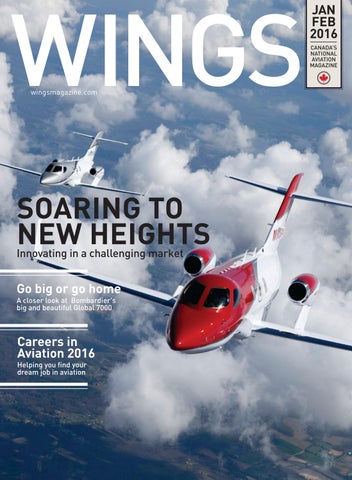
SOARING TO NEW HEIGHTS
Innovating in a challenging market
Go big or go home A closer look at Bombardier's big and beautiful Global 7000
Careers in Aviation 2016 Helping you find your dream job in aviation
JAN FEB 2016 CANADA’S NATIONAL AVIATION MAGAZINE
JANUARY/FEBRUARY 2016
UPFRONT 5 Leading edge Changing of the guard
8 On the fly News and opinion
12 Alternate Approach Trudeau said ‘no’ – but did he?
13 At the Gate Creating a sustainable future
14 Glidepath Remembering to mind the gap
The Global 7000 has been designed to keep current BD-700 owners within the Bombardier family. P.19
BACK 32 Marketplace 34 On final Tales of troubleshooting
FEATURES 15 A CHANCE FOR A SUNNY FUTURE
ATAC's 2015 conference looks ahead to a challenging 2016 BY BRIAN DUNN
C-1 CAREERS IN AVIATION 2016 From top: Creating a sustainable future P.13. Remembering to mind the gap P. 14
Education, training and job prospects in Canada’s aviation and aerospace sector BY DAVID CARR
19 GO BIG OR GO HOME
Bombardier's biggest BizJet, the Global 7000, impresses on multiple levels BY FREDERICK K. LARKIN
PHOTO: BOMBARDIER (TOP); POWERING IMAGINATION (BOTTOM)
22 ACHIEVING NEW HEIGHTS
Innovating in a challenging market BY MATT NICHOLLS AND DAVID CARR
COVER PHOTO: HONDAJET
WWW.WINGSMAGAZINE.COM
January/February 2016 | WINGS
3
APRIL 4-6, 2016
BACK TO BASICS: Prioritizing Safety in a Challenging Economy.
Specialty Markets
SILVER
GLOBAL AEROSPACE
®
MEDIA
BRONZE
GOLD
PLATINUM
Vancouver, BC, Canada
SAFETY OFFICERS
Cargo Masters B.V.
PARTNERS IN SAFETY
DLA Piper
Register Now w w w. c h c s a f e t y q u a l i t y s u m m i t . c o m
LEADING
EDGE
| By Matt Nicholls
Changing of the guard NAV CANADA bids adieu to John Crichton; Neil Wilson steps in
N
eil Wilson has some big shoes to fill but he certainly has the right attitude and perspective to meet the challenge. Wilson is the new leader of NAV CANADA, taking over from long-time aviation executive John Crichton who retired as president and CEO of the nation’s navigation service at the beginning of January. It marks a distinct sea change for the worldrenowned air navigation service (ANS), but as Wilson points out, the transition couldn’t happen at a better time. The organization is clearly operating from a position of strength, having established itself as a global leader offering customers stateof-the-art products and services developed and nurtured by an expert group of highlyqualified and innovative staff. “I am truly humbled by this opportunity and I recognize I have some very big shoes to fill,” Wilson told Wings. I have been with the company since its inception in one way or another, but this will be a great challenge. I can’t wait to take on the responsibility and follow in the footsteps of a leader like John.” Wilson is no stranger to NAV CANADA. He recently held the position of executive vice-president, administration and general counsel. He joined the company in 2002 and prior to that, was a partner in a major Canadian law firm where his experience included assisting in establishing NAV CANADA as a private corporation and acquiring Canada’s Air Navigation System (ANS). For Crichton, the change marks the end of a tenure at NAV CANADA – and in aviation as a whole – that reaches legendary status. “I have been blessed with two very distinct careers,” Crichton said. He spent 24 years as a commercial pilot and as executive president at First Air, helping to establish air transport in the far north.
5
to safety.
I can’t wait to take on the The company is now viewed as a global leader in responsibility and follow in the ANS technology and services, footsteps of a leader like John. administering the moveHe also served as president and CEO of the Air Transport Association of Canada (ATAC) from April 1994 to November 1997 and has won numerous aviation awards for his leadership and business acumen – including being appointed as a Member of the Order of Canada, Canada’s highest civilian honour, for his contributions to the safety and efficiency of air transportation in Canada. Crichton served as president and CEO of NAV CANADA from 1997 until this past January and helped transform a disorganized, dysfunctional government agency into a profitable, self-sustaining corporation funded through service charges, with access to the capital markets and subject to regulation by Transport Canada in respect
TOP DATA BURSTS… in this issue 1. Toronto’s new Aerospace Centre will have 23,000 square metres of hangar space. (Pg. 8). 2. Two million The number of passengers that pass through Toronto’s Billy Bishop Toronto Airport annually (Pg. 12). 3. Sunwing has grown into a $2.2 billion business with more than 2,000 employees and 38 aircraft (Pg. 15). 4.The Global 7000 has a range of 5,100 NMs at a cruise speed of Mach.90. (Pg. 19). 5. 9,200: Global BizJet deliveries Honeywell predicts by 2025. (Pg. 22).
ment of all regularly scheduled aircraft from the mid-North Atlantic to the Pacific Ocean, and from the North Pole to the U.S. border – a total of 18 million square kilometres of airspace. “The challenge was to take something that was embedded in government and take it out into the private sector and run it like a business. It was the largest privatization in Canadian history to date and we had a lot of help, good lawyers, accountants, and other talented people,” he said. Crichton is very proud of what NAV CANADA has become but stresses it’s not all about him: it’s an organization blessed with talented, hard-working individuals on all levels. “Our success is a testament to the great work that everyone has done over the years,” noted Crichton, who will serve as chairman of the board of Aerion, one of the company’s ASN products. “This certainly isn’t just about me – I am but one person.” Crichton is indeed one person the Canadian aviation world will definitely miss. | W Your feedback is always welcome. Please contact me at mnicholls@annexweb.com. @Wings_Magazine
Vol. 57, Issue 1 EDITOR
Matt Nicholls mnicholls@annexweb.com 416-725-5637 MEDIA DESIGNER
Emily Sun FLIGHT DECK
Rick Adams, David Carr, Paul Dixon, Brian Dunn, Frederick K. Larkin, James Marasa, Carroll McCormick, Anna Pangrazzi, Amanda Winters MARKETPLACE ACCOUNT MANAGER
Kory Pearn kpearn@annexweb.com 519-902-8574 ACCOUNT CO-ORDINATOR
Stephanie DeFields sdefields@annexweb.com 1-888-599-2228 ext. 257 NATIONAL ACCOUNT MANAGER
Mena Miu mmiu@annexweb.com 905-713-4351 CIRCULATION
Carol Nixon cnixon@annexweb.com GROUP PUBLISHER
Martin McAnulty mmcanulty@annexweb.com DIRECTOR OF SOUL/COO
Sue Fredericks WINGS MAGAZINE
P.O. Box 530, 105 Donly Dr. S., Simcoe, ON N3Y 4N5 Tel: 519-428-3471 Fax: 519-429-3094 Toll Free: 1-888-599-2228 Printed in Canada ISSN 0701-1369 Publication Mail Agreement #40065710 Published six times per year (Jan/Feb, Mar/Apr, May/ Jun, Jul/Aug, Sep/Oct, Nov/Dec) Subscription Rates Canada – 1 Year $ 32.95 (plus GST - #867172652RT0001) USA – 1 Year $ 57.95 Foreign – 1 Year $ 65.95 Circulation Email: apotal@annexbizmedia.com Tel: 416-510-5113 Fax: 416-510-5170 Mail: 80 Valleybrook Dr., Toronto ON M3B 2S9 Occasionally, Wings magazine will mail information on behalf of industry-related groups whose products and
ON THE
WEB
6
WINGS | January/February 2016
Annex Privacy Officer privacy@annexbizmedia.com Tel: 800-668-2374 No part of the editorial content of this publication may be reprinted without the publisher’s written permission. ©2016 Annex Publishing & Printing Inc. All rights reserved. Opinions expressed in this magazine are not necessarily those of the editor or the publisher. No liability is assumed for errors or omissions. All advertising is subject to the publisher’s approval. Such approval does not imply any endorsement of the products or services advertised. Publisher reserves the right to refuse advertising that does not meet the standards of the publication.
Canadian Owners & Pilots Association
Canadian Business Aviation Association
Magazines Canada
AVIATION THIS WEEK
PHOTO: ANNEX BUSINESS MEDIA
Air Transport Association of Canada
services we believe may be of interest to you. If you prefer not to receive this information, please contact our circulation department in any of the four ways listed above.
Looking to catch up on the latest hot news from around aviation and aerospace? Check out Aviation This Week, a live digital version of the top news stories affecting a variety of key markets. It's quick, essential information you need to know! WWW.WINGSMAGAZINE.COM
THE DESTINATION FOR THE AIRCRAFT INTERIORS INDUSTRY. Aircraft Interiors Expo 2016 5-7 April 2016, Hamburg Messe, Germany The global market leader for the world’s aircraft interiors industry. Aircraft Interiors Expo is the launch pad for cabin programmes showcasing tomorrow’s designs, in-flight entertainment, connectivity and passenger services. Register online for your FREE place today www.aircraftinteriorsexpo.com Organised by:
In-corporation with:
Supported by:
ON THE FLY For late-breaking news and exclusive web content, please visit us at: www.wingsmagazine.com
THE LEAD AEROSPACE MILITARY COMMERCIAL PEOPLE ON THE MOVE
THE LEAD
EPIC AEROSPACE CENTRE COMING TO YYZ IN 2016 Construction is underway on The Aerospace Centre at Toronto’s Pearson International Airport. The multi-purpose facility will incorporate different businesses and services related to aerospace within one complex, including a fixed-base operation (FBO) and approximately 23,000 square metres of hangar space that will accommodate all sizes of corporate aircraft, including the Boeing 737 and Airbus A320. Located adjacent to runway 24L-06R, the Aerospace Centre will be operated by Aligned Aviation Airport Development Services and will carry the EPIC and UVair FBO Network brands. The selection of EPIC and UVair was made after a thorough review of options in fuel providers and network alliances. EPIC and UVair have been selected to provide fuel and branding to The Aerospace Centre, which will be located adjacent to runway 24L-06R. EPIC and UVair support the fuel needs of the
corporate aviation sector through nearly 300 branded FBOs in the United States and Canada. EPIC recently announced a major expansion of its network, including eight new locations in the United States, and two international gateway projects in Beijing and The Aerospace Centre. “We felt confident in choosing EPIC because of their outstanding reputation in the industry; especially in terms of their safety record, excellent customer service and its long-standing history of providing innovative programs to help FBOs succeed,” said an Aligned Aviation spokesperson. “In addition, we identified that joining the UVair FBO Network would help build and grow our business traffic quickly by providing our future customers with a sense that they could ‘land with confidence’ in knowing our facilities and operations would be top-notch.” The FBO will feature a complete range of facilities including meeting, office, recreational, rest and working space. It will also have an upper-level food and beverage space and event area and viewing access of the nearby runways. The centre will begin opening in stages in 2016, and will be fully operational by 2017. Subsequent phases of the project will include an atrium with related commercial office towers and convention spaces. “We’re pleased to have been selected and we’re looking forward to being a part of this exceptional facility,” said Steve McCullough, EPIC’s senior
Toronto's Pearson International Airport will be the new home of The Aerospace Centre. 8
WINGS | January/February 2016
The C Series CS100 received its Transport Canada type certificate in December.
vice-president of general aviation. McCullough said that Toronto is an important international destination and The Aerospace Centre will be a great addition to EPIC’s focus on growing its network of global FBOs.
AEROSPACE
CATALOGUE SHOPPING Bombardier recently released list prices for its commercial aircraft product line. Airlines hardly ever pay full list price for aircraft, with the cost per unit ratcheted down (often steeply) based on the size or strategic value of an order (a launch order for example). Indeed, customer airlines can expect the airframer to sharpen its pencils in 2016 to reduce the cost of the C Series to boost a disappointing order book. More than 3,000 Bombardier Q Series turboprops and CRJ Series regional jets are in service with approximately 250 operators in 90 countries. The world’s third largest civilian aircraft maker will bring the C Series CS100 to market later this year.
Aircraft Type
January 2015 Average aList Price (Millions US$)
Q400 turboprop
$31.3
CRJ700
$41.0
CRJ900
$46.0
CRJ1000
$49.0
CS100
$71.8
CS300
$82.0 WWW.WINGSMAGAZINE.COM
PHOTO: ELLIS DON (LEFT); BOMBARDIER (TOP)
8 8 9 9 11
MILITARY
AIRBUS, PROVINCIAL AEROSPACE FORM AIRPRO SAR SERVICES
PHOTO: AIRBUS DEFENCE AND SPACE (TOP); WESTJET (BOTTOM)
Airbus Defence and Space and Provincial Aerospace have announced the establishment of AirPro SAR services, after the companies formally submitted their proposal for Canada’s Fixed Wing Search and Rescue (FWSAR) replacement program. AirPro is a joint venture that, upon possible awarding of the contract award, will be the Canadian in-service support integrator of the FWSAR C295W fleet for the life of its service in Canada. As the FWSAR ISS integrator, AirPro will give Canada a single point of accountability for the life of the FWSAR program. “AirPro brings together Provincial Aerospace and Airbus Defence and Space as the Canadian ISS integrator in our proposal for the FWSAR program,” noted Antonio Rodriguez-Barberan, senior vicepresident commercial, special projects for Airbus Defence and Space. “Both companies successfully deliver ISS services around the world and we are excited to combine our experience and expertise to bid an optimal solution for Canada. The C295W ISS model is used by more than 20 operators around the world and has a proven track record of maximizing mission success. If the Airbus Defence and Space offer is selected, AirPro will utilize this trusted ISS model and combine it with deep domestic experience to ensure the best and most cost effective solution for Canada throughout the entirety of this program. AirPro brings together two world-class companies for the benefit of
AirPro will help provide expert service to the proposed FWSAR C295 fleet.
Canadian industry.” Brian Chafe, Provincial Aerospace CEO, concurred that AirPro will reflect the commitment both Airbus and other partners bring to the program. “The skills and technology required to service Canadian C295W aircraft will reside in Canada with Canadians who will complete the work required over the lifetime of the FWSAR program,” he said. “Provincial Aerospace brings significant ISS experience to AirPro and is providing ISS services to similar missionized military and paramilitary aircraft domestically and internationally. These aircraft have collectively accumulated over 250,000 hours of flying time in challenging operational environments such as Canada's Maritime and Arctic environments.” “The domestic and global ISS experience that we bring to AirPro will ensure that Canada is able to maximize DND’s mission success, ensuring reliable aircraft are ready to help Canadians in need," added Jake Trainor, chief operating officer for Provincial Aerospace. The C295 is being utilized worldwide by more than 20 operators for a broad range of critical and challenging requirements including SAR, maritime patrol, and troop
transport. In addition to Airbus Defence and Space and Provincial Aerospace, the C295W team includes a number of other leading and export oriented Canadian companies, such as Pratt and Whitney Canada, CAE and L3 Wescam. The C295W program is immersed in Canadian technology, products and services.
COMMERCIAL
BOMBARDIER LOOKS BEYOND 2016 Bombardier has its eye fixed firmly on the future. The C Series CS100 received its Transport Canada type certificate in December. Customer deliveries are expected to begin by spring 2016. “Bringing to market the only new family of aircraft developed for the 100- to 150-seat market segment in close to 30 years is a standout accomplishment,” said Fred Cromer, president of Bombardier Commercial Aircraft. “The C Series aircraft is now well on its way to opening up new opportunities for operators. It’s the new reality for the single-aisle market.” It is also the centrepiece of a fivepoint plan to turn the company around,
The Bombardier Q400 continues to be a popular aircraft of choice for airlines the world over – including WestJet Encore. WWW.WINGSMAGAZINE.COM
January/February 2016 | WINGS
9
ON THE
FLY
announced at an “investor’s day” in New York in November. Bombardier forecasts that it will have delivered approximately 250 C Series aircraft out of the current order book by 2020. But will the anticipated launch be enough to overshadow industry concerns over Bombardier’s ability to bring the new technology airliner to market, end a drought, ease jittery markets and right the delayed Global 7000 and 8000 programs? Not likely, which is why Bombardier executives are buckling up for a turbulent 12-months. The transition will include driving down supply chain costs, including shifting lower-skilled work to plants in Mexico, Morocco and India to improve the sticker price of the C Series, and boost revenues, and renegotiating existing debt. Since starting route proving in early November, the CS100 has visited 15 city pairs in Canada, including Halifax, St. John’s and Regina, and 20 in the U.S., including bases of potential American
customers. The route-proving flight is being conducted using typical airline flight routings and operational procedures. The aircraft will move on to testing in Europe in early 2016. “It is very gratifying to see the CS100 aircraft conducting its route proving exercises and touching down at airports across Canada and in the U.S. We have already started to see increased excitement and interest in many communities as our allnew C Series – the first new aircraft produced for the 100- to 150-seat segment in the last three decades – prepares to enter service,” said Rob Dewar, vice-president of the C Series program. Even so, 2016 will be a transition year as Bombardier, buttressed by a US$1 billion cash infusion in the C Series by the Quebec government and a $1.5 billion stake in the rail business by Caisse de dépôt et placement du Québec (CDPQ), Quebec’s largest pension fund, seeks to right the financial ship following a US$1.2 billion charge for the cancellation of the
Lear 85 program and a US$3.2 billion charge largely driven by schedule delays and related costs. Despite investing in rail, the bulk of CDPQs investment will be shunted to aerospace. “Our resulting liquidity position will be around US$4 billion at the end of the current year,” said John Di Bert, senior vicepresident and chief financial officer. That is before Bombardier cashes the cheques cut by the Quebec government and CDPQ. It is almost certain that the federal government will chip in an additional US$1 billion to subsidize the cost of the unit cost of the C Series. Less certain will be the reaction from Brazilian rival, Embraer. Navdeep Bains, the new innovation minister has said that any aid provided to Bombardier would comply with international trade law, hopefully sidestepping earlier battles over subsidies between the Canadian and Brazilian aircraft builders. “The organization was overwhelmed by the number of programs,” chief executive
MAKING A PILOT OUT OF YOU.
Gradua ates from the Seneca Airline Pilot Flight Operations program are eligible for inte erviews at Air Georgian that could lead to a piloting career path. WORKING TOGETHER TO ENSURE YOU HAVE A FUTURE CAREER IN AVIATION. Find out more & apply at senecacollege.ca/aviation. The above is subject to meeting Air Georgian’s standardized testing and evaluations. Air Georgian is a Proud Air Canada Express Partner.
10 WINGS | January/February 2016
WWW.WINGSMAGAZINE.COM
Alain Bellemere conceded in an analysts’ call in November. “This is much different to today. The upgrade of our Challenger 300 and Challenger 605 has been completed. We have cancelled the Lear 85. We have redeployed the resources to focus on the C Series and the Global 7000 [program]. The C Series is getting close to certification, so now we can be moving from the development cycle and through the production ramp-up phase.” 2016 could also see another change in the Bombardier boardroom. The Reuters news agency is reporting that Pierre Beaudoin is expected to step down as executive chair early in the year. New leadership and a loosening of the Beaudoin family’s grip on Bombardier may be one of the demands of the financial markets. A successor has not been identified, although insiders appear to be giving the nod to Bellemare. Bombardier is finalizing the C Series production schedule, but it is expected to be 15 to 20 aircraft in 20, followed by a
gradual bump up to full production rates beginning in 2017. “I would say that the C Series program ramp up will happen over the next three to four years. As we get into the backend of our five year plan we will see as [you do with] most large aircraft programs, profitability and cash flow generation,” Di Bert said. A confident Bellemere has one important take away message to customers: Bombardier is not going anywhere and is in the game for the long haul.
PEOPLE ON THE MOVE Catherine Press of B.C.’s Chinook Helicopters is the 2015 recipient of the prestigious David Charles Abramson Memorial (DCAM) Flight Instructor Safety Award. Press is the first woman in Canada to hold a helicopter instructor rating. She holds both a fixed wing and helicopter license, and is the only Canadian helicopter pilot to hold a Chinese license.
“Catherine’s contributions to aviation over the years, especially in the helicopter training sector has been significant in the capacity of instructor, pilot examiner and business leader,” the DCAM founders said in a statement. Sponsors of the annual award include Air Canada, the Air Transport Association of Canada, the Canadian Association of Aviation Colleges, Essential Turbines, FlightSafety Canada, Hamilton Watches, Seneca College, Sennheiser Canada and, Wings and Helicopters magazines . . . New appointments at R1 Airlines: Julie Mailhot has been named chief operating officer for Air Georgian. Mailhot previous worked in various roles at Air Canada over 20 years . . . Ehab Matta is the new business development manager for R1 Airlines. He has more than 16 years aviation/air transport experience including North Cariboo Air . . . Matta takes over from Richard Pollock who assumes the role of aircraft leasing business development manager, Americas for Avmax.
CAREERS IN AVIATION Take Charge and join a team that keeps aircraft moving safely and efficiently in Canadian airspace. Our careers are among the most exciting the aviation industry has to offer. There are two main professions in the field of air traffic services – air traffic controller and flight service specialist – each with a key role in one of WKH ZRUOG·V VDIHVW DLU QDYLJDWLRQ VHUYLFHV In return for your commitment to keeping the skies safe. NAV CANADA rewards you with an excellent salary, great benefits and the opportunity to grow and challenge yourself throughout your career. NO EXPERIENCE IS NECESSARY, WE TRAIN YOU. TAKE CHARGE AND SEE YOUR CAREER TAKE OFF!
Apply now!
takecharge.navcanada.ca
WWW.WINGSMAGAZINE.COM
January/February 2016 | WINGS
11
ALTERNATE
APPROACH By David Carr |
Trudeau said ‘no’ – but did he? Hope for the C Series flying from Billy Bishop may not be dead
T
12 WINGS | January/February 2016
re-opened? As the Toronto Star noted in a recent editorial critical of the government, “Billy Bishop Airport isn’t some fly-by-night.” The airport handles more than two million passengers a year, and an investment firm recently bought the passenger terminal for an estimated $750 million. Tens of thousands of families have moved into a wall of condominiums built along the waterfront since Porter launched, and airport noise is still drowned out by traffic congestion along the adjacent elevated expressway. There are issues other than aircraft noise linked to growing out Billy Bishop, including groundside access. Nevertheless, a new government acted with questionable haste on an emotionally charged issue, and on the flimsiest pretext. Not wanting to throw these new members under the bus so soon after the ballots were counted may be well intentioned, but hardly the template for sound policy. Certainly the government arbitrarily risks undercutting a more significant promise to make cities partners in local decision-making. All of which suggests that the battle over the airport is far from decided, and jets will live to fight another day. | W
The stumbling block remains a tripartite agreement between the federal government, city of toronto and portstoronto. the lake.” Even so, denying jets may not be enough to keep the cement mixers at bay. PortsToronto could still extend the runway at both ends to comply with Transport Canada’s Runway and Safety Area (RESA) regulations, leaving Garneau and Vaughan with some backtracking to do. Meanwhile, evidence supporting the operation of jets at Billy Bishop Airport piles up. Graham Webb, vice-president of commercial engine programs at Pratt & Whitney, recently weighed in on the debate, telling the National Post that the company’s clean-sheet “PurePower” PW1500G (which will also power the Airbus A320neo) is not a “jet” but a “turbofan.” PortsToronto has closed the jets file, but will complete the technical studies and is expected to make the results public. That raises an interesting question. Originally, the transport minister said that the government’s decision would be guided by fact-based evidence. We should expect no less from Canada’s pioneering astronaut. Still, as that evidence mounts, what will the federal government’s response be if Toronto asks that the tripartite agreement be
David Carr is a Wings writer and columnist. WWW.WINGSMAGAZINE.COM
PHOTO: PORTER AIRLINES
he Trudeau Liberals recently slammed the door on commercial jets operating from Billy Bishop, Toronto’s urban airport, supposedly ending main tenant Porter Airlines’ proposal to operate the Bombardier C Series. So how does a closed door continue to let in a draft? Likely because the way Transport Minister Marc Garneau delivered the news – through a late night tweet – remains highly suspect. Governments, even the hipper ones, do not tweet out serious policy announcements like some teenager letting his posse in on the latest “awesome.” Airport detractors may quibble over the level of seriousness, but when you are Canada’s transport minister, any decision impacting operations at the country’s busiest air transport hub, a large aircraft order for a struggling Canadian aerospace company and the fate of high-paying jobs at one of the city’s last remaining industrial manufacturers, jets at a regional airport is a big deal. Also, the haste with which Garneau got out the news – less than 24 hours after describing the island airport as a “complex issue” – hints at a backroom political ploy to put jets on the backburner in order to appease a handful of expansion opponents in the Toronto caucus, rather than pouring cold water on the project entirely. It is called stalling for time. The stumbling block remains a tripartite agreement between the federal government, City of Toronto and PortsToronto, the federal authority that owns and operates the airport. The agreement sets out strict noise limitations that the Bombardier C Series complies with, but the airplane remains in a holding pattern because it is a jet. Garneau leaped into the Twitter-verse just as PortsToronto was putting the finishing touches on three reports, including an environmental assessment, at the city’s request. Allowing the C Series onto the island airport would require an extension of the main runway by 200 metres at each end. Robert Deluce, chief executive of Porter Airlines, calls the extension “modest.” Adam Vaughan, a former city councillor who now holds a downtown Toronto seat for the Liberals describes it as “paving over
AT THE
GATE
| By Brian Dunn
Creating a sustainable future Erik Lindbergh seeks to set his own aviation landmark powered by electricity
PHOTO: POWERING IMAGINATION
C
harles Lindbergh made history when he flew non-stop from New York to Paris on May 20-21, 1927 in the Spirit of St. Louis in 33 hours, 30 minutes. His grandson, Erik, repeated the feat 75 years later on May 2, 2002 in 17 hours, 7 minutes. “I knew it was safe, because someone else did it 75 years before me,” Erik said during an address at the AHS Sustainability 2015 Conference in Montreal last September. And like his grandfather, he kissed the ground when he landed at Le Bourget. “Aviation is developed by two things – warfare and prizes (Charles won $25,000 for his feat). More children dream of being a pilot or astronaut than any other career. But noise is bad. It impairs learning which led me to create Powering Imagination,” an organization that promotes innovation in energy and aviation sustainability. It tries to influence the future of aviation by collaborating with innovators in electric flight, biofuels and noise reduction. One of its main objectives is to create a test aircraft for test flights over noise-sensitive areas to promote quiet flight solutions. There is even an annual Lindbergh Prize for the quietest aircraft. “How do we leverage all that for the next breakthrough? By creating the (pure battery electric) e-Spirit of St. Louis to fly over places like the Grand Canyon in a quiet electric plane,” Lindbergh says. “I’ve been given a second chance in life (he suffered from rheumatoid arthritis which crippled him for 15 years). I can work, I can play, and I can travel the world.” To demonstrate the possibilities of innovative initiatives, Lindbergh was planning to recreate a flight his grandparents Charles and Anne Morrow did in 1931 in a floatplane from the U.S. to China via Canada, Siberia and Japan. To mark the 85th anniversary of that journey, Erik was planning to fly an aircraft powered by biofuels in 2016. That project has been put on hold. The e-Spirit of St. Louis is not completely assembled but most of the components are in Daytona at Embry-Riddle Aeronautical University which is heavily involved in the project. “We’ve got all the parts and pieces down in Daytona – airframe, motor, props,” WWW.WINGSMAGAZINE.COM
“It’s nothing spectacular, but it’s an uncommon aircraft. We’ve got to use an aircraft that his high L (lift) over D (drag), because batteries are just so heavy.” While this type of technology is in its infancy, Lindbergh believes this is no mere flight of fancy. “Some companies are already putting out a similar looking, similarly configured aircraft and they’re trying to prototype a twoseater that they can use for the training market. So they’re looking at production and other companies are looking at that. “But we don’t see it as our job to go into the aircraft manufacturing business. We want to showcase what can be done and help incentivize and accelerate the industry.” Surely there’s a limit on the size of aircraft that can be battery powered and we’re certainly not talking 747-size aircraft. Maybe yes, maybe no, according to Lindbergh. “Not yet,” he says. “Some people say that will never happen, some people say we’re electrifying all the systems slowly and yes, it’s going to happen. Others say hybrid. I’ve had two guys in the industry say we can do electric supersonic aircraft. Who knows if they’re blowing smoke. “Elon Musk, the founder of Tesla Space X, says he’s got a design for an electric airline transport category aircraft,” Lindbergh says. “He won’t tell us what it is, but there are people talking about it. But I don’t know, because I’m not an engineer, so I can’t see that. But I want to help it go as far and fast as it can, because it represents something for the sustainability of the aviation industry – and that’s critical.” | W
I’ve been given a second chance in life. I can work, I can play, and I can travel the world. notes Lindbergh who has an Aeronautical Science degree from Emery Aviation College in Colorado. “We’re working on software integration, but we still need batteries,” Lindbergh says. “We need $25,000 worth of batteries and we’ve got grad students working on it. It’s a cool project, leading edge and we’re going to use it to fly over national parks and noise sensitive areas and talk about what the future is in aviation. “We’re hoping for first flight in the first quarter of 2016. It looks relatively straight forward, but you never know what’s going to get in the way of that. But hopefully, by late summer, we’ll have completed all the test flights we need to do and take it around and demonstrate it.” The airplane is expected to reach a top speed of 100 mph with a 90-minute range.
Brian Dunn is a Wings writer and columnist. January/February 2016 | WINGS 13
GLIDE
PATH
By Paul Dixon |
Remembering to mind the gap Procurement decisions must better reflect future needs
T
14 WINGS | January/February 2016
by 2038. The JSF development contract was signed in 1996 and I have no idea how long the in-house thought process had been bouncing around before that. Like Winston Smith and his recollections of the time before the time before, by the time we get to 2038 or 2040, it will be like forever in practical terms. Of course Orwell was writing fiction, wasn’t he? Perhaps our journey has been more like Scrooge’s Christmas epiphany: if we can understand where we are today and how we got ourselves here, it’s the only way we will be able chart a course for the future. Instead of planning for the past (as virtually every government has done for the past 200 years), we need to understand where we are in the world, where we want to be in the future and take a realistic approach to what we can do and how we will meet our obligations. We have a long and proud history of aviation and aerospace in this country, from the Silver Dart through a century of innovation and excellence – and that is just the beginning. Let’s maintain that momentum, understanding what our needs are domestically and globally and make the work fit those needs. | W
Instead of planning for the past, we need to understand where we are in the world and where we want to be in the future. it will be a while before they are delivered. In a refrain that may be all too familiar, the British sole-sourced the P-8s with no competition. We don’t seem capable of looking at the world outside our own immediate surroundings and just maybe drawing some similarities and learning a thing or two. The British find themselves in a pickle because of choices made in the face of their own budgetary crisis, the lack of maritime patrol aircraft being only one example. They are also said to be forced to extend the operational life of some of their C-130s well beyond their best-before date because of challenges in deploying paratroops from the replacement aircraft. The British are also extending the life of their Typhoons through 2040 in order to order to preclude any “gaps” before their 138 F-35s are up and running. For their part, the Americans are emphatically denying rumours that would have them buying new F-15, F-16 and even F/A-18 aircraft to provide adequate frontline coverage until their own F-35 variants are fully integrated
Paul Dixon is a freelance writer and photojournalist living in Vancouver. WWW.WINGSMAGAZINE.COM
PHOTO: PAUL DIXON
here has been a change in our federal government and already we are seeing evidence that the old ways are being replaced with the new. As a child of the 1960s, having first gained an awareness of political theatre by witnessing the purging of John Diefenbaker on one side of the House and the rise of Trudeau 1.0 on the other, I must say that feel somewhat akin to Orwell’s Winston Smith, the protagonist of 1984 and his difficulty in remembering just what it was that any particular side stood for. I do know that all of our governments have treated our military poorly for all these years, in oh, so many ways. The quality of the service all three branches of the Canadian Forces have delivered, at home and abroad – no matter what the mission – is a testament to the integrity our soldiers, sailors and air crew and their commanders in spite of the decades of short-changing and lip service they have received from their political masters. We were told that the National Shipbuilding Procurement Strategy would serve as a blueprint for military procurement for decades to come and now we are learning that all may not be as well as hoped for, as both the shipbuilders and senior bureaucrats are voicing their concerns. This as we are stymied by a Fixed-Wing SAR (FWSAR) replacement off-again, on-again process that is headed into its twelfth (or is it thirteenth?) year. And let’s not forget the replacement for the CF-18 Hornet. We finally took ownership of the first six of the CH-148 Cyclones this past June and will actually be able to retire two Sea Kings. Take a look at what went on across the Atlantic this past November and you’ll see there is no shortage of political ineptitude. Our British friends formed the opinion that a Russian submarine was nosing around its Trident sub base in Scotland, but were forced to turn to the French and then Canadians for sub-hunting aircraft because the British parked their entire fleet of Nimrods in 2010. It’s called a “capability gap” and it’s not the first time they’ve had to call a friend for help. To add to the drama, Britain recently announced the purchase of nine Boeing P-8 Orion long-range patrol aircraft, but
Sunwing Airlines continues its ascension in the lucrative tour operation business.
A CHANCE FOR A SUNNY FUTURE T ATAC’S LIVELY CONFERENCE LOOKS AHEAD TO A CHALLENGING 2016
PHOTO: SUNWING
BY BRIAN DUNN
o say Sunwing Airlines started on a wing and a prayer 10 years ago wouldn’t be too far off the mark. For one thing, on the day before its inaugural flight from Toronto’s Pearson to Santiago de Cuba on Nov. 10, 2005, its first aircraft from XL Airways was still in the U.K. It arrived just in time to meet the scheduled departure. As well, the aircraft was over the maximum takeoff weight before heading for Cuba as some passengers brought some items intended to be left behind for some Cuban citizens. And it was touch and go whether Transport Canada (TC) would sign off on the startup before the launch date. To top it all off, the airline couldn’t even find a Cuban band to serenade the first passengers and had to settle for a Mexican one minus the sombreros. This story was shared during a presentation to Air Transport Association of Canada’s national aviation conference and WWW.WINGSMAGAZINE.COM
tradeshow in Montreal Nov. 2-4 by Mark Williams, president of Sunwing Airlines. But the Sunwing story started a year before its first flight, when Williams convinced brothers Colin and Stephen Hunter that Sunwing Vacations was big enough to start its own airline instead of using a third party to fly its customers, So, Sunwing Vacations’ in-house airline began with two Boeing 737-800s. As a result, the airline got to focus on operations and needed less startup capital since it joined forces with Sunwing Vacations, said Williams. From that underwhelming beginning in 2005 with one aircraft, 60 employees and $200 million in revenue, Sunwing has mushroomed into a $2.2 billion business with more than 2,000 employees and 38 aircraft. Almost 100 per cent of the boom was from organic growth funded by internally generated cash flow. “We are the largest vertically integrated tour operator in North January/February 2016 | WINGS 15
A new screening process has been introduced at Edmonton International Airport to reduce wait times for passengers.
America with 35 Canadian gateways and 48 destinations in 21 countries,” Williams said. “We own the customer from beginning to end and make margins each step of the way. We’re growing the business in all parts of Canada and we are the largest provider of tourists to Cuba in the world.” Sunwing has two U.S. based aircraft and
uses the Canada/U.S. Open Skies agreement to fly Americans to the Caribbean and Mexico using Canadian aircraft and crew. Under its various subsidiaries, including Blue Diamond Hotels and Resorts, Sunwing owns or manages more than 13,000 hotel rooms and is spending $500 million this year to build four more hotels.
LEKTRO
Even with the liberalization of relations between the U.S. and Cuba, Williams believes Sunwing is well positioned for any new competition with 12 hotels that it manages in the communist country. “In the first 10 years, we’ve been hit with fuel spikes, swine flu, earthquakes and a weak dollar. What have we learned? That we need to be conservative, fight our way through and never give up. Very few people hit a home run in this business, but you
Since 1945
The Ultimate Aircraft Tug
WWW.AVERSAN.COM
Models From
15,000 to 210,000 lbs.
H I G H R E L I A B I L I T Y, R U G G E D
EMBEDDED DESIGN
FOR SAFETY-CRITICAL
SYSTEMS
Certified Electric Towbarless Easy to Use Universal Rugged Simple to Maintain www.
LEKTRO .com
1-800-535-8767 1-503-861-2288 sales@lektro.com 16 WINGS | January/February 2016
DOWNLOAD THE FREE AVERSAN RESOURCE PACKAGE www.aversan.com/wings
IT’S SAFETY CRITICAL.
PARTNER WISELY, CHOOSE AVERSAN.
WWW.WINGSMAGAZINE.COM
PHOTO: EDMONTON INTERNATIONAL AIRPORT
We are the largest vertically integrated tour operator in North America with 35 Canadian gateways and 48 destinations in 21 countries.”
get such an adrenalin rush.” And the next 10 years look like nothing but blue skies ahead. “We are well positioned to continue to grow as private company,” said Williams.
PHOTO: KF AEROSPACE
An eye on security The luncheon keynote speaker on Nov. 3, 2015 was Angus Watt, president and CEO of the Canadian Air Transport Security Authority (CATSA). Watt told the group that wait times at airport security have deteriorated since 2012 from an average of 15 minutes 97 per cent of the time down to 85 per cent of the time, partly due to a budget freeze and an increase in travellers. However, Ottawa did inject $26 million into the budget to keep wait times down. “The key to success is collaboration with airlines and airport authorities,” Watt said. “Another example is non-passenger screening which is the reality of the world today. In 2012, we spent $15 million but it will increase to $115 next year.” The agency is replacing its older cargo hold bag screening machines at airports at a cost of $650 million over the next 10 years and it is halfway through upgrading from a Level 3 to Level 5 screening process. “Another key to our success is innovation,” said Watt. “We’re not early adapters
KF Aerospace president Tracy Medve says the emergence of drones in commercial airspace is of definite concern for ATAC.
of new technology, but we’re ahead on scanning through smartphones to validate boarding passes. A lot of stuff is left behind (in airports) which we can track to passengers before they board, avoiding a breach of unloading baggage. The agency has also introduced a remote screening process in Edmonton where the
screener is put in a quiet room away from the security line to monitor screening machines. The choke point or bottleneck in the screening process is when passengers have to empty everything into a plastic tray that goes along a conveyor belt for screening. A new system has four or five different points for passengers to empty their pockets and has harmonized the Trusted Traveller advantage where passengers can keep their shoes and jackets on. As well, CATSA Plus is being introduced in Calgary where a $2 billion terminal is being built. The new security checkpoint will be a high-performance checkpoint for a better passenger security experience, according to Watt. The security screening process will feature a continuous moving belt, including a bag diverter which can divert a bag for additional screening without holding up other bags on the belt.
A look to the future – commercial aviation trends ATAC outgoing Chair, Tracy Medve, president of KF Aerospace, kicked off the association’s 81st annual meeting with a summary of the year’s major events. She is being replaced by Heather McGonigal of Transwest Air.
The Reg gionall Airccraft Marketiing Specialist Tel. + 1 41 16 399 6749 9 / + 44 175 53 832 2088
Skyworld Aviation is marketing a mix of Dash 8-300 and Q300 aircraft for sale, available immediately:
andrew@ @skyworld.co.uk
For sale Package g of Dash 8-300/Q300’s Q
4 x -300 (1990-1995 built) 4 x Q300 (1997-2001 built)
“We are the largest vertically integrated 50/52/56 seat configuration tour operator in North America with 35 Good maintenance statusand 48 destinations in 21 Canadian gateways countries.” Can be sold individually For more information please contact Andrew Moore at andrew@skyworld.co.uk Tel. + 1 416 399 6749. For all other aircraft availability and technical specifications please visit our website.
www.skyworld.co.uk WWW.WINGSMAGAZINE.COM
January/February 2016 | WINGS 17
At last year’s annual meeting, oil was trading at around $95 a barrel and the Canadian dollar was at 88 cents U.S. Today, oil is under $30 a barrel, while the Loonie has dropped below 70 cents. Also in 2015, a Germanwings aircraft was deliberately crashed into the French Alps in March, in an apparent suicide by co-pilot Andreas Lubitz. On July 1, 2015 both Air Canada and WestJet recorded their largest single day in terms of traffic, while Bombardier received $1 billion U.S. from the Quebec government to prop up its ailing C Series program. Meanwhile, there were 503
reported laser strike incidents, a 43 per cent increase in two years. “Special Flight Operating Certificates for drones have risen from 345 in 2012 to 1,672 in 2014 and the number of incidents investigated rose from three to 39 in the same time period. Each of these events will have an impact on our industry and will require our close attention as an association,” Medve said. And while many things have changed, other things haven’t, despite years of lobbying efforts by ATAC, making the industry uncompetitive, she added. “For
example, Canadian fees and taxes account for about four per cent of the difference in the price of an airline ticket in Canada when compared with travel in the U.S. Canada ranks 125th out of 139 countries for ticket tax and airport charges.” Rents paid as of 2012 are estimated at more than $5 billion and the money goes into the public treasury. Despite these rents, the government provides no subsidies to the airports. So over and above these rents, airports must rely on landing fees, airport improvement fees and other sources of revenue such as parking and commercial space rent to fund airport maintenance and improvements. And despite all these investments and improvements, market share has not grown. Instead, an estimated five million passengers have opted to fly out of U.S, airports each year, resulting in some 9,000 job losses and $1.1 billion in lost economic activity annually, Medve pointed out. In addition, revenues from the Air Travellers Security Charge are greater than ATSC
WE’RE GROWING THE BUSINESS IN ALL PARTS OF CANADA AND WE ARE THE LARGEST PROVIDER OF TOURISTS TO CUBA IN THE WORLD. expenditures, resulting in an estimated surplus of $258 million that continues to end up in Ottawa’s general coffers. “We need to more directly tie CATSA funding to revenues from the ATSC,” Medve said. “And our policies need to insist that CATSA is a service provider to the Canadian public with high standards for service delivery in terms of maximum wait times. We believe it is the government’s responsibility to maintain a tax and regulatory environment favouring the competitiveness of Canadian air carriers. Our current regime is not competitive. But the situation has not been the fault of any one government.” There have been 13 years of Liberal government and 10 years under the Conservatives since airports were transferred to private operators in 1992 and the Transport portfolio has not always been a top priority for the government. “Only time will tell whether we can garner the attention of the Trudeau government, given the long list of priorities they presented as their election platform,” concluded the outgoing chair. It will be a safe bet that Marc Garneau, the new minister of transport, will be hearing from ATAC on a regular basis. | W 18 WINGS | January/February 2016
WWW.WINGSMAGAZINE.COM
WINGS
CAREERS IN AVIATION 2016
EDUCATION / TRAINING / JOB PROSPECTS IN CANADA’S AVIATION & AEROSPACE SECTOR
PM 40065710
$6.00
PM 40065710
$6.00
Erin Grant, Bachelor of Aviation Technology Graduate (2013), now First Officer Jazz Aviation LP
Seneca and Jazz are proud partners and industry leaders. Seneca graduates are industry-ready and prepared for direct entry to a First Officer Pilot position through the Jazz Seneca Cadet program.
Find out more about this unique program. senecacollege.ca/aviation
CIA2016
STARTING POINT:
HEAD TO YOUR LOCAL AIRPORT
T
he 2016 edition of Wings and Helicopters’ Careers in Aviation supplement begins at the local airport – and it doesn’t matter where. Airports tie together parts (or all) of Canada’s aviation activities from flight schools to destination points for major airlines, corporate jets and smaller airplanes and helicopters. Many aviationrelated companies are located either on airport grounds, or surround airports in nearby clusters. Airports are transit zones for the men and women who operate the airplanes, and are the vital link to an even larger community of professionals who support the industry by designing, building, repairing and maintaining aircraft, teaching students how to fly, preparing airplanes for flight, guiding them into the sky and bringing them safely back to earth. They are hubs where trainers cross paths with technicians, ramp agents hand off fully serviced airplanes to pilots, and captains of corporate jets meet captains of business at the local fixed-base operator (FBO). It is where everybody pulls together to keep one of Canada’s most technology-driven and fast-paced industries moving, including in the offices of the airport itself. Airports are where a new generation of pilots, maintenance specialists and aviation support staff will first be bitten by the aviation bug, with many using the terminal buildings, training schools and hangars as a resource to map out a career. Wings and Helicopters Careers in Aviation 2016, is a one-stop resource to help you focus on an exciting career in aviation or aerospace. It contains brief descriptions of several leading aviation and aerospace sectors, as well as valuable information on education and training. The country’s
WWW.WINGSMAGAZINE.COM
flight schools, colleges and universities offer excellent programs to help chart a course along one of the hundreds of career paths available, whether in the air, on the ground, in air traffic control or with one of the major original equipment manufacturers (OEMs) or maintenance repair and overhaul (MRO) organizations. The listings are intended as an introductory snapshot of the types of flight schools, colleges and universities that are available. It is by no means a comprehensive list, and not every school or facility is listed. The best advice is to use this guide as a starting point for your research. The 2016 edition of Careers in Aviation is presented in three sections: 1. Flying the Aircraft (including flight schools and flight colleges) 2. Designing, building and maintaining the aircraft (including maintenance colleges and universities that offer aviation programs) 3. Supporting the aircraft, which is an introduction to careers in airport operations, air traffic control and flight dispatch. An emerging and fast-growing segment of aviation that is unlikely to be found at an airport – at least not airside – and was not previously included in Careers in Aviation – is Unmanned Aerial Vehicles (UAVs) or drones. Demand for drones has outstripped all projections, and not just among hobbyists. Governments and businesses have realized that small, remotecontrolled aircraft can take on some of the functions of traditional aircraft at a fraction of the cost. This trend will continue along with the need for greater regulation of how and where drones can be operated. For the first time, Careers in Aviation highlights several schools that offer courses on
THE NAME GAME Key aviation and aerospace associations to help you in your career search • AéroMontréal www.aeromontreal.ca/capacitedinnovation-en/ • Aerospace Industries of Canada www.aiac.ca/ • Air Transport Association of Canada www.atac.ca/web/en/ • Air Line Pilots Association www.alpa.org/ • AME Canada www.amecanada.ca/en/about/ about-ame-canada.html • Aviation Alberta www.aviationalberta.com • B.C. Aviation Council www.bcaviationcouncil.org/about-thebcac/ • Canadian Business Aviation Association www.cbaa-acaa.ca/ • Canadian Council for Aviation and Aerospace www.avaerocouncil.ca/ • Canadian Owners and Pilots Association www.copanational.org/ • National Airlines Council of Canada www.airlinecouncil.ca/ • Helicopter Association of Canada www.h-a-c.ca
operating UAVs in the flight school listings. Again, there are many programs just emerging so treat this guide as a jumping off point for your research. As a research document, Careers in Aviation 2016 is an excellent starting point for all aspects of this incredible industry. January/February 2016 | WINGS C3
CIA2016
[CAREERS IN AVIATION EXPOS]
MDA's Natalie Panek, a rocket scientist (yes, for real) wowed the attendees at the CIA Expo last year. "Career events like these are so important to the development of young people," she said. "It is a great opportunity to learn from industry experts and network with aviation and aerospace leaders.
MEET THE EXPERTS WINGS AND HELICOPTERS CIA EVENTS HELP YOU LEARN Getting a chance to rub shoulders with some of the nation’s top aviation and aerospace leaders is an invaluable experience for anyone interested in a career in aviation or aerospace. And that’s precisely what happens at Wings and Helicopters Careers in Aviation (CIA) Expos. The CIA program started three years ago with our inaugural event in Toronto and has grown to feature two exciting events in both Toronto and Calgary. This year’s
C4 WINGS | January/February 2016
events will be even more significant with the addition of two major sponsors (Porter Airlines and WestJet) and a pair of outstanding venues: April 9 at Porter’s hangar at Toronto’s Billy Bishop Airport, and May 14 at the WestJet Campus in Calgary. For more information on dates, planning and program updates go to www.careersinaviation.ca Designed as a live version of the Careers in Aviation print guide that polybags with
the January/February issues of Wings and Helicopters, the CIA events present a tremendous opportunity for students interested in aviation and aerospace careers to rub shoulders with industry leaders from a variety of sectors. Special presentations and panel sessions cover a broad spectrum of pertinent topics including flight operations/pilots; varied aviation professions such as air navigation, TSB investigation, business operations, what it’s like to be a flight attendant, the life of an aviation museum curator and more; aircraft maintenance and engineering/aircraft completions; and what information to ask aviation educators/professionals at the many flight schools, colleges and universities that dot the nation. “Events like this are so valuable to young people interested in this line of work,” said Glen Lynch, president and CEO of GAL Aerospace, one of last year’s panellists in Toronto. “The CIA events are invaluable in providing young people with the tools they need in making appropriate career choices – and all of it is in one room on one day.” Lynch was just one of several key speakers that participated last year, an impressive roster that included aerospace and aviation leaders from a broad cross section of industry sectors on both the rotary- and fixed-wing sides of the equation. For more information on the CIA Expos: youtube.com/watch?v=9qbsosGPoJQ
WWW.WINGSMAGAZINE.COM
FASTER ON LESS FUEL. THAT’S HOW WE ROLL. For the 2016 PC-12 NG, outstanding performance becomes even more exceptional. We began by adding a custom Hartzell composite five-blade propeller, and then made smart improvements to the aerodynamics. The result is pure Pilatus. A new top speed of 285 knots. Faster climb to altitude. Shorter take-off distance. But with no extra fuel burn. And an even quieter, more relaxing cabin. That’s how you roll into 2016.
Stan Kuliavas, Vice President of Sales | skuliavas@levaero.com | 1.844.538.2376
CIA2016
PART I. FLYING THE AIRCRAFT ONE IN A MILLION OPPORTUNITIES ABOUND FOR BOTH ROTARY AND FIXED WING PILOTS
G
lobal aviation is going to need more than one million new pilots and technicians over the next 20 years, according to the Boeing Airplane Company’s 2015 market outlook. It is a huge growth number, intended just to keep pace with expanding airline fleets and flight schedules. North America is expected to add 95,000 pilots and 113,000 technicians by 2034. This is good news for students gearing up for their first “discovery flight” and graduates just beginning the steep climb up the ladder to the cherished left-hand seat, or the authority to clear a multi-million dollar C6 WINGS | January/February 2016
jetliner for takeoff. According to the Boeing forecast, the Asian Pacific market will need 464,000 new pilots and technicians – more than four in 10 new hires – over the same period, pointing to the global growth of aviation and aerospace, and pointing to the number of international opportunities available to well-trained Canadian graduates whose passion for airplanes and flight includes a healthy dose of wanderlust. Still, these numbers fill in one small part of the employment picture. For every new flight deck seat or maintenance position added, there are many existing positions that need to be filled as pilots and technicians retire, and the aviation support
industry creates even more high-tech career opportunities. And not just with the airlines. Canadian airplane and helicopter pilots land military aircraft deep into the world’s troubles spots, test fly new and cutting edge equipment, keep the country’s resource and exploration sectors moving, navigate the challenging waters off the coast of British Columbia in a floatplane, fight forest fires, evacuate remote communities and take the controls of a corporate jet every inch as complex as the most sophisticated airliner. For new graduates, Canada’s diverse aviation industry means there are more opportunities to tie flight to individual passions than almost anywhere else in the world. Here’s something important to remember: whether the aviation industry is coping with a skills shortage in specific sectors, keeping up with attrition or accommodating growth, it may be a numbers game, but this is no crapshoot. Aviation remains a highly technical and safety-driven industry that places experience and the right skills set for the mission ahead of all else. Then there is the ladder: most pilots work toward the 1,500 hours flying time WWW.WINGSMAGAZINE.COM
The Skills You Need – THE SCHOOL YOU WANT
At Waterloo Wellington Flight Centre we are dedicated to collaborative and meaningful relationships with our students and clients. By working with the University of Waterloo and Conestoga College, we enable our students to earn a degree or diploma in combination with professional training. This commitment to excellence gives our graduates a competitive edge when they enter the workforce. Developing innovative graduates and IXWXUH LQGXVWU\ OHDGHUV Ȃ ȵ\ ZLWK XV today! wwfc.ca – 1-877-359-9932
Waterloo Wellington Flight Centre Professional programs are approved as vacational programs under the Private Career Colleges Act, 2005 (PC#105919)
photo courtesy of Bombardier
Make your dream of becoming an airline pilot a reality!
Exceptional Training, Excellent Facilities, Energized Environment. Braampt Br p on Fliligh ghtt Coll gh Coolllleg C egge (BFC (B BFC) FC C) is rec ecog og zeed ass one ognize ne of thhe to topp-fli pfligghht tr fli fligh trai a ni ning ng schoo cchh olss in Can anad adda. a We are are pr prou oudd too int ou nttrrooduucee the new IAT ATPL pro rogr gram gr am m dessiggned nneed sp spec spec ecifi ecifi ificallllyy to prov pr ovid idee st stud uden ents t witithh th ts thee skkili ls l reeqquiireed byy toddaayy’s ’ airrlil nees.
Inte In tegr grat ated ed Air irliline ne Tra ans nsp port Pillot o Lic iceen nce c - IAT ATPL PLL 166 mo ont nth pr p og grra am • Fo Focu cuse sedd on adv dvan ance ceed aaiirlrlin inee op in oper erat erat atio ionna io nal knnow owleedgge • Mu Multlti-i-cr crew ew fligght exp xper errieencce inn a Q40 4000 si simu m la mu lato torr to • In Incl clud udes es tra rain inin ingg by ind ndus ustr us t y ex tr expe peert rtss fr f om m Aer e oC Cou o rs rsee • Po Pote tent ntia iall caade d t pl plac acem emen ennt op oppo port po rttun unittie iess
For More Information: Call 905-838-1400 ext 248 career@bramfly.com bramptonflightcentre.com
Caalll for mor oree in info form rmat atio ioon on our dip iplo loma lo ma and deg egre r e pr re prog o raamss. og A BFC At FC,, we aree ded edic iccat ated edd to prrod oduc ucce qu qual a ifi al ified ed pililot o s, job ot ob-r -rea -r eadyy andd fam ea a ili ia iarr wi withh cur urre rent re ntt indu in dust s ryy exppec st ecta taatition on. on
WWW.WINGSMAGAZINE.COM
January/February 2016 | WINGS C7
CIA2016
[PART I. FLYING THE AIRCRAFT]
necessary for an Airline Transport Pilot Licence, which means there is a lot of time to fill from the less than 200 hours that the average flying school student graduates with. Entry-level jobs at this stage would include flight instructor, air taxi pilot or general aviation pilot as a recent graduate builds up time. For helicopter pilots, there is a similar gap between the 100 flying hours they will graduate with to the 1,000 plus hours many operators are on the hunt for. Career-minded rotor rookies bridging the "900-hour gap” are likely to travel large-distances for short-term jobs, low pay and long stints away from home. Even with these hardships, helicopter pilots are less likely to swap the “hands-on” flying for a fixed wing airplane. Ultimately, flying is also a lifestyle choice, especially here in Canada with so many options. LEARNING TO PICK A FLIGHT SCHOOL COMES FIRST Make no mistake: learning to fly is expensive, so matching a flight school to a potential career as a professional pilot will help reduce the margin for error of staring out on the wrong foot, and may even lower the cost of training overall. This is because Canada’s aviation industry is so diverse, with so many varying job opportunities in both airplanes and helicopters. Canada also has many excellent flying schools and colleges, many of which specialize in specific types of flying. Floatplanes versus a private jet, or turbinepowered rather than piston-driven helicopters, are two extreme examples. At the very least, picking the right school will help students build up the necessary hours while sticking to a budget. For example, airplanes rent by the hour. Learning to fly in uncontrolled airspace will reduce the amount of time spent on the ground taxiing or idling for takeoff. But students who want to fly for an airline
Train in the heart of Canada Apprenticeship Manitoba and Red River College offer the country’s only Transport Canadaapproved Aircraft Maintenance Engineer (AME) Apprenticeship program.
Find out more about the AME program as well as several other highly specialized aviation programs offered through Red River College at:
rrc.ca/stevenson
THE DIFFERENCE IS HERE C8 WINGS | January/February 2016
also need to build up the experience of slotting in and out of a controlled airport. Likewise, pre-paying for lessons in “block-time” can reduce costs, but students should be wary of flight schools that insist on covering the cost of the full course upfront. A good plan is to start compiling a list of potential schools and visit as many as you can. Transport Canada has a helpful webpage, How to Select a Flying School (https://www.tc.gc.ca/eng/civilaviation/standards/general-flttrain-selectftu-menu-3410.htm) to help you get started. If you can, visit as many schools on your list as possible. Meet the flight instructors and students and do not be nervous about engaging them in questions about the school such as its approach to training, how student records are maintained and its success rate. If you have little or no aviation experience, selecting a flying school can be overwhelming and is best not done on impulse, Transport Canada cautions. Canada’s aviation regulator does not rank flight schools or flying colleges, but there are specific steps a student should take to make the right determination. Start by plotting out a career path, which is not to say there can’t be a detour or two along the way: a switch from airplanes to helicopters, for example. Industry professionals tend to agree that when picking the right flight school or graduating up to a flight college (see below), be prepared to ask a lot of questions. Many factors should go into selecting a flight school and program, including location of the school and condition of the facilities, accessibility of the instructors, the number and types of training aircraft available and the quality of maintenance. An unwritten industry rule is one training aircraft for every four- or five full-time students, although that ratio changes with part-timers. These airplanes clock a lot of hours and are often put through tough paces. Maintenance is an important consideration for both safety and scheduling; who is on the hook financially if maintenance problems (or weather) cancel a flying lesson? Flight school is divided between hands-on airplane training and ground school, where students learn such things as the principles of flight, pilot decision-making, navigation, etc. It might not be the sexist part of learning to fly, but it is essential and a school’s approach to ground school should not be overlooked. Nor should other operational issues such as: does the school offer progressive flight checks to monitor a student’s progress; how are flight lessons scheduled; what is the insurance coverage of a student pilot (how does the deductible work in case of an accident); and who is responsible for keeping a student’s flight records? Detailed records are a passport to that first job. Cost will always be a determining factor. Most flight schools in Canada are cost competitive, but the final bill will depend on what you want to get out of your training. Most schools are “pay as you go” and some offer financing or have links to financial institutions that offer loans for flight training. And don’t forget to factor in transport, accommodation and meals when assessing the cost of learning how to fly. Once a flight school has been selected, it is up to the student to secure a written agreement outlining all costs and payment procedures.
CONSIDER THE MILITARY OPTION
Flying for the Royal Canadian Air Force (RCAF) is one of the most demanding careers in aviation, including fighter pilots, search and rescue, military helicopters and flying heavy-lift transports into some of the world’s toughest airports. With the right background, the RCAF will train students with no previous flight school experience and shape them into sought after candidates for a career in civil aviation after military service has ended.
WWW.WINGSMAGAZINE.COM
Train in the heart of Canada, work anywhere in the world! Apprenticeship Manitoba, in cooperation with Red River College’s Stevenson Campus in Southport, offers the only Transport Canadaapproved Aircraft Maintenance Engineer (AME) Apprenticeship program. Designed for those already working in the aircraft maintenance field in Canada, this 36-week (nine weeks per year) government-subsidized program fulfils Transport Canada’s basic training requirement for an AME licence, which is used to certify many aircraft operated around the world.
Learn more at rrc.ca/amj
THE DIFFERENCE IS HERE
CIA2016
[PART I. FLYING THE AIRCRAFT]
FLIGHT SCHOOLS BRITISH COLUMBIA Canadian Flight Centre | Boundary Bay & Kamloops B.C. Canadian Flight Centre (CFC) opened in 1979 at B.C.’s Boundary Bay Airport, near Vancouver, and became one of the first flight schools to specialize in instrument flying and other advanced training. CFC has trained pilots from around the world and established a second training school at Kamloops Airport in 2012. CFC offers flight training for recreational, private and commercial licences. In addition, pilots can obtain a night rating, multi-engine rating, instrument rating or instructor rating. For students looking to sharpen their flying skills, tail wheel and aerobatic training is one of CFC’s specialties. Kamloops proximity to the mountains also allows pilots the opportunity for mountain checkouts. Equipment: Citabria, Cessna 152, Cessna 172, Piper Cherokee, Piper Tomahawk, Piper Warrior, Super Decathlon and, King Air C90, Piper Seneca III and Piper V twin-engines. Learn more: www.cfc.aero
Coastal Pacific Aviation | Abbotsford International Airport, Abbotsford, B.C. Coastal Pacific Aviation (CPA) started operations in 1973 and now has an experienced staff of instructors training approximately 100 students. CPA’s main business is a University Aviation Program in partnership with the University of the Fraser Valley. Offerings include a one- and twoyear Diploma, or a choice of a four-year Business (Aviation) Degree, or a General Studies Degree. CPA also offers non-university training for students who wish to complete their career flight training in a fast paced year-long program or a selfpaced flying program for fun. CPA teaches to an ATPL level and students get added benefits such as Navajo, King Air and Boeing simulator flying experience. To discover if you have what it takes to be an airline pilot, CPA offers an introductory simulated flight on its Boeing 747 simulator or in a Cessna 172. CPA also offers career counselling for potential students. Equipment: 11 Cessna 172s, three Piper PA-30s and six flight simulators. CP Advanced Flight operates a Beech King Air and Boeing 747 Classic flight simulators. Learn more: www.coastalpacific.com
Chinook Helicopters | Abbotsford, B.C. Chinook Helicopters began training operations in 1982 at the Abbotsford Airport. The company provides a full spectrum of basic and specialized advanced flight and ground training. Chinook’s 22,000 square foot, state-of-the-art training facility includes a large classroom for ground school lectures and rooms with PC access for private study. The facility also provides all necessary services to keep the fleet operational. The training program includes simulator time, of which two are available for student use. Sim 1 is free for students to use anytime, but only accumulates training hours with an instructor present. As for hands-on flying, the Abbotsford area is ideal for yearround helicopter training. Chinook utilizes the expansive Fraser Valley for all initial flight exercises, and the Coastal Mountain Range for intermediate and advanced exercises. Due to the extensive commercial helicopter activity in southwestern British Columbia, most approaches and landings are to actual industry helipads. Equipment: Three Bell 206B JetRangers, one Bell 47 and one Robinson R44 Raven II. Learn more: www.chinookhelicopters. com C10 WINGS | January/February 2016
the energy, mining, agriculture and forestry sectors. The helicopter flight training school offers a comprehensive pilot training program. Training in the Okanagan area provides a variety of terrain and weather that exposes a student to new challenges while under the supervision of a skilled instructor. The dynamic and challenging environment includes low-lying open areas used for basic training as well as for emergency and advanced exercises, heavily forested areas throughout a wide variation of elevation changes and mountainous terrain with peaks up to 9,000 feet. The area also includes several uncontrolled airports in close proximity to Kelowna, used for crosscountry navigation, flight training, radio and emergency procedures. The program and environment enable students to acquire the skills to be a well-trained commercial helicopter pilot. The flight school has only six to eight students per class, with not more than three to four students per instructor to maximize individual attention for each student. Okanagan Mountain Helicopters is the only helicopter training school in Western Canada to offer a realistic bush camp experience in the curriculum, including remote, rustic accommodations at the foot of Monashee Mountains, mountain work at 9,000 feet, hover exit training, winter operations and fueling from barrels. Equipment: Robinson R22, Robinson R44, Bell 206 and a FRASCA 131 flight simulator. Learn more: www.okhelicopters.com
Pacific Sky Aviation | Victoria, B.C. Glacier Air | Squamish Municipal Airport, B.C. Glacier Air describes itself as a mountain flying adventure company, with a long history of pioneering the mountain flying experience along the Sea-to-Sky corridor from Vancouver to Whistler. Glacier Air also specializes in mountain flight training for fixed wing and rotary aircraft. The school offers a series of courses including commercial pilot license, night rating and VFR Over-the-top (VFR OTT) rating. Given the terrain, Glacier Air also offers survival ground school, which includes studies in weather, flight techniques, effects of density altitude, emergencies, route planning and aircraft preparation, and survival gear. Fleet: Cessna 172, Cessna 206, Bell 206 JetRanger Learn more: www.glacierair.com/ mountain-flight-training/index.htm
Okanagan Mountain Helicopters | Kelowna, B.C. Okanagan Mountain Helicopters has operated a flight training school since 2003, and its students have gone onto flying careers in
Pacific Sky Aviation’s Training and Simulation division has been in the business of flight training in Victoria for more than 25 years. Pacific Sky offers a full range of flight training options, including Transport Canada licences and ratings. The company has introduced new training technologies that have greatly enhanced the training experience. The use of iPhone and iPad applications help students see how they are progressing in their skills. Flight training programs are tailored to a student’s schedule and budget. Staff members are fulltime employees and have a depth of experience in private, commercial float and Twin Otter training. Facilities are open seven days a week. Pacific Sky will extend training capabilities to include Type Initial and Recurrent courses for the Twin Otter as well as seaplane training. In 2014, Pacific Sky and Viking Air Limited contracted TRU Simulation + Training of Montreal to develop the world’s first full flight simulator to feature a seaplane configuration. The simulator will be ready for training in early 2016, and will be incorporated into a new 13,000 square foot training facility to be WWW.WINGSMAGAZINE.COM
Earn a Master’s Degree in Aviation with an additional 1 ½ years of study. Georgian’s Aviation Management program is the only 3 year program in Canada that allows students to progress directly into Griffith University’s Masters in Aviation Management degree program. With only 1 additional year of study our grads also have a choice to complete one of two Bachelor of Science degrees with Embry-Riddle Aeronautical University.
WWW.WINGSMAGAZINE.COM
January/February 2016 | WINGS C11
CIA2016 constructed adjacent to Viking’s corporate headquarters. Equipment: Pacific boasts a modern fleet of Cessna 172 aircraft and a Twin Otter SIM coming soon. Learn more: www.pacificsky.ca
Victoria Flying Club | Victoria, B.C. The Victoria Flying Club (VFC) has been training professional pilots since 1946. Located at the Victoria International Airport, one of Canada’s busiest airports, VFC has a full range of facilities to ensure that flight training sessions are enjoyable and efficient. Students train in a Second World War era hangar beside the control tower. Over the years, VFC has created a fully professional flight training operation, while still retaining a friendly clubhouse atmosphere. VFC specializes in mountain flying, an extremely important course for any pilot flying in British Columbia. In the Pacific Region, the combined effect of the great mountain system and adjacent Pacific Ocean can lead to some extremely changeable flying conditions. The Mountain Course is designed to provide a licensed pilot with a level of skill and proficiency to fly safely in mountainous terrain. VFC also offers a seaplane rating, teaching students how to evaluate tides and current, winds and waves, how to safely navigate a busy harbour, and the art of docking. VFC has partnered with the University of Victoria to offer a Diploma in Business Administration – Aviation Option program. Equipment: New standardized millennium fleet of Cessna 172S aircraft and a Cessna 172 Seaplane. Redbird FMX simulator. Learn more: www.flyvfc.com
ALBERTA Absolute Aviation | Wetaskiwin, Alta. Absolute Aviation is a flight training and aircraft maintenance facility, largely serving students from Edmonton and Central Alberta. The school offers flexible schedules to accommodate various student lifestyles. Ground school can be taken in regular weekly scheduled classes, through an accelerated pace on weekends and even online. Absolute operates out of Wetaskiwin, Alta., with close proximity and access to major airports such as Edmonton International. The school operates in both uncontrolled and controlled airspace, eliminating costly ferrying time to training areas. Equipment: Five Cessna 172Ms, one Piper Twin Comanche and one Piper Aerostar. Learn more: www.absoluteaviation.ca
Canadian Centre for Unmanned Vehicle Systems | Medicine Hat, Alta. The Canadian Centre for Unmanned Vehicle Systems (CCUVS) is a not-for-profit company whose purpose is to facilitate C12 WINGS | January/February 2016
[PART I. FLYING THE AIRCRAFT] sustained profitable growth in the Canadian civil and commercial unmanned systems sector. CCUVS offers a 1.5 day condensed Unmanned Aerial Systems (UAS) ground school course to both civil and commercial operators, covering a range of topics including, aerodynamics, air law and regulations, weather, basic UAS 101, and aviation chart and flight supplements. Students also receive instruction for an Industry Canada Restricted Radio Operators License (Air). Upon the successful completion of the radio exam, students will be able to operate and monitor aviation frequencies. CCUVS also offers UAS training in Ontario and B.C. Learn more: www.ccuvs.com/
Mountain View Helicopters | Springbank, Alta. Mountain View Helicopters (MVH) has been training pilots for commercial or private helicopter licences for more than 15 years. The school also provides advanced and recurrent training for pilots working in western Canada. The training program includes basic training and a concentration of advanced skills necessary after receiving a commercial license. Courses are designed to provide students with a competitive advantage by training in the skills specifically sought by operators. The training facility is located near Calgary International Airport, providing several advantages such as exceptional flying weather found on the prairies, close proximity to the mountains for use as a valuable training tool and the experience gained through frequent contact with air traffic controllers operating out of one of Canada’s busiest airports. Equipment: Robinson R22 Beta and Beta II, Robinson R44 Raven II and a Bell 206 Jet Ranger turbine helicopter for advanced training. Learn more: www.mvheli.com
SASKATCHEWAN Mitchinson Flight Centre | Saskatoon, Sask. Since 1946, Mitchinson Flight Centre has been one of Saskatchewan’s leading flight training schools, and has a long history of guiding pilots to their desired careers in aviation. The school is located in its own hangar at the Saskatoon John G. Diefenbaker International Airport. Students learning to fly with Mitchinson train in an ATC controlled environment, providing experience for flying in larger centres, but without the traffic delays and congestion of a larger airport. Mitchinson is owned by professional airline pilots who have trained at the school and know what it takes to get ahead in today’s competitive aviation industry. The ground school classroom is comfortable and equipped with the latest
technologies, including SMART board and Apple TV. For students who need greater flexibility, Mitchinson offers ground school DVD’s. Mitchinson’s fleet of 13 aircraft are equipped with modern Garmin avionics. Fleet: Three Cessna 152s, three Cessna 172s, one Cessna 172RG, one Cessna 185 floatplane, two Cessna 182s and two Cessna 310 twin-engines. Redbird FMX flight simulator. Learn more: www.mitchinsonflyingservice.com
MANITOBA Brandon Flight Academy | Brandon, Man. Whether you want to train for a private or commercial license, Brandon Flight Academy has been placing qualified pilots in cockpits since 1936. Located at Brandon Municipal Airport, just outside of Winnipeg, Brandon Flight Academy offers onestop training in a multitude of courses. The Flight Academy offers a continuous regular ground school, recreational, private and commercial course. Night visual flight rules (VFR) and over the top and instrument ratings are also available. Statistics prove that southern Manitoba has excellent weather and terrain for conducting VFR flight training. Transport Canada written recreational, private, ultra-light and helicopter exams can also be completed at the facility. Brandon offers students a varied flight experience with light aircraft, commuter twins, military trainers, commercial jets and helicopters using the airport daily. With the practice facilities close by and no delays on the ground or in the air, students experience an efficient and educational learning environment. Learn more: www.brandonflightcentre. com
KF Defence Programs | Southport, Man. Serving as a pilot in the Royal Canadian Air Force (RCAF) is a very demanding yet rewarding career. Training to become an Air Force pilot takes place in two locations in Canada – the Canada Wings Aviation Training Centre at Southport (Portage la Prairie), Man. and Canadian Forces Base at Moose Jaw, Sask. All pilots-to-be start their training with the Primary Flight Training (PFT) program on the Grob 120A aircraft at Southport. This is roughly 20 hours of flying plus five hours on a sophisticated Flight Training Device (FTD). The program is designed to introduce candidates to military flying and training procedures as well as assessing their ability to succeed. On successful completion of PFT, student pilots proceed to Moose Jaw for the Basic Flying Training (BFT) program on the Raytheon T-6A turbo prop aircraft. WWW.WINGSMAGAZINE.COM
GREAT EDUCATION GREAT TRAINING GREAT AIRPLANES
dan.uwo.ca/undergraduate/cam
WWW.WINGSMAGAZINE.COM
www.dfclondon.com
www.diamondaircraft.ca
January/February 2016 | WINGS C13
CIA2016 BFT is approximately 70 hours of flying and 30 hours of simulation. On successful completion of BFT, the student pilots are streamed into jet, multi-engine or rotary wing programs. Multi-engine and rotary wing candidates return to Canada Wings for advanced flight training on their respective aircraft, either the Beechcraft C90B or the Bell 206 and the Bell 412. The training facility operates in the wide open airspace west of Winnipeg but with access to higher density air traffic as required for training. Wings employ roughly 200 personnel to provide all ground-based and simulator instruction, Grob 120A in-flight instruction, administrative support including housing and feeding, all aircraft maintenance and repair as well as all services associated with the operation and maintenance of the airfield. RCAF pilots perform all in-flight instruction on the multi-engine and rotary wing aircraft. Equipment: A fleet of 39 fixed- and rotary-wing aircraft consisting of Grob G120A and Beech King Air C-90 aircraft, and Bell 206 and 412 helicopters. www.kfaero.ca/ Learn more: aerospace-and-defence-programs/ military-flight-training
ONTARIO Brampton Flight Centre | BramptonCaledon Airport, Ont. The Brampton Flight Centre (BFC) has been conducting flight training since 1946. Located just northwest of Toronto’s Pearson International Airport, BFC teaches students to fly in a variety of airspace classifications, experiencing both controlled and uncontrolled environments. BFC is owned and operated by the Brampton Flying Club and owns its airport. With a staff of more than 30 instructors, BFC offers a broad base of courses from recreational flying up to commercial career starters. The centre has a tie-in with Sheridan College’s Bachelor of Business in Global Business Management, a strong fit for an ambitious professional pilot. Equipment: Cessna 172 and Piper Seminole aircraft. Learn more: www.bramptonflihtcentre. com
Diamond Flight Centre | London, Ont. The Diamond family of aircraft are easy to learn to fly, have an excellent safety record in the industry and utilize the latest technology for students to get the most out of their training. The Diamond Flight Centre (DFC) in London is part of a network of Diamond flight training schools in North America, and provides high-quality flight training using Diamond aircraft and Diamond-specific flight training simulators. DFC London is located at the London C14 WINGS | January/February 2016
[PART I. FLYING THE AIRCRAFT] International Airport. The airport is busy enough that students acquire experience with traffic, yet is generally quiet enough so that students can practice in a relaxed atmosphere, without long waits for clearance. Equipment: Diamond C1, Diamond DA40 and Diamond DA42 aircraft. DA42 FTD Level 5, CR12 FTD Level 2, ATD C1 Glass Cockpit, ATD DA40 KAP140 Autopilot and ATD DA40 GFC700 Autopilot. Learn more: www.dfclondon.com
Great Lakes Helicopter Flight Training School | Waterloo, Ont. Great Lakes Helicopters is an Ontario Private Career College Flight School offering helicopter flight training. Its operation is based at the Region of Waterloo International Airport, close to Toronto and is considered one of the best training airports in Canada. Great Lakes Helicopter offers year-round training for Commercial and Private Helicopter licences. The school also offers specialty training programs and courses, on the ground and in the air. Great Lakes Helicopters offers a two-year Commercial Helicopter Pilot General Arts and Science Diploma in collaboration with Conestoga College. Students in this program will take classes at the college and flight school. Graduates will acquire a commercial helicopter pilot’s licence as well as a diploma in General Arts and Science. Equipment: Robinson R22, R44 and Bell 206B Jet Ranger aircraft. Learn more: www.greatlakeshelicopter.ca
Helicopters Canada | North Bay, Ont. Helicopters Canada trains students from across the country and around the world from its training facility at Jack Garland Airport in North Bay. Just minutes north of the airport are heavily forested areas that contain multitudes of lakes and rivers, providing the ideal location for helicopter training to prepare a student pilot for real life helicopter industry experiences. Helicopters Canada offers a wide range of flight training courses, and its flexible start dates accommodate all students’ requirements. The school’s three-hour intro course is designed for individuals who are seriously interested in choosing the career path of a helicopter pilot. Equipment: Robinson R22 and R44 helicopters, and the Bell Jet Ranger and Long Ranger turbines. Learn more: www.helicopterscanada.com
Ottawa Aviation Services | Ottawa Ottawa Aviation Services (OAS) is a professional flight training and maintenance operation based out of Ottawa International Airport. OAS provides aviation professionals and enthusiasts with aviation services based on the values of the “golden
age” of flight. The school specializes in designing customized, pay-as-you-go flight training programs that accommodate each student’s pace. The OAS Pilot Assessment Centre helps to assess pilot skills and aptitudes, fine tune training and avoid expensive failures. The assessment tool provides peace of mind for parents, candidates, pilots, flight training and commercial operators. With the ability to assess individual aptitude for flying, clients can now count on a program tailored to the results of their individual tests. Equipment: A mixed fleet of Cessna 172, Diamond DA-20, Diamond DA-40, Grub G115C (aerobatic) and Piper Seneca II twin-engine aircraft. Learn more: www.ottawaaviationservices.com
Spectrum Airways | Burlington, Ont. Spectrum Airways has been teaching students how to fly for over 40 years. Training programs include the Private Pilot License, the Commercial Pilot Licence, Night Rating, Multi-Engine Rating, Instrument Rating/Multi Instrument Rating and Instructor Rating. The training facility is at the heart of Burlington Executive Airport, one of the busiest airparks in Ontario. Burlington Executive Airport averages 30 flights on weekdays and many more on weekends, and has become an exciting centre for general aviation enthusiasts. Spectrum also offers advanced training in specifics such as “tail wheel” training to help a pilot dramatically improve stick and rudder skills, and training for pilots wishing to learn about glass cockpit procedures. Glass cockpits are not difficult, but they are complex and require specific knowledge to operate safely and efficiently. Spectrum is registered as a private career college. Equipment: Fleet of 18 aircraft; the Cessna 152, Cessna 172, Cessna 172SP featuring a Garmin G1000 glass cockpit, Piper Warrior, Piper Seneca twin-engine and Piper Super Cub. Redbird FMX 1000 and PFC Cirrus 2 Flight simulators. Learn more: www.spectrumairways.com
St. Thomas Flight Centre | St. Thomas, Ont. Established in 1996, the St. Thomas Flight Centre offers flight training from the Recreational Pilot Permit through to Commercial Pilot Licence and Multi-Engine Instrument Ratings. Whether a student is interested in flying recreationally or chooses aviation as a career, the Flight Centre has a flight training program customized to suite budgets and schedules. The school operates out of St. Thomas Airport in an uncongested flight training environment. School offices are located in the main terminal building and ground school classes are held on site. The Flight Centre WWW.WINGSMAGAZINE.COM
d u o r p A f o r o s n spo n i s r e e Car n! o i t a i v A
38 3 80/1 80 /15 5 5..1 12 1 2 2..1 18.jj 18
Aircraft Maintenance Engineering Next intake is Sept 2016 at our Dawson Creek Campus
Apply online Affordable student residences available! a
nlc.bc.ca
NLC’s 15-month Aircraft Maintenance Engineering program is designed to train individuals wanting to work in the aerospace industry. Gradua Graduates receive the full training component and 1.5 years of the ffour-year experience component required for an AME licence, category M1 or M2. Apply through the Apply BC link at nlc.bc.ca studentrecruiter@nlc.bc.ca for more information. or email stud
1-866-463-6652
CIA2016 has been granted Private Career College status by the Ontario Ministry of Training, Colleges and Universities, providing complete training of Commercial Pilots and Flight Instructors. Equipment: Two Cessna 152 IIs, three 172 Skyhawk’s and one Piper PA-23. Learn more: www.learntofly.on.ca
Toronto Airways | Toronto Toronto Airways has been training pilots since 1963, and offers both full-time and part-time programs. Students train out of Oshawa and Buttonville Airport, a busy multi-service general aviation airport owned by Toronto Airways. The flight training department has 50 instructors and offers eight distinct aviation-training programs from learning to fly for fun to launching a pilot career with a professional pilot program. Toronto Airways has trained more than 10,000 plots since 1963, and has invested in state-of-the-art, full motion flight training devices (FTDs). Equipment: A fleet of 45 training aircraft and five FTDs. Learn more: www.torontoairways.com
Waterloo Wellington Flight Centre | Waterloo, Ont. The Waterloo Wellington Flight Centre (WWFC) is located at the Region of Waterloo International Airport and is one of the largest and most experienced flight training centres in Canada. WWFC has more than 20 flight instructors on staff. For potential students who would like to first experience piloting an aircraft, WWFC offers a special “test the skies,” 30-minute introductory flight in a Cessna 152 or 172 with one of the centre’s qualified instructors. WWFC is partnered with Conestoga College and the University of Waterloo to offer diploma and degree programs. WWFC also has a well-developed network among entry-level aviation employers across the country. The centre recently launched a UAV course. This course is designed to introduce people to the range of scope of the two categories of UAV’s (under two kg or from two-25 kg). It will provide participants with sufficient knowledge and resources to operate safety and comply with Transport Canada requirements. Equipment: Cessna 152, Cessna 172N, 172S and 172RG Cutlass, Diamond DA40 and Piper PA44 Seminole. Learn more: www.wwfc.ca
QUEBEC CQFA Aviation Industry Training | Montreal The CQFA maintains the skills of professionals in aviation through more than 50 courses, including a light unmanned aerial vehicle (UAV) professional pilot course, C16 WINGS | January/February 2016
[PART I. FLYING THE AIRCRAFT] which has been offered since 2007. The 140-hour, light UAV training is given by professional UAV operators and covers the regulations, aerodynamics, flight discipline and human factors for operating a light UAV aircraft. The course covers all phases of a drone mission within the framework of a commercial or public safety operation. All the theory necessary for the operation of a light drone for the purpose of a commercial or public security flight is presented prior to practical flight. The hours of supervised practise are followed by solo flying hours and culminate with a practical flight test. The student will develop the skill and ability for planning, operational risk management and the preparation and execution of actual missions. Learn more: http://www.cqfa.ca/pro/ index.php?id=29&lng=An
Laurentide Aviation | Greater Montreal Area, Que. Laurentide Aviation is a family business that has been providing professional flight training since 1946. Based at Les Cedres Aerodrome, approximately 25 kilometres west of Montreal, Laurentide offers bilingual inflight and ground school instruction to suit any style of learning. The flight school is located at an uncontrolled airport, allowing students to get in the air and into the practice area quickly, reducing the cost and amount of time spent on the ground taxing and waiting for clearance at busy controlled airports. Laurentide is located close to two major Canadian airports, including Montreal/Trudeau to ensure that students receive experience in controlled air space. The large classroom provides an excellent learning environment, including hands on teaching aids and visuals. Laurentide is a member of the Air Transport Association of Canada. Equipment: Fleet of seven single-engine aircraft; five Cessna 152s, one Cessna 172Ps and a Grumman GA-7 Cougar. Learn more: www.laurentideaviation. com/index.php?lg=en
Quebec City Flight School | Quebec City Quebec City Flight School is a Canadian Helicopters’ flight school offering training to students and company pilots. Canadian Helicopters is Canada’s largest helicopter transport services company. Quebec City Flight School is recognized around the world as a top helicopter flight training centre. The school offers introductory and recurrent training. Instructors are operationally experienced in a broad variety of fields, including air ambulance, offshore, mining, firefighting, aerial construction and spraying. Instruction can be provided in French and English.
Equipment: Robinson R22, R44, Bell 206 JetRanger and Eurocopter AS350 Learn more: www.canadianhelicopters. com/services/flight-training
NOVA SCOTIA Debert Flight Centre | Truro, N.S. Debert Flight Centre, part of the Truro Flying Club (TFC), operates out of one of the best facilities in Atlantic Canada for flight training. Students learn in uncontrolled airspace that is not crowded with commercial jets and other air traffic. Debert is a compact airport offering students less than five minute from flight to the training areas. Ground school is held at Debert Airport and Halifax. Equipment: Fleet of four aircraft: a Cessna 152, Cessna 172M and two Cessna 172Ss. Elite PI-135 and Premium simulators. Learn more: www.flytfc.ca
NEWFOUNDLAND GFT Aerospace | Gander, N.L. GFT Aerospace has been offering elite flight training in Canada since 1992, and prepares pilots for the real work of aviation from its state-of-the-art training facility. Located in Gander, Nfld., GFT proves to be beneficial because students experience real world weather conditions. GFT was the first flight school in Atlantic Canada approved to conduct the electronic Transport Canada written test for the private pilot license. The school offers large classrooms and individual briefing rooms for a comfortable and conducive learning environment. Ground schools utilize interactive computer programs and multimedia presentations, and examinations are conducted both electronically and on paper. GFT’s sister company, EVAS Air, is a local airline for Air Canada. Because of this, GTF has established its Career Progression Program, which is open to all students at no additional cost. The program provides students with the opportunity to advance directly into an airline position without ever leaving GTF. Several pilots with Air Canada and Air Canada Jazz provide advanced instruction and conduct flight tests at GFT Aerospace College. The experience and expertise of these active industry pilots provide students with exposure to the airline industry, while motivating them toward success. Equipment: 17 aircraft: three Cessna 150s, nine Cessna 152s, three Cessna 172s, one Cessna 172S with a G1000 glass cockpit and one Piper Seminole PA44-180 twin engine. Precision Flight Systems Modular Flight Deck Flight simulator. Learn more: http://evasair.com/gft/ WWW.WINGSMAGAZINE.COM
The unique spherical design of the Carleton University Simulator Project (CUSP).
Study Engineering at Carleton University The research-intensive Faculty of Engineering and Design at Carleton is recognized as one of Canada’s leading institutions in the study and research of engineering. Continued investment in state-of-the-art labs and research facilities provides our students with a hands-on education that has real-world application. Carleton’s comprehensive Aerospace Engineering programs emphasize the development of analytical, computational, and practical engineering and design skills. We offer a wide array of programs that are essential to the evolution of aerospace design and operation, including communications, electrical, software, and computer systems engineering.
carleton.ca/engineering-design/
CIA2016
[PART I. FLYING THE AIRCRAFT]
A STEP UP THE LADDER FLIGHT COLLEGES BRING ADDED BENEFITS TO A PILOT LICENCE
C
anada has many top flight training schools, but in today’s competitive environment, a pilot’s license may not be enough, no matter how impressive the student. Consider flight colleges to be the finishing school for the aviation profession, where pilots build up the knowledge and specific skill sets that can put a candidate a couple of rungs further up the career ladder. Some recruiters estimate that up to 95 per cent of pilots hired by commercial operators have a college degree supporting their license. At the very least, a college diploma may accelerate the hiring process, which is why some of the larger flight schools have ties with colleges: to give students a better-rounded education. Several colleges offer in-house flight training programs. Colleges with aviation programs offer students a deeper understanding of the technical aspects of the industry and teach critical decision-making and communication skills that are essential when working with crews on the flight deck and on the ground. Flight colleges are a valuable career investment in other ways, such as for pilots who might fail a medical but want to hold onto a job in aviation as they transition out of the cockpit. Colleges with aviation programs also offer added services such as career counselling, networking and helping graduates to make the right connections to land that important first job.
BRITISH COLUMBIA British Columbia Institute of Technology | Vancouver The British Columbia Institute of Technology (BCIT) is Canada’s largest English-language aviation training school. The Institute has paired with Pacific Flying Club, one of Western Canada’s premier flight training schools to provide an opportunity for students who wish to become airlines pilots with a strong skill set of aviation industry knowledge. It is a fully integrated program that combines flight training with industry focused academic training. The BCIT School of Aviation’s Airline and Flight Operations Diploma programs is 64 weeks long and operates for four terms. It is one of C18 WINGS | January/February 2016
the fastest ways in Canada to qualify for a commercial pilot’s license while attaining a post-secondary diploma. Flight training is conducted at Pacific Sky Aviation’s flight school at Boundary Bay Airport, outside of Vancouver. Pacific Sky Aviation has a modern fleet of Cessna 172 aircraft. College courses take place at BCIT’s Aerospace and Technology campus. Learn more: www.bcit.ca
College of New Caledonia | Five B.C. locations The College of New Caledonia has played an important role in training and educating residents in northern British Columbia since 1969. The college operates an Aviation Business Diploma program in conjunction with Guardian Aerospace Holdings, a Canadian licensed flight training and air tax operator. Offered out of the college’s Vanderhoof campus, PilotPlus is designed to provide highly trained single engine VFR pilots for entry-level pilot in command positions with Canada’s northern air carriers and with similar air taxi companies operating in difficult conditions around the world. This is a program that allows students to train within the daily operations of single and multi-engine, non-jet carriers to carry out most commercial training operations in simulated air taxi conditions. The plus for employers is detailed knowledge of the business environment of small carriers, as well as capacity to act in a functional management role with those carriers when not contributing as a pilot. The diploma is granted on completion of the Private and Commercial Pilot licenses and a float training rating, as well as 12 university level business courses and one aboriginal studies course. Learn more: www.cnc.bc.ca
ALBERTA Red Deer College | Red Deer, Alta. Red Deer College (RDC) is one of Canada’s premier community colleges. RDC’s partnership with Sky Wings Aviation Academy combines a foundation in business with hands-on flight training. The college provides high-quality academics that are critical to the credibility of the Aviation
Diploma Program. This two-year course enables students to earn a certificate in Business Management while obtaining an Aviation Diploma. Flight training is provided approximately ten minutes from the RDC campus at Red Deer Regional Airport. Sky Wings Aviation Academy has been providing flight training since 1982, and operates a fleet of Cessna 172s, a twinengine Piper Seneca and Navajo. Ground training is conducted in a large, multimedia classroom. Multi-engine preparatory training is provided on an ALSIM 200 Flight Simulator. Highlights of the Aviation Diploma Program include a transcontinental flight crossing the Canadian/ U.S. border, familiarization training for a regional or national airline and crew resource management. Most RDC courses are university transferable. Learn more: www.rdc.ab.ca/programs/ aviation-certificate
SASKATCHEWAN Saskatchewan Polytechnic | Saskatoon The Saskatchewan Polytechnic is a member of Polytechnics Canada, an alliance of 11 research-intensive, industry-responsive postsecondary institutions. The Polytechnic’s Commercial Pilot program is offered in partnership with the Saskatchewan Aviation Council, a membership-based association. The Commercial Pilot diploma program provides a strong foundation in the basic principles of aviation. Students study aviation-related topics such as the theory of flight, advanced aircraft systems and flight operations, aviation business, crew resource management and cultural awareness. Flight training takes place at a student’s home flying school. Ground school classes offer a unique opportunity for students to talk one-on-one with experienced pilots and other aviation professionals, offering an inside view on finding a job, building a career and developing skills. The Polytechnic’s new ALSIM flight simulator puts students in the pilot’s seat for take-off and landing at any airport in North America. Learn more: www.saskpolytech.ca
ONTARIO Algonguin College | Ottawa Algonguin College’s Aviation Management program is a starting point to launch a career in aviation. This two-year course is designed to provide students with the knowledge and skills required to become a commercial pilot. Through a series of classroom-based courses and hands-on practical labs, students are provided the opportunity to develop the required level of proficiency. Algonguin has contracted the Ottawa Flying Club and Ottawa WWW.WINGSMAGAZINE.COM
CIA2016
[PART I. FLYING THE AIRCRAFT] Aviation Services to provide up to 250 hours of flight time experience. During the final term, students can select one of the following areas of specialization: flight instructor, advanced multi-IFR or seaplane rating. Each of these options may offer students numerous opportunities for directentry jobs with aviation employers. Learn more: www.algonguincollege. com/sat/program/aviation-managementgeneral-arts-and-science
Conestoga College | Kitchener, Ont. Conestoga pathways enable students to build on their academic achievements in order to earn a degree or additional credentials. Pathways are formed through agreement between Conestoga and partner institutions. The Aviation – General Arts and Science program is a collaboration between Conestoga and the Waterloo Wellington Flight Centre (WWFC) and Great Lakes Helicopters (GLH). Students in this program will take classes at the college’s Doon campus and flight training with WWFC or GLH, depending on whether they have chosen the fixed-wing or rotary-wing option. Training takes place at the Region of Waterloo International Airport. Graduates will receive a diploma in General Arts and Science, as well as the
pilot training to allow them to undertake the Transport Canada commercial pilot license testing. Learn more: www.wwfc.ca/fly-professional or www.greatlakeshelicopter.ca
Confederation College | Thunder Bay, Ont. The Aviation Flight Management program at Confederation College combines business, management and flight training into one unique program. The program has been running at Confederation since 1973 and is a demanding academic program with rigorous flight standards throughout the program. From “bush” type flying to IFR, the college provides students with the skills they will need to land their first entry-level aviation job. The business and management training provides students with background knowledge to form a detailed and comprehensive understanding of today’s aviation industry. The college owns and operates 19 Cessna aircraft and two advanced flight simulators at its Aviation Centre of Excellence hanger at Thunder Bay International Airport. The program prepares graduates for entry level work with a small air carrier, tourist outfitter or other positions. Learn more: www.confederationc.
on.ca/flight-mgmt
Georgian College | Barrie, Ont. The Georgian College Aviation Management program is designed to give students knowledge and hands-on experience in Aviation and Management as well as to provide co-operative work within the aviation industry. A variety of aviation courses provide students with a solid understanding of the aviation industry in Canada and around the world. Management courses are designed to give students an understanding of management practices and procedures in order to be prepared for future promotional opportunities. Georgian has contracted with Future Air to provide Flight Labs that offer practical training required by its Aviation Program students. Future Air gives students a structured foundation in an aircraft cockpit and operating within an airport environment as part of the learning process. For students who wish to further their studies, Georgian has popular University articulation agreements. Students can earn their Masters degree in Aviation Management in only three additional semesters of study either online or at Griffith University in Australia or in as little as one year, they can earn a Bachelors degree (B.Sc.) in Aeronautics or
Come fly with In only two years you could be ready to start your career in aviation. As a student in Algonquin’s Aviation Management Program you’ll be spending over 250 hours in the air as you train to become a commercial airline pilot. Our Aircraft Maintenance Technician Program will start you on the path to becoming a licensed Aircraft Maintenance Engineer.
First-class graduates AVIATION MANAGEMENT PROGRAM AIRCRAFT MAINTENANCE TECHNICIAN PROGRAM
To learn more, visit our website at algonquincollege.com/aviation Algonquin College 1385 Woodroffe Avenue Ottawa, Ontario K2G 1V8
WWW.WINGSMAGAZINE.COM
As Western Canada’s largest aviation training facility, British Columbia Institute of Technology is unparalleled in replicating industry conditions. Our partnerships and education model ensure our grads are more than ready for the challenges of the dynamic aviation industry.
Explore today.
bcit.ca/aerospace January/February 2016 | WINGS C19
CIA2016
[PART I. FLYING THE AIRCRAFT]
Technical Management with Embry-Riddle Aeronautical University, the world’s largest, fully accredited university specializing in aviation and aerospace. Learn more: www.georgiancollege.ca
Sault College | Sault Ste. Marie, Ont. Sault College has been training and graduating professional pilots since 1974. Sault’s three-year Aviation Technology Flight program includes quality on-campus classroom and simulator room facilities. Students gain hands-on training with a fleet of aircraft including, nine Zlin and two Piper Seminole airplanes complemented by new state-of-the-art flight simulators, providing a realistic experiencing that closely replicates flying in one of the college’s airplanes. Each aircraft includes advanced radio navigation systems and real-time aircraft tracking systems. Individuals with previous flight training start with a modified flight training program, however, all students will be at the same level by the second year. Flight training is conducted at the Sault College hangar at the Sault Ste. Marie International Airport. Learn more: www.saultcollege.ca
Seneca College | Peterborough, Ont. Seneca College offers full-time Aviation and
Flight Technology programs, and a parttime aviation certificate. Seneca’s Bachelor of Aviation Technology program provides a rigorous aviation technology-based curriculum and the application of this theory to aviation. Students gain the skills and knowledge to operate safely in a complex aircraft, to understand the technologies and human factors that affect the successful operation of an aircraft and to assume the professional responsibility associated with being a commercial pilot. Flight training and classroom instruction for years two to four of the program are conducted at Seneca’s state-of-the-art campus in Peterborough, Ont. Campus. Seneca’s fleet consists of eight Cessna 172s, four Cessna 172 G1000 (glass cockpit), four Beechcraft Bonanza’s, two Beechcraft Barons and one Baron G1000. Students begin their flight training in the single-engine Cessna 172 and move on to the Beechcraft Bonanzas Learn more: www.senecac.on.ca/ school/aviation
NEW BRUNSWICK Moncton Flight College | Moncton, N.B. Established in 1929, the Moncton Flight College (MFC) is the oldest and one of the
largest flight schools in Canada, offering a broad range of aviation courses. MFC educates and develops aviation professionals with a state-of-the-art curriculum, highly qualified instructors and modern facilities and equipment. MFC offers a Modular Pilot Training Program that is structured to meet the needs of students wishing to extend their pilot training or complete one or more licenses or ratings at their own pace. The college offers a four-year B.Sc (Aviation) program in partnership with Mount Allison University for students wanting to obtain a university degree while preparing for a career in aviation. MFC also has a two-year Diploma in Aviation Technology for students fresh out of high school who may not want a university degree, as well as a one-year integrated program for those who already have significant post-secondary education or planning a career change. MFC’s fleet of 39 aircraft consists of 28 Diamond DA20-C1 Eclipses, one Cessna 172 M/N, two Cessna 172 Ss, two King Air C90Bs and six Piper Seminole PA44-180 aircraft. The college also has 16 simulators, consisting of nine Situation Awareness Trainers, three ATC810 Level 2s, two King Air 200 Level 5s, one Diamond DA40 Level 5 and one Elite Level 2. Learn more: www.mfc.nb.ca
SCHOOL OF TRANSPORTATION
TAKE YOUR CAREER TO NEW HEIGHTS SAIT Polytechnic has been delivering leading-edge aviation programs for 85 years with hands-on training in one of Canada's most comprehensive training facilities, the Art Smith Aero Centre, located at the Calgary International Airport. And with a 93% employment rate, our graduates are in demand. AIRCRAFT MAINTENANCE ENGINEERS TECHNOLOGY AIRCRAFT STRUCTURES TECHNICIAN AVIONICS TECHNOLOGY
LEARN MORE
C20 WINGS | January/February 2016
sait.ca
WWW.WINGSMAGAZINE.COM
Aviation Career on hold
private pilot
as low as $499
Starter Package
+hst
includes: Private Pilot Ground School, Ground School Kit, Discovery Flight & 1 Hour in the Red Bird Flight Simulator
5296 Bell School Line, Bulrington ON L7M 0P1
(905) 336-4010 www.spectrumairways.com FLIGHT TRAINING & CAREER COLLEGE
Follow Us!
CIA2016
PART II. DESIGNING, BUILDING AND MAINTAINING THE AIRCRAFT CANADA REMAINS A WORLD LEADER IN AEROSPACE MANUFACTURING AND MRO
W
hile Canada has the world’s fifth largest aerospace industry, the numbers supporting the sectors global advantage are perhaps even more impressive. According to the State of the Canadian Aerospace Industry in 2015, Canada ranked number one globally in turboprop and helicopter engine production, and civil flight simulation, second overall in business aircraft and regional aircraft production, third in general aviation production and fifth in helicopter production (for an overall ranking of number three in civil aircraft production in the world). Industry Canada and the Aerospace Industries Association of Canada (AIAC) compiled the report. The Canadian aerospace industry is supported by 76,000 direct, well-trained C22 WINGS | January/February 2016
and highly-skilled workers, and more than 100,000 indirect jobs, including a thriving maintenance, repair and overhaul (MRO) sector, which accounts for 27 per cent of aerospace activity. Central Canada continues to account for 79 per cent of aerospace manufacturing, while western Canada continues to be the country’s MRO hub, with 44 per cent of activity. Atlantic Canada has been the fastest growing region in MRO over the past five years, and accounts for 14 per cent of the sector. Qualified Aircraft Maintenance Technicians have found challenging careers in all avenues of Canada’s airline and aerospace sectors. A new generation of aircraft such as the Bombardier C Series, made of carbon composites and featuring more complex systems, will require sophisticated
skill sets and more education than ever before. Aviation technical personnel will be expected to come to the table with a strong knowledge of aircraft systems, aerodynamics and aircraft structures along with a clear understanding of the integration of components on the aircraft. In addition, the business jet sector is seeing operators invest heavily in retrofits and upgrades for their existing airplanes, especially around connectivity, boosting higher-end MRO opportunities in Canada. Aerospace manufacturing will continue to demand the best in innovation, productivity and skills development. What follows is a sample of colleges – there are more out there, so please continue your research – that offer licence courses in aircraft maintenance and avionics. Some of the colleges listed here offer programs in more than one discipline. WWW.WINGSMAGAZINE.COM
CIA2016
[PART II. DESIGNING, BUILDING AND MAINTAINING THE AIRCRAFT]
MAINTENANCE COLLEGES BRITSH COLUMBIA British Columbia Institute of Technology | Vancouver The British Columbia Institute of Technology (BCIT) Aerospace facility is Canada’s largest aerospace technology school. The institute offers accredited programs that prepare graduates for careers as Aircraft Maintenance Engineers (avionics and maintenance) and Gas Turbine/Jet Engine Technicians. BCIT’s Aviation Maintenance Technician – Avionics program consists of 68 weeks of full-time studies. Approximately 50 per cent of the day is spent on theory in a classroom setting, followed by hands-on practical training in the shops and hangar located at BCIT’s state-of-the-art Aerospace Technology Campus. The 285,000 square foot campus is located at the Vancouver International Airport, and is home to all BCIT aerospace-related programs. The facility includes a dramatic 40,000 square foot hangar for the institute’s fleet of light piston, turboprop, corporate and jet transport aircraft, including light and medium helicopters. Successful completion of the program will result in a work experience credit of 18 months of the 48 months required by Transport Canada toward obtaining an Aircraft Maintenance Engineer Category E licence. Learn more: bcit.ca/study/programs/ aerospace
individuals wanting to work in the aerospace industry. Graduates receive the full training component and 1.5 years of the four-year experience component required for an AME license. NLC’s Type Training program are field maintenance courses for specific types of helicopter airframes and engines that are Transport Canada approved. The programs meet the training required by regulation prior to exercising the privileges of the AME license to certify maintenance completed on Canadian registered, turbine powered helicopters. Learn more: www.nic.bc.ca
ALBERTA SAIT Polytechnic | Calgary SAIT Polytechnic is a member of Polytechnics Canada, a national alliance of leading research-intensive colleges and institutes of technology. The Aircraft Maintenance Technician/Engineer program covers all aspects of aircraft maintenance including general aviation, corporate, charter, transport category aircraft and helicopters. This is a two-year diploma program and all classes are scheduled at the Art Smith Aero Centre for Training and Technology, located at the Calgary International Airport. Some of the courses in this program are web-based and will require students to access information from the Internet. Learn more: www.sait.ca
Northern Lights College | Dawson Creek, B.C.
SASKATCHEWAN
Northern Lights College (NLC) is B.C.’s Energy College, serving northern British Columbia. Programs at NLC are designed to provide students with the opportunity to obtain the necessary classroom education and supplement that with appropriate practicum or hands-on opportunities to make the successful transition from student to employee. NLC offers Aircraft Maintenance Engineering in the Aerospace Centre of Excellence, located on the Dawson Creek Campus. This 26,000 square foot hangar consists of several helicopters, including a Robinson R44, MD500D, AS350D, Hughes 300C, Bell 205 and 206, and six fixed-wing airplanes including, a Cessna 180, Cessna 310, Piper Aztec 250, King Air B90 and British Aerospace JetStream 31. NLC offers two types of AME training. The 15-month Basic Training program is designed to train
Saskatchewan Indian Institute of Technologies | Saskatoon
WWW.WINGSMAGAZINE.COM
The Saskatchewan Indian Institute of Technologies (SIIT) is governed by Saskatchewan’s First Nation, but also operates within the Saskatchewan provincial postsecondary system. Students enrolled in the Aircraft Maintenance Engineer Training Program will benefit from SIIT’s Boeing Aerospace, Rockwell Collins and Lockheed Martin aerospace and defense companies. Students will develop the knowledge and skills required to complete the approved training necessary to be eligible to apply as an apprentice in the aircraft maintenance industry. Graduates will be credited with 18 months toward the current 48 months of industry experience required to obtain a licence. Learn more: www.siit.sk.ca/aircraftmaintenance-engineer
MANITOBA Red River College | Winnipeg Red River College (RRC) offers training in all aspects of the aviation and aerospace sector. RRC’s Aircraft Maintenance Engineer program is designed to develop the knowledge and skills in maintenance of both large and small airplanes and helicopters. Aircraft Engineer Maintenance uses a combination of classroom and practical training on a fleet of fixed and rotary wing aircraft to provide the necessary foundation for entry-level positions in the aircraft maintenance industry. The diploma program is designed to develop the knowledge and skills in maintenance of both large and small airplanes and helicopters. Time is split between the study of aircraft maintenance theory and practical projects. Upon graduation, students will receive an experience credit of one month for every 100 hours of training, and will have completed all the necessary exams with the exception of the Transport Canada administered Canadian Aviation Regulations (CARs) exam. Learn more: www.rrc.ca
ONTARIO Algonquin College | Ottawa The Aviation Techniques – Aircraft Maintenance program at Algonquin College is offered in partnership with Centennial College in Toronto. Classes take place at Algonquin’s School of Advanced Technology in Ottawa. The program teaches students the knowledge and skills required to equip themselves for work in the aircraft maintenance industry. Through a series of classroom-based courses and practical labs, students in this one-year program learn to repair and maintain electrical and mechanical systems within an aircraft – hydraulics, fuels, environmental systems, engines, surface controls and undercarriage systems, and the aircraft’s frame and external skin. The curriculum also covers aviation maintenance servicing practices, and procedures and aviation regulation requirements. Graduates of the certificate program are encouraged to continue their studies in the second year at Centennial College in either the Aviation Technician – Avionics Maintenance program or the Aviation Technician – Aircraft Maintenance program. Learn more: www.algonguincollege.com
Canadore College | North Bay, Ont. Canadore has been a leader in aviation training for more than 40 years. The School of Aviation is a dedicated aviation training facility with approximately 30 employees assigned to the Aircraft Maintenance, Avionics Maintenance and Aircraft January/February 2016 | WINGS C23
CIA2016 Structural Repair programs. Courses are delivered at the college’s Aviation Campus at Jack Garland Airport. The 87,000 square foot campus includes 17,000 square feet of prime training space, and is filled to capacity with fixed and rotary wing aircraft for students to work hands-on. A New Advanced Composites, Fabrication, Repair and Test Centre is a recent addition to the campus and supports innovative technologies, applied research, materials testing opportunities and customized training programs. The college offers three basic training programs: the Aircraft Maintenance (AMT) and the Avionics Maintenance (AVN) program, and a Structural Repair (ASR) Technician program. Learn more: www.canadorecollege.ca/ programs-course/aviation-technicianaircraft-maintenance
Centennial College | Toronto The Aviation Technician Avionics Maintenance (“E” option) program at Centennial College will provide students with the knowledge and skills to launch a career as an aircraft maintenance technician. “E” category graduate technicians perform tasks and activities associated with the maintenance and repair of aircraft communication, navigation and data systems.
C24 WINGS | January/February 2016
[PART II. DESIGNING, BUILDING AND MAINTAINING THE AIRCRAFT] The program is Transport Canada accredited for experience and exam credit towards the issue of an AME licence, and is accredited by the Canadian Council of Aviation & Aerospace as meeting the national occupational standard for avionics maintenance training. Students learn highly sought after skills relating to the maintenance, repair/replacement, inspection and troubleshooting of basic electronics circuits to sophisticated avionic systems used in modern aircraft. A significant portion of time is spent on practical application in labs. Learn more: www.centennialcollege.ca/ transportation
Mohawk College | Hamilton Mohawk’s two-year program offers students an excellent balance of theoretical knowledge and practical application. Students have an opportunity to work on a variety of aircraft including a helicopter, vintage aircraft and heavy jet transports. In addition, Kelowna Flight Craft recently donated a Boeing 727-100 for the Aviation Technician program, bringing the fleet up to 13. The Mohawk program is a living laboratory that focuses on developing key skills students will need to maintain aging aircraft as well as understand rapidly changing technologies.
NOVA SCOTIA
Fanshaw College | London, Ont. Fanshaw College is one of the largest colleges in Ontario. The school’s Aviation Technician – Avionic Maintenance program covers all aspects of aircraft avionics systems used in general aviation, corporate, charter transport category aircraft and helicopters. The course provides students with the knowledge and skills needed for servicing, repair and maintenance of aircraft electrical and electronics systems. Learn more: www.fanshawec.ca
Nova Scotia Community College (NSCC) | Dartmouth, N.S. NCSS’s Aviation Institute, located at the Akerley Campus in Dartmouth, is a modern, 43,045 square foot training facility where students build their skills using the latest technology applied to real aircraft. The institute’s Aircraft Maintenance Engineer (Avionics) program provides the skills needed to service, maintain, repair, overhaul, inspect and test aircraft systems. Systems may include electrical power distribution, communication, navigation, data,
WWW.WINGSMAGAZINE.COM
CIA2016
[PART II. DESIGNING, BUILDING AND MAINTAINING THE AIRCRAFT] autopilot and various instrumentation systems. Students learn the safe use and maintenance of hand tools as well as sophisticated and specialized tools and equipment. Learn more: www.nscc.ca
PRINCE EDWARD ISLAND Holland College | Summerside, P.E.I. The Holland College Aircraft Gas Turbine Engine Repair and Overhaul Technology program works closely with P.E.I.’s growing aerospace industry. In this 10-month program, students will learn the techniques, procedures and documentation requirements necessary to perform the disassembly, inspection, repair, reassembly and testing of the turbine engines used to power today’s aircraft. The program consists of approximately 60 per cent practical work and 40 per cent theory. Hands-on, practical training is carried out on a variety of turbine engines, including the Pratt and Whitney Canada (P&WC) 100 series turbine engine used on the de Havilland Dash 8 legacy aircraft, P&WC PT6 and Rolls Royce 250 engines. Learn more: www.hollandcollege.com
NEWFOUNDLAND College of the North Atlantic | Gander, N.L. The Aviation division of the College of the North Atlantic delivers two aerospace programs at its campus in Gander, Nfld.; Aircraft Maintenance Engineering Technology and Aircraft Structural Repair Technician. The three-year Aircraft Maintenance Engineering Technology program offers training in fixed and rotary wing categories. Topics include the role of the Aircraft Maintenance Engineer as being responsible for aviation safety and airworthiness. Courses cover all aspects of aircraft maintenance for fixed and rotary wing aircraft and include safety practices, ground handling, inspection techniques, power plants, structural repair, aircraft systems and avionics. Upon completion, students are awarded a Diploma in Aircraft Maintenance Engineering Technology, along with an experience credit of 21 months. Students in the Aircraft Structural Repair Technician program are trained in the maintenance, repair and fabrication of aircraft structural components. In addition to training with wood, fabric and sheet metal materials, this program includes extensive training in modern composite materials. Upon completion, students are awarded a Certificate in Aircraft Structural Repair along with an experience credit of 10 months. Learn more: www.cna.nl.ca WWW.WINGSMAGAZINE.COM
LEADERS WANTED:
UNIVERSITIES WITH AVIATION DISCIPLINES MARRYING PRACTICAL PRECISION WITH THEORETICAL INSIGHT TO INNOVATE AND STIMULATE GROWTH
A
$30 billion a year, exportdriven industry supporting 180,000 direct and indirect jobs – many of them highly skilled and high paying – cannot afford to coast. The world’s airlines have orders for approximately 38,000 airplanes over the next 20 years, worth almost US$6 trillion dollars. In addition, Bombardier Aerospace and Honeywell Aerospace expect between 9,000 and 9,200 business jets to be delivered over the next 10 years, valued at up to $US270 billion. It is certain that the technologies and composites being used in this new generation of airplanes are going to be more advanced than what is flying currently, and Canadian manufacturers must continue to be an important part of the global supply chain, producing engines, aircraft systems and the actual airplane. Increasingly, Canada’s universities are being looked at as partners in helping to develop leading edge technologies, support industry growth and supply aviation and aerospace with its next generation of innovators and visionaries. Universities have already put a distinct stamp on the industry. For example, Tracy Medve, president of KF Aerospace, holds a Bachelor’s degree from the University of Saskatchewan); Phillip Underwood, chief executive of Magellan Aerospace, the world’s 69th largest aerospace company, has a Bachelor of science degree; and Alain Bellemare, chief executive of Bombardier, the world’s 13th ranked aerospace company and third largest builder of civilian aircraft, got his MBA from McGill University and his Bachelor’s degree in mechanical engineering from the University of Sherbrooke. In addition to industry leaders, complex aircraft and aviation systems researched at the university level and integrated into
aircraft designs demand specialized skills to comprehend them. In addition, a university degree is regarded as a valuable asset by the airline industry. For example, Gregg Saretsky, chief executive of WestJet, holds a master’s degree in business administration from the University of British Columbia. Many excellent Canadian universities have Aerospace Engineering and other programs at the undergraduate, graduate and PhD levels to support the aerospace and air transport sectors.
University of the Fraser Valley | Abbotsford, B.C. The University of the Fraser Valley (UFV) offers a four-year Bachelor of Business Administration (Aviation) degree to equip students with the flight skills and academic knowledge needed to succeed in the aviation industry. The program is offered in partnership with Coastal Pacific Aviation, a leading flight training school, located at the Abbotsford International Airport. As part of the Aviation degree, students will complete over 200 hours of flight training in Cessna single engine and Piper multiengine aircraft, as well as up to 175 hours of simulator training. In the classroom, students will cover human factors affecting pilot decision-making and learn how to be a valuable member of an airline crew. In the fourth year, students have the option to specialize in either heavy jet transport operations or professional flight instruction. UFV also offers an Aircraft Structures Technician program that provides students with a thorough introduction to the aircraft repair and aircraft maintenance trade. The program is offered at the UFV Aerospace Centre at the Abbotsford International Airport. Learn more: www.ufv.ca/aerospace or www.ufv.ca/programs/aviation-bba January/February 2016 | WINGS C25
CIA2016 Mount Royal University | Calgary Mount Royal University’s Aviation Diploma program combines flight training with an academic diploma, preparing students to handle the role of a pilot both in the air and on the ground. Students will receive more than 420 hours of aviation education and will have a foundation in aviation-related studies including aviation economics and management, safety management systems, aircraft systems, advanced meteorology, and GPS and crew management. Practical flying experience is accumulated on Mount Royal’s fleet of four, single-engine aircraft and three multi-engine aircraft. The fleet is equipped with the latest GPS avionics and is located at the Mount Royal Hanger at Springbank Airport just west of Calgary. While making flights across Western Canada, students will earn more than 200 hours of total flying experience. In addition to the Commercial Aviation Diploma, Mount Royal also offers Private Pilot License training. Learn more: www.mtroyal.ca
MacEwan University, Aviation Major | Edmonton MacEwan’s Business Management Aviation Major is a unique partnership between MacEwan University and Transport Canada-approved training centres. The Aviation Major provides a mix of skills that prepares students for the business of flight. Five courses from the Business Management diploma are replaced with aviation training, leaving students with instruction in many core business skills, including accounting, marketing and strategic management. Learn more: www.macewan.ca
University of Toronto, Institute for Aerospace Studies (UTIAS) |Toronto UTIAS is a graduate studies and research institute, forming part of the Faculty of Applied Science and Engineering at the University of Toronto. In addition to its responsibilities as the Graduate Department of Aerospace Science and Engineering, institute staff provides undergraduate teaching in aerospace studies through the Aerospace Option of the Engineering Science program. The academic program in aerospace science and engineering at UTIAS includes undergraduate and graduate studies. The program is offered through the Engineering Science Program. At the graduate level UTIAS offers research-intensive programs leading to MASc and PhD degrees, and a professionally oriented program leading to the MEng degree. The scope of research includes aeronautical engineering (aircraft flight systems, propulsion, aerodynamics, computational fluid dynamics and structural mechanics) and space systems engineering (spacecraft dynamics and control, space robotics and mechatronics and micC26 WINGS | January/February 2016
[PART II. DESIGNING, BUILDING AND MAINTAINING THE AIRCRAFT] rosatellite technology). Learn more: www.utias.utoronto.ca
Ryerson University | Toronto The undergraduate Aerospace Engineering program at Ryerson University is accredited by the Canadian Engineering Accreditation Board (CEAB). The curriculum emphasizes practical engineering applications and reflects industry developments. Ryerson’s Aerospace Engineering Department has ties to the industry through the Ryerson Institute for Aerospace Design and Innovation (RIADI), a university/industry collaborative program that is fully funded by many major Canadian aerospace companies. Students also have access to a highly successful Industrial Internship Program that often lays the groundwork for subsequent full-time employment in the Canadian aerospace sector. Control and avionics faculty members at the Department of Aerospace Engineering, including two Canada Research Chair in Space Systems, are actively involved in research activities in three major areas: aerodynamics and propulsion, aerospace structures and aerospace manufacturing, and avionics and aerospace systems. Ryerson’s Bachelor of Aerospace Engineering degree includes directly related studies in aerodynamics, stress analysis and structural design, flight mechanics, stability and control, aircraft performance, propulsion, avionics and systems, together with courses in the fields of Mechanical and Electrical Engineering. Learn more: www.ryerson.ca/aerospace
University of Waterloo | Waterloo, Ont. The University of Waterloo’s Bachelor of Environmental Studies (BES) and Bachelor of Science (BSc) programs have been designed to provide a strong base for careers in a diverse array of aviation and aerospace industries. Through a strong partnership with the Waterloo Wellington Flight Centre (WWFC), students will complete a Professional Pilot Program where courses are offered over a period of six academic terms, beginning in second semester. Overall, the flight training component is offered concurrently with the courses. These programs provide students with a solid and comprehensive grounding in aviation-related subjects such as geomatics, climatology, cartography and remote sensing. The BSc degree additionally provides candidates with a strong science and technology base while the BES provides expertise in areas such as tourism and geomatics. For students interested in combining a passion for flying with a love for the environment, Waterloo’s Geography and Aviation program takes a different approach to aviation studies. Instead of looking at the industry as a business, students explore it from the
perspective of a geographer and pilot. In the Faculty of Environment classes, students will learn to interpret weather patterns, identify land formations, read multilayer maps and use tools such as geographic information systems and remote sensing. Learn more: www.uwaterloo/aviation
University of Western Ontario Commercial Aviation Management (CAM) | London, Ont. Commercial Aviation Management (CAM) at the University of Western Ontario (UWO) was launched in 1999. Within the CAM program, students have the option of combining their four-year bachelor’s degree with professional pilot flight training. CAM students graduating with the flight option would receive a bachelor’s degree in Management and Organizational Studies and a Transport Canada approved Integrated Commercial Pilot’s Licence with Multi-Engine and Instrument Ratings. Students in the commercial aviation stream pursue courses in human factors in aviation, aviation law, airport planning and management, and more. A non-flight option of this degree is also offered. Flight training for the program takes place at the Diamond Flight Centre at the London International Airport. The facility is equipped with classroom space and individual briefing rooms, all with computers and Internet access. These areas allow trainees to participate in both group and individual instruction before and after flight lessons with DFC London instructors. The London Flight Information Centre (FIC) is located upstairs. This facility, operated by NAV CANADA, provides flight planning and weather information services to Ontario and western Quebec. Learn more: www. dan.uwo.ca/ undergraduate/cam/
University of Windsor Aeronautics Leadership Program | Windsor, Ont. The University of Windsor Aeronautics Leadership Program is a four-year Bachelor of Arts Honours and Commercial Flight Training. The program is based on the main campus of the university and at Windsor International Airport. The program is integrated and concurrent. In the Flight Option, students are jointly enrolled in the Bachelor of Arts Honours Degree in Liberal and Professional Studies and in the Journey Air flight training school. Journey Air’s Professional Pilot Training Program, coordinated with Liberal and Professional Studies, is designed to enrol a student with little or no experience and provide them with the knowledge and training required to become a licensed commercial pilot with a multi-engine instrument rating, following three years of study. Learn more: uwindsor.ca/aeronautics WWW.WINGSMAGAZINE.COM
CIA2016
[PART II. DESIGNING, BUILDING AND MAINTAINING THE AIRCRAFT]
Carleton University | Ottawa
Concordia University | Montreal
Carleton University’s Carleton Aerospace is one of the largest and most comprehensive aerospace research programs in Canada, with a wide range of unique, state-of-theart research facilities. Carleton provides research in many fields of aerospace and aeronautics including Intelligent Aircraft Systems, Unmanned Aerial Vehicles (a graduate student won the “Best Student Paper” award at the annual meeting of Unmanned Systems Canada in November 2015), Rotorcraft Research and Advanced Propulsion Systems. It boasts the only undergraduate program in Canada to offer a course in rotorcraft. Carleton rotorcraft research examines the behaviour of the helicopter and wind turbine blades under various conditions. The university’s UAV and Micro Aerial Vehicles faculty is working in collaboration with an Ottawa-based geophysics company on a UAS for high-resolution magnetic surveys. The wind tunnel at the Pratt & Whitney Canada High-Speed Wind Tunnel Laboratory is currently being expanded to include aeroacoustic studies of compressible flows at high subsonic Mach numbers. This aeroacoustic addition will make it the only facility of its kind in Canada. Learn more: www.carleton.ca/aerospace
Concordia University’s Master of Aerospace Engineering (MEng) is a coursebased program that emphasizes a practical, real-world learning experience. Students participate in industry-sponsored case studies and project-based learning. They graduate as well-qualified engineers. The MEng (Aerospace) program provides a multi-disciplinary training environment. Students can choose from four areas of specialization: aeronautics and propulsion, avionics and control, structures and materials, and space engineering. The MEng (Aerospace) program provides a multi-disciplinary training environment. It enables students to broaden knowledge acquired at the undergraduate level, develop analytical and design skills and enhance their ability to comprehend and solve complex technological concepts. Students have access to interactive, state-of-the-art computer facilities and industry hardware. They train with aerospace industry partners through an integral component of industrial stage and training working on customer-focused research projects with quantifiable deliverables under the supervision of an experienced engineer in the facilities of a participating company, or a university faculty
C28 WINGS | January/February 2016
member. These internships give students a balanced, global outlook that enhances value in the job market. The MEng (Aerospace) program is offered in cooperation with other Quebec universities and as many as 20 industry partners. Learn more: www.concordia.ca/encs/ aerospace
McGill University, Air and Space Law LL.M. | Montreal McGill University offers an Air and Space Law LL.M. with Thesis or Non-Thesis. A Master’s Thesis is a 30,000-word project. It should constitute a sustained analytical contribution to an ongoing academic discussion or to developing concepts and practices. The paper constitutes a substantial piece of critical writing, of publishable length and quality that elucidates particular ideas or problems within an area of law. The Thesis program is suited to students who wish to focus on original scholarly research and writing under the supervision of a law professor. In turn, the Non-Thesis program is suited to students who wish to gain a wide exposure to a range of taught courses within, and related to, the domain of Air and Space Law. Learn more: www.mcgill.ca/law
WWW.WINGSMAGAZINE.COM
CIA2016
PART III. SUPPORTING THE AIRCRAFT COORDINATING ALL ASPECTS OF FLIGHT OPERATION TAKES PRECISION, PATIENCE AND SKILL
C
anada’s airports are hubs of aviation activity and an essential support system to keep the airplanes and helicopters flying. Here, thousands of men and women ensure that aircraft are maintained, prepared for flight, dispatched and guided safely to their destinations. Since 1992, Canada’s largest airports have been transferred to local operating authorities, which have opened the door to new skills in management and operations. Canada also has a strong international presence in airport design and development, and management of foreign airports. For those looking for a career in aviation but are not interested in become a pilot or involved in aircraft development or maintenance, connected industries offer many worthwhile careers, such as the airport, the ramp and flight dispatch. AIRCRAFT MAINTENANCE CREW Depending on the size of airplane, a team of up to 35 ramp attendants will offload an arriving flight and ready the airplane to receive a new load of passengers. An aircraft maintenance crew will marshal aircraft to and from the gate, manoeuvre the air bridge, operate a fleet of vehicles including tow trucks and catering trucks, attach nozzles to the aircraft to pump lavatory waste out, unload hundreds of passenger bags and tonnes of air freight, refuel and clean the cabin. The computerized bar codes that are placed on a bag at check-in are scanned WWW.WINGSMAGAZINE.COM
and the bag deployed to its next destination, whether that is the luggage carousel in the terminal building or a connecting flight. There is more to the job than meets the eye. Each aircraft is different, and the weight of an aircraft changes daily. The way freight and baggage is distributed will have a direct effect on aircraft performance and fuel consumption. For this reason, the attendant must keep in close communication with the aircraft dispatcher (see Flight Operations Dispatch), who will have already calculated how much weight can be placed in the hold. Airlines, third-party air service providers or airport authorities employ most ramp attendants. It is demanding physical work and airlines typically have standards on how much a candidate is able to lift on a regular basis. FLIGHT OPERATIONS DISPATCH A flight dispatcher is like a ground captain, except where the captain is operating a single aircraft, an airline dispatcher can be responsible for up to 50 aircraft during a single shift, including charting routes and alternates, calculating fuel loads and aircraft weight, monitoring flights (known as “flight watch”) and making decisions whether to divert or cancel flights if an aircraft cannot continue to operate safely. A dispatcher is also plugged into air traffic control to ensure the most efficient routings and minimize costly air traffic control delays. An airline dispatcher makes joint
decisions with the flight captain to ensure a safe and efficient flight, including giving the crew a situational update prior to departure, monitoring aircraft activity and weather information and feeding data to the flight deck en route. Possessing a commercial pilot licence, flight services specialist experience, air traffic control experience or related experience within a flight operations centre can improve career prospects, especially with the larger air carriers. AIR NAVIGATION The airport control tower is the most visible piece of air navigation infrastructure, but is just the tip of the iceberg. NAV CANADA is the country’s private sector civil air navigation service provider with operations from coast to coast to coast. NAV CANADA manages 18 million square kilometres of domestic and international airspace assigned to Canadian control through a network of air traffic control towers, area control centres, flight information centres, flight service stations and maintenance centres. With 12 million aircraft movements annually, NAV CANADA is the second largest air navigation service worldwide by traffic volume. Air navigation employees provide air traffic control, flight information, weather briefings, aeronautical information services, airport advisory services and electronic aids to navigation. NAV CANADA also has a demand for technologists and engineers. NAVCANatm, a marketing subsidiary, has sold and installed Canadian made air navigation January/February 2016 | WINGS C29
CIA2016
[PART III. SUPPORTING THE AIRCRAFT]
systems technology around the world. Area air traffic controllers coordinate the safe, efficient and orderly flow of air traffic from seven Area Control Centres across Canada. Airport air traffic controllers operate from one of 41 air traffic control towers at airports across the country, keeping an eye over every approach, departure and taxiway. Flight service specialists provide reliable, dependable and up-to-date information to pilots operating everything from a Robinson R22 piston helicopter to large commercial aircraft.
British Columbia Institute of Technology (BCIT) (Vancouver) | Airport Operations The award-winning BCIT diploma program in Airport Operations is designed to meet the demands of today’s unique and dynamic global airport operation environment. The 16-month Airport Operations program is supported and approved by the aviation industry and provides students with a comprehensive, interdisciplinary program of study. This is the only program of its type in Western Canada. BCIT also offers an online Airport Operations parttime studies Associate Certificate.
Georgian College (Barrie, Ont.) | Avi- Council International. AMI initiatives include online programs such as the AVSEC ation Management The Canadian Aviation Institute (CAvI) at Georgian College is a national centre of aviation management training and education. Graduates of CAvI work in a variety of aviation fields including airport management, aviation operations, airport planning and air traffic control. Commercial pilots, flight dispatch, flight services specialists and many other aviation-related occupations have benefited from this additional enhancement to their chosen career field. Located in Barrie, Ont., the three-year Aviation Management diploma program provides students with a solid understanding of the aviation industry.
Concordia University (Montreal) | Aviation Management Institute Concordia’s John Molson School of Business offers non-credit courses in leadership development and aviation management to partners in the aviation industry. Concordia’s Aviation Management Institute (AMI) has partnerships with many universities and international organizations, and has developed blended learning programs for both the International Civil Aviation Organization and Airports
Security Professional Management Course and the Airport Executive Leadership Program, as well as organization-specific executive programs. These programs are offered at Concordia, international training centers or on-site at the client’s home offices.
World Class Training @ NAV CANADA (internal) Before controlling, directing and advising aircraft in Canadian air space, air traffic controllers and flight service specialists go through intensive training programs that last anywhere between one- and two-anda-half years. The curriculum and duration of NAV CANADA’s training programs depend on the stream a student is selected for. All streams require focus, hard work and commitment. Training is delivered on a full-time basis. Class times vary by location, but they are typically eight hours a day. Students can also expect to put in additional study and simulator time to prepare for next day’s classes. Expect to invest a further two to three hours after class hours to succeed. Learn more: www.takecharge.navcanada.ca/
OUR MISSION: To recognize outstanding women in aviation and aerospace to inspire and encourage increased participation in these industries by: heightening their visibility as role models; promoting awareness of the vast opportunities in all sectors; ensuring organizations recognize and benefit from women’s diverse and untapped talents.
Visit our booth at the 2016 WINGS Careers in Aviation Expo events
April 9, 2016
Toronto, Ontario
May 14, 2016
Calgary, Alberta
For more information, visit: www.careersinaviation.ca/expo
If you need an event speaker visit the Speakers’ Bureau section of our website
C30 WINGS | January/February 2016
WWW.WINGSMAGAZINE.COM
Our Aviation programs can help you take flight. Our leading-edge programs in Aircraft Maintenance and Avionics Maintenance are taught at one of the largest aircraft maintenance training facilities in Canada; offering an intense mix of theoretical learning and hands-on training that will get you career ready. Students meeting the Transport Canada (TC) accreditation requirements receive 18 months credit towards the experience requirements for issue of an Aircraft Maintenance Engineer (AME) licence (M or E), and TC AME licensing technical exam credit. The programs are also accredited by the Canadian Council of Aviation & Aerospace (CCAA) as meeting the national occupational standards for aircraft and/or avionics maintenance training. For more information contact: Coordinator, Aviation Programs, Jim Passant 416-289-5000, ext. 7510 jpassant@centennialcollege.ca
Coming in 2017! Centennial College’s Downsview Park Aerospace Campus.
See where experience takes you.
CAREERS IN AVIATION
AREA
CONTROLLER
FLIGHT
SERVICE SPECIALIST
TOWER
CONTROLLER
Take Charge and join a team that keeps aircraft moving safely and efficiently in Canadian airspace. Our careers are among the most exciting the aviation industry has to offer. There are two main professions in the field of air traffic services – air traffic controller and flight service specialist – each with a key role in one of the ZRUOG·V VDIHVW DLU QDYLJDWLRQ VHUYLFHV In return for your commitment to keeping the skies safe. NAV CANADA rewards you with an excellent salary, great benefits and the opportunity to grow and challenge yourself throughout your career.
NO EXPERIENCE IS NECESSARY, WE TRAIN YOU. TAKE CHARGE AND SEE YOUR CAREER TAKE OFF!
Apply now!
takecharge.navcanada.ca
Bombardier’s Global 7000 has the largest cabin of any non-airliner corporate jet.
GO BIG OR GO HOME BOMBARDIER’S BIGGEST BIZJET, THE GLOBAL 7000, IMPRESSES ON MULTIPLE LEVELS
discussing the new airplane in more detail, it is worth reviewing how the company has grown to be the industry’s front runner.
BY FREDERICK K. LARKIN
Bombardier’s aerospace heritage
PHOTO: BOMBARDIER
H
ighly productive people have always viewed corporate aircraft as “time machines.” After the Second World War, general aviation entered the turbine era and the first purposedesigned business jet entered service just over 54 years ago, in October 1961. The Lockheed L-1329 JetStar carried eight passengers over 1,825 nautical miles at a cruise speed of Mach .65. No other aircraft offered that combination of range and speed until the first Grumman G-1159 Gulfstream II was delivered in May 1968. Equipped with a significantly larger cabin, it could traverse 3,345 NMs while cruising at M.75. During the past four-anda-half decades, business aircraft manufacturers have continually enhanced their WWW.WINGSMAGAZINE.COM
top-of-the-line offering by listening to what their customers wanted. As the economic footprints of the buyers of these aircraft have expanded around the globe, so have their travel necessities. As a result, roomier cabins, increased range capabilities and higher cruise speeds influenced the evolution of BizJet design. Today, the three major players (Bombardier, Dassault and Gulfstream) each produce models that can fly at least 6,000 NMs at cruise speeds ranging from M.80 to M.90, depending on the type. Such a dynamic market isn’t static for long. Bombardier is currently developing the most advanced corporate aircraft in its history – the Global 7000. It is doing so to meet its customers’ requirements and to remain atop the leaderboard of corporate-oriented airframers. Before
The major manufacturer of surface transportation equipment entered the aerospace arena with its purchase of Canadair in 1986. With the subsequent acquisitions of Short Brothers (1989), Learjet (1990) and de Havilland Canada (1992), it became the world’s third largest
BOMBARDIER HAS GROWN TO BE THE LEADING PROVIDER OF AIRCRAFT FOR BUSINESS AVIATION AND REGIONAL AIRLINES. civil aircraft manufacturer. Since then, Bombardier has developed and delivered revolutionary designs that have assisted the operations of both scheduled airlines and
business aviation. Its CRJ Series regional jets and Q Series turboprops suited the high-cycle operations of airlines’ huband-spoke networks around the world. On the BizAv front, successively improved variants of its wide-body Challengers led to the creation of the longrange Global Express. Today, approximately 1,000 units of the CL-600 Challenger family have been produced and about 750 members of the BD-700 Global family have been built. Thanks to these, and its smaller Learjet and Challenger models, Bombardier has grown to be the leading provider of aircraft for business aviation and regional airlines. Given its record of successfully bringing numerous clean sheet designs to market, Bombardier was confident that it could handle the multitude of tasks associated with the design, production and certification of the largest aircraft ever built in Canada. On July 19, 2004, it announced its most ambitious project ever. The C Series program consists of two January/February 2016 | WINGS 19
single-aisle twin-jet airliners that carry between 100 and 135 passengers. Larger than its CRJ models and smaller than the most popular models of the Boeing 737 and Airbus A320 families, the C Series models are targeting a niche market. Since then, the C Series program has faced challenges related to internal and external issues. Significant management changes have been made and substantial financial charges have been taken. With a $1 billion infusion of capital from the government of Quebec, the smaller CS100 was certified by Transport Canada in December 2015 and the larger CS300 should follow suit in 2016. More than six years after the launch of the C Series, Bombardier Aerospace took on more heavy lifting when it announced
33,000 pounds of thrust An updated flight deck with a fly-bywire system and sidestick controls. Clearly, these are attributes designed to meet the needs of the passengers and the crews who will be flying them. •
The competition In terms of long-haul capability at a high cruise speed, the current industry leaders are the Gulfstream Aerospace GVI Gulfstream G650 and its slightly longer-range sibling – the G650ER. The G650ER can carry eight passengers and four crew 6,400 NMs at Mach.90. Cruising at a more leisurely M.85, the airplane will take the same payload 7,500 NMs. The G650ER has already completed impressive westbound trans-Pacific missions,
BOMBARDIER DOES NOT CONSIDER THE G650ER TO BE A COMPETITOR TO THE GLOBAL 7000. the expansion of its Global family.
The Global 7000 On October 16, 2010 Bombardier introduced two new aircraft, the Global 7000 and the Global 8000, that would provide performance (speed and range) not available within the current Global product line. The former has a much larger cabin, while the latter will have an even greater range capability, albeit with a slightly smaller cabin. Both are powered by a new General Electric engine that features improved fuel consumption, noise and emission metrics. The Global 7000 has been designed to keep current BD-700 owners, who will be looking to upgrade, within the Bombardier family. The aircraft’s following features are intended to stimulate brand loyalty: • The largest cabin of any non-airliner corporate jet. With four distinct zones, it can accommodate layouts that have dedicated areas for work, entertainment and rest on flights that can be well over half a day in length • Cabin windows that are 80 per cent larger than those on previous Global models • A range of 5,100 NMs at a cruise speed of Mach.90, compared to the Global 6000’s ability to travel 5,450 NMs at M.87. • A maximum range of 7,400 NMs at a cruise speed of M.85, compared to the Global 6000’s maximum range of 6,000 NMs at the same speed. • A pair of next generation General Electric Passport engines that burn less fuel and produce fewer emissions while providing a total of 20 WINGS | January/February 2016
including Los Angeles to Melbourne and New York to Beijing. Both legs had flight times of just under 15 hours. The longest leg flown by a G650ER to date was 8,010 NMs from Singapore to Las Vegas. The flight took 14 hours and 32 minutes at an average speed of M.85 and was assisted by a 76 knot tailwind. Bombardier does not consider the G650ER to be a competitor to the Global 7000. Of all corporate jets currently in production or proposed, the G650ER is the most similar in terms of speed and range to what the Global 7000 promises to provide. The defining difference between the two is the size of their cabins. While the Gulfstream GVI has a three-zone cabin, as well as a dedicated crew rest compartment, the Global 7000’s longer cabin allows four zones in addition to a crew rest station.
The Target Market Is there proven demand for a such an aircraft? Very much so. More than 200 Gulfstream GVIs have been ordered to date. Approximately 110 G650s and 30 G650ERs are currently in service. Based on a detailed review of the current owners of BD-700s and GVIs, the two new aircraft will probably be purchased by: • large multinational corporations (publicly-traded and privately held) • extremely wealthy families • sovereign states • fractional ownership operators/ premium charter carriers While Bombardier has not released an order backlog tally for its two new Globals, press releases have stated that NetJets (the world’s largest fractional provider) has 20 firm orders for a yet to be announced mix
of Global 7000s and 8000s. In addition, VistaJet has six firm orders and six options for Global 8000s.
The current status of the program When the Global 7000 and Global 8000 were launched in the fall of 2010, the 7000 was due to enter service in 2016 and the 8000 was to follow in 2017. In order to obtain a more spacious cabin, longer range, higher speed and improved field performance, the Global 7000 required a stretched fuselage, new power plants and a completely new airfoil. The design of the new wing presented some challenges and contributed to a longer than expected development phase. On July 30, 2015 Bombardier announced that the program was being pushed out two years, likely as a result of engineering talent being required for the delayed C Series program and the aforementioned wing issues. Bombardier has dedicated Bay 10 in its manufacturing complex at Toronto’s Downsview Airport to Global 7000 and Global 8000 final assembly. The major assembly involves attaching the nose and the empennage to the fuselage, then mating the wings to the fuselage. In order to complete those tasks in a timely fashion that doesn’t sacrifice accuracy or safety, Bombardier has introduced leading-edge technologies. These include a laser-guided measuring system and two articulated drilling robots that have a tolerance of less than one thousandth of an inch. As a result, these key connections are expected to have a flawless fit on a consistent basis. Today, the first two flight test vehicles are on the assembly line and the next two FTVs are to follow soon. While the approximate timing of FTV1’s first flight has yet to be announced, Bombardier is looking to have the first customer owned Global 7000 in service during the second half of 2018. Given the 80 per cent commonality between the two models, the Global 8000 should see its entry into service during 2019.
Final thoughts Bombardier’s challenges associated with the development of its C Series airliner have received much attention and caused some to question the priority being given its new flagship business aircraft. Now that the C Series is nearing its first customer delivery, Bombardier Aerospace’s Business Aircraft division is focused on getting the Global 7000 flight test program underway. Owners of the approximately 650 Globals in service will be monitoring the airplane’s progress. Assuming typical industry brand loyalty, many of them will be looking at the Global 7000 as a suitable candidate when they decide to upgrade. | W WWW.WINGSMAGAZINE.COM
NORTH CAMPUS
SOUTH CAMPUS
Up, up and away: the HondaJet program is poised to take off in 2016.
ACHIEVING NEW HEI BY MATT NICHOLLS AND DAVID CARR
W
hen Honda Aviation president and CEO Michimasa Fujino took to the stage at the National Business Aviation Association’s annual business aviation trade show in Las Vegas (NBAA2015) and announced the HondaJet program was close to receiving certification from the U.S. Federal Aviation Administration (FAA) – which it now has – it underscored the vaunted optimism some global OEMs, airlines and other aerospace players are having in an otherwise challenging aviation and aerospace market. The revolutionary HondaJet program, which has been under scrutiny for years, is now firmly on track, as Honda ramps up production at its Greensboro, N.C. plant to three-to-four aircraft a month in early 2016. The FAA certificate was presented to Fujino Dec. 9, 2015 at a lively ceremony in front of 2,000 employees, suppliers, dealers and customers. The event took place at Piedmont Triad International
22 WINGS | January/February 2016
Airport as coloured confetti, fired from cannons rained on the audience. If it had a “Super Bowl” feel to the proceedings – appropriate in the Carolina’s this year due to the success of the NFL’s Panthers – so be it. This was Honda Aircraft’s Super Bowl moment. “Achieving FAA type certification for the HondaJet is a monumental milestone for Honda,” said Fujino, who Honda sent to the United States in 1986 to launch the aviation project. “We established Honda Aircraft as a new aerospace company and introduced our first product – an advanced light jet with technologies developed from serious research activities. We designed, tested and have now certified this cleansheet design aircraft – an unprecedented challenge for Honda.” The HondaJet’s innovative over-thewing engine mount configuration, natural-laminar flow wing and composite fuselage make it a higher performance, more fuel-efficient and special light jet. Honda Aircraft claim the new jet is the fastest in its class at 675 kilometres an hour. The aircraft is powered by two GE Honda Aero HF120 turbofans installed on wing-mounted pylons and is equipped with a Garmin G3000 flight deck.
Fujino described the aircraft’s debut at AirVenture Oshkosh in 2005, as a turning point in the program. “At the time I did not know what the future held for our project. However, when we showed the test Hondajet to aviation enthusiasts at AirVenture, the response was overwhelming,” he said. “In a sense, this was a true beginning for Honda’s aviation adventure.” Total flight-testing exceeded 3,000 hours and was conducted at more than 70 locations across the United States. The FAA’s Melvin Taylor, manager of the Atlanta Aircraft Certification Office, had nothing but praise for the certification process. “Collaboration is not easy, it often is a difficult subject. But when it is done successfully like this program, the rewards are gratifying to us all.” Now, it’s time to get product out the door. Honda has 25 aircraft on the final assembly line. Deliveries, pilot training and after-sales customer service and support began in late 2015.
Dealing with the challenges HondaJet’s success is a shining example of how one OEM is making positive progress in a global aerospace and aviation climate rife with uncertainty. As many of the WWW.WINGSMAGAZINE.COM
PHOTO: HONDAJET
FINDING WAYS TO SHINE IN A MURKY MARKET
The new Pilatus PC-24 is a solid BizJet choice for a variety of operators.
GHTS market’s best barometers will concur, a murky global economic outlook, diminishing oil prices, currency issues and ongoing political unknowns are taking their toll in many segments. In its annual Business Aviation outlook released late in 2015, for example, Honeywell Aerospace has throttled back on
PHOTO: PILATUS
WE ARE SEEING OPERATORS INVEST IN RETROFITS AND UPGRADES FOR THEIR EXISTING AIRCRAFT, ESPECIALLY AROUND CONNECTIVITY, BOOSTING AFTERMARKET OPPORTUNITIES its prediction for business jet deliveries as a “slow growth” economic environment continues its grip on global markets. The 24th annual Global Business Aviation Outlook, released at NBAA 2015, forecasts up to 9,200 new business jet deliveries worth US$270 billion from 2015 to 2025. This represents a three- to five-per WWW.WINGSMAGAZINE.COM
cent-reduction over the value noted in the 2014 forecast. As a point of comparison, in its annual market forecast released at the European Business Aviation Convention and Exhibition (EBACE) in Geneva in the fall of 2015, Bombardier Business Aircraft predicted 9,000 deliveries from 2015 to 2024, valued at US$267 billion. Still, on the back-end of the projection, Honeywell sees a three per cent average annual growth despite the relatively flat near-term outlook as new models and improved economic performance fuel industry growth. “While emerging markets like Brazil continue to be a bright spot for business aviation over the medium term, we have seen weaker demand across other key growth markets, which may affect near-term order and delivery levels,” said Brian Sill, president, business and general aviation for Honeywell Aerospace. “While the sluggish economic growth and political tensions are driving a more reserved approach to purchasing, we are seeing operators invest in retrofits and upgrades for their existing aircraft, especially around connectivity, boosting aftermarket opportunities.” Some of the salient highlights of the Honeywell outlook include:
•
Deliveries of approximately 675 to 725 new jets in 2015, a singledigit percentage year-over-year increase. Honeywell credits the slight bump largely to new model introductions and an increase in fractional-usage. • 2016 deliveries are projected to dip slightly, reflecting weaker emerging market demand, partially offset by deliveries to fractional operators. • Operators continue to focus on larger-cabin aircraft classes, ranging from super mid-size through to ultra long-range and business liner airplanes, which are expected to account for more than 80 per cent of all expenditures on new business jets in the new models. Over the forecast period, Honeywell predicts a three per cent average growth for high-end model types as new models and improved economic conditions occur. New products and upgrades such as the HondaJet, Embraer’s Legacy 450, the Pilatus PC-24, Cessna Longitude and Hemisphere, Bombardier Challenger 650 and Global 7000 and 8000, Falcon 5X and 8X and Gulfstream G500 and G600, January/February 2016 | WINGS 23
will all help tip the scales in a more favourable light. Demand will vary per region, however. North American buyers will lead the way in terms of growth prospects with 60 per cent of projected demand occurring in the U.S. and Canada. European growth, which shows a sharp decline in demand this year, will remain sluggish due to political uncertainty while the BRIC countries – Brazil, Russia, India and China – was down 29 per cent in 2015. Brazil remains a bright spot, with 47 per cent of new jet purchases scheduled over the next two years.
noting that the company is actively trying to tap the Chinese market. Airbus is planning to open a new facility in Tianjin next month. When commenting on economic realities, Bregier told The Associated Press, “we should not mix up problems we can see on the financial markets and the real economy.” Backing Breiger’s sentiment is Airbus’ commitment to ramp up production in 2016, specifically with its new A350 XWB. The company is also concentrating on
As we look forward, we expect the market While the global business aviation market continues its slow trajectory, the two titans to continue to grow of the commercial jet-manufacturing and the demand for world are still battling for world commercial aviation supremacy. Both Airbus and new aircraft to be Boeing had solid showings in 2015 with robust. Airbus edging Boeing in overall aircraft Commercially speaking: Airbus and Boeing battle
sales of 1,036 net orders (delivered 635) to 768 orders (delivered 762). The majority of Boeing’s success came in the wide-body arena, including the 787 Dreamliner, while Airbus was more successful in the singleaisle A320 range of jets. In speaking with the media in Paris in January about his company’s performance, Airbus CEO Fabrice Bregier was optimistic about future commercial market trends, 24 WINGS | January/February 2016
increased automation and advanced technologies at its plants, such as 3D printing of some components – any process to give it a competitive advantage. While Airbus sets its sights to the East, Chicago-based Boeing is keeping up the pace. Boeing announced last year it, too, was tapping the Chinese market with plans to develop its own assembly plant there.
The China market is indeed a hot one, and it is not lost on Chinese firm Commercial Aircraft Corp., which unveiled the C919 in 2015 – the first Chinese-made commercial airliner. Industry forecasts certainly reflect growth prospects in China and other AsiaPacific countries. Boeing’s most recent commercial airline forecast, for example, shows a 20-year demand from 2015-2034 for 14,330 aircraft deliveries, almost twice as much as the second-place region on the chart, North America at 7,890 deliveries. Europe (7,310), the Middle East (3,180), Latin America (3,020), Africa (1,170) and the C.I.S (1,150) round out the list. Commercial aviation OEMS including Airbus, Boeing, Bombardier, Embraer and more are all competing to meet an estimated demand for some 38,050 new airplanes valued at some $5.6 trillion over the next two decades. Leading the demand will be the single-aisle (90 to 230 seats, worth roughly US$2.7 billion) and small/ medium aircraft (between 200 and 400 seats, worth roughly US$2.4 billion), according to the report. “The commercial airplane market continues to be strong and resilient,” said Randy Tinseth, vice-president of marketing, Boeing Commercial Airplanes. “As we look forward, we expect the market to continue to grow and the demand for new aircraft to be robust.” | W WWW.WINGSMAGAZINE.COM
PHOTO: BRIAN LOSITO, AIR CANADA
Boeing has had some definite success in the wide-body arena, particularly with the 787 Dreamliner.
#171
The official publication of the Canadian Business Aviation Association
NEWS BRIEF
CBAA expects mo ore action, ore advocacy in 2016 2015 was hallmarked both by change and by challenge: change in the election of the federal Liberals and challenge as we adjusted to a below $40 barrel of oil and yet more international upheavals. As we begin 2016, we are pleased to report on our plans and actions that will allow our members to not only ride the wave of whatever comes their way, but to come out on top. CAR 604 Implementation
The complex regulatory regime is in place to ensure one thing: the safety of business aviation. After a protracted process to educate TC on the reality of 604 operations, including its stellar safety record and the challenges faced by small operators, the CBAA has succeeded in: Trainingg to Proficiencyy ((Competency p y Certification Program) g ) Transport Canada and the CBAA have jointly developed a proposal to allow pilot competency certification for CAR 604 operators to continue under a training to proficiency program once the current CAR 604 exemption expires. An exemption defining under what conditions training to proficiency may continue is planned to be provided early in 2016. Securingg an exemption p extension CBAA is currently in www.cbaa-acaa.ca
negotiations with Transport Canada to secure an extension on the exemption to former TPOC holders beyond the current deadline of June 1st, 2016. Guidance Material CBAA has had an opportunity to review early draft Guidance Material, and continues to work with TC to produce a final version which will be published this spring. Once it is public, the CBAA will update its Template Operating Manual, including SMS, and other elements of its Partners in Safety program as required. Flight g and dutyy times While not strictly a 604 issue, CBAA succeeded in having CAR 604 and 704 excluded from the current proposed 705-type flight and duty time regulations. However, the government may yet propose new regulations for these segments, and any steps in this direction are being closely monitored by the CBAA. Connecting with the new government
The CBAA has written to our new MPs, starting a dialogue about the value of business aviation to all Canadians. Already we are beginning to see relationships form, with several MPs responding and requesting further information. Over 2016, CBAA will expand this program
CEO’S CORNER
to build awareness and influence with Senators, Parliamentary committees and with prominent ministers. We will also encourage our members’ relationships with their own MPs by producing a grassroots lobbying information kit to help build awareness and resolve issues at a local riding level.
CBAA will continue its activity on many other fronts, to ensure that obstacles and barriers to
CEO’s Corner: Getting Everyone on the Same Page I take this opportunity to wish you all a very peaceful and successful 2016. We have much progress to look forward to this year, as so much of the ground work has already been done. In 2015, there were two issues that I heard raised by members in every part of the country: a lack of consistency in interpreting and acting on regulations coupled with serious problems with levels of service at Transport Canada regional offices. The regions are too often out of step with headquarters’ standards and expectations. I am not raising these issues to assign blame – the problems exist for many reasons that are outside of anyone’s control. I am raising them to tell you that the CBAA is committed to work with Transport to help resolve them once and for all. Being out in the regions, and talking to the TC personnel, showed me there are serious gaps in their information and knowledge. Dealing with this on
continued on page 3
continued on page 2
New economic impact study will increase CBAA’s influence
Following our ground breaking 2014 study that demonstrated the economic impact of business aviation operations, CBAA, with industry sponsors and the support of Innovation, Science and Economic Development Canada, will release an expanded study that includes the direct impact of BA manufacturing as well as operations. Sponsors confirmed to date include Bombardier Business Aircraft, CAE and Pratt & Whitney Canada. The new report is due to be released in both official languages in the spring and will be used as an advocacy awareness tool with governments, key partners such as airports and other business leaders. Other advocacy areas
CBAA-ACAA News Brief
1
CONTENTS TS S 3 4 4 4 5
Year In Review Y
Events Calendar E
955 Green Valley Crescent, Suite 155 Ottawa, ON K2C 3V4 Tel: (613) 236-5611 • Fax: (613) 236-2361 Email: lberndt@cbaa.ca • Website: www.cbaa-acaa.ca
STAFF MEMBERS
C CBAA & DFATD’s D Canadian Pavilion C at NBAA 2015 Success a
C CBAA thanks the CBAA 2016 cconvention sponsors
C CBAA expands its ssafety program
5
R Renew your CBAA membership p ffor 2016
5
Welcome New Members W
President es de t a and dC CEO O Rudy Toering, rtoering@cbaa.ca Executive Assistant and Director of Administration Aime O’Connor, 613.236.5611 ext. 228, aoconnor@cbaa.ca Vice President, Government and Regulatory Affairs Merlin Preuss, 613.656.0505, mpreuss@cbaa.ca Membership Sales & Communication Services Manager Lindsay Berndt, 613.236.5611 ext. 221, lberndt@cbaa.ca Marketing & Industry Relations Debra Ward, 613.274.0619 dward@cbaa.ca Events Coordinator Lise Hodson, 613.854.4686, lhodgson@cbaa.ca
Finance accounting@cbaa.ca 613.236.5611 ext. 222
BOARD OF DIRECTORS EXECUTIVE COMMITTEE Chairr • David Hall Maintenance Manager Irving Air Services Past Chairr • Frank Burke Vice Chairr • Rod Barnard, Flight Department Manager/Chief Pilot, Kal Aviation Group
significant input from CBAA and a daily basis is frustrating for operators, at its members. best, and unworkable at worst. Everybody verybody wins. Transport Canada wins Unfortunately, we know that simply because it is in its direct interest to have designing a standardization program in its re eg gional offices aligned with HQ. The Ottawa and expecting the regions to busiiness aviation community wins with adopt it just doesn’t work. improved and consistent I believe strongly that any service. And CBAA and initiative to standardize and its members win because improve service that doesn’t we are able to help set include the industry – and the priorities, define the the CBAA – will not succeed. issues and identify the You must have industry solutions. Congratulations to and government working all of our operators together. Rudy Toering, across Canada for I am therefore pleased President & CEO maintaining our safety to tell you that the CBAA standards at the highest and Transport Canada are level. We, the business aviation sector currently in discussion to create a series in Canada, have earned respect for of information sessions that operators what we do in the safest way possible. across Canada will be able to access. We now need our regulators to fully While similar to the 604 sessions held recognize that accomplishment and by Transport Canada in 2015, these act accordingly. sessions would have the added benefit of
continued from page 1
2
CBAA-ACAA News Brief
Secretaryy • Bill McGoey, President Aurora Jet Partners Treasurerr • Mike Fedele, Innotech Execaire
BOARD MEMBERS AT LARGE BC Campbell • Aviation Director, Chief Pilot Scotiabank Louise Dunlop • President, Sterling Aviation Services Peter Bing • Sobeys Jean-Christophe Gallagher • Vice President, Strategy and Marketing, Bombardier Business Aircraft; Bill McGoey • President, Aurora Jet Partners Clement Nadeau • A.G. Aviation, Ltee. Anthony Norejko • Director, Travel Services & Aviation/Chief Pilot, Walmart Canada Corporation; Jim Thompson • Chief Pilot Saskatchewan Air Transportation Services Andrew Tuck • Assistant Chief Pilot, Air Services Branch, RCMP Jaime Vins • CEO, Vins Plastics Limited Gary Wood • Corporate Sales and Marketing, Flying Colours Mark Van Berkel • President & CEO, TrueNorth Avionics Inc.
ADVOCACY AND NEWS
2015
was the year that redefined CBAA’s value to our sector. We broadened our scope to ensure that our 704 members receive the same level of effort as 604. We placed ourselves on the forefront of such critical issues as airport development and international and domestic safety and security regulations, while continuing to expand and enhance our members-only programs and services. 2015 was the year that CBAA built a bigger – and stronger – tent, representing the entire range of companies and organizations, big or small, who have a stake in a strong and vibrant business aviation sector. Here are a few highlights of what we accomplished. For more, please visit our website and access our 2015 Annual Report. GETTING RID OF “ONE-SIZE-FITS-ALL” REGULATIONS
2015 was the year that Transport Canada finally began to put some daylight between regulations and policies aimed at 705 air service, and what was appropriate -and very different – for 604 and 704 operations. Much of this shift can be attributed to TC’s newfound willingness to listen to CBAA, and trust the data – and our safety record, with no new 705-type regulations (to date) on Flight and Duty Times, training to proficiency continuing as an option and a willingness on TC’s part to consider further exemptions and new delegations. ENSURING ACCESS
With small airports being de-certified, Nav Canada’s shift from using ground-based sensors to PBN and new regulations around airport construction, CBAA was front and centre to ensure that BA’s most important asset – access to all parts of Canada – remained intact. To that end, CBAA has • Worked directly with TC on the new airport consultation requirements; • Met with airports, airport members and officials across Canada to discuss access issues and opportunities, including the Pickering Regional Airport option and other new regional airport configurations; • Met with Canada’s largest airports to discuss fair pricing and access to de-icing and other services; • Used its seat on the NavCanada advisory committee to alert NavCanada to issues and find resolutions. INTERNATIONAL REGULATIONS AND RELATIONSHIPS
CBAA has been active through IBAC and with other organizations, to ensure that Canadian business aviation’s advanced regulatory system is recognized as the full equivalent of any international safety standard imposed by ICAO. Thanks in part to direct interventions by the CBAA, the EU will not require third-country operators to change their existing FDR equipment in order to establish compliance, will accept already-installed FDR equipment on aircraft with an individual Certificate of Airworthiness first issued before 26 November 2016. A REVITALIZED NATIONAL CONVENTION
The CBAA 2015 convention at AVFUEL H-18 in St. Hubert, Quebec was a milestone, featuring one of the biggest static displays and largest attendance in years. With our convention now firmly recognized as a must-attend event, you can count on Calgary 2016, July 6 – 8, (right before the Stampede) to be even bigger and better, featuring more of everything you want and need from Canada’s premier event for business aviation.
CBAA expects more action, advocacy in 2016 Continued from page 1
business aviation operations and access are eased or removed. To that end, we will be working with TC to help standardize levels of service and oversight across the country, monitoring the effect and application of the CBSA’s IAPI and eTA on business passengers and crew,
www.cbaa-acaa.ca
tracking the deliberations regarding Market Based Measures on emissions controls and standards including ETS, following internal government discussions on the possibility of imposing CATSA-like security at FBOs and private hangars, and continuing the
push with ICAO to ensure that International Business Aviation Operations are well understood and that appropriate, consulted standards are applied. Informing and supporting members
The CBAA continues to
improve the ways it keeps members engaged and informed, including the online Members Forum, regional chapter meetings, the annual convention and exhibit, and much more. Please vist us online to find out more about what the CBAA offers you.
CBAA-ACAA News Brief
3
EVENTS CALENDAR
Tentative Upcoming Ch Chapter Meeting dates 2016 Please visit www.cbaa-acaa.ca for confirmed meeting dates and meeting locations.
QUEBEC CHAPTER March 8th 2016
ONTARIO CHAPTER End of January – date to be determined March 9th 2016
ATLANTIC CHAPTER March 10th 2016
EDMONTON CHAPTER
EVENTSANDMEETINGS CBAA & DFATD’s Canadian Pavilion at NBAA 2015 Success The CBAA Canadian Pavilion in partnership with DFATD is proud to announce its success at the NBAA 2015 convention in Las Vegas, NV. The Canadian Pavilion was a hub of activity, with Canadian vendors and interested buyers congregating around the 600 square foot booth. The CBAA would like to thank the following members for their active participation and sponsorship leading to such a successful outcome!
March 15th 2016
CALGARY CHAPTER March 16th 2016
VANCOUVER CHAPTER
AS OF JAN 11
CBAA THANKS THE FOLLOWING CBAA 2016 SPONSORS
March 17th 2016 DIAMOND SPONSOR
NOTEWORTHY
Get More at
Over 700 business aviation professionals are landing in Calgary for CBAA 2016, July 5th – 7th. The event – the biggest of its kind in Canada – offers you the best in skills development, educational sessions and networking/social opportunities. Attending CBAA 2016 will contribute to your – and your staff’s -- professional development and help y do mo you more re bus busine iness ss, be bette tterr. With the Calgary Stampede starting on July 8th, this is a great opportunity to combine your promotional and corporate t acti tiviti ities, and d invit ite your C-level executives and VIP clients to the static display. Take them on a private tour of some of the most exciting exciti ng cor corpor porate ate an and d priv private ate ai aircr rcraft aft, at the convention’s Diamond Sponsor venue – the Million Air FBO at YYC. Find out more at www.cbaa-acaa.ca, and see you in Calgary.
4
CBAA-ACAA News Brief
SILVER SPONSOR
BRONZE SPONSOR
ATTENTION Operator Members! CBAA expands its safety program
C
BAA’s popular Partners in Safety program now offers more tools for members who operate domestically or internationally. These include the new Ops Manual Template, and supporting materials and a new Flight Data Analysis module which will be available later this year. We are also pleased to announce that CBAA members can sign up and access the National Aggregate Database (NAD) at no charge. Later in 2016, CBAA will introduce new Best Practices modules to allow members to integrate these non-regulatory practices. We have already identified some of these, such as UPRT, and will provide more information to you in the year ahead.
For more information on Partners in Safety programs, and to subscribe to the Member SMS or NAD, please contact Lindsay Berndt, 613 236 5611 ex. 221, lberndt@cbaa.ca
MEMBERSHIP
Welcome New Members Abbotsford International Airport A key economic engine for the city and its surrounding area, Abbotsford International Airport ( YXX) continues to grow along with the region it serves. Around half a million passengers are expected to pass through YXX in 2015, and the airport is also home to some of the city’s largest employers and most prominent businesses.
RENEW
your CBAA membership for 2016
C
BAA renewals are now due, and your support is more important than ever before as we continue to develop new member-only programs, advance our agenda with the new government, and educate the public and key decision-makers on the importance of business aviation to Canada. Should you have any questions regarding your membership please contact Lindsay Berndt at lberndt@cbaa.ca or 613.236.5611 ext. 221 CBAA’s Industry Partnership Program
The DIRECT Econo Economic omic Impact of ONE Business Aviation Aviation Aircraft’s Annum Operation n Per Per A nnu um
www.cbaa-acaa.ca
CBAA-ACAA News Brief
5
JOHN MCKENNA President & CEO
jmckenna@atac.ca ATAC’s 2015 National Aviation Conference ATAC’s 2015 National Aviation Conference and Tradeshow was a resounding success. The 500 delegates were very pleased with the quality of workshops and with keynote speakers which included Angus Watt from CATSA and Tony Tyler from IATA. The dynamic tradeshow attracted the largest number of exhibitors in recent years. The overall atmosphere was upbeat and the not-soon-tobe-forgotten Gala Dinner entertainment was beyond description. Members voted on a slate of six directors either seeking election or re-election to the Board. In the Large Carrier Category, Jim Rogers of Flair Airlines, Tracy Medve of KF Aerospace, and Calvin Ash of Provincial Airlines were the nominees selected by their category peers. In the Regional Carrier Category, Philip Earle of Air Labrador was the nominee selected. The Training Organizations nominated Joan Williams of Ottawa Aviation Services and Dan Glass of Mitchinson Flight Centre. In addition to the six elected directors, Industry Partners’ nominees Naomi Nind of Parlee McLaws and Patrick Coulter of FlightSafety Canada were both appointed to the Board. The Board of Directors appointed Heather McGonigal of Transwest Air in Saskatoon as the new ATAC Chair. At 38 years old, Heather is the second youngest Chair ever, only a few months older than the late Jim Glass who, also from Transwest Air, was chair from 1999 to 2000. The new ATAC Board then created a number of Board Committees including the Executive Committee. Along with Heather McGonigal, the 2015-16 Executive Committee is made up of First Vice Chair Steve Hankirk of Canadian North in Calgary, Second
Vice Chair Quentin Smith of Pacific Coastal in Richmond, Honorary Treasurer Jacques Monast of the CQFA in Montreal, Honorary Secretary Eric Edmondson of Air Georgian in Mississauga, and Past Chair Tracy Medve of KF Aerospace in Kelowna. Joan Williams was inducted as an ATAC Lifetime Honoree. Joe Sparling received the Jim Glass Humanitarian Award, and InteliSys Aviation Systems won the Hope Air Outstanding Philanthropist Award.
WAYNE GOUVEIA Vice President, Commercial General Aviation & Vice President, Prairie and Northern
wgouveia@atac.ca A Coalition of Aviation Associations Collaborate on a UAV Issue Letter to the Minister of Transport It was agreed at the meeting of Associations’ Presidents hosted at the ATAC National Aviation Conference and Tradeshow that 13 aviation associations from across Canada would join in a collaborative submission of the issues and concerns associated with the rapid growth of drones, aka UAVs. Our common goal is to inform the Minister of Transport that a comprehensive regulatory framework is necessary for the safe and efficient operation of UAVs.
MICHAEL SKROBICA Senior Vice President & CFO, Vice President, Ontario
mikes@atac.ca Transport Canada Cancels Third Party War Risk Indemnification On November 19, 2015 the Minister of Transport announced the termination of the Third Party War Risk Indemnification effective June 30, 2016. ATAC helped arrange the indemnification immediately after September 11, 2001 upon
ATAC IS PROUD TO WELCOME THE FOLLOWING NEW MEMBERS Academy of Aeronautics Montreal, QC
Aero Course Oakville, ON
Aviation Representatives Inc. Mississauga, ON
Aztec Group Mont-Saint-Hilaire, QC Commercial Jet Miami, FL
Ez Creeper Company London, ON
Forum Risk and Insurance Montreal, QC Guang Dong Huamei International Investment Group Guang Dong Province, China New United Goderich Huron Park, ON Spectrum Airways Burlington, ON
Viking Air Victoria, BC W.M. Aeroflight Cavan-Monoghan, ON
the cancellation of coverage by the London market. Over the years the market for this product has re-established itself and the U.S. cancelled a similar program. ATAC created a working group to determine a lobby plan on getting an extension.
Air Transport Association of Canada 700 – 255 Albert Street, Ottawa, Ontario K1P 6A9 Phone: (613) 233-7727 • Fax: (613) 230-8648 • Website: www.atac.ca
MARKETPLACE ®
Flight School
&LIGHT 4RAINING s &LIGHT 2EVIEWS s )NSTRUMENT 0ROlCIENCY #HECKS Pilot Supplies #OURSES s $6$S s (EADSETS s '03 2ADIOS s &LIGHT "AGS s +NEEBOARDS s I0AD ACCESSORIES
s phone: 1 (USA) 513.735.9000
The Skills You Need – THE SCHOOL YOU WANT
“My dreams are becoming a reality” – WWFC STUDENT
At Waterloo Wellington Flight Centre we are dedicated to collaborative and meaningful relationships with our students and members, and are committed to excellence through rigorous training and thorough instruction. Achieve greatness with Waterloo Wellington Flight Centre. wwfc.ca – 1-877-359-9932 Waterloo Wellington Flight Centre Professional programs are approved as vacational programs under the Private Career Colleges Act, 2005 (PC#105919)
32 WINGS | January/February 2016
WWW.WINGSMAGAZINE.COM
10 Y 10 YEA AR WARR WARR A AN ANT NTY
MONARCH PREMIUM CA M CAPS CAP PS Premium Stainless St Stee el Um mbr b ella Caps forr yo our ur C Ces ssna ssna s a 17 77 thro hro ough ug gh 21 gh 210 210 ww .ha www ww .h hartw rtw twigigg-fue fue uelc lce lc cell ll.com com om
in o@h inf o@ art artwig w g-fu wig -fuelc fue elc lc cell ell .com .co com
Keeping aircraft in the air since 1952
US 1US US: 1-800 80 -84 43 3-8 8033 3 CDN DN: 1-800 -80 800-665 8 0-665 0-6 65-023 0 6 02
I L: IN INT L 1-2041-2 20404 668 6 -32 68 234 4 FA : 1-20 FAX 1-20 -204 4-3 4-3 339 39-335 39351 35
We Design and Build Hangars -RHMZMHYEP 'SVTSVEXI *&3´W 8 ,ERKEVW
Western Canada’s Factory Authorized Propeller Facility
%VGLMXIGXYVEP )RKMRIIVIH (VE[MRKW 1YRMGMTEP %TTPMGEXMSRW 4IVQMXW %MVTSVX %TTPMGEXMSRW %TTVSZEPW 8VERWTSVX 'EREHE 2EZ'ER %TTPMGEXMSRW 'SQTPIXI 'SRWXVYGXMSR
Questions? Email info@secandco.com V si Vi s t ou o rw we ebs bsit it te
www.secandco.com Complete Maintenance Support & Sales: 1IXEP 'SQTSWMXI 4VSTIPPIVW &PEHIW 'SQTSRIRXW 8YVFMRI 6IGMTVSGEXMRK +SZIVRSVW 2(8 3R [MRK 1EMRXIRERGI )\TIVMIRGIH JEGXSV] XVEMRIH [MXL PMGIRWIH GIVXM½IH TIVWSRRIP 1-800-773-6853 24/7 & AOG Technical Support www.canadianpropeller.com WWW.WINGSMAGAZINE.COM
January/February 2016 | WINGS 33
MARKETPLACE
NEW N EW TANK TANKS S-
QUOT O ES ON: N Cher Ch erok kee e Tan anks ks F el Celllls Fu s & Met etal al Tan a ks Repa Re p ir, ov pa ver erha haul u ed d & new Tech Te chni ch nica ni call Inf ca IIn nfo format atio on or Frree Fue F uell G Grrad a e Deca cals ls
ON
FINAL By Sam Longo |
Tales of troubleshooting Some pertinent examples to remind you to be vigilant and thorough
T
34 WINGS | January/February 2016
from my scheduled days off, I inquired with the foreman if the snag was fixed. He chuckled, and proceeded to tell me a rather unlikely story. As it turned out, there was a change in personnel responsible for IDG overhaul in Montreal. The old guy that normally overhauled IDGs had taken sick rather suddenly. Apparently, the “new guy” who replaced him wasn’t quite up to speed on the rebuild procedure and turned out a batch of “unserviceable” IDGs. I had been convinced it was a wiring problem because I assumed that I was installing serviceable units. Although the odds were largely against it, we had in fact installed three bad IDGs in a row!. The big lesson here in both cases is to be aware of “unserviceable” new or reconditioned parts. Although our highly regulated system works well to eliminate this possibility, never underestimate “new” parts as a possible source of trouble. Also remember when you are troubleshooting and arrive on the scene to help someone else, try to remain objective. Don’t buy in to others’ assumptions of what’s good and what’s not. Check everything yourself. When someone tells you more than three times “it’s not that” check it anyway, because it probably is! A fresh set of eyes or hands can often work wonders when frustration sets in. There is no dishonour in asking for help. Even the best mechanics have bad days. One final note on the subject of troubleshooting: hang in there, bear the frustration and remember every cloud has a silver lining. The more grief the job provides, the sweeter the victory when the problem is solved. | W
It didn’t make sense, as the preinspection run had no problem making full power. number one engine. This was a straightforward routine job and was easily completed and cowled at the gate before departure. The aircraft then flew away and I thought nothing more of it. On my next shift, I experience a “mechanical déjà vu.” The same gate, same aircraft, same snag and my instructions were to change the number one IDG! I informed the foreman of the previous night’s work and suggested it might be an Avionics wiring problem. The response, of course: “There is no time, it’s a quick turnaround. Just change it.” Again I did my duty, changed the unit on the gate, and the aircraft departed. The very next night déjà vu all over again, and I changed the IDG for the third time. I can could change them faster than a NASCAR pit crew by then, and again, the aircraft flew away. I was curious about the outcome of this ongoing misadventure, so on returning
Sam Longo is a certified AME, retired professor from Centennial College and is the President of the Ontario AME Association WWW.WINGSMAGAZINE.COM
PHOTO: FOTOLIA
roubleshooting problems with aircraft is often a challenging prospect. Every AME has at least a few good stories about seemingly unsolvable problems encountered while working in the field. The job often grinds to a standstill as others in the shop try their luck to lend a hand and sort it out. Part of being a mechanic, on any type of machinery is the ability to bear the frustration and keep a cool head when things go wrong. We all know “Murphy’s Law” and no one is exempt. “Whatever can go wrong usually does.” My first tale involves an M1 category aircraft. A Piper Arrow, somewhat the worse for wear, arrived at a maintenance facility at Toronto’s Buttonville Airport. The new owner wanted an annual inspection, and to get it airworthy for as little cash as possible . . . sound familiar? A pre-inspection runup was done and the process began. Many bits and pieces were replaced or repaired. Mags were retimed, compression checked, plugs cleaned and gapped, etc. Finally, before returning the aircraft to the customer and completing the logbooks, another ground run was performed. The aircraft started and ran fine but refused to make full rated take-off RPM. Mag timing checked OK, fuel flow and carb checked OK, plugs and leads checked OK. The mechanic was running out of options. Different mags were tried, even a different prop was substituted but still no full RPM. It didn’t make sense, as the pre-inspection run had no problem making full power. One by one everyone in the shop had a go at it, without luck. In a last desperate attempt to solve the problem, all old parts were re-installed, and the engine of course, ran to full rated RPM. The culprit, as it turned out, was a certified replacement exhaust system that had been incorrectly manufactured. The problem was excessive backpressure in the exhaust. Of course everyone ignored the new parts in the troubleshooting process. Murphy strikes again! Tale number 2 involves an M2 category aircraft. A Lockheed L1011 was sitting on a gate at Toronto’s Pearson Airport, with a fairly short turnaround time between flights. I got dispatched to do a Integral Drive Generator (IDG) change on the
Game Changer.
The new Cessna Citation Citatio on La Lati titu ti tude tu de e 9-p pas asse seng se nger ng ge err bus usin sin iines nesss je et offers com om mfo fort r and effi rt ffici cien ci ency en c in pe cy perf rfec rf ec ct ba b la lanc n e: Crui Cr uise ui s at 45 5,0 ,000 00 fee eet, t, wit ith h a ra rang nge ng e of 2,8 ,850 50 nm. m (Q QMR MR\\ \ /D / WL WLWX WX WXGH XGH G ·VV ODU DUJH JH ÁD JH ÁDWW W ÁR ÁRRU ÁRRU R FDE ELQ ² PHD HDVX VXUL VX ULQJ UL QJ QJ 6 ft f . hi high g X nea gh arl r y 6 1//2 ft ft. t. wi w de e X mor ore e th than an 21 ft ft.. LQ OHQJWK WKH PRVW VSDFLRXV LQ LWV FODVV State-of-the-art Garmin® G5000™ DYLRQLFV DQG ZLUHOHVV FDELQ WHFKQRORJ\ Best of all, the Latitude is pure Citation, through and through, GHVLJQHG DQG EXLOW E\ 7H[WURQ $YLDWLRQ WKH ZRUOG·V OHDGLQJ PDQXIDFWXUHU RI EXVLQHVV MHWV UHSUHVHQWHG LQ &DQDGD PDQXIDFWXUHU RI EXVLQHVV MHWV UHSUHVHQWHG LQ &DQDGD H[FOXVLYHO\ E\ ([HFDLUH 7RJHWKHU ZH·UH &LWDWLRQ 7HDP &DQDGD &DOO XV ² ZH·OO VKRZ \RX &DOO X KRZ WKH QHZ &LW LWDW D LR DW RQ /D /DWLLWX /DWL XGH GH F Q FKDQJH \RXU JDPH FD
C
I
T
A
T
I
O
N
T
E
Harald Maron (East) Tel: 905.673.0800 harald.maron@innotech-execaire.com Ken Moon (West) Tel: 604.273.8686 ken.moon@innotech-execaire.com
A
M
C
A
N
A
D
A
Mark Gardner Tel: 303.880.6372 mgardner@txtav.com
CESSNA’S EXCLUSIVE AUTHORIZED SALES REPRESENTATIVE FOR CITATION JETS IN CANADA. w w w. e x e c a i r e j e t s a l e s . c o m