WINGS wingsmagazine.com
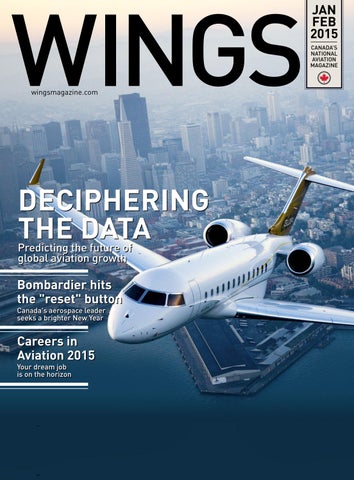
DECiphEring thE Data
Predicting the future of global aviation growth
bombardier hits the "reset" button canada's aerospace leader seeks a brighter New Year
Careers in aviation 2015 Your dream job is on the horizon
Jan FEb 2015 caNada’S NatIoNal avIatIoN maGazINe
THREE DECADES OF BORDERLESS DEPENDABILITY.
With unmatched operating economics, exceptional durability, and rugged reliability, the PW100 engine family has been the benchmark in the industry for thirty years and counting. And with the forthcoming next generation turboprop on the horizon, P&WC will once again redefine the science of dependable power.
CELEBRATING 30 YEARS OF TURBOPROP LEADERSHIP
WWW.PWC.CA
JanUarY/FEbrUarY 2015
UpFront 5 Leading edge
Building for the future
8 on the fly
News and opinion
12 alternate approach Challenging the skies
14 at the gate
Climb every mountain
15 glidepath
All about the experience
baCK
Bombardier has reworked its management team to be more strategically streamlined.
39 marketplace 42 on final
Stalling the engine
FEatUrEs 16 DECiphEring thE Data
As long-term plans are debated in boardrooms, numbers-crunchers are looking to the future BY RIck adamS
From top: challenging the skies P. 12 all about the experience P. 15
C1 CarEErs in aviation 2015
Education, training and job prospects in Canada’s aviation and aerospace sector
PHOTOs: BOMBaRDIER (TOP); BRIan LOsITO, aIR CanaDa (BOTTOM LEfT); EMIRaTEs (TOP LEfT)
BY davId caRR
23 thE DrivE to powEr an inDUstrY
Pratt & Whitney Canada’s iconic PW100 engine celebrates its 30th anniversary BY matt NIchollS
27 it's timE For a "rEsEt"
Even the best-laid plans go south sometimes: just ask Bombardier BY davId caRR
COVER PHOTO: BOMBaRDIER
www.wIngsMagazInE.COM
January/February 2015 | wIngs
3
14-16 APRIL 2015
THE DESTINATION FOR THE AIRCRAFT INTERIORS INDUSTRY. Aircraft Interiors Expo 2015 14-16 April 2015, Hamburg Messe, Germany The global market leader for the world’s aircraft interiors industry. Aircraft Interiors Expo is the launch pad for cabin programmes showcasing tomorrow’s designs, in-flight entertainment, connectivity and passenger services. Register online for your FREE place today www.aircraftinteriorsexpo.com/WINGSJAN Co-located with:
Organised by:
In co-operation with:
LEADING
EDGE
| By Matt Nicholls
building for the future
Canada’s aerospace industry is laying the groundwork for future success
I
PHOTO: RCaf
t has been said you have to walk before you can run, which sometimes I think is a nice way of saying you’re not really sure of where you’re going, or you don't have a clear understanding of what it is you have to accomplish once you get there. This premise doesn’t apply to Canada’s aerospace industry, as 2014 saw important infrastructure changes that should help the industry move closer to “sprint” mode in the not-too-distant future. In February, the federal government introduced its new Defence Procurement Strategy (DPS) with three important initiatives: deliver the right equipment to the Canadian Armed Forces in a timely manner; leverage the acquisition of defence equipment to create jobs and stimulate economic growth in Canada; and streamline the defence procurement process. Recent history shows military procurement has hit the skids, especially when you consider the fiascos with the quest to replace the aging CF-18s – will it be the F-35 or not? – and the ancient Sea King helicopters with the much-maligned Sikorsky Cyclone CH148. The new DPS should definitely help unclutter the waters. The new policy will bring continuous engagement between defence industry experts and industry suppliers early in the procurement process to generate a more cohesive – and decisive – decision-making process. A new Defence Acquisition Guide which outlines future potential requirements for the Canadian Armed Forces, will be useful for suppliers evaluating opportunities available. “I was very serious today when I said Minister Finley (Diane, Minister of Public Works and Government Services) has been very engaged with industry in making sure we are totally participating in the development of DPS and all of its
5 www.wIngsMagazInE.COM
“I’m optimistic the DPS will be a game changer for us – quite frankly, it has to be.” elements,” Aerospace Industries Association of Canada president and CEO Jim Quick noted in an interview with Wings at the association’s annual conference in Ottawa in November. “We’ve had good procurements and we’ve had some very bad ones recently. I’m optimistic the DPS will be a game changer for us – and frankly, it has to be.” Getting it right and expanding the association’s influence in engaging multiple layers of government in committing to – and growing – the aerospace industry led to the establishment of AIAC Pacific in April. With the help of funding from both the provincial and federal governments, the partnership is aimed at unifying the vibrant Western aerospace cluster. “We just completed an economic analysis of what the industry actually contributes to the provincial economy and it really opened a lot of eyes,” Quick said. “It is actually a lot larger than we thought it was including the development of jobs, the influence on the GDP. When you go to B.C. now, you feel
top Data bUrsts… in this issue
1. $20 million: The cost per aircraft the RCaf will have to pay to extend the life of the Cf-18 fleet. (Pg. 8) 2. Low-cost carrier Ryanair attracted some 90 million customers last year. (Pg. 15) 3. forecast International predicts 9,634 business jets will be produced during the next decade. (pg. 16) 4. 38s: The number of Pw100 models that have been devised since its inception. (pg. 23). 5.563: The number of commitments Bombardier has for its Cseries aircraft. (pg. 27).
it – everyone has high energy, we know now that we can be a player on the global front.” Revitalizing the Canadian space program was another major goal in 2014, and the establishment of strong leadership for the Canadian Space Agency – including Walt Natynczyk, deputy minister of veteran affairs Canada, former chief of defence staff and former Canadian space agency president, and Colonel Chris Hadfield, retired Canadian astronaut and former commander of the International Space Station. “Fifteen years ago, we were one of three countries in the space race, it was us, the Americans and the Russians,” Quick said. “Now, there are 54 other nations and they are all starting to invest in their technology development and innovation. At least now we are having those discussions and certainly the technology development and getting the space companies working again is an imperative situation.” So, three major initiatives and a strong commitment from industry and government to help Canada remain an aerospace influencer on the global stage. “There are challenges ahead, such as getting small SMEs collaborating with the big tier one and two aerospace firms, but it really has been a good year for Canadian aerospace,” Quick said. And while it’s certainly not running at full speed yet, there are plenty of signs that Canada is a strong participant in the aerospace race. | w Your feedback is always welcome. Please contact me at mnicholls@annexweb.com. @Wings_Magazine January/February 2015 | wIngs
5
vol. 56, issue 1 EDitor
Matt nicholls mnicholls@annexweb.com 416-725-5637 mEDia DEsignEr
gerry wiebe
FLight DECK
Rick adams, Krista Bulmer, David Carr, Paul Dixon, Brian Dunn, frederick K. Larkin, James Marasa, Carroll McCormick, anna Pangrazzi, Bill zuk
SubScribe TODAY !
aCCoUnt managEr
Jarah stefek jstefek@annexweb.com 519-429-5191
1 Year SubScription only
3000
$
aCCoUnt Co-orDinator
stephanie Defields sdefields@annexweb.com 1-888-599-2228 ext. 257
(GST $31.50 • HST $33.90) US $42.00 (USD) • Foreign $65.00 (USD)
Name: _______________________________ Company: ____________________________ Title: _________________________________ Address: _____________________________ City: _________________________________ Prov: ________________________________ P.Code: _______________________________ Tel: __________________________________ Fax: _________________________________ email: ________________________________
nationaL aCCoUnt managEr
Mena Miu mmiu@annexweb.com groUp pUbLishEr
scott Jamieson sjamieson@annexweb.com prEsiDEnt
Mike fredericks mfredericks@annexweb.com wings magazinE
P.O. Box 530, 105 Donly Dr. s., simcoe, On n3Y 4n5 Tel.: 519-428-3471 fax: 519-429-3094 Toll free: 1-888-599-2228
PLeASe cHecK ONe:
❑ Charter/Fractional ❑ Commercial Airlne ❑ Private Aircraft Owner/Operator ❑ Air Transport-Cargo ❑ Tour Operator ❑ Training/Education ❑ Airport ❑ FBO ❑ MRO ❑ OEM ❑ Aviation Distributor ❑ Aviation Fuel Supplier ❑ Aviation Services ❑ Aviation Sales/Marketing ❑ Para-Public/EMS/SAR/Law Enforcement ❑ Government/Military ❑ Resources - Construction, Fire, Forestry, Mining, Oil & Gas, Wildlife, etc ❑ Other (please specify) ______________
Publication Mail agreement #40065710 Return undeliverable Canadian addresses to Circulation Dept., P.O. Box 530, simcoe, Ont. n3Y 4n5 email: subscribe@wingsmagazine.com Published six times per year (Jan/feb, Mar/apr, May/ Jun, Jul/aug, sep/Oct, nov/Dec) by annex Publishing & Printing Inc. Circulation email: subscribe@wingsmagazine.com Ph: 450-458-0461 fax: 877-624-1940 Mail: P.O. Box 530, simcoe, On n3Y 4n5
PAYMeNT: Cheque - Payable to Annex Publishing & Printing Inc. Visa
MC
Account #: __________________________
subscription rates Canada – 1 Year $ 30.00 (includes gsT - #867172652RT0001) Usa – 1 Year $ 42.00 foreign – 1 Year $ 65.00 Occasionally, wings magazine will mail information
on behalf of industry-related groups whose products and services we believe may be of interest to you. If you prefer not to receive this information, please contact our circulation department in any of the four ways listed above. no part of the editorial content of this publication may be reprinted without the publisher’s written permission. ©2015 annex Publishing & Printing Inc. all rights reserved. opinions expressed in this magazine are not necessarily those of the editor or the publisher. no liability is assumed for errors or omissions. all advertising is subject to the publisher’s approval. such approval does not imply any endorsement of the products or services advertised. Publisher reserves the right to refuse advertising that does not meet the standards of the publication. Printed in Canada Issn 0701-1369
Expiry:_____________________________ Signature: _________________________
Tel: 450-458-0461 Fax: 877-624-1940 Mail: Wings Magazine c/o Annex business Media P.O. box 530 Simcoe, Ontario N3Y 4N5
ON THE
WEB
email: subscribe@wingsmagazine.com
www.wingsmagazine.com
GST#135274215RT001
6
Subscriptions non-refundable
Canadian Business Aviation Association
Magazines Canada
CarEErs in aviation Looking for a great career in aviation and aerospace? Check out our Careers in Aviation micro site, a great location to help you better understand what a career in aviation is all about. Go to www.careersinaviation.ca for news, updated listings and more!
PRO0115
wIngs | January/February 2015
wings subad.indd 1
Canadian Owners & Pilots Association
PHOTO: sTanDaRDaERO
Air Transport Association of Canada
TO SubScribe:
www.wIngsMagazInE.COM
2015-01-09 1:51 PM
UNITED STATES: Albany (KALB). Alexandria (KAEX). Anchorage (PANC). Burbank (KBUR). Dallas (KADS). Gulfport/Biloxi (KGPT). Houston (KHOU). Indianapolis (KIND). Lake Charles (KCWF). Medford (KMFR). Moses Lake (KMWH). Orlando (SFB). Richmond (KRIC). Rome (KRME). San Antonio (KSAT). St. Louis (KSUS). Stennis (KHSA). Tallahassee (KTLH). Topeka (KFOE). Tucson (KTUS). Victorville, CA (KVCV). White Plains (KHPN). Yuma (KNYL). CANADA: Calgary (CYYC). Vancouver (CYVR). Toronto (CYKZ). CARIBBEAN: San Juan (TJIG). COLOMBIA: Cartagena (SKCG).
ON THE FLY For late-breaking news and exclusive web content, please visit us at: www.wingsmagazine.com
thE LEaD
airbUs, paL Join ForCEs For Fwsar Airbus Defence and Space has teamed up with St. John’s-based Provincial Aerospace to pitch the European company’s C295 aircraft as a replacement for Canada’s aging fleet of six CC-115 Buffalo and 13 CC-130 Hercules aircraft being used for search and rescue (SAR) operations. The announcement was made at the Maritime and Arctic Security and Safety (MASS) conference that was held in the Newfoundland capital in October. “Provincial Aerospace brings 35 years of proven in-service support capability and world-class expertise as an integrator of advanced technology systems,” said Segisfredo Domingo, vice-president of services and sales for Airbus Defence and Space. “Expertise such as this is what makes the C295 the world leader in military search and rescue maritime patrol and medium transport with over 140 aircraft sold in 19 countries.” Ottawa has been dragging its feet since it first announced the fixed-wing search and rescue (FWSAR) replacement
program in 2004. The project appeared to scramble up the priority ladder in 2008, but six years later a request for proposals yet to be issued. A stopgap plan to purchase up to 21 Alenia 27J aircraft from the U.S. armed forces was scrapped. Meanwhile, Canada’s fixed-wing SAR fleet grows longer in the tooth, with some of the East Coast-based Hercules aircraft being grounded because they have flown up to 50,000 hours. Originally developed by Spain’s CASA, an early Airbus partner, the new C295 has a 41-foot cabin, the largest in its class, and is powered by two Pratt & Whitney Canada engines, which are ideally suited for SAR missions. CAE is also Airbus Defence and Space’s preferred provider of simulation and training systems for C295 aircraft programs worldwide. Vector Aerospace performs engine maintenance and overhauls, and L-3 WESCAM produces the electro/optical sensors. Provincial Aerospace will be the main Canadian in-service support partner for the C295 team. “Together, we will propose a proven, reliable SAR aircraft and mission system combination that is already in operation around the world,” said Keith Stoodley, senior vice-president of business development and government relations. “Moreover, Provincial Aerospace and the experience to ensure the fleet of C295 aircraft will reliably and affordably protect Canadians for decades to come.” The Brazilian Air Force recently signed
Provincial aerospace and airbus are working together in the hopes of securing the canadian fixed wing search and rescue (FWSaR) contract. 8
wIngs | January/February 2015
a leaked Pentagon presentation seems to indicate canada wanted to buy at least four F-35 aircraft for delivery in 2016 or 2017.
a contract for three C295 SAR configured aircraft that will bring its total fleet to 15. The estimated cost per aircraft is approximately $28 million.
F-35: DiD wE or DiDn’t wE? A reported Canadian order for four Lockheed Martin F-35 Joint Strike Fighter (JSF) appears to be up in the air. The Canadian Press reported on a leaked Pentagon presentation that Canada wanted to buy at least four of the single-engine stealth for delivery in 2016 or 2017. The slide presentation, dated October 27, 2014, indicated that Canada would assume U.S. delivery positions for the four aircraft, and that the U.S. would take delivery of four Canadian F-35s planned for 2019. The swap is reported to be conditional on the delivery schedule for the delayed aircraft remaining on track. The troubled fighter has been plagued by delivery delays and cost overruns. Canada was an early development partner in the F-35 program, but the government shelved an earlier plan to “sole source” 65 airplanes in the middle of a controversy where the Conservatives were accused of low-balling the operations and maintenance costs of the program, but resisted calls for a competitive procurement process. Despite launching a multiagency search for a CF-18 replacement, the F-35 has always been considered the front-runner. www.wIngsMagazInE.COM
PHOTOs: LOCKHEED MaRTIn (TOP); aIRBUs (BOTTOM)
8 thE LEaD 9 inDUstrY happEnings 11 pEopLE on thE movE
In June, 2014, the Reuters News Agency reported that Canada would go ahead with an order for 65 F-35s with an announcement expected before Parliament rose for the summer recess. The Pentagon leak appears to confirm that an order is inevitable, although Public Works Minister Diane Finley says that a final decision has not been made. Canada’s CF-18 fleet was delivered in the mid-1980s. It is estimated that the Royal Canadian Air Force will have to spend $20 million per airplane to extend the fleet’s life to 2023.
“First CanaDian” taLKs groUnDED First Air and Canadian North have cancelled plans to merge their operations, putting to a halt for now the potential for a larger northern operator. The merged airline would have had a combined fleet of more than 26 aircraft consisting of Boeing 737 series 200, 300 and 400 all passenger and combi airplanes, a 767 freighter, Dash 8, ATR 42 and 72, and Canada’s only civilian Hercules heavy lift transport. Both airlines announced they were in talks to form a single northern carrier in April. In October, Makivik Corp and NorTerra Inc, the respective owners of First Air and Canadian North, announced that they have cancelled plans to merge airline operations, with no further discussions planned. Neither side offered any detail except to say in a joint statement that, “Canadian North and Fire Air will
a proposed merger between northern airlines canadian North and First air has been put in the deep freeze.
continue to have a positive working relationship aimed at providing the best possible service to customers in a competitive marketplace.” So, if not “First Canadian” then who? Canada’s “big four” northern jet operators share approximately one per cent of the Canadian air transport market, largely spread out in 65 communities across four million kilometres of land, a situation that is ripe for consolidation specially as southern-based airlines move into the market on a seasonal basis.
FLYing CoLoUrs aDDs gE, EXpanDs into China GE Aviation has named Peterborough, Ont.-based completion and refurbishment specialist Flying Colours an authorized line maintenance centre for its CF34-3 and CF34-8 engines powering business and regional jets. The CF34-3 engine helped to launch the regional jet era when it entered service on Bombardier’s
CRJ100 aircraft in 1992. Across the CF34 family, GE has delivered more than 6,000 engines, including 2,400 CGF34-8 engines in service with 79 operators of Bombardier and Embraer regional jets. The CF34-8 engine has accumulated more than 34 million flight-hours and 25 million cycles. Flying Colours can perform line maintenance inspections and routine installed engine maintenance, including removal and replacement of engines and engine components. The authorization also allows Flying Colours to support OnPoint, GE’s new engine warranty program. “Flying Colours is a leading company in the conversions of the CRJ aircraft for business use,” Brad Mottier, vice president and general manager of GE Aviation’s business and general aviation division said. Flying Colours has also announced a joint venture agreement with China’s Sparkle Roll Technik (SRT), which provides specialized services for the corporate jet sector. The multi-million dollar agreement will focus on private jet cabin
inDUstrY happEnings
PHOTOs: CanaDIan nORTH (TOP); MIKE DORIOn (BOTTOM)
CoopEr wins prEstigioUs DCam awarD
the 2014 dcam Flight Instructor Safety award was presented Nov. 18 during the air transport association of canada’s annual convention and trade show in vancouver to Sherry cooper, chief flying instructor with Sky Wings aviation academy. cooper is a mentor and role model to all in aviation, not only as an instructor, but also as a member on several key aviation boards. From left are adam Wright, Pilot, air transat, (representing Jane abramson); chris Walsh, mFc dcam recipient 2013; kathy Fox, RFc, dcam recipient, 2011; keith (ko) ostertag, chinook helicopters, 2014 dcam legacy award winner; Sherry cooper, Sky Wings aviation academy, 2014 recipient of the dcam Flight Instructor Safety award; clark duimel, PFc dcam recipient 2005; Bob henderson, mFc, dcam recipient 2008; Wayne Gouveia, vP commercial General aviation – vP Prairie & Northern, atac. www.wIngsMagazInE.COM
January/February 2015 | wIngs
9
ON THE
FLY
modification and aircraft maintenance in China, beginning with a hangar facility at Linyi City in Shangdong province. The first project will be the conversion of eight B-registered CRJ-200 aircraft, procured by SRT, into VIP configurations. The first project, which is already underway, will be the conversion of eight B-registered CRJ-200 aircraft, procured by SRT, into VIP configurations. The initial aircraft modifications are expected to take up to eight months and will be undertaken at Flying Colours’ Peterborough facility. Later conversions will have interiors manufacturing in North America, with final installation taking place in a new one hangar facility at Linyi City in China’s Shangdong province.
air CanaDa zonEs in on boarDErs Air Canada is breaking its airplanes into zones to easy boarding bottlenecks. Launched during the busy holiday
10 wIngs | January/February 2015 Atlantic_AME_Oct.indd 1
season, one of five zones will be printed on each passenger’s boarding card beginning with business class and super elite frequent flyers (zone 1) and premium economy (zone 2). Passengers needing assistance will then be boarded, followed by economy class passengers boarding in three zones starting at the back. According to the Toronto Star, boarding times have increased by more than 50 per cent since the 1970s and are expected to worsen as more passengers carry baggage onboard to avoid the checked baggage fee. Air Canada is not expecting the zone system to reduce boarding, but should be a more orderly way for passengers to get to their seats. The airline also expects that zones will simplify boarding announcements. “Boarding is very complex for us, especially since we have so many different groups of customers,” Andrew Yiu, Air Canada’s director of product specifications, told the Toronto Star. Yiu
tested different boarding models before arriving at the new system. WestJet introduced zone boarding earlier this year.
bUYEr anD sELLEr bEwarE When selling an aircraft, it is only natural to want the highest price the market will allow. But holding out for a price higher than the market is willing to pay may cost the seller millions. This according to Chasing the Market, a position paper by Montreal-based ACASS, a global provider of support services for business aviation. The paper cites an extreme case of how costly chasing the market down can be to a seller. A 2008 Bombardier Global XRS first listed at US$42 million in spring 2012 was going for US$30 million two years later after the seller rejected an opening offer of US$37.5. All the while the airplane was losing value through depreciation while the
www.wIngsMagazInE.COM 2014-10-29 3:19 PM
owner continued to shoulder fixed costs such as hangaring and insurance. ACASS’ solution, and no surprise here, is to seek a qualified broker. “Unless you happen to have many years of experience buying and selling aircraft, the best way to avoid chasing the market is heeding the counsel of a dependable broker or aircraft sales partner,” said Andre Khury, chief executive of ACASS. “The danger in holding out for a better price is that you end up losing deals and getting a worse bargain in the end.” About 14 per cent of aircraft purchasers go it alone: Chasing the Market has some advice for them also. Don’t. A buyer missed out on a bargain-priced Gulfstream V because they tried to trim a bit more off the asking price. “By the time the buyer finally realized that he was jeopardizing an opportunity he wouldn’t soon come across again, the aircraft had already been sold for the initial asking price,” the paper notes.
pEopLE on thE movE The Canadian Space Agency has a new advisory board it hopes will lead it into the next several years of space development. Industry Minster James Moore made the announcement during a spirited speech at the Aerospace Industry Association of Canada’s annual general meeting and trade show in Ottawa Nov. 18-19. New members of the board include: General (Retired) Walt Natynczyk, deputy minister of veteran affairs Canada, former chief of defence staff and former Canadian space agency president; Dr. Mamdouh Shoukri, president and vice chancellor of York University; Terry Malley, president and CEO, Malley Industries; Dr. Arlene Ponting, president emerita of Mindfuel; Lorne Trottier, co-founder of Matrox Electronic Systems and the Trottier Family Foundation; Fred George, president and CEO, JLK Global Fund International and honorary captain to the Royal Canadian Navy; Joe
Keating, director of Sandvine and former CEO of COM DEV; Colonel Chris Hadfield, retired Canadian astronaut, former commander of the International Space Station . . . Another key announcement from the AIAC conference was the appointment of Viking Air Limited president and CEO David C. Curtis as the new AIAC board chair. Curtis succeeds Bell Helicopter president and CEO Barry Kohler . . . The Ontario Aerospace Council has a new Executive Director. Moira Harvey was introduced as the new OAC leader at the annual general meeting in Mississauga Nov. 25. Harvey succeeds Rod Jones who successfully guided the OAC for a number of years. Jones is now the Global Practice Lead (Aerospace) with the Department of Foreign Affairs, Trade and Development. | w
For more on industry news, visit www.wingsmagazine.com
It’s like Einstein and an F-16 had a baby
Integrated Flight Deck
www.wIngsMagazInE.COM UASC_Wings Jan/Feb 2015.indd 1
uasc.com
January/February 2015 11 | wIngs 12/12/14 9:37 AM
ALTERNATE
APPROACH By David Carr |
Challenging the skies
Government policy blocks competition from taking off
I
12 wIngs | January/February 2015
Vancouver and Montreal’s global connections, and Air Canada’s success in scheduling aircraft for easier connecting between the U.S., Europe and Asia, is pulling more Americans north. But millions of Canadians crossing the border each year for lower cost flights is a lot of revenue to give up without a fight. Yet that is what is happening. Ottawa’s promise to stimulate increased foreign competition has also been hit and miss with airlines such as Emirates, Etihad and Qatar Airways pounding on the door to increase a combined nine weekly frequencies to Toronto and Montreal to daily and, in Emirates case, adding flights to Calgary and Vancouver. Transport Canada bureaucrats say that these routes are adequately served, but that fails to consider transfer potential and the Canadian consumer’s right to choose. While some airlines are being blocked access to Canadian destinations, others are holding out until for movement on high taxes and fees. Which may go a length to explain why telecos are in this government’s consumer agenda crosshairs and air transport gets a free ride. It is easy to quash contracts and unbundle services when you don’t have a dog in the hunt. Stimulating air transport may curtail revenue such as airport rent flowing into treasury coffers. And no government wants to take that hit. | w
Why Ottawa is hesitant to officially relax foreign restrictions on ownership is a puzzle. who will understandably do whatever is necessary to protect market share. Why Ottawa is hesitant to officially relax foreign restrictions on ownership is a puzzle. Caps are already something of a shell game as evidenced by American Airlines onetime stake in Canadian Airlines and British tour giant TUI Travel’s 49 per cent equity position in Sunwing (with a 25 per cent voting interest), which has had the benefit of adding competitive muscle in the crowded leisure market. Nobody should expect American ULCC’s to ride the rescue. JetBlue and Southwest have considered entering the market place, but have a pretty good gig stopping at the border and filling airplanes with Canadians buying cheap seats. Besides, taxes and other fees that weigh down the cost of a ticket in Canada would eat away at their competitive advantage if they were to set up shop here. Buffalo Niagara Falls International Airport recently raised the ante. Approximately 46 per cent of Buffalo’s 5.5 million passengers are cross-border shoppers. In October, airport officials travelled to Toronto for a one-day road show to lure more travellers. To be clear, the cross-border tug is not exclusively southbound. Pearson,
David Carr is a Wings writer and columnist. www.wIngsMagazInE.COM
PHOTO: EMIRaTEs
n the November/December 2014 issue of Wings, we ran a cover story by yours truly entitled “Surveying the Landscape,” focusing on what Canadian air transport could look like in five years. The invisible thread running through the piece was how government policy blocks renewal industry renewal. This is not a criticism of any particular government. With the exception of overdue big ticket change such as opening domestic skies to limited competition in the 1950s (Diefenbaker), deregulation (Trudeau) and trans-border open-skies (Chrétien), successive governments have been satisfied tinkering at the margins of air policy, such as insisting airlines post the all in fare up front, saving customers from sticker shock once all taxes and fees are added. As part of a consumer agenda, it was pretty low hanging fruit. But what of the current government’s consumer agenda, so far limited to big mobile telecoms and cable and satellite service providers? Parse through this government’s past commitments and the cap on foreign investment in Canadian airlines was supposed to have been lifted to 49 per cent (still two percentage points below where it needs to be) and skies were to become more friendly to foreign competition. National Post columnist Andrew Coyne, an economist, wrote in 2013 when Ottawa tried to stimulate competition in the mobile telephone sector by luring U.S. wireless giant Verizon north, “if the government really believed in consumers first, it wouldn’t confine itself to wireless telephony.” Coyne quoted 18th century British economist Adam Smith, who observed over 200 years ago “consumption is the sole end and purpose of all production.” Except in Canada where that assumption is turned on its head. Canada is the only developed economy not served by an ultra-low cost carrier (ULCC) similar to Allegiant in the U.S. and Europe’s Ryannair. That may change this spring as two ambitious homegrown ULCCs ramp up. But analysts report that investors have been scarce and Canadian ownership restrictions are preventing a potential ULCC from operating with the scale, number of airplanes and deep pockets needed to take on Air Canada and WestJet,
MARCH 23RD – 25TH 2015 Westin Bayshore Resort & Marina Vancouver, BC, Canada
Theme: Integrated Safety Management Systems: Access All Areas
PLATINUM
“How to get engagement across all areas and make the SMS truly integrated”
GOLD
GLOBAL AEROSPACE
MSF Pritchard
Hiscox Allied World Torus
Sponsors correct at time of publication.
Register Now w w w. c h c s a f e t y q u a l i t y s u m m i t . c o m
PARTNERS IN SAFETY
Specialty Markets
Watkins Syndicate HongKong_1600x500.indd 1
SAFETY OFFICERS
MEDIA
SILVER
®
BRONZE
Syndicate 318 Underwriters at Lloyd´s
04.04.13 14:40
Lenovo LORD Corporation Travelers ANV Starr Insurance & Reinsurance Ltd
AT THE
GATE
By Brian Dunn |
Climb every mountain
Mont-Tremblant International Airport is making a name for itself
A
14 wIngs | January/February 2015
Tourism Mont-Tremblant couldn’t be happier with Air Canada’s decision. “It’s great news,” said Tourism MontTremblant General Manager Éric Trudel. “It gives us a lot of visibility throughout Air Canada’s network.” The new flights open the market to about six million potential customers in the Greater Toronto region, he pointed out. “It’s practically half the population of Ontario. They like to ski and the great outdoors, but they don’t have big mountains.” Trudel figured that a lot of people who weren’t wiling to make the trip downtown to fly out of Billy Bishop may now be interested to fly out of Pearson. But Tremblant is also attractive to Americans, he added. “For years, there were a lot of Americans here. But that has changed with the economic crisis, the value of the Canadian dollar and SARS, resulting in fewer U.S. visitors.” But Americans are starting to return, despite stiff competition from ski areas in the Eastern United States closer to home, said Trudel. “What they are particularly interested in is the Québécoise joie de vivre and culture. It’s the Little Europe in America and the small (Mont-Tremblant village) that appeals to families and their children.” | w
It’s practically half the population of Ontario. They like to ski and the great outdoors, but they don’t have big mountains. a small chalet style terminal building along the east side of the runway, but there are no hangars for aircraft storage. The airport is classified as an airport of entry by NAV CANADA and is staffed by the Canada Border Services Agency. The airport operator is planning to expand the airport by extending the runway to 8,202 ft. to accommodate larger jets, building a larger terminal and adding a water aerodrome for floatplanes on the south end of the runway at Lake Chaud. Porter and now Air Canada Express are the only airlines offering scheduled service to Mont-Tremblant, although Thunder Bay’s Voyageur Airways offers a charter service. Porter also offers service from Newark, New Jersey, via Billy Bishop, replacing Continental Airlines which stopped offering non-stop flights two years ago. Porter also offers seasonal service to Burlington, Vt. Asked what impact Air Canada’s new service might have on them, Porter was confident it would be minimal. “We have a strong base of customers for Tremblant and a better schedule, so we expect to maintain the business that we have had historically,” said Porter spokesperson Brad Cicero.
Brian Dunn is a Wings writer and columnist. www.wIngsMagazInE.COM
PHOTO: PORTER aIRLInEs
ir Canada is following in the footsteps of Porter Airlines by offering December-March service to Mont-Tremblant. But unlike Porter, which also offers summer service and flies out of Toronto Island Billy Bishop Airport, Air Canada is offering the service from its main hub at Lester B. Pearson. “This will allow us to tap into our entire network for passengers, including the eastern United States, the Midwest and even from the rest of Canada,” said Air Canada spokesperson Isabelle Arthur. Mont Tremblant is becoming more and more popular, even among skiers from Western Canada, she added. “They are attracted by the French language and culture and it’s also an opportunity to discover new runs and Mont-Tremblant village and all of its attractions. As we always do, we will monitor consumer response closely to ensure our schedule going forward for next year meets demand.” Air Canada will initially offer four flights a week (Thursday, Friday, Sunday and Monday), from December 18 until March 30, to capitalize on growing demand for Mont-Tremblant and tailored for short stay ski break holidays, said Arthur. The service is provided by Air Canada Express using a 74-seat Bombardier Q400 aircraft, the same one used by Porter which offers up to 13 flights a week during peak season. Mont-Tremblant International Airport is a single runway airport located in the township of La Macaza, about 35 kilometres north of Mont-Tremblant, which offers a shuttle service to various hotels at the foot of the mountain. The airport was originally built in 1962 for the RCAF by Boeing to military specifications, as an RCAF emergency landing field, with a runway of 6,000 feet. It subsequently became home to 447 SAM Squadron, armed with 29 nucleartipped CIM-10 Bomarc missiles. After 1968 the station became CFB La Macaza and closed as an active base in 1972 following the removal of the Bomarc missiles. Later converted to a civilian airport, it was turned into an international airport in 2000 despite a referendum held in the region stating that the citizens of La Macaza opposed the project. The airport consists of
GLIDE
PATH
| By Paul Dixon
all about the experience
Today’s carriers are feverishly trying to deliver what customers want
PHOTO: BRIan LOsITO, aIR CanaDa
I
was in Seattle recently for the oneday Passenger Experience Conference, which ran concurrently with the annual Aircraft Interiors Expo. And while I’m having trouble accepting that everything I do in life should be viewed as an “experience,” I will say that this was one of the most enjoyable and educational days I have ever experienced. The daylong event played out with a series of short presentations and panel discussions with a cross-section of the commercial aviation sector onstage together – Boeing and Airbus alongside several airlines and even representatives from Google and the tech sector. All of the participants were trying to put their collective fingers on where the world of aviation is today and, more importantly, where it will be a year or two from now. Branding was a hot topic (no pun), as in the need for an airline to create a clear image that sets it apart from its competition. And with that, it’s so much more than simply slapping a new paint job on an old aircraft. For example, Mark Krolick, managing director of United Airlines’ marketing and product development division, talked about the challenges in melding United and Continental into one, big (700+ aircraft) family. Needless to say, it was not unlike the apocryphal tale of two giant pythons chowing down on opposing ends of dinner in the middle of the jungle and eventually meeting in the middle. With both sides firmly committed to their positions in the marketplace, the only way to resolve the impasse is for the larger of the two to open a little wider and devour the competition. For every passenger and even potential passenger, there are hundreds of opportunities to make a positive impression and just as many opportunities to get it wrong. Legacy airlines around the world are finding it increasingly difficult to find their place in the marketplace as passenger demands and expectations increase. The legacy carriers such as the “big three” in the U.S. – American, Delta and United – operate newer fleets that require high volume. The real money lies in first-class and business-class, but there’s not enough of a potential market there to carry and they can’t compete head-to-head with the lowcost carriers. www.wIngsMagazInE.COM
be featuring a super-ultra first-class experience on their London-Dubai route. Each of the A380s flying the thrice daily service will be outfitted with a Residence suite, which comes with three rooms and a dedicated butler. The cost, if you must ask, is a cool $20 thousand and it is for dual occupancy. About 40 years ago, I was walking along East Pender in Vancouver with a Chinese friend. We passed a popular local pancake house that sported four Chinese characters on the sign. I asked my friend what the characters said. After a couple of minute’s contemplation, he offered that the best translation he could come up with was, “if you eat here, your stomach will be happy.” The restaurant is long gone, but that memory has stayed with me and the food really was OK. In a world where it seems the public at large wants everything there is without paying for it, is it possible for our Canadian owned and operated air carriers to stake out positions at the high end and the low end while covering everything in between as well? Can an airline serve up happiness for its customers in the same way a stack of flapjacks might make your stomach happy? Some thoughts on that subject in the next installment. | w
It was not unlike the apocryphal tale of two giant pythons chowing down on opposing ends of dinner in the middle of the jungle. In fact in 2013, more Americans flew domestically on low-cost carriers such as Jet Blue, Southwest and Allegiant than on the three legacy carriers. In Canada, Air Canada and WestJet are on solid ground today, but this is a business where a company is only as good as its next year. Or more precisely, meeting projections for its next quarter – the Achilles heel of publicly traded companies. Air Canada is having great success with its Rouge brand, while WestJet is chasing both ends of the equation with its expanding fleet of Q400s and a quartet of 767s arriving in 2015 for overseas travel. Low-cost airlines around the world are growing by leaps and bounds. Ryanair is the airline people love to hate, yet they managed to attract more than 90 million customers last year and feel their future is sound enough to place an order for 200 new B737 MAX aircraft. How many new aircraft would they have on order if people actually enjoyed flying Ryanair? The keyword in Ryanair’s branding process is “cheap,” as in cheap flights. It’s a powerful attractant for a large segment of the market. At the other end of the scale, Etihad Airways will
Paul Dixon is freelance writer and photojournalist living in Vancouver. January/February 2015 | wIngs 15
DECiPHERi
THE DATA
thE nUmbErs tELL thE FUtUrE
bY riCK aDams 16 wIngs | January/February 2015
www.wIngsMagazInE.COM
PHOTO: DassaULT faLCOn
inG i
t might seem supercilious to try to predict the future of an industry, especially 20 years out. There are so many inter-related factors at play: global and regional economics, technology breakthroughs, regulation, natural disasters, wars. Yet, every year, many aircraft manufacturers and other prognosticators dust off their time-travelling methodologies and predict how many new aircraft will be built a decade www.wIngsMagazInE.COM
or two hence. For those of you who think their predictions too self-servingly optimistic, please note that Boeing’s 1994 forecast of about 13,000 new aircraft between ’94 and 2013 became more than 16,000 actual aircraft deliveries during that timeframe. The educated guesses for the next 20 years? How about 36-38,000 new commercial aircraft deliveries, more than 20,000 business aircraft, and some 5,000 civil helicopters. So, if the experience of the past
two decades holds, we could be looking at 75-80,000 total new civil aircraft across the next 20 years. Airbus, Boeing, Bombardier, Embraer and even Comac issue annual 20-year growth forecasts, as does Flightglobal/Ascend. Forecast International offers more shortsighted 10-year estimates in selected niches. Honeywell issues a 10-year business aircraft forecast and five-year helicopter predictions. January/February 2015 | wIngs 17
Commercial aircraft – 80 per cent increase Although generally covering much of the same territory, each forecast is based on slightly different categories. For example, the Airbus forecast addresses only passenger aircraft above 100 seats, as well as freighters. Bombardier deals only with aircraft up to 150 seats, but also incorporates business aircraft. Embraer’s range is from 70 seats upwards,
of demand in units, but wide-body aircraft such as its A380 will represent 55 per cent of overall value. Boeing’s crystal gazers estimate a total fleet of 42,180 aircraft of 90 seats or more: only 5,410 of the current fleet retained, 15,500 replacements (74 per cent of what we fly in today), and 21,270 pure growth (58 per cent of the 2033 net). The Airbus-Boeing duopoly is expected to garner 86 per cent of the US$4-5
if the experience of the past two decades holds, we could be looking at 75-80,000 total new civil aircraft across the next 20 years. and Flightglobal starts at 14 seats. The Flightglobal fleet forecast is the most ambitious, estimating the global commercial aircraft fleet in service will increase by 80 per cent to 45,600 aircraft in 2033: 37,900 passenger jets, 4,150 passenger turboprops, 3,550 commercial freighter aircraft . . . fully 40 per cent of those operating in the AsiaPacific and China region. Airbus envisions a fleet of only 37,463 (34,818 passenger aircraft and 2,645 freighters) of 100 seats or more by 2033, ignoring the 99 or fewer seat aircraft it does not make (though partially Airbusowned ATR does). Airbus claims singleaisle aircraft will represent 70 per cent 18 wIngs | January/February 2015
trillion value of the world’s commercial jet aircraft through 2033. However, Canada’s Bombardier, China’s Comac, Brazil’s Embraer, Russia’s Irkut and Japan’s Mitsubishi are all expected to capture increasingly significant volumes of jet demand. Some common themes across the various predictions: • There will be expected passenger traffic growth of 4.5 to 5.0 per cent • A doubling of the global middle class (to 63 per cent by 2033) – defined as households with daily expenditures between $10 and $100 per person. Fully 4.4 billion of the 5.4 billion “middle class” will be outside North
America and Europe, according to Airbus • World average Gross Domestic Product (GDP) growth of 3.2 per cent but more than 6 per cent in China and India. • Oil prices expected to rise to more than US$150 per barrel (the current price dip, likely temporary, had not occurred when forecast models were assembled). This is accelerating fleet replacements with new fuel-efficient and environmentally friendly models. By 2033, global or major network carriers will represent about 70 per cent of all passenger traffic. Low-cost carrier (LCC) market share is expected to increase to more than 20 per cent. To keep the expanding commercial fleet in the air, Boeing says the industry will need 533,000 new pilots worldwide over the next 20 years, an increase of 35,000 (seven per cent) over last year’s prediction, and 584,000 maintenance technicians, up from 556,000 (five per cent). The largest anticipated increase in pilot demand, not surprisingly, is in the AsiaPacific region, up from 192,300 a year ago to 216,000 – a 12.3 per cent increase. The Middle East will need 55,000 new pilots, a whopping 37.5 per cent boost from the 2013 forecast. The Gulf region also shows the largest percentage increase for techs: a nearly 17 per cent gain. www.wIngsMagazInE.COM
PHOTO: gULfsTREaM
Bombardier’s business aircraft market forecast anticipates 9,200 aircraft deliveries over the next 10 years.
totaL worLD airCraFt FLEEt sizE ForECast For 2033
26%
CommErCiaL passEngEr JEts, passEngEr tUrboprops anD FrEightEr airCraFt
FLightgLobaL ForECast
boEing ForECast
airbUs ForECast
passEngEr airCraFt inCLUDing rEgionaL JEts, singLE- anD twin-aisLE, as wELL as FrEightErs
passEngEr airCraFt oF 100 sEats or morE, as wELL as FrEightErs
45,600
42,180
CiviL hELiCoptEr pUrChasE anD UtiLization bY rEgion
23% EUropE
north amEriCa
37,463
pUrChasE pLans, 2014-2018, pEr CEnt oF worLD
8% 32%
miDDLE East aFriCa
19%
Latin amEriCa
nEw tEChniCians nEEDED, 2014-2033: 556,000
asia-paCiFiC
$$$$$$$$$$$$$$$$$$ $$$$$$$$$$$$$$$$$$ $$$$$$$$$$$$$$$$$$
mission
annUaL hoUrs FLown
oiL anD gas
720
gEnEraL UtiLitY
375-400
EmErgEnCY mEDiCaL
375-400
Law EnForCEmEnt
400
toUrism
375-400
CorporatE
300
CiviL hELiCoptEr opErator UsagE
nEw maintEnanCE tECh nEEDED 2014 - 2033
PHOTO CREDIT TK
nEw COmmERCiAL piLots nEEDED, 2014-2033: 498,000
www.wIngsMagazInE.COM
YEarLY avEragE
asia-paCiFiC
224,000
11,200
EUropE & Cis
126,000
6,300
north amEriCa
109,000
5,450
Latin amEriCa
62,000
3,100
miDDLE East
44,000
2,200
aFriCa
19,000
950
totaLs
584,000
29,200
nEw piLots nEEDED 2014 - 2033
YEarLY avEragE
asia-paCiFiC
216,000
1,300
EUropE & Cis
112,000
5,600
north amEriCa
88,000
4,400
Latin amEriCa
45,000
2,250
miDDLE East
55,000
2,750
aFriCa
17,000
850
totaLs
533,000
January/February 2015 | wIngs 19 26,500
bombardier markets – seat shifting
over the next 20 years, Bombardier forecasts demand for 13,100 aircraft deliveries in the 20- to 149-seat seat segment where the Q400 fits nicely.
passengers per day each way, and are therefore best served by 20- to 149-seat aircraft. The Montreal manufacturer reiterated in November its expectation that the CS100 will enter service in the second half of 2015, the larger CS300 six months later, despite a delay during
summer 2014 in the flight test program. Some skeptical analysts suggest a slip to 2016 for entry into service. Brazilian rival Embraer foresees a need for 18,500 narrow-body commercial aircraft (50 per cent of them replacements for existing fleet), 6,250 new jets in the 70- to 130-seat segment, 2,300 70- to
Systems • Parts • Service
MOBILE REFUELING SOLUTIONS Our complete line of refueling trailers and tote tank systems are specifically designed for your remote fueling operations!
Contact us today for all your refueling needs! • Aviation Hoses • Refueling Nozzles
Edmonton | Cambridge 20 wIngs | January/February 2015
• Decals & Signage • Pumps & Meters
• Testing Equipment • Fuel Filters
1-877-960-AGFT (2438)
www.agftparts.ca www.wIngsMagazInE.COM
PHOTO: FREDERICK K. LARKIN
Bombardier’s forecast for commercial aircraft is confined to those markets in which it actively competes: 20-59 seats (Q400 NextGen turboprops), 60-99 seats (CRJ NextGen regional jets and Q400), and 100-149 seats (CSeries). In the 20-59-seat segment, Bombardier anticipates a modest pace. The 60-99seat segment, however, “will continue to be one of the most dynamic in commercial aviation. It is anticipated that the fleet in this segment will more than double in size with new aircraft deliveries evenly split between large turboprops and large regional jets.” And the 100-149 seat aircraft segment category “will witness a major fleet transformation with the entry into service of new clean-sheet aircraft designs.” Over the next 20 years, Bombardier forecasts demand for 13,100 aircraft deliveries in the 20- to 149-seat seat segment: • 20 to 59-seats: 400 • 60 to 99-seats: 5,600 • 100 to 149-seats: 7,100 Bombardier notes that 70 per cent of the world’s short- to medium-haul markets serve between 50 and 250
regional aircraft, Bombardier 741 regional aircraft, and ATR 739 turboprops. New players Comac, Mitsubishi’s MRJ, and Russia’s Sukhoi’s Superjet 100 will also pick up some sales.
business aircraft – still soft
PHOTO: PaIRBUs
airbus claims wide-body aircraft such as its a380 will represent 55 per cent of overall commercial market value.
90-seat jets, and 2,050 turboprops of 70 seats or more. Connecticut-based Forecast International issued a new 10-year regional transport aircraft study in 2014, predicting 3,867 new regional jets and turboprops through 2023. Noting that consolidation has provided the major
airlines with greater leverage over regional feeder contracts, senior aerospace analyst Raymond Jaworowski said, “Capacity purchase is clearly a buyers’ market at the present time, with the majors holding most of the cards.” During the 2014-2023 time period, Embraer is expected to produce 971
In the business jet category, Bombardier reduced its previous-year forecast to 22,000 (from 24,000) for the 2014-2033 timeframe. These numbers are for aircraft segments in which the manufacturer competes with its Learjets, Challengers and Globals. Michael McAdoo, Vice President, Strategy and International Development, Bombardier Aerospace, expressed confidence “in the strong, long-term potential of the business aircraft industry,” despite a slump since the peak year of 2008. Bombardier’s business aircraft market forecast anticipates 9,200 aircraft deliveries over the next 10 years and 12,800 aircraft for the decade after that. By contrast, the Honeywell business aircraft outlook reflects an approximate 7-8 per cent increase in “value” over the 2013 forecast: slightly higher unit deliveries coupled with modest list price increases and the continued strong showing of larger business jet models. North
AIRPORT SOLUTIONS Industrial Charter Terminals | Aviation Fuel | Airport Services
Contact us today for more information on: Aerodromes Quality Assurance www.wIngsMagazInE.COM
Terminal Operations Ground Handling
Industrial Charter Facilities Aviation Fuel
1-888-299-2825 www.EFCAviation.ca January/February 2015 | wIngs 21
helicopter operators will purchase up to 1,000 new aircraft per year over the next five years, a total of 4,800-5,500 units – slightly lower than their survey a year before. Light single-engine helicopters continue to be the most popular with roughly half of operators planning a purchase in this product class. About one-third intend to acquire a new intermediate/medium twin-engine, and one-quarter plan to buy a light1 twin. Wings_WesternAircraft_Island_Jan2015.pdf 2015-01-06 9:22 AM Civil helicopters – holding pattern Demand from large oil and gas fleet Honeywell Aerospace forecasts that civil operators continues to support overall America represents nearly 60 per cent of projected global demand based on the region’s larger installed business jet base. Forecast International’s study predicts 9,634 business jets will be produced during the next decade. They said the recovery “got underway” in 2013 and that business jet production will increase from 719 aircraft in 2014 to a peak of 1,136 aircraft in 2020 before tapering in 2021-2022.
Airworthiness Symposium & Trade Show
Coast Plaza Hotel - Calgary, Alberta CANADA
MARCH 18-20, 2015
AIRWORTHINESS
symposium & trade show
Hosted by the Western Aircraft Maintenance Engineers Association & Recognized by Transport Canada
• Industry Trade Show Exhibitors • Informative Seminars and Workshops for Fixed and Rotary Wing
• In-Depth Mini-Courses • Banquet and Max Ward Award
For more information, including courses, registration and schedule, see
www.wamea.com 22 wIngs | January/February 2015
(780) 462-1173 Fax: (780) 413-0076 E-mail: info@wamea.com
volume in the heavy multi-engine class. Latin American will continue to lead all regions in terms of purchase rates, with up to 32 per cent of respondents’ fleets slated for turnover with a new helicopter replacement or addition. The forecast of civil turbine-powered helicopter purchases has the five-year share of demand from the U.S. and Canada at 26 per cent, which combined with Latin America represents 50 per cent of the total global demand. Europe’s share closely follows with 23 per cent, with the Asia-Oceania region accounting for 19 per cent, and Africa and the Middle East ranking at under 8 per cent. “Global demand looks steady on the heels of strong 2013 performance,” said Tom Hart, vice president, defence and space sales, Honeywell Aerospace. “Utility helicopter purchase interest is trending upward. Helicopter replacement cycles and increased operating hours in the law enforcement and oil and gas industries has helped sustain demand in those sectors. Several new platforms are scheduled to enter service in the next few years and this is also expected to bolster overall demand.” Operators who intend to purchase a helicopter within the next five years noted that the age of their current aircraft, contracted replacement cycle and the warranty expiration were key drivers for their decision. For those surveyed, the make and model choice for their new aircraft is strongly influenced by range, cabin size, reliability and safety, hot/high performance and brand experience. Survey results also show that Latin America leads the way in terms of fleet replacement and growth expectations, rivaling Europe as the world’s second largest regional market behind North America. Strong results were also recorded in China and Brazil. The 2014 outlook presents a snapshot of the helicopter business at a point in time and reflects the current business and political environment. The Honeywell survey queried more than 1,000 chief pilots and flight department managers of companies operating 2,800 turbine and 290 piston helicopters worldwide. The survey excluded large fleet or “mega” operators, which were interviewed separately. | w
For more on space, visit www.wingsmagazine.com www.wIngsMagazInE.COM
[ ON THE CUTTING EDGE ]
WINGS
CAREERs in AviATiOn 2015 CIA STARTS
PHOTO CREDIT TK
education, training and job prospects in canada’s aviation and aerospace sector
CiA2015
www.wIngsMagazInE.COM
Preparing for an excItING avIatIoN caReeR January/February 2015 | wIngs C1
Let Your Career Take Flight! The Waterloo Wellington Flight Centre is one of the largest flight schools in Canada, ranking in the top 5 nationally in experience and industry reputation. WWFC is partnered with both the University of Waterloo and Conestoga College, providing students a choice between an aviation degree or diploma. Great Lakes Helicopter Great Lakes Helicopter is an Ontario registered Private Career College, offering a range of Helicopter Flight Training options and charters from the Region of Waterloo Airport. GLH is partnered with Conestoga College offering a 2-Year Diploma in Aviation Arts and Science. This is the only program of its kind in Canada. In the competitive world of aviation a post-secondary education gives students the edge they need to stand out in the industry. Graduates from the Waterloo Wellington Flight Centre and Great Lakes Helicopter leave ready to work coast-to-coast in entry level flying positions.
Aviation General Arts & Science Two-year diploma Fixed-wing & Rotary
Geography & Aviation - Four-year degree Science & Aviation - Four-year degree Fixed-wing only.
Find out more today! Visit www.wwfc.ca/fly-professional or www.greatlakeshelicopter.ca Waterloo Wellington Flight Centre Professional programs are approved as vocational programs under the Private Career Colleges Act, 2005 (PC#105919) Great Lakes Helicopter Professional programs are approved as vocational programs under the Private Career Colleges Act, 2005 (PC#103106)
CIA2015 CiA2015
[oN the cUttING edGe]
CaREERs In aVIaTIOn 2015
On THE CuTTinG EDGE
PHOTO: BOMBaRDIER
s
ometime in the next 12 to 15 months, Bombardier’s CSeries is expected to enter revenue service. The CSeries is one of the world’s most technologically advanced airliners, and it is Canada’s entry into the large jet market. The airplane also reflects Canada’s aviation and aerospace industry, an ambitious and hi-tech global business, built up, maintained and managed by women and men at the top of their game. Canada has one of the largest aerospace and most diverse air transport industries in the world, with opportunities spread out across the country. This adds up to strong demand for skilled professionals to keep the airplanes flying and maintaining Canada’s position as a leading global manufacturer and exporter of state-of-the-art airplanes, aero-engines, flight simulator and components. Training is long and hard and, in the case of pilots, can be expensive. But the rewards are just as great as the industry expands and older workers exit the cockpits and put away the tool boxes. Wings and Helicopters Careers in Aviation 2015, is a one-stop resource to landing an exciting career in aviation. It contains brief descriptions of several leading aviation and aerospace sectors, as well as valuable
www.wIngsMagazInE.COM
information on education and training. The country’s flight schools, colleges and universities offer excellent programs to help chart a course along one of the hundreds of career paths available, both in the air, on the ground, in air traffic control or with one of the major OEMs (original equipment manufacturers) or MRO (maintenance repair and overhaul) organizations. The listings are intended as an introductory snapshot of the types of flight schools, colleges and universities, and professional training options that are available. But it by no means is a comprehensive list; the best advice is to use this guide as a starting point for your research. The 2015 edition of Careers in Aviation envelops airplanes and helicopters in three sections: Flying the Aircraft; Designing, Building, Repairing and Maintaining the Aircraft; and Supporting the Aircraft, which is an introduction to careers in airport operations, air traffic control and flight dispatch. As a research document, Careers in Aviation 2015 is an excellent starting point, but it only scratches the surface and has left out other rewarding careers in areas such as advanced aerospace engineering, marketing, cabin interiors, aviation law, flight attendants – even magazine publishing. For those who have decided on a career in aviation – along with those who are still
considering career options or even a midcareer reboot – research is always your best tool. Industry associations such as the Canadian Business Aviation Association (CBAA), the Helicopter Association of Canada (HAC), the Aerospace Industries Association of Canada (AIAC) and the Canadian Council for Aviation and Aerospace (CCAA) are excellent resources for information on education, training and job prospects (see, “The Name Game," page 6). Interested students should talk to as many people as they can. One of the great things about this industry is many aviation professionals are more than happy to discuss their career paths and share educational options – there is a collective passion that unites the industry nationwide so use as many sources as possible to seek out and make key connections. And remember one thing: never be afraid to ask questions and seek more advice. A proactive approach gets you noticed – it also helps you stand out in a crowd. And if you are in the Calgary, Ottawa and Toronto area in February and April, please check out Wings and Helicopters 2015 Careers in Aviation Expos (www.careersinaviation.ca). Essentially a live version of this guide, the CIA Expos and are great place to meet industry professionals, visit recruiters and get career advice from the experts.
January/February 2015 | wIngs C3
CiA2015
[oN the cUttING edGe]
vOiCEs OF REAsOn
ut some of the leading aviation and aerospace leaders in a room for a full business day and some special things are bound to happen. And that’s precisely what occurs at Wings and Helicopters Careers in Aviation (CIA) Expos. The CIA program started two years ago with our inaugural event in Toronto. Last year, we added a western presence in Calgary, and in 2015, we’re expanding again with the addition of an Ottawa event. For more information on dates, planning and program updates go to www.careersinaviation.ca Designed as a live version of the Careers in Aviation print guide that runs in the January/February issues of Wings and Helicopters, CIA events present a tremendous opportunity for developing students interested in aviation and aerospace careers to rub shoulders with industry leaders from
C4 wIngs | January/February 2015
a variety of sectors. Special presentations and panel sessions cover a broad spectrum of pertinent topics including flight operations/pilots; varied aviation professions such as air navigation, TSB investigation, business operations, what it’s like to be a flight attendant, the life of an aviation museum curator and more; aircraft maintenance and engineering/aircraft completions; and what information to ask aviation educators/professionals at the many flight schools, colleges and universities that dot the nation. “The sad reality is there really aren’t a lot of grassroots career initiatives in our industry that can prepare aspiring students for a career journey in aviation or aerospace,” said Glen Lynch, president and CEO of GAL Aerospace, one of last year’s panellists in both Calgary and Toronto. “The CIA events are invaluable in providing young people with the tools they
need in making appropriate career choices – and all of it is in one room on one day. The talent in the room during these events is impressive indeed – it’s a wonderful opportunity for aspiring aviation professionals to interact with industry leaders.” Lynch was just one of several key speakers that participated last year, an impressive roster that included aerospace and aviation leaders from a broad cross section of industry sectors on both the rotary- and fixed-wing sides of the equation. Some of the panellists on the docket for this year include: • Fred Jones President/CEO, Helicopter Association of Canada • Captain Peter Black, Chair, President’s Committee for Remote Operations, Air Pilots Association of Canada • Contessa Bishop, Pilot-First Officer, Jazz Aviation LLP • Stephen Farnsworth, AME & A&P,
www.wIngsMagazInE.COM
PHOTO: JIM sTUBBIngTOn
p
Wings anD Helicopters Cia EvEnts Draw ravE rEviEws
PERFECT FOR HARD-TO-REACH PLACES. LIKE PROFITABILITY. The Pilatus PC-12 NG puts out-of-the-way destinations squarely in your “go-to” zone. Its mix of speed, range, nine-passenger cabin and short-field performance will allow you to complete more trips and use your fleet more cost-effectively. All for much lower acquisition and operating costs than comparable twins. Profitability? You’ll be flying there daily. www.pilatus-aircraft.com
Stan Kuliavas, Vice President of Sales | skuliavas@pilatuscanada.com | 1.855.745.2887
Centre Canada
CiA2015
[oN the cUttING edGe]
THE nAmE
GAmE KEY AviATiOn AnD AEROsPACE AssOCiATiOns TO HELP YOu in YOuR CAREER sEARCH aéromontréal www.aeromontreal.
ca/capacite-dinnovation-en/
aerospace Industries of canada
www.aiac.ca/
air transport association of
canada www.atac.ca/web/en/
air line Pilots association www.
alpa.org/
ame canada www.amecanada.ca/
en/about/about-ame-canada.html
aviation alberta www.
aviationalberta.com
B.c. aviation council www.
bcaviationcouncil.org/ about-the-bcac/
canadian Business aviation
association www.cbaa-acaa.ca/
canadian council for aviation and
C6 wIngs | January/February 2015
CiA2015: For more information on the cIa expos: www.careersinaviation.ca/expo
aerospace www.avaerocouncil. ca/
canadian owners and Pilots
association www.copanational. org/
National airlines council of
canada www.airlinecouncil.ca/
helicopter association of canada
www.h-a-c.ca
International association of
airport executives canada www. iaaecanada.org/
manitoba aerospace association
http://mbaerospace.ca/
ontario aerospace council
www.theoac.ca/
www.wIngsMagazInE.COM
PHOTOs: JIM sTUBBIngTOn
Regional Director, AME Association of Ontario • Sam Longo, AME & A&P, VP, AME Association of Ontario • Walter Heneghan, VP Health, Safety and Environment Protection, Summit Air Group of Companies • Kathy Fox, Transportation Safety Board of Canada, Ottawa Rockcliffe
Flight Instructor • Bob Connors, General Manager, Waterloo Wellington Flight Centre • Mike Whitter, Professor, Aircraft Maintenance, Canadore College “I can’t think of a better way for young people to start their career search,” said Jones. “If you are serious about your career path, need more information about the industry – this is a wonderful opportunity to do so.” Added Heneghan: “What is impressive about these events is its not just about pilots – there are so many opportunities out there. I think the CIA team does a great job of highlighting the possibilities in all aviation disciplines.”
www.wIngsMagazInE.COM
January/February 2015 | wIngs C7
CiA2015
[oN the cUttING edGe]
PART OnE: FLYinG THE AiRCRAFT
TAKinG TO THE sKiEs DECiDing whEthEr to bE an airpLanE piLot or a hELiCoptEr piLot is JUst thE bEginning
C8 wIngs | January/February 2015
example, when flying for a scheduled operator compared with being a pilot for a charter operator that often involves flying on short notice. The “red meat” of Canada’s helicopter sector continues to support Canada’s resource-based economy, which makes work cyclical. As a result, helicopter pilots often find themselves “on the road” or camped in remote locations given the limited range of the machines they fly. Another important thing to consider is that aviation remains a highly technical and safety-driven industry that puts experience and the right skills set for the mission, ahead of all else. This also makes aviation a “pay or dues” industry. Most fixed-wing pilots work toward the 1,500 hours flying time necessary for an Airline Transport Pilot Licence, which means there is a lot of time to fill from the less than 200 hours that the average flying school students graduates with. Entry-level jobs at this stage would include flight instructor, air taxi pilot or general aviation pilot as you build up the time. For rotary-wing pilots, there is a similar gap between the 100 flying hours they will graduate with to the 1,000 plus hours many operators are on the hunt for. Career-minded rotor rookies bridging the ‘900-hour gap” are likely to travel large-distance for short-term jobs, low pay and long stints away from home. Even with these hardships, helicopter pilots are less likely to swap the “handson” flying for a fixed-wing airplane. Both Canada’s fixed-wing and rotarywing sectors are facing a looming pilot shortage so there are real opportunities for ambitious and resourceful graduates who can build up their hours.
picking a flight school: research first The first step in any research endeavour should always start with a list – and perhaps several to identify different aspects of the school. Canada has many excellent flight training schools to support this country’s diverse aviation sector, but landing on a particular school that best supports your own flying goals is going to take some research. Industry experts recommend potential students first map out their career objectives and then carefully consider the facilities of schools and the quality of training. For example, students considering a career with a major airline will want to consider flight schools with links to colleges that offer diploma programs, although this can sometimes be misleading. Depending on the availability of new recruits, some operators will put a higher value on flying hours than other skills. A rotary-wing student who eventually wants to work in Canada’s resource-based industries will need to ensure they are trained to operate turbine-powered helicopters. Does a school offer additional training to broaden your experience? Many factors go into determining a training school and program, including location of the school, facilities, the number of training aircraft available and the quality of maintenance. An unwritten industry standard is one training aircraft for every four or five full-time students, although that ratio changes with part-time students. These airplanes clock a lot of hours and are often put through tough paces. Maintenance is an important consideration for both safety and scheduling.
www.wIngsMagazInE.COM
PHOTO: BRIan LOsITO, aIR CanaDa
i
t is estimated that on average, the Canadian airline industry will need to hire approximately 350 new pilots every year until at least 2030 – but this statistic only tells a small part of the story. Although flying for one of Canada’s major airlines might be the “sweet spot” for some, the job is not for everybody. Which is good, because the airline industry is not the only aviation sector with pilot (and co-pilot) seats that will need filling over the next 15 years. A healthy private aviation sector, the world’s second biggest fleet of helicopters, Canada’s diverse geography and resourcebased economy and a growing air transport industry means that the sky is literally the limit for ambitious students who want a career flying, and are prepared to work hard to fulfil that goal. On the fixed-wing side, there are exciting opportunities to pilot floatplanes along the British Columbia coast, zip into remote mining towns in the north, flying military recon, combat or humanitarian flights, or taking controls of a next generation corporate jet. The bulk of Canada’s rotary-wing operations may be resource-based, yet here again there are a multitude of options open to helicopter pilots including, exploration, heli-logging and fire suppression. There is also growing demand in speciality services for fixed- and rotary-wing pilots such as law enforcement and air medical transport. Future pilots should enter flight school with a sense of where they want their career to go. For students who have not chartered a career path yet, they should consider talking to a flight school or college that also provides career counselling services. An important consideration will always be lifestyle. There is routine, for
Diamond Aircraft and DFC London congratulate Western University for delivering 15 years of educational and training excellence in
Commercial Aviation Management
Turn your passion into a career
For more information: mos.uwo.ca/cam • diamondair.com • dfclondon.com
www.wIngsMagazInE.COM
January/February 2015 | wIngs C9
CiA2015
C10 wIngs | January/February 2015
FLiGHT sCHOOLs
british CoLUmbia Coastal pacific aviation | abbotsford international airport, abbotsford, b.C. Coastal Pacific Aviation (CPA) started operations in 1973 and now has an experienced staff of instructors training approximately 100 students. CPA’s main business is a University Aviation Program in partnership with the University of the Fraser Valley. Offerings include a one- and two-year Diploma, or a choice of a four-year Business (Aviation) Degree, or a General Studies Degree. CPA also offers non-university training for students who wish to complete their career flight training in fast paced yearlong program or self-paced flying for fun. CPA teaches to an ATPL level and students get added benefits such as Navajo, King Air and Boeing simulator flying experience. To discover if you have what it takes to be an airline pilot, CPA offers an introductory simulated flight on its Boeing 747 simulator or in a Cessna 172. CPA offers career counselling for potential students. Need to know: CPA’s specialty is training students to become airline captains. CP Advanced Flight is CPA’s industry training division. Its operations are primarily business-to-business and involve customized training programs. Equipment: 11 Cessna 172s, three
Piper PA-30s and six flight simulators. CP Advanced Flight operates a Beech King Air and Boeing 747 Classic flight simulators. Learn more: www.coastalpacific.com
pacific sky aviation | victoria, b.C. Pacific Sky Aviation’s Training and Simulation division has been in the business of flight training in Victoria for more than 25 years. Pacific Sky offers a full range of flight training options, including Transport Canada licences and ratings. The company has introduced new training technologies that have greatly enhanced the training experience. The use of iPhone and iPad applications help students see how they are progressing in their skills. Flight training programs are tailored to a student’s schedule and budget. Staff members are full-time employees and have a depth of experience in private, commercial float and Twin Otter training. Facilities are open seven days a week. Need to know: Pacific Sky will extend training capabilities to include Type Initial and Recurrent courses for the Twin Otter as well as seaplane training. In 2014, Pacific Sky and Viking Air Limited contracted TRU Simulation + Training of Montreal to develop the world’s first full flight simulator to feature a seaplane configuration. The simulator will be ready for training in early 2016, and
www.wIngsMagazInE.COM
PHOTO: waTERLOO wELLIngTOn fLIgHT CEnTRE
A good plan is to start compiling a list of potential schools and visit as many as you can. Transport Canada has a helpful webpage, How to Select a Flying School (https://www.tc.gc.ca/eng/civilaviation/ standards/general-flttrain-selectftumenu-3410.htm) to help you get started. If you can, visit as many schools on your list as possible. Meet the flight instructors and students and do not be nervous about engaging them in questions about the school such as its approach to training, how student records are maintained and its success rate. Flight school is divided between hands-on airplane training and ground school, where students learn such things as the principles of flight, pilot decisionmaking, navigation, etc. It’s also important to ask about a school’s approach to ground school. Finally, in addition to plotting out a career objective and picking a school, students must also write up a financing plan. Flight training may be an investment in your career, but it is still very expensive, which makes selecting the right flight school that much more important. Most flight schools in Canada are cost competitive, but the final bill will depend on what you want to get out of your training. Aircraft rental and instructor time, for example, is typically based on when the airplane is running and not just in the air. Some schools offer “block-time” prices by paying in advance for a certain amount of training or flight time. This can often result in substantial savings. Many offer simulator training to build up skills without the constant cost of renting an aircraft. Some flight schools may charge for specific instructors. Most schools are “pay as you go” and some offer financing or have links to financial institutions that offer loans for flight training. And don’t forget to factor in transport, accommodation and meals when assessing the cost of learning how to fly. There is also the military option. Flying for the Royal Canadian Air Force (RCAF) is one of the most demanding careers in aviation, including fighter pilots, search and rescue (SAR), military helicopters and flying heavy-lift transports into some of the world’s toughest airports. With the right background, the RCAF will train students with no previous flight school experience. Flying with the RCAF, though intense, may offer the right candidate immense rewards, as you see some remote and far-flung parts of the globe few may ever see.
[oN the cUttING edGe]
Aviation Career on hold
private pilot
as low as $499
Starter Package
+hst
includes: Private Pilot Ground School, Ground School Kit, Discovery Flight & 1 Hour in the Red Bird Flight Simulator
5296 Bell School Line, Bulrington ON L7M 0P1
(905) 336-4010 www.spectrumairways.com FLIGHT TRAINING & CAREER COLLEGE
Follow Us!
CiA2015 will be incorporated into a new 13,000 square foot training facility to be constructed adjacent to Viking’s corporate headquarters. Equipment: Pacific boasts a modern fleet of Cessna 172 aircraft and a Twin Otter SIM coming soon Learn more: www.pacificsky.ca
victoria Flying Club | victoria, b.C. The Victoria Flying Club has been training world-class professional pilots since 1946. Local and international students benefit from a standardized fleet of Cessna 172 S model aircraft and a full motion Redbird simulator located at one of Canada’s busiest airports. The temperate climate allows an unsurpassed level of year-round training. Students train out of a 20,000 square-foot facility complete with numerous classrooms, briefing rooms and a student lounge. Need to know: VFC works hard to produce top quality graduates and VFC alumni are successfully flying for a wide range of national and international airlines. Equipment: Standardized fleet of Cessna 172S model aircraft, Redbird SIM Learn more: www.flyvfc.com
okanagan mountain helicopters | Kelowna, b.C. Okanagan Mountain Helicopters has operated a flight training school since 2003, and its students have gone onto flying careers in the energy, mining, agriculture and forestry sectors. The helicopter flight training school offers a comprehensive pilot training program. Training in the Okanagan area provides a variety of terrain and weather that exposes a student to new challenges while under the supervision of a skilled instructor. The dynamic and challenging environment includes, low-lying open areas used for basic training as well as for emergency and advanced exercises, heavily forested areas throughout a wide variation of elevation changes and mountainous terrain with peaks up to 9,000 feet. The area also includes several uncontrolled airports in close proximity to Kelowna, used for cross-country navigation, flight training, radio and emergency procedures. The program and environment enable students to acquire the skills to be a well-trained commercial helicopter pilot. The flight school has only six to eight students per class, with not more than three to four students per instructor to maximize individual attention for each student. Need to know: Okanagan Mountain Helicopters is the only helicopter training school in Western Canada to offer
C12 wIngs | January/February 2015
[oN the cUttING edGe] a realistic bush camp experience in the curriculum, including remote, rustic accommodations at the foot of Monashee Mountains, mountain work at 9,000 feet, hover exit training, winter operations and fueling from barrels. Equipment: Robinson R22, Robinson R44, Bell 206 and a FRASCA 131 flight simulator. Learn more: www.okhelicopters.com
aLbErta Centennial Flight Centre | Edmonton, alta. Centennial Flight Centre has been operating since 1967. Located at Villeneuve Airport, approximately 25 kilometres northwest of Edmonton, Centennial offers a full range of training including a Recreational Pilot Permit, Private Pilot Licence, Commercial Pilot Licence, Multi-Engine and Instrument Rating. The school features a structured, consistent training syllabus developed and refined, including the introduction of new technology and techniques to its programs. Villeneuve Airport has 3,500 foot and 5,000 foot runways with approach lighting, which are perfect for night flight training. Centennial also offers ground schools for the Private, Commercial and Instrument Flight Rating (IFR) courses. It has one of the highest percentage pass rates in Western Canada for the Private, Commercial and IFR written exams and IFR flight tests. Centennial offers a Discovery Flight to provide a sense of what a student would experience. This mini-flight lesson is comprised of all aspects of a regular flight lesson. Need to know: Centennial Flight Centre has Edmonton’s only Redbird FMX motion simulator integrated into its IFR training syllabus to offer IFR renewals completely in the simulator, including flight testing. It is a cost effective approach to complete an IFR renewal. Equipment: one Cessna 152, four 172Ms, one 172S, one Piper Arrow and one Seneca Learn more: www.centennial.ca
sasKatChEwan mitchinson Flying service | saskatoon, sask. Mitchinson Flying Service has been training people to fly since 1946 and is Saskatchewan’s largest flight school. The school offers recreational and professional pilot training on single- and twin-engine aircraft. The company also operates an approved maintenance facility. In October, the company was sold to five Canadian airline pilots who learned to fly with
Mitchinson Flying Service. Need to know: Mitchinson Flying Service is associated with Saskatchewan Polytechnic Commercial Pilot Diploma Program. The program is a partnership between Saskatchewan Polytechnic and the Saskatchewan Aviation Council. Equipment: Cessna 310, 152 and 172 aircraft, and an Elite 1000 flight simulator Learn more: www.mitchinsonflyingservice.com
manitoba brandon Flight academy | brandon, man. The Brandon Flight Academy has been training pilots since 1936. The training division of the Brandon Flight Centre (formerly known as the Brandon Flying Club), the Flight Academy offers a continuous regular ground school, recreational, private and commercial courses. Brandon offers students a varied flight experience with light aircraft, commuter twins, military trainers, commercial jets and helicopters using the airport daily. With the practice facilities close by and no delays on the ground or in the air, students experience an efficient and educational learning environment. Need to know: Transport Canada written recreation, private, ultra-light and helicopters exams can be completed at the Brandon Flight Academy. Learn more: www.brandonflightcentre.com
Canada wings | southport, man. Serving as a pilot in the Royal Canadian Air Force (RCAF) is a very demanding yet rewarding career. Training to become an Air Force pilot takes place in two locations in Canada – the Canada Wings Aviation Training Centre at Southport (Portage la Prairie), Man. and Canadian Forces Base at Moose Jaw, Sask. All pilots-to-be start their training with the Primary Flight Training (PFT) program on the Grob 120A aircraft at Southport. This is roughly 20 hours of flying plus five hours on a sophisticated Flight Training Device (FTD). The program is designed to introduce candidates to military flying and training procedures as well as assessing their ability to succeed. On successful completion of PFT, student pilots proceed to Moose Jaw for the Basic Flying Training (BFT) program on the Raytheon T-6A turbo prop aircraft. BFT is approximately 70 hours of flying and 30 hours of simulation. On successful completion of BFT, the student pilots are streamed into jet, multi-engine or rotary wing programs. Multi-engine and rotary wing candidates return to Canada
www.wIngsMagazInE.COM
Your Career On Wings
alliedwings.ca
Our people enjoy rewarding, quality work in a friendly environment where we have one thing in common: We are proud of what we do! At the heart of the aviation industry, our strong and growing companies provide the lifestyle, community, coworkers and satisfying challenges that will bring your career to new heights.
flightcraft.ca
brandon flight centre
BRANDON FLIGHT ACADEMY We are a full-time professional flight training centre and are approved by both the Manitoba Education Authority and Citizenship and Immigration Canada. This allows us to train international students in Canada. We can offer one-stop training for: • Private Pilots Licence • Multi Engine • Commercial Pilots Licence • Single/Multi IFR
unicom 122.95
January/February 2015 | wIngs C13
www.wIngsMagazInE.COM Untitled-1 1
2015-01-07 8:45 AM
CiA2015
[oN the cUttING edGe]
Wings for advanced flight training on their respective aircraft, either the Beechcraft C-90B or the Bell 206 and the Bell 412. The training facility operates in the wide-open airspace west of Winnipeg but with access to higher density air traffic as required for training. Wings employ roughly 200 personnel to provide all ground-based and simulator instruction, Grob 120A in-flight instruction, administrative support including housing and feeding, all aircraft maintenance and repair as well as all services associated with the operation and maintenance of the airfield. RCAF pilots perform all in-flight instruction on the multi-engine and rotary wing aircraft. Need to know: Allied Wings Flight Training Services is a consortium of aerospace contractors headed up by Kelowna Flightcraft but with major contributions from Canadian Helicopters, Bluedrop Performance Learning and Canadian based operators. RCAF pilots perform all in-flight instruction on the multi-engine and rotary wing aircraft. Equipment: A fleet of 39 fixed- and rotary-wing aircraft consist of Grob G120A and Beech King Air C-90 aircraft, and Bell 206 and 412 helicopters. Learn more: www.alliedwings.ca
ontario brampton Flight Centre | brampton, ont. The Brampton Flight Centre (BFC) has been conducting flight training since 1946. Located just northwest of Toronto’s Pearson International Airport, BFC teaches students to fly in a variety of airspace classifications, experiencing both controlled
and uncontrolled environments. BFC is owned and operated by the Brampton Flying Club (which also owns the Guelph Flight Centre) and is the only training school in Canada to own its own airport. With a staff of more than 30 instructors, BFC offers a broad base of courses from recreational flying up to commercial career starters. Top graduates in each class are offered jobs with BFC as instructors. Need to know: Brampton Flight Centre has a tie-in with Sheridan College’s Bachelor of Business in Global Business Management, described as a strong fit for an ambitious professional pilot. College flight and ground school instruction is primarily provided by aviation college graduates, supported by active airline pilots for Advanced Airline Training Courses. Equipment: Cessna 172 and Piper Seminole aircraft. Learn more: www.bramptonflightcentre.com
great Lakes helicopter Flight training school | waterloo, ont. Great Lakes Helicopters is an Ontario Private Career College Flight School offering helicopter flight training. Its operation is based at the Region of Waterloo International Airport, close to Toronto, and is considered one of the best training airports in Canada. Great Lakes Helicopter offers year-round training for Commercial and Private Helicopter licences. The school also offers specialty training programs and courses, on the ground and in the air. Great Lakes Helicopters offers a two-year Commercial Helicopter Pilot General Arts and Science Diploma in collaboration with Conestoga College. Need to know: Students in this program will take classes at the college and flight school. Graduates will acquire a commercial helicopter pilot’s licence as well as a diploma in General Arts and Science. Equipment: Robinson R22, R44 and Bell 206B Jet Ranger aircraft. Learn more: www.greatlakeshelicopter.ca
toronto airways | toronto, ont. Toronto Airways has been training pilots since 1963, and offers both full-time and part-time programs. Students train out of Oshawa and Buttonville Airport, a busy multi-service general aviation airport owned by Toronto Airways. The flight-training department has 50 instructors and offers eight distinct aviation-training programs from learning to fly for fun to launching a pilot career with a professional pilot program. Toronto Airways Integrated Air Transport Pilot Licence (IATPL) program, for example, was designed in consultation with industry experts to produce the highest quality graduates ready for the challenges of airline operations. With more than 900 hours of theoretical ground school training, an Airbus A320 systems course, the IATPL program bridges the gap between the typical commercial pilot graduate and an airline environment ready co-pilot candidate. Need to know: Toronto Airways has trained more than 10,000 pilots since 1963. The school recently invested $2 million in state-of-the-art, full motion flight training devices (FTDs). Equipment: A fleet of 45 training aircraft and five FTDs. Learn more: www.torontoairways.com
st. thomas Flight Centre | st. thomas, ont. Established in 1996, the St. Thomas Flight Centre offers flight training from the Recreational Pilot Permit through to Commercial Pilot Licence and Multi-Engine Instrument Ratings. Whether a student is interesting in flying recreationally or chooses aviation as a career, the Flight Centre has a
Wings_Mitchinson_QtrPg_Dec2014.indd 1
C14 wIngs | January/February 2015
2014-12-12 2:14 PM
www.wIngsMagazInE.COM
regISter now!
www.careersinaviation.ca/expo
Careers In Aviation • Whether you are looking for a career change or just about to start one, come learn about different career paths the aviation industry has to offer: airplane pilots, helicopter pilots, maintenance engineers, aerospace design & engineering, aviation business management, air navigation, flight operations and more. • Meet with Canada’s leading aviation colleges, universities, flight schools and hiring managers from Canada’s largest aviation operators and aerospace companies. • Find out what it takes to get hired! YOUR REGISTRATION INCLUDES: speaker sessions covering a variety of aviation career paths, networking with Canada’s top training programs and hiring managers, luncheon, coffee breaks and the Careers in Aviation exhibit hall.
early bird
special!
$24.99 (+TAX) February 7, 2015 Hamilton, ON
For more information on sponsorship and exhibitor opportunities, please contact:
February 21, 2015
Mena Miu I 905-713-4351 I mmiu@annexweb.com Jarah Stefek I 519-429-5191 I jstefek@annexweb.com
april 11, 2015
CALL TO SPONSOR TOdAy!
Ottawa, ON
Calgary, AB
CiA2015
waterloo wellington Flight Centre | waterloo, ont. The Waterloo Wellington Flight Centre (WWFC) is located at the Region of Waterloo International Airport and is one of the largest flight training centres in Canada. WWFC is a not-for-profit operation with facilities that are ideal for both the general aviation enthusiast and careerminded aviation students. WWFC has more than 20 flight instructors on staff, with several Class 1 or Class 2. For potential students who would like to first experience piloting an aircraft, WWFC offers a special “test the skies” Introductory Flight, a 30-minute flight experience where you get to take a Cessna 152 or 172 aircraft with one of the centre’s qualified instructors. Need to know: WWFC is partnered with Conestoga College and the University of Waterloo to offer diploma and degree programs in combination with a Commercial Pilot Licence and MultiEngine Instrument Rating. It also offers a Fast Track Professional Pilot program for students who already have postsecondary education. WWFC has a welldeveloped network among entry-level aviation employers across the country. Equipment: Cessna 152, 172N 172S, 172RG Cutlass, Diamond DA 40, and Piper PA44 Seminole Learn more: www.wwflightcentre. com
QUEbEC air richelieu (montreal Flying Club) | montreal, Que. Air Richelieu is an accredited flighttraining centre that delivers both Canadian and American licences at the same time and under the same roof. The school is located at St-Hubert Airport, approximately 20 minutes from Montreal. The airport provides a busy environment for training, but without the inconvenience
C16 wIngs | January/February 2015
of dense air traffic. Air Richelieu trains more than 150 students annually and has supplied pilots for the RCAF, Government of Quebec and the Canadian Space Agency. Need to know: A graduate student, now a commercial pilot, has the option to take additional Flight Instructor training in order to work at Air Richelieu as an instructor. This is a traditional way of building up experience to ultimately be recruited by airlines and other operators. Equipment:: Cessna 150, 172N, 172R, 172S, Cirrus SR20, SR22, King Air, Piper PA-44 and Piper Warrior. Learn more: www.airrichelieu.com
Quebec City Flight school | Quebec City, Que. Quebec City Flight School is a Canadian Helicopters’ flight school offering training to students and company pilots. Canadian Helicopters is Canada’s largest helicopter transport services company with a network of 26 bases providing operations in every geographical region in the country. Quebec City Flight School is recognized around the world a top helicopter flight training centre based on training quality, job placement and instructor experience. The school offers introductory and recurrent training. All Canadian Helicopters flight instructors have a minimum of 2,000 hours and are operationally experienced in a broad variety of fields, including air ambulance, offshore, mining, firefighting, aerial construction and spraying. Need to know: Instruction can be provided in French and English. The Quebec City Flight School is a four-time recipient of the Roland Simard Trophy, awarded by the Association Quebecoise du Transport Aerien. Canadian Helicopters also operates HNZ Topflight training school in B.C. (formerly the Canadian Helicopters School of Advanced Flight Training), offering advanced and mountain flight training. Equipment: Robinson R22, R44, Bell 206 Jet Ranger and Eurocopter AS350 Learn more: www.canadianhelicopters.com/services/flight-training
nova sCotia greenwood Flight Centre | annapolis valley, n.s. The Greenwood Flight Centre (GFC) is located in Nova Scotia’s Annapolis Valley, approximately one hour’s drive west of Halifax. Greenwood Flight Centre has been training pilots since 1958, and offers courses from Recreational Permits
to Multi-engine/Instrument Flight Rules Rating, including integrated programs. Need to know: Students often gain subsequent employment with the GFC. In addition to Kings County Municipal Airport, the school operates two satellite sites at Digby Municipal Airport and Yarmouth Airport in southwest Nova Scotia. Equipment: Four Cessna Skyhawks and a Piper Seneca Learn more: www.flyfc.com
BROADEninG THE sCOPE
FLight CoLLEgEs bring aDDED bEnEFits to a piLot LiCEnCE
i
n building a career in aviation, there is no such thing as too much education. Canadian colleges with aviation programs teach essential skills not always found at flight school. Why is this important? Aviation is an increasingly complex and high-tech driven industry. Which why many of the larger schools are associated with colleges to give students a better rounded education and make them more attractive candidates for recruiters. Several colleges offer in-house flight training programs. Depending on the availability of pilots in any given year, the biggest advantage will continue to be the number of flight hours a qualified candidate holds. At the very least, however, a diploma or degree will expedite the handling. That is because college offers students a deeper understanding of the technical aspects of the industry, teaches critical decisionmaking and communications skills that are essential when working with crews on the flight deck and on the ground.
www.wIngsMagazInE.COM
PHOTO: sEnECa COLLEgE
flight-training program customized to suit budgets and schedules. The school operates out of St. Thomas Airport in an uncongested flight-training environment. School offices are located in the main terminal building and ground school classes are held on site. Need to know: The Flight Centre has been granted “Private Career College” status by the Ontario Ministry of Training, Colleges and Universities, providing complete training of Commercial Pilots and Flight Instructors. Equipment: two Cessna 152 II, three 172 Skyhawk’s and one Piper PA-23. Learn more: www.learntofly.on.ca
[oN the cUttING edGe]
Take Flight… Put yourself in the cockpit.
Have you always wanted to be an airline pilot? Now is the time. At Brampton Flight Centre we have Flight programs that will start you on your career as a professional pilot. Brampton Flight College is dedicated to producing qualified pilots, job-ready and familiar with current industry expectations. Call today to discover which of our programs fits your career goals: • IATPL – Integrated Airline Transport Pilot Licence – Newly created 16-month program specifically designed to provide students with advanced operational knowledge including multi-crew experience in a Q400 simulator, necessary for airline jobs. Includes airline pilot instruction by AeroCourse. • Flight College Diploma Program – a comprehensive one-year Professional Pilot Diploma Program with over 900 hours of ground school and flight training.
For More Information: Call 905-838-1400 ext 248 career@bramfly.com bramptonflightcentre.com
• Also available is a four-year degree program offered in collaboration with Sheridan College.
ASPIRE TO G R E AT E R HEIGHTS
BFC-Aerocourse Ad-B.indd 1
15-01-07 12:15 PM
Train to be an Aircraft Maintenance Engineer in Dawson Creek, B.C.!
Our MissiOn: To recognize outstanding women in aviation and aerospace to inspire and encourage increased participation in these industries by: heightening their visibility as role models; promoting awareness of the vast opportunities in all sectors; ensuring organizations recognize and benefit from women’s diverse and untapped talents.
• Approved Basic ‘M’ training completed in 17 calendar months • Helicopter Type training on B206, B205, and all associated engines • Over 20 years of Industry recognition for quality training • Modern student residences available on-campus • Large and newly renovated facilities with many aircraft • Visit nlc.bc.ca for more information: "Programs/Basic Training" for a video of facilities and aircraft and "Programs/Type Training" for Type Training schedules and tuition • Follow the AME Facebook page for more program information and see our video on YouTube
Visit our booth at the 2015 WINGS Careers in Aviation Expo events
February 7, 2015 Hamilton, Ontario
Affordable Student Residence Available
February 21, 2015 Ottawa, Ontario
Apply online at nlc.bc.ca for February 2015 intake or contact Student Services for more information.
April 11, 2015 Calgary, Alberta
380
For more information, visit: www.careersinaviation.ca/expo
.j
.18
.12 /14
If you need an event speaker visit the Speakers’ Bureau section of our website
nlc.bc.ca
1-866-463-6652 January/February 2015 | wIngs C17
www.wIngsMagazInE.COM
NLIGHTS2015.indd 1
2014-12-08 9:04 AM
CiA2015 Aviation colleges help to shape the raw pilot into an industry professional. They also offer career counselling and link students to broader networks so it is easier to make the right connections to land that critical first job.
FLight CoLLEgEs okanagan College | Kelowna, b.C Okanagan College’s Commercial Aviation diploma program provides students with business experience along with aviation training. In addition to receiving aviation experience, graduates are prepared to enter into the field of commercial aviation. The program consists of two distinct and separate areas of study; flight training and business studies. The business portion is completed at Okanagan College and normally consists of three business courses per semester over two-years. The flighttraining portion is conducted with Southern Interior Flight Centre out of Kelowna International Airport. The flight-training portion includes a Commercial Pilot Licence, VFR Over-the-Top Night Rating, Multi Engine Rating, Instrument Rating, IATRA and preparation for the Airline Transport Rating exams. Need to know: Kelowna is at the centre of the Okanagan Valley. The different geographical areas provide for some of the most unique training available in North America. Students will spend time flying in mountain valleys, travelling out over the Canadian Prairies and along the B.C. coast. Kelowna International Airport is busy enough to challenge students and let them become used to a controlled airport with many different operations and aircraft. Equipment: Cessna 152, 172 and Beechcraft Duchess (BE-76). Frasca 131 single engine and 142 multi-engine, multi-crew simulators Learn more: www.okanagan.bc.ca
red Deer College | red Deer, alta. Red Deer College offers an Aviation Diploma Program in partnership with Sky Wings Aviation Academy. Red Deer College was established in 1964, and has developed into one of the premier community colleges in Canada. The college provides high-quality academics that are critical to the credibility of the Aviation Diploma Program. This two-year course of studies enables students to earn a certificate in Business Management while obtaining an Aviation Diploma. The campus is located 10 minutes from Sky Wings Aviation base at the Red Deer Regional Airport. Highlights of
C18 wIngs | January/February 2015
[oN the cUttING edGe] the Aviation Diploma Program include: a tour of an Air Traffic Control Centre, a cross-country flight crossing the Canadian/U.S. border, familiarization training for a regional or national airline and crew resource management. Ground training is conducted in Sky Wings large, multi-media classroom. Need to know: Most Red Deer College courses are university transferable, which gives students the ability to move up in a chosen career. Equipment: Cessna 172s, Piper Seneca and Navajo. ALSIM 200 Flight Simulator Learn more: www.skywings.com
sault College | sault ste. marie, ont. Sault College has been training and graduating professional pilots since 1974. Sault’s premiere three-year Aviation Technology (Flight) program includes quality on-campus classroom and simulator room facilities. Flight instructors prepare students to become professional pilots with commercial licences endorsed with multi-engine instrument ratings. Individuals with previous flight training start with a modified flighttraining program, however, all students reach the same level by second year. Flight training is conducted at the Sault College hanger at the Sault Ste. Marie International Airport, just 15 minutes from the college. The surrounding landscape provides a safe backdrop to learn the art of flying. Need to know: Sault College offers a comprehensive set of aviation and air transport programs, including airline operations, airport administration and services, and flight attendants. Equipment: Two Piper Seminole and nine Zlin trainers Learn more: www.saultcollege.ca
georgian College | barrie, ont. The Georgian College Aviation Management program is designed to give students knowledge and hands-on experience in Aviation and Management as well as provide co-operative work within the aviation industry. A variety of aviation courses provide students with a solid understanding of the aviation industry in Canada and around the world. Management courses are designed to give students an understanding of management practices and procedures in order to be prepared for future promotional opportunities. Georgian has contracted with Future Air to provide Flight Labs that are practical training required by its Aviation Program students. Future
Air gives students a structured foundation in an aircraft cockpit and operating within an airport environment as part of the learning process. Need to know: For Aviation students who wish to further their studies, Georgian has popular University articulation agreements. Students can earn their Masters degree in Aviation Management in three additional semesters of study either online or at Griffith University in Australia or in as little as one year, earn a Bachelors degree (BSc) in Aeronautics or Technical Management with Embry-Riddle Aeronautical University, the world’s largest, fully accredited university specializing in aviation and aerospace. Students can also earn a degree at Davenport University, the University of Lethbridge and the University of Ontario Institute of Technology. Learn more: www.georgiancollege.ca
seneca College | toronto, peterborough, ont. Seneca’s Bachelor of Aviation Technology program is the only aviation technologybased degree program in Canada. The program provides a rigorous aviation technology-based curriculum and the application of this theory to aviation. The breadth of knowledge and skills prepares students to operate safely in a complex aircraft, to understand the technologies and human factors that affect the successful operation of an aircraft and to assume the professional responsibility associated with being a commercial pilot. Fight training and classroom instruction for years two to four of the Bachelor of Aviation Technology program take place at the college’s new Peterborough, Ont. campus. Need to know: Seneca’s Bachelor of Aviation Technology program is the only aviation technology-based degree program in Canada. Third-year students are eligible for the Jazz cadet program that includes direct entry into the airline’s hiring pool. Successful candidates can become Jazz/Seneca cadets in their fourth year. Equipmen: Eight Cessna 172s, 4 G1000 (glass cockpit) 172s, four Beechcraft Bonanzas, two Beechcraft Barons and one Beechcraft G1000 (glass cockpit) Baron Learn more: www.senecac.on.ca/ school/aviation
Conestoga College | Kitchener, ont. Conestoga College’s Aviation – General Arts and Science is a two-year Ontario College Diploma program in
www.wIngsMagazInE.COM
Our Aviation programs can help you take flight. Our leading-edge programs in Aircraft Maintenance and Avionics Maintenance are taught at one of the largest aircraft maintenance training facilities in Canada; offering an intense mix of theoretical learning and hands-on training that will get you career ready. Students meeting the Transport Canada (TC) accreditation requirements receive 18 months credit towards the experience requirements for issue of an Aircraft Maintenance Engineer (AME) licence (M or E), and TC AME licensing technical exam credit. The programs are also accredited by the Canadian Council of Aviation & Aerospace (CCAA) as meeting the national occupational standards for aircraft and/or avionics maintenance training.
For more information contact: Coordinator, Aviation Programs, Jim Passant 416-289-5000, ext. 7510 jpassant@cetennialcollege.ca or visit us at centennialcollege.ca/transportation
Victoria Flying Club
Centennial college CIA jan 15.indd 1
AIRCRAFT MAINTENANCE PROG
2014-12-22 10:10 AM
Your future starts here!
RAMS
intenance • Train to be an Aircraft Ma d and Labrador Engineer in Newfoundlan rates. with our very low tuition in Canada that • We are the only college ce Engineering offers Aircraft Maintenan hs experience Technician grads 21 mont 1/M2” and the credit towards both the “M ar program! “E ” licenses in a two ye ir graduates receive • Aircraft Structural Repa dit towards the 10 months experience cre for every month “S” license; that ’s credit in school! Safety Agency • Now a European Aviation organization. part 147 approved training
www.cna.nl.ca www.wIngsMagazInE.COM
www.flyvfc.com . January/February 2015 | wIngs C19
CiA2015 collaboration with the Waterloo Wellington Flight Centre and Great Lakes Helicopter. Students in this program will take classes at the Doon Campus of Conestoga College in Kitchener as well as at the Waterloo Wellington Flight Centre or Great Lakes Helicopters, depending on whether they have chosen the fixedwing or rotary-wing option. Students must be available during the summer between first and second year to complete their flying hours. The program enables students to develop communication competence to a level sought by the aviation and air transport industries, demonstrate skills as a commercial pilot and in the area of multi-engine instrument rating (fixed-wing option only). Need to know: Conestoga’s Pathways and Transfer Credit enables students to build on their academic achievements in order to earn a degree or additional credential. Pathways are formed through agreements between Conestoga programs or partner institutions. Equipment: 22 Cessna, Diamond and Piper aircraft (Waterloo Wellington Flight Centre). Robinson R22, Robinson
[oN the cUttING edGe] R44, Bell 206 (Great Lakes Helicopters). Learn more: www.conestoga.on.ca
moncton Flight College | moncton and Fredericton, n.b. Established in 1929, the Moncton Flight College (MFC) is the oldest and one of the largest flight schools in Canada, offering a broad range of aviation courses. As an industry leader, MFC educates and develops aviation professionals with state-of-the-art curriculum, highly qualified instructors and modern facilities and equipment. MFC offers a Modular Pilot Training Program that is structured to meet the needs of students wishing to extend their pilot training or complete one or more licences or ratings at their own pace, especially convenient for students who may hold a full-time job and require a flexible studying schedule. The college also offers a four year B.Sc. (Aviation) program in partnership with Mount Allison University for students wishing to obtain a university degree while preparing for a career in the aviation industry, a two year Diploma in Aviation Technology, perfect for students fresh out of high
school who may not want a university degree, as well as a one year integrated program for those who already have significant post secondary education or doing a career change later in life. MFC hires many of its own graduates that have completed the flight instructors rating at the college. The college hires many instructors each year, so it’s a great way to get started building their hours towards the airlines and the next stage jobs. Need to know: MFC has launched a cadet program in partnership with Provincial Airlines (PAL). The PAL Cadet Program at MFC encourages a close working relationship between PAL and MFC managers as well a defined career path opportunity for MFC graduates. Equipment: MFC’s fleet of 39 aircraft and eight simulators consists of: one Cessna 172 M/N, two 172 S, 28 Diamond DA20-C1 Eclipse, two King Air C90B, six Piper Seminole PA44-180. Three ATC810 Level 2 FTDs, one DA40 Level 5 FTD, one Elite Level 2 FTD, two King Air 200 Level 5 FTD and nine SAT (Situational Awareness Trainers). Learn more: www.mfc.nb.ca
PART TWO: DEsiGninG, REPAiRinG AnD mAinTAininG THE AiRCRAFT
DEsigning anD CrEating airCraFt – anD KEEping thEm in thE air – is an art in itsELF
C20 wIngs | January/February 2015
of industry activity (based on GDP) is dedicated to manufacturing while MRO represents 30 per cent, with the entire industry active across the country: • Central Canada accounts for the majority of the manufacturing industry (Quebec, 56 per cent, Ontario 23 per cent) • Western Canada plays a dominant role in terms of MRO (41 per cent)
• Atlantic Canada was the fastest growing region in aerospace manufacturing during the 2008-2013 period. And aerospace manufacturers are expanding their production and innovation capacity in Canada. In addition, every aircraft is supported by teams of technicians and mechanics who maintain and overhaul aircraft structures, repair engines, install and maintain various
www.wIngsMagazInE.COM
PHOTO: BCIT
C
anada has the world’s fifth largest aerospace industry, and a vibrant MRO (maintenance, repair and overhaul) sector. According to the Aerospace Industries Association of Canada (AIAC), the industry is made up of more than 700 companies of all sizes, with nearly 80 per cent of manufacturing headed for export. Canada ranks third in terms of global civil aircraft production revenues and growth is expected to outpace the global market over the next seven years as new platforms such as the Bombardier CSeries enter the market place. The industry is also a world leader in civil and defence simulations systems, and has a global presence in satellite operations and value-added applications. In a 2014 State of the Canadian Aerospace Industry report, AIAC and Industry Canada note that 70 per cent
CiA2015
[oN the cUttING edGe] complex aircraft computers and subsystems including, “fly by wire,” global positioning, monitoring and cabin in-flight entertainment systems. And not just for modern aircraft. There is demand for retrofitting so-called legacy airplanes with modern avionics and systems. New generation aircraft, carbon composites and more complex systems will require sophisticated skills sets and more education than once was the case. More than two-thirds of the total aerospace industry is qualified as skilled labour. Aviation technical personnel will be expected to come to the table with a strong knowledge of aircraft systems, aerodynamics and aircraft structures along with a clear understanding of the inter-relationship between components on an aircraft. Qualified Aircraft Maintenance Technicians have found challenging careers in all avenues of Canada’s airline and aerospace sectors. What follows is a sample of colleges that offer licence courses in aircraft maintenance and avionics. Some of the colleges listed here offer programs in more than one discipline.
be eligible to apply as an apprentice in the aircraft maintenance industry. Graduates will be credited with 18 months toward the current 48 months of industry experience required to obtain a licence. Learn more: www.siit.sk.ca/ aircraft-maintenance-engineer
red river College (rrC) | winnipeg, man. Manitoba is home to the third largest aerospace sector in Canada. RCC offers
training in all aspects of the aviation and aerospace sector. RRC has a number of courses that can lead to careers in overhauling aircraft engines, maintaining aircraft, building components or management positions. Introduction to Aircraft Engineer Maintenance uses a combination of classroom and practical training on a fleet of fixed and rotary wing aircraft to provide the necessary foundation for entry-level positions in the aircraft maintenance industry. The
sait polytechnic | Calgary, alta. SAIT Polytechnic is a member of Polytechnics Canada, a national alliance of leading research-intensive colleges and institutes of technology. An Aircraft Maintenance Technician/Engineer is responsible for the servicing and repair of aircraft and aircraft components. The program covers all aspects of aircraft maintenance including, general aviation, corporate, charter, transport category aircraft and helicopters. This is a two-year diploma program and all classes are scheduled at the Art Smith Aero Centre for Training and Technology, located at the Calgary International Airport. Some of the courses in this program are web-based and will require students to access information from the Internet. Learn more: www.sait.ca
saskatchewan indian institute of technologies (siit) | saskatoon, sask SIIT is governed by Saskatchewan’s First Nation, but also operates within the Saskatchewan provincial post-secondary system. Students enrolled in the Aircraft Maintenance Engineer Training Program will benefit from SIIT’s Boeing Aerospace, Rockwell Collins and Lockheed Martin aerospace and defense companies. Students will develop the knowledge and skills required to complete the approved training necessary to
www.wIngsMagazInE.COM
January/February 2015 | wIngs C21
CiA2015 diploma program is designed to develop the knowledge and skills in maintenance of both large and small airplanes and helicopters, with time split between the study of aircraft maintenance theory and practical projects. Learn more: www.rrc.ca
Confederation College | thunder bay, ont. The Confederation College School of Aviation is located at Thunder Bay International Airport. The college has a well-established Aviation Technician – Maintenance Program designed and developed in consultation with the industry and Transport Canada. Confederation College also offers Aerospace Manufacturing Engineering Technology and Technician programs at its Aviation Centre of Excellence. The centre has a sizeable fleet of non-flying, fixed-wing and rotary-wing aircraft, including a McDonnell Douglas DC9, Cessnas, and Bell 47 and 206 helicopters. Learn more: www.confederationc. on.ca/aircraftmaintenance
Canadore College | north bay, ont. Canadore College, School of Aviation is located at the Jack Garland Airport in the City of North Bay, Ont. The Aviation Campus is a dedicated aviation training facility with approximately 30 employees assigned to the Aircraft Maintenance, Avionics Maintenance and Aircraft Structural Repair programs. The college offers three basic training programs. Two, two-year, four-semester training programs, the Aircraft Maintenance (AMT) and the Avionics Maintenance (AVN) program, and a one-year, two semester Aircraft Structural Repair (ASR) Technician program. In addition there are two three-year advanced aviation technology programs offered, which include advanced level avionics or advanced level structural repair courses. All of these programs have been designed to prepare graduates for entry into the aircraft maintenance industry. Canadore is able to graduate highlyskilled professionals sought by the marketplace here in Canada and around the globe. Canadore College trains people through applied learning, leadership and innovation for employment in an ever-changing world. Learn more: www.canadorecollege. ca/programs-courses/aviation-technician-aircraft-maintenance
Centennial College | toronto, ont. With more than 45 years aviation training experience, Centennial College’s
C22 wIngs | January/February 2015
[oN the cUttING edGe] School of Transportation’s Aviation Technician programs provide students with the opportunity to learn the mechanical, electrical, electronic and other science skills related to aircraft and avionics maintenance. These programs, known as Options M or E, place an emphasis on various aspects of electrical and mechanical systems within the aircraft. In option M (maintenance), students will study hydraulics, fuels, engines, flight controls, landing gear systems, airframes and structures. In option E (avionics) students will perform tasks/activities associated with the maintenance and repair of aircraft communication, navigation and data systems. A large portion of the programs emphasize aviation maintenance practices, procedures and Canadian aviation regulation requirements through hands-on practice in labs at the campus airplane hangar and avionics labs. Both programs hold Canadian Council for Aviation and Aerospace (CCAA) accreditation and are Transport Canada accredited for experience and technical examination credit towards the issue of a Canadian Aircraft Maintenance Engineer Licence. Centennial College also offers a Structural (aircraft) Assembly training program in partnership with Bombardier Aerospace. Learn more: www.centennialcollege.ca
mohawk College | hamilton, ont Mohawk’s two-year program offers students an excellent balance of theoretical knowledge and practical application. Students have an opportunity to work on a variety of aircraft including, a helicopter, vintage aircraft and heavy jet transports. In addition, Kelowna Flight Craft recently donated a Boeing 727-100 for the Aviation Technician program, bringing the fleet up to 13. The Mohawk program is a living laboratory that focuses on developing key skills students will need to maintain aging aircraft as well as understand rapidly changing technologies.
algonquin College | ottawa, ont. The Aviation Techniques – Aircraft Maintenance program at Algonquin College is offered in partnership with Centennial College in Toronto. Classes take place at Algonquin’s School of Advanced Technology in Ottawa. The program teaches students the knowledge and skills required to equip themselves for work in the aircraft maintenance industry. Through a series of classroom-based courses and practical labs, students in this one-year program, learn to repair and maintain electrical and mechanical
systems within an aircraft – hydraulics, fuels, environmental systems, engines, surface controls and undercarriage systems, and the aircraft’s frame and external skin. The curriculum also covers aviation maintenance servicing practices, and procedures and aviation regulation requirements. Graduates of the certificate program are encouraged to continue their studies in the second year at Centennial College in either the Aviation Technician-Avionics Maintenance program or the Aviation Technician – Aircraft Maintenance program. Learn more: www.algonquincollege.com
College of the north atlantic | gander, nfld. The College of the North Atlantic (CNA) is one of the largest post-secondary educational and skills training centres in Atlantic Canada. CNA is part of the Lufthansa Technical Training network of approved schools. Aviation programs are conducted at the college’s Gander campus. CNA’s Aircraft Structural Repair Technician program is a 37-week offering designed to provide an entry point into the aircraft repair industry. The emphasis is on the structure of various aircraft and how to assess corrosion and other damage, and repair or replace various components. This involves using specialized equipment and techniques, and becoming familiar with a variety of materials used in the construction of aircraft (wood, fabric, sheet metal and composite materials). The two-year Aircraft Maintenance Engineering Technician program can earn both North American and European certification and can attend the Institute of Technology in Carlow, Ireland to earn an undergraduate degree in Aircraft Systems Maintenance in only one additional year. Learn more: www.cna.nl.ca
holland College | summerside, p.E.i. The Holland College Aircraft Gas Turbine Engine Repair and Overhaul Technology program works closely with P.E.I.’s growing aerospace industry. In this 10-month program, students will learn the techniques, procedures and the documentation requirements necessary to perform the disassembly, inspection, repair, reassembly and testing of the turbine engines used to power today’s aircraft. The program consists of approximately 60 per cent practical and 40 per cent theory. Hands-on, practical training is carried out on a variety of turbine engines, including the Pratt & Whitney Canada (P&WC) PW100 series
www.wIngsMagazInE.COM
CiA2015
[oN the cUttING edGe] turbine engine used on the de Havilland Dash 8 legacy aircraft, P&WC PT6 and Rolls Royce 250 engines. Learn more: www.hollandcollege. com/programs/aircraft-gas-turbineengine-repair-overhaul-technology
CarEErs in avioniCs the british Columbia institution of technology (bCit) | vancouver, b.C. BCIT’s Aerospace facility is Canada’s largest aerospace technology school. The school offers accredited programs that prepare graduates for careers in many disciplines including commercial pilot, gas turbine/jet engine technicians and avionics. BCIT’s Aviation Maintenance Technician – Avionics program consists of 68-weeks of full-time studies. Approximately 50 per cent of the day is spent on theory in a classroom setting, followed by hands-on practical training in the shops and hangar located at BCIT’s Aerospace Technology Campus. Learn more: www.bcit.ca/study/ programs/aerospace
Fanshawe College | London, ont. Fanshawe College is one of the largest colleges in Ontario. The school’s Aviation Technician-Avionic Maintenance program covers all aspects of aircraft avionics systems used in general aviation, corporate, charter transport category aircraft and helicopters. The courses provide students with the knowledge and skills needed for servicing, repair and maintenance of aircraft electrical and electronics systems. The program also provides the Approved Basic Training credit required to obtain a Transport Canada Aircraft Maintenance Engineer (AME) license in the “E” Category. In January, Fanshawe will open its new Jazz Aviation Centre located at the London International Airport (CYXU) which will initially be home to approximately 200 students in the Aviation Technician Programs. Learn more: www.fanshawec.ca/ programs-courses/full-time-programs/ aam1-intro
nova scotia Community College (nsCC) | Dartmouth, n.s. NCSS’s Aviation Institute, located at the Akerley Campus in Dartmouth, is a modern, 3,995 square metre training facility where students build their skills using the latest technology applied to real aircraft. The institute’s Aircraft Maintenance Engineer (Avionics) program provides the skills needed to service, maintain, repair, overhaul, inspect and test aircraft systems. Systems may include electrical power distribution, communication, navigation, data, autopilot and various instrumentation systems. Students learn the safe use and maintenance of hand tools as well as sophisticated and specialized tools and equipment. Learn more: www.nscc.ca
univERsiTiEs WiTH AviATiOn DisCiPLinEs
marrYing praCtiCaL prECision with thEorEtiCaL insight to innovatE anD stimULatE growth
PHOTO: COnCORDIa UnIVERsITY
a
erospace manufacturing is one of the most R&D (research and development) intensive sectors in the Canadian economy according to the Aerospace Industries Association of Canada (AIAC). Transport Canada estimates that Canada produces more than 1,400 new aviation components a year, many using the latest technologies and materials. Complex aircraft and aviation systems researched at the university level and integrated into aircraft designs demand specialized skills to comprehend them. In addition, a university degree is regarded as a valuable asset by the airline industry when hiring pilots with the potential to transition from the flight deck to the executive suite. Many excellent Canadian universities have Aerospace Engineering and other programs at the undergraduate, graduate and PhD levels to support the aerospace and air transport sectors.
www.wIngsMagazInE.COM
University of the Fraser valley, bachelor of business administration (aviation) (abbotsford, b.C.) The University of the Fraser Valley (UFV), in cooperation with Coast Pacific Aviation flight school, offers one-, two- and four-year aviation training programs. The one- and two-year diploma programs consist of training for the commercial license followed by advanced training generally including multi-engine and instrument training, but with an optional flight instructor rating. The four-year degree program takes students through the private license, commercial license and advanced training, and meets the academic requirements for the UFV Bachelor of Business Administration. Coast Pacific instructors teach aviation subjects and instructors at the UFV Abbotsford campus teach academic courses. Students who successfully complete the four-year program will receive a joint degree from UFV and Coastal Pacific Aviation.
Learn more: www.ufv.ca/busadmin or www.coastalpacific.com
macEwan University, aviation major (Edmonton) MacEwan’s Business Management Aviation Major is a unique partnership between MacEwan University and Transport Canada-approved training centres. The Aviation Major provides a mix of skills that prepares students for the business of flight. Five courses from the Business Management diploma are replaced with aviation training, leaving students with instruction in many core business skills, including accounting, marketing and strategic management. Learn more:www.macewan.ca
University of toronto, institute for aerospace studies (Utias) (toronto) UTIAS is a graduate studies and research institute, forming part of the Faculty of Applied Science and Engineering at the
January/February 2015 | wIngs C23
CiA2015 University of Toronto. In addition to its responsibilities as the Graduate Department of Aerospace Science and Engineering, institute staff provides undergraduate teaching in aerospace studies through the Aerospace Option of the Engineering Science program. The academic program in aerospace science and engineering at UTIAS includes undergraduate and graduate studies. The program is offered through the Engineering Science Program. At the graduate level UTIAS offers researchintensive programs leading to MASc and PhD degrees, and a professionally-oriented program leading to the MEng degree. The scope of research includes aeronautical engineering (aircraft flight systems, propulsion, aerodynamics, computational fluid dynamics and structural mechanics) and space systems engineering (spacecraft dynamics and control, space robotics and mechatronics and microsatellite technology). Learn more: www.utias.utoronto.ca
University of waterloo (waterloo, ont.) The University of Waterloo’s Bachelor of Environmental Studies (BES) and Bachelor of Science (BSc) programs have been designed to provide a strong base for careers in a diverse array of aviation and aerospace industries. The programs provide students with a solid and comprehensive grounding in aviation-relevant subjects such as geomatics, climatology, cartography and remote sensing. The BSc degree additionally provides candidates with a strong science and technology base, while the BES provides expertise in areas such as tourism and geomatics. Learn more: uwaterloo.ca/aviation
University of western ontario Commercial aviation management (Cam) (London, ont.) Commercial Aviation Management (CAM) at the University of Western Ontario (UWO) was launched in 1999. Within the CAM program, students have the option of combining their four-year bachelor’s degree with professional pilot flight training. CAM students graduating with the flight option would receive a bachelor’s degree in Management and Organizational Studies and a Transport Canada approved Integrated Commercial Pilot’s Licence with MultiEngine and Instrument Ratings. Students in the commercial aviation stream pursue courses in human factors in aviation, aviation law, airport planning and management, and more. A non-flight option of this degree is also offered. Flight training for the program takes place at the Diamond Flight Centre at the London International Airport, a short drive from the airport. The
C24 wIngs | January/February 2015
[oN the cUttING edGe] facility is equipped with classroom space and individual briefing rooms, all with computers and Internet access. These areas allow trainees to participate in both group and individual instruction before and after flight lessons with DFC London instructors. The London Flight Information Centre (FIC) is located upstairs. This facility, operated by NAV CANADA, provides flight planning and weather information services to Ontario and western Quebec. Learn more: http://dan.uwo.ca/ undergraduate/cam/
University of windsor aeronautics Leadership program (windsor, ont.) The University of Windsor Aeronautics Leadership Program is a four-year Bachelor of Arts Honours and Commercial Flight Training. The program is based on the main campus of the university and at Windsor International Airport. The program is integrated and concurrent. In the Flight Option, students are jointly enrolled in the Bachelor of Arts Honours Degree in Liberal and Professional Studies and in the Journey Air flight training school. Journey Air’s Professional Pilot Training Program, coordinated with Liberal and Professional Studies, is designed to enrol a student, with little or no experience, and provide them with the knowledge and training required to become a licensed commercial pilot with a multi-engine instrument rating, following three years of study. Learn more: uwindsor.ca/aeronautics
Carleton University, aerospace Engineering program (ottawa) Carleton University’s Aerospace Engineering program emphasizes the development of analytical, computational and hands-on engineering and design skills related to the aerospace field. The broad range of topics and applications included in this discipline are covered in four main streams: Aerodynamics (aerospace propulsion and atmospheric flight); Aerospace Structures (lightweight vehicles for flight and space travel); Aerospace Electronics and Systems (aircraft control, communication and navigation systems); and Space Systems Design (astronautics and space/satellite technology). All four streams emphasize the development of practical and problem-solving skills based on hands-on laboratory and design work. Learn more:: www.admissions.carleton.ca\careers\aerospace-industry
Concordia University, aviation management institute (montreal) Concordia’s John Molson School of Business offers non-credit courses in leadership
development and aviation management to partners in the aviation industry. Concordia’s Aviation Management Institute (AMI) has partnerships with many universities and international organizations, and has developed blended learning programs for both the International Civil Aviation Organization and Airports Council International. AMI initiatives include online programs such as the AVSEC Security Professional Management Course and the Airport Executive Leadership Program, as well as organization-specific executive programs. These programs are offered at Concordia, international training centers or on-site at the client’s home offices. Learn more: www.concordia.ca/jmsb/ programs/executive-centre/aviationmanagement-institute/executive-aviationprograms.html
Ecole polytechnique de montreal, master in aerospace Engineering (montreal) The master’s program in Aerospace Engineering aims to broaden candidates’ technological and scientific knowledge of aerospace engineering and to train highly specialized engineers. The program is offered in conjunction with McGill and Concordia universities, Ecole de Technologie Supérieure, Université Laval, Université de Sherbrooke and a number of aerospace companies in the Montreal region. Students must follow at least two specialization courses (with the exclusion of case studies) given by the other participating institutions. Candidates who successfully complete the professional master’s in Aerospace Engineering program obtain a Master of Engineering (MEng) degree. Learn more: www.polymtl.ca
mcgill University, air and space Law LL.m. (montreal) McGill University offers an Air and Space Law LL.M. with Thesis or Non-Thesis. A Master’s Thesis is a 30,000-word project. It should constitute a sustained analytical contribution to an ongoing academic discussion or to developing concepts and practices. The paper constitutes a substantial piece of critical writing, of publishable length and quality that elucidates particular ideas or problems within an area of law. The Thesis program is suited to students who wish to focus on original scholarly research and writing under the supervision of a law professor. In turn, the Non-Thesis program is suited to students who wish to gain a wide exposure to a range of taught courses within, and related to, the domain of Air and Space Law. Learn more:: www.mcgill.ca/law
www.wIngsMagazInE.COM
CiA2015
[oN the cUttING edGe]
PART THREE: suPPORTinG THE AiRCRAFT CoorDinating aLL aspECts oF FLight opEration taKEs prECision, patiEnCE anD sKiLL
C
anada’s airports are hubs of aviation activity and an essential support system to keep the airplanes and helicopters flying. Here, thousands of men and women ensure that aircraft are maintained, prepared for flight, dispatched and guided safely to their destination. Since 1992, Canada’s largest airports have been transferred to local operating authorities, which has opened the door to new skills in management and operations. Canada also has a strong international presence in airport design and development, and management of foreign airports. For those looking for a career in aviation but not interesting in become a pilot or involved in aircraft development or maintenance, airport, the ramp, flight dispatch and connected industries such as air navigation offer many worthwhile career opportunities. Here are some of the more popular choices for aspiring aviation students.
PHOTO: naV CanaDa
aircraft maintenance Crew Depending on the size of airplane, a team of up to 35 ramp attendants will offload an arriving flight and ready the airplane to receive a new load of passengers. An aircraft maintenance crew will marshal aircraft to and from the gate, manoeuvre the air bridge, operate a fleet of vehicles including tow trucks and catering trucks, attach nozzles to the aircraft to pump lavatory waste out, unload hundreds of passenger bags and tonnes of air freight, refuel and clean the cabin. The computerized bar codes that are placed on a bag at check-in are scanned and the bag deployed to its next destination, whether that is the luggage carousel in the terminal building or to a connecting flight. There is more to the job than meets the eye. Each aircraft is different, and the weight of an aircraft changes daily. The way freight and baggage is distributed will have a direct effect on aircraft
www.wIngsMagazInE.COM
performance and fuel consumption. For this reason, the attendant must keep in close communication with the aircraft dispatcher (see Flight Operations Dispatch), who will have already calculated how much weight can be placed in the hold. Airlines, third-party air service providers or airport authorities employ most ramp attendants. It is demanding physical work and airlines typically have standards on how much a candidate is able to lift on a regular basis.
Flight operations Dispatch A flight dispatcher is like a ground captain, except where the captain is operating a single aircraft, an airline dispatcher can be responsible for up to 50 aircraft during a single shift, including charting routes and alternates, calculating fuel loads and aircraft weight, monitoring flights (known as “flight watch”) and making decisions whether to divert or cancel flights if an aircraft cannot continue to operate safely. A dispatcher is also plugged into air traffic control to ensure the most efficient routings and minimize costly air traffic control delays. An airline dispatcher makes joint decisions with the flight captain to ensure a safe and efficient flight, including giving the crew a situational update prior to departure, including aircraft activity and weather information and feeding data to the flight deck en route. A commercial pilot licence, flight services specialist experience, air traffic control experience or related experience within a flight operations centre can improve career prospects, especially with the larger air carriers.
air navigation The airport control tower is the most visible piece of air navigation infrastructure, but is just the tip of the iceberg. NAV CANADA is the country’s private sector civil air navigation service
provider with operations from coast to coast to coast. NAV CANADA manages 18 million square kilometres of domestic and international airspace assigned to Canadian control through a network of air traffic control towers, area control centres, flight information centres, flight service stations and maintenance centres. With 12-million aircraft movements annually, NAV CANADA is the second largest air navigation service worldwide by traffic volume. Air navigation employees provide air traffic control, flight information, weather briefings, aeronautical information services, airport advisory services and electronic aids to navigation. NAV CANADA also has a demand for technologists and engineers. NAVCANatm, a technology sales division has sold and installed Canadian-made air traffic management systems around the world. Area air traffic controllers coordinate the safe, efficient and orderly flow of air traffic in terminal and enroute sectors from seven Area Control Centres across Canada. Airport air traffic controllers operate from one of 41 air traffic control towers at airports across the country, directing every approach and departure within the control zone. Flight service specialists provide reliable, dependable and up-to-date information to pilots, which includes passing traffic information, providing weather briefings and flight planning services, controlling vehicles on the ground as well as delivering airport advisory services. Candidates for air traffic and flight service positions do not need aviationrelated experience, but will be subject to an intense and comprehensive screening process. Training for a career in air traffic services takes eight months to two-and-a-half years, depending on the career. Depending on the specialization, air traffic services professionals may be
January/February 2015 | wIngs C25
CiA2015
[oN the cUttING edGe]
posted to remote facilities. NAV CANADA also supports youth enrolled in academic programs by offering work experience through a Summer Student Enrolment Program.
dispatch, flight services specialists and many other aviation-related occupations have benefited from this additional enhancement to their chosen career field. Located in Barrie, Ont., the three-year Aviation Management diploma program provides students with a solid understanding of the aviation industry.
british Columbia institute of technology (bCit) | airport operations (vancouver, b.C.)
georgian College | aviation management (barrie, ont.) The Canadian Aviation Institute (CAvI) at Georgian College is a national centre of aviation management training and education. Graduates of CAvI work in a variety of aviation fields including
C26 wIngs | January/February 2015
airport management, aviation operations, airport planning and air traffic control. Commercial pilots, flight
Before controlling, directing and advising aircraft in Canadian air space, air traffic controllers and flight service specialists go through intensive training programs that last anywhere between one- and two-and-a-half years. The curriculum and duration of NAV CANADA’s training programs depend on the stream a student is selected for. All streams require focus, hard work and commitment. Training is delivered on a full-time basis. Class times vary by location, but they are typically eight hours a day. Students can also expect to put in additional study and simulator time to prepare for next day’s classes. Expect to invest a further two to three hours after class hours to succeed. Learn more: www.takecharge.navcanada.ca
www.wIngsMagazInE.COM
PHOTO: BRIan LOsITO, aIR CanaDa
world Class training @ nav CanaDa (internal)
The award-winning BCIT diploma program in Airport Operations is designed to meet the demands of today’s unique and dynamic global airport operation environment. The 16-month Airport Operations is supported and approved by the aviation industry and provides students with a comprehensive, interdisciplinary program of study. This is the only program of its type in Western Canada. BCIT also offers an online Airport Operations Part-time studies Associate Certificate.
AIRBUS HELICOPTERS. SUPPORT. At Airbus Helicopters Canada customer satisfaction is our top priority. With over 30 years’ of experience, supporting rotary wing aircraft Benoit Marcoux heads a dedicated team of licensed Technical Experts, Customer Service Representatives and MRO specialists all committed to guaranteeing you have the level of service you should expect from an Airbus Helicopters customer center. Our Airbus Helicopters team is fully committed to ensuring the technical expertise, parts, full spectrum of services and personnel are in place to support our customers.
With you on every flight. www.airbushelicopters.ca
Seneca and Jazz have teamed up to offer a first-of-its-kind cadet program in Canada.
Find out more:
senecacollege.ca/aviation
P&Wc celebrated three decades of PW100 excellence in december 2014. here an ame works on the PW119 engine.
THE DRivE TO POWER An inDusTRY pratt & whitnEY CanaDa’s iConiC pw100 EnginE CELEbratEs its 30th annivErsarY
bY matt niChoLLs
PHOTO: P&wC
w
hen NorOntair’s Dash 8-100 powered into the sky in December 1984, it marked one of the most important events in Canadian aviation history. Not only did the fledgling airline, a subsidiary of the provincial government’s Ontario Northland Transportation Commission, provide essential passenger service connecting the dots in remote Ontario locations, but it also debuted the PW100, one of the crowning jewels of Longueuil, Que.-based engine manufacturer Pratt & Whitney Canada (P&WC). A few months after NorOntair’s successful first flight, PW100 www.wIngsMagazInE.COM
engines were powering the ATR42 for French and Italian turboprop regional airline Aerei da Trasporto Regionale and the Embraer EMB-120 for Brasilia of Brazil. The regional turboprop airline as we know it was born, and today, this cost-effective model has been adopted by airlines from coast-to-coast and around the world. It’s a model also used by Canadian airlines flying reliable Dash8s and Bombardier Q400s such as Porter Airlines, Air Canada Jazz and WestJet’s Encore. And fuelling it all is an ironclad relationship between Bombardier and P&WC, two iconic Canadian aerospace companies working together to drive aerospace here January/February 2015 | wIngs 23
marketing the
miLEsTOnEs EnGinE CERTiFiCATiOns, FiRsT CusTOmER sHiPmEnTs, Eis AnD FiRsT FLiGHTs OF nOTE december 2013 marked the 30th
anniversary of:
certification of the PW120
(december 1983)
certification of the PW115
(december 1983)
First Flight tests for embraer and
dash-8 (december 1983)
P&Wc’s vP marketing Richard dussault has spent his career ensuring that the PW100 maintains its excellent reputation.
January 2014 marked the 30th
anniversary of:
a logical progression P&WC launched the PW100 family to extend its turboprop power range offering from its then current 1,000 shaft horsepower (shp) at the end of the of PT6A family. The engine has since grown from 1,800 shp to more than 5,000 shp, incorporating the latest advanced technologies on an ongoing basis to meet changing market conditions and customer needs. In addition to airline use, the engine series 24 wIngs | January/February 2015
has demonstrated a diverse and varied range for a number of operations including aerial firefighting (Bombardier’s CL415 water bomber), amphibious aircraft and military transport airport aircraft including the Airbus C295, a competitor for the Canadian Fixed Wing Search and Rescue program (FWSAR). With 38 PW100 model types developed since the 1980s and some 8,000 engines producing more than 155 million hours of flight time since its inception, the PW100 engine is easily one of the most impressive and successful aerospace products ever built. “The one thing about P&WC is we have been able to develop engines that people want,” president and CEO John Saabas said at the 2014 National Business Aviation Association tradeshow. “And that’s what’s interesting about Pratt Canada. There have been many points in time that we came up with engines that nobody expected us to come up with.” Exceeding expectations and creating products that meet – and exceed – customers’ demands is a description that aptly fits the PW100 family of engines. And if there’s one person who has developed an intimate knowledge of the PW100 program, it has to be Richard Dussault, P&WC’s Vice President of Marketing. Dussault has been involved with the PW100 project since its first flight. He was an application engineer during the program’s inception and was put in charge of helping ATR install the engine. He has since joined other P&WC employees in designing a product that has stood the test of time – more than three decades of commitment, development, and refinement. So, it was hardly surprising Dussault was beaming when discussing the engine’s
PW100 first production delivery to
atR (January 1984)
PW120 first production delivery to
de havilland (January 1984)
august 2014 marked the 30th
anniversary of:
atR42 First Flight, powered by
PW120 (august 1984)
September 2014 marked the 30th
anniversary of:
PW120a engine certification for
de havilland (September 1984)
october 2014 marked the
30th anniversary of:
PW115 first production delivery to
embraer (october 1984)
december 2014 marked the 30th
anniversary of:
the dash8-100 was the first
PW100-powered aircraft to enter service in december 1984 with the regional airline Norontair.
January 2015 will mark the
30th anniversary of:
atR’s first eIS (January 1985)
anniversary with Wings during a recent visit to the P&WC plant in Longueuil, Que. “It’s pretty amazing when you think about it,” Dussualt said, recalling the people and their contributions to the project over the years. “The PW100 has helped transform the company. While we were serving some aspect of the regional www.wIngsMagazInE.COM
PHOTO: P&wC
and abroad, now and into the future. “The PW100 is a tremendous achievement,” says Porter Airlines president and CEO Robert Deluce. “It takes Porter anywhere we want it to go and it really is a great piece of technology. It was founded with speed, convenience and service in mind, and the PW150A (one of the derivatives of the original engine, now on the Q400) has excelled in each of these areas.” Bombardier president and CEO Mike Arcamone agrees saying his company’s excellent relationship with P&WC in the development of the turboprop model continues today. “The relationship we have had with P&WC has allowed us to look into markets together that we thought we never could,” Arcamone said. “The reputation of the engine is sound and because of the partnership we have, it allows us to readily respond to consumer demand.” The PW100 engine is a great Canadian aerospace success story that illustrates just what happens when you blend ingenuity, teamwork, and creativity with good old-fashioned hard work. It’s an engine that defines the pioneering spirit illustrated by Canadian aviation and aerospace companies on the global stage – creating reliable, dependable products that exceed expectations for customers worldwide.
the PW150a turboprop engine drives Porter’s Q400 fleet to new heights.
commuter business – we had experience with the PT6 – this was the first time where we had a new class of airline customers in large numbers . . . and their prime business was built around the concept of ontime, efficiency, and availability. It pushed us to grow our own network of shops, find new partners and our designated facility network of partners.”
are ideal for the Canadian market where connecting cities in a radius of up to 400 nautical miles from a larger hub is both quick and affordable to both consumers and airlines. Turboprop engines also have ideal propulsion efficiency, some 40 per cent more efficient than jets. With a speed range of 300 to 350 knots, however, short haul trips are best.
PHOTO: PORTER aIRLInEs
The PW100 defines the pioneering spirit illustrated by so many Canadian aviation and aerospace companies on the global stage. The growth of turboprop networks around the globe and the PW100 development also created P&WC’s first customer help desk and later transformed its customer first centre, Dussault said. There was also a lot of novelty in the company because P&WC had a successful product, but due to the maintenance demands of the engine, new infrastructures were needed. Turboprops deliver customer value because of their speed, efficiency, and costeffectiveness. Environmentally conscious and durable in many environments, they www.wIngsMagazInE.COM
“It is a special feeling to be part of Canadian aviation on so many levels,” Dussault said. “The industry has morphed itself because the turboprop has created the ability for small communities in Canada and around the world to connect with hubs. And now that more and more people are flying, the world has become a much smaller place . . . The turboprop was at the beginning of all of this, the jets came in and filled a different need for longerrange travel.”
turning back the clock P&WC started its development of the PW100 engine in 1977. The PT6 was reaching a certain level, but a new product was needed. “They are still going strong and the company is still developing new technologies for it,” Dussault said. “But the base architecture, at a certain point and time, you want to have more mass flow, you need larger compressors. So, we were looking at an engine that has 2,000 to 3,500 shaft horsepower, a bigger engine. That was also in the days of deregulation, so we were at the right place – a perfect good storm. Deregulation happened in the U.S. in the early 1980s, and that opened the door to a lot of smaller, commuter-type operations. In those days, there were a few smaller jets but not that many and there were not that many turboprops. The PT6 had quite a few Beech 19s, mostly 19-seat and 14-type machines, so we were successful in that market but not to the size and speed and velocity that we were able to get when the first PW100 hit the market.” Pratt also had the advantage of a very strong marketing campaign, which helped them win contracts with Embraer, ATR, January/February 2015 | wIngs 25
the airbus c295 aircraft, powered by two P&Wc PW127G engines, is up for the canadian FWSaR program.
There have been many points in time that we came up with engines that nobody expected us to come up with. Dash 8, were certified in December 1983. “That’s why we celebrate the 30th anniversary of the first certification. The first Dash 8 entered service 30 years ago in December. In January 1985, the first ATR entered service and then Embraer. So, from that point on, the market just took off. Many smaller airlines were born.” The PW124 and PW127 are all derivatives of the main engine design. It’s a three-shaft engine as opposed to the PT6, which is a two-shaft machine, so the PW100 created more power. As Dussault noted, the PW100 team changed the front compressor and the turbine that goes with it puts more capability into it. These models are also a bit bigger engine of the PW100, but the core of the engine, the 26 wIngs | January/February 2015
HP spool, remains largely the same with all the models. The team was also able to generate different models by putting in different gearboxes – the 120 series, the 124 series, the 127 series. As more mechanical applications were added, shaft horsepower increased from 2,000 to 2,400 to 2,700 shaft horsepower and subsequently, the gearbox increased. “We also had smaller derivatives that match – on a Dash 8, we were able to put a 124 turbo machine with a 120-style gearbox to make it 123,” Dussault said. “The 119 on a Dornier machine was again a mix of different gear boxes and turbo machines. So, now, there are 38 models since the beginning of the engine.” P&WC is busy looking into the future for the Next Generation Regional Turboprop – a 90-seat version that will boast greater passenger comfort and destination options. Such an aircraft, Dussault said, would have a power plant in the 5,000- to 7,000-horsepower range to power it on longer haul trips. “We have done a lot of testing on our Next Generation Regional Turboprop which would be a 5,000- to 7,000-shafthorsepower engine class, about 20 per cent more fuel efficient than our current 100 series,” he said. “We have run the compressor and done all the first phase of testing and will continue to do the testing
into early next year. Essentially after that, we continue to dialogue with airframers and those making advanced design studies to find out what they need. We’re going to do a lot more work as there is time to study what is needed.” Dussault laughs when asked if he has a better memory of the milestones of the PW100 family of engines than he does of his children’s own developmental milestones, but it isn’t exactly a farfetched question. Like other members of the PW100 team, he has brought the same kind of passion and dedication to this product as one would to his or her family environment. But this is a family, and he points out that there are many others like him at P&WC who have given their heart and soul to the program, illustrating just how passionate the team is about product development and its role in Canadian and global aviation and aerospace “We have so many people who have been dedicated to the success of this program,” he said. “And that’s the commitment and determination to exceed customer demands and create outstanding products that helps drive innovation at P&WC.” | w
For more on space, visit www.wingsmagazine.com www.wIngsMagazInE.COM
PHOTO: aIRBUs
and in (prior to becoming Bombardier) De Havilland Canada, the Dash 8 family. All three PW100 engines were developed back-to-back, Dussault said, and the first two, the 120s that power the ATR and the
iT's TimE FOR A “REsET” Bombardier’s order book stands at 563 commitments for the cS100 and cS300 aircraft, including 243 firm orders from 14 customers.
EvEn thE bEst-LaiD pLans go soUth somEtimEs: JUst asK bombarDiEr bY DaviD Carr
PHOTO: BOMBaRDIER
b
ombardier’s airplane divisions certainly struggled through a challenging year in 2014. Programs such as the midsize Learjet 85 were delayed, the CSeries flight test program, now back in the air, was grounded following an engine failure, and plans to build Q400 turboprops in Russia are currently stalled. Program delays, in addition to burning through cash, have had the unintended consequence of four test programs bunched together over the next 18 months as Bombardier readies the CSeries, ultralong range Global 7000 and 8000 business jets, and the Lear 85 for market. At NBAA 2014 in Orlando, Bombardier also launched the Challenger 650 (formerly referred to as the Challenger 605 “NG”), essentially an avionics, interior and engine upgrade of the large cabin. Deliveries of the aircraft to launch customer NetJets are scheduled to begin this year. For now, it appears that the Lear 85, which was launched in 2007 with entryinto-service by 2013, will be the program starved for attention. “We want this aircraft on the market as soon as possible,” www.wIngsMagazInE.COM
Pierre Beaudoin, Bombardier’s chief executive, told analysts on a conference call in October. “But we have to manage priorities within our flight test program because they’re all at the same time. The CSeries and the Global 7000, 8000 are – unfortunately for the Lear 85 – a greater priority given the market demand and where we are in the program.”
being able to showcase the CSeries. Farnborough and Paris are not just where airplane builders like to generate industry buzz by fattening their order books. It is where new airplane programs are launched and launched airplanes are debuted. It was the 2008 edition of Farnborough where Bombardier, pioneer of the regional jet concept officially took the
it is not that 2014 was a complete write-off for Bombardier. Aerospace revenues were up in the third-quarter due in part to higher levels of deliveries of regional jets and large cabin business jets. It is not that 2014 was a complete writeoff for Bombardier. Aerospace revenues were up in the third-quarter due in part to higher levels of deliveries of regional jets and large cabin business jets. The company inked a firm order for 40 of the larger CS300s by Macquire AirFinance, a Dublin-Ireland-based aircraft leasing company, and it had a strong performance at last year’s Farnborough Air Show, despite not
wraps of the CSeries family of airliners, still considered the best airplane for the 110- to 130-seat category. The world’s third-largest civil airframer and 15th biggest aerospace company overall needs to pocket a win in 2015, but nobody is predicting whether that will be the long-delayed commercial launch of the clean-sheet CSeries – or even who the launch customer might be. January/February 2015 | wIngs 27
Bombardier’s Q400 turboprop is in demand in canada, but it continues to lose market share to rival atR. 28 wIngs | January/February 2015
www.wIngsMagazInE.COM
PHOTOs: BOMBaRDIER
the lear 85, which was launched in 2007, was initially supposed to enter service in 2013.
Last summer, Bombardier streamlined its corporate structure, eliminating the layer of Bombardier Aerospace, and breaking the company into four groups: transportation (trains); business aircraft; commercial aircraft; and, aerostructures and engineering services, specializing in third-party design and development of complex advanced composite and metallic structures for civil airplanes. Guy Hatchley, the chief operating officer of Bombardier Aerospace and face of the CSeries, is out along with Philippe Poutissou, head of commercial aircraft marketing. Mike Arcamone and Eric Martel remain heads of commercial aircraft and business aircraft respectively. The changes came into effect January 1, and are expected to save Bombardier about $250 million annually. The restructuring triggered immediate speculation that Bombardier might be shopping its commercial division around, the most obvious candidate being China’s Comac, which Bombardier entered into a technology sharing agreement with in 2012. Comac has a built-in market to challenge the Airbus and Boeing duopoly. Like Bombardier, which has wrestled with bringing complex, first-time new technologies to market with the CSeries, Comac has struggled with its two commercial airliner programs, the ARJ regional jet and 158- to 174-seat C919. The first C919 prototype has reached final assembly and the aircraft should be ready for flighttesting in late 2015 or early 2016. Unlike Bombardier, the Chinese airframer has no global support network or expertise in certification. A merger or equity stake would give Comac overnight access to Bombardier’s engineering know-how and supply chains while pumping needed cash and opening a customer base for the slow-selling CSeries. Test-flights for the CSeries resumed on September 7, following an on-ground engine fire on the first test aircraft, FTV1 at the Mirabel facility in May. Bombardier played down the incident as flight test vehicle two (FTV2) took off. “Aircraft flight test programs are complex and involve extreme testing meant to draw out any potential issues and correct them prior to entry-into-service,” said Rob Dewar, vice president of the CSeries program. A fourth test vehicle has been logging hours at the Bombardier facility in Wichita, Kansas and a fifth aircraft will join the test program early this year. Meanwhile, the company has embarked on an aggressive sales tour in the U.S., largely using Wichita-based FTV4. “We’re taking full advantage of FTV4’s flight test schedule while it’s stationed in Wichita to showcase it to our U.S.-based existing and prospective customers and
the feedback from them has been incredible,” said Ray Jones, senior vice president of sales, marketing and asset management. “Those of us supporting the tour already know that it’s an inspirational aircraft – but to see the excitement and wonder the CSeries is garnering from existing and prospective customers when it lands in their backyards is very humbling. The actual demonstration of the aircraft’s performance is the most fascinating to people.” The 100- to 149-seat market accounts for the largest number of departures at U.S. airports, underpinning Bombardier’s case that there is still room in the U.S. for a new entry aircraft in this sector. Speaking to analysts, Beaudoin pointed out that Embraer remains the traditional competitor on the regional side, but is not factor in the 100- to 149-seat market. “On the CSeries we really don’t compete much with Embraer at all,” he said. “It’s really about the market and the 130-seat potential and 150 seats. If we compete with somebody, it’s an airline making a choice for a bigger airplane rather than a smaller airplane.”
record in turning letter of intent into orders. Customers include Lufthansa, Ilyushin Finance, a Russia-based aircraft leasing company, and Odyssey Airlines, a U.K.-based paper airline that plans to launch CS300 services across the Atlantic from London’s City Centre airport. Missing is the CS100’s launch customer. Swedish regional carrier Malmö Aviation was thought to the CS100’s launch airline, but pulled away citing concerns over delays. A Bombardier spokesperson told the Wall Street Journal that Malmö’s roll as launch customer “was never signed or
set in stone” and several other airlines are reported to be interested in becoming first out of the gate, including Swiss Airlines International, a Lufthansa subsidiary. In late December, Bombardier announced a CSeries launch customer was confirmed, though it was not identified. Beaudoin remains confident that first customers will begin taking delivery of the CSeries in the second half of 2015. But the program has to clear a number of hurdles first. To date, Bombardier has completed more than 450 hours of the 2,500 hours required for certification.
Aircraft flight test programs are complex and involve extreme testing meant to draw out any potential issues and correct them prior to entry-into-service. In October, FTV4 made stops at the American Airlines base at Dallas-Fort Worth and Indianapolis, headquarters of Republic Airways, a launch customer for the larger CSeries-300. The Republic order of 40 aircraft plus options has been on soft ground since the company off-loaded its Frontier Airlines unit. The operator is changing its business model to a point where the CSeries may no longer be a good fit. Some analysts believe a cancellation has already been baked in to Bombardier’s projections and that the airframer should be able to fill Republic’s slots. Bombardier’s order book stands at 563 commitments for the CS100 and CS300 aircraft, including 243 firm orders from 14 customers. Not enough to support a production line of 120 aircraft per year once the airplane enters service, but as David Tyerman, an analyst with Canaccord Genuity, told Wings in an earlier interview, the company has a strong track January/February 2015 | wIngs 29
www.wIngsMagazInE.COM Island Ad.indd 1
2014-12-22 8:51 AM
“The airplane, through the downtime in the summer, has matured a lot,” Beaudoin said. “Since we got back [in the air] in September – because of various upgrades – we really were flying with a plane and a half. We did more than 120 hours. As we get the four airplanes back in flight you will see that the hours per month will increase substantially. “There’s a point in the program that we get through all the development flying and we get into certification flying, which is a very different type of flying. It’s more regular with authorities to make sure that we’ve done all the checkpoints that we need to do. So, I feel confident that we’re in line to certify the airplane in the second half of 2015.”
Even so, 2016 still appears to be a more likely entry-into-service-date, which means that the airplane will continue to be a drag on revenue for the next 12 months. The manufacturer is certain to cut the ribbon on the CSeries assembly line in 2015. Expect the CSeries to drive attention in the year ahead. There are indicators that Bombardier is positioned to consolidate some positive gains throughout 2015. Final assembly is underway on the Global 7000 business jet, which is expected to begin test flights this year for an entry-into-service in 2016. The Global 8000, the world’s longest-range business jet, is close behind. Bombardier is strongly committed to the all-composite Lear 85 but will not commit to an entry-into-service date, although it
Aero Space Museum of Calgary
www.asmac.ab.ca 30 Wings | January/February 2015
open daily from 10:00-16:00 WWW.Wingsmagazine.com
Photo: BomBardier
The development of Bombardier’s long-range Global 8000 business jet remains one of the company’s top priorities.
PHOTO: BOMBaRDIER
at NBaa 2014 in orlando, Bombardier launched the challenger 650, (formerly referred to as the challenger 605 “NG”).
is clear that first customer deliveries have dropped behind the new Globals. Demand for the CRJ900 and CRJ900 regional jets appears to have breathed new life into the CRJ production line, which has slowed in recent years. Bombardier has firm orders for 359 of the 76-seat regional jet including Delta, the American Airlines Group, Lufthansa City Express and China Express Airlines. The Q400 turboprop continues to lose market share to rival ATR and plans to open an assembly line in Russia as part of a 100 aircraft deal (including 50 options) with Ilyushin Finance and Rostec, a state-owned industrial and defence conglomerate has been iced by the current political crisis. Russia remains
a critical market for Bombardier and the company still sees potential for the Q400, and may revisit the assembly line later this year. The first 135-seat CS300 test vehicle has also moved outside of the Mirabel plant and is expected to begin test-flights as Wings went to press, injecting fresh interest in the CSeries program, and new orders. “We have to focus on the entry into service of the CSeries,” Beaudoin said, “and make sure that we deliver a reliable product and build our reputation for the long-term.” All in all, it appears to be an intriguing year ahead for Bombardier now that the “reset” button has been pushed. | w
Full-Time Aviation Professor Position
Looking for a rewarding and exciting career? The School of Aviation at Confederation College is looking for a full-time Aviation Flight Management professor. Position: Full Time Professor – Aviation Flight Management Location: Confederation College, Thunder Bay Campus Salary Range: $59,653 to $103,412 Application Deadline: 3/31/2015 Visit www.confederationc.on.ca/hr to view and apply for this position. For more information, contact Jeannine Verdenik by phone at 807-475 6267 or by email at jverdeni@confederationc.on.ca. Change Your Life Through Learning www.wIngsMagazInE.COM
January/February 2015 | wIngs 31
FATIGUE MANAGEMENT SMS OVER PRESCRIPTIVE REGULATIONS
A
CARAC Working Group was formed in June 2010 to review current Flight & Duty Times’ regulations, study available science and make recommendations in the form of a report to the Canadian Aviation Regulation Advisory Council (CARAC) Technical Committee. The report presented in November 2012 was found to be totally unacceptable to ATAC members. Consequently, ATAC, along with seven other Canadian aviation associations, which represent all regions and types and sizes of air operators in Canada, signed a joint dissent of the Working Group Report. After almost two years of silence, Transport Canada issued last September a Notice of Proposed Amendment (NPA 2014-019) to implement new regulations regarding Flight Crew Fatigue Management. The majority of the NPA is focused on new prescriptive rules that very closely follow the CARAC Working Group recommendations that ATAC and almost every other aviation association across Canada had strongly dissented to. ATAC certainly recognizes that fatigue is an important variable that must be dealt with by operators. This is why we cooperated for over two years in the Working Group on Fatigue, but we are adamant in our position that the proposed prescriptive regulation is not the answer. ATAC and other aviation industry associations have been constructively impressing on Transport Canada and Minister Raitt that, depending on their type of operations, Canadian operators estimate that these new regulations would be very costly to implement for all and in some cases would jeopardize their very livelihood. ATAC continues to advocate individually and collectively with the likeminded associations against this proposal
as we are convinced that it would have a detrimental impact on our industry, on the Canadian travelling public, on the Canadian economy, on access to remote and northern communities, and on Canada and Canadians as a whole. The argument of proponents of prescriptive rules is that Canada is lagging behind the US and Europe in imposing stricter flight and duty time regulations. Perhaps our regulators recognize the fact that conditions in Canada are very different from that of those jurisdictions, and as such require a different approach. Canada, on the other hand, is an innovator and a leader in the development and implementation of SMS, leaps and bounds ahead of Europe and the US. This is why we are advocating that the Fatigue Risk Management System (FRMS) portion of the NPA is a potential key towards a solution that may very well work for those sectors of our industry that have already implemented Safety Management Systems (SMS). We have been strongly advocating that the entire issue of fatigue could be addressed as an integral part of a SMS and thus eliminating the need for the new overly restrictive proposed regulations. ATAC and its members consider, and always have, that safety is the absolute first priority. However, if regulations such as that recently proposed are implemented not only will safety not improve, air carrier service to communities will be drastically affected with many smaller population centers ending up with decreased levels of service compared to what they now have and in many cases losing it all together. In addition the Canadian economy would be significantly hurt as air service is one of the greatest socio-economic enablers within this vast country of ours with its many remote areas! ATAC will continue to advocate for solutions that
ATAC IS PROUD TO WELCOME THE FOLLOWING NEW MEMBERS
Aeropol Aviation Services Corp. Mississauga, ON
Blue Sky Booking North Vancouver, BC
Essential Helicopters Callander, ON
Morningstar Air Express Edmonton, AB
The Magnes Group Thornhill, ON
improve safety and at the same time do so in a sustainable manner! ATAC maintains an active dialogue with Transport Canada Civil Aviation. Our objective is to ensure that the adverse impacts of the NPA are clearly understood and also to work together to develop a more reasonable and sustainable solution. It is of the utmost importance, however, that any forthcoming regulation be economically viable and reflect the realities and needs of the Canadian working environment for the commercial aviation industry as a whole. John McKenna President & CEO / jmckenna@atac.ca
Air Transport Association of Canada 700 – 255 Albert Street, Ottawa, Ontario K1P 6A9 Phone: (613) 233-7727 • Fax: (613) 230-8648 • Website: www.atac.ca
#165
The official publication of the Canadian Business Aviation Association
News Brief
How big? Business aviation’s economic impact takes centre stage
W
ith the release of the CBAA’s 2014 Report on the Economic Impact of Business Aviation in Canada, our sector has the ammunition that shows its economic value to Canada. Including case studies, a rigorous economic model, an examination of business aviation by type of aircraft and purpose of trip, this comprehensive study paints a picture of a vibrant sector, active and engaged in every part of the country. The facts are impressive: business aviation in Canada contributes $3.1 billion in direct economic inputs, $640 million in taxes, and provides 11,500 direct jobs at an annual average wage of $69,000. It is responsible for 18% of all air traffic movements in Canada and flies an estimated 33% of all non-scheduled commercial aviation hours.“This report is ground-breaking,” said CBAA President & CEO, Rudy Toering. “Until now, we had no evidence to back up our claims about business aviation’s importance. Now, finally, we have the proof we need to advance our advocacy
and increase understanding of our sector.” “Our key challenge was to find government data that related only to business aviation – which proved very difficult to break out of the
(but representative) multistop business trip which, if using scheduled commercial flights would take three days (plus a late-night arrival). “Corporations are often trying to cut costs, and too
“The total national GDP impact of business aviation in Canada is roughly the same magnitude as the total GDP impact of Vancouver international Airport” Canadian aviation statistics. We decided to err on the side of caution. Our strategy paid off. Even with our rigorous methodology, the study clearly shows that business aviation has a significant and catalytic impact on our economy and jobs.” Corporate productivity is one of the hallmarks of business aviation, but is difficult to quantify. The EI study demonstrates the huge productivity gains through a case study, showing how business aviation would slice 32 hours from hypothetical
often, their flight departments are in the cross-hairs,” said Toering. “With this study, we hope to demonstrate to them that the gains in productivity, in saving the costs of accommodations, meals and wasted time, and the value of ensuring that employees and executives can deliver at their peak performance, makes corporate flying more than justifiable.” The study is available online at cbaa-acaa.ca. Highlights of the key findings can be found on page 3 of this News Brief.
Ceo’s Corner
ground-breaking study proves eConomiC importanCe of business aviation Rudy Toering, President & CEO Business aviation (BA) is underestimated by many in and outside aviation. It is the CBAA’s responsibility to ensure that the true scope and value of this aviation sector is well recognized and supported. Business aircraft are true business tools that corporations use to their advantage to grow their businesses both nationally and internationally. In today’s world of travel challenges and delays, business aviation, known for its efficiency and safety, is an attractive alternative to scheduled airlines. This pioneering BA Economic Impact Study released by the CBAA provides you with both a Continued on page 2
www.cbaa-acaa.ca
CBAA-ACAA News Brief
1
CONTENTS 3 4 4 5 5 5 6
955 Green Valley Crescent, Suite 155 Ottawa, ON K2C 3V4 Tel: (613) 236-5611 • Fax: (613) 236-2361 Email: info@cbaa.ca • Website: www.cbaa-acaa.ca
business aviation’s economic impact in Canada: key findings avfueL CyHu H-18 events Calendar new Website Launch/ 2015 membership renewals
sTAff MeMBers president and Ceo Rudy Toering, rtoering@cbaa.ca executive assistant Aime O’Connor, ext. 228, aoconnor@cbaa.ca vice president, government and regulatory affairs Merlin Preuss, 613-656-0505, mpreuss@cbaa.ca membership sales & Communication services manager Lindsay Berndt, (613) 236-5611 ext. 221, lberndt@cbaa.ca
Welcome neW members!
marketing & industry relations Debra Ward, 613 274 0619 dward@cbaa.ca events Coordinator Lise Hodson, lhodgson@cbaa.ca
membership matters
finance Barb VanDoorn, ext. 222, bvandoorn@cbaa.ca
Cbaamatters! gets a facelift
BoArD of DireCTors eXeCUTiVe CoMMiTTee Chair • David Hall Maintenance Manager Irving Air Services
Rudy ToeRing ConTinued description of how businesses use their aircraft to their advantage, and also the dollar value in contribution to the Canadian economy. The importance of having credible numbers can’t be overstated. Governments listen to facts and data, not rhetoric. The Economic Impact study is a new, powerful weapon in our arsenal as we continue our work to advocate, educate and influence.
Problems are like mountains: even the largest mountain can be moved with a solid fulcrum and a large enough lever. Information such as this study supports our fulcrum and membership strengthens our leverage. We encourage all of you to use this report to educate policy-makers, businesses and your community to show them how business aviation matters to everyone.
past Chair • Frank Burke, Operations Manager/Chief Pilot, Tidnishnational Holdings LimitedGDP The total vice Chair • of Rod Barnard, Flight Department business aviation impact Manager/Chief Pilot, Kal Aviation Group in Canada is roughly the secretary • Andrew Wilson same magnitude Litigation Council as the Rohmer & Fenn total GDP impact of treasurer • Mike Fedele, Innotech Execaire Vancouver International executive Committee member • Scott Harrold Airport.Landmark Aviation
BoArD MeMBers AT LArGe Dave Anderson • Vice President/Owner Anderson Air BC Campbell • Aviation Director, Chief Pilot Scotiabank Louise Dunlop • President, Sterling Aviation Services David Mann • Director of Aviation, TransCanada Pipelines; Bill McGoey • President, Aurora Jet Partners Clement Nadeau • A.G. Aviation, Ltee. Anthony Norejko • Director, Travel Services & Aviation/Chief Pilot, Walmart Canada Corporation; Jim Thompson • Chief Pilot Saskatchewan Air Transportation Services Andrew Tuck • Assistant Chief Pilot, Air Services Branch, RCMP Jaime Vins • CEO, Vins Plastics Limited Joe Zigrossi • President and CEO; Global Aerospace Underwriting Managers Cbaa advisory board operations BC Campbell • Aviation Director, Chief Pilot Scotiabank netWork operations Dave Anderson • Anderson Air
CBAA Member SMS to launch January 2014. For further information contact Lindsay Berndt at lberndt@cbaa.ca
airports Rob Seaman • The Aviation Advantage airWortHiness Francois Faust • Assigned Engineer Skyservice Business Aviation maintenanCe David Hall • Manager of Maintenance Irving Air Service Inc. training Doug Ware • Manager, FlightSafety Canada Ltd projeCts Gary Banks • Vice President, Marketing & Sales Support, John Hopkinson & Associates Ltd aviation mediCine and Human faCtors Dr. Randy Knipping
2
CBAA-ACAA News Brief
AdvOCACy ANd NEwS
BUSINESS AVIATION’S ECONOMICiMPACT IMPACT BUsiNess AViATioN’s eCoNoMiC
CANADA:KEY Key fiNDiNGs IN iN CANADA: FINDINGS BUSINESS AVIATION AVERAGE WAGES OUTPERFORM KEY INDUSTRIAL SECTORS [Cite your source here.]
CANADA IS HOME TO APPROXIMATELY 1,900 BUSINESS AVIATION AIRCRAFT, INCLUDING BOTH FIXED WING
(76%) AND ROTOR AIRCRAFT (24%), SPREAD ACROSS CANADA, WITH THE MAJORITY BASED IN
QUÉBEC, ALBERTA, BRITISH COLUMBIA AND ONTARIO
BA = $640 MILLION in taxes BA = $640 MILLION in taxes
[CATEGOR Municipal Y $13M NAME] [CATEGOR Provincial/ $13M Y NAME] Territorial$ $170 M M 170 [CATEGOR Federal Y $470 NAME] M $470 M
www.cbaa-acaa.ca
Business Aviation in Canada supports: •
11,500 direct person years
•
$800 million in direct wages
•
$1.3 billion in direct GDP
•
$3.1 billion in direct economic output
CBAA-ACAA News Brief
3
eVeNTs CALeNDAr
EvENTS ANd MEETINGS
edmonton Chapter meeting January 13th 2015 vancouver Chapter meeting January 22nd 2015
Cbaa 2015 Convention Montreal-St-Hubert Diamond Sponsor AVFUEL CYHU H-18 Services June 16th- 18th 2015
AVfUeL CyHU H-18 is located at Montreal St-Hubert airport, which is also home to Pratt & Whitney Canada, the Canadian Space Agency and École nationale d’aérotechnique. CBAA delegates will have the opportunity to tour some of these private, and unique, facilities.
MArK yoUr
CALeNDAr! Don’t miss CBAA 2015, Canadian business aviation’s premier event. Featuring educational seminars, renowned speakers, one-of-a-kind networking opportunities, and Canadian business aviation’s largest trade show and static display, CBAA 2015 is a must for everyone involved in Canada’s vibrant business aviation sector.
Complete information for CBAA 2015 is not yet available. Check back for more information on sessions, early bird rates and registration
4
CBAA-ACAA News Brief
MEMbErShIp
New website Launch/ 2015 Membership renewals The CBAA is pleased to announce the launch of its new website and database, a desktop and mobile-friendly design which uses the latest in web technology to give members a seamless, one-stop-shopping experience. With one single login, members will be able to customize their profile, add contact names, join communities, renew membership and access all of our initiatives, including the CBAA Matters members’ forum, the convention site and other members-only information. The website launch arrives at an ideal time allowing members to renew their 2015 membership through the website directly. For further information about the website, renewals or members access, please contact Lindsay Berndt at lberndt@cbaa.ca.
CBAAMatters! Gets a facelift With the launch of CBAA’s new website comes the launch of the easy-to-access and easy-to-use Members Forum. Once you’ve logged on to the CBAA website as a member, the Forum will give you full access to TC updates, important notices, and the ability to ask questions, discuss topics and more. The original CBAAMatters! Forum is still available as an archived site at www.cbaamatters.com. For further information please contact Lindsay Berndt at lberndt@cbaa.ca.
ig aviation IG Aviation Services provides jet fuel related services to almost any company or organization that is involved with jet fuel. Our services include primarily jet fuel administration services and tax recovery for fuel and services purchased in Canada.
macpherson aviation MacPherson Aviation provides IS-BAH audits, IS-BAH audit preparation and FBO Operations Consulting.
aero tigre flight training Center
N
ew
Without question, upset prevention and recovery training will make you a better pilot. It will expose you to the entire flight envelope and build your confidence when dealing with the unexpected. It will take you out of the high-tech instrument panels that pilots are becoming dependent on and return you to optimal stick and rudder flying skills.Our instructors, with their backgrounds in both high-performance fighter-jet and commercial jet transport, strive to build the confidence of the students to get them comfortable with handling the aircraft in all phases of flight and in any flight attitude.
OPEN FORuM WITH SuBJECT MATTER ExPERTS AT CBAA 2015 •
welcome New Members
Educational streams for pilots/crew, flight departments, schedulers
Columbia aircraft sales inc. Columbia Aircraft Sales Inc. is the DaherSocata distributor for Eastern Canada for the Daher-Socata TBM 900.
& dispatchers and maintenance •
Pre and post convention IS-BAH and IS-BAO workshops
•
Exhibits featuring the latest tools and technologies
•
Annual Hope Air Charity Golf Tournament
for more information, contact Lise Hodgson, event Coordinator (613) 854-4686 or Lindsay berndt, membership sales and Communication services manager (613) 236-5611 ext. 221
www.cbaa-acaa.ca
CBAA-ACAA News Brief
5
MARKETPLACE
NEW TANKS -
10 YEAR WARRANTY
QUOTES ON: Cherokee Tanks Fuel Cells & Metal Tanks Repair, overhauled & new Technical Information or Free Fuel Grade Decals
MONARCH PREMIUM CAPS Premium Stainless Steel Umbrella Caps for your Cessna 177 through 210 www.hartwig-fuelcell.com
info@hartwig-fuelcell.com
Keeping aircraft in the air since 1952
US: 1-800-843-8033 CDN: 1-800-665-0236
www.wIngsMagazInE.COM
INTL: 1-204-668-3234 FAX: 1-204-339-3351
January/February 2015 | wIngs 39
MARKETPLACE
Western Canada’s Factory Authorized Propeller Facility
Complete Maintenance Support & Sales: • • • •
Metal & Composite Propellers Turbine & Reciprocating Governors NDT & On wing Maintenance Experienced, factory trained with licensed, certified personnel 1-800-773-6853 24/7 & AOG Technical Support www.canadianpropeller.com
40 wIngs | January/February 2015
www.wIngsMagazInE.COM CanPropeller_MKplace_mar apr13.indd 1
13-02-11 9:11 AM
MARKETPLACE
®
Flight School
Flight Training • Flight Reviews • Instrument Proficiency Checks Pilot Supplies Courses • DVDs • Headsets • GPS Radios • Flight Bags • Kneeboards • iPad accessories
sportys.com • phone: 1 (USA) 513.735.9000
FOR SALE Multi-purpose industrial property Multi-purpose industrial building featuring a modern 5600 sq. ft. industrial shop and 5600 sq. ft. of very high quality office space. located on 3.46 acre lot at yellowknife airport. priced well below appraised market value with a motivated seller. Contact us at 867-669-2115 or email us at wheneghan@ledcor.com
www.wIngsMagazInE.COM SummitHeli_forsale.indd 1
January/February2014-10-21 2015 | wIngs 1:08 41 PM
ON
FinAL Marc-Andre O’Rourke | guest columnist
stalling the engine
Ontario’s aviation fuel tax seriously hinders the essential aviation sector
W
42 wIngs | January/February 2015
other province. Public policy leaders and the aviation community have long been making the case for the Government of Ontario to eliminate the fuel tax on international flights to make the province more competitive. In 2012, as part of its Jobs Action Plan, the B.C. Government eliminated its aviation fuel tax for international flights in recognition of the value of the aviation industry as an economic engine and an enabler of trade, travel and tourism. Since then, B.C. has reported that 22 airlines have added flights to Vancouver, generating new jobs and economic activity. Further, the $12 million in revenue initially lost has been significantly superseded by an estimated $20 million in new payroll and consumption taxes in the first year alone. This is the type of forward-looking policy that Ontario needs to ensure its recovery. We continue to call on Premier Kathleen Wynne, Minister Sousa and the Government of Ontario to show vision and leadership in recognizing the value of the aviation industry as an economic engine for Ontario, a facilitator of growth for many areas of the economy and an enabler of travel and tourism. It is time to take a step back and conduct a full review of the adverse impacts of the aviation fuel tax increase. This would include meaningful consultations with Ontario municipalities, consumer organizations, chambers of commerce, airports and tourism operators. Taking a step back to get this policy right for Ontario is more important than ever. | w
It denotes a complete lack of understanding of the aviation sector, fuel taxes and their compounding impact across the travel and tourism supply chain. $97 million in GDP for the province. The tax increase could also mean a loss of more than 2,000 jobs and 400,000 air travellers in Ontario. By 2030, this could cost the province up to $1 billion in lost GDP. In London, Paris, Chicago, New York – and almost everywhere in the world – commercial air carriers pay zero tax on aviation fuel used for international flights. In fact, Ontario is one of the only jurisdictions in the world that still imposes a tax on fuel used for international flights. Not only is Ontario already uncompetitive with these international jurisdictions, it is also uncompetitive when compared to other provinces within Canada. International flights from Vancouver, Calgary and Montreal are not subject to a fuel tax. Even if we consider jet fuel taxes on domestic flights, at 6.7 cents per litre, Ontario’s tax would be more than double the rate of any
Marc-Andre O’Rourke is the Executive Director of the National Airlines Council of Canada www.wIngsMagazInE.COM
PHOTO: naCC
ithout warning, the 2014 Ontario Budget introduced a stunning 148 per cent increase to the aviation fuel tax – from 2.7 cents to 6.7 cents per litre – to be phased in over four years. Unfortunately, this decision is counterproductive and seriously impairs the aviation industry’s ability to do what it does best – create jobs, stimulate trade and tourism, and generate revenue for the Ontario government. The 2014 Budget proposal is precisely the type of measure that harms consumers and middle-class families, makes Ontario a less attractive destination in which to invest and expand, and will exacerbate an already large competitiveness gap with U.S. border airports. The economic benefits of air transportation are significant. As part of a high value supply chain, the air travel sector is vital to the success of many other industries across Ontario. A recent study by the Conference Board of Canada found that aviation contributes nearly $35 billion to Canada’s GDP and supports more than 140,000 jobs across the country. The report also concludes that the aviation industry could garner even greater economic benefits with the proper policy support. Not only is the Government of Ontario’s decision to increase the aviation fuel tax by 148 per cent inconsistent with the interests of Ontarians as it will hinder job creation and economic growth, it denotes a complete lack of understanding of the aviation sector, fuel taxes and their compounding impact across the travel and tourism supply chain and the province’s overall competitiveness. Finance Minister Charles Sousa has argued that Ontario’s tax increase is a “modest change” with “minimal impact on consumers.” He couldn’t be more wrong. Three million Ontarians already choose to drive across the border to fly out of U.S. airports every year. Increasing the fuel tax will exacerbate this leakage of jobs and economystimulating spending to the U.S. It is no surprise that Buffalo and Niagara Falls airports see the tax as boosting business in the U.S. A recent study by Dr. Fred Lazar of the Schulich School of Business at York University estimates that the 148 per cent fuel tax increase could result in a decrease of up to