WINGS wingsmagazine.com
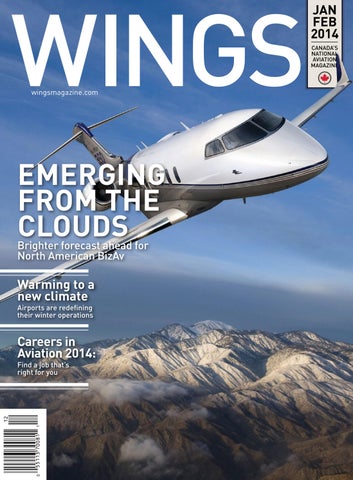
EmErgiNg From thE clouds
Brighter forecast ahead for North american Bizav
Warming to a new climate airports are redefining their winter operations
careers in Aviation 2014: Find a job that’s right for you
JAN FEB 2014 caNada’S NatIoNal avIatIoN maGazINe
Works well with others. King Air 350i. Flight departments everywhere are under pressure to deliver more for less. The King Air 350i lets you do just that, without compromise. Its unsurpassed versatility and payload, combined with class-leading range and efficiency, carries more people farther at lower cost than any other aircraft. More for less, or the ideal stable mate? How about both. For more info, contact: U.S. and the Americas +1.316.676.0800 EMEA +9714.433.1763 | Asia-Pacific +65.6423.0321 Visit us at Beechcraft.com. ©2013 Beechcraft Corporation. All rights reserved. Beechcraft and King Air are the registered trademarks of Beechcraft Corporation.
JANuArY/FEBruArY 2014
upFroNt 5 leading edge
The sky truly is the limit
8 on the fly
News and opinion
12 Waypoint
All in the family
14 Alternate approach
Ten years after aviation slowed
16 At the gate
Perfecting the information game
18 glidepath
a bevy of industry reports point to a stronger North american Bizav market in the next few years. P. 21.
Determining the correct identity
19 Women in aviation 20 Air surveillance
FEAturEs
BAcK
21 EmErgiNg From thE clouds
Showing them the way Would you be able to get out?
42 marketplace 46 on final
Reflecting on a successful 2013
Photo: Cessna (toP); aerion CorPoration (toP, left); aéroPort de QuébeC (bottoM, left)
From top: ten years after aviation slowed P. 14. Perfecting the information game P. 16.
New BizAv reports see better times ahead for North American markets By davId carr
C-1 cArEErs iN AviAtioN 2014
Education, training and job prospects continue to trend upwards in several key aviation and aerospace sectors By davId carr
25 NoW thAt’s ENtErtAiNmENt!
Airlines continue to search for ways to keep the masses content By Paul dIxoN
28 BuildiNg AN oNtArio poWErhousE Peterborough sets its sights on expanding its aerospace footprint By matt NIchollS
32 WArmiNg up to NEW climAtE Airports, operators are implementing new winter procedures, technologies By BrIaN duNN
Cover Photo: boMbardier
www.wingsMagazine.CoM
January/February 2014 | wings
3
Come to Explore
Safety and Quality in the Real World; Turning Theory into Best Practice
“ “
MARCH 31ST – APRIL 2ND 2014 Westin Bayshore Resort & Marina, Vancouver, BC, Canada
A valuable event and excellent platform to improve individual knowledge and exchange ideas. Stephan Koehler, AIR-TEC This is absolutely the best conference series that I have ever attended. Bill Rankin – Technical Fellow, Boeing
” ”
40 Sessions Exceptional value World-class speakers Outstanding networking Unprecedented training opportunities PLATINUM
GOLD
SILVER
BRONZE
PARTNERS IN SAFETY
Aviall
MEDIA
AMERICAN EXPRESS
Lenovo
Sponsors correct at time of publication
Don’t miss out w w w. c h c s a f e t y q u a l i t y s u m m i t . c o m
LEADING
EDGE
| By Matt Nicholls
the sky truly is the limit
Government commitments bode well for both space and aviation
W
Photo: Mda
hen David Emerson released his comprehensive analysis of the Canadian aerospace and space markets just prior to the Aerospace Industries Association of Canada’s (AIAC) annual conference in Montreal in December 2013, he made it infinitely clear industry and government must unite and make stronger commitments to ensure aerospace remains a centrepiece of Canada’s international trade agenda. Emerson was succinct in his speech during the conference’s opening session that aerospace needs to be recognized and treated as a national priority sector. “With big shifts in global economy, we are at risk of falling into a hole we can’t dig ourselves out of,” Emerson told some 350 aerospace professionals. “If you stand still, you go backwards. You ultimately have to run faster to stay in the same place.” Canada can ill afford to slip behind in the global race, especially when you consider that the Canadian aerospace industry generates more than $22 billion annually and employs some 160,000 Canadians at more than 700 aerospace companies from coastto-coast. Many of these companies are world leaders in technology, manufacturing and space development, as exemplified by Bombardier’s innovative CSeries, Boeing’s impressive composite leadership at its cuttingedge Winnipeg facility and MDA’s leading space-age satellites. Investing in the future and working to raise the nation’s aerospace profile should indeed be our paramount consideration. Emerson’s report targeted a number of critical growth areas on both the aviation and space sides of the equation, and 13 months later, it’s safe to say, things are moving in the right direction. As AIAC president
5
You are starting to see the elements of what the government sees as a very important industry. Jim Quick points out in his “On Final” column (see page 46), significant progress has been made on these and other fronts: • The 2013 federal budget set aside $1 billion over five years for the Strategic Aerospace and Defence Initiative (SADI) • A fund of $110 million was created for the Technology Demonstration Program, launched in September by Industry Minister James Moore • The budget also contained new initiatives to enhance supply chain development and a national research and technology collaboration network Progress has also been seen on the space side of the equation. While the loss of Steve MacLean as head of the Canadian Space Agency last February was a blow, his replacement, Canada’s former top soldier,
top dAtA Bursts… in this issue
1. More than 4,000: the number of aircraft sold by John hopkinson & Associates ltd. since 1979 (pg. 12). 2. $80 million: the estimated cost of an aerion supersonic business jet (pg. 14). 3. Quebec’s Jean lesage airport serves 10 airlines operating 350 flights a week (pg. 16). 4. $250 billion: the estimated value of bizav jet sales in north america by 2023 (pg. 21). 5. well over $30 million has been spent to improve Peterborough Municipal airport (pg. 28).
www.wingsMagazine.CoM
Walt Natynczyk, is eager to help drive the Canadian space program to new heights. In an effort to help make this a reality, Moore announced at the Aéro Montreal Aerospace Innovations conference in early December details of a comprehensive space policy to be revealed in early 2014. Moore announced that a new space advisory board comprising industry leaders and chaired by Natynczyk will be formed and the government will double its current support for its space technologies program to $20 million annually by 2015-16. In an exclusive interview with Wings after the announcement, the AIAC’s Quick noted it was simply the latest evidence that the Emerson report is “not sitting on the shelf and collecting dust” as Christian Paradis, minister of industry prior to Moore, vowed when it was released. “We worked with Industry Canada to ensure the government had everything they needed – recapitalization, tech demos we worked with Industry Canada to make sure government had everything they needed – recapitalization, tech demos, research collaboration, supply chain development . . . these are all things that will affect our global competitiveness in a very positive way,” Quick said. “When you put together what the minister announced today and with the funding for RCM, our renewed commitment to the International Space Station, you are starting to see the elements of what the government sees as a very important industry and one that needs to be supported. Kudos to Minister Moore and the Harper government for seeing this and responding,” Quick said. Given the ultra competitive nature of the global aerospace and space markets, and the number of established and up-and-coming aerospace nations joining the fray, it’s imperative commitment and collaboration continue between industry and government. Canada is not standing still when it comes to aerospace development – we’re running full out to remain a leader in the race for space. | W Your feedback is always welcome. Please contact me at mnicholls@annexweb.com. @Wings_Magazine January/February 2014 | wings
5
vol. 55, issue 1 Editor
Matt nicholls mnicholls@annexweb.com 416-725-5637 mEdiA dEsigNEr
gerry wiebe
Flight dEcK
Krista bulmer, david Carr, Paul dixon, brian dunn, frederick K. larkin, neil a. Macdougall, James Marasa, Carroll McCormick, rob seaman
SubScribe TODAY !
AccouNt mANAgEr
Jarah stefek jstefek@annexweb.com (519) 429-5183 ext. 219
1 Year SubScription only
3000
$
sAlEs AssistANt
stephanie defields sdefields@annexweb.com 1-888-599-2228 ext. 257
(GST $31.50 • HST $33.90) US $42.00 (USD) • Foreign $65.00 (USD)
Name: _______________________________ Company: ____________________________ Title: _________________________________ Address: _____________________________ City: _________________________________ Prov: ________________________________ P.Code: _______________________________ Tel: __________________________________ Fax: _________________________________ e-mail:________________________________
PLeASe cHecK ONe: ❑ Commercial aircraft owner/operator ❑ Business/private aircraft owner/operator ❑ Military ❑ Aircraft maintenance/overhaul firm ❑ Airport ❑ Aerospace, airframe & component manufacturer and distributor
❑ Fixed base operator ❑ Aviation services, consultants and aircraft sales ❑ Government ❑ Aviation associations and organizations ❑ Flying schools, clubs and colleges ❑ Other (please specify) ______________
PAYMeNT: Cheque - Payable to Annex Publishing & Printing Inc. Visa
MC
AMEX
Account #: __________________________
AssociAtE puBlishEr
weng ng wng@annexweb.com group puBlishEr
scott Jamieson sjamieson@annexweb.com prEsidENt
Mike fredericks mfredericks@annexweb.com WiNgs mAgAziNE
P.o. box 530, 105 donly dr. s., simcoe, on n3Y 4n5 tel.: 428-3471 fax: 429-3094 toll free: 1-888-599-2228
Publication Mail agreement #40065710 return undeliverable Canadian addresses to Circulation dept., P.o. box 530, simcoe, ont. n3Y 4n5 e-mail: subscribe@wingsmagazine.com Published six times per year (Jan/feb, Mar/apr, May/ Jun, Jul/aug, sep/oct, nov/dec) by annex Publishing & Printing inc. circulation e-mail: subscribe@wingsmagazine.com Ph: 866-790-6070 ext. 208 fax: 877-624-1940 Mail: P.o. box 530, simcoe, on n3Y 4n5 subscription rates Canada – 1 Year $ 30.00 (includes gst - #867172652rt0001) usa – 1 Year $ 42.00 foreign – 1 Year $ 65.00
occasionally, wings magazine will mail information on behalf of industry-related groups whose products and services we believe may be of interest to you. if you prefer not to receive this information, please contact our circulation department in any of the four ways listed above. no part of the editorial content of this publication may be reprinted without the publisher’s written permission. ©2014 annex Publishing & Printing inc. all rights reserved. opinions expressed in this magazine are not necessarily those of the editor or the publisher. no liability is assumed for errors or omissions. all advertising is subject to the publisher’s approval. such approval does not imply any endorsement of the products or services advertised. Publisher reserves the right to refuse advertising that does not meet the standards of the publication. Printed in Canada issn 0701-1369
Expiry:_____________________________
TO SubScribe:
Tel: 866-790-6070 Fax: 877-624-1940 Mail: Wings Magazine c/o Annex business Media P.O. box 530 Simcoe, Ontario N3Y 4N5
Air Transport Association of Canada
ON THE
WEB
e-mail: subscribe@wingsmagazine.com
www.wingsmagazine.com
GST#135274215RT001
6
Subscriptions non-refundable
PRO0114
wings | January/February 2014
wings subad.indd 1
Canadian Owners & Pilots Association
Canadian Business Aviation Association
Magazines Canada
cArEErs iN AviAtioN Looking for a great career in aviation and aerospace? Check out our Careers in Aviation micro site, a handy guide to help you better understand what a career in aviation is all about. Check out www.careersinaviation.ca for news, updated listings and more!
Photo: standardaero
Signature: _________________________
www.wingsMagazine.CoM 2014-01-07 11:19 AM
EXPERIENCE. MILLION AIR.
millionair.com
THE MILLION AIR LADIES, AT YOUR SERVICE. SINCE 1984.
UNITED STATES: Albany (KALB). Alexandria (KAEX). Anchorage (PANC). Burbank (KBUR) Dallas (KADS). Gulfport/Biloxi (GPT). Houston (KHOU). Indianapolis (IND). Lake Charles (KCWF) Medford (KMFR). Moses Lake (MWH). Orlando (SFB). Richmond (KRIC). Rome (RME) San Antonio (KSAT). St. Louis (KSUS). Stennis (KHSA). Tallahassee (TLH). Topeka (KFOE) Tucson (KTUS). Victorville (KVCV). White Plains (KHPN). Yuma (KNYL) CANADA: Calgary (CYYC). Toronto (CYKZ). Vancouver (CYVR). CARIBBEAN: San Juan (TJIG)
ON THE FLY For late-breaking news, the exclusive web content, please visit us at: www.wingsmagazine.com
8 thE lEAd 10 rEAdEr FEEdBAcK 11 pEoplE oN thE movE
very excited to introduce completely redesigned seating and cabin amenities that will offer Air Canada customers the very best in comfort and contemporary design,” said Smith.
WEstJEt coNJurEs up A piEcE oF disNEY Air cANAdA picKs tEl mAgic Aviv For 787 lAuNch thE lEAd
Air Canada will officially premiere its Boeing 787 Dreamliner on the TorontoTel Aviv route in July. As first reported in Wings in the November/ December 2013 issue, the first three 787s will be eased into the fleet, operating temporarily on domestic Rapidair and transatlantic services to London Heathrow and Zurich. This will enable pilots to build up flight time and the airline to accumulate the necessary hours for full Transport Canada Extended Range Twin Operations (ETOPS). Air Canada will require the maximum 180 minutes for operations across the Pacific. “The fuel-efficient Boeing 787 aircraft will open up opportunities for Air Canada to serve new international destinations, and convert existing routes to Dreamliner service, as we continue to renew our fleet and develop Toronto Pearson into a preferred North American gateway and truly global airline hub,” said Ben Smith, executive vice-president and chief commercial officer. Air Canada will provide three cabins of service on board the 787. “We are
The reviews are in. WestJet has a hit on its hands with a custom painted Boeing Next Generation 737-800 series aircraft featuring Mickey Mouse in his first starring role, Sorcerer Mickey from the 1940 Disney It took a team of 26 people 24 days working around classic, Fantasia. Nicknamed the Magic the clock to paint the magic Plane. Plane, the aircraft captured the spotlight with its first flight from Calgary to Orlando, Fla., home of Walt Disney World Resort in will be on the road for the next five years, December. receiving top billing throughout WestJet’s The two sides of the aircraft are mirror domestic, trans-border and international images of each other in all aspects but one. network. WestJet recently announced The airline is leaving it to its customers to scheduled service between St. John’s, Newfoundland and Dublin Ireland. decide what that is. The cookies the airline will serve on “With the Magic Plane, we are soaring to board are a special treat in the shape of new heights, offering guests of all ages the Disney characters, and are expected to dischance to share the skies with one of the appear shortly after wheels up. world’s most beloved and iconic figures,” said Gregg Saretsky, WestJet chief executive. “We also look forward to having fun Paint by numbers with our guests on the ground as they see • There are a total of 36 different paint the Magic Plane flying over their communicolours on the aircraft. ties and at airports across our expanding • It took a team of 26 people 24 days network.” working around the clock to paint the A joint partnership between WestJet, Magic Plane. WestJet Vacations and Walt Disney Parks • The painting crew consisted of people & Resorts (Canada), the Magic Plane from four countries, five states, two provinces and 12 cities. • Over the next five years, the Magic Plan will fly more than 400,000 guests a total of nearly eight million kilometres.
air canada's Boeing 787 dreamliner will premiere in July on the toronto-tel aviv route. 8
wings | January/February 2014
The U.S. Transportation Security Administration (TSA) pocketed more than half a million dollars in quarters, dimes, nickels and pennies last year. The windfall was the result of loose change being left behind in plastic security bins used to scan passengers’ belongings. Travellers passing through security failed to scoop up $531,395 as they retrieved belts, keys and laptops. Las Vegas was one of last year’s big winners, raking in a cool $26,900 jackpot and finishing second to Miami, which www.wingsMagazine.CoM
Photos: westJet (toP); air Canada (bottoM)
out oF sight, out oF miNd
pocketed $39,613. Atlanta Hartsfield, the world’s busiest airport, did not crack the top ten. The U.K. Daily Mail reports that the TSA usually pumps the extra cash into an “aviation security fund” to spend on airport security and signs translated into foreign languages for international travellers. That seems only fair. According to the Los Angeles Times, $32,000 came from foreign coins. A member of Congress would prefer to see the money go to rest and relaxation stations in airports for U.S. soldiers. A revised bill is being considered after it was realized that his first proposal would cost more than $1 million to implement. The Canadian Air Transport Security Agency (CATSA) does not provide similar data for Canada, although Ottawa International Airport is reporting higher than normal levels in left-behind Senate expense receipts. Cha-ching: Top five U.S airports for recovering lost change Miami $39,613 Las Vegas $26,900 Chicago $22,115 LAX $21,916 JFK $21,201
travellers passing through security in u.S. airports last year failed to pick up more than $530,000.
postal code as such aggressive nickel ’n’ dimers such as easyjet, Allegiant and Ryanair.
mFc iNstructor 2013 rEcipiENt oF dcAm sAFEtY AWArd Chris Walsh, an instructor with the Moncton Flight College, is the 2013 recipient of the prestigious David Charles Abramson Memorial Flight Instructor Award. Now more commonly referred to as the DCAM Safety Award, the honour
is given to a flight instructor who displays superior teaching and outstanding leadership qualities. Walsh was selected for his significant contribution to the development and management of Moncton Flight College’s approved training organization and the subsequent launch of the multi-crew licence. He has consistently demonstrated high levels of professionalism and commitment, and has an acute understanding of the complexities of operating a flighttraining unit in a safe and productive environment.
Photos: istoCK (toP); MiKe dorion (bottoM)
iNtroduciNg rYANAir North Are the market conditions in Canada ripe for a new deep discount startup? Three air transport veterans appear to think so. Jetlines, a Vancouver-based discount airline, could be coming to western Canada next fall. Jetlines’ business model would be patterned after Ryanair, the popular, Irish-based budget airline, whose chief executive, Michael O’Leary has raised ancillary and other charges to an air form. David Solloway, a founding partner told CBC News that the niche carrier would operate on under-served and non-served city pairs, beginning with routes west from Winnipeg. Jetlines claims that a lower cost structure and ancillary fees for reserving seats, inflight snacks and iPad rental (standard stuff, also charged on the legacies) will enable it to undercut fares charged by its competitors. Lower cost structure, perhaps. But Air Canada is one of the industry heavy-hitters in charging for extras, and WestJet is a quick study. The National Post reports that Jetlines expects to squeeze a further 18 per cent revenue per flight from ancillary charges. Impressive, yes, but hardly in the same www.wingsMagazine.CoM
Wayne Gouveia, atac’s vP commercial general aviation, vP prairie and northern (left), with dcam winner chris Walsh (centre), moncton Flight college’s director of flight training and manager of safety and quality and dcam legacy award winner orville hewitt, chief flight instructor with cooking lake aviation academy in alberta. January/February 2014 | wings
9
ON THE
FLY
The award was presented by Jane Abramson at the November Air Transport Association of Canada’s (ATAC) Annual General Meeting and Trade Show opening luncheon at Montreal’s Fairmont Queen Elizabeth Hotel. Also honoured that afternoon were Heather Philpott, assistant chief flight instructor at Gander Flight Training and Deanna Wiebe, assistant professor of aviation at Mount Royal University in Calgary. Orville Hewitt, chief flight instructor at Cooking Lake Aviation Academy in Cooking Lake, Alta., was the first recipient of the DCAM Legacy Award. The Legacy Award will only be handed out if the selection committee feels there is a suitable candidate. Hewitt was honoured for his work in creating a significant training and instruction history. The DCAM Safety Award is one of Canada’s top industry safety awards, recognizing excellence in the flight training profession. The award is
sponsored by Air Canada, ATAC, the Canadian Association of Aviation Colleges, Canadian Forces Snowbirds, Essential Turbines, Flight Safety Canada, Hamilton Watches, Helicopters magazine, Seneca College, Sennheiser Canada and Wings magazine. The award is on permanent display at the Canadian Aviation and Space Museum.
rEAdEr FEEdBAcK
WE gEt lEttErs: “Not so stEAlthY” Dear Matt Nicholls, Editor, Wings magazine: Boy oh boy, did Walter Heneghan get carried away like a kid in a candy store on his description of the F-35 (see “The F-35 Lightning II up close and personal,” page 28, Nov./Dec. 2013 issue). Stealth is mentioned no less than 10 times in the article. I have given several lectures on the F-35, and as noted by several prominent world
authorities on radar, that radar technology does not sit still, and any advantage that stealth may have had (F-35, 13 to 14 years in the making) is rapidly being eroded by new types of radar. With a new generation beyond visual range air-to-air missiles, the old fighter jock dogfight is becoming a thing of the past. With its limited range and single engine (two is always better than one) using the F-35 to patrol Canada’s sovereignty does not make much economic sense. It’s much more cost effective to use UAVs that can stay aloft for 24 hours and cover a greater area more effectively and economically. There’s no doubt, like Canada’s aging F-18, we will have to permanently hang drop tanks on the wings, and if we acquire the F-35, it will mean limited stealth. Canada has a history of purchasing the wrong aircraft to cover our huge airspace. Keith Hyde, Aviation historian
Setting a new standard in the industry.
Starter Generators
Blowers
Data Acquisition Units
Zenith Jet, Inc. is the exclusive Canadian representative for AMETEK Advanced Industries and AMETEK Power and Data Systems. We specialize in power generation and distribution, data concentration and indication, starter generators, motors, blowers, and actuators for the commercial and military aerospace marketplace. Ametek’s history dates back to the early days of aviation, providing the Oil Pressure Indicator on the Spirit of the St. Louis. Let us quote your project’s needs. Contact us: info@zenithjet.com
Actuators
AMPHION™ Power Distribution
Solid-state Relays
+1.514.273.3929 7575 Transcanada Hwy, Suite 610
www.zenithjet.com
10 wings | January/February 2014
St-Laurent, Quebec, H4T 1V6
www.wingsMagazine.CoM
pEoplE oN thE movE Bombardier Aerospace has picked Raymond Jones to head its CSeries sales team. Jones has been appointed senior vicepresident, sales, marketing and asset management for its commercial aircraft division. A certified commercial pilot and flying instructor, Jones spent 16 years in the U.K.’s Royal Air Force and holds a master’s degree in Air Transport Management from London’s City University. Jones was previously vice-president, Worldwide Strategic Accounts for Bombardier Business Aircraft, and has a track record of success, notably with large fleet operators. Bombardier has 419 orders and commitments from 16 customers for the new 110to 160-seat CSeries, including 177 firm orders. The company is targeting 300 firm orders from more than 20 customers when first deliveries begin in 2015.
Pierre Ayotte has been named chief executive of Mecachrome Canada, a Mirabel-based producer of assemblies and subassemblies for aerostructures. A mechanical engineering graduate and test flight engineer with more than 30 years’ experience in the aeronautic sector, Ayotte has been vicepresident and general manager of Mecachrome since 2009. Within the scope of his new functions, Ayotte will pursue the strategic, commercial and operational development of Mecachrome. Clive Beddoe, founder of WestJet, Lorna De Blicquy, flight instructor and
advocate for the role of women in aviation, Robert Engle, founder of Northwest Territorial Airways and Fred Moore, a military and civilian pilot and administrator responsible for improving air force aircraft acceptance standards and the use of weapons systems simulators, will be inducted into Canada’s Aviation Hall of Fame. “Our 2014 inductees come from backgrounds that span the width of Canada’s unique aviation industry,” said Tom Appleton, chair of the Wetaskiwin, Alberta-based Hall of Fame. “Our new inductees reflect that cohesion through their pioneering activities and spirit.” The induction ceremony will be held in May 2014.
Peak Awareness Confident, safe, secure with Universal Avionics TAWS A Terrain Awareness and Warning System that goes beyond the requirement, offering a unique display presentation that provides you with increased safety and the highest level of CFIT protection. Equip now for the upcoming CARs requirement. Contact your Authorized Universal Avionics dealer or visit uasc.com to learn more.
UNS-1Ew and TAWS 2MCU www.uasc.com sales@uasc.com (800) 321-5253 (520) 295-2300
www.wingsMagazine.CoM UASC_Wings_half pg_ Jan_Feb 2014_v02.indd 1
January/February 2014 11 12/13/13 1:51 PM | wings
WAYPOINT By Rob Seaman |
All in the family
John Hopkinson’s corporate footprint extends beyond Canada
J
12 wings | January/February 2014
practicality of the approach.
Because of the amount of They have sold more than 4,000 involved in airplanes and average, depending entertaining the sales business, they also have a company car on today’s economy, 50 to 70 operated by a major Calgary airplane sales annually. limousine company to level in the ’50s and ’60s. It added to John’s early flying work, building hours and aircraft ratings. At 16, Hopkinson obtained a student pilot permit. By 17, he was licensed private pilot and at 18, held a commercial rating. The firm also operated Beech 18s, Lockheed 12s, Aero Commanders, and Cessna 310s into the mid-’60s Today, he has some 8,500 hours of flying experience. John moved to Calgary in the late ’70s. “I felt that western Canada, and specifically Calgary and Edmonton, were ready because of the jet business, for a corporate aircraft sales opportunity. During the ’60s, when we had to demonstrate airplanes, we determined that there was more money and better sales success to be made by sitting in the back, pouring the drinks and getting the order signed versus flying the airplanes. Hopkinson offers clients the full business aviation experience when they execute sales. The firm employs a company jet to move clients around and make sales calls to non-major market locations. They do this in part to demonstrate the
move people about. Like he says, it’s about the full business aviation experience. The Hopkinson name in aviation will not be disappearing anytime soon. John’s sons Andrew and Keith are both an integral part of the firm and each holds a vice-president’s title. Andrew works with clients on acquisitions and sales of new and pre-owned aircraft. He also specializes in establishing flight departments and management company placement for their clients. Keith specializes in commercial, commuter and all turboprop aircraft. He also manages the overall “inventory” of aircraft, oversees maintenance schedules, movement, registration and refurbishment of the firm’s own fleet. Hopkinson today represents three generations of BizAv builders in Canada and around the world. It would seem that this family has got aviation in its genes, and by all accounts, plan on sticking around for a good many years to come. | W Rob Seaman is a Wings writer and columnist. www.wingsMagazine.CoM
Photo: John hoPKinson & assoCiates
ohn Hopkinson is a name recognized in the corporate aviation world and not just in Canada, but around the globe. Chairman and chief executive officer of the company that bears his name – John Hopkinson & Associates Ltd., formed in 1979 – Hopkinson has taken aircraft brokerage and grown it from an independent, one-man show through to its place today with offices and staff in Calgary and Scottsdale, Ariz. Today, the company employs 15 staff and four pilots. Since its inception, they have sold more than 4,000 airplanes and average, depending on today’s economy, 50 to 70 airplane sales annually. John’s Hopkinson’s corporate focus came somewhat naturally. Like many in the industry, he grew up with aviation in the family bloodline. The Hopkinsons’ fixed base operation and charter business was Sky Harbour Air Services in Goderich, Ont. According to John, “My father Keith started the business after the war. He was sent to Goderich as a flight instructor under the conscription program, and was the chief ground school instructor throughout the war. During the 1960s, we had a scheduled charter operation that used Cessna 195s. We were taking people from Goderich to the Toronto Island and Malton (now Pearson CYYZ) to conduct their business. It was a 45-minute flight in the morning with a return later in the afternoon.” That early form of BizAv was used by all the major industries in Goderich, including Champion Road Machinery, Sifto Salt, and Sheaffer Pen to name just a few. Champion used two Cessna 195s and a Beechcraft 18, which they sponsored financially, Hopkinson says. On a regular basis, he recalls bringing municipal council members from other areas to Goderich for one-day tours of the Champion plant, lunch, and hopefully acceptance of the product. “The success rate on these trips from a sales perspective was more than 90 per cent,” he says. Hopkinson also says that one of the first light corporate airplanes in Canada was a Cessna 182 owned by Sheaffer Pen and operated by Sky Harbour Air Services. Sky Harbour’s aircraft refinishing business made a mark on an international
UPDATE 2014 Airworthiness Symposium & Trade Show
Coast Plaza Hotel - Calgary, Alberta CANADA
MARCH 19-21, 2014
AIRWORTHINESS
symposium & trade show
Hosted by the Western Aircraft Maintenance Engineers Association & Recognized by Transport Canada
50+ Industry Trade Show Exhibitors Informative Seminars and Workshops for Fixed and Rotary Wing
Official Media Sponsors
In-Depth Mini-Courses Banquet and Max Ward Award For more information, including courses, registration and schedule, see
www.wamea.com
Phone: (780) 462-1173 Fax: (780) 413-0076 E-mail: info@wamea.com
ALTERNATE
APPROACH By David Carr|
ten years after aviation slowed Aerion Corporation is reviving interest in the supersonic jet model
M
14 wings | January/February 2014
Aerion estimated that orders for a SBJ would reach 400 inside the first 15 years of production. Development of the concept was stalled by the shockwaves of the 2008 global economic meltdown, and the company is testing the market with a new survey. Aerion does not intend to develop the airplane on its own, but will be looking at a joint venture with an established business jet manufacturer. A project of this magnitude may actually call for a partnership between two airframers. Aerion anticipates a six-year development program when the project is launched. A return to supersonic air travel appears at least technically viable, although regulators may be a hard bunch to convince when it comes to Mach plus flights overland, which is why Aerion is proposing to slow the airplane to just under Mach for the overland portion. Economics might be a tougher nut to crack. Aerion estimated the BST unit costs to be $80 million in 2007, a figure that could easily climb above $100 million before the first airplane is delivered. So while a new generation of supersonic transports is inevitable, the industry will not be catching up with Concorde anytime soon. | W
The business aviation sector will be the gateway for a new generation of supersonic transport. technology that could potentially reduce aircraft take-off noise. Integration of these various pieces, however, remains a moving target. Aerion is not the only company working on a supersonic business jet concept. But it is the only one to put that concept in the shop window at the 2013 National Business Aviation Association’s (NBAA) Convention and Exhibition in Las Vegas. Aerion updated industry watchers on the latest flight tests conducted with NASA to confirm manufacturing tolerance for a future supersonic business jet. Even so, it is unlikely that the first development SBJ aircraft will resemble the model currently shown on the box. Tougher International Civil Aviation Organization (ICAO) noise standards, expected to be in place by 2020, have already forced a rethink in the engine. Aerion is reported to be in discussions with GE Aviation over using Passport engines modified for supersonic flight. The Passport 20 will power the Bombardier Global 7000 and 8000 aircraft. Aerion is also considering a boost to the aircraft’s range that would put Tokyo in reach of Vancouver. In its last market survey 10 years ago,
David Carr is a Wings writer and columnist. www.wingsMagazine.CoM
Photo: aerion CorPoration
ore than 10 years have passed since the Concorde supersonic jet was withdrawn from revenue service and relegated to a museum piece. For the first time in history, air transport took a backward step – the Olympian-like motto of faster, further, higher crumbled, at least where speed was concerned. While aerospace companies like Boeing and Lockheed Martin are working to resolve the two big issues that dampened Concorde’s commercial prospects – sonic boom and the economics of supersonic flight – it is unlikely that air transport will pick up speed at a Concordian clip before 2030, at least on the airline side. What appears to be taking shape is that the business aviation sector will be the gateway for a new generation of supersonic transport. In 2002, one year prior to the withdrawal of Concorde from commercial service, Reno, Nevada-based Aerion Corporation was formed to reintroduce commercial supersonic flight using the development of the world’s first supersonic business jet (SBJ) as its business model. The initial pieces to build a supersonic aircraft that can transport up to 12 passengers from Toronto to London at a maximum cruise speed of Mach 1.6 in under five hours are in place. The Aerion SBJ could be powered by twin Pratt & Whitney JT8D-200 series engines, which were first introduced in the 1980s, and are in widespread use around the world. Aerion’s proprietary natural laminar flow wing is proven technology. The company has also pieced together patents for fuselage contours, inlets, engine expansion nozzles and other aerodynamic fixtures. Aerion is confident that with the right engine and airframe it can solve the sonic boom problem, with an airplane that has a “boomless” cruise speed of Mach 1.1 to 1.2, enough to fly under the ban on supersonic flights over land. It can also expect a lot of help along the way. The National Aeronautic and Space Administration (NASA) is looking for a private partner to build a business jet size “low boom” research aircraft to gather data, while the U.S. military is developing
THE DESTINATION FOR THE AIRCRAFT INTERIORS INDUSTRY. Aircraft Interiors Expo 2014 8-10 April 2014, Hamburg Messe, Germany
REGISTER YOUR INTEREST
www.aircraftinteriorsexpo.com/wingsjf Co-located with:
Organised by:
In co-operation with:
The world’s largest event for the aircraft interiors industry. Aircraft Interiors Expo is the launch pad for tomorrow’s designs, innovations and products for cabin interiors, inflight entertainment and passenger comfort.
Download the free event App App Sponsored by
World Travel Catering & Onboard Services 8 – 10 April 2014
Hamburg Messe , Germany
www.aircraftintriorsexpo.com/mobileapp
AT THE
GATE
By Brian Dunn |
perfecting the information game Air traffic data streams are under control at Jean Lesage International
Q
16 wings | January/February 2014
capabilities,” explained Dominique El Bez, director of messaging and mobility solutions line at SITA. “The cost consists of a monthly service fee and a small setup fee and pay as you go fee. There is no up-front investment or development costs.” The cost savings are realized by eliminating complex technology to access information and by simplifying the way data is recorded. One area where the service is beneficial is helping passengers with reduced mobility when they deplane. “It is important staff are aware when passengers need help on the ground. I’ve seen glitches when the staff are not aware because they don’t have the right information or no information at all,” noted El Bez. SITA Community Messaging handles more than 30 billion operational messages per year through more than 2,400 organizations within the air transport community. The service’s unique presence at airports worldwide gives it unprecedented access to operational data from the vast majority of airlines, airports and ground-handlers. | W
Effective use of data is most apparent during times of disruption such as inclement weather. inclement weather when an airport can make decisions that take into account all factors as it relocates things like manpower, equipment and gates. A three-month trial at the Quebec airport demonstrated the efficiencies of the system, which prevents delays and errors through manual processing. It also prevents the airport having to develop and maintain expensive and complicated in-house messaging interfaces, according to Rukmini Glanard. In addition to the benefits it brings to overall operations, the service has also been shown to improve the accuracy it brings to the airport’s reporting and billing processes, he added. Quebec’s airport serves 10 airlines operating 350 flights a week to 54 destinations. The airport will receive about 400,000 messages in a single year in a variety of daily operations and decisions. The airport became the launch customer for the system because it already had an airport management system from SITA and the data transformation service ties into it. “The data system is designed for smalland medium-size airports, because larger airports tend to have more in-house IT
Brian Dunn is a Wings writer and columnist. www.wingsMagazine.CoM
Photo: aéroPort de QuébeC
uebec City’s Jean Lesage International Airport holds the distinction of becoming the first airport in the world to implement a data transformation service. The service allows the airport to have data from multiple airlines seamlessly incorporated into its airport management system. The new community messaging service is provided by SITA, which bills itself as the world’s leading specialist in air transport communications and information technology. It allows the airport to automatically process information directly from all the airlines’ operational messages for use in airport resource planning and allocation. Actual arrival and departure times, passenger counts and load figures from Movement and Load/Distribution messages are now all seamlessly incorporated using XML into SITA’s Airport Management System. XML (Extensible Markup Language) is a markup language that defines a set of rules for encoding documents in a format that is both humanreadable and machine-readable. “A huge volume of data is available to airports from the airlines, but traditionally it is tied up in a complex and un-harmonized system of formats and applications,” explained Marc-André Bédard, manager of strategic planning at Jean Lesage airport. “By using SITA’s next generation messaging service, we can take the various feeds from the airlines that fly to Quebec Airport and have them in modern XML format. The information then flows easily into our management systems for immediate processing.” Bédard said the airport needs the information about actual flight times, loads, and flight delays to allow it to allocate facilities, resources and services in the most effective way. The information can be used in a number of ways. For example, if an airport or ground handler knows an arriving flight has a large number of passengers and load, it can allocate more resources to manage the aircraft and divert staff and equipment from flights that require less support. Effective use of data is most apparent during times of disruption such as
GLIDE
PATH
By Paul Dixon |
determining the correct identity The Canadian government needs a clearer procurement vision
I
18 wings | January/February 2014
In the 1960s, as the Cold War intensified, we maintained a commitment in Europe while honing our navy into the best sub-hunters in the world. Taking a helicopter the size of the Sea King to sea on small escort ships gave these units the ability to punch well above their weight class. In the 1990s, we decided to join the warrior class and sent our troops into Iraq and a mission in Bosnia that was anything but peaceful. Then we moved into Afghanistan and now we’ve come home from Afghanistan. The army got much of the equipment it needed to meet its mission objectives and the air force got the transport aircraft required to support it. Now, we find ourselves needing a number of new platforms for the RCAF and are just about to get underway on a massive building project to re-invigorate the navy. But the truth is, we are being held back by a lack of vision from our elected leaders – and that’s vision, not sloganeering. We desperately need courage from the leaders of our pack. If Canada is to be able to chart its own course in the world, then what will that course be? We’d better figure it out, to see if we really are capable of being taken seriously. | W
The truth is, we are being held back by a lack of vision from our elected leaders. creating the RCAF out of virtually nothing, Croil was pushed aside by the federal government. The RCAF and Canadian airmen went on to distinguish themselves in every theatre of operations. Once again, in 1945 the volunteer soldiers, sailors and airmen wanted to doff their uniforms and get back to civilian life as quickly as possible. The tension in Europe that grew into the Cold War saw Canada take a significant role in NATO, especially with the RCAF. In the 1950s, the introduction of Canadian peacekeepers into Egypt under a plan formulated by Lester Pearson gave Canada a high profile and gave us a leadership role in an increasingly fragmented world for the next four decades. If Pearson’s Nobel Peace Prize was a high point for Canada, the ’50s also featured what for many was the absolute low point of Canada’s identity question, when John Diefenbaker cancelled the Avro Arrow project and left us like Marlon Brando’s character in On The Waterfront, wailing that “we could have been a contender, we could have been a somebody.” It’s a moot point and we’ll never know what may have happened.
Paul Dixon is freelance writer and photojournalist living in Vancouver. www.wingsMagazine.CoM
Photo: Paul dixon
n 2017, which isn’t that far off, Canada will celebrate its 150th birthday. Some key procurement questions remain before the birthday celebration takes place. Will we have chosen the replacement for the CF-18 Hornet by then? How about a replacement for the aging Sea Kings? There’s an old saying about how any road will take you there when you don’t know where you’re headed – and it appears that’s very much the situation here in Canada. We don’t know exactly where we’re headed or even where we think we might want to go. When it comes to the military, Canadians and our federal government have always had an awkward relationship. It’s not that we don’t value what an army, navy or air force is all about, as our willingness to volunteer in times of need has overwhelmingly been demonstrated. We don’t have a history as a warrior nation; that is, we haven’t made it a practice to impose ourselves on our neighbours or go halfway around the world looking for a fight. When needs predicate, Canadians are amongst the first to answer the call. Part of our situation has been the challenge of establishing and maintaining a Canadian identity both at home and around the world. The apron strings that bound us to Great Britain have taken a long time to untie and now there are those who would believe that the other end of those same apron strings is tied to the United States. What we really want, however, is to be known for who we are, not for who our grandparents were or who we live next door to. In the First World War, Canadians were integrated into the British army until Arthur Currie insisted his four Canadian Divisions fight as Canadians at Vimy Ridge, now seen as a defining moment in Canadian history. Not so well known is the struggle that Prime Minster Robert Borden mounted to get Canada and other Commonwealth countries involved in the proceedings at Versailles through 1919. In 1939, Canadians were barely better prepared than in 1914, though the Royal Canadian Air Force (RCAF) had been established largely through the efforts of Air Marshal George Croil. In recognition of his perseverance and the effort he had put into
WOmEN IN
AVIATION | By Anna Pangrazzi
showing them the way
A dedicated, patient educator, Liz Wieben led by example
Photo: elsie MaCgill northern lights award
A
s a wife, mother and grandmother with a career in aviation that spans more than 50 years, it’s not farfetched to use the word “remarkable” when describing Thunder Bay native Liz Wieben. Wieben’s journey in aviation began at a time when there were few women in the workplace let alone flying in the bush. She worked in an era when a woman’s pregnancy meant it was time to retire. Wieben has witnessed significant change in so many realms and has always been at the forefront of those changes. This past fall, she received the Elsie MacGill Northern Lights award for education for her contributions to aviation. As a professor at Thunder Bay’s Confederation College from 1986 to 2005, Wieben was an outstanding role model to many young women in the flight program. This was after a lifetime of flying. Wieben shared with Wings her insights about working in male-dominated field. Q.: You started flying at 11 and by high school, it had become your passion. How did that happen? A.: I was born into an aviation family. My father, Orville Wieben, was a test pilot on the Hell Divers and Hurricanes at the Canada Car and Foundry in Thunder Bay during World War II. After the war, he started Superior Airways Ltd. and the whole family worked in the business. All my siblings were pilots at some point. I flew with my brother, Don, all over northwestern Ontario and although I was airsick most of the time, by high school the word was out . . . don’t try dating her, she’s only interested in flying! Q.: You solo’d at 16, became a licenced pilot at 17, a commercial pilot at 18 and an instructor at 19. What kind of challenges did you encounter? A.: I started in the aviation business when it was legal for companies and the government to say, “We don’t hire women,” and there was no recourse . . . that closed the doors to the airlines, ATC and the military. As long as I was in the family business, however, my job was protected but that didn’t prevent passengers from refusing to fly with me, or the poor treatment I encountered away from base. When I married my husband, Robin www.wingsMagazine.CoM
had known other women pilots. At the time, I wasn’t even aware that women flew in World War II. My father was a big mentor and actively promoted my flying. Even my mother supported me, although she was afraid for my well-being. And there were some fellows who helped me along the way. There was one guy in the U.S. who helped me get hired on a DC-3, cloud seeding, and another guy, Frank Bayne, a retired army helicopter pilot, who gave me a chance at Confederation College. In the mid-’80s, I received a substantial Amelia Earhart Scholarship from the 99’s and would never have gotten an ATP without their help. Q.: How do we get more women interested in aviation? A.: I think the College Flight Program helped a lot in increasing the number of women flying. I can vividly remember the night I thought that things are really changing. There were four women pilots in the circuit and myself with a female student. An Air Canada plane came in and the pilot commented, “what’s going on here? You guys got the women’s Air Force out? I think the new crop of women pilots should try to be more visible role models by talking with younger women about their work. Being a role model can be a very powerful tool. We also need to do a better job with daycare. Q.: What advice would you give a young woman pursuing a career in aviation? A.: Get the best aviation education you can get at an aviation college and get to know some women who have been in the industry for a long time. It can really help your confidence to have those positive influences. I also think it is important to choose a supportive mate. | W
By high school the word was out . . . don’t try dating her, she’s only interested in flying! Webster, we moved to Australia, back to Canada and to the U.S. before finally settling in Thunder Bay. During that period, we had four kids and I encountered many challenges. I was constantly being tested everywhere I went and even though legislation was changing, attitudes about employing women were not. Q.: You are a small woman. Were there other challenges flying in the bush? A.: When we finally settled back in Thunder Bay, Robin and I started our own air charter business called Wiebenair Ltd. My longest stint flying in the bush was in a DHC-2 Beaver on the shores of Lake Superior and I faced all the challenges other pilots face such as advection fog, big waves and long days of heavy physical work. I also had to watch out for my own personal safety in some of the remote areas we flew. Then there were the comments about my height: “Sure, they send a woman, but why such a little one?!” As our children grew up, we thought it was important that at least one of us try to be around, so I eventually took a job teaching at Confederation College. Q.: Who has influenced your career? Did you have any mentors? A.: It would have helped greatly if I
Anna Pangrazzi is a Wings writer and columnist. January/February 2014 | wings 19
AIR
SURVEILLANCE By Kathy Fox |
Would you be able to get out? Egress training is a must for all floatplane crews
O
20 wings | January/February 2014
my own fears about being trapped in a submerged aircraft by taking underwater egress training. The one-day course cost a few hundred dollars – roughly the equivalent of two to three hours of rental flying at my local flying club. First, there was a classroom session covering the basics of flotation devices and other water survival equipment, as well as practical egress techniques. I maintain that learning (and practising) how to remain calm, retrieve (or preferably wear) a suitable PFD and take the right steps to locate the nearest usable exit prior to releasing the seatbelt, significantly enhances my chances of survival if the unthinkable happens. As a pilot and a member of an organization dedicated to advancing safety, that’s a recommendation I can endorse – both personally and professionally. | W
In just one region, the Vancouver Harbour, there are some 33,000 floatplane movements a year, carrying roughly 300,000 passengers. floatplane crews be required to take underwater egress training. Here’s why. In an emergency, you have only seconds to orient yourself and get out of that aircraft. Underwater egress training can make a real difference, and pilots who have this training stand a better chance of getting out of a submerged plane. In fact, following the TSB’s investigation into a 2009 Beaver accident in Lyall Harbour, B.C., in which the pilot and one passenger survived while six other passengers drowned, the TSB’s final report stated, “It is likely that the pilot’s recent egress training contributed to him being able to open the door and escape from the aircraft.” As a member of the TSB since 2007, I have reviewed many accident investigation reports over the years. I have also travelled a number of times on commercial floatplanes, and, as a pilot, I regularly take off and land over water at my home airport. In 2002, I decided to confront
Kathy Fox has been a member of the TSB since 2007. The TSB is an independent agency that investigates marine, pipeline, railway and aviation transportation occurrences. www.wingsMagazine.CoM
Photo: transPortation safetY board of Canada
n May 25, 2012, a commercially operated de Havilland Beaver floatplane crashed into Lillabelle Lake in northern Ontario. There were three people on board. And although the initial impact was survivable, only one person made it out of the wreckage. The other two, including the pilot, were trapped upside down in the submerged floatplane and drowned. Commercial seaplanes – floatplanes – operate all over Canada because they can go places other aircraft cannot. Whether they are used as air taxis to ferry wilderness travellers in and out of remote lakes or to get commuters to work every morning, they are a valuable part of Canada’s transportation network. Just how valuable are they? In one region alone, the Vancouver Harbour, there are some 33,000 floatplane movements a year, carrying roughly 300,000 passengers. But when trouble strikes, the very thing that makes floatplanes unique also makes them vulnerable. Too many times over the past decades, the Transportation Safety Board of Canada (TSB) has investigated accidents involving floatplanes only to find the same risks appearing time and again, which can be summed up this way: If you don’t get out, you will drown; and even if you do get out, without personal flotation, you might still drown. The numbers are shocking. According to a 1994 safety study conducted by the TSB, roughly 70 per cent of the fatalities involving aircraft that crash and are submerged in water are from drowning. The fatalities are not from the crash or from the impact, but because people are unable to get out. Or if they do get out, it’s because they’re too exhausted or injured to stay afloat. This is why, in 2011, the TSB recommended that Transport Canada require that all new and existing commercial seaplanes be fitted with regular and emergency exits that allow rapid egress following a survivable collision with water, and that personal flotation devices be worn by all occupants. Then, at the conclusion of the recent Lillabelle Lake investigation, the TSB went even further and recommended that all commercial
a honeywell report says NetJet’s large order of 225 aircraft from Bombardier and cessna last year boosted backlog figures.
EmERGING FROm THE CLOUDS
NEW BizAv rEports sEE BEttEr timEs AhEAd For North AmEricAN mArKEts
BY dAvid cArr
Photo: Cessna
A
fter years of somewhat sluggish activity, there’s some very encouraging news for the Canadian business aviation sector according to some recently released business aviation market reports. According to the latest Honeywell annual Business Aviation Outlook released during the 2013 National Business Aviation Association’s annual convention in Las Vegas, business jet deliveries are expected to regain some traction this year after dipping slightly in 2013 because of delays in several aircraft development programs. “2014 industry deliveries are anticipated to be up modestly, reflecting recovery in supply-side constraints and some gains linked to the projected pace of global economic recovery,” said Rob Wilson, president of Honeywell Business and General Aviation. A www.wingsMagazine.CoM
recent Bombardier forecast aligns with the Honeywell report for 2014 and predicts that the industry will surpass its prior delivery peak year of 2008 by as early as 2016. Swedish-based Avinode, an aviation business intelligence leader, also predicted positive news for North American BizAv markets in 2014, targeting a .7 per cent increase in traffic.
leading the pack Over the longer term, Honeywell sees four to five per cent average annual industry growth over the next decade, with the North American market pulling the global industry out of the doldrums, at least for the next five years, although not before 2015, and possibly not at all if a strong global economic rebound fuels growth in other regions. January/February 2014 | wings 21
Results in the Honeywell report dovetail nicely with those shared by Bombardier. According to the Montreal-based OEM’s forecast, “North America will receive the greatest number of new business jet deliveries between 2013 and 2032.” During the next five years, roughly 61 per cent of projected demand for new business jets will come from North Amer-
market” has seen new jet purchase plan levels improve by about three points, although short-term conversion plans could be moderate for at least the next year. Breakout figures for 2013 are unavailable, but the Canadian market accepted six per cent of North American deliveries in 2012, and the Canadian business aviation sector has almost doubled its fleet in
Holding back the North American sector have been deferrals of investment in new and more fuel-efficient models. ican operators, up eight points from the 2012 survey. Latin America is expected to account for 18 per cent, while Europe will account for 12 per cent. Despite strong growth in business aviation in certain emerging markets, Asia Pacific and Middle East/Africa appear to have gone cold and will account for only five per cent or less of the projected demand each. Holding back the North American sector have been deferrals of investment in new and more fuel-efficient models. The average age of a business jet in North America is approximately 17 years. Honeywell reports that the industry’s “mainstay
22 wings | January/February 2014
the past 10 years. “North America represents more than half of projected global demand for the next five years based on the region’s historically dominant installed business jet base, affirming the region’s indisputable important to the industry’s future,” the report noted. The North American market also has the most balanced preference for various business jet types. Large-cabin and longrange jets will account for 50 per cent of all aircraft delivered. Small cabin aircraft will make up 29 per cent of orders, the largest share of any region.
White hot options Up to 9,250 deliveries of new business jets, valued at more than $250 billion are expected until 2023. However, it is not the number of units sold, which is down 750 aircraft in a year-over-year comparison, but the dollar value of the purchase orders, which is up four per cent because of inflation and a shift toward larger cabins and extended range. “The trend toward larger-cabin with ever-increasing range expectations and advanced avionics is seen more strongly than ever in this year’s survey,” said Wilson. Indeed, range followed by bigger cabin topped out the Honeywell survey for new jet models in all five regions (North America, Europe, Latin America, Asia, and the Middle East and Africa). And that’s good news for Bombardier, which excels in both range and cabin. The Canadian airframer, however, appears to have its work cut out for it in the longer term with high-growth China, a ripe market for long-range airplanes where appeal by brand seems to have slipped under the Honeywell radar, because China’s airplane of choice remains Gulfstream. Bombardier currently has more than 100 business jets in the Greater China Region, and recently announced it will
www.wingsMagazine.CoM
In mature markets such as canada and the united States, the globalization of trade, fleet renewal and new aircraft programs will continue to set the pace for future growth.
open a commercial and business aviation maintenance, repair, and overhaul facility in Tianjin, China in 2016. Over the next 10 years, big cabin, which is defined as super midsize through business liner classes will account for 56 per cent of every airplane sold, and an eyepopping 83 per cent of revenue.
Key elements that drive growth Growth in business jet acquisitions is being pinned on a series of drivers. Wealth creation is certainly fuelling demand in emerging markets such as the BRIC economies, although the results here are somewhat mixed. In China, high wealth creation and global business growth are also coaxing out first-time buyers, compared with Russia, where weak purchase expectation forecasts in the latest Honeywell survey are a drag on Europe and where growth has slowed over the near term and is expected to continue. “Worldwide demand for business jets is highly correlated with wealth creation,” said Bombardier in its business jet market analysis.
In mature markets such as Canada and the United States, the globalization of trade, fleet renewal and new aircraft programs will continue to set the pace for future growth, the Bombardier report notes. The availability of more capable aircraft creates demand for replacement aircraft and entices first-time buyers to enter the market. New arrivals for 2014 include Bombardier’s Challenger 350 and Learjet
85, the new Citation Sovereign, Dassault Falcon 2000 LXS and Embraer Legacy 500. A key indicator of fleet renewal is the hardening of the pre-owned market. Honeywell sees a slight uptick in this sector, but performance is still far below what it was five years ago. “The number of preowned jets for sale today has risen slightly from a year ago. Approximately 12.5 per
Photo: gulfstreaM
• Maintenance • Engineering • Modifications • Repair & Overhaul • Fleet Management • Flight Operations
Expert, quality service since 1970
www.wingsMagazine.CoM
flightcraft.ca January/February 2014 | wings 23
aBove: embraer’s legacy 500 is expected to make its entry into the business aviation market this year. rIGht: Bombardier’s challenger 350 sports a range of 3,200 nautical miles at a cruising speed of mach .80 while carrying eight passengers.
24 wings | January/February 2014
long-term prospects attractive,” Honeywell’s Wilson said. “Other factors we believe will help accelerate global business aviation growth are long overdue structural and regulatory reforms, which have the potential to unlock significant spending power that would propel aviation expansion. New products also increase demand.”
Benefits to canadian manufacturing Bombardier has the broadest mix of business jets in the industry, and is well positioned to capture a leading share of orders going forward, which bodes well for the broader Canadian aerospace manufacturing sector, including engines, landing gear and avionics. “Bombardier’s greatest opportunities come from its leading business jet position,” according to the Teal Group, a Fairfax, Virginiabased aerospace and defense consulting firm. “Bombardier has extremely strong backlogs for its Global, Challenger and Learjet lines. Bombardier also has a number of relatively new business jet products.”
customer challenges on the horizon The business jet sector faces stiff challenges identical to those experienced by the airline industry, including soaring fuel prices, which some analysts predict could top $140 a barrel by 2020, and increased environmental regulation, which could impact the long-range segment, especially when flying to destinations within the European Union. Both challenges could potentially drive the aircraft replacement market. The Honeywell survey identifies other operator concerns, including the regulatory environment (particularly duty cycles, time-of-day use restrictions), air traffic modernization efforts, and user fees and tax laws, that have the potential to dampen demand over the long term. For now at least, economic growth will trump other concerns, and demand for business jets is on the rise. | W
For more on business aviation trends, visit www.wingsmagazine.com www.wingsMagazine.CoM
Photos: eMbraer (toP); boMbardier (bottoM)
cent of today’s fleet is up for resale, down from a high of nearly 16 per cent reached in 2009.” Accessibility through fractional ownership and charter operations will continue to impact flight activity but has not yet bolstered the order book, according to Honeywell. But this could certainly change. “Flight activity for charter-like operations and fractional ownership appears to be doing relatively well in the U.S. but not translating into many new aircraft deliveries yet. Fractional operators have taken only 20 new jets this year. NetJet’s large order of 225 aircraft from Bombardier and Cessna last year boosted backlog figures, and additional orders should impact delivery performance favourably beginning in 2014.” After a sluggish five years where orders actually shrank, Bombardier estimates that fractional operators will account for 10 per cent of deliveries over the next 20 years. Demand from existing fractional operators comes mainly from fleet replacement. Demand for incremental airplanes will come from markets where fractional ownership is just being introduced. China launched its first fractional ownership service in 2013. “We continue to see underlying macrotrends that support potential demand for business jets, making the industry’s
CAREERS IN AVIATION 2014 www.careersinaviation.ca
Education, training and job prospects in Canada's aviation and aerospace sector
Careers in Aviation Cover to Come
PrEParing for an ExCiting aviation CarEEr www.wingsmagazine.com
January/February 2014 | wings C1
Let your career take flight Train at the Waterloo-Wellington Flight Centre, one of the largest flight schools in Canada. With over 80 years of pilot training behind us you’ll learn to fly with the experts while making your dream of flying a reality. Choose from five professional flight training programs, access a diverse fleet of aircraft, and graduate as a leader in aviation ready to work coast-to-coast in the industry. With academic partners at two leading postsecondary institutions an aviation degree or diploma gives you the edge you need to stand out in the aviation industry.
General Arts & Science - Two-year diploma Graduate from the fixed wing program with a General Arts & Science diploma from Conestoga College and the pilot training to undertake the Transport Canada commercial licence testing. A rotary-wing option is also available. conestogac.on.ca
Geography & Aviation - Four-year degree Science & Aviation - Four-year degree Graduate with a Commercial Pilot Licence, multiengine instrument rating, and either a Bachelor of Science or a Bachelor of Environmental Studies degree from the University of Waterloo. uwaterloo.ca/aviation
Get your career off the ground today wwfc.ca/professional
WWFC Professional programs are approved as vocational programs under the Private Career Colleges Act, 2005 (PC#105919)
CAREERS IN AVIATION 2014
EducAtioN, trAiNiNg ANd JoB prospEcts coNtiNuE to trENd upWArds iN sEvErAl KEY AviAtioN ANd AErospAcE sEctors BY dAvid cArr
Photo: bCit
t
hinking about landing a well paying job in a high-tech industry? Consider a career in aviation and aerospace. Canada is one of the world’s leading aerospace nations. According to the Aerospace Industries Association of Canada (AIAC), Canada’s aerospace manufacturing sector is ranked fifth among the Organization for Economic Co-operation and Development countries, and first in terms of relative importance to the manufacturing economy. In addition, Canada has a strong air transport industry, including the awardwinning Air Canada, one of the world’s 20 largest airlines, busy international airports such as Toronto’s Pearson and Vancouver International – both ranked in the global top 50 – and a thriving business aviation sector. Aviation and aerospace is a diverse industry with a common challenge: from the cockpit to research and development (R&D), to the shop floor, the industry needs to constantly replenish skills to stay ahead in an increasingly competitive global environment. What does this mean to the student www.wingsMagazine.CoM
considering a career in aviation? As Wings Careers in Aviation 2014 reports: • The North American airline industry will need 69,000 new pilots by 2030, or 3,450 per year, including approximately 350 new pilots per year in Canada. • Flight school may no longer be enough to secure a job flying, and should be linked with a college degree or university diploma. • More than two-thirds of the total aerospace industry is qualified as skilled labour. The average salary for all employees in aerospace manufacturing is about $63,000, while the average across all manufacturing sectors is $51,000. • There are opportunities across the country, including design, assembly and integration of aircraft and engines in central Canada; parts manufacturing in Atlantic Canada; and maintenance, repair and overhaul (MRO) in the west. According to Transport Canada, there are more than 800 on-demand aviation service providers in Canada. The AIAC estimates that more than 400 aerospace
firms employ more than 80,000 Canadians. This adds up to strong demand for hundreds of thousands of skilled professionals to keep aircraft flying and maintain Canada’s position as a lead manufacturer and exporter of airplanes, aero engines, landing gear, avionics and flight simulators, and as a top provider of higher-end and more sophisticated MRO services. Wings Careers in Aviation 2014, is your one-stop resource to launching a rewarding career in aviation. It contains brief descriptions of several leading aviation and aerospace sectors, as well as valuable information on education and training. The listings are intended as an introductory snapshot of the types of flight schools, and college and university courses, that are available; they do not reflect every option out there. More information can be found on the Wings Careers in Aviation micro site (www.careersinaviation.com). In addition to the 2014 Careers in Aviation supplement, Wings and Helicopters magazines will be following up on last year’s successful 2013 Careers in Aviation Expo in Toronto, with three career expos in Toronto, Calgary and Vancouver. | W January/February 2014 | wings C3
B
oeing estimates that the world’s total airliner fleet will have more than doubled to 39,500 aircraft by 2030 – an increase of more than 3,000 airplanes in North America alone. This represents a lot of empty cockpit seats without an accelerated push to train more pilots. And it’s all within the early career span of students graduating from high school this year. At the same time, the industry is seeing an increase in the number of experienced pilots retiring from the cockpit. The Montreal-based International Air Transport Association (IATA) estimates that the North American airline industry will need 69,000 new pilots by 2030, or 3,450 per year. The airline industry is very cyclical and there will be at least one downturn in the next 17 years, which will slow demand for new recruits. The industry also tends to roar back from every slump and is very quick to recapture lost growth, which means, on average, the Canadian airline industry will need approximately 350 new pilots every year C4 wings | January/February 2014
until at least 2030. With the military no longer the primary source for new pilots it once was, it will be left to Canada’s flight schools to plug potential gaps. And here is where the tightening of the market for new pilots takes its toll. Airlines are only one piece of the Canadian aviation industry, albeit a significant piece. In addition to large carriers such as Air Canada, WestJet and Air Transat, Transport Canada estimates there are more than 800 on-demand aviation service providers such as the lucrative business aviation sector, where aircraft are every bit as sophisticated as the larger airplanes flown by the majors, helicopter operators (see Helicopter Pilot on the page opposite) and instructors, which is another sector where the IATA identifies a looming shortage. It adds up to a lot of career and lifestyle options for licensed commercial pilots in Canada, especially now when younger generations have been shown to have a decreasing interest in aviation. Still, aviation is a highly technical and safety-driven industry that will continue
to put experience and the right skills first. It takes, for example, up to five years training to earn an entry-level position flying commercially. Most airlines are also looking for more than just a pilot’s licence in their hires, which means that recruits should think about a university degree or aviation college diploma program in addition to flight school. Aviation also runs on a “pay your dues” culture. Most pilots work toward the 1,500 hours flying time necessary for an Airline Transport Pilot Licence, which means there is a lot of time to fill from the less than 200 hours that the average flying school student graduates with. Entry-level jobs at this stage would include flight instructor, air taxi pilot or general aviation pilot as potential hires build up flight time. Aviation is the only source of yearround access for many northern communities. As Canada’s resource-rich North continues to develop, students can also expect northern-based passenger and freight carriers will be aggressively recruiting larger numbers of pilots. | W www.wingsMagazine.CoM
Photo: westJet
FLIGHT OPERATIONS – PILOT
HELICOPTER PILOT
W
especially for pilots flying out of camps in the Canadian North. Even with these hardships, helicopter pilots are less likely to swap the “hands-on” flying for a fixedwing airplane, where most began their flying career. They thrive on the unpredictability of the industry and learning how to put machines down on unprepared sites in poor visibility. As such, operators are looking for pilots who are quick studies and can make on-the-spot decisions. Many flight schools have commercial businesses such as tour operations that
help students to build up flight time and gain more experience. Some hire instructors from within. Entry-level positions such as flight instructor or first officer in a two-crew operation often require 175 to 200 hours flying time. Students are also advised to spend their time in flight school networking with industry veterans to get the “inside scoop” on where the jobs are. Some of the higher paid jobs available to the skilled helicopter pilot include exploration missions for oil and mining companies, transporting workers and cargo in and out of remote communities, providing heavy lift support such as helilogging and aerial construction, dropping skiers on the side of a mountain, and fire suppression. Like the fixed-wing sector, Canada’s helicopter industry is facing a looming pilot shortage, especially at the high end, where percentage wise, experienced pilots are retiring at a higher clip than their fixed-wing counterparts. It means real opportunities for ambitious and resourceful graduates who can build up the hours. | W
Photos: dnd (toP); Matt niCholls (bottoM)
ith an estimated number of approximately 1,700 registered rotary-wing aircraft, Canada has the second largest fleet of helicopters in the world. The backbone of the sector remains resource-based, although opportunities in the executive sector market are opening up as demand grows at resource company flight departments and in major urban centres. Competition for experienced helicopter pilots in Canada is fierce although students need to be aware that it is a gradual climb from the 100 flying hours most will rack up at flight school and the 1,000-plus hours many operators are on the hunt for. There are a lot of operators who will hire lower-time pilots, but are also looking for individuals who can bring more than just flying skills to the company. Career-minded rotor rookies bridging the “900-hour gap” are likely to travel great distances for short-term jobs, low pay and long stints away from home,
www.wingsMagazine.CoM
January/February 2014 | wings C5
FLYING HIGH: STRATEGIES WHEN PICkING A FLIGHT SCHOOL
C6 wings | January/February 2014
Canadian Business Aviation Association (CBAA) and Helicopter Association of Canada (HAC) are also excellent resources for information on education, training and job prospects. Once your list of schools has been made, visit as many as possible. Arrive with questions for the instructors, insist on looking at the equipment and make certain you learn more about the school by talking with students. There are several things to consider when visiting or researching a flight school: • Training aircraft available: Ideally, you are looking at a school that has one training aircraft for every four or five full-time students, although that ratio changes with part-time students. • Maintenance: Training aircraft clock a lot of airtime and are often put through tough manoeuvres. Maintenance is an important consideration for both safety and scheduling. • Financing: Learning to fly is expensive. Ask if a school offers financing or has links with financial institutions that offer loans for flight training. Most flight schools in Canada are cost
competitive but the final cost will depend on what you want to get out of your training. Aircraft rental and instructor time, for example, is typically based on when the airplane is running and not just in the air. Some flight schools may charge for specific instructors. There are approaches to minimizing costs. Most schools allow students to “pay as you go” and one option to lower costs is to pay for “blocks” of instructor and aircraft rental time in advance. Many schools also offer simulator training to build up skills, which can be a very attractive option that avoids the constant cost of renting a training aircraft. Be careful that your eye on the bottom line does not shortchange your career prospects. For example, at helicopter school some students choose to learn on piston machines only to reduce costs, but given that the bulk of Canada’s helicopter fleet is turbine-powered, that is a career-limiting strategy. Finally, avoid a common mistake of forgetting to factor in transport, accommodation and meals when assessing the cost of learning how to fly. www.wingsMagazine.CoM
Photo: bCit
c
anada has many excellent flight schools with different specialties for both fixedwing and rotary-wing pilots. Picking the right school, however, can be intimidating, especially with little or no aviation experience. Novices can be excused for thinking they are flying blind. There is no association of accredited flight schools in Canada, and Transport Canada does not rank individual schools. So, where to begin? As anybody who has spent time in a cockpit will attest, aviation is a checklist driven industry. That is also a good starting point when selecting a school. Write down your aviation goals. If considering a career with a major airline, for example, you may want to look at flight schools with links to colleges that offer diploma programs. Students who prefer a career flying in Canada’s North or up the British Columbia coast will want to look at schools that specialize in bush and floatplane flying. Once your career path has been set, begin talking to as many professionals as you can in your preferred field. Ask about how they entered the industry and what schools offer the best training. As last year’s Careers in Aviation Expo in Toronto illustrated, there is no shortage of industry professionals who love what they do and will take the time to talk about it. The flight school listings in Wings Careers in Aviation 2014 offer a snapshot of schools across Canada and some of their advantages and aircraft. They represent just a small sampling of what’s out there, however, and are meant to give you an idea of what’s in the market. More options can be found at careersinaviation.ca. Please consider all of your requirements and options before making the decision that’s right for you. Industry associations such as the Air Transport Association of Canada (ATAC),
Seneca and Jazz have teamed up to offer a first-of-its-kind cadet program in Canada.
Find out more:
senecacollege.ca/aviation
British columBiA ocean Air Floatplanes | Victoria Seaplanes are a way of life along coastal Canada where water is the runway. Coastal jobs require high levels of experience because of the many challenges that the coast offers. Ocean Air Training offers both a 15-hour course and 50-hour professional pilot course. The Professional Seaplane Training Course is designed for the ambitious student seeking a career in seaplane piloting. Advantages: B.C. is the world’s seaplane capital. Ocean Air has two highly experienced instructors with an extensive background in float operations across Canada. The school’s Gulf Island setting just outside of Victoria and in close proximity to Vancouver is a perfect training environment. Fleet: Cessna 180H equipped with Edo floats Learn more: www.oceanair.ca
pacific Flying club | Boundary Bay The Pacific Flying Club was formed in 1965 as the Canadian Pacific Airlines Employees Flying Club. The club is now recognized as an industry leader in flight training with a fleet of 25 aircraft and three simulators, including Boundary Bay’s only Level 5 King Air flight training device, plus a full-motion simulator, delivering a realistic sense of flight. The club is a not-for-profit organization and is continuously investing in upgrading facilities and equipment and offering no-charge seminars. The club offers an introductory flying lesson for $55. Advantages: The club is the largest flight training centre in Western Canada. It is also partnered with the British Columbia Institute of Technology (BCIT) to offer an Airline and Flight Operations college program. Fleet: Cessna 152, Cessna 172 and single- and dual-engine Piper aircraft. The club also has the largest number of flight simulators in the Vancouver area. Learn more: www.pacificflying.com
AlBErtA Absolute Aviation | Edmonton Formerly Westaskiwin Air Services, Absolute Aviation is a flight training and aircraft maintenance facility with more than 40 years’ experience. Located at the Westaskiwin Regional Airport, less than 50 kilometres from Edmonton International Airport, Absolute Aviation offers students immediate proximity and uncongested access to both controlled and uncontrolled airspace, short to no waiting time to access the runway, a high student-to-instructor ratio and great flying weather. Absolute Aviation C8 wings | January/February 2014
offers proficiency and knowledge of all flying conditions, including the distinct Canadian season, and flying in the Prairies with the option of the Rocky Mountains. Advantages: The school offers flight training at Camrose Airport, 100 kilometres southeast of Edmonton, and Lacombe Airport, north of Red Deer. Fleet: Cessna 172 aircraft for single-engine training and the Twin Comanche for multi-engine training. Learn more: www.absoluteaviation.ca
mountain view helicopters | Drumheller, Springbank Mountain View Helicopters (MVH) has been training pilots for commercial or private helicopters licences since 1995. The company also provides advanced and recurrent training for pilots working in Western Canada. Springbank Airport is 10 minutes west of Calgary. The MVH hangar houses a state-of-theart FLYIT simulator. Students gain additional practical knowledge observing maintenance inspections during their ground time at the authorized Robinson [Helicopter] Service Centre. Advantages: The Springbank facility provides several advantages, including exceptional flying weather, the proximity to the mountains for use as a valuable training tool and the experience gained through frequent contact with air traffic controllers in nearby Calgary. For the uncertain student, MVH offers a discovery or familiarization flight, which offers the opportunity to pilot a helicopter. Fleet: Robinson RH22, RH44 and Bell 206 JetRanger helicopters. Learn more: www.mvheli.com
sAsKAtchEWAN mitchinson Flying service | Saskatoon Mitchinson Flying Service has been training people to fly since 1946 and is Saskatchewan’s largest flight school. The school offers recreational and professional pilot training on single- and twin-engine aircraft. The company also operates an approved maintenance facility. In October, the company was sold to five Canadian airline pilots who learned to fly with Mitchinson Flying Service. Advantages: Mitchinson Flying Service is associated with the Saskatchewan Institute of Applied Science and Technology (SIAST) Commercial Pilot Diploma Program. The program is a partnership between SIAST and the Saskatchewan Aviation Council. Fleet: Cessna 310, 152 and 172 aircraft, and an Elite 1000 flight simulator Learn more: www.mitchinsonflyingservice.com
A GUIDE TO FLIGHT INSTRUCTORS
In Canada, there are four classes of instructor. • Class 1: This is the highest level of instructor. A Class 1 instructor is a supervising instructor who not only trains people to be pilots, but also trains people who wish to become instructors. To become a Class 1, you have to have 750 hours of instructing time, pass a written test and pass a flight test to the Class 1 Standard. • Class 2: This is also a supervising instructor. To become a Class 2, again you must pass a written and flight test and complete 500 hours of instructing. • Class 3: An instructor becomes a Class 3 after having completed all requirements from Transport Canada while they are a Class 4 instructor. This includes a specific number of students who have gone solo and successfully passed flight tests, and completed 100 hours of instructing (in most cases have done more). • Class 4: This is the most novice of instructors, having recently completed their training with a Class 1, and successfully passed the written and flight tests. They are under direct supervision of a Class 1 or 2 instructor and cannot send anyone solo or on a flight test without the approval or a Class 1 or 2. All instructors are accountable to the chief flight instructor (CFI), who has been deemed suitable to fill the position by Transport Canada.
mANitoBA canada Wings | Southport Serving as a pilot in the Canadian Forces is a demanding and rewarding career. Canada Wings services the Canadian Forces Primary Flight Training (PFT) program from its facility at Southport, Man., a one-hour drive from Winnipeg. The PFT program at the Canada Wings Aviation Training Centre is designed to introduce candidates to military flying and training procedures. This program is required to advance to the Basic Flying Training program operated at the Canadian Forces Base in Moose Jaw, Sask. Candidates then return to the training centre for advanced flying training. Advantages: Canada Wings employs 180 staff and operates and maintains a fleet of 39 aircraft/helicopters utilized for www.wingsMagazine.CoM
training in combination with flight simulators. In addition to flight training, Canada Wings also operates the entire airfield including air traffic control, navigation services and runway maintenance. Fleet: A fleet of 39 fixed- and rotary-wing aircraft consists of Grob G120A and King Air C-90 aircraft, and Bell 206 and 412 helicopters. Learn more: www.alliedwings.ca
oNtArio Brampton Flight centre | Brampton The Brampton Flight Centre (BFC) has been conducting flight training since 1946. Located just northwest of Toronto’s Pearson International Airport, BFC teaches students to fly in a variety of airspace classifications, experiencing both controlled and uncontrolled environments. BFC is owned and operated by the Brampton Flying Club (which also owns the Guelph Flight Centre) and is the only training school in Canada to own its own airport. With a staff of more than 30 instructors, BFC offers a broad base of courses from recreational flying up to commercial career starters. Top graduates in each class are offered jobs with BFC as instructors. Advantages: Brampton Flight Centre has a tie-in with Sheridan College’s Bachelor of Business in Global Business Management, described as a strong fit for an ambitious professional pilot. College flight and ground school instruction is primarily provided by aviation college graduates, supported byLeading active airEdge Nov13.indd 1 line pilots for Advanced Airline Training Courses. Fleet: Cessna 172 and Piper Seminole aircraft. Learn more: www.bramptonflightcentre.com
2013-12-17 4:12
helicopters canada | North Bay Helicopters Canada offers a wide variety of flight training courses, including introductory, private, commercial, advanced flight training, type endorsements and night ratings. The training centre is situated at the busy Jack Garland Airport, a former military installation just a few hours north of Toronto. Advantages: Minutes north of the airport are heavily forested areas that contain a multitude of lakes and rivers, providing the ideal setting for giving a student real-life industry experience. Students can expect one-on-one flight instruction with some of the industry’s most experienced flight instructors. Helicopters Canada offers flexible start dates to accommodate student requirements. Fleet: Bell Jet Ranger and Long Ranger, and Robinson R22 and R44 helicopters. Learn more: www.helicopterscanada.com
Mitchinson wings Dec13.indd 1
2013-12-18 8:56 AM
ottawa Aviation services | Ottawa Ottawa Aviation Services (OAS) provides aviation professionals and enthusiasts with flight training based on the values of the “golden age” of aviation, including “back to basics,” “stick and rudder” and practical training. Based at the Ottawa International Airport, OAS provides customized, pay-as-you-go flight training programs that accommodate a student’s pace. Students will experience flying in adverse weather conditions and strong crosswinds. They will learn to operate within the environment of international airports as well as small grass strips. Advantages: OAS operates a Pilot Assessment Centre that provides pilot aptitudes and skills assessment testing. The assessment tool is designed to improve the comfort level for parents, students, pilots, flight training and commercial operators. Air Georgian has a partnership agreement with OAS to assist with its pilot recruiting and selection needs. Fleet: Cessna 172, Grob G115, Katana DA-20 and DA-40 and Piper Seneca II. Learn more: www.ottawaaviationservices.com www.wingsMagazine.CoM
January/February 2014 | wings C9
CONSIDER JOINING THE AIR CADETS
Want a jump-start on an aviation career? Then check out the Royal Canadian Air Cadets. Operated by the Canadian Forces, the Air Cadets are open to Canadians 12-18 years old. As Air Cadets, students get to take part in a variety of flight opportunities. Top cadets can even earn their glider or Private Pilot’s Licence through the program. The Air Cadets program also offers sports, model aircraft building and music. And although being an Air Cadet can help students get ahead in aviation, joining in no way obligates them to serve in the Canadian military. Learn more at www.cadets.ca.
Waterloo Wellington Flight centre | Waterloo
QuEBEc saint hubert Flying school | montreal Saint Hubert Flying School is located at Saint Hubert Airport, Canada’s second busiest general aviation airport, approximately 20 minutes from Montreal’s Trudeau International Airport. The base C10 wings | January/February 2014
is both a civilian and military airport, providing a busy environment for training young pilots and helping facilitate their eventual transition into a career in aviation. Advantages: Saint Hubert Flying School offers an Integrated Program. Unlike “at-your-own-pace” training where the student learns at their own pace, all instructional stages are completed as one continuous course, and in which ground and flight training elements are interrelated and sequenced to provide for efficient achievement of the learning objectives. Fleet: Cessna 152, 172, Piper Arrow, PA-28, PA-28R and Warrior aircraft. The school also has PS-1 Pro Sight single engine, MAP 101 multi-engine, IFR and Ascent JX multi-crew simulators. Learn more: www.sainthubertflyingschool.com
NovA scotiA greenwood Flight centre | Kings County (also known as Waterville) The Greenwood Flight Centre is located in Nova Scotia’s Annapolis Valley, approximately one hour’s drive west of Halifax. Greenwood Flight Centre has been training pilots since 1958 and offers courses from Recreational Permits to Multiengine/Instrument Flight Rules Rating, including Integrated Programs.
Advantages: Students often gain subsequent employment with the Greenwood Flight Centre. In addition to Kings County Municipal Airport, the school operates two satellite sites at Digby Municipal Airport and Yarmouth Airport in southwest Nova Scotia. Fleet: Cessna 172 and Piper Seneca. Learn more: www.flygfc.com
NEWFouNdlANd gander Flight training | Gander Gander Flight Training (GFT) provides a full range of professional flight training programs in fixed-wing aircraft. Strategically located at the Gander International Airport, GFT prepares pilots for the real world of aviation. GFT students experience four seasons, which exposes them to experience real-world weather conditions in one of North America’s harshest climates. Advantages: EVAS-Air, GFT’s sister company is a Tier 3 Carrier for Air Canada in addition to the operator’s charter and Medevac operations, providing students with transition opportunities into airline operations. Fleet: Cessna 150, 172, 172S, Piper Seminole PA44-180, Beechcraft 1900D airliner. Learn more: www.gft.cawww.evasair. com | W www.wingsMagazine.CoM
Photo: waterloo-wellington aviation students bY Matt niCholls
The Waterloo Wellington Flight Centre (WWFC) is located at the Region of Waterloo International Airport and is one of the largest flight training centres in Canada. WWFC is a not-for-profit operation with facilities that are ideal for both the general aviation enthusiast and careerminded aviation students. WWFC has 20 flight instructors on staff, including 12 who hold a Class 1 or Class 2 rating. For potential students who would like to first experience piloting an aircraft, WWFC offers a special test the skies Introductory Flight, including 30 minutes at the controls of a Cessna 152 aircraft with one of the centre’s qualified instructors. Advantages: WWFC is partnered with Conestoga College and the University of Waterloo to offer diploma and degree programs in combination with a Commercial Pilot Licence and Multi-Engine Instrument Rating. It also offers a Fast Track Professional Pilot program for students who already have postsecondary education. WWFC has a well-developed network among entry-level aviation employers across the country. Fleet: Cessna 152, 172N 172S, 172RG Cutlass, Diamond DA 40, Katana DA 20 and Piper PA44 Seminole. Learn more: www.wwflightcentre.com
AVIATION COLLEGES: ADDED BENEFITS
Photo: selKirK College
h
olding an Airline Transport Pilot Licence and having the requisite flying hours used to be the entry ticket into the flight deck of an airline or smaller operator. But candidates for employment will discover that, even in a skills shortage, today’s highest flyers are on the lookout for more. Even in the private aviation sector, for example, corporate flight departments are operated like regional airlines and are looking for value-added in their hires. Canadian colleges with aviation programs teach essential skills not found at flight schools. These colleges help shape the raw pilot into an industry professional with courses on technical aspects of aviation, critical decision-making and communication skills. Colleges also offer career counselling and expose students to broader networks so it becomes easier to make the right connections to that critical first job. At the very least, a diploma from a Canadian aviation college should expedite the hiring and is essential for ambitious candidates with longer-term career goals such as transitioning from the flight deck to airline management. Even those who want to spend their entire career in the front seat of the airplane need to consider a college degree as protection against an unexpected grounding such as a failed health check. Many of the larger flight schools in Canada are associated with colleges, and depending on your career goals, should be a consideration when picking a school.
selkirk college Castlegar, British Columbia www.selkirk.ca
Aviation professional pilot program Selkirk
College’s
Aviation-Professional
www.wingsMagazine.CoM
Pilot program is designed to prepare students for commercial pilot positions in the Canadian and international airline industry. This intensive two-year flight training diploma program focuses on succeeding in a technology-driven environment. The program is an intensive two-year diploma program certified by Transport Canada and supported by the British emphasis on multi-crew co-ordination training and Airline Transport Pilot Licence (ATPL) standards. Selkirk’s multimillion dollar aviation facility offers students a state-ofthe-art classroom environment and dispatch area. The facility houses FRASCA 142 and ALSIM 200MCC flight training simulators. Flight training is completed in-house at the West Kootenay Regional Airport using a fully equipped fleet consisting of Cessna 172P and Beech Travelaire (BE-95) aircraft. Selkirk Aviation instructors are all ATPL rated pilots with a wide variety of flying experience. A comprehensive two-year diploma with Selkirk can be transferred to an aviation degree at Embry Riddle Aeronautical University in the U.S., the only aviation-oriented university in the world.
red deer college | Red Deer, Alberta www.rdc.ab.cawww.skywings.com
Aviation diploma program
Red Deer College and Sky Wings Aviation Academy have designed an Aviation Diploma Program that has been providing pilots for the aviation industry for almost two decades. This two-year course of studies enables the student to earn a certificate in Business Management while obtaining an Aviation Diploma. Most courses are university transferable, which gives students the ability to move up their chosen career path. Sky Wings Aviation Academy has been in operation at the Red Deer
Regional Airport since 1982, providing flight training, charters, and maintenance and storage services. Students will train on Cessna 172, Piper Seneca and Navajo aircraft. Ground training is conducted in a large, multi-media classroom. Instrument and Multi-Engine preparatory training is provided on an ALSIM 200 Flight Simulator. Applicants for the Aviation Diploma Program apply through Sky Wings Aviation Academy.
saskatchewan institute of Applied science and technology (siAst) Saskatoon, Saskatchewan
www.gosiast.com, www.saskaviationcouncil.ca, www.leadingedgeaviation.ca
commercial pilot program
The Saskatchewan Institute of Applied Science and Technology’s (SIAST) Commercial Pilot is a diploma program offered in partnership between SIAST and the Saskatchewan Aviation Council (SAC). Potential recruits apply for admission to the program while training for a private licence. Session 1 begins with the commercial pilot ground school program. Upon completion, students return to an SAC member flying school to complete flying requirements. Session 2 includes ground school training for multi-engine aircraft and Instrument Flight Rating ground school. Students will also be prepared to write the Transport Canada IATRA examination. MultiEngine flying and Instrument Flight rating requirements and flight tests will be completed at any SAC member flying school. The program draws instructors from the leaders in Saskatchewan’s aviation industry, and students will meet experienced personnel who will provide the knowledge for success in the aviation field. SIAST is also partnered with January/February 2014 | wings C11
Leading Edge Aviation flight school on a diploma program to provide students with a commercial licence and diploma. Flight training is completed at Leading Edge Aviation’s facilities at Yorkton Airport, while the required ground school is to be completed over a two-year period at the SIAST during the normal school term.
Centennial College | Toronto, Ontario www.centennialcollege.ca
Professional Pilot training Program Centennial College is Toronto’s first public college, established in 1966. Centennial’s School of Transportation has an accelerated Professional Pilot Training program for students to develop the skills employers demand to pursue a career in various sectors of the aviation industry, including commercial and private aircraft pilot, and flight instructor. The program provides students with approximately 330 hours of ground school training, both in class and simulator time, in addition to up to 200 hours of flight time, both dual and solo. The program is operated out of Oshawa airport and is approximately one year in length from September to August, although this could vary due to weather conditions. The program is divided into three phases: Private Pilot, Commercial Pilot and Multi-Engine IFR Rating. Advancement into each phase is dependent on maintain a minimum high-grade average and successfully completing all ground school and training requirements during each phase time frame. Students will pilot Cessna 150, 172 and Piper Aztec aircraft.
seneca College | Peterborough, Ontario
www.senecac.on.ca Seneca College offers a range of aviation diploma programs, including the Bachelor of Aviation Technology program. This program provides a rigorous aviation technology-based curriculum and the application of this theory to aviation. Students gain the skills and knowledge to operate safely in a complex aircraft, to understand the technologies and human factors that affect the successful operation of an aircraft and to assume the professional responsibility associated with being a commercial pilot. Seneca’s flight of 19 aircraft consists of the Beechcraft Baron and Bonanza, G1000 Baron (glass cockpit), Cessna 172 and G1000 172 (glass cockpit). Students begin their training in the single-engine 172 before moving on to the Bonanzas. Training in the Bonanzas includes long distance flights to places such as Burlington, Vermont, and Fredericton, New Brunswick. Students then progress to the twin-engine Baron. In 2014, Seneca will offer flight training and classroom instruction for years 2 to 4 of the program at a new state-of-the-art Peterborough Campus. Third-year Bachelor of Aviation Technology students are eligible for the Jazz cadet program that includes direct entry into the airline’s hiring pool. All qualified students are offered an interview with Jazz, Canada’s third largest airline. Successful candidates can become Jazz/ Seneca cadets in their fourth year. As they maintain the required academic and flight line achievement throughout their fourth year, upon graduation and successful completion of Jazz Aviation’s standardized tests and evaluations, they will be entered into the Jazz hiring pool. | W
For more inFormation on aviation colleges go to www.careersinaviation.cA
Work with airplanes
3370-17
Live the Dream
In less than a year, the hands-on Aircraft Structures Technician program at UFV prepares students for well-paid work with major airlines, aircraft manufacturers, fixed base operations, large repair and overhaul organizations, and specialty repair shops. Repair and overhaul airplane structural components including sheet metal, composites as well as wood and fabric.
Apply now! Program starts January and September at Abbotsford International Airport
Call 1-888-504-7441 local 5451 or email aerospace@ufv.ca for details.
ufv.ca/aerospace Canada’s Largest Seaplane Training Unit Seaplane Endorsements - 50 hour Bush Pilot Programs
georgianbayairways.com 1.800.786.1704 1-800-786-1704
C12 wings | January/February 2014 Georgian bay wings CIA janfeb14.indd 1
www.wingsmagazine.com
2014-01-03 11:08 AM
AVIATION TECHNICAL CAREERS
Qualified Aircraft Maintenance Technicians have found challenging careers in all areas of Canada’s airline and aerospace sectors. Below is a brief description of several specialized roles. Avionics maintenance technician In the past 10 years, avionics has penetrated every aspect of an aircraft’s operation and has ensured a strong demand for Avionics Maintenance Technicians. An Avionics Maintenance Technician installs, repairs and maintains various complex aircraft computers and subsystems, including “fly by wire,” auto flight, global positioning and satellite navigation. Avionics technicians are involved in integrating avionics systems into the aircraft, technical writing and troubleshooting. An avionics technician is eligible to obtain an Aircraft Maintenance Engineer License and release aircraft for service.
AVIATION mAINTENANCE ENGINEERS
Photo: standard aero
c
anada is home to the world’s fifth largest aerospace industry, and a strong and safe airline sector. It relies on a highly diverse and skilled talent pool to keep the airplanes flying and design and build innovative airplanes and aircraft components that drive exports. According to the Aerospace Industries Association of Canada (AIAC), more than two-thirds of the total aerospace industry is qualified as skilled labour, with the average salary for aerospace manufacturing close to 40 per cent higher than other industries. Maintenance, repair and overhaul (MRO) is approximately 20 per cent higher. While Quebec and Ontario account for the majority of aerospace manufacturing in Canada, Atlantic Canada has been the fastest growing region in both manufacturing and MRO, and Western Canada is the dominant player in MRO services. Some of the main activities for the aerospace manufacturing sector include: www.wingsMagazine.CoM
Aircraft assemblies, subassemblies and parts • Aircraft engines and engine parts • Flight simulators • Avionics • Research and development On the MRO side, Canadian companies specialize in: • Aircraft heavy maintenance, servicing and repair • Engine heavy maintenance, servicing and repair • Aircraft component and other systems, maintenance, servicing and repair It is challenging and rewarding work. New-generation aircraft, carbon composites and more complex systems will require sophisticated skill sets and more education than once was the case. Aviation technical personnel must possess a strong knowledge of aircraft systems, aerodynamics and aircraft structures along with a clear understanding of the interrelationship among components on an aircraft. Aircraft maintenance is also a very •
Aviation machinists Aviation machinists fabricate, repair, rework or modify aircraft parts and components to exacting specifications. Aviation machinists must be familiar with exotic and specialized materials used in aviation, and will often be called upon in the design phase of a project because of their knowledge of materials, processes and fabrication techniques. Newer carbon-fibre composites such as those being used in the Boeing 787 will bring new opportunities for aviation machinists. Aerospace Engineers In Canada, aerospace engineers are at the core of a vibrant industry, developing new systems and aircraft that meet the highest standards for safety and performance. Each year, more than 1,200 new and modified aeronautical products are built or operated in Canada. A day in the life of an aerospace engineer could include developing new aircraft flight systems, designing new propulsion systems, or studying and analyzing aircraft aerodynamics. Aviation maintenance inspector An Aviation Maintenance Inspector inspects the structural and mechanical systems of an aircraft to ensure it complies with Transport Canada, operator and manufacturer performance, and safety standards. In some organizations, the Aviation Maintenance Inspector plans and implements every aspect of inspection techniques to make sure the quality of aircraft repairs and maintenance performed meet industry standards. An inspector can also be an AME who releases aircraft. Aircraft line maintenance Aircraft Line Maintenance involves technicians who diagnose and correct troubles on the aircraft and conduct major aircraft checks and effect repair January/February 2014 | wings C13
manual-driven industry that requires a high level of literacy and numeracy skills and the ability to follow technical drawings and blueprints. With the retirement rate playing a key factor, AIAC expects strong demand over the next five years for: • Engineers, scientists and R&D specialists • Advanced manufacturing technicians • MRO highly skilled personnel | W
AME ASSOCIATIONS IN CANADA • • • • • • • • • • • •
The Canadian Council for Aviation & Aerospace (CCAA) www.avaerocouncil.ca Canadian Federation of AME Associations www.cfamea.com Central AME Association www.camea.ca Western AME Association www.wamea.com Atlantic AME Association www.atlanticame.ca Ontario AME Association www.ame-ont.com
Our Aviation programs can help you take flight. Our leading-edge programs in Aircraft Maintenance and Avionics Maintenance are taught at one of the largest aircraft maintenance training facilities in Canada. Our instructors are equipped with years of experience, and our program offers an intense mix of theoretical learning and hands-on training that will get you career ready.
For more information, contact: Mike Barleben, 416-289-5000 ext. 7280, mbarleben@centennialcollege.ca or James Passant, 416-289-5000 ext. 7510, jpassant@centennialcollege.ca or visit us at centennialcollege.ca/transportation See where experience takes you.
C14 wings | January/February 2014
www.wingsMagazine.CoM
Photo: veCtor aerosPaCe
If you’re thinking about about sitting in the pilot seat, our flight training training program may be just the thing to help you earn your “wings”.
AVIATION COLLEGES: mAINTENANCE British columbia institute of technology | Vancouver, British Columbia www.bcit.ca
Photo: bCit
Aircraft maintenance Engineer The British Columbia Institute of Technology (BCIT) is Canada’s largest aerospace training facility. The Institute offers aircraft maintenance-engineering programs in avionics, maintenance and structures at its state-of-the-art Aerospace Technology Campus (ATC) located at Vancouver International Airport. The Aircraft Maintenance Engineer program consists of 16 continuous months. Approximately 50 per cent of the day is spent on theory discussions in a classroom setting, followed by hands-on practical training. The program is designed to follow a national/international set of standards and is approved by Transport Canada and the Canadian Council for Aviation and Aerospace. Successful completion of the diploma program will result in an experience credit of 18 months of the 48 months required by Transport Canada to obtain an AME M licence. www.wingsMagazine.CoM
okanagan college | Kelowna, B.C. Aircraft maintenance Engineer, m licence www.okanagan.bc.ca Okanagan offers a 62-week (approximately 15 months) program in partnership with Northern Lights College (NLC) in Dawson Creek, B.C. The first 48 weeks of training take place at Okanagan College Aerospace Campus in Vernon B.C. while the final 14 weeks of training take place at Northern Lights College in Dawson Creek. The diploma is conferred by Northern Lights College and all curriculum and entrance requirements at Okanagan College align with the AME program at Northern Lights College. The crux of the program is designed to take a student with little or no previous experience in the aircraft maintenance trade and supply him/her with the necessary skills to seek employment in that industry as an apprentice Aircraft Maintenance Engineer. The curriculum follows Transport Canada’s guidelines and upon successful completion of the program, Transport Canada will grant graduates 18 months of experience credits toward the 48-month January/February 2014 | wings C15
experience requirement for an Aircraft Maintenance Engineer license. Graduates also receive a diploma in Aircraft Maintenance Engineering from Northern Lights College. Okanagan also offers a 37-week Aircraft Maintenance Engineer Structures program. In this program, some 50 per cent of the day is spent on theory discussions in a classroom setting, followed by hands-on practical training in the shops located in OC’s Aerospace Campus at Kelowna International Airport. The program follows a national set of standards and is approved by Transport Canada.
sAit polytechnic | Calgary, Alberta
www.sait.ca
Aircraft structure technician, Avionics technology and Aircraft maintenance Engineers technology SAIT Polytechnic offers three full-time aviation programs at its Art Smith Aero Centre, located at the Calgary International Airport. The Aircraft Structure Technician, Avionics Technology and Aircraft Maintenance Engineers Technology programs cover all aspects of aircraft structure repair, including general aviation, corporate, charter, transport category aircraft and helicopters.
red river college | Winnipeg, manitoba www.rrc.ca
Aircraft Engineer maintenance Manitoba is home to the third largest aerospace sector in Canada. Red River College (RRC) offers training in all aspects of the aviation and aerospace sector. RRC has a number of courses that can lead to careers in overhauling aircraft engines, maintaining aircraft, building components or management positions. Introduction to Aircraft Engineer Maintenance uses a combination
of classroom and practical training on a fleet of fixed- and rotary-wing aircraft to provide the necessary foundation for entrylevel positions in the aircraft maintenance industry. The Aircraft Maintenance Engineer diploma program is designed to develop the knowledge and skills in maintenance of both large and small airplanes and helicopters, with time split between the study of aircraft maintenance theory and practical projects.
confederation college | Thunder Bay, Ontario www.confederationc.on.ca
Aviation technician – maintenance The Confederation College School of Aviation is located at Thunder Bay International Airport. The college has a well-established Aviation Technician – Maintenance Program designed and developed in consultation with the industry and Transport Canada. Confederation College also offers Aerospace Manufacturing Engineering Technology and Technician programs at its Aviation Centre of Excellence. The centre has a sizeable fleet of non-flying, fixed-wing and rotary-wing aircraft, including a McDonnell Douglas DC9, Cessnas, and Bell 47 and 206 helicopters.
canadore college | North Bay, Ontario www.canadore.on.ca
Located at the Jack Garland Airport in North Bay, Ontario - Private Career College - Commercial Helicopter Pilot Training - Private Helicopter License - Type ratings - Instructor rating - IFR training - Year round flight training - Training on Robinson and Bell Jet Ranger Helicopters - Highly qualified ground staff and class #1 flight Instruction available - Specializing in Industry Training in: . Short line slinging . Long line training . Hover exiting . Water bucketing . Winter and summer flying operations
Interested in learning more or have more questions, Contact Helicopters Canada at 1-877-688-HELI (4354) Or email info@helicopterscanada.com
Canadore College’s School of Aviation celebrated its 40th year in 2013, and is a leader in aviation training. Canadore’s Aviation Campus is home to top of the line, industry-standard training tools and dedicated staff and faculty. The College’s hangar includes 17,000 square feet of prime training space, filled to capacity with fixed- and rotary-wing aircraft to give students work hands-on experience. Canadore’s Aircraft Structures Technician curriculum focuses on the maintenance, repair and fabrication of aircraft structural components. In addition, students will be prepared with job-entry skills that include sheet metal layout; blueprint reading; and structural repair of fuselages, wing and empennage sections; and heat and corrosion treatment. Students of the Aircraft Maintenance Technician program will study the complexities of fixed and rotary-wing aircraft while gaining theoretical skills necessary for apprenticeship employment. This program also prepares graduates to write the Transport Canada Aircraft Maintenance Engineer examinations. Canadore also has a two-year Aviation Technician – Avionics Maintenance program where students train to repair and maintain aircraft electrical and electronics systems, including communication, navigation and radar systems.
mohawk college | Hamilton, Ontario www.mohawkcollege.ca
Aviation technician
www.helicopterscanada.com C16 wings | January/February 2014
Mohawk’s two-year program offers students an excellent balance of theoretical knowledge and practical application. Students have an opportunity to work on a variety of aircraft including, a helicopter, vintage aircraft and heavy jet transports. In addition, www.wingsMagazine.CoM
Photo: red river College
WORLD CLASS HELICOPTER TRAINING
Aircraft structures technician, Aircraft maintenance technician
Leaders in Advanced Aviation Training Our MissiOn: To recognize outstanding women in aviation and aerospace to inspire and encourage increased participation in these industries by: heightening their visibility as role models; promoting awareness of the vast opportunities in all sectors; ensuring organizations recognize and benefit from women’s diverse and untapped talents. The Northern Lights Award Foundation is the pinnacle aviation and aerospace recognition program dedicated to advancing women in these fields. Visit our booth at the 2014 WINGS Careers in Aviation Expo in Toronto, ON
Saturday, March 1, 2014
Call 1-800 461-8857
Hilton Garden Inn Toronto/Vaughan 3201 Highway 7, Vaughan, Ontario, L4K 5Z7
Find upcoming course dates and register online at aerocourse.com
For more information, visit: www.careersinaviation.ca/expo
January/February 2014 | wings C17
www.wingsMagazine.CoM NLIGHTS.indd 1
AeroCourse offers both IFR and ATPL groundschool seminars and refresher courses taught by professional pilots specialized in training. The ATPL and IFR groundschools are three-day courses, designed to lead students through the steps and knowledge necessary to obtain their IFR or ATPL ratings. Recently, an online IFR course has been added to enhance our IFR training. Workbooks are also available that significantly contribute to your success in obtaining the IFR and ATPL ratings. Courses are available across Canada and in conjunction with leading flying clubs.
2014-01-07 9:32 AM
Kelowna Flight Craft recently donated a Boeing 727-100 for the Aviation Technician program, bringing the fleet up to 13. The Mohawk program is a living laboratory that focuses on developing key skills students will need to maintain aging aircraft as well as understand rapidly changing technologies.
renaissance Aeronautics Associates inc. | London, Ontario www.raacomposites.com
Advanced Aircraft structure repair
Nscc | Dartmouth, Nova Scotia
In 1996, Transport Canada designated Renaissance Aeronautics Associates Inc (RAA) as an approved training organization for advanced composites. RAA’s Module #1 and Module#2 Advanced Aircraft Structure Repair courses are accredited and audited by the Canadian Council for Aviation and Aerospace (CCAA). Thirteen of the Advanced Composite Training courses are approved by the U.S. Federal Aviation Administration for Inspector Authorization Renewal training.
www.nscc.ca
AmE Avionics NSCC’s Aviation Institute is a modern 43,000-square-foot training facility where students build their skills using the latest technology applied to real aircraft. The AME Avionics program provides the skills needed to service, maintain, repair, overhaul and inspect and test aircraft systems.
holland college | Summerside, Prince Edward Island www.hollandcollege.com
gas turbine technician Holland College’s Aircraft Gas Turbine Engine Repair and Overhaul Technology program is CCAA accredited. In this program, students will learn the techniques, procedures and documentation requirements necessary to perform the disassembly, inspection, repair, reassembly and testing of the turbine engines used to power today’s aircraft. The program consists of approximately 60 per cent practical and 40 per cent theory. Handson, practical training is carried out on a variety of turbine engines including the Pratt & Whitney 100 series turbine engine used on the de Havilland Dash 8 aircraft, the Pratt & Whitney PT6, one of the world’s most popular turbine engines and the Rolls-Royce 250 for light turbinepowered helicopters.
college of the North Atlantic | Gander, N.L. www.cna.nl.ca
Aircraft structural repair technician The College of the North Atlantic Gander campus is part of the Lufthansa Technical Training network of approved schools. The two-year Aircraft Maintenance Engineering Technician (AMET) program offers training in the inspection, maintenance and repair of aircraft, and aircraft components. Topics include the role of the AME as being responsible for aviation safety and airworthiness. Courses cover all aspects of aircraft maintenance for both fixed-wing and rotary-wing aircraft, and include safety practices, ground handling, inspection techniques, power plant, structural repair, aircraft systems and avionics. Graduates are granted 21 months experience credit toward the 48-months’ requirements for the licence. An optional semester allows graduates of the AMET program to carry on and also meet the training requirements for the issuance of a European Aviation Safety Agency Aircraft Maintenance Licence. This standard is currently recognized in 33 countries in Europe. | W C18 wings | January/February 2014
www.wingsMagazine.CoM
UNIVERSITIES WITH AVIATION DISCIPLINES
t
he University of Waterloo scored a major coup last year, announcing that high-profile Canadian astronaut Chris Hadfield would be joining the institution’s aviation department in 2014. Professor Hadfield, who studied at the university’s Faculty of Engineering, where he specialized in aircraft fuel bump design, illustrates the increasingly important role that Canadian universities play in aerospace research and development. Aerospace is the second most researchintensive industry in Canada. Over the next three years, collaboration on basic research between the Canadian aerospace manufacturing sector and universities will be greater than with government research institutes, suppliers and customers, according to the AIAC. Universities will also be involved in applied research. Complex aircraft and aviation systems researched at the university level are going to require specialized academic skills to understand them. In addition, a university degree is regarded as a valuable asset by the airline industry when hiring pilots. Many excellent Canadian universities have Aerospace Engineering programs at the undergraduate, graduate and PhD levels to support the aerospace and air transport sectors with those skills.
university of Fraser valley | Abbotsford, British columbia The University of Fraser Valley (UFV) offers one-, two- and four-year aviation training programs in cooperation with Vancouver-based Coastal Pacific Aviation. Aviation subjects are taught by Coastal Pacific instructors and academic courses are taught by instructors at the university’s Abbotsford campus.
Photo: universitY of waterloo
mount royal university | calgary, Alberta Mount Royal’s comprehensive two-year program combines flight training with business, technology and human resources training. Mount Royal also offers non-credit private pilot training that is focused on preparing students for the Aviation Diploma program. Some courses in the program are transferable to the prestigious degree program at Embry-Riddle Aeronautical University in the U.S., the only aviationoriented university in the world. www.wingsMagazine.CoM
ryerson university | toronto, ontario
university of manitoba | Winnipeg, manitoba The University of Manitoba’s Mechanical Engineering program offers courses in aerodynamics, propulsion systems, engineering and aircraft/spacecraft dynamics. This program is aimed at students wanting to be part of designing and redesigning aircraft and spacecraft components.
university of Waterloo | Waterloo, ontario Waterloo’s Bachelor of Environmental Studies and Bachelor of Science programs have been designed to provide a strong base for careers in a diverse array of aviation and aerospace industries and provide students with a comprehensive grounding in aviation-relevant subjects such as geometrics, climatology, cartography and remote sensing.
university of Western ontario | london, ontario Commercial Aviation Management (CAM) at the University of Western Ontario (UWO) was launched in 1999. Within the CAM program, students have the option of combining their four-year bachelor’s degree with professional pilot flight training. CAM students graduating with the flight option would receive a bachelor’s degree in Management and Organizational Studies and a Transport Canada approved Integrated Commercial Pilot’s Licence with Multi-Engine and Instrument Ratings. Students in the commercial aviation stream pursue courses in human factors in aviation, aviation law, airport planning and management, and more. A non-flight option of this degree is also offered.
Ryerson University offers comprehensive, accredited undergraduate and graduate degrees in conjunction with conducting leading edge research in diverse aerospace fields. Ryerson’s Bachelor of Aerospace Engineering degree includes directly related studies in aerodynamics, stress analysis and structural design, flight mechanics, stability and control, aircraft performance, propulsion, avionics and systems, together with courses in the fields of Mechanical and Electrical Engineering. The program is one of only two Canadian undergraduate programs in Aerospace Engineering accredited by the Canadian Engineering Accreditation Board.
university of toronto | toronto, ontario The University of Toronto Institute of Aerospace Studies (UTIAS) includes undergraduate and graduate studies. The scope of UTIAS research includes aeronautical engineering (aircraft flight systems, propulsion, aerodynamics, computational fluid dynamics and structure mechanics) and space systems engineering (spacecraft dynamics and control).
concordia university | montreal, Quebec The John Molson Executive Education Centre’s Aviation Management Institute (AMI) at Concordia University offers non-credit courses in leadership development and aviation management. AMI also offers two public programs: Aviation Security Professional Management in response to the growing demand to maintain aviation security, and the Airport Executive Leadership Program, targeted at future airport CEOs, Deputy CEOs and vice-presidents.
mount Allison university | moncton, New Brunswick Mount Allison University’s Bachelor of Science (Aviation) is offered in partnership with the Moncton Flight College and is targeted at students wanting to earn a university degree while preparing for a career in aviation. The major is an interdisciplinary science program, featuring in-depth study of geography, mathematics and physics, together with professional flight training. | W January/February 2014 | wings C19
FLIGHT OPERATIONS DISPATCH
i
dispatcher. A dispatcher makes joint decisions with the flight captain to ensure a safe and efficient flight, including giving the crew a situational update prior to departure and feeding critical data to the flight deck en route. But whereas a captain is responsible for a single flight, a dispatcher can be responsible for up to 50 aircraft in a single shift, including charting routes and alternatives, calculating fuel loads and aircraft weight, monitoring flights and taking decisions whether to divert or cancel flights. A dispatcher is also plugged into air traffic control to ensure the most efficient routings and minimize costly air traffic control delays. An airline flight dispatcher must be Transport Canada licensed, scoring at least 70 per cent on every exam. The dispatcher is also expected to demonstrate the same level of knowledge and proficiency in decision-making as the flight crew. A commercial pilot licence, flight services specialist experience, air traffic control experience or related experience within a flight operations centre can improve career prospects, especially with larger airlines. | W
Photo: air Canada
n August, Air Canada opened a new global Operations Centre in Brampton, Ont. close to Toronto’s Pearson International Airport. The new state-of-the-art facility, which will be fully operational in 2014, will serve as the nerve centre for the airline’s operations, with 400 employees keeping a watchful eye on nearly 600 Air Canada flights every day on a 24/7 basis. The new mission control centre incorporates the latest in technology and houses all areas of the operation. To enable Air Canada to meet its regular schedule, the Operations Centre is responsible for: • Decision-making on operating flights within 48 hours of scheduled departure Schedule changes and cancellations, including aircraft • changes or extra flight additions, in response to unforeseen circumstances Leading preparations for disruptions, such as winter • storms, and developing and implementing recovery plans Juggling so many flights is the responsibility of a flight
C20 wings | January/February 2014 Ad.indd 1
www.wingsMagazine.CoM
2013-12-19 3:13 PM
AIRCRAFT mAINTENANCE CREW
c
NN once compared aircraft maintenance crew with a car racing team “pit crew.” The analogy is not far off the mark. They were talking about the men and women who descend on an arriving aircraft and race against an LED countdown clock to turn the airplane around and get it back in the air. For those looking for a career in aviation but not interested in becoming a pilot or aircraft maintenance technician, the airport ramp is a busy hive of worthwhile career opportunities. Depending on the size of airplane, a team of up to 35 ramp attendants will offload the arriving flight and ready the airplane to receive a new load of passengers. They marshal aircraft to and from the gate, manoeuvre the air bridge, operate a fleet of vehicles including tow trucks and catering trucks, attach nozzles to the aircraft to pump lavatory waste out, unload hundreds of passenger bags and tonnes of air freight, refuel, and clean the cabin. The computerized bar codes that are placed on a bag at check-in
are scanned and the bag deployed to its next destination, whether that is the luggage carousel in the terminal building or to a connecting flight. There is more to the job than meets the eye. Each aircraft is different, and the weight of an aircraft changes daily. The way freight and baggage is distributed will have a direct effect on aircraft performance and fuel consumption. For this reason, the attendant must keep in close communication with the aircraft dispatcher, who will have already calculated how much weight can be placed in the hold. Airlines, third-party air service providers and airport authorities employ most ramp attendants. It is demanding physical work and airlines typically have standards on how much a candidate is able to lift on a regular basis. Other essential skills include document use, excellent oral communication, time management and decision-making skills. The job involves working around loud aircraft and machinery in all types of weather, and includes shift work, weekends and holidays. | W
Photo: edMonton international airPort
The sky isn’t the limit – it’s just the beginning At Ryerson University, you can earn an accredited degree in aerospace engineering and follow your passion. The program offers industry experience through the Ryerson Institute for Aerospace Design and Innovation (RIADI). Work on real industry design projects for companies like Bombardier Aerospace, Pratt & Whitney Canada, Goodrich and Honeywell. Learn more at ryerson.ca/aerospace.
January/February 2014 | wings C21
www.wingsMagazine.CoM Untitled-1 1
2014-01-07 9:12 AM
N
AV CANADA’s Gander Area Control Centre (GACC), at Gander International Airport in Newfoundland, is the busiest air traffic control service provider in the world. International airspace over the North Atlantic is divided into seven sections. GACC provides oceanic air traffic control services from the east coast of Canada to about halfway across the North Atlantic. Approximately 270 staff, including 150 Air Traffic Controllers guide up to 1,000 flights a day, most of which will never touch down in Canada. Air navigation is a high-performance business providing air traffic control, weather briefings, aeronautical information services, airport advisory services and electronic aids for navigation. NAV CANADA’s 40,000 customers range from the weekend recreational pilot to the biggest international airlines. The Gander Area Control Centre (GACC) operated by NAV CANADA is the busiest oceanic air traffic control service provider in the world. What is often overlooked is that NAV CANADA can be considered a logistics specialist. By helping pilots fly the most efficient routes, traffic controllers also help reduce fuel consumption, having a positive impact on airline operating costs and the environment. NAV CANADA has approximately 4,800 employees and is expected to recruit up to 80 air traffic controllers and flight service specialists a year. It also has demand for technologists C22 Wings | January/February 2014
and engineers. NAVCANatm, a marketing subsidiary, has sold and installed Canadian made ANS technology around the world, including Australia, Hong Kong, Dubai, the U.K. and Europe. Area air traffic controllers coordinate the safe, efficient and orderly flow of air traffic from seven Area Control Centres across Canada. Airport air traffic controllers operate from one of 41 air traffic control towers at airports across the country, keeping an eye over every approach, departure and taxiway. Flight service specialists provide reliable, dependable and up-to-date information to pilots operating everything from a single-engine Cessna to the Airbus A380. Candidates for air traffic and flight service positions do not need aviation-related experience, but will be subject to an intense and comprehensive screening process. Training for a career in air traffic services takes eight months to two-and-a-half-years, depending on the career. Air traffic control recruits that enter the area controller system will be posted at one of seven ACCs in Canada. Most of these towers are in large communities. Flight service specialists are most likely to start their career in smaller or northern communities. NAV CANADA also supports youth enrolled in academic programs by offering work experience through a Summer Student Enrolment Program. | W WWW.Wingsmagazine.com
PHoTo: naV canaDa
AIR NAVIGATION
•
•
•
Whether you are looking for a career change or just about to start one, come learn about different career paths the aviation industry has to offer: airplane pilots, helicopter pilots, maintenance engineers, aerospace design & engineering, aviation business management, air navigation, flight operations and more.
WHERE
TORONTO, ON · MARCH 1, 2014
Meet with Canada’s leading aviation colleges, universities, flight schools and hiring managers from Canada’s largest aviation operators and aerospace companies.
VANCOUVER, BC · APRIL 5, 2014
Find out what it takes to get hired!
HOW Visit: www.careersinaviation.ca to register! Early Bird: $39 (+HST)
YOuR REgistRatiOn includEs: speaker sessions covering a variety of aviation career paths, networking with Canada’s top training programs and hiring managers, luncheon with keynote speaker, coffee breaks and the Careers in Aviation exhibit hall. For information on sponsorship and exhibitor opportunities, please contact: Weng Ng · 905-713-4351 wng@annexweb.com
CALGARY, AB · APRIL 26, 2014
($59 +HST after Feb 1, 2014)
SponSored by
Careers in Aviation
The sky is calling
Air Canada and Air Georgian are looking for the next generation of pilots. This is not a career path for underachievers. We’re looking for applicants who want to train with the best, and pursue a career with an industry-leader in commercial aviation. Through our training and development program we offer young people a fast track to becoming a commercial pilot. In just 50 weeks we can put you in the cockpit of an Air Georgian airplane, a member of the Air Canada Express family, with future progression to a position with Air Canada. If you’re a high school graduate or a college or university student with an excellent academic record, a history of community involvement, and a desire to take on new challenges, we invite you to contact us and learn more about joining our team.
NEXT GENERATION OF
Pilots Wanted
AIR GEORGIAN
www.ClearedForTakeoff.ca
air canada’s 777 features a 12-inch screen with up to 150 movies available on all international routes.
NOW THAT’S ENTERTAINmENT! AirliNEs coNtiNuiNg to sEArch For WAYs to KEEp thE mAssEs coNtENt
BY pAul dixoN
Photo: air Canada
o
n a cold, windy morning in December 1903, Orville Wright soared across the sands of Kill Devils Hills, North Carolina, completing the first short-haul flight. On the same day a year before, Marconi had successfully transmitted his first signal across the Atlantic. Moving pictures were little more than a sideshow curiosity and the candlestick telephone was cutting-edge technology for the wealthy few who could afford a telephone in their home. In the beginning, the airplane itself was the entertainment, but people quickly began looking for other diversions aloft. In 1921, brave souls attending Chicago’s Pageant of Progress had the opportunity to view an 11-minute movie while being flown over the Windy City. The first commercial airline to show in-flight movies was Britain’s Imperial Airways in 1925, featuring The Lost World for passengers on their London to Paris route. During its 14-month tenure in the 1930s, passengers on the Hindenburg could while away the two-and-a-half-day Atlantic crossing between the piano www.wingsMagazine.CoM
lounge (a custom-built aluminum piano), dining room, smoking lounge or bar when not in their staterooms. Pan Am’s Clipper service on the San Francisco-Hong Kong route took six days on the Clipper flying boats. In the post-war era, as air travel became more affordable, the notion of in-flight entertainment was hampered by the size and weight of movie projectors, and more importantly, the noise level from piston engines. Jet aircraft entered commercial service in the late 1950s, introducing longer flights and gradually taking over on long-haul routes and the “jet-set” was born. The introduction of the jet engine meant aircraft doubled passenger loads while cutting transit times in half. Coincidentally, was the development of a 16 mm film system that could easily be fitted on an aircraft, but more importantly the invention of personal headsets that helped minimize the noise. TWA was the first airline to offer in-flight movies with this system, with the movie projected on a single screen on the bulkhead at the front of the passenger cabin. January/February 2014 | wings 25
The 16 mm systems were bulky, were capable of playing only a single movie, were prone to breakdown and required ground technicians to maintain the equipment and change the reels at the end of each flight. The 1970s saw the introduction of the 8 mm film projection system, which could be managed by the cabin crew and was allowed for multiple TV programs and movies. At the same time, audio entertainment systems were introduced and Braniff Airlines went a step further by offering Atari video games. In the 1980s, a new generation of wide-bodied commercial jets took advantage of the cutting-edge technology of the day, CRT projectors that used videocassettes or LaserDiscs. The big breakthrough in the ’80s was the introduction of LCD technology, which enabled the first in-seat video on-demand system. Northwest Airlines was the first carrier to offer individual audio-and-video-on-demand (AVOD), with a whopping 2.7-inch screen, in a trial on its 747 fleet in 1989. Public response was overwhelmingly positive and in-flight entertainment (IFE) as we know it today was gaining momentum. Moving into the 1990s, the first noisecancelling headphones were introduced. In 1991, Virgin Atlantic was the first airline to offer seatback video to all passengers across its fleet and then, in 1996, Delta Airlines premiered live television on a B767, offering coverage of the Atlanta Olympic Games. In the same year, Delta was the first airline to install in-seat power outlets on all of its aircraft. In 1997, Swissair was the first to offer interactive video-on-demand on its entire aircraft. As we crossed into the new millennium, JetBlue introduced a live in-flight satellite feed to all classes of passengers across its fleet. In 2010, flydubai became the first airline with an imbedded fibre-optic IFE system. 26 wings | January/February 2014
Finding ways to raise the bar As IFE systems became more sophisticated and were capable of delivering a wider range of audio and video entertainment, customer expectations kept pace, putting greater pressure on airlines to meet those expectations. The 1990s saw more and more attention focused on the interiors of aircraft and especially the design of the seats in order to maximize the experience for each passenger. New aircraft came equipped with the latest systems, while airlines were faced with the decision of whether or not to update existing aircraft, when it could cost as much as $5 million to upgrade the interior and the seats of a larger aircraft. Safety also became a huge concern, with the miles of wiring required to provide individual connections to each separate screen in an aircraft, a concern that was underscored with the crash of Swissair 111 in 1998 off the coast of Nova Scotia, the result of an on-board fire that started in the entertainment system. As IFE systems were growing during the 1980s and ’90s, a ground-based communications phenomenon was changing the way we live – the cellular phone. In the 1980s, Airfone service on airliners, based on radiophone technology, was available at a premium price – about $7 a minute, a rate that limited use to a very few. As landbased cell phone usage grew exponentially, regulators were firm in prohibiting cell phone use on aircraft – on the ground and in the sky. The threat of interference to aircraft navigation systems and other electrical components was long seen as the main reason, with edicts from the Federal Aviation Administration (FAA) and the European Aviation Safety Agency (EASA). While there were legitimate concerns about electrical interference that researchers worked diligently to allay, the real reason
www.wingsMagazine.CoM
Photo: air Canada
air canada’s inflight entertainment system features some 600 hours of on-demand entertainment including tv shows, movies, music albums and satellite radio.
for the ban on cellphone usage in aircraft is the potential impact on ground-based cellular networks from airborne users. Cell networks in the 1980s and ’90s were designed for ground-based users. Cells can cover up to 20 square miles, depending on population density and geography. In urban areas, separate layers of microcells provide more capacity and in-building penetration. Micro-cells or Pico cells are used in areas of extremely high demand or where physical barriers interfere with radio signals, such as in underground malls, subway systems, etc. Pico cells generally have a maximum coverage area of 200 metres. All three types of cells operate on the same principle, based on network configuration. Each individual cell is configured with its neighbouring cells so that mobile phones can be handed off to the next cell as a user moves through an area, whether users are walking through a busy shopping mall or driving down a highway. The problem with allowing passengers on commercial airliners to use their cellphones while the aircraft is in flight is twofold: firstly, the cell antennas are not omni-directional, they are designed for a two-dimensional environment which does not include sending or receiving signals in the sky; and secondly, the cellphone systems are designed to switch mobile callers moving at a pedestrian’s pace or a relatively small number of callers moving at highway speeds, not a large number of callers moving at jet speed. Even a single commercial jet flying over a small city could wreak havoc on the computer switching required to hand off calls. Call flooding on individual cell sites and the load from trying to manage hand-offs could result in a system lockup or failure. In 2005, WestJet introduced real-time television on its 737-700 and -800 fleet. The system utilized the Bell TV satellite system and offered a selection of channels similar to a basic home cable package. Air Canada raised the ante in 2006 by embarking on a $300-million multi-year project to replace the interiors and IFE on all of its aircraft. Project XM-Extreme Makeover resulted in new cabins for all classes of passengers on all aircraft, with new and expanded entertainment options, including larger LCC touchscreens on all seats, interactive games and XM radio. More importantly than simply providing content, the upgrade also saw USB ports installed at each seat and 120-volt AC plugs in each seat row, enabling passengers to charge their own PEDs. Emirates Airline took the great leap forward in 2007 by being the first airline to allow passengers to use cellphones on its planes. The airline’s system, supplied by AeroMobile, allowed passengers to make and receive phone calls and text messages while at cruising altitude (note the
reference to “cruising altitude”). Following Emirates’ lead, a number of airlines around the world began offering varying degrees of Internet connectivity to passengers in flight. Onboard communications were routed through satellite connections to terrestrial connections, allowing passengers access to the web and e-mail. Then the game changed again, when Apple introduced the iPhone in 2007, followed by the iPad in 2010, redefining the concept of personal communications. However, regulators in much of the world were holding fast on restricting the use of cellphones in commercial aircraft.
Photo: air Canada
the wireless wavelength Wireless traffic is routed through a Pico cell or series of Pico cells, depending on the size of the aircraft, to a central controller. A satellite connection provides Internet access and cell service. The cost of installing the satellite antenna and Pico cell technology is reportedly $100,000 per aircraft, a far cry from the $5 million to replace the interior of a single large aircraft. In the summer of 2013, Air Canada’s new budget carrier, Rouge, began offering streaming media to passengers by means of an app for Apple and PC-based PEDs and laptops for passengers on all of its B767 and A319 aircraft. Passengers could use their own devices and pay a small fee or rent an iPad from the airline. Currently, Android and other operating systems are not part of the system, though Air Canada advises it is working to make the system more inclusive. The challenge for airlines streaming media content to passengers’ personal PEDs is the fear that copyright material may possibly be retained by the customer for future use. The encryption technology in Air Canada’s app prevents passengers from retaining the material on their device. This fear is underscored by a $250-million suit filed by Sony Music against United Airlines in October 2013 as reported by The Hollywood Reporter. Sony claims United Airlines had been “duplicating” copyrighted recordings and music videos, installing the allegedly pirated copies on servers located on-board their fleets of aircraft, and using the duplicated music as part of its “interactive, on-demand” in-flight entertainment available to passengers. Air Canada claims to be the first airline to offer this extra level of digital copyright security. In the summer of 2013, the FAA and EASA relaxed the rules about the use of electronic devices during flights, allowing devices to be used in “aircraft mode” during takeoff and landing. This means that carriers would be allowed to let passengers use smartphones, tablets and e-book readers from gate to gate, but Internet connections will be prohibited below 10,000 feet. Cellular voice calls would remain banned. www.wingsMagazine.CoM
the airliner of the future may well offer only a satellite communications link, allowing passengers to use their own device to connect with the airline. For now, however, providing passengers with a wide selection of entertainment options remains a key selling point.
In October 2013, U.S. Federal Communications Commission Chairman Tom Wheeler voiced the opinion that it was time to relax regulations on the use of cellphones on aircraft, which ignited a firestorm of outrage from people who are not willing to be trapped on an airplane beside Mr. “Look at me, I’ve got a cellphone.” Unions representing cabin crew for U.S. airlines have vigorously opposed cellphone use on airplanes for years and they have been joined at this time by a barrage of editorials, letters to the editor and an avalanche of e-mails to the FCC. It would be some time before approval would be granted as individual airlines would be required to demonstrate that their aircraft would not be affected by on-board electronic devices, and even then the FCC is required to conduct a series of public consultations. In Canada, the airlines have chosen to take a wait-and-see approach. There is nothing preventing Air Canada and WestJet from making a similar application to Transport Canada, but both are holding off at this time. Robert Palmer, WestJet’s manager of public relations, told Wings, “with respect to ground-to-air connectivity, we are examining the most recent developments on this front which are changing rapidly. No decisions have been made.”
Beyond the signal perspective There’s more to wireless on-board than simply opening the tap and letting the signal flow. Closed-loop systems, where
the signal feeds the seatback screen or the passenger’s personal PED, give the airline an element of control over what happens, beyond simply supplying entertainment. The opportunity for passengers to purchase items through the screen rather than wait for a trolley to be rolled up and down the aisle can boost revenues. Flight attendants equipped with a PED would have more information available to them at their fingertips about individual passengers and would be able to access that information from anywhere on the aircraft. Ryanair’s nevershy CEO Michael O’Leary has been quoted as saying he hopes to develop an app that would allow passengers to gamble or watch erotic movies on their PEDs on a pay-perview basis, defending himself by saying that since hotels do it, why shouldn’t his airline? Based on today’s technology, the next step for airlines would be offering full broadband connectivity. Panasonic, one of the major players in IFE, talks about connecting the pleasure of flying with the business of flying – the airline is connected with the passenger for the duration (and beyond) and at the same time the aircraft is connected with the airline in real time. From the airline’s perspective, obtaining realtime credit card authorization should effectively end instances of fraud. Then there’s the ability of the airline to offer an online concierge service, referring the passenger to hotels, rental cars and other incidentals that can increase ancillary revenues. One of the biggest obstacles to offering wide-open broadband and all it promises to passengers is the reality that all PEDs are not created equal. The challenge for the WiFi provider is meeting the connectivity needs of the wide range of devices in the marketplace. Once that has been addressed, the next step is to increase the bandwidth to a level the public expects. The airliner of the future may well not have any native IFE system other than the satellite communications link, allowing passengers to use their own device to connect with the airline and stay connected from the moment they buy their ticket, through every step of the trip itself and continuing on to their destination. The oldest question in transportation just might be, “Are we there yet?” and that’s a difficult question to answer in this case. The reason is simple: we really don’t know how far we’re heading or what connectivity options will exist if we ever got there. One thing is for certain, however: whatever the future holds in the world of IFE, it’s certainly going to be an entertaining ride. | W
For more on commercial aviation, visit www.wingsmagazine.com January/February 2014 | wings 27
the Peterborough aerospace centre hosts a vibrant aviation and aerospace industry. one of its key assets is the uncontrolled airspace.
BUILDING AN ONTARIO POWERHOUSE
pEtErBorough sEts its sights oN ExpANdiNg its AErospAcE FootpriNt
i
f you build it, he will come.” The famous line in the 1989 baseball blockbuster Field of Dreams is the mystical message an Iowa farmer hears while alone in his cornfield, prompting him to interpret the “voice” as a command to plow under acres of prime farmland to build a pristine baseball field – all in the hopes of coaxing the infamous 1929 Chicago Black Sox to come and play ball again, led by his hero, the great Shoeless Joe Jackson. It’s a magical yet farfetched premise, of course, a beautiful tale born in the creative mind of iconic Canadian author and baseball fanatic W.P. Kinsella. The underlining wisdom in the message, however, of taking a grand idea and crafting it into an entity full of promise and value is precisely what’s happening in the picturesque southern Ontario city of Peterborough, where an 28 wings | January/February 2014
aviation-driven “Field of Dreams” is rapidly coming together in the form of an aerospace hub at the city’s municipal airport. With a strong contingent of small- to medium-sized aviationrelated businesses located at the Peterborough Municipal Airport, including the internationally respected and expanding completions, maintenance and overhaul firm, Flying Colours, and the newly added Seneca College flight school, the pieces are now in place for an escalation of the city’s aerospace footprint. Safran Electronics Canada, a prominent aerospace firm specializing in the development of sophisticated electronics for a number of fixed- and rotary-wing aircraft, and another key player in the aerospace equation, is also located in the city. Several smallto medium-sized aerospace entities form the basis of a developing aerospace cluster at the airport including Airtech Canada www.wingsMagazine.CoM
Photo: Peterborough eConoMiC develoPMent
BY mAtt Nicholls
Aviation Services, Angels of Flight Canada, International Aircraft Support and Turbine Engine Sales, Kadex Aero Supply, Ontario Turbines, President Air Supply, Rapid Aircraft Repair Inc., Toronto Avionics, Transport Canada and Vector Air. In an effort to further drive home the merits of the airport, and the city – located in close proximity to the Greater Toronto Area – the City of Peterborough and Peterborough Economic Development announced the formation of the Peterborough Aerospace Centre at the Aerospace Industries Association of Canada’s (AIAC) 2013 Canadian Aerospace Summit in Ottawa this past October. Very much in its infancy, the vision of the centre is to become a nexus of aerospace excellence, business enablement and thought leadership that will provide continued, sustained and diversified economic growth throughout the Peterborough region. It’s a vision that is very much supported by the city’s municipal government. It also has the continued support of both the provincial and federal governments, which have each contributed funding in the past five years for aviation-related initiatives at the airport. “The city of Peterborough, along with the provincial and federal governments, have invested well over $30 million to expand our airport infrastructure,” says Peterborough mayor Darryl Bennett. “We are continuing to upgrade over the next two years and are committed to providing the highest level of infrastructure and service to an exciting and growing industry for our region.” The following are some of the major infrastructure enhancements made at airport since 2009 when the funding was first approved: • pavement strengthening of runway 09-27, including taxiways Alpha and Bravo and Apron 1 • an extension of runway 09-27 of some 2,000 feet to a total of 7,000 feet, making it capable of supporting narrow-body aircraft such as the Boeing 737 and the Airbus 320 series • Taxiway Bravo and Alpha extensions and a new Apron II • enhanced lighting, signage and fencing • ISF funding to construct and maintain an operations building to house airport maintenance vehicles • the addition of Seneca College’s School of Aviation and Flight Technology Program • a $9-million investment to relocate and pave the crosswind runway, add supporting taxiways and extend the Bravo taxiway • City council approval to locate the Holy Cross Catholic Secondary School Specialist High Skills Major Aviation and Aerospace program at the airport beginning in February 2014 • Flying Colours’ 20,000-square-foot addition to one of its existing buildings, adding 10 to 15 new jobs at the airport (for more details, see “On the Fly,” page 8, Nov/Dec 2013) With its central Ontario location, infrastructure improvements, affordable taxes, government support and strong community spirit, the Peterborough region has plenty to offer potential aerospace firms looking to expand their aerospace presence. In a word, it’s all about the value proposition, something Trent Gervais, airport manager at the Peterborough Municipal Airport, says Peterborough offers in spades. “The thing we’ve got going for us is we have a very competitive situation when you start comparing the cost of some major centres,” Gervais says. “And as you know, in the aviation world, it comes down to the bottom line. There’s not a lot of fat in aviation, so it’s something that we’ve kept in mind every step of the way, that we need to situate ourselves to be ready for growth and be able to compete. We’ve built the infrastructure now, we just need to promote it and try to attract businesses to Peterborough. And it’s not just the businesses, either, but we also have colleges and universities here. That grassroots involvement is key.”
establishment of a successful aerospace cluster is critical and the addition of Seneca College’s School of Aviation and Flight Technology program goes a long way in making the development of a significant Peterborough aerospace cluster dream a reality. Crammed into three hangars at the Buttonville Airport for years and facing the impending closure of the Markham, Ont.-based city centre airport – not to mention having to deal with significant logistical space and organizational issues – finding a new location for the school’s aviation technology program faced the significant challenge of finding a new location. In 2010, the college hired a consulting firm to seek an appropriate relocation solution. It was a comprehensive search, targeting as many options as possible from Brampton to the west, St. Catharines to the south and Peterborough to the east. In April 2012, Seneca’s Board of Governors approved the relocation of all flight-training activities to the Peterborough Municipal Airport. Classes are slated to begin in the new facility in Peterborough in January. “We told them to look at everything,” says Lynne McMullen, aviation chair at Seneca College. “The decision on Buttonville was made, so we started doing field trips, as I called them, out to see various places. When I got to Peterborough and listened to them speak about everything they had been doing at the airport, it was impressive. They walked us around, we met representatives from the city and the airport, and it was the first time I really felt like this is where I want to be.” It may sound like a cliché, McMullen says, but the people principle and the commitment they showed to the region, airport and community, understanding how it all works together as an economic driver for the region, helped solidify the decision to move the school down the 401 and up Highway 35 to a new home.
Aircraft Charter
Aircraft Management
Maintenance
SKYSERVICE™ IS CANADA’S LEADER IN BUSINESS AVIATION. SkyserviceTM is dedicated to providing world-class service and the highest levels of safety. With skilled maintenance teams, outstanding FBO facilities, superior aircraft management and charter services together with HondaJet aircraft sales, SkyserviceTM is air travel, evolved. TORONTO 905.677.3300 MONTREAL 514.636.3300
FBO
CALGARY 403.592.3700 1.888.759.7591 info@skyservice.com www.skyservice.com
HondaJet
Finding a new home Grassroots support from educational institutions in the www.wingsMagazine.CoM
January/February 2014 | wings 29
Safran electronics canada develops, produces and supports embedded computers and systems for aerospace applications.
By the numbers Quick facts about peterborough and the peterborough municipal Airport • • •
• •
according to the 2012 aircraft Movement statistics: small airports – annual report, Peterborough is Canada’s busiest small airport, with 35,400 takeoffs and landings recorded. Peterborough Municipal airport has a 7,000-foot fully serviced runway, easy access to large, uncontrolled airspace and the ability to accommodate narrow-bodied aircraft. the Peterborough airport has recently undergone major upgrades, as a result of the $30 million in infrastructure investments made to the airport by the City of Peterborough, along with the federal and provincial governments. Peterborough is the regional hub of east-central ontario with a market draw of approximately 350,000 people. sixty per cent of Canadians and 40 per cent of americans live within an 800-kilometre radius of Peterborough.
30 wings | January/February 2014
“When we bring in guest speakers to the classroom, it provides students with a practical application of why they are learning what they are learning,” McMullen says. “We don’t get the kids to just focus on becoming a pilot one day. We want them to be a well-rounded person – to create future leaders and managers. To fulfil that goal, we need to bring people in from industry; it adds credibility to what we are teaching in the classroom.”
promoting the credibility factor Enhancing the city as an emerging aerospace entity is one of the main goals of the newly formed Peterborough Aerospace Centre. Keith Gladstone and Dan Taylor of Peterborough Economic Development are the driving forces behind the project and both are confident that the region’s many attributes, central location, support from all three levels of government and growing aerospace base will attract more partners to the city. “When Dan asked me to come down and talk to him and take a look at the airport, I was actually not sure what I was going to find, having been to a lot of small airports,” says Gladstone, who has more than 35 years "experience in the aviation industry in a variety of military and civilian aerospace roles. He set up his own consulting business, Gladstone Aerospace Corp., in 2005 and is working diligently to help the Peterborough region realize its aerospace vision. “I was actually awed by the progress and the amount of effort, the amount of construction that had gone into the airport to renew it,” Gladstone told Wings. “I thought, this is an incredible asset, especially given its location. And it became apparent to me that whether or not the people who got the funding realized Peterborough’s strategic location between Ottawa, Montreal and Toronto, or whether it was just luck – who knows – but the fundamental fact is it is strategically located, it has all the advantages of being close to major centres, without having any of the baggage associated with being within those centres – high taxation, traffic, high volume air space, and controlled air space.” And while Gladstone realizes the newly formed Peterborough Aerospace Centre is very much in its developing stages, he is confident the right strategies will prompt new businesses to join the likes of Flying Colours and Seneca College in this picturesque Ontario town. The community truly has so much to offer. “It’s one thing to have a good offering and a good value proposition,” Gladstone told Wings, but how are you going to go about making this a good value proposition so they will invest or to participate to any extent?” The answer, he notes, is asking companies not to invest in Peterborough per se, but instead to invest in their own individual companies – and to realize how the value of the Peterborough model can help transform their operation. The Peterborough Economic Development team has also come up with three pillars to attract potential aerospace firms: • Business attraction – Let companies know what the benefits are of coming. • Business enablement – Help companies with their setup, gaining access to government funding, and helping them navigate through the Canadian aerospace market, be it through project management or helping firms find lease property, etc. • Help with cluster development – Get like-minded industries in the area to stop thinking about competing, but instead get them thinking about how they can collaborate to become one another’s force multiplier. Given Peterborough’s obvious assets coupled with Canada’s reputation as a leader in certification, a very good tax environment for companies, lucrative funding options available, strong aerospace commitment from all levels of government, and more, it is an ideal time for turning dreams into realities, says Taylor. “At our last two major trade shows, when we were at NBAA in Las Vegas and AIAC conference in Ottawa, we had incredible www.wingsMagazine.CoM
Photo: Peterborough eConoMiC develoPMent
The school’s state-of-the-art campus will be the base for students in years two through four of the Bachelor of Aviation Technology program. The campus includes a main hangar to hold 13 aircraft; a maintenance hangar to hold three aircraft; two academic classrooms; active learning spaces; an aircraft cold storage facility; flight briefing rooms; simulator training rooms; a student lounge and more. Seneca and the city of Peterborough are overseeing the construction of the new campus. “The clincher really was the people . . . they truly care about their airport,” McMullen says. “They understand and believe in the benefits of it. It’s a community atmosphere . . . and they clearly want to bring aviation education as part of it. They also have the support from all levels of government with infrastructure development and plenty of people with great ideas.” As the head of one of the Canada’s most respected aviation programs, McMullen is a huge proponent of marrying educational opportunities with industry involvement. Seneca’s new location in Peterborough is ideal for fostering grassroots relationships on a variety of levels. With an internationally renowned business in Flying Colours and other key aviation firms at the airport, opportunities for partnerships, co-op positions and private programs at both the high school and college level abound.
response and feedback,” he says. “I think it’s because it’s a valueadded proposition – there is a package of services at the airport – that really resonates with people. And I think to Keith’s point, I don’t think people really know what we have here. So, the industry itself is giving us great feedback. At the Paris Airshow, some of the comments about our certification prowess, our unrestricted air space . . . these kinds of things, it got us a lot of traction. Also, the fact Seneca College is now in place with that skills training, it makes it an attractive proposition.” When asked what companies might be an ideal fit for the new Peterborough model, Gladstone notes that MRO and training firms would be an obvious choice with natural synergies available with partners such as Seneca and Flying Colours. “We are very interested in getting CAE involved here because of their obvious connection to training,” he says. “In the past few years, they have moved away from just being a simulator provider to being an integration training provider. They have a lot of interest in people like Seneca and trying to find a way to work with them. I also think the development of things like very light jets (VLJs) would be ideal – we are currently in discussions right now with a manufacturing firm to try to convince them to come to Peterborough.” Flight-testing and UAV development are other potential industries. John Gillespie, president and CEO of Flying Colours, the city’s largest aerospace entity, is pleased with the progress at the airport and the establishment of the Peterborough Aerospace Centre. Such commitment, prior to the past three or four years, has been a long time coming, he says. “For us, the benefits of being in Peterborough are immense,” Gillespie says. “The cost of living and quality of life are two of the main things and the fact you now have a ready, willing and able
Seneca college is the newest addition to the Peterborough municipal airport, giving the city’s aerospace footprint a strong educational component.
partner in the city. Twenty-five years ago they were nowhere to be found. We didn’t know where the city was . . . it was four miles up the road but now they are very evident on the map. “Yes, the Peterborough Aerospace Centre is a concept, definitely, but it’s a sound model. Everyone likes to use the word cluster these days but I think it’s a question of what your definition of a cluster is. What we have here has immense potential for growth and economic benefit – and not just for Peterborough.” If you build it, they will come, indeed. There’s no doubt all the signs are pointing to something special on the aerospace front in the fields surrounding this unique Central Ontario town. | W
For more on aerospace, visit www.wingsmagazine.com
SINCE 1987
SALES RENTAL CALIBRATION REPAIR
CALIBRATION LABORATORY For your ls testing too
Advantages:
Capabilities:
• No contract to sign • 72 hour standard turn-around time • 24 hour service available • Rigorous quality control procedures
Photo Credit: seneCa College
Repair
Electrical
• On-site service teams
Getting Canadians To Getting Better!
• Instrument Sales • Instrument Repairs
Donate. Volunteer. Organize. Ask us how. We need your help.
For a complete listing of our CALIBRATION CAPABILITIES, visit our Website
SERVICE.PRIMOINC.COM SERVICE@PRIMOINC.COM
ACC R E D I TAT I O N
17025 ISO/IEC
ISO/IEC 17025:2005
1 888 774-6665 4407, Charleroi street, Montreal-North, Quebec, H1H 1T6
January/February 2014 | wings 31
www.wingsMagazine.CoM Hope air wings janfeb14.indd 1
Dimensional
• Highly skilled teams
Our Mission -
www.hopeair.ca 1-877-346-4673
Precision tooling
2013-12-18 8:46 AM
over the past few years, all aspects of ground de-icing and anti-icing standards have undergone significant change.
WARmING UP TO A NEW CLImATE Airports, opErAtors ArE implEmENtiNg NEW WiNtEr procEdurEs, tEchNologiEs
g
iven our geography and climate, getting around by air is more difficult in Canada than anywhere else in the world. And while flying hours in this country are at an all-time high, the good news is, our nation’s safety record is improving, according to Gerard McDonald, assistant deputy minister, safety and security, from Transport Canada (TC). McDonald was one of the presenters at the Third International Winter Operations Conference in Vancouver Oct. 9-10 sponsored by the Flight Safety Division of the Air Canada Pilots Association. In 2000, Canada’s accident rate was nearly eight accidents per 100,000 hours flown. In 2012, the rate fell to 5.2 accidents per 100,000 hours. Canada has averaged 40 fewer accidents per year compared to the previous 10-year average, McDonald noted, and he attributes the improvement to a sound safety culture and safety management system. There has also been increased collaboration between TC and the airline industry in recent years, said McDonald, who noted the keys to success include sharing best practices, communicating lessons learned and maintaining an active exchange of information. The aviation industry’s improved safety record, particularly in North America and Europe, may lead to complacency, noted keynote speaker David McMillan, chairman of the board of governors at the Flight Safety Foundation. He cited several examples of 32 wings | January/February 2014
European airports that were not prepared when faced with unusual winter conditions and called for more training and equipment. Airports, he noted, should also take advantage of the “huge volume of available technology.” If airlines don’t abide by the Federal Aviation Administration’s (FAA) Clean Aircraft Concept, accidents will happen, said Michael Chaput, president of De-icing Innovations of Kirkland, Que. He cited several examples of crashes due to ice buildup, including the March 10, 1989, crash of an Air Ontario Fokker F-28 aircraft in Dryden, Ont., that killed 24 passengers and crew. The crash was attributed to a number of factors, including Air Ontario not having engines-on de-icing procedures, the aircraft not de-icing, and the runway being contaminated with snow and slush. A Commission of Inquiry was established after that crash, which made 191 recommendations, many pertaining to ground de-icing. A research and development (R&D) program was also initiated by TC in 1990 after the Dryden crash, which the FAA joined in 1992 following an accident at New York’s LaGuardia Airport. The R&D program focused on de-icing and anti-icing fluid performance, weather definition and reporting, runway condition reporting, and information dissemination. In 1990, the holdover timetables were not based on any scientific data, whereas today there are 27 different timetables that are www.wingsMagazine.CoM
Photo: aéroPorts de Montréal
BY BriAN duNN
finished, according to Chaput. In addition, there are close to 70 approved de-icing fluids available compared to only two in 1990. Back then, there were no industry standards; now, “virtually all aspects of ground de-icing and anti-icing are covered by robust industry standards, recommended practices, guidance materials and advisory circulars,” Chaput said. Most airports globally have performed – or are in the process of performing – a review of their winter operations for several reasons, he said. Evolving weather, especially in Europe in the past three years, has changed significantly in places that normally don’t experience winter. There is increased traffic and overcapacity and if an airport fails to respond to a crisis, it will be all over social media, which can tarnish an airport’s reputation. In the future, there will be a standardization of international processes and procedures, increased outsourcing of de-icing services to specialists, along with more emphasis on quality control and auditing. Denver International Airport, for example, was forced to change its approach from snow removal to snow melting following a major blizzard in 2006 that dumped 56 centimetres of snow on the area over 35 hours. The storm stranded 5,000 passengers and cost the airport about $60 million. The airport increased its pieces of equipment from 60 to 86, including the acquisition of 12 snow melters than can melt 544 tons of snow an hour, the equivalent of 40 to 60 snow removal dump trucks. In 2006, it took an average of 45 minutes to clean a runway. With the snow melters, the time has been reduced to 15 minutes. A new action plan was implemented resulting in shorter deicing queues, shorter taxi times, shorter takeoff waiting times and minimum holdover times.
the human element A presentation entitled “Chasing the dirty dozen on frozen ground” examined human factors in aircraft ground de-icing. The dozen factors examined case studies involving a lack of communications, lack of resources, lack of knowledge, lack of awareness and presence of distractions. In terms of human factors on the ramp, the number of employees is declining and outsourcing is increasing, resulting in extremely high employee turnover at some locations being replaced by less experienced operators, according to Don Borntrager, de-ice engineer at American Airlines. In a survey sent to all of AA’s de-icing stations, 18.5 per cent of respondents said fatigue was a factor when conducting deicing operations, while 20.8 per cent felt www.wingsMagazine.CoM
Want a truly enriching career?
Pilot – Fixed Wing AircrAFt the Ministry of Community Safety and Correctional Services, Ontario Provincial Police (OPP), requires a qualified individual to serve as a Pilot on oPP Fixed Wing Aircraft (Pilatus or cessna 206) under visual and instrument flight rules for the provision of air services in accordance with transport canada aviation regulations and standards and oPP policies and procedures including but not limited to Police orders, Air operations Manuals, Maintenance Manuals, Standard operating Procedures Manuals and Aircraft Flight Manuals. As a Pilot, you must have the ability to pass an oPP background security investigation, a valid commercial Pilot’s licence with a minimum of 1500 hours of flight time on fixed wing aircraft, a valid transport canada category 1 medical certificate and instrument rating and a Pilot Proficiency check. You also have a restricted radio telephone operator’s certificate and a valid passport or the ability to acquire one. You have working knowledge of the canadian Air regulations and Standards, Standards and regulations for the government of canada approved air operators, piloting techniques, meteorology, navigation and airmanship applicable to the commercial operation of pressurized turbine-powered fixed wing aircraft under visual and instrument flight rules. in addition, you have knowledge and skills in the application of oPP Air operations Manual, Safety Management System and the abilities to safely fly a Pilatus and cessna aircraft during a variety of operational exigencies and maintain aircraft currency requirements as specified by transport canada. Location: Thunder Bay, Ontario Salary range: $1302.26 – $1557.99 per week resume/cover letter must be received no later than 11:59 p.m. on January 31, 2014. Submit quoting Win id # (if applicable) and file SG2113/13 showing how your qualifications, training and experience relate to this position, to: Staff Sergeant Dan Cameron, Unit Commander, Aviation Services, Field Support Bureau, 777 Memorial Avenue, Orillia, ON L3V 7V3, e-mail: Dan.Cameron@ontario.ca. Please review this job ad at www.ontario.ca/careers, quoting Job ID 59583, by January 31, 2014. Faxes are not being accepted at this time. If you need employment accommodation, please contact us at www.gojobs.gov.on.ca/ContactUs.aspx to provide your contact information. Recruitment Services staff will contact you within 48 hours. Only those applicants selected for an interview will be contacted. The Ontario Public Service is an equal opportunity employer. Accommodation will be provided in accordance with the Ontario Human Rights Code.
ontario.ca/careers BLEED
January/February 2014 | wings 33
their request that policies and procedures be edited or clarified in training documents was ignored. Currently, there is no single unified global de-icing standard and airlines realize that safety and costs would be improved if there were one. As a result, the International Air Transport Association (IATA) has been mandated by its operations committee to develop such a standard through the newly created Council for Globalized Aircraft De-icing Standards, which includes training procedures for aircraft de-icing.
challenges in the Far North Winter operations north of the 60th parallel present even more challenges than normal with extreme temperatures, fewer navigation aids and fewer paved runways. As a result, a President’s Committee for Remote Operations (PCRO) was formed in June 2012, by the Air Line Pilots Association, International, to improve safety in the Far North. Several navigation, airport infrastructure, flight planning and weather information needs have been identified. For example, a lack of accurate navigation capabilities limits flight operations which impacts service to remote communities. And remote operation areas require more navigational flexibility due to geography and weather conditions, noted PCRO chair, Captain Peter Black. Many airports need improved approach, runway and taxiway lighting, improved ground handling equipment, better emergency equipment for hazardous materials and improved flight/weather communication services, Black noted. And with 11,700 polar flights, 373,000 oceanic over-flights and 255,000 flights that overflew the 60-degree latitude or Canadian domestic aerospace in 2012, realistic diversion airports north of 60 degrees need to be designated, while selected airports to safely accommodate passengers need to
be improved. In addition, some runways need to be lengthened and rescue plans need to be developed or enhanced, said Black. Some progress has been made in the Canadian North, Black pointed out. For example, 35 RNAV approaches were approved in 2013 and 60 RNAV approaches are being designed for 2014. The process of designing new instrument approach procedures for Nunavut is also well underway and stakeholder airlines are submitting prioritized lists of airfields and runways for GPS approaches. Landing accidents and runway overruns in Canada are more common than we think, according to Joseph Hincke, member, Transportation Safety Board of Canada. He listed 12 incidents at various airports across Canada between March 24, 2012, and Aug. 14, 2012. “It’s the second tier operators where most accidents occur,” he said. “Make sure your feeder carrier has a good safety record.” “What’s needed? he asked. “Strong SOPs (standard operating procedures) that force crews to recognize and act on the situation.” In conclusion, Hincke noted that pilots need timely information about runway conditions and they must receive mandatory training to enable them to make better decisions about landing in deteriorating weather. And regulators need to establish clear standards to limit landings in bad weather.
Building for the future Winter operations present global airports and operators with a myriad challenges, from effective de-icing solutions to dealing with fatigue management to a lack of accurate navigation capabilities and more. As the airline industry continues to find ways to stay out of the deep freeze, there’s little doubt conferences such as the International Winter Operations Conference will be invaluable in helping to develop effective strategies and solutions for the challenges winter weather presents. | W
Not just a tug.
It’s a LEKTRO +1-503-861-2288 / 1-800-535-8767 www.lektro.com / sales@lektro.com 34 wings | January/February 2014
www.wingsMagazine.CoM
#159
The official publication of the Canadian Business Aviation Association
News Brief
CBAA works with members on response to the new regulations
t
he proposed new business aviation regulations were pre-published in Canada Gazette Part I for consultation on 7 December 2013. The comment period ended on 6 January 2014 giving CBAA members little time to identify issues with and suggest changes to the regulations, particularly with the holiday period. We informed Transport Canada of our concerns, and they responded with an extension.
Although we still had to submit our position by 6 January, we were able to provide an additional submission by 17 Jan 2014. This did not release us from the pressure of responding to the regulations but did allow us the time for a more coordinated additional response from our members through our Chapters. The CBAA’s preliminary impact analysis of the proposed business aviation regulations was distributed to members and uploaded to the CBAA Matters! forum to ensure national input and
www.cbaa-acaa.ca
consultation directly and through our Chapters. The preliminary analysis included suggested changes to and comments on the proposed regulations, including 1. The addition of a competency check (PPC-like check) to replace the current train to proficiency approach to competency certification; 2. The removal of the POC requirement (replaced by a registration requirement); 3. The removal of the ability for non-604 private operators to have ops specs (special authorities); 4. The removal of the requirement for management companies to have an exemption to provide 604-based service to owners. Despite the short time frame, and the complexity of some of the regulations, within hours, members responded to our call for consultation by the dozens. Some of our initial thoughts were modified based on this input, while many others were reinforced. “Our initial analysis was on the right track,”
said Merlin Preuss, CBAA’s Government and Regulatory Affairs VP, who is leading the consultation. “It was a preliminary document, and our members helped identify additional issues that could potentially adversely affect their operations. Taking their comments into account, we modified the initial draft to ensure that it reflected all of our members’ concerns in an appropriate way.” The government will have several months to review our recommendations and decide whether to incorporate them into the final regulations, which are likely to be released in June 2014. “The process has been extremely challenging,” said President & CEO Rudy Toering. “The time frame was not only short; it took place during the holiday season. Also, Transport Canada has yet to issue guidance material, and there were a number of complex issues we had to work through. Despite these roadblocks, we succeeded in developing a final draft that reflects our shared concerns and a unified way forward. We are indebted to our members who provided their input and support.”
Ceo’S Corner
united We Stand As I write this, the CBAA staff is working closely with its members across the country to develop our final submission on the new business aviation regulations. I thank everyone who has taken the time to share their concerns on our forum, CBAA Matters! or who have contacted me or Merlin Preuss directly. It is no surprise that we are hearing many views on what the CBAA final position should be. Our membership covers a wide array of sizes of operation, aircraft and locations. It is unrealistic to expect that everyone would see the same challenges or call for the same solutions. However, one thing is certain: your views shape our final submission. At the end of the day, it is our members’ needs that carry the day. The staff contribution, including Continued on page 2
CBAA-ACAA News Brief
1
CONTENTS
955 Green Valley Crescent, Suite 155 Ottawa, ON K2C 3V4 Tel: (613) 236-5611 • Fax: (613) 236-2361 E-mail: info@cbaa.ca • Website: www.cbaa-acaa.ca
3
1
4
nation-wide effort launched to ensure fair de-icing prices
3
CBaa increases its presence in the aviation community
3
rudy toering and Merlin preuss meet with minister’s senior staff
4
don’t miss your regional CBaa chapter meeting!
4 5
CBaa 2014 update
5 5 6
CBaa to quantify economic impact of Canadian business aviation renewal reminder CBaa MatterS! Show guide promotion!
president and Ceo Rudy Toering, rtoering@cbaa.ca executive assistant Aime O’Connor, ext. 228, aoconnor@cbaa.ca Vice president, government and regulatory affairs Merlin Preuss , 613-656-0505, mpreuss@cbaa.ca Membership and Communications Services, Rachel Duchesneau, ext. 221, rduchesneau@cbaa.ca Marketing & industry relations Debra Ward, 613 274 0619 dward@cbaa.ca events Coordinator Lise Hodson, lhodgson@cbaa.ca
Finance Barb VanDoorn, ext. 222, bvandoorn@cbaa.ca
BoArd of direCTors eXeCUTiVe CoMMiTTee Chair • Frank Burke Operations Manager/Chief Pilot Tidnish Holdings Limited past Chair • Rob Madden Director/Flight OperationsProvince of Alberta, Air Transportation Services Vice Chair • David Hall Maintenance Manager Irving Air Services Secretary • Andrew Wilson Litigation Council Rohmer & Fenn treasurer • Jean Menard Strategic Sales Director - OEM Accounts Honeywell
Rudy ToeRing ConTinued Merlin’s understanding of Transport Canada, as its former Director General, Civil Aviation, and my own background in competency-based training and SMS, combines your input and needs with our internal expertise. It is a winning combination that speaks to the true value of the CBAA. CBAA is the force that unites business aviation operators under one banner. Together, we are finding the right way forward, one that serves our members while taking into account the realities of government. We are listening to every member who has commented on our draft position, and are striving to find the common denominators and greatest goods among the diverse opinions. Bringing everyone into the same tent is not always an easy task, but it is the CBAA’s single most important job. This association – your association – is where we do the heavy lifting together. No operator has to fight his or her own battle. No one is facing the bureaucracy alone. Together, we hammer out joint positions and build a strong and united
sTAff MeMBers
front. Without it, business operators would vanish off government’s radar, and if noticed at all, would simply be swept into 704-type regulations. The only reason this hasn’t already happened is that the CBAA has been at every government committee (and there are dozens of them) to explain how business and commercially scheduled operations differ and how our existing safety standards are second to none. While the government’s proposed regulations may seem onerous, they pale in comparison to what they would have looked like without CBAA’s consistent interventions over the last 18 months. By the time this column is published, it is likely that the CBAA official submission to Transport Canada will have been made public. Whatever its final form, I trust you will see that it is truly reflective of your needs, realistic in its approach and addresses our new regulatory environment in a way that supports your operations. Again I thank you for working with and through the CBAA to solidify our collective opinion.
BoArd MeMBers AT LArge Rod Barnard • Flight Department Manager /Chief Pilot Kal Aviation Group Gordon Berturelli • Regional Marketing Manager FlightSafety International BC Campbell • Vice President, Flight Operations Skyservice Business Aviation Inc. Louise Dunlop • President, Sterling Aviation Services Michael Fidele • Innotech Execaire Scott Harrold • GM YVR/BD Canada & Pacific USA, Landmark Aviation YVR Bill McGoey • President, Aurora Jet Partners Clement Nadeau • A.G. Aviation, Ltee. Jim Thompson • Chief Pilot Saskatchewan Air Transportation Services Jaime Vins • CEO, Vins Plastics Limited Joe Zigrossi • President and CEO; Global Aerospace Underwriting Managers CBaa advisory Board operationS BC Campbell • Vice President, Flight Operations, Skyservice Aviation Inc netWork operationS Dave Anderson • Anderson Air airportS Rob Seaman • The Aviation Advantage airWorthineSS Francois Faust • Assigned Engineer Skyservice Business Aviation MaintenanCe David Hall • Manager of Maintenance Irving Air Service Inc. training Doug Ware • Manager, FlightSafety Canada Ltd projeCtS Gary Banks • Vice President, Marketing & Sales Support, John Hopkinson & Associates Ltd aViation MediCine and huMan FaCtorS Dr. Randy Knipping
2
CBAA-ACAA 2 CBAA-ACAA NewsNews Brief
AdvOCACy ANd NEwS
nation-wide effort launched to ensure fair de-icing prices
C
BAA has developed a nation-wide position and action agenda on airport de-icing fees. “Working with Chapters and with airports, with initial meetings with Calgary, Edmonton, Ottawa and Toronto, we have developed a national advocacy program to help ensure we get fair access and pricing,” said
Rudy Toering. “We were instrumental in helping stop the consortium at Toronto Pearson and further meetings will take place jointly with GTAA and the service provider.” Rudy has also met with WestJet. “In our discussions, we discovered that the consortiums may be reaching out to stakeholders, including
business aviation operators, but getting a low response. To unify our membership, I’ve suggested that the CBAA be considered one larger user,on behalf of our members and that we are included in the meetings with airport authorities. We will consider a range of models that could potentially meet the needs of business aviation operators.”
CBaa increases its presence in the aviation community
C
BAA is increasing its visibility by attending and speaking at key industry events across Canada. “There is no substitute for getting out there among our colleagues and personally communicating the importance of business aviation and CBAA’s work,” said Rudy Toering, CBAA’s President and CEO, who recently attended the ATAC Presidents meeting and spoke at an ICAO Symposium. “I’ve been at dozens of events over last few months and plan to ensure that the CBAA’s presence and visibility continues to increase on Parliament Hill and within the aviation community.” CBAA’s Top Five Regulatory Targets for 2014 1. Ensuring fair treatment under the new Business Aviation Regulations 2. Excluding 604 from the new Fatigue Management Regulations 3. Monitoring and mitigating potential changes to FBO security requirements 4. Reinstating Ops Specs to foreign business operators 5. Monitoring and mitigating potential changes to international entry requirements (e.g., IAPIS, eTA) For more information on these and other advocacy issues, please log in to cbaamatters.com
www.cbaa-acaa.ca
rudy toering and Merlin preuss meet with minister’s senior staff
r
udy Toering and Merlin Preuss met with Minister Lisa Raitt’s senior staff in December to provide a full briefing on the new regulations and other matters affecting business aviation. Attending for the minister was her Chief of Staff, Doug Smith, and Policy and Stakeholder Advisor, Veronica Gerson. “The meeting was a great step forward,” said Rudy. “We laid out our issues and had a substantive conversation on everything from our concerns on the new regulations to the value of an industry-driven SMS system to the importance of business aviation to the Canadian economy. They not only listened, but we were able to give them a new perspective that they hadn’t heard before.”
CBAA-ACAA News Brief
3
EvENTS ANd mEETiNgS eVeNTs CALeNdAr
CBaa 2014 june 17-19, 2014 edmonton, aB information: www.cbaaconvention.com nBaa Schedulers and dispatchers Conference january 14-17, 2014 new orleans, La information: www.nbaa.org/events/ sdc/2014/
don’t miss your regional CBaa chapter meeting!
a
ll CBAA members are encouraged to attend their local chapter meetings. Held quarterly, the meetings are one of your best ways of finding out what’s happening at CBAA and getting your local issues on the table. “The Chapters are an invaluable resource for members and for the CBAA staff,” said Rudy Toering. “Just as an example, it was the Chapters which first brought the de-icing issue to our attention and we’ve worked with them to put together a national approach to deal with it.” Chapters meet quarterly in Vancouver, Calgary, Edmonton, Toronto, Montreal and New Brunswick. “We are working to broaden our representation across Canada,” said Rudy. “The more business aviation operators and suppliers we can reach in each province, the stronger CBAA is.” For more information on the Chapter in your area, please contact Rachel Duchesneau, rduchesneau@cbaa.ca or visit http://www.cbaa-acaa.ca/en/members-portal/chapters
CBaa 2014 update
p
lans are well underway for CBAA 2014, June 17-19 in Edmonton, and thanks to the efforts of the national and local organizing committees, it’s shaping up to be a great event. Look for a continuation of our popular
4
CBAA-ACAA 4 CBAA-ACAA NewsNews Brief
educational sessions on Wednesday at the hotel, with information geared to pilots, flight managers, schedulers/ dispatchers and maintenance engineers. Thursday’s events at the hangar include general plenary sessions on topics
ranging from the impact of the new regulations to cross border issues and more. We expect a sold-out exhibit hall and static display, offering delegates a unique look at some of the best and newest products, services and aircraft available to business aviation. Golfers, you will be happy to know that this year’s Hope
Air Golf Tournament reinstates popular activities like Magic Strings, Mulligans, Closest-tothe-Pin and adds “Challenge CEO Rudy Toering” and more. On-line registration opens March 1st, but you can check out the latest information on sessions, speakers, sponsors and exhibitors at cbaaconvention.com
mEmbErShip
CBaa to quantify economic impact of Canadian business aviation
t
he most persuasive tool in advocacy is hard numbers that demonstrate the true size and economic impact of a sector. The CBAA plans to launch a new initiative in the first quarter of 2014 to scope out the size and value of business aviation to Canada. “This was one of my key objectives when I joined CBAA,” said President Rudy Toering.
“Similar work in other jurisdictions such as Europe and the United States clearly shows that business aviation punches well above its weight in terms of its impact on the national and local economies. It’s important that Canadian business aviation operators will have their own set of metrics that demonstrate our value in every region of this country.”
renewal reminder
C
BAA membership renewal reminders have been sent out. Please take a few minutes to be sure that your 2014 membership is paid, so that you can continue to be part of our national effort to represent Canadian business aviation. You must pay your 2014 dues by March 31st in order to take advantage of our many benefits, including one complimentary CBAA 2014 registration and continued IFR and Aircraft Type Rating renewals for operator members, as well as access to CBAA Matters! and other special savings and discounts available to both operator and associate members. You can renew online at cbaa-acaa.ca, or for more information, please contact Rachel Duchesneau, rduchesneau@cbaa.ca.
Why Your Membership Matters CBAA through its national office and regional chapters, is your advocate, fighting for: • • •
Fair and reasonable regulations in Canada and abroad; Equitable treatment and access to border and airport services; A greater understanding of the importance and value of business aviation
CBAA Matters! is Canada’s only national on-line forum dedicated to business aviation: • • •
Get information and answers on operational issues; Provide input on critical issues, including the new regulations; Communicate and exchange views with your fellow members.
CBAA saves you time and money: • • •
CBAA will handle your Instrument Rating Renewals or Type Ratings at no charge; One free CBAA 2014 convention registration (value of $469.00) for operator members; Special discounts on CBAA 2014 convention, training, industry services and more For more information on the value of membership, please contact Rachel Duchesneau, rduchesneau@cbaa.ca
www.cbaa-acaa.ca
CBAA-ACAA News Brief
5
Les AALders – laalders@atac.ca
Executive Vice President & VP Atlantic Canada and British Columbia ATAC 79th AGM Committee Meetings in Montreal a Great Success this past November
The well-attended committee meetings were treated to excellent presentations and open dialogue between industry and TCCA officials. Members can access copies of the presentations via the ATAC website. ATAC Welcomes New CARAC Consultation Process
As of the end of October TCCA formally launched the new and vastly improved CARAC Regulatory consultation process. This followed a thorough review through the CARAC Modernization Project that ATAC actively participated in. For access to the new CARAC Activity Reporting System visit the following link: http://wwwapps.tc.gc.ca/Saf-Sec-Sur/2/npa-apm/crs.aspx . MRO International Marketing
Building on the successes of many years of our participation at MRO Americas and MRO Europe, ATAC continues to work with our MRO members and our government colleagues to grow the Canadian MRO presence in the US, Europe and further abroad. We are now finalizing plans for MRO Americas 2014 in Phoenix, April 8-10, and developing plans for MRO Europe 2014 in Madrid, October 7-9, and yes even MRO Americas 2015 in Miami Beach, April 14-16. For those interested in participating in a booth, matchmaking/ B2B sessions and/or taking part in a Canadian networking event, or for more information on any of the above please contact Les Aalders at laalders@atac.ca .
WAyne GouveiA – wgouveia@atac.ca
Vice President Commercial General Aviation & VP Prairie and Northern
What’s New at ATAC ATAC is proud to welcome the following new members:
• Air1 Insurance Services Pitt Meadows, BC • Island Express Air Abbotsford, BC • Orizon Aviation Québec Québec City, QC • Technical Aero, LLC Sammamish, WA • Transglobal Travel and Tours Mississauga, ON
ATAC Dangerous Goods (DG) Committee Meetings
The ATAC DG committee had a record attendance at the AGM in Montreal this November. Increased operator participation was essential to the success of the committee work. The Leaders Guide developed in collaboration with the Canadian Council of Aviation and Aerospace was validated at the meeting. The guide is used in the certification of DG Program Administrators using the new Occupation Standard for Dangerous Goods Professionals. ATAC was in attendance at the Transportation of Dangerous Goods General Policy Advisory Council meeting on November 21. The Honourable Lisa Raitt, Minister of Transport, was the keynote speaker. Her presentation focused on enhanced safety requirements and resources in oversight of the rail industry. Due to time constraints ATAC was unable to table “Air related DG issues” to the Minister and will be following up with a letter to her office detailing our DG concerns. Flight Training Committee Meetings at ATAC AGM 2013
The 2013 meeting in Montreal was a resounding success with over 60 company representatives attending 3.5 days of presentations and workshops. Led by Transport Canada’s Director Standards, Aaron McCrorie, a strong contingent of TC directors attended the session. Some of the topics this year included: AOHS/OSH regulations as they affect 406 operators, website design/development, pilot screening systems, introduction to the new commercial pilot introduction guide and the TSB report on accident statistics for 703 operators, just to mention a few.
Mike skrobicA – mikes@atac.ca
Senior Vice President and CFO & VP Ontario
Transport Canada is Conducting Consultations on All Cargo Security Rule
Transport Canada has been working on a new Air Cargo Security regime for a number of years. The work was prompted by changes in ICAO’s annex 17 (Security). The project is divided in phases, two of which have been completed. A phase which is just entering its consultations is All Cargo Security. This will include aircraft entirely devoted to hauling cargo. This phase has been proposed to include the following: 1 - Facility and aircraft security 2 - Personnel security 3 - Cargo security 4 - Chain of custody 5 - Training 6 - Compliance and oversight If you have not participated in any of the consultations held across Canada and feel that your airline does all cargo operations please contact Mike Skrobica at mikes@atac.ca for details.
Air Transport Association of Canada 700 – 255 Albert Street, Ottawa, Ontario K1P 6A9 Phone: (613) 233-7727 • Fax: (613) 230-8648 • Website: www.atac.ca
MARKETPLACE
®
Flight School
Flight Training • Flight Reviews • Instrument Proficiency Checks Pilot Supplies Courses • DVDs • Headsets • GPS Radios • Flight Bags • Kneeboards • iPad accessories
sportys.com • phone: 1 (USA) 513.735.9000
42 wings | January/February 2014
www.wingsMagazine.CoM
MARKETPLACE
• Sennheiser S-1 ANR .............$995.00 • Sennheiser S-1 Passive ........$387.99 • Bose A-20 w/Bluetooth ......$1,095.00 • Bose A-20.............................$995.00 • Lightspeed Zulu 2 .................$845.00
• Lightspeed Sierra..................$624.99 • ASA HS-1A............................$116.99 • Flightcom 4DLX ....................$128.50 • Flightcom 5DX ......................$171.50 • Flightcom 2 place Intercom...$106.50
• Telex Airman 750 ..................$244.99 • Telex Airman 850 ..................$459.99 • Telex 5x5 Pro 3 .....................$259.99 • David Clark ............................... $ Call
*Standard shipping charges added, some restrictions. Quantities limited. Applicable taxes added. All prices subject to change without notice.
Pilot.indd 1
2013-10-31 2:19 PM
Western Canada’s Factory Authorized Propeller Facility
Complete Maintenance Support & Sales: • • • •
Metal & Composite Propellers Turbine & Reciprocating Governors NDT & On wing Maintenance Experienced, factory trained with licensed, certified personnel 1-800-773-6853 24/7 & AOG Technical Support www.canadianpropeller.com January/February 2014 | wings 43
www.wingsMagazine.CoM CanPropeller_MKplace_mar apr13.indd 1
13-02-11 9:11 AM
MARKETPLACE
NEW TANKS -
10 YEAR WARRANTY
QUOTES ON: Cherokee Tanks Fuel Cells & Metal Tanks Repair, overhauled & new Technical Information or Free Fuel Grade Decals
MONARCH PREMIUM CAPS Premium Stainless Steel Umbrella Caps for your Cessna 177 through 210 www.hartwig-fuelcell.com
info@hartwig-fuelcell.com
Keeping aircraft in the air since 1952
US: 1-800-843-8033 CDN: 1-800-665-0236
INTL: 1-204-668-3234 FAX: 1-204-339-3351
flight instructor manual Flight Instructor Manual by Jeppesen is the most complete and detailed manual available for those wishing to become involved with flight instruction and to add the CFI rating to their list of credentials. Part 1 begins with the fundamentals of instruction familiarizing you with the various processes of teaching and learning both in the classroom and behind the stick. Part 2 covers the privileges of a CFI rating, impressing safety on your students, and specific situations common to both basic and advanced instruction. This is a high quality, hard bound book packed with full colour photos and drawings and special insets to help you understand the human side of flight instruction.
44 wings | January/February 2014 Wings_BookAdjanfeb14.indd 1
www.wingsMagazine.CoM 2013-12-11 11:05 AM
MARKETPLACE
WINGSMAGAZINE.COM
where Canadian aviation industry professionals go for their daily fix of the most up-to-date aviation intelligence.
www.wingsMagazine.CoM
January/February 2014 | wings 45
ON
FINAL By Jim Quick
reflecting on a successful 2013
The Aerospace Industries Association of Canada adapts after Emerson
I
46 wings | January/February 2014
maintain a workforce capable of creating and delivering the cutting-edge products of the future. In the area of civil aviation regulations, we are seeking from Transport Canada effective cost-recovery measures that will help provide resources that will be directed to aircraft certification services, thus strengthening the aircraft certification process. In addition, the process of defining concrete priorities for Canada’s space program must continue, and these priorities must be shared with industry as early as possible so that our space companies can align their business plans accordingly. At the heart of success in the aerospace and space industries lies a commitment to collaboration. Whether it is between suppliers and OEMs, researchers and companies, or government and industry, Canadian aerospace owes much of its success to its ability to find collaborative solutions that produce world-class results. As our industry enters a time of increased global demand, opportunity and competition, we must do so strategically and with a unified vision. Although 2013 was a great year for Canadian aerospace, we are only at the beginning of realizing what we can achieve. As we look ahead to 2014 and beyond, our commitment to collaboratively maintaining the momentum that we have worked so hard to achieve will be the key to making our hopes a reality. | W
Despite the success we have enjoyed to this point, our work is far from over. aerospace. The Emerson report on space is spurring a reinvigorated approach to Canada’s space programs and policies both within the CSA, which welcomed new president Walt Natynczyk in August, and from government as a whole. At the beginning of December, Minister Moore announced the government’s response to the Emerson report on space, which includes funding for space-related technology research; a commitment to align space procurements with the Jenkins report; ongoing efforts to support the industry’s market access and skills development needs; and increased focus on driving opportunities for space-related commercial activity. A significant additional component of the government’s response was the establishment of a high-level spacerelated advisory board that will include industry leaders as well as the establishment of a space program management board to coordinate federal space activities. As we turn the page to a new calendar year, however, it is with the recognition that despite the success we have enjoyed to this point, our work is far from over. When it comes to the Emerson and Jenkins reports, there are recommendations that must still be implemented if we are to retain the competitive edge that will be the cornerstone of our success. For example, a cohesive, pan-Canadian approach to training and upskilling our workers is urgently needed to
Jim Quick is the president and CEO of the Aerospace Industries Association of Canada (AIAC). www.wingsMagazine.CoM
Photo: aiaC
t was a little over a year ago that the Honourable David Emerson provided the government with 25 recommendations on ways in which federal programs and policies could better promote the competitiveness of the Canadian aerospace and space industries. In that time, a great deal of progress has been made and the future of Canadian aerospace companies remains bright – but only if government and industry continue to put their collective shoulders into ensuring that those recommendations become reality. The 2013 federal budget contained several measures in response to the Emerson report that have important implications for the aerospace industry. The Strategic Aerospace and Defence Initiative (SADI), a program used by many companies to help fund R&D projects through repayable contributions, was recapitalized at $1 billion over five years. The government also committed to the creation of a new $110-million Technology Demonstration Program, which was launched in September by Industry Minister James Moore. In addition, the budget contained new initiatives that would see the creation of a national supply chain program as well as a national research and technology collaboration network. These initiatives directly support our industry’s capacity to develop the innovative products that keep us at the forefront of the global industry. We are also seeing important progress when it comes to leveraging the government’s military procurements. In February 2013, Tom Jenkins, who serves as special advisor to the Minister of Public Works, produced a report recommending fundamental changes to the way the government conducts military procurements in order to better leverage and encourage Canadian key industrial capabilities. The reform of the procurement process in response to the Jenkins report has begun. Government is listening – and, we believe, committed to increasing the impact that military investments have on domestic jobs and capabilities in Canada’s aerospace and defence industries. Diane Finley, Minister of Public Works and Government Services, reiterated these points at the AIAC’s Canadian Aerospace Summit in October 2013. Our momentum is not limited to
Modern business communication technology is so good, it’s almost like you’re there. But you’re not. No matter how technology improves, nothing can replace real-life facetime. It builds relationships and trust. It inks deals. A Citation business jet puts your best people face-to-face with clients and prospects faster and more often. And gets them back home in time for important family events. At Citation Team Canada, we live and breathe business aviation. Let us demonstrate what it can do for your organization.
C
I
T
A
T
I
Harald Maron (East) Tel: 905.673.0800 harald.maron@innotech-execaire.com
O
N
T
Ken Moon (West) Tel: 604.273.8686 ken.moon@innotech-execaire.com
E
A
M
C
A
N
A
D
A
Mark Gardner Tel: 303.880.6372 mgardner@cessna.textron.com
CESSNA'S EXCLUSIVE AUTHORIZED SALES REPRESENTATIVE FOR CITATION JETS IN CANADA. www.execairejetsales.com
Space in a class of its own. This is the future of midsize jets. It's the first in its class with an unbelievable 6ft tall cabin and flat floor. With its advanced fly-by-wire technology, you're guaranteed a smoother flight to enjoy the space that makes this jet experience out of this world. See what makes this jet so remarkable at EmbraerExecutiveJets.com Latin America +55 12 3927 3399, U.S., Canada and Caribbean +1 888 344 2873, Europe +44 1252 379 270, Middle East and Africa +9714 4280682, China +86 10 6598 9988, Asia Pacific +65 6734 4321