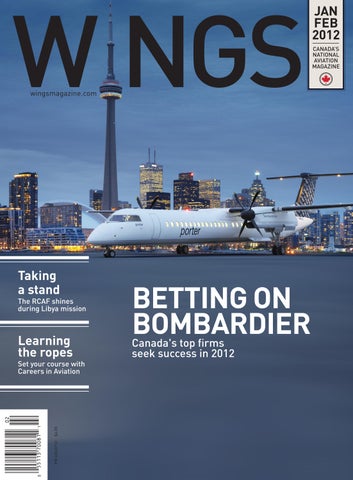
Jan FeB 2012 CAnAdA’S nAtionAl AviAtion mAgAzine
wingsmagazine.com
taking a stand
the RCAF shines during libya mission
Learning the ropes
PM 40065710
$6.00
Set your course with Careers in Aviation
Betting on BomBardier
Canada's top firms seek success in 2012
TIME TO RAISE YOUR EXPECTATIONS INTRODUCING THE NEW 3,350 NM FALCON 2000S Finally, a large-cabin aircraft with the airfield agility and efficiency of a smaller jet at a midsize price. This is the one you’ve been waiting for. The new Falcon 2000S has it all. Unparalleled comfort. Unrivalled performance. And unbeatable value.
Raise your expectations. Visit www.falcon2000S.com.
Eastern Canada +201.981.2869 Western Canada +201.245.9399
JanUarY/FeBrUarY 2012
UpFront 5 Leading edge
New beginnings
8 on the fly
News and opinion
14 Waypoint
The throwaway society
16 alternate approach Paying a premium
18 at the gate
Spanning the globe
19 45˚42� north The northern perspective
Back 71 marketplace 74 on final
Setting a future course
two CF-188 Hornet fighters from CFB Bagotville’s 425 tactical Fighter Squadron fly over the mediterranean Sea. P.54
FeatUres
20 Betting on BomBardier
Canada’s aerospace leaders seek success in 2012 By dAvid CARR
24 the search For sUpermen From top: victor’s Clive Jackson. P.16 Found Aircraft SWot report. P.59
and scapegoats
Human factors and pilots in the 21st century By dAvid olSen
27 careers in aviation 2012
Education, training and job prospects in Canada’s aviation sector By dAvid CARR
51 airport insecUritY
Cash-strapped airport authorities want a new model By BRiAn dunn
54 taking a stand: inside operation moBiLe How the RCAF responded to the crisis in Libya By PeteR Pigott
59 an iconocLast that’s BUiLt to Last
A position report on Parry Sound’s Found Aircraft By FRedeRiCk k. lARkin
COVER PHOTO: PORTER AiRlinEs
www.wingsMAgAzinE.COM
January/February 2012 | wings
3
LEADING
EDGE
| By Matt Nicholls
new beginnings
Educating “generation next” remains a top priority
C
PHOTO: MATT niCHOlls
anada’s aviation and aerospace industry is easily one of the most dynamic in the world – and we’ve certainly got the goods to prove it. From the development of the iconic MDA Canadarm in 1981 to Bombardier’s potentially game-changing CSeries aircraft to Boeing Canada’s advancements in reducing manufacturing waste, a diverse talent pool of skilled workers continues to push the boundaries in such critical fields as engineering, product development and training. Canadian aerospace firms produce a vast array of cutting-edge products with new technologies and innovative products developed every year. According to the Aerospace Industries Association of Canada, there are more than 400 aerospace firms nationwide, with new aerospace “pockets” established every year. Collectively, these companies employ more than 80,000 Canadians. Since 1990, aerospace industry sales have more than doubled, reaching $23.6 billion in 2008. Canadians are equally prolific on the aviation side of the equation. Canadian pilots, maintenance engineers and management staff have long been recognized leaders in their respected fields. Maintaining Canada’s impressive standing on a global scale is not without its challenges – and these will be amplified in the months and years ahead for a multitude of reasons. Most significantly, a looming shortage of skilled workers both in the cockpit and on the ground will tax Canadian aviation operations, as new workers are needed to replace retiring employees. Staying ahead of the curve on the aerospace side is also paramount, as new blood is needed to develop innovative solutions with a renewed commitment to the environment. The good news is that with significant
5
challenge comes opportunity, especially for up-and-coming members of the aviation community. Igniting the passion of young Canadians to embrace the benefits of a lifelong career in aviation is precisely why Wings developed our exclusive Careers in Aviation educational supplement (see pg. 27). Written by correspondent David Carr, CIA
Since 1990, aerospace industry sales have more than doubled, reaching $23.6 billion in 2008 – the numbers continue to grow. provides detailed writeups on a cross-section of key aviation professions. And it’s not just limited to the “glamour” roles in the cockpit. CIA offers insight into several professions, from aviation maintenance engineer to aircraft maintenance crew. New this year is consideration of the men and women who ensure aircraft arrive safely – air navigation. Highlighting various career options is just one aspect of the CIA guide. We also profile some of the top flight schools and academic
top data BUrsts… in this issue
1. 42: The number of partner operators connecting British charter Victor to its members. (pg. 16). 2. The iATA forecasts industry profits in 2012 will fall 29 per cent to $4.9 billion (pg. 18). 3. 7.7 per cent : China’s total percentage of world air travel compared to one per cent 20 years ago. (pg. 20). 4. 90,000: number of pilots needed in north America over the next 20 years (pg. 27). 5. RCAF’s CF-18 aircraft conducted 946 sorties in Libya. (pg. 54).
www.wingsMAgAzinE.COM
options in Canada to get your career headed on the right flight path. What's right for you? Industry experts share their advice on where the industry is headed and offer tips on how to make the most of your academic progress. In addition to running in Wings, this guide is also mailed to more than 3,300 Canadian high school guidance counsellors across the country. Schools are invited to contact us to receive additional copies of the guide for career fairs or to stock their career resource centres. Last year, we received calls from more than 25 schools requesting additional copies. CIA content is also available year-round at www.careersinaviation.ca, an interactive website developed as an additional resource for young people looking for information on the different career paths within the aviation category. The website helps match prospective students with flight schools, and college and university programs, through a searchable directory. With a looming skilled worker shortage and increasing demands to lead and innovate, locating “generation next” remains a top priority. We’re confident CIA can play a significant role in igniting the passion of those seeking a career in this rewarding and dynamic industry. If you have suggestions for future content, please write me at mnicholls@annexweb.com. | W Your feedback is always welcome. Please contact me at mnicholls@annexweb.com. January/February 2012 | wings
5
JAN JAN FEB 2012 2012 CANADA’S CANADA’S NATIONAL NATIONAL AVIATION AVIATION MAGAZINE MAGAZINE
wingsmagazine.com
vol. 53, issue 1 editor
Matt nicholls mnicholls@annexweb.com 416-725-5637 prodUction artist
BETTING ON BOMBARDIER
The RCAF shines during Libya mission
Learning the ropes
gerry wiebe
FLight deck
Canada's top firms seek success in 2012
Set your course with Careers in Aviation
Ray Canon, David Carr, Paul Dixon, Brian Dunn, Frederick K. larkin, neil MacDonald, James Marasa, Carroll McCormick, David Olsen, Peter Pigott, Rob seaman
SUBSCRIBE TODAY !
associate pUBLisher
Alison de groot adegroot@annexweb.com 1-888-599-2228 ext. 246
1 YEAR SUBSCRIPTION only
3000
$
advertising saLes
Adam szpakowski aszpakowski@annexweb.com 1-888-599-2228 ext. 246
(GST $31.50 • HST $33.90) US $42.00 (USD) • Foreign $65.00 (USD)
Name: _______________________________ Company: ____________________________ Title: _________________________________ Address: _____________________________ City: _________________________________ Prov: ________________________________ P.Code: _______________________________ Tel: __________________________________ Fax: _________________________________ e-mail:________________________________
PLEASE CHECK ONE: ❑ Commercial aircraft owner/operator ❑ Business/private aircraft owner/operator ❑ Military ❑ Aircraft maintenance/overhaul firm ❑ Airport ❑ Aerospace, airframe & component manufacturer and distributor
❑ Fixed base operator ❑ Aviation services, consultants and aircraft sales ❑ Government ❑ Aviation associations and organizations ❑ Flying schools, clubs and colleges ❑ Other (please specify) ______________
PAYMENT: Cheque - Payable to Annex Publishing & Printing Inc. Visa MC AMEX Account #: __________________________ Expiry:_____________________________ Signature: _________________________ Date: _____________________________
TO SUBSCRIBE:
Tel: 866-790-6070 Fax: 877-624-1940 Mail: Wings Magazine c/o Annex Business Media P.O. Box 530 Simcoe, Ontario N3Y 4N5 e-mail: subscribe@wingsmagazine.com
www.wingsmagazine.com
GST#135274215RT001
6
Subscriptions non-refundable
wings | January/February 2012
saLes assistant
stephanie DeFields sdefields@annexweb.com 1-888-599-2228 ext. 257 groUp pUBLisher
scott Jamieson sjamieson@annexweb.com president
Mike Fredericks mfredericks@annexweb.com Wings magazine
P.O. Box 530, 105 Donly Dr. s., simcoe, On n3Y 4n5 Tel.: 428-3471 Fax: 429-3094 Toll Free: 1-888-599-2228
Publication Mail Agreement #40065710 Return undeliverable Canadian addresses to Circulation Dept., P.O. Box 530, simcoe, Ont. n3Y 4n5 e-mail: subscribe@wingsmagazine.com Published six times per year (Jan/Feb, Mar/Apr, May/ Jun, Jul/Aug, sep/Oct, nov/Dec) by Annex Publishing & Printing inc. circulation e-mail: subscribe@wingsmagazine.com Ph: 866-790-6070 ext. 208 Fax: 877-624-1940 Mail: P.O. Box 530, simcoe, On n3Y 4n5 subscription rates Canada – 1 Year $ 30.00 (includes gsT - #867172652RT0001) UsA – 1 Year $ 42.00 Foreign – 1 Year $ 65.00
Air Transport Association of Canada
ON THE
WEB
Occasionally, wings magazine will mail information on behalf of industry-related groups whose products and services we believe may be of interest to you. if you prefer not to receive this information, please contact our circulation department in any of the four ways listed above. no part of the editorial content of this publication may be reprinted without the publisher’s written permission. ©2012 Annex Publishing & Printing inc. All rights reserved. opinions expressed in this magazine are not necessarily those of the editor or the publisher. no liability is assumed for errors or omissions. All advertising is subject to the publisher’s approval. such approval does not imply any endorsement of the products or services advertised. Publisher reserves the right to refuse advertising that does not meet the standards of the publication. Printed in Canada issn 0701-1369
Canadian Owners & Pilots Association
Canadian Business Aviation Association
Magazines Canada
careers in aviation This issue marks the return of our exclusive Careers in Aviation supplement, a handy guide to help you better understand what a career in aviation is all about. Check out www.careersinaviation.ca for news, updated listings and more!
PHOTO: MATT niCHOlls
Taking a stand
PRO0112
www.wingsMAgAzinE.COM
1.2 1.2 billion dollars invested in available inventory means we stock the parts so you don’t have to. And you can usually have what you need the next day. Aviall works hard to provide you with exactly what you need, precisely when you need it. Aviall Delivers.
ON THE FLY For late-breaking news and exclusive web content, please visit us at: www.wingsmagazine.com
indUstrY neWs
accidents remained Unchanged over past 10 Years: icao Although aviation has achieved a remarkable safety record, with fewer than four accidents per million departures worldwide, the global accident rate has remained essentially unchanged over the past 10 years, according to a report released in December of last year, by the International Civil Aviation Organization (ICAO) entitled the “State of Global Aviation Safety – 2011.” Runway related incidents consistently represent the largest accident grouping. “Improvements in runway safety are therefore essential if we are to achieve our objective to continually reduce the global accident rate, as well as related fatalities, despite projected growth in air traffic for the foreseeable future,” the report states. As a result, the international aviation community has called upon ICAO to demonstrate leadership in the effort to reduce the number of runway-related accidents and incidents. Through its Runway Safety Programme, ICAO aims to coordinate a global effort to improve runway safety. In addition, there is an urgent need to report runway surface conditions in a more
standardized manner so that flight crews can use this information to determine safe and effective performance characteristics for their aircraft during take-off and landing. Foreign Object Damage (FOD) on runways causes US $920 million in annual direct costs to airlines, while sector-wide FOD figures are estimated at US $12 billion globally, according to the report. FOD is also potentially a serious safety risk to aircraft and airport operations, as was exemplified on July 25, 2000, when 100 passengers and nine crew members on the Concorde and four people on the ground were killed due to FOD in France. ICAO has initiated a work program to develop harmonized provisions governing the use of automated FOD detection systems. Objectives for the program include a globally agreed definition and taxonomy for FOD, as well as its effective integration into airport safety management systems. And based on an analysis of accident data between 2005 and 2010, ICAO has identified three high-risk accident occurrence categories: • Runway safety related events • Loss of control in-flight • Controlled flight into terrain These three categories cover 66 per cent of the total number of accidents, 73 per cent of fatal accidents and 66 per cent of number of fatalities. The complete report can be found online at: www.icao.int. – Brian Dunn
A new iCAo report suggests runway accidents still represent the highest accident grouping worldwide. 8
wings | January/February 2012
American Airlines has lost more than $11 billion since 2003.
chapter 11: the american WaY After placing a record order for 460 aircraft in July, AMR Corporation, the parent of American Airlines, filed for Chapter 11 bankruptcy protection in November, ending months of speculation. American was the only large U.S. carrier to resist bankruptcy protection following the September 2001 terrorist attacks, and is the first to do so since Delta filed for protection in 2005. American, which has lost $11 billion since 2003, needs to slash costs and crawl out from a crushing debt helped along by high jet prices and labour struggles. It recorded a $982-million loss in the first nine months of 2011 and is expected to show another loss in 2012. The carrier claims its annual labour bill is $800 million higher than those of its competitors, but has failed to wring the same concessions from its workforce that enabled it to avoid bankruptcy protection in 2003. Its cost per seat mile is reported to be 10 per cent greater than that of Delta. Once the largest airline in the U.S., American has slipped to number three as mergers between United and Continental, and Delta and Northwest grew these airlines, enabling them to cut capacity, boost fares and return to profitability. American also operates 217 gas guzzling MD80s that have driven up fuel costs. It will be business as usual for American, although the company will delay the sale of American Eagle, its www.wingsMAgAzinE.COM
PHOTOs: isTOCK (BOTTOM); AMERiCAn AiRlinEs (TOP)
8 indUstrY neWs 12 airports 12 peopLe
regional airline subsidiary which also filed for bankruptcy protection. AMR has approximately $4.1 billion in cash to continue paying its bills during restructuring. The biggest unknown is the future of its outstanding aircraft orders, including the pace-setting $35-billion order. This order includes 100 re-engined Boeing 737 Max and 130 Airbus A320neos, neither of which are firm. American WestJet is returning to the Big Apple. the Calgary-based airline is returning to laguardia Airport after an eight-year hiatus. must shed its thirsty MD80s and new, fuel-efficient aircraft will be an essential piece of the restructuring puzzle. Some slot-controlled airport where space is at a market prospects. 230 current-generation Boeing 737-800 premium, is part of the airline’s strategy “The current state of the economy and Airbus A319s and A320s are firm to reinsert itself into the east and attract highlights the need and potential for and backed by approximately $13-billion a larger share of the lucrative business aircraft like the D-JET,” said Jamil manufacturer’s financing. American has traffic market. Marmarchi, CEO of Medrar. “People an order for 42 Boeing 787-9s, which is “This is a once-in-a-lifetime opportuwill always continue to travel and in the conditional on reaching a new agreement nity,” said Gregg Saretsky, WestJet’s chief short-to-medium-distance range the with its pilots. executive officer. “Our growth plans, in D-JET offers a luxurious and affordable which increased business travel in the way to fly privately.” east figures prominently, include New The Medrar sale is said not to be conYork City, Canada’s largest international nected with the “significant” investment business market.” Diamond received in June that enabled the company to push the restart on the D-JET after the program was grounded WestJet is returning to New York’s earlier this year due to a funding LaGuardia Airport after an eight-year shortfall. absence. The Calgary-based airline has In addition to the D-JET, Medrar paid $17.1 million for eight slot pairs in takes over Diamond’s all-composite, an auction that was part of an approved Dubai’s Medrar Financial has bought piston aircraft including the DA20, asset swap between US Airways and a majority stake in Diamond Aircraft DA40 and DA50. “We are equally bullDelta Airlines. Holdings, Canada, in a $350-million ish about the future potential of piston WestJet introduced flights to the sale. The agreement includes developBig Apple from Toronto in 2005, but ment of the revolutionary single-engine aircraft, especially in support of professional flight training, where we expect suspended the service after 10 months. D-JET and was announced in the international pilot demands to drive a The airline operates a seasonal service shadow of Piper Aircraft cancelling sustainable market for training aircraft,” from Calgary to Newark between April its Altaire, six-seater, single-engine Marmarchi added. and November. A return to LaGuardia, a business jet program because of weak
WestJet takes second Bite
PHOTOs: DiAMOnD AiRCRAFT (BOTTOM); wEsTJET (TOP)
prospects For d-Jet improve
With its new majority stake in diamond Aircraft Holdings, Canada, dubai's medrar Financial is pumping life into the d-Jet program. www.wingsMAgAzinE.COM
January/February 2012 | wings
9
ON THE
FLY
The world’s first street-level corporate aviation showroom has opened in the heart of London, England. The Jet Business is a walk-in retail concept for the acquisition and sale of new and used private jets and ancillary services. Customers will not be able to kick the tires, but are greeted by a luxurious high-tech showroom packed with bells and whistles, including a TV screen large enough to display a full-size Global 5000 cabin, and a mock-up of an Airbus ACJ319 cabin. Jet Business targets first-time buyers and multi-jet fleet owners. “We are simplifying the corporate jet sales experience and we have developed a unique customer designed technology system,” the company said in its promotional material. The showroom also has an extensive aviation information library and offers consultations on tailor-made interior concepts. The current jet portfolio
A peek at the high-tech showroom of the Jet Business, the world's first street-based corporate aviation showroom.
includes a 1999 Bombardier Challenger 604 and a 2012 Global 5000. Jet Business plans to open a second showroom in Beijing, China, in the next 12 months, followed by locations in
Moscow and Dubai. The U.S. had been considered for the first Jet Business showroom but this project is unlikely to happen until the negative business aviation climate blows over.
MORE THAN yOu ExPECT
ExEcutivE Flight cEntRE, sEtting stAnDARDs in AviAtion FuEl & sERvicEs FoR FoRty yEARs.
Building on our experience in aviation fuel sales and service Executive Flight Centre now offers expertise in the areas of Airport Management and Aviation Real Estate Development across Western Canada.
Fuel ServiceS
Airport mAnAgement
developmentS
Bulk Fuel
Passenger & Terminal Services
Project Management & Administration
Fuel Drums
Ground Handling
Hangar/Terminal Development
Remote Fueling
Aircraft De-icing
Facility Design
Into-Plane Refueling
Full Service FBOs
Building Leasing
Aviation Truck Rentals
Airport Management
ContaCt us today to find out more about our full range of aviation serviCes and Capabilities.
visit executiveflightcentre.com or call 1-888-299-2825 10 wings | January/February 2012
www.wingsMAgAzinE.COM
PHOTO: THE JET BUsinEss
coULd YoU Wrap that Up, pLease
concern For transport canada taWs threshoLd Transport Canada’s proposal to require private and commercial aircraft with six or more passenger seats to be equipped with a terrain awareness and warning system (TAWS) appears to have touched off a dispute between commercial and private operators. The Canadian Transportation Safety Board first recommended aircraft be required to install a TAWS system in 1995 following an investigation into a crash at Sandy Lake, Ont., that killed seven. Controlled flight into terrain is the leading cause of fatalities in airline accidents because the collision with terrain usually results in total destruction of the aircraft. “These types of accidents often happen when pilots are unaware of the danger until it is too late,” Transport Canada said in a news release. “The risk is even greater for small aircraft, which fly further into remote wilderness or
www.wingsMAgAzinE.COM
mountainous areas but are not currently required to have the same proximity warning equipment as large airliners.” Still, the proposed regulation is not sitting easy in all sectors. While John McKenna of the Air Transport Association of Canada (ATAC) has said the regulations are long overdue, Kevin Psutka, president of the Canadian Owners and Pilots Association (COPA) is concerned with the financial impact on many of its 18,000 members who operate aircraft with six seats in total. COPA has advocated for TAWS in aircraft that carry six passengers, but does not believe the pilot seat should be part of the threshold. “Private aviation in Canada is overregulated and there is no good reason why the people that I represent should be affected by this regulation,” Psutka told Canadian Press. “Our sector of aviation is not a bunch of rich people with toys.” Psutka estimates the average cost to outfit an airplane with the system will be between $30,000 and $40,000.
LUFthansa cargo Wants green ideas Lufthansa Cargo has launched an Air Cargo Innovation Contest to help reduce the company’s environmental impact and improve services. Lufthansa Cargo is one of the world’s largest airline cargo carriers serving 300 destinations in more than 100 countries. The contest is global and open to everyone. Proposals can cover any aspect within the Lufthansa air cargo supply chain that fall within the categories of green solutions and add-on services, including sales, handling, transport and customer service. Lufthansa Cargo will award three winners with a trip to Frankfurt, Germany where they will present their proposals to engineers and management and discuss how their ideas can be implemented. Winners will also receive flight training with a Lufthansa Cargo Flight Captain and up to 25,000 in airline reward miles.
January/February 2012 | wings
11
ON THE
FLY
vancoUver airport makes a spLash Vancouver International Airport was the only Canadian facility to make the National Geographic Traveler magazine’s “The Perfect Airport” list. The publication picked favourite features in airports around the world to create an ideal 21st century terminal building. Highlights included crispy lobster rolls at New York’s JFK, a rooftop golf course at Seoul’s Incheon, retail therapy at London Heathrow, a kid’s zone at Dallas Fort Worth and fast rail links at Tokyo and Hong Kong. Vancouver’s totem poles and other works by First Nations artists gave Vancouver a spot in the Airport Art to Ponder category. No Canadian airport broke into the Best Local Bites category, which is not surprising given that quality food choices are as light on the ground as airline profits at major Canadian airports. The magazine also
12 wings | January/February 2012
recommends the brisket at Austin-Bergstrom, Texas, a foie gras and mango sandwich at Charles de Gaulle, Paris and burgers and shakes at La Guardia, New York.
peopLe
neW head For gtaa The Greater Toronto Airports Authority has gone halfway across the world for its next president and chief executive officer. Howard Eng, executive director for airport operations at Hong Kong International Airport, will return to his native Canada in early 2012 to take over the country’s busiest airport. A graduate of the University of Alberta, Eng worked as vice-president of operations at Edmonton Howard eng International Airport before moving to Hong Kong. He has more than 30 years of leadership experience in airport hub
development and retail, two areas where Pearson is noticeably weak. “To be given the chance to implement the hub strategy and lead Canada’s flagship airport is an exceptional career opportunity,” said Eng. Eng takes over from Lloyd McCoomb, who was Pearson’s airport manager when it was operated by Transport Canada and who took over the GTAA after founding president and chief executive officer Louis Turpen resigned.
edmonton’s Finest In the Nov/Dec issue of Wings, we highlighted the exploits of Kevin Aalders who skilfully captured this year’s Webster Memorial Trophy as Canada’s top amateur pilot. We erroneously noted that Kevin currently flies out of Edmonton’s Centennial Flying Club – he actually flies out of the impressive Edmonton Centennial Flight Centre, a private aviation school. Congratulations once again to Kevin and the top-notch instructors at the school who helped set him on his course.
www.wingsMAgAzinE.COM
PHOTO: gTAA
airports
Exclusively Aircraft Interiors www.aircraftinteriorsexpo.com/wings
Exhibition 27 – 29 March 2012
Conference 26 March 2012
• Engage with over 500 industry suppliers • Discover new concepts and equipment • Network with senior level professionals • See the latest innovations and future technologies • Do a year’s worth of business in just three days
The Cabin Innovation & Strategies for the Future Conference is the world’s premier event focusing on the key strategic issues surrounding cabin innovation, consumer expectations and strategies for profitability within the cabin.
Free of charge to attend exhibition www.aircraftinteriorsexpo.com/visiting
Cost to attend €100 + vat (Free of charge to airlines) www.aircraftinteriorsexpo.com/conference
Register your interest to attend at www.aircraftinteriorsexpo.com/wings Organised by:
Co-located with: World Travel Catering & Onboard Services 27-29 March 2012
Hamburg Messe, Germany
In co-operation with:
WAYPOINT By Rob Seaman |
conquering the throwaway society Is aviation really that environmentally challenged?
J
14 wings | January/February 2012
assist in the aviation recycling process. Toronto-based Electronics Recycling Services (ERS) is one such firm. ERS has a line of machines that runs more than 3,200 linear feet and will recycle old avionics, cabin entertainment systems and components. They also provide other services such as plastics recovery (granulation of mix materials that are not recoverable via other methods for reuse as fillers for Plastic Lumber Manufacturing Line); an electrostatic separation to recover copper, lead, zinc and tin; plus shredding of all types of electronics, ferrous material separation and aluminum separation. ERS claims that more than 90 per cent of what comes in ends up reused in other manufacturing components. The aviation community certainly needs more companies like ERS. Aircraft have a usable life of 25 to 30 years on average, while cars get replaced every five to 10 years. There are far fewer aircraft in the world than cars, fridges, washing machines and such going to the scrapyards. And with 90 per cent of aircraft being recycled, aviation is not a bad member of society. It certainly doesn’t contribute to the “garbage” pile of humanity like other industries. | W
An emissions argument aside, aviation is in a better environmental position than many industries. scrapped in the next 20 years. By the year 2016, AFRA will have the ability to recycle 90 per cent of an aircraft. Today, 80 to 85 per cent of an aircraft is recyclable, up from 50 per cent just a few years ago. Even the airlines – Air France in particular – are increasingly taking ownership in the disposal of their retired aircraft. Cabin components are the most difficult part of an aircraft to recycle – the interior fit and finish. Several aviation experts note that the latest generation of aircraft will not necessarily be easier to recycle. Newer aircraft are lighter and more fuel-efficient due in part to carbon fibre and composite materials. And while disposal of these products is far less energy intensive – hence less expensive to recycle – the facilities that can recycle the products are few and far between. It will be a number of years before a NextGen Boeing 787 Dreamliner hits the scrapyard and accordingly, one would expect that by that time, the processes and systems to recycle carbon fibre will be as common as they are for aluminum today. Some small Canadian operators can
Rob Seaman is a Wings writer and columnist. www.wingsMAgAzinE.COM
PHOTO: AFRA
ust the other day, I had the misfortune to find out that our humidifier was not working. The repairman advised that it was going to cost a few dollars shy of the price of a whole unit to fix. So, what to do – repair or replace? The unit is only four years old, properly maintained and was the best on the market at the time. I was not amused. But this, of course, is just the tip of a bigger issue. They don’t build things like they used to – we joke about it, but it’s true. Take the “white goods” you have at home – fridge, stove, washer and dryer, even your microwave. Retailers say the days of buying appliances for 15 or 20 years are long gone. The average warranty is one year and, according to experts, you can expect six to maybe eight years of use before you either fix them or throw them away – because, once again, the cost to repair versus replace makes it attractive to do so. The fact is, we have a “throwaway” mentality in our society. Those who are environmentally responsible will tell us, we are our own worst enemies. Landfills are rapidly filling up with things that just don’t break down – and we continue to add to the pile. So, what about the aviation industry? Is it environmentally negligent? After some review and discussion, my conclusion is no. An emissions argument aside, aviation is in a better environmental position than many industries – including the vaunted auto industry and white goods manufacturers. Over the course of its existence, an aircraft can be improved, enhanced and developed. Improvements can be made to the avionics suite, the entertainment components, the galley, and even the engine and related systems. These enhancements increase an aircraft’s longevity, which makes for a viable argument for replacing over scrapping and starting again. Commercial aircraft manufacturers are becoming increasingly responsible for the “cradle to grave” approach to aircraft development. They are cognizant of how an aircraft can or will be taken apart and disposed of when it’s finished its job. According to the International Air Transport Association (IATA), some 12,000 commercial aircraft will be delivered by 2020. At the same time, the Aircraft Fleet Recycling Association (AFRA) notes that 12,000 aircraft could be
Modern business communication technology is so good, it’s almost like you’re there. But you’re not. No matter how technology improves, nothing can replace real-life facetime. It builds relationships and trust. It inks deals. A Citation business jet puts your best people face-to-face with clients and prospects faster and more often. And gets them back home in time for important family events. At Citation Team Canada, we live and breathe business aviation. Let us demonstrate what it can do for your organization.
C
I
T
A
T
I
O
N
T
Ray Kuliavas Vice-President, Aircraft Sales Tel: (905) 673-0800 ray.kuliavas@innotech-execaire.com
E
A
M
C
A
N
A
D
A
Tim White Vice-President, Regional Sales Tel: (316) 517-1333 tawhite@cessna.textron.com
CESSNA'S EXCLUSIVE AUTHORIZED SALES REPRESENTATIVE FOR CITATION JETS IN CANADA. www.execairejetsales.com
ALTERNATE
APPROACH By David Carr |
Willing to pay a premium
Victor’s online private jet booking platform a hassle-free alternative
Y
16 wings | January/February 2012
42 partner operators connecting its members with the largest chartered-fleet in Europe boasting a network of 940 destinations. Even so, 16 of the top 20 routes are to Palma de Mallorca from U.K., German and other European airports. Jackson owns a villa in the Spanish resort town and came up with the Victor business model after BMI suspended business-class service. For now, Victor is weighted more toward leisure travel, although the disappearance of business-class sections on some European flights may drive more corporate travellers to the website. “It is all very well talking about low-cost travel in Europe, but [airlines] are now busing the premium leisure market in horrible commercial aircraft and it is something they have to endure. Now a proportion of that market can say, ‘we don’t want to’. ” The company has expanded into Germany and Switzerland, and is likely to arrive in the United States in 2012. Is there any opportunity for the Victor model to percolate into Canada? “It is not up to us,” Jackson said. “It is up to our members. Cross border or across the provinces – we have already shown that Victor will work. We only had one route four months ago.” | W
As one who has traditionally enjoyed the airport experience, the selling point of the private jet was side-stepping the hassle. operators through the buying and selling of surplus seats. Members can charter a jet, sell extra seats or search for space on charters operated by Victor partners. The Victor website – populated with fanciful photographs of private jets parked next to luxurious swimming pools and cruise ships – is loaded with options. Members can compare prices, view the exact aircraft they will fly on and post future trips to see if there are takers. Those wanting to book a seat can either reserve at the posted price (which will drop if the aircraft fills) or bid lower. Membership is free and Victor collects a flat five per cent fee for charters it organizes. The real profit comes from selling seats, although Jackson argues that his service is distinct from a brokerage. “We are creating incremental bookings for our partners,” Jackson pointed out. “In the past, they have been completely dependent on brokers to get rid of excess inventory. We are offering direct booking that is very similar to an airline booking system, and giving operators a chance to recover up to 70 per cent of expenses.” Operators are signing up. Victor now has
David Carr is a Wings writer and columnist. www.wingsMAgAzinE.COM
PHOTO: ViCTOR
our humble correspondent does not live the high life very often. So, it was a rare treat to have recently flown between nearby city pairs aboard a private jet. Inside a 30-minute flight, a cabin attendant had covered tables with crisp white linen, served an appetizer, poured drinks, presented a light meal, offered dessert, removed the china and silverware and snapped everything back into place with minutes to spare before landing. On some airlines, it takes two hours to buy a beer and dried out sandwich even though ancillary services such as catering in economy (of which Alternative Approach was an early supporter) is supposed to be a profit envelope. My bartender (s) would not survive the day at that pace. Perhaps legacy airlines with fee-for-service cabins should consider allowing tips. Granted, service is different in premium cabins where the passenger is less likely to be made to feel like a burden. Still, all cabins take off from the airport at the same time, and the premium passenger is subject to the same increasingly intrusive security checks, congestion and chronic delays as those of us squeezed into the main cabin. As one who has traditionally enjoyed the airport experience, the selling point of the private jet was not so much the in-flight service as it was side-stepping of the hassle. “The premium passenger wants to be pulled out of the commercial airport and share a cabin with like-minded people who have the same values and standards,” said Clive Jackson, a British digital entrepreneur who recently launched Victor, an online private jet-booking platform. Clearly there is opportunity in pulling premium passengers from the first- and business-class cabin into private aircraft. Fractional ownership has scaled that mountain but continues to struggle against those opposed to buying flying hours upfront. An air taxi industry supported by thousands of very light jets such as the Eclipse crisscrossing the country side has failed to live up to advance billing. Has Jackson’s Victor landed on the winning formula? Jackson described Victor as the world’s first private jetshare community. It is a one-stop marketplace that has slashed the cost of private jet travel for customers and
Works well with others.
Flight departments everywhere are under pressure to deliver more for less. The King Air 350i lets you do just that, without compromise. Its unsurpassed versatility and payload, combined with class-leading range and efficiency, carries more people farther at lower cost than any other aircraft. More for less, or the ideal stable mate? How about both. We build aircraft you can believe in. HawkerBeechcraft.com. King Air 350i
AT THE
GATE
By Brian Dunn |
spanning the globe
Canada’s commercial players search for new flight plans for success
A
18 wings | January/February 2012
Toronto Island, but they’re going after secondary markets like Thunder Bay which seem to be performing well. They’re also the biggest risk taker of all the airlines, by testing new markets like Burlington, Vermont.” While labour issues at Air Canada will continue through 2012, its low-cost model is a critical part of its business plans, says financial analyst Cameron Doerksen at National Bank Financial, Montreal. As for growth opportunities, he says both the domestic and trans-border markets are flat. “Where they’ve had success and will continue to grow is Latin America and transPacific. They’ll also benefit through joint ventures with their Star Alliance partners.” Turning to WestJet, Doerksen sees growth coming from more sun destinations and its code-share alliance with American Airlines and possibly with Delta Airlines. “Transat has clearly struggled over the last few quarters which may be due to overcapacity on the routes they serve. And Porter doesn’t appear to be weaker since Air Canada started flying out of Toronto Island. They have the capacity to add frequencies domestically with their new slots at the airport and they’ve mentioned adding service to Philadelphia and Washington, D.C.” | W
WestJet has a leg up on Air Canada and Air Transat, who are not going into secondary markets. 787 Dreamliners to Air Canada is being delayed again until the first half of 2014 from the fourth quarter of 2013. The delay clearly hurts Air Canada’s international growth plans, Erickson adds. “And to lower their operating costs, they need to get their low-cost model up and running. All WestJet’s capacity growth has gone into sun destinations which has chipped away at Air Canada’s market.” About 18 months ago, WestJet deferred aircraft orders to about three or four a year, which means no new destinations in Canada, says Erickson. Instead, the company is looking at secondary markets such as Winnipeg to sun spots like Las Vegas, which may cannibalize some of its other routes. But WestJet has a leg up on Air Canada and Air Transat, who are not going into secondary markets. As for Air Transat, Erickson doesn’t see much growth. Instead, he predicts they’ll ride out the uncertainty on international markets by not taking any risks. The analyst is pleasantly surprised by Porter Airlines which continues to add aircraft and new destinations. “I thought Air Canada would hurt them when they went into
Brian Dunn is a Wings writer and columnist. www.wingsMAgAzinE.COM
PHOTO: wEsTJET
t this time last year, Giovanni Bisignani, head of the International Air Transport Association (IATA), was predicting that 2010 “is as good as it gets. It will be the peak of the cycle. 2011 will be a much tougher year.” Fast forward to today and the message hasn’t changed, with the IATA again warning of tough times ahead. IATA director general and chief executive Tony Tyler also notes the European Union’s carbon emission trading system would add to the financial pressures on airlines despite an offer of free permits, which he criticized as “linguistic gymnastics.” The European Union will require all airlines flying into or out of the 27-nation bloc to be included in the scheme that forces polluters to buy permits for each metric ton of carbon dioxide they emit above a certain cap. That would impact both Air Canada, Air Transat and Sunwing Airlines among other charter operators. IATA has already warned that a weak global economy would prompt a 29 per cent fall in airline profits in 2012 and cut the industry’s profit margins to a wafer-thin 0.8 per cent from 1.2 per cent this year. “We are not seeing a recession,” says Tyler. Still, global growth is closely tied to the financial performance of airlines. Whenever growth has slipped below two per cent, the airline industry has lost money, he adds. The IATA forecasts industry profits in 2012 will fall 29 per cent to $4.9 billion from $6.9 billion this year. Stagnating cargo flows in recent months also point to weaker markets going forward into next year, the IATA says. The outlook is somewhat better for Canadian carriers, according to Rick Erickson, president of Calgary-based RFP Erickson & Associates. He says both demand and bookings remain relatively strong. “Commercial aviation travel is important to the Canadian market and that’s not going to change. The key variables which remain outside the airlines’ control are the economy, the dollar, fuel prices and weather.” Consumer confidence in Canada remains high and people will travel to sunspots this winter as long as the Loonie remains close to parity with the greenback, says Erickson. The delivery of the first seven of 30 Boeing
45˚42�
NORTH
By Peter Pigott |
the northern perspective NATA’s Stephen Nourse points out the unique needs of northern operators
A
www.wingsMAgAzinE.COM
In the end, you either love or hate the north, Nourse contends – some would live nowhere else and for others it’s only a stepping-stone to another destination. “This is why we feel it’s really important to develop the northern labour market, and get them into the industry – people who want to be there for the long term,” he says. “But it’s tough to get them out of the north for educational purposes. Family is extremely important to people in the north.” Most northern carriers have programs to develop the local labour market, says Nourse. For example, Air North has a huge local base – virtually all of Air North – up to 90 per cent live in the north. “Its CEO, Joe Sparling, figures they might be the largest private-sector employer in the Yukon,” he says. “While Air Canada flies in and out and employs two ticket agents, Joe has hangars and hundreds of people who all buy stuff at the local store. And yet, he is priced competitively. Both First Air and Canadian North, and other northern carriers, pay very well – the rotational work in the Arctic pays well because you have to attract people.” Attracting the right people and exposing them to the joy of working north of the 49th Parallel. It’s not without its challenges, but as Stephen Nourse points out, the longterm benefits can be rewarding indeed. | W
“Let’s take a look at Air Canada coming into Yellowknife and tell me what they are contributing to the northern economy.” “So, you want to put a little more gravel on the runway to extend it?” Nourse asks. “Well, it’s a three-year operation – you’ve got to mobilize the equipment, which is a sealift or ice road operation, then you’ve got to mine the rock and crush it. By the time you put it on and have the equipment out, three years have passed. You can imagine what that costs – whereas down south, you just call up the local contractor and he delivers it.” Air Canada’s push into the northern market is another hot-button issue for NATA members, Nourse contends. His response is straightforward: “One hates to complain about a free market economy; that is what the current Canadian aviation industry is built on. However, it’s difficult not to see the irony in Air Canada getting extremely worked up and lobbying to keep out Emirates Airlines. All this effort because they’re worried about this competitor who comes in and doesn’t contribute anything to the local economy or community. Let’s take a look at Air Canada coming into Yellowknife and tell me what they are contributing to the northern economy.”
January/February 2012 | wings 19
PHOTO: RAnDY sTRAKER
s executive director of the Northern Air Transport Association (NATA), Stephen Nourse is well versed in the unique challenges facing commerical operators in northern environs. Sitting down in Ottawa recently, Nourse explained in minute detail how a significant portion of his job is simply reminding people that aviation in Canada isn’t only just along the 49th Parallel and made up of Air Canada, Porter and WestJet – northern carriers have unique challenges lost on the likes of their more southerly contemporaries. “There are many smaller, but very professional, companies providing service in the three territories and the northern parts of the provinces,” he says. One of the ongoing challenges northern carriers face is a lack of aviation infrastructure. Much of it was put in place in the 1950s to build the DEW Line and what went into various communities was based on the aircraft of the time – the DC3. As a result, many northern settlements have 2,500-foot or 3,000-foot gravel air strips. Such runways may have been ideal for DC-3s, but today, only Buffalo Airways flies them. The Canadian Arctic has few paved runways – apart from the territorial capitals, the Yukon, Nunavut and Nunavik have only one each and the Northwest Territories has five. Not only are most of the airports gravel but many are also relatively short, limiting the type and size of aircraft. “Some of the biggest problems NATA members face [involve] creating a route structure in the region,” Nourse says, “because of the distances involved and the size of the communities. It’s very difficult to put together a scheduled route structure that you would get more than about 1,600 or 1,800 hours out of an aircraft annually. If you go to most communities once a day, you’ve satisfied the need. Flying only 1,600 to 1,800 hours annually, you can’t amortize a new airplane and be cost-competitive.” The north devolved long before the south in operating its own airports, but as Nourse points out, the combined population of all three territories is 118,000 people. That’s the size of the city of Kingston – and this is spread over a massive area in locations where your construction costs are greater than down south.
BETTING ON
BOMBARDIER canada’s aerospace Leaders seek sUccess in 2012
BY david carr
PHOTO: BOMBARDiER
Bombardier’s president/Ceo guy Hachey told analysts he is “not happy” with the brand’s 18 per cent market share in the 40XR, 45XR and 60XR categories.
a
ll eyes will be on Bombardier in 2012, and more than a few side bets will be made as to whether or not the airframer can hold to its schedule for the CSeries airline program, with test flights on the CS100 version expected in November, www.wingsMAgAzinE.COM
followed by first deliveries in late 2013. Guy Hachey, president and chief operating officer for Bombardier Aerospace, caused a stir among reporters and analysts at the National Business Aviation Association’s annual convention in Las Vegas last fall when he conceded that CSeries development was “up
against the wall in terms of schedule. We used up a lot of the contingency time. I don’t see a miss, but we are under pressure.” From a strictly marketing standpoint, 2011 was a mixed year for the CSeries. The order drought so noticeable at the Farnborough Air Show one year earlier broke around
Paris. But the airplane has been washed over by the Airbus A320neo, which captured approximately 1,200 orders last year, compared with the CSeries order book for 153 aircraft total, including letters of intent. Walter Spracklin, an analyst with RBC Capital Markets, was one of the first analysts January/February 2012 | wings 21
to suggest that Bombardier would not hit its target for 300 orders by the time the CSeries entered service. After conducting a survey of 26 potential customers representing 35 per cent of the market for 100- to 149-seat passenger jets, Spracklin wrote to clients, “We are encouraged by the interest the airlines demonstrated in the CSeries, there was certainly a lack of urgency to place significant new orders. Combine this with the emerging mass headwinds [and] we believe airlines are more inclined to delay their renewal programs.” Boeing also launched the 737 MAX, a re-engined version of its popular 737 in 2011, and has more than 700 commitments. Brazil’s Embraer appears to be headed toward a re-engined version of its E-Jet family, which has already sold more than 1,000 aircraft to customers worldwide, including Air Canada. Still, Bombardier is the only manufacturer to have launched a clean sheet aircraft, and analysts agreed as recently as the Paris Air Show that the company had time on its side, especially among customers thirsty for fuel savings. By the time Airbus brings the A320neo to market in 2015, oil prices are expected to be north of US$120. The Boeing 737 MAX is scheduled to enter service in 2017 and a re-engined E-Jet not before 2018.
first deliveries of the CSeries will happen before spring 2014, although neither Airbus nor Boeing inspires confidence in meeting delivery targets. In addition to the chronically delayed Boeing 787, and Airbus has recently announced a further six-month delay in its A350 program. A wild card for Bombardier may be the co-operation agreement the airframer signed last year with the Commercial Aircraft Corporation of China (Comac), which seeks to find commonality in the development and joint marketing of the CSeries and larger 156-passenger C919, which is expected to make its first flight in 2014 and enter service in China two years later. The still-to-bedefined agreement should present Bombardier with a stronger advantage in the aviation industry’s hottest market. “We believe that this collaboration will generate positive results for both the C919 and CSeries aircraft programs,” said Pierre Beaudoin, president and chief executive officer of Bombardier. “It also opens the door to further cooperation on any other projects that would be mutually beneficial.”
all eyes to the east China and surrounding economies will continue to loom large for Canada’s $26-billion global aerospace industry either in immediate orders or in
its air traffic and represent almost 12 per cent of world air travel, versus the U.S. at only 21 per cent.” China is indeed fertile ground for the world’s fifth largest aerospace industry. Hess sees broader collaboration opportunities from the Bombardier Comac agreement, including buttressing ongoing negotiations for a version of the C919 powered by PW1000G. There is also an estimated market potential for 5,000 business jets and turboprops in China and Asia over the next 10 years. China, along with Brazil, India, the Middle East and Russia, is expected to be one of the economies that pull the business jet sector out of its doldrums, especially in the larger cabin class and ultra long-range class where Bombardier excels with the Global XRS/6000 and Challenger series. This has been confirmed by the Honeywell Aerospace annual Business Aviation Outlook which reported that, after age, longer range is a key consideration among flight departments. According to the General Aviation Manufacturers Association, among the six private jet airframers in the first nine months of 2011, Bombardier pipped Cessna by one business jet delivery, although the dollar value will have eclipsed its Wichita, Kan., competitor. Year over year deliveries in 2011
double-digit declines in 2009 and 2010 even as its highend products enjoy relative prosperity,” wrote Richard Aboulafia, vice-president of analysis for the Teal Group, a U.S.-based aerospace consulting firm. A revamp of the Learjet line is expected after Bombardier’s Hachey told analysts he is “not happy” with the brand’s 18 per cent market share in the 40XR, 45XR and 60XR categories. The Global 7000 and 8000, which will be assembled at Bombardier’s Q400 plant in Toronto, should cement the company’s position as the dominant player at the top end of the market.
identifying opportunities The globalization of business aviation has not escaped the notice of CAE, the world’s largest aircraft simulator and training company. CAE continues to be booted about by a rising Canadian dollar and deep cuts in global military spending. Even so, you do not climb to the top of the pack without picking your spots. Over the next two years, CAE will double its global business aviation training footprint, especially in high-growth markets such as Latin America and Asia, although its plan for the latter remains somewhat fuzzy, with the focus not expected to sharpen before 2013. “Business aviation is grow-
like luXuRy goodS in tHe RetAil SeCtoR, lARge-CABin, ultRA-RAnge AiRCRAFt HAve SoARed ABove tHe dePReSSed SmAlleR end oF mARket. “The costs and complexity associated with introducing a new aircraft type into their fleets was the number one hurdle facing [airlines] decision to purchase the CSeries,” Spracklin also wrote. Compared with the Airbus and Boeing offerings, the analyst sees the CSeries market potential to be in small batch orders of up to 10 aircraft, where airlines are not as concerned about fleet commonality. It is increasingly unlikely that 22 wings | January/February 2012
staging for future exports. David P. Hess, president of Pratt & Whitney, the parent company of Pratt & Whitney Canada (P&WC), illustrated the growth of China in an earlier speech. “Twenty years ago, China represented just one per cent of world air travel as compared to the U.S. at the time with 41 per cent. Today, it’s 7.7 per cent and the U.S. has dropped to 25 per cent. By 2020, projections call for China to nearly triple
were down at least 26 per cent over 2010, although they appeared to have stabilized somewhat. But like luxury goods in the retail sector, large-cabin, ultra-range aircraft have soared above the depressed smaller end of market. Bombardier delivered 34 Global 5000 or 6000 aircraft in that period. “Bombardier’s bottom-half market presence has suffered too, with Learjet and Challenger 300 deliveries dragging down the company by
ing internationally and CAE continues to position training capabilities in convenient locations where we will offer our customers customized training, advanced training technology [and] flexible scheduling,” said Jeff Roberts, CAE’s group president for civil simulation products, training and services. “CAE is confident in the future of business aviation around the world, and we have continued to invest in this market to keep pace with training demand.” www.wingsMAgAzinE.COM
PHOTO: CAE
CAe continues to position training capabilities in convenient locations around the world to offer customers customized training, advanced training technology [and] flexible scheduling, says Jeff Roberts, CAe’s group president for civil simulation products, training and services.
In 2012, CAE will break new ground in both Mexico and South America, opening the regions’ first business jet training centres. The centre in Toluca, near Mexico City, will provide Level D simulators and training programs for the Bombardier Learjet 45 and Bell 412 helicopters. A new centre in São Paulo, Brazil, will be the third of its Embraer-CAE training services (ECTS) joint ventures and will offer Level D simulator training for the Embraer Phenom 100 and 300 aircraft. More recently, CAE has entered into an agreement with Qatar Executive, the corporate jet subsidiary of Qatar Airways for pilot training on the Bombardier Global Express XRS and Challenger 605, two lynchpin aircraft that are expected to fuel triple growth in corporate aviation in the Middle East. CAE’s business aviation strategy is to narrow the geographic gap between its training capability and the sectors fastest growing markets. Closer to home, CAE and Bombardier will expand worldwide training support for business aircraft customers in the second half of 2012 with the addition www.wingsMAgAzinE.COM
of Level D full-flight simulators for Challenger 300 aircraft in Montreal, a move that will boost what CAE currently has in Dallas.
propping up efforts Perhaps the biggest concern in Canadian aerospace should be the global regional turboprop renaissance and whether Canada (re: Bombardier) can hold its own against the surging ATR, a European consortium that includes EADS, manufacturer of Airbus. Toronto’s Porter Airlines, which has just marked its fifth anniversary, recently took delivery of another two 70-passenger Q400s, bringing the city centre-based regional carrier’s fleet to 14 aircraft. But further up the subway line, where the Q400s are assembled, orders for the airplane have narrowed to a trickle, forcing Bombardier to cut production. As with the CSeries, there is no show of panic. The company insists that renewed interest in the Q400 is stronger at the beginning of 2012 than what it was in January 2011, now that the company is working with
approximately 10 customers. The first two class Q400s just entered service with launch customer United Airlines. Bombardier will also add a premier cabin to existing United Q400s in a 30-aircraft retrofit. The company anticipates new North American orders for a two-cabin version now that the airplane is in service. Hachey conceded at an investor day in New York late last year that Bombardier has relied too heavily on North American and European markets for Q400 and CRJ orders and has slipped behind ATR and Embraer as a result. The company has recently doubled its sales force in emergency markets and Hachey insists that the Q400 has “a healthy pipeline of opportunities.” Pratt & Whitney Canada (P&WC) is expected to launch a next-generation turbo-prop engine in 2012 for a 90 to 100-passenger regional aircraft. The picture for a larger regional turboprop is coming into focus as airlines struggle to turn a profit on short-haul routes. P&WC, the world’s largest supplier of turboprop engines, has been testing
components and is targeting a 20 per cent reduction in fuel consumption over the existing PW150A powering the Q400. The operating characteristics of the Q400 already make it a better fit than the ATR 72 for early model and thirsty regional jets such as the 50-passenger CRJ200. Bombardier is evaluating the potential for the Q400X, a re-engined and stretched version of the Q400 although no announcement is expected in the next 12 months.
a cautious approach Canadian aerospace is closely linked with the global economy and therefore pockmarked with questions for 2012. Will the private jet sector finally recover, especially with a rebound at the lower end of the market? Will the SinoCanadian agreement between Bombardier and Comac net its first Chinese order for the CSeries? Will P&WC power the regional turboprop sector into a new direction with the announcement of a next-generation engine? The picture is likely to remain cloudy until at least the Farnborough Air Show in June. | W January/February 2012 | wings 23
the pilot still remains a critical part of the flying process – and his human behaviour and performance cannot be measured according to the laws of physics and mathematics.
THE sEARCH FOR suPERMEN AND sCAPEGOATs hUman Factors and piLots in the 21st centUrY
s
PHOTO: CAE
BY david oLsen
ince the dawn of aviation in 1903, the easiest way to explain accidents has been to blame the pilots – particularly if they are dead. Modern accident investigation techniques have broadened the parameters of cause, but because pilots are the only element common to all accidents, they can never be excluded as a factor – the Human Factor (HF). In 1935, long before HF entered the aviation vocabulary, Rudyard Kipling wrote: “So when the buckled girder Lets down the grinding span, The blame of loss or murder is laid upon the man! Not on the Stuff – the Man!” As writers, psychologists and other experts have reminded us ever since, human behaviour and performance is the one element in aviation, which cannot be measured and specified according to the laws of physics and mathematics. As noted HF expert and pilot David Beaty pointed out, “At the heart of today’s incredibly complex aircraft is a thin-skinned perishable bag of chemicals, fat and 40 litres of water – the pilot!” Blaming pilots for accidents may induce warm feelings of self-righteousness in others but it is unlikely to identify or solve the root causes. The issues were thrust into the public eye in September 2011 when Maclean’s magazine published a special www.wingsMAgAzinE.COM
investigation with the front cover headline “Can your pilot really fly your plane?” Talk about the ideal passenger inflight reading material! But the magazine was asking the questions that the recovery of the (Air France) AF-447 flight data recorders only weeks earlier, had triggered in many people’s minds. Maclean’s, like many aviation and scientific journals, made the point that while aircraft technology and automation are developing at lightning speed, the training of pilots may actually be being shortened and simplified – particularly since the aircraft are now so “smart” that it is perhaps thought that they can virtually fly themselves. Indeed, in a letter to the Royal Aeronautical Society (RAeS) journal recently, one writer said he had the feeling that the A-380 was a “sort of outsize UAV with the controllers on board.” Perhaps unintentionally, Maclean’s highlighted the issue that we forget at our peril. Technology and automation are increasing at an exponential rate but the human being who is tasked with flying the aircraft, and even more importantly, making the right decisions almost instantly when things go wrong, is still plodding along in his/her multi-million year evolution. There is a total mismatch between the rate at which we can advance technology, and the evolution of the human brain and its functions.
So, what are we going to do about it? Given the media hullaballoo that greeted the TV premiere of Pan Am recently, some might be tempted to hearken for “the good old days” of suave pilots, nubile stewardesses and “kick the tires and light the fires.” However, examination of
Pilots are not supermen or superwomen; they are humans like everyone else with all the attendant strengths and weaknesses. the admirable “Summary of Commercial Jet Airplane Accidents 1959-2009” published by Boeing, shows that most of the first generation of jet aircraft had a much higher hull loss/fatality rate than their successors (the MD-11 stands out as a second-generation anomaly). This fact itself may indicate a number of possible but unproven human factors issues, such as the enormous operational changes resulting from the introduction of commercial jet aircraft. The U.S. Federal Aviation Administration (FAA), the Royal Aeronautical Society
(RAeS) and others are very clear about a key HF issue – namely training. Dr. Kathy Abbott, FAA Chief Scientific Adviser for Flight Deck Human Factors, has 30 years experience in the field and is leading the FAA study team on “Operational Use of Flight Path Management Systems.” Preliminary information from the study, expected to be published soon, raises several alarms. One international review of the report material suggests that, “Flight-crew have never been properly trained to operate highly automated aircraft,” and “implies that perhaps they cannot, at present, be effectively trained, because there are no checklists for many of the automation-related problems that pilots frequently encounter. This leaves them having to manage using ingenuity.” The findings emerging from the study seem to echo what is happening in society generally, as technology makes multigenerational leaps in months. In today’s digital culture, most people are using advanced technology without having a clue as to what is happening or how or why, when buttons are pushed. Pilots are not supermen or superwomen; they are humans like everyone else with all the attendant strengths and weaknesses, but when things go wrong, they all too easily become scapegoats. The “dirty dozen” of human factors (see, “Contributing January/February 2012 | wings 25
Humans control an aircraft in flight and on the ground – they are responsible for all elements of safety.
complex aircraft, which may not be designed with the humans as an integral part of the operation. There were five pilots on the flight deck when the No. 2 engine exploded at 7,000 feet in the climb. It took all their combined experience and skill – of 71,000 flying hours – to deal with the situation and bring the aircraft safely back to Singapore. For almost two hours, the crew dealt with an avalanche of warning messages from the aircraft systems. Things could easily have degenerated into chaos, but the crew had the self-discipline and presence of mind to follow the ECAM (Electronic Centralized Aircraft Monitor) and deal with
Contributing factors As noted in the first part of Wings’ two-part series on the role of HF in accidents (“identifying the problem,” pg. 47, sept/Oct 2011), here are the Pandora’s Box of human factors (the “dirty dozen”): • Lack of Knowledge • Lack of Teamwork • Lack of Resources • Lack of Assertiveness • Lack of Awareness • Complacency • Distraction • Fatigue • Pressure • Stress • Norms 26 wings | January/February 2012
each issue. Such situations are a conundrum. For the QF-32 passengers, aware that something serious had happened, but powerless to do anything but rely on the judgment and skill of the crew, the desire to be back on the ground must have been overwhelming. Yet, with so much damage to systems other than just a shut-down engine, the crew were in the unenviable position of knowing that an immediate return and landing without a full understanding of the problem might also have been catastrophic. This issue has triggered some debate and no doubt the pilots of Swissair-111 faced the same dilemma when deciding whether to make an immediate overweight emergency landing or dump fuel – and 229 people were killed. Which brings us back to training. Can we ever fully simulate situations such as SR-111 or QF-32, or indeed AF-447? As Paul Strachan of the Air Canada’s pilots union told Maclean’s, “It almost never happens in real life like it happens in a simulator.” Training and development bring in all the human factors issues, including how we value pilots and other frontline aviation people. How do we encourage young people to make the commitment that will take them all the way to the left-seat of that A-380, responsible for the lives of perhaps 500 people, or to one of the many other aircraft,
large and small, in the civil air fleet? Not very well from what we see and hear. The FAA study shows that we are not always providing the depth and quality of training for today’s complex aircraft. Then there’s the cost and the reward – which is where, it seems that many dedicated pilots are undervalued by society. To get to the left-hand seat of a commercial aircraft can take $100,000 in training costs, above-average medical fitness, dedication and struggle in spades, frequent medical and proficiency checks and several thousand hours’ experience. Before reaching that seat, you may earn less than the person driving the crew bus – or worse yet, nothing at all. Pay2Fly schemes have now crept in, where pilots may have to fly 500 hours on type on non-paying contracts. For the same effort and money, one could train to be a doctor and achieve a much higher salary and social status. The two-part Human Factors series in Wings has not attempted to cover all HF issues – plenty of textbooks and studies do that. Rather, it seeks to stimulate debate, underline the key importance of Human Factors in aviation and encourage regulators and management to value the huge contribution to the aviation industry that is made by certificated aviation professionals in the air and on the ground. | W www.wingsMAgAzinE.COM
PHOTO: BOMBARDiER
Factors,” below), may seem old hat, but they still lie at the heart of what we need to understand when it comes to the demands we make on today’s pilots. Threat and Error Management (TEM) fits into HF, where threats such as adverse weather and difficult airport conditions trigger pilot responses (which may be affected by the “dirty dozen”) and affect outcomes to different situations. We always come back to the core issue – the pilot is an integral part of the aircraft and its systems and his or her performance affects outcomes in all situations. In the final analysis, it is humans who control aircraft in flight and are responsible for the safety of all on board. The world’s most important and complex transport system operates in the most unforgiving environment – the air. Do we therefore value those who we take for granted to fly and maintain the aircraft, and do we train them adequately? Studies seem to show that we do not. The Qantas A-380 incident on Nov. 4, 2010 (QF32 – Singapore to Sydney) demonstrated both the staggering demands made on crews of modern aircraft in an emergency and the problem of highly automated and
Train for
Aviation Careers In the beautiful Okanagan Valley If your career flightpath includes becoming an aircraft maintenance engineer or a commercial pilot, consider taxiing toward takeoff in one of Canada’s most appealing locations – British Columbia’s Okanagan Valley. Okanagan College offers two accredited Aircraft Maintenance Engineering programs (Structures and Maintenance). In partnership with Southern Interior Flight Centre, the College also offers a two-year Commercial Aviation Diploma program, that blends education in business administration with training for a Commercial Pilot Licence, Multi-Engine IFR Rating, IATRA exam and the ATPL Exams. Dispatcher and Flight Instructor programs are optional. The Commercial Aviation program blends hands-on learning with theory, as well as work or co-op opportunities. Aviation-related career opportunities in aircraft maintenance and commercial flying are growing more quickly, with higher wages than other industries. Certification from an accredited post-secondary institution increases your opportunities of landing a solid job. Ask about opportunities for military-supported education plans, and dual-credit opportunities for secondary students. To find out more:
AME Category M: www.okanagan.bc.ca/ame AME Category S: www.okanagan.bc.ca/ame e-mail: rkjarsgaard@okanagan.bc.ca or call 1-877-755-2266, ext. 2808
Commercial Aviation Diploma: www.flysifc.ca/commercial_diploma.html
OCRTP22152
e-mail: business@okanagan.bc.ca or call 1-877-755-2266
CAREERs IN AVIATION 2012
skiLLs shortage points to reWarding careers in aviation opening Up in canada and aBroad
a
COVER AnD insiDE PHOTO: MATT niCHOlls
BY david carr
looming pilot shortage may have captured the headlines, but the need for skills to sustain and grow Canada’s aviation sector runs much deeper. For example, Boeing estimates that over the next 20 years, airlines in Canada and the United States will have to hire more than 97,000 new pilots, many to spots left by retiring baby boomers leaving the flight deck. This time around, Canadian airlines can expect stiffer competition for homegrown talent from fast-growing carriers in the Middle East and Asia, who are already feeling the pinch of the pilot shortage, and whose recruiters have landed at major Canadian cities. According to the Air Transport Association of Canada (ATAC), this so-called “brain drain “will have a knock on effect, creating opportunities for more pilots in this country. The commercial airline pilot shortage only tells part of the story. Canada will also need pilots for the corporate aviation, commercial helicopter and military sectors. Beyond that, there will also be strong demand for hundreds of thousands of skilled workers to keep the airplanes flying, including maintenance technicians and ramp support personnel, and maintaining Canada’s position as a leading global manufacturer and exporter of aircraft engines, flight simulators and components. According to the Aerospace Industries Association of Canada (AIAC), more than 80,000 Canadians are employed by more than 400 aerospace firms across the country, many of whom will soon be taking the decision to retire. The numbers paint a positive picture for anybody who has either decided on a career in aviation, or is still shifting through career options. Still, aviation is a highly technical and safety-driven industry that cannot afford to plug gaps by shortcutting. “There is a big difference between numbers of people who are available and the number of people with the right skills,” warns Sam Barone, president of the Canadian Business Aviation Association (CBAA). Whether you are looking to start a career in the sky with an airline or corporate www.wingsMAgAzinE.COM
aircraft operator, or keep your feet planted firmly on the ground at an airframer like Bombardier or a maintenance, repair and overhaul shop, Canada’s flight schools, colleges and universities offer excellent programs to help set a course along one of the hundreds of career paths available. So, where to start? “Aviation is a checklist-driven industry, so you should begin by developing a checklist,” Barone advises. “Figure out what you want and then start talking to as many
professionals as you can in your chosen field. Ask them about how they entered the industry, what they needed to do to prepare and what schools offer the best training.” Barone also advises contacting industry associations such as the CBAA to learn more. Contacts for these associations, along with valuable information on education, training and job prospects, is available here in Wings’ Careers in Aviation 2012, your one-stop resource to launch a rewarding career in aviation. CAREERs in AViATiOn 2012
3
t
here are many career options for licensed commercial pilots in Canada outside the high-profile flying for one of Canada’s national or regional airlines. Transport Canada estimates there are more than 800 ondemand aviation service providers such as charter operators, which is a less routine career than scheduled flying and often involves being able to fly on short notice. There are also a variety of specialty services in law enforcement and medical emergency. “Students first of all need to determine what they want as their final career position,” says Wayne Cave, director of flight operations for Vancouver-based Coastal Pacific Aviation. “They may love the outdoors and have no aspirations other than to be a floatplane pilot along Canada’s coastal areas, or up north.” Aviation is the only source of year-round access for many northern communities. As Canada’s resource-rich north continues to develop, northern-based passenger and freight carriers will be aggressively recruiting greater numbers of pilots.
4
CAREERs in AViATiOn 2012
There is also good news for licensed pilots drawn to a career with one of Canada’s national airlines. “We are seeing renewed and accelerated hiring by major airlines, which is having the effect of increased opportunities for all pilots in the commercial sector,” Cave points out. It is estimated that Air Canada is hiring up to 20 new pilots a month to keep pace with older pilots heading for the exits by retirement rules, although this will not have much of an impact on young students entering or just coming out of flight school. Larger airlines such as Air Canada, WestJet and Air Transat tend to hire pilots who have built up flying time over several years. It is not uncommon for a recruit to have clocked more than 500 hours flying heavy jets. Airlines are also placing a higher emphasis on the so-called “soft skills” such as leadership and communication. And it’s not just airlines, says Barone, president/CEO of the CBAA. “Sometimes candidates have the right technical skills but not the right attitude. Our pilots are often flying principals of large corporations, which takes a different set of skills.”
According to Barone, the requirement to fly corporate jets is often equivalent to and sometimes greater than what is required in the airline business. “You go from intercontinental flying to remote northern flying, which requires a different set of skills,” he adds. “You look at the flight departments of companies like Suncor and Shell and they are operating what would fit into a regional airline model.” Traditionally, larger airlines have tapped into regional operators or the Canadian Forces for recruits. As would be expected, military flying is one of the most demanding careers in aviation, and includes fighter pilots, search and rescue, and flying heavylift transports into some of the world’s tightest hot spots. The Royal Canadian Air Force (RCAF) is reporting a pilot shortage, and will train university students and graduates from all degree programs to fly, with no previous flight school experience necessary. According to leaked documents, the RCAF cannot produce the 125 new pilots it needs each year, and has asked retired pilots to re-enlist. www.wingsMAgAzinE.COM
PHOTO: MATT niCHOlls
FLIGHT OPERATIONs PILOT
HELICOPTER PILOT work cyclical. As a result, helicopter pilots often find themselves “on the road” and camped in remote locations (a typical helicopter carries about a two-hour fuel load). According to ATAC, the cost of acquiring a commercial helicopter licence is up to $70,000 depending on the type of aircraft. A piston licence is cheaper but is also career limiting because the bulk of Canada’s helicopter fleet is turbinepowered. Upon graduation, a commercial pilot will likely find work as a first officer in a two-crew operation. It is a steeper learning curve to becoming a pilot in command and experienced in the types of missions demanded of Canada’s helicopter operators. Most operators are looking for pilots with 1,000 hours minimum experience to satisfy customer demands for greater safety and efficiency. This is presenting a challenge for both operators and pilots. The industry, led by the Helicopter Association of Canada (HAC), is looking for solutions to close the yawning experience gap; options they are considering include accreditation and mentoring. There are a lot of operators who will hire lower-time pilots, but are looking for individuals who can bring more than f lying skills to the company. This has always been a part of the helicopter culture.
PHOTOs: MATT niCHOlls
c
anada has one of the largest helicopter fleets in the world, with operators expecting a 17 per cent retirement rate among pilots over the next five years compared with 15 per cent of fixed-wing pilots, according to a 2010 Human Resource study published by the former Canadian Aviation Maintenance Council and ATAC. (CAMC is now the Canadian Council for Aviation & Aerospace (CCAA). Many helicopter pilots start out with a fixed-wing licence. Those who move to rotary wing and find a job as a commercial pilot are likely to encounter situations and face a level of unpredictability far different from what their fixed-wing colleagues will see. www.wingsMAgAzinE.COM
Helicopter pilots are often found flying exploration missions for oil and mining companies, transporting workers and cargo in and out of remote communities, providing heavy-lift support such as helilogging and aerial construction, engaging in fire suppression and putting machines down on unprepared sites in poor visibility. As such, operators are looking for pilots who have clocked the hours, are quick studies and can make on-the-spot decisions. There is a growing executive charter sector in large urban areas such as Vancouver, Calgary and Toronto that may add an element of stability and predictability to your lifestyle, but the bread and butter of Canada’s helicopter sector is utility based and supports the country’s vast resource industry, which also makes
The Canadian helicopter industry is rebounding from three soft years. As demand for helicopter f lying increases and many of the higher-time pilots retire, operators are going to have no choice but to be more proactive in opening the business to a new generation of pilots. CAREERs in AViATiOn 2012
5
WHAT DID IT COST TO BECOME A PILOT IN 2010? PRIVATE PILOT LICENCE
(Minimum costs based on average times for a Private Pilot Licence in a C-152)
40 hours dual @ $169/hr $6,760 15 hours solo @ $109/hr $1,635 8 hours ground briefing @ $50/hr $400 Yearly club membership $195 ground school $325 Books and supplies $195 Headset $200-$500 incidental costs: Medical $150 Flight test $250 Transport Canada licence processing fees and written examination $250 iCAO mandatory language proficiency test $125 total estimated cost: $10,485
c
anada has many excellent flight schools and selecting the right school to support your career goals can be overwhelming. “Not all schools are created equal,” says Wayne Cave, president and director of flight operations for Vancouver-based Coastal Pacific Aviation. Cave recommends students map out their career objectives, “and consider the facilities of the schools and quality of training.” Coastal Pacific’s specialty is training students to become airline captains and the school has links with the University of the Fraser Valley. Students should visit as many schools as possible to check out the classrooms, interview the instructors, and learn 6
CAREERs in AViATiOn 2012
about methods of teaching and aircraft they will be training on. They can learn more about a particular school by talking with students. “It costs nothing to talk to as many people as you can,” says Sam Barone, president/CEO of the CBAA. Talk might be free in flight training, but little else is. “Flight training is very expensive and often includes travel and accommodation for the student,” Cave adds. In addition to plotting out career objectives, students must also write up a financing plan. According to ATAC, most schools allow students to pay for training as it occurs. Some schools offer financing and others have links to financial institutions that can provide loans for flight training. Some schools also offer “block-time”
MuLTI-ENGINE RATING (estimated cost based on Twin seneca I aircraft) 7 hours duel @ $325/hr $2,275 ground school tutorial 4 hours @ $50 /hr $200 Multi-engine study guide and aircraft sOPs $50 Multi-ride examiner fee $300 Transport Canada multi endorsement fee and AP fee $50 total cost: $2,875 All figures courtesy of Pacific Flying Club, Vancouver, B.C. www.wingsMAgAzinE.COM
PHOTOs: MATT niCHOlls
FLIGHT sCHOOLs
COMMERCIAL PILOT LICENCE (based on a C-152) 35 hours dual @ $160/hr $5,915 30 hours solo @ $109/hr $3,270 ground school $395 total $9,580 Additional flight time (building time to reach 200 hours total time) 80 hours solo flight time @ $109/hr $8,720 incidental costs: Medical (Cat. i, ECg, X-ray, audiogram) and lVC fees $150 Flight test $300 licence processing fees and Transport Canada written fees $250 PFC yearly membership $195 Total incidental costs $ 895 total costs exclusive of applicable taxes: $19,195
prices by paying in advance for a certain amount of training or flight time. This can often result in substantial savings. Always keep in mind that the cost is an investment in a future career. For those starting to make a list of possible flight schools, Transport Canada has an excellent website page entitled “How to Select a Flying School” that many instructors consider a good starting point (www.tc.gc.ca/eng/ civilaviation/standards/generalflttrain-selectftu-menu-3410.htm). Information and a list of flight schools is also available on the ATAC website www.atac.ca Here’s a look at just a few of the flight schools across Canada. For an expanded list go to www.careersinaviation.ca
the victoria Flying club, victoria, B.c. The Victoria Flying Club is Vancouver Island’s largest flight school and has been training professional pilots for 63 years. Based at Victoria International Airport, the club benefits from Vancouver Island’s very temperate climate which allows students virtually uninterrupted training. Students are able to experience flying in a busy controlled
www.wingsMAgAzinE.COM
airspace. The flying club has 14 Cessna 152 and 172 aircraft and 13 instructors. Ground school is conducted in a 20,000-square-foot facility complete with numerous classrooms, briefing rooms and a student lounge. www.victoriaflyingclub.ca
coastal pacific aviation, abbotsford, B.c. Coastal Pacific Aviation’s specialty is training students to become airline captains. Beyond the usual Commercial, Multi and Multi IFR licences and ratings, students are schooled extensively in Multi-Crew Operations in various simulator courses using Navajo, King Air and Boeing 747 FTDs. Emphasis is put on adherence to standard operating procedures, decision-making processes and flight management during simulator sessions. Coastal Pacific Aviation’s fleet includes Cessna and Piper aircraft. Theory courses include either Human Factors or Advanced Airmanship in each semester, as well as courses in jet transport systems and operation.
cooking Lake aviation academy, edmonton, alta. Cooking Lake Aviation Academy, which
is located just east of Edmonton, has offered flight-training courses for more than 10 years and claims many alumni flying with commercial air carriers worldwide. The airport is located within minutes of two major towered airports with ILS and GPS approaches. IFR training is conducted in modern autopilot equipped aircraft. Cooking Lake has one of the most modern fleets in western Canada with an average aircraft age of five years or less. The fleet includes an advanced glass cockpit and Garmin GPS equipped Cessna 172P, Diamond DA20C1 Eclipse and Piper PA44-180 Seminole. The academy reports that its students have achieved the highest written exam test scores in the region according to Transport Canada statistics. www.aviationacademy.net/cms/
regina Flying club, regina, sask. Regina’s only flight school includes a continuously running ground school, approved flight simulator, Private, Recreational and Commercial, Night, Single- and Multi-Engine, Instrument and Instructor ratings on a fleet of 10 commercially registered aircraft. The
CAREERs in AViATiOn 2012
7
Regina Flight Club also hosts various Royal Canadian Air Cadet training programs, Civil Air Search and Rescue exercises and is one of the training sites for the SIAST Commercial Pilot program. The Club notes that Environment Canada statistics prove that southern Saskatchewan has more hours of VFR training weather than anywhere else in Canada. www.reginaflyingclub.ca/portal/
perimeter aviation Lp, Winnipeg, man. Perimeter Aviation LP has been involved in Multi-Engine Instrument training since 1960. Based at Winnipeg’s James Armstrong Richardson International Airport, Perimeter maintains a full staff of instructors, school coordinator, chief flight instructor (CFI) and assistant CFI. Each instructor is an experienced pilot with many hours of previous instructing time. The company also has a pilot examiner on staff to accommodate both Multi and IFR flight tests. The training fleet includes three, twinengine Beechcraft Travelairs equipped with all the standard IFR equipment plus the latest in HSI, RMI, GPS, Autopilot and other necessary equipment allowing for year-round training in
known IFR and icing conditions. The company also offers extensive ground instruction both for IFR and GPS. Perimeter’s international airport setting provides for a wealth of experience from exposure to all available Nav Aids associated with IFR flying. Though the average program runs approximately four to five weeks, Perimeter is able to accommodate any student’s pace, which may depend on experience, previous training and work schedules. www.perimeter.ca
Waterloo Wellington Flight centre, Waterloo, ont. The Waterloo Wellington Flight Centre (WWFC) is located at the Region of Waterloo International Airport and is one of the largest flight training centres in Canada. Founded in 1932 as a flying club, WWFC offers programs and services for students pursuing aviation as a career, as well as for individuals who enjoy flying as a hobby. Its fleet consists of 24 Cessna, Diamond and Piper aircraft, and ground training takes place at a recently opened 15,000-square-foot flight school facility. WWCF has 20 flight instructors on staff, including 12 that hold a Class 1 or Class 2 rating. The flight centre is partnered with Conestoga College and the University
of Waterloo to offer diploma and degree programs in combination with a Commercial Pilot License and Multi-Engine Instrument Rating. It also offers a Fast Track Professional Pilot program for students who already have a postsecondary education. WWFC has a well-developed network among entry-level aviation employers across the country. www.wwflightcentre.com
toronto airways, toronto, ont. Toronto Airways is one of the largest flight training schools in Canada. Based at Buttonville Airport – Canada’s seventh busiest airport in aircraft movements – Toronto Airways and its sister school, Canadian Flight Academy, offer a broad range of flight and ground schools courses from Recreational and Private Pilot to Commercial Pilot, Night, Multi-Engine and Instructor levels. www.torontoairways.com
grondair, saint-Frédéric, Que. Since 1987, Grondair has provided Recreational, Private and Professional Pilot training in addition to Instrument, VFR Over-the-Top, Night Multi-Engine and Flight Instructor Ratings. Jet transition
s m a r g o r p n io t Our Avia t. h ig fl e k a t u o y lp can he arning
The Future of Le
Our leading-edge programs in Aircraft Maintenance and Avionics Maintenance are taught at one of the largest aircraft maintenance training facilities in Canada. Our instructors are equipped with years of experience, and our program offers an intense mix of theoretical learning and hands-on training that will get you career ready. If you want to sit in the pilot’s seat, our Professional Pilot training program could allow you to earn your private and commercial licence as well as a multi-engine IFR rating in just 12 months. For more information, contact: A. Jamie Milks, 416-289-5000 ext. 7280, jmilks@centennialcollege.ca or James Passant, 416-289-5000 ext. 7510, jpassant@centennialcollege.ca or visit us at centennialcollege.ca/transportation 8
CAREERs in AViATiOn 2012
www.wingsMAgAzinE.COM
and Multi-Crew training are also available. Basic training is offered on Cessna 152 and 172 aircraft. Commercial IFR training is conducted with a Piper Navajo or Cessna 310, and single IFR training is offered on a Cessna 182RG. While Grondair’s secluded location enables students to learn NDB and GPS instrument approaches without delays, controlled airspace and advance Instrument training is available at the Quebec City International Airport 15 minutes away. Every year, Grondair hires more than 20 new graduates for forest fire patrols, sightseeing flight instruction and as part of the company’s flight crews for chartered services in Canada and the United States. www.grondair.qc.ca
air richelieu, saint-hubert, Que.
greenwood Flight centre, greenwood, n.s. The Greenwood Flight Centre is located in Nova Scotia’s picturesque Annapolis Valley, approximately one hour’s drive west of Halifax. Greenwood Flight Centre has been training pilots since 1958, and offers courses from Recreational permits to Multi-Engine/ Instrument Flight Rules Rating, including integrated programs. The school operates a fleet of Cessna 172 and Seneca aircraft. Many graduate pilots from Greenwood’s two-year Professional Pilot Diploma Course continue training for an Instructor Rating, and in many cases gain subsequent employment at this institution. www.flygfc.com
For a complete list of canadian aviation flight schools, visit
www.careersinaviation.ca
CONSIDER JOINING THE AIR CADETS
Want a jump-start on an aviation career? Then check out the Royal Canadian Air Cadets. Operated by the Canadian Forces, the Air Cadets are open to Canadians 12-18 years old. As Air Cadets, students get to take part in a variety of flight opportunities. Top cadets can even earn their glider or Private Pilot’s Licence through the program. The Air Cadets program also offers sports, model aircraft building and music. And although being an Air Cadet can help students get ahead in aviation, joining in no way obligates them to serve in the Canadian military. Learn more at www.cadets.ca.
PHOTO: HARV’s AiR
Air Richelieu (the Montreal Flying Club) has more than 20 years experience in flight training and can offer students both Canadian and American (Federal Aviation Authority) licenses at the same time. Based at Saint-Hubert, outside of Montreal, Air Richelieu operates 20 aircraft dedicated to flight training including very recent models equipped with “glass cockpit” such as the Cessna 172 S and Cirrus SR20/SR22. The fleet also includes more traditional
models such as Cessna 150, 172 N, 172 R and Piper Warrior. At the end of training, Air Richelieu offers students the opportunity to become a flight instructor and gain valuable hands-on experience flying commercially for its charter division. www.airrichelieu.com
www.wingsMAgAzinE.COM
CAREERs in AViATiOn 2012
9
AVIATION COLLEGEs, FLIGHT TRAINING
10 CAREERs in AViATiOn 2012
medical,” Cave adds. Canadian colleges with aviation programs teach essential skills not always found at flight schools, but they often offer so much more: career counselling, networking and helping to make the right connections to that important first job.
selkirk college, castlegar, B.c. The Selkirk College Aviation – Professional Pilot program is an integrated approach to flight training emphasizing Multi-Crew Coordination Training and Airline Transport Pilot Licence standards. The college delivers university-level courses, ground school, computer-based training exercises and professional flight training. Selkirk’s aviation facility offers an advanced classroom-training environment, dispatch area and modern flight training simulators. Flight training is completed in a fully equipped fleet consisting of five Cessna 172P and two twin-engine Beech Travelaire aircraft. Graduates are licensed and qualified to enter the industry as Group 1 Instrument Rated Commercial pilots. Selkirk aviation courses are transferable toward an aviation degree at Embry Riddle Aeronautical University www.erau.edu http://selkirk.ca/programs/ba/aviation/
British columbia institute of technology (Bcit), vancouver, B.c. The British Columbia Institute of Technology (BCIT) has combined resources with Pacific Flying Club, one of Western Canada’s premier flight-training schools, to offer The Airline and Flight Operations Diploma program for those who want to become airline pilots. BCIT is Canada’s largest English-language aviation training school. The 64-week program is fully integrated and combines flight training with industry-focused academic studies. Learners receive training required to qualify for a Private Pilot Licence, Commercial Pilot Licence, Multi-Engine Rating, Instrument Flight Rating and a diploma in technical studies. The program follows training standards prescribed by both Transport Canada and the aviation industry, and is delivered at the BCIT Aerospace and Technology Campus and at the Boundary Bay Airport in Vancouver. www.bcit.ca
confederation college, thunder Bay, ont. Confederation College’s Aviation Flight Management program includes Private and Commercial Flight Training with www.wingsMAgAzinE.COM
PHOTO: MATT niCHOlls
t
here was a time when knowing how to fly was enough to land a position with an airline or smaller operator, especially if you wanted to eventually move into management. “Going to a flight school is going to position you differently than going to [an aviation college] and getting a degree,” says Sam Barone, president/CEO of the CBAA. Aviation has become increasingly complex and it is estimated that up to 95 per cent of pilots hired by commercial operators have a college degree tacked to their license. “At the very least a diploma or degree will expedite their hiring,” says Wayne Cave, president and director of flight operations for Vancouver-based Coastal Pacific Aviation (which offers aviation programs in partnership with the University of the Fraser Valley). Many of the larger Canadian flight schools are associated with colleges to give students a better-rounded education, and to make them more attractive candidates for recruiters. Even students with no intention of transitioning out of the flight deck should consider a diploma as a back pocket investment. “I advise students to consider what they might do [in aviation] if they fail a
Cessna 172s, Beechcraft Bonanzas and Barons. Students begin their flight training in the Cessna and then move on to the Bonanzas. Training in the Bonanzas includes long-distance flights to eastern Canada and the U.S. www.senecac.on.ca
moncton Flight college, moncton, n.B.
additional units on “floats and skies.” The college’s fleet of Cessna 172 and Cessna 180 aircraft is continuously being updated with advanced technologies. The college also offers training on advanced simulators. The program has its roots in the remote northern climate of bush flying under extreme conditions. It sets the standard for job opportunities all over the world, from the freedom of bush pilot work in the north, to joining major airlines. Ground school is provided at the School of Aviation, located at Thunder Bay International Airport, with learning conducted next to the runway. www.confederationc.on.ca
seneca college of applied arts and technology, toronto, ont. The Seneca College Bachelor of Aviation Technology program provides a rigorous aviation technology-based curriculum and the application of this theory to aviation. Students gain the skills and knowledge to operate safely in a complex aircraft, to understand the technologies and human factors that affect the successful operation of an aircraft and to assume the professional responsibilities associated with being a commercial pilot. Classes are conducted at Seneca facilities in Markham, Ont., and at Toronto’s Buttonville Airport. Seneca’s fleet consists of 14 aircraft including the
The Moncton Flight College (MFC) is the oldest and one of the largest flight schools in Canada, offering a broad range of aviation courses, including Private, Commercial, Instrument, Multi-Engine, Instructor and Aerobatic. MFC’s fleet of 40 aircraft is made up largely of the Diamond DA20-CI Eclipse, Cessna 172s and King Air C90B. The college also has eight simulators, including the DA40 Level 5 FTD, ATC810 Level 2 and nine situational awareness trainers. MFC offers a four-year Bachelor of Science degree in partnership with Mount Allison University and is a member of the CAE Global Academy, the world’s largest flight school network operated by the Montreal-based flight simulator firm, services and training giant CAE. The college was the school of choice for the first two phases of CAE’s Multi-crew Pilot Licence program. www.mfc.nb.ca
BCIT works. OVER 50 YEARS OF AVIATION EDUCATION BCIT is Canada’s largest aviation training facility. Our industry ties are unparalleled: training replicates industry conditions, curriculum is employer driven, and students connect with industry through internships and networking.
Learn more at bcit.ca/aerospace
PHOTO: MATT niCHOlls
It’s your career. Get it right.
CAREERs in AViATiOn 2012 11
www.wingsMAgAzinE.COM
client: Lynne Cruz ad name: Aerospace
AVIATION MAINTENANCE ENGINEERs
c
with the Global Express.” This is creating exciting new career opportunities for Aircraft Maintenance Technicians (AMT) with the right skills. AMTs are responsible for keeping the airplanes flying through day-to-day maintenance and overhauls to airframes, engines, aircraft components, hydraulics, fuel systems and avionics, the increasingly advanced onboard electronic suites and systems for flight control, navigation and communication, and considered by many to be the new AMT sweet spot. It is a fast, intense and deadline-driven career that relies on people with top diagnostic and troubleshooting skills. AMTs must possess a strong knowledge
of aircraft systems, aerodynamics and aircraft structures along with a clear understanding of the interrelationships between components on an aircraft. They also work closely with the aircraft and engine manufacturers. Aircraft maintenance is a very manualdriven industry that requires high-level of literacy and numeracy skills, and the ability to follow technical drawings and blueprints. AMTs must also keep extensive and accurate records of the maintenance history of an aircraft, many of which are now computerized.
PHOTO: sKYsERViCE
ompetition for skills in hightech industries remains fierce with aviation too often on the losing side. This is expected to change as older aircraft are replaced with a new generation of high-tech machines featuring carbon composites and more complex systems. Fly-by-wire, for example is replacing conventional manual flight controls with electronic signals transmitted by wires and flight control computers. “Operators have to replace aircraft,” says Sam Barone, president/CEO of the CBAA, a former air transport analyst. “Taking apart a Boeing 787 is going to be a lot different than taking a part a 747. Older Bombardier Challengers are being replaced
12 CAREERs in AViATiOn 2012
www.wingsMAgAzinE.COM
So, what about job prospects? The Canadian Council for Aviation & Aerospace (CCAA) does not have statistics on opportunities for aviation maintenance students. Over the next five years, however, it is estimated that more than 40 per cent of the 80,000plus aircraft maintenance technicians will be more than 55 years and older and considering retirement. “These people are going to retire and it is going to be a wave crashing against the bow,” says Les Aalders, executive vice-president of the Aerospace Industries Association of Canada (AIAC), describing future job opportunities for new graduates. The greatest demand will continue to be for avionics technicians and qualified machinists. AMTs are aviation’s frontline, although the profession has traditionally not been given the respect it deserves when compared with pilots. That, too, is changing as aircraft become more complex. As with most jobs in aviation, there is also the paying of the dues. To qualify for CCAA certification, for example, an applicant must possess the necessary skills and knowledge, and acquire a minimum 48 months’ experience.
ame associations in canada: • • • • • • •
The Canadian Council for Aviation & Aerospace .................................www.avaerocouncil.ca Canadian Federation of AME Associations ...............................www.cfamea.com Central AME Association ...................................www.camea.ca Western AME Association ............................www.wamea.com Pacific AME Association................................ www.pamea.com Altantic AME Association ........................ www.atlanticame.ca Ontario AME Association .......................... www.ame-ont.com
AME salaries and job prospects apprentice: starting wage approximately $15 per hour ame: starting wage approximately $25 per hour employed (size of occupation): Currently there are more than 15,000 licenced (M, E, and s) AMEs in Canada. Job prospects: look promising due to the ongoing retirement of veteran technicians
educating pilots for 40+ years our graduates
degree
Responsible Knowledgeable Skilled Airline Industry Ready
Aviation and Flight Technology diplomas
Aviation Operations Aviation Safety Travel and Tourism Flight Services
senecacollege.ca www.wingsMAgAzinE.COM
CAREERs in AViATiOn 2012 13
Maintenance Technician Positions Qualified Aircraft Maintenance Technicians have found challenging careers in all areas of Canada’s airline and aerospace sectors. Below is a brief description of several specialized roles. In the past 10 years, avionics has penetrated every aspect of an aircraft’s operation, and has ensured a strong demand for Avionics Maintenance Technicians. An Avionics Maintenance Technician installs, repairs and maintains various complex aircraft computers and subsystems, including fly-by-wire, auto flight, global positioning and satellite navigation. Avionics technicians are involved in integrating avionics systems into the aircraft, technical writing and troubleshooting. An avionics technician is eligible to obtain an Aircraft Maintenance Engineer Licence and release aircraft for service. aviation machinists Aviation machinists fabricate, repair, rework or modify aircraft parts and components to exacting specifications. Aviation machinists must be familiar with exotic and specialized materials used in aviation, and will often be called upon in the design phase of a project because of their knowledge of materials, processes and fabrication techniques. newer carbon-fibre composites such as those being used in the Boeing 787 Dreamliner will bring new opportunities for aviation machinists. aerospace engineers in Canada, aerospace engineers are at the core of a vibrant industry, developing new systems and aircraft that meet the highest standards for safety and performance. Each year, more than 1,200 new and modified aeronautical products are built or operated in Canada. A day in the life of an aerospace engineer could include developing new
14 CAREERs in AViATiOn 2012
aircraft flight systems, designing new propulsion systems, or studying and analyzing aircraft aerodynamics. aviation maintenance inspectors An aviation maintenance inspector inspects the structural and mechanical systems of an aircraft to ensure it complies with Transport Canada, operator and manufacturer performance and safety standards. in some organizations, the aviation maintenance inspector plans and implements every aspect of inspection techniques to make sure the quality of aircraft repairs and maintenance performed meet industry standards. An inspector can also be an AME who releases aircraft. aircraft Line maintenance Aircraft line maintenance involves technicians who diagnose and correct troubles on the aircraft, conduct major aircraft checks and effect repairs.
www.wingsMAgAzinE.COM
AVIATION COLLEGEs – MAINTENANCE British columbia institute of technology (Bcit), vancouver, B.c. The British Columbia Institute of Technology (BCIT) is Canada’s largest aerospace training facility. The Institute offers aircraft maintenance engineering programs in avionics, maintenance and structures at its state-of-the-art Aerospace Technology Campus (ATC) located at Vancouver International Airport. A typical day is split between theory discussions in a classroom setting, followed by hands-on practical training in the shops and hangar. Transport Canada and the Canadian Council for Aviation & Aerospace (CCAA) have approved each program and graduates may qualify for certification with these organizations. The Aircraft Gas Turbine Technician program offers access to a wide variety of gas turbine engines and extensive use
www.wingsMAgAzinE.COM
of specialized engine tooling. Graduates will be capable of inspecting and repairing today’s sophisticated gas turbine engines. www.bcit.ca
sait polytechnic, calgary, alta. SAIT Polytechnic offers three full-time aviation programs at its Art Smith Aero Centre, located at the Calgary International Airport. The Aircraft Structure Technician, Avionics Technology and Aircraft Maintenance Engineers Technology programs cover all aspects of aircraft structure repair, including general aviation, corporate, charter, transport category aircraft and helicopters. Some of the courses in these programs are web-based and will require students to access information from the Internet. http://sait.ca
red river college, Winnipeg, man. In 1989, Winnipeg-based Stevenson Aviation Technical Training Centre introduced Canada’s first nationally accredited Aircraft Maintenance Engineer Apprenticeship Program. Now part of Red River College, the Stevenson Campus offers a wide range of aviation maintenance courses in partnership. The Aerospace Manufacturing Technician program is a collaborative effort between Boeing Canada and Bristol Aerospace and prepares students for positions as skilled production workers in the area of aerospace composite manufacturing. The Gas Turbine Engine Repair and Overhaul program in partnership with StandardAero provides students with the technical knowledge, skills and techniques required to be a skilled worker in the area of repairing and overhauling
CAREERs in AViATiOn 2012 15
canadore college of applied arts and technology, north Bay, ont. Canadore College offers Aircraft Structural Repair, Aircraft Maintenance and Avionics Maintenance programs at its 87,000-square-foot Aviation Campus located at the North Bay Airport. The college also has two partner programs through First Nations Technical Institute and Essential Helicopters. The Aircraft Structural Repair Technician curriculum focuses on the maintenance, repair and fabrication of aircraft structural components. In addition, students will be prepared with job entry skills, including sheet metal layout, blueprint reading, structural repair of fuselages, wing and empennage sections, and heat and corrosion treatment. Students of the Aircraft Maintenance Technician program will study the complexities of fixed- and rotary-wing aircraft while gaining theoretical skills necessary for apprenticeship employment. This program also prepares graduates to write the Transport Canada Aircraft Maintenance Engineer examinations. The comprehensive two-year Avionics Maintenance program will teach electronic theory and manual proficiency. Students will learn practical applications relating to the installation, repair and calibration of typical airborne systems such as navigation, communication and radar. www.canadorec.on.ca
gas turbine engines. Non-Destructive Testing teaches inspection techniques designed to detect discontinuities or defects (such as cracks) in different types of materials. The Aircraft Maintenance Engineer program will develop knowledge and skills in maintenance of large and small aircraft, including fixed-wing and helicopters, and to provide Transport Canada approved training toward an AME licence. A good portion of program hours will be devoted to the study of aircraft maintenance theory. www.rrc.mb.ca
confederation college, thunder Bay, ont. The Confederation College School of
16 CAREERs in AViATiOn 2012
Aviation is located at Thunder Bay International Airport. The college has a well-established Aviation Technician – Maintenance Program designed and developed in consultation with the industry and Transport Canada. Confederation College also offers Aerospace Manufacturing Engineering Technology and Technician programs at its Aviation Centre of Excellence (ACE). The centre is located on the north side of runway 25 and has its own apron and taxiway. ACE has a sizeable fleet of non-flying fixed wing and rotary-wing aircraft, including a McDonnell Douglas DC9, Cessnas and Bell 47 and 206 helicopters. www.confederationc.on.ca
Centennial College’s Aircraft Maintenance Technicians program teaches skills in aircraft maintenance, power plant structures, inspections, troubleshooting, mechanical, electrical and electronic applications. Students will also acquire knowledge in other sciences related to aircraft maintenance. A significant portion of time is spent on practical application in labs working on aircraft engines, conducting aircraft and component inspections in a maintenance environment and performing flight-line activities. Centennial’s Option M, Aircraft Maintenance, emphasizes the repair of a wide range of electrical and mechanical systems within an aircraft, including hydraulics, fuels, environmental systems, engines, surface controls and undercarriage systems, and the aircraft’s frame and external skin. The college also teaches aviation maintenance servicing practices and procedures and aviation regulation requirements. www.centennialcollege.ca
www.wingsMAgAzinE.COM
PHOTO: AVAD inC.
centennial college, toronto, ont.
PHOTO: MiD CAnADA MOD CEnTRE
Aviation maintenance technicians play an important role in an operation’s success. Job prospects should be strong in the years ahead.
www.wingsMAgAzinE.COM
CAREERs in AViATiOn 2012 17
uNIVERsITIEs WITH AVIATION DIsCIPLINEs
i
t is not business as usual in aviation. A skills shortage will open up career opportunities in the air and on the ground. But the industry is grappling with a complex web of engineering and economic challenges that will continue to redefine the types of airplanes we fly and how the aviation industry operates. Pressure is on airframers and engine manufacturers to build lighter and more efficient airplanes that are cheaper to operate and less harmful to the environment. The airline industry’s business model must be overhauled to improve profitability. Aircraft electronic systems are becoming more sophisticated and global air navigation systems must become more integrated. Increasingly, those with solutions to these and other challenges are going to come with a university degree. Canada’s universities have a number of technical and business programs for the next generation of aviation leaders.
University of Fraser valley, abbotsford, B.c. The University of Fraser Valley (UFV) offers one-, two- and four-year aviation training programs in cooperation with Vancouverbased Coastal Pacific Aviation. Coast Pacific instructors teach aviation subjects and instructors at the university’s Abbotsford campus teach academic courses. UFV’s oneand two-year diploma programs consist of training for a commercial licence followed by advanced training, including Multi-Engine and Instrument Training. The four-year degree program takes students through the Private Licence, Commercial Licence and Advanced training, and meets the academic requirements for the UFV Bachelor of Business Administration. www.ufv.ca
mount royal University, calgary, alta.
program combines flight training to become a commercial pilot with an academic diploma. This comprehensive two-year program combines flight training with business, technology and human resources training. Students will earn approximately 250 hours of total flying experience, and 420 hours in basic commercial ground school. Mount Royal also offers non-credit private pilot training that is focused on preparing students for the Aviation Diploma program. Some courses in the program are transferable to the prestigious degree program at Embry-Riddle Aeronautical University in the U.S., the only aviation-oriented university in the world. www.mtroyal.ca
University of manitoba, Winnipeg, man. The University of Manitoba’s Mechanical Engineering program offers courses in aerodynamics, propulsion systems, engineering and aircraft/spacecraft dynamics. This
>> ENROL NOW!
Mount Royal University’s Aviation Diploma
Aviation Training IN NEW ZEALAND Get your aviation career off to a flying start with NMIT’s Aviation Network. We’re New Zealand’s largest aviation trainer. We also offer a complete aircraft maintenance training package at RNZAF Base Woodbourne. New Zealand Diploma in Aviation (Level 5 or 6)
Tim Wedekind - AIRCRAFT ENGINEER, AEROMOTIVE, HAMILTON
• General aviation (Level 5) (Aeroplane or Helicopter) • Air Instruction (Level 6) (Aeroplane or Helicopter) • Airline preparation (Level 6) (Aeroplane) Pilot training is one of the most rewarding Diploma Programmes available, allowing you to gain an ICAO accredited Civil Aviation Authority (CAA) Commercial Pilot’s License and National Diploma in Aviation qualification, all whilst exploring New Zealand’s countryside from the air. Potential to progress to study at degree level.
Certificate in Aeronautical Maintenance Engineering (Level 4) Gain the skills to become a qualified aircraft engineer - private, rotary or commercial. Graduates may also go on to further study - become a Licensed Aircraft Maintenance Engineer.
DURATION: 2 years full time
DURATION: 18 months to 2 years *subject to approval.
See nmit.ac.nz
or call keywords: Search 0800 422‘Aviation’ 733 for more information COME AND JOIN OUR YOUTUBE CHANNEL, TWITTER AND FACEBOOK PAGE, SEARCH NMIT 18 CAREERs in AViATiOn 2012
www.wingsMAgAzinE.COM
program is aimed at students wanting to be part of designing and redesigning aircraft and spacecraft components. http://umanitoba.ca
University of toronto, toronto, ont. The University of Toronto Institute of Aerospace Studies (UTIAS) includes undergraduate and graduate studies. The undergraduate program is offered through the Engineering Science Program. At the graduate level, UTIAS offers researchintensive programs leading to MASc and PhD degrees, and a professionally oriented program leading to the MEng degree. The scope of UTIAS research includes aeronautical engineering (aircraft flight systems, propulsion, aerodynamics, computational fluid dynamics and structure mechanics) and space systems engineering (spacecraft dynamics and control, space robotics, and mechatronics and microsatellite technology). www.utoronto.ca
Aviation Organization (ICAO) and Airports Council International (ACI). AMI offers two public programs: Aviation Security Professional Management in response to the growing demand to maintain aviation security, and the Airport Executive Leadership Program, targeted at future airport CEO’s, Deputy CEOs and vice-presidents. www.concordia.ca
mount allison University, moncton, n.B. Mount Allison University’s Bachelor of Science (Aviation) is offered in partnership
with the Moncton Flight College (MFC) and is targeted at students wanting a university degree while preparing for a career in aviation. The major is an interdisciplinary science program, featuring in-depth study of geography, mathematics and physics, together with professional flight training. First-year courses are taken at the Mount Allison campus at Sackville, N.B. Students then complete an intensive flight training program at the MFC campus in Dieppe that includes ground school and flying instruction. www.mta.ca
ryerson University, toronto, ont. Ryerson University offers comprehensive, accredited undergraduate and graduate degrees in conjunction with conducting leading-edge research in diverse aerospace fields. Ryerson’s Bachelor of Aerospace Engineering degree includes directly related studies in aerodynamics, stress analysis and structural design, flight mechanics, stability and control, aircraft performance, propulsion, avionics and systems, together with courses in the fields of Mechanical and Electrical Engineering. www.ryerson.ca
University of Western ontario, London, ont. Commercial Aviation Management (CAM) at the University of Western Ontario (UWO) was launched in 1999. Within the CAM program, students have the option of combining their four-year Bachelor’s degree with professional pilot flight training. CAM students’ graduating with the Flight Option would receive a Bachelor’s degree in Management and Organizational Studies and a Transport Canada-approved Integrated Commercial Pilot’s Licence with MultiEngine and Instrument Ratings. www.uwo.ca
concordia University, montreal, Que. The John Molson Executive Education Centre’s Aviation Management Institute (AMI) at Concordia University offers non-credit courses in leadership development and aviation management to partners in the aviation industry. AMI has developed e-learning programs for both the International Civil www.wingsMAgAzinE.COM
From the ground up, rely on us for the highest standards. Skyservice offers a unique environment with a diverse collection of aircraft. We are looking for leaders to join the Skyservice Maintenance team. We are currently looking for: • Aircraft Maintenance Engineers • Aircraft Maintenance Apprentices • Avionics Technicians • Structural Technicians If you enjoy working on modern business and regional aircraft utilizing the latest tools of the trade, equipment and machinery relying on your precision, analysis and troubleshooting skills to ensure efficiency and safety we want to hear from you! Please email your resume to maintenance_careers@skyservice.com with the position and location of interest as the subject of your email (i.e. “YYZ recruitment”) Skyservice is an equal opportunity employer and welcomes applications from all interested parties. We would like to thank all applications for their interest as we will only be contacting those selected for an interview. No agencies please..
CAREERs in AViATiOn 2012 19
AIRCRAFT MAINTENANCE CREW
a
The weight of an aircraft, for example, changes daily. For this reason, the attendant must keep in close communication with the aircraft dispatcher, who will have already calculated how much weight can be placed in each hold. On some aircraft, the ramp attendant must climb into the hold and manually load and shift baggage. Running bags to connecting flights is another challenging part of the job, especially in cases where domestic, international and trans-border baggage is coming off a single flight. Airlines, third-party air service providers and airport authorities employ most ramp attendants. Essential skills include document use, excellent oral communication, time management and decision-making skills, and the ability to life heavy items and pass a security check. Air Canada insists that its “station attendants” be available for two-weeks of full-time training. The work typically includes day and night shifts, weekends, holidays and, of course, all conditions of weather.
PHOTO: MATT niCHOlls (BOTTOM); sKY sERViCE (TOP)
ircraft do not service themselves and checked baggage does not jump into the cargo hold unaided. For those who are looking for a career in aviation, but for whatever reason have scratched pilot or aircraft maintenance technician off the checklist, the airport ramp provides a number of worthwhile career opportunities, especially for those who enjoy working outside. The ramp attendant – or ramp agent – is an integral part of any airline or private aviation-fixed base operator (FBO), and is responsible for keeping an aircraft services and on schedule. Attendants operate aircraft service vehicles and equipment such as towing trucks, food service trucks and lavatory servicing trucks. They marshal aircraft to and from the gate and are most visible loading and unloading baggage and freight. Still, the job is more complex than meets the eye. The way freight and baggage is distributed, for example, will already have a direct effect on aircraft performance and fuel consumption, and each aircraft is different.
20 CAREERs in AViATiOn 2012
www.wingsMAgAzinE.COM
FLIGHT OPERATIONs DIsPATCH
t
he dispatch office is an air operator’s nerve centre where all major decisions involving flight operations are made. A flight dispatcher is like a ground captain. An airline dispatcher makes joint decisions with the flight captain to ensure a safe and efficient flight, including feeding accurate and timely information to the flight deck, and therefore must demonstrate the same level of knowledge and proficiency in decision-making. Whereas the captain is operating a single aircraft, an airline dispatcher can be responsible for up to 50 aircraft during a single shift, including charting routes and alternates, calculating fuel loads and aircraft weight, monitoring flights (known as “flight watch”) and making decisions whether to divert or cancel flights if an aircraft cannot continue to operate safely. A dispatcher is also plugged into air traffic control to ensure the most efficient routings and minimize air traffic control delays. Flight dispatchers must be Transport Canada licensed, scoring at least 70 per cent on every exam. A WestJet Flight Dispatcher requires extensive knowledge of aviation regulations, aeronautical charts, meteorology, air traffic control systems, aircraft performance, air navigation and communications. According to the U.S. Department of Labor, flight dispatch
jobs are expected to grow at an annual rate of 12 per cent over the next five years as older dispatchers retire, aircraft systems become more complex and the skies become more crowded. As the rate of retirement for air traffic controllers increases over the next five years, flight operations centres are going to be competing with NAV CANADA and other air navigation service providers for the same skills. A commercial pilot licence, flight services specialist experience, air traffic control experience or related experience within a flight operations centre can improve career prospects, especially with the larger air carriers.
making contact with canada’s leading aviation associations is an excellent way to gain knowledge about a potential career in aviation. air transport association of canada (atac) www.atac.ca aerospace industry association of canada (aiac) www.aiac.ca canadian Business aviation association (cBaa) www.cbaa-acaa.ca
Leaders in Advanced Aviation Training
IT’S TIME TO SOAR
With one of the largest and most experienced flight training centres in Canada
Take Flight With A New Career or Hobby With Us! • Degree & diploma programs • Extensive network with entry-level employers through previous graduates • Access to a fleet of 23 aircraft • Highly qualified staff (20 instructors, 9 hold a Class 1 or 2 rating)
Enroll today! www.wwflightcentre.com or call 519-648-2213
AeroCourse offers both IFR and ATPL groundschool seminars and refresher courses taught by professional pilots specialized in training. The ATPL and IFR groundschools are three-day courses, designed to lead students through the steps and knowledge necessary to obtain their IFR or ATPL ratings. Recently, an online IFR course has been added to enhance our IFR training. Workbooks are also available that significantly contribute to your success in obtaining the IFR and ATPL ratings. Courses are available across Canada and in conjunction with leading flying clubs.
Call 1-800 461-8857 Find upcoming course dates and register online at aerocourse.com
4881 Fountain St., Unit 3, Breslau, Ontario
Email guidanceinfo@wwflightcentre.com for a FREE Info Kit www.wingsMAgAzinE.COM
CAREERs in AViATiOn 2012 21
AIR NAVIGATION
t
service specialist-training program each year. Positions include area controllers to co-ordinate the orderly flow of air traffic from seven Area Control Centres across the country, airport controllers at 47 control towers at the country’s busiest airports, and flight service specialists who work at regional airports or Flight Information Centres. Candidates do not need aviation-related experience to apply for a career, but will be subject to an intense screening process that includes online testing, an in-depth assessment session and interviews. In addition to basic requirements, NAV CANADA looks for additional qualities in potential candidates including sharp judgment, excellent problem-solving abilities and information processing skills, strong motivation, a good memory, and spatial-reasoning abilities. NAV CANADA was recently presented with the International Air Transport Association’s Eagle Award for best air navigation service provider for a second consecutive year.
PHOTOs: nAV CAnADA
he air navigation system controls civilian aircraft from departure to arrival across Canadian air space. Air navigation in Canada is owned and operated by NAV CANADA, a private, non-share Capital Corporation established in 1996. Although the airport control tower is the most visible part of an air navigation system, it represents only one piece of the action. NAV CANADA also provides flight information, weather briefings, aeronautical information services, airport advisory services and electronic aids for navigation. NAV CANADA guided approximately 12 million flights across Canadian air space in 2010, including up to 1,500 flights a day across the western half of the North Atlantic, alongside Britain’s NATS, which is responsible for the eastern half. In contrast, Canada’s top 20 airports handled 3.3 million aircraft. NAV CANADA has a moderate but steady requirement for candidates over the next decade and expects to look for approximately 150 to 200 recruits to enter its air traffic control and flight
22 CAREERs in AViATiOn 2012
www.wingsMAgAzinE.COM
PHOTO: nAV CAnADA
Candidates for air navigation roles with nAv CAnAdA do not need aviation-related experience to apply for a career.
3.38 x 5.0"
Flight Training Centre
The sky is your limit! “Selkirk College was the right choice for me! Their multi-million dollar facility along with invaluable instructor experience made it the perfect learning environment. Not to mention that it’s recognized as one of the best aviation schools in all of Canada!” Dalraj Bassi 2009 Aviation – Professional Pilot alumnus, Commercial Pilot – Air Canada Jazz
Private Pilot licence - Selair Flight Training Centre (prerequisite for Aviation - Professional Pilot diploma) Abbotsford Airport Flexible classes - REGISTER TODAY! 604.854.6888 | selair.ca aviation - Professional Pilot traininG DiPloMa - Selkirk College West Kootenay Regional Airport ApplY TODAY for September 2012 entry. 1.888.953.1133, ext. 205 selkirk.ca/aviation
www.wingsMAgAzinE.COM
CAREERs in AViATiOn 2012 23
AIRPORT INsECuRITY
cash-strapped canadian airport aUthorities Want a neW modeL
F
PHOTO: AÉROPORTs DE MOnTRÉAl
BY Brian dUnn
or what seems like an eternity, Canadian airport authorities have been hammering away at Ottawa and various municipalities to give them a break on rent, taxes and security charges among other costs, to keep Canadians from driving across the border for cheaper flights. The typical and rather blasé response from Ottawa, according to industry insiders, has been that additional fees on an airline ticket are not a major concern for most constituents so why should the government worry about it? The truth of the matter is the industry is fighting an uphill battle. That was the clear message delivered to the recent annual general meeting of the Air Transport Association of Canada (ATAC) in Montreal in mid-November. To illustrate the cost burden, James Cherry, president and CEO of Aéroports de Montréal (ADM), www.wingsMAgAzinE.COM
threw out a few statistics just for Montreal-Trudeau alone. The airport supports almost 53,000 direct and indirect jobs, produces more than $4.5 billion of added value or close to four per cent of Montreal’s gross domestic product. Meanwhile, the feds collected $36.8 million in rent last year and ADM also had to cough up $37.9 million in municipal taxes, the highest in Canada. The net result was a deficit of $15.9 million for ADM which also runs littleused Mirabel Airport. Cherry estimates that 20 per cent of ADM’s revenue goes to covering these two expenses alone. An International Air Transport Association (IATA) study calculates Canada’s entire aviation sector contributes $33.3 billion, or 2.2 per cent of GDP, and supports more than 400,000 jobs. Although airports are an economic engine, Cherry notes the feds charge them $300 million in rent annually and Ottawa has collected some $2.5 billion in rent since 1992. Moreover, Canada is January/February 2012 | wings 51
James Cherry, president/Ceo of Aéroports de montréal (Adm), says montreal-trudeau airport supports almost 53,000 direct and indirect jobs.
stunted growth Mulder sees four major irritants that are holding the industry back. The first is governments are using the sector as a cash cow instead of an economic engine, collecting some $1 billion in special charges in 2011, over and above normal business taxes, in addition to $1.1 billion for NAV CANADA. “Passengers aren’t getting nickeled and dimed, they’re getting loonied and toonied, because extra charges are higher than the actual airfare,” says Mulder. “The result is people opt to fly from U.S. airports.” A second irritant is out-of-date international air agreements. Mulder says. “Open Skies” agreements are more “cloudy skies” since they are not really open, because Canadian airlines can’t fly passengers between cities in the U.S. or Europe; similarly, U.S. or European airlines fly passengers between cities in Canada. Foreign ownership restrictions is another area that is discouraging foreign investment in Canada’s air transportation sector. Foreign ownership is restricted to 25 per cent in Canada, which can be increased to 49 per cent in some special cases, but difficult to implement, Mulder notes. “In Latin America, airlines are allowed to buy or merge with other airlines. The same applies to Asia and Europe where Air France and KLM merged,” he argues. The fourth irritant involves air security where passengers cover all costs and face major delays with the result that many opt to take the bus or train as an alternative. The consultant put forward some recommendations he hopes Ottawa will implement. The first would be to “reduce the financial burden on the industry and passengers over the next three years by striking a two-for-one deal.” In essence, for every dollar the government reduces airport rent, fees and taxes in the sector, passengers recoup 50 cents of the benefit. “So, if airport rents are eliminated, airport improvement fees to 52 wings | January/February 2012
passengers should then be reduced by 50 per cent,” he says. The same would apply to the elimination of the fuel excise tax and the government should fund at least half of all security costs. Canada should also negotiate “true” Open Skies agreements with other countries and support increased cooperation and integration among airlines. “North America is isolated,” Mulder says. “The rest of the world is moving towards Open Skies. Twenty years from now, they [North American carriers] may say they missed the boat.” Mulder asserts that foreign ownership rules should also be changed or eliminated, a step that has been taken for most other industrial sectors. “It’s been done for car companies worldwide; why not airlines?” he asks. And in addition to reducing security charges for passengers, Mulder suggests body scanning should be based on passenger behaviour and not on random selection to simplify and speed up the process. Mulder maintains these measures would optimize the potential for increased international traffic and enable Montreal, Toronto and Vancouver to become international hubs, as Dubai has. Mulder adds that the long-term positives emanating from his recommendations would “greatly outweigh any short-term negatives.”
a unique product offering While many Canadian airport authorities are struggling to make ends meet, there is good news from at least one major Canadian carrier inhabiting them. With so many failures over the years, airlines have had a bad rap when it comes to attracting new sources of capital, according to Wings correspondent Ted Larkin of Larkinvest, Toronto, who also addressed ATAC’s annual meeting. Larkin says the trick is to be innovative in developing a unique product or service and to emphasize your strengths compared to the competition. He cites the example of Porter Airlines, which has developed a “hub fortress” at Billy Bishop Toronto City Airport, despite the arrival of Air Canada last May. But as it grows its fleet and adds more destinations, Porter is moving away from its hub-and-spoke model. It already offers non-stop service between Ottawa-Halifax and Montreal-Halifax and soon may offer direct service between Montreal and such cities as New York Newark, Boston and Chicago without having to go through Toronto. And it is offering a new weekly seasonal service between Newark and Mont Tremblant, after Continental dropped the route this winter. Its next city pairing could well be www.wingsMAgAzinE.COM
PHOTO: AÉROPORTs DE MOnTRÉAl
losing ground as a tourist destination due the high cost of air travel compared to other countries, according to the National Travel and Tourism Coalition (NTCC). So, what’s the solution? Fortunately for Canada, most U.S. states, municipalities and the federal government are broke, so a lot of the “freebies” that U.S. airports currently enjoy will likely disappear, according to Nick Mulder, senior associate of Global Public Affairs in Ottawa who worked for Transport Canada for 15 years where he was deputy minister. And other groups such as tourist and hotel associations are joining Canadian airports in their efforts to get Ottawa to level the playing field, adds Cherry.
PHOTO: KlM
Foreign ownership is restricted to 25 per cent in Canada, which can be increased to 49 per cent in some special cases, but it is difficult to implement. that’s not the case in europe, where Air France and klm merged.
Toronto-Washington, D.C. “We’ve already got 172 of 202 slots or 85 per cent of the slots at Toronto Island and we hope to maintain that position,” says Porter CEO Robert Deluce. “But now we will refocus on our other three core cities of Montreal, Ottawa and Halifax. And MontrealBoston, Montreal-Newark are also possibilities when Toronto is capped out.” Deluce doesn’t feel Porter’s new seasonal service from Toronto to Burlington, Vt., will take business away from its Toronto-Tremblant service. “They’re two different markets and we offer 13 flights a week to Tremblant and only twice-weekly service to Burlington.” But the addition of Burlington close to several ski resorts including Stowe, Smugglers Notch and Sugarbush, may induce Porter to offer packaged vacations as it considers expanding its fleet from 24 Bombardier Q400s to 30 over the next two years. “We’re looking at taking on packages (combining flights, hotel rooms, ground transportation and ski passes), because we have the technique with our new reservation platform. We’re currently discussing options such as this with partners to determine what is feasible,” Deluce adds. The company offered packages to Tremblant last winter and the move was very successful, according to the CEO. Porter is also in discussions with mainline carriers to enter into codeshare agreements to offer service to North American and international destinations. The airline has been approached by both St. Hubert airport on Montreal’s south shore and Bromont airport in the Eastern Townships about the possibility of service to their respective communities. Deluce says Porter looks at all possibilities, but feels the airline is already well served by Montreal Trudeau and would likely increase frequencies to U.S. destinations before opening new routes in Canada. And despite the arrival of Air Canada in May at Billy Bishop, Porter continues to grow. “We’re up 14 per cent since May and up 35 per cent from a year ago. It’s a win-win situation, because we get added revenue from them using some of our services and they get access to the airport. They’re also bringing in new traffic that never used the airport before and we hope to convert some of them to Porter customers.” Deluce is also confident the airport may finally get U.S. Customs pre-clearance facilities, which could boost business to U.S. destinations. “We now have the critical mass to warrant it. The airport was ranked 14th largest in Canada at the beginning of the year and is now ranked ninth. But it’s a Homeland Security decision.” www.wingsMAgAzinE.COM
Porter celebrated its fifth anniversary this past October, the same month it welcomed its five millionth passenger. It expects to carry two million passengers in 2012 alone. So, while some airports are struggling to find their way in a challenging environment, it’s refreshing to see some successes on the airline side of the equation. | W
January/February 2012 | wings 53
TAkING A sTAND: INsIDE OPERATION M hoW the roYaL canadian air Force responded to the crisis in LiBYa
i
BY peter pigott
54 wings | January/February 2012
Captain Barrie Ransome, a CP-140 pilot with the Sicily Air Wing, flies over the libyan coast for the first intelligence, surveillance and reconnaissance (iSR) mission over libyan soil.
developed into armed rebellion in Benghazi. When Col. Gadhafi’s government responded with systematic attacks by air and ground forces on civilians, the United Nations Security Council reacted with an international arms embargo on Libya and imposed a no-fly zone. In Operation Unified Protector, Canada joined several nations including the United States, the U.K., France, Norway, Belgium, Italy and Spain to contribute aircraft and ships to enforce the UN resolutions. Operation Mobile, the Canadian participation in the military exercise, began on Feb. 25, 2011 and comprised two task forces in the central Mediterranean region, one in Italy and the other a Royal Canadian naval vessel – the HMCS Vancouver and its embarked CH-124 Sea King helicopter. (For more on Canada’s rotary-wing role see the January/ February issue of Helicopters magazine.)
The CF air component assets involved in the operation included: • seven CF-188 Hornet fighters • two CC-150 Polaris tankers (in-flight refueller) • one CC-130J Hercules tanker • two CP-140 Aurora maritime patrol aircraft Commanded by Brigadier-General Derek Joyce, the land-based element of Operation Mobile was Task Force Libeccio, named for the strong southwesterly wind that blows all year in the Mediterranean. The Air Coordination Element was co-located with the NATO Combined Air Operations Centre 5 (CAOC 5) in Poggio Renatico, Italy, providing a direct operational co-ordination link between the CAOC, the Commander Task Force Libeccio, and the Commander of the Sicily Air Wing. www.wingsMAgAzinE.COM
PHOTO: CPl. MATHiEU sT-AMOUR, CAnADiAn FORCEs JOinT iMAgERY CEnTRE
t was Canada’s biggest military role in years and it was not only an unqualified success but also underscored a number of historic firsts. When Prime Minister Stephen Harper initiated closure activities on Operation Mobile, Canada’s military response to the crisis in Libya last October, it highlighted the range, skill and precision of the country’s winged fighting assets – and the professionalism and commitment of the men and women that keep them airborne. Canada took a leading role in the UNmandated, NATO-led operation to protect the people of Libya oppressed by 40 years of leadership under the Moammar Gadhafi regime while also imposing an arms embargo and a no-fly zone. “The Gadhafis of this world pay no attention to the force of argument,” Prime Minister Stephen Harper declared at the NATO military base in southern Italy, shortly before Gadhafi was captured and killed in a firefight in the city of Sirte. “The only thing they get is the argument of force itself.” With a CF-188 (commonly referred to as the CF-18) fighter aircraft in the background as the PM spoke, the Canadians listening were well aware that they were the actual “argument of force.” For Canada, military operations in this part of the world had several new “firsts.” Not since the Korean War had a Royal Canadian Air Force (RCAF) fighter aircraft been in action over enemy territory. And on May 12, 2011 when HMCS Charlottetown deployed off Misrata, Libya was attacked by shore-based artillery, it became the first Canadian warship to face hostile fire since the Korean conflict. There were even unconfirmed reports that the JTF2 special forces were on the ground working with the famed British SAS commandos. The “Arab Spring” movement that began in Tunisia last December overflowed into Libya in January 2011 and rapidly
MOBILE
PHOTO: CPl. MATHiEU sT-AMOUR, CAnADiAn FORCEs JOinT iMAgERY CEnTRE
lieutenant-Colonel daniel mcleod, Sicily Air Wing Commander (left), accompanied by master Cpl. Sebastien Beaudet, task Force libeccio avionics systems technician (right), performs his pre-flight routine.
“Within 24 hours of receiving orders for our aircraft to deploy,” said air wing commander Lieut.-Col. Daniel McLeod, “the CC-150Ts were in the air and providing fuel for our CF-188 s to fly across the ocean en route to their final destination of Trapani.” At the Italian Air Force base of Trapani-Birgi on the west coast of Sicily, the wing commander of 37 Stormo and all of his staff went out of their way to accommodate the Canadian presence. Said McLeod: “We enjoy a good rapport with the Italian Air Force, and continued to build this co-operative relationship as we carried on with the mission.”
staying prepared Strategic air-to-air refuelling capabilities are an essential part of the expeditionary and completely flexible Canadian Air Force for the 21st century, and they www.wingsMAgAzinE.COM
were certainly on display in this conflict. Having air-to-air refuelling capabilities in-theatre allows the CF-188s to spend more time in the air, which gives them greater mission flexibility. McLeod called the CC-150T operations a great example of a multinational, co-operative effort. “Every mission, they were available to provide air-to-air refuelling service not only to our Canadian CF-188s if required, but also to compatible aircraft from all other nations that were participating in this important operation,” he said. The Sicily Air Wing is based on the Air Expeditionary Wing concept which includes all the elements essential to effectively conduct and support air operations. In addition to the air ops flights, the Wing has an operational support flight and a mission support flight. The Mission Support Flight (MSF) provides general
and close logistical support, which included the building of Camp Fortin, the camp at Trapani-Birgi. With more than 250 Task Force Libeccio personnel at Camp Fortin, the most notable developments have been at that location. The site, which began with three hangars and an office trailer, now boasts an operations building, a medical and wellness centre, a mess facility, supply and transport offices, construction and engineering offices and storage, a post office and a Canada House. The MSF has also provided support that includes equipment, fuel, electrical, mechanical, construction, plumbing and heating, fire fighting, communications, contracting, human resources, administration, cashier, welfare, feeding, postal and transportation services. The operational support flight provides general and close operational support, January/February 2012 | wings 55
two CF-188 Hornet fighters from 425 tactical Fighter Squadron based at CFB Bagotville during a mission over the mediterranean Sea near trapani, italy.
56 wings | January/February 2012
land. They conducted intelligence, surveillance and reconnaissance sorties, as well as strike co-ordination and armed reconnaissance co-ordinator sorties that provided critical information and helped the NATO effort to protect civilians.
a multifaceted approach Although a number of “platforms” were used to create the overall intelligence picture for the entire operation, the most essential were two CP-140 Aurora aircraft, one from 19 Wing Comox, B.C., and the other from 14 Wing Greenwood, N.S. With its 17-hour endurance and 9,266-kilometre range, the Aurora is ideal for this kind of operation-flying intelligence, surveillance and reconnaissance (ISR) patrols. During a reconnaissance flight, imagery is captured with its overland equipment mission suite (OEMS), allowing the aircraft’s crew to record live video feeds from improved electro-optic infrared cameras. “The aircraft was primarily brought into service to fill the role of Anti-Submarine Warfare [ASW] during the Cold War,” said Aurora pilot Capt. Barrie Ransome. “However, when the Cold War ended, the many other capabilities of this outstanding platform were employed, all of which were over water. But not anymore. This will be a game changer. The entire crew
is highly motivated and extremely focused as we bring this new capability to the Aurora community. This is exactly the type of mission that motivated us to become military aviators and devote our lives to addressing injustices in the world.”
“This is exactly the type of mission that motivated us to become military aviators and devote our lives to addressing injustices in the world.” Ransome said at the end of each mission in Libya, imagery was analyzed and transmitted to CAOC for review. The ISR package the Aurora flight provided during this military operation held up as the example within NATO for how intelligence reporting should be done. The Aurora flew its first overland mission over Libya on Sept. 22, and on Sept. 29, flew its first strike co-ordination and armed reconnaissance co-ordinator www.wingsMAgAzinE.COM
PHOTO: CPl MARC-AnDRÉ gAUDREAUlT, CAnADiAn FORCEs COMBAT CAMERA
and is composed of Wing Operations staff, flight safety staff, intelligence staff, force protection and force health protection personnel. Operational support includes everything from operational coordination with the CAOC, the 37 Stormo and TF HQ Ops, ensuring the force protection measures are established and enforced and personnel health and safety is maintained. Throughout the course of the operation, the Sicily Air Wing dramatically increased its combat capability. CF-188s typically flew between four to six sorties each day; the C-150Ts one or two sorties per day; the CP-140s one sortie per day; and the C130Ts, when they were there, two sorties per day. By the end of the conflict, the aircraft involved had amassed the following operational information: • CF-18 aircraft conducted 946 sorties, making up 10 per cent of all NATO air strikes. Over the course of these sorties, Canadian fighters dropped some 696 bombs of various types. • The two CC-150T and one CC-130T aircraft deployed to the region flew 389 air-to-air sorties, dispensing more than 18.5 million pounds of fuel to aircraft from six nations – France, Italy, the UAE, U.K., the U.S. and Qatar. • The two CP-140 aircraft deployed flew 181 sorties off the coast of Libya and on
(SCAR-C) mission during Operation Mobile. “They took their capability where it was needed and broadened the imagery they needed to capture,” explained McLeod. “The expanded role of the CP140 in overland ISR and SCAR-C, successfully employing the CF-188 in SCAR and the rapid fielding of new weapons such as the GBU-31 and GBU-38, greatly enhanced our ability to improve the overall intelligence picture, employ weapons precisely and decrease the overall risk to civilians.” Early in the conflict, both the British and French air components encountered enemy aircraft and surface-to-air missiles. When asked if the CF-188 pilots had done so, the air wing commander admitted SAMs and anti-aircraft artillery (AAA) are a consideration on every mission and remain so to this day. “Even a single lucky shot, from a simple handheld SAM or from one of those AAA guns that are seen mounted on the back of pick-up trucks, can seriously damage an aircraft,” said McLeod. “Tactics and onboard sensors are both employed to defeat the threat. Avoiding the threat areas and altitudes, keeping a vigilant eye out for missile launches and AAA fire and maintaining respect for the threat’s capability to prevent complacency helped keep RCAF aircraft and aircrew safe.” While its general role is that of a strike fighter, the CF-188 also adds to the overall intelligence picture by conducting a non-traditional ISR role in a mission such as this. The CF-188 pilot can employ his targeting pod to not only search for, track and engage targets, but also find “points of interest” and provide valuable information on the overall battlefield situation that can be later analyzed by intelligence personnel.
clouding the picture Weather conditions could have posed another major concern for pilots during the mission. Fall storms brought significant cloud cover and thunderstorms to the operating area, but McLeod pointed out that all RCAF aircraft are all-weather capable, and for the most part, it was not a issue. If anything, Operation Mobile enabled the CF-188 pilots to increase their combat capability. Pilots quickly adapted known tactics and techniques used in other mission sets to the SCAR mission. New weapons, specifically the GBU-31 and GBU-38 Joint Direct Attack Munitions (JDAM), were procured, tested and operationally fielded by the Fighter Force to great success. Upgrades to existing systems have also vastly improved the ability for CF-188 pilots to effectively conduct the tasks www.wingsMAgAzinE.COM
assigned to them. The RCAF has the capabilities to strike very precisely due to the weapons they now possess. Weapon systems currently at the disposal of CF188 pilots include a combination of GBU10 and GBU-12 laser-guided bombs and GBU-31 and GBU-38 Joint Direct Attack Munitions (JDAM), which use encrypted GPS signals to steer the weapon to the target with pinpoint accuracy. This autonomy negates any impact of cloud cover or pilot manoeuvres post-launch. Additionally, pilot survivability increases because less time is needed in the target
area, and in harm’s way. “One mission that sticks out in my mind as particularly successful, because after we had completed it, it had an immediate impact on the ground.” McLeod recalled. “We had clearly identified Gaddafi forces who had engaged opposition forces. There was rocket and gunfire that we could see. We received authority to engage them and because of that engagement, and the speed at which it happened, the opposition forces took over that area while the remaining Gadhafi forces fled.”
AVIATION SERVICES THAT GO
• Flight Operations & Fleet Management • Maintenance & Engineering • Avionic & Structural Modifications • Pilot Training We deliver RELIABILITY
Supporting Commercial, Military & VIP Customers from around the World
FWSAR
For information on careers with Kelowna Flightcraft please visit flightcraft.ca January/February 2012 | wings 57
When asked about the fog of war and the possibility of civilian causalities throughout the conflict, McLeod was succinct. “We continued to strike targets that had a direct link to attacks on civilians, military facilities, such as command control centres, artillery and armoured vehicles,” he said. “The decision to strike is made with great thought and consideration. We have clear ROEs (rules of engagements), and we go to great lengths to reduce risk to civilians when attacking targets. It should also be noted that a team of senior/experienced RCAF CF 188 pilots and CF lawyers in coordination with our NATO counterparts in CAOC 5 assess every potential target against both NATO and Canadian National Targeting Criteria prior to its assignment for engagement. The Canadian National Rep can always veto a target assignment if it does not meet Canadian National targeting criteria and/or initiate a Canadian National Targeting Board in Ottawa if required.”
a proud moment In categorizing Canada’s role in the crisis in Libya, defence minister Peter MacKay
58 wings | January/February 2012
pointed to the effectiveness of RCAF personnel to work as a team in a highly volatile environment.
“Even a single lucky shot, from a simple handheld sAM or from one of those AAA guns, can seriously damage an aircraft.” “Canada once again punched above its weight as part of an international coalition,” he said. “The men and women of the Canadian armed forces confirmed their leadership position at NATO and the role they can play in successful international operations.” Lieutentant-General André Deschamps, commander of the RCAF, concurred, adding that throughout the deployment, airmen and airwomen “demonstrated their outstanding skills and ability in successfully conducting
air-to-air integrated operations with our NATO allies, flying side by side conducting surveillance and bombing missions, providing air refuelling to coalition aircraft, and patrolling the shore of Libya.” Operation Mobile illustrated the advanced skillsets of Canadian military personnel and the aircraft they employ – the culmination of years of hard work, ingenuity, and adaptability. Moreover, it once again illustrated the high standards and critical role the Canadian military plays on the worldwide stage. “Our primary job is the defence of Canada; and, although we cannot be everywhere at once, we, as Canadians, have an international responsibility to stand up for those who cannot protect themselves,” said Ransome. “We simply cannot stand by and watch these atrocities unfold. By denying rogue dictators/ groups the ability to inflict harm we not only help stabilize a volatile situation but we are also by extension increasing the security of Canada.” | W In writing this article, Peter Pigott acknowledges the help of Capt. MarieFrance Poulin, Operations Mobile, TF Libeccio, HQ Naples.
www.wingsMAgAzinE.COM
POSITION
REPORT
georgian Bay Airways of Parry Sound, ont.,operates a Bush Hawk-XP and a pair of Cessna 180ks. Here, the XP prepares for takeoff in Snug Harbour, ont.
an iconocLast that’s BUiLt to Last
S
ixty years ago, Canada’s northern skies were dotted with single-engine monoplanes. These flying pickup trucks delivered a vast array of personnel and goods in support of a post-war economy that craved natural resources. They included the Fairchild Husky, the Noorduyn Norseman, the Republic Seabee, the Stinson Reliant, the ubiquitous de Havilland Beaver and its larger sibling, the Otter. While many of these classic models remain in operation, their production lines have long since been closed. There is, however, a somewhat smaller bush plane from that era that is in production today. The Found FBA-2C3 Expedition and FBA2C4 Bigfoot are the latest versions of a design that first flew 62 years ago. Although Found products have been around for www.wingsMAgAzinE.COM
more than six decades, they have always been up against well-established competitors that dominated the lightutility market. Can this iconic independent carve out a share of its target niche and see its production rate takeoff? Before answering this question, it’s useful to first review how the company got to where it is today.
It began with a dream
In 1946, Nathan K. (Bud) Found and S.R. (Mickey) Found created Found Brothers Aviation Ltd. to develop a light aircraft that would provide northern operators with a smaller and less expensive alternative to what was available. Their first model, the FBA-1A, had a steel tube airframe covered in fabric and was powered by a 140-horsepower de Havilland Gipsy Major engine. The
sole example, registered “CFGMO-X,” had its maiden flight on June 27, 1949. After flight testing, it was decided that a slightly larger cabin would be preferable, along
Found’s team is enthusiastic about designing and building products they are proud of with all-metal construction and a more powerful engine. In order to generate the cash required to develop the new design, the entrepreneurial pair expanded their activities during the 1950s. The 1960 Aviation Directory of Canada noted that Found Brothers Aviation
manufactured magnetic clutches, temperature bulbs and dynamometers; acted as a manufacturers’ agent; designed and built aircraft ground handling equipment; and was involved in aircraft design and development. Incredibly, this activity was being performed by only 10 employees. The new model, the FBA-2A, was powered by a 250-horsepower Lycoming. The pre-production prototype, also registered “CF-GMO-X,” had its first flight on Aug. 11, 1960. Production models were to be available with either tricycle landing gear (the FBA-2B) or with a tail wheel (FBA-2C). Although the FBA-2B was never developed, the first FBA-2C (CF-NWT-X) took flight on May 9, 1962. Its type certificates were eventually issued by Transport Canada on Feb. 19, 1964, and by the Federal Aviation Administration January/February 2012 | wings 59
PHOTO: gEORgiAn BAY AiRwAYs
A position report on Parry Sound, Ontario’s Found Aircraft | By Frederick K. Larkin
(FAA) on June 23, 1965. Twenty-six FBA-2Cs were built between 1962 and 1966, primarily in a single-storey building in Rexdale, a suburb of Toronto. During that period, Found was competing in the bush plane market with two longtime players whose products were selling well – Cessna and de Havilland Canada. Although the Found had superior short-field performance and a somewhat competitive useful load, its selling price was less favourable than those of the popular Cessnas. During 1966, the company experienced some financial challenges and the Found brothers departed. The new management team transferred the facilities from busy Toronto to tranquil Grand Bend, Ont. By Oct. 1966, a refined model was being designed to accommodate a slightly larger payload. The result was the Found 100 Centennial, which featured a wider cabin with six seats and a 290- horsepower Lycoming engine. The prototype, aptly registered “CFIOO-X,” took flight on April 7, 1967. It received its type 60 wings | January/February 2012
certificates from Transport Canada and the Federal Aviation Administration (FAA) on Sept. 9, 1968 and Dec. 3, 1968, respectively. According to Flying Annual 1968, the Centennial had a useful load of 1,750 pounds and a gross take-off weight of 3,500 pounds. That was quite similar to the Cessna 185 Skywagon’s useful load of 1,775 pounds and GTOW of 3,350 pounds. While the 300-horsepower Cessna 185 had a basic price of US$21,375, the Centennial’s basic price was US$26,250. Perhaps the 23 per cent price premium was a contributing factor, but the aircraft did not receive an enthusiastic response from potential buyers. As a result, only five Centennials were built. By the end of 1968, financial issues had overtaken the company and it ceased operating. Its assets were later sold at auction on March 4, 1969. A review of the Canadian Civil Aircraft Register dated Sept. 30, 1969 shows that Found aircraft could be found all over Canada. In British Columbia, Ocean Air had a fleet
of five based at Port Alberni. In Manitoba, Midwest Airlines of Winnipeg had a trio, while Chiupka Airways of Lynn Lake had one. Other operators included Calm Air of Stony Rapids, Sask.; J.L. McAvoy of Yellowknife, N.W.T.; Georgian Bay Airways of Parry Sound, Ont.; and Alma Air Service, St. Felicien Air Service and Kipawa Air Service – all in Quebec. Over 20 years, 33 aircraft (comprising four models) had been produced by Found. The dream of building a reliable downsized bush plane had seemingly come to an end.
A phoenix named Bush Hawk
Some aviation entrepreneurs can’t remain on the ground. Encouraged by industry talk of the need for an economical utility aircraft and bolstered by positive feedback from FBA-2C operators, Bud Found decided it was time to bring his bird back to life. He started by acquiring the designs of the FBA-2C from the estate of John David Eaton, who had become a significant shareholder in FBA prior to
its demise 28 years earlier. He then incorporated Found Aircraft Development Inc. on May 6, 1996, and set up a manufacturing subsidiary named Found Aircraft Canada Inc. at Parry Sound, Ont. The prototype of the new model (named Bush Hawk) was built using the airframe of C-FSVD, a FBA-2C (serial number 26) that had been built in 1966. Powered by a 260-horsepower Lycoming, the aircraft first flew on Nov. 26, 1996. Flight-testing continued until September 1998, when it was determined that C-FSVD could not be modified to meet the required specifications. In the meantime, Found Aircraft’s engineering team led by William McKinney, had created a detailed computer model based on the FBA-2C’s original drawings. That effort was rewarded when Transport Canada reissued the FBA-2C type certificate on April 22, 1997. This was an important development, as it validated the design of the airframe that the new model would be based upon and avoided the extremely expensive and www.wingsMAgAzinE.COM
PHOTO: FOUnD AiRCRAFT
Based in picturesque Parry Sound, ont., Found employs a 38-member team working within 12,000 square feet of space at the Parry Sound Area municipal Airport – 100 nautical miles north of toronto.
lengthy certification program that is required for a clean sheet design. The production prototype FBA-2C1 Bush Hawk (serial number 28) (C-GDWO) first flew on Oct. 4, 1998. The new model featured a 300-horsepower Lycoming and a completely redesigned fuselage. The fore half of the fuselage, incorporating the cabin, was built using a steel tube frame with aluminum panels. The aft half was constructed of aluminum. After flight testing was complete, Transport Canada approved the Bush Hawk on March 5, 1999. The Federal Aviation Administration (FAA) followed suit on March 3, 2000. During 1998, while the Bush Hawk was being designed, it became apparent that the company required greater financial resources. A.F. (Tony) Hamblin, a veteran of the investment management industry, and T.R. (Bob) Beamish, founder of Woodbridge Foam Corporation, became the controlling shareholders that year. Besides capital and a passion for aviation, they brought entrepreneurial know-how to the outfit. Production of the hand-built Bush Hawk progressed slowly at first, then the pace gradually increased – one machine in 1999, followed by two in each of 2000 and 2001. Five rolled off the line in 2002, eight in 2003, five in 2004, six in 2005 and the final two in 2006. A total of 32 Bush Hawks were built, including the prototype. While the Bush Hawk was proving to be the most successful Found model, it was thought that a refined variant would stimulate buyers. In 2003, work began on the FBA-2C2 Bush Hawk-XP. Also powered by a 300-horsepower Lycoming, it had Fowler flaps, and later, vortex generators atop the leading edge of the wings and extended wingtips. Transport Canada and the FAA issued their approvals for the enhanced design on May 14, 2004 and Jan. 11, 2005, respectively. While six Bush Hawk-XPs were produced during 2006 and 2007, 29 of the 32 FBA-2C1s were modified to www.wingsMAgAzinE.COM
the XP’s specifications. Always looking to enhance their products, the team at Found announced on Feb. 20, 2007 that it was developing two new models: the FBA2C3 Expedition E350 (since renamed Expedition) and the FBA-2C4 Expedition E350XC (since renamed Bigfoot), both equipped with 315-horsepower Lycoming engines. The tricycle-geared Expedition first flew on Oct. 3, 2006 and the tail wheeled Bigfoot followed on June 1, 2007. All four will also be available on straight or amphibious floats. Additionally, it will be possible to fit Bigfoot models with skis and tundra tires for backcountry operations. Each of these models will have the following design features that will differentiate them from their peers: • Four doors that swing open 180 degrees and are removable; • A flat floor that is flush with the lower edge of the doors; • Cantilevered wings that enable cabin loading without interference from struts; • Outstanding downward visibility for all aboard, as a result of the high wings and oversized windows in the four doors. The Expedition received its approvals from the Canadian and U.S. authorities on July 28, 2008, and December 23, 2008, respectively; and efforts are underway to achieve approvals for the other three models within the first half of 2012. Each Found aircraft is a conglomerate of approximately 3,500 pieces. Its employees are involved in a wide range of tasks, including design and engineering, the procurement of materials, manufacturing and assembly and ground and flight testing prior to delivery. Supporting those activities are the information technology, stores, quality assurance, finance, marketing and management personnel. All of this is accomplished by a 38-member team working within 12,000 square feet of space at the Parry Sound Area Municipal Airport – 100 nautical miles north of Toronto. The original Founds tended
to be purchased by independent commercial operators to either fly charters or support tourism activities. Typical of that customer is Todd Lougheed of Nestor Falls, Ont., who owns a FBA-2C built in 1965. He cites the airplane’s straightforward design, solid construction and ability to haul good size loads in challenging conditions. With respect to its in-flight characteristics he notes that his 46-year-old, “flies sturdy in the air, like a small Beaver.” Found Aircraft’s primary competition is the Cessna 206 family. Some key comparative statistics related to those aircraft are provided in the accompanying table.
s.W.o.t. anaLYsis oF FoUnd aircraFt in order to achieve a better understanding of any business model and therefore to appreciate how a company may perform in the future, it is useful to perform a s.w.O.T. analysis (strengths, weaknesses, Opportunities and Threats). Doing so with Found Aircraft provides the following insights:
//// strengths vaLUaBLe inteLLectUaL propertY given the significant cost (approximately $80 million) and the enormous length of time (several years) required to certify a clean sheet design, it is highly unlikely that an additional competitive model will emerge to challenge the two incumbents. Found’s type certificate represents a valuable barrier to entry that should allow it and Cessna to keep the light utility market to themselves. hardY design Found’s reputation for building aircraft that provide superior performance, low operating costs and longevity is reflected in feedback received from current and past operators. These attributes have led
to repeat orders from some buyers. sensiBLe Location with a 4,000-foot hard surface runway adjacent to its facilities and relatively affordable rents, Parry sound, Ont. meets Found’s requirements. Furthermore, it provides an agreeable lifestyle and a comfortable standard of living for its employees. keen cULtUre Found’s team is enthusiastic about designing and building products they are proud of. The skill level is high and the turnover is low.
//// Weaknesses dominant competitor According to the general Aviation Manufacturers Association, Cessna has produced 252 model 206H stationair and 858 model T206H stationair TC aircraft since the beginning of 2000. These 1,110 units show the sizeable market that exists for this type of machine and confirm Cessna’s commanding influence. given the economies of scale, one can imagine the cost advantages that the wichita, Kan.-based producer has with engines, avionics and aluminum. secondarY market Previously owned aircraft offering similar performance are readily available at significantly lower prices. A recent review of aircraft listed on a well-known aircraft brokerage website revealed 20 Cessna 206Hs/T206Hs available, priced between Us$200,000 and Us$400,000.
//// opportUnities LoW proFiLe “what’s a Found?” To the average aviation-oriented individual, the company’s name is lost on them. while that may seem discouraging, the good news is that those who are familiar with the company tend to have great respect for its products. By leveraging January/February 2012 | wings 61
FoUnd vs. cessna modeL
expedition tUrBo
expedition
BigFoot tUrBo
BigFoot
cessna 206h
cessna t206h
Engine (hp)
315
320
315
320
300
310
gTOw (lbs.)
3,800
3,800
3,800
3,800
3,600
3,600
Useful load (lbs.)
1,515
1,440
1,550
1,450
1,373
1,255
Maximum seats
5
5
5
5
5
5
T/O distance (feet)*
1,286
1,335
1,270
1,250
1,860
1,740
Cabin volume (cu. ft.)
135
135
135
135
127
127
Cruise speed (ktas)
156
170
156
170
142
164
Maximum range (nm)
750
962
800
850
690
713
warranty (mos.)
36
36
36
36
24
24
Price (Us$)(000s)
565
595
565
595
544
585.5
* Over a 50-foot obstacle Source: Found Aircraft and Cessna Aircraft websites this goodwill, Found should be able to effectively market its four models in due course. internationaL markets individuals, charter operators, government agencies and defence establishments outside of Canada offer potential for future sales. Approximately one half of the Founds in service are based in the U.s., including 14 in Alaska.
//// threats soUrcing taLent Finding and keeping skilled personnel is key to any business. Found’s talented team includes members who are approaching retirement. given its somewhat remote location, it might be a challenge attracting candidates with the right mix of knowledge, enthusiasm and dedication. Weak U.s. economY Until economic activity within the U.s. shows signs of sustained growth, a psychological damper will remain on consumer spending. Even high net worth individuals balk at such outlays in an environment of uncertainty.
The Found analysis Over many decades the company has designed, developed and delivered light utility aircraft with a focus on performance 62 wings | January/February 2012
and durability. The fact that a number of airframes remain in service almost 50 years after their first flight is a testament to that. Although this category of aircraft is dominated by a major competitor, the costs associated with bringing an allnew design to market pretty much rule out the likelihood of a third player arriving on the scene. Although Found is held in high regard by its owners/operators, its industry profile is low. With only 53 airframes in service, the distinctive design is not a common sight at major airfields across North America. The addition of three derivative models should provide an opportunity to capture the imagination, and eventually the chequebooks, of those looking for something excitingly different. Despite the current weak economic environment, new orders have been received and the rate of production is recovering. Once there is a greater sense of financial stability, the order backlog should experience a gradual rate of climb. Compared to its large competitor, this compact team produces a tightly engineered aircraft in a diminutive factory at a small airport. No big deal? On the contrary. One thing that Found has never lost over its storied life, is its desire to produce a quality product that performs well for its owners. The result has been a cult-like following amongst
its operators and an allegiance that has led to follow-up orders. This is not solely a domestic phenomenon, as there are currently almost as many Founds registered in the U.S. as there are in Canada.
A look to the future
With six Expeditions on order, plus several pending in the fall, the plant was set to remain busy well into the new year. The opportunity for increased order flow should come once the other three models are available. The current facilities in Parry Sound could handle the production of as many as 24 aircraft per year. When asked where he sees the company in 10 years, Tony Hamblin, Found’s president/ general manager, said: “We do not think of our business in terms of a time horizon. Our corporate plan is simply to look for opportunities and take advantage of them.” Hamblin maintains that in order to be successful, a specialty manufacturer like Found must be flexible. If market demands shift, then the product offerings should be adjusted to meet the customers’ requirements. Given the costs of developing an allnew design, it’s unlikely that any future Found models will be significantly different from the current airframe. One possibility is a turbine-powered variant. Market conditions would dictate any move in that direction.
The final word
Glen Tudhope of Tudhope Airways in Hudson, Ont. is only the second owner of an FBA-2C built in 1965. Having flown it for almost 30 years, he is a keen supporter of the airplane’s rugged construction and its performance. After speaking with him, it’s apparent that airfoil design, power plant and cabin dimensions are the three key criteria that define a useful bush plane. The ability to get off a small lake with a full load on a hot day is a prerequisite in selecting an aircraft to work for a living in the wilderness. By many accounts, the Founds (regardless of the model or vintage) outperform their Kansan contemporaries. To some they don’t look as pretty as the Cessnas, but there are operators who prefer brawn to beauty. Standing beside a new Expedition sitting high atop amphibious floats being readied for its owner in Seattle, it is easy to see why he might be sleepless in anticipation of its delivery. The machine is quite striking. With four models, the folks in Parry Sound should be able to demonstrate to potential buyers that there is an attractive alternative in the sport utility market. For a design whose future seemed to have been lost over 40 years ago, the outlook for Found has probably never been so bright. | W www.wingsMAgAzinE.COM
SMS Is Not a Cut and Paste Solution Wayne Gouveia | VP Commercial General Aviation
air Transport association of Canada | e-mail: wgouveia@atac.ca At a recent meeting of the new Transport Canada Associate DirecDynamic change is the one consistent challenge faced by aviation. tors Operation (ADO), Dave White ADO, TC Prairie and Northern A necessary component in managing the risks associated with this Region is quoted as saying “When you mentioned that the Tool Kit change is the introduction of Safety Management Systems (SMS). was “free” for your members and includes a practical workshop, The implementation of SMS for all certificate holders in Canada you definitely had my attention. ATAC’s willingness to explore the is not a new concept, it has been ongoing since the turn of the 21st possibility of marketing this product to interested parties was also Century. The International Civil Aviation Organization (ICAO) has of interest”. He goes on to say that “the involvement of the operator recognized the critical nature of implementing SMS and has issued in developing their own program versus a straight manual purchase requirements to all 190 signatory states that SMS be adopted by addresses some of the other concerns that are often identified during international airports, air carriers and air traffic providers. the validation process”. The heart of a properly designed SMS system is developing a The Air Transport Association of Canada does not stop there. culture with a more open reporting system which captures extensive ATAC will have a list of SMS experts who can meet with company information on hazards within an organization and provides the safety officers and accountable executives at your base of operation opportunity to evaluate the trends from the data gathering exercise. to provide further insight into the various elements included in the The corporate culture of an operator has to be conducive to more reporting and greater data gathering for analysis. An environment that Tool Kit and discussed in ATAC SMS workshops. Some of the areas that are of interest to companies developing SMS are Organizarecognizes safety concerns and mitigates them in future operational requirements will improve safety in a practical way. Management has a key role to play in supThe Tool Kit is a practical program which porting this culture, as management typically has control of the resources to make it happen. provides the “how to” steps for an operator Many operators have looked at implementato develop their own specific program to tion of an SMS and many have put off efforts to work towards building the system as they conmeet the individual company needs. sider it to be too onerous and complicated. There is a business model which supports a significant tional Risk/Accident Causation, Gap Analysis and the Coherence return on the initial investment. The outcomes of an SMS system are Matrix, Occurrence Investigation Process, Risk Management typically new best practices, increased efficiency and less incidents and accidents all adding up to measurable cost savings to the operator. Process, Corrective Action Plan development, Emergency Response Planning and most importantly the need for a fully functioning ATAC, as a service to its members, has worked diligently on deQuality Assurance Program as a core component. ATAC is also veloping an SMS Tool Kit with the cooperation of Transport Canada doing its homework on developing a preferred vendor list of SMS headquarters in Ottawa. The Tool Kit is a practical program which software reporting systems which have met our experts rigorous provides the “how to” steps for an operator to develop their own specific program to meet the individual company needs. The Tool Kit requirements for a cost effective solution to report and record the data collected from an active reporting culture. is not a cookie cutter application or template which can be cut and ATAC SMS resources are aimed at helping small to medium pasted into a document to be put on the shelf. However, it is the road map or architecture to develop a scalable Safety Management System sized organizations which includes companies ranging from (406) flight training operators, through (703) charter operators up to, but Program that is appropriate to the size and complexity of the organot exclusive to (704) regional airline operators. ATAC is focused nizations aligned with implementing an SMS program. In addition, on attempting to define and fill the requirements for these orgaATAC has worked with Mike Doiron of Doiron Aviation Consulting to develop the Tool Kit and offers it “free of charge” to member com- nizations, especially those who do not have dedicated SMS staff. ATAC views SMS as a proactive and collaborative approach to aviapanies. For companies requiring additional guidance in the develoption safety and requires emphasis on embracing a paradigm shift ment of their SMS, ATAC is also offering a 3 day workshop which in the safety culture of Canadian operators. ATAC is committed to provides more detail, and examples of the various components and SMS and is here to help. elements common to Canadian SMS programs. 700 – 255 Albert Street, Ottawa, Ontario K1P 6A9 Phone: (613) 233-7727 | Fax: (613) 230-8648 | Website: www.atac.ca
UPDATE 2012 Airworthiness Symposium & Trade Show
Mayfield Inn - Edmonton, Alberta CANADA
MARCH 28-30, 2012
AIRWORTHINESS
symposium & trade show
The Symposium & Trade Show is returning to Edmonton!
Industry Trade Show Exhibitors Informative Seminars and Workshops for Fixed and Rotary Wing
Official Media Sponsors
In-Depth Mini-Courses Banquet and Max Ward Award
For more information, contact: Phone: (780) 462-1173 Fax: (780) 413-0076 E-mail: events@wamea.com
Hosted by the Western Aircraft Maintenance Engineers Association & Recognized by Transport Canada
www.wamea.com
#142
The official publication of the Canadian Business Aviation Association
NeWs BrIef
The Issues and the Work Ahead
T
he CBAA advocates for its members on five regulatory fronts: safety, security, environment, customs/immigration and economic regulation. Over the past year, the association has made significant progress in ensuring that there are no major issues in the areas of the environment or security, and that the needs of the business aviation community are understood and being taken into serious consideration by the government as it moves forward, both domestically and globally, with new regulations. The CBAA has also worked closely, and successfully, with the Canadian Border Services Agency (CBSA) to resolve a variety of cross-border issues, ensuing smoother access into Canada for our members and their clients. The same cannot be said respecting aviation safety. Despite considerable CBAA effort, it appears the new regulations, promised by last April and forecast by next July, will go far beyond what any risk analysis indicates is necessary for safety and far beyond what is required by other nations. The regime contemplated for business aviation is like the one in place for commerwww.cbaa-acaa.ca
cial commuter operators, with the additional requirement for an SMS... in other words Subpart 704 PLUS. This has farreaching and unintended consequences. More regulatory hoops mean more effort is required by business aviation to meet entry requirements or to make changes to operations and equipment. This means higher costs and increased risks of noncompliance. It also puts increased stress and demands on Transport Canada inspector resources to respond to operators and provide effective oversight. The results are poor levels of service and increased costs for everyone – all for no definable safety benefit! Given that business aviation is an economic enabler and in many cases necessary for the success of a business, business people are reacting either by delaying expansion of their operations and equipment upgrade, or worse still, avoiding the Canadian regulatory regime altogether and finding alternative methods of getting aviation support. This means lost jobs in Canada and often lost business opportuni-
Ceo’s Corner
ties as well. The solution is simple. The government must institute a regime more appropriate to the safety risks posed by our sector. The CBAA believes that regulatory framework to be the International Standard for Business Aircraft Operations (IS-BAO), developed by the International Business Aviation Council (IBAC). IS-BAO is a regulatory regime not unlike the one that worked successfully for nearly 10 years under CBAA auspices, but leaves safety oversight in the hands of the government. Other nations are increasingly considering IS-BAO as a means of meeting business aviation safety requirements in their countries. The CBAA will be fully engaged through the winter and spring in convincing the government to adopt the ISBAO. After the new regulations are published CBAA will be striving to ensure the appropriate delegation of authority and regulatory interpretations are in place to not only sustain, but grow business aviation in Canada. It will be more than a full time job!
Sam Barone
a new ChapTer for CBaa I recently received an email from a member who was disappointed that our recent membership material included the line “One of CBAA’s chief benefits is that it speaks for business aviation and only for business aviation.” I think to his mind, this meant we were excluding small, single aircraft operators whose needs are very different from the large fleet departments and major companies. Nothing is further from the truth. When we use the term “business aviation” in the association’s name or in our communications, we are always referring to all aircraft operators who earn any income from their flights. It’s that simple. ConTinued on page 2
CBAA-ACAA CBAA-ACAA News News BriefBrief 1
CONTENTS
4
3
CBaa fights for proper fatigue Management rules for Bizav
3
CBsa to Conduct national review of small airport services
4 4
events Calendar
55 Metcalfe St., Ottawa, Ontario K1P 6L5 Tel: (613) 236-5611 • Fax: (613) 236-2361 E-mail: info@cbaa.ca • Website: www.cbaa-acaa.ca
sTAff MeMBers president and Chief executive officer Sam Barone, ext. 238 • sbarone@cbaa.ca
Cross Border issues Conference focuses on Common Challenges
executive assistant Aime O’Connor, ext. 228, aoconnor@cbaa.ca Vice president, government and regulatory affairs
N
BUS
INESS
2012
AV I
AT
IA
5
TI
IT
N
IO
N CONVE
N • CANAD
IO
AroCnE CB to To 5 ON
AND EXH
IB
n Business ention and E) is Canada’s Sam Barone Continued
4 5 5
new BenefiT: CBaa Members receive nBaa Member pricing at events
5 5
operator Members’ Benefit – ifr and Type rating renewals
5 6
universal avionics appoints new director of Marketing and Communications
Vice-Chair • Frank Burke Operations Manager/Chief Pilot Tidnish Holdings Limited
Membership Benefits
secretary • Dave Anderson Vice-president, Anderson Air
CBAA
save The date: 2012 CBaCe
ess aviation and
Transport Canada repatriated business
s leaders, government aviation oversight, our approach was
anufacturers, corporate very different. CBAA was focused on
rsonnel and fellow CBAA the POC program – not to the delivering
ario on June 13-14, 2012. exclusion of our other work, but I cannot
deny it was our chief activity. ww.cbaa-acaa.ca/convention That changed with the stroke of more information as itand becomes a pen for the last 18 months the available. CBAA staff and board have been rebuilding the association from the inside out. As difficult as the transition S AVIATION hasASSOCIATION been – and continues to be – for both the association and the business aviation community, a lot of good has come from it. tion At the end of the process, there are threecbaa-acaa.ca critical legacies to this change. The first is CBAA’s clear and unencumbered ability to protect your interests, and use all means at its disposal to ensure that the myriad of rules and regulations governing business aviation are reasonable, doable, and help your business succeed.
2
CBAA-ACAA 2 CBAA-ACAA NewsNews Brief
Vice-president, Marketing and Communications Andrew Oestreich, ext. 236 • aoestreich@cbaa.ca Membership and Communications services, Rachel Duchesneau, ext. 221, rduchesneau@cbaa.ca finance, Barb VanDoorn, ext. 222, bvandoorn@cbaa.ca
new Members
t not to be missed!Frankly, until last year, when
66 wings | January/February 2012
Merlin Preuss , 613-656-0505, mpreuss@cbaa.ca
CBaa adds ‘human factors’ to Training programs
BoArd of dIreCTors eXeCUTIVe CoMMITTee Chair • Rob Madden Director/Flight Operations Province of Alberta, Air Transportation Services
Treasurer • Jean Menard VP Commercial and Transport Sales EMS Technologies
We are also ensuring that greater numbers of decision makers and politicians are aware of the importance of business aviation as an economic enabler. It’s not just about us – it is about how we as a sector create jobs, support other industries, support access and quality of life for small and remote communities, and contribute to Canada’s world-beating aerospace sector. The second part of this mandate is our responsibility to provide small operators with the tools and services that the major players already have at their disposal internally – training, economies-of-scale discounts on products and services, at-yourfingertips information and resources. In this regard, CBAA will be your “back room” – providing essential support to the many operators who are busy running their businesses. The services package is in a constant state of evolution at this point; please check ConTinued on page 3
BoArd MeMBers AT LArge Gary Banks • VP, Marketing & Sales Support; John Hopkinson & Assoc. Ltd. Rod Barnard • Flight Department Manager /Chief Pilot Kal Aviation Group Gordon Berturelli • Regional Marketing Manager FlightSafety International BC Campbell • Vice President, Flight Operations Skyservice Business Aviation Inc.” Leonard Giacomelli • Director/Chief Pilot Scotiabank David Hall • Maintenance Manager Irving Air Services Inc. Scott Harrold • GM YVR/BD Canada & Pacific USA, Landmark Aviation YVR Adam Keller • President; Chartright Air Inc. Andrew Wilson • Litigation Counsel Cavanagh Williams Conway Baxter LLP Jaime Vins • CEO, Vins Plastics Limited Joe Zigrossi • President and CEO; Global Aerospace Underwriting Managers Vice-presidents Airports • Rob Seaman, The Aviation Advantage Inc. Airworthiness • François Faust, Assigned Engineer; Skyservice Business Aviation Inc. Aviation Medicine and Human Factors • Dr. Randy Knipping Maintenance • David Hall, Chief of Maintenance; Irving Oil Transport Ltd. Operations • BC Campbell, Vice-president Flight Operations; Skyservice Business Aviation Inc. Projects • Gary Banks, VP, Marketing & Sales Support; John Hopkinson & Assoc. Ltd. Training • Doug Ware, Manager; FlightSafety Canada Ltd. www.wingsMAgAzinE.COM
AdvOCACy ANd NEwS
CBaa fights for proper fatigue Management rules for Bizav
CBsa to Conduct national review of small airport services
ith new regulations on flight and duty times being developed at Transport Canada, CBAA is ensuring that appropriate regulations for business aviation operations are instituted, as a member of the TC Fatigue Management Working Group. Without CBAA counsel and advocacy at this table, there is a risk that our sector might be forced into following the most stringent airline contract provisions. If allowed to go through unchanged, this would greatly impede Canadian business aviation. CBAA has been diligent to ensure that this does not happen– over the last year, VP of Government and Regulatory Affairs Merlin Preuss has dedicated about 40 hours a month to providing input into the Working Group’s deliberations. CBAA anticipates another year of work at the same level of effort, going forward. “Crew and passenger safety is our primary concern,” said Preuss. “But, the demands on a business aviation flight crew versus a crew operating under current airline labour contracts are completely different. It is crucial that flight and duty times reflect the real needs of our sector, based on fact, science and proof – and that is what we are providing the working group.”
ver the past year, CBAA has worked with the Canadian Border Services Agency (CBSA) to remove irritants and ensure that SOPs are applied equally across stations. The CBAA highlighted inconsistencies in service at various points of entry and has successfully dealt with issues raised by our members at specific airports. The CBSA is now conducting a small airports review, which they plan to have finalized in six months. This review will help ensure that CBAA members who use these airports will have improved and standardized service. Included in the review will be a consideration of airports that do not currently have, but are requesting, CBSA services. The first step is for the CBSA to complete the small airports review, which, once complete, will offer recommendations that will be shared with all airport authorities. CBAA will provide additional information as it becomes available. Since implementation in April 2009, the CBSA adheres to the Air Services Policy Framework (http://cbsa-asfc. gc.ca/agency-agence/csr-esb/fsum-somc-eng.html) whereby the client self-assesses to determine eligibility for CBSA core service. Another option offered by the Agency is cost recovery, which allows the CBSA to offer service outside of core funding/hours, assuming resources and appropriate facilities exist. For further information, please click on the following link: http://cbsa-asfc.gc.ca/ services/ie-ei/cmt-cre/costrec-reccouts-eng.html
w
o
CBAA
Sam Barone Continued out the articles on page 5 of the News Brief for more information. As we lock down new opportunities, we will let you know – members will get advance notice by email Bulletins and the information will then be posted on our website. The third legacy is better communications and connectivity. Everything from our new website (with more relevant content) to our enhanced working
www.wingsMAgAzinE.COM
www.cbaa-acaa.ca
relationship with WINGS Magazine and refreshed News Brief (now published 12 times a year) has been reconsidered and rebuilt to ensure that your time spent reading will be time that contributes to your knowledge and your ability to conduct business. There’s more to come on this front, too – with access to new resources, targeted use of social media and more. The more easily we
can inform and be informed, the stronger our collective voice will be. Heading into 2012, I know that we have made a great deal of progress, but I also know there is much more that we should, and will, be doing. One area where we are working hard on members’ behalf is in mitigating the impacts on our members of the new Transport Canada regulations governing
private business aviation operations. These are now expected to be unveiled in February 2012. I would like to thank all of our members for your support – and for the hard questions. You are holding us up to account, as you should. I can promise that we will respond and demonstrate why CBAA is more relevant – and more important – now and in the future than ever before.
January/February 2012 | wings 67
CBAA-ACAA CBAA-ACAA News News BriefBrief 3
EvENTS ANd mEETiNgS eVeNTs CALeNdAr
JANUAry 18, 2012
Toronto, ON The Canadian Institute’s National Forum on Business and Commercial Aircraft Transactions Info: www.cbaa-acaa.ca
JANUAry 15-18, 2012
San Diego, CA NBAA’s 23rd Annual Schedulers and Dispatchers Conference Info: www.nbaa.org
Cross Border issues Conference focuses on Common Challenges
o
ver 100 business aviation operators from both Canada and the U.S. descended on Toronto in early December to learn how to deal with border issues at the second Cross Border Issues Conference developed jointly by CBAA and National Business Aviation Association (NBAA). Held the day after the announcement of “Beyond the Border,” the HarperObama agreement designed to remove obstacles to the movement of goods and people while increasing security for both nations, the conference was more than timely – it was a unique opportunity to deal with specific issues and provide feedback into what will be a three- to five-year process of border improvements. This interactive seminar brought together industry leading experts on crossborder issues including government officials, aviation attorneys and international service providers. Delegates heard about economic, regulatory and operational issues, updates on the Trusted Traveller program, the evolving U.S. – Canada security relationship, cabotage restrictions and more. Speakers included representatives of Canada Border Services Agency (CBSA), the U.S. Departments of Transportation and Customs and Border Protection (CBP). “The timing couldn’t be more perfect” commented Sam Barone, CBAA President and CEO. “We left the conference with a renewed sense of direction and purpose, knowing that business aviation will be a real and influential partner as our two nations move forward on Beyond the Border.”
CBAA
CBaa adds ‘human factors’ to Training programs
a
s training becomes more evolved, there is a growing realization that you cannot tick off every aspect of pilot safety on a checklist. That was made clear when the US National Transportation Safety Board (NTSB) added “professionalism” to its safety recommendations. Enter “human factors” training: courses designed to improve pilots’ abilities and safety. CBAA has been a supporter and advocate, working with training institutions to develop CBAA member discounts on a variety of human factors courses. The most recent human factors session was held in Toronto on Dec. 7, one day before the CBAA/NBAA Cross-Border Conference. A full-day course, it featured The Mind and Body Link: The Physiology and Psychology of Error. This course provided vital background information on physiological and psychological readiness that underpins peak mental function in tightly coupled, error-intolerant environments. Professionals who completed this course are better prepared to apply the knowledge and skill sets for greater mission accomplishment. The Toronto course is the third that CBAA has developed this year. Demand for human factors courses has been growing since CBAA first offered them at its 2011 Convention. CBAA recently held a well-received and -attended Human Factors course, GoingPro: The Deliberate Practice of Professionalism, in Montreal on Nov. 22, sponsored by Global Aerospace and presented by Convergent Performance and SM4 and featuring Dr. Tony Kern, CEO of Convergent.
68 wings | January/February 2012
4
CBAA-ACAA 4 CBAA-ACAA NewsNews Brief
www.wingsMAgAzinE.COM
mEmbErShip IA
BUS
INESS
2012
AV I
AT
Save the date!
N
TI
IT
N
IO
N CONVE
N • CANAD
IO
AroCnE CB to To
new BenefiT: CBaa Members receive nBaa Member pricing at events
C
BAA members can now attend National Business Aviation Association (NBAA) events at NBAAmember prices throughout 2012 – saving you hundreds of dollars. CBAA members can access their discount code on the members-only side of the CBAA website at http://www.cbaa-acaa.ca. For more information on NBAA events being held throughout 2012, visit http://www.nbaa. org/events/.
ON
AND EXH
IB
The 2012 Canadian Business
Aviation Convention and Exhibition (CBACE) is Canada’s premier event for business aviation and an event not to be missed! Network with business leaders, government officials, business aircraft manufacturers, corporate aviation department personnel and fellow CBAA members in Toronto, Ontario on June 13-14, 2012.
June 13-14 2012
Visit www.cbaa-acaa.ca/convention for more information as it becomes available.
CANADIAN BUSINESS AVIATION ASSOCIATION
CBAA
Canada’s Voice For Business Aviation
cbaa-acaa.ca
operator Members’ Benefit – ifr & Type rating renewals
C
BAA continues to provide IFR renewal and type rating issue services as a members’ benefit. Working with Transport Canada (TC), CBAA has developed effective and efficient processes that permit this service to be provided in a matter of days. Should there be any problems, CBAA is uniquely positioned to address them on behalf of the member, drawing on the internal expertise we have developed from processing thousands of applications – over 500 in 2011 alone. The alternatives to this CBAA service fall far short of what we offer to members. The first option is to submit the documentation to the regional TC office or, second, you can use the services of another TC-authorized person, who will likely charge for the service. In the first instance, the process could take many weeks, given the current TC service levels and their lack of experience with business aviation requirements and protocols. In the second instance, not only will there probably be a charge, but the authorized person selected would need to be fully aware of the specific business aviation requirements and protocols with TC before they could provide the service.
www.wingsMAgAzinE.COM
www.cbaa-acaa.ca
universal avionics appoints new director of Marketing and Communications
d
an Reida, Vice President of Marketing and Product Support for Universal Avionics, has announced that Michelle James has accepted the newly created position of Director of Marketing and Communications for Universal Avionics. In this new role, James’ responsibilities include oversight of and responsibility for all of Universal Avionics’ advertising and campaigns, as well as exhibit and convention activities. James also holds a Master of Business Administration from the University of Arizona, Eller College of Management.
NeW MeMBers
Air Safety Art International, LLC Air Safety Art International, LLC provides the finest in passenger safety briefing cards for all private, charter, and commercial airlines. They meet FAR, part 91, 125 and 135. All cards are 100 per cent customized for each company and its aircraft.
January/February 2012 | wings 69
CBAA-ACAA CBAA-ACAA News News BriefBrief 5
MEMBERSHIP
BENEFITS
So what do I get for my CBAA membership? CBAA membership saves you time, money and helps protect your interests – join or renew today to take advantage of our many benefits
•
AdVoCACy – CBAA works to solve your local and national issues with Transport Canada, CBSA, Nav Canada, airports, and with our sister organizations such as NBAA and EBAA, to deal with your international regulatory issues as well. A healthy business aviation industry matters!
•
Ifr ANd Type rATINg for operATors – Send CBAA your IFR and Type Rating Applications and save the processing fee and time. Get your documents processed sooner as part of your membership! We pay the TC processing fee for each submission.
•
CBAA dIsCoUNTs – Operators receive a complimentary registration to CBACE. Attend the pre-eminent Business Aviation event in Canada – one free full registration as part of your CBAA membership! In addition you’ll get discounts to training events and other conferences put on by CBAA such as the Cross Border Issues Conference.
•
NBAA dIsCoUNTs – Use your CBAA membership to attend NBAA at NBAA member rates. Advise NBAA that you are a CBAA member at time of registration and attend its valuable conferences and annual convention at a considerable savings to you.
•
INdUsTry pArTNershIp progrAM – CBAA operator members can obtain discounts from the CBAA Associate members’ products and services they offer. CBAA connects the buyer and the seller and everyone wins. All the information is on our website at http://www.cbaa-acaa.ca/en/op-info/ops-discounts
•
ACCess To eXperTs – key resources available with the experience and knowledge to assist our members with their operational challenges in dealing with 3rd party stakeholders.
•
CoMpLIMeNTAry sUBsCrIpTIoN – to WINGS Magazine for you and members of your team. Stay in the know and learn what is happening in Business Aviation. Highlight your firm in Industry news and learn about new products and people on the move.
•
ChApTer MeeTINgs – Stay connected and attend regional Chapter Meetings. Meet your local BizAv industry players and network for future opportunities.
•
BUyers gUIde – Get a complimentary listing in the CBAA online and print buyers guides.
•
AssoCIATe MeMBers – New CBAA Associate members can provide a 100-word description of your firm and we’ll publish it in CBAA’s section of Wings Magazine.
•
proUd CBAA MeMBer – Complimentary use of CBAA’s logo on your website and business card
•
ACCess To INdUsTry eXperTs – CBAA has key resources that can help you with your operational questions.
•
ACCess To CBAA fACILITIes – In Ottawa for any reason? Use CBAA facilities for working and staying connected.
CBAA
www.cbaa-acaa.ca
Visit www.cbaa-acaa.ca or contact Andrew Oestreich (613-236-5611 ext. 236, aoestreich@cbaa.ca) for more information on how YOU can benefit with a CBAA membership!
70 wings | January/February 2012
6
CBAA-ACAA News Brief
www.wingsMAgAzinE.COM
MARKETPLACE
Your Global Leader in Economic Solutions For Owners & Operators Of Fixed Wing & Rotary Wing Aircraft. 2965 Airport Road, Kamloops, BC V2B 7W8 Tel: (250) 376-1223 Fax: (250) 376-1223 Email: sales@proaeroengines.com
www.wingsMAgAzinE.COM
January/February 2012 | wings 71
MARKETPLACE
72 wings | January/February 2012
www.wingsMAgAzinE.COM
MARKETPLACE
Keystone AIRCRAFT MAINTENANCE LTD. AMO 67-04 Winnipeg/St.Andrews Airport, Manitoba
Aircraft Maintenance – Structures – Avionics • Over 75 Years of Combined
• Insurance Claims
Maintenance, Sheet Metal,
• Airframe Rebuild & Overhaul
Structures, and Avionics Experience
• Ski and Float Repairs
• General & Commercial Aviation Maintenance on Piston & PT6 Aircraft • STC and SB Modifications
• Flight Line Troubleshooting • Avionics Installations, Modifications, Maintenance, and Repair
Please contact us at maintinfo@keystoneair.mb.ca or call us at 204-338-1114
keystone_MPlace_Jan11.indd 1
www.wingsMAgAzinE.COM
19/12/11 2:35 PM
January/February 2012 | wings 73
ON
FINAL John McKenna | guest columnist
setting a future course
Air Transport Association of Canada AGM highlighted key challenges
T
74 wings | January/February 2012
training in Canada is delivered to international students. New regulations concerning the delivery of FSSPs are being studied by provincial and federal authorities, a process that could sideline privately funded flight training schools. This could jeopardize a vital segment of the flight training market our schools have come to depend on. Access to the international market has been the driver in the employment of new flight instructors and equipment that benefits Canadian student pilots. For years, ATAC and its member schools have been working with the Department of Foreign Affairs and International Trade to develop new markets and it would be unforgivable to suddenly bar foreign students from professional flight training in Canada simply because flight training is not under the governance of provincial accredited educational institutions. Obviously, due consideration has not been given to TC oversight of flight training schools which has ensured quality systems to exist through the Program Validation Inspections process. ATAC is campaigning hard to be heard across Canada on this issue. Many other hot issues were discussed in the various committee workshops as well. Fatigue risk management, general aviation security measures, passenger and cargo security, de-icing fee structures, level of service to the industry and many other technical and financial issues have allowed ATAC management to set a course and gain momentum for the next year. Other issues will surface during the year as a result of ATAC’s upstream monitoring of regulatory changes, and its constant advocacy. These matters will also have to be dealt with on behalf of our members and for the sustainable development of the commercial air transport industry as a whole. | W
to apply the proposed measures to existing smaller installations is often not only unrealistic but also unreasonable. This could lead to reduced service in many regions most dependent on aviation for the delivery of basic staples. ATAC’s official dissent notice to the applicability for these proposed changes specifies that there are other solutions to improve safety at all Canadian airports. Other measures, such as approach design, procedures and training, need to be considered. The authorities must not fall into the usual one-size-fits-all attitude in their objective to conform to ICAO standards. Transport Canada needs to assess factors such as geographic or economic aspects in its stewardship mandate. Some issues are anticipated, while others materialize seemingly out of nowhere but warrant the association’s immediate attention because they could have a serious impact on our industry. Only a wide-angle monitoring of our industry’s environment could pick up on some of these issues. One such issue is the Foreign Student Study Permits (FSSP). Roughly 38 per cent of professional pilot
John McKenna is the president and CEO of the Air Transport Association of Canada (ATAC). www.wingsMAgAzinE.COM
PHOTO: TRAnsPORT CAnADA
he Air Transport Association of Canada held its AGM Nov. 13-15 in Montreal, and by all accounts, the event was an unqualified success. As with any commercial association, ATAC focuses on assisting members to overcome obstacles standing in the way of progress. The AGM is of particular importance as it gives the ATAC management direction and momentum. An association’s course is set by identifying priority issues that which warrant the use of its resources because their resolution would benefit members, in particular, and the industry as a whole. Canadian commercial carriers face many issues of huge importance, resulting in a lot of heated discussions at this year’s AGM. The Notice of Proposed Amendment (NPA) in the regulations concerning runway safety and the introduction of new Runway End Safety Areas standards, or RESAs, was certainly one of the hot topics discussed in Montreal. In its eagerness to conform to the Transport Safety Board Watch List in reference to runway safety standards, as recommended by the International Civil Aviation Organization (ICAO) international airports, Transport Canada (TC) has proposed “one size fits all measures” which, if implemented could seriously impact a considerable number of Canadian airports. While we would never condemn the department’s focus on safety, the proposed regulatory changes must reflect Canadian reality, both from a safety and an economic perspective. It’s quite acceptable to require ICAO conformity for major airports as they handle most of the traffic, domestic and international, and the larger aircraft. To apply the proposed measures to existing smaller installations is often not only unrealistic but also unreasonable, especially when the data supporting these changes is incomplete and therefore misleading. The TC solution for airports, where it is physically impossible to build a RESA at the end of the strips, is to shorten the runway in order to build the RESA within the length of the actual runways. In such cases, is it logical to unilaterally impose restrictions that are aimed at reducing risk for which there is no history of consequential occurrences?