WINGS www.wingsmagazine.com
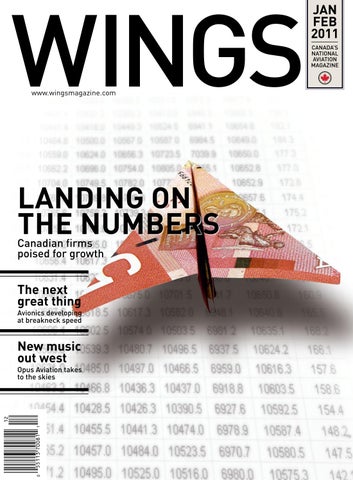
Landing on the numbers
Canadian firms poised for growth
the next great thing
Avionics developing at breakneck speed
new music out west
Opus Aviation takes to the skies
jan feb 2011 CANAdA’S NAtIONAl AvIAtION mAGAzINe
jan/feb 2011
upfront 5 Leading edge A united front
8 on the fly
News and opinion
11 waypoint
In praise of municipal airports
12 alternate approach Providing a solid foundation
14 at the gate
A commercial success
baCK 57 marketplace 62 on final
Keeping Canada’s aerospace industry thriving
Opus Aviation has commenced operations and is using the Cessna Citation mustang as its workhorse. P. 27.
features 16 Landing on the numbers
Leading Canadian firms poised for growth by FrederICk k. lArkIN
22 the neXt great thing in aVioniCs From top: landing on the numbers. P. 16. the next great thing in avionics. P. 22.
Technology continues to develop at breakneck speed by rOb SeAmAN
24 a smart soLution
Mobile technology is transforming high-flying offices by JAmeS CAreleSS
27 Composing new musiC in the west Opus Aviation takes to the skies by mAtt NIChOllS
33 Careers in aViation 2011
Our second annual supplement highlights education, training and job prospects in Canada̕s aviation sector by JAmeS CAreleSS
coVeR PHoTo: foTolia
www.wingsMagazine.coM
January/February 2011 | wings
3
W E ’R E S K I P P I N G THE WIND TUNNEL AND GOING STRAIGHT TO A PA R T I C L E A C C E L E R A T O R.
T H E T E N.
T H E N E W D E F I N I T I O N O F U LT I M A T E P E R F O R M A N C E
Introducing the transformation of the world’s fastest business jet. The Ten flies faster and farther than its famed predecessor. Its interior has been completely reimagined. The cockpit is revolutionary. Our condolences to the competition—and to time and space for that matter. 1-877-410-8650 www.wings.cessna.com
LEADING
EDGE
| By Matt Nicholls
a united front
Joining forces to help protect Canadian aerospace
T
PHoTo: Magellan aeRosPace
he Canadian Aerospace industry has a rich tradition of developing some of the most innovative and technologically advanced products in the world. From the early successes of the Silver Dart, to the workhorse Douglas DC-3 to the development of the Avro Arrow, to Bombardier’s extensive worldwide fingerprint, Canadian ingenuity over the past century has led to the development of many gamechanging products. But as Claude Lajeunesse, president and CEO of the Aerospace Industries Association of Canada (AIAC), notes in his column on the future of the industry (see “A competitive advantage,” pg. 62), to ensure Canada remains one of the world’s leading players on the world stage it will take much more than “marvelling at our impressive past.” As Lajeunesse aptly points out, it will take a steadfast commitment to research and development, continued development of green technologies, and a dedicated push to recruit and educate the next generation of aviation professionals for Canada to remain an influential player on the world stage. Financial commitment from top levels of government, as well as a united front on behalf of the sometimes-fragmented aviation industry associations, is also imperative to ensure Canadian interests are protected. Two notable examples in late 2010 reveal positive signs on both fronts. Announced in December, the federal government’s $300 million repayable contribution to Pratt & Whitney Canada for a five-year $1 billion R&D project to build new generations of high-performance engines illustrates the kind of financial support needed going forward. With the development of the new en-
5 www.wingsMagazine.coM
gines, P&WC is expected to recruit more than 200 engineers, and at the grassroots level, continue collaboration with leading universities on R&D initiatives across the country. The project also enables P&WC to develop advanced propulsion technologies
Canada has been participating with nine other countries in the F-35 program since 1997 and has contributed some US$150 million over the past decade to its development. The proposed purchase of 65 F-35 fighters to replace the current CF-18 fleet would not only provide the Canadian Forces with stateof-the-art aircraft, but would be a significant boon to countless Canadian companies for years to come. To date, more than 50 contracts worth $320 million are already in place with Canadian firms, and as Lajeunesse noted in late 2010: “to say that by cancelling the current process and starting from scratch would somehow result in a greater number of jobs for our industry and without penalties is not only a stretch but completely misleading.” This steadfast commitment to highlighting the benefits of the F-35 project is precisely the type of leadership needed to protect current and future Canadian aerospace initiatives. With the retirement of an aging workforce looming, recruitment, education and training are also key building blocks for future success. Industry associations, colleges, universities, and flight schools are well aware of this problem and have been proactive in seeking ways to develop worthwhile career paths for students seeking employment in the aviation sector. At Wings, we’ve followed suit with the development of our second annual Careers in Aviation supplement, a special guide that provides young Canadians a glimpse into the many exciting opportunities a career in aviation can provide. Written by James Careless, the supplement was delivered to more than 3,000 high school guidance counsellors across the country in January. Hopefully, by developing products like this – and continuing to highlight the many impressive contributions of those in this dynamic industry – we can help fuel the passion for future innovative discoveries . . . and help Canada stay on the cutting edge of aerospace innovation. | w
“This steadfast commitment to highlighting the benefits of the F-35 project is precisely the type of leadership needed.” for improved environmental performance, including reduced fuel consumption, lower emissions and less noise. The unwavering support by aviation associations and manufacturers in protecting Canada’s involvement in the F-35 Lightning II Joint Strike fighter program amidst continued resistance from federal opposition parties also illustrates the type of forwardthinking needed to keep Canada thriving as an aerospace leader.
top data bursts… in this issue 1. 170,000: annual aircraft movements lost by the closure of Buttonville airport (pg. 11). 2. airline profits for 2010 will total $8.9 billion on revenue of $560 billion (pg. 14). 3. 93 per cent of bombardier’s $9 billion in aerospace sales in 2010 came from outside canada (pg. 18). 4. 3,000: number of feet a citation Mustang needs to land (pg. 28). 5. 80,000: canadians employed in the aerospace industry (pg. 62).
Your feedback is always welcome. Please contact me at mnicholls@annexweb.com. January/February 2011 | wings
5
WINGS
jan feb 2011 CANAdA’S NAtIONAl AvIAtION mAGAzINe
www.wingsmagazine.com
Vol. 52, issue 1 editor
Matt nicholls mnicholls@annexweb.com 416-725-5637
Landing on the numbers
Canadian firms poised for growth
assoCiate editor
andrea Kwasnik akwasnik@annexweb.com 519-429-5181 • 888-599-2228 ext. 238
the next great thing
Avionics developing at breakneck speed
new music out west
Opus Aviation takes to the skies
produCtion artist
Kelli Kramer
SubScribe TODAY !
fLight deCK
1 Year SubScription WingsJANFEB2011.indd 1
23/12/10 3:43 PM
only
3000
$
Roger Beebe, Ray canon, James careless, David carr, Paul Dixon, Brian Dunn, frederick K. larkin, neil MacDonald, James Marasa, carroll Mccormick, Mike Minnich, David olsen, Peter Pigott, Dr. Tarek sardana, Rob seaman, Blair watson assoCiate pubLisher
alison de groot adegroot@annexweb.com 1-888-599-2228 ext. 246
(all taxes included)
US $42.00 (USD) • Foreign $65.00 (USD)
Name: _______________________________ Company: ____________________________ Title: _________________________________ Address: _____________________________ City: _________________________________ Prov: ________________________________ P.Code: _______________________________ Tel: __________________________________ Fax: _________________________________ e-mail:________________________________
PLeASe cHecK ONe: ❑ Commercial aircraft owner/operator ❑ Business/private aircraft owner/operator ❑ Military ❑ Aircraft maintenance/overhaul firm ❑ Airport ❑ Aerospace, airframe & component manufacturer and distributor
❑ Fixed base operator ❑ Aviation services, consultants and aircraft sales ❑ Government ❑ Aviation associations and organizations ❑ Flying schools, clubs and colleges ❑ Other (please specify) ______________
PAYMeNT: Cheque - Payable to Annex Publishing Visa
MC
AMEX
Account #: __________________________ Expiry:_____________________________
adVertising saLes
Ryan culver rculver@annexweb.com 519-429-5182 • 888-599-2228 ext. 273 group pubLisher
scott Jamieson sjamieson@annexweb.com president
Mike fredericks mfredericks@annexweb.com wings magazine
P.o. Box 530, 105 Donly Dr. s., simcoe, on n3Y 4n5 Tel.: 428-3471 fax: 429-3094 Toll free: 1-888-599-2228
Publication Mail agreement #40065710 Return undeliverable canadian addresses to circulation Dept., P.o. Box 530, simcoe, ont. n3Y 4n5 e-mail: ncuerrier@annexweb.com Published six times per year (Jan/feb, Mar/apr, May/ Jun, Jul/aug, sep/oct, nov/Dec) by annex Publishing & Printing inc. Circulation e-mail: ncuerrier@annexweb.com Ph: 866-790-6070 ext. 208 fax: 877-624-1940 Mail: P.o. Box 530, simcoe, on n3Y 4n5 subscription rates canada – 1 Year $ 30.00 (includes gsT - #867172652RT0001) Usa – 1 Year $ 42.00 foreign – 1 Year $ 65.00
occasionally, wings Magazine will mail information on behalf of industry-related groups whose products and services we believe may be of interest to you. if you prefer not to receive this information, please contact our circulation department in any of the four ways listed above. no part of the editorial content of this publication may be reprinted without the publisher’s written permission. ©2011 annex Publishing & Printing inc. all rights reserved. opinions expressed in this magazine are not necessarily those of the editor or the publisher. no liability is assumed for errors or omissions. all advertising is subject to the publisher’s approval. such approval does not imply any endorsement of the products or services advertised. Publisher reserves the right to refuse advertising that does not meet the standards of the publication. Printed in canada issn 0701-1369
Signature: _________________________ Date: _____________________________
TO SubScribe:
Tel: 866-790-6070 Fax: 877-624-1940 Mail: Wings Magazine c/o Annex Publishing & Printing inc. P.O. box 530 Simcoe, Ontario N3Y 4N5 e-mail: ncuerrier@annexweb.com
www.wingsmagazine.com
GST#135274215RT001
6
Subscriptions non-refundable
wings | January/February 2011
PRO0111
Air Transport Association of Canada
ON THE
WEB
Canadian Owners & Pilots Association
Canadian Business Aviation Association
Magazines Canada
web eXCLusiVe Gerald Haddon appointed Honourary Colonel News highlights, web exclusives, blogs, job postings, new products, events and more www.wingsmagazine.com www.wingsMagazine.coM
5-7 APRIL 2011
Exclusively aircraft interiors The Global Market Place For The Aircraft Interiors Industry For more information visit: www.aircraftinteriorsexpo.com or call +44 (0) 208 910 7132
Engage with over 10,000 industry specialists from commercial airlines, aircraft manufacturers, completion facilities and more.
First time exhibitor rates available Organised by:
Image courtesy of Swiss International Air Lines
In co-operation with
ON THE FLY For late-breaking news, the Wings blog and exclusive web content, please visit us at: www.wingsmagazine.com
industrY news peopLe produCt watCh operators
industrY news
eXeCutiVe airshare sets up in buffaLo Business travellers in southern Ontario seeking an alternative to crowded airports may soon find themselves shuffling off to Buffalo. Executive AirShare, a U.S.-based fractional aircraft ownership company, is expanding its regional fractional aircraft ownership programs to serve the Great Lakes/Mid-Atlantic region by establishing operations at Buffalo Niagara International Airport. Aircraft management and charter services firm, Executive Flight Services, a wholly-owned subsidiary of Executive Airshare will also establish operations at the airport to serve customers. While scheduled carriers offer standard air options, Executive AirShare sells 1/16 shares of its aircraft to potential customers. Shares begin at US$299,500 per year and customers “own” the aircraft for up to 20 days a year. The company has signed a long-term lease for a 27,000 square foot hangar and 4,400 sq. ft. of office space. Executive AirShare will initiate service in Buffalo with an Embraer Phenom 100 entry level jet, and a Beechcraft King Air 350.
Local business executive David Jones will head up operations as regional vice president and oversee business development in the Great Lakes/Mid Atlantic region. “We see enormous opportunity to serve business and leisure users or corporate throughout mid-state New York and southern Ontario from Buffalo,” says Executive AirShare chairman and chief executive officer Robert Taylor. “Our program offers a real alternative for business owners and executives in this market.” Interest from north of the border is already heating up, says Jones. “We have one law firm interested and are generating strong feedback from other firms in southern Ontario who do business south of the border, especially those that fly commercially through Buffalo or pick up charter flights through here. It’s easier to clear customs here, they do a good job of security…and going through Pearson is another animal entirely. This is a real option for firms that do significant business in the U.S.”
CaLendar for a Cause She may be an unassuming air traffic controller with Nav Canada, but Kendra Kincade can now add “calendar girl” to her resumé – and it’s all in support of a great cause. Kincade is the guiding force behind
the new “Women of Air traffic Control” calendar will raise money for the royal Alexandra hospital in edmonton. 8
wings | January/February 2011
executive AirShare, a U.S.-based fractional aircraft ownership company, has expanded operations to buffalo. It's an ideal option for southern Ontario-based companies.
the new “Women of Air Traffic Control” calendar, a project that was created to raise funds for the Royal Alexandra Hospital Foundation in Edmonton. Kincade will be joining a group of 35 local doctors, professionals and business leaders August 8-19 on the journey of a lifetime – the ascension of Mount Kilimanjaro in Africa. The Royal Alexandra Hospital Foundation is organizing the expedition with expedition leader and documentary filmmaker Ben Webster. He will lead the expedition and head a team of documentary filmmakers who will chronicle the climb and supply footage to media partners in Edmonton. The goal is to raise more than $500,000 for the Royal Alexandra Hospital, in support of its new Orthopedic Surgery Centre. This stand-alone facility will be the first in Canada to focus exclusively on knee and hip replacement surgeries and allow for groundbreaking orthopedic research to take place. As part of the team making the climb, Kincade’s goal is to raise $5,000 for the cause. The idea for the calendar was born after discussing ways to raise money with her colleagues, she says. “We are proud of the professionalism, safety and empowerment that we bring to our roles in the modern workplace and we wanted to celebrate these strengths whilst helping such a worthwhile cause,” says Kincade. The calendars cost $10 each and Kincade’s goal is to sell 500 copies. The website (www.controllingtheskies.com) will allow people to buy online. www.wingsMagazine.coM
PHoTo (ToP): execUTiVe aiRsHaRe, (BoTToM): csqUaReDiMaging
8 9 10 10
snowbirds haVe wowed Canadians for 40 Years
PHoTos (ToP): MaTT nicHolls, (BoTToM): DnD.
The Canadian Forces Snowbirds Demonstration Team marked its 40th anniversary in October with wrap up performances at 15 Wing Moose Jaw, Sask. The Snowbirds are composed of 85 Canadian Forces members, both Regular and Reserve Force, who come from various military backgrounds and experience. Canadians have been connecting with the Snowbirds and their tradition of excellence for 40 years. During the 2010 show season, the Snowbirds completed 60 performances at 35 different locations around North America. “The Snowbirds are one of Canada’s most recognized and treasured national symbols,” said the Honourable Peter MacKay, Minister of National Defence. “The Snowbirds are outstanding international ambassadors for Canada and I congratulate the entire Snowbirds team, as well as the Air Force, for the long-standing tradition of aviation excellence and showmanship.” Lieutenant-General André Deschamps, Chief of the Air Staff added, “The Snowbirds have given Canadians great shows over the years and, in turn, Canadians have given them their support. The aerobatic grace of the CT-114 Tutor aircraft has remained fresh and inspiring, and Canadians can be proud of their world-class Canadian Forces air demonstration team.” Lieutenant-Colonel Maryse Carmichael, Commanding Officer 431 Air Demonstration Squadron, says the Snowbirds train
Canadian North president tracy medve is the first woman to be named an honorary life member of AtAC.
to achieve aviation excellence because the spectators deserve a spectacular performance every time they take to the skies. “We have grown and evolved over the years thanks to the support of Canadians,” said Carmichael.
peopLe
CeLebrating suCCess at ataC The Air Transport Association of Canada (ATAC) handed out its annual awards in early November, and for the first time in its history, a woman captured one of its highest honours. Tracy Medve, the president of Canadian North for the past three years, was inducted into ATAC as an Honorary Life Member, the first woman to do so. Honorary life memberships have been awarded since 1976 to those who have contributed significantly to the improvement of the association and the Canadian air transport industry. Individuals are nominated by
members of ATAC and are then presented to the board for a vote on their contribution to the industry. “The aviation industry is a passion of mine, so being inducted as an Honorary Life Member of an important aviation industry association like ATAC holds special importance to me,” Medve said. Since 1985, Medve has held several senior airline management positions at Norcanair, Time Air, Canadian Partner, and Canadian Regional Airlines. Prior to joining Canadian North, Medve was the co-founder of C.T. AeroProjects, a Calgary-based consulting organization focused on air transport resource management. In addition to sitting on the ATAC board, Medve sits on the Northern Air Transport Association Board, and the University of British Columbia, Okanagan External Advisory Board. Other award winners honoured during the association’s Annual General Meeting & Tradeshow in Vancouver: • Bob Davis, NAV CANADA (formerly First Air), ATAC Honorary Life Membership Award
during the 2010 show season, the Snowbirds completed 60 performances at 35 different locations around North America. www.wingsMagazine.coM
January/February 2011 | wings
9
ON THE
FLY
produCt watCh
SEE thE LiGht Searching for the perfect tool to identify leaks in fuel, lubrication or hydraulic systems? The Spectroline Optimax 365 may offer a bright solution. This cordless, rechargeable highintensity UV LED flashlight from the Spectronics Corp. is designed exclusively for aviation leak detection and features an ultra-high intensity UV LED making all leaks easy to spot. Powered by a rechargeable NiMH battery, the Optimax 365 is four times brighter than other high-intensity leak detection lamps and has an inspection range of up to 20 ft. It provides up to 90 minutes of continuous inspection time. Compact and lightweight, the Optimax 365 weighs just 11.8 ounces. www.spectroline.com 10 wings | January/February 2011
Field Aviation’s John mactaggart (r) accepts the Universal Avionics top North American dealer award for 2010.
•
•
•
•
•
William Sutherland, Moncton Flight College, David Charles Abramson Memorial Flight Instructor Safety Award (top flight instructor) James Pouget, Centennial College/ Durham Flight Centre, Webster Memorial Trophy Award (top amateur pilot of the year); Cameron Maclean, Coastal Pacific Aviation, runner up Brad Martin, Bearskin Airlines, Paul Mulrooney Memorial Award of Excellence (progressive advancement to and within management positions) Bearskin Airlines, Hope Air Outstanding Philanthropist Award (recognizing philanthropic leadership by an ATAC member following Hope Air’s mission of removing barriers and costs for healthcare) Stephen Kane, Cadet WOII 676 Kittyhawk Squadron, North Saanich, B.C, Air Cadet Continuation Flying Bursary (top air cadet as chosen by the Air Cadet League of Canada).
operators
fieLd reCognized as uniVersaL’s top deaLer Field Aviation has been awarded Universal Avionics’ top North American dealer award for 2010.
In a ceremony at the National Business Aircraft Association (NBAA) annual meeting and convention in Atlanta, Ga., Universal Avionics president and CEO, Ted Naimer, presented Mississauga, Ont.-based Field Aviation with the award. The award is in recognition of Field’s outstanding sales performance and dedication in supporting the Universal Avionics line of advanced avionics equipment. In accepting the award, Field Aviation president and CEO, John Mactaggart, said, “Considering the quality of Universal’s authorized dealer network, this designation is something that all of us at Field Aviation can be very proud of.” In a separate ceremony at NBAA, Field Aviation took delivery of Universal Avionics’ 20,000th Flight Management System (FMS) since its first FMS, a UNS-1 system, was delivered at the 1983 NBAA convention. Field Aviation is internationally recognized for its uniquely engineered modifications and conversions of aircraft for special mission applications. These include the installation of Universal Avionics’ multi-mission management systems as standard equipment, and the flight deck modernization, based on Universal Avionics’ latest technology EFI-890R displays, of the Dash 8 100/200/300 series aircraft. www.wingsMagazine.coM
PHoTo: fielD aViaTion
RiGht FoR FLiGht Pilots who like to use a backpack to transport gear can now use one designed exclusively for flying. The new Sporty’s Flight Gear Pack has room for two headsets, a GPS and has a pocket specially designed for an iPad. “We noticed many of the flight students at our airport were using a backpack for a flight bag, and we knew we could create something better – a backpack specifically for pilots,” said Sporty’s vice president John Zimmerman. This portable unit categorizes everything a pilot carries in dedicated pockets. A padded compartment accommodates two headsets while a separate laptop compartment fits up to a 17-inch laptop. The accessible top pocket is also ideal for a cell phone or iPod. Quick-access external pockets can hold a flashlight, a fuel tester and pens and keeps these items ready for use. www.Sportys.com
WAYPoiNt | By Rob Seaman
in praise of municipal airports Imminent closures fly in the face of logic
PHoTo: ToRonTo aiRwaYs lTD.
W
ell, it’s official – the Toronto Buttonville Municipal Airport will close within the next five years. No, this is not an attempt to get the attention of government and restore funding. The deal is done. Buttonville will become home to shops, people and industry, and no longer the proud and busy centre of aviation that we all knew. Toronto Airways Ltd. (TAL) announced more than a year ago it was actively looking at alternative use of the lands. Nobody can blame it for making this decision. Any business has to make money, and from all accounts, Buttonville was unable to be profitable at its current site. Without the subsidy that was cancelled prematurely, the first way to make more money was to attract additional business. For Buttonville, that would mean runway expansion, and as the airport has become landlocked it cannot grow any further. Also, you can only charge so much for landing fees and a litre of fuel before the people who use your airport say no. So, raising prices was not an option, either. And the land itself was originally purchased in 1963 at a fraction of what it is worth today. So, who can blame the owners for making a sound business decision? Times and circumstances have changed, this operation needs to find a new home. The Toronto region is not unique to this situation. The same story is playing itself out at many smaller regional airports across this country. The problem has been brewing for many years. The National Airports Policy is a flawed piece of government work from the 1990s that should have long since been overhauled. It has taken the emphasis for development, support and sustainment of the national air system away from a centralized overseeing body like the federal government, and spread it around to local, disconnected interests that lack the big picture focus. Edmonton Municipal Airport is facing a similar demise. Recent municipal elections there have brought in a city council determined to see the closure of the airport by 2024. Similar issues can be seen at St. Hubert and on the East Coast. The fact remains an airport in your backyard is www.wingsMagazine.coM
of airports serving Toronto (the results have not been released), AMCO maintains by general consensus that there is a significant excess capacity within the 12 airports and aerodromes located in Toronto and the surrounding area. Further, they say the other airports have the capacity to absorb the traffic from Buttonville. But the reality is there aren’t 12 airports within equal distance of Toronto that would be a reasonable replacement for Buttonville. And some are already restricted – size, operation, location in proximity to the YYZ control zone or their ability to receive all types of aircraft. Therefore, when the last aircraft departs Buttonville in four or five years, the Toronto area will lose the capacity to receive and house 300 aircraft and more than 170,000 annual movements. Local hospitals will be unable to do rapid patient transfers. Police and other government agencies that have used these convenient local airports will have increased response time and operational costs. The good news is some communities and politicians recognize the importance and value of airports. The future for TAL, its staff and tenants, has a bright side. More than one municipality has come forward and invited TAL to plan for a potential airport in their community. So, while this holds some hope that a solution will be found in a timely manner, the same can’t be said for the other airports facing similar challenges. The bottom line is we need to encourage the sustainment and development of our airports. And we need governments to realize the “not in my backyard and therefore not my problem” approach is not working. | w
The good news is some communities and politicians recognize the importance and value of airports. not popular with many communities. But chances are the airport was there first and people moved to those communities because airports are good for local business and development. The Airport Managers Conference of Ontario (AMCO) is an association of more than 50 airports and aerodrome’s from across Ontario, and is a senior advocate of airport ownership and operator organizations in Canada. In reply to the announcement that Buttonville is closing, AMCO’s response is perplexing. In a media release, they state that over the past year, they have been working closely with member airports in and around Toronto to comprehend the impact the closure of Buttonville will have on their operations. Making reference to a 2007 Transport Canada study
Rob Seaman is a Wings writer and columnist. January/February 2011 | wings
11
ALTERNATE
APPRoACh By David Carr |
providing a solid foundation Celebrating the 60th year of Royal Canadian Air Cadets
O
12 wings | January/February 2011
green) for the glory of traditional air force blue. At the Trenton high school where the Royal Tigers gather, older cadets help put the younger cubs through their paces, including marching techniques (there are no short cuts to marching, but there are tricks of the trade) and drills such as suspending one arm in the air for more than a minute (you try it). This is not your post-war Air Cadets. The program became co-ed in 1975. Hair length is still noted and discipline is always in the air, but the experience is delivered in a less rigid package. Senior cadets are encouraged to engage in administering the squadron, including the laundry list of training and classroom instruction cadets must complete to earn their stripes. There are about 25,000 air cadets enrolled in 450 squadrons. Less than five per cent will follow the string into military service, with a significantly higher percentage likely to pursue a community-based career in policing, emergency response and firefighting. Not that DND is complaining. “They recognize the value of the program,” says Captain Haigh. “We help build character.” | w
“The whole community gets behind this . . . It also shows cadets what Remembrance Day is about.” said Capt. Jeff Haigh, a Canadian Forces veteran and Commanding Officer of 173 Squadron. “It also shows cadets what Remembrance Day is about.” The Cadet corps is the largest federallyfinanced youth program in Canada. Funding for Air Cadets is backstopped by the Department of National Defence (DND), administered by the Canadian Forces and topped up by the Air Cadet League of Canada, a civilian organization that owns the fleet of 100 gliders and tow airplanes that 22,000 outstanding cadets train on every year. Money from the tag days held locally three times a year stays in the pocket of the individual squadron and is used to support training outside the core program, and field trips such as the one 173 Squadron took recently to the Canadian Warplane Heritage Museum in Hamilton. Consider that the next time you avert the stare of an eager tag seller or dust ’em over a claim of no change. This year, Air Cadets celebrates its 60th anniversary. There have been changes. In the 1970s, the unification of the Canadian Forces erased the identities of all cadet corps. By the late 1980s, Air Cadets had traded their unified overall-style greens (referred to in more diplomatic circles as rifle
David Carr is a Wings writer and columnist, whose nephew, Thomas Gavin, is a first-year Air Cadet. He would like to thank Kate Everson of Belleville EMC for the photograph of the Trenton 2010 Remembrance Day vigil. www.wingsMagazine.coM
PHoTo: KaTe eVeRson, BelleVille eMc
n board the flight deck of any airliner registered in Canada there is a 66 per cent chance that at least one crew member is a former Royal Canadian Air Cadet. Since 1941, when the first Air Cadet League of Canada squadron began churning out trained young men for the war effort, Air Cadets have embraced the challenges of leadership and citizenship. Air Cadets have climbed the highest rungs of political office (former Prime Minister Joe Clark, Premier Brian Tobin and the late Ray Hnatyshyn, Canada’s 24th Governor General), flown the space shuttle (astronauts Marc Garneau, Chris Hadfield, Jeremy Hansen), excelled in business (Raymond McFeetors, CEO of Great West Life) and advanced into the top ranks of the military. Maryse Carmichael, Commanding Officer of the Snowbirds and Chief of Defence Staff, Walter Natyncyzk are former Air Cadets. Yet in many communities, if thought is given to the cadet corps at all, it is on an often damp spring or fall weekend when suited and booted cadets stand at street corners selling tags. Still, many communities are not all communities. In early November, I visited Trenton, Ont., home of Canada’s largest air base (Base Commander Colonel David Cochrane was an Air Cadet) and one of the oldest Air Cadet squadrons. The 173 Royal Tiger Squadron was formed in 1942, a ripe period for recruitment when – as author Mordecai Richler reminded us – eager Canadian school boys were already glued to their warplane silhouettes. Between 173 Squadron, neighbouring 704 Air Force City Squadron and 79 Sea Cadet Corps (the Navy League of Canada was founded in 1895), Trenton has more than 130 cadets. Not the largest cadets cluster in Canada by any stretch, but an impressive number for a town its size, even with a Canadian Forces base. Only 20 per cent of cadets come from military homes, the recruitment equal of the proverbial home goal. In Trenton, the Remembrance Day tradition of honouring our glorious dead is preceded by a 24-hour vigil. A test of character for 50 cadets, many bundled against the cold night air, who stand guard at the local Cenotaph in half-hour shifts. “The whole community gets behind this,”
AT THE
GAtE
By Brian Dunn |
a commercial success
Canadian airlines should grow in 2011; global airlines will struggle
14 wings | January/February 2011
The [domestic] industry as a whole should be in for a good year, barring any uncertainties. economies are doing better, while Air Canada is doing a lot of things to reduce their costs and improve their balance sheet,” Moore said. “The unions understand they have to get their costs down to compete with WestJet.” Air Canada will continue to grow its Asian Pacific routes and will also benefit from synergies through its Star Alliance partners, especially Lufthansa and United Airlines, said Moore. And WestJet should see incremental growth through its new partnership with Cathy Pacific. And while Porter Airlines now has to share space at Billy Bishop Toronto City Airport with Air Canada’s Sky Regional Airlines and Continental Airlines, Moore said Porter will make money from leasing gates and counter space to its new neighbours and from new retail shops that are being built at the downtown airport. But one industry analyst sees trouble ahead for Porter with the arrival of competition. “Porter more or less survived in Toronto because of its monopoly,” said Rick Erickson, president of Calgary-based RFP Erickson & Associates. “They’re barely flying above 50 per cent capacity, so it won’t take Air Canada
much to hurt them, say maybe take 10 seats a flight away from them. It will be interesting to see where Porter is a year from now.” The industry as a whole, however, should be in for a good year, barring any uncertainties such as higher fuel prices or a pandemic, said Erickson, noting that yields firmed up in the third quarter of 2010. “There’s a comfortable duopoly between Air Canada and WestJet who are playing the yield game instead of going after market share,” he said. But the delay of deliveries of Boeing 787s has hurt Air Canada more than they will admit and has prevented them from opening new routes and going back to some routes they abandoned, especially in Europe, Erickson said. Air Transat has a very strong presence in the transatlantic market and should continue to do well, Erickson continued. But sun spot destinations are very competitive and as a vertically integrated company, Transat AT probably makes more money selling its hotel rooms (some of which they own) and airport transfers than airplane seats. It should make for a very intriguing year in the commercial airline industry. | w Brian Dunn is a Wings writer and columnist. www.wingsMagazine.coM
PHoTo: aiR canaDa
G
lobal airlines rebounded faster than expected from the recession in 2010, but prospects for the New Year aren’t nearly as rosy, according to the International Air Transport Association. After losing nearly US $26 billion in 2008 and 2009, the IATA revised its profit forecast last year. Airline profits for 2010 when all the numbers are tallied will likely total $8.9 billion on revenue of $560 billion, compared to an earlier forecast of $2.5 billion profit on sales of $545 billion. But 2010 “is as good as it gets,” according to IATA head Giovanni Bisignani. “It will be the peak of the cycle. 2011 will be a much tougher year,” he said. Global airline profits are projected to fall to $5.3 billion in 2011 as government stimulus spending slows, some countries implement austerity measures and unemployment rates remain high in developed nations. IATA expects crude oil to rise to $93 a barrel, helping to raise the industry’s overall expenses to $575 billion in 2011 from $539 billion in 2010. On the domestic front, Air Canada has a pretty “robust” outlook, according to airline analyst Tasneem Azim of UBS Securities in Toronto. “As far as demand is concerned on the international market, yields and traffic are growing, which should help balance a weaker domestic market as long as fuel prices don’t go back up to $100,” he said. “Air Canada is redeploying a lot of capacity to the international market, but so are their U.S. competitors.” Azim said the domestic market is a crap shoot due to the uncertainty of whether U.S. travellers will increase visits to Canada, while WestJet is adding capacity, which puts pressure on its yields. “Their west coast and sun destinations are strong, but they’re adding a lot of capacity. They signed a deal for more aircraft to come on line and while they did a deferral on some aircraft deliveries, they can only defer for so long. The focus (for Air Canada and WestJet) will be on who can manage costs better than who can manage growth.” Both Air Canada and WestJet should have decent years in 2011, according to Karl Moore of McGill University’s faculty of management. “The key is the Canadian and U.S.
UPDATE 2011 Airworthiness Symposium & Trade Show
Coast Plaza Hotel - Calgary, Alberta CANADA
MARCH 17-18, 2011
AIRWORTHINESS
symposium & trade show
50+ Industry Trade Show Exhibitors
Official Media Sponsors
Informative Seminars and Workshops for Fixed and Rotary Wing
In-Depth Mini-Courses Banquet and Max Ward Award
For more information, contact: Phone: 780-439-6020 Fax: 780-439-6106 E-mail: updateinfo@wamea.com
Hosted by the Western Aircraft Maintenance Engineers Association & Recognized by Transport Canada
www.wamea.com
LANDiNG
oN thE NumBERS Canadian firms poised for growth
bY frederiCK K. LarKin
PHoTo: BoMBaRDieR
bombardier is banking on its new long-range Global 7000 to set a benchmark in the large business jet market.
b
oasting more than 400 companies, Canada’s aerospace industry employs approximately 80,000 people and generates annual sales in excess of $20 billion. The fact that roughly 80 per cent of its output is exported is a testament to its ingenuity. Be they airframes, engines, simulation systems or sophisticated components, Canadian-designed and -manufactured goods make the www.wingsMagazine.coM
global aviation business fly. Given the economic turmoil experienced during the past two years, it’s timely to explore the current market to see what opportunities may lie in store. But before highlighting some of Canada’s most prominent aerospace firms and their prospects for the next few months, it’s pertinent to review the current economic environment – and its impact on the aerospace industry. A vision shared by many economic
forecasters and stock market prognosticators maintains that the global economy is transitioning to a slower pace of growth. This is partly due to the reduced rate of inventory restocking that has been underway since the financial meltdown in late 2008. As government stimulus programs (including support for the automotive and housing industries, as well as infrastructure development) are throttled back, it remains to be seen if the consumer and private January/February 2011 | wings 17
industry can pick up the slack. With higher income taxes being considered by certain industrialized countries, growth may be difficult to achieve. There is some good news, however. The BRIC countries (Brazil, Russia, India and China) are expected to continue to achieve improved economic performance in the months ahead. As a result, their demand for a wide range of commodities is expected to remain firm. It follows that with increased standards of living, these four nations and others in their geographic regions will witness an expansion in air travel related to business and pleasure – and their need for aerospace products will subsequently increase. Given its wealth of natural resources and relatively stable financial industry, Canada should experience economic growth during 2011. Having said that, however, few are expecting a robust performance as worries associated with the U.S. housing industry, its tax regulations, and concerns about future inflation resulting from its government’s spending/debt levels and monetary policy, are dampening expectations. To gain some insight into what may be expected of the Canadian aerospace industry, Wings chronicled the prospects of five leading Canadian aerospace companies representing airframe, power plant, simulation equipment and aerostructure/component manufacturers. Regardless of their size, each company is actively involved in the process of developing new products or preparing to participate in the production of new products. Here’s a snapshot of how they will fare in the months and years to come – and where opportunities will emerge going forward.
bombardier aerospaCe, dorval, Que. Bombardier is the world’s third largest manufacturer of aircraft and is the leading producer of regional airliners and corporate jets. During its most recent fiscal year, 93 per
(table 1) modeL global xRs gulfstream g650 global 7000 global 8000
maX. range
L-r Cruise
maX. Cruise
Cabin VoL.
in serViCe
(nm) 6,150 7,000 7,300 7,900
(Mach) .85 .85 .85 .85
(Mach) .87 .90 .90 .90
(Cubic ft) 2,140 2,138 2,637 2,236
now 2012 2016 2017
Source: Bombardier Inc. and Gulfstream Aerospace Corporation
in Wichita, Kan; the Challenger 300, 605 and 850 in Dorval; and the Global 5000 and Global Express XRS in Toronto.
the forecast Commercial aircraft – The most exciting opportunity within the global commercial aircraft market in the next few years will be developing an aircraft that can meet the requirements of mainline and low-cost carriers for a more efficient 100- to 145-seat airplane than what is currently available. A clean sheet design incorporating a more efficient airfoil, a new airframe built with advanced structural materials and a nextgeneration power plant would theoretically present the optimum solution to make an impact in this market segment. And that’s precisely where Bombardier’s new CSeries comes in. The new family of airliners has been designed to provide a 15 per cent direct operating cost advantage; produce a 20 per cent reduction in fuel consumption; offer a significantly smaller noise footprint, being four times quieter; and produce a range of 2,000 to 3,400 miles. Real potential exists for Bombardier in various markets for the two members of the CSeries family – the CS100 (100 to 125 seats) and the CS300 (120 to 145-seats). Their Pratt & Whitney PW1524G engines are scheduled to be certified in 2012 enabling the two aircraft to enter service in 2013 and 2014, respectively.
indices, is another determinant of business aircraft demand. Having suffered a significant downturn during the latter half of 2008 and throughout 2009, the global business aviation industry is experiencing a gradual recovery. This is supported by the facts that aircraft utilization rates are improving; the secondary market has strengthened and inventories of preowned aircraft have declined; and new orders have increased while order cancellations have slowed, resulting in net new orders in recent quarters. The strongest order backlogs among Bombardier’s corporate aircraft are with its largest, and most expensive, models. Bombardier forecasts that over the next 20 years, approximately 26,000 business jets with a value of $660 billion will be delivered worldwide. That would increase the fleet from the 14,200 units that existed in 2009 to 29,000 by 2029. Included in that figure are 11,200 expected retirements. The fastest-growing segment of the bizjet market is forecast to be at the top end. The owners/operators of large corporate jets have expressed what they wish to see in a next-generation airplane: greater range, higher cruise speed and a larger cabin. Bombardier is developing two models, the Global 7000 and the Global 8000, to address this expanding market. Table 1 compares those new models with Bombardier’s current flagship (the Global Express XRS) and that of its chief competitor (the new Gulfstream
reAl POteNtIAl exIStS FOr bOmbArdIer IN vArIOUS mArketS FOr the tWO memberS OF the CSerIeS FAmIly – the CS100 ANd the CS300. cent of its $9 billion in aerospace sales came from outside Canada. The Commercial Aircraft division currently manufactures three regional jets: the 66- to 78-seat CRJ700; the 77- to 90-seat CRJ900; and the new 93- to 100-seat CRJ1000 in Mirabel, Que. It also produces the 70- to 80seat Q400 turboprop in Toronto. The Business Aircraft division currently produces three families of jets that fit into the light, medium and heavy categories, respectively: the Learjet 40XR, 45XR and 60XR 18 wings | January/February 2011
Despite the unsettled economic environment, and potential competition from reengined versions of the Boeing 737-600/700 and Airbus A318/319 models, Bombardier has managed to receive orders for 33 CS100s and 57 CS300s. Business aircraft – The health of the economy dictates there will be a steady demand for corporate air travel in the months and years ahead. Wealth creation, as measured by corporate earnings and in turn by the value of leading stock market
G650) using the key metrics of range, speed and cabin size. While the Global 7000 and 8000 will fill the larger business-jet void, Bombardier is also going large with its Learjet 85 – the largest variant of that venerable family. It is being designed to fly four passengers 3,000 nautical miles at M.78, or up to nine passengers on shorter missions at M.82. When it enters service in 2013, it will have been 50 years since the first flight of the pioneering Learjet 23. www.wingsMagazine.coM
PHoTo: HeRoUx-DeVTeK
heroux-devtek supplies landing gear for both the commercial and military markets.
Bombardier president and CEO Pierre Beaudoin is cautiously optimistic when commenting on the company’s fortunes going forward. “The environment in aerospace remains difficult with leading indicators sending mixed signals as to the timing of a full recovery,” Beaudoin says. “Nevertheless, we continue to work on our development programs and announced, in September, the launch of the Global 7000 and Global 8000 jets. “As the global economy firms up, our product strategy will position us well to expand our market share as well as to increase our penetration of emerging markets.”
pratt & whitneY Canada Longueuil, Que. P&WC is a leading manufacturer of small www.wingsMagazine.coM
turbine engines for the aerospace industry and produces 13 families of engines for both fixed- and rotary-wing aircraft. Outlook – Given its exposure to the general aviation and regional airline industries around the world, P&WC is expected to participate in the rebound in demand for aircraft as the global economy recovers. Evidence of this is provided with the following recent developments: • In mid-December, P&WC announced it is investing $1 billion to develop lighter aircraft engines with increased power, greater fuel capacity and better durability. The project is expected to create more than 2,700 jobs over 15 years. The federal government is contributing some $300 million to the project in a “repayable investment.”
•
NetJets announced at the NBAA show in Atlanta, Ga., that it has ordered 50 Embraer EMB-505 Phenom 300s, with options on another 75. This could mean as many as 250 PW500 engines with that order. • The new PW210 turboshaft, already chosen for the new Sikorsky S-76D currently under development, has been selected to power the new AgustaWestland AW169. • The PW300 will be on the Learjet 85 that is due to fly in 2012. Another key indicator of Pratt & Whitney’s future prosperity is its demand for human resources. In November, P&WC announced it was recruiting 200 engineers to support development programs at its plants in Longueuil, Que., and Mississauga, Ont. January/February 2011 | wings 19
CAe produces full-flight simulators for new aircraft, including the boeing 747-8 and 787 models.
Cae, saint-Laurent, Que. CAE designs and manufactures flight simulation equipment and provides flight training services for civil and military customers. Since its inception in 1947, CAE has delivered more than 1,000 full-flight simulators (FFSs) and flight training devices (FTDs) to more than 130 airlines, airframe original equipment manufacturers (OEMs) and training organizations around the world. The company has captured more than 70 per cent of the global FFS market in recent years, and fortunes are on the upswing. CAE is also a major player in the flight training business, with more than 140 FFSs in 24 centres worldwide. Its 3,500 customers include airlines, corporations and aircraft OEMs. On the military front, CAE is one of the world’s leading suppliers of full-mission simulators. The company also provides simulation instruction and maintenance at more than 60 locations worldwide. Outlook: Civil – Over the past two decades, global passenger traffic has had a 20 wings | January/February 2011
Compound Annual Growth Rate (CAGR) of about five per cent. The leading airframe OEMs are looking for similar growth over the next 20 years, with the strongest prospects coming from China, India and the Middle East. This bodes well for new airliner deliveries and for FFS demand. Typically one FFS is required for every 30-35 narrow-body airliners within a given airline’s fleet. The ratio is one for every 15 to 20 wide-body airliners. CAE’s technical leadership has resulted in it being the first company to provide FFSs for new aircraft, such as the Airbus A380 and A350, the Mitsubishi Regional Jet, the ATR42-600 and ATR72-600, and the Bombardier CSeries and Learjet 85. It has also produced FFSs for other new aircraft including the Boeing 7478 and 787 models, Embraer’s 190 and Phenom 100/300 models, as well as the COMAC ARJ21. Several current trends should result in opportunities for CAE’s civil businesses. For example, new orders for existing airliner and business aircraft models
and the introduction of new airliner and business aircraft models, will produce favourable circumstances for the company. Increased travel demand on the business and leisure side of the ledger from emerging economies will also drive sales, as will the long-term demand for qualified aircrew as the population of pilots declines with retirements and the number of aircraft in service increases. Military – During the past two years, CAE has received more than $2 billion worth of orders from defence forces. The company forecasts that over the next five years, approximately 9,500 new military aircraft will enter service, thereby requiring some 300 full-mission simulators. The key drivers behind the continuing growth of CAE’s military business include: • budget-related pressures that will require governments to “do more with less” within their armed forces. Sophisticated simulation provides an extremely cost-effective alternative to training with actual assets. • risks to personnel in live training are also www.wingsMagazine.coM
PHoTo: cae
“AS the GlObAl eCONOmy FIrmS UP, OUr PrOdUCt StrAteGy WIll POSItION US Well tO exPANd OUr mArket ShAre.”
reduced through the use of simulators. the evolving nature of warfare that uses land, sea and air forces, not to mention multi-national teams, will require mission rehearsal capabilities in the company’s training programs. CAE’s book-to-bill ratio during the 12 months ended September 30, 2010, was 1.18x, resulting in an order backlog of approximately $3.2 billion. That represents twice the revenues of its most recent fiscal year. Said president and CEO Marc Parent of his firm’s solid third quarter results: “Our performance in the second quarter showed more evidence of the recovery underway in commercial aviation with higher utilization of our training centres and increased orders for our simulation products. Government cost-cutting will present new challenges to the defence industry; however, we expect CAE to continue to grow by helping our customers maintain readiness at a lower cost through simulation-based training.” Civil and military customers rely on CAE’s products and services to optimize the performance of their substantial asset bases. As long as there is continuing improvement in the global standard of living, and as long as world peace •
www.wingsMagazine.coM
continues to be threatened, CAE’s standing as a leader in the Canadian aerospace industry will remain strong.
mageLLan aerospaCe, mississauga, ont. With operations in Canada, the United States and the United Kingdom, Magellan designs, engineers and manufactures aero engine and aerostructures used in commercial and military aircraft and in spacecraft. The company also serves the aftermarket by supplying spare parts and providing repair and overhaul services. Its core capabilities include the manufacture of composite structures and engine components; precision magnesium aluminum castings for turbine engines; jet engine components used on commercial and military aircraft; jet engine nacelles and exhaust systems; and rocket systems and satellites. During 2009, approximately 15 per cent of its $687 million in sales were from Airbus and about 11 per cent came from Boeing. Outlook – Magellan is participating in three high-profile aircraft development projects that promise to provide increased revenues as production rates build over the next decade. The Boeing 787 program has been unexpectedly challenged in recent months
and is behind schedule. Nonetheless, the order book for this new family of airliners remains strong. Through the end of October last year, there were 847 ordered, including 629 for the 787-8 and 218 for the stretched 787-9. Magellan will be supplying assemblies for the 787’s nose and main landing gear. The Airbus A350 program has also had its issues and is now anticipating its first flight in 2012. But again, given its attractive economics, this family has generated interest from the global airline industry. As of the end of October 2010, there were 573 ordered, including 168 for the shorter A350-800, 285 for the standard A350-900 and 75 for the stretched A350-1000. These three variants are due to enter service in 2014, 2013 and 2015, respectively. Magellan will also be producing a number of large, complex machined aluminumlithium components for the A350’s centre wing box. Work is due to begin in 2012 on an initial batch of 400 shipsets. The federal government’s $9 billion deal to purchase 65 Lockheed Martin F-35 Lightning II aircraft looms large in Magellan’s future. The company estimates that its deliveries of F-35 airframe and engine
CONtINUed ON PG. 29
January/February 2011 | wings 21
thE NExt GREAt t iN thE AvioNiCS W teChnoLogY Continues to deVeLop at breaKneCK speed bY rob seaman
t
22 wings | January/February 2011
british Antarctic Survey dash-7 modified by voyageur Airways and Avionics design Services.
Gow reports, as many do throughout the industry, that business is static and very price sensitive. Gow also maintains the Transport Canada paper trail is slowing down their company’s STC throughput and causing marked delays in approvals. This has had a negative impact on his business, the shops and OEMs that rely on his firm’s services and, in turn, has had a trickle-down effect to slow business industry-wide. Gow is in good company when he states there are too many impediments to cross-border work. “FAA and TCCA approved data should be seamlessly applied to both Canadian and American aircraft, regardless of the state of design or state of registry,” he says. So, great ideas and technology aside, it’s common to hear that the “red tape” is interfering with the ability of the industry to work – and perhaps even grow – out of the post-recessionary blahs that continue to linger.
making change more efficient Since all aircraft are unique either through OEM design or years of individualized upgrades and changes, there are rarely simple, easy plug-and-play answers to avionics upgrades. Therefore, STCs are needed in many instances – and costs will vary. OEMs have been working diligently to create new products that interface and adapt in various ways – all with the goal to making upgrades as simple as possible. There will seldom be a generic one-sizefits-all solution, but there have been great strides made by firms such as Garmin, Universal, and Rockwell Collins – along with Canadian stakeholders such as EMS and True North – to develop products that interact with one another or existing technologies.
trend watch So, what are the growth prospects heading into the New Year? Norm Matheis, regional manager for Canada at Universal Avionics, says last year’s retrofit sales focused on www.wingsMagazine.coM
PHoTo: T.J. RYan, VoYageUR aiRwaYs lTD.
echnological breakthroughs run the gamut in the aviation industry, but if there’s one area evolving faster than any other it’s the avionics sector. In spite of the recent economic downturn the avionics side remains active and productive, albeit moving somewhat slower than in previous years. The good news is most technological advancements focus on refining and improving the quality, efficiency and safety of aircraft operations and passenger service and support. Most avionics shops and OEMs report a healthy interest in products and services – the majority of the focus remains split between cockpit updates and passenger amenities. The two are essentially intertwined and many owners take advantage of a shop visit to address both, making the best use of downtime. The most requested items in today’s market remain flat panel cockpit updates and system revisions. Both improve the safety and productivity of older aircraft, while adding additional hull value come resale time. Usually coupled with such upgrades are the introduction of new navigation systems, aids and communication or data transmission capabilities. Highspeed broadband and Wi-Fi capabilities are also enhanced, meaning improvements to both the cockpit and the cabin. When significant avionics work is needed, it’s likely an STC will be involved – and that’s where companies like Avionics Design Services Ltd. come in. The Midland, Ont.-based firm has evolved into an industry leader by providing approvals to avionics systems designs in all types of aircraft. When discussing trends in avionics, principal Robert (Bob) Gow maintains Wi-Fi and EFBs remain hot items, but there’s still a steady demand for GPS and FMS upgrades to WAAS. He also sees many TAWS installation approvals and a demand for high-performance AHRS in the Northern Domestic Airspace.
thiNG WoRLD
2000EX aircraft equipped with its Pro Line 4 avionics. Hume adds that Rockwell Collins has also achieved certification of its LPV solution for G150 aircraft equipped with Pro Line 21 avionics. Rockwell Collins holds the STC for the Dassault aircraft, while Gulfstream holds the STC for the G150. Hume says with these additions, Rockwell Collins has now certified approximately 22 WAAS/LPV solutions over the past year on a variety of Pro Line 4 and Pro Line 21 equipped aircraft manufactured by Bombardier, Cessna, Dassault, Hawker Beechcraft and Gulfstream. The LPV certification complements Rockwell Collins’ Approved Model List (AML) STC, available today to upgrade the entire Pro Line 4 and Pro Line 21 fleet to the company’s GPS-4000S receiver, which enables the WAAS GPS capability. Operators who upgrade to the GPS-4000S may take advantage of WAAS in North America using GPS as their primary means of navigation and eliminate the time-consuming Receiver Autonomous Integrity Monitoring (RAIM) check.
praising Canadian ingenuity
WAAS-capable wFMS Flight Management Systems. Most apparent were northern and resource operators recognizing the benefits of investing in development of RNAV GNSS (LPV) approach procedures along with Universal’s wFMS airborne equipment. “The special-use, resource and northern folks really get it,” says Matheis. “I’m convinced LPV is going to change access to the north.” When highlighting successful products, Universal has had success with sales of its flagship EFI-890R flat panel glass at Canadian modifiers, including the delivery of an advanced four-display flight deck in a Dash 7 aircraft used for an overseas special mission operation. Dave Hume, aftermarket sales manager Canada at Rockwell Collins, says it, too, has been busy on the LPV front. The firm recently announced new upgrades for both Dassault and Gulfstream aircraft and has achieved certification of its LPV solution for the Dassault Falcon 50, 50EX, 2000 and www.wingsMagazine.coM
Field Aviation’s chief operating officer, Joar Gronlund, agrees that flat panel upgrades, WAAS LPV and satcom are market leaders when it comes to the world of avionics. And he should know all about setting standards – Field has built a global reputation for integration of such technologies into much larger Special Mission applications and projects. “Synthetic Vision technology has also become a standard option on many new primary and secondary flight displays,” he says. “There has been a growing interest in this technology, especially from the special mission operators, and operators, flying in difficult terrain where advance situational awareness technology is essential to increased safety.” One of the most exciting aspects of avionics technology today, says Gronlund, is the amount of information available to pilots on various classifications of aircraft with the retrofits of new integrated flat panel displays (including Enhanced Vision (FLIR). Among Field’s many new projects has been the flight deck modernization of the 100/200/300 series Dash 8 incorporating the previously noted Universal Avionics EFI890R flat panel displays. Field has significant experience on Dash 8s in commercial and special missions profiles from around the world, making them prime candidates to spearhead such retrofit programs.
a clearer perspective Identifying the “the next great thing” in the avionics world is never easy, but Mid-Canada Mod Center’s Bill Arsenault doesn’t hesitate when he’s asked his opinion: Controller-Pilot
thE
AutomAtioN QuEStioN Do ENhANCED CoNtRoLS DiStRACt PiLotS? While advances in avionics are impressive, there’s question as to whether or not too much automation may be problematic for pilots. In fact, recent updates to the U.S. Federal Aviation Administration’s 1996 landmark report on “interfaces between flight crews and modern flight deck systems” reveal pilots operating flight control computers and devices while in flight can be distracted from “managing the flight path of the airplane.” dr. kathy Abbott, the author of the new report, suggests pilots can “abdicate” their responsibility to the automated systems. She also notes that in some cases, today’s pilots lack practice in “hand-flying” as a result of their dependence and practice of using automation in the cockpit and will, in her view, hesitate to take control of the automated systems in the event of an emergency. Abbott also suggested at the Flight Safety Foundation International Aviation Safety Seminar Nov. 2-5, 2010, in milan, Italy, that automated systems could be a contributing factor in as many as 60 per cent of the accidents reviewed by the FAA research team. Further, Abbott suggests pilots are sometimes uncertain about engaging or disconnecting the autopilot in various types of emergencies. the full report is expected to be released in early 2011, and is expected to set new industry benchmarks. benchmarks can be a good or bad thing with regulators; time will tell on this one. – rob seaman
CONtINUed ON PG. 31 January/February 2011 | wings 23
the Cessna Citation ten business jet will boast a state-of-the art cabin management system.
A SmARt SoLutioN
mobiLe teChnoLogY is transforming high-fLYing offiCes
a
state-of-the-art onboard cabin management system (CMS) is the brain of any intelligent aircraft – and today’s CMS offerings are certainly showing off high IQs. To wit, here’s a sampling of the cutting-edge advancements transforming modern business aircraft: iPads serving as onboard control systems; HDTVs; touchscreens; Android handsets; satellite broadband and fibre-optic backbones. It’s a trend that indicates just how attuned manufacturers such as Cessna, EMS Aviation, Flight Display Systems, InspecTech Aero Service and Rockwell Collins are to the tastes of their business aircraft customers. It’s also an indication of how far CMS has progressed from the early days of stereo audio, a TV monitor and a VCR. “The rapid evolution of mobile technology development is driving new and exciting introductions into the consumer 24 wings | January/February 2011
product arena, which is greatly influencing how customers view cabin management systems today,” says Cindy Halsey, Cessna’s VP of interior design engineering and development. “What began as simple lighting and audio control systems has evolved into complex ambience, entertainment and cabin communication management systems. Technological developments such as flat screen monitors, DVDs, MP3 players, LED lighting, Internet, Wi-Fi, Blu-ray, OLED displays, GUIs (graphical user interfaces), iPhone, Android – and the list goes on at an unprecedented pace – are posing amazing opportunities and incredible challenges to the aviation sector.” Pam Tvrdy, manager of media relations with Rockwell Collins, agrees. She says the major driver is the desire for passengers to have access to an office and entertainment environment that mirrors what they have when they are on the ground. “Because www.wingsMagazine.coM
PHoTo: cessna
bY james CareLess
the consumer marketplace changes so rapidly, it’s critical to have a cabin management system that can easily adapt to new technology,” she says.
the sky’s the limit The new CMS products introduced in the past few months speak volumes about what customers want, and where the CMS market is going. A case in point: Cessna’s new CMS, which was developed for the just announced Citation Ten business jet, integrates the aircraft’s avionics, electrical systems, communications and CMS via a fibre optic-connected, touchscreen controlled command system. This is a quantum leap beyond CMS as a distraction for bored passengers. “The Cessna CMS features an interactive, touch-screen system controller at each passenger seat for audio (digital media, MP3/ iPhone), video (digital, Blu-ray), interactive moving map, cabin temperature, lights, window shades and even cabin diagnostics,” says Halsey. “The dual club-seat cabin arrangement also includes 110- or 220-volt electrical outlets and multiple USB/device inputs. High-speed Internet browsing, satellite radio and cabin WiFi are available as options.” Meanwhile, the Cessna CMS trip computer includes an interactive moving map with a global database featuring standard features such as flight data displays and location indicator, and also offers access to points of interest information. EMS Aviation’s latest CMS offering is its new Aspire family of in-flight communications products. Due to be released in 2011, the system’s corded and wireless touchscreen handsets are based on Google’s Android mobile phone platform. This means it provides users with the kind of interactive experience
found in the latest mobile smartphones. Since aircraft don’t use terrestrial cellular services as a rule, voice and data service is carried using Iridium and INMARSAT satellites. “The handsets also offer e-mail and with third-party apps, the ability to manage cabin functions such as dimming the lights or turning on an entertainment system,” says Kate Murchison, marketing director with EMS Aviation-Ottawa. “They are designed to work with the Aspire system, but any Android application could be installed on the device.” EMS plans to introduce the product line in phases. The Aspire family of communication systems will offer various services from voice and/or data to high-speed Internet, while also providing flexible installation and customizable capabilities and bandwidth. Owners and operators can easily change or upgrade systems without rewiring. For airframe manufacturers, such flexibility allows them to wire an aircraft early in the production process without having to commit to a specific system until much later. EMS is just one example of how OEMS are trying to reduce the total cost and rework efforts when changes or updates are underway and thus encourage both new and retrofit work.
something for everyone Own an older aircraft? Then consider Flight Display Systems for a CMS. Nick Gray, Flight Display Systems’ director of international sales, says its CMS is the first one designed specifically for the retrofit market. “We feature a full 1080p backbone for high-definition content so VIP operators get VIP video quality,” he says. Aircraft capable of using “Club CMS” upgrades include the Cessna Citation and Embraer Phenom. Flight Display System has also come out with an iPad-mounting arm,
SETTING THE STANDARD OF CUSTOMER SERVICE
M a i n t e n a n c e • R e pa i R • Ov e R h au l Vector Aerospace is a leading, global provider of Maintenance, Repair and Overhaul services for Pratt & Whitney Canada’s PT6A, PW100, JT15D, PW307A and PW308A/C series of engines. Our reputation for superior customer service continues to grow at Vector Aerospace, Engine Services – Atlantic. We’re proud of our past – working hard for your future.
A Fully Authorized Pratt & Whitney Canada Distributor and Designated Overhaul Facility
Toll Free: 1.888.769.0999
www.wingsMagazine.coM
www.vectoraerospace.com January/February 2011 | wings 25
which can hold an iPad at a passenger seat in either a vertical or horizontal configuration. “I have a 1981 airplane, but when you go inside the door it feels like 2010,” says Bill Upton, owner/pilot of a Citation II. “Flight Display Systems is a big part of that. We have their Moving Map, DVD player, and a bunch of LCD monitors at each seat. I have six kids and we all love it.” So, why has Flight Display Systems targeted the retrofit market? “With the recession, many new aircraft sales have been cancelled,” Gray says. “Aircraft operators are refurbishing existing aircraft instead of buying brand new planes.” InspecTech Aero Service is showing just how far consumer technology can be integrated in a CMS, by adopting the Apple OS (operating system) to drive its “iCabin” Cabin Management System and In-Flight Entertainment and Connectivity System (IFE) for business jets. Rather than install iPod docking stations, InspecTech has made the iPod, iPad and iPhone integral part of its approach to CMS. In fact, iCabin is controlled using an iPad touch menu, with iPads mounted at every passenger seat to make this easy and accessible.
“Using Apple and iPad technology acknowledges the need to integrate advanced consumer electronic products and software into aircraft,” says Jim Lang, president of InspecTech. “It just makes sense to use popular yet capable consumer technology to control and operate all of the various CMS functions. The approach is efficient, the technology is proven, and customers like it.” Rockwell Collins is also pushing the VIP CMS envelope with “Venue.” Designed to integrate full work-related functions with high-end entertainment, “Venue incorporates high definition home-theatre capabilities, support for personal and portable electronic devices, enhanced mobile office services, connectivity, and full-cabin environmental controls,” says Tvrdy. “Venue was created to address the emergence of high-definition and digital media to fill the need for a cabin management system that could scale the wide range of business aviation aircraft sizes and application – from a Cessna CJ4 to a Boeing Business Jet.” Taken as a whole, the trend towards cutting-edge CMS is undeniable. The addition of iPads as peripheral or – in the case
“the key to success is to find
the attributes that people are willing to pay for.” of InspecTech Aero Service – central elements of an aircraft CMS indicates just how influential consumer technology has become in this market.
the venue system from rockwell Collins addresses the need to incorporate high-definition and digital media needs into the cabin management system. It can scale into anything from a Cessna CJ4 to a larger boeing business jet.
building on the iPad craze, Flight display Systems has come up with an iPad display mount, which works for vertical or horizontal configurations, making it easy to control the cabin systems from your seat. 26 wings | January/February 2011
All this sexy technology begs a big question: Are aircraft owners/ operators actually buying cutting-edge CMS? The answer to this question is akin to a doubled-edged sword. On the one hand, the global recession is definitely hurting CMS sales. “It is a very tight market right now,” says Halsey. “Two years ago the industry was going at an unprecedented pace in deliveries. As the numbers of deliveries went down, the players are all competing for a smaller pool.” On the other hand, there is a revolution occurring in consumer technology, and aircraft owners, operators and passengers want this technology available everywhere – including in the air. “Carry-on equipment such as laptops, iPhones, and other MP3 players mean that IFE systems need to accommodate passenger media,” says Gray. “Besides, a new CMS can help modernize the aircraft interior. Nobody wants to pay thousands of dollars to fly in an aircraft with a VHS deck and cassette tape radio.” Taken as a whole, these two factors mean CMS sales today are very much driven by whatever consumer tech has taken root with the flying public. This trend is not limited to the CMS market sector: “New technology has proven to be a leading driver of growth in all industries,” says Halsey. “Historically, CMS was not considered a necessity, but a luxury and more popular in long range general aviation and transport products. But the influences of automotive and consumer mobile devices have fuelled the appetite for connectivity, and OEMs are seeing this as an opportunity to differentiate their products from the pack. The key to success is to find the attributes that people are willing to pay for.” The bottom line: Those considering CMS systems – whether for their own use, or to attract and keep customers – would be well-advised to keep on top of consumer trends, and see how those trends are being translated into aircraft cabins. The days when trailing-edge CMS could be rationalized away as “aviation specific applications” are over. Consumers want their iPads and iPhones – and they want them everywhere. | w www.wingsMagazine.coM
PHoTos (ToP): RocKwell collins, (BoTToM): fligHT DisPlaY sYsTeMs
are people buying?
Falcon 50 ex in Opus Aviation hangar at Opus launch event.
ComPoSiNG NEW muSiC iN thE WESt
opus aViation taKes to the sKies
t
PHoTo: RanDal KURT PHoTogRaPHY (c) 2010
bY matt niChoLLs
here’s a new player in the charter business in western Canada that is seeking to create a memorable performance with business and leisure travelers alike. Owned by construction firm The Ledcor Group of Companies, Opus Aviation launched its cost-effective charter business Sept. 1 flying out of Vancouver and Edmonton. Opus owns and operates a small, versatile fleet of efficient private jets ideally suited for Alberta and B.C. travellers: a Dassault Falcon 50 EX (capable of intercontinental
www.wingsMagazine.coM
flights of up to nine passengers); a Gulfstream G100 (seats eight); and two Cessna Citation Mustangs (seats four). And while some corporations in western Canada – particularly in the resource sector – spend millions of dollars (and waste precious time) on commercial business travel each year, Opus maintains it has created a better solution: a cost-effective charter connecting Vancouver and Edmonton to Canadian, U.S. or international destinations. To wit: for roughly $2,000 per hour, corporations or individuals can charter a Cessna
Citation Mustang almost anywhere there’s an airstrip. It’s a price point that’s significantly less than it costs to charter other, more expensive options, says Darryl Saunders, Opus director of sales and marketing. “With Opus, business or leisure travellers can get a pressurized, quiet jet aircraft with relatively low operating costs when compared to other jet aircraft. And if you don’t mind a fuel stop, you’re easily 1,500 to 2,000 miles no problem . . . when you see what this aircraft can do [the Opus’ workhorse, the Mustang], and when you compare it with the next step up, you’re spending $3,000 or $4,000 an hour. And really, the average business jet trip is two to four people. So, I think it will change the way people think about chartering a jet.” While a significant part of the Opus business plan is aimed at the corporate business travel market, the firm is also targetting the leisure side for people seeking an alternative to commercial business class or first-class travel. Opus has also partnered with Burnaby’s Jubilee Travel Ltd. to create high-end travel packages to appeal to families flying to Disneyland or golfers flying to various transborder hot spots for that once-in-a-lifetime trip experience. “The nice thing is we have an airplane that matches each mission profile,” says Saunders. “You’ve got the Mustangs for the short hops under 1,000 miles, the Gulfstream 100, which slots in nicely from anywhere in North America, and then you’ve got the Falcon which goes non-stop over the ocean wherever you want to go . . . so it’s a nice matrix of equipment.” Opus is not the first foray into the aviation business for The Ledcor Group. The company has significant corporate travel experience having utilized a Dassault Falcon for more than 10 years. It has been primarily used to transport executives to construction projects all of over North America and Hawaii. The Ledcor Group also own Summit Air, which provides cargo and charter service in the Canada’s far north. Summit, based in Yellowknife, has used the Dornier 228 and Skyvan to serve clients in remote locations for more than 20 years. There’s also a strong commitment to a green approach and the environment: the entire fleet is carbon neutral. “Ledcor has had a phenomenal reputation for integrity, safety and commitment,” says Saunders, “and Opus is a nice complement [to Summit Air]. Ledcor has seen huge returns on using corporate aircraft in terms of productivity, and this is a natural extension of where to take the business.”
a question of timing Starting a charter business in a challenging economic climate may sound like a risky proposition, but to Ledcor, the decision made perfect sense – especially since January/February 2011 | wings 27
so many firms are considering streamlining operations and cutting travel costs. For resource-based companies moving personnel around from city to city – or those transporting executives to transborder locations – choosing an affordable charter with very accessible aircraft made perfect sense. “Aviation is always a risky enterprise from an investment perspective,” says Saunders, “but companies like Ledcor recognize the value a business jet and corporate travel can provide. And they have a vested interest in the charter side of it [with Summit]. So,
there is less risk from a company perspective for a wholly-owned subsidiary . . . Introducing a new class of service, that’s risky as well, but it’s an education and a challenge in terms of getting people up to speed. The economy is turning on the right side – so the timing is also good.” The premise of Opus Aviation was to utilize the very light jet (VLJ) category – the perfect tool for getting people into smaller airstrips. When doing comparisons on a per seat/mile cost effectiveness, it was determined VLJ aircraft offer prices not much higher than typical, airline business-class tickets.
One of the early fleet contenders was the Eclipse VLJ aircraft. However, when Eclipse Aviation filed for bankruptcy in 2009, a new workhorse gained top billing – the Cessna Citation Mustang. With its sleek contours and high-end design, the Mustang looks the part of a high-end business jet – yet it’s often seen as an entry-level aircraft because of its size and price (approximately $3 million). One of its strengths, is it’s able to get into many shorter strips where a larger business/corporate jet might be hard-pressed to land. The Mustang needs just 3,000 ft., making it accessible to countless airstrips across North America. “The Mustang is cost-effective and extremely efficient, making it ideal for shorthaul flights and for landing on airstrips that are inaccessible by commercial airlines,” adds Saunders. The Cessna Mustang also provides passengers with a large baggage area, comfortable seating, a lavatory, and ample cabin space and height. And with a 630 kilometre per hour cruising speed and a range of 2,130 kilometres, it’s a viable choice for corporate groups or leisure travellers seeking to arrive in style. “With business travel, usually it’s two or three people that manifest in a jet aircraft – and when you’re two or three people in a jet that sits eight, it feels weird – it feels like there is a lot of waste,” Saunders says. “The Mustang is the perfect aircraft because when you sit in the back, it’s like sitting in a nice sedan. If the flight is less than an hour and a half, it’s the perfect time; you get there and you feel like you’ve used your resources properly.”
on the horizon While Opus has only been in the market since Sept. 2010, the future beckons. The small but dynamic firm of 15 employees and nine pilots is hoping to trigger enough business for expansion. One goal, says Saunders, is to add more aircraft and continue enticing individuals and businesses fed up with commercial travel to pursue the charter alternative. Positioning an aircraft in Calgary to serve that market is another key goal. “The first couple of years will be proof of concept,” Saunders says. “And there are a couple of things working in our favour. Obviously, the price dynamic, but there’s also opportunity for people that need to go transborder. This is even more exciting for us because it’s such a hassle to go to the airport, get searched and X-rayed and all that other fun stuff. And the pricing for short transborder hops from Vancouver to Seattle or Portland, for example, is ridiculous. I think there’s a big market for just doing these slightly off-kilter routes where a lot of people travel to.” Given its diversified fleet, cost-effective price point, and positioning in the market, it sounds as though Opus has the potential to be a well-orchestrated masterpiece. | w 28 wings | January/February 2011
www.wingsMagazine.coM
Landing on the numbers continued from pg. 21
components could reach US$3 billion over 25-30 years, with revenues as high as US$120 million annually once the full rate of production is realized. For example, 1,038 shipsets of horizontal stabilizers are expected to be produced by Magellan over the life of the program. Magellan also has a six-year $60 million contract to supply complex machined titanium components for the fifth-generation fighter. Jim Butyniec, president and CEO of Magellan, maintains prospects for the future look bright, especially on the civil airline and military fronts. “The civil airline business has improved dramatically during 2010, achieving high load factors, and operating profitably. This enables the airlines to add new, more efficient aircraft to their fleets, and that translates into more manufacturing volume for Magellan,” he says. “In the defence sector, the F-35 aircraft continues to progress and higher volumes are contracted each year en route to entry into full-scale production in five or six years. Magellan has a strong presence in both structure and engine parts and assembly, and is excited about the outlook for this aircraft.”
“This fourth design and development contract won since 2007, and the third in the business jet category, reinforces our reputation in this market,” confirms HerouxDevtek president Gilles Labbe. On the military side, Heroux-Devtek has received orders for as much as $220 million of work on the F-35 aircraft. In recent months, it has also received contracts worth more than $32 million to supply landing gear components for numerous aircraft types operated by the U.S. air force and the U.S. navy. Heroux-Devtek’s order backlog at Sept.
30, 2010, stood at $574 million, up 35 per cent per from where it stood six months earlier. To put that into perspective, the company has annual sales of approximately $320 million. Given its exposure to both mature and new aircraft programs in commercial and military markets, Heroux-Devtek is expected to achieve continued growth going forward.
forward progress With the global airline industry back in the black, carriers will be modernizing their
herouX-deVteK, Longueuil, Que. Heroux-Devtek’s aerospace business represents 90 per cent of its annual sales. Serving OEMs and the aftermarket with landing gear components and out-ofproduction aircraft parts, Heroux-Devtek supplies both commercial and military markets. Its largest customers (each representing more than 10 per cent of its total sales) include Bombardier Aerospace, Goodrich, Lockheed Martin, the U.S. air force and the U.S. navy. Approximately 70 per cent of its sales are exported. The company participates in a number of programs with both fixed- and rotary-wing customers from Bell, Boeing, Bombardier, Embraer, Gulfstream and Lockheed Martin. Outlook – Airbus has announced it will be increasing the production rate for its A318/319/320/321 family from 34 to 36 units per month starting in December 2010, while Boeing plans to increase the production rate on its 737600/700/800/900ER family from 31.5 units to 34 units per month in early 2012. Though not significant increases, they do reflect a more optimistic view of the future than what was expected a year ago. Heroux-Devtek has exposure to both of these landmark commercial programs. Recently further expansion into the commercial market came with the news that the company has been awarded a contract by Dassault Aviation to provide the landing gear on a new business jet program. www.wingsMagazine.coM
January/February 2011 | wings 29
fleets to handle more traffic and enhance productivity. While corporate aviation’s recovery will lag that of the economy, it should experience growth as developing nations recognize the importance of airborne time machines. Defence budgets of major nations will receive greater scrutiny, given the financial distress that many governments are experiencing. Nonetheless, transports and helicopters seem unlikely candidates for cutbacks given their strategic roles. A continuing strong Canadian dollar would moderate profit margins of domestic manufacturers, as most of the industry’s output is priced in the U.S. currency. A positive offset to this is it's more affordable for Canadian companies to upgrade their production technology and enhance their competitiveness. All this would seem to augur well for the “home team.” In its recent review of the Canadian aerospace industry, the Conference Board of Canada noted, “As order books gradually expand and inventories of existing aircraft are sold, the pace of production will increase. By 2014, production is expected to surpass its pre-recession peak, making it an exception among industries within Canada’s manufacturing sector.” Roger that! | w
30 wings | January/February 2011
ones to watch
FouR DYNAmiC CANADiAN AERoSPACE FiRmS tRENDiNG uPWARDS
while they may be smaller than their major competitors in their respective areas of expertise, these canadian firms are poised for growth by developing innovative products that satisfy the needs of their respective markets. as the global aviation industry rebounds, their stock should continue to rise. • diamond aircraft, london, ont. Having successfully captured a meaningful share of the primary trainer market with its two-seat Da20 family, Diamond has developed attractive four-seat singles (Da40 and Da 50) with a sporty twin (Da42). Diamond is continuing to refine its very light jet, the D-JeT, in preparation for its eventual certification. • found aircraft, Parry sound, ont. over the past 50 years, found has found its place in the canadian bush plane market, with its handcrafted 75 single-engine cantilever-winged bush planes. Today, the company is
on a comeback offering four variants of its airborne sUV. whether fitted with tri-cycle landing gear or with a tail wheel, on floats or wearing skis, these versatile machines combine performance with a unique silhouette. • mechtronix systems, saint-laurent, que. This fast-growing maker of full-flight simulators and flight training devices has been increasing its share of the global simulation equipment market as evidenced by the recent orders for airbus a320 level-D ffss from carriers in Mexico and the Middle east. • Viking air, sidney, B.c. De Havilland canada built 844 DHc-6 Twin otters between 1965 and 1988. Viking has reintroduced the icon, with its updated series 400 model, and has received a positive response from military, commercial and private owners around the world.
www.wingsMagazine.coM
the next great thing continued from pg. 23
Data Link Communications (CPDLC), also referred to as LINK2000+. CPDLC enables the flight crew and controllers to exchange routine, non-time-critical instructions, clearances and requests via data link text messages. The implementation of data link is one of the key operational improvements that will alleviate voice channel congestion in busy European airspace. Communication errors such as simultaneous transmissions, misheard voice instructions and requests are reduced when data link is employed. By sending a text message directly to the aircraft, the controller can communicate instructions and clearances without having to repeat them. Flight crew can also read and acknowledge instructions and clearances directly sent to them in text. Data Link will be used within core European airspace as a supplementary means of communication to voice. It is not the intention to replace voice, in this airspace, as the primary means of communication. CPDLC is going to be compulsory in Europe in 2011. Although this technology is relatively new to general aviation aircraft, Arsenault notes that airlines have had their version,
FANS, for a few years now. The commercial world is using a system called FANS1/A now. “The /B version was under-way when the specification for FANS-2 came out,” he says. “FANS-2 ties in ADS-B and broadcasts more aircraft position info to the controller than FANS-1. For now, at least, only North American aircraft travelling to Europe will be affected.” Arsenault does note, however, that some 15 years ago, there wasn’t an RVSM issue either - now there is. “It will migrate here as well at some point, mostly in heavily congested airspace,” he says. And while this remains an option on new OEM aircraft, it will inevitably become a “standard” part of the avionics suite from Day 1. As Arsenault sees it, those looking 10 years down the road, or travelling to Europe on a regular basis, will need to adapt to CPDLC sooner than later. For commercial operators, there’s one important notation – old airliners will have a hard time meeting the new standard without putting out a small fortune’s worth of equipment. Accordingly, Eurocontrol has stated if an aircraft is FANS-1/A capable by a certain date, they will receive a lifetime exemption from the new regulation. What do you need to work with CPDLC? “You have to have a compliant FMS or
control display unit (CDU) that interfaces to a communications management unit to send and receive data and messages,” says Arsenault. “There’s also some telemetry connected to the CMU and data from the FMS that may get sent to ATC.” Depending on the age of the aircraft, this could set an operator back anywhere from $100,000 to $200,000. It could be less on newer aircraft, but involvement from the aircraft OEM and the OEM responsible for the avionics suite generally add costs for software changes. Testing of FANS-1 over Iridium has met with sufficient success that they are moving from trial to implementation soon. Present FANS communications requires an expensive satcom system or being within range of VHF stations. This will make the satcom portion more affordable. So, what if an aircraft does not have CPDLC in the immediate future? It depends on Eurocontrol. The speculation is that time and altitude restrictions will be imposed on non-compliant aircraft – they will be restricted to a less busy time of day and lower altitudes. The bottom line? It’s just one more consideration for operators when trying to keep up to speed with changes in avionics technology. | w
Need healthcare but can’t afford to fly there? Take charge of a career in air traffic control! Apply online today
Getting Canadians To Getting Better
Air Traffic Controllers
We provide: • very competitive salaries and benefits, • full training, delivered by our experienced controllers, • career growth opportunities, and • on-the-job excitement.
www.takecharge.navcanada.ca
www.hopeair.ca www.wingsMagazine.coM
January/February 2011 | wings 31
Get your multi-enGine instrument ratinG in 4-5 weeks! Train in actual IFR conditions and known ice 2 PFC ELITE simulators 3 Beechcraft Travelairs equipped with HSI, RMI, DME, moving map GPS and a fully integrated autopilot system • Airline experienced instructors • Multi-engine and Instrument Examiners on staff • Training 7 days a week • Located on the Winnipeg International Airport • Special student rates at hotels within walking distance • GPS and auto-pilot training integrated into the flight training program.
Perimeter
Av Training Specialists since 1960 For more information call or email: Tel: 204-783-6845 email: ifr@perimeter.ca
32 wings | January/February 2011
www.wingsMagazine.coM
Untitled-18 1
23/12/10 9:55 AM
CAREERS
IN AVIATION 2011
Education, training and job prospects in Canada’s aviation sector
www.careersinaviation.ca
WINGS
Produced by
CAREERS IN AVIATION 2011
Education, training and job prospects in Canada’s aviation sector By James Careless
I
f you are looking for an exciting, financially rewarding career with a real future, then Canada’s aviation industry is worth considering. And make no mistake — although pilots are undeniably the glamour jobs in aviation, there are many career options that offer similar levels of fulfilment and challenge. These include flight dispatchers, aircraft maintenance technicians, flight attendants and ramp attendants – collectively, the people who keep Canadians flying. In some cases, it is possible to enter the aviation field directly from high school. In other instances, flight school, college or university education is required before
2
Wings magazine supplement 2011
entering this industry. The 2011 Careers in Aviation supplement will help you decide which careers appeal to you and what you need to do to achieve your goals. The good news: even in today’s rough economy, aviation remains a good longterm career choice. “In fact, there’s going to be a whole lot of opportunities in the short term, due to the baby boomers retiring,” says John McKenna, president and CEO of the Air Transport Association of Canada (Canada’s national trade association for commercial aviation and flight training industries, as well as aviation industry suppliers). “These opportunities will not just be in Canada; jobs will be opening up all over the world.”
However, newcomers to aviation should count on “paying their dues” before making the captain’s seat at Air Canada. “Aviation is a highly skilled industry where experience matters as much as training and certification,” McKenna notes. “So yes, you may likely have to start out in a small operation – perhaps even in a remote location. But that is what makes aviation such a great career choice: You have the chance to see much of Canada, or even the world, while increasing your skills, competency and income over time.” To learn more, take a look through Careers in Aviation 2011. This could be your first step in a career journey that will engage you for the rest of your life.
WWW.careersinaviation.ca
Flight OperatiOns pilOt
pHoto: moncton FligHt college
W
hen people think of flying, they naturally think of pilots. These are the highly skilled, highly trained individuals who keep Canada’s fixed-wing (propeller and jet) and rotary-wing (helicopter) aircraft aloft. Although an airline pilot is the most common image associated with this profession, pilots fly all manner of aircraft: VIP business jets, float-equipped bush planes, small commuter turboprops, sightseeing single-engine propeller planes, and of course, the big passenger and cargo jets that cross the skies daily. The process of becoming a pilot starts with education, usually at a facility dedicated to flying instruction. This is where students attend both “ground school” (aviation classes) and “flight school” (simulator and in-aircraft training). There are numerous stages of education to go through before one can become a commercial pilot. As well, one has to accumulate “flight hours” – time spent in the air flying aircraft and gaining real-life experience in all kinds of weather conditions. To gain an edge over other job applicants, it may be wise to attend either a college or university that offers aviation courses, depending on where a student
to be prepared to work irregular hours, sometimes in the day, and sometimes at night. Being a pilot means that you also can be on the job during holidays and family occasions. Still, even with these points, being a pilot is a great career.” Pilot pay levels vary depending on a number of things, including the type of flying and the level of airline a pilot flies with. Those starting out in the industry should not expect to make big money off the top, but the potential to earn a good salary is there as a pilot gains flight hours and experience.
piloting so interesting.” Being a helicopter pilot can result in some unique working conditions. For instance, pilots who fly in Canada’s far north can find themselves living in remote loca-
tions for weeks at a time. “You have to be prepared to live away from home, and to be able to take care of your aircraft,” he says. “As a result, this is a profession for self-starters and independent thinkers.” Although many helicopter pilots enter the profession after gaining their fixedwing pilot’s licence, such accreditation is not necessary. But you need to be prepared to invest a considerable amount of money and time to achieve your helicopter pilot’s licence — and to then gain the extra hours you will need starting out at small companies, to work your way up in the profession. “This is a challenging career, but one that can be very interesting and financially rewarding,” says Vates. “And once helicopter flying gets in your blood, it is there for good.” Okanagan Mountain Helicopters can be found at www.okhelicopters.com.
heliCOpter pilOt
H pHoto: okanagan Helicopters
wants to go in his/her career path. Training and serving in the Canadian Forces is also a good way to gain a pilot’s licence and flying hours – and to get the chance to fly a wide range of exciting and different aircraft. Captain Paul Strachan has been with Air Canada for the past 12 years. Before that, he started out in the Canadian Forces, where he earned his wings and subsequently flew C-130 Hercules air transports. “What I love best about the job is the travel, both in Canada and around the world,” Capt. Strachan says. “But you have
elicopter pilots are a breed apart. It’s a demanding job, but one that opens doors to a world of opportunities. Helicopter pilots may find themselves doing anything — flying crew to an offshore oil platform, ferrying VIPs, servicing hydro lines, searching for minerals, carrying tourists, serving as air ambulances, working on movie shoots — the list goes on and on. Johannes Vates knows all about helicopters. He is a veteran helicopter pilot and instructor and owns Okanagan Mountain Helicopters, a charter and flight school located in Kelowna, B.C. “Helicopter flying presents all kinds of challenges to pilots,” Vates says. “You have to be on top of your game when it comes to situational awareness and your aircraft’s capabilities. But it is precisely this fact that makes helicopter WWW.careersinaviation.ca
Wings magazine supplement 2011
3
WHAT DID IT COST TO BECOME A PILOT IN 2010? priVate pilOt liCenCe
4
Wings magazine supplement 2011
For a complete list of Canadian aviation flight schools, visit
www.careersinaviation.ca Pacific Flying Club Based at Boundary Bay Airport in Delta, B.C., the Pacific Flying Club offers a broad range of flight training courses for new students and pilots who wish to advance in the industry. Courses include Private Pilot Licence and ground school, Recreational Pilot Permit, Commercial Pilot Licence and ground school, Night Endorsement, Single Engine Instrument Rating (IFR), Multi Engine Instrument Rating, Multi Engine Rating, Instructor Rating, VFR Over the Top Rating, and Online Ground School PPL & CPL. The Pacific Flying Club’s fleet consists of Cessna 152/172 and Piper single- and twin-engined aircraft. The school owns a Level 5 Alsim FTD and Redbird full motion simulator. It is accredited by the Private Career Training Institutions Agency of British Columbia. www.pacificflying.com
Edmonton Flying Club The Edmonton Flying Club (EFC) has a long, illustrious history. It was founded on Aug. 2, 1927, as the Edmonton and Northern Alberta Aero Club, and its first president was Canadian Second World War ace “Wop” May. Today, the EFC offers both flight and ground school training at all levels of aviation, from the initial Private Pilot’s Licence up to the Instructor rating. The club is a Certified Cessna Pilot Training Centre, and has an 11-aircraft fleet that includes Cessna 152/172s, the Diamond Eclipse DA20, DiamondStar DA40, and the Diamond Twin Star (twin engine). www.edmontonflyingclub.com
COMMerCial pilOt liCenCe (based on a C-152) 35 hours dual @ $160/hr $5,915 30 hours solo @ $109/hr $3,270 ground school $395 Total $9,580 additional flight time (building time to reach 200 hours total time) 80 hours solo flight time @ $109/hr $8,720 Incidental costs: medical (cat. i, ecg, X-ray, audiogram) and lvc fees $150 Flight test $300 licence processing fees and transport canada written fees $250 pFc yearly membership $195 total incidental costs $ 895 Total costs exclusive of applicable taxes: $19,195 MUlti-engine rating (estimated cost based on twin seneca i aircraft) 7 hours duel @ $325/hr $2,275 ground school tutorial 4 hours @ $50 /hr $200 multi-engine study guide and aircraft sops $50 multi-ride examiner fee $300 transport canada multi endorsement fee and ap fee $50 Total cost: $2,875 All figures courtesy of Pacific Flying Club, Vancouver, B.C. WWW.careersinaviation.ca
smaller pHoto: moncton FligHt college
T
hinking of becoming a pilot? Then you need to go to flight school; it’s as simple as that. For beginners, learning to fly single-engine propeller planes is where a flight career begins. Once this level of licence is achieved, the sky is literally the limit – for multi-engine propeller and jet aircraft, and helicopters. Flight schools can be found across Canada, typically at local airports where these outfits may also offer charter flights and aircraft maintenance services. According to Adam Penner, operations manager at Harv’s Air Flight School in Steinbach, Man., flight school teaching methods have kept up with the times. “Simulators are becoming more capable for less cost, allowing new ways of teaching old exercises,” he says. “Online learning is gaining acceptance.” Be aware: “Flight training takes a lot of time and dedication,” says Penner. “The more prepared one is for a flight, the more they are going to get out of it. So prepare for each training flight using all available tools — books, online learning/ videos, simulators, cardboard instrument panels, and briefings. Too many students are in a rush to get to the airplane. You need to think out everything you have to do before leaving the ground.” The big question: Can anyone learn to fly? “With a large enough budget, sure,” Penner replies. “Every student is different, and learns at different rates. Some will learn in less time, others in more time. More time in aviation means more cost, so a student has to decide if it’s worth it.” Here is a selection of flight schools from across Canada, from west to east.
40 hours dual @ $169/hr $6,760 15 hours solo @ $109/hr $1,635 8 hours ground briefing @ $50/hr $400 Yearly club membership $195 ground school $325 Books and supplies $195 Headset $200-$500 Incidental costs: medical $150 Flight test $250 transport canada licence processing fees and written examination $250 icao mandatory language proficiency test $125 Total estimated cost: $10,485
main pHoto: Harv’s air
Flight sChOOls
(Minimum costs based on average times for a private pilot licence in a C-152)
Cooking Lake Aviation Academy
Harv’s Air Flight School
Located near Edmonton, Alta., the Cooking Lake Aviation Academy offers both flight training and housing for domestic and international students. The Academy offers a full range of flight and ground school courses, and has formed a partnership with Edmonton’s Grant MacEwen University to help commercial pilot students get the full range of qualifications they need for a successful airline career. The school’s fleet comprises two Cessna C172SPs (one with G1000 Nav III), a Diamond DA20-C1 Eclipse, Piper PA-28R-140 Arrow and a Piper PA-44-180 Seminole. www.aviationacademy.net
With bases in Steinbach, and St. Andrews, Man., Harv’s Air covers all aspects of flight and ground school training from private pilot right up to commercial and multi-engine ratings. One specialty of the school is offering courses that are hard to find, such as aerobatics and “tail dragger” aircraft education. Through PilotTraining.ca, Harv’s offers online ground school education to help students meet these requirements economically and efficiently. Harv’s operates a mixed fleet of airplanes consisting of Cessna 152/172s, Citabrias, a PA-28-140, a Pitts S2B, a Beach Travelair, and a Piper Navajo. www.harvsair.com
Millennium Aviation
Brampton Flight Centre
Great flying weather: That’s what the Saskatoon International Airport offers, and that’s why Millennium Aviation is based there. The school has courses starting at Recreational and Private Pilot training, up to Commercial, Instructor and Twin Engine ratings. Local accommodation is available, and Millennium Aviation offers an accelerated course to help capable students get their licences sooner. www.millenniumaviationltd.com
Located near Toronto, the Brampton Flight Centre (BFC) offers recreational and professional flight training — the latter through its Brampton Flight College division. Worth noting: The BFC’s Professional Pilot Diploma Program provides flight and ground school training, plus helps its students find work through aviation business familiarization, resumé preparation, interviewing tips and practice, airline “sim ride” training and networking opportunities with active airline
pilots. The top graduates (25 per cent) annually are offered jobs with the Centre as instructors. The Brampton Flight Centre is the one of the largest flight training facilities in Canada, and operates out of its own airport with more than 30 flight instructors and 23 aircraft. www.bramptonflightcentre.com
Waterloo Wellington Flight Centre The Waterloo Wellington Flight Centre (WWFC) is one of the largest and most experienced flight training centres in Canada. The school is partnered with Conestoga College and the University of Waterloo to offer diploma or degree programs in combination with a Commercial Pilot Licence and Multi-Engine Instrument Rating. It also offers a Fast Track Professional Pilot program for students who already have a post-secondary education. WWFC is registered as a Private Career College in Ontario and has a well-developed placement network among entry-level aviation employers across the country. WWFC’s fleet consists of 24 Cessna, Diamond and Piper aircraft, and provides ground training in its new 15,000-square-foot flight school facility. It has 20 flight instructors on staff. www.wwflightcentre.com
Take Flight With A New Career or Hobby With Us! • Degree & diploma programs
IT’S TIME TO SOAR
With one of the largest and most experienced flight training centres in Canada
• Extensive network with entry-level employers through previous graduates • Access to a fleet of 24 aircraft: Cessna, Diamond & Piper • New 15,000 sq. ft. ground training facility • Highly qualified staff (20 instructors, 12 hold a Class 1 or 2 rating)
Enroll today!
www.wwflightcentre.com or call 519-648-2213 4881 Fountain St., Unit 3, Breslau, Ontario
Need help promoting commercial pilot careers? Email guidanceinfo@wwflightcentre.com for a FREE Info Kit
WWW.careersinaviation.ca
We are partnered with Conestoga College and the University of Waterloo to offer diploma or degree programs.
Wings magazine supplement 2011
5
Toronto Airways Ltd./Canadian Flight Academy Toronto Airways in Markham, Ont., and sister school Canadian Flight Academy in Oshawa, Ont., together offer a broad range of flight and ground school courses, from Recreational and Private Pilot to Commercial Pilot, Night, Multi-Engine and Instructor levels. Toronto Airways’ facility also offers student housing at affordable rates. The combined school fleet consists of 45 aircraft. In partnership with Seneca College, Toronto Airways is able to ensure that its professional pilot students get the college education they need to succeed in this field. www.torontoairways.com
Saint Hubert Flying School The Saint Hubert Flying school is located at Montreal Saint-Hubert airport, Montreal’s original airport that has been in operation since 1928. The school offers a comprehensive mix of courses from Recreational and Private Pilot to MultiEngine, Commercial, Multi-Crew and Jet Transition, making it a logical choice for students considering a life’s career in aviation. The fleet includes Cessna 152/172s, and Piper Warriors, Arrows and Senecas. www.sainthubertflyingschool.com
Dorval Aviation Dorval Aviation is the only flight school located directly at the Montreal Trudeau International airport. The school is accessible by public transit from downtown Montreal, and provides training in both English and French. Dorval Aviation offers a complete curriculum from the Private through the Commercial licence, including Multi-Engine, Instrument and Instructor ratings. Dorval Aviation also offers seaplane ratings directly in Montreal. Its fleet includes three Cessna 172s and a Piper PA31 Navajo. www.dorvalaviation.com
GFT Aerospace Located in a state-of-the-art facility at Gander International Airport, GFT offers a variety of training programs from Recreational and Private Pilot to Commercial Pilot, Multi-Engine and Instructor levels. GFT is well positioned as a flight training facility — students experience real world weather conditions, which prepares them for their career in aviation. GFT has a large fleet of Cessna aircraft, many qualified instructors and a proven program to help students achieve their goals. The students at GFT work in a professional environment surrounded by elements of the
aviation industry in action, co-existing with commercial pilots, medevac operations and charter flights all under the same roof. www.gft.ca
CONSIDER JOINING THE AIR CADETS
Want a jump-start on an aviation career? Then check out the Royal Canadian Air Cadets. Operated by the Canadian Forces, the Air Cadets are open to Canadians 12-18 years old. As Air Cadets, students get to take part in a variety of flight opportunities. Top cadets can even earn their glider or Private Pilot’s Licence through the program. The Air Cadets program also offers sports, model aircraft building and music. And although being an Air Cadet can help students get ahead in aviation, joining in no way obligates them to serve in the Canadian military. Learn more at www.cadets.ca.
Prairie School of Mission Aviation is Canada’s only flight school committed to preparing competent pilots for service in missions and international relief. Partnered closely with mission agencies, we have graduates transporting the love of Christ around the world. Cirrus SR-20 Citabria 7ECA Citabria 7GCBC Cessna 172M (2) Cessna 172S Cessna 182RG Piper Seneca Redbird FMX Simulator
Certifications & Ratings
Private Pilot License Commercial Pilot License Night Rating Single Engine Instrument Rating Multi-Engine Instrument Rating Instructor Rating Wilderness First Aid
Experiences
Mountain Navigation Emergency Manoeuvres Unimproved Airstrip Training Wilderness Survival Full-motion Simulator Mentoring Relationships Industry Events
www.prairie.edu/psma Box 4000 Three Hills AB T0M 2N0 1-800-661-2425 6
Wings magazine supplement 2011
WWW.careersinaviation.ca
pHoto: Harv’s air
Equipment
aViatiOn COlleges – Flight training
pHoto: Bcit
A
viation colleges combine flight and technical skills with the practical, job-oriented education that colleges are renowned for. This makes aviation colleges a good choice for students who are seeking long-term employment in aviation. That said, it is important to choose an aviation college that fits your career goals. “The key to ideal flight and maintenance training is to look for an organization that is well resourced and maintains a solid industry reputation,” says Gordon Turner, associate dean of aerospace at the British Columbia Institute of Technology (BCIT). Not surprisingly, Turner points to his institution as a good option for students, and with justifiable reason: “At BCIT, there is an ongoing commitment to our aerospace programs by government, industry and the institute as a whole. From our state-of-the-art facility and staff, to our partnership with the Pacific Flying Club, such support translates into superior programs and training.” As for job possibilities? “Employment opportunities in aerospace are well documented,” Turner says. “The worldwide shortage of pilots and technicians is a common topic of discussion at industry conferences, and a major priority for the aviation industry.” WWW.careersinaviation.ca
Selkirk College Selkirk College offers a two-year diploma in Professional Pilot training in the beautiful West Kootenay region of British Columbia. The program is located in one of the most challenging training environments. Aviation classes and flight training both take place in a state-of-the-art facility at the West Kootenay Regional Airport. Students benefit from an extensive aviation curriculum, unlimited use of flight simulators (at no extra cost), an immaculate fleet of aircraft, and dual training instructor time at minimal cost. Instructors have airline, corporate, bush and military flight experience, and train men and women for the top careers in the aviation industry. www.selkirk.ca/aviation
British Columbia Institute of Technology (BCIT) Celebrating over half a century of aviation education, BCIT is Canada’s largest aerospace training facility. Programs include three Aircraft Maintenance Engineer options in Avionics, Maintenance and Structures, a certificate in Aircraft Gas Turbine Technician, a diploma in Airport Operations, and a diploma in Airline and Flight Operations — Commercial Pilot. The Airline and Flight Operations program is the fastest means to earn a di-
“The worldwide shortage of pilots and technicians is a major priority for the aviation industry.” ploma and a commercial pilot’s licence in a post-secondary environment. Training replicates industry conditions; programs are developed with industry trendsetters; curricula are updated to meet industry demands; and, through practicums and networking, students continually connect with employers throughout the duration of their programs. www.bcit.ca
Canadore College of Applied Arts and Technology Canadore College of Applied Arts and Technology is a leader in aviation training. Located in North Bay, Ont., Canadore offers a full range of aviation programs. As well, the college is partnered with the First Nations Technical Institute (FNTI) Aviation Diploma program, which is the only indigenous, post-secondary program of its kind in Canada. Canadore’s courses are taught at its 87,000-square-foot aviation campus, located beside North Bay’s Jack Garland Airport. The campus features top-of-the-line, industry standard Wings magazine supplement 2011
7
training tools, dedicated staff and faculty and is a draw to students from all over the world. www.canadorec.on.ca/ProgramInfo/ FullTime/Aviation
Seneca College of Applied Arts and Technology Toronto’s Seneca College offers four distinct aviation programs. Seneca’s Flight Program degree combines practical flight training with business management, airport operations and planning, and air carrier administration skills. The college’s Aviation Operations Diploma delivers a comprehensive education in aviation that includes study of Canadian aviation regulations, and the technical/practical skills required to work in a variety of air operations roles. The Aviation Safety Diploma prepares students for work in aviation safety-related professions, while the Tourism and Travel — Flight Services option prepares flight attendants for the workforce. www.senecacollege.ca
Centennial College Toronto’s Centennial College offers a Professional Pilot Training Program, where
8
Wings magazine supplement 2011
students first achieve their Private Pilot’s Licence, followed by flight and ground school training to be a Commercial Pilot. After this, the students earn their MultiEngine IFR Rating, readying them for entry into the commercial pilot job market. Flights are staged from the Oshawa Municipal Airport east of Toronto, through Centennial flight training partner Durham Flight Centre and include 200 hours of flight time. The course runs 12 months. www.centennialcollege.ca
CQFA-Chicoutimi College Established in 1968, the Centre québécois de formation aéronautique (CQFA) is one of the oldest aviation colleges in Canada. The CQFA campus is located at St-Honore Airport (CYRC), 20 minutes north of the Saguenay River. The college is the only French-speaking aviation college in North America and perhaps the only one with a complete, three-year program completely free of tuition. Students who pass first year and get their Private Pilot Licence are directed to one of three career streams — bush pilots on Cessna 185 amphi/wheels/ skis; helicopter pilots on CQFA’s two B206 helicopters; or multi-engine airline pilot training in Piper PA31-310 aircraft, a
BE200 King Air and B737-800 FTD simulators. CQFA also runs a large continuing education department in Dorval. www.cqfa.ca
Moncton Flight College Since opening its doors in 1929, the Moncton Flight College (MFC) in New Brunswick has trained more than 17,000 pilots from 60 countries. One of the largest flight schools in Canada, the college offers a broad range of aviation courses including Private, Commercial, Instrument, Multi-Engine, Instructor and Aerobatic. It also offers advanced courses in Safety Management Systems and Crew Resource Management and an Integrated Commercial Pilot Course where flight training and ground school are combined. In partnership with Mount Allison University, MFC also offers a four-year Bachelor of Science degree in Aviation. www.mfc.nb.ca
For a complete list of Canadian aviation colleges, please visit
www.careersinaviation.ca
WWW.careersinaviation.ca
airCraFt MaintenanCe teChniCian Maintenance technician Jobs
Aerospace maintenance workers fulfil many specialized roles in aviation, with job titles that describe what they do: Aircraft Maintenance Technician — works on aircraft on a stem-to-stern basis. they help keep them maintained, troubleshoot and respond to problems, plus conduct regularly scheduled checks to determine how well the aircraft is operating and what needs to be fixed. this is the kind of job that appeals to a person with an interest in dealing with the whole aircraft, and solving a wide range of mechanical and electronic challenges. individuals in this trade are eligible to obtain an aircraft maintenance engineer licence and release aircraft for service. eventually they may also become crew leaders or managers.
pHoto: nortHern ligHts college
A
ircraft maintenance encompasses a broad range of aviation and aerospace careers that collectively keep aircraft safe, serviced and flying. Technicians can find themselves working on engines, airframes, brakes and landing gear, and aircraft electronics. They do everything from regularly scheduled maintenance to full-scale teardowns and rebuilds. Job opportunities exist straight out of high school as apprentices, and with additional specialized courses through industry and colleges, doors are opened to stimulating work in different fields and higher wages. Some technicians also become Aircraft Maintenance Engineers (AMEs). “An AME is generally accepted as a “qualified mechanic,” but the term really applies to those who have been licensed by the regulator and have demonstrated the understanding and responsibility that comes with certifying aircraft or aeronautical components after maintenance,” says Stuart McAulay, maintenance manager with the Brantford Flying Club in southwestern Ontario. Worth noting: You do not have to be an AME to enter the maintenance side of the aviation: “There are many opportunities for qualified technicians who are not AMEs but who may become part of a growing need in the industry to fill a variety of positions,” he says. Currently, the aviation maintenance, repair, and overhaul (MRO) industry is looking for new blood to flesh out its technician ranks.
WWW.careersinaviation.ca
Aircraft Engine Overhaul Technician — focuses on the engines that keep the aircraft flying. this is a trade well suited to those who enjoy tinkering with cars and other machines. it is also ideal for those who like to stay current with technological advances, since engines are constantly being refined to deliver better performance, more reliability and lower fuel consumption. they may work on piston and turbine engines and, in some cases, the propeller as well. Aircraft Avionics Technician — deals with the complex electronics and instrumentation that allow today’s aircraft to fly safely. these include everything from altimeters, radios and radar to taWs (terrain avoidance Warning systems), gps and onboard satellite radio and Wi-Fi. a background in electrical or electronics is helpful, since modern aircraft are very much computer-driven. in fact, aircraft avionics is one area where computer enthusiasts can find an alternative to working in a generic corporate office repairing desktop pcs and lans. individuals in this trade are eligible to obtain an aircraft maintenance engineer licence and release aircraft for service. Trim Overhaul and Fabrication Technician — overhauls and refurbishes aircraft interiors, replacing worn-out and dated interiors with new appointments that meet today’s fashion trends. this is as much a craft as it is a trade, because the quality of finishing makes a profound impression on passengers who sit in aircraft seats for hours at a time. Painting Technician — is charged with stripping, masking, and then repainting aircraft as large as a Boeing 747. again, this is a skill that makes auto refinishing look like child’s play, given the sheer scale of the object being transformed. Wings magazine supplement 2011
9
The reason: “Industry research over the past decade has indicated that there will be a significant shortage of maintenance personnel within the next five to 10 years since a high percentage of experienced technicians and AMEs are nearing retirement age,” says McAulay. So what is the job market like? “Career opportunities in general are better with the larger air carriers than in general aviation, yet general aviation for the most part offers less shift work and more consistency once a position has been established,” says McAulay. “The best opportunities for students include co-op placements with air operators and maintainers. This gives students upfront experience at doing the job they have interest in. Placements may include aircraft maintenance, line service technician, gas turbine maintenance and overhaul, reciprocating engine maintenance and overhaul, propeller maintenance and overhaul, component maintenance and overhaul, and many other specialty areas. Students who show genuine interest and aptitude in their chosen placements usually have an excellent chance at future employment through positive referrals.”
AME Associations in Canada: • • • • • • •
The Canadian Aviation Maintenance Council ......................................................... www.camc.ca Canadian Federation of AME Associations ...............................www.cfamea.com Central AME Association ...................................www.camea.ca Western AME Association ............................www.wamea.com Pacific AME Association................................ www.pamea.com Altantic AME Association ........................ www.atlanticame.ca Ontario AME Association .......................... www.ame-ont.com
aMe salaries and job prospects Apprentice: starting wage approximately $15 per hour AME: starting wage approximately $25 per hour Employed (size of occupation): currently there are over 15,000 licenced (m, e, and s) ames in canada Job prospects: look promising due to the ongoing retirement of veteran technicians
s m a r g o r p n io t ia Our Av . t h ig fl e k a t u o y can help ning
ar The Future of Le
Our leading-edge programs in Aircraft Maintenance and Avionics Maintenance are taught at one of the largest aircraft maintenance training facilities in Canada. Our instructors are equipped with years of experience, and our program offers an intense mix of theoretical learning and hands-on training that will get you career ready.
For more information, contact: A. Jamie Milks, 416-289-5000 ext. 7280, jmilks@centennialcollege.ca or James Passant, 416-289-5000 ext. 7510, jpassant@centennialcollege.ca or visit us at centennialcollege.ca/transportation 10 Wings magazine supplement 2011
WWW.careersinaviation.ca
pHoto: Brian mcnair
If you want to sit in the pilot’s seat, our Professional Pilot training program could allow you to earn your private and commercial licence as well as a multi-engine IFR rating in just 12 months.
aViatiOn COlleges – MaintenanCe British Columbia Institute of Technology (BCIT) Celebrating over half a century of aviation education, BCIT is Canada’s largest aerospace training facility. Programs include three Aircraft Maintenance Engineer options in Avionics, Maintenance and Structures, a certificate in Aircraft Gas Turbine Technician, a diploma in Airport Operations, and a diploma in Airline and Flight Operations — Commercial Pilot. The Airline and Flight Operations program is the fastest means to earn a diploma and a commercial pilot’s licence in a post-secondary environment. Training replicates industry conditions; programs are developed with industry trendsetters; curricula are updated to meet industry demands; and, through practicums and networking, students continually connect with employers throughout the duration of their programs. www.bcit.ca
Northern Lights College Located in Dawson Creek, B.C., the Aerospace Centre of Excellence at Northern Lights College offers both basic and type training courses in Aircraft Maintenance Engineering. The 15-month basic training course is designed for students seeking their Canadian Aircraft Maintenance Engineer (AME) licence, Category M1 or M2. Type training (field maintenance courses) prepares a licensed AME to work on specific types of helicopter airframes and engines. www.nlc.bc.ca
SAIT Polytechnic
pHoto: Bcit
Calgary’s SAIT Polytechnic offers aviation training at its state-of-the-art facility, the Art Smith Aero Centre, located at the Calgary International Airport. There are three full-time programs currently offered: Avionics Technology (AME-E), Aircraft Structures Technician (AME-S) and Aircraft Maintenance Engineers Technology (AME-M). Each of the programs focuses on a different aspect of the industry, some of which include computer and electrical systems, aircraft structures, and mechanical maintenance and repair. www.sait.ca
Red River College Named for the river that flows through Winnipeg, Red River College offers a wide WWW.careersinaviation.ca
range of aviation maintenance courses. These include Aerospace Manufacturing Technician, Introduction to Aircraft Maintenance, Gas Turbine Engine Repair & Overhaul, Aircraft Structural Repair Technician, and the Aircraft Maintenance Engineer Diploma Program. The college also has an AME “M” Apprenticeship Program, where students get hired as apprentices, and learn AME skills while being paid, supplemented by classroom education. www.rrc.mb.ca
Mohawk College Mohawk College has launched a two-year Aviation Technician — Aircraft Maintenance diploma program in partnership with the Canadian Warplane Heritage Museum and Hamilton International Airport. A simulated hangar has been constructed as part of the $12 million Stoney Creek campus upgrade, and “living laboratory” experience is also provided at the Canadian Warplane Heritage Museum. Upon completion, this two-year training program will provide graduates up to 18 months’ credit towards the 48 months practical work experience required for certification and exemption from writing all Transport Canada technical exams (with the exception of CARs) for the AME-M licence. www.mohawkcollege.ca/calendar/ aviationTech.html
Centennial College Centennial College in Scarborough, Ont., has been providing aircraft maintenance training since 1967 and was the first Col-
lege in Canada to be recognized as a Transport Canada Approved Training Organization for Basic Training. The College’s School of Transportation runs an Aircraft Maintenance Technician program with diplomas in Aircraft Maintenance and Avionics Maintenance. A significant portion of time is spent on practical application in labs and the aircraft hangar, working on aircraft engines, conducting aircraft and component inspections in a maintenance environment. Centennial has partnered with Ottawa’s Algonquin College, which, serving as a Centennial satellite campus, offers Centennial’s first-year common core program; students who have successfully completed the first-year program at the Algonquin College site are eligible to transfer to the Centennial campus in Toronto to complete the second year of their program. www.centennialcollege.ca / www. algonquincollege.com
Algonquin College Ottawa’s Algonquin College offers a oneyear Aircraft Maintenance certificate program. Through a block transfer agreement, the students who wish to continue their training are able to transfer to Centennial College in Scarborough to complete the second year of the diploma program. This dual location approach gives students exposure to two different Transport Canadaapproved training environments – and the all-important opportunity to make contacts and find work in either city following graduation. www.algonquincollege.com/aviation Wings magazine supplement 2011 11
UniVersities With aViatiOn DisCiplines
A
s the complexity of aviation has grown over the years, so too has the level of education available to serve the highest end of this market. These days, integrated aviation programs are available for pilots and other top-level aerospace professionals. The reason is simple: Today, “A successful commercial pilot is one who has skills and abilities that go beyond the technical skills required to fly,” says Dr. Kori Street, chair of Aviation, Entrepreneurship, International Business and Nonprofit Studies at the Bissett School of Business, Mount Royal University. “Successful pilots also have strong verbal and written communication skills, critical thinking and analytical skills, crew resource and teamwork skills, and an awareness and understanding of the world around them and aviation’s place in it. The industry is increasingly demanding pilots with postsecondary level credentials and we are
working to provide our students with excellent flight training competency and a university level credential,” says Dr. Street. Here is a selection of universities from across Canada that offer aviationrelated programs.
The University of the Fraser Valley The University of the Fraser Valley (UFV) offers aviation programs in partnership with Coastal Pacific Aviation. UFV believes in providing a well-rounded education, so their flight education combines pilot training with a business-focused or general degree. Upon successful completion of a one- or two-year program, students receive a joint diploma from UFV and CPA. Graduates of the four-year program receive a Bachelor of Business Administration (Aviation) or Bachelor of General Studies degree from UFV. Whichever program a future pilot
chooses to complete, he or she will hold a commercial pilot licence and multi-engine instrument rating upon completion. Further, graduates are equipped with training in heavy jet operations, advanced aerodynamics and an optional instructor rating — skills identified as foundational to a pilot’s success in an airline operation. www.coastalpacific.com/index.php
Trinity Western University The Trinity Western University (TWU) program in Langley, B.C., offers graduates the technical skills required by airline employers combined with a university degree or diploma. Graduates of the TWU program complement their flight training with arts or science academic qualifications, many pursuing humanitarian missions with aid organizations worldwide. Upon completion, students will have a commerical pilot licence, multi-engine
Fligh t Pro
gram Deg
ree
Our GrADuATeS:
io er a t n Op a o i t Av ia Dipl o m
ns Touris Fligh t S m and Travel er vices Diplom a
www.senecacollege.ca 12 Wings magazine supplement 2011 Aviation Ad WINGS Mag.indd 1
responsible, Knowledgeable, Skilled and Airline Industry-ready.
Aviati Advan on Safe t y ced Dip loma
Join them today.
Apply Now. WWW.careersinaviation.ca 11/29/10 9:53 AM
and instrument ratings, IATRA exam complete, airline specific training and a bachelor degree or college diploma. www.twu.ca
Mount Royal University Based in Calgary, Alta., Mount Royal University has been offering aviation-related courses for more than 40 years. Today, the university is enrolling students who have achieved their Private Pilot’s Licence into a comprehensive program that combines flight training with business, technology and human resources training. Mount Royal’s fleet consists of nine single-engine aircraft (Cessna C172s and a Piper PA28) and two Grumman Cougar (GA-7) multiengine aircraft. Mount Royal also provides simulator training on a Frasca 142G Flight Training Device featuring the Raptor Visual Upgrade, which includes highresolution visuals on a 180-degree wraparound screen. www.mtroyal.ca
University of Manitoba Interested in a career in Aerospace? Students enrolled in the Mechanical Engineering program at the University of Manitoba can specialize in aerospace engineering by taking courses in aerody-
namics, propulsion systems, engineering systems, and aircraft/spacecraft dynamics. With a strong aerospace industry in Manitoba, this is a popular option for students wishing to be a part of designing and redesigning aircraft and spacecraft components. Provincial aerospace industries employ more than 5,100 people that have revenues that exceed $16 billion. Aerospace materials have also evolved into one of the strongest and most dy-
make
it
namic research groups in the Faculty of Engineering. www.umanitoba.ca
University of Western Ontario Commercial Aviation Management is a unique program offered through the Aubrey Dan Program in Management and Organizational Studies at the University of Western Ontario in London, Ont. Students in this program not only work
soar.
OVER 50 YEARS OF AVIATION EDUCATION BCIT is Canada’s largest aviation training facility. Our industry ties are unparalleled: training replicates industry conditions, curriculum is employer-driven, and students connect with industry through internships, practicums and networking. All of which ensures our graduates are at the forefront of their fields.
bcit.ca, search “aerospace”
WWW.careersinaviation.ca
client: Lynne Cruz ad name: Make it soar
Wings magazine supplement 2011 13
towards their undergraduate degree but they can also attain an Integrated Commercial Pilot Licence with a Multi-IFR rating. The flight training fleet is comprised of Diamond DA-20C1, DA40 and DA42 aircraft, as well as state-of-the-art flight simulation training devices. Graduates are well positioned for jobs in both flight and management. www.flyuwo.com
University of Waterloo Explore aviation from the perspective of a geographer and a pilot. In the University of Waterloo’s courses, students learn how to interpret weather patterns, read multilayer maps, use a wide range of technical programs and much more to earn their Bachelor of Environmental Studies (BES) degree. Combine this with flight training, and successful students will graduate with 215 hours of flight time, a commercial pilot’s licence and multi-engine instrument rating. www.greenfocus.uwaterloo.ca/ geog_aviation.html
Ryerson University Ryerson’s Department of Aerospace Engineering is the first of its kind in Canada and offers the highest possible accredi-
tation for undergraduate and graduate programs. Students can choose from aeronautics, space and avionics streams. The Ryerson Institute for Aerospace Design and Innovation, a partnership with aerospace industry, allows students to work on actual industry projects supervised by aero-faculty and industry. Masters and PhD programs are also offered. The Industrial Internship Program is an option that makes summer jobs available to students. www.ryerson.ca/aerospace
Concordia University/John Molson Executive Excellence Centre Based at Montreal’s Concordia University, the John Molson Executive Education Centre’s Aviation Management Institute (AMI) offers courses in leadership development and aviation management to partners in the aviation industry. AMI has partnerships with many universities and international aviation organizations and has developed e-learning programs for both the International Civil Aviation Organization (ICAO) and Airports Council International (ACI). According to university sources, Concordia offers “the most senior Aviation Security Management Program in conjunction with ICAO (International Civil Aviation Organiza-
tion) and the only airport targeted leadership program in North America in conjunction with ACI (Airports Council International). johnmolson.concordia.ca/ executive-education/ aviation-mana-institute
Mount Allison University Mount Allison’s Bachelor of Science (Aviation) major is for students wishing to obtain a university degree while preparing for a career in the aviation industry. Offered in partnership with the Moncton Flight College (MFC), the major is an interdisciplinary science program, featuring in-depth study of geography, mathematics and physics, together with professional pilot training. First-year courses are taken at the Mount Allison campus in Sackville, N.B. In the following years, students also complete an intensive flight training program at the MFC campus in Dieppe, N.B., that includes ground school and flying instruction. Before graduation, students hold a Commercial Pilot Licence (CPL) with multi-engine and instrument ratings. The option to complete the integrated Airline Transport Pilot (IATP) course is also available. www.mta.ca
Leaders in Advanced Aviation Training AeroCourse offers both IFR and ATPL groundschool seminars and refresher courses taught by professional pilots specialized in training. The ATPL and IFR groundschools are three-day courses, designed to lead students through the steps and knowledge necessary to obtain their IFR or ATPL ratings. Recently, an online IFR course has been added to enhance our IFR training. Workbooks are also available that significantly contribute to your success in obtaining the IFR and ATPL ratings. Courses are available across Canada and in conjunction with leading flying clubs.
Call 1-800 461-8857 Find upcoming course dates and register online at aerocourse.com
14 Wings magazine supplement 2011
WWW.careersinaviation.ca
air transpOrt raMp attenDant
pHoto: Brian mcnair
I
n general, it is the air transport ramp attendant’s responsibility to provide safety and ground support whenever any aircraft is on the ground. However, there are a few kinds of ramp crew, as they are commonly called. Airport ground services are provided by a Fixed Base Operator (FBO) that hires ramp attendants to take care of aircraft when they are on the ground. FBO attendants operate the baggage, food transportation and de-icing equipment on the ramp. They also tow aircraft to other locations, load/unload baggage and cargo, and generally assist the flight crews with ground transportation, access to their aircraft, and guide pickup vehicles to aircraft. Corporate ramp attendants perform similar services for business aircraft. Because they are hired by the owners of these aircraft, corporate ramp crew also take care of cleaning aircraft interiors. Airline ramp attendants work for the airlines directly. Like their FBO cousins,
these attendants take care of aircraft when they are on the ground. They operate the baggage and de-icing equipment on the ramp. They also tow aircraft to other locations, load/unload baggage and cargo, clean the aircraft between flights
and generally handle all other related tasks while an aircraft is awaiting its next flight. In areas where aircraft are deplaned (unloaded) using rolling portable staircases, it’s the ramp crew who get them into position.
job, in which “I get to take young pilots from their minimum requirements, and see them work their way up to becoming skilled, fully qualified pilots.” He also takes care of Pacific Coastal’s Safety Management System – which ensures safe operations under the supervision of Transport Canada – keeps all
of the company’s operating and technical manuals accurate and generally makes sure the airline flies on time. “Flight operations suits people who are self-directed, like solving problems, and enjoy working with other people,” Kendel says. “It’s a great way to get into aviation without having to fly or service airplanes. The hours are more regular, and you don’t move around as much, which is great for family life.” Like other areas of Canadian aviation, the ongoing retirement of older workers is opening up opportunities in flight operations. Newcomers should be prepared to start at smaller companies in entry-level positions. Education from an institution such as Toronto’s Seneca College (which offers an Aviation Operations program) will give new entrants an advantage, by ensuring they have the skills employers are looking for.
Flight OperatiOns/ DispatCh
pHoto: Jazz air lp
T
he aviation industry is much more than just flying planes and fixing them. Someone has to oversee the airline, get the planes scheduled and dispatched, ensure that safety, operating and other policies are up to date, and manage a multitude of other responsibilities. The general title for this is Flight Operations and it encompasses a broad range of jobs, from administration to aircraft dispatcher to management. Lynn Kendel is director of flight operations with Pacific Coastal Airlines, which serves Vancouver and the Canadian West Coast. “It’s my job to oversee the entire airline,” he says. “This includes our fleet, which has four Saab 340A, six Beechcraft 1900Cs, two Shorts 360s, one King Air 200, four Grumman Goose amphibious planes, and five standard Beavers with floats.” Kendel enjoys the training aspect of his WWW.careersinaviation.ca
Wings magazine supplement 2011 15
17/12/10 1:47 PM
#135
CBAA News Brief
The official publication of the Canadian Business Aviation Association
CBAA/NBAA Cross Border Issues Conference a Huge Success
O
n November 17-18, the Canadian Business Aviation Association (CBAA) and the National Business Aviation Association (NBAA) held the Cross Border Issues Conference in Montreal, Quebec, the first joint event staged by the two associations. With over $1 billion of trade occurring between the United States and Canada each and every minute, anything that hampers business aviation’s access
to the North American market can be critical, and this conference was aimed at giving business aviation the tools and information it needed to help address the most pressing concerns it faces. Among the topics discussed were regulatory requirements, obtaining appropriate economic authorities, trusted traveller programs and cabotage. The first day of the conference opened with presentations by Adam
Hartley, Supervisor, Regulatory Issues, Universal Weather and Aviation for the United States, and by B.C. Campbell, Vice President, Flight Operations, Skyservice Business Aviation for Canada, who provided attendees with an overview of regulatory requirements for cross-border flights. The event continued with information on obtaining economic authority presented by George Wellington, Chief of the Foreign Air
Carrier Licensing Division, U.S. Department of Transportation, and Gary Garofalo of Garofalo Goerlich Hainbach PC. Bill Clark of Clark & Company closed the afternoon’s sessions with the presentation “Obtaining Authorization to Conduct Commercial Flights in Canada.” Continued on page 4
CEO’s | CORNER
Jazz wings career jan 11.indd 1
n End of YEar MEssagE to our MEMbErs
As we approach the end of 2010, I would like to wish you and your families the best for the holiday season and a healthy and prosperous 2011. While there will always be business challenges and opportunities in 2011, the time spent with friends and family helps keep things in perspective. To say that 2010 had its challenges for the Canadian Business Aviation community is an understatement. The Minister of Transport’s March 2010 decision to repatriate the Private Operator Certificate program was a major, and unexpected, change in how business aviation will operate in www.cbaa.ca
Canada. Since the announcement, the CBAA has been working to manage this change on behalf of its members to ensure a smooth transition of their private business aviation operations. But the year brought opportunities as well. In November, CBAA and NBAA joined forces to hold a special Cross-Border Conference to deal with some of the most critical issues our members face every day. The conference was a great success, and you can look forward to more events geared to giving you the networking opportunities and information you need to help run your business. The POC program and CrossBorder Conference were only part
of the work that CBAA undertook on your behalf in 2010, as we worked daily to resolve key issues that affect business aviation both at home and abroad. Over the last 12 months, CBAA represented business aviation’s perspective on environmental regulations, Canada Customs procedures, security issues, airport access, air traffic management, and the tax regime. Internationally, CBAA was active as a board member of the International Business Aviation Council (IBAC) and at rule-setting organizations such as ICAO. And, look for even more action from us in 2011, as we hone and focus our efforts with a renewed advocacy strategy and platform.
Sam Barone, President and CEO
As you know, dealing with the government can be time consuming and filled with endless detail. Your membership and support of CBAA is a contribution to your own political capital in Ottawa and Washington. We are vigilant on your behalf, representing you Continued on page 4
CBAA | News Brief
1
2010 DCAM Flight Instructor Safety Award
New CBAA Members
3 3
55 55 Metcalfe Metcalfe St., St., Ottawa, Ottawa, Ontario Ontario K1P K1P 6L5 6L5 Tel: Tel: (613) (613) 236-5611 236-5611 •• Fax: Fax: (613) (613) 236-2361 236-2361 E-mail: E-mail: info@cbaa.ca info@cbaa.ca •• Website: Website: www.cbaa.ca www.cbaa.ca President President and and Chief Chief Executive Executive Officer Officer Sam Sam Barone, Barone, ext. ext. 238 238 •• sbarone@cbaa.ca sbarone@cbaa.ca Executive Executive Assistant Assistant Aime Aime O’Connor, O’Connor, ext. ext. 228, 228, aoconnor@cbaa.ca aoconnor@cbaa.ca Special Special Advisor Advisor to to the the President President and and CEO CEO Art Art Laflamme, Laflamme, ext. ext. 226, 226, alaflamme@cbaa.ca alaflamme@cbaa.ca
Field Aviation Receives ‘Top Dealer’ Award from Universal Avionics
Vice-president, Vice-president, Marketing Marketing and and Communications Communications Andrew Andrew Oestreich, Oestreich, ext. ext. 236 236 •• aoestreich@cbaa.ca aoestreich@cbaa.ca
3
Marketing Marketing and and Communications Communications Analyst, Analyst, Rachel Rachel Duchesneau, Duchesneau, ext. ext. 221, 221, rduchesneau@cbaa.ca rduchesneau@cbaa.ca Director, Director, Membership Membership and and Convention Convention Services Services Janet Janet Maslin, Maslin, ext. ext. 225 225 •• jmaslin@cbaa.ca jmaslin@cbaa.ca Manager, Manager, POC POC Program Program Peter Peter Saunders, Saunders, ext. ext. 232 232 •• psaunders@cbaa.ca psaunders@cbaa.ca
CBAA Chapter Profile Southern Alberta Chapter
4
Certification Certification Specialist, Specialist, POC POC Program Program Shirley Shirley Londry, Londry, ext. ext. 229 229 •• slondry@cbaa.ca slondry@cbaa.ca Finance, Finance, Barb Barb VanDoorn, VanDoorn, ext. ext. 222, 222, bvandoorn@cbaa.ca bvandoorn@cbaa.ca Board Board of of Directors Directors –– Executive Executive Committee Committee Chair Chair •• Rob Rob Madden Madden Director/Flight Director/Flight Operations Operations Province Province of of Alberta, Alberta,Air Air Transportation Transportation Services Services
Calendar of Events
4
Vice-Chair Vice-Chair •• Frank Frank Burke Burke Operations Operations Manager/Chief Manager/Chief Pilot Pilot Tidnish Tidnish Holdings Holdings Limited Limited Secretary Secretary •• Dave Dave Anderson Anderson Vice-president, Vice-president,Anderson Anderson Air Air Treasurer Treasurer •• Jean Jean Menard Menard VP VP Commercial Commercial and and Transport Transport Sales Sales EMS EMS Technologies Technologies Past Past Chair Chair •• Doug Doug Ware Ware Manager, Manager, FlightSafety FlightSafety Canada Canada Ltd. Ltd. Board Board Members-at-Large Members-at-Large
CBAA 2011 Info
5
Gary Gary Banks Banks •• VP, VP, Marketing Marketing && Sales Sales Support; Support; John John Hopkinson Hopkinson && Assoc. Assoc. Ltd. Ltd. Gordon Gordon Berturelli, Berturelli, Senior Senior Vice-president Vice-president International International Business Business Development Development World World Fuel Fuel Services Services BC BC Campbell Campbell •• Vice Vice President, President, Flight Flight Operations Operations Skyservice Skyservice Business Business Aviation Aviation Inc.” Inc.” Matthew Matthew Cox Cox •• Chief Chief Pilot Pilot of of the the Americas Americas Shell Shell Aircraft Aircraft International International (SAI)” (SAI)” Anne Anne Dinwoodie Dinwoodie •• Director, Director, Flight Flight Services, Services, Execaire Execaire
New EU-ETS Service Offering from Universal
6
Leonard Leonard Giacomelli, Giacomelli, Director/Chief Director/Chief Pilot Pilot Scotiabank Scotiabank Scott Scott Harrold, Harrold, GM GM YVR/BD YVR/BD Canada Canada && Pacific Pacific USA, USA, Landmark Landmark Aviation Aviation YVR YVR Adam Adam Keller Keller •• President; President; Chartright Chartright Air Air Inc. Inc. Joe Joe Zigrossi Zigrossi •• President President and and CEO; CEO; Global Global Aerospace Aerospace Underwriting Underwriting Managers Managers Vice-presidents Vice-presidents Airports Airports •• Rob Rob Seaman, Seaman,The The Aviation Aviation Advantage Advantage Inc. Inc. Airworthiness Airworthiness •• François François Faust, Faust,Assigned Assigned Engineer; Engineer; Skyservice Skyservice Business Business Aviation Aviation Inc. Inc.
POC Update
ment & 50th
2 CBAA | News Brief
6
Aviation Aviation Medicine Medicine and and Human Human Factors Factors •• Dr. Dr. Randy Randy Knipping Knipping Maintenance Maintenance •• David David Hall, Hall, Chief Chief of of Maintenance; Maintenance; Irving Irving Oil Oil Transport Transport Ltd. Ltd. Operations Operations •• BC BC Campbell, Campbell,Vice-president Vice-president Flight Flight Operations; Operations; Skyservice Skyservice Business Business Aviation Aviation Inc. Inc. Projects Projects •• Gary Gary Banks, Banks,VP, VP, Marketing Marketing && Sales Sales Support; Support; John John Hopkinson Hopkinson && Assoc. Assoc. Ltd. Ltd.
Help Needed with 50th Anniversary Commemorative Book
6
CBAA Sponsorship Support Info
8
To represent and promote the Canadian business aviation community globally, advocating safety, security, and efficiency
Training Training •• Doug Doug Ware, Ware, Manager; Manager; FlightSafety FlightSafety Canada Canada Ltd. Ltd.
2010 DCAM Flight Instructor Safety Award
T
he 2010 David Charles Abramson Memorial (DCAM) Flight Instructor Safety Award was presented by founders Jane and Rikki Abramson to Mr. William Sutherland, Manager of Corporate Safety and Quality of Moncton Flight College, at the Air Transport Association of Canada’s AGM & Convention held in Vancouver in November. Mr. Sutherland, Manager of Corporate Safety and Quality of Moncton Flight College, is a young man who has already achieved much, and stands a shining beacon and example for the future of Canadian air safety.
CBAA 2011 is Canada’s premier event for Canadian Business Aviation, and this year marks the 50th anniversary of the Canadian Business Aviation Association (CBAA). Come celebrate CBAA’s 50th anniversary with business leaders, government officials, business aircraft manufacturers, corporate aviation department personnel and fellow CBAA members for what is sure to be CBAA’s most successful event to date! For more information, visit www.cbaa-acaa.ca/convention
Left to right: Wayne Gouveia, VP Commercial General Aviation, and VP, Prairie & Northern; William Sutherland, recipient; Jane Abramson, Co-founder.
His strong leadership, integrity, technical competence and commitment to excellence played a significant role for Moncton Flight College’s approval process to be the first flight training approved training organization in Canada, which was required in order for MFC and partner CAE to conduct the first Multi-Crew Pilot Licence training in North America. His expertise was also sought by CAE in the certification of their second training site, in Dallas, Texas. This prestigious award is sponsored by Air Canada, Air Transport Association of Canada, Canada Aviation & Space Museum; Canadian Forces Snowbirds; Canadian Association of Aviation Colleges; Essential Turbines, FlightSafety Canada, Seneca College, Sennheiser Canada, Wings and Helicopters magazines.
New CBAA Members
Air BP Aviation Services A leading marketer of aviation fuels, related products and support services, the Air BP brand is represented with a distinguished network of nearly 400 independently owned FBOs across the U.S. and Canada. Additionally the Sterling Card is accepted in the U.S., Canada and 600 additional locations in 59 countries around the globe. The Air BP team offers extensive aviation experience and outstanding business support.
SkySurf As the exclusive Canadian Air-to-Ground licensed spectrum holder and network provider for data and communication services to private and commercial airlines, SkySurf will provide affordable, reliable, convenient, market-focused services that are cutting edge in technology.
www.cbaa.ca
See you at CBAA 2011!
Field Aviation Receives ‘Top Dealer’ Award from Universal Avionics
C
anada’s Field Aviation has been awarded Universal Avionics’ top North American dealer award for 2010. In a ceremony at the National Business Aviation Association (NBAA) annual meeting and convention held in Atlanta, Georgia, last October, Universal Avionics president and CEO, Ted Naimer, presented Field Aviation with the top North American dealer award in recognition of Field’s outstanding sales performance and dedication in supporting the Universal Avionics line of advanced Field Aviation’s John avionics equipment. Mactaggart (right) accepts In accepting the award, Field Aviation Presi- the Universal Avionics top dent and CEO, John Mactaggart, said, “Consid- North American dealer award ering the quality of Universal’s authorized dealer for 2010. network, this designation is something that all of us at Field Aviation can be very proud of.” In a separate ceremony at NBAA, Field Aviation took delivery of Universal Avionics’ 20,000th Flight Management System (FMS) since its first FMS, a UNS1 system, was delivered at the 1983 NBAA convention. CBAA | News Brief
3
CBAA Chapter Profile
T
Southern Alberta Chapter
he CBAA Chapters are a valuable part of the CBAA community and allow members of the business aviation community to gather on a regular basis for discussion of local, regional and national business aviation issues. CBAA Chapter and Chapter Meeting goals include: • building relationships with local offices of: Transport Canada, NAV CANADA, Airport Authority, Canada Revenue Agency (CRA), Canada Borders Services Agency (CBSA), RCMP, etc.; • advancing the positive aspects and increasing the visibility of business aviation locally; and • growing the CBAA membership; we encourage and welcome participation by all members of the local business aviation community. The Southern Alberta Chapter holds meetings last Wednesday of every other month at the SAIT facility (Art Smith Aerocentre) and receives a great response from local operators at each meeting. Current meetings have focused on close monitoring of flow control problems in YYC and the Southern Alberta Chapter and the CBAA are in contact with the YYC Airport Authority and NAV CANADA to work on suitable actions to remedy this issue. The Southern Alberta Chapter is currently seeking sponsorship for its 2011 meeting schedule. The CBAA Southern Alberta Chapter welcomes its newest chapter leadership through Shelby Dawson-Kohls and Julie Evans. Ms. Dawson-Kohls has worked for Skyplan Services since 1998. In that time she has been a Dispatcher, Manager of International Trip Coordination and Corporate Sales Manager. Prior to Skyplan Ms. Dawson-Kohls has worked at Shell Aerocentre in Calgary from 1991-1998. Ms. Evans became involved in aviation in 1999, completing her
CBAA Dates to Note:
CBAA 2011 – Celebrating the Association’s 50th Anniversary. Information: www.cbaa-acaa.ca Other Dates of Interest February 9-11, Savannah, GA
NBAA’s 22nd Annual Scheduler & Dispatcher Conference. Information: www.nbaa.org/events March 21-24, San Diego, CA
NBAA’s 38th Annual International Operators Conference. Information: www.nbaa.org/events May 17-19, Geneva
11th Annual European Business Aviation Convention & Exhibition (EBACE2011). Information: www.ebace.aero
Continued from page 1
Continued from page 1
4 CBAA | News Brief
CALENDAR | OF EVENTS
CBAA/NBAA Cross Border Issues
CEO’s | CORNER on a myriad of issues, regulations, committees and organizations, and freeing up your time to concentrate on your own business. And, no matter the business challenges that we have faced, both the staff and membership of CBAA didn’t forget those who needed our help. I am proud to say that our annual golf tournament raised $25,000 for our two charities: Hope Air and the Alberta Children’s Hospital Foundation. 2011 marks the 50th anniversary of the CBAA. Since 1961, we have existed to give voice to the specific concerns and issues affecting business aviation in Canada, long before the POC
Commercial Pilot’s License in 2000. She worked as a flight attendant for First Air in Yellowknife from 2001-2002, joined Skyplan Services in 2004 as a Flight Dispatcher, and is now the Manager of International Trip Coordination. For more information on the Southern Alberta Chapter, please visit http://www.cbaa-acaa.ca/member-s-portal/chapters/southern-alberta.
program came on line; and our voice will continue to be heard long after it is repatriated to Transport Canada. Our annual convention is only a few months away; one of your best opportunities to network, share information and get the latest intel on the issues affecting your businesses. It is my pleasure to invite you to mark your calendars to attend our 50th Anniversary Bash and Convention to be held in Calgary on July 6-7, 2011. See you there, and on behalf of myself and the entire CBAA staff, all our best wishes for 2011.
The day wrapped up with a reception, hosted by Bombardier Aerospace. On November 18, following a breakfast sponsored by Pratt and Whitney Canada, Sara Wiebe, Director General, Canada Border Service Agency (CBSA) presented the latest information on the Canadian trusted traveller program. Aviation experts Bill Clark and Gary Garofalo returned to the podium with an overview of cabotage, and co-moderated a panel discussion that ran through a number of U.S. and Canadian cabotage scenarios. The panelists included Catherine McDonald,
Canadian Transportation Agency; Shelley Trépanier, Canada Border Services Agency; John Tremills, Transport Canada; George Wellington, U.S. Department of Transportation. This first-ever joint conference itself was very well received, with most attendees finding that the conference was very useful and informative. Because of the positive response, and the ongoing need to stay abreast of crossborder issues, the CBAA and NBAA will be holding this conference again next year, December 6 and 7, 2011. Information will be posted on www.cbaa-acaa.ca as it becomes available.
To represent and promote the Canadian business aviation community globally, advocating safety, security, and efficiency
START PLANNING NOW!
As you begin planning for 2011 budgets, here are the Exhibit and Attendee rates for CBAA 2011, which have not increased from CBAA 2010. All prices are quoted in Canadian Dollars.
EXHIBIT SPACE Trade Show Includes: pipe and drape, carpet, two exhibitor personnel registrations $1,495 per 10’ x 10’ space for CBAA Members $1,695 per 10’ x 10’ space for Non Members Outdoor Static Display Includes: two exhibitor personnel registrations per aircraft displayed $1.00 per square foot for CBAA Members $1.25 per square foot for Non Members Additional Exhibitor Personnel Registration (excluding Golf Tournament & 50th Anniversary Dinner) $150 per participant
ATTENDEE REGISTRATION Full Registration (excluding Golf Tournament & 50th Anniversary Dinner) by June 3, 2011 $275 for CBAA Members $325 for Non Members Full Registration (excluding Golf Tournament & 50th Anniversary Dinner) after June 3, 2011 $325 for CBAA Members $375 for Non Members Operator Members (excluding Golf Tournament & 50th Anniversary Dinner) CBAA Operator members will receive one complimentary Full Registration per company or management company. 18th Annual Golf Tournament benefiting Hope Air and the Alberta Children’s Hospital Foundation – Additional information will be posted on the website as it becomes available. CBAA’s 50th Anniversary Dinner Additional information will be posted on the website as it becomes available.
ON-LINE REGISTRATION for Exhibitors and Attendees will be offered early in the New Year.
www.cbaa.ca
CBAA | News Brief
5
New EU-ETS Service Offering from Universal
U
niversal Weather and Aviation, Inc. will begin offering European Union Emissions Trading Scheme (EU-ETS) reporting services in time for operators to comply with the March 31, 2011, deadline to submit verified 2010 emissions data. Universal has chosen CICS Inc. as its preferred partner for thirdparty verification services. CICS is one of the leading Greenhouse Gas verifiers in Europe and North America and has verified over €7 billion worth of EU-ETS emissions to date. “To help make compliance with EU-ETS as painless and cost-efficient as possible for our clients, we have created a new reporting service,” said Randy Stephens, Division Vice President, Product Management and Specialty Services, Universal. “Since the EU-ETS directive was first announced, we’ve received many requests from clients to develop a reporting service so they
can concentrate on flying the aircraft and leave the reporting to us. We are excited to be able to meet that demand and have the reports verified through the one of the industry’s leading verifiers in CICS.” Stephens said that Universal will streamline the reporting process by leveraging existing historical flight planning data it already has from its clients’ trips into, out of, and between EU Member States. “We are currently developing a unique Emissions Reporting Portal our clients will be able to log into that will house that data,” said Stephens. “Clients will also have the ability to upload any additional data from flights not coordinated through Universal.” The Emissions Reporting Portal will allow users to: • Easily access their historical flight planning data stored in Universal’s in-house and online databases for trips into, out of,
and between EU member states, via their private Portal interface • Upload their own flight planning data to the Portal with only a few clicks • Run customizable emissions reports based on their unique reporting criteria, on demand • Independently submit their reports to CICS for verification via the online Portal, or download reports for submission to their own third-party verifier • Leverage cost savings by bundling report access and verification expenses. After the report has been created, Universal will give its clients the information for them to provide to CICS to independently verify the data. CICS is accredited by the UKAS (United Kingdom Accreditation Service), the Republic of Ireland, and other European member states to provide Greenhouse Gas verification of annual emissions data and tone-kilometre data for
aircraft operators under the EU-ETS Scheme. “We wanted to partner with a reputable third-party verifier that understands the unique reporting needs of small emitters,” said Stephens. “CICS has worked with major operators, airport managers, and small emitters and understands the differences. Using CICS as our preferred verifier will also save our clients money in the event a site visit is required. With offices in both the U.K. and the U.S., clients will not have to pay for expensive overseas travel for verifiers to visit in person.” Universal Supervisor of Regulatory Services Adam Hartley said that Universal clients will continue to have the option of creating their own reports if they choose. “Although we are now offering a paid reporting service, we will continue to provide information to the industry via our EU-ETS Reporting Resource Center (www.EU-ETS. aero),” said Hartley.
POC Update
F
ollowing the former Transport Minister Baird’s decision on March 16, 2010 to take back responsibility for the Private Operator Certificate (POC) program effective April 1, 2011, the Canadian Business Aviation Association (CBAA) has been working on behalf of its members to reduce the impacts of the transition. The CBAA continues to have serious concerns that the Transport Canada plans for the new regulations will create significant reductions in levels of service, reduced efficiencies and added costs with no additional safety benefits. The CBAA has met with Transport Minister Strahl, the Deputy Minister, and all levels within Transport Canada Civil Aviation, to ensure our member’s concerns were well understood and acted upon. Transport Canada has assured CBAA that, for those operators with a valid CBAA issued POC as of midnight on April 1, 2011, their certificate will continue to be valid with their current authorities during the defined transition period in the new regulations, which is expected to be two years. Transport Canada has advised CBAA that any operator whose POC is not valid will be required to re-certify under the new regulations. The new regulations are expected to be pre-published in Canada Gazette Part I in January 2011. At that time, CBAA and its members will have an opportunity to comment in detail prior to the final rule-making. CBAA has formed a POC Transition Committee whereby member input will be solicited in formulating the Association’s formal submission. CBAA will continue to make representations and advocate on behalf of the business aviation community for our mutual goal of safe and efficient business aviation sector in Canada. 6 CBAA | News Brief
Help Needed with 50th Anniversary Commemorative Book As part of its 50th Anniversary celebration, CBAA will be creating a commemorative book for distribution at the Convention in Calgary, July 6-7, 2011. We’re looking for old photos, stories, memorabilia, and records documenting the history of CBAA (or business aviation in Canada) which you would be willing to loan us for the book or the Convention. We’re also looking for volunteers to assist us with this project. If you have items to share or would like to help, please contact Rachel Duchesneau at 613-236-5611 x 221 or rduchesneau@cbaa.ca.
To represent and promote the Canadian business aviation community globally, advocating safety, security, and efficiency
START PLANNING YOUR SPONSORSHIP SUPPORT NOW! 2010 Sponsors have until January 31, 2011 to renew the same opportunity for CBAA 2011.
July 6 & 7 - Calgary, Alberta As you plan your 2011 budget, CBAA invites you to enhance your company’s image at CBAA 2011 through sponsorship. CBAA 2011 is the premiere gathering of the Canadian business aviation community and marks the 50th anniversary of the Association. Celebrate with business leaders, government officials, business aircraft manufacturers, and corporate aviation department personnel. Recognizing the differing needs of our partners, CBAA has created a Convention Sponsorship Program which offers a wide range of opportunities. CBAA will work with sponsors to help reach your target audience effectively within your budget. Co-sponsorships are available by contacting CBAA.
BRONZE LEVEL
$2,500 - $7,499
Convention Tote Bags
$2,500
Bags bearing the sponsor’s and CBAA’s logos will be distributed to all registrants. Trade Show Refreshments
$2,500
$2,500
Water coolers will be strategically placed around the trade show floor. Your logo will be applied to the barrel of the cooler. Name Badge Lanyards
$3,500
Lanyards bearing the sponsor’s and CBAA’s logos will be distributed to all registrants. Trade Show Satellite Symposium
$5,000
An opportunity for your organization to hold an educational session, with content of your choosing, during a protected time slot. 50th Anniversary Logo Ice Sculpture
$5,000
The ice sculpture will be prominently displayed at the Celebration Event. Shuttle Transportation
Company Name acknowledgement of support: • on CBAA website before, during, and after the Convention • in CBAA publications before, during, and after the Convention
Refreshments will be served at the Trade Show throughout the afternoon. Trade Show Water Coolers
Benefits and visibility include:
$5,000
• on a banner stand at the convention • on a screen at the Plenary Session and Annual General Meeting • Right of first refusal to sponsor the same event in 2012 • Verbal acknowledgement at your sponsored event, where applicable • Hyperlink to your website from CBAA website • Post-Conference List of registrants: name, title, company affiliation • Inclusion of one promotional piece in delegate registration bags • Display of one (1) piece of company-branded material at your sponsored event • Two (2) complimentary Trade Show passes • 10% discount on an ad in the CBAA 2011 Show Guide by WINGS Magazine
Transfer from the Hotel to Trade Show and Static Display venue on Thursday, July 7.
www.cbaa.ca
CBAA | News Brief
7
SILVER LEVEL
$7,500 – $12,499
Breakfast
$7,500
GOLD LEVEL
$12,500 – $17,499
Trade Show Closing Reception
$12,500
The buffet breakfast, served in the meeting room at the hotel, prepares participants for a morning of quality plenary sessions.
Enjoy a final opportunity to visit exhibitors and network with peers over light refreshments.
Keynote Speaker
The buffet will be served at the trade show.
$7,500
Trade Show Lunch Buffet
$15,000
Prospective sponsors or co-sponsors may contact CBAA directly to discuss.
Benefits and visibility include silver package benefits, upgraded as follows:
Trade Show Presentation Area
• More prominent logo and company name acknowledgement of support
TBC
Prospective sponsors or co-sponsors may contact CBAA directly to discuss. Vintage Aircraft on Static
Rates TBC
We are soliciting participation by a variety of vintage aircraft to include a historical element to our static display. Benefits and visibility include bronze package benefits, upgraded as follows: • Prominent logo and company name acknowledgement of support
• Display of four (4) pieces of company-branded material at your sponsored event • Six (6) complimentary Trade Show passes • 50% discount on an ad in the CBAA 2011 Show Guide by WINGS Magazine • Full-page advertorial in CBAA’s News Brief published in WINGS Magazine
PLATINUM LEVEL 50th Anniversary Celebration
$17,500 + $30,000
• Logo and company name displayed on individual banner stand
Help CBAA honour its history at this important celebratory event. Prospective sponsors or co-sponsors may contact CBAA directly to discuss.
• Signage in your exhibit space recognizing your support
Hangar and Ramp Space
• Display of two (2) pieces of company-branded material at your sponsored event
Provide space to host the CBAA 2011 Trade Show and Static Display.
• Four (4) complimentary Trade Show passes
Benefits and visibility include gold package benefits, upgraded as follows:
• 25% discount on an ad in the CBAA 2011 Show Guide by WINGS Magazine • Half-page advertorial in CBAA’s News Brief published in WINGS Magazine
RESERVED
• Most prominent logo and company name acknowledgement of support • Eight (8) complimentary Trade Show passes • Complimentary booth space on the trade show floor • Opportunity for a company representative to address participants
To reserve a CBAA 2011 sponsorship opportunity, please contact Andrew Oestreich, 613-236-5611 x 236, aoestreich@cbaa.ca or Janet Maslin, 613-236-5611 x 225, jmaslin@cbaa.ca.
SERVICE
1993 ASTRA SP
AVIONICS • VSI/TCAS Display 2 Collins TV1920D • TCAS II Collins TCAS-94 • EGPWS, including Windshear & Terrain Display, Allied Signal Mark VII • Weather Radar MFD Collins MFD-85B • Weather Radar R/T Collins RTA-854 • Dual VHF Nave 8.33 Spacing with FM Immunity. Collins VIR-32 • Dual VHF Comm 8.33 Spacing with FM Immunity. • Dual ADF Collins 60A • Dual FMS including GPS allied Signal FNS-XLS. • Air Data Computer Collins ADC-85 • Radio Altimeter Collins ALT-50A • Dual Transponder, Mode S Collins TDR-94D • ELT Artex 406 MHz • Cockpit Voice Recorder CVR, Fairchild “A100” • Dual AHRS, AH5-85 • AFIS, 400 • EFIS Collins EF1586 • Dual DME – DME-42 • HF – Bendix/King KTR 956 • Autopilot FCC 86G • MFD Collins MPU-86RN1 Digital Electronic Eng Control
www.wingsMagazine.coM KelownaFlightcraft_fullpage.indd 1
Kelowna Flightcraft Ltd. is pleased to offer for sale this 1993 Astra SP C-FMHB. The aircraft was imported into Canada from the U.S.A. in 2003, and flown by the same Captain, and operator Kelowna Flightcraft, a commercial air carrier in Canada, to the highest level of standards for one customer since 2003. SERIAL NUMBER 66 REGISTRATION NUMBER C-FMHB • RVSM/Dual GNS-XLS FMS • Engine on MSP • N.A.T. Globalstar Sat Phone ST400-000 • 7 Passenger Configuration, Aft Lavatory(not belted) • Max Take-off Weight 24,650 • Operated under Canada 705 regulations • Exterior Stripped and Repainted 1997 by Duncan Aviation • Interior –Installed April 2001 by Duncan Aviation $3.25 Million USD • Airshow 400
Price
AIRFRAME & ENGINES • 5934 TT, 3745 Landings • Manufacture: Honeywell-Garrett • Model: TFE731-3C-200G • Engines: 1762 hours since last shop visit Sept. 2004 • A, B & C Check Sept 6, 2009 158 hrs since last “C” Check • Weighing performed on June 5th 2008 • Basic Empty Weight- 13454 lb.
Quick Sale Price $2.95 million USD
Aircraft hangared in Kelowna BC Canada, with all logs, contact: Barry Lapointe – President, Kelowna Flightcraft Group of Companies for more information.
January/February 2011 | wings 57
22/10/10 10:04 AM
SERVICE
BT-67 BT-67
Special Operations by Basler
For more info contact: Bernie Scobie Basler Turbo Conversions, Ontario, Canada 519-372-3302 bscobie@aerocanada.com - www.aerocanada.com
58 wings | January/February 2011
www.wingsMagazine.coM
sales
and SERVICE
NEW TANKS -
10 YEAR WARRANTY
QUOTES ON: Cherokee Tanks Fuel Cells & Metal Tanks Repair, overhauled & new Technical Information or Free Fuel Grade Decals
MONARCH PREMIUM CAPS Premium Stainless Steel Umbrella Caps for your Cessna 177 through 210 www.hartwig-fuelcell.com
info@hartwig-fuelcell.com
Keeping aircraft in the air since 1952
US: 1-800-843-8033 CDN: 1-800-665-0236
INTL: 1-204-668-3234 FAX: 1-204-339-3351
Tel. + 44 1753 832088 carlos@skyworld.co.uk The Regional Aircraft Marketing Specialist
For Sale or Lease Dash 8 Q400 (as appointed agent)
wings0210:Layout 1
2/18/10
Jet B In Drums For Sale Order sizes up to 150 drums Bulk fuel deliveries of Avgas and Jet fuel also available. Call ROTAIVA LTD.
TOLL FREE
1-888-778-8765
e-mail: rotaiva@telusplanet.net Fax: (780) 706-2113
www.wingsMagazine.coM
2:2
Train in the U.S. Student Visas Available
Package of six aircraft available for sale or long term lease
• Accelerated training • Experienced flight instructors • Safe, modern training aircraft • FAA approved for Private, Instrument and Commercial (single & multi)
• Build dates between 2007-2009
sportysacademy.com
• Equipped with Head-up Guidance System
fax: 1 (USA) 513.735.9200 phone: 1 (USA) 513.735.9000 Clermont County/Sporty’s Airport Batavia, OH 45103 USA
• 74 seats, 31 inch pitch • Good overall check status
www.skyworld.co.uk January/February 2011 | wings 59
aIRCRaFT
SaLES
AIRCRAFT FOR SALE 1994 Cessna Citation V Ultra Well maintained Citation V Ultra which has recently undergone a fresh Phase V inspection. The aircraft is enrolled on ProParts and is equipped with TCAS II, updated GNS-XLS FMS and HF avionics. The interior consists of 8 passenger seats in a double club configuration with refreshment center and aft lavatory. Make Offer
1992 Challenger 601 Nicely equipped Challenger 601-3A, which features an extended range fuel tank and gross weight increase. Challenger series aircraft are well known JohnHopkinson.indd 1 for desirable large, wide passenger interiors. This particular aircraft is complemented by the spacious and flexible 12 passenger configuration. Make Offer
12/20/10 11:37 AM
Also available:
MU-2 Marquise S/N 0796 This versatile twin engine turbo-prop has undergone recent engine overhauls and can be purchased as a cargo aircraft or with a passenger interior. Price $495,000 “As Is”. Also MU-2 Marquise S/N 0783 – call for details.
Harald Maron, Regional Sales Manager, 905-673-0800 harald.maron@innotech-execaire.com
www.execairejetsales.com
Wilson Aircraft
the solution to “your air transport needs”
Efficiency, Efficiency, Profitablity, Profitablity, Reliability Reliability AUTHORIZED CARAVAN SALES, CANADA
You have to get drilling equipment and crews to a remote site. Time is money. Every minute of downtime hurts the company’s bottom line. That’s why you fly the Cessna Caravan. Rough strips, heavy loads, big crews and remote lakes only accessible by float planes - your Caravan handles it all. That isn’t a luxury. Just Buy your Caravan - Hire your pilot - and GO about your business!
Call us for more information Tel (905) 713-1059 email: sales@wilsonaircraft.com www.wilsonaircraft.com 60 wings | January/February 2011
www.wingsMagazine.coM
sales
and TRaInInG
professional pilot - 2 year diploma Train with Selkirk College’s veteran faculty in challenging conditions. Apply now for September entry.
1.888.953.1133, ex. 205 | selkirk.ca/aviation
Interested in advertising in the marketplace section of WINGS? Contact 1-888-599-2228 ext. 273 for details
»24/7/365 A.O.G. SERVICES In support of: Bombardier – Challenger 601, 604, 300, Global Express and Learjets Gulfstream | Raytheon Hawker 700, 800 & 1000 | Falcons
Ship it AOG Receives 2009 Best of Business Award
Canada’s Newest Cessna Service Centre
Your Investment
Our Reputation
Call us for all of your Cessna and Garmin Service and Parts needs.
Worldwide Distributor of Quality Aircraft Parts and GSE Your TIME and your SAFETY.
Two things we value above all else! But lest we forget that for every part, tool, or piece of equipment we sell – Our REPUTATION is on the line!
Mario Bergeron Parts Sales Phone 403-288-5160 Fax 403-286-2478 mariob@cavalieraviation.com www.cavalieraviation.com
Providing highest level of quality – with the best customer service in the business.
Ship it AOG – providing Any Part, Anywhere, Any Time.
AUTHORIZED DISTRIBUTOR
AUTHORIZED DISTRIBUTOR
4309 LINDBERGH DR., ADDISON, TEXAS 75001 |
www.wingsMagazine.coM
EXCLUSIVE DISTRIBUTOR
972.267.1940 |
AUTHORIZED DISTRIBUTOR
FA X 9 7 2 . 2 6 7 . 2 6 1 2
Factory Parts and service that Maintain your conFidence in Flight January/February 2011 | wings 61 cavalier_aviation_Jan11.indd 1
23/12/10 11:45 AM
ON
FiNAL Claude Lajeunesse | guest columnist
a competitive advantage Keeping Canada’s aerospace industry thriving
T
taking advantage of industry growth What is particularly encouraging about the aerospace sector is that it is a rapidly growing industry. After weathering a market downturn, global demand for aircraft is growing at an accelerated pace. Over the next 20 years, the demand for new aircraft will represent a market opportunity of an estimated $3 trillion. But, as competitive as our industry has been, a number of new players and countries also desire a piece of this strategically important business. Canada must act in a concerted way to ensure that we capture an optimal part of this aerospace growth. While countries around the world benefit from a strong and continued government 62 wings | January/February 2011
remain competitive in the future. Beyond the rise of new players and countries, the industry is facing a potential skills shortage due to an aging workforce, new environmental regulations which increase costs, and a rising Canadian dollar which makes our exports less attractive to global buyers. To stay competitive, the development of greener technologies must be part of the industry’s future. Key technological trends related to the next generation of aircraft include the shift toward technologies that are more fuel efficient and that produce fewer emissions, aircraft which operate more quietly, and technologies that are generally more sustainable from a lifecycle perspective. To succeed in an increasingly competitive world market, the Canadian aerospace industry will need to adapt through specialization and technological innovation or a combination of the two. It will also need to partner with governments in Canada that recognize and support the full potential of this valuable high-tech industry and its ability to create high-value jobs across the country now, and into the future. | w
After weathering a market downturn, global demand for aircraft is growing at an accelerated pace. presence in their aerospace industries – either directly through ownership or indirectly through procurement – Canada has been somewhat of an anomaly. Although the industry in partnership with government has been among the highest Canadian R&D investors, investments levels do not match those of the countries we compete against – placing us at a competitive disadvantage. Since 1997, Canada’s R&D intensity has fallen from approximately 12 per cent to six per cent. In its study, Deloitte states that “An R&D intensity of 6 per cent is likely insufficient for sustaining future growth given that many of Canada’s competitors are investing in R&D at 10 to 15 per cent of sales.” Despite this, the Canadian industry has traditionally punched above its weight and is positioned to do so into the future. We are a country that has had outstanding aerospace innovators, solid R&D partnerships and an extraordinarily talented and highly-skilled workforce.
remaining competitive It will take more than marvelling at our extraordinary past successes, though, to
Claude Lajeunesse is president and CEO of the Aerospace Industries Association of Canada. www.wingsMagazine.coM
PHoTo: isTocK
hanks to its entrepreneurs, its extraordinarily talented workforce and its sound partnerships with governments and academia, Canada has built one of the world’s largest aerospace industries. Boasting 80,000 direct jobs – 150,000 including indirect and induced jobs – the Canadian aerospace industry features some 400 firms and a presence in each province across the country. The industry has aligned itself with a number of post-secondary institutions and invests more than $1 billion in research and development each year – making it one of the largest contributors to Canadian R&D activities. With more than $22 billion in direct annual revenues – and close to $40 billion including indirect and induced impacts – the aerospace sector generates considerable economic benefit for our economy. Around 80 per cent of Canadian aerospace output is exported – making it a significant contributor the country’s balance of trade. A recent study conducted by Deloitte & Touche entitled The Strategic and Economic Impact of the Canadian Industry states that, in general, for each $100 million of output generated by the Canadian aerospace industry, approximately $120 million in direct, indirect and induced impacts is generated in the Canadian economy as well as approximately 675 direct, indirect and induced jobs. Aerospace is, undoubtedly, an asset to the Canadian economy.
EFFECTIVE BUSINESS TOOLS COME IN ALL SHAPES AND SIZES.
From paper clips to business aircraft, every capital expenditure must satisfy the same burden of proof – does it make your company more profitable? Which is why prudent business leaders demand that every tool used by their organization contributes positively to fiscal performance: • Will it return more than it costs? • Will it improve or enhance our customer service or brand? • Will it help our employees work, communicate and sell better? • Will it make our organization more competitive? • Will it expand our market and foster growth? The past 25 years of business aviation offer tangible proof that most corporate aviators grow faster and make more profits than their earthbound competitors. Of course, not every organization needs an airplane. But the value and utility of business aviation are by no means exclusive to mega-corporations – they also benefit those who have set their sights on becoming one. In fact, the vast majority of companies that currently rely on business aviation are small- to medium-sized operations.
C
I
T
A
T
I
O
N
T
We’re Citation Team Canada, Execaire’s premier aviation sales and service organization and Cessna’s exclusive Authorized Canadian Sales Representative for the world’s best selling family of business aircraft. Call us – we’d love to show you why more successful Canadian companies get down to business in a Citation than any other business jet, and help you determine if you’re ready to take your organization to new heights.
A Citation business jet puts your best people face-to-face with clients and prospects faster and more often. That's a competitive advantage you can take to the bank.
E
A
M
Ray Kuliavas V. P. Aircraft Sales Tel: (905) 673-0800 Ray.Kuliavas@innotech-execaire.com
www.execairejetsales.com
C
A
N
A
D
Steve Zuercher Regional Sales Manager–Canada Tel: (316) 517-6270 SZuercher@cessna.textron.com
A
THE POWER OF BEAUTY
THE INCREDIBLE FALCON 7X Its smooth skin and sleek aerodynamics were designed to fly you 5,950 nm with unequalled efficiency. Its tri-jet configuration optimizes short-field performance letting you go where other jets its size can’t go. Its Digital Flight Control System is a revolution in smooth flying comfort in an incredibly quiet cabin. None of this was designed to make your 7X the most beautiful plane in the sky. And yet… Visit us at falconjet.com/7X Eastern Canada Sales +201.245.9399 Western Canada Sales +201.522.4196
The Art of Flight