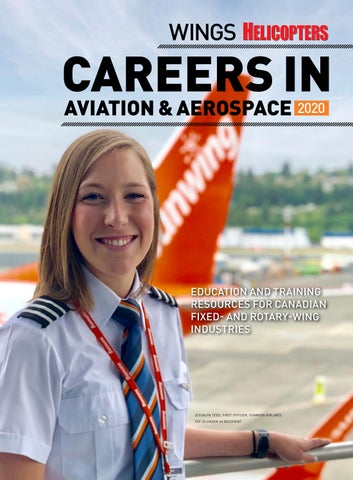
CAREERS IN AVIATION & AEROSPACE 2020
EDUCATION AND TRAINING RESOURCES FOR CANADIAN FIXED- AND ROTARY-WING INDUSTRIES
JESSALYN TEED, FIRST OFFICER, SUNWING AIRLINES, TOP 20 UNDER 40 RECIPIENT
THE FUTURE OF AEROSPACE AND AVIATION
Our Downsview Campus: Centre for Aerospace and Aviation is a dedicated training ground for aerospace and aviation mechanics. With focused courses, cutting-edge equipment and industry professionals guiding our programs, your aircraft are always in good hands with a Centennial College graduate.
centennialcollege.ca/downsview
CIA2020
PILOT AND TECHNICIAN
GROWTH OUTLOOK
I
ndustry giants Boeing and Airbus wider swath of aircraft. Inclusive of com- North America was third at 20 per cent. every year release research reports mercial aviation, business aviation and In the Airbus GMF, the company exfocusing on how many commercial civil helicopter industries, Boeing’s 20- plored the relationship between the aircraft will be needed to fulfill year forecast is based on fleet growth, world’s cities, their airports and the types market demands in terms of carrying aircraft utilization, attrition rates and of aircraft, in terms of size and range, passengers and cargo both regionally regional differences in crewing specific to which are supporting them. In the past and internationally. Based on these fleet aircraft type. Airbus looked at the importance of AviaDemand for passenger aircraft 053 projections, the two plane manufacturers The 769,000 new technicians mark in tion Mega-Cites (AMCs), particularly for then deduce how many pilots, cabin crew, 2019 represents an increase relative to larger aircraft. In 2018, there were 66 cittechnicians will be needed for expected last year’s forecast of 754,000 from Boe- ies classified as AMCs, which account for fleet growth. These reports, which are critical tools NEW GENERATION AIRCRAFT for both Boeing and Airbus to navigate REPLACING OLDER LESS New* their own growth, will often also include FUEL EFFICIENT TYPES e in range insight into related issues like airport and Mid Source: Cirium, Airbus GMF 2019 e, which aftermarket sources. The world of aviation, * This category includes Old erage block of course, stretches well beyond commerA320/A320neo & 737NG/737Max for example Passenger aircraft in Service > 100 seats historical cial AIRCRAFT air travel,AVERAGE but theFLIGHT outlook reports are rly 50% 25,000 excellent resouces to begin – or annually TIME HAS BEEN INCREASING 20 years. update – research into the opportunities FOR BOTH SA & WB m 1.8 hours a rewarding career in aviation e. Again available Source:for Cirium, OAG, 20,000 GMF 2019 and Airbus aerospace. ferent Passenger/Combi/ InNotes: September 2019, Airbus released its Quick-change aircraft usage 15,000 Global Market Forecast, which predicts a need for more than 39,000 new aircraft over the next 20 years. The world’s passen10,000 ger and freighter aircraft fleet is expected to more than double from nearly 23,000 today to almost 48,000 by 2038 – with 5,000 traffic growing at 4.3 per cent annually. By 2038, this would include just over 39,000 0 new aircraft. Of these, around 25,000 air2000 2002 2004 2006 2008 2010 2012 2014 2016 2018 craft are predicted for growth and 14,000 are to replace older models. These aircraft numbers would also re- Replacement of mid- and old-generation aircraft will account for as much as 40 per cent of forecast FLEET IN SERVICEAirbus EXPECTED (Illustration: GMF) sult in a need for 550,000 new pilots and future deliveries, following a trend in innovation seen over the past 18 years. TO MORE THAN DOUBLE 640,000 new technicians. The company OVER THE NEXT 20 YEARS used a new segmentation of aircraft in its ing. The projected demand for technicians 40 per cent of all passengers, up from 29 Source: Airbus 2019 forecast, based on the evolution of technol- in North America is expected to reach per cent in 2002, according Airbus, but Notes: Passengerto aircraft | Rounded passenogy in terms of capacity, range and mission 193,000 by 2038, up two per cent from well over 70 per(≥100seats) cent of long-haul figures to nearest 5, type. Small aircraft, such as a short-haul last year. Number of aircraft gers and 35 per numbers cent ofmay thenot short-haul. Airsum A321 and A220, are predicted to account Asia Pacific was also forecast to have the bus explains many of these cities have de50,000 8 2010 for 2012 2016 2018 just 2014 under 30,000 of the new aircraft highest need for technicians at 266,000. veloped a need for more than one airport, 44,860 45,000 needed by 2038. This is in addition to The global helicopter industry demand for some with as many as three or four today. Wide-body around 5,300 medium aircraft, such as the technicians was 44,000, according to BoeThe Airbus report shows that more than cement Single-Aisle 40,000 A321LR or A330, and, 4,100 large aircraft, ing. In terms of North America’s civil he- 600 airlines or nearly 80 per cent of the raft licopter h tend to such as the A350 XWB. 35,000personnel demand, Boeing fore- world’s airlines operate to AMC airports. A These numbers somewhat conflict with casts the region will require 14,000 new share of passengers are also travthan those 23,990growingGrowth elling with LCCs from or to these airports, 30,000 and 21,000 pilots by 2038. much as the Boeing Pilot & Technician Outlook, technicians Asia Pacific is forecast to see a major according to Airbus, nearly a quarter of craft into released in late-July 2019, which projects 25,000in services at 39 per cent to 2028, AMC passengers today, from just eight per position that 769,000 new maintenance techni- growth 38,360 a quarter cians will be needed to fly and maintain representing an annual growth rate of 5.1 cent in 2002. Over this time average air20,000 -efficient the world aircraft fleet by 2038. Boeing’s per cent. Europe came second in this cat- craft size has grown from 155 seats in 2002 rly 85% forecast, however, takes into account a egory at 22 per cent overall growth and to 175 today. | W 15,000
6.4h
BOEING 787 DREAMLINER. (PHOTO: BOEING)
2.3h
chnology d variants as mid re-newel
14,365
10,000 5,000
20,870
Replacement
January/February 2020 | C3
CIA2020
TOP 20 UNDER 40
Sponsored by:
A NEW GENERATION OF LEADERS INFLUENCING THE FUTURE OF CANADIAN AVIATION
I
n the annual Top 20 Under 40 program, sponsored by the Seneca School of Aviation, WINGS and HELICOPTERS magazines recognize inspiring young leaders influencing the direction of Canadian aviation and aerospace. Illustrating the diverse career opportunities available in Canada, these 20 leaders – listed here alphabetically and all under the age of 40, as of December 2019 – are chosen based on their demonstration of leadership, innovation, influence, achievement and/or dedication shown to their organization and the aviation industry.
in an airport and that is the beautiful thing of working in operations. It is a very dynamic and challenging environment – every day is different,” ArnoldSmith explains. “Safety and security is the core of the aviation business. It is what passengers and employees expect. It is the cornerstone of what we do.”
LOGAN BROWN
BRANT ARNOLD-SMITH Director, Security and Terminal Operations, Victoria Airport Authority
Victoria, BC Brant Arnold-Smith, age 37, is the youngest member of Victoria Airport Authority’s executive team. He has been directly involved in aviation for just nine years, after focusing the early part of his career in emergency services, begining as a volunteer firefighter in his home town of Victoria. Arnold-Smith moved to the mainland to serve as an on-call firefighter with Surrey Fire Service and shortly after found his first opportunity to work in aviation when Vancouver International Airport (YVR) put out a competition for its Aircraft Rescue Team. The airport decided to move these services inhouse and Arnold-Smith was one of 24 successful applicants, among some 3,000, to join the team. In late 2018, Arnold-Smith returned home to join Victoria International Airport (YYJ), which is also experiencing exponential growth, reaching above two million passengers last year (December 2018) – 5.9 per cent growth year over year. At YYJ, Arnold-Smith is responsible for aviation/corporate security, terminal/airport operations, regulatory compliance, emergency management and project management. “You never know what is going to get thrown at you C4 | January/February 2020
YANNIC BOILY Maintenance Manager, Premier Aviation Québec
Québec City, Québec Yannic Boily, age 38, found his passion for aviation growing up near Jean Lesage International Airport (YQB). He graduated in 2003 from the National School of Aerotechnics in St-Hubert, Quebec, in aeronautical construction. He then began his career at C&D Aerospace Canada (Zodiac) as a programmer/operator of CNC machinery, focusiong on corporate aircraft interiors manufacturing. Returning to Québec City in 2007, Boily became a licensed structural engineer, then team leader at Exceltech Aerospace and Discovery Air. During these years, he performed several major structural repairs on regional aircraft such the Bombardier CRJ, Dash-8 and Saab 340. In 2013, he became base maintenance manager overseeing maintenance, avionics, sheet metal and interior technicians, as well as painters. Having been in the field of aviation for 16 years, Boily quickly asserted himself as a key leader on the Premier Aviation Quebec team, which took over the Discover Air operation in 2016. He now leads a team of more than 100 people for Premier.
Business Development Lead, InnotechExecaire Aviation Group
Toronto, ON Logan Brown, age 34, grew up in the world of aviation with a father who recently retired after 30 years as an aircraft mechanic with Air Canada. Brown holds a breadth of aviation knowledge from taking on a range of roles early in his career. This includes being a certified AME and licensed pilot, but extends to his experience in aircraft design. During his time at Diamond Aircraft, Brown worked on helping to design modern avionics for the D-JET, which included handling power distribution and needed regulation requirements. Brown for the first time took on a sales position, which in April 2018 turned into his current business development role. He has helped grow InnotechExecaire Aviation’s third-party maintenance partnerships within the commercial airline sector, resulting in the hiring of 16 more mechanics across Canada to handle the new business. Brown’s background in aircraft design has also helped the company in closing transactions around internationally imported aircraft. His extensive knowledge on regulations, requirements and certifications, helps him serve as a consultant for IEAG’s clients, which now includes managing approximately 50 aircraft.
— THE SKY IS LITERALLY THE LIMIT. AEROSPACE EDUCATION FOR A COMPLEX WORLD. With a 300,000 square-foot Aerospace Technology Campus, a fleet of over 20 aircraft, and an airport control simulation tower, BCIT is Canada’s largest post-secondary aerospace trainer. Attend an upcoming info session or spend a day with us to explore our Aircraft Gas Turbine Technician, Aircraft and Aviation Maintenance, Airport Operations or Commercial Pilot programs. Learn how BCIT gives our students the best opportunity to launch their careers at bcit.ca/aerospace
—— Students at BCIT Aerospace Technology Campus.
—— BRITISH COLUMBIA INSTITUTE OF TECHNOLOGY
CIA2020
TRAVIS BURROWS Standards Captain, WestJet Encore
Calgary, AB Travis Burrows, age 31, grew up in a small town and found his way into aviation from a neighbour who was building an airplane in his garage. Burrows took his first flight on that home-built plane down the Red Deer Valley toward the badlands of Drumheller. He now often takes aspiring pilots for discovery flights along the same route in his coowned 1948 Cessna 170. Burrows joined WestJet Encore five years ago as one of the regional airline’s first pilots. At the time, Burrows remembers Encore had five airplanes and it now has 47 and some 600 pilots, many of which he is in direct contact with as a Standards Captain, trainer, recruiter and ambassador for Encore – the fourth largest operator of the Bombardier Q400, now running regional routes across the country and into the U.S. In addition to being on the WestJet Pilot Selection Team, Burrows is heavily involved in improving Encore’s flight procedures, which recently included a major project to implement RNP approaches to save huge amounts on fuel, among other operational efficiencies, as well as a new flight data monitoring program. “I get to work on some cool projects, which is amazing from a career standpoint,” he says. “But at the end of day, I love being in the airplane, being proficient in the flight deck.” JASON DOELL Lead Hand, Chinook Aviation
Calgary, AB Jason Doell, age 38, discovered his love for airframes during the three-year aeronautical engineering program at the Southern Alberta Institute of Technology. He then joined one of North America’s leading helicopter airframe repair specialists in Chinook Aviation and continued to learn about his airframe passion, obtaining his structures license, also from SAIT, in 2003. Founded in 1986 by Helge Kirmse and located at the Springbank Airport in Calgary, Chinook is a Bell Authorized Customer Service Facility, holding C6 | January/February 2020
certified airframe fixtures from the OEM and a 7,000-square-foot hanger built in 2002 to accommodate several medium-sized machines. Doell has been the lead hand at Chinook for around 10 years, currently working with four fully equipped licensed technicians focusing on structural issues like parts fabrication, fuselage fixes, and mobile Maintenance Repair Parties. Doell also serves as treasurer with the Classic Aircraft Restoration Society, which is unique in its goal to make machines fly, which includes the group’s current de Havilland Chipmunk project. DARRYL DOWD Vice President, Airport Operations, Winnipeg Airports Authority
Winnipeg, MB Darryl Dowd, age 39, initially wanted to become a pilot, following in his grandfather’s footsteps who flew for Air Canada. Instead, Dowd has built a successful career in airport management and is now responsible for the on-going operation of James Armstrong Richardson International Airport (YWG), which welcomed approximately 4.5 million passengers in its most recent year. He has been with Winnipeg Airports Authority (WAA) for more than six years, after building a wealth of knowledge with the Greater Toronto Airport Authority. WAA continues to invest in its airport campus, including ongoing construction of a $27 million Ground Services Equipment Building set to open this fall. In March 2019, YWG introduced Otto as the first autonomous airport snowplow in North America. The specially designed ATI Snow Mauler is about 30 per cent of they way there, explains Dowd, understanding this winter will be a critical testing point for its ability to remove snow from the airfield.
traffic controller in 2015 and took her place in the air traffic control centrefocusing on high-artic routes. Foote is currently leading Elevate’s Status of Women Project, which involves the primary grant from the Federal government, as well as Elevate’s branding, Website and the annual fundraising gala. DARREL FOREST Production Manager, CF34/CFM56 Business Unit, StandardAero
Winnipeg, MB Darrel Forest, age 38, joined StandardAero as a technician 16 years ago, rising through the ranks to reach a leadership role within the company’s CFM56/CF34 business unit. He joined StandardAero Winnipeg as a repair and overhaul technician in 2003, initially working on the company’s Rolls-Royce T56 turboprop team. The focus of his four years working on the T56 was in the reduction gearbox cell, contributing to the high-quality MRO services delivered by StandardAero to military operators of the C-130 Hercules and P-3 Orion. In 2007, Forest moved to StandardAero’s Plant 6 facility in Winnipeg, home to the company’s GE CF34 and CFM International CFM56 engine lines. He worked in various roles as a technician supporting the CF34 and CFM56 for eight years, the CFM56 line being introduced under a contract signed in June 2009. Since 2015, Forest has served as production manager within the CF34/ CFM56 business, which represents the highest value production line within the Airlines & Fleets sector, itself the largest of StandardAero’s four divisions. He oversees a team of 38 technicians. “StandardAero is a great family and the opportunity for growth is giant… A huge impact for me personally is watching my team become better,” says Forest.
LAURA FOOTE Operations and Branding, Elevate Aviation
Edmonton, AB Laura Foote, age 34, served in the artillery branch of the Canadian Armed Forces for 13 years. After moving to Edmonton from the East Coast, she became instrumental in the development of Elevate Aviation, a non-profit designed to inspire youth to join the world of aviation, with an emphasis on mentoring young women. She took on many of the administrative roles during Elevate’s quick rise, including her work on grant proposals that secured approximately $700,000 in funding over the past two years. Foote also began training as an air
GINNY KOSERUBA Program Manager, Cascade Aerospace
Abbotsford, BC Ginny Koseruba, age 38, found her passion for aviation through an uncle who was a career pilot. She has progressed rapidly through various roles at
CIA2020 Cascade, where she began as an AMEE apprentice in 2004. Her technical knowledge and organizational skills soon resulted in a promotion into a maintenance planner role. A graduate of the Lean Sensei Belt program, Koseruba then became a planning supervisor, helping to lead a diverse team focused on maximizing productivity in all of Cascade’s operations. She then received a promotion to her current role as program manager, overseeing all aspects of program delivery for key customers. She manages the third line maintenance in Abbotsford for Lockheed Martin supporting the CC-130J Super Hercules program for Canada. Also for Lockheed, she oversees a Contractor Maintenance Team and group of Field Service Representatives who provide support at CFB Trenton, as well as to deployed troops requiring technical support. Another key current program for Koseruba involves overseeing the Boeing 757 Large Display Screen speed line modification program for a large freight carrier, with 75 aircraft conversions to an upgraded cockpit configuration.
CONNOR HART Ground Operations Manager, WestJet
Calgary, AB Connor Hart, age 27, was studying marketing at university and found his way into aviation through a family friend’s Facebook post about a ramp job at WestJet. After graduating, he continued with WestJet as a frontline ramp agent and quickly became a daily shift manager to take on more responsibilities with ground operations in Calgary. This included helping to oversee training and introducing new ground equipment for the airline’s towing team. As operations manager, he is now a senior operational leader for WestJet’s hub airport with more than 150 flights per day. He liaises with the airport authority and external agencies, as well as internal safety and standards teams and follows up on incident and hazard reports. He is also heavily involved with leading continuous improvement for ground operations. In addition to
making better training products, Hart was also tasked with helping to oversee a new Widebody Performance Team, created to look after the full turn of WestJet’s new 787 Dreamliner aircraft, which is also a major focus of the new ground-operations training; and subsequently expanded Hart’s role beyond below-the-wing operations to abovethe-wing customer service. “My team takes a lot of pride in making sure the [787] is working well. Even if we take a one-minute delay it definitely does not sit well with my team. It is great to see people riled up about a really minor miss on something that might have been completely out of our control, but we do not get flustered – one aircraft at a time.” KEVIN LAWES Chief Pilot, Vanguard Air Care
Winnipeg, MB Kevin Lawes, age 33, grew up around aviation with his mother recently retiring from Transport Canada. His first aviation job, as he was going to university, was working in ground operations at Keewatin Air, where Lawes would eventually take his first flight line position running charters into the north. Six months later, by October 2011, he joined a medevac flight crew, initially to gain more hours, based out of Nunavut. Lawes then joined Fast Air in mid2014 and eventually became the Winnipeg operation’s chief pilot in the 703 sector, before serving for a short stint at Sky Regional Airlines operating out of Toronto. When he rejoined the Fast Air team in late-2017, Lawes brought a wealth of knowledge with him as both a turboprop and jet captain, with experience in 604, 703, 704 and 705 operations. As chief pilot for Vanguard Air, he is responsible for 18 pilots, in addition to regular roles in flight training at Fast Air. One of the primary administrative functions in which Lawes excels centres around ensuring all company Minimum Equipment Lists are current and relevant to the Fast Air/Vanguard operations, which includes serving as a conduit to Transport Canada. SUKHVIR MAVI Manager, Projects and Facilities Management, Nieuport Aviation Infrastructure Partners
Toronto, ON Sukhvir Mavi, age 30, began his career in aviation by focusing on becoming a commercial pilot, which included finishing his flight training in Miami. He then went back to India to get his license there, before joining an airline in the Philippines for about five months.
Mavi came to Canada in 2013 with the goal of becoming a flight instructor in Ottawa, but instead joined the Georgian College Aviation Management program, which ultimately led to jobs with Air Georgian and then Air Canada as a SOC duty manager. Around two years ago, Mavi joined Nieuport Aviation, which owns and operates the passenger terminal at the Billy Bishop Toronto City Airport, helping to enhance customer service for the airport’s 2.8 million passengers. The airport accounts for more than $2.1 billion in economic output each year and supporting 6,500 jobs, including 1,960 associated directly with airport operations. Over the last four years, Nieuport has invested more than $50 million in the airport, including the recently completed terminal upgrade. KEITH MCCORMACK Manager, Global Partnerships, Air Canada
Mississauga, ON Keith McCormack, age 31, received his Bachelor’s degree in Commercial Aviation Management at Western University, which allowed him to experience the global aviation industry by participating in international studies at the European Business School near Frankfurt, Germany. His career began in 2011 with Lufthansa before joining Air Canada’s growing cargo sector, where he has held multiple positions over the past six years. His current role is to manage Air Canada’s top cargo customers, engaging with the world’s largest logistics companies to ensure Air Canada is a topof-mind partner. “Cargo is a company within company. You get to touch all of the departments that you find in the airlines, such as revenue management, sales, finance and operations,” he says. In 2018, McCormick participated in a trade mission to Shanghai to improve product knowledge of Canadian seafood in China. Air Canada ships about 40,000 kilograms of freight per day to China. McCormick recently received the Award of Excellence from Air Canada and in 2018 completed his Masters at Embry Riddle Aeronautical University. He is also a licenced commercial pilot and flies small aircraft in his spare time. ANTHONY NOREJKO President and CEO, Canadian Business Aviation Association
Ottawa, ON Anthony Norejko, age 39, took on the leadership of the Canadian Business Aviation Association in August 2018, four years after he joining the organization’s board to focus on strengthening January/February 2020 | C7
CIA2020 the association’s membership, which currently includes some 400 members located across the country. He also played a pivotal role in working with the Greater Toronto Airport Authority on slot restrictions, helping to establish the a Technical Working Group. Norejko provides a strong blend of aviation and strategic planning knowledge. His leadership in business aviation largely began when he served as director of aviation and chief pilot for Walmart Canada; and later as the principle of his own aviation-service company, CrewSked. Norejko then left aviation to hone his financial and strategic planning skills as vice president, strategy and operations, north, at FirstService Residential. As president and CEO of the CBAA, Norejko is injecting a new mandate to promote and simplify business aviation. “The association needs to play a role foundationally in the public perception about the use of business aviation… it is a tool that a business uses to conduct its work,” he says, describing the promotional side of his mandate and noting there are approximately 250 operators in the sector providing positive economic impact. TYLER PERIN Manager, Hub Operations, Air Canada
Mississauga, ON Tyler Perin, age 28, received an introductory flight out of Kingston Airport as a high-school graduation gift and realized his passion for aviation within minutes of lifting off the ground. He attended Algonquin College’s relatively new aviation management program at the time, and earned a multi-engine rating to fly floats and a commercial pilot’s licence. He moved to Yellowknife for a job with Air Tindi, hoping to get on its flight line, and eventually took a second job with Strategic Aviation, where he would come to manage ground operations. In 2012, Perin then moved back to Ontario for a job with Air Canada’s cargo operation, where he would quickly rise through three positions to help manage the company’s largest and busiest hub. Approximately one million kilograms of cargo moves through the hub on a daily basis, 1.3 to 1.5 million during peak periods. Ultimately, Perin and his team of 10 managers are responsible for the safe and swift movement of this cargo. Perin continues to explain the growth is related to Air Canada bringing on new planes with more capacity and fuel efficiency, including the 787 Dreamliner. “Although only two per cent of the world’s global trade travels by air, that C8 | January/February 2020
two per cent represents 40 per cent of the value of global trade.”
ALLISON RUMBOLT
trouble-shoot issues and his out-of-the box, creative ways to strategize, have made him an indispensable asset to the Slave Lake operation, which primarily focuses on the forestry industry, as well as holding contracts with a prime electrical company in the region. Spitzer still flies from time to time, particularly if the operation, which runs seven modern helicopters (two B3s, three B2s, a 120, and a 206), is short a pilot.
S92 Pilot, Cougar Helicopters
St. John’s, NFLD Allison Rumbolt, age 29, grew up in Mary’s Habour, a town of around 400 people in southern Labrador where aviation served as a regular means of transportation for the isolated community. Her mother worked part time for the local airline, Air Labrador, and her father took a position with the provincial government as the operator of the Mary’s Habour airport. From a young age, Rumbolt regularly met pilots and she remembers a particular helicopter flight, arranged by her father when she was about 10 years old, along a popular salmon-fishing river. She became hooked on the dream of becoming a helicopter pilot. Before graduating high school, with her passion for aviation well-known in the community, Rumbolt was approached to become a junior dispatcher for Canadian Helicopters in Goose Bay, as she prepared to attend flight school that summer. She eventually began flying AStars at age 18 for Canadian Helicopters. She has now been with Cougar Helicopters for five years and has amassed 3,700 flight hours. Rumbolt is first officer on the operation’s heavy S92 helicopter, flying to fulfill Cougar’s contracts with oil-and-gas companies operating offshore in Newfoundland. TOBY SPITZER Aircraft Maintenance Engineer and Pilot, Slave Lake Helicopters
Slave Lake, AB Toby Spitzer, age 39, grew up in Squamish, BC, where he discovered a passion to both fly and fix helicopters. He took his first solo flight at age 16 and had his private fixed-wing license at age 17. Two years later, he acquired his commercial rotary-wing license, but his true passion was still focused on engineering. Spitzer attended the British Columbia Institute of Technology on his way to gaining an AME license in 2005 at the age of 24. In 2011, he joined Slave Lake Helicopters where he focuses on rotary-wing aircraft repairs and heavy maintenance, as the operation’s lead hand. His willingness to tackle and
JESSALYN TEED First Officer, Sunwing Airlines
Mississauga, ON Jessalyn Teed, age 24, found her passion for aviation at age eight when her parents saw an ad in a newspaper and took her to a kids-can-fly event at Muskoka Airport. She was the last person to go up, getting an extra-long ride, and was so mesmerized by the experience that she set her mind toward becoming a pilot. In 2017, she graduated from the University of Waterloo, Geography and Aviation BES, completing a four-year degree in three years, while also volunteering for the aviation program. This set Teed on an early path of mentorship for her peers. Teed has been working with a Sunwing colleague and the Waterloo Wellington Flight Centre to develop a course focusing on multi-crew environments. Set to launch this summer, Teed explains the course topic is becoming critical for younger pilots, who are finding more career opportunities with airlines. This summer will also see the launch of a Sunwing Mentorship Program that Teed has developed to pair up experienced Sunwing pilots with new pilots to share their love of flying. “When I do the walk-around and I’m at the tail of that aircraft and I look up – ‘Oh my goodness, I just landed this thing.’ And it may have been into a very mountainous terrain area with a short runway, and bad weather. Looking back five years, [when I was] landing a little Cessna 152 in a cross wind and struggling with that, to see where I am today is just fantastic.”
CIA2020
PETER WHEATLEY Director of Sales Operations, Airlines & Fleets, StandardAero
Winnipeg, MB Peter Wheatley, age 34, has 15 years of experience in the aerospace MRO industry, having initially joined StandardAero’s Winnipeg team as a summer intern in 2004 while studying for his BSc in Mechanical Engineering at the University of Manitoba. He graduated in 2007, after completing the five-year program one year early. Upon graduating, Wheatley joined StandardAero full time as a production engineer, participating in numerous high-visibility projects, including a redesign of the method for tracking rework components using capacity modeling. Two years later, he accepted a role
as quality manager, providing strategic direction for the quality function within the Turboprops and Fleets () team, which he happened to name. In 2018, Wheatley was appointed as director of sales operations for StandardAero’s $2 billion Airlines & Fleets team, managing the global sales and operations planning process for the division’s transactional sales team and serving on the division’s sales leadership team. He has spearheaded a revamp of the team’s Salesforce CRM system, focused on accurate dashboarding and induction planning.
OLENA ZAGOSKINA Senior Mechanical Engineer and TCCA Delegate, Cascade Aerospace Abbotsford, BC
Olena Zagoskina, age 32, found a passion for aviation at an early age with her father being an aerospace engineer.
They both attended the National Aerospace University in Kharkiv, Ukraine. She joined Cascade Aerospace in 2011 and quickly reached her current role by looking after the development of system-related aspects for highly complex modification programs. She was a leader in the very challenging, five-year conversion of a Bombardier Q400 to multi-mission role, which added large auxiliary fuel tanks to essentially double the aircraft’s mission time. As a technical lead for fuel tank safety, she was responsible for meeting aviation safety needs in case of a lightning strike, electrostatic discharge, and other ignition sources. This included the responsibility to develop subject matter expertise in the design and certification of fuel systems. She was a member on the FAA Aviation Rulemaking Advisory Committee, developing recommendations for new regulations to enhance aircraft safety in emergency landings. Zagoskina is also currently leading the system safety aspect for a major avionics upgrade on CL 215/415 aircraft used for fighting fires. In early 2019, Zagoskina was authorized by Transport Canada as one of its youngest ever Delegate Engineers. | W
Become an airline pilot
Leaders in advanced aviation training
AeroCourse has been helping pilots reach their aviation career goals and become an airline pilots for over 30 years. Whether you are interested in quality aviation resource materials or if you need assistance with exams or a full ground school program offered in conjunction with one of o our flight school partners, AeroCourse is there to help. AeroCourse IFR and ATPL/IATRA seminars feature: exceptional instruction with highly trained pilots, working for Canada’s top airlines and schools; valuable course materials; and foster an atmosphere conducive to learning. Seminars are held in cent centres across Canada. Registration and resources are available online.
Resources:
1-800-461-8857
Find out more at aerocourse.com January/February 2020 | C9 WG_AEROCOURSE_CIAjan209_CSA.indd 1
2019-12-19 9:39 AM
SPONSORED CONTENT
INSIDE CENTENNIAL’S SCHOOL OF TRANSPORTATION The new $72 million Centre for Aerospace and Aviation at Downsview Park combines innovation, hands-on learning and industry partnerships to develop a new geneartion of highly skilled technicians and managers By David Carr
TOP: A view of Centennial’s Downsview Campus in 2019 as it nears the end of construction, stitching together seven buildings. BOTTOM: Centennial invested $72 million for advanced maintenance and avionics education and training at its new Downsview campus, which includes two hangars. C10 | January/February 2020
C
entennial College’s School of Transportation is flying high. Since the mid-1970s, graduates of its Aviation Technician, Aircraft Maintenance and Avionics Maintenance programs have been in hot demand across Canada and around the world. At a time when the requirement for qualified technicians has never been stronger, Centennial is raising the bar with a new $72 million advanced education and training centre situated in the heartland of Canada’s rich aviation heritage. Centennial’s new 12,700-square-metre Centre for Aerospace
and Aviation at Toronto’s Downsview Park involved rebuilding the historic de Havilland Canada plant to include modern classrooms, laboratories, workshops and two hangars housing an expanded fleet of airplanes and helicopters for hands-on training. The campus enables the college to increase its capacity to over 1,000 students who are preparing for exciting careers in aviation and aerospace. This past September, Centennial took in the first cohorts for two brand-new, three-year, advanced diploma programs. One of the programs is focused on Aircraft Maintenance and Management and the other on Avionics Maintenance and Management. They build upon the existing, two-year Aviation Technician programs and add a variety of complementary skillsets that include technical writing, quality assurance, maintenance planning and supervisory skills. In addition to these broader skillsets, the two programs are also accredited by Transport Canada for Aviation Maintenance Engineer “E” (Avionics) and “M” (Maintenance) licenses. Long known for its excellent training programs, highly skilled instructors and top-of-the-line training equipment, the new
AIRCRAFT AT DOWNSVIEW CAMPUS Downsview Park Campus provides much needed dedicated space to add new training equipment and offerings such as the aircraft assembler program, a Bombardier-specific program where students receive hands-on training to perform complex aircraft assembly, including using the latest composite materials. Bombardier named Centennial its trainer of choice in the manufacturing and maintenance of its aerospace products. In April 2019, the Montréal transportation giant donated a CRJ200 regional jet to the college’s extensive fleet of modern-day aircraft, which includes a number of Cessna 172s, a Citation II business jet and Sikorsky S-76 helicopter, in addition to other aircraft, engines and avionics components. An Intel Falcon mapping drone was recently added to support growing demand for unmanned aerial vehicle (UAV) training. The opportunity to work on modern-day aircraft and equipment, and new technology training aids such as fuel and hydraulics systems, and cockpit communications and navigation is what helps a provide a Centennial student with the skills to standout in a competitive market. “Hands-on is the best way to learn a skill,” says Jamie Milks, coordinator of the Aircraft Maintenance programs. “They get a greater feel for the training and a sense of what is needed. The light bulb comes on a lot faster.” Centennial launched its Aviation Technician – Aircraft Maintenance program in 1967. The Avionics Maintenance program was added in the 1970s. The Aircraft Maintenance program received Transport Canada recognition in 1981 under the N-AME-AO system and was one of the first to obtain formal Approved Training Organization status. Courses today are developed in consultation with Centennial’s advisory councils made up of leading industry professionals to ensure they remain current and are of the highest quality. A student’s day is typically filled working in the new hangars on fixed- and rotary-wing aircraft, getting practical training on various systems and working in the lab where they participate in computerbased learning. Students can expect to design complex aircraft parts on state-of-the-art computers and simulators. New laboratories will also enable the school to boost its presence in value-added research. The school’s experienced instructors walk students through industry-standard techniques as they work on components such as airframes, engines, electrical and hydraulic systems, propellers, avionics equipment and aircraft instruments. Classroom instruction also includes essential theory and base knowledge as a key to better employment opportunities. The Aviation Technician – Aircraft Maintenance program provides students with an understanding of aircraft maintenance in areas such as general, commercial and private aviation. The program equips students for a number of career opportunities, including manufacturing (Canada is one of the world’s largest manufacturers of aircraft and components, including engines), the airline industry, corporate and general aviation, flight training and the military. The Aviation Technician – Avionics Maintenance program provides students with an understanding of complex electronic and electrical systems related to the navigation, guidance, communications, instrumentation and flight controls of modern aircraft. Graduates are equipped with skills to install, inspect and troubleshoot sophisticated equipment across a diverse range of fleets as they become more digitally advanced. Experiential learning for Centennial students is an area of significant focus. For Aviation Technician students, Centennial has a partnership with Air Canada and the Canadian Council for Aviation and Aerospace on a Work Integrated Learning Program. This unique program provides approximately 30 students with 15 months of paid work experience in one of Air Canada’s maintenance operations after their second semester of full-time study. During the work placement, the students gain valuable experience on-the-job under
• Bombardier CRJ200 • Cessna Citation II, Cessna Conquest 425, Cessna 180, 4x Cessna 172N, Cessna 172P, Cessna 150 • Piper Cherokee, 2x Piper Seneca, Piper Warrior, Piper Aztec • Robinson R22 • Aerospatiale Eurocopter AS350 • Bell 47, 2x Bell 206B • Sikorsky S76 • Messerschmitt-Bölkow-Blohm B0-105 • Mooney MC20 • Aircraft hulls: 2x Aerospatiale Eurocopter AS365, Sikorsky S76A
Centennial students Abdullah Hussain and Kosta Dimopoulos take advantage of hands-on training at the college’s new Downsview campus.
the mentorship of fully qualified Air Canada technicians. At the end of the 15-month placement, students return to Centennial to complete the final year of their diploma program. Centennial also works in partnership with Air Georgian, Jazz, Hope Aero, Bombardier and industry organizations to provide eligible students with the opportunity to take part in work integrated learning and job shadowing. The introduction of management courses to the basic two-year Aircraft Maintenance and Avionics Maintenance program is a welcome option for students who are plotting a career that extends beyond the hangar floor. “These are new three-year programs that add a management component to the existing programs and offer the fundamentals of management for positions such as crew chief or director of maintenance,” Milks says. Centennial operates in lockstep with Canadian industry and its new Downsview Campus Centre for Aerospace and Aviation ensures the college remains an industry leader in providing future generations of aerospace professionals. The campus anchors an aerospace hub that will attract new investment and propel innovation. Centennial is a lead partner in the Downsview Aerospace Innovation and Research (DAIR) consortium, a cluster of industry heavy-hitters including Bombardier, Pratt & Whitney Canada, Honeywell, Siemens, Safran Landing Systems and Canadensys Aerospace, offering added training initiatives and job opportunities within the aerospace sector. “The aviation and aerospace sectors are a constantly growing industry that is always providing different opportunities and challenges,” Milks says. “It is always on the lookout for highly skilled employees, and they are always coming to us.” January/February 2020 | C11
CIA2020
FLIGHT TRAINING
FIXED WING, ROTARY WING AND REMOTELY PILOTED TRAINING CENTRES BY PROVINCE
Alkan Air Flight Academy | Whitehorse Alkan Air is partnered with Yukon College to offer one year or 30 credits toward the school’s two-year Aviation Management diploma program. The majority of ground school courses occur during the evening at Alkan Air and flight training must take place during daylight hours (exception is night time flight training). Alkan Air itself provides Private Pilot and Commercial Pilot License training. The operation provides a unique environment to learn in a northern climate, with access to an international airport and gravel strips in remote areas.
BRITISH COLUMBIA Canadian Flight Centre | Boundary Bay & Kamloops Canadian Flight Centre opened in 1979 at B.C.’s Boundary Bay Airport, near Vancouver, and became one of the first flight schools to specialize in instrument flying and other advanced training. CFC has trained thousands of pilots and today its students come from six continents (Antarctica excluded). Kamloops proximity to the mountains provides the opportunity for mountain checkouts.
Canadian Helicopters | Penticton Canadian Helicopters operates its flight school under the name HNZ Topflight, providing training programs to both company pilots and external clients. The school traces its origins to 1951 when it was known as the Canadian Helicopters School of Advanced Flight Training. Canadian Helicopters also provides ground based and simulation instruction for Royal Canadian Air Force pilots as a subcontractor to Allied Wings Flight Training Services. This facility is located at the Canada Wings Aviation Training Centre near Portage La Prairie, Manitoba. Other clients include the United States Navy Special Forces, Royal Canadian Mounted Police and the Royal Danish Air Force.
Chinook Helicopters | Abbotsford Chinook Helicopters began training operations in 1982 at the Abbotsford Airport, from where it continues to operate. The C12 | January/February 2020
Abbotsford area is well suited for year-round helicopter training. Chinook utilizes the expansive Fraser Valley for all initial flight exercises, and the Coastal Mountain Range for intermediate and advanced exercises. Due to the extensive commercial helicopter activity in southwestern British Columbia, most approaches and landings are to actual industry helipads.
Coastal Pacific Aviation | Abbotsford Coastal Pacific Aviation, located at Abbotsford Airport, partners with The University of the Fraser Valley to combine a diploma or degree together with a Commercial Pilot’s Licence with multi-engine and instrument rating. Its programs also include Seaplane Endorsement, Private Pilot Licence, Commercial Pilot Licence, Multi-Engine Rating, Instrument Rating, Night Rating and Instructor Rating.
Glacier Air | Squamish Glacier Air, operating from Squamish Municipal Airport, trains within the Sea-to-Sky corridor from Vancouver to Whistler, specializing in mountain training for fixed- and rotary-wing aircraft. Glacier also offers survival ground school, which includes studies in weather, flight techniques, effects of density altitude, emergencies, route planning and aircraft preparation, and survival gear.
Ocean Air Floatplanes | Victoria Ocean Air training specializes in seaplanes for both commercial and private licenses, helping more than 300 pilots earn their Canadian Seaplane Rating since 2002. With Transport Canada Floatplane/Seaplane Endorsement training, the company provides 15- and 50-hour programs amid the Gulf Islands with close proximity to Vancouver.
Okanagan Mountain Helicopters | Kelowna Okanagan Mountain Helicopters started as a helicopter flight training school in 2003. Its courses are designed to address commercial helicopter companies with a range of operational flying. Its facility at Kelowna International Airport also introduces students to controlled radio procedures, multiple training locations for confined areas and mountain flying introduction within a
control zone, and the best blend of controlled and uncontrolled practice areas.
Pacific Flying Club | Boundary Bay The Pacific Flying Club (PFC) was formed in 1965 as the Canadian Pacific Airlines Employees Flying Club. Students train at Boundary Bay Airport, where it has been located since 1985. The not-for-profit organization has a fleet of 27 aircraft and three simulators. It is a partner with the British Columbia Institute of Technology’s flight program.
Southern Interior Flight Centre | Kelowna Southern Interior Flight Centre is located at Kelowna International Airport in the Okanagan Valley is also surrounded by small air strips, which allows for exposure to every level of controlled and uncontrolled environments a pilot might encounter. The operation provides instruction for Recreational, Private, Commercial, Multi-Engine, Instrument, Night, VFR OTT and Instructor Rating.
Victoria Flying Club | Victoria The Victoria Flying Club (VFC) has been training professional pilots since 1946. Located at Victoria International Airport, VFC provides a range of flight environments on a standardized fleet of Cessna 172SP Model aircraft. VFC has partnered with the University of Victoria to offer a Diploma in Business Administration – Aviation Option program.
ALBERTA Absolute Aviation | Wetaskiwin Absolute Aviation is a flight training and aircraft maintenance facility, largely serving students from Edmonton and central Alberta. Absolute operates out of Wetaskiwin Regional Airport in close proximity to Edmonton International. The school operates in both uncontrolled and controlled airspace with a fleet including Cessna 172 aircraft and also the Citabria 7ECA for single engine training and the PA-60 for multi-engine training.
Calgary Flight Training Centre | Olds The Calgary Flight Training Centre (CFTC) provides training for professional and private pilots. It is located in a new faciliy that is still
IMAGE: AL250 SIMULATOR, ALSIM
YUKON
IS THERE A CLOSER AIRPORT? YES, BUT ONLY YOU CAN ACCESS IT! The world’s first Super Versatile Jet takes off! It’s simple – you fly business aircraft to save time. The PC-24’s outstanding short runway performance enables you to access thousands more airports than traditional business jets. It’s simply a time machine – with the PC-24, you’ll spend less time driving and more quality time at your destination. Save time too and fly PC-24 – contact us now! www.pilatus-aircraft.com
Stan Kuliavas, Vice President of Sales | sales@levaero.com | 1.844.538.2376
www.levaero.com
CIA2020 within the Olds-Disdury Airport, which itself is in an uncontrolled airspace. The school operates a fleet of new aircraft with G500 Glass Cockpit trainers.
delays and congestion of a larger airport In 2013, Mitchinson was purchased by professional airline pilots who previously trained at the school.
Centennial Flight Centre | Edmonton
MANITOBA
Centennial Flight Centre, in operation since 1967, is located at Villeneuve Airport, approximately 20 kilometres northwest of Edmonton. It provides training for Recreational Pilot Permit, Private Pilot Licence, Commercial Pilot Licence, Multi-Engine and Instrument Rating. Centennial maintains a fleet of four Cessna 172Ms (primary trainer), one Cessna 172S, one Piper Arrow and one Piper Seneca I.
Edmonton Flying Club | Edmonton Edmonton Flying Club, home of the Edmonton Flight College, is located just west of Edmonton, operating out of Parkland Airport in Parkland County. Originally founded in 1927 as the Edmonton and Northern Alberta Aero Club, the club’s first president was Canadian World War 1 flying ace, Wilfrid R. May. Today, the Edmonton Flying Club is a member-owned organization with a diverse fleet of aircraft and providing flight training at all levels from recreational pilots to Commercial Multi-Instrument rated, career-ready pilots.
Mountain View Helicopters | Springbank Mountain View Helicopters (MVH) has trained pilots for commercial or private helicopter licences from its Springbank Airport location since 1995, near Calgary International. MVH is able to provide flying weather found on the prairies and also proximity to mountains. It is a commercial operator and able to design courses to develop skills sought by other operators.
Super T Aviation | Medicine Hat Super T Aviation is one of the premier flight schools in Western Canada. Serving southern Alberta since 2008, Super T Aviation is a family owned operation and part of the Bar XH Sales group of companies. In 2019, Super T purchased a modern ALX simulator from Alsim. This is Super T’s second Alsim simulator after purchasing an AL200, which has been in operation since 2014. The flight academy provides a range of training from ground school and PPL to a Commercial Pilot License and various instrument ratings.
SASKATCHEWAN Mitchinson Flight Centre | Saskatoon Founded in 1946, Mitchinson today is located in its own hangar at the Saskatoon John G. Diefenbaker International Airport. This allows students to fly in an ATC-controlled environment, providing experience for flying in larger centres, but without the traffic C14 | January/February 2020
Brandon Flying Club | Brandon The Brandon Flying Club’s Flight Academy has served the region since 1936. Located at Brandon Municipal Airport, just outside of Winnipeg, BFA offers a continuous ground school, as well as Recreational, Private, and Commercial courses. Night VFR Over the Top and Instrument Ratings are also available. Transport Canada Written Recreational, Private, Ultra Light, and Helicopter exams can be completed at the centre as well.
Harv’s Air | Steinbach Harv’s Air is a family owned and operated flying school that also provides air taxi and aircraft maintenance from two locations, Steinbach and St. Andrews, in the Winnipeg area. In business since 1973, the company offers a range of training from Recreational Pilot Liscence to Airline Transport Licence programs.
PilotTraining | Steinbach Founded in 1999, PilotTraining.ca provides online instruction for aviation written examinations. Courses can be used as credit toward the Transport Canada ground-school requirement. The operation is approved to conduct ground schools with Harv’s Air, its parent company. Courses are completed by using multimedia tools such as video, mp3, presentations, animations, web pages, and automatic correcting and referenced practice questions.
Prairie Helicopters | Gimli Prairie Helicopters, which also provides charter helicopter services, describes itself as Manitoba’s only turbine helicopter flight school. Its head office and main hangar are located at the Gimli Airport approximately 45 minutes north of Winnipeg. The operation holds a fleet of Bell 407, Bell 206L3 and Bell 206B helicopters.
Winnipeg Aviation | St. Andrews Winnipeg Aviation has provided pilot training for more than 45 years. The school is based at St. Andrews Airport, 15 kilometres outside of Winnipeg. This provides for proximity to an international airport and uncontrolled grass strips. St. Andrews holds three runways for training with and without crosswinds.
ONTARIO Altohelix | Markham and Oshawa Altohelix is partnered with Toronto Airways to run full time UAV ground school and
flight training with units based in two Greater Toronto locations, including Markham and Oshawa. It provides training required for the Transport Canada Special Flight Operation Certificate (SFOC) and Pilot Permits, leveraging instructors who hold Air Transport Pilot Licenses with Flight Instructor rating. Altohelix provides instruction, examination and certification for Transport Canada Knowledge Requirements for Pilots of Unmanned Air Vehicle Systems UAV 25 kg or less, Operating within Visual Line of Sight and Restricted Operator Certificate with Aeronautical Qualification.
Aerocourse | Oakville AeroCourse has provided aviation ground school training courses for more than 20 years. This includes online programs and IFR and ATPL/IATRA seminars with instruction and practical course materials. Its courses are offered in most major Canadian cities, while offering customized programs to groups upon request.
Brampton Flight Centre | Brampton The Brampton Flight Centre (BFC) has training pilots since 1946. Located close to Toronto Pearson International Airport, BFC teaches students to fly in controlled and uncontrolled environments. BFC is controlled by the Brampton Flying Club, which owns its airport that covers almost 240 acres. It provides a one-year Professional Pilot Diploma program as a registered Private Career College, as well as industry partnerships with Air Georgian, Jazz and Porter.
Brantford Flight Centre | Brantford As one of the oldest flight training schools in Canada, the Brantford Flight Centre (BFC) has been providing quality flight training in Brantford, Ontario since 1929. Its instructors hold a vast history of experience from the aviation industry, offering students extensive knowledge of the Airline, Corporate and Instructor fields. Located in uncontrolled airspace, BFC allows students to avoid costly delays due to airspace congestion. For experience in control zones, a short 10-minute flight allows access to three nearby international airports. As a Private Career College, the Brantford Flight Centre is building upon its flight-training legacy with its new post-secondary, 14-month Brantford Aviation College program, which launched in April 2018.
Canadian Flight Academy | Oshawa In January 2020, Toronto Airways, through its Canadian Flight Academy subsidiary, is set to begin a new Integrated Airline Transport Pilot Licence curriculum, which also provides support for new flight instructors. Based at Oshawa Executive Airport, the rejuvenated Canadian Flight Academy (CFA) program will provide greater opportunities
CIA2020 for aspiring pilots through new collaborations with Seneca College’s School of Aviation and Jazz Aviation. (See page 29 for more information.)
Diamond Flight Centre | London Diamond Flight Centre has been training pilots at the London International Airport since 2009 and, as a registered Private Career College (PCC) in the province of Ontario, holds a full-time staff of 16 certified flight instructors. The school also holds a fleet of 10 training aircraft manufactured in London, Ontario, by Diamond Aircraft, which develops aircraft like the 2-seat DA20 and the new 7-seat DA62.
Genesis Flight College | Collingwood Genesis Flight College is a registered Private Career College providing a one-year dipoloma program. Located at Collingwood Regional Airport, Genesis owns the real estate and buildings on the field in which it operates. Leveraging its fleet of Diamond DA40 and DA42 aircraft, Genesis runs 100 per cent of its training with glass cockpits with electronic flight information systems. Students are exposed to these systems on the first flight and learn deeper functions in each successive training module. Services include commercial flight training, college diploma program, private pilot training, instrument rating, multi-engine rating, instructor rating, sightseeing flights, and air taxi services.
Great Lakes Helicopter | Waterloo Great Lakes Helicopter is a Transport Canada-approved, Ontario Private Career College, while also offering charters. Based at the Region of Waterloo International Airport, the operation offers training yearround and focuses on both commercial and private licensing. Great Lakes is partnered with Conestoga College for a program that provides both a Commercial Helicopter Pilot’s Licence and a diploma.
Helicopters Canada | North Bay Helicopters Canada for approximately 20 years has provided commercial and private flight training to both domestic and international students. Its training area is situated at the Jack Garland Airport, which provides access to heavily forested areas with lakes and rivers for developing the skills needed for a large sector of the helicopter industry.
Ottawa Aviation Services | Ottawa Ottawa Aviation Services is a professional flight training and maintenance operation based out of Ottawa International Airport. The operation, registered as a Private Career College in Ontario, provides commercial and private training. The operation provides training with modern glass-cockpit, multi-engine and aerobatic aircraft, and simulators.
Ottawa Flight College | Ottawa The Ottawa Flying Club, operating as the Ottawa Flight College (OFC) has been training pilots since 1928. Located at Ottawa MacDonald Cartier International Airport, the Ottawa Flying club offers a controlled zone environment for learning IFR procedures, with access to uncontrolled airports in the area.
St. Thomas Flight Centre | St. Thomas Established in 1996, the St. Thomas Flight Centre offers flight training from Recreational Pilot Permit through to Commercial Pilot Licence and Multi-Engine Instrument Ratings. The centre holds Private Career College status and operates out of St. Thomas Airport in an uncongested flight training environment. School offices are located in the main terminal building and ground school classes are held on site. The Flight Centre has two additional satellite locations at Chatham airport and London airport.
Spectrum Airways | Burlington Spectrum Airways has been training pilots for more than 40 years. The training facility is situated at the heart of Burlington Executive Airport, one of the busiest airparks in Ontario. The airport averages 30 flights on weekdays. Registered as a Private Career College, Spectrum’s training programs include Private Pilot License, Commercial Pilot License, Night Rating, Multi-Engine Rating, Instrument Rating/Multi Instrument Rating and Instructor Rating.
Waterloo Wellington Flight Centre | Waterloo Waterloo Wellington Flight Centre (WWFC) is located at the Region of Waterloo International Airport. The training centre is partnered with Conestoga College and the University of Waterloo to offer diploma and degree programs. WWFC also offers a Remotely Piloted Aircraft System (RPAS) course designed to introduce people to regulations, operation and maintenance of UAVs/drones. The course offers customized training up-to-date information based on new regulations from Transport Canada.
QUEBEC Air Richelieu | Montreal Air Richelieu is an accredited flight training centre with facilities that include multimedia classrooms and flight preparation rooms. The school is located at St-Hubert Airport, approximately 20 minutes from Montreal, and controlled by the Montreal Flying Club. Programs allow students to earn commercial and private pilot licences, along with the multi-engine, instruments and night rating, as well as a diploma
recognized by the Ministry of Higher Education, Research and Science of Quebec.
CQFA Aviation Industry Training | Montreal Established in the late-1980s, the CQFA offers more than 50 different on-demand aviation courses, providing assistance for a range of training like Accredited Check Pilot, Crew Resource Management, Flight Crew Training, GPS, CFIT Avoidance Training, and Proficiency Checks. Some courses are also available via the Internet. CQFA has been training UAV pilots since 2007, offering a range of courses training for recreational and professional pilots.
Dorval Aviation | Montreal Dorval Aviation is a commercial air operator and a flight training centre located at the Montreal International Airport. We operate a diversified fleet of aircraft that can fulfill all of your traveling requirements, or flight training needs. It provides courses from simple introduction to aviation to Commercial Pilot License, as well as an internship program. Dorval Aviation also provides specialized recurrent training courses for commercial air operators, as per Canadian Regulations.
Laurentide Aviation | Montreal Laurentide Aviation has been providing professional flight training since 1946. Based at Les Cedres Aerodrome, an uncontrolled airport, approximately 25 kilometres west of Montreal, Laurentide offers bilingual inflight and ground school instruction, as well as recreational, private and commerical pilot lisence courses.
NOVA SCOTIA Debert Flight Centre | Truro Debert Flight Centre is part of the Truro Flying Club and operates out of Debert Airport, which has been home to the club since 1972. Debert Airport is an uncontrolled air space located less than is less than five minutes flight time from training areas. It has an in-house Designated Flight Test Examiner for private and commercial licenses, so that students do not have to travel to another airport to take their flight test.
NEWFOUNDLAND GFT Aerospace College | Gander GFT Aerospace has provided flight training since 1992, evolving from its roots as EVAS Air (Exploits Valley Air Services). Its facility is located at Gander International Airport. The aerospace college provides a fleet of 17 aircraft, including a helicopter, a flight simulator, large classrooms, individual briefing rooms, and a large technical library for students. January/February 2020 | C15
CIA2020
FLIGHT TRAINING COLLEGES
CANADIAN COLLEGES WITH FLIGHT TRAINING PROGRAMS BY PROVINCE
Yukon College | Whitehorse The Aviation Management diploma program at Yukon comprises a block transfer of pilot training credentials earned at Alkan Air (or other recognized flight schools) that equals one year or 30 credits and an additional 30 credits earned at Yukon. Students are expected to earn a Commercial Pilot License while concurrently earning academic credits. However, students may enter the program with some pilot training (a Private Pilot License, for example) or a completed commercial license. Students may complete the ground school and flight training component of the Aviation Management diploma in a flexible manner. The majority of ground school courses occur during the evening at Alkan Air and flight training must take place during daylight hours (exception is night time flight training). All flight training components are organized directly with Alkan Air Flight School. Students receive a Diploma of Aviation Management after completing Transport Canada’s Commercial Pilot License, Yukon First Nation core competency, a total of 10 academic courses (30 credits) over a two-year period, as well as a 40-hour, noncredit course in Advanced Wilderness and Remote First Aid/CPR-C.
BRITISH COLUMBIA British Columbia Institute of Technology | Burnaby The British Columbia Institute of Technology (BCIT) is partnered with Pacific Flying Club to provide students with the skill set to become airline pilots. The program is fully integrated, combining flight training with industry focused academic training. Flight training for fixed-wing aircraft is conducted at Pacific Sky Aviation’s flight school at Boundary Bay Airport, outside of Vancouver. Rotary-wing flight training, for C16 | January/February 2020
those interested in becoming helicopter pilots, is provided by Chinook Helicopters in Abbotsford. BCIT’s Airport Operations diploma program is designed for the demands of airport operation environments. The 16-month Airport Operations program provides students with a comprehensive, interdisciplinary program of study. BCIT also offers an online Airport Operations Part-time studies Associate Certificate.
College of New Caledonia |New Caledonia The College of New Caledonia provides an Aviation Business diploma program, which accepts applications for continuous intake. The program is designed to provide trained single engine VFR pilots for entry-level pilot in command positions with Canada’s northern air carriers and with similar air taxi companies operating in difficult conditions around the world. The program centers around a PilotPlus approach to providing a supply of pilots to Canada’s northern air carrier industry. If taken in the minimum possible time, the ABD is a five semester program running over 24 months, with a four month break between semesters two and three. The program includes all training for both the Private and Commercial pilot licenses and float rating, as well as 13 university level business courses. In addition to pilot positions within commercial, business, military and police avation, the school’s diploma program also provides skills for managerial positions, air traffic control services, aviation marketing and sales, and aviation entrepreneurship.
Douglas College | New Westminster Douglas College’s Associate of Arts Degree for Future Professional Pilots is a program for students who wish to continue to a career in the aviation industry. This program is jointly offered with Professional Flight Centre, located at Boundary Bay Airport in Delta. Douglas provides the academic
instruction leading to the Associate of Arts Degree and Professional Flight Centre provides the ground and flying instruction with enough flight experience to obtain a Commercial Pilot License and Multi-engine Instrument Rating. Students need to apply to both Douglas College and the Professional Flight Center. The Associate of Arts portion at Douglas College consists of 60 credits of University Transfer courses which are mainly offered within the Faculty of Humanities and Social Sciences. The recommended courses have relevance to the aviation industry. Students graduate with an Associate of Arts degree.
Okanagan College | Kelowna The Commercial Aviation diploma program at Okanagan College consists of two distinct and separate areas of study: flight training and business studies. The business portion is completed at Okanagan College and normally consists of two business courses per semester for a total of eight courses over two years. The flight-training portion taken with Southern Interior Flight Centre, out of Kelowna Airport, and consists of flight training, theory and exams. Southern Interior Flight School offers graduating students the opportunity to become flight school instructors.
ALBERTA Red Deer College | Red Deer Red Deer College’s (RDC) partnership with Sky Wings Aviation Academy combines a foundation in business with flight training. The 1-year Certificate program holds its business management courses at the Donald School of Business. Sky Wings Aviation Academy is located in Penhold, Alberta, near Red Deer and halfway between Calgary and Edmonton. Sky Wings states its students can expect a wide variety of flying conditions during their training. Flight training is provided approximately ten minutes from the RDC campus at Red Deer Regional
COCKPIT OF A DASH 8. (PHOTO: JAZZ AVIATION)
YUKON
A I R W A Y S Flight Training and Career College No Enrollment Fees or Start Dates Full Motion Redbird Flight Simulator Sightseeing and Photo Flights Pilot Shop, Supplies, and Merch
Find us on social media
Stop Dreaming Start F LY I N G
info@spectrumairways.com 905 336-4010 kasshop@spetrumairways.com 905 335-6759
AMO 335-92
Engine Overhaul (Piston) Major Structural Repair
Fabric Specialist
Private/Commercial Aircraft Located in Burlington and Stanhope
January/February 2020 | C17
SPONSORED CONTENT
READY TO FLY
Becoming an aviation specialist at the Norton Wolf School of Aviation Technology By Carroll McCormick
Fanshawe’s Norton Wolf School of Aviation Technology has a unique advantage of being in close proximately to both Diamond Aircraft and London International Airport.
N
ext to the runway at Ontario’s London International Airport is what appears to be an ordinary hangar. Aircraft are parked on the apron, fuel trucks come and go, engines are being run up. Inside are more aircraft and... tool-wielding students and students in classrooms studying maintenance, avionics and more. All are busy preparing to be leaders in Canada’s rapidly growing aviation industry. This is about as real as an education can get. Every semester 350 students pass daily through the front doors of Fanshawe College’s Norton Wolf School of Aviation Technology (NWSAT) and into this 80,000-square-foot school located between Diamond Aircraft and the London International Airport Terminal. “We are one of the airport’s tenants. Students walking through our front door are coming in to work. They work in a Monday to Friday industrial shift environment. We do all this intentionally,” says Larry Weir, associate dean of the NWSAT, in the Fanshawe College Faculty of Science, Trades and Technology. C18 | January/February 2020
NWSAT has nine programs, offering a mix of theory, hands-on experience and co-op placements between semesters, all taught by industry professionals. They range from a one-year Aircraft Structural Repair Technician course that gives 900 hours toward the 4,800 hours that Transport Canada requires to be a certified Aircraft Maintenance Engineer (AME), to a three-year Commercial Flight and Aviation Leadership advanced diploma. The need for graduates is strong, Weir says. “All of these programs are at the direct request of industry, telling us they have a shortage. The demand for pilots, flight services personnel and technicians is unbelievable.” There is plenty of aviation hardware on which students can get their hands dirty. The school’s assets include some 22 fixed- and rotary-wing aircraft, including a Boeing 727, de Havilland Canada Dash 7, and a Hawker Siddeley HS-125 corporate jet. There is a full mix of single- and twin-engine general aviation planes, including Cessna 182s, 180s and Pipers. The rotary-wing class of aircraft is represented by a Bell 206 and a Robinson R22, and various Sikorsky S-76 components. On stands inside the hangar, along with numerous general aviation engines, are
several Boeing 727 jet engines donated by KF Aerospace. The gem in the school’s fleet – its most recent acquisition – is a bright-red Dassault Falcon 10 corporate jet decked out in Fanshawe colours. NWSAT’s facility includes a large 50,000-square-foot industrial hangar and a two-story 30,000-square-foot area currently under renovations to add new classrooms and study spaces to accommodate the program’s growth. In addition to simulation labs, this modern facility provides an engaging environment for the study of aircraft manufacturing, structures, avionics, maintenance, manned and unmanned commercial aviation and flight services. “We have a very well-equipped avionics lab where we teach basic electronics,” Weir says. Other training aids include the school’s CAE/Airbus Virtual Maintenance Trainer. This simulation-based tool includes a virtual flight deck and six workstations at which students can dive deep into the complex systems of an Airbus A320 to learn about aircraft malfunctions. Weir is a former navigator and Lieutenant Colonel (Ret.) with the Royal Canadian Air Force. Fanshawe gave him the mandate to grow the program with broader access to aviation and aerospace
courses. “We are aiming for 550 students in 2020 and 1,300 to 1,500 students by 2024,” Weir says. To that end, Fanshawe College is investing $6.2 million to renovate the classroom space to state-of-theart and is adding several new programs to satisfy the “unbelievably strong” needs of the aviation industry. “The greatest demands are still our bread-and-butter AME programs,” Weir says, noting several new programs rolling out in 2020 are designed for the future of aviation. For example, NWSAT is starting a program in advanced materials, such as new composite technologies. “This will not only enhance the skills of our structures graduates, but will also provide much needed upskilling for the manufacturing sector, as well as interesting innovation and research opportunities.” While NWSAT has been offering a Drone Operator’s Course, which is now mandatory for all drone operators in Canada, the latest iteration is a one-year Remotely Piloted Aerial Systems Commercial Operations (RPAS) program. Launched in January 2019, it will feed exploding new employment opportunities for RPAS-qualified professionals. “It is designed as a follow-on to Fanshawe’s two-year environmental, energy sector, agriculture, construction and law enforcement programs. Students build an RPAS from a kit, acquiring a basic understanding of a drone. They then learn comprehensive system diagnostics. From this, they get a really good understanding of what a drone is all about before learning drone flight operations, payload and data management,” Weir explains. Another addition to the NWSAT lineup is a one-year Flight Services Certificate program. To start in 2021, it will graduate highly trained non-pilot flight crew and flight attendants for both commercial carriers and the rapidly growing Canadian business aviation sector. The greatest interest right now, however, is in the Commercial Flight and Aviation Leadership program, which will start in September 2020. “We have seen overwhelming interest since November 2019, the month we began accepting applications,” Weir says. The program will cover leadership, safety management, Crew Resource Management, Canadian Air Regulations, flight operations, business studies, logistics, airline operations, and business communications. The frosting on the cake is an option to complete a fixed-wing Canadian Commercial Pilot Licence. Diamond Flight Centre, NWSAT’s good neighbor and partner, will provide Diamond aircraft and the pilot training. “This is an entirely made-in-London, industry-driven solution to the
AME students at Fanshawe have access to a range of aircraft like a Boeing 727, a de Havilland Dash 7, a Hawker Siddeley HS-125 and a recently donated Dassault Falcon 10 jet now adorned in the school’s colours.
Fanshawe’s 80,000-square-foot campus dedicated to aviation education is well known across North America for its Aircraft Maintenance Engineer programs.
Fanshawe’s growing aviation school is among Canada’s largest, holding nine programs, a 50,000-square-foot industrial hangar, and a 30,000-square-foot training area currently under renovations to accommodate growth.
ever-increasing pilot shortage,” Weir says. “The numbers are absolutely stunning. Canada is in the business of building airplanes. If you don’t have anybody to fly them, then you can’t sell them. We need to create the pilots of tomorrow.” January/February 2020 | C19
REACH for the SKY Accelerate your career with an Aviation Management advanced diploma. OUR PROGRAM PREPARES YOU TO WORK IN airline or airport management, airport operations, flight dispatch, safety and security management and more. • 3 paid co-op work terms to gain hands-on experience • high graduate employment rate • articulation agreements to turn your advanced diploma into
a bachelor’s or master’s degree in the future
APPLY TODAY. START SEPTEMBER 2020. GeorgianCollege.ca/AVIA
WG_Georgiancollege_CIAjan20_CSA.indd 1
2019-12-06 3:23 PM
C20 | January/February 2020 WG_Mag Aerospace_CIA_JanFeb 18_CSA.indd 1
2017-12-18 WG_STUDENTFINANCIAN_DEC_BAS.indd 11:15 AM 1
2019-12-06 10:43 AM
CIA2020 Airport. Sky Wings Aviation Academy has providing flight training since 1982. Highlights of the Aviation Diploma Program include a trans-continental flight crossing the Canadian/U.S. border, familiarization training for a regional or national airline and crew resource management. Most RDC courses are university transferable.
SASKATCHEWAN Saskatchewan Polytechnic | Saskatoon The Saskatchewan Polytechnic is a member of Polytechnics Canada, an alliance of 11 research-intensive, industry-responsive post-secondary institutions. The Polytechnic’s Commercial Pilot program is offered in partnership with the Saskatchewan Aviation Council, a membership-based association. The Commercial Pilot diploma program provides a strong foundation in the basic principles of aviation. Students study aviation-related topics such as the theory of flight, advanced aircraft systems and flight. Flight training takes place at a student’s home flying school.
ONTARIO Algonquin College | Ottawa Algonquin College’s Aviation Management is a two-year diploma program designed to provide students with the knowledge and skills required to become a commercial pilot. Through a series of classroom courses and practical labs, students have the opportunity to complete the Transport Canada Commercial Pilot Licence written examination (CPAER) and practical flight test. Algonquin has contracted the Ottawa Flying Club and Ottawa Aviation Services to provide up to 250 hours of flight time experience. During the final term, students can select one of the following areas of specialization: flight instructor, Initial Airplane Type Rating (IATRA) or seaplane rating. Flight Training is a non-funded activity and is an additional cost to complete this program of study. The program also offers practical skills that enhance employment opportunities, such as fuel handling, aircraft handling, winter operations, cockpit resource management, maintenance skills and dispatching. First year courses run from September to June and Flight Training continues throughout the Spring/Summer term. Upon graduation, students receive an Ontario College Diploma in General Arts and Science, with concentration in Aviation Management.
Conestoga College | Kitchener Conestoga provides the opportunity to earn an Ontario College Diploma in its twoyear Aviation, General Arts and Science,
program. The pilot training portion of the program provides students with a choice between flying airplanes at Waterloo Wellington Flight Centre or flying helicopters at Great Lakes Helicopter. Training takes place at the Region of Waterloo International Airport. In addition to the regular Conestoga College tuition costs, fees for the Waterloo Wellington Flight Centre and Great Lakes Helicopter training are additional. The pilot training of Conestoga program is designed to allow students to undertake the Transport Canada commercial pilot license testing.
Airport, Sunwing Airlines, Air Georgian, Transport Canada, the Ministry of Natural Resources and other aviation-related organizations. Its Aviation Management program is the only three-year program in Canada that allows students to progress directly into Griffith University’s Masters in Aviation Management degree. Earn a master’s degree in aviation with only an additional one-and-a-half years of study. A student can also choose to complete one of two Bachelor of Science degrees with Embry-Riddle Aeronautical University with only one additional year of study.
Confederation College | Thunder Bay
Sault College | Sault Ste. Marie
The Aviation Flight Management program at Confederation College combines business, management and flight training into one program. The 2 1/2-year program has been running at Confederation since 1973. The business and management training provide students with background knowledge to complete a detailed and comprehensive understanding of today’s aviation industry, while the college operates its owns aircraft (13) and three advanced flight simulators at its Aviation Centre of Excellence hanger at Thunder Bay International Airport. A student’s private pilot flight training begins in the first week of the first semester right from our hangar at the Thunder Bay International Airport. This training provides the opportunity become a commercial pilot. Confederation College explains its graduates have found aviation employment in northwestern Ontario, as well as with major (international) airlines, medevac and charter operations, scheduled services, flight instruction and the Canadian Armed Forces.
Sault College`s Aviation Technology – Flight program is designed to prepare students for a career as a professional pilot. Graduates of the program who meet qualification criteria established by Transport Canada, will have successfully completed the requirements for the Integrated Commercial Pilot License Aeroplane, including the multi-engine instrument rating (CPL(A)IR). This licence meets all the requirements for a student to be a commercial pilot. Individuals with previous flight training start with a modified flight training program in the beginning; however, all students will be at the same level by second year. Students gain hands-on training with the college’s own fleet of aircraft, including 10 Zlin and two Seminole Piper planes. These aircraft are supported by advanced flight simulators. Each aircraft includes advanced radio navigation systems and realtime aircraft tracking systems.
Georgian College | Barrie The Georgian College Aviation Management program gives students knowledge and hands-on experience in Aviation and Management, in addition to providing cooperative work within the aviation industry. A variety of aviation courses provide students with a solid understanding of the aviation industry in Canada and around the world. The 3-year Ontario College Advanced Diploma program includes six semesters plus three work terms. A variety of aviation courses provide students with a solid understanding of the aviation industry in Canada and around the world. Students are given the opportunity to pass the examination to receive their Restricted Aeronautical Radio Operation License. Management courses are designed to give students an understanding of management practices and procedures in order to be prepared for future promotional opportunities. Some of Georgian College’s grad employers are Air Canada, Lester B. Pearson
Seneca College | Peterborough and Toronto Seneca College, through its School of Aviation, is now educating students at the degree level with its 4-year Honours Bachelor of Aviation Technology program, which provides a technology-based curriculum and application of this theory to aviation. Flight training and classroom instruction for students in year’s two to four of the program takes place at Seneca’s Peterborough Campus. As a graduate, students may pursue future career options like professional pilot, flying instructor, air traffic controller, and civil aviation inspector. Seneca’s Airline Pilot Operations program focuses on the study of airline operations and administration. Offered at its Toronto campus, Seneca’s Flight Services program encourages students to develop career-related skills, knowledge and behaviours needed for passenger service. Seneca has a range of partnerships with industry partners like Toronto Airways, CAE, Sunwing Airlines and Jazz Aviation, including direct entry into airlines. (For more information about Seneca College School of Aviation see page 29.) | W January/February 2020 | C21
CIA2020
AVIATION TECHNICIAN COLLEGES
MAINTENANCE, REPAIR AND OVERHAUL COLLEGE PROGRAMS BY PROVINCE
British Columbia Institute of Technology | Vancouver British Columbia Institute of Technology (BCIT) School of Transportation prepares students for careers as Aircraft Maintenance Engineers, Aviation Maintenance Technicians (Avionics) and Gas Turbine/ Jet Engine Technicians. Its Aerospace Technology Campus is located at the Vancouver International Airport and features a 40,000-square-foot hangar that holds BCIT’s fleet of light piston, turboprop, corporate and jet transport aircraft, as well as light and medium helicopters. BCIT’s Airport Operations diploma program is designed for the demands of airport operation environments. The 16-month Airport Operations program provides students with a comprehensive, interdisciplinary program of study. BCIT also offers an online Airport Operations part-time studies Associate Certificate. BCIT’s Aerospace facility is the largest provider of human capital resources to the aviation industry in British Columbia. In addition to category M and E technician programs, the school also provides courses for fixed- and rotary-wing pilots, and unmanned aerial vehicles.
Northern Lights College | Dawson Creek Northern Lights College (NLC) opened the Aerospace Centre of Excellence in 1981 at its Dawson Creek Campus. Students and current aircraft maintenance engineers receive hands-on training in a 26,000-square-foot hangar. Its fleet includes helicopters such as a Robinson R44, MD500D, AS350D, Hughes 300C, Bell 205 and 206; and fixedwing airplanes like a Cessna 180, Cessna 310, Piper Aztec 250, King Air B90, and British Aerospace JetStream 31.
ALBERTA SAIT Polytechnic | Calgary C22 | January/February 2020
The Southern Alberta Institute of Technology (SAIT) Polytechnic is a member of Polytechnics Canada, a national alliance of research-intensive colleges and institutes of technology. SAIT’s School of Transportation provides hands-on, practical education for the automotive, aviation, heavy equipment and rail industries. This includes two-year diploma programs called Aircraft Maintenance Engineers Technology and Avionics Technology. The aircraft maintenance program provides skills for the service and repair of airplanes and helicopters — with the eventual opportunity to obtain an Aircraft Maintenance Engineer license. The avionics technician programme, also leading to an Aircraft Maintenance Engineer license, provides skills to repair and maintain the electrical and electronic systems (communication, navigation and data systems) in airplanes and helicopters. SAIT also provides a one-year Aircraft Structures Technician program focused on the modification and repair of aircraft, helicopters and their structural components, again leading to an Aircraft Maintenance Engineer license. . All programs are taught at the Art Smith Aero Centre for Training and Technology, located at Calgary International Airport.
SASKATCHEWAN The Saskatchewan Indian Institute of Technologies | Saskatoon The Saskatchewan Indian Institute of Technologies (SIIT) was created in response to the need for quality, post-secondary education for First Nations people. The SIIT Aircraft Maintenance Engineer program is open to First Nation and non-First Nation students, and delivers the knowledge and skills required for eligibility to apply as an apprentice in the aircraft maintenance industry. This includes learning to troubleshoot, maintain, repair and overhaul aircraft to meet Transport Canada’s standards. This is a 2-year diploma program that
provides credit for 19 months of the 48 months aviation maintenance apprenticeship experience required to obtain a Category M License. IIT AME students attend this program at the Saskatoon Aviation Learning Centre at the Saskatoon Airport for classes and hands-on training.
MANITOBA Red River College | Winnipeg Red River College (RRC) Aircraft Maintenance Engineer program is designed to develop the knowledge and skills in maintenance of both large and small airplanes and helicopters. It is designed to develop skills in maintenance of both airplanes and helicopters. Time in the program is split between the study of aircraft maintenance theory and practical projects. Upon graduation, if the student attained Transport Canada approved training status, they will be granted 19 months of the 48 months aviation maintenance experience and the three technical examinations required to obtain an AME license. After graduation, students are required to gain on-the-job work experience for the balance of the 48-month Transport Canada requirement and write the CARs exam. Once these requirements are meet, the student will be eligible for a Transport Canada M license. This program has been accredited by the Canadian Forces for their Non-Commissioned Member Subsidized Education Plan. RRC also offers programs called Aerospace Manufacturing and Aircraft Structural Repair Technician.
ONTARIO Algonquin College | Ottawa The School of Advanced Technology at Algonquin College features With 23 laboratories, including precision machining, automotive, electronics, optical fiber, highpowered laser labs, mechanical modeling and element analysis, industrial controls,
SAFRAN ARRIEL2D ENGINE. (PHOTO: CYRIL ABAD)
BRITISH COLUMBIA
GREAT EDUCATION GREAT TRAINING GREAT AIRPLANES
dan.uwo.ca/undergraduate/cam
www.diamondaircraft.ca
www.dfclondon.com
WG_DiamondAircraft_CIAjan17_CSA.indd 1
2016-12-19 10:14 AM
nician – h c e T n io t ia v A tenance in a M t f a r c ir A oma program Two-year dipl
Learn to maintain, repair and troubleshoot complex aircraft systems - everything you need to know to prepare for the Transport Canada Aircraft Maintenance Engineer (AME) license.
Hands-on Experiences
Apply Now
Highly Trained Instructors
EMPLOYERS: Facilitate opportunities for career advancement and skills development.
confederationcollege.ca
Support your employees to apply.
January/February 2020 | C23 WG_Confederation college_CIAJanFeb19_CSA.indd 1
2018-12-21 1:29 PM
CIA2020 aviation maintenance and robotics labs. The includes two diploma programs in the school’s Transportation Technology segment called Aircraft Maintenance Technician and Aviation Management, General Arts and Science – both running for two years.
airframes and structure. The Avionics Maintenance program covers aircraft communications, navigation and data systems, and inspection and troubleshooting of basic electronics circuits. (See page 10 for more information about the Centennial School of Transportation.)
Canadore College | North Bay
Confederation College | Thunder Bay
Canadore has been involved in aviation training for more than 40 years. Its School of Aviation Technology provides two-year. diploma programs, Aviation Technician -- Aircraft maintenance. This includes a dedicated aviation facility with courses delivered at the college’s Aviation Campus at Jack Garland Airport. Students learn to troubleshoot aircraft components and systems, including piston and turbine engines, for fixed- and rotary-wing aircraft. The program is approved by Transport Canada and graduates receive 18 months of accreditation towards a Transport Canada-issued Aircraft Maintenance Engineer’s Licence, Category M. In addition to maintenance and repair, students in Canadore’s School of Aviation Technology can learn aerodynamics for fixed wing and rotary wing aircraft, gas turbine and reciprocating engines, aircraft handling and taxiing, power and drive train component maintenance, sheet metal structures and repairs, composite structures and repairs, communication and navigation systems, and electrical systems.
Centennial College | Toronto Centennial College’s aviation technician programs offered within the School of Transportation include: Aviation Technician (Aircraft Maintenance), Aviation Technician (Avionics Maintenance), Aviation Technology (Aircraft Maintenance & Management), and Aviation Technology (Avionics Maintenance & Management). In the fall of 2019, Centennial opened its new 12,700-square-metre Centre for Aerospace and Aviation at Toronto’s Downsview Park. The four-acre Downsview campus provides additional instruction space for the existing programs, as well as new programs in Aerospace Manufacturing delivered by the School of Engineering Technology and Applied Science. The $72-million project includes a new hangar large enough to accommodate today’s commercial jets, as well as new classrooms, laboratory space, workshops, offices, a library and, for the first time, access to working runways. The Aircraft Maintenance program provides mechanical, electrical, electronic and other science skills related to aircraft maintenance. It emphasizes the repair of electrical and mechanical systems within the aircraft. Students will study hydraulics, fuels, environmental systems, engines, flight controls, landing gear system and C24 | January/February 2020
Confederation College offers various aerospace and aviation technician courses at its Aviation Centre of Excellence (ACE) at Thunder Bay International Airport. The two-year Aviation Technician, Aircraft Maintenance, diploma program allows students to receive 18-months credit towards experience requirements for an Aircraft Maintenance Engineer license, Category M, with 95 per cent attendance record. Topics include aircraft construction and science, electrical and electronics, airframe systems and inspection, rotary wing (helicopter) maintenance and structural repair. The 2.5-year Aviation, Flight Management, advanced diploma program includes private pilot flight training that begins the first week of first semester right from the school’s hangar at the Thunder Bay International Airport. The program holds 13 aircraft, three flight simulators and industry-based instruction to learn skills required to work as a commercial pilot.
Fanshawe College | London Fanshawe’s Norton Wolf School of Aviation Technology is located at the London International Airport and operates an 80,000-square-foot facility, including a 50,000-square-foot industrial hangar and recently rennovated classrooms and simulation labs. The school provides nineaviation-related programs, specializing in Transport Canada-approved diplomas in aircraft and avionics maintenance. It also provides certificate programs in Aerospace Manufacturing and Remotely Piloted Aerial Systems Operations, as well a three-year Commercial Flight and Aviation Leadership diploma. In September 2021, the school plans to begin a one-year Flight Services Certificate program. The school’s Aviation Technician – Avionic Maintenance program covers all aspects of aircraft avionics systems used in general aviation, corporate, charter transport category aircraft and helicopters. (See page 18 for more information about the Norton Wolf School of Aviation Technology.)
NOVA SCOTIA Nova Scotia Community College | Dartmouth The Nova Scotia Community College’s (NSCC) Aviation Institute is located in a
43,000-square-foot training facility. The school provides a two-year Aircraft Maintenance Engineer, Mechanical, diploma program. Courses focus on aircraft servicing and ground handling functions, Canadian Aviation Regulations, using specialized equipment to repair and maintain aircraft systems, interpret wiring diagrams and aircraft drawings, and assess sheet metal damage and appropriate repair procedures. The school also provides a one-year Aircraft Maintenance Engineer, Structures, certificate program to develop skills for the repair and maintenance of airframes and associated systems for fixed-wing and rotary-wing aircraft. This includes the area of aircraft metal and composite assembly and repair, skills eessential to the maintenance, repair, overhaul, inspection and testing of aircraft structural systems. Graduates will be able to assess damage and corrosion of aircraft structures and repair, replace and modify sheet metal, fabric surfaces and composite and wood structures.
PRINCE EDWARD ISLAND Holland College | Summerside Holland College provides a one-year Aircraft Turbine Technican certificate program at its Summerside Waterfront Campus in PEI. Aircraft turbine technicians inspect aircraft engines, troubleshoot issues with mechanical systems, and modify, repair, and test turbine engines. Students learn techniques, procedures, and documentation requirements with an emphasis on practical training using a variety of turbine engines. This includes the Pratt and Whitney 100 series turbine engine used on the de Havilland Dash 8 aircraft, the Pratt and Whitney PT6 engine, and the Rolls Royce 250 engine.
NEWFOUNDLAND College of the North Atlantic | Gander The College of the North Atlantic (CNA) is part of the Lufthansa Technical Training network of approved schools. The two-year Aircraft Maintenance Engineering Technician program is located at the school’s Gander campus in Newfoundland. Graduates of this program earn North American and European certification and can attend the Institute of Technology in Carlow, Ireland, to earn an undergraduate degree in Aircraft Systems Maintenance with only one additional year of school. The one-year Aircraft Structural Repair Technician program also takes place at the Gandar campus. It focuses on techniques and standards that conform to Transport Canada guidelines for the occupation. | W
WG_SuperT_CIA janfeb20_CSA.indd 1
2019-12-11 9:39 AM
ONE YEAR DIPLOMA PROGRAM
Genesis Flight College is a private career college offering specialized flight training programs which expose students to the most advanced equipment available in the industry. Graduates of the one year program achieve a COMMERCIAL PILOT DIPLOMA and have the credentials required to begin flying as a career immediately. NEW DIAMOND FLEET G1000 FOR ENTIRE PROGRAM
FLYGENESIS.CA January/February 2020 | C25 WG_GeneisisFlight_CIAJan18_CSA.indd 1
2017-12-12 1:23 PM
CIA2020
UNIVERSITY PROGRAMS
AVIATION AND AEROSPACE BY PROVINCE
Fraser Valley University | Fraser Valley Completion of the program provides students with a university degree, private and commercial pilot licenses certified by Transport Canada, supplemented by both night and multi-engine instrument ratings. In fourth year, students have the option to specialize in either heavy jet transport operations or professional flight instruction. In the classroom, students gain knowledge necessary to pass Transport Canada examinations, cover human factors affecting pilot decision-making, and learn how to be a member of an airline crew. UFV provides an opportunity to finish this training in four years, when it can typically take up to six years to complete.
University of British Columbia | Vancouver University of British Columbia does not offer a specific aerospace engineer program, while offer a range of programs within its engineering department, including Mechanical. However, the school supports a range of aerospace-oriented, student-led teams. This includes UBC Mars Colony dedicated to designing and manufacturing technology that allows for human establishment on Mars. UBC Orbit focuses on the development of nano-satellites known as CubeSats. UBC Rocket is dedicated to the design, construction, and launch of suborbital rockets. UBC AeroDesign builds and flies payload-lifting, radio-controlled airplanes to compete in the international SAE Aero Design Competition.
ALBERTA MacEwan University | Edmonton MacEwan’s partnership with Transport Canda allows allows students to earn a Business Management diploma with a specialization in aviation management. To complete the Aviation major, students must apply to the Business Management program. Upon graduation students declare the Aviation major. Students can block transfer credits to the third year of MacEwan’s Bachelor of Commerce. C26 | January/February 2020
Mount Royal University | Calgary Mount Royal University’s Aviation Diploma program combines an academic diploma with the flight training needed to become a commercial pilot. Students require a completed Private Pilot’s License in order to begin the program. Practical flying experience is accumulated on Mount Royal’s fleet of aircraft consisting of Cessna single-engine aircraft and Seneca multi-engine aircraft. The fleet, located at the school’s Springbank Hangar at the nearby Springbank Airport, is equipped with the advanced GPS avionics.
ONTARIO Carleton University | Ottawa Carleton’s Aerospace Engineering program emphasizes the development of analytical, computational, and hands-on engineering and design skills related to the aerospace field. The broad range of topics and applications included in this discipline are covered in four main streams: Aerodynamics (aerospace propulsion and atmospheric flight); Aerospace Structures (lightweight vehicles for flight and space travel); Aerospace Electronics and Systems (aircraft control, communication and navigation systems); and Space Systems Design (astronautics and space/ satellite technology). All four streams emphasize the development of practical and problem-solving skills based on hands-on laboratory and design work.
Queen’s University | Kingston Engineering and Applied Science provides opportunities geared at aviation and aerospace design. Mechanical engineers are needed wherever there is machinery. They drive every stage of design, manufacturing, construction and research. In this program you will combine the study of basic engineering with practical courses in machine design, robotics and manufacturing methods. Hands-on design is integral to this program, so you may find yourself involved in designing artificial joints, or even a spacecraft, depending on your specialization. If you choose the Materials option, you’ll study the exciting developments in materials and nanotechnology. Areas of specialization include aerospace,
mechatronics, biomechanical, manufacturing, materials, and thermofluids.
Ryerson University | Toronto Ryerson’s Aerospace Engineering bachelor’s program provides students with the opportunity to study aerodynamics, stress analysis and structural design, flight mechanics, stability and control, aircraft performance, propulsion, avionics and systems. Students also learn to design, test, manufacture and maintain aircraft or spacecraft, as well as vehicles for transport on land and water. The program provides knowledge to work in fields involving commercial and military aircraft or spacecraft engineering; space exploration, teaching, research, military service; air transportation and space-based telecommunications. Pursue a graduate degree (MEng, MASc, PhD) in aerospace engineering.
University of Toronto | Toronto Students who wish to study Aerospace Science and Engineering at the University of Toronto enroll in the four-year undergraduate Engineering Science program. In the first two years, this program emphasizes mathematics, chemistry, physics and computing. Towards the end of the second year of Engineering Science, students must select a speciality option for their third and fourth years of study. This includes an Aerospace Engineering option, taught primarily by UTIAS professors. UTIAS is the university’s graduate program focused on scientific exploration and aerospace research. UTIAS faculty members are international leaders in computational aerodynamics, micro and nanosatellites, combustion and propulsion, robotics for space and terrestrial applications, and in other fields of aerospace engineering.
University of Waterloo | Waterloo Established in 2007, Waterloo’s Aviation program allows students to earn a Bachelor of Science degree and, working with the Waterloo Wellington Flight Centre, a Commercial Pilot Licence. Welcoming approximately 45 new people each year, Students in the Aviation program have a choice of pursuing either the Geography and Aviation (BES) and Science and Aviation (BSc). In the BSc program students
PHOTO: UTIAS LAB, UNIVERSITY OF TORONTO
BRITISH COLUMBIA
CIA2020 have a choice of specializing in either Earth Sciences or Physics or remaining in the broadly based unspecialized program. Students in the BES program will automatically receive a Geomatics option.
University of Windsor | Windsor Windsor’s Aeronautics Leadership program combines a liberal arts and leadership-focused education with commercial flight training. Students enroll in a Bachelor of Arts, Liberal Arts and Professional Studies. This includes courses in arts, humanities, social sciences, business, science, and engineering. This is coupled with flight training run by industry partner Journey Air, at Windsor International Airport.
Western University | London Western’s Commercial Aviation Management program allows students to earn a Bachelor’s degree in Management and Organizational Studies, with specialized courses in aviation management. Within the program, students have the option to combine a degree with professional pilot flight training, ultimately receiving a Transport Canada approved Integrated Commercial Pilot License with MultiEngine and Instrument Ratings.
York University | Toronto
École Polytechnique de Montréal | Montreal
The Space Engineering program at York’s Lassonde School of Engineering provides an Beng degree. It focuses on areas of study from orbit control and space-based optics to ground station communications and robotics. Students learn about the management of complex multidisciplinary projects, including missions within the solar system. The co-op program allows students to gain professional experience.
Ecole Polytechnique de Montreal provides undergraduate and graduate Aerospace engineering programs. Students in the graduate program follow at least two specialization courses (with the exclusion of case studies) given by the other participating institutions. Candidates who successfully complete the professional master’s in Aerospace Engineering program obtain a Master of Engineering (MEng) degree.
QUEBEC
NEW BRUNSWICK
Concordia University | Montreal
Mount Allison University | Moncton
Concordia’s Aerospace Engineering (BEng) program is offered by the Department of Mechanical, Industrial and Aerospace Engineering, Gina Cody School of Engineering and Computer Science. The program allows students to specialize in Aerospace and Propulsion, Aerospace Structures and Materials, or Avionics and Aerospace Systems. It provides access to areas like mechanical, electrical, computer, and industrial engineering to the conception, design, implementation and operation of aerospace systems. The program considers a range of aircraft like airplanes, helicopters, UAVs and rockets. .
The Aviation program is a degree-level platform with professional flight training. The flying portion of the program is offered through a partnership with Moncton Flight College. In the first year, students take introductory courses in mathematics, computer science, physics and geography. Flight training begins in year two, with students continuing to take three courses per term on campus and ground school training in second, third, and fourth year. Students complete more than 200 hours of flying and graduate with a Commercial Pilot Licence, multi-engine class rating and Group 1 instrument rating. | W
January/February 2020 | C27 Untitled-3 1
2019-12-17 1:16 PM
The Skills You Need - The School You Want Strong education and industry partnerships give our graduates a competitive edge and the skills needed to fly in jobs across Canada.
Partners:
519-648-2213 | 1-877-FLY-WWFC | wwfc.ca Waterloo Wellington Flight Centre professional programs are approved as vocational programs under the Private Career Colleges Act, 2005 (PC# 105919). C28 | January/February 2020 WG_WaterlooWellington_JanFeb20_CSA.indd 1
2019-12-10 8:40 AM
DEVELOPING PILOT PATHWAYS
CIA2020
LEVERAGING A 12-YEAR-OLD RECRUITMENT PROGRAM DEVELOPED BY JAZZ AVIATION TO FOSTER THE NEXT GENERATION OF PILOTS AND FLIGHT INSTRUCTORS
PHOTOS: JAZZ AVIATION
I
n January 2020, Toronto Airways, through its Canadian Flight Academy subsidiary, is set to begin a new Integrated Airline Transport Pilot Licence curriculum which could prove critical in the need to develop more flight instructors. Based at Oshawa Executive Airport, the private flight school previously ran an Airline Transport Pilot Licence (ATPL) certificate program primarily for China Southern Airlines from 2008 to 2016, graduating approximately 300 students. The rejuvenated Canadian Flight Academy (CFA) program will provide greater opportunities for aspiring pilots through new collaborations with Seneca College’s School of Aviation and Jazz Aviation. In August, Toronto Airways became the 20th Canadian organization, including universities, colleges and private flight schools, to join the Jazz Aviation Pathways Program (APP). Most of these Jazz APP agreements focus on more traditional first officer entry with the regional airline, but Toronto Airways instructors will have the opportunity to transition into first officer positions with Jazz after working as an instructor for approximately 15 months. Similar Jazz APP instructor agreements exist with Seneca, Sault College and Air Richelieu. CFA’s new approach will be supported inhouse by Seneca’s ground-school expertise – an intensive component of any Integrated ATPL (IATPL) program. Seneca attracts its high-achieving students by offering the only fully integrated aviation technology-based degree program in Canada, in addition to an Airline Pilot Flight Operations Graduate Certificate, Aviation Operations Diploma, Aviation Safety Advanced Diploma, and two Flight Services programs. Students who complete Toronto Airways’ IATPL and gain acceptance to the Seneca Certificate
program, will receive a Seneca College Certificate in Pilot Fundamentals. Some CFA students will then be motivated to become instructors to leverage Jazz APP. Airlines have been stripping flight schools of instructors over the past few years as the pilot shortage – talked about for decades, but now omnipresent after 10 years of staggering growth in worldwide passenger throughput – holds near-term challenges for even the most-prepared 705 carrier. Jazz is one of North America’s most-progressive airlines in terms of recruitment, in large part because the roots of Jazz APP began back in 2007 as the Jazz Award Program, before being rebranded as APP in 2015. The current collaboration between Jazz, Seneca and Toronto Airways is an example of how organizations are sharing resources to address the development – and future needs – of Canadian aviation. Toronto Airways was founded in 1963 at Buttonville Municipal Airport in Markham, Ontario, and in 1998 purchased CFA based at Oshawa Executive Airport. When Buttonville announced its pending closure because of a planned, but as of yet unrealized, real estate development, Toronto Airways in 2009 began discussions about moving to Oshawa Executive. In late-2016, this move was executed with a major expansion of the CFA facility, which also created a need to recertify under Chinese regulations. Undeterred, Toronto Airways invested approximately $2 million to install three modern Flight Training Devices (FTD) – one King Air C90, two Cessna 172s – to remain focused on IATPL. Beyond positioning itself as one of approximately 14 IATPL schools across the country, this business model, as opposed to a modular approach, also effectively addresses the concerns of a noise-conscious community in population-dense Oshawa. “We had roughly
350 movements through the entire integrated program compared to the 900 to 1,200 that we found in the modular program, so the noise imprint is drastically different and the impact on the community is greatly reduced,” says John Davis, president of Toronto Airways, describing a recent study initiated by a local politician, who also understands the economic benefits provided by the airport. The extensive use of modern FTDs and a structured IATPL flying schedule allows a school to avoid continuous, unpredictable modular flight training circuits. IATPL programs also fit the growing demand for younger professional pilots to fill the right-seat needs of most every airline. “It takes a lot of resources to properly build and implement an integrated program – and to do it well,” says Lynne McMullen, director of business development of Seneca College’s School of Aviation, which began its IATPL approach in 2003. To better understand the demands of an IATPL, these programs must provide a minimum of 750 hours of ground school, whereas a modular approach accounts for 120 hours – 40 hours for private and 80 for commercial. CFA students must complete Phase 3 of the program, which culminates in obtaining a Private Pilot Licence (PPL), before they can apply to the Seneca Academic Certificate program. Those accepted will attend two semesters provided by Seneca out of CFA’s facility. Obtaining the PPL is a key piece of the process, because it allows for two students to fly with an instructor throughout the remaining CFA phases (nine in total). An IATPL has to be completed in three years, according to regulations, but CFA plans to deliver its program in two years. Students will graduate with a Transport Canada-approved IATPL – obtaining a commercial pilot licence, multi-engine class rating, and Group 1 instrument January/February 2020 | C29
As another extention of Jazz APP, a new Jazz Approach program being led by training giant CAE in collaboration with Seneca provides cadets with direct access to the airline and a CRJ200 type rating.
rating. Toronto Airways can then welcome graduating students to continue as Class 4 flight instructors, adding depth to its flight line with access to Jazz APP. “As an airline, we felt it was our responsibility to help develop the future generation of aviation professionals and get involved with those schools to help, from an industry perspective, with the foundation and the development of their programs,” says Cal Purves, director of flight operations and chief pilot with Jazz Aviation, describing the origins of Jazz APP. The first five Jazz APP education partners included Seneca, Centre québécois de formation aéronautique at Cégep de Chicoutimi, Confederation College, Mount Royal University and Sault College. “It was different in that there wasn’t anybody, certainly not at the regional level, hiring pilots out of these aviation programs,” says Purves. “What we wanted to do with the schools when we got involved was to concentrate on core competencies of what made Jazz pilots good career professionals… It was all about how to manage the flight deck as a team.” Seneca in 2012, based on the success of its students over the previous five years transitioning into the right seat, proposed a more formal direct entry cadet program with Jazz, resulting in the first such graduating class in 2013 – a first for Canada. Its students apply for this cadet program after third year and, once accepted, they are then monitored by Seneca and Jazz in terms of meeting specific requirements in their academic and flight line achievements. “After completing the program, they C30 | January/February 2020
do a sim evaluation and – with success – go right into the hiring pool at Jazz, which took 21 of our students in direct entry last year,” explains McMullen. In the current school year, 24 of Seneca’s fourth-year aviation students are part of the Jazz cadet program. Seneca in 2016 established a similar direct entry program with Sunwing. “The whole purpose of this Jazz APP program was to raise the standards of the students, for them to have a job at the end of the program.” The current Seneca graduating class is almost 100 per cent cadets. “Colleges seem to create more of a career environment. Here at our school, unfortunately, we are more transitional. At around 500 hours they are applying to an airline and that is why we set up the Pathway program with Jazz LP. [Our instructors] have to gain approximately 1,000 hours and 250 multi and then they can apply to Jazz,” says Dave Lorbetskie, chief operating officer of Toronto Airways. The direct-entry success of IATPL programs to supply unprecedented pilot demand also presents a new onus to develop flight instructors. “In aviation we have all of this business potential and then you lose all of your instructor staff and you cannot service the demand,” says Davis. “There is a huge demand for instructors. We were robbed last year by the airlines. We normally have around 25 instructors and we were down to nine full-time last year.” McMullen explains Seneca started to see this challenge back in 2005 when the college for the first time trialed hiring Class 4 instructors. “We would have never even considered hiring a Class 4 instructor in our flight line before then.
We always had twos and ones… Today, every single resume we are looking at is a brand-new Class 4 flight instructor.” Lorbetskie notes Toronto Airways used to receive stacks of resumes from people wanting to become instructors and now they receive none. “One of the things we have failed at in the past in our industry is recognizing the opportunity and professionalism of the career as a flight instructor. It is a really nice place to be for someone who has a passion for flying,” says McMullen. “It helps them build their pilot-incommand time, so they can upgrade to captain sooner and it sets them up nicely to be a training captain some day and a check pilot. If you look at the movements in the airlines now that is a high demand role.” Purves served as an instructor with Jazz and understands the need for such professionals to build an airline’s safety culture. “We saw a need for highly qualified instructors to be retained at these schools to develop new students who were coming through,” he says. “We wanted to show there is an opportunity or pathway for instructors to be able to come to Jazz.” Purves explains becoming an instructor allows someone to learn more about their professional skill set and pass it along, continuing a critical cycle. “Jazz has a progressive nature and realized that you can’t strip away all of the instructors. You need them to teach your future pilots,” says Lorbetskie. Toronto Airways has received a few hundred inquiries about its IATPL program and the company plans to begin its 2020 schedule with 30 to 40 students. The agreement with Jazz will ideally keep some of those students on as instructors before transitioning to the airline. Currently employing approximately 1,340 pilots, Purves explains the operation’s outlook for new pilots, which fluctuated between 80 and 400 over the past five years, now sits at about 200 per year. Under the recently signed Capacity Purchased Agreement between Jazz and Air Canada, the country’s flag carrier offers no less than 60 per cent of its new cockpit positions to qualifying Jazz pilots. “As your experience moves up to meet the requirements of Air Canada you can get that opportunity through Jazz,” says Purves, noting how the rebranding of Jazz APP was largely done to address the dreams of air cadets and aspiring aviators. “That is part of the whole pathway right to that major airline carrier or those who decide, like myself, to stay at Jazz and have a great career here, too.” | W
PHOTO: JAZZ AVIATION)
CIA2020
CAREERS!
DO YOU WANT TO BE PART OF A HIGH ENERGY TEAM THAT SHARES A PASSION OF HELICOPTER FLEET MANAGEMENT & MRO EXCELLENCE? Headquartered in Calgary, Alberta, Canada. Eagle has been providing complete fleet management support to operators since 1975. Historically specializing in Bell Medium utility helicopters, Eagle has successfully transitioned from a small family business to a global team of experts, with a network of affiliates in North America, South America and Australia and across multiple OEM platforms including Bell, Leonardo, Sikorsky and Airbus.
Full-time roles we are currently recruiting for: • • • • •
AME - M1/M2 (Permanent & Contract) AME - E (Permanent & Contract) AME - S (Permanent & Contract) Aircraft Certification Engineer Aircraft Project Manager
CALGARY, AB, CANADA JOBS@eaglecopters.com | 403.250.7370 | eaglecopters.com
Seneca and Jazz Aviation are proud partners producing industry leading professional pilots.