WINGS
CAREERS IN AVIATION & AEROSPACE 2019
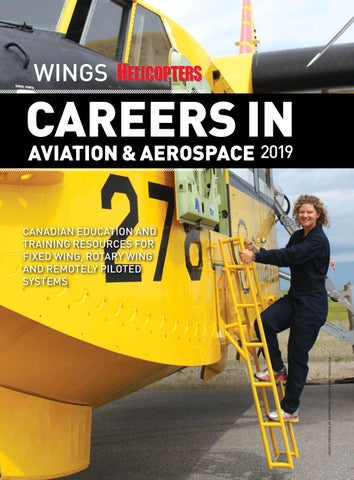
PHOTO PROVIDED BY NORTHERN LIGHTS AERO FOUNDATION
CANADIAN EDUCATION AND TRAINING RESOURCES FOR FIXED WING, ROTARY WING AND REMOTELY PILOTED SYSTEMS
NOW OPEN
NEW CENTRE FOR AEROSPACE AND AVIATION With the renovation of the historic de Havilland of Canada site in Toronto’s Downsview Park, our new Centre for Aerospace and Aviation is a sophisticated and beautifully designed facility that puts Centennial at the forefront in avionics, aircraft maintenance and aerospace manufacturing education. Featuring two aircraft hangars, structural labs and unique programs such as Aerospace Manufacturing Engineering Technology and Aircraft Maintenance and Management, this campus is the industry’s answer to the growing demand for skilled aerospace and avionics workers.
Learn more about our new campus and programs at:
centennialcollege.ca/downsview
CIA2019
PILOT AND TECHNICIAN
OUTLOOK TO 2037
CHART SOURCE: PILOT & TECHNICIAN OUTLOOK, BOEING
B
oeing in mid-2018 released its annual Pilot & Technician Outlook report, projecting demand for 790,000 pilots over the next 20 years. This represents double the current workforce, explains the company, and what it describes as the most significant demand in the report’s nine-year history. Boeing explains this demand is being driven by an anticipated doubling of the global commercial airplane fleet (as outlined in its recent Commercial Market Outlook), recordhigh air travel demand, and tightening labour supply. This year’s Pilot & Technician Outlook also includes data from the business aviation and civil helicopter sectors for the first time. “Despite strong global air traffic growth, the aviation industry continues to face a pilot labour supply challenge, raising concern about the existence of a global pilot shortage in the near-term,” said Keith Cooper, vice president of training and professional services, Boeing Global Services. “An emphasis on developing the next generation of pilots is key to help mitigate this.” Even as the commercial pilot demand forecast holding nearly steady, Boeing explains maintenance technician demand decreased slightly from 648,000 to 622,000. The company says this is primarily due to longer maintenance intervals for newer aircraft. Collectively, the business aviation and civil helicopter sectors will demand an additional 155,000 pilots and 132,000 technicians. Boeing offers the Pilot Development Program – an accelerated training program that guides future pilots from early stage ab-initio training through type rating as a first officer – to help operators meet their growing pilot needs. Several aerospace suppliers, operators and airlines offer similar types of programs to help promote and foster careers in aviation. Demand for commercial cabin crew increased slightly from 839,000 to 858,000, according to Boeing, due to changes in fleet mix, regulatory requirements, denser seat configurations and multi-cabin configurations. In addition, 32,000 new cabin crew will be required to support business aviation. Over the next 20 years, the report found that the largest projected growth in cabin crew demand is in the Asia Pacific region, with a requirement for 321,000 new cabin
crew. Europe will require 187,000, North America 174,000, Middle East 97,000, Latin America 53,000, Russia/Central Asia 29,000, and Africa 29,000. The Pilot & Technician Outlook report also forecasts, that over the next 20 years, the Asia Pacific region will lead the worldwide growth in demand for pilots, with a requirement for 261,000 new pilots. North America will require 206,000, Europe 146,000, the Middle
need for aircraft maintenance technicians. On top of the demand for new pilots to support fleet and traffic growth, Boeing explains several regions of the world also have a large wave of pilots approaching mandatory retirement age. The report points out that airlines in Japan and the United States received a reprieve when regulations were updated to increase the mandatory pilot retirement age. However, these updated
East 64,000, Latin America 57,000, Africa 29,000 and Russia/Central Asia 27,000. As the pilot labour supply continues to tighten around the world, Boeing explains regional markets are not only relying on recruiting pilots from outside their home locations, but also investing more to recruit, train, and develop locally sourced pilots. . Over the next 20 years, Boeing explains the global fleet will increase from 24,400 to 48,540 airplanes, which again is a primary reason for the current unprecedented demand for pilots. The 2018 report found fleet growth rates have been especially high in emerging markets that have a comparatively small pilot pool – creating regional supply challenges for qualified, ready-to-fly pilots. In addition, the airline industry is in its 10th consecutive year of above average air travel demand growth, which Boeing describes as creating an urgency for airlines to quickly hire pilots and put new airplanes into revenue service. . These same two factors currently creating unprecedented demand for pilots are driving an equally important
regulations provided only temporary relief, according to Boeing, which found airlines in the United States will lose more than 8,000 pilots to retirements in the next five years. This equates to more than four pilots lost from active duty per day. In Japan, thje 2018 Pilot & Technician Outlook found that more than 50 per cent of airline captains are over the age of 45, and a wave of retirements are expected starting in 2030. Again looking at aircraft maintenance technicians, Boeing explains that as new generation airplanes become more prominent in the global fleet, advances in airplane technology will drive an increased need for technicians skilled in avionics, composites, and digital troubleshooting. The need for maintenance personnel is largest in the Asia Pacific region, which will require 257,000 new technicians. Airlines in North America will require 189,000, Europe 132,000, the Middle East 66,000, Latin America 55,000, Africa 28,000, and Russia/Central Asia 27,000.
ON THEWEB
For more information about WINGS and HELICOPTERS' Careers in Aviation Expo events in Calgary this spring and in Toronto this fall, visit Careersinaviation.ca. January/February 2019 | C3
CIA2019 NORTHERN LIGHTS FOUNDATION
T
he Northern Lights Aero Foundation in September 2018 presented its 10th annual Elsie MacGill Northern Lights Awards. Each year, the not-for-profit foundation honours outstanding women who have made significant contributions in Canadian aviation and aerospace. The program is named after aviation pioneer Elsie Gregory MacGill, the world’s first female aircraft designer. She graduated from the University of Toronto’s electrical engineering program in 1927. During the second World War, MacGill was a key figure in the design and production of the Hawker Hurricane in Canada. Anna Rusinowski of Northern Lights worked with the 2018 honourees to compile favourite stories from their journey through Canadian aviation and aerospace, including this year’s two Rising Star Award recipients, university students Larissa Chiu and Katie Gwozdecky.
RISING STAR AWARD WINNER Larissa Chiu, President | University of British Columbia Aviation Club, and chair, Waypoint Aviation Connections Chiu enrolled into the Royal Canadian Air Cadet program and obtained her glider and private pilot licenses, becoming the only female cadet familiarization pilot in her C4 | January/February 2019
region. She graduated from the cadet program in May 2018 and currently serves as the president of the University of British Columbia’s Aviation Club, as well as chair of the Waypoint Aviation Connections Conference, a student-lead initiative built around aviation networking. Chiu aspires to become an Angel Flight pilot, flying passengers who are in need of medical treatments without access to nearby facilities. A favourite story on my journey, by Larissa Chiu: Breathe. Bank left, enter downwind leg at circuit altitude. Prelanding checklist. Check. Power back, slow down airspeed, flaps down to 10 degrees. Breathe. Bank left, continue to decrease airspeed. “This is the shortest field I’ve ever seen! Now I know why Charlie said you have to come in at 60 knots to make it,” said Victor, who joined my on the flight. Breathe. Bank left, flaps down to 30 degrees, maintain airspeed at 60 knots, keeping that approach path and attitude steady. Landing too low... ditch. Coming in too high... ditch. Making the finest adjustments in power, not teetering off that approach path. Approaching aiming point, power idle, flare right over the runway numbers, eyes on the horizon, hold off and hover just over the pavement for a smooth landing. Main wheels down. Flaps up. Breaks. Breathe. Laying out my maps and charts, I looked over the flight plan I had prepared the night before as I anxiously awaited for my friend to arrive. I thought landing on an 1,800foot runway with both ends bound by water would be fun and challenging for an amateur pilot like myself. I ran through my flight plan again before departing for our home airport. “Hey where are you heading off to?” asked Mike, the flight instructor. “Victoria International Airport then over to Courtney
Airpark.” He said, “Oh – that’s a short runway. Have yet to land there myself. Just you?” “Well, Victor will be flying with me, and he’s flying the leg back.” I then saw Mike's eyes relax; he wished me good luck and left. Exiting off the taxiway at CAH3, a grin stretched across my face over the excited commotion of my friends and I after a textbook short field landing. This is why I live to fly: To share these exhilarating moments with fellow pilots, but beyond that, to inspire others to fly. It gives me great joy and sense of honour to be able to take my friends, family, cadets and anyone in the community who is willing to let me share my passion for aviation, and show them a different perspective of the world we live in. I love finding new challenges that push me to perfect my skills. This landing was nothing out of the ordinary for any pilot, but it was one of many that pushed aside and of my stirring self-doubt. Bit by bit, every time you push beyond your own perceived capabilities, you build self-confidence. Never doubt yourself. I really believe one can do anything they set their mind to.
RISING STAR AWARD Katie Gwozdecky I MSc candidate, Flight Lab, University of Toronto Gwozdecky is a private pilot and graduate of the University of Toronto’s Mechanical
WINNER OF THE 2018 ELSIE GOVERNMENT AWARD, EMILY CROMBEZ, WHO GRADUATED FROM CONFEDERATION COLLEGE AND IS NOW A WESTJET AIRLINES CAPTAIN FLYING A BOEING 737. (PHOTOS PROVIDED BY NORTHERN LIGHTS FOUNDATION)
SUPPORTING THE GROWTH OF WOMEN IN CANADIAN AVIATION
— THE SKY IS LITERALLY THE LIMIT. AEROSPACE EDUCATION FOR A COMPLEX WORLD. With a 300,000 square-foot Aerospace Technology Campus, a fleet of over 20 aircraft, and an airport control simulation tower, BCIT is Canada’s largest post-secondary aerospace trainer. Attend an upcoming info session or spend a day with us to explore our Aircraft Gas Turbine Technician, Aircraft and Aviation Maintenance, Airport Operations or Commercial Pilot programs. Learn how BCIT gives our students the best opportunity to launch their careers at bcit.ca/aerospace
—— Students at BCIT Aerospace Technology Campus.
—— BRITISH COLUMBIA INSTITUTE OF TECHNOLOGY
CIA2019
A favourite story on my journey, by Katie Gwozdecky: The cross-country flight for my PPL was quite an experience. I had already completed my PPL flight test, so I wasn’t worried about my skills, but flying alone to two different airports is very different than performing steep turns and special landings with an instructor. I flew the trip with my primary instructor a few days prior so I was familiar with the route – CYRO -> CYGK -> CXBR -> CYRO. When I arrived, I had to brief with a different instructor (on any other flight, no problem, but on my qualifying cross country, I was getting nervous). So, I get the plane ready, open my flight plan and I’m off to Kingston. At each airport, I had to turn off the plane and get stamped by dispatch. Leaving Kingston, I had a pretty strong headwind so I had to gun it as fast as I could. Nobody was on dispatch answering the radio at Brockville. I had to park the plane and run around the airfield with time ticking to bring the plane back, not only before my booking expired and before my flight plan was due. After finding no one to stamp my book, I texted my primary instructor who just said to take a selfie. So of course, like any self-respecting millennial, I did. But I was late at this point and my primary said, “Get back in the plane!” I climbed back in to get back to Ottawa airspace. At 6,000 feet heading into Ottawa Terminal airspace, I’m on the radio giving my intentions when a passenger side latc comes undone, flinging open the window. I continue communicating with terminal, while reaching over to close the window. I succeeded once, but the window opened two more times on my approach to CYRO. I decided to prop it open with an old map, which, of course, went flying! As I descended, the window managed to stay closed, but I’m nervous it’s going to pop open the moment I turn final for runway 27 at CYRO. Thankfully, it doesn’t and I make it down. Not only did I survive my trip but I was greeted by my brother and mom with a bottle of champagne. What an incredible way to complete my PPL training. I am so appreciative of everyone at Rockcliffe for their support, humour and optimism throughout my licensing. I was able to train there twice a day, every day, over the course of a couple months in 2016. In that time, not only did I gain a C6 | January/February 2019
greater appreciation for the family I found there, but also for my own – especially for my Mom, who motivated and financed me. I also discovered how adventurous and brave pilots must be to fly.
GOVERNMENT AWARD Emily Crombez, Captain I WestJet Airlines Crombez was the first female to crew a Bombardier CL-415 waterbomber for the Ontario Ministry of Natural Resources and Forestry. She graduated from Confederation College’s Aviation Flight Management program as class valedictorian and Female Athlete of the Year. Crombez then flew as a bush pilot in Northeastern Ontario, which included flying the iconic de Havilland Beaver. She was then hired by the Ministry of Natural Resources and Forestry as a Twin Otter captain, particapting aerial rabies vaccinations and polar bear surveys. Crombez is currently flying a Boeing 737 for WestJet Airlines. PIONEER AWARD Major Micky Colton, Retired I Royal Canadian Air Force Colton joined the Canadian Forces as a pilot March 1980 and graduated with wings in 1982. She was posted on the C130 Hercules at the following squadrons: 436 Trenton, 429 Winnipeg, 435 Edmonton, 424 Trenton and 426 Trenton. Colton also served as an Air Transport Operations Duty Officer, Wing Flight Safety Officer and C130 Standards and Evaluation Officer. Colton retired from the regular force in October 2011, joining its reserves the next day. In May 2018, she retired as a Reservist Duty Operations Officer for 424 Squadron in Trenton. FLIGHT OPERATION AWARD Julie Beverstein, Assistant Chief Pilot I Porter Airlines
Beverstein began taking flying lessons at Billy Bishop Airport around 20 years ago, while pursuing a BSc at the University of Toronto. She then attended Seneca College to complete initial flight training. Beverstein was a flight instructor for five years before working for Air Georgian. She joined Porter Airlines in 2009 and now serves as a line pilot and training captain. She also leads pilot recruitment initiatives at Porter. BUSINESS AWARD Julie Mailhot, Chief Operating Officer I Air Georgian Mailhot started with Air Canada in 1987 as a Customer Service Agent and became the company’s first female flight dispatcher. She then served as the division’s chief of operations, managing up to 80 flight dispatchers. Mailhot, who received the Art of Excellence Award from Air Canada, currently serves as COO at Air Canada Express/Air Georgian. She is also president of the Dreams Take Flight Toronto Chapter, which she has been involved in for 21 years. EDUCATION AWARD Dr. Alexandra Kindrat, Research Scientist Kindrat is a Montreal-based educator and research scientist who worked on a visual depth perception program with NASA’s Johnson Space Centre in Houston, including science for the International Space Station. A private pilot, Kindrat has been a member of the teaching faculty at NASA’s High School Aerospace Scholar Program. She has also has served as co-chair of the International Astronautical Congress in the Human Space Endeavours Virtual Forum. She served as an educational consultant for the Canadian Space Agency’s advisory board focused on Canada’s future in space. ENGINEERING AWARD Niloofar Moradi, Turbine Design I Pratt & Whitney Canada Moradi earned her undergraduate degree in mechanical engineering from Concordia University and launched her career at Rolls Royce Canada in the energy sector. She later joined Pratt & Whitney Canada as an aerodynamicist focused on turbines. In 2016, working at P&WC, Moradi earned her Master’s degree from École de Technologie Supérieure. She currently works in P&WC’s Turbine Mechanical Design department, designing and integrating turbine components. She received the 2018 Concordia Young Alumni Award and was a 2018 recipient in Wings magazine's Top 20 Under 40 program.
PHOTO PROVIDED BY NORTHERN LIGHTS FOUNDATION
Engineering program. She joined the University of Toronto Aerospace Team, where she served as Director of Space Systems and helped pass a student levy, raising nearly half a million dollars to fund the launch of the first amateur satellite from U of T, HERON MKII, in 2019 – a first of its kind program in Canada. Gwozdecky is now pursuing a MASc at the U of T’s Space Flight Lab.
CIA2019
FLIGHT TRAINING
FIXED WING, ROTARY WING AND REMOTELY PILOTED TRAINING CENTRES BY PROVINCE
Alkan Air Flight Academy | Whitehorse Alkan Air is partnered with Yukon College to offer one year or 30 credits toward the school's two-year Aviation Management diploma program. The majority of ground school courses occur during the evening at Alkan Air and flight training must take place during daylight hours (exception is night time flight training). Alkan Air itself provides Private Pilot and Commercial Pilot License training. The operation provides a unique environment to learn in a northern climate, with access to an international airport and gravel strips in remote areas.
BRITISH COLUMBIA Canadian Flight Centre | Boundary Bay & Kamloops Canadian Flight Centre opened in 1979 at B.C.’s Boundary Bay Airport, near Vancouver, and became one of the first flight schools to specialize in instrument flying and other advanced training. CFC has trained thousands of pilots and today its students come from six continents (Antarctica excluded). Kamloops proximity to the mountains provides the opportunity for mountain checkouts.
Canadian Helicopters | Penticton Canadian Helicopters operates its flight school under the name HNZ Topflight, providing training programs to both company pilots and external clients. The school traces its origins to 1951 when it was known as the Canadian Helicopters School of Advanced Flight Training. Canadian Helicopters also provides ground based and simulation instruction for Royal Canadian Air Force pilots as a subcontractor to Allied Wings Flight Training Services. This facility is located at the Canada Wings Aviation Training Centre near Portage La Prairie, Manitoba. Other clients include the United States Navy Special Forces, Royal Canadian Mounted Police and the Royal Danish Air Force.
Chinook Helicopters | Abbotsford Chinook Helicopters began training operations in 1982 at the Abbotsford Airport, from where it continues to operate. The C8 | January/February 2019
Abbotsford area is well suited for year-round helicopter training. Chinook utilizes the expansive Fraser Valley for all initial flight exercises, and the Coastal Mountain Range for intermediate and advanced exercises. Due to the extensive commercial helicopter activity in southwestern British Columbia, most approaches and landings are to actual industry helipads.
Coastal Pacific Aviation | Abbotsford Coastal Pacific Aviation, located at Abbotsford Airport, partners with The University of the Fraser Valley to combine a diploma or degree together with a Commercial Pilot’s Licence with multi-engine and instrument rating. Its programs also include Seaplane Endorsement, Private Pilot Licence, Commercial Pilot Licence, Multi-Engine Rating, Instrument Rating, Night Rating and Instructor Rating.
Glacier Air | Squamish Glacier Air, operating from Squamish Municipal Airport, trains within the Sea-to-Sky corridor from Vancouver to Whistler, specializing in mountain training for fixed- and rotary-wing aircraft. Glacier also offers survival ground school, which includes studies in weather, flight techniques, effects of density altitude, emergencies, route planning and aircraft preparation, and survival gear.
Ocean Air Floatplanes | Victoria Ocean Air training specializes in seaplanes for both commercial and private licenses, helping more than 300 pilots earn their Canadian Seaplane Rating since 2002. With Transport Canada Floatplane/Seaplane Endorsement training, the company provides 15- and 50-hour programs amid the Gulf Islands with close proximity to Vancouver.
Okanagan Mountain Helicopters | Kelowna Okanagan Mountain Helicopters started as a helicopter flight training school in 2003. Its courses are designed to address commercial helicopter companies with a range of operational flying. Its facility at Kelowna International Airport also introduces students to controlled radio procedures, multiple training locations for confined areas and mountain flying introduction within a
control zone, and the best blend of controlled and uncontrolled practice areas.
Pacific Flying Club | Boundary Bay The Pacific Flying Club (PFC) was formed in 1965 as the Canadian Pacific Airlines Employees Flying Club. Students train at Boundary Bay Airport, where it has been located since 1985. The not-for-profit organization has a fleet of 27 aircraft and three simulators. It is a partner with the British Columbia Institute of Technology’s flight program.
Southern Interior Flight Centre | Kelowna Southern Interior Flight Centre is located at Kelowna International Airport in the Okanagan Valley is also surrounded by small air strips, which allows for exposure to every level of controlled and uncontrolled environments a pilot might encounter. The operation provides instruction for Recreational, Private, Commercial, Multi-Engine, Instrument, Night, VFR OTT and Instructor Rating
Victoria Flying Club | Victoria The Victoria Flying Club (VFC) has been training professional pilots since 1946. Located at Victoria International Airport, VFC provides a range of flight environments on a standardized fleet of Cessna 172SP Model aircraft. VFC has partnered with the University of Victoria to offer a Diploma in Business Administration – Aviation Option program.
ALBERTA Absolute Aviation | Wetaskiwin Absolute Aviation is a flight training and aircraft maintenance facility, largely serving students from Edmonton and central Alberta. Absolute operates out of Wetaskiwin Regional Airport in close proximity to Edmonton International. The school operates in both uncontrolled and controlled airspace with a fleet including Cessna 172 aircraft and also the Citabria 7ECA for single engine training and the PA-60 for multi-engine training.
Calgary Flight Training Centre | Olds The Calgary Flight Training Centre (CFTC) provides training for professional and private
ERIN GRANT, AIR CANADA 767 FIRST OFFICER; MARISSA DUCHSCHER, JAZZ Q400 CAPTAIN; AND JAKE KELLY-CUTHBERT, JAZZ CRJ FIRST OFFICER AT WINGS MAGAZINE’S CAREERS IN AVIATION EXPO, TORONTO.
YUKON
Whether you are interested in flying as a hobby or as a career, Canadian Flight Academy is your single destination for flight training. Canadian Flight Academy offers educational programs from Recreational to Airline Transport Pilot Licence. Come and visit us in our new modern facilities at the Oshawa Executive Airport. Our Graduates are flying for airlines around the world. One of Canada’s largest and oldest flight schools.
OFFERING FLIGHT TRAINING SINCE 1963 For more information contact: Call 905-404-9252 hello@torontoairways.com torontoairways.com
Canadian Flight Academy is a wholly owned subsidiary of Toronto Airways Inc.
WG_TorontoAirWays_CIA_HP_Jan19_CWM.indd 1
2019-01-08 9:58 AM
SEE YOUR CAREER TAKE OFF! START SEPTEMBER. APPLY TODAY!
Diplomas approved by Transport Canada: • Aviation Technician – Aircraft Maintenance • Aviation Technician – Avionics Maintenance • Aviation Technology – Aircraft Maintenance & Avionics Graduate Certificates: • Applied Aerospace Manufacturing • Remotely Piloted Aerial Systems Commercial Operations
CO-OP OPTIONS AVAILABLE!
LEARN MORE
fanshawec.ca/aviation
January/February 2019 | C9 WG_FanshaweCollege_CIAjan19_CSA.indd 1
2018-12-18 2:19 PM
CIA2019 within the Olds-Disdury Airport, which itself is in an uncontrolled airspace. The school operates a fleet of new aircraft with G500 Glass Cockpit trainers.
and able to design courses to develop skills sought by other operators.
Canadian Centre for Unmanned Vehicle Systems | Medicine Hat
Mitchinson Flight Centre | Saskatoon
SASKATCHEWAN
The Canadian Centre for Unmanned Vehicle Systems (CCUVS) offers a 1.5-day Unmanned Vehicle Systems ground school course to both civil and commercial operators, covering topics like aerodynamics, air law and regulations, weather, and aviation chart and flight supplements. Canadian Unmanned Inc. is the exclusive UAV training provider of CCUVS.
Founded in 1946, Mitchinson today is located in its own hangar at the Saskatoon John G. Diefenbaker International Airport. This allows students to fly in an ATC-controlled environment, providing experience for flying in larger centres, but without the traffic delays and congestion of a larger airport In 2013, Mitchinson was purchased by professional airline pilots who previously trained at the school.
Centennial Flight Centre | Edmonton
MANITOBA
Centennial Flight Centre, in operation since 1967, is located at Villeneuve Airport, approximately 20 kilometres northwest of Edmonton. It provides training for Recreational Pilot Permit, Private Pilot Licence, Commercial Pilot Licence, Multi-Engine and Instrument Rating. Centennial maintains a fleet of four Cessna 172Ms (primary trainer), one Cessna 172S, one Piper Arrow and one Piper Seneca I.
Edmonton Flying Club | Edmonton Edmonton Flying Club, home of the Edmonton Flight College, is located just west of Edmonton, operating out of Parkland Airport in Parkland County. Originally founded in 1927 as the Edmonton and Northern Alberta Aero Club, the club's first president was Canadian World War 1 flying ace, Wilfrid R. May. Today, the Edmonton Flying Club is a member-owned organization with a diverse fleet of aircraft and providing flight training at all levels from recreational pilots to Commercial Multi-Instrument rated, career-ready pilots.
PilotExams | Edmonton PilotExams.com provides practice exams for Canadian pilots and student pilots. Originally created by a group of student pilots, PilotExams now develops exams with flight instructors and commercial pilots across Canada. They write thousands of practice questions focuses on Transport Canada examinations for all levels flying, whether seeking a Recreational Permit or looking at aviation as a career. Pilot Exams recently released the INRAT and AIRAT/AIRAF exams.
Mountain View Helicopters | Springbank Mountain View Helicopters (MVH) has trained pilots for commercial or private helicopter licences from its Springbank Airport location since 1995, near Calgary International. MVH is able to provide flying weather found on the prairies and also proximity to mountains. It is a commercial operator C10 | January/February 2019
Brandon Flying Club | Brandon The Brandon Flying Club’s Flight Academy has served the region since 1936. Located at Brandon Municipal Airport, just outside of Winnipeg, BFA offers a continuous ground school, as well as Recreational, Private, and Commercial courses. Night VFR Over the Top and Instrument Ratings are also available. Transport Canada Written Recreational, Private, Ultra Light, and Helicopter exams can be completed at the centre as well.
based at St. Andrews Airport, 15 kilometres outside of Winnipeg. This provides for proximity to an international airport and uncontrolled grass strips. St. Andrews holds three runways for training with and without crosswinds.
ONTARIO Altohelix | Markham and Oshawa Altohelix is partnered with Toronto Airways to run full time UAV ground school and flight training with units based in two Greater Toronto locations, including Markham and Oshawa. It provides training required for the Transport Canada Special Flight Operation Certificate (SFOC) and Pilot Permits, leveraging instructors who hold Air Transport Pilot Licenses with Flight Instructor rating.
Aerocourse | Oakville AeroCourse has provided aviation ground school training courses for more than 20 years. This includes online programs and IFR and ATPL/IATRA seminars with instruction and practical course materials. Its courses are offered in most major Canadian cities, while offering customized programs to groups upon request.
Harv’s Air | Steinbach
Brampton Flight Centre | Brampton
Harv’s Air is a family owned and operated flying school that also provides air taxi and aircraft maintenance from two locations, Steinbach and St. Andrews, in the Winnipeg area. In business since 1973, the company offers a range of training from Recreational Pilot Liscence to Airline Transport Licence programs.
The Brampton Flight Centre (BFC) has training pilots since 1946. Located close to Toronto Pearson International Airport, BFC teaches students to fly in controlled and uncontrolled environments. BFC is controlled by the Brampton Flying Club, which owns its airport that covers almost 240 acres. It provides a one-year Professional Pilot Diploma program as a registered Private Career College, as well as industry partnerships with Air Georgian, Jazz and Porter.
PilotTraining | Steinbach Founded in 1999, PilotTraining.ca provides online instruction for aviation written examinations. Courses can be used as credit toward the Transport Canada ground-school requirement. The operation is approved to conduct ground schools with Harv’s Air, its parent company. Courses are completed by using multimedia tools such as video, mp3, presentations, animations, web pages, and automatic correcting and referenced practice questions.
Prairie Helicopters | Gimli Prairie Helicopters, which also provides charter helicopter services, describes itself as Manitoba’s only turbine helicopter flight school. Its head office and main hangar are located at the Gimli Airport approximately 45 minutes north of Winnipeg. The operation holds a fleet of Bell 407, Bell 206L3 and Bell 206B helicopters.
Winnipeg Aviation | St. Andrews Winnipeg Aviation has provided pilot training for more than 45 years. The school is
Diamond Flight Centre | London Diamond Flight Centre has been training pilots at the London International Airport since 2009 and, as a registered Private Career College (PCC) in the province of Ontario, holds a full-time staff of 16 certified flight instructors. The school also holds a fleet of 10 training aircraft manufactured in London, Ontario, by Diamond Aircraft, which develops aircraft like the 2-seat DA20 and the new 7-seat DA62.
Durham Flight Centre | Oshawa Durham Flight Centre began operations in 1997 and now provides training, aircraft rentals, and sightseeing services. Located in the Enterprise Airlines buildings on the grounds of Oshawa Municipal Airport, providing access to nearby modern aviation infrastructure. It is a Transport Canadaregistered flight training operation and also registered as a Private Career College in Ontario.
PASSENGERS AND LUGGAGE? WE HAVE DOORS FOR BOTH. You love flying, but your passengers have probably never heard of a weight and balance form. No worries, we’ve got you covered. The PC-12 NG’s enormous cargo door and 2,250 lb payload capacity lets you bring virtually anything that fits in the spacious 8-passenger cabin. Enter the main door and turn left, and rest assured we’ve taken care of everything to the right. Pilatus Business Aircraft Ltd • Phone +1 303 465 9099 • www.pilatus-aircraft.com
Stan Kuliavas,center Vice President Sales | sales@levaero.com | 1.844.538.2376 Authorized contact of information
www.levaero.com 18-PIL-0002 PC-12 Doors for Both Ad.indd 1
Logo
5/17/2018 8:32:27 AM
CIA2019 Genesis Flight College | Collingwood Genesis Flight College is a registered Private Career College providing a one-year dipoloma program. Located at Collingwood Regional Airport, Genesis owns the real estate and buildings on the field in which it operates. Leveraging its fleet of Diamond DA40 and DA42 aircraft, Genesis runs 100 per cent of its training with glass cockpits with electronic flight information systems. Students are exposed to these systems on the first flight and learn deeper functions in each successive training module.
Great Lakes Helicopter | Waterloo Great Lakes Helicopter is a Transport Canada-approved, Ontario Private Career College, while also offering charters. Based at the Region of Waterloo International Airport, the operation offers training yearround and focuses on both commercial and private licensing. Great Lakes is partnered Conestoga College for a program that provides both a Commercial Helicopter Pilot's Licence and a diploma.
Helicopters Canada | North Bay Helicopters Canada for approximately 20 years has provided commercial and private flight training to both domestic and international students. Its training area is situated at the Jack Garland Airport, which provides access to heavily forested areas with lakes and rivers for developing the skills needed for a large sector of the Canadian helicopter industry.
Ottawa Aviation Services | Ottawa Ottawa Aviation Services is a professional flight training and maintenance operation based out of Ottawa International Airport. The operation, registered as a Private Career College in Ontario, provides commercial and private training. The operation provides training with modern glass-cockpit, multi-engine and aerobatic aircraft, and simulators.
Ottawa Flight College | Ottawa The Ottawa Flying Club, operating as the Ottawa Flight College (OFC) has been training pilots since 1928. Located at Ottawa MacDonald Cartier International Airport, the Ottawa Flying club offers a controlled zone environment for learning IFR procedures, with access to uncontrolled airports in the area.
St. Thomas Flight Centre | St. Thomas Established in 1996, the St. Thomas Flight Centre offers flight training from Recreational Pilot Permit through to Commercial Pilot Licence and Multi-Engine Instrument Ratings. The centre holds Private Career College status and operates out of St. Thomas Airport in an uncongested flight training environment. School offices are located C12 | January/February 2019
in the main terminal building and ground school classes are held on site. The Flight Centre has two additional satellite locations at Chatham airport and London airport.
Spectrum Airways | Burlington Spectrum Airways has been training pilots for more than 40 years. The training facility is situated at the heart of Burlington Executive Airport, one of the busiest airparks in Ontario. The airport averages 30 flights on weekdays. Registered as a Private Career College, Spectrum’s training programs include Private Pilot License, Commercial Pilot License, Night Rating, Multi-Engine Rating, Instrument Rating/Multi Instrument Rating and Instructor Rating.
Toronto Airways | Oshawa Toronto Airways has been providing flight training services beginning in 1963 from the Buttonville Municipal Airport. In 1998, Toronto Airways purchased Canadian Flight Academy, as a growing flight training provider located at the Oshawa Executive Airport. In 2016, Toronto Airways moved into a new facility at Oshawa Executive Airport. With a full compliment of ground school courses, the training operation’s services allow for a student to obtain either a Private Pilot and Commercial Pilot License. The operation has access to more than 15 training aircraft and two advanced simulators.
Waterloo Wellington Flight Centre | Waterloo Waterloo Wellington Flight Centre (WWFC) is located at the Region of Waterloo International Airport. The training centre is partnered with Conestoga College and the University of Waterloo to offer diploma and degree programs. WWFC also offers a Remotely Piloted Aircraft System (RPAS) course designed to introduce people to regulations, operation and maintenance of UAVs/drones. The course offers customized training up-to-date information based on new regulations from Transport Canada.
QUEBEC Air Richelieu | Montreal Air Richelieu is an accredited flight training centre with facilities that include multimedia classrooms and flight preparation rooms. The school is located at St-Hubert Airport, approximately 20 minutes from Montreal, and controlled by the Montreal Flying Club. Programs allow students to earn commercial and private pilot licences, along with the multi-engine, instruments and night rating, as well as a diploma recognized by the Ministry of Higher Education, Research and Science of Quebec.
CQFA Aviation Industry Training | Montreal
Established in the late-1980s, the CQFA offers more than 50 different on-demand aviation courses, providing assistance for a range of training like Accredited Check Pilot, Crew Resource Management, Flight Crew Training, GPS, CFIT Avoidance Training, and Proficiency Checks. Some courses are also available via the Internet. CQFA has been training UAV pilots since 2007, offering a range of courses training for recreational and professional pilots. This includes an introduction to the Canadian regulatory framework, a ground school, several advanced workshops, applied human factors and risk management, in addition to practical courses.
Dorval Aviation | Montreal Dorval Aviation is a commercial air operator and a flight training centre located at the Montreal International Airport. We operate a diversified fleet of aircraft that can fulfill all of your traveling requirements, or flight training needs. It provides courses from simple introduction to aviation to Commercial Pilot License, as well as an internship program. Dorval Aviation also provides specialized recurrent training courses for commercial air operators, as per Canadian Regulations.
Laurentide Aviation | Montreal Laurentide Aviation has been providing professional flight training since 1946. Based at Les Cedres Aerodrome, an uncontrolled airport, approximately 25 kilometres west of Montreal, Laurentide offers bilingual inflight and ground school instruction, as well as recreational, private and commerical pilot lisence courses.
NOVA SCOTIA Debert Flight Centre | Truro Debert Flight Centre is part of the Truro Flying Club and operates out of Debert Airport, which has been home to the club since 1972. Debert Airport is an uncontrolled air space located less than is less than five minutes flight time from training areas. It has an inhouse Designated Flight Test Examiner for private and commercial licenses, so that students do not have to travel to another airport to take their flight test.
NEWFOUNDLAND GFT Aerospace College | Gander GFT Aerospace has provided flight training since 1992, evolving from its roots as EVAS Air (Exploits Valley Air Services). Its facility is located at Gander International Airport. The aerospace college provides a fleet of 17 aircraft, including a helicopter, a flight simulator, large classrooms, individual briefing rooms, and a large technical library for students.
CIA2019
AVIATION TECHNICIAN COLLEGES
MAINTENANCE, REPAIR AND OVERHAUL (MRO) EDUCATION BY PROVINCE
FANSHAWE IN 2018 RECEIVED A FALCON 10 DONATION FROM TRICOR, AND AN ORNGE AIR AMBULANCE HELICOPTER, TO BOOST ITS NORTON WOLF SCHOOL OF AVIATION TECHNOLOGY. (PHOTO: JOHN SING, FANSHAWE COLLEGE)
BRITISH COLUMBIA British Columbia Institute of Technology | Vancouver British Columbia Institute of Technology (BCIT) School of Transportation prepares students for careers as Aircraft Maintenance Engineers, Aviation Maintenance Technicians (Avionics) and Gas Turbine/ Jet Engine Technicians. Its Aerospace Technology Campus is located at the Vancouver International Airport and features a 40,000-square-foot hangar that holds BCIT’s fleet of light piston, turboprop, corporate and jet transport aircraft, as well as light and medium helicopters. The school is currently developing augmented reality/virtual reality (AR/VR) training tools to help deliver accredited programs to provide skills needed for the transport industry. BCIT’s Airport Operations diploma program is designed for the demands of airport operation environments. The 16-month Airport Operations program provides students with a comprehensive, interdisciplinary program of study. BCIT also offers an online Airport Operations Part-time studies Associate Certificate.
Polytechnics Canada, a national alliance of research-intensive colleges and institutes of technology. SAIT’s School of Transportation provides hands-on, practical education for the automotive, aviation, heavy equipment and rail industries. This includes two-year diploma programs called Aircraft Maintenance Engineers Technology and Avionics Technology. The aircraft maintenance program provides skills for the service and repair of airplanes and helicopters — with the eventual opportunity to obtain an Aircraft Maintenance Engineer license. The avionics technician programme, also leading to an Aircraft Maintenance Engineer license, provides skills to repair and maintain the electrical and electronic systems (communication, navigation and data systems) in airplanes and helicopters. SAIT also provides a one-year Aircraft Structures Technician program focused on the modification and repair of aircraft, helicopters and their structural components, again leading to an Aircraft Maintenance Engineer license. . All programs are taught at the Art Smith Aero Centre for Training and Technology, located at Calgary International Airport.
SASKATCHEWAN
Northern Lights College | Dawson Creek
The Saskatchewan Indian Institute of Technologies | Saskatoon
Northern Lights College (NLC) opened the Aerospace Centre of Excellence in 1981 at its Dawson Creek Campus. Students and current aircraft maintenance engineers receive hands-on training in a 26,000-square-foot hangar. Its fleet includes helicopters such as a Robinson R44, MD500D, AS350D, Hughes 300C, Bell 205 and 206; and fixed-wing airplanes like a Cessna 180, Cessna 310, Piper Aztec 250, King Air B90, and British Aerospace JetStream 31.
The Saskatchewan Indian Institute of Technologies (SIIT) was created in response to the need for quality, post-secondary education for First Nations people. The SIIT Aircraft Maintenance Engineer program is open to First Nation and nonFirst Nation students, and delivers the knowledge and skills required for eligibility to apply as an apprentice in the aircraft maintenance industry. This includes learning to troubleshoot, maintain, repair and overhaul aircraft to meet Transport Canada’s standards. This is a 2-year diploma program that provides credit for 19 months of the 48 months aviation maintenance apprenticeship experience required to obtain a
ALBERTA SAIT Polytechnic | Calgary The Southern Alberta Institute of Technology (SAIT) Polytechnic is a member of
Category M License. IIT AME students attend this program at the Saskatoon Aviation Learning Centre at the Saskatoon Airport for classes and hands-on training.
MANITOBA Red River College | Winnipeg Red River College (RRC) Aircraft Maintenance Engineer program is designed to develop the knowledge and skills in maintenance of both large and small airplanes and helicopters. It is designed to develop skills in maintenance of both airplanes and helicopters. Time in the program is split between the study of aircraft maintenance theory and practical projects. Upon graduation, if the student attained Transport Canada approved training status, they will be granted 19 months of the 48 months aviation maintenance experience and the three technical examinations required to obtain an AME license. After graduation, students are required to gain on-the-job work experience for the balance of the 48-month Transport Canada requirement and write the CARs exam. Once these requirements are meet, the student will be eligible for a Transport Canada M license. This program has been accredited by the Canadian Forces for their Non-Commissioned Member Subsidized Education Plan. RRC also offers programs called Aerospace Manufacturing and Aircraft Structural Repair Technician.
ONTARIO Algonquin College | Ottawa The School of Advanced Technology at Algonquin College features With 23 laboratories, including precision machining, automotive, electronics, optical fiber, high-powered laser labs, mechanical modeling and element analysis, industrial controls, aviation maintenance and robotics labs. The includes two diploma programs in the school’s Transportation Technology segment called Aircraft Maintenance Technician and Aviation January/February 2019 | C13
CIA2019 Management, General Arts and Science – both running for two years.
Canadore College | North Bay Canadore has been involved in aviation training for more than 40 years. Its School of Aviation Technology provides two-year. diploma programs, Aviation Technician -Aircraft maintenance. This includes a dedicated aviation facility with courses delivered at the college’s Aviation Campus at Jack Garland Airport. Students learn to troubleshoot aircraft components and systems, including piston and turbine engines, for fixed- and rotary-wing aircraft. The program is approved by Transport Canada and graduates receive 18 months of accreditation towards a Transport Canada-issued Aircraft Maintenance Engineer's Licence, Category M. In addition to maintenance and repair, students in Canadore’s School of Aviation Technology can learn aerodynamics for fixed wing and rotary wing aircraft, gas turbine and reciprocating engines, aircraft handling and taxiing, power and drive train component maintenance, sheet metal structures and repairs, composite structures and repairs, communication and navigation systems, and electrical systems
Centennial College | Toronto Centennial College’s Aerospace programs offered within the School of Transportation includes Aviation Technician (Aircraft Maintenance and Avionics Maintenance) programs and Aviation Technology (Aircraft Maintenance & Management and Avionics Maintenance & Management) programs. In the fall of 2018, Centennial College opened its Centre for Aerospace and Aviation at Toronto’s Downsview Park in the relocation of its Aviation Technician programs, as well as the related aircraft and equipment from the Ashtonbee Campus Hangar in Scarborough. The new campus provides additional instruction space for the existing programs, as well as new programs in Aerospace Manufacturing delivered by the School of Engineering Technology and Applied Science. The four-acre Downsview campus repurposes the historic de Havilland of Canada building with selective demolition and new construction to create approximately 138,000 square feet of instruction space. The $72-million project includes a new hangar large enough to accommodate today's commercial jets, as well as new classrooms, laboratory space, workshops, offices, a library and, for the first time, access to working runways. The Aircraft Maintenance program provides mechanical, electrical, electronic and other science skills related to aircraft maintenance. It emphasizes C14 | January/February 2019
the repair of electrical and mechanical systems within the aircraft. Students will study hydraulics, fuels, environmental systems, engines, flight controls, landing gear system and airframes and structure. The Avionics Maintenance program covers aircraft communications, navigation and data systems, and inspection and troubleshooting of basic electronics circuits. In this program, a significant portion of time is spent on practical applications in labs.
Confederation College | Thunder Bay Confederation College offers various aerospace and aviation technician courses at its Aviation Centre of Excellence (ACE) at Thunder Bay International Airport. The two-year Aviation Technician, Aircraft Maintenance, diploma program allows students to receive 18-months credit towards experience requirements for an Aircraft Maintenance Engineer license, Category M, with 95 per cent attendance record. Topics include aircraft construction and science, electrical and electronics, airframe systems and inspection, rotary wing (helicopter) maintenance and structural repair. The 2.5-year Aviation, Flight Management, advanced diploma program includes private pilot flight training that begins the first week of first semester right from the school’s hangar at the Thunder Bay International Airport. The program holds 13 aircraft, three flight simulators and industry-based instruction to learn skills required to work as a commercial pilot.
Fanshawe College | London Fanshawe’s Norton Wolf School of Aviation Technology is located at the London International Airport and holds an 80,000-square-foot hangar. The school specializes in offering Transport Canada-approved diplomas in Aircraft and Avionics maintenance. It also provides new graduate certificate programs in Aerospace Manufacturing and Remotely Piloted Aerial Systems Operations. The school’s Aviation Technician – Avionic Maintenance program covers all aspects of aircraft avionics systems used in general aviation, corporate, charter transport category aircraft and helicopters. The school focuses on aircraft structural repair and applied aerospace manufacturing.
NOVA SCOTIA Nova Scotia Community College | Dartmouth The Nova Scotia Community College’s (NSCC) Aviation Institute is located in
a 43,000-square-foot training facility. The school provides a two-year Aircraft Maintenance Engineer, Mechanical, diploma program. Courses focus on aircraft servicing and ground handling functions, Canadian Aviation Regulations, using specialized equipment to repair and maintain aircraft systems, interpret wiring diagrams and aircraft drawings, and assess sheet metal damage and appropriate repair procedures. The school also provides a one-year Aircraft Maintenance Engineer, Structures, certificate program to develop skills for the repair and maintenance of airframes and associated systems for fixed-wing and rotary-wing aircraft. This includes the area of aircraft metal and composite assembly and repair, skills eessential to the maintenance, repair, overhaul, inspection and testing of aircraft structural systems. Graduates will be able to assess damage and corrosion of aircraft structures and repair, replace and modify sheet metal, fabric surfaces and composite and wood structures.
PRINCE EDWARD ISLAND Holland College | Summerside Holland College provides a one-year Aircraft Turbine Technican certificate program at its Summerside Waterfront Campus in PEI. Aircraft turbine technicians inspect aircraft engines, troubleshoot issues with mechanical systems, and modify, repair, and test turbine engines. Students learn techniques, procedures, and documentation requirements with an emphasis on practical training using a variety of turbine engines. This includes the Pratt and Whitney 100 series turbine engine used on the de Havilland Dash 8 aircraft, the Pratt and Whitney PT6 engine, and the Rolls Royce 250 engine.
NEWFOUNDLAND College of the North Atlantic | Gander The College of the North Atlantic (CNA) is part of the Lufthansa Technical Training network of approved schools. The two-year Aircraft Maintenance Engineering Technician program is located at the school’s Gander campus in Newfoundland. Graduates of this program earn North American and European certification and can attend the Institute of Technology in Carlow, Ireland, to earn an undergraduate degree in Aircraft Systems Maintenance with only one additional year of school. The one-year Aircraft Structural Repair Technician program also takes place at the Gandar campus.
nician – h c e T n io t ia v A tenance Aircraft Main oma program Two-year dipl
Learn to maintain, repair and troubleshoot complex aircraft systems - everything you need to know to prepare for the Transport Canada Aircraft Maintenance Engineer (AME) license.
Hands-on Experiences
Apply Now
Highly Trained Instructors
EMPLOYERS: Facilitate opportunities for career advancement and skills development.
confederationcollege.ca
Support your employees to apply.
WG_Confederation college_CIAJanFeb19_CSA.indd 1
2018-12-21 1:29 PM
January/February 2019 | C15 WG_PilotExams_CIAJan19_CSA.indd 1
2018-12-19 10:47 AM WG EFC QP JAN19 JLR.indd 1
2019-01-10 3:00 PM
CIA2019
UNIVERSITY PROGRAMS IN FIELDS OF AVIATION AND AEROSPACE
BRITISH COLUMBIA Fraser Valley University | Fraser Valley Completion of the program provides students with a university degree, private and commercial pilot licenses certified by Transport Canada, supplemented by both night and multi-engine instrument ratings. In fourth year, students have the option to specialize in either heavy jet transport operations or professional flight instruction. In the classroom, students gain knowledge necessary to pass Transport Canada examinations, cover human factors affecting pilot decisionmaking, and learn how to be a member of an airline crew. UFV provides an opportunity to finish this training in four years, when it can typically take up to six years to complete.
ALBERTA MacEwan University | Edmonton MacEwan’s partnership with Transport Canda allows allows students to earn a Business Management diploma with a specialization in aviation management. To complete the Aviation major, students must apply to the Business Management program. Upon graduation students declare the Aviation major. Students can block transfer credits to the third year of MacEwan's Bachelor of Commerce.
Mount Royal University | Calgary Mount Royal University’s Aviation Diploma program combines an academic diploma with the flight training needed to become a commercial pilot. Students require a completed Private Pilot's License in order to begin the program. Practical flying experience is accumulated on Mount Royal's fleet C16 | January/February 2019
of aircraft consisting of Cessna single-engine aircraft and Seneca multi-engine aircraft. The fleet, located at the school’s Springbank Hangar at the nearby Springbank Airport, is equipped with the advanced GPS avionics. Mount Royal also provides simulator training on an ALSIM ALX Flight Training Device.
ONTARIO Carleton University | Ottawa Carleton’s Aerospace Engineering program emphasizes the development of analytical, computational, and hands-on engineering and design skills related to the aerospace field. The broad range of topics and applications included in this discipline are covered in four main streams: Aerodynamics (aerospace propulsion and atmospheric flight); Aerospace Structures (lightweight vehicles for flight and space travel); Aerospace Electronics and Systems (aircraft control, communication and navigation systems); and Space Systems Design (astronautics and space/satellite technology). All four streams emphasize the development of practical and problem-solving skills based on hands-on laboratory and design work.
Ryerson University | Toronto Ryerson’s Aerospace Engineering bachelor’s program provides students with the opportunity to study aerodynamics, stress analysis and structural design, flight mechanics, stability and control, aircraft performance, propulsion, avionics and systems. Students also learn to design, test, manufacture and maintain aircraft or spacecraft, as well as vehicles for transport on land and water. The program provides knowledge to work in fields involving commercial and military aircraft
or spacecraft engineering; space exploration, teaching, research, military service; air transportation and space-based telecommunications. Pursue a graduate degree (MEng, MASc, PhD) in aerospace engineering.
University of Toronto | Toronto Students who wish to study Aerospace Science and Engineering at the University of Toronto enroll in the four-year undergraduate Engineering Science program. In the first two years, this program emphasizes mathematics, chemistry, physics and computing. Towards the end of the second year of Engineering Science, students must select a speciality option for their third and fourth years of study. This includes an Aerospace Engineering option, taught primarily by UTIAS professors. UTIAS is the university’s graduate program focused on scientific exploration and aerospace research. UTIAS faculty members are international leaders in computational aerodynamics, micro and nanosatellites, combustion and propulsion, robotics for space and terrestrial applications, and in other fields of aerospace engineering.
University of Waterloo | Waterloo Established in 2007, Waterloo’s Aviation program allows students to earn a Bachelor of Science degree and, working with the Waterloo Wellington Flight Centre, a Commercial Pilot Licence. Welcoming approximately 45 new people each year, Students in the Aviation program have a choice of pursuing either the Geography and Aviation (BES) and Science and Aviation (BSc). In the BSc program students will have a further choice of specializing in either Earth Sciences or Physics or remaining in the broadly based unspecialized program. Students in the BES program will automatically receive a Geomatics option.
ADVANCED ROBOTIC MANUFACTURING EMPLOYED AT PRATT & WHITNEY CANADA’S FACILITY IN LONGUEUIL, QUEBEC. (PHOTO: PRATT & WHITNEY)
UNIVERSITY-LED EDUCATION BY PROVINCE
CIA2019 University of Windsor | Windsor Windsor’s Aeronautics Leadership program combines a liberal arts and leadershipfocused education with commercial flight training. Students enroll in a Bachelor of Arts, Liberal Arts and Professional Studies. This includes courses in arts, humanities, social sciences, business, science, and engineering. This is coupled with flight training run by industry partner Journey Air, at Windsor International Airport.
Western University | London Western’s Commercial Aviation Management program allows students to earn a Bachelor’s degree in Management and Organizational Studies, with specialized courses in aviation management. Within the program, students have the option to combine a degree with professional pilot flight training, ultimately receiving a Transport Canada approved Integrated Commercial Pilot’s License (ICPL) with Multi-Engine and Instrument Ratings.
York University | Toronto The Space Engineering program at York’s Lassonde School of Engineering provides an Beng degree. It focuses on areas of study from orbit control and space-based optics to ground station communications and
robotics. Students learn about the management of complex multidisciplinary projects, including missions within the solar system. The co-op program allows students to gain professional experience.
QUEBEC Concordia University | Montreal Concordia’s Aerospace Engineering (BEng) program is offered by the Department of Mechanical, Industrial and Aerospace Engineering, Gina Cody School of Engineering and Computer Science. The program allows students to specialize in Aerospace and Propulsion, Aerospace Structures and Materials, or Avionics and Aerospace Systems. The program provides access to areas like mechanical, electrical, computer, and industrial engineering to the conception, design, implementation and operation of aerospace systems and processes.
Ecole Polytechnique | Montreal Ecole Polytechnique de Montreal provides undergraduate and graduate Aerospace engineering programs. Students in the graduate program follow at least two specialization courses (with the exclusion of case studies) given by the other participating institutions. Candidates who successfully
complete the professional master’s in Aerospace Engineering program obtain a Master of Engineering (MEng) degree.
McGill University | Montreal Established in 1951, McGill’s Institute of Air & Space Law has trained more than. 1,000 specialists in air and space law from all over the world. Today, IASL graduates today serve in some 120 nations around the world. The program also holds a research arm called the Centre for Research in Air & Space Law.
NEW BRUNSWICK Mount Allison University | Moncton The Aviation program is a degree-level educational platform combining professional flight training. The flying portion of the program is offered through a partnership with Moncton Flight College. In the first year, students will take introductory courses in mathematics, computer science, physics and geography. Flight training begins in the second year, with students continuing to take three courses per term on campus and ground school training in second, third, and fourth year. Students complete more than 200 hours of flying and graduate with a Commercial Pilot Licence, multi-engine class rating and Group 1 instrument rating.
alX ALL YOUR AIRCRAFT IN ONE SIM FOR COMPLETE TRAINING
al250 YOUR RECONFIGURABLE SEP / MEP IN A COMPACT SIM
TRAIN FROM ZERO HRS TO FIRST OFFICER
al42 SPECIFIC DIAMOND DA42
the
al172 SPECIFIC CESSNA 172SP SKYHAWK NAVIII
airliner UPGRADE YOUR AIRLINE PREPARATION TRAINING APS MCC UPRT / MPL
MORE AT
ALSIM.COM January/February 2019 | C17
WG_ALSIM_CIAjan19_CSA.indd 1
2018-12-19 9:44 AM
CIA2019
DOWNSVIEW AEROSPACE INNOVATION AND RESEARCH CONSORTIUM
L
eaders from Canada’s aviation and aerospace sector in June 2018 gathered at Downsview Park in Toronto to celebrate investments made into what will become one of North America’s leading aerospace hubs. The event took place in a heritage aviation building that has been transformed into an aircraft cabin interior research facility of Ryerson University’s Aerospace Engineering program. Across the street sits Centennial College’s newly Downsview campus dedicated to aviation and aerospace. Scheduled to open in January 2019 as part of a $72 million investment, the college’s new four-acre campus will include approximately 138,000 square feet of instruction space and a new hangar large enough to accommodate today’s commercial jets. “We expect to welcome our students here for the start of winter semester this coming January, after we move all of our aircraft and related equipment from our small hangar at Ashtonbee Campus to this historic facility, which served as the headquarters of de Havilland of Canada,” said Ann Buller, President of Centennial College. “Our new space will allow us to expand our aviation technician AME programs and introduce new ones in aerospace manufacturing, which will triple our aviation-related enrolment to more than 1,000 full-time students.” Chris Damaren, Director of the University of Toronto Institute for Aerospace Studies (UTIAS), then explained to attendees that UTIAS, recognized as one of the world’s leading aerospace research programs, is working on plans to establish facilities at the Downsview aerospace hub within the next few years. Development of the new Ontario aerospace hub is being led by the Downsview Aerospace Innovation and Research Consortium (DAIR). C18 | January/February 2019
Francois Caza and Mike Nadolski of Bombardier began the event by reinforcing the company’s continuing commitment to the DAIR initiative. “Bombardier is investing in the continued growth and competitiveness of the province’s aerospace sector through multi-million-dollar contributions, research, training activities and by supporting the establishment of an aerospace hub in Toronto’s Downsview area,” said Caza, VP, product development and chief engineer, aerospace, Bombardier. Bombardier will provide $1.5 million over five years to fund core research at the Aeromaterials Research Centre, to be established at the DAIR Innovation Centre. As a founding member of the DAIR Consortium, Bombardier will also provide $900,000 over the next three years to support formal operations of the Innovation Centre. The centre will bring together industry and academic partners in a collaborative space for aerospace training and education, R&D, and sector advisory services. Bombardier will also contribute an aggregate $1 million over five years for the creation of two Aerospace Research Centres at Ryerson University and the University of Toronto. These centres will focus on research in the areas of advanced interiors and acoustics. “With their five-year commitment to support the Ryerson cabin interiors research team, Bombardier is taking action to follow through on our collective mandate to catalyze research and development in an aerospace hub at Downsview Park, advance the commercialization of next generation commercially available business jets and commuter aircraft, and empower Ryerson’s cabin interior research team to solidify its role in this space,” said Thomas Duever, Dean of Ryerson’s Faculty of Engineering & Architectural Science. Bombardier will also provide funding to
Centennial College for the completion of its Landing Gear Research project, while extending its existing training program to train a minimum of 50 individuals for each of the next three years at Centennial College’s Downsview Campus. “I am thrilled with the ongoing support and leadership demonstrated by Bombardier and the opportunity this will unlock for aerospace in Ontario,” said Andrew Petrou, executive director, DAIR, and director, Strategic initiatives and external relations, Centennial College. “This commitment will enable the growth of the Downsview Aerospace Hub through support for training and research, DAIR Innovation Centre physical space and operations, and preservation of the site’s aerospace heritage.” Finally, in recognition of Downsview’s historical importance in the development of the aerospace industry in Ontario, Bombardier explains it will be providing a total of $2.5 million in capital funding to refurbish the heritage Moth Building, which will be the cornerstone of the DAIR Innovation Centre. The Canadian headquarters of de Havilland Aircraft of the United Kingdom was established at Downsview airfield just north of Toronto, whose brick buildings and hangars housed an assembly facility for the Moth training plane and the plywood Mosquito bomber. The long-dormant facility will become Centennial College’s fifth campus. The Centre for Aerospace and Aviation will be the new home of Centennial’s aerospace faculty, aircraft and related equipment relocated from Ashtonbee Campus in January. Centennial College is a founding member of the DAIR consortium, which also includes academic and industry partners like the University of Toronto Institute for Aerospace Studies, Ryerson University, York University, Bombardier, Safran Landing Systems, MDA and others.
CIA2019
COLLEGE FLIGHT AND OPERATIONAL PROGRAMS
YUKON Yukon College | Whitehorse The Aviation Management diploma program at Yukon comprises a block transfer of pilot training credentials earned at Alkan Air (or other recognized flight schools) that equals one year or 30 credits and an additional 30 credits earned at Yukon. Students are expected to earn a Commercial Pilot License while concurrently earning academic credits. However, students may enter the program with some pilot training (a Private Pilot License, for example) or a completed commercial license. Students may complete the ground school and flight training component of the Aviation Management diploma in a flexible manner. The majority of ground school courses occur during the evening at Alkan Air and flight training must take place during daylight hours (exception is night time flight training). All flight training components are organized directly with Alkan Air Flight School. Students receive a Diploma of Aviation Management after completing Transport Canada’s Commercial Pilot License, Yukon First Nation core competency, a total of 10 academic courses (30 credits) over a two-year period, as well as a 40-hour, non-credit course in Advanced Wilderness and Remote First Aid/CPR-C.
BRITISH COLUMBIA British Columbia Institute of Technology | Burnaby The British Columbia Institute of Technology (BCIT) is partnered with Pacific Flying Club to provide students with the skill set to become airline pilots. The program is fully integrated, combining flight training with industry focused academic training. Flight training for fixed-wing aircraft is conducted at Pacific Sky Aviation’s flight school at Boundary Bay Airport, outside of Vancouver. C20 | January/February 2019
Rotary-wing flight training, for those interested in becoming helicopter pilots, is provided by Chinook Helicopters in Abbotsford. BCIT’s Airport Operations diploma program is designed for the demands of airport operation environments. The 16-month Airport Operations program provides students with a comprehensive, interdisciplinary program of study. BCIT also offers an online Airport Operations Part-time studies Associate Certificate.
College of New Caledonia | New Caledonia The College of New Caledonia provides an Aviation Business diploma program, which accepts applications for continuous intake. The program is designed to provide trained single engine VFR pilots for entry-level pilot in command positions with Canada’s northern air carriers and with similar air taxi companies operating in difficult conditions around the world. The program centers around a PilotPlus approach to providing a supply of pilots to Canada's northern air carrier industry. If taken in the minimum possible time, the ABD is a five semester program running over 24 months, with a four month break between semesters two and three. The program includes all training for both the Private and Commercial pilot licenses and float rating, as well as 13 university level business courses. In addition to pilot positions within commercial, business, military and police avation, the school’s diploma program also provides skills for managerial positions, air traffic control services, aviation marketing and sales, and aviation entrepreneurship.
Douglas College | New Westminster Douglas College’s Associate of Arts Degree for Future Professional Pilots is a program for students who wish to continue to a career in the aviation industry. This program is jointly offered with Professional Flight
Centre, located at Boundary Bay Airport in Delta. Douglas provides the academic instruction leading to the Associate of Arts Degree and Professional Flight Centre provides the ground and flying instruction with enough flight experience to obtain a Commercial Pilot License and Multi-engine Instrument Rating. Students need to apply to both Douglas College and the Professional Flight Center. The Associate of Arts portion at Douglas College consists of 60 credits of University Transfer courses which are mainly offered within the Faculty of Humanities and Social Sciences. The recommended courses have relevance to the aviation industry. Students graduate with an Associate of Arts degree.
Okanagan College | Kelowna The Commercial Aviation diploma program at Okanagan College consists of two distinct and separate areas of study: flight training and business studies. The business portion is completed at Okanagan College and normally consists of two business courses per semester for a total of eight courses over two years. The flight-training portion taken with Southern Interior Flight Centre, out of Kelowna Airport, and consists of flight training, theory and exams. Southern Interior Flight School offers graduating students the opportunity to become flight school instructors.
ALBERTA Red Deer College | Red Deer Red Deer College’s (RDC) partnership with Sky Wings Aviation Academy combines a foundation in business with flight training. The 1-year Certificate program holds its business management courses at the Donald School of Business. Sky Wings Aviation Academy is located in Penhold, Alberta, near Red Deer and halfway between Calgary and Edmonton. Sky Wings states its students can expect a wide variety of flying conditions
JONATHAN LITTLER (LEFT), RUNNER UP, WITH CARTER SIMPSON, A STUDENT WITHIN SENECA COLLEGE’S FLIGHT PROGRAM AND WINNER OF THE 2018 WEBSTER COMPETITION TO BECOME CANADA’S TOP AMATEUR PILOT. (PHOTO: MIKE DOIRON, DOIRON AVIATION CONSULTING)
CANADIAN COLLEGE OPTIONS BY PROVINCE
CIA2019 during their training. Flight training is provided approximately ten minutes from the RDC campus at Red Deer Regional Airport. Sky Wings Aviation Academy has providing flight training since 1982. Highlights of the Aviation Diploma Program include a transcontinental flight crossing the Canadian/ U.S. border, familiarization training for a regional or national airline and crew resource management. Most RDC courses are university transferable.
SASKATCHEWAN Saskatchewan Polytechnic | Saskatoon The Saskatchewan Polytechnic is a member of Polytechnics Canada, an alliance of 11 research-intensive, industry-responsive post-secondary institutions. The Polytechnic’s Commercial Pilot program is offered in partnership with the Saskatchewan Aviation Council, a membership-based association. The Commercial Pilot diploma program provides a strong foundation in the basic principles of aviation. Students study aviation-related topics such as the theory of flight, advanced aircraft systems and flight. Flight training takes place at a student’s home flying school.
ONTARIO Algonquin College | Ottawa Algonquin College’s Aviation Management is a two-year diploma program designed to provide students with the knowledge and skills required to become a commercial pilot. Through a series of classroom courses and practical labs, students have the opportunity to complete the Transport Canada Commercial Pilot Licence written examination (CPAER) and practical flight test. Algonquin has contracted the Ottawa Flying Club and Ottawa Aviation Services to provide up to 250 hours of flight time experience. During the final term, students can select one of the following areas of specialization: flight instructor, Initial Airplane Type Rating (IATRA) or seaplane rating. Flight Training is a non-funded activity and is an additional cost to complete this program of study. The program also offers practical skills that enhance employment opportunities, such as fuel handling, aircraft handling, winter operations, cockpit resource management, maintenance skills and dispatching. First year courses run from September to June and Flight Training continues throughout the Spring/Summer term. Upon graduation, students receive an Ontario College Diploma in General Arts and Science, with concentration in Aviation Management.
Conestoga College | Kitchener C22 | January/February 2019
Conestoga provides the opportunity to earn an Ontario College Diploma in its twoyear Aviation, General Arts and Science, program. The pilot training portion of the program provides students with a choice between flying airplanes at Waterloo Wellington Flight Centre or flying helicopters at Great Lakes Helicopter. Training takes place at the Region of Waterloo International Airport. In addition to the regular Conestoga College tuition costs, fees for the Waterloo Wellington Flight Centre and Great Lakes Helicopter training are additional. The pilot training of Conestoga program is designed to allow students to undertake the Transport Canada commercial pilot license testing.
Confederation College | Thunder Bay The Aviation Flight Management program at Confederation College combines business, management and flight training into one program. The 2 1/2-year program has been running at Confederation since 1973. The business and management training provide students with background knowledge to complete a detailed and comprehensive understanding of today’s aviation industry, while the college operates its owns aircraft (13) and three advanced flight simulators at its Aviation Centre of Excellence hanger at Thunder Bay International Airport. A student’s private pilot flight training begins in the first week of the first semester right from our hangar at the Thunder Bay International Airport. This training provides the opportunity become a commercial pilot. Confederation College explains its graduates have found aviation employment in northwestern Ontario, as well as with major (international) airlines, medevac and charter operations, scheduled services, flight instruction and the Canadian Armed Forces.
Georgian College | Barrie The Georgian College Aviation Management program gives students knowledge and hands-on experience in Aviation and Management, in addition to providing cooperative work within the aviation industry. A variety of aviation courses provide students with a solid understanding of the aviation industry in Canada and around the world. The 3-year Ontario College Advanced Diploma program includes six semesters plus three work terms. A variety of aviation courses provide students with a solid understanding of the aviation industry in Canada and around the world. Students are given the opportunity to pass the examination to receive their Restricted Aeronautical Radio Operation License. Management courses are designed to give students an understanding of management practices and procedures in order to be prepared for future promotional opportunities. Some of Georgian College’s grad employers are Air
Canada, Lester B. Pearson Airport, Sunwing Airlines, Air Georgian, Transport Canada, the Ministry of Natural Resources and other aviation-related organizations. Its Aviation Management program is the only three-year program in Canada that allows students to progress directly into Griffith University's Masters in Aviation Management degree. Earn a master's degree in aviation with only an additional one-and-a-half years of study. A student can also choose to complete one of two Bachelor of Science degrees with Embry-Riddle Aeronautical University with only one additional year of study.
Sault College | Sault Ste. Marie Sault College`s Aviation Technology – Flight program is designed to prepare students for a career as a professional pilot. Graduates of the program who meet qualification criteria established by Transport Canada, will have successfully completed the requirements for the Integrated Commercial Pilot License Aeroplane, including the multi-engine instrument rating (CPL(A)IR). This licence meets all the requirements for a student to be a commercial pilot. Individuals with previous flight training start with a modified flight training program in the beginning; however, all students will be at the same level by second year. Students gain hands-on training with the college’s own fleet of aircraft, including 10 Zlin and two Seminole Piper planes. These aircraft are supported by advanced flight simulators. Each aircraft includes advanced radio navigation systems and real-time aircraft tracking systems.
Seneca College | Peterborough and Toronto Seneca College is now educating students at the degree level with its 4-year Honours Bachelor of Aviation Technology program, which provides a technology-based curriculum and application of this theory to aviation. Flight training and classroom instruction for students in year’s two to four of the program takes place at Seneca’s Peterborough Campus. As a graduate, students may pursue future career options like professional pilot, flying instructor, air traffic controller, and civil aviation inspector. Seneca’s Airline Pilot Operations program focuses on the study of airline operations and administration, as well as practical training to prepare students for direct entry into a First Officer position in airline operations. Offered at its Toronto campus, Seneca’s Flight Services program encourages students to develop career-related skills, knowledge and behaviours needed for passenger service. As a Flight Services graduate, students may find employment as a passenger service representative, check-in agent or reservation agent.
www.durhamflightcentre.com Tel. 905-720-2831
WG_DurhamFlightCentre_JanFeb19_CSA.indd 1
2018-12-21 7:18 AM
January/February 2019 | C23 WG_Waterloo_Wellington_CIAJan18_CSA.indd 1
2017-12-12 3:10 PM
CIA2019
AGENTS OF CHANGE, TOP 20 UNDER 40
INFLUENCING THE FUTURE OF CANADIAN AVIATION AND AEROSPACE
Bonnie Bhalla, Aviation Sales Lead, Canada, World Fuel Services I Montreal, QC Bhalla, age 32, joined World Fuel Services Corp. as a sales executive in late 2016, after that company acquired the aviation fuels business of Imperial Oil in Canada. World Fuel manages more than 7.3 billion gallons annually in the worldwide aviation sector, its largest revenue-generator over land and marine operations, which equates to dealing with some 3,000 airports, 15,000 customers and more than 3.2 million annual transactions. Beginning with Imperial, Bhalla has been in the aviation fuels business for more than 10 years. In July 2017, she was named as WFS’s aviation sales lead for Canada.
Robert Brunnenmeir, Founder and President, Flightpath Charter Airways I Breslau, ON Brunnenmeir, age 36, started Flightpath Charter Airways with a Piper Navajo back in 2006 at the Region of Waterloo International Airport (YKF), in Breslau, Ontario. Today, Flightpath has expanded to hold more than 15 different private jets and turboprops. A graduate of Western University’s Commercial Aviation Management program, Brunnenmeir gained his first professional experience working in the banking industry for three years before becoming a fight instructor at the Waterloo Wellington Flight Centre. A year later, he founded Flightpath to combine his passions for business and aviation. Brunnenmeir is an active member of the CBAA and NBAA. C24 | January/February 2019
Matthew Cook, Marshaller, Signature Flight Support I Mississauga, ON
Cecily Kennedy, Chief Pilot, Fast Air I Winnipeg, MB
Cook, age 36, as a marshaller with Signature Flight Support’s location at the Toronto Pearson International Airport, is responsible for directing aircraft traffic on one of the company’s busiest ramps. Cook was elected as chief union shop steward, Local 2413, in January of 2017. As a result, he became an integral part of the bigger operations picture at Signature Toronto. His interest in aviation began at a young age, receiving his recreational solo pilot permit at age 14. Today, Cook is the youngest lifetime sustaining member of the Brampton Flying Club where he bases his Cessna 172.
Kennedy, age 37, has been in Canada’s aviation industry since 2002. After becoming an assistant chief pilot in 2013, she moved to Fast Air in 2016 to serve as its chief pilot. Founded in 1995, Fast Air today holds Manitoba’s largest charter fleet of turboprop, rotary wing and business jet aircraft (20 aircraft in total) operating out of a private terminal at the Winnipeg Richardson International Airport. Kennedy is current on the Hawker 800, King Air 200 and 350 aircraft, while also providing expertise as an Approved Check Pilot. In this capacity, and serving as chief pilot, she ensures that the training standards for up to 40 pilots is managed and maintained to meet Fast Air’s standards.
Sebastian Cosgrove, Manager, Cargo Customer Relations, Air Canada I Toronto, ON Cosgrove, age 31, formed the Cargo Customer Relations department to resolve customer issues, globally. He developed the policies, procedures and compensation framework for the department. Cosgrove also manages all media escalations for Cargo, including social media and traditional media outlets. He began his career at Air Canada as a temporary flight attendant. Throughout the summer, he would fly for the company as a trilingual (English, French and Italian) flight attendant. In the fall, he would return to school to complete his B.A and B.Ed degrees at Trent University and Queen’s University, respectively.
Nolan Kiely, Top Aces, Business Development Manager, and Crimson Air, Founder I London, ON Kiely, age 33, after graduating from the Commercial Aviation Management program at the University of Western Ontario, gained key industry experience working in operations for Sunwing Airlines, Image Air Charter, Flightexec, and New United Goderich. These positions exposed him to both the structured airline world, as well as the often more frenetic pace of the business aviation sector. Drawing on his previous experience in the executive jet charter world, Kiely is now also directing efforts toward his startup enterprise called Crimson Air Services.
Tyler Hunt, VP, Apron Fuel Services I Dorval, QC
Michael Kleywegt, CEO, AirSuite I Thunder Bay, ON
Hunt, age 33, has played a major role at Apron Fuel Services, including supplying de-icing fluid to many key Canadian airports like Toronto Pearson (YYZ), Kelowna (YLW), Hamilton (YHM), and Whitehorse (YXY). Hunt is also responsible for ensuring all major airports maintain a supply of ground fuel. Apron appointed Hunt as VP in August 2017, after he spent more than two years as the company’s director of business development. Hunt holds a Bachelor Science degree from McGill University.
Kleywegt, age 38, is the founder of AirSuite and the lead developer of its flagship product, Cirro, described as flight management software to meet the needs of an entire aviation operation. Kleywegt is a helicopter pilot with 5,000 hours of flight experience. A selftaught software developer, he began developing these skills for an in-house solution for a local helicopter company. The newest development feature in Cirro is the roll out of a complete Safety Management System, fully customizable and embedded into Cirro.
SCOTT MCFADZEAN, CEO, DIAMOND AIRCRAFT INDUSTRIES, LONDON, ONT. (PHOTO: TONY BOROS)
W
INGS magazine’s annual Top 20 Under 40 program, sponsored by the Seneca School of Aviation, recognizes exceptional young leaders influencing the direction of Canadian aviation and aerospace. Last year's diverse group of recipients represent the range of career opportunities available through their innovation and vision, corporate development, entrepreneurial leadership and pure passion for the vast world of aerospace.
Earn a Master’s Degree in Aviation with an additional 1 ½ years of study. Georgian’s Aviation Management program is the only 3 year program in Canada that allows students to progress directly into Griffith University’s Masters in Aviation Management degree program. With only 1 additional year of study our grads also have a choice to complete one of two Bachelor of Science degrees with Embry-Riddle Aeronautical University.
CIA_JanFeb16_Georgian bay_MLD.indd 1
2016-01-14 11:42 AM
January/February 2019 | C25 WG_NewUnitedGoderich_CIAjan19_CSA.indd 1
2018-12-07 10:43 AM
CIA2019 Joshua Kutryk, Astronaut, Canadian Space Agency I Fort Saskatchewan, AB Lieutenant-Colonel Kutryk, age 36, was raised on a cattle farm in eastern Alberta and in July 2017 became one of two recruits selected by the Canadian Space Agency to become an astronaut, only the country’s fourth such recruitment process that happens approximately every seven years. Kutryk previously served as a test pilot, fighter pilot and engineer in the Royal Canadian Air Force. He holds a bachelor's degree in mechanical engineering; master's in space studies; master's in flight test engineering; and master's in defence studies. His certifications include airline transport pilot licence, fixed wing experimental test pilot, fighter pilot, civilian and military instructor pilot. He has more than 2,800 hours of flying experience on more than 25 aircraft types. Prior to joining the Canadian space program, Kutryk worked as an experimental test pilot and a fighter pilot in Cold Lake, AB, where he led the unit responsible for the operational flight-testing of fighter aircraft in Canada.
Stéphanie Laforest, Senior Director, Bombardier I Montreal, QC Laforest, age 35, was responsible for the integration of the Airbus-CSeries joint venture. The transaction was one of the largest in North American aviation history. Laforest joined Bombardier in 2008 as part of the strategy and product development team for the chief engineer of Bombardier Aerospace. In 2010, she was transferred to Berlin, Germany, to join the Corporate Audit and Risk Management unit of Bombardier. Laforest returned to Bombardier’s corporate office in Montreal in late 2016, working on various strategic projects in close collaboration with Bombardier’s CEO and the executive committee.
Carter Mann, Manager of Government Affairs & Communications, COPA I Ottawa, ON Mann, age 30, is a third-generation pilot who has been a member of the Canadian Owners & Pilots Association (COPA) before starting to fly. He joined COPA’s staff in January 2017, after growing his career in Ottawa and Vancouver in various communications roles for governmental and political office. As part of COPA’s partnership with Transport Canada in the General Aviation (GA) Safety Campaign, Mann now plays a key role in the planning of new initiatives. He works closely with organizations like NAV Canada, provincial aviation councils, and with local COPA chapters.
Leah Marcoux, Assistant Chief Flying Instructor, KF Aerospace Defense Programs I Southport, MB C26 | January/February 2019
Marcoux, age 30, has spent nine years building her aviation career with KF Aerospace, currently serving as assistant chief flying instructor for Grob Operations within the organization’s Defense Programs division. She helps manage the flight training for approximately 200 student pilots and navigators annually for the Royal Canadian Air Force (RCAF), based in Southport, Manitoba.
Kristen McCallum, Civil Aviation Safety Inspector, Flight Operations, Transport Canada I Winnipeg, MB McCallum, age 36, began her aviation career as a reservations agent in 2004 at Skyward Aviation in Thompson, MB. She then became a Metro first officer with Perimeter Aviation in 2006 and over the next two years worked her way into the position of Metro captain. In 2014, she joined Transport Canada as a civil aviation inspector, flight operations. In this role she is responsible for: Aviation safety oversight of, and service activities for, individuals, enterprises, organizations, and Minister’s delegates.
Scott McFadzean, CEO, Diamond Aircraft Industries I London, ON McFadzean, age 37, has spent the past 16 years of his career with the Canadian operation of Diamond Aircraft Industries (DAI), shortly before graduating from the University of Western Ontario’s Bachelor of Administrative and Commercial Studies/Commercial Aviation Management Program in 2003. DAI today is noted as the third largest manufacturer of aircraft for the general aviation sector, with manufacturing facilities in London, Austria and joint venture production lines in other nations like China.
Niloofar Moradi, Turbine Design, Pratt & Whitney Canada I Montreal, QC Moradi, age 31, earned her undergraduate degree in mechanical engineering from Concordia University in 2010 and launched her career at Rolls Royce Canada in the energy sector. Moradi later joined Pratt & Whitney Canada (P&WC) as an aerodynamicist, where she was involved in all aspects of turbine aerodynamics, from research and airfoil design to engine development and production support.
Jeff Muir, Business Development Manager, WinAir I London, ON Muir, age 36, oversees a team of sales, marketing and account management professionals at WinAir, which develops aviation management software with hundreds of installations at worldwide aviation organizations – from airlines and heli-ops to law enforcement agencies and oil suppliers. WinAir technology is specifically designed to track and manage aircraft maintenance and inventory control. In 2017, Muir was
promoted to his current managerial position at WinAir.
Malak Sedra, GM, EASi Montreal Design Centre I Montreal, QC Sedra, age 39, spearheads the EASi Montreal Design Centre, which is part of the global recruiting giant Aerotek, and has close to 20 years of experience in the aerospace domain. Sedra holds a bachelor’s degree in mechanical engineering, specializing in thermo-fluids and propulsion, as well as an executive MBA from the John Molson School of Business and a PMP designation. Working with companies like Pratt and Whitney Canada (P&WC), Goodrich and Triumph, Sedra is proficient in electrical hardware, engine certification, EMI, and fuel control design, among other skills.
Jenni Sidey-Gibbons, Astronaut, Canadian Space Agency I Calgary, AB Dr. Sidey-Gibbons, age 29, was born in Calgary and in July 2017 became one of two recruits selected by the Canadian Space Agency (CSA) to become an astronaut, only the country’s fourth such recruitment process that happens approximately every seven years. She relocated to Houston, TX, to start the two-year Astronaut Candidate Training Program at the Johnson Space Center as a member of the 2017 National Aeronautics and Space Administration astronaut class.
Alex Welch, VP, Route and Network Planning, InterVISTAS Consulting I Vancouver, BC Welch, age 35, began working with InterVISTAS 12 years ago and is already providing critical support for airline and airline clients in Canada with analytical route and network development services. These projects include airline and airport consulting projects around the world in places like New Zealand, the Caribbean and Africa. Welch is a frequent guest lecturer at the BCIT and actively participates in industry associations like the Airports Council International (ACI) and the British Columbia Aviation Council.
Sophia Wells, Chief Flight Instructor, Edmonton Flying Club, and Director of Advocacy, Elevate I Edmonton, AB Wells, age 31, has been with the Edmonton Flying Club for nine years, including the past five as hief flight instructor. She has also worked with Elevate Aviation for the past three years as one of its first executives. She leads the Elevate Mentorship program, training and connecting mentors from across the country. Wells is a graduate of the Mount Royal University’s aviation program. She holds an airline transport pilot’s license and serves as a Transport Canada pilot examiner.
SENECA AVIATION
Prepare Your Career for Take-Off World-Class Facilities Industry-Leading Programs • Airline Pilot Flight Operations • Aviation Operations • Aviation Safety • Honours Bachelor of Aviation Technology
FIND OUT MORE.
senecacollege.ca/aviation